/


Текст
                    I
A FASCINATING EXPLORATION OF COINCIDENCE AND CHANCE-
AND HOW IT MAY TRANSFORM OUR WORLD.
I
The -ride between
k>
1
ttera • ind
I
^\
^
fi-
h
I
h
,.^- X
1
^ F. i AVI i PEAT £
author of
THE LOOKING GLA S UNIVER

Synchronic™

BANTAM NEW AGE BOOKS
This important imprint includes books in a variety of fields and
disciplines and deals with the search for meaning, growth, and change.
They are books that circumscribe our times and our future.
Ask your bookseller for the books you have missed.
THE ART OF BREATHING by Nancy Zi
BEYOND EINSTEIN: THE COSMIC QUEST FOR THE THEORY OF THE
UNIVERSE by Dr. Michio Kaku and Jennifer Trainer
THE CASE FOR REINCARNATION by Joe Fisher
THE CENTERED SKIER by Denise McCluggage
THE COSMIC CODE by Heinz R. Pagels
CREATIVE VISUALIZATION by Shakti Gawain
THE DANCING WU LI MASTERS by Gary Zukav
DONT SHOOT THE DOG: HOW TO IMPROVE YOURSELF AND OTHERS
THROUGH BEHAVIORAL TRAINING by Karen Pryor
ECOTOPIA by Ernest Callenbach
EMMANUEL'S BOOK by Pat Rodegast and Judith Stanton
AN END TO INNOCENCE by Sheldon Kopp
ENTROPY by Jeremy Rifkin with Ted Howard
FOCUSING by Dr. Eugene T. Gendlin
THE HEART OF HEALING by Bruce Davis and Genny Wright Davis
I CHING: A NEW INTERPRETATION FOR MODERN TIMES by Sam Reifler
IF YOU MEET THE BUDDHA ON THE ROAD, KILL HIM! by Sheldon Kopp
IN SEARCH OF SCHRODINGER'S CAT by John Gribbin
IN SEARCH OF THE BIG BANG: QUANTUM PHYSICS AND COSMOLOGY
by John Gribbin
INFINITY AND THE MIND by Rudy Rucker
THE LIVES OF A CELL by Lewis Thomas
UVING WITH NUCLEAR WEAPONS by Carnesale/Doty/Hoffman/
Huntington/Nye and Sagan
MAGICAL CHILD by Joseph Chilton Pearce
MAGICAL CHILD MATURES by Joseph Chilton Pearce
THE MEDUSA AND THE SNAIL by Lewis Thomas
METAMAGICAL THEMAS: QUESTING FOR THE ESSENCE OF MIND AND
PATTERN by Douglas R. Hofstadter

MIND AND NATURE by Gregory Bateson
THE MIND'S I by Douglas R. Hofstadter and Daniel C. Dennett
THE NEW STORY OF SCIENCE by Robert M. Augros and
George N. Stanciu
ON HUMAN NATURE by Edward 0. Wilson
ORDER OUT OF CHAOS by Ilya Prigogine and Isabelle Stengers
ORIGINS: A SKEPTIC'S GUIDE TO THE CREATION OF LIFE ON EARTH
by Robert Shapiro
PERFECT SYMMETRY by Heinz R. Pagels
PROSPERING WOMAN by Ruth Ross
SHAMBHALA: THE SACRED PATH OF THE WARRIOR
by Chogyam Trungpa
SPACE-TIME AND BEYOND (The New Edition) by Bob Toben and
Fred Alan Wolf
SYNCHRONICITY: THE BRIDGE BETWEEN MATTER AND MIND
by F. David Peat
SUPERMIND by Barbara B. Brown
SYMPATHETIC VIBRATIONS: REFLECTIONS ON PHYSICS AS A WAY OF
LIFE by K. C. Cole
THE TAO OF LEADERSHIP by John Heider
THE TAO OF PHYSICS, Revised Edition, by Fritjof Capra
TO HAVE OR TO BE? by Eric Fromm
THE TURNING POINT by Fritjof Capra
THE WAY OF THE SHAMAN: A GUIDE TO POWER AND HEAUNG by
Michael Harner
ZEN AND THE ART OF MOTORCYCLE MAINTENANCE by
Robert M. Pirsig

YNCHR
I

ITY
KIDGt BETWEEN
'MATTER AND MIND
F. DAVID PEAT
*ty
BANTAM BOOKS
TORONTO • NEW YORK • LONDON • SYDNEY • AUCKLAND

SYNCHRONICITY: THE BRIDGE BETWEEN MATTER AND MIND
A Bantam Book I June 1987
2nd printing July 1987
3rd printing January 1988
New Age and the accompanying figure design as well as the statement "the search
for meaning, growth, and change" are trademarks of Bantam Books.
All rights reserved.
Copyright © 1987 by F. David Peat.
Cover art copyright © 1987 by Andrzoj Dudzinski.
BOOK DESIGN BY ANN GOLD
No part of this book may be reproduced or transmitted
in any form or by any means, electronic or mechanical,
including photocopying, recording, or by any information
storage and retrieval system, without permission in
writing from the publisher.
For information address: Bantam Books.
Library of Congress Cataloging-in-Publication Data
Peat, F. David, 1938-
Synchronicity : the bridge between matter and mind.
"Bantam new age books"—P.
Includes bibliographies.
1. Coincidence. I. Title.
BD595.P42 1987 116 86-47890
ISBN 0-553-34321-1
Published simultaneously in the United States and Canada
Bantam Books are published by Bantam Books, a aWsiono/BaruamL>)ubkda> Dell Publishing
Group, Inc. Its trademark, consisting of the words "Bantam Books" and the portrayal of a
rooster, is Registered in U.S. Rttent and Trademark Office and m other countries. Marca
Registradfl. Bantam Books, 1540 Broadway, New York, New York 10036.
PRINTED IN THE UNITED STATES OF AMERICA
CW 12 11 10 9

Contents
Acknowledgments
1. The Physicist and the Psychologist
2. The Mechanical Universe
3. The Living Universe
4. Patterns of Mind and Matter
5. Patterns in the Bone
6. Mind, Matter, and Information
7. The Creative Source
8. Time and Transformation
Index

ACKNOWUDGMtMTS
In a sense the origin of this book lies in a radio documentary
for four voices, which I wrote back in 1974. For this I must
thank the insight and creativity of the producer, Paul Buckley.
As a result of this program, and the essay I wrote following it, I
received further encouragement to pursue the notion of syn-
chronicity from Arthur Koestler, Arnold Mindel, and M-L von
Franz.
Over ten years later, during the writing of this book, I had a
number of interesting discussions with Eduardo Casas, Sean
Kelly, and Anthony Storr. I am also indebted to David Bohm
for many conversations on the nature of reality and mind.
In researching the relationship between Jung and Pauli I
was greatly assisted by several of Pauli's friends, colleagues,
and biographers. They were particularly patient and helpful in
replying to all my queries and letters.
Finally, in reaching this version of the manuscript I thank
my agent, Adele Leone, and my editor, Tobi Sanders.

f The Physicist and
the Psychologist
j
SfKtknmthf: Meaningful coincidence, significantly related patterns
of chance.1
Each of us is faced with a mystery. We are born into this
universe, we grow up, work, play, fall in love, and at the
ends of our lives, face death. Yet in the midst of all this
activity we are constantly confronted by a series of
overwhelming questions: What is the nature of the universe and
what is our position in it? What does the universe mean? What
is its purpose? Who are we and what is the meaning of our
lives?
Science attempts to offer answers to these questions, for it
has always been the province of the scientist to discover how
the universe is constituted, how matter was first created, and
how life began. Theories about the natural world can be
particularly powerful in their predictive abilities and beautiful in
their internal, abstract structuring. But nevertheless, scientific
theories can never come to life of themselves, they must always
remain what they are—theories, objective accounts of the
world that must be set beside the immediacy of our personal
experience and those rare flashes of insight that suggest a
deeper reality lying beyond the world of appearances. Science
may have uncovered the internal structure of the atom, studied
the geometry of the DNA molecule, and probed the mysteries
of the black hole, but what can it make of T. E. Lawrence's
experience on traveling one early morning in the desert?
J

2 SYNCH RONICITY
We started off on one of those clear dawns that wake up the senses
with the sun. For an hour or so, on such a morning, the sounds,
scents and colors of the world struck man individually and
directly, not filtered through or made typical by thought.2
And can it shed light on Wordsworth's recollections of his
childhood?
There was a time when meadow, grove, and stream,
The earth, and every common sight,
To me did seem
Appareled in celestial light,
The glory and the freshness of a dream.3
On the one hand we have the immediacy and flavor of our
lives, of poetry, music, art, and mysticism, and on the other
the objective discoveries and explanations of science. On the
one there is excitement, beauty, and wonder, and on the other
the possibility that consciousness is an epiphenomenon of
certain complex electrochemical reactions, that life is the
product of random molecular processes, and the universe is an
accident. There appears, therefore, to be an unbridgeable gap
between the objective and the subjective approaches to the
question of the universe and our role within it. There seems, at
first sight, to be no way in which the theories of science can be
spiced with the flavor of human experience or that a poetic
insight can be transformed into the rigor of scientific
objectivity. These two worlds appear to be simply too far apart.
It is, however, the argument of this book that a bridge can
indeed be built between interior and exterior worlds and that
synchronicity provides us with a starting point, for it represents
a tiny flaw in the fabric of all that we have hitherto taken for
reality. Synchronicities give us a glimpse beyond our
conventional notions of time and causality into the immense patterns
of nature, the underlying dance which connects all things and
the mirror which is suspended between inner and outer
universes. With synchronicity as our starting point, it becomes
possible to begin the construction of a bridge that spans the
worlds of mind and matter, physics and psyche.

nunrnmunminramoasr 3
The Realities of Nature
To view the world in terms of patterns and interconnections of
individual events would not have appeared strange to the
inhabitants of the Middle Ages or, for that matter, ancient
China. The Bayeux Tapestry, which relates the Norman
Conquest of England in 1066, heralds this dramatic invasion
with the appearance of a new comet in the sky. And so the
crowning of kings, outbreaks of war or disease, and the birth of
famous men was always accompanied by a variety of natural
portents. According to such a worldview there are affinities
between apparently different things and sympathies that act
between body, soul, and the outer world. Indeed all of nature was
considered to be a single, giant organism in which each person
had his or her own place. To become part of this harmony of
the universe was the key to right action and bred a form of
knowledge which was never separate from subjective values
and beliefs.
With the rise of science, however, the universe was found to
be describable in other ways. Heavenly and earthly matter
were no longer of different orders, for both could be subsumed
under Newton's law of universal gravitation. In place of
mysterious affinities and sympathies was the scientific concept of
force which could be accurately quantified and mathematically
related to changes in motion. Anatomy and an understanding
of the circulation of the blood replaced humors and astrological
correspondences and eventually led to such medical insights as
the germ theory of disease, vaccination, and a host of modern
drugs. Science, assisted by mathematics, was able to describe
the universe in quantative terms that had impressive predictive
power. Using the scientific approach, any phenomenon could
be isolated and analyzed under repeatable conditions until
even the most complex of processes were reduced to a collection
of known elementary units acting predictably as a result of the
forces between them.
At its height, toward the end of the nineteenth century,
Newtonian mechanics had become the model for all other
sciences, and the great Lord Kelvin, addressing the Royal

4 SYM CHROHICITY
Society of England, argued that physics was nearing its end,
an end in which all phenomena would be explicable in terms of
a handful of physical laws, with the more complex fields of
biology and chemistry reduced in principle to the certainty of
physics. For Lord Kelvin, the universe had been transformed
from a living organism into something that was much closer to
a machine, a machine albeit of immense ingenuity in its
construction and operation but nonetheless mechanical, in that
its behavior could be reduced to the operation of parts in
motion, each obeying a few basic laws. Within such a
machine, however, there is little room for values and meaning or
for the inner facts of experience and revelation. And even
human nature could be apparently reduced to the functioning
of the instincts and repressions, which, in turn, had their
origins as flows of energy arising in electrochemical reactions
of the nervous system.
Quantum theory and relativity had a revolutionary effect
upon this Newtonian approach, not only in transforming the
formalism of physics but also in changing the worldview that
was associated with it. Neils Bohr, for example, stressed that
quantum theory had revealed the essential indivisibility of
nature while Heisenberg's uncertainty principle indicated the
extent to which an observer intervenes in the system he
observes. A contemporary physicist, John Wheeler, has expressed
this new approach in particularly graphic terms:
We had this old idea, that there was a universe out there, and here
is man, the observer, safely protected from the universe by a
six-inch slab of plate glass. Now we learn from the quantum world
that even to observe so minuscule an object as an electron we have
to shatter that plate glass; we have to reach in there. ... So the old
word observer simply has to be crossed off the books, and we must
put in the new word participator. In this way we've come to realize
that the universe is a participatory universe.4
This participatory universe of Bohr and Heisenberg, this
relativity of space and time, this interconnectedness of things,
points to a very different worldview than that of Newtonian

nKnmKBrunnKPsramaasr 5
mechanism. Yet despite the important revolutions that have
taken place within physics, old ways of thinking continue to
dominate our relationship to nature. Time, we believe, is
external to our lives and carries us along in its flow; causality
rules the actions of nature with its iron hand and our
"consensus reality" is restricted to the surface of things and seems
closer to the rule-bound functioning of a machine than to the
subtle adaptability of an organism. Even scientists
themselves, who accept the formalism and mathematics of what has
been called the "new physics," retain many of the attitudes of
nineteenth-century science. Most believe, for example, in some
form of objective reality that is external and independent of
themselves. They look for ultimate particles and elementary
entities out of which all nature is supposed to be built. They
believe that the more complex fields of chemistry and biology
can be reduced, in principle, to the laws of physics, and they
consider consciousness to be an epiphenomenon of the
physical brain. Paradoxically, scientists have not yet caught up with
the deeper implications of their own subject.
The worldview that we have all inherited from an outmoded
physics still has a profound effect on our whole lives; it
permeates our attitudes to society, government, and human
relationships and suggests that every adverse situation can be analyzed
into an isolated "problem" with a corresponding solution or
means of control. It is for such reasons that synchronicity can
have such a profound effect on us, for it reaches beyond our
intellectual defenses and shatters our faith in the tangibility of
surfaces and the linear orders of time and nature.
SYHCHROHlOTf
Consider the following chain of circumstances.
A young woman is visjting friends when suddenly everyone
in the house smells a burnt-out candle. Despite a thorough
search of the rooms no source for this smell can be found and
it is certain that no candle had been lit in the house that day.
Everyone is particularly puzzled by the event and speculates
on what it may mean. Later the same evening the woman

6 SYH CHROMICITY
receives a transatlantic telephone call saying that her father is,
unexpectedly, about to undergo an operation. A few weeks
later her father dies and the woman flies home to her parents'
house. On the morning of the funeral the woman sees a large
painting that had originally been given to her parents as a
wedding present fall from its place on the wall.
That such events could have any significance within a
mechanistic universe is clearly absurd, for everything that
takes place in such a world does so in response to known
forces, acting according to deterministic laws that unfold in a
linear time and are unresponsive to human affairs. Chance
events only produce patterns that are random, and to see
meanings in such patterns is as pointless as looking for
messages in that interference called "snow" that sometimes
appears on a TV screen. To believe that certain chance events
are a manifestation of some underlying pattern to nature, or are
the result of an "acausal connecting principle," would
therefore be utter nonsense.
But how then are the events of the burnt-out candle and the
falling picture to be explained, for they were witnessed by
several people? It is as if the young woman became a nexus
into which events from the external world, past and future,
flowed and out of which the synchronious phenomena emerged.
The illness of her father and his eventual death, the pained
reaction of her family, and her own feelings appear to have
enfolded within her and emerged at the phenomenon of the
burnt-out candle—before the telephone call was received. The
events which took place in that room, focusing on the
phenomenon of a burnt-out candle, represent in microcosm the
unfolding drama of the father's death and the young woman's return
to her parents' home.
One of the "classic" examples of synchronicity, told by Carl
Jung himself, concerns a crisis that occurred during therapy.
Jung's patient was a woman whose highly rational approach to
life made any form of treatment particularly difficult. On one
occasion the woman related a dream in which a golden scarab
appeared. Jung knew that such a beetle was of great significance
to the ancient Egyptians for it was taken as a symbol of rebirth.

mflfVSKBTANDTHf KKNMMMSr 7
As the woman was talking, the psychiatrist in his darkened
office heard a tapping at the window behind him. He drew the
curtain, opened the window, and in flew a gold-green scarab—
called a rosechafer, or Cetonia Aureate. Jung showed the woman
"her" scarab and from that moment the patient's excessive
rationality was pierced and their sessions together became
more profitable.
Despite our appeal to a "scientific" view of nature, such
events do occur, and while it is true that any one of them can
be dismissed as "coincidence," such an explanation makes
little sense to the person who has experienced such a
synchronicity. Indeed the whole point of such happenings is
that they are meaningful and play a significant role in a
person's life. Synchronicities are the jokers in nature's pack of
cards for they refuse to play by the rules and offer a hint that,
in our quest for certainty about the universe, we may have
ignored some vital clues. Synchronicities challenge us to build
a bridge with one foundation driven into the objectivity of hard
science and the other into the subjectivity of personal values.
Seriauiy
One of the earliest researchers to inquire into the nature of
life's coincidences was an Austrian biologist, Paul Kammerer,
who, at the turn of the century, collected together examples of
coincidences and unexplained clusterings of events. Over the
years Kammerer recorded hundreds of coincidences; while on
the train, sitting in the park, or walking to work he would
classify passersby according to various parameters such as age,
sex, clothing, and what they carried in their hands. Later this
data was subject to careful statistical analysis in order to
discover if certain of these parameters tended to cluster in
time. Kammerer also collected a number of anecdotes such as
the following. In 1916 Kammerer's wife was reading a novel in
which a certain Mrs. Rohan appeared. That day while traveling
on a streetcar, she saw a man who looked very like Prince
Josef Rohan and overheard him speaking of the village of
Weissenbach. Later that day a shop assistant asked her if she

8 SYH CHROMICITY
happened to know of Weissenbach as she had a delivery to
make and did not know the correct postal address. That
evening Prince Josef Rohan paid the Kammerers a visit.
It must be admitted that the above incident is not
particularly staggering; we have all had that experience of reading a
new word or name in a book and then meeting it over and over
again. The conventional explanation is that such names have
always been around but that once we notice them for the first
time we then become sensitized to pick them out again and
again. To Kammerer, however, his notebooks packed with
examples, such things went beyond mere chance and pointed
to a universal principle of seriality. Seriality was defined as "a
lawful recurrence, or clustering, in time and space whereby
individual members of the sequence—as far as can be
ascertained by careful analysis—are not connected by the same
active source."5
The type of coincidence that intrigued Kammerer is
exemplified by the story of Monsieur de Fortgibu and the Christmas
pudding. A certain Monsieur Deschamps, while a boy in Orleans,
was given a piece of plum pudding by a certain Monsieur de
Fortgibu. Ten years later he discovered another plum pudding
in a Paris restaurant and asked if he could have a piece. He was
told, however, that the pudding had already been ordered—by
M. de Fortgibu. Many years afterward M. Deschamps was
invited to partake of a plum pudding as a special rarity. While
he was eating it he remarked to his friends that the only thing
lacking was M. de Fortgibu. At that moment the door opened
and an extremely old man, in the last stages of disintegration,
walked in. It was M. de Fortgibu, who had got hold of the
wrong address and had burst in on the party by mistake.
Just as asteroids drift together in space under the
influence of gravity so, Kammerer hypothesized, random events
also fall together into clusters. It was as if Kammerer was
suggesting that one event exhibits an affinity for other causally
unconnected happenings which share in some overall form or
pattern. Seriality and its clusterings therefore take place
under the influence of acausal connections rather than by means
of the familiar causal pushes and pulls of physics. Kammerer

nKnraastumimKmmo6Bi 9
had therefore produced an argument for the existence of an'
underlying harmony or mosaic to nature, a pattern that is "the
umbilical cord that connects thought, feelings, science and art
with the womb of the universe which gave birth to them."
Einstein referred to Kammerer's work as "original and by no
means absurd," and Arthur Koestler felt that seriality is an
expression of the overall "integrative tendency of the universe."6
Nevertheless Kammerer's ideas on chance clusterings are not
particularly well known today and have not excited the interest
of the scientific community. The reason is not difficult to
discover. While Kammerer began on an interesting track by
suggesting that the underlying patterns of nature manifest
themselves in patterns of chance, there is a major logical drawback
in accepting his evidence that serial clusterings are somehow
different from purely random ones. Consider the tossing of a
coin. On the average there will be as many heads as there are
tails but in any long sequence of tosses there may appear a run
of heads; for example, three, four or even five heads in
succession. It is not necessary to invoke some special and hitherto
hidden law to explain this clustering of heads for, in any long,
random sequence there will be many particular patterns and
runs of heads or tails which, in the long run, average out. It is
true that if a particular run of heads were to persist or to occur
repeatedly, a skeptical gambler would suspect that the coin
used was not true. A weighted coin could be checked by
accurate measurements but if this were never done, one could
not be certain if a persistent run of heads was due to an uneven
balance of the coin or simply the result of chance clusterings.
No matter how persistent a particular sequence is, on logical
grounds there is always the possibility that it is a random
occurrence.
Therefore in analyzing clusterings such as a sequence in a
coin toss or the coincidence of several people wearing green
hats on a bus, the problem is one of differentiating between a
mysterious underlying affinity and the result of pure chance. In
addition, when one leaves coin tossings and roulette wheels for
the coincidence of names, places, and the way people are
dressed, there is the additional difficulty of determining what

70 SYMCHRONICITY
is a normal probability and how much a given sequence
deviates from it. Encountering several people with green hats on a
bus may indeed be the result of an acausal affinity of the color
green, it may be pure chance, or it may be St. Patrick's Day!
It is of the nature of Kammerer's results that
clusterings, unless they are particularly exceptional, are remarkably
difficult to differentiate from pure chance, and even when this
is done, it is often possible to invent some plausible, causal
explanation. His work has a particularly interesting slant in
that it hints at a basic interconnectedness of things within the
deeper patterns of the universe, but this principle of seriality
will never convince the scientific skeptic when it is founded
purely on a collection of coincidences and curious anecdotes.
It was left to Carl Jung therefore to emphasize that what truly
differentiates a synchronicity from a mere coincidence is its
inherent meaning.
Carl Jung
The true story of synchronicity begins with the collaboration of
two remarkable thinkers, the psychologist Carl Jung and the
physicist Wolfgang Pauli. Their concept of synchronicity
originated in a marriage between the approaches of physics and
psychology. The lives and works of these two men contain the
embryo out of which synchronicity was to evolve, and since the
curious story of the encounter between them has never been
publicly told, it is well worth relating here. But first, let us
look at the very different backgrounds of these two men and
the paths that were eventually to bring them together.
Carl Jung was born in the Swiss village of Keswill in 1875,
and after a solitary childhood filled with illness and an
introverted tendency toward dreams and fantasies, he emerged into
a robust, heavy-drinking, extroverted medical student. Jung
chose psychiatry as his field of specialization, and while
working at the famous Burgholzi Clinic, the young doctor began to
correspond with Sigmund Freud, whose Interpretation of Dreams
showed how the internal content of the unconscious mind can
be pieced together. When Jung and Freud met in 1907, the

mmaasnmmnramoeisi U
Swiss analyst had already made significant contributions to the
field with his word-association test and his theory of
complexes. Their discussions together were an unqualified
success; Jung admitted to "a 'religious' crush with undeniable
erotic overtones," and Freud, for his part, treated the younger
man as his adopted son and wrote, "I could hope for no one
better than yourself to continue and complete my work."7
Much to the chagrin of the Vienna Freudians, Jung's rise to
power within the organization was meteoric; he organized the
first international gathering in Salzburg in 1908 and was elected
president of the Psycho-Analytic Congress. However, despite
their closeness, Freud and Jung had a profoundly differing
view to the unconscious. Even their methodology and approach
to research was different, for while Freud was based in a
rational, scientific tradition, Jung was more interested in
spiritualism, fantasy, and the curious nature of images drawn and
dreamed by his patients. While Freud argued that our
unconscious life is dominated by the instincts and repressions over
which the thin veneer of civilization is stretched, Jung
considered that the unconscious mind has a hidden, creative
dimension and is not solely powered by sexual drives.
As early as 1909, while still close friends, there was
nevertheless an underlying tension to their relationship. One day
Freud was chastising Jung over the latter's interest in
spiritualism and warning him against being overwhelmed by "the black
tide of the mud of occultism." Jung experienced a red-hot
sensation in his diaphragm, and at the same time, the two men
heard a loud crack from the direction of the bookcase. Jung
suggested that this was an example of "catalytic
exteriorization," to which Freud replied, "Sheer bosh.'' The younger man
predicted that a second event would occur, and sure enough,
another report was heard, the sound of which shook Freud
considerably.
A year or two later Jung was carrying out his researches in a
very different direction from that laid down by Freud. By 1912
a major rift was created when Freud pointed out a "Freudian
slip" in one of Jung's letters. Jung replied:

12 SYM CH ROM ICIXY
You see, my dear Professor, as long as you hand out this stuff I
don't give a damn for your symptomatic actions; they shrink to
nothing in comparison with the formidable beam in my brother
Freud's eyes.8
Jung resigned as president of the Psycho-Analytic Congress
and Freud rejoiced, "So we are at last rid of the brutal,
sanctimonious Jung."
The events that followed this break with Freud and his
school are particularly significant in the development of the
idea of synchronicity. At first, Jung felt free to explore his own
ideas without the shadow of Freud looming over him. His work
on psychological types argued that each person is the result of
a balance between the forces of Intuition, Sensation, Thinking,
and Feeling, and in addition, he also defined the nature of
Introversion and Extroversion. Clearly Jung's approach
Thinking
ftttiaq
Sanation
pointed to an inner structure within the unconscious mind
rather than a disordered mass of repressions and drives.
In the midst of this activity, however, Jung experienced the
first symptoms of what his biographers have referred to as a total
mental breakdown, the details of which can be found in his
autobiography, Memories, Dreams and Reflections? Over the
months that followed, Jung journeyed deeper and deeper into
the hidden areas of his mind and, in one dream, symbolized
his mind as a house with a hidden basement containing a trap
door which led to an even more remote, prehistoric cavern.
Jung was beginning to uncover a deep and universal area of the
mind, which he was later to call the collective or objective
unconscious. Within this realm, which Jung was to show is
common to all humankind, he discovered a variety of symbols,
which he termed mandalas, as well as a number of autonomous
personalities. During his breakdown Jung conversed with these

mnmiasjunmKraoio6isr 13
internal and apparently independent figures, including Philemon,
the wise old man, and Anima, the young woman who had once
served as a spiritual guide to Simon Magnus, Lao-tzu, and
Klingsor. With regard to the former, Jung wrote:
... at times he seemed to me quite real, as if he were a living
personality. I went walking up and down the garden with him, and
to me he was what the Indians call a guru. ... He said things
which I had not consciously thought. For I observed clearly that it
was he who spoke, not 1.10
These visitations reached their peak in 1916 when for
several days the whole Jung home was haunted, and one Sunday
morning, the doorbells rang with no one outside.
The atmosphere was thick, believe me. Then I knew that
something had to happen. The whole house was filled as if there were a
crowd present, crammed full with spirits. They were packed deep
right up to the door, and the air was so thick it was scarcely
possible to breathe. As for myself, I was all a-quiver with the
question: "For God's sake, what in the world is this?" Then they
cried out in chorus, "We have come back from Jerusalem where
we found not what we sought."11
Over the next three nights Jung wrote while possessed by
these spirits the Seven Sermons to the Dead (VII Sermones ad
Mortuos), a work composed in prophetic style which presents a
whole cosmology of the universe of matter and mind. Within
the Sermons the world of created things, the creatura, emerges
out of an undifferentiated background, the pleroma, and the
book itself becomes a metaphor for the emergence of
consciousness out of the collective unconscious and ultimately
from the psychoid which is prior to the distinction between
matter and mind. Just as modem physics has produced a myth
for the creation of matter out of the undifferentiated vacuum
state or the primordial big bang, so Jung had created an
account for the origin of mind in the universe.
The Sermons are important for they contain in an enfolded,
symbolic form much of what Jung was to make explicit within

14 SYMCHSOHICITY
the researches and writings of the rest of his life. This program
for research suggests that the human mind can be excavated far
beyond the personal unconscious, and in its deepest levels, it
possesses a rich structure of dynamic forces, symmetrical
patterns, and autonomous centers of energy. As one probes
even deeper, one encounters the common ground out of which
matter and mind emerge, an echo of Kammerer's "umbilical
cord that connects thought, feelings, science and art with the
womb of the universe which gave birth to them."
But what exactly happened to Carl Jung during this period
of breakdown? To say that he was mad explains nothing, for
the whole point about his voyage into the unconscious is that it
was by no means chaotic but exhibited its own interior order.
The world that Jung discovered is not mad and senseless but
highly structured so that the psychologist was able to return
to the surface of "normal sanity" bringing profound insights
and discoveries that formed the basis for all his later work.
That this profound transformation of his inner being was
accompanied by a number of synchronicities, such as the
hauntings and doorbell ringings, suggests that considerable
energies and internal repatternings were involved during this
period.
From this point onward, Jung was to see confirmation of his
visions through the symbolism of alchemy in the Middle Ages,
Tantric texts and other writings from China, visits to Africa,
and the dreams and fantasies of his patients.
WOLfGANG PAULI
Let us leave Jung as he unfolds the contents of the unconscious
mind and turn to the physicist Pauli. Wolfgang Pauli was born
in 1900 into a well-to-do Viennese family. His father was
Professor of Biochemistry at the University of Vienna and his
mother had artistic leanings. As a young child Pauli excelled
at school but was frightened by fairy tales. At eighteen he
enrolled at the University of Munich, where, two years later,
Werner Heisenberg was to meet him.

mtrimiasjmmfnraoioasT 15
I spotted a dark-haired student with a somewhat secretive face in
the third row. Sommerfeld had introduced us during my first visit
and had then told me that he considered the boy to be one of his
most talented students, one from whom I could learn a great deal.
His name was Wolfgang Pauli and for the rest of his life he was to
be a good friend, though often a severe critic.12
Pauli could indeed be ruthless in his scientific criticism for
he had a profound insight into physics and his intuition was
quick to spot false trails, shaky arguments, and errors of
assumption. For this reason the young man was nicknamed Die
Geissel Gottes (the whip of God) and Der Jurchterlichi Pauli
(frightful Pauli). Even Einstein himself was not immune from
critical attacks. However, when the young man produced a
book-length review of the theory of relativity,13 Einstein wrote:
No one studying this mature, grandly conceived work could
believe that the author is a man of 21. One wonders what to admire
most, the psychological understanding for the development of
ideas, the sureness of mathematical deduction, the profound
physical insight, the capacity for lucid systematic presentation, the
complete treatment of the subject matter, or the sureness of critical
appraisal.14
But Pauli had also become interested in the atomic level of
matter and in Neils Bohr's early attempt to arrive at a quantum
theory. During their student years together Pauli and Heisenberg
spent many hours criticizing the existing theory and exploring
other approaches. Indeed, Heisenberg later wrote that his
walks with Pauli "constituted the most important part of my
studies."15 When in 1925 Heisenberg finally created the new
quantum mechanics, Pauli followed only months later with a
theory of the hydrogen atom that "convinced most physicists
that quantum mechanics is correct."16 Indeed it is only
relatively recently that the significant extent of Pauli's
contributions to the birth of this new theory have been realized.17
Of all Pauli's contributions to physics the best known is his
exclusion principle, an addition to Heisenberg's quantum
mechanics which makes an interesting resonance to the general

16 SY HCH KOHICITY
notion of synchronicity. Synchronicity, we will suggest in this
book, arises out of the underlying patterns of the universe
rather than through a causality of pushes and pulls that we
normally associate with events in nature. For this reason
synchronicity has been called by Jung an "acausal connecting
principle." But an acausal connection is exactly what was
proposed by Pauli in his exclusion principle.
The Pauli principle may be clear enough to the physicist
when expressed in mathematical terms but conceptually it is
rather abstract. Possibly the best way to understand it is to rely
on a simple image. Pauli argued that, at the quantum level, all
of nature engages in an abstract dance. Moreover all the
elementary particles and quanta of energy can be divided into
two groups depending on the type of dance they execute.
Electrons, protons, neutrons, and neutrinos, along with other
particles, form one group (and engage in an antisymmetric
dance) while the other group includes mesons and photons of
light (and forms a symmetric dance). It turns out that, in the
former case, the nature of this abstract movement or dance has
the effect of keeping particles with the same energy always
apart from each other. However, this exclusion of particles
from each other's energy space is not the result of any force
which operates between them nor indeed is an act of causality
in the normal sense, rather it arises out of the antigymmetry of
abstract movement of the particles as a whole. Hence the
underlying pattern of the whole dance has a profound effect on
the behavior of each individual particle. For example, it is the
exclusion principle which causes electrons in an atom to stack
up in a series of energy levels and makes one atom chemically
distinguishable from another. It is the Pauli principle which
gives rise to the rich chemistry of nature, and without it, the
whole universe would seem more or less featureless. It is the
symmetric dance of the Pauli principle which is at work behind
the intense coherent light of the laser as well as superfluids
and superconduction. The antigymmetric dance of the Pauli
principle is in constant battle against the force of gravity and
the various stages of this battle result in the collapse of a star
through the white dwarf, neutron star, and black hole stages.

mmaasTuamnfonioeisT 17
So Wolfgang Pauli's most famous contribution to
physics involved the discovery of an abstract pattern that lies
hidden beneath the surface of atomic matter and determines its
behavior in a noncausal way. It is in this sense that the Pauli
principle forms a parallel to the principle of synchronicity
which is to be developed in this book.
The Dream of the World Clock
Despite his interest in inner symmetries, Pauli's own life was
falling into greater and greater disorder. In 1928 he was
appointed to the chair of theoretical physics in Zurich, where
his lectures were confusing and ill-prepared. In addition, his
critical tongue was becoming more sarcastic and biting. Within
a year of attaining his professorship, Pauli's mother had
poisoned herself and the twenty-nine-year-old professor had
married a small-time cabaret singer who walked out on him a few
weeks later. By now Pauli was drinking heavily and on one
occasion was thrown out of a bar for fighting. Close to a
breakdown he sought professional help and visited the office of
Carl Jung.
While Jung maintained the professional confidences of his
patients, it is today possible to piece together what happened
next. Jung found his patient to be:
... a university man, a very one-sided intellectual. His
unconscious had become troubled and activated; so it projected itself
onto other men who appeared to be his enemies, and he felt
terribly lonely, because everyone seemed to be against him.18
Again:
... he had lived in a very one-sided intellectual way, and
naturally had certain desires and needs also. But he had no
chance with women at all, because he had no differentiation of
feeling whatsoever. So he made a fool of himself with women at
once and of course they had no patience with him.19

18 SYHCH KO HICITY
Jung discovered that Pauli was "chock full of archaic
material" and, not wishing to influence his dreams and images,
handed him over to one of his (Jung's) students, who worked
with the physicist over the next five months.
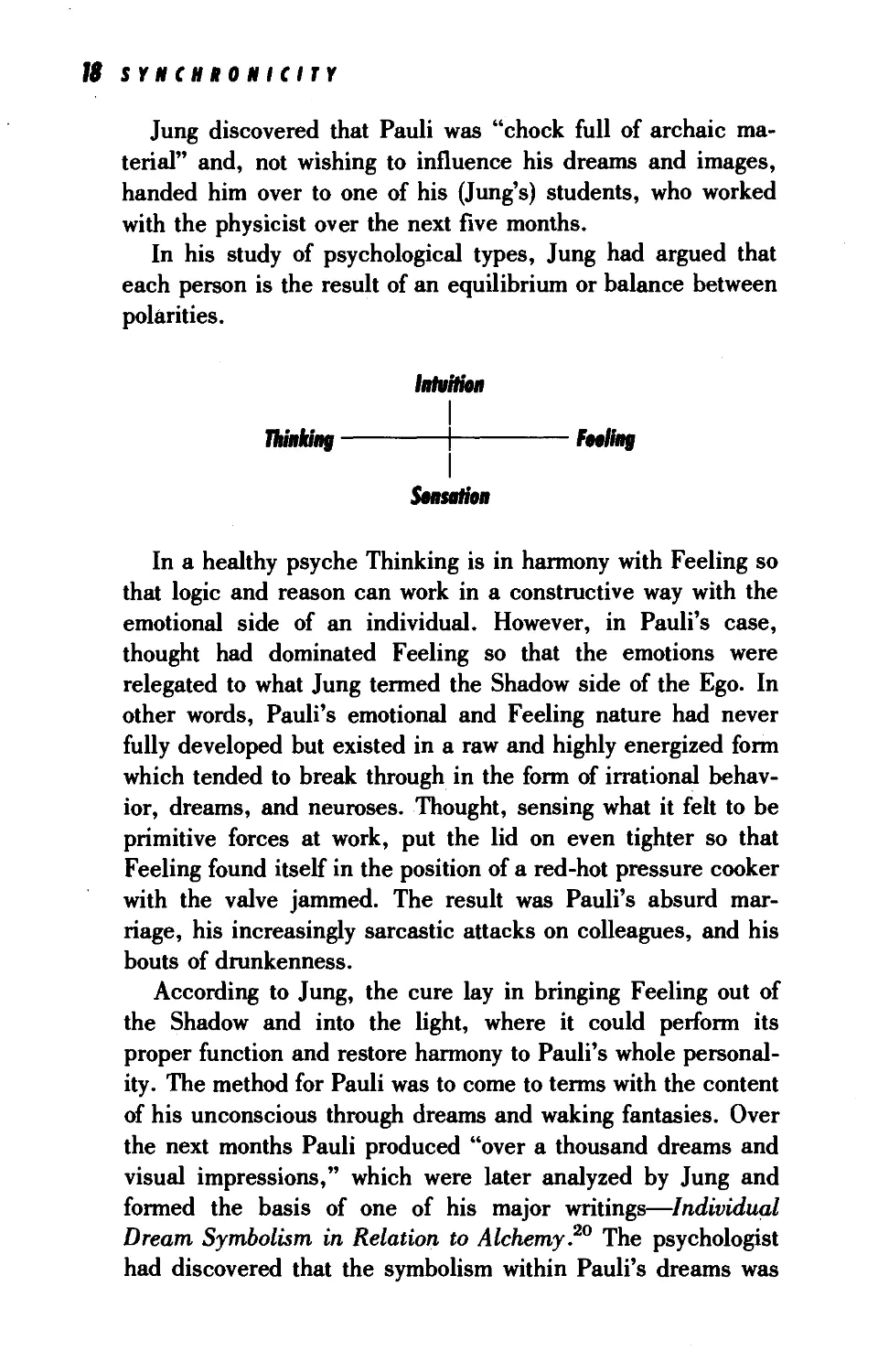
In his study of psychological types, Jung had argued that
each person is the result of an equilibrium or balance between
polarities.
Intuition
I
Thinking 1 Feeling
I
Sensation
In a healthy psyche Thinking is in harmony with Feeling so
that logic and reason can work in a constructive way with the
emotional side of an individual. However, in Pauli's case,
thought had dominated Feeling so that the emotions were
relegated to what Jung termed the Shadow side of the Ego. In
other words, Pauli's emotional and Feeling nature had never
fully developed but existed in a raw and highly energized form
which tended to break through in the form of irrational
behavior, dreams, and neuroses. Thought, sensing what it felt to be
primitive forces at work, put the lid on even tighter so that
Feeling found itself in the position of a red-hot pressure cooker
with the valve jammed. The result was Pauli's absurd
marriage, his increasingly sarcastic attacks on colleagues, and his
bouts of drunkenness.
According to Jung, the cure lay in bringing Feeling out of
the Shadow and into the light, where it could perform its
proper function and restore harmony to Pauli's whole
personality. The method for Pauli was to come to terms with the content
of his unconscious through dreams and waking fantasies. Over
the next months Pauli produced "over a thousand dreams and
visual impressions," which were later analyzed by Jung and
formed the basis of one of his major writings—Individual
Dream Symbolism in Relation to Alchemy.20 The psychologist
had discovered that the symbolism within Pauli's dreams was

mrmKBTUtomtrsYaotOGtST 19
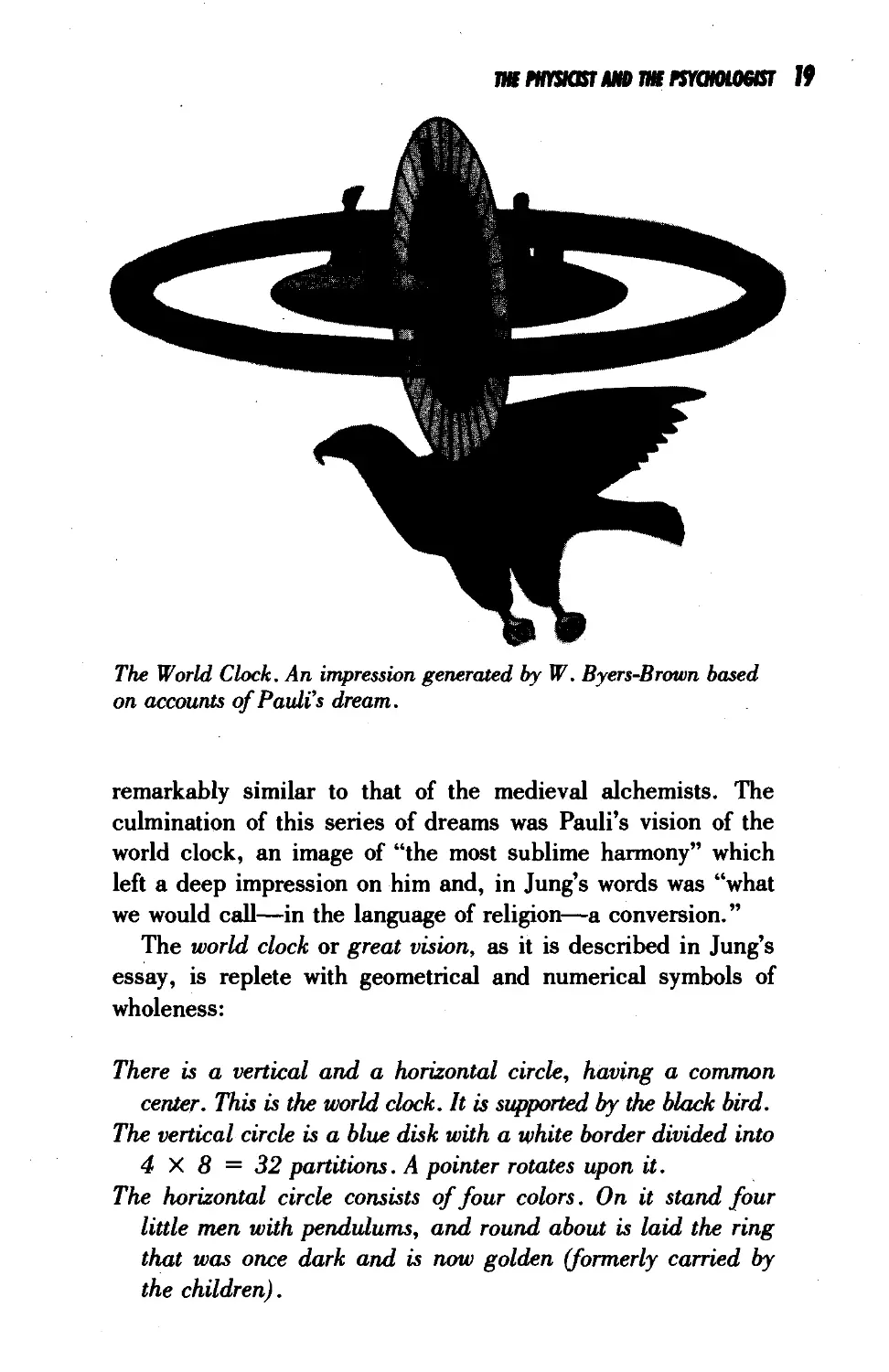
The World Clock. An impression generated by W. Byers-Brown based
on accounts ofPaidi's dream.
remarkably similar to that of the medieval alchemists. The
culmination of this series of dreams was Pauli's vision of the
world clock, an image of "the most sublime harmony" which
left a deep impression on him and, in Jung's words was "what
we would call—in the language of religion—a conversion."
The world clock or great vision, as it is described in Jung's
essay, is replete with geometrical and numerical symbols of
wholeness:
There is a vertical and a horizontal circle, having a common
center. This is the world clock. It is supported by the black bird.
The vertical circle is a blue disk with a white border divided into
4 X 8 = 32 partitions. A pointer rotates upon it.
The horizontal circle consists of four colors. On it stand four
little men with pendulums, and round about is laid the ring
that was once dark and is now golden (formerly carried by
the children).

20 SYKCH KOKI CITY
The "clock has three rhythms or pukes:
1. The small pulse:
The pointer on the blue vertical disk advances by
1/32.
2. The middle pulse:
One complete revolution of the pointer. At the same
time the horizontal circle advances by 1132.
3. The great pulse:
32 middle pulses are equal to one revolution of the
golden ring.21
The illustration of the world clock was created by W. Byers-
Brown on the basis of Pauli's dream. It is taken from a
particularly interesting lecture, "Wolfgang Pauli—Physicist and
Dreamer," which Byers-Brown gave in London, on April 13,
1980, to The Scientific and Medical Network.
In interpreting the dream, Jung identified the point of
rotation of the disks with the mystical speculum, for it both
partakes of the rhythmic movement yet stands outside it. The two
disks belong to the two universes of the conscious and the
unconscious, which intersect in this speculum. The whole
figure together with its elaborate internal movement is
therefore a mandala of the Self, which is at one and the same time
the center and the periphery of the world clock. In addition,
the dream could also stand as a model of the universe itself
and the nature of space-time. Jung himself noted that the
construction of the clock and the numerical divisions it
contained bore a striking resemblance to the systems of the Quabala.
But it should also be pointed out that Pauli, as a physicist, was
also seeking to discover an inner unity between the elementary
particles and their abstract symmetries. The vision of the world
clock is therefore capable of many levels of interpretation, and
it is indeed a particularly rich image in its resonances of
meaning.
Pauli's rebirth as "a perfectly normal and reasonable person
. . . completely adapted" was therefore the result of sensing a
deep inner symmetry to his own mind, a dynamic pattern that
had been illustrated in symbolic times by the early Gnostics,

iwMiKKBr/iwiwKrafOioasr 21
the alchemists of the Middle Ages, and the Taoists of ancient
China. According to Jung, Pauli's very heavy drinking was also
"cured," a diagnosis not supported by the physicist's friends.
In his autobiography, H. B. G. Gasimir describes a harrowing
drive from Lucerne to Zurich after Pauli had consumed many
drinks. "Ich fahre ziemlich gut," Pauli cried as he swerved
from side to side on the road.22 Clearly Jung had overdramatized
the extent of Pauli's "conversion"; however, he was certainly on
the right lines in describing Pauli's new interest in inner
harmony and symmetry. The notion of symmetries in nature
and in the psyche continued to preoccupy the physicist for the
rest of his life. The results confirmed Jung's findings on what
he called the atchetypes, dynamic forces and mosaics of energy
within the collective unconscious which are revealed to us
symbolically through dreams, fantasies, works of art, and myths.
In the chapters that follow we will learn more about these
archetypes and the role they may play in synchronicity.
With the encouragement of Pauli, Jung was now able to
explore the question of a hidden symmetry within the universe
from the perspectives both of physics and of psychology. It was
also as a result of Pauli's promptings that Jung was eventually
to publish his meditations on synchronicity. For, following
Pauli's analysis, the two men became colleagues in their
search for nature's inner patterns. Pauli attended meetings of
the Zurich group of psychologists and, in turn, introduced Jung
to many of the leading physicists of the day, who often proved
sympathetic to his approaches.
But before we leave Pauli, it is worthwhile exploring the
"Pauli effect," a phenomenon which has gone down into the
mythology of science. While many theoreticians are deeply
allergic to experimental work and laboratory apparatus, in
Pauli's case this reached such absurd proportions that it was
said that Pauli had only to walk into a laboratory for a vacuum
vessel to implode or a sensitive gauge to fracture. Many
examples of this "Pauli effect" are still recounted by physicists, and
a particularly curious anecdote comes from Professor J. Franck.
On one occasion a complicated piece of apparatus collapsed in
his Gottingen laboratory. Franck wrote to Pauli pointing out

22 SYHCHKOHICITY
that, since the theoretician was living in Zurich, the Pauli
effect could hardly be to blame in this case. Pauli, however,
replied that he had in fact been traveling to Copenhagen and
that his train had stopped in the Gottingen station at the time
of the mishap!
One of the most curious of these stories about Pauli
concerns the number 137. One of the great unsolved mysteries of
modern physics is the value of the fine structure constant, for
while the other fundamental constants of nature are all
immensely small or enormously large, this fine structure constant
Vi37 turns out to be a human-sized number. This number 137
and its place in the scale of the universe particularly puzzled
Pauli and continues to challenge physicists today. It was a
mystery that Pauli was to take to his death, for on being
admitted into the hospital, the physicist was told that he was
being put into room 137. According to one version of this story,
on learning of his room number, Pauli said, "I will never get
out of here." The physicist died shortly after.
Synchronics
At first there were only a few tantalizing hints as to Jung's
thoughts on synchronicity. In 1929, while lecturing to a group
of students, Jung said, "Synchronicism is the prejudice of the
East, causality is the modern prejudice of the West." A year
later, during a memorial address on the death of Richard
Wilhelm, the noted student of Chinese thought, Jung expanded
a little on his original remark. "The science of the / Ching,
indeed, is not based on the causality principle, but on a
principle (hitherto unnamed because not met with us) which I
have tentatively called the synchronistic principle."23 During a
lecture at London's Tavistock Clinic five years later, Jung
appears to have used the term "synchronicity" for the first
time. "Tao can be anything, I use another word to designate it,
but it is poor enough. I call it synchronicity"24'
Now, thanks to Pauli, Jung was able to crystallize his ideas
further, and in 1952, the two men published together The
Interpretation and Nature of the Psyche, a book containing two

MFmsKOTJiwMFKraiatMBr 23
essays, one by Pauli on the influence of archetypes in Kepler's
theory of planetary motion, and the other by Jung on the nature
of synchronicity.25 Although the.latter essay bears only Jung's
name, it is clear that it is the. result of long discussions with
Pauli. It is not so much a definitive explanation of synchronicity
but rather a starting point (indeed it forms the starting point of
this present book), for as Jung writes in the introduction:
In writing this paper I have, so to speak, made good a promise
which for many years I lacked the courage to fulfil. The
difficulties of the problem and its representation seemed to me too
great. ... If I have now conquered my hesitation and at last come
to grips with the theme it is chiefly because my experiences of the
phenomenon of synchronicity have multiplied themselves over the
decades. . . ,x
Within this essay, and certain of Jung's other writings,
synchronicity is variously referred to as:
■ "the coincidence in time of two or more causally unrelated
events which have the same or similar meaning"
■ "creative acts"
■ "acausal parallelisms"
He also wrote that:
■ "meaningful coincidences are unthinkable as pure chance—
the more they multiply and the greater and more exact the
correspondence is. . . . they can no longer be regarded as
pure chance, but, for the lack of causal explanation, have
to be thought of as meaningful arrangements."
In the chapters that follow we shall excavate the deeper
meanings of these statements and claims and see how they
reveal a universe that unfolds according to a hidden, dynamic
order.
Jung also attempted to integrate his intuitions on synchronicity
into the framework of modern physics. Just as he had sug-

24 SYHCHKOHICITY
gested that the mind results from a dynamic equilibrium of
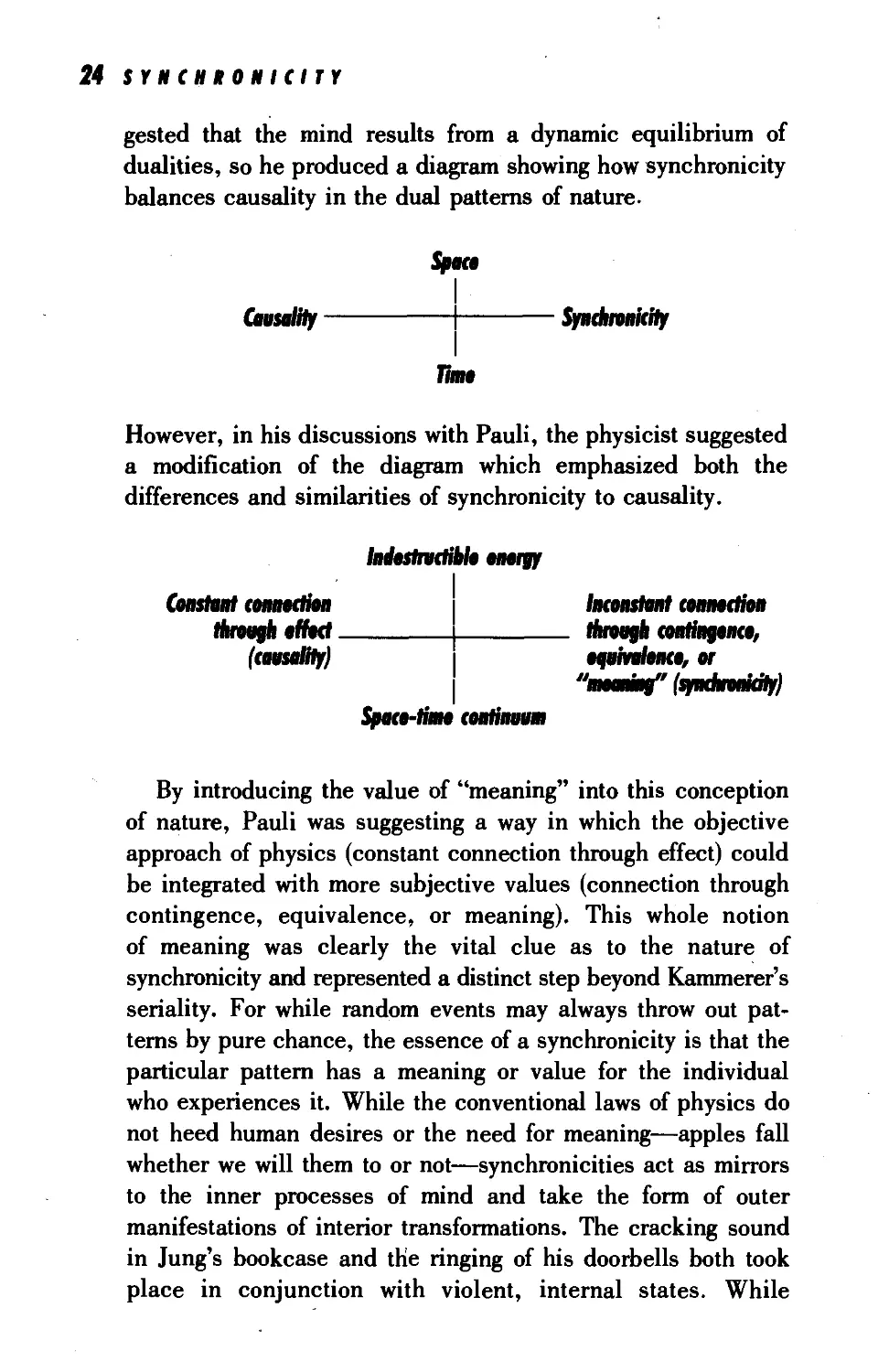
dualities, so he produced a diagram showing how synchronicity
balances causality in the dual patterns of nature.
Spaa
Causality
Synthronkhy
Tom
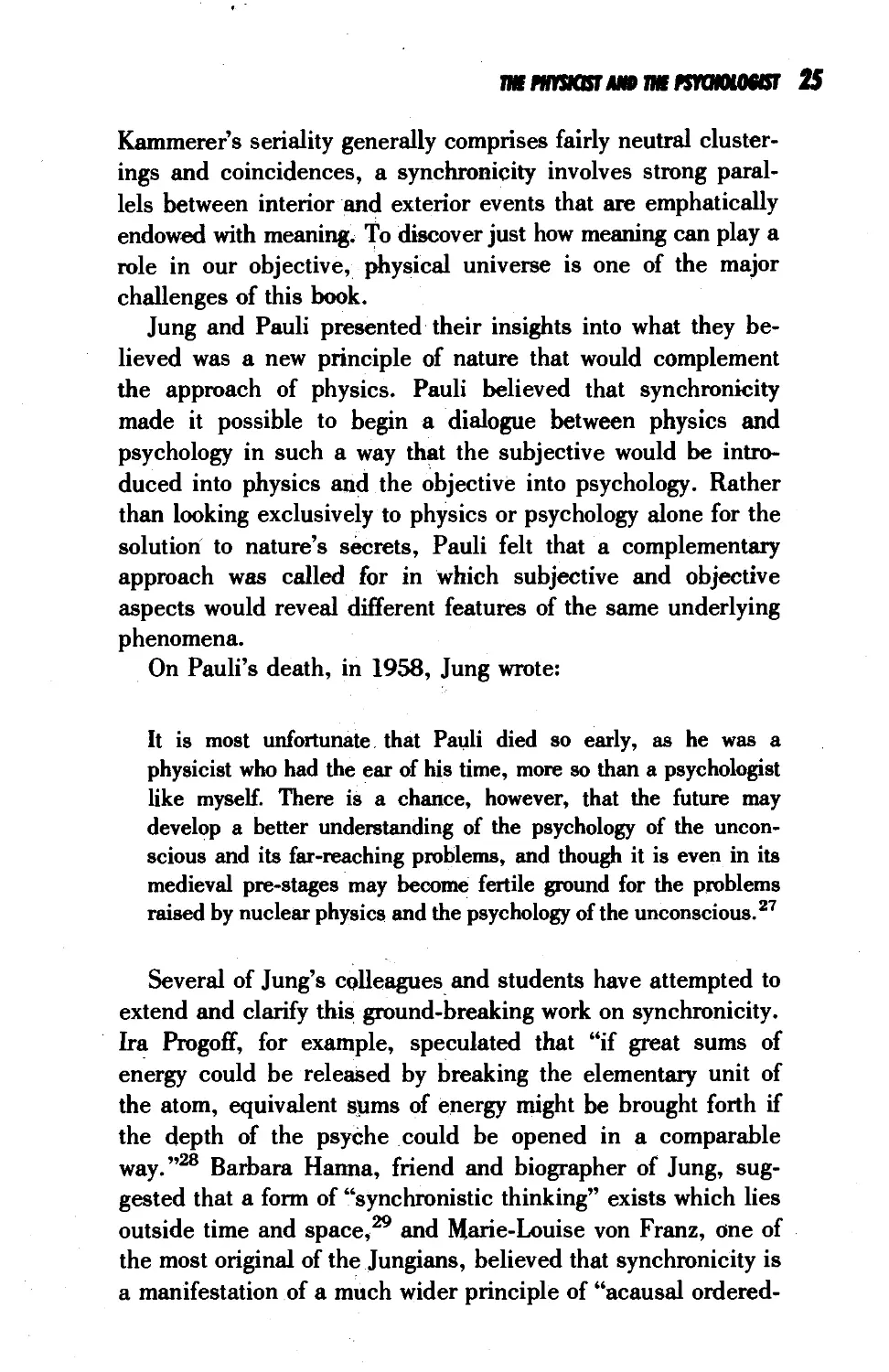
However, in his discussions with Pauli, the physicist suggested
a modification of the diagram which emphasized both the
differences and similarities of synchronicity to causality.
Constant tonnochon
through tffott.
(tausalhy)
Indostructiblo onorgy
Spaa-tim tontinuum
Inconstant tonnottion
through contingona,
to, or
f (sfnthroniotf)
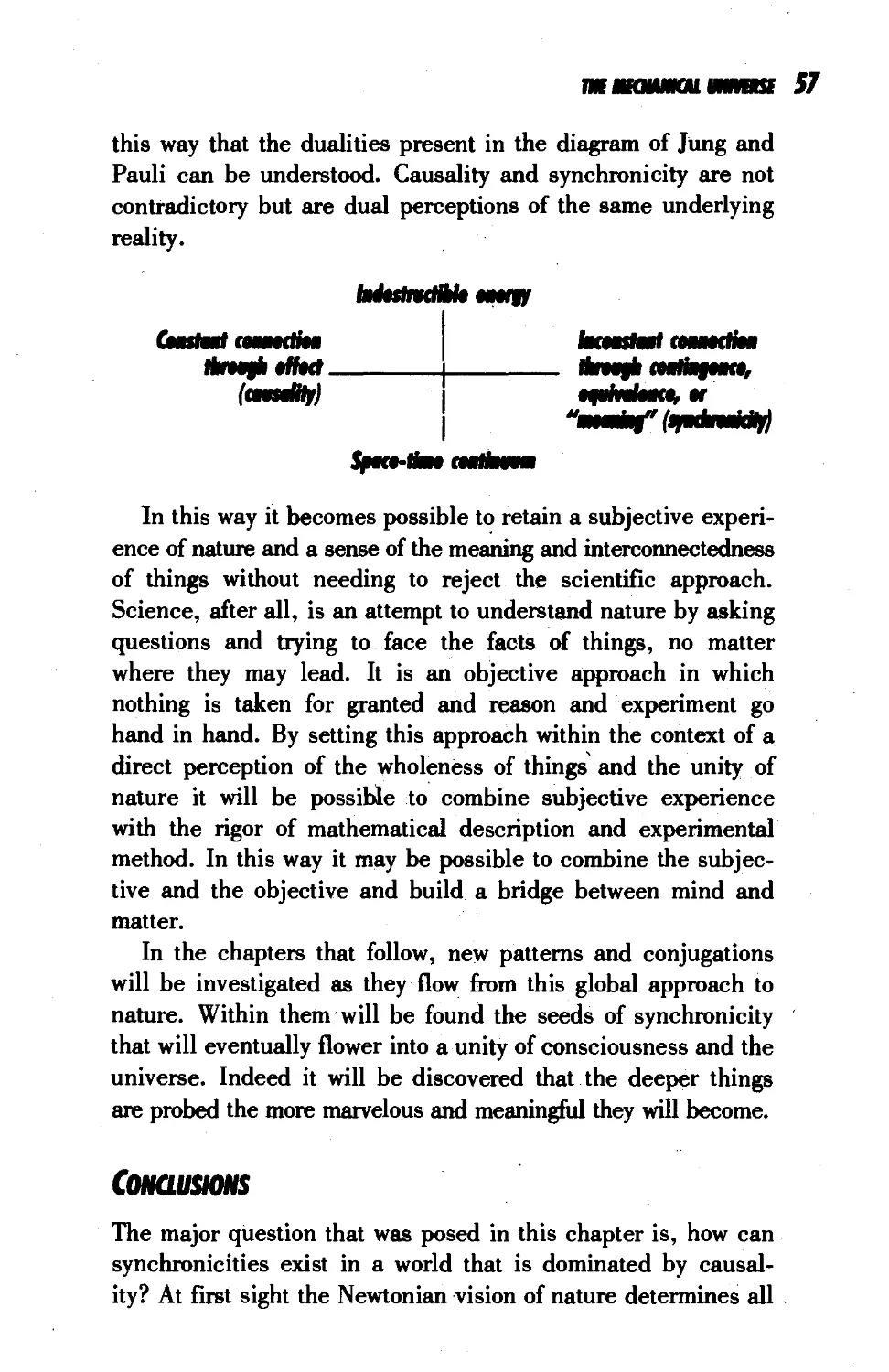
By introducing the value of "meaning" into this conception
of nature, Pauli was suggesting a way in which the objective
approach of physics (constant connection through effect) could
be integrated with more subjective values (connection through
contingence, equivalence, or meaning). This whole notion
of meaning was clearly the vital clue as to the nature of
synchronicity and represented a distinct step beyond Kammerer's
seriality. For while random events may always throw out
patterns by pure chance, the essence of a synchronicity is that the
particular pattern has a meaning or value for the individual
who experiences it. While the conventional laws of physics do
not heed human desires or the need for meaning—apples fall
whether we will them to or not—synchronicities act as mirrors
to the inner processes of mind and take the form of outer
manifestations of interior transformations. The cracking sound
in Jung's bookcase and the ringing of his doorbells both took
place in conjunction with violent, internal states. While

iMnmKBnu»mtrsrantQ9BJ 25
Kammerer's seriality generally comprises fairly neutral
clusterings and coincidences, a synchronicity involves strong
parallels between interior and exterior events that are emphatically
endowed with meaning. To discover just how meaning can play a
role in our objective, physical universe is one of the major
challenges of this book.
Jung and Pauli presented their insights into what they
believed was a new principle of nature that would complement
the approach of physics. Pauli believed that synchronicity
made it possible to begin a dialogue between physics and
psychology in such a way that the subjective would be
introduced into physics and the objective into psychology. Rather
than looking exclusively to physics or psychology alone for the
solution to nature's secrets, Pauli felt that a complementary
approach was called for in which subjective and objective
aspects would reveal different features of the same underlying
phenomena.
On Pauli's death, in 1958, Jung wrote:
It is most unfortunate, that Pauli died so early, as he was a
physicist who had the ear of his time, more so than a psychologist
like myself. There is a chance, however, that the future may
develop a better understanding of the psychology of the
unconscious and its far-reaching problems, and though it is even in its
medieval pre-stages may become fertile ground for the problems
raised by nuclear physics and the psychology of the unconscious.27
Several of Jung's colleagues and students have attempted to
extend and clarify this ground-breaking work on synchronicity.
Ira Progoff, for example, speculated that "if great sums of
energy could be released by breaking the elementary unit of
the atom, equivalent sums of energy might be brought forth if
the depth of the psyche could be opened in a comparable
way." Barbara Hanna, friend and biographer of Jung,
suggested that a form of "synchronistic thinking" exists which lies
outside time and space,29 and Marie-Louise von Franz, one of
the most original of the Jungians, believed that synchronicity is
a manifestation of a much wider principle of "acausal ordered-

26 synchkonicity
ness" which is also found in mathematics and quantum theory
and represents "acts of creation in time."30
With the possible exception of Dr. von Franz, who has an
intuitive sympathy to the inner structure of mathematics, the
investigators who followed Jung all tended to approach
synchronicity from one direction only, from the world of
experience, dreams, fantasies, and the unconscious. But in order to
obtain a deeper integration of physics and psychology, it is
necessary to explore synchronicity from both sides and invoke
some of the latest views of physics as well, building in a
complementary fashion from both the objective and
subjective perceptions of nature.
Right up to the end of his life, Pauli retained a deep
conviction in the powers of symmetry. While struggling with a unified
field theory he wrote to his life-long friend Heisenberg:31
Division and reduction of symmetry, this then the kernel of the
brute! The former is an ancient attribute of the devil. ... If only
the two divine contenders—Christ and the devil—could notice
that they have grown so much more symmetrical.
On December 15, 1958, the day of Pauli's death, I was
taking a university examination in Liverpool. By a curious
synchronicity one of the questions on the paper before me
concerned Pauli's exclusion principle and asked what would be
the nature of the universe if this principle had never existed!
The Natural History of Synchronicities
Jung's investigations into synchronicity were prompted by the
various patterns and acausal clusterings that had occurred in
his own life. A particular example, which is recorded in his
essay on synchronicity, deals with the motif of the fish. In
many European countries April 1 is referred to as April Fish
Day. On that particular day Jung happened to be working on
the symbolism of the fish and when his patient arrived Jung was
shown a picture of a fish and a piece of embroidery with a fish
on it. On the following day another patient told him of a dream

THtmraasummpsmmoeaj 27
of a large fish that had occurred the night before. While
writing down these accounts Jung went for a walk beside the
lake and saw a large fish.
Jung himself gives prominence to this pattern of fishy
occurrences. But to many readers they will seem to be nothing more
than simple coincidences. Their importance, for Jung,
appeared to come from the strong sense of meaning they had for
him. Possibly of more interest, however, were the events that
occurred to his patients during therapy—such as the appearance
of the golden scarab mentioned earlier. In such situations, in
which the patient and psychiatrist are able to activate the deep
forces of the unconscious together, the occurrence of syn-
chronicities may be particularly favorable.
This observation has been confirmed by the research of a
Swiss analyst, Arnold Mindel. Mindel began his professional
training as a physicist but later switched to Jungian
psychology, which he studied in Zurich. His interest in synchronicity
and the possibility of resonances between physics and
psychology led him to conduct a survey by means of a questionnaire
sent out to a number of Jungians.32
When Mind el's work is taken in conjunction with Jung's,
and with other commentators, it is possible to build up a
profile for synchronistic happenings. As Jung had earlier pointed
out, it is the nature of synchronicity to have meaning and, in
particular, to be associated with a profound activation of
energy deep within the psyche. It is as if the formation of
patterns within the unconscious mind is accompanied by
physical patterns in the outer world. In particular, as psychic
patterns are on the point of reaching consciousness then
synchronicities reach their peak; moreover, they generally
disappear as the individual becomes consciously aware of a new
alignment of forces within his or her personality.
Synchronicities are therefore often associated with periods of
transformation; for example, births, deaths, falling in love,
psychotherapy, intense creative work, and even a change of
profession. It is as if this internal restructuring produces
external resonances or as if a burst of "mental energy" is
propagated outward into the physical world. The cracking sound

28 SYNCH R 0 H I CITY
from Jung's bookcase is a clear example of such an externaliza-
tion. Arnold Mindel gives the example of a psychotic patient
who declared that he was Jesus, the creator and destroyer of
light. At that very moment the lighting fixture dropped from
the ceiling, knocking the man out.
An extreme example of the release of such psychic energy
occurs with what Jungians call "The Gambler," the person who
must risk everything on the final turn of a metaphoric card. In
many cases a patient is at the end of his or her tether with all
resources exhausted and no hope remaining. In symbolic terms
this is not unlike the person who has reached the final door in
a castle, who has one magical wish left, who faces a dragon, or
who is on the point of death. In such circumstances all the
energies are focused and concentrated upon the final turn of a
card and synchronicities are bound to occur.
Mindel tells of the psychiatrist who was at his wit's end
trying to treat a woman patient. No matter what he did he
seemed unable to communicate with her. One day, under
extreme stress he dreamed that her husband was trying to pull
her into the world beyond and was wakened by knocks on the
office door—but no one was outside. He developed the
intuition that the woman's husband was in some way responsible
for this knocking and, during their next session together, told
this story to his patient. To his surprise she admitted that her
husband had in fact died several weeks earlier.
Faced with an apparently impossible task, the therapist had
become involved in a synchronicity involving a knocking on
the office door and the dream of a dead husband. From that
time onward, communication improved between doctor and
patient and led to an eventual cure.
The involvement of synchronicities between the dreaming
and the waking state is not unusual, nor is it confined to these
"last resort" situations. Anthony Storr, author of The Essential
Jung, told me that his wife dreamed that she had been
decapitated. On the same night, an Oxford don lay down on the
railroad tracks and was decapitated by a train. G. H. Lewis,
life-long companion of the writer George Eliot, tells the
following story about Charles Dickens:

m utmost uamnratoLoast 29
Dickens dreamt that he was in a room where everyone was dressed
in scarlet. He stumbled against a lady standing with her back
towards him. As he apologised she turned her head and said quite
unprovoked "My name is Napier."
He knew no one of the name Napier and the face was unknown.
Two days later before a reading a lady friend came into the
waiting-room accompanied by an unknown lady in a scarlet opera-
cloak, "who" said his friend "is very determined of being
introduced." "Not Miss Napier?" he jokingly inquired. "Yes Miss
Napier." Although the face of his dream-body was not the face of
Miss Napier, the coincidence of the scarlet cloak and the name
was striking."33
Synchronicities occur not only to the disturbed or
hypersensitive but may even intrude into the life of the rational and
skeptical. Indeed, Mindel noted how they sometimes have the
effect of perturbing an otherwise ordered and overrigid worldview
by appearing as the jokers in the pack of life.
Some synchronicities begin within the outer world and then
move inward as their meaning is revealed. Such synchronicities
depend on detecting a deeper meaning to the patterns and
clusterings of the phenomena around us. They may involve our
becoming linked with the environment in a special way,
anticipating events or sensing some underlying pattern to the world.
Jung's case of the fish motif is one example. But one could also
point to the ways in which artists and writers seem to have
sensed major events or social changes long before they
happened. A curious coincidence is provided by the astronomers
in Jonathan Swift's Gulliver's Travels, who know that Mars
possesses two moons, and this long before real-life stargazers
were in a position to make such observations. More ominous
is M. F. Mansfield's 1898 novel of the fabulous Atlantic liner,
Titan, the largest ever built, which sailed into the Atlantic
along with its rich and famous passengers. Supplied with an
inadequate number of lifeboats, the Titan, like the real-life
Titanic some years later, struck an iceberg and sank.
Perhaps more interesting, however, are the films made in
Germany of the 1920s that anticipate the psychological turmoil
that exploded in the Nazi era. F. W. Murnau's Nosferatu

30 SYH CH ROM I CITY
involves a plague that sweeps across the land and shows how
respectable townsfolk are stirred into the blood lust of a hunt.
Robert Weine's The Cabinet of Dr. Caligari depicts a sonambulist
who is used as the instrument of murder by a mad doctor.
Within the doctor's asylum the patients appear rational and the
staff insane.
A particularly telling synchronicity or acausal connection
with the environment can be found in the sinologist Richard
Wilhelm's story of the rainmaker since it contains the essence
of a Chinese worldview of how man and nature form an
individual whole. A certain Chinese village had been without rain for
some weeks when they sent for the rainmaker. On the old
man's arrival he went straight to a house provided for him and
there he stayed without performing any ceremonies until the
rains came. On being asked how he had caused the rain to fall
the old man explained that causation had nothing to do with it.
Upon arriving in the village the rainmaker had realized that a
state of disharmony was present and consequently the normal
processes of nature were not operating according to their proper
design. The rainmaker himself was also affected so the old man
retired to his hut to compose himself. When his internal
harmony was restored and equilibrium established then the
rain fell, as it is its natural pattern to do so.
This story contains elements of a moving inward and a
moving outward, a dynamism between the physical and the
mental aspects of the universe. But there are also synchronicities
that appear to exist only inwardly and not have significant
physical manifestations. These could, for example, involve
acausal patterns of dreams, memories, thoughts, symbols, and
perceptions and express themselves as coincidences or
clusterings between different people. An obvious example of such
synchronicities are the simultaneous discoveries made by
scientists who are not in direct communication with each other.
Scientists often speak of ideas as "being in the air," almost as
if new concepts take the form of radio transmissions, complete
in themselves but waiting for a competent receiver to pick
them up. One of the most famous of such coincidental
discoveries is that of the theory of evolution.

mmaaaimmnmniosBi 31
Charles Darwin, acting on the advice of his friend Sir
Charles Lyell, had begun to write out his theory of the
evolution of new species:
... I got through about half the work on this scale. But my plans
were overthrown, for early in the summer of 1858 Mr. Wallace,
who was then in the Malay archipelago, sent me an essay On the
Tendency of Varieties to depart indefinitely from the Original Type;
and this essay contained exactly the same theory as mine.34
One of the most revolutionary theories in science had therefore
been independently discovered by two men working quite
unrelatedly to each other. Of equal importance was the
independent discovery of calculus by both Newton and Leibnitz.
Even more striking synchronicities can be found when such
parallel evolutions of thought take place in totally different
fields. While it is possible that the theory of evolution was
simply waiting to be discovered, how is one to explain the
following examples of our increasing understanding of the
nature of light? Around the middle of the sixteenth century,
Vermeer and other painters working in Holland had become
interested in the interior nature of light, in its effects on
entering rooms through doors, windows, and tiny cracks and its
transformation on passing through colored glass. At this same
time, Isaac Newton was using a prism to explore the
composition of light as it entered a small hole in the shutters of his
Cambridge room.
Two hundred years later the painter Turner was portraying
light as being a swirling vortex, an energetic power which
dissolved form and could be equated with the surging
movement of wind, rain, and waves. A little later the physicist
Maxwell was to formulate his wave theory of the electromagnetic
field in which light is produced by the mutual revolution
(swirling motion) of electrical and magnetic waves around each
other. By the turn of the century the impressionists were
treating light as a pure force which produces and dissolves
form and can be broken down into its component atoms of
sensation; the logical extension of this work was pointillism, in

32 SYNC H ROHI CITY
which all of nature is reduced to dots or quanta of color. A few
years later the same notion was being formulated in physics by
Planck and Einstein as the quantum theory of light and matter.
Do such concepts and insights exist in some enfolded,
symbolic form within the unconscious mind? Or are they
approached within nature, not directly but in some hidden way
which must then be unfolded within the languages of art,
literature, music, or science? The many examples of
coincidental movements of thought, feeling, and ideas between
unconnected groups and across disciplines suggests that a deeper
meaning lies beyond these coincidences and synchronicities.
On a less dramatic note, Arnold Mindel has noted the
synchronious movement of couples in which one partner
undergoes a dramatic experience while separated from the
other. It is not unusual, for example, for a husband or a wife to
experience some profound inner change while the partner is
undergoing psychotherapy in another city or country. Such
curious events may not be so much the result of a "psychic
link" or mental communication but rather indicate that a
mutual process is unfolding out of the same ground and that this
ground must therefore lie beyond the individual consciousness
that is located in space and time.
Conclusions
So far we have explored the notion of synchronicity on a
phenomenological basis, by giving some examples and hinting
that they may be evidence of some deeper, universal principle
of hidden order. But as we approach this new principle of
nature, it will first be necessary to look a little closer at the
nature of synchronicities which we have characterized as being
acausal, meaningful, unique events and involving some form of
pattern. In order to do so, however, we must also consider the
limitations of our current worldview with its notions of
causality, the arrow of time, objectivity, the separation of mind and
matter, and the emphasis upon reproducibility rather than on
unique, single events.

mmsKmunmnmniosBi 33
In the next chapter we begin this exploration by focusing on
ideas of causality and asking if it makes any sense to speak of
an "acausal connecting principle" in our physical universe.
NOTES
1. Tom Chetwynd, A Dictionary of Symbols (New York: Granada Publishers,
Paladin Books, 1982).
2. T. E. Lawrence, Seven Pillars of Wisdom (Harraondsworth, Eng.:
Penguin, 1976).
3. W. Wordsworth, "Ode: Intimations of Immortality."
4. J. A. Wheeler in Paul Buckley and F. David Peat, A Question of Physics
(London: Routledge and Kegan Paul, 1979).
5. Paul Kammerer, Das Gestex der Serie (Stuttgart-Berlin: Deutsche Verlags-
Ansalt, 1919). Quoted in Arthur Koestler, The Roots of Coincidence
(New York: Random House, 1972).
6. See also Arthur Koestler, The Case of the Midwife Toad (New York:
Random House, 1973); and Alister Hardie, Robert Harvie, and Arthur
Koestler, The Challenge of Chance (London: Hutchinson, 1973).
7. Sigmund Freud and C. G. Jung, The Freud-Jung Letters: The
Correspondence between Sigmund Freud and C.G. Jung, trans. Ralph Manheim and
R. F. Hull. Bollingen Series No. 94 (Princeton University Press, 1974).
8. Ibid.
9. London: Collins, The Fontana Library, 1971.
10. Ibid.
11. Ibid.
12. W. Heisenberg, Physics and Beyond (New York: Harper & Row, 1971).
13. This article has since been reprinted as W. Pauli, Theory of Relativity (New
York: Dover, 1981).
14. Quoted by W. Byers-Brown in "Wolfgang Pauli—Physicist and Dreamer,"
lecture given to the Scientific and Medical Network, on April 13, 1980,
in London.
15. Heisenberg, op. cit.
16. B. L. van der Waerden, ed., Sources of Quantum Mechanics (New York:
Dover, 1968).
17. John Hendry, The Creation of Quantum Mechanics and the Bohr-Pauli
Dialogues (Boston: D. Reidel, 1984).
18. C. G. Jung, Analytical Psychology: Its Theory and Practice. The Tavistock
Lectures (New York: Random House, Vintage Books, 1968).
19. Ibid.
20. This paper, along with an account of Pauli's dreams and the deductions
Jung made from them, can be found in C. G. Jung, Psychology and
Alchemy, trans. R. F. C. Hull. Bollingen Series XX (Princeton
University Press, 1968). The paper is also reprinted in C. G. Jung, Dreams,
trans. R. F. C. Hull. Bollingen Series (Princeton University Press,
1974).

34 SYNCHRONICITY
21. Psychology and Alchemy, loc. cit.
22. Haphazard Reality (New York: Harper & Row, 1983).
23. Quoted in R. Wilhelm, The Secret of the Golden Flower (London:
Routledge & Kegan Paul, 1962).
24. Analytical Psychology, loc. cit.
25. C. G. Jung and W. Pauli, The Interpretation and Nature of the Psyche,
trans. R. F.' C. Hull and P. Silz. Bollingen Series LI (New York:
Pantheon, 1955). Unfortunately this book is now out of print and Pauli's
essay has therefore been lost to the general reader. Jung's essay,
however, is reprinted in C. G. Jung, Synchronicity, trans. R. F. C. Hull.
Bollingen Series (Princeton University Press, 1973).
26. Ibid.
27. C. G. Jung, Letters Nineteen Fifty-one to Nineteen Sixty-one, Vol. 2,
eds. Gerhard Adler and Aniela Jaffe. Bollingen Series No. 95 (Books on
Demand, University Microfilms International, n.d.).
28. Ira Progoff, Jung, Synchronicity and Human Destiny (New York: Julian
Press, 1973).
29. Barbara Hanna, Jung, His Life and Work (New York: Putnam, 1976).
30. M-L von Franz, On Divination and Synchronicity (Toronto: Inner City
Books, 1980).
31. Heisenberg, op. cit.
32. Arnold Mindel, Synchronicity, An Investigation of the Unitary
Background Patterning Synchronous Phenomena. Dissertation Abstracts
International 37:2 (1976).
33. Quoted in The Canadian Illustrated News, 1870-1880.
34. The Autobiography of Charles Darwin 1809—1882, ed. Nora Barlow
(London: Collins, 1958).

J The Mechanical
Universe
Carl Jung defined synchronicity as "the coincidence in time of
two or more causally unrelated events which have the same
meaning." His implication is clear—certain events in the
universe cluster together into meaningful patterns without recourse
to the normal pushes and pulls of causality. These synchronicities
therefore must transcend the normal laws of science, for they
are the expressions of much deeper movements that originate
in the ground of the universe and involve, in an inseparable
way, both matter and meaning.
However, an "acausal connecting principle" clearly flies in
the face of a very compelling worldview that is based on a
causally dominated universe in which nothing takes place that
does not have an ultimate cause. If synchronicities really have
a deeper meaning and are not simply random coincidences or
projections of the imagination, then science is faced with the
problem of finding a place for them somewhere within its
universe. Yet when everything is determined by causality, how
can a pattern of events occur which does not conform to this
most ubiquitous of laws? In other words, what possible
meaning can there be to this paradoxical "acausal connecting
principle"?
Causality is defined as "a chain of cause and effect." This
suggests a chain or series of links, in which each one is firmly
locked into its two neighbors so that the whole chain is able to
stretch out indefinitely in both directions. In this way every
event in the universe is causally linked to an event that comes
35

36 SYHCHKOHICITY
before it, and to one that comes afterward. A more dynamic
image is that of a railway line along which an engine is
shunting a number of railcars. As the engine reaches the first
of the uncoupled cars, it bangs into it, causing an impulse of
motion that travels from car to car on down the line. An
intuitive sense of what is meant by causality is not unlike this
impulse that passes from car to car along the line, so that
whenever a car is seen to move, it must have been involved in
an impact somewhere back along the line.
In a similar way whenever a change or some new form of
motion is seen within the universe, it is natural to assume that
somewhere back along the "railway line of time," a cause has
been operating and that sometime in the future the effect will,
in turn, be passed on. Nothing happens in this world of
causality that does not originate in some cause. So the idea of
an "acausal connection" seems to be ruled out right from the
start—there is simply no room for it in a universe of causality.
This also seems to mean that the quest for synchronicity must
end in contradiction.
The causal universe had a particularly elegant description in
terms of the classical physics of the eighteenth and nineteenth
centuries; a worldview that continues to influence the ways in
which most of us continue to perceive and deal with reality.
Isaac Newton, for example, placed causality on a rigorous basis
with his laws of motion and the various mathematical equations
that followed from them. According to his system of
mechanics, if the initial conditions of a body are known (specifically
its initial velocity, position, mass, and the nature of the forces
that act on it), then it is possible to predict its exact path and,
in addition, all the collisions that it will encounter. Indeed
this approach can describe an entire system of particles so that
when a number of bodies are found clustering together in a
particular pattern, there is no need to invoke seriality or
synchronicity. It is simply a matter of solving the equations of
motion for each body and noting the inevitability with which
their paths and collisions have caused them to congregate
together into a particular pattern in space. Within this Newtonian
worldview, therefore, there seems to be no room for synchronicity.

IMfJKClMMGUMmBf
This Newtonian description can be extended to even larger
and more complex systems without limit. Indeed if Newton had
stood next to God on day one of creation, he would have asked
Him for the positions, masses, and velocities of the bodies He
had created and in this way could have predicted every
subsequent event that was to occur in the entire universe. Implicit in
such an arrogant vision of the power of science is the image of
a scientist who stands outside the system as an impartial
observer, able to predict all events according to deterministic
laws, and without disturbing events in any way. If such an
eighteenth-century scientist were to build a large enough
computer, it could then be possible to make a giant simulation of the
universe that would forever run parallel with reality. This
simulation would contain every event that has happened since
time began, and that will happen until the end of time. How
then could there be room in this simulation for free will,
creativity, and synchronicity?
The scientist today is no longer an impartial observer who
stands outside the universe and watches its various events. In
John Wheeler's words, the term "spectator" must be struck
from the record and the new word "participator" must replace
it. By virtue of the quantum theory, it is clear that any
observation or attempt to determine initial conditions, has an
irreducible effect on the rest of the universe. Physics and
physicist are no longer separable but are one indivisible whole.
Will an appeal to the quantum theory therefore provide a
loophole for escaping from the dilemma of absolute causality?
For example, while a particular isotope decays with a well-
defined half-life, there is no way of predicting which one of its
particular atoms will disintegrate next. One atom may decay in
less than a minute; another will last for a week, or several
months. Quantum theory will not allow the individual event to
be pinned down in any exact way. Moreover, the theory asserts
that this breakdown in predictability has nothing to do with an
ignorance about the fine details of the system, which could be
filled in with some more detailed theory (as is the case with life
insurance which is averaged over a large population of
different individuals); rather it is a fundamental and absolute inde-

38 SYHCHKOHICITY
terminism. With such indeterminism lying at the most basic
level of nature, it appears that the entire Newtonian appeal to
absolute causality and determinism is now invalid and a
loophole has been discovered for synchronicity. This is indeed
true, in one sense, but it is still not possible to get off the hook
so easily, for most of the fluctuating, unpredictable effects of
atomic indeterminism vanish in the face of what has been
called the law of large numbers.
The law of large numbers argues that in any very large
ensemble of probabilistic events, things will always average
out to the point where individual deviations and happenings
can be ignored. Suppose, for example, that a large number of
quarters are tossed and all the heads put in one sack, and the
tails in the other. After thousands and tens of thousands of
tossings, the two sacks will weigh the same. True enough, any
one event is indeterministic, and on the fine scale, there will be
occasional runs on heads or on tails, but in the long term the
law of large numbers acts to hide the effects of individual
fluctuations within the overall average. Now what is true for a
few thousand coins is even more the case for the atoms comprised
in an everyday object, say a pool ball. The number of atoms
involved in this case is very large indeed, around 1023, about
the same as the number of stars in the universe. In such a
large ensemble the individual quantum deviations will be well
averaged away by the time things reach the human scale.
Therefore, while indeterminism rules the microworld, as far as
most phenomena are concerned its effects are lost when
averaged out over the law of large numbers that applies in the
everyday world. Newtonian determinism still appears to rule
and it has closed the doors to synchronicity and firmly locked
them with the chain of cause and effect.
The Ground of Causality
The linear chain of causality and the predictive power of
mathematical equations have dominated science for so many
generations that it is now difficult to see what room there can
be in the universe for freedom, novelty, and creativity. Scien-

IMflKMMGUMniHff
tists are able to argue that their causal explanations will
account for all phenomena, not only of the mechanical
universe, but also of life and .behavior itself. According to
reductionism, even such a complex phenomenon as
consciousness will eventually be explained in terms of the mechanisms
of a biological system, such as the operation of action
potentials within neurons, the flow of neurotransmitters, and the
growth of neural networks. While these accounts are all
biological in nature, they can be reduced to concepts in chemistry
such as ion potentials, pathways for chemical synthesis,
osmosis, and so on. In turn, each of these chemical phenomena is
explicable using the laws of physics as they apply to the
properties of solutions and the interactions of atoms and
molecules. In this way, reductionism argues that even the most
complex phenomena of society, consciousness and life, can be
reduced to the behavior of matter and the laws of physics.
While it is true that many thoughtful scientists do not accept
reductionism in its full form, nevertheless it does continue to
have a very strong influence within the sciences so that, on
meeting new phenomena, the natural scientific instinct is to
reduce it to its most basic elements. Reductionism, when
combined with causality, threatens to cause the complete
evaporation of synchronicity into the movement of atoms and the
operations of fields of force. However, as this book progresses,
it will become clear that a pluralistic approach is being
suggested in which reductionism and causality have a more
limited usefulness.
Causality has been pictured in terms of an engine that
shunts railcars along the line of time. Another mechanistic
image was particularly appealing to physicists of the late
nineteenth century. This was the game of pool, or of billiards, in
which the initial impact of the cue gives rise to all the
subsequent movements and patterns of balls on the table. Following
any shot, the paths of the various balls and their intercollisions
may appear quite complex, yet each trajectory is a direct
consequence of its initial position and the impact it received
from the cue ball.
The dynamics of pool and billiards are so elegant that they

40 SY HCH KO HICITY
provided the material for many of the problems that Professor
Sommerfeld of Munich University set his two young students,
Pauli and Heisenberg, to work on. However, the real world is
not a game of pool, and when it is explored in much greater
depth, it turns out that many of its phenomena appear to
emerge and unfold in much more complex and subtle ways.
Indeed it is as the notion of causality is pushed to its limit, in
an effort to explain such systems, that its usefulness begins to
break down. In the following chapters a number of examples
will be given in which causality does not seem to be
appropriate as a formal description, because nature acts in ways that
are much closer to those of an organism than a machine. In
these chapters the new laws of emergence and organic
dynamics will be unfolded, such as Prigogine's dissipative structures,
Bohm's implicate order, and Sheldrake's formative fields. With
the help of these new descriptions it will be possible to explore
the inner operations of synchronicity.
But before nature can be viewed as an organism, it is first
necessary to break the hypnotic hold of causality on our vision.
In this respect it is well worth recalling that, for philosophers,
the notion of causality is by no means clear or well founded. In
the eighteenth century, David Hume made a very careful
examination of the whole issue and concluded that causality
cannot be placed on a strictly logical footing. Just because it
has been observed on many occasions in the past that B follows
A, it does not logically follow that this succession will occur in
the future. The belief in causality is therefore based on a habit
of mind through repeated historical precedent and is far from
being a logical proof of inevitability. Indeed, as Hume wrote,
"We have no other notion of cause and effect, but that of
certain objects, which have been always conjoined together. . . .
We cannot penetrate into the reason of the conjunction."1
Causality is inferred from the past behavior of the universe
but it is never possible to get inside the phenomena of nature,
in any logical or philosophical sense, and directly apprehend
what is taking place. However, Hume despaired from ever
making any dent in the firm common sense belief of cause and
effect, "by dint of solid proof and reasoning I can never hope

mMtammaaymiaa 41
... to overcome the inveterate prejudices of mankind. Before
we are reconciled to this doctrine, how often must we repeat to
ourselves, that the simple view of any two objects or actions,
however related, can never give us any idea of power, or of a
connection betwixt them."2
The chain of linear causality, therefore, is a mixture of
habit, belief, and common sense. But this common sense is
based on a number of assumptions, namely:
■ That two events are unambiguously separated from each
other and have their own independent existence, as, for
example, two bodies with well-defined boundaries.
■ That some contact, force, or influence flows from one
body or event to the other.
■ That there is a clear flow of time with the cause occurring
in the past and the effect in the present.
Clearly, shunting railcars and colliding pool balls fulfill all
these criteria. First, pool balls have hard edges and do not
merge together or have a sporadic existence. The collision
between two pool balls is very different from the meeting of, for
example, two smoke rings or the intersection of two high-
energy protons in a particle accelerator. Second, the causal
flow is clear-cut in a pool game; it can be seen in the physical
contact of the balls as they collide. Again, this is very different
from the "action at a distance" of the moon on the earth's
tides, the influence ofva large rock on the vortices within a
river, or the lunar cycle on the breeding habits of certain fish.
Finally, there is no argument to the passage of time during a
game of pool; it can be measured by the clock on the wall and
by the player's own heartbeats. Time, however, is not so
clear-cut when we come to mental and atomic events or to the
early seconds of the universe, in which no independent clocks
existed. In addition, some systems could be said to have their
own internal time in which certain time scales are coupled or,
alternatively, are independent of each other, while systems in
total equilibrium may lack any real sense of time.
As long as objects and events are clear-cut and distinguish-

42 SYHCH KOH ICITY
able, forces are well defined, and time flows on, collectively
and unperturbed, then the notion of causality does not present
problems. But as science probes deeper into a universe of
internal flows and dynamic unfoldings, of subtle influences
and intersecting time scales, then causal chains can no longer
be analyzed and reduced to linear connections of individual
events so that the very concept of causality begins to lose its
power.
Synchronicities represent a bridge between matter and mind,
and the concept of causality is clearly not appropriate to the
world of mental events. While it is true that some of our more
primitive behaviors may be causally "conditioned," it is clear
that thoughts are not distinct, individual objects but are closer
to smoke rings in the way they appear to enfold each other and
merge. While there may sometimes exist a "train of thought,"
which implies a linear progression in time, this "train" does
not have the form of a series of causal links, for the mechanism
that triggers one thought may be very different from that which
triggers another. Some thoughts flow by association, one from
the other, while others emerge out of a common ground or even
appear to be quite unconnected. In short, psychological time is
profoundly different from that shown on the clock in the pool
hall. When you play a game of pool, part of your thought is
locked into the game itself while other aspects involve
memories, anticipations, and even waking fantasies. Part of the mind
may therefore be involved in a sort of timeless awareness while
other aspects pursue a linear "train of thought." In general,
therefore, our inner world does not fulfill the three criteria on
which causality is based:
" Events are not clearly distinguished nor are they independent.
■ There is no clear flowing of influence from one event to
the next.
■ Time is not linear and unambiguous.
The movements of the mind therefore require a more general
description than is possible with linear chains of causality, and
which evolves naturally out of events that flow and merge out

mmauoaimmai
of each other as expressions of a timeless order within some
deeper ground. In building the bridge between mind and
matter, the notion of causality must be bypassed in favor of
transformations and unfoldings. In the chapters that follow,
some of these new descriptions, which follow from an organic
universe of unfolding patterns, will be explored.
The Games Causality Piays
Causality, however, still holds us in its hypnotic grip and it is
only by pushing the concept to the extreme that its limitations
are realized. Take, for example, the game of tennis. Nothing
could be clearer, in causal terms, than a game played with a
well-defined, distinct tennis ball. Each time the ball is hit
back across the net the very reality of the causal impulse can
be felt right down the muscles of the arm. This palpable
impact also provides the initial conditions of velocity and
position that determine the path of the ball as it speeds toward
the net.
However, other forces are also operating, notably gravity,
which attempts to pull the ball down to the surface of the
court. But gravity does not act like an initial impact,
rather, it operates over the whole path of the ball. It is a truly
holistic force that arises out of the total distribution of matter
that surrounds the tennis court. While, for Newton, gravity was
a mysterious "action at a distance," for Einstein it arose
through the curving of space-time that is brought about by
matter and energy. For all practical purposes, the effects of
gravity on the tennis ball are all due to the earth's mass. But if
causality is to be pushed to its logical limit then the miniscule
effects of nearby mountains, the passage of the moon overhead,
the more distant stars and planets, and even the masses of the
players who run across the court must be taken into account.
Each one acts to curve the fabric of space-time, which, in
turn, governs the ball's trajectory across the net.
Another major influence on the ball's path is the effect of air
resistance, which acts to reduce its velocity. Like gravity, air
resistance acts over the whole path, but unlike gravity, its

44 SYHCH KOHICITY
force strictly depends on how fast the ball is going. The faster
the tennis ball travels, the greater are the effects of air
resistance, and indeed, when the ball is moving slowly, this force is
negligible. Air resistance can be calculated in a causal way,
knowing the density of air in the tennis court and the
characteristics of the ball and its flight. However, there will also be
subtle variations in this resistance for the air may not be
uniform in density; for example, its temperature may change
over various segments of the court and the effect of an
evaporating puddle will be to lower air temperature and increase
humidity. All these effects in air resistance add up to very
subtle causal correlations that arise from the whole situation of
the court, the weather, the temperature, surrounding
vegetation, and so on.
Finally, there are the effects of currents of air which act to
deviate the ball as it travels across the net. When players are
dealing with a steady wind they compensate each of their
shots. However, it is more difficult to deal with sudden gusts of
wind or changes in direction. To trace the origin of the gusts
that blow across the tennis court is a particularly tall order for
the world of causal chains. Their ultimate origin lies in the
earth's daily rotation, which produces what are known as
Coriolis forces, which give rise to the great swirls of weather in
the northern and southern hemispheres. In addition to these
global currents of air there are also the varying effects of the
moon's pulling on the earth's atmosphere, temperature changes
from region to region, and the complications induced by
masses of air flowing across oceans, deserts, and mountain
chains. Within any given region more and more perturbations
must be taken into account, not all of them being small. As air
rises up a gentle slope, for example, it is cooled, producing
density fluctuations and local gusting. Wind passing across a
lake will take up moisture, and as it approaches a city, it will
be heated and perturbed by tall buildings. By the time it
reaches the tennis court the behavior of any one gust will be
the result of such a multitude of complex causes that it lies far
beyond the predictive power of even the largest and fastest
modern computer. Indeed, Edward Lorenz, a pioneer in re-

ntfMfattmouwMERSf 45
searching the dynamics of weather, has spoken of the
"butterfly effect." Since the nonlinear equations involved in describing
weather are so extremely sensitive to the slightest change in
initial conditions, tomorrow's weather, he suggests, may be
drastically changed by something as slight, but as critical, as
the beating of a butterfly's wings today.
While Newton's laws make it possible to calculate the initial
trajectory of a tennis ball, so many other effects contribute to
its final motion that it will never be possible to pin down the
ball's exact path to an arbitrarily fine accuracy. This chain of
causality that gives rise to the ball's motion is in fact a
complex network of causation. And the more the limits of this
network are extended, the more it is seen to stretch out over
the entire earth and ultimately the universe itself. Indeed if any
phenomenon is examined in fine-enough detail it will turn out
that "everything causes everything else."
It is of course possible to raise the objection that, while
extending the chain of causality into an ever more complex
network may be logically valid, it has no practical
significance. To talk of planetary influences on a game of tennis is
obviously far-fetched. In one sense this objection is true, but
the analysis does show what can be expected when causality is
pushed to its limit. Moreover, when more complex and subtle
systems than tennis games are investigated then the very fine-
tuned effects may turn out to be more and more important and
quite novel forms of behavior may begin to emerge.
Not too long ago I attended a conference where one of the
speakers, Dr. R. H. Peters, a biologist from McGill University
in Montreal, was explaining the complex effects of phosphorus
on a Canadian lake. (Phosphorus is normally present in lake
water but also enters as a pollutant and in the rain runoff from
fertilized fields.) The question that Peters had posed himself in
his research was: What is the effect of various phosphorus
concentrations on a lake's ecology as measured, for example,
by its chlorophyll levels? To start, he explored a number of
theoretical models of how lakes are supposed to behave and
how phosphorus is taken up by plankton which then enter the
food chain of the lake.

46 SYHCHKOHICITY
Using a model with only a few input parameters, Peters
found that the predictions were totally inadequate. So in order
to extend the model, more terms had to be added and
additional effects included. However, as the model became more
and more complex, the "small corrections" were sometimes
found to produce large effects, and as more causal links were
added, yet more were found to be hiding around the corner. As
Peters put it:
By causal mechanism, I believe we imply a direct link or series of
links between a linear sequence of causes and effects. Ball 1 hits
ball 2, ball 2 moves, etc. This view simply does not apply in
ecology. ... In consequence, the search for deeper and more
ultimate causes, can lead reductionists into an infinite regress of
cause after cause. Worse, alternative chains of similar length
exist. As a result the search for ultimate causes can lead us along
divergent paths further and further from our original goal of
research. . . . Infinite regression, interpolation and expansion
remove any possibility of mechanistic explanation. In compensation,
they provide a richly textured, highly complex abstraction which
can keep us measuring and experimenting forever.3
In short when causality and determinism are used in
something as complex as an ecological system, the networks involved
become evermore complex to the point where theories and
mathematical models are in danger of breaking down. While
some small corrections may produce negligible corrections,
others may "blow up" and totally change the nature of the
solutions. What was hair-splitting in the game of tennis
becomes of overwhelming importance in the behavior of more
complex and subtle systems. Any attempt to reduce all the
facets of nature to a causal chain will simply fail. Moreover,
while the example of the lake includes living systems, this
high degree of subtlety is also found in inanimate matter such
as weather systems, the dynamics of fluids, plasmas, and
shock waves.

m maumi umasi 47
Boundary Conmions
By probing causality to its limit, it has been discovered that
"everything causes everything else" and that each event emerges
out of an infinite web or network of causal relationships. But
could this prove to be a backward step in which the rigor of
physics is exchanged for some more mystical approach to
nature? How will it be possible to retain the framework of
science while, at the same time, acknowledging the limits of
causality and determinism?
The rise of science was accompanied by attempts to reveal
pattern and order in the complex web of interconnections that
exists in nature. Science, therefore, exposes the abstract
relationships and regularities that exist within different individual
phenomena of nature. Galileo, for example, made careful
observations of how balls roll down a slope and along a flat table.
In every case the balls came to rest, as a result of friction and
air resistance, but Galileo's leap of insight was to realize that if
these effects were totally eliminated then the balls would roll
on forever. One of Galileo's major contributions to physics was
his realization that uniform motion in a straight line, or rest,
was the natural motion of all objects when they are not being
acted on by an external force. Even more important than this
deduction was the method Galileo used to arrive at it. It is
clear that air resistance and friction can never be eliminated in
practice; however, they can be eliminated in thought experiments
and in the abstract world of mathematical physics. Galileo,
therefore, taught that in order to uncover the laws, regularities,
and patterns of nature, it is necessary first to abstract phenomena
from the real world and consider laws in isolation from the
contingencies of everyday life. Causality, in physics, is
therefore an idealization, a reality that exists only within the world
of equations and computer simulations. It must never be
confused with the varied, complex, and subtle individual events of
reality. In a universe in which "everything causes everything
else," it is only by performing thought experiments and ab-'
stracting out the contingencies of nature that single underlying
patterns can be inferred.

48 SYHCHKOHICITY
Galileo's observation became Newton's first law of motion.
His approach was expanded into a general method of
describing nature mathematically. Newton, however, took things even
further. While claiming that straight line motion, or rest, is the
natural condition of all bodies, he had to face the problem of
the moon's closed orbit around the earth. How was this caused;
what mysterious force acted in the depths of space to
constantly pull the moon away from a straight line path?
Newton knew that the force of gravity acted to cause apples
to fall from a tree. But the earth's attraction for apples and
cannonballs had never been truly codified into a law of nature.
Neither had anyone the insight to project this force out into
empty space and identify it with the mysterious pull exerted on
the moon's path. It was Newton who first formulated the insight
that the fall of an apple is, in terms of theoretical physics,
identical to the fall of the moon. According to his theory of
universal gravitation a host of different phenomena—such as
the flight of cannonballs, the earth's tides, and the motion of
the moon and the planets—all arise through the action of the
same law of attraction.
Thanks to Newton, a universal and abstract pattern was used
to unite many of nature's different events and processes of
change. What to the primitive mind had looked like the
animating power of individual spirits was, within the physicist's
imagination, the working of a handful of physical laws. With
the help of this handful of laws, reality can, in principle, be
explained.
The emphasis in the above statement should, however, be
placed on the phrase "in principle." Scientific laws are always
of the nature of abstractions, which apply exactly only in the
domain of idealized "thought experiments." In the real world,
contingencies and individual events tend to impose their own
unique characteristics on physical law so that tendencies can
be revealed only by averaging over repeated, controlled
experiments. At one and the same time, therefore, laws of nature
both rule the universe and are concealed within the
fluctuations of individual phenomena. An example may serve to focus
the force of this point.

m luaunaa ommst 49
Because of Newton, we now know that the force of gravity
acts on the apple as it falls from the tree and causes it to
accelerate at 32 feet per second per second. (That is, each
second the apple's speed is increased by an additional 32 feet
per second.) Now 32 feet/second/second is only an
approximate value; how can the acceleration due to gravity be
determined to an arbitrary accuracy? With a tape measure and
stopwatch? Neither of these is particularly accurate. Moreover,
the effects of air resistance and other forces perturbing the
apple's motion must be eliminated. Laws of nature work
exactly only in the imagined laboratories of physicists' minds.
Very accurate experiments, to determine the acceleration
due to gravity using a falling body, have from time to time
been carried out. But to eliminate all contingencies and
extraneous causes requires the resources of a major standards
laboratory. Several decades ago an experiment, using a falling
metal bar, was designed at the National Research Council of
Canada. I had the opportunity to talk to the various scientists
and technicians about their experiments.
In order to insulate the experiment and the particular effect—
the acceleration due to gravity—from the rest of the universe,
many hundreds of person-hours were spent in designing and
constructing apparatus which extended into several rooms. To
begin with, the tube down which the bar would fall had to be
evacuated to remove the effects of air resistance. In addition,
the drop had to be carefully shielded to eliminate all electrical
and magnetic forces on the bar. The whole apparatus had to be
precisely temperature controlled to eliminate changes in length
due to expansion and contraction. Timing was done using an
atomic clock, and any earth tremors, which would perturb the
local gravitational force and, moreover, act to vibrate the
apparatus, were monitored. Even the way in which the bar was
released had to be carefully designed, for if one edge were to
be released a fraction of a second before the other, this would
start the bar vibrating and oscillating.
With all the resources of a major research institute, an
attempt was made to eliminate the effects of the universe from
this experiment and to create ideal, insulated, and repeatable

50 SYH CH RO Ml CITY
conditions in which to measure the acceleration due to gravity.
But even with all this effort, each experiment differed slightly
in its result. The final value was therefore obtained by
averaging, but even after all the experimental errors and deviations
had been taken into account, the averages over two separate
series of measurements were still different by a significant
degree. So even during something as straightforward as the fall
of a metal bar, nature conspires to introduce fluctuations into
each individual event.
And what about that game of tennis in which, in principle at
least, the movement of the moon has an effect on the path of
the ball? The illustration appeared far-fetched, if logically
correct. But if the example is changed, then the results
become particularly surprising. In place of tennis consider a
game of pool in which a player tried to pot the black ball
indirectly by means of the red ball. To achieve a clean shot,
the player must carefully aim the cue ball at the red. But
suppose there is a slight fluctuation in initial conditions, a
slight tremor of the hand, for example. This tremor results in a
very slight deflection in the way the cue ball travels down the
table toward the red. Since the tremor in the cue is slight, then
the error in the "initial conditions" of the cue ball will not be
large, just sufficient to divert its path by a millimeter or so by
the time it reaches the red. After this collision, the red moves
toward the black, but now the error has been compounded and
the red's path is several millimeters out. It still strikes the
black but not at the right angle so that instead of going into the
side pocket the ball bounces back off its cushion. A very slight
error in initial conditions, therefore, results in the failure to
pot a ball.
Now jump from pool to the molecules in a gas, all 1023 of
them. According to Newton, once their initial conditions have
been specified, the future behavior of each molecule, and
every collision it experiences, can be predicted. But suppose
that there is a microscopically small fluctuation in the initial
conditions of only one of these molecules. This may be small
enough to carry the molecule correctly through the first few of
its collisions, but sooner or later, it will miss one of its

miucmiiKummai 51
C 0
\
In this trick shot the white
cue ball strikes the red, which
then nudges the black into
the side pocket. A slight error
in the motion of the cue will
still cause the cue ball to hit
the red, but an accumulation
of errors will result in the black
ball missing the pocket.
destined targets and, having done so, the initial order inherent
in the gas will have been lost. If, for example, all the
molecules in the gas were simultaneously reversed, they would
never get back to their original state for one vital collision
would be missing. Any information inherent in the system
would, therefore, have been irreplaceably lost.
Since there are such an enormous number of molecules in a
gas, and an even larger number of collisions take place in a
fraction of a second, it is clear that only the very smallest
perturbation of the system is required to confuse the initial
order. Are the gravitational effects of motion of the moon
moving above the earth large enough? Calculations show that
this is a far larger effect than needed! In fact, something as
slight as the act of lifting a pool ball on the star Alpha Centuri

52 SYH CH ROM ICITY
is sufficient to totally disrupt with a fraction of a second any
ordered motion of a gas here on earth!
Faced with the fact that the universe is in a constant state of
flux and that each volume of space is being bathed in a
fluctuating bath of radiation, incoming particles and gravity, it
is clear that there is no possibility of absolute isolation in
nature, no special region in which all effects can be shielded
out and removed. Causality therefore remains an idealization
that can never be put into absolute practice. In claiming that
"everything causes everything else," the suggestion is that the
various phenomena of the universe arise out of the flux of the
whole, and are best described by a "law of the whole." While
linear causality may work well enough for restricted,
mechanical, and well-isolated systems, in general something more
subtle and complex is needed to describe the full richness of
nature. Pool and tennis may not be much affected by small
fluctuations, but in the next chapter, we will examine systems
that are so finely balanced that even the smallest perturbations
may result in totally new ranges of behavior being produced.
As such descriptions are probed, they will be found to have
elements of what could be called a "synchronistic nature,"
which will open the door onto meaningful coincidences within
the universe.
Variation Principles and the Law or the Whole
The limitations inherent in Newtonian causality have been
discussed in the above paragraphs. But it should also be
stressed that the Newtonian theory has proved to be
enormously successful. Not only has it been used to predict eclipses,
planetary movements, and the trajectories of space rockets, but it
also explains how tides arise from the moon's gravitational
attraction and it forms the foundation for several other branches
of physics. Moreover, Newtonian causality has a unifying effect
on the whole of science for it demonstrates how a wealth of
phenomena can be explained on the basis of a handful of
laws and assumptions. But while this Newtonian approach still
tends to dominate science to some extent—it is most success-

mflKHUKUMflvns 53
ful when describing what could usefully be called mechanistic
systems—there are a host of other phenomena in the natural
world which call for a totally different approach. In discovering
the basis for synchronicity, therefore, an alternative path from
that of causality, mechanism, and determinism needs to be
followed.
It is interesting to note that Newton's was not the only theory
that could explain the behavior of objects on our everyday
scale. While Newton's mechanics was founded on the notion of
forces which act piecewise on each element of a body's path
through space, this alternative approach began with the idea of
the whole path. Rather than analyzing motion into causative
elements, the variation principle, as it is called, considers that
motion emerges out of the whole action and is, in consequence,
closer to the ideas we are exploring in this book.
Variation principles, which attempt to describe motions by
recourse to their whole action or gesture, have a distinguished
history and, in fact, predate Newton's own approach to
mechanics. Indeed, a little reflection on Newton's laws shows that
there is something rather odd about his first law. It derives
from Galileo's observation that the natural state of a body that
is not acted on by external forces is either rest or uniform
straight line motion. While the second law relates force to the
rate of change of motion and is applied piecewise to each
segment of a particle's path through space, the first law applies
to the entire path and suggests that there is some natural or
ideal state of motion in the universe. This first law, therefore,
is in some senses not unlike a variation principle. Its origins
can be traced back to Aristotle's argument that planets move in
circles because such motion is the swiftest and the
"minimum." Likewise, Hero of Alexandria showed that a ray of light
always takes the shortest possible path.
In the Renaissance, Leonardo argued that a falling body
takes the shortest path, and Copernicus, Kepler, and Galileo
were preoccupied with similar notions. Clearly these early
thinkers were groping toward some universal principle in which
observed motion arises as the universe expends the minimum
amount of effort and achieves its ends in the simplest possible

54 SYMCH ROMI CITY
way. Motion and change, according to this picture, are not
strictly analyzable into more elementary units but emerge out
of the universe as a whole, or as Nicholas Malebranch
suggested, there is an "economy in nature."
It was not until the seventeenth and eighteenth centuries
that scientists such as Fermat, Maupertius, Euler, and
Lagrange were able to provide a mathematical basis for these
earlier intuitions and showed that motion and change were
always achieved in a way that minimizes the "action" of
nature. (This action is a measure of the momentum and velocity
associated with a moving particle and can be generalized in the
case of more complex systems. Action also plays an important
role in the quantum theory.) It was as if a falling apple, a
speeding rocket, a flowing river, or an orbiting moon all have a
sense of the possible paths open to them and chose that which
offers nature the greatest economy of action. Nature, therefore,
is somewhat like a ballet dancer, the meaning of whose
gestures are contained in the whole movement. While it is possible
to analyze the motion of a dancer's body by means of
photographs, it is clear that each element has its origin in the entire
gesture and any static element is therefore incomplete. In a
similar way, variation principles suggest that the movements of
nature are similarly complete and can be understood only in a
whole sense—as opposed to being built out of smaller elements.
Max Planck, the discoverer of the quantum of energy, was
so impressed by the power of variation principles that he
believed they were truly universal and should apply not only to
the paths of moving bodies but to all types of behavior within
the universe. Indeed, since Planck's time it has been possible
to show how the theory of relativity and quantum theory both
follow from variation principles. In a sense, therefore, Aristotle
was correct when he speculated that the orbits of the planets
are in some sense a "minimum," for in the curved space-time
of Einstein's relativity, they indeed follow what are called
"geodesic paths" that obey a variation principle.
Newtonian mechanics, however, is fairly simple to
understand. A large range of problems can be solved with nothing
more than a little high school physics, and for this reason it

mmauacummaet 55
tended during the last century to overshadow the variation
approach. However, with the flow of fluids and the behavior of
electromagnetic fields, these phenomena arise out of the
properties of the whole field and the whole flow so that the variation
principle is essential to an understanding of the system. Clearly
for the field theories of nature, it is more natural to think in
terms of events unfolding out of a continuous background rather
than built up in a piecewise fashion out of distinct elements.
In addition, when things are no longer distinguished and flow
one into the other, chains of causality are no longer
appropriate. Electrical fields and flowing rivers are continuous things
that defy analysis and vary smoothly from place to place. Since
the variation principle applies both to fields as well as to
material distinguishable particles it was inevitable that, at
some point, a theory should be created that would embrace
both aspects of nature.
One of the most intellectually impressive developments of
the variation principle was created early in the second half of
the nineteenth centuTy by an Irishman, William Hamilton, and
Karl Gustav Jacobi, a mathematician from Potsdam. Their
combined work, known as the Hamilton-Jacobi theory, provides a
uniform framework for treating everything from moving
particles to the nature of light. Truly, this new form of dynamics
shows that all motion and change emerges out of a "law of the
whole" and that the patterns and events of nature are the
expression of an underlying unity of form.
The Hamilton-Jacobi theory can therefore stand as a
metaphor for patterns and gestures that emerge out of a
background, rather than through the interaction of elements one
with another. When the first violins and cellos in an orchestra
sweep their bows across the strings of their instruments all at the
same time, it is not because of some interaction or force that
passes between them. Rather the origin for that movement is to
be found in the musical score. The gestures made by orchestra
players and the movements of ballet dancers on the stage all
flow out of the same ground—the music itself—and are truly
meaningful conjunctions of external events. Even within the
"mechanical universe" of moving particles it is possible to

56 SYN CH RONICITY
describe events and happenings as the result of unfoldings
from an underlying ground.
The Hamilton-Jacobi theory, in its purest form, treated the
world as composed of interacting waves, so that motion emerges
out of the whole complex movement of these waves, rather than
through the action of a force acting on infinitesimal elements
of a trajectory. Movement is a little like a boat being tossed
and moved around by the ocean. The appearance of any given
wave in one location is not so much a "mechanical" phenomenon
as the overall expression of wavelets coming from all over the
ocean. The movement of the boat at any one moment is,
therefore, an expression of the total motion of the ocean as it is
folded into that particular region.
The Hamilton-Jacobi theory provides a natural framework
not only for discussing field phenomena such as light and the
behavior of fluids, but it also suggests a metaphor for the
structures and movements of matter in which material objects
are pictured as concentrations or packets of wavelets that
undergo coherent motion together. The collision of two billiard
balls, according to this picture, represents the coincidence in a
particular region of space of two concentrations of wavelets that
come together and then move apart. While, at one level, these
wavelengths can be interpreted as "colliding" and interacting
with each other according to Newtonian laws, an alternative
account is that the phenomena arise out of the general global
conditions of the entire system. In this latter sense, the
collision between the balls is "acausal." It does not involve a
causal exchange between independent objects but emerges out
of the whole wave field. In the next chapter, a similar image
arises out of the way particlelike "solitons" emerge from the
nonlinear background.
The richness of this whole approach can now be seen, for on
the one hand, it is possible to abstract causal regularities and
forces which act piecewise on the trajectories of bodies. But on
the other hand, these simply arise out of the "law of the
whole." Hence the mechanistic and organic accounts of nature
are in no sense opposed to each other, but rather, they give a
complementary account of the unfolding of phenomena. It is in

Mmamaummut 57
this way that the dualities present in the diagram of Jung and
Pauli can be understood. Causality and synchronicity are not
contradictory but are dual perceptions of the same underlying
reality.
MwMpb tfftit.
(CMMMQr/
7*
jpVCv"IMM
In this way it becomes possible to retain a subjective
experience of nature and a sense of the meaning and interconnectedness
of things without needing to reject the scientific approach.
Science, after all, is an attempt to understand nature by asking
questions and trying to face the facts of things, no matter
where they may lead. It is an objective approach in which
nothing is taken for granted and reason and experiment go
hand in hand. By setting this approach within the context of a
direct perception of the wholeness of things and the unity of
nature it will be possible to combine subjective experience
with the rigor of mathematical description and experimental
method. In this way it may be possible to combine the
subjective and the objective and build a bridge between mind and
matter.
In the chapters that follow, new patterns and conjugations
will be investigated as they flow from this global approach to
nature. Within them will be found the seeds of synchronicity
that will eventually flower into a unity of consciousness and the
universe. Indeed it will be discovered that the deeper things
are probed the more marvelous and meaningful they will become.
Conclusions
The major question that was posed in this chapter is, how can
synchronicities exist in a world that is dominated by
causality? At first sight the Newtonian vision of nature determines all

58 SY N CH RON ICITY
events in the universe and therefore leaves no room for
meaningful patterns of coincidence. While quantum theory has
successfully challenged the exclusive nature of this worldview,
the loophole it offers is simply not wide enough to admit
synchronicity. It is only when causality is pushed to the limit
that it is discovered that the actual context in which events
take place must extend indefinitely. In other words, everything
that happens in our universe is in fact caused by everything
else. Indeed the whole universe could be thought of as
unfolding or expressing itself in its individual occurrences. It is
within this global view that it becomes possible to
accommodate synchronicities as meaningful events that emerge out of
the heart of nature.
NOTES
1. David Hume, Treatise of Human Nature. There are a number of editions
of this work, for example, one edited by L. A. Selby-Bigge and P. H.
Nidditch (Oxford University Press, 1978).
2. Ibid.
3. R. H. Peters, Prediction and Understanding: Alternative Goals in Science,
talk delivered at the symposium "Reductionism versus Holism,"
University of Ottawa, January 1985.

^ The Living
Universe
The previous chapter used the examples of tennis and pool to
show that beneath their simple exteriors was concealed all the
subtlety of a holistic universe. This chapter goes to the other
extreme. It illustrates and explores the full implications of
complexity within living and nonliving matter and shows how
new forms emerge out of a general background and how
meaningful patterns are born out of chaos and change. As these
processes of unfoldment are understood, it becomes possible to
come a little closer to uncovering some of the mysteries of
synchronicity.
The Organization of Life
Suppose that you were to observe the growth of a human cell
from the moment of conception through its development into a
fully functioning baby. A fraction of a second after fertilization
the membrane of this first cell undergoes a rapid change which
makes it impenetrable to other sperm. Inside, the pooling of
genetic material from father and mother begins, and within
twenty-four hours, this cell divides and the process of
geometric growth accelerates toward its final goal.
During the first days, the ovum maintains its initial size as
cells inside continue to divide and multiply, each one identical
to its neighbors. However, once the ovum is safely implanted
on the uterus wall, new forms of growth begin which involve
the complex processes of morphogenesis.
59

60 SYN CH RON ICITY
It is a giant step from an undifferentiated colony of cells to
an autonomous being, for cells must migrate, collect together,
change their rate of growth and division, die, fuse, split, bend,
and fold, all in a coordinated fashion until the first organs
appear. Some cells are destined to grow into the spine, arms,
heart, or hair while others become the brain, spleen, blood,
skin, or eyes. In this process of morphogenesis, or the making
of form, two neighboring cells may begin the complicated
processes of differentiation that will cause them to develop into
quite different organs, possibly even located in very different
parts of the body. This stage of growth involves staggering
geometrical and topological transformations. The cells of the
optic nerve, for example, grow from the retina of the eye and
move toward the brain, where a million individual nerve fibers
find their way to precise locations within the geniculate cortex.
The process of morphogenesis presents some of the most
challenging and exciting questions in biology today. How are
individual cells able to differentiate and cooperate so that each
knows its precise function in such an infallible way? How are
different organs of the body able to grow in such a coordinated
fashion, each developing at precisely the correct time,
accelerating and slowing down their rate of growth when needed and
making exact connections to other organs?
While most molecular biologists feel that the complete
answer to these questions lies in the way that genetic instructions
in each cell's DNA are expressed through various chemical
triggers, a few have argued that more subtle mechanisms must
be called into play. For example, to ask how the optic nerve
completes its path from eye to brain is to demand a very
different order of explanation from that which can normally be
given by reductionism. It may be true that a part of this answer
can be provided by a detailed analysis of individual events at
the molecular level. But the global story may in fact require an
additional order of explanation that takes into account the
living, evolving nature of organisms and the possibility of the
creative emergence of new forms and novel states of behavior.
The more analytical types of explanation would then play an

mumemnasi 61
important role, but within the general context of a more global
description.
It is possible that such an approach could evolve from what
was termed, in the previous chapter, "the law of the whole"
and some of its implications will be unfolded in this and later
chapters. In exploring this field it will be possible to take an
additional step along the line that separates causality from
synchronicity in Jung and Pauli's diagram.
The final stage of morphogenesis and growth is the complete
living being, autonomous, purposeful, capable of reacting to
the environment and of anticipating the future. While, on the
one hand, this individual is a mass of cells, the elementary
units of its body, it is certainly not a machine that is built out
of independent, interacting elements. Rather these cells
cooperatively form organs which integrate and function together,
each one depending on the whole body for its correct
functioning. Brain, heart, blood, liver, kidneys, spleen, and intestines
work in an internal harmony together. The heart supplies the
body with blood and, in turn, owes its life to the continuing
supply of freshly oxygenated blood from the lungs. The lungs
serve the heart and, for their part, rely on it for their blood
supply. Each organ in the body could, therefore, be thought of
as a member of a highly complex ecosystem that relies on the
correct functioning of the whole. Clearly reductionism is only
of limited applicability for such a system.
From the perspective of the body, the mutual coordination
of functions, the organization of flows, and the harmonization
of structures appear almost as synchronicities. Indeed, they
are the synchronicities of living organisms for they involve
meaning/ill coincidences in which the meaning lies within the
context of the body's ordered functioning and the coincidence
involves the precise synchronization (or coincidence) of events
occurring in remote parts of the body. While at one level it is
possible to analyze these organic synchronicities in terms of
the release of hormones, blood sugars, neurotransmitters, and
so on, at another level these patterns are a function of the body
as a whole and an expression of its meaning.
This can be clearly seen in the operation of the immune

62 SYH CH ROM ICITY
system, which is a complex pattern-recognition system
distributed over the entire body. The immune system, with its 1012
lymphocytes and 1020 antibody molecules can be compared only
to the brain in its degree of subtlety. Indeed, the way in which
it recognizes the pattern of an invading virus or foreign
organism bears a striking resemblance to the pattern recognition
properties of the brain. Recent research, using a technique
called patch clamping, has demonstrated that, at the cell level,
lymphocytes employ similar mechanisms to those of nerve cells
and may even contain receptor sites for brain transmitter
molecules.
The immune system therefore acts as a pattern recognition
system which communicates information across the body and
stores it as a memory. During invasions by viruses the immune
system may even be able to communicate in some direct way
with the nervous system and hence the brain itself. The
immune system could therefore be said to depend on meaning for
its activities, on the meaning of the molecular structure of an
invading virus, the meaning of the pattern of a disease, the
meaning of the normal functioning of the body. It even appears
that, during periods of excessive stress, the immune system's
failure to fight off disease may be related to the whole
organism's internal lack, or confusion, of meaning. Indeed, if the
meaning of the body is taken to be its intelligent, coordinated
activity in health, then disease is a degeneration or breakdown
in meaning.
From within the perspective of a living being, synchronicity,
or the meaningful coordination of events, may be a more
appropriate description than causality alone. The organism is
concerned with its internal meaning, with the way things
happen together and with the integration of events that support its
dynamic form and so maintain its meaning in the world.
But the developing cell and the functioning adult are worlds
apart from the games of pool and tennis that were discussed in
the previous chapter. Can the same descriptive metaphors
serve the universe of both matter and human life? Suppose that
mechanism and organism are treated not as contradictory
descriptions of nature but rather as complementary ones, dual

me mm wmnsE 63
aspects of the same reality. Many of the insights into the
processes of life and the evolution of novel forms also then
apply to the inanimate, so that the deeper the world of physics
is penetrated, the closer it approaches a synchronistic order.
Beyond Reductions
There is an obvious advantage in being able to explain
complex things in terms of simpler ones, or large systems in terms
of smaller. Therefore analysis, with its reduction from
complexity to simplicity, is traditionally a useful way of doing
science. However, its drawbacks become apparent when analysis
adopts the position of "nothing but." When chemistry is
"nothing but the physics of molecules," an organism is "nothing but
its constituent chemistry," and mind "nothing but nerve cells
and neurochemicals in action," then a narrowness of
perspective results.
By contrast, in this book, mind and matter must be
understood through dualistic, even pluralistic, descriptions, each
one being complementary to the other. Qualified reductionism
therefore has its place, but when it pretends to offer an
exhaustive account of nature, then misrepresentation and confusion
result.
As previously pointed out, the human body is composed of
cells which depend upon the whole organism. So at one level
the operations of the body can be explained in terms of its
constituents, yet at another, these constituent parts must be
defined in terms of the goals, operations, and meaning of the
whole. In such systems, it becomes clear that at each new
level of organization and each new scale of size and
complexity, different meanings are present and new and possibly
unexpected behaviors and structures manifest themselves. Each
level of structure therefore requires its own level of description
which contains concepts and relationships that were not
present in what went before. But in turn, this level of description is
conditioned by what lies above and below in the scale of size
and complexity. Living systems, therefore, depend upon a

64 SYHCHROMICITY
series of levels of descriptions, with none being more
fundamental than the other.
But can this analogy of the interweaving of descriptive
levels be extended to the nonliving? Nobel laureate Ilya Prigogine
argues forcefully that there is no true "fundamental level" in
nature but rather each level involves its own unique
description and is conditioned by the levels around it. The implication
is clear—absolute reductionism will never work, for whenever
one level is chosen as a foundation it will, ultimately, be found
to depend on all other levels for the definition of its concepts
and the context of its meanings.
It is generally assumed that quantum theory and the
elementary particles, or some yet-to-be-discovered subquantum
entity, constitute the most basic level of nature and that all
descriptions can ultimately be reduced to this quantum level.
However, as soon as this proposal is examined, it is discovered
to be false. To say that everything can be analyzed in terms of
elementary particles implies that all levels of description can
be reduced to the lowest—the quantum level. But what exactly
is this quantum level and what are the basic entities that it
comprises? Any attempt to measure or determine the properties
of a quantum state meets with Heisenberg's fundamental
limitation, that the observer is irreducibly linked to the quantum
system and that any act of observation disturbs this system in a
finite way. To measure a quantum state and determine its
properties therefore requires the presence of a macroscopic
observer who will disturb the state. So while the macrolevel
can be analyzed in terms of the quantum level, this quantum
level, in turn, is conditioned by the macrolevel. The notion of
reality becomes somewhat like a scene viewed in two parallel
mirrors in which each image enfolds the next and almost
appears to become self-sustaining with no final limit.
Reductionism and analysis are limited in their power, for
any level can be used provisionally as the basis for an explanation.
Nature, therefore, requires pluralistic descriptions and we
anticipate that this pluralism must contain both causal and
synchronistic aspects.
By exploring the implications of the mechanistic and organistic

mumsummt 65
approaches to nature, it becomes possible to move closer to
a model of reality which accommodates mind in a natural way.
As the subtleties of nature unfold, they are found to be further
and further removed from simple mechanisms so that mind no
longer appears to be alien to the universe. Likewise the
synchronicities that form a bridge between matter and mind
can not be reduced to a single level of description. Rather,
complementary descriptions, approaches, and metaphors are
necessary so that synchronicity appears as through the facets of
a rotating crystal, constantly displaying new forms and colors
that are the reflection of an underlying ground.
The Clustering in Human Affairs
During a synchronicity, different objects and events congregate
together to form an overall pattern in space and time.
According to the writer Arthur Koestler, these conjunctions indicate
how different objects in the universe show an affinity for each
other.1 Koestler's idea echoes a philosophy that was prevalent
during the Middle Ages and was based on the correspondences
between objects. According to this belief, planets, animals,
minerals, and the dispositions of the body have various
sympathies to each other so that apparently disconnected events
tend to happen together. Rather than these conjunctions taking
place through Newtonian forces of attraction they are brought
about because, in Koestler's words, "certain things like to
happen together."
Such conjunctions of events were crucial to the ancient
Chinese concept of history. According to our Western
approach, a war, treaty, strike, or social movement can be traced
back along causal lines to its roots in, say, social unrest,
changes in legislation, or new balances of trade. The Chinese,
however, preferred not to view history in terms of causal
networks but rather were concerned with how things happen
together in time. Therefore omens, domestic details, and changes
in the weather were listed alongside a military expedition or a
powerful marriage. According to Hellmut Wilhelm, son of the
famous translator of the / Ching:

66 SYMCHROMICITY
The interplay of forces that determine a historical moment sounds
as a single chime. . . . only by concentrating on this sound and
yielding to it may we recognize its essence and its effect. The
mode and effect of these immanent powers can only be understood
through their manifestations. In other words, only absorption in
the historical moment can lead us to the meaning of events.2
So, to other thinkers in different times, the universe and
human history present an integrated face in which events are
not so much the end result of causal links but are aspects of an
overall pattern that results from certain "immanent powers."
But how can this notion of events that cluster together in time
have any connection with our current scientific view of the
universe? At first sight these two approaches to nature are
remote, yet as the ideas of collective motion and the
emergence of order out of chaos are explored, significant
resonances will be discovered between modern science and the
"synchronistic thinking" of ancient China and the Middle Ages.
Electrons and Slime Molds
The prime image of this chapter is not the game of pool or
tennis but the slime mold. Nature has produced some five
hundred different varieties of slime mold that live on rotting
vegetation. The singular property of these microscopic
organisms is that, like the wave/particle duality of the subatomic
world, they can exist in two entirely different forms. In its
normal state, a slime mold colony consists of a large number of
independent individuals, amoebalike cells that take
nourishment from vegetation on the forest floor. These cells multiply
by simple division and so spread out, eating everything in their
path until the colony exhausts the food supply around it. At
this critical point chemical signals move between cells, like
expanding ripples, and trigger an entirely new form of
behavior. Individual cells now begin to congregate together and the
separate elements of the colony transform themselves into
members of a single, multicellular organism.
The cooperative colony has a slug-like appearance and be-

ntwmuwmt
gins to move across the forest floor. When the slug reaches a
suitable new location it rears up and develops a head on top of
a long stalk. Within this head, spores form and mature until
they are shot out across the forest in an explosive burst. As
each spore comes to rest it produces an individual slime mold
cell that begins its life of eating, dividing, and ultimately
producing a new colony of cells. In the future, progeny of this
primal cell will again reach the critical point where their food
runs out, they will congregate together into a new slug, and so
begin the process of migration and dispersal yet again.
A slime mold has a dual nature and provides a striking
metaphor for the dual or multiple descriptions of nature. On
the one hand, since the colony is composed of independent
individuals, its description should be close to a causal,
reductionist one. On the other, it is a single, cohesive body which
demands a holistic, global description. The slime mold
therefore shows how collectivity and individuality, holistic and
reductionist aspects can exist within the same system.
What is particularly interesting about the slime mold is the
way in which collective or holistic behavior is enfolded within
the individual, and likewise, individual behavior is unfolded
across the whole. The individual and the global elements are
both contained one within the other1—an approach that clearly
requires a new mathematical approach to nature, one in which
each element is both interior and exterior to every other. Such
a formal approach will be explored in Chapter 6, where it will
be shown to give important insights in the way that quantum
theory can be interpreted. As with the slime mold so with the
universe it will be shown that within each element of matter
and space-time is enfolded the entire universe.
The collective order that is contained within an individual
slime mold cell can also be found in the world of ants, bees,
wasps, and termites. While the single insect seems to be living
an independent existence it also carries within it, in some
hidden or enfolded fashion, the behavior of the hive or the
colony.
Closer to home is the simultaneous existence of individual
and collective behavior in a football crowd. Each member of

68 SYNCHRO HI CITY
the crowd is an individual with memories, goals, drives, and
needs, and most important, a sense of his or her own free will.
Yet the crowd has its own dynamics that swing between joy
and violence. A crowd, therefore, can behave in ways that
appear alien or even repulsive to the individual. Nevertheless
the individual is enfolded within the crowd and the crowd
within the individual, each appears both interior and exterior
to the other.
The image of the slime mold is a powerful one, but does it
have any relevance for the world of inanimate objects or do
hidden and cooperative orders emerge only at the level of life
and society? The answer turns out to be that this dualistic
nature of things is universal and many examples can be found
of how material systems are governed by similar very subtle
orders.
Consider, as a first example, the electrons in a metal; any
metal—the blade of a knife, the chassis of an automobile.
Many of these electrons are bound to individual atoms that
make up the metal's lattice structure, but in every metal, some
of them are relatively free to move about and can be pictured
as forming a "gas" of electrons that occupies the space
between the lattice of atoms. Just as air consists of molecules
freely moving about, so a metal contains a free-moving gas of
electrons.
These electrons, of course, interact with each other since
each one has a negative electrical charge. However, to a good
approximation, physicists can treat them as being free, or at
least quasi-independent. Their movement is, therefore, not
unlike that of a random swarm of bees around the hive.
Electrons fly past each other, some are deflected, others
collide; the gas is a buzzing confusion of an astronomically large
number of chance movements.
When a little energy is added to the metal, it is shared with
the electron gas and electrons move faster so that confusion
and chaos seem more pronounced. However, when this energy
reaches a critical point, electronic chaos is transformed into a
totally new kind of behavior, for the gas begins to oscillate as a
whole with what are called plasma vibrations. At first sight the

mumem/asi 69
electron gas behaves in an analogous fashion to the slime
mold, for at a certain critical point, it exchanges its
individualistic behavior for a collective one, but in fact, the situation is
far more subtle. In the case of the slime mold, the first period
of its life is lived as an independent individual, in the second,
as the member of a collective organism. In the electron gas,
however, the plasma vibrations are superposed upon the
"random" background motions of the electrons. Therefore within
the chance, to and fro motion of each electron is hidden its
simultaneous participation in the electron gas as a whole. The
formal, mathematical treatment of the electron gas shows that
each electron is, in a sense, simultaneously both a quasi-
independent entity and a dependent component of global
vibrations that involve an astronomical number of identical electrons.
In other words, within random chaotic motion is contained a
global order, so that chance and order become intimately
related. The electron gas therefore has something in common
with a crowd, or society, for it exhibits both individual and
collective behavior. Enfolded with each electron's movement is
the plasma and in turn the plasma unfolds out of the individual
electrons.
This ability to enfold both cooperative and individual
behaviors is also found in some metals at the other end of the energy
scale. As an electron gas moves within a regular atomic lattice
its individual electrons are like the balls in a pinball machine,
always moving and colliding with the atom pins. When an
electrical current passes through this metal, it produces a
large scale drift in the electron gas, or to put it another way,
the passage of current is this drift. During the current flow,
however, electrons are constantly being scattered from
vibrating atoms in the lattice and this has the effect of retarding the
drift of the gas. In this way the phenomenon of electrical
resistance is produced out of the random scattering of
electrons from vibrating atoms.
Now suppose that the metal is cooled. This has the effect of
reducing the strength of atomic vibrations and therefore of
lowering the resistance. But even at absolute zero important
quantum effects still keep the atomic lattice vibrating so

70 SYNCH R 0 H I CITY
that resistance is still present. In certain metals, however,
as a critical temperature is reached, the behavior changes
dramatically and all electrical resistance vanishes. The metal
is suddenly transformed into a superconductor. Within this
superconductor all electrical resistance vanishes and a current,
once established in a superconducting ring, will continue to
flow for hundreds of thousands of years.
This phenomenon of superconductivity arises from a form of
cooperative and collective order. At the critical temperature
the vibrating atoms no longer act to perturb the electron flow
but work in a subtle way to allow the cohesive movement of
electrical current. Close to absolute zero, this combination of
quantum fluctuations of the atoms and random electron motion
no longer gives rise to resistance, but rather, it is welded into a
novel behavior in which the entire system acts as a whole.
In the previous chapter it was argued that the law of larger
numbers will average out all quantum effects so that they
vanish in the everyday scale of things. But where cooperative
effects such as superconductivity are concerned, each infinitesimal
electron motion becomes part of the whole. The result is a
cohesive quantum state, a superconducting wave function that
is measured in meters rather than atomic distances. What was
previously the random scattering of electrons off a vibrating
lattice has been transformed into the subtle, cooperative
motion of the whole.
Global, cooperative behavior is also found in the laser and
the superfluid. In the latter, all resistance to flow vanishes as
randomly moving helium molecules suddenly act as a single
quantum entity. The critical temperature transition, from the
normal to the superfluid state, could be compared to that
between a single slime mold cell and the moving slug.
The examples above suggest that extremely subtle behavior
can be discovered not only in living organisms and society but
also within the electron gas, the laser, and the superfluid. In
each case this collective order is hidden within chaotic and
random motion so that radically new forms of behavior emerge
at critical points, not so much from the interactions of many
individuals, but through the cooperative action of the whole.

mumemmsi 71
The World or Nonlinearm
The examples considered in this chapter all revolve around the
duality of describing a system in terms of its parts, and the
parts in terms of the overall system. Such complementariness has
its counterpart in the mathematics of linear and nonlinear
differential equations that play such a vital role in engineering,
physics, chemistry, biology, and economics. These equations
span the whole range of behaviors from the animate to
inanimate and give an understanding of the abstract principles that
lie beneath many different orders of behavior.
Linear differential equations, and the systems they describe,
have been studied since Newton invented the calculus and are
so well understood that today well-defined and relatively
simple procedures exist for their solution. These linear systems
are predictable in their behavior; they can normally be broken
down into simpler parts, and to understand one class of
solution helps the mathematician to write down others. Linear
systems are gradual and gentle; their smooth and regular
behavior is met in slowly flowing streams, electrical circuits that
operate under normal conditions, slowly reacting chemicals,
small vibrations, engines working at low power, quiet sounds,
and structures under low stress.
But once the power or violence of a system is increased, it
leaves the familiar linear region and enters the more complex
world of nonlinear effects: rivers become turbulent, amplifiers
overload and distort, chemicals, explode, machines go into
uncontrollable oscillations, plates buckle, metals fracture, and
structures collapse. However, in some cases these nonlinear
effects may not be destructive but can involve novel forms of
behavior and the emergence of new forms of structure.
A metal bar that is loaded with weights responds at first
linearly. Each time a small weight is added, the bar bends by
a correspondingly small amount; small loads produce small
effects and a graph of bending versus loading is smooth and
predictable. But suppose that this loading reaches a critical
point; suddenly the bending is no longer simply related to the
load and the bar deforms or fractures. At this nonlinear stage,

72 SYNCH ROM CI1Y
or "the straw that broke the camel's back," a small cause
produces a drastic effect and the graph of bending versus
loading has a sudden, unexpected discontinuity.
Pressing the gas pedal on a car results in a smooth increase
of speed. At first this increase lies in the linear region and
everything is regular and predictable. However, as the car
approaches a certain, critical power output, nonlinear effects
become important. A small additional pressure on the gas
pedal may cause the car to vibrate violently or the engine to
overheat and seize up. Likewise, a small turn of the volume
knob of a stereo will produce a linear response from the
speakers, but if the volume is turned too far, nonlinearities in the
electrical circuitry produce a marked distortion.
Nature is rich in examples of nonlinear behavior. In fact, it
turns out that nonlinearity is the rule rather than the exception;
the world must be described mathematically by equations that
exhibit critical points and novel orders of behavior and cannot
always be analyzed or decomposed into simpler forms. Why
then have the concepts of linearity and predictability held such
a prominent position in science? The answer is simple; until
the advent of high-speed computers and the development of
new mathematical techniques, nonlinear differential equations
were something of a closed book. Their linear cousins,
however, could be solved in a straightforward fashion. They
corresponded to simple physical laws and the analysis of complex
systems into simpler interacting elements. For this
reason, until a decade or so ago, most scientists tended to
concentrate on systems in their linear range and, to some extent,
ignore other behavior. In studying the flow of water down a
narrow pipe or the passage of air across an airplane, the
nonlinear region was referred to as "turbulence" and only a few
special cases treated in detail. But today, thanks to the most
advanced computers, it is possible to make simulations of the
various forms of turbulence and use new forms of mathematics
to classify the different orders of solution. The richness of the
nonlinear world is, therefore, a comparatively recent discovery
that is only now being opened up to mathematical explorers.
Linearity, however, encourages an attitude of mind in which a

mumsmma 73
complex system is analyzed into simpler systems. This is so
because a linear system can always be broken down into a
collection of coupled linear differential equations that
correspond to interacting elements. For example, the conduction of
heat and sound in a metal can be described in terms of
interacting abstractions called phonons. In the linear region,
therefore, a metal behaves as if it were composed of elementary
phonons—just as atoms act as if they are composed of
elementary particles!
But as the temperature of the metal is raised, or it is
perturbed more violently in other ways, nonlinear behavior
dominates and it is no longer possible to explain its properties
in terms of interacting phonons. The behavior of the metal now
emerges out of the system as a whole and new and unexpected
effects may suddenly appear. One obvious form of novelty,
unexpected from a set of interacting phonons, is the breakdown
of the atomic lattice that occurs at the metal's melting point
when it is transformed from solid to liquid.
This consideration provides a reason for the tradition of
seeing nature in terms of analysis and the causal interaction of
elementary entities. Provided that attention is always restricted
to systems that operate within a limited, linear range, this
approximation is valid. But in more general cases of chaos,
turbulence, changes of state, transition, and evolution, nature
displays far more subtle mechanisms in which new and
emergent properties manifest themselves and descriptions must take
into account the whole system and not just its parts.
This nonlinear nature is much closer in its operation to an
organism than to a machine. Its understanding therefore
requires new attitudes that lie closer to synchronicity than they
do to linear causality, in which patterns and orders unfold out
of the general background of change. Within such an
approach, mind may no longer appear as an alien stuff in a
mechanical universe; rather, the operation of mind will have
resonances to the transformations of matter, and indeed, the
two will be found to emerge from a deeper ground.
In Chapter 2 an image of the movement and collision of
material bodies was given in terms of waves in the ocean. But

74 SYM CHR OKI CITY
now, thanks to a deeper understanding of the nonlinear
interactions involved, the complex and apparently random motions
of the ocean itself have been found to conceal a particularly
subtle form of order. H. C. Yuan and B. M. Lake, two
physicists who have made a study of nonlinear wave
interactions, suggest that the surface of the ocean is in fact "highly
modulated," or ordered, so that it in fact contains a "memory"
of all its earlier configurations!3
SOUTONS
One of the most striking properties of a certain class of nonlinear
equations is the soliton, which dramatically demonstrates how
the part can emerge as an expression of the whole. Using the
image of the soliton, it also becomes possible to see how
meaningful localized patterns can unfold out of a general
background.
Although the soliton came under close mathematical study
only within the last decade, it was first observed in 1834 by a
Mr. J. Scott Russell, who, while riding beside a narrow
channel of water, observed a curious wave that:
. . . rolled forward with great velocity, assuming the form of a
large solitary elevation, a rounded, smooth and well defined heap
of water, which continued its course along the channel apparently
without change of form or dimunition of speed.4
Russell chased the wave on horseback for a mile or two until
he "lost it in the windings of the channel." Instead of rapidly
dissipating like any normal wave, this "solitary wave," as he
called it, persisted for a great distance as a well-defined
shape, complete in itself and moving at high speed. The
solitary wave, or soliton as it is now called, has since been
discovered in a wide variety of nonlinear systems such as
electrical circuits, nerve impulses, and the vibrations of atoms.
It has even been suggested that elementary particles are not, in
fact, the fundamental building blocks of matter but are the
solitons of an underlying nonlinear quantum field.

MEUMWIMHBBE 75
Solitons are distinct and localized; they can move along
trajectories just as tennis balls do, and when two solitons meet,
they interact and deflect together. In other words, solitons have
all the appearances of elementary entities or independent units
of the world. However, by virtue of their very existence,
solitons are totally subsistent on the ground that gave them
birth. For solitons are local phenomena that are constantly
sustained through a global activity; they are born, persist as
patterns in space and time, and then die back into their
ground. These nonlinear manifestations of nature have been
discovered in such diverse systems as atmospheric pressure
waves, tidal bores, the Great Red Spot of Jupiter, heat
conduction in solids, superfluidity, and superconductivity.5
This example makes it possible to discover a significant role
for analysis and reduction within the "law of the whole." In the
previous chapter reductionism and linear orders of causality
were rejected as being overrestrictive and unable to capture
the essential richness of nature. But in the case of solitons it
has been possible to analyze a system into relatively
independent parts, within the context of the whole. Hence analysis has
an important place within the overall activity of wholeness, for
it enables thought to take things apart, explore relationships,
and observe the patterns of internal structures. It is only when
analysis and reduction become absolute and the "solitons" are
taken for truly independent elements of reality that confusion
sets in.
An example of the complementary global and analytic
approaches can be found in the way a pianist approaches a new
composition. At first the musician must develop a "feel" for
the music, its overall sense, and impact. But this also involves
a detailed analysis that reveals the way the piece is put
together, why certain things work the way they do, and the
various internal relationships that exist within the work. Through
study of the score and by "trying out" various passages at the
piano, the musician begins to understand the inner working of
the music. But this is always carried out with reference to the
overall form of the music and the effect which is to be
produced in the concert hall. The final performance therefore

76 SYNCH KOMI CITY
emerges out of both the holistic or global approach and the local
or analytical exploration.
Something similar can happen in the way a scientist
approaches nature, although in many cases the more global
considerations tend to be lost in details. Thus, the theoretical
physicist devises thought experiments and mathematically
dissects the system's behavior. In turn the experimental physicist
probes and explores the internal structures of the physical
phenomenon. When this takes place within the global context
of the whole, a deeper understanding of a system will be
revealed. However, there is always a danger that what is taken
apart in theory, or inferred through experiment, will be
confused with reality. The fragmentation and confusion of science
comes about when a system is taken to be a collection of units
that belong apart and are not internally related in a deeper
sense. Equally erroneous is the treatment of a system as
essentially indivisible when in fact it contains relatively
independent parts. In some cases, for example, a nonlinear system
is best treated as composed of interacting solitons, in others as
a single whole system.
But to return to solitons. Toward the end of his life, Albert
Einstein believed that it would eventually be possible to
generalize the nonlinear differential equations of general relativity in
such a way that matter and energy emerge as the humps and
hillocks of curving space-time. Without knowing about such
things at the time, Einstein had anticipated the soliton and
argued that what is taken as the very essence of things, a stone
for example, is in fact the complex focusing of geometry which
provides the ground of all matter. For example, a knot in
space-time may remain stable over very long periods, and just
like a particle, it can move about and collide with other knots.
In Einstein's vision, the universe is like an organism in which
each part is the manifestation of the whole. What appear to be
separate and independent are in fact the excitations of a
nonlinear field, excitations that are sustained for a time and
then are merged back into the ground that gave them birth.
Einstein was unable to achieve this final unification of
matter, energy, and space-time. However, a different kind of

im urn umax
unification is now taking place in the world of elementary
particles. It is interesting to note that some physicists are
pursuing the idea that elementary matter is nothing more than
the manifestation of solitons and excitations in some unified
quantum field.
The image suggested by nonlinear mathematics is one in
which the universe appears as a single, undivided whole whose
patterns and forms emerge out of a ground, are sustained for a
time, and then die back into the field. Clearly such an image
has something in common with synchronicity. Moreover the
approach may eventually be able to accommodate mind, for
consciousness too can be considered to arise out of a deeper
ground that is common to both matter and mind. In this sense,
therefore, the unfolding patterns of matter and mind, which
are observed within a synchronicity, in fact emerge out of a
single activity.
DtssiPATM Structures
The writer C. P. Snow once said that ignorance of the second
law of thermodynamics is equivalent to not having read a work
by Shakespeare. So, to spare everyone's possible
embarrassment, recall that the second law deals with the direction of
change in the universe and dictates that natural processes are
always accompanied by an increase in entropy. Since entropy
is a measure of the disorder, randomness, and lack of
correlation in things, the second law indicates that, left to itself, a
system will always run down, fall apart, and decay into
disorder and chaos. Indeed this is generally the case—seal a
grandfather clock in a large box and eventually its ticking
pendulum will come to rest, for the clock will run down. Wait
long enough and the very material out of which the clock was
built will fall apart or rust—the march of entropy cannot be
halted.
But if systems always run down and, without constant
maintenance, structures fall apart, then how can it be that the
plasma and the slime mold spontaneously develop higher forms
of order? How can new patterns and structures appear and

78 SYHCHKOH I CITY
mature, and how are stabilities created in nonlinear systems?
Are these examples nothing more than isolated freaks of nature
or must the second law be modified in some way? The answer
to this question is popularly associated with the name of Nobel
Prize winner Ilya Prigogine (author of such books as From
Being to Becoming and, with I. Stengers, Order Out of Chaos).
During his professional life Prigogine has developed an
extension or reinterpretation of thermodynamics which shows that
the second law can also point to the emergence of novel
structures and indicates the ways in which order is born out of
chaos. Since synchronicities can be thought of as patterns that
spontaneously emerge out of the contingencies and chaos of
nature, the metaphors that are found in Prigogine's work
provide interesting insights into the nature of meaningful
conjugations.
By revealing the full implications of the second law, Prigogine
is able to show that where flows of matter and energy sustain a
system away from its equilibrium point, then it is possible for
new forms and orders of structures to grow. One of his favorite
examples is called the Bernard instability. It occurs when a
pan of water is heated on a stove or when hot air in the desert
lifts tiny particles of sand into the night air. If the pan of water
is heated slowly, heat at first moves upward into the cooler
water by conduction. Since no part of the liquid is far from
thermal equilibrium, the surface is smooth and undisturbed.
However, as the water at the bottom becomes hotter, and
therefore less dense, it tries to rise while, at the same time,
cooler water falls from the top. Under these competing flows
the water is now far from equilibrium and it contains a mixture
of flows, eddies, and whorls. ... In fact, chaos has set in.
As the rate of heating continues to rise, however, a critical
point is reached at which the whole system moves from
disorder into order. This occurs when heat can no longer be
dispersed fast enough through random movements alone and the
tiny eddies suddenly become magnified into large-scale flows.
Almost magically, movement in the liquid shifts from chance
into a series of stable convection currents which have the effect
of producing a regularly ordered lattice of hexagonal currents.

muHmumaa 79
Large-scale convection currents in a heated pan of water result in
the formation of hexagonal cells that can sometimes be seen on the
surface of the water by viewing it from a glancing angle. Similar
patterns form in desert sand as a result of night-time cooling of
the air.
These Bernard cells can sometimes be seen on the top of a
cooling cup of coffee when it is viewed at a glancing angle.
Similar patterns can be seen if one flies over the desert in the
evening. Large-scale convection currents, rising into the cold
night air, lift tiny particles of sand and then deposit them into
hexagonal mounds. For Prigogine the onset of global order is a
"spectacular phenomenon," for millions upon millions of
molecules suddenly move coherently rather than in a random way—
an phenomenon that recalls the cooperative movement of cells
in the slime mold or electrons in the plasma.
All such dissipative structures are maintained at the
expense of a constant consumption of energy, or flow of matter
and, therefore, release large amounts of entropy into the
external environment. In this sense the second law is never
violated, for all dynamical structures, from cells to cities, dump
their high-entropy waste products into their surroundings. It is

80 SYMCHKOMICITY
not difficult to discover a host of such examples from the living
and the nonliving worlds and to realize that inanimate
dynamical structures have much in common with life itself.
Termites running about the ground, each carrying a particle
of dirt, seem to act at random until, at a certain critical point,
their movements become cooperative arid one of the piles
grows in size while the others are forgotten—the first stage of
nest building has begun. On a freeway in early afternoon each
driver feels independent, free to accelerate, change lanes, and
slow down as he or she wishes. But during the rush hour each
car is part of a single flow—now the driver is driven by the
traffic itself, and a stable, dynamic flow structure is present.
Prigogine has also pointed to a series of curious chemical
reactions—termed autocatalytic—in which oscillating patterns
are produced in space and time. These patterns can be
remarkably stable, provided that a proper flow-through of fresh
reactants is possible.
The living cell is the supreme example of a dissipative
structure; by taking in building materials and chemicals rich in
energy from its environment and expelling entropy-rich waste
products, the cell is able to maintain its structure and growth
through a constant process of renewal. In a similar fashion,
cities are born out of the disordered arrangement of villages
and settlements. Cities maintain themselves by gathering in
raw materials from their environment (energy, people, food,
and building materials) and expelling waste. The entropy
production needed to maintain the city's dynamic structure is
found in air and water pollution and the growth of city dumps
and car wrecking sites.
From the perspective of the second law, the city and the cell
are equally alive. The city lives only by virtue of a constant
exchange with the environment; in a sense the environment
flows through the city. Once this constant renewal ceases, the
city begins to die, its center is deserted, services and facilities
grind to a halt, and eventually the buildings themselves will
fall apart. The "living universe" therefore appears in many
different disguises and the emergence of meaningful patterns
are ubiquitous in nature.

imuHmumiau 81
Structure and Synchronics
The structures of the "linear world" are built through the
ordering and arrangement of elements. Bricks are arranged in
rows and cemented together to form a wall; walls in turn are
arranged to form a house. The parts of a child's construction
set are locked and bolted together to build bridges and towers.
In each case the final structure is built from simpler parts and
its final form is not explicit in any one of these parts. Such
structures could be termed constructs, for they are made
according to an external design and with the aid of a builder. The
house requires plans; the child's toy needs an act of human
imagination. The meaning of these static structures is,
therefore, found external to them and is imposed through the
ordering of their parts.
By contrast, nonlinear systems can evolve forms that are
maintained through a process of constant change. In a
paradoxical sense, the fountain of water in the center of a city
maintains its shape because it is never the same; it is
constantly born through the flow of water. Each of these dynamic,
nonlinear, dissipative systems is, therefore, an expression
of the whole system and requires no external act of
construction to give it life. It is, therefore, a self-sufficient form and
could be said to contain its own meaning, or rather to be an
explicit expression of the meaning of the whole system. No
external plans or designs are required, and in a sense, the
emergence of each novel form is, from the start, implicit or
enfolded within the whole system as its potentiality.
It is now possible to make use of these ideas as a metaphor
for synchronicity. Synchronicities take the form of patterns that
emerge by chance out of a general background of chance and
contingency and hold a deep meaning for the person who
experiences them. Often these coincidences occur at critical
points in a person's life and can be interpreted as containing
the seeds of future growth. Synchronicities could, therefore, be
said to involve the meaningful unfoldment of potential.
Meaning is also implicit in the forms and structures that
have been explored in this chapter. They emerge collectively

82 SYH CH ROHICITY
out of apparently chaotic or individualistic behavior. Within
each of them is enfolded some greater whole, and likewise, the
form itself unfolds over this whole. Each structure emerges at a
critical point, a juncture in which its potential is at first
embryonic and then flowers into a living form. No external
plans or builders are needed for these patterns, since they are
expressions of their own meaning as they emerge out of the
chaos that surrounds them.
The particular dynamic structures of this "living universe"
all owe their existence to a wider whole, which may ultimately
involve the entire universe itself. It is characteristic of such
systems that they are born out of an underlying ground, persist
for a time, and then die back into this ground. As a metaphor
for mind this is suggestive of the feelings of vastness,
wholeness, and the dissolution of the ego that accompanies certain
transcendent states. For the mystic, the ego does not have a
primary reality in itself but is simply a pattern that, for a time,
appears within the unknowable.
The images of this chapter suggest that consciousness may
involve a form of meaning that emerges out of a deeper ground
and is sustained by it. Like dissipative and nonlinear
structures, mind may contain, in some enfolded form, the whole
nature of this ground. In this way the meaningful patterns of
synchronicity, which manifest themselves in both matter and
mind, represent the unfolding of a deeper order that lies beyond
the distinction of either. Synchronicity is therefore the
expression of the potential or meaning contained within a certain
point of existence. It acts as an intimation of the meaning that
lies hidden within a particular life, relationship, or historical
moment. For Hellmut Wilhelm, a historical moment sounds as
a single chime, the meaning of which is to be found in
"immanent powers." Could these immanent powers be an
expression of the entire universe, material and nonmaterial?
These metaphors for synchronicity are intended as signposts
along the road that leads in the following chapters to notions of
archetype, psychoid, implicate order, and unconditioned
creativity. However, at this juncture, it is necessary to add a note
of caution. In creating analogies between synchronicity and

mums inmost A3
dissipative, nonlinear, and cooperative structures, this should
not be taken to imply a new form of reductionism, in which
synchronicity and mind are to be explained in terms of, for
example, the mathematics of nonlinear differential equations.
There is a current trend of thought which suggests that the
exotic and curious phenomena of modern physics can be used
as a foundation or justification for mysticism, the paranormal,
and the religions of the East. This implies a reductionism in
which, for example, mind is explained by reference to faster-
than-light particles or the, collapse of the wave function. In
place of the Newtonian billiard balls, therefore, a new worldview
is to be based on quantum fluctuations.
But what is being suggested here, however, is rather that
residue of the Newtonian heritage still tends to mesmerize
thought and leads to a view of nature in terms of linear
causality in which all phenomena are reduced to their simplest
elements. In the face of such a worldview, it becomes
extremely difficult to accommodate synchronicity. However, as
science is explored in new ways, an approach is developed that
is not entirely incompatible with, for example, synchronistic
thinking. Therefore it is not so much that science is being used
to explain synchronicity, but rather that a consistent attitude
can be developed toward both fields. No longer is it necessary
to wear one hat in the laboratory and another on Sundays. In
this way the scientific accounts of nature, what the ecologist of
mind Gregory Bateson calls "just so stories," can take their
place beside the accounts of religion, art, and psychology,
offering an illumination into the nature of synchronicity.
Coiklusioh
The illustrations of this chapter were taken from "the living
universe" and include everything from the ecosystem of the
slime mold and the human body to the individual cell and the
evolving city. Significant parallels were discovered between
these organic systems and the cooperative and emergent
behavior of the electron gas, superfluid, nonlinear, and dissipative
systems. In each case novel forms are found to emerge at

84 SYMCHKOMICITY
certain critical points and new forms of order are enfolded
within chaos. Each of these systems displays a powerful
relationship between the whole and its parts and, in the case of the
soliton for example, the whole of a system could be considered
to be enfolded within each element.
The image of novel patterns unfolding out of a general
background of apparent chaos is a persuasive one when it
comes to synchronicity, particularly when the form of these
structures is a function of their meaning. In the chapters that
follow, the inner nature of these various patterns and the laws
associated with their unfolding will be explored.
NOTES
1. A. Koestler, personal communication with the author.
2. Hellmut Wilhelm, Heaven, Earth and Man in the Book of Changes
(Seattle and London: University of Washington Press, 1977).
3. H. C. Yuan and B. M. Lake, "Nonlinear Deep Waves," in The
Significance ofNonlinearity in the Natural Sciences, eds. B. Kursunoglu,
A. Perlmutter, and L. F. Scott (New York: Plenum, 1977).
4. J. Scott Russell, Report on Waves, report of the British Association for
the Advancement of Science, 1845.
5. For more information on solitons and other nonlinear phenomena, see F.
David Peat and John Briggs, Chaos and Order, to be published by
Harper & Row.

% Patterns of
Mind and Matter
The special flavor of a synchronicity lies in its being, at one
and the same time, a unique, individual event and the
manifestation of universal order. Wrapped within the temporal
moment, a synchronicity exhibits its transcendental nature. It is
in this relationship between the transcendent and the
coincidental arrangement of mental and physical happenings that
the synchronicity acquires its numinous meaning.
In moving away from the mechanistic order of the second
chapter, novel patterns and structures have been found to
emerge in an organic fashion from the background of
apparently chaotic movements. In this chapter the internal structure
of these patterns will be explored in order to reveal the deeper
order that is enfolded within a single moment of time and the
causal conjunctions of a person's life.
Digesting the World
Each life experience begins with the unique flavor of the
moment. The events of our life are like a sculptor's blocks of
marble, for we are drawn into their individuality and learn
their particular meanings through our senses. To the sculptor,
each stone is different, and so the sculptor must learn its
strengths and weaknesses, in what directions it can be pushed,
and where it will lead.
The mind and body are almost prehensile in the way they
envelope the world around them. Just as a baby learns by
85

86 SYHCHKOH ICITY
placing the objects it encounters into its mouth, so we too
savor events for their individuality. We reach out with our
senses to envelop the world and digest it in our thought. In this
fashion, personal experiences are almost synchronistic in their
nature for they are always concerned with the way things
happen together.
An individual moment is bathed in sounds, sights, tastes,
smells, and textures. A party from childhood is remembered by
the taste of its candy, the feel of a party dress, the pattern of
wrapping paper, the drowsy sensation of being driven home.
Each element is part of that very unique moment and its
conjugation cannot be dissected without, at the same time,
destroying the very essence of the experience. In a similar
way, synchronicities have their origin in combinations of
mental and physical events that produce, for the experiencer, a
strong sense of meaning. This meaning is found both in the
very uniqueness of the conjunction and in the universal order
that lies beyond it.
Experience begins with the immediacy of particular events.
How is it possible to look beyond these events and perceive the
deeper order that lies at their ground? For the sculptor, every
block of marble is a living thing with its own unique story to
tell. To the scientist, however, each block is a manifestation of
the same general order. No matter how much the surface
and shape of these stones may differ, the scientist is still aware
of the same internal crystal lattice that gives rise to its form
and, beneath this lattice, of the electronic structure of its
constituent atoms. Within each accidental form of nature, the
scientist touches something universal. Nothing could differ
more from a block of marble than a ripe apple, a speeding
tennis ball, or the drifting moon, yet each is governed by
Newton's laws and each is subject to the same universal
attraction of gravity. Newton's triumph lay in his insight and
ability to move beyond the surface of phenomena and so
uncover the universal order that is inherent in all matter.
Whether scientists are concerned with the trajectories of
Newtonian particles, the interference patterns of Hamilton-
Jacobi waves, or the nonlinearities of a quantum field is not at

MTTtm Of WHO UU KMTU 87
issue here. Rather it is a matter of the staggering power of
scientific abstractions to move beyond the surface of nature—
toward her interior relationships. These laws of nature manifest
themselves in the orders, structures, arrangements, and
transformations of matter and energy. However, the laws are themselves
abstract things and must, therefore, be realized in the material
world of space-time, matter, and energy. If such laws are
immanent in the patterns and behavior of matter then could
there not exist other, deeper laws that manifest themselves
in both matter and mind? A synchronicity would, therefore,
represent the fusion of inner and outer orders in the meeting
of surface and spirit.
However, to treat physical laws as if they were somehow
immanent in matter has all the appearance of a logical
blunder. To argue, for example, that the second law of
thermodynamics causes the running down of a clock or the rusting of an
automobile seems to be as muddled as to suppose that a
baseball commentary actually determines the state of the game.
Science has always treated its laws as mathematical
abstractions, descriptions after the fact, rather than laws in the
judicial sense that determine and direct behavior. Therefore to
speak of such laws as being manifest or realized in matter, so
that they play a formative role, sounds absurd.
But suppose that this orthodox view of science is stricdy
limited; suppose that, at some level, a formative and ordering
principle does indeed operate within the universe. Such a
principle would act to generate the novel forms and structures
of nature and would be the motivating force behind all patterns
and conjunctions. Clearly a formative principle must be very
different from what is normally meant by "a law of nature,"
which is the abstraction and generalization of scientific
experience. But what could it be, this principle of animation and
generation that differs in such a radical way from the
conventional laws of physics?
Physicist John Wheeler put the dilemma in a particularly
graphic way during a discussion with Paul Buckley and myself:
Imagine that we take the carpet up in this room, and lay down on
the floor a big sheet of paper and rule it off in one-foot squares.

88 SYMCHKO H ICITY
Then I get down and write in one square my best set of equations
for the universe, and you get down and write yours, and we get the
people we respect the most to write down their equations, till we
have all the squares filled. We've worked our way to the door of
the room. We wave our magic wand and give the command to
those equations to put on wings and fly. Not one of them will fly. Yet
there is some magic in this universe of ours, so that with the birds
and the flowers and the trees and the sky it flies. What compelling
feature about the equations that are behind the universe is there
that makes them put on wings and fly?1
But the equations of physics will never take wings and fly
for they are simply mathematical descriptions, abstractions in
thought. Suppose, however, that these laws are themselves the
mathematical manifestations of something which has hitherto
only been dimly grasped. What if the laws of nature—the ones
that really fly—are not simply abstractions of experience but
are the realization, within the world of mind, of something that
is creative, generative, and formative, of something that lies
beyond mathematics, language, and thought?
This generative power cannot lie within the mental or
material worlds alone but rather has its place in some, as yet
unexplored, ground that lies beyond the distinctions of either.
The nature and name of this generative power will be
discussed later in this book. For the present, it will be referred to
as an "objective intelligence" or "creative ordering" that
manifests itself in both the mental and the physical realms.
Normally this ordering is only dimly grasped but within the
operations of a synchronicity it may be apprehended more
directly for it produces a sense of the underlying unity and
integration that is possible within nature and in an individual's
life.
The Patterns of Matter
To understand what could be involved in an "objective
intelligence" which brings about a dynamic ordering of matter and
mind, think first of more specific and concrete forms of order—
the patterns and symmetries that are exhibited in the natural

mamofammuam 99
world. Take, for example, the fivefold symmetry of the
starfish; the sixfold symmetry of a snowflake; the lateral symmetry
of a leaf, fish, or human body; the branching order of a
seaweed; the curving growth of a ram's horn or a nautilus
shell. Clearly each of these objects possesses a basic form of
order which relates to the way they occupy and grow in space.
The lateral symmetry of a violin, triangle, maple leaf,
human face, and butterfly is observed when the left-hand side of
the object reflects into the right. It is a very basic form of
symmetry which allows for the balancing of masses and forces
and for the duplication of organs. On the other hand, the rose
window of a cathedral along with the daisy, starfish, and
snowflake possesses a rotational symmetry such that an
imagined rotation of the object brings it into exact coincidence to
itself.
The branching of tree roots, the delta of a river, the interior
of a lung, and a piece of seaweed are all the results of finer
and finer divisions during growth. This property of treelike
growth is also shared with the exponential increase of binary
decisions within a computer's search program. Ordering that
arises through growth is also found in the pattern of seeds in a
sunflower and the curving of shells and horns. While this order
may seem more subtle than the rotational symmetry of a flower,
it nonetheless follows inevitably from a simple law of growth.
In this case, the numerical Fibonnaci series operates.
Discovered during the Renaissance, it applies to the above forms of
growth, as well as to the increase in the population of breeding
rabbits, and how certain irregular tiles cover a floor.
Each of these symmetries arises out of the way matter
occupies space, the way atoms and molecules pack together,
the geometrical structures which minimize energies, and the
balancing of forces. It is for this reason that the same spatial
symmetry can underlie such a wide variety of different
structures and that photographs of natural and man-made objects,
taken on many different scales, bear such a striking
resemblance one to another. While the material basis of each may be
as different as a soap film and a steel rope, collagen and

90 SY HCH RO H IC ITY
concrete, bone and aluminum, in each case the different
structures are united by the same underlying symmetry.
The symmetries of this section could all be termed constitutive
in their nature for they arise within the very constitution of the
objects themselves. The pattern within a beehive arises out of
the actual packing of hexagons together; the structure of a
diamond is determined by the way carbon atoms arrange
themselves in space under the action of the atomic forces between
them. The bones of a bird's wing arise from the balance
between strength and lightness.
But these symmetries are also descriptive for they arise
within the mind. No symmetry of nature is totally ideal, since
structures are perturbed by their environment and growing
things are subject to accident and attack. Nevertheless, we
immediately respond to the symmetry that is implicit within a
particular form or perceive the more complex orders that are
present within a dance, poem, sculpture, or piece of music.
The mind is capable of generating extremely subtle degrees
of order and symmetry and of projecting these onto nature.
Thus the symmetries of this section are all double-edged, for
they are both constitutive and descriptive. They are descriptive
and subjective because their total order is immediately
perceived within the mind of the observer, but they are objective
and constitutive for these symmetries are an integral part of the
constitution of material objects. This duality between the
objective and subjective aspects of pattern and symmetry is also
a recurring motif in the discussion of synchronicity since it
demonstrates yet again how meaning is generated out of the
intersection of the inner and outer aspects—the mental and
physical sides—of events in nature.
Broken Symmetries
The symmetries discussed above are relatively straightforward
and it is only in exploring the more abstract symmetries
associated with elementary particles and consciousness that the
domain of objective intelligence and creative order is approached.
One of the most powerful aspects of symmetry that has been

M7TEMS OF «M» AMD/MTTBt 91
exploited in physics over the last few decades is that of broken
symmetry, which provides an inroad into the archetypes and
immanent orders that we will explore later in this chapter.
As a first step, suppose that the starfish of the previous
section had been attacked in an undersea fight. A lone arm
drifts in with the tide and is deposited on the beach. What can
be inferred from it, of the original symmetry inherent in the
whole animal? By itself this arm has lateral symmetry, for its
left side is similar to its right. But the rotational symmetry that
was essential to the constitution of the starfish is now lost; it
was literally broken in the fight and the explicit form of the
arm will never reveal what is missing.
One could imagine a host of similar examples of lost
symmetry in which a structure is damaged, attacked, or modified
in ways that destroy the spatial self-similarity of its original
form. It is as if a jigsaw puzzle, exhibiting a given picture, was
broken apart and constantly shuffled on a table. Each piece of
the puzzle shows a small part of the total picture but it would
be only by chance that all the pieces came, for an instant, in
exactly the right configuration to display the full symmetry of
the original picture.
Does this image of the jigsaw puzzle with a broken
symmetry that is momentarily restored by the random configuration of
its component parts stand as a metaphor for synchronicity?
Clearly not, for such a pattern is destroyed as quickly as it is
formed. It is purely descriptive in the way it arises out of its
elements, unless, for example, each piece fits firmly into its
neighbors. Synchronicity is more than a mere chance
arrangement of disconnected parts into a pattern, for it involves a
conjunction of the individual and the global, and arises out of
the operation of some deeper principle that binds elements
together into a fundamental pattern.
Some hint as to how such a principle could operate can be
found from those symmetries that operate in a dynamic rather
than a static way. In such cases, form and pattern emerge as
the system grows and evolves and it is therefore possible for
symmetries to be broken and then restored as a structure
changes and its individual parts disperse and regroup. In other

92 SYH CHKOM ICITY
words, something like a symmetry can emerge out of an
apparently chaotic ground, in response to some underlying symmetry
principle.
In the example of the jigsaw, each element of the picture is
explicitly present on a particular piece. When the puzzle is
broken apart, therefore, the total picture is lost and only small,
individual features remain. In such a case the whole is no more
than the sum of its parts. Within the previous chapter,
however, systems were discussed in which the whole is enfolded
within each element, so that every aspect of the system is at
one and the same time global and local. It is therefore possible
for a symmetry to be broken, in an explicit way, yet still
present in an implicit or enfolded sense. This hidden symmetry
will therefore exert a formative influence on how each element
behaves and unfolds. Symmetries, in this sense, could be said
to have a constitutive potential in that they govern the motion
and evolution of each of the system's parts. When an explicit
symmetry emerges out of a system it is not by chance, as with
the jigsaw puzzle, but out of the very essence and existence of
the system. If such symmetries and patterns are enfolded in
both matter and mind then a synchronicity could be thought of
as the simultaneous unfolding of a broken symmetry.
Several examples of such dynamic, broken symmetries
have already been given. Within each slime mold cell is
enfolded the pattern of a moving slug. This slug represents a
synchronicity, a collective form which evolves out of the
enfolded patterns present in each individual cell. Likewise,
physicists consider the plasma vibrations of a metal as arising out of
a broken symmetry. The original full symmetry was present in
the electromagnejtic field of interaction that stretches out
symmetrically in all directions in space from each electron. This
symmetry is broken by the random motions and interactions of
the electron gas. However, at a certain critical energy, the gas
begins to vibrate as a whole and exhibits a new symmetry to its
motion which partially restores the original broken symmetry of
the electromagnetic interaction.
In a similar fashion the homogeneity of space is broken
when an atomic lattice forms in a metal. While the lattice has its

MnBNS OF JM0 AND MTTHr 93
own particular symmetry, it does not possess the full rotational
and translational symmetry of empty space because certain
directions and positions are singled out by the particular
arrangement of atoms. But the original, full symmetry is still
present in an implicit way within the lattice. Although it would
require some mathematical subtleties to show why, this
enfolded symmetry has a formative action on the lattice and
reveals itself through the cooperative vibration of the lattice
atoms, what physicists call "phonons." An even more complex
manifestation of hidden symmetry occurs when the electron gas
and the lattice vibrations couple together to produce the large-
scale behavior of the superconductor with its wave function of
global proportions.
In the first chapter, Pauli's exclusion principle told of the
subtle dance of electrons that is governed by an "acausal
connective principle." Again, symmetry and pattern are not
explicitly present in any one part of the system but are
revealed through its overall behavior. The operation of broken
symmetries therefore has a formative and constitutive nature;
they represent a potential which brings objects together in
particular patterns and movements. These dynamic, broken
symmetries take us from the realm of static structures with
explicit spatial symmetry to the world of unfolding patterns that
display themselves as a dance in space and time. In later
chapters these broken symmetries, which lie at the forefront of
modern physics, will be used to create a powerful analogy to
the "immanent powers" of the ancient Chinese that manifest
themselves in the / Ching as meaningful clusterings.
Abstract Symmetries
In the first years of this century it was natural to speak of the
elementary particles as being the "building blocks of matter."
At that time, matter was believed to consist of atoms made up
of a tiny nucleus surrounded by a cloud of electrons. The
nucleus in turn was built of protons and neutrons so that the
whole of nature could be broken down into three elementary
units—the electron, the proton, and the neutron. Using the

94 SYMCH ROMICITY
laws of quantum theory it was possible to reconstruct
molecules, gases, liquids, and solids through a combination of
these internal building blocks.
However, as the internal structure of the nucleus was probed,
a whole new generation of elementary particles was discovered.
Mesons were found to be responsible for the strong forces
between nuclear particles. The symmetry inherent in certain
nuclear disintegrations led Pauli to propose the massless and
chargeless neutrino. As experiments became more and more
refined and particle accelerations were pushed to higher and
higher energies, the number of elementary particles that were
discovered rose from five or ten to almost a hundred. This
proliferation of particles posed a considerable problem, for if
nature, at its most fundamental, is supposed to be simple, then
why had its "elementary building blocks" grown into a veritable
zoo of different particles? Surely something was profoundly
wrong with this "ultimate level of reality."
Shortly before his death, Werner Heisenberg, the creator of
quantum theory, argued that what was truly fundamental in
nature was not the particles themselves but the symmetries that
lay beyond them. These fundamental symmetries could be
thought of as the archetypes of all matter and the ground of
material existence. The elementary particles themselves would
be simply the material realizations of these underlying
symmetries.
Heisenberg argued that ultimate reality is to be found not in
electrons, mesons, and protons but in something that lies
beyond them, in abstract symmetries that manifest themselves
in the material world and could be taken as the scientific
descendents of Plato's ideal forms. While the notion of an
"ultimate reality" raises many questions, it is certainly
possible to accept these abstract symmetries, or rather the
principles that lie behind them. Hence, in addition to being constitutive
and descriptive, these symmetries have an immanent and formative
role that is responsible for the exterior forms of nature. Is it
possible that archetypal symmetries of this nature could also
manifest themselves in the internal structures of the mind?
The symmetries of the elementary particles are quite differ-

M77BNB OF JMWBMDMnHr 95
ent from the static symmetries exhibited by the rose window,
snowflake, and starfish, for they exist not in individual objects
themselves but in the way the elementary particles can be
grouped together and mathematically transformed one into
another. In this way these symmetries are similar to the broken
and collective symmetries of the previous section, for they are
not so much explicit in an object as existing by virtue of family
resemblances between them.
These new symmetries are, however, far more abstract than
anything dealt with so far, for they cannot be referred in any
direct way to the properties of space and time. Take for
example a familiar-sounding property, the "spin" of the proton
or electron, one of those quantum properties that gives rise to
the symmetry patterns of the elementary particles. At first sight
this evokes the picture of a tiny ball spinning in space.
However, it is clear that such a simplistic interpretation—a
spinning ball—cannot be applied to quantum particles.
Indeed, it is not strictly possible to speak of the proton or
electron as having any dimensions at all. Rather the
mathematical transformations of the proton's wave function have all the
appearance of something analogous to spin. The proton,
therefore, does not spin—its mathematical wave function simply
transforms in a way that is analogous to the mathematical
description of a spinning ball.
But the abstract nature of elementary particle symmetries
goes even further. Along with the spin of the proton, there is
another quantum factor termed, the isospin. Not only does the
proton spin—in a mathematical sense—without having spatial
dimensions, but in addition, it has a second type of spin that
does not take place in space at all but in an abstract isospace.
Therefore not only does the proton have spin without spinning
but it has a second "Cheshire cat" spinning that takes place in
a space that is not space at all!
Indeed, the symmetries of the elementary particles are all of
this general abstract nature. They do not refer to the normal
operations of reflection, rotation, and translation in our
familiar space but to abstract operations that take place in various
mathematically defined spaces. In addition, of course, the full

96 SYM C Hit 0H I CITY
symmetry is not explicit in any one particle but in the grouping
of the particles as a whole. This does not mean to say that the
particles actually congregate together in space to form a
pattern. Rather, it is their individual dynamic activity that, taken
together, forms a pattern of mathematical transformations.
In moving from starfish and snowflakes to elementary
particles, from static structures with simple spatial symmetries to
complex dynamic patterns in a multidimensional space, the
following question suggests itself: Are the abstract symmetries
of the elementary particles nothing more than descriptive
devices, mathematical artifacts that have been projected onto
quantum matter by human imagination? Or do these
symmetries point to a constitutive and formative potential? Are they
perhaps the ghosts of Heisenberg's fundamental symmetries
that, he argued, underlie all of nature?
Earlier in this chapter, it was suggested that an objective
intelligence or creative ordering lies within nature. It now
appears that the elementary particle symmetries could give a
clue to such a formative potential. That is, of something that
does not exist primarily within the material world but
nonetheless manifests itself through the phenomena of quantum
matter. But this should not be taken to imply that the current
supersymmetric and grand unified theories of elementary
particles, with their attendant symmetries, are necessarily correct;
rather that the evidence of a wide variety of such theories
points in the same direction—toward an underlying unification
in terms of symmetries. The elementary particles may therefore
be closer to the gestures of a dance or the movements of a
piece of music than to "elementary building blocks of matter."
In summary, nature contains certain archetypal patterns and
symmetries that do not exist in any explicit material sense but
are enfolded within the various dynamic movements of the
material world. Matter, according to such a view, does not
represent a "fundamental reality" but rather is the
manifestation of something that lies beyond the material domain. Within
the following sections a similar investigation will be applied to
the world of mind to see the activities of the conscious and the
unconscious mind as the result of orders and patterns at some

Hmusormmimaum 97
archetypal level. In this way it will be shown that there is no
ultimate distinction between the mental and material so that
synchronicities represent the explicit unfolding of deeper orders.
The Unconscious
Since we live out our lives with all the appearance of freedom,
it is difficult to consider the possibility of underlying patterns
and structures to the human mind. We make decisions, change
our opinions, will our actions, and create in the arts and
sciences. Why then need there be an internal structure to
consciousness?
However, no one would deny that the language we speak has
an internal structure. It is governed by semantics and syntax,
yet each of us is perfectly free, if we are able, to construct
entirely original plays, novels, and poems. Likewise a piece of
music is the free creation of the human mind. Nevertheless all
music is governed by laws of structure, such as modulation,
counterpoint, resolution, and tension, as well as by the
physical properties of overtones, scales, and harmonic progressions.
So it is not impossible for freedom and creativity to exist side
by side with internal structuring. Likewise it is possible for the
mind to have a hidden, archetypal structure while, at the same
time, operating in a creative fashion. As to whether these
internal structures could themselves be changed in creative
ways is a deeper question.
All artists owe a debt to the inspiration and insight that lies
in a region beyond their direct control. While relaxing after
many months of compositional struggle, Wagner heard the
ceaselessly repeating modulations of the River Rhine in his
imagination and the opening bars of Das Rheingold were born.
Similarly, "Here the Khan Kubla commanded a palace to be
built," followed by some two or three hundred lines, occurred
to Coleridge as he lay in a '^profound sleep" induced by opium.
The basic insights of quantum mechanics were perceived by
Heisenberg after walking and swimming while on vacation from
the intellectual controversies of the University of Gottingen. In

98 sy h c Hit on i city
each case, inspiration lies beyond the control of the ego, and
creativity cannot be summoned up by conscious will.
For the Greeks, inspiration was given by Athena, the
goddess born from the head of Zeus. To "primitive" tribes the
trees, rocks, and animals have voices and speak words of
wisdom during dreams. Indeed dreams were of paramount
importance to many early peoples. Dreams appear as pure
creative acts, autonomous in nature, that contain significant
messages for the tribe. In some groups, for example, a special
dreamer would act on behalf of his or her tribe and offer
dreams for interpretation.
For the artist and shaman this powerful world of symbol and
inspiration that lies beyond the conscious mind is a firm
reality. In the West, generations of writers and painters have
deepened our understanding of the unconscious domain.
Shakespeare's Macbeth demonstrates the nagging power of denied
guilt upon perceptions and actions. Dostoevsky's Crime and
Punishment shows how repressed wishes can surface in dreams.
However, it was with Sigmund Freud that the investigation of
the unconscious mind reached its greatest refinement. Led by
a desire to understand how abnormalities of behavior could be
produced in the absence of lesions to the brain, Freud began to
investigate the symptoms of hysteria, depression, compulsion,
anxiety, and the other neuroses. He argued that exceptionally
painful experiences in early formative years are not always
recognized directly but may be forced, through repression,
into the unconscious. A constellation of repressions could
therefore persist, in its initial primitive state, well into
adulthood, still charged with its original, violent energy. When
some new, unpleasant experience acts as a trigger, it, in turn,
becomes associated with the repressed material. In this way
complexes are formed which produce bizarre and inappropriate
behavior in their victims.
Through careful observation, Freud was able to piece
together the various mechanisms which operate in the
unconscious mind such as displacement, rejection, repression,
substitution, transference, and association. Through the method
of psychoanalysis, he argued, repressed material can be brought

nnrns or mm aho una 99
to the surface and confronted, whereupon its associated
energies are dissipated. In this fashion Freud's first therapy
sessions showed remarkable success in curing the various symptoms
of hysteria.2
For Freud, the contents of the unconscious mind were
predominantly personal for they consisted of repressed memories
and desires from significant periods of each person's life.
However, to the extent that every infant passes through similar
stages of development, and within our Western society families
and their relationships are broadly similar, there exist
collective qualities to this unconscious mind. Many societies, for
example, are focused around the close-knit family, and in such
cases, Freud argued, each male passes through an Oedipal
phase of desiring the mother and wishing death to the father
who possesses this love object. It is not surprising, therefore,
on Freudian grounds, the Oedipal myth should have such a
universal significance and that the associated neuroses should
be so widespread.
Nevertheless Freud placed most emphasis on the individual
nature of repressions and it remained to his "spiritual son,"
Carl Jung, to discover what he called the collective
unconscious. For Jung believed that it is only within the objective
layers of the mind, deep below the levels of personal
repressions, that the energies and patterns of synchronicity are to be
found. Indeed the deeper we dig into the mind the more we
discover that the distinction between mind and matter is
dissolved and the operation of the objective intelligence begins to
manifest its power.
The Collective Unconscious
The patterns and energies of the collective unconscious were to
occupy Jung for much of his life. The origin of this important
concept can be discovered in two incidents that took place
early in his career—one, a dream, and the other, a patient's
fantasy.
Around 1906 Jung noticed that one of his Zurich patients, a
paranoid schizophrenic, was squinting at the sun while moving

100 SYM C Hit OH I CITY
his head from side to side. The patient explained to Jung that
the sun possesses a penis which is the origin of the wind and
that by turning his head from side to side he could make this
penis move. The fantasy sounded quite irrational; nevertheless
Jung made a note of it, a fact that was to prove particularly
significant several years later.
By 1909 Jung's star was ascending and he traveled on a
lecture tour of the United States with Freud and another
analyst, Sandor Ferenczi. During their trip the three men
decided to pass the time by analyzing each other's dreams.
Jung related a dream which began on the third floor of his
home. The rooms, however, appeared to have been built and
furnished in the eighteenth century. The dreamer explored
In Jung's dream, the human skulls were associated with the deepest
levels of the collective unconscious. This Neolithic skull, decorated with
mud and cowrie shells, is over eight thousand years old and was
excavated from the city of Jericho. To look at this skull is to see
back into the childhood of the human race. (Copyright British Museum.)

HTimS Of UMO AHO HATJB
further and discovered that the ground floor was arranged in
the manner of a sixteenth-century house and below was a cellar
built of Roman brick. In the floor of the cellar Jung noticed a
square stone with a ring attached and, lifting the stone, he
looked down into a cave filled with prehistoric pottery and
ancient human skulls.
Freud interpreted the dream in terms of personal repressions
and suggested that Jung desired to destroy someone close to
him but had buried the wish deep within his dream house. The
Swiss analyst disagreed strongly with Freud's views but, for the
time, kept his own counsel. Later, in writing about the dream,
Jung argued that it represented the history of European
consciousness from its neolithic origins, through the rise of Rome,
the late Renaissance to the enlightenment of the eighteenth
century. Just as the physical brain contains anatomical
remnants of its evolutionary origins so, the dream indicated, the
mind itself contains primitive, hidden memories of its remote
past.
These speculations received a powerful confirmation when
Jung came across a Creek account of an ancient Mithraic
ritual which tells of a tube, let down from the face of the sun,
which is the origin of the wind. Here was a striking
correspondence between a two-thousand-year-old myth and the fantasy
of a modern Swiss patient. How could a schizophrenic's mind
have come up with an image that was identical to one once
believed in by the followers of Mithras? Jung began to delve
further into this mythology and discovered a number of other
correspondences that had surfaced over the last two thousand
years. Medieval paintings, for example, show divine rays
emanating from the sun, and some legends claim that the Holy
Ghost impregnated the Virgin in a similar fashion. In addition,
the visitation of God is often experienced as a divine wind. It
appeared, therefore, that a certain essence of this myth of the
sun had been common to minds over the past two thousand
years.
Over the decades that followed, Jung collected manuscripts
from the Middle Ages, Gnostic texts, and classical works from
China, India, and Tibet. He analyzed the many dreams and

SYNCHRONICITY
waking fantasies of his patients and traveled to Africa and
India to hear dreams, myths, and legends at their source.
Again and again he discovered that similar dreams, images,
and myths were surfacing in remote parts of the world and in
very different cultures and historical periods. The result was a
little like studying the languages of Western Europe and
discovering that, with minor exceptions such as Basque, they
all have a common origin in Latin. Then, on widening the
scope of the investigation discovering that Latin itself has its
root in a proto-Indo-European tongue.
Just as the German and English languages have too many
points of similarity to be ascribed to pure coincidence and,
therefore, suggest a common origin, so Pauli's dream of the
world clock and the vision that occurred to a medieval monk
suggest that they originated in the same ground. Through his
travels and researches Jung discovered that the images of the
hero, the twin brothers, the sun, the eternal feminine, the
underground journey, the serpent, the mandala of wholeness,
and the dynamism of opposites occurred again and again, each
time clothed in the particularities of a local culture yet
exhibiting the same underlying form. Jung's conclusion was
compelling, that the unconscious mind had a collective level that is
common to all humankind. Jung's dream in 1909 had been a
graphic illustration of the collective layers of the unconscious
mind.
While Freud's unconscious contains personal experiences
and desires which have been repressed out of awareness,
Jung's collective unconscious consists of material that has
never before attained consciousness in the mind of the
individual. The deeper levels of mind are therefore objective, for they
belong to the entire human race rather than being the personal
and subjective property of a particular individual. They are
unconscious, not by virtue of having been forgotten or
repressed but because they exist in a hidden or enfolded form
that is not normally accessible to active attention. The contents
of the collective or objective unconscious are a little like a
message that is sent by a spy to his intelligence agency. Since
the message is in code, it cannot be directly apprehended but

nmamommuumna 103
must first be passed through an electronic decoding device
which converts it into normal English. In a similar way, the
deepest levels of the unconscious could not, in Jung's opinion,
be brought to the surface directly. It is only when certain
aspects of the collective mind are projected into attention,
clothed in the images and symbols of our particular culture,
that we become aware of something universal that has come
into the mind.
The discovery of the collective unconscious probably stands
as Jung's most original contribution to psychology; indeed, he
referred to it as his "personal myth." The physicist Pauli was
particularly struck by the correspondence it created between
physics and psychology. For centuries physics had been the
objective study of nature, but with the advent of quantum
theory, it now appeared that the observation of nature also
contained a subjective element—the irreducible link between
observer and observed. Likewise the personal nature of mind
had now been shown to contain an objective, impersonal level.
Pauli believed that this dualism between objective and
subjective was particularly significant and indicated that a much
deeper unification existed between matter and mind. As the
structure of matter is probed in finer and finer detail, it
dissolves into the indeterminacies of the quantum world. Below
the everyday appearances of matter, in which the scientist acts
as an impartial observer, are encountered quantum processes
in which observer and observed are intimately linked. Below
this level, Heisenberg and others have hinted, there may no
longer exist a fundamental ground of matter but, rather,
fundamental symmetries and ordering principles. In a
complementary way, when the first layers of mind are probed, the subjective
realm of personal repressions is reached, but at deeper levels
lie the objective contents that can no longer be observed
directly but are hidden in symbolic forms. Just as the electron
cannot be directly apprehended but must be inferred from, for
example, its tracks in a bubble chamber, so the contents of the
collective unconscious cannot be brought directly to the
surface of awareness but are deduced through their tracks or
shadows that appear in awareness and the personal uncon-

SYNCHRONICITY
scious in the form of myths, dreams, fantasies, powerful
images, and works of art.
At their deepest, the objective layers of mind and the
subjective layers of matter are both hidden from direct
apprehension, so that their existence can only be inferred from their
impacts at higher levels. However, below the quantum
phenomena there are hints at a new, nonmaterial level of
symmetry or order. Could it also be true that below the level of the
collective unconscious there does not exist simply "mind stuff"
but something that is beyond mind, a fundamental dynamic
ordering perhaps? At such a level the division between mind
and matter would no longer apply and the domain of creative
ordering and objective intelligence would have their ground.
But again it must be stressed that all of experience cannot
be reduced to a single, fundamental level or the universe to a
single level of description. Such simplistic reductionism can
never work; rather, the arguments above should be taken in a
pluralistic fashion in which no one of them is to be taken as an
absolute ground. For what appears, at first sight, to be a
fundamental ground may, on closer examination, prove to be
conditioned and defined in terms of other levels. The quantum
level of matter, for example, which appears to underlie all
material phenomena is itself dependent upon the classical
level for its definitions and for any measurements that are
made. Hence, while it is always possible to analyze higher
levels in terms of lower, it is also true that the higher levels
may condition the lower and may contain unexpected and
novel forms of behavior. The complexities of matter and mind
are therefore like images reflected in parallel mirrors that can
never be grasped in a unique way. Just as the deepest levels of
matter are irreducibly connected to higher levels, so too may it
be discovered that the deepest regions of the collective
unconscious are in some degree dependent upon and conditioned by
conscious awareness. In Chapter 6 this interconnection of levels
will be explored in greater detail in the case of the explicate,
implicate, and super-implicate orders.

HUIBK OF Mm MP MflB
Matter, Mm or Smtr
The physics of the material universe can be understood in
terms of the orders of its patterns, symmetries, and
relationships. Indeed it has even been suggested that the notion of
elementary particles as fundamental building blocks should be
replaced by that of fundamental symmetries. Could it be that
"objective intelligence" and "creative ordering" are the
generative principles that give rise to this underlying order of
matter? In a similar sense the origin of mind may be discovered
in the dynamic orderings that lie at a level of objective
intelligence that is neither matter nor mind, but the source of
both.
It was Carl Jung who first suggested that below the familiar
levels of awareness and of Freudian repression there lies an
objective level of mind. Indeed, in certain of his writings he
even suggested that this objective unconscious merges into the
instinctual responses of the animal kingdom. In a sense
therefore its order may encompass the whole of life and possibly
beyond, into all matter itself. Just as the material structures of
the previous chapter were sustained, not through the static
locking and balancing of elements and forces but through a
constant dynamic renewal, so too may the collective
unconscious be found to maintain itself through the dynamics of
fundamental principles of creative ordering which Jung called
the archetypes. Just as a waterfall exists by virtue of its
continuous change in which it is reborn, so too may the ground of
mind lie in a continuous, creative rebirth at the archetypal level.
The dynamic structures of matter, it will be recalled, all
contain and unfold out of their own meaning, as opposed to
static structures that are created according to the design of
some external agency. Likewise the essence of the collective
unconscious lies in the meaning of its archetypes, those
dynamic patterns and symmetries that maintain its internal
structure. Meaning, therefore, is the kernel of both material
structures and of the collective unconscious. This meaning is
at the heart of the "objective intelligence," that formative,
generative principle that is neither matter nor mind.

706 SY HCHROHICITY
The archetypes, which provide the dynamic basis of the
collective unconscious, cannot, of course, be directly
apprehended in their naked forms for they are not of the same nature
or essence as thought. An analogy may serve to illustrate this
point. The brain possesses nerves which tell when the body
moves; they indicate the disposition of the arms and legs, the
process of digestion, and the sensation of the heart when it is
stressed. However, the brain has no nerves to tell us how it is
operating. I do not receive a sensation of fullness when I read
Shakespeare or of pain when I reflect on my income tax. While
the brain contains a display of the body's activity, it does not
display its own internal operation. Similarly, the structure of
the mind is the result of the dynamic play of the archetypes
and these can never be displayed directly. Rather, the
archetypes leave their footprints in the mind and project their
shadows across thought. While it is not possible to observe the
archetypes directly, their movements can be sensed through
the numinous images, myths, and happenings that enter
consciousness. Whenever something is experienced that exhibits a
universal power, then it is a good indication that the dynamics
of the collective unconscious are being stirred into new activity
and that the archetypes are entering a new constellation. A
dream whose profound effects remain for several hours after
waking suggests that the archetypes are at work.
Popular accounts of these archetypes generally focus on
their more static manifestations, such as various mandalas and
paintings of wholeness. But the archetypes are essentially
dynamic in nature and unfold their projections in time. The
whole pattern of an individual's life, for example, may be the
gesture of an archetype. The stormy seas of a marriage indicate
the constellation of particular archetypes. Jung has even
suggested that archetypes can unfold over hundreds or thousands
of years and they manifest themselves in a series of historical
events within a particular nation.
The quantum level of matter has been written about to such
an extent that it will be relatively familiar to most readers.
However, the idea of an objective level to mind has not been
as extensively explored in popular books. Jung's dream of the

Mnrais or urn am una
house suggests that the human mind is like an onion that can
be peeled to reveal many levels, down to a neolithic origin and
possibly beyond. Likewise, the fantasy of one of his patients
indicated that the essence of a particular ritual can resurface
two thousand years later in the mind of a twentieth-century
man. How can it be that images and memories are encoded
and stored over tens of thousands of years of the mind's
evolution? If the basis of mind lies in the dynamic ordering
of the archetypes then what correspondence do they have to the
physical organ of the brain and to its evolutionary history?
The brain itself is often pictured as containing a series of
evolutionary levels beginning with its primitive reptilian brain
stem and working upward to the higher primate functions of
the cortex. In addition, there are probably a number of
evolutionary remnants present in the chemical pathways of the
various neurotransmitters, peptites, and other chemicals used
by the brain. Since related structures and functions have been
studied in animals, it is possible to identify regions of the
human brain with particular outputs. This correspondence can
be confirmed in cases of brain injury and selective anesthesia
where the functioning of higher levels is suppressed or lost.
In this fashion, particular human reactions have been
ascribed "to the results of our primitive ancestors." Some
commentators have even suggested that we are like those sea
creatures that first ventured onto land—the human race
represents a major evolutionary leap forward, yet it still does not
wholly belong to one environment or the other.3 Humans,
according to this argument, may create great works of art or
make leaps in science and mathematics but they are still in the
grip of more ancient areas of the brain. Put a sensitive poet in
the midst of a chanting, flag-waving crowd and the "animal"
areas of the brain override more civilized behavior.
Such arguments, which contain more speculation than fact,
suggest that the unconscious mind arises out of a more
primitive layer of the brain which is not yet capable of secreting
"higher" conscious thought. The activities of these earlier
evolutionary structures have a direct effect on the mind's
activity through various physical changes within the chemistry

SYNCHRONICITY
of the body and brain. In addition, the output of these lower
levels may have some direct influence on thought. Everyday
consciousness, in this view, is constantly moved by forces that
are not of its own making, so that it must try to interpret them
as best it can in the form of dreams, fantasies, drives, and
irrational emotions. Excessive patriotism, for example, would
be the response of the lower brain to an emotionally charged
symbol such as a waving flag. The overriding flood of activity
in the lower brain then floods into the higher areas, where it
becomes rationalized into loyalty, honor, truth, and national
pride.
Such a view denies the ground of consciousness as being an
infinitely subtle and creative thing but rather suggests that,
just as the body's structures are inherited and encoded within
its DNA, so too is the mind based on certain inherited brain
structures. The archetypes and instincts would therefore have
evolved through random mutations and natural selection into
the collective unconscious of today.
While it is possible that certain instincts and fixed
structures within the brain and mind are the evolutionary remnants
of an earlier mind, it represents a considerable leap of faith to
suggest that similar changes took place between Roman
Europe, the Middle Ages, and the Age of Enlightenment. For
Jung suggests that each age contributes its levels and
structures to the collective unconscious. Jung has even argued that
a North American has a special layer of the collective
unconscious that differs from his or her European counterpart through
the addition of images from the original native population. But
how could such recent additions be explained on a mechanistic
basis, in terms of mutations of the central nervous system that are
passed on through the DNA? It is possible, however, to
approach the problem from another direction and consider how
mind, brain, and the collective unconscious could be related.
The connection between thought and the physical brain is
infinitely more subtle than a simple correspondence between
behavior and gross physical structure. One of the leading
researchers on neural networks, Eric Kandel, has written:

norms or mo uu> mhtu
. . . even during simple social experiences as when two people
speak to each other, the action of the neuronal machinery in
one person's brain is capable of having a direct and long-
lasting effect on the modifiable synaptic connections in the
brain of the other.4
The brain is not something static and fixed that determines
our behavior. Rather, the brain is fluid, a constantly changing
instrument of extreme subtlety. Each experience, action, or
thought feeds itself back into the brain to modify synaptic
connections and produce changes in neural networks. During a
conversation, Kandel suggests, two highly complex and
adaptable neural networks are interacting and changing each other.
Just as no one can step into the same river twice so too can no one
think the same thought twice. For the act of thinking changes
the thinker. Indeed, just as there is an irreducible link
between observer and observed in the quantum theory, so, within
consciousness is there an irreducible link between the thinker
and the thought. Indeed the thinker is the thought; the thought
gives birth to the thinker who, in turn, creates the thought
anew. Therefore, rather than the brain creating thought, it is
thought which generates the brain. Or rather, that the brain
and its activities are inseparable and through their constant
activity both brain and mind are created and maintained.
Kandel's example of the conversation provides an image of
two neural networks engaged in the dance which modifies and
maintains them both. Minds are the unfolding of thought.
Meaning is once again discovered to be crucial in determining
the world. It is the unfolding of this meaning in time which
produces the whole gesture of the mind's dance. Within this
gesture, brain and consciousness are sustained just as the
fountain lives by virtue of the water that flows through it.
It is now possible to offer complementary accounts of the
collective unconscious. At one level its origin lies in the
metabolic pathways and architecture of the networks of the
brain which are inherited genetically from generation to
generation. In this sense the archetypes are fixed and reach
down to our animal origins. They can be modified, according

SYNCHRONICITY
to conventional biological theories, only through random
mutations.
But since the activities of the brain itself can feed back and
modify its own structure, it is also possible that certain aspects
of the collective unconscious are created by the society we live
in. Ritual, symbol, and image make their impact upon the
brain not only on awareness but at the more primitive levels
where meaning is transacted and transformed. In this way the
collective unconscious can be modified by society and, in turn,
acts back on that society to determine its internal, social
structure. According to this second view, society and the
collective mind are inseparable.
Finally, it has been suggested that the structure of the
material universe is the manifestation of something deeper—
the objective intelligence. It is now possible to speculate that
the origin of mind lies in a similar ordering that is neither
matter nor mind but obeys laws that were hinted at in earlier
chapters of this book. At this deepest level, the collective
unconscious is maintained by a constant dynamic activity and
by the unfolding and unfolding of meaning and pattern. While
such a level is inseparable from society and from our
evolutionary past, it is nonetheless capable of changing in novel and
creative ways.
The collective mind contains levels that stretch back into
the remote past of the human race, but at the same time, it is
constantly being restructured by dynamic forces that lie below
the level of mind. In this way the door is opened for the
collective unconscious to change its contents and structures
creatively. No single level in mind or matter can be taken
as absolutely fundamental since it is always being conditioned
by the levels above and below it. In a similar way, therefore, it
becomes possible for the conscious mind, through its
perceptions, insights, and reflections, to act back on the collective
unconscious and change it. Inspiration wells up into the mind
of an artist from its collective depths. In the light of
consciousness this material is molded and worked on. Transformed into
marble, paint, language, or dance, it becomes an act in the
external world. But this creative action, produced in full con-

Mimms of mm m wm 111
sciousness, can also act back on the hidden, collective
unconscious and modify or add to it. So consciousness and the
collective, light and dark, are in a constant interaction, each
transforming the other.
Such changes need not take place at the level of mind alone
but may also affect the structure of matter. Since the brain
itself is responsive to changes in meaning, it is possible for its
internal structure to be changed in creative ways by means of
the dynamic interplay of the collective and unconscious minds.
It is even possible to go further and suggest interactions at the
generative level of the objective intelligence itself so that
conscious actions may ultimately have an effect upon the
evolutionary structure of the brain itself. At this level the
personal consciousness begins to touch something that is
literally collective and universal. To plunge into the symbols and
images of the collective unconscious is to enter a realm that
lies beyond space, time, and matter. It is like descending a
dark passageway through a rockface and emerging into an
underground ocean in which all minds have their origin. Within
this hidden realm can be found the rhythms of the whole
universe and the generative power of all that is matter and
mind—the wellspring of synchronicity is uncovered.
Conclusions
Synchronicities are characterized by a unity of the universal
with the particular that lies within a coincidence of events.
This essence of the universal is also discovered in science,
where patterns, symmetries, and mathematical laws are found
to interconnect a multiplicity of individual events. While
science has conventionally accepted that its laws are purely
descriptive in nature, it is possible that behind the phenomena
of the material world lies a generative and formative order
called the objective intelligence.
Below the layers of consciousness and Freud's personal
unconscious lies a collective and universal level of mind. Just
as the elementary particles are maintained by a dance that
transcends the world of matter, so, too, is mind sustained by

SYNCHRONICITY
dynamics that lie beyond both mind and matter. Beyond mind
and matter there are therefore patterns and symmetries which
have a generative and animating effect. During a synchronicity
it becomes possible, for an instant, to touch these regions so
that within the conjunction of coincidences is enfolded
something truly universal that lies at the heart of all creation and
touches the most basic rhythms of existence.
In the following chapters, the dynamics of this hidden
region will be explored, along with theories that have been
proposed by Rupert Sheldrake and David Bohm. In addition
alternative visions of nature, in which rhythm and synchronicity
have a primary place, will be explored through the dreams and
oracles of the Naskapi Indians of Labrador and the Shang of
ancient China.
NOTES
1. Paul Buckley and F. David Peat, A Question of Physics (London: Routledge
& Kegan Paul, 1979).
2. In recent years Freud's theories and the effectiveness of his methods have
come under increasing scrutiny. A. Grunbaiim in The Foundations of
Psychoanalysis (Los Angeles: University of California Press, 1984)
provides a careful analysis of the issues.
3. See, for example, Paul D. Maclean, 'The Paranoid Streak in Man," in
Beyond Reductionism, eds. A. Koestler and J. R. Smythies (London:
Hutchinson, 1969).
4. Eric R. Kandel, "Small Systems of Neurons," Scientific American 241
(September 1979): 66-76.

$ Patterns
in the Bone
In the previous chapters, the meaning of synchronicity was
gradually unfolded to reveal a vision of the universe that is very
different from the scientific worldview that has flourished over
the last five hundred years. Synchronicity is, however, a little
like a candle flame when compared to the light of the sun, for
the scientific view of nature has by now permeated every
aspect of life in the West. Strongly based on earlier notions of
determinism, causality, and the linear unfolding of time, it
leads to the belief that all difficulties can be resolved through a
process of analysis which leads to control or reorganization.
Nature and society, it is believed, can both be understood by
reducing complex problems to more simple elements.
The result has been a science which has made considerable
strides in explaining, predicting, and controlling the natural
world. On the other hand, these scientific explanations
sometimes fail to capture the essence of actual experience, for they
are unable to address our subjective reactions to nature.
Therefore, despite its power to shape the modern world, science has
little to say about the way in which people live their daily
lives; enter into relationships; experience love, birth, and death;
give value to the world; and respond to new situations in
creative ways.
Alongside the triumphs of science has developed an ever
increasing tendency to fragment knowledge and experience
into various areas of specialization. In this way knowledge in a
particular field becomes rigid and has restricted relevance to

SYNCH ROM I CITY
the concepts and questions of other fields. By limiting the
context of a particular branch of knowledge, the solutions to
the world's problems often generate unforeseen complications
that end up being worse than the original situation. For
example, advances in agriculture, nuclear energy, the control of
social behavior, new forms of health care, and mass
communications have all produced crises of far-reaching consequences.
Faced with these new difficulties, science tends to react, yet
again, from its fragmented categories of knowledge and
attempts new forms of control. In this way an endless spiral of
crises and solutions is generated.
The problem of the fragmentation of knowledge and
understanding extends far beyond science into fields such as
economics, sociology, psychology, practical government, human
relationships, indeed to the very fabric of society. It is almost
as if the twentieth century had lost its ability to perceive the
larger patterns of nature and the broad contexts in which
events happen. A particularly significant area of concern is
that of the meaning of life and of personal values, subjects that
science finds particularly difficult to measure, analyze, and
quantify.
Synchronicity, by contrast, begins with the very fact of
meaning in life and in nature. Its strength lies in its power to
address the subjective side of experience and its value
therefore involves the possibility of combining the subjective meaning
of phenomena with objective explanations. By combining the
objective and subjective elements together, synchronicity has
something to say to both the artist and the scientist.
In addition, synchronicity is concerned with pattern, with
correlations between dissimilar forms and structures, and with
connections made between physical processes and mental states.
Synchronicity could therefore be thought of as a
counterbalance to fragmentation, for it always deals in the widest context
and seeks its patterns across boundaries and categories. Clearly
if the scientific and analytic approach to nature could be
integrated with the more holistic, pattern-seeking, and meaning-
valued aspects of synchronicity, then a creative surge of
considerable energy would be possible.

mitmmmioiu
FlATlAND SMHROMCmtt
But what could be the objective side to an "acausal
correlation"? In the previous chapter, it was suggested that a pattern
of internal and external experiences may arise out of an order
that is common to both. Synchronicities therefore have their
origin in a ground that lies beyond the particular categories of
knowledge and defies all attempts to place boundaries or erect
mental divisions between particular areas of experience.
In other words, synchronicities are manifestations, in mind
and matter, of the unknown ground that underlies them both.
In this way similar orders are found in both consciousness and
in the structuring of matter. The parallelism between the
objective and the subjective aspects of the universe do not so
much arise through causal connections, or linear patterns in
time, but out of underlying dynamics that are common to both.
Synchronicities therefore introduce meaning and value, in an
essential way, into nature. The meaningful patterns of the
world, which transcend all our attempts to limit and encompass
them, arise not so much through the mechanisms of external
orders but through the unfolding of their own internal significance.
A simple illustration may help to indicate one aspect of this
notion of synchronicity. It should not, however, be taken as a
picture of the way things are but, rather, as an allegory that is
being used to point our perceptions in a new direction.
Suppose there exists, unsuspected by us, a race of two-
dimensional beings who live out their lives on a flat, two-
dimensional plane. These Flatlanders go about their business,
preach their philosophies, and have even developed a physics
to account for the various phenomena observed in their two-
dimensional universe. Suppose, however, that events from our
own three-dimensional world now begin to intrude on their flat
universe.
One day a baseball falls through their world. The instant the
ball intersects their two-dimensional universe, a single point of
contact is made. The point grows, as the ball moves, into an
expanding circle, until it reaches its maximum size, where-

(16 SYHCH ROIUCITY
A ball falling through Flatland produces a circle that widens,
contracts, and then vanishes.
upon it contracts to a point and vanishes again. The ball has
left their universe.
Flatland scientists busy themselves in attempting to account
for this curious phenomenon when, on the following day, a
pipe slowly enters their world. At first they believe that this is
a repetition of the phenomena of the previous day, for a point
of contact is made which begins to expand into a circle—the
bottom of the bowl of the pipe has just met their universe.

FAuaatsmmtom W7
A pipe or other complex object that falls through Flatland results
in a correlated series of events that are separated in space. Events
that appear normal in our three-dimensional world may look like
synchronicities in the flat world of two dimensions.
But next the tip of the stem enters. A line of contact is
discovered some distance from the expanding circle. This
widens into an ellipse, which deforms until it meets the
expanding circle. Finally this distorted shape vanishes, leaving
only a circle which remains of constant size until it suddenly
vanishes.
On the following days even more bizarre events are observed

SYMCHROHICITY
by Flatland scientists. A coffee pot, a trumpet, a vase of
flowers, and even a waving hand make journeys through their
universe. What do the Flatland scientists make of all this? As
soon as the pipe had begun to manifest itself, scientists
rushed to the spot and, with their measuring apparatus, tried to
determine what force was acting between the expanding circle
and the deformed ellipse. Clearly these two events, although
distinct and separate in the two-dimensional Flatland, were in
some way correlated. In the weeks that followed, some
scientists postulated a new force of nature, as yet undetected, which
gives rise to the coordinated motion of distant events. For they
believed that all correlated events must be causally connected
in some way. Others speculated that Flatland synchronicities
were at work, involving correlations and coordinations in which
no causal connections can be involved. The circle and the
ellipse, for example, were taken to be true acausal connections.
A few scientists, however, speculated that their universe did
not contain the whole of reality but was, in fact, embedded in a
greater three-dimensional world. The acausal correlations that
were being observed, between, for example, a series of
oscillating circles were nothing more than the Flatland manifestation
of a single underlying event—the movement of a three-
dimensional hand. What appeared to be the correlations of
different events were simply the movements of structures within
a higher-dimensional world, in which their own was embedded.
One of the more daring theoretical physicists even went so far
as to propose that this hypothetical three-dimensional world
was itself only a part of further dimensions of an unimagined
complexity. In this way, ever more phenomena of the flat world
could be expected to arise from the order of this higher-
dimensional reality. What had appeared, at first sight, to be
almost magical in nature was now turning out to be the
projection of a higher-dimensional order, into a world of two
dimensions.
Here the allegory ends. It would be tempting but, at this
stage, foolish to suggest that we too are part of some "higher-
dimensional reality" and that the order of this reality manifests
itself in what we take to be synchronicities or the patterns of

umammimnm
growth, harmony, and form within our universe. This could be
expanded to suggest that "mind" arises out of some of these
dimensions. Or that the underlying reality out of which mind
and matter emerge is a multidimensional ground with its own
particular and highly subtle orders. The "meaning" of a
synchronicity and the pattern of its internal and external events
would therefore be a manifestation of this underlying order.
But the Flatland illustration simply cannot be pushed that far.
The whole notion of spatial dimensions, for example, would
lose all its significance long before this ground was approached.
In addition mind cannot simply be tagged onto matter as a
"further dimension," for the relationship and meaning of mind
and matter is far more subtle. Finally the whole allegory is
based far too strongly within our conventional worldview of
nature to be taken any further. At best it makes a point, and
directs our perceptions along a particular path, and nothing
more.
Worldview and Paradigms
Why then introduce the Flatland allegory in the first place?
The reason is that, without such graphic, if simplistic,
illustrations it is very difficult to accommodate the notion of
synchronicity in any successful way. Over the past five
hundred years the West has been committed to a scientific worldview
that has been variously described as mechanistic, reductionist,
and analytic. Beginning with Galileo, modern science made
striking advances in its abilities to probe the secrets of nature
as well as in prediction and control. The worldview that gave
rise to all this is not, however, simply confined to physics and
chemistry but has had profound influences (and indeed gave
rise to these very subjects and their subdivisions) on
psychology, biology, economics, and sociology. Even the study of such
"humanistic" topics as history and literature, for example, the
ways in which people watch a film or read a book, are deeply
affected by the overall worldview that first arose in science. In
other words the worldview that predominates in the West now
pervades all aspects of life and profoundly influences not only

SYHCHKOHICITY
the way the world is seen but the perceptions people have of
themselves and the values they give to society.
The historian of science Thomas Kuhn made use of the word
"paradigm" to describe such a state of affairs within science
itself. A paradigm is not simply a given branch of knowledge
that is explicitly learned. But rather it includes the whole set
of skills, attitudes, and approaches that are absorbed during
each scientist's training and apprenticeship. This paradigm
therefore has a deep influence on the way each scientist
approaches and thinks of nature and communicates his results
and attitudes to others.
The particular scientific paradigm that came into existence
during the Renaissance, and has flourished ever since, is now
so all pervasive that its influence has extended beyond the
purely scientific domain into all aspects of life. This attitude to
nature, and to ourselves, is far more than a highly organized
branch of nature for it is a communal attitude of mind, a way of
perceiving the world, of being disposed to act and to
communicate that, by now, appears wholly natural. Indeed it is no longer
possible to see this worldview or paradigm but rather everyone
perceives through it.
The inhabitants of the Emerald City, in Frank L. Baum's
The Wizard of Oz, saw that everything about them was green,
the houses, clothing, and even other people. The reason for
this uniformity of color arose not in the reality of the city itself,
but because each citizen wore green-tinted spectacles. Since
everyone saw the city through the same-colored glass they held
a common worldview on the colors of things. Green spectacles
were the paradigm through which the citizens of the Emerald
City perceived their universe. Science is the paradigm through
which we perceive ours.
Since this view of nature, dominated by causality, analysis
and reduction, linear time, and explanations in terms of
elements, is so pervasive, it is particularly difficult to come to
terms with the full force of synchronicity, a phenomenon which
demands a very different worldview. Indeed synchronicities
themselves often appear to disturb the foundations of this
ordered, scientific world and leave us disoriented and shaken.

MlffMB ■ IWMWI
Synchronicities, in such cases, can appear magic and
irrational, as the jokers in nature's pack of cards.
Within the first four chapters of this book, an account was
given of how synchronicities may be accommodated without
entirely abandoning the current, scientific framework of thought.
But in order to go further, it is necessary, at least provisionally,
to drop this traditional worldview and explore alternatives. In
the chapters that follow, some approaches to mind and matter
that break, to a greater or lesser extent, the conventions of our
contemporary worldview will be examined. These include
Sheldrake's morphic fields, Bohm's implicate orders, and Jung's
notion of the pleroma and psychoid. While each is still grounded
within a scientific perspective, they may go some way toward
illuminating what W. Pauli may have meant when he told his
assistant, H. B. G. Casimer:
There must come something else. I think I know what is coming. I
know it exactly. But I don't tell it to others. They may think that I
am mad. So I am rather doing five dimensional theory of relativity
although I don't really believe in it. But I know what is coining.
Perhaps I will tell you some other time.1
Nevertheless it still requires a considerable creative step to
produce a unified vision of the world which accommodates
causality and acausality side by side, or as the dualities
suggested by Jung and Pauli's diagram in Chapter 1. It
demands an approach that gives equal weight to the subjective
aspects of experience as well as to their objective analysis, and
allows meaning to assume a significant role in science. It is the
very seductive power of our present worldview that hampers us
from taking a leap into the unknown.
For this reason there follows an exploration of worldviews
that are totally alien to us and in which synchronicity plays a
central role. But this should not suggest that the ways of
understanding nature, described below, are somehow
preferable or more accurate than our own. Rather they may help the
reader to gain some insight into a "consensus reality" that was
very different from that of the West yet was sufficiently consis-

SYH CHK 0 HI CITY
tent and coherent to support a whole culture and bind it
together. By considering the worldviews of the Naskapi, the
Shang, and that implied within the / Ching, it becomes
possible to speculate how much our own world, and our
understanding of ourselves and our society, must change in order to
accommodate causality and synchronicity side by side.
Naskapi: Dreamers of Labrador
The vast tract of land between Hudson's Bay and the Labrador
sea in northeastern Canada is so barren and inhospitable that it
supports only a few thousand Montagnais and some three
hundred Naskapi Indians. Before the coming of the white man,
native peoples in other regions of North America had
developed full social structures involving governments, systems of
communication, elaborate rituals, and works of art. The Naskapi,
however, were forced by their environment to concentrate on
their inner, spiritual environment. This small group of hunters
has no true government, social institutions, or organized
religion and few formal ceremonies. They hunt alone or in small
family groups, and although the modern Naskapi today make
use of rifles and snowmobiles, one anthropologist has
described them as having reached only the "snowshoe" stage of
civilization.
In place of material wealth and a desire to dominate nature,
the Naskapi face a wilderness that must feed and support
them. Their survival is therefore based on a cosmology that
stresses the individual's harmony within a living world of
nature. Central to this worldview is Manitu, which inhabits all
things and brings individual hunters, men and women, closer
to the rhythms that surround them. It is difficult to determine if
the Naskapi ever developed the notion of "High God" or
Supreme Being, as other North American native people have
done. It is possible that such a concept was imported into the
region by earlier missionaries. (In addition, such a concept can
sometimes be projected upon a culture by a visiting
anthropologist, an example of the seductive power of a worldview that
appears so natural that it must be universal.) At all events, the

AHTEMS MIW MINI
idea of a High God appears to have little significance to the
Naskapi. Rather it is Manitu which assumes importance.
Manitu is the essence of all things and resides in them. Each
species of animal has its own Manitu, which gives meaning
and power. Manitu is also immanent in invention and
procreation, and was even ascribed to the first steam engines seen by
the hunters.
Each Naskapi possesses Manitu. He or she is not a creature
apart, a Western-style Lord of Creation, who stands outside
nature to observe and manipulate, but is simply one element in
the overall pattern of nature, who must respond appropriately
and respect all life and growth. Within the hunter is a center,
or focus, that has been variously called the Great Man, Shadow,
Soul, Footprint, or My Friend. "My Friend" is born with the
hunter, lives in his or her heart, and at death, goes to play
among the stars and the northern lights. "My Friend" will help
in hunting; it is made happy by drumming, smoking tobacco,
and singing; it speaks to the hunter in dreams.2
The Naskapi owe their existence to the caribou and the bear.
Human and animals are linked together in such a way that the
hunter and the hunted each fulfill the other's destiny. The
Naskapi believe, for example, that caribou will not be killed
unless the spirit that controls the herd agrees to the hunt.
Likewise, the bear in his cave must be addressed in a
respectful and oblique fashion. Following the kill, he is treated with
great respect and feasting.
Central to the life of the Naskapi is the big Dream, in which
the hunter goes on the trail, meets friends, and locates herds of
caribou. It is not unusual, after experiencing such a dream, for
the hunter to wake and immediately begin drumming and
chanting in order to amplify the dream and tell it to those
around him. In this way the dream is believed to be broadcast
to the spirits of the animals in the bush. A friend, Dr. Alan
Ford, who has lived and hunted with the Naskapi told me of
the amused puzzlement of a group of hunters when he told
them that he never had any big dreams on waking.
If a hunter behaves well and respects the animals and his
fellows, then his dreams will improve and he will become a

SYNCHK 0 HI CITY
great man. But if he violates these codes, then dreams may
desert him. Today, as civilization encroaches on the lives of
the Naskapi, the big dreams may not be as frequent as they
were when the first anthropologists visited the Naskapi.
However, certain of the older and more experienced hunters are
recognized as great dreamers who must be consulted before
any expedition is made. In this world of dreams the Naskapi
encounter old friends, recognize various points on the trail,
and learn of the movements of game.
Frank Speck has also written of the bear hunt, in which a
Naskapi enters a sweat lodge containing hot stones. Inducing a
fever, the hunter spends several nights in the lodge dreaming
of the bear and the hunt. After meeting the bear in his
dreams in this way, the actual hunt is itself almost a formality.
In addition to their dreams the Naskapi also engage in a
number of divinations, the most important of which involves
consulting the bone oracle. Animals are sacred; they consume
the herbs of nature, and indeed to eat bear and caribou is to
take medicine. (A medical officer of health for the Labrador
region told me of a general deterioration in health that followed
the importation of meat and other foods into the region. Arctic
game is particularly low in saturated fats, and despite an
almost exclusive meat diet, the Indian and Inuit do not suffer
from a high incidence of heart disease.) This power or Manitu
is also present in the bones of animals and can therefore be
used to reveal the location of game. A hunter will throw a bone
into the fire and then study the patterns of cracks and dark
spots, which are interpreted as trails, lakes, herds, hunters,
and strangers. The Naskapi believe that the spirit of the fire
also enters into the bone, and if the diviner has great power
and is in harmony with the spirits of the animals, then the
outcome of the divination will be successful. Some hunters will
use only the bones of small animals, for they believe that the
powerful moose and caribou bones can be used only by those
with great Manitu.
The survival of the Naskapi people depends on each
hunter's being able to recognize the patterns and flux of nature and
to live in harmony with them. It is through the bone oracle and

nawmmmum
dreams that the hunter is able to maintain contact with the
Manitu within and, in this fashion, respond to patterns that are
manifest in the external world such as weather, migrations of
game, habits of the bear, and the travels of other hunters.
The Naskapi live in a world of meaningful pattern in which
no distinction exists between what we have come to call mind
and matter. For Manitu operates in all things and causes the
movements and currents of the natural world which appear in
dreams. These patterns are also displayed in the art of bone
divination, which occurs when the Manitu of the diviner comes
into conjunction with the Manitu of bone and of fire. To ask if
the oracle actually predicts the future or if nights spent in the
sweat lodge actually cause the success of a bear hunt would
be an absurd question for these people. When all that happens
is part of the one universal pattern and Manitu can be found
without and within, then the way of knowledge that is based on
causality and analysis must appear irrelevant.
What is perhaps most striking about the Naskapi's bone
oracle is that today, on the other side of the world, in remote
mountains of China, a similar ritual is practiced. Taking a
sheep or goat bone, the Chinese shaman will burn or strike it
and then interpret the pattern of cracks. The ritual begins by
addressing the bone and charging it to answer a specific
question. The diviner speaks to the bone and argues that,
since the sheep or goat lives only on clean grass and drinks
pure water, the "universal" will be strong within the bone so
that it can see and hear. The shaman may then offer the bone a
little rice and, after charging it not to lie, writes his question
on the bone and causes the cracks to be made.
"Will this couple have sons and grandsons?" "Will their
marriage be good, bad, or not so bad?" A young couple wait
for the bone's verdict on their future as the shaman studies the
patterns of cracks on the bone. If the crack extends to one
side, the prognosis is good, but if it moves in the other
direction, things may be bad. Whatever the outcome, the
shaman is confident that the "universal," an echo perhaps of
Manitu, which is in all nature and has been absorbed by eating

SYN CH It ON I CITY
and drinking into the sheep, will give power to the oracle
bones.
But divination with oracle bones is not confined to the
Naskapi of Labrador or to the mountain people of modern
China it has been found in many subarctic regions and is
used by the Dog-Rib Indians of northern Canada and the
Chuckchi of Siberia to tell of the approach of weather, the
onset of disease, attacks by wolves, movements of the camp,
and successes of the hunt.
The Shang of the Yellow River
The twentieth-century Chinese shaman who ponders over the
cracks in a sheep bone is in fact the heir to a legacy that
stretches back over five thousand years, to the dawn of
Chinese civilization, a period in which early hunter-gatherers
discovered the rudiments of farming and began to settle in
small villages. The bone oracle was particularly significant to
the Longshang, a neolithic people who gave the greatest
importance to religion and ritual in their lives. The Longshang were
already more advanced than their hunter-gatherer ancestors for
they buried their dead with special care and developed a
sophisticated art in the form of pottery and polished jade
objects, such as the mysterious Zong.
A major advance in the civilizations of China, and the full
flowering of the bone oracle, began with the emergence of the
Shang peoples from the Yellow River area, around 1700 B.C.3
As we shall see, the government and religion of the Shang
centered around bone divination, which makes them,
unequivocally, a civilization built on synchronicity. Under the Shang,
cities grew, farming improved, and a system of grain storage
was introduced. A special class of craftsmen was maintained
to produce pottery, jades, and bronzes of exceptional beauty.4
Their government and bureaucracy were sophisticated enough
to undertake great building projects, such as the wall at Jinhuan,
which, it is estimated, took 12V2 years and 10,000 laborers to
build.
For these Bronze Age people there was no sharp distinction

Hawmmmum
The complex design on this ritual vessel of the Slicing Dynasty is
based on that of a face. The casting of these bronze vessels demands
a consummate skill. (Copyright Royal Ontario Museum.)
between mind and matter, heaven and earth, the living and the
dead. The cosmos was a harmony, the universe was cyclical,
and the role of humankind was to maintain this balance
through right conduct, ritual, hunting, and planting crops.
While the ultimate cause of the universe was impossible to
conceive, there did exist a High God, Di, together with lesser
gods, important ancestors, and even beings whose special

SYHCHK 0 HI CITY
concern was for a particular village or home. Religion for the
Shang was not a formal matter, residing in the hands of a priest
class but was part of daily life, in which small sacrifices could
be made and rituals observed by everyone.
However, it was not given to the ordinary people to
intercede with the greatest ancestors or gods and so the Emperor
evolved to become the intermediary between the highest heaven
and his people. It was the Emperor who made major decisions,
gave orders, declared war, began work on new buildings, and
concerned himself with the bounty of the earth and its crops.
Yet none of these things happened through his efforts alone for
he was a vehicle for the harmonies of the universe.
This oracle bone, used
by the Shang, clearly
demonstrates the type
of cracks used in
divination. The
inscriptions are in an
archaic form of Chinese
characters. (Copyright
Royal Ontario Museum.)

MIIBNSMIKMNE
Along with the change in society and religion that gave
central place to the Emperor came the development of the bone
oracle, from the Longshang's use of shoulder bones, in which
cracks were produced by hot brands, to the great rituals of
divination by tortoise shells used in the Late Shang, also called
the an-Yang,Yin or Historical Period.
At the height of the Shang, the Emperor consulted the
tortoise oracle on everything from military campaigns, weather,
hunting, building, and administrative orders, to toothaches,
dreams, children born to concubines, requests to an ancestor,
as well as prognostications for the week, day, and night. Each
day for up to several hours, the Emperor of the Shang took part
in the rituals of divination. Indeed it has been calculated that
some three million man-hours were spent working with the
tortoise oracle during the Late Shang period.
Divination began with the preparation of the tortoise shell
itself.5 So many of these animals were required for the royal
divination that they had to be imported from several other
areas of China. A hundred thousand inscribed and polished
shells have been discovered in one pit alone. First, the shell
itself was cleaned, cut, and carefully polished until it shone
like jade. Next it was inscribed with a catalogue number, its
origin, and the method of preparation, and finally a series of
indentations were drilled into the shell to form a pattern which
followed the symmetry of the shell itself. This whole process
would have taken some ninety hours.
With the shell prepared, the daily divination could then
take place. The Emperor stood before an altar of earth on
which rested a number of the shining, polished shells. He first
made a "charge" to the shell. For example, "There will be
good hunting tomorrow." Then a hot brand or poker was
applied to one of the indentations until a sharp crack was
heard and a crack appeared on the other side of the shell. This
process was repeated until a pattern of cracks was made, each
radiating from one of the burned hollows.
In many cases the name of an important ancestor would be
involved to assist with the charge and divination. If the first
reading was clear, then an animal would be sacrificed and

The tortoise shell oracle used by a Shang Emperor. On the reverse
side, a pattern of carefully drilled indentations can be seen along with
the scorch marks produced by hot brands. The front exhibits
symmetrical, wavy lines, which are the natural joins of the animal's
shell. In addition, crack lines produced by heating can also be seen.
The reading corresponding to this pattern of cracks is also inscribed
in the shell. (Copyright Royal Ontario Museum.)
disemboweled and the divination repeated to confirm that the
ritual was acceptable to that particular ancestor. If, however,
the reading proved to be unclear, then the whole process would
have to be repeated. In some cases a series of divinations was
required, each one establishing an answer to a yes/no
question, in order to establish the best decision for some important
action. It may have been necessary, for example, for the
Emperor to consult a series of shells in order to determine,

HawmmmKm
through binary questioning, which god or ancestor should be
appeased.
Finally, several hours later, the divination was complete
and the shells were given to scribes, who engraved the reading
onto the shell and, later, added the outcome or verification.
After this, the shells were stored in a vast, Bronze Age filing
system and left for archeologists to discover three and a half
thousand years later.
It is clear from the extent and importance given to the
tortoise oracle that divination had become the focus for the life
of the Shang.6 As we have seen, in the transformation from the
Longshang to the Later Shang, the process of divination had
reached a high art. No longer was it sufficient to throw a
buffalo's shoulder blade into the fire, or burn it with a hot
brand. For now the vehicle of divination had to be prepared
with great craftsmanship and the readings themselves were
accompanied by an important ritual.
The synchronicity represented in the bone oracle had evolved,
in the Shang period, to have such significance that it no longer
applied simply to the meaning and experience of a single
individual but to a whole civilization. The conjunction of the
Emperor with the tortoise shell was a central, meaningful event
for the whole Shang people. The act of divination therefore
involved the inner questions of the Shang, as expressed through
their highest representative, with external manifestations of the
shell, and through this unity with all the harmonies of heaven.
The pattern of cracks, together with their interpretation, formed
an "acausal parallelism" with events in nature and society, so
that the microcosm of the act of divination formed a mirror in
which were reflected the patterns of the macrocosm, from the
movements of game and the ripening of crops, to the building
of palaces and the death of Emperors. Within the bone oracle,
heaven and earth, microcosm and macrocosm, coexisted and
intersected so that the inner and outer worlds were able to
contain and reflect each other.
It would never occur to the Shang, for example, that the
Emperor somehow "caused" an event to happen, through the
act of divination, or that a link of causes could be discovered

SYH CH KOHICITY
between a pattern of cracks in the tortoise shell and, say, the
birth of a son. The oracle was an expression of the harmonies
of heaven and earth so that its acausal parallelisms, for the
Shang, were a manifestation of the underlying movements of
the universe. It is appropriate to recall here the story of the
Chinese rainmaker (Chapter 1), who did not so much "cause"
rain to fall as to place himself, and the village, in harmony
with the natural processes of the world, including rain itself.
The Shang civilization was therefore based on a worldview
of global harmony in which it was considered perfectly natural
for "unrelated" events to happen together and thereby form
patterns. Central to such a perception was that what appear, to
us, to be unrelated, such as mind and matter, heaven and
earth, god and humankind, internal and external, were, for the
Shang, taken as being without division or distinction. How
curious would have appeared our scientific obsession with
analysis, our search for causal chains, our attempts to unravel
the patterns of nature into linear time scales, and our belief
that understanding comes from an exploration of the
elementary units of any system.
Through the ritual of reading cracks on the shell of a
tortoise, the Shang were able to organize and maintain their
complex culture. By no means can their worldview be dismissed
as simply the aberration of a backward and obscure people, for
the Shang are considered as one of the world's major early
civilizations. Their culture survived for a longer period than
that of the British Empire. Indeed their synchronistic worldview
lasted longer than post-Renaissance science has existed!
Today the tortoise oracle has become the rich history book
of the Shang. For every detail of their daily life is recorded on
these shells—the weather, seasons, political decisions, births,
marriages, deaths, the planning of campaigns, and negotiations
with outlying tribes. One inscription even gives details of the
appearance of a nova in the sky. The actual form of the
inscriptions themselves proved a scholar's gold mine, for the
three thousand characters that appear on the shells form the
nucleus from which Chinese writing evolved.
At sometime around 1030 B.C. (some scholars have put the

HmBUBMmtMM
date between 1122 and 1018 B.C.), the Shang were conquered
by the Western Chou, and like all victors, the Chou rewrote
history. The bone and tortoise oracle persisted sporadically
right down to our own century, but never again was it to
achieve the central position in a major civilization. It has been
replaced by an equally ancient but more flexible method of
divination known as the / Ching.
The Book of Changes
It is with the / Ching that the Chinese view of synchronicity
reached its most advanced philosophical form.7 The
considerable collections of writings that surround the Book of Changes
contain a theory of synchronicity and of the order of harmonies
that is in remarkable accord with the arguments of this book.
In addition, the / Ching was of fundamental influence on the
thinking of Carl Jung.
It is easy to forget that the Book of Changes contains a
cosmology, philosophy, and theology as well as providing
significant insights into farming, psychology, and good
government. For in the sixties, the / Ching, along with miniskirts,
flower power, LSD, macrobiotic foods, and the Beatles had
become just another part of Western culture. The / Ching was,
to the sixties, what seances, Ouija boards, tea leaves, and
palm readings were to the superstitious Victorians. But it must
not be forgotten that for several thousand years the Chinese
believed the / Ching to contain the patterns and dynamics of the
universe, and to stand as a mediator between heaven and earth.
To consult the Book of Changes, the questioner, having a
clear and tranquil mind, first manipulates the stalks of the
sacred milfoil (or in later versions, tosses three coins). The
oldest existent text, the Zhouyi, describes this process of
randomly dividing and setting aside the stalks and counting the
numbers in each pile until a series of numbers are arrived at,
which represent broken and unbroken lines:
The number of the total is fifty. Of these, forty-nine are used.
They are divided into two portions, to represent the two primal

SYNC HR 0 NICITY
forces. Hereupon one is set apart, to represent the three powers.
They are counted through by fours, to represent the four seasons.
The remainder is put aside, to represent the intercalary month.
There are two intercalary months in five years, therefore the
putting aside is repeated, and this gives us the whole. . . .
Therefore four operations are required to produce a change; eighteen
mutations yield a hexagram.
The random division of stalks is therefore used to generate a
number which is, in turn, represented by a single broken or
unbroken line. The whole manipulation is repeated and a
second broken or unbroken line is set down above the first and
the process continued until a hexagram of lines is produced.
Finally the Book itself is consulted, and corresponding to that
particular hexagram, a decision, an image, and a commentary
are studied, along with the particular interpretations for the
overall hexagram and each of its lines.
Mythology tells us that the / Ching had its origins in the tri-
grams (trios of broken and unbroken lines) that were created by
the legendary Fu Hsi, inventor of cooking and farming. Another
myth tells of a tortoise which emerged from the Yellow River
carrying hexagrams on its back, a story that suggests an obvious
connection between the / Ching and the tortoise oracle of the
Shang. The / Ching itself records that the hexagrams were created
by King Wen, destroyer of the Shang, and that the commentaries
were written by his successor, the Duke of Chou. Other legends
claim that Confucius himself added to the Book of Changes.
It is clear that some form of divination by means of
vegetation stalks had been practiced from the earliest times by the
Chinese people. As far back as 3000 B.C., symbols and trigrams
corresponding to those used to denote the hexagrams were
inscribed on bronze vessels. One inscription reads:
It wax the eighth month, after the dying moon, wu-yin; the king
was at the Si pavilion in Pangjin and personally ordered Scribe Yu
to perform a milfoil divination. The king called out to Yibo to
award Yu cowries. Yu bowed and touched his head to the floor,
and to respond to the king's munificence herewith makes [this]
Father Ding treasured urn.8

ftwIBMS WiWfONf
Some archeologists in China believe that the / Ching may
have developed from the bone oracle, while others hold that it
is a more ancient or a parallel system of divination.
The written interpretations of the / Ching were, by tradition,
first composed between three and four thousand years ago,
with later additions being made in the Ch'in and Han
dynasties. The book that is on sale in bookstores today is therefore
the translation of a complex text containing many layers, each
written and rewritten at different historical periods, and
interleaved together for each hexagram. At various periods the Book
of Changes was interpreted as a treatise on magic, a handbook
of statecraft, a philosophy, a system of divination, and a theory
of the universe. Recently, a version of the / Ching, written on
silk, was found in a tomb of the Han dynasty, dating from
180-170 B.C., which has different arrangements of the
hexagrams and simpler interpretations. Possibly it was intended for
use by ordinary people, as opposed to priests and those trained
in divination.
The most striking aspect of the / Ching, for the modern
mind, is that it appears to be based on a binary code. The
hexagrams are constructed out of broken and unbroken lines;
in other words, they are built on binary numbers that
correspond to yes/no, Yin/Yang, or the 0,1 of a modern computer.
In 1779 the philosopher and mathematician Leibnitz published
his De Progressions Dyadica, which described the binary
number system. Some twenty years later, during his
correspondence with a Jesuit missionary in China, he was struck to learn
of the / Ching and realized that its hexagrams could be
interpreted as a binary representation of the numbers 0 through 63.
On closer examination, however, it turns out that the
numerology of the / Ching is more subtle than is implied in a
simple binary code. Each line is, for example, given a
number—6,' 7, 8, or 9—which has particular mystical and
cosmological importance. (The numbers 1, 2, 3, 4 were used
during the Tang dynasty.) These indicate if the line is broken
or unbroken, moving or stationary. Where a "moving" line
occurs, it is able to change its value, from broken to unbroken

136 SYHCH SOHICITY
Oi'itn Km Km Sun
Tui Ktn
Ch'itn
Ta Km Kmi
or vice versa, and hence produce a transformation from one
hexagram to another.
The lines themselves are first grouped into trigrams. Since
each line has two possible modes, broken and unbroken, there
are a total of eight (2 X 3) trigrams which display all possible
threefold interactions of yin and yang. For example, three yang
lines are called Ch'ien: the Father, Heaven. Three yin lines
are called Kun: the Earth, Mother. If Kun is modified by
replacing a "masculine" yang line in the "third place,"
numbering from the bottom, then Ken: Water, the Eldest Son, is
produced. Modifying Ch'ien with the feminine principle yields
Tui: Lake, the Youngest Daughter.
Reading the trigrams proceeds, as with the tortoise oracle,
from bottom to top, in the opposite direction to normal Chinese
writing and reveals the movements and oppositions between
the forces of yin and yang that are displayed in nature, the
state, and the family. Yin and yang proceed from the Tao; they
are the forces or principles of nature that balance and move

MfMRJ W IMf MME
against one another. Displayed in the ancient trigrams of the /
Ching, they give an image of eight basic situations.
The next stage in the evolution of the / Ching was to
combine all eight pairs of trigrams to produce sixty-four (8 X
8 = 64) hexagrams. By placing one trigram, or situation of
nature* above the other, sixty-four different states are
produced. For example, to place Ken, the Mountain, against itself
produces the hexagram Ken, Stillness. But place Sun, the
Wind, over Ken and the result is Ch'ien, Gradual Advance.
Corresponding to each hexagram is a particular image of nature
which comes about through the opposition or balance of the
forces in the trigrams. Hence within the hexagrams can be
read the overall tension and harmony of its various lines.
——— + -——— =
Km Km Km
^nl^^^W^NH ^^^HMni lUnmnf
+
Stm Km drm
If AM MMHraHi VfMVH MaffHKv
In the opinion of Dr. J. Hsu of the Royal Ontario Museum
in Toronto (which houses one of the world's major collections
of oracle and tortoise bones), as the Chinese society became
more complex, the interpretations of the / Ching had to
become increasingly more subtle to allow for less clear-cut
situations. In this fashion the "moving" or transforming line was
introduced. Depending on the number produced by the divi-

SYNCHKOMICITY
sion of milfoil stalks, a yin or yang line may find itself in a
moment of transition as it moves to its opposite polarity, the
broken becoming unbroken and vice versa. A moving yin line
in the first position will therefore take Ta Kuo, Excess, into
Kuai, Renewed Advance. When this occurs, the hexagrams
are read in succession and the questioner realizes that a
particular situation is in a period of transition. In this sense
the / Ching may reveal the inner dynamics of a process of
society or of nature.
Ta Kuo Kuai
Excass Ranawed Advanca
Compressed within the hexagram and its arrangement of
yang and yin lines is a whole cosmology, a sociology, a
psychology, and an image of how the archetypes of nature can
move into balance, oppose each other, precipitate change, or
produce temporary stability. Through contemplation of society
and nature and by study of the hexagrams, generation upon
generation of Chinese thinkers have been able to add their
comments to the Book of Changes. Even Confucius is reputed
to have said, "If years were added to my life, I would devote
fifty of them to the study of the oracle, then might I avoid
committing great errors."
Early this century, Richard Wilhelm was introduced to the /
Ching by the master Lao Nai-hsuan. Interrupted only by World
War I, he made a translation into German of what he believed
to be one of the most important books in the world's literature.
For Wilhelm, the / Ching contained the origins of Taoism and
Confucianism as well as the seeds of Chinese natural science.
Through him, the full meaning of the Book of Changes came to
the attention of Carl Jung, who saw in it a confirmation of his

HffJBHS IK INF MNff
own theories and connections to the gnostic traditions of
Europe and the philosophies of India. He referred to it as an
"Archimedean point" from which the Western attitude of mind
could be shaken to its foundations. "Like a part of nature, it
waits until it is discovered." At critical times in his own life
Jung consulted the Book of Changes and encouraged certain of
his patients to work with it as well. Yet as to its ultimate
meaning, he cautioned:
The less one thinks about the theory of the / Ching, the more
soundly one sleeps.9
The "theory of the / Ching," as embedded in the book itself,
comes strikingly close to the ideas of synchronicity that are
explored in this book. To appreciate its full significance, it is
important to remember that the Chinese do not structure their
world, as does the West, into causal terms but through
clusterings, coincidences, and correspondences. For example, as
Jung's colleague von Franz points out, a Chinese history book
does not try to trace causal connections between events but
rather it records the clusterings and happenings that took place
during a particular reign:
. . . the question is not how has this come about, or what factor
caused this effect, but what likes to happen together in a
meaningful way at the same moment. The Chinese always ask: What tends
to happen together in time?10
In the cosmology of the / Ching, humankind is seen as the
mediator between heaven and earth. Human beings have their
existence in both spheres, and by means of the / Ching, a
traffic between these two worlds can be established.
Everything that takes place within the earthly universe is an
unfolding of patterns that exist in the higher world which is inaccessible
to the normal senses. All these patterns and changes coexist
timelessly so that the processes of nature and society are
temporal images of the eternal. The sages of old had intuitions
of this higher world and set down their insights in the Book of

SYHCHROHICITY
Changes. These patterns of symmetries have their ground in a
timeless state which then manifest themselves as an unfolding,
in time, within the reality of our perceptions.
When the / Ching is cast, an image is created or unfolded of
the particular moment in time which includes the questioner,
the question, and all that surrounds him or her. Just as in
quantum physics the observer, or questioner, is included within
the general description of reality, so is the questioner irreduc-
ibly linked to the divination. The microcosm of this meaningful
instant is represented by a particular hexagram, within which
are contained the balance and opposition of the various forces
of nature, the yin and the yang. In a sense, therefore, the
moment of divination and the hexagram that is obtained are an
image of the seed out of which the future is born. Although the
/ Ching brings the questioner into contact with the world of
eternity, Hellmut Wilhelm, son of the translator of the book,
believes that no special training or wisdom is required to
understand it, only the highest integrity "to see things as they
are."
By reading and interpreting the Book of Changes, the
questioner therefore comes to know the significance of a particular
moment in time, the seed from which future events will flow.
By taking right action in the light of the divination, he or she
will assist in the harmonious movements of nature. The /
Ching therefore deals in pure synchronicity since its
hexagrams, produced by chance, are meaningful images of the
universe and act as signposts to its direction of unfolding.
Divination through the / Ching does not, of course, imply a
deterministic universe whose future can be "predicted" through
the random movement of a handful of plant stalks. Rather, the
Book of Changes seeks to expose the essence and the
implications of a given moment and guides the questioner in taking
responsibility for actions and decisions. It perhaps conjures up
the image of one of those bifurcation points, regions of extreme
instability, out of which Prigogine's dissipative structures are
born. These are the nucleii in space and time which contain
the implications of future structures. At such a point of chance
and change, a system may move in one of several possible

AUIflMSMIMIMNF 141
directions, each of which will unfold to give a new structure.
The questioner stands at such a point in time and, through the
act of divination, exposes the various forces and patterns that
are at work.
DMNAT10N, WORUMEWS, AMD LANGUAGE
What significance does the tortoise shell oracle of the Shang or
the milfoil divination of the / Ching have for us in the West
today? Clearly the Book of Changes had deep meaning for its
translator, Richard Wilhelm, and appeared to speak directly to
Carl Jung. It is equally true that many people in North
America and Europe, who may be largely ignorant of Chinese
philosophy and customs, nevertheless use the / Ching as a
method of divination and a guide in their daily lives. The
question essentially is, to what extent can the Chinese methods
of divination address the worldview that prevails in our modern
world?
To understand this question, it is necessary to recognize
that the / Ching, the oracles of the Shang, and the bone
divination of the Naskapi are all associated with particular,
strongly held worldviews. Such a worldview goes far deeper
than just a particular branch of knowledge or a paradigm of
science, for it pervades the whole of life and disposes each
individual to deal with the world in a particular way. It
determines how society is organized and the particular image each
individual has of her- or himself. But all of this is largely tacit
and unconscious so that it enters even into the way that people
perceive the world (both in their mind's eye and through the
senses) and communicate with each other. Even the spoken
language, therefore, reflects an overall worldview.
One can recall here the famous example of the large number
of different names used by the Inuit to describe snow. Snow is
of enormous importance in the lives of the inhabitants of the
North American Arctic and Greenland, who must be able to
distinguish particularly subtle differences in their
environment. Differences which, to us, would probably seem
unimportant. This niceness of distinction is therefore reflected in

SYM CH KOMI CITY
the number of different names that are used to describe the
various forms of snow. But this relationship between
perceptual differentiation and language works in both directions, for
the very richness of the names in turn disposes an individual to
look for and make fine distinctions. In a similar way our single
word "snow" has the effect of lumping together all our
different perceptions of the winter into one category and thereby
obscuring them. Of course a painter may learn to distinguish
many different forms of snow and explore their appearances
and effects on canvas. Yet he or she would probably find it
difficult to verbalize exact feelings about these perceptions and
would have to call on a variety of analogies and metaphors to
convey the impression in words.
The linguist Benjamin Lee Whorf argued, in the first half of
this century, that language is strongly related to cognition and
that enfolded within each language are ideas about nature
and society. Whorf's notion, that the structure of the language
predisposes its speaker to think and act in a certain way, created
a considerable controversy amongst linguists. However, in
Science, Order and Creativity, David Bohm and I argue that the
whole area of perception and communication must be
considered as an indivisible whole.11 Language, the whole activity of
communication, and perception through the senses and the
mind all act on each other in particularly subtle ways. In this
way a worldview and language are able to reinforce each other
so that everyone who speaks that language is unconsciously
disposed to see the world in a particular light.
Such a dynamic combination therefore goes beyond a mere
theory, or area of knowledge, and spreads out into the whole
culture, pervading every aspect of life, including the social
structure along with its customs, beliefs, activities, and the
very relationships between individuals. This is, of course, why
it is so difficult for the West to accommodate the Eastern view
of the universe and its preoccupation with synchronicity. Even
before the time of the Shang, an overall vision of the wholeness
of things, with an emphasis on conjunction and harmonies,
must have developed in China which permeated social
institutions, language, and all aspects of daily life. It would therefore

MJIBMS M UK MNE
be as difficult for the ancient Chinese to call into question the
notion of synchronicity as for the average Westerner to
question the notion of linear time and the historical succession of
events.
It is true, of course, that during the present century China
has undergone economic and cultural revolutions and, today,
is accommodating more and more Western ideas. But only time
will tell, in the decades to come, how profound this change has
been and whether a more ancient worldview, which must still
be enfolded deep within the language and customs of these
people, will have an influence on the future.
At all events the more subtle elements of the Chinese, and
for that matter, the Naskapi view of nature, are hidden from us
in the West. Only those who have taken the trouble to study
the customs, philosophies, and languages of these people may
hope to obtain a direct experience of the deeper levels of their
worldview. Nevertheless some claim, through their intuition
perhaps, to have direct knowledge of the / Ching. Possibly
Jung, for example, was able to achieve an insight into what the
Chinese sages had discovered and set down in their book. For
in bypassing the surface layers of Eastern and Western culture
and addressing the archetypes directly, which Jung believed
have a universal component common to all humanity, he may
well have arrived at a deeper truth.
How do people today approach the / Ching, or the bone
oracle, and in this way come to terms with a whole society
based on synchronicity? Within the Western worldview several
questions immediately suggest themselves: Does the / Ching
really work? Does it predict the future correctly? How can the
manipulation of milfoil stalks be related to the complex events
in society or within an individual's life?
A conventional answer to these questions is to suggest that
the readings, which correspond to each hexagram, form a screen
onto which the questioner projects various concerns, beliefs,
and questions. Just as the complex refractions and reflections
of the crystal ball, or the random pattern of tea leaves in a cup,
were used by Victorians as the complex patterned background
into which their imaginations, instincts, and intuitions could

$Y H CHROH I CITY
read, so does the subtle language of the / Ching, like the
pattern of cracks on a bone, provide a canvas on which the
questioner's concerns can be painted. It is certainly true that
the highly symbolic language of the / Ching and the rich
system of images it draws upon are open to many
interpretations and therefore lend themselves particularly well to such
"reading in" by the imagination. In addition, the situations
described in the / Ching are generally archetypal in nature,
so that it is quite probable that the questioner will discover a
powerful resonance between her or his current state of affairs
and the situation and advice given by the hexagram.
Another "Western" approach would be to suggest that, sub-
liminally, the actual casting of the hexagram, or the cracking
of a bone, is influenced by what the questioner desires to
learn. Through unconscious manipulations of the milfoil stalks,
or the oracle bone, the background of chance events is
therefore directed toward a particular goal. In this way the act of
casting, and the subsequent reading are open to the subtle
promptings that are undetected by the conscious mind. By
influencing the reading, the / Ching therefore acts as a vehicle
through which the unconscious mind can be made manifest.
Other explanations for the working of Chinese divination
could involve such notions as precognition and the possibility
that the future can in fact be predicted, or that the forces and
wishes of the unconscious could have some actual effect on
external events.
It should also be pointed out that the / Ching contains the
distillation of thousands of years of wise advice pertaining to
the outcome of many archetypal situations and can therefore be
used as an experienced guide to life. Finally it must not be
forgotten that many people seek a meaning in their lives and
may be attracted to a religion, an individual, or a book which
claims to provide an answer. From being initially drawn to the
/ Ching by curiosity, some may eventually come to rely heavily
upon it and structure their lives accordingly. The belief of such
individuals that the / Ching is working for them would
therefore become an almost self-fulfilling situation.
The significant point about these various explanations is

MflBMB W UK BOM
that while they may be satisfying to us, they would not appear
to be particularly profound or even relevant to the Chinese
sages of old. No doubt they would point out that our attempts
to pin down the heart of the / Ching misses the whole essence
of the book. Their benign indifference to our efforts would
cause us to realize, yet again, the considerable gulf that
separates one worldview from another. The / Ching is a
universe unto itself and cannot easily be encompassed within
the Western approach.
The Chinese and the Naskapi demand no explanation, for
the operation of synchronicity and for the patterns and
harmonies they see around them. If pressed, their reaction may be
similar to ours when asked why time flows from the present
into the future: "But that is simply the way the world works."
Indeed our worldview, of the past five hundred years, is so
powerful that, like sunlight that renders the stars invisible by
day, it tends to obscure the subtle patterns and meanings that
may be revealed within nature, society, and the life of the
individual. For hundreds of years the Shang civilization was
guided by the divinations of the bone and tortoise oracles.
After this, the / Ching offered its own wisdom. Worldview,
civilization, and synchronistic divination were irreducibly linked
together in ways that may seem alien to our own "causal" and
"temporal" approaches. It may well be that for us, in the late
twentieth century, to accommodate the ideas of synchronicity
in any fundamental way will require a profound transformation
of the way in which we view ourselves, nature, and society.
Conclusions
What meaning can synchronicity and the divinations of the
Naskapi, the Shang, and the classical Chinese have for the
West? Clearly there would be no point in exchanging
computers and radiotelescopes for tortoise shells and milfoil stalks.
Indeed it is not even possible to make a conscious decision to
change a worldview, for this is tacitly and largely
unconsciously enfolded within the whole society. However, we can at
least entertain the possibility that different worldviews may in

SYHCHROHICITY
fact work for other societies. Indeed, by attempting to hold
together a number of such different approaches in the mind, it
may be conceivable that creative new insights will be born.
While science has an awesome power to predict and control,
it is also clear that its essential fragmentation of nature is no
longer able to address all the major problems that face the
world today. Synchronicity, however, with its sensitivity to
harmony and the indivisibility of consciousness, humanity, and
nature at least opens up the possibility of a new approach. But
again this does not mean making a choice to "adopt"
synchronicity or to "replace" some of the approaches of science with
those of synchronicity. Rather, by being perceptive to these
issues it may be possible to move, in a creative way, in an
entirely new direction.
One step toward becoming more sensitive to the duality
between these different worldviews is to begin to question the
whole current order of science and to develop new ideas and
theories that have a more holistic approach. In the next
chapter, some of these new notions will be discussed and an
attempt will be made to give an account of the / Ching which
fits more satisfactorily into a new scientific account of the
universe.
NOTES
1. H. B. G. Casimir, Haphazard Reality (New York: Harper & Row,
1983).
2. Frank G. Speck, Naskapi: The Savage Hunters of the Labrador
Peninsula. The Civilization of the American Indian, vol. 10 (Norman:
University of Oklahoma Press, 1977). I have also learned of the Naskapi from
my good friend, Dr. A. J. Ford of the University of Montreal, who has
lived and hunted with these people.
3. Te-k'un Cheng, Archeology in China, vol. 2 (Cambridge University
Press, 1963).
4. J. Rawson, Ancient China: Art and Archeology (London: British Museum
Publications, 1980).
5. D. N. Keightley, Sources of Shang History, The Oracle-Bone Inscription
of Bronze Age China (Berkeley: University of California Press, 1979).
6. There have been suggestions made by some scholars in the West that
divination was used to give the appearance of divine approval to a
particular system of political control. Indeed, during one period the

nmammmmii
method of preparation of the shells may have enabled the diviner to
predict the directions of the cracks. This method, however, soon changed,
and in the opinion of most authorities, the Shang employed the oracle
with great reverence (discussion with Dr. J. Hsu, Far Eastern
Department, Royal Ontario Museum, Toronto).
7. R. Wilhelm, The I Ching or Book of Changes, trans. C. F. Baynes
(Princeton University Press, 1950); A. Douglas, The Oracle of Change
(Harmondsworth, Eng.: Penguin, 1971); G. Whincup, Rediscovering the
I Ching (Garden City, N.Y.: Doubleday, 1986); H. Wilhelm, Heaven,
Earth and Man in the Book of Changes (Seattle and London: University
of Washington Press, 1977); and Ching Chem Shiu-Chin, "How to Form
a Hexagram and Consult the I Ching," Journal of the American Oriental
Society 92:2 (1972): 237.
8. Chang Cheng-Lang, "An Interpretation of the Divinatory Inscriptions on
Early Chou Bronzes," Kaogu Xuebau 4 (1980): 403-415.
9. From C. G. Jung's foreword to R. Wilhelm, The I Ching or Book of
Changes, Eng. trans. C. F. Baynes (London: Routledge & Kegan Paul,
1951).
10. M-L von Franz, On Divination and Synchronicity (Toronto: Inner City
Books, 1980).
IJ.. David Bohm and F. David Peat, Science, Order and Creativity (New
York: Bantam Books, 1987).

0 Mind, Matter,
and Information
A synchronicity is an origin, the creative moment from which
the whole pattern of order in a person's life can be perceived
as it spreads out into the future. But synchronicities can also
act as the jokers in nature's pack of cards, for their unexpected
conjunction of events can disrupt a person's confidence in a
rational, ordered picture of the world. They are as much
concerned with meanings, values, and inner experiences as
they are with external events. Indeed Wolfgang Pauli was
struck by this duality between the objective and the subjective
in nature, and he pointed out that just as quantum physics has
introduced the subjective observer into its description of reality,
so has Jung's collective unconscious revealed an objective
layer to mind.
Unless mind and matter are to be treated as two aspects of a
single whole it will be difficult to make further progress in
understanding the nature of synchronicity. The challenge,
presented in the first chapter of this book, of understanding how
matter and mind could emerge out of a single organic unity,
remains to be answered. For the Shang and the Naskapi,
however, the whole universe was ripe with meaning so that no
discontinuity was perceived between mind and matter, human
beings and nature. In this way all events were believed to flow,
and unfold out of a timeless pattern of synchronicities rather
than through a sequence of causal connections in a linear time.
In earlier chapters a series of examples showed how the
familiar notions of causality could be modified in order to view

JNWD, MIIBt AMP NCDMURMr
nature in a more organic fashion. But it still remains to
demonstrate, in a convincing way, how this new worldview
could encompass consciousness. It is the purpose of the
present chapter to develop new notions of order that can embrace
the phenomena of both mind and matter.
Unity or Duality
In the seventeenth century, when the more subtle properties of
matter were unknown, it was natural to contrast the evident
"grossness" of the material world with the more mercurial
aspects of mind. Even the most ingenious of machines could
be seen to operate using a system of cogs, levers, springs,
governers, and counterweights, all of which moved in a
mechanical and repetitive fashion. While a Swiss clock or a
mechanical robot may have represented the highest state of
engineering, nevertheless its deterministic principles were
obvious and explicable in terms of a few simple laws and
principles. By contrast, the mind moved with extreme subtlety and
speed so that its operation was evidently of an entirely different
order than that of matter.
For the philosopher Descartes, mind and matter had such
different behaviors and demanded such irreconcilably opposed
descriptions that he concluded that they were quite different
substances. This difference was emphasized when it was later
discovered that all matter can be described through Newton's
laws, which are deterministic in nature. In particular when the
movement of an arm, for example, changes its quality
(momentum), this is only possible through the application of a physical
force (for example, the energy of the muscles or some external
pull on the hand). But since all movements of the body are the
result of physical forces, which obey Newton's laws, how is it
possible for the mind to influence the body in any way at all?
For if the mind can exert a material force, then it too must be
governed by Newton's deterministic laws and therefore no
freedom of will, or subtlety of application, is possible.
The best that the Cartesians could do was to suggest that
mind and body are like two clocks in perfect synchronization.

SYH C HKOHICITY
While no causal interaction passes between the clocks,
nevertheless when the hands of one point to the hour, the other
chimes. By a curious irony, Cartesian dualism had been forced
to invent a form of synchronicity. In order to preserve the
duality of mind and matter, the Cartesians insisted that inner
experience is the result of acausal coincidence with external,
material events.
While it has been hotly debated by many generations of
philosophers, the Cartesian split still comes down to us, in one
form or another, today. Even though our understanding of mind
has become more acute, and our knowledge of matter more
refined, nevertheless these two are, in one way or another,
taken to be difficult and irreconcilable substances with an
obscure form of interaction between each other. Or,
alternatively, it is claimed that mind does not in fact exist, only
complex neurochemical processes that direct behavior.
This Cartesian split is, however, in total contradiction to
immediate experience. A person feels thirst and reaches for a
glass of water. An arm is burnt and pain is experienced. These
are rather obvious and simple examples, but even more
impressive are the uncountable number of ways in which each
person experiences mind and body as an undivided whole.
There is no need to propose, in everyday life, the existence of
different substances in order to understand human activity.
While rocks and stones appear very different from minds,
nevertheless the human body is composed of matter too, and
few readers would admit to feeling a definite Cartesian split in
their experience.
But to go beyond this fact of immediate sensation and
experience, and to develop it into a rational, scientific account
of the unity of mind and body, is particularly difficult.
Philosophy is often blocked at this very point in making any creative
progress forward. Possibly it is the hidden power of many
centuries of a particular worldview which prevents new
insights. But unless this particular problem is resolved, there
seems to be little possibility of encompassing synchronicity
within a rational view of the world.
Several thinkers have sought ways out of this dilemma by

Kmurm/mmoummi 757
insisting on a real connection between matter and mind. But it
is difficult to do this in any truly successful way if it implies a
link between something that is free and creative and that which
is assumed to be mechanistic and determined.
One solution is to consider the mind as analogous to the
driver of an automobile, who operates outside the mechanisms
of the engine and simply directs its output. In this way mind is
assumed to be a superior force that can in some way intervene
or overrule the mechanisms of the body. Sir John Eccles, the
Nobel Prize—winning neuroscientist, has postulated an actual
region of the brain where this interaction is supposed to take
place. The liaison area of the brain, according to Eccles, acts
as an interface between the twin substances of material brain
and disembodied mind. In this way the mind is able to direct
and oversee the operations of the body.
Some thinkers have suggested that quantum mechanics could
provide the loophole through which mind acts on the material
universe. As long as every aspect of matter, including the body
and its nervous system, is governed by causal, deterministic
laws, then it is very difficult to see how the mind has freedom
to operate. But the indeterministic, chance processes of
quantum matter suggest a possible area where mind could act. If
quantum processes are so finely tuned that their outcome is a
matter of pure chance, then could mind "bias the odds" as it
were and, in subtle ways, influence the microscopic processes
of the brain and nervous system? Because the brain is of such
complexity, an amplification of very small effects may occur
and in this way mind's activities may manifest themselves on a
global scale. Indeed it should be emphasized that the nervous
system does, in a sense, have a quantum nature, for the eye is
able to respond to individual photons of light and the nose can
detect the presence of individual molecules.
The physicist Eugene Wigner has used a version of this
argument to help him resolve the measurement problem, one of
the major areas of controversy in the quantum theory. The
details of this problem lie outside the scope of this book, but in
essence, the problem is the search for an explanation of why,
in an indeterministic and probabilistic theory, there are defi-

SYHCHKOHICITY
nite outcomes to experimental measurements. Wigner has
suggested that these definite outcomes are produced by the
consciousness of the human observer acting on the quantum
system. In fact, mind is supposed to act at the quantum level
to "collapse the wave function" of the system into a well-
defined state. In such an explanation, mind continues to stand
outside the material world as the superior substance that
directs and influences certain material processes.
An alternative approach is to suggest that the realm of mind
is an unnecessary concept, for science is able to account for
human behavior on the basis of the electrochemical reactions
of the brain itself. Scientists point out that the sea slug, a
simple animal with an elementary nervous system, nonetheless
exhibits several different forms of behavior. The sea slug has a
form of memory, it recognizes simple patterns of stimuli, and it
can be sensitized and habituated so that it is able to learn and
become conditioned.
Scientists such as Eric Kandel at Columbia University have
studied the individual nerve pathways and synaptic
connections in the sea slug and have been able to explain various
forms of behavior in terms of electrochemical reactions in the
network of nerves. In this way, it is claimed, the simplest
elements of behavior can be explained in terms of material
processes. While it takes a considerable leap of extrapolation
to go from the sea slug to the human being, many neuroscien-
tists argue that it is simply a matter of the degree of complexity
of the nervous system. In other words, human behavior can be
broken down into a complex sequence of simple elements,
each of which can, in principle, be associated with an
electrochemical process in the brain. There is no need to involve the
"deus ex machina" of mind to explain human behavior.
But what of the experience of consciousness itself?
Resisting any appeal to the disembodied mind, some scientists speak
of consciousness as being an epiphenomenon of the brain. A
simple analogy will illustrate what they mean. Early computers
had several rows of flashing lights which went off and on when
a particular region of the machine was processing data. Thus
while the computer was working out a problem, a complicated

mm, Mm* um mramim 153
dance of lights would appear on the console. People joked that
this was the computer "thinking," almost as if the dancing
patterns of lights were the computer's mind and that they
directed the actual processes occurring inside. However, it was
clear that these lights were totally inessential to the proper
operation of the machine; they were nothing more than a
convenient display, an epiphenomenon of the computer's
internal electronic processes.
Just as the pancreas secretes a fluid to aid in the digestion
of food, so does the physical nervous system secrete
consciousness to provide a display of the brain's operation. This display
has obvious evolutionary advantages, for it presents the current
state of the brain's various activities and strategies and assists
in their modification. But, the argument goes, it no more
directs the physical brain than the lights on a computer direct
its internal working. Additional evidence for such an approach
is given by the next (fifth-generation) stage of computer design,
in which some essential display of goals and strategies will be
built into the machines to assist them in modifying their own
problem-solving abilities.
These various attempts to come to terms with the complexity
of consciousness and human behavior, in one form or another,
all preserve features of Cartesian duality, for mind and matter
are taken to be different orders. This duality seems to result
from treating mind and matter as substances so that matter
becomes the substance that can be held in the hand and mind
becomes the invisible, intangible substance. But, of course,
the whole notion of matter has changed radically since the time
of Descartes, for in addition to stones and cannonballs, the
world has been found to contain invisible fields of energy and
elementary particles that cannot be said to have paths or even
properties that can be unambiguously specified in the absence
of the observer. Indeed it may no longer be possible to divide
the modern world into such simplistic categories. Rather, it
may be more appropriate to inquire into the whole order of
matter and the order of mind and in this way determine if these
two orders are in fact irreconcilable and therefore dualistic, or
if they lie within a common spectrum of orders.

SYH CH ROHI CITY
If mind and matter can be understood as emerging out of a
common order, then it will no longer be helpful to think of them
both as distinct substances but rather as inseparable
manifestations of the one undivided whole.
The Subtle Orders of Matter
The history of science can be thought of as the discovery of
progressively more subtle levels within nature. In other words,
the scientific understanding of the stuff of nature has
constantly been extended to include new and ever more complex
forms. While it is often claimed that science reduces all
experience to a materialistic explanation, it is really more
appropriate to say that science has been forced to extend its
horizons as to what matter could be. In the present century
the ultimate level of nature appears to be that of space-time
and the infinite energy of the quantum field. But there is no
reason to suppose that the ground of reality lies there and that
there may not be an uncountable number of yet more subtle
levels to be discovered. Indeed it is possible that the level of
mind and matter emerge out of a common ground, for the
history of science is one of reconciling apparently
incommensurable aspects of experience.
In the Middle Ages the heavens were considered to be of an
entirely different order from that of the earth. It was evident
that the heavens behaved in a radically different way, for while
stones and apples fell to the ground, with the minor exception
of shooting stars, the heavens had never been known to fall.
Moreover Aristotle had taught that bodies move only under the
influence of a force, and when that force is absent, the body
will come to rest. But the sun, moon, and planets visibly
continue in their eternal movements with no apparent effort.
Since the orders of heaven and of earth were so different, it
seemed reasonable to conclude that they were composed of
entirely separate substances.
It remained to Newton, and his laws of motion and principle
of universal gravitation, to show that there was nothing special
about the order of the heavens and, in particular, the motion of

mm, urna, u* momma 155
moon and planets. For the moon does indeed fall, just like an
apple. However, its inertial tendency to move in a straight line
creates a centrifugal force that generates an outward falling
which exactly balances the inward falling under gravity. In this
way the moon is maintained in an eternal elliptical orbit. In
addition, scientists had discovered that Aristotle's theory of
motion was incorrect, for all bodies move in a straight line (or
stay at rest) in the absence of a force. Even matter on earth
would move unceasingly if it were not for the opposing forces
of air resistance and friction. So by introducing new ideas such
as gravity and inertia, it was possible to extend the concept of
matter to include the heavens as well as the earth.
In the eighteenth and nineteenth centuries, advances were
made in understanding the nature of energy and it was
discovered that heat, electricity, chemical activity, and even the
dissipation of work in a machine were all related by one
substance—energy. In this way many different forms of
behavior in nature could all be encompassed within the one order of
energy. But clearly this order was very different from that of
matter, for energy was an intangible thing. But during the
nineteenth century even that distinction became blurred. The
Hamilton-Jacobi theory of motion, for example, pictured
material bodies and their paths as being less substantial and
involving complex forms of wave motion. In addition, fields of energy
were introduced by J. C. Maxwell which united the phenomena
of light, magnetism, and electricity in one electromagnetic
field. Finally in the first years of the twentieth century,
Einstein showed that matter and energy are entirely equivalent,
and the quantum theory demonstrated that both matter and
energy share in a dual particle/wave nature.
The order of the world had thus changed to become more
like a spectrum with mechanical motion of solid bodies at one
end and continuous fields and wave/particle dualities at the
other. A similar enrichment in understanding the orders of
nature" took place as a result of the rise of organic chemistry. It
was once believed that since life behaves in a very different
way from inanimate matter, there must be some essential
difference in their orders. Life, for example, is characterized

SY H CH ROMICITY
by movement and growth and its organization is considerably
more complex and delicate than the most ingenious machine.
On the other hand, matter was believed to be essentially
deterministic and mechanical. However, it was also true that
when a living thing died it could be reduced to simple,
inanimate components. It therefore appeared that the phenomenon
of life involved a special "life force" which entered into matter,
causing it to congregate into complex, animated forms. In this
way nature was considered to contain both the order of
inanimate matter and the invisible order of the life force.
However, as the unique potential for bonding of the carbon
atom began to be understood, scientists realized that this atom
could enter into a multitude of complex and subtle reactions
with oxygen and hydrogen, and to a lesser extent with nitrogen,
chlorine, sulphur, and a handful of other elements. In this way
collections of rings, long chains, and other complex shapes
could be formed. In addition, these complex molecules readily
entered into extremely subtle reactions with each other, which
involved the exchange of very small amounts of energy. Thus,
with an organic system, a very large number of chemical
reactions could be linked together in such a way as to give rise
to a vast network of feedback loops and structure-building and
energy-carrying processes.
In this fashion the complex chemistry of carbon-based
reactions, when combined with the insights of biology, were able to
explain many of the rich processes of life. Again, by increasing
the notion of the order of matter, it was possible to include a
whole new range of phenomena that had hitherto been
considered irreconcilable. Rather than life's requiring a new "life
force" in order to explain its order, it turned out that the whole
phenomenon could be understood by assuming that matter
contains a new range of complex and subtle orders.
In other words, it is now possible to see the evolution of
science in a totally new light. Rather than nature and the
heavens being reduced to "mere matter," the reverse has in
fact taken place. The whole notion of the material world has
been constantly extended into regions of greater and greater
complexity and subtlety until, today, it is possible to speculate

mo,una,»mmfoumm 157
that this subtle order can be extended into deeper and deeper
regions without limit. The order of matter has therefore become
far removed from that of the billiard balls and falling apples of
the Newtonian world. Rather than nature being reduced to the
material, the whole notion of the material has been extended
into regions of indefinite intangibility.
The Mechanical Order of Mind
Just as matter has been discovered to have increasingly subtle
levels of behavior, so does mind appear to have associated with
it mechanical orders of operation. For example, at one time it
was assumed that solving problems, doing mathematics, and
playing chess were among the most advanced things that the
human mind was capable of doing. But today these activities
can be carried out, to a passable level, by electronic
computers. Does this mean, as some people think, that computers are
actually becoming intelligent and "mindlike" or does it
suggest that certain of the mind's functions can be broken down
into sequences of essentially mechanical steps?
By building in the ability to recognize certain patterns of
data, compute various permutations of a particular situation,
search a solution space, and operate simple strategies, it is
possible for a computer to solve apparently difficult problems.
In addition, the combination of large numbers of rules and
facts into a vast network of "knowledge" enables a computer to
operate as an "expert system" which can outperform human
experts in particular fields of medicine, computer design,
electronics, prospecting, and mathematics. In turn, cognitive
psychologists have discovered that certain aspects of human
performance can indeed be broken down into sequences of
rather mechanical steps that are carried out rapidly and largely
unconsciously. In this way it appears that certain activities of
the mind have a largely mechanical order.
But there is no need to turn to computer analogies to see
this. You have simply to be aware of your own behavior and
internal thought processes. While thought can range far and
free, engage in particularly subtle meditations, and break into

SYHCHROHICITY
fresh areas by an intuitive or creative leap, it is also true that
some thought is highly repetitive and mechanical. If you
examine your past life, or that of your friends, it becomes apparent
that certain aspects have a rather repetitive, mechanical
behavior associated with them. A man may become engaged in a
long series of broken relationships with essentially the same
type of woman, a woman may come in constant conflict with a
figure of authority. Similarly there may be neurotic areas in a
person's life that are concerned with sex, travel, food, work, or,
for example, the need to avoid cracks in the sidewalk and to
make elaborate preparations before taking a journey. Often this
repetitive, mechanical behavior is triggered by the same
stimulus each time. During these neurotic attacks it is possible to
observe thought going round and round inside the mind, like a
clockwork toy. Sometimes even a word will act as a trigger to a
host of strong feelings and produce an obsessional stream of
thought, or speech, in response.
Not only the repetitive use of language and thought but also
emotion can be involved in a mechanical order, for strong
feelings and reactions can be turned on by a simple symbol.
Show patriots a flag and they will cheer or fight for it. Show a
bigot a member of an abused race and immediately strong
feelings of fear and anger will surface.
A little reflection on the part of the reader will show that in
many ways the mind is not free and creative but obeys, in
certain of its operations, a mechanical order that is not too
different from that of a computer or a sophisticated machine.
However, it must be emphasized that this mechanical order is
only one aspect of the total behavior and even neurotic
behavior cannot be fully explained by an appeal to even the most
sophisticated computer. For the repetitive response to a
stimulus and the different ways in which behavior can become
conditioned or triggered all depend on perceiving a context.
But contexts themselves are very subtle things that depend on
nuances of observation and the ability to integrate together a
multitude of features from the environment. As an example, for
a particular word or gesture to become an insult, it must be
perceived in the right context. In a theatre, between children or

jund, mm, urn mnmim
lovers, or when relating an anecdote, this word will not be
taken as an insult, but when delivered with clenched fists or a
sneering face, it may trigger off a sequence of hostile actions.
So the context is as important as the gesture, for it is not so
much the formula of words or the contortion of the face that
conveys a message as the whole context in which it is placed.
A context establishes a meaning, no matter if it is a president's
speech or the ringing of a bell in Pavlov's laboratory, and these
contexts require intelligence of a nonmechanical order to be
appreciated.
It should therefore be clear that while mind does in fact
contain certain mechanical orders of operation, these all emerge
out of a much deeper nonmechanical ground. The order of
mind is therefore particularly subtle and can never be reduced
to that of a machine. However, it is also true that the order of
nature also extends far beyond the mechanical orders of
Newtonian matter and embraces fields of energy and the whole
order of quantum theory. The question may therefore be raised:
Does matter have an unlimited range of orders which merge
into those of mind?
JMOftPfflC flODS
In Chapter 3 a series of cooperative structures were described
whose order is very different from that of a machine. Clearly,
powerful principles of organization are at work when the
individual cells of a slime mold colony suddenly congregate
together to form a single, unitary slug. Likewise when electrons
in a metal begin their collective dance to form a plasma, or
move with the integrated flow of a superconductor, something
more than the mere statistical averaging of a large number of
mechanistic individuals is at work.
In the case of the development of a human embryo,
something even more subtle takes place, for the exact coordination
of all the processes involved is of almost unimaginable
complexity. Cells migrate, divide, die, or differentiate at exactly
the right moment; organs coordinate their growth and
secretions; various syntheses and metabolic processes switch off and

SYH CH ROMI CITY
on in harmony with other events taking place in remote areas
of the organism. The optic nerve, for example, must develop
within the embryo in such a way that the two ends of this
complex bundle of nerves make exact connections between the
100 million receptors in the eye and the various areas of the
visual cortex.
As S. J. Snyder of Johns Hopkins University put it in an
editorial in the magazine Science:
One of the major questions in all biology is just how discrete
portions of the body come to be where they are and adopt their
characteristic appearance and function. . . . What tells a group of
cells in an embryo to sprout an arm? Why do some cell groups
develop into the liver, others into the adrenal glands and yet
others into the gonads? The brain is a single organ which, in many
ways, displays a greater complexity than the entire rest of the
body. In embryonic life thousands of discrete neuronal pathways
must meander through often convoluted itineraries before reaching
their adult locations. *
Clearly the development of the embryo represents a
staggering challenge to biologists, who must explain exactly how the
fetus is able to develop in exactly the right sequence to form a
unique human being. The conventional account is that the
genetic blueprints of life are contained within the DNA of each
cell. Through various chemical triggers, the synthesis of
proteins which act as enzyme catalysts or building materials is
switched off and on at precise moments. In this way the
metabolism and growth of the cell are controlled. In turn, cell
secretions and other chemical messengers maintain a traffic of
information across the embryo to ensure perfect coordination of
its growth.
Individual sequences of the genetic code have indeed been
translated and synthesized in the laboratory. In this way, small
strands of code have been introduced into yeasts or bacteria,
and the production of proteins has been demonstrated. In
addition various molecular "switches" have been discovered
which turn cell processes off and on. Many chemical messen-

MMD, MDBt MP MFMMIIXW
gers are known to carry information between cells and to
coordinate the function of different organs. But in spite of all
these advances, there is a considerable distance to be
traversed in both theory and experiment before the whole theory of
cell function, let alone the development of the embryo, is
established. In short, it is still only a hypothesis and not an
established theory that the functioning of any living being can
be completely explained in terms of DNA and cell metabolism.
Certainly this hypothesis is well accepted by the biology
community and it is believed that, as more and more research
accumulates, the various gaps in theory will be filled in.
Eventually, it is assumed, the whole phenomenon of growth
will be explained in terms of these mechanisms.
Not everyone, however, is convinced by this hypothesis,
and from time to time a few maverick biologists have argued
that the genetic picture, while containing essential aspects, is
too simple to provide an exhaustive explanation for life. In
addition to the problem of development, biologists have also
pointed to the problem of evolution. While the conventional
argument, that new varieties are produced by changes in
genetic material, must certainly be part of the truth, it does not
always seem to give a satisfactory account. How, for example,
does a totally new species evolve? How do complex organs
such as the eye develop? Can random mutations explain the
jump from reptile to bird? The evolution of flight, for example,
required the coordinated development of a large number of
factors, any one of which, taken on its own, would not have
appeared particularly favorable.
Could a theory based upon the chance mutations of
DNA explain the rich variety of form in nature, and the speed
with which new species have appeared? Without sacrificing
Darwin and the theory of natural selection, would it be possible
for information from the environment to have an active role
in shaping the mutation of forms?
The eminent biologist C. H. Waddington was never entirely
satisfied with the conventional explanations of genetics and
used the image of the developing organism as moving through
an "epigenetic landscape." Just as a traveler descends from

SYH CH K ON I CITY
the hills to a fishing village by skirting hillocks, rocks, and
sudden drops, so does the organism develop in time by
selecting the most effective path in a landscape that has been laid
down through its evolutionary history. Waddington was not,
however, too specific about the nature of the processes
involved beyond stressing that growth involves an element of
wholeness that represents the expression of the global, epige-
netic landscape and is not, therefore, totally determined by
DNA in an hierarchical fashion. It appears that Waddington
was moving toward a notion of development in which living
matter in some way responds to a field of information which
exerts a formative power over the processes of the cell.
More recently these ideas have been taken much further by
the biologist Rupert Sheldrake, whose theory of morphic fields
has aroused considerable controversy.2 Sheldrake has proposed
that such fields of information do exist and influence the
structures not only of living organisms but of inanimate matter
as well. According to Sheldrake, all matter has an associated
field of memory which plays an active role in guiding the
formation of structures and various processes. Clearly if
Sheldrake's idea is taken seriously, then it would extend the nature
of matter by introducing a new level, that of active information.
What is most striking about the proposal is that these
morphic fields, as they are called, act not only on developing
embryos and other biological systems but on all matter. The
theory has therefore been applied to the crystallization of new
synthetic substances and to the formation of molecules out of
constituent atoms. In the conventional explanation, molecules
form when atoms approach each other in space. A variety of
quantum mechanical forces are exerted on these atoms, whose
strength and direction depend upon the various orientations
and patterns that are being formed. In the case of a rather
simple molecule, such as 02, the form of oxygen we breathe
which is formed out of two oxygen atoms; the situation is often
pictured in terms of a car on a roller coaster. The hills and
valleys of the coaster represent the forces or energies of the
various atomic configurations and the car represents the actual
state of the system at any particular point in time. Clearly the

ma, tuna, urn wouuam
most stable form is that with the lowest energy, represented by
the car coming to rest at the bottom of the lowest valley. For
example, as two oxygen atoms move together, the car is
pictured as rolling downhill to its final, equilibrium position.
With more complex molecules there may be a whole series
of valleys and hills; indeed the situation will be more like that
of a landscape, in many dimensions, consisting of hills,
valleys, rocks and flat planes. The path taken by the roller
coaster will now be very complicated indeed. In some
instances it may get trapped in a narrow valley that lies over the
hill from a much deeper one, which represents a more stable
end point. But according to quantum theory, given sufficient
time and nudges of energy from the environment, the roller
coaster will eventually find its way to the lowest valley.
Sheldrake has argued, however, that this piecewise, random
search for the most stable molecular structure is inefficient,
unpredictable, and time-consuming. By contrast, the processes
of nature often tend to be smooth, and fairly reproducible. He
concludes therefore that the roller car is actually directed, or
informed about the whole landscape, during its path downhill.
Under the action of a morphic field, the incoming atoms are
steered in the right directions so that molecules are formed in
an efficient manner. While the actual driving force is still the
quantum mechanical desire to minimize energy by moving to
the lowest valley, the actual process is given form by
information in the fields themselves.
In this fashion molecules, crystals, plants, and animals all
develop according to their proper form. In the absence of these
fields there would simply be too many alternatives and
contingencies for nature to exhibit the sort of unity in diversity that is
seen in the structures of matter and living things.
The first time a new molecule is created, or a crystal grows,
it must follow a piecewise, blind path down the valleys and
hollows of its energy landscape, determined by the various
local forces that operate on it. But this process also gives rise
to a morphic field, which is a kind of memory of the material
processes involved. The next time this process takes place, it
has the advantage, Sheldrake says, of being guided by infor-

SYNCHKOHICITY
mation from the morphic field. With more and more repetitions
of the process, the field builds in strength and is more active
in its controlling the direction of the process. The whole effect
is a little like skiers going downhill. The first skier must find a
path between trees and hillocks but the ones who come after
are guided by the tracks and able to move a little faster and
avoid false trails. In each case it is the downhill pull of gravity
that actually provides the energy for the skiing to take place,
while it is the information in the track marks that enable
each skier to choose the best way down the hill. In a similar
fashion, quantum mechanical forces determine the overall
process of molecular formation, while the information in the morphic
field steers the process in the most effective direction.
When it comes to more complex processes, such as the
growth of a cell or the development of an embryo, Sheldrake
hypothesizes a whole hierarchy of morphic fields to guide all
the processes involved. Morphic fields direct not only the
formation of structures but their actual behavior, for the
reflexes and patterned responses of animals are also supposed to
be directed by such fields.
The hypothesis is certainly a bold one, but what evidence is
there for these hypothetical fields of memory? It turns out that
most arguments are anecdotal, or depend upon the reinterpreta-
tion of earlier experiments. Little in the way of original
research has been done, so that the overall weight of evidence is
not particularly compelling. One example is the formation of
new crystals. According to Sheldrake's theory, the first time a
novel substance is synthesized it should be very difficult to
crystallize, until morphic fields have built up to assist in the
arrangements of atoms in a lattice. Indeed this has been found
to be true, and the second and subsequent processes of
crystallization are always found to be easier than the first. What
explanation does conventional science have for this effect? It is
generally argued that tiny microcrystals, floating around in the
laboratory and left over from the first experiment, will
contaminate the solution and act as nuclei around which the second set
of crystals can form. In this way, as accidental contamination
builds up, each act of crystallization becomes a little easier.

mm, mm, trnmnmianii 165
But what if the first experiment is done in Oxford and the
second in Chicago? Here the explanation becomes rather
bizarre, for scientists have suggested that microcrystals are carried
around in the beards and clothing of visiting scientists from
Oxford who in this way introduce the nuclei for future
crystallization into other laboratories.
A further anecdotal piece of evidence comes from the
behavior of sheep. In many districts of Britain, a grid of metal
rollers is placed at the entrance of a field to allow farm traffic
to pass but to prevent sheep leaving—the animals do not like
to step on these rollers. Recently, however, some sheep were
observed to escape from a field by lying down and rolling
across the grid. Shortly after, similar sightings were made in
other parts of the country. Had a new morphic field for sheep
behavior been created? Or had this bizarre form of rolling been
always present but simply not recorded before? Or had
maverick sheep escaped to inform their enslaved colleagues across
the country?
The problem with these sorts of examples is that they are
difficult to present in any acceptable scientific form. Indeed
the scientific community has not been particularly attracted to
Sheldrake's ideas and has treated them with everything from
indifference to outright hostility. There has simply not been
enough serious interest to subject Sheldrake's hypothesis to a
rigorous theoretical and experimental examination. Indeed I
confess that I do not find the evidence for Sheldrake's
hypothesis to be particularly convincing; in addition, I have difficulties
in accepting several aspects of his theory as it is presently
stated. However, new ideas are like delicate plants; they
deserve to be nurtured for a time and allowed to unfold their
full potential, rather than being uprooted and dismissed out of
hand. It is certainly true that Sheldrake is pointing to
something that is very important. The processes of nature, he
suggests, are far more subtle than is presently supposed and, in
fact, contain an aspect that is very close to what we would
normally call mind. Matter and mind, it would appear, are no
longer distinct and different substances but may be a part of a
much larger spectrum. Even if the overall details of Shel-

SYHCH KOHICITY
drake's morphic field hypothesis are rejected by the reader,
then at least this notion of a new and subtle, mindlike, level
to the unfolding processes of nature should be given serious
consideration.
These morphic fields are a type of memory that acts like a
formative pattern with regard to material structures and
patterns of behavior. In this sense they are related to Jung's
archetypes, which could be thought of as formative fields of the
collective unconscious. Just as the whole evolutionary and
developmental history of an organism is supposed to be
enfolded within its hierarchy of morphic fields, so is the history
of a people, and indeed of the whole human race, supposed to
be enfolded within the archetypes. Is it possible therefore that
the archetypes and the morphic fields have a universal aspect,
being formative fields of information that have an active role
within the processes of matter, thought, and behavior?
The notion of a field of information that can have an active
role upon material processes could be compared with the
formation of a picture on a television screen. The incoming
signal contains a large amount of information but its energy is
negligible compared to that which powers the TV set itself.
However, because of the internal complexity of the set, this
negligible energy of information is able to shape the electronic
processes within the circuits and form a series of images on the
screen. Formative information may work within matter in a
similar way, provided that the internal structure of matter is of
sufficient complexity.
Sheldrake's idea could be developed by suggesting that even
elementary matter has an internal structure of great complexity
and, associated with it, a field or more subtle level which
contains information about the entire environment. While atoms
and molecules move under the normal quantum mechanical
forces they are also able to respond to the information actively
present in these fields. So that enfolded within any region of
space or particle of matter would be information that
potentially applies to the whole universe.
Evolution would therefore be driven both by internal
molecular processes, produced by random mutations of DNA, and

MMD, MDBt MB WTOMMIWII
also by the active information of the whole environment. In this
way the developing organism can have an effect on its
environment and, in turn, the environment can act back on the
developing species to help it follow more appropriate pathways
of growth.
Such a hypothesis would, however, require the internal
structure of matter to become increasingly subtle and complex
as more and more microscopic levels are revealed so that
ultimately the complexity of the universe is enfolded in the
most elementary level of matter. In this fashion, process and
change need not take place in a blind or piecewise manner but
would be determined by the global nature of the whole. This
picture is not dissimilar to that of the Hamilton-Jacobi theory,
in which all matter is considered to be built out of a complex
intersection of wave motions, and the path of an individual
particle is the result of the wave processes of the whole.
The idea of an active field of information that unfolds in the
various structures and processes of nature, and of matter that
has endless levels of subtlety suggests that the whole order of
nature may be more complex than was ever supposed. It is also
possible that, as suggested by Jung's archetypes, these fields
of active information may act in both consciousness and matter
so that the deeper the mind is explored, the more complex is
its structure. Indeed both consciousness and matter may be
discovered to evolve out of a common order where the processes
of matter and the activity of information are two sides of
the one reality. These fields of active, formative information
are more general, therefore, than those of Sheldrake. They are
not simply fields of habitual response but are closer to some
form of intelligence that wells up from an underlying creative
source. While certain aspects of nature are dominated by the
relatively habitual, repetitive, mechanical nature of these
formative fields, other aspects may be more dynamic, able to
respond in new and creative ways.
These ideas are, of course, highly speculative and can be
developed in a number of different ways. In a sense they provide
another image, or metaphor, of how mind and matter
interpenetrate each other at all levels of nature. They suggest that it

SYMCHROM ICITY
may well be possible to imagine a universe in which the
physical and the psychological are no longer separated by a
great barrier and in which synchronicity plays a
complementary role to causality.
Active Information
and the implicate order
The idea that information can have an active or formative effect
on matter has been investigated by David Bohm, His causal
interpretation of the quantum theory presents a detailed
description of what may actually take place during quantum
processes, such as the disintegration of a radioactive nucleus,
while avoiding the traditional problems of interpretation. The
theory involves new assumptions about the nature of matter,
and while it yields numerical results that are identical to
conventional quantum mechanics, it has not yet been
examined in a serious way by the physics community.
The theory assumes as its starting point that elementary
particles do not actually have a wave/particle nature but
instead are particles with considerable internal complexity. In
the more advanced version of the theory this particle is, in
turn, represented by fluctuations within a quantum field. In
addition to the normal electromagnetic force that acts on the
elementary particle as a result of its electrical charge (and the
weak and strong nuclear forces) Bohm's theory postulates a
new quantum potential. The quantum potential is of a
particularly novel nature, for unlike the other forces of nature, it is
subtle in its form and does not fall off with distance. Because
of this, even objects which are at remote distances from the
quantum particle can still have a profound effect upon it. In
addition, the quantum potential's action does not take the form
of a mechanical push or pull, like an ordinary force, but acts
more like a guide wave. In this sense the quantum potential
has something in common with the way a morphic field acts on
a developing organism. Or to make use of an analogy, it acts
like a radar signal received by a ship at sea. The energy in this
signal is negligible compared with the energy that powers the

MM% MITBt AND MTOMMJNW m
ship yet the information in the signal, about harbors, fog,
icebergs, and other shipping, has a formative effect upon the
course of the ship. In an automatic system, for example, this
radar signal may be processed by a computer and in this way
play an active role in steering the ship.
In a similar sense the quantum potential carries information
about the environment of the quantum particle and thus informs
and effects its motion. Since the information in the potential is
very detailed, the resulting trajectory is so extremely complex
that it appears chaotic or indeterministic. In this way the
indeterminism of quantum events is accounted for by the
complex nature of the quantum potential. In addition, since
this quantum potential does not fall off with distance, it is in
general not possible to analyze a quantum system and its
environment into separate parts; rather the system must be
treated as a whole which is guided and formed by active
information in the quantum potential.
Bohm's causal interpretation suggests that matter has orders
that are closer to those of mind than to a simple mechanical
order. Information is given an active, formative role so that an
individual elementary particle is linked through the quantum
potential to the entire universe. Moreover this suggests that the
elementary particle must have a complex internal structure in
order to be able to respond to information within the quantum
potential.3
These novel features can be seen even more clearly in the
more advanced, quantum field version of the theory. Here the
elementary particles become a manifestation of a quantum
field. This recalls the Hamilton-Jacobi theory, in which matter
and all its movements were produced by an underlying wave
motion. In the Hamilton-Jacobi theory, a collection of wavelets
in a small region of space has the appearance of a material
particle. This group of wavelets constantly folds in and out of
the general wave motion of the background much like a large
wave of water is produced by the overall motion of the ocean.
In this way a constant process of enfolding and unfolding gives
rise to an object that has all the properties of a mechanical
particle moving on a deterministic trajectory through space.

SYHCHROHICITY
In a somewhat analogous sense, the elementary particles
arise out of a global quantum field. However, in the causal
interpretation the folding and unfolding of this field is guided
or informed by a super-quantum potential. In this way
information again plays an active role in giving rise not only to
quantum processes but also to the elementary particles
themselves. Active information is responsible for the way in which
quantum processes unfold out of the quantum field of the
universe. For this reason it is clear that the inner structure of
the elementary particles may be of unlimited complexity, for
they are in essence an expression of the entire universe.
There is no reason to suppose that these structures end at
the level of the super-quantum potential and do not extend to
further levels of subtlety. If this is so, then a level that in one
context would be taken as a form of material process would be
found, in a wider context, to be a level of active information.
In turn, this level of information would gain its formative
activity from adjacent levels of subtle material process. In
this way a hierarchy of interleaving levels, and even cycles of
feedback, may extend indefinitely. This speculation suggests
that current quantum processes may not be the ultimate levels
of matter and that future experiments may reveal even more
subtle forms of behavior within nature.
These ideas can be explored in a more general way by
referring to Bohm's concept of the implicate or enfolded order.
In the quantum field version of the causal interpretation, an
elementary particle is taken to be the manifestation of an
underlying quantum field. This particle therefore represents
the folding of a field into a localized region; likewise the
annihilation of the particle is the unfolding back into the field.
In this way the complex reactions of elementary particles can
be thought of as enfoldings and unfoldings within a dynamic
background.
Bohm has suggested that this implicate order, with its
notions of enfolding and unfolding, is characteristic of all reality.
Indeed the implicate order goes beyond the particular
assumptions and details of the causal interpretation to describe not
only the inner structure of matter but that of mind and society.

Mm »0m MB MfflMMIMN
Even if we choose to reject Bohm's causal interpretation out of
hand, the notion of an enfolded or implicate order should be
given serious consideration.
The everyday world, of solid bodies that are unambiguously
located in space and of sequences in a linear time, corresponds
to what could be called the explicate or unfolded order. But
this explicate order can now be seen as a manifestation of an
unfolding from the deeper implicate order. An analogy may
serve to illustrate this point. The fountain in an Italian square
maintains its shape by virtue of the wave that flows through it.
In this way its explicate shape is an expression of the constant
flux of folding and unfolding. In a similar way the vortex in a
river is an expression of the total flow of all the water, and its
structure is constantly supported by the dynamics of the river
as a whole. In a deeper sense the orders of matter, space, and
time are all explicate manifestations of the underlying
implicate order.
The explicate order corresponds to the Newtonian vision of
nature, in which the paths of bodies are determined by local
interactions and most boundaries are fairly distinct. Indeed the
explicate order could be thought of as an extension of the order
of Cartesian coordinates introduced in the first half of the
seventeenth century. In the explicate order, bodies are exterior
to each other and interact through local forces. By contrast, in
the implicate order, structures enfold each other so that one
structure can be simultaneously internal and external to the
other. Since all forms unfold out of the same ground, there is
no need to postulate the existence of forces between them for
their whole dynamics is a function of the implicate order of the
unfolding of explicate forms.
In Newtonian physics, the path of a falling apple or
speeding ball is built out of a continuous succession of steps; it is a
Cartesian order based on local forces and the Cartesian notions
of time and space. In the implicate order, however, the
particle itself arises as an explicate form which unfolds out of a
deeper implicate order, persists, and folds back into the
implicate order again. Successive unfoldments and enfoldments
combine to give the impression of an explicate particle moving

SYH CH ROHICITY
through space. In a similar fashion the collision and
intersection of particles arises out of the implicate order. Clearly this
whole mode of description is far more appropriate to the
quantum world than is the Cartesian order of rigid forms. This
picture of a particle as the explicate expression of an
underlying ground recalls the solitons of Chapter 3. Those well-
defined forms collide and interact with each other as independent
bodies in interaction, yet at a deeper level they are simply the
expressions of an underlying nonlinear field.
An analogy of this unfolding of explicate forms, from a more
complex underlying ground, can be given by reference to
human vision. It is well known that the illusion of continuous
movement is produced in a movie by the rapid succession of
still images. Even more striking is the fact that all human
vision is built out of information gathered in the very short
pauses between the rapid ballistic movements of the human
eye as it scans an object. What is seen as a solid, explicate
form is in fact built out of an extremely rapid succession of
"snapshots," taken by the eye, of various parts of an object. As
this jumble of discrete images enters the nervous system, it is
unfolded across the various regions of the visual cortex and
folded back again. The static painting that is seen on the wall
of an art gallery is in fact the explicate manifestation of a
complex implicate order within the mind, and is produced in
the mind as a multiplicity of images enfold each other and
then unfold into conscious awareness. Hence not only are the
explicate parts of the world the result of an unfolding from a
deeper implicate order, but the very sense impressions that we
have of these objects unfold according to the same order.
David Bohm has also made use of the idea of a holograph to
illustrate the concept of enfoldment of an implicate order. In
normal photography, light from each part of the object is
focused upon a corresponding region of the photographic plate.
In this way the form of the image has an explicit
correspondence to the form of the object so that each small segment of
the photograph contains information about only a small
segment of the object. In holography, however, light from each
part of the object is folded over the whole of the photographic

mm, Mint m mnuumn
plate. In this way, every small region of the photograph
contains information about the whole of the object. In the
holograph, therefore, the relationship between object and plate is
that of the explicate to the implicate and the image is
reconstructed by unfolding this implicate order information.
The implicate order is also appropriate for the description of
society. For example, a crowd of people consists of
individuals, each of which has his or her own motivations and beliefs.
Nevertheless in certain situations, a football game, a state
funeral, a demonstration, a parade, the crowd also has a
collective behavior, just as do the electrons in a plasma or the
cells in a slime mold slug. In such a case the behavior of the
crowd is enfolded in each individual and in turn each
individual is unfolded within the whole crowd. In a more subtle way a
society and its members are related through an implicate order
of folding and unfolding.
The example of vision indicated that the implicate order
may be the natural order of the mind. Indeed, influenced by
Bohm's ideas, the neuroscientist Karl Pribram has proposed an
implicate order model for memory. Just as information in the
holograph is both enfolded into each small region of the plate
and distributed across the whole, so, too, are memories not
specifically located in particular cells or regions of the brain
but have a distributed quality. Pribram suggests that incoming
sensations fold themselves over large regions and, when
recalled, unfold into specific memories.
Consciousness in general is much closer to the implicate
order than it is to a mechanical order of succession. The
"stream of consciousness" described by William James is not
experienced as a causal succession of ideas, one following
another like the railcars described in Chapter 2. Rather, thoughts
seem to flow out of each other. A thought forms in awareness
and may be enriched by many different associations and
feelings. It may then dissolve into another related thought, or the
mind may suddenly dart to something which is at first sight
unrelated but on closer examination has a subtle connection to
the earlier thought. The order of movement of thought is
therefore much closer to that of the implicate/explicate

SYNCHRONICITY
enfoldments than to any mechanical analogy. This can be most
clearly seen in dreams, where the control of "logic" or
"reason" is not so apparent. In dreams, an image can unfold and
sweep across the dream to reveal a host of other images
enfolded within it. Just as the processes of the implicate order
imply a notion of space in which objects can be simultaneously
interior and exterior to each other, so are the images of a
dream all contained within each other and are in a continuous
process of transformation and unfolding.
In this sense, therefore, our thoughts are the explicate forms
thrown up by the underlying movements of the implicate orders
of mind. Like the vortex of a river, or the soliton of a nonlinear
field, thoughts have no absolute, independent existence of
their own but are constantly being supported by the underlying
processes of their ground. Ultimately this movement of mind
merges into that of matter so that the two should not be
considered as dual aspects of nature but as arising out of the
same underlying ground. In a similar sense, individual minds
could be said to arise out of the one ground. They represent
relatively stable forms, identities, as it were, within the
underlying background. In this way it appears that individual minds
have a common or collective origin that has something in
common with that of matter. In a sense, therefore, mind is able
to act upon mind, and mind and matter exert an influence one
on the other. But this should be thought of not as some form of
causal interaction since individual minds, and mind and
matter, are not fundamentally separate but are simply the
explicate forms that emerge out of a common, generative order.
Indeed the notion of time can similarly be developed in this
way, for the implicate order is capable of evolving and
maintaining certain different explicate forms. Within the order of
the mind it may therefore be possible to sustain relatively
mechanical orders of repetition. For example, while memory
appears to be stored within the brain in some kind of
distributed or implicate form, it also acts as a source of explicate
forms. Thoughts which operate from a fixed memory will tend
to be more mechanical in nature, being set off by relatively
fixed, explicate forms of memory. In this fashion, relatively

«w, warn, urn mfommiwn
stable, explicate forms, which are identified with the self and
all its memories, may be maintained in consciousness.
But mechanical processes are, of their nature, cyclic and
repetitious, as opposed to the almost indefinite subtlety that is
contained within the implicate order. Hence the relatively
mechanical order that is contained within the mind is one of
repetition and constant return, based within a broader stream
of continual flow. But the combination of cycle with flow is
exactly what is meant by time. Time is the "eternally
recurrent" that is set against eternal change; time is the waxing and
waning of the moon, the interchange of day for night, the
cyclic swing of a pendulum, the oscillations of a quartz crystal
in a clock. Science measures the passage of time by counting
the cycles of repetition that are generated by natural processes
in a background of continuous change. In the same way, time
is actually created in consciousness by the appearance of
relatively fixed mechanical responses in the background of
constant flow. Time is therefore a creation of the mind that can
be projected onto the processes of nature. Its origin lies in the
explicate forms thrown up by the implicate orders of thought.
But, on reflection, it becomes apparent that the whole
movement of mind must be far more complex and subtle than
our present analysis suggests. While the image of thought as
emerging out of an implicate order and of time as being created
out of relatively stable explicate forms within this flow is a
significant insight, there are other aspects of mind to consider.
Perception, intuition, and creativity clearly go beyond this
initial discussion and require more than the distinction
between implicate and explicate.
The notion of an enfolded order takes us only so far. Clearly
the whole nature of consciousness and mind must contain
deeper levels that stretch down to a source of unconditioned
creativity. Some speculations as to the nature of these
additional levels are given in the last two chapters, but for the
present, it is clear that certain aspects of the mind and
consciousness do seem to be appropriate to a description in terms
of implicate orders and fields of active information. Indeed the
discussions of this chapter suggest that mind and matter may

SYHCH RON I CITY
not be so far apart as is generally supposed since notions of
formative and enfolded activity appear to apply to both and
open avenues of speculation which may be profitably explored.
Moreover it indicates that the orders of matter and of mind are
not incommensurable but, in fact, lie on a whole spectrum of
orders that range from the mechanical through the implicate
order and possibly on to other orders of even greater subtlety.
Since mind and matter arise out of a common spectrum of
order, it is clear that their supposed duality was in fact a
matter of illusion generated by concentrating only on the
mechanical aspects of matter and the intangible quality of mind.
It is possible to extend this notion of an implicate order still
further to include a second implicate order and, indeed, to
suggest that the overall movement contains yet deeper enfolded
levels and even more subtle levels of organization. The
explicate forms of nature have been shown to unfold out of the
implicate order, but this opens the possibility that the
dynamics and structuring of the implicate order itself emerge out of a
deeper second implicate order. In turn, the structures and
relationships of the explicate order may provide information to
this second implicate order so that a feedback loop or cyclic
relationship is established. In this way the explicate forms of
nature are sustained by the continuous movement of the
implicate order. But these explicate forms supply information to the
second implicate order, which gives form to the first implicate
order. In other words, although thought and the explicate
material forms of the world all owe their existence to a hidden,
enfolded order, nevertheless they are capable of feeding back
to the underlying movement and giving new form to it. This
suggests that reality is reached through a dual movement. In a
sense the whole of the universe is enfolded within each
individual and within each region of space. The nature of this
reality can therefore be touched both by reaching outward into
the explicate forms (which feed back to the second implicate
order) or inward to the implicate order itself.
An analogy of this cyclic movement of the implicate order
can be obtained by referring back to Bohm's causal
interpretation. There the elementary particles are formed, as explicate

urn, msm Mm mommdo*
orders, out of an underlying quantum field. But this quantum
field is, in turn, structured by the super-quantum potential
which acts as a field of active information. This information
includes details of the whole explicate order of nature,
including a quantum system and its environment. In this way the
explicate universe acts as part of the content of the active
information within the second implicate order, and has a
formative effect upon the quantum field of the universe, which is
the source of all the explicate forms in nature. But this
movement of implicate and explicate orders need not end at the
level of the second implicate order but may extend indefinitely
to deeper and yet more subtle orders.
This image, of the material world unfolding out of
underlying implicate levels, may also apply in the case of the brain.
The explicate levels could be thought of in terms of specific
electrochemical processes that take place within the brain's
structure. But these processes, in turn, carry information and
have a particular meaning. In this sense they may also play the
part of active information for other neural processes. In turn
deeper, second-implicate and beyond, levels will give rise to
the unfolding of active information within the neural processes
and may, in turn, be conditioned or informed by it. In this way
a series of interlocking levels of meaning, information, and
electrochemical processes result. What appears, within one
context, as a material process, albeit of considerable subtlety,
will, from another context, appear as a form of active
information. Likewise the formative, mental process, from another
perspective, will manifest itself as some electrochemical, or
more subtle, process of the brain.
In this fashion, mind and brain have the structure of a
multiplicity or interleaving of processes, each with a dual
aspect, that extends from the relatively mechanical to the
extremely subtle. Material and mental, soma and psyche, are
no longer different orders of experience but become the two
sides of a single coin. In their ground they merge within a
series of interlocking levels, and in their unfolding they
appear, at their most divergent, as gross matter and subtle mind.
Within the nervous system, therefore, each process will

SYHCH KOHICITY
represent both an aspect of a material transformation, or
unfolding, and a form of information which conditions other
levels. Eric Kandel, for example, has noted that in the sea slug
the overall meaning of a certain signal or situation will have
the effect of modifying synaptic connections within the various
feedback circuits of the slug's nervous system. Hence
information about the environment has an active effect upon the
material processes of the animal's nervous system and in a
sense creates its "brain" afresh. In turn this new "brain" will
gather fresh information about its environment and build a
revised image of its environment.
Kandel is willing to extrapolate his results further and
suggest that meaning has a constant, active effect on the
human brain. Each time two people engage in conversation,
a constant flow of active meaning is present. This meaning has
the effect of making very subtle transformations within the
brain which will, in turn, have their effect upon thought and
action. Therefore, during each moment of the day the brain is
structurally unfolding from a background of active information
which is present both in its own structure and in the external
environment. In turn the eternally fresh brain acts back upon
the environment to change it and to create a new "reality."
This reality will, of course, act back upon the brain through a
constant process of formation and information.
The brain's structuring of reality does not simply include the
direction of such physical actions as building cities,
developing new means of agriculture, or advancing knowledge of the
inner structure of matter. It also includes human relationships,
the nature of society, and the image each person has of him- or
herself. The discussion above suggests that this is in a constant
process of change. However, in most cases relatively
mechanical forms of operation within the mind have an active role in
"fixing reality" and leaving its structure relatively rigid and
unresponsive. Clearly, however, a mind that remains flexible
and sensitive will be in a constant process of creative change
and will respond to the overall patterns of nature so that the
individual can enter into these patterns in new ways. Synchro-
nicity will appear very naturally to a mind that is constantly

nm,»Kna,mmnuiiam 179
sensitive to change, for it reveals the overall patterns of nature
and mind and provides a context in which events have their
meaning.
When the mind, and its worldview, become fixated upon the
explicate forms and relationships in space and time, the
overall meaning of synchronicity tends to be lost. In this way,
knowledge becomes fragmented and the ability to see deeply
into the structure of things is impaired by the failure to perceive
wider patterns and contexts. Likewise a mind that is obsessed
with synchronicity, as was the case with the Shang, will
concentrate upon global patterns and meanings at the expense of
analysis and concentration on the meanings of details of space
and time and material structures. In this fashion, an exclusive
adherence to either the way of causality and analysis or the way
of synchronicity results in rigid, fixed structures of the mind
and in civilizations whose creativity is ultimately blocked. The
real message of synchronicity, for the Western, scientific
viewpoint, is not to throw away all that is of value within the last five
hundred years, but to be sensitive to new perspectives and to
allow the mind its full creative potential.
Realm and Reduoiomsm
The speculation that mind and matter arise out of a common
range of orders that extends from the mechanical to the
indefinitely subtle suggests that scientific analysis of matter may
well be a quest that can go on forever. It implies that the
current, quantum mechanical theory of matter is essentially
limited and that it is possible to uncover a further series of
properties and ranges of behavior.
What impact should all this have on the current paradigms
of science? To begin with, it is certainly of a very different
order from suggesting some new theory of the elementary
particles or variant of the quantum theory. It is not at all clear
as to how such proposals could be tested experimentally, in the
immediate future at least. Karl Popper, the philosopher of
science, has argued that the true criterion of a scientific theory
is that it should be capable of being put to a crucial test. If the

SYNCHRONICITY
predictions of the theory are in agreement with the findings of
this test, then the theory survives, at least provisionally; but if
they do not agree, then the theory must be rejected. However,
most experiments that are designed to probe the inner
structures of matter are based upon the assumption of elementary
particles and fields. Here something very different is being
proposed and it seems unlikely that it could be explored
experimentally within the next few decades.
But if the suggestion, that matter and consciousness are
different aspects of the one underlying order of nature, cannot
be put to immediate scientific test, then does it have any
scientific significance at all? Does the content of this book
amount to nothing more than loose metaphysics having no real
practical significance? Some, no doubt, would argue that this
is the case. However, there are strong reasons for thinking that
these ideas, which after all are being proposed, in different
forms, by many other thinkers, may have a particularly deep
influence on the future of science. For, after all, is science
concerned solely with predictions and experimental verification
and with the accumulation of new knowledge? Science, I would
suggest, is really about understanding, about understanding
ourselves, the universe, and our position in it. Science,
according to such a view, is not fixed but fluid, and its methods,
approaches, and techniques must be always ready to change
and to respond in creative ways to new demands and new
situations.
The arguments of this chapter suggest that science may, in
the end, have to look in new directions if its understanding of
nature is to continue. Already many scientists are dissatisfied
by the "reductionistic" nature of some branches of science and
with the claim that an ultimate level of reality is shortly to be
reached as a result of research on the elementary particles.
Possibly science may have to follow new clues and ask new
questions in the future.
Indeed the arguments of this book suggest that science
requires a whole new disposition toward nature. From this will
follow new orders of questions about the nature of life and
evolution, the internal structure of matter, the subtle interrela-

mm, mam u» mnmimi
tionships that are found between various processes, the
coincidence of similar forms at different scales, the nature of
consciousness and its relationship to the body, and the overall
structure of the universe. The idea that reality may unfold into
a complex, and potentially endless, series of levels changes
the whole meaning of reductionism, for example. Already
Prigogine's objections to reductionism have been described.
They are based on the observation that any level of scientific
explanation depends on, and is conditioned by, concepts and
meanings that arise in other levels. It is therefore logically
impossible to construct a single, basic level of explanation
upon which the whole of scientific knowledge is to be built.
Such a level will be found, ultimately, to depend upon other
levels and cannot, therefore, stand alone.
But now we see that as the microscopic levels of reality are
probed, they must eventually open the door onto an entirely
new domain consisting of endless levels of increasing subtlety.
These levels may, of course, be probed by thought and
experiment, yet in each case, an attempt to reach the "most
fundamental level" will eventually lead to the uncovering of yet
deeper, unexplained processes. Even more significantly, it will
turn out that these deeper levels are themselves linked in
delicate and subtle ways to higher, more explicate levels. For
example, as attempts are made to explore the more
microscopic levels of matter, the whole field may suddenly open out
into the regions such as the entire structure of the universe and
consciousness. Similarly the psychological exploration of deeper
and deeper levels of the collective unconscious, as Pauli
speculated, may suggest yet deeper connections to matter. In the
end, the investigations of nature must unfold into a potentially
infinite and creative universe whose particular manifestations
are matter, life, consciousness, and society.
Synchronic™ md the IChing
In the light of this chapter it is possible to return to a
discussion of the nature of synchronicity as expressed through the
operation of the / Ching. According to the Chinese sages, the

SYH CH KO HICITY
act of divination enfolds a moment that contains the essence of
the present and the seeds of the future. Divination is therefore
the microcosm that reflects the whole of nature and society and
includes, within it, the observer.
The contemporary version of this ancient explanation is that
within each process of nature is enfolded the whole. In this
way the whole universe may be enfolded within a moment of
time and within the act of divination. Within the / Ching, mind
and matter are no longer perceived as a duality but in their
essential unity, and the potential of the moment is explicitly
unfolded within the pattern of the hexagram. In a sense
therefore the / Ching, through the act of divination and
interpretation, gives some insight into the nature of the information that
acts upon mind and matter to give it form. The divination is
therefore also a reflection of the eternal or timeless order in which
all potentialities abide.
Within the activity of divination it is possible for creativity
to operate. For the / Ching exposes the information that acts to
structure a situation which is about to unfold in time. The act
of perception that is involved on the part of the observer may
cause the release of a creative energy that restructures this
information and so breaks free of the bonds of time. In this way
it is possible to reach down, through the patterns and levels
shown within the / Ching, and to come into contact with the
power of their source. Within this creative moment, observer
and observed, explicate and implicate, information and
structure, mind and matter, are indissolubly linked.
The creative energy that is let loose at this moment could be
compared to that released in a nuclear reaction, when the
internal structure of the nucleus is rearranged. Its power is
sufficient to transform the whole meaning of the present and all
the patterns it contains. In this way, energy dies to the
mechanical order of repetition and its persisting state of
confusion and is directed into new possibilities. The future and its
endless possibilities becomes open again to creative change.
However, if the human subject does not possess that
honesty of mind and purpose to see things as they really are, no
matter what consequences will follow, then creativity is blocked

WW, MKlMt, 4M> MflMWUIW
and the patterns of the present will continue to unfold into the
future. The / Ching not only offers an understanding of the
nature of the present and the potentiality of the future, but also
opens the possibility of effecting a total transformation in
nature, society, and the individual. The creative nature of
humanity and the great energy that is present within the
unknown ground will be examined in greater depth in the next
chapter, along with the nature of time and the possibility of the
active transformation of the individual.
Summary
Nature has been shown to reveal an order of unfolding and
enfolding that is common to both mind and matter. In
exploring the dissipative structures of Prigogine, the collective nature
of the slime mold, and the electron gas, new principles of
structuring have been discovered. These are very different
from the mechanical orders of succession and of explicate
objects with distinct locations in space and time and suggest
that a whole new world of nonmechanical orders may be
revealed. Through the theories of Rupert Sheldrake and David
Bohm, it was discovered that these new orders involve the
operation of active levels of information and of enfoldment.
The implicate order was discussed and shown to apply
equally to matter and to consciousness. In turn, this enfolded
order was found to be structured by an even deeper second
implicate order. Indeed the possibility was explored that an
endless series of such levels may operate in nature so that both
mind and matter emerge out of a common order.
Within the implicate order it can be shown that all of nature
is contained within a single element of space and time so that
the formative principles of nature can be exhibited in
microcosm. Within a synchronicity the meaning and potentialities of
nature, mind, and society can be displayed. Moreover the
perception of this moment by the individual may give rise to
the release of formative energy that can be used to creatively
change the future and even transform consciousness.

184 SYNCHRO HICITY
NOTES
1. 225 (1984): 1255.
2. R. Sheldrake, A New Science of Life (Los Angeles: J. P. Tarcher, 1982).
See also John P. Briggs and F. David Peat, Looking Glass Universe (New
York: Simon and Schuster, 1984).
3. See D. Bohm and B. Hiley, The Causal Interpretation of Quantum
Theory, forthcoming. D. Bohm and F. David Peat, Science, Order and
Creativity (New York: Bantam Books, 1987).

f The Creative
Source
Synchronicity has gradually been enfolded into an entirely new
dimension; in place of a causal deterministic world, in which
mind and matter are two separate substances, appears a
universe of infinite subtlety that is much closer to a creative,
living organism than to a machine. From deep within this order
there unfold harmonies that spread out across the mental and
material realms in the form of meaningful patterns and
conjunctions that act as intimations of the essential unity of all
nature.
The world of explicate structures and sequential processes
in time, which has been studied by science over the last
centuries, now turns out to be the manifestation of a deeper,
enfolded order that constantly sustains them. Causality,
determinism, and reductionism, where they apply, now seem to be more
appropriate to the relatively stable aspects of this explicate
world, in which objects are distinct and separate in space and
processes can be analyzed in terms of successions of events in
time which take place under the influence of interactions in
space.
But as the implicate world is investigated, it is discovered to
be more appropriate to certain of the insights of quantum
theory, such as Bohr's emphasis upon wholeness and to the
nonlocal nature of space-time. Moreover, this deeper order has
been found to be essential to the whole nature of thought. In
this way, mind and matter appear to have something in
common within their orders of activity. Indeed this leads to the

SYMCHKONiCITY
general proposal that mind and matter are not separate and
distinct substances but that like light and radio waves they are
orders that lie within a common spectrum. A spectrum,
moreover, which may include additional new orders that have
mental and material components of varying degrees of subtlety,
and possibly quite novel orders which go far beyond these
realms. Such orders may have been hidden from the
investigations that have hitherto been carried out in science and may be
found to have relevance, for example, in living systems during
periods of evolutionary change and within the operation of the
immune and nervous systems. In addition, new orders may be
found to apply to the operation of society as a whole, within
unexplored regions of subatomic matter, and may even relate
to the large-scale structure of the universe.
David Bohm, for example, has proposed an alternative
interpretation of the quantum theory which, while it produces
numerical results in exact agreement with the conventional
approach, does contain a number of the above novel features.
Quantum processes, in Bohm's approach, are interpreted as
having what could almost be called a "mental" side, in that
"active information" acts upon what is now found to be the
extremely complex internal structure of the elementary
particles. This active information then has a directing effect upon
the various quantum processes that occur, and even plays a
formative role in unfolding the elementary particles out of the
quantum field which is their ground.
It is also possible to see that this movement, from the
mental to the material aspects of nature, must go in both
directions. For in one sense, information is impressed upon the
material processes so that they are structured or informed by it.
But in another direction, the explicate structures that result are
themselves the information content of the deeper order. In a
sense, therefore, this superimplicate order is able to
"perceive" the explicate orders of the world and then use this
information in an active way. The material level is thus
perceived by the mental level, which then acts back on the
unfolding of the material side. In this way, active information
from within the deeper level is constantly changing in order to

mtauAmsou*a
reflect the dynamics of relationships within the explicate
universe. A two-way flow is therefore established between the
mental and material orders of nature, which are, in a deeper
sense, essentially indivisible.
Reality, in this way, is pictured as a limitless series of
levels which extend to deeper and deeper subtleties and out of
which the particular, explicate order of nature and the order of
consciousness and life emerge. Synchronicities can therefore
be thought of as an expression of this underlying movement,
for they unfold as patterns of thoughts and arrangements of
material processes which have a meaningful conjunction when
taken together. But in fact, it is the essence of this whole
vision of the universe that synchronicities, in themselves, are
no longer unique, for a similar complexity is enfolded within
each element of matter, each region of space-time and within
the consciousness of each individual. A synchronicity can
therefore be looked on as a microcosm which reflects the
dynamics of the macrocosm as it unfolds simultaneously into
the mental and material aspects of a person's life.
The Unnamed Origin
In rejecting the dualism of mind and matter, which had its
clearest statement with Descartes, the previous chapter
presented an image of two orders or parts of a single spectrum
which emerge out of a common source which is itself neither
matter nor mind. Jung himself appears to have been exploring
a similar idea when he introduced the notion of the psychoid,
which, he said, contains both matter and mind and yet goes
beyond them. Indeed Jung specifically made use of the image
of a spectrum, in this case of vibrations, that possesses a
threshold for human perception at both ends. In this case,
vibrations enter human awareness at the low end of this
spectrum as sound waves and at the upper end in the case of light.
But of course, there is an enormous range of undetected
vibrations in between. Moreover, Jung could have added, the
vibrations of light extend far beyond this threshold into ever
higher frequencies. While Jung's particular image is scientifi-

SYM CHROM I CITY
cally confusing and unclear (vibrations of light and of sound
cannot really be compared on the same spectrum), it does
suggest an analogy with the psychoid as a spectrum which
contains mind and matter at its ends, as human thresholds, but
with a whole range of hidden possibilities in between and even
beyond. Synchronicity, for Jung, therefore had its origin in a
"movement" of this spectrum which then manifests itself in its
two extremes, as the simultaneous manifestation of a pattern in
the material and mental realms.
This image of a spectrum of vibrations is replaced, in this
book, by the idea of an order of orders, which are capable of
extension to mind and beyond into indefinitely subtle levels at
one end, and into the explicate orders of matter at the other.
This order of levels of order itself springs out of a creative
source. Clearly such a source must lie far beyond the orders of
thought and matter; indeed it must be totally creative and
absolutely unconditioned, beyond orders of extreme speed and
subtlety.
But what then is the nature of this source? To attempt to
capture its essence in thought or language would clearly be to
limit it. Indeed Lao-tzu in the fourth century B.C. wrote of this
source:
The Tao which can be expressed in words is not the unchangeable
Tao:
For if a name be named it is not the unchangeable name.
Without a name it'is the beginning of Heaven and Earth.
And, some six hundred years later, the Roman philosopher
Plotinus wrote:
What is This which does not exist? We must go away silent,
involved in our thought in utter perplexity, and seek no further;
for what could anyone look for when there is nothing to which he
can still go on? Every search moves to the first principle and stops
when it has reached it.2
If this source is truly the creative origin of all reality, then
how is it possible to speak of it, or for that matter, to think of it?

m aoArni soma
For the absolutely unconditioned and eternally creative would
appear to lie totally outside the experience of each one of us.
However the ancients said that "man is the measure of all
things." In the mystical traditions this was interpreted as
meaning that "man" is the microcosm in which the whole
universe is reflected. Similarly, the idea of an enfolded
implicate order implies that the whole of reality is enfolded within
each individual. In this way, the microcosm can stand as an
endless series of analogies to the entire universe, which
includes and yet goes beyond consciousness and matter.
Enfolded within each one of us is the implicit ground which is
sustained by the eternal spring which bubbles up from the
unnamed source of creativity.
It is clear, therefore, that this creative source is present in
each of us and its manifestation unfolds not only into
consciousness and the physical body but into the whole culture,
civilization, and the entire universe. Creativity is the very
essence of each aspect of reality. But it is a creativity that is in
no way contained or conditioned; it is not limited by anything
that is external to itself. Like the pure spring that bubbles out
of the rock unbidden, this creativity has no necessity and no
end, and pervades all of existence.
Indeed within each moment of a person's life, or a speck of
dust on the ground, is enfolded the whole universe, which is,
itself, the manifestation of an unimaginable and unnameable
creativity. While this creativity can never be captured in
thought, nevertheless it may be possible to taste something of
its flavor. By looking outward, into nature, with the artist, poet,
and scientist, it may be possible to penetrate deeper and
deeper into the nature of things and to peel away the layers of
their complexity. Similarly, by looking inward with the mystic
and exploring the hidden regions of the mind, it may be
possible to see eternity enfolded within a second or reflected in
a grain of sand.
At various times in human history, scientists, mystics, poets,
and artists have attempted to capture something of the flavor of
the creative source and to express it in the insight of a
scientific theory, a new poetic metaphor, the movement of form

SYM CHKOM ICITY
and color, even the total abstraction of music. Another
approach is to explore the various myths of origin that have been
created by the human race, for it is possible that these may
retain the shadow of a shared vision, which expresses the
essential relationship between microcosm and macrocosm to
the ground which sustains them.
The question of the origin of life, the universe, and indeed
of all reality has preoccupied thinkers down through the ages.
Indeed among the very earliest of surviving human artifacts are
to be found the "earth goddesses," or primitive carvings and
clay models of pregnant women, which suggests that the
mystery of birth and fertility is magically tied to the whole essence
of reality.
Many of the earliest creation myths involve a primordial
state, or ground, out of which all nature emerges. With the
ancient Egyptians, Atum-re raises himself out of the primeval
ocean and brings the gods into being. According to one version
of this myth, the universe is generated out of the power of
duality. Atum-re fertilizes himself and gives rise to the gods of
earth and sky, Geb and Nut, who then engage in intercourse and
so create the universe. The act of separation of sky from earth
is therefore equated with the birth of the material world.
In Babylon, this duality involved two oceans, one of salt
water and the other of fresh, out of which the gods were
brought forth. In turn, these gods gave birth to Marduk, who
ordered the chaos around him. In Sumeria the primordial
ocean, or mountain, separates the earth goddess Ki from the
heaven god An. Out of their congress is born Enlil, the air god
who separates heaven from earth and so brings the universe
into being.
In these various creation myths from the Middle East, the
origin of the world lies in the manifestation of order within a
formless ground of absolute chaos. Once order has been
established out of chaos then the various structures and appearances
of the world can begin to emerge. The actual generative power
that lies behind the various manifestations of the world,
according to some myths, is to be found in the eternal movements
of duality. This duality is created in the primal ordering. It is

maumsouKt
an act of pure distinction without reference to anything that has
happened before, out of which emerge the twin principles of
male and female, heaven and earth, night and day. In turn,
these dualities enter into a congress where their distinctions
are lost as they dissolve back into the formless ground.
The Egyptians pictured this generative movement as the
intercourse of the gods Geb and Nut, an act which implies a
constant separation and merging. The dualities manifest
themselves, out of their ground, into separate polarities which
dissolve back into the ground and then emerge again, bathed
in the infinite energies of the source. While they are united in
congress, the dualities become one with the infinite, unformed
energy. But separated as pure polarities, this energy is
transformed into an active potential that is capable of inducing
transformation and change. So the cosmogony of the ancient
Egyptians pictured creation as a constant movement, flowing
from the first distinction, and an eternal movement of the
potential out of the formless, of activity emerging out of an
infinite sea of energy, that is brought into existence through
the constant formation and dissolution of dualities in their
act of congress. In a sense, a similar image was to surface
several millennia later in the Jungian notion of the pleroma, as
well as in certain insights related to the quantum theory.
The Vacuum State
As civilizations waxed and waned, myth gave way to natural
philosophy and more rationally satisfying accounts of the origin
and nature of the universe were required. Democritus and
Leucippus, for example, taught that the world is composed out
of indivisible elements called atoms. Heraclitus, in contrast,
considered nature to arise in a primordial fire or flux, in which
there is a constant movement between unity and diversity.
"What is drawn together and what is drawn asunder, the
harmonious and the discordant," he wrote. "The one is made
up of all things and all things issue from the one."
After the time of the Greeks, there were, of course, many
other theories about the nature of reality, but each one of

SYMCHROMICITY
them, in one way or another, reflected the essential aspect of
either the atomic theory or Heraclitus's theory of flux. Indeed
it is only within this century that these two approaches have, to
some extent, been resolved. At first sight the modern quantum
theory, in which atoms and molecules are composed out of
elementary particles, appears to confirm the intuition of De-
mocritus and Leucippus, for the elementary particle is indeed
the most fundamental unit of the material world. Yet within the
quantum field version of this theory, elementary processes all
take place within a background that seems closer to that of an
eternal flux.
According to this latter theory, the elementary particles are
in a constant state of formation and dissolution within what is
called the ground state or vacuum state. In a certain sense, the
elementary particle, like the vortex in a river, exists by virtue
of its being constantly sustained through the activity of its
background. The electron is continually being formed and
sustained, while at the same time, it is dissolving into its
background, where it transforms itself into other elementary
particles, only to emerge back into itself again. To borrow from
David Bohm, the explicate order of the electron arises as it
unfolds and enfolds within the implicate order of the whole.
Paradoxically, the nothingness of the ground state, out of
which the universe is sustained, is both a vacuum and a
plenum. It is a vacuum because, as in the everyday idea of
empty space, matter is able to move through it without
interruption. But it is also a plenum because it is infinitely full of
energy. Indeed, the observable material universe is nothing
more than the minor fluctuations upon this vast sea of energy.
And, it should not be forgotten, just as this infinite energy is
used in the generation of matter, so is it also available to mind,
through the deeper ground of its source.
As Atum-re brought the Egyptian gods into being out of the
primordial ocean, so do the elementary particles, and the
universe itself, arise out of a boiling "sea of energy," which
has the appearance of nothingness. Moreover, in the scientific
account of creation, this act of sustaining the whole of reality
does not simply occur at a single moment of time, the "big

miCKKmtsoma
bang" origin of the universe, but is a continuous process in
which matter constantly renews itself out of its ground. But in
a deeper sense, unconditioned creation also lies at the heart of
this scientific account of the universe. For, in some way, it is
at the heart of unknown, subtle levels which underpin the
ground state of boundless energy itself and arise out of the
creative source. Creativity is the secret force of animation that
leads to the orders of matter and mind.
But what then is the nature of this vacuum state of the
quantum field? Left to themselves, and in isolation from the
rest of the universe, mechanical systems all tend to run down
to their lowest energy levels, or ground states. A clock
unwinds, water flows downhill, coffee cools, wood burns to ashes,
iron rusts, a car battery goes flat, and, ultimately, the stars die.
When a system has, in this way, dissipated all its available
energy, its internal transformations and activities must then
come to an end and the system is effectively dead. This,
however, does not apply in the quantum world. For, by
contrast, the vacuum state has infinite potential, and its boundless
energy gives rise not only to the elementary particles and all
the transformations of matter, but even to space-time itself.
John Wheeler, the theoretical physicist met earlier in this
book, has graphically described the case of a space-time whose
origin lies in the infinite sea of energy, known as the vacuum
state:
This quantum principle says that geometry, far from being smooth
at very small distances, is instead like the surface of an ocean,
which may look smooth to an aviator miles above it, but is seen to
be covered with waves as he comes down to a few hundred feet
above the surface. Then if he is precipitated into a lifeboat
floating on the surface, he sees even those waves breaking into
foam, in the same way that at small distances, by the quantum
theory, space is predicted to have irregularities in its structure, so
that if one gets down to sufficiently small distances the
irregularities become so gigantic that it's like the foam on the surface of the
ocean from the waves breaking. Space is built of a kind of
foam-like structure.3

SYNCHKOHICITY
Space-time and matter not only originate in this primordial
ground of infinite energy and quantum flux but are constantly
sustained by it. But where did the ground itself come from?
What is the nature of this ultimate origin of the universe in
time? Most modern theories involve some version of a "big
bang" creation at a definite moment in time. According to this
approach, the laws of physics can be extrapolated back in time
for 10 or 20 billion years until they meet a definite origin. At
this initial t = 0, all equations and laws break down and
infinities result; in mathematical terms, a singularity is
encountered. As A. D. Linde of the P. N. Lebedev Physical
Institute in Moscow, one of the creators of the current
inflationary universe theory, writes:
One may wonder, therefore, what was before the singularity? If our
universe existed at t = 0 then how could it originate from nothing?
The singularity problem is certainly one of the most puzzling
problems of contemporary science.4
A solution to Linde's problem is offered by Stephen
Hawking, who suggests that the universe in fact arose as a quantum
fluctuation in a primordial wave function. Alan Guth, another
of the creators of the inflationary universe theory, writing in
the May 1984 issue of Scientific American with P. J. Steinhart,
says:
The inflationary model of the universe provides a possible
mechanism by which the observed universe could have evolved from an
infinitesimal region. It is then tempting to go one step further and
speculate that the entire universe evolved from literally nothing.5
According to modern physics, therefore, all reality emerges
out of a flux of energy that is in itself created by pure chance
out of "literally nothing." David Bohm, however, is willing to
peel away even deeper levels of explanation and suggest that
below the quantum field there lie even more subtle levels of
process that are involved in loops of active information. This
whole hierarchy extends to increasingly more subtle levels in

maumtsoma
which both matter and consciousness are contained. In a sense
therefore the universe may have emerged in a "big bang" out of
a limitless energy. But looked at in another light, even this
is only a small "ripple" within the immense activity of the
ground, which in its turn arises out of an eternally creative
source that lies beyond the orders of time.
But what of the scientific account for the emergence of
material structures from the big bang? Within the first 10-43 of a
second of creation (one-ten-million-trillion-trillion-trillionth of
a second), space and time are still engaged in gigantic quantum
fluctuations which take place on the scale of the universe
itself. Over the next ten-thousandth of a second, space settles
down and the elementary particles are produced. As the
universe expands and begins to cool, at around 200 seconds,
these particles are able to come together to form the isotopes of
hydrogen and the helium nucleus. As minutes give way to
millions of years, the whole universe is bathed in radiation and
a swirling plasma gas of shockwaves. At around 100 million
years the first stars begin to form out of this swirling dust, and
within their hearts, hydrogen and helium fuse together to form
the heavier elements, which, billions of years later, will find
their way into our earth, and even into life itself.
The current grand unified theory of elementary particles
lays great emphasis upon the role of abstract symmetries within
the first fractions of a second of the big bang. Indeed, shortly
before his death, Heisenberg argued that the deepest levels of
reality do not involve particles but symmetries. So the electron,
proton, neutron, neutrino, mesons, and the rest, are not in
themselves fundamental but, rather, they are the realizations of
underlying, abstract symmetries.
These symmetries are called abstract because they are very
different from the usual symmetries, for example, found in
snowflakes, flowers, and starfish, in which individual parts
repeat themselves in three-dimensional space. Rather, they are
the symmetries of quantum fields, which are defined on
abstract mathematical spaces. According to these theories, the
ground state of the vacuum has a very high degree of symmetry

SYNCHROMICITY
that is progressively "broken" by the appearance of the various
elementary particles.
In a sense this symmetry breaking could be thought of as
introducing distinctions or new information into the initially
formless state of the universe. The breaking of a symmetry is
therefore equivalent to the production of higher and higher
degrees of order out of an initial ground that is empty of all
distinctions.
In this fashion the various forces and particles of quantum
matter are the manifestations of broken symmetries, and
therefore, at a deeper level the matter of the universe begins in an
act of ordering, in terms of abstract symmetries that evolve out
of a symmetric ground state. Matter, in this sense, would be a
reflection or the representation of these fundamental patterns;
or rather, symmetry and material structure form two sides of a
deeper order.
Indeed in the last chapter it was suggested that all these
processes are themselves based on even deeper orders whose
origin is a particularly subtle movement that is neither matter
nor mind. The fundamental symmetries and their structures
have their origin in something that is close to a pure
intelligence which springs from an unknown creative source. The
ground out of which matter emerges is also the source for
consciousness, and indeed, since these two orders are
essentially indivisible, it may be expected that "fundamental
symmetries" play a role in the structure of consciousness as well.
This is not to say that the particular symmetry groups of the
elementary particles have any direct relationship to the
structure of the mind. But rather, that both may arise out of a
similar growth of distinction and active information that has its
birth in a formless, symmetric ground that, in turn, is fed by
the eternally creative spring.
The Pleroma
The key to Jung's cosmogony was the pleroma, an ancient
term that has its origin in Gnostic creation myths and signifies
a ground or "godhead" out of which all reality is born:

maumsowa
Hearken: I begin with nothingness. Nothingness is the same as
fullness. In infinity full is no better than empty. Nothingness is
both empty and full. ... A thing that is infinite and eternal hath
no qualities, since it hath all qualities.
The nothingness of fullness we name the PLEROMA. Therein
both thinking and being cease.6
Like the vacuum state of physics, the pleroma is at once
both empty and perfectly full, and as in Bohm's implicate
order, a universe is enfolded within each of its points, for
"Even in the smallest point is the PLEROMA endless."
Out of this formless, infinite ground emerges the creatura, a
world of order and distinctions. Creatura is the world of
created things for:
What is changeable, however, is CREATURA. Distinctiveness is
CREATURA. It is distinct. Distinctiveness is its essence, and
therefore it distinguisheth.7
Hence, in Jung's theory of the universe of mind and matter,
all reality lies in the creatura, which has its ground in the
fullness of the pleroma. Similarly, in the ancient myths of the
Middle East, the animating power of the world arises within
the movement of dualities. In the world of the pleroma, which
is both empty and full, there are no distinctions. Rather,
distinctions, or dualities of light and dark, empty and full,
good and evil, the one and the many, appear in the creatura,
where they arise out of what could be called an unconditioned
act of perception. But the creatura, however, is not the eternal
world, but a world of constant change. Likewise the dualities
cannot be constant but, like polarities, must come together in a
magical marriage in which all distinctions are resolved. "The
pairs of opposites are qualities in the PLEROMA which are
not, because each balanceth each." So, in unity, the dualities
fall back into the nothingness and dissolution of the pleroma.
Then in a creative act of distinction they are born into the
creatura again. In a similar fashion, the vision of ancient
Egypt has all creation arising out of the constant congress of

SYNCHRO MICITY
dualities which move apart into pure potential and come
together into formless energy and stillness.
It is within this basic movement that the archetypes must
arise. Their ultimate domain, in this case, has been called by
Jung the psychoid, which is both matter and mind and yet
neither. To complete such an analogy, the archetypes, which
are the formative elements out of which the mind's structure is
formed, can in some sense be compared with the fundamental
symmetries of physics and, finally, with the movement of the
dualities in the creatura. The analogy between archetype and
fundamental symmetry is, of course, a loose one and must not
be taken too far, but it does suggest that the origin of
structures and patterns does not lie in mind or matter as such, but
arises in some more subtle level. Synchronicities, which have
been called the activation of the archetypes, therefore no
longer imply just an occasional form of coincidence but the
essential meaningful relationship between the mental and
material aspects of the universe.
Additional insights into these movements of distinction and
duality, which give rise to the particular structures of reality,
can be found in the work of the logician and mathematician,
G. Spenser-Brown. Spenser-Brown is a rather enigmatic figure
who first came to the attention of the aged Bertrand Russell in
1965:
... a young mathematician, G. Spenser-Brown, pressed me to go
over his work since, he said, he could find no one else who he
thought could understand it.8
Russell was in some trepidation at reentering the field of
mathematical logic after such a long absence.
But when he came and I heard his explanations, I found that I
could get into step again and follow his work. I greatly enjoyed
those few days, especially as his work was both original and, it
seemed to me, excellent.9
In addition to developing his new system of logic, Spenser-
Brown had earlier made a critique of the way in which proba-

mtaaamsomt
bility theory was being used to analyze the results of ESP
experiments, a piece of research which aroused the interest of
Jung. He also interacted with the psychiatrist R. D. Laing and
with Gregory Bateson, whose interests extended from
anthropology to information theory and the "ecology of the mind."
Both Bateson and Laing were responsible for developing the
"double bind" theory of schizophrenia, so it is clear that Spenser-
Brown's approach to symbolic logic grew not only out of his
expertise in logic but also from an interest in theories of
consciousness.
The system which Spenser-Brown developed in his Laws of
Form10 is perfectly abstract, so it can be applied not only to
the symbolic structuring of the universe, but also to the
creation of forms and orders of thought out of some
undifferentiated background. Just as the mythic and scientific accounts of
creation begin with differentiation in an empty ground, so
does Laws of Form take as its origin a basic act of distinction.
This suggests that the creative source must, itself, act as a
kind of immediate and unconditioned perception. This
speculation will be unfolded in a little more detail in the paragraphs
that follow.
The generation of form begins with nothing—a blank page
in a logician's notebook, an empty void, a pleroma. Within this
void is placed a single mark, a line on an otherwise blank
sheet. This is the first distinction. It can be thought of as the
initial act of creation, the drawing of a distinction within the
void, and out of it will emerge a world of dualities and
opposites, that lead on to the generation of form and of time.
Within empty space there can be no distinction, no up or
down, no in or out, no above or below, no near or far. For
empty space is totally symmetric, void of all information, so
that, without an observer to draw distinctions and determine
directions, every point is the same as every other. But once an
active observer, or a creative act of perception, is admitted
into this void, then it becomes possible to draw the first
distinction and in this way bring the dualities of the creatura
into existence.
The first act of the observer is to make a mark. This mark

SYMCHRONICITY
could take the form of a circle on an infinite sheet of blank
paper. The circle delimits the first duality, for it divides the
infinite two-dimensional plane into the dualities of inside and
outside. With this first distinction it is possible for a movement
to begin. For in the absence of this distinction, movement and
stillness are one, since all points in space are equivalent and
there is no way of distinguishing the transition from one point
to the next, from the staying at one point without movement. So
the first distinction allows a movement to begin, and from that
movement will flow a universe of logic that embraces,
according to Spenser-Brown, the foundations of mathematics,
linguistics, the physical and biological sciences, and even the
generation of time.
To start this movement, cross from the inside to the outside
of the circle. This is the basic movement, a transition from
one aspect of a duality to the other, and is denoted by the
symbol |. Clearly it is the beginning of the congress of
dualities that is present in the mating of Geb and Nut or in the
unfolding and enfolding of dualities out of the pleroma and into
the creatura. This movement can be repeated; the crossing
from inside to outside can take place again. But clearly each
repetition of this transition of dualities is identical and
~"1 |=s !• Each time the boundary between inside and
outside is crossed, the act is equivalent, no matter how many times
it is performed. However, it is also possible to cross from the
outside into the inside. Clearly, however, if the movement is
made from inside to outside and then from outside to inside, it
appears, in one sense, as if nothing had happened. Hence this
double movement is equated to nonmovement.
=n
The congress of the dualities is represented by these two
expressions:
~n-~i..Ti.
And by gathering them together in strings and concatenations,
it becomes possible to generate theorems and a variety of
logical expressions. In addition, it is also possible to derive

IWCKIIMSOWO 2W
rules of substitution and elimination which enable expressions
of greater and greater complexity to be formed and, conversely,
for complex expressions to be reduced and simplified. The
details of this movement of ever-increasing complexity are of
course beyond the scope of this book. However, Spenser-
Brown claims that the various logical forms that can be
generated in this way reflect something of the structure of thought.
In addition they can also describe the sorts of material processes
that take place in, for example, electrical circuits and
biological systems. Indeed Spenser-Brown has the curious distinction
of actually having patented part of his logical system, in
respect to its application to railway switching systems.
A particularly interesting feature of this logic is that it is
capable of generating expressions that begin to refer to
themselves. The general problem of self-referential forms also
crops up in a variety of philosophical problems, such as
Russell's paradox, which involves the set of all sets that do not
belong to themselves. Does this set belong to itself? If it does
not, then clearly it does not include every set that does not
belong to itself, for it excludes itself. In other words, if it does
not belong to itself, then it must in fact belong to itself. The
paradox is generally stated in the form of a barber who is in the
special position of shaving all men who do not shave
themselves. Who shaves the barber?
Self-referential forms appear to play a particularly
significant role in the evolution of complex systems, such as life.
They play an essential role in the relationship of thought to
language and in the design of "intelligent" computers. Indeed,
all higher forms of thought are able to refer to themselves and
to "know" their own content, and in this way, their internal
structure can be represented in what could be called
"reentrant" forms. Indeed, a recent theory of consciousness
proposed by G. M. Edelman and V. B. Mountcastle employs a
mathematical scheme of "re-entrant signaling" to explain the
brain's essential working.11
Spenser-Brown's re-entrant forms are in fact self-generating
expressions that are capable of perpetuating themselves
indefinitely, as they constantly enter and leave a distinction. In this

SYNCHKOHICITY
sense, they are reminiscent of the congress of dualities in
Jung's creatura and in the early origin myths. The whole
process, in logical terms, could be compared with that of a
computer that gets caught in the self-referential paradox of the
Cretan. The Cretan says that "All Cretans are liars." Clearly
the Cretan must also be referring to himself when he speaks of
liars. But does he happen to be speaking the truth in this case?
If so then the statement itself, "All Cretans are liars," is in
fact true, and therefore the statements that each individual
Cretan makes are false. But if this statement is indeed false,
then all Cretans are not in fact liars but speak the truth. But in
this case the statement must be true, and therefore the Cretan
is a liar, in which case . . . Clearly the best the computer can
do is to continue in this endless loop, generating the answers
Truth, Liar, Truth, Liar, Truth, Liar ... or Yes, No, Yes, No,
Yes, No ... or 0,1,0,1,0,1,0. . . . Spenser-Brown argues
that such a stable oscillation, in the face of a self-generating
form, occurs both in computers and biological systems and
represents the generation of time, as the cyclic repetition and
the continuous unfolding are set in opposition to each other.
This then is the logic of distinctions and dualities which is
supposed to underlie the structure of the world. On first
meeting this proposal, the whole idea appears both curious and
suspect since logic is normally thought of as being a static,
descriptive system, rather than an actual independent activity.
With Aristotle, the study of logic involved the investigation of
particular forms of arguments, rather than being concerned with
their contents. The Greek philosophers were therefore interested
in the actual structure of sentences and with establishing the
various rules for constructing "logical" arguments, in terms
of successions of particular sentence structures. For example:
All men are mortal. (Major Premise)
Socrates is a man. (Minor Premise)
Therefore: Socrates is mortal. (Conclusion)
is one of the syllogisms called Barbara, which can be thought
of as a structural form needed to arrive at a logically correct

iw cuimE soma 203
inference. Clearly such syllogisms work despite their contents.
For example, in place of "Socrates" the name "Albert
Einstein" could be substituted and in place of "mortal" could be
"biped." Provided that the major and the minor premises are
true, then their actual structure determines what inference will
follow. In this sense, logic is a purely formal affair that deals
with fixed, rigid structures in thought and appears to be remote
from the activity of creation of forms out of a void. Indeed, a
line, taken at random from a book on symbolic logic, reads:
Vz(Fz-*Gz)—>V^[3xfFx-H^a)-*3u/rGwHyu/)]
and shows the whole system to be totally abstract. Clearly this
is simply a pattern of marks and symbols whose significance
lies in its relationship to other patterns. In this sense the
meaning of the logical expression is a kind of dance of abstract
symbols that some logicians believe mirrors the dance of thought
itself. Indeed strong arguments have been given as to why the
new programming languages that are being developed for fifth-
generation (artificial intelligence) computers should reflect this
symbolic dance if they are to capture the workings of the
human intellect.12
Conventional logic generally takes its meaning as external to
itself, for the symbols w, xy, y, z all stand for something. That
is, they are like algebraic symbols, but instead of standing for
numbers they stand for phrases, thoughts, and concepts, and
the logical expressions are ways of relating these concepts
together. Hence the real meaning of symbolic logic therefore
depends upon a whole context in which the particular meaning
of each symbol is embedded. Therefore, while symbolic logic
may appear to be straightforward at first sight, a deeper
examination shows that the meaning of its expressions depends, in
particularly subtle ways, upon a series of contexts.
Take, for example, the simple operation of dividing the
world into categories. In logic these various categories can
then be related through various symbolic operations in order to
obtain new deductions. But while the symbolic relationships
are straightforward enough, the act of dividing the world into

SYNCHKOHICITY
categories requires a form of perception that is totally context-
dependent and this context clearly extends beyond the
particular system of logic. Hence the whole meaning belongs to the
entire system and not to the particular logical expression. But
how then can Spenser-Brown's logic structure a contextless
void?
All things in nature are both related and unrelated; they are
different in some ways and similar in others and the whole
process of discrimination depends very sensitively on the
notion of categories. For two things to be compared, it is clear
that there must be certain points of similarity between them,
but equally they must also be sufficiently distinct for the act of
comparison to have any meaning at all. For example, there is
no point in comparing a thing with itself. In this way, all things
display sets of similarities and differences which can be used
to establish categories. But these do not so much exist in the
objects themselves as in the act of observation, which always
takes place within some particular context. Hence the
discrimination that is involved in determining similarities and
differences depends critically on a given context. And in turn, this
context may be sensitive to a wider context which is, itself,
embedded in an ever-changing world. Clearly the meaning in
logic is never absolutely fixed but is constantly changing. A
man may go into a pet shop to buy a dog for his children. This
establishes a particular context in which certain categories are
generated—in this case color and breed may be important.
However, the man may also want the dog to stand guard when
his apartment is empty and here the dog's size will be
important. And when it comes to training, the age will be a key
factor in determining how fast the dog learns.
So depending upon which contexts are most important, the
differences and similarities of price, size, age, breed, color,
attitude and so on, will play a greater or lesser part in determining
the category of dog. The meaning of a logical form is therefore
determined by the overall context and this involves acts of
perception and discrimination which lie outside the logical
system itself. Hence logic, without a context, has no more
meaning than a dance of symbols. How then can logic be said

mtaumsowa
to structure the universe out of nothing? What are the
meanings of Spenser-Brown's distinctions, Jung's dualities, and the
various polarities and gods that are separated out of the void of
the ground?
Clearly the term "logic" is being used in a radically
different way than in a purely formal study of the relationships
between strings of symbols. Nevertheless Spenser-Brown
believes that a universe of thought can be built out of the basic
movements of logic, just as the archetypes that structure the
mind are grounded in the movements of dualities. Indeed the
physicist John Wheeler has also speculated that the world is
created out of logic. At first sight this may appear to look as if
he is simply saying that the universe is constructed "along
logical lines" or that it can be described by logic, for how can
a material world have its ground in the contextless dance of
logical forms? However, when pressed on this topic, Wheeler
is clear that he does not mean logic in the sense of propositions
that are about something:
No, it's not in that sense that I'm talking about logic. I'm talking
about logic in the sense of the nuts and bolts, if you will, out of
which the world is made, just as Einstein and Clifford were
talking about geometry as the magic building material out of
which the world was made.13
Clearly the generation of form out of distinction, or the
emergence of dualities out of the pleroma, involves something
very different from a context-dependent logic. The emergence
of the first distinction out of the void is beyond all context, and
therefore, it is very clearly a creative act or a perception of
distinction which, in its very action, creates its own context. In
a sense, this recalls the philosopher Hegel's notion of the
dialectic, which is a movement in which the word arises and
creates context. For Hegel, this logic is a creative power that
generates the universe out of the pure, contextless ground of
being. Being, as with the pleroma, contains no distinctions and
no object for thought to grasp. Indeed, in being, there can be
no thought or movement, only a pure perception, for in the

SYHCH ROH ICITY
physicist's vacuum state, being is in fact nothing. So as thesis
becomes antithesis, so being becomes nothing. Out of this
movement of duality flows becoming, which is the synthesis. In
the dialectic movement, being and nothing enter into each
other and give rise to becoming, which is the name of their
movement, and out of which thought and time arise. This is
clearly the mirror of the movement of Geb and Nut, the
transition back and forth across the first distinction of the
circle, or the emerging and dissolution of the dualities between
pleroma and creatura.
For Hegel, the world emerges out of the ground of being and
nothing, through the movement of the dialectic, and then
becomes a self-generating content in which all forms and
distinctions are contained. Clearly the first step, however, of
all these systems of generation involves a pure creative
perception, an action that lies outside all context, all qualification
and all movement. It is like God's cry of "Let there be light" in
the Old Testament, in which the division of light from dark
establishes the first duality out of a pure creative act.
The logic of Spenser-Brown, of Jung, or of the creation
myths is not therefore a static form but is the image of a
creative act of perception within an empty, contextless void.
The distinction that is created then begins to generate its own
context, which in turn, acts back to transform the dualities
themselves. In this way the first act of perception begins a
whole movement of forms and complex levels.
This sense of emergence can also be found in the writings of
the mystics. The formless ground in which perception acts are,
for the Tibetans, the Bardo state, in which cosmic forces find
their perfect balance. At the moment of death, a Tibetan's face
must be set before the Clear Light:
and not thou Art about to experience it in its Reality in the Bardo
state, wherein all things are like the void and cloudless sky, and
the naked and spotless intellect is like unto a transparent vacuum,
without circumference or centre.14
The Bardo state is the void within which the first distinction
is drawn, the circumference of the circle which is crossed and

im aumsouKt
recrossed as distinctions are formed and dissolved. In the
fifteenth century, the mathematician and mystic Nicholas de
Cusa pictured the emergence of the world as the movement of
dualities or opposites:
Whence I begin, Lord to behold Thee in the door of the
coincidence of opposites, which the angel guardeth that is set over the
entrance into Paradise. For thou are there where speech, sight,
hearing, taste, touch, reason, knowledge, and understanding are
the same, and where seeing is one with being seen and hearing with
being heard, and tasting with being tasted, and touching with being
touched, and speaking with hearing and creating with speaking.15
Here, the dissolution of coincidences or dualities, back into
their ground, is equated with the unity of observer and the
observed, the seeing and the being seen, the distinguisher and
the distinction. Within this ground all activities and structures
of the mind become as one, so that creativity alone can act. De
Cusa also indicates how the creative act will dissolve forms
and structures back again so that they retreat from time into
eternity, only to unfold again into new forms. The act of
creative perception takes place within the timeless moment in
which all distinctions vanish, so that out of a moment in time,
the universe is born afresh. But this is not simply a single,
historical moment, a unique act of creation that gives rise to
consciousness and to the world, but rather it is the eternal and
continuous creation in which the world is reborn from moment
to moment. Or in another sense, the one unique moment is
forever present and constantly manifest in the creative renewal
of the universe.16
For Meister Eckhart in the thirteenth century, this activity
is God, which flows from the Godhead that is the source of all
potentiality and the resolution of all distinctions:
Everything in the Godhead is one, and of that there is nothing to
be said. Cod and the Godhead are as different as active and
inactive. . . . God in the Godhead is spiritual substance, so
elemental that we can say nothing about it except that it is naught.
To say it is aught were more lying than true.17

SY HCH RO HICITY
This creative source, which is found beneath the levels of
increasing subtlety from which orders of mind and matter
emerge, is therefore a clear and unconditioned perception. It is
a perception without context that lies beyond all distinction. It
exists before the sequential orders of time and is not bound by
the domains of thought and language. It is a perception without
necessity or goal and acts purely of itself.
This creative perception draws distinctions within the void
and sustains the various enfolded and subtle levels which
support the orders of matter and mind. But its first activity is
the creation of a distinction which exists in the absence of any
context. But as further distinctions are generated, a context
begins to grow and then to act back upon the distinctions and
so produces a dynamic movement of forms. In the pleroma,
therefore, creativity is unconditioned and unlimited, but within
the creatura it becomes informed as the growth of meaning
unfolds within the universe of mind and matter.
This creation through the evolution of distinctions,
categories, and contexts is also to be found in those myths of creation
which equate the appearance of order with the act of naming.
Names could be thought of as the first categories but they are not
simply passive, descriptive sounds, or referential symbols for,
according to these myths, they have an active quality that is
able to produce order out of chaos. Indeed the act of naming
creates distinctions so that the named stands out against its
background and thereby establishes a movement of distinction.
In the world's various religious and mystical traditions, the
name has an active, magical quality. In early religions, for
example, it was necessary to name the spirit or elemental in
order to invoke its presence and bind it to the magician or
priest's will. Similarly the mantram, which involves the repetition
of a word, is supposed to play an active role in transforming
consciousness and reality. Indeed the specific vibrations that
are associated with the pattern of names in the mantram, as
they resonate within the mind in thought, as well as physically
through the resonances of the chest and nasal cavities, are
believed to be particularly potent. The name is not therefore
chosen by accident but its vibrations must be in harmony with

maumsoma
the body, thought, and the universe. This active and magical
nature of the name is also found in fairy tales, where to know
someone's name is to obtain power over him or her, while in
Egyptian times, to erase the name from a tomb was to remove a
person from eternal life. So the naming of names establishes
the first categories which then lead to the whole structure of
thought.
It is through the ordering of categories that rational thought
is born. So these myths of naming deal not only with the
creation of the explicate world of life and matter but also with
the activities of thought and consciousness. The creative
perception which acts within the contextless void is therefore
equated with the name or word whose resonances exist prior to
all form and structure. Just as the congress of dualities
releases energy from the pleroma into the creatura, so is this
energy symbolized in the physical and mental vibrations of the
name.
Contexts and Structures
The formation of distinctions, dualities, and categories is
the first step in ordering the world. Indeed categories exist
prior to language and reason, for it is through the ordering of
categories that structures of thought are able to emerge and the
mind is able to respond to the explicate world in a rational
fashion. The first distinctions that are created through an act of
pure perception require no context. But in their emergence
out of the void, a context also begins to form, which in turn is
able to act back on these categories. It is through this two-way
movement between contexts and categories, or dualities, that
meaning is established.
In the earlier chapters of this book it was indicated how
important meaning can be in creating our whole relationship
with the world. Meanings are what integrates the body into a
whole; they are, for example, the key to the immune system
and lie at the heart of synchronicities. These meanings emerge
out of the relationships of categories and distinctions to their
context within a whole dynamic and ever-changing movement.

SYHCHROHICITY
Indeed it is this movement of meaning which pervades the
universe of mind and matter, of consciousness and the body,
and of the individual and society.
A flow of meaning can be clearly sensed while listening to
music, which the composer Edgar Varese has called the
"corporealization of thought." To take a particularly well-known
composition as an example, the first four notes of Beethoven's
Fifth Symphony, when they are first heard, occur out of the
ground of perfect silence, which is without meaning or context.
The first four notes sound out in this void, establish their
resonances within the mind, and produce a variety of dispositions
and expectations within the listener. This is, in effect, the
generation of their first context. But now, as the music
continues to play, this context starts to grow. The initial pattern of
notes is played over and over again, but this perception takes
place in an ever-changing context which acts to transform the
way they are heard. The context is created out of this pattern of
notes and, in turn, acts back on them to change their meaning.
Indeed, the composer Arnold Schonberg argued that all the
themes in this symphony, and indeed its whole structure,
follow from its first bars. So as the music unfolds, the tension
between theme and context gives rise to a particularly powerful
movement of meaning.
But, of course, no music is heard in a vacuum, and each
time the Fifth Symphony is played, it accretes new musical,
social, and historical resonances. For example, a listener may
have read that the opening theme is "fate knocking at the door,"
which will color the context in which the music is heard and
change its whole meaning. But as the meaning changes, it acts
back on the theme in an active way and changes the listener's
perception. Indeed these four notes were eventually broadcast
by the BBC during the Second World War, as a symbol of
freedom. And in this way, the whole symphony was placed in a
much wider historical, social, and moral context. In this fashion,
the first "distinction" within the music generates an ever-
expanding and changing context, which moves out into the
whole society and then acts back on the original theme. In a
similar way, a distinction or duality first appears in an empty

the afim soma
void to create a context. As distinction and context grow
together, they create an ever-changing world of order and
meaning, which can never be fixed but is constantly acting
back on itself.
Conclusions and Summary
The universe springs from a creative source whose primary
action is one of unconditioned perception in the void which
gives rise to the first, contextless distinctions and dualities.
These dualities, which flow from the source, create an ever-
changing context which then acts back on them to produce a
continuing discrimination and differentiation. All this
movement folds into a series of orders and levels out of which the
orders of consciousness and the material world unfold. The
heart of this movement and hierarchy of levels is meaning,
which emerges out of an inseparable exchange between
dualities or categories within their ever-changing context. Out of
this process, orders and structures are born which then unfold
outward into explicate forms. In turn, these explicate forms
and relationships, which are the basis of the universe we
perceive and interact with and of our conscious awareness as
well, form information the content of super-implicate orders.
This information is used in an active way to "inform" the
activities of higher enfolded orders which are responsible for
unfolding the explicate structures of the world. In this way the
whole universe of mind and matter has an ever-changing
meaning, like the movement of a great symphony, which constantly
acts back on itself in creative ways.
Synchronicity flows from this basic movement, which gives
its subject a sense of the deeper meaning to the universe and
an intuition of the movements that flow from its creative source.
But this raises an important question: Why should this process
that gives rise to and sustains the whole universe of mind- and
matter appear to be so unique and unusual that it is
experienced only during a synchronicity or a spiritual epiphany?
Surely the same sense of meaning and creativity should
pervade all of nature and life?, However, many people feel that

SYHCHKOHICITY
their lives are empty and mechanical and when they
contemplate the world they find very little evidence of creativity.
While a form of creativity may operate occasionally in such
specialized areas as art, mathematics, poetry, music, and the
like, it is clearly not in evidence in the way many people lead
their lives or engage in relationships. Moreover, it does not
appear to operate to any great extent in society itself. The
whole world is embroiled in wars, repressions, and revolutions.
Vast numbers of people are on the verge of starvation and live
in ignorance or under severe repression. Even in the more
"advanced," democratic countries there is increasing evidence
of violence and unrest, and technological societies do not seem
able to use their powers without damaging and polluting the
environment. A visitor from another planet might be excused
for believing that the human race is quite clever but lacks
wisdom and creativity. How could a species which had any
sense of the meaning of the universe still perpetuate such
misery? Why should synchronicity be considered as some
isolated coincidence of mind and matter when the one
underlying source is constantly giving birth to the universe at every
eternal moment? An answer to these questions is given in the
final chapter, where it is suggested that a fragmentation in the
way the mind has come to perceive the orders of time, and the
growth of the self with all its attachments, has blinded our
perceptions to the basic creativity in the universe.
NOTES
1. Lao-tzu, Too Te Ching. There are very many translations and editions of
the Too Te Ching, all subtly different. The reader is advised to enjoy
and compare several translations.
2. Plotinus, Enneads. Editions of the Enneads are to be found as volumes
17 of the Encyclopedia Britannicas Great Books of the Western World
(Chicago, 1952) as well as in editions published by Oxford University
Press and Harvard University Press. The complete works, with a
concordance, are edited by K. S. Guthrie (Jackson, Miss.: Gordy Press, 1977).
3. John Wheeler in Paul Buckley and F. David Peat, A Question of Physics
(London: Routledge & Kegan Paul, 1979).
4. Reports of Progress in Science 47 (1984): 925-986.

mtaumsoma
5. "The Inflationary Universe," Scientific American 20:5 (May 1984):
116-128.
6. C. C. Jung, VII Sermones ad Mortuos, trans. H. C. Baynes (London:
Stuart & Watkins, 1967).
7. Ibid.
8. The Autobiography of Bertram! Russell, vol. Ill (London: Allen and
Unwin, 1969).
9. Ibid.
10. New York: Julian Press, 1972.
11. G. M. Edelman and V. B. Mountcastle, The Mindful Brain (Cambridge:
MIT Press, 1978).
12. Not everyone, however, holds this view, and Marvin Minsky, one of the
"fathers" of artificial intelligence, has given strong and persuasive
arguments to show that formal logic does not play a significant role in
the mind's structure, but rather strings of empirical rules, exceptions,
and counterrules move together in a more complex ensemble of "nonlog-
ical" thought processes.
13. John Wheeler in Paul Buckley and F. David Peat, A Question of
Physics (London: Routledge & Kegan Paul, 1979).
14. The Tibetan Book of the Dead, ed. W. Y. Evans- Wentz (Oxford
University Press, 1960).
15. Nicholas de Cusa, On Learned Ignorance, trans. Fr. G. Heron (London:
Routledge & Kegan Paul, 1954).
16. These issues are also discussed in A. Huxley, The Perennial Philosophy
(London: Triad Grafton Books, 1985) and in F. C. Happold, Mysticism
(Harmondsworth, Eng.: Penguin, 1971).
17. Meister Eckhart, Tractates, trans. C. de B. Evans (Watkins Publishers,
n.d.).

9 Time and
Transformation
A synchronicity acts as a mirror, a mirror in which the
constant folding and unfolding of the universe out of its ground is
reflected. In earlier chapters, images and metaphors were
developed which point to the ways in which reality is sustained
from its creative source. This creativity acts as a pure,
unconditioned perception in the void, a perception that brings
the first dualities into existence. This basic generation was
equated, for example, with the emergence of the creatura out
of the pleroma and with the congress of gods, in which
potential and formative energy is released out of its infinite
ground. It is these various processes and movements which find
their symbolic expression in a synchronicity.
As the first dualities emerge out of the void, they give rise
to a context which then acts back on them. In this way the first
categories and structures come into existence which ultimately
give rise to the various movements of matter and
consciousness. The universe is therefore pictured as emerging out of a
series of highly subtle and enfolded levels in which process
and active information can be thought of as two sides of a
single order. The end result is the emergence of explicate
orders of mind and matter out of their underlying enfolded
forms. According to this account, therefore, mind and matter
are not distinct substances but two sides of one reality, orders
which emerge out of a common spectrum that contains
additional subtle, and as yet unexplored, orders that may be found

lwumnuerumim
to play significant roles in events on the subquantum level, the
evolution of life, and the operation of society.
Clearly this whole account should be taken in the spirit of a
metaphor, for the complexity and subtlety of the universe lie
beyond all attempts to capture it in language and images.
However, the essential point of this image is that it involves a
central creativity that pervades everything, from its continuous
origin in an unconditioned act of perception, to the constant,
subtle movement of its various orders, levels, and structures.
The spectrum of orders out of which mind and matter emerge is
extremely subtle and fast-moving, for its ground is never fixed
but is always involved in a constant, creative renewal. Even
the relatively fixed, explicate, and mechanical aspects of the
universe also emerge in a continuous fashion out of their
underlying, implicate order. In this way the elementary
particle, for example, is constantly being born, sustained, and
dying back into its ground or vacuum state.
The universe is sustained through an act of creative
unfoldment in which no order is absolutely fixed but is able to
respond to an ever-changing context. Clearly creativity
pervades every element of nature. But if this is indeed the case,
then why is creativity not more evident in our own lives? For
unlimited creativity is generally taken to be a special gift,
something that is unique and associated with those occasional
geniuses who emerge in the arts and sciences. Most people, by
contrast, feel that their capacity for creativity is seriously
limited, for they are caught up in the day-to-day activities of
work, relationships, and family that allow them little energy or
latitude for change. So whatever creativity does take place in a
person's life is generally channeled into rather narrow limits
that are established by circumstances and the various customs,
beliefs, and restrictions of society.
Many people, when they attempt an overview of their lives,
sense that they are trapped by time and history. Thus they
feel the victim of childhood traumas, the failures of the school
system, their parents' economic and social standing, bad
judgments made at work, and trapped in the neighborhood or city and
the country they happen to live in. Even society, and the nation

SY HCHRO HI CITY
itself, appears to be a victim of its past mistakes, which make
present conflicts inevitable, so that truly creative solutions
seem out of the question.
To take a specific example, people living in Northern
Ireland feel trapped by the violence that surrounds them. But
they also see this as inevitably following from social conditions
that grew out of a variety of political decisions which can be
traced back for several centuries. The result is the present
"Northern Ireland problem," in which any solution seems doomed
to generate yet more problems and conflict, and the individual
is swept up in an endless series of violent reactions. The same
could, of course, be said for the Middle East, and for many
other areas of the globe. In each case, society, governments,
and the individual feel trapped within an intolerable and
insoluble situation, in which any possibility of creative
transformation appears to be out of the question, for each person holds on
to what they feel are last-ditch positions that involve absolute
necessities, unbargainable rights, and self-evident beliefs. What
is true on the national scale is also true within the family,
between husband and wife or parents and children. In all
cases, creativity seems to be ruled out by all manner of rigid and
inflexible structures and attitudes which are inherited along
with the problem itself.
Even the ways in which the human race deals with the
planet itself have led to such intolerable difficulties as denude-
ment of the forests, energy crises, pollution, disruption of the
atmosphere and weather, extinction of whole species, and the
decay of lakes. If the world truly arises out of a source of
infinite subtlety and creativity, then has this origin now
become polluted, like a once mighty river that supported all
manner of wildlife at its banks and innumerable species of fish
in its waters, but is now dead and stinking?
How could this have come about? Why is creativity not able
to animate society and the individual so that nations are able to
approach change in free and open ways, for the good of all, and
the life of each individual becomes pervaded with meaning?
Synchronicity has been singled out in this book as expressing
the "meaningful relationships between inner and outer events."

nwiuw nuNsra«unioN
In a similar way, the epiphanies within a poet's and artist's life
offer illumination into the inner workings and meaning of
nature. But why should such events appear exceptional or
unique, when meaning is essential to the unfolding of the
universe?
While the source of all reality is an unconditioned
creativity, it does appear that human society, and the individuals
within it, often operate in a fairly mechanical way so that they
respond to new situations from relatively fixed positions and in
uncreative ways. In other words, they appear to be trapped in
structures and forms of their own making, such as the beliefs,
goals, and values that have become so rigid that they are
unable to move in the flexible and subtle ways that
characterize the general order of the universe.
Does this mean that the creative source has become inherently
limited, or diminished by the consciousness that it created?
This does not seem credible, since even those material
structures which appear to be eternal and enduring must, in fact,
be constantly created and sustained out of a wider context
which may itself change in unexpected ways. In fact no
structures or orders in the universe can be considered to be totally
permanent, for they are always subject to change. What is
present in matter must be even more pervasive in
consciousness, which is, in its essence, mobile and open to creation.
The problem, therefore, cannot lie within the general nature of
consciousness itself but must be some special feature or
"error" that has crept in during the evolution of the human race.
Some thinkers have argued that the mind is indeed limited,
for it became trapped through the very speed of its own
evolution. H. G. Wells, for example, made a comparison with
those first sea creatures to emerge onto land. At first they were
not fully fitted for a land-based existence and were therefore
forced to return periodically to the water. In a similar way he
argued that the human mind had evolved so rapidly that it was
not yet fitted to exist exclusively in a world of higher
consciousness. Others have pointed out that the human brain
contains fixed structures from its reptilian past which manifest

SYHCHROHICITY
themselves as aggressions and irrational responses that
overwhelm the "higher" areas of the brain.
But here the question arises, to what extent is consciousness
dominated by these fixed structures, and are they forever
static, or like other material structures, are they sustained by a
deeper unfolding and therefore are open to creative
transformation and change? In other words, is the human race doomed to
change only by the slow processes of evolution and natural
selection of the physical brain? Is it limited by the static
mental structures and social orders that have evolved over the
past thousands and tens of thousands of years, or is consciousness
fundamentally unlimited in its potential for change, so that a
total transformation in the human mind can take place outside
evolutionary time?
All these questions spring from the consideration of the
nature and meaning of synchronicity that began in the first
chapter. But clearly their significance goes far beyond this
particular field and into the whole question of the future of the
human race and, considering the threat of nuclear war, to the
very survival of life on this planet. In order to explore these
questions, and to arrive at a new understanding of the nature of
synchronicity, it is necessary to investigate the nature of time,
which is also a key aspect of synchronicity, and to explore the
whole question of the evolution of the self. In this way an
answer will be found for why the human mind is limited in its
creativity when it arises from the unbounded order of creativity.
Consciousness and m Individual
Consciousness is a subtle order with a delicate, sensitive, and
intangible movement that is quite different from the order of
explicate matter, yet is inseparable from it within the common
spectrum of orders. Consciousness cannot be reduced in any
absolute way to the physical operations of the brain, neither
can these material processes be described as totally
conditioned by mind. Rather, mind and brain arise as two indivisible
aspects of the one underlying source.
Up to now, however, consciousness has been discussed in a

iwtumnuerumnoH 219
rather abstract sense, in terms of the "mental" side of the
universe, rather than the specific consciousness of particular
individuals. In the first chapter, it was argued that synchronicity
requires a bridge to be forged between matter and mind, and in
the chapters that followed, it was demonstrated that the processes
of nature have a mental aspect, which was also referred to as
an "objective intelligence." For example, the collective motion
of electrons in a plasma or superconductor, and the unity of
cells in the slime mold, all behave in ways that are similar to
the cooperative behavior of a group of human beings. This
suggests that some form of "intelligence" may be operating
within matter. Indeed, in Chapter 6, a new interpretation of
the quantum theory was introduced in which "active
information" plays a significant role in "informing" the quantum field
that gives rise to various quantum processes. Likewise, the
super-implicate order could be said to have a "mindlike" side
in that it acts to structure the unfolding of the implicate order
into various explicate forms. Moreover, these implicate,
explicate, and super-implicate orders may extend indefinitely into
ever more subtle levels which include aspects that can be
considered as "mental." Clearly, in the previous chapters, the
terms "mental," "intelligence," and "consciousness" have been
used in novel and changing ways, in an attempt to reach some
sense of the unity between mind and matter.
However, the word "consciousness" is generally used to
denote that light of awareness and attention which illuminates
the mind of the particular individual, rather than the whole
universe. Just as the elementary particle unfolds out of the
quantum field, the soliton appears in the nonlinear field, and
the vortex emerges from the river, so may an individual
consciousness emerge out of the complex background order of
consciousness that extends into the whole universe. The
individual mind is therefore a sort of localization or concentration
of consciousness that unfolds into the brain and body of the
individual. But just as the electron will fold into other
elementary particles and back into its ground of the quantum field,
and just as the vortex has no absolute independence from the
ripples and vortexes of the river, so too an individual mind

SYNCHROHICITY
cannot be separated, in any absolute way, from the
consciousness of society as a whole. In this way the individual mind
unfolds out of the consciousness of all humanity and then folds
back again, in a continuous process.
Indeed it is only relatively recently, historically speaking,
that an individual consciousness separated from that of the
"group mind" of the tribe or social group. Many passages in
the Old Testament, for example, move in a fluid way between
speaking of the tribe and its individual representative without
making any marked distinction between them. This suggests
that such a differentiation was not yet firm. This essential unity
between individual and tribe has been referred to as the
"corporate personality." And it is possible that in even earlier,
prehistoric times, mind moved beyond the tribe into
surrounding animal life and pervaded the whole of nature. Even today,
the few surviving hunter-gatherer groups do appear to have a
strong sense of unity with the animals they hunt. The Naskapi,
for example, appear to communicate with the animals during
dreams and drumming, and Manitu, which inhabits humans,
also resides in the weather, life, and other aspects of nature.
In its origins, the content of consciousness is the whole
world, but in the individual it becomes focused and
concentrated, bound up with the individual's body and drawing upon
various memories, habits, life experiences, and dispositions to
result in a personal consciousness. Indeed this individual mind
may have grown out of the society as a sort of reflection. Just
as a person comes to know his or her own face not by looking
inward but by looking in a mirror, so will society reflect back
something of an individual's persona. The self, in this sense, is
projected outward into society and then reflected back and
taken for some actual, persistent substance or entity.
In this way consciousness unfolds into the individual mind
and so becomes associated with a particular person, who then
interacts, with others and with the world in general. Through
the long process of evolution of the human and society, the
mind developed its powers to discriminate, calculate, play,
reflect, develop strategies and solve problems, and generally to
develop an increasing technical power and an increasing knowl-

mtuummmmAjmi
edge. But the price of all this appears to have been the
development of a self which is increasingly isolated from a
more direct contact with nature or society. This sense of loss
and of being divorced from the inner harmonies of nature has
often been explored by the poets, and is illustrated in the
quotations from Wordsworth and T. E. Lawrence in Chapter 1.
Even the individual consciousness is divided from itself, for
a large part of the mind is said to be "unconscious" and to
contain a wide content that is not normally available to the self.
However, various mystics claim that the separation of the
individual self from the unconscious and the rest of the world is
not absolute and that a deep sense of unity with the whole
universe can be achieved, so that even the ground of
consciousness can begin to be explored. In this way the mystic
feels that life is pervaded by meaning and a sense of "oneness"
with the whole of nature.
Something similar, but on a much smaller scale, appears to
happen during a synchronicity in which a person experiences a
strong sense of meaning which unites inner thoughts, dreams,
and feelings with patterns of events in the outer world. If such
epiphanies of meaning were to be sustained throughout the
whole of life then clearly the human mind would operate on a
different level. While preserving its powers to plan, predict,
and solve problems, it would also be able to reach out and
share the corporate meanings of society and maintain a greater
sensitivity to the rhythms of nature. In this way rigid structures
of thought would be dissolved and creativity would operate
through the whole field of consciousness.
The Tiger and the Forest
In order to understand why a strong sense of meaning occurs
only in isolated synchronicities, or with unique individuals
called mystics, it is necessary to discover why the individual
mind has divided itself from the whole field of consciousness
and the creative source. A good starting point is to consider
the image of a tiger in the forest. The tiger has sensed danger
and merges into the background, watching the forest with great

SYNCHROHICITY
intensity. The animal vibrates in its sensitivity. Its whole body
expresses its absolute attention and watchfulness. In an almost
timeless sense, the tiger becomes one with the forest and
responds to every nuance of its environment.
The tiger, through its whole body, is a pure act of
perception and total awareness; its consciousness extends outward
into the whole forest. How sharply this contrasts with the way
most people live their lives, with the senses deadened and a
feeling of being cut off from the environment and even from
their own bodies. Indeed, it is only in childhood that people
feel a sense of total involvement with the world, in which the
mind is not trapped by the self and life is lived with the
intensity of the tiger.
But suppose now that someone is transported from in front
of the television set or office desk and set down in the tiger's
forest. Immediately the whole body is stirred into an intense
awareness of the environment, as the senses strain to pick up
the slightest sound or movement. Within such awareness, there
is very little room for the "self" with all its memories and
concerns; rather the whole organism is in an undivided state of
extreme sensitivity, as if the mind were located right on the
surface of the skin and responsive to every aspect of the forest.
As the hunter stalks the tiger, the forms of the forest are
registered at the limits of the senses. A sudden flash of color or
rustle in the undergrowth is detected with a "sixth sense"; for
example, a darting movement is picked up in the corner of the
eye so rapidly that it is gone before the mind has time to
analyze or compare it. The flash of movement is pure, unfiltered
perception that is registered in a fleeting fraction of a second.
Within such heightened awareness there is no division between
mind and body, for perception is a function of the organism as
a whole.
This "sixth sense" can be illustrated by comparison with the
way a frog's brain works. In neurobiological terms, the visual
receptor cells in the frog's brain that respond to movement are
linked directly to its motor system. The frog's tongue therefore
darts out to the fly even before "seeing" has had time to fully
unfold within the frog's brain. Indeed the frog must act so

mu u® nuantMKm
quickly to respond to the ever-changing forms of nature that it
does not have time to reflect on what it sees. Perception and
action operate without division or reflection. It is almost as if
the frog's awareness operates on the implicate level, never
having time to unfold into explicate visual forms, but
constantly responding to the environment so that observer and
observed are inherently inseparable. The frog's perception is
totally direct; it "sees" without seeing. But while this may be
of considerable advantage in catching flies, it also means that
the frog occasionally eats a scrap of paper wagged in front of
its eye by an experimenter, for its visual knowledge of the
world is considerably impoverished.
In the human mind, out of this first direct sensitivity and
rapid awareness now grows the focusing movement of attention.
When a sudden movement is detected by the sixth sense, it is
picked up by the periphery of the body's senses. If there is
sufficient time, the mind may then decide to focus its attention
on this transient sensation and attempt to isolate it from the
constantly changing stimuli of the forest and so learn more
about it. In terms of the physiology of the human vision
system, the first stimulus is detected in the peripheries of the
retina, where it is registered in the brain in an implicate way, as
a pure sensation of movement without the unfolding of any
recognizable object. But this awareness now activates
attention, in the form of a rapid scanning movement of the eyes
which brings the object into focus on the more sensitive central
region of the retina. As this sensitive spot, rich in receptor
cells, scans back and forth over the object, the brain receives
a wealth of new data, which includes specific details of the
object's size, shape, colors, movement, edges, surfaces,
texture, orientation, highlights and shadows. Gradually these
visual clues are unfolded within the brain, while additional
information is provided from the memory of similar objects
seen in the past, and deductions as to its scale, speed,
structure, and so on, are made. Finally the object itself is
integrated out of all these processes and unfolds into a final state
of recognition. This complex action of attention therefore
involves a simultaneous inward and outward scanning as the

SYM CH ROHICITY
mind begins to unfold an explicit picture of the object, distinct
from its background in the forest.
The meaning and recognition of the object therefore unfold
out of a very complex movement that begins in the implicate
order with a very rapid undifferentiated awareness, in which
there is no separation between the observer and the thing
observed, which then unfolds into attention as a form of
focusing and directed scanning, whereby an explicate object is more
gradually unfolded out of the background. While the implicate
awareness is fast enough to keep in harmony with the ever-
changing and fluid impressions produced during a walk through
the forest, the explicate attention is a more reflective process,
which requires an act of scanning in time the internal and
external contents of consciousness and the retrieval of
memories and experiences. Clearly if the hunter is to survive in the
forest, both forms of response to the environment are needed,
so that there can be a constant movement between implicate
and explicate orders, awareness and attention, and back again.
While awareness without attention gives rise to an overall
sense of meaning it cannot provide a differentiated
understanding of the details of particular explicate objects and their
behavior. On the other hand, attention without awareness would
consist of isolated, explicate forms without any sense of their
overall context or meaning.
During the hunt, awareness and attention operate in perfect
harmony and there is no sense of a passage of time, for the
hunter lives in an eternal now. Something similar happens
when a person listens very intently to a piece of music or
engages in creative work. There seems to be no "self" present,
for the awareness and attention of the whole mind and body are
fully absorbed so that when the music, or the task, ends there
may be a sudden shock of falling back into the "real world"
and discovering that a considerable amount of time has passed.
Within the forest, therefore, the hunter and the hunted are
one, and time only exists as a dance of the hunt itself.
While there may be no sense of self during the hunt, or
while working creatively, there will certainly be an awareness
of inner processes that arise within the mind and body. These

nuumnuBfamiKm
are first detected by the "sixth sense" as fleeting sensations
coming from within. Indeed, in the midst of the hunt, there
may be no strong differentiation between inner and outer
awareness. Consciousness is undivided, and awareness of the
movements of inner feelings and outer sensations is far too fast to be
focused upon and differentiated. However, at times it is
important for the mind to direct its attention on certain of these inner
sensations and to differentiate them from those produced in the
external environment. It is obviously important, for example,
to differentiate a sudden external movement in the undergrowth
from an internal movement produced by a swing of the head.
In the case of vision, hearing, and other senses, the human
mind is well able to make such differentiations at the
automatic level. But when it comes to inner thoughts, feelings,
memories, and emotions, this is more difficult to do. While
listening to a piece of music, for example, a rich variety of
feelings and sensations are all one with the total listening. It is
only when attention is directed and focused inward in a more
deliberate movement that it becomes possible to differentiate
the fleeting feelings and memories that are being generated
internally from those evoked in response to the music, and at
the best of times, this discrimination is imprecise and it is very
easy to confuse what is happening inside with what is
happening outside.
The Hunter in the Armchair
While the hunter is in the forest, there appears to be no limit
to consciousness, no "unconscious" area that is closed to
awareness. In the midst of the hunt, awareness and attention
move in harmony with the rhythms of the "eternal present" of
nature. However, when the modern hunter sinks back into his
or her armchair, there are times when the mind detaches itself
from the immediacy of the outside world and turns its attention
inward, and it is in this movement that the "self" may assume
supreme attention.
Within the earliest tribes there was a strong sense of
communion in which consciousness was engaged in a collective

SYNCHROHI CITY
way. But with the rise of the first cities, civilization grew more
complex, specialized, and fragmentary, so that individuals
began to function as entities apart from society and with an
increasing sense of their own independence. Within this new
milieu, attention became more directed toward the inner
awareness, so that thoughts, feelings, and emotions began to be
unfolded into the explicate form we now call the self. Provided that
this attention to the inner environment took place in a
harmonious way, within the ever-changing context of society and
nature, then it was still possible for the individual and society
to operate creatively. However, there developed the real
danger of treating these unfolded inner feelings as being more
important, real, and vital than the movements of the external
world. As the mind looked ever inward and attempted to focus
and fix its inner movements, it began to develop a more fixed
notion of the self. In place of a fluid center, which ultimately
merged into the ever-changing awareness of the whole of
consciousness, grew the historical self with fixed memories and
attitudes that remain constant within the flux of the world and
separate in a rigid sense from society and nature.
Clearly, at this stage the self began to separate itself from
the source of meaning in the universe and likewise the flow of
creativity became blocked by the rigid attachments of the self
to its interior structures. As this process continued, the self
rigidified and became the supreme focus of attention, so that
its survival, in a paradoxical way, was even more important
than that of the body. In time of war, for example, the self is
motivated to preserve its various abstract ideas without regard
for life itself, as if the self were immortal and ultimately
untouched by injury to the body.
The self holds on to what is comfortable and secure, and
avoids all that is painful or disturbing or threatens the survival
of its own existence. In turn, these inner mental images, which
are sustained at the cost of great energy, are projected outward
into society where they become shared as collective beliefs.
The end result is that the consciousness of society is no longer
a fluid, sensitive order but something relatively fixed that flows
from the abstractions of the self. In this way, the more subtle

n«f and nuNSRMiunotf
ground of consciousness becomes dominated by fixed forms.
Soon the whole self is in danger of being trapped in a deadly
confusion of its own making, which began by giving supreme
authority to its own thoughts and of acting toward them as if
they were more real than the tiger in the forest! The end result
is a whole new order of life in which absolute necessities,
goals, beliefs, and aspirations stand in a dominant position and
overrule the fast and subtle awareness of the body and the
external world. These more subte elements begin to fade and,
with this fading, is lost the sense of deeper meaning of nature.
In place of the hunter whose whole body is alive with
sensitive awareness stands twentieth century humanity—self-
divided, confused, out of touch with the body, and robbed of
any meaning of the universe. Only on extremely rare occasions
can a person write, as did T. E. Lawrence:
We started off on one of those clear dawns that wake up the senses
with the sun. For an hour or so, on such a morning, the sounds,
scents and colors of the world struck man individually and
directly, not filtered through or made typical by thought.
For many people the response to life has become
mechanical so that there is little opportunity for creativity to act, and in
its attachments, the self is trapped in a sequential order of time
in which it constantly strives to escape from its limitations. It
is in this very effort to change that creativity becomes blocked
and the self becomes attached to its sense of constant
becoming rather than being.
Is it possible therefore for the creative source to permeate
the life of the individual? By no longer sustaining the
mechanical order of time and attachment can the division between
mind and body, individual and society, and society and nature
be healed and the whole order of consciousness transformed
in a creative way. Is it possible that the balance of life
on this planet may be restored and a deeper sense of meaning
function within the individual and society?

SYNCHROMICITY
Time and Eternity
The major barriers to a creative transformation of
consciousness are the attachments of the self, which give rise to a
mechanical order of becoming in which the more subtle and
faster movements of nature are lost. In order to understand how
the individual mind can change in a creative way, it is
necessary, therefore, to explore the nature of orders of time and
whether the current mechanical and sequential order can come
to an end.
Time, for Newton, "of itself, and from its own nature, flows
without relation to anything external." Time, in the eighteenth
century, owed nothing to consciousness; moreover it was not
conditioned in any way by the universe itself or the bodies in
it. Everywhere, from earth to the most distant stars, time
flowed equally and at the same rate. On the first day of
creation, God had set a gigantic clock in motion whose ticks
permeated the whole of nature. Bodies therefore existed in
time, which swept them along in its inexorable movement of
change. As the Victorian hymn put it: "Time, like an ever
rolling stream, bears all its sons away."
Of course, Albert Einstein put a stop to all that when he
showed that time does not flow equally at all parts of the
universe, since its rate is affected by the presence of matter
and energy. Indeed time can no longer be thought of as
absolute, for the rate of any clock must now be referred to
within a particular frame of reference.
While Einstein had done away with the idea of absolute
time, in favor of a measure that is relative to each particular
observer, nevertheless the overall order of time still retained
many of its Newtonian aspects. For example time is still a
stream which unfolds through a series of successions, although
in Einstein's case this rate of unfolding depends on the state of
the observer. In this chapter, however, it is suggested that the
time order of nature is in fact wider than suggested by Newton
or Einstein. Time does not consist of a single order of
succession but of a whole spectrum of orders of which eternity and
the mathematical order of succession, or flowing stream, are just

nuunmKsnuuami
two particular aspects. Consciousness itself is not bound within
any single one of these orders and is therefore extremely
sensitive to the movements of time. The self and modern
society, however, appear to have become attached to a
mechanical, sequential order of time that is essentially the same as
Newton's and this acts as a significant barrier to the more subtle
movements involved in the unfolding of creativity.
By acknowledging the operation of different orders of time,
it may be possible to understand consciousness and the operation
of the self without becoming trapped in the various paradoxes
that haunt any attempt to think about time and mind. To begin,
it is important to realize that the perception of time itself is
never a direct sensation. A person is not so much aware of
time as of movement, change, and process. It can even be
argued, from the scientific perspective, that time (and space)
is in fact a derived concept that springs from the more primitive
notions of process and change. In a similar fashion, people
once measured space, for example the distance between two
villages, by the amount of walking that had to be done to reach
one from the other. In this way the amount of walking, or the
measure of a particular process, can be taken to define a
distance or time.
Likewise, atomic time is the measure of the amount of
process that takes place in the quantum domain. In other
words, the sequential order, shown on the clock, that is so
ubiquitous in our modern world is not so much "given," but
emerges out of the prior sensations of process and change. In
this sense, primitive tribes are said to live in an "eternal now."
While they are engaged in hunting, the group operates as a
single consciousness which is in harmony with the ever-changing
order of the hunt, the movement of the forest, and the activities
of game. Hence the time order of the hunt is an extremely
complex dance which could be thought as operating upon an
implicate level. The consciousness that corresponds to this
highly subtle time order is able to stretch out into the fast and
fluid movements of the forest.
Even in its daily life, when not engaged in hunting, the
tribe operates within time orders that are structured through

SY H C H It 0 H I CITY
customs and rituals that are in harmony with the
transformations of nature such as the gradual, or rapid, transformation of
the dawn, hunger and eating, day and night, waxing and
waning of the moon, coming of the rains and drought, progression
of the seasons. Such a time order is of the nature of an eternal
rhythm in which change is set against eternal recurrence.
Indeed some anthropologists suggest that these time orders, as
celebrated in ritual and custom, act to bind together the whole
society into its collective consciousness.
The essence of this tribal structuring of time is both eternal
and moving. For each dawn is both new and yet the same. In
the act of waking to the dawn, the mind is alert to new
movements and sensations of a subtle and rapid nature, yet
this dawn has a deep unity with every other dawn that is
experienced by the tribe. So the birth of the day is both fluid
in its movement, and yet part of an eternal order of the tribe.
That a moment can be both timeful and timeless appears
paradoxical to our own conception of what time should be.
However, it should not be forgotten that this timeful order was
able to bind human societies together in an effective and
meaningful way, for within this order of change and return,
each action has its place and meaning. Clearly this order has
something in common with that of synchronicity, which grows
out of the eternal timeless instant that is pregnant with the
potential for change.
This eternal order still persists in the Catholic mass, where
the act of consecration brings the congregation into contact
with a timeless moment in which every historical act of
consecration is united with its origin in Christ. The fourth-century
philosopher, St. Augustine, offered some particularly
interesting reflections on time order when he argued that time has no
absolute, independent nature but exists only in its passing.
The past, he said, is gone and the future is yet to be; only the
present exists. In this sense, therefore, the past and the future
can exist only in the present. This leads to a time order in
which there is "a present of things past, a present of things
present, and a present of things future." Indeed St. Augustine
appears to be suggesting that the most immediate perception,

nwiuw nuNsrauunoN
out of which time arises, is the direct perception of change, for
"the present of things present is sight."
But paradoxically, the Christian notion of time was itself
responsible for destroying the notion of an eternal order, for
this is clearly at odds with the belief that "Christ died for our
sins." In other words, across Christian Europe there spread the
notion of time with a beginning, and a linear, sequential order
that moves into the future. This sequential order obtained its
most precise treatment with Newton.
But in fact this transformation in the order of time was
probably the result of a much deeper and far earlier movement
within the whole order of the consciousness of society and the
individual. As the consciousness of society broke away from
direct contact with the harmonies of nature, and planning,
control, and the first technologies began to develop, a new
time order began to evolve in which the notion of "becoming"
dominated over that of "being." In this way society became
identified with a linear time of successions from past to future.
As societies became more sophisticated, they were able to
plan for the future, store grain against bad seasons, organize
long-term building projects, direct large numbers of citizens,
and involve themselves in an increasing control over nature.
Such societies clearly felt themselves involved in a form of
progress, growth, improvement, and accumulation of wealth
and knowledge. In the movement from past to future, the
society did not remain with itself in an eternal "now" but
constantly moved away from itself in an attempt to become
"better." Likewise the individual's life was stretched out on a
linear scale in time, and as it moved into the future, it strove
to accumulate power, riches, and knowledge.
But in adopting this new time order, society was no longer
determined internally through meaning, but externally in terms
of an absolute order of time. Within this order, tasks are
assigned to a priority and a value within time. Indeed there is
often not "enough time," so that many important events must
be relegated until "tomorrow." Every important process is
assumed to take place within time. Individuals are no longer
related according to the complex cycles, rituals, and move-

SYNCH RO HICITY
ments of nature, society, and consciousness, but are tied to a
rather mechanical order of time, the "ever-flowing stream"
which sweeps everything along in its path.
Within Western society, this time order, and the notion of
progress that goes along with it, is considered to be self-
evident so that the earlier eternal and timeful orders are taken
to be illusions, or religious fictions for the weak-minded. At all
events there is not sufficient time to think about eternity. Such
things are best left to the old or to one's death, in which all
movement has its end in eternity.
This rigid time order of succession has begun to dominate
the order of the individual and, in turn, has been projected
back onto society and nature. Within this order, considerable
division and fragmentation exists, for life is no longer pervaded
by meaning but is determined by the mechanical order of
succession. In this way, mind is divorced from body, the
individual from society, and society from nature. It is only by
putting this sequential order in its proper place that the self
will free itself of its constant movement toward progress, and
its awareness will stretch out into the whole of consciousness
with all its subtle orders.
In its origins, the self had only a relative independence
within the ground of the consciousness of society that moved
out into the wider orders of life in general and possibly beyond.
It may well have been in this way that the Shang people lived
their lives and carried out their tortoise shell divinations. The
Shang society, while preserving a direct contact with the whole
of nature, was also able to distinguish itself from the world,
and to give the individual a relative independence. The order
of the society therefore included the very subtle orders of
nature and the eternal and timeful orders. But in addition to
the eternal order of time, such a society was also able to make
use of a sequential time order, which it used in planning for
the future, reflecting on particular tasks, and separating the
actions of the society from those of the individual. In this way
the Shang may well have been able to develop the hierarchies
of command and control that they needed in order to engage in
long-range building projects. But while the Shang could struc-

IWf AND IMNSRMMnON
ture their society in a more explicit and fixed way than, say,
the Naskapi, they were also able to return to the global order of
consciousness through the daily ritual of the oracle. In this
fashion, the differentiated and relatively fixed orders of the
society were constantly pervaded with meaning, through the
act of synchronicity practiced by the emperor.
But as societies became ever more complex and sought to
gain increasing control over nature and their own internal
organization, the ideas of progress and "becoming" gained in
importance. Indeed this notion of progress became increasingly
identified not so much with the society itself but as emanating
from the individual. In this way the self began to reign
supreme, and as early societies moved toward the culmination of
the Renaissance, the highest value was given to the self.
Within each part is enfolded the whole, so that each
element becomes a microcosm of the macrocosm. In this sense
the individual truly stands as an image of a wider reality, with
all its complex orders. Provided that the self is a fluid element
within this microcosm, sustained by the creative source and
merging with the whole of consciousness and nature, then its
identification with the origin of things is not totally false.
However, as this self becomes more rigidly identified with set
structures and with the sequential order of becoming, it
believes itself to be the only and true source of all progress and
creativity. Out of its fixed limited order this self constructs an
image of the eternal which it then strives to attain. The self
becomes absolute and uses all the energies available within the
unfolding of the individual, to sustain the image it has
produced. It is attached to this image, which it believes to be
eternal and of the same essence as the creative source.
In operating from its fixed forms and relatively limited
order, the self assumes itself to be the origin and sustainer of
all things. It has confused the inward and outward reality and
overwhelms any awareness of more subtle areas and orders of
consciousness. It is in this way that the meaning and time
orders of nature are dimmed. It is as if a person were to
organize a picnic beside a thruway. The noise of the traffic
would simply block the more delicate sounds of nature, the

SYNCHROMICITY
birds, the insects, and the wind in the trees. In a similar way
the noise of the self blocks out the movement of the more
flexible orders of consciousness and the interconnections of the
individual to society and nature. Or to use another image, the
self is like a television set that has been left on in a room.
While the occupant of the room is engaged in an important
task, his or her attention keeps wandering back to the flashing,
insistent images on the screen. These images are quite trivial
in their content, compared with the task in hand; however, it is
their very seductiveness of color and movement that tends to
attract attention away from the more subtle and vital
movements of the task.
In this way the self has fragmented itself from the general
field of consciousness and has become blocked from creativity
so that a synchronicity now appears to be a rare and isolated
incident, rather than one aspect of the general order of time
and unfoldment. Similarly, society is wedded to an almost
static vision of time in which the present is inherited from the
past and the future is relatively determined. In seeking the
eternal, the self and society have limited themselves. While all
around them nature moves in fast and subtle ways, people
have become blocked from the wide arena of their
consciousness and are free only to operate from limited, fixed positions.
In this way whole areas of consciousness are lost to direct
awareness and are now believed to be "unconscious," or as
with society and nature, are assumed to be external to the
individual mind.
But in fact, no area of consciousness is truly closed to
awareness. It is possible for the mind to move out into society
and nature, and for it to reach down into its deeper and more
subtle areas, which Jung called the "collective unconscious."
Despite the dominant role played by the self, and the
mechanical orders of society and the successive movements of time,
creativity still operates in limited domains and there is
available to each one of us an unfocused sense of a deeper awareness.
While listening to music, looking at a work of art, being
overwhelmed by nature, or engaging in a new relationship, a
person may be deeply moved and have a sense of touching

mummuBramumi
something that lies outside the self. At such times there may
even be a sense of the dissolution of fixed orders, the
temporary ending of time and a loss of the self. This can also happen
when the insistence of the mechanical orders of inner and
outer worlds is weakened during sleep, hallucination, or
intense creative work. In such cases awareness becomes much
wider and deeper arid it is possible for creativity to operate
from a more flexible and energetic order.
Synchronicities are clearly of this very nature, for they open
the floodgates of the deeper levels of consciousness and
matter, which, for a creative instant, sweep over the mind and
heal the division between the internal and the external.
Something similar may be involved in what the psychologist
Abraham Maslow calls "peak experiences," sudden ecstatic
moments of great happiness, awe, and of a feeling of unity that
gives way to serenity and contemplation.1 Synchronicities,
epiphanies, peak, and mystical experiences are all cases in which
creativity breaks through the barriers of the self and allows
awareness to flood through the whole domain of consciousness.
It is the human mind operating, for a moment, in its true order
and extending throughout society and nature, moving through
orders of increasing subtlety, reaching past the source of mind
and matter into creativity itself.
Such experiences release considerable meaning, energy,
and creativity and give an intimation of the total
transformation that is possible for both the individual and society. However,
in so many cases people return to their lives unchanged, or with
just the memory of an extraordinary experience. Only in
exceptional cases does this opening of the floodgates of consciousness
produce a true and lasting transformation in which the self is freed
from the limited order of time. In his autobiography, Bertrand
Russell describes his early life as being rather puritanical and
concerned with abstraction rather than the more human
feelings. One day he came upon the wife of his colleague, A. N.
Whitehead, in severe pain. As he tells in his autobiography:
She seemed cut off from everyone and everything by walls of
agony, and the sense of the solitude of each human soul suddenly
overwhelmed me.2

SYNCH KOMI CITY
Russell went on to describe a feeling of the ground giving way
beneath him and of finding himself in quite another region so
that
... at the end of those five minutes, I had become a completely
different person. For a time a sort of mystic illumination possessed
me. ... I found myself filled with semi-mystical feelings about
beauty and with an intense interest in children, and with a desire
almost as profound as that of the Buddah to find some philosophy
which should make human life endurable.3
Russell records that this vision faded but that
Something of what I saw in that moment has remained always with
me, causing my attitude during the first war, my interest in
children, my indifference to minor misfortunes and a certain
emotional tone in all my human relations.4
If Russell is to be believed, then this experience of a deeper
awareness acted to transform his whole life. But in most cases,
however, such a change is strictly limited, for our mechanical
selves are never subtle enough to capture and dissolve into the
deeper and faster movements of consciousness. Instead, the
self is pervaded by reactive feelings and relatively mechanical
thoughts. While the operation of thought is far more subtle in
its movement than the orders of gross matter, it is nevertheless
limited in comparison with the deeper movements that are
potential in our consciousness. Clearly, it is only through the
ending of the restricted orders of the 4 self, which operate
through its attachments to its own image, that the individual
will be transformed. Even in the case of Bertrand Russell, the
nature of his transformation was probably rather limited and
operated on restricted areas of his life and personality. But is a
deeper transformation possible in which creativity flows into all
areas of consciousness?
According to the traditions of the Far East, and the writings
of certain Western mystics, it is possible for there to be an
"ending of time," which suggests that the attachment to a

limited order of becoming may itself cease. This is also
referred to as "the death of the self," a death in which the
absolute image of eternity, which the self has created for itself,
dies away and with it all the rigid, mechanical, and limited
orders that block the flowering of creativity. In such a
transformation the division between mind and body, individual and
society, will end and consciousness will stretch out to embrace
the global order of all nature and beyond. Clearly such a
transformation is not confined to the mind of the individual but
involves the whole of society. While the sequential order of
time will remain, for the solution of certain practical problems,
it will now have its proper place within a spectrum of time
orders. Likewise the self will also continue to play its role
within the life of the individual and society.
The Individual and Wholeness
Synchronicity gives us an image of what such a transformation
may be like, for within the operation of its meaningful
coincidences, time has its end and creativity dissolves and transcends
all structures and distinctions. Synchronicity is an image of the
creative source, for within its timeless moment, awareness
floods over the whole of consciousness and matter to produce a
profound sense of identity. Out of this timeless moment flow
the events and patterns of the synchronicity. These extend
across the artificial distinctions of mind and matter, self and
body, individual and society, society and nature. Synchronicity
is therefore an intimation of a much greater transformation. An
intimation of a more creative life in which the self takes its
proper place within consciousness.
In many contemporary writings, this notion of wholeness
and the breaking down of rigid distinctions into the fluid cycle
of birth and death is, however, portrayed in a rather loose and
nebulous fashion. Indeed, the notion of "holism" has become
rather fashionable so that it suggests a self that becomes
immersed in a warm bath of mindless gravy. Clearly this notion
of holism is alien to the approach of this book. A better image
is that of an intense and vibrant stillness. This experience of

SYNCHRONICITY
stillness is sometimes achieved during creative work, in close
contact with nature, or in some forms of meditation. It can be
described as both an emptiness and a fullness. It is empty
because the constant movement of becoming and the
sequential order of thought slows down and there is a sense of being
released from attachments to fixed positions. That constant
activity of thought that has been called "the monkey" begins to
operate with less intensity as the whole body and mind
become quiet so that a much more subtle movement may be
sensed. It is full because the intense watchfulness and
awareness that has always been present is now experienced more
directly.
In this stillness, mind and body are no longer experienced
as being divided and a great energy floods the whole system. A
person may no longer feel bound and restricted by time and is
alert, almost vibrating with awareness. This stillness can then
lead to more effective forms of action in which mind and body,
attention and awareness, self and consciousness are no longer
divided. It is the stillness not of sleep or boredom but of the
tiger in the forest or a mind that is totally focused on a creative
task.
To merge with the whole is not, therefore, to drown in the
bath of indistinctness but is to awake into a state of
considerable awareness and activity. For the whole is richly structured
and contains many orders of great dynamism and subtlety.
Reality emerges out of the source of unconditioned creativity
and, through its operation, unfolds orders and distinctions of
higher and higher degrees. The world of matter, for example,
unfolds through its implicate orders into explicate form which
then feeds back into its underlying levels.
Clearly such a whole is far from being structureless, for it is
particularly rich in its internal, dynamic operation. Within it,
the material universe can by no means be considered as an
"illusion," since both the explicate and the implicate have their
roles to play in creating reality.
Therefore in healing the division between the self and the
whole, individuality is not lost, nor is the world treated as an
illusion and time as unreal. Rather the self, matter, and time

mumnuisnmmii
all have their place within the more subtle orders of movement
that unfold from the source. Eternity does not exist outside the
self; rather, eternity and time are equally real and have their
origin within a common source. Likewise "to die to the self"
does not mean to sacrifice all identity or freedom of action
within the explicate world. Rather it suggests a dying of
attachments to rigid, fixed forms and an unfolding of sequential time
into its wider order. The self lives on but as one aspect of the
more subtle movement that involves the order of the whole of
consciousness.
This movement, which operates from the creative source,
also acts to dissolve fragmentation, which could be defined as
the splitting of things that belong together and the drawing
together of things that belong apart. So the dissolution of
fragmentation does not imply the abandonment of all
distinctions and categories; rather, it suggests that distinctions are
constantly being created, modified, and ended in harmony with
the general movement of reality.
At the origin of civilization the desires to wonder, worship,
and understand may well have been all of a piece. At least this
is the impression that comes down to us from the earliest
myths, rituals, and works of art. The knowledge that came
from this understanding, and the social structures that flowed
out of the religious and social sense, albeit rather limited and
undifferentiated were, nonetheless, deeply pervaded with
meaning. It is this sense of meaning, and oneness, that is so lacking
in our lives, our relationships, and our institutions today.
Wherever the need for creative change and transformation is
perceived, it generally soon degenerates into a limited set of
reactions and into fairly rigid structures. Somewhere along the
way the human race lost the spice and excitement of simply
being alive.
In the time of the ancient Greeks there was a great thirst for
understanding. The birth of philosophy made no distinction
between religion and science; all sprang from the same source
of wonder and awe. Philosophy concerned itself with the
origin, source, and nature of all things, with how certain
knowledge is to be obtained, with the operations of reason and

SYNCH RON ICITY
language, with the good conduct of the individual, and the
proper operation of society. Philosophy was a whole in which
all things and all questions could be explored. Its intentions
were to enrich the human mind and give it even greater
freedom.
However, over the centuries, science began to separate
itself from philosophy to the point where, today, many scientists
have little time for philosophical speculations. Likewise
science fragmented itself into a host of different subjects and
specialties and philosophy divided itself into a number of
restricted academic concerns. Understanding today has given
way to the accumulation of knowledge, and knowledge itself is
divided into a myriad of specializations. In this way, as our
knowledge of the universe, and of ourselves, becomes more
and more detailed and differentiated, it begins to lose all sense
of its wider context. It becomes knowledge without meaning
and without understanding. But very clearly, all the different
areas of modern knowledge must, at a deeper level, have
significant interrelationships. The way in which we view the
material universe, for example, has a profound effect on the
way we behave in our daily lives. Our "psychology" cannot be
differentiated from the whole order and nature of the society we
live in. Philosophy, psychology, science, art, and religion all
spring from a deep human response to the universe and cannot
be pursued in isolation but must always be carried out from
within a much wider context.
What is being advocated here is not a return to the approach
of, for example, the ancient Greeks, but a movement forward
toward a greater sensitivity and awareness of the limitless
possibilities and potentialities of the whole universe. This book
began with a discussion of synchronicities, of meaningful
coincidences that appeared to defy the normal laws of causality
that operate within our universe. At first, the particular
incidents of synchronicity may have appeared to be rather
superficial and not particularly moving. However, they were intended
simply as clues, as tiny cracks in the surface of our rationality
that hint at a much deeper world that may lie beyond. Now we
have seen that world, or at least taken a first glimpse at it. It

nKM»IMIBnMMJNW
suggests that we have built our lives and our civilizations on an
illusion. An illusion of the supreme reality of the self, of
becoming over being, of temporal progress over infinitely more
subtle time orders that merge into eternity of the surface reality
of things over their deeper, hidden orders. Synchronicities
have opened a window onto a creative source of infinite
potential, the well-spring of the universe itself. They have shown
how mind and matter are not distinct, separate aspects of
nature but arise in a deeper order of reality. Synchronicities
suggest that we can renew our contact with that creative and
unconditioned source which is the origin not only of ourselves
but of all reality. By dying to the self and its mechanical,
reactive responses to nature, it becomes possible to engage in
an active transformation and gain access to unlimited ranges of
energy. In this way, body and consciousness, individual and
society, mind and matter may come to achieve their unlimited
potential.
Synchronicities have therefore served as the starting point
on a journey that has led us to the limits of human
imagination. Once we realize that our consciousness is without limit,
then it becomes possible for us to engage in a creative
transformation of our own lives and of the society we live in. From this
perspective, we will have no more need for tortoise shells and
milfoil stalks for we will have learned to live with the wisdom
and understanding that has been present in us since the dawn
of humanity.
NOTES
1. The Farther Reaches of Human Nature (Harmondsworth, Eng.: Penguin,
1971).
2. The Autobiography ofBertrand Russell, vol. I (London: Allen and Unwin,
1967).
3. Ibid.
4. Ibid.

Index
Active information, 166-179, 186, 194
Air resistance, 43-44, 47
Alchemy, 14, 19, 21
Archetypes, 198
Aristotle, 53, 154, 155, 202
Art, 31-32
Astronomy, 29, 154-155
Atoms, 191, 192
Attention, 222-226
Awareness, 222-226, 234-236
Babylon, 190
Bardo state, 206
Bateson, Gregory, 83, 199
Baum, L. Frank, 120
Bayeux Tapestry, 3
Bernard instability, 78-79
Big bang theory, 194-195
Binary code, 135
Biology, 4, 5
Bohm, David, 142, 168-171, 172-173,
176, 183, 186, 192, 194
Bohr, Neils, 4, 15, 185
Bone oracles, 124-126, 129-133, 141,
143, 144, 145
Book of Changes. See 1 Ching
Brain, 106-111, 151-153, 178, 201,
217-218, 222
Buckley, Paul, 87
Burgholzi Clinic, 10
Byers-Brown, W., 20
Cabinet of Dr. Caligari, The, 30
Calculus, 31
Carbon atom, 156
Casimir, H. B. G., 21, 121
Catholic church, 230
Causality, 35-^17, 52, 56-57
Cells, 59-60, 63, 66, 80, 159-161
Chemistry, 4, 5, 39, 80, 155, 156
China, 3, 14, 30, 65, 66, 125-146
Christianity, 230-231
Clusterings of events, 7-10, 25, 26,
65-66
Coincidence, 1, 7-10, 23, 25, 32, 61
Collective unconscious, 99-112, 148,
166, 234
Confucius, 134, 138
Consciousness. See Mind
Contexts, 209-211
Coriolis forces, 44
Creation myths, 190, 196, 202, 206
Creativity, 185-212, 215-218, 226
Crystals, 162-165
Darwin, Charles, 31
De Cusa, Nicholas, 207
Democritus, 191, 192
Descartes, Rene, 149-150, 153,
171-172, 187
Dialectic, 205-206
Dickens, Charles, 28-29
Dissipative structures, 77-80
DNA, 160-162, 166
Dreams, 18-20, 28-29, 100-102,
106-107, 123-125, 174, 220
Eccles, Sir John, 151
Eckhart, Meister, 207
Edelman, G. M., 201
Egypt, 190, 191, 197, 209
Einstein, Albert, 155
anticipation of solitons, 76
gravity, 43

moor 243
Einstein, Albert (continued)
and Kammerer's work, 9
and Pauli's work, 15
quantum theory, 32
relativity, 54
time, 228
Electromagnetism, 31
Electrons, 16, 68-70, 93, 192
Embryo, human, 159-160
Energy, 155, 192-195
Eternity, 228-237, 239
Evolution, 30-31
Experiences, 85-88
Ferenczi, Sandor, 100
Fibonnaci series, 89
Field phenomena, 55, 56
Fine structure constant, 22
Ford, Alan, 123
Franck, J., 21
Freud, Sigmund, 10-12, 98-102, 111
Frogs, 222-223
Fu Hsi, 134
Galileo, 47-48, 53
Genetics, 160-162
Gnostics, 20, 196
Gravity, 3, 43, 48, 49-50, 154-155
Ground state. See Vacuum state
Gulliver's Travels, 29
Guth, Alan, 194
Hamilton-Jacobi theory, 55-56, 155,
169
Han dynasty, 135
Hanna, Barbara, 25
Hawking, Stephen, 194
Hegel, Georg, 205-206
Heisenberg, Werner, 4, 14-15, 26, 40,
64, 94, 103, 195
Heraclitus, 191, 192
Hero of Alexandria, 53
Hexagrams, 134-138, 140, 143, 144,
182
Holography, 172-173
Hsu, J., 137
Hume, David, 40-41
/ Ching, 133-141, 143-146, 181-183
Immune system, 61-62, 186
Implicate order, 166-179, 189, 192
Indeterminism, 37-38
Individual Dream Symbolism in Relation
to Alchemy, 18
Inflationary universe theory, 194-195
Interpretation and Nature of the Psyche,
The, 22-23
Interpretation of Dreams, 10
Ireland, Northern, 216
James, William, 173
Jung, Carl, 10-14, 17-29, 57, 106
classic synchronicity, 6-7
collective unconscious, 99—103, 108,
148, 166, 234
creatura, 197, 202
definition of synchronicity, 35
dualities, 205
ESP experiments, 199
/ Ching, 133, 138-139, 141, 143
logic, 206
objective unconscious, 105
origin of synchronicity, 188
pleroma, 191, 196-197
psychoid, 187-188, 198
Kammerer, Paul, 7-10, 14, 25
Kandel, Eric, 108-109, 152, 178
Kelvin, Lord, 3-4
Koestler, Arthur, 9, 65
Kuhn, Thomas, 120
Laing, R. D., 199
Lake, B. M., 74
Lakes, 45
Language, 141-142, 144
Lao Nai-hsuan, 138
Lao-tzu, 188
Lasers, 70
Lawrence, T. E., 1, 221, 227
Laws of Form, 199
Leibnitz, Gottfried Wilhelm von, 31,
135
Leonardo da Vinci, 53
Leucippus, 191, 192
Lewis, G. H., 28
Life, organization of, 59-63, 155-156
Light, 31, 186, 187-188
Linde, A. D., 194
Linear systems, 71, 81, 83
Logic, 199-206
Longshang people, 126, 129
Lorenz, Edward, 44
Lyell, Sir Charles, 31
Malebranch, Nicholas, 54
Mansfield, M. F., 29
Maslow, Abraham, 235

INDEX
Matter, 103, 148-183
elementary particles, 93-96
inanimate, 162
internal structure of, 167
and mind, 103-111, 148-154, 165,
169, 174, 182, 185-187, 214-
215
origins of, 194
patterns of, 88-90, 196
subtle orders of, 154-157
Maxwell, James Clerk, 31, 155
Mechanics, 193
mechanical universe, 35-58
Newtonian, 3, 4-5, 36-37, 53, 54
quantum, 15, 151, 168
Medicine, 3
Memory, 162-164, 166, 173, 174
Metals, 68-70, 71, 73
Middle Ages, 3, 14, 65, 66, 154
Middle East, 190, 197, 216
Mind, 148-183
collective, 99-112
conscious, 217-221, 225-229, 235
and matter, 103-111, 148-154, 165,
169, 174, 182, 185-187, 214-
215
mechanical order of, 157-159,
174-175
unconscious, 11-14, 97-112
Mindel, Arnold, 27-29, 32
Molecules, gas, 50-51, 162-163, 192
Morphic fields, 159-168
Morphogenesis, 59-61
Motion, 45, 47-18, 50, 53-56, 149,
154-155
Mountcastle, V. B., 201
Murnau, F. W., 29
Naskapi Indians, 122-126, 143, 145,
148, 220, 233
Nature
field theories of, 55
interconnections in, 47
patterns of, 2, 9, 21, 96
realities of, 3—5
transformations of, 230
Nervous system, 151, 152, 153, 177,
186
Newton, Isaac, 83, 86, 171
calculus, 31
causality, 36, 38, 52
gravity, 3, 43, 48, 49, 154-155
laws of motion, 45, 48, 50, 56, 149,
154-155
light, 31
mechanics, 3, 4-5, 36-37, 53, 54
time, 228-229, 231
Nonlinearity, 71-74, 76, 77, 81
Nosferatu, 29
Number 137, 22
Objective unconscious, 105
Paradigms, 119-122, 141, 179
Particles, 93-96, 168-170, 192, 195
Pauli, Wolfgang, 10, 14-26, 40, 57,
94, 102, 103, 121, 148
Pauli effect, 21-22
Pauli principle, 15-17, 93
Peters, R. H., 45^6
Philosophy, 239-240
Phonons, 73, 93
Phosphorus, 45
Physics, 4-5, 17, 24, 25-26, 37, 47,
88
Planck, Max, 32, 54
Pleroma, 191, 196-209
Plotinus, 188
Pool (billiards), 39-40, 41, 50, 52, 56
Popper, Karl, 179
Pribram, Karl, 173
Prigogine, Ilya, 64, 78-80, 140, 181,
183
Probability, 10, 38, 199
Progoff, Ira, 25
Psycho-Analytic Congress, 11, 12
Psychoid, 187-188, 198
Psychology, 25-26, 97-104
Quantum theory, 4, 15, 32, 37, 54, 64,
94, 151-152, 155, 163,
168-170, 185, 186, 192
Reductionism, 39, 60, 63-65, 75, 83,
104, 179-181
Relativity, 4, 15, 54
Russell, Bertrand, 198, 201, 235-236
Russell, J. Scott, 74
St. Augustine, 230
Schdnberg, Arnold, 210
Science, 154, 179-180
fragmentation, 113-114
laws of, 87
power of, 37
rise of, 47
scientific approach, 3
Science, Order and Creativity, 142

moor 245
Sea slug, 152, 178
Self, 224-229, 232, 233-239, 241
Seriality, 7-10, 25
Seven Sermons to the Dead, 13
Shang people, 126-133, 141, 145, 148,
232
Sheep, 165
Sheldrake, Robert, 162-167, 183
Slime mold, 66-68
Snow, C. P., 77
Snyder, S. J., 160
Solitons, 74-77
Space-time, 193-194
Speck, Frank, 124
Spenser-Brown, G., 198-202, 204, 205,
206
Steinhart, P. J., 194
Stillness, 237-238
Storr, Anthony, 28
Structures, 209-211
Superconductivity, 70, 75
Superfluids, 70, 75
Swift, Jonathan, 29
Symmetries, 89-90, 94, 103
abstract, 93-97, 195
broken, 90-93, 196
constitutive, 90, 92
descriptive, 90
Synchronicity, 1-2, 5-7, 22-52
development of idea of, 12
and / Ching, 181-183
as intimation of transformation, 237
Jung-Pauli concept of, 10, 16, 21,
22-26, 61, 121
of living organisms, 61-62
and meaningful patterns, 114-119
metaphors for, 81-82
Mindel's work, 27-29, 32
natural history of, 26-32
and structure, 81-83
Tantric texts, 14
Taoism, 21, 22, 136, 138, 188
Tennis, 43-45, 50, 52
Thermodynamics, 77-80, 87
Thought. See Mind
Tibet, 206
Tigers, 221-222
Time, 41, 42, 174, 175, 228-237
See also Space-time
Titanic, 29
Trigrams, 134, 136-137
Turner, Joseph, 31
Uncertainty principle, 4
Unconscious mind, 11-14, 97-112
Vacuum state, 191-196
Varese, Edgar, 210
Variation principle, 54, 55
Vermeer, Jan, 31
Von Franz, Marie-Louise, 25-26, 139
Waddington, C. H., 161-162
Weather, 44-45
Weine, Robert, 30
Wells, H. G., 217
Wheeler, John, 4, 37, 87, 193, 205
Wholeness, 237-240
Whorf, Benjamin Lee, 142
Wigner, Eugene, 151-152
Wilhelm, Helmut, 65, 82, 140
Wilhelm, Richard, 22, 30, 138,
141
Wizard of Oz, The, 120
Wordsworth, William, 2, 221
Worldview. See Paradigms
Yuan, H.C., 74

About tm Author
David Peat was born in Liverpool, England, in 1938. After
obtaining a Ph. D. at Liverpool University he moved to Canada,
first to teach at Queen's University and then to carry out
research at the National Research Council of Canada. His
investigations into quantum mechanical structure and the
foundations of relativity and quantum theories led him to
question the whole nature of the scientific worldview. In 1971,
while working with David Bohm in London, he began to develop
an interest in Carl Jung and the ideas of the collective
unconscious, but he found them difficult, at first, to reconcile
with the current approaches of science.
Over the last ten years Peat has devoted himself to pursuing
this interest, and to writing a number of books, including The
Looking Glass Universe, with John Briggs. He is currently
working on a new book, Science, Order and Creativity, with
David Bohm. His investigation into the underlying, subtle
orders of consciousness and the universe have led him not only
into science and psychology but also into writing for the stage
and radio. Internal order and symmetry have also encouraged
him to take up painting and sculpture in stone and bronze.

FOR THE SKEPTIC, COINCIDENCES ARE
TH JOKERS IN THE DECK OF IIFE.
FOR THE SEARCHER JHEY ARE
THE PEY TO SYNCHROMCETr.
As physicists search for a unified field theory, so Carl Jung and others
searched for synchronicity—the unifying principle behind meaningful
coincidence, ndividual consciousness and the totality of space and time. Now,
F. David Peat joins these two quests into one intrigu'ng journey to show
the connection between quantum theory and synchroricity, and to open
the way to an exciting new understanding about the bridge between
matter and nhd.
In exploring the nature of energy, tine, chance, causality and coincidence,
Peat draws on the works of Jung, Wolfgang Pauli, llya Prigogine, David
Bohm, John Wheeler and others. What emerges is evidence of a hidden
order, of a creative universe that expresses itself in Individual lives.
With fascinating historical anecdotes and incisive scientific analysis, this
important work combines ancient thought with modern theory to reveal
a new way of viewing our universe that can expand our awareness, our
lives, and may well poht the way to a new science for the twenty-first
century.
QUANTUM THEORY, JUNG'S SCARAB,
DICFflS'S PROPHETIC MEIftr
THE NASKAPI INDIAN ORACLES...
THEY AIL COHVECT IN SYNCVRONKITY.
ISBN 0-553-34676-8
780553"346763
51295>
BANTAM NEW AGE BOOKS:
A Search for Meaning,
Growth and Change