/








Текст
                    JAClUES-r-''ZIIN
s of
J /
/
THE THREE ENEMI \ OF" N ELLECT
THE P U : LI C MIND ND \S C'TERERS
EDUCATION WITHi UT IN ^RUCTION
INSTRUCTION Wl HOUT AU ORITY
T ASE AGAI ST INTE LECT
tLKLORE 0 PHILA u • PY
THE • GUA E OF LEAR Tng'aND OF PEDANTRY
ARPER TORCHBOOKS Th« Academy Library TB 1051 / $1 7 \

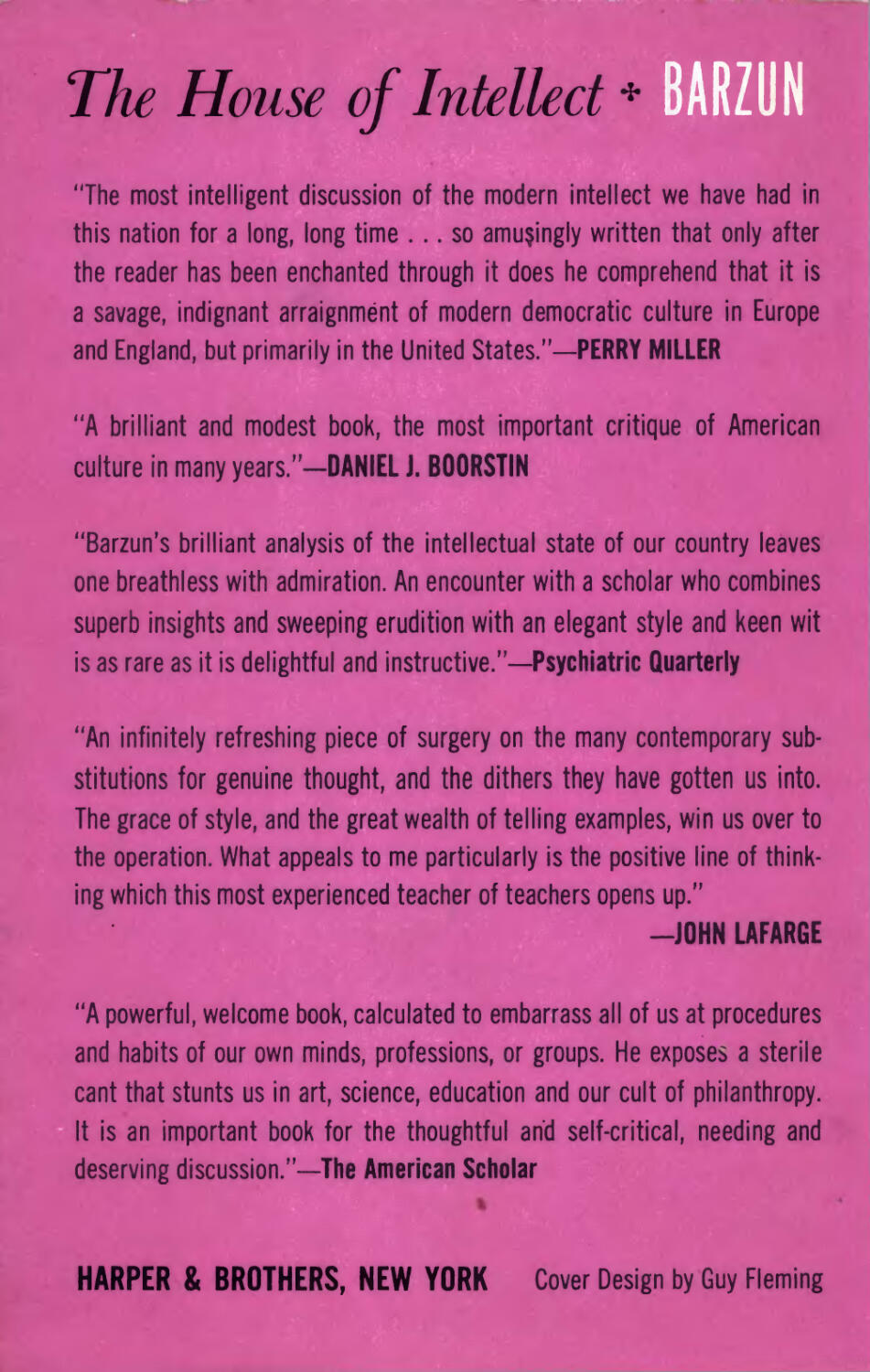
The HOUSE of INTELLECT

THE
HOUSE OF
INTELLECT
JACQUES BARZUN
HARPER TORCHBOOKS ^ The Academy Library
HARPER & BROTHERS, NEW YORK

THE HOUSE OF INTELLECT
Copyright © 1959 by Jacques Barzun
Printed in the United States of America
All rights reserved.
No part of the book may be used or
reproduced in any manner whatsoever without
written permission except in the case of
brief quotations embodied in critical articles
and reviews. For information address
Harper & Brothers,
49 East 33rd Street, New York 16, N.Y.
This book was first published
by Harper & Brothers in 1959.
First HARPER TORCHBOOK edition published 1961
Library of Congress catalog card number: 59-6300

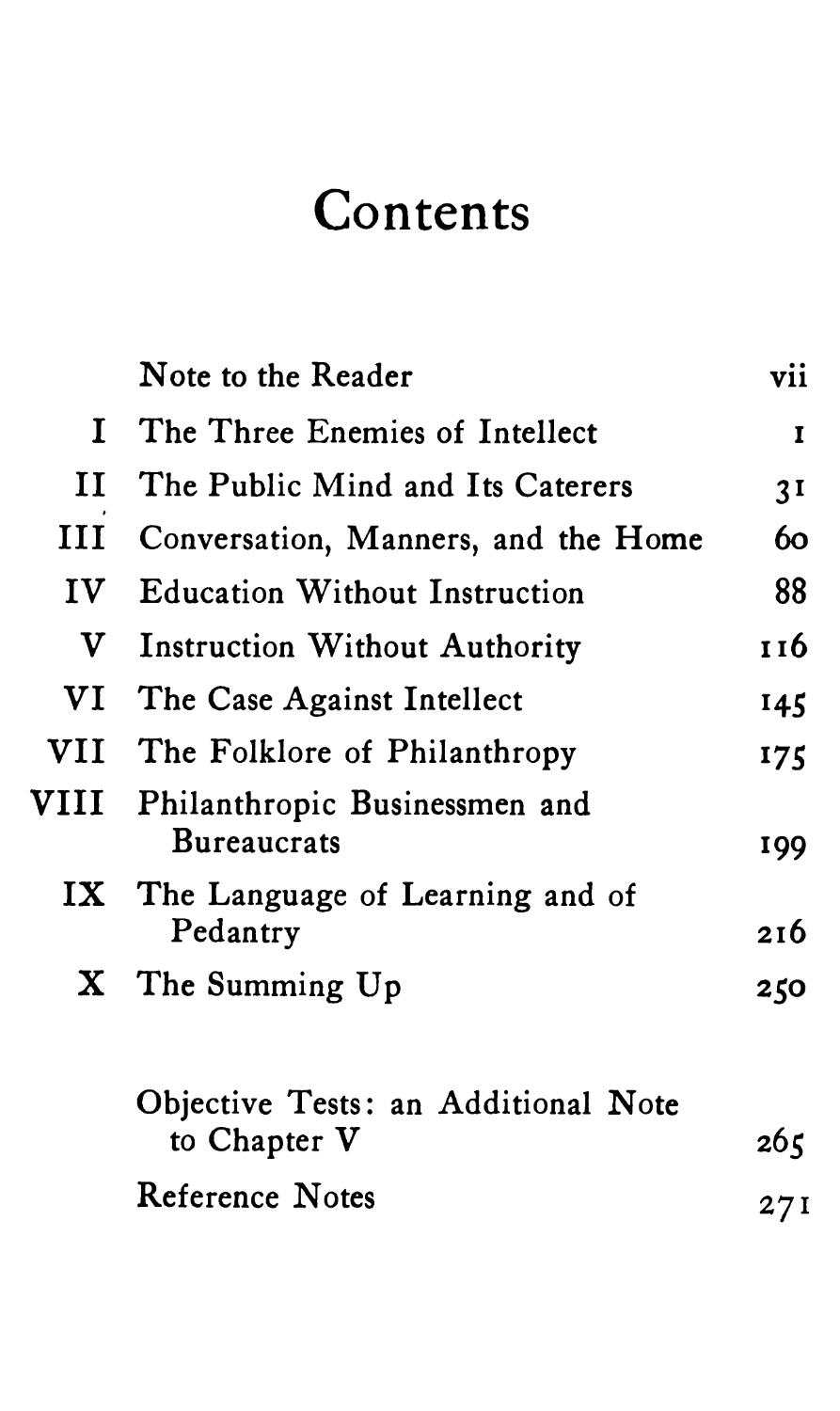
Contents
Note to the Reader vii
I The Three Enemies of Intellect I
II The Public Mind and Its Caterers 31
III Conversation, Manners, and the Home 60
IV Education Without Instruction 88
V Instruction Without Authority 116
VI The Case Against Intellect 145
VII The Folklore of Philanthropy 175
VIII Philanthropic Businessmen and
Bureaucrats 199
IX The Language of Learning and of
Pedantry 216
X The Summing Up 250
Objective Tests: an Additional Note
to Chapter V 265
Reference Notes
271

Note to the Reader
AT IS deliberately that I have given this book the
comprehensive title of The House of Intellect and omitted any
modifier such as "in America." For the description I have
undertaken applies not solely to America but to the entire Western
world, and indeed to any nation that adopts egalitarian
democracy, mass education and journalism, the cult of art and
philanthropy, and the manners coincident with these. If, therefore, the
examples in this book are chiefly drawn from the life of the
United States, the reason is not alone convenience or unity of
tone 5 it is rather that in this country the first, or the most
massive, illustrations of certain generalities are to be found. Foreign
readers of these examples and American readers of the foreign
press will readily supply parallels from other countries, and
convince themselves of the sameness I discern in the conditions
now governing Intellect.
I would also ask the reader to remember that in a critical
description of this sort only examples of the best have any
probative value. And by the best I mean the most developed, the
most serious, the most highly regarded efforts in any relevant
kind. The worst, and even the mediocre, must be taken for
granted as a cultural constant. It is waste of time to belabor
shady schools, corrupt journals, stupid government officials, and
unscrupulous exploiters of the eternally gullible. The ignorance
of the unlettered takes no scrutiny to establish. What we need
to plumb is the ignorance of the educated and the anti-intellect-
ualism of the intellectual. What matters to a nation is whether
the best product, or in certain cases the high average, which
vii

Viii NOTE TO THE READER
prides itself on excellence, deserves its reputation. In these
pages, then, all descriptions and criticism are of the best examples
that would define a category: the institutions examined are
worthy of remark and, in some ways, of esteem; and all
references to groups have in view the educated, or at least the college-
bred, whose words and acts imply a claim or a duty related to
Intellect.
J.B.

I
The Three Enemies of
Intellect
XTlS WE USE them today, the words 'intellectual'
and canti-intellectuaF are scarcely more than sixty years old.
Their continual use, in praise and blame, goes back to the
Dreyfus Affair* and points to the coming of age of the first generation
taught under the free-education acts and penny press of the
seventies. Men who are thirty today belong to the third
generation so brought up, and, if intellectual, bemoan their fate.
Misfortune—they feel—degradation, has overtaken the mind in
western civilization. They blame capitalism, liberalism, the
machine, the masses—everything outside themselves, and thus
attain the desired status of victim. The beleaguered intellectual
—it is a badge and a position in life.
The position is unexpectedly comfortable because,
contradicting all the charges of anti-intellectualism and neglect of
'intellectual values' by a 'materialistic society/ is the plain fact of the
intellectual's unprecedented share of public trust. The expert,
the Ph.D. or his equivalent, is everywhere—in government,
industry, labor unions, banking, philanthropy, city planning,
written and spoken journalism, espionage, national leadership and
* The modern English usage is derived from, or at least strongly influenced
by, the French. In English, 'intellectual' as a singular or plural noun originally
meant the mind—'crazed [i.e., cracked] in his intellectuals.9 In the meaning of
*an intellectual being' the Oxford Dictionary gives no instance between 165a
and 1813, when Byron used it in his diary, and again none until 1884. It
becomes current in that sense in the late nineties, usually with a derogatory intent:
'the so-called intellectuals of Constantinople, who were engaged in discussion
while the Turks were taking the city.' Daily News, London, November 30,
1898.

2
THE HOUSE OF INTELLECT
international councils—as well as in the hobby that makes the
whole world kin, preparing for war.
To understand our situation, this paradox must be kept whole.
Both halves are true. Intellect is despised and neglected.
Intellectuals are well paid and riding high. We may be able to
reconcile the conflicting pair of truths when we notice the slippage
from 'Intellect' to 'intellectuals' and look into the source of the
complaints. Who makes these complaints? Intellectuals,
naturally. What are their grievances directed against? Institutions
manned or led by intellectuals. Though it is assumed that some
giant abstraction causes the particular evils—'commercialism' or
'power politics' or 'mass culture'—the recrimination begins and
ends with the intellectuals themselves. It is they who find one
another corrupt and unsatisfactory. The name 'intellectual' itself
they use with pride or derision, depending on the extent to which
their ideas are 'advanced.' Thus Partisan Review is 'intellectual'
and Life magazine is not, though both designations manage to
give comfort to each side.*
By the detached observer the two periodicals must indeed be
called intellectual products, from which it follows that the
intellectuals' chief cause of anguish are one another's works. The
intellectuals do not attack bars and bowling alleys, or Tammany
Hall and the chemical trust; they attack the philosophy of John
Dewey and the State Department's policy on modern art. The
humanists inveigh against science, and the scientists decry 'vague
inspirational subjects.' The intelligent intellectuals who read or
write for The New Yorker and are strong on civil liberties
weekly ridicule 'the legal mind at work'; while everywhere that
ironic form of reference, 'the professor,' is heard not among
farmers and workingmen, but among intellectuals who profess
something else than learning.
Nor does this war of words betray only the ordinary struggle
for prestige. The complaints are in part disinterested; the
criticism is just; the contempt is hard to resist. There is a degradation
* In army camps during the last war Life was considered a highbrow
magazine by the majority, for whom the principal reading matter apart from
newspapers was the so-called comic books.

THE THREE ENEMIES OF INTELLECT 3
of Intellect. It is in the moment of success that it feels its powers
failing.
This paradox is not resolved by pointing to the split between
some ideal of Intellect and the sordid reality of aching
intellectual groups. The groups and their relations must be described,
the causes and effects of their divisions ascertained, and further
paradoxes disclosed. But first we need a clear idea of what is
properly meant by Intellect.
What most people think of when Intellect is discussed as a
social force seems to be an echo of conventional history (Athens,
the thirteenth century, the Renaissance), eked out with notions
drawn from religion or science, or from reactionary and
revolutionary Utopias. To remove these images and replace them with
more tenable ones is difficult, because the cliches have for so long
served the contemporary intellect as a quite satisfactory means of
attack or defense.* The attempt to do without them must seem
perverse and the appeal to common experience trivial. Yet
personal testimony and illustrations from the unregarded in life are
in fact the only evidences relevant to fresh inquiry.
That part of the world I call the House of Intellect embraces
at least three groups of subjects: the persons who consciously and
methodically employ the mind; the forms and habits governing
the activities in which the mind is so employed; and the
conditions under which these people and activities exist. There is an
important reason for not calling this domain more simply the
House of Mind. Mind is properly equated with intelligence, and
by Intellect I most emphatically do not mean intelligence.
Intellect is at once more and less than Mind. The House of Mind
may turn out to be as large as the universe; to treat of it would
require dealing with the mental prowess of apes and bees and,
for all I know, of fishes and flowers. Mind or intelligence is
* In order to make clear the ideas and words that seem to me disputable or
false or empty, though generally they seem legitimate and respectable, I shall
use—and perhaps abuse—the privilege of putting them repeatedly in quotation
marks, though to lessen the possible irritation that this might cause I shall follow
the English practice of using single marks as the principal ones and double ones
within.

4
THE HOUSE OF INTELLECT
widely distributed and serves an infinity of purposes.
We ought, parenthetically, to remember this when the United
States is assailed, from within or without, as a nation lacking in
Mind and hostile to it. We have in fact intelligence in plenty and
we use it perhaps more widely than other nations, for we apply
it with praiseworthy innocence to parts of life elsewhere ruled by
custom or routine.* We like ideas, new ideas especially, and we
drive a brisk trade in them: the quickest way to get three
Americans to travel a thousand miles is to propose an exchange of ideas.
And there is reason to believe that this restless searching is
becoming a habit the world over.
The modern educated democrat, then, is not anti-intellectual
in the sense of shunning novelty or undervaluing intelligence.
The truer and more serious charge is that he neglects or resists
or shies away from one form of intelligence, which is Intellect.
And this we see with peculiar vividness in the United States
where, precisely, customs and routines do not mask the defect:
it is for lack of Intellect that we have such a hard time judging
persons and ideas j it is absence of Intellect that makes us so
frightened of criticism and so inept at conversation; it is
disregard of Intellect that has brought our school system to its
present ridiculous paralysis. In any large collective enterprise,
such as the production of rockets and satellites, it is dearth of
Intellect—not of intelligence—that aggravates the normal causes
of friction and slows down accomplishment.
What then is this rare lubricant and propellant that we lack?
Intellect is the capitalized and communal form of live
intelligence , it is intelligence stored up and made into habits of
discipline, signs and symbols of meaning, chains of reasoning and
spurs to emotion—a shorthand and a wireless by which the mind
can skip connectives, recognize ability, and communicate truth.
Intellect is at once a body of common knowledge and the
channels through which the right particle of it can be brought to bear
quickly, without the effort of redemonstration, on the matter
in hand.
Intellect is community property and can be handed down.
* For instance, in the refined organization of all forms of work and play.

THE THREE ENEMIES OF INTELLECT 5
We all know what we mean by an intellectual tradition, localized
here or there; but we do not speak of a 'tradition of intelligence,'
for intelligence sprouts where it will and is spent day by day
like income for incessant needs. Intelligence is the native ability
of the creature to achieve its ends by varying the use of its
powers—living, as we say, by its wits. Accordingly, we can
distinguish the intelligent from the stupid throughout the scale of
sentient beings: an intelligent, but not intellectual, dog or
child; an intellectual, but not intelligent, bluestocking or
university professor. Intelligence is by definition the protean
faculty. We find it in a political move or in a work of art, in the
performance of a football team or in a piece of repartee, none
of which are specifically intellectual. And though Intellect
neither implies nor precludes intelligence, two of its uses are—
to make up for the lack of intelligence and to amplify the force
of it by giving it quick recognition and apt embodiment.
For intelligence wherever found is an individual and private
possession; it dies with the owner unless he embodies it in more
or less lasting form. Intellect is on the contrary a product of social
effort and an acquirement. A man cannot help being intelligent,
but he can easily help becoming intellectual. Intellect is an
institution; it stands up as it were by itself, apart from the
possessors of intelligence, even though they alone could rebuild it if
it should be destroyed.
That is why I have used the image of a house. I would speak
of the realm of mind—limitless and untamed—but I say the
House of Intellect, because it is an establishment, requiring
appurtenances and prescribing conventions. The distinction becomes
unmistakable if one thinks of the alphabet—a product of
successive acts of intelligence which, when completed, turned into
one of the indispensable furnishings of the House of Intellect.
To learn the alphabet calls for no great intelligence: millions
learn it who could never have invented it; just as millions of
intelligent people have lived and died without learning it—for
example, Charlemagne.
The alphabet is a fundamental form to bear in mind while
discussing the decay of Intellect, because intellectual work as

6
THE HOUSE OF INTELLECT
here defined presupposes the concentration and continuity, the
self-awareness and articulate precision, which can only be
achieved through some firm record of fluent thought} that is,
Intellect presupposes Literacy.
But it soon needs more. Being by definition self-aware,
Intellect creates linguistic and other conventions, it multiplies places
and means of communication, it seeks relief from other duties,
such as fighting and tilling the soil—in short, it needs a house,
with house rules and an income for its upkeep.
The need for rules is a point of difficulty for those who,
wrongly equating Intellect with intelligence, balk at the mere
mention of forms and constraints—fetters, as they think, on the
'free mind' for whose sake they are quick to feel indignant, while
they associate everything dull and retrograde with the word
'convention.' Here again the alphabet is suggestive: it is a device
of limitless and therefore 'free' application. You can combine its
elements in millions of ways to refer to an infinity of things in
hundreds of tongues, including the mathematical. But its order
and its shapes are rigid. You cannot look up the simplest word
in any dictionary, you cannot work with books or in a laboratory,
you cannot find your friend's telephone number, unless you
know the letters in their arbitrary forms and conventional order.
From the image of a house and its economy, one can see what
an inquiry into the institution of Intellect must include. The
main topics are: the state of the language, the system of
schooling, the means and objects of communication, the supplies of
money for thought and learning, and the code of feeling and
conduct that goes with them. When the general tendency of
these arrangements makes for order, logic, clarity, and speed of
communication, one may say that a tradition of Intellect exists.
Now, let us for a moment call this whole apparatus Literacy,
and remember that it rests upon the alphabet, or literacy with
a small 4.' The striking fact then breaks in on us that in the
history of the West there was no 'problem of Intellect' so long
as literacy was scarce. Before the promise of universal free
schooling that was given by the French Revolution, there was no talk

THE THREE ENEMIES OF INTELLECT J
of anti-intellectualism and cultural crisis, of 'disinherited minds'
and alienation from 'materialistic society.' Everybody had known
since Saint Augustine, if not since Hammurabi, that materialistic
was what society inevitably is. 'Intellectual' remained a quiet,
undemonstrative adjective, used with democratic impartiality
and without pride or derision.*
Today, the 'plight of the intellectual' is, throughout the West,
an accepted truth like the rotation of the earth. Except in new
nations where intellectuals engage, freely or not, in politics and
state service, the chief subject of intellectual discussion is the
futility of Intellect. Yet literacy spreads, and it is a swelling
number of intellectuals that bewails the decline of Intellect. The
falling off is said to result ultimately from democracy and
industry, which are accordingly denounced, with not a murmur
from demos or the industrialists. On the contrary, the shortest
way to popularity is to keep up a verbal war against the social
order, an order which is in fact the result of intellectual
emancipation through extended literacy.f
If you ask an intellectual how modern society causes his
distress, he will probably cite as a self-evident truth the
anti-intellectualism of a commercial civilization. He is not likely to
explain why older commercial societies, from Greece onward, seem
to him more favorable to Intellect, or how he is able to conceive
of civilization without trade. The truth is that commercialism is
not per se the enemy of intellect, but something much deeper.
The hostility of the common man toward the intellectual is of
all times and places. J It is an understandable animus related to
the herd instinct and probably latent in every man. The great
* Since we saw that the modern use of the term to describe a person or social
class has French origins, it is interesting to note that Littre does not list it either
in his Dictionnaire of 1885 or in his Supplement of 1886.
t To gauge the extent of the emancipation, compare the testimony of Francis
Place in 1835: * [Formerly] the prejudice against a man having a book was
very great. In my own case, even in 1812, I lost as many customers as paid me
for the goods they had to the amount of £500 a year, on a gentleman
discovering that I had a room full of books.* Parliamentary Papers, Select Committee
on Education, 1835, VII, 69:796.
X Scholars believe they see signs of it in ancient Egypt about 2000 B.C. See
T. Eric Peet, Comfarative Study of the Literatures of Egypt, Palestine and
Mesopotamia, London, 1931, 101.

8
THE HOUSE OF INTELLECT
symbol of martyred Intellect, Socrates, was a victim of the same
spontaneous resentment which makes the majority at school
gang up on the bookish boy—or at least pretend that regular
fellows despise study and prove their mettle by any means except
the systematic use of mind.
This sentiment is so universal that anyone who sets himself
against it soon knows that he is trying to resist a force of nature.
Yet although this natural opposition to intellectual beings has
dealt them injuries, it has never by itself kept down Intellect.
Indeed, if we look further into this primal anti-intellectualism,
we find that it enshrines a true perception and an impulse of
respect. The perception is that, like all artifacts, Intellect is the
enemy of life. This may be what the schoolboy has an inkling
of: spontaneity is checked, strength tamed, where Intellect rules.
It is enough that intellectual work enforces sedentary habits—
that Intellect shuns the outdoors to coop itself up in a house
—to suggest an antagonism between it and the free exercise of the
body that seems to typify life. Nor is this equation a denial of
intelligence} for as we saw, intelligence is compatible with every
kind of life: with athletic or martial skill, with adventure,
fantasy, and art, with wresting a livelihood directly from nature.
These very images make Intellect look by contrast like the
unfailing damper of animal spirits—a wet blanket as wide as the sky.
But animal energy is only one threat. Intellect is also hated
because it is envied, and envied because it is felt as a sign or
pretense of social superiority. From below, on sketchy evidence,
Intellect is readily associated with aristocracy and power. We
should therefore expect that in an age of egalitarian democracy
anti-intellectualism would increase, for everyone now has the
right to resent whatever looks like privilege and eminence.
And it turns out at the same time that Intellect has lost the
great secret of its power, which was literacy. Nearly everyone
can read and write or feels on the verge of doing so; everyone
has access to the treasures of the Intellect hoarded in libraries
and museums; everyone is urged to pass into the House of
Intellect through the pathway of education, which has been
smoothed and greased till it resembles the facilis descensus

THE THREE ENEMIES OF INTELLECT 9
Averno. The feeling of mystery and awe having departed from
learning, the feeling of resentment redoubles and strikes at
anyone who asserts that Intellect retains inherent power, or who is
even suspected—from his speech, his bearing, or the look on his
face—of harboring such a thought.
The old, fitful, embarrassed anti-intellectualism, though made
worse by 'equality,' is not, then, the true cause of the misery
avowed by modern intellectuals; nor are the sporadic
manifestations of hostility toward them the most important effect of
changed social relations under an industrial democracy. For if
naive anti-intellectualism cannot be abolished, it can be fought,
and the fight can be invigorating. The truth is that Intellect can
be diminished in its own eyes only with its own consent; its
troubles become obsessions, its presence a canker, only from
within: the real disaster haunting the intellectual today is that
the alienation, the disinheriting, the loss of authority have
occurred, not between the intellectuals and the rest—the
commercial rump—of society, but among the intellectuals themselves
and as a result of their own acts. As will appear again and again,
they have abdicated but live on, self-exiled. Hence the mutual
recriminations, the contempt for life, and the search for
scapegoats. Intellectuals speak of alienation because it suggests a
casting out by the people; but the intellectual class of Western
civilization had never been close to the untutored mass, and at
worst the mass remains as indifferent as before. Intellectuals
speak of their lost prestige and authority, but they had rarely
been more than servants to those in power. We have only to
consult tables of precedence to discover their place in a prein-
dustrial society:
'One hundred and ninety-thirdly [and lastly] Professional
Gentlemen, as: solicitors, attorneys, proctors, engineers,
architects, medical practitioners, artists, literary men, merchants,
master manufacturers, scientific professors, and others not engaged
in manual labour, farming of land, or retail trade, are considered
to possess some station in society, although the law takes no
cognizance of their ranks inter se.yl*
* Superior numbers refer to notes, which will be found in a group beginning
on page 273.

10
THE HOUSE OF INTELLECT
Even when the Church supplied Intellect with a house and a
prestige of its own, it lived there under the continual threat of
the temporal power, which was wielded, inevitably, by illiterates
and Philistines.* The painful loss newly felt by men of intellect
in the last third of the nineteenth century, which artists took up
as a theme in the first third of ours, and which promises to
remain a lucrative cliche for an indefinite future, is thus no loss
of an outward strength once granted as a due: it is an internal
loss, the loss of one another and of a common idea. Externally,
as I need hardly point out again, the status of the intellectual
has risen well above the one-hundred-and-ninety-third place.
Divided against itself, the House of Intellect has lost the
sense of being a company apart, associated perhaps fitfully with
authority, yet comforted by a freemasonry of manners and
speech; envied or scorned from above and below, yet justifying
the envy and helped to forget the scorn by qualities and powers
it had earned and felt free to enjoy. When literacy drew a
dividing line across society, all the initiates found more in common
with one another than with any other group. Besides the diverse
professional bonds, there existed a more inclusive one based on
the two fundamental habits of reading books and being articulate.
Priests, poets, scholars could address one another without false
pride or false shame. This opportunity for conversation,
unspoiled by the need of posturing before other groups, established
an intellectual class, or as Coleridge happily named it on the eve
of its disappearance—a clerisy.
In nineteenth-century England this class came as near as it
has ever done to wielding direct political power, for it subdued
to the intellectual life the men who were cabinet ministers, high
civil servants, and editors of large newspapers. Read the diaries
and letters of the leading men of Victoria's time and you will
find what a varied community of talents flourished, bringing to-
* Exceptions were—exceptional: <The Emperor Frederick II, for instance,
was wont to sneer at King Rene of Sicily for his addiction to the arts, obliging
that monarch to indulge his gift for painting in the privacy of his own closet.
Learning was derided as a practice fit only for clerks and bearing no relation at
all to knightly duties and accomplishments. Chaucer's squire was exceptional in
knowing how to read and write.' Harold Nicolson, Good Behaviour, 1956, 113.

THE THREE ENEMIES OF INTELLECT I I
gether Tennyson and Tyndall, Huxley and Manning, Bagehot
and Clough, Spencer and George Eliot, Gladstone and Jowett,
Matthew Arnold and Lady Rothschild. The Victorian Age has
rightly been called the Golden Age of Intellect because of this
remarkable fusion of interests and powers. Nowadays the
amalgam is broken up; the bond between a labor leader and his Ph.D.
consultant in economics is not between their intellects, but
between the information on tap in the one and the vacuum it is
to fill in the other.
For men have come to believe that they can link knowledge
and action without a regular gradation of intellects to harbor
and diffuse ideas, or a common concern about the welfare of
Intellect as an institution. They trust to the exceeding fineness
and particularity of the information stored in print and made
foolproof by formulas. Yet at the very time when the sum of
fact on all subjects begins to seem adequate to the demand, a
silent panic overtakes both thinkers and doers: 'the problem of
communication/ or Babel become an everyday experience.
That same abundance of information has turned into a barrier
between one man and the next. They are mutually
incommunicado, because each believes that his subject and his language
cannot and should not be understood by the other. This is the vice
which we weakly deplore as specialization. It is thought of, once
again, as external and compelling, though it comes in fact from
within, a tacit denial of Intellect. It is a denial because it rests
on the superstition that understanding is identical with
professional skill. The universal formula is: 'You cannot understand or
appreciate my art (science) (trade) unless you yourself practice
it.'
This error is briskly propagated by the schools, in the name
of scholarship and with genuflections before the menacing heap
of knowledge, of which no man can appropriate more than a
little. We forget that every age has carried with it great loads
of information, most of it false or tautological, yet deemed
indispensable at the time. Of true knowledge at any time, a good
part is merely convenient, necessary indeed to the worker, but
not to an understanding of his subject: one can judge a building

12
THE HOUSE OF INTELLECT
without knowing where to buy the bricks; one can understand
a violin sonata without knowing how to score for the instrument.
The work may in fact be better understood without a knowledge
of the details of its manufacture, for attention to these tends to
distract from meaning and effect.
Even if one sets apart those arts and sciences that require
special preparation, there remains a large field to which Intellect
has access in its own right. With a cautious confidence and
sufficient intellectual training, it is possible to master the literature
of a subject and gain a proper understanding of it: specifically,
an understanding of the accepted truths, the disputed problems,
the rival schools, and the methods now in favor. This will not
enable one to add to what is known, but it will give possession of
all that the discipline has to offer the world. The professional's
fallacy, in short, is to make no distinction between knowing the
subject and knowing the craft. To be ignorant of what is ancillary,
of the scaffolding knowledge of an art or profession, is certainly
the mark of the 'outsider,' but by cherishing the doctrine of
inside and outside we have split the clerisy without noticeably
improving the arts.
Still worse, this illusion about the extent of knowledge and
this vainglory about professionalism have destroyed the
intellectual audience. Though millions have literacy and hundreds of
thousands have 'education,' plus the rudiments of a profession,
it becomes harder and harder to find the few tens of thousands
who are willing, let alone eager, to attend to intellectual matters.
These ways of denying Intellect give us a foretaste of the
utter defeatism which, as we shall see in the next chapter,
governs the molders of opinion. Their motive resembles modesty;
they profess wide ignorance around their island of knowledge;
actually, this hides a desire for distinction. The man who denies
that his subject has principles communicable to any receptive
intellect, and who says, 'Hands Off! Unless you belong to my
profession or will join it, you are nothing to me/ is convinced that
the world is divided into the many who know nothing about
his specialty and the happy few who know everything. To keep
the strain pure, these last require of the newcomer a total alle-

THE THREE ENEMIES OF INTELLECT I 3
giance. It thus comes about that the majority of workers in the
arts and sciences act like jealous technicians with a strong anti-
intellectual bias. It is as if the guild spirit, which is the spirit of
trade, had infected the declared enemies of commercialism.
Continuing our tour of the divided House, we come upon a
third and final contradiction. It is this: while the scuttling of
Intellect has been going on, the dissemination of its products has
become a planetary frenzy. It was reserved for our age to see
scholarship, science, and art expensively displayed through the
loudest means of communication, while an angry chorus of
thinkers and artists proclaims the new barbarism.
The facts that call forth these imprecations are familiar: the
daily and weekly press enlarging its conception of journalism
and taking on the task of encyclopedic popularizationj the new
industries of musical and pictorial reproduction thrusting down
the throats of the multitude not merely the masterpieces of the
past, but also their retinue of historical information j the
electronic mass media making it their hobby to scatter the small
change of scholarship about innumerable subjects. This fever
of learning breaks out on the screen as technical jargon and quiz
programs, while in the press, the imitation of 'method' inspires
graphs, statistics, and scholarly footnotes. One incessantly hears
the phrase 'and I quote. . . ,' but few recognize in it the symbol
of a cultural revolution.
It is a revolution, and without an end in sight. Consider, for
example, what happened on September 23, 1957. According to
the Times, every bookstore in New York was raided for copies
of StendhaPs The Red and the Black—raided, not by the police,
but by television viewers who had been assigned the book as the
first reading in an early morning broadcast called 'Sunrise
Semester.' Here was a marvelous but difficult, inhospitable book
being scrambled for in utter ignorance of its contents. The
publisher, who in my time has twice dropped it from the Modern
Library for lack of buyers, now sends out advertising copies
labeled 'Collector's Item.' The ultimate effect is beyond our ken.
The point is that dissemination creates demand, and the demand

H
THE HOUSE OF INTELLECT
for Intellect—its substance or shadow—appears insatiable.
Under the same moral pressure of the time, every large
private collection of books or other valuables of learning is
expected sooner or later to become public property. In answer to
that craving, our century saw what is perhaps the most
astounding spectacle in history—certainly in military history: the armies
of the world waging war, each burdened with a corps of art
historians for the preservation and classification of objets dyarty these
same treasures having nearly everywhere been buried at great
cost in special shelters. Anyone looking down from Mars would
say that our civilization had lost its mind to art and intellect.
But the earth-dwelling artist raises his voice to decry the whole
effort as frivolous antiquarianism. He wants support for creation
instead of diffusion and protection. He makes clear that regard
for the works of the dead does no good to him, who is living,
or rather starving, and that if our age wants a good name
hereafter, it must give him the means to create. His plea has merit,
but the difficulties of his position are not identical with the
predicament of Intellect. Rather, his troubles aggravate the
predicament by aligning him, in the name of 'creation,' against 'mere
intellectuality/
In this civil war between art and intellect, numbers and passion
are on the side of art. A strong party wants government support
for it, as a national concern, and not just as a medium of
propaganda. The private foundations develop tic douloureux trying
to do their manifold duty to creativeness, while the help given
by groups and individuals to anybody who shows the slightest
capacity for self-expression is touching and tremendous. This is
not to say that every artist thrives, but only that no other age
has even dreamed of anything like this open-handedness. We are
driven to it by our guilty knowledge of history: mindful of
ruthless neglect in the past, we worry about the young and the
unknown, the handicapped and the hopelessly striving. For them,
as much as for the mature and valiant, we organize workshops,
bookshelves, exhibits, festivals, fellowships, prizes, courses,
camps, colonies, hospital wards, and mobile units, trusting that
these will assist the fertile mind in its parturition. Amateurs are

THE THREE ENEMIES OF INTELLECT I 5
coddled into artistry, children stimulated by early acclaim, and
in London a chimpanzee has had the first one-ape show.2 The
word 'creative' is so much in honor that it is the clinching term
of approval from the schoolroom to the advertiser's studio.* And
the quality it denotes is democratically assumed to lie latent in
every bosom, only waiting for one of the opportunities we
lavishly devise.
Yet all this, far from satisfying our contemporary artists,
leaves most of them angered and gloomy amid the orgiastic
dispersal of their works. As a result, artists are today the most
persistent denouncers of Western civilization; and their lay
following zealously presses the indictment. Beside theirs, the political
animus against society seems tame. This is something new, in
form as well as spirit. For the artistic outcry tends to be vague,
abstract, and often absurd. It affects to despise materialism and
the world of trade, but the ground of attack is that trade gives
artists too little material reward. Being intellectually feeble, these
complaints cannot lead to action; they merely poison the air
and the lives of those that breathe it.
This autointoxication, which contributes to the modern
intellectual's sense of martyrdom, is linked with another social change
that has stolen upon us unregarded—the recent education of the
artist to the ways of Intellect. In itself, art can exist without
learning and, in a sense, without reason. Painters, sculptors,
musicians, actors, dancers, even poets and playwrights, resemble
engineers and physical scientists in that they can follow modes
of thought quite other than those of discursive intellect; some
* Here is a sampling of that approval:
The educator: 'A Report to the Faculties on Research and Creative Thought
at Wayne State University for 1957-58.'
The artist: 'The Conductor is Also a Creator,' Milton Katims in The
International Musician, September 1958, 10.
The physician: 'Beyond Freud: A Creative Affroach to Mental Healthy by
Camilla M. Anderson, M.D., New York, 1957.'
The bookseller: 'How to Free Yourself From Hours of Drudgery and Give
Yourself Time for Creative Work,' Columbia University Press circular,
November 1958.
The advertiser: 'Advertising Strategy: The Creative Man—Don't Fence
Him In!' Charles W. Hoyt Company in The New York Times, June 16, 1958.

I 6 THE HOUSE OF INTELLECT
scarcely need literacy, as history proves j and they certainly have
no obligation to traffic in established ideas. Some of the greatest
have in fact been virtually inarticulate—to cite examples at
random: Schubert, Daumier, George Stephenson, Ghiberti.
During the last century, the current has been reversed; artists
of every kind have become men of words and ideas, bent on
joining the Great Conversation. In youth, they no longer resist
a liberal arts training j later, they accept academic posts, they
set up as critics and social philosophers, they are
caught—sometimes ridden—by political and other systems. This was notable
in the Marxist decade and it still is so in the so-called religious
revival of today. And now the artists have been joined by an
increasing group of natural scientists, late-awakened by the noise
of an explosion. In both groups, talent, education, and a fresh
appetite for ideas produce an effervescence which has the
coloring, though not always the substance, of Intellect.
Nor has the rapprochement been from one side only. The
artist turning toward ideas has been met halfway by a public
turning aside from words and greedy for speechless art. The new
pastimes of the educated amateur are the arts of nonarticulate
expression: music and painting. While fiction languishes and the
theater is in the doldrums, ballet has risen to popularity, Sunday
painting is fashionable, and chamber music thrives. Everywhere
picture and sound crowd out text. The Word is in disfavor, not
to say in disrepute—which is indeed one way of abolishing the
problem of communication.
Nor should we be surprised: This shift in taste has been
gathering momentum for three generations. From the Symbolist
period on, Western art has been based on the repudiation of what
is common—common speech, common life, common knowledge
—and its replacement by the singular and indefinable. Excellent
reasons can be shown for the choice, and the right of artists to
do as they see fit is not here in question. But neither is the effect
in doubt, for art has never been so quick and potent in its
influence: the revulsion from words, syntax, and coherence accounts
for the widespread anarchy in the handling of the mother tongue,
as well as the now normal preference for the abnormal in our

THE THREE ENEMIES OF INTELLECT 17
conceptions of the real. Whereas the 'experimental' in art used
to take a generation to be recognized, now we encounter the
latest modernisms overnight in the work of the commercial artist
and the writer of advertising copy. The public approves and
encourages, having learned to swallow and even to enjoy what
shocks feeling and defies reason.*
Subtler, but equally strong, has been the result of what we
pedantically call 'aesthetic experience.' For many people art,
displacing religion, has become the justification of life, whether
as the saving grace of an ugly civilization or as the pattern of the
only noble career. In sustaining this role, art has put a premium
on qualities of perception which are indeed of the mind, but
which ultimately war against Intellect. The cant words of
modern criticism suggest what these qualities are: ambiguity,
sensibility, insight, imagination, sensitive, creative, irony. All these,
in art, declare the undesirability, perhaps the impossibility, of
articulate precision and thus defy, counteract, or degrade the
chief virtue of Intellect.
The bearing of this observation must itself be understood
precisely: there is a difference between the artist and the refugees
from life who hide their nakedness in artistic toggery $ there is
a parallel difference between criticism which is the gateway of
understanding and that which is a substitute for artistic work. I
do not depart here from my lifelong conviction that art is
miraculously precise and communicative in its own domain of fused
spirit and sensation. It awakens knowledge of a kind no other
means can reach. But that kind is not the only kind, and the
means that art uses are always less than explicit. This is the root
of the distinction between poetry and-prose, between painting
and illustration; between narrative or dialogue that 'shows'
and the kind that merely 'tells'; in short between Meaning and
Information. And the point here is that explicitness in the mode
of prose is also desirable: thanks to it, Intellect can steadily pur-
* A trade magazine advises professional writers to make use of:
i. Clever wackiness; 2. Exotic, quaint, or off-beat characters; and 3. Fresh
and unusual frofs for showing characters. Follows an example showing the
hero's just resentment of his fiancee's mother by the 'symbolic' act of drowning
a monkey. The Writer, 71:7, 1958, 14.

I 8 THE HOUSE OF INTELLECT
sue one of its great tasks, which is to refine and enlarge the
common language for ideas.
Now a devotion to art does not preclude being articulate in
this mode, but an exclusive devotion, except in a professional, is
almost surely hostile to Intellect. For cultivating art out of fear
or spite means preferring always what is ambiguous, what
touches only the sensibility, what titillates through irony, what
plunges the imagination into a sea of symbols, echoes, and myths,
from which insights may be brought up to the surface but no
arguable views. And this preference is at bottom love of confusion
—confusion sought as a release from responsibility. The purest
emotions of the aesthetic quest, it is said, are private; one
partakes only after illumination, as formerly after mystical
conversion. And it is true that the unique messages of poetry, music,
painting, and serious fiction refuse to be decanted into common
prose. When this is said in contempt of all other uses of the
mind, it amounts to a denial of Intellect's declarative powers
and social obligations.
That contempt and denial modern artists have not troubled
to conceal. 'Every day,' said Proust in the opening sentence of his
manifesto Contre Sainte-Beuve} 'I set less store by the intellect.'
Today, after eighty years or more of this open war, most
educated men and women have been persuaded that all the works
of man's mind except art are vulgar frauds: law, the state,
machinery, the edifice of trade, are worthless. More, men and
women feel that they themselves are worthless, they despise
their own existence, because it fails in loveliness when compared
with the meanest objet d'art. The abandonment of Intellect in
favor of communion through quartet playing and amateur
ceramics has bred a race of masochist-idolaters, broken up into
many sects, but at one in their worship of the torturing indefinite.
I dwell at this length on the influence of art upon the
intellectual life of today because it is all-pervasive. A member of the
educated class nowadays need not have any direct or vivid
contact with art to fall under the sway of the aesthetical creed and
its emotions. He feels about life, business, society, the Western

THE THREE ENEMIES OF INTELLECT I 9
world, what the art-inspired critics of the last eighty years have
felt, and he speaks the phrases appropriate to his borrowed
disgust. He may be a minor foundation official living rather
comfortably on the earnings of some dead tycoon, but he talks like
Baudelaire. Indeed, the attitudes I describe are no longer
confined to those engaged in intellectual or semi-intellectual
occupations. They have touched the wider public whose exposure to
ideas is through the press, where readers find reflected not only
the worship of art but also its attendant contempt of the world,
both alike taken for granted as the natural response of any
intelligent and 'sensitive' modern. A deep unconscious anti-intel-
lectualism thus comeS to be the natural adjunct of any degree of
literacy and culture; and this at the very time when new social
groups, fresh from the educational mills and thoroughly aesthet-
icized, think of themselves as intellectuals and mean to live as
artists.
But, it may be asked, is there not a great intellectual force,
still more powerful than art and working against it, namely, the
force of science? Science is exact, science is strict, science is
influential—especially in the press where art must compete with it
for attention. Why should Intellect be at the mercy of art?
The question is pertinent, and the answer not encouraging.
For despite their differences, science and art have reenforced
each other's effect. Through the increasing fantasy of its concepts
and symbols, through its diverging technical tongues, science
has also receded from the common world. Science too has helped
to break up the unity of knowledge. In the name of untrammeled
inquiry, scientists have planted citadels throughout the realm
of mind, but have taken no thought of the means of intellectual
exchange among them. The House of Intellect is lost somewhere
in this no man's land. When scientists talk, as they sometimes do,
about their supposedly common enterprise, they take one of two
contrary views and sometimes both together. One is that science
is radically unlike any other intellectual pursuit—in method,
language, and type of mind. Science is numerical, objective,
certain -y nothing else is—as we imply in the common use of
'unscientific.' The second or 'enlightened' view is that the scientist's

20
THE HOUSE OF INTELLECT
work is essentially akin to that of the poet. It relies on inspiration
and a god-given power to handle symbols 'creatively.'
In spite of this second interpretation—a further tribute to
aesthetic propaganda—and in spite of the influence of scientific
jargon on common thought, the natural sciences and their
practitioners continue to form a world apart. When their
representatives meet with those of other branches of learning, the verbal
deference does not signify much sympathy. The clans soon
re-form and on each side the sense of apprehensive loneliness
returns. What will 'they' be doing next? The question is charged
with the promise of money and power. Is the public on couiJ side
or theirs? I have myself heard scientists speak of a 'conspiracy
of the humanities' to blacken science in general opinion, restrict
research, and 'reverse the trend of modern progress.' What
literary men say of the scientists, chaste ears ought to be spared.
When science won its place in academic and general opinion
a century ago, the mutual hostility was perhaps justified, because
the claims on each side were extravagant. But there has been
ample opportunity since then to codify and make known the
ways in which the knowledge of nature is like and unlike the
knowledge of spirit. The visitor from Mars would surely suppose
that these truths formed part of our elementary curriculum, a
fons asinorum for all who make the least pretense to the life
of the intellect. As things stand, the best that common knowledge
can show is a pair of dull cliches about music being somehow
related to mathematics, and poetry being 'in its way' as exact as
science; but the how and the way are left prudently in the dark.
And this aloofness of the scientists has been seconded by their
opponents' ambition. As we shall see more fully later, the
remnants of common intelligibility in their work disturb a good many
nonscientists and spur them to achieve a scientific separateness.
Why can their subjects not be rendered esoteric by special
terminology and the use of numbers? Scholars, we saw, have
improved the art of recognizing fewer and fewer peers, and many
think they can do still better by imitating science. Indeed, some
artists have also been seduced by science even while blaming it
for their ills. In both groups, the imitation begins with externals

THE THREE ENEMIES OF INTELLECT 21
—a pompous jargon, an affectation of method and rigor, and
often also the pose of Truth's martyr crucified.
The motives here are obviously mixed, but among them is a
desire for authority, which is not in itself unworthy: the mind
should respect what the mind has brought forth and the truth
is known by signs: let us multiply the signs of genuine knowledge
and increase the respect owed to truth. But in so arguing, the
imitators of physical science overlook the fact that every
shrinking of the common ground of Intellect lessens the authority of
each fragment. I am not speaking here of authority over the
unlettered, but of authority among the educated, to whom it
matters or should matter that intellectual authority is now
dispersed and tenuous. They revere Einstein or Niels Bohr by rote,
but hardly with the informed emotion which comes of even
partial understanding. Their faith in a thinker's scope is so
vacuous that when Einstein's misguided friends publish his non-
scientific essays, thereby exposing his intellectual inadequacy,
naive astonishment is soon succeeded by excessive contempt, and
another idol is overthrown that never was properly—that is,
profitably—idolized.
The prestige of science remains of course pre-eminent, despite
the superficial hold that science itself has on the minds of the
intellectual class. And it is that prestige, acting as a perpetual
goad to imitation, which makes science's share in the decay of
Intellect equal to that of art. Each in its way undermines the
sense of unity, defeats communication, and throws the individual
back on his own resources in a world whose worth, and even
whose reality, is challenged by these two imposing enterprises.
We may conclude, then, that for a century more or less, Art and
Science have been the chief enemies of Intellect among
intellectuals. But there is a third and closely related enemy, which
is Philanthropy.
I use philanthropy to mean the liberal doctrine of free and
equal opportunity as applied to things of the mind. This
application has two results. The first, to which I shall return in
discussing education, is the corruption of judgment; the second, which
forms the subject of the next chapter, is the corruption of the

22
THE HOUSE OF INTELLECT
products of intellect themselves. In their corrupted use,
'opportunity' is no longer wholly free and often not at all opportune.
Rather, opportunity turns into social pressure, and the desire
for intellect becomes part of the urge to share the wealth—a
double imperative ceaselessly dinned into our ears: 'Patronize
your local library, enjoy a museum seminar in your home, see
"what the Zoo can do for you."3 You owe it to yourself to have
an intellectual life—learn Russian in your spare time, read the
101 classics during the next 1,001 nights, or at least take up the
recorder and paint on Sundays. Remember that education should
never end: join a class after 5 p.m. Creativity is within youj
learning releases it. Education is the best recreation; square
dancing is recreation j square dancing is education. Have no
fears: in our love is your understanding.'
True to its origins, this philanthropy carries out the behests
of pity; its watchword is 'help.' The slightest response to the
proffer of opportunity creates a claim to special treatment. Help
is abundant, overflowing, and thanks to it willingness in the
learner is enough: why distinguish intention and performance?
Philanthropically speaking—'in terms of eagerness'—the aspirant
is often superior to the passed master. Nor can there be a finer
object of philanthropy than struggling incompetence, since
evangelical charity says: give to those that want. The opposite, the
worldly rule, would give to those that have talents and would
take away at least the opportunity from those that have not. But
this, proceeding from intellectual judgment, would be cruel; it
is indeed a flaw in the reign of love and welfare that Intellect
seeks to concentrate its resources rather than spread them as
consolations for helplessness.
The connections of this philanthropy with modern art and
science are easy to trace. The evils that art discerns in the very
nature of politics and business, philanthropy also condemns and
tries to make up for. It bars competition, is suspicious of power,
and ignores failure. For the usual prizes of Philistine greed it
substitutes the guerdons of higher lusts—a certificate of
proficiency in French or a scrapbook of two-by-four gummed
reproductions of the old masters. Now none of this would be possible

THE THREE ENEMIES OF INTELLECT 23
without the surpluses that technology has created. The
freehanded ways of intellectual philanthropy reflect the abundance
of paper, ink, books, schools, photographs, recordings, and
freelance lecturers, but also the more general sense of copiousness
arising from the pride of science and the litany of numbers,
numbers, numbers.
It hardly needs saying that though the whole world is now
the playground of philanthropy, its headquarters everywhere
are the schools. That their replacement of Intellect by
philanthropy is not an exclusively American occurrence can be shown by
a British example: 'Mr. G. H. Bantock expresses the concern
that all thinking educationists are troubled with when they
consider the present chaotic state of education in our society. Rightly,
he considers it will fail to produce "the educated man"—though
he carefully does not define this phenomenon. It concerns me
more that the present system will lead to failure, not to produce
the educated man, but to produce human beings with a capacity
for life.'4
These last words tell us much. The talk of 'education' where
none is wanted or needed, or where something else is meant,
is characteristic of our time. But even more illuminating is the
identity suggested between education and psychology or
psychiatry, two demisciences ridden by philanthropic moralism. The
doctrine of pity and help, originating in the church, the
settlement house, and the clinic, has found in the modern psychologies
a convenient means of carrying abroad the war against Intellect.
Though the genius of Freud was unswervingly intellectual, it
has given birth to a large progeny of adapters who, from
generous as well as selfish motives, put philanthropy first. They mean
to cure, or at least to 'help' at any cost. They respect, certainly,
no intellectual limits or principles, and one by one the chief
elements of our culture have fallen within the area of their
devastation. Thus the school is not to teach but to cure; body and mind
are not to use for self-forgetful ends but to dwell on with
Narcissus' adoring anxiety; the arts, not to give joy and light but to
be scanned for a 'diagnosis' of some trouble, a solution of some
problem,' or else exploited for the common good in occupational

24
THE HOUSE OF INTELLECT
therapyj and all other social or political institutions are not to
serve man's material needs but to be brought to the bar of
cultural justification.
The final twist in this transformation is that the clinician-
publicists who carry on the war breathe love in hostile phrases
while finding in Intellect untold aggressions to condemn. Their
love hates Intellect because they feel and disapprove its
impersonal calm, and also because its triumphs look like conquests not
so much by, as over, common humanity. Avant-garde psychology,
avant-garde art, and the philanthropy that is coeval with them,
alike cherish the warm confusions of animal existence.
These foes of Intellect nevertheless make stern demands.
Art, like professionalism, claims of its devotees exclusive
allegiance. Science reserves the right to apply its method where it
chooses and hopes for world empire. Philanthropy leaves no one
alone, and its educational and psychological allies, taking
universal welcome for granted, turn vindictive when challenged. For
Intellect to say that its duty is clear and limited, that it cares
little for happiness, that it puts other virtues ahead of good will
and does not seek world peace, convicts it out of its own mouth.
So much sobriety is not in fashion, it looks like provincialism, a
refusal of enlightenment—complacency.
The anti-intellectual emotions at work here being even more
complex than usual, one can easily mistake them. Yet it does
seem as if the prevalent desire to embrace the whole world in
some benevolent imperium of love, science, or art expresses
chiefly a rooted aversion toward the immediate and actual. Living
habitually at the full stretch of their perfectionist fancy, modern
men of ideas loathe the world they know. If proof were needed,
one could cite the Utopian passion which governs nations in the
East and the corresponding Orientalism which works as a
ferment in the West. War and travel in Asia have made Western
intellectuals once more preach the wisdom of the East} they do
this because they can thereby belittle the too familiar West.
Writing of Toynbee's Study of History, Mr. Lewis Mumford says:
'I would point out that no book that deals with human affairs
has been more free from the blatant parochialisms of our age

THE THREE ENEMIES OF INTELLECT 2$
and our civilization: the obsessions of nationalism, the exaltation
of Hellenic and later European civilization at the expense of
nineteen other significant societies . . . [and] the notion that our
age is the climax of human existence and that its ephemeral
values are eternal ones.'5
One may wonder at the causes of this self-laceration and ask
in what sense, other than the historical, the vanished among
those nineteen other societies are significant, and how our
indispensable concern with our own has been at the expense of the
others. What obligation has been left unpaid, once we have
discharged the intellectual debt by doing what no other civilization
has ever done—systematically studied the rest? Far from being
parochial in that regard, the West may claim the merit of
immoderate hospitality for its House of Intellect, which is so far
the only building of its kind.
The Western Intellect has been and continues to be favorable
to the study of Oriental thought and culture. But it is one thing
to study and another to adopt, and even the attempts at
adaptation may be regarded critically without its implying
provincialism. The motive which brings an image of the goddess Kwannon
into the window of a Fifth Avenue department store, and which
sends American women to club lectures on Zen-Buddhism is but
the fashionable curiosity that is always shifting from one source
of new slogans and sensations to another. To prefer the exotic
to the home grown is a usual form of 'sophistication'; and when,
as in the present fad for Zen-Buddhism, the fashion enjoins
contempt for Intellect, the pleasure is double.
But Intellect is not abashed. It goes to work on anti-Western
arguments such as I have reproduced and easily shows how
false is the warm, generous, philanthropic attitude which they
affect. Taking up the charge of 'blatant parochialisms' and
'obsessive nationalism' leveled at 'our age and civilization,'
Intellect asks: how is our detestable pride to be measured—by Arab
tolerance, African neighborliness, Chinese humanitarianism,
Japanese indifference to gain, Egyptian humility? Where is the
model state and people? And where have empires more or less
voluntarily given up their alien possessions, and governments

26 THE HOUSE OF INTELLECT
their oppressive powers—in the East or in the West?
The love for all peoples far away has in it also a touch of self-
pity, occasioned by the presumed 'decline of the West/ The
phrase may mean many things, but in one of its meanings,
Intellect points out, it is exactly matched by the decline of the East.
Every piece of machinery found east of Suez, every word of
English spoken, every pair of trousers, every bad movie, must
be accounted a 'triumph' of the West over the declining East.
To say this is to show the absurdity of the phrases which pass
for 'intellectual' comments on Western civilization and for signs
of large comprehension on the part of the users. The only
importance of these pronouncements is that they are inspired by
'other-worldliness' in a new sense, one which associates all the
evils of life with our historic past and our characteristic modes of
thought, in an effort to repudiate them both.
For it is true that Intellect as I am defining it belongs largely
to the Western tradition—the tradition of explicitness and energy,
of inquiry and debate, of public, secular tests and social
accountability. What Intellect satisfies in us is the need for orderly and
perspicuous expression, which may lead to common belief and
concerted action.* Eastern philosophies and religions
undoubtedly contain ideas that are valuable to persons and peoples
outside the East, but one cannot help noticing that the first signs
of a Westerner's involvement with Oriental thought, whatever
inward good may go with it, is a toxic condition of the vocabulary
—every word meaning not only what it denotes but its opposite
as wellf—complicated by serious lesions in coherence and a rapid
lowering of the logical pulse. With the loss of articulate preci-
* Without wishing to prejudge the difficult question of how to compare
radically different cultures, I may cite as a sample of that difference the kind
of utterance which many Western inquirers about Zen find a refreshment and
a lure: 'What,' asks the seeker, 'is the entrance to Zen?' The master replies,
'Do you hear the sound of the stream?' 'Yes.' 'There is the way to enter.'
t Anyone who has been close to Oriental scholars knows the difficulties they
encounter in interpreting texts, especially the Chinese and Japanese classics. The
characters may mean widely different things, and competent men disagree on
points the like of which seldom occur in Western exegesis. During the last war
the Japanese military found similar obstacles to clear communication among
themselves. The adoption of the alphabet, fundamental to Intellect, as we saw,
is now being debated by the Japanese government (June, 1958).

THE THREE ENEMIES OF INTELLECT 27
sion, Intellect as the West has developed it—the social and
publicly responsible Intellect—sickens and dies. Whether this is
desirable is not the point. The point is that, until we choose to
go under, we must look upon all philanthropic gestures, and
especially upon amateur Orientalism, as a warning. The signs
of these effusions are unmistakable—easy indignation, the throb
of pity, portentous promises, and still more generally: vague
words, loose thoughts. The state of the mother tongue is in fact
the index of our control over destiny.
These three great forces of mind and will—Art, Science, and
Philanthropy—have, it is clear, become enemies of Intellect not
of set purpose, not by conspiracy, but as a result of their
haphazard assimilation within the House of Intellect itself. The
intellectual class, which ought always to remain independent, even of
Intellect, has been captivated by art, overawed by science, and
seduced by philanthropy. The damage done by each has been
that of heedless expansion combined with a reliance on the
passage of time to restore order and decency. But time mends only
by blotting out. In the modern riot of art and science and loving-
kindness, Intellect has seen decline the virtues that make it what
it is: unity, concentration, communicativeness, and knowledge of
itself. Few even among intellectuals think of the intellectual
constituency: most think of particular artists, scientists,
educationists, psychiatrists. Few acknowledge a proper sphere and
matter of Intellect: most dream distractedly of sublime artifacts
and antisocial fantasies, of scientific wonders and nuclear threats,
of benevolent programs and civil conspiracies. Few appeal, or
could appeal, to any common principles. The identity and
integrity of Intellect seems a memory of what could never be.
Doing duty in its place is the conjunction just referred to—
art, science, good will, fired by the prodigal Id, and whose
characteristic bias an example may serve to make vivid. In 1955
there appeared among the publications of the Museum of
Modern Art a catalogue of 192 pages entitled The Family of Man.
It reproduced an exhibition of five hundred photographs
gathered from sixty-eight nations to represent the multifarious activities

28 THE HOUSE OF INTELLECT
of the species. Quotations from James Joyce, Tom Paine, and
others put into words the fraternal outlook implied in the title.
The volume enjoyed an unusual popularity.* It was seen and
talked of in many places outside artistic circles and always, as it
seemed to me, with that warmth of praise which greets the ot>
jectification of strong contemporary feelings.
Presumably, then, The Family of Man gave visual pleasure
coupled with the confirmation of a philosophy of life. The
ground of that philosophy is best indicated by the cant phrase
'the human condition/f and its setting forth in The Family of
Man is seen in the many variations played on but a few themes
—those of sexual love, misery, poverty, and the innocence of
childhood. Also emphatically represented are: birth, death,
motherhood, toil, music, and dancing.
One may of course take these scenes as direct evidence of what
is. Yet it is hard to resist the impression of sentimental bias that
they create by repetition, which one suspects is not exclusively
the work of the local editors. Photography is a minor art, but
it readily transmits—this is no frivolous play on words—the
views of the photographer. And in this portfolio the views
disclose a worldwide concentration on the helplessness of man, and
on its excuse and anodyne—his animal needs and sensual
pleasures.
The book opens with a rather tendentious female nude, prone
amid the ferns of a forest glade. This is followed by episodes of
kissing and caresses in public places. Next, in the middle of a
black page, is a small square transom through which one sees a
shoulder, face, and hand belonging to a couple making love.
The vignette is printed horizontally so that there shall be no
mistaking the subject. The theme of copulation is frequently
repeated, notably as a restorative after the half-dozen pages
devoted to schoolwork. The only other image of man that
receives comparable insistence is that of suffering, as shown by
* It has now been reissued as a small paperback at fifty cents.
t Its originator, Montaigne, would undoubtedly repudiate the intention that
the phrase almost always carries today—that of 'the detestable human
condition.' Montaigne knew the wretchedness of man's lot as well as anyone, but
strength of intellect kept him from infatuation with misery.

THE THREE ENEMIES OF INTELLECT 2g
faces of misery, worn limbs, and postures of dejection.
The rare views more or less related to Intellect are almost
all of effort, chiefly by the young. Accomplishment and embodied
power as they might be shown by the faces of great men and
women are absent—except for a small snapshot of Albert
Einstein, looking innocent and bewildered, and a truly magnificent
full-page portrait of Judge Learned Hand. Here Intellect shines
out for one five-hundredth of the kaleidoscope, though from its
placing and its anonymity one surmises that the portrait is
intended to represent not so much Mind as The Law.
Yet the law in action, a model of articulate precision, is also
skimped, and government as well. Except for a view of the
United Nations Assembly—the least of governments—one
would scarcely know that man had fashioned the state and that
it had value. The pictures that allude to it are of riots and mass
deportations. An isolated sentence from Jefferson suggests that
only the unorganized people are trustworthy, and a passage from
the diary of Anne Frank asserts that they are all good.
Elsewhere, the extracts from the Bhagavad-Gita and from Sioux,
Kwakiutl, Maori, and other folk literatures stress the simplicities.
Primitivism is preferred. There are superb views of aboriginal
nature, including a pair of nebulas as frontispiece 5 there are
none of architecture as such. The book ends with yet another
group of small children at play.
Whatever is formed and constituted (the work seems to sayX
whatever is adult, whatever exerts power, whatever is
characteristically Western, whatever is unique or has a name, or embodies
the complexity of thought, is of less interest and worth than
what is native, common, and sensual; what is weak and confusedj
what is unhappy, anonymous, and elemental.
The rhythmic return of the main themes makes it evident that
questioning the proportions of the work would be met by the
statistical argument—there is in the world more fornication than
philosophy; and by the documentary argument—all facts are
created equal. Science, or a hankering for it, shows why it seems
important to record the facial expression and gripping fingers
of a woman during sexual intercourse. And art, that is, the works

30 THE HOUSE OF INTELLECT
of the last half-century, have put us in the mood for this and
all other primitivisms by giving us a peepshow as deceptive as the
dark little square on page thirteen.
The pictorial art of the volume, which Carl Sandburg in his
Prologue calls 'a camera testament/ has the ambiguity of
photography itself. Message and composition do not always jibe, and
at times one suspects that the exhibitors, bewildered by 'over two
million photographs,' forgot one of their aims. For on the cover
we are told to expect 'the greatest photographic exhibition of all
time/ which promises a mainly aesthetic criterion. But inside,
the purpose turns sociological, not to say philanthropic, as appears
from the chief editor's absent-minded jargon: 'the gamut of life
from birth to death with emphasis on the daily relationships of
man to himself, to his family, to the community, and to the world
we live in . . . Photographs of lovers ... of the family unit . . .
of the home in all its warmth and magnificence. ... of the
individual and the family unit in its reactions to the beginnings of life
and continuing on through death and burial. . . . Photographs
concerned with man in relation to his environment.. . the good
and the great things, the stupid and the destructive things. . . .,e
It is easy to believe that The Family of Man has been 'created
in a passionate spirit of devoted love and faith in man/7 but one
may be permitted to ask whether that love was not blind—blind
to whole ranges of man's life, blind to the effect of certain
iterations, blind to the requirements of sense and manly pride, blind
to the discretion which judgment owes to even the sincerest
faith.
If one asks further why the directors of a leading museum,
rightly prized for its intellectual courage, should so meekly
conform to the unspoken demands of public opinion, one must
turn for the answer to that public opinion itself.

II
The Public Mind and
Its Caterers
Writing in the same liberal tradition which
assigns ultimate wisdom to the people, and which was quoted
approvingly in The Family of Many Thomas Jefferson set forth
in his Notes on Virginia a plan of elementary schooling by which,
he said, 'twenty of the best geniuses will be raked from the
rubbish annually.'* It is inconceivable today that anyone should
publicly describe any group of people as intellectual rubbish. I
am not myself suggesting that we should, for I am a child of
the age and I shrink from giving pain. I only illustrate by this
taboo our changed outlook, which gives a clue to public feelings
about Intellect at the present time: the democratic treatment of
Intellect is not determined by any conscious valuation of it on
anybody's part, but by attitudes designed to protect everybody's
tender ego.
Since Jefferson wrote, thanks to inventions he would have
approved, the register of public opinion has been greatly enlarged;
we have thicker newspapers and an entirely new apparatus
providing through eye and ear what we call mass communication.
Yet the tenor of public opinion on intellectual matters is
remarkably uniform. Throughout the multitude of clashing interests
the tone and the assumptions are the sair\5. This is true even in
what we like to think of as different layers of taste, from the
popular and tabloid to the highbrow and educational. Those who
fill the organs of opinion with their words are of course alike in
having received the standard dose of literacy. Almost all have
* The idea of early and rigorous intellectual selection recurs in Jefferson's
other writings, notably the 'Bill for the More General Diffusion of Knowledge*
(1779), Sections 16, 18, and 19.
3i

32 THE HOUSE OF INTELLECT
had a college education, and many some special training in
journalism or 'English.' The presumption, to a Jefferson who might
revisit, would be that these molders of opinion would show a
bias in favor of Intellect. But this is not so, both because education
does not impart any such bias, and because confused emotions
smother any latent desire to champion the mind.
In consequence, publicists, reporters, editors, and other makers
of opinion are almost invariably defeatists. Though they are
educated men and women, and some have a high conception of
their calling, they feel no need to define for themselves the
rights of Intellect or to ponder its role in the national life. Such a
meditation would probably strike them as artificial. Unschooled
on this point, they follow the common yet subtle interpretation
of equality which allows 'encouraging the arts/ but would make
anything like homage to Intellect seem arrogant, pompous, or
absurd. Even when stirred to cry out against 'anti-intellectualism'
in the narrow sense, and while defending freedom of speech
or press, speakers and writers take it for granted that their
opponents have ulterior motives. These enemies, they think, attack
ideas to protect interests. This may be true, but it also ignores
both parties' complicated emotions regarding Intellect.
What is the tangle they fail to unravel? The loose end of
it is uncertainty. Since it is seldom clear whether intellectual
activity denotes a superior mode of being or a vital deficiency,
opinion swings between considering Intellect a privilege and
seeing it as a handicap.* As a privilege it must be assailed5 as
a handicap it seems so easily remedied that it is scorned. In
neither phase is the feeling whole and assured, for the attack
and the derision alike testify to a quality that gives no hold to
the philanthropic impulse. This is why the 'egghead' and the
'grind' are not pitied like the physical cripple, even though all
three are deemed miscarriages of nature. Intellect is thus simul-
* This doubt is not new, as was intimated in the last chapter. The anecdote
of Dr. Johnson's pride as a rider is in point: 'He was, however, proud to be
amongst the sportsmen j and I think no praise ever went so close to his heart
as when Mr. Hamilton called out one day upon Brighthelmstone Downs, "Why,
Johnson rides as well, for aught I see, as the most illiterate fellow in England." '
Mrs. Piozzi, Anecdotes, London, 1786, 206-7.

THE PUBLIC MIND AND ITS CATERERS 33
taneously looked up to, resented, envied, and regarded with
cold contempt.
This chasm between physical and mental, which freezes good
will, is part of a larger reality always present to the popular
imagination. Physical events are easily seen and judged, so that
wherever it is possible to rely on the evidence of the senses, as
for example in sports, public opinion demands performance. The
philanthropy bestowed upon the physically weak does not go so
far as to give them a place in the Olympics. Likewise in acting,
mountain-climbing, or bridge-building, people are willing to
discriminate and reject, regardless of sentiment. Rigor in fact
governs the lives of all whose work is subject to judgment by
counting: a politician who fails to win the requisite number of
votes, a salesman who falls below the expected minimum of sales,
a bookkeeper who cannot ever get the books to balance, is treated
like a boxer who is outpointed. However much these
unfortunates may feel it as cruel, no one dreams of giving up for their
sakes the aim of success.
Public opinion, then, by the very fact that it is public, develops
the habit of judging by tangibles. And the habit, growing in
strength with every new tangible standard, necessarily leads to
a greater suspicion of Intellect for its seeming evasion of
measurement. On its side, Intellect is bound to think public opinion
crass for always seeking material tests. Much of the criticism of
our 'materialistic society' and of its decisions based on money,
popularity, or some other use of raw numbers, actually strikes
at the pathetic uncertainty of minds that cannot judge the
intangible yet want to be right.*
What supports this view is that one detects a kind of revenge,
a turning of the tables on Intellect, in the common desire to
disregard what evidence of mental powers there may be and prefer
the duffers. In the school system, as in business, government,
and social intercourse, this ready generosity seldom fails. Amiable
♦In the 'spiritual East,* it is of course just as common to judge by signs:
the holy man is known by his garb or his emaciated body, which tells of fasting,
or by his physical location, in a temple or on a bed of nails, or by some symbol
of caste or religion.

34 THE HOUSE OF INTELLECT
stupidity is protected, being no threat 3 a pleasantly retarded
mind contributes to everybody's ease. Character, everyone
cheerfully repeats, is of infinitely greater worth than brains: 'Be good,
sweet maid, and let who will be clever.' Charity of this order
often begins at home, every man believing that he has enough
Intellect for all decent purposes. To be sure, he professes to be
a 'plain man/ and lays no claim to brilliancy or depth of mind 5
yet the sincerity of this disclaimer is not of the same strength
as that with which he concedes that he could not swim the
English Channel.
In short, the characteristics of Intellect—its scarcity and
superiority, its eccentricity and intangibility—prevent the
democratic public from entertaining about it a just view or a
straightforward emotion.
That is why those whose business it is to put before the public
the products of Intellect are in the ambiguous state I have termed
defeatist. The defeatist does not really want his country invaded,
but he would rather not keep on fighting: he is tired, and he
thinks there is much to be said for the enemy's point of view. The
small daily betrayals of Intellect in the large record of public
opinion reflect in a myriad ways this weariness of doubt, which
it is a mistake to ascribe to bald commercialism. The promoters
of merchandise are in fact much more single-minded,
self-confident, and happy about their products than the 'thoughtful/
apprehensive, ulcerated purveyors of news and ideas.
But should we not distinguish these purveyors from the
amorphous being called Public Opinion? There is no need, for they
could not be what they are without forming part of public
opinion and being unusually responsive to its cross-currents. But they
are also loosely allied to the tradition of Intellect, to which their
education introduced them in passing, and hence their lifelong
discomfort. They must, in the midst of Babel and under the eye
of conscience, choose which book or news story to publish, which
article to write or editorial view to adopt.
These choices remind us that public opinion is made, or at
least led, by two classes of persons—producers and middlemen.
Their mutual influence is as decisive for Intellect as their joint

THE PUBLIC MIND AND ITS CATERERS 35
action on the reader or listener, but the middleman is in the short
run more influential than the producer, who can forget the world
and take his chance. The middleman is a caterer who learns
whimsicality from his customers and ends by living a fantasy
within a fantasy, the unknowable public mind entwined with
the picture of it in his head.
Having taken little thought about Intellect as such, the
middleman repeats the fallacy of the professional, who sees no media-
tion possible between his knowledge and the layman's ignorance.
The editor more crudely thinks: lI can stand this, but they can't.*
When such an entrepreneur is moved solely by greed, there is
nothing more to say: everyone admits that to hold the attention of
large numbers one must strike the one note of perfect vulgarity.
The life of Intellect is not at stake. But what is one to think of the
middleman who professes devotion to the highest standards,
whose product, often, is subsidized, whose following is docile,
and who yet boggles at things that do not arouse in his mind
an immediate echo? Here is a periodical that boasts of being
advanced; the editors receive an article about a writer, living or
dead, who is scarcely known. The article is informative, full of
lively or moving quotations from the unknown's works, and all
other details are satisfactory, but—but who wants to hear about
somebody who is not Joyce, James, Gide, Rilke, Yeats, Proust,
Keats, Kafka, Dostoevsky, or Melville? The list is closed. Well,
maybe Holderlin belongs. In any case, the possibility of
extending the public range of pleasure and awareness is also closed, not
from a pledge of conformity, but from defeatism before the
unknown.*
One degree lower, the same principle governs all the anxious
cutting and changing that goes on. Since all this labor is
undertaken in the public's behalf, there are many commandments. One,
for example, requires equal elaboration throughout: an author
* The same weakness amid pretensions is illustrated by the request the readers
of a leading literary quarterly received some years ago from its editor: 'Any
comment you may care to make or any suggestions that may help us make the
a constantly better magazine will be heartily welcomed by all
of us here.' After this, why pay an editorial staff, or criticize the advertisers
who make an obsequious show of 'service'?

36 THE HOUSE OF INTELLECT
who has a darting mind will, without losing the main thread,
suggest some original points by the way. But the reader's attorney in
the editorial office is watchful and says: 'Explain or omit.'* One
has even heard him object that in a certain writer's work 'there is
a thought in every sentence.' The ideal seems to be 'five thousand
words with but a single thought.'
Other required changes are still cruder in form and motive. I
have told elsewhere of the suggestion I once received from an
editor to substitute Newton for Descartes in my text, regardless
of meaning, on the ground that Newton was better known. More
recently, the title of an article of mine about the humanities,
originally commissioned on the strength of that title, had to be
changed because it is axiomatic that the word 'humanities' presents
a forbidding idea. Science, now, is not forbidding j it is
everybody's meat; to bring it in would rouse the common man's
curiosity and spirits too. The trouble was that the new title no longer
fitted the subject, as a number of intellectual readers noticed.
What embitters the defeat in this episode is that the magazine in
question was making a venture in Intellect, had guaranteed (and
respected) the inviolability of the author's text, and was widely
advertising its own courage. But at the last minute the editorial
knees buckled—and transmitted some of their weakness to the
author.
The incident brings out the inevitably collective method of
journalism, which modern practice interprets according to the
purest democracy. In mass publishing, a book or article contains
all the ideas, judgments, and wordings that one or two dozen
people, and sometimes the entire staff, can contribute. This
includes—as I can testify—the opinion that the stenographer or
office boy entertains of a jacket design or picture caption. And
that opinion, I need hardly add, tends to overrule any other, for
the aim of self-protection by 'testing' democratic opinion means
submitting on matters of taste to the unspoiled judgment of
the delegate from the majority.
*The attitude is catching", and soon a reviewer writes: 'He has thrown out an
idea that is a-resting", in fact startling, and that may be highly significant j but
he has not elaborated it far enough to permit one to judge. . . .' Herald Tribune
Book Review, June 3, 1956.

THE PUBLIC MIND AND ITS CATERERS 37
One need not quarrel a priori with the system. Moliere and
other great writers are said to have consulted their cooks on
points of usage and art. But presumably those writers retained
editorial control as well as responsibility. Where Intellect is
harmed by modern collective journalism is in the strengthening
of two fallacies—one, that the way to settle the great uncertainty,
'Will they like it?' is to rely on artless, unpremeditated
judgments; the other, that to hedge against failure one should
combine the good points of divergent schemes. This second fallacy,
the fallacy of false perfection, becomes the worst enemy of
intellectual work. The effort may contribute to surface finish, but
it does so at the cost of inner solidity. Nothing replaces the force
imparted by oneness of conception. And its unmistakable charm
—that of individuality—comes, as the word itself tells us, from
undividedness.
At a time when they complain of being swamped by the
anonymous mass, intellectuals cannot be indifferent to these
considerations. Depth, surface, unity, technique are not mere aspects of
an unchanging core of thought. They are the incarnation of the
thought itself. Yet intellectuals submit without protest to the
devices by which democratic collaboration destroys—from
unnecessary lunching and pathological conferring to following house
rules of English and yielding to the alterations that remake the
finished work as in a clothing shop, to suit the arbitrary customer.
It is faith in unlimited improvement that inspired the adulation
authors and publishers showered on the late Maxwell Perkins,
the indefatigable editor of Hemingway and Thomas Wolfe, and
that persuades publishers that no editor would soon mean no
literature. The best of firms declare their main function to be
the bringing to book of wayward authors, by a joint effort in
which knowledge and judgment are on the side of the firm. So
true is this that publishers spend a good part of their time in
devising subjects and cajoling writers into doing the work—that
is, half the work. The consequence at large is that the fruit of
intellection, be it literature or scholarship, comes to be conceived
by everyone as a product answering exactly to specifications, not
only the inevitable ones of length or the adopted ones of genre,

38 THE HOUSE OF INTELLECT
but the specifications of tone, manner, speech, and mode of
development.
With so much pains taken to protect the clientele, it is not
surprising that it should be fussy and weak of stomach. This in turn
prompts the middleman to greater solicitude, and so on in a
vicious circle. The effort to please becomes negative—the
avoidance of rough texture and all other causes of pain. The molders
of the public mind thus come to rely on two fundamental criteria:
ease and freedom from error. These two define for them technical
perfection, constitute, in fact, the supreme ideal of Technique.
Everything in our life encourages this conception of what is
admirable and fit: mechanical inventions serve the inclinations
of ease, and advertising spurs the desire for it. Science makes a
crime of factual error. Machine industry produces the smooth
in place of the rough-hewn. Mass output calls for the unvarying
repetition of steps which we call technique. Middlemen,
producers, and customers are but reproducing in mind-stuff what
the material world gives them as models.
The question is whether men are bound to act like robots when
they can set themselves independent goals that are preferable. In
dealing with error, Intellect is able to discriminate between trivial
and important. Modern readers, as we know, take all facts as
equal and rush to fill the correspondence columns with
indignation whenever they catch any small mistake in print. For these
slips, writers and editors apologize with a humility not seen on
earth since the early Church. The expensive apparatus for
detecting error before publication grows nearly infallible about trivia,
and nearly blind about what matters. A wrong initial in some
obscure name is set right, while a colossal nonsequitur is
overlooked. In the end this unsuspected lack of balance regulates (if
that is the word) the public mind, which then wonders at the
state of our education and the quality of our politics.
Like error-hunting, the love of ease in intellectual matters goes
with the Lilliputian outlook, whose typical handiwork is the
digest. Whether of an article, a book, an opera, or a philosophy,
the digest anticipates collective judgment by eliminating what is
unexpected and difficult. Take out everything that anybody might

THE PUBLIC MIND AND ITS CATERERS 39
object to or stumble at, and you have reached your goal: the old
bare bones, the one simple point, the upshot—all that is worth
passing on. The word we apply with a mystic's confidence to this
residue is 'basic.'* When we reflect how often padding and
repetition pass for thought, the wish for what is basic, for the digest,
may seem legitimate. But this is only because in their intellectual
weakness the schools and other centers of learning do not enforce
brevity. The magazine's rule of elaboration—one article, one
idea—is also bent on ease, though in the opposite way of length.
It thus causes the impatience which the digest relieves at the
expense of thought.
But there is another sort of impatience with length, which
comes from discomfort when the professional formula is
flouted. It was in response to this uneasiness that Mr. Somerset
Maugham, at the request of a publisher, permitted himself to
cut The Red and the Black and nine other 'great novels.' The
omitted parts were unnecessary. To whom? Desires and dislikes
are imputed to a public imagined as restless or critical of
technical faults, though in reality it is only the middleman with a
jaded appetite who nervously narrows his public's tolerance.
More often than is supposed the public would accept originality
full strength. But daring is discouraged early in life by the first
purveyors of print: 'See what we have for you, dear—not a word
in this book that you cannot understand.' Later, it is the
journalist's or broadcaster's throaty assurance that the coming touch
of Intellect will not hurt: 'A book about philosophy that people
actually want to read.' And everywhere formula, technique,
cliche, reconcile the desire for novelty with the comforting
experience of sameness. By distracting attention to external forms,
to ritual words and gestures—to packaging, as it were—much
that would shock or bore slips by. This holds true for all kinds
of performance; it is not limited to the journals of large
circulation and corresponding rigid techniques, but governs the cant
* It is said that at an editorial conference where a serious treatise entitled
Perversion was being considered, an experienced publisher suggested that the
impression of scandal or, alternatively, of fiction, could be turned into irresistible
appeal by changing the title to Basic Perversion.

40
THE HOUSE OF INTELLECT
words and editorial poses of all organs of opinion, from the
Wall Street Journal to the supercharged ephemerids that choose
names like Flout, Styx, or Nil.
On reflection it might seem as if the various devices I reprove
under the general name of technique were no different from the
conventions I have commended as the handmaidens of Intellect.
They differ in this, that the technical tricks I point to are
temporary expedients having small intellectual relevance to what
they disguise or adorn. Notice, for example, in broadcasting, the
needlessness of exact timing, the horror of silence. When a
program stops forty seconds short of the hour, what self-reproach in
every breast! But why should a panel discussion represented as
'free' and 'informal' end 'on the nose/ with a pat utterance by
the chairman? What have the rigorous adjustments of industrial
mass production to do with conversation? Nothing is so revolting
to Intellect as automatism.* Yet it is such false shows of
discipline that the middleman in his uncertainty calls for, and teaches
the public to regard as the mark of professional competence.
Even when put in uniform, Intellect continues to make the
middleman nervous. That is why he so often presents it to the
public or retraces its history in a faintly derisive tone which
dissociates him from the thing he proffers. Thus the periodical press
habitually invites the reader to side with normal men against
eccentric Intellect: 'These queer marks don't seem to bother the
professor: they are the symbols he has devised for his peculiar
researches.'
The variations on this attitude are many. A writer, for
example, can imply that Intellect is an alien world, as in the Times
obituary which said of a businessman: '[He] was an intellectual,
who quoted Aristotle in an argument with the late Count Alfred
Korzybski, the semanticist, and was a close friend of Mortimer
J. Adler, the metaphysician/1 Here the solemn words make clear
* A simple example is the cliche or bromide. The man who cannot speak of
a dim light without calling it a cdim, religious light* offends both by the point-
lessness of the second adjective and by the conviction he creates in the listener
that the remark has become a pure reflex.

THE PUBLIC MIND AND ITS CATERERS 41
that the writer is no familiar of the household he describes,
where Aristotle was quoted, apparently, once in a lifetime, like
going to Meccaj and where Drs. Korzybski and Adler bore titles
that suggest at once a trade and a monopoly.
Dissociation can also be achieved with hostility and an air of
brooking no nonsense. This is especially effective in dealing with
so-called controversial thinkers. Thus Time informs its readers
that 'Friedrich Nietzsche was a pale, crabby hermit who sat in
a cheap Swiss boarding house peering beyond good and evil and
demanding, at the top of his apocalyptic voice, the rearing of a
daemonically driven breed of superman. Just when the world
began to get wind of his prophetic fulminations, he went mad.
For the last tragic eleven years of his life, he was a myth—and
so he has remained.'2
More dull error could not be compressed into so few words—
words which were undoubtedly put together by an intelligent,
literate, college-bred writer and 'verified' by a no less qualified
'researcher,' probably a graduate of one of the country's best
colleges for women. The joint product illustrates what reference-
book information will yield when unlit by Intellect We may
imagine the simple analysis actually needed. If Nietzsche was
a pitiable fool, he deserves no more than a mention to that effect.
If he is still a living menace, describe that menace with precision
and condemn it if necessary. In a word, tell us what you know. It
is not irrelevant that the magazine from which the paragraph is
quoted rents full pages in the newspapers to praise the delights
of knowing, on one occasion reproducing in large type a column
of the Oxford dictionary on the verb 'to know.'3 Being invited
to share those delights, what we want to know first is the meaning
of 'to sit in a cheap Swiss boarding house peering beyond good
and evil'. All one is sure of is that the ridicule would persist
regardless of the facts: if Nietzsche had lived in an expensive
hotel, the knowledge would come out as 'peering at good and
evil between the potted palms of a garish palace.'
The sincerity of the writer and his editors is not the point at
issue. The issue is whether the attitude adopted and conveyed to
the reader is appropriate to any intellectual subject whatever. A

42 THE HOUSE OF INTELLECT
weekly news magazine is not required to supply intellectual
opinion, but when it does, it comes under intellectual judgment: is
the thought genuine or counterfeit? One suspects that not even
the writer's dislike of Nietzsche is genuine j it is put on to 'create
interest,' to stir up the dumb beast of a public to the delights of
knowing. But the prodding is mechanical and falters before the
end of the paragraph, as we see in the reference to Nietzsche's
'tragic' last years. If the man was such a pantaloon, what was
tragic about his madness? Only a great mind overthrown yields
tragedy. 'Oh, but you surely know—to the public every mishap is
tragic'
This sample of intellectual journalism proves moreover that
the public will not mind being thoroughly muddled—or does
not know when it is. For the story is a report of the new German
edition of Nietzsche's works by Karl Schlechta. Starting with
abuse, to make Nietzsche a spectacle, the reporter is soon forced
to defend the philosopher against common prejudice, for that
is the purpose of Schlechta's edition. The reader, still with the
induced sneer on his lips, is now gravely asked to rejoice in the
discovery that Nietzsche's Will to Power, a bugbear only
yesterday, 'emerges not (or not alone) as man's will to mastery over
other men, but as his will to a sort of excellence or virtue in his
own inner being.' And so Nietzsche 'may find his place in
Germany not as a national but as a universal ancestor of a troubled
age.' Thought here has given out completely, but one gathers that
the 'crabby hermit' shouting 'at the top of his apocalyptic voice'
has been absolved.
Perhaps it is too much to ask for both news and sense. But did
we get even news? It so happens that what Time says of the
Will to Power in 1958 has been a commonplace of scholarly
criticism for fifty years. Yet if we except the anti-intellectualism
of the intellectual, there was no barrier between the writer and
the facts. Anyone, including journalists and researchers, can read
Nietzsche's words in translation or can consult the lucid and
authoritative What Nietzsche Means by the American scholar,
George Allen Morgan. The journalistic excuse for not doing

THE PUBLIC MIND AND ITS CATERERS 43
either is probably that time does not permit. If so, one must
conclude that the weekly shortcut to the delights of knowing is
misinformation trimmed with insults.
The article that makes us so conclude should not lead us to
think that intellectual misdeeds occur only in the type of
magazine where it appeared. The case is made out here by exposing
the best of one kind, but it could also be made out with the best
of another kind, say, the liberal New Yorker to match the
conservative Time. The New Yorker's technique of casualness and
the spirit of its celebrated profiles partake of the same attitude
—derisive, suspicious, faintly hostile—which characterizes the
democratic ego when faced with Intellect. This attitude will be
found in poets as often as in journalists5 it is now part of the
public mind. Intellect, unless redeemed by the mystery of science
or art, or again by the courage of adventure, as in the successful
voyage of the Kon-Tiki, is equated with pretension and must,
even while acknowledged, be 'whittled down to size.' This is
done by clever doubt—'raised eyebrows'—by understatement, or
by interjecting a biographical fact calculated to lessen or inhibit
admiration: the Nobel Prize winner wears a dirty sweater before
lunch. This does duty for criticism and makes the subject seem
'human.'
Never, in truth, has the educated population needed to be so
often reassured about its distinguished fellow members' being
human. The world greets with approval any discovery of a
shortcoming, applauds the confession of mistakes, and
indemnifies the spectator for any fleeting sense he may have of
diminution by someone else's accomplishment. A truly modern
dictionary would add an entry under 'human': 'the opposite of
admirable'; and religious critics who repeat that a godless world
falls into the worship of man should open their eyes to the
demonstration of the contrary.
This grave subject does not take us away from our concern
with public opinion. To admire is an expression of freedom that
is denied by envious equality, and admiration depends on fame.

44 THE HOUSE OF INTELLECT
But the apparatus of public opinion, responding exclusively to
what it considers news, can no longer sustain fame. What it gives
instead is publicity. Newcomers and others receive notice,
according to formula, as news merely, and sometimes in such an
overdose that it destroys the beneficiary. He is driven from his
emotional base or from his proper work and ends as a burnt-out
talent or a suicide.* If he survives as a talent, he still has to forego
the attribute of wonder, or fame. The result is that the House of
Intellect today numbers few great figures and virtually no grand
old men. Past achievements do not secure anyone a place, and
this not because of the multitude of new achievements, but
because to consider a reputation established would be to confer
status, privilege. A master in his old age must therefore continue
to 'be news' or go without public attention. Picasso by political
murals, Frank Lloyd Wright by lectures on public affairs, can
hold their places in the public mind. But Mencken, who was
retired and stricken, received on his last birthday exactly thirty
messages of congratulation.4 Comes the obituary—the ultimate
news—and the account is closed. Next!
To be sure, this city-room disposal system is not premeditated.
It is natural to minds trained in the old ideal of the political
press and the modern conception of news. The press, as the gainer
and guardian of our liberties, stands rigid in the posture of
fighting; it is automatically against. To say this is but to make
an historical observation. Liberalism grew with the press, and
both are traditionally skeptical of whatever suggests power,
whatever is established and claims authority. Indispensable as
this critical method is, grateful to it as we must be, it is also true
that it turns obscurantist when the mood of the minuteman is
coupled with the cynicism of the newsmonger. Puritanical and
prurient as regards the private life, and professionally blase as
regards the public mind, the daily writer is sure that readers
respond not to truth, but to a few of its incidentals: exposure,
* Giving examples would be painful, but the outcome I describe is so frequent
that it has become a commonplace of public discussion: 'Will Success Spoil Van
Clibum?> asks a writer in the Times, who details some of the artificial perils of
notoriety. New York Times Magazine, June 22, 1958.

THE PUBLIC MIND AND ITS CATERERS 45
sentiment, jocularity, and whatever can be described by
superlatives.
Behind this creed lies a vague premise having to do with
modernity—with being at once bewildered and impatiently alive.
As such, the reader is thought unable to take mere newness as
news; for, on the one hand, nothing is harder to grasp than the
genuinely new; and on the other, events of moderate novelty and
magnitude are too numerous to report. But some give more scope
than others for a 'news angled On the manufacture of these
angles is lavished, in the editorial rooms of the world, a ruinous
amount of intelligence, imagination, and literary skill. Given
some facts and the categories of interest listed above, 'blow up'
the fact which fits under one of the categories and omit the rest.
Thus in the course of an all-day conference on an educational
problem, one of the participants, the director of a national
fellowship program, mentioned in passing that the son of a wealthy
family had applied for an award. The story in the Times the next
day devoted its headline and most of the full column to this
disclosure.5 From this example, which still leaves the particular
newspaper preeminent in its 'coverage' and a respecter of
Intellect besides, one can gauge the reliability of the rest.
It is only fair to add that the Times has a posted rule limiting
the distortion requisite for news. This is the rule: 'In all stories
that deal at considerable length with one speech, let us try to
include one paragraph that will give the theme of the address.'6
When the try is successful, that paragraph is the thin line of
communication by which the public mind can keep in touch with
the reality of intellectual events.
Editors will reply that they are swamped with 'world news'
and do the best they can. But, let me say it again, a daily paper
is not obliged to deal with intellectual matters, any more than a
political weekly. The attention to art, science, and knowledge
generally, which has transformed the press into a haphazard
encyclopedia, is recent.* But new pretensions entail new duties,
* An early form of this expansion was repudiated by the London Times a
century ago: 'The majority of mankind have but little strength or interest for
reading. For the half hour at the end of a fatiguing day they must have
something that does not burden their attention or keep it too long on one (cont'd)

4-6 THE HOUSE OF INTELLECT
which cannot be discharged simply by intimating that Intellect
is lucky to be noticed at all. More and more journals of large
circulation and small cerebration seem bent on flirting with
Intellect, but this puts Intellect under no obligation except the
burdensome one of survival. And the strain is great, because the
defeated hope of creating and holding interest by honest means
leaves only the 'angle' and the 'gimmick' as a resource, and this
in turn adds to the relation of middleman and producer a painful
ambiguity which puts Intellect once more on the defensive.
Thus when a periodical founded for entertainment, and which
educated people read (if at all) at the barber's or the dentist's,
wants to signalize its coming of age, it seeks out an intellectual
contributor and asks him to treat 'in perfect freedom' some
subject of present concern in the world of ideas—usually some
aspect of 'the' situation, social, moral, artistic, or international.
The editors are as honest in their proffer of freedom as in that
of abundant cash, but they are noticeably nervous about the
freedom. They must lunch about it, and more than once, for
they can 'see both sides': they have read the contributor in some
quarterly which they admire but think ponderous, and they know
the lightweight material that has worn well with their own
readers. What can they do but try to urge the contributor to
reduce his specific gravity, to supply or, if this is beyond him, to
tolerate, a sprinkling of light touches in his otherwise relentless
prose—nothing against his wishes, of course, but something for
the willing readers who have not had his intellectual
disadvantages.
If he refuses, he has denied his thought the opportunity to
reach the millions—so he is told. If he complies, he has dealt
strain. . . . Some of the papers published in the manufacturing- districts . . . aim
more directly at supplying the place of all other literature than we can pretend
to do. With the vast quantity of intelligence which we are obliged to insert
. . . we have little room for those copious extracts from new publications and
other like matters that make some papers rather daily magazines than journals
of news. . . . Whatever our faults, we shall not be thought guilty of relaxing
and unsettling the youthful reader by too light an entertainment. . . . There is
no doubt that such a combination of news and amusement ... is very suitable
for a large class of readers, and dispenses with the necessity not only of well-
stocked shelves, but even of the circulating library.' (February i, 1851.)

THE PUBLIC MIND AND ITS CATERERS 47
Intellect another blow, light it may be, but whose repercussions
he cannot gauge. Take the superlative, which has become the
placebo of mass journalism, written and oral. The superlative
seems transparent and harmless. How does it corrupt? By the
insidious suggestion, which is soon common belief, that among
all the things that fill the world the only notable specimens are
six: the first, the last, the largest, the smallest, the oldest, and
the youngest. Journalistic art consists in making every story a
vehicle for one of these mental aphrodisiacs. No law as yet
enjoins the warning: 'Irrelevance and false excitement added.' And
so the captions continue to tell us of 'the largest single fragment
of statuary . . . Though not the first, it is the heaviest . . .
brought up by the expedition, which includes the youngest
archeologist ever to, etc.'
But surely everybody takes this with a grain of salt? Not at
all: there is not salt enough on earth. To the unprotected mind,
even though 'advanced,' only the superlative deserves attention.
One observer has with good reason called this 'The Paragon
Complex': 'The supreme novelist of all time is Thomas Wolfe.
The greatest American poet is Wallace Stevens. The most
significant influence upon the development of British drama is
Beaumont and Fletcher. Katherine Mansfield is unquestionably the
finest short story writer in our language. No writer possesses
more sensitivity and power than Federico Garcia Lorca. Laurence
Sterne brought the novel to heights unequalled before or since.
The outstanding poet of the past three centuries is William
Butler Yeats. Contrariwise Dylan Thomas is the outstanding poet
of the past three centuries.
'How do I know all this? Very simply: I have been reading
a number of recent M.A. theses and Ph. D. dissertations.
Picking up more of them, I discover that Emily Dickinson is the
acutest woman poet of history; that Gerard Manley Hopkins
has no peer within the past several centuries: that Virginia Woolf
is the most valuable novelist of our time; that James Joyce is
the most valuable novelist of all time; and that the supreme
thinker of the modern world is John Henry Newman.
Continuing with the theses and dissertations, I learn that W. C.

48 THE HOUSE OF INTELLECT
Williams possesses more insight into the modern condition than
any other contemporary 5 that Ceorge Santayana hit closer to
the nub than any other philosopher 5 that John Steinbeck
reveals more knowledge of modern life than etc., etc.
'One other thing is sure: if anyone doubts or disputes these
judgments, then he stands self-condemned as ignorant,
uninformed, and naked to laughter. . . . He is—to be cruel but true
—insensitive. The Paragon Complex deals only in superlatives.'7
The superlatives of the mass media, borrowed in part from
the advertiser, need not be the direct cause of the like absurdity
in scholars. It is enough that the public expects and relishes the
shabby uniqueness. That the effect on academic thought should
follow so impalpable a cause shows once again the dependence
of Intellect on its surroundings. The world has long observed
that small acts of immorality, if repeated, will destroy character.
It is equally manifest, though never said, that uttering nonsense
and half-truth without cease ends by destroying Intellect.
One reason, perhaps, why the educated men and women who
professionally address the public can daily flout their own powers
of reasoning is that they think of themselves as manipulators;
that is, as users of a make-believe which will take effect on others
but never on themselves. This illusion they have always shared
with other practitioners, notably actors, teachers, and psychiatrists.
But nowadays the example of applied science seems to say to
everyone: 'Find the right formula and you will produce any
result you desire.' This is the magic of advertisers and the hope
of politicians; all the more natural that it should become the
creed of writers and middlemen, who are nothing if not dealers
in formulas.* Unsure of the fickle public, defeatist by habit,
* These today include a large number of unrelated devices whose use would
be hard to rationalize on grounds of either pleasure or utility. I have in mind
not only the affectation of footnotes in weeklies and dailies, but the mechanical
attention paid in the news to peoples' dress, facial expression, and hair (usually
'balding'), and the like.
Lately, these novelisms and other bookishness have led certain reporters to
describe every attendant detail and to name half a dozen secondary characters,
with their titles, before giving the clue or stating the point of the story. See
for example the account of Maria Callas's refusal to sing at La Scala, New

THE PUBLIC MIND AND ITS CATERERS 49
they come to believe in their catchwords with the superstition
of an old sailor.
Or—one might also say—of an old artist. For wherever an
effect cannot be related to a clear cause superstition thrives. And
art, according to modern analysis, produces its magical effect by
unconscious means, by underlying symbols and myths, of which
neither the artist nor the beholder is fully aware. These hidden
persuaders the creator himself merely gropes for. Intellect serves
him not at all. When some sign gives the maker evidence of
success, he clings to the sign. He is a manipulator, like the
propagandist, advertiser, or middleman. The difference between
the artist and them is that he trusts passion and seeks truth,
whereas they repress both, disbelieving their existence in the
public.
A good example of this absent-minded reliance on
meaningless signs can be seen on the jacket of almost any book. By
formula, blurb writers make all books of a kind resemble one
another. All novels are 'sensitive' and 'moving* j all essays are
'brilliant' and 'provocative'; all narratives of adventure are
'thrilling5 and 'incredible.' And all books whatever are
'stimulating.' The difference between one book and another, which is the
only reason why a reader should want more than one book, is
rarely brought out. Sometimes it seems deliberately hidden: a
modern biography of Bertillon, which carefully explains that he
did not invent, and was in fact opposed to, fingerprinting, is
advertised on the jacket by means of a huge fingerprint.8 This
is the germ of the 'thought-cliche,' of which I shall speak in a
moment.
The argument that book buyers pay no attention to blurbs once
again misses the point. The ritual which goes on, paid for by the
York Times, January 3, 1958—thirty lines before the reason or pretext was
mentionedj again, the announcement of a prize for conductors (Ibid., May 23,
x958)—twenty lines, containing the names of the judges, of the presiding
Lord Mayor of Liverpool, and a comment on the performers, before the
three winners were named. Trivial, if you will, there is in such 'news' a deep
resistance to understanding. In some magazines it is now a rule that an
expository article must not develop its subject in orderly fashion but must go
hanging about* (a technical term), so as to keep up suspense.

50 THE HOUSE OF INTELLECT
consumer, represents the abdication of judgment where judgment
is called for and ostensibly offered. The misfitness is not even
a profitable hoax, since it is admitted by publishers that blurbs
and advertisements do not sell books. The words are written
because it is a routine, a reflex—as is becoming ever more frequent
in other parts of our intellectual life, for example, in so-called
educational television. I do not refer to the use of the apparatus
in schools, but to the programs for the educated. The begetters
and floor managers of these panels and interviews, not knowing
what form the substance should take, want them to resemble
the 'regular5 programs. To achieve this illusion, those invited
to perform are given endless instructions—they must sit and
look thus or soj they must be sure to interrupt -y they must act
casual and human, smoke if possible, and frequently mention
household names—in short 'enliven' the program and ooze ease,
even at the cost of forgetting what they came to impart. The
possibility that the subject was alive in itself, and that its normal
mode of presentation is part of the educational effect, cannot
make headway against the ritual. The learned participants are
themselves overawed by the claims of 'technique/ and think that
their educational role is to wheedle the public out of its undeviat-
ing tastes.
In sober moments, everyone counts on the 'intelligent reader
or listener' to overlook all these offenses against him. But
resistance to folly takes strength beyond the common measure, so
that corruption ends by infecting everyone in greater or less
degree. Manners, conversation, intimate thoughts and feelings,
(as we shall see in the next chapter) are muddied by what starts
out as a trick of technique, a manipulative device, a ding-dong
on Pavlov's bell. They all 'work,' indeed, but not toward the
end proposed. Meeting at every turn the same bland, patronizing
treatment, the man who feels within himself the wakefulness
of Intellect comes to think of it as peculiar to himself, a somewhat
shaming oddity. He too joins the ranks of the vanquished.
If by chance he has more than a taste for Intellect, an appetite,
perhaps a passion, the habits of public opinion may strike him as
so stern a rebuke that he succumbs to the common disease of

THE PUBLIC MIND AND ITS CATERERS 5 I
denying in oneself what one finds denied outside. And that is
how the intellectual comes to hide and suppress his powers. He
pretends that he is harmless because powerless, yet he rebels
against this self-imposed emasculation, the current name of which
is conformity. In no sense positive, conformity expresses lack
of power—not duress after struggle and loss, but lack of what
one has consented to destroy. Seeing everywhere the color of
compromise and accepting defeat as the gateway to influence
over other minds, all but the strongest intellects neutralize their
energies in vague protest, repudiate through false bonhomie their
expensive education, and smother in collective indignation all
efforts to end particular abuses.
Tocqueville described the cause of the distemper at the
beginning of the scientific couf d'etat, a hundred years ago: 'We
love to think that effort and struggle will henceforth be futile
and that our blood, muscles, and nerves will always be stronger
than our will and our virtue. This is properly speaking the great
disease of the age.'* Believing in 'forces' and the statistics which
publicize them, thinking men ascribe to fashions the fixity of
natural law and create the paradox that in a free society full of
rights, intellectuals are sure that nothing can be done. By dint
of talking about complexity and the age of woe, the men of
ideas convince themselves that unless they move the world—
or at least 'make the headlines'—they are paralyzed. Anger and
cynicism and the chatter about crisis in every department of life
are but varying ways of rationalizing the absence of public hope.
The ultimate conformity, abdication, what you will, finds
expression in what I may for convenience call the thought-cliche.
I used the term in speaking of the misleading image of a
fingerprint that advertises a current book, but its like is to be found
in all the forms of written or spoken opinion. The thought-
cliche is an idea or a phrase contrary to fact, which is clung to
because it sounds familiar and feeds a half-attentive wish for
thought. This double appeal makes it indestructible. Against
stereotyped feeling, the intellectual reader has long been on
*To Gobineau, December 20, 1853.

52 THE HOUSE OF INTELLECT
guard. As the motive power in political propaganda and cheap
fiction, it has been frequently analyzed and ridiculed, nowhere
more neatly than in Shaw's Doctor's Dilemma, where the
newspaperman, who has heard the dying artist urge his wife to wear
no mourning and not fear to remarry, says: CI thought it showed
a very nice feeling, his being so particular about his wife going
into proper mourning for him and making her promise never
to marry again.' But nothing so simple and entertaining can
dispose of the thought-cliche, because it looks plausible and
correction sounds pedantic. No matter how often convicted, the
thought-cliche springs back, fresh, strong, and unconscious of
offense.
We saw the shadow of this intellectual changeling in the
paragraph on Nietzsche; a common example is found in the half-
ironic assumption that a scholar or intellectual is a great mind,*
and another in its corollary that intellect is a bar to success in
business and politics. This cliche still clings to the fame of
Woodrow Wilson, in spite of his achievements, which indeed are
obscured by it. The opposite fame of Theodore Roosevelt for
physical prowess proves the same point, for his intellectual
interests and abilities are kept out of sight, out of respect for the
soldier, hunter, and trust buster. The cliche has dogged the steps
of Mr. Adlai Stevenson, and it survives the daily instances in
which the lives of comparable men show it to be false: the
'exception' is cited in a tone of surprise and the cliche lives on.
Thus a new president of the Teachers' Insurance and Annuity
Association is presented to the public as 'Professor at heart, but
a businessman in action.' The article gives his academic
background in full, but before the end the reader is reassured: 'A
book on the Einstein theories simplified put him to sleep a few
nights ago.'9
The thought-cliche fulfills a tortuous purpose. At the outset
it is deliberately contrived to spare the reader the effort of
learning something new: my intelligent, cultivated editor wanted
* 'On these pages are pictured members of Chicago's faculty, one of the
most awesome collections of brains ever set before the camera.' Life, July 16,
1945-

THE PUBLIC MIND AND ITS CATERERS 53
to print 'Newton* instead of 'Descartes.' But another and a
subtler intention is to afford the pleasure of recognition and
earn the gratitude that goes with it. 'Ah, yes, of course,' says
the reader; 'I know all this: what an intelligent and pleasing
writer!' Contrariwise, to utter the unexpected is to be bumptious,
arrogant, undemocratic. 'What did you say? Never heard of it!'
And woe to that other, who tries to steer a middle course by
offering the new with an apology and incurs the charge of
patronizing! It is, after all, so easy to give the impression of
weighty but painless novelty by dressing up the cliche skeleton.
Darwin, for example, is about due for celebration, a hundred
years after the appearance of the Origin of Species. The bare
bones of the thought-cliche, the digest of Darwin's labors, is: he
discovered evolution and his theory was the survival of the fittest.
This is the dressing up: 'Darwin developed the theory that nature
selected for survival only the fittest during a voyage around
the world in the Beagle between 1831 and 1836. During that
time he noted that while nearly all the plants and animals seen
in the old and new world were different, the larger groups . . .
were the same. This gave him the idea of evolution... .'10
For this series of misstatements, the reader has nothing but
an approving nod—though he would take up arms for an error
of nine feet in the height of the Chrysler Building. The nod
means: 'I knew it all along.' He knew, namely, what is not so
and what has been corrected in his presence again and again.
But his mind is elastic, like that of Shaw's reporter. He clings
to Darwin as the great originator and hence cannot believe that
biological evolution antedates Darwin by about a century. To
remember the names of Erasmus Darwin, Lamarck, and Lyell
is too much to ask. And so would be the effort needed to perceive
that the survival of the fittest, so far from being a theory, is
either a fact or a tautology. Darwin's 'theory,' which he called
natural selection, can only refer to the result of that survival.
I dare not add a word of Darwin's belief that natural selection
was only one of three distinct means by which the rise of species
might be explained. For the middleman at this point says that
the truth is 'too complicated' for 'the average reader.' Thanks

54 THE HOUSE OF INTELLECT
to this assumption—the opposite being seldom tried—the thought-
cliche is assured of long life. With its backing, the forces of public
opinion can maintain their successful resistance to learning, and
the reflexes stimulated by 'enlightened' organs of opinion can
circumvent thought.
That struggle explains why even on subjects of general interest
there is a handful of informed specialists and a mass of
misinformed or ill-informed 'educated' men. The barrier of difficulty
is not in the subject; it is in the opinion that has fastened upon
the subject. It is idle to speak of popularization as if we knew
where it could be found. We lack a respectable tradition about it
and find only two choices open—improvising an embarrassed
idiom each time scholarship breaks into the news, and warming
over a few thought-cliches.
The prevalence of the thought-cliche does more than
misinform; it weakens attention, curiosity, and the critical sense.
Where all is familiar, nothing arrests gliding and starts thought.
And smooth progress permits any group of words, provided they
are recognizable, to 'explain' almost any situation. In moments
of political stress it is this condition of the public mind that
makes scapegoats believable. The following example is not
dangerous, merely silly, but it illustrates how mindlessness coexists
with 'ideas,' indeed wants them nearby. An employment agency
for college graduates explains in a newsletter why jobs are fewer:
<J957 was a year °f contradictions. A man-made satellite
explored the heights of outer space, while sales on the stock market
reached a 15-year low. The Wimbledon Singles Tennis
Championship was won for the first time by a Negro, while integration
problems were conspicuous in Little Rock. . . . [The agency]
reflected the impact of events. The second six months showed
the unsettling effect of Sputnik. . . .'
The more the task of leading or informing public opinion
turns into manipulation, the more thought-cliches are required
and produced, and the more certain subjects are dealt with in
one invariable tone—perhaps to cover a lingering
embarrassment. Thus the theme of intellect in politics calls for the playful

THE PUBLIC MIND AND ITS CATERERS 55
and jocose.* Any reference to art, especially music, calls for a
play on words, if only to show that the seriousness which belongs
to bridge tournaments and the trade in baseball players is here
out of placet In a word, anything tinged with intellect must be
'enlivened.'
One could write an instructive fantasia on the subject of
'enlivening.' In defeatist theory public opinion is always on the
verge of coma. Consequently, serious writers themselves must
treat serious subjects in a special tone, a mixture of slang and
verbal aggression that will galvanize the moribund.t Here is a
learned critic writing in one of the two most intellectual Sunday
newspapers: €Measure for Measurey that grimy tale of candid
deviltry and secret lusts, is one of Shakespeare's so-called "dark"
comedies, and when the Canadian Festival took a whack at it a
couple of years ago the stress was squarely on its steamy and
cynical back-alley atmosphere.'11 Again, an austere publishing
house announces that it is 'not bringing out just another Gulliver*
but using 'the medium of the modern drawing to interpret the
book and to bring it more alive.' The common assumption
appears to be that the products of intellect are all dead, but that
it is possible to inject them with life before they reach the re-
* cProfessor Sows Political Seeds—A Williams College Professor of Political
Science is conducting an experiment in practical campaigning this year. . . .
He has been sowing political seeds since January in the fields and hillsides of
the First Massachusetts Congressional District.' New York Times, May 4, 1958.
Again: 'A Republican egghead is trying to leap from a college to the Iowa
Governor's chair.' New York Times, March 16, 1958. Ever since 1898 (see
above, note, p. 1), the spectacle of several intellects together has been a
subject of fun: 'A quaint little war of intellectuals is going on here to determine
who among the Soviet eggheads is the least ethical.' New York Times,
December 1, 1957.
f 'Musicians Sound Off at Soviet Writers,* 'Expert Music Teacher Finds
He's Out of Tune' [i.e., lacking a teaching certificate], 'Tammany Leader's
Conducting Is Not Meant as a Political Overture.' Not even ordinary physical
operations connected with music can be spoken of in plain words: 'Lewisohn
Stadium Put in Tune for Concert Opener on Monday.' New York Times,
June 2i, 1958. The thought-cliche carries over to the titles of musical
biographies, essays, and memoirs, e.g., With Strings Attached, Notes and Crotchets,
Music Ho!
X Its vocal parallel is the breathless and bumpy delivery of the news
broadcaster.

56 THE HOUSE OF INTELLECT
ceiving mind. This is one of the main causes of the present
educational stasis. The teacher or textbook is expected to
'enliven' the subject while the pupil looks on in passive discontent.
This passivity is not native to the mindj it is induced by the
atmosphere of public opinion, and particularly by the
manipulations to which middlemen resort, in the belief that they need to
overcome indifference only in others.
In public affairs the means of enlivening are a fight and a
scandal.* Not surprising in itself, this intellectual limitation is
of grave import to democracies. Judging from the way fights
and scandals are received, we can guess how near dead center
the public mind was just before the news 'broke' and excitement
filled the void. We have on this point the testimony of an
admirable journalist, Mr. James Reston:
'Washington, June 12 [1958]—The Capital is in its glory
tonight. After being bored to death with the economic crisis of
the Western World it finally has the kind of simple political
personal conflict it likes: a partisan argument about who paid
Sherman Adams' hotel bill in Boston. This is not likely to decide
the future of the Republic or change the balance of power in
the world but anyway it is interesting and it takes Washington's
mind off the big complex questions.'12
One cannot help sympathizing—with the delighted relief and
with the strain of the 'big complex questions.' But one also
remembers that 'the Capital in its glory' refers not to the ancient
plebs, not even to the unassuming mass of the modern population,
but to men and women whom sanguine sociologists call 'opinion
leaders.' This fact should find a place in our thoughts when we
consider extending to all a free college education, f
* 'Dispute Enlivens Sports Hearing: Celler and Keating Clash on
"Objectivity" Issue as House Unit Starts Inquiry,' New York Times, June 18, 1957.
'Occasional clashes between Senators Herman E. Talmadge, Democrat of
Georgia, and Jacob K. Javits, Republican of New York, enlivened a Senate
Sub-committee hearing" today on anti-filibuster proposals.' Ibid., June 25, 1957.
fWe shall see later how necessary it seems to teachers and educators that
their daily tasks be 'exciting.'

THE PUBLIC MIND AND ITS CATERERS 57
A still nearer concern is the bearing of the unenlivened pulse
upon the quality of political debate. The press duly reports a
clamor of voices that 'score' and 'rap' and 'bar' and 'ban'
something or somebody at great expense of words. A democracy
rightly takes pride in this manifestation of free speech without
reprisals. But raucousness is not an end in itself. Criticism is
supposed to demonstrate an opponent's error or the merits of a
better idea—intellectual work par excellence. How adept are the
'opinion leaders' at this kind of work—or rather, what forms and
traditions can they follow in public give-and-take? The answer is,
none. Intellectual forms have been replaced by psychological
ploys. When lawyers in important professional posts have
attacked or defended recent Supreme Court decisions, the discussion
has chiefly brought forth mutual accusations of hysteria, panic,
and irresponsibility.13 Granted that newspapers made the most of
these enlivening suggestions, they were there to be made much
of.
That political argument properly so called is extinct can be
seen by sampling first the current newspapers and then the
Lincoln-Douglas debates of a hundred years ago. Simple in
language—for they were directed at the plain people of Illinois
towns and farms—those speeches contain reasonings on moral
and constitutional points which today would tax the attention
of graduate students. This is not to say that 'thoughtful men'
today are less intelligent, but that their powers have habitually
been put to other uses than reasoning. They are 'sensitive' minds,
quick to suspect hidden bias, to note an odd turn, to assess
unconscious motives in spoken and written words. All this they do
with much expenditure of feeling and a penchant for
communicating to their friends not their thoughts but their anxieties.
The apprehensive mood explains in part the exaggerated
vindictiveness frequent in intellectual circles and the herdlike
urge to coerce. One such disgraceful instance of mob action in
high places was the pressure put on a publishing house some
years ago after it had brought out a book on cosmogony by an
unorthodox but plausible writer. A number of scientists threatened

58 THE HOUSE OF INTELLECT
to withdraw their textbooks if the firm did not withdraw the
offending work. The publisher yielded. The editor, who had not
chosen but only edited the book, was dismissed. In short, the
scientific treatment of the case was successful. The worst of the
incident is that to this day one cannot persuade a good many
scientists that the Tightness or wrongness of this writer's
views is totally irrelevant to a judgment of the scientists'
behavior, and that that behavior is the negation not only of civil
rights but of science itself.
The dangers of such anti-intellectualism in a republic are
evident. Its members tend to lose the sense of the actuality of
issues and certainly of the weight of arguments. Any conflict is
a game, and probably a dirty game, in which the spectators weigh
only the forces for or against the side they fancy; they impute
motives and think abstract hatreds, as in a state of war. A sign
of this is that in giving up the lawyer-like liberal tradition of
debate we have changed the meaning of the word 'controversial.'
It now means something (or someone) about which we cannot
afford to engage in controversy—virtually the opposite of the
former meaning. Even for lawyers, controversy is made to sound
like a disreputable thing, as this description suggests: '[His
background] has not prevented him from building a lucrative
legal practice, mainly with respectable trade unions but with some
controversial ones as clients.'14 Again, a radio forum run by a
university in the national capital publicizes its programs on public
affairs with the motto: 'Clarification Not Controversy Has Its
Reward.'15 In the legislature, too, the futility of such speeches
as are still to be heard is acknowledged by the rules which have
made the Congressional Record no record at all, but a wad of
harangues largely unspoken and equally without effect on those
near and far. The journal resembles the posed newpaper
photograph showing the public official and his aides poring over the
state paper just drafted—a ridiculous huddle and a falsehood
masquerading as news.
The temptings of defeatism and the devices of manipulation
lead everywhere to a like result: argument taxes the mind,
whereas suspicion or psychologizing excites it; make-believe

THE PUBLIC MIND AND ITS CATERERS 59
ideas, made-up pictures, and a cloud of irrelevancies—scholarly,
novelistic, philanthropic, and other—refresh or divert anemic
thought. Or to put it 'constructively,' thanks to improved means
of communication, social life and the work of Intellect within
it have been decently replaced by the phantasms of public opinion.

Ill
Conversation, Manners,
and the Home
IN PRIVATE LIFE, the counterpart of public
debate is conversation. The word sounds old-fashioned and its
meaning is blurred, because in the years since conversation was
given a name and made an ideal, its nature has changed as much
as that of public debate—and for the same reasons. Yet whether
we use the word to mean all forms of verbal exchange or, more
narrowly, the sociable sifting of opinion for pleasure, conversation
is the testing ground of manners. This is so because manners
are minor morals which facilitate the relations of men, chiefly
through words. When those verbal relations are deliberately
staged, for no other purpose than pleasure, men find themselves
engaged in an intellectual exercise that is one of the delights of
life. Manners, therefore, are not solely a clue to the deeper
moral assumptions of an age, they are also a strong or weak
guardian of Intellect at its most exposed.
Conversation being difficult, the reality of it has always been
inferior to the ideal. We can nevertheless deduce almost as much
from the ideal—or the lack of it—as from the audible reality.
The reader will have noticed that I did not speak of sociable
conversation as the exchange, but as the sifting of opinion. The
'exchange' view is a nearly correct description of modern practice:
A delivers an opinion while B thinks of the one he will inject as
soon as he decently can. It is an exchange in the same sense that
we 'exchange' greetings: we offer a formula and are offered
another, but generally go off with our own.
In this rudimentary game Intellect plays a small role. It
contents itself with finding words adequate to the belief or
impression of the moment, while navigating a passable course among
60

CONVERSATION, MANNERS, AND THE HOME 6 I
other ideas suspected of being afloat in the vicinity. The genuine
exercise or true conversation sifts opinion, that is, tries to develop
tenable positions by alternate statements, objections,
modifications, examples, arguments, distinctions, expressed with the aid
of the rhetorical arts—irony, exaggeration, and the
rest—properly muted to the size and privateness of the scene.
In modern life this discovery of opinion by conversing is
supposed to have more than pleasurable uses. We are addicted to
'panels' and 'forums' and 'round tables' on given topics. When
broadcast, such performances are supposed to interest, and even
instruct, millions of listeners and viewers, also in living rooms.
That these conversations in public most often fail is a proof
of the lack of conversational skill among the educated. After one
such failure on a national network, an introspective member of
the group, a psychiatrist, tried to state the causes, for the use
of program directors. He blamed the latter as well as the
speakers: 'Every one . . . did a bad job. Our inept efforts at
discussion reminded me of a lot of falling-down drunks trying to
shake hands.' He then listed the requisites of success: 'not a group
of yes-men, but of men who are on a par in their knowledge of
the field ... so that they can communicate without such purely
verbal confusions as clouded our interchange. I will say flatly
that unless any panel ... is given lots of prebroadcast time for
free discussion, and repeatedly, the group cannot be expected to
talk effectively in front of the camera. ... An unrehearsed
poly-disciplinary group lack a common language. . . . We had
assembled for an hour and a half before the broadcast, but failed
to take advantage even of that meager time. This was because
after about ten minutes of groping talk, further discussion was
halted lest we become stale.. . . Similarly, during the conduct of
the discussion, just as we would begin to join issue around some
problem, our moderator would abruptly change the topic. . . .
Everybody on the panel felt increasingly frustrated and the
audience was confused and unenlightened.'
Most participants in public conversations would agree with
the critic and would welcome one or two hours of warming up.
But in a practiced conversationalist a prolonged rehearsal would

62 THE HOUSE OF INTELLECT
kill interest and spontaneity before the broadcast. The director's
fear of staleness was therefore justified; his error was to suppose
that his experts—lecturers and writers though they were—were
conversationalists. Our use of panels and other discussion groups
offers a curious instance of a social form that does not produce
its adepts. The cause must lie in the existence of a stronger
contrary force.* In a discussion of 'Political Communication and
Social Structure in the United States,' Mr. David Riesman makes
clear that the eliciting of opinion, notably by interviewers, is
universally considered the very opposite of conversation. That
name is reserved for 'chit-chat about health, personal relations,
the job.'1
A German writer, noting recently that in the title of the latest
edition of Brockaus, the term Conversations-lexicon^ has been
dropped, attributes the general decay of conversation to the lack
of an idle class, or more simply, of leisure.2 But leisure is
increasing, and enough time, surely, is spent by persons with a
college degree in 'exchanging' ideas, on social as well as on
public occasions. It cannot be our material circumstances alone
that hamper us, but rather our manners, that is to say, at bottom,
our emotions.
For the starting point of conversation is contradiction, and
this democratic manners do not tolerate. Contradiction implies
that one or another of the conversing group must be wrong, and
under modern manners, as I said earlier without trying to explain
it, peculiar feelings cling to error. Perhaps science has made
small accuracy sacred to all, though everybody thinks that to be
caught in a mistake is necessary to prove that one is human. Or
again it may be that business and industry lead us to overestimate
the interest of facts, about which contradiction is foolish. I think
it more likely that the fear of being wrong which prohibits
contradiction has in view, not error as an intellectual mishap, but
the punishment that follows a breach of group unity. If your
* The program called "Conversation" and led by Mr. Clifton Fadiman was,
it is true, generally successful as conversation. It received several awards and
a good deal of written approval. But it did not commend itself very long to
NBC, nor to any advertising sponsors, for whom monologue has an obvious
advantage.

CONVERSATION, MANNERS, AND THE HOME 63
hostess says that the latest play by Mr. Kentucky Jones is very
fine, and you contradict her, no matter how sweetly, one of you
will have the majority in opposition. And this, regardless of
who is the odd man out, nobody will enjoy. The reasoning goes:
you are one against several = you are wrong = you are a fool.
In some companies, the series of inferences would run: perverse
= showing off=a snobj and the rejection would be no less
complete.
In either form, the syllogism is bound to be hard to refute
when the first premise of a society is that the voice of the people,
ascertained by majority vote, is the voice of God. All the great
men since Socrates may have asserted the contrary, but their
assertion was evidently self-serving. Virtue in modern politics
is against the solitary dissident. It is assumed that he too wants
the backing of a majority, and having gained it will enjoy power.
This is never allowable in a populist culture. Even in the Soviet
Union the 'cult of personality' has been denounced, which is
comic but indicative.
By confining conversation to facts or to the exchange of bland
opinions, trouble is avoided. This is elementary self-protection
in a system where the absence of fixed place and privilege puts
one at the mercy of the group. When we quote what Tocqueville
said: 'I know of no country in which there is so little independence
of mind and real freedom of discussion as in America/3 we must
not ascribe wholly to timidity what is in part sensible self-
restraint. Even in the great days of militant liberalism it was
decreed that politics and religion should be excluded from general
conversation. This is a tribute to the power of words, in that
people take them as the signs of instant action, of treason, rape,
sacrilege. One does not know whether to wonder more at the
imagination of the listener who is so readily hurt and alarmed,
or at the skill of the speaker who over a cup of tea can with a
few phrases produce flushed faces and the grim ardor of a
militia defending hearth and home. However it comes about, the
motive of curiosity about ideas, the play of mind, is not accounted
a social possibility. But subversion is.
That is why full democracy has simply extended the no-politics-

64 THE HOUSE OF INTELLECT
or-religion rule to any strong opinion. Yeats, moving in circles
full of intellectuals and full of ideas, could yet long for the
conversation of a society} for gaiety of mind and the fantasy that
prepares matured convictions, for the kind of agreement that
comes with, and not instead of, the free play of Intellect.4 What
he found and what we have is the political judgment of dissidence
carried into the living room and using the threat of mild or harsh
ostracism to prevent even the shadow of conflict.
In putting first the political, I do not mean to overlook other
impeding emotions. Good conversation, like any game, calls for
equals in strength. But in a social system where movement is
easy and frequent, one meets mostly strangers, whose equality
o'her than legal and abstract has to be presumed. To safeguard
that presumption, democratic manners prevent a jousting in
which somebody might appear stronger, brighter, quicker, or
richer of mind. This is not to say that democratic society is
without snobbery. But like our public opinion, our accepted
snobbery seldom ventures outside the tangible. It relies on diflEerences
that are not subject to dispute, such as disinfected wealth or
descent from a famous historical event. Otherwise, the
assumption of social equality indispensable to our life is preserved by
blinking or suppressing all signs of the contrary.
This description may suggest that underneath its amiability
the democratic group hides ugly sentiments. This is rarely true.
Whatever his unconscious fear of Intellect, the democrat's
conscious desire is philanthropic; he wants love to prevail; he wants
to add friends to friends and find them friends to one another, as
in Euclid; he wants, above all, that everything and everybody
should be agreeable, by which he means interchangeable,
indistinguishable—like a prefabricated part—until the taste for
human encounters is purified and uplifted from the social to
the gregarious. The highest merit and pleasure is to love people,
to want to be with people, to be 'good with people.'
Only a churlish man could profess insensibility to so much
warmth and such regal indifference to the marks, precisely, of
difference. For the true-born democrat, origin, education, and
intellect matter no more than clothes, speech, and deportment.

CONVERSATION, MANNERS, AND THE HOME 65
He no longer sees them, or he feels remorse when the thought
of them breaks through his proper manners to his conscious
mind.
The philanthropic motive thus generates its atmosphere and
chooses its goals. The hope being to found unity on a simple
similarity among men, the search is for essences. Not externals,
depths. The taste for psychologizing takes it for granted that
depths are more real than surfaces, and since depths will be shown
only to the face of love, each person seeks out the other's heart.
No longer does anyone think or say of a new acquaintance: 'I
disliked him, but we had a fine conversation.' Rather, we guard
against this discrepancy by prefacing the slightest reference to
disagreement with: 'Please understand, I'm very fond of Ted,
but I think he's wrong about transplanting irises.' Face to face,
we say: 'I entirely agree with you, but—' This means, surely,
that knowing the weakness of our intellects, we confess that we
might disagree unreasonably, out of dislike. So strong is the
belief that to diflFer is to endanger the budding love of new
friends, that the word 'candid' has become synonymous with
critical: 'I was candid with him. I told him—' As everybody
knows, the desire for personal rapport knows no bounds or
season; it is just as passionate in the committee meeting as in the
living room. Indeed, who can now tell the two places apart by
manners or subjects of discourse? On the occasions called sociable,
the sought-for communion untroubled by ideas—that is, the
discovery of the stranger's essence—brings forth the ultimate praise:
'She's a real person,' 'I found him very real.'
To reach that reality quickly, the preliminaries must be
reduced to a minimum—hence the supreme duty of informality, the
casual style. Its contrary, politeness, would be sniffed at as
'formal manners,' rebuked as 'aloofness' and 'reserve,' or
condemned as 'superiority.' This is one more reason to bar Intellect,
which incurs all these disapprovals: it has and is form, and it is
superior to nonintellect as any skill is to the corresponding
incapacity. Aware of the burden, some possessors of Intellect try
to mask or apologize for it. They exhibit a rough, boisterous

66 THE HOUSE OF INTELLECT
simplicity, or they belittle mind, disclaim it, and patronize by
turns. In this self-consciousness begins that shuffling which is
the characteristic manner produced by our manners.
Shuffling is what one cannot help doing when one is pulled
by contrary feelings or chaotic perceptions, and unwilling or
unable to make any prevail. To occupy this position might be
mistaken for the self-awareness I call an attribute of Intellect.
But there is a distinction between the shuffling of the
self-conscious and the act of choice of the self-aware. The conventions
that informality condemns were invented to facilitate this choice
until it becomes second nature. To the lack of such habits under
the reign of casualness can be attributed the painful extremes of
tact and rudeness that characterize the modern scene.
To be sure, the rudeness exists only from the point of view
of Intellect. Its opponents find natural the use of conversation
for quick intimacy through probing and diagnosis. They scarcely
attend to what you say in their eagerness to discern what you
are. Their antennas and instincts are at work and not—as is
soon plain—their ears and their reason. This accounts for the
incoherence of the panel discussion and for the difficulty of
maintaining general conversation among six or eight people.
They break up into tete-a-tetes for mutual auscultation. Odd
little indelicacies follow: people do not hestitate to ascertain
your circumstances in full detail. They expect the same
interviewing in return, to which they say: 'That's a good question.'
You are evidently a bright, engaging specimen; they are noting
down points. They remark: 'You said something just now that
interested me'j i.e., the rest was useless for my purpose. No one
thinks it improper to personalize in this way, but would deem
it stiff and artificial to address himself to a theme that, like an
object in the midst of the conversing group, stood at a distance
from each participant.
It being accepted practice to start conversation by asking people
what they do, one hears what is uppermost in their minds, and
one is not always pleased. The lawyer's or the doctor's case, the
businessman's or housewife's worry, can be as trying in talk as in
reality. But it is wrong to conclude that shop talk is boring and

CONVERSATION, MANNERS, AND THE HOME 67
should be ruled out. People seldom object when the shop is
their own—the men on one side 'exchanging' stock-market rumors
and opinions; the women on the other comparing children,
schools, and clothes. These concerns being the stuff of life may
be talked about in society, provided the speaker keeps his distance
from them and makes something of his facts or views. He must,
that is, mix the raw material of experience with some thought
that gives a handle to further thought, to disagreement, to
speculation—Yeats's 'phantasy.' Any subject—a lost button—then
becomes matter for conversation and a source of delight.
Achieving this calls for effort and a practice we now lack.
Even if the personal view of sociability did not bar impersonal
Intellect, the exercise would prove too taxing for minds atrophied
on the side of reasoning, helpless to judge what is fitting.
Sometimes in a gathering an idea does emerge in spite of everybody,
stopping all other talk. One then sees how unprepared for this
virgin birth intelligent people can be. They have thought the
thought but never reflected on it. They are forced to improvise;
but their span of attention hardly takes in one or two modifiers,
and their faculty of inference stumbles over every fallacy. Try,
for example, to advance the proposition discussed here, that for
true sociability being agreeable is not enough: five indignant
voices will exclaim, 'So you like disagreeable people!' A nicely
articulated idea, neither conventional nor perverse, nor charged
with ulterior motive, seems an unknown species in society—for
every educated person must frequently meet one in his reading.
In society, it may be surmised, everyone is made more delicate,
fine-grained, and impressionable by the presence of others; and
since impressions strike at random and exclude their rivals, each
person is engulfed in the confusion of the senses, hence self-
conscious rather than self-aware, oppressed by a surfeit of
personality, his own and others'.
At other times, a vestige of the desire to not merely report
but comment on life will produce the accepted substitutes for
conversation—the anecdote of the raconteur and the quasi-lecture
of the expert. Both may be, like any other thing, good or bad
of their kind, but at their best they still are not conversation,

68 THE HOUSE OF INTELLECT
even though either may be so much preferred by intellectual
people to the usual small-talk-in-depth that they always invite
a known 'entertainer' for the evening. Whatever the burden of
his monologue, his presence implies the other guests' known
inadequacy—especially if his words purport to inform or instruct.
For conversation—as must be said of most good things in this
infatuated age—is the antithesis of education. Before
conversation begins, the participants must be finished and polished
persons ; what must be 'real' about them is the possession of their
intellectual resources. They must know their own minds and
have taken care to furnish them, deliberately, with tenable ideas
—Yeats's 'matured convictions.' With opposing views they must
deal briskly, lightly, and in evident pleasure—Yeats's gaiety of
mind. The result is a spectacle the beauty of which is the subject
of a famous passage in James's Psychology:
'When two minds of a high order, interested in kindred
subjects, come together, their conversation is chiefly remarkable for
the summariness of its allusions and the rapidity of its transitions.
Before one of them is half through a sentence, the other knows
his meaning and replies. Such genial play with such massive
materials, such an easy flashing of light over far perspectives,
such careless indifference to the dust and apparatus that ordinarily
surround a subject and seem to pertain to its essence, make these
conversations seem true feasts for gods to a listener who is
educated enough to follow them at all. . . .
'But we need not go as far as the ways of genius. Ordinary
social intercourse will do. There the charm of conversation is
in direct proportion to the possibility of abridgment and elision
and in inverse ratio to the need of explicit statement . . . some
persons have a real mania for completeness, they must express
every step. They are the most intolerable of companions, and
although their mental energy must in its way be great, they always
strike us as weak and second-rate. In short, the essence of
plebeian ism, that which separates vulgarity from aristocracy, is
perhaps less a defect than an excess, the constant need to animadvert
upon matters which for the aristocratic temperament do not
exist.'5

CONVERSATION, MANNERS, AND THE HOME 69
If James is right in his terms as well as in his description, it
is not surprising that democratic manners spoil conversation and
make it the last resort of the socially marooned. But where he
says 'aristocratic' he might more aptly say 'patrician,' for he is
thinking of the nineteenth-century blend of lordly and upper
bourgeois manners, and not of politics and the prerogatives of
class. The aboriginal aristocrat is certainly not a causeur, much
less an intellect \ he is a fighter, not a reasoner. It was the high
middle class that historically wedded knowledge and elegance,
reasoning and folitesse. This compromise excluded pedantry, on
one side, and arrogance on the other, while retaining a pleasurable
echo of both conflict and learning. From which it follows that the
problem of manners for democratic societies—supposing that
modern men and women desired conversation—would be to add
the democrat's good will and brotherliness to the earlier
ingredients without upsetting their balance within the ideal.
To do this, and find again a place for Intellect, the democratic
heart would have to be purged of some of its other feelings. For,
as James goes on to show:c. . . the gentleman ignores
considerations relative to conduct, sordid suspicions, fears, calculations, etc.,
which the vulgarian is fated to entertain; ... he is silent where
the vulgarian talks; ... he gives nothing but results where the
vulgarian is profuse of reasons; ... he does not explain or
apologize -y ... he uses one sentence instead of twenty $ ... in
a word, there is an amount of interstitial thinking, so to call it,
which it is quite impossible to get him to perform, but which
is nearly all that the vulgarian mind performs at all. All this
suppression of the secondary leaves the field clear—for higher
flights should they choose to come.'6
These observations, made when class lines were not yet effaced,
bring us back to the expedient of shuffling in our manners and
its hindrance to free intellectual movement. Shuffling is not an
individual fault, but an accepted solution to a general problem.
Thus in the common round of committee meetings, it is
necessary to differ, but also impossible. Manners therefore decree that
one shall say: CI may be all wrong, but—'; 'You'll correct me

70 THE HOUSE OF INTELLECT
if Pm wrong'; Tm only thinking aloud' j cIt looks that way
from where I sit—'; cIt's only a crazy notion that crossed my
mind.' The lexicon of pussyfooting is familiar. On its title page
should appear the motto: 'Never say, "I think," which is obsolete\
always say, "I feel," as in, "I feel that the Treasurer has been
dipping into the till"} then if you are wrong, you haven't said
anything.' Though the shuffling vocabulary is all hypocrisy, it
is a routine hypocrisy concealing a desperate wish to placate.
Torn between the fear of error and the fear of being thought
inhuman, hating to be misunderstood and hating even worse to
be misliked, we verbally cast off self-confidence and throw
ourselves on the mercy of the court, saying 'frankly' before every
sentence and giving warning when we are going to be 'candid.'
The dominant feeling confronting its mate in these encounters
is vanity and not pride. Vanity is a static thing. It puts its faith in
what it has, and is easily wounded. Pride is active, and satisfied
only with what it can do, hence accustomed not to feel small
stings. The distinction, though not absolute, is highly suggestive.
True, men have always been vain and the proud have not all
died out. But if under democracy the effort to placate has eclipsed
the art of pleasing, it is because democratic life exposes tender
vanity more widely, and because increased numbers multiply
the claimants to placation, that is, to being kept in good humor.
Formerly, the crux of the art of pleasing was to 'shine,' which
meant to flatter others' pride by a visible effort of mind, charm,
wit—in short, by a gift of something more valuable than plain
unvarnished self. Nowadays we coax rather than flatter and we
do it by whittling down the self so as to spare vanity the smallest
hurt. To shine would be egotistical, one must merely glow. This
is of especial importance in the practical relations of life, or as
we say, in public relations. Just as contradiction is taboo within
doors, to avoid division, so any 'stern opinion'* is ruled out
* I borrow this useful phrase from a sketch of the life and character of the
great American athlete, Rafer Johnson: 'Johnson never says anything
controversial, has no stern opinions about anything, and is not generally regarded
as "good copy" by track reporters. Yet everybody likes him. ... A lot of kids,'
adds the university coach, 'are shy and look away when they're talking to you.
Not Rafer He is literate.' New York Timesy July 29, 1958.

CONVERSATION, MANNERS, AND THE HOME 7 I
abroad, in deference to a vague self-interest: everybody senses
that in the free agitation of so many human molecules anyone
may become another's customer, relative, employer, employee,
or 'opposite number.' One must guard against disaffection by
being always smooth, lubricated, ready to talk and even to lunch.
This is neither politeness nor servility but public relations.
The native critics of Western culture blame commercialism
for this mind-destroying habit, as if trade by itself produced the
wormlike stance. They fail to see that it is popular government
which has made accountability universal and thus caused
everybody to be forever 'selling himself to everybody else. It is not
commercial greed or any clear advantage that moves one
government official to butter up another in a distant bureau: he is moved
by the you-never-know which a society of unsure equals
engenders. And to his mild apprehension, mixed with genuine fellow-
feeling, the other responds. This mutual tenderness is the
wellspring of all our philanthropies. Conversely, in a society that
had little free movement but fixed ranks and set forms, the most
rapacious merchant could go through life without fawning and
would not dare sell himself or anything else during social
intercourse. He might represent as fitly as anyone the human dignity
we talk about so much, seeing it so little.
To generalize, the main cause of our distress as social beings,
a distress all the greater for being obscure, lies in the democratic
rule of Everything for All. Distinction, discrimination, by which
the intellect divides and reduces its burdens, mean for us only
invidious distinction and unjust discrimination. We resist
exclusions and accordingly do not even exclude ourselves but
remain perpetually in competition with all our fellow men; we
never give up, a priori, any of our pretensions, in consequence
of which there is nothing to relieve us of being continually our
own shock absorbers.
Meanwhile, this obsession with public relations injures
Intellect by taking precedence over all other motives and interests—
simplicity, independence, acquired rank and repute, and the
force or fantasy of talent itself. The surrender is by no means a
purely American weakness, or one affecting only the captive in-

72 THE HOUSE OF INTELLECT
tellectuals of Madison Avenue. The world over, the demands of
every profession now come second to the need of perpetual
self-justification. To take a foreign example that is especially
vivid by its contrast of then and now, consider the English station-
master. Traditionally, he has been a man of strong character
and quick intelligence, whose responsibilities, far heavier than
those of his American counterpart, could only be shouldered after
a long apprenticeship. Until recently, his dignity was signalized
by the wearing of a top hat, dark clothes including pin-striped
trousers, and often some decoration in the buttonhole. A modern
'profile' confirms the fact that 'of all railway functionaries the
stationmaster is the most impressive/ and goes on to detail his
nerve-racking generalship. Then comes the modern conclusion:
'But perhaps the most important qualification for the job is being
able to get on with people—both his own staff and the public. The
pleasantries exchanged with passengers on the platform, the
views he expresses as a member of the Newbury Chamber of
Commerce, his weekly visit to the cattle market to discuss the
day's traffic with the local farmers, play a vital part in keeping
British Railways in touch with its customers.'7
In the accompanying illustration, the stationmaster new style
wears a sack suit and cap. As his technical duties have yielded first
place to public relations, he has become informal, casual, 'human.'
But the rational necessity for this is worth noting: the public
must not be allowed to forget so inconspicuous an institution as
the railways; must be made to love them via the stationmaster
and his pleasantries. Which suggests that if man ever conquers
space, a competent staff will be needed to keep the public
favorably reminded of the existence of the sun and moon.
The extent to which the difficulties inherent in framing a code
of democratic manners have been aggravated by the spread of
literary emotions is still imperfectly appreciated. This is true
even though modern art has portrayed the shuffler in all his
poses, and proved again and again that the maze of his feelings
is superior to the rectilinear intellect. From the many fictional
models everyone has learned that 'the other' to whom all man-

CONVERSATION, MANNERS, AND THE HOME 73
ners are directed is, like oneself, sensitive and a psychologizer.
He is watchful, anxious, and vain where patrician pride would
scorn 'sordid suspicions, fears, and calculations.' What ensues
among the educated is a game of forestalling and reassurance by
self-depreciation, which is shuffling intellectualized. Its
manifestations are so familiar that we cease noticing how they destroy good
sense—as, for instance, in this circular from a research institute:
'Despite some difficulties undoubtedly traceable to the recession
(the term has possibly been replaced by another, equally
inadequate and confusing word by the time these lines reach you) '
Or again, in a column about books: cWe are not the one to tell
you about the virtues of one dictionary as against another. We
hardly know anything about them and we have never quite
believed in them. They disquiet us Nevertheless ...'
What is the double play here? A does not want us to think he
believes the recession is an entity or an excuse, while he actually
does what he deprecates. B does not want us to think he is a
highbrow familiar with dictionaries, or that he is about to say
what in fact he does say after his 'Nevertheless.' This wanting
to and not wanting to seem to, because one knows how others will
gloat or blame or laugh, has been exquisitely described by a
distinguished essayist and writer of short stories who is a connoisseur
in self-consciousness. He tells of going into a bookstore in Athens
to buy the supposedly dirty book, Nabokov's Lolita: 'I . . . held
it in my hands . . . while a lady clerk, very clean and genteel,
stood smirking beside me. . . . Perhaps I only imagined it, but
she seemed so clearly to condescend to me, so unmistakably to
consider it beneath her station to engage in such transactions (she
had to make a living, of course, and she did not hold it against
me 'personally} that I left finally without buying the book.
'If I could only have said or done something to make it clear
that I was not just another provincial American professor on a
moral toot (after all, I was precisely a provincial American
professor), but a reader who has relished for a long time Nabokov's
oblique, unidiomatic war on our culture, and who—it would not
really have been the point, even if I could have said it. Either
way, it is a trap.'8

74 THE HOUSE OF INTELLECT
The description is ironic, of course—what statement these days
is not?—but modern irony includes literalism, and we can take
this marivaudagey this dizzying interplay of 'insights' (plus
irony), as the formula of the suspicions, fears, and calculations
that make up sophisticated shuffling. In reason, all these formulas
and episodes are indefensible. Simple reflection says to the
researcher: use the word that everyone uses or find a better, only
come to the pointy and to the critic: in a column about books why
hesitate to speak of dictionaries? Do it, we expect it j only, forget
yourself and omit apologies. As for the professor and the lady
clerk, their tangled emotions would require a revolution to
dissever.
But in tracing the trouble to its source, reflection picks out of
the recital the reference to the novelist Nabokov's 'oblique war
on our culture.' For the phrase gives a clue to the tortuous
relation between the shuffling manners of democracy and the modern
artist's oblique thrust at society. Where have intellectuals
learned, together with their anti-intellectualism, these diffident
gestures of the spirit? The answer is: in the novel. The novel
from its beginnings in Don Quixote and Tom Jones has
persistently made war on two things—our culture and the heroic*
Unlike tragedy voluminous and explicit, the novel, depicting life
with cruel educational intent, has been the textbook of
increasingly plain manners, a manual of resentful self-consciousness.
Again unlike tragedy, in which everyone is in the right, the novel
is a melodrama in which everyone is in the wrong. The novel
knows no magnanimity or logic and makes the most trivial traits
indicative. The inflection of a voice, the angle at which a head
is carried, the coarse hairs that grow on the back of a hand—at
some time or other, every physical accident has served a novelist
to characterize the victim or the instrument of a moral lesson.
Two centuries of geniuses have shown us that every moral at-
* We speak indeed of the liero of a novel* and continue to regard Don
Quixote, Tom Jones, Julien Sorel, Pierre Bezuhov, and Dmitri Karamazov as
figures larger than life. But their careers and that of their equals show chiefly
their weakness even as they imply the wrongness of society. The ultimate models
of this joint inadequacy are Flaubert's Frederic Moreau and Joyce's Bloom.
Only Scott and his disciple Balzac attempted to portray heroic heroes.

CONVERSATION, MANNERS, AND THE HOME J$
titude betrays an immoral urge, every virtue its complementary
vice, every institution the evil it is meant to restrict. No wonder
modern man has grown suspicious of himself and others, devious,
ironic.
And now our scientific determinism reinforces the novelist's
habit of reading back from sign to soul. Owing to this
psychological license, the same manners which ignore birth, position,
speech, and deportment, fasten on a man's complexion and
habitus with the avowed endeavor to 'see what makes him tick.' The
upshot is to reduce ticking to near-inaudibility. Everyone muffles
his soul for fear he shall be deemed one who thinks well of
himself, a seeker after power.
But evasion is useless: the novelist's point of fire is never still
and there is no pleasing him. He will blame his puppets for not
being or doing something which, if they attempted it, he would
brand as affectation and would kill with ridicule. This double
standard the intellectual part of society learns from him and so
acquires the knack of captiousness: nothing, no one, is ever quite
good enough. Better to carp at all who stand up in public than
turn magnanimous and overlook inevitable flaws, for skepticism
is a better guard against power than admiration. This temper
affects the judgment of lives, including one's own. Biography,
which has borrowed from the novel the guerrilla technique,
derides ambition as pretentious and absurd, though it also blames
thinkers and doers for not having converted the world and made
it perfect. From these failures, miscalled 'tragedies,' the reader
learns the futility of taking risks, and studies to be small.
Behind these literary lessons lies the fear of power, to which
I have often referred. Why is this fear so pervasive as to seem
obvious wisdom? One reason is that, historically, democracy has
followed the libertarian ideal, which asserted itself slowly and
painfully at the expense of monarchical and aristocratic power.
The long struggle has left us the tradition that power as such
is evil j power is something that need not be and that no good
man would want, for whoever seeks evil must be evil. Since the
world cannot subsist without some visible concentrations of
power, the world is evil. And it follows that the acts and attitudes

76 THE HOUSE OF INTELLECT
suggestive of powerlessness constitute the definition of virtue.
The effusions of philanthropy, the self-abnegation of science,
the unworldliness of art, seem the models of the good life. Like
the history of liberty, the history of art is used as a Golden
Legend full of pious examples. The naughty world, triumphant
over genius, proves the artist a martyr, not a doer, and hence
superior to the power that destroys him.
The increasing zeal for art thus re-enforces the hatred of
power, quite as if artistic geniuses were not in fact the
embodiment of ruthless power, fanatically bent on exercising sway
outside art as well as within it. The truth is that when great artists
go under, it is not as slaughtered lambs but as the vanquished
in the struggle for power. Yet even when a modern critic
perceives this, the moral drawn from it is that art must renounce
the struggle cin the court of kings' and search for its rightful
place 'in the castle of God.'9 Though Western art as a whole
teaches no such lesson, modern artists have not resisted, but
abetted, our century's obsession about power, often with a lack
of humor which will divert posterity. Not until our time, as
Diana Trilling pointed out, had anyone enacted Mozart's Don
Juan as a victim of his impulses, innocent of the lust for power,
simply a dilettante carried away, presumably, by the possibilities
of public relations.10
This other-worldliness of our day necessarily fears and shuns
Intellect. Discipline is too close to power, logic too far from
philanthropy. Rather, the relaxed will associated with art and
with its many surrogates called 'creative' appears as the only
goal for the intelligent. Men no longer speak of careers, they
disavow ambition; they are rebels without a cause. Formerly, the
goal of a rebel was to destroy in order to do. On his way, he
would bend the least possible under pressure, he schooled
himself to yield without losing integrity. But for this kind of success
one must be an integer to start with. A man can resist, a little
more each day, along a self-set course, until he masters his soul,
his work, perhaps his age. Though often beaten, his intellect and
his conscience help keep each other clear. But the dis-integrated,
dis-intellected intellectual of today, whether simon-pure bohem-

CONVERSATION, MANNERS, AND THE HOME 77
ian or turned commercial in his own despite, fights sullenly and
shuffles his way out of any possible exercise of power. His excuse
to himself rests on the postulate that unless he can set the whole
world right, he can do nothing. And thus the doctrine of a
universal, unconquerable evil feeds itself.
Abdicating power generates the taste for organized inaction
and the pursuit of pseudo-work: I refer to redundant talk, broody
sittings of committees and proliferating plans and reports fore
and aft of nonexisting accomplishments. It is not exaggerating
to say that ritual gathering has by now become a polite form
of debauch. I have before me a pressing request to attend one
of these consultations without fee: 'Our meetings so far have
been so stimulating that I can't imagine you would be bored.
We're full of ideas and anxious to bring to these ideas the best
. . . the most . . . .Could you come to lunch [with six others] at
which time you could give us some invaluable . . . which should
. . . most serious consideration?'
In these conferrings, of course, anything resembling direct
assertion and the maintenance of intellectual order is forbidden
by the manners and vocabulary of good-fellowship, and this
insures at once the orgiastic effect and its prolongation. But we
are left with a puzzling fact. Some of the participants in meetings
of this sort feel penitent. Why have they come? It is of course
part of the ritual to protest against the waste of time, but some
few mean what they say. Why do they not decline? I would
not impute to them the desire of the guilty to corrupt others.
Rather, they give in as the drunkard does when urged by his
cronies: he does not want to be pointed at. That the haunter
of committee rooms has forgotten the strain of genuine
intellectual work is evidenced by his long loose reports. His
endurance is reserved for 'work-type' activities—telephoning, dictating,
scheduling, and lunching creatively. He and his kind are caught
in a tight web of these obligations, which must be discharged
day by day under pain of chaos and reprisals. The executive aim
becomes the subduing of 'arrears,' whereby all are overoccupied
and underworked.

78 THE HOUSE OF INTELLECT
Critics who observe this entrapment of the able generally
ascribe it to 'organization' and the authority of the group, which
are in turn attributed to the inertia of the 'mass man' and the
strength of his unanimous desires.* This view implies that it is
the weight of the characterless millions which oppresses a stoutly
resisting intellectual class of individualists, after robbing each
of the dignity and pleasure of work in solitude. But the behavior
of intellectuals in living rooms, editorial rooms, and committee
rooms does not support that generalization.! True, intellectuals
often think of themselves as individualists, because of their
dislike of concerted action; but this lack of cohesiveness is not
necessarily the mark of a self-aware, self-confident individual. It
may be, rather, the disease of a bewildered group-seeker. It is
noticeable that in circles where one would expect quick responses
to common difficulties—say, in educational or medical
administration—'individualistic' diversity in words is enormous. But this
often expresses little more than a stubborn whimsicality of
impression and utterance.
Again, nothing is more common than to attend a forum or
conference on social or artistic 'problems' and to hear, after a
few hours of guarded meandering, a growing majority declare
that a consensus is impossible. The next remark is that this is
another symptom of the contemporary chaos. Soon, a ghostly
yearning for the thirteenth century is seen to emerge from the
wainscoting. Despair seems the only tenable conclusion. The
truth is that the twenty or thirty gentlemen who are thus ready
to give back their tickets are extraordinarily alike in outlook, as
they are also in training and temperament. They have once more
said the familiar things that enlivened many another three-day
* E.g., most recently by Mr. Aldous Huxley in an interview with Mike
Wallace, published by the Fund for the Republic in the series Survival and
Freedom, No. 4, p. 12.
f An uncommon sociological study tells us that villager and townsman form
their image of themselves after the models which come to them from large-
scale journalism and broadcasting. If so, the influence is not up from the mass
but down from the articulate, who transmit, with their own antiheroism, the
next-to-latest conceptions of high art and literature. Small Town in Mass
Society by A. J. Vidich and J. Bensman, Princeton University Press, 1958,
101-105.

CONVERSATION, MANNERS, AND THE HOME 79
conference. But the repeated failure to join issue, the perverse
wish to remain misunderstood and put upon, and the decay of
certain intellectual powers, including the faculty of analogy, have
left them unskilled in the art of concurring. They cannot
translate what they hear into what they think; they jib at incidentals
and misconceive the main points. They are reminded of the
wrong instances and they humor themselves in the nursing of
abstract grudges. In a word, they lack the high purposefulness of
intellectual passion.
Yet they are not free of self-distrust, and since this is with them
a habit rather than a judgment, it helps to create the ill-success
they regularly meet. From that self-imprisonment they then
choose a vicarious rescue: they idealize youth. If this is Intellect
at work, they say, if reason and discussion produce only this
irritable shadow-boxing, then let us have the prattle of babes.
With this added cause for resignation goes the hope that youth
will bring to the conduct of life an energy that manners have
sapped in their elders. We saw an expression of that despair and
that hope in The Family of Man. One is reminded that the
earliest dithyrambs on youth as saviors occurred in Germany in
the 1880's, when Langbehn and others, who were waging an
oblique war on their culture, were demanding can age of art' and,
soon afterward, ca youth movement for adults.' Their love of
innocence and art was hatred for the present that neglected them
and a vengeful appeal to the future. In our century, the
worshipers of innocence have similarly laid on the future the task of
repairing all their mistakes. But forgetting that innocence petted
and prolonged can only make dupes and cynics, they have
produced conditions in which strength other than physical cannot
grow. The notion that 'free growth' and 'integrity' in the young
requires the absence of formal manners—no thanks and no
subordination, no regard for time or fitness, no patience with
difficulty or distaste, no feelings of reverence or pride, and in many
'excellent' households, no respect for objects and no constraint
of cleanliness—that anarchical notion seems curious only till we
see it as a first step in liberation from power and its attendant
responsibility. Those who are reared in this permissive atmos-

80 THE HOUSE OF INTELLECT
phere seem embarrassed by, almost afraid of, human respect.
They try hard to earn the opposite by affecting a slovenliness of
dress and a lack of reliability which are so outre as to prove
casualness a branch of study. That this pose is not merely to
shock the public appears from the fact that the young unshaven,
half-shod, intellectual beachcomber does not exhibit himself
differently to his best—I mean, his only—girl. The behavior at
least shows thoroughness: having nothing, claiming nothing, he
knows nothing can be required or reproved. What is odd is the
expectation that such a mode of life should produce individuals,
that is, persons distinguishable from one another.
Even when the pose is only a passing phase in the adolescent
intellectual, its drawback is that it allows but two lines of retreat:
anger and resignation. The ego is hemmed in and cannot disport
itself. It swings dissatisfied between antagonism and conformity,
out of which one can fashion but few objects of delight: one
imagines with difficulty a life's work wholly devoted to
expressing rage or listlessness. What is left for private or social purposes
is a kind of moral vagrant, who projects upon his surroundings
the menace of his own indiscipline. I can think of a case in point,
that of an intelligent young man of twenty-five, with all the
makings of a good painter. He works at his art, but by dint of
brooding about his aims and talents he has concluded that cto be
himself he must show rudeness and hostility to all who approach
him, including the teacher he has himself chosen. His easygoing
parents are to him as Oriental despots. They have promised to
support him in his artistic career if he will go to college—a
sinister attempt to clamp him in a mold and turn him into a
'square.' Their evident goodness barely shackles his hostility,
which he turns on others with a virulence close to delinquency.
Delinquency itself is usually thought to be a mirror image of
'the dreadful world in which we live.' But the truth of the
explanation depends on which dreadful world is meant, public or
domestic. The delinquents from suburban families* who seem
* The United Nations report on Juvenile delinquency notes that in the
United States this type of crime 'thrives in communities and families where
standards of living are relatively high.' New York Times, August 3, 1958.

CONVERSATION, MANNERS, AND THE HOME 8 I
to want risk and a barrier to push against, find it only in the rival
gang or the police, now that the paternal power, which is youth's
proper and useful antagonist, has abdicated.* The young also
are underworked and deprived of the outlet that intellectual
effort and polemic with peers offer to aggressive energy.
Everywhere, the void left by the suppression of mind and
ambition is filled by improvised generalship and conflict. Battle
is joined, more or less openly, whenever a group of children
invade a public vehicle. It lurks in the notorious behavior of
undergraduates at a certain college where, it is said, guest
lecturers are systematically heckled while the faculty looks on
helplessly. And it was unmistakable in recent events at a large
university, where an undergraduate grievance growing out of
restrictions on receiving girls in dormitories was made clear by
throwing eggs at the president and dean, the rebel leader being
the son of a faculty member. This is not animal spirits or the
traditional prank: it is an oblique war on our culture in order to
find out whether there are not, somewhere, some angry old men.
And intellectually speaking, it is the effort to replace a torturing
self-consciousness by a self-aware reason for living.
For in the straight wars against culture, those waged from
strength and not weakness, the fount of power is Intellect. By it,
the enemy is singled out from the rest and the strategy devised.
When the war is over, it is deemed just or unjust by its
intellectual Tightness. Nowadays, on the contrary, it is assumed that
all attacks on culture are equal in virtue, and that attacking
society, because it is society, is the one aim and test of genius, f
The young therefore enlist and fight; without asking of the ugly
world they have inherited whether anybody ever received it
fresh, perfect, and beautiful. Their intellect does not stretch so
* A California psychiatrist, Dr. Milton Wexler, detects the virtue of energy
in the 'horror of juvenile delinquency,' and prefers it, as I do, to 'apathy,
tranquilizers, and inspirational psychologies.' New York Times, May 19, 1958.
f The assumption is well expressed in a comment on Samuel Beckett who,
according to Mr. Rexroth, 'is so significant, or so great, because he has said
the final word to date \_sic\ in the long indictment of industrial and commercial
civilization. . . . Now this is not only the main stream of what the squares call
Western European culture, by which they mean the culture of the capitalist
era: it is really all the stream there is.' The Nation, April 14, 1956.

82 THE HOUSE OF INTELLECT
far as to criticize, with whatever juror adolescentium; it
condemns, vaguely yet vehemently, as one would expect from the
sentimental education they have received. Just so did the
unfortunate Smerdyakov, whom his half-brother Ivan Karamazov, a
thorough intellectual, had tried to awaken:
cHe had encouraged him to talk to him, although he had
always wondered at a certain incoherence, or rather restlessness in
his mind, and could not understand what it was that so
continually and insistently worked upon the brain of "the
contemplative." They discussed philosophical questions . . . but Ivan
soon saw that... Smerdyakov .. .was looking for something
altogether different. In one way or another, he began to betray
a boundless vanity, and a wounded vanity, too. ... There was in
fact something surprising in the illogicality and incoherence of
some of his desires, accidentally betrayed and always vaguely
expressed.'
It would be foolish to imagine that a whole generation could
be composed of Smerdyakovs. The young in this country or
elsewhere do not all make up for raw manners and lax discipline
by truculence, much less delinquency. The 'abolitionism' of our
leading prophets under thirty is indicative of only one, and the
most arid, tendency. The majority of college graduates with
some pretensions to education deal otherwise with their
innocence and the horrors they are asked to contemplate. Many
conceive themselves as modestly contributing, through some
organization, to the general good. Practical philanthropy gives them,
perhaps for the first time, ideas linked by purpose, and a
guarantee besides: it must be good to do'good—though often they
suffer intervals of bewilderment and are beset by problems that
only intellect could solve. For example, some forty graduates
of an Eastern woman's college, now living in a Western city,
not long ago addressed to their alma mater a piteous but not
untypical request. They wanted help, undefined, to get themselves
established as young wives in a new community, so that they
might in turn help their college in some way, through meetings,
teas, lectures, publicity—anything desired. They wanted (in

CONVERSATION, MANNERS, AND THE HOME 83
their own words) someone to inspire them and co-ordinate their
efforts, to 'indoctrinate' them.
The college of course publishes the usual illustrated bulletin,
which is full of applicable suggestions, and provides a traveling
representative to aid local clubs. This person found the young
wives 'eager to work though they did not know how or for
what.' Now comes the oddest part of the story. The traveling
delegate's recommendation was that not only the forty lost
sheep, but many others throughout the land, should periodically
be brought back to the college cto renew contact and inspiration,
help them in their lives and make them feel part of the group
.... I speak,' added the reporter, 'from a feeling of osmosis.'
Obvious points could be made about the apparent uselessness
of the written word and a college training, and about the hidden
costs of higher education, but what concerns manners is the acute
self-consciousness which paralyzed the group and created this
'problem.' The desire for special ministrations viewed as 'help,'
the need to be directed, the urge to hold meetings without
object, the longing to come home to the sheltering herd—these
are the unexpected fruits of 'free, individual growth,' coupled
with the cult of informality and the refusal of power. It can
hardly be coincidence that, shortly before, these young wives
were among the undergraduates for whom recitations and
laboratories could not be scheduled on Monday mornings or Friday
afternoons, because they would be cut, and who had to be
subjected to biweekly room inspections to maintain in the
dormitories the semblance of civilized life.
Bewildered or sullen or defiant, the young who are wise
enough to conclude that meetings are no substitute for careers,
nor publicity for power, gravitate toward the last institution that
promises rest from evil and uncertainty—the self-centered
family. Having started an exclusive courtship in childhood, John
marries Jane as soon as practicable, for only she means peace,
goodness, and truth—that is, until little Jonathans come to
share the exclusive virtue and interest of John and Jane. The
self-centered family competes with study, politics, and social
life, and makes them show cause why they should interfere with

84 THE HOUSE OF INTELLECT
individualism a deux. To put it another way, this latest substitute
for status and privilege gains strength by domesticating
everything—love, study, pleasure, ambition, liberality, and the broken
remnants of intellectual curiosity and conversation. By reducing
all these to its appetite, the self-centered family is a small fortress
against the monsters outside—the huge institutions, the
anonymous mass, the agitated world. The self-centered family is not an
institution, it is a cocoon. Warm and small, it matches the other
reductions of size and scope we are witnessing: the tiny house,
the tiny car, the tiny stature of humanity on the bluish window
through which, cosily, in the dark, the family views some of the
strange events outside.*
What I have been describing does not of course imply the
physical isolation of the young family, nor does it contradict their
elders' gregariousness or their own. Rather, it shows in another
setting the social quest which we defined at the outset as the
search for essences. The search occurs between families in an
attempt to reproduce the intimacy of the home, the warmth
(rather than the affection) brought into our lives by (as we say)
our personal friends. They are known by their ability to be no
different at home and in company, and their easy, informal
behavior is the model for strangers who want to join the circle.
We know what they must do. They must divest themselves of
their last names, as would the men of their coats and ties on a
hot day and the women of their shoes at almost any time. And
they must have a sense of humor.
For since we decline to meet as minds or characters, and
cannot boast a multitude of pals, we need humor to provide a moral
holiday. Constraints dissolve and something like self-assertive-
ness can sally forth when cloaked in humor. This is why humor
is so overused in our meetings and greetings. The term humor,
indeed, is here a courtesy title, for most of the laughter and
the words that arouse it are mechanical and we are not amused.
At home or in the course of business, the jokes express self-
* Life imitates art: when Mr. Cyril Connolly made his witty remark about
anxious man's desire for <a womb with a view,' television had not become the
fulfillment of that wish.

CONVERSATION, MANNERS, AND THE HOME 85
depreciation or make fun of the routine duties and accidents of
life, loudly burying our false shames. After everyone is seated
and holds a glass, the laughs and grins (as in newspaper
photography) shield our vacuity and make plain that the danger of
falling into a Roman gravitas is permanently at bay.
At times, too, one suspects that the forms of this humorless
humor stand for the lost forms of the drama of intellect in true
conversation. This is noticeable in everyone's heavy irony and
in the special, noisy overemphasis affected by women to pass
off triviality or dullness: the abnormal drawl, the contorted
features, the limbs and torso acting out some unfathomable anecdote
of dustpan and brush, give us a glimpse of the abyss and
reconcile us to the large, anonymous cocktail party which, for all its
toll on the five senses, often serves moral decency like a curtain.
That it is impossible to talk or hear at a cocktail party does
not lower much the amount of successful 'exchange of ideas' in
a society. A more potent influence is the state of the language.
The erosion of the mother tongue will occupy us on a later page.
Here it is enough to point to the fact that our manners do not
favor highly organized speech. The desire to be inconspicuous,
that is, to take on the color of one's surroundings, encourages the
use of vogue words and phrases, which, being for the most part
inexpressive, have to be helped out by grimaces, interjections, and
test borings into the listener's receptivity. All this augments
agitation and decreases attention which, even among the articulate,
is strained by the great number of professional jargons and
ready-made conversations—the cant of political, psychological,
and artistic coteries. The upshot is that where these groups mix
and also where they remain apart, there is no society.
One can readily understand why such groups might prefer
separateness. Intuitive and self-conscious, they too seek a family
in which to exchange warmth and share anxieties. Comfort takes
precedence of curiosity, the comfort of quaking by the same
hearthstone. How often do they not say of the passing event, 'It
is frightening!' But each group finds a different cause for the
fright that unites them, and the last virtue displayed or desired
is equanimity. It would seem even more arrogant than lacking

86 THE HOUSE OF INTELLECT
in sensitiveness, a breach of the equality based on common
suffering, and hence a sign of superiority. To this it might of course
be answered that the implied claim is not against others but
against oneself, and that those who claim nothing of themselves
have nothing to give.
But to continue on this theme would be to propose new,
unheard-of manners, which is beyond my present purpose. It only
remains to point out that it is the manners of the powerless, and
not outside forces, that bring about the invasions of our privacy.
If we must all suffer, agree, worry, partake, in unison, under
pain of reproof, then the world is no longer a stage peopled by
distinguishable actors, and the living room vanishes with the
individual—there is only a tribe milling under a tent. To this
image, some reply that the modern world being full of
concentration camps it is absurd to hope anywhere for individualism
and privacy. But the intellect is not deceived by this fallacious
argument from horror: the fact that under necessity some
detestable thing happens is no reason why it has to be everywhere
reproduced and accepted.
The fallacy is more consequential than it looks, for it is
generally the same 'thoughtful' propounder of the concentration
camp analogy who at other times indicts 'our culture' for
violating the dignity of man. But how does he resist encroachment
on his own privacy and dignity from day to day? We have had
no statistical survey on this point, but an incident for which I
can vouch throws light on the question. One of the world's
leading photographers concludes his session with a sitter by
requesting a favor: will the sitter jump for him? The artist explains by
bringing out a stack of photographs of the world's leading
notables taken in the act of jumping. Fists clenched, faces taut, feet
off the ground, they are on view—prime ministers and
presidential candidates, noted jurists and princes of the royal blood,
lady novelists and Nobel Prize winners. If an unprepossessing
rictus casts a doubt on their identity, the photographer dispels
the doubt in the course of his running commentary on what the
photograph reveals of the jumper's character. This one is a
coward; that other, jumping with his wife and looking at her, is

CONVERSATION, MANNERS, AND THE HOME 87
obviously ruled by her; the next is a pompous fool, and so on.
Now will you jump for me? According to the artist himself, only
two of his subjects have refused. Each time he asked for their
reasons. Whether both mentioned the supreme informality of
the pose, the impudent overdose of candor, or the rancid flavor
of amateur psychologizing, the photographer is too offended
to remember.

IV
Education Without Instruction
V>iLEARLY, the blame for much that is lacking or
painful in our manners can be laid upon our education, individual
and collective. The same cause will also explain what is wrong
with our politics and ways of business, with our press and public
opinion. Indeed, whatever is wrong is the fault of the schools,
for is it not there that we learn to become what we are? This
common indictment overlooks but one point, which is that the
schools are run by adults—and run to suit other adults in political,
intellectual, or business life. The schools are thus as fully the
product of our politics, business, and public opinion as these are
the products of our schools. It is because the link is so close that
the schools are so hard to change.
They are, for the same reason, hard to describe, showing as
they do the diversity and elusiveness of culture itself. Because
it is thought of as a sheltered place invaded by worldlings, the
school is often forgiven for resembling the world; it is always
possible to say, 'That is society's doing, not the school's.' But
this only proves that the best of schools can be no more than
half-innocent. They work with spoiled materials: teachers marred
by the ugly world and children already stamped with the defects
that their parents condone by habit or foster on principle.
From these facts one great truth emerges: there is, there can
be, no such thing as a good school.
The conclusion is repellent to our desire of perfection, but it
is inescapable. It does not mean that all schools are bad: some
are better than others, but none will do what in our naive fancy
we liken to the work of an instrument of precision functioning
independently of its makers. Any school has a system, and its
action is therefore that of a cookie cutter carelessly handled.
88

EDUCATION WITHOUT INSTRUCTION 89
Schools that repudiate system as harsh and unjust turn out
anarchical and more unjust. That is why the profoundest theorist
of modern education, Rousseau, limited his scheme to one child
and a tutor. Rousseau begins by pointing out that the story of
Emile is not a model, but an ideal case that suggests new
intentions rather than new practices. It is not imitable, if only
because the tutor is a genius who devotes all his time and thought
to a pupil who is unnaturally responsive.
Today, the Western world is at the other extreme from this
situation. It is headed toward mass schooling, the European half
of that world making the attempt some sixty years after the
United States. Our current discussion of education in America
is thus of peculiar interest, because we, dissatisfied with our
handiwork, are seeking to change just at the time when England,
France, and Germany are courageously starting to repeat our
mistakes.* Our words and acts are doubly important because we
are the pioneers others copy or listen to.
Ours is surely the most remarkable of educational systems in
that it is the only one to deal with anything like the same
numbers with so much liberality and persistence. We offer education
from infancy to—I was about to say 'the grave.' Education in
the United States is a passion and a paradox. Millions want it
and commend it, and are busy about it, at the same time as they
are willing to degrade it by trying to get it free of charge and
free of work. Education with us has managed to reconcile the
contradictory extremes of being a duty and a diversion, and to
elude intellectual control so completely that it can become an
empty ritual without arousing protest.
Not that we have ever been satisfied with our schools. Long
before the postwar self-searching, thousands of meetings and
millions of words were being spent each year in debating im-
* For a sample of foreign discussions, see in The Listener the protracted
controversy on 'The Child-Centered School* from April, 1957 to February,
1958; also in the Supplements to the German weekly Das Parlament for
January 22 and 29, an essay of over fifty pages by Einrich Weinstock on the
responsibility of the schools in an age of democracy and technology. Finally,
see the three issues of Education in France published by the Cultural Services
of the French Embassy, New York, 1957-58.

90 THE HOUSE OF INTELLECT
provements. But our characteristic softness then and now invests
the whole attempt and reduces it for the most part to abstract
worry and repetitious piety. The doyen of educational theorists
in this country,* addressing in 1955 the Middle Atlantic States
Philosophy of Education Association, opened his remarks with
the words: 'There is urgent current need for a broader and more
effective education.'1 Last year, another critic, whose words make
him representative of many others, expressed alarm at the
insufficiency of present-day teaching in science. Did he suggest
something to do, now or as soon as possible? No. He asked for
a 'broad concept.' A third lecturer, a well-known businessman,
who knows the general resistance to intellectual subjects, wants
to turn the present outcry to use by strengthening the
universities' public position. Excellent. But what does he, an expert
in 'public relations,' set forth as his main point? Defining goals:
'The broad role of the institution must be defined.' He does
after a bit speak of curriculum, higher faculty salaries, and new
buildingsj but he soon relapses into 'broad' ideas: 'Creative
thinking and creative teachers must, it seems to me, be given
primary importance in defining the goals of any institution.'2
Read any segment of the press, lay or learned, and you will find
that the angry protests and anxious injunctions swing between
what is broad and what is creative. A visitor from outer space
would conclude that we had lost, or perhaps never formed, any
communicable idea of the purpose of schools.
We did have such an idea until about 1900, when it began
to yield to the indefiniteness of mass education. But that phrase
alone is enough to quell our impatience. We can never forget
the magnitude of the difficulties in what we then undertook. The
worst faults of the schooling we now give are due to the large
numbers of pupils relatively to the natural supply of true
teachers. And most of the other faults are due to the unending task
of acclimating the alien and native millions to increasingly
complicated modes of life. If the high schools make dating and
'driver education' part of the curriculum in place of Latin and
* William H. Kilpatrick, Professor Emeritus of Education in Teachen
College.

EDUCATION WITHOUT INSTRUCTION 91
trigonometry, it is because 'preparing for life' means giving
information that is of everyday use, fraught with social
consequence, and that no one else will impart.*
But what of Intellect and its ancient nursery, the classical
curriculum? The answer is soon given. Who would teach it?
How many parents would approve of it? How would children
respond to it? Suppose it magically restored, what gaps and
failures in the common mind would immediately be deplored,
unrelieved by scattered intellectual accomplishments that
millions of citizens would rightly deem useless?
It is a proof of the low state of our Intellect that the present
debate on education refers to 'our schools' at large, without
marking off kinds and grades. People argue for 'more science'
or 'the liberal arts' or 'better English' or 'a longer siege of
American history,' without considering the conditions of
teaching and study that now obtain. Nor is due attention given to the
country's beliefs and acts regarding Intellect and its employment.
No doubt the continual comparisons with 'Soviet education,' of
which very few know anything reliable, have upset us; and so
has the image of the 'tidal wave' of youth expected by 1970. This
prospect in turn leads to agitation about the educational use of
television and other machinery, again in the belief that
multiplying voices, rooms, and seats to the right number will bring
'education' to the newcomers. Whether the educating that now goes
on face to face will remain the same when put on the screen is
a question seldom raised. Hardly anyone knows what does go
on, nor is there agreement about what should go on and does not.
The confusion is not ours alone. Most of Europe is recasting
its old systems, also in the dark. According to one survey, some
forty nations of the world are short of teachers and engaged in
school reform. Considering how dreary educational discussion
is, the number of people now being bored with it must exceed
* I have paid my sincere respects to the principle of 'preparation for life,*
and to the teachers who carry it out, in an essay entitled 'The Battle Over
Brains in Democratic Education' {University of Toronto Quarterly, January,
195A-)» I*1 tne present chapter I take the point for granted and go on to discuss
our schooling in its relation to Intellect.

92 THE HOUSE OF INTELLECT
any previous maximum. What is especially distressing is that our
own brand of theory and practice is now reaching to the
antipodes and threatening to eclipse there the demands of Intellect.
From Tasmania, for instance, comes an official pamphlet
entitled 'Learning Is Living,' which details the island's adult
education program. The title by itself reveals what a congenial
error overtakes modern states on the threshold of mass
education.
It is the error of supposing that because under popular
government all good things are for everybody, it follows that all things
whatever are interfused and all distinctions are false. This
is the belief that we saw at work in journalism and publishing,
and again in democratic manners. If it is indeed true that
'learning is living,' then the school loses its institutional—its properly
artificial—character, and soon people forget that learning
requires attention and assiduity. They end by repudiating the
school and entrust to some sort of pseudo-schooling, some
'lifelike' contrivance, the task of teaching.
Yes, but what is wrong with life? Do we not say: 'experience
teaches,' 'suffering educates'? That is just the trouble. We do,
and we mean, or should mean, something indefinite quite remote
from schooling. Meanwhile the strange pantheism which finds
learning and living identical comes from these shores: 'I learn
what I live,' says Dr. Kilpatrick,3 'and I learn it as I accept it. . .
I learn it in the degree that I live it ... .1 learn what I live.
What is learned is the inner object of the verb to live. We learn
the content of our living and learn this content as we accept
consciously to live it.' This incantation is powerful—the seat of
learning is the liver.
The fallacy is buried in the damnable word 'education,' from
which all this wordplay started, and which we now find
emblazoned in all the mansions of life. Besides all the educating for
health, character, happiness, and pedestrian safety, we now have
driver education and alcohol education,* cancer education and
sex education—just as next to the Education of Henry Adams
* Cf. the handbook by Joseph Hirsch.

EDUCATION WITHOUT INSTRUCTION 93
we have The Education of a Poker Player.* The advertisers
educate us to the fact that a new detergent is afloat and an
old oil company has changed its name.f A thousand and one
leagues have 'campaigns of education,' which means occupying
space in the papers and teaching us by correspondence their
pressing need of cash. The YMCAs and evening schools, the
Sunrise Semesters and Midnight CollegesJ all profess to educate
'in' something—business English or the Australian crawl: never
was so much sharing of crafts and powers carried on with such
good will and so little uneasiness of mind.
The word 'education' should accordingly be reserved for all
this, which it has conquered, and absolutely banned from
discussions of schooling and instructtony which in an evil day it
replaced. § 'Education' sounds 'broad/ a richer, more
philanthropic gift than 'instruction.' There is less of superior-to-inferior
in it, hence egalitarian manners prefer it—we are all educating
ourselves together\ and—cheerful thought!—education is never
done, whereas in instruction there is a point (or should be) at
which one knows how to read, count, write, speak German, and
understand physics. Education also suggests—rightly so—the
diversity of men's minds and talents, which seek different ends;
it is thus the more democratic and liberal word. The modern
vision of endless creativity, the love of art and the relish for
indefinite inwardness also call for 'education,' the all-inclusive.
Finally, science in the form of psychology and 'guidance' has
transformed teaching and learning into 'the educational process'
and made teaching and instruction seem dry and mean. Educate,
educator, educationist— the names permit a humble profession,
* By the late Herbert O. Yardley, the distinguished cryptologist and poker
player.
f See the report on the Calso 'educational campaign* to implant the
'complicated idea* that its name has changed. New York Times, May 23, 1958.
X Sunrise Semester, the first television course offered for credit, by New York
University} Midnight College, a comparable undertaking by Fairleigh
Dickinson College in New Jersey j Continental Classroom, a national and co-operative
form of the same.
§ When the French schools became less competitive and took on more
welfare activities in the mid-1920*5, the Ministry of Public Instruction turned into
the Ministry of National Education—the change is a description in itself.

94 THE HOUSE OF INTELLECT
armed with method, to permeate our life with its confident
pretensions.
These things being so, we must, if we really intend to change
our schools, forget the language, and especially the slogans, of
mass education. They betray the user as well as the listener.
'Keeping the schools democratic,' preventing them from
'producing an elite,' insisting on 'giving all our children the same
education' would not satisfy the very people who fight for these
'principles,' if 'education' were omitted and the other words
replaced by honestly descriptive ones: shall all children receive
instruction in the same subjects through high school, whether
they or their parents want the same or not? We say we need
research scientists and engineers: does the choice of these careers
require different instruction from hotel-keeping and shorthand
and typewriting, or does it not? Does training a group of
scientists at public expense in high schools and state universities create
an elite likely to lord it over hotel managers and stenographers?
Or more generally, does social equality depend on the possession
of identical knowledge? This question of different training
clearly applies as well to scholars in the humanities and the
social sciences (who, it seems, are also wanted men) and to
lawyers, doctors, accountants, and other professionals.
As for keeping the schools 'democratic' in the sense of ignoring
differences of ability and 'giving' a college career to all who ask
for it, this is the scheme which has just broken down and
brought many people to the realization that it is wasteful,
dangerous, and unjust. Ability and achievement are too important
to the country to be any longer trifled with, as has been done by
maintaining that failure is something a child must invariably be
shielded from, lest he take a dislike to learning.* True, every
* To quote Dr. Kilpatrick again: 'Suppose a teacher scolds a boy for failure
at fractions. That boy may next time study harder as the teacher hoped and
intended. But the boy is likely to react inwardly against the scolding with some
feelings against the teacher, and against some other boys who snickered at his
scolding, and against fractions, and arithmetic, and school. Also he may be
feeling that he is a comparative failure. .. . The older education seldom took account
of such learnings except as it tried by advice and reproof to build them into
the young.' Of, cit., 289.

EDUCATION WITHOUT INSTRUCTION 95
reproof must be accompanied by encouragement, and error
should not be represented to youth as irrevocable. But none of
this means that to fail is one way of succeeding. The analogy
of athletics must be pressed until all recognize that in the
exertions of Intellect those who lack the muscles, co-ordination, and
will power can claim no place at the training table, let alone on
the playing field.
Why did we ever think otherwise? Part of the answer has been
given in earlier chapters dealing with democratic manners and
opinion, but there is so far something peculiarly American about
the institution of the child-centered school. Americans began by
loving youth, and now, out of adult self-pity they worship it.
At the same time, in all their institutions, they do not merely
desire, but work for the widest sociability. The American
atmosphere requires that everybody present shall participate, have a
good time, share the good things, and help maintain the
universal good-fellowship. This outlook may recall by inherited
memory the brotherhood of the humble transplanted from Europe,
or it may spring from the more bourgeois doctrine of equality.
However it may be, in such a moral climate it was inevitable
that our schools should aim at social adjustment first, even if
practical needs had not made this convenient. On the one hand,
'adjustment' helps to assimilate the foreigner and the poor;
on the other, it respects the resistance of the majority to
intellectual work and makes teachers of many with no special
talents.*
When, therefore, critics from the universities attack our public
schools for anti-intellectualism, on the assumption that it would
take only a high resolve and a changed curriculum to make them
seminaries of Intellect, the attack falls harmlessly against the
solid barrier of facts: we cannot make intellectuals out of two
million pupils—too many are incapable of the effort even a
modestly bookish education requires3 too many have the good sense
* An English observer of his country's social revolution ascribes to working-
class tolerance the entire absence of standards. See The Uses of Literacy, by
Richard Hoggart, London, 1957.

96
THE HOUSE OF INTELLECT
to know that they want instead some vocational training that will
be immediately marketable.*
The only answer is the selection and special schooling of those
with a talent for abstraction, articulateness, and the pursuit of
ideas in books. This selection need not mean a new kind of
segregation: many classes can be shared by all the children in a
school, special classes will speed the intellectually strong toward
their goals. Recent attempts to 'adjust' in this new way have
proved to school authorities that the heavens do not fall at this
differentiation and—what they feared even more than divine
wrath—that parents do not protest, but accept philosophically
the accident of brains. It seems as if after sixty years of rugged
trial American education were making its way out of the
lowlands. We could be cheerful about this if it were not for two
handicaps: the coming 'tidal wave/ which will strain school
funds and obscure recent gains, and the almost total lack of
intellectual attachments among those who think they lead our
schools.
That in a given public school there should be overcrowding
and poor teaching by ill-trained substitutes is bad but
understandable; the shocking thing is that in a better-served
community, or in a private school proud of its selection of pupils
and teachers, one should find deep hostility to Intellect (despite
lip service to it) and solemn fooling professing to be science.
The high-placed theorists in teachers' colleges, the experts in
departments of psychology and centers of social research, have
taught that the purpose of the school is not alone to 'prepare for
life' by teaching vocational or other subjects of use to the greater
number, not alone to insure thfe child's getting along with his
fellows and finding contentment in schoolwork, but also to
achieve a 'broad' program of private and social progress toward
perfection. This overshadows all other purposes: 'From the
* I agree with Mr. Conant and disagree with Mr. Mortimer Adler about
the latter's intention to provide the liberal arts for all. (See Mr. Adler's
articles in the Chicago Sun-Times for January 19, 1958.) For sidelights from
the German scene, see the articles by Helmut Becker on the need for a new
education in Das Parlamenty 3: January 22, 1958, 5; and by Helmut Schelsky
on vocational training in Die Zeit> October, 1957, Feuilleton page.

EDUCATION WITHOUT INSTRUCTION 97
kindergarten through the college, there is the general aim . . .
that each pupil-student shall, in order to meet the needs of life,
build an inclusive character, an informed and intelligent
character, a constructive and responsible character, a character really
adequate to meet the needs of life.'
Besides this are some 'specific aims': 'to help each pupil-student
increasingly to develop as a well-balanced intelligent individual,
that he may achieve the finest feasible best that in him lies. On
this depends democracy and freedom and real life. ... [to help
him also] as an increasingly effective member of society with
positive commitment to the support of the common good, each
as an effective democratic citizen of his community, his state, our
nation, and the one world.' Another 125 words enjoin 'help'
to make the student 'increasingly' helpful to his family, 'sensi-
tive' to the rights of others, 'especially minority groups,' and
equipped with an 'increasing over-all moral commitment.'4 Not
one direct word about the mind, Intellect, or knowledge. And
all this is a mere preamble to the question 'How Should
Teachers Be Educated?' Obviously, the education needed to carry
out this predominantly moral program, which has moreover
to be made congenial to the young organism and its tender
emotions, leaves the teacher little time to acquire clear and distinct
ideas on any academic subject.
How, it may be asked, did a small group of such timid
creatures as psychologists and pedagogues ever foist these visionary
plans on a hundred million fathers and mothers, who are also
practical Americans—housewives, businessmen, farmers, bus
drivers, politicians?
The answer has been implied in the description. The prestige
successively acquired in our century by science and art has
seconded philanthropy, and together they have overcome the
public's small awareness of Intellect. By now the alliance of
Intellect's three great enemies in our educational practice is complete.
You cannot tell where one ends and the other begins. Each is an
irrefutable argument against the critic, for who today would
risk being taken for an opponent of that trinity? Formerly one

98 THE HOUSE OF INTELLECT
could at least count on the Philistine to resist art, but art has
become a power in the land, serving diplomacy and national
interests as well as private pleasure and vanity. As such it has turned
into the third irreproachable Good.
We know the name it takes in school affairs: it is 'creativity.'
The curriculum may pay no greater attention than formerly to
painting and music, though in many schools today these arts
figure importantly. The 'artistic' element which informs school
'creativity' enters rather as the awe-struck acceptance of the
pupil's ways and opinions as if these were the symptom or
promise of genius. The teacher's response to any liveliness of mind,
any curiosity and imagination, has become so respectful that it
generally excludes criticism, and often omits any demand for
accuracy and logic as too likely to chill ardor. The young
unformed mind is treated like that of a sage, which for us means
the mind of an artist. We must never press it for an exact
accounting, for it draws on mysterious sources of 'insight.' Is it
not true, besides, that in the study of literature, history, and
the humanities generally, insight and 'empathy' are more
valuable than knowledge? To understand is a 'creative' act which
some have not hesitated to compare to the original creation of
the work of art. Hence in the school the perpetual adoration of
the Magi before the infant expression of 'original views' on
everything but the multiplication table.
The cult explains what is observable at the end of the sixteen
long years of an ordinary education: young men and women of
unquestionable gifts, energy, and zest, whose fine intelligence
is not matched by strength of intellect. Freshness of taste and
openness to novelty, yes 3 even refinement of sensibility,
sometimes prematurely delicate. But no knowledge that is precise
and firm, no ability to do intellectual work with thoroughness
and despatch. Though here are college graduates, many of them
cannot read accurately or write clearly, cannot do fractions or
percentages without travail and doubt, cannot utter their
thoughts with fluency or force, can rarely show a handwriting
that would pass for adult, let alone legible, cannot trust
themselves to use the foreign language they have studied for eight

EDUCATION WITHOUT INSTRUCTION 99
years, and can no more range conversationally over a modest
gamut of intellectual topics than they can address their peers
consecutively on one of the subjects they have studied.
Any one or two of these abilities that they possess will
generally be found to result from special circumstances, which
include the urge to excel despite schools and teachers. But this is
one place where favored exceptions mean nothing: it is the
average of those selected for intellectual training that matters; and
this group nowadays is intellectually underfed. Educationists
keep talking of the 'tools' and 'skills' which they think they
impart to the young with one hand, while the other cultivates the
civic and cultural virtues; but this is mere brag. The tools have
dull edges, and it is clear that when 'skills' came in skill went
out. An example from my own experience will illustrate the
degree of incompetence now current and tolerated among the
intelligent: a class of 170 first-year graduate students in history
was asked to explain the meaning of twenty of the commonest
abbreviations found in ordinary books—e.g., i.e., n.b., b.c, a.d.,
ibid.) and the like, including one date in Roman numerals. Of
these 170 hand-picked college graduates only one understood
all twenty abbreviations \ only 10 per cent of the class—17 out
of 170—understood fifteen or more; about half the class
understood no more than four, and none in that half could read the
date 1659 expressed in Roman numerals. Most of those whose
score was low thought that e.g. and i.e. were synonymous, and
of those who conferred with me about their failure, nearly all
said that they 'sensed' a difference between e.g. and i.e. but could
not put it into words.
It is easy to think this fiasco as small as the abbreviations it
concerns. But that judgment itself needs revising in the light of
what Intellect presupposes. In the first place, these small marks
are part of the language and embody familiar and important
ideas: b.c. is not a.d. What lack of mere bulk of reading is
disclosed by the incomprehension of these signs—or else what
inattention! If context failed to explain the marks, dictionaries,
which are abundantly and expensively supplied, could be
consulted. In any case, the mind of an aspiring intellectual—a

100
THE HOUSE OF INTELLECT
graduate student, a would-be scholar, and a future or actual
teacher—could not help learning and retaining these things, had
it been properly taught. In the second place, how discouraging
that able minds, sensing a difference between two symbols,
should be unable to give themselves an idea of the cause.
Without the power to articulate there can be no sustained thought.
And finally, what a commentary on so-called preparation for
graduate study that these trifles (if you insist) should not have
been mastered long since. In a word, what wasted opportunities!
Indeed, after listening to parents, to conscientious teachers, as
well as to young scholars and professional men, one is tempted
to conclude that our present 'approach' (for it is not a system)
turns out with certainty only two products—complaints and
cripples.
This failure to make boys and girls literate is not all for the
sake of art. 'Creativity' is but the latest justification and
embellishment of practices that grew out of philanthropy, I mean the
liberal doctrine that school children have rights to freedom and
individuality, that school should accordingly cease to be a prison
governed by a tyrant, and that subject matter should correspond
to the changing capacities of the pupil, rather than to the
hardened interests of adults.
Few would quarrel with these maxims, which go back to
Rabelais and Montaigne through the amplifications of Rousseau and
John Dewey. The intellectual objection is not to the principle
but to the interpretation and carrying out. One notes, to begin
with, that these philosophers and the lesser ones who promoted
school reform throughout the nineteenth century were men of
intellect.* They intended that schools should impart knowledge
more efficiently, with less of the unnecessary pain or pointless
drudgery that alienates young minds. But one will not find in
Dewey, or his predecessors, any repudiation of literacy and
mental power in favor of gregariousness, conformity to group
opinion, love of praise, and the nurturing of self-deception. The
* The contemporary assumption that a century ago or more no one had
sound ideas about teaching children, that no one was kind or applied 'method1
about his own subject, is part of that colossal ignorance and conceit which make
modern 'experts' impervious to criticism.

EDUCATION WITHOUT INSTRUCTION IOI
only reason these feelings concern pedagogy is that they may
affect the acquisition of knowledge. Modern theory inverts this
relation and makes of subject matter a device for correcting what
the teacher thinks wrong in a child's temperament.* I quote
from a recent and representative document published by a school
noted for its particular interest in gifted children:
'The educational aim is that the child acquire the clear
perception and decisiveness of adulthood without losing the free
creative imagination of childhoodj that he be able to go out after
what he needs, wants, and believes in; that he be able to initiate
action in creative [again!] and realistic ways [meaning?],
organize and plan toward achievement of his ends, and persist if
they can be accomplished. The free implementation of the child's
vitality and healthy growth of it necessitate a large deposit of
love on the part of parents and other adults. Once aware of the
child's need to increasingly originate contact, a parent need never
question originating it himself.'5
'Contact,' it should be explained, means here the conveying
of feeling through some exchange of words or gestures. The
author believes this should be frequent between teacher and
child—at least once every fifteen minutes—and he offers this
interesting reason: 'Some children spend much of the day
without asking for contact: they focus on the matter at handy or
fantasy, or withdraw. . . . Although they appear very independent,
they too need much adult-originated contact before they really
can enjoy feofle. ... A teacher's ability to convey real care and
involvement is tremendously important, although, to be helpful,
it must be devoted to developing the child's own vitalities.'!
Now we know what a teacher is for. In all the six pages of the
article drawn from a long 'research paper,' not one word has to
do with the teacher's own subject, which is geography. When
performance is mentioned, it is in relation to the child's self-
esteem or to a vague thing called reality: 'A forgiving and for-
* Those of us who care for art in its original guise and undiluted strength
must watch that it does not succumb to that formula and become only a
therapeutic device. The signs are that between the school, the mental hospital,
and the Department of State, art will be stripped of both power and grace.
f Italics added.

102
THE HOUSE OF INTELLECT
bearing atmosphere, in which each child feels his uniqueness
appreciated, is best.' This is where we pass from creativity to
philanthropy, though in the next sentence we are told about this
incubator atmosphere that 'it can stifle however.' Hence the
teacher may offer criticism, in order to 'help the child understand
himself and reality better . . . helping him grow up, mature into
a strong free individual.'6
The revealing word in this as in all other contemporary
'research' on schools is 'help.' The notion of helping a child has
in the United States displaced that of teaching him. Anyone
who tries to preserve the distinction is obviously unhelpful, and
is at once known for a declared enemy of youth. The truth is
that even apart from its hostility to Intellect, systematic coddling
is as dangerous as it is impertinent.
The first possibility is that the maternalistic teacher does not
know what he is doing. It is worth noting that when the schools
of Portland, Oregon, put bright pupils in fast classes under the
best teachers, some of the problem children became good citizens.
It is a likely supposition that they had simply been bored. For
boredom is not the trivial, harmless experience that common
speech assumes: it is a violent assault on the self which it cannot
or dare not resist. In bored children the animal spirits seek and
usually find an indirect revenge. Other children, it may also be
supposed, are already fairly 'free and strong individuals' at ten
or twelve and they resent being interrupted every fifteen
minutes for 'contact' when they want to 'focus on the matter at
hand.' Conversation with the young shows that they often regard
the mental and bodily agitation of the modern school as coercive
and unjust, for all its assured love. Meanwhile their fidgets
have been cultivated upon theory. As for 'fantasy' (which is
always being subdued to 'reality,' as if it were easy to tell which
is which), the true guardians of art, who know that fantasy is
the food from which genius makes reality, should swear out a
warrant against its blithe interrupters.
We see here the final inversion of purpose characteristic of
the self-conscious curriculum: it assumes in each pupil the
supremely gifted mind, which must not be tampered with, and

EDUCATION WITHOUT INSTRUCTION IO3
the defective personality, which the school must remodel. Its
incessant desire is to round off edges, to work to moral
specifications—in short, to manipulate the young into a semblance of
the harmonious committee, in accordance with the statistics of
child development. This is the wickedness of the philanthropists,
that they invoke the force of the group, on top of their own, to
achieve something that no one has given them license to attempt.
One may say that their tampering with the child's personality
is saved from guilt because their goal remains vague and their
effort largely unsuccessful. But imagine an explicit program,
political or religious, and a corps of teachers more than gushingly
dedicated to it, and you would have an irresistible machine for
warping both mind and character.
It would of course take genuine intellectuals to organize the
work while concealing their hand. At present, our 'liberal*
teachers' college products show but the bare makings of a totalitarian
force—the zeal for inducing 'the right attitude' -y a thick-skinned
intolerance toward all who doubt or criticize so much goodness;
and a special language, a flatulent Newspeak, which combines
self-righteousness with permanent fog, so that its users are
invulnerable—others abide our question, they are free.
The politics of the adjustment curriculum, at any rate, are
clear: it is manipulation by sentiment and dubious authority,
exercised by the least educated and the most vapid minds of
the nation. The manipulators view themselves as a vanguard of
liberal thought, and after thirty years of supremacy still believe
that they are bold. The historic position of liberalism is in fact
one with which they have no sympathy, for it is intellectual. It
gives freedom of opinion—subject to keeping the peace—and
thereby licenses, not playing with souls, but playing with ideas
—debate and contradiction, the very opposite of that moralistic
putting into Coventry which is the regular tactics of the
educationist against criticism or heresy. The contrast was restated not
long ago by a teacher of philosophy, in words so happily
uncommon as to be unmistakable:
'Our concern as a profession is with the liquidation of
ignorance .... If, as pedagogue, I allow myself to become profes-

104 THE HOUSE OF INTELLECT
sionally involved in the fact that persons are diseasable, or
capable of bad will, or mortal, I am soon . . . beyond my depth.
My business is with the liquidation of ignorance, not the
liquidation of those other matters. I have an interest in them, to be
sure \ but this interest does not define me professionally.'*
That interest in 'those other matters' is the interest of anyone
who finds obstacles in his path and tries to remove them. The
'teacher of the very young child, like his parents, does what he
can to prevent interference with the child's natural desire to
learn, while seeing to it that the child is not overtaxed or
maltreated. But this solicitude is not an end in itself, however much
some teachers prefer its protective glow to the dull task of
drilling the alphabet.f 'Adjustment' at that stage is purely for the
sake of implanting fundamental knowledge and good learning
habits. To try to adjust the undeveloped inner self to an equally
indefinite outer world is presumption. And to do so at the
expense of intellectual subject matter is simply to ignore one's own
business as teacher and 'helper.' For Intellect is also a means of
adjustment. It is adjustment at any point in life to understand
what another is saying, to recognize clearly a complex demand,
and to gather one's wits so as to respond to it exactly and
promptly.
I shall be told that fear and confusion so often act as
barriers to understanding and response that 'mere' intellectual
facility is worthless. True, but why assume a mere substitution of
intellect for poise? And what if the lack of intellectual power
acts in turn as a cause of fear and confusion? This is what happens
in the simple case of fuzzy reading in one's own language or
* Professor Alburey Castell, of the University of Oregon, from an unpublished
address.
f It is widely believed that since the scientific observation of children has
discovered norms of development, these should determine the time and the way
any subject is taught. Yet also according to the experts, each child should set
his own pace. This is blowing hot and cold. No statistical norm embraces the
exceptions, and the exceptionally intelligent have the highest claim on a good
teacher, as being rare and valuable. Theory first coerces the exception, then
turns around and coerces the teacher into letting each pupil progress
independently—as if this could be done in a class of more than ten or twelve and with
a subject of any complexity.

EDUCATION WITHOUT INSTRUCTION 105
inaccurate and speechless acquaintance with a foreign tongue.
The theorists of teaching are always reminding us of the great
truth that mind and feeling are not disjoined. Why then should
the traffic of good influence go only one way, from feeling to
mind? And why should the exclusivists of adjustment project
upon their critics their own one-sidedness? Their assumption is
that the school straightens out the 'real person' by 'contact'—
wanted or unwanted; by forbearance—probably resented as soon
as detected; by praise—worthless when doled out like medicine.
Then, when these nostrums have cleared the brain, at some
time unspecified, intellectual desire is expected to flow in of
itself, from natural curiosity and 'motivation' and 'felt needs.'
These needs when they come can indeed be strongly felt, but
they should have been anticipated. By the time scholastic
curiosity rages, it is about adult things. The drudgery of fundamental
discipline seems unbearable, not to say insulting—as my students
intimated after the test on abbreviations: they wanted to discuss
Hegel's theory of history, not learn to read Roman numerals.
It is thus that our intelligent cripples are made, though they
themselves, their relatives, and their employers wonder how the
miscarriage occurred. The philosopher whom I quoted in
rebuttal of the educationist states another truth rich in meanings:
'In general it is not up to pedagogues to decide what areas of
ignorance shall be liquidated.' One of the meanings is that
Intellect, as part of civilization, makes its own irresistible claims
upon certain individuals—claims as important as those of
sociability and private happiness. The duty of the school is not to
make one or other prevail, but to discern good minds and
instruct them without overlooking the common demands of life
upon the person. I imagine that in using the term 'pedagogue'
throughout the sensible remarks I have quoted, our philosopher
meant to remind us gently of the role of plain instruction, and
to mark the difference between the teacher, whose aim is the
liquidating of ignorance, and the Dr. Pangloss who, setting up
as a molder of character, is, in the language of Shaw's famous
aphorism, an abortionist.

I06 THE HOUSE OF INTELLECT
So much for theory. Setting aside the supposed influence of
'contact' and 'deposits of love' on the child's Vitalities,' what
does the practice of 'enlightened' schooling come to? A few
pages earlier I used the word 'fooling' in speaking of the
primary curriculum. I meant it descriptively and continue to use
it so. Fooling is not alien to Intellect, and in the first years of
school life it is the appropriate introduction to objects and ideas
that might not engage a child's attention in any other way. But
if a school is ever to teach, there must come a time when
kindergarten and first-grade make-believe turns into the exercises of
serious work. I find an unintended reference to this needed
transition in the memoirs of Mr. James Farley, at one time a
member of Franklin Roosevelt's cabinet: 'My schooling,' says
Mr. Farley, 'began at the age of five in the Grassy Point
Grammar School, which I attended to the seventh grade, when I
transferred to the Stony Point Grammar School. I graduated
from the Stony Point High School after two and a half years.'7
Our present habit is to keep the young at Grassy Point forever.
Their path is never stony, certainly not in high school, rarely
in college, and just as rarely in graduate schools other than
those subject to the control of professional boards, such as
medicine, architecture, and law.
On the climb upward to high school the ways of kindergarten
naturally change in appearance, but their principle is protracted
until teachers themselves no longer see any difference between
fooling and work. This is the corruption of the pedagogic advice
of Montaigne and Rousseau. 'Teach the very young with the aid
of real things,' they said (like Aristotle earlier), 'let children
learn by doing.' They thought of the curriculum of Latin
declensions and figures of logic, and wanted a little open-air life
and bodily activity to relieve it. But the interpretation of object
lessons by a modern elementary school is this: weekly 'shop'
in the second grade entails 'a junket to Staten Island,' after which
'the children built a class-size ferry boat—main deck, topside,
wheel, bell, and all, as a part of the regular curriculum'—
meaning that this was not recreation. 'When the youngsters took
their first imaginary voyage, the teacher explained the benefits:

EDUCATION WITHOUT INSTRUCTION IO7
"It gives them the basis of their social study." '8
In that typical situation, it is the teacher we should worry
about ; and also the parents who hear of comparable junkets
from their children grade after grade, and condone the habit;
and the philanthropic people, who secretly want childhood to
continue forever; and the 'thoughtful persons,' who are reading
these lines and laugh at the example and think it too funny to be
harmful. We have been laughing at the joke for a generation
now, without seeing that what is progressive about it is its
undermining of the intellect of the country.
To make the joke as unlaughable as it really is, I shall
accumulate some examples showing the persistent avoidance of
work. In the second-grade a 'real' ferry boat serves as 'the basis
for social study.' In the next three grades the idea of an exhibit,
a group project to carry thought or knowledge, takes the form
of plays written and acted by the children to show what they
know of Hindu or Egyptian or Greek life, with special reference
to manners and customs—'never mind names and dates.' In one
school I can report that the teachers, highly trained as
psychologists but educated only by what is found in their pupils' story
books, mispronounce the commonest names of the Greek gods
and heroes, and suggest that ancient Oriental or primitive
customs are inevitably superior to ours—remembering, no doubt,
the lessons in The Family of Man.
That rehearsals interfere with arithmetic and spelling classes,
and that the casting, memorizing, and costume-making (at
home) lead to emotional upsets more vivid than any information
in the play, is never thought of. Children are fortunately
resilient, and ten months later no trace is left of the Greek way of
life. Should you mention Agamrnenon or Themis to ckeles, the
fact that they evoke but faint recognition and that the envious
desire to play those roles is only an amused memory will
reassure the most apprehensive parent.
But time has been wasted, and the waste continues. The year
after, the make-believe invades the realm of abstract ideas. An
assignment in 'science' reads: 'Name six persons whom you
consider to be scientists. Name the places where they were born,

108 THE HOUSE OF INTELLECT
their education, and the contribution of each which you believe
to have most helped mankind.'
By this point, the joke has, I trust, lost all its humor. The
pupil is eleven or twelve and capable of reasoning and judgment.
Yet here is a question which defies all the canons of intellectual
fitness, and for which, moreover, no preparation is made—no
readings, no definitions or summaries given out in class, nothing
but a 'free' discussion by the group to ascertain what a scientist is.
The right answer is supposed to come out of pooled ignorance.
It comes, usually, out of the parents' dim recollections, aided
by a search through the Britannica. This collaboration is expected,
though it rather contradicts the boasted method of 'independent
research.'* But that is as nothing compared to the rank stupidity
of the assignment itself. What a child of eleven needs to learn
about science is, among other things, the reason why he cannot
offhand determine who is and is not a scientist; why he must
know a great deal more than he does before he can say which
scientific discoveries have been important. The children in their
answers naturally put down Edison and Salk next to Newton
and Pasteur, and the teachers, too busy with soul-probing to do
any probing into ideas, handle the question out of their own
shallow resources. They do not explain the difference between a
scientist and an inventor, a theorist and a technician: they may
recognize the distinction, but it is no more habitual to them than
to the children. The result, twenty years later, is that only a
handful in the nation understand the necessity for untrammeled
theoretical research: the government contracts in aid of science
are written by legislators and bureaucrats to whom Edison and
Einstein are the same sort of wonderworkers, the edge being
given to Edison as the more versatile and practical-like.
This shortcircuit between a child's assignment and a great
national problem illustrates the origin and outcome of one type of
intellectual deficiency among us: we are frivolously vague about
* A natural philosopher of my acquaintance, a house painter by trade,
greeted me one morning as I was taking my young daughter to school: 'Say,
are you familiar with the modern homework?'—'Why, yes. What are you
thinking of especially?»—'It's for the parents!}

EDUCATION WITHOUT INSTRUCTION I 09
clear-cut matters of Intellect and priggishly self-assured about
the imponderables of the soul.
This 'method' applies throughout. Whenever possible the
menace of drudgery, that is, of work, must be replaced by an
'activity.' To be ingenious about devising activities is the mark
of the 'imaginative' teacher. In the 'living-museum' class
(elementary biology) for example, the eleven-year-olds are divided
into two groups. Those in one group draw and color a picture of
a microscope, paste it on a piece of cardboard, and cut it up into
a jigsaw puzzle for the others to put together. Meanwhile, few
in the group learn to focus the 'living' microscope j it takes
practice and concentration and is not a rousing activity.
The best activities are of course those that bring into one
'project' the entire group, for then noise and agitation can reach
their educative peak. The intention, one may suppose, is to inure
the young to the ways of collective journalism, though it would
be supposing too much to assume that all children are destined
for it. Another purpose is to make the children self-governing.
They decide what to do, how to do it, and who does which part.
This looks like good practice for young democrats, but all it seems
to develop is a taste for committees as a substitute for work, while
teaching the identity of committee meetings with undirected
thought and small achievement. No pupil, for instance, is shown
how to lead a committee to discover its own best opinion—a
difficult feat which the teacher herself does not demonstrate.
Indeed, the teacher remains purposely passive, believing, as
we saw, that this is to give young minds full scope for 'creativity.'
Though there is much 'contact' for emotional reasons, Intellect
is not vividly there, on a platform, to be seen in action and
imitated, consciously and unconsciously. Rather, personality,
without which a teacher is as null as would be an actor, goes into
hiding behind theory and amid the confusion of group activity.
Under this scheme, the outcome most desired is a problem, or
rather an obstruction, to whatever might otherwise turn into
normal classwork. The curriculum then begins to provide 'life
situations.' To this end, 'gimmicks' must be found. Thus in a

I IO
THE HOUSE OF INTELLECT
high school class one teacher, concerned about the split between
the humanities and the sciences, assigned a project as follows:*
'It could be anything—written, oral, structural, or whatever—
but it must show the influence of something learned in science on
something learned in another course.' Now prizes had been
offered for the best projects, yet most of the class could not rise to
the challenge—a sign, one hopes, of youth's unconquerable mind!
Still, one boy won first prize by 'composing a piece of music
which expressed his view of gravity.' At once, of course, a
delightful problem arose, a veritable life situation: the teacher
could not read music and neither could most of the class. A
meeting was held, at which it was resolved that the composer would
try to render his piece on the harmonica. The class listened and
by a vote agreed that it faithfully represented the pull on a space
ship trying to leave the earth.
The fact that the winning project did not meet the
specifications (the influence of one piece of knowledge of a certain kind
upon another of another kind) escaped notice. So did the
absurdity of discussing an individual 'view' of gravity; and of
course no music teacher was asked about the alleged
representation. In short, no single idea or principle emerged from the
experience—which one must confess is very lifelike.
I have dealt with science teaching in various grades because
of the recent dismay at its shaky foundations, and also to suggest
that merely increasing the dose of such sugar pills will change
nothing. The gimmickry must change first and throughout.
Consider study itself. For the sake of every subject matter educated
parents have worried about their children's reading habits, or the
lack of them. They need not wonder when some of the 'real-
life' exercises in English consist in cutting out of a Sunday review
of books 'all the reviews that would make you want to read the
book' and pasting them in a scrapbook. At the end of the month
these collections are then marked, on what basis, no one knows:
Excellent, Good, Fair, and Unsatisfactory.
* I reproduce verbatim the description given approvingly by a distinguished
scientist at one of our leading universities. He thought the idea well worth
considering for college use.

EDUCATION WITHOUT INSTRUCTION I I I
This is of course not the only assignment. The literary mind of
our best teachers goes a bit farther.* A thirteen-year-old with
a more than average liking for books is asked by the English
teacher to write—for the first time—a book report on some work
read in social studies (a notable gimmick: cross-fertilization of
fields, interdisciplinary integration). The pupil, whose
associations with book reviewing are scissors and paste, asks what the
difference is between a book report and a book review. The
answer is muddled, as well it might be, and leaves in the child's
mind the phrase 'more of a critique/ which is also not explained.
The inquiry ends with the teacher's saying that the difference
does not matter.
To assist in these exercises, the teacher recommends that the
children buy two paperback volumes, one a college dictionary, the
other a pocket edition of Roget's Thesaurus. This is sensible,
except that the meaning of 'thesaurus' and the use of the book
are not explained in class, nor in the book itself. When two or
three of the pupils, who have left their copies at home, consult
the school librarian, it turns out that the arrangement of the
large, original Roget differs from that of the pocket version.
The librarian, who confesses to never having used a thesaurus,
can only puzzle over it and thus give the children an object
lesson in the difficulties of research.
Who then 'liquidates ignorance'? Not the teacher, who knows
about each 'age group' all its 'reactions' and 'social urges' and
'growth factors' ahead of time, but cannot give clear assignments,
instructions, or answers.f The 'help' which is explanation comes
from elsewhere. For example, the offices of foreign consuls and
our own travel agencies take up the slack in geography and world
politics, through their beautiful publications, which the pupil
collects and hands in for credit. The pupil who is incautious enough
* I repeat that my examples bear upon the best—the dozen or so schools,
public and private, Eastern and Western, of which I have knowledge from
children (my own and others, some now grown up) and from parents whose
reports I have reason to trust.
f That this is well recognized can be inferred from the Wilson Teacher-
Appraisal Scale, which asks pupils and supervisors, among other questions:
'Assignments: I would say the teacher in making assignments is—Always
definite j—- Definite j—Indefinite j—Very indefinite.*

112
THE HOUSE OF INTELLECT
to mention that his parents have a friend in some specially
picturesque occupation—roentgenology or coffee importing—is told
to 'consult' him about it and write a report. The child is in fact
lucky if he is not summoned to arrange a 'field trip' for the whole
class. If he can do so, he is much valued—'one of our best pupils,
very co-operative'—in proportion to the success and excitement of
the outing.
No one apparently notices that this lack of sobriety about
schoolwork hides an undemocratic assumption. These good but
ill-cared-for young minds are treated as if all were in a position to
rediscover everything unaided, or through the help of parents,
friends, and connections. The schools say they do not teach an
elite, but they tacitly rely on 'background' and 'advantages/
True, they do this ignorantly, but their neglect of intellectual
discipline amounts to denying the young the benefits of the long
collective effort of Intellect which is their birthright. Of what
use to even an unusually bright pupil are all the visual aids,
paperback books, field trips, documentary movies, special
lectures, and 'opportunities for independent work' if he lacks the
categories of thought and habits of study which would enable
his impressions to cohere?
More than one school catalogue I have read begins by saying:
'At the School, the first of our objectives is to encourage
students to think for themselves.' The redundancy gives away
the pretense: encourage them, equip them, to think, and much
will have been done. Whoever thinks does it by himself and for
himself. But to encourage the utterance of opinion unchecked—
as in those 'social studies' classes where Supreme Court decisions
are discussed in a free-for-all—does nothing to encourage thought.
Rather, it strengthens the prejudice against thought, by
persuading each child that everybody is entitled to his own opinion,
'especially me to mine.'
Similarly, the other free-for-all of physical activities often
persuades the pupil that he or she has no aptitude for a given
subject, simply because that subject has never been extracted from
the pseudo-life which buzzes around it. I have taken down the
words of a scientist who has visited many schools in an effort to

EDUCATION WITHOUT INSTRUCTION I I 3
help remedy the poor teaching of his subject. 'It is a rare thing/
said he, 'to find a teacher who will namey describey and exflain
a natural phenomenon. I don't believe most of them can.'
Considering what these teachers have been told their subject is, and
what they have not been taught about it, this inarticulateness is
not surprising. The mind slithers with the subjects which it is
antieducational to call by their right names: not astronomy,
geology, and physics, but 'Earth Science'5 not English and
French, or reading and writing, or speaking and reciting, but
'Language Arts'; not history and civics and economics but 'Social
Studies'; not psychology and sociology and anthropology, but
'Human Relations': it is a positive call for vagueness and trifling.
Vagueness is bound to prevail when the aim of the school is no
longer instruction in subjects, but education in attitudes to meet
the needs of life. From the premise that life demands other
qualities than learning, which is true and important, we have come to
the conclusion that in a school scholastic ability and scholastic
subjects are indecent and ought to be disguised: I am conscious
that in using the word 'pupil' in this chapter I sound archaic: the
child is the real thing. While biology and algebra are made
genteel, play-acting goes on with 'living predicaments,' 'panoramas,'
'junior town meetings,' and 'research projects,' all of which can
be used in many directions, like a transfer on a busline. The
dogma goes far: a year ago or so, a good parochial high school
in the Middle West was taken off the accreditation list because
it did not offer Home Economics and Industrial Arts.9 These
last-named subjects are no doubt important, and to some, who
will shortly become wives and machinists, very important. But
to argue that they are a necessary part of the curriculum to a
community that does not want them shows the distance traveled
since Jefferson's and Franklin's naive belief that public schools
were for spreading literacy.
Meanwhile, the simple but difficult arts of paying attention,
copying accurately, following an argument, detecting an
ambiguity or a false inference, testing guesses by summoning up
contrary instances, organizing one's time and one's thoughts for
study—all these arts, which cannot be taught in the air but only

114 THE HOUSE OF INTELLECT
through the difficulties of a defined subject, which cannot be
taught in one course or one year, but must be acquired gradually,
in dozens of connections—these arts of the mind are believed to
be miraculously added unto the child whose creativity has been
released by asking his parents haphazard answers to impossible
questions, and who has received praise for their joint effort in an
atmosphere of contact and forbearance.
The outcome is that the educated young are self-educated, not
only in the trite meaning of the phrase, but in the sense that at
some point in their career they confront their nurtured incapacity,
and with gritted teeth set out to repair one or more of the
deficiencies—linguistic or mathematical—which we have come to
regard as normal and even praiseworthy.
The fundamental role that language, or rather the neglect of
language, plays in all these losses and failures, including the
scientific, is a characteristic of democratic schooling to which I
shall return. I mention language here, as at every relevant point,
not only to show how frequently the reference is in order, but
also to point out how the defect perpetuates itself: the
unquenchable talk about education is useless because most of the speakers,
having no regard for the implications of words, cannot criticize
their own thought or discover its absence. The very 'test' of
teachers which I quoted as a by-product of this orgy of looseness
pays no attention to its own language and asks the hapless pupil
to find a pair of nonexistent differences between the teacher who
is (i) 'Always definite' and (2) 'Definite,' and again between
the (3) 'Indefinite' and (4) 'Very indefinite.'
Themselves brought up in an atmosphere where words such
as 'contact,' 'life,' and 'problem' are cloudily conceived and used
for a limitless range of feeling and fact, the teacher and his
oracle, the educationist, can obviously not give their charges
a clarity of mind they themselves lack, cannot pass tenable
judgments on any mind or any idea, cannot control their own work,
and cannot tell the public or one another anything important
about children or schools. The report cards are a notorious puzzle
to parents and pupils alike, and the public pronouncements about
'objectives' and 'broad programs' would also be recognized as

EDUCATION WITHOUT INSTRUCTION I I 5
bewildering if thanks to a kind of thought-cliche they did rot
sound just as one expects. The great danger at this juncture,
when the laity is aroused and ready for action, is that educators
will at last demonstrate their unfitness to direct anything but
infants, and tire out the nation's patience and good will.

V
Instruction Without Authority
At THE SAME TIME as they foster the blurred
mind, then, the elementary and secondary schools postpone and
finally make unpalatable the ancient discipline of work. But it
would be a mistake to suppose that college brings about a radical
change. How could it? There are mountainous arrears of
ignorance, and little habit of study to bring to bear upon them. And
there are, besides, the collegiate forms of philanthropy, make-
believe, and the desire to play. The best thing that has been
found so far to remedy a part of the incompetence carried forward
from high school is 'general education'—the attempt to show
the young how abstract 'subjects' hang together to form the
traditions by which the world lives. In good hands general
education courses at least teach a youth how to read.
But no way has yet been found to teach him how to write.
The sole magic that could make freshman composition succeed
would be the belief on the part of both student and teacher that
writing mattered, that the instructor was bored by dullness,
offended by barbarisms, and outraged by nonsense. Then the
student might begin to feel, through his written work, a moral
responsibility for his intellectual acts. As things are, he writes in
order to gain three credits, work off a degree requirement, and
'satisfy' the English department, which has been delegated by
the rest of the faculty to demand payment of this debt of honor.
Members of the other departments can apparently do without
clear prose, though some ask for it, grumbling at its permanent
scarcity. More often, they rely on powers of divination to glimpse
historical or literary or scientific truth through the mists of
adolescent incoherence, which they themselves would find it
grievous and perplexing to correct.
116

INSTRUCTION WITHOUT AUTHORITY I 17
This is not to say that the best liberal arts colleges do not
achieve remarkable results as remedial institutions. In four years
they often manage to reawaken the high school graduate
narcotized by the special dullness of the eleventh and twelfth grades.
The college, moreover, sometimes gives the able student a
command of one of the elements—language, logic, or number—
which have hitherto eluded him: the cripple is first given a crutch
and then taught to walk without it.
But these cases must be rare in proportion to the total college
population, or we should not hear the continual complaints of
those who admit to the professional schools. Dean William C.
Warren, of the Columbia University School of Law, tells us in
his Report for 1955: 'We have found that few of our entering
students, however carefully selected, possess these skills
[reading and writing] to the extent needed for law study.'1 In
England, a recent outcry of the Medical Council after a reading of
examination papers led Mr. Alex Atkinson to write for Punch a
lively parody entitled 'How I Done My Research.'2 Taken
together with similar indications from France and Germany, this
suggests a democratic phenomenon, the signs of which began to
be noticed soon after the turn of the century.
But in the United States the condition is aggravated by that
indifference to central subjects which colleges continue from the
lower schools. Dean Erwin N. Griswold of Harvard complained
some time ago of capable applicants to his Law School who
offered college records showing no literature, mathematics,
philosophy, physical science, or foreign languages, but consisting
wholly of courses in Principles of Advertising Media, Office
Management, Principles of Retailing, Stage and Costume Design,
and Methods in Minor Sports.3
'Real life,' it would seem, has crept in and ousted academic
subjects, that is to say, not only those which are best for
furnishing the mind and giving order to thought, but those which are
alone capable of being taught theoretically. This fundamental
distinction, elementary to the trained intellect, is virtually forgotten
in the zeal of educators to 'offer' as a course whatever is a namable
activity of man. This willingness matches the student's penchant

I I 8 THE HOUSE OF INTELLECT
for avoiding hard conceptual work in genuine subjects and for
playing at others, which depend on practice for their meaning and
whose so-called principles are but platitudes or tautologies. For
the intellectually lazy, Methods in Minor Sports is as far as
thought can reach. The student's desire to prolong his earlier
'activity' is understandable, but its indulgence is in fact a fraud
practiced upon him, for his courses will neither increase his
literacy nor impress his prospective employers. Meantime the law
school that accepts him because of his 'general intelligence' has
the task of starting him on his ABCs.
Colleges whose main curriculum is academic are not thereby
saved from another kind of make-believe, which frequently leads
a student to drop philosophy or English for journalism or
business administration. In a university college, these 'enlivening'
subjects are taught by men from the marketplace, whereas the
academic ones are taught by young graduate assistants (section
men), who are subject to the professional's fallacy. They look
upon college students as future specialists of their own kind and
speak to them of nothing but the methods and minutiae of
scholarship. For example, if the college offers an introductory course
in the civilization of India, scholarly standards require that it
be taught by a student of Sanskrit. This is reasonable, but
experience shows that one would have to supply a keeper or a
policeman before one could stop a young Sanskritist from spending
class time on doubtful etymologies and disputed points in the
literature. That his students cannot follow, and are bored and
discouraged, does not deter him for many years. Meanwhile one
understands why Milton said, 'I hate a pupil teacher.'
No doubt some graduate assistants and young instructors are
capable of good teaching, but something is radically false in a
'philosophy' which says that the college student should receive
a general and liberal education, and which makes its teachers
the living refutation of that ideal.
There is worse. The majority of assistants teaching in our
universities are neither born scholars nor aspiring to be educated
men. They are caught in a maze—preoccupied with their own

INSTRUCTION WITHOUT AUTHORITY I 19
studies and examinations, with their young families and the cost
of living. For all but the best, the main responsibility in research
and teaching consists in amassing facts and avoiding factual error.
What they do in the 'third hour' of the course is try to correct
the wrong impressions gathered from the textbook or the lectures
of the senior professor—in short, coach the group to pass with a
gentlemanly C the monthly quizzes and final examinations. The
whole tendency of the arrangement is to enthrone the thought-
cliche, to give it value as a passport, to convince the student that
this facsimile is what learning and Intellect consist of.
Occasionally—for we must not forget the large number of
intelligent people studying and teaching in any college—an embryo
of intellectual discussion comes into being; fledgling ideas begin
to fly about. But the young instructor, and sometimes the senior
man, are not able to keep the collective thought alive. Where
would any of them have acquired the art or the manners for it?
The students have no skill in making their ideas clear or in
meeting a point. One or two speak too much and too fast; a few others
struggle with a weak vocabulary and faulty grammar to give
body to phantom thoughts; while the dumb majority are
confirmed in their suspicion of Intellect as directionless quibble. At
best, the instructor straightens out the group on matters of fact
and the accepted generalities of the subject. He almost never
imparts principles for the conduct of the understanding, and he
certainly does nothing that would spontaneously kindle in his
students a bias in favor of Intellect.*
It is these underprivileged minds which in the last two years
of college are expected to 'specialize,' do research, write an honors
thesis. This is an attractive change from sitting, taking notes, and
giving back in writing a faint approximation of memories asso-
* When the lack of this bias in public opinion is deplored, it should be
remembered that the remedy cannot be given by preaching. Respect for Intellect,
if not born in the home, must be aroused in school and college by a sight of the
teacher's ordinary attitudes toward ideas, minds, books, words and their fit
use. When one reads in the press of Paris and New York of the willful damage
caused by college students to public library books during information contests,
one concludes that college everywhere leaves the barbarian as it found him.

120
THE HOUSE OF INTELLECT
ciated with boredom and pain. At this point, surely, some men
begin to receive intellectual training. But just as often, perhaps,
the misdirection only grows worse. The instructor is an able
specialist himself, and he puts his pride in treating his charges
as fellow scholars. This means that he never dreams of telling
them how to use a library or write a sentence. 'Maturity' and
high scholarship alike require that all such trivia be glossed over,
and the time reserved for the issues arising out of the assigned
topic. The good student has long been accustomed to having
opinions on issues, but he flounders among the technicalities of
research and devices of expression which alone would make those
opinions tenable. Details become more and more unmentionable
as the tutorial hours grow loftier in contents. The students expect
nothing but 'suggestions'—and praise. I remember a very able
young lady, a graduate magna cum laude from one of our leading
university colleges, and who burst into tears when she received
from me her third failing grade in a row for her weekly papers
in historiography. Conversation brought out the fact that she
had worked in college with two distinguished scholars and had
never received less than A- on her written work. She added
very candidly: 'Of course, they made comments like yours in
the margins, but they never marked me down for it.' The moral
of this liberality is not hard to draw, and a clever student draws
it almost unconsciously: grades and critical comments are part of
the ritual she has been familiar with since infancy. It does not
mean anything. What really matters, more than ever, is
'independent thought,' an 'original' point of view, creativity. Has
she not reached the stage of higher education? Outwardly, yes,
but who could say higher than what?—the phrase has the
indefinite suggestion of 'the better hotels.'
Although college teachers are out of touch with high school
teachers—inexcusably so—and university people are at war with
educationists, the culture sees to it that the organic looseness of
the lower schools infects the higher. Students are after all but
pupils grown taller, and their bad habits become unspoken de-

INSTRUCTION WITHOUT AUTHORITY I 2 I
mands to which, owing to the sensitivity of our manners, teachers
and institutions respond.*
This lack of strain begins with the 'flexibility' which colleges
irrationally make their principal boast. All their rules, they
announce, are made to be broken, and their curriculum adapts itself
to the meanest understanding. Each institution offers hundreds
of courses in case someone should want them. They are made
attractive—and flexible in substance—by 'imaginative' titles, e.g.,
'Drama and Dreams,' 'Evil and the State Since 1900.' The
response to this offering is also flexible; it fluctuates, there is a
perpetual boom-and-bust in subject matter. Now Russian is the
rage and thousands are taking it who will never progress beyond
bunglingj at times economics is up and government down; at
other times, it is the reverse. English and psychology maintain
their lead, based, regrettably, on their relative ease. Behind this
show, and influencing the participants, is a series of unexamined
beliefs: Psychology helps you get along-, English prepares for
delightful jobs in publishing; economics leads to executive posts,
and government to being employed by international agencies—
the vocational urge is strong, but seldom enlightened. For these
courses are quite properly not training courses, and they rarely
mesh together to form a reasonably complete theory of the
subject. They are just departmental electives, some of which the
department hopes will be popular. Any four or six or eight will
make a 'major'; and once the semester examination is passed, the
knowledge acquired is sealed off from whence it came. No one
other than the student has any right to ask for it again.
While this absence of a curriculum properly so called costs the
college increasing amounts of money in staffing, record-keeping,
and counseling, educators spend their no less expensive time
asking what a liberal education is. Thus a former United States
Commissioner of Education, who now heads a five-million-dollar
♦The great Shakespeare scholar and keen observer of educational systems,
Wolfgang Clemen, of the University of Munich, has noted the phenomenon
in an article, 'The Avalanche of the Masses Falls on the University,' the
subtitle of which is: 'The Level of the Teachers Sinks with That of the Students.'
Die Zeit, March 20, 1958.

122
THE HOUSE OF INTELLECT
institute for educational research, sends out a circular in which
he says apropos of liberal education that 'a more descriptive
definition in terms of human behavior is needed for our times,' and
he asks his correspondents to 'draw up a list of such intellectual,
attitudinal, and spiritual qualities which you believe represent
the results of a liberating education—if I may use a term which
is not as ambiguous and emotionally colored as Liberal
Education.'
Meanwhile the student, whom one would suppose fully
liberated, virtually licensed, chooses his 'work' as best he can. If not
guided by the thought of a job, he is likely to be moved by some
interest in the present; the lower schools have given him the
taste for the contemporary. Being thought more marketable,
'more real,' the smell of the present almost takes the curse off
learning. Woe to the teacher or textbook that refuses to be up to
date, either by holding lessons for today or by leading up
authoritatively to the events of last week. The truth is that dealing
with the contemporary prepares the mind poorly for a thoughtful
life, shortening judgment and distorting perspective. The
contemporary, moreover, is extremely difficult to assess and teach,
though dealing with it makes the teacher popular. His
references to the living satisfy in students the illusion of being at last
in the know. Colleges feed that craving by engaging resident
artists, poets, musicians, and statesmen, and combining their
courses with 'informal conferences.' For once again, the best way
lies through comfort, and comfort is happy confusion, mental
promiscuity, or as is said in the Hebrides, 'all through ither.'
In addition to this costly liberating, the college follows the
schools in their posture of wooing. When under democracy
education ceases to be a privilege and becomes a right, the student's
motive and attitude change. The class turns into a clientele to be
satisfied, and a skeptical one: teach me if you can.* The mood
follows naturally upon the child-rearing experts' demonstration
* The cliche is current in colleges that students who came or returned under
Veterans* benefits after the recent wars were uniformly eager and enterprising
in their studies. My experience suggests that this impression was vivid but
not uniform. I found many excellent students, and as many who sat on their
federal haunches, resisting what they had come to get.

INSTRUCTION WITHOUT AUTHORITY I 23
that 'lock-step teaching' is hurtful to the very young, because
their development is uneven. They must be ready or feel a need.
By extension, there is now no point outside the professional
schools at which the student is told: this you must know, now
and forever. The enlightening belief that some kinds of ignorance
are culpable is gone.
In the sciences the notion of cumulative, indispensable
knowledge has survived, and with it, in many places, an instructive
severity. Yet there are ways of 'taking' and 'passing' mathematics
or physics which 'satisfy' high school and college instructors
without visible gain in knowledge. When this is true, in science or
other subjects, it is not always due to the teacher's incompetence
in the abstract. More often it comes from his relation to the
student, which is no longer one of a legitimate authority met by
willing submission, but one of popularity-seeking met by
patronizing tolerance. Where formerly the student who did not like or
admire his teacher might feel hatred, he now feels a friendly sort
of contempt. And though the modern student may like without
contempt, he is not apt to admire: the feeling is not in our
manners and therefore not in his emotional vocabulary. A teacher is
liked because he is a 'good guy'j and he and his colleagues are
'just people,' as books on the subject keep reminding us.* A
faculty of good guys would make the ideal college, one of
friendly and informal equals, warm as a family.
Free fraternizing between teacher and taught is in fact
recognized as one of the great advantages of the small college, f
Students can visit their instructors at home, 'size up' their wives
and children, and ascertain that they are all 'human.' The more
human, the less likely that the demands in course will be heavy
or strictly adhered to. For under our manners it is not
conceivable that a man should break bread with you, call you by your
first name, and without anger or unpleasantness, exact the
fulfillment of your obligation. There would be in it no love of
* 'Teachers Are Persons—And So Are Pupils, says Educator in Witty New
Book.* Circular from Henry Holt and Company about Charles H. Wilson's
A Teacher Is a Person, New York, 1956.
t The first fraternizer, however, is said to have been an instructor in
chemistry at Harvard, in the late seventies, Charles E. Munroe (1849-1938).

124 THE HOUSE OF INTELLECT
human error, no mercy: it would be rank justice.
The drive for popularity is, on the teacher's part at least, quite
unconscious j and so is the inequity that results from being human
at every turn. The special permissions, arrangements, and
extensions of time that stretch academic rules into meaninglessness are
not seen as doing an injustice to those who observe these rules,
because students are not seen as competing with one another, nor
indeed as engaged in work which belongs to the life of grown
men.* These three notions—competition, work, and the life of
men—are obscured by the pervasive democratic ideas of
individual goals, self-development, and liberating education. In college,
though life is near and the present beckons, the appropriate life-
likeness of performance and failure is largely absent. The
institutional aim is rather to push through as many as possible. If a
grade is required for an honor or a privilege, a student who misses
that grade stands a fair chance of getting it nevertheless by
appealing to his instructor in the name of all that hangs on his
success.
So alien are justice and competitive effort to the academic
world that recently a leading university abolished the
requirement of high standing for scholarship students, on the ground
that it made these students nervous and put them in a different
academic category from the rest, who can pass with a low C. It is
amusing to reflect that in Russia, where capitalism is cursed for
its competitiveness, competition in schools is the norm, whereas
in the capitalistic West it has all but disappeared.! When an
American teacher awakens to his duty and fails the incompetent,
there is an outcry. Students, parents, and often other teachers,
object—no doubt correctly—that it is 'out of line.'
What is in line is the abdication of the teaching power. The
claim itself is given up in an ambiguous cliche, regrettably echoed
* It is noteworthy that, like their elders, who are to one another 'the boys'
and 'the girls,' the modern college man is a boy.
f A conversation with an educational official from behind the Iron Curtain
informs me, since the sentence above was written, that Soviet mass education
has not been so competitive as the West believes, but has been plagued by many
of the same defects as American education. For the earlier view, see Jules
Moch, Les U.R.S.S. les yeux ouverts, Paris, 1955.

INSTRUCTION WITHOUT AUTHORITY 125
by Mr. William Faulkner when he was about to serve at
Princeton: 'Nobody can really teach anybody else anything.'4 If this
means that there must be an active learner, it is true; but if it
means that all teaching is self-teaching, then schools are wasting
even more of the country's money than I suspect.
The question resolves itself again into that of work, and except
for self-support, work is not inevitably associated with college
studies. Periodically, the faculty utters the wish that students
would 'read more on their own' and were 'capable of independent
work' but they do not enforce their will. Taking notes on lectures
that duplicate the text, or reading the text, or last-minute
cramming from so-called review books suffices for most courses. But is
not this work? No, it is at best industry, a virtue not to be
despised, but lacking the essential element of work, which is
passion. It is passion in work and for work that gives it its
dramatic quality, that makes the outcome a possession of the worker,
that becomes habit-forming and indeed obsessional. Of all the
deprivations that modern life imposes on intellectual man, the
abandonment of work is the crudest, for all other occupations kill
time and drain the spirit, whereas work fills both, and in the
doing satisfies at once love and aggression. That is the sense in
which work is 'fun,' with an irresistible appeal to man's love of
difficulty conquered—a pleasure altogether different from that
for which educators have turned school subjects into activities and
play. Under the habit of play, drudgery, when it comes, remains
drudgery, instead of an accepted purgatory close to the heaven
of work. No man who works in the sense I mean can despise
himself, even if the work is below his deserts, or its perfection
short of his ideal.
An inkling of these truths is doubtless behind the talk of
creativity which I may seem to be inconsistent in decrying. I do
so because (as I said earlier) the word has become another excuse
for caprice, for nonwork; and because I still attach importance to
the word 'creation.' Industry is not work, and work is not creation.
If by what is already a metaphor we call Michelangelo a creator,
if we say that Poe created the short story, if we may even say
that a new dress from Paris is a creation, then we must not say

126 THE HOUSE OF INTELLECT
that Sally's finger-painting and the college boy's short story and
the homemade costumes of amateur theatricals are creations. I
am not worried about the effect of the misnomer on
Michelangelo -y I am worried about its effect on students and their
parents, who will have been deprived by philanthropy of yet another
intellectual awareness. Pitted only against their own capacities in
school, denied the stimulus of failure by a world seemingly
hungry for their crumbs of creativity, the talented young remain
innocently conceited and hurtfully ignorant of both the range of
common achievement and the quality of genius. I have talked
with many brilliant students who could scarcely believe that their
work was not readily publishable, at any length and without the
alteration of a comma. Had they not always been known as
gifted? Had they not won prizes? All they needed was a word
from me to an editor: influence must aid achievement. They also
considered it unjust that it should take ten or a dozen years of
not especially agreeable work to prove oneself in a profession. A
nurtured subjectivism about their own creativity made the
thought of unrecognized effort as revolting as the statement that
their work did not as yet equal the best. For the verbiage of 'self-
evaluation' in school had encouraged their critical discontent only
about others -y their own aims, measured by sheltered ambitions,
had never failed except from extraneous causes.* And that is how,
when a whole society concurs in mistaking and miscalling the
varieties of work, the notion of excellence departs.f
* A group of young- writers not long ago circularized sympathetic friends,
asking help to overcome a situation they described as follows: '. . . the average
first novelist thinks he has made the big move once he is published, only to
find that the day after the reviews are printed, he is once more an anonymous
figure. . . . We believe that one of the [reasons] is pure economics. . . .'
t This is surely the result of spurring the critical spirit while leaving it
undirected, of 'thinking for oneself* without encountering the objections of a
better thinker. I once had occasion to tell a group of graduate students that
any of them would be lucky to achieve the fifth or sixth rank among historians.
The remark was prompted by their dissatisfaction with all they knew: Gibbon
was a bore, Macaulay a stuffed shirt, Hegel and Michelet were fools, Carlyle
and Buckle frauds—this from students who could not write ten pages of
readable and properly documented narrative. Pointing out that even second-
and third-rate men, such as Milman, Bancroft, or Grote, were the superiors of
these students' own instructors, who were by definition superior to the students
themselves, was a sobering thought quite foreign to their experience.

INSTRUCTION WITHOUT AUTHORITY 127
To judge by words, the academic world is very much alive to
the desirability of maintaining standards. Not a minute passes
without some reference to this sacred duty. Carrying it out is
another thing. Here again few are incompetent or dishonest in the
abstract j but the lack of clear notions and express demands
produces the same effect as incompetence and dishonesty. The very
customs of the academic grove militate against standards. The
system of credits turns attention away from substance. The student
amasses points in order to advance, as in the game of parchesi,
but strange to say in the land of practicality, to ask what he can
do is an invasion of privacy. As one student remarked when
rebuked for an illegible scrawl, 'Well, it's my handwriting, isn't
it?' At other times, on other subjects, the attitude is: 'It's no good,
I know, but whose is any better?' Examinations are in bad repute,
and some teachers boast that they do not take them seriously.
Whenever possible they substitute exercises believed to be more
'genuine'—a report on the reading of three books, a long term
paper, a set of questions worked on at home. Sometimes these do
disclose ability, a general brightness coupled with responsible
behavior. But we knew that our young in college were intelligent
and nice; the question is, why are they there?
It is an unchallenged commonplace that what you learn in
college does not matter. What does matter is not agreed upon:
some say 'contacts'j others 'atmosphere.' College is 'broadening,'
'liberating,' 'stimulating.' How? Lectures, it appears, are no
longer in favor j hence lecturers do not take the trouble they
once did to organize, dramatize, and deliver, though they still
address hundreds, sometimes in scattered colonies viewing
closed-circuit television. Small classes are in favor, but I suspect
more for 'human' than for intellectual reasons. In small classes
more reading is done, perhaps, and more 'participating,' but
somehow not much more instruction. Theret often is about the small
class something of the illusion of work one finds in the committee
meeting. It can be an agreeable chat. In general, the net worth
of the time and energy spent in college would seem to be a
residue of miscellaneous experience. The contents and coherence of
the work the degree stands for are secondary \ otherwise it would

128 THE HOUSE OF INTELLECT
not be possible to do what so many are praised for
doing—combine a fatiguing part-time job with athletic or other activities
while giving a token performance in class. These sturdy campus
heroes by common consent receive for their moral and physical
endurance the kind of honoring that properly belongs to
scholastic achievement.
The observer is driven to conclude that under democratic
conditions of equality mixed with envy, the college degree is the last
remaining mark of class. Any doubt that this generality applies in
other than the American democracy is dispelled by the tone of
such arguments as the following, taken from the usually sagacious
English journal, The Economist: 'Are the universities—Redbrick
obediently following Oxford and Cambridge—going to continue
to regard themselves as existing only to turn out an elite of highly
trained, urbanely specialized race of men and women, and to
gear their whole approach and teaching methods to endlessly
reproducing dons and higher civil servants? Or are they going
to accept the logic of expanding higher education—which is . . .
also to make the mass of people now just below "university
standard" more educated than they are? ... The universities and
technical colleges together should be engaged in training the
talents and broadening the lives of the top tenth of the nation's
intelligence . . . and thereafter the whole first quartile should be
regarded as collegeworthy. When that happens it cannot possibly
be maintained that the methods evolved for dealing with the top
five per cent should be applied to everyone. Everything must
change—the varieties of degree, the methods of selection, and,
above all, the idea that ordinary . . . graduates are merely a
menial by-product of the universities' main task of producing
firsts in arts and science for top jobs.'5
In the United States it is certainly social desire that presses the
demand for more colleges to accommodate the new generations.
Except among academics themselves the vivid awareness of a
need to train the nation's talents comes only as an afterthought-
cliche. Indeed, even the best-informed part of the public has no
accurate idea of the merits of various colleges. Its opinions are
fifteen years behind the times—except as to social ranking. But

INSTRUCTION WITHOUT AUTHORITY 129
snobbery apart, the dividing line of the college degree is now
part of the economic system as well as of accepted manners.*
Someone has computed that seventy-one occupations require a
B.A. When what is euphemistically called a noncollege graduate
succeeds as a business executive making twenty-thousand dollars
a year it is news.6 I have known three or four persons of ability
and education who, for lack of a diploma, had great difficulty
obtaining employment corresponding to their unquestioned
talents. No wonder that once a young person has a foot in
college, he (or his parents if he is unconcerned) will do anything
to reach the goal. For the great majority the name of the college
matters no more than its curriculum, faculty, or standards.
Mass education, in short, has rediscovered the convenient
badge of the English 'pass degree.' Does the present unrest mean
that we are about to install a true 'honors degree'?f Some think
that this is unnecessary because our many kinds of graduate
schools choose the best minds and give them, at long last, the
genuine higher learning. This is inexact. A few leading law and
medical schools are able to guess at who may be the ablest and
subject them to a discipline. But the rest, including the
nonprofessional graduate schools, lack the opportunity and often the
desire. As at every earlier step in schooling, graduate admissions
have regard to promise rather than achievement j they are the
gambles of a futurist on students whose ability and knowledge
* One need not take seriously the demand for 'Girls with Doctorates,* which
a hotel in Las Vegas advertised in January, 1957, presumably for a floor show.
But an unpublished series of interviews with adult students taking evening
classes at a large university supports the generality about degrees and snobbery.
One woman, married to a doctor, answered the question, 'Did you ever feel
handicapped without a college degree?' by saying, 'No, not at that time.* She
went on to explain that at the army camp where her husband was stationed,
'there wasn't any way one couple could be said to be better oii than another,'
but by discovering that she had no college degree, 'they had me placed and
down I went in the esteem of everybody. ... It made me want to go to
college.' She also found that her husband, who had told her she was 'so
bright she didn't need to go to college,' represented her to others as a graduate
of the institution she was only beginning to attend.
f Mr. Conant has suggested that high school diplomas should indicate rank
and quality by carrying on their backs the student's full record. He thinks it
unjust that there should be a dual standard, high and low, for obtaining the
tame certificate. New York Times, July 17, 1958.

I30 THE HOUSE OF INTELLECT
are incommensurable. Hence the student body is mixed and the
training uncertain. Outside the professional schools, graduate
instruction follows the routines of an apprentice system designed
eighty years ago, when numbers were small and scholars were
dedicated beings.
In some ways, indeed, it is in the modern graduate school that
the falsity which permeates our schooling is most flagrant and
seemingly least remediable. We have seen one aspect of the fraud
in describing the teaching of undergraduates by harassed and
unprepared graduate students. The same disparity between ends
and means is reproduced in such accepted practices as giving
promotion for research to men appointed and salaried for teaching.
Research worth having can only be hoped for, not commanded;
yet in the best schools teaching is deemed inferior to it and a
nuisance. This judgment is expressed in the coveted research
professorships, and even more vividly in the inducements
recently held out by the wealthier state universities to the
members of poor ancient ones: the distinguished man is offered a high
salary, frequent leaves of absence, funds for research, and no
duties. The highest prize of the teaching profession is: no
teaching. For the first time in history, apparently, scholars want no
disciples. And perhaps, seeing those that come forward, they
are right. In any case, they accept sterilization at a high fee, while
the funds voted by legislatures and foundations to 'increase
facilities' serve in fact to remove the best minds from the classroom.
By the lore of graduate schools, to publish what is 'new' is the
only accepted way to contribute to knowledge. It follows that
originality is sought also in the work of graduates, whose general
information is lacking or recently acquired, whose technical
training, if they are fortunate, dates from a senior thesis, and whose
ability to write a page—let alone a book—has never been
developed by suitable exercises. As in college, the pretense is that
'mature persons' having free choice can educate themselves by
following lecture courses which are assumed to be 'advanced'
and which may be taken in any order and combination. After a
suitable number of lectures and one or two seminars, in which
students read papers haltingly in front of their uninterested

INSTRUCTION WITHOUT AUTHORITY I 3 I
peers, the comprehensive oral examination suddenly looms,
demanding of the candidate a breadth and depth of knowledge
equal to the sum of the same in the heads of his half-dozen
examiners. In most subjects, few attempts are made to educe prin^
ciples from ever larger masses of facts and to relegate detail to
handbooks. The sum total of many specialities is required of the
student, no matter how many years of his adult life are swallowed
up in the preparation. Many give up. The rest go in for
cramming, which after the strain of the vomition leaves a man
reflecting that there was one week in his life when he knew a great
deal.
The institution built on these assumptions crowns them all
with the affectation of having nothing to do with the preparation
of teachers. It would consider itself disgraced if it gave courses in
pedagogy or in the history of education. It knows and wants to
know nothing of the verified facts about learning, memory, and
habit3 about temperamental differences in verbal and visual
powers; about anything that might prepare its graduates for the
age-old difficulties in imparting knowledge. It sends out 'masters'
and 'doctors' in the humanities—the academic study of literature,
music, and the plastic arts—who have not an inkling of the
psychology of perception—just as if Helmholtz and William James
had never lived. And these cripples, many of whom have taught
undergraduates while earning a license to teach, are seldom
enabled to correct their own patent deficiencies as speakers, writers,
and judges of work. Though it is upon them as inspirers of the
next generation in college that the continuity of scholarship
depends, no opportunity exists to tell them of such elementary
faults as mumbling, disjointed utterance, and unorganized
thought. In short, the graduate school reproduces on a lofty
plane the errors of omission chargeable at every stage since
the fifth grade.
No exertions by isolated teachers in college or graduate school
can make up for the prevailing lack of the rudiments. The very
mixing of those who can with those who fumble or grope
destroys morale and turns every advance into a perpetual rebegin-

132 THE HOUSE OF INTELLECT
ning. The net result is a general spoilage of the native ability
which should be exploited from its earliest appearance. But to
find and exploit talent as we exploit our other natural resources
presupposes a body of schoolteachers who are at least intellectu-
alized. This we almost certainly lack. We cannot be sure until we
release our present teachers from professional superstitions,
irrelevant duties, economic cares, and social oppression.
This seems a large order, yet much of it could be carried out
by the simple expedient of letting teachers alone in winter and
making them read books in summer. Their minds are today the
least of their assets, in everyone's estimation including their own.
Teachers have been the victims—often the willing victims—of
that longing for a happy world which not only has made the
school an anti-intellectual hothouse, but designed the Parent-
Teachers' Association as a vestibule to Utopia. There the teachers
have given the last of their energies to justifying themselves by
projecting impossible goals and pretending to enjoy with their
audience's offspring a most unnatural bliss. In these public
relations with the parents any respectable notion of teaching sank
under the hypocrisies of the well-intentioned.
This subduing of intellect to pedagoguery and the cash nexus
is so consequential for the discussion of money in a later chapter
that it must be noticed here with the aid of an example. Since
teachers in the public schools are presumably in no position to
resist their masters, the taxpayers, I shall cite recent events at an
old-established private preparatory school. The headmaster, not
an educationist, invited a number of influential parents for a
discussion of the school and its needs, chiefly financial. The first
error imposed by our manners was that the headmaster must be
mealy-mouthed, and pretend that what the school needed was
not money so much as parental criticism and advice. The second
error was that the parents naively believed this transparent lie
and acted on it. After the week-end in question, typical remarks
were transcribed and circulated. Amid ordinary good sense, one
read the following:
'The parents have a feeling of not being wanted. They need a
tip as to how to act. . . .' Another complained: 'We've seen a

INSTRUCTION WITHOUT AUTHORITY I 33
good bit of the housemaster, but we haven't seen the teachers
because we've felt they've been too busy. . . .' Another: 'Your
communications from the school tend to be formal and cold . . .
it would be better if you went on to say that of course
housemasters and teachers are interested and available for discussion,
etc'
'Available for discussion, etc'—togetherness!* That is the
summit we have reached after three thousand years of arduous
faideia. 'A key point to the role of the parents,' the school
report goes on, 'is to develop their understanding of the why
behind the policies, programs, desires, and needs of the school.'
To parents who want such a role it would be useless to explain
that teaching is not an agglutinative principle but a separating,
a detaching principle. Teaching is to get rid of the pupils, not
to inherit their parents.
When parents begin to meddle in the direction of schools, the
teachers' defense of 'the educational process' calls forth a jargon
which is in good part responsible for the general decline in
literacy—for how can we expect children to think and speak
clearly when their elders in talking of school do neither? In
order to suggest a perpetually gay adventure, everyone refers
not to difficulties but to 'challenges'—the challenge of or to our
schools j each new class is a challenge to the school j when the
P.T.A. convenes, the division of home economics 'prepares to
meet the parents' challenge' by furnishing coffee and cake and
explaining how a new scheme was tried out (indeed, a 'research
experiment') with results that were 'exciting.'
Contrary to the common experience, a teacher's excitement
seems never to stop. Yet, on sober reflection, a teacher who is
free of false zeal should feel no more challenged by a new class
(and no less) than any good craftsman by a familiar task;
and should feel no more excitement in the classroom (and no
less) than a surgeon at the operating table. Nor have parents
any business challenging schools and teachers in another sense,
* As one can see daily in the press, schemes are numerous for bringing parents
and children together in the same classroom, e.g., 'Parents Joining Children
in Art.* New York Times, July 8, 1957. This is another manifestation of the
self-centered family, the sanctuary of innocence and incest combined.

134 THE HOUSE OF INTELLECT
as if here were policies to mistrust and candidates to elect.
Notwithstanding, the political mixture of inquest and boasting
continues, in the superlative mood of the advertiser and the mass
media. A childish idea of wonder and surprise, of rescue and
giant-killing, informs this agitation and colors it with
megalomania.
What makes the pretense of dramatic thrills all the more
absurd is that the practitioners lay claim, through another set of
jargon words, to the results of a science called 'educational
research.' There is, as a matter of fact, no such science. The
results are vitiated in advance by the nonexistence of the entities
they refer to. No doubt the children observed, the events
counted, the test papers scored, are genuine objects in the world
of experience; but the generalities inferred from them are either
tendentious or tautological. They tell us over again in
polysyllables what does not need saying, or they command us to foster
in children certain motives or attitudes arbitrarily chosen, rather
than others that are equally 'natural' and therefore equally
'found' by psychology. To the extent that psychology is a science,
it prescribes nothing but merely describes. If our social bias did
not lead us to prefer, say, co-operation and creativity, psychology
could find excellent natural motives driving the young to
hostility and imitation, on which an admirable system of repression
could be built. Human capacity is more varied than educational
researchers know, though their methods insure that they shall
never find this out.
This simple intellectual point would be better appreciated
than it is if that other creature of educational research, the
hircocervus buzzing in a void, did not distract us with its capacity
for dispelling sense. Try for example to think of any practical
judgments that could be based on the answers to the questions
I shall quote from a so-called 'evaluation study' of a small liberal
arts college. The few I have chosen were among those called
'major' by the expert, who produced upward of a thousand. The
remainder required the students, faculty members, and trustees
to 'measure' degrees of importance, intensity, and the like by

INSTRUCTION WITHOUT AUTHORITY I 35
writing 1, 2, or 3 as part of their answers; that is how 'science'
came into the inquiry. But the 'major questions' required no
'measurement':
'What is the major assumption underlying the program?
What are the educational objectives of the students and the
faculty? What is the relation of these objectives to the major
assumptions? What evidence now exists to show the extent to
which the objectives are now being attained?'
Let me interrupt here to make sure that the familiar sound
of the words does not produce the illusion of meaning. The
major assumption of any program is that it is good. The
educational objective of any sane student is to be taught and receive
a certificate of work done. The relation of the objective to the
assumption is that if the assumption is true—i.e., the program
(including its execution) is good—the objective will be reached
more often than not, i.e., more students will learn and profit
than fail. As for evidence that the whole thing works, it exists in
the common consent to have things continue as they are. All I
have said is of course truism -y none of it differs from one school
to the next; none of it is worth saying or asking—unless you
want an answer like this: 'The major assumption of our
distinctive program is that a balanced and enriched curriculum, broad
in concept but carefully adjusted to the growing needs and
motivations of the individual student, will help in the
development of the whole person through the liberating influence of
the arts and sciences considered as a contribution not only to
personal well-being but to future service as a member of a
democratic community.'
The 'self-evaluation' I have used does not dwell in
abstractions throughout. But its concreteness is typically 'educational' in
presupposing a godlike knowledge of human character. Thus:
'What is the nature of the faculty-student relationship? What is
the value of these relations? Can an instructor who is a poor
counselor at first become a good one? Do creative writing majors
get an increased appreciation of the work of others? Do science
students know as many facts as they should?' And—very apt for

I36 THE HOUSE OF INTELLECT
a girls' college: 'Do students who apply and are accepted have
irregular profiles?'*
It would be difficult to demonstrate the absurdity of these
questions to anyone who lives in the atmosphere in which they
sound genuine. But that would only be because of the gap
between words and experience in the dream world of professional
educators. He who can read and understand other
writers—philosophers, poets, political theorists, scientists—is, after
comparison, entitled to say that the language of educational research
does not point to the common experience of teaching and ignores
the rules of common discourse.
This last conclusion is confirmed when one receives from a
professor of higher education at a great university a printed
inquiry such as this, which I reproduce entire:
Would you like to have a comparable overview of
an important book in higher education on your desk
periodically? A card is enclosed for your response.
Or again, when one reads in the paper that 'Paul V. Gump and
Jacob S. Kounin, of Wayne State University, noted that a "high
firmness correction" such as a proper reprimand accompanied
by leading the child by the hand or looking at him pointedly
had a salutary effect on other misbehavior-bent children in the
group. They observed that "high clarity" statements, such as
"Don't take the blocks away when Johnny's using them" were
more effective than "low-clarity" statements such as "Stop it!" '7
This 'experiment' seems to have rediscovered that infants
respond to the intellectual virtue of explicitness. But when year
after year schoolteachers are told that to be an educator means
remembering the Gump-Kounin principle of high firmness
correction, their minds acquire a, so to say, permanent dampness
factor which extinguishes any spark of intellect in them or those
committed to their care.
To be sure, the country still numbers a great many excellent
* A technical reference to the graph representing test results in several
subjects.

INSTRUCTION WITHOUT AUTHORITY I 37
teachers who know their own minds and speak them clearly.
They are the ones who, when the book salesman comes around
with blurbs and study aids for what he calls the language arts,
rebuke him by saying: 'I am a teacher of English.' Without such
teachers, spreading their light from the first grade to the last,
there would be no hope for the host of intelligent youth, and
we who teach in the upper years would never encounter the
able and intellectual student, as we periodically do. But the self-
aware and defiant minority of teachers who teach is overborne
by the weight of school administrators, of a diffident or defeatist
public opinion, and of an atmosphere heavy-laden with the
science of nonthought.
Its opposite, the power of articulate thought, is obviously the
only force that can penetrate and dissolve this pall that hangs
over and darkens our schools. In another system than ours we
might have hoped that textbooks would counteract the weakness
of teachers, for textbook writers are usually university men with
some energy of mind and a special talent for exposition. But
this is not always so, and in a country where leading scholars
will not condescend to review textbooks, where in fact, most
textbooks are not reviewed at all, the miasma of the teachers'
college and the P.T.A. often beclouds the printed page.
Besides, the writing of a text is no longer in the sole hands of
the author, who in any case is often tempted to give up his
principles by the great pecuniary rewards held out to him. In
the 'processing* (the publisher's term), a textbook is submitted
to a dozen or more teachers 'in the field.' The field refers not
merely to the subject matter but to the field of action, the
classroom, where local prejudices and sacred illiteracies obtain.
Against these, the textbook writer must defend his words and
views, squaring his mind with those of anonymous critics who
are often his inferiors in learning and sense. His vocabulary at
any rate cannot go beyond what 'science' says is right for the
'age group.' Frequency lists rule the mind of America and see
that it remains average. For high schools, no text can describe
New England's colonial trade as lucrative; it must read: 'profit-

I38 THE HOUSE OF INTELLECT
able.' The word hegemony is unknown, and there is apparently
only one adjective in common use to qualify strife, resentment,
controversy, quarrel, and enmity—the adjective 'bitter.'
To offset this aridity, the modern textbook is magnificently
illustrated and printed. At no time in the history of schools, I
imagine, have children been given such beautiful maps, such
interesting pictures of contemporary objects and persons, such
clear scientific diagrams and fine typography, in short so perfect
a page to study from. To those who have brought about this
revolution, all thanks and honor are due. But their pride in show
is a hindrance to other efforts. Textbook publishers do not sell
to their readers but to the middlemen, the school administrators
who order by the hundred thousand for groups of states. This
lucrative, nay profitable, outlet justifies the expense of producing
richly illustrated books, for it is patent that the buyers believe
to a man in the supreme merit of visible attractions. What
buyers and sellers cannot see is the great gap in quality between
the visual and the conceptual matter they thrust on the pupil.
They know from nineteenth-century psychology that
imagination and memory do not work alike in everyone, some being
visual, some auditory, some muscular. But they forget the two
limitations of visual aid—let alone the interests of the 'muscular'
memorizers. Pictures by themselves say little, or are ambiguous.
To teach 'social problems' with photographs of domestic
situations and then ask, 'What problems of human relations does the
picture suggest?' and 'What seems to be happening in the
picture?'* is to confirm the pupil in thought-cliches rather than add
to his knowledge and give it complexity.
Moreover, it is evident that visual memory and the power to
summon up ideas are not the same. Unless the student learns
to turn a verbal account into the right vividness in his mind's
eye, and conversely to frame his imaginings in words, he always
remains something of an infant, a barbarian dependent on a
diagram.
The power to summon up image-with-word and word-with-
* A new method for teachers' colleges, according to the New York Times,
September 20, 1956.

INSTRUCTION WITHOUT AUTHORITY I 39
image is in truth the most completely undeveloped in our
schooling. We keep it weak by the very means we think most
advanced. Perhaps the abandonment of grammar, which has
come about in the wake of the new 'scientific' linguistics, is too
negative to be called a means, but it fitly represents the flight
from articulateness. Meanwhile, the lavish use of things to see
has turned pointing from bad manners to the lazy teacher's secret
of success. Finally, in the universal use of the so-called objective
test, both influences are wedded. Taking an objective test is
simply pointing. It calls for the least effort of mind above that
of keeping awake: recognition. And it is recognition without a
shock, for to a veteran of twelve years old, the traditional four
choices for each question fall into a soothing rhythm. No tumult
of surprise followed by a rallying generalship and
concentration, as in facing an essay question; no fresh unfolding of the
subject under unexpected demand, but the routine sorting out
of the absurd from the trivial, or the completing of dull
sentences by word- or thought-cliches.* No other single practice
explains as fully the intellectual defects of our students up to
and through graduate school than their ingrained association of
knowledge and thought with the scratching down of check marks
on dotted lines.
With mass education this so-called 'technique of educational
measurement' is spreading. The Educational Testing Service
announces a 'Project in Malaya to Train Specialists,'8 while the
American public is fobbed off with reassuring references to 'test
reliability studies,' the 'translation of educational goals into
behavioral terms,' and similar apings of the genuine tests and con-
* The first discussion, so far as I know, of objective tests regarded from the
intellectual point of view (as against that of convenience for handling large
numbers) is an article in The American Scholar (Spring, 1959) by Mr. Banesh
Hoffmann, Professor of Mathematics in Queens College. It begins with an
illustration of the penchant of objective-test makers for the thought-cliche:
<Emferor is the name of (a) a string quartet (b) a piano concerto (c) a violin
sonata.' The answer (b) is correct, but so is (a), one of Haydn's quartets
being also the 'Emperor,' though not as widely known. Mr. Hoffmann goes
on to point out the imprecisions of wording, errors of fact, and inconsistencies
of expectation that characterize current aptitude and subject-matter tests, notably
in the sciences. From a longer, unpublished study, Mr. Hoffmann has kindly
allowed me to publish a few pages as an added note to this chapter. (See p. 265.)

I40 THE HOUSE OF INTELLECT
version formulas of physical science. The making of a single
objective test costs about twenty thousand dollars and takes two
years' work by a squad of experts. When it is made and used it
is then necessary to warn college admissions officers not to
compare the various test scores of applicants: 'The phenomenon of
statistical regression . . . would tend to penalize students with
high SCAT scores and give an advantage to those with low
SCAT scores. If the SCAT is being used as the selection test, it
should be administered to all applicants.'9 Whether such tests
and their comparisons are deemed scientific or not, the
inexactitude of science as regards the individual is a subject that deserves
the attention of all who understand what is meant by the rights
of the person and the obligations of intellectual rigor. These are
doubtless what Sir Alfred Zimmern had in mind when he called
'the two unmentionable letters/ I.Q., 'those deadly enemies of
self-respect.'10
In theory and practice alike, then, and from top to bottom,
American education serves other ends than Intellect. This state
of fact, which has just begun to draw critical fire from various
quarters is, as I said at the outset, the logical result of what we
think and feel as a massive egalitarian democracy. The schools
are made of our flesh and bone, our thoughts and emotions,
which means that if we want to cut away any part and reshape
others, we must be willing to bleed and feel pain. No amount of
reshuffling within the present curriculum and rebaptizing of
'objectives' in the catalogues will accomplish anything. More
will than we have ever used about 'education' is needed to make
the least of our hopes into a deed.
And the first step to willing is the intellectual one of saying
what we mean and meaning what we say. The philanthropy I
have assigned as one cause of futility in our schooling connotes
much more than kindness to the child. The debate is not on that
point. Nobody wants to return to the school run like a bad prison,
by terror and flogging. The question is not about kindness but
about instruction: Is the school a place of teaching or of
psychologizing? Is it to prolong vicariously the parents' love of

INSTRUCTION WITHOUT AUTHORITY 141
innocence and act out their dream of a good society, or is it to
impart literacy? And are we to wait till ajter the Ph.D. to get
it?* When, finally, is the school to sort out types of mind and,
assuming that all can read, write, and count, enable each kind
to acquire the facts and principles relevant to their calling and
their tastes?
To encompass such ends the school must know what it wants,
not in the form of vague private or public virtues, but in the
form of intellectual powers. It must stop blathering about
sensitivity to the needs of others, and increasing responsibility for
bringing about one world, and say instead: 'I want a pupil who
can read Burke's 'Speech on Conciliation' and solve problems in
trigonometry. I want young men and women who can read
French prose and write English. I want academic high school
graduates who can remember what the Missouri Compromise
had to do with the Civil War, and who will carry over into
college their familiarity with logarithms and the techniques of the
chemistry laboratory.' And having said these or similar things
after due consideration, the school must enforce what it has said.
It must pass judgment on performance and let accomplishment
be known, quite as if it had the importance of a record in a
track meet.f
Education with us has too long been a device for equalizing
merit. Thinking of education as the open door to economic and
social advancement, we have made schooling, or the token of
it, available to all. Let us, we have said, favor the young who
work their way through college, and make allowances for a
poor showing j let the city spend half a million on retarded
children but not a cent on the intelligent, for that would again widen
the gap; and let us not make the bachelor's degree stand for
* Many a man now teaching has learned to write by seeing his thesis
rewritten under his eyes, one word at a time, by his sponsor.
f It is hardly more than a year ago that the College Entrance Examination
Board consented to 'bare* the test takers' scores—at the insistence, be it noted,
of the pupils themselves. But when one reads that the director of science in
the New York City schools was appointed to his post after failing the qualifying
examination a first and then a second time, passing it on his third try, though
others achieved the feat the first time, one can hardly wonder that people think
'exams are the bunk.' New York Times, August 14, 1958.

142 THE HOUSE OF INTELLECT
anything exaggerated in the way of brains. The equal
opportunity it affords after college cannot be widespread if we are
strict about getting into college and staying there.
Once this reasoning is perceived, the puzzles about mass
education disappear. The system of credits and electives permits an
education to be made out of interchangeable parts ; everybody
fashions the same B.A. out of subjects variously difficult: Spanish
as well as Greek, elementary geology as well as quantitative
chemistry, will 'satisfy' the ostensibly stern requirement of a
science and a foreign language. And for other 'prescribed'
subjects the 'blind-spot' excuse will bring a waiver and a
substitution.
The bookkeeping system has another democratic advantage:
it conceals the fact that there may be a relation between Intellect
and ancestry. This is a delicate question to raise, but sooner or
later someone will have to bell the cat. The connection I speak
of may or may not be found in heredity; its farthest cause does
not matter so long as the obvious influence of domestic habit is
known and seen to be cumulative after two or more generations.
There is no mystery about it: the child who is familiar with
books, ideas, conversation—the ways and means of the
intellectual life—before he begins school, indeed, before he begins
consciously to think, has a marked advantage. He is at home in the
House of Intellect just as the stableboy is at home among horses
or the child of actors on the stage. Medical schools recognize
this truth when they give preference to applicants who are
children of physicians. Sometimes, it is true, the specialty of the
house causes rebellion and revulsion. But when it does not, it
produces what we want in able minds—concentrated power. This
does not preclude the genius or great scholar from being born
on the farm or in the blacksmith shop; there is nothing fated
about the harvest of talents. But it is historically true that two
of the prime elements of intellect, continuity and concentration,
go together. One has only to think of the long list of
distinguished men that have sprung, in England and in Germany,
from the Protestant clergy.
The generation born just after the wars of nationalism, be-

INSTRUCTION WITHOUT AUTHORITY I 43
tween i860 and 1880, retained traditions of intellect and
presumably could have transmitted them, not intact, perhaps, which
no tradition can ever be, but unimpaired. That generation
fathered one of intellectual cripples by being itself emotionally
lamed. Circumstances blighted its hopes—in the disillusion of
the First World War, the failure of Parliamentary liberalism
east of the Rhine, the Great Depression and the Second World
War, each seeming a disproof of the power of reason. But the
intellectuals of that era also took a hand in their own maiming.
Their manners betrayed them, as we know, and they yielded
the point of reason while pursuing their liberal, democratic aims.
In creating public schools they refused to sort out of the crowd
those most capable of learning. In turning individual militant
liberalism into socially protective liberalism, they idealized all
downtrodden minorities, including children, and instead of
liquidating ignorance' hunted down Intellect as an ogre to
destroy. Complacency did the rest by making them forget the
economics of kindness: give-and-take was replaced by give-and-give,
known in child-rearing as the permissive system, though better
described as 'All for Love.' So defined, the formula of liberal
philanthropy and science has come to mean: 'Nothing for
Mind.'
Yet no secret formula or special device is needed to make the
most of our inherited wealth of intellect; simply do not penalize
it as is now done in deference to theory, whether political, social,
or psychological. Do not assume, for instance, that the child of
professional parents who shows this natural advantage has been
pushed or forced and must be saved from neuroticism by
'contact' and group activities that bore him. His boredom is, I agree,
a dangerous sign in a future committee member, but if we want
his other talents, as scientist, scholar, linguist, poet, or
mathematician, we must not let him lose his advantage; we must
maintain his impetus. If he does not 'develop evenly' let the
sociable side of him delay its flowering, instead of adjusting it
at the expense of his possibly unique powers: that too would be
kindness, democracy, and opportunity. Let him throughout his
schooling share classes with all the rest and get used, without

144 THE HOUSE OF INTELLECT
priggishness, to the prevalence of slow wits. But do not wait till
college or middle life to let him be the intellectual that nature
and domestic circumstance prepared; that is, do not hold back
the hare till near the end of the race to spare the feelings of
the tortoise: the notion that she won is a fable.

VI
The Case Against Intellect
But INTELLECT isn't everything!' Of course
not. Nothing is. Only in a century that patterns its feelings on
those of children, the primitive, the weak, and the unworldly,
would intelligent people so readily believe that whatever is
represented as good must be a panacea. Compared to food, love,
and medicine, the good that Intellect brings to life is small. It
still may be indispensable, but its advantages are limited -, and
since like any other limitation this implies cost, the advantages
may be bought too high. For example, Intellect is known to be
connected with emotion, and is generally suspected of spoiling
or chilling it—at least when emotion is not accused of warping
Intellect. Everybody at any rate agrees that Intellect is a power
that can destroy; which is why (some point out) it can protect.
These uncertainties suggest that no reasonable man, least of all
an intellectual, should permit himself to advance the claims of
Intellect without first becoming familiar with its perils and
limitations. He should be just as eager to keep Intellect out of
places where it does not belong as to uphold it where it does.*
Intellectual work is often thought a difficult task reserved for
the few, but it is in fact easier than keeping Intellect alive yet
within bounds. For society is one vast concourse and whatever is
strong enough to affect one part permeates the rest. That any
such influence will lose its character in so doing does not reduce
the harm to society or make prudence less necessary. Thus the
* To take a trivial example, it is absurd that latterly the contest for female
beauty which leads to the choice of a Miss America should have been made to
include conversation—and even recitations—by each contestant, to impress the
judges with Aphrodite's intellect. Again, and equally misplaced, was the recent
complaint against the British royal family that its members did not participate
enough in the cultural and intellectual life of the nation—as if their job were
not grievous enough as it is.
145

I46 THE HOUSE OF INTELLECT
greatest danger to a democratic state is probably the
contamination of its politics by Intellect. At the same time, the sound
instinct which keeps apart the work of Intellect and the work
of government can turn into an anti-intellectualism that is equally
dangerous to both.
It seems at first sight a paradox that political life should be
better off without Intellect. The common supposition is that
democratic government depends on 'free trade in ideas'; that
parties, which are the bulwark of that government, are formed
around clusters of ideas called programs or platforms. The
educated voter is expected to study issues, so that he may choose
programs rather than men. And it is clear that if he continues
to develop his political ideas he is but a step away from intel-
lectualizing politics. Where in all this is the menace? It lies in
the possibility that, for him and others, ideas wiil come to seem
more important than public service and social peace. The
scrimmage of politics is for the purpose of determining who shall
transact the government's business. If in the struggle the desire
to accomplish one's purpose turns into a desire to annihilate one's
opponent, the outcome is civil war. Historically, this desire to
annihilate finds its support and justification in Intellect, in ideas,
for ideas are clear-cut and divide. Material interests can be
compromised, principles cannot. A man who sensibly will not fight
his neighbor over depredations in his garden will fight him over
being called a liar. The intangible idea is sharper, more potent
than the physical damage. Intellect, which makes distinctions,
separates forever what it has distinguished. The parts cannot
be rejoined, the wound is never healed. War comes because of
man's unconquerable mind.
The threat of 'great ideas' to the peaceful conduct of ordinary
life is plain: compromise, bargains, tolerance, the salutary
neglect of trivial acts—all these are at once ruled out. Intellect is
rigid and allows no oversight. The wars of ideas have always
been the most fanatical and needlessly prolonged of all wars.
It took Europe a hundred and fifty years to work the ideas of
the Reformation out of its blood, by shedding it often and
copiously in the name of abstract ideas—transubstantiation, preven-

THE CASE AGAINST INTELLECT I 47
ient grace, or communion in both kinds. This is not to say that
coarser motives did not help perpetuate the fighting; but the
ideas are what kept the antagonism vivid and strong. Conscious
of 'your' idea and 'his' idea you can remember who your enemy
is: he believes in justification by faith—or states' rights. You
need not fully know what either entails, but you know it is
monstrous and threatening to your dearest beliefs. Idealism springs
from deep feelings, but feelings are nothing without the
formulated idea that keeps them whole. Indeed, the force of
abstraction, which is part of the concentrating force of Intellect, does
not exert itself only in war or other great crises. In any assembly,
the simplest way to stop the transacting of business and split
the ranks is to appeal to a principle: 'This, gentlemen, would
mean nothing less than discrimination.' Or: ll do not see how
we can tolerate this compromise with our stated aims'; ll am
shocked and surprised that my friend across the room can
entertain for a moment the possibility of yielding on an issue as clear-
cut as this one: it is not the money, it is the, etc.'
Modern committee work, as I said on an earlier page, does
not often use this rhetoric, but in larger groups old habits
return, revivified by a word or an incident. In certain nations, the
conduct of politics is as regularly hampered by Intellect as ours
may be by its absence. For example, the countries of Latin
America pride themselves on their educated governing classes and
feel superior to stupid, 'pragmatic' North Americans. Yet the
interference of ideas with good government in South America
is a patent and distressing fact. In those countries it is not the
supposedly volatile and inflammable emotions that cause division
and war; it is the responsiveness of the mind to ideas, it is the
energy that drives everyone to work upon ideas instead of
practical arrangements.
The model of this political activity is well lcnown: it is France.
The thought-cliche about France is that its people are logical—
born so. No evidence has ever been adduced for this, and it is
likely that none exists, logic being as rare in one population as
in another. But certain intellectual habits that are conspicuous—
articulateness, quick recognition and comparison of ideas, a rejy

148 THE HOUSE OF INTELLECT
ertory of formulas for all the vicissitudes of discussion—such
things can be widely diffused by schooling, and as the mark of
the educated class will give a stamp to a whole culture. France
in the earlier Middle Ages was not a country especially noted
for its intellectual temper; it became so in late medieval and
early modern times. The Schoolmen and the Jesuits, the
Napoleonic and the Republican schools codified the arguments and
phrases which give French social life its lively tone, but which
also denature politics and hinder government. Not that all
Frenchmen are intellectual. The majority of the nation is
cautious, unassuming, and as reluctant to innovate as anyone could
wish for purposes of stability. But the leading part of the nation
is articulate and has a passion for entertaining ideas. It is this
pleasure, this sport—the opposite of British fox-hunting or bird-
watching—which gives the appearance of logic to public affairs
in France, and makes responsible men think it more imperative
to score a point by showing up an inconsistency than to grope
toward a conclusion and try it in action.
Walter Bagehot, who observed the French government from
the eve of the Second Empire, and had it always before his
eyes when studying the British, has profound things to say
about the small place that Intellect should occupy in any regime.
Being himself a thinker enamored of the play of mind, he cannot
be suspected of ulterior motives in deprecating Intellect:
'A really practical people,' he points out, 'will work in political
business almost the absurdest, the feeblest, the most inconsistent
set of imaginable regulations. Similarly, or rather reversely, the
best institutions will not keep right a nation that will go wrong
. . . . I fear you will laugh when I tell you what I conceive
to be about the most essential quality for a free people, whose
liberty is to be progressive, permanent, and on a large scale; it is
much stupidity. ... I need not say that, in real sound stupidity,
the English are unrivalled. ... In fact, what we opprobriously
call stupidity, though not an enlivening quality in common
society, is nature's favourite resource for preserving steadiness of
conduct and consistency of opinion.'1
Unfortunately for themselves, Bagehot goes on, the French

THE CASE AGAINST INTELLECT I 49
value the qualities exactly opposed to 'stupidity' and give them
power over their collective life—'the keenest tact in social
politeness, the most consummate skill in the details of action and
administration ... an amazing readiness in catching new ideas
and maintaining new theories, a versatility of mind which enters
into and comprehends everything as it passes, a concentration in
what occurs, so as to use it for every purpose of illustration.' And
the result? Too much cleverness and too many principles for
action in common when time presses and interests diverge: 'No
deliberative assembly can exist with every member wishing to
lead, and no one wishing to follow. Not the meanest Act of
Parliament could be carried without more compromise than even
the best French statesmen were willing to use on the most
important and critical affairs of their country. Rigorous reasoning
would not manage a parish vestry, much less a great nation.'2
A people under representative government had therefore
better avoid making a fetish of Intellect. In particular, a country
as large as the United States, whose local interests are bound
to differ widely, should avoid intellectualizing its politics.
Rather, it should congratulate itself on maintaining two large
parties which can both accommodate inner contradictions. To
introduce strictness and rigor into the politics of adaptation, variety,
and pluralism would be to give birth at once to a dozen groups
of eternal enemies. The more firmly each group was 'dedicated
to an idea' the less it could allow the others to live, the more
each would fear for its life, and the more the life of the
population would become a battle, of words first and then of arms. On
the one great occasion when an idea and its concomitants aroused
the American people, it cut a chasm between North and South
which a million corpses did not suffice to fill.
I speak of an idea and its concomitants, for ideas have mutual
implications that fill the mind and attach to themselves the
strongest feelings. With or without logic, ideas form systems,
and systems absorb lives. A believer in a system, or as we say
today, an ideology, supports it with all his gregarious instincts—
he is no longer alone in his struggle against the world; with his

I50 THE HOUSE OF INTELLECT
sense of liberation from uncertainty—he has found answers to
many perplexing questions; with his pride of learning—the
'science' he has mastered is difficult; with his moral conceit—the
idea or cause he has adopted makes him superior to those who
pursue only crass advantage. Compared to the man who is moved
only by scattered and changeable interests—an oil well here, a
bank or a factory there—the man of ideas is like a force always
marshaled for action. Disciplined as only Intellect can make
him, he stands in relation to the mere man of interests as a
trained soldier to a recruit.
In any country and at all times intellectuals feel a natural
affinity for the ideologies that arise at home or make a noise
abroad; each seems at once a challenge and an opportunity. For
it is plausible that Intellect, which inquires so assiduously, should
believe in the existence of answers. The intellectual has fortitude
but also wants to be saved—by ideas. This is shown in our secular
times by the religious revival of the last twenty-five years; and
in that revival it is shown even better by the addiction to mere
religiosity than by the conversions that entirely reshape life
and character. For religiosity makes plain the attraction that
systems as such have for the intellectual. By playing with religious
definitions and symbols, with the subtleties of theology and the
learned details of ritual, the searching mind is arrested and
fulfilled even if devoid of moral or spiritual fervor. The excitation
of the intellect and the membership in a chosen brotherhood
suffice.
But when the cultural historian wants to gauge the force of
system and intellectual passion in modern life, there is an
example close at hand which is more massive and moving than that
of the religious revival, a tragedy more violent and unresolved
than that of the American Civil War. I mean the example of
Marxism. True, the hold that Marx's ideas have on the
populations of the world extends farther than Intellect can claim
devotees. There is the Marxism of hunger and anger. But this
does not affect the value of the example. No encounter between
men and ideas during the last half-century shows so clearly as
the Marxist fever the weakness and the strength of Intellect

THE CASE AGAINST INTELLECT I 5 I
abstractly considered. Indeed, the rise and fall of the movement
among the laity of the West presents a series of object lessons
that the student of Intellect as an institution ignores at his peril.
The first success of Marx's formulas occurred in Europe in
the nineties, about a generation after he had framed them. They
bore, as everyone knows, the character of German academic
scholarship, and as such were the reverse of alluring. Marx's
chief works are ill organized and ponderous without being
complete or consistent, and this was early remarked upon. The later
spread of the doctrine among the educated classes of the
Continent and, in our day, to England and the United States,
therefore argues special susceptibility rather than the inherent charm
of Marx's thought. In the 1930's, the most educated part of the
middle class, half of it turned toward literature and the arts,
the other half toward science and scholarship, found in Marxism
a vocabulary that brought them in touch with each other and
with concerns they had neglected. Contemporary events—war,
Fascism, revolution, and depression—favored the shift to new
preoccupations that seemed urgent and overwhelming. The
merit of the ideology was that it gave the desultory mind, the
insouciant intelligence, a chance to become 'committed' and stake
out a claim in the realm of ideas. To learn scholastic terms and
propositions, to know the traps of the system and the means of
extrication, to subordinate common life to the demands of a
'study group,' to argue the finer points left obscure by the great
inditer—all this seemed like a wondrous re-education fostering
a new professional pride. It fed the taste for pedantry—a
democratic taste par excellence—and it satisfied a long-ignored
appetite for order in the mind.
Some of these attractions also drew many who were already
professionals of the word and who might have been expected to
find jargon and gigantism repellent. What they found instead
was the challenge of making the doctrine harmonious, complete,
and invulnerable, while acting as mentors to new converts. To
be sure, they also believed that the doctrine was true and
historically necessary. They were moved by the thought that this new
politics, unlike the old, made use of the intellect and would be

152 THE HOUSE OF INTELLECT
run by intellectuals. In the United States of thirty years ago
the men who took up Marx were handicapped by a long
indifference to political life and an ignorance of history that allowed
them to believe Socialism and Marxism synonymous. Prejudiced
in favor of Europe by reason of their exile from it or in it, they
were confident that they were bringing to America an element
of culture it had too long done without. What they actually
taught the country was that intellectual politics not only follows
the common rule of "Whoever is not with us is against us,' but
also makes the choice of sides irrevocable. Principle never
forgives and its logic is to kill. How, under Marxism, could there
be any overlooking of individual error by the majestic force of
history? What chance had anyone to change his mind and seek
reconciliation with a dialectical march which embraced all
mankind? The individual was lost in the unfolding conflict of
categories. And this was in truth the greatest inducement to joining
the side destined to survive.
But after a dozen years, when the struggle proved not to go
according to plan, leading only to cruel retaliation by forces
history was supposed to have swept away, the ideologues were
heard to wail that the witch hunt was directed at ideas, and that
the persecutors were moved by hatred of Intellect. This was
having it both ways—complaining, first, that Americans were
culpably indifferent to ideas, that their political parties were
brainless, and that material success had extinguished in the people
the power of speculative thought j then suddenly crying out that
philosophic ideas were being taken too much in earnest—as when
a man lost his livelihood or his friends, when colleges were
attacked for alleged subversion, and when the two big parties
themselves started to accuse each other of harboring 'ideas.'
In an intellectually alert society, protection against the
particular form the self-delusion took would have come from three
sources: the history of ideas in Europe and America, the
established criticism of Marx's thought, and a sense of the limits of
Intellect. Certainly in the United States, the damnable
consequences of intellectualizing public issues should not have been a
new discovery. For three centuries earlier, when religion was

THE CASE AGAINST INTELLECT I 53
strong in the state, it was a similar intellectualizing about faith
and government that provoked the founding of the English
colonies in America. Out of a doctrinaire deadlock over church
authority, re-enacted here for four generations, came compromise
and the growth of the tradition that deeds, not thoughts, are the
test of man's loyalty to the state. Embodied in the law, this
pragmatic test provides the best means so far devised to protect both
persons and ideas. The Bill of Rights is the bulwark of the free
Intellect because it provides for a #o#intellectual government 5
it says that ideas in the mind do not matter politically.
We know that they do matter and that it is a legal fiction to
deny it. We know that political and religious ideas disturb men's
minds and can lead to social disorder. Hence the convention
to exclude these ideas from conversation, at least in times
of stress. And hence also the recurrent exercise of social pressure
and ostracism to do what the law forbids. In democracies, as
Tocqueville perceived, the tyrant public opinion 'no longer
says: "You shall think as I do or you shall die"; but he says:
"You are free to think differently from me and to retain your
life, your property, and all that you possess; but you are
henceforth a stranger among your people. You may retain your civil
rights, but they will be useless to you, for you will never be
chosen by your fellow citizens if you solicit their votes; and
they will affect to scorn you if you ask for their esteem. You will
remain among men, but you will be deprived of the rights of
mankind. Your fellow creatures will shun you like an impure
being; and even those who believe in your innocence will
abandon you, lest they should be shunned in their turn. Go in peace!
I have given you your life, but it is an existence worse than
death." '3
Against this silent sentencing by the herd the only safeguard
is their leaders' developed sense of what ideas are. That this
sense was lacking in the men and women who espoused Marxism
is shown by their eager play with dogma and deviation, by their
enthusiasm for a system and a future in which intellectual
differences lead to the settlement called, with characteristic ab-
stractness, liquidation. The fact, now evident, that these people

154 THE HOUSE OF INTELLECT
did not vividly connect their talks and meetings and moral airs
with the prospective death of their families, friends, and fellow
citizens is a measure of their failure to understand what the
Intellect owes to ideas. Ideas are at once more and less than
the common view supposes. An idea prefigures action and as
such may be menacing; but it is also a means of weighing actions
before they happen, and as such an idea can be examined and
neutralized or destroyed apart from its bearer.
The examining should have begun with the ideas of Marx
himself. It ought to have sobered the recruits from the outset
to know that the leading minds who looked into Marx's work at
the turn of the century—men such as Shaw, Sorel, Croce,
Bernstein, Veblen—had little regard for his formulas and apparatus.
They might remain Socialists and even accept Marx as an
important figure in the history of mankind's rebellion against
want, but they were not taken in by the jargon and pseudo-
science that were to capture and hold in fetters a good part of
the Western world thirty years later. What saved these thinkers
was that, though they valued Intellect, they never believed in its
primacy. They knew that Intellect is a servant, and one to be
held on a short leash. Intellect is not fit to lead, much less to
dominate, for it knows only intermediate or contingent goals:
'If you want this/ it says, 'you must do that? Or else it assembles
instances to guide choices. What is wanted can be sought and
adapted by the Intellect, but cannot spring from its rules or
operations. The Intellect, slave to the passions as Hume said it
should be, sorts them out and brings them light. It directs but
does not quell them.
That is why the demand frequently heard that democracy
develop an intellectual system, an ideology with which to combat
Communism and catch the minds of the wavering, is an absurd
demand. If democracy means anything, it is diversity of ends.
In that diversity it opposes all unitary systems, Communist or
Fascist. Therefore a 'system of democracy' must be either a piece
of empty verbalism or the plan of an imposed unity. In pointing
this out, Intellect is doing its proper work; in cobbling together
the proposed system it would be usurping the role of will and

THE CASE AGAINST INTELLECT I 55
making itself a dangerous substitute for satisfactions which
democracy denies. To put this more generally, the greatest danger
of Intellect is that it so readily breeds intellectuals^.
The symptoms of this disease are unfortunately infinite. They
cannot be catalogued. But its onset and fatal course can be
illustrated, once again, by the late Marxist fever. Intellectualism
has been a European, or more precisely, a Continental affliction,
and it is from Europe that Americans who between the wars had
acquired a taste for the cultural and intellectual life of the
Continent brought the contagion over. For the American tradition is
suspicious of ideas in politics and indifferent to theories of society.
A new, prior faith in Intellect was thus required on the part of
the would-be Marxists before they could accept even the first
tenet. This was, in effect, the conspiracy theory of history, which
Marx shares with his times and which he uses in two equally
seductive ways: from his angry footnotes one learns that the
bourgeois steadily conspire to gain their ends, so that no
contemporary event is what it seems, but is rather a product of
hidden malice. And from Marx's main text one learns that the
conditions of economic life conspire with the rising class to usher
in the new world. History will conspire with you if you give it
a chance.
The two beliefs are variants of the commonest intellectualist
error: having used the Intellect to make order among ideas,
one then believes that the order has been discovered ready-made
in the facts. This supposed discovery, first announced by the
seer, becomes imperative truth, disbelieved at one's peril. Marx's
mind was fiercely intellectualist from the start. In a letter written
in his twenty-fifth year, long before his final dogmas were even
sketched, the desire for them was stirring in him. We will not,
then, oppose the world like doctrinaries with a new principle:
"here is truth, kneel down here!" We expose new principles to
the world out of the world itself. We do not tell it: "Give up
your struggles, they are rubbish; we will show you the true
warcry." We explain to the world only the real object for which
it struggles, and consciousness of it is a thing it must acquire,
even if it objects to it.'4

156 THE HOUSE OF INTELLECT
Marx's mature work showed the same passion to prove that
his utterances were the very voice of reality. He repressed the
evidences of Intellect so far that he would have none survive in
history. Ideas, he maintained, played but an illusory role in
human affairs; they masked sinister motives; they were flimsy
constructions floating on the stream of material forces. With
these assumptions behind the potent enough ideas of class war
and coming revolution, Marx imposed a ruthless Victorian mor-
alism upon his adherents' political emotions. After him, it proved
easy to make the whole world familiar with the attitudes and
the verbal pedantries of dialectic and deviation, spying and
informing, betraying and purging—intellectualizing, in short, the
anti-intellectual goal of war. In this warfare and its dreary
verbalisms we are still involved; the habits are in us, whether
Fascism or Communism happens at the moment to be strong
or at low ebb. And as the reader has doubtless worked out for
himself, the two ways of naming the disease are equally valid:
intellectualism and, consequently also, anti-intellectualism.
But how to define and enforce the proper limits of Intellect?
The question is difficult, for it requires a double answer—one
relating to the individual and one to society—and the two are
in contradiction. What I have said in this book might itself be
represented as blowing hot and cold: saying in the earlier
chapters that for the general good, as well as his own, the educated
man should cultivate Intellect far more than he does; and saying
in the present chapter that, for its good and that of the
individual, society should shun and discourage Intellect far more than
it does. The paradox or rather, the antinomy, is not one of my
creating. It is one that every state that calls itself free must
live with. But since the practical difficulties are not new, modern
societies need not despair.
The first step is to see as clearly and evenly the danger to be
apprehended from Intellect as the defense it affords. In
distinguishing between the critical, literal-minded work of Intellect
and the overabstract, self-blinding work of intellectualism, I
have tried to show the catastrophes of intellectualism as the re-

THE CASE AGAINST INTELLECT I 57
suit of going halfway with Intellect, of not turning it upon one's
ideas or those that beckon from without. For the lure of system,
and the adventures to which it tempts, do not resist the
questioning of the mind that, by surveying both itself and the systems,
has learned the limits of Intellect.*
But this is cold and cruel work and not likely to move
mankind. On the contrary, the study of history suggests that, in
Western civilization at least, all progress has come from the
heretic, that is to say the man of ideas who believes them with
intellectualist fierceness. Now, progress or not, heresy cannot
be received with open arms, for not all heretics carry the true
message, and time is needed for testing the new and adapting
it to the old. This mode of change by agitation being always
at the mercy of a determined tyrant, there grew up in modern
times a code of behavior for governors and heretics—the Bill
of Rights or its equivalent. This is a device which, as I said
earlier, charters the use of Intellect by both the heretic and his
articulate opponent. Out of their debate comes the disturbance
and reform of the whole society we call progress, though
progression might be the humbler and better word. Here at last
we seem to find, in licensed scrimmage, the practical limits of
Intellect, the corrective to intellectualism.
But suppose the heretic arises against the code itself. Intellect
then faces a second antinomy, the one exemplified by the
nineteenth-century Catholic pamphleteer, Louis Veuillot, and
repeated by the Communists. Addressing his anticlerical opponents
Veuillot is reputed to have said: ll demand freedom of
expression because that is your principle; but I shall deny it to you
when I am in power because that is my principle.' With a dim
* The great example of this power is the one to which Matthew Arnold
drew attention in the life of Burke who, having for many years been the
foremost critic of the French Revolution, made at the end what Arnold calls a
'return upon himself and was carried by sheer strength of Intellect to see that
cif a great change is to be made in human affairs, the minds of men will be
fitted to it . . . and they who persist in opposing this mighty current . . . will
appear rather to resist the decrees of Providence itself, than the mere designs
of men.' The point lies not in any reconcilement of Burke to revolution but
in the power that saw both the fraud and the Tightness in a complex event.
'The Function of Criticism at the Present Time* in Essays in Criticism, 3rd
cd., London, 1875, 17.

158 THE HOUSE OF INTELLECT
sense of the same duplicity, a group of state employees in
California refused some years ago to post a copy of the Bill of Rights,
on the pretext that it was 'a controversial document.' The Chief
Justice, in a speech deploring the incident, said that 'thoughtful
people' might well ask 'whether ratification of the Bill could be
obtained today if we were faced squarely with the issue.'5 His
doubt is neither surprising nor of its time only, for intellectual
freedom came out of political victory in the past, and victory
means a party vanquished but not necessarily destroyed. It is
precisely because the party lives on that a Bill of Rights is
needed. Its threat compels a free state to be unwavering in its
maintenance of the code for heresy. Deny its protection to your
opponent and you have lost your intellectual means of defense
against him: you must take up arms. There is no third way. We
therefore call unquestionable and sacrosanct a document that
guarantees endless controversy ; we must call it unquestionable
because many will always question it. 'And I am,' Pilate then
asks in Shaw's words, 'to spare and encourage every heretic,
every rebel, every lawbreaker, every rapscallion, lest he should
turn out to be wiser than all the generations who made the
Roman law and built the Roman Empire on it?' This is a poser, but
Jesus has the last word: 'By their fruits ye shall know them.
Beware how you kill a thought that is new to you . . .: I say to
you Cast out fear.'6
This is the point where Intellect finally proves its advantage:
it and it alone supplies the test by which to judge or predict the
fruits. The roving intelligence of man will invent a hundred
schemes that his energy will promote, as he thinks, to satisfy
his passions. He may make this or that view prevail, this or that
scheme carry the day. But only Intellect can pass on the merits
or demerits of the case, the advantages and drawbacks of the
scheme. When given the-opportunity to do this speculatively,
before the trial, the success of the test justifies the existence of
a tradition of Intellect, and thereby also the claim of man to live
not as the insect of a day but by the funded experience of the race.
Had the educated classes which gave Marx credence and
renown been more accustomed to the cannibalism that should ob-

THE CASE AGAINST INTELLECT I 59
tain among ideas, had they had an easy, professional grasp of
the difference between abstractions and facts, had they habitually
trusted themselves to think—instead of merely prospecting
among ideas—they would not have been gulled by formulas
and explanations reminiscent of Moliere's doctors. If, for
example, these ideologues had used their wits on the word 'science'
as applied to Marxism, or had considered in the most elementary
way the play on the word 'law,' which bestows on Marxian 'laws
of history' the immutability attached to 'natural laws,' they
would have spared themselves much superstitious anguish. Nor
would the prolix theorizing upon state and society, art and
society, man and society, ethics and dialectic, biology and dialectic,
music and dialectic, language and socialism, socialism and
realism, have received, in Russia and beyond, the solemn attention
they did receive.* The unhappy projectors of these visions, some
of whom were shortly to pay for their follies with their lives, at
one time or another predicted the disappearance of self-interest,
the family, and the state, of law, literature, and fine art—all
replaced by Marxist substitutes in a future disinfected of
humanity and idyllically motiveless.
Since here and there Intellect raised difficulties, the intellect-
ualist will to preserve the system supplied ingenious answers.
The dialectic movement of history, which had hitherto been
interpreted as progress by conflict, could no longer be seen as
perpetually violent where Communism ruled; so it was discovered
that within the dialectic there were two kinds of contradiction,
antagonistic and nonantagonistic, and it only remained to apply
these labels properly. Again, it was a solid and desirable fact
that the new Russian state did not look like withering away, as
prophecy had foretold it should. Accordingly, 'any dialectical
thinker,' said Stalin, 'must understand that in order eventually
to wither away, the state must first grow stronger.' Later, Stalin
discovered that the superstructure of ideas and beliefs, which
Marx had declared ineffectual, was after all not a mirage thrown
off by the conditions of material life, but a group of real elements
* The Fascist and Nazi regimes produced, imitatively but in lesser quantity,
the same sort of special scholarship, philosophy, and prophecy—an orgy of
intellectualiam.

l6o THE HOUSE OF INTELLECT
working independently of the base. This return to a bourgeois
faith in the efficacy of ideas was good logic in regimes that
dictated to writers and called down musicians like schoolboys for
writing tunes contrary to policy. But the successive postures
gravely assumed by the dictators, the abject apologies of those
dictated to, the semblance of intellectual operations, and their
solemn mimicry outside the countries where they functioned
existentially, would excuse any man who should now, after forty
years of the buffoonery, declare himself sick of the very name
of Intellect.
Yet that too would be the conclusion of an all-or-none
temperament in a domain where antinomy, or the double view, is
commanded by the facts. To know that the sharp, irremediable
divisions of intellectual discourse have no correspondence in the
realities of political and social life, is the first maxim of the self-
aware Intellect. To know with confidence and modesty that the
painfully learned rules of judgment remain true in the face
of all intellectualist fireworks is the second. Nothing was more
heartbreaking in the spectacle of the Hungarian revolt of
November, 1956 than to see its brave intellectual leaders spell out
haltingly the simple maxims they should never have forgotten:
'In the evolution of democracy,' wrote one of them on the eve
of the uprising, 'the first step is this: citizens outside the Party,
including writers, should not have to applaud things with which
they do not agree. To make anyone do so is unfair and unworthy
of man. But to force a writer to do so is to make him sick in
spirit, for a writer's element, his profession, is to tell the truth.
And if he does not tell the truth he is only a slave and a
scribbler.'7
It is indeed noble to say this when violent death is sure to be
the penalty. But where was this conviction, in the writer and
his friends, during the long months before the revolt—indeed
from the very outset of the darkness to which they all consented?
What had these men learned from their national heroes of the
liberal, Romantic age, from Kossuth and Deak, from their own
mothers and fathers, from the experiences of their youth, from
history?

THE CASE AGAINST INTELLECT l6l
Out of intellectual Poland, also in ferment, comes a volume
of writings representing the new, liberated outlook.8 One of the
contributors, by way of freeing other minds, distinguishes
'Permanent and Transitory Aspects of Marxism.' The conclusion
he wants to reach is that Marx is but one of many thinkers whose
work has furthered the study and improvement of society. We
can measure the depths of the intellectualism in which young
Poland has sunk when we scan the twenty pages of preparation
for this mild and platitudinous conclusion. Every step is a
problem: 'We are thus faced with a question: if the sort of Marxism
in which the doctrinal content was periodically established by the
Office is now dead in the minds of the majority of intellectuals
who considered themselves Marxists, has the concept of Marxism
retained any meaning at all?* And one of the 'meanings' taken
up and weighed is this: 'One could, of course, agree on a
convention to call all achievements of science and all scientific truths
by the name of "Marxism." But in such a case we should have
to consider as Marxist all discoveries in astrobotany, every new
generalization in physiology, and every new theorem in
topology. In this sense of the term, sometimes specifically postulated,
the word "Marxism" is completely devoid of meaning and
becomes a superfluous pseudonym for the word "truth" or
"scientific knowledge." This pseudonym is not only superfluous but
also mystifying, because it deviously suggests that all human
knowledge is either inspired by Karl Marx or progresses only
thanks to the method formulated by him and uniquely
characteristic of his scientific work. And this, obviously, is false.'10
What a winding road to the self-evident! The labor must
argue a long paralysis of the Intellect, masked from the self
and from others by an unremitting smoke screen of dishonest
intellection. Perhaps this is the special danger that modern
societies, made vulnerable by literacy and suddenly exposed to a
glut of ideas, must incur—a relish for the work of Intellect with
an imperfect grasp of its discipline. But no excuse for this weak
frivolity will serve: one can withhold or disguise criticism
during a common danger, one can lie out of fear or compassion,
but if one has an Intellect one cannot knowingly and habitually

I 62 THE HOUSE OF INTELLECT
produce nonsense and falsehood 'for a reason.' That reason fails
as a reason. That impossibility is what having a mind means.
It is perhaps relevant that the history of the Russian church
under the czars shows none of the intellectual activity that
characterized the relations of Western popes and monarchs from
the Middle Ages onward. The conflicts between church and
state in the East were less bloody but also less articulate. In
making up these arrears, Russia is teaching the lesson that
Intellect needs aging before it is potable and safe. This thought
makes the student of Intellect more prudent still in his use
and advocacy of it, for today all populations are in a sense new.
They are all born in literacy and lost to tradition. And though
in the West (the Marxist debauch being almost forgotten) the
majority are repelled by the rigors of Intellect, and are lured
instead by the blandishments of art, they remain as susceptible
as any other group to the temptations of intellectualism. For
the disease, as we shall see, is but the virulent form of the
pedantry endemic in the culture of science and technology.
The political indictment here drawn up against Intellect and
its perversion, intellectualism, appears doubly formidable
because emotionally charged with the force of an illustration that
could hardly escape being used. In some other age between
Luther and Marx, the same ideological evils might have seemed
less menacing. But suppose the period to be that which began
just before the French Revolution and continued after, then
Intellect's capacity to cause political harm would be swallowed
up in a still graver charge, the charge that Intellect is a threat
to life itself.
As was made clear in the chapter defining the subject, the
deep, universal distrust of Intellect rests upon its hostility to
what is felt as the pulse of life. Common language records this
opposition in a dozen ways: Life is warm, hot, glowing; Intellect
is cold and dull. Life is its own mover, impetuous, heedless of
reasons and obstacles, intent upon a few elemental goals which
are not to be argued with—food, shelter, love, survival.
Intellect is static, calculating, aimed at purposes clear to a few, but

THE CASE AGAINST INTELLECT 163
uncertain in their results, and vague or invisible to the multitude.
Intellect observes rules of its own making that no one enforces,
and is full of scruples in private, though in public it speaks
confidently of itself and callously of life. The classic instance of
Intellect's inhumanity is Voltaire's remark after he had asked why
someone wrote bad books and was told that 'the poor man had
to live': 'I do not see the necessity.' Intellect has apparently
nothing to say to the predicaments and tragedies of life; it is a
fair-weather friend, just as conversation, its highest social
embodiment, is diversion for the idle and opulent. Whereas life
is immediate and convinces by throbbing in your veins or panting
in your face, Intellect stands on the margin of existence and
convinces, if at all, by the roundabout road of argument—words
in place of acts. Any pair of common images about the two shows
them as antagonists—Intellect, stiff, angular, unchanging; life,
flowing and adaptive. Intellect, the blade that carves and
separates forever; life, a perpetual mixing and joining, fusion and
confusion. Intellect the watcher, life the participant.
Even as a means to understanding, Intellect is severely
limited. Since it deals only in the general, in abstractions and
formulas, it can do no more than take notes on the unstoppable flux.
Life does not 'deal with' at all, it is the flux felt as particular,
flooding sensations. That is why problems of conduct can never
be resolved by rule. Ethics that attempt to codify life and
predetermine its options become casuistry. The moral man is one
who feels what is right and acts on it before he can demonstrate
it. Indeed, the ultimate perceptions of life are not only not
demonstrable, they defy communication. If it were possible to
talk to the unborn, one could never explain to them how it feels
to be alive, for life is washed in the speechless real. And
conversely, whoever checks the sense of life by always preferring
ideas and words grows blind to realities. But it is also true that
to drift on the stream of sensation without articulating a
judgment would be to remain a baby or a mollusc, feeling life but
ignorant of it. And this explains why Intellect, with all its
shortcomings, does in the end know life and enhance it.
Yet there have been periods in the history of Western man

164 THE HOUSE OF INTELLECT
when the elaborate structures that Intellect built on impulse and
feeling became a carapace which threatened to crush the life
out of the creature. Such a period was the eighteenth century,
called the Age of Reason though 'reason' is a misnomer. For it
was unreasonable to make such an abuse of intellect and to
suppose that underneath the verbal elegance and accepted
regularities all was well. Longings were felt for the irregular, for the
solace of the irrational. By degrees Intellect gave way and styles
changed: unspoiled nature, quaint superstition, wild poetry,
Gothic architecture, and tearful sensibility came into favor.
Finally, the cataclysm of revolution destroyed the old forms, made
the old words and wigs obsolete, and opened a new era of art
and thought called Romanticism.
It being the era which is now drawing to a close, its
reformation of the Intellect is relevant to this inquiry. The just place of
Intellect in civilization is not fixed, but always relative to other
elements—politics, manners, literacy, social purpose—and
especially to the presence or absence of an intellectual tradition in
the immediate past. Popularly, the Romantics are said to have
revolted against Intellect and avenged its crimes by substituting
everywhere the heart for the head. This is untrue because
impossible. Feeling cannot long subsist without thought (though
the thought may be ill chosen), and thoughts, however dry,
express feelings, however weak. The Romantics, brought up on
the culture that they combated, were themselves men of thought.
It was Intellect they used in order to define its limits and fuse
once again particular ideas with the appropriate feelings from
which they had been divorced. When Rousseau urged mothers
to bring up their own children and dress them in clothes suitable
for play, he was simply reconciling means and ends by the
application of Intellect to a contrary and artificial custom. When
Wordsworth introduced a tragic character study with the words,
'Let us suppose a young man of great intellectual powers yet
without any solid principles of genuine benevolence,'* the poet
was aiming at a contemporary type. He was acting as a thought-
* Opening of the Preface to The Borderers (1796-97). See The Poetical
Works of Wordsworth, ed. Selincourt, I, 345.

THE CASE AGAINST INTELLECT I 65
ful critic of his times like any modern observer who thinks 'our
culture' in need of scrutiny and reform.
When, more generally, the Romantics argued the need to
set the emotions free and let impulse flow, when they pointed
to the reality and force of inspiration, and worshiped genius
as the wisdom of the irrational, it was in order to discover what
unknown ranges of experience would be disclosed by
adventuring. If, as they believed, an excess of verbalism and classifying
zeal in their forebears had cut off the sources of pleasure,
knowledge, and power, the only appeal was to the container of all
possibilities, life.
But 'life' being so inclusive, and its particulars so fugitive,
it can serve but crudely the purposes of argument and reform.
An opponent can reply that the dry-as-dust antiquarian, by the
very fact that he exists, is as much part of life as the flaming
poet; and a charlatan can claim revelations about life which he
has only imagined. Consequently, the Romantic campaign to
reconquer ground from Intellect was carried on in the name
and through the medium of art. For art is both an extension of
life by means of simulated and ordered experience, and a
discipline and language subject to judgment. Art distills sensation
and embodies it with enhanced meaning in memorable form—
or else it is not art. And as the Romantics pointed out by shining
examples, art has the power to instruct without the use of words.
These powers made art pre-eminent. And so strongly has it
imparted the tendency to replace thought by sensation that the
modern art of words itself strives for the inarticulate, deeming
it superior.
Art thus swung to the other extreme from Intellect, which
does not so much embody as anatomize. Intellect tends
automatically to undermine or at least to counterbalance the effect
of art: at the source, Intellect dismisses the concrete particular,
reducing it to an instance of the general j and in the product—
the work of art—Intellect either challenges with stubborn liter-
alness its evocative and richly ambiguous assertions or, when
baffled by the calm self-sufficiency of the object, it asks, as the
philosopher did about the sonata, 'What does it prove?'

166 THE HOUSE OF INTELLECT
On the comprehension of art, therefore, depended what I
have called the Romanticists' reformation of the Intellect. It is
not too much to say that the chief cultural effort of the
nineteenth and twentieth centuries has been to raise art and confound
in a common ruin Intellect and Philistinism. For both the
merchant and the professional intellect are marked by the exactitude
with which they check extravagance. They want to know in what
sense, precisely, the moon is queen of the night. The pair of in-
sensitives thus has had to be repeatedly ridiculed and rebuked
and finally ostracised.
These successful efforts did not merely benefit art; they
renovated social life, religion, the sciences, and ultimately
transformed the ordinary consciousness. For although Intellect has
to be personified to be discussed, it exists not as a decanted
essence but as a variable trait in men. They shape it by their
weakness or strength and are afflicted by it in return. Accordingly,
the battle of the artist against what he in turn personifies as
society has been, for over a century, a battle for the possession
of the common educated mind. And it has been won by showing,
not the delights of art, but the dangers of Intellect. 'Save your
soul alive' has been the watchcry: Intellect will harden your
heart without damping its passions; it will blind your sympathies
while using their energy and pertinacity. Most grievous,
Intellect will destroy the wholeness of your self by throwing doubt
on instinct and making habitual the arresting of impulse, until
there is born within you a second man, nullifier of the first or
inspirer of devious courses. In a word, Intellect, as Rousseau
said with great precision, makes of man a depraved animal. Any
ideas an animal has are likely to fit his needs or fail altogether
—which it is to be, a few trials will decide; whereas man in
civilization can entertain with blind persistence ideas that cripple
him or cause his undoing. He develops a love for them as for
inherited furniture—ugly, inconvenient, and ruinous to maintain,
but 'unthinkable' to be without. To sum up, Intellect makes the
fanatic through intellectualism, the Philistine through stunting
the senses, the doubter through self-consciousness, the hypocrite
through afterthought. Against such vested interests nothing less

THE CASE AGAINST INTELLECT I 67
than the full force of native emotion, concentrated through art,
stood any chance of winning.
The gains made in each Romantic generation at the expense of
the classical spirit have at last become our culture, the culture
of art, philanthropy, and science, which continues to marshal
its ever-enlarging battalions against the old enemy. That the
enemy is not reason or intelligence is shown by the place that
education, art, and science occupy in our midst. Indeed, the
march of mind itself has proved it true that art is the key to a
knowledge of life. By the nineties psychology had shown that
the mind in its secret operations was an unconscious artist.
Anthropology then showed that social organization grew not by
rational but by mythic and poetic ideas. Sociology and psychiatry
showed that the relations of men followed the designs, not of
intellectual purpose, but of irrational associations and ancestral
compulsions. Finally in our day, art the great parent, using
these disciplines which were its stepchildren, has turned still
farther away from the deliverances of Intellect, in order to take
up systematic anticerebration, sounding the depths of unconscious
imagery, automatic writing, catatonic syntax, and shapes and
sounds voided of associations.
The appropriateness of these signals is shown by the response
they elicit from even the least instructed. The great merchant
wins public acclaim as an aggressive patron of the arts while
Intellect is not even a minority on the defensive. Many are
found, moreover, who attend to art (and to the social sciences
on which it leans) with an eye to finding warrant for their own
confusions. These connoisseurs confirm their aliveness by
contemplating objects which, like themselves, have fled the
confining grasp of the enemy, Intellect.
Modern man is thus a product of art and hostile to Intellect
because of an historical evolution whose Tightness we must
uphold. Where does this leave Intellect in relation to the inner
life? And in this seeming deadlock between the claimants—life
and art versus organized thought—which are we to choose,
believe, follow?
First, we may take.it that the Romantics knew what they

I 68 THE HOUSE OF INTELLECT
were doing and that the antagonism which they brought out
into the open is in the nature of things. We must live with it as
we do with other antinomies, notably the political. But next,
we must see that the precarious balance of the antinomy is always
a temptation to fly from one exclusive attachment to the other.
The swingabout, when it comes, is extreme and intolerant, and
there is never any guarantee that in the upheaval either 'cause'—
Intellect or art, thought or feeling—will retain its virtue. Great
cultural changes begin in affectation and end in routine. This
dead end is where we stand, now that the revolutionary purpose
served by aesthetic feeling has lost its force and the aesthetic
quality itself become merely consolatory. Art, in other words,
is now reaction in spite of seeming to be innovation. The daring
is now a system, the novelty but a certain stance which makes
people say, 'Oh, yes, an experiment.' The object being in a gallery
it must be a painting; if published it must be a novel. Meaning
has evaporated because clear thought is no longer considered
an important constituent of art. What the maker proffers is
fantasy without direction. Paradoxically, art as 'advanced' as
this protects the beholder from unwelcome discoveries, because
it no longer claims attention for its clear meaning or its particular
form, but simply for its general property of being art, which
today means denouncing the universal wrong. The art lovers are
now, as they never were, the world haters.
In other terms, meaning does not necessarily reside in art
because in the Age of Reason it perished under excess of
Intellect. There is thus a possibility that Intellect is the element now
needed to restore energy to minds altogether too contented with
their artistic diet. Their perceptions require a shock that art no
longer gives, or gives without sequel. And as feeling was cramped
and hidden but not lost in the classical age, so is Intellect today.
It is consequently in the interests of art itself, of emotion and
religion and science, that the observer of contemporary society
should study the circumstances and test the vitality of Intellect.
It may soon become our common task to restore its strength
while protecting the feelings against its dominion, and deciding

THE CASE AGAINST INTELLECT 169
in which of our institutions the force of ideas is and is not
required.
It is of course in the individual mind that—to use the largest
terms—art and Intellect must first be rewedded, and by multiple
instances of the same union, the culture revived. This does not
mean that every artist must be a man of ideas, any more than
every intellectual must be an artist. The mutual appreciation
of each other's existence is enough, provided it goes with an
awareness of the limits of the power each wields. For that sense
of limits brings humility and may induce sober attention to one's
complement. Intellectual power has certainly not spoiled any
work of art that it helped construct, though nothing is so
harmful to an artist as an idea which he carries about like a mithridate,
to ward off worse poisoning; or again, which he shows off as a
sign of superiority.* But if one of the chief functions of Intellect
is to link desires and goals, its value to any man lies in the speed
and strength with which it can help him to clarify his desire and
to act or build according to its dictates.
After indicting Intellect as the poisoner of political life and
the desiccator of feeling and art, and going on to discover the
antinomies that make the conflict forever inconclusive, there
remains to put in evidence the professional intellectual—the
scholar, scientist, or publicist—who has survived all shifts in
taste and politics and who, in Europe especially, gives Intellect
its public aspect and character. It often seems as if the
Continental tradition were political in the worst sense—the sense of
betraying Intellect at large for a partisan cause that happens to be
* In Chapter IX I shall give examples of such 'ideas' drawn from science
and philosophy by modern artists. But the notion which satisfies and misleads
an unintellectual artist can be very simple, not to say childish. A memorable
example is that of Mrs. Patrick Campbell, who let herself be persuaded by
someone that the true, profound way to play Lady Macbeth in the sleepwalking
scene was 'as seen through a sheet of glass.' Shaw says to this: *I wish I had
been there with a few bricks. . . . Why do you believe every ASS who talks
nonsense to you—no, why should I insult the asses—every NOODLE who
talks nonsense to you, and bite everyone who talks skilled common sense?*
Bernard Shaw and Mrs. Patrick Cam f bell: Their Correspondence, ed. Alan
Dent, London, 1952, 217.

I70 THE HOUSE OF INTELLECT
intellectual. Such a tradition is bound to be one of repression
and death. The mood and tone are those of the mathematician
David Hilbert, who once addressed a learned congress in these
words: 'We are often told that pure and applied mathematics
are hostile to each other. Pure and applied mathematics are not
hostile to each other. Pure and applied mathematics have never
been hostile to each other. Pure and applied mathematics will
never be hostile to each other, because, in fact, there is absolutely
nothing in common between them.'11
Not even if applied mathematics were some shady form of
error would this tigerish contempt be admissible. By his act,
meant to repudiate unworthy associations like one loudly
disowning country cousins, the would-be champion of high and
pure thought was subduing his own intellect to low and corrupt
uses. His ostensibly lofty motive masked snobbery and self-
praise.
This is the immorality of Intellect. It has grown worse since
the scattering of the clerisy into a hundred complacent specialties,
perhaps because each feels that unless it lauds itself the others
will exhaust the public's small stock of regard. Besides, the
overextended sensibility of the age makes for bad temper. The most
self-absorbed suffer under a diffuse torture that never ends—
too many people to respond to, directly or through recklessly
improved communication; too many proliferating, ramifying
ideas and objects, of which analysis (we think) tells more and
more, until nothing is what it seems and the world is quicksand;
a too finely divided self, frittered away by its impressionable
delicacy, crazed by the accumulation of creeds and interpretations
—in a word, the grating touch and voice of multitudinousness.
But one must not overdo the explanation by modernism. The
blood lust among professionals is also a result of the very virtue
of intellectual man. His devotion to something other than
immediate self-interest makes him intransigent; his high-minded-
ness warrants in his eyes the expression of every animus. 'Bring
the best wits together,' wrote Emerson in The Natural History
of Intellect, 'and they are so impatient of each other, so vulgar,
there is so much more than their wit—such follies, gluttonies,

THE CASE AGAINST INTELLECT 171
partialities. . . that you shall have no academy.'12
Intellect and feeling can even become split, each into two
parts within one man, his two selves following alien courses in the
world. Thus the sentimental poet A. E. Housman, who wept
over the sadness of young love and sorrow, wrote, as classical
scholar, book reviews that slew young hopes without remorse.
Even aside from such perversions, the servant of truth seems
always ready to kill: the mild scholar lives to destroy his colleague
with a theory, and this fratricide is his duty and title to fame.
The method of science, it is sometimes thought, is less
sanguinary, being an impersonal arbiter to whom all gracefully
bow. But the reality under the ideal shows a history of violent
words and rending of flesh. Wherefore the hiss of hate? What
had the applied mathematicians done to David Hilbert? Is it
because the intellectual's energies are concentrated in his mind
and tongue that his is the fiercest species of gladiator? Is it
something inherent in ideas, or is it merely vile manners and
vicious habits in the possessor of ideas that account for the
appalling anarchy which confronts the observer of the intellectual
life? Go to any university campus and listen to the remarks of
one division about another. Outside the university, listen to
doctors speaking of dentists and psychiatrists; physicists referring
to engineers; lawyers and musicians and poets and critics
characterizing one another ex cathedra. The world gets used to this
reciprocity of contempt and attaches no importance to it. But
it cannot help poisoning the intellectual atmosphere and
conveying the taint to the laity. The incivility of the layman when
addressing writers and other public figures is partly an aping
of the professionals.
But every good reason for damning intellectual behavior when
we observe it, like Emerson, in its crude natural history, is but
another argument for encouraging, strengthening, and
disseminating Intellect in its regulated form. Intellect is not for all
purposes and occasions. Man in his daily life must meet feeling
with feeling, even stupidity with stupidity, and without growing
proud of his tact, leave to others the pleasure of calling him
humane and tolerant. Since by definition the place of the Intellect

172 THE HOUSE OF INTELLECT
is at a distance from the helter-skelter of life; since the work
of Intellect professes to be exact, considered, civilized; since the
very purpose of Intellect is to make and keep order by channeling
passion to its veritable objects, it follows that the ethics of the
intellectual must be those, not of worldly habit, but of deliberate
scruple. His only models are the Just Man and the
Magnanimous Man. These are distinct technical terms which must not
be taken as roughly synonymous with saint. They mean nothing
more than what they say: the just man is he who puts his whole
strength in seeing the object or idea as it would appear if he
had omniscience; and the magnanimous man is he who puts his
pride in declining mean advantage or easy victory.
These virtues cannot, of course, change the intrinsically
militant character of the intellectual life, nor are they meant to.
The new idea on which salvation depends will always bring not
peace but a sword; the battle must remain a battle. But one
must not forget that in so saying one speaks metaphorically.
There is a radical distinction between vehemence and violence,
even in debate. If one asks who4was the greatest, most dauntless
intellectual fighter of our century, the right answer is surely
'Bernard Shaw.' He jousted with thousands of people, prejudices,
and vested interests, saying and writing words that millions
thought noxious. But as his lifelong opponent, Chesterton,
records, Shaw's strokes never left a festering wound. Shaw had
found the art of being uncompromising and even outrageous
without fouling the air or undermining the arena. We can
measure the difference between his intellect and the common sort
when we recall how his was interpreted by his peers: 'too
intellectual—all head and no heart.' But he had heart enough never
to forget that his antagonists were men and companions in
thought; and his head always knew the degree to which, in the
circumstance, an idea should enlist the passions. What many
people missed in him was the gestures of the slugging match
followed by the sentimentalities of remorse. But what they
missed is the measure of their deficiency, and of his superiority,
in Intellect.
This is not to say that in every intellectual dispute 'there is

THE CASE AGAINST INTELLECT 173
much to be said on both sides,' and that 'the truth probably lies
somewhere in the middle.' These are but thought-cliches. The
point is that a defeat or contumely suffered by intellectual effort
is a defeat or contumely suffered by Intellect as a whole. The
wrong done is to a discipline, that is, a set of self-imposed rules.
The notion that such rules exist—not only for polemics, criticism,
and journalism, but also for conversation, for remarks about the
absent, and for the privacy of silent thought—is certainly foreign
to our customs. Yet by scorning this hygiene of the mind the
intellectual deprives himself of the benefits supposedly attached
to his position. Intellect, far from being a cause of anxious
agitation, should calm and compose the soul. It should preserve from
the fatiguing indignation of the overpolitical and from the
ideological drugs with which they repair exhaustion. Through its
power to name and remember, it should safeguard the living
minutes from the inanities of trumpery art. In dealing with would-
be science, with education, with benevolent undertakings, with
new religions and new thought, it should protect against facile
enthusiasms, exaggerated estimates, and the disillusion to follow
—no small advantage in a time when so much effort goes into
furbishing ancient fraud and new foolishness with a modish
glamour ; and when excessive information gives everyone the
gullibility of the learned, far more dangerous than the gullibility of the
innocent. For the innocent see things in their nakedness and call
them by the only names they know. In a word, Intellect is the
broom with which to clear the mind of cant.*
It is of course much more. Intellect is the great binder of mind
with itself and of minds with one another. In art it is Intellect,
* It is useful to recall that Johnson's definitive words on cant were preceded
by Boswell's quick awareness of the egotism in the fault: 'Have you not been
vexed by all the turbulence of this reign, and that absurd vote of the House
of Commons, "That the influence of the Crown has increased . . . and ought to
be diminished"? Johnson. Sir, I have never slept an hour less nor eat an ounce
less meat. I would have knocked the factious dogs on the head, to be surej but
I was not vexed, Boswell. I declare, Sir, upon my honour, I did imagine I
was vexed, and took a pride in it; but it was, perhaps, cant. . . . Johnson. My
dear friend, clear your mind of cant. You may talk as other people do: you
may say . . . "These are bad times j it is a melancholy thing to be reserved to
such times." You don't mind the times. . . . You may talk in this manner j
it is a mode of talking in Society: but don't think foolishly.' (May 15, 1783.)

174 THE HOUSE OF INTELLECT
implicit or explicit, that raises the work from fineness or
virtuosity to what posterity calls depth or greatness. In society, it is
the conventions of Intellect that permit debate, instead of battle,
reciprocity instead of childish self-will, and tradition instead of
perpetual recommencement. At the juncture where we now
stand, between ideology and Zen-Buddhism, between
emancipated art and the seductive automatism of cybernetics, the
repair of tradition—by which I mean nothing other than
continuity of thought—is a pressing concern. For it is daily more
evident that the loss of tradition in that sense is impeding the
great peoples of the West in the furtherance of their aims. Even
if Intellect had nothing to offer man as a political and domestic
animal, or as a sociable and artistic sensibility, its need would
still be felt as the builder of a stupendous edifice of knowledge.
To maintain and raise it higher, money, energy, and good will
are not enough. They are helpless, or worse, destructive, when
the codes of discourse and judgment are missing. And that
Intellect cannot be improvised or caught by contact goes with the
meaning I assign to tradition. In the realm of money, public and
private, to which I now turn, observation makes all too plain
what comes of ignoring these maxims of the house.

VII
The Folklore of Philanthropy
Valuable as Intellect may be to society,
productive of pleasure, serenity, and wealth, its exercise has never
been lucrative for the practitioners. This generality a reading of
history will confirm. The scholar, the teacher, the scientist, the
man of letters, is traditionally a poor man. That the exceptions
are negligible is shown by the pride which the intellectual takes,
or is supposed to take, in his poverty. The world complacently
believes that the rewards of Intellect, though hidden from
common view, are enough for the recipient. His life is, as we say,
dedicated to higher things, and as no one can have everything,
the lower, or material, side is expected to be wanting.
Higher or not, it is true that the pursuit of ideas is as great an
obsession as the pursuit of money, and most men lack the energy
to be obsessed by two objects at once. Moreover, the signs of a
good idea are so different from the signs of a profitable bargain
that it is rare for one mind to be expert in the judgment of both.
When at times there has been a commercial demand for
intellectual talents—the Sophists in ancient Greece are the stock
example—history has always attached discredit to their fortune. Again,
in the professions that pay well for the immediate services of
intellect, such as law and medicine, the honors go to the masters
of theory whose profit is small. And yet no one capable of
judging has ever denied the immense economic and emotional
advantages to mankind of the application of Intellect. People dimly
know that civilization has been fashioned by intelligence and
kept alive by Intellect, and they can see for themselves how
many tradesmen make their living out of its products. A single
copy of a book that is in demand for a century will, by passing
from hand to hand, feed a dozen people more handsomely than
its author. Euclid's theorems probably brought him no royalties,
175

176 THE HOUSE OF INTELLECT
and the original adding machine was no source of income to
Pascal. But the vendors of surveying equipment or school
geometries and the stockholders of International Business Machines
have over the years been fairly well paid for their trouble.
This ancient divorce between Idea and Cash rests on a
conviction deep in Western culture that he who knows ought to give
his knowledge away for nothing. When in the Middle Ages two
educated Scotsmen landed on the Continent and offered their
logic for hire, they were nearly stoned to death by the infuriated
students.1 A modern instance may be seen in the common
attitude toward books: a friend who borrows a dollar or a
handkerchief will punctiliously return it to you; but he will borrow a
book worth five times as much, and possibly irreplaceable, with
no thought that he holds any of your property. He will lose the
book, deface it, give it away, or take it from your house without
notice, honestly unconcerned whether it is his or yours. Indeed,
if he cared, he might find on the flyleaf the name of a third party
from whom you had purloined it on the same terms. By virtue
of their relation to Intellect, books are felt to belong to the
common stockj though they are objects, they seem as intangible
as mind itself.
This intangibility, or rather this vivid difference from the
physical that we noted earlier as affecting the judgment of
intellectual ability, governs all the relations of Intellect to money.
And when attempts are made to give concrete representations or
equivalents of this intangible power, the results are
unconvincing, vulgar, and harmful. This is why it has always been so
difficult to keep the men of intellect alive. Not only do they fail
to keep money in the forefront of their minds, but others find it
hard to imagine minds having needs. Intellect is a minority
interest whose demands are rarely made vivid or studied with
patience and system. When a self-aware intellect sets forth its
own practical claims, an air of egotism—as of one bothering the
public with a purely private concern or soliciting help while
concealing assets—beclouds the outsider's vision. A philanthropist
feels much more comfortable with the sick or insane, and secretly
compares them to Intellect's disadvantage. Hence the rewards

THE FOLKLORE OF PHILANTHROPY 177
of Intellect are capricious, even in an economy of abundance.
To the worldly man's discomfort in the face of Intellect is
added the resentful envy of the democrat. If the intellectual
knows as much as he pretends, why does he come to the
businessman, or to his attorney the legislator, for support? The
businessman is struggling wifh his rivals and with the rising cost of
materials. He has a weekly payroll to meet, and a note at the
bank—and here comes a dreamer who despises him and his
works, asking for subsidy. It is as if the man of Intellect wanted
two shares of life—the good life of which he has the secret, and
also the life of food and drink which he says in print is only fit
for common men. The age-old penury of the intellectual is
explicable, paradoxically, by mankind's envious respect for
Intellect.
To offset this grudging behavior, the stratagem devised by
Western civilization has been the marshaling of religious and
ethical feelings behind intellectual work. Most conspicuous
during the Middle Ages, this natural association of purposes had
existed before, in the ancient world, where it took the form of the
educated slave's teaching his master one of the philosophies in
vogue. The worldling's desire for virtue or salvation, and
sometimes for power, has been the main motive relied on by Intellect.
We owe our college endowments to these desires—the secular
mixed with the pious—so that Intellect today, though no longer
a slave, is still a mendicant friar at the mercy of philanthropy
or liberal goodness.
The force of this philanthropy is undoubtedly greatest in
contemporary America.* The largest fortunes, we know, turned
into the largest foundations—Carnegie, Rockefeller, Ford—a
triple image of the modern United States and its recent
evolution. It was abstract greed and rivalry, organizing ability and
mass production, blatant advertising and self-righteous individ-
* European foundations are few, and in the West, under the welfare state
(which includes state art and state universities), there are few objects on
which such private funds can be spent. In Denmark, for example, the leading
foundation, based on brewery profits, has found only graduate students and
unwed mothers in need of further benefits.

178 THE HOUSE OF INTELLECT
ualism that amassed the wealth which now irrigates the realm
of the intangible, the disinterested, the humanitarian, and the
remotely practical—a realm whose boundaries are not those of
the United States merely, but of the world.
In our amazement at this posthumous worship of the muses
by three of the craggiest figures of power outside fiction, we must
not forget the tradition that encouraged or induced their
mellowing. The principles of American philanthropy were established
on this continent by the most intellectual generation it has ever
known. It was the Founding Fathers—the men of letters who
wrote the Declaration of Independence and the Federalist Pafers
—who laid it down as axiomatic that schools, churches, and other
institutions for welfare should be tax-free. They fastened the
custom upon us like an immemorial law. Curiously, it was after
1825, under a more 'democratic' generation, less dominated by
highbrows, that state legislatures began to pass bills allowing tax
exemptions. Where such bills were not passed, the practice might
be challenged, but it was not overthrown. The state of Virginia,
for example, did not enact a law on the subject until 18695 the
state of New Jersey not until 1947. Tax exemption is part of our
inborn creed: in California, recently, a suit to deprive parochial
schools of tax exemption was declared by the Court "no
substantial Federal question": the judges deemed the issue long since
settled, and with such finality that they would not even rule
upon it.
To be sure, the men who had settled it were following the
more capricious precedent of royal charters and showing
deference to church establishments. But most of the Founding Fathers
were children of the secular, enlightened, rationalist eighteenth
century; they belonged to the literary and scientific societies of
Europe; they speculated on the rights of man j they believed that
education given freely to all, and fully to 'the best geniuses,'
would make mankind, if not wholly intellectual, at least wholly
respectful of Intellect. Men would see its power to dispell brut-
ishness, improve government, equalize conditions, and polish
manners.
In one sense we have achieved the bulk of what that generation

THE FOLKLORE OF PHILANTHROPY 179
hoped for: our manners are smooth and our governors alive to
our wants; education is ubiquitous and our ethical concern for
our fellow man unexampled. If, as I maintain, Intellect is in
disrepair and disrepute, it is—as I have tried to show—because the
very passion of philanthropy which our forefathers kindled is
now distorting judgment and superseding thought. It is an excess
of good will, of fraternal love, of deep feeling for human life
and its reflection in art, that is causing the neglect of mind. True,
the Founding Fathers' legacy is still bringing great returns.
Each year more and more money is drained off from private and
corporate wealth to serve education, religion, and charity, and
some of these ends presuppose Intellect.* And not content with
setting free of taxes the land and buildings used for welfare
purposes, the law on incomes, by permitting high deductions for
philanthropic gifts, actually offers every citizen a bribe to support
Intellect.! The list of the hundreds of tax-exempt foundations
that give money for education and research fills a large book; it
would take a shelf of books to list all the nonprofit establishments
that foster art, science, teaching, and religion in this country. The
Founding Fathers built solidly. The question is whether we
understand and carry out their full intention—or any better one
of our own—in our private and public spending for Intellect.
The now characteristic behavior of the modern foundations
was determined soon after they were established. One can readily
imagine the awesome weight of responsibility that descended on
the men who were first given millions of dollars with which to
do something for the good of the nation. What should they do?
What could they do? Everybody's eyes were on them,
everybody's hand was stretched out. The beggar, one surmises, was
ready as always to curse the professed Christian who passed him
by. Does not the Christian depend for his salvation on the beg-
♦Internal revenue figures for 1956 put deductions for charity at nearly five
billion dollars, or about four percent of the reported income. Estimates for
1958 give seven billion as the total. Philanthrofic Digest, January 7, 1959, 1.
f This device is used in no other country except West Germany. Wealthy
Europeans of other lands freely admit that they have 'better ways of avoiding
'axes.'

l8o THE HOUSE OF INTELLECT
gar? No beggars, no Christian charity. Does not the foundation
depend on takers of money for its continued existence as a
charitable institution? No applicants, no tax exemption. So from the
outset the tendency of the foundation was to prefer large
demands to small, clear social undertakings to dim private ones—
in a word, projects to persons.
Holding in check any likelihood of indiscriminate largesse was
the ever-present sense of responsibility. There was the annual
report to think of, in which the grants would undergo public
scrutiny. Even before the annual report, the relation of the executives
to the trustees put a premium on projects with an attractive
exterior. The trustees' review might go only a little deeper than
the public's, but for that very reason, projects must be defensible
from the surface outward. Their briefly stated aims and skeleton
budgets must commend themselves to the average educated man
of business.*
Among the applicants themselves the criticism of favored
projects might be sharper, but this would not matter if impartiality
seemed to rule the distribution—equal-handedness to North and
South, to large and small institutions, to old and new, to home
and foreign missions, to health, to education, and to welfare. It
was important, also, not to compete with any going concern,
especially commercial enterprises such as trade publishers of
books and magazines; not to encroach on individual rights by
anything like a contract requiring work for value received; and
not to weaken initiative by helping those who would not help
themselves. These motives led to rules which still govern
foundation awards, irrespective of their effects on education and
Intellect.
To particularize: 'impartiality' has meant the support of
institutions ostensibly in a class with others, but actually weaker. The
principle of concentrating resources has never been acknowledged
or deliberately followed. If it has come into play at all, it is only
because the leading institutions, embracing more units, could not
help receiving more support. And this support, given to projects
* A confiding official who kept using the phrase 'problem-oriented research'
and was asked to define it began by saying: 'First of all, it is trustee ointment.'

THE FOLKLORE OF PHILANTHROPY I 8 I
rather than to the institution, has nearly everywhere had the
result of weakening the structure and scattering the intellectual
forces of the establishment. Today, the chief beneficiaries are
alarmed to see the damage done to their fabric. The levers of
destruction were the matching grant and the short-term
allowance for 'original' ideas, which I shall discuss farther on. As for
the projects themselves, they were hampered by the rule that
denies money for publishing. When their results are in hand,
scholars must spend time and energy to secure commercial
publication or beg a subsidy from some agency that can use the book
or brochure for its own interested ends.
Finally, the show of freedom from obligation has been
mutually deceptive. Projectors have known how desirable it is to be
copious in the production of forecasts, interim reports, and
summaries of resultsj and yet the foundations have never exercised
any authority, such as their knowledge might warrant, to insist on
even so elementary a need as the readability and compactness of
the conclusions offered to the intellectual community. This
negligence has meant that innumerable 'studies' have crowded the
library shelves and enlightened only their makers. In short,
abdication of power has occurred on both sides—the foundations
wanting no responsibility and the researchers no audience. This
was to be expected. The foundations have been great amplifiers of
the dominant traits of our intellectual life, rather than artisans of
a new conception of it.
As foundations grew in number, they tended to specialize,
explicitly or by custom. But apart from this limitation and those
implied by the rules I have described, access to the reservoirs of
charity was kept entirely free. Anyone could apply for any
purpose and would receive a courteous answer on thick paper. From
being a public trust the foundations were soon forced into the
position of a public office, which meant that they had to develop
a bureaucracy.* The work of sorting out from the mass of
plausible and mad projects the deserving cases devolved usually on
young men drawn from academic life. They were first attracted
* The few European foundations, though wealthy, arc ordinarily managed
by one man and his clerk.

I 82 THE HOUSE OF INTELLECT
to the grueling work by the importance of the trust and its
influence for good, and secondarily, perhaps, by the executive mode
of life, which seemed an improvement on the academic mode of
shabby-genteel. The talent required consisted of administrative
ability coupled with the diplomacy of the personnel manager,
both of which implied interests broader than the specialist's.
Most of the traditions created by these tireless young men were
unconscious adaptations of ideals current in the national life; a
few were deliberate policies framed by the trustees out of their
experience of business and public relations. For example, the
practices that grew up about the framing and judging of projects
reflected the common inclination toward the measurable, and
this not in a crude sense, but on the contrary, a complex, often
fantastic sense. Likewise, the lust for novelty, the 'creative' and
the exotic found the dispensers of money ever sanguine, not to
say progressively infatuated. But the aesthetic attitude joined to
the taste for the tangible produced a bias toward natural and
social science, on the one hand, and toward the performing arts,
on the other. The regard for humanistic scholarship was also
high, but the scholar's needs, most characteristic of Intellect,
seemed to defy the established order of thought. The humanities
gave rise to no projects properly so called, were not expensive
enough, and promised few social benefits. Their work remained
invisible. To support it was like gambling sums too small to be
exciting on horses altogether too dark.
The recipients of foundation grants naturally did not criticize
these assumptions—only particular decisions under them—and to
this day the general public has but a vague idea of foundation
procedures and their effects. Indeed, it is but fair to add that the
effects are only now becoming clear to the officials and petitioners
themselves, though the new currency of terms such as 'projectism'
shows a growing awareness.*
In trying here to make that awareness both deeper and more
general, I am not, of course, aiming darts at any particular f oun-
* The reader with a taste for intellectual history can reread with profit
Swift's description of projectors in Gulliver's third voyage, to Laputa. It is
not a coincidence that the satire aims at the recently established Royal Academy
of Science, whose descendants now encompass every subject matter.

THE FOLKLORE OF PHILANTHROPY I 83
dation or foundations, nor have I any of their officials in mind,
save as Platonic archetypes. I have naturally disguised details
while keeping strictly to the philosophic truth of the case.
It says much for the acceptance of foundation folklore that we
all know what a project is: it is something neatly clamped in a
folder, not too thin and not too bulky, and typed preferably on
an electric typewriter. The last page consists of figures, headed
'Estimated Budget' and divided into three- or five-year slices.
The project is in truth a literary form, like the Shakespearean
sonnet, and its correct composition is an art not vouchsafed to
everyone. There is a language appropriate to projects, a tone
which veils the diversity of minds, an indefinable fitness to the
particular proposal and the promise it holds forth. Just as there
is the love sonnet and the meditative sonnet, so there is the
problem project and the survey project. Each must follow style and
fashion; the idea must be turned in such a way that it shall make
the project different from all others, yet 'in line with current
programs' and at the same time 'widely applicable' if successful.
Thus a psychologist who might like to know whether modern
composers can actually hear the counterpoint they write would
have to present his project either as a device for predicting future
success in music students, or else as a measurement scale* for
rating with precision the great contrapuntists of the past, thus
'making obsolete the crude, subjective criticism still in use.' If the
example seems satirical, it is nevertheless true to the mythology
of research and the desire for a universal submission to scientific
method, both of which weigh heavily on all projects.
In every branch of learning and in every center of research,
some persons are found capable of converting a thoughtful piece
of curiosity into a project so that it will appear ideal—or, as is
said, ca natural'—for foundation support. Other people, also able
but without this knack, must have their projects 'processed,' and
still others learn the trick. The consequence is a strong urge in
many a man to stultify himself at the expense of what used to be
* Not tautology, owing to the possibility of momentary confusion with a
musical scale.

184 THE HOUSE OF INTELLECT
called intellectual honesty. The scholar or scientist salves his
conscience with the thought that he will turn the proceeds to
good use. He hopes to do 'his own work' behind the shelter of
phrases denoting expected attitudes; to do fundamental research
though proposing foundational research.
For he knows that if he does not use the accepted language his
most commonplace ideas will seem wild or barren. They will
shock and not be receivable. It would be rude, for instance, to
say that you 'expect to finish the work in three years.' You must
say: 'It is anticipated that the project will be satisfactorily
completed within a three-year period.' It would be egotistical to
suggest that 'an answer to the ancient and perplexing question, What
are the rational principles of translation, must interest every
scholar and educated reader, and I mean to have a try at it.' You
must write: 'The project here submitted to the Modern Age
Foundation is in line with similar projects which it has endorsed
before in its valuable program of people-to-people understanding
and co-operation, and it is hoped that by deploying on the crucial
procedural focus of the translation problem the specialized
competence and distinct approach of a team of experts from varied
areas under the close supervision of the undersigned, a
contribution may be made to a problem currently of urgent immediacy
and global importance.'
Nothing, in effect, is closer to the stance of projectism than
the attitude shown in the dedicatory epistles of earlier centuries,
in which a patron was similarly wooed by flattery, circumlocution,
and conventional promises. There is this difference, of course,
that the flattery of the modern is not directed at a living person
but at the effigy of itself that the particular foundation has hoisted
aloft. And this impersonality is reciprocal. The foundation by its
ethics takes no interest in the persons of the suppliants, but only
in that self-same effigy. Princely patronage, in becoming
institutionalized, has thus bred a centaur-like abstraction: a beggar on
horseback, if you will, in which it is the horseback (so to say) that
drives and chooses the road. This is why it is correct to speak of
projector, more powerful than beggars or bureaucracy.
At first sight, one might think that stated goals and a dis-

THE FOLKLORE OF PHILANTHROPY I 85
regard of persons would best serve the great abstraction of
Intellect. The fact is that intellectual ambition and power still reside
in individuals and nowhere else. Teamwork may discover but
not invent. The most characteristic, because the oldest, features of
Intellect continue to occur in the subjects least susceptible to
collectivization. It is in the foundations' gingerly handling of those
subjects, notably the humanities and the highest type of
theoretical science, that one sees how incompatible are foundation lore
and Intellect. The foundations have been embarrassed in
consequence. I have had visits from half a dozen representatives of
foundations earnestly inquiring into the mystery: how to serve
the humanities. These men were perturbed by what seemed to
them irregular about pure scholarship and their distress is
instructive. It shows, on the one hand, the desire to do right and
serve all interests; and on the other, the oblivion that has
overtaken the rules of Intellect. Although foundation officials tend
to use their trustees much as in Dickens Mr. Spenlow used as an
excuse for refusals his supposedly hardhearted partner Mr.
Jorkins, whom no one ever saw, it is not the trustees by
themselves who are to blame, nor even the influence of business
habits. It is the temper of distrust toward persons, our refuge-
seeking in the 'objective,* which is fostered by our schools and
universities, our political institutions and public prints, our ideas
of philanthrophy and our pride in the impersonality of science.
Fifty years ago, William James said that the social value of a
college education was to tell a good man when you saw one.
From the way he said it, one infers that this simple truth already
seemed a paradox. It is now a heresy. You do not tell a good man
when you see one: you ask him to fill out a blank. You ask him
to collect letters of recommendation; you send out forms on
which distrait persons put check marks opposite the names of
qualities and virtues and guess at percentages of merit. The
guesses help or hinder the applicant's chances and bear as little
relation to life—let alone to objectivity or the nature of Intellect
—as the inert heap of letters of recommendation. The truth of
this is acknowledged in practice. Short of proved criminal
tendencies or dementia praecox, every candidate turns out to be able,

I 86 THE HOUSE OF INTELLECT
responsible, co-operative, and well trained. The astonishing
variety of mankind nowhere appears in these documents; rather, the
population of the country turns out to consist wholly of
paragons,* for letters that hint of a defect are a species of death
warrant and hence are seldom written.
Around leading personalities, it is true, judgments collect and
create a reputation independent of the paper file. But this comes
late in the day, usually when it is no longer needed; and
reputation is hard to establish after middle life, especially if the person
is not a native and yet already on the scene. I remember a foreign
scholar, whose works were well known and whose residence in
this country for some ten years had made him many distinguished
admirers. He wanted after his retirement to finish a three-volume
work in an important branch of philosophy. The combined efforts
of a dozen or more high-placed American scholars were
unavailing to obtain for this man the supplement to his pension which
would have given him three or four years of peace of mind to
finish his work. Every foundation was interested; innumerable
letters were filed. But when it came to the disbursement of twelve
thousand dollars, half a century's alienation from intellectual
man interposed its veto.
Do we see here a subtle manifestation of the envy I described
as part of dogmatic equality? Just as in welfare charity the social
worker does not want to see the beneficiary rioting in pleasure,
so in intellectual charity the unavowed feeling seems to be: 'Why
* The philanthropic view of man, which is indeed productive of good when
it spurs the individual to show the traits that others generously assume to be
present, works in reverse and against talent when it sets up an ideal that no
actual talent can match. Consider a typical description of the qualities one
expert looked for in the young students to be selected for acceleration in school
and college: c. . . emotional maturity should be the main criterion and . . .
the following personality attributes [are] the most reliable indices of readiness
to move ahead: independence; power of reflective thinking; adventurous
outlook and zest for living, deep interpersonal relationships; ability to plan ahead;
flexibility.' {General Education in School and College, ed. A. Blackmer,
Cambridge, 1952, 113.) By this set of specifications, Newton would certainly have
failed, and indeed any great mind we have a record of, for their early ability
almost always shows itself as a leaning—therefore a lack of balance—toward
<fc particular interest, often with disturbed emotions and an unprepossessing
appearance. The well-rounded man may be the ideal companion, but he is not
the genius or great talent these absurd profiles* envision.

THE FOLKLORE OF PHILANTHROPY I 87
should he revel in the joys of research and writing—superior
and independent—while the rest of us carry on this important
but unrefreshing paper work?' We do not, it is true, begrudge
youth that same freedom, and as we shall see, freeing a man for
a mission occurs every day. But the Fulbright student or scholar
is an 'ambassador,' so that he is not indulging himself in the
pure luxury of doing only what he most wants to do,
uncommitted, unclassified, unlectured at.
What strengthens the suspicion that these emotions exist and
affect the giver's judgment of the petitioner is the delight that
all keepers of money evidence when they are asked to pay, not for
a man working, but for equipment, clerical help, microfilm,
travel to research centers, and incidental expenses. When such
things are required in order to pursue intellectual work, what
relief, what joy! We are being virtuous and sensible too. The bill
will be large. We are spending enough money and not frittering
it away piecemeal on intellectuals. It is this yearned-for security
that has given first place in foundation fancy to the conference.
The conference has the advantage of maximizing at once high
purposes and down-to-earth costs. One hundred learned men
brought to one spot for a stated cause are known to produce a
foundation effect directly proportional to the square of the
distance traveled, multiplied by the cube of the mimeographed
matter given off. And for these exciting results nothing is paid
but railroad fares and hotel bills, taxi drivers and stenotypists.
This is not caricature: I have myself been offered a quarter of a
million dollars without formality—over the counter, so to speak
—to organize a world conference on a particular topic which at
the time was thought momentous. All I had to do was to give up
everything I was doing and start inviting notables from all over
—I would know who they were and the magic of the subject plus
an offer of expenses would draw them like a magnet. My
intellectual contribution was to divide the subject and assign
congenial topics and hotel rooms. When I declined and proposed a
more lasting use of the money, for a related purpose yet not one
furthering any ends of my own, I was told that the suggestion
would be taken under advisement.

I 88 THE HOUSE OF INTELLECT
For the participants, the conference has become a principal
form of intellectual togetherness. Though it makes a heavy drain
on intellectual energies—or rather on the energies of intellectuals
—a conference is always welcome: it is gregarious, egalitarian,
and inclusive. Come confer with us and we will exchange ideas
until it takes a really unco-operative mind to tell which was
whose. It should be added for the sake of future historians that
a panel, a round table, or a forum is simply an embryo
conference. The principle, the attraction, and the results are the
same.
That conferences can be useful is not to be denied, nor should
we imagine that they are imposed by foundations upon the
conferees. To suggest this would be to fail in gratitude toward those
who make conferences possible not only financially but also
physically, through their advice and organizing ability. A
conference could be, indeed, a temporary materialization of the
House of Intellect. What is regrettable is that, despite our ample
means and best wits, the conference has become rather a tribal
rite and the possible House of Intellect a nomad's tent. The
ritual is even growing more complex: the biggest and best
conferences, it is now believed, require a preconference conference.
The composition of these meetings threatens the work of
Intellect very directly. The haunters of conferences are brought
there, upon invitation, by the fame of their secluded work. But
as habitual conferees they have less and less time or strength to
bring fresh thoughts to the gatherings. One sign of this is that
the 'papers' to be read and discussed are almost never ready in
time to be perused by the appointed critics: they are thrown
together at the last minute. As some scholars awaken to the danger
of sterile agitation and fend off invitations, the group comes to
include as many 'intellectuals by position' as intellectuals by
achievement; so that while the leaders repeat themselves and
rediscover 'the contemporary chaos,' the listeners and discussers do
little more than give the approved rejoinder to the familiar
gambit. The level of discourse allows them to wade comfortably
across any difficulty, and the atmosphere—to say nothing of the

THE FOLKLORE OF PHILANTHROPY I 89
food and drink—is conducive to their mental repose. Yet
propinquity, some new faces, and the change of scene, act sufficiently
on the nerves to make everyone in chorus declare the occasion
'stimulating.'
In effect, the conference has become, the world over, a
substitute for work. That is its appeal. Take at any instant a census
of the great talents of the world and you will find a large
proportion preparing, attending, or recovering from a conference.
When you add to the burden of the physical event itself the mass
of ancillary paperwork required, from the preparatory letter-
writing to the transcripts of discussions that nobody reads (except
to correct his own stammerings before publication), you may
conclude that here make-believe reaches its apogee.
One reason why my counterproposal was never heard of again
was that it violated—as I knew in advance—the chief tenet of
foundation lore: instead of being a new creation, my idea only
buttressed an existing enterprise; and instead of being
observation, a study of others' work, it would directly aid those already
working. The principle of compulsory newness is an offshoot of
school creativity and utopianism. I have heard an official call his
foundation's grants the Venture capital of social change.' He was
devout in the belief that his chosen projects were helping remake
the country and the world; the recipients of funds were
evangelists, though being scientific they were without a gospel, and
the foundation had only the dogma of rationalized habit. Like
other foundations this one represented its projects as original in
conception, pioneering in purpose, and epoch-making in promise.
Applicants hampered by sober ideas must impart to them an
apocalyptic glow, and men engaged in recognizable activities
need not apply. In truth, most foundations decided from the
start that whatever schools, colleges, and universities were
already doing was of no interest. This purely academic work would
go on in its old-fashioned way and be paid for out of old-
fashioned endowments. No one engaged in the central duties of
a going concern could be foundation fodder; but obviously, any
such person should be encouraged to take a look at his perform-

190 THE HOUSE OF INTELLECT
ance, in the expectation that when he saw it as it really was he
would do something else.*
In this we see the vestiges of sound instinct. Nearly everything
is susceptible of improvement, and money should certainly be
offered for things never before done. But the instinct is polluted
by creative pride and secretly stirred by the ancestral repugnance
to schoolwork. That the result denies the value of tradition and
experience in human affairs, particularly the affairs of Intellect,
does not bother men whose patterns of thought tend to be formed
by analogy, not so much with science, as with scientific research,
that is, the external preparations for science. The studies
subsidized imply, for example, that a college does not know by
inspection when it needs more books or teachers. This must be
'studied' and 'found out' by comparison and exchange of ideas.
Here is part of the preamble of an actual proposal by an
experienced projector who was really interested in raising money
for a community arts center, but who knew that to ask for this
outright on its own merits was futile. He therefore proposed first
a study of arts centers: 'As a frame of reference for all planning
of Arts Centers, there should be first of all a penetrating study,
in both scope and depth, of the philosophy behind a program for
the coordination of the arts. A clear analysis of the aims and
purposes—civic, cultural, pedagogical—is an absolute necessity before
any reasoned planning can be done. What is to be achieved must
be defined before considering questions of method.'
The talk of 'method' and 'objectives,' and the air that the
proposal, though fresh and new, is uncommonly mature for one
so young, belong to the solemnities that nineteenth-century
science used to affect. It is now for all 'studies' an earnest of the
rigor and depth to come, just as the insertion of the disjointed
notes of consultants and 'resource persons' into the committee's
'philosophy' is the sign of positive results, another brick in the
foundations' great monument to incoherence and inconclusive-
ness.
* This assumption is no doubt what led to the suggestion made a few yean
ago by a university president, but never acted on, that ten universities raise
$10,000 each and award the sum to a leading foundation for a self-study.

THE FOLKLORE OF PHILANTHROPY 191
This is not to say that all studies sponsored by foundations
have been of small use. But when useful, the utility has been
confined almost entirely to those making the study. Neither the
institutions of learning nor the intellectual public could possibly
assimilate as much 'knowledge' as they are offered in this form;
first, because our channels of intelligence are clogged or broken
down, and second, because despite their aping of science, the
reports of studies are almost always too large and too vague.
By contrast, the effect of foundation grants on our seats of
learning has been simple and may be shortly stated: inflation and
strain. By pouring money into projects, studies, and institutes—
all new and superimposed on existing purposes—the foundations
have steadily added to the financial and administrative burdens
of universities, while creating on the rim of the central structure
vested interests whose allegiance is to the outside source of
funds, not to the institution they happen to belong to. The unity
and sense of loyalty of large companies of scholars have thus
been undermined. Again, by encouraging individuals with a knack
for project-making, the foundations have entrenched the idea
that the prestige of a grant, free funds, and the comforts of
adequate equipment and a private secretary come only to the
intellectual promoter. Oh, to be the director of a project and lead an
airport existence! To stay on the spot and teach or meditate is
the sign of the unenterprising if not the mediocre.
As by temporarily enriching scholars they have weakened the
intellectual and perhaps the moral fiber of men and institutions,
so by baited gifts the foundations have insidiously impoverished
university teaching and all nonprojectable research. The 'match*
ing grant' which calls for an outlay by the institution equal to
the gift being offered, has meant starving the whole to get the
money for one part. The five-year grant has meant mortgaging
future income to support permanent additions which the donor
has expensively set up.* Moreover, all grants for a defined
purpose have levied a hidden tax, owing to the foundations' refusal
* One university president has computed that a foundation grant of $34,000
to his institution cost it about half a million dollars—and endless bickering—
in the ensuing twelve years.

192 THE HOUSE OF INTELLECT
to recognize overhead costs. Space, personnel, utilities have been
accounted as nothing in the erecting of institutes, programs, and
'centers,' which immediately become parasitic on the general
resources of the main body. This policy is so far from an oversight
that with many large gifts—say, for the endowment of a research
chair—it is stipulated that the funds must in no way relieve
the general budget of the institution. The institution must bear
all the costs of naming and housing the incumbent, reorganizing
programs, and finding replacements for him if he happens to be
a member of its own staff. And these costs, in our complex
arrangements, are not small.
Businessmen would not of course tolerate the same treatment
in private or public contracts. Whether as trustees of charitable
funds they impose these iron compulsions knowingly, because
charity and cruelty are close kin; or whether ignorantly, because
they are as little aware as their executives of the nature and
conditions of intellectual work, is a question I find it hard to settle.
Certainly, some of the actions taken after much conferring and
deliberating suggest the reign of ignorance. Within the last four
or five years, for example, both private and public funds have
been given to institutions that wanted ostensibly to improve or
expand their facilities in view of the coming flood of students.
The grants for this purpose reverse the former 'holy negatives'
against money for teaching, and they make up in size for their
lateness in coming. Everyone is happy that, in places hitherto
deficient in certain subject matters, the means of bringing teachers
now exist. But what has been the practice, ratified if not required
by the donors? To buy prestige, by luring to the institution a
scholar of renown from another, better-supplied university. We
have seen in another connection how this is effected: the lure
is not money alone, but an offer of what must be called regulated
inactivity—a high salary, plenty of money for research, the
right to take a leave of absence at will, and no specified duties
while in residence. The man may teach a course if he insists. This
cloistering of the most learned teachers goes on apace,
decimating departments at the older universities and patently
subtracting from, rather than adding to, the 'facilities' of the country.

THE FOLKLORE OF PHILANTHROPY I 93
One is reminded of the eighteenth-century monarchs who
thought they were furthering the arts and sciences by causing
the notable performers to move from one capital to another.
Indeed one finds in the modern habits of patronage much the
same restlessness, the same belief in the superiority of what is
remote and unknown, the same intellectual imperialism. Most large
foundations take pride in having a foreign-aid program, whether
or not it is required by their charter. To bring to this country
foreign students, scientists, and scholars is laudable. It is also
expensive and uncertain in its results. From the special delight in
these programs, the great busy-ness which attends the foray for
candidates in alien territory and which suspends all the
executive's home activities for weeks, from this official bustle, one
suspects that the chief attraction of the program is that once again
it is enchantingly peripheral j whatever it entails, it is not plain
hard work at the main task: it is Borrioboola-Gha. For the
products of modern schools the diversion is normal and natural, the
full-blown form of their earlier classroom 'activity' and
educational make-believe. In a word, it is 'exciting.'
As for the trip in the reverse direction—the 'mission' or Ful-
bright or attacheship—its character is well described by the name
it has acquired among its devotees. It is a junket, and our leading
men have quickly learned the taste for it. Pleasure and prestige
alike depend on being away as often and as long as possible.*
The agencies of despatch are innumerable, the State Department
and the large foundations naturally leading in their instigation
of travel. You have just been appointed to a new and important
post; should you not like to leave it and see how others go at
the same task? Or, alternatively, do you wish to lecture in Rome,
to observe the educational system of Baluchistan, to confer with
a select group of your peers in Karachi, to learn new methods of
wool-gathering in New Zealand? All you need is a modest repu-
* Already seventy years ago, Matthew Arnold noticed the frenzy of
'exchange,' limited though it then was to Western Europe and the Eastern United
States: 'The friends of civilization, instead of hopping backwards and forwards
over the Atlantic, should stay at home a while, and do their best to make the
administration, the tribunals, the theatre, the arts . . . become visible ideals to
raise, purge, and ennoble the public sentiment.' Civilization in the United
States, Boston, 1888, 106.

194 THE HOUSE OF INTELLECT
tation and a little persistence. To be sure, you must have faith
in your ability to accomplish something in three days or three
weeks, or else an intense desire to interrupt for three years
whatever you are accomplishing where you are. In either case, the
opportunities of release by 'exchange' are today nearly as good
as in a war.
The consequences are important for the substance of thought
as well as for the persons involved. Intellectual co-operation, so
called, was invented after the First World War to help prevent
its recurrence by establishing bonds between the leading minds
of Europe. Meetings face to face were to add the warmth of
friendship. But it was clear from the start that the inevitably
official character of the meetings reduced their intellectual
contents to platitude; and the friendships that sprang up did not stop
a second war. In the present or Unesco period of the same
futilities, the stress has shifted from unspecified Intellect to art
and science. The scientific congresses are, of course, older than
the two wars, and when genuine and well planned they produce
on balance more good than harm, as they did in the nineteenth
century. It is the contemporary treatment of art at government
and foundation expense that is new and suggestive. Art is now
an instrument of national policy in the ideological war. Though
the Russians launched a durable satellite before us, we retaliated
with the pianistic prowess of Mr. Van Cliburn. When South
America is disaffected, we send Mr. Lincoln Kirstein's (North)
American Ballet to quiet public feeling. Mr. Benny Goodman,
who goes everywhere, is described as an 'ambassador of the
clarinet,' and one reads that the Latin-American tour of the New
York Philharmonic Orchestra in 1958 was 'a momentous
journey,' one of its concerts being 'history-making.' The authors of
this 'exchange' hyperbole and those whom it represents as
national heroes are so sure of their virtue that they do not balk at
the language of charlatanism.
In contrary motion, the Old Vic Theatre and ballet come to
convince us that England is still great; the Comedie franfaise
and M. Jean Vilar imply that France still lives, and the visits
of Mr. Oistrakh or the Bolshoi Ballet prove that Russia is (as

THE FOLKLORE OF PHILANTHROPY 195
the phrase goes) people. The artists innocently enjoy this
acclaim and that is unquestionably the best part of the whole affair.
But the hardening error in the minds of the public and the
administrators of exchange is deplorable. The assumptions are:
that if this art for export is applauded, our country is great j that
if the foreign audience applauds, it loves us; that if we are loved
we shall not be attacked; and finally, that if art can achieve this
when treaties and alliances fail, it is the greatest force in the
world, and therefore deserves our support. A leaflet before me,
soliciting funds to encourage music, states as if it were a truism:
'The importance of music in the world today must be heavily
underscored, for it is the most universal language we have for
creating understanding and friendship among peoples and
nations, and in consequence of this fact it is one of the powerful
influences for world peace, as was brought out during the recent
United Nations Day.'2
Unfortunately, I see also that the People-to-People Sports
Committee argues that sports are an obvious 'influence for
goodwill in a troubled world,'8 and it must be granted that the
language of sports is even more inarticulate and universal than that
of music—unless it be the language of square-dancing, which Mr.
Rickey Holden declares 'cuts through the language barrier,
almost through cultural barriers, and communicates directly from
people to people and from heart to heart.,4 The descent from
world conferences through subsidized art to the wordless
communion of hockey and dancing suggests the next step, which is
sexual congress. It is not new and needs no subsidy, but it shows
—since it is an ancient people-to-people device—that world peace
is not to be attained even by ecstatic effusions of good will. One
might accept that failure if in the meantime the motives for
travel and correspondence with foreign scholars, for seeing a play
or a ballet, for supporting an orchestra or sending a student
abroad, had not all been denatured by bad reasoning. When in
the realm of the voluntary everything is done for the wrong
reason, with irrelevant motives and illusory hopes, none of the
ordinary benefits can accrue, and none of the extraordinary ones
either.

[I96 THE HOUSE OF INTELLECT
That this grand misprision should stem from the anti-intel-
lectualism of philanthropy is not to be wondered at, for the
fault in both is sentimentality, that is, the failure to sustain a
feeling by its appropriate idea. A foundation only expresses with
large means the charitable urge of private persons. And they,
lacking the support of a tradition for intellectual giving, follow
such habits as they have acquired in other occupations. They give
to what they love or approve, and would be quite surprised to
be told that this is as wrong as the nepotism they would scorn
to commit. They are 'for' peace or 'for' science, or they 'believe
in' foreign exchanges or the small liberal arts college or mass
psychiatry, and so they indulge these illicit passions when they
ought to be considering what it is that the country (or the art,
the institution, the person) requires of them—of their thought
and of their purse.
This is not to cast blame on these amateur givers as individuals
but only to point out what effects follow a culture's losing all
knowledge of the nature and conditions of intellectual life. The
conditions are even more important to know than the nature of
the innumerable arts and sciences that make up the whole. A
society that understood the conditions and maintained them could
reap the products without worrying about what took place in
between. Our mania for fiddling with processes and qualifications
and neglecting plain prerequisites is seen in the attempt to
produce art by mass procurement—establishing a program at an
institution, or offering fellowships to applicants, with the hope
that 'in a ten-year period' some works shall be produced.* All
this generates is paper work, committees, and quantities of
respectably unimportant work. There are only two ways in which
to go about adding to the stock of great art: make an outright
gift to a proved master, young or old, without project-forging
and reference-hunting; or free an already active artistic center
from commercial necessity, again without strings, promises, or
hofes.
* The contract for one such piece of procurement, which incidentally turned
out very successful, stipulated that the party of the second part, or recipient
of the regional award, 'produce an opera in at least two acts and of the level
and quality that prevails at the Metropolitan Opera of New York.'

THE FOLKLORE OF PHILANTHROPY I 97
These two ways, unfortunately, require excellence of judgment
and the willingness to use it. We are betrayed by our cultivated
inability to know and choose men and ideas at a glance, the way
the jewel expert knows a diamond. Such men exist—the teachers
or colleagues of those from whom we may expect good work.
It follows that we could reduce enormously the waste of time
and effort by giving, not a fellowship or grant directly to the
applicant, but to an instructor or sponsor the privilege of
awarding it. The list of awarders' names, changing from year to year,
would not be hard to compile. The best men would most
frequently receive the right to nominate, would draw the best
students, would know in any year who among them deserved
the prize. The objection to this can be foreseen: the scheme would
make for partiality and jealousy. Quite so. But that partiality,
of one fine mind for another, is what is meant by an intellectual
tradition. As for jealousy, it is a regrettable fault, but we cannot
abolish it by tactfulness, and we shall never have excellence
unless we are willing to distinguish it in public from mediocrity.
Instead of this direct judgment, fallible but apt, we rely on
what we like to think is a more democratic choice, because it is
made by a committee from among unlimited applications. In fact,
democracy is foiled by the inevitable 'preliminary screening,'
done by some trusted assistant, who necessarily works by rule of
thumb upon the external appearances of the record. In a short
time, every alert applicant knows the 'line' to take for
success in the first stage as well as for the later interview. By
this as by other roads, our young intellect is brought to see his
career as a subdivision of public relations. One might indeed
generalize and say that wherever the style and procedure cost
large sums, Intellect is submerged and judgment warped to
advertisers' standards.
The money of philanthropy should smell of its object, not
its origin; which does not mean being Puritanical about its use.
The intellectual life is expensive and it deserves solid comfort,
but if due relations obtained, foundation offices would not look
like the headquarters of a billion-dollar trust where the student's
overcoat and hat seem a blemish, and where the long meditations

I98 THE HOUSE OF INTELLECT
of young executives are guarded by murmuring vestals trained
to be kind to scholars. If minds were concentrated on the work,
there would be fewer releases and reports, illustrated newsletters,
and syrupy expositions of educational problems. The note of
sensual competition would be absent, as would the tone of the
middleman who, with a little co-operation from all parties, will
make anything as pleasant and plausible as anything else—this
month, next year, for you, for me, for basic research, for applied
research, strongly with the current, sweetly provocative, a
conservative man, a pioneer armed with precedents, emancipated in
spirit, respectful of the status quo, against sin.
Philanthropy, in sum, is manipulation for the general good,
anxiously contrived, timidly eager for approval, and therefore
seeking love and publicity. The fact that by now every agency
of Intellect without exception must praise itself in print in order
to survive is no sign of commercialism in its leaders or in culture;
greed is not the motive j the motive is fear of isolation through
privilege, and especially fear of the appearance of privilege,
coupled with profound distrust of its own judgment.

VIII
Philanthropic Businessmen
and Bureaucrats
The LATEST CLASS of givers of money, the
business corporations,* are naturally inured to the modes of
advertising and deductible expense. The soberness of Intellect
is foreign to their ways, and the present intellectual world with
which these patrons are in touch has done nothing to make any
different style prevail, having none of its own. The one clear
gain has been, at long last, the recognition of overhead costs.
Otherwise, the closer contact between business and seats of
learning has not changed the fundamental predicament in which
Intellect has stood in its dealings with the foundations. It is the
predicament of having to ask, when the giver does not understand
the reason and has not even enough mind to have faith.
The result is not only that every gift from business comes
mixed with pity and envy, but also that the giver unconsciously
tries to obtain something in exchange. He does not really give,
he buys. On the surface there is in this nothing very wicked, it
is Very human.' Still, it is contrary to the right conditions of
Intellect. Sometimes the giver wants the childish satisfaction of
publicity—a name, a notice, another illustrated booklet. More
often, he wants the pleasure of handing out the dole, of fussing
around the beneficiaries, of appointing the holder of the chair,
* How new these recruits are is fixed in my memory by a conversation I
had with a famous corporation lawyer on V-J Day. To my arguments showing
the logic and necessity of corporation gifts to educational, artistic, and scientific
establishments, he opposed the law, the outcry of stockholders, and the jealousies
of directors with diverse allegiances. He predicted that capitalism would have to
be overthrown before such gifts could be authorized. This was less than fifteen
years ago. Now all the largest corporations make regular gifts for the general
welfare.
199

200
THE HOUSE OF INTELLECT
and even of rebaptizing subject matter. If the money is for
fellowships, there must be many meetings with university officials,
week-end interviews with the candidates and their wives, con-
ferrings and telephonings and lunchings over every step, all this
annually repeated. The students chosen, moreover, must be
coddled separately from the rest, enjoy a special program of
lectures, have a meeting room to themselves, and be progress-
reported to the hilt. These requirements are not conscious
criticisms of the institution's normal course; they are expressions of
the maternal instinct, well known in philanthropists, and now
becoming common in corporations. The tendency may also permit
a retired man of business to do what he has always wanted and
never had time for—mix with scholars and, while disclaiming any
acquaintance with their work, tell them how it should be
managed. It is diverting at any age to play school.
The influence of business philanthropy, coming at a time when
large increases in college enrollments are expected, has
coincided with the vogue of one or two new practices which have
caught on so quickly that they and their 'philosophy' are now
taken as part of the accepted system. One is borrowing to pay for
one's education and the doctrine of need; another is crowding the
premises and the doctrine of 'plant use'; a third is cost accounting
and the doctrine of 'charge what education costs.' These are
logical extensions of foundation practice and they fit the
conditions of Intellect no better and no worse. The notion of
borrowing to 'invest' in one's education because it is sure to bring a
return is the individual form of 'venture capital for social
change'; that is, it holds true for the man who wants to rise
socially and financially with the aid of a college or professional
degree.* But for the teacher, scholar, or scientist the investment
to be made, if any, is properly society's, not his. Society needs
and wants to exploit his talent and this, if business analogies are in
order, is part of the country's natural resources. He will never
* The Census Bureau has compiled figures showing that whereas the
lifetime salary of a high school graduate is $165,000, that of a college graduate
is $268,000. Three years of college bring only $190,000, which suggests that
the value of the diploma by itself is $15,000. Dr. Paul C. Glick, quoted in
Money Manager y Union Central Life Insurance Company, April 1958, 3.

BUSINESSMEN AND BUREAUCRATS 201
be paid in proportion to what he contributes; why should he
saddle his younger years with a debt which, when the estimated
full cost of education becomes the rule, will be in the
neighborhood of forty thousand dollars? Let him rather become a tennis
star and find himself sought out by patrons who know how to
value and pay for uncommon ability.
With the generalizing of the loan policy has come the
degradation of scholarships and fellowships to the level of another
remedy for poverty. The idea of an honor and prize awarded to
merit is disappearing, blanketed by the monumental forms to be
filled in order to prove need. For college students, the Parents'
Confidential Statement1 searches into the last recesses of family
life and puts the hoped-for award unmistakably in the category
of relief. Superficially, the device seems fair: parents who want
to help their children will not hesitate to grasp the opportunity,
and all are treated alike by the judicious reviewers of these
pecuniary autobiographies. But the requirements of Intellect, if
indeed they are in anybody's mind, differ from the plan at
innumerable points. If we remember, for example, how frequently
talent is born into families with developed intellectual interests,
it is at once obvious that the children of such families should
be given a preference. Their 'need' is of a different order from
that of the ordinary good student. Besides, such families are
doubtless more prosperous than the average, they have more
expensive tastes, and they will want to send not one, but all their
children to college. And it should be to one of the best colleges.
Now, the head of a county hospital, or a full professor in a
liberal arts college, or a museum curator, may have an income
which on paper looks like munificence when compared with that
of the clerk or artisan; it may even seem large to the young men
who in our leading universities scan the applications for
scholarships. A passable academic record being enough to satisfy these
censors, what they are looking for is this average ability coupled
with the impossibility of attending college without help. They
too are sentimentalists and love to give the poor boy a chance
without looking farther. Their philosophy will help swell the
number of graduates fated in this vale of tears to earn $268,000,

202
THE HOUSE OF INTELLECT
but it will do little to increase the quantity and quality of
intellectual talent in the nation. It makes harder than it should be
the path of the brilliant student whose father unluckily has a
salary of ten thousand dollars.* The son is forced to waste his
time on odd jobs for self-support which he ought to spend in
study. This may be good practice for the time when, as a teacher,
he will have to take the equivalent of a second full-time post
in order to decently survive, but it is a poor economy for the
country which at every commencement exercise pays him so
many empty compliments. Meanwhile, the young man's family
is restricted for a term of years in the wild indulgence of its
intellectual tastes—it gives up buying books and records,
attending the theater or traveling abroad—all this so that the sons and
daughters can prepare for a profession in which they may earn
ten thousand dollars at the end of twenty years. During those
years, of course, they repay the large debt incurred to get there
—their so-called 'investment.'
There is more to say about teachers' salaries and I shall
return to them later. Here it is the confusions of the business
outlook that I want to pursue. England is a business civilization,
the first industrial power and once the world's greatest banker j
yet despite its diminished financial strength its subsidy of learning
is through a council of professionals not responsible to
bureaucrats, and none of this nonsense about 'investment' goes on. All
students deemed of superior ability are put through the university
at government expense. Scholarships are an honor and a full
release from irrelevant drudgery. So clearly is it held an honor,
that recently a well-known man of business who holds an
important post in the Cabinet was deeply disappointed that his son
failed to obtain an Oxford fellowship at the public (i.e., private)
school he was attending. Had the award been made, the money
* Academic families are by no means the only intellectual ones in the land,
but they form a large group from which talent can be expected to spring. The
salaries of the most prosperous among them are therefore indicative of the
situation sketched above. According to the Higher Education Association, half
of the college and university teachers in the country in 1957-58 received less
than $6,015 a year, but full professors showed a median of $8,072, which
means that the upper ranks of the profession, including its administrators, earned
salaries automatically disqualifying them from scholarship aid.

BUSINESSMEN AND BUREAUCRATS 203
would have been returned and the honor kept, an important
milestone in the youth's nascent career. The three things—the
award, the declining of the stipend, and the significance of the
title—result from a tradition which means what it says when it
praises Intellect.
It may be replied, 'The class system is behind it.' True, but
the classes did not spring ready-made from the brain of Jove
and sharing his ideas on scholarships. There was a time when the
classes of Britain were savages who painted their chests blue,
since when they have learned to understand the necessities of
civilization, including those of intellectual work. The same can
be done in this country, whose grand philanthropic ideas
originated in the intellectual minds of Franklin, Jefferson, Hamilton,
John Jay, and the Adamses. At the present time the business
treatment of mind in this country is ridden by two notions detrimental
to its own object: one is the common idea of charity, hospital and
social work rehabilitation—what has come to be called welfare.
By its light one very properly seeks out always the poorest,
weakest, and worst. Hence the continual struggle of men of
talent, who cannot help being the strongest and best. The second
error comes from a misunderstanding of the term 'nonprofit.'
Many directors of corporate foundations and some university
trustees handle money for research and education not as if they
were engaged in a nonprofit enterprise, but as if they were
engaged in an enterprise that was failing to make a profit.
In other words, they do not see where the actual profit lies. It
being intellectual, and they not, it is to them invisible. To be
sure, they have begun, with the touching superstition of a
primitive, to accept the necessity of fundamental research in science:
it may lead to curing cancer as it did to atomic energy j but the
large indirect and invisible benefits of maintaining intellectual
activity these worthy men do not as yet recognize. When owing
to a recent scarcity teachers' salaries began to go up, school boards
and trustees groaned. They should have said 'At last!' proud
of this vindication as they are of the American workman's high
standard of living. When the expected flooding of the colleges
with students was announced, they should have rejoiced again,

204 THE HOUSE OF INTELLECT
seeing the chance to choose and fully support the finest
intelligences in that bountiful supply. Instead, their worry seems to
be that of the warden of a prison: 'Where'U we put them?'
In looking for an answer, the first thought that occurred to
many was that we must have more 'facilities'—let us build
colleges, and do it near home to reduce costs j let us use TV sets
'featuring master teachers.' Who could be found to do this
teaching, either in the flesh or screened down to pygmy size, and what
quality of work would result from this mass processing were
tertiary questions. The industrial analogy of 'plant and personnel'
overrode all other ideas, and it led to the further principle of
'efficient plant use,' that is, filling classrooms day and night,
summer and winter, as if they housed machinery that could be
tended in shifts. It is not so. Apart from laboratories, teaching
premises are just roofs and windows, and quite useless without
f articular students and teachers, willing and able to work, fresh
in disposition and calm in spirit. No atmosphere more fatal to
teaching and learning can be conceived than the bustle of crowds
coming in to occupy the warm seats of those going out. We have
already had the dismal experience of the two-session high schools
and of the late evening courses, the twelve-week summer sessions,
and other assembly-line arrangements, including the quarter
system. I favor acceleration, I am all for an end to dawdling and
playing, but acceleration in matters of the mind must be internal,
not physical j the aim must be intensity not speed. A college plant
cannot be worked j it is the human animal wandering inside who
must be. And to learn anything permanently he needs periods
of intellectual loafing. Speed will come of its own accord if we
have teachers good enough to teach the best students something
in such a way that it stays taught. And these we cannot have if
we continually dilute the quality by cheapening the conditions
of work. If education were milk we should never imagine that
we could increase the supply by adding water indefinitely.
It ought perhaps to be said again that the intrusion of business
or industrial principles into educational problems is not an evil
consciously plotted by the men in charge of foundation and cor-

BUSINESSMEN AND BUREAUCRATS 205
porate funds. Their latest ideas are, on the contrary, painstaking
attempts to fill the void left vacant by the absence of an
intellectual tradition. This tradition being weak or absent from the
centers of learning themselves, there has been no proper
indoctrination of the holders of money and consequently there can
be no 'charge' leveled against them, no melodrama in which the
philanthropic villain takes advantage of the innocent man of
learning. And since the people at large share the same unspoken
assumptions as businessmen, it is not surprising that when the
national government comes to deal with intellectual matters it
enforces with absolute confidence the judgments that any voter,
lawyer, or factory owner would spontaneously make.
The government's great interest in thought and education
dates from the last war and affects chiefly one branch: in 1957-58,
the federal government's outlay for academic research was nearly
half a billion dollars, of which 95 per cent went to science. But
the relation between the state and Intellect is of course older
and more complex than the doings of the last fifteen years, as
is shown by the practices of tax exemption and tax deduction
upon which the country now depends for the support of some
indispensable institutions. At other points too, government
impinges on Intellect, and a complete review of its conscious and
reflex actions would include such things as post office rates for
books and manuscripts, the laws of patent and copyright, the
interpretation of all the income tax laws, the administration of
the Selective Service Act, the distribution of all public moneys
for education and research at home and intellectual propaganda
abroad, the activities of all the departments of education, state
and federal, and finally the fate of the attempts to establish a
federal agency for the arts and other nonscientific works of the
mind. Canada undertook such a review of its intellectual and
artistic management some years ago,2 and it makes two large
volumes which I have not the means or competence to emulate.
But I may be able to point out the relation of a few public facts
about these matters to the domestic difficulties of Intellect.
The principle of federal support to institutions of learning
and research has been that of procurement by contract. The exist-

206 THE HOUSE OF INTELLECT
ence of overhead costs was recognized for the first time, which
is to the credit of the legislators, but in such a discriminatory
way as to bring out the rooted popular conviction that intellectual
beings eat less, want less, need less than down-to-earth mortals:
shadowy creatures doing nebulous things, their overhead is in
the clouds. This discrimination is measurable: overhead rates
allowed by the government to universities, medical schools, and
research centers range from 8 per cent to 65 per cent and form
an average of 45 per cent. The overhead charged government
by industry averages 124 per cent. The overhead charged by one
government agency to another is 100 per cent. In one important
series of contract negotiations, the government lawyer who was
arguing the munificence of a 15 per cent overhead charge kept
referring to it as 'your profit,' evidently convinced that the sum
was a bonus that the institution would never have to spend. The
scholars and scientists were already in being and their minds
would be working anyway. The near-invisibility of the
intellectual task and its product once again made it seem as if some
sleight-of-hand were being practiced.
Though it is clearly impossible, the government expects to
buy research and ideas in the same way as it buys soap and chairs.
In this it shows ignorance of the respective ways in which men
and money work. I have heard a legislator of great ability affirm
that if we spent as much on medical research as we did on the
atom bomb, we could 'lick cancer.' Yet all the money lavished on
certain rockets did not make them go, and men are even more
difficult to set off than rockets. They can be stimulated by
rewards, but also paralyzed. They can be aided or hindered by
conditions of work not related to material expense—aided, for
example, by a clustering of talents like their own. But in the end,
success comes only out of a happy conjunction of circumstances j
it cannot be bought because they cannot be specified. Still, the
procurement routine goes on, which means that at some point
the object paid for must be shown to accord with the
specifications. How this testing fits the products of mind is easily guessed:
the paper work is enormous and its vocabulary remarkable. Since
a government research grant is easiest to obtain when the project

BUSINESSMEN AND BUREAUCRATS 207
seems related to some practical aim already approved by an
agency, the first requisite of a scientific project is 'relatedness.'
'X went to Washington but he didn't have relatedness, so they
turned him down.' After a time, when the grantee has by his
reports shown his honesty as a scientist, if not as a petitioner, the
grant is continued though relatedness is allowed to lapse.
Nothing could make plainer the original distrust, which is removed
by better acquaintance with the person rather than the subject.
Duplicities of this sort are not new in government subsidizing.
It is said that for decades, in states noted for their mosquitoes, the
pure science of entomology has profited from annual grants for
mosquito control. Subterfuge is perhaps inseparable from
representative government. As Shaw pointed out, if the ordinary
citizen knew that the Greenwich Observatory was being
maintained out of his tax money, he would want it torn down. Modern
peoples are beginning to learn that an observatory is useful for
looking up into space, where they want to roam; but this leaves
a great area beneath, where all sorts of desirable work goes
on, of which the public will never see the relatedness.
The indifference of those who have no interest or opportunity
to come close to the conditions of Intellect is of no moment if
other men, better situated, have been educated out of their
primitive responses. College graduates now fill our legislatures
and civil service; if they act toward the national Intellect
without recognizing that it is a subject as technical as treaty-making,
they are betraying their trust. So far, this recognition has been
sparse. It took twelve years of unhappy experience and of hard
persuasion by a group of our leading scientists to get the
appropriate bureau of the federal government to accept a set of
reasonable principles for the drawing up of research contracts.
Hardly had a Congressional Committee ratified the agreement
when the same bureau changed its mind apropos of new
appropriations, introduced unilateral changes in the bluebook (as
it is called), and tried to saddle the scientific institutions with
modes of cost accounting which would not only be ruinously
expensive to attempt, but which would be meaningless if achieved.
For example, measuring the space used in research as distinct

208 THE HOUSE OF INTELLECT
from that used in teaching is an absurdity when one knows that
researchers teach in their own laboratories, and that no self-
respecting university accepts contract work that is useless for
teaching. Seats of learning have their relatedness too. So one
might as well ask for cost accounting by a tally of lobes of the
brain used by their men in each of their activities.
Moreover, the production of new and important ideas is
synonymous with the development of new talents, of new men.
This means a necessary 'waste,' open-eyed and deliberately
protracted. One must, for instance, give fellowships to a dozen men
of first-rate ability, only one of whom will make a discovery and
win the Nobel Prize. If the procurement were of chairs, it would
be evident far sooner which should be disposed of. But the able
men whom fortune does not favor have not on that account
squandered the public funds; they are part of the apparatus of
Intellect from which the discovery does in fact come. And not
only as intellectual but as moral risks, they are at least on a par
with the government suppliers of clothing or canned soups, whose
traditional ways are gratuitously substituted for the ways of
Intellect.*
That what is lacking is a tradition and not merely an
explanation, appears from the unending difficulty of making clear the
points at issue. They are simple enough, but desperately
unfamiliar, since the doubter's experience contains nothing
complementary to convince him from within. Just as one can give
a foundation executive fifty descriptions and a thousand examples
of humanistic research without making a crease in his cerebellum,
so one can distinguish fundamental science from technology with
hairline precision and leave government or corporation officials
impressed but unaffected. The moment the air has ceased to
vibrate their minds turn back toward familiar ideas like homing
pigeons.
It is only fair to add that this lack of conceptual power, so
* Apropos of risks, one cannot wonder at the government's mismanagement
of scientific and other talents, when one discovers the grounds on which
patriotism and character are judged in certain agencies. Thus it has been
held one of three main reasons for doubting a man's loyalty and emotional
stability that when in college he took a course in anthropology.

BUSINESSMEN AND BUREAUCRATS 209
palpable in dealings with the purveyors of earmarked money, is
more and more a characteristic of the expert in any branch. It is
as if specialization could not be proved genuine unless linked
with an incapacity to understand things outside itself. The result
for the whole realm of mind is that even in the presence of
money, brains, and good will every departure from common ruts
is extraordinarily difficult. When by luck and dint of pushing,
someone manages to set in train a small innovation, everyone
cries out at the bold, brave, heroic deed. The emotion, it would
seem, is nowhere appropriate to the idea. And the exception to
this generality that immediately occurs proves the rule. In one
department, that of medical research, the ability of our lawgivers
to imagine disease and death stimulates their conceptual powers
and leads them to give with a free hand and without questions.
Though it knows nothing of cardiology or bacterial genetics,
year after year, Congress appropriates handsome sums for the
best-publicized ills. In a recent budget, it allotted for medical
research $21 million more than the Department of Health had
asked for.8 The headlines announced: 'Senators Falter in
Economy Drive,' after which it seemed superfluous on their part to
recommend 'increased attention to the evaluation of
tranquilizers.' For the only disturbed parties in this transaction were the
deans of medical schools, who could not find enough takers for
the millions pressed into their hands, or enough laboratory space
for the expensive decimation of rats.
This lavishness is not more agreeable to behold than the
miserly suspicion and rationalized parsimony that prevail
elsewhere in the philanthropic world. The senatorial generosity
betrays the vulgar emotion of wanting to save one's skin at
somebody else's cost. Yet in the absence of systematic criticism
our legislators should not be blamed. Their education, being the
same as other people's, never gave them the sense that one may
lose one's life in trying to save it, and their constituents do not
number any groups embattled for Intellect in the way other
groups are militant for morality. Yet a lobby in behalf of
Intellect is not so ridiculous as it sounds. It would not merely draw
attention to disparities in appropriations for research , it would

210
THE HOUSE OF INTELLECT
not merely assist in the drafting of such bills as the National
Defense Education Act (Public Law 85-864), which means so
well and is so unbelievably difficult to bend to its own intention.
A lobby would set out to improve all the permanent relations
between intellectual work and fiscal policy, beginning with the
rules of the income tax bureau. There, if anywhere, is the image
of our nonintellectuality. With only a few exceptions all the
rules of accounting and deduction applied by the tax inspectors
are framed to suit the man of business. If he buys a dictionary
to help his stenographer to spell, that is part of his office expense j
but if, say, the historian of the Navy, Samuel Eliot Morison,
buys a work of scholarship or reference, that is idle luxury,
nondeductible except by an absurd guess at the annual depreciation
of all his books. If the businessman goes to a convention, it is
obviously to do business and the double martinis are deductible 5
if Mr. Morison attends the austere gatherings of the American
Historical Association, he does so out of riotous self-indulgence
and before he can deduct his outlay he must prove that failure
to attend would mean dismissal by his company, Harvard
University.
Before permission was given by the income tax bureau to spread
book royalties over three years, long parleys took place between
the Authors' Guild and the Treasury Department. And even
now the application of the principle is beset with harassment:
persons have been asked to produce notes showing that they
actually began writing a textbook three years before it appeared,
instead of three weeks as the tax inspector preferred to think.
It is said that in Rydal Mount, where Wordsworth lived, the
peasants speculated among themselves whether the poet's son
would carry on the business of poetry when the old man died.
That is the natural assumption of the farmer, trader, or
manufacturer. Every one of them toils with the hope of leaving his
heirs a morsel of substance—everyone but the man of intellect.
Even when he is successful and his products are in demand, the
community limits him and his heirs in the fruition. The framers
of the Constitution believed themselves enlightened when they
granted Congress power in Article I, Section 8 'To promote

BUSINESSMEN AND BUREAUCRATS 211
the Progress of Science and useful Arts, by securing for limited
times to Authors and Inventors the exclusive Right to their
respective Writings and Discoveries., And it is true that industrial
technology treats the modern inventor fairly well. Large
machines have made thievish entrepreneurs obsolete. But the authors
of 'science,' by which the Founding Fathers meant all knowledge,
continue to be taken advantage of by the uncaring public.
Copyright with us extends some fifty years from the date of first
publication, which means that it may lapse within the author's
lifetime. Even on his last works it extends no great distance into
the lives of his descendants. If Herman Melville had had a
grandson, the rediscovery and glorification of the grandfather's
works, in print and on the screen, during the last thirty years
would not have brought the descendant one penny.
By way of compensation, we writers take comfort in the
thought that printers, binders, and papermakers have been fully
protected. Until very recently, works by American authors were
denied international copyright because this country required
books in the English language to be manufactured in this country
before it granted American copyright. We thus harmed British
authors and were indifferent to our own. After all, one book is
much like another—we may not say this, but that is how we act,
slaves to our habit and our secret wish.
So subtle and so strong is that secret wish, the wish to disown
Intellect and have it out of the way, that one can detect the
feeling in intellectuals themselves. Certainly theirs is the strongest
resistance to concerted action for their intellectual interests. It is
as if they longed to be anything but what they are. In the many
negotiations to revise the Copyright Act, academic men and
librarians—that is, the very trustees of intellectual work—were
often more hostile to professional writers than were the lawyers
and politicians. It would be foolish to expect unanimity from
any group, yet it might be thought that certain public events
would present such a clear and present danger to the pocketbook
that only one opinion could prevail, in which case a huddle of
sheep could for once make a noise like a pride of lions. One such

212
THE HOUSE OF INTELLECT
act is the suppression of books for other causes than obscenity,
obscenity being a legal and moral issue of great intricacy and
which cannot be settled in the abstract. But when some months
ago Huckleberry Finn was dropped from library lists by the New
York board of education as likely to aggravate race prejudice,
only two letters of protest appeared in the Times. The great hive
of intellect which is New York buzzed on without notice. This
was criminal negligence. A blacklist of books, especially one that
interprets liberal feeling so stupidly, should cause such an uproar
that the board of education would remember it anxiously for a
period of years.
The second type of public occurrence which the friends and
practitioners of the intellectual life should take note of is that
in which their kind of work is judged by implication and in
practical terms, as when a foundation's annual report comes out,
showing millions given for science and social science and
thousands for the humanities. Instead of bewailing their Cinderella
state and trying to prove that they too, like the physical and
social sciences, are curative and remedial—music bringing world
peace and Sanskrit rounding off the well-rounded man—the
humanists should use their wits to show that they exist to make
life livable on a rugged planet by satisfying desires implanted
in the hearts of the majority of men, though cultivable in
relatively few: the impulse to art and religion, the love of color and
shape, song and storytelling, the curiosity about whence we come
and why we are here. This established, it should be easy to
show how the academic humanities serve the arts, philosophy,
and religion by bringing order into the heritage of civilization.
One barrier to such collective demonstrations is the timidity
of those whose duty it should be to organize them. They are
critics on the hearth but not on the marketplace. It took virtual
starvation and collapse by overwork before the teachers in the
lower schools banded together, here and there, to remind the
community that they lived in the same economy of soaring prices
and needed the same amounts of rest and recreation. And such
protests for immediate needs do not go far toward initiating
even a beginning of change in the public view of money for

BUSINESSMEN AND BUREAUCRATS 21 3
Intellect. Only one man, to my knowledge, has addressed
himself to an actual fragment of the question. This is Mr. Beardsley
Ruml, who in a speech entitled 'Pay and the Professor,' made
at the Bank Street College of Education on February i, 1957,
discussed the use of money in higher education, saying much in
a few sharp words. One could disagree with him because what
he said was crystal-clear, and alike free of jargon and unctuous-
ness. Starting from a comparative survey of wages and
professions, he first assumed that the average salaries of college teachers
should amount to fifteen thousand dollars a year and the top
salaries to thirty thousand. He then asserted that we waste what
we do spend by being miserly: to recruit enough teachers of high
quality is 'completely out of the question at present pay scales or
at anything like them.' This means that we recruit largely from
the unfit. As in eighteenth-century Spain, bad schools in large
numbers produce an intellectual proletariat which becomes the
teaching profession. The exceptions caiinot form the basis of a
nationwide system. Other observers have noted that among us
the most energetic minds nowadays are attracted by the paying
professions—law, medicine, engineering—both because future
material rewards are greater and because their intellectual
discipline still remains more strenuous.
The high salaries Mr. Ruml proposed, he went on to say,
should be given for merit—not seniority or other forms of
endurance j and with a sure touch he defined merit in pedagogy
as 'talent and effort applied in the arts and skills of liberal
reading, writing, and instruction.' While behaving as a perfect guest
within a college of education, Mr. Ruml managed to flash his
torch on the worst cracks of the scholastic edifice. He spoke of
re-creating, with the aid of a new salary scale, 'a faculty with a
common purpose, dedicated to re-establishing a curriculum whose
central purpose is the advancement and diffusion of knowledge
and understanding in the liberal arts.' The money for this re-
vigorated faculty would come from tuition fees, all of which
would be spent on salaries. To make the pay adequate without
enormously increasing tuition, he would raise the teacher-student
ratio from the present one to ten to one to twenty, make use of

214 THE HOUSE OF INTELLECT
the best lecturers to instruct large groups, and teach the rest in
discussion classes of fifteen to twenty.
His observation is that colleges offer too many courses; the
departments pull each its own way, wanting to act as small
universities, destroying themselves financially together with the
unity of the knowledge they once imparted. Mr. Ruml is right,
and I would add that the tradition of Intellect is lost in the
country in part because it no longer exists in the college. So long
as we think it respectable in a college man or woman to say: 'I
don't care for mathematics (or English, or philosophy),' so long
will we have the cafeteria curriculum and a nonintellectual
undergraduate body. But Mr. RumPs reform will have to begin in the
minds of a faculty determined to make the freshman year a
systematic putting away of childish things.
Perhaps the new plans for admitting high school juniors into
college or advancing seniors rapidly will help the transition to
a new order. But it will need the additional push which can
come only from the intellectual use of scholarship money. The
total subsidy of the science student who is needed by his country
suggests the need for a total subsidy of the intending teacher,
whom his country needs no less. And there must be a brake on
the competitive bidding for both students and teachers. In either
guise the young scientist (and now the linguist, economist,
sociologist) sits waiting for the most attractive offer and develops the
unfortunate outlook of the project promoter. Moving talent about
does not increase its amount, nor do the rival bids improve the
salary scale; it only introduces the star system with its usual
evils. It is characteristically in a time of academic penury that
we see the most lavish expenditures being made for pure
prestige.*
The countries of the free world that are struggling with the
difficulties of mass education and of a superior technical and
intellectual education may find that they cannot support both a
faculty and an ivied tower. The truly economic course would
♦ For an exact survey and lively discussion of the present dislocation, see
The Academic Marketplace by Theodore Caplow and Reece J. Magee, New
York, 1958.

BUSINESSMEN AND BUREAUCRATS 215
then be, not a cheaper faculty, but physical austerity; not turning
the place into an all-night hotel with the feeling that this justifies
keeping the place heated and lit, but returning to a modern form
of the medieval university. The choice is not likely to be made,
but we might nevertheless consider whether colleges and
universities ought to continue providing students with expensive
'services' of a social kind. Academic advisers and rooms for
conversation, yes; but why social and religious and medical advisers,
why organized games and parties and extracurricular activities?
These are excellent things in themselves, but why are they part
of the responsibility of an institution Mr. Ruml rightly calls
bankrupt and wants to put under a Receivership Committee?
Most citizens and most faculties are not ready to give an
answer, which shows again how much adrift we all are about
the seemingly simple act of spending money. But Mr. Ruml has
an excellent remedy for this indecision: he says of his own
proposals: 'Of course we will not call it a Receivership Committee.
We will call it a Joint Committee on Educational Policy and
Administration. And we will get a few thousand dollars from
some foundation whether we need it or not, just to sanctify its
work. This is strictly ethical since it does the foundation as much
good as it does the liberal arts college, and it provides at once
a responsible outside audience to which the reports of the
Committee, neatly typed and bound, can be addressed.'
It is evident how well qualified Mr. Ruml is to speak about
money and the world of learning. His one difference from a
regular insider and paid-up member of the guild is that he uses
common words to express his original ideas. He gives the
impression of having kept his mind's eye on the object of his thought
and to be more interested in communicating that vision than in
justifying his existence by ritual displays or pledges of virtue. In
short we miss in him that touch of pedantry which in this century
is the true people-to-people bond. Since it is also a by-product of
learning, our next and last descriptive chapter must try to define
and isolate this canker of contemporary thought.

IX
The Language of Learning
and of Pedantry
J.HE WEB of intellectual activities in modern
civilization has its center in the enterprise of learning. Whoever
engages in journalism or broadcasting, whoever buys or promotes
art, whoever sells or publishes books, whoever works for the
informative branches of business, industry, labor, or government,
is a client, direct or indirect, of learning. The library and the
university have become public institutions to which thousands
have recourse who in earlier days could have carried on their
work without facts, figures, or the latest conclusions of research.
This new bookishness explains why so many of the deficiencies
of Intellect have led us to inquire into the minds of scholars and
the ways of universities, and also why the language of the learned
matters as never before: it is no longer spoken only by its adepts
but by anyone who takes it into his head to borrow and adapt
it for his own use. In this ultimate opportunity to make all things
work in all ways, the substance of knowledge is implicated and
a common temper is produced which is both cause and effect in
the discomfiture of Intellect I have retraced.
What is needed to complete the description, therefore, is a
generalized notion of how we think, how we speak and write,
how we go to work, when our purpose is to impart or discover
knowledge. Let it be clear once more that our concern is not with
intelligence but with Intellect, which is the form intelligence
takes in the artificial products we call learning. As knowledge
is to intelligence, so learning is to Intellect. Now if in the passage
from intelligence to Intellect the faculty of thought is spoiled
by some radical vice of form, it follows that the tradition of
216

LANGUAGE OF LEARNING AND PEDANTRY 217
learning—a continuity of principles, habits, and beliefs—is also
radically distorted. Having spoken of the intellectual weakness
of our public opinion, of the intellectual evasions of our manners,
of the intellectual failure of our educational practice, of the
intellectual misuse of educational and research funds, I now turn
to the weakness, the failure, the evasions, the misuse of the mind
in intellectual work.
All those earlier shortcomings lend themselves to satire and
often incite to laughter. Not so learning, because its decay cannot
help being the sign of the decay of institutions; it marks the end
of the culture. It is not the end of civilization, for if civilization
has risen from the Stone Age, it can rise again from the Waste-
paper Age; it is always a mistake to equate one's culture with
culture itself. But one is entitled to private regrets; one can be
selfish and resent seeing only the last frayed edge of the great
tapestry. And it can be emotionally wearing to live at the tail end
of the Middle Ages, vaguely hoping that sorrteRenaissance men
are in the womb of Time.
The simile is deliberate: we live in a kind of fifteenth century,
rife with national wars and infatuated with the Dance of Death.
And contemporary learning is passing through a period akin to
the prolix scholasticism which for so long (and so unjustly)
gave a bad name to medieval thought. Very likely, the joy the
Renaissance humanists took in the classics of Greece and Rome
was not—as is commonly taught—because the old texts satisfied
a desire for pagan sensuality after an excess of Christian saintli-
ness; it was probably something much simpler, namely, the relief
at finding experience recorded with clarity after a long course
of obscure and affected nonsense; it was sense regaining its rights
over pedantry.
To define pedantry is not an easy thing to do. The meaning
assigned should be neutral and fixed. But pedantry is relative to
occasion. When it was forbidden as pedantic to quote Greek in
the House of Commons, it was not forbidden to quote Latin.
Today Latin would be as pedantic as Greek, though in a classics
seminar both languages must be quoted, and can be, without
taint of pedantry. The idea by which to test pedantry, then, is

21 8 THE HOUSE OF INTELLECT
fitness—and fitness not only as regards time and place, but also
as regards degree, quality, amount, or kind. Aristotle was
warding off one sort of pedantry when he said that no subject should
be treated with more precision than the purpose required. Should
one want to know the average number of children in each
American family, it would be pedantry to carry the count to five decimal
places. The teller of an anecdote who interrupts himself to
ascertain whether the event took place on the Tuesday or the
Wednesday is a pedant—unless the day matters for an
understanding of the point. In other words, it is intellectually right
not to try to know or tell more than a subject contains of
significance; or in still other words, knowledge is not an absolute
homogeneous good, of which there cannot be enough. Beyond
the last flutter of actual or possible significance, pedantry begins.
Now think of the huge yearly mass of scholarly research and
apply the tests of fitness and significance: clearly pedantry
predominates; it is the sea around us.
Men having found, thanks to the efforts of scientists to
discover and of historians to preserve or organize, that inquiry yields
useful knowledge, search (or, as it is often truly called, r<?search)
has become an institution, one of the most massive constituents
of Intellect. The name of research has changed from a simple
description to a term of honor, and the occupation itself has
acquired an inherent sanctity; the quality of the work and its
results are secondary. This is shown by the fantastic estimate
placed upon research in our seats of learning. To do research is
deemed nobler than to teach; the men whose names bring
prestige to a university are those whose research has impressed others
of equal 'research potential.' For, I repeat, it is not deemed
necessary to discover if only one 'produces,' production being defined
as publication. To bring new and valuable knowledge by
lecturing before fifty or a hundred students a year is not research, for
it is not publication, except in the legal sense. But to print this
knowledge in a periodical where only a few will peer at it with
skepticism or dismay—that is to enlarge human horizons, to
make the university shine with a new glory, and to justify an
early promotion.

LANGUAGE OF LEARNING AND PEDANTRY 2 19
Since this reward and those linked with research grants (travel,
secretarial help, and freedom from teaching) combine lucre with
glory, it is not surprising that inside the university and on its
industrial and other fringes the practice or pretense of research
should have become a compulsion. Thousands of young men
are at work on little papers; thousands more are racking their
brains to think of an experiment or study. Most of them worry
more about the acceptability of the subject in academic eyes than
about their chances of doing and saying something useful, that
is, few care about the fitness of the matter and none about the
readability of the results. 'Communication' occurs by good luck,
while everybody groans ritually at the bad writing, excessive
length, and prevailing insignificance of what the journals print.
In a word, this army of researchers by conviction or impressment
are technically pedants.
But let us be careful. These men may also include the scholars
and scientists whose results are original and great, and who add
to knowledge while assuring its continuity and discipline. It is
the cult and the needless stimulation of research that are pedantic
and blamable, whether judged intellectually or economically.
And indeed socially, the constraint to do research is blamable as
an infringement on the free exercise of one's talents, which may
be genuine though not allied to the temperament of the writer
of monographs. It seems odd that a profession whose exercise
requires the making of fine distinctions should fail to make one
between significant knowledge and insignificant scribbling, while
insisting pedantically on one restricted means of imparting
newfound truth.
'Significance' itself requires apt and not pedantic
interpretation. It does not mean that a searcher after truth should discard
all findings for which he cannot at once see the use and meaning.
Many discoveries have come from a later study of data amassed
without a thesis. A great example is that of Tycho Brahe's
observations of the planets, which enabled Kepler to enunciate the
laws of orbital motion. Observation may precede hypothesis and
be justified. Pedantry results rather from intellectual activity
which lacks any intrinsic interest and cannot serve another's}

220
THE HOUSE OF INTELLECT
which does not merely postpone, but disregards meaning,
understanding, interpretation. The pedant is really not looking at the
object, but going through the motions or technique he has
learned. At bottom he is thinking about himself and the relation
of his results to himself—'What a good boy am I!' Pedantry is
affectation and pretense. The pedant uses knowledge to fashion
himself a poultice against the world, to show off virtuosity, to
remind himself and others of his industry and skill, and to ogle
the reward for sitting in libraries when he might have been
sitting in bars.
The general form of contemporary pedantry derives from
natural science. It was about a hundred years ago that scientists
began to wage war on philosophers and theologians with the aid
of two words which were in fact claims to an exclusive
righteousness. Those two words are: 'patient' and 'careful.' When science
had justly risen to high estate, the idea that none but scientists
exercised patience and care defined the pose of the man of
learning. From equating science with the patient accumulation
and careful verification of facts, we have come to believe that
these props of scientific method suffice for attaining all desired
knowledge. Fact-gathering is the one industry that knows no
recession, and the stance and speech of science are everywhere
imitated. Its serious, numerical look inspires worship and causes
despair. Whenever subject matter precludes number, a special
language, marked by abstraction and heroic detachment, must
be devised to prove oneself justified in spirit and one's words
worthy of credence.
Perhaps the most striking examples of this solemn imposture
occur in the domain supposedly at the other extreme from
science, the fine arts. Historically, painters' and sculptors' minds
have most often been of a virginal innocence toward ideas. The
ability to construct by hand visually expressive artifacts often
goes with inarticulateness, or at least the power to body forth
makes words unnecessary. What do we find today? That inspired
by the general pedantry, modern painters compose around their
work statements which they believe to be impressive and ex-

LANGUAGE OF LEARNING AND PEDANTRY 221
planatory. In New York three years ago, an exhibition was held
entitled 'Twelve Americans.' Here is one of the creeds printed
in the catalogue: 'For me the challenge of painting lies implicit
within the act—to penetrate inherited conceptual deposits and
attempt the possible impingement of spirit, the personal image
remains the enduring command of conscience.'1
Hardly science, you say. True, but full of the air of science.
Note the geological flavor of 'deposits,' the pseudo-experimental
suggestiveness of 'penetrate,' 'possible impingement,' and the
psychological profundity of 'personal image.' Another of the
twelve informs us that 'The very matter of painting—its pigment
and spaces—is so resistant to the will, so disinclined to assert its
plane and remain still [that] Painting seems like an impossibility,
with only a sign now and then of its own light, which must be
because of the narrow passage from a diagramming to that other
state—a corporeality.'2 Painting, we are to think, is an arduous
technology. To conclude this small sampling, let us hear a
sculptor's words: 'Forms that have a catalytic force growing
from an ambiguous but strongly felt fountainhead in nature,
frequently with double meanings and feelings, have a hold on
me. This play of double meanings in sculpture is the plastic
metaphor in operation.... Metaphors with varied suggestiveness
pulling in several directions keep the experience open. The
visceral excitement of suspense evidently forced me to seek formal
organizations suggesting "process" as a never-ending mystery,
a never-closing experience.'3 This is making the best of both
worlds of creation—science and poetry.
Of the Twelve Americans, only one—a woman—says anything
intelligible. Perhaps the majority all have their tongues in their
cheeks: it is hard to tell. But however this may be, it does not
affect the evidence that the sophisticated public which pays a
dollar to read these pronouncements comes to believe that this
is the way to think importantly about art. Hence it would be a
mistake to dismiss these lucubrations as negligible by saying
that they are, after all, 'only a catalogue,' 'only a means to self-
advertisement,' 'only a piece of propaganda.' Pictorial pidgin is
a worldwide idiom, firmly established in all the capitals of art.

222
THE HOUSE OF INTELLECT
Just as character is gradually undone by every little fault of
sloth, so Intellect deteriorates after every surrender to folly:
unless we consciously resist, the nonsense does not pass by us
but into us. Of this nearly every spoken word and morsel of
print affords proof, for they reveal the clear determination of
Western men to translate simple thought into supposedly science-
born language. A single word gives us away, as when President
Eisenhower said: 'Marshal Zhukov and I operated together very
closely.'4 Not worked—'operated.' Why 'operated'? Because it
is loftier, more abstract, more suggestive of complex doings, more
praiseworthy because more pretentious—one senses the patient
and careful effort that goes into operating closely together. And
when a plain, straightforward army man falls unknowingly into
pretentiousness, one can gauge how powerful the cultural
pressure is to be a pedant. More needs saying about the state of the
common tongue; what follows is but the sequel to the
demonstration of pedantry in the arts.
Musicians naturally differ as much among themselves as
painters; but in musical 'explanations' as in pictorial, pedantic
self-regard prevails. The fashion, indeed, was set by the Western
world's leading musician, Stravinsky, who in his utterances since
1920 has projected the image of himself as an austere seeker,
patient and careful, agroan at the exhausting task of finding the
certified musical germ. Of his duo concertant, his boast was not:
it is fine, it is beautiful, but: 'It is extremely thoroughly worked
out.'* Stravinsky's juniors have followed suit in pointing out
through their program notes that their works are intricate and
learned, replete with technique, foreseen and weighed in every
detail, like successful suicide. The older composers, one infers,
just threw black notes into a coffee grinder and turned the
crank.
But it is perhaps in literature and literary criticism that we
see pedantry most powerful and complacent. The coming of
literature into the curriculum seventy-five years ago established
the belief that poetry and fiction are for study. And not for study
* ^Qest extremement travaille? Quoted in Joseph SzigetPs With Strings
Attached, New York, 1947, 124-5.

LANGUAGE OF LEARNING AND PEDANTRY 22 3
once, but again and again without limits. The purposes vary,
though all aim at proving a result in the manner of science.
Considering the recent history of literature, one is bound to admit
that modern writers and their critics could scarcely avoid their
bias toward pedantry. Coming at the end of a century of great
originality, they were forced into habits of reminiscence.
Everything had been said} it only remained to be 'worked out.' Echo
and allusion assumed a new importance as symbol or wit and
gave a new fillip to reading, now indistinguishable from research
—except when poet or critic explained the allusions, as is now
usual. From The Wasteland on we have had a tradition of
footnote poetry and since Ulysses one of ciphers, Finnegans Wake
being the longest and best-keyed example. That this is only one
aspect of these works does not change the intellectual bent given
to the minds of the beholders: no longer readers of literature but
specialists in it, decoders, exegetes, Gelehrten—so close to pedants
that only by being one of them can the imputation be avoided.
Nor does one have to fly high to encounter this atmosphere.
The semi-intellectual genre of detective fiction, which also takes
its rise from the interest in science, was not long in putting on
trumpery ornaments drawn from scholarship. Those who recall
the vogue of the novels of S. S. Van Dine in the thirties will
remember the pseudo-erudition couched in footnotes with which
he 'enlivened' his books. The author, a decently educated art
critic, had rightly judged the contemporary mind: renitent to
the solid food of apt information it will readily swallow anything
false. Since Willard Huntington Wright (alias Van Dine), we
have had the tough school of detection; and there, too, pedantry
flourishes in the minute description of clothing and furniture, in
the verbal sparring by allusion, in the inserting of musical or
other aesthetic dissertations into the rapid flow of alcohol and
gore.
What have the critics been doing meanwhile? They have saved
their place by catching the infection. Of all the critical schools,
none has been more violently opposed to science and industry
than the men known as the New Critics. Yet what is their
'method' but a verbal counterpart of scientific description and

224 THE HOUSE OF INTELLECT
analysis? A New Critic considers a work of art a self-contained
object which he means to dissect and appraise by reference to its
structure. Though a trifle pompous in its suggestion of rubber
gloves and sterile instruments, this is a tenable attitude for the
critic provided he adopts it as needed, without system, and
provided also that his talk about structure retains the character of
an analogy: remove a structural member from a bridge, and
the bridge will collapse; but important parts of poems, plays,
and novels can be cut and still leave something to read—spoiled
and fragmentary, no doubt, but still intelligible and interesting.
Every stage production of Shakespeare and Wagner testifies to
this. Far from recording this experience accurately, the New
Critic draws out his metaphor about structure and arrives at
judgments purely mechanical. He requires, for example, that
every poet shall be a consecutive thinker, an ideologue in imagery,
and shall rivet the parts of his vision together like a truss. This
is known as 'systematization of imagery.'5 By this standard it
turns out that Shakespeare was a pretty poor engineer: his
metaphors 'do not work out.' In consequence the critic cannot
understand the hitherto intelligible speech from Macbeth which begins
'Tomorrow and tomorrow and tomorrow.' 'The connections
between part and part in this speech are psychological, and looser
than logical, though psychological will always include logical,
and indeed, act as their matrix. And the point is that mere
psychological connections are very good for dramatic, but not for
metaphysical effects. Dramatically, this speech may be both
natural and powerful; so I am told. Metaphysically it is nothing.'*6
From this we know how the critic's own image of himself
works out: he is testing, applying a method (the phrase no longer
shocks us) in order to find out what intuition and reflection fail
to disclose. Once again, judgment is abandoned or disguised in
favor of an objective gimmick. The point here has of course
♦ The critic is aware of the competition he is trying to meet with his 'sys-
tematization,: the poetry, he says, which we 'dispose of ... as romantic . . .
does not pursue its object with much zeal and ... it involves in a general
disrepute all poets, the innocent as well as the guilty, by comparison with
those importunate pursuers, the scientists. . . .' John Crowe Ransom, Ths
World's Body, New York, 1938, 279.

LANGUAGE OF LEARNING AND PEDANTRY 225
nothing to do with whether Shakespeare is approved or
disapproved. The critical literature of approval is just as contrived.*
Antedating and sustaining all the 'scientific' schools of criticism,
another makes it a business to tabulate and classify images, track
down hidden themes, and discover myths and symbols. 'Patient
and careful!' it seems to say, 'patient and careful does it. You
always thought, mere reader, that Moby Dick was about a whale;
that Melville was a sailor, fond and fearful of the sea and curious
about whaling, who happened on a sea legend suggestive enough
to re-express an ancient generality about man's will and man's
fate. That is not so. Melville concealed his purpose from you and
indeed from himself. For this we have found: Moby stands for
Melville—an infant approximation of his own name when a child
with childish fears. Dick in German means 'thick'; he wanted to
build a thick wall between the universe and himself. The whale
is both the universe and the wall—wall-whale—and also wail, the
cry of the frightened child-man, white with terror; hence white
whale, that is, the projection of Melville's great fear, as we see
again in Whitejacket, which for all its lightness is a self-portrait.'
This parody, for brevity, is still too concrete. The true
affectation makes more out of less, as does science, legitimately, with its
symbols, arbitrary assumptions, and constructs. A paper recently
submitted to a literary quarterly but unpublished because too
long, exemplifies the true scientific distance from fact. It tried
to say—or rather, it attempted to demonstrate—that the central
character in Faulkner's novels was Time. The people in the
novels either came to terms with Time and thus were permitted
to bloom as truly human types; or they refused to 'realize Time
in their own persons' and after agonizing struggles Time de-
* cTo read this [Polixenes* first speech, Winter3* Tale, I, 11] as no more than
a conventional expression of royal gratitude is largely to miss the point of the
whole utterance. The elaboration of the sentiment, such as it is, is of the same
kind as that already discussed in Camillo's prose speech. It is perfectly deliberate,
the result of a conscious poetic purpose engaged in creating a style suited to
the ends it has proposed to itself. This style calls for a deliberate complexity,
overlying the ease and freedom of the rhythmic structure, as a means of
arriving at the elaborate pattern of interwoven images which imposes upon the
action its subsistent unity.' Derek Traversi, Shakespeare: The Last Phase, New
York, 1955, 109.

226 THE HOUSE OF INTELLECT
stroyed them. This was declared to happen independently of
Faulkner's will. Once the author had chosen Time as his central
character, the lives of all the others conformed by logical
necessity. Whoever denied or ignored this discovery was debarred
from a knowledge of Faulkner. And if indeed criticism is a
science the exclusion must be right.
The doubter's question, which applies as well to the painters'
explanations of their work, is What do we know afterward that
we did not know before? And how does it fit into the knowledge
we carry about for use? It often seems as if in the critic's mind
the operation, and his own part in it, mattered more than any
namable result. A cry which still rings in my ears sums up the
case. Discussing criticism with friends and some brilliant young
men, the subject of D.H. Lawrence's Studies in Classic American
Literature came up. Two of us praised the book and were met by
violent objections, in so solemn a task as criticism, to the use of
colloquialisms, snatches of verse, and apostrophes to the reader.
We replied and won some grudging admissions; Lawrence was
granted to be a sort of critic—and then came the cry from the
youngest of the young men: 'But no method, don't you see, no
method P
The sway of 'method' did not overcome literature all at once.
It filtered into it through the textual and historical criticism to
which nineteenth-century science gave a strong impetus. But text
and history, as twentieth-century critics complained, could not
reach the heart of literature. Method finally reached it by way
of the new psychology and social sciences, which now form with
belles-lettres an indissoluble amalgam. The methods sometimes
act modest and call themselves 'approaches'; actually,
anthropology, psychoanalysis, and sociology miscegenate with criticism and
with creation until at times the point of a given essay is as hard
to discover as the meaning of particular sentences in it. There
is accordingly no need for any transition from letters to the
'ologies' y one steps across the continuous crust of pedantry, aware
that in the social sciences one will find appearances still more
closely modeled on science.

LANGUAGE OF LEARNING AND PEDANTRY 227
The distinctive sign is, as everybody knows, the manufactured
vocabulary. The history of the physical sciences shows that until
the elements of experience are rightly conceived and distinctly
named and defined, they cannot be truly measured and related.
Hence the technical terms forged by each branch of science to
isolate the unit, or substance, or function, or species, from those
loosely named long ago in the vernacular. Air, earth, water, and
fire give place to 'elements' which are clearer because simpler.
The four humors vanish, once they are seen to be composed of
subtler, yet stabler biological or chemical particles; and the
mysterious qualities of objects are reduced to exact relations expressed
in as few words and as many symbols as possible.
Of this superb work of the Intellect, scientism tries to carry
over as much as it can into other subject matters. It begins bravely
with technical words. Only call a common event by a new and
abstract name and the work of Patient and Careful has begun.
It prospers when you can abbreviate, symbolize, or assign
numbers, and it reaches its goal when a generality can be framed.
But how are the words of would-be science defined and applied?
Here are the titles of published papers arranged in pairs to show
how the language of natural science generates the language of
social science by rhythmic correspondence; in each case the words
of natural science come first:
i. Reaction of Aldehydes with Monosubstituted Malonic
Acids
i a. Hostile Drive, Conflict, and the Recall of Hostile
Material
2. Ultrasonic Propagation in Liquid Ammonia and in
Liquid Ammonia Solutions of Sodium, Lithium, Sodium Bromide,
and Sodium Iodide
2a. Environmental and Personality Determinants of
Adolescent Boys' Evaluations of Rewarding, Neutral, and
Punishing Power Figures

228 THE HOUSE OF INTELLECT
3. Ion-forming Equilibria of Triarylmethyl Chlorides in
Liquid Sulfur Dioxide
30. Conclusion-Drawing, Communicator-Credibility and
Anxiety as Factors in Opinion Change
Unless the layman has a fine ear he thinks one song is as good as
the other. He accepts the equivalence between 'Liquid Ammonia
Solutions' and 'Punishing Power Figures,' or between 'Ion-
forming Equilibria' and 'Communicator-Credibility' or again
between 'Aldehydes' and 'Hostile Drive.' The misfortune is
that terms such as 'Hostile Drive' have a vaguer, not a more
precise, meaning than the common names of the experiences to
which they refer.*
Passing in this way from one kind of name to another not only
encourages the verbalist in his hopes of achieving science, but
by virtue of tables, graphs, and abstract prose in the conclusion,
he is also confirmed in the belief that the vague entity to which
he gave a generic name does exist as a thing. Soon he sees all of
life—all persons and their doings—at once vaguely and gener-
ically. In the end, by diffusion through newspapers and other
print, the air of common day is colored and thickened by the
presence of these supposed entities. The common man soon
acquires a vocabulary in excess of his needs, thanks to which he
is never at a loss for the wrong word. But meantime he has
lost the habit of testing words and ideas by experience and is
content to combine them like terms in algebra, without reference
to the actual. To adhere to my rule and take only examples
of the best, I quote, not simply in illustration but also in
support of my views, passages from a still unpublished document
which embodies the thought of several leaders of social science,
men whose integrity and intelligence are above question. Their
*To particularize: is Hostile Drive an aggressive impulse at large, without
clear purpose or selected victim; or is it a deliberate desire for revenge against
a particular person, whether rightly or wrongly seen as an enemy? Is it
sudden and spontaneous or brooded over? Or is it perhaps violence directed
Against another for an end to be gained, rather than to cause hurt? And how
is Hostile Drive measured—by intensity or by effect, both necessarily expressed
in words and defying the touch of number?

LANGUAGE OF LEARNING AND PEDANTRY 229
words are especially apposite because written to explain and
justify the use of a 'laboratory of social science., One passage
describes 'social diagnosis':
'Case material was available on families who had been
investigated prior to the depression. The students were asked to predict
how these families would react to the economic and social
emergencies of the depression. Actually, material was also available as
to what happened to the families after 1930. The confrontation
of diagnosis with actual data was especially instructive j it is
somewhat similar to the use of autopsies in medical training.
Obviously such material can be provided in many fields. Good
use was made, for example, of case studies where the political
history of individuals was well-documented j a diagnosis was
made as to how they would behave in the next election and again
the diagnosis was confronted with actual information originally
withheld from the student. Precisely because this permits a
subsequent review and comparison of expectation with actuality, it
serves to sharpen the interpretive skills of students. These trial-
analyses of sets of data may yield a valuable research design at
the very time that they are being used as a means for instruction.'
The questions to be asked about even so small a part of the
enterprise are many and not easy to compress. But take the
analogy with medical autopsies. The comparison is dubious because
in social affairs 'what happened to the families after 1930' and
what was predicted about their 'reactions to depression' are both
extremely vague notions, quite unlike a diagnosis of cirrhosis of
the liver based upon the unmistakable appearance of that organ.
That we have here a bare approximation is virtually admitted by
the writers when they say that these 'experiments' serve 'to
sharpen the interpretive skills of students.' A method that was
a method would not call for the caution also voiced in this
document that 'perceptiveness or ingenuity is a precious asset for
the field worker.' Nor would this professional, suddenly in the
same boat as the mere 'insightful observer,' have to be warned
in these terms: 'To an increasing degree, social scientists have
come to recognize that, whatever their merits and their indis-
pensability for obtaining data about large numbers of people,

230 THE HOUSE OF INTELLECT
the standardized quantitative procedures (involving
questionnaires, interview schedules, etc.) have become too nearly the
exclusive resource of the social science field worker. It is widely
felt that these procedures need to be supplemented and extended
... by a program which aims to develop skills in the less
formalized procedures for collecting qualitative field data. . . . The
student is brought to see that behind each significant statement
. . . there lies a problem, more often implied than stated.'
This discovery comes a little late, when enormous harm has
been done by heedless scientism to language, first, and through
it to everyone's mind. And though the writers themselves
declare that their purpose is to 'curb the inadvertent tendency for
a new barbarism in social science/* their sentences seem framed
as if to show the fault they have in mind. Consider this
statement purporting to express one connection of thought to reality:
'The actual workaday experience of professional practitioners of
social research in government, business, industry, labor, and
welfare organizations provides a storehouse of raw materials
which can be drawn upon for the preparation of training
documents.' Superficially, nothing is wrong. But Intellect is by habit
analytic, so let us analyze: workaday experience, we are told,
'provides a storehouse'—one does not quite see how the flux of
life can be an organized depot; it is a 'storehouse of raw
materials'—materials in what sense? And why 'raw,' if we are to
take experience and storehouses as implying organization? These
materials can then be drawn on 'for the preparation of training
documents.' But to an historian the sense of document is destroyed
by the idea of preparation, and by now the relation between
whatever is thus made to the original 'workaday experience' by
way of the storehouse seems remote indeed. The meaning
probably is: 'In teaching students we take cases from life.' But then
what has become of our precious aura of science?
A little farther on one reads that the social scientist must
*know how to apply procedures for discriminating between valid
causal relations and spurious causal relations.' What is meant of
course is 'discriminating between relations that are causal and
* Italics in the original.

LANGUAGE OF LEARNING AND PEDANTRY 23 I
those that are not.' But how can one trust a scientific worker who
allows himself to speak of 'spurious causal relations'? In his
science no fundamental laws or mathematical formulas exist
to set him straight: the success of his effort depends wholly on
his ability to name things accurately and to sort his thoughts
with precision.
Remember also that he is debarred from physical experiment
and that his 'raw materials' are the unstudied answers of
ordinary people to questions probably worded in his habitual idiom.
These answers will be similarly loose, as a result of contagion
from the newspaper or of individual creativity on the same
pattern. The science thus works by palimpsest—layer upon layer
of jargon, offered and taken in different senses and rarely
examined. By dint of referring to 'punishing power figures' for
both the infant's image of the father and the grown man's
dyspeptic office manager; to 'the interpersonal resentment factor'
for both an old grudge and the trivial friction of daily life, we
have taught people the art of—let us be pedantic too—reifying
and obnubilating: making objects out of the intangible and using
words to becloud the real.*
At several places in these chapters, I have suggested that
language was both a symptom and a cause in the present debility
of Intellect. This goes against the current inclination to suppose
that 'mere words' should not distract the thoughtful from their
contemplation of art or science, whose true essence will surely
in the end speak for itself. The example of social science shows
how fallacious is this belief that protracted, co-ordinated thought
—Intellect—can subsist without a clear medium, whether verbal,
numerical, or (as in the arts) material. The practical work of
* Occasionally a man of affairs cuts through the cloud. Testifying in an
appeal by the Union Pacific Railroad on the issue of corporate gifts, Mr.
Roland Harriman was asked: 'Was there, postwar, in your thinking, a
degradation in the individual concept of responsibility toward charitable or
educational or public welfare contributions?
'A. A "degradation," did you say?
<Q. Yes.
'A. In other words, did individuals give less?*
(Superior Court of Utah, No. 8762, August, 1958.)

232 THE HOUSE OF INTELLECT
words in politics, diplomacy, and the law is enough to remind
anyone that words are not simply the casual containers and
carriers of thoughts and feelings, but their incarnation. Change the
words and you change the law. But words by their choice and
disposition also exert a subtler influence directly upon the mind,
as we acknowledge in the respect we pay to poetry and fiction.
And this being so, it cannot but follow that the state of the
language, its direction toward or away from art, science, religion,
or Intellect, changes the very feel and taste of life.
A study of language that would relate the types of expression
favored at a given time to prevailing emotions and habits of
mind would tell us as much about a people as its architecture
and potsherds. The difficulty is that these emotional nuances can
only be caught or conjectured by the contemporaries, which
would perhaps justify the present small-scale attempt, even if
it were not required by the central place of language in the work
of Intellect.
The observer's first impression of modern speech in any
Western language is that never has the urge been so strong
to magnify trivial events through terminology. The taxi driver
says that he is behind time because 'the filling-up process was
slow.' The shopkeeper explains that he stays open late because
five to seven is 'a major belt of selling hours.' The dentist does
not enjoin the patient to brush his teeth regularly but tries to
'enlist him in a clean-mouth program.' Now the motive of this
grandiloquence is wrapped up in its effect, which is:
depersonalization, the submerging of the individual by his own wish to be
important vicariously and not in himself—which would be
undemocratic. This 'major belt of selling hours' acquires the
potency which used to reside in the merchant and his wares. The
negligible relation of Tom the taxi driver to Joe the garageman
is transfigured in the impersonal majesty of the filling-up
process; while the pedantic abstraction of the clean-mouth program
absolves the dentist from being authoritarian.
But there is more. These phrases and the thousands with
which workaday affairs go on in every department of life have
the two properties of being static and inclusive. They deny the

LANGUAGE OF LEARNING AND PEDANTRY 233
doer and replace him by an activity, a process (a favorite word),
which is therefore unchanging, eternal, and which also gives
the user the sense of being 'scientific' through 'covering' the
events by abstraction. Thus 'process' and 'program' in the
examples above include numerous small acts which 'getting gas'
and 'brushing teeth' seem to leave out. In each a verb is dropped
and a noun substituted, as in the striking instance visible on post
office storage boxes: 'Not for deposit of mail.'
This small shift from one part of speech to another has
important consequences for thought. First, the language is overrun
by a plague of nouns, most of them ending in 'ion,' with the
result that formal writing (reports, public speaking, scholarship,
even fiction) becomes a string of nouns weakly tied together by
prepositions and connective phrases of the type 'as far as. . . is
concerned' and 'in terms of.' This sort of writing, easy to write
and dull to read, is the surest protection against the critical
analysis of thought. It sounds as if its meaning were not only
lucid but important, for example: 'This is undertaken in the context
of comprehensive patient care and includes theory and
supervised practice related to the assumption of a leadership role.'
Who is doing what? No one5 nothing. This part of a nurse's
training has been lifted from the world of bedpans and wrinkled
sheets to the abode where the eternal abstractions are.
A curious by-product of this deep desire to escape triviality
and criticism at the same time is the disappearance of 'the.' In
English, the omission of the definite article betokens generality
('Man is a featherless biped'). The article is now being omitted
in places where it idiomatically belongs to show (the) relation
of parts: 'Not for [the] deposit of mail'—as if all prose should
resemble signs and captions—and also where the idea calls for
the mark of definiteness. Thus: 'Appointment of Mr. Jones was
announced last night'j or, after (the) re-emergence of two
British diplomats in Moscow: 'Appearance of the two men was first,
etc.'; and even: 'Board member declared at a press
conference. ...' It is no clear intellectual or other purpose that is
present in the writers' minds, but certainly a sense of generality, a
brisk dismissal of the idea that anything can be unique and non-i

234 THE HOUSE OF INTELLECT
repeating, in short, the indirect suggestion of one more 'process.'
The same tendency produces the familiar noun-cluster in
which, through loss of articulation, no distinction of persons and
acts remains; whatever happens gets itself done, anonymously—
a kind of intellectual automation: 'Since page make-up for press
lock-up is now in process, further additions increasing lineage
are not possible now, entirely aside from the obvious necessity
of screening Who's Who with national reference applicability
in mind, and as well the fact that every inch conserved—without
affecting its coverage of data of national interest—is a gain in
our efforts to keep the size of Who}s Who within reference-shelf
limitations.' The writer relented only once, at the place where
he could have coagulated his still articulate thought into:
'national interest data coverage.' But the rest succeeds in giving an
impression of breathless haste amid irresistible forces which
earlier styles of business English could not attain.
That this is business English can be easily verified by reading
one's unsealed mail.* Its likeness to academic and scientific
pedantry will at once appear, and the thought may arise that what we
find is not a style but a fault of style, commonly called jargon.
This is inexact. Jargon is the special vocabulary of a trade or art.
The terms are fixed and they exist because none other will do.
The language which modern pedantry devises is an imitation
of jargon, a pseudo-jargon, in which the terms are not fixed and
not necessary. It is this very latitude which is wanted in order
to achieve the mixed, in fact the contradictory, purposes in view.
The promoter's effort is to make his idea appear fresh and
young, and also wise and rooted in physical things; the
democrat's desire is to dignify and yet stay unobjectionable. These
quasi-technical noun-clusters serve all these purposes while
imparting an air of intellectual hospitality tempered by delicacy,
a genteel worldliness. And if pseudo-jargon were not easy to
improvise and distort, it would fail to convey the last pair of
opposite feelings we detect in it, those of speciality combined
* From a firm of Design Associates: 'Capable operations personnel are done
an injustice when expected to compromise operational requirements to planning,
design, or development criterion [sic].'

LANGUAGE OF LEARNING AND PEDANTRY 235
with mass approval: 'For full modern home living enjoyment
let us accessorize you expertly from cellar to garret, as hundreds
of our customers have approvedly done/
At this point the consumer of these hints may decide to ascribe
pseudo-jargon to the creativity of advertising, as he was tempted
to do before in reading the painters' creeds and confessions.
Advertising is a good scapegoat, and it is true that it helped to
popularize the strain. But this truth leaves several puzzles: why
was the style adopted, for other uses than the selling of goods,
by intellectuals generally hostile to commerce? Nowadays,
preachers and politicians, educators and industrialists use this
language in their conversation, business correspondence, daily
work, and—for all I know—in their love letters.
The desire to be free of fixed meanings occurs in other forms,
and again for purposes unrelated to advertising or politics.
Advertisers' copy is generally written by talented people who do
not flout grammar and misuse words. It is the educated citizen,
the journalist, the teacher, the housewife with a college degree,
who nowadays distort the meaning of words, common and
uncommon, in a manner that makes Mrs. Malaprop seem one of
them. This is not hyperbole. An attentive ear will collect
abundant evidence of usages that are neither slips of the tongue nor
isolated personal peculiarities, but the result, rather, of a new kind
of self-indulgence, half ignorant, half willful. A distinguished
sociologist speaks in public of his current work and asserts that it
will lead to an 'actionable statement.' Some in his audience
already visualize him in the dock and paying damages when it
appears from his later remarks that all he means is a statement
which will specify suitable action. Daily in newspapers and
literary journals one finds 'cohort' used to mean partner or
companion, the original member of the pair being, one supposes, the
hort. A leader among linguists writes that it is 'presumptive' for
anyone to publish a grammar 'in total disregard of modern
linguistic study.' And an instructor in radio and television at a large
university refers to his colleagues, the commentators, as
appealing to the public 'directly, personally, and repetitiously.' Indeed,
it is rare these days to read or hear three sentences together

236 THE HOUSE OF INTELLECT
without a gross impropriety of terms.* When sense cannot be
twisted, form is. One reads of self-indulgew<?#/, of element*/
instruction, of a panel discuss##/$ of a primal dwelling-place—
denoting not a cave or a hut, but simply the first house in which
a restaurateur established himself.
The license extends to idiom, sometimes with serious
confusion, since idioms are often closer in form than in meaning.
'Agree to' differs from 'agree with,' just as 'differ with' differs
from 'differ from'—and thus for dozens of similar pairs whose
forms are set like a proverb's. The bishop who remarked that
'they will be forced to eat humble crow,'7 may have said, 'They
will be forced to eat humble pie' and been misquoted; but the
journalist, who dimly remembered 'eating crow' and thought it
not humiliating enough, would probably argue that words belong
to everybody and that for most purposes their 'drift' suffices. As
in art, communion is sought, rather than a clear message. Ex-
plicitness is resented as small-minded and rigor as an affectation
of superiority. By this twist in cultural standards it is the plain
speaker, the man who wants the shortest and easiest way to his
own and others' meaning, who appears as pedantic, while the
users of pretentious mouth-filling phrases esteem themselves the
friends of democratic light and simplicity. It was not long ago
that an anxious correspondence was published in the New York
Times about the need to invent a new word to signify one-third
of a year. A San Francisco businessman started the inquiry, a
♦For example: From the wife of a publisher: mixgivings. From a college
girl: 'I am in the throngs of packing.' From the editor of a musical journal:
'After 8.30 they began to strangle in [repeated twice].' From the director of an
arts center: 'You can't get them to step up on the roster? From a physician:
'Sports are not indigenous to my life.' From the Congressional hearings of Mr.
Bernard Goldfine upon his gifts to Mr. Sherman Adams: 'Counsel is trying to
delineate between those that might have been used for the purposes that are
admitted here and . . .' From an editorial in the Journal of the American
Medical Association (November 18, 1950) : '. . . the medical profession stands
with the rest of the nation to play its inseparable role in helping to guide one's
country's destiny.' From the New York Times: 'Some students are repulsed by
the thought of going into debt. . . . Five thefts in 121 years do not make for
vulnerability, after all.' From a novel published by a firm which is proud of
its stylebook and copy editing: 'He now writhed in a positive plethora of
confusion. ... A good point on the face of it but not infallible?

LANGUAGE OF LEARNING AND PEDANTRY 237
librarian took it up, then schoolteachers, doctors, and the
unprofessional citizenry. Half a dozen learned vocables were made up
and proposed, of which the favorite was quadrimester* No one
thought of saying simply 'a third' as we say 'a quarter': 'In the
first third, prices rose.' This would have been too obvious,
patently untechnical, and especially not long enough.* Idiomatic
uses of common words smack of the street, not the study, and to
learn or recognize them gives one no sense of distinction. There
is, besides, a vague suspicion that idioms are the mark of the
uneducated. For example, apropos of a boxing referee, a newspaper
enlightens its readers: 'Long ago Harry embalmed the time-
honored "May the best man win." With him it's "May the arm
of the worthier participant be elevated in token of victory."
Harry drew favorable comments from English purists who
commended his short form "May the better boxer emerge
victorious." This is superior, they said, to the usual, but ungrammatical
"May the best man win." '9 We need an O. Henry or a Ring
Lardner to write for us 'The Pedant of Madison Square
Garden.'
Reflecting on these typical facts, not by themselves but as a
part of the culture of industrial democracy, one is led to
conclude that the free disregard of customary rules of speech gives
routinized men satisfaction by being the easiest form of
originality; once literacy has been achieved, each violation re-enacts a
small declaration of independence. Real novelty is rare, difficult,
mysterious. But everyone can play with words, is exposed to ver-
* Note the announcement in trains: 'Luncheon is being served. Please take
your transportation with you.' This absurd injunction perfectly illustrates the
literalism, that is, pedantry, of the modern mind, transportation* is made to
'cover* the several possibilities—some passengers will have tickets, others tabs
or checks replacing their original tickets j some will have passes, and a few will
have only cash. Therefore, thinks the pedant, if we say: 'Take your ticket with
you,' somebody may think 'I have no ticket,' and will be unable to interpret and
carry out the instruction.
This reasoning, now nearly automatic, accounts for the proliferating of
terms such as 'residual supply* meaning 'the rest,' which business and
government invent daily to make us more exact and profound. We may no longer
write 'Book Rate* on a package: the contents might not be precisely a book,
though entitled to the rate. We must spell out: 'Educational materials,' which
will cover everything from a lantern slide to a stuffed snake.

238 THE HOUSE OF INTELLECT
bal instability, and has been encouraged from childhood to be
creative. Our favorite children's books, Lear's and Lewis Carroll's,
also play with words, divide, unite, and invent them, and their
nonsense is taken seriously by critics of literature; the maker
of patented products not only may but must misspell and
hybridize common names to form a trade-mark; and much of the poetry
and prose that is 'advanced' achieves its effects by ambiguity and
puns. Add to this the mixing of peoples which has laced the
language with foreign turns and misconceptions and you can
gauge the combined strength of the destructive tendencies.
Nor is this all. The same vanity which is fed by pseudo-jargon
also relishes abbreviations, or more exactly acronymia, the making
of words out of the initials of other words. The maker enjoys a
little triumph when he has produced a pronounceable one, behind
which stands a series of pompous words that 'cover' the 'activity.'
It is by now astonishing when any group, say, the trackers of
certain unusual radio noises call themselves simply 'Whistlers East'
and 'Whistlers West.' Can they really be scientific?
Unintelligible words and signs do not merely abridge; they have the force
of magic and secrecy, and I suspect that in the growing habit of
using initials for names and works in literary scholarship it is
the spell of science that is being invoked. The preface to a new
edition of Goethe's Faust a year or two ago was written entirely
in this strain: 'The text was first scrutinized by R-MSH, with
HR and WFT discussing R-MSH's proposals and making their
own.... Thereafter WFT kept the books on text revisions with
proposals coming from R-MSH and HR and WFT.' Note, in
this attempt to make editing resemble chemistry, the
'scrutinized,' the permutations, and the ostentatious reference to
keeping the books on the experiment.* One is intended to see in all
this something more than three men working together, as men
were wont to do. Indeed we are told that they did no such
simple thing: they 'participated actively in every phase of the
* Other instances are: the Encyclopedia Britannica, which in the work of Mr.
Herman Kogan has become The Great EB; the literature about the James
family, which ever since R. B. Perry has reduced them to WJi and WJ2, HJi
and HJa, like so many isotopes. In the New Arden Shakespeare, the notes refer
exclusively to H-IV-I, KR III, and so on through the chance initials of the

LANGUAGE OF LEARNING AND PEDANTRY 239
work .. . submitted sketch outlines of the desirable material. . .
a mimeographed work version was prepared. Vigorous and
voluminous discussions followed ... .,10 One might add: 'A process
was in progress.'
The hope of magic is tied to both art and science, and because
both are analogical as well as creative, the ordinary speaker's
wish expresses itself through excess of metaphor. Not only are
the fine arts dealt with in tropes, as we saw, but the worst errors
of the common judgment are memorialized in a species of bad
poetry. In war we speak of the 'rape' of a country j in revolution,
the insurgents who are killed are not called heroes, but martyrs $
in education, the part that is discovery has been represented as
the 'cutting edge of learning'j in the new technology of digital
computers, everyone feels a compulsion to call the machine a
'brain' and its mechanical acts 'memory' and 'learning' j* when
Alexis Carrel devised a certain apparatus for circulating liquids,
the press at once named it a 'heart' $ and when we launch an
ephemeral box into space, with our signature in it in the form
of a dead dog, no one questions the impertinence of naming it
a 'moon.'
The duty of Intellect being to analyze and keep distinct, its
failure in the face of so much nonsense and confusion argues
dwindling forces of resistance. The judgment that would make
one refuse to accept a lead coin or grasp a red-hot poker seems
tranquilized and inert. The condition is progressive: loose
language first makes analysis difficult, then absence of thought is hid-
plays and poems, leaving the works of other writers and the trivialities of ballad
mongers their full titles. Again, Ernest Newman in his latest articles had begun
to refer to famous musical scenes by initials. Berlioz's 'Royal Hunt and Storm'
became RHS, as 'Good Friday SpelP would be GFS. The possibility of a
critical algebra seems near.
* Many articles have appeared on machines that will 'translate.* This is the
most foolish of the bad metaphors, since the task of the machine is and can be
no more than that of responding to conventional signs, which must first be
prepared as a 'dictionary* covering the bare bones of a narrow language, such
as the scientific. On this subject, see A. D. Booth, 'The History and Recent
Progress of Machine Translation' in Asfects of Translation, Communication
Research Centre, University College, London, 1958.

240 THE HOUSE OF INTELLECT
den by technical discourse, as if the words were doing the
analyzing. Think of the innumerable articles that begin: 'The term
delinquency is a broad one; it covers every kind of infraction of
rules, from . . .' You know at once that the chances are poor
of finding an idea among the tautologies. Yet this strain is able
to elicit respect, concern, and even admiration. This bland speech
evacuates the mind and in the end makes it incapable of retaining
anything solid. After a steady course of this, students who are
asked to read books written by English scholars of the old style
cannot follow. The links between ideas are too tight, the skillful
use of overtones distracts or is ignored, and the absence of
redundancy makes the pace too rapid for untrained minds. Yet
the unregulated ease of pseudo-jargon is far from democratic
in its effects. It unfits the educated for the precisions of
conversation, literature and the law, as well as for the companionship
of the happy few who are still conversant with true jargon and
palpable necessity—sailors, farmers, old-world artisans.
For the state of the language as we find it in the centers of
culture, certain modern linguists bear a grave responsibility. In
wanting to prove their studies scientific, they went out of their
way to impress the public with a pose and a set of principles that
they thought becoming: a true science, they argued, only records,
classifies, and notes relations; it never prescribes. Hence the old
grammar was sinful and must be harried out of the schools. It
was unscientific, dangerous, and—they added irrelevantly—it
was impossible to teach it to the majority. The campaign
succeeded. The graduate of an elementary school today cannot with
certainty be accused of knowing any given subject, but he can
be guaranteed to know no grammar. In one generation grammar
has been uprooted and pedantic fantasies about teaching the
mother tongue have been made to seem liberal and advanced.
The linguists' fallacy has two parts. In one we are asked to
acknowledge the difficulty, the virtual impossibility, of teaching
standard English to the masses. A few hours of instruction a
week cannot outweigh the influence of home and community
where substandard English or a foreign tongue prevails. This
difficulty is real and would suggest to any responsible teacher

LANGUAGE OF LEARNING AND PEDANTRY 241
the desirability of selecting the best young minds for the
intensive training in good English which would open to them the
highest opportunities of thought and power, while the less able
would have borne in upon them the value of good speech. In
the next generation we might reasonably expect a somewhat
greater desire to master English, for it would be linked with
accomplishment and prestige of every other kind.
Frivolously, the would-be scientists argued the other way,
saying that democracy and their science alike called for a policy
of 'Hands Off.' As scientists they maintained that the speech
of any group is good speech for that group; as democrats and
progressives they maintained that the child should not be made
to feel inferior (or superior) by changing his speech. 'There can
. . . never be in grammar an error that is both very bad and
very common.'11 Thus spoke Charles Carpenter Fries, the
theorist who engineered the demise of grammar in the American
schools. Yet this doctrine and his crusade were not, as he
thought, objective and detached in the spirit of science. Rather,
philanthropy and egalitarianism inspired him. To teach one
kind of usage, pronunciation, and grammar seemed to him
tantamount to reintroducing social distinctions of the most artificial
kind. Wanting the opposite gave him his first principle: Accept
what comes and in time we shall have a classless speech
corresponding to the usage of the most numerous.
The second part of the fallacy combines the affectation of
science with the 'progressive' principle of learning by doing,
here carried to a ludicrous extreme. The proposal was that
children be shown the welter of linguistic facts, be asked to tabulate
them and then to draw their own conclusions, that is, write their
own grammars. The teachers who were considered unable to
teach the standard grammar were suddenly supposed capable of
leading their pupils in the difficult task of analyzing a language
—their own, which by hypothesis they knew most imperfectly.
In the schools the plan was wrecked by its own folly, but
something like it has survived for adults. In advanced circles, instead
of the usual grammar book, the learner is faced with what is
called the General Form of the foreign tongue. This is a list,

242 THE HOUSE OF INTELLECT
from a thousand to fifteen hundred pages long, of all the types
of expression—verbal, rhythmical, and tonal—that are common
and characteristic in the language. So scientific a description
avoids all the old dangers of learning rules that have some
exceptions, of profiting from analogies, and of grasping masses of
facts from paradigms. In short, the device (which is said to have
been adopted by the State Department in its foreign language
training) is called General Form because it avoids every form
of generality.
The delight of learning each unit by itself, like a parrot, goes
with the claim that the new science has replaced 'a body of fixed
doctrine' by 'a method of study.' This too is a pose, for the
'democratic' argument against standard English is certainly not a
method but a fixed doctrine. And so is the decree that the
teaching of English to ten-year-olds must follow the same 'method'
as advanced research. The antigrammar swept out the old
categories on the ground that they were derived from Latin, and
English is not Latin—away with noun, verb, adjective, pronoun,
and the half-dozen other parts of speech. In their place, the pupil
must memorize four parts of speech, fifteen function words, and
nineteen classes of forms, some of them overlapping. And when
we ask on what body of English speech this 'experimental'
grammar was based, the answer is that it was derived from three
thousand letters written to the United States War Department
after 1918 and dealing with the single theme of pension money.
Beyond this blinkered view of what English is, a view which
the author naturally calls 'realism,' the scientific linguist evades
responsibility for his arbitrary act. 'He makes no pretense,' he
tells us, 'of knowing better how the English language should
be written than those who have written and spoken it effectively,
gracefully, powerfully.'12 That is a handsome admission, but
now that standards have been declared unscientific, how do we
judge prose to be effective, graceful, and powerful? With the
same lack of consecutive thought, the antigrammarian argues
from historical examples to show that some modern error is
acceptable because it was once correct—for example, Chaucer's
use of double negatives. But if we are not allowed to call any-

LANGUAGE OF LEARNING AND PEDANTRY 243
thing correct today, how could Chaucer? And how long will it
be before some of our usages are urged against future
generations, who will no longer think them effective and graceful? And
finally, why did Professor Carpenter write whole books without
a double negative?
To appreciate the extent of the intellectual disaster brought
on by the liquidation of grammar and to gauge the fanaticism,
the bad reasoning, the incapacity to come to a point, the self-
righteousness of the antigrammarians, one should scan the five-
hundred-page report of the Commission of the National Council
of Teachers of English on what they first called 'The English
Curriculum' but later renamed 'The English Language Arts.'*
The volume is one long demonstration of the authors' unfitness
to tell anybody anything about English. Their great maxim, an
act of faith in the teeth of the evidence, is that 'change in
language is not corruption but improvement... especially in English,
[change] is in the direction of simplification and clarification.n8
If after this 'pro-English' optimism it is not indelicate to recall a
Latin author, I shall quote here the famous words with which
Gregory, Bishop of Tours, writing in the sixth century, prefaces
his History of the Franks'. Woe to the present age, which has
seen the study of letters perish, and in which nobody any longer
knows how to preserve for future times the record of events.
The liberal arts have fled the land\ nobody is any longer a
master of grammar and rhetoric—everything is in decline, is at the
point of death. Therefore I beg that you will excuse my errors
of letter or syllable—I have been so badly educated!'
The bishop did not exaggerate: his Latin is generally bad
and in parts undecipherable. The change which had been going
on before him was not improvement but corruption, just as the
change which is overtaking English is not simplification and
clarification but obscurity, pretension, and pedantry.
The elaborated language which Intellect works with is not
a creation of the remote past. For the modern nations it dates
♦Published in 19525 the authors promised four more volumes of the same
size. In the first volume, see especially 'New methods for describing the
structure of English,' pp. 281-300, and 'An overview of the task of the language
arts teacher,' pp. 371 ff.

244 THE HOUSE OF INTELLECT
from about four hundred years ago, when a flexible,
unambiguous prose style, full of nuances and distinctions, developed—
just in time to take over the succession from late medieval Latin.
It is this prose style, whether in English, Italian, French, or
Spanish, which is now disintegrating. A comparable German
prose developed later, in the so-called Classic period which was
actually the age of Romanticism, but it soon fell into the hands
of an intellectual class lacking in traditions and bedeviled by
science—the academics—who spoiled a splendid instrument very
much as English and French are being spoiled now. The Ge-
lehrte German prose not only hampered its literature, but both
the prose and the literature helped ruin German politics and
thought.
The weakness of the language as we are remaking it is of the
same order: it is not primarily aesthetic (though it is that too)
but intellectual. There are excellent poets and prose writers
among us, but they segregate their art from what they
ordinarily say and write and (therefore) think. Accepting from day to
day the invertebrate idea is not only bad for their immediate
purposes, it is bad for the cultural institutions in which they
profess an interest. Around art, criticism puts a pall of
methodical verbiage, and soon art is dragged down from its throne to
become an adjunct to the ologies and their kindred, the welfare
agencies. Around science, pseudo-jargon keeps alive the
superstition of mystery and omnipotence. For anyone to say that physics
or mathematics is a simple subject and must remain so to
command universal assent sounds like a paradox. Yet the failure to
grasp this linguistic fact about natural science is what permits
the imitations to thrive by means of contrived, vapid, or
impenetrable complication, both aggravating the plight of the language
at large.
This pseudo-scientific pedantry has obscured the important
fact of the willful inexactitude of science, that is, its deliberate
refusal to grasp the individual and relate him to its models and
systems. Not to know this results, for the whole realm of
learning outside natural science, in a superstitious reliance on figures,
graphs, and labels. Give a man a rating on a scale, call him a

LANGUAGE OF LEARNING AND PEDANTRY 245
something-or-other, and no amount of direct evidence will erase
the suspicion that he is what he has 'scientifically' been called.*
Hence the modern abdication of direct, responsible judgment by
human beings. Judgment, to be sure, depends on comparison,
but rarely on mechanical, point-for-point comparison. Rather,
it requires the bringing together into one view of many elements
differing in kind, probability, and importance; and this
comprehensive, eagle-eyed assessment, the highest and most valuable,
cannot be done by an inarticulate mind. Only words in their
right order and sense can present to the judgment the manifold
reality in which objects, memories, immediate ideas, principles,
and future purposes commingle. After this presentment, the
intuition of the talented and experienced plays its part to
produce the decision which the event declares just or true. To
dismiss this as 'subjective' and always to prefer the inexactitude of
crude and pretentious measurements is simply to repudiate
tailoring and, as in Gullivery have one's clothes made by
trigonometry.
This distinction between two modes of judging, which our
religiosity about science ignores, is nothing new. Three centuries
ago Pascal drew it, in a chapter which significantly links Intellect
and Style.14 There are, said Pascal, two ways of thought, usually
found in different minds. The geometric, or scientific, mind
works according to principles that are plain and few, but remote
from common life. It may be hard to find these principles and
grasp them from the very first, but once they are grasped one
would have to be mentally deficient to confuse or misapply them.
On the contrary, the subtle mind (esfrit de finesse) works with
principles that reside in the midst of life for everybody to see.
But one needs a good eye to detect them because they are so
numerous and so fine. It is almost impossible that some of them
* An example of the force of numbers is the demand of the National Science
Foundation for a rating by numerical order of all nominees to its fellowships.
If within one institution there are, say, five groups of twenty young men from
five different sciences, one of the hundred candidates must be called eighty-sixth
in merit, so as to 'help* the final committee in making its awards. Whether this
candidate is successful or not, that meaningless <86th out of ioo' will follow
him through life.

246 THE HOUSE OF INTELLECT
should not escape notice. Now, oversight inevitably leads to
error, and hence one must be absolutely clear-eyed, and be a
strict reasoner besides, if one does not want to go astray on well-
known premises.15
Pascal goes on to describe the instantaneous synthesis by which
the trained mind of the second category grasps a situation and
judges it. I have purposely avoided saying: 'grasps a problem
and solves it,' because it is precisely our self-immolation to
science which misleads us into making a problem out of every
situation. Our poets, painters, and novelists themselves talk of
'solving problems' in their respective arts. This is nonsense. They
encounter difficulties, they are perplexed, but they face no
problems in the sense of stated requirements which can be
completely satisfied. It is not a problem, and there is no solution,
when we ask the question, 'Shall we elect Mr. X president?'
What is wanted is a judgment, and asking a sampling of citizens
in advance of the election will no more supply us with a solution
than would a series of medical tests on the body of the
candidates. When the scientists,' says Pascal, 'want to deal
geometrically with these matters of finesse, beginning with definitions
and going on to principles, they make themselves ridiculous, for
such is not the way to reason in those cases—not because the mind
does not proceed by reasons, but because it does this tacitly,
naturally, artlessly. The full expression of it is beyond all men and
the awareness of it belongs to few.'16
Science solves problems and language guides judgment. This
is true because language is the work of the esfrit de finesse and
alien to the geometrical mode of thought. Consequently, when
language is distorted by the attempt to stuff it with words
suggestive of geometry, the product is an instrument which is
useless for both finesse and geometry and, as Pascal says, ridiculous
besides. The handling of words is to the thinker, the historian,
the publicist, what dexterity and mathematical ingenuity are to
the experimental scientist. Results rarely come except in these
embodiments of thought. Style is not everything, certainly, but
it is one of the requirements of intellectual technique, a means
to accuracy and to invention. More than that, the apt use of

LANGUAGE OF LEARNING AND PEDANTRY 247
words, though less and less necessary in science itself, is as
indispensable as ever in the teaching of science. One reason why the
young are so ill prepared in mathematics and physics is that they
are taught by persons who are not articulate about their subject,
who cannot word the difficulty and remove it, guard against
misconceptions and leave on the mind of the pupil an imprint of the
working of their own. To be sure, it takes two for teaching to go
on, and as manual dexterity cannot make up for blunt or skewed
instruments, neither can the user of words compensate for the
skew and bluntness of his hearers' minds. People who are half
articulate cannot properly listen or read 5 hence lacking early
and continuing attention to language, the 'problem of
communication' is bound to be chronic. It is notable that in our obsession
with the scientific mode, two of the most remarkable uses of
language in society are today in small repute -y though not entirely
neglected, they are at least reduced to the rank of commonplace
services such as any able-bodied man could discharge for his
fellows. I refer to diplomacy and the law.
Diplomacy, which is now an underpaid and ill-supplied
profession, requires more than the ability to put a perpetually good
face on ugly facts or evil intentions -y it requires an awareness of
others' minds which is one of the chief attributes of the prose
writer, second only to his capacity for meeting argument with
finesse and clear reason. A self-centered diplomat, an incoherent
diplomat, are contradictions in terms. Yet one wonders whence
the recruits to such a calling will come when it is so ill rewarded,
when the study of foreign languages is hampered by the
abolition of the native grammar, and when more and more of our
university students can barely rank as monoglots.
To overlook the art of diplomacy in the national culture and
be insufficiently grateful to its practitioners is understandable:
the work is done outside and the publicity is small. But contempt
and ingratitude toward the interpreters of law is a grave fault.
It shows ignorance of the long, arduous growth and superior
merit of an institution to which we owe our ease and privileges
as thinking beings. The law is a model of intellectual work, and
it is a work of words. It is a profession easy to ridicule by its

248 THE HOUSE OF INTELLECT
externals and it is criticizable, like other institutions, for its
anachronisms. But as an attempt of the esprit de -finesse to mold
coherent conceptions of the true and the just on the restless
multiplicity of human life, it is a triumph of articulateness and
exactitude. In the United States in recent years, the failure of local
efforts at reforming court procedures and the persistent clamor,
shared in by men of law, against the Supreme court, show that
the legal Intellect is, for whatever reason, at a disadvantage.
Some of its troubles come from the dominance of casualness in
our mores, which makes the law seem to the ordinary citizen a
series of expensive quibbles: 'What difference does it make what
statute you convict him under if you know he's guilty?' A deeper
cause is the lowered standard of the linguistic power, which
accounts also for the fact that only a few judges no longer living
—Holmes, Brandeis, Cardozo—furnish us again and again with
the verbal concretions of ideas we should be lost without.
In place of an informed reliance on the principles of our law
and our other historical disciplines, the frequent and inaccurate
use we make of the word 'scientific' to mean 'clear, tested,
reliable,' has bred a false security in intellectual matters,
paralleling the self-confidence many persons feel in matters of taste
when they hear that a hundred thousand people have approved
an article of consumption or that a reputable firm is 'behind' it.
In fact, life affords no security, much less security from a single
source. There is no guarantee in 'research,' which is properly a
neutral term and not the honorific it has become. There is na
assurance in all the 'findings,' all the knowingness of the
psychologist and the advertiser and the educationist, whose
verbalisms cover and conceal the gaping holes in their empiric arts.
There is no guarantee in language, even when skillfully used,
and none in Intellect even when highly developed and firmly
based on a tradition. In a word, there is no guarantee.
But there are unending deceptions and threats and invasions
against which Intellect, with the aid of language, can make a
stand. It can dissolve clotted nonsense and resist superstition,
unmask affectation and show up the greatest of the ologies—

LANGUAGE OF LEARNING AND PEDANTRY 249
tautology—for the vain fraud it is. In the large sense, it can
make war on pedantry which, as here defined, is the display of
intellectual means where they do not fit, for the sake of show or
self-conceit. As I suggested earlier, our morbid anxiety about
small error, matching the indignation with which each one is
seized on, is a sign of pedantry and of secret hostility to
knowledge. So is the captiousness of literary and other criticism, which,
in looking for El Dorado or the Koh-i-noor overlooks solid
merit and misleads the public as to the limited possibilities of
each art. What critics and specialists do to one another, with all
the certitude that a reference library inspires, seems like
upholding the standards of accuracy, but in fact accuracy is only tangen-
tially concerned. For accuracy is of the whole as well as of detail,
and the fear of error—as against the zeal for truth—yields only
a lesser correctness, desirable no doubt, but insufficient and
sometimes negligible. A man of intellect and an educated scholar, the
late Albert J. Nock, put this principle with finality in speaking
of the American biographer James Parton and of his captious
critic, Francis Hirst. 'There are qualities that outweigh
occasional and trivial inaccuracy, and Parton has them, while the other
biographers of Mr. Jefferson, as far as I can see, have not; and
the worth of his book should be judged accordingly. Indeed, if
one were condemning books on the strength of minor
inaccuracies, Mr. Hirst himself would get off badly. . . . [A] book
should be judged on the scale of its major qualities. . . . "Let us
never forget that we are all pedants," said Benjamin Constant
to his literary associates; which may be all very well for those
who live to read, but hardly for those who read to live.'17
There speaks the voice of Intellect which, knowing its place
and purpose, and having no desire to usurp the power of other
arts of the mind, will not let itself (or them) invert the roles
of mind and life.

X
The Summing Up
In ONE OF HIS short studies, James Anthony
Froude imagines himself at the end of the journey, on the day
of judgment, and called on to testify to what he has
accomplished. He cites his works and is confronted with the witnesses
against him: 'They seemed literally to be in millions, and I had
eaten them all. I talked of wages. These had been my wages.
At this enormous cost had my existence been maintained. A stag
spoke for the rest. "We all," he said, "were sacrificed to keep
this cormorant in being, and to enable him to produce the
miserable bits of paper which are all that he has to show for
himself ." *
This parable raises the first question we must decide when we
consider Intellect not for use or pleasure, but under the aspect
of eternity. The moment the animate creatures speak up, the
few dead books look pitiful and we are reminded of their cost.
At the same time is conjured up the image of a man's own life,
transcending in richness and mystery any books or other
conceivable traces of Intellect.
Yet no sooner has one made this reflection than one sees that
the power thus to estimate life depends on Intellect. Without
language, books, and a long tradition of thought, neither Froude
nor the reader would be concerned with the question. We should
all be animals who had eaten other animals, without conceiving
or leaving behind us a notion of the meaning and moral weight
of existence.
The great mass of mankind living in Western civilization
possesses such a tradition of thought, whether they know and
approve of it or not, and many among them know its past well
enough to be now disquieted about its future. So at this point the
option before us is not that of giving up happy thoughtless ways
250

THE SUMMING UP
251
and newly establishing Intellect as a life-darkening institution,
but that of deciding whether its already existing forces should
rally to sustain it, with general consent, or allow it to fall by
transforming themselves into other forces which seem at the
moment more congenial to our culture—the forces of art,
philanthropy, scientism, primitive public opinion, casualness. The
previous chapters may sometimes have given the impression that
they pleaded for the answer 'Yes, let us rally and restore the
House of Intellect forthwith.' This is an unavoidable effect of
the common forms of exposition. The argument was in fact a
choice, and one characteristic of intellectual judgments: if you
want this, you must have, or do, that. The intention of my words
was not so much to persuade as to direct attention to incongruity
and disease 5 this book is a pathology of the subject, of which the
fundamental principle resides in just this conditional proposition:
if then.
Despite popular belief to the contrary, enlightenment and
reform by no means always require one to be 'positive,' to have a
program and make converts. In the most important matters
persuasion is an offense. But addressing the will and showing it the
conditions and connections of its object—'if then'—is possibly
a service. This seems especially appropriate today, when
childishness of will and apathy of mind countenance a blind belief in
the ^conditioned. The physician, having found a drug and
calling it good, administers it as if the patient and all his oddities did
not exist. The philanthropist, thinking exchanges of ideas and
persons good, encourages them as if the agitation did not
interrupt other work. The pedant, thinking technical language good,
manufactures it ad lib as if the worth of words did not lie in their
relative fixity and general acceptance.
The reader can readily apply the same touchstone of cost and
condition to every act, habit, situation, and attitude that my rapid
survey has tried to present, and to many others equally manifest.
The inducement to doing so is that the indulgence of looseness
and confusion in the domain of mind and fancy has gone so far
that one may apprehend a fierce and no less stupid reaction
toward the opposites—rigidity, punctilio, and moral brutality.

252 THE HOUSE OF INTELLECT
Schools having gone lax, one now hears of places where beating
is again in favor with parents and masters. The pedantry which is
still a pastime can easily become a guilty obsession and begin to
persecute. All this can happen when men abuse their privilege of
ignoring consequences. Not to foresee the irritability of nature,
not to expect the recoil of even the best actions, not to halt or
shift course before advantage dwindles and turns to drawback, is
another form of that groundless faith in the unconditioned with
which man unguarded by Intellect tempts retribution.
It can be held, to be sure, that these violent swings are
uncontrollable by mere thought, representing as they do the
unconscious force of millions of souls, which can unite far more
easily through their unworded instincts than through Intellect.
This is true but irrelevant to the actions of the thousands among
the millions who possess intellectual faculties. Their actions
cannot recapture the abandon of dumb tropism; they thtnk> and
more or less gracefully adapt their unconscious energies to their
thoughts. Consequently, what they know and what they think
makes a difference\ and since the greater mass, too, declines to
regard itself as a herd of buffaloes in stampede, the ideas
emanating from the thinkers affect it, modify its acts, and end by
serving them, however feebly, as a borrowed intellect. Never
knowing where or in what form its influence will take effect, near
and far, Intellect is not entitled to doubt itself and abdicate. It
must on the contrary act always as master in its own house and
at the top of its powers. For the individual, who has a physical
right to think as he pleases, this means that he has a moral duty
to think as he ought according to the dictates of fact and logic.
What these compelling powers of the Intellect are has been
indicated by generality and example throughout these pages,
though no more than indicated \ for to attempt more would be to
undertake anew and on a modern scale the eighteenth-century
Encyclofedie. Here all that can be done is to summarize the
critical and co-ordinating functions of Intellect by repeating
Newman's remarks on ratiocination: it is, says Newman, 'the great
principle of order in thinkings it reduces a chaos into harmony;
it catalogues the accumulations of knowledge; it maps out for us

THE SUMMING UP
253
the relations of its separate departments; it puts us in the way to
correct its own mistakes. It enables the independent intellects of
many, acting and re-acting on each other, to bring their collective
force to bear upon one and the same subject matter, or the same
question. If language is an inestimable gift to man, the logical
faculty prepares it for our use. Though it does not go so far as to
ascertain truth, still it teaches us the direction in which truth lies,
and how propositions lie toward each other. Nor is it a slight
benefit to know what is probable and what is not so, what is
needed for the proof of a point, what is wanting in a theory, how
a theory hangs together, and what will follow if it be admitted.
Though it does not itself discover the unknown, it is one principal
way by which discoveries are made.'2
Assuming that discovery and the collective participation of
many in the search for truth still interest Western man, the
question next in order is how to restore the tradition of Intellect?
The most obvious answer is 'reform the schools.' At this instant
many are uneasy about the actual lack of instruction and the
future minds of the great horde of youth now upon us. Let us,
the reformers conclude, reverse all the assumptions on which our
schools have worked; let us at least teach the gifted in ways
opposite to the present reductio ad absurdum of education, and
perhaps in fifteen or twenty years we may see improvement. It is
natural to want reform such as this, in aliena refublica rather
than at home; it is easier to delegate it than to carry it out. But
even if schools and teachers were thrown into reverse gear by
magic, they would accomplish little without a corresponding
change in the conditions of the intellectual life.
To effect these changes is not a superhuman task if the firmness
and rigor that are being preached to the schools exist also in our
individual souls. The discipline of hard work in reading, writing,
and counting must be matched at home by attention to speech,
manners, and thought. In the outer world the change must take
the form of more starch in the leaders and purveyors of public
opinion. If each waits, trembling, upon the whim of the other, in
the vain hope of undercutting him in point of popularity, the
public mind will continue to drift, and to drag with it whatever

254 THE HOUSE OF INTELLECT
of private mind the home and the school manage to nurture
between them.
All private and public affairs, moreover, must have
unremittingly applied to them the criterion of work. The business of
learning must above all others be represented in its true guise as
difficult, as demanding effort. If television is to be used for
teaching, there must be no more coaxing and wheedling—not: 'Come
with me as we explore the land of numbers,' but 'Ladies and
gentlemen, this is arithmetic which, like many another branch
of learning, is full of difficulty, danger, and pleasure.' Outside
teaching and learning, every new proposal and habitual device
must be interrogated: is it going to be talk, travel, writing,
publication for nothing? For nobody? Or has it an end, an effect that
will take effect on someone or something?* This is the great
moment for the American mind to show itself pragmatist as it
has never been, never having understood that the doctrine is
primarily that of the conservation of Intellect. To apply the
pragmatic test one might even begin by asking, 'Is the proposed
undertaking going to be difficult—or merely fatiguing?' The difference
between work and wearisome futility lies in that distinction, now
buried in our tired minds, or sluggishly trying to reach them
through the fog of useless words.
The desirability of work is more than a canon of Intellect \ it
is commanded by emotional needs that our civilization represses.
Unlike the Greeks whom we so admire, with our lips, for their
taste and their reason, we make no provision in society for the
bacchanalian part of being. We do not know how to laugh or
revel. We are serious thinkers or serious alcoholics. Like the late
Wolcott Gibbs, we live 'with a hard ball of panic in our
stomachs.'3 We read Freud's Civilization and Its Discontents and
approve but do not heed. The Middle Ages, for all their fits of
puritanism and supposed fears of eternal punishment, knew how
to wash away panic in laughter and make room in civilization for
the dionysiac as well as for its sublimation in work. We have lost
* As Mr. Faulkner once wrote when he was chairman of a committee: CI
think there is no need in calling a meeting until we are agreed on what we
are going to do in it.'

THE SUMMING UP
255
all three forms of release and can only look for 'relaxation,'
wondering why we are timid and tired, afraid of power and
looking for shelter in little huts—art, the home, the religions of
the East—like sufferers from agoraphobia.
The relation of work to passion suggests another relation, that
of Intellect to sex, which I neglected to discuss, as it would take
a volume apart and much additional inquiry. It can nonetheless
be said that a chief hindrance to the development of Intellect in
the young is the incoherence of our sexual morality. It bedevils
them by enjoining prolonged continence, yet subjects them also
to guilt by tolerating inelegant substitutes and furtive
infractions, attaching always, and enforcing at times, dire penalties to
the crime of being found out—in a word, we show the young in
every way that on this subject mental chaos rules. Science itself,
allied to advertising and cultural snobbery, has complicated the
fulfillment of the sexual instinct by the pedantry of 'technique,'
only to find this destructive of the pleasure it was meant to
enhance; so that after a quarter-century of profitable pontificating
and book-selling at the expense of mortified couples, the new
wisdom advises a burning of the books.
All this implies a failure to turn the full light of Intellect upon
a subject generally conceded to be important. The impression
prevails that the twentieth century is liberated from Victorian
absurdities about sex, and that science—meaning some physicians,
the psychiatrists, and the late Alfred C. Kinsey—has here also
achieved its goal of knowledge for control over nature. This is
obviously not true, and dumb misery amid the books is rather
the rule, especially among the intellectual young.
To begin with, the connection between sex and Intellect has
never been established as a generality. The connection is of course
not definable with the last precision, but its existence is known—
by introspection as well as by 'science'—and the knowledge of it
is in itself an aid to life. If Intellect is in some way an expression
of sexual appetite, then man is not simply driven, but may gain
power over impulse by directing it. He then has the right both
to repress and to express his sexual urges, and he acquires as it
were a varied and extended vocabulary for doing so. About any

256 THE HOUSE OF INTELLECT
manifestation, direct or sublimated, he puts to himself as a
question the intellectual 'If then' and makes a choice.
Immediately, the character of the hunted beast seeking dark corners is
banished and something like a civilized attitude toward the root
passion appears. The atmosphere of catastrophe which now
invests it is dissipated, at least for the individual, who takes the
risks of legal or illegal gratification knowing what he is doing
and on what terms he serves his senses and his mind.
But this internal clarity is only the beginning. For there
remains the need to reform the mores of the society. Its Views'
hardly matter as long as its behavior is in its present state of self-
contradiction. The very use of the words relating to sex, love,
chastity, decency, and marriage is corrupt: it is impossible to
square the state of our language and literature, of our public
entertainment and professed science, with the social and legal
rules that do in fact govern sexual behavior.
One would suppose that under our laws, it would be
punishable to incite the innocent passerby to sexual thoughts. But that
is, of course, what industry and business do without cease through
advertising. So do our motion pictures, cheap fiction, modes of
dress, and table talk: it is, as Mr. Geoffrey Wagner has said, 'a
parade of pleasure.' Is this substitute gratification? Hardly: it is
for the eye alone, and a deep deception goes with it. Like our
idealization of youth, our visual lust is a magic mirror: it protects us
by a false reflection. From the public imagery one would infer
that the modern world is a kind of South Sea Island as the
eighteenth century conceived it—simple, healthy, and free in the
expression of natural impulse. Unremitting sexual suggestive-
ness gives the illusion of a primitive happy world, an anti-
civilization of loveliness and sensuality. Living up to part of
that vision, we go about naked in the sun and resistant to clear
ideas, lip servants of the great myth of casual ease, though sight-
bound by skin and sex: it is a child's paradise.
In keeping with this, custom decrees coeducation, precocious
courtship and engagements, and marriage on the threshold of
conscious life. And, inevitably, the intellectual failure to order
our thoughts on sex creates conditions prejudicial to Intellect:

THE SUMMING UP
257
young men and women marry during college or graduate study.
The men, burdened by new cares, make their intellectual training
secondary to domestic duties. To marry these men, the women
generally give up college for paid employment and help support
the home where the men are housekeepers. The woman's
education, an undertaking that shortly before was deemed of great
moment, is now thrown away half-used, quite as if it cost nothing
to parents, teachers, and the institution. Yet no adult has the
courage to hint that higher education is a privilege the acceptance
of which binds the taker; or to say, with even more daring, that
the marriage of unfinished minds of equal age stands a poor
chance of being permanent.
In contemplating these many choices presented by the existence
of Intellect in civilization, the distinction once made by the
German social historian, Max Weber, may strike the observer as
offering an alternative to the hard task of thinking and judging,
which the majority of the educated today cannot or will not nerve
themselves to perform. The true intellectual, said Weber, lives
for ideas; the ordinary professional man lives by them. The
implication seems to be that the second choice gives the latitude of
living by very few. The implication is false, like the distinction
itself. Every mind capable of ideas must live for them as well as
by them. Living exclusively for ideas does not define an
intellectual but an emotional type. The man of this type is not
necessarily a genius and he may be a fanatic. Even if it were desirable
to have such men produced or nurtured by our institutions, we
should not know how to go about it. And there can be no rational
desire, certainly, for their appearance on the political scene of a
free country. For although men and events move fast under the
fanatic's propulsion, the inevitable retreat is slow, the action and
reaction costly in blood and treasure, and the decimation of the
new crops of intellect steady and sure. The scourge may come
nevertheless and later men be the better for it, as Burke foresaw,
but it cannot be rationally desired. To provide for one's blind
chastisement would be as absurd as it is in these days to work for
agreements that will take the unexpected out of surprise attacks.

258 THE HOUSE OF INTELLECT
And although Weber did not intend it to do so, his notion of
living 'for' ideas easily leads to the worst errors of democratic
utopianism—the aspiration to the highest without regard to
intermediate steps, and the resulting impatience with barriers and
categories. These seem to the rebels like vestiges of an old regime
of Intellect, in which ideas and things had altogether different
purposes, resembling those of social class; whereas we have
abolished all that and found that everything—animate or inanimate—
is nearly the same as everything else. Like the 'bad poetry' I
spoke of, which uses metaphor to save thought, the careless
finding of identities produces comfort, a sudden warmth and easing
of the stretch of mind by which things are kept apart. 'It seems
to me,' says an able writer, 'that our three basic needs, for food
and security and love, are so mixed and mingled and entwined
that we cannot straightly think of one without the others. So it
happens that when I write of hunger, I am really writing about
love and the hunger for it, and warmth and the love of it and the
hunger for it... and then the warmth and richness and fine
reality of hunger satisfied . . . and it is all one.'*4 This may be the
philosophy of the young kangaroo in its mother's pouch, but it
is not that of Intellect, even though it is quite able to perceive
similarities between hunger and love and their respective
satisfactions. The pleasure of perceiving what is alike depends on
perceiving what is unlike. It is not 'all one.'
Nor is it all one when, in the effort to dignify and ennoble and
avoid invidious degrees of success, the democratic striving toward
ideas, say in school, skips or ignores the rudiments, scorns
mechanics, and looks only for brilliance. The teacher may be right
to begin by saying, 'Never mind spelling, write eagerly and
quickly'; but he goes on saying it so long that in the end
orthography is an offense in the nostrils of the 'gifted.' The youth thinks
he is writing essays like T. S. Eliot's, yet he cannot write a report
like a well-trained policeman. The social man assumes he is
displaying ease and informality, though he lacks the most
rudimentary manners and does not suspect that ease and informality
depend on discipline and convention. The would-be artist repeats
* Suspension dots in the original.

THE SUMMING UP
259
the slogan: performance equals creation: 'The conductor is also
a creator,'5 though he may indifferently understand what he
performs or understand it so well that he is inspired to tamper with
it, lacking once again humility and discipline. The newspaper or
magazine wants to pass from its tested vulgarities to high
intellectual matters, though its reporters are devoid of respect for
learning and for those who amass it. Envy, not admiration, is at
work here, desire without consent. Intellect disowns all these and
their ideas; it demands what belongs to each role in the life of
the mind and to each stage in its products, from rudiments to
formulated thought; it wants competence, which is attainable and
can be taught, and is wise- enough to let genius and subtlety and
ease and creativity take care of themselves.
'Creative' may be (or may have been, rather, before its abuse)
a blood-stirring word; but all men, including the genius, live by
others' ideas, and it is for the continuance of these ideas—of their
form even more than their contents—that the House of Intellect
exists. The fresh intelligence which nature so plentifully supplies
in each generation, has a right to be endowed with Intellect, while
the unintelligent must for everybody's sake be tinctured with it
—enough to know its ways, recognize its claims by rote, approve
out of civic pride its purposes. When this is done, both groups
acquire the necessary sense of knowing much in common. It is the
want of this knowledge that makes the modern intellectual
apprehensive, touchy, shopridden, and ready for all the pedantries.
The anguish of cohabiting with his own uncertain mind is allayed
by absorbing and regurgitating little drops of fact, and following
like a hypochondriac the prescription of method. On the
contrary, the possession of a common property would permit
liberation, the luxury of free judgment and magnanimity. If even a few
men so circumstanced were to take part in the distribution of
money for learning, their knowledge and the way they wore it
would not only banish the unpleasant odor of charity which now
makes the scholar think of a hospital when he enters a
foundation; but the confidence in something greater than they, of which
they were inalienable stockholders, would also increase the
frequency of their right judgments and thus doubly serve Intellect.

26o THE HOUSE OF INTELLECT
Must we then sacrifice equality and democracy to an elite gifted
with these powers, natively and by design? One should not have
to answer that shopworn question, Intellect has nothing to do
with equality except to respect it as a sublime convention. Equality
assumes that all men are equal, it does so in order to eliminate
disputes of precedence and privilege, to stop inquiry into the
infinite differences on which privilege could be based. Age, birth,
merit, strength, color of skin, are adventitious details of the
person, which can establish no rational ranking; for the strong man
may be of the wrong age for authority, the old man stupid or
born in the wrong place. No scheme of inequality can be
defended as corresponding to natural fact. And natural fact itself is
elusive. Superior or inferior can be determined only with respect
to a single quality for a single purpose. Nor can a man's qualities
be added together and averaged to give a final score of merit. In
short, men are incommensurable and must be deemed equal. As
for Omniscience, in its eyes our petty merits are no matter. On
both planes, then, equality commends itself to Intellect, which is
but one of man's qualities and among the most dispensable.
Militant democrats might therefore begin to take equality for
granted, instead of nervously trying to measure it hourly in self-
defense. Identity of function and status is impossible, but
equivalence we can have. In any case, if the complaint of inequality is
to be heard in connection with these high questions, it could most
justifiably come from those who work with their minds. They
have been left behind economically, which makes their new social
eminence artificial and painful; and their conditions of work are
for the most part abject and unregulated. Though they toil longer
hours than any other group, the time left by modern society for
their genuine work is far less than that enjoyed by their
nineteenth-century counterparts, and their permanent output is
proportionately less.* One lack that hampers them more than most,
since their work is domestic and not capable of mechanization, is:
servants. It may make edifying reading in the biography of a
* According to the Bureau of the Census, professional men and managers
-work from 42.6 to 50.8 hours a week. Only farmers work longer hours. The
rest of the working force works from 29.2 to 42.1 hours a week.

THE SUMMING UP
26l
Justice of the Supreme Court that he generally cooks breakfast
for the whole family,6 but the condition of self-help of which this
is a symbol is regrettable—as regrettable for the college student
as for the justice. Not that manual labor is degrading or
'beneath' anyone ; but that life is short and the moments of the
talented are precious. When society says that he has no right to
squander them, it is presumably not to squander them itself. No
solution of the paradox is in sight. The tragedy of a culture is
that it is as it is and not otherwise.
These considerations make only more imperative the safeguard
of the master virtues of Intellect. They are, once again:
concentration, continuity, articulate precision, and self-awareness.
Intellect needs the congregation of talents spurring one another to
higher achievements by the right degree of proximity and
intercourse ; it needs the language and the conversation that maintain
its unity like a beneficent air; it needs precision to dispel the
blinding fogs of folly or stupidity, it needs self-awareness to
enjoy its own sport and keep itself from vainglory.
In watching its sport or its work, let us not forget that
Intellect is mankind's intelligence caught and compounded.
Intelligence is the superior in adaptability and scope, but Intellect proves
itself in steadiness and speed. Intelligence comes first and does
painfully and at length what Intellect, the second-born, does
easily and at once. This gives Intellect, in high civilizations, a
special responsibility. If it condemns sentimental education, if it
is impatient with the defeatism of intellectuals in the
marketplace, if it deplores the ignorant waste of the money reserved for
its uses, if it shows universal pedantry as the premises of mental
enslavement, it is because its chief business is cultural criticism.
It exists to perpetuate itself and to wage battle when attacked,
whether the attack be external and violent or insidious and as it
were self-inflicted. Intellect watches particularly over language
because language is so far the only device for keeping ideas clear
and emotions memorable. And language is liable to abuse and
decay; it can be ruined as quickly by its guardians, the linguists,
or its workmen, the critics and artists, as by the indifferent—the
scientists and the democrats.

262 THE HOUSE OF INTELLECT
Intellect, as I have said more than once before, is a great thing
and a small one. It is in peril, though not yet in mortal danger.
But being what it is—the power which out of man's intermittent
flashes of genius fused the clear crystal of alphabet and number
—it will survive even if it die.

Objective Tests
An Additional Note to Chapter V

Objective Tests
An Additional Note to Chapter V
(By courtesy of Professor Banesh Hoffmann)
What of the questions in the two booklets
[Scholastic Aptitude Test and Science} ? I am officially informed that
they were selected from actual tests, most of them being copied
verbatim and the rest with small editorial changes. Such a
process of successive filtering should have eliminated serious
blemishes. That the surviving questions are not always clear-cut is
implied by the following passage on page 18 of Scholastic
Aptitude Test:
cAs you read through the explanations of the verbal section,
you may disagree with what we think to be the correct answer to
one or two questions. You may think we are quibbling in making
certain distinctions between answer choices. It is true that you
will find some close distinctions and just as true that in making
close distinctions reasonable people do disagree. Whether or not
you disagree on a few questions is not terribly important,
however, for the value of the test as a whole is that people who are
likely to succeed in college agree in the main on most of the
correct answers. It is this that gives the [Scholastic Aptitude Test]
its predictive power.
'For this very reason, when you find it hard to make or
recognize a distinction between answer choices, it is better not to spend
much time on that question. It is the whole [Scholastic Aptitude
Test] rather than any single question in it that makes the test
a good indicator of college ability.'
The advice in the last paragraph quoted above has serious im*
265

266 THE HOUSE OF INTELLECT
plications. Consider it in the light of the mutually exclusive
propositions: (a) the test contains genuinely difficult questions
that are free from ambiguity but call for reflection and cannot be
properly analyzed in a short timej and (b) the test is devoid of
such questions. If (b) is true, the advice is reasonable, but the
test is unworthy of the highly gifted student, since it gives him
little if any chance to display his superiority over his merely
clever rivals. If (a) is true, the advice defeats the purpose for
which the genuinely difficult questions were included, and is
tantamount to a plea for superficiality.
What the two paragraphs just quoted seem together to imply,
then, is that the difficult questions are difficult not because they
have depth but because they involve close distinctions about which
there is room for legitimate doubt.
The above quotations refer to questions that are meant to test
verbal aptitude j we shall return to [them] ....
It is time to turn our attention once more to the booklet
Scholastic Aftitude Testy from which we have already taken one
example. From now on all examples will be taken from this
booklet.
Here is a sentence-completion question:
22. If we cannot make the wind blow when and where we wish
it to blow, we can at least make use of its .
(A) source (B) heat (C) direction
(D) force (E) atmosphere
Most of the people to whom I show this question immediately
realize that (C) and (D) are possible answers. On reflection they
realize that (B) is also a possible answer. If they are of a literary
turn of mind, they at first see little merit in answer (A); but
when I point out that to scientists the phrase 'the source of the
wind' implies the combination of the heat of the sun and the
rotation of the earth, they look on (A) with renewed interest
and often agree that it may well be the best answer. Answer (E)
seems impossible: we do not usually talk of the wind's
atmosphere. Yet with a little poetical license we might, and then (E)

OBJECTIVE TESTS 267
would be a doughty contender. Let us not become poetical,
though. These questions are hard enough when we remain
prosaic. Even without (E) there are four promising candidates.
The examiner happens to want answer (D), but unfortunately
he gives no reasons for his choice. I wonder whether he noticed
that the presence of the word 'where' suggests (C) rather than
(D) even though force has both magnitude and directionj or
that it is possible to see in the phrase 'at least' a further
suggestion that (C) is preferable to (D), and this despite the fad
that we cannot use the wind's 'direction' without to some extent
using its 'force.'
The presence of the phrase 'at least' raises many problems. The
sentence would have a sharper focus were 'at least' deleted,
especially if the first word were changed from 'If to 'Although'; and
I think the sense of the sentence would not be substantially
affected by the change. Why, then, was 'at least' inserted? Was it
intended as a clue? If so, it is an obscure one, for the precise
significance of 'at least' in the sentence is tantalizingly elusive.
Does it imply some sort of a minimum, for instance? I am not
convinced that it must; but if it does, precisely what sort? Again,
is 'at least' meant to modify no more than 'we can . . . make use
of,' or is some of its effect meant to spill over on to the 'its
'? If the latter, are we supposed to use it in ranking the
various answers? And if the former, would not the whole
situation have been much improved had the examiner avoided
ambiguity by giving the sentence the logical ending '— we can at
least make use of it'? To be sure, this would have destroyed the
question, but under the circumstances that could hardly be classed
as a calamity. . . .
I submit that there is here substantial frima facie evidence for
the proposition that the College Board tests should be viewed
with concern, but that if this concern is justified in the case of
products of the Educational Testing Service, which is
acknowledged to be outstanding in its field, then one can tentatively
assume that similar tests made by other organizations should also
be viewed with concern. . . .
[The question] is not whether some of my arguments are bad

268 THE HOUSE OF INTELLECT
but whether the questions are good. Therefore, to bring this point
into sharp focus, I place on the test makers the affirmative
responsibility of showing that the questions here criticized are not
defective. Merely picking a few holes in my arguments without
showing that the questions are substantially free of defects will
not properly meet the situation. Nor will an assertion that
intelligent people usually have little trouble picking the wanted
answers, for I have tested these questions on my colleagues and
have found this assertion not to be true. . . .
I urge the reader to copy the test questions considered above
onto individual cards and to discuss them with various intelligent
people. He will find the results well worth the small effort
involved, for he will discover an unexpected and surprising variety
in the responses that the questions elicit, and will thus gain,
among other things, a vivid appreciation of a basic defect of
multiple choice tests: that they call for choices but not for reasons for
choices. Difficulties that seem formidable to some people seem
non-existent to others. Defective test questions tend to turn
multiple choice tests into lotteries. . . .
Can the tests be defended against the present type of criticism
on the ground that they are geared to the abilities of younger
people who will not notice fine points that may disturb older
persons? Such a defense was made to me, in correspondence, by
a prominent test expert. Yet I do not think it can justify poor
workmanship, ambiguity, incorrectness of wanted answers, and
multiplicity of valid answers. Nor do I think it shows a proper
respect for the abilities of our students. Among the most gifted
there must surely be some students with, say, a quarter of the
mental acuity of a young Bertrand Russell ; if not, America is in
a bad way indeed. Some of these gifted students will become
eminent jurists, and brilliant cross-examiners—even Supreme
Court Justices; some who are sensitive to the sounds and auras of
words will become poets; some will become subtle philosophers
and logicians; some will win Nobel prizes. Will not these and
many others notice fine points that disturb older persons? . . .
There are deeper objections to multiple choice tests than the
technical blemishes that I have principally stressed in this article.

OBJECTIVE TESTS
269
Even if the tests were constructed with impeccable
draftsmanship and were free from all ambiguities and errors, they would, in
my opinion, still have serious defects as testing instruments,
especially when applied to creative persons and to some of those
people who, despite impressive gifts, do not shine at parlor games.
For multiple choice tests, by their very nature, tend to favor the
pickers of choices over the doers, and the superficially brilliant
over the creatively profound. And the use of these tests has a
baleful influence on teachers and teaching.

Reference Notes
Chafter I The Three Enemies of Intellect
1. Dod's Peerage, London, 1955, 340.
2. New York Times, September 17 and 20, 1957.
3. Leaflet from the New York Zoological Society, 1957.
4. Eric Baines, The Listener, May 16, 1957.
5. Lewis Mumford in Toynbee and History, ed. M. F. Ashley Montagu,
Boston, 1956, 145.
6. Edward Steichen, of, cit., 4-5.
7. Ibid.
Chafter II The Public Mind and Its Caterers
1. Obituary of Richard Weil, Jr., New York Times, May 12, 1958.
2. Time, March 17, 1958, 34.
3. Cf. New York Times, August 1, 1957; February 13, 1958.
4. New York Times, September 13, 1955.
5. New York Times, May 17, 1958.
6. Theodore M. Bernstein, Watch Your Language, New York, 1958, 91.
7. William D. Jacobs, in The CEA Critic, February, 1957, 6.
8. Henry F. T. Rhodes, Alfhonse Bertillon, Father of Scientific
Detection, New York, 1956.
9. New York Times, November 24, 1957.
10. New York Times, July 2, 1958.
11. Walter F. Kerr in New York Herald Tribune, July 8, 1956.
12. James Reston in New York Times, June 13, 1958.
13. See the New York Times, fassim, between June 25 and September 30,
1957.
14. 'Strikers' Lawyer: Louis Waldman,' New York Times, December 13,
1957-
15. The Georgetown University Forum: brochure detailing awards and
programs, Washington, D.C., 1957.
Chafter III Conversation, Manners, and the Home
1. David Riesman, 'Political Communication and Social Structure in the
United States.' The Public Ofinion Quarterly, xx, 1, 1956, 70-71.
2. R. D., Was heisst schon Konversation,9 Die Zeit, 1957, Nr. 5, 5.
271

272
REFERENCE NOTES
3. Tocqueville, Democracy in America, ed. P. Bradley, New York, 1945,
2 vols., I, 263.
4. W. B. Yeats, Autobiography, New York, 1953, 139-40.
5. William James, The Principles of Psychology, New York, 1904, 2
vols., II, 370-71.
6. Ibid., 371.
7. John St. John, ed., 'The Station Master* in Britain9s Railways Today,
London, 1954, 164.
8. Leslie A. Fiedler, 'On Becoming a Dirty Writer/ The New Leader^
December 16, 1957.
9. Rebecca West, The Court and the Castle, New Haven, 1957, 68-71,
223, 304-305.
10. The reference is to the Metropolitan Opera production of the winter
of 1957.
Chapter IV Education Without Instruction
1. William H. Kilpatrick, 'How Should Teachers Be Educated?/ The
Educational Forum, March, 1956, 287-91.
2. Edward L. Bernays, 'Public Relations for Higher Education/ An
Address to the American College Public Relations Association, Omaha,
June 24, 1957, 5 and E.
3. W. H. Kilpatrick, loc. cit.
4. W. H. Kilpatrick, of. cit., 287-88.
5. 'Contact: a Focus for Guidance/ The Dalton Bulletin (New York),
May> i957> 3-8.
6. Ibid.
7. Jim Farley9s Story: The Roosevelt Years, New York, 1948, 2.
8. New York Times, March 15, 1947.
9. See The Saturday Evening Post, March 29, 1958, 10, and Time,
March 31, 1958, 44.
Chapter V Instruction Without Authority
1. Report of the Dean of the School of Law, Columbia University, 1955,
5-
2. Alex Atkinson, 'How I Done My Research/ Punch, October 12, 1955,
416.
3. Dean's Report, Harvard Law School, 1954-1955, 12-13.
4. New York Times, March 8, 1958.
5. The Economist, March 1, 1958, 734.
6. 'Boy Who Couldn't Graduate Becomes $20,000-a-Year Sales
Executive at 18/ New York Times, June 8, 1958.
7. New York Times, September 2, 1957.
8. E. T. S. Developments, September, 1957, I.
9. Examiner's Manual, Cooperative School and College Ability Tests,
Second Supplement, 1956, 3.

REFERENCE NOTES
273
10. Sir Alfred Zimmem, Fourth Honors Day Address, Brooklyn College,
October 15, 1947.
Chafter VI The Case Against Intellect
1. 'Letters on the French Coup d'Etat/ III, in Literary Studies
(Everyman), I, 295, 297, 299, 301, 302.
2. Ibid., 307.
3. Democracy in America, ed. P. Bradley, New York, 1945, vol. I, 264.
4. Quoted by G. D. H. Cole in cKarl Marx,' Encyclopedia Britannica,
14th ed., 1928, XIV, 995.
5. New York Times, February 20, 1955.
6. On The Rocks (Constable), London, 1934, 183.
7. The Hungarian Revolution, ed. M. J. Lasky, New York, 1957, 35.
8. The Broken Mirror, ed. Pawel Mayewski, New York, 1958.
9. Ibid., 160.
10. Ibid., 161-62.
11. Quoted by George Gamow in One Two Three . . . Infinity, New
York, 1947, 24.
12. The Natural History of Intellect (lectures of 1850, 1870-71), in
Complete Works, ed. J. E. Cabot, Boston, 1893, XII, 7.
Chafter VII The Folklore of Philanthropy
1. The incident happened at Aix. See C. E. DuBoulay (Bulaeus) Historia
Universitatis Parisiensis, Paris, 6 vols., 1665-73, I, 101.
2. Association for the Advancement of Musicians, Weston, Mass.,
November 1, 1958.
3. New York Times, September 23, 1958.
4. New York Times, August 9, 1958.
Chafter VIII Philanthropic Businessmen and Bureaucrats
1. The College Scholarship Service, 'an activity of the College Entrance
Examination Board . . . operated for the Board by the Educational
Testing Service.'
2. Re fort, Royal Commission on National Development in the Arts,
Letters and Sciences, ig^g-ig^i, Ottawa, 1951. Royal Commission
Studies, Essays . . . on National Development in the Arts, Letters, and
Sciences. See also the outcome in the legislation first proposed in
February, 1957 (New York Times, February 10, 1957).
3. New York Times, June 13, 1957.
Chafter IX The Language of Learning and of Pedantry
1. 12 Americans, ed. Dorothy C. Miller, The Museum of Modern Art
(Distributed by Simon and Schuster), New York, 1956, 6.
2. Ibid., 36.

274
REFERENCE NOTES
3. Ibid., 72.
4. New York Times, July 18, 1957.
5. E.g., the critics discussing poetry in The American Scholar, 1942, 60.
6. John Crowe Ransom, 'Shakespeare at Sonnets,' The World's Body,
New York, 1938, 301-302.
7. New York Times, July 16, 1958.
8. New York Times, September 22-October 9, 1956.
9. New York Times, July 18, 1957.
10. Goethe's Faust Part I, ed. by R-M. S. HeflFner, Helmut Rehder, and
W. F. Twaddell, Boston, 1954.
11. C. C. Fries, The Teaching of the English Language, New York, 1927,
33.
12. Thomas Pyles, 'Linguistics and Pedagogy/ College English, April,
I94?> 395-
13. 'Basic Concepts Evolved by Linguists,' in English Language Arts, New
York, 1952, 283.
14. Pascal, Pensees sur PEsfrit et sur le Style, article ler.
15. Ibid.
16. Ibid.
17. A. J. Nock, Jefferson, Washington, D.C., 1926, 333-34.
Chapter X The Summing Up
1. 'A Siding at a Railway Station' in Short Studies on Great Subjects,
New York, 1883, IV, 368-69.
2. A Grammar of Assent, New York, 1870, Chapter 8, 273-74.
3. 'Wolcott Gibbs,' The New Yorker, August 30, 1958, 83.
4. M. F. K. Fisher, The Art of Eating, Cleveland and New York, 1954,
353-
5. The International Musician, September, 1958, 10.
6. John P. Frank, Mr. Justice Black, New York, 1949, 133-34.

HARPER TORCHBOOKS / The Bollingen Library
Rachel Bespaloff on the iliad. Introduction by Hermann Broch TB/2006
Elliott Coleman, ed. lectures in outicism: By R. P. Blackmur, B. Croce, Henri Peyre, John
Crowe Ransom, Herbert Read, and Allen Tate TB/2003
C. G. Jung psychological reflections. Edited by Jolande Jacobi TB/2001
Erich Neumann the origins and history of consciousness. Vol. I, TB/2007; Vol. II,
TB/2008
St.-John Perse seamarks. Translated by Wallace Fowlie TB/2002
Jean Seznec the survival of the pagan gods: The Mythological Tradition and Its
Place in Renaissance Humanism and Art. Illustrated TB/2004
Heinrich Zimmer myths and symbols in indian art and civilization TB/2005
HARPER TORCHBOOKS / The Academy Library
James Baird
Herschel Baker
Jacques Barzun
W. J. Bate
Henri Bergson
H. J. Blackham
Walter Bromberg
Abraham Cahan
Helen Cam
Joseph Charles
T. C. Cochran &
William Miller
Norman Cohn
G. G. Coulton
Wilfrid Desan
Cora Du Bois
George Eliot
John N. Figgis
Editors of Fortune
F. L. Ganshof
G. P. Gooch
Francis J. Grund
W. K. C. Guthrie
Marcus Lee Hansen
Alfred Harbage
J. M. Hussey
Henry James
Henry James
Henry James
William James
Arnold Kettle
Samuel Noah Kramer
Paul Oskar Kris teller
L. S. B. Leakey
Bernard Lewis
Ferdinand Lot
ishmael: A Study of the Symbolic Mode in Primitivism TB/1023
the image of man: A Study of the Idea of Human Dignity in Classical
Antiquity, the Middle Ages, and the Renaissance TB/1047
THE HOUSE OF INTELLECT TB/105I
from classic to romantic: Premises of Taste in Eighteenth Century
England TB/1036
time and free will: An Essay on the Immediate Data of Consciousness
TB/1021
six existentialist thinkers: Kierkegaard, Jaspers, Nietzsche, Marcel,
Heidegger, Sartre TB/1002
the mind of man: A History of Psychotherapy and Psychoanalysis
TB/1003
the rise of david levin sky. A novel. Introduction by John Higham
tb/io*8
england before elizabeth tb/io26
the origins of the american party system tb/1049
the age of enterprise: A Social History of Industrial
America TB/1054
the pursuit of the millennium: Revolutionary Messianism in Medieval
and Reformation Europe and its Bearing on Modern Totalitarian
Movements TB/1037
MEDIEVAL VILLAGE, MANOR, AND MONASTERY TB/1022
the tragic finale: An Essay on the Philosophy of Jean-Paul Sartre
TB/1030
the people of a lor: A Social-Psychological Study of an East Indian
Island. Vol. I, 85 illus., TB/1042; Vol. II, TB/1043
daniel deronda. A novel. Introduction by F. R. Leavis TB/J039
political thought from gerson to grotius: 1414-1625: Seven Studies.
Introduction by Garrett Mattingly TB/1032
America in the sixties: The Economy and the Society TB/1015
feudalism TB/1058
ENGLISH DEMOCRATIC IDEAS IN THE SEVENTEENTH CENTURY TB/1006
aristocracy in America: A Study of Jacksonian Democracy tb/iooi
the greek philosophers: From Thales to Aristotle TB/1008
THE ATLANTIC MIGRATION: 1607 -1860 TB/1052
as they liked it: A Study of Shakespeare's Moral Artistry TB/1035
THE BYZANTINE WORLD TB/1057
the princess CASAMASSiMA. A novel. Intro, by Clinton Oliver. TB/1005
Roderick Hudson. A novel. Introduction by Leon Edel TB/1016
the tragic muse. A novel. Introduction by Leon Edel TB/1017
psychology: The Briefer Course. Edited with an Introduction by Gordon
Allport TB/1034
an introduction to the English novel. Vol. I, Defoe to George Eliot,
TB/1011; Vol. II, Henry James to the Present, TB/1012
sumerian mythology: A Study of Spiritual and Literary Achievement in
the Third Millennium B.C. Illustrated TB/1055
renaissance thought: The Classic, Scholastic, and Humanist Strains
TB/1048
adam's ancestors: The Evolution of Man and His Culture. Illustrated
TB/1019
THE ARABS IN HISTORY TB/102Q
THE END OF THE ANCIENT WORLD AND THE BEGINNINGS OF THE MIDDLE AGES
TB/1044

Arthur O. Lovejoy
Robert Lowie
Niccolo Machiavelli
J. P. Mayer
John U. Nef
Jose Oretga y Gasset
J. H. Parry
Robert Payne
Samuel Pepys
Paul E. Pfeutze
Georges Poulet
George E. Probst, Ed.
Priscilla Robertson
Ferdinand Schevill
Bruno Snell
C. P. Snow
Perrin Stryker
Percy Sykes
Dorothy Van Ghent
W. H. Walsh
W. Lloyd Warner
Alfred N. Whitehead
Louis B. Wright
the great chain of being: A Study of the History of an Idea TB/1009
primitive society. Introduction by Fred Eggan TB/1058
history of Florence and of the affairs of italy: From the Earliest
Times to the Death of Lorenzo the Magnificent. Introduction by
Felix Gilbert TB/1027
alexis de tocqueville: A Biographical Study in Political Science
TB/1014
CULTURAL FOUNDATIONS OF INDUSTRIAL CIVILIZATION TB/1024
the modern theme. Introduction by Jose Ferrater Mora TB/1038
THE ESTABLISHMENT OF THE EUROPEAN HEGEMONY: 1415-1715: Trade and
Exploration in the Age of the Renaissance TB/1045
hubris: A Study of Pride. Foreword by Herbert Read TB/1031
the diary of samuel pepys: Selections, edited by O. F. Morshead;
illustrated by Ernest H. Shepard TB/1007
self, society, existence: Human Nature and Dialogue in the Thought
of George Herbert Mead and Martin Buber TB/1059
studies in human time: Montaigne, Moliere, Baudelaire, Proust, et al.
TB/1004
the happy republic: A Reader in Tocqueville's America TB/1060
revolutions of 1848: A Social History TB/1025
the medici. Illustrated tb/ioio
the discovery of the mind: The Greek Origins of European Thought
TB/1018
time of hope. A novel TB/1040
the character of the executive: Eleven Studies in Managerial Qualities
TB/1041
a history of exploration. Introduction by John K. Wright TB/1046
the English novel: Form and Function TB/1050
philosophy of history: An Introduction TB/1020
social class in America: The Evaluation of Status TB/1013
process and reality: An Essay in Cosmology TB/1033
CULTURE ON THE MOVING FRONTIER TB/1053
HARPER TORCHBOOKS / The Science Library
Angus d'A. Bellairs reptiles: Life History, Evolution, and Structure. Illustrated TB/520
L. von Bertalanffy problems of life: An Evaluation of Modern Biological and Scientific
Thought TB/521
David Bohm causality and chance in modern physics. Foreword by Louis de Broglie
™/5S6
R. B. Braithwaite scientific explanation TB/515
P. W. Bridgman the nature of thermodynamics TB/537
Louis de Broglie physics and microphysics. Foreword by Albert Einstein TB/514
J. Bronowski science and human values TB/505
A. J. Cain animal species and their evolution. Illustrated TB/519
R. E. Coker this great and wide sea: An Introduction to Oceanography and Marine
Biology. Illustrated TB/551
T. G. Cowling molecules in motion: An Introduction to the Kinetic Theory of Gases.
Illustrated TB/516
A. C. Crombie, Ed. turning points in physics TB/535
W. C. Dampier, Ed. readings in the literature of science. Illustrated TB/512
H. Davenport the higher arithmetic: An Introduction to the Theory of Numbers
TB/526
W. H. Dowdeswell animal ecology. Illustrated TB/543
W. H. Dowdeswell the mechanism of evolution TB/527
C. V. Durell readable relativity TB/530
Arthur Eddington space, time and gravitation: An Outline of the General Relativity
Theory TB/510
Alexander Findlay chemistry in the service of man. Illustrated TB/524
H. G. Forder geometry: An Introduction. Illus. TB/548
Gottlob Frege the foundations of arithmetic TB/534
R. W. Gerard unresting cells. Illustrated TB/541
Werner Heisenberg physics and philosophy: The Revolution in Modern Science TB/549
C. Judson Herrick the evolution of human nature TB/545
Max Jammer concepts of space TB/533
Max Jammer concepts of force TB/550
S. Korner the philosophy of mathematics: An Introduction TB/547
David Lack darwin's finches: The General Biological Theory of Evolution.
Illustrated TB/544

D. E. Littlewood
J. E. Morton
O. Neugebauer
J. R. Partington
H. T. Pledge
John Read
O. W. Richards
George Sarton
Paul A. Schilpp, Ed.
P. M. Sheppard
Edmund W. Sinnott
L. S. Stebbing
O. G. Sutton
Stephen Toulmin
A. G. Van Melsen
Friedrich Waismann
W. H. Watson
G. J. Whitrow
Edmund Whittaker
A. Wolf
A. Wolf
the skeleton key of mathematics: A Simple Account of Complex
Algebraic Theories TB/525
molluscs: An Introduction to Their Form and Function. Illustrated
TB/529 *
the exact sciences in antiquity TB/552
a short history of chemistry. Illustrated TB/522
science since 1500: A Short History of Mathematics, Physics, Chemistry,
and Biology. Illustrated TB/506
A DIRECT ENTRY TO ORGANIC CHEMISTRY. Illustrated TB/523
the social insects. Illustrated TB/542
ANCIENT SCIENCE AND MODERN CIVILIZATION TB/501
albert einstein: Philosopher-Scientist. Vol. I, TB/502; Vol. II, TB/503
NATURAL SELECTION AND HEREDITY. Illustrated TB/528
cell and psyche: The Biology of Purpose TB/546
A MODERN INTRODUCTION TO LOGIC TB/538
mathematics in action. Foreword by James R. Newman. Illustrated
TB/518
the philosophy of science: An Introduction TB/513
from atomos to atom: The History of the Concept Atom TB/517
introduction to mathematical thinking. Foreword by Karl Menger
TB/511
on understanding physics: An Analysis of the Philosophy of Physics.
Introduction by Ernest Nagel TB/507
the structure and evolution of the universe: An Introduction to
Cosmology. Illustrated TB/504
HISTORY OF THE THEORIES OF AETHER AND ELECTRICITY. Vol. I, The Classical
Theories, TB/531; Vol. II, The Modern Theories, TB/532
A HISTORY OF SCIENCE, TECHNOLOGY, AND PHILOSOPHY IN THE SIXTEENTH AND
seventeenth centuries. Illustrated. Vol. I, TB/508; Vol. II, TB/509
A HISTORY OF SCIENCE, TECHNOLOGY, AND PHILOSOPHY IN THE EIGHTEENTH
CENTURY. Vol. I, TB/539; Vol. II, TB/540
HARPER TORCHBOOKS / The Cloister Library
Tor Andrae
Augustine/Przywara
Roland H. Bainton
C. K. Barrett, Ed.
Karl Barth
Karl Barth
Nicolas Berdyaev
Nicolas Berdyaev
Anton T. Boisen
J. H. Breasted
Martin Buber
Martin Buber
Martin Buber
Martin Buber
R. Bultmann, et al.
Jacob Burckhardt
Emile Cailliet
Edward Conze
Frederick Copleston
F. M. Comford
G. G. Coulton
G. G. Coulton
H. G. Creel
Adolf Deissmann
C. H. Dodd
Johannes Eckhart
Mircea Eliade
mohammed: The Man and His Faith TB/62
AN AUGUSTINE SYNTHESIS TB/35
THE TRAVAIL OF RELIGIOUS LIBERTY TB/30
the new testament background: Selected Documents tb/86
DOGMATICS IN OUTLINE TB/56
THE WORD OF GOD AND THE WORD OF MAN TB/13
THE BEGINNING AND THE END TB/14
THE DESTINY OF MAN TB/6l
the exploration of the inner world: A Study of Mental Disorder and
Religious Experience TB/87
DEVELOPMENT OF RELIGION AND THOUGHT IN ANCIENT EGYPT TB/57
eclipse of god: Studies in the Relation Between Religion and Philosophy
TB/12
moses: The Revelation and the Covenant TB/27
THE PROPHETIC FAITH TB/73
two types of faith: The interpenetration of Judaism and Christianity
TB/75
kerygma and myth: A Theological Debate. Ed. by H. W. Bartsch
tb/8o
the civilization of the renaissance in italy. Illustrated Edition.
Introduction by Benjamin Nelson and Charles Trinkaus. Vol. I, TB/40;
Vol. II, n/41
pascal: The Emergence of Genius TB/82
buddhism: Its Essence and Development TB/58
MEDIEVAL PHILOSOPHY TB/76
from religion to philosophy: A Study in the Origins of Western
Speculation TB/20
medieval faith and symbolism [Part I of "Art and the Reformation"].
Illustrated TB/25
THE FATE OF MEDIEVAL ART IN THE RENAISSANCE AND REFORMATION [Part II
of "Art and the Reformation"]. Illustrated TB/26
CONFUCIUS AND THE CHINESE WAY TB/63
paul: A Study in Social and Religious History TB/15
THE AUTHORITY OF THE BIBLE TB/43
meister eckhart: A Modern Translation tb/8
cosmos and history: The Myth of the Eternal Return TB/50

Mircea Eliade
Morton S. Enslin
Morton S. Enslin
G. P. Fedotov
Ludwig Feuerbach
Harry E. Fosdick
Henri Frankfort
Sigmund Freud
Maurice Friedman
O. B. Frothingham
Edward Gibbon
C. C. Gillispie
Maurice Goguel
Maurice Goguel
Edgar J. Goodspeed
H. J. C. Grierson
William Haller
Adolf Harnack
R. K. Harrison
Edwin Hatch
Friedrich Hegel
Karl Heim
F. H. Heinemann
S. R. Hopper, Ed.
Johan Huizinga
Aldous Huxley
Flavius Josephus
Immanuel Kant
Soren Kierkegaard
Soren Kierkegaard
Soren Kierkegaard
Soren Kierkegaard
Alexandre Koyre
Walter Lowrie
Emile Male
T. J. Meek
H. Richard Niebuhr
H. Richard Niebuhr
Martin P. Nilsson
H.J. Rose
Josiah Royce
George Santayana
George Santayana
F. Schleiermacher
H. O. Taylor
P.TeilharddeChardin
D. W. Thomas, Ed.
Paul Tillich
Ernst Troeltsch
E. B. Tylor
E. B. Tylor
Evelyn Underbill
Johannes Weiss
Wilhelm Windelband
Wilhelm Windelband
the sacred and the profane: The Significance of Religious Myth,
Symbolism, and Ritual Within Life and Culture tb/8i
CHRISTIAN BEGINNINGS TB/5
THE LITERATURE OF THE CHRISTIAN MOVEMENT TB/6
the Russian religious mind: Kicvan Christianity, the ioth to the i)th
Centuries TB/70
the essence of Christianity. Introduction by Karl Barth tb/i 1
A GUIDE TO UNDERSTANDING THE BIBLE TB/X
ancient Egyptian religion: An Interpretation TB/77
on creativity and the unconscious: Papers on the Psychology of Art,
Literature, Love, Religion. Edited by Benjamin Nelson TB/45
martin buber: The Life of Dialogue TB/64
transcendentalism in new England: A History TB/59
THE TRIUMPH OF CHRISTENDOM IN THE ROMAN EMPIRE [J. B. Bury Edition,
illus., Chapters 15-20 of "The Decline and Fall"] TB/46
genesis and geology: A Study in the Relations of Scientific Thought,
Natural Theology, and Social Opinion in Great Britain, ijQO-1850
TB/51
jesus and the origins of Christianity i: Prolegomena to the Life of Jesus
TB/65
jesus and the origins of Christianity u: The Life of Jesus tb/66
A LIFE OF JESUS TB/l
cross-currents in 17TH century English literature: The World, the
Flesh, the Spirit TB/47
THE RISE OF PURITANISM TB/22
what is Christianity? Introduction by Rudolf Bultmann TB/17
the dead sea scrolls: An Introduction TB/84
THE INFLUENCE OF GREEK IDEAS ON CHRISTIANITY TB/l8
on Christianity: Early Theological Writings TB/79
CHRISTIAN FAITH AND NATURAL SCIENCE TB/l6
EXISTENTIALISM AND THE MODERN PREDICAMENT TB/28
SPIRITUAL PROBLEMS IN CONTEMPORARY LITERATURE TB/21
ERASMUS AND THE AGE OF REFORMATION. Illustrated TB/lQ
the devils of loudun: A Study in the Psychology of Power Politics and
Mystical Religion in the France of Cardinal Richelieu tb/6o
the great roman-jewish war, with The Life of Josephus. TB/74
RELIGION WITHIN THE LIMITS OF REASON ALONE. TB/67
edifying discourses: A Selection TB/32
the journals of Kierkegaard: A Selection. Edited by A. Dru TB/52
PURITY OF HEART TB/4
the point of view for my work as an author: A Report to History
TB/88
FROM THE CLOSED WORLD TO THE INFLNITE UNIVERSE TB/31
KIERKEGAARD. Vol I, TB/89; Vol. II, TB/90
the Gothic image: Religious Art in France of the i}th Century.
Illustrated TB/44
HEBREW ORIGINS TB/69
CHRIST AND CULTURE TB/3
THE KINGDOM OF GOD IN AMERICA TB/49
GREEK FOLK RELIGION TB/78
RELIGION IN GREECE AND ROME TB/55
the religious aspect of philosophy: A Critique of the Bases of Conduct
and Faith TB/29
INTERPRETATIONS OF POETRY AND RELIGION TB/9
WINDS OF DOCTRINE and PLATONISM AND THE SPIRITUAL LIFE TB/24
on religion: Speeches to Its Cultured Despisers TB/36
the emergence of christian culture in the west: The Classical Heritage
of the Middle Ages TB/48
THE PHENOMENON OF MAN TB/83
DOCUMENTS FROM OLD TESTAMENT TIMES TB/85
DYNAMICS OF FAITH TB/42
the social teaching of the christian churches. Introduction by H.
Richard Niebuhr. Vol. I, TB/71; Vol. II, TB/72
the origins of culture [Part I of "Primitive Culture"]. Introduction by
Paul Radin TB/33
religion in primitive culture [Part II of "Primitive Culture"].
Introduction by Paul Radin TB/34
worship tb/io
earliest Christianity: A History of the Period a.d. 30-150. Introduction
by F. C. Grant. Vol. I, TB/53; Vol. II, TB/54
a history of philosophy i: Greek, Roman, Medieval TB/38
a history of philosophy u: Renaissance, Enlightenment, Modern TB/39

The House of Intellect * BARZUN
'The most intelligent discussion of the modern intellect we have had in
this nation for a long, long time ... so amusingly written that only after
the reader has been enchanted through it does he comprehend that it is
a savage, indignant arraignment of modern democratic culture in Europe
and England, but primarily in the United States."—PERRY MILLER
"A brilliant and modest book, the most important critique of American
culture in many years."—DANIEL J. BOORSTIN
"Barzun's brilliant analysis of the intellectual state of our country leaves
one breathless with admiration. An encounter with a scholar who combines
superb insights and sweeping erudition with an elegant style and keen wit
is as rare as it is delightful and instructive."—Psychiatric Quarterly
"An infinitely refreshing piece of surgery on the many contemporary
substitutions for genuine thought, and the dithers they have gotten us into.
The grace of style, and the great wealth of telling examples, win us over to
the operation. What appeals to me particularly is the positive line of
thinking which this most experienced teacher of teachers opens up."
-JOHN LAFARGE
"A powerful, welcome book, calculated to embarrass all of us at procedures
and habits of our own minds, professions, or groups. He exposes a sterile
cant that stunts us in art, science, education and our cult of philanthropy.
It is an important book for the thoughtful and self-critical, needing and
deserving discussion."—The American Scholar
HARPER & BROTHERS, NEW YORK Cover Design by Guy Fleming