/


Теги: international relations history of russia ussr canada intervention history of canada
Год: 2017


Текст
                    November 11, 2017 - No. 36

Supplement
Imperialist Countries' Response to Russian Revolution

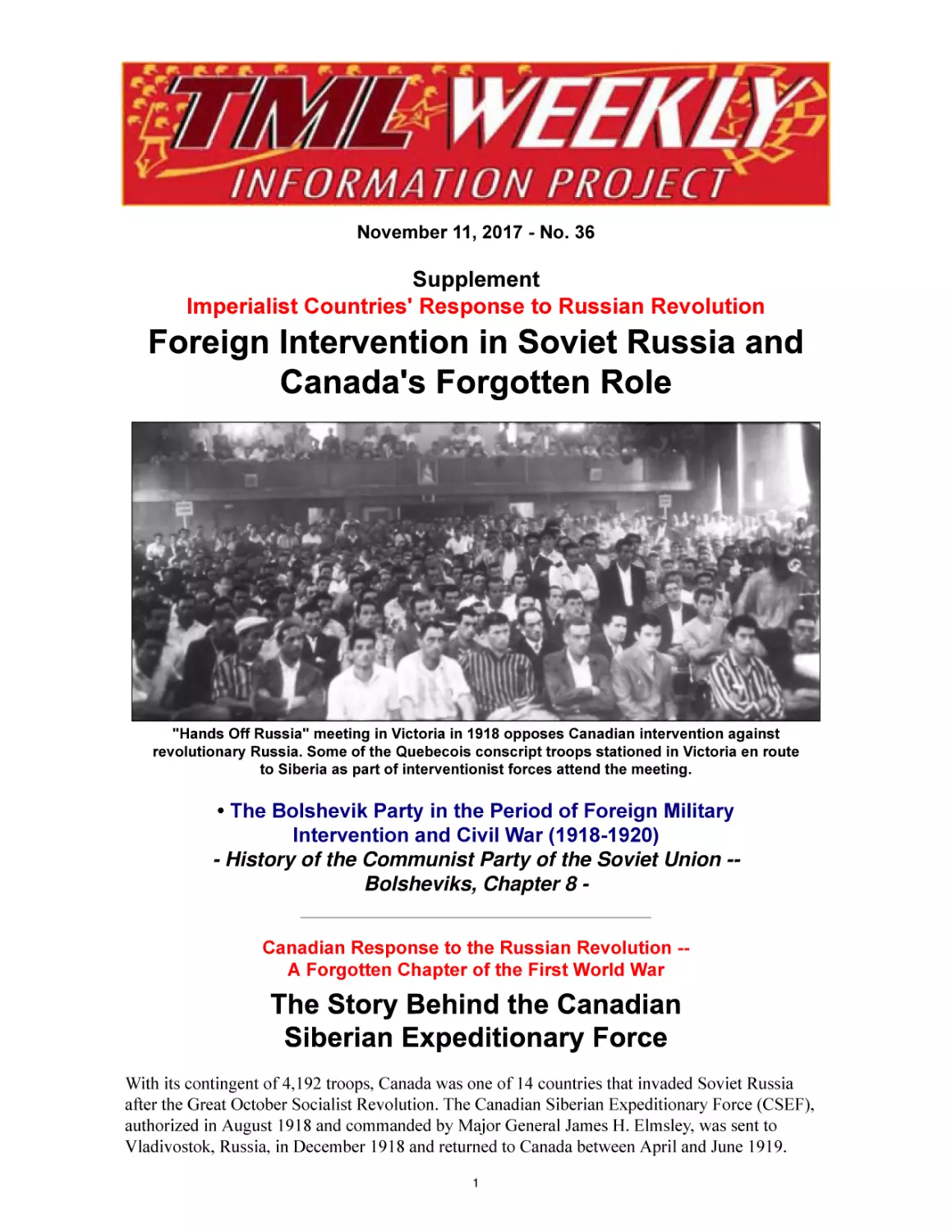
"Hands Off Russia" meeting in Victoria in 1918 opposes Canadian intervention against
revolutionary Russia. Some of the Quebecois conscript troops stationed in Victoria en route
to Siberia as part of interventionist forces attend the meeting.

• The Bolshevik Party in the Period of Foreign Military
Intervention and Civil War (1918-1920)
- History of the Communist Party of the Soviet Union -Bolsheviks, Chapter 8 Canadian Response to the Russian Revolution -A Forgotten Chapter of the First World War

With its contingent of 4,192 troops, Canada was one of 14 countries that invaded Soviet Russia
after the Great October Socialist Revolution. The Canadian Siberian Expeditionary Force (CSEF),
authorized in August 1918 and commanded by Major General James H. Elmsley, was sent to
Vladivostok, Russia, in December 1918 and returned to Canada between April and June 1919.
1

The opposition of the Canadian workers and people to the intervention against the Russian
Revolution grew, in particular following the Armistice November 11, 1918, that ended World War
I.
The main mission of the interventionist forces was to defeat the Bolshevik revolution, while other
concerns were raised, such as keeping Russia in the fight against Germany, safeguarding the Czars'
gold reserves being taken out of Russia to back up the war loans -- a debt cancelled by the new
people's power led by V.I. Lenin.

Some historians say that Canadian involvement in the Siberian campaign was to a significant
degree driven by Canadian Prime Minister Robert Borden's policy towards the United Kingdom.
As a dominion, Canada was neither a full-fledged member of the Entente, nor simply a colony.
Borden's arguments for Canada's involvement "had little to do with Siberia per se, and much to do
with adding to the British government's sense of obligation to their imperial junior partner," P.
Whitney Lackenbauer argues.[1] According to Gaddis Smith, Canadian intervention "represents the
initial episode in the Canadian struggle for complete control over her foreign policy after World
War I. As such, it illustrates the changing relationships within the British Empire more realistically
than the scores of constitutional documents that the Commonwealth statesmen self-consciously
drafted between 1917 and 1931."[2]
2

In October 1918, as Canadian troops were mustered to Victoria for the trip to Siberia, the Privy
Council authorized the formation of a Canadian-Siberian economic commission, led by trade
commissioner Dana Wilgress, that included representatives of the Canadian Pacific Railway and
the Royal Bank of Canada. It is said the Commission was established based on the belief that the
Bolshevik revolution would be unsuccessful and lead to business and trade opportunities.
On the occasion of the100th anniversary of the Great October Revolution and the 99th anniversary
of the signing of the Armistice on November 11, 2018, TML Weekly is reproducing the book by
Benjamin Issit, entitled Mutiny from Victoria to Vladivostok.
Notes
1. P. Whitney Lackenbauer, University of Waterloo, "Why Siberia? Canadian Foreign Policy and
Siberian Intervention, 1918-19," (April 1998).
2. Gaddis Smith, "Canada and the Siberian Intervention, 1918–1919, "The American Historical
Review, Vol. 64, No. 4 (July 1959), pp. 866–877.

- Benjamin Issit* -

Quebecois troops from the 259th Battalion on leave in downtown Victoria in late 1918, prior to
their deployment to Siberia.

On 21 December 1918, French-Canadian soldiers mutinied in the streets of Victoria, BC. Their
story has never been told. Conscripts in the Canadian Siberian Expeditionary Force, these young
men broke ranks while marching from the Willows Camp to the troopship Teesta, about to embark
for Vladivostok, Russia. Revolver fire sounded through the city, as the obedient men were ordered
to whip the mutinous back into line. At the point of bayonets, the march proceeded up Fort Street
and through downtown Victoria to the outer wharf. Twenty hours passed before the last dissenters
were herded aboard the Teesta. In the ship's hold, along with twenty-one tons of gear for the
YMCA and 1700 tons of ammunition, a dozen ringleaders were detained in cells, the two worst
handcuffed together. At 4:15 a.m. on 22 December 1918, the 259th Battalion of the Canadian
Siberian Expeditionary Force set sail for Vladivostok.[1]

INTRODUCTION
'Time will reveal some strange things in the great Siberian drama,' the Semi-Weekly Tribune,
newspaper of the Victoria Trades and Labour Council, declared two days before the mutiny.[2] This
forgotten chapter of the First World War presents several challenges of research and interpretation.
Straddling military history, working-class history, and the social history of Canada and Quebec, this
3

story fits uneasily into any one field. The Canadian experience of war has been temporally,
geographically, and thematically bounded by the assassination of Archduke Ferdinand and the
signing of the Armistice on 11 November 1918.[3] A handful of historians have examined Canada's
intervention in Russia, while others sought to explain the demobilization riots that erupted among
Canadian troops in the British Isles; studies of the Siberian Expedition, however, underestimate the
dissent among the troops, the connection of this dissent to anti-conscription sentiment in Quebec,
and the process through which this dissent translated into mutiny.[4] Absent is a serious inquiry of
the social movement that emerged within the Canadian working class to force their return home.
Within the field of working-class history, domestic expressions of industrial unrest have been
privileged over local responses to international events such as the Russian revolution. To date, no
study has focused on Canadian labour's response to the Siberian Expedition. This topic raises
important questions, such as the dual role of soldiers as workers, and the way class tensions were
manifested within the armed forces, providing fertile ground for expanding our understanding of
the working-class experience in Canada.[5] As William Rodney observed in 1968, 'the real story of
intervention and Canada's role in it has still to be written.'[6]
As the last guns sounded on the Western Front, 4000 Canadian troops assembled at Victoria for
deployment to Siberia. Born at a meeting of the Imperial War Cabinet in London in July 1918, the
Canadian Siberian Expeditionary Force (CSEF) was plagued from the outset by lack of clarity
about its aims; a month after the main body of the force arrived in Siberia, the order was issued
from Ottawa to begin preparations for evacuation. Few troops in the CSEF ever saw direct fighting.
Ambivalence in Allied strategy prevented their deployment into the interior of Siberia. Most of
their time was spent training White Russian conscripts and conducting routine security operations
around Vladivostok -- responding to looting, theft, assault, and murder in the port city. The threat of
Bolshevik insurgency precipitated countermeasures by the Canadian command and the deployment
of a small number of troops to the village of Shkotova. An attempt to move a body of troops up the
Trans-Siberian Railroad was thwarted by a strike of Russian rail-workers, while another train
carrying the horses and men of the Royal North West Mounted Police (RNWMP) was wrecked near
Irkutsk. By June 1919, all but a handful of troops had returned to Canada.

Troops marching to wharf in Victoria to board ships for Russia, December 1918.

The Siberian Expedition was part of a larger Allied campaign to alter the outcome of the Russian
revolution and install a more sympathetic government in Russia. From Murmansk and Archangel to
Baku and Vladivostok, Canadian troops joined soldiers from thirteen countries in a multi-front
strategy of encirclement designed to isolate and defeat the Bolshevik regime in Moscow.[7] In
4

Siberia, the Canadians backed a succession of White Russian governments, headed by General
Dmitri Horvath, Grigori Semenov, and finally, Alexander Kolchak, former admiral of the czar's
Black Sea Fleet, who seized power at Omsk in November 1918. Armistice on the Western Front
liberated Allied forces for battle against the nascent Soviet state. The British Columbia
Federationist, newspaper of the BC Federation of Labour, quoted G.W. Tschitcherin, Soviet
commissar of foreign affairs, who presented a Bolshevik interpretation of the conflict:
A handful of capitalists who desired to repossess themselves of the factories and banks taken
from them on behalf of the people; a handful of landowners who want to take again from the
peasants the land they now hold; a handful of generals who again want to teach docility to
the workers and peasants with a whip... have betrayed Russia in the north, in the south, and
in the east to foreign imperialist states, by calling foreign bayonets from wherever they could
get them.[8]
The failure of Canada and its allies to defeat the Bolsheviks consigned this story to the margins of
history, far removed from the heroism of the Canadian Corps in the trenches of France and
Flanders.[9]
The mutiny that erupted in the streets of Victoria on 21 December 1918 was located at the
intersection of class and national cleavages. It provides a compelling window into persistent
tensions in Canadian society, tensions that were amplified in the heat of wartime. The historic
antagonism between French and English, heightened around the issue of conscription, combined
with the political radicalism of British Columbia's working class. The French-Canadian conscripts
who arrived in Victoria were mustered from the districts around Quebec City and Montreal, which
had experienced rioting in opposition to the Military Service Act; in the British Columbia capital,
they encountered a robust socialist movement that identified with the aims of the Russian
revolution and launched a determined campaign to prevent their deployment to Siberia. In streetcorner meetings and in packed auditoriums, working-class leaders of the Socialist Party of Canada
and Federated Labour Party provided a vocal critique that transformed latent discontent among the
troops into collective resistance.[10] Both class and ethnicity drove the conscripts toward mutiny;
neither can sufficiently explain the complex motivations behind an event that military and press
censors did their best to conceal at the time. At this junction of social forces -- the converging
interests of working-class Quebecois and British Columbia socialists -- a violent standoff erupted in
Victoria.

WHY SIBERIA?
To understand the working-class response, and also the growth of discontent among the troops, it is
essential to understand the rationale behind the Siberian Expedition. From the outset, Canada's aims
in Russia were complex, fluid, and confused. Military strategy, international diplomacy, economic
opportunity, and ideology influenced the decision of Canada and its allies to intervene in the
Russian civil war. Militarily, the Siberian Expedition must be understood in the context of Russia's
transition from trusted ally to de facto enemy. In March 1917, as unrest mounted in Petrograd and
the Romanov 300-year rule neared its end, a group of Canadian military officers toured Russia,
meeting with Czar Nicholas II and other Russian leaders. 'Russia is now thoroughly supplied with
munitions,' Victoria's Daily Times reported. 'The Czar's huge armies are prepared ... industries and
transportation are fully organized ... everything is in readiness for a great offensive, simultaneously
with a similar move by the Western Allies.'[11] Within a week of this optimistic report, the czar
abdicated the throne. By November, the Bolshevik party under V.I. Lenin had displaced the pro-war
provisional government and entered into negotiations with Germany and other belligerent nations
that ultimately removed Russia from the war -- and liberated German forces for battle on the
Western Front. The Allied Supreme War Council, meeting in London in December 1917, pledged
5

support to those elements in Russia committed to a continuation of war against Germany.[12] The
stage was set for Allied intervention.
In a speech to the Canadian Club and Women's Canadian Club in Victoria's Empress Hotel in
September 1918, Newton Rowell, president of the Privy Council, described the loss of Russia as
the most 'tragic surprise' of the war. The Siberian Expedition was necessary, he said, 'to reestablish
the Eastern front' and 'support the elements and governments of the Russian people, which are
battling against German armed force and intrigue.'[13] This theme of Germanic influence on the
Bolshevik side tapped into public fear of 'Hun' aggression and harked back to Lenin's famed
passage through Germany in a sealed railcar; it provided justification for opening fronts far
removed from Germany and continuing fighting after Germany's surrender. Allegations of
Bolshevik atrocities, including the supposed 'nationalization of women,' were amplified to bolster
public support for the Siberian campaign.[14] A final component of this military rationale was the
presence in Siberia of the Czecho-Slovak Legion, an anomalous body of troops, sixty thousandstrong, which was marooned in the Russian Far East from 1917 and 1920, and formed the advance
party of the Allied campaign in a desperate bid for national recognition.[15]
Diplomacy also shaped Canadian policy in Siberia, as political and military leaders sought greater
power and independence within the British Empire. As Rowell told the Canadian Club, the
achievements of Canadian troops during the war had won for the country 'a new place among the
nations,' obliging Canada to do her part on the world stage. He informed Parliament that, after
refusing a request from the British War Office to send another contingent to France, Canadian
leaders felt obliged to provide a brigade for Siberia. Borden underscored this diplomatic motivation
in a letter to a skeptical colleague, as domestic opposition to the Siberian Expedition mounted: 'I
think we must go on with this as we have agreed to do so... [I]t will be of some distinction to have
all the British Forces in Siberia under the command of a Canadian Officer.'[16]
More significant than diplomacy, however, was the economic motivation. For decades Canadian,
American, Japanese, British, and German investors had eyed the resource wealth of Russia's Far
East and the region's consumer market. The German-controlled Kunst & Albers Company had
established a vast retail-wholesale network in Siberia before the war, an enterprise similar to the
Hudson's Bay Company in Canada. When Russia's provisional government ordered the firm be
sold, a Canadian intelligence officer saw 'a wonderful chance for Canada.' Trade commissioners
had been posted to Petrograd and Omsk in 1916, and a Russian purchasing mission was established
in Canada; exports to Russia reached $16 million, making it the seventh largest market for
Canadian goods.[17] In June 1917, Russia's consul-general to Britain, Baron Alphonse Heyking,
described Siberia as 'the granary of the world' and urged, 'Let capitalism come in. It will develop
quickly.'[18] The Bolshevik revolution interrupted these efforts to develop the Russian economy
along capitalist lines. Rather than welcome foreign investment and trade, the new regime
nationalized the assets of Russians and foreigners. 'This vast country is in a very precarious
position from the standpoint of trade and commerce,' Rowell warned. 'She needs capital and expert
guidance in the work of reconstruction ... [With] more intimate relations the greatest benefit may
result both to Canada and Siberia.'[19] In October 1918, as Canadian troops were mustered to
Victoria, the Privy Council authorized the formation of a Canadian-Siberian economic commission,
including representatives of the Canadian Pacific Railway and the Royal Bank of Canada; the latter
opened a branch in Vladivostok at the end of 1918.[20]
The Allied countries also had a direct financial interest in the defeat of the Lenin regime. An
estimated 13 billion rubles in war loans had been repudiated by the Bolsheviks.[21] Against this
outstanding debt stood the Imperial Russian Gold Reserve, the largest holdings of the precious
metal in the world. Valued at over 1.6 billion gold rubles, one quarter of this gold had been shipped
from Vladivostok to Vancouver in December 1915, June 1916, November 1916, and February
6

1917, to guarantee British war credits; it was transported on the Canadian Pacific Railway and
stored for several months in a Bank of England vault in Ottawa. The portion remaining in Siberia
has its own intriguing story, moving from one train to another, and from town to town, as the czar
and an array of White generals retreated eastward.[22] As a military officer told a December 1918
meeting of Federated Labour Party in Victoria, 'We are going to Siberia as far as I know because
Britain has loaned a great amount of money to Russia. I don't know how much, and the Bolsheviki
has repudiated the loan money. This is as much ours as anybody's, and we are going there to get
it.'[23]
The final motivation behind the Siberian Expedition was ideological. In all industrialized countries,
the events of 1917 amplified divisions between the social classes. As working-class grievances
against profiteering and conscription mounted in Canada, with labour demanding the 'conscription
of wealth,' the Russian revolution provided a powerful symbol of resistance. Fear of revolution
informed Allied policy from the outset. An editorial in the Federationist summed up a growing
sentiment among BC workers: 'There is no other sign post upon the social horizon pointing the way
to peace than the movement which is now typified in the Russian Bolsheviki. Well may rulers and
robbers hail its advent with terrified squawks and bourgeois souls quake with terror at its probable
triumph. For with that triumph their game of loot and plunder will end.'[24] To radical sections of
BC labour, the Bolshevik insurrection was celebrated as a bold response to the two-fold scourges of
war and capitalism; it provided a framework through which BC workers came to interpret their own
class position. Within the Canadian elite, however, the Bolshevik revolution was received with
grave misgivings, viewed as a catalyst to domestic unrest and an example of radical movements
that were left unchecked. The Siberian Sapper, newspaper of the CSEF, warned that 'Bolshevik
missionaries are spreading their doctrines in every country in the world ... There is a mad dog
running loose among the nations, and it would seem to be the duty of the nations to handle it as
mad dogs are usually handled.'[25] This fear of domestic Bolshevism was intensified by statements
such as those of Joseph Naylor, president of the BC Federation of Labour and a socialist leader of
the Vancouver Island coal miners: 'Is it not high time that the workers of the western world take
action similar to that of the Russian Bolsheviki and dispose of their masters as those brave Russians
are now doing?'[26]
This complex array of Canadian motives -- military, diplomatic, economic, ideological -- is
reflected in a cryptic letter, received by the Victoria Trades and Labour Council from the deputy
minister of militia and defence, Ottawa, 'acknowledging a letter from the Council opposing the
Siberian expedition':
The Department does not consider Canada at war with the Russian people, but that they, the
Government of Canada, are supporting certain governments in Russia, such as that organized
at Omsk and Archangel, which governments are, by the way, quite socialistic. At any rate no
aggression is meant by the Dom. Govnt, rather an economic development.[27]
This official statement of Canadian policy, despite its confusing syntax, reveals implicit opposition
to the spread of socialism, but also a clear intent to alleviate labour's fear that Canada was acting on
purely ideological grounds.

A BEACHHEAD ON RUSSIA'S EASTERN FLANK
In December 1917, there were 648,000 tons of Allied munitions and war supplies in the Siberian
port of Vladivostok. The security of Allied military and commercial interests in the city was
compromised by the election that month of a majority of Bolshevik deputies to the local Soviet.
Given the severity of the situation, British, Japanese, and American warships were deployed to
Vladivostok, lying at anchor in the harbour. In April, 500 Japanese marines landed ashore, as 50
7

Royal Marines left the cruiser Suffolk to guard the British Consulate. By June 1918, the Allied
powers had launched an attack to establish Vladivostok as a beachhead on Russia's eastern flank.
Fifteen thousand CzechoSlovaks, aided by Japanese and British marines, seized control of the city,
toppling the local Soviet. A group of armed gruzshchiki (longshoremen) staged a standoff in the
Red Staff building, and though outnumbered forty to one, resisted until the building was hit with an
incendiary bomb, killing dozens. At the funeral, attended by 17,000 workers and adorned with the
banners of forty-four unions, Konstantin Sukhanov -- a twenty-four-year-old student and president
of the Vladivostok Soviet -- declared defiantly, 'The Soviet for which they died shall be the thing
for which we live -- or if need be -- like them, die.'[28] Two days later, Japanese, British, American,
French, and Czech officials placed the city under their 'temporary protection.' By the end of July, all
administrative, judicial, and financial functions had been assumed by the White cabinet of General
Dmitri Horvath.[29]

Interventionist forces on parade in Vladivostok, 1918.

Across the Pacific in British Columbia, the summer of 1918 was marked by acute industrial
conflict. Organized workers were on the brink of the first citywide general strike in Canadian
history. The Victoria Trades and Labour Council-backed newspaper The Week was suppressed by
government order after publishing the terms of the Allies' secret treaties. Burgeoning colonies of
draft resisters had taken shape in the Comox Valley of Vancouver Island and near Howe Sound on
the mainland. Labour leader Albert 'Ginger' Goodwin was shot dead while evading the Military
Service Act, while miners' leader Joseph Naylor was jailed for assisting draft resisters.[30] On both
the industrial and political fields, British Columbia labour developed organizational muscle. Aided
by wartime labour shortages, new organizations took root among shipyard workers, longshoremen,
sawmill workers, telephone operators, teamsters, school teachers, fire-fighters, police officers, and
laundry workers.[31] Led by militants in the Socialist Party of Canada (SPC), British Columbia's
labour movement was entering into a period of unprecedented unrest, preparing to mount a
challenge to the moderate leadership of the Trades and Labour Congress of Canada. Electorally, the
Federated Labour Party (FLP) established branches across the province, backed by the provincial
labour federation and a team of organizers that included J.S. Woodsworth. The FLP's lone
parliamentarian in the BC legislature, Jim Hawthornthwaite of Nanaimo, aligned himself with the
Russian revolution:
8

The capitalist press in this country is out-lying each other in vilifying the Bolsheviki, but we
cannot believe one word we read... The Russians have large stores of supplies in Vladivostok
and Petervolosky... So we are forced to the conclusion that the Allies are liberating the
Germans on the western front, and allowing them to devastate the Russian workers'
republic.[32]
In both Russia and Canada, working-class unrest was fuelled by discontent with the high cost of
living, shortages of food, carnage on the battlefields, compulsory military service, and restrictions
on civil liberties. In both countries, the roots of unrest could be traced to the class system itself, to
the determination of the domestic elite to engage in war, and to the efforts of sections of the
working class to alter basic economic relationships. As radicalism in the industrial and political
branches of BC labour intensified, Prime Minister Borden requested that his director of public
safety, Montreal lawyer C.H. Cahan, investigate the proliferation of Bolshevik influences in
Canada.[33]
Against this domestic backdrop, the Imperial War Cabinet convened in London in July 1918.
Borden joined British Prime Minister David Lloyd George, and political and military leaders from
Australia, New Zealand, and South Africa, to formulate Allied strategy on the Western Front -- and
commit forces to the emerging fronts encircling Bolshevik Russia. In his memoirs, Borden writes
that on 27 July 1918 'we discussed our contingent for the Siberian expedition.' The next day,
Borden received a wire stating that the Privy Council 'approves principle of sending expedition,
leaving you to arrange cost and other detail.'[34] Earlier that month, American President Woodrow
Wilson committed 7000 US troops to Siberia. As Allied leaders assented to the Siberian campaign,
1000 troops in Britain's 25th Middlesex Regiment made their way from Hong Kong to Vladivostok,
to serve under the Canadian command. By the end of August, 15,000 of 73,000 Japanese troops had
landed in the city. American soldiers sailed from the Philippines, as an array of foreign armies
made their way to Siberia: 2000 Italians, 12,000 Poles, 4000 Serbs, 4000 Romanians, 5000
Chinese, and 1850 French troops. When combined with the Czecho-Slovak Legion and White
Russian forces, the total Allied troop strength in Siberia exceeded 350,000.[35]
On 13 August 1918, the details of the Canadian Siberian Expeditionary Force were revealed
publicly: 'Canada to Send Force 4,000 Strong to Help Russia in Siberia,' the Daily Colonist
announced. Victoria was selected as an assembly point, along with New Westminster and
Coquitlam. Major-General James H. Elmsley returned from London and began accumulating his
army at the Willows Camp, located on the edge of Victoria, as military officials arranged for the
shipment of 3,000,000 rounds of ammunition from Vancouver to Vladivostok.[36] Even at its
inception, however, the CSEF was plagued by indecision in senior ranks. Gen. S.C. Mewburn,
minister of militia and defence, questioned whether the troops could be raised voluntarily, asking
Borden, 'How will the public of Canada view the raising of another Force to be sent to another
theatre of war ... in view of the present unrest in Canada.'[37] In Regina, 'B' Squadron of the
RNWMP Calvary unit enlisted 181 horses and 215 men, all volunteers.[38] From British Columbia
to Nova Scotia, 4197 troops were mobilized to the West Coast; as Mewburn had anticipated, 1653
were conscripts. In addition to small units of bakers, butchers, medics, and other supporting troops
-- and Nursing Matron Grace Elrida Potter, the lone woman in the force -- the bulk of the CSEF
consisted of the 16th Canadian Infantry Brigade, which included the 259th and 260th Battalions
and Britain's 25th Middlesex Regiment.[39]
The 259th Battalion (Canadian Rifles) was formed in September 1918 and organized into four
companies, under the command of Lieutenant-Colonel Albert 'Dolly' Swift, with headquarters in
Montreal. 'A' and 'B' companies were mustered from the districts of Kingston, Toronto, and
London, ON, and received preliminary training at Niagara Camp before moving to Victoria. 'C' and
'D' companies were drawn from Montreal and Quebec City, and relied heavily on 'MSA men' -9

conscripts under the Military Service Act. Of 1083 troops in the Battalion, only 378 had enlisted
voluntarily.[40] Conscription was bitterly resented in Quebec, where historical linguistic and
national tensions undermined support for the British war effort, and exploded into rioting in early
1918. This political context helps explain discontent within the Quebecois companies of the 259th
Battalion. Morale in the 259th was also influenced by the presence of 135 Russian-speaking troops,
belonging to two Russian platoons that had been recalled from the Canadian Corps in France and
attached to the CSEF to provide interpretative services in Siberia.[41] Finally, the outbreak of the
Spanish flu sowed the seeds of discontent within the 259th, forcing the quarantine of 'C' and 'D'
companies in Quebec, and taking the life of seven members before they even reached Victoria.[42]
At the end of October, the Quebecois units of the 259th Battalion boarded two separate trains for
the journey to the Willows Camp.
The situation that greeted the men in Victoria was far from ideal: A wet British Columbia autumn
was aggravated by the influenza epidemic. Private Harold Steele, a twenty-year-old railway worker
from Cane Township, ON, who voluntarily enlisted in 'B' Company of the 259th Battalion,
described conditions at the Willows: 'The weather is the worst,' Steele wrote to his girlfriend Josie
Libby. 'It rains every day and sometimes two or three times a day.'[43] A total of 101 people died of
influenza in Victoria in 1918, while 2759 fell ill. A quarantine was established at the Willows, and
all public gatherings were banned by the civic Health Committee, a prohibition that was not lifted
until the end of November. According to the Daily Times, 'It may not have been the best time of
year for troops to have been quartered in Victoria... The latter part of their stay has been marked by
an unusual amount of rain with an attendant sea of mud at the Willows.'[44] Dawn Fraser, a
volunteer in the 260th Battalion and a pharmacist from Saint John, NB, put the mood of the troops
into verse:
So our esprit de corps is waning, All our pluck and interest too, The only thing we see to
fight, Is Mud and Spanish Flu.[45]
As the main body of the force assembled in Victoria, the advance party, consisting of 677 men and
headed by Major-General Elmsley, departed for Vladivostok aboard the Canadian Pacific steamship
Empress of Japan.[46] Meanwhile, the labour situation continued to deteriorate.
Within the ranks of Canadian workers, the rift between the moderate Trades and Labour Congress
leadership and the socialist leadership concentrated in the western provinces widened into an open
split at the congress convention in Quebec City in September 1918. Among the grievances of the
socialist delegates was the tabling of a resolution opposing Canadian intervention in Russia.[47] In
response to growing radicalism, the Borden government approved PC 2384, outlawing fourteen
political organizations and all meetings (with the exception of religious services) in the Russian,
Ukrainian, and Finnish languages. The proscribed organizations included the Social Democratic
Party, Industrial Workers of the World, and Slavic radical groups including the Russian Workers
Union and Group of Social Democrats of Bolsheviki. Responding to a strike of Calgary freight
handlers, the government banned all labour strikes for the duration of the war. The SPC's Western
Clarion was declared 'objectionable' under the authority of the Secretary of State of Canada, as was
the pamphlet A Reply to the Press Lies Concerning the Russian Situation and Lenin's 'Political
Parties in Russia,' which had been serialized in the BC Federationist only months earlier. Peace set
in on the Western Front as Canada declared war against radical labour, both at home and in Russia.
On Armistice Day, 11 November 1918, Borden wrote in his diary, 'Revolt has spread all over
Germany. The question is whether it will stop there.'[48]
The signing of the Armistice triggered a debate on whether Canadian troops should be deployed to
Siberia. As Borden sailed aboard the Mauritania en route to peace deliberations in Europe, Acting
Prime Minister Sir Thomas White sent an urgent telegram from Ottawa:
10

All our colleagues are of opinion that public opinion here will not sustain us in continuing to
send troops, many of whom are draftees under the Military Service Act and Order in
Council, now that the war is ended. We are all of opinion that no further troops should be
sent and that Canadian forces in Siberia should, as soon as situation will permit, be returned
to Canada. Consider matter of serious importance.[49]
T.A. Crerar, a Winnipeg farmer and businessman who would soon defect from the Union cabinet to
lead the Progressive Party, was 'absolutely opposed to sending any additional forces to Siberia...The
matter of how Russia shall settle her internal affairs is her concern -- not ours.' Borden rejected his
ministers' advice, maintaining that troops should leave Victoria for Siberia. 'In my judgment we
shall stand in an unfortunate situation unless we proceed with Siberian Expedition... Canada's
present position and prestige would be singularly impaired.' Anticipating that Canadian troops
would not be called upon to engage in active warfare, 'beyond possible quelling of some local
disturbances,' he suggested they were needed to assist the new government of Admiral Kolchak,
which had recently seized power at Omsk and sought to organize anti-Bolshevik forces into a
professional army.[50] White reiterated his earlier opposition, pointing out that Canadian interests in
Siberia differed from those of Britain and France, because of Russia's indebtedness to those
countries:
Canada has no such economic or business interests as will justify the employment of a
Canadian force composed of young men whose parents and friends desire should return at
once to their ordinary occupations...
Canada should, now that the war is over and no necessity exists for the re-establishment of
the Eastern front, discontinue further participation and expense. It seems clearly a task for
nations more immediately interested in the finances of Russia. There is an extraordinary
sentiment in Canada in favour of getting all our men home and at work as soon as
possible.[51]
Indicating that opposition was not confined to labour circles, the Toronto Globe weighed in on the
debate:
'Why should Canadians be forced into a service of which the purpose, if there is any definite
aim, is hidden in the minds of public men?... There has been no proposal to make Russia our
enemy in any legal form. How can we say that our force in Siberia is being used for the
defence of Canada?'[52]
On 22 November, a scheduled troop sailing was postponed indefinitely by Mewburn, but this
position was reversed days later when the cabinet yielded to their prime minister and decided the
Siberian Expedition would proceed -- with the proviso that any soldier who desired would be
permitted to return to Canada within one year of the armistice. 'We are advised that this will be
satisfactory to the troops now in British Columbia,' White assured Borden, prematurely, as events
revealed.[53]
Morale among the troops at the Willows Camp waned in the face of vigorous propaganda by
Victoria's labour movement, part of a national campaign against the Siberian Expedition. Socialists
targeted their efforts at members of the CSEF. When the Victoria branch of the Federated Labour
Party held its inaugural meeting on 8 December, 700 members of the Siberian force were in
attendance, while 'hundreds were turned away.' As the Federationist reported, 'The way those boys
applauded the Labor speakers showed in no uncertain manner where their sympathies lay.' Jim
Hawthornthwaite, FLP member of the legislature, and party organizer J.R. Trotter took the
platform, lambasting the 'capitalist press' and describing the violent overthrow of the Vladivostok
Soviet the previous June.[54] The Daily Times, considered the more liberal of Victoria's two dailies,
11

railed against 'certain elements of pronounced Socialistic tendencies' and claimed the Siberian
Expedition was needed to 'maintain control of the trans-Siberian railroad along its whole length
from the Pacific to the Urals.' A week later, a second protest meeting was held, under the auspices
of the Victoria Trades and Labour Council. A group of CSEF officers attempted to disrupt the
meeting, flooding onto the platform, singing 'God Save the King,' and accosting the speakers. The
Federationist, however, reported that 'the majority of the soldiers present were with the labor
speakers.' Labour's Semi-Weekly Tribune claimed 'the whole house, composed mostly of the
Siberian contingent, were unanimous in expressing their sentiments to the withdrawal of the
troops.'[55]
The prospect of soldier -- labour unity created much apprehension in senior ranks, foreshadowing
the heavy-handed response to veteran-labour unity in Winnipeg the following spring. The
lieutenant governor of British Columbia, Sir Thomas S. Barnard, sent a secret letter to Borden on 4
December, requesting the prime minister 'urge upon the Imperial Government the importance of
keeping a few large Cruisers upon this Coast, if for no other reason, than for that of having a force
to quell, if necessary, any rising upon the part of the I.W.W.' Barnard felt 'the presence of a warship'
would 'do more than any local military force to settle any local trouble,' since 'the personnel of such
force would not be subjected to the insidious socialistic propaganda which reaches the soldier -- in
other words, would be more amenable to discipline, and not affected by local influences... In the
event of labor strikes, with demonstrations leading to riots, a serious situation would arise if the
soldiers were in sympathy with the strikers.'[56]
From labour halls across the country, a flood of protest resolutions arrived in Ottawa. The
Vancouver Trades and Labour Council placed itself 'on record as being against intervention in
Siberia or interfering in Russia's internal affairs.' Ernest Winch, an SPC member and president of
the council, warned that 'if the government desired evolution, and not what was called revolution,'
it would halt its campaign of repression against radical labour.[57] In Winnipeg, the labour council
entertained a proposal for a general strike to force the withdrawal of Allied troops from Siberia.
Victoria's Semi-Weekly Tribune, meanwhile, suggested 'Ottawa should at once be notified by the
Military Authorities of the real state of affairs at the Willows. It is common knowledge that the vast
majority of the men in camp are strongly averse to embarking for Siberia.'[58]
Evidence of discontent at the Willows Camp abounds. In November, eighty-seven soldiers in the
Russian platoons of the 259th Battalion were moved across the city to the Work Point Barracks,
'these men not being anxious to proceed to Siberia.'[59] Bolshevik sympathies had developed
among the men, as did an aversion to fight other Russians. A loyal soldier in the CSEF reported
confidentially that the Russians at the Willows 'are all Bolsheviki'; they intended to join the Red
Army if deployed to Russia and were 'debating all the time the social question and predicting the
downfall of the rich': 'I am not afraid to fight the enemy ahead of me... but I don't want to be shot
from behind with our own machine guns.' Only eighteen of the Russian troops were deemed
reliable for service in Siberia and permitted to leave Canada. Within the other units of the 259th,
efforts were made to contain discontent: English-speaking troops were transferred out of 'D'
company (which the War Diary describes as the 'French-Canadian Company'), while FrenchCanadians were transferred from 'C' company to 'D' company. In the 20th Machine Gun Company,
seven soldiers were declared 'deserters' by a Court of Inquiry on 20 December 1918; every day,
punishments were meted out for infractions ranging from 'breaking out of camp' to 'highly improper
conduct in the ranks.' As Skuce observed, 'barrackroom lawyers fomented discord by pointing out
the illegality of the government's intent,' which was highlighted by a government order of 7
December authorizing MSA troops for service in Siberia.[60] A soldier wrote to his sister-in-law
from the Willows Camp, 'Well, things are beginning to look awful black over here. We are going to
be railroaded to Siberia, and we cannot do a thing to help ourselves. They started to dish out our
clothes to us the first day, and out of 78 of us 77 refused to take them.'[61]
12

Efforts to ameliorate the situation were unsuccessful. The YMCA provided regular recreation and
entertainment for the troops, and the military organized a 'sports day' and a mandatory lecture on
the geography and political climate of Siberia, attempting to counter the influence of the labour
meetings. When gale force winds and driving rain forced the cancellation of rifle practice at the
Clover Point Range, Brigade Commander H.C. Bickford addressed all ranks in the CSEF 'on
discipline, complaints, etc. and propaganda against the Siberian Force.' As the brigade war diary
records, 'So-called Socialistic meetings have been held in Victoria at which there were speeches
made... against the Siberian Force.'[62] White wired Borden in London: 'There is a good deal of
feeling in labour and other quarters here against our continued participation and my personal view
is that a serious political situation may arise later unless some definite statement can be made as to
the return of the expedition within a reasonable time.' Borden responded, insisting Canada had
made commitments that had to be honoured, regardless of the armistice in Europe.[63]
And so Departure Day arrived, 21 December 1918. A total of 856 enlisted men in the 259th
Battalion and the 20th Machine Gun Company, along with Headquarters Detachment and several
smaller units, left the Willows Camp for the six-kilometre march up Fort Street toward the outer
wharf and the troopship Teesta. They were under the command of Lieutenant-Colonel Swift, along
with forty-two other officers.[64] The most detailed description of the events that followed appeared
in a lieutenant's letter to his wife, mailed from Japan, which was published in the Federationist and
is worth quoting at length:
Yesterday morning (Saturday, December 21) we turned out a reveille, 5 a.m., and turned in all our
camp equipment at quartermasters' stores. We breakfasted at 6 a.m., and marched out of camp at
7:30 a.m. for the wharf, a distance of four and a half miles. When we got half way the signal came
from the rear to halt, so we stopped for about ten minutes. Then the commanding officer blew his
whistle as a signal for everyone to resume his place in the column, and we jumped into our places
waiting for the further signal to advance, which was an unusually long time coming.
We could not see the rest of the column, as we had turned a corner of the road -- and a few minutes
later a shot rang out, but still we waited till eventually we received word to resume the march. In
the meantime it appears that our gallant... or a number of them, had absolutely refused to fall in
again when the signal blew, or to go down to the boat at all. So then the colonel drew his revolver
and fired a shot over their heads -- in the main street of Victoria -- when some more got into line,
though there were still a large number who would not, so the other two companies from Ontario
were ordered to take off their belts and whip the poor devils into line, and they did it with a will,
and we proceeded.
While all this was happening the general staff car was flying round with good effect, so that after
marching another half mile we came to a 'guard of honour' (fifty men in close formation, with rifles
and fixed bayonets on either side of the road) who presented arms in the approved fashion to us -scouts, bugle band, and the Toronto company -- but as soon as the other company was just nicely
between them the order was given to the guard to 'Outwards turn,' with the result that this company
continued the march virtually at the point of the bayonet, they being far more closely guarded than
any group of German prisoners I ever saw, and they were put under armed guard till we actually
pulled out to sea, and even now a dozen of the ringleaders are in the cells -- the two worst
handcuffed together -- awaiting trial.[65]

'MUTINY AND WILFUL DISOBEDIENCE'
Evidence to corroborate this story is sparse, the victim of military and press censorship, and a
historiography that failed to ask the right questions while the participants were still alive.[66] The
accounts of Rodney, MacLaren, Swettenham, and Skuce consign the events of 21 December 1918
13

to the margins, providing only passing references that are neither explained nor interrogated for
meaning.[67] These interpretations do not extend beyond a superficial reference to French-Canadian
anti-militarism. Mirroring the weakness of the larger literature on conscription in Canada, these
accounts ignore the complex interplay of class and national cleavages, and the dual role of soldiers
as workers; they confine opposition to conscription to the province of Quebec.[68] In framing anticonscription sentiment and mutinous activity as purely French-Canadian phenomena, these
accounts distort the experience, and deny the agency, of British Columbia's working class, and
simplify the motivations of the Quebecois troops.
Research into the regimental records of the Siberian Expedition has produced scant evidence of the
mutiny. According to the war diary of the 16th Infantry Brigade, 'On the march from the camp to
the dock some of the French-Canadians of the 259th Battn. created trouble and objected to
embarking. The trouble was soon overcome, however, and the delinquents placed under arrest to be
dealt with.'[69] The diary of the 20th Machine Gun Company is even more vague: 'Parade formed
up at 7:00 A.M. to march to Rithet's wharf. Made several halts en route and arrived at wharf at
10:30 A.M.'[70] A court martial later concluded that the trouble started 'at the date when the men
were asked whether they were willing to volunteer for service in Siberia.' Brigadier-General
Bickford admitted that only forty per cent of the troops agreed to go voluntarily. Due to a
requirement of the Records Office, the troops march in alphabetical order. 'This completely
changed the company organization so that the men were not under the command of their own
Platoon officers and NCOs. There was one case of an officer who could not speak French being in
charge of a platoon of men who could not understand English.'[71] The commanding officer of the
259th, Lieutenant-Colonel Swift, described the troublemakers as 'French-Canadians, farmers and
recruits' with 'very little education,' who were 'mislead by some civilians while stationed in
Victoria, BC, in December 1918.'[72]
Military censorship prevented contemporary reports from appearing in the local press. The labour
council's Semi-Weekly Tribune alluded to 'recent happenings, the knowledge of which is common
property in this community.' But no details of these 'happenings' are provided: 'The Tribune has no
desire to infringe the regulations by giving publicity to these happenings unless forced to do so in
self defence.'[73] In the mainstream press, the Toronto Globe was one of the few voices calling for
the withdrawal of the Canadian troops, citing protests 'general throughout the country.' While the
Globe acknowledged 'sixty to seventy per cent of the men despatched to Siberia went unwillingly,'
it dismissed reports of 'some-thing very much like mutiny' aboard an unspecified troopship,
commending the men for embarking 'without serious disturbance.'[74] For a more detailed picture
of the events that transpired in Victoria on 21 December 1918, we must turn to sources generated
by the labour movement.
'In Victoria, if street corner reports are true, some members of the Siberian Expeditionary Force
refused to go, and were compelled to do so by the use of forceable [sic] methods, amongst which
was the use of revolvers by the officers,' the Federationist reported on 27 December, ignoring the
censorship restrictions.[75] Two weeks later, an editorial asked rhetorically, 'Why is the Canadian
government so bent on sending troops to Russia that unwilling men were forced to embark for
Siberia at Victoria... after leading protestors were put under arrest? Surely the answer is not in the
announcement of the birth of the Canadian Siberian Development Company.'[76] J.S. Woodsworth
addressed an FLP meeting in Vancouver, describing 'some disgraceful scenes' that had taken place
'when certain Canadian troops were only recently shipped at Victoria for Siberia. We had grown
accustomed to hear of German and in the past of Russian troops being driven by force to the
fighting front, but it was something new for Canada, and... for the British Empire itself, to have
troops driven aboard ship by bayonet and revolver.'[77] Having resigned from the Methodist
Church, Woodsworth was working as a longshoreman in Vancouver, where, according to daughter
Grace MacInnis, he 'downed tools and gave up his day's work and pay' when he discovered he was
14

loading munitions bound for Siberia.[78] Another BC socialist, William A. Pritchard, discussed the
Siberian Expedition with a Victoria audience in the wake of the mutiny: 'No matter how many
millions of gallons of Allied blood' were spilt 'combating the Soviet regime, and no matter how
successful it might be in subduing it, nothing could overthrow the conditions which had brought the
Soviets into existence.'[79]

Leaflet of the Canadian Hands Off Russia Committee opposing Canadian intervention
against the Bolshevik revolution. Click photos to enlarge. (Northstar Compass)

Further insight into the Victoria mutiny can be gleaned from the proceedings of the Western Labour
Conference, which convened in Calgary in March 1919. Helen Armstrong, representing the
Women's Labour League of Winnipeg, asked the British Columbia delegates whether the troops
aboard the Teesta had arrived in Siberia: 'Some of our members have not been heard from since
Christmas... and we heard... that it took half a regiment at Christmas to put the other half on the
ship for Siberia.' A Victoria delegate by the name of Flewin responded that as an organizer of the
FLP meetings in the city, he had met personally with several soldiers, including some from
Winnipeg: 'When these boys were given notice they were to leave for Siberia there was a plan
among them that they would refuse to go. There was one man chosen to lead them, but when he
struck down one of the officers the rest didn't give him support. However, it took 23 hours to get
those men aboard the ship.'[80]
Out of these fragmentary pieces of evidence the general contours of the mutiny emerge. Influenced
by labour agitation, their morale weakened by poor weather and the Spanish flu, a company of
francophone conscripts in the Canadian Siberian Expeditionary Force refused to leave Victoria for
Vladivostok, and the military authorities used force -- revolvers, canvass belts, and bayonets -- to
ensure their deployment to Russia.
At sea, the fortunes of the campaign failed to improve. One soldier died aboard the Teesta, as did a
Chinese crewmember. Private Frank Joseph Kay, of the 259th Battalion, fell down a coal chute
during a storm.[81] Discontent continued during the crossing. Battered by rough weather, the Teesta
pulled into the northern Japanese port of Muroran for bunkering on 9 January. The officers were
15

allowed ashore, while the lower ranks were not. Thirty-eight men were subsequently found guilty
of being absent without leave, and penalized fourteen days forfeiture of pay.[82] The Teesta arrived
in Vladivostok on 12 January, followed by the Protesilaus three days later. In these two ships,
carrying 899 and 1808 men respectively, nearly three-quarters of the Canadian force reached
Siberia.[83] When the Teesta docked, ordnance personnel discovered 'all blankets etc [were]
infested with lice,' and provided the troops, who lacked winter kit, with fur caps. According to the
war diary of base headquarters, 'All troops on board the S.S. "TEESTA" had to be bathed on arrival
owing to men [being] lousie.' Determined to avoid a disturbance similar to the one at Victoria,
officials had prepared a careful plan for the disembarkation of the men. Major-General Elmsley and
other senior officers boarded the ship upon its arrival in Vladivostok, while fifty troops were
detailed 'to act as a guard' as the 259th unloaded in two stages -- 'C' Company and one platoon of
'D' Company on 13 January, and the remainder of 'D' Company the next day. This strategy appears
to have worked, but the unloading of cargo proceeded less smoothly: Cranes, derricks, and other
hydraulic equipment had frozen, so 1700 tons of ammunition and 398 tons of other supplies were
unloaded by hand, by Chinese labourers.[84]
On 24 January 1919, ten men belonging to the 259th Battalion appeared before the deputy judge
advocate general in Vladivostok, on charges of 'mutiny and wilful disobedience.' The men, judging
by their surnames, were all French-Canadian, and all held the rank of rifleman. All had been
drafted under the authority of the Military Service Act. They were Onil Boisvert, Sylvio Gilbert,
Joseph Guenard, Alfred La Plante, Egard Lebel, Adore Leroux, Edmond Leroux, Edmond Pauze,
Arthur Roy, and Leonoe Roy. Over five days of hearings, the military judge found nine of the men
guilty, one innocent, and delivered sentences ranging from three years penal servitude to twentyeight days forfeiture of pay. Arthur Roy, a twenty-three-year-old from Montreal, who listed his
occupation as saw-maker and resided in St Catharines at the time he was conscripted, received a
three-year sentence; Boisvert, a farmer from Drummond, QC, and La Plante, a mechanic from
Richelieu, both aged twenty-three, received two years hard labour; Edmond Leroux, a twentytwoyear-old lumberjack from St Apolline, was sentenced to one year hard labour. The sentences
imposed on these working-class Quebecois youth were designed to have a deterrent effect within
the CSEF. In April, however, as the Canadians prepared to evacuate Vladivostok and questions
arose over the legality of deploying conscripts, the judge advocate received an application to
release on suspended sentence the 'men convicted of mutiny at Victoria, BC' -- a request that
Elmsley authorized.[85]

VLADIVOSTOK AND THE RETURN HOME
In their main barracks at Gournestai Bay, at the East Barracks, and at Second River, eight
kilometres west of Vladivostok, members of the Siberian Expedition remained restive. The first
week in February, British Colonel John Ward, second in command of British forces in Siberia,
wrote in his diary, 'I heard news of general insubordination among the Canadian troops that had just
arrived at Vladivostok. If all the information received could be relied upon, the sooner they were
shipped back to Canada the better. There is enough anarchy here now without the British
government dumping more on us.'[86] The daily routine orders from force headquarters in
Vladivostok reveal regular incidents of courts martial and breaches of conduct. The soldiers'
perspective, however, is difficult to discern, as censorship restrictions were not lifted until midFebruary, and military regulations dictated that only officers could keep personal diaries. In a letter
home from Vladivostok, Private Harold Steele described an officer in the 260th Battalion,
Lieutenant Alfred Henry Thring, who was 'either murdered or committed suicide here last night.' In
another letter, Private Steele described Vladivostok as 'this God forsaken hole.' Lieutenant Eric
Henry William Elkington, a doctor in the 16th Field Ambulance from Duncan, BC, confirmed this
view in an interview six decades later: 'That was a tough place, Vladivostok,' he recalls. 'It was
wintertime, and there were always people getting shot or killed in the streets.'[87]
16

A siege mentality developed among the troops and within the Canadian command, as the
occupying armies came into conflict with the local population. The RNWMP commander in
Vladivostok, a city of 160,000, conceded that 'the inhabitants are about ninety percent Bolshevik.'
In March, two White Russian officers were found murdered, their bodies showing signs of torture
and mutilation. The incident prompted an emergency meeting of the Inter-Allied Council, and
CSEF headquarters ordered 'all Officers to be careful when leaving main streets' and that other
ranks 'carry bayonets.' Amid rumours of 'disturbances and rioting which are expected from
Bolshevik sympathizers,' CSEF base headquarters released 'Instructions in Case of Riotous
Disturbances in Vladivostok Area,' outlining a procedure to quell any Bolshevik rising. As anxiety
mounted, the judge advocate was requested to investigate 'alleged Bolshevik activities of a Private
in the 259th Battn.'[88]
Tension was evident in Vladivostok, but few of the 4000 Canadians actually saw active
engagement. Only a fraction moved 'up country' to Omsk, serving as headquarters staff for the 25th
Middlesex Regiment and providing protection on transport trains; some troops in the 259th
Battalion were deployed to Shkotova, a village on an important rail line north of Vladivostok, to
join Japanese, Italian, French, and Czech forces in repelling a Bolshevik advance. Most of the
CSEF never left Vladivostok. Beyond guard duty, policing, and training White Russian troops,
members of the CSEF occupied themselves in the local bazaar and at dances organized for
members of the force. The YMCA and Knights of Columbus, which had assigned representatives to
the Siberian Expedition, opened canteen huts and movie theatres at the Canadian barracks, and held
concerts, lectures, boxing matches, and church services. An eight-team hockey league was
established, as were two brigade newspapers, the Siberian Bugle and Siberian Sapper. On occasion,
the men marched to a central bathhouse for a hot shower. As spring approached, Lieutenant
Elkington was deployed inland with a contingent bound for Omsk, to aid the British forces
defending the White governor of Siberia, Admiral Kolchak. However, as the troops made their way
along the Trans-Siberian Railroad toward Lake Baikal, the rail-workers went on strike: 'We had a
Russian train, and Russian drivers. And eventually they refused to go any further. Despite being
prodded in the backside with bayonets.'[89]
The troops returned to Vladivostok, as the Canadian government scrambled to find ships to bring
the force home.[90] When exactly the Borden government resolved to end the Siberian Expedition
remains unclear, as does the precise rationale. From the beginning, Canadian officials were unable
to decide on a clear policy, vacillating between the ambivalent position of Japan and the United
States, and the more aggressive stance of France and Britain. The prime minister's failed attempt to
organize a peace conference between Bolshevik and White Russian forces at the Turkish island of
Prinkipo also influenced the decision to withdraw Canadian troops. At the beginning of January
1919, with the Teesta and Protesilaus still at sea, the cabinet cancelled a planned deployment of
troops aboard the ship Madras, citing 'increasing popular opposition' and Japan's decision to reduce
its commitment in Siberia. Elmsley informed unit commanders that Canadian government policy in
Siberia had changed, and rather than move 'up country,' the troops would be confined to
Vladivostok. An 'Operation Plan for Evacuation of Vladivostok' was drawn up, couched in
hypothetical terms but betraying the fears of the Canadian command: 'The whole country has risen
in revolt and large Bolsheviki irregular forces, indifferently armed, are preparing to attack this
detachment.' Waning Japanese, American, French, British, and Czech support -- influenced by
domestic opposition to the campaign, the conflicting agendas of the Allied powers, deteriorating
conditions in Vladivostok, and the growing strength of the Red Army -- sealed the fate of the
Siberian Expedition.[91]
In Canada, the labour situation grew increasingly tense. In February 1919, the Victoria Trades and
Labour Council voted seventeen to two to endorse 'the aims and purposes' of the Russian and
German revolutions, empowering its executive 'to call general strikes should the Allies continue to
17

oppose [the Bolshevik regime] or oppose a Soviet government that may be formed elsewhere' -- a
stand affirmed by the 234 delegates at the Western Labour Conference in Calgary. Fearing the
domestic incarnation of Bolshevism, the Canadian government strengthened its security apparatus,
extending the jurisdiction of the RNWMP into British Columbia and initiating rigorous surveillance
of the working-class leadership. The Privy Council was 'much concerned over [the] situation in
British Columbia,' White informed Borden: 'Bolshevism has made great progress among the
soldiers and workers there.' Warning of 'a revolutionary movement' associated with the One Big
Union, White repeated the lieutenant governor's earlier request that a British cruiser be deployed to
Victoria or Vancouver. Borden dithered, unwilling to sully the reputation of the Dominion by
calling on British forces to suppress 'purely local Canadian riots, or insurrection': 'As far back as
1885 we have attended to our own rebellions.'[92]
Borden was not oblivious to the domestic situation, however. On 13 February, he informed Lloyd
George that Canadian troops would be withdrawn from Siberia, and wired Mewburn, minister of
militia and defence, instructing him to withdraw the troops in early spring. At a meeting of the
British Empire delegation to the peace talks on 17 February, 'I adhered absolutely to my
determination to withdraw our troops from Siberia in April,' Borden wrote. A month after the main
body of the force arrived in Vladivostok, the order was issued to demobilize the units still in
Canada and bring the troops home.[93]
On 21 April 1919, 1076 Canadians boarded the Monteagle, and by June, the last Canadian units left
Vladivostok for the voyage across the Pacific.[94] They returned to a country divided along the
lines of social class. Victoria, Vancouver, Winnipeg, Amherst, and several other cities were tied up
in general strikes. Members of RNWMP 'B' Squadron arrived in Vancouver on 22 June, to a
barrage of bricks and stones from angry longshoremen, and were promptly ordered to serve strike
duty in the city. A day earlier, their counterparts in 'A' Squadron had broken the back of the
Winnipeg strike, and RNWMP agents from Victoria to Montreal raided the homes and offices of
socialist and labour leaders at the end of June. Working-class militancy reached a high-water mark
in Canadian history, as the Canadian state expanded its war against radical labour on the home
front, part of the 'Red Scare' that set in across the Western world. Under the banner of One Big
Union, a substantial layer of Canadian workers employed industrial methods in what they viewed
as an international movement to usher in the New Democracy. The Russian revolution had
provided them with an interpretive framework, and an example of agency, to challenge the
authority of employers and the legitimacy of the state.[95]
In Siberia, the once-reliable Czecho-Slovak Legion had grown restless, its members increasingly
unwilling to prolong their return to the new homeland. They clashed with Japanese and White
Russian forces, and surrendered Kolchak to the Bolsheviks. The Red Army seized the remnants of
the Imperial Russian Gold Reserve and asserted Soviet authority over the Russian Far East.[96] The
Czecho-Slovaks were finally permitted to leave Vladivostok in May 1920. They sailed to
Vancouver, arriving on 9 June 1920, and marched through the city, fully armed, before travelling
across Canada by train for the voyage home.[97] Battered by the corrosive force of time and elite
history, the story of the Siberian Expedition was forgotten.[98]

CONCLUSION
A total of 4197 Canadians served in Russia with the Siberian Expeditionary Force. Nineteen never
returned home.[99] This study has attempted to provide fresh insight into the complex motivations
behind the Siberian Expedition; to highlight the forgotten mutiny of 21 December 1918; to explore
the connection between class and national cleavages in relation to the mutiny; and to contextualize
the departure of the force within conditions in Victoria and British Columbia. This Canadian story
must be integrated into the larger picture of Allied intervention in 1918-19, and into the Canadian
18

historiography of the First World War and postwar labour revolt. The fields of military history and
labour history must enter into a closer dialogue with one another, and extend their terrain of inquiry
beyond Armistice Day and the Western Front.
Out of the disparate sources that comprise this study, the picture emerges of Vladivostok as a
beachhead of Western interests, established and maintained by the force of Allied armies, and
grudgingly surrendered amid the mounting unrest of soldiers and workers in Russia, Canada, and
beyond.[100] From Victoria to Vladivostok, the Canadian government engaged in a battle against
labour radicalism -- Bolshevism, in the lexicon of the day -- a failed attempt to alter the outcome of
the Russian revolution and install a more sympathetic government in Russia. In the unstable
climate following the war in Europe, geopolitical patterns were contested in Siberia and in the
streets of Victoria. Decades before the Cold War, the battle lines were drawn. Located at the
confluence of class and national cleavages, the Victoria mutiny of 21 December 1918 provides a
window into the social history of the First World War -- and the complex motivations driving the
historical actors at the time.
French-Canadian antipathy to the war aims of the British Empire combined with growing sympathy
for the Bolshevik government of Russia -- a relationship that was encouraged by the active
intervention of Victoria's labour movement. War weariness, and discontent generated by poor camp
conditions and influenza, eroded morale among the troops. The presence of pro-Bolshevik Russian
soldiers within the ranks of the 259th Battalion provided a direct connection to the Russian working
class and its radical mood. These factors coalesced into mutiny. The fragmentary historical record
-- a reflection of military and press censorship, and the tendency to understate dissent within the
armed forces -- makes it difficult to determine with precision the individual motivations behind this
collective act of resistance. However, evidence supports the conclusion that class and ethnicity
drove the conscripts to mutiny. The Siberian moment exposed deep fissures in Canadian society, as
the latent discontent of Quebecois soldiers was translated into collective resistance in an encounter
with the radical section of British Columbia's working class. While the mutiny was suppressed, the
leaders jailed, and the 259th Battalion deployed to Vladivostok, this flash of soldier--labour unity
has much to tell us of the Canadian experience during the war. The agency of the working-class
Quebecois youth who mutinied in Victoria, and the socialists they encountered in British Columbia,
suggests that a more penetrating narrative is in order, one that combines the class and national bases
of anti-militarism. The Federationist recognized the historical significance of the events unfolding
at the time:
When the true history of the machinations of the Allied countries in their efforts to overthrow the
Soviet regime is written, it will disclose such an amazing story of intrigue and duplicity as to make
honest people shudder... Not half of the story has been told, and never will be told if the ruling class
of the Allied nations can prevent it.[101]
As Cold War passions fade into the past -- and working-class movements in Canada and Russia
develop fresh responses to enduring questions of power -- this story of resistance from Victoria to
Vladivostok deserves attention.
* Benjamin Isitt was first elected to City Council and the Capital Regional District Board in 2011
and re-elected in 2014. He holds a PhD and an LLB and has taught history, international relations
and labour studies at UVic, UBC and Simon Fraser University. An award-winning historian, author
and community advocate, Ben has written several books about BC politics and Canadian and
global history, including From Victoria to Vladivostok: Canada's Siberian Expedition, 1917-19
(UBC Press) and Militant Minority: British Columbia Workers and the Rise of a New Left,
1948-1972 (University of Toronto Press). He was first elected to City Council and the Capital
Regional District Board in 2011 and re-elected in 2014.
19

Notes
1. This description of the Victoria mutiny appears in a letter from a lieutenant to his wife, sent from
Japan en route to Siberia. See 'What a Muddle,' British Columbia Federationist (hereafter cited
as Federationist), 28 Feb. 1919. For military records pertaining to troops and cargo aboard the Teesta,
see Divisional Transports, Vancouver, to Naval Service, Ottawa, 23 Dec. 1918, file NSC 1047-14-27
(vol. 1), vol. 3969, RG 24, Defence, Library and Archives of Canada (hereafter cited as LAC). For
details of the YMCA mission in Siberia, see Charles W. Bishop, The Canadian YMCA in the Great War:
The Official Record of the Activities of the Canadian YMCA in Connection with the Great War of
1914-1918 (Toronto: National Council of Young Men's Christian Associations of Canada, 1924),
304-310.
2. 'The Siberian Expedition,' Victoria Semi-Weekly Tribune (hereafter cited as Semi-Weekly Tribune), 19
Dec. 1918.
3. The Canadian experience on the Western Front is explored in Desmond Morton and J.L. Granatstein,
Marching to Armageddon: Canadians and the Great War, 1914-1919 (Toronto: Lester and Orpen
Dennys, 1989); also Granatstein and Morton, Canada and the Two World Wars (Toronto: Key Porter
Books, 2003); Morton, When Your Number's Up: The Canadian Soldier in the First World War (Toronto:
Random House of Canada, 1993) and Canada and War: A Military and Political History (Toronto:
Butterworths, 1981). See also Gerald W.L. Nicholson, Official History of the Canadian Army in the First
World War: Canadian Expeditionary Force, 1914-1919 (Ottawa: Queen's Printer and Controller of
Stationery, 1962), and Robert Craig Brown and Ramsey Cook, Canada, 1896-1921: A Nation
Transformed (Toronto: McClelland and Stewart, 1974). The impact of stress and exhaustion on the
morale of troops, particularly in the Second World War, is the subject of Terry Copp and Bill McAndrew,
Battle Exhaustion: Soldiers and Psychiatrists in the Canadian Army, 1939-1945 (Montreal and
Kingston: McGill-Queen's University Press, 1990). Copp points toward a more 'bottom-up' method of
military history in The Brigade: The Fifth Canadian Infantry Brigade (Stoney Creek: Fortress, 1992).
4. Studies of the Siberian Expedition include Gaddis Smith, 'Canada and the Siberian Intervention,
1918-1919,' American Historical Review 64 (July 1959): 866-77; J.A. Swettenham, 'Allied Intervention
in Siberia 1911-1919,' Report No. 83, Historical Section (G.S.) Army Headquarters, 20 Oct. 1959,
http://www.forces.ca/dhh/ downloads/ahq/ahq083.pdf; Swettenham, Allied Intervention in Russia,
1918-19: And the Part Played by Canada (Toronto: Ryerson, 1967); Robert N. Murby, 'Canadian
Economic Commission to Siberia, 1918-1919,' Canadian Slavonic Papers 11, no. 3 (1969): 374-93; Roy
MacLaren, Canadians in Russia (Toronto: Macmillan, 1976); J.E. Skuce, CSEF: Canada's Soldiers in
Siberia, 1918-1919 (Ottawa: Access to History Publications, 1990); and reviews of Swettenham and
MacLaren by William Rodney in the Canadian Historical Review 49, no. 2 (1968): 184-6, and Canadian
Historical Review 58, no. 4 (1977): 515-17. For a detailed account of the Russian experience in Siberia,
see N.G.O. Pereira, White Siberia: The Politics of Civil War (Montreal and Kingston: McGill-Queen's
University Press, 1996). A one-hour CBC radio documentary on the subject, compiled by Rodney and
narrated by Leigh Taylor, can be found at William Rodney, Canada and the Siberian Intervention,
1918-1919, tape reel, n.d. (ca. 1970), ID no. 416, 006 range 43, University of Victoria Archives and
Special Collections (hereafter cited as UVASC).
5. Studies of labour and the left in British Columbia during this period include David Bercuson, Fools
and Wise Men: The Rise and Fall of the One Big Union (Toronto: McGraw-Hill Ryerson, 1978); Gerald
Friesen, 'Yours in Revolt: Regionalism, Socialism, and the Western Canadian Labour Movement,'
Labour/Le Travailleur 1 (1976): 141-57; Ronald Grantham, 'Some Aspects of the Socialist Movement in
British Columbia' (master's thesis, UBC, 1942); Ross Alfred Johnson, 'No Compromise - No Political
Trading: The Marxian Socialist Tradition in British Columbia' (PhD diss., UBC, 1975); Mark Leier,
Where the Fraser River Flows: The Industrial Workers of the World in British Columbia (Vancouver:
New Star Books, 1990); and A. Ross McCormack, Reformers, Rebels, and Revolutionaries: The Western
Canadian Radical Movement, 1899-1919 (Toronto and Buffalo: University of Toronto Press, 1977).
6. William Rodney, review of Allied Intervention in Russia, by Swettenham, Canadian Historical
20

Review 49, no. 2 (1968): 186.
7. See 'Canadian "Syren" Party, Northern Russian Expeditionary Force (The Murman Front),' and
'Canadian "Elope" Party, Northern Russian Expeditionary Force (Archangel Front),' file 15, vol. 1872,
Defence, RG 24, LAC; also John Bradley, Allied Intervention in Russia (Lantham, New York, and
London: University Press of America, 1968); George A. Brinkley, The Volunteer Army and Allied
Intervention in South Russia, 1917-1921: A Study in the Politics and Diplomacy of the Russian Civil War
(Notre Dame: University of Notre Dame Press, 1966); MacLaren, Canadians in Russia, 9-124; Leonid I.
Strakhovsky, Intervention at Archangel: The Story of Allied Intervention and Russian CounterRevolution in North Russia, 1918-1920 (New York: Princeton University Press, 1944); and Swettenham,
Allied Intervention in Russia, 187-274.
The Canadian intervention in Russia has received significantly less attention than the activities of
American and British forces. See R.M. Connaughton, The Republic of the Ushakovko: Admiral Kolchak
and the Allied Intervention in Siberia, 1918-20 (London and New York: Routledge, 1990); Christopher
Dobson and John Miller, The Day They Almost Bombed Moscow: The Allied Intervention in Russia,
1918-1920 (New York: Atheneum, 1986); David S. Foglesong, America's Secret War against
Bolshevism: US Intervention in the Russian Civil War, 1917-1920 (Chapel Hill and London: University
of North Carolina Press, 1995); Michael Kettle, The Road to Intervention: March-November 1918
(London and New York: Routledge, 1988); Robert J. Maddox, The Unknown War with Russia: Wilson's
Siberian Intervention (San Rafael, CA: Presidio, 1977); Clarence A. Manning, The Siberian Fiasco
(New York: Library Publishers, 1952); Betty Miller Unterberger, America's Siberian Expedition,
1918-1920: A Study of National Policy (Durham, NC: Duke University Press, 1956); Carl J. Richard,
'"The Shadow of a Plan": The Rationale behind Wilson's 1918 Siberian Intervention,' Historian 49 (Nov.
1986): 64-84; and John Silverlight, The Victors' Dilemma: Allied Intervention in the Russian Civil War
(London: Barrie and Jenkins, 1970).
For the Australian role in Siberia, see Bruce Muirden, The Diggers Who Signed On for More: Australia's
Part in the Russian Wars of Intervention, 1918-1919 (Kent Town, Australia: Wakefield, 1990). The
Japanese contribution is explored in John Albert White, The Siberian Intervention (New York: Princeton
University Press, 1950). The French role in examined in Michael J. Carley, 'The Origins of the French
Intervention in the Russian Civil War, January-May 1918: A Reappraisal,' Journal of Modern History
48, no. 3 (Sept. 1976): 413-39; and Carley, Revolution and Intervention: The French Government and
the Russian Civil War, 1917-1919 (Montreal and Kingston: McGill-Queen's University Press, 1983).
8.'The Soviet's Reply to Allied Gov'ts,' Federationist, 20 Dec. 1918.
9. Commemoration of the Great War is the subject of Jonathan F. W. Vance's Death So Noble: Memory,
Meaning, and the First World War (Vancouver: UBC Press, 1997).
10. The propensity of troops to engage in collective crowd action is discussed in Lawrence James,
Mutiny: In the British and Commonwealth Forces, 1797-1956 (London: Buchan & Enright, 1987);
Desmond Morton, '"Kicking and Complaining": Demobilization Riots in the Canadian Expeditionary
Force, 1918-19,' Canadian Historical Review 61, no. 3 (Sept. 1980): 334-60; Julian Putkowski, 'The
Kinmel Park Camp Riots 1919,' Flintshire Historical Society Journal 32 (1989): 55-107; and Jeffrey
Ricard, 'Bringing the Boys Home: A Study of the Canadian De-Mobilization Policy after the First &
Second World Wars' (master's thesis: University of New Brunswick, 1999). The historiography of
collective crowd action was inaugurated in George Rudé, The Crowd in History: A Study of Popular
Disturbances in France and England, 1730-1848 (New York: Wiley, 1964). For opposition to
conscription in Quebec during the First World War, see Elizabeth H. Armstrong, Le Québec et la crise de
la conscription 1917-1918 (Montreal, VLB Éditeur, 1998); Bernard Dansereau, Le mouvement ouvrier
montréalais et la crise de la conscription: 1916-1918 (Montreal: Université du Québec à Montréal,
1994); Gaston Dugas, 'Le Québec et la crise de la conscription, 1917-1918,' L'Action nationale 9 (Nov.
1999): 139-41; Gérard Filteau, Le Québec, le Canada et la guerre 1914-1918 (Montreal: L'Aurore,
1977); J.L. Granatstein and J.M. Hitsman, Broken Promises: A History of Conscription in Canada
21

(Toronto: Copp Clark Pitman, 1985), 24-99; and Ferdinand Roy, L'appel aux armes et la réponse
canadiennne-française: étude sur le conflit des races (Quebec: Garneau, 1917).
11. 'In Fear of Russia,' 9 Mar. 1917; 'Russians Are Fighting with Allied Forces in the West,' 11 Mar.
1917; 'Russian Hospitality,' 11 Mar. 1917, Victoria Daily Colonist (hereafter cited as Daily Colonist).
12. After March 1917, the provisional government that succeeded the czar adhered to a policy of
'revolutionary defencism,' insisting that war against Germany was necessary to preserve the gains of the
March revolution. In contrast, the Bolsheviks advocated 'revolutionary defeatism,' the withdrawal of
Russia from the war, on the basis of a separate peace if necessary. This stance bolstered Bolshevik
support among soldiers, farmers, and industrial workers, culminating in the defeat of the provisional
government in November 1917. The new regime called for negotiations between all warring nations, but
the Allies refused to participate. Instead, they aligned themselves with anti-Bolshevik factions in Russia
in the hope of maintaining the Eastern Front. The result of negotiations between the Bolsheviks and
Germany was the Brest-Litovsk Treaty, signed in March 1918, which saw Russia surrender land,
resources, and money to Germany in exchange for peace. By the summer of 1918, large numbers of
German troops had been redirected to the Western Front for the Ludendorf offensives, and the Allies
were suffering heavy losses. To Allied leaders, reopening the Eastern Front seemed essential, and they
therefore moved to formalize their assistance to White Russian forces in Siberia and other regions. See
Swettenham, 'Allied Intervention in Siberia 1911-1919,' 4-5; Skuce, CSEF: Canada's Soldiers in Siberia,
4-6.
13. 'Siberia Offers Vast Opportunity,' Daily Colonist, 28 Sept. 1918.
14. Alexandra Kollontai, The Autobiography of a Sexually Emancipated Communist Woman, trans.
Salvator Attanasio (New York: Herder and Herder, 1971), 38. Kollontai, people's commissar of social
welfare in the new Soviet government, describes the controversy: 'My efforts to nationalize maternity
and infant care set off a new wave of insane attacks against me. All kinds of lies were related about the
"nationalization of women," about my legislative proposals which assertedly ordained that little girls of
twelve were to become mothers.' An example of Allied allegations of the mistreatment of women in
Russia appears in 'Women in Soviet Russia' in one of the CSEF newspapers, the Vladivostok Siberian
Bugle (hereafter cited as Siberian Bugle), 6 Mar. 1919, in War Diary of 259th Battalion Canadian Rifles
C.E.F. (S), vol. 5057, series III-D-3, RG 9, Militia and Defence, LAC. The article claimed that
'nationalization of women has been attempted in various parts of Bolshevik Russia. One instance of this
occurred in the town of Saratov, where a decree declaring all women to be property of the nation was
promulgated by the Free Love Association of the Anarchists' Club, and later given force of law by the
Soviet of the district.' For the story of Lenin's passage through Germany in 1917, see Michael Pearson,
The Sealed Train (New York: Putnam, 1975).
15. The Czecho-Slovak Legion consisted of prisoners-of-war and deserters from the Austrian army, who
joined the czar's forces to bolster their nationalist cause, and won recognition as an official Allied army,
following the March revolution. Beyond their military value on the ground, the Czecho-Slovaks
provided propaganda fodder for the Allies; as Rowell told the Canadian Club, a primary motivation of
the Canadian mission in Siberia was 'to aid the brave Czecho-Slovak army.' 'Siberia Offers Vast
Opportunity,' Daily Colonist, 28 Sept. 1918. For greater detail on the Czecho-Slovak Legion, see John
F.N. Bradley, The Czechoslovak Legion in Russia, 1914-1920 (Boulder: East European Monographs,
1991); Connaughton, The Republic of the Ushakovko, 36-40; Edwin P. Hoyt, The Army without a
Country (New York: Macmillan, 1967); Victor M. Fic, The Bolsheviks and the Czechoslovak Legion:
The Origin of Their Armed Conflict, March-May 1918 (New Delhi: Abhinav Publications, 1978); and
Betty Miller Unterberger, The United States, Revolutionary Russia, and the Rise of Czechoslovakia
(Chapel Hill: University of North Carolina Press, 1989).
16. See N.W. Rowell speech to Canadian Club, 'Siberia Offers Vast Opportunity,' Daily Colonist, 28
Sept. 1918; Rowell speech in Canada, House of Commons Debates (1 Apr. 1919), p. 1063; and J. Castell
Hopkins, Canadian Annual Review of Public Affairs (Toronto: Canadian Annual Review, 1919), 53;
Henry Laird Borden and Heath MacQuarrie, eds., Robert Laird Borden: His Memoirs (Toronto and
22

Montreal: McClelland and Stewart, 1969), 2:146. As the Siberian force was mobilized to Victoria,
Borden announced that the organization of the Canadian army would henceforth be independent of the
British army. This step toward Canadian independence from Britain, and Canada's seat at Versailles, was
impelled by the unlikely conflict in the Russian Far East. See Hopkins, Canadian Annual Review of
Public Affairs (Toronto: Canadian Annual Review, 1918), 419. For the larger picture of Rowell's
influence in shaping Canadian foreign policy in the years 1917 to 1921, see Margaret Prang, N.W.
Rowell: Ontario Nationalist (Toronto: University of Toronto Press, 1975). Borden's tenure as prime
minister during the war is discussed in Robert Craig Brown, Robert Laird Borden: A Biography. Vol. 2,
1914-1937 (Toronto: Macmillan, 1980). The Versailles peace talks, where Canada had its first
experience formulating a foreign policy independent of Britain, is explored in Margaret MacMillan,
Paris, 1919: Six Months That Changed the World (New York: Random House, 2002).
17. See Murby, 'Canadian Economic Commission to Siberia, 1918-1919'; also MacLaren, Canadians in
Russia, 224. Canadian exports to Russia increased sharply in the decades preceding the war; in 1896,
they totalled a meagre $16,000. Murby describes the Kunst & Albers operation as something akin in
scope and importance to the Hudson's Bay Company. All goods were of German origin, shipped through
the parent house in Hamburg. With a network of branches across eastern Siberia, and enterprises ranging
from sawmills and a coal mine to the chief bunkering facility at Vladivostok, Kunst & Albers recorded
sales of 150 million rubles in 1913, and sustained sales of 40 million rubles in 1918, notwithstanding the
chaos of war. The report proposing Canadian acquisition of the Kunst & Albers interests in Siberia was
provided by Maj. J. Mackintosh-Bell, a Canadian who was attached to the British Intelligence Mission in
Russia. An earlier example of foreign commercial interest in Siberia occurred in 1899, when San
Francisco speculator George D. Roberts, backed by British and French capital, and in concert with a
Russian syndicate led by Col. Vonliarsky, won a concession from the Russian government to mine gold
along a 1000-mile stretch of the Siberian coastline. His 'Siberian Expedition' ended in disarray a year
later, when dissension erupted between Americans and Russians on the ship Samoa, en route to Siberia
from Nome, Alaska. See 'That Expedition to Siberia,' Daily Colonist, 31 Sept. 1900.
18. 'What Russia Will Do after the War Is Over,' Federationist, 29 June 1917.
19. 'Siberia Offers Vast Opportunity,' Daily Colonist, 28 Sept. 1918.
20. See Borden to White, 8 Aug. 1918, vol. 103, H1(a), Borden Papers, MG 26, LAC: 'Confidential.
United States and Great Britain are sending economic commission to Siberia in connection with military
expedition. I consider it essential that Canada should take like action'; Mewburn to Borden, 12 July
1918, vol. 103, H1(a), Borden Papers, MG 26, LAC: 'It has been suggested that trade conditions in this
territory, will be a vital factor, looking to the future, and it might be advisable to have some Canadian
representative accompany this force, as far as Trade and Commerce goes.' Also Privy Council Order
(hereafter cited as PC) 2595, 21 Oct. 1918, Canada, Department of External Affairs, Documents on
Canadian External Relations (1909-1918) (Ottawa: Department of External Affairs, 1967), 1:211-13;
Murby, 'Canadian Economic Commission to Siberia, 1918-1919'; Hopkins, Canadian Annual Review of
Public Affairs (1918), 432; Edson L. Pease, vice-president and managing director, Royal Bank of
Canada, as quoted in Hopkins, Canadian Annual Review of Public Affairs (1919), 801; Dana Wilgress,
'From Siberia to Kuibyshev: Reflections on Russia, 1919-1943,' International Journal 22, no. 3
(Summer 1967): 364-75.
21. The repudiation of the czar's war loans was announced by the Bolshevik government on 28 Jan.
1918. The total value of these loans appears in G.G. Shvittau, Revoliutsiia i Narodnoe Khoziaistvo vv
Rossii, 1917-1921 (Leipzig: Tsentral'noe kooperativnoe izdatel'stvo, 1922), 337, as quoted in Richard
Pipes, The Russian Revolution (New York: Vintage Books, 1990), 578. A contemporary discussion
appeared in Henry Hazlitt, 'Repudiation,' Nation, 21 Feb. 1918, 220.
22. Jonathan D. Smele, 'White Gold: The Imperial Russian Gold Reserve in the Anti-Bolshevik East,
1918-? (An Unconcluded Chapter in the History of the Russian Civil War),' Europe-Asia Studies 46, no.
8 (1994): 1317-47. In comparison, in 1914 the gold reserve of Britain amounted to 800 million gold
23

rubles, while that of France was valued at 1.5 billion gold rubles.
23. 'Organized Attempt To Wreck Mass Meeting,' Federationist, 20 Dec. 1918.
24. 'Bolsheviki Infection Spreading,' Federationist, 25 Jan. 1918.
25. Vladivostok Siberian Sapper, 8 Feb. 1919, file 119, vol. 363, series III, RG 9, LAC, as reproduced in
Skuce, CSEF: Canada's Soldiers in Siberia, 142.
26. 'Lenine's Doctrine Scares Ruling Class,' Federationist, 14 Dec. 1917.
27. Minutes, 8 Jan. 1919, box 3, 80-59, Victoria Labour Council Fonds, UVASC.
28. 'The Red Funeral of Vladivostok,' Federationist, 13 Dec. 1918, reprinted from the New Republic);
also Albert Rhys Williams, Through the Russian Revolution (New York: Boni and Liveright, 1921). The
arrival of British, Japanese, and American forces in Vladivostok is described in Connaughton, The
Republic of the Ushakovko, 36-40; Kettle, The Road to Intervention, 35; MacLaren, Canadians in
Russia, 126-7; and Pereira, White Siberia, 45-53. Skuce overlooks the opening movements of the Allied
forces in Siberia, writing, 'The first Allied forces landed in Vladivostok on August 13, 1918.' Skuce,
CSEF: Canada's Soldiers in Siberia, 6.
29. 'Britain States Aims in Russia,' Daily Colonist, 30 July 1918; MacLaren, Canadians in Russia, 134;
and Pereira, White Siberia, 54, 73. A rival White government calling itself the Provisional Government
of Autonomous Siberia, under Pyotr Derber, had attempted to consolidate power in Vladivostok but
failed. On 5 July 1918, the US consular representative in the city came to the conclusion that Derber 'has
no authority for claiming to be the government of Russia.' Gen. Horvath, based in Harbin, China, and for
several years director of the Chinese Eastern Railway, was recognized by the Allies, though after Nov.
1918 the supreme authority in Siberia rested with the Kolchak government in Omsk.
30. 'Arrest of Naylor at Cumberland,' Federationist, 16 Aug. 1918; 'Naylor Is Found Not Guilty at
Nanaimo,' Federationist, 11 Oct. 1918; Susan Mayse, Ginger: The Life and Death of Albert Goodwin
(Madeira Park, BC: Harbour, 1990); Roger Stonebanks, Fighting for Dignity: The Ginger Goodwin
Story (St John's: Canadian Committee on Labour History, 2004). The grand jury at the Nanaimo Assizes
threw out the charges against Naylor on the grounds of insufficient evidence; however, fellow mineunion leader and co-accused David Aitken remained in prison. The Ginger Goodwin general strike of 2
Aug. 1918 is discussed in 'Albert Goodwin Shot and Killed by Police Officer Near Comox Lake,' and
'Trades and Labor Council Endorse 24-Hr. Protest,' Federationist, 2 Aug. 1918, and 'Labor Temple
Scene of Trouble and Rioting,' Federationist, 9 Aug. 1918; also Paul A. Phillips, No Power Greater: A
Century of Labour in British Columbia (Vancouver: BC Federation of Labour and the Boag Foundation,
1967), 72-4. For the banning of Week, see Minutes, 7 Aug. 1918, box 3, 80-59, Victoria Labour Council
Fonds, UVASC; also 'Intervention in Russia,' Victoria Week, 20 July 1918, and 'Here We Are Again!'
Victoria Week, 1 May 1920.
31. For organizational gains in various industries, see Minutes, June-August 1918, box 3, 80-59, Victoria
Labour Council Fonds, 80-59, box 3, UVASC; Federationist, June to Aug. 1918.
32. 'Federated Labor Party Alive on the Island,' Federationist, 8 Mar. 1918. Hawthornthwaite, who
previously served as a SPC MLA (1900-12), was elected in a January 1918 by-election in the riding of
Newcastle, a mining centre on Vancouver Island, defeating his Liberal opponent with 917 votes to 473.
A week later, delegates to the annual convention of the BC Federation of Labour (BCFL) voted eightytwo to eleven to form a new political party of labour, and at a conference immediately following the
BCFL proceedings, delegates adopted a resolution declaring 'That the Federated Labor Party be
organized for the purpose of securing industrial legislation for the collective ownership and democratic
operation of the means of wealth production.' See 'Labor Convention Decides To Form United Working
Class Political Party,' Federationist, 1 Feb. 1918; 'Working Class Conference Organizes Political Party,'
Federationist, 8 Feb. 1918.
24

33. Opposition to the high cost of living appears in Minutes, 16 and 29 Nov. 1916, box 3, 80-59, Victoria
Labour Council Fonds, UVASC. For opposition to conscription, see Federationist, various issues, Dec.
1916 to July 1918; also Martin Robin, 'Registration, Conscription, and Independent Labour Politics,
1916-17,' in A.M. Willms, ed., Conscription 1917 (Toronto: University of Toronto Press, 1969), 60-77.
Cahan's appointment to investigate Bolshevism, and other measures aimed at containing radicalism, are
discussed in Jeff Keshen, 'All the News That Was Fit To Print: Ernest J. Chambers and Information
Control in Canada, 1914-19,' Canadian Historical Review 73 (1992): 327.
34. On 9 July, Rowell received a request from the War Office, London, regarding Canadian participation
in Siberia. Mewburn, minister of militia and defence, wrote to Borden on 12 July, discussing the
Canadian contingent and 'trade conditions' in Siberia, and attached a letter from London proposing the
composition of the Canadian force. See Redcliffe to Rowell, 9 July 1919; Mewburn to Borden, 12 July
1919; Redcliffe to Mewburn, 12 July 1919; Mewburn to Militia (Ottawa), 12 July 1919; Doherty to
Borden, 28 July 1919, vol. 103, H1(a), Borden Papers, MG 26, LAC; see also Borden and MacQuarrie,
eds., Robert Laird Borden, 2:146; MacLaren, Canadians in Russia, 140.
35. The 1000 troops in Britain's 25th Middlesex Regiment left garrison duty in Hong Kong for
Vladivostok; they were later joined by the 900-strong 1/9 Hampshire Regiment, and served under
Elmsley and the Canadian command. Japan's presence in eastern Siberia represented the largest foreign
contingent in Russia, with Gen. Kikuzo Otani providing overall leadership to Allied forces in the region.
The Allied campaign in western Siberia, on the active front against the Red Army in the Ural mountains,
was led by French general Maurice Janin, and composed heavily of Czecho-Slovak and White Russian
troops. The American force, originally pegged at 7000, rose to 12,000. In Siberia, the Czecho-Slovak
Legion numbered 55,000, joining over 200,000 White Russian troops. See Hopkins, Canadian Annual
Review of Public Affairs (1919), 53; 'Siberia Force To Be Composite,' Daily Colonist, 25 Aug. 1918.
Also Kettle, The Road to Intervention, 301; MacLaren, Canadians in Russia, 137, 181; Skuce, CSEF:
Canada's Soldiers in Siberia, 6-7; and Swettenham, Allied Intervention in Russia, 126-7.
36. 'Canada To Send Force 4,000 Strong To Help Russia in Siberia,' Daily Colonist, 13 Aug. 1918;
Hopkins, Canadian Annual Review of Public Affairs (1918), 419; Skuce, CSEF: Canada's Soldiers in
Siberia, 7-8. Elmsley had commanded the 8th Brigade of the Canadian Expeditionary Force on the
Western Front. For details on the shipment of ammunition, see major-general for military secretary to
naval secretary, 16 Aug. 1918, file NSC 1047-14-26 (vol. 1), vol. 3968, RG 24, Defence, LAC.
37. Mewburn to Borden, 13 Aug. 1918, vol. 103, H1(a), Borden Papers, MG 26, LAC.
38. 'Total Strength of Squadron,' 14 Nov. 1918, file 'RCMP 1918 -- Siberian Draft Pt. 1,' vol. 1929, RG
18, Royal Canadian Mounted Police Collection (hereafter cited as RCMP), LAC. Data on the horses can
be found in Memorandum to the Officer Commanding RNWMP, Depot Division, Regina, 20 Aug. 1919,
RCMP 1918 -- Siberian Draft 3-6, 'Instructions issued to all Divs. and O.C. Squadron,' vol. 1930, RG 18,
RCMP, LAC.
39. For details on the composition of the force, see 'The Force dispatched to Siberia,' file DHS 4-20 'Cdn
Exped Force, Siberia,' vol. 1741, RG 24, Defence, LAC; also 'Disposition of Officers, NCO's & Other
Ranks of the Canadian Expeditionary Force in Siberia, Friday, January 31st, 1919,' file 15, vol. 1872,
RG 24, Defence, LAC; and Skuce, CSEF: Canada's Soldiers in Siberia, 23-24. The 260th Battalion
consisted of four companies, organized as follows: 'A' Company -- Nova Scotia and New Brunswick; 'B'
Company -- Manitoba; 'C' Company -- Saskatchewan and Alberta; 'D' Company -- British Columbia. Of
the 1026 troops, 520 were conscripts.
40. 'Disposition by Unit of M.S.A. Personnel in the CSEF,' 9 Apr. 1919, War Diary of Base Headquarters
CEF (S), vol. 5057, series III-D-3, RG 9, Militia and Defence, LAC. Also Skuce, CSEF: Canada's
Soldiers in Siberia, 23.
41. War Diary of 259th Battalion CEF (S), 24 Oct. 1918, vol. 5057, series III-D-3, RG 9, Militia and
Defence, LAC.
25

42. 'D' Company was placed under quarantine in the Quebec City Citadel on 3 Oct., and CÀG. À
Company. was quarantined on 12 Oct. 'C' Company left Montreal on 24 Oct., while DÀG. À Company.
left Quebec City aboard a special CPR train two days later, after being inspected by the governor
general, Sir Victor William Christian Cavendish, 9th Duke of Devonshire. 'D' Company arrived at the
Willows Camp on 31 Oct. 1918, while 'C' Company arrived the following day. War Diary of 259th
Battalion CEF (S), 3 Oct. to 1 Nov. 1918, vol. 5057, series III-D-3, RG 9, Militia and Defence, LAC.
43. Harold to Josie, 2 Nov. 1918, 'Correspondence 1 August 1918-23 Nov. 1918,' E564, Harold Steele
Collection (hereafter cited as Harold Steele), MG 30, LAC.
44. 'Siberia Holds Immense Opportunity to Members of Canadian Contingent,' Victoria Daily Times
(hereafter cited as Daily Times ), 17 Dec. 1918. For the extent of influenza in the city, see Victoria,
Annual Reports: Corporation of the City of Victoria (Victoria: Diggen, 1918), 89. Measures adopted to
contain the outbreak are described in 'City Will Act To Check Epidemic,' Daily Colonist, 8 Oct. 1918.
45. Dawn Fraser, 'The Mud-Red Volunteers,' Songs of Siberia and Rhymes of the Road (Glace Bay, NS:
Eastern Publishing, ca. 1919), 12.
46. War Diary of Advance Party 6th Signal Co. CEF (S), 11 Oct. 1918, 'October 1918,' vol. 5057, series
III-B-3, RG 9, Militia and Defence, LAC; also Swettenham, Allied Intervention in Russia, 128-9. The
Advance Party left Victoria on 11 Oct., arriving fifteen days later in Vladivostok. Elmsley and his troops
established base headquarters in the Pushkinskaya Theatre, 'a large modern building' in the centre of the
city. Their primary task was to prepare for the arrival of the troops in Victoria, while some of the men
were deployed to Omsk to serve as headquarters staff for the Middlesex Regiment.
47. 'Delegates to Trade Congress Make Report to Central Body,' Federationist, 4 Oct. 1918. Resolution
thirty-two was forwarded from Machinists' Local One in Toronto. As a Vancouver delegate later
recounted, 'Delegate Koldofsky of Toronto, in supporting the resolution, stated that he was not a
Bolsheviki and that he did not agree with them altogether. He had taken part in the 1905 revolt and was
personally acquainted with Lenine, though not by any means in accord with his ideas. From his personal
knowledge of Lenin, however, he was convinced that under no consideration could he be guilty of the
crimes toward the working class in Russia such as were being charged in the daily press. He was
strongly opposed to Allied intervention in Russia. In order to conceal their ignorance of the matter, the
Eastern delegates shut off debate by tabling the resolution.' The rift within the congress is described in
Gerald Friesen, 'Yours in Revolt: Regionalism, Socialism, and the Western Canadian Labour Movement,'
Labour/Le Travailleur 1 (1976): 141-57; also Bercuson, Fools and Wise Men ; and A. Ross McCormack,
Reformers, Rebels, and Revolutionaries: The Western Canadian Radical Movement, 1899-1919
(Toronto: University of Toronto Press, 1977).
48. Borden, Memoirs, 2:157. The government measures against radicalism included PC 2384, 28 Sept.
1918, and PC 2525, 11 Oct. 1918, as well as 'Censorship Regulations.' See Canada, Canada Gazette
(Ottawa: J. de Labroqueire Taché, 1918), 1278, 1295, 1379, 1444, 1461.
49. White to Borden (via Sir Edward Kemp, overseas minister), 14 Nov. 1918, vol. 103, H1(a), Borden
Papers, MG 26, LAC.
50. Borden to White, 24 Nov. 1918; also Crerar to White, 22 Nov. 1918, vol. 103, H1(a), Borden Papers,
MG 26, LAC. Alexandr Kolchak, former admiral of Russia's Black Sea Fleet, landed in Vladivostok
from Japan on 21 Sept. 1918 and boarded a train for Omsk, arriving in the Siberian capital on 13 Oct.
Four days earlier, the All-Russian Provisional Government had relocated from Ufa to Omsk, along with
651 million rubles of the Imperial Gold Reserve. Five days behind Kolchak, Britain's 1000-strong
Middlesex Regiment entered Omsk on the Trans-Siberian Railroad. On 16 Nov., Kolchak dined with
Maj.-Gen. John Ward, commander of the Middlesex Regiment, in a train car outside Omsk, returning the
next evening at 5:30 p.m. On the night of 17 Nov. 1918, with the men of the Middlesex Regiment asleep
in their barracks, the ministers of Omsk's Directory were arrested by Cossack guards and Kolchak was
proclaimed supreme ruler of Russia, entrusted with sweeping dictatorial powers. In the wake of the
26

Victoria mutiny, the Federationist criticized Canadian support for the Kolchak government: 'Kolchak is
the Siberian adjutant of Denikin, was an intimate of the Czar and is the present hope of the Romanoffs.'
See 'Chewing the Cud,' Federationist, 10 Jan. 1919. Gen. Anton I. Denikin was the White general in
southern Russia. See Viktor G. Bortnevski, 'White Administration and White Terror (The Denekin
Period),' Russian Review 52 (July 1993): 354-66; Connaughton, The Republic of the Ushakovko, 70, 79,
88, and 98; A. Denikine, The White Army, trans. Catherine Zvegintzov (Gulf Breeze, FL: Academic
International, 1973); Peter Fleming, The Fate of Admiral Kolchak (London: Rupert Hart-Davis, 1963);
A. Steel, 'The Present Political Situation in Siberia,' 22 Nov. 1918, vol. 103, H1(a), Borden Papers, MG
26, LAC; David Footman, The Last Days of Kolchak (Oxford: St Anthony's College, 1953); Smele,
'White Gold,' 1319-21.
51. White to Borden, 25 Nov. 1918, vol. 103, H1(a), Borden Papers, MG 26, LAC.
52. 'The Siberian Riddle,' Globe, 3 Dec. 1918.
53. White to Borden, 22 Nov. 1918; Mewburn to Borden (via Kemp), 24 Nov. 1918; Borden to
Mewburn, 25 Nov. 1918; White to Mewburn, 28 Nov. 1918; White to Crerar, 28 Nov. 1918; White to
Borden, 29 Nov. 1918, vol. 103, H1(a), Borden Papers, MG 26, LAC. Also CGS to troopers, 24 Nov.
1918; and major-general for military secretary to naval secretary, 28 Nov. 1918, file NSC 1047-14-26
(vol. 1), vol. 3968, RG 24, Defence, LAC. The decision to proceed with the expedition, subject to the
one-year limit on compulsory service, was made on 28 Nov. 1918. 'You may regard the matter as closed,'
White informed Borden.
54. Federated Labor Party launched at Victoria,' Federationist, 13 Dec. 1918; 'The Protest Meeting,'
Semi-Weekly Tribune, 12 Dec. 1919; and 'Minutes,' 4 and 11 Dec. 1918, box 3, 80-59, Victoria Labour
Council Fonds, UVASC.
55. 'Help for Russia,' Daily Times, 10 Dec. 1918; 'Organized Attempt To Wreck Mass Meeting,'
Federationist, 20 Dec. 1918; 'Free Speech,' Semi-Weekly Tribune, 19 Dec. 1919.
56. Barnard to Borden, 4 Dec. 1918, vol. 103, H1(a), Borden Papers, MG 26, LAC.
57. 'Labor Council and Censorship of Literature,' Federationist, 22 Nov. 1918.
58. 'The Siberian Expedition,' Semi-Weekly Tribune, 9 Dec. 1918. Developments in Winnipeg are
discussed in Norman Penner, ed., Winnipeg 1919: The Strikers' Own History of the Winnipeg General
Strike, 2nd ed. (Toronto: James Lorimer and Co., 1975), 6-15. Sam Blumenberg advocated a general
strike at a trades and labour council meeting in early December. On 22 Dec., the labour council and SPC
jointly sponsored a mass meeting at the Walker Theatre, where R.B. Russell moved a resolution
protesting 'the sending of further military forces to Russia' and demanding 'the allied troops already there
be withdrawn.' Other resolutions against the Siberian Expedition were forwarded from the trades and
labour councils of Toronto and Montreal, from the United Farmers of Ontario, from a mass meeting of
workers in Prince Rupert, BC, and from the Mount Hope Grain Growers Association in Saskatchewan.
See R.J.F. Rose to Borden, 6 Jan. 1919; Mr & Mrs A. Clay to Borden, 31 Mar. 1919, vol. 103, H1(a),
Borden Papers, MG 26, LAC; also MacLaren, Canadians in Russia, 170; Swettenham, Allied
Intervention in Russia, 153.
59. War Diary of 259th Battalion CEF (S), 16 and 20 Nov. 1918, vol. 5057, series III-D-3, RG 9, Militia
and Defence, LAC.
60. Skuce, CSEF: Canada's Soldiers in Siberia, 23-28. Discontent within the Russian platoons of the
259th Battalion, as well as troop transfers in and out of 'D' Company, is recorded in the War Diary of
259th Battalion CEF (S), Nov. and Dec. 1918, vol. 5057, series III-D-3, RG 9, Militia and Defence,
LAC. For the testimony of the loyal CSEF soldier, a volunteer of Serbian ethnicity who shared his views
with S.D. Scott, an acquaintance of Borden, see Scott to Borden, 22 Oct. 1918; Borden to Scott, 26 Oct.
1918; Borden to Mewburn, 26 Oct. 1918; Mewburn to Borden, 2 Nov. 1918, vol. 103, H1(a), Borden
27

Papers, MG 26, LAC. Disobedience in the 20th Machine Gun Company is recorded in Daily Orders, 2
Dec. 1918 to 20 Dec. 1918, file 'Part II Daily Orders, 20th Machine Gun Co - Siberia,' vol. 4, series IIB-12, RG 9, Militia and Defence, LAC.
61. 'There Can Be No Peace,' Federationist, 20 Dec. 1918.
62. War Diary of 16th Infantry Brigade Headquarters CEF (S), 10 Dec., 16 Dec, and 17 Dec. 1918, vol.
5057, series III-D-3, RG 9, Militia and Defence, LAC. The sports day, held on 16 Dec., included field
events, hockey and a boxing match. The YMCA's activities are described in the 'Expeditionary Force
Hears about Siberia,' Daily Times, 20 Dec. 1918. The lecture of 17 Dec. was delivered by James W.
Davidson, former American consul-general at Shanghai, who had undertaken a detailed study of the
resource wealth of the Russian Far East.
63. White to Borden, 7 Dec. 1918; Borden to White, 7 Dec. 1918, vol. 103, H1(a), Borden Papers, MG
26, LAC.
64. The units aboard the Teesta are listed in Daily Routine Orders, Headquarters CEF (S), 14 Jan. 1919,
'Daily Routine Orders, Siberia,' vol. 2, series II-B-12, RG 9, Militia and Defence, LAC; also in a
telegram from Divisional Transports, Vancouver, to Naval Service, Ottawa, 23 Dec. 1918, file NSC
1047-12027, vol. 3969, RG 24, Defence, LAC.
65. 'What a Muddle,' Federationist, 28 Feb. 1919.
66. Censorship in Canada during the war is examined in Jeff Keshen, 'All the News That Was Fit To
Print: Ernest J. Chambers and Information Control in Canada, 1914-19,' Canadian Historical Review 73
(1992): 315-43.
67. William Rodney reduced the mutiny to 'a small number of French-Canadian troops of the 259th
Battalion,' a claim that is contradicted by contemporary accounts. MacLaren's description of the incident
is equally curt: 'Following a brief rest halt on Fort Street in Victoria, six declined to march any farther.
For their objections, they were promptly arrested and placed on board the ship under guard.' He added
that 'many of the French-speaking soldiers mutely demonstrated that they did not regard service in
Siberia as being within the terms of the conscription act.' Swettenham quoted a Toronto Globe editorial
dismissing 'something very like a mutiny' on 'a Siberia-bound troopship,' but provided no direct
reference to the Teesta. He is more elaborate in his treatment of a mutiny of Canadian troops on the
Murmansk front in February 1919. Skuce provides the most accurate description of the Victoria mutiny,
but like the others provides little detail: 'The serious charge of mutiny arose from events on December
22, 1918 [sic] when two companies of the 259th refused to board the transport SS Teesta at Victoria.' See
MacLaren, Canadians in Russia, 175; Rodney, review of Allied Intervention in Russia, 186; Skuce,
CSEF: Canada's Soldiers in Siberia, 19; Swettenham, Allied Intervention in Russia, 153, 205.
68. This approach to conscription is exemplified in Jack Granatstein and J.M. Hitsman, Broken
Promises: A History of Conscription in Canada (Toronto: Oxford University Press, 1977), 24-99.
69. War Diary of 16th Infantry Brigade Headquarters CEF (S), 21 Dec. 1918, vol. 5057, series III-D-3,
RG 9, Militia and Defence, LAC.
70. War Diary of 20th Machine Gun Company CEF (S), 21 Dec. 1918, vol. 5057, series III-D-3, RG 9,
Militia and Defence, LAC.
71. Report of Field General Court Martial, Vladivostok, 2 Feb. 1919, file A3 SEF Courts Martial, vol.
378, series III-A-3, RG 9, Militia and Defence, LAC; Bickford to Headquarters CEF (S), 5 Apr. 1919,
file A3 SEF Force HQ MSA, vol. 373, series III-A-3, RG 9, Militia and Defence, LAC.
72. Swift to Brigade Headquarters, 8 Apr. 1919, file A3 SEF Force HQ 23, vol. 371, series III-A-3, RG
9, Militia and Defence, LAC.
28

73. 'The Siberian Expedition,' Semi-Weekly Tribune, 6 Jan. 1919.
74. 'The Siberian Expedition,' Globe, 28 Dec. 1918. This alleged mutiny that the Globe referred to likely
pertained to the ship War Charger, rather than the Teesta, which returned to Vancouver in late December
after encountering engine problems.
75. 'The Unemployed Question,' Federationist, 27 Dec. 1918. Though subject to the same regulations as
the Semi-Weekly Tribune, the Federationist appears to have taken a greater risk in reporting details of the
mutiny in Victoria. Chief Press Censor Ernest Chambers had visited the Vancouver offices of the
newspaper following the Ginger Goodwin general strike of 2 Aug. 1918, threatening to suppress the
publication if the directors refused to sign a declaration against 'objectionable material,' a request with
which they complied. Eleven months later, on the night of 30 June 1919, with Vancouver once again tied
up in a general strike, members of the RNWMP raided the Federationist office in the Vancouver Labour
Temple, smashing through the front door and seizing a number of documents. See 'Censorship,'
Federationist, 9 Aug. 1918, and 'Mounties Raid Homes and Offices of Labor Men,' Federationist, 4 July
1919.
76. 'Chewing the Cud,' Federationist, 10 Jan. 1919.
77. 'Woodsworth Talks to a Capacity House,' Federationist, 17 Jan. 1919.
78. Grace MacInnis, J.S. Woodsworth: A Man To Remember (Toronto: MacMillan, 1953), 123.
79. 'Censorship Comes In for Criticism,' Daily Times, 13 Jan. 1919.
80. 'Verbatim Report of the Calgary Conference, 1919,' Winnipeg One Big Union Bulletin (hereafter
cited as One Big Union Bulletin ), 10 Mar. 1927.
81. 'Officers & Others Ranks, CEF (Siberia) who have died,' file 'Correspondence -- Vladivostok,' vol. 2,
series II-B-12, RG 9, LAC; Militia and Defence, Daily Routine Orders, Headquarters CEF (S), 17 Jan.
1919, 'Daily Routine Orders, Siberia,' vol. 2, series II-B-12, RG 9, Militia and Defence, LAC; War Diary
of 20th Machine Gun Company CEF (S), 29 Dec. 1918, vol. 5057, series III-D-3, RG 9, Militia and
Defence, LAC. Kay died 29 Dec. 1918, and was buried 18 Feb. 1919. MacLaren writes that the Chinese
crewmember 'died in another accident.' See MacLaren, Canadians in Russia, 176.
82. Daily Orders, 12 Jan. 1919, 'Part II -- Daily Orders 20th Machine Gun Company,' vol. 3, series IIB-12, RG 9, Militia and Defence, LAC. Also 'Our Stay in Muroran,' Siberian Bugle, 6 Mar. 1919, in War
Diary 259th Battalion Canadian Rifles C.E.F. (S), vol. 5057, series III-D-3, RG 9, Militia and Defence,
LAC; MacLaren, Canadians in Russia, 176.
83. The arrival of the Teesta and Protesilaus is recorded in Daily Routine Orders, Headquarters CEF (S),
14 and 16 Jan. 1919, 'Daily Routine Orders, Siberia,' vol. 2, series II-B-12, RG 9, Militia and Defence,
LAC. The Protesilaus left Victoria 26 Dec. 1918, arriving in Vladivostok 15 Jan. 1918 after a
horrendous crossing in which a propeller was lost and the ship got stuck in the ice. Sea sickness was
rampant, even among the horses. A Court of Inquiry to investigate the crossing took place at base
headquarters in Vladivostok 27 Mar. 1919. Dawn Fraser provides a colourful account of the voyage in
'Boulion a la S.S. Proteslaus [sic],' in Songs of Siberia, 20-21: 'A certain steamship company operating in
the Pacific [the Blue Funnel Line], secured a contract from the government to transport the Siberian
Expeditionary Forces from Vancouver to Vladivostok in Russia. This contract included the rationing of
the Troops en route. War profiteers like so many others they half starved the soldiers for the duration of
the voyage, a thin soup or stew being the chief diet for twenty-six days.' See 'Cheering Troops Leave for
Siberia,' Daily Times, 26 Dec. 1918; Daily Routine Orders, Headquarters CEF (S), 16 Jan. 1919 and 26
Mar. 1919, 'Daily Routine Orders, Siberia,' vol. 2, series II-B-12, RG 9, Militia and Defence, LAC; also
Interview with Eric Henry William Elkington, June and July 1980, SC 141 and 169, Military Oral
History Collection, UVASC. By mid-January 1919, there were over 3400 troops in Siberia, the vast
majority in Vladivostok, with fewer than 100 in Omsk. On 3 Feb., a handful of supporting troops arrived
29

on the supply ship Madras from Vancouver, while a final 314 troops arrived on the Empress of Japan on
27 Feb. See MacLaren, Canadians in Russia, 151, 175; Skuce, CSEF: Canada's Soldiers in Siberia,
23-28. Also Daily Routine Orders, Headquarters CEF (S), 28 Feb. 1919, 'Daily Routine Orders, Siberia,'
vol. 2, series II-B-12, RG 9, Militia and Defence, LAC.
84. Conditions aboard the Teesta are recorded in War Diary of A.D.O.S. CEF (S), 12 Jan. 1919, and War
Diary of Base Headquarters CEF (S), 13 Jan. 1919, vol. 5057, series III-D-3, RG 9, Militia and Defence,
LAC. The procedure for the disembarkation of the Teesta can be found in 'Secret Administrative
Instruction No. 1,' 4 Jan. 1919, War Diary of Base Headquarters CEF (S); also War Diary of 259th
Battalion CEF (S), 13 and 14 Jan. 1919, vol. 5057, series III-D-3, RG 9, Militia and Defence, LAC. The
unloading of the Teesta is recounted in War Diary of A.D.O.S. CEF (S), 13 Jan. 1919, and War Diary of
Base Headquarters CEF (S), 13 Jan. 1919. Cargo aboard the Teesta is itemized by weight in Divisional
Transports, Vancouver, to Naval Service, Ottawa, 23 Dec. 1918, file NSC 1047-14-27 (vol. 1), vol. 3969,
RG 24, Defence, LAC.
85. The sentences were as follows: Rfn. Onil Boisvert, two years hard labour; Rfn. Sylvio Gilbert, ninety
days F.P. #1; Rfn. Joseph Guenard, six months hard labour; Rfn. Edmond Leroux, one year hard labour;
Rfn. Egard Lebel, twenty-eight days F.P. #1; Rfn. Alfred La Plante, two years hard labour; Rfn. Edmond
Pauze, six months hard labour; Rfn. Leonoe Roy, thirty days F.P. #1; Rfn. Arthur Roy, three years penal
servitude. Rfn. Adore Leroux was found innocent. The sentences were suspended on 14 Apr. 1919, after
Elmsley received a wire from Ottawa asking whether 'any draftees objected to doing Military Service in
Siberia.' Elmsley replied that 'no objection on part draftees to doing military service in Siberia brought to
notice.' However the commanding officer of the 16th Infantry Bridge, H.C. Bickford, wrote that 'At
Victoria, BC, the men were asked if they would volunteer for service in Siberia. Approximately 40 per
cent did so.' For biographical information on the occupation, age, and place of origin of the accused,
consult the Attestation papers in Accession 1992-93/166, boxes 8522-20, 852-24, 5392-80, and 5587-64,
RG 150, LAC. See also Defensor to Elmsley, 1 Apr. 1919; Bickford to Headquarters CEF (S), 5 Apr.
1919; Elmsley to Defensor, 10 Apr. 1919, file A3 SEF Force HQ MSA, vol. 373, series III-A-3, RG 9,
Militia and Defence, LAC; Swift to Brigade Headquarters, 8 Apr. 1919; Barclay to Elmsley, 11 Apr.
1918; Barclay to Elmsley, 12 Apr. 1919; 'Suspension of Sentence,' 14 Apr. 1919; file A3 SEF Force HQ
23, vol. 371, series III-A-3, RG 9, Militia and Defence, LAC; 'Courts Martial, C.E.F. (Siberia), file A3
SEF Courts Martial, vol. 378, series III-A-3, RG 9, Militia and Defence, LAC; War Diary, deputy judge
advocate general, CEF (S), Jan.-Feb. 1919, vol. 5057, series III-D-3, RG 9, Militia and Defence, LAC;
also 'Summary of Events and Information, Apr. 1919.'
86. John Ward, With the 'Die-Hards' in Siberia (London, New York, Toronto, and Melbourne: Cassell,
1920), 162.
87. Daily Routine Orders, Headquarters CEF (S), Jan.-Apr. 1919, 'Daily Routine Orders, Siberia,' vol. 2,
series II-B-12, RG 9, Militia and Defence, LAC. Despite evidence of discontent, when a request arrived
from Ottawa asking whether there was any truth to a report that 'serious discontent exists amongst troops
in Vladivostok,' Base Commander Lieut.-Col. R.J. Brook answered in the negative. See War Diary of
A.A. & Q.M.G. Branch CEF (S), Feb. 1919, vol. 5057, series III-D-3, RG 9, Militia and Defence, LAC.
Censorship is discussed in a letter from Harold to Josie, 21 Feb. 1919, 'Correspondence 1 Dec 1918-1
May 1919,' E564, MG 30, Harold Steele. Pte Steele wrote that 'as they have lifted the censorship I can
tell you a little more about where I am. As you know we landed in Vladivostok on the 15th of January
and left the boat the next day.' He proceeds to describe the weather, as well as conditions at the
Gournestai Barracks. For the prohibition on diaries among the other ranks, see Skuce, CSEF: Canada's
Soldiers in Siberia, 19; Thring's death is discussed in several sources, including Harold to Josie, 19 Mar.
1919; War Diary of A.A. & Q.M.G. Branch CEF (S), 18 Mar. 1919, vol. 5057, series III-D-3, RG 9,
Militia and Defence, LAC; 'Nominal Roll -- Officers & Other Ranks, CEF (Siberia) Who Have Died,'
file 'Correspondence -- Siberian Force,' vol. 2, series II-B-12, RG 9, Militia and Defence, LAC; War
Diary of 16th Infantry Brigade Headquarters CEF (S), 18 Mar. 1919, vol. 5057, series III-D-3, RG 9,
Militia and Defence, LAC; and Skuce, CSEF: Canada's Soldiers in Russia, 16-17. Thring's body was
discovered in a ditch beside Gournestai Road, between Gournestai Barracks and East Barracks, on 18
30

Mar. 1919; he held his service revolver in his right hand. Letters and photos of his wife lay scattered on
the ground. Lieut.-Col. R.J. Brook wrote that Thring's body was found 'with bullet hole in temple.' While
a Court of Inquiry concluded that Thring had taken his own life, his service records stated that he had
been 'accidentally killed,' 'a gentle whitewash,' according to Skuce. Descriptions of Vladivostok can be
found in Harold to Josie, 16 Mar. 1919, and Interview with Eric Henry William Elkington, June and July
1980, SC 141, 169, and 170, Military Oral History Collection, UVASC.
88. The extent of Bolshevism in Vladivostok is discussed in G.F. Worsley Report on 'B' Squadron
RNWMP, 11 Oct. 1919, file G 989-3 (vol. 2), vol. 3179, RG 18, RCMP Collection, LAC. The murder of
the White Russian officers is described in a memorandum, dated 21 Mar. 1919: 'Two days ago, two
Russian Officers were murdered in the vicinity of First River. Their bodies were afterwards submitted to
mutilation of the worst description, their ears having been cut off and their hands nailed to their shoulder
blades. Signs of torture before death were also evident.' Memorandum, Vladivostok, 21 Mar. 1919, vol.
5057, series III-B-3, RG 9, Militia and Defence, LAC. For the response of the Canadian Command, see
'Instructions in Case of Riotous Disturbances in Vladivostok Area,' 15 Mar. 1919, and 'Special Operation
Orders,' 13 Mar. 1919, War Diary of Base Headquarters CEF (S), vol. 5057, series III-D-3, RG 9, Militia
and Defence, LAC. The allegation of Bolshevik activities by a solider in the 259th Battalion appears in
'Summary of Events, 1st of March 1919 to 31st of March 1919,' 17 Mar. 1919, War Diary of Deputy
Judge Advocate General, CEF (S), vol. 5057, series III-D-3, RG 9, Militia and Defence, LAC.
89. See Interview with Eric Henry William Elkington, June 1984, Military Oral History Collection, 170,
UVASC. Pte Harold Steele also sheds light on developments with the railway: 'They are wanting
volunteers now to stay here and operate the Siberian railway. The British government is taking it over
and of course they want a lot of men to run it, but I haven't got any particulars yet. I guess they will do
the same as they did at Victoria if they can't get volunteers -- they will just keep the whole works.'
Harold to Josie, 16 Mar. 1919, 'Correspondence 1 Dec 1918-1 May 1919,' E564, Harold Steele, MG 30,
LAC. A second unsuccessful attempt to move troops up the Trans-Siberian Railway is recounted in Maj.
G.F. Worsley Report on 'B' Squadron RNWMP, 11 Oct. 1919, and 'Diary of Echelon. 2209,' file G 989-3
(vol. 2), vol. 3179, RG 18, RCMP Collection, LAC; also Vladivostok to Canadian General Staff
(Ottawa), 11 June 1919, vol. 103, H(1)a, Borden Papers, MG 26, LAC. A transport train that left
Vladivostok on 18 May under British and Russian guard, carrying 154 horses, three British officers, and
112 Canadian soldiers (including five RNWMP troops) destined for the British Military Mission at
Omsk was wrecked near the village of Zamzor, 1450 miles west of Omsk, on 5 June 1919. According to
these reports, the crash was either the result of sabotage by Bolsheviks, who removed pins from the
sleeping cars, or the result of direct Bolshevik fire. Two White Russians and eighteen horses were killed.
The activities of Canadian soldiers in Omsk, Shkotova, and along the Trans-Siberian Railway are
illuminated in several sources, including 'The Force Despatched to Siberia,' file 15 'Cdn Exped Force,
Siberia,' vol. 1872, RG 24, Defence, LAC; War Diary of A.A. & Q.M.G. Branch CEF (S), Dec. 1918 to
Apr. 1919, vol. 5057, series III-B-3, RG 9, Militia and Defence, LAC; and Interview with Eric Henry
William Elkington, June 1984, 170, Military Oral History Collection, UVASC. For details on the
Shkotovo engagement, see various intelligence reports and communiqués attached as appendices to the
War Diary of 16th Infantry Brigade Headquarters CEF (S), April 1919, vol. 5057, series III-B-3, RG 9,
Militia and Defence, LAC, in particular, 'Appendix No. 17, "B" Company, 259th Battalion, Canadian
Rifles, CEF (S), Detailed for duty under the Japanese Command at SHKOTOVO, Siberia, on 13th April,
1919,' also 'Canadian Detachment, Daily Orders No. 1, Shkotovo Barracks, April 14, 1919.' The
Canadians returned to Gournestai Bay on the night of 21 Apr. 1919, and were rewarded with a gift from
Japanese Gen. Otani, commander of Allied forces in eastern Siberia: ninety-six bottles of wine, eighteen
bottles of whiskey, and three casks of sake. The recreational activities of the CSEF while in Vladivostok
are described in Bishop, The Canadian YMCA in the Great War, 304-10, and MacLaren, Canadians in
Russia, 198. The cinema at the Second River Barracks was called British Columbia Hall. Existing copies
of the CSEF newspapers include Siberian Bugle, 6 Mar. 1919, in War Diary of 259th Battalion Canadian
Rifles CEF (S), vol. 5057, series III-D-3, RG 9, Militia and Defence, LAC, and Siberian Sapper, 8 Feb.
1919, file 119, vol. 363, series III, RG 9, Militia and Defence, LAC, as reproduced in Skuce, CSEF:
Canada's Soldiers in Siberia, 142.
31

90. With Canadian forces dispersed over Europe, the British Isles, and the several fronts encircling
Soviet Russia, the Dominion government requisitioned steamers from the Canadian Pacific Ocean
Services (CPOS) fleet. 'The cables we have from Vladivostok are very disturbing,' A.K. MacLean, acting
minister of naval affairs, wrote in March. 'It is absolutely essential that these troops should be returned
early in April.' See Mew-burn to Maclean, 25 Mar. 1919; also Memorandum of Agreement, 1919;
Mewburn and Maclean to governor-in-council, 4 Apr. 1919; R.M. Stephens, 'Memo: For the Military
Secretary, Naval and Military Committee,' 27 Mar. 1919, file 1048-61-2, vol. 3778, Department of Naval
Service, Naval Intelligence Records, RG 24, Defense, LAC.
91. Shifts in Canadian policy, culminating in the decision to withdraw the troops, is reflected in various
correspondence in file NSC 1047-14-26 (vol. 2), vol. 3968, Department of Naval Service, Naval
Intelligence Records, RG 24, Defense, LAC; also Aug. 1918-Feb. 1919, vol. 103, H1(a), Borden Papers,
MG 26, LAC. The diverging strategies of the Japanese, American, French, British, Czecho-Slovak, and
Canadian forces in Siberia is evident in a report from 'British General Staff on Siberian situation,' 22
Nov. 1918, vol. 103, H1(a), MG 26, Borden Papers, LAC; also 'Memorandum on the Subject of United
States Intentions as to Siberia,' n.d., vol. 103, H1(a), MG 26, Borden Papers, LAC; Skuce, CSEF:
Canada's Soldiers in Siberia, 6-10; Swettenham, 'Allied Intervention in Siberia 1911-1919,' 5-25. The
idea of the Prinkipo conference is discussed in Borden, Memoirs, 2:171-2; Silverlight, The Victors'
Dilemma, 143-8; and Swettenham, 'Allied Intervention in Siberia 1911-1919,' 19. Borden was to be the
representative of the British Empire at the Prinkipo conference, which was cancelled, according to
Silverlight, under pressure from White Russian leaders. The decision to cancel the planned deployment
aboard the Madras can be found in C.G.S. to War Office, 5 Jan. 1919, vol. 103, H1(a), MG 26, Borden
Papers, LAC. For a copy of a secret cablegram between Ottawa and London, containing the directive
that 'the troops should not move inland,' see C.G.S. to Troopers, 6 Jan. 1919, file NSC 1047-14-26 (vol.
2), vol. 3968, RG 24, Defense, LAC. The apprehension of the Canadian command is revealed in
'Operation Plan for Evacuation of Vladivostok,' 1-28 Feb. 1919, War Diary of 259th Battalion CEF(S),
vol. 5057, series III-D-3, RG 9, Militia and Defence, LAC; and Maj. G.F. Worsley Report on 'B'
Squadron RNWMP, 11 Oct. 1919, file G 989-3 (vol. 2), vol. 3179, RG 18, RCMP Collection, LAC.
92. For the resolution passed in Victoria, see Minutes, 24 Feb. 1919, Victoria Labour Council Fonds,
80-59, box 3, UVASC. This resolution was forwarded from the Alberta Federation of Labour.
Descriptions of the Western Labour Conference can be found in 'Verbatim Report of the Calgary
Conference, 1919,' One Big Union, Jan.-Mar. 1927; 'Proceedings of the Ninth Annual Convention,'
Federationist, 4 and 11 Apr. 1919; and Winnipeg Defence Committee, Saving the World from
Democracy: The Winnipeg General Sympathetic Strike, May-June, 1919 (Winnipeg: Defence
Committee, 1920), 26-7. The expansion of RNWMP activities into BC can be found in 'Certified Copy
of a Report of the Committee of the Privy Council,' 12 Dec. 1918; 'Monthly Report,' F.J. Horrigan to the
commissioner, 13 Mar. 1919, vol. 1930, RG18, RCMP Collection, LAC. Also correspondences in
'Labour Organizations and Communism,' vol. 878, series A2, RG 18, RCMP, LAC; and White to
Borden, 16 Dec. 1918, vols. 93/94, H1(a), Borden Papers, MG 26, LAC. The deployment of British
warships to the BC coast is considered in White to Borden, 16 Apr. 1919, vol. 112, H1(a), Borden
Papers, MG 26, LAC; also Borden to White, 18 Apr. 1919; White to Borden, 22 Apr. 1919; White to
Borden, 28 Apr. 1919; Borden to White, 29 Apr. 1919.
93. The withdrawal of troops from Siberia is discussed in Borden to Lloyd George, 13 Feb. 1919;
Borden to Mewburn (via White), 13 Feb. 1919; CGS Ottawa to War Office (London), 16 Feb. 1919; also
Borden to Lloyd George, 7 Feb. 1919, vol. 103, H1(a), Borden Papers, MG 26, LAC; Memo from majorgeneral for military secretary (Naval and Military Committee) to naval secretary (Naval and Military
Committee), 27 Feb. 1919, file NSC 1047-14-26 (vol. 2), vol. 3968, Department of Naval Service, Naval
Intelligence Records, RG 24, Defense, LAC. For the British government's response to the withdrawal of
Canadian troops, see Werner to Borden, 16 Feb. 1919, vol. 103, H1(a), Borden Papers, MG 26, LAC. On
17 Mar. 1919, Winston Churchill, who had been appointed secretary of state for war in January, finally
accepted Borden' decision to withdraw, writing that 'in view of the very decided attitude taken up by
Canada, the War Office have no option but to acquiesce, as they have felt it impossible to continue to
urge the Dominion Government to share, against its will, in a task of much difficulty and anxiety.'
32

However, on 1 May 1919, shortly after the first group of Canadians was evacuated from Vladivostok,
revealing the vulnerability of the Allied position in the region, Churchill made a final appeal for a 'small
contingent' consisting of a 'few hundred Canadian volunteers' to relieve Allied units in North Russia and
participate 'in our mission to Admiral Koltchak [sic]': 'I no longer feel that I am asking you to share in a
failure. The hopes of success are sufficient to justify me in appealing to you to participate in a hopeful
and prosperous policy... If Canada takes the lead, Australia will be bound to follow.' Churchill's
optimistic tone failed to move the prime minister, however, particularly since the Canadian cabinet
remained steadfast in its opposition to any further Canadian participation in Russia. See Churchill to
Borden, 17 Mar. 1919; Churchill to Borden, 1 May 1919; Sifton to Borden, 5 May 1919; Borden to
Churchill, 5 May 1919; Creighton to Yates, 7 May 1919; Borden to Churchill, 18 May 1919, vol. 103,
H1(a), Borden Papers, MG 26, LAC.
94. Sixty-two Canadians remained in Siberia after June 1919. Twenty-three troops were seconded to the
British Military Mission, while a rear party of thirty-three troops returned to Canada via Yokohama on
29 Aug. 1919. There were six deserters. See 'Statement According to Record of Siberian Expeditionary
Force,' and 'Nominal Roll -Rear Party, CEF (S),' file 'Correspondence -- Siberian Force,' vol. 2, series IIB-12, RG 9, Militia and Defence, LAC. A curious twist to the return voyage was the discovery of eight
Russian stowaways aboard the Monteagle, and accusations against several members of the 260th
Battalion of smuggling Bolshevik propaganda, in English, in their gear aboard the Empress of Japan.
See 'Stowaways Believed To Be Bolshevik Agents,' Daily Times, 20 June 1919; MacLaren, Canadian in
Russia, 204-207; and Skuce, CSEF: Canada's Soldiers in Siberia, 19.
95. The sympathetic strikes of spring 1919 are examined in Kealey, '1919: The Canadian Labour Revolt,'
and Heron, The Workers' Revolt in Canada: 1917-1925. For details of the Victoria General Strike, see
Chrow to Ackland, 1 Aug. 1919, 'Strikes and Lockouts File,' vol. 315, RG 7, Department of Labour
Collection, LAC; also 'Workers Threw Down Tools When Strike Order Went Forth,' Daily Times, 23
June 1919. The return of 'B' Squadron from Siberia is discussed in Maj. G.F. Worsley Report on 'B'
Squadron RNWMP, 11 Oct. 1919, file G 989-3 (vol. 2), vol. 3179, RG 18, RCMP, LAC. The
longshoremen's action in Vancouver, spurred by press reports that the RNWMP had returned to Canada
to suppress strikes, is recounted in Alan Phillips, The Living Legend: The Story of the Royal Canadian
Mounted Police (Toronto and Boston: Little, Brown, 1954), 86. The role of the RNWMP and Canadian
military in the Winnipeg Strike is explored in Norman Penner, ed., Winnipeg 1919: The Strikers' Own
History of the Winnipeg General Strike, 2nd ed. (Toronto: James Lorimer and Co., 1975). For the
RNWMP raids in various Canadian cities, see 'Reds Coats Busy,' Semi-Weekly Tribune, 30 June 1919;
'Think Police Acted beyond Their Power,' Daily Times, 2 July 1919; 'Mounties Raid Homes and Offices
of Labor Men,' Federationist, 4 July 1919. International dimensions of the postwar labour conflict are
discussed in Larry Peterson, 'The One Big Union in International Perspective: Revolutionary Industrial
Unionism 1900-1925,' Labour/Le Travail 7 (Spring 1981): 41-66; and Bercuson, Fools and Wise Men.
96. Discontent within the Czecho-Slovak Legion is recounted in several sources, with Victoria's Daily
Times reporting some Czech regiments had become 'infected with Bolshevism and a general spread of
Red ideas is feared if the men are kept from their homes another winter.' 'Wish To Return to CzechoSlovakia,' Daily Times, 24 June 1919. Also Pereira, White Siberia: The Politics of Civil War, 148-50;
Jonathan D. Smele, Civil War in Siberia (Cambridge: University Press, 1996), 667; and Swettenham,
Allied Intervention in Russia, 246. Kolchak was captured, tried, and shot by Bolshevik forces in Irkutsk
on 7 Feb. 1920.
97. 'Will Attempt To Lower the Standard of Living,' Federationist, 28 May 1920, 'CzechoSlovaks Pass
through City,' Federationist, 11 June 1920; 'Note & Comment,' One Big Union Bulletin, 19 June 1920;
'A Masterly Retreat,' Vancouver Western Clarion, 16 June 1920; A. Balawyder, 'The Czechoslovak
Legion Crosses Canada, 1920,' East European Quarterly 6, no. 2 (June 1972): 177-91. A proposal that
the Czecho-Slovaks be employed as railway labourers in Canada, and also a tense exchange between
Canadian and British officials over the cost of transporting and provisioning the Legion, can be found in
correspondence April-June 1920, vol. 103, H1(a), Borden Papers, MG 26, LAC. As the Federationist
reported, the Czecho-Slovaks arrived in Vancouver amid fears from organized labour that they would be
33

employed by the city's economic leaders to drive down wages and break the power of the unions. They
marched through Vancouver on Sunday, 9 June 1920, and promptly boarded trains toward Valcartier,
QC, and then Halifax. When a Federationist correspondent questioned an armed Czech soldier on the
fact that the war was over, and that he was passing through a friendly country, the man replied, 'Yes, they
wanted us to lay down our arms in Siberia before we came here, but we refused. So long as I have my
rifle and equipment, I am a free man; when I part with them, I am a slave.'
98. As the Historical Section of the Department of Militia and Defence undertook the formidable task of
compiling the official history of the Canadian war effort, the Siberian Expedition remained peripheral. In
the mid-1920s, official documents were provided to Elmsley to write an article for Canadian Defence
Quarterly, but this article never materialized. In 1931, A.F. Duguid, director of the historical section,
received a request from Col. C.H. Morrow, a US military commandant at Fort Niagara, NY, for
information on the CSEF. He admitted to a colleague, 'In our work on the Official History we have not
quite reached Siberia yet.' Writing to Lt-Col. T.C. Evans of Military District No. 2 (Toronto), Duguid
lamented having received the request: 'Sometimes I wish that fewer people were interested in what
happened in 1914-1919, or rather that they could possess their souls in patience yet a while; then we
could go straight ahead with the work of the official History which will contain replies to all questions in
proper order.' See Duguid to Morrow, 28 Mar. 1931; Duguid to Evans, 28 Mar. 1931; Matthews to
Duguid, 27 Mar. 1928, file DHS 4-18, vol. 1741, RG 24, Defence, LAC.
99. The strength of the force, 4197 men in total, consisted of 304 officers and 3893 other ranks. See
'Statement According to Record of Siberian Expeditionary Force,' file 'Correspondence -- Siberian
Force,' vol. 2, series II-B-12, RG 9, Militia and Defence, LAC. These data are contradicted slightly by an
exchange in the Senate on 25 June 1919, when Sir James Lougheed stated 'the number of those who
proceeded from Canada to Siberia was 4,214.' See Canada, Debates of the Senate of the Dominion of
Canada: Session 1919 (Ottawa: Ottawa: J. de Labroqueire Taché, 1919). For fatalities within the CSEF,
see 'Officers & Others Ranks, CEF (Siberia) Who Have Died,' file 'Correspondence -- Vladivostok,' vol.
2, series II-B-12, RG 9, Militia and Defence, LAC. Two soldiers died in accidents, sixteen died of
illnesses such as influenza, meningitis, smallpox, and pneumonia, and Lt Alfred Thring of the 260th
Battalion, as noted earlier, committed suicide. The Canadians who died in Siberia were buried at
Cherkov Naval Cemetery, Vladivostok, where a monument was dedicated on 1 June 1919. The four
soldiers who died at sea were buried at sea, and Pte Wilfred Lane, who belonged to the Headquarters
detachment and died of pneumonia in March, was buried in Hong Kong. See Skuce, CSEF: Canada's
Soldiers in Russia, 16-17; also 'Memorial Service Unveiling Ceremony, Marine Cemetery, Vladivostok,
Siberia, Sunday, 1st June, 1919,' War Diary of General Staff CEF (S), vol. 5057, series III-B-3, RG 9,
Militia and Defence, LAC.
100. For resistance to the Siberian Expedition in Britain and France, see R. Page Arnot, The Impact of
the Russian Revolution in Britain (London: Lawrence and Wishart, 1967); Michael Jabara Carley,
Revolution eI Intervention: The French Government in the Russian Civil War, 1917-1919 (Kingston and
Montreal: McGill-Queen's University Press, 1983). The campaign against intervention in Scotland is
discussed in 'Is It Peace or More War,' Vancouver Red Flag, 28 Dec. 1918. In December 1918, a large
protest meeting was held in Albert Hall, London, where several thousand workers issued the demand
'Hands Off Russia.' See 'The Albert Hall Labor Meeting,' Federationist, 10 Jan. 1919.
101. 'Lessons To Be Learned,' Federationist, 17 Oct. 1919. This study does not purport to provide the
final word on this subject. Soviet sources may reveal aspects of the Canadian experience in Russia that
have hitherto evaded Western historians. Correspondence within branches of the Canadian and British
forces may explain the complex motivations behind the deployment and withdrawal of the force. The
Victoria mutiny of 21 Dec. 1918 may be illuminated through dispersed personal histories.
The. author acknowledges the financial support of the Social Sciences and Humanities Research Council
of Canada, and thanks the following colleagues and mentors for their assistance in reading earlier drafts:
Gregory S. Kealey, Margaret Conrad, David Frank, Mark Milner, Eric W. Sager, Phyllis Senese, Foster
Griezic, Jennifer Evans, Mathieu Rioux, Kirk Niergarth, Janis Thiessen, Lee Windsor, Glen Leonard,
34

Amy O'Reilly, Matthew Baglole, Janet Mullin, Heidi Coombs, and Heather Molyneaux. The staff at
various archival collections have been integral to this study, as have the administrative staff in the history
departments at the University of New Brunswick and University of Victoria.
(Source "Mutiny from Victoria to Vladivostok, December 1918", Canadian Historical Review, 87:2 (June 2006)
Archived June 18, 2013, at the Wayback Machine.)

- History of the Communist Party of the Soviet Union -- Bolsheviks, Chapter 8 -

New Year poster from the civil war period celebrates the victories of the Bolshevik revolution.

1. Beginning of Foreign Military Intervention -First Period of the Civil War
The conclusion of the Peace of Brest-Litovsk and the consolidation of the Soviet power, as a result
of a series of revolutionary economic measures adopted by it, at a time when the war in the West
was still in full swing, created profound alarm among the Western imperialists, especially those of
the Entente countries.
The Entente imperialists feared that the conclusion of peace between Germany and Russia might
improve Germany's position in the war and correspondingly worsen the position of their own
armies. They feared, moreover, that peace between Russia and Germany might stimulate the
craving for peace in all countries and on all fronts, and thus interfere with the prosecution of the
war and damage the cause of the imperialists. Lastly, they feared that the existence of a Soviet
government on the territory of a vast country, and the success it had achieved at home after the
35

overthrow of the power of the bourgeoisie, might serve as an infectious example for the workers
and soldiers of the West. Profoundly discontented with the protracted war, the workers and soldiers
might follow in the footsteps of the Russians and turn their bayonets against their masters and
oppressors. Consequently, the Entente governments decided to intervene in Russia by armed force
with the object of overthrowing the Soviet Government and establishing a bourgeois government,
which would restore the bourgeois system in the country, annul the peace treaty with the Germans
and re-establish the military front against Germany and Austria.
The Entente imperialists launched upon this sinister enterprise all the more readily because they
were convinced that the Soviet Government was unstable; they had no doubt that with some effort
on the part of its enemies its early fall would be inevitable.
The achievements of the Soviet Government and its consolidation created even greater alarm
among the deposed classes -- the landlords and capitalists; in the ranks of the vanquished parties -the Constitutional-Democrats, Mensheviks, Socialist-Revolutionaries, Anarchists and the bourgeois
nationalists of all hues; and among the Whiteguard generals, Cossack officers, etc.
From the very first days of the victorious October Revolution, all these hostile elements began to
shout from the housetops that there was no ground in Russia for a Soviet power, that it was
doomed, that it was bound to fall within a week or two, or a month, or two or three months at most.
But as the Soviet Government, despite the imprecations of its enemies, continued to exist and gain
strength, its foes within Russia were forced to admit that it was much stronger than they had
imagined, and that its overthrow would require great efforts and a fierce struggle on the part of all
the forces of counter-revolution. They therefore decided to embark upon counter-revolutionary
insurrectionary activities on a broad scale: to mobilize the forces of counter-revolution, to assemble
military cadres and to organize revolts, especially in the Cossack and kulak districts.
Thus, already in the first half of 1918, two definite forces took shape that were prepared to embark
upon the overthrow of the Soviet power, namely, the foreign imperialists of the Entente and the
counter-revolutionaries at home.
Neither of these forces possessed all the requisites needed to undertake the overthrow of the Soviet
Government singly. The counter-revolutionaries in Russia had certain military cadres and manpower, drawn principally from the upper classes of the Cossacks and from the kulaks, enough to
start a rebellion against the Soviet Government. But they possessed neither money nor arms. The
foreign imperialists, on the other hand, had the money and the arms, but could not "release" a
sufficient number of troops for purposes of intervention; they could not do so, not only because
these troops were required for the war with Germany and Austria, but because they might not prove
altogether reliable in a war against the Soviet power.
The conditions of the struggle against the Soviet power dictated a union of the two anti-Soviet
forces, foreign and domestic. And this union was effected in the first half of 1918.
This was how the foreign military intervention against the Soviet power supported by counterrevolutionary revolts of its foes at home originated.
This was the end of the respite in Russia and the beginning of the Civil War, which was a war of the
workers and peasants of the nations of Russia against the foreign and domestic enemies of the
Soviet power.
The imperialists of Great Britain, France, Japan and America started their military intervention
without any declaration of war, although the intervention was a war, a war against Russia, and the
worst kind of war at that. These "civilized" marauders secretly and stealthily made their way to
36

Russian shores and landed their troops on Russia's territory.
The British and French landed troops in the north, occupied Archangel and Murmansk, supported a
local Whiteguard revolt, overthrew the Soviets and set up a White "Government of North Russia."
The Japanese landed troops in Vladivostok, seized the Maritime Province, dispersed the Soviets
and supported the Whiteguard rebels, who subsequently restored the bourgeois system.
In the North Caucasus, Generals Kornilov, Alexeyev and Denikin, with the support of the British
and French, formed a Whiteguard "Volunteer Army," raised a revolt of the upper classes of the
Cossacks and started hostilities against the Soviets.
On the Don, Generals Krasnov and Mamontov, with the secret support of the German imperialists
(the Germans hesitated to support them openly owing to the peace treaty between Germany and
Russia), raised a revolt of Don Cossacks, occupied the Don region and started hostilities against the
Soviets.
In the Middle Volga region and in Siberia, the British and French instigated a revolt of the
Czechoslovak Corps. This corps, which consisted of prisoners of war, had received permission
from the Soviet Government to return home through Siberia and the Far East. But on the way it was
used by the Socialist-Revolutionaries and by the British and French for a revolt against the Soviet
Government. The revolt of the corps served as a signal for a revolt of the kulaks in the Volga region
and in Siberia, and of the workers of the Votkinsk and Izhevsk Works, who were under the
influence of the Socialist-Revolutionaries. A Whiteguard-Socialist-Revolutionary government was
set up in the Volga region, in Samara, and a Whiteguard government of Siberia, in Omsk.
Germany took no part in the intervention of this British-French-Japanese-American bloc; nor could
she do so, since she was at war with this bloc if for no other reason. But in spite of this, and
notwithstanding the existence of a peace treaty between Russia and Germany, no Bolshevik
doubted that Kaiser Wilhelm's government was just as rabid an enemy of Soviet Russia as the
British-French-Japanese-American invaders. And, indeed, the German imperialists did their utmost
to isolate, weaken and destroy Soviet Russia. They snatched from it the Ukraine -- true, it was in
accordance with a "treaty" with the Whiteguard Ukrainian Rada (Council) -- brought in their troops
at the request of the Rada and began mercilessly to rob and oppress the Ukrainian people,
forbidding them to maintain any connections whatever with Soviet Russia. They severed
Transcaucasia from Soviet Russia, sent German and Turkish troops there at the request of the
Georgian and Azerbaidjan nationalists and began to play the masters in Tiflis and in Baku. They
supplied, not openly, it is true, abundant arms and provisions to General Krasnov, who had raised a
revolt against the Soviet Government on the Don.
Soviet Russia was thus cut off from her principal sources of food, raw material and fuel.
Conditions were hard in Soviet Russia at that period. There was a shortage of bread and meat. The
workers were starving. In Moscow and Petrograd a bread ration of one-eighth of a pound was
issued to them every other day, and there were times when no bread was issued at all. The factories
were at a standstill, or almost at a standstill, owing to a lack of raw materials and fuel. But the
working class did not lose heart. Nor did the Bolshevik Party. The desperate struggle waged to
overcome the incredible difficulties of that period showed how inexhaustible is the energy latent in
the working class and how immense the prestige of the Bolshevik Party.
The Party proclaimed the country an armed camp and placed its economic, cultural and political
life on a war footing. The Soviet Government announced that "the Socialist fatherland is in
danger," and called upon the people to rise in its defence. Lenin issued the slogan, "All for the
37

front!" -- and hundreds of thousands of workers and peasants volunteered for service in the Red
Army and left for the front. About half the membership of the Party and of the Young Communist
League went to the front. The Party roused the people for a war for the fatherland, a war against
the foreign invaders and against the revolts of the exploiting classes whom the revolution had
overthrown. The Council of Workers' and Peasants' Defence, organized by Lenin, directed the work
of supplying the front with reinforcements, food, clothing and arms. The substitution of compulsory
military service for the volunteer system brought hundreds of thousands of new recruits into the
Red Army and very shortly raised its strength to over a million men.
Although the country was in a difficult position, and the young Red Army was not yet consolidated,
the measures of defence adopted soon yielded their first fruits. General Krasnov was forced back
from Tsaritsyn, whose capture he had regarded as certain, and driven beyond the River Don.
General Denikin's operations were localized within a small area in the North Caucasus, while
General Kornilov was killed in action against the Red Army. The Czechoslovaks and the
Whiteguard-Socialist-Revolutionary bands were ousted from Kazan, Simbirsk and Samara and
driven to the Urals. A revolt in Yaroslavl headed by the Whiteguard Savinkov and organized by
Lockhart, chief of the British Mission in Moscow, was suppressed, and Lockhart himself arrested.
The Socialist-Revolutionaries, who had assassinated Comrades Uritsky and Volodarsky and had
made a villainous attempt on the life of Lenin, were subjected to a Red terror in retaliation for their
White terror against the Bolsheviks, and were completely routed in every important city in Central
Russia.
The young Red Army matured and hardened in battle.
The work of the Communist Commissars was of decisive importance in the consolidation and
political education of the Red Army and in raising its discipline and fighting efficiency.
But the Bolshevik Party knew that these were only the first, not the decisive successes of the Red
Army. It was aware that new and far more serious battles were still to come, and that the country
could recover the lost food, raw material and fuel regions only by a prolonged and stubborn
struggle with the enemy. The Bolsheviks therefore undertook intense preparations for a protracted
war and decided to place the whole country at the service of the front. The Soviet Government
introduced War Communism. It took under its control the middle-sized and small industries, in
addition to large-scale industry, so as to accumulate goods for the supply of the army and the
agricultural population. It introduced a state monopoly of the grain trade, prohibited private trading
in grain and established the surplus-appropriation system, under which all surplus produce in the
hands of the peasants was to be registered and acquired by the state at fixed prices, so as to
accumulate stores of grain for the provisioning of the army and the workers. Lastly, it introduced
universal labour service for all classes. By making physical labour compulsory for the bourgeoisie
and thus releasing workers for other duties of greater importance to the front, the Party was giving
practical effect to the principle: "He who does not work, neither shall he eat."
All these measures, which were necessitated by the exceptionally difficult conditions of national
defence, and bore a temporary character, were in their entirety known as War Communism.
The country prepared itself for a long and exacting civil war, for a war against the foreign and
internal enemies of the Soviet power. By the end of 1918 it had to increase the strength of the army
threefold, and to accumulate supplies for this army.
Lenin said at that time:
"We had decided to have an army of one million men by the spring; now we need an army of three
million. We can get it. And we will get it."
38

2. Defeat of Germany in the War. Revolution in Germany.
Founding of the Third International. Eighth Party Congress
While the Soviet country was preparing for new battles against the forces of foreign intervention, in
the West decisive events were taking place in the belligerent countries, both on the war fronts and
in their interior. Germany and Austria were suffocating in the grip of war and a food crisis.
Whereas Great Britain, France and the United States were continually drawing upon new resources,
Germany and Austria were consuming their last meagre stocks. The situation was such that
Germany and Austria, having reached the stage of extreme exhaustion, were on the brink of defeat.
At the same time, the peoples of Germany and Austria were seething with indignation against the
disastrous and interminable war, and against their imperialist governments who had reduced them
to a state of exhaustion and starvation. The revolutionary influence of the October Revolution also
had a tremendous effect, as did the fraternization of the Soviet soldiers with the Austrian and
German soldiers at the front even before the Peace of Brest-Litovsk, the actual termination of the
war with Soviet Russia and the conclusion of peace with her. The people of Russia had brought
about the end of the detested war by over throwing their imperialist government, and this could not
but serve as an object lesson to the Austrian and German workers. And the German soldiers who
had been stationed on the Eastern front and who after the Peace of Brest-Litovsk were transferred
to the Western front could not but undermine the morale of the German army on that front by their
accounts of the fraternization with the Soviet soldiers and of the way the Soviet soldiers had got rid
of the war. The disintegration of the Austrian army from the same causes had begun even earlier.
All this served to accentuate the craving for peace among the German soldiers; they lost their
former fighting efficiency and began to retreat in face of the onslaught of the Entente armies. In
November 1918 a revolution broke out in Germany, and Wilhelm and his government were
overthrown. Germany was obliged to acknowledge defeat and to sue for peace.
Thus at one stroke Germany was reduced from a first-rate power to a second-rate power.
As far as the position of the Soviet Government was concerned, this circumstance had certain
disadvantages, inasmuch as it made the Entente countries, which had started armed intervention
against the Soviet power, the dominant force in Europe and Asia, and enabled them to intervene
more actively in the Soviet country and to blockade her, to draw the noose more tightly around the
Soviet power. And this was what actually happened, as we shall see later. On the other hand, it had
its advantages, which outweighed the disadvantages and fundamentally improved the position of
Soviet Russia. In the first place, the Soviet Government was now able to annul the predatory Peace
of Brest-Litovsk, to stop paying the indemnities, and to start an open struggle, military and
political, for the liberation of Esthonia, Latvia, Byelorussia, Lithuania, the Ukraine and
Transcaucasia from the yoke of German imperialism. Secondly, and chiefly, the existence in the
centre of Europe, in Germany, of a republican regime and of Soviets of Workers' and Soldiers'
Deputies was bound to revolutionize, and actually did revolutionize, the countries of Europe, and
this could not but strengthen the position of the Soviet power in Russia. True, the revolution in
Germany was not a Socialist but a bourgeois revolution, and the Soviets were an obedient tool of
the bourgeois parliament, for they were dominated by the Social-Democrats, who were
compromisers of the type of the Russian Mensheviks. This in fact explains the weakness of the
German revolution. How weak it really was is shown, for example, by the fact that it allowed the
German Whiteguards to assassinate such prominent revolutionaries as Rosa Luxemburg and Karl
Liebknecht with impunity. Nevertheless, it was a revolution: Wilhelm had been overthrown, and the
workers had cast off their chains; and this in itself was bound to unloose the revolution in the West,
was bound to call forth a rise in the revolution in the European countries.
The tide of revolution in Europe began to mount. A revolutionary movement started in Austria, and
39

a Soviet Republic arose in Hungary. With the rising tide of the revolution Communist parties came
to the surface.
A real basis now existed for a union of the Communist parties, for the formation of the Third,
Communist International.
In March 1919, on the initiative of the Bolsheviks, headed by Lenin, the First Congress of the
Communist Parties of various countries, held in Moscow, founded the Communist International.
Although many of the delegates were prevented by the blockade and imperialist persecution from
arriving in Moscow, the most important countries of Europe and America were represented at this
First Congress. The work of the congress was guided by Lenin.
Lenin reported on the subject of bourgeois democracy and the dictatorship of the proletariat. He
brought out the importance of the Soviet system, showing that it meant genuine democracy for the
working people. The congress adopted a manifesto to the proletariat of all countries calling upon
them to wage a determined struggle for the dictatorship of the proletariat and for the triumph of
Soviets all over the world.
The congress set up an Executive Committee of the Third, Communist International (E.C.C.I.).
Thus was founded an international revolutionary proletarian organization of a new type -- the
Communist International -- the Marxist-Leninist International.
The Eighth Congress of our Party met in March 1919. It assembled in the midst of a conflict of
contradictory factors -- on the one hand, the reactionary bloc of the Entente countries against the
Soviet Government had grown stronger, and, on the other, the rising tide of revolution in Europe,
especially in the defeated countries, had considerably improved the position of the Soviet country.
The congress was attended by 301 delegates with vote, representing 313,766 members of the Party,
and 102 delegates with voice but no vote.
In his inaugural speech, Lenin paid homage to the memory of Y. M. Sverdlov, one of the finest
organizing talents in the Bolshevik Party, who had died on the eve of the congress.
The congress adopted a new Party Program. This program gives a description of capitalism and of
its highest phase -- imperialism. It compares two systems of state -- the bourgeois-democratic
system and the Soviet system. It details the specific tasks of the Party in the struggle for Socialism:
completion of the expropriation of the bourgeoisie; administration of the economic life of the
country in accordance with a single Socialist plan; participation of the trade unions in the
organization of the national economy; Socialist labour discipline; utilization of bourgeois experts in
the economic field under the control of Soviet bodies; gradual and systematic enlistment of the
middle peasantry in the work of Socialist construction.
The congress adopted Lenin's proposal to include in the program in addition to a definition of
imperialism as the highest stage of capitalism, the description of industrial capitalism and simple
commodity production contained in the old program adopted at the Second Party Congress. Lenin
considered it essential that the program should take account of the complexity of our economic
system and note the existence of diverse economic formations in the country, including small
commodity production, as represented by the middle peasants. Therefore, during the debate on the
program, Lenin vigorously condemned the anti-Bolshevik views of Bukharin, who proposed that
the clauses dealing with capitalism, small commodity production, the economy of the middle
peasant, be left out of the program. Bukharin's views represented a Menshevik-Trotskyite denial of
the role played by the middle peasant in the development of the Soviet state. Furthermore,
40

Bukharin glossed over the fact that the small commodity production of the peasants bred and
nourished kulak elements.
Lenin further refuted the anti-Bolshevik views of Bukharin and Pyatakov on the national question.
They spoke against the inclusion in the program of a clause on the right of nations to selfdetermination; they were against the equality of nations, claiming that it was a slogan that would
hinder the victory of the proletarian revolution and the union of the proletarians of different
nationalities. Lenin overthrew these utterly pernicious, imperialist, chauvinist views of Bukharin
and Pyatakov.
An important place in the deliberations of the Eighth Congress was devoted to policy towards the
middle peasants. The Decree on the Land had resulted in a steady growth in the number of middle
peasants, who now comprised the majority of the peasant population. The attitude and conduct of
the middle peasantry, which vacillated between the bourgeoisie and the proletariat, was of
momentous importance for the fate of the Civil War and Socialist construction. The outcome of the
Civil War largely depended on which way the middle peasant would swing, which class would win
his allegiance -- the proletariat or the bourgeoisie. The Czechoslovaks, the Whiteguards, the kulaks,
the Socialist-Revolutionaries and the Mensheviks were able to overthrow the Soviet power in the
Volga region in the summer of 1918 because they were supported by a large section of the middle
peasantry. The same was true during the revolts raised by the kulaks in Central Russia. But in the
autumn of 1918 the mass of the middle peasants began to swing over to the Soviet power. The
peasants saw that victories of the Whites were followed by the restoration of the power of the
landlords, the seizure of peasants' land, and the robbery, flogging and torture of peasants. The
activities of the Committees of the Poor Peasants, which crushed the kulaks, also contributed to the
change in the attitude of the peasantry. Accordingly, in November 1918, Lenin issued the slogan:
"Learn to come to an agreement with the middle peasant, while not for a moment renouncing
the struggle against the kulak and at the same time firmly relying solely on the poor peasant."
(Lenin, Selected Works, Vol. VIII, p. 150.)
Of course, the middle peasants did not cease to vacillate entirely, but they drew closer to the Soviet
Government and began to support it more solidly. This to a large extent was facilitated by the
policy towards the middle peasants laid down by the Eighth Party Congress.
The Eighth Congress marked a turning point in the policy of the Party towards the middle peasants.
Lenin's report and the decisions of the congress laid down a new line of the Party on this question.
The congress demanded that the Party organizations and all Communists should draw a strict
distinction and division between the middle peasant and the kulak, and should strive to win the
former over to the side of the working class by paying close attention to his needs. The
backwardness of the middle peasants had to be overcome by persuasion and not by compulsion and
coercion. The congress therefore gave instructions that no compulsion be used in the carrying out
of Socialist measures in the countryside (formation of communes and agricultural artels). In all
cases affecting the vital interests of the middle peasant, a practical agreement should be reached
with him and concessions made with regard to the methods of realizing Socialist changes. The
congress laid down the policy of a stable alliance with the middle peasant, the leading role in this
alliance to be maintained by the proletariat.
The new policy towards the middle peasant proclaimed by Lenin at the Eighth Congress required
that the proletariat should rely on the poor peasant, maintain a stable alliance with the middle
peasant and fight the kulak. The policy of the Party before the Eighth Congress was in general one
of neutralizing the middle peasant. This meant that the Party strove to prevent the middle peasant
from siding with the kulak and with the bourgeoisie in general. But now this was not enough. The
Eighth Congress passed from a policy of neutralization of the middle peasant to a policy of stable
41

alliance with him for the purpose of the struggle against the Whiteguards and foreign intervention
and for the successful building of Socialism.
The policy adopted by the congress towards the middle peasants, who formed the bulk of the
peasantry, played a decisive part in ensuring success in the Civil War against foreign intervention
and its Whiteguard henchmen. In the autumn of 1919, when the peasants had to choose between the
Soviet power and Denikin, they supported the Soviets, and the proletarian dictatorship was able to
vanquish its most dangerous enemy.
The problems connected with the building up of the Red Army held a special place in the
deliberations of the congress, where the so-called "Military Opposition" appeared in the field. This
"Military Opposition" comprised quite a number of former members of the now shattered group of
"Left Communists"; but it also included some Party workers who had never participated in any
opposition, but were dissatisfied with the way Trotsky was conducting the affairs of the army. The
majority of the delegates from the army were distinctly hostile to Trotsky; they resented his
veneration for the military experts of the old tsarist army, some of whom were betraying us outright
in the Civil War, and his arrogant and hostile attitude towards the old Bolshevik cadres in the army.
Instances of Trotsky's "practices" were cited at the congress. For example, he had attempted to
shoot a number of prominent army Communists serving at the front, just because they had incurred
his displeasure. This was directly playing into the hands of the enemy. It was only the intervention
of the Central Committee and the protests of military men that saved the lives of these comrades.
But while fighting Trotsky's distortions of the military policy of the Party, the "Military
Opposition" held incorrect views on a number of points concerning the building up of the army.
Lenin and Stalin vigorously came out against the "Military Opposition," because the latter defended
the survivals of the guerrilla spirit and resisted the creation of a regular Red Army, the utilization of
the military experts of the old army and the establishment of that iron discipline without which no
army can be a real army. Comrade Stalin rebutted the "Military Opposition" and demanded the
creation of a regular army inspired with the spirit of strictest discipline.
He said:

"Either we create a real worker and peasant -- primarily a peasant -- army, strictly
disciplined army, and defend the Republic, or we perish."
While rejecting a number of proposals made by the "Military Opposition," the congress dealt a
blow at Trotsky by demanding an improvement in the work of the central military institutions and
the enhancement of the role of the Communists in the army.
A Military Commission was set up at the congress; thanks to its efforts the decision on the military
question was adopted by the congress unanimously.
The effect of this decision was to strengthen the Red Army and to bring it still closer to the Party.
The congress further discussed Party and Soviet affairs and the guiding role of the Party in the
Soviets. During the debate on the latter question the congress repudiated the view of the opportunist
Sapronov-Ossinsky group which held that the Party should not guide the work of the Soviets.
Lastly, in view of the huge influx of new members into the Party, the congress outlined measures to
improve the social composition of the Party and decided to conduct a re-registration of its
members.
This initiated the first purge of the Party ranks.
42

3. Extension of Intervention. Blockade of the Soviet Country.
Kolchak's Campaign and Defeat. Denikin's Campaign and Defeat.
A Three-months' Respite. Ninth Party Congress

"Long live the three million man red army" anonymous 1919 graphic from Russian State Library.

Having vanquished Germany and Austria, the Entente states decided to hurl large military forces
against the Soviet country. After Germany's defeat and the evacuation of her troops from the
Ukraine and Transcaucasia, her place was taken by the British and French, who dispatched their
fleets to the Black Sea and landed troops in Odessa and in Transcaucasia. Such was the brutality of
the Entente forces of intervention that they did not hesitate to shoot whole batches of workers and
peasants in the occupied regions. Their outrages reached such lengths in the end that after the
occupation of Turkestan they carried off to the Transcaspian region twenty-six leading Baku
Bolsheviks -- including Comrades Shaumyan, Fioletov, Djaparidze, Malygin, Azizbekov, Korganov
-- and with the aid of the Socialist-Revolutionaries, had them brutally shot.
The interventionists soon proclaimed a blockade of Russia. All sea routes and other lines of
communication with the external world were cut.
The Soviet country was surrounded on nearly every side.
The Entente countries placed their chief hopes in Admiral Kolchak, their puppet in Omsk, Siberia.
He was proclaimed "supreme ruler of Russia" and all the counter-revolutionary forces in the
country placed themselves under his command.
The Eastern Front thus became the main front.
Kolchak assembled a huge army and in the spring of 1919 almost reached the Volga. The finest
Bolshevik forces were hurled against him; Young Communist Leaguers and workers were
mobilized. In April 1919, Kolchak's army met with severe defeat at the hands of the Red Army and
43

very soon began to retreat along the whole front.
At the height of the advance of the Red Army on the Eastern Front, Trotsky put forward a
suspicious plan: he proposed that the advance should be halted before it reached the Urals, the
pursuit of Kolchak's army discontinued, and troops transferred from the Eastern Front to the
Southern Front. The Central Committee of the Party fully realized that the Urals and Siberia could
not be left in Kolchak's hands, for there, with the aid of the Japanese and British, he might
recuperate and retrieve his former position. It therefore rejected this plan and gave instructions to
proceed with the advance. Trotsky disagreed with these instructions and tendered his resignation,
which the Central Committee declined, at the same time ordering him to refrain at once from all
participation in the direction of the operations on the Eastern Front. The Red Army pursued its
offensive against Kolchak with greater vigour than ever; it inflicted a number of new defeats on
him and freed of the Whites the Urals and Siberia, where the Red Army was supported by a
powerful partisan movement in the Whites' rear.
In the summer of 1919, the imperialists assigned to General Yudenich, who headed the counterrevolutionaries in the north-west (in the Baltic countries, in the vicinity of Petrograd), the task of
diverting the attention of the Red Army from the Eastern Front by an attack on Petrograd.
Influenced by the counter-revolutionary agitation of former officers, the garrisons of two forts in
the vicinity of Petrograd mutinied against the Soviet Government. At the same time a counterrevolutionary plot was discovered at the Front Headquarters. The enemy threatened Petrograd. But
thanks to the measures taken by the Soviet Government with the support of the workers and sailors,
the mutinous forts were cleared of Whites, and Yudenich's troops were defeated and driven back
into Esthonia.
The defeat of Yudenich near Petrograd made it easier to cope with Kolchak, and by the end of 1919
his army was completely routed. Kolchak himself was taken prisoner and shot by sentence of the
Revolutionary Committee in Irkutsk.
That was the end of Kolchak.
The Siberians had a popular song about Kolchak at that time:
"Uniform British,
Epaulettes from France,
Japanese tobacco,
Kolchak leads the dance.
Uniform in tatters,
Epaulettes all gone,
So is the tobacco,
Kolchak's day is done."
Since Kolchak had not justified their hopes, the interventionists altered their plan of attack on the
Soviet Republic. The troops landed in Odessa had to be withdrawn, for contact with the army of the
Soviet Republic had infected them with the revolutionary spirit and they were beginning to rebel
against their imperialist masters. For example, there was the revolt of French sailors in Odessa led
by André Marty. Accordingly, now that Kolchak had been defeated, the Entente centred its
attention on General Denikin, Kornilov's confederate and the organizer of the "Volunteer Army."
Denikin at that time was operating against the Soviet Government in the south, in the Kuban
region. The Entente supplied his army with large quantities of ammunition and equipment and sent
it north against the Soviet Government.
The Southern Front now became the chief front.
44

Denikin began his main campaign against the Soviet Government in the summer of 1919. Trotsky
had disrupted the Southern Front, and our troops suffered defeat after defeat. By the middle of
October the Whites had seized the whole of the Ukraine, had captured Orel and were nearing Tula,
which supplied our army with cartridges, rifles and machine-guns. The Whites were approaching
Moscow. The situation of the Soviet Republic became grave in the extreme. The Party sounded the
alarm and called upon the people to resist. Lenin issued the slogan, "All for the fight against
Denikin!" Inspired by the Bolsheviks, the workers and peasants mustered all their forces to smash
the enemy.
The Central Committee sent Comrades Stalin, Voroshilov, Ordjonikidze and Budyonny to the
Southern Front to prepare the rout of Denikin. Trotsky was removed from the direction of the
operations of the Red Army in the south. Before Comrade Stalin's arrival, the Command of the
Southern Front, in conjunction with Trotsky, had drawn up a plan to strike the main blow at
Denikin from Tsaritsyn in the direction of Novorossisk, through the Don Steppe, where there were
no roads and where the Red Army would have to pass through regions inhabited by Cossacks, who
were at that time largely under the influence of the Whiteguards. Comrade Stalin severely criticized
this plan and submitted to the Central Committee his own plan for the defeat of Denikin. According
to this plan the main blow was to be delivered by way of Kharkov-Donetz Basin-Rostov. This plan
would ensure the rapid advance of our troops against Denikin, for they would be moving through
working class and peasant regions where they would have the open sympathy of the population.
Furthermore, the dense network of railway lines in this region would ensure our armies the regular
supply of all they required.
Lastly, this plan would make it possible to release the Donetz Coal Basin and thus supply our
country with fuel.
The Central Committee of the Party accepted Comrade Stalin's plan. In the second half of October
1919, after fierce resistance, Denikin was defeated by the Red Army in the decisive battles of Orel
and Voronezh. He began a rapid retreat, and, pursued by our forces, fled to the south. At the
beginning of 1920 the whole of the Ukraine and the North Caucasus had been cleared of Whites.
During the decisive battles on the Southern Front, the imperialists again hurled Yudenich's corps
against Petrograd in order to divert our forces from the south and thus improve the position of
Denikin's army. The Whites approached the very gates of Petrograd. The heroic proletariat of the
premier city of the revolution rose in a solid wall for its defence. The Communists, as always, were
in the vanguard. After fierce fighting, the Whites were defeated and again flung beyond our borders
back into Esthonia.
And that was the end of Denikin.
The defeat of Kolchak and Denikin was followed by a brief respite.
When the imperialists saw that the Whiteguard armies had been smashed, that intervention had
failed, and that the Soviet Government was consolidating its position all over the country, while in
Western Europe the indignation of the workers against military intervention in the Soviet Republic
was rising, they began to change their attitude towards the Soviet state. In January 1920, Great
Britain, France, and Italy decided to call off the blockade of Soviet Russia.
This was an important breach in the wall of intervention.
It did not, of course, mean that the Soviet country was done with intervention and the Civil War.
There was still the danger of attack by imperialist Poland. The forces of intervention had not yet
been finally driven out of the Far East, Transcaucasia and the Crimea. But Soviet Russia had
45

secured a temporary breathing space and was able to divert more forces to economic development.
The Party could now devote its attention to economic problems.
During the Civil War many skilled workers had left industry owing to the closing down of mills and
factories. The Party now took measures to return them to industry to work at their trades. The
railways were in a grave condition and several thousand Communists were assigned to the work of
restoring them, for unless this was done the restoration of the major branches of industry could not
be seriously undertaken. The organization of the food supply was extended and improved. The
drafting of a plan for the electrification of Russia was begun. Nearly five million Red Army men
were under arms and could not be demobilized owing to the danger of war. A part of the Red Army
was therefore converted into labour armies and used in the economic field. The Council of
Workers' and Peasants' Defence was transformed into the Council of Labour and Defence, and a
State Planning Commission (Gosplan) set up to assist it. Such was the situation when the Ninth
Party Congress opened.
The congress met at the end of March 1920. It was attended by 554 delegates with vote,
representing 611,978 Party members, and 162 delegates with voice but no vote.
The congress defined the immediate tasks of the country in the sphere of transportation and
industry. It particularly stressed the necessity of the trade unions taking part in the building up of
the economic life.
Special attention was devoted by the congress to a single economic plan for the restoration, in the
first place, of the railways, the fuel industry and the iron and steel industry. The major item in this
plan was a project for the electrification of the country, which Lenin advanced as "a great program
for the next ten or twenty years." This formed the basis of the famous plan of the State Commission
for the Electrification of Russia (GOELRO), the provisions of which have today been far exceeded.
The congress rejected the views of an anti-Party group which called itself "The Group of
Democratic-Centralism" and was opposed to one-man management and the undivided
responsibility of industrial directors. It advocated unrestricted "group management" under which
nobody would be personally responsible for the administration of industry. The chief figures in this
anti-Party group were Sapronov, Ossinsky and Y. Smirnov. They were supported at the congress by
Rykov and Tomsky.

4. Polish Gentry Attack Soviet Russia. General Wrangel's Campaign.
Failure of the Polish Plan. Rout of Wrangel. End of the Intervention.
Notwithstanding the defeat of Kolchak and Denikin, notwithstanding the fact that the Soviet
Republic was steadily regaining its territory by clearing the Whites and the forces of intervention
out of the Northern Territory, Turkestan, Siberia, the Don region, the Ukraine, etc., notwithstanding
the fact that the Entente states were obliged to call off the blockade of Russia, they still refused to
reconcile themselves to the idea that the Soviet power had proved impregnable and had come out
victorious. They therefore resolved to make one more attempt at intervention in Soviet Russia. This
time they decided to utilize both Pilsudski, a bourgeois counter-revolutionary nationalist, the virtual
head of the Polish state, and General Wrangel, who had rallied the remnants of Denikin's army in
the Crimea and from there was threatening the Donetz Basin and the Ukraine.
The Polish gentry and Wrangel, as Lenin put it, were the two hands with which international
imperialism attempted to strangle Soviet Russia.
The plan of the Poles was to seize the Soviet Ukraine west of the Dnieper, to occupy Soviet
Byelorussia, to restore the power of the Polish magnates in these regions, to extend the frontiers of
46

the Polish state so that they stretched "from sea to sea," from Danzig to Odessa, and, in return for
his aid, to help Wrangel smash the Red Army and restore the power of the landlords and capitalists
in Soviet Russia.
This plan was approved by the Entente states.
The Soviet Government made vain attempts to enter into negotiations with Poland with the object
of preserving peace and averting war. Pilsudski refused to discuss peace. He wanted war. He
calculated that the Red Army, fatigued by its battles with Kolchak and Denikin, would not be able
to withstand the attack of the Polish forces.
The short breathing space had come to an end.
In April 1920 the Poles invaded the Soviet Ukraine and seized Kiev. At the same time, Wrangel
took the offensive and threatened the Donetz Basin.
In reply, the Red Army started a counter-offensive against the Poles along the whole front. Kiev
was recaptured and the Polish war lords driven out of the Ukraine and Byelorussia. The impetuous
advance of the Red troops on the Southern Front brought them to the very gates of Lvov in Galicia,
while the troops on the Western Front were nearing Warsaw. The Polish armies were on the verge
of utter defeat.
But success was frustrated by the suspicious actions of Trotsky and his followers at the General
Headquarters of the Red Army. Through the fault of Trotsky and Tukhachevsky, the advance of the
Red troops on the Western Front, towards Warsaw, proceeded in an absolutely unorganized manner:
the troops were allowed no opportunity to consolidate the positions that they won, the advance
detachments were led too far ahead, while reserves and ammunition were left too far in the rear. As
a result, the advance detachments were left without ammunition and reserves and the front was
stretched out endlessly. This made it easy to force a breach in the front. The result was that when a
small force of Poles broke through our Western Front at one point, our troops, left without
ammunition, were obliged to retreat. As regards the troops on the Southern Front, who had reached
the gates of Lvov and were pressing the Poles hard, they were forbidden by Trotsky, that ill-famed
"chairman of the Revolutionary Military Council," to capture Lvov. He ordered the transfer of the
Mounted Army, the main force on the Southern Front, far to the north-east. This was done on the
pretext of helping the Western Front, although it was not difficult to see that the best, and in fact
only possible, way of helping the Western Front was to capture Lvov. But the withdrawal of the
Mounted Army from the Southern Front, its departure from Lvov, virtually meant the retreat of our
forces on the Southern Front as well. This wrecker's order issued by Trotsky thus forced upon our
troops on the Southern Front an incomprehensible and absolutely unjustified retreat -- to the joy of
the Polish gentry.
This was giving direct assistance, indeed -- not to our Western Front, however, but to the Polish
gentry and the Entente.
Within a few days the advance of the Poles was checked and our troops began preparations for a
new counter-offensive. But, unable to continue the war, and alarmed by the prospect of a Red
counter-offensive, Poland was obliged to renounce her claims to the Ukrainian territory west of the
Dnieper and to Byelorussia and preferred to conclude peace. On October 20, 1920, the Peace of
Riga was signed. In accordance with this treaty Poland retained Galicia and part of Byelorussia.
Having concluded peace with Poland, the Soviet Republic decided to put an end to Wrangel. The
British and French had supplied him with guns, rifles, armoured cars, tanks, aeroplanes and
ammunition of the latest type. He had Whiteguard shock regiments, mainly consisting of officers.
47

But Wrangel failed to rally any considerable number of peasants and Cossacks in support of the
troops he had landed in the Kuban and the Don regions. Nevertheless, he advanced to the very
gates of the Donetz Basin, creating a menace to our coal region. The position of the Soviet
Government at that time was further complicated by the fact that the Red Army was suffering
greatly from fatigue. The troops were obliged to advance under extremely difficult conditions:
while conducting an offensive against Wrangel, they had at the same time to smash Makhno's
anarchist bands who were assisting Wrangel. But although Wrangel had the superiority in technical
equipment, although the Red Army had no tanks, it drove Wrangel into the Crimean Peninsula and
there bottled him up. In November 1920 the Red forces captured the fortified position of Perekop,
swept into the Crimea, smashed Wrangel's forces and cleared the Peninsula of the Whiteguards and
the forces of intervention. The Crimea became Soviet territory.
The failure of Poland's imperialist plans and the defeat of Wrangel ended the period of intervention.
At the end of 1920 there began the liberation of Transcaucasia: Azerbaidjan was freed from the
yoke of the bourgeois nationalist Mussavatists, Georgia from the Menshevik nationalists, and
Armenia from the Dashnaks. The Soviet power triumphed in Azerbaidjan, Armenia and Georgia.
This did not yet mean the end of all intervention. That of the Japanese in the Far East lasted until
1922. Moreover, new attempts at intervention were made (Ataman Semyonov and Baron Ungern in
the East, the Finnish Whites in Karelia in 1921). But the principal enemies of the Soviet country,
the principal forces of intervention, were shattered by the end of 1920.
The war of the foreign interventionists and the Russian Whiteguards against the Soviets ended in a
victory for the Soviets.
The Soviet Republic preserved its independence and freedom.
This was the end of foreign military intervention and Civil War.
This was a historic victory for the Soviet power.

5. How and Why the Soviet Republic Defeated the Combined Forces of
British-French-Japanese-Polish Intervention and of the BourgeoisLandlord-Whiteguard Counter-Revolution in Russia
If we study the leading European and American newspapers and periodicals of the period of
intervention, we shall easily find that there was not a single prominent writer, military or civilian,
not a single military expert who believed that the Soviet Government could win. On the contrary,
all prominent writers, military experts and historians of revolution of all countries and nations, all
the so-called savants, were unanimous in declaring that the days of the Soviets were numbered, that
their defeat was inevitable.
They based their certainty of the victory of the forces of intervention on the fact that whereas
Soviet Russia had no organized army and had to create its Red Army under fire, so to speak, the
interventionists and Whiteguards did have an army more or less ready to hand.
Further, they based their certainty on the fact that the Red Army had no experienced military men,
the majority of them having gone over to the counter-revolution, whereas the interventionists and
Whiteguards did have such men.
Furthermore, they based their certainty on the fact that, owing to the backwardness of Russia's war
industry, the Red Army was suffering from a shortage of arms and ammunition; that what it did
have was of poor quality, while it could not obtain supplies from abroad because Russia was
hermetically sealed on all sides by the blockade. The army of the interventionists and Whiteguards,
48

on the other hand, was abundantly supplied, and would continue to be supplied, with first-class
arms, ammunition and equipment.
Lastly, they based their certainty on the fact that the army of the interventionists and Whiteguards
occupied the richest food-producing regions of Russia, whereas the Red Army had no such regions
and was suffering from a shortage of provisions.

Red Army celebrated victory over counterrevolutionary forces in the Crimea, circa 1920.

And it was a fact that the Red Army did suffer from all these handicaps and deficiencies.
In this respect -- but only in this respect -- the gentlemen of the intervention were absolutely right.
How then is it to be explained that the Red Army, although suffering from such grave
shortcomings, was able to defeat the army of the interventionists and Whiteguards which did not
suffer from such shortcomings?
1. The Red Army was victorious because the Soviet Government's policy for which the Red Army
was fighting was a right policy, one that corresponded to the interests of the people, and because
the people understood and realized that it was the right policy, their own policy, and supported it
unreservedly.
The Bolsheviks knew that an army that fights for a wrong policy, for a policy that is not supported
by the people, cannot win. The army of the interventionists and Whiteguards was such an army. It
had everything: experienced commanders and first-class arms, ammunition, equipment and
provisions. It lacked only one thing -- the support and sympathy of the peoples of Russia; for the
peoples of Russia could not and would not support the policy of the interventionists and
Whiteguard "rulers" because it was a policy hostile to the people. And so the interventionist and
Whiteguard army was defeated.
2. The Red Army was victorious because it was absolutely loyal and faithful to its people, for
which reason the people loved and supported it and looked upon it as their own army. The Red
Army is the offspring of the people, and if it is faithful to its people, as a true son is to his mother, it
will have the support of the people and is bound to win. An army, however, that goes against its
49

people must suffer defeat.
3. The Red Army was victorious because the Soviet Government was able to muster the whole rear,
the whole country, to serve the needs of the front. An army without a strong rear to support the
front in every way is doomed to defeat. The Bolsheviks knew this and that is why they converted
the country into an armed camp to supply the front with arms, ammunition, equipment, food and
reinforcements.
4. The Red Army was victorious because: a) the Red Army men understood the aims and purposes
of the war and recognized their justice; b) the recognition of the justice of the aims and purposes of
the war strengthened their discipline and fighting efficiency; and c) as a result, the Red Army
throughout displayed unparalleled self-sacrifice and unexampled mass heroism in battle against the
enemy.
5. The Red Army was victorious because its leading core, both at the front and in the rear, was the
Bolshevik Party, united in its solidarity and discipline, strong in its revolutionary spirit and
readiness for any sacrifice in the common cause, and unsurpassed in its ability to organize millions
and to lead them properly in complex situations.
"It is only because of the Party's vigilance and its strict discipline," said Lenin, "because the
authority of the Party united all government departments and institutions, because the
slogans issued by the Central Committee were followed by tens, hundreds, thousands and
finally millions of people as one man, because incredible sacrifices were made, that the
miracle took place and we were able to win, in spite of repeated campaigns of the
imperialists of the Entente and of the whole world." (Lenin, Collected Works, Russ. ed., Vol.
XXV, p. 96.)
6. The Red Army was victorious because: a) it was able to produce from its own ranks military
commanders of a new type, men like Frunze, Voroshilov, Budyonny, and others; b) in its ranks
fought such talented heroes who came from the people as Kotovsky, Chapayev, Lazo, Shchors,
Parkhomenko, and many others; c) the political education of the Red Army was in the hands of
men like Lenin, Stalin, Molotov, Kalinin, Sverdlov, Kaganovich, Ordjonikdze, Kirov, Kuibyshev,
Mikoyan, Zhdanov, Andreyev, Petrovsky, Yaroslavsky, Yezhov, Dzerzhinsky, Shchadenko,
Mekhlis, Khrushchev, Shvernik, Shkiryatov, and others; d) the Red Army possessed such
outstanding organizers and agitators as the military commissars, who by their work cemented the
ranks of the Red Army men, fostered in them the spirit of discipline and military daring, and
energetically -- swiftly and relentlessly -- cut short the treacherous activities of certain of the
commanders, while on the other hand, they boldly and resolutely supported the prestige and renown
of commanders, Party and non-Party, who had proved their loyalty to the Soviet power and who
were capable of leading the Red Army units with a firm hand.
"Without the military commissars we would not have had a Red Army," Lenin said.
7. The Red Army was victorious because in the rear of the White armies, in the rear of Kolchak,
Denikin, Krasnov and Wrangel, there secretly operated splendid Bolsheviks, Party and non-Party,
who raised the workers and peasants in revolt against the invaders, against the Whiteguards,
undermined the rear of the foes of the Soviet Government, and thereby facilitated the advance of
the Red Army. Everybody knows that the partisans of the Ukraine, Siberia, the Far East, the Urals,
Byelorussia and the Volga region, by undermining the rear of the Whiteguards and the invaders,
rendered invaluable service to the Red Army.
8. The Red Army was victorious because the Soviet Republic was not alone in its struggle against
Whiteguard counter-revolution and foreign intervention, because the struggle of the Soviet
50

Government and its successes enlisted the sympathy and support of the proletarians of the whole
world. While the imperialists were trying to stifle the Soviet Republic by intervention and
blockade, the workers of the imperialist countries sided with the Soviets and helped them. Their
struggle against the capitalists of the countries hostile to the Soviet Republic helped in the end to
force the imperialists to call off the intervention. The workers of Great Britain, France and the other
intervening powers called strikes, refused to load munitions consigned to the invaders and the
Whiteguard generals, and set up Councils of Action whose work was guided by the slogan -"Hands off Russia!"
"The international bourgeoisie has only to raise its hand against us to have it seized by its
own workers," Lenin said. (Ibid., p. 405.)

Brief Summary
Vanquished by the October Revolution, the landlords and capitalists, in conjunction with the
Whiteguard generals, conspired with the governments of the Entente countries against the interests
of their own country for a joint armed attack on the Soviet land and for the overthrow of the Soviet
Government. This formed the basis of the military intervention of the Entente and of the
Whiteguard revolts in the border regions of Russia, as a result of which Russia was cut off from her
sources of food and raw material.
The military defeat of Germany and the termination of the war between the two imperialist
coalitions in Europe served to strengthen the Entente and to intensify the intervention, and created
new difficulties for Soviet Russia.
On the other hand, the revolution in Germany and the incipient revolutionary movement in the
European countries created favourable international conditions for the Soviet power and relieved
the position of the Soviet Republic.
The Bolshevik Party roused the workers and peasants for a war for the fatherland, a war against the
foreign invaders and the bourgeois and landlord Whiteguards. The Soviet Republic and its Red
Army defeated one after another the puppets of the Entente -- Kolchak, Yudenich, Denikin,
Krasnov and Wrangel, drove out of the Ukraine and Byelorussia another puppet of the Entente,
Pilsudski, and thus beat off the forces of foreign intervention and drove them out of the Soviet
country.
Thus the first armed attack of international capital on the land of Socialism ended in a complete
fiasco.
In the period of intervention, the parties which had been smashed by the revolution, the SocialistRevolutionaries, Mensheviks, Anarchists and nationalists, supported the Whiteguard generals and
the invaders, hatched counter-revolutionary plots against the Soviet Republic and resorted to
terrorism against Soviet leaders. These parties, which had enjoyed a certain amount of influence
among the working class before the October Revolution, completely exposed themselves before the
masses as counter-revolutionary parties during the Civil War.
The period of Civil War and intervention witnessed the political collapse of these parties and the
final triumph of the Communist Party in Soviet Russia.
(History of the Communist Party of the Soviet Union -- Bolsheviks: Short Course (1939), International Publishers,
New York: 1939.)

51