/


Теги: magazine hi-fi news magazine hi-fi news
Год: 2023




Текст
                    OCTOBER 2023

WWW.HIFINEWS.COM

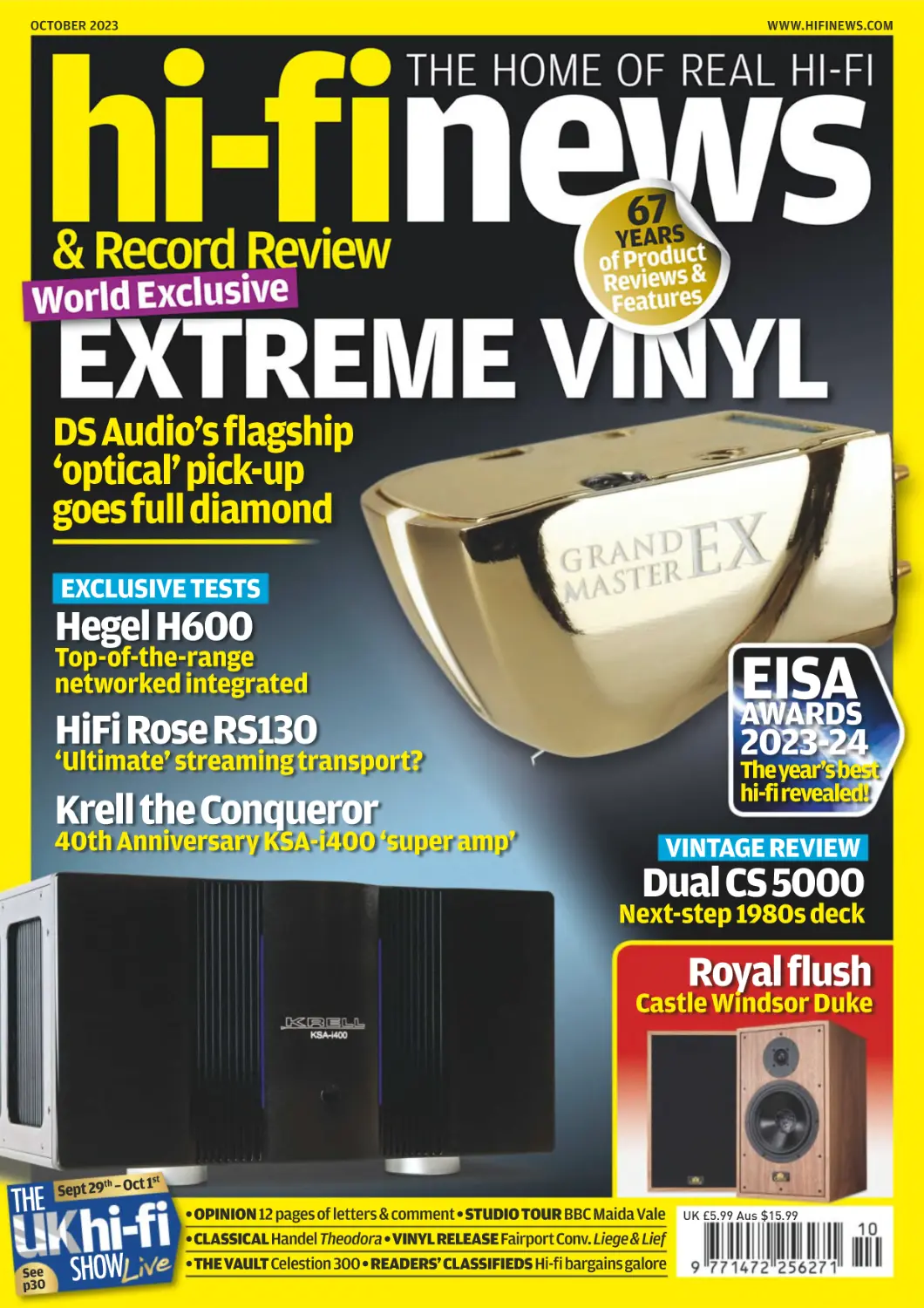
DS Audio’s flagship
‘optical’ pick-up
goes full diamond
EXCLUSIVE TESTS

Hegel H600

Top-of-the-range
networked integrated

EISA
AWARDS

HiFi Rose RS130

2023-24

‘Ultimate’ streaming transport?

Krell the Conqueror

40th Anniversary KSA-i400 ‘super amp’

The year’s best
hi-fi revealed!

VINTAGE REVIEW

Dual CS 5000

Next-step 1980s deck

Royal flush

Castle Windsor Duke

THE
See
p30

th
Sept 29 – Oct 1

st

SHOW

• OPINION 12 pages of letters & comment • STUDIO TOUR BBC Maida Vale
• CLASSICAL Handel Theodora • VINYL RELEASE Fairport Conv. Liege & Lief
• THE VAULT Celestion 300 • READERS’ CLASSIFIEDS Hi-fi bargains galore

UK £5.99 Aus $15.99

World Exclusive

THE NEW MODEL 60
The Model 60 is the most technically advanced SME turntable ever
made, evolved from 75 years of engineering excellence, innovation
and perfection, delivering precise and pure audio reproduction.
THE

SHOW

“It is no overstatement to rank the
SME Model 60 as the new standard
by which all high-end turntables
should be judged, regardless of price”

“Careful evolutionary
engineering has resulted
in one of the world’s most
capable turntables”
What HiFi June 2022

HiFi News July 2022

www.sme.co.uk

EISA AWARDS 2023-2024
79

NEWS AND OPINION

EISA Awards

29

Across no fewer than
23 pages, Hi-Fi News
reveals the very best
products as voted for
by EISA’s 58 specialist
technology magazines/websites
from nearly 30 different countries

30

VINYL & RECORD REVIEWS
104 Classical Companion

Is this the composer’s masterpiece?
Peter Quantrill scrutinises the key
recordings of Handel’s Theodora

106 Vinyl Release

A ddle-fuelled triumph... Steve
Sutherland on the 180g reissue of
Fairport Convention’s Liege & Lief

32

DEFINITIVE PRODUCT REVIEWS
42

108 Vinyl Icon

John Martyn’s mix of electronica,
rock and lyrical mysticism saw him
hit the charts in 1977 with the LP
One World. Johnny Sharp explains...

50

116 In The Studio

From the BBC Symphony Orchestra
to Dr. Who... Steve Sutherland on
London’s Maida Vale Studios

120 Music Reviews

Our selection of audiophile LP
and hi-res downloads reviewed by
our specialists alongside the latest
rock, jazz and classical albums

56

60

64

68

72

Krell Illusion II/KSA-i400

US big hitter unveils 40th anniversary
power amp promising 400W per side,
and more besides. We hook it up to
the Illusion II preampli er

DS Audio Grand Master EX

Flagship optical cartridge ups the
ante with cantilever and stylus made
from a single diamond. Is this the
ultimate in vinyl replay?

MartinLogan Motion B10

Fibreglass mid drivers, new aluminium
cone woofers... will fourth-generation
Motion speaker shake up the market?

Hegel H600

Range-topping network-attached amp
combines tech from the P30A/H30A
pre/power with an ES9038Q2M DAC

UK Hi-Fi Show Live preview

There will be plenty of gear jockying
for your attention at Ascot during
the UK’s premium ‘destination
event’ hi- show. Here’s a peek...

Top 20 Live Albums

Famous concerts, legendary gigs,
previously unheard performances...
Ken Kessler lines up the best new
live albums coming your way soon

131 Opinion

Insider comment on the hot audio
topics of the day from Barry Fox,
Jim Lesurf, Peter Quantrill, Steve
Harris and, from across the Pond,
our US correspondent Barry Willis

142 Sound Off

Loudspeaker phase, impedance and
EPDR explained; cartridge upgrade
with £1500 to spend; how Wilson
Audio mastered material science;
plus the real-world reasons digital
sources don’t all sound the same

162 Off The Leash

Some say the cassette revival is a
craze, others hail it as a comeback,
but Ken Kessler won’t be drawn until
more full-sized machines arrive

HiFi Rose RS130

Inaugural transport-only streamer
boasts ports a’plenty, an SFP Ethernet
connection and onboard OCXO clock

Castle Windsor Duke

Resounding bass, irresistible realism...
Why this British-built loudspeaker is
an all-round standmount sensation

Emotiva BasX TA2

US company unleashes its very latest
high-value integrated, this time with a
DAC, radio and subwoofer facilities

VINTAGE
148 Vintage Review

How do the classics of yesteryear
measure up today? We listen to the
Dual CS 5000 turntable from 1985

154 From The Vault
ABOVE: MartinLogan’s Motion B10 with
Gen2 Folded Motion tweeter, see p56

Welcome

A message from the editor, with a
look behind the scenes of this year’s
EISA Awards – the best international
consumer electronics revealed in
this month’s special 164-page issue

It’s HFN Oct ’92 and Martin Colloms is
taking stock of the Celestion 300 – a
speaker employing the company’s
latest thinking in transmission lines

ABOVE: We unveil the
winners of the EISA Awards
2023-2024. See p79

SUBSCRIBE!
i
print subscription See p140
OCTOBER 2023 | www.hi news.co.uk | 3

OCTOBER 23

CONTENTS

The ultimate in aesthetic and
performance, MAXXUM mitigates
vibration in the surrounding
environment to realize the true
potential of your components.

Winner of The Absolute Sound’s
2014 Golden Ear Award

MAXXUM

MADE IN THE USA
CRITICALMASSSYSTEMS.COM
MAXXUM. Winner of:

THE

SHOW

BIGGER, BOLDER
PERFORMANCE
Heritage Inspired powered monitors.

THE

SHOW

Connect to virtually any source.
HDMI-ARC, Bluetooth, Digital Optical, Phono, 3.5mm
and subwoofer connections

Free WiiM Mini included with every purchase of
Klipsch The Sevens or The Nines

T: +44 (0) 1235 511 166 | E: sales@henleyaudio.co.uk | W: www.henleyaudio.co.uk |

T&C Apply, While stocks last, visit
henleyaudio.co.uk for more info

: HenleyAudioUK |

: HenleyAudio

THE

SHOW

AUDIO SYSTEMS

T2 W

THE

SHOW

Stream Vinyl Anywhere
The T2 W is a full-feature turntable, boasting a precision engineered aluminium tonearm with a Sumiko
Rainier cartridge pre-mounted and a thick glass platter. It’s also one of the Smartest turntables available
today thanks to its built-in Wi-Fi technology, allowing you to playback your vinyl records throughout
your home reliably and in high-quality.
Control ev
everything
verything
v
ery
using the new Pro-Jectt Con
Control app.

Piano Black

Matte White

T: +44 (0) 1235 511 166 | E: sales@henleyaudio.co.uk | W: www.henleyaudio.co.uk |

Walnut

: HenleyAudioUK |

: HenleyAudio

Wireless Fidelity
Has Another Champion

Silverback 1

about the size of an A4 page, the Silverback 1s utilise their
“on-wall
position to produce spectacular, bass-rich sonics.
compatibility with System Audio’s WiSA-enabled cable-free
Stereo Hub complete the Silverback 1’s user-friendly nature.
Equally capable of laying on music or upgrading TV sound,
these good-looking on-wall models play big…

”

legend 7.2 silverback

“DSP and a wireless module
based on the hi-res-capable
WiSA platform, System Audio’s
passive legend 7.2 loudspeaker
is transformed into something
unique in its ‘silverback’ guise.
also for balanced wired connection

”

legend 40.2 silverback
most impressive of all is this
“
wireless speaker’s compelling
sound, which majors on

”

grasp of rhythm.

also for balanced wired connection

legend 5 silverback

“a beautifully elegant, and
”
also for balanced wired connection

THE

SHOW

WANDLA by Ferrum
The Converter
Ferrum is in the business of creating game-changing products. With WANDLA, we are
making a statement to the current and next generation of music lovers. WANDLA represents
tomorrow’s standard of high end digital-to-analog conversion. Think of WANDLA like a
Formula 1 racing car. Like the F1 constructor’s team building the best racing car, Ferrum
created the best engine for The Converter. We transformed our ARM chip, making it capable
of doing the work of five chips, and took the ESS Sabre DAC chip to the next level with our new
current to voltage converter. With our sleek visuals, we created a sense of aerodynamics for
the living room. By adding our unique set of digital filters, we allowed end users to fine-tune
their DACs to their specific sonic needs. We called this DDF, short for dynamic digital filtering.
WANDLA is the best your money can buy, representing the most musical and tailormade DAC
for today and tomorrow. From CD to streaming, from mp3 to super hi-res, from classical to
hard rock. WANDLA can be upgraded with HYPSOS and is the perfect companion for OOR.
WANDLA: prepare to be converted by the real thing.

THE

SHOW

Ferrum WANDLA DA Converter with preamp function
• Truly balanced design • 1 analogue and 6 digital inputs • Ferrum tuned ES9038PRO DAC • hi-res touch screen •
• remote control • unique prorietary digital filters • auto MQA sensing with bypass mode • proprietary analogue section •
• digital or analog volume control • hybrid internal power supply • upgradeable with HYPSOS • 21,7 x 20,6 x 5,0 cm •

Ferrum is distributed throughout the UK exclusively by
www.signaturesystems.co.uk

SAV
VE THE DATE:

NOW!
EXCLUSIIVE HIGH-END AUDIO ON DEMONSTRATION
LIVE MUSIC VINYL FAIR VINTAGE HI-FI VILLAGE
HI-FI WORKSHOPS PANORAMIC HEADPHONE ZONE

PLUS MEET WORLD-CLASS DESIGNERS & HI-FI PERSONALITIES
FREE CAR PARKING FULL BAR SERVICE HOT & COLD FOOD ALL DAY
For more information, updates & ticket sales:
* Friday Sept 29th

NEW

THE

SHOW

EISA AV RECIEVER 2023–2024

Primare SPA25

"Marking a welcome return to the AV receiver arena, Primare has created
a multichannel, immersive audio powerhouse that captivates with both
movie and music playback. A nine-channel design based around energyefficient Hypex Class D amplification, and supporting front speaker
bi-amping, the SPA25’s sound mixes delicate smoothness with transient
attack, bass weight and seamless soundstaging – all ready to be fine-tuned by
Dirac Live software. Other features, including the company’s well-regarded,
hi-res Prisma streaming platform, and a high-quality USB DAC input, will
satisfy two-channel audiophiles. Finally, the elegant style and premium
build quality of the SPA25 ensures it looks as good as it sounds.""
Exper t Imaging and Sound Association Official Citation

For details, go to primare.net

*

*with future update

karma
a

u

d

i

o

-

v

i

s

u

a

l

Authorised United Kingdom Distributor

01423 358846

karma-av.co.uk
info@karma-av.co.uk

These new power
amplifiers represent a
significant technological
and æsthetic evolution in
the renowned tradition of
Burmester amplification.
THOMAS SCHNEIDER
T E A M LE A D ER Q UA LI T Y M A N AG EM EN T

216 POWER AMP
TO P LI N E

218 POWER AMP
R EFER EN C E LI N E

SCAN THE Q R CODE
TO DI SCOVER M ORE

OFFICIAL UK BURMESTER DEALERS
HI FI CORNER

DOUG BRADY HIFI

DNA AUDIO

CRITERION AUDIO

AUDIO LOUNGE

0131 556 7901
struan@hificorner.co.uk
www. hificorner.co.uk

01925 828009
sales@dougbradyhifi.com
www. dougbradyhifi.com

01943 850 650
info@dnaaudio.co.uk
www.dnaaudio.co.uk

01223 233730
mike@criterionaudio.com
www.criterionaudio.com

020 7487 4080
hello@audiolounge.co.uk
www.audiolounge.co.uk

# Audiophile
Instruments
Solitaire S

Discover the
Solitaire S
speakers

Engineering Emotion

THE

SHOW

800.2

Never settle for anything less than perfect Musical Fidelity

T: +44 (0) 1235 511 166 | E: sales@henleyaudio.co.uk | W: www.henleyaudio.co.uk |

: HenleyAudioUK |

: HenleyAudio

Advertisement: Dynaudio Focus

Close your eyes
and dare to stream
Dynaudio’s Focus speakers are high-end streaming
machines. Their cutting-edge audio tech gives you
a world’s worth of music at your fingertips

Isn’t it nice to see a tech-packed speaker that doesn’t look like
something from outer space? In fact, Focus’s simple, elegant
design conceals far more processing horsepower than we
used to get to the moon.
Streaming is placed front and centre. With Spotify Connect,
Tidal Connect, Apple AirPlay 2, Google Chromecast, Roon,
Bluetooth and local network capabilities on board, Focus can
play literally anything stored in digital form, from anywhere you
can access it – online or on a networked hard-drive at home.
In fact, if it’s been released as any recording, Focus will play
it… Anything stored on a networked hard-drive. Digital sources
via coaxial or optical inputs. Analogue sources via line-in. Even
a turntable or ancient 8-track machine, if it has the right
connectors (or adaptors).
Dynaudio has also included WiSA streaming. Focus can
connect wirelessly to your TV (and therefore anything else
connected to it) and take the place of a hulking AV receiver/
cable tangle/equipment stand/dust-magnet combination. The
only downside? Your cat won’t be able to warm itself on your
amplifier any more…
In fact, the only thing the speakers need is a network
connection (wired or wireless) and one mains socket each. It’s
never been this easy to listen to music in such high quality.

Your music, your way
Focus is a high-end active system. Each individual drive-unit
has its own custom amplifier (the same type Dynaudio uses in
its flagship professional studio speakers). Each amp is matched
in performance for its woofer, midrange driver or tweeter which means it can be dialled-in to a stunning degree of
accuracy.
Thanks to sophisticated DSP (digital signal processing)
based on the same type you’ll find in Dynaudio’s pro studio
monitors, Focus speakers can optimise their performance for

Focus series

their position in your room. Just tell them where they are – near
to a wall, in a corner or in free space – and they’ll do the rest.
They’ll even auto-compensate their EQ when you apply or
remove their magnetic grilles. And if you want to dig deeper
down the calibration rabbit-hole, there’s optional Dirac Live
optimisation for performance tailored to your specific room. You
can do this yourself with an external microphone, or you could
ask your Dirac-certified dealer to do it for you when they deliver
your speakers.
And – of course – all Focus speakers use Dynaudio’s
legendary soft-dome tweeters, proprietary MSP (Magnesium
Silicate Polymer) woofers, and beautifully finished furnituregrade wooden cabinets. They’ve been designed, tuned,
measured, tested and constructed with all the care and
fanatical attention to detail the company pours into its very
highest-end speakers.

Outside the box
Isn’t it nice to have something
other than amps and sources
between your speakers?

Set-up and control
Everything is set up from the simple, intuitive Dynaudio Set-up
and Control app. It’s free, and it’s available for iOS and Android
devices. Configure your speakers, tell them where they’re
positioned for the DSP to do its thing, connect them to your
network, assign favourite presets and more – all from one

connection to the material. Or if you fancy something a little
more stark, you could go for the Black or White High Gloss
– both equally sumptuously finished in many layers of thick,
mirror-like lacquer.
We know many of you want true high-end sound without

place. Then you can use either the included Bluetooth remote
control or your mobile device to control your music. Just pick
your Focus speakers from within your streaming app and off
you go.
These speakers are digital – and digital means they can be
updated. Dynaudio can send out periodic firmware updates,
which download automatically to your speaker.
And – of course – Focus wouldn’t be a Dynaudio speaker if it
didn’t look stunning. They’ve chosen two classic natural
finishes, Walnut Wood and Blonde Wood, to complement any
interior. They’re tactile, too – ones that give you a proper

stacks of rectangles between your hi-fi speakers – and without
buying something that looks like an alien spaceship. Now you
can. Focus is authentic, premium Danish hi-fi without the fuss.
It’s your complete streaming sound system.

WANT TO KNOW MORE?
Visit our website for more or to find a dealer and
book your next listening session: dynaud.io/focus

Focus series

THE

SHOW

Authorised Retailers

OCT/23
ABOVE: HiFi Rose’s range is blossoming with new products, including
the class-leading RS130 music library/streaming transport. See p64

ABOVE: Is Hegel’s mighty H600 network-ready agship the most
powerful integrated on the market? Turn to p60 to nd out...

W

hile the
seasonal,
economic
and political
climates remain
as unpredictable as ever, at
least each new edition of your
favourite hi- magazine still
arrives on time, packed with
exclusive content – and this
month, bigger too!
Your October issue of Hi-Fi
News has expanded into a
bumper 164-page offering
where, as the exclusive UK
member of EISA’s Hi-Fi Expert
Group, we can reveal the
cream of the crop, as tested,
judged and voted for by the
most respected quarters of the
international audio press.
I was privileged to be
returned as President of
this great Association
for a second term,
spearheading our
international celebration
of the best consumer
electronics of the
season. Of course, EISA’s alliance
of Expert Groups extends beyond
hi- to include home theatre
and TV products (our sister title
Home Cinema Choice is the UK
member), photography (Amateur
Photographer is also UK-based),
in-car and mobile devices. That’s
58 publications, spanning no
fewer than 29 countries.
Once again, the Association
hosted over 50 webinars with
key CE (consumer electronics)
brands over the spring months.
With a signi cant number of

products – hotly anticipated higear in our instance – revealed
exclusively to EISA members for
independent testing, Hi-Fi News
has remained the go-to choice
for discerning audiophiles.
Turn to p79 for the full list
of all 80+ Award winners and
join us at the UK Hi-Fi Show Live
on 30th Sept-1st Oct [p30]
where many of the EISA Awardwinning products will be on

‘Famous designers
will quench your
burning hi-fi queries’

MUSIC: John Martyn recovers his mojo
on our Vinyl Icon, One World (p108),
while Steve Sutherland recounts Fairport
Convention’s re-writing of the rulebook
as Liege & Lief is re-released on LP (p106)
RIGHT: HFN is the UK’s representative
of EISA’s Hi-Fi Expert Group. Editor Paul
Miller took over as EISA’s President in
June 2016 and was re-elected in 2021

demonstration, hosted by the
designers and CEOs who will be
present to answer your questions.
On the day entry will be
available at Ascot’s Ticket Of ce
East (https://hi showlive.com/
directionsparking) but you still
have time to grab a fast-track
ticket (https://hi showlive.
com/faq/how-buy-tickets) and
avoid the queues. After a threeyear pause, I look forward to
welcoming you all!
PAUL MILLER GROUP EDITOR

HI-FI NEWS’ EXPERT LINE UP: THE FINEST MINDS IN AUDIO JOURNALISM BRING THEIR EXPERIENCE TO BEAR ON ALL AREAS OF HI-FI & MUSIC

BARRY FOX
Investigative journalist
supreme, Barry is the
rst with news of the
latest developments
in hi- and music
technologies

PETER QUANTRILL
Peter Quantrill has
been writing about
music for magazines
and record labels for
30 years. He is HFN’s
master of the classics

KEN KESSLER
is a long-serving
contributor, luxury
goods writer and
champion for the
renaissance in valves
and reel-to-reel tape

MARK CRAVEN
Editor of our sister title
Home Cinema Choice,
Mark’s passion for
music extends from
stereo to multichannel
and Dolby Atmos

TIM JARMAN
Co-author of a major
hardback on historic
B&O equipment, Tim
continues to research,
repair and write about
vintage hi- for HFN

ANDREW EVERARD
has reviewed hi- for
over 30 years and
is still effortlessly
enthusiastic about new
technology, kit and
discovering new music

STEVE SUTHERLAND
worked on Melody
Maker and then edited
NME from 1992-2000,
the Britpop years. Steve
brings a unique slant to
our Vinyl Release pages

OCTOBER 2023 | www.hi news.co.uk | 29

Tickets
On Sale
Now!

live.com
www.hi show

Last hosted at the prestigious Ascot Grandstand in 2019, the UK’s dedicated
high-end audio show returns in 2023 with the ‘who’s who’ of world-class hiOne of many highlights of distributor
Signature Systems’ huge second-floor
room will be Thorens’ TD 124 DD 140th
Anniversary turntable. Presented in
the UK for the first time by CEO Gunter

Kürten himself, this reimagining of the
TD 124 DD is limited to 140 models.
Upgrades include a new hand-polished
wood finish, dual-layer platter and
special edition SPU 124 cartridge.

PMC Distribution
UK will demonstrate
PMC’s fantastic fact
fenestria agship
[HFN Aug ’21]. The
result of a ve-year
design process focused
on removing unwanted
colouration introduced
by the cabinet itself, PMC
dubs it ‘the loudspeaker
you’ll never hear’, but you
can hear it yourself at The
UK Hi-Fi Show Live. Also on
demonstration will be two stunning
MartinLogan electrostatic loudspeakers:
the Renaissance ESL15A with dual 12in
woofers and ARC room correction, and the ESL X. Visitors
will also be among the rst in the UK to hear AVM’s
CS8.3 black edition [HFN Dec ’22], a premium all-in-one
player (including CD drive) with tube line/preamp stage.
30 | www
www.hi
hi news
news.co.uk
co uk | O
OCTOBER 2023

Here’s Mike Smith from Focal UK,
who will be serving up the latest
Bathys, Utopia, Stellia and Clear MG
cans from the headphone bar, with
panoramic views, on the 6th floor of
the Ascot Grandstand. After treating
your ears to some high-end ‘personal
listening’, be sure to check out
Naim’s new reference-level 300 Series
components. Headlined by the NAC
332/NAP 350 pre/mono amplifiers,
this hotly anticipated range also
includes the NSS 333 streaming DAC
and NVC TT switchable MM/MC
phono stage, plus hefty outboard
power supply upgrades.

EVENTS Latest from the UK’s only high-end hi-fi show

29th-01st Sept/Oct

After a brief hiatus, Germany’s SPL
has returned to the UK via distributor
Decent Audio. Come to the UK Hi-Fi
Show Live to hear its superb 768kHz/
DSD256-capable Diamond USB DAC/
preampli er [HFN May ’23] and be
seduced by its striking red casework...

Exhibitors explore the facilities at the
Ascot Grandstand, planning to deliver
the best listening experience for our
visitors. Too numerous to namecheck –
famous faces from B&W, MA, Yamaha,
Kudos, Naim, Focal and Fine Sounds...

‘The future of audio streaming’ is
how digital playback specialist Auralic
describes its new Aries G2.2 wireless
streaming transport (above) and
Vega G2.2 streaming DAC (below).
Experience them both for the rst
time at The UK Hi-Fi Show Live!

Advance tickets are now on sale for the UK’s premier highend audio event – The UK Hi-Fi Show Live, hosted at the Ascot
Racecourse Grandstand, High Street, Ascot on Saturday 30th
and Sunday 1st Sept/Oct 2023. Tickets will cost just £20 (£30
for a weekend pass) via www.eventbrite.co.uk or via the link
on the www.hi showlive.com website. Concessionary £15
day passes are being offered by e-mail for subscribers of Hi-Fi
News and Hi-Fi Choice. Free admittance is offered to NHS
workers, registered helpers and accompanied under-16s.
See our website for further information.
In development for three
years, Brinkmann’s Voltaire
is now ready to delight
audiophiles.
An integrated
tube/hybrid
amp rated at
250W/4ohm,
its standard
line inputs
may be fortified
with optional Nyquist
II streaming DAC and Edison II
phono modules, and it will break cover
at The UK Hi-Fi Show Live.

Leveraging technologies from
its existing ampli ers in the range,
Chord’s ULTIMA Integrated is a
2x125W full-width model boasting
the UK marque’s customary attention
to detail and exquisite build quality.
It promises sweet sounds at The UK
Hi-Fi Show Live alongside a selection
of other Chord models.

Russ Andrews will present core models
from its range of class-leading power
products (including the new Clarity Pro
2), plus interconnects and speaker cables
from Kimber Kable. A demo ‘with a twist’
will feature Kimber’s flagship Naked
interconnects [HFN Mar ’22, pictured]
and Carbon 18XL speaker cables.

Following its EISA Award-winning
SourcePoint 8 loudspeakers [see p91],
MoFi Electronics’ focus has turned
to vinyl playback. Making its debut
at The UK Hi-Fi Show Live will be the
MasterPhono phono
preamp, a fully
dual-mono design
from the pen of
industry legend
Peter Madnick, and
MoFi’s MasterDeck
turntable. UK
distributor Karma
AV will also
showcase the new
limited edition
of Perlisten’s
astonishing S7t
oorstander [HFN
Apr ’22], in a
system featuring
four bridgedmono Primare
A35.2 amps and
cabling from InAkustik. Set your
ears to stun...

OCTOBER 2023 | www.hi news.co.uk | 31

LIVE ALBUMS

JONI MITCHELL IMAGE: PAUL C. BABIN

From stage to stereo

Gabriel Mervine to Motörhead, Paco de Lucía to The Who... Ken Kessler brings you a
score of sonic spectaculars as he sorts through the live albums coming your way soon

T

hanks to the record industry’s
obsession with exploiting
anniversaries and archive trawling,
live albums no longer mean only
LPs or CDs released close to the actual gig
as souvenirs, or as painless ways for artists
to ll out the last obligation in a contract.
The 20 new or recent live releases chosen
here cover a range of types, starting with
the most common: remastered reissues
of much-loved live sets, as represented by
Creedence Clearwater Revival. Conversely,
the newest trend in live albums is that of

rockers enjoying orchestral backing, heard
here via The Who at Wembley.

ROCKIN’ RESURRECTIONS
Many of the albums in this gathering are
those which enthusiasts could only dream
about: previously unreleased, legendary
gigs, some once available – if at all – solely
as bootlegs of iffy quality and obvious
illegality. Thus, we welcome archive
treasures from Jimi Hendrix, Stephen
Stills, Paco Di Lucía and more. Note, too,
many are 50th anniversary-related, as the

NEIL YOUNG

MARSHALL CRENSHAW

Somewhere Under The Rainbow

The Wild Exciting Sounds
Of Marshall Crenshaw

Shakey Pictures Records 093624885030 2CDs

Printed on the corner of the
cover is the date ‘Nov. 5,
1973’, which tells you that
this latest in the ‘Neil Young
Archives Original Bootleg
Series’ was timed perfectly for
its 50th Anniversary. Recorded
with the Santa Monica Flyers
between Harvest and On The
Beach, it makes reference to
various of Young’s previous
bands [see Stephen Stills, p35]
but it’s mainly foreshadowing
the album Tonight’s The Night,
which wouldn’t arrive until

industry can’t resist the celebratory angle,
eg, Neil Young At The Rainbow.
Archive discoveries also feed another
trend, perfect to inspire multi-disc sets:
reissues of studio LPs augmented by
unreleased live gigs, as in the Alice Cooper,
Little Feat and Marillion sets. And there’s
another new-ish live sub-genre. This is the
fashion for performing classic studio titles
live in their entirety, this time with Graham
Nash giving us two of his solo albums in
concert. If live recordings are your thing,
you’ve never been better served.

Sunset Blvd Records CD-SBR-7003 2CDs

1975. Legendarily messy,
intense and bootlegged a
number of times, it’s a tough
album to absorb. Nevertheless,
this is an essential part of
Young’s rich legacy.

32 | www.hi news.co.uk | OCTOBER 2023

Here’s another interesting live
album concept: the subtitle
‘Live In The 20th and 21st
Century’ refers to CD1’s gigs
dating from 1982-3 and CD2’s
sets taking place in 1991
and 2014. These divides give
an overview of MC’s career,
the older material more
familiar as it contains nearhits such as ‘Cynical Girl’ and
‘Someday Someway’, while
the newer stuff maintains the
youthfulness decades on.

For my money, Crenshaw
remains one of the best pure
pop practitioners since Emitt
Rhodes and Michael Brown, and
is the true heir to the Buddy
Holly legacy. Simply delicious.

BECK, BOGERT & APPICE

Live In Japan 1973, Live In London 1974
Atco/Rhino 603497833252 4CDs

Jeff Beck’s fans always
wondered ‘what if’ about
BB&A. With ex-members of
Vanilla Fudge and reckoned
to be a sort of Cream
2.0, they gave us just one
studio album and Live In
Japan 1973 which forms
the basis of this set. It is
now a memorial of sorts:
Beck and Appice mixed the
albums from multitracks
that sat in Beck’s archive
for nearly 50 years, making
this one of the last releases
he worked on before
his death. Doubling the
pleasure is the complete,
previously-unissued gig
at London’s Rainbow
Theatre from the 26th of
January 1974. The classy
package – also on four
LPs [603497833269] –
includes a superb booklet.

MOTÖRHEAD

We Play Rock ’n’ Roll
BMG/Montreux Jazz BMGCAT792DCD 2CDs

If you forgot Deep Purple’s
‘Smoke On The Water’ was
about Switzerland’s legendary
concert series, or imagined it
eschewed rock, this is subtitled
‘Live At Montreux Jazz Festival
’07’. And who rocked harder
than Motörhead? The two CDs
essentially give you the band’s
‘best of’, and unlike previous
entries in this magni cent
series – see Paco De Lucía
below – it’s one entire concert
rather than a compilation.
Lemmy would have loved it.

PACO DE LUCÍA

GABRIEL MERVINE

THE WHO

THE DUCKS

BMG/Montreux Jazz BMGCAT582DLP 2x180g vinyl

Octave Records OCT-0036 stereo SACD

Polydor 3894498 2CDs/1x Blu-ray

Shakey Pictures Records 093629885059 2CDs

If you saw They All Came Out
To Montreux on BBC 4 you’ll
know why this series is so
cherished. Guitarist de Lucía
is represented by eight tracks
from three concerts that took
place in 1984, 2006 and 2012,
to provide an interesting study
of his evolution as a musician.
Gorgeous, jazz-in uenced
amenco, this set is a natural
companion to Friday Night In
San Francisco recorded with Al
Di Meola and John McLaughlin.
Fittingly, McLaughlin wrote this
album’s liner notes.

Octave’s rst-ever live SACD is
an unplugged gig by trumpeter
Gabriel Mervine, performing
Latin-tinged material backed
by accordion, upright bass and
drums. The sound is superb,
recalling JVC’s legendary
audiophile LPs, though it
eschews Flamenco Ole!’s
woofer-busting kicks or cannon
blasts à la Telarc’s 1812
Overture. Mariachi moments,
bossa nova swing – there’s so
much air, space and bottomend it could serve as an entry in
the label’s Art Of Hi-Fi series.

With music close to immortal,
The Who can withstand the
orchestral treatment. It actually
augments the grandeur that
is inherent in the material,
though some numbers do
without the backing. The
Blu-ray disc gives you the
entire concert with a choice of
stereo or two surround modes,
while the two CDs provide the
purist’s preferred music-only
stereo alternative. The 20
tracks mix the obvious and the
obscure, though a couple of
the biggest hits are missing.

Oft-bootlegged, but now part
of the ‘Neil Young Archives
Original Bootleg Series’ [see
p32], this steeped-in-myth
group was one of Young’s
shortest-lived projects at
a mere seven weeks; one
member was a legend in his
own right, Moby Grape’s Bob
Mosley. A 1977 foray into
country-ish rock, it’s a tempting
taste of ‘What if...’ like BB&A
above, the band performing
Young’s material, Moby Grape
tunes, and standards. Another
surprise? The sound is superb.

The Montreux Years

Live At Nocturne

With Orchestra Live At Wembley

High Flyin’

OCTOBER 2023 | www.hi news.co.uk | 33

THE

SHOW

True Japanese tradition and craftsmanship, refined for HiFi since 1954 and
trusted by musicians for over 130 years. The R-N2000 HiFi receiver brings
heritage styling and sensibility to modern functionality, delivering a refined
musical performance worthy of the very best that Yamaha stands for.

From one of the pioneers of planar-magenetic technology,
with a lineage that goes back to the 1970s, the YH-5000SE
ORTHODYNAMIC™ headphones serve up effortless detail and
intimacy that will take your breath away.

LIVE ALBUMS

ALICE COOPER

MARILLION

JIMI HENDRIX EXPERIENCE

Warner/Rhino R1 681028 3LPs; R1 681029 3LPs

Parlophone 5054197361768 5LPs

Sony/Legacy 19658724672 CD

This pair of stunning 50th
anniversary reissues of the
band’s third and fourth LPs
delivers remastered studio
albums and unreleased tracks,
as well as previously unissued
concerts from 1972. To the
delight of collectors aware of
the originals’ lavish packaging,
both include all the extras, so,
yes, School’s Out contains a
pair of lacy knickers. This band
was, I posit, the ur glam out t,
so Bowie, The New York Dolls,
The Sweet and others owe
them a huge thanks.

Employing the ‘added live
content’ formula, this 2023
remix of Marillion’s fth studio
album from 1989 adds a twist:
the live set is recent – 2022
– instead of an archive gig.
Filling three LPs, it’s Seasons
End performed in its entirety,
emulating the trend for playing
whole albums live. Their rst
after the departure of Fish, it
yielded three singles and is
now one of Marillion’s most
luxurious sets to date. It’s also
available as a 3CD/Blu-ray set
with other bonuses.

What’s so staggering about this
show from the 26th of April
1969 is how fresh it sounds,
thanks to a new remix by Eddie
Kramer. Performed just prior to
Woodstock, the group was at
its peak. Even at 72 minutes,
you’ll want more, thanks to
an early rendition of ‘The Star
Spangled Banner’ while ‘Red
House’ makes you wish Jimi
played more blues. The set
includes a foreword by ZZ Top’s
Billy Gibbons, who was there.
Also on double LP [Sony/Legacy
19658724681].

Killer & School’s Out

Seasons End Deluxe Edition

Los Angeles Forum

CREEDENCE CLEARWATER
REVIVAL
At The Royal Albert Hall

Craft Recordings 00888072406605 CD

One of the most ‘American’
of all the late-1960s bands,
Creedence Clearwater Revival
brought their swampy brand of
rock to London and delivered
a gig to match their best. That
they were afforded the Royal
Albert Hall for the opening
concert of their rst European
tour, in April 1970, speaks
volumes. The songs show
why the band is so fondly
remembered: ‘Proud Mary’,
‘Bad Moon Rising’, ‘Travelin’
Band’ and ‘Fortunate Son’.

STEPHEN STILLS
Live At Berkeley 1971

Omnivore Recordings OVC-515 CD

Back in Aug ’71, concurrent
with Crosby, Stills, Nash
& Young being global
superstars and his next
band’s debut – Manassas
– only a few months away,
Stills’ solo career was at
its hottest. His eponymous
debut of 1970 was a hit
and the sequel, Stills 2, had
been released that June,
just two months earlier, so
this concert found the
ex-Buffalo Spring eld
genius with both new
material to promote and a
massive back catalogue to
exploit. His band included
stalwarts such as Dallas
Taylor and ‘Fuzzy’ Samuels,
while no less than David
Crosby turned up for duets
on ‘You Don’t Have To Cry’
and ‘The Lee Shore’. It has
been well worth the wait.

JONI MITCHELL
At Newport

Rhino 603497832071 CD; 603497832088 2LPs

A surprise for her devoted fans:
Ms Mitchell had been keeping
a low pro le but arrived at the
2022 Newport Folk Festival for
her rst concert in 20 years.
Following a number of amazing
box sets restoring her back
catalogue and opening up her
archives, this performance
complements the reissues and
brings her story up to date.
The 13-track set includes ‘Big
Yellow Taxi’, ‘Both Sides Now’
and ‘The Circle Game’, with
liner notes by Cameron Crowe.
OCTOBER 2023 | www.hi news.co.uk | 35

An investment in time well spent.
Introducing the MODEL 40n, engineered and crafted to bring the iconic Marantz sound to the
next generation of music and entertainment. Master tuned to deliver rich, hi-resolution audio,
it features built-in streaming, HDMI, and full complement of analog and digital inputs for
luxurious listening from any source. Simply add speakers and indulge yourself in the moments.

The Most Musical Sound
marantz.com

LIVE ALBUMS
ERIC CLAPTON

The Definitive 24 Nights
Reprise 093624866404 6CDs/3xBlu-ray

Clapton’s historic run of
18 nights at the Royal
Albert Hall in 1990 and 24
in 1991 were noted for
EC performing with three
different lineups: a rock
band, a blues band, and
an orchestra. Yielding one
of the most bountiful sets
a fan could want, there’s
a get-out clause: this is
the complete, six-hour
long compilation on CD
and Blu-ray, and there’s a
comprehensive vinyl set,
too, but you can opt for
less-costly editions on LP,
CD or DVD containing
just the rock, blues or
orchestral events. This
is Clapton as national
treasure, a reminder
of why the graf ti said
‘Clapton Is God’, and it’s a
monumental achievement.

GRAHAM NASH

Live: Songs For Beginners/Wild Tales
Proper Records PRPLP161 2LPs; PRPCD161 CD

These live takes of Nash’s best
and earliest solo albums, Songs
For Beginners (1971) and Wild
Tales (1973), were recorded
during one of the breaks from
Crosby Stills & Nash (and/or
Young). They sound like CSN/
CSNY efforts because of shared
personnel – just like the others’
solos. Presented in their
entirety in concerts recorded
in 2019, they were mixed
by producer Kevin Killen and
mastered by Bob Ludwig, both
winners of Grammy Awards.

THE BLACK CROWES

RORY GALLAGHER

THE ROLLING STONES

LITTLE FEAT

Arrow Records SAR27 2CDS

Cadet Concept 4882495 2CDs; 4882500 3LPs

Universal 4811582 2CDs

Rhino/Warner R2 695370 2CDs; R2 695371 2CDs

The Crowes’ ‘entire-albumplayed-live’ offering is their
1990 debut, performed during
the 2021-22 world tour. A
perfect companion to the
30th anniversary box, which
included a live-in-1990 set, this
release adds seven numbers to
the original track listing, plus
superb covers. It’s something
they do so well, viz, Otis
Redding’s ‘Hard To Handle’.
This time, there are nods to
Lou Reed, the Rolling Stones
and The Temptations, the set
rocking from start to nish.

Much-missed, blues belter
Gallagher was known as much
for his live albums as his studio
titles, so the fans – which
include A-list guitarist admirers
like Clapton, Page, and Slash –
will revel in this 23-track double
CD. The previously-unreleased
material was compiled from
two nights at the Town &
Country Club in London in
December 1990, in support
of his last studio album, Fresh
Evidence. Mixed from recentlyfound multi-track tapes and
mastered at Abbey Road.

I stopped counting live Stones
albums after the run of multidisc sets (L.A. Forum, the
Marquee, ad in nitum), but
2012’s Grrr!, celebrating their
50th anniversary, was a muchloved compilation so a live
version of it earns a pass. This
gives us 26 of the tracks (there
was an 80-track version…)
recorded in December 2012,
with guests including Lady
Gaga famously joining them
wearing unfeasibly high heels.
Deep of pocket? There’s also a
Japanese edition with a Blu-ray.

As per Marillion and Alice
Cooper in this round-up, two of
Little Feat’s classic albums have
been beefed up with live sets
comprised of whole concerts,
as well as unreleased material
dubbed ‘Hotcakes, Outtakes
And Rarities’ (recalling an
earlier box set of rare items).
Sailin’ Shoes adds a gig from
1971, Dixie Chicken’s is from
1973, but interestingly the live
content doesn’t replicate the
studio track listings, so you are
treated to a broader taste of
this phenomenal band.

Presents Shake Your Money Maker Live

All Around Man - Live In London

Grrr Live!

Dixie Chicken & Sailin’ Shoes

OCTOBER 2023 | www.hi news.co.uk | 37

absolute sounds ltd.
International Distributors & Consultants of Specialised Hi-End Home Audio & Video Systems
58 Durham Road, London, SW20 0T W
absolutesounds.com

T: + 4 4 ( 0 ) 2 0 8 9 71 3 9 0 9

info@absolutesounds.com

F: +44 (0)20 88 79 79 62

THE

SHOW

For Your Nearest Dealer Please Visit The Absolute Sounds Website

Exclusive Product Launch at
The UK Hi-Fi Show Live
Thorens would like to welcome you to the official product launch of the
TD204DD and to view our full range of Turntables for the first time at
The UK Hi-Fi Show Live, Ascot Grandstand on the 30th September –
1st October 2023.

We are delighted to announce that Gunter
Kürten (Thorens CEO) will be attending the
show this year. Gunter is really looking meeting
UK audiophiles and exiting owners of Thorens
Turntables. Gunter would like you to join him for
a demonstration of Thorens products in Royal
Ascot Racing Club South room.

“The look is 100% correct, and
the sound is better than I recall
of the original”
Ken Kessler - hi-finews

This provides powerful torque, allows precise speed
control, and keeps unwanted vibrations from the drive
away from the platter. A brand new tonearm, the TP 124
can be precisely adjusted in all parameters to the
cartridge of choice and features an innovative
anti-skating solution with a ruby bearing and a patented
electric tonearm lift to facilitate gentle placement and
removal of the stylus. Thorens has payed attention
to every detail when developing the
new TD 124 DD to ensure that it meets your
highest aspirations in sound performance.

TD124/SPU 124 £8000/£2000

TD201

£550

TD102A

TD403DD

TD101A

£765

TD204

£1,450

TD1500

£575

£850

£1,999

TD202

TD402DD

£675

£925

TD1600

£2,800

TD1601

£3,300

“The build, looks and price are irresistible, but its the sound quality that will delight
this seeking an amalgam of vintage and modern. The TD1500 nails it!”
Ken Kessler - hi-finews

THE

AUDIO SYSTEMS

SHOW
Distributed by Signature Audio Systems,
T: 01959 569842 M: 07738 – 007776
or by e-mail to: info@signaturesystems.co.uk web: www.thorens.com

PRE/POWER AMPLIFIERS

Pre/power amplifier. Rated at 400W/8ohm
Made by: Krell Industries LLC, Orange, CT, USA
Supplied by: Absolute Sounds Ltd
Telephone: 0208 971 3909
Web: www.krellonline.com; www.absolutesounds.com
Prices: £13,500/£40,998

Krell Illusion II/KSA-i400
Developed to celebrate Krell’s 40th anniversary, the KSA-i400 combines all the brand’s
proprietary circuit ideas in one very powerful ampli er. We partner it with the Illusion II
Review: Andrew Everard & Paul Miller Lab: Paul Miller

O

ver time, most hi- brands
develop an image: ask any
audiophile and you’ll be told
this one is warm, that one is all
about rhythm and timing, and another is
‘bright and detailed, but I could never live
with it’. Of such generalisations, myths are
born, and I’d say it’s a pretty safe bet that
most enthusiasts ‘know’ what Krell is all
about – big, heavy, and massively powerful
American amps, with the ability to drive
just about any speaker to any level you
want, or could imagine.
Of course, the name helps. Derived from
the extinct race of highly advanced beings
at the heart of the 1956 sci- classic
Forbidden Planet, it gave the brand instant
mystique when it made its debut at the
beginning of the 1980s. Well, that and the
company’s trademarked slogan ‘The Leader
in Audio Engineering’. Myth becomes
legend, and those with a stereotyped view
of Krell’s place in the hi- rmament will
nd plenty of con rmation in its latest
power ampli er, the £40,998 KSA-i400.

POWER OF THE ID
It is massively powerful – rated at 400W/
8ohm – and exceptionally heavy at 73kg.
Developed to mark the company’s 40th
anniversary a couple of years back, it’s
one for use on the oor, or a dedicated
platform. For the purposes of this review
we have added the company’s £13,500
Illusion II preampli er, a design that’s been
around for a while despite largely escaping
the attention of the quality hi- press.
Offering both digital and analogue
inputs, this preampli er is served by an ESS
Sabre DAC giving it limited 192kHz/24-bit
capability. Even when the unit appeared
– getting on for a decade back – the
company acknowledged it had been
too late in the development process to
include a USB digital audio input, and now
RIGHT: Inside the Illusion II with large toroidal
transformer and multiple PSUs [far right]
supplying three stacked ‘digital’ PCBs [centre]
and the two stacked L/R balanced ‘analogue’
preamp PCBs [left]. There is no USB hub included

42 | www.hi news.co.uk | OCTOBER 2023

that looks like even more of an omission.
Third-party S/PDIF-to-USB converters are
available, of course [HFN Feb ’17].
There’s nothing whatsoever backward
with the Illusion II as a purist preamp, as
we’ll discover, but the digital audio game
has moved on apace, and the provision
here accords with the legacy white on blue
dot matrix display. There’s no indication
yet, but Krell will surely have a preamp in
the works with extended digital provision,
perhaps with streaming onboard, and, on
my wishlist, a crisp colour OLED display.
The latest in a long line of Krell power
amps, the new KSA-i400 draws heavily
on the company’s in-house technology,
developed over many years, as Dave
Goodman, Krell’s Product Director,
describes in his interview with PM [see
sidebar, p45]. The headline claim is that

the KSA-i400 delivers its entire output, all
the way up to the speci ed 400W/8ohm,
in non-switching Class A, thanks to the
company’s iBias circuitry, and does so ‘with
absolute accuracy but without the heat
produced by a traditional Class A design’.

COOL RUNNING
As Krell explains it, this is achieved by
maintaining a ‘low preset current level.
It doesn’t matter what the signal is doing
or how the speaker impedance changes
with frequency, by maintaining that
preset current level the ampli er is always
operating in Class A’. As PM notes in his
boxout [p44], this iBias technology has
been at the heart of Krell’s power amps
for the better part of a decade, and the
KSA-i400 adds to it with a slew of other
proprietary elements, including ‘XD’

OCTOBER 2023 | www.hi news.co.uk | 43

and ‘Sym-Max’ which aim to tackle any
asymmetry in the ampli er’s balanced,
differential, and direct-coupled circuitry.
Running to 16 pairs of high-power audio
transistors and 8 pairs of driver transistors,
correcting for any slight differences in
their characteristics is not trivial. Thermal
equilibrium is maintained by mounting all
these devices on a continuous run of alloy
heatsinking [see pic, p45].

Two huge 2700VA transformers are
stacked under a total 188,000 F of lter
capacitance in the amp’s power supply,
while gold-plated PCB tracks and silverplated copper bus-bars keep all subsequent
losses to a minimum. This massive supply
underpins Krell’s claim that power keeps
doubling, to 1600W into 2ohm, with the
ability to drive 1ohm loads, and with peak
current at 62A [see PM’s Lab Report, p49].

CLASS A ALL THE WAY?
Over 40 years since Krell’s iconic Class A power amps [HFN Nov ’21 & May ’11] hit
the high-end, and over the last two decades of the brand’s steady evolution [see
interview sidebar, p45], the company is now offering very re ned, sophisticated
ampli ers, packed with proprietary thinking but still underpinned by prodigious
power. The fully balanced, direct-coupled ‘current mode’ ampli cation has been
the backbone of its ampli ers for some time but the ‘XD technology’ [not to
be confused with Cambridge Audio’s XD ‘crossover displacement’ output stage
technology – HFN Jun ’14] is more recent. Here the ampli er’s output impedance
is reduced as far as possible, without impacting on stability, to improve its
resilience to low and variable impedance speaker loads. The KSA-i400’s input
and driver stages have all been optimised for the wide open-loop bandwidth and
enhanced transient performance of this revised output stage.
Krell’s iBias (intelligent Bias) output stage technology has been a staple for
some ten years [HFN Oct ’14], claiming to offer the ‘sonic bene ts of Class A
operation without the heat and power consumption of traditional designs’.
In practical terms, rather than maintain a constant, high standing current (or
bias) in the output stage – the effective, but inef cient, Class A approach to
eliminating NPN/PNP transistor crossover distortion – iBias dynamically adjusts
the output stage idle current to suit the music signal. ‘Sliding bias’ technologies
have been with us since Technics’ ‘New Class A’ and JVC’s ‘Super-A’ regimes of
the 1980s but iBias claims a better correlation with the music signal. Instead of
‘guestimating’ the optimum bias from the input signal voltage and presumed
8ohm load, iBias tracks the real output stage current and moderates the bias
within the closed-loop of the feedback network. Thus the multiple output
devices in the KSA-i400 are always maintained in their ‘on’ state regardless of
the music signal level or content, or variation in the loudspeaker load. PM

44 | www.hi news.co.uk | OCTOBER 2023

ABOVE: Nothing if not purposeful, the hulking
KSA-i400 retains Krell’s curved fascia motive
but with two vertical LED strips that denote
standby/power and L/R channel status

For all that, the operation of the
ampli er is simple: it has just RCA and
balanced inputs, plus a single set of
substantial winged combination terminals,
for banana plugs or spades, for each
channel. The two LED light bars, one
each side of the radiused centre portion
of the fascia, glow green when the amp
is powered up by the rear mains switch,
turning blue when the front-panel switch is
used to bring it out of standby. These bars
either light or ash red in case of a fault,
with one bar ‘reporting’ on each channel.

USE YOUR ILLUSION
An Ethernet port is provided on the power
amp for software updates, but the only
means of control from the preamp is via
12V triggers for on/standby. The Illusion II
itself has two sets of balanced analogue
inputs and three on RCAs, plus two
coaxial, optical and one AES/EBU digital
input. Outputs are also on XLRs and RCAs,
alongside 12V trigger in/outs, and a socket
for an external IR receiver should you want
to hide the preamp away [see p47].
Front panel controls are via traditional
‘pin-head’ pushbuttons, duplicated on the
RIGHT: Inside the massive KSA-i400 with two
(dual mono) Noratel toroidal transformers sited
under two banks of 20x4700 F reservoir caps
[left]. For the L/R power amps, 16 pairs of 15A
bipolar transistors from ON Semiconductor are
bolted to long, lateral heatsinks [top/bottom]

PRE/POWER AMPLIFIERS
DAVE GOODMAN

chunky metal remote handset. There’s no
volume knob, but the balanced resistorladder adjustment has a rather a large
number of very ne steps controlled by
up/down buttons [see PM’s Lab Report,
p47]. This makes for precise if rather slow
adjustment, but at least the blue lightbar on the preamp, which initially glows
red in standby, ashes to show you that
commands are being received and acted
upon. There’s a mute button on the remote
should you wish for a swifter pause or
restoration of output level.
Otherwise, a menu option lets the
user con gure details such
as balance, input trims
and labelling, and bypass
(for use with a surround
processor), although this
isn’t helped by the narrow
vertical viewing angle of
that display. Otherwise this
is a very simple, if solidly
engineered preamp, designed and built
in typical Krell style. It uses the company’s
balanced Current Mode circuit design, and
has a massive power supply for a preamp,
employing a 95VA transformer and

ABOVE: Launched a decade before the new
power amp, the Illusion II preamp’s two-tone
fascia combines input and menu buttons with
and ‘old-school’ back-lit display

40,000 F of capacitance. The headphone
output is fed directly from the line stage for
high-quality personal listening.

POWER OF THE KRELL
The Illusion II and KSA-i400 were slotted
into PM’s reference system between the
usual Aurender W20SE/dCS Vivaldi ONE
APEX front-end [HFN Mar ’23], the latter
running with a xed
output purely as a DAC,
and Bowers & Wilkins’ 801
D4 Signature speakers
[HFN Sep ’23]. The power
amp was set on the oor
between the speakers
and connected with long
balanced cable runs of
Transparent cable to the preamp, much
as I suspect most users will use this hefty
lump of electronics – it’s the classic ‘long
interconnect/short speaker cables’ US
audiophile set-up.

‘Maximum
detail, maximal
drive – it’s what
they do best’

Dave Goodman, Director of Product
Development, explains how Krell’s
ampli ers have evolved from the very
earliest Class A amps [HFN Aug ’83]
with their basic single-ended voltagemode circuit and manually adjusted
DC offset and output stage biasing.
‘Our Current Mode circuitry made its
debut in the FPB series of ampli ers’,
says Dave. ‘By operating in currentrather than traditional voltagemode the circuitry is less affected
by capacitance and its bandwidth is
opened up. A key circuit element, the
current mirror, has been improved in
each generation of Krell ampli ers,
resulting in lower distortion and
better sound quality. Sym-Max, our
latest technology, also suppresses
even-order harmonic distortions by
adjusting out gain differences in the
positive and negative halves of the
complementary circuitry.’
Krell’s Class A biasing remains the
foundation of its amps. ‘In the KSA150/250 series we replaced manual
with auto biasing but only with
Sustained Plateau Bias, introduced
in the KAS ampli er, did we address
the ef ciency/waste heat problem
by stepping the bias up or down in
discrete levels based on the signal
level and load.’
Sliding bias schemes ‘peaked’ in
the ’80s, but Krell has pushed the
tech further. ‘Digitally calibrated bias
levels were introduced in the FPB
series while iBias – a fundamentally
different and more accurate method
of Class A biasing – was rst used
in the Chorus/Duo/Solo series’,
con rms Dave. ‘Since iBias is a
continuously variable system it is
also more ef cient than Sustained
Plateau Bias [see boxout, p44].’ PM

OCTOBER 2023 | www.hi news.co.uk | 45

BECOME A
PERLISTENER
From the latest Perlisteners:

“Perlisten brings exceptional levels of
detail and nuance to movies and music,
underpinned by rock-solid lows. Lush
looks and outstanding build quality
make this series even more of a winner.”
Combined Award EISA LOUDSPEAKER SERIES
2022-2023, Perlisten S Series

“In full flight, the R7t creates a largescale and evocative sound built on
a foundation of deep and tightly
controlled bass that blends seamlessly
with lush midrange tones and fine treble
detail. This loudspeaker is worthy of the
highest praise.”
R7t, EISA PREMIUM FLOORSTANDING
LOUDSPEAKERS 2023-2024

“...undoubtedly a technically clever
loudspeaker, but engineered for one
simple goal – making great-sounding
music...”
S7t, Hi Fi News, April 2022

“...excels when resolving the most subtle
of musical moments and nailing the feel
and tone of instruments… It all sounded
wonderfully three-dimensional.”
S4b, Hi Fi News, June 2022

“For those who like to close their eyes
during listening, the R7ts are heaven
sent... I started to well up. It really was
that good.”
R7t, Hi Fi News August 2022

01423 358846

karma-av.co.uk

LAB
REPORT
PRE/POWER AMPLIFIERS

ABOVE: Three single-ended (RCA) and two balanced (XLR) inputs are joined by AES,
two coax and two optical digital inputs. Outputs are on RCAs and balanced XLRs

In use, two things are striking
about the Illusion II/KSA-i400
combination: one is that it seems to
have almost limitless power, which
suits the somewhat demanding
Bowers & Wilkins agship speakers
exceptionally well. The other is
that the amps need to be cranked
a bit to come to life, sounding
less animated at very low levels.
This isn’t unusual, as most systems
sound better when they’re shifting
some air, but PM’s Lab Report [p49]
does show a change in distortion
‘ ngerprint’ until the power amp is
exing its muscles with a doubledigit watt output. Coincidence?

SNAP AND PUNCH
However, in practice it doesn’t take
much to get into this ‘sweet spot’.
With the jangly sound of Ali Farka
Touré’s Voyageur set [World Circuit
WCD097], the Krell pairing delivers
excellent snap on the guitar strings,
plenty of vocal character, and
percussion that’s crisp and, where
appropriate, weighty. Maybe a little
more warmth and intimacy wouldn’t
go amiss, but there’s no problem
with the focus on the performances
here and in the high levels of
detail revealed
with Penguin
Café’s latest
set, Rain Before
Seven [Erased
Tapes Records
ERATP159CD].
From the
repeating
patterns of
‘Might Be
Something’,
with real
LEFT: Substantial
metal system
remote caters for
input, volume,
mute, balance and
menu navigation

conviction in the double bass, to
the more mystical ‘Galahad’, there’s
ne insight into the scoring and
performances. Soundstaging is
excellent too, giving a real ‘listen in’
effect with the 801 D4 Signatures.
The sound is also fast and driving
with the dance rhythms of the
concluding track, ‘Gold nch Yodel’.
The KSA-i400 does scale
with almost disdainful ease, for
example with Rush’s live ‘The Spirit
Of Radio’ from the remastered
Moving Pictures [Mercury Records
download], where the ampli er
unleashes serious punch. Bring
things down to the studio-recorded
‘Red Barchetta’ from the same set
and there’s no shortage of detail,
particularly in Neil Peart’s precision
drumming. It almost goes without
saying that the KSA-i400 will go as
loud as anyone could sensibly want
without any suggestion of stress.

ROCK THE ROOM
Those characteristics also suit
well Nicolas Kynaston’s recording
of Liszt’s ‘Prelude and Fugue on
B.A.C.H’ on the Royal Albert Hall
‘Father Willis’ organ [from Base 2
Music 012; www.nativedsd.com].
Encoded from an original 1968
analogue tape, this release has
monumental power, and that real
sense of the massive instrument
shaking the entire venue comes
through the big Bowers & Wilkins
speakers driven by the Krell
KSA-i400. From the subtle intricacies
of the higher manuals through to
the great growling low frequencies,
it was all delivered with an almost
palpable sense of the size of the
venue being driven by the organ.
Go poppy with the recent
remaster of the dance mix of Human
League’s ‘Don’t You Want Me’,
from Dare Singles & Remixes [UMC
download], and while this sevenplus minute version is a de nite
period piece, it’s still anthemic.

KRELL ILLUSION II
There’s no ALPS pot in the Illusion II preampli er but a digitallygoverned, 12-bit R-2R ladder volume control that operates
over a phenomenal 151-steps, equivalent to a useable range
of 65dB. The top 50 steps (101-151) represent a 10.8dB range
(~0.2dB per step), the next 50 steps (051-101) operate over
17.5dB (~0.35dB per step), becoming slightly coarser over the
remaining 37dB. The maximum (balanced) gain is +12.0dB,
facilitating a maximum output of 18.2V from a 150ohm
source impedance (max input is 8.4V). Distortion is lowest at
1-2V output at 0.00018-0.001% (re. 20Hz-20kHz), increasing
to 0.0018-0.0025 at 6V. The S/N is a wide 97.3dB (A-wtd, re.
0dBV) while the analogue in/out frequency response is at to
within ±0.03dB from 2Hz-1kHz before extending up to 100kHz
within ±0.005dB! Importantly, and in contrast with many amps/
preamps, the volume circuit is correctly buffered and so the
Illusion II’s HF response does not change with volume position.
Used as a DAC/preamp, the Illusion II delivers a 16.2V
balanced output for a 0dBFs digital input. Distortion is ~0.02%
at this full scale input and falls to a minimum of 0.00018%/1kHz
and 0.001%/20kHz over the top 40dB of its range [see Graph 1,
below]. The A-wtd S/N is a very useable 110.0dB, linearity good
to ±0.5dB over a 110dB range and channel separation a very
ne 135dB. The ES9018 DAC has excellent built-in jitter rejection
and this is not squandered in the Illusion II where the mere
~18psec is primarily linked to the onboard PSU [see Graph 2].
Krell’s choice of linear phase/fast roll-off digital lter de nes the
83dB stopband rejection and ‘digital’ response of –0.2dB/20kHz,
–0.8dB/45kHz and –2.2dB/90kHz with 48kHz, 96kHz and
192kHz media, respectively. PM

ABOVE: Distortion versus 24-bit digital signal level
over a 120dB range at 1kHz (black) and 20kHz (blue)

ABOVE: High resolution jitter spectrum via S/PDIF
input with 48kHz/24-bit data (mkrs show PSU jitter)

HI-FI NEWS SPECIFICATIONS
Maximum output / Impedance

18.2V / 149-150ohm (balanced)

Input sensitivity (re. 0dBV)

250mV (balanced)

Freq. resp. (20Hz-20kHz/100kHz)

+0.02 to –0.00dB/–0.005dB (pre)

Freq. resp. (20Hz-20k/45k/90kHz)

+0.0 to –0.2dB/–0.8dB/–2.2dB (DAC)

Digital jitter (USB at 48kHz/96kHz)

18psec / 7psec

A-wtd S/N ratio (re. 0dBV/0dBFs)

97.3dB (Analogue) / 107.1dB (Dig)

Distortion (20Hz-20kHz; 0dBV/0dBFs)

0.0004-0.001% / 0.008-0.0085%

Power consumption

56W (21W standby)

Dimensions (WHD) / Weight

438x97x464mm / 10.4kg

OCTOBER 2023 | www.hi news.co.uk | 47

Audio Science: You will have
the comfort of knowing that
you have a state-of-the-art
DAC, streamer and

Audio Science: I am going
to give my highest
recommendation for
Matrix Audio Element X.
Congratulations and thanks
for putting engineering

puts countless high-end
products to shame.
Amir - Founder

Amir – Founder

Simplify your high-res audio

£4,399

X-SABRE 3 Streamer & Dac

mini-i Pro 4

£3,500

£1,100

Matrix Audio has created a highly affordable range of high end music streamers,
dacs, headphone amps and accessory products. Matrix Audio is enjoying glowing
reviews, advocates within the industry and some very happy product owners .
Isn’t it time that you took a look at www.matrix-digi.com

AUDIO SYSTEMS

Distributed by Signature Audio Systems, call: 07738 – 007776
m
or by e-mail to: info@signaturesystems.co.uk web: www.matrix-digi.com

LAB
REPORT
PRE/POWER AMPLIFIERS

KRELL KSA-I400

ABOVE: Large winged 4mm binding posts allow speaker cables and spades to be
clamped rmly in place. Unswitched inputs are on RCAs and balanced XLRs. The 12V
trigger facilitates system integration, but Ethernet port is for software updates only

The KSA-i400 powers through the
lengthy stripped-down drums and
bass intro, basically laying out the
whole backing track before the more
familiar aspects of the song swing
in with those big bass chords. Crank
it up, and even if it really is a guilty
pleasure, above all else it’s huge fun.
The same could be said for
Bonobo’s take on London Grammar’s
‘Hey Now’, from the recent The
Remixes compilation [Ministry of
Sound download]. As one might
expect given the remixer’s own
releases, such as those on Fragments
[Ninja Tune ZENDNL 279], this one
is infused with some serious electro/
drum and bass. The KSA-i400 really
gets the 801 D4’s big bass drivers
moving, albeit under strict control,
delivering maximum low-end impact
without detracting from all the
interesting stuff going on above.
Maximum information, maximal drive
– it’s what these Krell amps do best.

A TOUCH OF ROMANCE
That’s not to say this big, powerful
ampli cation can’t do subtle. Fed
with an atmospheric solo piano
recital such as Sergei Kivitko’s
Schubert By Candlelight [Fresh!
FR753; 96kHz/24-bit], recorded
live in front of an audience in
Madrid, the Krell combo not only
brings out the scale of the piano in
a nely delineated acoustic, with
wonderful dynamics, but also does
an excellent job with the intimate,
romantic atmosphere of the entire
performance. All told, this was a
rather ne relaxing evening listen,
emphasising the all-round ability of
these pre/power ampli ers.

The combination of power and
nesse is also deployed to great
effect in Michala Petri’s recording
of Ma Shuilong’s ‘Bamboo Flute
Concerto’ on her Chinese Recorder
Concertos [OUR Recordings
6220603], bringing out the album’s
ne balance between the delicate
solo instrument and the power of
the Copenhagen Philharmonic.
Altogether, the performance sounds
as thrilling as it is exotic.
But then that’s the story with
this Krell preamp and mighty power
amp – there’s the insight to elevate
the quality of recordings and
performances alike, with colossal
reserves not just to drive speakers
convincingly, but also control them
as they deliver with speed, de nition
and focus. It’s a classic ‘iron st/
velvet glove’ ampli er pairing, well
suited to an extremely wide range
of musical genres, loudspeakers and
listening tastes.

Historically, Krell has set the standard for packing maximum
power into as compact a chassis as possible, and all without
going down the switchmode PSU/Class D route – its S-550i
integrated [HFN Jul ’13, and p61] being a classic case in point. Of
course, the KSA-i400’s 73kg, 660mm-deep enclosure is far from
‘compact’ but then neither is its rated 400W/8ohm the stuff of
small boxes. In practice this behemoth delivered 2x483W and
2x845W into 8/4ohm loads, respectively, with a further uplift
under dynamic conditions to 500W, 990W, 1.95kW and 3.61kW
into 8, 4, 2 and 1ohm loads. Note the incredible ‘stiffness’ of the
PSU regulation to deliver a near doubling of power into each
halving of load impedance [see Graph 1] and where the 60A
output into 1ohm is ‘limited’ only by Krell’s electronic protection.
As Krell claims, the amp’s output impedance is both low and
remarkably ‘ at’ at 0.015-0.018ohm (20Hz-20kHz), maintaining
a response that’s also at to within ±0.1dB from 2Hz-20kHz
across 8, 4, 2 and 1ohm loads. Gain is a sensible +26.4dB
(balanced input) and noise is low too, given the total 5400VA
PSU, promoting an above-average 89.5dB A-wtd S/N ratio.
The KSA-i400’s distortion pro le is arguably more interesting
and is undoubtedly informed by Krell’s various ‘Current-Mode’,
iBias and XD circuit regimes [see boxout, p44]. Versus frequency,
distortion is typically lowest through the midrange (down to
0.002%/1kHz) but higher at the audio frequency extremes –
0.013%/20Hz and 0.0065%/20kHz at 10W/8ohm [see Graph 2].
Versus level, there’s a more marked trend with distortion starting
‘high’ at 0.007%/1W, falling to a minimum of 0.00009% at
20-30W, then rising to 0.005%/200W and 0.0075%/400W. PM

ABOVE: Dynamic power output versus distortion into
8ohm (black trace), 4ohm (red), 2ohm (blue) and
1ohm
ohm (green) speaker loads. Max. current is 60.1A

HI-FI NEWS VERDICT
OK, so it takes a bit of level
before this Krell power amp gets
into its stride, and at late night
background levels it can even
sound a shade passive, but give it
its head and it combines with the
relatively simple Illusion II preamp
to deliver a compelling, satisfying
sound that’s as informative as it
is hard-charging. Behind all that
high-level swagger is a design as
much about micro-dynamics and
detail as it is a wall-shaker.

Sound Quality: 88%
0

-

-

-

-

-

-

-

- 100

ABOVE: Distortion versus frequency versus power
output (1W/8ohm, black; 10W, pink; 100W, red)

HI-FI NEWS SPECIFICATIONS
Power output (<1% THD, 8/4ohm)

483W / 845W

Dynamic power (<1% THD, 8/4/2/1ohm)

500W/990W/1.95kW/3.61kW

Output imp. (20Hz–20kHz/100kHz)

0.015-0.018ohm / 0.105ohm

Freq. resp. (20Hz–20kHz/100kHz)

+0.0dB to –0.08dB/–1.0dB

Input sensitivity (for 0dBW/400W)

135mV / 2750mV

A-wtd S/N ratio (re. 0dBW/400W)

89.5dB / 115.5dB

Distortion (20Hz-20kHz, 10W/8ohm)

0.0022-0.013%

Power consumption (Idle/Rated o/p)

225W / 1.91kW (1W standby)

Dimensions (WHD) / Weight (total)

438x239x610mm / 73kg

OCTOBER 2023 | www.hi news.co.uk | 49

Photo-electric pick-up cartridge and equaliser
Made by: Digital Stream Corporation, Kanagawa, Japan
Supplied by: Soundfowndations Ltd, Berks
Telephone: 0118 9814238
Web: www.ds-audio-w.biz; www.soundfowndations.co.uk
Prices: £18,995/£42,200 (cartridge/PSU & equaliser)

CARTRIDGE

DS Audio Grand Master EX
How to upgrade the ‘ultimate’ optical pick-up? By tting the Grand Master with a
single-piece diamond cantilever and stylus. We take the GM Extreme for a drive...
Review: Ken Kessler & Paul Miller Lab: Paul Miller

I

t’s too easy to presume, just because
only one change separates a new
model from an earlier one, that
assessing it will be a breeze. DS Audio’s
£18,995 Grand Master Extreme optical
cartridge differs from its stablemate solely
in its cantilever/stylus assembly. Aside
from a different body colour for easier
identi cation, I wrongly imagined that
a side-by-side shoot-out with the earlier
Grand Master [HFN Feb ’21] would suf ce,
and that a couple of LPs’ worth of listening
would reveal all. Silly me.
Actually, ‘assembly’ is the wrong word
because the whole point of the Grand
Master Extreme – pun intended – is that the
‘Micro-Ridge’ stylus and diamond cantilever
are formed as a single piece, manufactured
by Orbray (formerly Namiki Seimitsu).
This is a new trend in the high-end, with
Audio-Technica and others offering similar
alternatives to the traditional stylus-gluedin-place construction that has been the
sole methodology for decades. Its goal
is to minimise even further any spurious
vibrations between the LP and the pickup tracking it. If this seems like a rather
picayune detail about which to concern
one’s design team, bear in mind that

LEFT: The solid alloy packaging and wraparound stylus guard ensure your precious
purchase is safe until you mount it into an arm!

half-century ago. The difference is that in
the 2020s we have LEDs that free cartridge
designers from the problems of heat and
weight, thus enabling the creation of a true
optical cartridge without the burden of a
‘hot’ lamp. Those original bulbs generated
enough heat to warm the damping rubber
of a cartridge, softening it over time and
changing its compliance. While the makers
of early optical cartridges tried various
solutions, the technology was abandoned
before suitably tiny LEDs were readily
available, not least because digital was on
the horizon. As DS Audio states, however,
the optical principle is the same.

LIGHTING UP
the activity in an LP’s groove is at a truly
microscopic level [see PM’s boxout, below].

LIVING THE DREAM
For those not familiar with DS Audio
cartridges, they are the realisation of
a dream rst manifested in Toshiba,
Kenwood and other optical cartridges of a

How it departs from the dozen or so other
types of cartridge – moving-magnet,
moving-coil, movingiron, moving- ux, etc
(but not counting
electret, strain
gauge or
other

FULL DIAMOND
While both ‘Grand Masters’ share the same dual-mono LED/
photocell, and decorative white LED at the front, it is their
stiffer diamond cantilevers and reduced moving mass that
most clearly bene t their performance over DS Audio’s
boron [HFN Dec ’22] and alloy-cantilever [HFN Oct ’21]
models. Although these optical designs are free of coils and
magnets the precise communication of information between
groove and – in this instance – beryllium shading plates [just
visible in the inset picture, right] faces the same challenges
as a regular MM or MC.
Ideally the pick-up’s cantilever/stylus would be both
in nitely stiff and of vanishingly low mass. In practice this
is unlikely, but at least the EX’s one-piece diamond avoids
the extra mass of adhesive, and potential compliance, of
a joint between the cantilever and stylus. All cantilever/
stylus combinations exhibit a series of bending and twisting
modes that interfere, or at least modulate, the motion of
the shading plate (or coils, or magnets) relative to the stylus

50 | www.hi news.co.uk | OCTOBER 2023

in the groove. In-band
resonances with lowercost alloy cantilevers
are even employed to
strategically boost the topend response of some MMs! But
DS Audio is on a quest to achieve the
opposite here and banish all unwanted
movement to far higher frequencies. Our response plots,
while following the same trend as the Grand Master,
certainly look smoother [see Lab Report, p55].
The source of DS Audio’s one-piece wonder is revealed in
our review, but Audio-Technica has also recently unveiled a
similar 0.22mm-square uni ed stylus/cantilever in its limitededition AT-MC2022. While a natural diamond cannot be
cleaved along faults into a 90o shape, A-T’s solution involves
a CVD (chemical vapour deposition) lab-grown ‘diamond’
that’s trimmed into shape with a powerful laser. PM

exceptions) – is in eliminating
coils and magnets in their
entirety. The two most
widely-accepted types (MM
and MC) generate electrical
signals via manipulation of a
magnetic eld, a current being
induced when a magnet or
coil moves. By the same token,
these designs are necessarily more
susceptible to stray electrical noise
– compared to optical transducers,
they’re a swarm of bumblebees.
Of course, an optical cartridge still
has to trace the wiggles in the groove,
but, in the words of DS Audio, ‘it detects
music signals by capturing shadow changes
(brightness changes) using LEDs and
photocells’. Here the cantilever is moving
neither coils nor magnets but a ‘light
shading plate’, a square of beryllium foil
with a thickness of only 100 microns, in
response to the stylus’s motion.
In DS Audio’s cartridges,
this foil plate vibrates
in front of the infrared
LED, modulating the
light level that falls on
the photocells behind
and, thus, the voltage
owing across them.
The company’s top- ight
pick-ups use separate LEDs,
shading plates and photocells
for the left and right channels,
improving both output, S/N ratio and left/
right stereo separation.
Because DS Audio’s photo-electric
conversion is sensitive only to the
amplitude of the movement of the
stylus, unlike velocity-sensitive MCs/MMs
whose output increases with both groove
excursion and frequency, the Grand Master
EX requires only a relatively subtle HF boost
to realise a ‘ at’ response with all RIAA preequalised LPs [see PM’s Lab Report, p55].
So while DS Audio’s various optical pick-ups
can be mixed-and-matched with its range
of PSU/eq boxes, none are compatible with
traditional phono preamps (and vice-versa).

COUNTING THE COST
Now we arrive at what must represent
the current state-of-the-art for optical
cartridges. The Grand Master Extreme can
be purchased in a package with the twobox Grand Master Equaliser for £55,075, a
saving of around £5000, as the equaliser
is sold separately for £42,200. The Grand
Master cartridge remains in the catalogue
at £12,550, and existing owners wanting
to upgrade to the EX model can bene t
from a 20% discount.

Here’s where you can also
save money, if it matters at
this level. It has been my
experience with six different
DS Audio optical cartridges
and four energisers that the
latter, while offering audible
differences, contribute less
to the performance than do
the cartridges. I even tried the
Grand Master Extreme with the
entry-level DS-E1 energiser [HFN May
’19] at £1270 and you could still hear how
it bettered the Grand Master.

AHEAD OF THE CURVE
This brings us to the only question this
review begs: does the Grand Master
Extreme improve on the Grand Master?
So vivid were the gains, despite nearly
identical measurements and my initial
disbelief that something as
seemingly minor as a singlepiece stylus/cantilever could
up the performance over a
glued-in stylus, that I spent
disproportionately more time
assessing the Extreme than
I had initially expected to
allocate to a mere change in
diamond tting. Or the removal thereof.
It required a varied mix of genres
because it wasn’t just a case of smoother
behaviour, as PM pointed out upon
revealing that the curves were nearly
identical. The original Grand Master
cartridge is already a ‘smooth’ operator
and I found nothing in its behaviour that I
thought might need taming, polishing or
re ning. Opening with Albert King’s Born

ABOVE: Threaded holes in the GM’s alloy body
allow it to be bolted tight, but the shallow
pro le requires care in adjusting the rear arm
height. The EX model is distinguished by its gold
body and one-piece diamond stylus/cantilever
LEFT: Micrograph reveals the laser-trimmed
diamond cantilever with right-angled tip cut
into a ‘Micro-Ridge’ pro le

Under A Bad Sign [Craft/Stax CR00513], I
was struck not so much by the timbre of
the guitar and its uidity, the veracity in
the reproduction of his rich, deep voice,
nor the absolutely mesmerising punch of
the Memphis Horns. Instead, I was bowled
over by even more taut bass – with no
increase in aggression – and a soundstage
so cavernous as to challenge my all-time
reference, the Denon DL-103 [HFN Jul ’09].

MASSIVE ATTACK
I should add here that, even with the Grand
Master Extreme’s supremacy exhibited
at such an early stage in
the sessions, part of me
stayed grounded enough to
acknowledge that its hyperprecision and the nakedness
of the sound might not suit
every listener nor every
system. But can a cartridge
be too revealing? Purists,
transparency addicts and those who dream
of master tapes might say ‘No!’, but I am
reminded of Peter Lederman’s guidance
when advising his customers as to which
SoundSmith strain-gauge cartridge [HFN
May ’21] will suit their system.
At a certain level, you need a system
that can handle the information: attack
bandwidth, dynamics, what-have-you. It
is the reason why I have not abandoned

‘It adapted
like a Lotus
moving from
road to track’

OCTOBER 2023 | www.hi news.co.uk | 51

THE

SHOW

From their
t
award winning and highly
regard
ed phono stages
s
regarded
– CHINOOK and
STEELHEAD – to the iconic design of the
Revered in the recording industry for their
popular range of studio equipment, Manley
boast a rich history working with some of
the biggest names in music.

Distributed in the UK and Ireland by SCV Distribution
03301 222 500 | www.scvdistribution.co.uk

of HiFi products are now available and fully
supported in the UK.

CARTRIDGE
TETSUAKI AOYAGI

SoundSmith’s Hyperion, the various Koetsus
and Londons/Deccas, which I use as the
mood strikes. And because King’s album is
one I have owned for over a half-century
and have played at least 200 times, I was
stunned by the Grand Master Extreme’s
ability to extract even more from the
grooves. As with the changes in the curves,
the gains were minuscule but inescapable,
the precise sorts of nuances which
separate two vintages of the same wine (or
even two bottles from the same case).
How much of this was due to what my
tiny earth brain attributes to the Extreme’s
quietness, and thus its refusal to mask
low-level information, I cannot say. But
when I moved on to Son House’s far leaner,
utterly minimalist Father Of The Folk Blues
[Analogue Productions/Columbia CS9217],

ABOVE: Machined, bead-blasted and anodised
casework hosts the over-sized Grand Master PSU
[bottom] and energiser/equaliser [top]. They are
chunkier than many high-end power amps!

which features only voice and guitar for
the bulk of the album, I was able to focus
on his metal slide’s contact with the strings
and the textures in his vocals, with no
other distractions.

READY TO ROCK
If one’s yardstick for system performance
is the sensation of placing the artist in the
space in front of the listener, the Extreme
has very few peers. While I always seem to
make reference to Denon MCs when this
aspect of playback is discussed, a welltuned Decca or Urushi-lacquered Koetsu
[HFN Jun ’13 & Nov ’19] is also ‘up
there’. What the EX showed, even
with this uncrowded session, was
both width and depth, but that
only meant the sense of air. For
scale, I needed majesty.
Whitesnake’s remastered
Slip Of The Tongue [Rhino
0190295409784] is one of those
joyous contradictions in which an
eardrum-bursting band actually
cares about sound quality. While
my go-to heavy metal/hard rock
artists are Mountain, Cream and
Blue Cheer, this band’s time with

Allegiance to LP playback is
something of a mission for that
indefatigable champion of optical
cartridges, DS Audio’s President,
Tetsuaki ‘Aki’ Aoyagi. ‘I intend to
pursue the reproduction of analogue
records as can only be done with
optical cartridges’, he promises. Of
course, this latest twist in the DS
Audio saga – the Extreme’s singlepiece diamond stylus/cantilever – is
an ‘on trend’ approach in high-end
cartridge design [see boxout, p50].
‘I have learned’, says Aki, ‘that the
sound changes so much depending
on whether the stylus is glued or
a single-piece. I would also like to
make the vibration system lighter to
retrieve the stylus tip information
more directly’. Research continues
beyond the stylus/cantilever but
some aspects of the cartridges’
basic optical topology seem settled.
Regarding immunity from stray
light, Aki says, ‘The photodiodes are
only sensitive to infra-red (850 m)
rays, so interference from outside
light is basically not a problem. Also,
the cartridge’s body shell prevents
light from coming in from the side
or top’. There is, however, in-depth
research being conducted into the
optimisation of the light path.
‘We are now experimenting with
alternative light sources and photodetectors for possible future use.
We will probably not change the
wavelength, but there are various
options, such as using a lens to focus
the light to a more stable intensity.
We are also looking at using photodetectors that offer faster response
times and lower [thermal and shot]
noise.’ Watch this space!

LEFT: Gold-anodised plates inside
the GM equaliser connect the six
huge electrolytics feeding each side
of the fully discrete, fully balanced
lter and output stage [far right]

OCTOBER 2023 | www.hi news.co.uk | 53

THE

SHOW

LAB
REPORT
DS AUDIO GRAND MASTER EX

ABOVE: Rear view of the PSU [bottom] and equaliser [top]. The pick-up’s internal LEDs
are powered via the R– and L– pins while the output is returned via R+ and L+, all via
the ‘Input’ RCAs. Three eq’d line outs, on RCAs and balanced XLRs, offer three bass
roll-offs from two different – 30Hz and 50Hz – turnover freqs. [see Graph 1, opposite]

guitarist Steve Vai provides ample
opportunity to assess the sheer mass
of a recording. Vai’s pyrotechnics are
also ideal for gauging the attack of
transients, while the vocals are out
of the stadium ller’s handbook.

EXTREME EPIPHANY
This album offers the kind of
contrast that fastidious listeners and
audio veterans relish: as far removed
from Son House as possible,
Whitesnake’s massed instruments,
with so much going on, enabled the
Extreme to demonstrate its prowess
with a different sort of challenge.
I am not suggesting for a second
that House’s one instrument and
voice is easier to reproduce than an
onslaught from a big hair band, but
the Extreme adapted to it as easily
as a Lotus moves from road to track.
There’s usually a moment of
epiphany when one track tells you all

you need to know. Even after going
from electric blues to acoustic,
followed by hard rock and with a
number of genres inbetween, it was
a 34-year-old country LP that made
me fall in love with the Extreme:
Dwight Yoakam’s Just Lookin’ For
A Hit compilation [Reprise 759925989-1], an exemplar of a genre
which was out of fashion when he
arrived in the 1980s.
What it does for assessing hisystems is deliver a ton of ‘redneck
bass’; that deep, snapping, funky
lower register, underlining slightly
nasal vocals, as if ol’ DY was doing
an impression of ol’ Buck Owens.
Now this music might seem more
at home via an 8-track player in a
pick-up truck but, hot damn, it made
me forget all about the system and
spoke directly to my inner cowpoke.
DS Audio’s Grand Master Extreme
is that kind of cartridge. It should
come with a warning: you need to
bring plenty of food and drink into
your listening room because you will
not want to leave.

HI-FI NEWS VERDICT

ABOVE: The GM EX’s pins are clearly
marked and separated. Just visible are
the shading plates, diamond cantilever
and Micro-Ridge stylus [see also p51]

Despite my adoration of Decca,
Soundsmith and Koetsu pick-ups,
HFN Feb ’21 saw me write, ‘The
Grand Master is so truly supreme
in resolution, transparency,
spatial recreation, neutrality and
any other parameter I can name
that it’s impossible for me to not
say what I usually try to avoid:
“This may be the best cartridge
I’ve ever heard”’. This time, I
cannot deny: the Grand Master
Extreme is even better.

Sound Quality: 92%
0

-

-

-

-

-

-

-

- 100

Bearing in mind that this ‘Extreme’ version of the Grand Master
flagship [HFN Feb ’21] is distinguished only by its one-piece
diamond stylus/cantilever [see boxout, p50] then the measurable
differences depend as much on the sample-to-sample production
variation of the shared photo-electric mechanism. In practice
the precise matching of its 22o VTA and 11/15cu compliance
is remarkable in itself, the latter playing a significant role in
determining the tracking prowess of these pick-ups. Both Grand
Masters will hold onto the maximum +18dB test track (re. 0dB at
315Hz/5cm/sec) at a 2.0g downforce, albeit at ~1.5% THD.
Once again, the 2.05V output (re. 1kHz/5cm/sec) is a
function of the GM equaliser as are the six ‘bass contours’, three
rolling off from a notional 50Hz and three from a lower 30Hz.
Output 1 [see pic, left] provides a +3.6dB/+1.9dB boost at
20Hz in 30Hz/50Hz settings [black/grey traces, Graph 1], while
Output 3/50Hz (–4.4dB/20Hz) is arguably the ‘safest’ with big,
reflex-loaded speakers. Channel balance, incidentally, was a far
tighter 0.1dB with our sample of the EX. Otherwise the boosted
and extended HF response of +5.5dB/20kHz [–8dB re. 5cm/
sec; dashed HF trace Graph 1] marks out the GM and GM EX
as the most advanced in DS Audio’s stable, but note how the
EX’s response is visibly ‘smoother’ than the GM’s. The extended
bandwidth is also reflected in the 4-5% stereo THD peak being
pushed out from ~7kHz to 9kHz here [see Graph 2, below] while
the excellent lateral/vertical symmetry is clear from both the
response and THD plots [solid black and red traces/infills]. PM

ABOVE: Freq. resp. (–8dB re. 5cm/sec) lateral (L+R,
black) vs. vertical (L–R, red) vs. stereo (dashed). Bass
only: Output 1/30Hz, solid; 2, dashed; 3, dotted;
Output 1/50Hz, grey solid; 2, dotted; 3 dashed)

ABOVE: Lateral (L+R, black), vertical (L–R, red), stereo
(dotted) tracing and generator distortion (2nd-4th
harms) vs. freq. from 20Hz-20kHz (–8dB re. 5cm/sec)

HI-FI NEWS SPECIFICATIONS
Generator type/weight

Photo-optical / 7.7g

Recommended tracking force

20-22mN (21mN)

Sensitivity/balance (re. 5cm/sec)

2050mV / 0.1dB (from Eq unit)

Compliance (vertical/lateral)

11cu / 15cu

Vertical tracking angle

22 degrees

L/R Tracking ability

80 m / 65 m

L/R Distortion (–8dB, 20Hz-20kHz)

1.2-6.7% / 0.3-5.8%

L/R Frequency resp. (20Hz-20kHz)

+3.6 to –1.1dB / +3.6 to +2.1dB

Stereo separation (1kHz / 20kHz)

34dB / 25dB

OCTOBER 2023 | www.hi news.co.uk | 55

LOUDSPEAKER

Two-way standmount/bookshelf loudspeaker
Made by: MartinLogan, Lawrence, KS, US
Supplied by: The Professional Monitor Company Ltd, UK
Telephone: 01767 686300
Web: www.martinlogan.com; www.pmc-speakers.com
Price: £1395 (£699 for optional stands)

MartinLogan Motion B10
The baby of MartinLogan’s Motion range features a compact version of the brand’s
second-generation ‘Folded Motion Tweeter’ – this little box is full of big surprises!
Review: Ken Kessler Lab: Paul Miller

H

ow time ies: it’s just over a
decade since MartinLogan
applied its expertise with hybrids
to box-type systems instead of
the usual electrostatic-panel-plus-conewoofer which de ned most of its models.
Even though MartinLogan started out with
a full-range ESL – the legendary CLS [HFN
Feb ’87] – its engineers swiftly excelled in
the black arts of combining two speaker
technologies, so the Motion range created
a whole new eld for them to plough.
In this case, it’s a cone woofer and a
‘Generation 2 Folded Motion Tweeter’
[see PM’s boxout, p57], found here
in the £1395-per-pair Motion B10
standmount model.
This handsome mini arrived
wearing the gloss black nish, while
‘White Satin’ or walnut are available
without a price penalty. It occupies
318x178x248mm (hwd) with the
supplied screw-in feet and features
the signature sloped top panel,
which discourages resting things on
top which might slide off. There are
no full-size grilles to worry about: the
woofer has a press-in ‘Secure Lock’
magnet-free fabric cover (which I’m
sure purists will remove...) while
the tweeter is tted into a shallow
waveguide moulded into the baf e.

ON TREND
The quasi-grille-less look is modern,
a trend seen in KEF’s more recent
Metas [HFN Sep ’23], as well as the
latest monitors from Monitor Audio,
PMC and B&W. Even in walnut, the
B10 looks contemporary, a bulwark
against the ‘retro’-styled speakers
which have emerged of late.
Working up to 2.4kHz is a 140mm
woven berglass bass/midrange
RIGHT: A 2nd generation, 26x36mm
Folded Motion Tweeter (FMT) sits above
a 140mm woven breglass bass/mid
unit. The cabinet, with sloping top
surface, is offered in three nishes of
Satin White, Walnut or Gloss Black

56 | www.hi news.co.uk | OCTOBER 2023

unit tted into a cast polymer basket,
and with the distinctive 26x36mm Gen2
Obsidian Folded Motion Tweeter sited
above. The FMT’s diaphragm has a surface
area of 59.4cm2 and dispersion is said to
be 90x90o, optimising as far as possible its
output with the bass/mid unit below while
minimising any abrupt change in response
off-axis (or re ected from side walls).
Getting the best from the B10s still
takes care, however. Because of the
rear- ring port, proximity to a back wall
seriously undermines bass quality, while

these excel in imaging only when in free
space and on worthy stands. There are
matching STAND25 single-pillar pedestals
available, with user-changeable trim,
for £699 per pair, to which they can be
bolted. But I opted for my new reference
stand, the 67cm Music Tools One.

TO TOE OR NOT TO TOE?
When rotated 90o, the One better suits the
footprint of the B10, as it was designed
for the LS3/5A, which is wider than it is
deep while the Motion B10 is deeper
than it is wide. I used Blu Tack to
mate the Motion B10 to the stand,
a practice from decades ago to
which I have returned gladly. Lastly,
regarding basic setup, below the
aforementioned port are superb
multi-way binding posts, which
accepted banana-plug-terminated
Transparent Wave cables.
Now we get to the positioning,
which precludes treating the B10s
like those affordable minis which are
no-brainers to render acceptable. It
started with stand height, and it was
apparent that the tweeters deliver
their best at precisely ear-level.
Fortunately, I have a low-ish chair
and three stands at different heights.
I nd that, irrespective of rigidity or
any mumbo-jumbo associated with
stands, where they locate the tweeter
relative to the listener is much more
crucial than whether or not they can
withstand an earthquake.
Then we come to toe-in. I probably
contradicted the owner’s manual
which suggested a slight twist inward,
but I preferred them ring straight
ahead. Then again, the manual didn’t
go into detail about this; there was
simply a oorplan which hinted at
angling the speakers toward the
listener. Toe-in increased soundstage
depth and reduced stage width, but
it was not that cut-and-dried because
one’s distance from the Motion
B10 also in uences both. As with
nearly every speaker in hi- ’s history,

BELOW: The B10 is arguably best tted – bolted
in this case – to ML’s optional STAND25 speaker
stand, available separately at £699 per set. The
stands are offered with black, copper or silver
trims to match your choice in grille colour

bar those with stringent siting rules,
experimentation with positioning will pay
off if you’re so inclined.

HIGHS AND LOWS
Despite the modernity, the Motion B10
immediately declares itself to be ‘lively’,
which is a polite way of saying that there
is a forwardness and brightness which
welcomes the use of valves. Perhaps that
is why, given the B10’s only moderate
sensitivity [see PM’s Lab Report, p59], even
vintage amps of the 10W-15W variety
appear to deliver ample SPLs. Clearly,
this speaker was designed to be unfussy,
despite demanding open
siting and addressing tweeter
height – concerns solely for
obsessive audiophiles.
One particularly rewarding
session, for example, involved
the use of ValvePower Quad
II mono amps. Admittedly
not a model found in your
local hi- emporium, I mention it to tell
you that the Motion B10 is magnanimously
undemanding when it comes to wattage.
I imagine it could even rock with the
weediest of all single-ended triodes. That
said, where system synergy really comes in
to play is at the frequency extremes.
Having started with a sweet-sounding
and open recording, Graham Nash’s Live
– Songs For Beginners/Wild Tales [Proper
Records PRPLP161], I was lulled into
thinking that these were forgiving in the
manner of much entry-level gear. They are
not, as the treble is ultra-fast and extended
even with the softly-softly approach of old

valves, while the bass is dry and taut, if not
abundant. None of these traits were tested
by this most gentle of recordings.
Nash’s voice sounded so natural that
I thought momentarily, in a ash of
age-related detachment, that I was still
listening to LS3/5As. Yes, the voice, or
should I say midband, is that authentic.
On the more emotional tracks, such as
‘Chicago’ and ‘Grave Concern’, you could
hear the anguish in Nash’s delivery.
Having spent suf cient time as
warranted to determine the B10’s
optimum toe-in, the sensation of space
was so precise that you could tell without
looking at the album
sleeve which tracks were
recorded in which venue.
This live set was compiled
from gigs in New York City,
Boston, and other locales,
and while the musical
content (especially the
voice) remained blessedly
consistent, they did take place in assorted
halls and the Motion B10s revealed this.

‘Banjo, slide
guitar, fiddle –
the twangiest
of them all’
GO WEST

Suspecting that the speaker, which was not
as warm-sounding as an LS3/5A, might veer
toward the aggressive, I put on a ne LP
from that most sparkly of genres, the everbright-sounding country & western. Call
me cruel. Not sure why it is so, but aside
from vintage albums by Johnny Cash or
Chet Atkins, C&W always snaps and sizzles,
and the bass and
guitar are pure
twang. Indeed,

THE ACCORDIAN TWEETER
Stretched at, the thin polymer lm that comprises
MartinLogan’s 2nd-generation Folded Motion
Tweeter (FMT) would occupy some 59cm2. This is
smaller than the 80cm2 surface area of the Obsidian
‘XT’ version featured in its costlier Motion XT models
[HFN Jul ’23] but the principle of operation is exactly
the same. In practice, the folded thin- lm diaphragm
is a variation on the AMT (Air Motion Transformer), an
increasingly popular alternative to the dome tweeter, patented by German
engineer Dr Oskar Heil way back in 1973.
In its generic form, the AMT uses a pleated, accordian-like lm with an
aluminium foil ‘voice coil’ bonded to its surface. In ML’s Gen2 FMT, this polymer/
alloy lm is bathed in the magnetic eld of high-intensity neodymium iron
boron (NIB) magnets, arranged in bars, behind. Applying an audio signal current
to the lm’s conductors causes it to compress and expand along its length,
squeezing the air – music! – out from its folds. AMT drivers offer the promise
of a resistive impedance, the potential of lower distortion and better power
handling than typical dome tweeters, but the physical mounting and clamping
of the thin- lm strip within its frame is critical in tackling resonances and
managing the uniformity of its response [see Lab Report, p59]. PM

OCTOBER 2023 | www.hi news.co.uk | 57

AU DIO SYS TEM S

GO TRUE
BALANCED

WITH THE

XTENSION 9

AND GET A FREE

Aug 2014
A

PHONO BOX
DS3 B

May 2022

THE

For a limited time, to help introduce more people to the world of True Balanced

SHOW

T: +44 (0) 1235 511 166 | E: sales@henleyaudio.co.uk | W: www.henleyaudio.co.uk |

: HenleyAudioUK |

: HenleyAudio

LAB
REPORT
MARTINLOGAN MOTION B10
LEFT: There’s no split crossover
or bi-wiring offered here but the
custom 5-way binding posts will
accommodate bare wire, spades
or 4mm bananas. The bass/mid
unit is loaded via a rear- ring port

I sometimes wonder if the primary
demographic has hearing issues.
I knew that the Nitty Gritty Dirt
Band’s Workin’ Band [Warner Bros
925 722-1] is no exception. Because
the band is mainly a bluegrass
out t, the instruments include the
twangiest of all: mandolin, banjo,
slide guitar, ddle, a recipe for
tweeter abuse. Hmm... I must have
done something right by opting for
tubes and a romantic MC cartridge.

BABY BLUES
Absolutely no damage was in icted
on the transients, while the banjo
enjoyed, in addition to the crispest
of attacks, all the unique traits
imparted by the stretched skin
that makes it almost qualify as a
percussion instrument. That said, the
sound which made me sit up and
take notice wasn’t musical: it was
an infant gurgling at the beginning
of ‘Baby Blues’. While hardly a test
to rival the legendary ‘garage door’
track on the original HFN/RR Test
CD, it’s a familiar-enough sound to
challenge a system’s authenticity.
This was so good it made me glad
my heir is now 33, not three.
Regardless of the Motion B10’s
mooted ease-of-use and any notions

of it being more ‘universal’
than most, it proved to be an
analytical tool which begged
the playing of two disparate
LPs. The rst was to hear
what it could do with mono
of so-so recording quality:
The Yardbirds’ pre-fame
Live! Blueswailing July ’64
[Sundazed LP5181].
This was recorded in a club,
quite audibly without the
bene t of the microphones or
recording equipment which
enabled Graham Nash (above)
to deliver such magni cent
sounds. Even with these
handicaps, the sound was
rock-solid, detailed and hardly
revealing of its limitations.
It may have languished
undiscovered for decades, and
made no claims to audiophile
quality, but, wow! was it
engaging through these diminutive
MartinLogan standmounts.
Then I put on 1990’s Dick Tracy
soundtrack [Sire 7599-26279
1], music made to sound, via the
arrangements, as if recorded in the
1940s. Stage width – deliberately,
no doubt – was variable, while vocals
ranged from Jerry Lee Lewis in full-on
sinner mode to Darlene Love and k.d.
lang. It boogied from track-to-track,
the Motion B10 an open window. If
you prefer the analytical, this speaker
is a short-list must.

HI-FI NEWS VERDICT
Having lived for years with the
earlier bookshelf Motion 15, I
was impressed by the authority
the Motion B10 possesses. But it
exists in a tough sector of the himarketplace and must compete
with the likes of KEF’s LS50 Meta
[HFN Jun ’21] and PMC’s prodigy1.
This is my way of saying that
the B10 is not to be treated as
a panacea for rst-timers, but a
speaker that must be auditioned
because it’s full of surprises.

Sound Quality: 85%
0

-

-

-

-

-

-

-

- 100

Does the shared ‘Obsidian Folded Motion Tweeter’ [see boxout
p57] mean the B10’s top-end performance closely mirrors that
of the huge, oorstanding XT F200 [HFN Jul ’23]. In practice
the more compact 26x36mm thin- lm tweeter used in the B10
offers a slightly more uniform response [see Graph 1] – yes, still
uptilted following the 2.4kHz (McCracken-Vojtko) crossover, but
a reduced +3dB in trend that assists in holding the B10’s overall
response to tighter ±2.8dB errors. The CSD waterfall [Graph 2]
shows a marked reduction in HF resonances but also reveals two
port modes, at 900Hz and 1.8kHz, that punch through into the
response. Pair matching is slightly poor at 1.3dB through the
mid/presence region but the snug- tting circular grille has no
adverse impact on response [blue trace, Graph 1].
Ampli er loading is not arduous. The largest –59o/+46o phase
angles occur through the bass with an identical peak of +46o/
950Hz as the inductance of the 140mm woven breglass bass/
mid unit starts to build towards crossover. The FMT falls to a
fairly at (unreactive) 5.3ohm at the highest frequencies, leaving
the minimum 3.49ohm impedance at 225Hz and the worse-case
1.5ohm EPDR at a lower 160Hz – perfectly ‘driveable’ for a good
budget integrated. With high current not being sucked from
the ampli er, MartinLogan’s rated 92dB sensitivity looks wildly
optimistic – 87.9dB/1kHz is more realistic with 87.6dB re ecting
its 1m sensitivity across 500Hz-8kHz. Bass is respectable for a
small ‘bookshelf’ unit, the 92Hz-720Hz/–6dB bandwidth of the
140mm ‘woofer’ supplemented by the 65Hz tuning of the port
to yield a diffraction-corrected 68Hz (–6dB re. 200Hz). PM

ABOVE: Response inc. near eld summed driver/port
[green], free eld corrected to 1m at 2.83V [yellow],
ultrasonic [pink]. Left, black; right, red; w. grille, blue

0 dB
-7
0.0

-14
1.3

-21
2.7

-28
-35
200

500

1k

2k

5k
10k
Frequency in Hz >>

20k

4.0msec
60kHz

ABOVE: While the FMT ‘ribbon’ is well controlled,
there are port resonances at 900Hz and 1.8kHz

HI-FI NEWS SPECIFICATIONS
Sensitivity (SPL/1m/2.83V – 1kHz/Mean/IEC)

87.9dB / 87.6dB / 86.3dB

Impedance modulus: minimum
& maximum (20Hz–20kHz)

3.49ohm @ 225Hz
25.4ohm @ 107Hz

Impedance phase: minimum
& maximum (20Hz–20kHz)

–58.7o @ 122Hz
+46.1o @ 37Hz

Pair matching/Resp. error (200Hz–20kHz)

1.3dB/ ±2.8dB/±2.8dB

LF/HF extension (–6dB ref 200Hz/10kHz)

68Hz / 33.2kHz/34.3kHz

THD 100Hz/1kHz/10kHz (for 90dB SPL/1m)

0.55% / 0.45% / 0.55%

Dimensions (HWD) / Weight (each)

318x178x248mm / 6.6kg

OCTOBER 2023 | www.hi news.co.uk | 59

NETWORK-ATTACHED AMP

Integrated amp with network/USB inputs. Rated at 303W/8ohm
Made by: Hegel Music Systems AS, Oslo, Norway
Supplied by: Auden Distribution Ltd, Lancs
Telephone: +47 22 605660
Web: www.hegel.com; www.audendistribution.co.uk
Price: £10,500

Hegel H600
Built into an enhanced H590 chassis but featuring ‘sound tuning’ from the P30A/H30A
pre/power, Hegel’s fully-networked agship integrated gets off to a ying start
Review: Jamie Biesemans Lab: Paul Miller

A

fter an extended period of Covid
and component shortage-related
calm, Oslo-based Hegel has
seemingly shifted into overdrive,
launching multiple new products in just
half a year. First up in 2023 was a major
update to its agship pre/power system
in the form of the P30A and H30A [HFN
Jun ’23], followed by the Viking CD player
[HFN Sep ’23]. The third act is the launch
of the H600, which takes over from
Hegel’s popular, top-tier H590 integrated
streaming amp, and sells for £10,500 in a
very dark grey, almost matt black nish.
With the H590 only ve years old,
few were expecting it to be replaced so
quickly – especially by a product that at
rst glance seems quasi-identical to the
unit it supersedes. But Hegel, owned by
electronics wizard Bent Holter, is very
much an engineering-driven company.
So, if you’re an H590 owner looking for
change, look for it under the hood…

MORE POWER... JUST
Sure, there are familiar sights, such as the
dual-mono Class A/B amp stage, powered
by a huge toroidal transformer and now
rated – with a touch of Nordic humour –
to deliver 2x303W/8ohm rather than the
2x301W of the H590 [although, as shown
by PM’s Lab Report, p63, this powerhouse
is capable of more]. Hegel’s bespoke
SoundEngine 2 error-correcting circuit
regime also remains, as does the brand’s
obsession with achieving a high damping
factor. But there are other enhancements,
foremost of which is a new DAC stage
supported by a fresh streamer board.
Hegel’s love of minimalist design is
very much on show here. As with all its
products, the Norwegian marque isn’t
aiming to capture the hearts of nostalgic
hi- buffs, nor those who prefer their
ampli ers tted with touchscreens
RIGHT: Six pairs of ultra-fast high current power
transistors are deployed per channel [heatsinks,
left and right], fed from a huge toroidal
transformer and linear PSU. The new digital
board [bottom] offers USB and network access

60 | www.hi news.co.uk | OCTOBER 2023

and more functionality than a sonic
screwdriver. This subdued, nearly austere
design approach results in an amp with a
clutter-free fascia. It will blend into most
interiors, making the H600 especially
attractive to the crowd that believes hishould be heard but not seen.
Switching the ampli er on – or rather,
waking it from sleep mode – is done by
reaching underneath, leaving only two
large rotary knobs visible on the front.
These ank a white OLED screen which
is used to display the selected input and
volume level – just don’t expect any
metadata to be shown when streaming.
There are some subtle modi cations,
however. The controls are slightly larger
than before and have a smoother action
thanks to new rotary encoders, and when
turning the volume knob, changes are
made by an analogue attenuator inherited
from Hegel’s P30A reference preampli er.

A special mention should be made
of the RC10 remote [see p63], which is
a Hegel regular bundled with its more
expensive hardware. This might be slender
and the buttons tiny, but it is a neat unit
that feels as sturdy as the amp itself. Don’t
drop it on the oor, it might crack the tiles.

BOARD GAMES
In the past, Hegel tended to prefer AKM
DAC chips, but the component shortages
plaguing the hi- industry forced the
company to explore alternative options.
This has led to the design of a DAC stage
based around an ESS ES9038Q2M device,
which is compatible with inputs up to
384kHz/32-bit and DSD256 (DoP) via the
USB-B port on the rear or 192kHz/24-bit
and DSD64 via network streaming.
Talking of which, the H600’s new
streaming board supports Tidal Connect,
Apple AirPlay 2, and UPnP at launch, with

Roon certi cation and Spotify Connect due
to follow soon. Hegel says this is ‘only the
beginning’, as its new ‘highly advanced
streaming engine will ensure the ampli er
is always up to date with the latest
options’. However, there’s no companyspeci c playback app, so you’ll need to use
a generic UPnP controller. I had no issues
with either BubbleUPnP or
mconnect Player.
Although integrated
streaming is a large part
of the H600’s appeal,
there are physical inputs
in abundance too. These
include two sets of XLRs,
which pair nicely with the
balanced/dual-mono circuit design, plus
optical and (RCA/BNC) coaxial ins. Added
to this are two input-related functions I
particularly liked on the H590: the amp’s
ability to understand the IR commands of
a TV remote, and a ‘DAC-Loop’ to connect
an outboard DAC with two cables. This
way you can use the streaming input of the

H600, send the digital signal to the DAC,
and play the analogue output via the amp
– bypassing the internal DAC stage, should
you wish for an upgrade.

PURITY AND AUTHORITY
Hegel’s H590 has been my daily driver for
my Focal Sopra No2 oorstanders [HFN
Sep ’15] for a few years
now, so swapping in the
H600 allowed for an
intriguing comparison
between old and new. In
terms of sound signature
the new ampli er is still
recognisably ‘Hegel’,
offering an honest and
detailed depiction underpinned by a purity
and authority, but there’s now an even
greater sense of detail and nuance. It’s as
ne-sounding as the price tag suggests.
Whether streaming a review favourite
like Hans Zimmer’s bombastic Live In
Prague [Eagle Records EDGCD670;
48kHz/24-bit], or the more re ned sounds

‘At epic volumes
the H600 pulls
out the stops
and delivers’

VIKING POWER
Hegel makes no special claims for the prodigious output of its H600, in fact
the only speci cation is a humorously precise ‘303W/8ohm’ [see Lab Report,
p63]. In practice, however, the H600, like its H590 predecessor, resides in the
top drawer of the world’s most powerful integrated ampli ers. Its 315W/8ohm
and 600W/4ohm output is very close to Musical Fidelity’s latest Nu-Vista 800.2
[HFN Aug ’23] which achieves 325W/8ohm and 575W/4ohm. Both ampli ers
have big PSUs, tight regulation and ‘relaxed’ protection, achieving maximum
dynamic peaks of 2.3kW (48.0A) and 2.2kW (46.9A), respectively, into 1ohm.
McIntosh’s MA9500 [HFN Jul ’22] delivers 420W/8ohm but fares less well into
low impedances (1.03kW/1ohm) in much the same way as Rotel’s Michi X5 [HFN
Jul ’21] pumps out 446W/8ohm and 770W/4ohm but falls away to 590W/1ohm
under dynamic conditions. Historically, only Krell’s S-550i ampli er [HFN Jul ’13]
was marginally bee er at 2x336W/8ohm and 2.4kW/1ohm (49.4A). Judged by
these standards the H600 looks to be more tolerant of insensitive and very harsh
loudspeaker loads than almost any contemporary pretender to the crown of
‘world’s lustiest integrated’. We will keep watching, and testing... PM

ABOVE: The H600 is an object lesson in Hegel’s
trademark simplicity, albeit writ large. Source
and volume controls join a headphone socket,
and a power button hidden under the fascia

of Benjamin Clementine’s At Least For Now
[Behind 472 235 3; 44.1kHz/24-bit], the
H600 – like its predecessor – kept the reins
tightly in hand, so expect no deviation
here. Yet there was a more insightful view
of the music on offer during Clementine’s
‘London’, especially when looking past the
vocals of the English singer and focusing
on the nimble piano accompaniment.
This extra clarity and naturalness of
harmonic color added authenticity to the
performance, making me almost forget I
was listening to a recording.

CRACKING THE CODE
The piano playing on the following track
‘Adios’ saw the H600 capably handling
the dramatic transients, and this ability
was more in evidence during ‘Chevaliers
de Sangreal’, a fascinating theme on
the Zimmer album from the rather less
captivating Tom Hanks feature lm The
Da Vinci Code. It’s built around the violin
of Rusanda Pan li and the slender electric
cello of Tina Guo, and the H600 not only
recreated the scale of the live venue in
Prague but wove these two main melodies
together as the orchestra and choral
background slowly built to a huge climax.
Zimmer, a master of epic overstatement,
pulls out all the stops on this piece, but at
no point did the H600 let the recording
down. Even at epic volumes it delivered –
though there are probably situations where
this integrated would be bested by the
P30A/H30A pairing. But not many.
Connecting a Pro-Ject X2 B turntable
and Phono Box S3 B preamp [HFN Sep ’22]
to one of the H600’s balanced inputs,
and swapping the Focal speakers for KEF
OCTOBER 2023 | www.hi news.co.uk | 61

THE

SHOW

With prodigy, we’re building on our belief that
ultra-high-resolution

loudspeakers,

properly

designed, can be used throughout the entire
audio chain. That’s why our designs are in
composers’ music-rooms, recording studios,
and all the way through to the home – delivering
the original performance directly to the listener.
Designed and built in-house here in Britain,
the

compact

prodigy1

standmount

and

clarity and depth of bass seemingly beyond
their size, thanks to our ATL technology – just
part of the innovative PMC thinking packed into
these speakers.

Get closer – make contact
sales@pmc-speakers.com
www.pmc-speakers.com
w

LAB
REPORT
HEGEL H600

ABOVE: On the lower right of the rear panel are xed and variable preamp outputs,
alongside ve line inputs (two balanced on XLRs, three single-ended on RCAs). Digital
ins (above) include three optical, two coaxial (RCA/BNC), USB-B and wired Ethernet

R7 Metas, introduced some major
sonic changes. Although the £3999
R7 Metas are relatively affordable
compared to this £10,500 amp, the
combination showcased the H600’s
incredible grip and agility.
My Back Was A Bridge For You
To Cross [Rough Trade RT0393LP],
from Anohni And The Johnsons, was
a personal favourite this past (wet)
summer. There aren’t large amounts
of low-end content or epic dynamics
for the H600 to strut its stuff with,
but instead the album serves up
songs replete with emotional
engagement and frailty. The
challenge here is to take all those
ne nuances and deliver them with
the emotion intact – something the
H600 does without embellishment,
opting for a natural representation
that’s ultimately more authentic.
Granted, Anohni’s slightly nasal
voice might not be everyone’s cup of
tea, but it was delivered faultlessly.
Nor was the quality of the H600’s
performance limited to the vocals.
As with Clementine’s songs, there’s
detailed playing in the background
– one impressive highlight was the
mellow ‘It Must
Change’, where the
sound of a softly
played electric
guitar was rich and
full of texture.
During the years
I have used an
H590, many times
I have attached
an external DAC –
T+A’s DAC200 is a
favourite [HFN May
’22] – via the DAC
Loop function and
LEFT: Hegel’s RC10
system handset offers
input, volume, mute
and display adjust for
the H600

noted an improvement in terms
of clarity, spatial information and
timing. Looping the DAC200 and a
Musical Fidelity M6x [HFN Jul ’22]
through the H600 indicated that the
need for such an addition was far,
far less obvious. The new DAC stage
in the H600 really delivers the goods
– upgrading is still possible via the
Loop function or analogue inputs,
but as the H600 raises the bar, you’ll
have to look for a very superior type
of DAC to better it.

Hegel’s dry wit is illustrated by the very precise ‘2x303W into
8ohm’ speci cation for its H600, a gure met in practice at
2x315W and 2x600W into 8/4ohm, respectively. These numbers
are largely unchanged from the outgoing H590 agship [HFN
Oct ’18] as is its near-identical dynamic prowess of 327W/8ohm,
641W/4ohm, 1.24kW/2ohm and a huge 2.30kW (48A) into 1ohm
[see Graph 1]. The +32.9dB gain is unchanged but despite this
common ‘gain/power’ envelope, the H600 has been fettled for
lower noise – and a wider 93.3dB A-wtd S/N ratio – alongside a
very different distortion pro le. The H600 has higher THD into
lower loads, but the trend is otherwise very linear from 0.0057%/
1W to 0.0045%/10W and to 0.003%/300W (all 1kHz/8ohm). THD
increases slightly at LF (0.007%/20Hz) and HF (0.01%/20kHz/10W)
with only a slight further increase up to 100W/8ohm. Response
is atter too – now just –0.11dB/20kHz to –0.8dB/100kHz/8ohm.
The H590’s AKM AK4490 DAC is replaced by an ES9038Q2M
converter on the H600’s digital PCB, although Hegel’s preferred
choice of minimum phase lter type is retained, offering a 75dB
stopband rejection with no (acausal) pre-ringing. Tested via the
xed (2.43V) line out, the response ‘shape’ shows a mild but
consistent HF lift with all sample rates, reaching +0.2dB/20kHz,
+0.75dB/45kHz and +1.7dB/90kHz (and +2.0dB/80kHz) with
48kHz, 96kHz and 192kHz media, respectively. THD is 0.00020.0013% (20Hz-20kHz) with peak (0dBFs) digital inputs and
falls to a minimum of 0.00009-0.0004% over the top 30dB of
its dynamic range [see Graph 2]. Again, the 107.3dB A-wtd S/N
ratio is a marked improvement over the H590 and jitter is almost
entirely suppressed to <5psec at all sample rates. PM

FAT CONTROLLER
Returning to Hegel’s H600, au
naturel, the fat, throbbing bass
notes underpinning the analoguesounding synth on Moderat’s ‘Bad
Kingdom’ [II, Monkeytown Records
MTR035CD; 44.1kHz/16-bit]
required it to make a bit more of an
effort. But it’s not just the power
reserves on tap that impress while
listening to this techno classic,
there’s also the exacting control the
amp has over the proceedings. Most
tracks on II are laidback in terms
of tempo but feature taut, strictly
de ned beats. The H600 delivered
it all with a punch as massive as you
(and your speakers) can handle.

ABOVE: Dynamic power output versus distortion into
8ohm (black trace), 4ohm (red), 2ohm (blue) and
1ohm (green) speaker loads. Max. current is 48.0A

HI-FI NEWS VERDICT
There was very little wrong with
the H590, but Hegel has still
managed to create something
even better. The resulting H600 is
powerful on a scale you wouldn’t
expect from an integrated design,
and has excellent streaming
options and connectivity. This
is a top performer, offering
supreme control and an ‘as-is’
musical depiction that will let you
savour everything your chosen
loudspeakers have to offer.

Sound Quality: 89%
0

-

-

-

-

-

-

-

- 100

ABOVE: Distortion versus 24-bit digital signal level
over a 120dB range at 1kHz (black) and 20kHz (blue)

HI-FI NEWS SPECIFICATIONS
Power output (<1% THD, 8/4ohm)

315W / 600W

Dynamic power (<1% THD, 8/4/2/1ohm)

327W / 641W / 1.24kW / 2.30kW

Output impedance (20Hz–20kHz)

0.027-0.058ohm (554ohm, pre)

Freq. resp. (20Hz–20kHz/100kHz)

–0.15 to –0.11dB/–0.8dB

Digital jitter (S/PDIF at 48kHz/96kHz)

<2psec / <5psec

A-wtd S/N ratio (re. 0dBW/0dBFs)

93.3dB (Analogue) / 107.2dB (Dig)

Distortion (20Hz-20kHz; 0dBW/0dBFs)

0.0045-0.013%/0.0002-0.0013%

Power consumption (idle/rated o/p)

85W / 1.014kW (1W standby)

Dimensions (WHD) / Weight

430x171x445mm / 22kg

OCTOBER 2023 | www.hi news.co.uk | 63

MUSIC LIBRARY/STREAMER

Network-attached storage/streamer
Made by: Citech Co., Ltd, South Korea
Supplied by: Henley Audio Ltd, UK
Telephone: 01235 511166
Web: https://eng.hifirose.com; www.henleyaudio.co.uk
Price: £4299

HiFi Rose RS130
Korea’s HiFi Rose has moved upmarket with its rst DAC-less, transport-only network
player – the result is an impressive combination of purity and innovative technology
Review: Andrew Everard Lab: Paul Miller

A

s if on a one-company mission to
prove all the variations possible
when it comes to network audio,
Korean brand HiFi Rose has gone
in very short order from being an upstart
newcomer to its current role as a pillar of
the digital establishment. And it’s done so
not by the simple expedient of taking one
platform and pitching it at a range of pricepoints, but rather by expanding its offering
to ll every niche from the all-in-one ‘just
add speakers’ system [HFN Mar ’22] to
the highly-focused high-end network
component explored on these pages.
Beginning as a side-project of an
executive of Citech, a Korean company
founded in the 1950s to make set-top
boxes for TV before developing touchscreen
Internet kiosks, HiFi Rose has a rapidly
evolving lineup of models based around
the company’s in-house Rose platform,
software, and hardware. Even the allanalogue ‘steam punk’ RA180 ampli er
[HFN Jul ’22] – itself another example of
the company’s ability to have consumers
expecting the unexpected – offers phone/
tablet control via its own Rose AMP app.

TOUCH AND GO
Now it’s moved that process along even
further, launching the RS130 ‘Ultimate
Network Transport’. The company’s most
expensive streaming component yet at
£4299, and the rst model without a
built-in DAC, it’s a high-end example of less
being more, focused entirely on delivering
the best possible digital output into an
outboard DAC of the buyer’s choice.
This is much more than just a strippeddown version of one of HiFi Rose’s existing
network players so, as be ts the price,
there’s a lot of interest going on here,
and much of it new for this model. Even
the dominant visual feature, that touchRIGHT: Linear PSU [top] with ‘supercapacitor’
UPS feeds separately regulated supplies for
Dual/Quad-core Cortex CPU and ARM Mali-T860
GPU [centre]. Note 256GB NVMe SSD cache
[black strip, left], 10MHz OCXO [right] and
optical USB/Ethernet ports [bottom right]

64 | www.hi news.co.uk | OCTOBER 2023

sensitive display across the front panel, is
larger and brighter than ever (but can be
dimmed!), and has large, responsive virtual
buttons making setup and operation easy.

HEAVY METAL
What’s more, considering this is ‘only’
a transport, it’s a solid, hefty beast, the
thick, high-quality aluminium casework
contributing to the 12kg bodyweight.
As usual the top-panel is adorned with a
three-dimensional version of the corporate
logo, inset into the metalwork, and in this
case providing ventilation for the circuitry
within. Ahead of this central vent, four little
crystal buttons along the front edge of the
top-plate allow access to favourite presets,
play/pause, muting and power functions.
So the RS130 can be operated using its mix
of physical and virtual buttons, as well as a
Bluetooth remote handset, or – as is most
likely – via the Rose Connect app on an
Android or Apple device [see boxout, p65].
To the rear of HiFi Rose’s transport,
some things are familiar, and others less
so. In the former category are the coaxial,
AES/EBU and optical digital outputs, plus

an HDMI out to feed audio and video to a
suitable TV or AV receiver. Connections are
also provided for an external third-party
digital clock, and there’s a further HDMItype port used to deliver an I2S digital
audio stream to a compatible DAC.

QUIET PLEASE!
The RS130 also has a lot of USB ports – two
for the connection of external storage, a
Wi-Fi dongle or even an optical drive for
disc-ripping, and one designated ‘USB
DAC’ to output audio to your favoured
device. There’s also a ‘USB Fibre’ port, for
use with a hub to isolate the unit from
external noise, and the same applies to the
‘Ethernet Fibre’ port, which is the only way
to create a wired connection to a home
network. The bre port uses a slide-in SFP
transceiver, one of these with an RJ45 port
for a conventional wired connection being
supplied in the RS130 box.
By switching this for a suitable adapter
I was able to connect the unit directly to
my existing bre network, and the gains in
clarity and focus experienced suggest that
users with copper wire networking would

be well advised to insert a short length of
bre to isolate the player from any network
noise. Doing so will cost around £60 – for
a copper-to- bre converter, a couple of SFP
transceivers and a short run of bre ‘cable’
– and is de nitely money well spent.
That was the only tweakery involved
in getting the most from this network
transport, no doubt thanks
to the care that’s been taken
in its design. A new linear
power supply layout has
been implemented, including
an over-sized transformer
and a supercapacitor by way
of reservoir and isolation.
An oven-controlled master
clock ensures the stability of the ‘timing’
and reclocking of all streams, and an SSD is
tted internally to cache data from USB- or
network-connected drives.
It’s also possible to insert a largercapacity SSD into the RS130 via a hatch
under the chassis to provide internal
storage. A device of up to 4TB can be
tted, with the stipulation that this should

be no more than 7mm thick, and preferably
a Samsung drive, as that’s what the Korean
engineers have tested. Think about £180
or so for a suitable SSD.

ABOVE: The 15.4in-wide TFT/LCD touchscreen
duplicates the setup and music metadata
functions seen via the Rose app [boxout, below].
Four ‘crystal’ control buttons are set into the top

YOUR DAC’S BEST FRIEND

Cobalt [HFN Oct ’19] proved the most
revelatory with the HiFi Rose RS130.
Indeed, I’d go so far as to suggest that,
while the little AudioQuest ‘DAC in a stick’
might prove too much of a leap of faith for
buyers of the RS130, either the Chord or
iFi Audio DAC would be a very good match,
and the latter has the advantage of a sortof visual blend with the transport, too.
With the NEO iDSD in harness and the
RS130 streaming the new, very crisp and
dynamic Steven Wilson remix of ABC’s The
Lexicon Of Love album [Neutron Records/
UMC; 96kHz/24-bit download], the ability
of the combination to reveal levels of
subtle detail in what is an exceptionally
familiar recording was immediately
impressive. Yes, the remastering has
punched things up a bit, but even going
back to my original 1983 CD copy [Mercury
810 003-2] showed two things: one is
th the HiFi Rose/iFi Audio pairing
that
w revealing nuances I hadn’t
was
p
previously
been aware
of and the other is
of,

Here I have to introduce my usual caveat
regarding digital transport devices such
as this… All they can do
is deliver the cleanest
possible datastream to
whichever DAC you choose
to use downstream of
them. Their ‘sound’ is
more a case of no sound,
allowing the DAC to work
to its full potential. But
there’s a sidebar to all this, in that HFN
reviews and PM’s Lab Reports [see p67]
have found that highly tuned digital
transports will usually have the most effect
with relatively modestly priced DACs. That
was certainly the case here as the likes of
the iFi Audio NEO iDSD [HFN Mar ’21], the
less expensive Chord Mojo 2 [HFN Apr ’22]
and the budget AudioQuest DragonFly

‘Yes, the
remastering
has punched
things up a bit’

COMING UP ROSES
The RS130 may have pretty simple basic functionality – digital
data in, via a choice of ports, and then out again via a similarly
wide range of connectivity – but it also offers a choice of means
of control. The big, bright and clear touch-panel display is
one way, as is the Bluetooth-connected remote handset [see
p67], and (once the licensing is sorted) Roon will offer another
approach. However, the Rose Connect app, free for Android and
Apple/iOS smartphones/tablets, is the most appealing: not only
does it put control in the palm of your hand, but it’s also highly
optimised for, and integrated into, the operating system of the
player itself. Thus the HiFi Rose app provides direct access to
every aspect of the RS130’s setup and operation, overlaid with
a slick and appealing interface for selecting and playing music,
whether from NAS, USB, internal storage, or streaming services.
Tracks are easy to nd, thanks to a clear and logical system
working across all the player’s ‘sources’ to let you see at a glance
what’s on offer – even including video content to play on that
front-panel screen or a connected TV. And the system will even
suggest related content for your further listening, or indeed viewing,
pleasure. It’s well-sorted, quickly becomes intuitive, and is a delight to use.

OCTOBER 2023 | www.hi news.co.uk | 65

THE ULTIMATE CONSUMER TECHNOLOGY...

ILLUMINATED!

g
Awardinbest
the veryucts
prod er
for ov RS
40 YEA

EISA AWARDS 2023-24
visit www.eisa.eu for the winners

Now 40 years strong, EISA is the unique collaboration of 58 member magazines and websites from 29
countries, specialising in all aspects of consumer electronics from mobile devices, home theatre display
and audio products, photography, hi-fi and in-car entertainment. This international association includes
expert members in Australia, India, Canada, the Far East, USA and the wider European community,
ensuring the EISA Awards and official logo are your guide to the best in global consumer technology!

TESTED BY THE EXPERTS

WWW.EISA.EU

LAB
REPORT
HIFI ROSE RS130

ABOVE: The RS130 offers the option of wired and optical USB/Ethernet inputs
alongside two USB-A ports for external media (a bay under the chassis accommodates
users’ own SSD/HDD hardware). Coax, AES and optical outs are joined by I2S on HDMI,
video on HDMI, and a USB-A output for connection to an external DAC

that I’ve now been buying various
copies of this album for 40 years!
Going back to a recording a
decade newer, Matthias Bamert’s
Stokowski’s Symphonic Bach with
the BBC Philharmonic for Chandos
[CHAN 9259], the way the RS130
transport delivers these ‘big band’
arrangements of familiar pieces is
certainly dramatic. Moreover, what
these compositions lack in subtlety
the recording more than makes up
for in terms of orchestral weight and
scale, as illustrated by the ample
bass on offer here.

NO WORRIES
By the way, as with all the recordings
I auditioned, I played the Bamert set
from a USB drive plugged into the
RS130, from an internal drive tted
into the transport, and streamed
from my NAS array (after a lengthy
scanning process to allow the RS130
to index my admittedly large music
library). In each case the sound was
indistinguishable, meaning the full
exibility of this transport can be
used without worry.
With a more recent orchestral
recording – the 2016 Dennis Russell
Davies box set of
the complete Philip
Glass symphonies,
on the composer’s
own label [Orange
Mountain Music OMM
0104] – the way the
RS130 accentuates
the rhythms in the
music, and Glass’s
love for extreme bass
dynamics set against
subtle detail, is
delivered to thrilling
LEFT: Although the
RS130 can be accessed
via the Rose Connect
app, this handset also
offers comprehensive
control, with operations
navigated via the large
colour display

effect. Not least, I might add, in the
Bowie-inspired 4th Symphony...

HIGH FLYER
Depending on the digital output
in use – and the capabilities of
the connected DAC – the RS130
supports les at up to 768kHz/32-bit
and DSD512, with downsampling
and DoP transmission available
respectively for DACs unable to
match those extremes. HiFi Rose’s
transport is heard at its best with
high-resolution les, for example
delivering crystalline detail with
the Hoff Ensemble’s Polarity [2L
2L-145; DSD256]. Here there is an
almost luminous view of pianist
Jan Gunnar Hoff, bassist Anders
Jormin and drummer Audun Kleive,
fully recreating the ‘you are there’
impression that 2L label boss Morten
Lindberg always strives to achieve.
However, the RS130 remains
impressive in its handling of music
at much lower data-rates, and I
hugely enjoyed using it to listen to
everything from Internet station
Radio Paradise to some of the 2023
BBC Proms, where its clean feed
made the most of the live Radio 3
stream. Do you need it? That’s going
to be a personal decision, but there’s
no denying this is a very superior
network streaming source.

Joining Aurender’s W20SE [HFN Mar ’23], Grimm Audio’s MU1
[HFN Dec ’20], the Innuos Statement [HFN Jan ’20], Auralic Sirius
G2.1 [HFN Oct ’22] and Antipodes Oladra [HFN Aug ’23], the
HiFi Rose RS130 is rmly in the upper echelon of music storage/
streaming devices. There is great exibility in its digital input/
output (bridge) functions while user-manipulation of the streams
includes DSD-to-LPCM conversion, digital volume and the option
of either native, albeit reclocked, or asynchronous/synchronous
resampling. The latter’s impact is typically very dependent on
the attached DAC, but the RS130 did demonstrate a fractional
improvement with synchronous (48kHz-to-96kHz) upsampling
via USB, so this may well be worth trialling with your hardware.
Otherwise the RS130 was tested in as direct a mode as
possible via les stored on a USB-attached SSD, its performance
inferred via several outboard USB DACs including iFi Audio’s NEO
iDSD [HFN Mar ’21], Mytek’s Brooklyn [HFN Aug ’17] and the
dCS Vivaldi APEX [HFN Jun ’22]. As we’ve seen in earlier reviews,
AudioQuest’s budget DragonFly USB hub-powered DAC [HFN Mar
’14] offers a useful window on incoming data integrity and noise
on the +5V supply – here the RS130 halved the 300psec jitter
seen via a standard PC USB source to 156psec [see Graph 1],
though <100psec is possible. Similarly, the repeating ±33/66Hz/
99Hz sidebands seen from iFi Audio’s NEO iDSD DAC were all but
attened from 550psec down to just 8psec (native sampling)
and to 6psec (synchronous upsampling). These gures are on
a par with the best we’ve measured via Aurender’s W20SE and
N30SA [HFN Jul ’23] storage/streamer solutions.
Finally, as on previous occasions, the onboard reclocking
and full galvanic isolation offered by the dCS and Mytek DACs
provides near-total suppression of any incoming jitter or noise on
the USB or S/PDIF pathways. Very little difference in their inherent
5-10psec jitter was detected. Again, it’s the more ‘affordable’
DACs that demonstrate the biggest uplift with the RS130. PM

ABOVE: 48kHz/24-bit jitter spectra from AQ DragonFly
(via HiFi Rose RS130, black w/mkrs; via PC, red)

HI-FI NEWS VERDICT
HiFi Rose continues its steady
progression upmarket with this
transport-only streamer, retaining
its innovative approach. Optical
USB and Ethernet connections
are deployed as a barrier to noise
while the internal buffering of
data from external sources – NAS
and USB – helps tackle jitter and
drop-outs. The result is a device
that makes the most of almost
any DAC you might try – even
surprisingly inexpensive ones!

Sound Quality: 89%
0

-

-

-

-

-

-

-

- 100

ABOVE: 48kHz/24-bit jitter spectra from iFi Audio’s
NEO iDSD DAC (via HiFi Rose RS130, black; and PC, red)

HI-FI NEWS SPECIFICATIONS
Digital inputs

1x Ethernet; 2x USB-A 3.0; 1x bre USB

Digital outputs

1x USB-A; 1x coax/opt; 1xAES/EBU; 1xI2S

Digital jitter (AQ DragonFly)

156psec (300psec via PC USB)

Digital jitter (iFi Audio NEO iDSD)

6psec (550psec via PC USB)

Digital jitter (Mytek Brooklyn)

7psec (8psec via PC USB)

Power consumption

18W (1W standby)

Dimensions (WHD) / Weight

430x125x317mm / 12kg

OCTOBER 2023 | www.hi news.co.uk | 67

Two-way standmount loudspeaker
Made by: IAG/Castle Acoustics, Huntingdon, Cambs
Supplied by: IAG House, Huntingdon, Cambs
Telephone: 01480 447700
Web: https://iaggroup.com; www.castle.uk.com
Price: £4500 (£500 stands)

LOUDSPEAKER

Castle Windsor Duke
No citadel in the sky, these latest Castle speakers are
rmly grounded in great sound courtesy of the FinkTeam
Review: Adam Smith Lab: Paul Miller

W

hat do you get if you take a
venerable British loudspeaker
marque, mix with the (from
2007) owners’ fabrication facility
in China, stir in a highly respected German
loudspeaker designer and top the whole
creation with British assembly? In this case,
it’s the Castle Windsor Duke loudspeaker, an
elegant £4500 standmount design that’s the
fruit of a truly worldwide network.
Along with their smaller £3850 Windsor
Earl brothers, the Dukes are the latest Castle
products from the IAG stable. However,
while IAG’s Director of Acoustic Design, Peter
Comeau, has been overseeing new creations
for Wharfedale, plus the new Mission 770
[HFN Jun ’22] and 700 models, the ‘Castle
project’ was outsourced to none other than
Essen-based loudspeaker guru Karl-Heinz Fink.

GUN FOR HIRE
Alongside his own FinkTeam [HFN Feb ’21] and
EPOS [HFN Jul ’23] loudspeakers, Karl-Heinz
has an enviable track record with third-party
designs for many loudspeaker manufacturers
including ALR Jordan, Q Acoustics [HFN Apr
’22], Mordaunt Short, Naim
and Tannoy. He has also
worked before with IAG (on
the Wharfedale Diamond 12
series), and there are apparently
further collaborations planned.
Karl-Heinz even has past
form with Castle Acoustics;
for the rst incarnation of
the company he worked his magic on the
Compact series and the highly successful
Richmond 3i. But for the new models, he
has stated he had no desire to pick anything
from the old Castle back catalogue and
bring it up to date. Rather, his intention was
to create a new speaker that ‘followed the
routes of classic British designs but without
cloning any particular model. Straightforward
engineering was the idea, with well-balanced
sound quality, but using modern technology
in drivers and cabinets’. When you hear it put
like that, it sounds so easy...
As a result, the Windsor Duke is an
ostensibly simple two-way design featuring a
200mm bass/mid driver and 28mm tweeter in

a ported, 26 litre cabinet. The Windsor
Earl takes a similar form but uses a
slightly smaller 165mm bass/mid driver
in a more compact 15.8 litre cabinet.
Said cabinet is a braced, dual-layer MDF
laminate, with the two layers separated
by thin, exible glue, chosen to damp
resonances in the midrange region. On
the outside, the enclosures are nished
in a sustainably sourced real walnut
veneer [pictured here] or a somewhat
darker, red-hued mahogany veneer.
Each pair has a matched wood grain,
and is hand- nished, sealed and waxed
over a period of several days.

A TALE OF TWO DRIVERS
The main drive unit is based around a
polypropylene cone. However, rather
than simply using a pressure-formed
polymer cone, the polypropylene is cut
into thin strips which are woven back
together and bonded to create a new sheet.
This material is then used to form the cone
which, thanks to the variable stiffness of the
woven construction, offers far better control
over resonances [see PM’s Lab
Report, p71]. A low-hysteresis
rubber surround joins the
cone to a metal chassis, rmly
bolted through a chamfered
recess in the wooden baf e.
The driver’s voice coil is
wound onto a glass- bre
former and the motor unit
includes an aluminium compensation ring
that reduces the reactive impedance, and
distortion, at higher frequencies.
The Windsor Dukes’ tweeter is also a
customised unit. The soft 28mm polyester
dome is attached to a voice coil of the same
diameter, feeding into a standard ferrite
magnet and pole piece with a copper cap.
And the tweeter follows Fink’s trend for not
using ferro uid damping/heat control in

‘I had a proper
“hairs on the
back of my
neck” moment’

68 | www.hi news.co.uk | OCTOBER 2023

RIGHT: Available in ‘architectural-grade’ walnut
or mahogany veneer nishes, the Windsor
Duke’s two-layer MDF cabinet is ideally
partnered with Castle’s optional open-frame
stand, priced at £500 per pair

the voice-coil gap, pushing the resonance
frequency down to a relatively low 800Hz.
The crossover is a fourth-order LinkwitzRiley type set at a moderate 2.1kHz and
featuring air-cored inductors. While it is
more common to use iron-cored inductors
in the bass arm of the crossover for their
reduced copper turns, the slightly higher
resistance of these air-cored types is
allowed for in the design of the bass/mid
driver. The result, according to Castle,
is ‘a at response with an easy load for
ampli ers and low distortion’, claims that
are largely backed up by PM’s independent
measurements [p71].
Fit and nish of the loudspeakers is
immaculate, and they are glorious pieces
of furniture in their own right. Magnetically
attached grilles are supplied but they are
best left in the box, for reasons I’ll return
to. Dedicated open-frame metal stands
are available for an additional £500 but
these were not supplied for review, so the
Dukes were auditioned atop mass-loaded
Atacama SL-600 stands, and connected to
my regular Yamaha C/M-5000 pre/power
ampli ers [HFN Aug ’20].

SHEER SCALE
While the Windsor Dukes are certainly
no ‘bookshelf’ standmounts, I was still
unprepared for just how big they would
sound. Partnered with a hefty amp, the
sheer scale of their output is little short

BUILT IN BRITAIN
Look around the rear of the Windsor Duke’s cabinet [p71] and you’ll see the
‘Made in Britain’ certi cation stamp. In the past, such logos have not necessarily
distinguished between design, manufacturing or just plain ‘assembly’ in the
UK so, for clarity, IAG has signed up to the not-for-pro t business initiative at
https://www.madeinbritain.org. An ‘of cial’ UK-centric campaign since 2013,
the Made in Britain trade body also counts Monitor Audio [for its agship Hyphn
– HFN Jun ’23] and Cyrus among its 2000 or so members. Eligibility requires
that ‘One hundred per cent of labour/human resource that makes the nished
product carrying the mark is in Great Britain or Northern Ireland’.
For Castle’s Chinese-owned parent group, IAG (International Audio Group),
this has been expedited by the recent expansion of its premises in Huntingdon.
With a new 9000ft2 production facility now on stream, specially selected
Mission, Wharfedale and Castle loudspeakers can be built on site. So while
the Windsor Duke’s drivers are made in IAG’s Far East factory to designer
Karl-Heinz Fink’s exacting speci cations, everything else, including cabinets,
grilles, crossovers and even the packaging is sourced from the UK. All parts
are assembled in-house and the nal products undergo thorough QC testing
before shipping. As IAG itself states, ‘The Huntingdon site is not a high-volume
manufacturing facility and none of the speakers lovingly made there will be
produced in great numbers, which adds to their allure’.

of astonishing – they really do sound
far, far bigger than they look. I must
confess to having wondered why anyone
would buy standmounts (and a stand),
when oorstanders that occupy a similar
footprint are still an option. The Windsor
Dukes have made me re-think that opinion.
Not only is the scale on offer here
impressive, but so is the level of lowfrequency extension. It’s not dif cult to
give an illusion of big bass from a small
enclosure using port trickery, but this
invariably comes undone when
you eventually realise that the
‘big bass’ you are listening
to is boomy, honky, one-note
and completely devoid of
insight. None of this af icts
the Windsor Dukes, though.
Their bass is properly big, but
also fast, taut and detailed.
The port does work hard,
however, so do keep them
well away from rear walls – I
found around two feet to be
an absolute minimum.

ON OR OFF?
The other caveat I must
offer at this point regards
the grilles. I generally prefer
to listen with grilles on but
LEFT: Castle employs a 200mm
re ex-loaded bass/mid driver
with a rigid and lightweight
woven polypropylene cone. This
is partnered with a 28mm softdome ‘ferro uid-free’ tweeter

I found those supplied with the Windsor
Dukes slightly impinged on their imagery.
Moreover, the magnets holding them
are really not strong enough, as I was to
discover during the review. Best treat
them as dust protectors when you’re not
listening, but nothing more.
When positioned correctly and grillefree, however, the Windsor Dukes are
superb performers. They have a uniformity
to their sound across the entire frequency
range and draw you into the music in an
almost hypnotic manner, no matter what
you are playing. Harriet’s live solo vocals
on ‘Afterglow’ from her Piano Sessions
CD [self-released through website] gave
me a proper ‘hairs on the back of my
neck’ moment. I saw this British singer/
songwriter on the tour during which this
was recorded, and the Windsor Dukes
captured the instrument layout and the
emotion of the performance exquisitely.

CHAIR-RAISING
In fact, harnessing the essence of a
recording was something at which
Castle’s standmounts proved effortlessly
competent. The bass guitar notes on the
intro to Harry Connick Jr.’s ‘(I Could Only)
Whisper Your Name’ from his She album
[Columbia 476816-2] rumbled ominously
and, when the rst drum strike came in,
I nearly leaped off my chair. The dynamic
range of the Windsor Dukes is quite
remarkable and they capture everything
from a whisper to a thunderclap with ease.
At the top end, the pleasing atness
of their measured response [again, see
Lab Report, p71] means that the Windsor
OCTOBER 2023 | www.hi news.co.uk | 69

Brinkmann Bardo

ProAc K10

B&W 801 D4

Dan D’Agostino Progression Integrated

Hegel H590

Part exchange and home
demonstrations available

audiovenue.com

Degritter Mark II

27 Bond Street
Ealing
London W5 5AS
T 020 8567 8703
E w5@audiovenue.com

Linn Majik LP12

Sonus Faber Amati

Auralic Vega G2.2

36 Queen Street
Maidenhead
Berkshire SL6 1HZ
T 01628 633 995
E info@audiovenue.com

BRANDS INCLUDE Anthem, Arcam, Audeze, Audio Research, Audioquest, Auralic, Astell & Kern, Dagastino Inc, Bowers & Wilkins, Chord, Classe Audio, Control 4, Devialet, Esoteric, Focal,
Fyne Audio, Hana, JL Audio, Kaleidescape, KEF, Koetsu, Krell, Lateral Audio, Luxman, Mark Levinson, Martin Logan, Michell Engineering, Musical Fidelity, Naim Audio, Primaluna, Proac,
Project, PS audio, Quadraspire, Questyle, Rotel, Ruark Audio, Sennheiser, SONOS, Sonus Faber, Spectral Furniture, TelluriumQ, Vertere Acoustics, Wilson Audio, Yamaha, and many more…

LAB
REPORT
CASTLE WINDSOR DUKE
LEFT: The 26 litre cabinet includes a
substantial re ex port for the 200mm
woofer while the 4th-order Linkwitz-Riley
crossover (operating at 2.1kHz) is not
split – hence the single 4mm cable posts

The focus and solidity of the
Duke’s stereo imaging is a particular
pleasure. At rst I set them up
with a small amount of toe-in, but
experimentation led me to conclude
that they performed best when
pointed straight ahead. This did
not affect their magni cent central
image stability in any way, but did
help expand the lateral spread of the
soundstage further out, well past
the edges of the cabinets.

THUNDER AND LIGHTNING

Dukes have no arti cial lift in
frequency to try to impress. As a
result, treble quality is solely down
to the design of the tweeter and,
again, the Dukes turned in a clean
and insightful performance.
Percussion was crisp and fresh
and both piano and violin from the
Allegretto movement of Mozart’s
‘Piano Quartet No.2 in E Flat’,
performed by the Beaux Arts Trio
and Bruno Giuranna [Philips 410
391-1], were a veritable masterclass
in instrument reproduction. The
piano key strikes had real form and
the stringed instruments sounded
exactly as one would expect them
to. There wasn’t the slightest hint of
‘screech’ just as the atmospherics of
the recording were vividly revealed.

Finally, I have to come back to
that bass. I could regale you with
tales of the woody realism that
they imparted upon the double
bass backing Diana Krall on ‘Peel
Me A Grape’ from her Love Scenes
CD [Impulse! IMP 12342]. Equally,
I could espouse at length on the
uid and tuneful sound of the Larkin
upright bass solo on Frances Black’s
‘Intuition’, from the Talk To Me
album [Dara Records DARACD056].
Ultimately, however, the
experience that will stick with me
for a long time is the absolutely
storming rendition the Windsor
Dukes offered when it came to
Propellerheads’ ‘Take California’
from Decksanddrumsandrockandroll
[Wall of Sound WALL CD015] at
neighbour-annoying volume. It was
deep, it was tight, it was positively
thunderous and it made one of the
magnetically attached grilles fall off.
Now that’s my kind of loudspeaker.

HI-FI NEWS VERDICT
The Castle Windsor Dukes are
a masterclass in speaker design
by Karl-Heinz Fink and the
IAG team. Robustly made and
beautifully nished, they turn
in an impeccable performance
across all genres of music. If
you think oorstanders are king
but space dictates you need
standmounts, then listening to
these loudspeakers will more
than turn your head. They’ve
certainly converted me.

Sound Quality: 88%
0

-

-

-

-

-

-

-

- 100

With Karl-Heinz Fink consulting on this loudspeaker, expectations
are necessarily high, so it’s reassuring to see the Duke delivering
a ‘clean’ forward response [see Graph 1], free of notches or
peaks and, aside from a shallow depression at 1kHz-2.5kHz
near the top of the 200mm woven polypropylene cone’s range,
an essentially at, perhaps slightly uptilted, response. Breakup
modes are also craftily distributed and at a low level [see CSD
waterfall, Graph 2] while conventional harmonic distortion is
held to within ~0.3% from 100Hz-5kHz (re. 90dB/1m).
Surprisingly, the magnetic frame grille exerts little adverse
in uence – there are no obvious cancellation notches [blue
trace, Graph 1] – instead almost uniformly reducing the 28mm
bre dome’s output by ~1.5dB and, in effect, ‘ attening’ the
forward response still further. Sans grilles the response errors
amount to just ±2.1dB and ±2.5dB, respectively, while pair
matching is a creditable 0.7dB (re. 200Hz-20kHz). Note that the
HF output falls rapidly above 30kHz [pink shaded area, Graph 1].
Sensitivity is rather lower than Castle’s optimistic 90dB at
87.6dB/1kHz/1m, and 87.1dB across 500Hz-8kHz, but then
the Duke does not punish its partnering ampli er with an
especially tough load. Although the minimum impedance of
4.3ohm/165Hz suggests the Duke warrants a nominal 4ohm
rating, rather than the suggested ‘8ohm’, the biggest swings in
impedance phase occur through the bass at +52o/22Hz and –59o/
79Hz and contribute to a moderate EPDR of 1.9ohm/106Hz.
The 38Hz port tuning and 59Hz-450Hz/–6dB woofer bandwidth
produce a corrected LF extension of 43Hz (–6dB re. 200Hz). PM

ABOVE: Response inc. near eld summed driver/port
[green], free eld corrected to 1m at 2.83V [yellow],
ultrasonic [pink]. Left, black; right, red; w. grille, blue

0 dB
-7
0.0

-14
1.3

-21
2.7

-28
-35
200

500

1k

2k

5k
10k
Frequency in Hz >>

20k

4.0msec
60kHz

ABOVE: Cabinet resonances are well controlled while
all cone modes are held to an impressively low level

HI-FI NEWS SPECIFICATIONS
Sensitivity (SPL/1m/2.83V – 1kHz/Mean/IEC)

87.6dB / 87.1dB / 85.9dB

Impedance modulus: minimum
& maximum (20Hz–20kHz)

4.25ohm @ 165Hz
35.7ohm @ 69Hz

Impedance phase: minimum
& maximum (20Hz–20kHz)

–59o @ 79Hz
+52o @ 22Hz

Pair matching/Resp. error (200Hz–20kHz)

0.7dB/ ±2.1dB/±2.5dB

LF/HF extension (–6dB ref 200Hz/10kHz)

43Hz / 31.8kHz/31.4kHz

THD 100Hz/1kHz/10kHz (for 90dB SPL/1m)

0.20% / 0.15% / 0.7%

Dimensions (HWD) / Weight (each)

470x280x310mm / 10kg

OCTOBER 2023 | www.hi news.co.uk | 71

INTEGRATED AMPLIFIER

Integrated amplifier/DAC with MM/MC input. Rated at 135W/8ohm
Made by: Emotiva Audio Corporation, Tennessee, USA
Supplied by: Karma AV, York
Telephone: 01423 358846
Web: https://emotiva.com; www.karma-av.co.uk
Price: £1099

Emotiva BasX TA2
Based on the slimmer, lookalike TA1, the TA2 features twice as many output transistors,
a far bee er PSU and three times the output... All this, a DAC/preamp and FM radio too
Review: Mark Craven Lab: Paul Miller

Y

ou shouldn’t even need to see the
£1099 price tag of Emotiva’s BasX
TA2 to understand it’s one of the
American manufacturer’s entrylevel products: the clue is in the name. Yet
this integrated ampli er is about more than
just covering off the ‘basics’, not least as
it’s positioned as a step up from the £669
BasX TA1 [HFN Nov ’22].
That model, also described as a ‘stereo
preamp/DAC/tuner with integrated
ampli er’, claims a 2x60W/8ohm (and
100W/4ohm) Class AB power output, and
features a slender, 67mm-high chassis. The
BasX TA2 is bee er both inside and out,
upping the claimed power to 135W/8ohm,
and growing in height to 102mm. It’s still
easily accommodated, of course, but will
look a little more serious than the waif-like
TA1 on your hi- furniture.

SUPERIOR SUPPORT
Just as the rated power output of this
amp appears generous for the money [and
performed even better in PM’s lab tests
– see p75], so too does the connectivity,
which mixes analogue and digital inputs
with FM radio, plus some exible output
options. Networking is absent, but there’s
nothing else missing that you might expect
to get at this price, and plenty here that
you probably wouldn’t.
For physical inputs, the BasX TA2 builds
on the TA1, increasing the analogue RCA
options from two to four, and adding a
second optical digital input. Also on the
rear panel are a coaxial digital input, an
MM/MC phono input (47kohm/100ohm),
and a USB-B port supporting 192kHz/24-bit
playback from a PC or hi- streamer. Built-in
Bluetooth v5.0 (with aptX HD and AAC) and
the aforementioned FM radio receiver are
both supported by screw-in antennae.
Moving on to the outputs, adjacent to a
set of speaker binding posts are analogue
RIGHT: Two pairs of power transistors (per
channel) are bolted onto the TA2’s fan-cooled
heatsink [right], all fed from a large linear PSU
[left]. A daughter board [top right] handles input
switching and the AD1955 DAC-based preamp

72 | www.hi news.co.uk | OCTOBER 2023

stereo and subwoofer pre-outs, the former
with a toggle to switch in a high-pass
lter, the latter offering the same for a
low-pass lter. There are also 2.1-channel
home theatre bypass inputs for adding
the amp to a surround sound set-up, plus
12V trigger in/out. This makes Emotiva’s
affordable amp unusually versatile when it
comes to system integration, particularly
for subwoofer owners [see boxout, p73].
The initial impression of the BasX TA2
being a more muscular version of the
TA1 is reinforced by its milled aluminium
front panel, as except for some extra real
estate, the two are identical. Above the
central power on/off button is a thin black
strip containing a VFD display, plus input
selection buttons and a 3.5mm headphone
socket. On the right is a volume rotary,
backlit blue to match the VFD illumination.
It looks rather spartan, but the volume
knob doubles as a push/twist controller

for delving into the BasX TA2’s menus, and
here there’s a fair amount of tweaking to
uncover. For example, Emotiva provides
treble, bass and balance controls, as well as
the option of setting the brightness of the
VFD illumination, all the way down to off.
You can also use the menus to autotune
or seek FM radio stations and save them to
the amp’s 15 memory slots.

ROOM AND BOARD
The controls are reasonably intuitive, and
these menu adjustments can be more
easily made via the TA2’s compact plastic
remote control. However, if I may level
some criticism at Emotiva’s amp, it’s that
it lacks a degree of general operational
slickness compared to some integrated
rivals. As an example, the tuner portion
of the menus are only visible if you’ve
remembered to switch to the tuner input
rst. Additionally, while the VFD will show

the sample rate of an incoming digital
signal, it only does so brie y when playback
is started, and can’t be easily recalled.
The volume control – a rotary encoder
rather than a chunky analogue pot – feels
lightweight compared to the rest of the
amp and, thanks to its multiple steps, it’s
not easy to quickly crank
up the level. That said,
the BasX TA2 does handily
remember the last used
input and volume setting
after power off/on.
Meanwhile, the lid off
shot [p72] reveals what
Emotiva describes as a
‘highly optimised circuit layout,’ where
the amp board (with heatsink and cooling
fans), toroidal transformer and power
supply circuitry are isolated from the
analogue input and DAC stage (the latter
based around an Analog Devices AD1955
chip). Note that analogue signals bypass
the amp’s digital circuitry, and the bass

management, tone and volume controls all
operate in the analogue domain.

POWER PLAY
Any prospective buyer of the BasX TA2 may
consider some of its functions – speci cally
the HT bypass and bass management
features – unnecessary, so
it’s worth stressing that
the upgrade in power
over the TA1 makes a
tangible difference to
the listening experience.
From recollection, this
ampli er sounds more
purposeful but also more
at ease; it attacks the dynamics of music
with greater gusto and with tighter control
of its well-extended lows. Elements of the
TA1’s sonic signature do remain, however,
which is not surprising because much of
the underlying technology is the same. The
DAC stage isn’t one to completely uncover
the tiniest of musical details, and with

‘Here was a
sounding-board
for her heavensent vocals’

SUBWOOFER SOLUTION
Emotiva has a product catalogue that looks to cover all (affordable) bases
across hi- and home theatre. It produces stereo amps, DACs and pre/power
combinations; multichannel processors, power ampli ers and AV receivers; and
loudspeakers, subwoofers and headphones. This multi-pronged approach nds
its way into the BasX TA2, which is far from your common-or-garden stereo
integrated amp. The addition of an FM tuner – a ‘digital’ front-end integrated
into the Bluetooth receiver solution – is not uncommon practice on AV ampli ers
(or ‘receivers’) that are intended to function as a full system hub. Incidentally,
DAB radio is not an option on the TA2. Moreover, the ampli er’s home theatre
bypass connection allows it to be incorporated into a multichannel set-up, acting
as a – most likely more powerful – ampli er for the front left/right channels in a
surround sound system.
Yet it’s the BasX TA2’s bass management functionality that is the most
unusual, bringing greater exibility to a speaker/subwoofer set-up than is the
norm – whether the unit is being used to power loudspeakers via its speaker
outs, or solely as a preamp. Through the amp’s subwoofer pre-out [see p75], the
signal to a connected (active) subwoofer can either be sent as full-range, or via
the TA2’s analogue low-pass lter (LPF). On the TA1 model, the LPF is xed at
90Hz, but here there’s a small dial offering a variable 40Hz-200Hz roll-off.
There’s also variable 40Hz-200Hz control for the corresponding high-pass
lter (HPF) on the TA2’s stereo preamp output, which also applies to its internal
ampli ers. This means that loudspeakers in a 2.1 system can – if desired – only
cover certain frequencies, eg, 80Hz and above. Just remember to make sure the
HPF is set to ‘Off’ for regular stereo listening...

ABOVE: Not as minimalist as it looks, the new
TA2 features an elongated display strip, two
tiny selection buttons and a click/twist rotary
encoder for tuning, volume and navigation

some pieces there’s a congested feeling to
the soundstage, a lack of air. Nevertheless,
for the most part the BasX TA2 had me
listening with a grin on my face.
Mercury Rev’s Deserter Songs [V2
Music VVR1002772] isn’t an obvious
album with which to audition a powerpushing American amp, as its collection of
psychedelic, Beatles-esque tracks is dying
for a deft touch presentation. Yet the TA2
acquitted itself well with the full-bodied
tone of the brass on ‘Holes’ and the wispy
strings on ‘Endlessly’. It also spread the
band’s instruments across a soundstage
that, while lacking an expansive sense of
depth, had suf cient space.
Florence + The Machine’s cover of
Candi Staton’s ‘You Got The Love’ [Lungs;
Universal Music 44.1kHz/16-bit] is an even
more polished production, with a mix
that puts the singer front and centre. The
TA2 zeroed in on the vocals, revealing the
cracks, breaths and distinctive tone of
Florence Welch’s voice, while bass guitar
and piano churned away behind. On this
piece the weight of the low frequencies
felt a bit overbearing, leading me to the
amp’s trim controls to dial the bass down
a mark. This isn’t something I’d usually do,
but I welcomed the option.

STACK ATTACK
There were no such problems with Alice
In Chains’ early-’90s grunge masterpiece
Dirt [Columbia 472330 2], as the BasX
TA2 sounded spot-on in its rendition of the
ferocious riffs and pounding drums. The
dynamic surges in the chorus of ‘Rooster’,
and the sludgy guitar lines of ‘Junkhead’,
created the impression of the group
standing in front of a stack of amps, the
raw energy of their playing apparent.
When these songs became more
layered, the ampli er’s affordable nature
shone through as it became harder to
really focus on individual elements. Yet
this wasn’t a constant concern. A runout
OCTOBER 2023 | www.hi news.co.uk | 73

Perfection
I MPROVED
INTRODUCING THE

THE

SHOW

EFFORTLESS EFFICIENCY
The Cornwall IV derives its name from being the first Klipsch loudspeaker
designed to operate from either a corner or against a wall (corn/wall). The
new Cornwall IV is an excellent combination of wide frequency response,
low distortion, and high power output. The new Cornwall IV delivers a
deep bass response equal to even fully horn-loaded designs.

T: +44 (0) 1235 511 166 | E: sales@henleyaudio.co.uk | W: www.henleyaudio.co.uk |

Avalible in 3 bookmatched finishes

: HenleyAudioUK |

: HenleyAudio

LAB
REPORT
INTEGRATED
G
AMPLIFIER

EMOTIVA BASX TA2

ABOVE: Four line, MM/MC and HT/sub ins sit alongside ltered low-pass (sub) and
high-pass line outs, all on RCAs. Two optical, one coax and USB-B digital ins (192kHz/
24-bit) are joined by FM and BT antenna(s). Speaker outs are via 4mm binding posts

of The Eagles’ Hell Freezes Over live
set [2018 remaster; Geffen Records
44.1kHz/24-bit], and the majestic
acoustic version of ‘Hotel California’
(when you can hear it above the
whooping and clapping crowd),
found the TA2 on top form. The
sound came together with clean
acoustic guitar and crisp percussion,
well focused on the stereo stage.
Bass notes were plump, the kick
drum resonant, and the vocal
harmonies sweetly layered.
Jennifer Warnes’ ‘Bird On A
Wire’ [Famous Blue Raincoat; Porch
Light 44.1kHz/16-bit] was similarly
exciting, with its drum and palmmuted guitar forming a large,
buoyant sounding-board for her
smooth, heaven-sent vocals.

SPINE TINGLING
Listening via the BasX TA2’s USB-B
input, and through its analogue
input from sources including Hegel’s
Viking CD player [HFN Sep ’23], it
became clear that this integrated
is at its best with well-recorded
music. It will not ‘sweeten’ tougher,
rougher albums but what it does do,
brilliantly for the price, is present
any genre with
plenty of power.
Indeed, part of the
thrill of listening
to the BasX TA2 is
simply turning the
music up loud.
Playing ‘The
Pusher’ from
Steppenwolf’s selftitled debut album
[Geffen Records;
192kHz/24-bit],
through some
LEFT: Emotiva’s
BPR-2 remote offers
access to the TA2’s
‘menu tree’ plus input
select, volume, mute
and display dimming

Perlisten R7t oorstanders [HFN Aug
’22], I didn’t get much beyond the
TA2’s 60 volume setting (out of 80)
before putting down the remote and
soaking up the largescale portrayal
of this languid stoner rock classic.
The amp’s neutral intonation laid
bare the various avours of guitar
tone and piano, just as it served up
the trumpets of The Rolling Stones’
‘Bitch’ [Sticky Fingers; Polydor 376
483-9] with both considerable force
and impressive detail.
The title track of Simon &
Garfunkel’s Bridge Over Trouble
Water [Columbia; 192kHz/24-bit]
is certainly more sedate, but the
power of the amp’s performance
was still apparent in the strong,
spine-tingling rendition of the two
vocalists and the deep, gospel-like
piano backing.
And what about some hip-hop?
Eminem’s ‘Lose Yourself’ [Curtain
Call: The Hits; Interscope Records
0602498890844] is built upon a
repetitive bassline that thumps out
from the BasX TA2 like a heartbeat,
while the rapid- re lyrics hit with
clarity and snap. ‘Lose yourself in
the music’, commands the Detroit
rapper – something that’s easily
done with this Emotiva amp...

‘The new BasX TA2 builds on the legacy of our TA-100 [HFN Apr
’19] and TA1 [HFN Nov ’22]’, says Emotiva, but with ‘signi cantly
more output power’. It’s not kidding – while both the TA-100/TA1
offered 2x63W/8ohm and 2x93W/4ohm, the TA2 pumps out
nearly triple this at 2x184W/8ohm and 2x280W/4ohm. This is
signi cantly more generous than Emotiva’s own 135W/200W
spec. I might add. Also, while the TA1 offered a dynamic output
of 87W, 153W, and 234W into 8, 4 and 2ohm loads, respectively,
the TA2 goes far further with 245W, 451W and 760W [Graph 1].
And, while the TA1 was protected at 52W/1ohm, the TA2 shuts
down at 229W/1ohm (15.1A), so the latter actually delivers more
(19.5A) into 2ohm... Gain is unaltered at +41.6dB and the A-wtd
S/N ratio is held to a wide 91.5dB (re. 0dBW) despite the larger
PSU with its potential for higher hum elds. Distortion, too, holds
to within 0.005% from 1W-10W/1kHz and 0.005-0.05% from
10W-100W. The ±1dB response limits are 6Hz-55kHz.
The AD1955-based digital stage achieves a maximum
3.78V output (at 0dBFs) but, as the power amp is still in-circuit,
my tests were conducted at a ‘safer’ 2V/0dBFs output where
the TA2 achieves a creditable 107.1dB A-wtd S/N ratio and
0.005%/1kHz distortion (increasing to 0.045%/20kHz). This falls
to 0.0004-0.008% at –10dBFs although distortion increases at
all levels at LF (0.02%/20Hz/0dBFs) where the TA2’s line output
impedance increases from 35ohm (midband) to 618ohm/20Hz.
AD’s standard linear phase digital lter offers a 79dB stopband
rejection and response limits of –0.1dB/20kHz (CD/48kHz data),
–1.6dB/45kHz and –4.4dB/90kHz (96kHz and 192kHz data).
Jitter remains <150psec for all sample rates. PM

ABOVE: Dynamic power versus distortion into 8ohm
(black trace), 4ohm (red), 2ohm (green) and 1ohm
(cyan) speaker loads. Maximum current is 19.5A

HI-FI NEWS VERDICT
This feature-packed integrated
amp makes quite the impression.
Outrageously powerful for a
model at the price, the BasX TA2
paints largescale, dynamic images
with plenty of bass heft and
midrange presence – attributes
that make up for a lack of top-end
smoothness and insight. Excellent
connectivity, including FM radio,
asynchronous USB, and some
useful tricks, further cement the
value-for-money status.

Sound Quality: 85%
0

-

-

-

-

-

-

-

- 100

ABOVE: Distortion vs. digital signal level over a 120dB
dynamic range (preamp out), 1kHz (black); 20kHz (blue)

HI-FI NEWS SPECIFICATIONS
Power output (<1% THD, 8/4ohm)

184W / 280W

Dynamic power (<1% THD, 8/4/2/1ohm)

245W / 451W / 760W / 229W

Output impedance (20Hz-20kHz)

0.028-0.048ohm (618-35ohm, pre)

Freq. resp. (20Hz-20kHz/100kHz)

–0.15dB to –0.15dB/–2.5dB

Digital jitter (S/PDIF at 48kHz/96kHz)

135psec / 145psec

A-wtd S/N ratio (re. 0dBW/0dBFs)

91.5dB (Analogue) / 107.1dB (Dig)

Distortion (20Hz-20kHz; 0dBW/0dBFs)

0.002-0.036% / 0.005-0.045%

Power consumption (idle/rated o/p)

14W / 487W (1W standby)

Dimensions (WHD) / Weight

432x102x412mm / 11.3kg

OCTOBER 2023 | www.hi news.co.uk | 75

THE

SHOW
Pioneering world class audio products

PS Audio - Exclusive product launch
at UK HiFi show live
PS Audio would like to welcome you to the official product launch of their DirectStream DAC MK2 & Air Lens, Aspen FR10 Loudspeakers. We will be showcasing the
Aspen FR30 & FR20 loudspeakers as well as the BHK600 Amplifiers at The Hi-Fi Show
We are delighted to announce Paul McGowan (PS Audio’s CEO)
will be attending the show this year with his team. Paul is really
looking forward to meeting (at a safe distance) audiophiles and
customers of PS Audio products at the show. This is Paul’s first
UK show in 11 years and he is really excited to be introducing
what are the most significant product developments in PS
Audio’s 45 year history. Paul would like to invite you to join him
in the Royal Ascot Racing Club South room for a demonstration
of PS Audio’s reference system and to see our current product
range on display.

PerfectWave DirectStream DAC MK2
Since its groundbreaking introduction 8 years ago, the PerfectWave DirectStream has stood alone as one of the most remarkable
DACs ever built. We are excited to share with the world the next generation of this technological wonder, the PerfectWave DirectStream DAC MK2. Unlike the vast majority of high-end DACs based on off-the-shelf IC technology, DirectStream MK2 is handwritten, discrete, galvanically isolated, perfection-based conversion that uncovers all the missing information hiding in your digital
audio media. CDs, streaming audio, high-resolution PCM or DSD based media are expertly upsampled in the DirectStream MK2
to twenty times DSD rate and output as pure analogue directly into your amplifier or preamplifier. There has never been a better
sounding DAC at anywhere close to the price of DirectStream MK2. The ground breaking DirectStream DAC was the first choice of
thousands of critical listeners worldwide, and now with the introduction of the MK2, that legacy will continue.

AirLens
The PS Audio AirLens Network Streamer is an essential device for any audiophile
looking to get the most out of their audio streaming experience.
With galvanic isolation, perfect reclocking of the digital audio signal, and the ability to handle PCM up to 384kHz and DSD
up to 256 (4X) in DoP or native, the AirLens provides a high-quality audio experience that is free of unwanted noises, jitter
and EMI interferences.

Aspen FR30 / FR20 Loudspeakers
The Aspen FR30/20 loudspeaker is quire literally our magnum opus.
It’s the culmination of everything we’ve
learned about audio over the last 50 years
distilled these loudspeakers and we couldn’t be
happier that we waited until now to share our
vision for what a truly magnificent reference
level speaker should sound like.

“The Aspen FR30 speakers are
nothing short of remarkable setting
new standards of focus, openness,
weight and control at this price and
well above” . Hifi News.
From the Planer magnetic drivers to the ultra
dynamic passive radiators, every component in
the FR30/20 was custom built from the ground
up to meet the un-nerving standards we put
on ourselves in creating this unmatched high
definition experience.

“The inaugural aspen FR30s were hugely impressive, but the smaller, more affordable and easier
to accommodate FR20s are an even more sensational achievement”. Hifi News.

Come and join Paul and hear
what’s possible...

AUDIO SYSTEMS

Distributed by Signature Audio Systems, call: 07738 – 007776
or by e-mail to: info@signaturesystems.co.uk Web: www.psaudio.com

The Master.
| HiFi News

Aqua Formula xHD Rev. 2
Optologic DAC

( get close to the master-tape sound. )

UK Distribution by

UK aut
utho
h ri
ho
rise
sed
d de
dealers:

4 Zephyr House, Calleva Park, Aldermaston, RG7 8JN

Unit 10 Comielaw Farm, Anstruther, KY10 2RE

info@audioconsultants.co.uk

info@eliteaudiouk.com

0118 981 9891
audioconsultants.co.uk

0800 464 7274
eliteaudiouk.com

EISA AWARDS 2023-2024

EISA 2023-24
HI-FI PRODUCTS OF THE YEAR
Hi-Fi News is the
exclusive UK
representative for the
Hi-Fi Expert Group
within EISA

W

The best sound, most advanced technology and desirable
features, the ultimate expression of design and, of course,
the greatest value for money. Every year the EISA Awards
applaud those products that stand above the rest. Read on...

elcome to the EISA Awards
for 2023-2024. The world’s
largest independent consumer
electronics awards panel was
made truly international and successfully
rebranded as the Expert Imaging and
Sound Association in 2018. Now over 40
years strong, EISA re ects the collective
opinion of 58 of the most respected
specialist magazines and web publications
across the EU community in addition to
India, Canada, Australia, the US and Japan.
Just as hi- and music-loving enthusiasts
relish the discovery of new equipment
– everything from turntables to digital
streaming solutions, ampli ers and
loudspeakers of all sizes – the members
of EISA’s Hi-Fi Expert Group collectively
scour the globe for audiophile gems.
Similarly, on an EISA-wide level, member

magazines/websites pool their experience
to inform the Association’s consensus of
the very best home theatre, mobile, in-car
and photographic products. As last year,
judging was extended over many months
with numerous products shipped between
EISA member countries, fuelling lengthy and
highly informed discussions.
Once again, EISA proved that despite
continuing supply chain shortages, and
broader international chaos, our members
remained united in recognising the very best
quality products, regardless of nationality
or brand origin. For our part, Hi-Fi News has
always re ected the ‘borderless’ reality of
our hobby so perhaps it’s little surprise many
of this year’s EISA Award winners, including
products from Ferrum, dCS, Hegel, Wilson
Audio, Perlisten, Thorens, Musical Fidelity
and more were originally premiered in our

pages! Tempted to listen? Many EISA Award
winners will be presenting at the UK Hi-Fi
Show Live [p30], so make a weekend of it!

BELOW: HFN editor and President of EISA, Paul
Miller, outlines plans for the Association while
on stage at the 2019 EISA Gala and Trophy
ceremony in Berlin. The 2023 Gala will be held in
the UK, in the grounds of the Ascot Estate
BELOW LEFT: Every year, EISA’s global network
hosts over 50 product webinars in the Spring

OCTOBER 2023 | www.hi news.co.uk | 79

EISA AWARDS 2023-2024
EISA TURNTABLE 2023-2024
Thorens TD 204
A bridge between Thorens’ entry-level turntables and its high-end
models, this well-priced deck is aimed at vinyl enthusiasts seeking
an all-in-one solution, but with the potential to be upgraded.
Fitted with an in-house ‘J-shaped’ tonearm, Audio-Technica MM
cartridge and integrated phono stage – plus offering electronic
speed control – the TD 204 is a genuine plug-and-play solution.
Out of the box it rewards with a sound performance showcasing
midrange insight, excellent speed stability and an open, inviting
soundstage. Moreover, as its in-built phono preamp can be
switched out of circuit, the TD 204 is perfectly set up for future
cartridge and outboard phono preamp upgrades.

80 | www.hi news.co.uk | OCTOBER 2023

EISA AWARDS 2023-2024
EISA HIGH-END CD PLAYER 2023-2024
Hegel Viking
This player from the Norwegian marque takes an unapologetically purist
approach, focused on extracting every last drop of performance from
your CD collection. To that end, Hegel has engineered a high-quality
AKM-based DAC stage and fully balanced analogue output, each fed by
separate power supplies, while its proprietary SoundEngine technology
also works to suppress digital jitter. An aesthetic match for Hegel’s latest
pre/power ampli er designs, the Viking’s premium-grade sound has to be
heard: articulate, three-dimensional and faithful to the source, it makes
long listening sessions an absolute pleasure. Excellent build quality and
supreme ease-of-use only heighten this CD spinner’s appeal.

OCTOBER 2023 | www.hi news.co.uk | 81

EISA AWARDS 2023-2024
EISA VINYL SYSTEM
2023-2024
Pro-Ject T2 W
The T2 W is an audacious attempt to marry analogue vinyl
playback with digital convenience, and one that Pro-Ject
manages to pull off with zest. At its core is a belt-drive turntable
with 9in aluminium tonearm and Sumiko MM cartridge,
plus electronic speed control, but elevating the T2 W is an
integrated wireless module that lets owners stream their music
to networked speakers and hi- systems. The ‘Pro-Ject Control’
app makes setup and operation easy, with options including
lossless 48kHz/24-bit FLAC output and automatic streaming
when you drop the needle. Spinning discs, while integrating the
vinyl format into a ‘modern’ system, has never been easier.

82 | www.hi news.co.uk | OCTOBER 2023

EISA AWARDS 2023-2024
EISA DAC 2023-2024
Ferrum Audio WANDLA
The WANDLA is another home run from Poland’s Ferrum Audio.
Nicknamed ‘The Convertor’, this innovative DAC/preamp goes the
extra mile thanks to its combination of an ESS Sabre DAC chip,
custom DSP and bespoke analogue electronics. Performance is
superb, with music of any genre faithfully rendered and packed
with detail, while Dynamic Digital Filtering, which incorporates
lters from specialist software house Signalyst, provides options to
nesse the listening experience. Want to improve the WANDLA’s
performance further? Just add the EISA Award-winning HYPSOS as
an outboard power supply for even better sonics.

OCTOBER 2023 | www.hi news.co.uk | 83

EISA AWARDS 2023-2024
EISA STREAMER 2023-2024
iFi Audio NEO Stream
Functioning both as an outboard DAC and digital transport, iFi
Audio’s NEO Stream impresses with its versatility before beguiling
with its sonic performance. Onboard conversion handles les
to 768kHz PCM and DSD512, whether streamed from a home
network, integrated service or connected hard drive, while digital
outs range from optical to I2S. Such broad capabilities, plus app
control and lter selection, make the NEO Stream irresistible to
music lovers looking for an easy-to-use system add-on, as well as
restless hi- tinkerers. A compact, futuristic design, which supports
vertical or horizontal installation, adds to the appeal of a device
that outstrips many costlier rivals.

84 | www.hi news.co.uk | OCTOBER 2023

EISA AWARDS 2023-2024
EISA POWERED STANDMOUNT
LOUDSPEAKERS 2023-2024
Klipsch The Sevens
This powered bookshelf/standmount model takes a design cue
from the American brand’s ‘Heritage’ speakers and combines it
with a forward-thinking speci cation – the result is a package
notable for its styling, feature set and performance. Tractrix hornloaded tweeters and 165mm bass/mid units are pushed into action
by custom DSP and beefy internal ampli cation. The Sevens’ sound
is bass-rich, largescale and packed with detail, and can be netuned to suit personal taste through Klipsch’s intuitive Connect
app. Comprehensive connectivity including HDMI ARC, USB-B,
Bluetooth, analogue (inc. MM phono), plus hi-res music playback to
192kHz/24-bit, ensures this is a system that’s ready for anything!

OCTOBER 2023 | www.hi news.co.uk | 85

EISA AWARDS 2023-2024
EISA HIGH-END INTEGRATED AMPLIFIER
2023-2024
Musical Fidelity Nu-Vista 800.2
This agship integrated amp adopts the core form and function of
its highly respected predecessor while showcasing performance and
aesthetic improvements. Combining solid-state power ampli cation
with nuvistor tube-based input and driver stages, Musical Fidelity’s
hybrid offers a best-of-both worlds sound: smooth and musical with
cavernous soundstaging, but also gloriously aggressive and weighty
when required. Driving ability also startles – this 2x330W-rated
amp will handle any loudspeaker that crosses its path – while the
reimagined front-panel display makes operation easy. The Nu-Vista
800.2 is a fantastic addition to Musical Fidelity’s top- ight lineup, and
a must-hear for any music-lover.

86 | www.hi news.co.uk | OCTOBER 2023

EISA AWARDS 2023-2024
EISA PREMIUM
FLOORSTANDING
LOUDSPEAKERS
2023-2024
Perlisten R7t
Although the junior model
to Perlisten’s agship S7t,
this oorstander inherits so
much of its sibling’s design
and engineering DNA that its
premium status is assured.
The company’s patented DPC
(Directivity Pattern Control)
array takes centre stage, its
carefully optimised trio of mid
and tweeter units anked by
bass/mid and bass drivers in a
four-way design offering the
option of both vented and
sealed operation. In full ight,
the R7t creates a largescale
and evocative sound built on a
foundation of deep and tightly
controlled bass that blends
seamlessly with lush midrange
tones and ne treble detail. This
loudspeaker is worthy of the
highest praise.

OCTOBER 2023 | www.hi news.co.uk | 87

EISA AWARDS 2023-2024
EISA WIRELESS
FLOORSTANDING
LOUDSPEAKERS
2023-2024
Dynaudio Focus 50
Leveraging proven driver
technologies from Dynaudio’s
high-end Con dence and
Contour loudspeakers,
married to powerful built-in
ampli cation from Pascal, the
three-way Focus 50 delivers
music with superb dynamics
and scale. Aiding this nocomprise performance is a
high quality, WiSA-enabled
connection between the
speakers, plus Dirac Live for
room correction. A wide range
of sources are supported, from
streaming services and Roon to
physical hardware connected
via analogue and digital inputs
including HDMI ARC. The Focus
50 is a complete music system
that shows the full promise of
active loudspeakers – you only
need to add a power cord and
choose from its four beautiful
nish options.

88 | www.hi news.co.uk | OCTOBER 2023

EISA AWARDS 2023-2024
EISA MOBILE DAC
2023-2024
iFi Audio GO pod
Thanks to iFi Audio’s GO pod, devotees of high-end, cabled in-ears
nally get an alternative to mainstream ‘true wireless stereo’ designs.
This novel system features two smart, touch-controlled adapters that
t snugly behind the ear and wire directly to IEMs of your choice –
industry-standard 2-pin and MMCX connectors are supplied, with others
available as optional extras. A capable DAC/headphone ampli er is built
into each ‘pod’ to drive even the most demanding of in-ears, while
broad support for Bluetooth codecs (including aptX Adaptive and LDAC)
ensures wireless delity. Even the GO pod case, which recharges the
adapters’ seven-hour batteries, is smart – in all senses of the word!

OCTOBER 2023 | www.hi news.co.uk | 89

EISA AWARDS 2023-2024
EISA HEADPHONES
2023-2024
Meze Audio 109 PRO
For a company well-known for
its luxurious and award-winning
isodynamic headphones, the
109 PRO is something of a
departure for Meze, being
an open-back design with
50mm dynamic drivers. Yet
its performance proves the
manufacturer’s adaptability:
with its alluring combination
of expansive, detailed
soundstaging and tight,
controlled bass, the 109 PRO is
a superior headphone suited to
all types of music. It triumphs
in the looks department too,
its acoustically smart design
built around opulent black
walnut housings and a slender,
lightweight frame. And thanks
to its elegant self-adjusting
headband and velour earpads,
listening comfort is guaranteed.

90 | www.hi news.co.uk | OCTOBER 2023

EISA AWARDS 2023-2024
EISA STANDMOUNT LOUDSPEAKERS 2023-2024
MoFi SourcePoint 8
Although MoFi Electronics is a relative newcomer to the loudspeaker
market, the accomplished performance of its SourcePoint 8 speaks of
great experience. The retro-infused styling of this standmount model
belies the fact it’s a thoroughly modern design, employing the latest
coaxial driver technology from noted engineer Andrew Jones, carefully
modelled to deliver a smoothly integrated, full-range performance.
Paired with a capable ampli er, the SourcePoint 8 provides a con dent,
engaging listen suited to both small and medium-sized rooms,
underpinned by weighty bass from its 200mm (8in) bass/mid driver and
topped by a lucid treble. This is a technically innovative speaker – and
stylish to boot.

OCTOBER 2023 | www.hi news.co.uk | 91

EISA AWARDS 2023-2024
EISA PREMIUM
WIRELESS
HEADPHONES
2023-2024
T+A Solitaire T
Leveraging audiophile
technology into a mobile,
wireless headphone is
challenging, but T+A carries it
off with the smart Solitaire T,
a luxurious and lightweight
set that offers excellent noisecancelling and a performance
that rivals accomplished wired
designs. Key to its appeal is its
versatility: a separate ESS DAC
supports an HQ listening mode,
the high-spec Bluetooth chipset
is compatible with aptX HD, and
there are USB-C and analogue
connections too. Surrounding
its 42mm dynamic drivers are
closed-back earcups linked by
an aluminium frame – gorgeous
black and white colour options
ensure the Solitaire T is as
durable as it is stylish. You can
consider these a triumph of
technology and sound.

92 | www.hi news.co.uk | OCTOBER 2023

EISA AWARDS 2023-2024
EISA HIGH-END
LOUDSPEAKERS
2023-2024
Wilson Audio Alexia V
The Alexia V exempli es Wilson
Audio’s approach to high-end
loudspeaker design, from
its customised drivers and
bespoke cabinet materials
to its ne-tuning potential
and array of luxurious nish
options. A three-way model, its
lower enclosure – hewn from
proprietary V-material and
featuring 200mm and 255mm
bass drivers – is topped by
separate midrange and tweeter
housings, both adjustable for
precise time alignment. The
Alexia V’s performance can
therefore be matched to any
environment, and the listening
experience is magni cent:
vast in scale, exquisite in detail
and completely free from the
speakers themselves. To sum up
in one word? Sublime.

OCTOBER 2023 | www.hi news.co.uk | 93

EISA AWARDS 2023-2024
EISA LOUDSPEAKER SERIES 2023-2024
KEF R Series
Technologies developed for KEF’s higher-end loudspeakers, including the
latest- generation Uni-Q driver with Metamaterial Absorption Technology
(MAT), inform the design and performance of its stunning R Series. A sevenmodel range comprising oorstander, standmount, centre and Dolby
Atmos-enabled surround options, it’s suited to both home theatre and hienthusiasts alike. Whether used for music or movies, across the speakers
there’s a dynamic, detailed and thrillingly natural sound combining
controlled, extended lows with open, wide-reaching highs. And the various
colour options, including special editions for the R3 standmount and R7
tower, will have these gorgeous-looking cabinets tting right in.

94 | www.hi news.co.uk | OCTOBER 2023

EISA AWARDS 2023-2024
EISA
FLOORSTANDING
LOUDSPEAKERS
2023-2024
Bowers & Wilkins
703 S3
The impressive bass, treble
detail and cohesive soundstage
attest to the engineering skill
that’s gone into developing
the third generation of Bowers
& Wilkins’ 700 Series, much
of it trickled down from the
company’s top-tier 800 D4
models. Nowhere is this more
the case than with the 703 S3,
a slender tower that gains a
tweeter-on-top for the rst
time, allied to a pair of 165mm
Aerofoil bass drivers and a
150mm Continuum cone
midrange. This oorstander
delivers an engaging and
emotional listen and makes
B&W’s superior performance
accessible to more music lovers.
The new Mocha colourway,
next to classic white or black
options, is also stunning.

OCTOBER 2023 | www.hi news.co.uk | 95

EISA AWARDS 2023-2024
EISA HIGH-END
HEADPHONE SOLUTION
2023-2024
dCS Lina System
A stunning addition to the high-end
head- landscape, dCS’s Lina comprises a
network DAC, master clock and analogue
headphone ampli er, all built to the
same exacting standard and designed to
be neatly stacked. Supporting streamed
and wired digital sources up to 384kHz/
DSD128, the Lina DAC is the beating
heart of the system, and employs dCS’s
proven RingDAC technology to bring
music to life with remarkable clarity
and detail. The fully-balanced ampli er,
meanwhile, has the energy and punch to
work with even the most demanding of
headphones. Interoperability between
the three units is handled by ‘Power Link’
connectivity, and dCS’s Mosaic Control
app offers music selection, upsampling/
lter choice, and much more.

EISA HIGH-END
HEADPHONES 2023-2024
Yamaha YH-5000SE
The YH-5000SE is a spectacular return
to the high-end headphone arena for
one of the pioneers of planar-magnetic
technology, and with a lineage that goes
back to Yamaha’s famed HP-1 of the
1970s. The modern design and build of
these ultralight over-ear headphones is
stunning, from the pressure-controlled
open-back housings to the choice of two
premium earpad materials, but it’s the
dynamic performance and the sense of
detail and intimacy that will take your
breath away. There are many challengers
for the apex of headphone performance,
but Yamaha’s new agship is without
doubt a force to be reckoned with.

96 | www.hi news.co.uk | OCTOBER 2023

EISA AWARDS 2023-2024
EISA HIGH-END STREAMING
AMPLIFIER 2023-2024
Hegel H600
Bene ting from an upgraded digital
stage built around a new DAC chip and
network board, Hegel’s H600 is a worthy
successor to the spectacular H590
streaming ampli er. The company’s
bespoke SoundEngine 2 error-cancelling
technology is on hand to deliver a
sound with abundant detail and control,
aided by a comprehensively redesigned
preamp stage that guarantees an
organic, honest and compelling
performance. All avours of loudspeaker
are welcome, thanks to the H600’s
hugely powerful ‘2x303W’ output.
Generous connectivity, in addition to
its LAN port, includes digital inputs on
USB-B (384kHz/32-bit; DSD256), three
on optical and two via coaxial sockets.
Aesthetically pleasing and easy to use,
this agship integrated is a tour de force.

EISA WIRELESS ON-WALL
LOUDSPEAKERS 2023-2024
System Audio Silverback 1
Proving that impressive sound
quality doesn’t always require sizable
oorstanders, the Silverback 1s utilise
their on-wall position to produce
spectacular, bass-rich sonics. System
Audio’s two-way speakers, with their
woven silk dome tweeter and 133mm
mid/woofer, are about the size of an
A4 page, making them ideal for smaller
living rooms or environments where
discreet style is demanded. Onboard
ampli cation, performance-enhancing
DSP and compatibility with System
Audio’s WiSA-enabled cable-free Stereo
Hub complete the Silverback 1’s userfriendly nature. Equally capable of laying
on music or upgrading TV sound, these
good-looking on-wall models play big…

OCTOBER 2023 | www.hi news.co.uk | 97

EISA AWARDS 2023-2024
EISA STREAMING RECEIVER
2023-2024
Yamaha R-N2000A
Japanese craftmanship and hitradition combine with cutting-edge
digital technology to ensure Yamaha’s
R-N2000A streaming receiver is both
stunning and innovative. The vintageinspired front panel sports traditional
VU meters and tactile controls but
these are augmented by a classy OLED
display to help navigate its plentiful
features. Yamaha’s excellent MusicCast
app delivers streaming options and
multiroom functionality, but there are
also inputs for a TV and turntable, plus
FM radio. Under the hood, Yamaha’s
tried-and-tested ampli er technology
delivers a musical, re ned performance,
with ne detail painted over a wide
and deep soundstage. Yamaha’s YPAO
room correction is particularly welcome,
allowing this amp to deliver the goods
in every room.

EISA INTEGRATED
AMPLIFIER 2023-2024
NAD C 3050
From the outside the C 3050 pays
homage to NAD’s earliest designs with
its faithfully executed vintage styling, but
in all other respects this is thoroughly
modern integrated amp with a doit-all ethos. Power, rated at 2x100W,
comes via Class D ampli cation, and
connectivity includes HDMI eARC, a
dedicated MM phono input and more.
Plug in NAD’s optional BluOS-D card
and the functionality grows to include
superior streaming options (including app
control and multiroom compatibility),
plus Dirac room calibration. And while
the forward-thinking technology delivers
impressive sound quality, you can feast
your eyes on the C 3050’s large VU
meters. What’s that about having your
cake and eating it?

98 | www.hi news.co.uk | OCTOBER 2023

EISA AWARDS 2023-2024
EISA BEST VALUE
STREAMING AMPLIFIER
2023-2024
SVS Prime Wireless Pro
SoundBase
Smart features and potent ampli cation
unite in SVS’s Prime Wireless
Pro SoundBase, as do a punchy,
authoritative sound and ease of
operation – just add your own speakers
and you’re ready to go. Keenly priced,
but showcasing plenty of attention
to detail, this compact all-in-one
amp includes aptX HD support when
streaming via Bluetooth, television
hook-up over HDMI eARC, hi-res music
playback through the DTS Play-Fi app
(or one of its many other streaming
options), and control options including
a physical remote and Google/Siri/Alexa
voice. In a competitive arena, this highly
exible ampli er stands out.

EISA WIRELESS
BOOKSHELF
LOUDSPEAKERS 2023-2024
KEF LSX II
For this second-generation upgrade of
its EISA Award-winning LSX speakers,
KEF has expanded functionality through
additional USB-C and HDMI ARC inputs
and a new wireless control platform
delivered via a superb app. Use the
latter to navigate streaming services,
switch between sources and access
comprehensive EQ settings, and then
enjoy the LSX II’s powerful and natural
performance. The diminutive, rearported cabinet features KEF’s bespoke
Uni-Q array, its tweeter and bass/
mid units separately driven by Class
D amp modules. Available in several
eye-catching colourways, the LSX II
can replace a complete rack of hiseparates – and sound just as good!

OCTOBER 2023 | www.hi news.co.uk | 99

EISA AWARDS 2023-2024
EISA DIGITAL PLAYER
2023-2024
Volumio Rivo
One of a trio of new devices launched
by Volumio and running the company’s
eponymous software, the slim and
stylish Rivo is focused on delivering
high-quality digital streams to your
DAC or integrated ampli er, without
complication. It’s an impressive marriage
of well-crafted hardware and the proven
Volumio software, allowing you to
stream your own music library, play les
from USB storage, and browse its myriad
streaming options. The remarkable
exibility of the software, including the
possibility of adding further functionality
(including DSP) via plugins, is as
appealing as the Rivo’s ability to get the
best from your chosen DAC.

EISA COMPACT STREAMING
AMPLIFIER 2023-2024
Bluesound POWERNODE
EDGE
Thanks to its impressively sleek, wallmountable chassis, the POWERNODE
EDGE can be installed practically
anywhere – and the compact form
factor is complemented by wide-ranging
functionality. Controlled via Bluesound’s
intuitive BluOS app, this sleek ‘just add
speakers’ ampli er can access streaming
services, Internet radio and music les
from a network or USB storage, while
connections including HDMI eARC and
two-way Bluetooth add even more to
its versatility. Its sound, delivered by
onboard ampli cation and with hi-res
audio support, packs a punch. Use the
POWERNODE EDGE as a discrete amp
in a standalone set-up or combine
with other BluOS devices to form a
multiroom music system.

100 | www.hi news.co.uk | OCTOBER 2023

EISA AWARDS 2023-2024

PHOTOGRAPHY EXPERT GROUP

EISA CAMERA OF THE YEAR 2023-2024
EISA ADVANCED FULL-FRAME CAMERA 2023-2024
EISA FULL-FRAME CAMERA 2023-2024
EISA CONTENT CREATOR CAMERA 2023-2024
EISA APS-C CAMERA 2023-2024
EISA BEST BUY CAMERA 2023-2024
EISA VIDEO CAMERA 2023-2024
EISA LENS OF THE YEAR 2023-2024
EISA WIDEANGLE ZOOM LENS 2023-2024
EISA STANDARD PRIME LENS 2023-2024
EISA PORTRAIT LENS 2023-2024
EISA TELEPHOTO LENS 2023-2024
EISA SUPER-TELEPHOTO LENS 2023-2024
EISA TELEPHOTO ZOOM LENS 2023-2024
EISA SUPER-TELEPHOTO ZOOM LENS 2023-2024
EISA MACRO LENS 2023-2024

Nikon Z 8
Sony Alpha 7R V
Canon EOS R6 Mark II
Sony ZV-E1
Fuji lm X-H2
Canon EOS R8
Panasonic Lumix S5IIX
Sony FE 20-70mm F4 G
TAMRON 20-40mm F/2.8 Di III VXD
Sony FE 50mm F1.4 GM
Nikon NIKKOR Z 85mm f/1.2 S
Canon RF 135mm F1.8L IS USM
Nikon NIKKOR Z 400mm f/4.5 VR S
TAMRON 50-400mm F/4.5-6.3 Di III VC VXD
SIGMA 60-600mm F4.5-6.3 DG DN OS | Sports
OM System M.Zuiko Digital ED 90mm F3.5 Macro IS Pro

HOME THEATRE AUDIO EXPERT GROUP

EISA BEST BUY AV RECEIVER 2023-2024
EISA AV RECEIVER 2023-2024
EISA PREMIUM AV AMPLIFIER 2023-2024
EISA BEST BUY SOUNDBAR 2023-2024
EISA SOUNDBAR 2023-2024
EISA PREMIUM SOUNDBAR 2023-2024
EISA SOUNDBAR SYSTEM 2023-2024
EISA HOME THEATRE POWER AMPLIFIER 2023-2024
EISA HOME THEATRE SUBWOOFER 2023-2024

Onkyo TX-RZ50
Primare SPA25
Denon AVC-A1H
JBL Bar 300
Loewe klang bar3 mr
Bang & Olufsen Beosound Theatre
Yamaha True X series
Musical Fidelity M6x 250.7
Perlisten D212s

HOME THEATRE DISPLAY & VIDEO EXPERT GROUP

EISA BEST BUY MINI LED TV 2023-2024
EISA BEST BUY OLED TV 2023-2024
EISA BEST BUY PROJECTOR 2023-2024
EISA HOME THEATRE PROJECTOR 2023-2024
EISA MINI LED TV 2023-2024
EISA HOME THEATRE MINI LED TV 2023-2024
EISA GAMING TV 2023-2024
EISA FAMILY TV 2023-2024
EISA PREMIUM OLED TV 2023-2024
EISA GIANT TV 2023-2024
EISA HOME THEATRE DISC PLAYER 2023-2024

Hisense 65U7KQ
Philips 55OLED808
XGIMI HORIZON Ultra
BenQ W4000i
Hisense 65U8KQ
TCL 65C845
TCL 55C745
Philips 55PUS8808
Samsung 77S95C
TCL 98C735
Magnetar UDP800

MOBILE DEVICES EXPERT GROUP

EISA BEST BUY SMARTPHONE 2023-2024
EISA CONSUMER SMARTPHONE 2023-2024
EISA SMARTWATCH 2023-2024
EISA PREMIUM PORTABLE SPEAKER 2023-2024
EISA PREMIUM SMARTWATCH 2023-2024
EISA BEST BUY WIRELESS HEADPHONES 2023-2024
EISA IN-EAR HEADPHONES 2023-2024
EISA MOBILE DAC 2023-2024
EISA BEST BUY PORTABLE SPEAKER 2023-2024
EISA MULTIMEDIA SMARTPHONE 2023-2024
EISA PORTABLE PROJECTOR 2023-2024

HONOR 90
OPPO Reno10 Pro
HONOR Watch GS 3
Bang & Olufsen Beosound A5
Huawei Watch Ultimate
Philips Fidelio L4
Philips Fidelio T2
iFi Audio GO pod
Pure Woodland
Sony Xperia 1 V
XGIMI MoGo 2 Pro

IN-CAR ELECTRONICS EXPERT GROUP

EISA IN-CAR HEAD UNIT 2023-2024
EISA IN-CAR AMPLIFIER 2023-2024
EISA IN-CAR DSP AMPLIFIER 2023-2024
EISA IN-CAR SOUND PROCESSOR 2023-2024
EISA IN-CAR DSP SOFTWARE 2023-2024
EISA IN-CAR SPEAKER SYSTEM 2023-2024
EISA IN-CAR SUBWOOFER 2023-2024
EISA IN-CAR OEM PREMIUM AUDIO SYSTEM 2023-2024
EISA IN-CAR INTEGRATION 2023-2024
EISA MOTORCYCLE AUDIO COMPONENT 2023-2024

Alpine HDS-990 Status
Ground Zero GZUA 6SQ
Mosconi Gladen One 8|10 DSP
ESX QE812SP
Audison bit Drive
Ground Zero GZPC 165.3SQ-ACT
Morel Ultimo PowerSlim PS12D
Maserati GranTurismo with Sonus faber
High Premium Audio System
Helix Compose Platform
Rockford Fosgate HD9813RG-STAGE3

OCTOBER 2023 | www.hi news.co.uk | 101

THE

SHOW

Classical Companion

BEHIND THE MUSIC WITH HI-FI NEWS & RECORD REVIEW

Handel
Theodora
Oratorio, opera, or both? Peter Quantrill looks at Handel’s Christian tragedy, and the
stagings and recordings that have given it long overdue recognition as his masterpiece
Bejun
Mehta
(Didymus) and
Christine Schäfer
(Theodora) in
Christof Loy’s
2009 staging

LATE STYLE
Bloody
sacri ce:
Julia Bullock
as Theodora in
Katie Mitchell’s
production for
The Royal Opera

PHOTO: CAMILLA GREENWELL/OPUS ART

In brief: Theodora, who refuses
to worship Jupiter and Caesar, is
condemned by Valens, the Governor
of Antioch, to become a temple
prostitute. She is loved by Didymus,
a Roman soldier who has secretly
converted to Christianity and is
shielded out of compassion by his

revival, Theodora was recorded in
the 1960s, and again in 1991 by
that inveterate pioneer Nikolaus
Harnoncourt – both signi cantly
cut, both keeping the unique pathos
of the piece at arm’s length. The
turning point came in 1996 with
a full staging at Glyndebourne,
directed by Peter Sellars and
conducted by William Christie.

PHOTO: MONIKA RITTERSHAUS

I

t is, apparently, impossible
to write about Handel’s
penultimate oratorio without
quoting the composer’s own
gloomy view of its failure at the box
of ce when it was rst performed at
the Covent Garden Theatre, London,
in March 1750. ‘The Jews will not
come to it because it is a Christian
story; and the Ladies will not come
because it is a virtuous one.’
So there you are. As Handel
hinted, Theodora occupies a unique
place in his output, which may be
why he was so fond of it. It is his only
narrative oratorio with a Christian
subject, as distinct from the Old
Testament stories of Belshazzar or
Judas Maccabaeus, or the anthemlike assemblage of Messiah. His
audience wanted trumpeting
hallelujahs, ‘Jehovah with thunder
arm’d’. He gave them Christian
chastity, love and self-sacri ce.

104 | www.hi news.co.uk | OCTOBER 2023

RADICAL RESTAGINGS

immediate superior, Septimus.
Didymus exchanges clothes with
Theodora so that she can escape,
but both are condemned to death
after their nal refusal to offer
sacri ce to Jupiter and the Emperor.
Thomas Morell’s libretto may
not amount to much, but Handel
painted its blank canvas with layer
on layer of deep
harmonic colours
and a Rembrandtlike eye and ear for
pathos. Theodora is
an object example
of ‘late style’ from a
composer bent upon
introspection after
a lifetime of satisfying public taste.
Hence its failure, closing after three
performances. Posterity, however,
has belatedly come to share the
composer’s own judgment of
Theodora as his masterpiece.
Why should Theodora’s fortunes
have turned around so dramatically?
Firstly, there was the early-music
movement in the second half of
the last century. This recovered
something resembling an ‘original’
performing style for the piece, along
with the kinds of instruments and
voices for which it was written. This
made a long oratorio like Theodora
performable without drastic surgery.
Secondly, and more simply,
changing tastes. As part of that

Sellars had made his mark in music
theatre with radical stagings of
Mozart and John Adams, in the
style of a new realism. Noting the
relative absence of dramatic tension
from Theodora – its heroine’s fate
is sealed from the outset – he
transferred the setting to a modern
Death Row. The spare, hypnotic
nature of stage movement also
belonged to the American culture
of music theatre
that produced Philip
Glass’s Einstein On
The Beach.
If you can nd
the Glyndebourne
own-label CD
production, or
the Americanimport lm, lucky you. It became
a landmark in modern Handel
performances above all for the
singing of Lorraine Hunt Lieberson
in the role of Irene, Theodora’s
sister. Curiously, Hunt Lieberson
had by then recorded the title role
in a stylish, but unevenly cast, US
production led by Nicholas McGegan
(still available on Harmonia Mundi).
‘I don’t know any work that
so transcends its libretto’, she
remarked. ‘The outward aspects
of language are almost done away
with and Handel takes you right
to the spirit and emotions of the
characters.’ With her early death
from cancer in July 2006, Hunt
Lieberson became immortalised not

‘Should I not
have put the
CD in the
opera section?’

simply as Theodora but Theodora in
the wider imagination.
The life of the piece itself,
however, has ourished since then,
and found a natural home on the
world’s opera stages rather than
concert platforms. Handel himself
had given up writing opera in 1741
with Deidamia, but his oratorios
were still performed in the same
spaces, and to the same audiences,
with many of the same singers. For
example, the role of Didymus was
created at the premiere by the
castrato singer Gaetano Guadagni.

Eternal
virtues:
the all-round
qualities of Paul
McCreesh’s DG/
Archiv recording
make it the best
version on CD

DRAMA OF THE MIND’S EYE
Many years ago I was running a CD
store in Cambridge when a noted
Handel authority walked through
the door and requested Theodora
on CD. I pointed her to the opera
section, whereupon she lectured me
for my ignorance. I wonder how she

There is still a place for Theodora
as a drama of the mind’s eye rather
than a godless meditation on death/
abuse/sacri ce, and as an English
oratorio not a million miles from
Handel’s previous achievements
in the genre. In this regard, Paul
McCreesh’s CD recording for DG/
Archiv has much to offer.

ARTY ACCENTS

PHOTO: ROBERT CATTO

Caitlin
Hulcup
(Irene) comforts
Valda Wilson
(Theodora) in
Pinchgut Opera’s
2016 staging
directed by Lindy
Hume
would take to Christof Loy’s ‘Making
Of’ staging for Salzburg. This begins
in rehearsal conditions, makes the
cross-dressing of Theodora and
Didymus central with a devastating
simplicity, and focuses on the inner
life of the music with a hieratic
movement shared by Sellars in his
staging of the Bach Passions.
More radical still was Katie
Mitchell’s recent staging for The
Royal Opera, in which Theodora’s
sentence to a form of sexual slavery
likewise nds an entirely direct
modern equivalence, though the
ending has nothing to do with
Morell, or Handel. Irene was sung by
Joyce DiDonato, who has inherited
Hunt Lieberson’s mantle as an
embodiment of the work’s tragic
pathos, most of all in the rapturous
stillness of ‘As with rosy steps’.

Previous recordings of Messiah and
(especially) Solomon established a
‘Gabrieli’ style in Handel, blending
colour, grandeur and sobriety.
The restraint and dignity of Susan
Bickley’s Irene makes a refreshing
change. Robin Blaze’s Didymus
majors on nobility of phrase rather
than self-pitying heroism.

The many choruses of Theodora,
too, make quite a different effect
when sung not by the individualistic
timbres of opera choruses but by an
early-music choir such as the Gabrieli
Singers. They make sense of the
big contrapuntal choruses without
recourse to arty accents and attacks.
McCreesh’s sure-handed direction
establishes a weighty pulse for
climactic moments, most of all ‘He
saw the lovely youth’, which ends
Act 2. This chorus tells the story of
the son of the widow of Nain whom
God called back to life. In it we may
hear the aging Handel’s profession
of faith, a profession in oblique
relation to the stated articles of
Christianity. He much preferred it to
‘Hallelujah’. Perhaps you will too.

ESSENTIAL RECORDINGS
Gabrieli Consort/McCreesh (2000)
DG Archiv (3CDs)
English singers and direction adjacent to the
‘oratorio tradition’. Theodora as Handel might
have heard it, or wanted to hear it.

Freiburger Barockorchester/Bolton (2000)
C major 705804 (Blu-ray); 705708 (DVD)
The inner turmoil of the characters exposed
with rare insight by Christof Loy in a spare
and well-cast Salzburg staging.

Il Pomo d’Oro/Emelyanychev (2021)
Erato/Warner Classics 5419717791 (3CDs)
No shortage of star wattage or studio polish:
no longeurs, either, despite directorial
moments of self-indulgence.

Royal Opera House/Bicket (1996)
Opus Arte OABD7313D; OA1368D (Blu-ray; DVD)
DiDonato almost steals the show in Katie
Mitchell’s politically ‘hot’, bombs-and-brothels
staging for The Royal Opera.

Orchestra of the Antipodes/Helyard (2016)
Pinchgut Opera PG009 (3CDs)
A live staging from Sydney, overflowing with
greasepaint to evoke a staging of the mind on
CD, pacily directed and vividly sung.

OAE/Christie (1996)
Kultur BD2099 (Blu-ray)
Peter Sellars’s staging for Glyndebourne that
revived Theodora as a parable for our time
and immortalised Hunt as Irene.

OCTOBER 2023 | www.hi news.co.uk | 105

Vinyl Release
BEHIND THE MUSIC WITH HI-FI NEWS & RECORD REVIEW

Fairport Convention
Liege & Lief

STEVE SUTHERLAND

Steve edited NME from 1992-2000, the Britpop
years, launching NME.com and reviving the
NME Awards. Previously he was Assistant
Editor on Melody Maker. Among his many
adventures he has been physically threatened
by Axl Rose, hung out awhile with Jerry Garcia
and had a drink or two with Keith Richards...

This landmark album rewrote the folk rulebook, but that
didn’t stop the band splintering before it was released.
Steve Sutherland hears the recent reissue on 180g vinyl

W

ay back in the day, I was
telling Jerry Garcia of The
Grateful Dead about one of
those weird cartoons that
used to pop up in episodes of Monty
Python’s Flying Circus on the telly. The
particular cartoon in question featured a
giant big toe, sliced off at the joint, which
had been re-assembled as the tip of the
trunk of some kind of prehistoric mammoth
– an error in extrapolation which sought to
ridicule scienti c assumption in a similar
vein to the way the Pythons mocked
religion and politics, etc.
The context for our discussion was
folk music or, to be more precise, those
magical fragments of authorless folk songs
which have been handed down and
somewhat mangled through
the centuries by who knows
who from who knows where.
We were marvelling at how
strange and fascinating a
shard of verse could sound

unmoored from its origins, and Garcia was
fulsome in his enthusiasm for those sinister
scraps that have miraculously survived,
especially the ones for which there appear
to be no antecedents.

MURDER MYSTERIES
It was best, he reckoned, when we know
little or nothing about the story up until
the point we encounter the action, and
even better if what happens
next remains shrouded in
mystery because then, if
you feel so inclined, you can
take it forward on your own
personal journey. The two
songs which cropped up
in our chat as good
examples of these
precious artefacts were ‘She
Moved Through The Fair’
and ‘Reynardine’, both, as
it happens, recorded by
Fairport Convention.

‘She Moved...’ is a ghostly tale of a wifeto-be who, at the start, appears to be alive
and by the end appears to be dead with
no explanation as to how or why – which
makes her visit to her ance’s bedchamber
deep in the night even more ominous
with her promise that they’ll be joined in
matrimony soon. Fairport Convention’s
gorgeously chilling version appears on
What We Did On Our Holidays, their second
album, which came out
in 1969. Their version of
‘Reynardine’ emerged later
that same year on Liege &
Lief, their fourth LP, and the
one we’re here to celebrate.
As horror stories go,
‘Reynardine’ is a doozy. A
young maiden is wandering
alone on a path high up in the mountains
when she is approached by a man who
bids her to join him in his castle. He spins
her a yarn and, despite her misgivings, she
follows him. ‘Sun and dark she followed
him/ His teeth did brightly shine/ And he
led her up a-the mountains/ Did that sly,
bold Reynardine’. That’s how it ends, and
presumably that’s how she ends too, the
suggestion being he’s some kind of werefox
with a taste for the ladies.

‘The world
looked ready
to be the
band’s oyster’

BRISK AND BREEZY

Fairport Convention on stage in 1970 (l-r): Dave Pegg, Dave Mattacks, Richard
Thompson, Dave Swarbrick and Simon Nicol and (inset) label of original UK LP
106 | www.hi news.co.uk | OCTOBER 2023

This would be scary enough in the
clumsiest hands but the way the Fairports
unfold the tale is pure ghoulish gossamer.
One moment Richard Thompson’s guitar
is like the spooked maiden’s pounding
heart, the next it’s the eerie, enveloping
mist, while Sandy Denny’s vocal is the very
tincture of exposed purity. Nothing else
on the album comes close to matching it
because nothing else ever could.
Still, there are other lesser treasures to
enjoy, foremost among them being ‘Matty
Groves’, another murder ballad but much
more boisterous and straightforward. In
this one a handsome young lad gets picked
up in church by the lady of the manor who
takes him home and beds him while her
hubby’s away. A faithful servant spies the

Priced £24.99, the 180g reissue of
Fairport Convention’s Liege & Liefe is
available online at www.juno.co.uk
goings-on, runs to fetch his master and
after some sword- ghting shenanigans,
the lad is slain and so is the wife, after she
confesses she fancied the boy more than
the Lord. The two are then buried together,
but her widow insists she be laid on top in
the grave as she was of nobler birth. It’s a
brisk and breezy yarn, delivered with joyous
stridency by Sandy Denny.

MADE IN BRITAIN
Some background: Fairport Convention
had started out a couple of years earlier
in London pretty much wanting to be The
Byrds. A few changes in personnel and a
new obsession with the Americana mined
by Bob Dylan’s backing group The Band
led to a decision to explore and electrify
British folk. Bassist Ashley Hutchings took
enthusiastically to the task, delving deep
into such archives as Cecil Sharp’s English
Folk Song: Some Conclusions – a book
published in 1907 following many a ramble
by the author to rural British pubs and
May days and harvest festivities witnessing
careering hobby horses and the like.
Also signi cant in the musical quest
was the fact the band had to gird its loins

Portrait shot of vocalist Sandy Denny
taken by David Bailey in 1972

and move on following a dreadful accident
on the M1 earlier in the year during
which drummer Martin Lamble had been
killed. After weeks of recuperation and
thoughts of packing it all in, the surviving
members took themselves off to an ancient
Hampshire pile called Farley House. Here
the they were joined by new drummer
Dave Mattacks, and something of a hip
folk veteran called Dave Swarbrick, who’d
already recorded his ne ddle playing
jamming on ‘A Sailor’s Life’ on Fairport
Convention’s previous LP, Unhalfbricking.

THAT’S ALL FOLK
The new set-up’s subsequent endeavours
delivered what music fans today appreciate
as a seismic shake-up of the folk tradition.
Comprising souped-up stalwarts like ‘Tam
Lin’ and ‘The Deserter’, and originals such
as ‘Crazy Man Michael’, ‘Farewell Farewell’
and ‘Come All Ye’ fashioned to simulate the
same ancient vein, Liege & Lief inspired an
explosion of similar – and mostly inferior
– folk rock out ts to play universities and
clubs the length and breadth of the land.
Finger-in-the-ear purists cried Judas, in a t
of pique akin to the abuse hurled at Bob
Dylan when he went electric. However, the
genie was out of the bottle and the world
looked ready to be the Fairports’ oyster…
Except it wasn’t to be. The album hadn’t
even been released before Denny and
Hutchings quit; Denny to form Fotheringay

and travel rockier terrain, Hutchings to
amble into even folkier habitation with
Steeleye Span. The rest recruited again
and are still continuing in a shape-shifting
manner in 2023, while Thompson, of
course, is a bona- de solo guitar hero.
Before it all split at the seams, on the
24th of September 1969, the Fairports
played one spectacular gig to introduce
their impending LP at the Royal Festival
Hall. Support acts were John & Beverley
Martyn and – can you believe it – Nick
Drake. If only I had a tape of that set, I’d be
done with doing the lottery for good.

RE-RELEASE VERDICT

Fifty-four years after its original release,
Fairport Convention’s Liege & Lief
receives a reissue by Proper Records
on 180g vinyl [UMCLP049]. Replicating
the album art and gatefold sleeve
of Island Records’ 1969 debut, the
single LP features eight tracks (one the
seven-minute ‘Medley’) across its two
sides – two bonus tracks found on later
CD releases aren’t present. The band’s
preceding three LPs, starting with their
1968 self-titled debut, are also part of
Proper Records’ re-issue series. HFN

Sound Quality: 90%
0

-

-

-

-

-

-

-

- 100

OCTOBER 2023 | www.hi news.co.uk | 107

VINYL ICONS
BEHIND THE MUSIC WITH HI-FI NEWS & RECORD REVIEW

John Martyn One World
A spot of R&R in Jamaica, followed by a lakeside recording set-up back in Blighty, was
all it took for a disillusioned John Martyn to recapture his music mojo. The resulting
album, released in 1977, mixed folk, electronica and the sound of geese...
Words: Johnny Sharp
108 | www.hi news.co.uk | OCTOBER 2023

F

or much of the ’70s
it was customary for
bands or recording
artists to retire to
a rural bolthole for a spell,
hoping the country air would
help them get their head together.
Disillusioned and burnt out from
recording and touring, in 1976 John
Martyn tried this himself. But in his
case the destination was another
country, halfway across the world.
The replenishment of creative
juices he achieved in Jamaica
resulted in an album that wasn’t just
another career peak for the volatile
Scot, to rival his best-loved albums
such as 1971’s Bless The Weather
and 1973’s Solid Air, but one which
would prove highly in uential in
demonstrating to other British
artists the ways in which rootsy
songwriting might be reframed in
innovative new surroundings.

EXCESS ALL AREAS
It was the trying period following
Martyn’s 1975 album Sunday’s
Child that led, circuitously, to the
circumstances that spawned One
World. While touring to promote
that album, his already less-thansensible lifestyle choices hit new
excesses, while professional
frustrations and events surrounding
him only worsened his state of mind.
Among the musicians in his
backing band for the Sunday’s Child
tour was former Free guitarist Paul
Kossoff, who himself was mired in
drink and drug addictions. During
one of many fractious moments
during that time on the road,
Kossoff broke a bottle over Martyn’s
head, around the same time as
Melodyy Maker writer Allan Jones

Side
1 of
the original
LP, which
incorrectly
lists the
tracks from
Side 2 [ILPS
9492]
John
Martyn
poses for a
portrait shot
in London in
1981
Island
Records
press shot
shows Martyn
recording in
the label’s
Basing Street
Studios in July
1973
The
singer
caught on
camera in
1971
On
stage
in 2004 with
a Gibson Les
g
Paul guitar

described seeing the songwriter
backstage ‘looking like he’d been
drinking since the dawn of time’.

UNDER PRESSURE
But it seemed there were no hard
feelings, as Kossoff would then go
to live with Martyn and
his wife Beverley for a
while at their home in
Hastings, supposedly in
an attempt to keep him
from going off the rails
completely. One can
immediately think of an
in nite amount of more
reliable hosts for a man battling
substance addiction, but Martyn
doubtless meant well, and Kossoff’s
death in March 1976 hit him hard.
Another musician friend of
Martyn’s, Nick Drake, had taken
his own life less than 18 months
previously. ‘The pressure of the
music industry, the greed exerted
on special people, has an enormous
effect’, Marytin would later tell Daryl
Easlea in the sleevenotes for One
World’s 2004 deluxe reissue. ‘Good
musicians are very special. And they
should be treated as such. I’ve often

found they’ve been exploited, much
like battery hens. I would never
allow the industry to kill me.’
He added: ‘I’d been in rooms
where I’d seen bands literally bought
and sold. With agents acting like
car dealers over percentage points.
When I saw that it took
away the romance in
my life for music’.
Martyn’s beef with
the industry extended
to his label Island,
which had rejected his
idea of a live album
recorded on the 1975
tour, but eventually agreed to let
Martyn self-release 10,000 signed
copies of Live At Leeds via mail
order. It further angered him by
putting out the compilation LP So
Far So Good without his knowledge
shortly before he began recording
One World, and while it earned him
his rst gold disc, he is said to have
smashed it in disgust as he disagreed
with the choice of songs included.
He wasn’t at odds with everyone
at Island, however. Chris Blackwell,
the label’s owner and chief producer
who had originally signed Martyn

‘“I would
never allow
the industry
to kill me”’

OCTOBER 2023 | www.hi news.co.uk | 109

Our Latest Work Of Art
The NEW 3510 Series

visit

VINYL ICONS
PRODUCTION NOTES

Among those adding instrumental
colour to John Martyn’s One World
were musicians whose work could
be found across a range of notable
other releases of the era. As well as
Martyn’s regular sidekicks, former
Pentangle bassist Danny Thompson
and drummer John Stevens, a
prominent contributor was Steve
Winwood. He was about to enjoy
solo success with Arc Of A Diver, but
here he plays keyboards on most
tracks, including the beautifully
rendered organ parts on ‘Couldn’t
Love You More’ and the Moog on
‘Dealer’, ‘Big Muff’ and ‘Small Hours’.
Overdubbed accompaniment
was provided on the album’s sole
single, ‘Dancing’, by the thenFairport Convention rhythm section
of Dave Pegg and Bruce Rowlands
[see p106]. Former Sly & The Family
Stone percussionist and top session
drummer Andy Newmark helped
funk up ‘Dealer’, and fusion bassist
Hansford Rowe would contribute
to ‘One World’ and ‘Big Muff’.
Meanwhile, the languid trombone on
‘Certain Surprise’ came courtesy of
future Specials man Rico Rodriguez.
A key component was also
Martyn’s then-controversial use of a
drum machine, the Rhythm Doctor,
which he used for songwriting and
kept on some of the nished mixes.
It can be heard amid the haze of
‘Small Hours’ and ‘One World’, and

some of the more musically purist
of John Martyn’s fans found it faintly
baf ing, particularly when used in his
subsequent live shows.
‘People thought it was so funny,
that this geezer would walk onstage
with a glori ed metronome’, Martyn
explained later. ‘They could not see
that it was in fact a bass drum, with
a kick drum at the top. A lot of the
things I used to ddle about with
confused people at rst.’

Martyn
on
stage at
Bristol
Students’
Union in
1978

in 1967, was always a trusted
con dante, and Martyn turned to
him at this point. ‘I told Chris that
I wasn’t feeling very good’, Martyn
told Easlea. ‘He asked me to come
over to Jamaica and relax with him.’
Martyn and family duly decamped
to the Caribbean for several weeks,
and he later acknowledged that
this time away reinvigorated ‘my
enthusiasm for music in general’.
Chris Blackwell also
introduced his charge
to the Jamaican music
scene, and he found a
like mind in celebrated
production maverick
and dub pioneer Lee
‘Scratch’ Perry. ‘I think
putting John Martyn
together with “Scratch” Perry
was one of the most irresponsible
things I have ever done’, Blackwell
admitted to The Irish Times some
years later. ‘There are lots of stories
there. Up until quite recently, in
certain Jamaican recording studios
the very mention of John Martyn’s
name would scare staff and locals.’
There was method in Blackwell’s
madness, though. He was aware
that the pair were using similar
recording techniques, Martyn having
used rhythm boxes and an Echoplex
as far back as the late 1960s, and he
took the singer to work with Perry at
the latter’s Black Ark Studios. Among
the resulting sounds were the dub-

in ected ‘Smiling Stranger’ and ‘Big
Muff’, the latter credited as a cowrite thanks to the title being taken
from one of Perry’s characteristically
surreal – and smutty – observations
concerning a novelty tea set...

RE-ENERGISED IN THE UK
Back in Blighty, his mojo working
once more, Martyn set about
recording demos at home in
Hastings. ‘I built myself
a little thing in the
conservatory at the
back of my house’,
Martyn told Daryl
Easlea. ‘I stole a load
of black curtains from
some Civic Hall and
whacked ’em in the
back of a motor – that
made the best possible
sound insulation. I had
two rhythm boxes and
just did that. I did the
demos and sent them
to Chris Blackwell.’
o
The Island boss, who
took on production
duties for the record,
arranged for Martyn
and a band including
Steve Winwood
on keyboards and
Fairport Convention’s
Dave Pegg on bass
to make the album
in the summer of

‘“Martyn’s
name would
scare staff
and locals”’

Press
shot
issued by
Permanent
Records in
1990
The
singer
in the studio
in 1973
recording
Inside Out
A key
album
collaborator
was Steve
Winwood
Original
ad with
concert dates
to promote
the One
World album

OCTOBER 2023 | www.hi news.co.uk | 111

MC

WINDFELD

THE

SHOW

POWER
PRECISION
& POISE
Built to honour the ex-chief engineer of Ortofon, Per Windfeld, the central band of
the MC Windfeld Ti body is made using a revolutionary Selective Laser Melting (SLM)
cartridge. The technologies use of Titanium increases the overall rigidity of the cartridge
body, eliminating unwanted vibrations within the cartridge and increasing the dynamic
and true high end ability.

T: +44 (0) 1235 511 166 | E: sales@henleyaudio.co.uk | W: www.henleyaudio.co.uk |

: HenleyAudioUK |

: HenleyAudio

Another portrait shot of Martyn from the 1981 session in London
and (below) on stage in 1975, the year he released Sunday’s Child
1977 at Blackwell’s farm in Theale,
Berkshire. A mobile recording studio
was set up in a courtyard 100 yards
from the main house. As Martyn
later described the setting to Mojo
magazine: ‘Vast grounds, lovely lake,
a ne environment.’

GOOSE ON THE LOOSE
These bucolic surroundings would
prove inspirational, lending an
indispensable ambience to some
tracks, most famously the eightminute, impressionistic meditation
‘Small Hours’. ‘I think it’s just
magical’, Blackwell told Rock’n’Reel’s
Johnny Black. ‘It was recorded
outside at about 3am;
you can hear the geese
in the background.’
That’s the result of
experimental recording
techniques attempted
by engineer Phill Brown,
whereby they set up
microphones on and
around the lake, creating natural
reverb and capturing not just the
aforementioned geese but also
the early morning milk train from

London Paddington sweeping past
in the distance. ‘They talk about
ambient music now,’ recalled Martyn
later. ‘That was real ambience.’

EXOTIC AFFAIR
Chris Blackwell admits that by this
point in Martyn’s career, he saw
him as ‘more of a jazz artist’ than
a folk or pop songwriter, and his
willingness to encourage a more
experimental approach helped
turn One World into a fascinatingly
exotic affair. There’s a swampy,
squelchy funk feel to tracks such
as the Lee ‘Scratch’ Perry co-write
‘Big Muff’ and ‘Dealer’, as well as
a vaguely trippy dub
haze surrounding it
all. Elsewhere, on the
likes of ‘Small Hours’
there’s a pronounced
move towards ambientinfused avant-folk and
electronica, while the
title track’s swirling
sonic backdrop is laced with plumes
of double bass and ute.
Then there’s the imploring,
soulful yearning of ‘Couldn’t
Love You More’, punctuated with
delicate organ, and the soft bossa
nova percussion, gentle strings
and drowsy trombone of ‘Certain
Surprise’, a track which verges on
easy listening territory.
The album was met with
considerable critical acclaim on its
November 1977 release, and even
crept into the charts at No 52 – an
achievement for an artist who was
never expected to shift major units.
Since then, its reputation has
only grown, not least because of its
original genre-blending sound. It
was the year of punk, but Martyn’s
album seemed to come from some
other place. One world, perhaps, but
undoubtedly a world of its own.

‘Mics were
set up on
and around
the lake’

ORIGINAL LP (1977)
The way you remember this
record may have much to do
with the version you rst picked
up. On CD, you’ll rst hear
‘Dealer’, yet the original vinyl
release [ILPS 9492] opened
with ‘Couldn’t Love You More’.
This latter song makes for a
record that eases the listener
from familiar territory into the
left- eld. Yet this should have
been the second side, and in
later incarnations, it is.
The singer’s of cial website
at www.johnmartyn.com
reckons it was an error resulting
from the album’s sleeve art
being drawn up before the
record was completely nished.
Indeed, the master tapes show
that the album should have
begun with ‘Dealer’ and ended
with ‘Small Hours’. Similarly,
some pressings of the album
have the labels showing side A’s
tracks as side B’s, and/or side A
on a darker blue than side B’s
brighter hue, when the ‘sunrise/
sunset shading was meant to
go the opposite way.
Confused? You will be,
because if you bought a copy
in North America or Italy, you’d
hear the ‘US Mix’, including an
entirely different drum track on
‘Big Muff’, ‘One World’ without
Martyn’s scat-style intro, and
slightly different song lengths.

FIRST CD (1990)
This reissue on Compact Disc
[Island CID 9492] reverted to
the intended running order, but

that didn’t prevent the track
listing on the packaging being
different from that on the CD
itself. Ye Gods... Anyway, for
fans of the new format, this
CD’s mastering was a strong
argument for investment. You
could more clearly decipher
what the wildlife were saying
on ‘Small Hours’, and the
human contributions were
better de ned too.
EXPANDED EDITION (2004)
When the album received
the customary ‘deluxe’ 2CD
overhaul [Island 981 9222], its rst disc featured
remastered US mixes of tracks
such as ‘Dealer’, ‘Big Muff’ and
‘Dancing’, with the UK mixes

included as ‘alternate takes’
on the second half of a tidy
package that certainly delivers
on the sound front.
The percussion is more
prominent on the US mixes and
very different on ‘Big Muff’, but
you get to pick your favourite
here, plus sublime live readings
from a 1976 show make this a
tempting proposition. It’s the
version found on Spotify should
you wish to try before you buy.
AUDIOPHILE VINYL (2016)
Island’s 2016 vinyl reissue of
One World [Island 478 527-9]
is remastered by Greg Moore
at Finyl Tweek, whose work
has got a convincing thumbs
up from LP lovers, even though
the original erroneous running
order and label shades are
reinstated – perhaps to stay
faithful to the original LP,
faults and all. Then again,
considering there are as many
Martyn fans who fell in love
with this running order as those
who insist on the alternative
sequencing, maybe just play
whichever side you prefer to
hear rst and go from there...

OCTOBER 2023 | www.hi news.co.uk | 113

Perfection…

Antipodes OLADRA

Music Server / Player / Re-clocker

The Oladra presents every detail with correct phase, proportion and timing
unveiling the artistry of the musicians and the passion in every recording.

only better!

The whole Antipodes range has just been enhanced—with both upgraded
Player Engines and new USB Outputs for the Oladra and K-Series models
—plus triple-cascade switch-mode power supplies and Antipodes’ own
proprietary high-quality isolation footers on the whole K-Series. Interested?
Call us to discuss taking your listening to new levels.

info@eliteaudiouk.com

eliteaudiouk.com | 0800 464 7274

Inside the Studio

BEHIND THE MUSIC WITH HI-FI NEWS & RECORD REVIEW

Maida Vale Studios

From skating palace to orchestra HQ and home to The Beatles and Dr Who theme too.
Steve Sutherland on the facility that played a unique part in pioneering British music
stewardship of Daphne Oram, a
self-taught composer who avidly
experimented in manipulating
taped sounds, the Workshop was
soon providing sonic miracles for all
manner of programmes. Dr Who was
the jewel in its crown.

The BBC
Singers
rehearse in
MV Studio 1,
plaque on
the building’s
exterior
(inset) and
(right) the
co-founder
of the BBC
Radiophonic
Workshop,
Daphne Oram
Shot
of the
Maida Vale
Studios on
Delaware
Road taken
in 2015

KEY RECORDING TIMELINE
1963
The Dr Who theme is created in the
Radiophonic Workshop. It arrives
as a single in 1964 on Decca
116 | www.hi news.co.uk | OCTOBER 2023

UNSUNG HEROINE

ON
PHOTO: DAVID DIX

Y

ou can argue all you like
over the greatest single
ever released. You can trade
opinions on the greatest
debut album ever made, and
dispute the greatest guitar solo ever
recorded... You can bandy words
over most things. But when it comes
to the greatest TV show theme ever,
there’s only one winner: Dr Who.
An otherworldly composition
of pioneering electronica, it was
created in the BBC Radiophonic
Workshop, one of the units of
the BBC’s Maida Vale Studios on
Delaware Road, London W9, in
1963. The Workshop, which was
originally set up in 1958 in rooms
13 and 14 at a cost of £2000, was
formed with the express intention
of producing incidental sounds and
new music for radio and television
shows. Under the innovative

1963

The Beatles record ‘Twist & Shout’ in
September 1963 for their own BBC
radio show, Pop Go The Beatles!

The score was written by Ron
Grainer, an Australian composer who
excelled in soundtracking stuff for
TV. In 1961 his theme and incidental
music for the Maigret detective
series had won the Ivor Novello
Award for Outstanding Composition
For Film, TV Or Radio and he was
well known for other compositions
created for popular shows such as
The Goon Show, Steptoe And Son,
That Was The Week That Was and
the like. His piece for the new sciweekly Dr Who was fashioned in
the Workshop by Delia Derbyshire
1977

Bing Crosby records for the last time.
Tracks from the sessions appear on a
2010 reissue of 1977's Seasons album

BRING THE NOISE
Here’s how she did it... Each note
was created by cutting and joining
sections of analogue tape. On these
were recordings of a solitary plucked
string along with white noise and
harmonic patterns generated by
test-tone oscillators whose actual
purpose was to calibrate equipment
rather than make music. These
sections were sped up and slowed
down to achieve the desired effect.
As for the main, pulsing bassline
that drives the piece, this was made
using a recording of one plucked
string. This was played over and
over again in various patterns by
cutting and combining copies of
the recording. To achieve different
pitches and notes, the sample
was played at different speeds.
The owing melody and the lower
bassline were created by changing
the pitch of oscillator banks by hand,
to a predetermined pattern.
A keyboard attached to the
oscillator banks was employed to
conjure up the ‘non-swooping’ parts
of the melody while the hissing
sounds were created by cutting up
recordings made on tape of white
noise run through a lter.
1979

PHOTO: DAVID JONES

who, well before the availability
of commercial synthesisers,
realised an aural masterpiece
beyond the imagining of the
listening public. What was that
sound, people wanted to know,
and just how was it played?
Derbyshire, who came from
a working class background in
Coventry, left Cambridge University
with a degree in mathematics and
music only to be told on applying
for work at Decca Records that the
company did not employ women in
their recording studios. After stints
as a teacher, she joined the Beeb
in November 1960 as a trainee
assistant studio manager, moving to
the Workshop in April 1962. Once
ensconced, she stayed for 11 years,
creating sound for some 200 radio
and television programmes. Her
work on the Dr Who theme topped
the lot and led to her latterly being
recognised as ‘the unsung heroine of
British electronic music’.

Bing
Crosby
in 1951. He
undertook
his last ever
recording
session in
Studio MV3 in
1977 where
a plaque now
marks the
event
(top right)
In the
early
’60s The
Beatles
were regular
visitors to
Studio MV5
for broadcasts
made by the
BBC
Pink
Floyd
recorded
sessions for
John Peel’s
Top Gear
programme in
the late ’60s

And there’s more! Each sound
was modi ed after it was made.
Some sounds were initially produced
at all the necessary pitches directly
from the oscillators. However,
others had to be adjusted later on
by varying the tape playback speed
and recording the sound onto yet
another tape player to change the
pitch. This process was repeated
until every sound could be played at
all the required pitches.
Of course, it didn’t stop
there, because the piece
also needed to be
dynamic. This part of
the process saw the
notes recorded onto

Dr
Who
arranger Delia
Derbyshire
in the BBC
Radiophonic
Workshop,
the version
of the theme
released in
1973 (inset)
on which
Derbyshire
was credited
and (right)
composer
Ron Grainer

Joy Division record two sessions for
John Peel, playing their hit ‘Love Will
Tear Us Apart’ and ‘Transmission’

1997

The Orb play a session that is sent
live from Maida Vale to John Peel as
he broadcasts on BBC Radio One

tape once again only this time at
slightly different levels before being
trimmed and spliced into the correct
order. And this process was repeated
for every element that made up the
piece – the main plucked bass, the
bass slides, the hisses and the main
and secondary melody lines.

MULTITRACK MAGIC
Once all this was done, the music
had to be mixed. There were no
multitrack tape machines to
be had, so rudimentary
multitrack techniques
were invented.
Each length of
tape was placed
on a separate
tape machine and
all the machines

2008

Adele records a highly acclaimed
cover of Bob Dylan’s ‘Make You Feel
My Love’ for a BBC Live Lounge set
OCTOBER 2023 | www.hi news.co.uk | 117

were started simultaneously and
the outputs mixed together. If the
machines fell out of sync, this part of
the process had to be started from
the beginning. It’s said the sound
of the Dr’s TARDIS materialising and
dematerialising was created by an
engineer running his keys along the
rusty bass strings of a broken piano,
with the recording slowed down to
make an even lower sound.

ORCHESTRAL MOVEMENT
Grainer was amazed when he heard
the resulting theme and is reputed
to have asked: ‘Did I write that?’.
Derbyshire is said to have replied:
‘Most of it’. It was the BBC’s policy
to keep members of the Workshop
anonymous, so Derbyshire was
denied a co-composer credit and
was not credited on-screen until
Dr Who’s 50th anniversary special,
The Day Of The Doctor in 2013.
Aside from the amazing creations
emanating from the Workshop,
other units in the Maida
Vale Studios richly
contributed to the UK’s
musical and theatrical
heritage. The complex
had been built in 1909,
serving as the Maida
Vale Roller Skating
Palace and Club, until
it was converted over 15 months
in 1933/1934 into one of the BBC’s
earliest premises, functioning as
the centre of the station’s news
operation during World War Two.
The world famous BBC Symphony
Orchestra established its HQ there
in Studio MV1 and special sessions

recorded for radio included sets by
The Beatles, who used studio MV5
several times in 1963. Studio MV3
hosted Bing Crosby’s last recording
session in 1977, three days before
he died of a heart attack on a golf
course in Spain. MV4
became the home
of the in uential
John Peel Sessions
featuring hordes of
his favourite artists,
many unknown to
the general public,
gaining their rst
widespread exposure.
The Peel sessions came about
originally because, when Peel
joined the Beeb from pirate radio in
1967, he realised he had to play a
percentage of non-recorded music
because of the ‘needle time’ rules
dictated by the Musicians’ Union,

‘Studio MV4
was home to
the John Peel
Sessions’

Maida
Vale
John Peel
session
favourite Ivor
Cutler at his
at in North
London in
1973
The Fall
and the
label for CD 1
of their 2005
box set The
Complete
Peel Sessions
1978-2004
John
Peel
caught on
camera in
Germany in
2011

MAKING THE GRADE

In June
2023
Maida Vale
Studios was
sold to Hans
Zimmer,
pictured here
in 2008

PHOTO: STEVE BOWBRICK

which said only a certain amount
of pre-recorded music could be
aired during any given show. Top
of the Peel pops were The Fall, who
recorded 32 sessions, Ivor Cutler
(20), The Wedding Present (16) and
Scottish band The Delgados (16).
Other more famous artists also
recorded sessions at the Maida Vale
facility over the decades, including
David Bowie, Led Zeppelin, Bob
Marley, The Smiths, Nirvana, Pink
Floyd, Jimi Hendrix, Pulp, The White
Stripes… we’d need the whole
magazine to list them all.

The
BBC
Symphony
Orchestra
rehearse in
Studio MV1 in
Sept 2011 for
the last night
of the Proms
that year

The Radiophonic Workshop was
closed under commercial pressures
in 1998. Later, in 2018, the BBC
announced that the studios would
close by 2023 and move to more
modern premises in Stratford,
the Beeb planning to sell on the
buildings to developers. However,
in 2020 the studios were added
to the List of Buildings of Special
Architectural or Historic Interest by
Historic England, which stymied the
BBC’s attempts to of oad it.
It lodged an objection but its
appeal was denied, MV being
designated as Grade II listed.
The studios were nally sold in
June 2023 to German lm score
composer Hans Zimmer’s music
production and publishing company
14th Street Music for £10.5 million.

OCTOBER 2023 | www.hi news.co.uk | 119

ALBUM
REVIEWS
AUDIOPHILE: VINYL
JOHN LEE HOOKER
Burnin’

Craft Recordings/VeeJay 0888072424609 (180g vinyl)

Although this is a 60th Anniversary reissue, it
suffers an anomaly you’d have thought was
eliminated by 1961: JLH’s vocals are extreme
stage left, suggesting (like early Beatles LPs
heard in original, true stereo) that this was
a two-track recording intended for a mono
remix. Get past that, and it remains one of
the best-sounding blues albums of all time.
Its in uence is such that it must have blown
minds in the UK; the opener, ‘Boom Boom’,
provided a hit for The Animals. Backed by
one of the earliest lineups of Motown’s
peerless Funk Brothers, it’s truly electric, and
the title says it all. Burnin’ ranks up there with
Muddy Waters’ Folk Singer and Junior Wells/
Buddy Guy’s Hoodoo Man Blues. KK

Sound Quality: 90%
0

-

-

-

-

-

-

-

- 100

THE DOOBIE BROTHERS

THE ID

THE UNDERTONES

Speakers Corner BS2694 (180g vinyl)

Sundazed LP5605 (two coloured vinyl LPs; mono/stereo)

Arpeck/BMG BMGCAT775LPX (coloured vinyl)

A pristine 50th Anniversary re-press of a
much-loved audiophile fave, this affords
you the opportunity to hear what may be
the best-ever issues of ‘Long Train Runnin’’
and the irresistible ‘China Grove’, all killer
vocals and chunky transients to tickle
your tweeters. Though it’s likely that its
predecessor, Toulouse Street, broke the
band stateside after the failure of their
eponymous debut, thanks to the anthemlike opener, ‘Listen To The Music’, this
climbed further up the charts. Their third
album, it is still regarded by many as their
best, a perfect slice of 1970s Left Coast
rock, but with more of an edge than might
be anticipated of a California band. KK

Sundazed has already raised the bar for
nding lost psychedelia but this double will
be hard to top. Not only does it include the
super-rare mono original, a second LP has a
version of the entire LP in alternate stereo
takes. A shocker back in 1967 (especially if
you were new to, say, mescalin or LSD!) it’s
still avant-garde enough to dazzle a halfcentury-plus later. Their only release, this is
apparently a concept LP related to Sigmund
Freud’s theories, but it strikes me as much
as a child of its time. That said, it’s not the
formless noise typical of the genre. This
gatefold set features unseen photos and
must-read liner notes by Mike Vernon and
Id bassist Glenn Cass. KK

A thumbnail sketch of The Undertones
might suggest an amalgam of post-punk
energy/power pop/indie attitude, but
that understates their matchless talent at
creating singles (and tracks) of undeniable
brilliance. At a time when smug pomposity
ruled the airwaves, this eponymous debut
from 1979 arrived, as if its members
swallowed whole the ethos of the
legendary Nuggets garage band anthology.
For ‘Teenage Kicks’, let alone ‘Here Comes
The Summer’ and ‘Jimmy, Jimmy’, the
Undertones arguably deserve more respect
than, say, Nirvana’s Gen X anthem ‘Smells
Like Teen Spirit’. Also out is the follow-up,
Hypnotised [BMGCAT776LPX]. KK

Sound Quality: 90%

Sound Quality: 80%

Sound Quality: 85%

The Captain And Me

0

-

-

-

-

-

The Inner Sounds Of The Id

-

-

- 100

120 | www.hi news.co.uk | OCTOBER 2023

0

-

-

-

-

The Undertones

-

-

-

- 100

0

-

-

-

-

-

-

-

- 100

AUDIOPHILE: DIGITAL

COMPACT DISC

SUPERAUDIO

DVD

BLU-RAY

VINYL

DOWNLOAD

EVA CASSIDY WITH THE LSO

THE KINKS

The Journey – Part 1

PAUL SIMON
There Goes Rhymin’ Simon

Blix Street Records G2-10121

BMG BMGCAT7400CD (two discs; mono/stereo)

Mobile Fidelity UDSACD2217 SACD

Ordinarily, I pass on orchestra-backed
versions of extant material (though I
grew to love the strings added to Buddy
Holly’s last recordings). It’s fairly harmless,
but this raises a few questions. The late,
sorely missed Ms Cassidy was one of
music’s saddest tragedies, dying before
her music was discovered. Her voice
was so transcendently beautiful that it’s
become an audiophile benchmark. But
what few recordings she left us have been
repackaged so often that it’s becoming not
just tacky but morbid. Gorgeous as these
are, nine performances including ‘Autumn
Leaves’ and ‘Time After Time’, they add
nothing to the less cluttered releases. KK

Justice at last? The Kinks tie with The
Yardbirds for unsympathetically compiled
anthologies, but this, for the upcoming
60th anniversary, was created by the three
surviving original members. Thus, only
a pedant could challenge the choices:
36 hits and obscurities from 1964-73,
starting with ‘You Really Got Me’, with each
track accompanied by comments from
Ray Davies, Dave Davies and Mick Avory.
Although lacking seven tracks, the warmersounding double [BMGCAT7400LP] might
be preferred for greater period authenticity.
Yes, there are cool box sets and LPs like The
Great Lost Kinks Album but this earns kudos
for being authorised. Roll on, Part 2. KK

Last month, the second of MoFi’s Paul
Simon One-Step releases earned a cool
90% (and LP of the Month) and so does
the SACD version acquire that numerical
rating. (Lest you wonder how they can earn
the same percentage score, the numbers
relate to the standards of each format, not
to each other.) This is another justi cation
for supporting the most underappreciated
format since Elcaset, the vocals in particular
showing how an SACD can slaughter a ‘Red
Book’ CD on every level. If you missed out
on the One-Step LP, this will comfort you,
as there will be precious little FoMO when
you hear ‘Kodachrome’, ‘Was A Sunny Day’,
‘Loves Me Like A Rock’ and all the rest. KK

Sound Quality: 85%

Sound Quality: 90%

Sound Quality: 90%

I Can Only Be Me

0

-

-

-

-

-

-

-

- 100

0

-

-

-

-

-

-

-

- 100

0

-

-

-

-

-

-

-

- 100

THE ALAN PARSONS PROJECT
The Turn Of A Friendly Card

Esoteric/Cherry Red BECLEC2833 (Blu-ray)

Long-time audiophile fave and prog-rock deity
Parsons treats us here to the ultimate sonic
edition of his 1980 release: he remastered and
remixed it from the original tapes, so there’s
no challenging its absolute legitimacy by
purists who are fed up with reissues produced
without the artists’ involvement. For those
who cannot stretch to the 3CD/Blu-ray box set,
this Blu-ray-only option gives you the original
concept album in high-res stereo, a fascinating
5.1 mix for surround sound set-ups, and four
promotional videos. Even if you only access
the two-channel tracks, be sure to hook up a
monitor for the soothing visuals accompanying
playback. As a bonus, the booklet is intact, and
now expanded by a superb new essay. KK

Sound Quality: 90%
0

-

-

-

-

-

-

-

- 100

OCTOBER 2023 | www.hi news.co.uk | 121

ALBUM
REVIEWS
HI-RES DOWNLOADS

TIRIL HEIDE-STEEN

Favorites (44.1kHz/24-bit, FLAC)
www.grappa.no; Grappa Musikkforlag NOFGG2371050

personal, wistful mood of the project,
all the pieces were written at Rochford
Senior’s piano, and then recorded
in the family home in Aberdeen,
and then mixed by ECM supremo
Manfred Eicher in Munich, giving the
combination of Downes’ sensitive
piano and Rochford’s subtle percussion
a wonderful intimacy. This is one to
listen to with the lights down low,
absorbing every magical moment. AE

Short and sweet, this EP from Norway’s
voice of Thomas The Tank Engine – yes,
really! – does just what it says on the tin:
actress Tiril Heide-Steen stretches into
singing with a handful of her favourite jazz
standards, recorded with a simple lineup
of pianist Anders Aarum and bassist Marius
Reksjø. Her voice is expressive, if seemingly
fragile at times, and continuing what seems
to be a theme this month she ‘duets’ with
a recording of her late father, Norwegian
actor/comedian Harald Heide-Steen, Jr –
whom she credits with introducing her to
jazz – on the last track, ‘You Must Believe In
Spring’. That aside, this is an album entirely
free from trickery and arti ce, and while
there’s an appealing simplicity to the focus
on her vocals there’s also a wonderfully
natural substance to the accompaniment
that gives the whole project an inviting
intimacy throughout. AE

Sound Quality: 90%

Sound Quality: 90%

SEBASTIAN
SEB
BASTIAN RROCHFORD/KIT
OCHFORD/KIT DDOWNES
OWNES
A Short Diary (96kHz/24-bit, FLAC)
www.ecmrecords.com; ECM 2749

This is an intensely personal project
for drummer Sebastian Rochford, who
write this ‘short diary (of loss)’ as
‘a sonic memory, created with love,
out of need for comfort’, following
the death of his father, poet Gerard
Rochford, in 2019. Written soon after
the passing, this set comprises eight
tracks composed by Rochford, and
one nal tune, ‘Even Now I Think
Of Her’, written by his late father.
Recorded on the son’s phone, it was
forwarded to pianist Kit Downes,
and the project began. Adding to the

OUR PROMISE
Following our Investigation feature
[HFN Jun ’11] where we examined the
claimed quality of ‘high-res’ downloads,
Hi-Fi News & Record Review continues
to measure the true sample rate and
bit-depth of HD music downloads.
The Graphs show peak [red] and RMS
[blue] spectra. These unique reviews
will be a regular source of information
for those seeking new and remastered
recordings offered at high sample rates
and with the promise of delivering
the very best sound quality. (Note: an
asterisk in the heading denotes a
technical reservation – see Lab text). PM

122 | www.hi news.co.uk | OCTOBER 2023

0

-

-

-

-

-

-

-

- 100

LAB REPORT

Sensitively recorded with peaks ranging
from just –10.6dB to –2.1dB (‘safe’ for
any DAC) this 96kHz le has range to
spare for the piano (up to ~12kHz) and
splashes of percussion, plus inherent
distortion, up to ~30kHz. PM

0

-

-

-

-

-

-

-

- 100

LAB REPORT

Limited only by the 44.1kHz Fs, at least
the 24-bit encoding is well used by the
~18dB peak-to-RMS signal content. The
(analogue) noise oor is higher than
average at –88dB (re. peak o/p) but Ms.
Heide-Steen’s voice is crystal clear. PM

COMPACT DISC

CAPPELLA ROMANA, ALEX. LINGAS

SUPERAUDIO

DVD

BLU-RAY

VINYL

DOWNLOAD

JOSH NELSON

MULL HISTORICAL SOCIETY

www.sam rstrecords.com; Sam First Records SRF002

www.xtramilerecordings.com; Xtra Mile Recordings XMR183DD

This celebration was released in late Jan of
2023, making it too late for Christmas ’22,
but now, with the festive season looming
on a distant horizon, it’s time to recall the
Christmas visit of the Byzantine emperor to
our own King Henry IV at Eltham palace in
1400. That’s the back-story, but while this is
de nitely Christmas music, with services for
Christmas Eve and the day itself, it’s going
to be largely unfamiliar to most listeners.
It’s a discovery well worth making – both
the performances and the recorded sound
here are glorious, with the mixed voices of
the Portland, Oregon, ensemble creating
tapestries of polyphony to immerse the
listener. It’s all recorded in a rich church
acoustic by producer Blanton Alspaugh and
engineer Mark Donahue, for the ensemble’s
own label – the result is a real treat, at any
time of the year. AE

As it used to say at the end of that old ’50s
TV series, ‘There are eight million stories in
the naked city; this has been one of them’.
That was New York; this is Los Angeles, as
pianist and composer Nelson pays tribute
to some of the forgotten stories of the city,
from 19th century bandit Tiburcio Vasquez
to the old Red Car trollies of the rst half
of the last century, and lm stars including
Sidney Poitier and Kirk Douglas. He’s joined
in this live recording by Walter Smith III
on sax, guitarist Larry Koonse, bassist Luca
Alemanno and drummer Dan Schnelle,
with guest vocalist Gaby Moreno. It’s a
beautifully measured set captured with ne
clarity and decent dynamics, giving a ne
opportunity to enjoy the relaxed pace of
the likes of ‘Lonely Are The Brave’, or the
evocative rhythms of ‘Red Car Reminiscing’
– even if I’m not quite sure how ‘Feed The
Birds’ from Mary Poppins sneaks in here! AE

Here’s some high-concept album-making
from Mull Historical Society producer Colin
MacIntyre. Inspired by his grandparents’
sitting room above the bank in Tobermory,
Mull, he asked a number of leading authors
to give him 25 lines about a room with a
signi cant part in their lives. The result?
Input from the likes of Nick Hornby, Ian
Rankin, Liz Lochhead and Val McDermid,
among others, plus his grandfather Angus
MacIntyre. Recorded in his grandparents’
at, converted into a recording studio, it’s
an album full of different tonal colours,
from the jangly rock of ‘Panicked Feathers’,
from words by Nick Hornby, and Rankin’s
‘My Bedroom Was My Rocket’ to quieter,
more introspective tracks, such as former
Makar Lochhead reading her ‘Anaglypta’.
And while the sound isn’t the most dynamic
around, being fairly dense, as a set it’s
consistently interesting and intriguing. AE

Sound Quality: 85%

Sound Quality: 80%

Sound Quality: 80%

A Byzantine Emperor At King Henry’s Court:
Christmas 1400, London (192kHz/24-bit; DSD64)*
www.cappellarecords.com; Cappella Records CR-427

0

-

-

-

-

-

-

-

- 100

LAB REPORT

While the original recording was said to
be ‘in DSD’, spectral analysis [see Graph]
suggests a 176.4kHz LPCM le that’s
upsampled to 192kHz here. Nevertheless
there’s plenty of clean bandwidth to
capture those haunting voices. PM

LA Stories (96kHz/24-bit, FLAC)

0

-

-

-

-

-

In My Mind There’s A Room (48kHz/24-bit)

-

-

- 100

LAB REPORT

While this recording is presented in a
96kHz ‘digital envelope’, and 96kHz will
be indicated by your DAC, the content
was steeply ltered at ~28kHz before
encoding. Aside from trks 2 and 6 this le
peaks into the 0.0dBFs end stops. PM

0

-

-

-

-

-

-

-

- 100

LAB REPORT

While tracks 1-12 are normalised to tight
–0.3dB and –0.8dB peaks, the nal two
pieces – narrations with faux analogue
noise – are more relaxed at a maximum
–2dB/–3dB. It’s authentic, but squeezed
by the limited dynamic range. PM

OCTOBER 2023 | www.hi news.co.uk | 123

0 % F IN AN CE E X A MP LE *

0 % F IN AN CE E X A MP LE *

0 % F IN AN CE E X A MP LE *

ALBUM
REVIEWS
ROCK

COMPACT DISC

SUPERAUDIO

DVD

BLU-RAY

VINYL

DOWNLOAD

BIG BIG TRAIN
Ingenious Devices

English Electric EERCD0033; LP: PLG118

Neo-progressive rock band Big Big Train were
dealt a terrible blow when their vocalist David
Longdon died unexpectedly in 2021. This
album serves as a tribute to him while tying
up some loose ends, and looks to the future
with new singer Alberto Bravin on a dazzling
live version of ‘Atlantic Cable’. It’s a perfect
introduction to this most singular of groups,
with new material, and some of their best songs
remixed, rearranged and re-recorded with a
17-piece string section. ‘East Coast Racer’ rides
off on exhilarating, high-velocity ensemble
playing and ‘Voyager’, with its lyrical themes of
space probe-as-existential-metaphor, builds via
strings, brass and Longdon’s soaring vocals, to a
majestic conclusion. MB

Sound Quality: 90%
0

-

-

-

-

-

-

-

- 100

SOFT MACHINE

FASSINE

RAIN PARADE

Dyad DY032

Default Collective (download only, up to 48kHz/24-bit resolution)

Flatiron/Label 51 LAB51001CD; LP: LAB51001

Few groups have gone through as many
changes as Soft Machine. They emerged
in the heady days of 1967 with a mix of
psychedelic pop and free improvisation, and
now play an adventurous but melodic style
of jazz-rock. There are no original members
left, but drummer John Marshall joined in
1972 and guitar virtuoso John Etheridge in
1976. His soloing is beautifully uid, and
he engages in some serpentine interplay
with saxophonist Theo Travis. On ‘Crooked
Usage’ a song-like structure bookends an
empathetic group improvisation, and they
respectfully nod back to times past with an
affectionate reading of ‘Joy Of A Toy’ from
Soft Machine’s 1968 debut album. MB

Fassine favour a big drum sound here,
and dark-hewed synths reminiscent of
Gary Numan and Trent Reznor, with brass
for added punch. Vocalist Sarah Palmer
explores the ego, including lyrics about
President Nixon and chess master Bobby
Fischer who inspired ‘Fifty-Move Fools’. She
sounds like she’s running out of patience
with these subjects as her voice grows from
a sweet coo to a power and severity close
to the intimidating tones of Grace Jones. On
‘Drerty (Acid Drops)’ she warns, ‘I will terrify
you as your local therapist’. It’s high on
energy and character, and there’s a groovy
version of Julian Cope’s ‘Sunspots’ for some
light relief. MB

Into the 1980s, Californian band Rain
Parade were one of the prime movers in
the so-called Paisley Underground. Time
may have robbed guitarist and vocalist Matt
Piucci of his fringe and ’60s bowl cut, but
he is back together with founder member
bassist Steve Roback and this, their rst
album since 1985, sounds remarkably fresh.
The harmonies and guitar jangle of ‘Bring
You Back’ evokes The Byrds and on the title
track they unleash some full-bloodied raga
rock. There’s some exciting guitar interplay
on the heavy, brooding ‘Got The Fear’ and
folk and country in uences emerge on
the acoustic ‘Share Your Love’, which is
garnished by spectral slide guitar. MB

Sound Quality: 85%

Sound Quality: 80%

Sound Quality: 80%

Other Doors

0

-

-

-

Never To Heaven

-

-

-

-

- 100

0

-

-

Last Rays Of A Dying Sun

-

-

-

-

-

- 100

0

-

-

-

-

-

-

-

- 100

OCTOBER 2023 | www.hi news.co.uk | 125

F R A N C O S E R B L I N AT O X F O R D A U D I O
After leaving Sonus Faber, founder Gianfranco Serblin went on to develop a more
traditional range of striking high-end speakers. Featuring the classic “Serblin” sound,
each model has exquisite build, use of only the finest components, complex cabinets
and handmade in Italy.
There are four models: Lignea & Accordo (standmounts) and
Accordo Essence & Ktêma (floorstanders).

TELEPHONE

01865 790 879
E-MAIL

shop@oxfordaudio.co.uk
WEBSITE

www.oxfordaudio.co.uk

SHOP ADDRESS

Cantay House, Park End Street
Oxford, OX1 1JD
BUSINESS HOURS

Tuesday - Friday: 10am to 6pm
Saturday: 10am to 5pm
Closed: Mondays, Sundays
& Bank Holidays

Please visit oxfordaudio.co.uk to sign up for our e-newsletter. You can also
apply for our popular Buy Now Pay Later finance.

ALBUM
REVIEWS
JAZZ

COMPACT DISC

SUPERAUDIO

DVD

BLU-RAY

VINYL

DOWNLOAD

LINLEY HAMILTON

DAVID HAZELTINE TRIO

DAN WILSON

Whirlwind Recordings WR4808 (CD and LP)

Criss Cross Jazz 1415

Brother Mister BRO4005

When not broadcasting or teaching,
the busy Ulster trumpeter can be heard
joyfully leading the quintet here. As
with 2020’s For The Record, long-time
colleagues Cian Boylan on keyboards and
Derek ‘Doc’ O’Conor on tenor are joined
by the US rhythm team of bassist Mark
Egan and drummer Adam Nussbaum. They
bring a funky, jazz-rock urgency to most
tracks, but with a change of pace for the
dreamy, bossa-like title tune (named for a
fondly remembered cat), Boylan switching
evocatively to Rhodes. O’Conor’s solo work
is wild and snaking but Hamilton’s, notably
on the minor-key groove of ‘Place At The
Ace’, is precise, structured and excellent. SH

Straight-ahead pianist David Hazeltine, who
recorded eight Criss Cross albums as leader
between 1995 and 2010, makes a great
return to the label here with his classic
New York trio, Peter Washington eloquent
on bass, Joe Farnsworth crisp and swinging
at the drums. He explores standards like
‘Tangerine’, ‘Skylark’ and ‘Body And Soul’
absorbingly, with effortless invention, and
offers originals that include one whimsical
blues with far-out harmonies. The Dutch
label’s founder Gerry Teekens passed away
in 2019, and Hazeltine happily remembers
him as a hands-off producer: ‘His one
request was always “there’s got to be a
blues”. So I wrote “Blues For Gerry”’. SH

Family pictures surround the guitarist on
the cover of an album that re ects the loss
of his grandparents. Like 2021’s Vessels Of
Wood And Earth, it’s essentially a quartet
session, this time with Glenn Zaleski on
Fender Rhodes alongside bassist Brandon
Rose and drummer David Throckmorton,
with some wide-ranging material made
accessible by guest vocals. There’s another
Stevie Wonder tune, ‘Smile Please’, while
Jessica Yafanaro is outstanding on Sting’s
‘Let Your Soul Be Your Pilot’. Instrumentally,
Wilson dazzles at an impossible tempo
on Freddie Hubbard’s ‘Birdlike’, swings
affectionately on ‘Eleanor Rigby’, and he’s
always warm, engaging and admirable. SH

Sound Quality: 80%

Sound Quality: 85%

Sound Quality: 85%

Ginger’s Hollow

0

-

-

-

Blues For Gerry

-

-

-

-

- 100

0

-

-

-

-

-

Things Eternal

-

-

- 100

0

-

-

-

-

-

-

-

- 100

ZOE RAHMAN
Colour Of Sound

Manushi Records MANUCD 0007

After an Oxford music degree, Zoe Rahman
studied jazz at Berklee with Joanne Brackeen,
but only discovered the music of her Bengali
heritage when making cassettes for her father,
then in hospital. Melting Pot and Where Rivers
Meet followed, both with younger brother
Idris Rahman on clarinet. Recently she’s toured
and recorded as a duo with Courtney Pine, but
here she reunites with Idris as well as her longtime trio bandmates, bassist Alec Dankworth
and Gene Calderazzo on drums, now heard
at the core of an octet. Rahman’s striking
and expansive compositions really blossom
now, with contributions from trumpeters Alex
Ridout and Byron Wallen, Rowland Sutherland
on ute and trombonist Rosie Turton. SH

Sound Quality: 90%
0

-

-

-

-

-

-

-

- 100

OCTOBER 2023 | www.hi news.co.uk | 127

+44 (0)118 981 9891
www.audioconsultants.co.uk
FINE TWO CHANNEL AUDIO SYSTEMS

2

3

1

Amplifiers with elegance and finesse

4

5

6

Four amplifier manufacturers that offer a more refined sound
than many. Their common aim is to produce a more natural
sound with an accurate tonal balance, large holographic sound
pictures, and fast dynamics, recreating music of all genres as
honestly as the artists intended.
Audio Analogue have redesigned their Anniversary range which consists of two
integrated stereo amplifiers and a pre-power combination. All dual
mono designs producing large sound stages.
AVM produce an extensive range of modular designed products at all price
points. High quality German build and a high-end sound. The new A 6.2 Master
Edition amplifier offers a purist, high quality sound in a compact chassis.
Hegel known for manufacturing high-end quality electronics at realistic prices.
Their wide range of integrated amplifiers include sophisticated DAC designs to
support streaming products.
Luxman a legendary Japanese brand renowned for their high-end audio
products. Exceptional build quality of reference standard. A retro aesthetic with
a truly modern sound from state of-the-art electronics.
A SELECTION FROM OUR CURATED PORTFOLIO
1 AVM Ovation A 6,2 Master Edition £8250
2 Luxman L-509X Class A/AB £9300
3 Hegel H390 with DAC £5000
4 Audio Analogue Puccini Anniversary £4000
5 AVM 30.3 Class A/AB £3000
6 Luxman L-550A XII Pure Class A £5800

info@audioconsultants.co.uk 4 Zephyr House Calleva Park Aldermaston Berkshire RG7 8JN UK

AC120

ALBUM
REVIEWS
CLASSICAL

COMPACT DISC

SUPERAUDIO

DVD

BLU-RAY

VINYL

DOWNLOAD

FUGE, WILLIAMS, SINGAPORE SO/VENZAGO
Herrmann: Wuthering Heights (Suite); Echoes For Strings
Chandos CHSA5337 (SACD; downloads to 96kHz/24-bit resolution)

Bernard Herrmann’s expressionist-verismo take
on Brontë was a labour of love for which he
received scant reward beyond a decent but
hardly de nitive 1971 LP set. Compiled by Hans
Sørensen, this hour-long suite of excerpts whets
the appetite for a revival of the opera proper,
but it ows well on its own terms and focuses
the action on Cathy (Ceri Fuge) and Heathcliff
(Roderick Williams). Venzago’s direction is a
good deal more sympathetic to the idiom than
his oddball Bruckner, drawing black-velvet
depths from the SSO. Echoes was Herrmann’s
string quartet, and Sørensen’s expansion
underscores its debt to Verklärte Nacht. Both
works reward investigation by anyone who only
knows the Herrmann of Psycho and Vertigo. PQ

Sound Quality: 90%
0

-

-

FREIBURG BAROQUE/VON DER GOLTZ

LIED HAGA, APEKISHEVA

DG 4863502 (downloads to 96kHz/24-bit resolution)

Simax PSC1377 (downloads to 192kHz/24-bit resolution)

Do the much lesser contemporaries of
Mozart hold more than historical interest?
They do when the performances are as
exhilarating as this. In any case, composer
collectors (new names to add to the
shelves) will reap a harvest here. A sizzling
overture by GJ Vogler sets the scene for
a ceremonial symphony by Cannabich.
Gottfried von der Goltz is a tonally beguiling
soloist in an easygoing violin concerto by
Christian Danner. The FBO’s members get
under the skin of a sextet by Carl Joseph
Toeschi, nding more than effortless charm.
There’s even some young, Mannheim-period
Mozart, such as a concert aria spun out
beautifully by Nicole Chevalier. PQ

The opening to Franck’s Sonata steals
in – once the volume is turned up, this
Simax album is an intimate affair from an
imagined Paris salon c.1890, heady with
perfume, chartreuse and heartache. The
Norwegian cellist Sandra Lied Haga lays the
vibrato on thickly while stylishly throwing
off the violinistic guration of (ii). The
mellow, vocal qualities of her middle and
lower register bring an even more personal
sense of engagement to the 35m epic by
Rita Strohl (1865-1941), an instrumental
retelling of a Roman legend of tragic love
like a Straussian tone-poem in sonata form.
It’s heady stuff, demanding a sensitive
pianist as much as a heroic cellist. PQ

Sound Quality: 90%

Sound Quality: 85%

Mozart’s Mannheim – Cannabich, Danner, Toeschi

0

-

-

-

-

-

-

-

- 100

-

-

-

-

-

-

-

- 100

WESER-RENAISSANCE BREMEN/
MANFRED CORDES

Franck: Cello Sonata; Strohl: Grande Sonate

0

-

Leopold I: Requiem, Lectiones

CPO 555078-2 (downloads to 96kHz/24-bit resolution)

Leopold I, the Habsburg emperor, ruled the
Holy Roman Empire from Vienna for almost
half a century until his death in 1705. At
33, he wrote a requiem for the obsequies
of his wife Margaretha, who died of fever
shortly before she could give birth to a
son. Grief does not overwhelm technique
or craft, which closely mirrors the text’s
promise of consolation as well as the terrors
of the nal judgment. The excellent WeserRenaissance voices are expanded by a
sonorous band of trombones, et al. Director
Manfred Cordes draws out every exquisite
suspension from a trio of penitential
Lessons and a nal mourning motet. PQ

Sound Quality: 85%
-

-

-

-

- 100

0

-

-

-

-

-

-

-

- 100

OCTOBER 2023 | www.hi news.co.uk | 129

High-performance XLPE
insulation upgrade for
music lovers at any budget
ClearwayX ARAY is an affordable introduction to our upgraded
cross-linked polyethylene (XLPE) insulation technology.
Hand built in the UK, it benefits from the latest Chord Company
ARAY conductor geometry, enhanced shielding systems and is
fitted with ChorAlloy™ plated connectors.
Available at Chord Company retailers from 11 August 2023.
We also provide comprehensive ranges of analogue and digital
connections, high-performance power, speaker and HDMI cables,
mains distribution blocks, network switches, noise reduction
devices, installation and instrument cables.
Multi-award-winning products, proudly designed in England since
1985 by a dedicated team of music, cinema and game lovers.

BEST ANALOGUE
INTERCONNECT
OVER £100

BEST ANALOGUE
INTERCONNECT
UNDER £100

Chord Company
Clearway Analogue RCA

Chord Company C-line

SignatureXL
speaker cable

SignatureX
power cable

www.chord.co.uk

OPINION

Barry Fox

Technology journalist

Barry Fox trained in electronics with the RAF and worked as a patent agent, but he
gave that up to enter journalism. He is one of the world’s top technology writers

Songs of praise
Barry Fox visits a church in Pinner for an event recommended by a reader of HFN. The music is by
Cole Porter and the only mic in sight is used for announcements. Is this live sound done right?

A

s jazz pianist Les McCann sang:
‘Make it real – compared to
what?’. Or as one reader of this
magazine told me when we met
by chance at a concert at Cadogan Hall
in London: ‘Anyone buying an expensive
hi- should be brought here and made
to sit and listen before choosing a home
system. Then they would know how music
from their hi- should sound’.
He’d read my hobby-horsing about the
value of live music as an audio benchmark
for home hi- . ‘You should go to Pinner
and hear what we do there’, he added. I
bought a train ticket and did exactly that.

THE KINGSWAY RUMBLE
Churches can have great sound or dire
sound. George Martin took over one of
a near-matching pair of big beasts in
Belsize Park, North London, and turned
it into Air Lyndhurst. Just up the road
from Air, the Rosslyn Hill Chapel is still a
working church with a good acoustic that
was once used for recording.
‘Sadly, we had to abandon recording
in Rosslyn Hill Chapel’, recalls an engineer
who used it for sessions,
‘because of the external
noise during the day from
builders, planes overhead,
and general traf c from the
road. Also, the chapel was
used a lot for other events
and they put down a thick
carpet, which spoiled the
acoustic for recording’.
Kingsway Hall in Holborn had a ne
reputation for live music and recording.
But the sound coming from the Piccadilly
line running underneath it added the
infamous ‘Kingsway rumble’, which
became another way to test a hi- ’s bass
response. The continual, but inconsistent,
drone of traf c outside made editing
dif cult, because the noise could abruptly
change at the cut point.
I still resent the money I paid to hear
Sir Willard White sing a charity concert in

ABOVE: Graham Harvey (piano), Mark Nightingale (trombone) and Andy Panayi (saxophone)
at St John the Baptist church in Pinner, following their performance of Cole Porter standards

a church near Camden Town. He stood on
the oor of a packed venue and sang to
un-raked seating. Only the front few rows
saw anything, while we all heard several
Sir Willards as his voice
bounced around the big
space and high, hard dome.
The announcements made
were just a garble.
The St John the Baptist
church in Pinner dates back
to the 14th century. The
space is small so that the
‘Music in Pinner’ event I
came to experience can get away with
no raking or stage raising. The ceiling
is quite low, angled rather than domed
and covered with wooden beams that
disperse and damp echoes while creating
a warm ambience. Local volunteers
who run the shows veto electronic aids,
except for one very mild hand mic used
for ‘parish’ announcements.
Unlike many churches, Pinner has
a broad church policy on music. It
doesn’t have to be serious, miserable

‘I still resent
the money I
paid to hear
Sir Williard’

and ‘legitimate’. Recent concerts have
included solo piano, string quartet, full
orchestra, Alan Barnes playing Cannonball
and Coltrane and – the night I went –
Mark Nightingale playing Cole Porter
arranged for trombone and sax.

BACK TO THE FUTURE
CDs on sale during the interval included
the Mark Nightingale quintet, with two
trombones re-discovering the sound and
feel of the groundbreaking JJ Johnson and
Kai Winding quintet.
Nightingale wanted to recreate not
just the Johnson-Winding music sound
but the way they recorded in the mid’50s. The industry was then taping in
simple, pure stereo and issuing LPs in
mono until the stereo LP standard was
set by the RIAA in 1958. The Nightingale
tracks were recorded live in a theatre,
which was being used as a studio.
Note to self: I need to search out some
old ’50s stereo jazz on the Bethlehem
label, to be reminded how stereo can
sound when done right.

OCTOBER 2023 | www.hi news.co.uk | 131

FOR A UNIQUE AUDIO EXPERIENCE
THE

SHOW

Our Brands Include...

396 Birmingham Road
Sutton Coldfield
West Midlands
B72 1YJ

Tel. 0121 382 5444
sales@hifonix.co.uk
hifonix.co.uk

Part Exchange Available
Interest Free Finance Available
In-Store Demonstrations

hifonix.co.uk

OPINION

Barry Willis

Journalist for top American audio-video publications

While his main interest is high-end audio, Barry Willis also writes about the culinary
industry, visual art and theatre for a huge variety of US newspapers and magazines

The siren call of NOS
Mixed fortunes with boxes of sealed Ampex tape nd Barry Willis considering the appeal and
the pitfalls of new old stock nds. But with a little know-how, the rewards can trump the risks

E

very once in a while, some eager
audiophile will nd a stash of old
unsold products: ‘new old stock’
or NOS. This can be a bonanza
for those who fancy old gear, but also a
sad waste of time and money, depending
on what it is and how it’s been stored.
A while ago, at an estate sale, I came
across boxes of NOS Ampex GrandMaster
open-reel tape. Weeks later I popped one
of my purchases open and immediately
noticed that the tape pack seemed
unnaturally swollen. That didn’t deter me
from threading it onto a Pioneer RT-707
to see if it might be useable.

REEL DISASTER
Unfortunately, as soon as the machine
got into motion, chunks of the magnetic
layer began falling off, rst in small bits,
then in long strips. No longer bonded to
the tape’s Mylar backing, the magnetic
layer came away like the skin of a
maturing snake – fascinating to watch,
and not a huge disappointment in that
there’d been very little money involved.
It was a comical reminder of what
may lie in store for those enamoured of
antique technologies. Which is not to
say that all old items are rubbish – their
usefulness depends to a large extent on
how they’ve been stored. NOS valves
can be just as good as the day they
were made, provided they haven’t been

ABOVE: New old stock – the author’s haul of
sealed Ampex GrandMaster recording tapes

ABOVE: The Ampex tape threaded onto the author’s Pioneer RT-707 reel-to-reel recorder.
The recorder itself was launched in 1977 and is a four-track machine with three motors

exposed to prolonged extremes of
temperature, humidity, or salinity.

AS TIME GOES BY
Age is key with NOS. The cantilever of a
phono cartridge performs its magic by
wiggling in an LP’s groove. It does so by
means of a pivot or ‘suspension,’ a small
blob of polymer in the
back end of the cartridge.
Usually not visible, this
acts very much like a car’s
motor mount, allowing
movement while keeping
the cantilever in position.
The polymer’s pliability
determines a cartridge’s
‘compliance’ in responding
to undulations in the record groove.
Some polymers harden with time,
thus decreasing compliance. The stylus,
cantilever, coils, and magnets may all
be ne but a hardened pivot will yield
a harsh sound. This doesn’t apply to all
NOS cartridges – some polymers remain
pliable forever, and some don’t. Turntable
experts can sometimes feel if a cantilever
is too stiff, but palpation isn’t an exam
technique for amateurs. Push too hard
and you can break a stylus...

NOS electrolytic capacitors can be
problematic. The electrolytic paste that
gives them their desired characteristics
can dry out with long storage. Capacitors
really need to be charged regularly; they
function best and longest if the gear they
are in remains on all the time. And power
supply caps in ampli ers that haven’t
been turned on in years
may not take kindly to a
sudden inrush of current.
They can, however, be
‘reformed’ by slowly
turning up the mains
voltage over several days,
using a variable AC supply.
Are you tempted
by loudspeakers built
in the 1970s and ‘80s? Many woofers
and midranges from this era used
polyurethane foam surrounds, the
lightweight exible outer rings that
join cones to baskets. Years-old foam
surrounds can crack and break from
chemical deterioration. In extreme cases
they simply crumble. Carefully examine
surrounds for signs of cracking. You may
not hear anything wrong at low sound
levels, but turn up the volume and you’ll
hear those drivers rattling.

‘Capacitors
really need to
be regularly
charged’

OCTOBER 2023 | www.hi news.co.uk | 133

The Audio Room, Savile Street
Hull, East Yorkshire, HU1 3EF

01482 891375
www.theaudioroom.co.uk

At The Audio Room, we independently supply, deliver,
install and maintain HiFi equipment from some of the
most established manufacturers in the world.
We have a selection of audio equipment from long standing British
companies as well as High End international offerings. We focus more
on longevity rather than flavour of the month products, because of this
we have very carefully selected the audio equipment we stock. We
believe our products represent quality and value to their owner,
providing many years of satisfaction and enjoyment!

Accuphase
ATC
Audio Note
Audiovector
Auralic
Bowers & Wilkins
Dynavector
Focal
Lateral Audio
Linn
Melco

Moon
Naim
Nordost
ProAc
Rega
Shahinian
Silent Angel
Spendor
Tellurium Q
and more…

Want to know more? Come and visit our Hull showroom where you can relax and listen to the Linn 360.

OPINION

Jim Lesurf

Science Journalist

Jim Lesurf has spent a lifetime in audio, both as an engineer at UK hi- company
Armstrong and reader in Physics and Electronics at St Andrew’s University

Saved by solid-state
From traditional HDDs to cutting-edge SSDs... Jim Lesurf embraces the speed and reckons one
way of sidestepping the vagaries of Ethernet connectors is to transfer your music les on foot

OCK.COM
IOSIF / SHUTTERST
PHOTO: RAZVAN

B

arry Fox’s ‘Network Fail’ Opinion
piece in the July issue, in which
he described the problems he has
with Ethernet cables, certainly
struck a chord with me. Although some
years ago I also began using a NAS to
hold music les, I eventually decided that
a more appropriate acronym for this type
of drive was PITA rather than NAS.
One reason for this was that I also had
issues with the cables – although in my
case these didn’t appear to degrade as
time passed, perhaps because we have
better air quality or less sunlight where I
live in Scotland. However, the plugs did
fail if they were connected/disconnected
more than a few times. And I confess that
I’ve never really liked wireless networks
at home because I consider them to be a
weak point in terms of security.

ODDBALL APPROACH

ABOVE: Samsung’s 870QVO solid-state drives (left) are available in four storage capacities
up to 8TB while (right) the UGREEN 2.5in hard drive enclosure sports a USB 3.2 Gen 2 port

I’ve always been happier using removable
memory devices to store data. And in
those terms, of course, audio and video
les are ‘data’. I’d rather use a set of
portable memory devices to keep music I
wish to go on enjoying. So I have various
old storage devices around the house,
some being backup copies
in cupboards. I also tend
to prefer my own DIY
ways to play them. This is
partly because proprietary
specialist systems risk being
‘orphaned’ by their makers,
and partly because I like
to know how things work
and assemble things in a
way that suits me. So I guess the result
is that my digital AV method at home is
somewhere between being ‘oddball’ and
‘the engineer’s approach’.
Many years ago, home computers
would have struggled to cope with
large les or the data rates needed for
high-resolution audio, and would tend
to have a noisy fan whirring away inside.
But modern laptops and PCs can be

both powerful and mechanically silent in
operation, tasks like playing music being
undemanding. There’s no need for active
cooling, or glitches in the data streaming.
Initially, I used traditional spinning
hard drives of various kinds for bulk
storage. But these days
I am replacing these
with large-capacity SSDs
(solid-state drives). The
ones I use at present are
the Samsung 870QVO
with a capacity of 8TB.
I’ve put these into
2.5in enclosures from
UGREEN as these can be
used as removable devices, accessed
and powered via USB. Not only are the
drives silent in operation but they offer
stunningly fast data transfer rates.
My hairstyle gives away my ‘ancient
not-quite-a-hippie’ status, possibly
con rmed in people’s minds when I
explain that my rst computer was
an ICL mainframe back in the 1970s.
Quite a contrast: punched paper cards/

‘I am moving
my music
files onto
8TB SSDs’

tapes for data then – SSDs now! Another
result of this history is that I prefer to
use machines running Linux or RISC OS,
and not Windows or Mac operating
systems. And one advantage of this is
that it becomes easy to select, modify,
or write my own software for processing,
analysing, playing and recording audio,
to go with the standard players. This
approach also enables me to use a variety
of DACs and ADCs, chosen for whatever
I happen to be doing at the time – also
via USB. This means I can poke about and
test things, as well as sit back and listen.

PLUGGING AWAY
Back in the day, an informal term for
transferring data between computers via
removable physical media was ‘sneaker
net’. I’ve never worn sneakers, so I prefer
to call my approach ‘slipper net’. If I
want to play some music on a different
computer I can simply unplug an SSD
and ‘transmit’ terabytes of data from one
room to another in just a few seconds.
Beat that, home Ethernet!

OCTOBER 2023 | www.hi news.co.uk | 135

THE

SHOW

Arran Ultra L RCA Grun

The perfect cable would never add or
subtract anything to or from the audio
signal. To get ever closer, we innovate.
We listen. We refine.
We designed every single aspect of Arran
to minimise any audible signature.
The less you hear of the cable itself, the
more music remains.

The Arran family represents Atlas’ most
accomplished OCC copper audio cables
to date, and is the first to feature our
non-conductive low-mass 3D-printed Ultra
‘Latik’ RCA connector. The Latik’s geomatric
lattice structure effectively eliminates any
impact on the cable’s performance.
D

E

S

I

G

N

E

D

&

H

A

N

D

M

A

the performance connection
atlascables.com
D

E

I

N

S

C

O

T

L

A

N

D

OPINION

Peter Quantrill
Music Journalist

Peter Quantrill has been writing about music for magazines and record labels for
30 years. When not hunched over a CD player, he’ll be at a concert, or the cricket

Something Spatial?
Is Spatial Audio a sales gimmick for Apple? A revolutionary new technology? Or an excuse to
update your headphones? It’s too soon to say, but it seems it’s here to stay, says Peter Quantrill

T

wo years on, and I still don’t
know what to make of Spatial
Audio after getting my hands
on a pair of Apple’s AirPod Max
headphones in the middle of 2021. At
that time the promise of the technology
seemed as intriguing as the control and
purpose of it was opaque. To produce
surround sound recordings with new
software that left you with the impression
of sitting in the room with the sound
source: this I understood. But remastering
old recordings – some very old indeed
– to draw out (or make up) an acoustic
you’d never heard before? How would
that work? What would be the point?

RIGHT: Apple’s
Spatial Audio was
introduced with the
release of iOS 14
in Sep ’20 while its
dedicated Classical
app (right) followed
in Mar ’23. The
company’s AirPod
Max headphones are
its agship offering
in the AirPods
range (far right) and
arrived in Dec ’20

LISTEN UP
I’m older now, but not much wiser. And
I’ll never be in the position of editor
Paul Miller to go under the bonnet and
examine whether and how Spatial Audio
recordings and remasterings make good
on their promise. Another colleague,
Andrew Everard, has explained it in terms
of ‘object-based mixing’: elements of
the sound can be placed not only in the
horizontal, left-right plane that we’re
used to from a stereo-stage perspective,
but also in a vertical plane, giving the
impression of certain
sounds being above or
below others, and above or
below us as listeners.
Spatial Audio as a term is
(for now at least) exclusive
to Apple, in a way that
quadrophonic and surround
sound technologies were
not. It is not identical
with, but incorporates, Dolby Atmos
software, which has been used to deliver
a 3D audio experience for some time,
especially in cinemas. It’s claimed (by
Apple) that standard stereo headphones
will convey some of the depth of a
Spatial Audio recording or remastering,
but my experience is that even Spatialready soundbars can’t rival Apple’s

proprietary headphones in the speci c
demonstration of the technology, which
detects the motion of the head to adjust
the sound balance of the imaginary room.

ACOUSTIC CONTEXT
Perhaps more than in other genres, there
is a strong incentive for classical labels to
remaster the mainstays of their catalogue
with Spatial Audio. It
makes both commercial
and artistic sense not to
allow Pablo Casals’s Bach
and Maria Callas’s Tosca
to decline into obscurity.
Having talked to Philip
Siney, the Decca engineer
tasked with remastering
the ‘Solti Ring’ one more
time, I understand that a lot of Spatial
Audio ‘historic’ remastering is concerned
with applying levels of arti cial reverb in
order to add an acoustic context that is
missing from the source.
For now, however, Spatial Audio
recordings themselves are almost
exclusively available to subscribers to
Apple Music (or the new Apple Music

‘I still don’t
know what
to make of
Spatial Audio’

Classical app, now available through
both Apple’s App Store and Google Play).
Sweden’s Nilento label is one of a few
boutique audiophile brands to make
Spatial Audio recordings available for
download via their own website – but the
hassle, expense and process-heavy stages
required to get the most out of them this
way would surely try the patience of even
the most dedicated collector.

MOVING AT PACE
So, we’re currently left with a fastgrowing technology that’s essentially
limited to a single platform – the audio
equivalent of Net ix. This may not disturb
you as it does me. And to my ears the
results of Spatial Audio are undeniably
impressive on their own terms – better so
far in the genres of choral and chamber
music, where there is a limited number
of distinct voices to be separated, than
either in complex orchestral writing or in
the placing of a single voice.
Whatever else Spatial Audio does, it
reminds us that delity, high or low, is a
moving object. You’re never getting ‘the
music itself’. It doesn’t exist.

OCTOBER 2023 | www.hi news.co.uk | 137

Now its official – “One of the best valve amplifiers in the World”!

Icon Audio is a unique British Company wholly owned by David Shaw. We are small and friendly and would love to hear from you by email or phone if you have any questions about
our products or services. You are welcome to come for an audition by appointment. See our website for more details. Inquiries welcome from dealers and distributors worldwide.
Our amplifiers are hand built without printed circuits using our own hand wound transformers. We have a range of designs to suit different tastes and budgets. www.iconaudio.com

OPINION

Steve Harris
Contributor

Steve Harris edited Hi-Fi News between 1986 and 2005. He loves jazz, blues music,
vinyl and vintage hi- and anything that makes good music come to life

Turning the tables
Do technologies reach their peak at the point they become outdated? As Rega marks its golden
anniversary, Steve Harris considers how perseverance saw a passion project grow into a business

C

elebrating its 50th anniversary
in 2023, Rega is more
prosperous than ever. But
looking back, each of those ve
decades had its challenges. Founder Roy
Gandy’s rst turntables were made in his
spare time while he was still working as a
technical editor at Ford Motor Company.
He didn’t have the resources to make a
conventional 12in diameter platter, and
wanted something that looked different,
so he fabricated a skeletal support for the
record using three round ‘pods’ attached
by spokes to a central hub.
When hi- dealer Tony Relph suggested
going into business, the two each put
in £1000, coined the name Rega and
started selling the Planet turntable. Relph
left the partnership after two years (he’d
later be associated with Magnum amps)
but the name remained.

PLANET TO PLANAR
Amstrad was inspired by the Planet idea
but not out of necessity. The threelobed ‘platter’ of the Amstrad TP12D
was a single diecasting, so it could
just as easily have been
a conventional circular
item. In a masterpiece of
copywriting, Amstrad’s
magazine ads claimed that
the TP12D had taken a
decade to develop.
Roy’s unusual design
had attracted attention
and imitators. But what
he really wanted to do was to make
turntables sound better. By 1975 he’d
moved on from Planet to Planar, at rst
with an aluminium platter. The Planar 3
with its 12mm glass platter came out in
April 1976, along with the R200 arm, still
made by Acos in Japan but built to Rega’s
speci cation. The Planar 2, with 10mm
glass, followed a year later.
I think it was Professor Peter Fellgett
who pointed out that technologies reach
their zenith at the moment they become

ABOVE: ‘A decade to develop...’ says Amstrad in this ad for the TP12D turntable from HFN
Feb ’70 and (right) Roy Gandy in 2013 with prototype components for the Naiad turntable

obsolete. Steam was already displacing
sail when the tea clippers ‘Cutty Sark’ and
‘Thermopylae’ raced back from China
in 1872. And CD had just been arrived
when Rega brought its
breakthrough product,
the RB300 tonearm.
Pursuing the ideal of
no joints or discontinuities
between pivot and
stylus, Rega worked with
a specialist supplier to
create a one-piece arm in
aluminium-silicon alloy.
The casting of the thin-walled tube was a
major achievement for the time.
After this, SME took up the concept
of a one-piece arm tube, this time in
magnesium, with the Series V. Even
SME’s amazing factory didn’t have the
special facilities needed to work with
magnesium, so the arm tubes were
manufactured in the USA.
It was really in the 1990s that Rega
became a full-range hi- manufacturer.
The company had launched a speaker

‘In the 1990s
Rega became
a full-range
hi-fi company’

in 1980 and started building its own
cartridges around 1987. But in 1990
came an integrated amp, followed soon
by a tuner, mono and stereo power amps
and, in 1997, Rega’s Planet CD player.

DECK OF DELIGHTS
It made sense for Rega to invest its
development resources in other product
categories. As Roy told me: ‘We didn’t
expect vinyl to go away, because we kept
on making turntables. But for ten years,
we weren’t investing in them, we were
just continuing to make them because we
loved it’. But then the vinyl revival began,
and Roy could justify the Naiad, a cost-noobject turntable. The work that went into
this informed a whole new range.
You can buy a Naiad for £29,999. Or
you can have a 50th anniversary edition
Planar 3, with re nements that take it
a world away from the original. Or you
can save money with a ‘Green Grade’
turntable, made of parts that are slight
seconds. Don’t worry, Rega still makes
analogue affordable.

OCTOBER 2023 | www.hi news.co.uk | 139

Great savings
when you subscribe to Hi-Fi News today

IN EVERY ISSUE Exclusive high-end equipment reviews, vinyl,

CD and hi-res downloads rated, show reports, your letters, in-depth
DIGITAL ONLY
investigations, vintage tests and so much more…
SUBSCR

SUBSCRIBE TODAY

SUBSCRIBE SECURELY ONLINE

https://subs.hifinews.com/

TERMS & CONDITIONS: Offer ends 31st December 2023. *This digital discount is only available when you subscribe to the print + digital package. You can still get a great
discount on the digital package, please visit the URL stated above for more information. Please see www.hifinews.co.uk/terms for full terms & conditions.

IPTIONS
AVAILABLE
ONLINE…

SUBSCRIPTION ORDER FORM

Save 27%
PRINT +
DIGITAL
SUBSCRIPTION
£56.29

DIRECT DEBIT SUBSCRIPTIONS UK ONLY
Yes, I would like to subscribe to Hi-Fi News
Print + Digital: £56.29 annually (Save 27%)
Print Subscription: £47.99 annually (Save 38%)

YOUR DETAILS MUST BE COMPLETED
Mr/Mrs/Miss/Ms........................... Initial................ Surname...........................................................
Address ...................................................................................................................................................
....................................................................................................................................................................
Postcode .............................................................. Country ................................................................
Tel ........................................................................... Mobile.....................................................................
Email ...................................................................... D.O.B ......................................................................

I WOULD LIKE TO SEND A GIFT TO:
Mr/Mrs/Miss/Ms........................... Initial................ Surname...........................................................
Address ...................................................................................................................................................

PRINT + DIGITAL SUBSCRIPTION
13 Issues delivered to your door

....................................................................................................................................................................
Postcode .............................................................. Country ................................................................

Great savings on the shop price

INSTRUCTIONS TO YOUR BANK/BUILDING SOCIETY

Download each new issue to your device

Originator’s reference 422562

A 75% discount on your Digital subscription
Access your subscription on multiple devices
Access to the Online Archive dating back to
January 2008

Name of bank.........................................................................................................................................
Address of bank.....................................................................................................................................
.....................................................................................................................................................................
................................................................................................. Postcode ...............................................
Account holder.......................................................................................................................................
Signature....................................................................................... Date ................................................

Save 38%
PRINT
SUBSCRIPTION
£47.99

Sort code

Account number

Instructions to your bank or building society: Please pay MyTimeMedia Ltd. Direct Debits from
the account detailed in this instruction subject to the safeguards assured by the Direct Debit
Guarantee. I understand that this instruction may remain with MyTimeMedia Ltd and if so, details
will be passed electronically to my bank/building society.

Reference Number (official use only)
Please note that banks and building societies may not accept Direct Debit instructions from
some types of account.

CARD PAYMENTS & OVERSEAS
Yes, I would like to subscribe to Hi-Fi News, for 1 year (13 issues)
with a one-off payment
UK ONLY:
Print + Digital: £56.29 (Save 27%)
Print: £47.99 (Save 38%)
Inclusive of £2 card surcharge

EUROPE & ROW:
EU Print + Digital: £78.29
EU Print: £69.99
ROW Print + Digital: £88.29
ROW Print: £79.99

PAYMENT DETAILS
Postal Order/Cheque

Visa/MasterCard

Maestro

Please make cheques payable to MyTimeMedia Ltd and write code HFN2023 on the back

PRINT SUBSCRIPTION
13 Issues delivered to your door
Great savings on the shop price
Never miss an issue

CALL OUR ORDER LINE Quote ref: HFN2023

01858
438 446
Lines open Mon - Fri - 8.00am - 8.00pm GMT & Sat - 9.30am - 3.30pm GMT

Calls are charged at the same rate as standard UK landlines and are included as part of any inclusive or free minutes
allowances. There are no additional charges with this number. Overseas calls will cost more.

Cardholder’s name..............................................................................................................................
Card no:

(Maestro)

Valid from...................................... Expiry date.......................... Maestro issue no......................
Signature................................................................................ Date.....................................................
TERMS & CONDITIONS: Offer ends 31/12/2023. AV Tech Media collects your data so that we can fulfil your
subscription. We may also, from time to time, send you details of AV Tech Media offers, events and competitions but
you always have a choice and can opt out by emailing us at unsubscribe@hifinews.com. Please select here if you are
happy to receive such offers by Email Post Phone . We do not share or sell your data with/to third parties. Details
you share with us will be managed as outlined in our Privacy Policy here http://www.mytimemedia.co.uk/privacy-policy.

POST THIS FORM TO: HI-FI NEWS SUBSCRIPTIONS,
CDS GLOBAL, TOWER HOUSE, LATHKILL STREET,
MARKET HARBOROUGH, LEICESTERSHIRE, LE16 9EF
Please visit www.hifinews.co.uk/terms for full terms & conditions

HFN2023

Send in your views to: Sound Off,
Hi-Fi News, AVTech Media Ltd, Safeship Fulfilment Ltd,
Unit A, Cullet Drive, Queenborough, ME11 5JS
or email your views to: letters@hifinews.com –
please use ‘Sound Off’ in your subject field

YOUR VIEWS

A stereo illusion?

WAS ANSERMET’S ‘ANTAR’ AN EARLY TWO-CHANNEL CLASSIC?
Correspondents express their own opinions, not those of Hi-Fi News. We reserve the right to edit letters for publication.
Correspondents using e-mail are asked to give their full postal address (which won’t be published). Letters seeking advice
will be answered in print on our Sound Off pages, but due to time constraints we regret we’re unable to answer questions on
buying items of hi- or any other hi- queries by telephone, post or via e-mail.

IMPEDANCE CONFUSION
AMP COMPATIBILITY AND EPDR EXPLAINED
I have a question
regarding the review
of the Sonus faber
Homage Amati G5
loudspeaker, which
was published in the
August 2023 issue.
The boxout ‘Drive
Hard’ referred to an
accompanying graph
[see right] and stated
the following: ‘The
Sonus faber Homage
Amati G5’s minimum impedance
is 2.36ohm/93Hz [black trace]
following aggressive +43o/–74o
swings in phase angle [blue trace]
that deliver a super-tough EPDR
[red trace] of 0.86ohm/75Hz. In
practice the Amati G5 tasks its
partnering amplifier with a sub-

ABOVE: Amati G5’s 220mm woofers
leverage Stealth Ultra ex bass tuning

ABOVE: Impedance measurements for
the Sonus faber Homage Amati G5

2ohm EPDR from 55Hz-110Hz and
sub-3.3ohm from 52Hz right up to
the 2.2kHz crossover. Above 10kHz
it falls below 2ohm again’.
I find an impedance value of
below 1ohm curious. Should this
value have read 1.86ohm,
otherwise nearly all amps
will have a problem with
these speakers?
Phil Stoellger, via email
Paul Miller replies: It is
not uncommon to see
impedance and phase
plots provided by speaker
brands and tech-savvy hi-fi
publications but we should
not confuse impedance
with EPDR. The latter
takes into account the
offset in phase between
voltage and current as a
(in this instance) Class B
amplifier drives a reactive
speaker load. There’s no
phase shift when driving
a non-reactive 8ohm test
resistor, so amplifiers
get an easy ride on the
bench. Real speakers
are tougher to drive, so while the
minimum impedance is 2.36ohm
here, the minimum EPDR is 0.86ohm,
seen as a dip at 75Hz in the red trace.

142 | www.hi news.co.uk | OCTOBER 2023

I have never heard Ansermet’s stereo recording
of Rimsky-Korsakov’s ‘Antar’ Symphony [HFN
Sep ’23] but I hope it would ‘knock me back
in my seat at home’ with its ‘depth of field and
breadth of soundstage’, as Peter Quantrill puts it.
However, the ‘Antar’ Symphony was not ‘the first
of many early classics of the stereo catalogue’, as
Peter also says. The mono recording was issued
in November 1954 [LXT 2982] but the first, and
only, British stereo LP didn’t come out until 1970.
This was on Decca Eclipse [ECS543] and
there is some controversy as to whether it was
taken from the stereo tape or was the mono
recording electronically reprocessed to give a
stereo effect. As far as I can make out from Philip
Stuart’s Decca discography, the ‘Antar’ Symphony
was never issued on a stereo LP in the USA.
David Mansell, via email
Peter Quantrill replies: Mr Mansell’s grasp of the
Decca catalogue is more comprehensive than
mine. The curiosity is, perhaps, why Decca chose
this now quite obscure piece of Rimsky to initiate
(at least in theory) its stereo catalogue. My guess
would be that it had listened to the Mercury album
made the previous year, in Detroit with Paray, and
noted its superb sound and commercial success.

WhitWorld

OUR HI-FI WORLD THROUGH THE EYES OF WHITWORTH

JITTE RBUG
USB Filter

YOUR VIEWS

The digital-sound skeptics
IS IT HI-FI HERESY TO ARGUE THAT DIGITAL SOURCES SHOULD ALL SOUND THE SAME?

I’m prompted to write following your
review of the Antipodes Audio Oladra
network audio library [HFN Aug
’23], which followed a recent look at
the product in your sister magazine
Stereophile. It’s clear from these two
reviews – and from tests of digital
sources that have appeared before
– that the hi-fi press typically feels
that digital sources can contribute
to a system’s overall sound. Yet this
is challenged frequently on Internet
forums, usually by people who cite
their computer science backgrounds.
What I’d really like to see is an
explanation in HFN as to why digital
sources might sound different,
(assuming, of course, that there is
one). Incidentally, during a recent
discussion on the Roon Community
forum it was suggested by an
objectivist that digital sources should
all sound the same provided that the
receiving DAC is well-designed. This
just makes me wonder how anyone
can know whether a DAC is well
designed from this perspective.
Jack Bolton, via email

Paul Miller replies: That ‘objectivist’
remark reminds me of Peter Walker’s
adage about all competently-designed
amplifiers ‘used within their design
parameters’ sounding the same. I’m
paraphrasing, of course, but Quad’s
founder and hi-fi luminary was arguably
quite correct once all the caveats
were taken into account. The same
is true of digital ‘sources’ and ‘sinks’,
especially with all the competing DAC
technologies that we regularly test and
describe in our HFN reviews.
I have, on many occasions [HFN Jan
’11, May ’13, Jul ’13, Feb ’17...], covered
off the differences between computer
program data and the audio streams
clocked through a DAC to emerge as
an analogue signal. Provided all the
bits are in the right order and jitter
windows do not exceed consecutive
master clock periods, then a program
will run flawlessly. Convert that same
data into analogue (we cannot ‘hear’
digital) and audible distortions may
also emerge, simply because different
DACs respond differently to common
timing errors and circulating noise.

ABOVE: The Oladra ‘server/streamer/reclocker’ from New Zealand brand Antipodes

Cut out and keep

SWAPPABLE ARMBOARDS NOW ON THE SLATE AT PLINTH MAKER

Ken Kessler made a valid point in
his reply to my letter about bringing
the performance of a Garrard 401
turntable into the 21st century
[HFN Jun ’23]. He said that having a
bespoke plinth made for a particular
tonearm limits your choice should
you wish to try another make of arm
later on down the line.
I had another look at the Slateage
website (www.slateage.com), which
I mentioned in my original letter, and
see the company now makes plinths

with changeable armboards. You
would, of course, have to work with
Slateage to have the armboard cut out
to suit the arm you are changing to.
Mike Bickley, via email

Can a £39 insect make all
your CD files sound better than
Hi-Res?
Yes and no: Using the same
equipment and a quality DAC, a 24/96
file (for example) will always sound
better than a CD 16/44.1 file … but,
even a single JitterBug will often
allow a CD file to be more musical and
more emotionally stimulating than
a Hi-Res file without the benefit of a
JitterBug.
Noise is the problem. Real noise—
the kind you can’t hear directly. Most
often, the word “noise” is used to
describe tape hiss or a scratch on a
record, but these sounds aren’t noise;
they are properly reproduced sounds
that we wish weren’t there.
Problem noise is essentially random,
resonant or parasitic energy, which
has no meaning. It can’t be turned
into discrete sounds, but it does
compromise signal integrity and the
performance of everything it touches.
JitterBug’s dual-function lineconditioning circuitry greatly reduces
the noise and ringing that plague both
the data and power lines of USB ports,
whether on a computer, streamer,
home stereo or car audio front-panel
USB input.
A single JitterBug is used in between
devices (i.e., in series) as shown
below. For an additional “wow”
experience, try a second JitterBug
into another USB port on the same
device (such as a computer). Whether
the second port is vacant, or is
feeding a printer or charging a phone,
JitterBug’s noise-reduction ability is
likely to surprise you. No, the printer
won’t be affected—only the audio!
While a JitterBug helps MP3s sound a
lot more like music, high-sample-rate
files have the most noise vulnerability.
Try a JitterBug or two on all your
equipment, but never more than two
per USB bus. There is such a thing as
too much of a good thing.

Ken Kessler replies: Further to my earlier
reply, my own experience of custom
plinths only involved decks with easilychanged separate arm boards, rather
than needing cutting into the plinth. Thus
I owned spare boards for my regrettablydeparted Thorens TD 124.

OCTOBER 2023 | www.hi news.co.uk | 143

HIGH-PERFORMANCE SOUND & VISION

X MARKS THE SPOT!

Yamaha’s True X soundbar system hits all the right notes

g you
n
i
p
l
e
H
the
make your
of
most cinema
home OW!

OUT N

IN EVERY ISSUE

Kit reviews, movies & TV, accessories, systems, insight,
opinion, competitions & more

www.homecinemachoice.com

facebook.com/homecinemachoice

@hccmag

New DragonFlys!
YOUR VIEWS

Heavyweight heritage amp

£89 Black & £169 Red

Powerful, Immersive
Sound from Computers
and Mobile Devices!

WHY BUY A RETRO VINTAGE REPLICA, SAYS READER, WHEN YOU CAN ENJOY THE ‘REAL THING’

The long hot summer we’ve seen
over here in Belgium during 2023
was a good reason to stay indoors. In
my case, it offered the opportunity to
take stock of some of the many hi-fi
components I’ve gathered over the
years. One of these is something of an
obscure amplifier that first appeared
in the late 1970s – the Scott 460A.
Designed in the US, but made in
Japan, this heavyweight integrated
(it tips the scales at 12.5kg) came
with some unusual features for the
time. For example, it offers two phono
inputs, one with switchable gain, and
the possibility to use the amp either
at 70W or 50W full power, depending
on your room or speakers. It uses a
large transformer and two 10,000µF
condensers, and runs in Class A/B.
The sound quality is remarkable
and it’s certainly an amplifier that
has stood the test of time. Used
with a Technics SL-1200G turntable
fitted with an Audio-Technica VM-95
cartridge that uses a Shibata stylus,
the sound is full bodied, while the
highs, courtesy of the Shibata tip, are
crisp and airy. I have Q Acoustic 3050i
and Jamo Concert 95 II floorstanding
speakers and whichever I use the
sound fills the room easily.
Using the Scott amp with my Teac
VRDS-25X CD player brings greater
presence and dynamics. I also use a
pair of Audio-Technica headphones
connected to the 460A’s headphone
socket with great results. So, why
the need for retro vintage replicas,
switch-mode power supplies and

ABOVE: The Jamo Concert 95 II packs a
25mm tweeter and twin 152mm woofers

Class D amplification when audio
nirvana can be reached simply by
getting your hands on the real thing?
Remi Balestie, via email
Ken Kessler replies: As my first-ever
amplifier was a Scott 344C receiver,
I hold great fondness for the marque.
I’d love to hear one again – 50 years
on. I’m not familiar with Scott amps
manufactured outside of the USA,
but this letter is on point: audiophiles
are rediscovering the amps and
receivers of the 1970s-1980s, especially
from the major Japanese brands,
whose products were maligned by
British diehards. Just check out the
secondhand values of the big beasts
from Luxman, Trio, Sony and Yamaha!
Buy now, before it’s too late!

Four years ago, AudioQuest shook the
hi-fi world with our first DragonFly
DAC–Preamp–Headphone Amp—the
rare audio product that brought more
compelling sound to all music lovers,
playing high-res files to MP3s on perfectionist systems and modest laptops.
Now, the new DragonFly Black and
DragonFly Red exceed their predecessor in every way, delivering more
beautiful music, boasting software
upgradability, and providing compatibility with Android and Apple iOS
mobile devices.
While Black offers more clarity, depth
and category-defining value than ever
before, the take-no-prisoners Red provides even more finesse, resolution,
torque and more than enough power to drive even the most demanding
headphones.
The word is out: DigitalAudioReview.
net’s John Darko calls DragonFly Red
and Black “the finest examples of everyman hifi to ever grace these pages.
Their value quotients explode the dial.”
Let the joyful experience begin!

ABOVE: Great Scott – reader Remi’s 460A integrated amp, which hit the market in 1978

OCTOBER 2023 | www.hi news.co.uk | 145

YOUR VIEWS

At a cartridge crossroads

FROM THE BLISS OF BENZ TO BEYOND... EXPLORING PICK-UP OPTIONS WITH £1500 TO SPEND

The recent review of the Exposure
3510 Mono power amp [HFN Jul ’23],
got me thinking, especially as I prefer
equipment that is as physically shallow
as possible – the depth of the 3510
Mono given in HFN was 300mm. This
is because I find that components such
as these do not intrude into the room to
the same degree as ‘traditionally sized’
boxes. Furthermore, I was taken aback
by the gains in detail when I replaced
an old Audiolab 8000C preamp with an
Exposure 5010 [HFN Nov ’18].
My main system comprises an SME
20/2A turntable with SME V tonearm, a
Benz Micro ACE SL cartridge [HFN Jul
’12], Rothwell Audio MC1 Moving Coil
Step-Up Transformer, MOON 110LP v2
phono stage, Audiolab 8300CD player
[HFN Mar ’16] and 8000T tuner, plus
a Nakamichi CR4 cassette deck. This
all passes through the Exposure 5010
preamp to a pair of Audiolab 8300MB
monoblocks driving KEF Reference 1
speakers on matching KEF stands.
Unfortunately, due to the constraints of
my room, the speakers are less than
ideally placed in the corners.
As for the 3510 Mono power amps,
Clive Kirby of Sound Cinergy in Aldridge
kindly arranged to lend them to me.
Wow! From the opening few minutes
of music, it was immediately apparent
that the bass was hugely different to
that of the Audiolab monoblocks. It
was tightly controlled and had greater
definition while the soundstage was
wider and deeper. The Audiolab amps

perform really well in other areas, but
the Exposure models equalled or even
trumped them there. More importantly,
the 3510 monoblocks have liberated
the sound of the KEF speakers even
though they remain in the corners – an
unexpected and welcome bonus. All
this from the Exposure amp’s 100W
compared to the Audiolab’s 250W. An
example of less is more when it comes
to Watts. It shows, too, the value of a
local dealer and a home demo.
I was thinking of changing the Benz
ACE SL cartridge next as it is long in the
tooth and likely past its best, but I had
to have those Exposure monoblocks! So
I placed an order. Still, a replacement
for the ACE SL is next on my list and I
have a budget of £750 to £1500. Another
Benz pick-up is an obvious option as
the ACE SL works really well with the
Rothwell Audio transformer. Which other
cartridges should I be considering?
Karl Kozurek, via email
Adam Smith replies: With a budget of
£750-£1500 you will be spoilt for choice
when it comes to choosing a highquality MC cartridge. What’s more, your
Rothwell Audio step-up transformer is
a well respected design with a broadly
compatible 100ohm load, so there’s a wide
selection of cartridges that will work very
nicely with it and your MOON phono pre.
Benz Micro makes some very fine
models and its Wood SL at £1200 would
be an excellent choice. The pick-up’s
wooden body tends to impart a slightly

ABOVE: The latest addition to Exposure’s 3510 series, on test the 3510 Mono power amp was
found to deliver 135W/8ohm, and 160W/8ohm to 530W/2ohm under dynamic conditions

146 | www.hi news.co.uk | OCTOBER 2023

ABOVE: The Benz Micro ACE SL cartridge
sports an acrylic body and line-contact stylus

ABOVE: A bargain pick-up – the MC Essence
from Clearaudio employs a micro-line stylus

smoother and richer sound than that of
the ACE SL with its acrylic housing, so I
would say it should be a decent step up in
quality from your current cartridge.
Other models well worth considering
at the price start with the Sumiko Songbird
at £900 and the Audio-Technica ART-9XI
at £1349. These typically have a crisp and
slightly more forward presentation and
may be to your liking as the Benz Micros
often tend to have a similar lift in output
at the top end. If you’d like a change to
something a bit smoother across the
board, then the £1295 Charisma Audio
MC-1 Alpha or the evergreen Ortofon
Cadenza Red [HFN Jul ’12] at £1200 will
both work superbly in your SME arm.
Finally, as it was my reference cartridge
for many years, I would be remiss in
not recommending the Clearaudio MC
Essence [HFN Aug ’17]. It was £960 when
originally reviewed and is now £1300, but
I still rate it as one of hi-fi’s best cartridge
bargains of the last few years. It works like
a dream in an SME V too.

Thinking inside the box

HOW WILSON AUDIO PIONEERED THE USE OF ALTERNATIVE SPEAKER CABINET MATERIALS

I’m writing with regards to the
review of Wilson Audio’s Sasha V
loudspeaker [HFN Sep ’23] and
in particular the materials used in
its construction. The first Wilson
speaker, the WAMM, was fashioned
primarily from wood. But the second
Wilson speaker, the pre-Puppy WATT,
featured one of the early speaker
cabinets to be made using ‘exotic
materials’. In short, the cabinet was
mainly made of DuPont Corian,
an artificial stone used for kitchen
counter tops and the like, which
was said to be better at minimising
resonances when compared to
wood. Lead blocks were strategically
placed inside this cabinet to dampen
resonances further still.
Needless to say, as the audio
world was used to cabinets made
almost entirely of wood, this approach
– plus a price orders of magnitude
above that of small speakers of
the era – led to a lot of discussion,
some of it skeptical. But this
pioneering step resulted in a

ABOVE: Wilson Audio’s Sasha V – the V in
the name denotes that V-Material is used

ABOVE: Dave Wilson, co-founder of Wilson
Audio, works on the early WATT speaker

wide range of cabinet materials being
explored by designers as they strove
to minimise cabinet vibrations, and
many of their discoveries are in use
today. With a few exceptions, such as
the BBC’s designs and Wharfedale’s
sand-loaded enclosures, cabinet
construction up to this point was
fairly straightforward and we just
lived with the effects cabinet
vibrations had on a speaker’s
sound. We’ve come a long way.
Allen Edelstein, via email
Ken Kessler replies: Further
conversations with Daryl
Wilson have confirmed that
Wilson Audio’s commitment
to researching the role of
materials is such that one
of the greatest changes
from the Sasha DAW to the
Sasha V was in the cabinet
construction. On one of my
visits to the factory, I was
shown how the original
X-material could stop a
bullet, attesting to both
strength and density, while
editor PM explained in the
review that even varying
the ratios in the composite
structure of the materials
affects the voicing of the
speaker. What was most
impressive is learning that
Wilson Audio machines the
panels from their raw state,
and those sublime paint
finishes are also all applied in-house.

EXTREME?
IT IS NOW!

OCTOBER 2023 | www.hi news.co.uk | 147

VINTAGE HI-FI

Dual CS 5000 turntable
Surprisingly advanced yet appealingly affordable, this semi-automatic agship deck
from 1985 sought to unseat Rega’s market-leader. How does it sound today?
Review: Adam Smith Lab: Paul Miller

V

inyl fans in the early ’80s were
well catered for when it came
to affordable turntables. If your
budget was tight, the capable
NAD 5120 made a ne starting point. But if
you could stretch your funds a little further
then there was only one choice: the Dual
CS 505 [HFN Feb ’13]. First introduced in
1981, it proved to be a robust and reliable
performer at its bargain price of £75.
A few years later came an upgrade to
this deck in the form of the CS 505-2, but
by this time, Dual had decided it was time
to bring the ght to the next level of the
turntable market, which meant taking on
the mighty Rega Planar 3. The design the
company came up with in order to mount
this challenge was the CS 5000 seen here.

FEET FIRST
The CS 5000 was greeted by a few raised
eyebrows when it appeared in 1985, being
far more than a CS 505-2 given a quick
spit and polish. Rather, it was surprisingly
technologically advanced for what was still
a relatively affordable turntable at around
£200. It was based around a solid wooden
plinth nished in either a real walnut
veneer or the obligatory 1980s black ash.
The plastic subchassis within this plinth

was suspended, but
unlike the CS 505,
which used four
springs for this, here
the suspension was
achieved via four
adjustable shockabsorbing feet. The
underside where
these were mounted
was reinforced with
a metal plate, to add
mass and rigidity.
A 1.5kg diecast
aluminium platter
was at the heart of
the deck and the
underside of this
featured a recess around its outer edge.
Inside was tted a metal ring, covered in
plastic in a bid to damp unwanted platter
vibrations, particularly at the periphery.
Finally, the platter was topped by a rubber
mat and spun on a stainless-steel bearing
with a brass sleeve that was mounted to
the turntable’s plastic subchassis.
The CS 5000 was belt drive but, rather
than use the synchronous AC motor of
the CS 505 with its simple but highly
effective ‘orange segment’ pulley for speed

ABOVE: ‘Audiophile Concept’ was one of
Dual’s favourite early 1980s advertising
slogans, and it was certainly appropriate when
it came to its then- agship CS 5000 turntable

adjustment, Dual went more high-tech
for its new agship deck. The EDS 5000
motor used was a DC servo type, driven by
a dedicated circuit quartz-referenced to
each speed using a microprocessor. Speed
adjustment was no longer offered, but Dual
took the unusual step of adding a 78rpm
speed option to the usual 33rpm and
45rpm settings. Meanwhile, the motor was
mounted to the plastic subchassis using
three resilient rubber mounts.

PIVOTS ’N’ PLATTERS
The tonearm that came with the CS 5000
was also new. It pivoted on a gyroscopic
gimbal bearing with both tracking force
and anti-skate compensation applied via
springs. The arm also made use of Dual’s
Optimum Pivot System, or OPS, whereby
the vertical pivot point of the arm was
set at the height of the platter surface,
rather than being above it, as would be
the norm. Dual claimed that this reduced
acoustic feedback from warped records.
More importantly, it reduced the effective
LEFT: Dual’s Optimum Pivot System (OPS) put
the vertical arm bearings at the platter height
for improved handling of warped records

148 | www.hi news.co.uk | OCTOBER 2023

length of the path the stylus would take
when tracking a ‘bump’, with a concurrent
drop in the apparent speed variation that
resulted [see PM’s Lab Report, p153].

CARTRIDGE COUTURE
A detachable headshell was used and the
deck came supplied with an Ortofon OMB
20 E cartridge pre- tted. This was another
important step up from the CS 505, which
had to make do with an Ortofon OMB 10.
Meanwhile, a special stylus was available
for the playing of 78rpm shellac records.
Additionally, over the life of the CS 5000,
three different headshell styles were
offered. The rst was a long, standard type
that was silver in colour, though later in
production this changed to a black plastic
model very similar to that used on the
CS 505-2. However, the CS 5000’s is longer
so the two are not interchangeable.
The really intriguing headshell option
was the third one, the top of which sported
a circular VTA adjustment knob. Rotation
of the knob would vary the angle of the

cartridge-mounting plate underneath by up
to 5o in either direction. This was a clever
way of circumventing the tonearm’s lack
of height adjustment, and a special VTA
manual supplied with the turntable gave
recommended settings for many of the
popular cartridges of the day.
One of the most satisfying things about
the CS 5000 was the way in which it
operated. Dual stuck with
semi-automatic operation
for the deck which meant an
automated stop-and-lift at
the end of a record, rather
than a fully automatic arm
return. Most importantly,
this was all carried out
silently and sweetly using
electronics as opposed to the effective,
but rather clunky, mechanical methods
employed in the CS 505. No ailing cueing
levers at the end of the record here!
To start, the turntable would be
powered up and 33rpm would be selected
automatically. The speed was changed if

ABOVE: The CS 5000’s sleek plinth was
available squared-off in a ubiquitous 1980s black
ash nish, or the rather more elegant walnut
veneer with gently rounded corners shown here

the user desired, then the arm (which was
cued ‘up’ at power on), would be manually
moved over the surface of the record to
a chosen track. At this point, the speed
indicator LED would ash
until the platter was up
to speed and the quartz
regulation locked in. Then
the LED would illuminate
steadily and the arm would
automatically lower. Should
any undue speed variations
in the drive system occur
(or indeed, if there was a power cut midLP), the arm would automatically lift.
A separate cueing lever was also tted
to allow the arm to be lifted and moved
during play, but this seems super uous
as pressing the selected speed-change
button would also lift the arm to allow it
to be manually re-positioned. Once moved,
pressing the same button would return the
stylus to the record. At the end of the LP,
the arm lifted and the platter stopped.

‘The CS 5000
was greeted
by a few raised
eyebrows’

GOING FOR GOLD
Despite its elegant styling and ease of
use, the CS 5000 never really achieved
the cult status of the CS 505. In 1987 it
was superseded as Dual’s agship by the
CS 7000 Golden One, which was largely
similar in design to the CS 5000 but
featured a gloss black plinth and some
judicious gold plating of the platter and
various arm components. It also swapped
the dual-purpose speed/cueing buttons for
a rotary control. A simpli ed model, the CS
750, also appeared around the same time
LEFT: Inside the Dual factory in ~1983 showing
workers on the assembly line where the CS 505-2
and, later, the CS 5000 turntables were made
OCTOBER 2023 | www.hi news.co.uk | 149

Digital subscriptions
available online now…

achoice.com
https://subs.homecinem

.com
https://subs.hifichoice

om
https://subs.hifinews.c

All Digital editions on iOS or Android
Great savings on the shop price
Access to our online archive going back to 2011

as the CS 7000 Golden One. The design’s
nal ing came in 1991 as the Golden
Stone, which saw the CS 7000’s black-andgold tonearm and gold platter housed in an
arti cial stone plinth.

ADAM LISTENS
It doesn’t take too long when listening to
the CS 5000 to realise that it really is a
polished performer. While the CS 505 is
a ne deck in its own right it can sound a
little rough around the edges, but ‘rough’
is the last word to spring to mind here.
The CS 5000 offers up a lovely sense of
atmosphere and a rich, engaging midband
that makes it an easy and compelling
listen, no matter the music being played.
The other aspects of the deck’s
performance that were particularly
pleasing were the low levels of groove
noise and surface hash, plus its impeccable
speed stability. Sustained notes were
rock solid, instruments such as pianos
never sounding ‘watery’ or uncertain
of themselves. In addition, the work on
the OPS con guration of the arm pivot
was clearly well-judged, as the CS 5000
was completely un ustered
tracking LPs in my collection
that were less than ruler- at.
As for the bottom end,
bass was not only smooth
but detailed and comfortably
extended. Consequently,
bass guitars and synth bass
lines were easy to follow and
the deck ensured that they underpinned
performances with precision. For example,
the rhythm section backing Greg Gonzales
on Cigarettes After Sex’s ‘K’ from the
group’s eponymous debut LP [Partisan
Records PTKF2146-1] were languid and
fulsome, the deck expertly capturing the
intimate nature of the track.
Where the CS 5000 did falter ever so
slightly was when it came to absolute bass

weight. While its basic levels of solidity
were good, occasionally a really deep,
impactful drum strike would nd itself a
little more reticent than usual. Equally, the
seismic bass notes on Jazzanova’s ‘Takes
You Back’ from their In Between album
[JCR Records JCR025-1]
sounded rather more polite
than I would have liked.
At the top end, the
CS 5000 picked up on the
nature of the OMB 20 E
cartridge to ensure all was
sweet and well de ned, yet
with a good level of detail.
While not the last word in crisp de nition,
at no time did cymbals or other percussion
sound cloudy or indistinct on this deck.
However, the real ace up the CS 5000’s
sleeve is across the midband. Here the
turntable offers a capacious swathe of
sound between the loudspeakers and even
makes a concerted stab at generating a
proper sense of depth. Again, though, that
slightly over-smooth character in the treble

‘The rhythm
section was
languid and
fulsome’

ABOVE: Full control of the CS 5000 was via
three buttons on the right of the plinth. Even
the cueing lever wasn’t strictly necessary!

extended down the frequency range and
meant that instrument placement wasn’t
quite as pin-sharp as it could be.
Many people might assume that it’s
best to stick with a cartridge like one in
the featherweight OM series due to the
tonearm’s low mass. This is not the case,
and breaking out the Smith toolbox to t
an Audio-Technica AT-VM95ML proved to
be something of a revelation.

TOP GEAR
While the relaxed but detailed nature of
the deck remained intact, the modern
Audio-Technica cartridge kicked things
up a gear. The treble gained a useful level
of insight and clarity, but the biggest
change was that the slightly diffuse image
placement across the midband snapped
into ne focus. The atmosphere of the
Royal Albert Hall was very well represented
on ‘Can’t Find My Way Home’ from Eric
Clapton’s 24 Nights: Orchestral triple LP
[Reprise Records 093624866411]. The
performers were now properly de ned with
a good amount of space between them.
At the low end, meanwhile, ‘Lavender
Haze’ from Taylor Swift’s 2022 studio
album Midnights [Republic Records
2445789825] had plenty of weight to it
and, again, the underlying pace and depth
of the song was excellent – even if the
punch from the very strongest synth notes
still fell a little short of the best.
LEFT: The deck’s original standard headshell
was this silver example. A version featuring
adjustable cartridge VTA to compensate for the
arm’s lack of height adjustment was also offered
OCTOBER 2023 | www.hi news.co.uk | 151

SUBSCRIPTION OFFER

3 ISSUES FOR £11.99!

Subscribe today and SAVE 30% on the normal shop price.
Get FREE DELIVERY with every issue, straight to your door.
Never miss an issue! The perfect gift!

SUBSCRIBE SECURELY ONLINE TODAY!

https://checkout.avtechmedia.co.uk/EGENC
Or call 01858 438446
LINES OPEN MONDAY TO FRIDAY – 9AM - 6PM
TERMS & CONDITIONS:

LAB
REPORT
DUAL CS 5000 (Vintage)

ABOVE: To the rear of the turntable can be found an IEC C8 mains connector along
with captive signal and earth leads. Two of the adjustable feet can also be seen here

Ultimately, compared to its
natural competitor of the time,
the Rega Planar 3, a similar vintage
example of the latter would indeed
win on a few aspects of the sound.
Crisper treble and more impact
at the bottom end would be the
obvious ones. However to these
ears, Rega decks of this era tended
to have a somewhat ‘grey’ tonality
that never really went away until
the models from the early to mid2000s. The Dual CS 5000 is a far
more communicative
musical companion
that properly draws
you into the music.
Even if its presentation
is slightly ‘soft-focus’
compared to the
Planar 3, that sense of
engagement is more
than enough to make it one of my
favourite early ’80s budget designs.

For this reason, keeping the belt in
good order is essential. In addition,
the capacitors on the motor drive
board can prove problematic as they
age. Changing them as a matter of
course is unnecessary, but if a new
belt doesn’t cure any speed issues,
then they should be the next port of
call for assessment.
With regards to the headshell
options available for the deck, the
VTA adjustment on the special
version is a neat trick, but the lack
of rigidity compared
to the other designs
does bring a slight
looseness to the
bass. By all means
add one to your
CS 5000 for its
collectability value,
but better sound is
available from the standard versions.
If you need a new one, the later
black version can still be found new,
mainly from sellers in Germany.
One nal quirk to note is that
the deck monitors its speed by
measuring the rotation of the motor
and not the platter. If the unit thinks
the motor is running at the right
speed, the circuit will lock and the
arm will lower. It is thus possible for
the deck to happily run a little too
slowly for the rst ten minutes or so
of operation until it warms up!

Nearly forty years since this CS 5000 rolled off the production
line [see pic, p149] its absolute speed error is still only a mere
+0.075% fast. Speed stability is a little less impressive, however,
with some very low-rate DC drift and higher-rate wow at ±8Hz
amounting to a peak-wtd gure of 0.8% [slightly lower than
measured in HFN Oct ’86, see scans lower left]. The complex
series of peaks that make up these sidebands [see Graph 1] are
also visible on the unwtd rumble spectra [not shown] as are two
distinct peaks at 44Hz and 88Hz that, presumably, are linked to
the refresh rate of the quartz-locked speed control. The DIN-wtd
rumble measurements provide a somewhat brighter picture as
the gure of –67.4dB obtained directly from the sealed bearing
improves to a very respectable –69.5dB through-groove, thanks
almost entirely to the heavyweight rubber mat supplied with the
CS 5000. I should add that the motor is not especially ‘torquey’
(no bad thing) so start-up time is a slightly sluggish 7 seconds.
The 8.7in (221mm) effective-length tonearm has a
lightweight alloy tube and plastic headshell with an overall
effective mass of just 9g – ideal for the 5g bodyweight/35cu
compliance of the partnering Ortofon MM pick-up. The arm is
not especially rigid and so the primary bending mode is sub100Hz [off the left-hand edge of the X axis in Graph 2] with
higher harmonic/bending and torsional resonances revealed
at 195Hz and 300Hz. The cardan bearing offers low friction,
and the spring-loaded downforce/anti-skate is calibrated within
±10%, but the semi-auto operation brings with it some additional
complexity that’s likely re ected in the short-lived, high-Q modes
at 730-990Hz on the CSD waterfall [see Graph 2]. PM

‘It’s one of my
favourite early
’80s budget
turntables’

BUYING SECONDHAND
Dual CS 5000s are plentiful and their
ne build quality means that many
have survived and still play perfectly.
The usual sign that something is
awry is the arm randomly lifting
as either the platter slows, or the
control system thinks it is doing so.

ABOVE: Wow and utter re. 3150Hz tone at 5cm/sec
(plotted ±150Hz, 5Hz per minor division)

HI-FI NEWS VERDICT

ABOVE: Original review from the Oct
’86 issue of HFN praised the deck’s
quality and its 78rpm ‘fun factor’!

The Dual CS 5000 is a well built
and ne performing turntable
that offers a sound just like its
physical operation – slick and
elegant. The original Ortofon
cartridge is a good partner, but
an upgrade to something more
modern really brings the deck’s
performance to life. For too many
years the CS 5000 has lived in
the shadow of its more affordable
stablemate and its time in the
limelight is now long overdue.

Turntable speed error at 33.33rpm

33.36rpm (+0.075%)

Time to audible stabilisation

7sec

Hum & Noise (unwtd, rel. to 5cm/sec)

–60.9dB

Sound Quality: 85%

Power Consumption

5W (4W standby)

Dimensions (WHD) / Weight

440x125x400mm / 8kg

0

-

-

-

-

-

-

-

- 100

ABOVE: Cumulative tonearm resonant decay
spectrum, illustrating various bearing, pillar and ‘tube’
vibration modes spanning 100Hz-10kHz over 40msec

HI-FI NEWS SPECIFICATIONS

Peak Wow/Flutter

0.08% / 0.03%

Rumble (silent groove, DIN B wtd)

–69.5dB

Rumble (through bearing, DIN B wtd)

–67.4dB

OCTOBER 2023 | www.hi news.co.uk | 153

FROM
F
ROM
M TH
THE
HE V
VAULT
AULT

Celestion 300 floorstander

This slim design offers the traditional bene ts of transmission line bass
loading yet manages to overcome the drawbacks, says Martin Colloms

N

Hi-Fi
News
Oct ’92
Each month
HFN will bring
you an article
from our vast
archive of
features and
reviews from
yesteryear

ew ideas are being
introduced at Celestion
to bring its upmarket SL
series into the 1990s.
The rst example, designed by Bob
Smith, was the 100 [HFN Nov ’91]
followed now by the 300 reviewed
here. This is a £1000 oorstander
that aims to bring improved bass
extension, power handling and
superior dynamics to the genre,
while sensitivity remains below
average at 84dB/1W. A remarkable
aspect of the 300 is its transmission
line loading, a rst for Celestion,
and developed with an unusually
authoritative theoretical approach,
by the designer Martin Roberts.

TALL STORY
The 100 series styling is derivative
of the SL series, with the original
ne horizontal ribbing of the front
casting replaced by fewer vertical
grooves. The 300 looks for all the
world like a 100 perched on a ne

mahogany veneered pillar-stand
(alternative nishes include Black
Oak and Walnut). It looks good
with or without the grille, though
I preferred this left off for critical
listening. Two horizontal bars help to
protect the fragile alloy foil tweeter
dome but by no means do they keep
out inquisitive little ngers. More
protection would be welcome in
normal domestic environments.
On its carpet-piercing spikes, the
300 stands an imposing 985mm tall,
is 210mm wide and a considerable
326mm deep including the moulded
grille. A complex internal volume of
47 litres is quoted for the 300 and
this compares with the 12 litres of
the old SL6S, 600 and 700 models.
A maximum power input of 120W
programme is speci ed, with an
154 | www.hi news.co.uk | OCTOBER 2023

ABOVE: Standing 985mm tall on its
spikes, the Celestion 300 transmission
line speaker cost £900/pair on launch

8ohm rated impedance. Celestion
also indicates a substantial bass
extension with the –6dB limit given
as a low 26Hz, this taking it into the
territory of small subwoofers.

ON POINT?
Pillar speakers such as the 300 are
becoming more popular, since they
obviate the need for a stand, with
its attendant disadvantages. Rarely
does a stand properly complement
a speaker, while questions remain
concerning the best interface
between stand and speaker; should
this be points, cones, mastic or felt?
The stand represents a variable

which the pillar speaker avoids.
Meanwhile, electrical connection
is by means of gold-plated binding
posts that can be bi-wired. There are
no fuses or other protection devices.

THE TECHNOLOGY
Fundamental to the Celestion 300 is
the development of a transmission
line which steers a course between
ineffectiveness due to overdamping
and over-activity due to secondary
resonances that are
underdamped. A
perfect transmission
line is a structure that
receives energy without
re ection, conducting
it down a de ned path
which will inevitably
include some loss.
For acoustic purposes, when
back-loading a bass driver, a
transmission line should be long
compared with the lowest frequency
of interest, say 20Hz. If of high
absorption, the line may effectively
terminate all the energy entering it,
with the result that the far end of
the line may be open or closed with
little effect on the overall result.
In practice, nite-sized speakers
require lines of nite dimensions,
rather less than the 17m wavelength
of 20Hz. In fact the line section in
the Celestion 300 is 1.7m, which
places the quarter-wave pipemode
resonance, the one which is in
phase with and reinforces the
frontal output of the driver, at
50Hz approximately. In theory, at
frequencies lower than 50Hz the
line output falls progressively out of
phase and by 35Hz little output will
be available. In practice, loading and
line damping increases the effective
mass in the pipe or line, the result
being a lowering of the cut-off
frequency to 30Hz.
Life for the system designer
would be relatively simple if
the behaviour of the line was
con ned to just the 1 4 wave mode.
Unfortunately for the loudspeaker
(though fortunately for musical
instruments based on pipes or
tubes), additional higher-order
resonant modes are present. These
are placed approximately at the
odd-order values, 3 4, 5 4 and 7 4,
in addition to the prime 1 4 wave
resonance. These extra modes add
welcome colour and character to an
instrument, but from the viewpoint

of the loudspeaker driving the
line, this complex behaviour can
be seen as a non-uniform acoustic
termination offered by the entry
to the line. The series of upper
resonances will also include reactive
components, that is, the acoustic
equivalents of electrical inductance
and capacitance.
Martin Roberts had researched
an initial paper on transmission
lines published in 1990 which
explored various llings
and timings. Later
work has concerned
alternative techniques
for terminating the
higher modes. Normally
the pipe is lled
with an absorptive
material. This must
not be allowed to move since such
random motion is equivalent to
lossy hysteresis and can affect the
transient performance in the bass
in a nonlinear manner. Roberts’
work indicates that
line tapering has little
effect on the upper
modes while suf cient
absorbency for their
control also generally
results in excessive loss
at the ‘fundamental’
1
4 wave mode.

‘It features
the famous
SL series
bass unit’

chamber entrance to a tapered line
which is more commonly employed.
In addition, the 18-litre upper
chamber employs sub-sections
coupled by de ned acoustic
resistances which additionally
terminate residual higher modes. A
foam lining is also used in the pipe.
The large rear opening is of 130cm2
area and is terminated with a plug
of open-cell acoustic foam. This is a
relatively large aperture, equivalent
to a 130mm-diameter port.

DRAW THE LINE
BELOW: Original
pages from the
Oct ’92 issue of
HFN in which
Martin Colloms
took a deep dive
into the design of
the Celestion 300,
the company’s
rst transmission
line loudspeaker

The drawings [see p157] show
the development of the Celestion
line. In [a] the driver is loaded by a
simple pipe with the rst 1 4 acoustic
mode shown within; [b] shows a
well-lagged pipe which attenuates
the shorter-wavelength higherfrequency modes at the expense
of an overall loss. In [c] a taper is
introduced, which in theory offers a
sort of ltering action but in practice

CRITICAL LOAD
Roberts’ work, which
exploits the approach
taken by G Letts,
concerns the use of a
low-pass acoustic lter
ahead of the pipe and
loaded by it, which
terminates the driver at
higher frequencies. In the
electrical analogy, this is
an LC lter which, in the
case of the 300 system,
is formed by a stiffness
component represented
by an ‘expansion’ chamber
behind the driver leading
to a pipe entrance that is
signi cantly smaller.
For Celestion, the
speci c proximity of
the pipe entrance to
the back of the driver
is exploited, giving a
clear differentiation
in the lumped analysis
for the system, and this
distinguishes it from the
OCTOBER 2023 | www.hi news.co.uk | 155

www.hifichoice.com

Fuel you
passion for
sound and r
your musicmake
sing

OUT NOW
!

THE ESSENTIAL GUIDE...

to getting the best possible sound
from your hi-fi, whether you’re
buying, tuning or tweaking

Follow us:

twitter.com@HiFiChoiceMag
facebook.com/hifichoice.co.uk
hifichoicemagazine

FROM
FR
ROM
MT
THE
HE V
VAULT
AU
ULT
is ineffective. In gure [d] the Letts
idea of expansions and restrictions is
introduced, these lumped acoustic
components designed to operate as
a lter. In [e] the expansion chamber
is seen, which is developed with the
adjacent line position in [f].

CHAMBER MUSIC
The cabinet rear view shows the
line exit on the lower back section
of the speaker, while
the cutaway side
view shows the line
arrangement. The
region behind the
driver is built as a
series of cascaded
chambers with foam
acoustic resistance
pads in the communicating
apertures. The line begins just
behind the driver, its length folded
into the larger, lower section of the
enclosure. Constructed entirely of
15mm MDF, the labyrinthine internal
structure exploits the compartment
sections as side panel braces,
reducing coloration from this source.
Turning to the drivers, the
uppermost is the long-throw 32mm

aluminium alloy dome tweeter
rst seen in the SL6S. This pistonic
unit uses a one-piece dome and
ventilated coil former, suspended
on a doped fabric surround. Below
is the famous SL series bass unit,
a 170mm driver built on a new
cast alloy frame and tted with
the established one-piece Cobex
vacuum-moulded cone. Celestion’s
unusual two-part surround combines
rubber at the outer
perimeter and
plasticised vinyl on
the inner ridge.
The crossover
uses selected
polypropylene lm
capacitors and a
mix of air core and
high power ferrite inductors. The
crossover point is set at 2.2kHz
with a 2nd order electrical network
approximating to 3rd order
Butterworth characteristics.

‘With organ
tracks the 300
could plumb
the depths’

RIGHT: Drawings
showing the
development of
the ‘Celestion
Transmission Line’.
Work by research
engineer Martin
Roberts, which
exploited the
approach taken by
G Letts, concerned
the use of a
low-pass acoustic
lter ahead of the
pipe and loaded
by it, which
terminates the
driver at higher
frequencies

DEEP THINKING
While power ampli ers such as the
Krell KST100 gave good service with
the 300, the best match turned out
to be the Meridian 605 monoblocks.

LEFT: Seen here
in its walnut livery,
removing the
speaker’s
substantial grille
reveals the 32mm
tweeter and
170mm bass
driver. The styling
recalls that of the
company’s SL
series, the original
ne horizontal
ribbing of the
front casting
being replaced
here by fewer
vertical grooves

The speaker load suited them while
their full power drove the 300 to
decent levels in full control at 150Wplus per channel on undistorted
programme. Direct drive was
possible from the Accuphase DP-70V
CD player in balanced mode (both
with the Krell and Meridian amps)
and the results were impressive.
Driving at high power from vinyl
sources, some cone utter was
evident with the 300, indicating
that a preamp with some subsonic
ltering would be preferable to
the un ltered drive of the ConradJohnson PF-1 preamp used for test.
First impressions were of a
smooth-sounding loudspeaker with
ne stereo focus and a notably
extended bass. Moving quickly to
some favourite cathedral organ
tracks, it was clear that the 300
was able to plumb the depths
and could produce satisfying
levels of fundamental bass. Yet

OCTOBER 2023 | www.hi news.co.uk | 157

To help ensure accuracy, your classi ed advertisements
must be submitted by email or post...

MARKETPLACE

Please email your entries to: letters@hi news.com

THE PLACE TO
BUY & SELL AUDIO
EQUIPMENT & ACCESSORIES

NOW FREE

2. AMPLIFIERS

ALMARRO SET integrated valve
ampli er, good condition. New
power valves tted, only asking
£395 ono. Email: ram_electrical_
leeds@yahoo.co.uk

speaker cables, 2.4m bi-wire, mint,
£1305. LiveLine power cord cable,
1.8m x3, mint, £495 each. LiveLline
power cord cable, 2m mint, £552.
Email: mark@markjhanna.co.uk

4. CD/DVD PLAYERS

PRIMAIRE 30.1 ampli er, £450.
Tel: 07837 011678

MARANTZ CD-7, mint, boxed,

LEHMANN Audio linear

5. DACS

headphone amp, excellent
condition, £200. Tel: 07555 263931

MUSICAL Fidelity X-A1 ampli

er,

50W per channel, mint condition.
Boxed. £325. Tel: 07505 057414

YAMAHA RX-A2A, black, new
HDMI 2.1 boards tted. £200.
Tel: 01626 433996
TRAFOMATIC Audio

Experience Head One valve
headphone ampli er. Superb sound,
immaculate condition. £600.
Tel: 0208 6709634

SYNTHESIS Roma 510AC

£2500 ovno. Tel: 07837 011678

MÉTRONOME T8 transport
and Elektra power supply. The
equipment is in mint condition with
original boxes, purchased through
Absolute Sounds with myself as the
only owner. I’m looking to sell for
£14,000 or nearest offer. Full demo
is available. Tel: 07976 881180

7. SPEAKERS
ELIPSON Prestige Facet 34F

speakers in new condition, two years
old, with original boxes. Selling due
to downsizing. £1450. New price is
£2495. Tel: 07561 106796

GOLDEN Ear Triton 2 Plus.
Semi-active speakers with ribbon
tweeters, two midrange units and
Plus-powered bass units. Boxed and
in perfect condition. £2500. Can
deliver within 50 miles.
Email: deborahnevill41@gmail.com.
Tel: 01981 242067

8. TUNERS
PURE DRX-701ES DAB digital
tuner, good condition. Price £50
ono plus P&P or collect from Leeds.
Email: a.beal@btinternet.com.
Tel: 0113 262 3865

9. TURNTABLES
LONDON Decca Gold cartridge.
Bought 1992. Used for approx
ten hours. Unused since. Boxed.
Inspection welcome. Offers.
Tel: 07505 057414

PIONEER PLC 590 direct-drive

GRAHAM Slee Gram Amp 2
Communicator Phono preampli er.
MM or MC cartridges. Unused, £80.
Email: vinylpaul@hotmail.co.uk.
Tel: 020 8286 1048

CHARIO Academy Millennium
2 speakers, but no stands, £1200,
boxed. Tel: 07837 011678

ampli er. Spotless. Mint condition.
£225 ono. Tel: 07505 057414

AUDIO Research REF 75SE

3. CABLES

PMC 521i speakers. Immaculate,
not a scratch on them. Not even run
in yet. Walnut, boxed, new £2395,
would accept £1375 (stands would
be free if able to collect). Bangor,
County Down. Tel: 077095 25154.
Email: ivanswales@yahoo.co.uk

MONSTER Z series cable, £150.

NAIM S400

ampli er. One owner. Demo in south
Oxon. Collection only. £5100 ono.
Email: davidwise12@hotmail.com.
Tel: 07385 211571

Chord Connect 2 interconnects,
£100. Tel: 07837 011678

NAIM Super Lumina

ve-pin to
ve-pin interconnect for £1150 and
four-pin to XLR set for £1850. In
excellent condition. Collection from
North London. Tel: 07456 240002.
Email: a.why@hotmail.com

AUDIENCE Au24 interconnect,
1.5m pair, mint, £450. LiveLine

piano black, fully boxed, £3000.
Musical Fidelity M8 preamp, silver,
fully boxed, £2000. Musical Fidelity
M8s-500s power amp, silver,
fully boxed, £2800. Garrard 401
turntable with Origin Live 12in
Zephyr arm, £2700. Collection from
Ashford, Kent. Tel: 07494 456770

12. MISCELLANEOUS
TOTEM Beak tuning device,
pair, £90. Two pairs, £160. Super
condition. Tel: 07944 594705
KENWOOD KX-9010 stereo
three-head cassette deck, £300.
Tel: 01708 457691

13. WANTED

high-gloss red, plus Phono Box MM,
boxed. Unused, as new. £275.
Tel: 01621 856480

NOTTINGHAM Analogue
Hyperspace turntable with
AceSpace 10in arm. Recent arm
re-wire undertaken by NA. Excellent
condition. Weekend use only. Cash
on collection. £1800. Nottingham.
Tel: 075055 83615

in dark rosewood, good condition,
boxed, reduced to £450 for quick
sale. Pick up only in the Cambridge
area. Tel: 01353 665059

PMC twenty5.23i loudspeaker,

PRO-JECT Debut RP1 Carbon in

turntable, SME III, Technics cartridge
mint, £1500. Tel: 01708 457691

CAMBRIDGE Audio Azur 351A

11. SYSTEMS

QUAD 33 preamp, 303 FM in teak
case. Setup books, all cables, in very
good condition, sold as seen. £1500.
Garrard 401, teak plinth, SME 3009
arm, Shure V15 cartridge, setup
books, LP. Very good condition, sold
as seen. Total together £2899.
Tel: 01803 863162

TANNOY RC centre channel

ICON Audio FRM1 standmounts

Early two speed. (Note: PSU only).
£1000. Tel: 01344 776445

MC step-up transformer ‘HFN
Blackhead 2’ £140. Denon DL 103
MC cartridge with metal body and
sapphire cantilever, £60. Denon DL
103 with mass plate, original stylus
£40. Both are suitable for re-tipping.
Collection from Leeds or add P&P.
Email: a.beal@btinternet.com.
Tel. 0113 262 3865

valve integrated ampli er. Good
condition. Boxed. RRP £3600. Less
than two years old, now £2000
ono. Collection preferred – heavy!
Edinburgh area. Tel: 07792 414536

speaker, wood nish, VGC, comes
with 2m QED bi-wire loudspeaker
cable, £50. Northamptonshire.
Tel: 07555 263931

SME Model 10 power supply unit.

CELESTION System 6000

di-pole subwoofers. Tel: 073058
71175. Email: stephen-holme@
blueyonder.co.uk

AUDIO Innovations Series 300
ampli er. Tel: 0113 2579043
TECHNICS RS 1500 tape

recorder with remote control, paper
work and manuals. Uher SG 361 tape
deck. Also seeking a remote contol
for a Ferrograph Logic 7 tape deck.
Tel: 01902 870605

PLACING AN ADVERTISEMENT IN THE HI-FI NEWS CLASSIFIEDS SECTION
Fill in your advertisement copy here...
Please write the product category number that best suits your equipment in the
rst square. The product categories are: 1 – Accessories; 2 – Amps; 3 – Cables;
4 – CD/DVD players; 5 – DACS; 6 – Software (CDs, records etc.); 7 – Speakers; 8 –
Tuners; 9 – Turntables; 11 – Complete Systems; 12 – Miscellaneous; 13 – Wanted
We will insert the telephone number you want to appear in your advertisement(s)
as many times as is needed. You only need to ll it in once and it only counts as
one word – even if you run multiple adverts.

oorstanders.
Unmarked pair, Zebrano nish,
original boxes. Were over £3k RRP,
asking £1500. Two 5m lengths of
white NAC A5 cable, terminated
both ends with Naim plugs, £120.
Email: martinmgm128@gmail.com.
Tel: 07958 487824

B&W DM601 S2 loudspeakers,

£125. Celestion 5 speakers, £75.
Both pairs in excellent condition.
Sevenoaks area. Tel: 01732 750272

158 | www.hi news.co.uk | OCTOBER 2023

Tel (to appear in advert):

Please post this coupon to Hi-Fi News magazine, AV Tech Media, Safeship Ful lment Ltd,
Unit A, Cullet Drive, Queenborough, ME11 5JS, or email your ad to letters@hi news.com.
Hi-Fi News accepts no responsibility for description or condition of items advertised.

FROM
FR
ROM
MT
THE
HE V
VAULT
AU
ULT
the speaker remained in control
at low frequencies and did not
give any impression of looseness
or poor damping. When a heavy
bass content was present in the
programme, the 300 could take
peak powers approaching 100W
without signi cant distortion –
though there are understandable
limits when the main bass driver is
only 130mm in effective diameter.
Compared with past SL models,
the 300 speaks with a quality of
foundation and
gravitas absent from
the former examples.
The upper bass was
not thought quite
so articulate as the
smaller free space
boxes and was a
touch prominent in
my room. Nevertheless, the overall
sense of balance of the SL series
was preserved, and in situ, the bass,
mid and treble ranges were well
proportioned and well balanced.
Stereo image focus was very
good. The image was presented
closer than, say, an SL600 and
percussion had a more forceful
impact. By comparison, perspectives
were foreshortened and less depth
and ambience were apparent. The
300 performance was still good in
this respect, though.

good through the mid and treble
ranges but the bass was a touch
late, with a loss of drive and pace. In
this sense, the 300 did rather better
on large-scale classical orchestral
material than on fast rock.

CONCLUSION
For its size and price the Celestion
300 has a remarkably extended low
frequency register. It plays classical
programme on a big scale, and
may reveal unexpected low-bass
content in many
rock tracks. More
capable of ‘tune
playing’ than the
usual transmission
line, the 300 is,
even so, not a very
‘fast’ or dynamic
loudspeaker and
is better suited in this respect to
classical rather than rock material.
Essentially well balanced and
clean, it is worth hearing the 300,
particularly if low bass is high on
your list. While the ef ciency is low,
it offers some compensation in the
shape of its kind load impedance,
which suits both valve and solid
state ampli cation alike.
If assessed as a straightforward
two-way speaker, the 300 would
seem to be a marginal case in
respect of recommendation. But
add in the integral ‘pillar-stand’ and
the unusual bass extension and the
balance tips in Celestion’s favour.

‘The 330 suits
classical music
better than it
does rock’

COLORATION SCHEME
When it came to coloration, this was
comparatively low. Multi-bracing has
been notably successful in keeping
‘woody’ panel resonances at bay,
while the drivers are of proven
performance. The midrange might
have sounded more ‘open’ and
could appear cloudy at times with
certain piano notes. The treble is
smooth and clear, though some
moderate emphasis is present in the
middle of the treble register.
This adds a sense of ‘speed’
and attack to transients but is also
associated with hardness and a
degree of metallic exaggeration to
wood block and small drum sounds.
This was apparent with some
recordings on CD, eg, Paul Simon’s
The Rhythm Of The Saints. A better
sense of air in the upper treble
would also be welcome.
Dynamics were unexceptional,
and given the overall quality of the
system this aspect rated ‘average
plus’. ‘Timing’ was thought pretty

Also in HFN this
month in 1992
BUILD THE U-LINE SPEAKER
Richard McDonald describes
the construction of a small
but effective KEF Uni-Q based
transmission line speaker.
WADIA 6
Ken Kessler tries this eagerlyawaited integrated player. Is
this the end of the two-box era?
AUTUMN WINNERS
Martin Colloms tests the Aiwa
XC-300, Denon DCD-890, Sony
CD-P597, Technics SL-PG420 and
Rotel RCD- 955AX players.
THREE BRITISH POWER AMPS
The Arcam Delta 120, EC Lectern
and Sugden A21aP tested by
Peter J Comeau.
PIONEER A300X
Alvin Gold tries the ‘Mk II’
version of Pioneer’s ‘giant-killer’
budget integrated ampli er.

LEFT: Compared
with past SL
models, the
300 speaks
with a quality
of foundation
and gravitas
absent from the
brand’s former
standmount
loudspeakers

LINAEUM LFX
Ken Kessler on a US miniature
speaker that features a unique
treble drive unit principle.
JVC PRO LOGIC VIDEO
John Nelson reviews a VCR with
surround sound – the RX-1010.
LONDON JUBILEE
The cartridge that Decca should
have built? A special exclusive
review by Ken Kessler.

OCTOBER 2023 | www.hi news.co.uk | 159

ST UD IO

Pinnacle products.
Premier service.

W: studioav.co.uk
E:

sales@studioav.co.uk

T:

01753 863300

Dealer Directory
Visit us in the Beautiful
Bedfordshire Countryside
for all your Hi-Fi needs

www.hifilounge.co.uk

01767 448121
www.highendheadphones.co.uk
Uk's only dedicated
demo facility for
high-end
headphones

IAN HARRISON HI FI

EAR

Saffron Walden www.radlettaudio.co.uk
01799 599080 radlettaudio@hotmail.co.uk

FIVE WAYS
HI-FIDELITY LTD
BIRMINGHAM UK Est.1972

FOR SOMETHING DIFFERENT PLEASE VISIT:

www.fwhi .co.uk

NEW AND CLASSIC PRODUCTS
GRAHAM AUDIO/CHARTWELL
BC1s and more
jtownrow@madasa sh.com
0121 427 4740 07775 838165

Now standard on Element, Equator, Hyper & our new Ailsa cables.

TEL: 01283 702875

Hegel
Luxman

nothing taken away – resulting in improved sound quality.

ian.harrison@mercian.myzen.co.uk

Rega
Harbeth

have minimal impact on the signal – with virtually nothing added,

FREE UK DELIVERY!!

·
·
·
·
·
·
·

Our high-precision Achromatic RCA and Z plugs are designed to

BENZ MICRO, EMT, MY SONIC LAB,
ORTOFON,
PHASEMATION, SHELTER,
SOUNDSMITH, SUMIKO
ACOUSTIC SIGNATURE, MICHELL,
ORIGIN LIVE,
PRIMARY CONTROL, PRO-JECT,
REED, THORENS

Ailsa
Achromatic
RCA

“A man who stops advertising to save
money is like a man who stops a clock to
save time.”
- Henry Ford

atlascables.com

LAST WORD
the oldies industry. The soundtrack was a hit,
reviving a craving for classic rock by 10cc,
The Raspberries, early Bowie and others, the
tunes selected by someone with incredible
taste. This soundtrack almost makes up for
the lm reviving the cassette.
While the British Phonographic Industry
numbers are interesting, they hardly promise
a revival on the scale of the LP’s, however
excitable the voices in the mainstream. Last
year’s gure is 195,000 cassettes sold in the
UK, from a 2012 low of 4,000. But that’s
still bupkes in terms of unit sales. Taylor
Swift, Robbie Williams, Harry Styles and
other trendies are issuing cassettes, but their
main revenue comes from streams and, yes,
also from vinyl.

KEN KESSLER
ER TE
TELLS
ELLS IT LIKE IT IS...
.

Is the Compact Cassette
set to make a comeback?
Ken Kessler isn’t placing
any bets on it happening

A

fter decades as a journalist, I often
wonder how long is the disconnect
between street-level trends and
the mainstream press. For street
fashion in particular, it’s said that if a trend
appears in the glossy magazines or
newspapers, it is already passé.
But the rag trade can act far faster than
brands manufacturing hardware. Hence, it
takes years for the car, consumer electronics,
wristwatch and other industries to tool up to
respond to a trend. So where, I ask, is the
recently much-touted return of the cassette?

HOBBYIST’S CHOICE
As one not even remotely a fan of the
format, its reappearance is not something I
would encourage – it doesn’t deserve to be
revived. But to avoid sounding the hypocrite,
yes, I used cassettes from the late 1960s
until recordable CDs arrived in
the ’90s, for the same, obvious
reasons as all of us over 50 did:
portability and cost.
If you wanted to record music
or whatever, the only means
prior to the cassette’s arrival was
open-reel tape, but this always
was too expensive and ddly –
despite sonically annihilating all other
formats, open-reel was a masochist’s choice.
Cassettes, conversely, worked in every
environment you could name – I even recall
waterproof models. The tapes themselves
were cheap, didn’t require spooling and
were supported by the entire music business

for pre-recorded titles. But the sound was
relatively mediocre and they were fragile.
It cannot be denied that those with the
funds for special formula tapes, and top
decks from Tandberg, Revox, Nakamichi and
majors such as Sony and Pioneer, could, with
painstaking care, derive something akin to
high-end sound.
That said, I cannot recall any exhibitors at
hi- shows other than the brands
manufacturing cassette decks ever using
them for demos. That speaks volumes,
especially for brands which either stuck to
LPs, adopted CDs (which could decimate
cassettes, especially Super Audio CDs) or
even reel-to-reel.
Back to the disconnect: as far as I can tell,
cassettes reared their ugly little (tape!) heads
in 2014, when a Marvel blockbuster,
Guardians Of The Galaxy, alerted whole
end-of-the-alphabet
generations to a format that
was dead before they were
born. A key plot prop – not
merely incidental – was a Sony
Walkman and a lone mix tape,
all that the hero owned by
which to remember his mother.
It was as vital to that lm as the
open-reel decks were to The Conversation,
with Gene Hackman (made, incidentally,
exactly 40 years prior).
Beyond awakening a lust for a Sony
TPS-L2 Walkman – this early model now
changes hands for up to £1200 to pro igate
wastrels – the lm also proved a boon for

‘Cassette
sound was
relatively
mediocre’

Nov issue

on sale 22SEP
nd

162 | www.hi news.co.uk | OCTOBER 2023

EXCLUSIVE TESTS:
Naim Audio 300 series
Living Voice R80 floorstanders
Trafomatic Rhapsody triode amplifier
Auralic Vega G2.2 streamer/DAC
MoFi MasterPhono phono preamp

NOTHING’S BREWING
Even if LP sales sank that low, the fact is vinyl
never went away, neither fresh LPs nor the
decks, cartridges, arms and phono stages
needed to play them. Yet there is no
indication whatsoever that any audio
manufacturers are about to release cassette
decks. All that’s currently on the market are
unambitious, all-plastic, USB-equipped
personal players, and one ‘proper’, full-sized
double deck from TASCAM. I don’t see Sony
getting back into the game, but I await
being proven wrong.
OK, it took the major brands a decadeplus to emulate Pro-Ject, VPI, Rega and
others that kept faith with vinyl. You can
now buy a new Technics or Denon turntable.
But there are no signs that any cassette deck
makers will be producing players again. No
matter: the supporters of the alleged revival
are not audiophiles who crave Nakamichi
Dragons. They yearn for a Walkman.
As for that disconnect? The recent spate
of items in print, online and on TV news
programmes, all voiced by Millennials who
think Duran Duran is a match for The
Beatles, are nine years – nine years! – behind
the trend’s start. If it did begin with
Guardians Of The Galaxy, you’d think that,
nearly a decade on, the cassette would be
doing better than 195,000 units a year.
When the cassette was current, that
wouldn’t have been enough to enter the
charts for one album. For an entire year, all
releases? So don’t hold your breath.

PLUS:
Vintage Review: Philips CD 207 CD player
Investigation: Top 20 ‘Goth’ albums
Classical: Borys Lyatoshynsky, symphonist
From The Vault: We crack open HFN’s archive
Vinyl Icon: Dr. Feelgood’s Down By The Jetty

Pioneering world class audio products

The best just got better!

Introducing PS Audio’s PerfectWave DirectStream DAC MK2,
the legacy continues!
Since its ground-breaking introduction 8 years ago, the PerfectWave DirectStream has stood alone
as one of the most remarkable DACs ever built. We are excited to share with the world the next
generation of this technological wonder, the PerfectWave DirectStream DAC MK2. Uniquely, it features
user-upgradable software based on hand written FPGA code. At it’s core, the MK2 utilises discrete
galvanically isolated, perfection-based conversion that uncovers all the missing information hiding in
your digital audio media. CDs, Streaming audio, high-resolution PCM or DSD based media are expertly
up sampled in the DSDMK2 to twenty times DSD rate and output as pure analogue directly in to your
amplifier or preamplifier.

Make the Perfect Wave DirectStream DAC MK2 your first choice.
THE

SHOW
AUDIO SYSTEMS

Distributed by Signature Audio Systems, call: 07738 – 007776
or by e-mail to: info@signaturesystems.co.uk Web: www.psaudio.com

THE THRILL IS BACK!

+44 (0)20 89 71 39 09

info@absolutesounds.com

absolutesounds.com

For Your Nearest Magico S3 Dealer Please Visit The Absolute Sounds Website