/













































































































Текст
Powerlifting
The complete guide
to technique, training,
and competition
Second Edition
Dan Austin, MSCC
Bryan Mann, PhD, CSCS
Library of Congress Cataloging-in-Publication Data
Names: Austin, Dan, 1958- author. | Mann, Bryan, 1979- author.
Title: Powerlifting : the complete guide to technique, training, and
competition / Dan Austin, Bryan Mann, PhD.
Description: Second edition. | Champaign : Human Kinetics, [2022] |
Includes index.
Identifiers: LCCN 2020035153 (print) | LCCN 2020035154 (ebook) | ISBN
9781492598794 (paperback) | ISBN 9781492598800 (epub) | ISBN
9781492598824 (pdf)
Subjects: LCSH: Weight lifting. | Weight lifting--Psychological aspects. |
Physical fitness.
Classification: LCC GV546.3 .A87 2022 (print) | LCC GV546.3 (ebook) | DDC
613.7/13--dc23
LC record available at https://lccn.loc.gov/2020035153
LC ebook record available at https://lccn.loc.gov/2020035154
ISBN: 978-1-4925-9879-4 (print)
Copyright © 2022, 2012 by Dan Austin and Bryan Mann
Human Kinetics supports copyright. Copyright fuels scientific and artistic endeavor, encourages authors to create new works,
and promotes free speech. Thank you for buying an authorized edition of this work and for complying with copyright laws by not
reproducing, scanning, or distributing any part of it in any form without written permission from the publisher. You are supporting
authors and allowing Human Kinetics to continue to publish works that increase the knowledge, enhance the performance, and
improve the lives of people all over the world.
Notwithstanding the above notice, permission to reproduce the following material is granted to persons and agencies who have
purchased this work: pp. 219 and 226.
To report suspected copyright infringement of content published by Human Kinetics, contact us at permissions@hkusa.com. To
request permission to legally reuse content published by Human Kinetics, please refer to the information at https://US.Human
Kinetics.com/pages/permissions-information.
This publication is written and published to provide accurate and authoritative information relevant to the subject matter presented.
It is published and sold with the understanding that the author and publisher are not engaged in rendering legal, medical, or other
professional services by reason of their authorship or publication of this work. If medical or other expert assistance is required, the
services of a competent professional person should be sought.
The web addresses cited in this text were current as of September 2020, unless otherwise noted.
Senior Acquisitions Editor: Roger W. Earle; Developmental Editor: Anne Hall; Managing Editor: Hannah Werner; Copyeditor: Patricia L. MacDonald; Indexer: Alisha Jeddeloh; Permissions Manager: Martha Gullo; Graphic Designer: Dawn Sills;
Cover Designer: Keri Evans; Cover Design Specialist: Susan Rothermel Allen; Photograph (cover): 123foto/E+/ Getty Images;
Photographs (interior): Adam Bratten Photography/© Human Kinetics; Photo Asset Manager: Laura Fitch; Photo Production
Specialist: Amy M. Rose; Photo Production Manager: Jason Allen; Senior Art Manager: Kelly Hendren; Illustrations: ©
Human Kinetics; Printer: Sheridan Books
We thank Elevate Barbell in Fort Collins, Colorado, for assistance in providing the location for the photo shoot for this book. We
also thank Natalie Hanson for her external review of select sections of the second edition of this book.
Human Kinetics books are available at special discounts for bulk purchase. Special editions or book excerpts can also be created
to specification. For details, contact the Special Sales Manager at Human Kinetics.
Printed in the United States of America 10
9
8
7
6
5
4
3
2
1
The paper in this book is certified under a sustainable forestry program.
Human Kinetics
1607 N. Market Street
Champaign, IL 61820
USA
United States and International
Website: US.HumanKinetics.com
Email: info@hkusa.com
Phone: 1-800-747-4457
Canada
Website: Canada.HumanKinetics.com
Email: info@hkcanada.com
Tell us what you think!
Human Kinetics would love to hear what we
can do to improve the customer experience.
Use this QR code to take our brief survey.
E8092
Powerlifting
The complete guide
to technique, training,
and competition
Second Edition
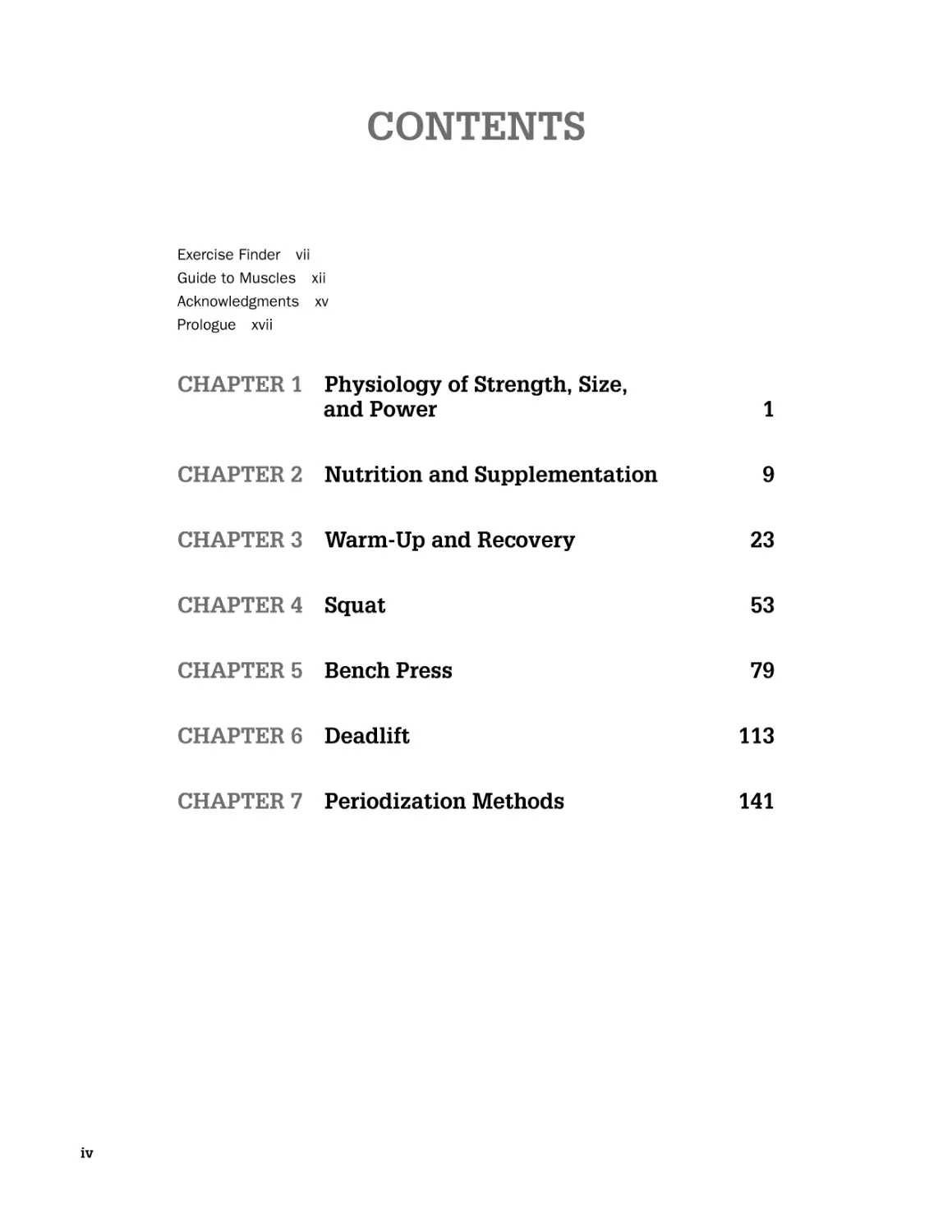
CONTENTS
Exercise Finder vii
Guide to Muscles xii
Acknowledgments xv
Prologue xvii
iv
CHAPTER 1 Physiology of Strength, Size,
and Power
1
CHAPTER 2 Nutrition and Supplementation
9
CHAPTER 3 Warm-Up and Recovery
23
CHAPTER 4 Squat
53
CHAPTER 5 Bench Press
79
CHAPTER 6 Deadlift
113
CHAPTER 7 Periodization Methods
141
CHAPTER 8 Foundational Training
153
CHAPTER 9 Experienced Training
173
CHAPTER 10 Advanced Training
187
CHAPTER 11 Powerlifting Mindset
201
CHAPTER 12 Meet Preparation
215
CHAPTER 13 Meet Day
225
Epilogue 243
Index 247
About the Authors
252
Earn Continuing Education Credits/Units
254
v
This page intentionally left blank.
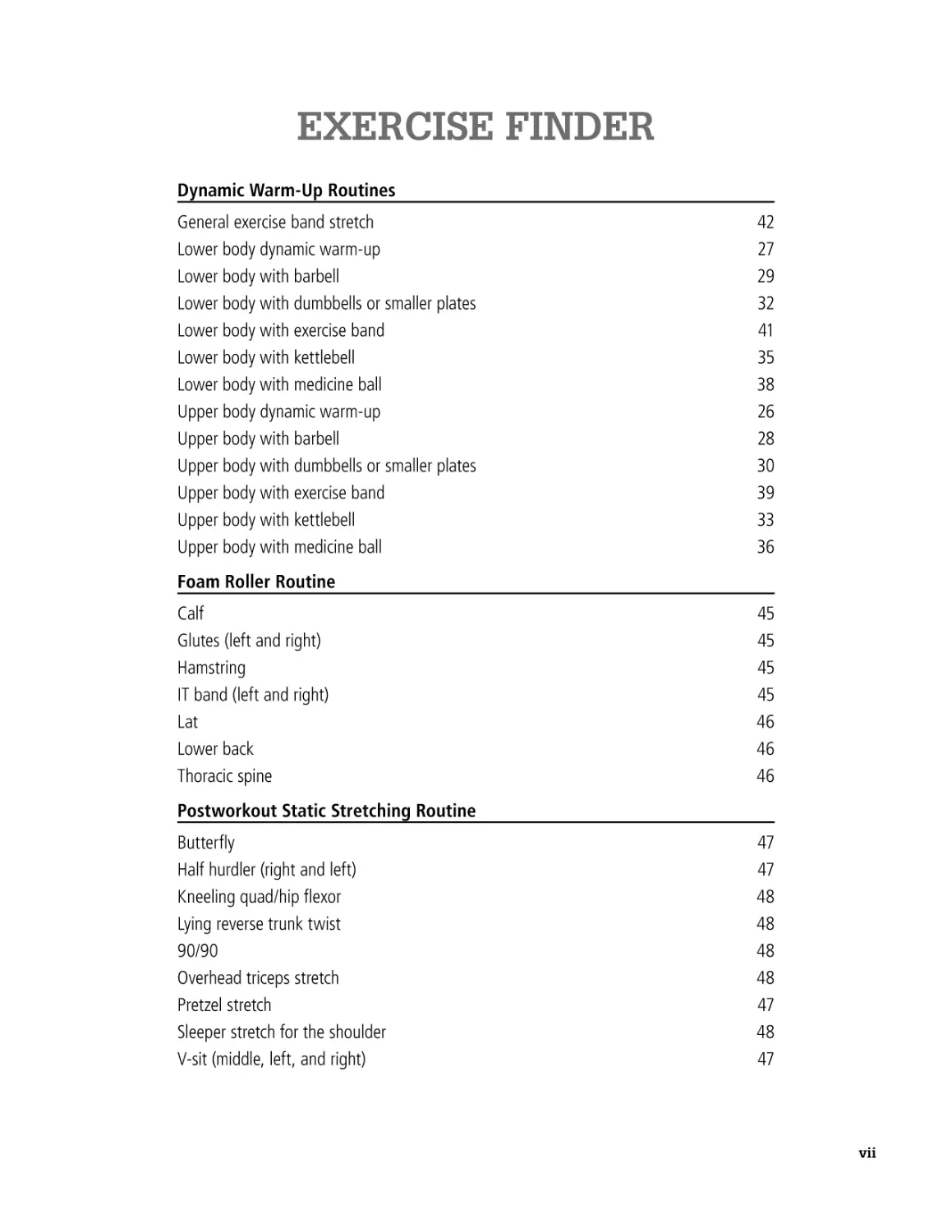
EXERCISE FINDER
Dynamic Warm-Up Routines
General exercise band stretch
Lower body dynamic warm-up
Lower body with barbell
Lower body with dumbbells or smaller plates
Lower body with exercise band
Lower body with kettlebell
Lower body with medicine ball
Upper body dynamic warm-up
Upper body with barbell
Upper body with dumbbells or smaller plates
Upper body with exercise band
Upper body with kettlebell
Upper body with medicine ball
42
27
29
32
41
35
38
26
28
30
39
33
36
Foam Roller Routine
Calf
Glutes (left and right)
Hamstring
IT band (left and right)
Lat
Lower back
Thoracic spine
45
45
45
45
46
46
46
Postworkout Static Stretching Routine
Butterfly
Half hurdler (right and left)
Kneeling quad/hip flexor
Lying reverse trunk twist
90/90
Overhead triceps stretch
Pretzel stretch
Sleeper stretch for the shoulder
V-sit (middle, left, and right)
47
47
48
48
48
48
47
48
47
vii
viii Exercise Finder
Squat
Abdominal workout
Band squat
Box squat
Bulgarian split squat
Calf raise
Chain squat
Front squat
Glute bridge
Glute-ham
Goblet squat
Good morning
High-box squat
Jefferson lift
Leg curl
Leg extension
Leg press
Low-box squat
Lunge
Medium squat stance
Narrow squat stance
Olympic or high-bar squat
Partial squat
Pause squat
Pistol squat
Pit shark belt squat
Plank
Regular crunches
Reverse hyper
Reverse lunge
Riding the bike
Safety squat bar
Single-leg Romanian deadlift (RDL)
Speed squats (dynamic effort)
Step-up
Up-up-down
Walkout
78
76
67
70
74
66
64
69
71
70
75
67
76
72
73
73
68
73
77
77
64
65
65
69
70
78
78
74
68
78
72
68
71
74
78
72
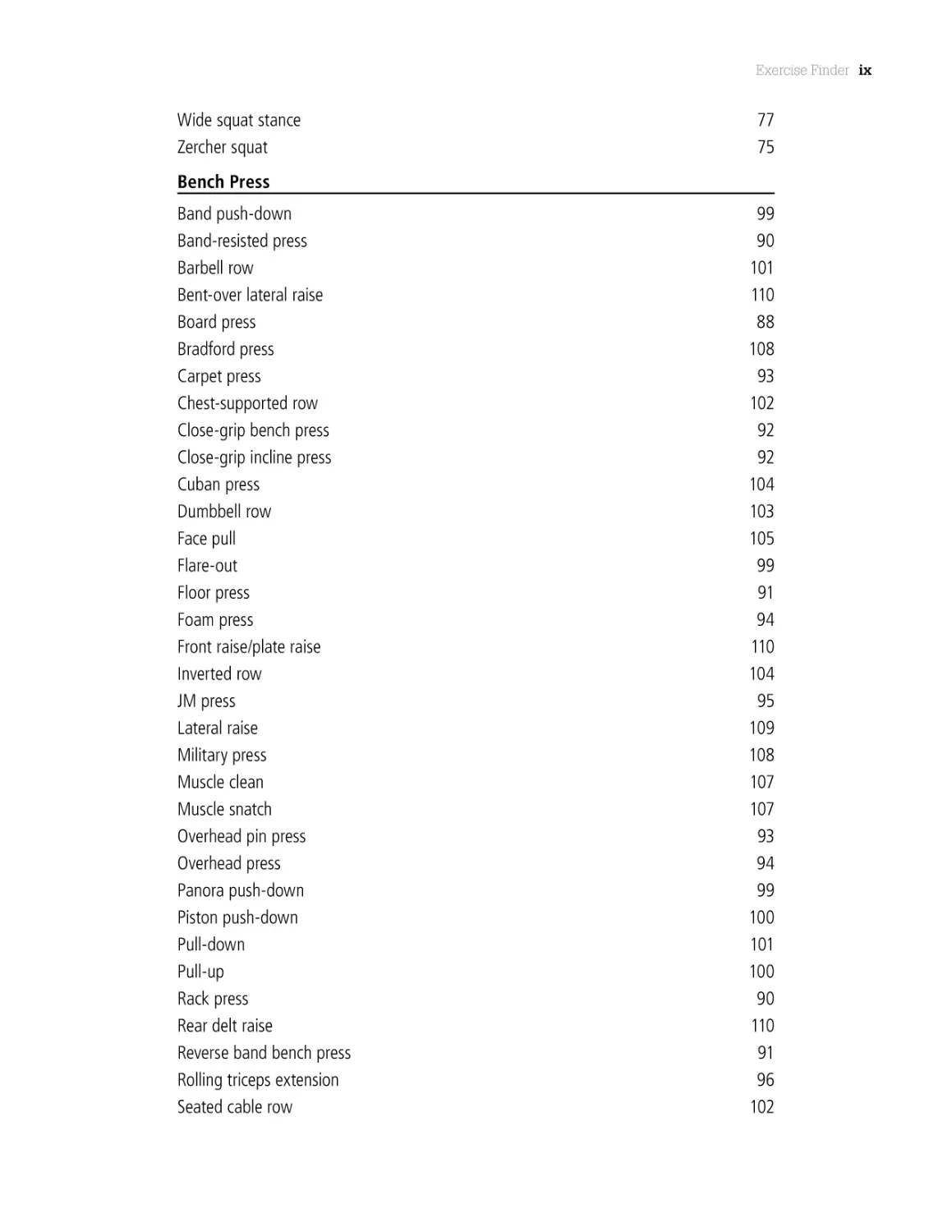
Exercise Finder ix
Wide squat stance
Zercher squat
77
75
Bench Press
Band push-down
Band-resisted press
Barbell row
Bent-over lateral raise
Board press
Bradford press
Carpet press
Chest-supported row
Close-grip bench press
Close-grip incline press
Cuban press
Dumbbell row
Face pull
Flare-out
Floor press
Foam press
Front raise/plate raise
Inverted row
JM press
Lateral raise
Military press
Muscle clean
Muscle snatch
Overhead pin press
Overhead press
Panora push-down
Piston push-down
Pull-down
Pull-up
Rack press
Rear delt raise
Reverse band bench press
Rolling triceps extension
Seated cable row
99
90
101
110
88
108
93
102
92
92
104
103
105
99
91
94
110
104
95
109
108
107
107
93
94
99
100
101
100
90
110
91
96
102
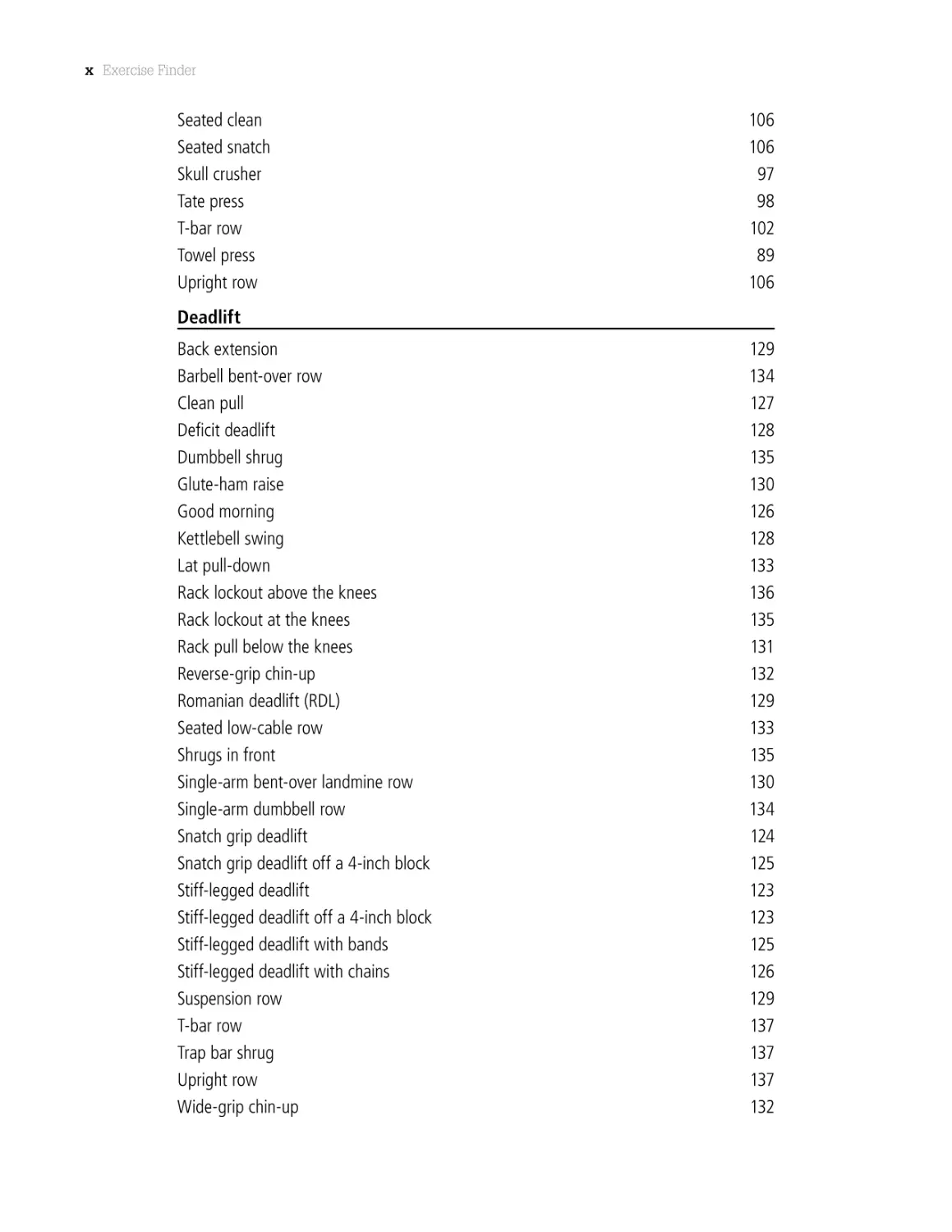
x Exercise Finder
Seated clean
Seated snatch
Skull crusher
Tate press
T-bar row
Towel press
Upright row
106
106
97
98
102
89
106
Deadlift
Back extension
Barbell bent-over row
Clean pull
Deficit deadlift
Dumbbell shrug
Glute-ham raise
Good morning
Kettlebell swing
Lat pull-down
Rack lockout above the knees
Rack lockout at the knees
Rack pull below the knees
Reverse-grip chin-up
Romanian deadlift (RDL)
Seated low-cable row
Shrugs in front
Single-arm bent-over landmine row
Single-arm dumbbell row
Snatch grip deadlift
Snatch grip deadlift off a 4-inch block
Stiff-legged deadlift
Stiff-legged deadlift off a 4-inch block
Stiff-legged deadlift with bands
Stiff-legged deadlift with chains
Suspension row
T-bar row
Trap bar shrug
Upright row
Wide-grip chin-up
129
134
127
128
135
130
126
128
133
136
135
131
132
129
133
135
130
134
124
125
123
123
125
126
129
137
137
137
132
Exercise Finder xi
Foundational Exercises
Back squat with band around knees
Counterbalance single-leg squat
Counterbalance squat
Deadlift off plates
Dimel deadlift
Dumbbell bench
Front squat
Inverted row
Overhead squat
Push-up
Romanian deadlift (RDL)
158
155
154
164
162
160
156
160
157
160
163
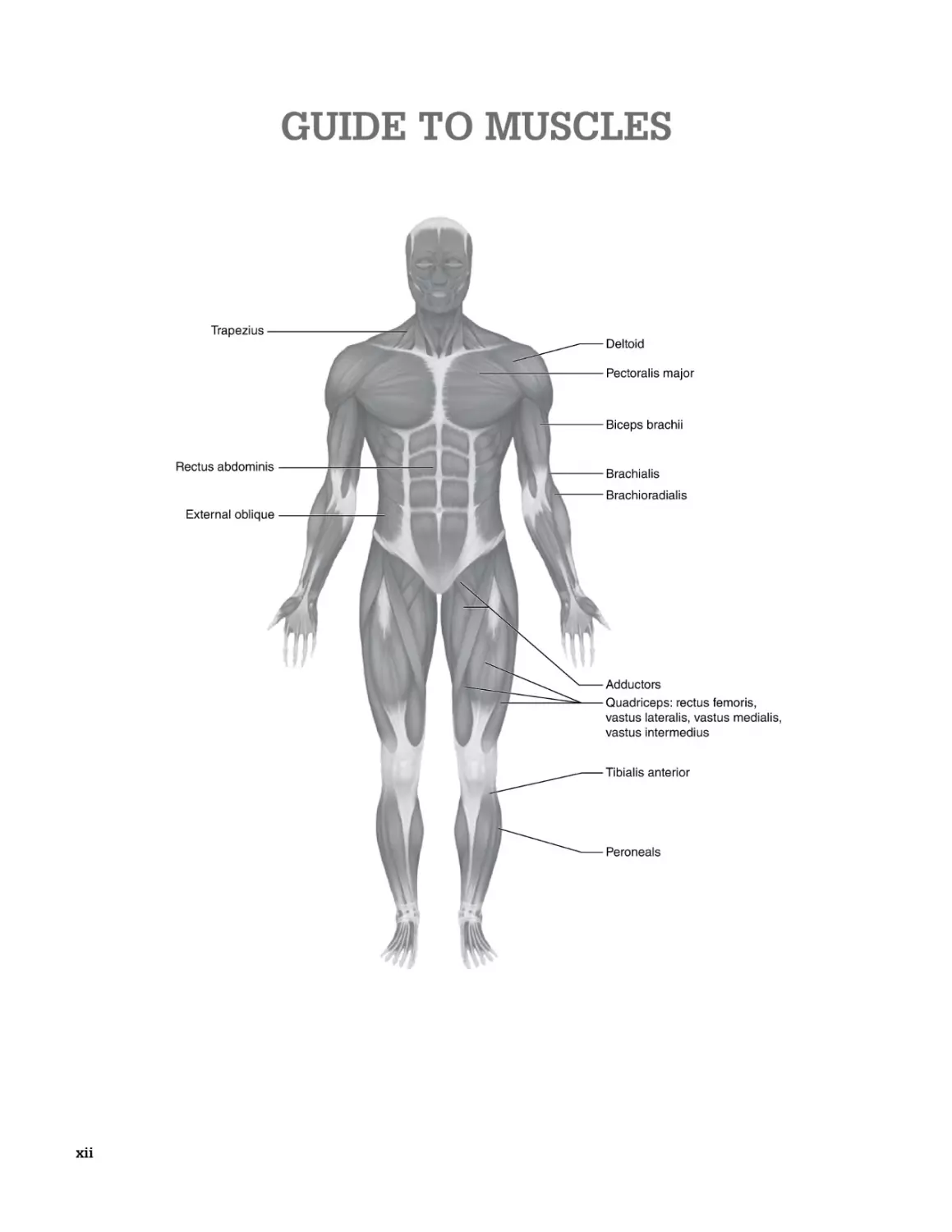
GUIDE TO MUSCLES
Trapezius
Deltoid
Pectoralis major
Biceps brachii
Rectus abdominis
Brachialis
Brachioradialis
External oblique
Adductors
Quadriceps: rectus femoris,
vastus lateralis, vastus medialis,
vastus intermedius
Tibialis anterior
Peroneals
E8092/AustinF I.01/651787/pulled/R3
xii
Rhomboids
Trapezius
Deltoid
Infraspinatus
Triceps brachii
Teres major
Latissimus dorsi
Gluteus medius
Gluteus maximus
Adductor
Hamstrings: biceps femoris,
semitendinosus, semimembranosus
Gastrocnemius
Soleus
Achilles tendon
E8092/Austin/Fig I.20/651788/pulled/R3
xiii
This page intentionally left blank.
ACKNOWLEDGMENTS
There really are too many people to thank. I would like to thank Jim Duree for
being an integral part of getting me started in powerlifting as a teenager. I would
like to thank Natalie Hanson for her help in the revisions of this edition. Her
contributions from the female perspective were invaluable. I would like to thank
all those whom I competed with and against, forcing me to look into different
models of training as my career progressed. I would like to thank Roger Earle,
who believed in a meathead with a PhD enough to undertake this book. Finally,
I would like to thank my wife and children for their patience and understanding
throughout this endeavor.
—Bryan Mann
xv
This page intentionally left blank.
PROLOGUE
Origin of the Term Powerlifting
Since the first edition of the book Powerlifting, many people have asked me, “Why
is it called powerlifting? There isn’t any power to it.” In scientific terms, power
is force multiplied by velocity. With the squat and deadlift 1RM all occurring at
velocities well below 0.3 meters per second, and often well below 0.2 meters per
second for trained lifters (some who have been training for a long time go down
to as low as 0.08 meters per second and still achieve the lift), we can see that the
velocities are indeed very low, showing that while the force may be high, the
power is low. From a physics standpoint, better terminology might be forcelifting
or torquelifting. Yet that’s not what it is called. I was only 16 when I was introduced
to the sport and didn’t have a strong scientific background at that age, so I never
questioned the name. It is much like any other thing; like, why do we call a cup
cup rather than a glass? We just do, so I never questioned it.
As I mentioned in the first edition of the book, I have had unique access to Bill
Clark because of my time spent training at his gym when I lived in Columbia,
Missouri. During a combination birthday party/going-away party, Bill joined
us, and I asked the person responsible for the start of the sport why the name
was chosen. Although his answer was devoid of scientific soundness, it provided
context. Back then, the Olympic-style weightlifting movements were often called
the quick lifts. They were performed fast—you couldn’t do them slow—so everyone just called them the quick lifts. Lifters performed squats and deadlifts to be
able to move more weight fast, so that’s where the power comes in and why it’s
called powerlifting.
Although the terms weren’t scientifically correct, it is clear what they meant
contextually. Olympic lifts had a higher power from a scientific standpoint, but
they were lower in force. By enhancing the force component, you could move
a heavier weight faster and complete the lift. The term power seemed slower to
them than quick for the quick lifts, so that is how the name came to be. While
some would scoff at this and think, How could they ever think that?, realize that
the field of exercise physiology is young, and strength and conditioning even
younger (the NSCA was founded in 1978), and academic journals have had to
publish clarification of terminology papers as recently as 2018. With the start of
the sport of powerlifting preceding the organization that most closely studies
it, the nomenclature makes sense. Again, it is not correct, but context helps us
understand why it was chosen. And you know what? I sure like the term powerlifting far better than the term forcelifting.
xvii
This page intentionally left blank.
CHAPTER 1
Physiology of Strength,
Size, and Power
To understand how the body works in powerlifting, you first must understand
some basic physiology. A basic understanding does not include topics such as
sliding filament theory, the way the mitochondria work in the cell, or the role of
fatty acids in metabolism for a long day at a meet. If those topics interest you,
you can read books on exercise physiology or even take courses in human anatomy, physiology, and kinesiology. This chapter covers the level of physiology
you need to know to become as strong as possible and perform optimally on
competition day.
Motor Learning
Knowing how the body learns can help you understand how and why to use
various techniques. For example, think about how infants learn to walk. They
observe people walking and want to try it too. After watching and analyzing
others, they begin to try to walk. They slowly pull themselves up to standing,
they wobble, and they fall down. Next they pull themselves up to standing,
they wobble, and they take a step or two before falling down. Eventually after
persistence, practice, and muscle development, they begin to walk naturally.
In their book Weightlifting: Fitness for All Sports (International Weightlifting
Federation, 1988), Tamás Aján and Lazar Baroga said that every movement, no
matter how new it may seem, is based on previously learned movement patterns.
So the more motor patterns you possess, the more movement patterns you can
learn and the more quickly you can learn them. Consider two people who start
squatting. Why does one struggle while the other excels? Because one person
already possessed the necessary motor patterns and the other did not. The second
person may be able to master the technique and excel at the squat but needs
more time. A coach or trainer must demonstrate the movement several times so
the struggling lifter understands it, then the lifter must get under the bar and do
it herself. Movements can feel funny to new lifters, and new lifters do all sorts
1
2 Powerlifting
of funny things as well, just as babies do when trying to walk for the first time.
Beginning lifters may crash their knees together and then do an impression of the
worm break dance, but while standing with a weight on their backs. They may
perform something that looks like a good morning with bent legs. All along, they
are attempting to put together movements that resemble the squat. The coach’s
job is to teach them to be aware of what they’re doing wrong and how to fix it.
Eventually they will have a squat-like movement down but will still need to refine
their technique. Louie Simmons once said that coaches need to educate each one
of their lifters to the point where the lifter is a coach. That way whenever you’re
doing a lift, you’ll have 10 coaches watching instead of one.
When learning a new technique, it helps if you can watch someone who has
great technique, be coached on the technique, and then perform the lift yourself.
If anything in this sequence has to be dropped, it should be watching someone
with great technique. The coaching is crucial. If you don’t know what it’s supposed to feel like, you won’t realize when you are doing it wrong.
Beginning lifters experience humongous gains in strength. It is not uncommon for new lifters to put 30 to 40 pounds or 10 to 20 kilograms on the bench
in a month or even less. This has a lot to do with increasing the efficiency of the
neuromuscular system. Essentially the brain is the CPU that runs the entire body.
Nothing happens in the body that the brain has not processed, either consciously
or subconsciously. When gaining strength at this rate, the lifter does not add any
muscle; it takes too long to add any significant muscle to improve strength by this
much, this quickly. The body simply learns how to do the movement and recruit
more motor units that it already has. Remember the saying Use it or lose it. The
body has many high-threshold motor units it has never used. You must learn to
use them or you will never be able to recruit them in regard to weight training.
Motor units work as all or nothing. When a motor neuron causes a muscle
to contract, all the fibers that the nerve innervates will contract. It is impossible
for some of the fibers to contract but others not when the nerve impulse is sent.
However, realize that one nerve doesn’t innervate all of any one major muscle
group. Several nerves innervate the muscle, so if it will take more muscle to lift
a weight, then more neurons will fire to recruit more muscle.
The entire muscle doesn’t work all of the time; only a few units are used at a
time. For example, consider the biceps. When you are raising a 12-ounce can of
soda to the lips, the biceps recruits enough motor units to move the can from the
table to the mouth. Now, if the biceps used everything it had to lift the 12-ounce
can, the speed of movement and the force generated would not allow the can
to stop before the mouth. Instead it probably would bust open a lip and knock
out some teeth. Conversely, if the biceps had to perform a curl with 40 pounds,
which is a load often encountered by the body in everyday life, it would be able
to recruit the number of fibers to do that. Say you’re moving up to a personal
record curl of 85 pounds. The first time you try it, you may not be able to complete
it, or it may look ugly. However, you try the 85-pound curl again the following
week and it goes up smoothly. No muscle was added, but the body learned how
to recruit motor units that were previously unused.
When dealing with more complex exercises such as the powerlifts, the motor
units from different muscle groups have to work together. These lifts are much
more complex than a simple single-joint exercise such as the curl. Think of a single-joint exercise as teaching a task to one 3-year-old child. It’s tough at first, but
the child catches on and is able to do simple things without any help. A complex
Physiology of Strength, Size, and Power 3
exercise is like getting fifteen 3-year-olds to do one task. When most of them are
heading in the right direction, a few decide to take off and do their own thing.
When learning the squat, sometimes lifters can’t push their hips back appropriately, sometimes their knees crash in, and sometimes their hips rise out of the
hole before their shoulders. It takes time to be able to recruit the motor units in
the proper muscles at the proper time in the proper sequence. It takes constant
coaching from others for someone to be able to do the exercise properly.
Two types of motor recruitment exist—intramuscular and intermuscular—and
thus two types of muscle learning exist. Intramuscular motor recruitment occurs
within the muscle. It is a single muscle group learning how to do something
better and work within itself. In intramuscular coordination, muscle fibers of an
individual muscle learn to work together more efficiently in order to produce
more strength or speed.
In intermuscular coordination, the muscles learn to work with each other to
perform gross movements more efficiently. Efficiency is gained when muscles
perform the movements over and over again, with the lifter trying to use the best
form possible. For instance, think of an uncoordinated kid who just finished a
growth spurt and is trying to perform a lunge for the first time. Most likely he
will fall over to the side, drop his chest, and possibly even fall backward when
lunging forward. If he continues with proper coaching, eventually he will be able
to lunge with the chest up and body in a straight line, not fall, and look good
doing it. At that point of competency, the muscles have learned to perform the
task. This phenomenon resembles a worker in a factory. At first a new worker at
an auto plant may take 3 hours to put together a transmission. With repetition,
however, the worker learns how to do it efficiently and the time is cut in half. It is
simply learning how to do things. Once you have learned how to do something,
you can do it more efficiently and more quickly.
Although the body gains strength very quickly by learning how to use its
motor units more efficiently, gaining muscle is a much slower and more arduous
process. You can gain strength more quickly than muscle.
Agonist Versus
Antagonist Muscle
The muscle that is actively doing
the work and producing the
force to move the weight is called
the agonist. The agonist can be a
prime mover, secondary mover,
or stabilizer. The antagonist is
the muscle or muscle group
opposite the agonist. When the
agonist is working, the antagonist is relaxing.
Typically agonists and antagonists are on opposite sides of the
joint. For example, examine the
elbow joint. During a biceps curl,
the biceps is doing the lifting, so
it is the agonist (figure 1.1). The
FM
MM
FR
MR
FIGURE 1.1
While the biceps (the agonist)
works as a third-class lever to lift the weight,
the triceps (the antagonist) relaxes to allow for
maximal acceleration of the load.
E8092/Austin/F01.01/651885/pulled/R1
4 Powerlifting
triceps, the antagonist, is relaxed, allowing the greatest contraction and range
of motion for the biceps. If the agonist and antagonist contract at the same time,
the muscle is unable to change its length. In the rare event that the muscle length
does change, meaning one muscle group is stronger than the other and wins the
tug of war, the bar movement is inefficient and the bar moves very slowly. In this
situation, the weight isn’t the opponent, the body is.
Motor Learning Enhancement
Sport psychology for powerlifting is discussed in great detail later. Meanwhile,
this section covers an intrinsic portion of learning technique that greatly speeds
up the process for any exercise: Cook’s model (Vernacchia, McGuire, and Cook,
1996, Coaching Mental Excellence, Warde Publishers, page 84). This model uses
the mental routine “See it, feel it, trust it, believe it, and achieve it.” This works
well because the visualization prepares the nerves involved in the movement to
fire in the proper sequence. Visualization is a proven method. If you are having
a hard time performing an exercise or correcting technique, go back to Cook’s
model to improve your technique.
The first step is to see it: You have to see yourself doing the technique properly,
like a movie in your head. You must see everything—the weight, the crowd, and
the judges. You must see yourself perform the exercise successfully with perfect
form, with three white lights on the judges’ board.
The next step is to feel it: Feel the weight, the gear, the platform, the crowd,
the power, and the muscles firing in proper sequence. Taste the air, and smell the
ammonia and liniment in the air.
Once those two steps are complete, you must believe you can execute the
weight with perfect form and trust yourself to be able to act on it. Next is to
simply go achieve it.
Muscle Fibers
The body has two main muscle fiber types and an indefinite number of smaller
types. The main types are slow-twitch and fast-twitch fibers (table 1.1). Slowtwitch muscle fibers are slow. They are primarily endurance fibers that are set to
go all day but can’t produce much force per contraction. Slow-twitch fibers are
used in everyday walking and standing.
Fast-twitch fibers are fast and produce power. These fibers are used in activities that require more effort such as sprinting, jumping, throwing, and lifting
weights. How strong or explosive a person can be greatly depends on muscle
fiber type. People are born with predominately one type or the other. This is why
some people are naturally good at endurance exercises but can’t bench the bar, or
someone can sprint a 10-second 100-meter dash but can’t run a full lap without
getting gassed. Because of their fiber type, some people naturally are able to lift
more weight than others who are similarly sized even with no training. Fiber type
is a big reason why someone who weighs 165 pounds can bench 405 pounds for
multiple repetitions. That person has a high predominance of fast-twitch fibers
that produce more force to move more weight with a smaller muscle mass.
Physiology of Strength, Size, and Power 5
TABLE 1.1 Traits of Fast- and Slow-Twitch Muscle Fibers
Trait
Fast-twitch fibers
Slow-twitch fibers
Motor unit size
Larger (100+ fibers per unit) Smaller (1-100 fibers per unit)
Preferred substrate (fuel)
Phosphagen and glucose
Glycogen and fat
Contraction speed
Fast
Slow
Relaxation speed
Fast
Slow
Contraction force
Higher
Lower
Calcium utilization
Higher
Lower
Mitochondrial density
Higher
Lower
Building Muscle
Many people think muscle is built in the weight room because that is where
they see it get big. This assumption is both right and wrong. Muscles get big
as a function of what is done in the weight room, but they don’t get big in the
weight room.
Hypertrophy
When weights are lifted, microtraumas occur to the
muscle fibers. The concentric and eccentric contractions
of the muscles as they lift and lower the weights cause
some damage, especially if the lifter is using progressive
overload and forcing the muscles to adapt to a new stimulus. Along with this damage, additional blood and fluid
flow to the muscles, providing that pumped-up feeling
familiar to lifters. When the muscle is damaged, the body
repairs itself. It doesn’t want damaged muscle fibers, so it
will rebuild them. The body also recognizes that it needs
more muscle to meet the demand imposed on it, so it adds
muscle. It breaks down proteins in the damaged muscle
and adds more proteins on top to create the additional
muscle. These additions are made in small amounts, so it
takes time to add any additional muscle. Adding muscle
is called hypertrophy.
There are two speculated types of hypertrophy. One
is nonfunctional, or cytoplasmic, hypertrophy (figure
1.2a). The other is functional, or myofibrillar, hypertrophy (figure 1.2b). Myofibrillar hypertrophy develops
from the use of heavy weights. This is typically a much
slower means of gaining muscle size, but the increase in
the size of the muscle fiber increases the strength of the
muscle fiber. This hypertrophy occurs in the myofibril’s
actin and myosin within the muscle, which increases the
strength of contraction.
Protein
filaments
Muscle
fiber
a
Myofibrils
E8092/Austin/F01.02a/651833/pulled/R3
Protein
filaments
Muscle
fiber
b
Myofibrils
FIGURE 1.2 Nonfunctional, or cytoplasmic,
hypertrophy (a); and functional, or myofibrilE8092/F 01.02b/651971/pulled/R1
lar, hypertrophy (b).
6 Powerlifting
Cytoplasmic hypertrophy develops from using lighter weight and higher
volume. It taxes the muscle, but not in how much it is able to move. The damage
to the muscle is different. Therefore, the myofibrils don’t increase, but the space
in between the sarcomeres does. This type of hypertrophy does not feature consistency between the size of the muscle and the force it can produce, which is
why it is called nonfunctional.
The goal of powerlifting is to move the greatest amount of weight on the bar
with the lightest body weight possible. To do this, you must focus on functional
rather than nonfunctional hypertrophy. Bodybuilding relies primarily on high
volumes of exercises with short rest periods and light weights to get the greatest
amount of volume in the shortest time. This method makes a person bigger but
not stronger. There is an old saying: Big ain’t strong—only strong is strong. Many
bodybuilders look as if they could bench press 900 pounds, but they struggle
with 315. This is because of the type of hypertrophy they have induced. The
powerlifter, on the other hand, is often deceptive. Jason Fry, who competed at
either the 181- or 198-pound weight class, looks like an in-shape guy. If you
saw him in the gym, you’d think he could bench maybe 365 pounds. However,
he has benched well over 750 pounds at the 181-pound weight class and 770
pounds at the 198-pound weight class, so obviously his size is very deceptive.
His hypertrophy development has all been functional, and all of the muscle he
has gained puts out force.
SAID Principle
The improvement of strength is based on the specific adaptations to imposed
demands, or SAID, principle. The body adapts to the stimulus placed on it. For
instance, consider someone who gets a job in construction. He starts out swinging
an 8-pound sledgehammer all day. When he goes home at night, he is so tired
and sore he can’t do anything except fall down on the couch and go to sleep
without showering. Three weeks later, he can swing that 8-pound hammer all
day and be fine. He could even go out and play recreation league softball after
work without a problem. However, if he breaks his hammer and has to use one a
couple of pounds heavier, he is right back on the couch after work until he adapts
to the new hammer weight. This is because his body adapted to the stimulus of
the 8-pound hammer. The hammer imposed a demand on the body that led to a
specific adaptation in muscle. The body wasn’t ready for more than the 8-pound
hammer, so he became fatigued and sore.
Progressive Overload
The progressive overload principle states that once the body adapts to the
imposed demand from the SAID principle, you need a heavier weight. You use
progressively heavier weights to impose new demands on the body, thus making
another adaptation. The ancient Greek wrestler Milo of Croton is a classic example
of progressive overload. Milo decided that to get stronger, he would hoist a calf
on his shoulders and walk laps around the arena. He did this every day, and as
the calf grew in size, Milo gained in strength. He became so strong that he was
never pinned by anyone in Greece and finished his wrestling career undefeated.
Progressive overload is how most periodized programs work. They start with
a lower weight and, over the course of the training cycle, work up to a higher
weight through a preplanned increase each week, causing the adaptation to occur
Physiology of Strength, Size, and Power 7
by overloading the muscle. Just like Milo and his calf, you can get stronger by
moving up in weight each week.
Valsalva Maneuver
When people train with weights for health, they are
taught to breathe in on the eccentric contraction and
out on the concentric contraction. In powerlifting,
this technique is incorrect. In powerlifting, you use
the Valsalva maneuver. With this technique, you
bring in the air and hold it to create a fluid ball effect.
The pressure that usually causes headaches is also
the same pressure that protects the spine under maximal loads and allows the force to transfer through the
body rather than stop at a soft spot. For instance, on
the squat, the lifter attempts to draw in as much air
as possible to expand the stomach (figure 1.3). This
locks the chest into place, preventing the lifter from
rounding over to the front. If the athlete did not hold
in the air, the chest would crumple forward from
the weight, and the legs, no matter how strong they
were, would not be able to drive the bar up because
the weakness would already be forcing the bar down.
Force transfers most perfectly through hard surfaces. The lifter who can get tight and create the
most pressure possible is able to transfer the most
force through the body and lift the most weight.
FIGURE 1.3 The Valsalva
E8092/Austin/F
01.03/651834/pulled/R2
maneuver
protects
the spine
Consider pushing a car in the snow or on concrete.
by compressing air and fluid by
Which is easier? On concrete, the force you apply
locking down the diaphragm,
to the ground is directly applied back to the car. In
pelvic floor, abdominal muscles,
snow, however, the force applied toward the ground
and back muscles to create a
is dispersed by the snow and not transferred.
rigid structure to allow force to
This principle is true for all exercises. The more
transfer through the body. The
tightness and pressure developed for each exercise,
shaded portion is the fluid ball.
the more force can be transferred, even on the bench
press. Consider the ageless wonder, Bill Gillespie, as an example on the bench
press. Bill turns purple at 135 pounds because he trains the body to put out the
pressure to get tight and transfer the force.
Blood Pressure
A powerlifter’s blood pressure goes up into the zones of a myocardial infarction (heart attack) during a maximal attempt. Look at nearly any picture of a
powerlifter during squat or deadlift maximal attempt; the face is purple. All the
muscles are contracting maximally, putting pressure on the arteries and veins
and making it difficult for blood to flow through the body. This causes the heart
to work harder and push the blood harder.
Remember the SAID principle? This is another example of it. Since the heart
has to work harder to overcome resistive forces and push the blood through the
8 Powerlifting
body, the left ventricle greatly increases in size and density. Essentially this prevents the left ventricle from bursting. The heart is a muscle like any other. When
it has to work harder, it grows in size.
When the heart increases in size as a result of pumping blood through the body,
it also increases in contractility, which helps push the blood through without
much resistance. In powerlifting, the muscle has to push against great pressure,
causing it to get stiffer. This effect needs to be balanced through some sort of
cardiorespiratory work, not necessarily high-intensity cardio, but something that
makes the heart work. The heart needs to get its good work in too.
Summary
The specific adaptations to imposed demands (SAID) principle governs all types
of training. In powerlifting, the goal of training is to become stronger, so the
demand imposed on the body must cause the adaptation of greater strength. If
the right demands are not placed on the body, the adaptations will never occur
and lifters will never become stronger and achieve personal records in any of
their lifts.
The concept of progressive overload has been around since Milo of Croton.
It involves using a heavier weight each week over time to create an overload
that gets progressively heavier, causing the body to adapt, again using the SAID
principle.
The Valsalva maneuver is key to all competitors. It works by increasing internal
pressure, thereby allowing force to be transferred efficiently through the body. If
sufficient tightness is not derived by internal pressure, power is not transferred
and the amount of weight that can be lifted is decreased.
These basic concepts are true regardless of training philosophy. They are key
physiological concepts that every program is built on. A lifter who doesn’t lift
heavier weights over time won’t get stronger. A lifter who doesn’t learn how to
do the Valsalva maneuver won’t be able to get tight enough to lift maximal loads.
CHAPTER 2
Nutrition
and Supplementation
Many powerlifters lack general knowledge in nutrition. All powerlifters spend
a lot of time researching exercises and routines to make their squat, bench press,
and deadlift go up, but few spend time reading about what or how to eat. Proper
nutrition helps you recover for the next workout, have more energy during the
workout, and be less likely to get injured.
This chapter introduces you to the basics of good nutrition. Hundreds of books
are available to provide more in-depth coverage specifically on nutrition. For the
powerlifter, knowing the basics may be enough.
First, the chapter covers the macronutrients protein, carbohydrate, and fat.
It explains what they are, what they do, and where to find them. Water is also
considered a macronutrient. These are called macronutrients because they are
the big deal of nutrition. If you take care of these things first, most of the smaller
things will fall into line.
Protein
Protein is probably the powerlifter’s favorite macronutrient. Protein assists in
building and repairing muscle after trauma occurs. If you have no protein, you
have no muscle repair. If the muscles aren’t repaired after they are broken down
in a workout, they will not get stronger and will be more likely to tear in subsequent workouts. Think of pouring a sidewalk. You can dig down, frame, level,
and prepare all you want, but if you have no cement, you have no sidewalk.
Likewise, you can train all you want—proper percentages, volumes, and hard
work—but without protein the muscle will not recover and you will see no results.
In short, protein is muscle. It provides 4 calories per gram. Protein is made up
of 21 amino acids for muscle; 9 are essential. The body does not make essential
amino acids, so you have to get them from food or supplements. The body does
make nonessential amino acids, so you don’t need to get them from external
sources such as food.
9
10 Powerlifting
Best Sources of Protein
Turkey breast: One 3-ounce serving has 24 grams of protein.
Boneless, skinless chicken breast: One 4-ounce serving has 24 grams of
protein.
Lean beef: One 4-ounce serving has 22 grams of protein.
Water-packed tuna: One 3-ounce serving has 22 grams of protein.
Edamame: One 1-cup serving has 18.5 grams of protein.
Lean ham: One 3-ounce serving has 15 grams of protein.
Skim milk: One 8-ounce serving has 8 grams of protein.
Egg whites: One large egg white has 4 grams of protein.
The main sources of protein are animal based. If it was a muscle of something, it
is going to be a good source of protein. Beef, chicken, and fish are all good sources
of protein. Eggs, dairy products, nuts, seeds, and legumes provide protein too.
Vegetables have some protein, but for the most part they are incomplete proteins,
which means they do not contain all of the essential amino acids. For your body
to absorb the protein from a vegetable and use it to build muscle, you must get a
complementary protein from another food that has the essential amino acids the
vegetable does not contain. Together they make a complete protein. For instance,
beans and rice are complementary because the rice has what the beans don’t.
Protein is often misunderstood. Many people think that you can’t get enough
protein. This is not true. The body can process only so much in a day, which is
said to be 1.5 to 2.0 grams of protein per kilogram of body weight for men and
for women. For example, someone who weighs 220 pounds (100 kilograms) can
use 150 to 200 grams of protein per day quite efficiently. This is contrary to the
popular belief among powerlifters and bodybuilders that they need 2.0 grams
of protein per pound of body weight, or that a 220-pound individual should
consume 440 grams of protein per day. This amount of protein intake leads to
one thing—expensive urine!
Carbohydrate
Carbohydrate is energy. This is the gas that fuels the fire to keep you going
through workouts. It provides 4 calories per gram, the same as protein. Carbohydrate can be broken down into simple and complex, or even further through
the glycemic index.
Simple carbohydrates are sugars; think of juices, candy, sodas, and other sweets.
Use them for quick energy. Their energy enters the bloodstream quickly and is
gone quickly either by use or storage as fat. This explains those times you felt
great at the start of a workout but felt fatigue before you could finish the workout;
the simple carbohydrate energy was used first and zapped your energy quickly.
Complex carbohydrates are sources of extended energy; think of pasta, potatoes, brown rice, sweet potatoes, and bread. The energy from complex carbohydrates takes longer to hit the bloodstream, providing a more sustained source of
Nutrition and Supplementation 11
energy. Complex carbohydrates are the best source of energy, so consume them
prior to workouts and meets.
Often simple carbohydrates are labeled as the “bad” type of carbohydrate. It
is important to realize that all foods have a time and place; simple carbohydrates
are not bad. They are excellent for delaying fatigue during exercise, they require
little energy to break down, and they increase blood glucose levels quickly. Good
choices include sports drinks and gels, raisins, and other similar substances.
Since carbohydrate is the main source of energy, look to it first to provide the
energy for working out. If not enough carbohydrate is left, the body does not
immediately look to fat. Instead it breaks down muscle for energy. This is why
carbohydrate is said to have a muscle-sparing effect when consumed; it spares the
muscle from being broken down for energy. In your entire body, you can store only
about 250 grams of carbohydrate, but you have unlimited storage space for fat.
The glycemic index breaks down carbohydrate even further. The glycemic index
is a scale based on how quickly the energy from a food will hit the bloodstream.
The quicker the energy hits the bloodstream, the higher the glycemic index value
of that food. When sugar enters the bloodstream, insulin is released to store the
sugar in the bloodstream. The higher the glycemic index, the more sugar hits the
blood at one time, which stimulates the pancreas to produce insulin. When high
amounts of sugar are in the blood, high amounts of insulin are produced to store
the sugar as glycogen in the muscle for immediate use or to store it in fat cells
for the long term. When all of the sugar is stored, the brain signals the stomach
to be hungry to bring in more energy.
The lower the glycemic index value of a food, the longer it will take for the
food’s energy to hit the bloodstream. The glycemic index considers the fat and
fiber content of a food to determine how long it will take for the sugar to hit
the bloodstream. For instance, potatoes and sweet potatoes are both complex
Best Sources of Carbohydrate
Oatmeal: One cup has 56 grams of carbohydrate and a glycemic index of 61.
Brown rice: One cup has 44 grams of carbohydrate and a glycemic index
of 50.
Sweet potato: One cup has 41 grams of carbohydrate and a glycemic index
of 54.
Air-popped popcorn: One 4-cup serving has 30 to 40 grams of carbohydrate
and a glycemic index of 55.
Quinoa: One cup has 39 grams of carbohydrate and a glycemic index of 53.
Whole-grain pasta: One cup has 37 grams of carbohydrate and a glycemic
index of 45.
Bananas: One medium banana has 27 grams of carbohydrate and a glycemic index of 51.
Apples: One medium apple has 16 grams of carbohydrate and a glycemic
index of 38.
Whole-grain bread: One slice has 11 grams of carbohydrate and an average
glycemic index of 71.
12 Powerlifting
carbohydrates. Sweet potatoes have more fiber, so they have a lower glycemic
index value since it will take longer for the body to digest the sweet potatoes
and longer for the sugar to hit the bloodstream. Which is better, a food that is
low on the glycemic index or one that is high? That depends on your goal. If you
are in the middle of an intense workout, you need something quick and readily
available. You would pick a carbohydrate high on the glycemic index such as
a sports drink. However, if you are spending a long day at the office, you want
the longest, most sustained energy as possible. A sweet potato or other food low
on the glycemic index would be a good choice. Nonstarchy vegetables are also
a source of carbohydrate. They are low on the glycemic index because of their
low sugar and high fiber content.
Basic sources of carbohydrate include anything made with a grain, tuber, or
sugar—bread, pasta, oatmeal, rice, sports drinks, potatoes, corn, tortillas, vegetables, fruits. The source you choose depends on your goal. For instance, if you want
to decrease body fat, pick sources of carbohydrate with the lowest glycemic index
as possible. This way you will feel less hunger and consume fewer total calories.
Fat
Fat is a source of energy. All types of fat contain 9 calories per gram. Fat has
been demonized over the years simply because of the word fat. People have said
that fat makes you fat or that the fat you eat adds directly to the fat on the body.
Despite some popular beliefs, the fat you consume does not transfer unchanged
into body fat.
Fat can be broken down into saturated and unsaturated fats. Saturated fats are
considered unhealthy and are thought to promote atherosclerosis, high cholesterol, and abdominal fat. Some examples of sources for saturated fats are fried
foods, red meat, chocolate, baked goods, and potato chips.
Unsaturated fats are thought to clear out the arteries and veins. Some sources
of unsaturated fats are olive oil, almonds, and fish.
Best Sources of Fat
Olive oil: One tablespoon has 14 grams of fat (1.9 grams saturated, 11.2
grams unsaturated).
Almonds: One ounce has 14 grams of fat (1.1 grams saturated, 12.1 grams
unsaturated).
Butter: One tablespoon has 11.5 grams of fat (7 grams saturated, 0 grams
unsaturated).
Salmon: One 3-ounce serving has 10.5 grams of fat (2.1 grams saturated,
8 grams unsaturated).
Avocado: One-third of a medium avocado has 8 grams of fat (1 gram saturated, 6 grams unsaturated).
Egg yolks: One large egg yolk has 4.5 grams of fat (1.6 grams saturated,
2.7 grams unsaturated).
Flax (ground): One tablespoon has 3 grams of fat (0.3 grams saturated, 2.5
grams unsaturated).
Nutrition and Supplementation 13
Fat is important for many reasons. It helps the body absorb the fat-soluble
vitamins A, D, E, and K. Body fat keeps you warm and cushions your organs. In
terms of athletic performance, the fat you want to consume primarily is unsaturated fat. It provides the greatest health benefits and the most bang for your
buck. Keep fat to 25 to 30 percent of your daily caloric intake.
Water
Water is one of the most important and underconsumed nutrients for powerlifters. The human body is made up of 60 percent water. Muscle is 80 percent water.
When you are dehydrated, you have less muscle to push with. Dehydration occurs
when you lose 2 or 3 percent of your body weight in water, which creates noticeable decreases in the ability of the muscle to produce maximal force and sustain
force. With a 2 to 3 percent loss in body weight, you won’t lift as much weight or
be able to attempt several repetitions. Every action in the body to make energy,
produce force, or repair itself requires water. Without water, you don’t feel good
because your body is not able to perform. When your body is dehydrated, you
are at greater risk of muscle strains and tears when training at high levels. Water
provides muscle elasticity and flexibility to prevent strains and tears. When the
muscle is dehydrated, it doesn’t have these characteristics and is inefficient and
unable to perform as normal.
Following are some more negative effects of dehydration:
• Increased heart rate
• Decreased cardiac output; the body works harder per stroke to push the
blood through
• Decreased muscular endurance
• Increased muscle cramping
• Decreased strength and power
• Decreased balance
• Increased risk of heatstroke or heat exhaustion
If you feel thirsty, you have already lost about 1 percent of your body weight in
water. This alone leads to a decrease in performance. Beyond the scale there is a
simple way to check your status to make sure you are hydrated properly. Check
your urine in the toilet. First make sure you are not peeing into blue water, which
obviously affects the color. Next, check the color. Your urine should be as light as
possible. It should be the color of lemonade or lighter before training each day. If
it is darker than that, you are dehydrated and should consume water immediately.
Water is responsible for carrying nutrients to muscles as well as lactic acid and
the byproducts of exercise away from the muscle, allowing it to repair. If you do
not take in enough water, the muscles are not able to repair and you stay sore
longer. Did you ever think that by drinking more water, you would be less sore or
sore for shorter periods? This is an amazing result from such a cheap supplement.
Since water is in every cell, it also is partly responsible for cushioning organs and
lubricating joints. Some of the daily stiffness people experience is a symptom of
dehydration. Simply drinking more water can help them feel a lot better.
Water is available from anything you drink. Liquids are split into two categories: hydrating beverages and nonhydrating beverages.
14 Powerlifting
Hydrating beverages are any liquids you drink that increase your current water
content. Hydrating beverages quench your thirst and actually pass the water on
to the body. Since the goal of drinking is to hydrate, hydrating beverages are the
ones you want to consume the most. Some examples of hydrating beverages are
water, lemonade, and sports drinks.
Nonhydrating beverages do not increase hydration. These drinks contain one
or more diuretics, chemicals that tell the body to expel water instead of holding
on to it. Caffeine and alcohol are common diuretics. It is not fully understood if
caffeine’s diuretic effect translates into an actual dehydration or a simple balancing out of the water that was consumed with it. Alcohol, on the other hand, does
dehydrate the body. A good portion of the hangover felt after consuming alcohol
is from dehydration plus a lack of B vitamins and a decrease in blood sugar.
Remember, your body does not produce water; you must consume it.
Gaining Weight
Back in the old days, the way to gain weight was to eat everything available and
get to goal weight as quickly as possible. That was considered the best way to get
strong. Times have changed, and people now know more about the human body.
Muscle is gained slowly and lost quickly since it does not store energy well. Fat,
on the other hand, is gained quickly and lost slowly. It should be pretty obvious
that when someone gains 15 pounds in a month, the primary weight gained is
fat. When powerlifters put on 15 pounds of fat, they will be stronger. The old
adage mass pushes mass is quite correct. However, they will not be as strong as
possible. Fat has no contractile components, no actin or myosin. Fat does not
contract to push the weight. For the purposes of powerlifting, strength gains via
improvements in leverage are acceptable if performance in the sport is the goal.
The proper way to gain weight is to do so very slowly. Look to gain no more
than 1 or 2 pounds (0.5 or 0.9 kg) (for heavier athletes) or 0.5 percent to 1.5 percent of body weight (for lighter athletes) per week to ensure that as much of
the weight gained as possible is muscle. Consider the caloric composition of a
pound of fat versus a pound of muscle. A pound of muscle and a pound of fat
are both about the same number of calories. However, they are not the same
size. A pound of fat is larger than a pound of muscle. Next time you are grocery
shopping, compare the size of a pound of lean ground beef to the size of a pound
of lard. You will notice a disparity in the sizes; the lard is much larger. If the goal
is to increase muscle by 1 pound per week, the lifter needs to go 3,500 calories
over basal metabolic rate (BMR) per week, which would break down to about
500 extra calories per day. That’s not a lot of calories when you think about it.
It’s about two 20-ounce (0.6 liter) bottles of regular soda, a McDonald’s Quarter
Pounder hamburger with cheese, or a small shake. In the old days of the “see
food” diet (you see food, you eat it), calorie consumption increased by 2,000 to
3,000 calories per day. It’s easy to see how they gained weight so quickly. It was
mostly stored as fat.
No set calorie standard exists for weight gain such as taking in 3,000 calories
a day. Some may lose weight, some may gain, and some may stay the same on
3,000 calories a day. You can determine caloric needs in multiple ways, ranging
from the highly specific bomb calorimeter that costs thousands of dollars to much
simpler, less costly ways. Following is a simple way to estimate what you need to
Nutrition and Supplementation 15
gain weight, and it applies to men and women: Take your body weight in pounds
and multiply it by 18 and 19 (these numbers are for both men and women) to give
a target caloric range. This is how many calories you need to consume per day
to gain weight. For example, let’s say a lifter is 160 pounds and she is trying to
gain weight. Multiply 160 by 18 and by 19, which equals a range of 2,880 to 3,040
calories per day. If she stays within this calorie range, she should gain weight.
More accurate means exist to determine caloric intake, but they often require
additional testing such as body composition or the amount of expired carbon
dioxide. If these tests are available to you, by all means use them. However, if
you just need an estimate, the one provided previously is sufficient.
Along with an appropriate number of calories, the amount of protein consumed
greatly affects a lifter’s ability to gain weight as muscle. Lean sources of protein
are ideal, and they include chicken, turkey, fish, venison, and steak.
Carbohydrate is a little trickier. Some people are easy gainers and some are
hard gainers. Easy gainers should primarily stick to low to moderate glycemic
index sources of carbohydrate to control blood sugar and minimize fat gain,
especially if they have no problem with the increased food consumption. Make
sure blood sugar stays relatively stable and you never get hungry.
Hard gainers typically find it difficult to keep up with the required food consumption. This group should stay with carbohydrate of higher glycemic index.
This may seem counterintuitive since it means they are consuming foods that are
less healthy. The reason lies in what happens to high glycemic index carbohydrate.
Blood sugar spikes relatively quickly, and the body signals the pancreas to pump
a high amount of insulin into the bloodstream. This causes a sharp drop in blood
sugar. At this point, the brain signals the stomach that it is hungry, which leads
to eating another meal. For those who have a hard time eating, sugary foods may
be the way to go because they essentially make you hungrier in a shorter time.
This helps the hard gainer gain weight. It’s not often that someone is told to eat
brownies, donuts, and cake, so enjoy it while you can.
Losing Weight
To avoid losing muscle when you lose weight, you need to lose weight slowly as
well. Many people are able to drop weight quickly, but typically they lose water
first and then muscle, not fat. Remember, fat is quickly gained and slowly lost.
To preserve as much muscle as possible, both male and female lifters should aim
for a slow loss of about 0.5 percent to 1 percent of body weight a week. Losing
weight more quickly than that typically means losing muscle.
Fat is around 3,500 calories per pound. So if your calculated body weight loss
is 1 pound (0.5 kg) per week, you will need to cut out 500 calories per day. To
keep up with this loss, choose appropriate foods. For protein, select the leanest
sources possible: egg whites, skinless chicken breasts, or protein powder. These
sources of protein are much lower in fat, so you get more protein for fewer calories.
For carbohydrate, choose those with the lowest values on the glycemic index.
You want to keep your blood sugar as steady as possible. If blood sugar spikes,
you’ll feel hungry and may binge eat. You may have created a 3,500-calorie deficit
throughout the week, but if you get hungry and consume 4,000 calories of ice
cream and pie, you have a 500-calorie surplus to go toward weight gain, not loss.
16 Powerlifting
How many calories per day should you take in to lose weight? A simple estimate
for men and women is to start with a guide of 12 to 13 calories per pound of body
weight; follow that for several weeks and then reassess based on the amount or
rate of weight lost. For example, if you weigh 210 pounds (95.5 kg) and want to
get down to the 198-pound (90 kg) weight class, multiply your body weight of
210 by 12 calories to get an intake of 2,520 calories per day and by 13 calories to
get an intake of 2,730 calories per day. This gives you a calorie range of 2,520 to
2,730 calories per day to lose weight.
In weight loss, a person’s body composition greatly affects the calorie count
needed. Fat is not significantly metabolically active, so someone with more body
fat burns fewer calories. For instance, say two people both weigh 175 pounds
(79.5 kg), and person A has a body fat percentage of 20 percent and person B has
a body fat percentage of 30 percent. Person A is more metabolically active since
she has more muscle and less fat than person B. This means person B will have
to take in fewer calories than person A to be able to lose weight since she has less
active muscle to burn calories. Which will burn more gas at 50 miles per hour
(80 kph), a four-cylinder or an eight-cylinder engine? Because the eight-cylinder
engine is bigger, it requires more fuel to do the same thing. Having greater muscle
mass is essentially having a bigger engine. Muscle produces more force, can move
more quickly, and needs more gas to be able to operate. Because weight loss is
tied to so many aspects of the body and is so individual, you may need a more
specific estimate of caloric needs to lose weight. If you are having a hard time
losing weight, see a registered dietitian (RD) to help you achieve your goals. An
RD is certified in nutritional techniques and can help you find exactly how many
calories you need to meet your goal and help you make changes to get there.
Good carbohydrate sources for those trying to lose weight are green leafy
vegetables, cruciferous vegetables such as broccoli and cauliflower, grapefruit,
apples, oranges, grapes, cantaloupe, watermelon, sweet potatoes, steel-cut oats,
quinoa, beans, onions, peppers, and whole grains such as oatmeal. These are all
very low glycemic index sources of carbohydrate and help prevent binges better
than higher glycemic index foods.
With weight loss, calories aren’t just calories. You may have a goal of 3,000
calories per day to lose weight. If you take in high-calorie and high glycemic
foods, you may feel more hungry because what you have eaten has low volume
and causes blood sugar to spike and then drop off quickly. However, if you
take in low-calorie and low glycemic index foods, you may find you don’t feel
as hungry because you are eating a greater volume of food each day and blood
sugar is more stable.
Often when lifters are trying to lose weight they experience a loss of strength,
but a massive decrease doesn’t have to occur. Following are a few things to
remember when losing weight.
First, do it slowly. Be sure that you are sticking to a loss of 0.5 percent to 1 percent of body weight per week. Your goal may be to lose 15 pounds (6.8 kg), but
you will want to lose that weight primarily in fat to maintain strength. Remember
that fat is gained quickly and lost slowly; this is a survival mechanism. Lose the
weight slowly to keep as much muscle and strength as possible.
Second, keep your protein intake high. Try to keep the muscle in repair as
much as possible. If you don’t take in enough protein because of cutting calories,
the muscle cannot repair itself and it will be broken down as energy. Cut out
the fat first, then look to carbohydrate, but keep protein intake intact as much
Nutrition and Supplementation 17
The Magic Key
For either weight gain or weight loss, the magic key to success is consistency.
This surprises many people. If you are consistent and diligent about your eating
plan, you will achieve your goal. Weight loss or weight gain doesn’t happen in
just a few days. It happens over weeks and months and years. It takes time
and effort to be consistent. Consistently follow the guidelines for 6 weeks. If
you aren’t seeing progress, it may be time to consult a registered dietitian.
Give it a chance and make sure it happens.
An old Japanese proverb, called the butterfly effect, says that a butterfly
flapping its wings in Japan will cause a tsunami in India. Although this is not
an absolute truth, it does show how small things can lead to unpredictable
outcomes. For instance, not eating properly for two meals a week could have
a drastic impact on your goal. Say you are trying to lose weight, and those two
meals gave you a 1,000-calorie surplus for the week. Well, during that single
week that doesn’t translate much on the scale, but 1,000 calories a week
over a year is around 15 pounds (6.8 kg) of fat. Little things can make a big
difference. Stick with your plan and be consistent.
as possible. As you lose weight, you can begin to cut down on protein because
your protein needs become lower and thus you don’t have to take in as much
protein or calories in general.
Third, and finally, do cardio but keep it at lower intensities. You should burn
extra calories with cardio, but you don’t want to break down the muscles and
prevent yourself from being able to train hard or recover for the next workout.
Percentage Breakdowns
Most articles on nutrition include the percentages you should get from protein,
fat, and carbohydrate. Why does it matter? Isn’t a calorie a calorie? Well, it does
matter somewhat, and this section explains why.
Remember, 1 gram of carbohydrate contains 4 calories, 1 gram of protein
contains 4 calories, and 1 gram of fat contains 9 calories. When looking at the
percentage of calories from fat, protein, and carbohydrate, make sure you are
considering the calories and not the grams. For instance, if a food has 20 grams
of protein, 20 grams of carbohydrate, and 20 grams of fat, realize that it is not
33 percent protein, 33 percent carbohydrate, and 33 percent fat. It in fact is 24
percent protein, 24 percent carbohydrate, and 52 percent fat. Understanding this
difference is very important if you are trying to work on percentage breakdowns.
Percentage breakdowns are usually listed as percent carbohydrate/percent
protein/percent fat. They vary from 80/10/10 to 0/40/60. The percentage you
should use depends on your goal. If you are trying to lose body fat, stick to
around 40/30/30 while maintaining the calorie balance described in the section
Losing Weight. To do this, select low glycemic index carbohydrates and stay
with mostly lean choices of protein. Use snacks such as nuts to consume daily
fat. If you are trying to gain weight, look to around a 60/20/20 breakdown and
select higher glycemic index carbohydrates. Since you’ll be taking in more calories, you’ll want the higher glycemic index carbohydrates to help you consume
greater amounts of food.
18 Powerlifting
Supplements
Supplements are not magic bullets or keys. In fact, they aren’t anything magical.
As their name suggests, they are best used to supplement your diet, making
up for any deficiency you may have due to poor nutrition or nutrition you are
simply not able to take in.
Before taking a supplement, check a couple of things. First, see if your organization allows its competitors to use the supplement. For example, some organizations such as the International Olympic Committee (IOC) test for pseudoephedrine, but others do not. Someone competing in a meet sanctioned by this
organization who takes a cold medicine that contains pseudoephedrine may test
positive. Another thing to check is the reputability of the company that makes
the supplement. In many instances athletes have tested positive for banned substances simply because they took supplements that were contaminated. Some
supplement companies do independent testing on their products to ensure they
will not cause positive drug tests.
Buy only from reputable supplement companies whose products have undergone third-party verification testing by organizations like NSF International.
Powerlifting organizations can have differences in their banned substance lists;
it is important to be aware of these differences and of everything you are putting
in your body. You do not want to receive a suspension or be banned from competition because you did not read the fine print.
Before using supplements, understand that the foundation of performance
comes through proper nutrition; supplements just add a little edge. Taking in all
of the latest and most effective supplements while having poor nutrition is like
putting three skylights in an outhouse. What’s the point? If you have questions,
check with a registered dietitian rather than the Internet.
Creatine
Creatine is a naturally occurring substance found in the mitochondria of muscle
cells. The human body makes it, and it is also found in food such as red meat.
Creatine does several things for strength athletes. First, it provides extra creatine
phosphate for the muscle cell to use in the ATP-PC energy system. What does
that mean for a powerlifter? It means you can do more repetitions in a training
session because you have more juice in the muscles. It’s essentially like switching
a 20-watt light bulb for a 40-watt bulb; you get brighter light from the 40-watt
bulb. Creatine does the same thing for the energy production of the muscle. It is
also a cell volumizer. Basically it draws more water into the muscle cell, or fiber,
and increases its size.
Creatine comes in various delivery modes. Creatine monohydrate is effective
for increasing strength and size, but some people experience gastrointestinal
distress. Other available forms, such as creatine phosphate and creatine citrate,
still deliver potent strength gains but without the gastrointestinal issues.
A common dosing recommendation for creatine monohydrate is 25 grams per
day for a week and then 5 grams per day thereafter. The initial loading phase
saturates the system to get the creatine levels high, and the maintenance dose
of 5 grams keeps the creatine in the system. Some other types of creatine do not
have this loading period, however.
Nutrition and Supplementation 19
Creatine is best absorbed when taken with (or mixed in) something to drive
it into the cell, such as a simple sugar like grape juice. The insulin released to
drive the sugar into the cell takes the creatine in with it. Several studies show that
simple carbohydrates such as grape juice greatly intensify the results of creatine.
However, research shows that sodium may be just as effective at driving creatine
into the muscle cell without the spike of insulin. This is good for those who are
trying to cut back on carbohydrate and still want the strength gains of creatine.
Besides just the blood sugar spike, the daily caloric intake is also lower. Cutting
back everywhere helps you to weigh in as light as possible on meet day.
Glutamine
Glutamine is the most abundant amino acid in skeletal muscle. It has anticatabolic
properties, which means it doesn’t build anything up but it keeps muscle from
being broken down further. It is also a conditionally essential amino acid. Your
body makes it on its own but also uses it up rather quickly in times of physiological stress such as exercise or illness.
Although it doesn’t directly affect strength or muscle, glutamine helps you
recover by boosting intestinal and immune system health. If you recover more
quickly, your body is more ready for the next training session. The more ready
you are, the harder you can train. The more sessions in a row that you can train
harder, the better results you get at the end of a training cycle.
Fish Oil
Fish oil contains omega-3 and omega-6 fatty acids, which are high in unsaturated
fats. The benefits most relevant to a bodybuilder, beyond the often-reported heart
health benefits and better brain function, are less pain and inflammation through
regulation of the body’s inflammation cycle. Fish oil prevents and relieves conditions ending in -itis such as tendinitis and bursitis. Some research shows that
fish oil improves body composition (by decreasing body fat) and also delays
fatigue. The recommended dose is 1,000 milligrams per day. You can get fish oil
by eating fatty fish such as tuna and salmon, but most people like to take it as a
supplement. Fish burps have long been a deterrent for those wanting to take fish
oil, as they didn’t want to taste fish or have their breath smell fishy whenever they
burped. However, many fish oil capsules are enterically coated, which prevents
that from happening.
Glucosamine and Chondroitin
Glucosamine is an amino sugar that may help repair and form joint cartilage.
Chondroitin is part of a protein that helps with the elasticity of cartilage. Together
they are thought to prevent cartilage breakdown and improve joint function.
Possible benefits include the following:
•
•
•
•
Less pain, especially in the knees
More flexibility
Anti-inflammatory effects
No destruction of cartilage
20 Powerlifting
•
•
•
•
Better joint lubrication
More synovial fluid
Rebuilt cartilage
Relief from osteoarthritis symptoms
Glucosamine and chondroitin also may decrease healing time needed for acute
joint injuries such as sprained ankles or fingers. If you don’t feel better after 8 to
12 weeks, it isn’t likely to help. Glucosamine and chondroitin come from shellfish, so don’t take supplements if you have a shellfish allergy. The recommended
daily doses are 1,500 to 2,000 milligrams of glucosamine and 1,200 milligrams of
chondroitin. The liquid form is best because the body absorbs it more easily, but
if the only form you can take is capsule, that is acceptable as well.
Calcium
Calcium is a mineral found naturally in all dairy products as well as some vegetables such as leafy greens and other nondairy sources. Calcium is necessary for
muscle contraction, and a calcium deficiency is a common reason for cramping.
In the cell, calcium ions are released to allow a muscle to contract. If the cell has
no calcium, no contraction can be achieved. If calcium is low, either not much
force is produced at all or cramping occurs. You can ingest calcium through food,
but if you have a lactose intolerance or cannot take in enough calcium through
diet, two calcium supplement types—calcium carbonate and calcium citrate—are
available. Calcium citrate is more easily absorbed through the stomach wall and
causes less gastrointestinal distress, but it is much more expensive. Calcium carbonate is much cheaper but is not absorbed nearly as well. Some recent studies
have shown that taking vitamin D with calcium helps the body absorb and use
calcium, especially in the formation of bone.
Potassium
Potassium is another mineral used in muscle contraction. Like calcium, a deficiency in potassium results in either weak muscular contraction or muscle
cramping. Potassium is found in white and sweet potatoes as well as in bananas
and fortified sports drinks.
Sodium
Sodium is a mineral found in simple table salt and in most foods. It is required to
maintain the osmotic balance in the body. Sometimes cramping occurs because
the muscles or the blood do not have enough water. If cramping occurs on meet
day, sodium is a good quick fix to eliminate cramping. Although most foods
contain sodium, if you’re cramping try to get it through sports drinks. Sports
drinks are formulated with the proper amount of sodium and other electrolytes
to eliminate cramping.
Magnesium and Zinc
Both magnesium and zinc are required for proper hormonal function. If you are
deficient in one of these minerals, you are deficient in the amount of testosterone
in your body. If you are unable to get enough through food sources such as nuts
or meat, the minerals are contained in most multivitamins.
Nutrition and Supplementation 21
Hydroxymethylbutyrate
Hydroxymethylbutyrate (HMB) has mixed reviews in resistance training. When
taken in times of extreme muscle damage, it has been found to effectively enhance
recovery. Many supplement companies point to a study done by medical professionals to substantiate HMB’s effectiveness. They often neglect to mention
that in the studies where it was found to significantly increase lean body mass,
the subjects were AIDS patients and patients who had experienced third-degree
burns over a large portion of their body. Often people claim that HMB will
enhance muscle gains in elite athletes and may help prevent muscle loss when
dieting down to a smaller weight class. Although its popularity necessitates its
mention in the book, the lack of evidence of its efficacy may make it not worth
taking. Essentially, this is a buyer beware supplement. It may work; it may not.
The results still aren’t clear unless you are dealing with a sick population.
Caffeine
A naturally occurring substance, caffeine is one of the most used drugs in the
world. It is a stimulant that engages the adenosine receptors, which keeps the
body from feeling tired. It also quickens the heart rate through sympathetic
autonomic nervous system pathways. The benefits are clear for endurance events
because caffeine facilitates lipolysis (the breakdown of fat). When fat is mobilized, the substrate that fuels aerobic metabolism is more readily available, thus
increasing time to exhaustion. Caffeine’s effects on speed, power, and strength
are unclear, although the increase in alertness and well-being may increase the
desire to train. As such, this may enable the individual to train harder and longer,
deriving benefit from the additional workload rather than from the ergogenic
effect of caffeine itself.
Preworkout Drinks
Preworkout drinks often combine high levels of caffeine with other substances
such as beta-alanine, tyrosine, citrulline, and creatine. A word of caution: The
number one predictor of overtraining is a lack of vigor and a decreased desire
to train. If you rely on preworkout drinks for every training session, it can mask
the symptoms of overtraining and drive you further down the overtraining path,
which may result in decreased results on the platform. These drinks are best used
only in the later phases of training or consumed occasionally after a poor night’s
sleep. Preworkout drinks contain varying amounts of different substances, so
make sure to use the same one consistently, and definitely do not change to a
different or higher potency for the competition.
If the preworkout beverage you are using interrupts your sleep, it may be wise
to change to a different one to ensure that you are able to sleep and recover for
subsequent training sessions. Not doing so may necessitate the increased use of
stimulants or preworkout drinks, which will further affect sleep and may lead
to overtraining.
Beta-Alanine
Beta-alanine is an interesting substance. It is effective for increasing exercise
capacity and decreasing fatigue. It works by buffering hydrogen ions within
22 Powerlifting
the cell, which keeps acidity levels low and thus avoids use of the less powerful
aerobic energy system. This leads to an increase in volume within an individual
session and likely an increase in results over a training cycle. A side effect of
beta-alanine is temporary itching and tingling, known as paresthesia. This goes
away in a short time and is considered to be harmless. If this feeling is uncomfortable to you, try drinks that have smaller amounts of beta-alanine, and the
itching and tingling may go away. There is thought to be a synergistic effect with
creatine due to increasing the energy substrate and buffering hydrogen during
the training session.
Tyrosine
Tyrosine is an amino acid produced from phenylalanine. Tyrosine helps make
several substances within the body such as dopamine, adrenaline, and thyroid
hormones. An increase in these three elements leads to improved energy, alertness, and focus, while the increase in dopamine will enhance mood. Tyrosine
interferes with monoamine oxidase inhibitors (MAOIs), so this supplement is
not recommended if you are taking an MAOI drug.
Citrulline
Citrulline is thought to increase the arginine levels in the body. Arginine is
important because it increases the production of nitric oxide, a vasodilator. Dilation of the blood vessels improves blood flow, which increases oxygen transport
as well as the transport of nutrients that can enhance substrate utilization and
metabolism during exercise.
Summary
Good nutrition is essential for improving performance. It provides you with the
fuel to train hard and the building blocks to recover as quickly as possible after a
training session to prepare for the next one. Good nutrition is the brick and mortar.
To fill in where needed, use supplements. Supplements provide what you are
not able to take in through nutrition, be it vitamins and minerals or performance
enhancers such as creatine.
Fred Hatfield (aka Dr. Squat) notes that no one eats correctly, but some eat
better than others. Remember, good nutrition should always be your primary
goal. The magic bullet supplement that makes you gain muscle and strength and
lose body fat all at the same time does not exist.
CHAPTER 3
Warm-Up
and Recovery
Before preparing for power training, you need to understand the difference
between flexibility and mobility. Flexibility is the ability of a muscle to get into
a position. Mobility is the ability of a joint to go through a range of motion.
Although these functions may sound similar, they are different and specific.
Flexibility is static, or stationary, meaning you can get into that position and
hold that position statically (without movement), not dynamically. Mobility is
the ability to go through the range of motion, a dynamic action, and not hold a
position at any given time.
By nature, getting into position and pressing or lifting a weight is dynamic.
To improve ability as a powerlifter, you need to improve mobility. While an
elementary relationship between flexibility and mobility exists (a person who
is tight may experience a small improvement in mobility by simply stretching),
the attention needs to focus on mobility. Stretching really won’t do much to help
you achieve depth during a squat.
Two components of muscle describe the way the fibers run: the series elastic
component and the parallel elastic component. In the series elastic component,
the muscle fibers go end to end in a straight line. The structures that run parallel
to the muscle fibers, such as the epimysium, perimysium, endomysium, fascia,
and extracellular matrix, make up the parallel elastic component. The parallel
elastic component is more relevant to strength and range of motion, so dynamic
stretching works best. The series elastic component is relevant to speed and static
position, so static stretching works best. Both dynamic and static stretching have
a place in powerlifting, but they need to be separate. Before a workout, dynamic
stretching is recommended to improve mobility. After a workout, static stretching
ensures that the muscle returns to a normal length.
23
24 Powerlifting
Dynamic Stretching
Dynamic stretching involves warming up and stretching at the same time.
Regardless of where you are in your powerlifting career, this chapter provides a
convincing argument that this is the proper way to prepare your body for training
and competition. Intermediate and advanced powerlifters have the tendency to
take warming up and stretching for granted even to the point of doing little or no
warm-up at all. This chapter teaches you the importance of dynamic stretching
and how it can improve, and possibly increase, your individual lifts as well as
your overall total.
Back when you first got involved in sports at either a recreational or organized
level, you probably were told to warm up before you started. This still holds true
today. Back then, the most popular way to warm up for a training session or a
powerlifting meet was through static stretching. Many powerlifters still warm
up this way. Static stretching involves holding each stretch for 10 to 15 seconds
before moving to stretch another body part.
Just as equipment and rules have improved, so has the way powerlifters prepare for training. Dynamic stretching is integral for athletes at any level, whether
amateur, high school, collegiate, or professional. The movements in a dynamic
warm-up usually mimic the sport or activity in which you are about to engage.
Powerlifters who take warming up and stretching for granted should realize
that over the years they are losing range of motion, which could contribute to not
getting proper depth when squatting or lowering the bar to the chest. A dynamic
warm-up warms the muscles you are about to use, breaks up scar tissue, prepares
you mentally, and increases the elasticity in the tendons and ligaments. When
you don’t warm up, you don’t activate necessary muscle groups to perform
the lift. Often this is the reason for inability to hit depth or the proper bar path.
Skipping a proper warm-up keeps you from achieving proper form in the lifts
and may cause a faulty motor pattern in your form. Unfortunately, bad motor
patterns often lead to improperly pulling on a joint line, which over time may
cause injury or arthritis. A dynamic warm-up increases your range of motion.
For powerlifters, it is vital that dynamic stretching become part of the training
regimen. This is the best and most effective way to prepare your body for the
weight you lift.
When performing dynamic stretches, take your time to perform the stretches
thoroughly with proper technique. You can perform dynamic stretching with a
barbell, dumbbells, medicine balls, kettlebells, or just your body weight. If this is
your first time, expect to feel a little winded at the end because you are stretching
and warming up at the same time. Following are all the benefits you can receive
through a dynamic warm-up:
• Increased body temperature. Increasing the body temperature allows the
synovial fluid of the joint to turn to a liquid and coat the joint. Synovial fluid is
a shortening-like substance in the joint that, when cold, is very viscous. Its role
is to lubricate the joint and allow it to go through a full range of motion. If it is
Warm-Up and Recovery 25
cold, the fluid stays in place. Once the core temperature increases, the synovial
fluid heats up and becomes more liquid, coating the entire joint. If you try to do
work before the synovial fluid is warm, the joint can’t effectively move through
the range of motion. If you wait until after you warm up, you have less pain and
are able to go through motions fluidly and efficiently.
• Increased respiratory rate. A higher respiratory rate delivers more oxygenated blood to the body. Oxygen is one of the main ingredients needed to
metabolize fats to produce energy for exercise.
• New flow of oxygen and stored energy to the muscles. This is related to
an increased respiration rate. A higher level of oxygen in the blood allows the
energy in the muscle to activate.
• Activation of capillaries in the muscles. When you begin exercising, the
capillaries in the muscles are not being used. The blood is being used by other
functions. When warming up, you allow the capillaries to fill with blood and
deliver oxygen to the muscles, opening the muscles for the greatest amount of
contractions and strength of contractions.
• Scar tissue breakup. Scar tissue is a by-product of heavy lifting. If you
can break up the scar tissue, the muscle becomes more pliable and has greater
contractile properties, allowing it to be stronger.
• Increased elasticity in the tendons and ligaments. If not trained to be
more elastic, tendons and ligaments become more plastic, which can increase
the risk of tears. Sometimes the only work on the tendons and ligaments comes
as a function of the warm-up. Don’t miss this opportunity to get the work in or
else you may be sidelined for a while.
• Increased arousal, enthusiasm, eagerness, and mental readiness. Many
times lifters show up at the gym with other things on their minds. The warm-up
acts as a transition from the stresses of the day to the joys of the iron. If you fail
to warm up and use this transition, you may not be able to hang your worries
on the coat rack and just train.
• Increased muscle temperature. Warmer muscles relax easier. When the
agonist contracts, it forces the antagonist to relax. If the muscles haven’t been
properly activated, the antagonist may try to work at the same time as the agonist. Essentially the body fights itself to lower or lift a weight. This isn’t what
you want. You want all of the muscles working toward the same goal. A dynamic
warm-up creates a favorable agonist–antagonist relationship.
• More ability to lift heavier loads. Because the body is warmer, it allows
the muscles to withstand more force and easily adjust to heavier loads. The
additional blood flow and mobility allow muscles to absorb more force for the
exercises at hand.
Dynamic stretching is painless, fun, and simple, and it also feels good. This
type of warm-up helps reduce the risk of injury and increases range of motion.
26 Powerlifting
Dynamic Warm-Up Routines
Whether you are a beginner, intermediate, or advanced powerlifter, this section
provides several sample routines to choose from. You can use your own body
weight, a barbell, dumbbells, a medicine ball, or kettlebells. Once you have
selected your dynamic stretch, stay with it throughout your training cycle. Do
not switch from week to week. If the dynamic stretch calls for using weight, use
the most desirable weight. Remember, these are low-intensity exercises. Maintain good posture and technique, and perform all exercises with a full range of
motion. Do not change the order of the exercises.
Using Body Weight
The first dynamic warm-up routine uses your own body weight. If you are training
your upper body, use the dynamic upper body routine to prepare the muscles.
Use the lower body routine if you are training your legs or back.
For each repetition, try to go through a slightly greater range of motion. Go
through each exercise in a controlled manner. The main difference between
dynamic and ballistic stretching is the speed of the exercise. During a ballistic
stretch, you try to forcibly and rapidly increase the range of motion. With a
dynamic stretch, you gracefully go through the range of motion. If you are able
to go beyond your usual range, that’s fantastic; if not, stay within the same range.
Remember, the goal is to increase range of motion, decrease pain, and prepare
for the workout ahead.
If you still feel tight at the end of your warm-up, add more exercises or repetitions to improve the range of motion and loosen that muscle or area. If you start
a workout thinking, “Man, I’m tight. I don’t know if I can hit depth today,” then
you didn’t warm up long enough.
Upper Body Dynamic Warm-Up
1. Arm circle (motion forward) × 20: Stand with your feet shoulder-width
apart and your arms stretched out to your sides, forming a T shape. Rotate your
arms forward in a circular motion the size of a 25-pound or 10-kilogram plate.
Perform one set of 20 repetitions.
2. Body twist × 20: Stand with your feet shoulder-width apart. Raise your
arms to chest level with your elbows bent and your hands interlocked. Twist to
your right as far as possible, then to the left to compete 1 repetition. Perform one
set of 20 repetitions.
3. Arm circle (motion backward) × 20: Stand with your feet shoulder-width
apart and your arms stretched out to your sides, forming a T shape. Rotate your
arms backward in a circular motion the size of a 25-pound or 10-kilogram plate.
Perform one set of 20 repetitions.
4. Side bend (left and right) × 15 each side: Stand with your feet shoulder-width apart. Place your left hand behind your head and your right hand
against the side of your body. Lean to the right, sliding your right hand to just
below the knee. Slide the hand back up to return to the starting position. Com-
Warm-Up and Recovery 27
plete the repetitions to the right side, then switch sides, placing your right hand
behind your head and your left hand to the left side of your body, and bend to
the left. Perform one set of 15 repetitions on each side.
5. Arm circle (motion straight out in front to overhead and back) × 15: Stand
with your feet shoulder-width apart and your arms outstretched in front of you.
Make circular motions the size of a small weight plate with your arms while
moving your arms up until they are directly over your head. Slowly lower your
arms while moving them in a circular motion. Perform one set of 15 repetitions.
6. Push-up × 20: Lie down on your abdomen with your hands at shoulder
level, palms flat on the floor slightly wider than shoulder width, head looking
forward, legs straight, and toes tucked under your feet. Straighten your arms as
you push your body off the floor, keeping your body straight as you straighten
your arms. Pause for a second, then lower your body by bending your arms until
your chest is on the floor. Perform one set of 20 repetitions.
7. Arm cross (crisscross back and forth in front of body) × 20: Stand with
your feet shoulder-width apart and your arms outstretched in front of you. Cross
your right arm over your left arm and return to the starting position. Cross your
left arm over your right arm and return to the starting position. Alternate the
arms top and bottom for one set of 20 repetitions.
Lower Body Dynamic Warm-Up
1. Leg swing (backward) × 15 each leg: Stand tall and hold on to a sturdy
object. Balance yourself on your left leg. Tighten your core and keep your right
leg straight as you swing it back as high as possible. Control the leg on the way
down as you return to the starting position. Complete repetitions on the right
leg, then switch to the left leg. Perform one set of 15 repetitions with each leg.
2. Stationary lunge × 10 each leg: Stand with your feet shoulder-width apart.
Place your hands behind your head or on your waist. Step forward into a deep
lunge. Keep your head up, shoulders back, posture tall, toes pointed straight,
and body weight evenly distributed. Return to the starting position by pushing
off the front foot. Perform 10 repetitions on the right leg, then switch legs and
perform 10 repetitions on the left leg.
3. Leg swing (forward) × 15 each leg: Stand tall and hold on to a sturdy
object. Balance yourself on your left leg. Tighten your core and keep your right
leg straight as you swing the right leg forward as high as possible. Control the
leg on the way down as you return to the starting position. Complete repetitions
on the right leg, then switch to the left leg. Perform one set of 15 repetitions with
each leg.
4. Body squat × 15: Stand with your feet shoulder-width apart and toes
slightly turned out. Place your hands behind your head or on your waist. Flex
at the hips and knees, evenly distributing your body weight from the balls of
your feet to the heels. Keep your head and back straight. Once you are below
parallel, return to the starting position by straightening your legs. Perform one
set of 15 repetitions.
5. Leg swing (to the side) × 15 each leg: Stand tall and hold on to a sturdy
object. Balance yourself on your left leg. Swing the right leg out to the right as
28 Powerlifting
high as possible and slowly return to the starting position. Complete repetitions
on the right leg, then switch to the left leg. Perform one set of 15 repetitions with
each leg.
6. Spider-man × 10 each leg: Start in a push-up position with arms and legs
spread comfortably apart. Lift one leg and bend the knee, bringing the shin
toward the arm. Bend your arm as you bring the knee up. Return to the starting
position. Alternate legs until you complete all repetitions. Perform one set of 10
repetitions with each leg.
7. Side lunge × 15 each leg: Stand with your feet shoulder-width apart. Place
your hands behind your head or on your waist. Step out to the right as far as
possible, flexing the knee. The left leg should be straight. Keep your head, chest,
and torso straight and toes pointed straight ahead. Return to the starting position
by pushing off the right leg and straightening the left leg. Complete repetitions to
the right, then switch to the left side. Perform one set of 15 repetitions on each leg.
Using Resistance
The next ten dynamic warm-ups require some type of resistance. Use a desirable
weight, remembering this is a low-intensity exercise to warm up the body.
Perform five, four, and three repetitions in one continuous, nonstop movement.
Complete all the repetitions before placing the weights back on the floor. For
example, for the barbell dynamic upper body warm-up, perform five repetitions
of the upright row, five of the high-pull snatch grip, five of the bent-over row,
five of the power clean into push press, and five of the straight bar front raise.
Then complete the sequence again, performing four repetitions of each exercise,
then three repetitions of each exercise.
Upper Body With Barbell
1. Upright row: Place your hands 12 to 18 inches (about 30 to 45 cm) apart on
the bar. Hold the bar down at arm’s length. Slightly bend your knees and keep
your head and chest up. Bend your elbows to pull the bar up to your chin, keeping your elbows out and up. Slowly straighten your arms to lower the bar with
control. Complete three sets, performing 5 repetitions for set one, 4 repetitions
for set two, and 3 repetitions for set three.
2. High-pull snatch grip: Place your hands wider than shoulder-width apart
on the bar. Hold the bar down at arm’s length with the knees slightly bent and
head and chest up. Pull the bar up as high as possible, bending the elbows so
they are out and pointed up. Straighten your arms to lower the bar with control.
Complete three sets, performing 5 repetitions for set one, 4 repetitions for set
two, and 3 repetitions for set three.
3. Bent-over row: Bend over to grip the bar with a flat back, knees slightly
bent, and head up (figure 3.1a). Your arms are locked as you grip the bar. Bend
the elbows to pull the bar up toward the lower part of your chest (figure 3.1b).
Straighten your arms to lower the bar with control until the bar touches the floor.
Complete three sets, performing 5 repetitions for set one, 4 repetitions for set two,
and 3 repetitions for set three.
4. Power clean into push press: Squat to grasp the bar. In one motion, pull
the bar high enough to catch it on your shoulders with your feet shoulder-width
apart. Perform a quarter squat, then drive the bar up. Push the bar toward the
Warm-Up and Recovery 29
a
b
FIGURE 3.1 Bent-over row: (a) starting position; (b) pull bar toward chest.
ceiling until the arms are locked. Lower the bar with control by bringing it to
your chest, then your thighs, and then the floor. Complete three sets, performing
5 repetitions for set one, 4 repetitions for set two, and 3 repetitions for set three.
5. Straight bar front raise: Stand with your feet shoulder-width apart or closer.
Hold the bar at arm’s length. Raise the bar straight out in front of you, keeping
your arms straight until the bar reaches eye level. Slowly return the bar with
control to the starting position. Complete three sets, performing 5 repetitions for
set one, 4 repetitions for set two, and 3 repetitions for set three.
Lower Body With Barbell
1. Behind-the-head squat push/press: Place the bar on your shoulders. Squat
down in a quarter squat, then push back up as you press the bar up toward the
ceiling until your arms are locked. Slowly bend the arms with control to return
the bar to the shoulders. Complete three sets, performing 5 repetitions for set
one, 4 repetitions for set two, and 3 repetitions for set three.
2. Behind-the-head good morning: Place the bar on your shoulders. Stand
with your knees slightly bent. Push the hips and glutes back, keeping the back
flat and head up. Lean forward until you are horizontal to the floor. Slowly bring
the hips and glutes back under you to return to the upright position. Complete
three sets, performing 5 repetitions for set one, 4 repetitions for set two, and 3
repetitions for set three.
3. Snatch grip overhead squat: Stand with the bar overhead and your feet
shoulder-width apart. Hold the bar with a grip wider than shoulder width. Flex
at the hips and knees to squat as low as possible. Keep your arms, head, and
back straight and your heels flat. Straighten your legs to return to the starting
position. Complete three sets, performing 5 repetitions for set one, 4 repetitions
for set two, and 3 repetitions for set three.
4. Step-up: Place the bar on your shoulders. Stand facing a box that is 18 to
24 inches (about 45 to 60 cm) tall. Step on the box with the right foot (figure 3.2a)
followed by the left foot (figure 3.2b). Step down with the right foot, then the left.
30 Powerlifting
a
b
FIGURE 3.2 Step-up: (a) step on box with right foot; (b) bring left foot onto box.
Complete all repetitions starting with the right foot, then switch to starting with
the left foot. Complete three sets, performing 5 repetitions for set one, 4 repetitions for set two, and 3 repetitions for set three. Return to the starting position
and repeat on the right side.
5. Stationary lunge: Place the bar across your shoulders. Stand with your
feet shoulder-width apart. Step forward into a deep lunge. Keep your head up,
shoulders back, posture tall, toes pointed straight ahead, and body weight evenly
distributed. Push off the front foot to return to the starting position. Complete
three sets, performing 5 repetitions for set one, 4 repetitions for set two, and 3
repetitions for set three.
Upper Body With Dumbbells or Smaller Plates
1. Dumbbell upright row: Hold a dumbbell in each hand at arm’s length.
Slightly bend your knees and keep your head and chest up. Bend your elbows,
pulling the dumbbells up to your chin, keeping your elbows out and up. Slowly
straighten your arms to lower the dumbbells with control. Complete three sets,
performing 5 repetitions for set one, 4 repetitions for set two, and 3 repetitions
for set three.
Warm-Up and Recovery 31
2. Dumbbell high-pull snatch: Hold the dumbbells at arm’s length on the
outsides of your legs, knees slightly bent, head and chest up (figure 3.3a). Pull
the dumbbells up as high as possible, bending the elbows so they are out and
pointed up (figure 3.3b). Straighten your arms to lower the dumbbells with control. Complete three sets, performing 5 repetitions for set one, 4 repetitions for
set two, and 3 repetitions for set three.
3. Dumbbell bent-over front raise: Start with your knees bent, back flat, and
head up. Hold the dumbbells at arm’s length. Raise the dumbbells straight out
in front of you as high as possible. Slowly lower the dumbbells with control to
the starting position. Complete three sets, performing 5 repetitions for set one, 4
repetitions for set two, and 3 repetitions for set three.
4. Dumbbell one-arm snatch: Start with your knees bent, back flat, head up,
right hand hanging down the side, and left hand grasping the dumbbell. Extend
your knees, hips, and ankles to stand tall. At the same time, pull the dumbbell
straight up over your head and lock the arm. Lower the dumbbell by bringing
it to your chest, your thigh, and then the floor. Complete three sets, performing
5 repetitions for set one, 4 repetitions for set two, and 3 repetitions for set three.
Return to the starting position and repeat on the right side.
a
b
FIGURE 3.3 Dumbbell high-pull snatch: (a) starting position; (b) pull dumbbells up.
32 Powerlifting
5. Dumbbell bent-over fly: Stand with your knees bent, back parallel to the
floor, and head up. Hold a dumbbell in each hand, hanging them downward at
arm’s length. Lift the dumbbells laterally until they are parallel to your shoulders. Slowly lower the weights with control to the starting position. Complete
three sets, performing 5 repetitions for set one, 4 repetitions for set two, and 3
repetitions for set three.
Lower Body With Dumbbells or Smaller Plates
1. Dumbbell lunge: Hold dumbbells in both hands at arm’s length, feet shoulder-width apart. Step forward into a deep lunge. Keep your head up, shoulders
back, posture tall, toes pointed straight ahead, and body weight evenly distributed. Push off the front foot with control to return to the starting position. Complete all repetitions on one leg, then switch legs. Complete three sets, performing
5 repetitions for set one, 4 repetitions for set two, and 3 repetitions for set three.
2. Dumbbell Romanian deadlift (RDL): Stand with your feet shoulder-width
apart, holding a dumbbell in each hand; the dumbbells should hang at arm’s
length in front of the body. Keep your head and chest up and your back straight.
Bend at the waist until your torso is parallel to the floor, knees slightly bent.
Lower the dumbbells until they are mid-shin. Straighten the torso with control
to return to the starting position. Complete three sets, performing 5 repetitions
for set one, 4 repetitions for set two, and 3 repetitions for set three.
3. Dumbbell squat: Stand with your feet shoulder-width apart and toes
slightly turned out, holding dumbbells at arm’s length at your sides, resting the
dumbbells against your outer thighs. Flex at the hips and knees, evenly distributing your body weight from the balls of the feet to the heels. Keep your head
and back straight. Once you are below parallel, straighten your legs to return to
the starting position. Complete three sets, performing 5 repetitions for set one, 4
repetitions for set two, and 3 repetitions for set three.
4. Dumbbell step-up: Stand in front of a box that is 18 to 24 inches (about 45
to 60 cm) tall. Hold a dumbbell in each hand at your sides, dumbbells resting
against your outer thighs. Step onto the box with your right foot followed by
your left foot. Step down with the right foot, then the left. Complete all repetitions
starting with the right foot, then switch to starting with the left foot. Complete
three sets, performing 5 repetitions for set one, 4 repetitions for set two, and 3
repetitions for set three.
5. Dumbbell side lunge: Stand with your feet shoulder-width apart. Hold a
dumbbell in each hand in front of your body at arm’s length (figure 3.4a). Step to
the right side as far as possible, flexing the knee (figure 3.4b). The left leg should
stay straight. Keep the head, chest, and torso straight and the toes pointed straight
ahead. Push off the right leg and straighten the left leg to return to the starting
position. Complete three sets, performing 5 repetitions for set one, 4 repetitions
for set two, and 3 repetitions for set three.
Warm-Up and Recovery 33
a
b
FIGURE 3.4 Dumbbell side lunge: (a) starting position; (b) step to right.
Upper Body With Kettlebell
1. Kettlebell power clean: Squat down to the kettlebell. Keep your heels flat,
back straight, head up, and arms locked. Straighten your legs and pull the kettlebell off the floor into a shrug. Continue pulling by bending the elbows, rotating
them under the weight, and catching the kettlebell on your shoulders. Complete
three sets, performing 5 repetitions for set one, 4 repetitions for set two, and 3
repetitions for set three.
2. Kettlebell one-arm row: Bend at the waist with your chest slightly raised
and head up. Bend the knees and hold the kettlebell in front of you at arm’s length
in one hand. Brace the other hand on a bench. Flex at the elbow, keeping the arm
close to your body, to lift the weight to the side of your body. To lower the kettlebell, extend the arm until the arm is straight. Complete three sets, performing
5 repetitions for set one, 4 repetitions for set two, and 3 repetitions for set three.
Return to the starting position and repeat on the other side.
3. Kettlebell one-arm swing: Place your feet wider than shoulder width, bend
your knees, and keep your back straight. Hold a kettlebell in one hand, hanging
between your legs at arm’s length. Swing the kettlebell up above your shoulders
and control the motion as you lower it back to the starting position. Complete
three sets, performing 5 repetitions for set one, 4 repetitions for set two, and 3 repetitions for set three. Return to the starting position and repeat on the other side.
34 Powerlifting
4. Kettlebell upright row: Hold a kettlebell in both hands, hanging in front
of your body at arm’s length (figure 3.5a). Stand with your knees slightly bent
and keep your head and chest up. Bend your elbows to pull the kettlebell up
to your chin, keeping your elbows out and up (figure 3.5b). Slowly straighten
your arms to lower the kettlebell with control. Complete three sets, performing
5 repetitions for set one, 4 repetitions for set two, and 3 repetitions for set three.
5. Kettlebell two-arm swing, alternating hand: Place your feet wider than
shoulder width. Stand with your knees bent, back straight, and a kettlebell
hanging between your legs at arm’s length. Swing the kettlebell up above your
shoulders, letting go with your right hand and catching with your left hand.
Control the motion as you lower the kettlebell back to the starting position and
then back up to your shoulders, switching to the right hand. Complete three sets,
performing 5 repetitions for set one, 4 repetitions for set two, and 3 repetitions
for set three.
6. Kettlebell military press: Stand with your feet shoulder-width apart and
knees slightly bent. Your upper body is vertical and the kettlebell is resting on
your shoulders. Press the kettlebell up over your head until the arms are locked.
Lower the kettlebell back to the shoulders with control. Complete three sets,
performing 5 repetitions for set one, 4 repetitions for set two, and 3 repetitions
for set three.
a
b
FIGURE 3.5 Kettlebell upright row: (a) starting position; (b) lift kettlebell until under chin.
Warm-Up and Recovery 35
Lower Body With Kettlebell
1. Kettlebell clean and squat: Stand with your feet shoulder-width apart.
Squat down to the kettlebell, flexing at the hips and knees until you are below
parallel. Keep your heels flat, back straight, head up, and arms locked. Straighten
your legs and pull the kettlebell off the floor into a shrug. Continue pulling by
bending the elbows, rotating them under the weight, and catching the kettlebell
on your shoulders. Stand back up and return to the starting position. Complete
three sets, performing 5 repetitions for set one, 4 repetitions for set two, and 3
repetitions for set three.
2. Kettlebell RDL: Stand with your feet shoulder-width apart and the kettlebell in your hands, hanging at arm’s length in front of your body. Keep your head
and chest up and your back straight. Bend at the waist until you are horizontal to
the floor, knees slightly bent. Lower the kettlebell until it is mid-shin. Straighten
the torso to return to the starting position. Complete three sets, performing 5
repetitions for set one, 4 repetitions for set two, and 3 repetitions for set three.
3. Kettlebell swing walk: Stand with your feet wider than shoulder width,
your knees bent, and your back straight. Hold a kettlebell in both hands, hanging
between your legs at arm’s length (figure 3.6a). Swing the kettlebell up above
your shoulders as you step forward with your right foot (figure 3.6b) then left
a
FIGURE 3.6
right foot.
b
Kettlebell swing walk: (a) starting position; (b) swing kettlebell and step with
36 Powerlifting
foot. Control the motion as you lower the kettlebell back to the starting position.
Complete three sets, performing 5 repetitions for set one, 4 repetitions for set
two, and 3 repetitions for set three.
4. Kettlebell deadlift: Squat down to the kettlebell, gripping it at arm’s length.
Keep your back and feet flat and your chest up. Push through the floor, raising
your hips and lifting the kettlebell until your legs are locked and the kettlebell is
at arm’s length as you stand. Bend your knees to return to the starting position.
Keep your chest up until the kettlebell touches the floor. Complete three sets,
performing 5 repetitions for set one, 4 repetitions for set two, and 3 repetitions
for set three.
5. Overhead farmer’s walk: Hold the kettlebell overhead in your hands at
arm’s length. Stand tall and tighten your core, looking straight ahead. Walk for
a distance (about 10-30 meters or yards) while carrying the kettlebell. Complete
three sets, performing 5 repetitions for set one, 4 repetitions for set two, and 3
repetitions for set three.
6. Kettlebell squat: Stand with your feet shoulder-width apart and toes
slightly turned out. Hold two kettlebells at arm’s length to the sides of the body.
Flex at the hips and knees, evenly distributing your body weight from the balls
of your feet to the heels. Keep your head and back straight. Once you are below
parallel, straighten your legs to return to the starting position. Complete three
sets, performing 5 repetitions for set one, 4 repetitions for set two, and 3 repetitions for set three.
Upper Body With Medicine Ball
1. Medicine ball front raise: Stand with your feet shoulder-width apart, knees
slightly bent, back straight, and a medicine ball in your hands at arm’s length.
Raise your arms straight out in front of your body until the medicine ball is at
eye level. Slowly return the medicine ball back to the starting position. Complete
three sets, performing 5 repetitions for set one, 4 repetitions for set two, and 3
repetitions for set three.
2. Medicine ball chest press: Stand with your feet shoulder-width apart,
knees slightly bent, back straight, and head up. Hold a medicine ball in your
hands at chest level with your elbows bent. Press the medicine ball out in front
of your body at arm’s length and bring it back to the starting position with control. Complete three sets, performing 5 repetitions for set one, 4 repetitions for
set two, and 3 repetitions for set three.
3. Medicine ball standing triceps extension: Stand with your feet shoulder-width apart, knees slightly bent, and back straight. Hold a medicine ball in
your hands and bend your arms behind your head (figure 3.7a). Tighten your
core and straighten your arms overhead to a locked position (figure 3.7b). Slowly
return to the starting position. Complete three sets, performing 5 repetitions for
set one, 4 repetitions for set two, and 3 repetitions for set three.
4. Medicine ball giant circle: Stand with your feet shoulder-width apart, knees
slightly bent, and back straight. Hold a medicine ball with your arms straight
out in front of you. Tighten your core and rotate the medicine ball to your left
and right about the circumference of a 45-pound or 20-kilogram plate. Complete
Warm-Up and Recovery 37
a
b
FIGURE 3.7 Medicine ball standing triceps extension: (a) starting position; (b) lift medicine ball overhead to locked position.
three sets, performing 5 repetitions for set one, 4 repetitions for set two, and 3
repetitions for set three.
5. Medicine ball biceps curl: Stand with your feet shoulder-width apart,
knees slightly bent, and back straight. Hold a medicine ball in both hands at
arm’s length on the thighs. Tighten your core and bend at the elbows, curling the
medicine ball up to the chest. Slowly return to the starting position. Complete
three sets, performing 5 repetitions for set one, 4 repetitions for set two, and 3
repetitions for set three.
6. Medicine ball diamond push-up: Lie down on your abdomen with your
arms at shoulder level, hands on top of the medicine ball forming a diamond
shape, head up and looking forward, legs straight, and toes tucked under your
feet. Straighten your arms as you push your body off the medicine ball, keeping
your body straight. Pause for a second, then bend your elbows to lower your
body until your chest touches the medicine ball. Complete three sets, performing
5 repetitions for set one, 4 repetitions for set two, and 3 repetitions for set three.
38 Powerlifting
Lower Body With Medicine Ball
1. Medicine ball overhead split squat: Stand with the legs split; one leg is in
front with the knee slightly bent, and the other leg is behind. Toes are pointed
straight ahead. Hold the medicine ball overhead with the arms locked. Keep your
chest up. Tighten your core and lower the back knee until it touches the floor.
Return to the starting position. Complete three sets, performing 5 repetitions for
set one, 4 repetitions for set two, and 3 repetitions for set three. Repeat on the
other side.
2. Medicine ball good morning: Stand with your feet shoulder-width apart.
Hold a medicine ball behind your head, resting it on your shoulders. Keep your
head and chest up and your back straight. Your knees should remain slightly
bent throughout the movement. Bend at the waist until you are horizontal to the
floor. Straighten the torso to return to the starting position. Complete three sets,
performing 5 repetitions for set one, 4 repetitions for set two, and 3 repetitions
for set three.
3. Medicine ball lunge: Stand tall with your feet shoulder-width apart. Hold
the medicine ball at chest level. Step out with your right leg as far as possible,
bending the knee and touching the floor with your left knee, your toes pointed
straight ahead. Return by pushing off the front foot, bringing it even with the
left foot. Complete three sets, performing 5 repetitions for set one, 4 repetitions
for set two, and 3 repetitions for set three. Step out with your left leg and repeat
on the other side.
4. Medicine ball squat: Stand with your feet shoulder-width apart and toes
slightly turned out. Hold a medicine ball straight out in front of you at arm’s
length. Flex at the hips and knees, evenly distributing your body weight from the
balls of your feet to the heels. Keep your head and back straight. Once you are
below parallel, straighten your legs to return to the starting position. Complete
three sets, performing 5 repetitions for set one, 4 repetitions for set two, and 3
repetitions for set three.
5. Medicine ball RDL: Stand with your feet shoulder-width apart. Hold
a medicine ball at arm’s length. Keep your head and chest up and your back
straight. Your knees should remain slightly bent throughout the movement.
Bend at the waist until you are horizontal to the floor and the medicine ball is
at mid-shin. Straighten your torso to return to the starting position. Complete
three sets, performing 5 repetitions for set one, 4 repetitions for set two, and 3
repetitions for set three.
6. Medicine ball lunge rotation: Stand tall with your feet shoulder-width
apart. Hold the medicine ball at chest level. Step out with your left leg as far as
possible, bending at the knee (figure 3.8a), as you rotate the medicine ball to your
left (figure 3.8b). Touch the floor with your right knee, keeping the toes of your
left foot pointed straight ahead. Push off the front foot, bringing it even with the
back foot to return to the starting position. Complete three sets, performing 5
repetitions for set one, 4 repetitions for set two, and 3 repetitions for set three.
Repeat on the other side.
Warm-Up and Recovery 39
a
b
FIGURE 3.8 Medicine ball lunge rotation: (a) lunge with left leg; (b) rotate to left.
Exercise bands are excellent tools for increasing dynamic flexibility. The exercises and stretching angles are limited only by your creativity and imagination.
Dick Hartzell, who is known as the rubber band man and is very flexible for his
age, is a big proponent of working with exercise bands to improve flexibility
and mobility. Bands come in a range of colors that reveal their level of resistance:
•
•
•
•
yellow (light)
red (medium)
purple (moderate)
green (average)
• blue (strong)
• black (extra strong)
• silver (super heavy)
Upper Body With Exercise Band
1. Band upright row: Place your feet inside the band and grab the top of the
band at arm’s length. Keep your body straight and your core tight. Slowly pull
the band up toward your chin while bending your elbows, keeping them pointed
out and up. Control the band back to the starting position until arms are straight.
Perform one set of 10 repetitions.
2. Band bench dip: Sit on the edge of a bench. Place the band across your
shoulders and grasp the ends of the band. Put your hands on the edges of the
bench next to your hips. Keep your knees straight, core tight, and arms locked
as you lift yourself off the bench (figure 3.9a). Bend at the elbows and lower your
buttocks toward the floor (figure 3.9b) until your upper arms are parallel to the
floor or lower, then straighten your arms to lock to complete a repetition. Perform
one set of 10 repetitions.
40 Powerlifting
a
b
FIGURE 3.9
Band bench dip: (a) lift buttocks off bench; (b) lower buttocks toward floor.
3. Band lateral raise: Stand tall. Place one end of the band under your right
foot and the other end in your right hand. Keep your core tight. Raise your right
arm out to the side until it is straight and parallel to the floor. Slowly return to
the starting position and repeat. Complete repetitions with the right arm and
then switch arms. Perform one set of 10 repetitions with each arm.
Warm-Up and Recovery 41
4. Band biceps curl: Stand tall with your knees slightly bent. Place one end of
the band under your feet and the other end in your right hand. Bend your elbow,
curling the band to the top of your chest. Slowly return to the starting position to
complete a repetition. Complete repetitions with the right arm and then switch
arms. Perform one set of 10 repetitions with each arm.
5. Band push-up: Place the band around your back with the ends of the band
in your hands. Lie down on your abdomen with your arms at shoulder level,
head up and looking forward, legs straight, and toes tucked under your feet.
Keeping your body straight, straighten your arms as you push your body off the
floor. Pause for a second at the top, then bend your elbows to lower your body
until your chest touches the floor. Quickly return to the starting position with no
pause. Perform one set of 10 repetitions.
Lower Body With Exercise Band
1. Band squat: Stand with your feet shoulder-width apart and feet slightly
turned out. Place one end of the band across your shoulders and the other end
under your feet. Flex at the hips and knees,
evenly distributing your body weight
from the balls of your feet to the heels.
Keep your head and back straight. Once
you are below parallel, straighten your
legs to return to the starting position.
Perform one set of 10 repetitions.
2. Band lunge: Place one end of the
band under your feet and the other end
across your shoulders. Stand tall with
your feet shoulder-width apart. Step out
with your right leg as far as possible,
bending at the knees and touching the
floor with your left knee, toes pointed
straight ahead. Push off the front foot and
bring it even with the left foot to return to
the starting position. Perform one set of
10 repetitions.
3. Band step-up: Stand with one end
of the bands on your shoulders and the
other end under your feet in front of a
box that is 18 to 24 inches (about 45 to
60 cm) tall. (See figure 3.10 to see how
the bands are looped.) Step on the box
with the right foot (figure 3.11a) followed
by the left foot (figure 3.11b). Step down
with the right foot, then the left. Complete
repetitions starting with the right foot and
then switch to starting with the left foot.
FIGURE 3.10 Band placement for
Perform one set of 10 repetitions with
band step-up exercise.
each leg.
42 Powerlifting
a
b
FIGURE 3.11 Band step-up: (a) step onto box with right foot; (b) bring left foot to meet
right foot on top of box.
4. Band good morning: Stand with your feet shoulder-width apart with
one end of the band under your feet and the other end across your shoulders.
Keep your head and chest up and back straight. The knees remain slightly bent
throughout the movement. Bend at the waist until your torso is parallel to the
floor. Straighten the torso to return to the starting position. Perform one set of
10 repetitions.
5. Band leg curl: Lie on your abdomen. Place one end of the band around
your ankles and the other end around a power rack. Curl your legs up, pulling
the band as closely toward your buttocks as possible. Slowly lower the band to
the starting position with control. Perform one set of 10 repetitions.
General Exercise Band Stretch
1. Hamstring: Lie on your back. Place one end of the band around your left
foot and grasp the other end of the band with your hands. Slowly raise your leg
as you pull the band as far as you can (figure 3.12). Slowly lower the leg to the
starting position and repeat. Complete repetitions with the left leg, then switch
to the right leg. Perform one set of 10 repetitions with each leg.
2. Popliteus: Lie on your back. Place one end of the band around your right
foot and grasp the other end of the band in your hands. Raise and pull the leg
Warm-Up and Recovery 43
FIGURE 3.12 Hamstring.
to vertical and hold in a static position, stretching the muscles in the back of the
knee. Slowly lower the leg to the starting position and switch legs. Perform one
set of 10 repetitions with each leg.
3. Calf: Sit on the edge of a bench with your legs straight. Wrap one end of the
band around the ball of your right foot and grasp the other end in your hands.
Extend your toes out and in while applying resistance. Switch feet. Perform one
set of 10 repetitions with each leg.
4. Groin: Lie on your back. Place one end of the band around your right foot
and the other end in your right hand. Swing the right leg laterally while pulling
with the band, lifting the leg as high as possible. Slowly return the leg to the
starting position with control. Switch legs. Perform one set of 10 repetitions with
each leg.
5. IT band: Lie on your back with your knees bent. Cross the right leg over
the left leg. Place the band around the right foot and grasp the band close to your
right foot. Pull the right foot toward your chest as you use your left leg to guide
your foot. Switch legs. Perform one set of 10 repetitions with each leg.
6. Quad and hip flexor: Lie on your abdomen. Place one end of the band
around the left ankle and the other end in your hands. Lift the left leg and pull
with the band, lifting the leg as high as possible (figure 3.13). Your chest will rise
slightly off the floor. Return to the starting position and repeat on the right leg.
Perform one set of 10 repetitions with each leg.
FIGURE 3.13 Quad and hip flexor.
44 Powerlifting
7. Lat and shoulder: Stand with your feet shoulder-width apart, hands grasping the ends of the band at arm’s length. Raise the band above your head with
both hands (figure 3.14a) and then lower to the buttocks (figure 3.14b), keeping
the arms straight throughout the movement. Pause and bring the band back to
the starting position. Perform one set of 10 repetitions.
Regardless of which dynamic routine you choose, you will receive mental and
physical benefits from it. Over time, you will develop a better understanding of
the dynamic warm-up and the importance of increasing body temperature, which
enhances your ability to perform better. You will be able to make the dynamic
warm-up more exciting, fun, and challenging by performing all the exercises
in a multijoint movement. For example, use a dumbbell, barbell, kettlebell, or
medicine ball to do a clean, front squat, and overhead press.
a
b
FIGURE 3.14 Lat and shoulder: (a) grasp ends of band behind the head with arms raised;
(b) lower the band to the buttocks.
Warm-Up and Recovery 45
Using Foam Rollers
Foam rollers can complement your dynamic warm-up by loosening muscles and
breaking up scar tissue. If a muscle is tight or in spasm, the pressure from foam
rolling can allow the muscle to relax.
When using a foam roller, you may notice an area hurts when you roll over it.
This is a hot spot, a tight muscle group. Scar tissue has formed in this area, and it
needs to be loosened. Instead of avoiding the spot, hold yourself in that spot for
a time to let the muscle loosen. Think of a rubber band that is knotted up. If you
pull on the ends of the rubber band, the knot gets smaller and tighter; it doesn’t
disappear. If you mash the knot and twist it, it loosens up until you can untie
it and pull it to any length you want. Essentially this describes the relationship
between foam rolling and flexibility. If you use the foam roller to break up the
knots and static and dynamic stretching to realign the fibers, you have gone a
long way to reducing your injury risk. Here are the basic foam-rolling exercises
(also see table 13.4 on page 234).
Foam Roller Routine
1. Calf: Sit on the floor with your legs straight. Place the foam roller under
both calf muscles. Place your hands behind you for balance and support. Roll
your legs forward over the foam roller, from the top of your calf to the bottom of
your calf, to complete a repetition. Perform one set of 10 repetitions. To increase
intensity, perform one set of 10 repetitions on each leg.
2. Hamstring: Sit on the floor with your legs straight. Place the foam roller
under both hamstring muscles. Place your hands behind you for balance and
support. Roll forward over the foam roller, from the top of your hamstrings to
the bottom, to complete a repetition. Perform one set of 10 repetitions. To increase
intensity, perform one set of 10 repetitions on each leg.
3. IT band (left and right): Lie on your side on the floor with the roller under
your left hip (figure 3.15a). Roll over the foam roller down to your knee and back
up to complete a repetition (figure 3.15b). Switch sides. Perform one set of 10
repetitions on each leg.
4. Glutes (left and right): Sit on the floor with your right leg bent and right
foot flat on the floor. Cross your left leg over your right and place the foam roller
under your left glute. Roll from the top to the bottom of your glute. Switch sides.
Perform one set of 10 repetitions on each side.
46 Powerlifting
a
b
FIGURE 3.15 IT band (left and right): (a) lie with foam roller under the hip; (b) roll over
the foam roller down to the knee.
5. Lower back: Lie on your back with your knees bent and feet flat. Place the
foam roller under your lower back. Roll up and down over the roller to complete
a repetition. Perform one set of 10 repetitions.
6. Thoracic spine: Lie on your back with your knees bent and feet flat. Place
the foam roller under your upper back. Roll up and down over the roller to
complete a repetition. Perform one set of 10 repetitions.
7. Lat: Lie on your side with your legs stretched out. Place the foam roller
under your arm on the lat. Roll to the top and bottom of the lat to complete a
repetition. Switch sides. Perform one set of 10 repetitions on each side.
Warm-Up and Recovery 47
Postworkout Cool-Down Stretch
Once you complete your workout, follow it with a cool-down stretch. At this
time, static stretching is more effective because your muscles are warmer and
stretched out. Taking no more than 5 minutes for static stretching, stretch only
the muscles you trained that day to help speed your recovery, remove lactic acid,
and decrease muscle soreness and stiffness from your high-intensity workout.
More important, this stretch helps prepare you for your next training session.
A postsession static stretch speeds up recovery, decreases muscle soreness or
stiffness, and just makes you feel better. It also gives you time to deactivate from
the weight training session and return to the real world. If you show people the
same aggression and intensity that you show the weight, it may cause problems.
This transition time is necessary to prepare for a reassimilation into society so
you can deal with people in a calm and rational manner.
Here is a simple, general stretching routine:
Postworkout Static Stretching Routine
1. Half hurdler (right and left): Sit on the floor with your right leg straight
and left leg bent; the left foot touches the right inner thigh. With both hands,
reach toward your right ankle. Switch legs. Hold for 20 to 30 seconds on each leg.
2. V-sit (middle, left, and right): Sit on the floor with your legs spread and
your upper body vertical. Reach for your right ankle with both hands, then to
your left ankle, then down the middle, placing one hand on each ankle. Hold for
20 to 30 seconds for each reach.
3. Pretzel stretch: Sit on the floor with your right leg straight. Place your left
leg over the right with the knee bent. Your upper body is vertical. Twist your
upper body to the left, placing your right elbow against your left knee and looking
over your left shoulder. Place your left hand on the floor for balance and stability
(figure 3.16). Switch sides. Hold each stretch for 20 to 30 seconds.
4. Butterfly: Sit on the floor with your legs bent at the knees and your heels
touching. Lean forward and use your elbows to push your knees toward the
floor. Hold for 20 to 30 seconds.
FIGURE 3.16 Pretzel stretch.
48 Powerlifting
5. Kneeling quad/hip flexor: Place your left knee behind you and your right
leg out in front of you, right foot flat on the floor. Push your hips forward as far
as possible. Keep your upper body vertical and hands on your hips (figure 3.17).
Switch legs. Hold for 20 to 30 seconds.
FIGURE 3.17 Kneeling quad/hip flexor.
6. Lying reverse trunk twist: Lie on your back with both legs vertical in the
air. Place your shoulders square on the ground and stretch out your hands,
palms down. Rotate your legs to the right until your feet touch the floor, hold,
then return to the starting position. Rotate your legs to the left until your feet
touch the floor. Repeat, rotating your legs right and left, for the desired number
of repetitions. Hold for 20 to 30 seconds each side.
7. Sleeper stretch for the shoulder: Lie on your right side with your right
upper arm pressed against the floor and bent at the elbow. Use your left hand
to grasp your right hand and attempt to pull it toward the floor while keeping
your right upper arm pressed against the floor. Switch sides. Hold for 20 to 30
seconds each side.
8. 90/90: Sit on the floor on your left hip with your left leg bent at a right angle
in front of you and your right leg behind you in the hurdler position. Stretch
over the left knee; hold the stretch for 20 to 30 seconds (figure 3.18). Stretch out
diagonally over the left foot. Switch legs and repeat.
9. Overhead triceps stretch: Stand with your feet shoulder-width apart.
Straighten your arms over your head and interlock your fingers. Reach up as
high as possible. Relax with a little bend of the elbows and repeat. Hold for 20
to 30 seconds.
Warm-Up and Recovery 49
FIGURE 3.18 90/90.
Recovery
Being ready to train for the next session is a major hurdle for powerlifters. At
different points of the training year, recovery should be included to make sure
the results are best on meet day. However, working too much on recovery at
the wrong time makes it something the body relies on instead of its internal
mechanisms for restoration. As a general rule of thumb, if recovery sessions are
needed in the early off-season, the volume, intensity, or both are too high to elicit
a positive adaptation, and this needs to be addressed.
Recovery techniques are highly individualized in terms of their responses.
What works wonders for one person may work poorly for someone else because
of differences in genetics, personal preference, and belief. Genetics predisposes
someone to be more apt to respond to one thing or another. For instance, some
people respond better to high volume in training and some better to intensity.
Likewise, two individuals can respond differently to the same recovery method
solely because of genetics. Personal preference and previous experience may
greatly drive the recovery response. For people who hate the cold, a cold tub
may be just another stressor driving them toward overtraining rather than restoration, or if they were made to do steady-state exercise such as running as a
punishment, then that is what they associate it with, and again it is a stressor
rather than something that induces restoration. Belief also influences recovery.
A person who believes wholeheartedly that something will work to facilitate
recovery is usually right. The brain has a complex system that releases its own
substances (e.g., endorphins) to help you feel good. Simply believing something
may work (because a high school coach said it would) may aid in recovery even
though there is no physiological reason for it to work. Following are some basic
recovery techniques.
50 Powerlifting
Sleep
The biggest single factor in overtraining is a lack of sleep. When individuals
are not sleeping, which is the only time the body shifts primarily into a state
of recovery, they are not allowing themselves to recover from training. Several
things can help an athlete sleep, such as darkening the environment, using a
comfortable pillow or mattress, controlling the temperature, using meditative
sounds or meditation itself, and using supplements such as zinc and magnesium
or sleep aids such as valerian or melatonin. Darkening the environment promotes
better sleep because it suppresses the mechanisms that wake you up. Much as a
rooster crows in response to sunlight, the presence of light will start to awaken
your body. To sleep for a longer time, try using blackout curtains or even just
a sleep mask, because the receptors in the eyes are especially sensitive to light,
even when it is penetrating the eyelids.
A comfortable pillow and bed are of course vital. If you can’t get comfortable,
you can’t sleep. Beds can be expensive, so if your bed is uncomfortable, try a
mattress topper to enhance comfort. They come in a variety of densities, thicknesses, and shapes. It may take some research to find what works best for you.
Likewise, an appropriately sized pillow is essential. A thicker, denser pillow
may be needed for side sleepers (especially powerlifters, who are typically quite
broad), whereas a regular pillow may be fine for back sleepers.
Using sounds to drown out the environment is often a good idea. Some noise
machines will have sounds from nature or even the ocean on repeat for the entire
night to keep you from being disturbed by changes in ambient noise, such as a
dog barking outside. This may allow you to achieve a deeper sleep (these interruptions may not fully wake you up, but they do affect the time spent in deep
sleep) or maintain the level of deep sleep you had achieved.
Meditation
Meditation is a method of shifting your brain back into the parasympathetic
autonomic nervous system status. There are numerous meditation styles, but one
that is currently popular and well supported by both research and commercially
available apps is mindfulness. There are also plenty of guided meditations on
YouTube, such as walking meditation, stress reduction meditation, and sleep
meditation. It is difficult to say which type will work best for you, as this is very
personal and subjective. But the best choice is the one you will consistently do, so
find one you enjoy (in terms of content and the narrator’s voice) and find relaxing.
Supplementation
A zinc or magnesium deficiency can affect sleep negatively. Although the mechanism isn’t clear, supplementation of these two minerals leads to enhanced sleep.
As a bonus, these two minerals also support anabolic hormones and muscle contraction, so it is not a waste of money if taking them does not improve your sleep.
Two other supplements found to enhance sleep are valerian root and melatonin.
Valerian seems to work through increasing the amount of gamma aminobutyric
acid (GABA), a naturally occurring amino acid that works as a neurotransmitter in
your brain to promote a feeling of general relaxation within the body. According to
the research, somewhere between 300 and 600 milligrams of valerian root would
be effective. Tea may be the best way to take this supplement (this is how it has
been done since the ancient Greeks), although it requires a longer steeping time.
Warm-Up and Recovery 51
A 10-minute steeping of the tea should extract sufficient valerian root to cause
an effect. You may need to take valerian daily for 2 to 3 weeks before you notice
any benefits. Melatonin is the hormone responsible for lulling you to sleep, and
by supplementing this exogenously, you can get a natural sleep aid. This supplement may help you overcome occasional insomnia. If you typically have several
nights in a row with a sleep deficit and one night where you may get prolonged
sleep, then it may be beneficial to use melatonin on those nights where you can
get prolonged sleep. The dosage is usually in 2.5 milligram increments and is
best taken 1 to 2 hours before bedtime to help you fall asleep.
Sleep Apnea Treatment
Sleep apnea affects nearly all people whose neck is greater than 17 inches (43
cm) in girth. Beyond this girth, the neck tends to collapse under its own weight,
whether it be muscle or adipose tissue, when a person lies down. An apnea episode interrupts breathing and rouses the person from sleep, even if not to full
consciousness, preventing deep sleep from occurring. It is not uncommon to
have 30 apnea episodes an hour, which equates to waking up every 2 minutes.
Since recovery typically happens during sleep, the constant waking up inhibits
adequate recovery.
Currently there are two treatments for sleep apnea. The first is a continuous
positive airway pressure (CPAP) device, which forces air in a pressurized manner
through the airway to keep it open and prevent the apnea episodes. The other is
a bi-level mouthpiece that passively pulls the lower jaw forward, called a TAP
(Thornton Adjustable Positioner). This device keeps the neck more taut and
decreases the likelihood of airway collapse. Although the CPAP is considered
the gold standard, the TAP is effective, especially for those who are unable to
tolerate the CPAP device. If you have sleep apnea, treating it so that you can
sleep deeply is likely the biggest key to unlocking your powerlifting potential
and preventing injuries.
Massage
There are various types of massage. To loosen up adhesions, a deep tissue massage will increase blood flow and mechanically break apart fibers that should
be gliding. Other types of massage can also be beneficial, especially the more
relaxed styles. When the body is put into a relaxed state via massage, it activates
the parasympathetic autonomic nervous system pathways, which is the system
that enables you to rest and recover. By changing the autonomic nervous system,
the state of recovery can be achieved.
Float Tank
A float tank uses sensory deprivation to return the body to parasympathetic
autonomic nervous system status. The tank blocks out most light, and soothing
sounds often accompany the session to further engage relaxation. The high salt
concentration makes you float high in the water. The temperature of the air and
the water are the same, so it is difficult to tell where the water and air separate.
Float therapy can last anywhere from 30 to 60 minutes and has been found to
cause large increases in strength and power. Some people feel sluggish for a day
or two after a session but by the third day often have a tremendous rebound.
52 Powerlifting
Sled Work
The sled lets you perform concentric-only exercise to facilitate blood flow to areas
of the body that are in need of recovery. Since there is no eccentric training, there
is minimal muscle damage and thus no soreness. Sessions are usually limited to
15 or 20 minutes so as to not induce additional fatigue. The exercises performed
should focus on areas that need additional recovery and those that need to be
strengthened. When using handles on either chains, ropes, or straps, nearly any
exercise can be performed in a concentric-only manner on the sled. The load
should be dependent on the exercise and should not be challenging.
Slow, Steady-State Cardio
Rhythmic, steady-state cardiorespiratory exercise done at lower intensities (think
lower heart rates) restores autonomic function (meaning it brings you back to a
neutral state and increases recovery), enhances cardiac output and general heart
function, and restores vagal tone. Doing low-intensity cardio will not have a
negative impact on your total competition weight and may actually increase it
by developing your aerobic energy system. The aerobic energy system will be of
no benefit during the attempt, but it can help you recover in between attempts
more rapidly to ensure you are ready to give maximal effort for the subsequent
attempt. It is especially useful when doing a fourth attempt and following yourself, which may give you as little as a 3-minute break.
Ice Baths
Long used as a recovery tool, ice baths cause a global vasoconstriction response
and stimulate the autonomic nervous system, facilitating recovery. The benefits
may be due to the temperature, the shock to the nervous system, or simply the
pressure exerted by the water. The water should be around 50 degrees Fahrenheit (10 degrees Celsius). A fairly good rule of thumb is to fill the tub between
one-quarter and one-third of the way with ice and then have the rest as water.
The plunge should last between 6 and 10 minutes. An ice bath longer than 10
minutes may have negative effects, such as hypothermia.
Contrast Bath
A contrast bath involves alternating between an ice bath at approximately 50
degrees Fahrenheit (10 degrees Celsius) and a hot tub at around 105 degrees
Fahrenheit (40 degrees Celsius). Like the cold tub, it is thought to stimulate the
autonomic nervous system via changes in temperature, an alternation between
vasodilation and vasoconstriction, and water pressure.
Summary
Everything has its time and place; it’s no different with stretching. Dynamic
stretching is most effective for improving mobility before a workout so you can
achieve proper form. Static stretching is best after a workout to return muscles
to their proper lengths and decrease soreness. Aggression builds in the mobility
work, and relaxation builds in the flexibility work. Additionally, recovery work
will help repair your body for subsequent training sessions, making it a vital
component of training as well. Make sure you know the time and place necessary
to achieve the greatest possible results in mobility and flexibility and you will be
ahead of the game in injury prevention and being able to hit depth on meet day.
CHAPTER 4
Squat
In muscle-head gyms around the world, the squat is hailed as the king of the
powerlifting lifts, especially when it comes to developing legs. The trickiest thing
about the squat is finding the right groove, the correct form and technique that
work for you. Many great squatters in the world of powerlifting use a range of
forms and techniques, whether it’s changing the squat stance or bar placement.
Of the three powerlifting movements, the squat is without question the hardest
to master. When squatting, you have to remember so many elements such as bar
placement, feet placement, and hip movement. One mishap can throw off your
entire lift. Habit is the key here. You have to get in the habit of performing the
same squat form and technique, from setup to reracking the weight. Once you
get into the habit of performing the squat correctly, your weight will move much
faster, easier, and smoother. You will get stronger in your hips and legs because
you will be developing the muscles the squat is designed to develop. Also, you
will benefit in other areas such as your lower back, abdominals, arms, chest,
shoulders, and cardiovascular system.
A beginning powerlifter should set the goal of mastering each lift to eliminate
any weaknesses. You do not want to sell yourself short and fall into that should’ve,
could’ve, would’ve category. Only then will you have given yourself a chance to
compete and win every meet you enter.
Because the squat is a difficult exercise to master, a goal of this chapter is to
improve your understanding of the squat. This understanding builds confidence.
With better form and technique, you can squat a lot of weight. As you begin to
pick and choose the elements that go into squatting, you can put together what
will become your own personal form and technique for squatting. In doing this,
you must consider your genetic makeup; it is what it is. Use table 4.1 to determine
your genetic makeup and what stance will feel most comfortable for you. No
research has been done to support this theory, but the size of a person’s limbs is
noticeable to the human eye. Rickey Dale Crain has discovered this by observing
hundreds of powerlifters throughout his career. Rarely will you find a powerlifter
who goes against these genetic characteristics.
53
54 Powerlifting
TABLE 4.1 Squat Stance Based on Genetic Characteristics
Short back
Medium back
Long back
Short legs
Medium/wide
Medium/wide
Narrow/medium
Medium legs
Medium/wide
Medium/wide
Narrow/medium
Long legs
Narrow/medium/wide
Medium
Narrow/medium
SOURCE OF STRENGTH
Stance
Hips
Legs
Back
Wide
Medium/wide
Medium/narrow
Muscles used Adductors, gluteus, quads Quads, some adductors Quads, some glutes
Reprinted by permission from R.D. Crain, “Advanced Powerlifting Techniques,” accessed September 2, 2020, http://www.crain.ws/
advanced_powerlifting_techniques.html.
For a narrow stance, stand with your feet closer than shoulder-width apart
and your toes pointing straight ahead. For a medium stance, stand with your
feet shoulder-width apart and your toes pointing out slightly. For a wide stance,
stand with your feet wider than shoulder-width apart and your toes pointing
out slightly.
As stated earlier, the squat is the most difficult of the three powerlifting movements to master. It also is the one that receives the least amount of attention
during training. Most lifters place more emphasis on the other two lifts and just
hope for the best when they squat. Many lifters have talked about their training
programs and how little they train for the squat.
Mechanics of the Squat
Without question, the squat is the greatest exercise you can do to develop the
legs. Performing the squat correctly with good form and technique will produce
the best results.
Addressing the Bar, Backing Out, and Setting Up
1. Facing the bar, place both hands shoulder-width apart on the bar (figure
4.1a). Lifters in bigger weight classes will want to place their hands wider
than shoulder width for comfort.
2. Take one step forward and pull yourself under the bar.
3. Place the bar evenly across your shoulders (figure 4.1b).
4. Place your entire body under the bar.
5. Make sure both feet are under the bar and parallel with each other or that
one foot is slightly ahead of the other, with your body weight evenly distributed and knees bent.
6. Before lifting the bar out of the rack, inhale to expand the lungs and chest.
Hold your breath until you set up.
7. Squeeze your hands, shoulders, and abdominals.
8. Rotate the hips forward slightly and straighten your knees, pushing the
hips up as the weight clears the rack (figure 4.1c).
9. Stand erect with your chest filled with air.
10. Take one or two steps back to set up.
Squat 55
Squat
a
b
FIGURE 4.1
Setup: (a) face bar and place
hands shoulder-width apart on bar; (b) pull
yourself under bar and place bar evenly across
shoulders; (c) lift bar out of rack. Note: To conserve energy, you can have the spotters help lift
the weight out of the racks.
c
56 Powerlifting
Hand Placement
1. You may grip the bar in your palms (figure 4.2a) or with your fingers
wrapped (figure 4.2b).
2. Use a pronated (overhand) grip, and grip the bar tightly.
3. The closer your grip, the better it bunches the muscles in the back, giving
a tighter feeling.
4. Your hand placement will vary based on your height and flexibility.
Squat
a
b
FIGURE 4.2 Hand placement: (a) grip bar in palms of hands; (b) grip bar with fingers wrapped.
Squat 57
Bar Placement
As a powerlifter, you want to gain every advantage you can. Few powerlifters
use a high bar placement in competition. Most have found that a low-bar squat,
in which the bar is 1 or 2 inches (2.5-5 cm) below the trapezius (figure 4.3), gives
them better leverage and involves more of the hip, allowing lifters to generate
more power and squat more weight.
Squat
FIGURE 4.3 Most powerlifters perform a low-bar squat in which the bar is 1 or 2 inches
(2.5-5 cm) below the trapezius. Note: To keep the bar from rolling or sliding during the
low-bar squat, stay upright and pull the bar into the shoulders as if you were attempting
to wrap the bar around your body.
Chalk
Use chalk on your back where the bar rests to help stabilize the bar and keep
it from rolling, and use it on your hands to prevent them from sliding while you
are doing the squat.
58 Powerlifting
Head and Eye Position
Once you have walked out with the weight and set up, your head and eyes should
be focused straight ahead or slightly up. This is a natural position. Keeping the
cervical spine in line with the body maintains proper body weight distribution
throughout the squat. Balance is one of the key elements of squatting. If the head
is in an improper or unnatural position such as looking up or down, it places
unwanted stress on the neck, back, and other areas of the body.
Most novice powerlifters tilt their heads back, causing their weight to shift to
their heels, which could lead to them dumping the weight backward. Lifters who
tilt their heads down can cause their weight to shift to the balls of their feet, which
could lead to them falling forward. Keep your head and eyes straight ahead, just
as you see world-class powerlifters and track sprinters do.
Breathing
A beginner or intermediate powerlifter may not put too much thought into
breathing pattern when performing the squat. Believe it or not, breathing plays
an important role in whether you make or fail the squat. Never let the weight
control you; you control the weight. Through proper breathing, you can and will
achieve control.
Once you step under the bar and just before lifting the bar out of the racks,
inhale as much air as possible (the Valsalva maneuver; see chapter 1), flexing
your abdominals, neck, and back. Hold your breath until you set up, then slowly
exhale. This makes your weight feel lighter. Inhale again, tightening every muscle
in your body, and hold your breath as you descend into the squat. Continue to
hold your breath as you break parallel, and keep holding until you are nearly
finished with the repetition. This keeps your body tight throughout the entire
movement. If you exhale too soon, you lose your foundation, causing you to
collapse in the squat or miss the lift.
Feet Position
It is important that you find the proper foot spacing to maximize your full potential. Use table 4.1 (page 54) to select the correct stance. Once you have set up,
turn or point your toes out slightly from neutral to 30 degrees for better balance.
Squat 59
Performing the Squat
You have set up and are ready to start your descent (downward movement).
1. Simultaneously flex slightly at the knees and push your hips back and
down, as if you were sitting in a chair (figure 4.4a).
2. Maintain your torso position. Do not lean too far forward or attempt to
keep a straight back.
3. Distribute your body weight evenly over the balls of your feet and your
heels.
4. Maintain control of the weight as you descend deeper into the squat (figure
4.4b).
5. Do not let your knees extend past the balls of your feet.
6. Keep your shins as vertical as possible.
7. Do not bounce at the bottom of the squat (figure 4.4c).
Squat
a
b
c
FIGURE 4.4 Squat: (a) push hips back as though sitting in chair; (b) descend deeper into squat while maintaining
torso position and controlling weight; (c) at bottom of squat, knees stay at or behind balls of feet, head and eye
position are maintained, and there is no bouncing.
60 Powerlifting
Once you break parallel position, you are ready to start your ascent (upward
movement).
1.
2.
3.
4.
5.
6.
Raise your hips and shoulders at the same time.
Drive your feet through the floor.
Drive your shoulders and chest back into the bar.
Bring your hips under the bar (figure 4.4d).
Maintain proper head and eye position.
Stand tall and erect with knees locked to complete the lift (figure 4.4e).
d
FIGURE 4.4, continued
e
Squat: (d) to ascend out of lift, raise hips and shoulders simultaneously, and bring hips under bar; (e) end lift in tall, erect body position.
Squat 61
Rules and Guidelines
Once you have removed the bar from the rack and have established your starting
position, you must become motionless and stand erect with your knees locked.
(Some organizations will use a monolift, allowing lifters to set up in the squat
without taking a step backward.) Making eye contact with or looking up at the
head referee indicates that you are ready, and you will be signaled to start your
lift with a downward motion of the arm and an audible command to squat. You
can now squat, and once you stand back up with the weight, the chief referee will
signal you to return the bar to the racks with a backward motion of the arm and
an audible command to rack it. This completes the lift. There are three judges:
the chief referee and one judge on each side of the rack. In order for a squat to
be considered good, the lifter must satisfy the judges and receive a minimum
of two white lights, indicating the lift is good. Two or more red lights from the
judges indicate a bad lift.
Equipment
As a powerlifter, you must become familiar with the equipment and rules for
the organization in which you lift. If you are planning to lift in more than one
organization, make sure you are familiar with each organization’s rules, because
there is a good chance that there are differences.
The following rules meet the guidelines associated with USA Powerlifting
(USAPL), the International Powerlifting Federation (IPF), and the International
World Games Association (IWGA).
Squat and Deadlift Suit
• A full-length, one-piece lifting suit must be worn during competition.
• The squat suit must be made of a single-ply stretch material without any
patches or padding.
• When lifters are attempting a squat, the straps must be over the shoulders
at all times.
• The suit can be of any color or colors.
• The squat suit seams and hems cannot exceed 3 centimeters (1.2 in.) wide
and 0.5 centimeters (0.2 in.) thick.
• Seams used for protection or strengthening may be a maximum of 2 centimeters (0.8 in.) wide and 0.8 centimeters (0.3 in.) thick.
• The leg length of the suit may be cut a maximum of 15 centimeters (5.9 in.)
and a minimum of 3 centimeters (1.2 in.). Measurements are taken from
the crotch down the inside leg.
62 Powerlifting
T-Shirt
• You are required to wear a shirt while performing the squat. Female lifters
can wear a bra or sports bra as an additional layer, but that is the only difference compared with male lifters.
• If the T-shirt has a logo, it needs to be approved by the federation overseeing the meet.
• You can wear a T-shirt of any color or colors.
• Your shirt cannot be made of rubberized or stretch material.
• Your shirt cannot have pockets, buttons, zippers, collars, or a V-neck.
• Your shirt cannot have reinforced seams.
• The shirt must be made of cotton or polyester or a combination of the two.
• Shirt sleeves cannot come past the elbows or over the top of the deltoids.
Sleeves cannot be rolled up to the deltoids.
• The T-shirt cannot be worn inside out.
Footwear
• When lifting on the platform, you must wear some type of footwear, either
a tennis shoe or sports boot.
• Shoes with cleats or spikes are not allowed.
• The bottom of the shoe should be no higher than 5 centimeters (2.0 in.).
• The bottom of the shoe must be uniform on both sides.
• You may wear sports shoes, sports boots, weightlifting or powerlifting
boots, or deadlifting slippers with a patterned molding.
Socks
• Socks must be clean.
• Socks can be of any color or colors, with a manufacturer’s logo.
• Socks may not come in contact with knee wraps and cannot cover your
knees.
• You may not wear full-leg stockings, tights, or hose.
Knee Wraps
• Knee wraps keep the ligaments warm and help you out of the bottom of
the squat.
• Knee wraps cannot exceed 2 meters (78.7 in.) in length and 8 centimeters
(3.1 in.) in width.
• Knee wraps cannot extend beyond 15 centimeters (5.9 in.), for a total of 30
centimeters (11.8 in.) from the center of the knee joint.
• Knee wraps cannot be in contact with your lifting suit or socks.
Squat 63
Wrist Wraps
• Wrist wraps help keep the wrists stabilized.
• Wrist wraps cannot exceed 1 meter (39.4 in.) in length and 8 centimeters
(3.1 in.) in width.
• A loop may be attached to the wraps for securing but cannot be worn over
the thumb or fingers when lifting.
• Wrist wraps with hook-and-loop patches or tabs for securing must be no
more than 1 meter (39.4 in.) long.
• Wrist wraps cannot extend beyond 10 centimeters (3.9 in.) above or 2
centimeters (0.8 in.) below the center of your wrist, not totaling over 12
centimeters (4.7 in.).
• A standard commercial sweat band can be worn, provided it does not exceed
12 centimeters (4.7 in.) in width.
Powerlifting Belt
• A belt helps stabilize the torso and keep you upright during your lift.
• The belt must be made of leather, suede, or other nonstretch material either
glued or stitched together.
• The belt cannot have extra padding, braces, or supports either on the surface
or laminated in the belt.
• The belt buckle can have one or two prongs or a quick release such as the
lever belt.
• On the outside of your belt, you can have your name, nation, state, or club.
The dimensions of your belt must not exceed the following:
•
•
•
•
•
•
Maximum width of the belt: 10 centimeters (3.9 in.)
Maximum thickness of the belt: 13 centimeters (5.1 in.)
Maximum belt buckle width inside: 11 centimeters (4.3 in.)
Maximum belt buckle width outside: 13 centimeters (5.1 in.)
Maximum width of the tongue loop: 5 centimeters (2.0 in.)
Maximum length between the end of the belt and tongue loop: 15 centimeters (5.9 in.)
If you are planning to lift in a USAPL-sanctioned meet, expect to have all the
lifting gear you will use in competition inspected.
64 Powerlifting
Supplemental Exercises
Supplemental exercises build a strong foundation for the squat. The stabilizing
muscles are strengthened to support and prepare the muscles for the heavier
weights used during training and competition.
Front Squat
Powerlifting focus: Improve depth.
Muscle target: Quadriceps femoris, gluteus
medius, gluteus maximus, and biceps femoris.
Starting position: Hold the bar in front of
the body across the chest (figure 4.5). You
can hold the bar in one of two ways: Cross
the arms across the bar, holding it in your
palms, or use a power clean rack so that
the bar rests across the shoulders, elbows
in front and palms open with the bar resting
near the fingertips.
Execution: Inhale, then squat until the tops
of your thighs are below parallel. Straighten
your legs to return to the starting position,
and exhale at the top.
FIGURE 4.5 Front squat.
Coaching points: Keep elbows up and torso
upright, and evenly distribute your body weight from the balls of your feet to the
heels.
Olympic or High-Bar Squat
Powerlifting focus: Strengthen the hips and core.
Muscle target: Quadriceps femoris, gluteus maximus, gluteus medius, and
abdominals.
Starting position: Stand with your feet shoulder-width apart or closer and place
the bar high on the trapezius.
Execution: Inhale, then descend into the squat until the tops of your thighs are
below parallel. Straighten your legs to return to the starting position, keeping your
torso upright, and exhale near the top.
Coaching points: Make sure the bar is evenly distributed across the shoulders,
and do not exhale at the bottom of the squat.
Squat 65
Pause Squat
Powerlifting focus: Improve driving power out of the bottom of the squat and
stay tight.
Muscle target: Quadriceps femoris and abdominals.
Starting position: Use your competitive squat stance, toes pointed out. Stand
tall and fill your chest with air.
Execution: Inhale as you descend into a squat until your thighs are below parallel.
At the bottom of the squat, pause for 3 seconds before returning to the starting
position. Pausing at the bottom of the squat develops isometric strength and
teaches you to stay tight at the bottom. As you ascend and near the top of the
squat, slowly exhale. Use no more than 40 to 50 percent of your best competitive
squat for 3 to 5 repetitions.
Coaching points: During the pause squat, do not bounce or move until it is time
to drive the weight up.
Partial Squat
Powerlifting focus: Strengthen your sticking point.
Muscle target: Quadriceps femoris and abdominals.
Starting position: Load the bar with the weight of your personal best squat, then
add 100 pounds (45.4 kg). (For example, if your best squat is 700 pounds, add
100 pounds for a total of 800 pounds on the bar.) Set the safety pins on a power
rack just below your sticking point.
Execution: Use your normal squat stance. Squat down until the bar touches the
pins, and return to the starting position.
Coaching points: Stay tight throughout the movement by filling your chest, lungs,
and back with air. Tighten your glutes and abs.
66 Powerlifting
Chain Squat
Powerlifting focus: Develop explosive power from midrange to lockout of the squat.
Muscle target: Quadriceps femoris, gluteus maximus, gluteus medius, and
abdominals.
Starting position: Use your competitive squat stance (figure 4.6a) and about
50 to 60 percent of the weight of your best squat. Chains vary from 10 pounds
(4.5 kg) and up. For beginners and advanced lifters, this is a great exercise for
developing explosive power.
Execution: From your normal squat stance, descend into the squat until your
thighs are below parallel (figure 4.6b). Return to the starting position by straightening your legs. Chain squats force the body to respond to the unloading of the
chain at the bottom of the squat and the addition of the chain as you stand up
with the weight.
Coaching points: Make sure you stay tight during the entire movement. You control
the weight; it does not control you.
a
b
FIGURE 4.6 Chain squat: (a) normal squat stance; (b) squat until thighs are below
parallel.
Squat 67
Box Squat
Use your competitive squat stance
(figure 4.7). There are two types of box
squats: high box and low box. Remember these safety tips:
• Do not touch and go off the box.
• Do not bounce off the box.
• Do not relax or exhale at the
bottom while sitting on the box.
• Do not lean forward when pushing
off the box.
FIGURE 4.7 Box squat.
High-Box Squat
Powerlifting focus: Develop the feel of squatting
heavy weight and staying tight.
Muscle target: Quadriceps and abdominals.
Starting position: Stand tall and erect using
your competition stance. Choose a box high
enough so that when you are squatting, your
thighs are 2 to 3 inches (about 5-7 cm) above
parallel (figure 4.8).
Execution: Descend into the squat and make
contact with the box, fully sink into the box,
rock your heels slightly, and violently drive your
feet into the floor to push the weight back to
the starting position. Your goal is to be able
to box squat 100 pounds (45.4 kg) more than
your best competition squat for 10 repetitions.
Coaching points: With heavier weight, make
sure you stay tight in the squat.
FIGURE 4.8 High-box squat.
68 Powerlifting
Low-Box Squat
Powerlifting focus: Improve driving power out
of the bottom and stay tight.
Muscle target: Quadriceps femoris, gluteus
medius, gluteus maximus, and abdominals.
Starting position: Stand tall using your competition squat stance. Choose a box low enough
so that when you are squatting, the tops of your
thighs are below parallel (figure 4.9).
Execution: Descend into the squat, fully sinking
your hips into the box. Do not bounce or touch
and go. Rock slightly on your heels, and violently
drive your feet into the floor to push the weight
back to the starting position. With the low-box
squat, use 50 to 60 percent of the weight of your
best competition squat for 2 to 5 repetitions.
FIGURE 4.9 Low-box squat.
Single-Leg Romanian Deadlift (RDL)
Powerlifting focus: Improve balance and stabilization.
Muscle target: Glutes and hamstrings.
Starting position: Stand erect in a shoulder-width stance with the weight in your
right hand.
Execution: Start the movement by taking the right leg backward, keeping your
chest up as you flex at the hips while lowering the weight to mid-shin with your
right hand. Your left leg should be slightly bent (soft knee), while your left arm is
used to help with balance.
Coaching points: Control the weight going down, and do not round the back.
Reverse Lunge
Powerlifting focus: Stabilize and strengthen the knee joint.
Muscle target: Quadriceps, glutes, adductors, hamstrings, and calves.
Starting position: Place the bar across your shoulders; stand straight with feet
shoulder-width apart.
Execution: Move your left leg back behind your body, simultaneously bending your
right knee and lowering your hips. Keep your torso upright. Go to the point that
your left knee is at 90 degrees and the right thigh is parallel to the floor. Return to
the starting position by pushing with the right leg, squeezing the glutes to stand
up while simultaneously bringing the left leg back up under you.
Coaching points: Keep the torso upright, toes pointed straight, and stabilize the
body before descending.
Squat 69
Glute Bridge
Powerlifting focus: Strengthen all the core muscles.
Muscle target: Glutes and hamstrings.
Starting position: Lie on a bench with your back elevated off the floor, the barbell
across your hips. Grasp the bar, with your knees bent and feet flat.
Execution: Keep your hands on the bar, push your feet into the floor, and lift your
hips upward toward the ceiling until the hips are parallel to your shoulders. Squeeze
the glutes at the top of the movement and hold for 2 seconds before lowering the
weight back to the starting position in a controlled manner.
Coaching points: Keep the heels flat, and do not overextend.
Pistol Squat
Powerlifting focus: Improve flexibility and balance.
Muscle target: Glutes and quadriceps.
Starting position: Stand upright with feet shoulder-width apart (figure 4.10a).
Execution: Raise one leg in front of your body as you push your hips backward
and flex the standing leg into a squat (figure 4.10b). Your arms can go out to the
side or in front of you to help with balance. Lower the hips as far as possible while
keeping the front leg lifted, then push back up to the starting position.
Coaching points: Keep the planted foot stable, and control your movement.
a
FIGURE 4.10
b
Pistol squat: (a) stand with feet shoulder-width apart; (b) raise one leg
while squatting with the other leg.
70 Powerlifting
Bulgarian Split Squat
Powerlifting focus: Strengthen the core and stabilizers.
Muscle target: Glutes, quadriceps, gastrocnemius, and spinal erectors.
Starting position: Facing away from a box, place one foot on the box and the other
one forward until it is directly under your hips.
Execution: Start by flexing the leg that is out in front of you, while at the same
time pushing the elevated knee toward the floor. Keep your chest and shoulders
upright while holding the rings of a kettlebell at chest height. Once the front leg
is parallel to the floor, return to the starting position by pushing the foot into the
floor until lockout.
Coaching points: Do not lean forward, and keep your foot in contact with the floor.
Goblet Squat
Powerlifting focus: Strengthen core and increase mobility.
Muscle target: Quadriceps, glutes, hamstrings, and tensor fasciae latae.
Starting position: Standing tall, feet shoulder-width apart, grab the ring of a kettlebell and hold it at chest height.
Execution: Begin the movement by flexing at the hips and knees at the same time,
keeping your feet flat and your chest and shoulders upright. Continue downward
until the top part of your hips are below the top part of your knees. Return to the
starting position by pushing your feet into the floor and your knees out, keeping
the kettlebell close to the body.
Coaching points: Do not let the knees cave inward. Keep your chest up and back
flat throughout the movement.
Pit Shark Belt Squat
Powerlifting focus: Maximize full range of motion and de-load the spine.
Muscle target: Hips, glutes, quadriceps, and hamstrings.
Starting position: Place the belt across the hips and attach the hook in the hole
beneath you while in your normal squat stance.
Execution: Once you stand up, the safety level will automatically release. Hold
onto the safety pegs with both hands. Start your descent into the squat by flexing
at the hips and knees simultaneously, going as deep as you can. Return to the
starting position by pushing your feet into the platform and straightening your
knees to lockout. Pull the safety bar back toward you to lock the weight back in.
Coaching points: Keep your feet flat and chest up.
Squat 71
Speed Squats (Dynamic Effort)
Powerlifting focus: Increase the rate of force development and explosive strength.
Muscle target: Hips, quadriceps, glutes, hamstrings, and spinal erectors.
Starting position: Stand erect in your squat stance with the bar across your
shoulders.
Execution: Start your descent into the squat by simultaneously flexing at the hips
and knees until the top of your hips are below the tops of your knees. Explode out
of the bottom of the squat, driving your feet into the floor and pushing your chest
back into the bar as your knees and hips help push the weight back to lockout.
Coaching points: Use 45 to 60 percent of your max for 10 to 12 sets of 2 repetitions every 30 seconds. Move the weight fast and quick with control.
Glute-Ham
Powerlifting focus: Stabilize and strengthen glutes, hamstrings, spinal erectors,
and gastrocnemius.
Muscle target: Gluteus maximus, hamstrings, spinal erectors, and gastrocnemius.
Starting position: Lie facedown on the machine horizontally with your feet between
two pads in the back (figure 4.11a). Your legs are straight and your waist is on
the edge of the front pad.
Execution: Bend your knees and press against the pad. At the same time, lift
your upper body to a vertical position as if you were sitting on your knees (figure
4.11b). Extend your legs and lower your upper body until you are flexing at the
hips to return to the starting position.
Coaching points: Make sure you control your body throughout the entire movement,
and do not work off momentum.
a
b
FIGURE 4.11 Glute-ham: (a) starting position; (b) lift upper body.
72 Powerlifting
Safety Squat Bar
Powerlifting focus: Challenge the body to feel heavy weight.
Muscle target: Quadriceps femoris, gluteus maximus, gluteus medius, and
abdominals.
Starting position: Place your neck between the pads resting on your shoulders.
Using your competition stance, step back into the rack and grasp the J hook that
is set just above the waist.
Execution: Descend into a full squat until the tops of your thighs are below parallel. Straighten your legs to return to the starting position.
Coaching points: Use your legs, not your arms, to rise out of the bottom squat.
Practice sitting back and squatting down deep.
Walkout
Powerlifting focus: Strengthen the core and challenge the body to feel heavy
weight.
Muscle target: Abdominals, gluteus maximus, and quadriceps femoris.
Starting position: Unrack the weight by placing it on your shoulders.
Execution: Step out of the rack and stand there up to 30 seconds. Rack the
weight and repeat this process for 3 to 5 repetitions.
Coaching points: Make sure you maintain tightness in the chest, abs, back, glutes,
and legs while in an isometric position.
Leg Curl
Powerlifting focus: Strengthen the hamstrings.
Muscle target: Hamstrings.
Starting position: Lie facedown on the leg
curl machine. Place the heel of your foot
under the pad and rest your knees on the
machine.
Execution: Pull the pad up as high as possible or until it touches your buttocks (figure
4.12). Slowly lower the weight until it nearly
touches the machine before pulling it up
again.
Coaching points: Pause at the bottom and
top of the movement, and control the weight
during repetitions.
FIGURE 4.12 Leg curl.
Squat 73
Leg Extension
Powerlifting focus: Strengthen the quadriceps.
Muscle target: Quadriceps.
Starting position: Sit on the leg extension machine and grasp the handles. Bend
your knees and place your ankles under the pads.
Execution: Lift your legs until they are parallel to the floor. Slowly lower the weight
until it nearly touches the machine and then lift it again.
Coaching points: Pause at the top and bottom of the exercise. There should be
no fast movement while performing repetitions.
Leg Press
Powerlifting focus: Strengthen legs for squatting and deadlifting.
Muscle target: Quadriceps and long head of biceps femoris.
Starting position: Sit on the leg press machine, lying back against the angled
back pad. Place your feet about shoulder-width apart on the platform.
Execution: Release the carriage by turning the stop bar out. Bend your knees to
lower the weight as your knees travel to the sides of your chest. Press the sled
up until your legs are nearly locked to return to the starting position.
Coaching points: Control the weight throughout the movement, and do not lock
your knees when pushing the weight to the top.
Lunge
Powerlifting focus: Improve hip flexibility,
balance, and stabilization.
Muscle target: Quadriceps femoris, gluteus
maximus, gluteus medius, and abdominals.
Starting position: Stand with your feet
shoulder-width apart. Place the bar across
your shoulders.
Execution: Step forward with one leg out
in front of the body (figure 4.13). Bend the
back leg so the knee nearly touches the
floor. Keep your chest vertical and your
head up. Push off the front foot, bringing it
back under the body to return to the starting
position.
Coaching points: Control the weight as you
step away from the center of the body.
FIGURE 4.13 Lunge.
74 Powerlifting
Step-Up
Powerlifting focus: Strengthen the hips.
Muscle target: Quadriceps, gluteus maximus, and gastrocnemius.
Starting position: Stand in front of an 18- to 24-inch (45-60 cm) box with a bar
across your shoulders.
Execution: Step up onto the box with your right foot and then your left. Step down
with your right foot and then your left foot to return to the starting position.
Coaching points: Place your feet in the middle of the box. Keeping your torso
upright, control the weight up and down.
Reverse Hyper
Powerlifting focus: Strengthen
the spinal erectors, which help
with stabilization.
Muscle target: Spinal erectors, gluteus maximus, and
hamstrings.
Starting position: Lie with the
top half of your body over a
flat pad. From the waist down,
your legs hang off the machine.
Secure a weight strap around
your ankles and grasp the
handles.
Execution: Squeeze the handles and raise your legs until
FIGURE 4.14 Reverse hyper.
they are horizontal to the floor
or as high as possible (figure
4.14). Lower your legs slowly to return to the starting position with control.
Coaching points: Start with just your body weight, and slowly add weights as you
get better.
Calf Raise
Powerlifting focus: Develop stabilization during the squat.
Muscle target: Gastrocnemius.
Starting position: Stand with your back straight. Place a weighted bar across your
shoulders. Place your toes and the balls of your feet on a block.
Execution: Lower your heels toward the floor (dorsiflexion), then rise as high as
possible on your toes (plantar flexion) while keeping your knees locked.
Coaching points: Go through a full range of motion, pausing at the top and bottom.
Squat 75
Good Morning
Powerlifting focus: Strengthen the lower back and hamstrings for squatting.
Muscle target: Erector spinae, gluteus maximus, semitendinosus, long head of
biceps femoris, semimembranosus, and short head of biceps femoris.
Starting position: Stand with your feet shoulder-width apart or closer. Rest the
barbell across your trapezius or lower on the posterior deltoids.
Execution: With your knees slightly bent, bend forward at the waist and push the
hips back until your torso is parallel to the floor. Keep your back straight. Straighten
your torso to return to the starting position.
Zercher Squat
Powerlifting focus: Strengthen the core muscles.
Muscle target: Quadriceps.
Starting position: Squat down to the bar as it rests in the power rack at your
knees. Curl your arms under the bar. Place the bar where your forearms and biceps
meet. Keep your head and chest up and your back straight.
Execution: Squat the weight up until the legs are locked (figure 4.15a). Descend
into the squat position with control (figure 4.15b).
Coaching points: Start with a lighter weight, allowing your body and arms to adjust
to a new movement.
a
b
FIGURE 4.15 Zercher squat: (a) place the bar where forearms and biceps meet; (b) squat
with head and chest up and back straight.
76 Powerlifting
Jefferson Lift
Powerlifting focus: Develop strength out of the bottom of the squat.
Muscle target: Hamstrings, quadriceps, gluteus maximus, and abdominals.
Starting position: Place the bar on the floor and straddle the middle of it. Squat
down and grasp the bar by placing one hand in front of your body and the other
one behind.
Execution: Squat the weight up until the arms and legs are locked. Keep your
chest up, back and head straight, and feet flat. Bend your knees as you lower the
bar to return to the starting position.
Band Squat
Powerlifting focus: Develop explosive power coming out of the bottom and at
the top.
Muscle target: Quadriceps, gluteus maximus, gluteus medius, hamstrings, and
abdominals.
Starting position: Attach the bands by looping one end on the inside of the bar
where the plates slide on and the other end at the bottom of the power rack or
around a heavy object such as a dumbbell. Stand tall in your competition stance
(figure 4.16a).
Execution: Bend your knees to descend into the squat (figure 4.16b). Squat until
the tops of your thighs are below parallel, then straighten your legs to return to
the starting position.
Coaching points: Take your time setting up, and control the weight going down
and near the top of the squat.
a
b
FIGURE 4.16 Band squat: (a) competition stance with bands attached to bar; (b) descend
into squat.
Squat 77
Wide Squat Stance
Powerlifting focus: Strengthen the hips and increase flexibility.
Muscle target: Quadriceps, gluteus maximus, gluteus medius, adductor magnus,
adductor longus, and pectineus.
Starting position: Place the bar on your shoulders just below the trapezius on
the posterior deltoid. Take a stance wider than shoulder-width apart and point
the toes out slightly.
Execution: Bend your knees to descend into the squat, evenly distributing your
body weight from the balls of your feet to the heels. Go below parallel, bringing
the tops of the thighs below the knees. Straighten your legs to return to the
starting position.
Coaching points: Make sure your knees stay in line with your feet and your shins
stay vertical. Do not bounce at the bottom. Push the knees outward when coming
up.
Medium Squat Stance
Powerlifting focus: Increase strength in the hips and legs.
Muscle target: Quadriceps, gluteus maximus, gluteus medius, adductor magnus,
and pectineus.
Starting position: Place the bar across your shoulders and space your feet about
shoulder-width apart, toes turned out slightly.
Execution: Bend your knees slightly to descend into the squat until the tops of your
thighs are below parallel. Straighten your legs to return to the starting position.
Coaching points: Evenly distribute your body weight from the balls of your feet to
the heels. Do not exhale at the bottom of the squat.
Narrow Squat Stance
Powerlifting focus: Develop power in the quadriceps.
Muscle target: Quadriceps and pectineus.
Starting position: Place the bar high on your trapezius and space your feet shoulder-width apart; the toes can point slightly out or straight ahead.
Execution: Bend the knees to descend into the squat until the tops of the thighs
are below parallel. Straighten the legs to return to the starting position.
Coaching points: Control the weight throughout the movement, and do not lean
forward or round the back. Keep weight on the balls of the feet.
78 Powerlifting
Abdominal Workout
If you compare some of the world’s greatest squatters, you will notice they all have
one thing in common: a large or thick midsection. A well-developed midsection
helps with stabilization and increases your leverage for a great squeeze.
Regular Crunches
Lie on your back with your knees bent at 90-degree angles and legs lifted. Place
your hands behind your ears. Lift your shoulders 2 or 3 inches (5-7 cm) off the
floor. Pause for 2 seconds before returning to the starting position. Complete 30
repetitions.
Riding the Bike
Lie on your back with your bent knees in the air. Place your hands behind your
ears. Bring your left knee toward your chest and your right elbow across the body
toward the left knee. Return to the starting position, and then bring the right
knee toward the chest and the left elbow across the body toward the right knee.
Continue alternating until you have done 30 repetitions.
Plank
Lie on your abdomen with your elbows bent. Lift your body off the floor so that
your body weight is supported by your elbows, forearms, and toes. Keep your back
flat in a straight line, and hold this position for 30 to 45 seconds. Squeeze your
abdominal muscles to prevent injury to your lower back. As you improve, increase
your time or get a little creative by holding one leg in the air or lifting the opposite
arm and leg off the floor.
Up-Up-Down
Lie on your back with your knees bent at 90-degree angles and in the air. Place
your hands behind your ears. Lift your shoulders 2 or 3 inches (5-7 cm) off the
floor, followed by another crunch before returning to the floor.
Summary
Without question, squatting is the king of all leg exercises. It is important that
you find the form and technique that work for you and use the supplemental
exercises to build a stronger foundation to help support the heavy squats.
CHAPTER 5
Bench Press
The most frequently asked question of anyone who lifts is “What do you bench?”
The bench press is the king of all upper body exercises and is the layperson’s mark
for how strong someone is. It doesn’t matter if someone can squat 600 pounds; if
the person benches only 205 pounds, many will see him or her as weak.
This chapter describes techniques for the bench press and ways to develop
them. The chapter outlines general principles and also discusses the two most
popular current styles: the straight-line bench press and the J-curve bench press.
Principles for All Styles of Bench Press
Some principles carry over from one style of bench press to the next. One similarity is pulling together the shoulder blades and tucking in the lat muscles. The
reason for doing this can be traced back to Isaac Newton’s third law of motion,
for every action exists an equal and opposite reaction. When you are pressing a
weight, the weight is also pressing back against you. This is obvious because the
weight feels heavy in the hands and is hard to press. As a result, your body pushes
against the bench, and the bench pushes back against you. The bench is 29 to 32
centimeters (11.4-12.6 in.) wide. To get the maximal amount of force to transfer
to the bench and back through the body, you must have the maximal amount of
your back on the bench. If you don’t get as much of your back as possible on the
bench, you are losing valuable force, which translates into less weight on the bar.
The amount of the back on the bench during the press is comparable to pushing
a car on concrete or in the snow. It doesn’t matter how hard you are pushing in
the snow, you lose footing and the ground doesn’t push back, making it much
harder to push the car. On concrete, it’s a near perfect force transfer and the car
rolls comparatively easily.
79
80 Powerlifting
Mechanics of the Straight-Line Bench Press
The goal of this style of bench press is to push the bar in a straight line. The bar’s
path does not arc forward or backward.
Setting Up
1. Set up for this style with a flat back, meaning little to no arching of the back
up toward the ceiling.
2. The feet are flat on the floor and directly under or out in front of the knees
(figure 5.1).
3. Draw the shoulder blades together and down, expanding the rib cage and
placing more of the lats on the bench.
4. The eyes are directly under the bar with the hands at your preference of
hand width. It is recommended to go as wide as possible within the regulations of the chosen federation because it decreases the distance the bar
needs to travel.
5. Before taking the barbell out, take a deep breath in to maximize the amount
of tightness in the body and thus force transfer from the feet to the hands.
6. Head position is not quite as important as with other lifts; it varies by individual lifter and possibly by individual attempt in setting the shirt (more
on bench press shirts in the Equipment section on page 84). However, some
federations do state in their rule books that the head must stay in contact
with the bench at all times, so it is best to consult the individual federation’s
rule book before training for a competition.
Straight-Line Bench Press
FIGURE 5.1 For the setup, place feet flat on floor and under knees and draw shoulder
blades together and down to get more of the lats on the bench.
Bench Press 81
Performing the Straight-Line Bench Press
1.
2.
3.
4.
Position yourself with the bar over your eyes and set your feet.
Draw your shoulder blades back and down.
Tighten the lats and lower body by squeezing the glutes and legs.
When you are ready, the bar is handed to you by the spotter or spotters to
where you want to descend and press from (figure 5.2a).
5. The bar path has no J-curve, so the handoff will be brought out farther
than normal.
6. Try to pull the bar apart in an attempt to maintain the tightness of the upper
back and lats, and tuck your elbows. After touching the bar to the chest
(figure 5.2b) and pausing until the “press” command, drive your heels into
the floor and press the bar up as forcefully as possible (figure 5.2c).
Straight-Line Bench Press
a
b
FIGURE 5.2 Straight-line bench press: (a) take bar;
(b) lower bar to chest; (c) press bar up forcefully.
c
82 Powerlifting
Mechanics of the J-Curve Technique
It’s best to wear a bench shirt when performing this technique. The J-curve technique includes a transition of elbow position from out to in on the descent and
then in to out on the ascent to maximize the chest plate of the shirt.
Setting Up
1. The setup for the J-curve technique requires that you arch your back.
2. Your goal is to bring the head and glutes as close together as possible and
drive the abdomen as high toward the ceiling as possible (figure 5.3).
3. Draw the lats together and down.
4. The feet are back behind the knees with the balls of the feet in contact with
the floor.
5. The area from the ball of the foot to the heel should make somewhere around
a 30-degree angle with the floor.
6. The eyes should be directly underneath the bar.
7. The hands are your preference of hand width. It is recommended to go as
wide as possible within the regulations of the chosen federation because it
decreases the distance the bar needs to travel.
8. Before pulling the barbell out, inhale deeply to maximize the amount of
tightness in the body and thus force transfer from the feet to the hands.
9. The head position is not quite as important; it varies by individual and possibly individual attempt in setting the shirt. However, some federations do
state in their rule books that the head must stay in contact with the bench at
all times, so it is best to consult the individual federation’s rule book before
training for a competition.
J-Curve Technique Bench Press
FIGURE 5.3 For the setup, lift abdomen toward ceiling and bring head and glutes as
close together as possible. Feet are behind knees, balls of feet in contact with floor. Eyes
are directly under bar.
Bench Press 83
Performing the Bench Press Using the J-Curve
Technique
This technique features a J-shaped motion, or arc, during the pressing motion.
You have the high arch with the butt and shoulders in contact with the bench
before the handoff. The handoff should be where it is comfortable for you (figure
5.4a). This is the position at which you begin the lift. For the initial descent, the
elbows are flared out (figure 5.4b), locking the chest plate into position. After a
couple inches on the descent, the elbows are tucked in toward the lats until the
bar touches the chest (figure 5.4c). During the descent, the bar may drift slightly
down toward your waist. This is OK as long as the bar is under your control
and not moving toward a dump. When the “press” command is given, begin the
press by driving your heels toward the floor while simultaneously pressing the
bar up, leaving the elbows in (figure 5.4d). The elbows are flared near the top or
at the sticking point to drive through this point.
J-Curve Technique Bench Press
a
b
c
d
FIGURE 5.4 Bench press using J-curve technique: (a) take handoff; (b) initially flare out elbows on descent; (c)
into descent, tuck elbows until bar touches chest; (d) on “press” command, drive heels into floor and press bar up
with elbows in.
84 Powerlifting
Rules and Guidelines
Under the IPF rules and guidelines for the bench press, lifters must lie on the
back with the head, shoulders, and buttocks in contact with the flat bench surface. The hands must grip the bar with the thumbs around, thus locking the bar
safely in the palms of the hand. Shoes must be flat on the floor. This position
must be maintained throughout the performance of the lift. Any deviation from
this position constitutes a disqualification of that attempt.
Hand spacing may not exceed 81 centimeters (31.9 in.), measured between the
forefingers. The use of a reverse grip is forbidden.
After removing the bar from the racks or receiving it from the spotters or loaders, lifters must wait with the elbows in a locked position for the chief referee’s
signal. The signal is given as soon as the bar is motionless and the bar is properly
positioned above the chest. The signal consists of a downward motion of the arm
along with the audible command “start.” Beginning the barbell’s descent prior
to the start command results in a disqualification of that attempt.
After receiving the signal to start, lifters must lower the bar to the chest and
hold it motionless with a definite and visible pause. Lifters are then required to
wait until the chief referee gives the signal to begin the press. The signal consists
of the audible command “press.” Beginning the barbell’s ascent prior to the press
command results in a disqualification of that attempt.
After receiving the signal to press, lifters must press the barbell up with even
extension of both arms to a fully extended position. When the bar is held motionless in the full arm extension position, the chief referee gives the signal to rack the
weight. The signal consists of the audible command “rack.” Racking the barbell
prior to the rack command results in a disqualification of that attempt.
In the event of an unsuccessful attempt, lifters may attempt the same weight
or a greater weight. Reduction of the amount of weight is not allowed.
Equipment
For a beginning lifter, the shirt should be snug so that it provides some support
but not so tight that it takes an exorbitant amount of weight to touch. The beginner needs to learn how to use the bench shirt and how to feel the groove of the
shirt. If a shirt is too tight, it is hard to get the feel for the shirt.
Also it is best to bench with a shirt that is a stock size, meaning it doesn’t have
any alterations. At early points in a beginner’s career, the focus is on learning the
feel of the shirt. After 6 months to a year of training consistently in equipment
and competing, introduce shirt alterations. At this point, technical proficiency in
the shirt should be on par with the need for a more advanced shirt.
Bench shirts and beginners can be related to cars and teenagers. Teenagers
may lust after a Ferrari. They see the speed and handling and may know all of
the specs, but they have very little driving experience. They are best off driving
an old Chevy Cavalier or a car that won’t go so fast they will endanger themselves. However, after years of driving experience, middle-aged drivers can get
that Ferrari with fewer risks to their own lives. They have built up their driving
ability over 20 to 30 years. If they had begun with the Ferrari and no experience,
they could have killed themselves. Although no one is going to die while doing
the bench press, beginning lifters risk frustration and failure from trying a shirt
they are not ready for.
Bench Press 85
There are two main types of bench shirts: polyesters (poly) and denims. Poly
shirts are more forgiving. The proverbial sweet spot on the shirt is bigger. If the
shirt goes slightly one direction or the other or touches slightly higher or lower,
there is still plenty of pop in the shirt. Poly shirts also are rumored to give more
support throughout the entire range of motion during the bench press.
Denim shirts are less forgiving. If the shirt goes slightly out of groove, a lot
of pop is gone from the shirt. Also, it is harder to recover when something goes
slightly wrong with a denim shirt. Denim gives a lot more pop out of the hole, or
bottom, of the bench but much less at the top. Denim shirts seem better suited for
those with a higher percentage of adipose tissue, possibly due to the compression
of the denim on the body. The denim squeezes the body so the body has some
give and rebounds. Leaner athletes don’t seem to do as well with denim shirts.
Also, using a denim shirt is something of an art form. Not only is there a lot of
practice to learning the groove of the shirt, there is a science to the adjusting, or
jacking, of the shirt—adjusting the shoulders onto the triceps, pulling down the
collar, exacerbating the scoop.
Poly shirts seem to work best for leaner individuals. With poly shirts especially,
you need to maintain your form during the bench and not adjust yourself to
the shirt. For instance, it is quite common for a lifter’s head and shoulders to be
moved because of the tightness of the shirt during the descent. This may make
it easier to touch, but it is improper form; the lifter loses much of the strength
of the shirt. Instead, lifters should make the shirt conform to them. Jay Fry, the
great 181-pound (82.1 kg) bench presser, often has said, “I try to rip my shirt
apart on the bench. I push everything so hard, and I make the shirt conform to
me. I don’t conform to my shirt. I am in control.” This is a great statement. Too
many lifters adjust their bodies to get a weight to touch. At issue here may be that
Guide to Shirt Alterations
Single ply: Only one layer of material for the shirt.
Double ply: Two layers of material for the shirt.
Scooped neck: Alters the stress point, allowing the lifter to get a greater
surface area of the collar involved in support.
Grid stitch: Stitching in a grid pattern across the chest plate. This prevents
the layers from moving across one another, which provides more support.
Also the chest plate is tightened due to the shirt not being able to move
as much.
Round stitch: Stitching around the circumference of the arm on the sleeves.
Reinforced collar: Reinforcement through stitching to add strength and
support to the collar.
Supercollar: Reinforcement through stitching and additional material to add
strength and support to the collar.
Closed back: The shirt is completely together for the full length of the back.
Partially open back: The shirt is completely together at the collar and a
few inches down, but at that point is separated on the back of the shirt.
Open back or full open back: The shirt is cut for the entire length up the
back of the shirt.
86 Powerlifting
their shirts are too tight or have too many alterations, and they are not yet ready
for that kind of weight. Getting lifters to focus on making themselves stronger
and preparing for the better gear instead of trying to jump right in could greatly
reduce the number of forearm fractures.
Building the Bench
To build the bench, you must do several things. First, train the bench to perfect
its technique and build strength in it. If you do not have great technique that is
reproducible (every rep looks the same, with the bar landing in the same spot
every time), then any development will not be as effective. This is best done under
loads over 80 percent of the raw maximum when training raw, and 85 percent
of the geared maximum. (The difference is due to the difficulty touching.) Sets
of 6 or fewer repetitions at intensities over 75 percent are best to build strength.
Anything lighter does not recruit the largest number of available motor units,
thereby leaving some units untapped and undeveloped.
After training the bench, the next step is to build the bench. First build the
muscles of the triceps and lats. Think of all the big benchers—Blaine Sumner,
Hildeborg Hugdal, Tony Bolognone, Tiny Meeker. They all have exceptional lat
development and exceptional triceps. A chain is only as strong as its weakest
link, so someone with pecs, triceps, and shoulders capable of a 700-pound bench
but lats capable of only a 500-pound bench will attain only a 500-pound bench.
Build the bench with special exercises that develop the proper muscles. The
triceps muscle has three heads: the lateral, medial, and long heads. Each muscle
head serves a different function, so exercises must train the proper function.
For instance, pressing is most directly related to the long head, the not pretty
looking part of the triceps that is most visible from the bottom of the horseshoe
in the center to the elbow. By understanding this, you can see that to develop
the bench press, simply selecting a triceps exercise is not sufficient. The exercise
must develop the long head of the triceps. The exercises listed here most directly
affect and strengthen the long head of the triceps. A kickback may be an excellent
triceps exercise for form, bringing out the shape of the horseshoe and creating a
sweep on the outer arm by developing the lateral head of the triceps, but it is a
poor choice for developing the triceps for the bench press because the long head
is neglected.
The latissimus dorsi, or lat, must also be trained. The latissimus dorsi is a
tremendously large muscle that runs nearly the full size of the back. It must be
Bench Press 87
trained at many angles to work the entire muscle. Training the lats is slightly
different from training the triceps in that it doesn’t really matter the exercise,
as long as you go heavy with high volume, and the development that occurs
increases the bench press. Some exercises, such as pull-ups, in which multiple
joints and body stabilization are involved, are better than simple machine rows,
but any back exercise is good. In fact, Bill Gillespie swears by the magic of pullups and notices when his pull-ups drop off that his bench does as well. For him
it is imperative to keep his pull-up strength high.
Upper back development is key for two things: increasing stability of the
shoulders and improving the arch. The bigger the upper back, the larger the
launching pad for the bench press, because the upper back is the part of the body
that remains in contact with the weight bench at all times. For equipped bench
pressing, the upper back also must be strong enough to maintain form. With many
bench shirts, you have to force the shirt around your body in order to press the
bar properly, and you get much more out of your shirt this way. If the upper back
is not strong enough to keep the shoulder blades pulled together, the shoulder
blades open and take the stress away from the shirt and make the lifter have to
do more of the pressing than the shirt. This may be considered cheating by some,
but it is the way to get the most out of a shirt. Notice all big bench pressers have
a quite large and well-developed upper back.
The shoulders must be built up in both the pressing heads (anterior) and
supportive heads (posterior) to increase strength and longevity in the sport.
Although increasing only the muscles responsible for pressing (the anterior heads
of the deltoids) ensures that the bench press goes up, if you do not strengthen
the opposite side (the posterior heads of the deltoids), the shoulders are thrown
out of balance and injuries are likely to occur. In this case, a weakness in the
chain doesn’t equate to a lower bench press, it equates to an injury. Look at the
exercises that make your bench press go up. Overhead pressing has long been a
staple of bench pressers because it is a great exercise to strengthen the supporting
musculature. Other exercises such as lateral raises, plate raises, rear raises, and
bent-over lateral raises build the individual heads of the shoulders, which helps
enforce balance.
The biceps should be trained as well to help with elbow issues that may occur.
You can hold biceps training to a minimum because of the function of the biceps
in back exercises. Also, the biceps are not being worked to increase strength in
the bench press but to prevent injury. Training the biceps is most important to
the three-lift competitor because of the astounding prevalence of torn biceps on
the deadlift on the underhand of the over–under grip technique.
88 Powerlifting
Supplemental Exercises
The best way to develop the bench press is to do whatever exercises make your
bench press go up. No exercises are universally the best. The best exercises for
you will help you develop your bench press and get you past your sticking point.
Using Boards
The use of boards on the bench press is controversial. Some argue that this is
the best way to overload the body. Some argue that all it does is teach lifters
how to press to various boards and not to actually bench. Some argue that
all it does is teach the body to press for an exact distance. For example, you
learn to press for 8 of the full 12 inches, so while the bar may blast off the
chest, it falls short at lockout since the body hasn’t learned to produce force
for 12 inches, only 8.
The key is to realize what happens to your competition bench press, or fullrange bench press. This is what matters. If doing board work in a bench shirt
makes your bench go up, by all means do it. If doing board work in your bench
shirt makes no difference to your competition bench, then do not waste the
energy. Above all, do not get caught up in what you can board press; this is
not what you perform in competition. If a board press goes up 100 pounds
(45.5 kg) but the competition press remains unchanged, the board presses
are a waste of time.
Pressing
Board Press
Powerlifting focus: Improve lockout strength.
Muscle target: Pectorals, triceps, and anterior deltoids.
Starting position: Begin in a normal bench press starting position.
Execution: The board press (figure 5.5) is simply a partial range of motion exercise in which you go down and touch the board. Boards are made by joining one
to five 2 × 4s. The key to the board press is coming down and pressing up in the
same manner as in the bench press. If you come down and bounce the bar off
the boards, it essentially becomes a movement of momentum instead of strength.
Board presses are great because of their versatility. They allow you to work different
ranges and raise various weak points. Within the board press itself, there are three
subcategories: the soft touch and press, the sink and heave, and the bounce:
• Soft touch and press: To perform this exercise, bring the bar down to the
board very gently, barely touching the board, and then press. Bill Gillespie is a
big advocate of this style of board pressing.
Sink and heave: To perform this exercise, bring the bar down in a rapid but
controlled manner, allowing the board and weight to sink into the chest, and
then heave the bar during the press.
•
Bench Press 89
a
b
FIGURE 5.5 Board press: (a) starting position; (b) partial range of motion.
•
Bounce: Perform this exercise like a bad bench press. Let the bar go down at
full speed, bounce it off the board, and try to catch and press it on the way up.
There are no wrong or right ways to do the board press. Just make sure that
the bench press increases congruently with it. If the bench press isn’t moving
up, try changing variations such as going from a bounce to a sink and heave or a
sink and heave to a soft touch and press. The most weight can be achieved on
the bounce, followed by the sink and heave. The least weight can be done on the
soft touch and press.
Coaching points: Perform the exercise with as similar technique to bench press
as possible. Reinforce technique.
Towel Press
Powerlifting focus: Increase bench press and refine form.
Muscle target: Pectorals, triceps, lats, deltoids, and rotator cuff.
Starting position: Set up exactly as in the normal bench press. Hold the bar at
arm’s length and have someone place a rolled-up towel on your chest.
Execution: From the starting position, lower the bar to the towel. In a controlled
manner, allow the bar to sink into the towel. Once the bar has ceased to sink into
the towel, press the bar to full extension.
Coaching points: Be sure to mimic the form of the regular bench press. Try different-sized towels to suit the needs of training your sticking point.
90 Powerlifting
Band-Resisted Press
Powerlifting focus: Improve the lockout of the bench press.
Muscle target: Pectorals, triceps, deltoids, rotator cuff, and lats.
Starting position: Attach bands as described in chapter 10 (page 194). Lie on
the bench with the same setup as the normal bench press. Hold the bar at arm’s
length (figure 5.6a).
Execution: Lower the bar in a controlled manner to the chest (figure 5.6b). After
touching the chest, press the bar until lockout.
Coaching points: The bands overload the lockout, and thus the weight is harder
at the top than the bottom. The bands also accelerate the bar down to the chest,
so proper setup is essential. Make small jumps when getting close to maximal
weights.
a
b
FIGURE 5.6 Band-resisted press: (a) hold bar at arm’s length with bands on bar; (b)
lower bar to the chest.
Rack Press
Powerlifting focus: Improve lockout strength.
Muscle target: Pectorals, triceps, lats, deltoids, and rotator cuff.
Starting position: In a powerlifting rack, set the safety rails to match your sticking
point. Begin in the same setup as the bench press. The exercise execution begins
with the bar at arm’s length.
Execution: In a controlled manner, lower the bar until the bar makes contact
with the safety rails, which are set to your sticking point. When the bar makes
contact with the safety rails, pause momentarily and then press the bar back to
the starting position.
Coaching points: Don’t allow the bar to crash onto the rails. That will push the
bar out of groove.
Bench Press 91
Floor Press
Powerlifting focus:
Develop upper body
pressing strength.
Muscle target: Pectorals, triceps, deltoids,
rotator cuff, and lats.
Starting position: Lie
down on the floor with
a setup as close to a
normal bench press as
possible. Hold the bar
at arm’s length.
Execution: Lower the
bar as you would in a
FIGURE 5.7 Floor press.
bench press until the
elbows make contact with the floor (figure 5.7), and then press the bar back to
lockout. This is done without leg drive.
Coaching points: Be sure to control the bar slowly on the descent. Hitting the floor
too swiftly may not only hurt but also cause a loss of control of the bar.
Reverse Band Bench Press
Powerlifting focus:
Improve lockout
strength.
Muscle target: Pectorals, triceps, deltoids,
rotator cuff, and lats.
S t ar ting position:
Attach bands to the
bar from the top of the
power rack. The bands
cause the weight to
feel much lighter at the
chest than at lockout.
Start the exercise in a
full bench press setup,
holding the bar at full
FIGURE 5.8 Reverse band bench press.
extension.
Execution: In a controlled manner, lower the bar to the chest (figure 5.8). When
the bar touches the chest, press the bar back to full extension.
Coaching points: Use form as close to bench press as possible. It is common
to try to alter the form to lift more weight. It’s very important to maintain form.
92 Powerlifting
Close-Grip Bench Press
Powerlifting focus: Improve lockout strength.
Muscle target: Pectorals, triceps, lats, deltoids, and rotator cuff.
Starting position: Set up as you would for a normal bench press, but place your
hands closer than you would for a normal bench (figure 5.9a).
Execution: Lower the bar to the chest in a controlled manner (figure 5.9b). When
the bar makes contact with the chest, press the bar until the arms are fully
extended.
Coaching points: Try to keep the elbows in tight to the body. Be sure to not move
so close that the wrists must bend laterally as well. This creates undue stress
and potential wrist injury.
a
b
FIGURE 5.9 Close-grip bench press: (a) place hands slightly closer than for normal bench
press; (b) lower bar to chest.
Close-Grip Incline Press
Powerlifting focus: Improve maximal strength.
Muscle target: Pectorals, triceps, deltoids, rotator cuff, and lats.
Starting position: Lie on an incline bench. Hold the bar with hands closer than
shoulder-width apart and the bar at arm’s length.
Execution: In a controlled manner, lower the bar to the chest. When the bar
touches the chest, press the bar back to full extension.
Coaching points: Be sure to keep the hips in contact with the bench. It’s common
for lifters to try to push more weight by allowing the hips to rise. This changes the
angles and emphasis of the exercise.
Bench Press 93
Overhead Pin Press
Powerlifting focus: Improve lockout strength.
Muscle target: Deltoids and triceps.
Starting position: Sit with the bar directly over your head and the bar resting on
the safety rails (figure 5.10a; although often, the rails are positioned higher in
the rack).
Execution: Drive the bar directly overhead until your elbows are locked (figure
5.10b). After the lockout, return the bar to the starting position.
a
b
FIGURE 5.10
Overhead pin press: (a) sit with bar directly over the head; (b) drive the
bar overhead until elbows lock.
Carpet Press
Powerlifting focus: Increase bench press and refine form.
Muscle target: Pectorals, triceps, lats, deltoids, and rotator cuff.
Starting position: Set up exactly as in the normal bench press. Hold the bar at
arm’s length and have someone place a rolled-up carpet on your chest.
Execution: From the starting position, lower the bar to the carpet. In a controlled
manner, allow the bar to sink into the carpet. Once the bar has ceased to sink
into the carpet, press the bar to full extension.
Coaching points: Be sure to mimic the form of the regular bench press. Try different-sized carpets to suit your sticking point.
94 Powerlifting
Foam Press
Powerlifting focus: Improve lockout strength.
Muscle target: Pectorals, triceps, lats, deltoids, and rotator cuff.
Starting position: In a powerlifting rack, place the foam to match your sticking point.
Begin in the same setup as a normal bench press. Hold the bar at arm’s length.
Execution: In a controlled manner, lower the bar until the plates make contact
with the foam, which is set to your sticking point. When the bar makes contact
with the foam, allow the weight to sink in. After the weight has ceased to sink into
the foam, press the bar back to the starting position.
Coaching points: Don’t allow the bar to crash onto the foam or the hips to come up.
Overhead Press
Powerlifting focus: Improve lockout strength.
Muscle target: Deltoids and triceps.
Starting position: Stand with the bar resting on the clavicles (figure 5.11a).
Execution: In a controlled manner, press the bar directly overhead until the elbows
are locked (figure 5.11b). Lower the bar to the starting position in a controlled
manner.
Coaching points: Don’t use the legs, which would turn the exercise into a push
press. Eliminate excessive backbend as well. The exercise should look like an
overhead press and not an incline press.
a
b
FIGURE 5.11 Overhead press: (a) stand with bar resting on clavicles; (b) press bar directly
overhead until elbows are locked.
Bench Press 95
Triceps
JM Press
Powerlifting focus: Improve lockout strength.
Muscle target: Triceps.
Starting position: Lie with your back on the weight bench and arms extended.
Grip the bar in a close grip (figure 5.12a).
Execution: Bring the bar down in a straight path to the collarbone (figure 5.12b).
When it begins to feel difficult to descend any further, press the bar through the
hands to full extension.
Coaching points: The elbows should go straight down toward the body, bringing
the forearms to parallel with the floor.
a
b
FIGURE 5.12
collarbone.
JM press: (a) lie back on bench with bar in close grip; (b) lower bar to
96 Powerlifting
Rolling Triceps Extension
Powerlifting focus: Improve lockout strength.
Muscle target: Triceps.
Starting position: Lie with your back on the weight bench. Hold two dumbbells at
full extension with the palms turned in.
Execution: Bring the dumbbells down to the heads of the shoulders. Roll the
dumbbells back toward your head until the elbows are perpendicular to the floor
(figure 5.13a). Rock the elbows back toward your waist and extend (figure 5.13b).
The extension should occur before the elbows are even with the rib cage.
Coaching points: Most people tend to roll the elbows all the way down and do a
dumbbell bench press. Have someone hold his or her hands at your rib cage or
slightly above. When your elbows make contact with your partner’s hands, extend
the weights.
a
b
FIGURE 5.13
Rolling triceps extension: (a) lower dumbbells to shoulders until elbows
are perpendicular to floor; (b) extend elbows to return weights to starting position.
Bench Press 97
Skull Crusher
Powerlifting focus: Improve lockout strength.
Muscle target: Triceps.
Starting position: Lie on your back on the weight bench. Hold the bar in a close grip.
Execution: Keeping the elbows pointed directly at the ceiling, slowly bring the bar
to your forehead (figure 5.14a). When the bar gets 1 to 2 inches (2.5-5.1 cm) from
your forehead, use the triceps to return the bar to full extension (figure 5.14b).
Coaching points: This exercise tends to be hard on the elbows. Play around with
grips, and compare EZ curl versus straight bar. One may feel better to you.
a
b
FIGURE 5.14 Skull crusher: (a) bring bar to forehead; (b) use triceps to extend elbows
and return to starting position.
98 Powerlifting
Tate Press
Powerlifting focus: Improve lockout strength.
Muscle target: Triceps.
Starting position: Lie flat on a weight bench with the dumbbell heads in contact
and your palms turned down as they would be in a normal dumbbell bench press
(figure 5.15a).
Execution: Keeping the dumbbells in contact, flare the elbows directly out to the
sides and bring the dumbbells down to the chest (figure 5.15b). The dumbbells
must remain in contact at all times. Once the dumbbells touch the chest, return
them to the starting position by performing an extension, keeping the elbows out
and the dumbbells in contact at all times. At the top, the dumbbells will have the
flat portions touching. At the chest, the sides of the dumbbells will be touching.
Coaching points: The elbows will want to drift back in toward the body. Make them
stay out throughout the exercise. For variation, play around with different inclines.
a
b
FIGURE 5.15 Tate press: (a) starting position; (b) lower dumbbells to chest.
Bench Press 99
Flare-Out
Powerlifting focus: Improve lockout strength.
Muscle target: Triceps.
Starting position: Lie flat on a weight bench with the dumbbell heads in contact
and your palms turned down as in a normal dumbbell bench press.
Execution: Lower the dumbbells as you would for the rolling triceps extension
(page 96). Rock forward and begin the extension. At the halfway point, turn the
dumbbells and complete the exercise as if you were doing a Tate press with the
dumbbells apart.
Band Push-Down
Powerlifting focus: Improve lockout strength.
Muscle target: Triceps.
Starting position: Hold a band that has been choked overhead. Both hands grasp
the band.
Execution: Keeping the elbows in tight to the body, take the band from the chin
and press it down to full lockout. Hold for 1 second, then return to the top position.
Coaching points: The greater the stretch of the band, the more resistance. If a
burnout is desired, begin the set on the knees and perform repetitions until failure. Once failure is achieved, stand on your feet and keep performing repetitions.
Panora Push-Down
Powerlifting focus: Improve lockout strength.
Muscle target: Triceps.
Starting position: On a triceps push-down machine, hold the rope at half extension.
Execution: Perform a push-down and spread the rope at the same time. Return
to the starting position at the halfway point. Do not allow your hands to come up
higher than this.
Coaching points: You should perform this exercise for high repetitions. Don’t be
concerned with the weight, just the movement and getting in quality repetitions.
100 Powerlifting
Piston Push-Down
Powerlifting focus: Improve lockout strength.
Muscle target: Triceps.
Starting position: With two bands choked overhead, kneel or stand with one band
in each hand (figure 5.16a). The palms may be either turned in toward each other
or turned down toward the floor.
Execution: Alternating hands, press the bands down to full extension. It should
look like two alternating pistons firing (figure 5.16b).
Coaching points: This exercise is another one performed for high volume. If possible, start out on your knees and go until fatigue, then stand up and continue
performing repetitions to get a great burn. The repetitions should be super high.
Try doing sets of 1 minute.
a
b
FIGURE 5.16 Piston push-down: (a) hold one band in each hand; (b) press bands down
with alternating hands.
Back
Pull-Up
Powerlifting focus: Increase stability.
Muscle target: Lats.
Starting position: Grasp a pull-up bar with hands shoulder-width apart. Extend
the arms and make sure your feet are not touching the floor.
Execution: Pull yourself up until your chin goes over the bar. Return to the starting position with control. If you cannot perform pull-ups on your own, bend your
knees and have a partner grasp your feet to help you up. Your partner will let go
of your feet and you will perform an eccentric exercise for 5 seconds until you
get to the bottom.
Bench Press 101
Coaching points: There is a tendency to do a lot of swinging to get up. If you can
eliminate that, you can work the muscles more intensely. Look to variations of the
pull-up to eliminate boredom. Chin-ups, alternate grip, wide grip—the variations
are endless, and they all strengthen your lats.
Pull-Down
Powerlifting focus: Increase stability.
Muscle target: Lats.
Starting position: Sit in a pull-down machine with your thighs under the roller
pad. Your arms are at full extension, holding the bar in a slightly wider than
shoulder-width grip.
Execution: In a controlled manner and while remaining upright, pull the bar down
to your upper chest. Control the bar as you return to the starting position.
Coaching points: Eliminate the tendency to swing with the lower back on this
exercise. It is OK to lean slightly, but eliminate the back extension swing that
some lifters tend to do. Like pull-ups, the variations are endless. Close grip, wide
grip, reverse grip, V-handles, ropes—try them all for variety.
Barbell Row
Powerlifting focus: Increase stability.
Muscle target: Lats.
Starting position: With knees slightly bent and back parallel to the floor, grasp
the bar in a shoulder-width grip at arm’s length (figure 5.17a).
Execution: Using the lats, row the bar to your mid-abdomen (figure 5.17b) until it
makes contact with the body. Hold for 1 count and lower the bar back to starting
position in a controlled manner.
a
FIGURE 5.17
domen.
b
Barbell row: (a) grasp bar with hands shoulder-width apart; (b) row bar to mid-ab-
102 Powerlifting
Coaching points: Eliminate the swing. Make sure to use muscle and not momentum to perform this exercise. Again, there are many variations of this exercise:
wide grip, close grip, reverse grip wide, reverse grip close, reverse grip normal,
and alternate grip. Try them all for variety and to see what works best for you.
This exercise puts a significant amount of stress on the lower back. If you have
preexisting lower back issues, find an alternative exercise such as the chest-supported row (page 102).
Seated Cable Row
Powerlifting focus: Increase stability.
Muscle target: Lats.
Starting position: On a seated cable machine with the legs out straight, grasp a
V-handle at arm’s length with the chest erect and lower back tight.
Execution: Using the lats, row the V-handle to the navel. Return to the starting
position in a controlled manner.
Coaching points: This is the one exercise during which it is OK to have a little
movement. When lowering the weight, most people feel a better stretch if they
lean forward a little. Just make sure not to go into a back extension during the
concentric portion of the exercise. For variety, change the handles from the V to
the wide grip that is used for pull-downs (and all the varieties of grips that can be
done on that bar) or the ropes.
Chest-Supported Row
Powerlifting focus: Increase stability.
Muscle target: Lats.
Starting position: With your chest against the pad of the cable machine, grasp
the handles at arm’s length.
Execution: With the lats, row the apparatus until the lats are fully contracted. In
a controlled manner, lower the apparatus to the starting position.
Coaching points: Make sure that the chest never loses contact with the pad and
that the lats, not the spinal erectors, are doing the lifting. Change the grip for
variety and to see what feels best.
T-Bar Row
Powerlifting focus: Increase stability.
Muscle target: Lats.
Starting position: Stand with your knees slightly bent and your back straight, the
T-bar running between your knees (figure 5.18a). Either grasp the handle attached
to the bar or, if no handle is available, use a hand-over-hand grip as if rope climbing.
Bench Press 103
a
b
FIGURE 5.18 T-bar row: (a) starting position; (b) row bar.
Execution: While staying strict with the lower back (no movement), row the bar up
as high as possible (figure 5.18b), and then return the bar to the starting position
in a controlled manner.
Coaching points: Make sure to use the lats and not the spinal erectors when
performing the exercise by eliminating any swing in the movement. If different
handles are available, use them for variety. This exercise puts significant stress
on the lower back. If lower back issues are preexisting, use a different exercise
such as the chest-supported row.
Dumbbell Row
Powerlifting focus: Increase stability.
Muscle target: Lats.
Starting position: Start with one knee on the bench and the other foot flat on
the floor. The hand on the same side as the raised knee is on the bench as a
brace. The hand on the same side as the foot on the floor grasps a dumbbell,
which hangs directly under the shoulder at arm’s length with the palm turned in.
Execution: Row the dumbbell up to the outside of the hip and lower it in a controlled manner.
Coaching points: Make sure to not swing, a common mistake on all back exercises.
104 Powerlifting
Inverted Row
Powerlifting focus: Increase stability.
Muscle target: Lats.
Starting position: Lie faceup on the floor or on a bench with a weight rack. With
an overhand grip, grasp a bar that is 4 feet (1.2 m) off the ground, or in the weight
rack (figure 5.19a). Hands are shoulder-width apart. Start out with the body rigid
and in a straight line from the back of the head to the heels.
Execution: Keeping the body rigid, pull until the midline of the chest is in contact
with the bar (figure 5.19b). Hold for 3 counts and then lower the body back to
the starting position.
Coaching points: Make sure the midline of the chest stays in contact with the bar
for 3 counts. Watch for any slack in the body, especially at the hips. Remember
to stay rigid. If this exercise is too easy, make it more difficult by lowering the bar
or elevating the feet. This is a good supplemental exercise for the back.
a
b
FIGURE 5.19 Inverted row: (a) lie faceup and grasp bar with overhand grip; (b) pull until
the midline of the chest is in contact with the bar.
Upper Back
Cuban Press
Powerlifting focus: Develop upper back strength and stability.
Muscle target: Trapezius and rotator cuff.
Starting position: Lie facedown on an incline bench with your palms turned back
and grasping weight plates or dumbbells that are hanging down but not quite
touching the floor.
Execution: Raise the elbows so they are flared directly out to the sides of the
body at a 90-degree angle (figure 5.20a). Leaving the elbows in place, rotate the
Bench Press 105
weights back until the upper arm is
parallel to the floor (figure 5.20b) and
forming a letter L that can be seen
from above. Press the dumbbells horizontally from the body (figure 5.20c).
Reverse the entire motion in a slow,
controlled manner until you reach the
starting position.
Coaching points: Go slowly through
the motion, and perform for more repetitions (10 and up).
b
a
c
FIGURE 5.20 Cuban press: (a) raise elbows; (b) rotate weights; (c) press dumbbells.
Face Pull
Powerlifting focus: Develop upper back strength and stability.
Muscle target: Trapezius and rhomboids.
Star ting position: Hold a rope
attachment at arm’s length with the
cable set at or above eye level (figure
5.21a).
Execution: Drawing the elbows back,
pull the rope to the face in an overhead rowing manner (figure 5.21b).
Coaching points: This is a lighter
volume exercise to develop the muscles. Too much weight changes the
muscles used to do the exercise. Try
performing the exercise with the ball
at the end of the rope by the pinkie
or by the thumb. The change in hand
position changes the angle at which
the muscles work. Perform two to
a
four sets of 20 to 30 repetitions.
FIGURE 5.21
b
Face pull: (a) stand with rope attachment at arm’s
length; (b) pull rope to face.
106 Powerlifting
Upright Row
Powerlifting focus: Develop upper back strength and stability.
Muscle target: Trapezius.
Starting position: Stand erect, holding a barbell in front of you at arm’s length in
an overhand grip with the thumbs 6 to 12 inches (15.2-30.5 cm) apart.
Execution: Row the bar up to your chin, with your elbows pointed toward the ceiling. Hold at the top for 1 count, and then lower the bar in a controlled manner.
Coaching points: Make sure the elbows are pointing up and not back. Try some
variations with dumbbells, cables, and an EZ curl bar, both standing and seated.
Perform this exercise for three to six sets of 8 to 12 repetitions.
Seated Snatch
Powerlifting focus: Develop upper back strength and stability.
Muscle target: Trapezius and rhomboids.
Starting position: Sit on a weight bench with the back erect and the dumbbells
hanging at your sides.
Execution: Start the exercise like an upright row. When near the top of the upright
row, bring the dumbbells over your head until your arms are straight.
Coaching points: The dumbbells should stay fairly close to the body and go in
a near straight line on the way up. This is another exercise performed for high
repetitions with a low weight. Perform two to four sets of 20 to 30 repetitions.
Seated Clean
Powerlifting focus: Develop upper back strength and stability.
Muscle target: Trapezius and rhomboids.
Starting position: Sit on a weight bench with the back erect and the dumbbells
hanging at your sides (figure 5.22a).
Execution: Start the exercise like an upright row. When near the top of the row,
flip the dumbbells so they are directly above the elbows. The upper arms and
forearms should create 90-degree angles, with the dumbbells pointing toward the
ceiling (figure 5.22b).
Coaching points: Be sure to keep the dumbbells close to the body instead of doing
a front raise and curl. This is another exercise performed for high repetitions with
low weight. Perform two to four sets of 20 to 30 repetitions.
Bench Press 107
a
b
FIGURE 5.22 Seated clean: (a) starting position; (b) dumbbells point toward ceiling,
elbows bent 90 degrees.
Muscle Clean
Powerlifting focus: Develop strength in the upper back and shoulder girdle.
Muscle target: Trapezius, rhomboids, and deltoids.
Starting position: Stand erect, holding a barbell in an overhand grip.
Execution: Pull the elbows up as you would for an upright row. When near the top
of the upright row, shoot the elbows down, under, and through the bar to catch
the bar as you would for a hang clean. The elbows point in the same direction
as the eyes.
Coaching points: Be sure not to use the legs. The knees can bend slightly to
take pressure off the back, but this is a muscle exercise and not a momentum
exercise. Do two to four sets of 8 to 12 repetitions.
Muscle Snatch
Powerlifting focus: Develop the upper back.
Muscle target: Trapezius, rhomboids, and deltoids.
Starting position: Stand erect, holding a barbell in an overhand snatch grip.
Execution: Pull the elbows up as you would for an upright row. When near the
top of the upright row, simply continue the movement until the bar is locked out
overhead.
Coaching points: Be sure not to use the legs. The knees can bend slightly to
take pressure off the back, but this is a muscle exercise and not a momentum
exercise. Do two to four sets of 8 to 12 repetitions.
108 Powerlifting
Shoulders
Military Press
Powerlifting focus: Increase shoulder strength.
Muscle target: Deltoids.
Starting position: Stand or sit with the barbell resting on the clavicles (figure
5.23a).
Execution: Press the barbell directly overhead until the elbows are locked (figure
5.23b). You may need to pull your head back slightly to avoid hitting your chin with
the bar on the way up or hitting your head on the way down. After the bar clears
the face, push your head back through the bar.
Coaching points: Make sure there is no excessive backward lean during this exercise. This is a common way to try to gain additional stability by involving additional
muscle groups such as the pectorals. This exercise is very versatile and can be
performed for strength or for volume with any set and repetition range desired.
a
b
FIGURE 5.23 Military press: (a) rest barbell on the clavicles; (b) press barbell directly
behind head.
Bradford Press
Powerlifting focus: Increase shoulder strength.
Muscle target: Deltoids.
Starting position: With an overhand grip, hold the barbell at chin level in front of
the body. Elbows are directly in front of the shoulders.
Execution: Press the barbell up slightly to the top of the head (figure 5.24a). Take
the barbell over the top of the head, turning the elbows out slightly to help take
the bar behind the head to the base of the skull (figure 5.24b). Slowly return to
the starting position.
Coaching points: Be sure to go slightly over the top of the head and not perform
a full overhead press. A good thought is to give yourself a haircut (a trim, not a
buzz cut) with the barbell.
Bench Press 109
a
b
FIGURE 5.24 Bradford press: (a) press barbell to top of head; (b) move barbell
behind head to base of skull.
Lateral Raise
Powerlifting focus: Improve lateral shoulder strength.
Muscle target: Deltoids.
Starting position: Stand or sit erect with the dumbbells directly at the sides,
holding the dumbbells in a neutral grip, and turning your palms toward the body.
Execution: Keeping the arms nearly straight (slight bend in the elbows), raise the
dumbbells straight out laterally until they reach at or just below shoulder level so
the arms and body make a 90-degree angle on each side. Return to the starting
position in a controlled manner.
Coaching points: Be sure not to use the legs during this exercise. Stay strict and
use just the shoulders. If you have a history of shoulder injuries or pain, try going
up to only about 75 degrees. The impingement zone of the shoulder is 90 to 105
degrees. If you have preexisting impingement, simply avoid this zone.
110 Powerlifting
Front Raise/Plate Raise
Powerlifting focus: Improve lateral shoulder strength.
Muscle target: Deltoids.
Starting position: Stand or sit erect with the dumbbells directly in front. Hold the
dumbbells in an overhand grip, and turn the palms toward the body.
Execution: Keeping the arms nearly straight (slight bend in the elbows), raise
the dumbbells straight up in front of the body until they reach at or just below
shoulder level, to where the arms and body make a 90-degree angle. Return to
the starting position in a controlled manner.
Coaching points: Be sure not to use the legs during this exercise. Stay strict and
use just the shoulders. If you have a history of shoulder injuries or pain, try going
up to only about 75 degrees. The impingement zone of the shoulder is 90 to 105
degrees. If you have preexisting impingement, simply avoid this zone.
Rear Delt Raise
Powerlifting focus: Improve upper back strength.
Muscle target: Rear deltoids and rhomboids.
Starting position: Bend over with a flat back until your back is parallel to the
floor. Hold the dumbbells at arm’s length directly under the shoulders, and turn
the palms toward the body.
Execution: Keeping the arms straight, push the dumbbells toward the rear of
the body. When the palms are even with or slightly past the glutes, return to the
starting position in a controlled manner.
Coaching points: Be sure not to use the legs during this exercise. This is a good
overall shoulder health exercise to be performed for high repetitions.
Bent-Over Lateral Raise
Powerlifting focus: Develop the upper back.
Muscle target: Rear deltoids and rhomboids.
Starting position: Bend over with the back flat. Hold the dumbbells at arm’s
length directly under the shoulders, with the palms turned in toward each other
(figure 5.25a).
Execution: Keeping the arms fairly straight (a slight bend is recommended),
raise the dumbbells directly out to the sides and slightly forward (figure 5.25b).
Once the dumbbells are even with the back, return to the starting position in a
controlled manner.
Coaching points: There are three common mistakes people make when performing this exercise:
1. The back is too high. Put the head on something stable such as an incline
bench to make it stay at that point with the hips high.
2. The lower back, not the shoulders, is used to perform the exercise, making
it much like a bent-over snatch. Fix this by placing the head on something
stable to keep it still.
Bench Press 111
a
b
FIGURE 5.25 Bent-over lateral raise: (a) hold dumbbells at arm’s length under the shoul-
ders; (b) raise dumbbells directly out to the sides.
3. The dumbbells are brought too far back. Try to see the dumbbells in your
peripheral vision. If you can’t see the dumbbells, you need to bring the dumbbells forward more.
Summary
The bench press is the exercise most often performed incorrectly. Most lifters
take the time to learn to squat and deadlift properly but consider bench press to
be simple and natural.
Developing a big bench press takes time and patience. Unfortunately, it is
easy to alter form with bench press in an attempt to increase weight. This stalls
progress on the competition platform. The bench press must be developed, with
time spent on exercises that improve weak links. Those who use training gear
must spend a significant amount of time learning to use the gear as well.
When training the bench press, remember this: This exercise is the one most
commonly overtaken by machismo. When a lifter tries to lift the heaviest weight
without using correct form, results are lost. Many lifters push up the board press
or floor press to huge personal records without improving their competition lift.
Often they don’t perform the exercise properly and sacrifice form for weight on
the bar.
Take the time to do everything right. This will help build your bench press to
the greatest heights possible.
This page intentionally left blank.
CHAPTER 6
Deadlift
Former world champion and deadlift world-record holder Don Blue coined the
saying The meet don’t start until the bar hits the floor. Without question the deadlift
is the ultimate test of overall body strength because it involves every major and
minor muscle in the body. In competition, the deadlift is the last of the three lifts
to take place. Powerlifting greats like Bill Kazmaier, Brad Gillingham, Lamar
Gant (considered the greatest deadlifter of all time), Rickey Dale Crain, Priscilla
Ribic, Jennifer Thompson, and Dani Melo could pull a winning deadlift if called
for during competition.
To create your weapon, you must be aware of proper form and technique and
create good habits. Remember that once you develop bad habits, they are hard
to break and could possibly lead to serious injury as well as missed attempts
during competition. Another problem with bad habits is that when you attempt
to change to the correct form and technique, initially it does not feel right and is
uncomfortable. However, once your body adapts to the correct form and technique, the weights move much easier and you can work the muscles that the
deadlift is designed to work. Beginner powerlifters may not have an experienced
coach to critique them and help them with form and technique on the deadlift.
This chapter is designed to guide you through the deadlift, especially if you are
a beginner.
Whether training or lifting in a powerlifting meet, when performing the squat
and bench press, you get an opportunity to start each of these lifts with momentum, thus increasing your chance for a successful lift. Also you have the help of
the power suit, knee wraps, belt, and bench shirt. When it comes time to deadlift,
it is just you and a loaded bar resting on the floor. You can wear a power suit,
belt, and knee wraps if you wish. This equipment may help you execute the lift
but does not help with the initial pull.
Many powerlifters do what is considered a dive technique, in which a lifter
drops down quickly to the bar, grabs it, and attempts to gain momentum by pulling the weight off the floor. Another technique is called the herky-jerky move, in
which a lifter eases down to the bar then suddenly grabs the bar and attempts to
jerk the weight off the floor. Both of these techniques are wrong and could lead
113
114 Powerlifting
to back injury or a missed attempt. These techniques can cause the hips to rise
quickly ahead of the chest, arms, and head, forcing the lifter to perform a stifflegged or a rounded-back deadlift.
Two styles of deadlift are used in competition: conventional style, in which
the feet are shoulder-width apart or closer and the hands are outside the legs,
and sumo, in which the feet and legs are spread wide and the hands are inside
the legs. In a third style of deadlifting, semi-sumo, the feet and legs are spread
shoulder-width apart and the hands are inside the legs. Powerlifters seldom use
this technique; however, Ed Coan, one the greatest powerlifters of all time, uses
this form. For beginners, it is probably smarter and wiser to use the conventional
style because it is easier to master. As you compete more, you can slowly convert
to the sumo style based on your squatting stance. For example, if you squat with
a wide stance, the sumo deadlift is what you want to use because you have strong
hips, adductors, and glutes. If you squat with a shoulder-width stance, you want
to use the conventional deadlift. Anything between the wide and narrow squat
stance, you are looking at semi-sumo style or conventional deadlift, whichever
one feels comfortable to you.
Grips
Competitors use four types of grips: the double overhand, the alternate grip, the
hook grip, and the double underhand grip.
The double overhand grip (figure 6.1a) is a carryover from Olympic lifting. In
this grip, both hands are in an overhand position so that the knuckles face away
from the body and the palms face the body. This grip creates a nice balance and
prevents a lot of the rotation that some competitors perform when they deadlift,
which is sometimes referred to as a helicopter (one end of the bar swings out
wide and then the other to compensate). This is a weaker grip, but it is sometimes preferred by lifters who have very large hands and long fingers that can
completely wrap around the bar.
The alternate grip (figure 6.1b) is the one that powerlifters most commonly use.
It allows for the greatest possible grip strength. Usually the dominant hand is in
the overhand position and the nondominant hand is in the underhand position.
Gripping the bar from different directions means no major gap in the pull. You
must be sure to have acceptable upper body flexibility, which isn’t much, or else
you pull in a helicopter fashion. Again, the improvement in grip strength is the
reason for its use.
The hook grip (figure 6.1c) is another grip brought in from Olympic lifting.
Competitors with large hands have used this grip and claim it is much stronger.
The hook grip is essentially a change in thumb placement. For the hook grip, the
thumb is placed on the bar and then covered by the fingers as they wrap around
the bar instead of fingers first and thumbs covering. Olympic lifters swear by its
use, and those who come to powerlifting from Olympic lifting commonly use it.
However, do not use this grip if you have thumb problems.
Deadlift 115
a
b
c
FIGURE 6.1 Deadlift grips: (a) double overhand; (b) alternate; (c) hook.
The fourth grip, the double underhand grip, is never really seen in competition.
Some people started using the double underhand grip, in which both palms face
away with the knuckles facing the body, because it would theoretically keep the
bar closer to the body and not let it swing away. However, the grip causes a lot
of strain on the biceps, and people tended to tear biceps fairly easily using only
moderate weight. This grip is definitely not recommended.
116 Powerlifting
Mechanics of the Conventional Deadlift
The conventional deadlift is a popular technique that many powerlifters use. The
keys to the conventional deadlift are to keep the bar close and straighten your
legs last. Do not attempt to jerk the bar off the floor. For a sure grip, make sure
the bar is clean of powder.
Setting Up
1. Position yourself in front of the bar by placing the balls of your feet under
the bar (figure 6.2a).
2. Your toes should be pointed straight ahead or slightly out.
3. Your shins should be close to the bar or touching it. Stand with your feet
shoulder-width apart or closer. Stand with your legs shoulder-width apart,
or place the outside of your leg at the edge of the smooth part where the
bar and knurling meet.
4. Get into the downward position. Your head should be straight, chest is up
with a flat back, and arms are stretched down and reaching for the bar.
5. At the initial pull, the hips should be higher than the knees.
6. Grab the bar just outside your legs, or grab where the knurling begins and
the smooth part of the bar ends (figure 6.2b).
7. Use an alternate grip in which one palm faces toward the body and the
other faces away. This stabilizes the bar, keeping it close to the body and
preventing it from rolling out of your hands.
Conventional Deadlift
a
b
FIGURE 6.2 Setup: (a) get in position in front of bar; (b) grab bar.
Deadlift 117
Beginning the Pull
1. Keep your arms straight. Before starting the pull, take the slack out of the
bar by pulling on it through your arms, chest, and shoulders (figure 6.3a).
Remember that the legs and hips, not the arms, are doing the pulling.
2. Inhale. Squeeze the bar and push your feet and legs against the floor.
3. Raise your hips, shoulders, and chest at the same time as the bar leaves the
floor (figure 6.3b).
4. The bar should travel in a straight line. The closer the bar is to the body,
the easier the lift.
5. Once the bar passes over the knees, push the thighs forward and pull the
shoulders up and back until the legs are straight; knees are locked (figure
6.3c). Arms are straight and the shoulders are slightly back. You are standing erect.
Conventional Deadlift
a
b
c
FIGURE 6.3 Pull: (a) pull on bar to take out slack; (b) lift hips, shoulders, and chest as
bar leaves floor; (c) push thighs forward and pull shoulders up and back.
Lowering the Weight
1. Lower the weight in a controlled manner.
2. Flex at the knees and hips, letting the bar travel down the same path it
came up.
3. Keep the bar close to your body.
4. Keep your back flat and tight and keep your head up.
118 Powerlifting
Mechanics of the Sumo Deadlift
The sumo deadlift is designed for lifters who have great hip flexibility that allows
them to use a wide stance. Two things about the sumo deadlift are important to
keep in mind: You have to be able to generate power off the floor and you cannot
let your legs straighten out too fast.
Setting Up
1. Position yourself in front of the bar. Spread both legs out (figure 6.4a), using
the ring of the bar as a landmark.
2. Point your toes out at about a 30-degree angle in order to line up your toes
with your knees.
3. Stand with feet wider than shoulder-width apart. Shins are close to or
touching the bar.
4. In the downward position, hold your chest up with your back flat. Flex
at the hips and knees as you lower your body down to the weight (figure
6.4b). Your arms are inside your legs and pointed straight down to the bar.
5. At the initial pull, the hips should be higher than the knees.
6. You can grab the bar in one of three ways: grip the bar between the knurling
and smooth part of the bar, grab all knurling, or grab the smooth part of
the bar. (This last grip is not recommended if you do have strong grips.)
7. Use an alternate grip with one palm facing the body and the other palm
facing away (figure 6.4c). This will stabilize the bar, keeping it close to the
body and preventing it from rolling out of your hands.
Deadlift 119
Sumo Deadlift
a
b
FIGURE 6.4 Setup: (a) get in position in
front of bar; (b) lower body to weight; (c)
grip bar.
c
120 Powerlifting
Beginning the Pull
1. Keep your arms straight before starting the pull. Take the slack out of the
bar by pulling on it through your arms, chest, and shoulders (figure 6.5a).
2. Pull your chest up, inhaling to fill it with air, and sit back slightly.
3. Squeeze the bar and push through the floor with your feet and legs as if
you were trying to separate the floor.
4. Keep the bar close to the body and lift it in a straight line (figure 6.5b). This
makes the lift easier.
5. Maintain a flat back with your chest up and slightly over the bar as it moves
up.
6. Once the bar passes the knees, push the thighs forward and pull the shoulders up and back until the legs are straight; knees are locked (figure 6.5c). The
arms are straight with the shoulders slightly back. You are standing erect.
Sumo Deadlift
a
b
c
FIGURE 6.5 Pull: (a) remove slack from bar by pulling with arms, chest, and shoulders; (b) lift bar
close to body and in straight line; (c) push thighs forward and pull shoulders up and back.
Lowering the Weight
1. Lower the weight in a controlled manner.
2. Flex at the knees and hips while letting the bar travel down the same path
it traveled up.
3. Keep the bar close to the body.
4. Keep your back flat and tight with your head up. Exhale as the bar touches
the floor.
Deadlift 121
Conventional Versus Sumo
This section is not a discussion of which method is more true powerlifting; it is
a discussion of the advantages of the sumo style over the conventional style and
vice versa.
The conventional style is much easier to learn. The deadlift may look like a
simple exercise, but a lot of technique is involved in learning it. When getting
ready for your first meet, go with conventional. The lifter who uses the conventional lift has the advantage of being able to blast off the floor more easily since
the quads are more involved because of the foot and leg position. If you can get
the bar to your knees, you should be able to lock it out. If you can’t, it’s back to
the drawing board and employing heavy rack pulls from this position.
The sumo style deadlift is more complex and takes more time to learn. Not only
this, but more muscles need to be developed for both strength and mobility. Some
individuals were not made to sumo style deadlift because of various mobility
issues and lever lengths. The advantage of sumo style is the much-shortened
distance that the barbell must travel. Using the sumo style deadlift, it is very
difficult to develop drive off the floor, and once the barbell has broken contact
with the floor, the weight is most assuredly locked out.
Rules and Guidelines
In competition, the rules are very simple and are pretty much the standard for
all organizations in the sport of powerlifting.
• The lifter must face the front of the platform with the bar laid horizontally
in front of the feet.
• At completion of the lift, the knees must be locked and shoulders back.
• The chief referee’s signal consists of a downward movement of the arm
and the audible command “down.” This signal is given only when the bar
is motionless and the lifter has apparently completed the lift.
• An attempt is considered valid if the bar is raised or if there is any deliberate attempt to raise the bar. Once the lifter has started the attempt, there
is no downward movement of the bar until the lifter is standing erect and
the knees are locked.
Any of the following reasons are causes for disqualification:
•
•
•
•
•
•
•
Any downward movement of the bar before lockout.
Not standing erect with shoulders back.
Knees not locked at completion of the lift.
Bar resting on the thighs.
Any stepping forward or backward.
Bar lowered before the chief referee’s signal.
Not maintaining control of the bar, with both hands returning to the platform.
122 Powerlifting
Equipment
Your power suit should meet all regulations. Many lifters prefer a suit that is
semi-tight in the shoulder straps, tight in the hips, and loose in the legs, but the
exact fit of the suit is very individual.
Whether you use a weight belt or not is your choice. A weight belt does give
the abdomen something to push against. However, a belt that is too tight may
be uncomfortable and hurt your performance.
Some associations require long socks in the deadlift, so check the rules of the
meet to ensure you have the proper attire for the competition.
Besides keeping the bar close to the body, the type of shoe you wear is another
way to gain an advantage. Wrestling shoes, slippers, or gymnastics shoes are the
best choice for conventional style. Because of the forces put on the foot laterally,
shoes with high friction between the sole and the floor are best for the sumo
style deadlift.
As you get into your heavy deadlift, you should use chalk. Chalk your palms
and fingers, including the backs of your pointed fingers.
To help cut down on friction, apply baby powder or talcum powder to the areas
over which the bar will travel. Sumo style deadlifters should put powder on the
front of the forearm of the palm that faces them and the back of the forearm of
the palm that faces away. If you are applying powder, do not use your hands.
Use the butt of the bottle to spread the powder. Also, shaving your legs the night
before the meet helps lessen friction.
Developing Grip Strength
You can do several things to strengthen your grip for deadlifting. If you are a
beginner, stay away from straps, or at least do not get in the habit of using them
regardless of how much weight you can pull with them. You are not allowed to
use them in competition, so don’t train with them.
Use these variations to develop your grip strength:
•
•
•
•
Deadlift with both hands over the bar
Towel pull-ups
Plate grips for time
Baseball pull-ups (tie two baseballs on a power rack so they are hanging,
grasp the baseballs, and pull yourself up)
• Farmer’s walk with a 45-pound or 20-kilogram plate
Note: When performing the deadlift, whether using conventional or sumo
style, your legs should be the last to straighten out. The best rule of thumb for
keeping the bar close to your body is to treat the bar like it is your girlfriend,
wife, husband, or boyfriend.
Supplemental Exercises
Whether you need to work on the initial pull, the middle position, or the final
lockout, these exercises will help improve your weakest points.
Deadlift 123
Stiff-Legged Deadlift
Powerlifting focus: Strengthen the initial pull of the deadlift.
Muscle target: Spinal erectors, gluteus maximus, and hamstrings.
Starting position: Stand with your feet shoulder-width apart. Hold the barbell in
an overhand grip. Hold the barbell at arm’s length.
Execution: Inhale, bending forward at the waist and pushing the hips back. Keep
your back flat and rigid, your chest up, and your legs straight, if possible. Keeping
the bar close to the body, lower the bar until it is mid-shin or close to the floor.
Return to the starting position, exhaling at the top.
Coaching points: Do not round your back. Keep the bar close to the body.
Stiff-Legged Deadlift Off a 4-Inch Block
Powerlifting focus: Strengthen the initial pull of the deadlift.
Muscle target: Spinal erectors, gluteus maximus, and hamstrings.
Starting position: Stand with your feet shoulder-width apart on a block or bench
that is 4 inches (10 cm) high. Hold a barbell in an overhand grip and hang it at
arm’s length (figure 6.6a).
Execution: Inhale and bend forward at the waist, pushing your hips back (figure
6.6b). Keep your back flat and rigid, your chest up, and your legs straight, if possible. Keeping the bar close to the body, lower the bar until it is at your toes or
lower. Return to the starting position, exhaling at the top.
Coaching points: Make sure you keep your legs straight and get a full range of
motion.
a
b
FIGURE 6.6 Stiff-legged deadlift off a 4-inch block: (a) stand on block with overhand grip
on the bar; (b) bend forward at the waist, pushing the hips back.
124 Powerlifting
Snatch Grip Deadlift
Powerlifting focus: Strengthen the muscles used during the initial pull of the
deadlift.
Muscle target: Trapezius, spinal erectors, and rhomboids.
Starting position: Stand with your feet shoulder-width apart or slightly wider.
Knees are inside the arms, feet are flat, and toes are slightly pointed out. Use a
pronated close grip, arms stretched out to the rings (figure 6.7a).
Execution: Inhale and extend the knees. Move the hips forward and raise the
shoulders at the same time. Keep the bar close to the body, elbows fully extended.
Drive the hips forward and shoulders back until you are standing erect with your
legs locked (figure 6.7b). Exhale at the top and return the weight to the starting
position.
Coaching points: Keep your arms straight and do not bend your elbows. Keep
your chest up and back flat.
a
FIGURE 6.7
b
Snatch grip deadlift: (a) use a pronated grip with arms stretched out to
the rings; (b) drive hips forward and shoulders back until standing erect with legs locked.
Deadlift 125
Snatch Grip Deadlift Off a 4-Inch Block
Powerlifting focus: Strengthen the muscles used during the initial pull of the
deadlift.
Muscle target: Trapezius, spinal erectors, and rhomboids.
Starting position: Stand on a block, mat, bench, or weight plates so you are
elevated 4 inches (10 cm) off the floor. Stand with feet shoulder-width apart or
slightly wider, knees inside your arms. Feet are flat and toes are slightly pointed
out. Use a pronated grip, arms stretched out to the rings.
Execution: Inhale and extend the knees. Move the hips forward and raise the
shoulders at the same time. Keep the bar close to the body, elbows fully extended.
Drive the hips forward, shoulders back until you are standing erect with your legs
locked. Exhale as you return the weight to the starting position.
Coaching points: Balance your weight. Stay off your toes and breathe properly.
Stiff-Legged Deadlift With Bands
Powerlifting focus: Develop explosive power at the bottom of the lift.
Muscle target: Gluteus maximus, hamstrings, and spinal erectors.
Starting position: Stand with your feet shoulder-width apart or closer. Hold the
barbell in an overhand grip, barbell hanging at arm’s length. The bands, which are
attached to the bar, are fully stretched.
Execution: Inhale and bend forward at the waist while pushing your hips back.
Keep your back flat and rigid, your chest up, and your legs as straight as possible. Keep the bar close to the body, lowering it until the bar is mid-shin or close
to the floor and the bands are settled. Return to the starting position, letting the
bar travel the same path back up and keeping it close to the body as the bands
lengthen, providing resistance as you complete the lift. Exhale as you get to the
top of the lift.
Coaching points: Stay tight. Relaxing the bands could pull you forward. Keep the
weight off your toes.
126 Powerlifting
Stiff-Legged Deadlift With Chains
Powerlifting focus: Develop explosive power.
Muscle target: Gluteus maximus, hamstrings, and spinal erectors.
Starting position: Stand with your feet shoulder-width apart or closer. Hold the
barbell in an overhand grip, barbell hanging at arm’s length. The chains, which are
attached to the bar, are fully stretched.
Execution: Inhale and bend forward at the waist while pushing your hips back.
Keep your back flat and rigid, your chest up, and your legs as straight as possible.
Keep the bar close to the body, lowering it until the bar is mid-shin or close to
the floor and the chains are settled. Return to the starting position, letting the
bar travel the same path back up and keeping it close to the body as the chains
lengthen, providing resistance as you complete the lift. Exhale as you get to the
top of the lift.
Coaching points: Control the weight throughout the movement. Keep your weight
evenly distributed between the balls and heels of your feet.
Good Morning
Powerlifting focus: Strengthen the muscles used in the initial pull of the deadlift.
Muscle target: Spinal erectors, gluteus maximus, and hamstrings.
Starting position: Stand erect with your feet shoulder-width apart or closer and
a barbell positioned across your shoulders (figure 6.8a).
Execution: Inhale and bend at the waist, pushing the hips back. Keep your head
and chest up and your back straight until your torso is parallel to the floor (figure
6.8b) and your lower and upper body are at a 90-degree angle. Return to the
starting position, exhaling at the top.
Coaching points: Make sure to bend your knees slightly. Distribute your weight
evenly between the balls of your feet and the heels.
a
b
FIGURE 6.8 Good morning: (a) starting position; (b) torso parallel to floor.
Deadlift 127
Clean Pull
Powerlifting focus: Develop speed on the initial pull.
Muscle target: Trapezius, spinal erectors, rhomboids, and teres major.
Starting position: Squat down to the bar, feet shoulder-width apart and heels
flat (figure 6.9a). The knees are inside the arms, and the arms are straight. The
shoulders are slightly over the bar, and
the back is flat. The head and eyes
are straight.
Execution: Exhale. Extend the knees
and raise the hips and shoulders at
the same time (figure 6.9b). Lift the
bar straight up, keeping it close to the
body. As the bar passes the knees,
push the hips forward and shrug the
weight, coming up on your toes (figure
6.9c). Your torso is vertical and erect.
To lower the bar, bend the knees and
keep the bar close to the body, back
flat. Exhale as the bar returns to the
starting position.
Coaching points: Keep the bar close to
the body and the arms straight. If you
are bending your arms, you are trying
to lift too much weight.
a
b
c
FIGURE 6.9 Clean pull: (a) squat down to bar for starting position; (b) raise hips and
shoulders; (c) shrug weight and rise on toes.
128 Powerlifting
Kettlebell Swing
Powerlifting focus: Build power and explosiveness in the hips and lower body.
Muscle target: Glutes, hamstrings, abdominals, and deltoids.
Starting position: Stand with feet slightly wider than shoulder width. Grab the ring
of the kettlebell in an overhand grip with both hands, knees slightly bent.
Execution: Start by pushing your hips backward; keep your chest up as you hinge
at the hips, allowing the kettlebell to swing backward between your legs. Keeping
your arms straight, explosively drive your hips forward, squeezing your glutes as
you swing the kettlebell to shoulder height using momentum.
Coaching points: Keep your arms straight, and do not squat down.
Deficit Deadlift
Powerlifting focus: Help with the initial pull off the floor and strengthen the lower
back.
Muscle target: Spinal erectors, glutes, hamstrings, and quadriceps.
Starting position: Stand on a plate that is 1 to 3 inches (2.5-8 cm) in height.
Bending at the knees and hips, grasp the bar at arm’s length, shoulder-width
apart (figure 6.10a).
Execution: Take in a long breath and drive your feet into the plates while pulling
the weight upward (figure 6.10b). Your chest and legs should rise at the same
time until the legs are straight. Keep your chest up and head neutral. Lower the
bar by letting it slide down or close to your body.
Coaching points: Do not jerk the weight off the floor or round your back.
a
b
FIGURE 6.10 Deficit deadlift: (a) standing on plate, bend at knees and hips and grasp
bar at arm’s length; (b) drive the feet into the plates while pulling the weight upward.
Deadlift 129
Back Extension
Powerlifting focus: Strengthen the posterior chain.
Muscle target: Spinal erectors, glutes, and hamstrings.
Starting position: Adjust a GHM (glute-ham machine) so your hips are over the
front edge of the front pad when you are lying facedown on your abdomen. Place
your feet between the pads and your hands across your chest or to the sides of
the body. Your body should be horizonal to the floor.
Execution: Start the movement by flexing at the knees, pushing them into the
pads while simultaneously pulling your torso upward to the point that it is vertical
and in line with your knees. Return by slowly straightening your knees, reaching
outward with your head and torso until you are horizontal to the floor.
Coaching points: Do not use momentum to get up, and maintain control going
down.
Romanian Deadlift (RDL)
Powerlifting focus: Strengthen the posterior chain and grip.
Muscle target: Glutes, hamstrings, and spinal erectors.
Starting position: Stand with feet a little closer than shoulder width, knees slightly
bent, neck in neutral position. Grasp the bar with an overhand grip and let it rest
against the thighs at arm’s length.
Execution: Start the movement by pushing your hips back, flexing at the hips.
Keep your back flat, chest up, and head neutral as the bar slides down your legs
until it is mid-shin. Your body weight is distributed from the ball of your foot to the
heel. Return using the arms and upper back, pulling the weight up the legs and
slightly rotating the hips forward until you are vertical.
Coaching points: Do not round the back or shoulders, and do not let the bar get
out in front of you.
Suspension Row
Powerlifting focus: Work the back muscles with zero stress.
Muscle target: Latissimus dorsi and rhomboids.
Starting position: Lengthen the straps to the point where you are horizontal to
the floor with your arms straight and your feet elevated on a box. Your body is
suspended in the air facing the ceiling.
Execution: Palms facing each other, pull your torso toward your hands, keeping
the elbows close to the body and your body rigid throughout the movement. Pause
for 2 seconds. Slowly lower your body down by straightening the arms.
Coaching points: Keep your ankles, knees, hips, and shoulders in line and your
core tight.
130 Powerlifting
Single-Arm Bent-Over Landmine Row
Powerlifting focus: Strengthen grip and latissimus dorsi.
Muscle target: Posterior deltoid, rhomboids, and latissimus dorsi.
Starting position: Using a split stance, place your right foot close to the bar, your
knee bent at about 45 degrees and your left leg straight back at about 90 degrees.
Grasp the end of the bar with your left hand, and place your right forearm on your
right thigh or knee (figure 6.11a).
Execution: Keeping your back flat and tight, with your left hand pull the bar up
toward your chest (figure 6.11b). Squeeze the muscles for 2 seconds and slowly
lower the weight to the starting position.
Coaching points: Do not use momentum or jerk the weight.
a
b
FIGURE 6.11 Single-arm bent-over landmine row: (a) use split stance and grasp bar with left hand, right forearm
on the right thigh or knee; (b) pull bar up toward chest with the left hand.
Glute-Ham Raise
Powerlifting focus: Strengthen stabilizing muscles.
Muscle target: Spinal erectors, gluteus maximus, hamstrings, and gastrocnemius.
Starting position: Lie facedown on the glute-ham machine, and place your ankles
between the support pads and your thighs across the front pad. Your body should
be at 90 degrees, your lower body horizontal and your legs straight. Place your
hands either across your chest or behind your head.
Execution: Inhale, flex at the knees, and pull your torso upright until it is vertical and your knees are against the thigh pad. Return to the starting position by
straightening your legs as you push your torso out and away from the machine
until your upper body is parallel to the floor. Exhale as you lower your torso.
Coaching points: Control your body throughout the entire movement.
Deadlift 131
Rack Pull Below the Knees
Powerlifting focus: Develop the initial pull from the bottom.
Muscle target: Trapezius, gluteus maximus, hamstrings, latissimus dorsi, rhomboids, rectus femoris, and quadriceps.
Starting position: In a power rack, place safety pins below the knees near the
middle of your shins. Use an alternate grip. Stand with feet shoulder-width apart
and squat down to the bar, chest up, arms straight, back flat, and head and eyes
straight ahead (figure 6.12a).
Execution: Inhale and begin pulling the weight straight up close to the body,
pushing your thighs forward as the bar passes the knees (figure 6.12b). Keep
your chest up, straightening your legs as you pull the weight to the completion. To
lower the weight, bend the knees, retracing the path the bar travelled up. Exhale
at the top of the lift.
Coaching points: Keep your hips down. Pull the weight; do not jerk it. Keep a flat
back; do not round your back. You can add bands or chains to this movement.
a
b
FIGURE 6.12 Rack pull below the knees: (a) squat to bar using alternate grip; (b) pull
the weight straight up, close to the body and thighs pushing forward.
132 Powerlifting
Wide-Grip Chin-Up
Powerlifting focus: Add thickness to the back.
Muscle target: Latissimus dorsi, rhomboids, teres major, biceps, and brachioradialis.
Starting position: Using an overhand grip with your hands wider than shoulder-width
apart, hang from the chin-up bar as low as possible (figure 6.13a). Stretch your
lats, shoulders, and arms.
Execution: Inhale and pull yourself up until your eyes are above the level of the
chin-up bar (figure 6.13b). Return to the starting position, exhaling on the way down.
Coaching points: Make sure you go through a full range of motion. You can use
a variety of grips, from medium to close.
a
b
FIGURE 6.13 Wide-grip chin-up: (a) starting position; (b) eyes above bar.
Reverse-Grip Chin-Up
Powerlifting focus: Develop and strengthen the muscles used as the bar passes
the knees.
Muscle target: Latissimus dorsi, teres major, biceps, and brachioradialis.
Starting position: Using an underhand grip with your hands shoulder-width apart,
hang from the chin-up bar.
Execution: Inhale. Lean back slightly to pull yourself up until your chin is at the
level of the bar. Exhale as you lower yourself down.
Coaching points: Make sure your arms are fully extended while working through
a full range of motion.
Deadlift 133
Lat Pull-Down
Powerlifting focus: Add thickness to the back and work the center of the lats.
Muscle target: Latissimus dorsi, teres major, and biceps.
Starting position: Use a wide overhand grip. Sit facing the cable machine with
the tops of your thighs under a roller pad. Lean back slightly.
Execution: Inhale and pull the bar down until it touches the top of the chest,
arching the back and bringing the elbows back. Return the bar to the starting
position while exhaling slowly.
Coaching points: Do not lean back too far or stay too upright. Do not jerk the weight.
Use a variety of hand placements from medium to close as well as different bars.
Seated Low-Cable Row
Powerlifting focus: Build the back and isolate the stabilizing muscles.
Muscle target: Trapezius, rhomboid major, latissimus dorsi, teres major, spinal
erectors, and posterior deltoid.
Starting position: Sit facing the cable machine. Place your feet on the footrest
and grab the handle (figure 6.14a).
Execution: Inhale and pull the handle until it touches your rib cage (figure 6.14b).
As the handle comes close to the body, your legs are slightly bent. Arch your back
and attempt to wrap your elbows around your body. Lower the weight stack with
control while exhaling slowly.
Coaching points: Do not round your back or straighten your legs.
a
b
FIGURE 6.14 Seated low-cable row: (a) place feet on footrest and grab pulley bar; (b) pull handle to rib cage.
134 Powerlifting
Barbell Bent-Over Row
Powerlifting focus: Work the major and minor muscles in the back that help
complete the lift.
Muscle target: Trapezius, rhomboids, infraspinatus, teres major, latissimus dorsi,
posterior deltoid, and biceps.
Starting position: Stand with your knees slightly bent. Flex at the hips so your
back is flat. Using an overhand grip, hang the bar at arm’s length.
Execution: Inhale and pull the weight up until it touches your torso. Exhale as you
slowly return the bar to the starting position.
Coaching points: Do not jerk the weight up. Keep your back flat and knees bent.
Use a variety of grips from wide to close and from overhand to underhand.
Single-Arm Dumbbell Row
Powerlifting focus: Work to help contract the muscles at the end.
Muscle target: Rhomboid major, latissimus dorsi, trapezius, teres major, posterior
deltoid, biceps, and brachioradialis.
Starting position: Grab the dumbbell with your palm facing in. Place your opposite
knee and hand on the bench with your back flat and straight (figure 6.15a).
Execution: Inhale and pull the dumbbell up as high as possible with your elbow
pointing toward the ceiling (figure 6.15b). Exhale as you lower the weight to the
starting position.
Coaching points: Do not handle too much weight. Too much weight may alter your
form or technique.
a
b
FIGURE 6.15 Single-arm dumbbell row: (a) grab dumbbell; (b) raise dumbbell.
Deadlift 135
Rack Lockout at the Knees
Powerlifting focus: Develop thickness in the middle of the back.
Muscle target: Trapezius and latissimus dorsi.
Starting position: In a power rack, place the safety pins at your knees. Stand
with your feet shoulder-width apart or closer. Using an alternate grip, grab the bar
outside your legs. Slightly bend your knees until your arms are straight as you
grab the bar. Keep your chest up, back flat, and head and eyes straight ahead.
Execution: Inhale and begin pulling the weight up your thighs, pushing your thighs
into the bar and straightening your legs to complete the lift. Stand erect with
your arms straight. Lower the weight by bending the knees and keeping the back
straight. Exhale at the top of the lift.
Coaching points: For this short movement, you should be able to handle more
weight than you can deadlift. For variety, add chains or bands during this movement.
Shrugs in Front
Powerlifting focus: Helps with lockout at the completion of the lift.
Muscle target: Trapezius.
Starting position: Face a bar resting on a power rack. Stand with your feet shoulder-width apart or closer. Use an alternate grip with your hands shoulder-width
apart.
Execution: Remove the weight from the rack. Bend your knees slightly. Keep your
arms and back straight. Inhale as you contract your abdominals and shrug your
shoulders up toward the ears as high as possible. Hold for 2 seconds and slowly
return the bar to the starting position, exhaling slowly.
Coaching points: Keep the arms straight and the feet flat. Too much weight causes
you to bend the arms and come up on your toes.
Dumbbell Shrug
Powerlifting focus: Isolate the muscles used in the lockout position.
Muscle target: Trapezius and rhomboids.
Starting position: Stand with your feet shoulder-width apart or closer, knees slightly
bent, torso erect, and head straight or slightly forward. Hold the dumbbells in your
hands at arm’s length.
Execution: Inhale and shrug your shoulders as high as possible. Hold for 2 seconds before lowering the dumbbells to the starting position. Exhale slowly as you
lower the weights.
Coaching points: Use a weight that is comfortable. Keep your feet flat.
136 Powerlifting
Rack Lockout Above the Knees
Powerlifting focus: Help complete the deadlift, pulling the shoulders back.
Muscle target: Trapezius.
Starting position: In a power rack, place safety pins above the knees. Stand with
your feet shoulder-width apart, chest up, back flat, and knees bent. Using an
alternate grip, grab the bar at arm’s length outside the legs (figure 6.16a). The
head and eyes are straight ahead.
Execution: Inhale and pull the weight up against the thighs. Keep your chest up.
Straighten your legs to complete the lift (figure 6.16b). When standing erect, your
arms should be straight. To lower the weight, bend the knees, keeping your chest
up and exhaling as the weight returns to the rack.
Coaching points: This movement is short, so your load should be heavier than
your deadlift but not to the point at which you cannot lift the weight for repetitions.
You can add bands or chains to add spice to your deadlift.
a
b
FIGURE 6.16 Rack lockout above the knees: (a) grab bar outside legs using an alternate
grip; (b) pull weight up the thighs, straighten legs while keeping the chest up.
Deadlift 137
Upright Row
Powerlifting focus: Strengthen the trapezius and help with lockout.
Muscle target: Trapezius, deltoids, and brachialis.
Starting position: Stand with your feet shoulder-width apart, knees slightly bent,
and back straight. Use an overhand grip with your hands 12 to 18 inches (30-45
cm) apart, the bar resting on your thighs at arm’s length.
Execution: Inhale and lift the bar straight up until it touches your chin. Keep your
elbows high and your body and head straight. In a controlled manner, lower the
bar to the starting position as you exhale slowly.
Coaching points: Keep the back straight. Avoid rocking or swinging the weight,
and do not use your legs.
Trap Bar Shrug
Powerlifting focus: Strengthen the muscles used in the lockout position.
Muscle target: Trapezius, rhomboids, and teres major.
Starting position: The trap bar requires you to use an overhand grip with the
palms facing the body, which allows you to handle more weight than normal and
go through a greater range of motion. Stand inside the bar with your feet shoulder-width apart or closer. The bar hangs at arm’s length with the palms facing
the body. Knees are slightly bent, torso is straight, and the head and eyes look
straight ahead.
Execution: Inhale as you contract your abdominals and shrug your shoulders up
toward your ears as high as possible. Hold for 2 seconds and return the bar to
the starting position, exhaling slowly.
Coaching points: Use a weight you can handle. Control the weight throughout
the movement.
T-Bar Row
Powerlifting focus: Strengthen the muscles used to help with the lockout.
Muscle target: Trapezius, rhomboids, and posterior deltoid.
Starting position: Straddle the T-bar by spreading your legs shoulder-width apart.
Flex at the knees and hips, positioning your back in a flat, straight line. Keep your
head and eyes up as you grab the crossbar at arm’s length.
Execution: Inhale and pull the bar toward your chest until it touches. Lower the
bar to the starting position in a controlled manner, exhaling slowly.
Coaching points: Work through a full range of motion. Do not jerk the weight
when pulling it up.
138 Powerlifting
Dan Austin’s Deadlift Routine
Dan Austin was the first lightweight powerlifter to deadlift more than 700 pounds
(318.2 kg). His best is 725 pounds (329.5 kg). This is the routine Dan used to prepare for the 700-pound deadlift (table 6.1).
Dan does deadlifts on Thursdays with a light leg workout. To help warm the
hips, legs, and back, he does five sets of box squats based on the weight he used
Monday, his heavy squat day. He uses an 8-week training cycle, with the meet in
week 9. During the off-season, Dan trains the deadlift in a conventional stance,
performing 10 repetitions for five sets. Three weeks prior to starting his training
cycle, Dan switches his stance to sumo style. The weight Dan uses in week 1 is
based off his goal weight (700 pounds) multiplied by 80 percent (700 × 0.80 =
560) for two sets of 4 repetitions.
TABLE 6.1 Dan Austin’s 9-Week Deadlift Training Program
Week
Pounds and repetitions
1
135 × 8 225 × 5 315 × 5 405 × 3
505 × 1
560 × 2 × 4
2
225 × 5 315 × 5 405 × 3 505 × 1
545 × 1
580 × 2 × 4
3
225 × 5 315 × 5 405 × 3 525 × 1
565 × 1
600 × 2 × 4
4
225 × 5 315 × 5 405 × 3 525 × 1
575 × 1
620 × 2 × 4
5
225 × 5 315 × 5 405 × 3 525 × 1
585 × 1
640 × 2 × 2
6
225 × 5 315 × 5 405 × 3 525 × 1
585 × 1
635 × 1
660 × 2 × 2
7
225 × 5 315 × 5 405 × 3 525 × 1
585 × 1
635 × 1
680 × 2 × 2
8 (de-load 225 × 5 315 × 5 405 × 3 490 × 2 × 8
week at
70%)
9
Meet week: first attempt 633; second attempt 672; third attempt 705
Deadlift 139
In supplemental exercises, Dan’s goal is to strengthen stabilizers and weaker
muscles as much as he can. He achieves this by going as heavy as possible while
maintaining good form and technique with each exercise. Dan trains his back
from the bottom to the top in the order of the exercises listed in table 6.2. On his
light leg day, he supersets leg curls with reverse hypers.
TABLE 6.2 Supplemental Exercises in Dan Austin’s Deadlift Program
Exercise
Weeks 1 and 2
Weeks 3 to 5
Weeks 6 to 8
Romanian deadlift (RDL)
3 × 10
3×8
3×5
Good morning
3 × 10
3×8
3×5
Lat pull-down (reverse grip)
3 × 10
3×8
3×5
Single-arm dumbbell row
3 × 10
3×8
3×5
Chin-up (weighted)
3 × 10
3×8
3×5
Barbell or dumbbell shrug
3 × 10
3×8
3×5
Summary
Without question, the deadlift is the one exercise that tests a lifter’s true strength.
The lifter uses no momentum to start the lift, so it is very important to use good
form and technique to get the most from the deadlift. Since it is the last lift in a
meet, you never know when you will need it to pull out a win or set a record.
This page intentionally left blank.
CHAPTER 7
Periodization
Methods
Periodization is simply a means of planning and organizing training. Several
methods of periodization exist, including undulating, conjugate, linear, and block.
All of these methods are ways to try to reach the same goal—getting stronger. It’s
like two friends who live in Washington D.C. and are trying to get from point A
to point B. One may like taking the beltway, and the other may prefer to stay on
the smaller roads. They’ll both get to the same point; it’s just a matter of personal
preference how they get there.
This chapter is an overview of undulating and conjugate periodization. Each
type of periodization is worth a book in itself; in fact, each type has more than
one book written on it. Each type has its own nuances, so it is a good idea to
learn these nuances before you attempt to do the program. Many people claim
a type of periodization doesn’t work at all, when in fact they weren’t applying
it appropriately.
Undulating Periodization
In undulating periodization, you are always working up to a repetition maximum (RM). In each workout, the RM varies, so you never perform the same RM
from week to week or often within several weeks. The body adapts to repetitions
before it adapts to exercises or weights, so the constant altering of repetitions
does not allow the body to adapt to one stimulus. This keeps the body fresh and
responsive for a longer period of time.
The undulations in training allow the lifter to train multiple traits concurrently,
much like the conjugate method. In undulating periodization, though, the lifter
uses the same exercises instead of changing exercises every session or every few
sessions.
The RM should be varied enough so you do not work on the exact same thing
in subsequent workouts. For instance, doing a 3RM in week 1 and a 4RM in
week 2 may not be enough of a variance. A rule of thumb is to vary workouts by
at least 2RM. For instance, in week 1 work up to a 6RM, in week 2 work up to a
141
142 Powerlifting
4RM, in week 3 work up to a 2RM, in week 4 work up to a 5RM, in week 5 work
up to a 3RM, and in week 6 work up to a 1RM.
In undulating periodization, on days when you want to back off, you can still
work up to an RM. Simply work on a higher RM. For instance, instead of working
up to a 5RM, work up to a 15RM or 20RM.
You need to understand what each repetition range is trying to accomplish.
For instance, a 15RM has little to no impact on strength but significant impact on
hypertrophy. Conversely, working up to a 3RM has little or no impact on hypertrophy but significant impact on strength. This all relates back to time under tension.
The greater the time under tension, the greater the impact on hypertrophy; the
shorter the time under tension, the greater the impact on strength and power.
Focus the majority of your training on the main trait you are trying to develop.
For instance, if it is off-season and you are trying to gain weight, you want more
of your training to focus on 10RM to 20RM because that RM builds the greatest
amount of hypertrophy. If you are trying to gain base strength, you want to stay
more in the 4RM to 8RM range. If you want to improve absolute strength and
power, focus workouts on the 1RM to 3RM range. This is not to say to never do
an RM out of those ranges. Absolutely include workouts with an RM out of each
range. However, when you look at how many workouts are in each rep range,
the trait you desire to train should have the most sessions.
The frequency of the exercise being used should be at least once a week. Many
people have seen great results from twice per week, and there have even been
reports of people doing well on three times per week. It depends on how much
you want to do per week and how you have been training in the past. If you drastically increase volume (e.g., go from benching once per week to benching three
times a week), you likely will either overtrain or become injured. If you want to
increase your sessions per week, start the second session small and build it over
time. It may be a good idea to start with only a few exercises and do them light.
Once you adapt to that, increase the number of exercises and then the intensity.
This will allow the body to adapt properly so you can increase overall training
load while reducing the chance of burnout and injury.
Some think it is hard to stay focused on training using the undulating periodization method because the reps are always changing. This is not true. You
must always track the RM and try to break it every time you train. When using
undulating periodization you can track strength gains in two ways. The first and
most obvious method is simply to record the individual RM and try to break it
every time you train. If you perform a 5RM and 2 weeks later you can perform it
with 10 pounds (4.5 kg) more, you know you have increased strength. The second
way is to use an estimated 1RM from either a chart or an equation. According to
the National Strength and Conditioning Association (NSCA) guidelines, anything
at a 10RM or below will be fairly accurate at predicting or estimating a 1RM. The
further you get above 10, the less accurate you are. Likewise, the further you get
below 10, the more accurate you are. Understand that estimations are not always
going to be completely accurate. For instance, some people are able to do 3 repetitions with 5 pounds (2.3 kg) under their 1RM, but if they add 10 pounds (4.5
kg) they cannot perform a single repetition. Some people can’t do repetitions, so
they may be 80 pounds (36.3 kg) off from their 8RM to their 1RM.
A key to undulating periodization is to keep training to maximal levels every
session. You must sufficiently fatigue the muscle cells and motor neurons to force
an adaptation. The beauty of undulating periodization is that you are always
Periodization Methods 143
changing repetition schemes and trying to set new personal records. The beast
of undulating periodization is that you are always on, and every session you
push yourself to the limit. The muscle needs to be broken down to build itself
back up and increase the number of myofibrils (the contractile proteins, essentially the engine that drives the muscle car) and increase the size of the muscle
(hypertrophy).
Undulating periodization is great for the person who likes consistency in the
exercises of each session and consistently trying to set personal records. The lack
of core exercise variety does lead some lifters to wish to change the workout.
Tables 7.1, 7.2, and 7.3 show sample workouts for one session, two sessions,
or three sessions a week, respectively.
Now that you see how the workouts would be set up for one individual lift,
let’s examine what occurs with multiple lifts and the supplemental exercises.
Someone who is not a one-lift specialist will want to train more than one lift
at a time. There are two setup options for this type of programming, and it really
TABLE 7.1 Sample Workouts Using Undulating Periodization: One Session
per Week
BASE STRENGTH EMPHASIS
ABSOLUTE STRENGTH EMPHASIS
Week
Session 1
Week
Session 1
1
6RM
1
1RM
2
8RM
2
5RM
3
3RM
3
3RM
4
5RM
4
5RM
5
10RM
5
10RM
6
7RM
6
5RM
7
2RM
7
3RM
8
5RM
8
1RM
TABLE 7.2 Sample Workouts Using Undulating Periodization: Two Sessions
per Week
BASE STRENGTH EMPHASIS
ABSOLUTE STRENGTH EMPHASIS
Week
Session 1
Session 2
Week
Session 1
Session 2
1
5RM
10RM
1
5RM
1RM
2
7RM
2RM
2
3RM
6RM
3
4RM
12RM
3
10RM
4RM
4
8RM
3RM
4
5RM
1RM
5
6RM
12RM
5
7RM
3RM
6
4RM
1RM
6
4RM
10RM
7
8RM
15RM
7
1RM
5RM
8
5RM
1RM
8
8RM
1RM
144 Powerlifting
TABLE 7.3 Sample Workouts Using Undulating Periodization: Three Sessions
per Week
BASE STRENGTH EMPHASIS
ABSOLUTE STRENGTH EMPHASIS
Week
Session 1 Session 2 Session 3 Week
Session 1 Session 2 Session 3
1
5RM
10RM
8RM
1
8RM
5RM
10RM
2
8RM
6RM
12RM
2
2RM
10RM
3RM
3
4RM
10RM
8RM
3
12RM
1RM
6RM
4
12RM
6RM
3RM
4
2RM
6RM
1RM
5
6RM
10RM
8RM
5
5RM
10RM
3RM
6
4RM
15RM
6RM
6
7RM
15RM
1RM
7
2RM
6RM
10RM
7
3RM
6RM
4RM
8
5RM
3RM
6RM
8
5RM
8RM
1RM
depends on the lifter’s workout preferences. The two variations are to perform
the same RM for every main lift or to rotate through the RM for the main lift over
the course of the week.
Option one, performing the same RM for every main lift, means doing the
same RM for your chosen lifts. For example, let’s say the bench press and the
squat were the main exercises, you were doing two lifts per week, and you were
in week 1 of the sample workout shown in table 7.2 (absolute strength emphasis). During session 1, you would perform a 5RM on both the squat and bench
press before moving on to the supplemental exercises. During session 2, you
would perform a 1RM on both the squat and bench press before moving on to
the supplemental exercises.
Option two is rotating through the exercises. Again, consider the bench press
and the squat in a two-session routine. Start with the squat. You worked up to
the 5RM for the squat for session 1. Then do the bench press workout, which is a
1RM for that day. The second workout for the week would start with the squat,
working up to a 1RM, followed by the bench press, working up to a 5RM.
Now look at using the three lifts in undulating periodization. Again, you can
either rotate through the workouts by lifts or keep all lifts in the same workout.
You can do whatever exercises you wish as the main exercises, but most people
choose to save the deadlift for the third exercise because it is the last competitive exercise. Lifters tend to do the deadlift one of two ways. First, some use the
deadlift like any other exercise, performing it in every workout. If doing the
deadlift three times a week bothers their backs too much, they do the deadlift
on the heaviest days. On the other days, they use supplemental exercises such
as rack pulls or good mornings. This is up to you. The best recommendation is
to try each one and see what works best for you in terms of developing your lift
and preserving your health.
To perform three lifts three times a week using the first option, the first session of week 1 begins with the squat followed by the bench press and deadlift
Periodization Methods 145
performed at an 8RM (table 7.3, absolute strength emphasis). The second session
of week 1 features the squat, bench press, and deadlift performed at a 5RM. On
the third session of week 1, the squat, bench press, and deadlift are performed
at a 10RM.
If you choose to rotate the repetition max, on the first day of week 1 perform an
8RM squat, a 5RM bench press, and a 10RM deadlift. On the second day of week
1, perform a 10RM squat, an 8RM bench press, and a 5RM deadlift. On the third
day of week 1, perform a 5RM squat, a 10RM bench press, and an 8RM deadlift.
The order of the exercises when using the undulating periodization method is
interesting. Two basic options exist: performing the exercises (1) in the priority in
which you need to develop them or (2) in the order of competition. Either way,
people have seen excellent results.
If exercises are positioned by priority, lifters are able to devote their energy
to that exercise when they have the most energy. They can press on through
repetitions more easily and are able to get the greatest amount of weight on that
exercise. People using this method often see incredible increases in the ability
to move weight.
The second variation, performing the exercises in order of meet day, has been
found to have great results on meet day. The body is already used to performing
bench press after squat and deadlift after squat and bench press. When meet day
arrives, lifters are better able to judge what weights they are going to be able to
lift, and they achieve their attempts successfully because they know how the
body is going to feel. This often leads to a bigger total because they are more
likely going to go 9 for 9.
When choosing supplemental exercises, go with exercises that give the most
bang for your buck. The more main lifts you undulate, the more effective and
efficient you need to be with your supplemental exercises because you are using
energy toward those main lifts. When training, focus on no more than six exercises in a single workout. If you are undulating three lifts, that leaves room for
three supplemental exercises. Understand your weak points and how to bring
them up. For instance, if you are having problems maintaining an upright chest
during the squat, your best supplemental exercise is a reverse hyper (page 74). If
this happens to take care of the issue of driving your hips through on a deadlift
as well, great! You can use one exercise to develop two lifts. For the bench press,
notice where the bar gets stuck so you can make the best choices. For overall
progress on the bench press, it’s best to work on complex back movement and
pressing. Some lifters have great results from combining pull-ups and overhead
presses. Some have seen great results from close-grip bench press and T-bar rows.
Find what makes your bench go up and do it.
Conjugate Periodization
Sport scientist and weightlifting coach Leonid Matveyev designed the original
periodization model. Later, the conjugate method was designed in an effort to
keep strength levels high and continually push levels higher. The conjugate
method is broken into three main traits: absolute strength, dynamic strength,
and hypertrophy. Two or three traits are trained at the same time.
146 Powerlifting
Developing Absolute Strength
Strength and power improvement
Absolute strength is developed via the maximum effort method. The maximum
effort method uses special exercises designed to build the main lift, but they are
not the main lift. Exercises change every few weeks to prevent adaptation and
allow the body to continually reach over 90 percent of a 1RM. This recruits the
most motor units. This also strengthens muscle groups outside of the norm that
may be recruited when chaos occurs. For instance, if a lifter is squatting during
a meet and the hips rise too quickly, and if she hasn’t done a sufficient number
of good mornings to increase the strength of the spinal erectors to do a good
morning with that weight, the spinal erectors aren’t strong enough. If a lifter is
able to maintain perfect technique, then no other muscles are needed, but we all
know that things happen on meet day. You get only three attempts, so be ready
for anything.
The body seems to work on 3-week cycles. After 3 weeks of performing an
exercise, you no longer see any further positive adaptations to that exercise
when performed at maximal levels. All of the neuromuscular adaptations that
can occur from that exercise have occurred, and further training of them may in
fact cause a decrease in performance. At this point, changing the exercise allows
the new stimulus to take hold and causes more neuromuscular adaptations to
occur. This allows the lifter to stay at high levels of intensity. By changing the
stimulus, you can maintain more than 3 consecutive weeks at a high intensity,
at or greater than 90 percent of 1RM.
The maximal effort method requires you to go up and find a maximum for
that day. You want to push the greatest amount of weight possible on a given
exercise and maintain good form. Whatever you get for that day is what you get.
It is a good idea to track your personal records so you have a goal to shoot for.
As with undulating periodization, you will know you’re getting stronger if you
continually beat your old personal records.
As you can see from figure 7.1, a marked
Early training
Advanced
difference exists in the gain of strength
training
through neural factors and an increase in
muscle size. You can also see that there
is a peak and a valley from the stimulus
Neural
from the neural factors and then it begins
factors
to increase again. By changing the exercise, you eliminate the valley and allow
the strength and power improvements
to maintain their increase at a high level.
Increase in
There is an individual variance for how
muscle size
often you need to change the exercise.
When you perform an exercise for 3 conTraining time
secutive weeks and for the first 2 weeks
FIGURE 7.1 I m p r ov e m e n t s i n
achieve personal records but during week
strength and power over training time.
3 you are significantly lower, typically it
E8092/F07.01/651889/pulled/R1
means you are becoming more advanced
in your training and need to change the exercises every 2 weeks. Of course, if
you were out partying until 4:00 in the morning and tried to train at 7:00, you
are actually just fatigued and it has nothing to do with your training level. A
good rule of thumb is that if in two consecutive training blocks you experience
Periodization Methods 147
a drop-off during week 3, you need to change up the exercises a week sooner.
Likewise, if you consistently set a personal record in week 1 but experience a
drop-off during week 2, you need to begin changing the exercises every week.
The more advanced you become in training, the more often the exercises need
to be changed.
What are appropriate exercises to perform for the maximal effort method? These
exercises should be similar enough to improve the competitive lift but different
enough to force new adaptations and continue high-level gains as illustrated in
figure 7.1.
For the bench press, a short list of maximal effort exercises includes close-grip
incline press, floor press, board press (one to five boards), rack press, reverse
band bench press, band-resisted press, overhead press, overhead pin press, towel
press, carpet press, and foam press. With these exercises, you can make additional
changes to the stimulus through the addition of chains, band resistance, and band
assistance. Just from this short list, you essentially have over 40 maximal effort
exercises for bench press. You can also change the bars to change the stimulus.
Using a fatter bar, a narrower bar, a stiffer bar, or a bamboo bar changes the stimulus and gives you additional exercises. If you simply have a fat bar as well as a
normal bar, you double the number of simple exercises, taking the 40 exercises
and changing them to 80.
For the squat, the list includes good morning, suspended good morning,
arched-back good morning, box squat, a variety of bars to choose from, squats
with the glutes going into foam, squats with the weight going into foam, good
mornings with the weight going into foam, Zercher squats, front squats, Jefferson
lifts, and Olympic squats. All these exercises are beneficial for the squat. Various
bars such as the mastodon, safety squat bar, Texas power bar, deadlift bar, buffalo bar, and cambered bar change the exercise enough to be considered a new
stimulus for the body to adapt to.
For deadlifts, there is the rack pull, deadlift off a block, deadlift against band
resistance, or deadlift with band assistance. By changing the bar or adding bands
or chains, you increase the number of exercises again. You can also vary the
height of the block you stand on or the height of the pins you are pulling off of
to change the exercise.
Developing Dynamic Strength
The dynamic method uses submaximal intensities moved at maximal velocities.
This is to improve strength–speed, improve technique, and facilitate recovery.
Use appropriate weight (30 to 70 percent of a 1RM) and appropriate volume (24
repetitions seems to work the best for squat and bench press, such as 8 × 3 for
bench press and 12 × 2 for squat; for the deadlift, use 8 to 12 × 1).
The improvement to strength–speed, which is having strength in relation
to speed or learning to move heavy weights quickly, is a function of the SAID
principle, or a specific adaptation to an imposed demand. The weight you push
should allow you to perform 3 repetitions on bench in 3.5 seconds, 2 repetitions
on squat in 3.5 seconds, and the deadlift as quickly as possible for each repetition.
If you have a GymAware unit or a FLEX device to monitor bar speed, it should
move between 0.7 and 1.0 meters per second. This ensures you are moving an
appropriate weight to increase strength–speed. You can train strength and speed
appropriately and improve them both at the same time. People who use this
148 Powerlifting
method in training will notice that their maximal lifts start to go up quickly. This
breaks down to simple physics: It allows you to produce the most force. Force is
a product of mass and acceleration (F = m × a). If you can move a mass faster,
you produce more force. A simpler way to think about it is this: Imagine you are
trying to break a board. How do you want to hit the board, fast or slow? If you
hit it fast, the board is more likely to break; if you hit it slow, the board won’t
break. This is advantageous for you, the powerlifter; if you are able to accelerate
the bar, you are less likely to have sticking points near the top because of the
momentum you are able to produce throughout the duration of the entire lift.
The intensities used are approximately 30 to 60 percent of a geared 1RM, in
which powerlifting gear such as a squat suit or bench shirt is used, or 50 to 70
percent of a raw 1RM, in which no powerlifting gear is used. The weight used must
be heavy enough to cause a stimulus but light enough to move at an appropriate
speed. To determine the best weight for you, use a velocity measuring device,
use a stopwatch, or train with an experienced lifter.
The first way to determine the best weight is to use a velocity measuring
device. When you train specifically, you cause specific adaptations. To gain
strength–speed, you need to train specifically for strength–speed. This is simple
when you realize that velocity dictates what specific strength is being developed.
The Soviets used a velocity measurement similar to that of the GymAware unit
and found that for developing strength–speed in the power lifts, the bar needed
to be moving between 0.7 and 1.0 meters per second. If you train at this velocity,
you will gain strength–speed. Now if you are using a weight that requires you
to be below 0.7 meters per second, then you need to drop the weight to improve
the velocity of the bar. If you are moving faster than 1.0 meters per second, you
need to add weight to the bar to achieve appropriate bar speed. Remember, you
are to move the bar at a maximal speed at all times. This is not a video game in
which you are trying to keep the weight between those speeds. You must move
the bar as fast as possible and allow the speed to dictate the weight. The upside
of this method is the exactness of weight selection. The downside of this method
is the expense and lack of access to this equipment. A GymAware unit costs more
than $2,000 and a FLEX device is around $500.
The next method is to use a stopwatch. Most maximal lifts occur in 3.5 seconds
from the start of the lift to the completion. You want to train yourself to be able
to strain maximally for this amount of time. For the bench press, an appropriate
weight allows you to get 3 repetitions in 3.5 seconds. For the squat, an appropriate weight allows you to get 2 repetitions in 3.5 seconds. (For deadlift only one
repetition is done as quickly as possible.) This time does not include racking or
unracking the bar; it is measured from the time of initial descent to final repetition completion. Pick your initial weight and see how you do. If you finish
in less than 3.5 seconds, add 5 to 25 pounds (2.3-11.3 kg) and perform the next
set. If you are right at 3.5 seconds, stay there. If you take more than 3.5 seconds,
reduce the weight. Although this is not as scientific as the GymAware, it’s pretty
good for the $10 that a stopwatch costs. The upside of this method is that it gives
you a set protocol to follow that ensures you are using an appropriate weight.
The downside is user error. If you are a little bit off in your technique and need
to reset your body or form between repetitions, you will cost yourself precious
time and it will seem that you need to reduce your weight when in fact you are
right on or could use even more weight.
Periodization Methods 149
The last method is to train with an experienced partner. If your partner has
been using this method for some time, he or she not only knows intuitively what
an appropriate weight feels like but also what it looks like. Simply watching you
perform the exercise can help him or her recommend what weight you should
use for subsequent sets and note any changes in form you should make. The
advantages of this are that you use appropriate weights for the sets as well as
get coached on form. The disadvantage is that it may be difficult to find someone
who knows what to do simply by watching.
The best way to improve form is to use submaximal weights. On the maximal
effort day, you do not perform the competitive lifts, which you do on the dynamic
effort day. Doing the competitive exercises on the dynamic effort day allows you
to groove your technique and be able to perform properly on meet or test day. If
you need to work on keeping your chest up or knees out on a squat, this is the
day to do it. Likewise, if you have a tendency to keep your elbows flared the
entire time on bench, this is a good time to learn how to tuck them in properly.
It takes 10,000 repetitions to change a faulty motor pattern. When you focus on
form during these repetitions, you can fix the faulty motor patterns and regroove
them more quickly.
The dynamic effort method also aids in recovery. If you were to perform two
heavy workouts in a week, the neuromuscular system would be heavily taxed
and you might break down more quickly as a result. Jay Schroeder has said that
velocity recovers everything. The strength continuum shows that the 40 to 60
percent range is the recovery zone. Also, the empirical rule of 60 percent basically says that a recovery workout needs to be in the 60 percent range of the first
workout to allow proper recovery for the following workout. Between these three
phenomena, you can see that the dynamic effort method can effectively improve
recovery for the maximal effort day.
Developing Hypertrophy
The repetitive effort method is another submaximal weight method, but this time
the lifter tries to do repetitions to the point of fatigue. It is basically a method of
bodybuilding in which the lifter tries to induce great amounts of hypertrophy
through additional volume. This is the method to use when trying to gain weight.
When trying to gain weight, you don’t want just weight, you want to put on
additional muscle. As stated in chapter 2, fat has no contractile components and
does not add as much power behind the bar as added muscle. While adding fat
may improve leverage, it does not improve actual strength in the ability to exert
force. Many people refer to the old adage that mass pushes mass, but it may be
more accurate to say that muscles push more mass than fat.
The repetitive effort method is essentially doing more than 6 repetitions per
set. You really don’t want to exceed 20 repetitions because it would not allow
you to use enough weight to increase the strength of the muscle. Remember from
chapter 1 that two types of hypertrophy exist, functional and nonfunctional. When
you go over 20 repetitions, you have a high time under tension but low contractile strength improvement. Any gains in mass would be nonfunctional because
although the sarcomeres (the spaces between the contractile elements) increase in
size, the myofibrils (which do the contracting, the actual work of lifting) do not.
150 Powerlifting
The specific method being used applies to the main exercise for the day. You
don’t want to be doing maximum effort for all of your supplemental exercises
on a given day; for example, doing a maximum effort triceps extension will
likely end in a torn triceps. All supplemental work is essentially repetitive effort
because you should stay over 6 repetitions but at 20 or below on the high end.
Workout Setup
How the workouts are set up and ordered throughout the week is important.
Ensure that you are getting enough rest between each workout to recover and prevent overtraining. Allow 48 hours between the maximum effort and the dynamic
effort workouts, and 72 hours between the dynamic effort and the maximum
effort workouts. For instance, if you do maximum effort bench on Sunday, do
dynamic effort bench on Wednesday. If you do dynamic effort squat on Monday,
do maximum effort squat on Friday. Table 7.4 shows a sample workout.
Supplemental Exercises
Use the supplemental exercises to develop the main lift of the day. If you are
doing a maximum effort bench press workout, develop the muscles that do the
bench press. Perform any volume press first, followed by a triceps exercise, a
back exercise, a shoulder exercise, and some biceps just to maintain good elbow
health. The volume exercise is used to increase muscle mass. If someone is trying
to develop strength but not body weight, the volume exercise is not a good idea
and should be left out.
For the lower body, after the main lift perform single-leg movements or box
jumps to develop the posterior chain and abdominals.
Most people get the biggest benefit from supplemental exercises if one day is
done with heavier weights and lower repetitions and the other day is done with
lighter weights and higher repetitions. This seems to do the best job at increasing
strength as well as maintaining health by pumping as much blood through the
body as possible. The heavy weight increases the strength; the blood increases the
health of the muscles, tendons, and ligaments. Many people have found it most
beneficial to perform the light day with higher reps after the maximum effort
exercise. Usually less time is allotted for this work on this day, and it is easier to
superset and roll through the workout with light weight and high repetitions
than it is for the heavier weights.
De-Load
A de-load is crucial for the conjugate method. De-loading in intensity or volume,
or both, every 4 weeks is recommended. For the conjugate method, it is basically
doing high reps on both days and possibly adding in something different such
as stability training through the use of suspended kettlebells. A lifter who does
not perform a de-load regularly may go into overtraining. Remember, you can
still make gains when you undertrain, but when you reach overtraining, you
lose everything.
Periodization Methods 151
TABLE 7.4 Sample Workout Using the Conjugate Method
MAXIMUM EFFORT BENCH PRESS
Week 1
Week 2
Week 3
Week 4
Board press (two boards) Work up to
1RM
Work up to
1RM
Work up to
1RM
De-load to
225 for max
reps
Board press (two boards; 75% of 1RM
PR)
75% of 1RM
75% of 1RM
Band push-down
100 reps
100 reps
100 reps
100 reps
Pull-down
4 × 15
4 × 15
4 × 15
4 × 15
Face pull
4 × 15
4 × 15
4 × 15
4 × 15
Hammer curl
4 × 15
4 × 15
4 × 15
4 × 15
DYNAMIC EFFORT SQUAT
Week 1
Week 2
Week 3
Week 4
Box squat
12 × 2
12 × 2
12 × 2
Sled pulls
Romanian deadlift (RDL)
4×6
4×6
4×6
4×6
Reverse hyper
4×8
4×8
4×8
4×8
Shrug
3 × 10
3 × 10
3 × 10
3 × 10
Spread-eagle sit-up
4 × 10
4 × 10
4 × 10
4 × 10
DYNAMIC EFFORT BENCH PRESS
Week 1
Week 2
Week 3
Week 4
Speed press
8×3
8×3
8×3
Suspended
kettlebell
bench
3 × 30
Rolling triceps extension
(dumbbell)
4×8
4×8
4×8
4×8
Chest-supported row
4×8
4×8
4×8
4×8
Bradford press
4×8
4×8
4×8
4×8
Leg curl
4×8
4×8
4×8
4×8
Week 2
Week 3
Week 4
Work up to
1RM
Work up to
1RM
Leg press
3 × 20
MAXIMUM EFFORT SQUAT
Week 1
Good morning (cambered Work up to
bar)
1RM
Pistol squat
3 × 12 each 3 × 12 each 3 × 12 each 3 × 12 each
Glute-ham
4×8
4×8
4×8
4×8
Reverse hyper
4×8
4×8
4×8
4×8
Abdominals
3 × 30
3 × 30
3 × 30
3 × 30
152 Powerlifting
Summary
The goal of any powerlifting training program is to improve absolute strength.
Lifters should use the programs they like the best.
Undulating periodization rotates through different repetition maximum (RM)
loads throughout the course of a cycle. The lifter performs whatever is on hand
for the day on the squat, bench, or deadlift. The change in repetitions gives the
body a new stimulus to adapt to.
The conjugate method of periodization has three ways to improve performance:
(1) the maximum effort method to develop maximal motor recruitment, (2) the
dynamic effort method to develop bar speed, and (3) the repetitive effort method
to develop hypertrophy. Focusing on two of these methods over the course of a
week develops the core lift. The conjugate method also rotates exercises instead
of keeping the same exercises and rotating RMs.
CHAPTER 8
Foundational
Training
The most important part of any structure is the foundation. Without a solid
foundation, skyscrapers would tumble to the ground from the wind or a very
mild earthquake. In powerlifting, it takes a while to lay a good foundation, and
honestly it’s not very fun. But it has to be done in order to achieve the highest
levels. Powerlifting meets are filled with many strong people. Some are really
strong but have horrible form. You can’t help but wonder what they would be
able to lift if they had solid form and how long until they hurt themselves.
Building a foundation in powerlifting is all about trying to build form, the
supporting musculature, and work capacity. Neophyte powerlifters want to jump
under the bar and do as much weight as they can. Many of those powerlifters get
hurt and walk out of the gym after the first few sessions and never return to the
sport. This chapter helps you build the most solid foundation to have the tallest
skyscraper possible in terms of the biggest total.
Work Capacity
Work capacity is basically the capacity to do work. It’s the ability to get the
workout done in a reasonable amount of time and to recover between sets. A
powerlifting coach once said that it’s not the strongest powerlifter who wins the
meet but the one who’s in good enough shape to finish. You must have sufficient
work capacity to recover between attempts, whether in a workout or in a competition. The stronger you are, the more weight you are moving, the tougher it
is to recover between attempts.
Work capacity can be developed several ways: standing during breaks instead
of sitting, dragging the sled, doing complexes, or supersetting. Instead of solely
doing work capacity workouts, it is a good idea to incorporate them as a part of
the workout and do them at the end. Work on form and develop strength at the
beginning. Performing work capacity exercises at the end allows the technique
and strength work to be done optimally and lets a little bit of fatigue set in. Building work capacity at this point is optimal because you are already fatigued. You
don’t have to wait 10 minutes into the training session to start developing it; you
are developing it immediately.
153
154 Powerlifting
Form
You must perfect your form before you add weight to the bar. It doesn’t matter
what weight is on the bar; you must perform every repetition exactly the same,
whether lifting only the Olympic bar or lifting 1,500 pounds. Every repetition is
an opportunity to build or break down form. Whenever you are under a weight
that is a new personal record, you want to have it grooved in and perfect, to
where you don’t even have to think about form. Refer to chapters 4, 5, and 6 for
more specifics on technique for the three lifts. Here are some basic progressions.
Progressions are essential because not everyone knows how to do something
on the first try. A few lifters who are fantastic athletes can do it right the first time
they pick up the bar. However, most of us have to work at it. Progressions eliminate some of the frustration from the learning curve. Many neophytes put a lot
of pressure on themselves to do everything perfectly right off the bat. Turning the
focus away from the competitive exercise means the pressure is reduced and they
are more free to feel what their bodies are doing and what they should be doing.
The question of when to progress from one level to the next is subjective. Stay
with the current level until you get it, but don’t spend any less than one week
with one of the progression levels. It is even a good idea to do one set of one or
two previous exercises as a warm-up to the current exercise. This allows the body
to warm up but also makes sure you still have the exercises down and are still
proficient at them. If you show a gross deficiency during the warm-up, stay at
that exercise for that day. You have time to compete in powerlifting, so take an
extra day to do the exercise properly.
Foundational Exercises
Foundational exercises help build a stronger foundation to support all the heavy
lifting you will be doing throughout your career. Also, they strengthen your stabilizer muscles, joints, and tendons. The stronger your foundation and stabilizing
muscles, the more weight your body is able to handle. If you get out of the groove
on a lift, you can recover to complete the lift. Finally, a strong foundation helps
reduce the odds of injury and promote recovery.
Building to the Squat
Powerlifters have a great tendency to lean the chest over like a good morning to
get depth and cave the knees in to push. Since that is a general trend, the progression is designed to teach the neophyte to not do this.
Counterbalance Squat
Powerlifting focus: Learn to keep the chest up, not forward, during the squat.
Muscle target: Quadriceps, tensor fasciae latae, and hamstrings.
Starting position: Stand with both hands holding a 10- to 25-pound (5-10 kg)
plate. Feet should be shoulder-width apart, and the toes are pointed straight
ahead or turned out slightly.
Execution: Push the hips back and squat down. During the descent, lift the weight
to eye level to counterbalance your body weight, which keeps your chest up.
Foundational Training 155
Coaching points: If at any point your chest, back, hips, and weight are in a single
line (like an arms-extended good morning), you need to hold your chest up more.
Pay attention to the heels. If the heels are coming up, you either need to sit back
harder or work on your ankle flexibility. Often lifters want to put plates on the floor
and do the exercise like that. This is simply putting a bandage on the situation
and not working to correct it. Stretches aid in ankle flexibility to allow the heels
to stay flat during the exercise.
Counterbalance Single-Leg Squat
Powerlifting focus: Learn to keep the chest up during the squat and recognize
knee tracking.
Muscle target: Quadriceps, tensor fasciae latae, and hamstrings.
Starting position: Stand on a box that is 18 inches (45 cm) high, with one foot
on the box and one foot off the box. Hold a 10- to 25-pound (5-10 kg) plate in
your hands (figure 8.1a).
Execution: Push the hips back and squat down. The foot that is off the box drops
down. Raise it slightly in front of you with a straight leg. As you descend, raise the
plate to chest level or slightly higher to counterbalance your body weight (figure 8.1b).
Coaching points: Ideally you want to get your glutes all the way down until they
make contact with your heel, but this isn’t realistic. Simply descend until it feels
difficult to go any lower and then stand up. Pay attention to the knee position.
Keep the knee from moving around wildly, and keep your heels flat. If the heels
come up, you either need to sit back harder or work on your ankle flexibility.
a
b
FIGURE 8.1 Counterbalance single-leg squat: (a) stand on one foot on box while holding
a weight plate; (b) descend with one foot elevated in front, weight plate at chest level.
156 Powerlifting
Front Squat
Powerlifting focus: Keep the chest up and knees in line with the ankles during
the squat.
Muscle target: Quadriceps, gluteus medius, gluteus maximus, tensor fasciae
latae, and hamstrings.
Starting position: Stand in an erect position, holding the bar in either a clean grip
or with the arms crossed. Feet are shoulder-width apart, and the toes are either
pointed straight ahead or slightly turned out (figure 8.2a).
Execution: Push the hips back slightly and squat down (figure 8.2b). The chest
should stay upright throughout the entire descent. Once the crease of the hips
goes below the crest of the knee, return to the starting position.
Coaching points: Keep the elbows high during this exercise. If not, the bar may
slip out of position. The purpose of this exercise is to keep the chest tall and
break or prevent the habit of leaning forward. It may also be beneficial to shrug
the shoulders during the exercise; this creates more of a shelf for the bar to sit
in. Again, pay special attention to the heels. At this point, they might be able to
remain flat on the ground.
a
b
FIGURE 8.2 Front squat: (a) stand erect; (b) push hips back and squat down.
Foundational Training 157
Overhead Squat
Powerlifting focus: Keep the chest up when sinking to depth and lower.
Muscle target: Quadriceps, gluteus maximus, gluteus medius, tensor fasciae
latae, hamstrings, rectus abdominis, external obliques, and spinal erectors.
Starting position: Start with a wide grip on the bar overhead. The bar should be
6 to 10 inches (15-25 cm) overhead. Feet are hip-width apart, and the toes are
pointed straight ahead or slightly out (figure 8.3a).
Execution: Squat as normal, making sure to keep the bar in the same position,
directly over the shoulders (figure 8.3b). Once the crease of the hips goes below
the crest of the knee, return to the starting position.
Coaching points: Keep the chest high. If the chest falls to the knees, this may
indicate a tight hip flexor, which needs to be addressed through stretching. This
is a difficult exercise, but it is crucial for learning how to keep the chest up during
the squat.
a
b
FIGURE 8.3 Overhead squat: (a) stand with feet hip-width apart, bar overhead; (b) squat
and keep bar overhead, directly over the shoulders.
158 Powerlifting
Back Squat With Band Around Knees
Powerlifting focus: Keep the chest up and learn to push the knees out throughout
the entire movement.
Muscle target: Quadriceps, gluteus maximus, gluteus medius, tensor fasciae
latae, and hamstrings.
Starting position: Start in the normal squat stance with a resistance band around
your knees (figure 8.4a).
Execution: Start the squat by pushing the hips back slightly and driving the knees
out to the sides. Drop down, with the knees not going past the toes and staying
in the same plane as the feet (figure 8.4b). Once the crease of the hips drops
below the crest of the knees, return to the starting position.
Coaching points: You very well may begin to cramp in your hips a little during this
exercise. This is normal. It means the muscles that have been dormant are now
trying to fire.
a
FIGURE 8.4
b
Back squat with band around knees: (a) starting squat stance with band
around knees; (b) squat with knees in same plane as the feet.
Foundational Training 159
Back Squat
At this point, you have finished the progression and may begin squatting as
described in chapter 4. See figure 8.5.
a
b
FIGURE 8.5 Back squat: (a) starting position; (b) squat.
160 Powerlifting
Building to the Bench Press
The bench press is a very simple exercise. This progression ensures you have
the strength and stability to start bench pressing without injury. If you can’t do
push-ups, you shouldn’t start benching.
Push-Up
Powerlifting focus: Ensure the upper body is strong enough to begin bench press.
Muscle target: Pectorals, triceps, and deltoids.
Starting position: Lie facedown with the palms flat and placed directly underneath
the shoulders. Hold your body tight and straight as a board from the back of the
head to the heels.
Execution: Keeping the body rigid, inhale slowly as you bend the elbows until the
nose touches the ground. Exhale as you return to the starting position.
Coaching points: Watch the hips to make sure they don’t sag during the press
up or stay raised during the descent. Once you can perform 25 repetitions (male)
or 15 repetitions (female), you are ready to move on.
Inverted Row
Powerlifting focus: Ensure the upper back is strong enough to begin bench press.
Muscle target: Latissimus dorsi and rhomboids.
Starting position: Lie on your back on the floor. Using an overhand grip, grasp a
bar that is 4 feet (1.2 m) off the ground. Hands are shoulder-width apart. Start
with your body rigid and in a straight line from the back of the head to the heels.
Execution: Keeping the body rigid, pull until the midline of the chest is in contact
with the bar. Hold for 3 counts and then lower the body back to the starting position.
Coaching points: Make sure the midline of the chest stays in contact with the bar
for the 3 counts. Remember to stay rigid—watch for the body to show any slack,
especially at the hips. If this is too easy, lower the bar or elevate the feet to make
the exercise more difficult. This is a good supplemental exercise for the back.
Dumbbell Bench
Powerlifting focus: Experience the elbows moving in transition during the bench.
Muscle target: Pectorals, triceps, and deltoids.
Starting position: Lie faceup on a weight bench. Hold two dumbbells so they are
touching and at arm’s length. The head, shoulders, and glutes should all be in
contact with the bench. Feet should be in contact with the floor.
Execution: Bring the dumbbells down toward the chest in an arcing motion; the
elbows are tucked into the lats during the descent. During the press, the elbows
should flare at the sticking point and arc to the finish.
Coaching points: Get in the habit of tucking and flaring the dumbbells as you
would during a competition lift. This exercise teaches this concept, which many
neophytes don’t understand.
Foundational Training 161
Bench Press
At this point, you have finished the progression and may begin performing the
bench press as described in chapter 5. See figure 8.6.
a
b
FIGURE 8.6 Bench press: (a) starting position; (b) press.
162 Powerlifting
Building to the Deadlift
To deadlift well, you need to have a strong back and good support muscles that
are strong enough to handle the heavy load.
Dimel Deadlift
Powerlifting focus: Experience pushing the glutes through at the top of the movement.
Muscle target: Gluteus maximus, gluteus medius, and hamstrings.
Starting position: Stand erect, holding the bar in either an overhand or alternate
grip. (Figure 8.7a shows an overhand grip.) Feet are hip-width apart or slightly closer.
Execution: Drive the hips back until the bar hits the tops of the knees (figure
8.7b). Once the bar hits the tops of the knees, contract the glutes hard and drive
back to the starting position.
Coaching points: Maintain control of the bar and do not let it get out in front of
you. Keep the bar as close to the body as possible, and do not relax at any point
during the lift.
a
b
FIGURE 8.7 Dimel deadlift: (a) stand erect; (b) push hips back until bar hits tops of knees.
Foundational Training 163
Romanian Deadlift (RDL)
Powerlifting focus: Experience driving with the hips and develop the hamstrings.
Muscle target: Gluteus maximus, gluteus medius, hamstrings, spinal erectors,
biceps, latissimus dorsi, and external obliques.
Starting position: Stand erect with your feet hip-width apart or slightly closer
(figure 8.8a). Hold the bar in either an overhand or alternate grip.
Execution: Drive the hips back on the descent (figure 8.8b). Once you feel a good
stretch in the hamstrings, lift the bar back to the starting position. Hold your back
tight throughout the entire exercise.
Coaching points: You must push your hips back. The farther you push your hips
back, the more the exercise shifts to the hamstrings. If you feel like your toes
want to come off the floor, you are doing it right. Also, keep the upper back tight,
pulling the shoulders back, and the lower back flat. A good cue is to arch like a
cow and not like a camel.
a
FIGURE 8.8
barbell.
b
Romanian deadlift (RDL): (a) starting position; (b) push hips back and lower
164 Powerlifting
Deadlift Off Plates
Powerlifting focus: Experience driving with the quadriceps and learn to keep the
chest up during the start of the movement.
Muscle target: Gluteus maximus, gluteus medius, hamstrings, spinal erectors,
biceps, latissimus dorsi, and quadriceps.
Starting position: Stand on a 2- to 4-inch (5-10 cm) box with your feet hip-width
apart or slightly closer. Squat down and grab the bar outside of the legs using an
overhand or alternate grip.
Execution: Start driving the feet through the box and pulling your head back.
When the bar hits the knees, drive the hips forward, snapping with the glutes as
in the Dimel deadlift.
Coaching points: Throw the head back. Snap the hips through.
Deadlift
At this point, you have finished the progression and may begin performing the
deadlift as described in chapter 6. See figure 8.9.
a
b
FIGURE 8.9 Deadlift: (a) starting position; (b) lift.
Foundational Training 165
Programming
Often neophyte powerlifters start with no training. This would suggest there
is no way of knowing how strong they are or where they are when they start.
After a lifter works through the progressions, a simple progressive overload
program is best. The term progressive overload may sound familiar because it has
been mentioned throughout this book. In this case, it simply means moving up
in weight every week. Since no maximum has been done previously, there are
no percentages for determining weights for sets and reps. This is one reason you
should use a simple progressive overload program.
While several types of progressive overload programs exist, we discuss two:
the 5 × 5 and the autoregulating progressive resistance exercise (APRE).
The 5 × 5 program is an oldie but a goodie. It hasn’t changed over the years,
but it hasn’t needed to. It goes by the if it ain’t broke, don’t fix it rule. In this type of
program, you simply warm up, pick a weight, and attempt to perform five sets of
5 repetitions. If you complete all five sets of 5 repetitions, the next workout you go
up in weight by 5 to 15 pounds (2.3-6.8 kg). The bonus is that you naturally will
hold back a little bit, which helps you learn form when tired. By the fourth and
fifth sets, you deal with significant fatigue. If you learn to reproduce proper form
when tired, you should be good to go on anything. The downside is how slowly
strength progresses. Quite a bit of good coaching is required to stay interested.
APRE programming is a bit more complex. Before we go into the APRE itself,
let’s look at the history of the origin of programming. Back in the early 20th
century, when someone in the military broke his femur (thigh bone), he was
put into a cast. When the bone healed, the cast was cut off and the solider was
presumed to be good to go. Army surgeon Captain Thomas DeLorme noticed
that these soldiers really weren’t ready to go. One leg was smaller than the other,
and the soldiers couldn’t walk or run properly. He decided to try to strengthen
the muscles the best way he could. The patient sat down and Captain DeLorme
strapped weights onto his feet for leg extensions. He determined it was best to
use 50 percent of the individual’s 10RM for 10 repetitions, increase to 75 percent
of the individual’s 10RM for 10 repetitions, and then go for a new 10RM. He saw
great improvement in the size, strength, and functionality of the leg when the
soldiers returned to active duty. Notice there are three sets of 10 repetitions in
this protocol. Because of the success Captain DeLorme had, this became the standard for 3 × 10 in exercises today. DeLorme named this protocol the progressive
resistance exercise (PRE) protocol. Many people still use DeLorme’s PRE today.
It has evolved to three protocols with a fourth set and is called autoregulating
progressive resistance exercise, or APRE.
The APRE is simple. There are three protocols: APRE3, APRE6, and APRE10.
Which one you use depends on what you are trying to develop. APRE3 is based
off an estimated 3RM and is used for strength and power. APRE6 is based off an
estimated 6RM and is used for strength and hypertrophy. APRE10 is based off an
estimated 10RM and is used for hypertrophy. Tables 8.1 and 8.2 detail the routines.
As you can see from table 8.1, the setup is the same for each of the routines.
There is a light set of 50 percent RM, a second set of 75 percent RM, a third set
with repetitions to failure at the RM, and a fourth set that is adjusted off the third
set to failure again, which sets the RM for the following week.
As an example, let’s use the 3RM routine for an athlete with an estimated
3RM of 300 pounds on the bench press. He warms up to his first set, which is 150
166 Powerlifting
TABLE 8.1 Autoregulating Progressive Resistance Exercise (APRE) Routines
Set #
3RM
6RM
10RM
n/a
Warm-up
Warm-up
Warm-up
1
6 reps at 50% 3RM
10 reps at 50% 6RM
12 reps at 50% 10RM
2
3 reps at 75% 3RM
6 reps at 75% 6RM
10 reps at 75% 10RM
3
Reps to failure at 3RM
Reps to failure at 6RM
Reps to failure at 10RM
4
Adjusted reps to failure Adjusted reps to failure Adjusted reps to failure
TABLE 8.2 Adjustment Table for APRE Routines
3RM ROUTINE
6RM ROUTINE
Repetitions
Repetitions
Set 4
0
Decrease
0-2
10-15 lb
(4.5-6.8 kg)
Decrease
4-6
5-10 lb
(2.3-4.5 kg)
Decrease
5-10 lb
(2.3-4.5 kg)
1-2
Decrease
3-4
5-10 lb
(2.3-4.5 kg)
Decrease
0-5 lb
(0-2.3 kg)
7-8
Decrease
0-5 lb
(0-2.3 kg)
3-4
Same
Same
9-11
Same
5-6
Increase
8-12
5-10 lb
(2.3-4.5 kg)
Increase
12-16
5-10 lb
(2.3-4.5 kg)
Increase
5-10 lb
(2.3-4.5 kg)
7+
13+
Increase
10-15 lb
(4.5-6.8 kg)
Increase
17+
10-15 lb
(4.5-6.8 kg)
Increase
10-15 lb
(4.5-6.8 kg)
5-7
Set 4
10RM ROUTINE
Repetitions
Set 4
pounds for 6 repetitions (150 pounds is 50 percent of 300). He then completes a
set of 3 repetitions with 225 pounds (225 pounds is 75 percent of 300 pounds).
He then completes a set to failure with 300 pounds, which is the estimated 3RM,
and performs 7 repetitions easily. Now the adjustment chart, table 8.2, comes
into play. Look under the 3RM routine in the left column to find the number
of repetitions performed, which was 7. Look to the right to find that this lifter
should increase the weight by 10 to 15 pounds. For the fourth set, he uses 315
pounds (300 pounds plus 15 pounds). The athlete performs 6 repetitions. Again
referring to the adjustment table in table 8.2, notice that 6 repetitions indicates
an increase of 5 to 10 pounds, which changes the estimated 3RM to a range of
320 to 325 pounds.
Now, observe the progression in the next week. The lifter warms up to the first
set, which technically is 162.5 pounds (50 percent of 325, the estimated 3RM), but
he rounds up to 165 pounds. He lifts 165 pounds for 6 repetitions. The weight for
the second set technically would be 244 pounds (75 percent of 325), but he rounds
Foundational Training 167
up to 245 pounds, which he lifts for 3 repetitions. For the third set, he lifts 325
pounds for repetitions performed until failure. This lifter is feeling strong and
performs 7 repetitions. Look at the adjustment chart in table 8.2 again. Under the
3RM protocol, 7 repetitions leads to a recommendation to increase by 10 to 15
pounds (4.5-6.8 kg), so the lifter increases to 340 pounds for the fourth set. In the
fourth set, which again is repetitions to failure, the lifter performs 4 repetitions
at 340 pounds. According to table 8.2, the recommendation is to keep the weight
the same. For the next week, the estimated 3RM is 340 pounds and the workout
is set up off this estimate.
Any of the protocols are used in this way. Repetitions achieved in the third set
determine the weight for the fourth set. Repetitions achieved in the fourth set
determine the weight used in the workout next week.
Which protocol to begin with is determined by the needs of the lifter. If the lifter
needs to get bigger and gain weight, the APRE10 protocol is the most appropriate. If the lifter needs to improve form, the APRE6 is a good place to start. The
weights aren’t as heavy in the APRE6 as they are in the APRE3, but the lifter can
still learn how to push against weight. If the lifter already has good form and
needs to focus on strength, the APRE3 is the most appropriate.
See tables 8.3 through 8.5 for sample foundational workouts. For those labeled
as heavy or light, heavy is where the prescription ends in failure (the lifter is unable
to perform another repetition). Light would be described as having 2 repetitions
left in reserve, meaning the individual stopped 2 repetitions from failure.
TABLE 8.3 Mesocycle 1
Week 1
Week 2
Week 3
Week 4
Bench press
APRE10
APRE10
APRE10
APRE10
Barbell triceps extension
4×8
4×8
4×8
4×8
Band push-down
100 reps
100 reps
100 reps
100 reps
Pull-down
4 × 15
4 × 15
4 × 15
4 × 15
Face pull
4 × 15
4 × 15
4 × 15
4 × 15
Hammer curl
4 × 15
4 × 15
4 × 15
4 × 15
Front squat or 80% of day 3 × 8
2 back squat
3×8
3×8
3×8
Romanian deadlift (RDL)
3 × 10
3 × 10
3 × 10
3 × 10
Reverse hyper
3 × 12
3 × 12
3 × 12
3 × 12
Shrug
3 × 10
3 × 10
3 × 10
3 × 10
Weighted sit-up
4 × 10
4 × 10
4 × 10
4 × 10
Bench press
Light squat
> continued
168 Powerlifting
TABLE 8.3 > continued
Week 1
Week 2
Week 3
Week 4
Incline press or lightened 3 × 12
bench press (80% of
APRE from day 1)
3 × 12
3 × 12
3 × 12
Tate press
3 × 20
3 × 20
3 × 20
3 × 20
Barbell bent-over row
3 × 12
3 × 12
3 × 12
3 × 12
Dumbbell military press
3 × 12
3 × 12
3 × 12
3 × 12
Biceps curl
3 × 12
3 × 12
3 × 12
3 × 12
Back squat
APRE10
APRE10
APRE10
APRE10
Leg press
3 × 12
3 × 12
3 × 12
3 × 12
Glute-ham raise
4×8
4×8
4×8
4×8
Reverse hyper
4×8
4×8
4×8
4×8
Abdominals
3 × 30
3 × 30
3 × 30
3 × 30
Week 1
Week 2
Week 7
Week 8
Bench press
APRE6
APRE6
APRE6
APRE6
Dumbbell triceps extension
4×8
4×8
4×8
4×8
Band push-down
100 reps
100 reps
100 reps
100 reps
Reverse-grip pull-down
4 × 12
4 × 12
4 × 12
4 × 12
Seated dumbbell snatch
4 × 15
4 × 15
4 × 15
4 × 15
Hammer curl
4 × 15
4 × 15
4 × 15
4 × 15
Front squat or 80% of day 3 × 8
2 back squat
3×8
3×8
3×8
Wide-stance Romanian
deadlift (RDL)
4×8
4×8
4×8
4×8
Reverse hyper
4 × 10
4 × 10
4 × 10
4 × 10
Dumbbell shrug
3 × 10
3 × 10
3 × 10
3 × 10
Weighted sit-up
4 × 10
4 × 10
4 × 10
4 × 10
Light bench press
Squat
TABLE 8.4 Mesocycle 2
Bench press
Light squat
Foundational Training 169
Week 1
Week 2
Week 7
Week 8
Incline press or lightened 3 × 12
bench press (80% of
APRE from day 1)
3 × 12
3 × 12
3 × 12
Tate press
3 × 20
3 × 20
3 × 20
3 × 20
Chest-supported row
3 × 12
3 × 12
3 × 12
3 × 12
Dumbbell military press
4×8
4×8
4×8
4×8
Biceps curl
3 × 12
3 × 12
3 × 12
3 × 12
Back squat
APRE6
APRE6
APRE6
APRE6
Leg press
4×8
4×8
4×8
4×8
Glute-ham raise with
weight held on chest
4×8
4×8
4×8
4×8
Reverse hyper
4×8
4×8
4×8
4×8
Abdominals
3 × 30
3 × 30
3 × 30
3 × 30
Week 1
Week 2
Week 11
Week 12
Bench press
APRE3
APRE3
APRE3
APRE3
Four-board press
5×5
5×4
5×3
4×2
Band push-down
100 reps
100 reps
100 reps
100 reps
Neutral-grip pull-down
4 × 12
4 × 12
4 × 12
4 × 12
Dumbbell lateral raise
4 × 15
4 × 15
4 × 15
4 × 15
Hammer curl
4 × 15
4 × 15
4 × 15
4 × 15
Front squat or deadlift
4×5
4×5
4×5
4×4
Snatch-grip Romanian
deadlift (RDL)
4×8
4×8
4×8
4×8
Reverse hyper
4 × 10
4 × 10
4 × 10
4 × 10
Barbell shrug
3 × 10
3 × 10
3 × 10
3 × 10
Weighted sit-up
4 × 10
4 × 10
4 × 10
4 × 10
Light bench press
Squat
TABLE 8.5 Mesocycle 3
Bench press
Light squat
> continued
170 Powerlifting
TABLE 8.5 > continued
Week 1
Week 2
Week 11
Week 12
Incline press or lightened 4 × 8
bench press (80% of
APRE from day 1)
4×8
4×8
4×8
Tate press
3 × 20
3 × 20
3 × 20
3 × 20
Neutral-grip chest-supported row
3 × 12
3 × 12
3 × 12
3 × 12
Dumbbell military press
4×8
4×8
4×8
4×8
Biceps curl
3 × 12
3 × 12
3 × 12
3 × 12
Back squat
APRE3
APRE3
APRE3
APRE3
Leg press
3 × 12
4 × 10
4×8
4×6
Glute-ham raise with
weight held on chest
4×8
4×8
4×8
4×8
Long strap and wide-feet
reverse hyper
4×8
4×8
4×8
4×8
Abdominals
3 × 30
3 × 30
3 × 30
3 × 30
Light bench press
Squat
Technical Failure
Many powerlifters and bodybuilders know about training to failure, training
until they can no longer perform the exercise successfully. This is a good way to
fatigue the muscles and make sure the lifter knows how to strain. For the neophyte,
however, training to failure, especially on the core lifts, may not be a great idea.
We have already talked about how important it is to develop good form. When
fatigue sets in, what tends to happen? Form tends to get thrown out the window
and all you want to do is push. This can lead to bad habits, so newbies should
stop before achieving full failure. Instead, stop when you reach technical failure.
When the technique starts to falter, terminate the set. If the form is great for
the first four repetitions but then turns bad during the fifth repetition, only
four repetitions were achieved because only four successful repetitions were
performed. Any bad repetition both terminates the set and does not count. This
helps move the thought process away from trying to push as hard as possible
to trying to push as hard as possible with good form. Understanding that any
subpar work doesn’t help in reaching the ultimate goal is a great mindset for the
neophyte to achieve.
Using technical failure can be a great tool for shaping and perfecting form and
strength. The better the form, the heavier the weight, the more likely the lifter
will get it, and the less likely the lifter will get hurt while doing it. Strength and
safety are paramount to a long and successful career in powerlifting.
Foundational Training 171
Bar Body Elimination
It is easy to read the term bar body and think, That must be the body developed with
a barbell. It may have been developed by a barbell, but a bar body is the exact
opposite of what the powerlifter wants to develop. A bar body is what looks
good in a tight polo shirt when someone is trying to meet people at a bar—big
pecs and biceps.
The muscles most important aren’t the ones you can see in the mirror. The ones
that can’t be seen make the difference. Although the pecs are most significantly
developed by the bench press, the lats, deltoids, and triceps make the bench
the strongest. While the quadriceps may get the biggest show in the mirror, it’s
actually the glutes, hamstrings, and lower back that do most of the lifting.
The majority of time and energy should be spent not on building bar muscles
but on building the rest of the body. While the bar body gets initial results and
attention, it lacks the ability to progress a lifter throughout a powerlifting career.
Doing 60 repetitions of flys per workout may help you increase your bench press
by 10 pounds (4.5 kg) in 3 weeks, but 60 repetitions of pull-downs per workout
may help you increase your bench press by 150 pounds (68 kg) in 2 years.
Developing the smaller muscles, especially at the beginning of a career, helps
prevent injury later. Spend time working on the muscles of the rotator cuff and
thoracic spine now to help prevent a mild kyphosis that leads to a shoulder injury
later. If the muscles aren’t trained at the beginning, they shut down and are harder
to turn on and correct later. An ounce of prevention equals a pound of cure.
Get a Training Partner
To a neophyte powerlifter, a training partner is crucial. Form always needs to be
checked, spotters are often needed, and, let’s face it, there are going to be days
when you need someone to motivate you. A good training partner is someone
who won’t let you down on any of those three things. He or she knows training
well enough to know when you are doing something right or wrong. When you
are doing something wrong, you can get help to fix it. Your partner needs to be
strong enough to spot you or help spot you. Just because you bench 500 pounds
doesn’t mean someone who only benches 205 pounds and deadlifts 315 pounds
can’t be your partner. That person may not be able to give you a handoff, but a
side spot is still helpful. Also, you will experience days when you don’t want to
go to the gym. Knowing you’d let someone else down by not showing up is a
great motivator to make sure you show up.
You both must do your part to maintain a good training partnership. Your
part is to show up for every workout, be ready to watch your partner’s form, be
a positive motivator to your group, and be game for anything. A training partnership is a relationship, and it must be built. Show up every day and do what
is required of you. Go above and beyond to try to help your training partners
because they will do the same for you. Just like a street, the training partnership
goes both ways. Your partner must also show up, work hard, and be your motivator and coach. If he or she isn’t doing those things, it’s time to break up and
look for a new partner. With that said, sometimes people go through things and
have little rough patches along the road. For example, someone may have a hard
time being motivated to train the day he or she finds out a parent has a terminal
illness. You have to be understanding as well. But if the person has a history of
no benefits as a training partner, the relationship needs to be cut off.
172 Powerlifting
Select a Gym
When many people look for a gym, they look for the cleanest, brightest, shiniest
place with the most cardio equipment. This place may look attractive, but it is the
place you most likely will be kicked out of. Most gyms that have the brightest and
shiniest equipment do not have a platform for deadlifting, do not allow chalk,
do not have bars strong enough to hold more than 500 pounds or 225 kilograms,
and do not have enough weight for patrons to do any heavy lifting.
Look for a gym that has a few necessities. The first is a power rack, which lets
you do every exercise with the greatest amount of safety. A power rack has safety
pins in case the weight is lost and offers versatile setups for various heights and
arm lengths. You don’t have to try to squat out of an old two-tier rack, either
standing on plates and stepping down to take the weight out or performing a
full squat to take the weight out of the rack.
Next is plenty of free weights. If the gym has only three plates on each rack,
bench, and weight tree, turn and walk away. If there are at least 5- to 45-pound
(or 2.5 to 20 kg) plates on every rack, you are in the right place. The number of
weights is placed in such a manner that the gym doesn’t have to worry about too
much weight being thrown on a cheap bar and bending it. If the gym is set up
to have big weights accessible, that is a great sign. If it has 100-pound or 50-kg
plates, you have reached commercial gym heaven.
Another factor to consider is if there are already powerlifters at the gym. If
there are competitors there already, you should be pretty safe.
Is there a deadlift platform? Many gyms have lots of weights but do not allow
deadlifting because the noise of the bar hitting the floor disturbs the other gym
members. If you see a deadlift platform, you know they are accommodating to
you, and you should be OK.
Some gyms recently have made a special back room for powerlifters. It is
separated by walls so the general population doesn’t see the craziness that is
powerlifting. This is the gold mine of commercial gyms for the powerlifter. These
places cater to the competitor and may charge an additional fee per month to use
this room. They often come complete with monolifts, reverse hypers, glute-ham
benches, and bumper plates.
There are only two things better than special back rooms, and those are garage
gyms and barbell clubs. These two places have been opened because of powerlifting. The people who train here are powerlifters, and no one else populates
these. There are no mirrors, and probably not even air conditioning. They may
have homemade equipment and usually are not the cleanest or prettiest places.
However, they do have one thing going for them—an intense atmosphere that
drives lifters to get strong.
What is the best way to find a place to train? Get on the Internet and search
for powerlifting and your community and the surrounding area. You may find
a few lifters in your area. Try to find a way to contact them via phone or email
to learn where they train and if they’re looking for training partners. Extra pairs
of hands are always useful.
Summary
Make sure you train with good form and technique to help build a stronger
foundation. This will be your key to being successful in the sport of powerlifting.
Regardless of which program you choose, once you make up your mind, stick
with it no matter what.
CHAPTER 9
Experienced
Training
As you gain experience and become stronger, it may take different methods to
keep increasing strength. Instead of performing only the bench press, squat, and
deadlift, you need to perform assistance work. Instead of a simple progressive
overload, you need a longer plan of periodization. As you gain experience, things
will change. Anything that beginners do will make them stronger because they
are beginners. Experienced lifters, on the other hand, may need to tweak and
explore to reach their goals of becoming stronger.
Chapter 1 discusses progressive overload. For the experienced lifter who has
only 6 weeks to get ready for a meet, this may be the way to go. However, if you
have more time, say 12 to 16 weeks, periodization may be the proper choice.
Planning to attend meets long in advance does several things for you. First, and
maybe most important, you can book flights and hotels early to save a lot of
money. Second, it allows you to draw up a plan for your training.
Periodization is simply a plan of training. It isn’t some mystical being that
comes to make you stronger. It is just a plan of attack. At this point in the powerlifting career, failing to plan is planning to fail. Before it didn’t matter what was
done, you would still get stronger. Now, planning is necessary.
The experienced lifter never wants to take time off, so going back to a simple
progressive overload is never going to happen, unless the lifter has a meet with
only 6 weeks of preparation. That being said, if you do decide to take an off-season, training will be different than in-season training cycles. It is perfectly fine
to go from one competition to the next, starting one 16-week cycle after taking a
week off after the meet. However, if you do only one or two meets a year, then
an off-season is necessary.
173
174 Powerlifting
Off-Season Training
When the body starts breaking down because of all the heavy weight training,
it is necessary to back off. Notice the words back off, not take time off. Any layoff
from training can turn from 2 weeks into 2 years before you know it, so it is not
a good idea. Besides it will take time to get back up to any semblance of your
old strength.
Off-season training consists of lifting lighter weights for more repetitions. This
isn’t to say that performing 40 percent for sets of 20 repetitions is a good idea.
The goal of the powerlifter is to get stronger, and a good way to develop strength
is through submaximal loads of 65 to 80 percent. Training in these percentages
ensures that the central nervous system and muscles get a break from maximal
loads. This training should never be done to failure. At the end of the set, you
should have at least 1 repetition left in the tank, preferably several. A good way
to judge your volume is to use Prilepin’s table (table 9.1). Alexander Prilepin
developed the table to determine what volumes to do at what intensity to allow
maximal gains in performance.
The work intensity listed in the left column is simply the percentage of 1RM.
Repetitions/set means how many repetitions are performed in each set. Optimal
volume is considered the best total volume for that zone for a single workout,
and the volume range is the range of repetitions performed for a single workout. For instance, using the chart and training at 70 percent for a given day, 3 ×
6 (18 total repetitions) would fall right in the optimal zone. If you are beat and
looking to de-load, then 4 × 3 (12 total repetitions) may be a better choice. If you
are trying to gain base strength on that day, then 4 × 6 (24 total repetitions) may
be the best option. For the same intensity, you can make three choices based on
what you are trying to accomplish.
Random selection from the chart may be a bad idea, since you may end up
getting too much volume and overtraining or too little volume and undertraining. It is best to examine the training in a wave pattern if you are trying to get
stronger; the highest volumes come on the heaviest days and the lightest volumes come on the lightest days. The three cycles shown in tables 9.2, 9.3, and
9.4 are great 8-week cycles for base training, off-season strength development, or
recovery. They all allow you to go back to your peaking cycle without missing a
beat. Simply by manipulating the volume, you manipulate the goal even while
keeping all of the intensities the same.
You can shorten or expand these cycles to fit your needs, but you should follow
the basic premise behind this method at all times.
TABLE 9.1 Prilepin’s Table
Work intensity (%)
Repetitions/set
Optimal volume
Volume range
55-69
3-6
24
18-30
70-79
3-6
18
12-24
80-89
2-4
15
10-20
90+
1-2
7
4-10
Experienced Training 175
TABLE 9.2 Sample 8-Week Off-Season Cycle for Base Training
Week
Sets
Repetitions
Intensity (%)
1
3
10
65
2
3
8
67.5
3
4
6
70
4
4
5
72.5
5
4
4
75
6
3
5
80
7
3
4
80
8
8
2
80
TABLE 9.3 Sample 8-Week Off-Season Cycle for Strength Improvement
Week
Sets
Repetitions
Intensity (%)
1
4
6
70
2
4
5
70
3
4
3
75
4
3
6
75
5
4
5
80
6
3
5
82.5
7
5
2
85
8
3
2
90
TABLE 9.4 Sample 8-Week Off-Season Cycle for Recovery
Week
Sets
Repetitions
Intensity (%)
1
3
10
55
2
5
6
55
3
4
6
60
4
6
3
60
5
4
4
65
6
3
6
70
7
4
3
70
8
4
6
70
176 Powerlifting
In-Season Training
The goal of in-season programming is to bring maximal lifts to the platform on
meet day. This is done by carefully planning training for 12 to 16 weeks. This is
not to say that whenever a program begins it is written in stone. Life happens,
injuries happen, and adjustments may be needed, but the basic plan is there. If
you start out like wildfire training for a meet, after 4 to 6 weeks you will burn
out and not be in optimal condition when you reach the platform at 12 weeks.
Properly planned in-season training should be a great transition from the
off-season, allowing you to adapt to the various intensity zones and be prepared
to perform on meet day. Jumping straight from 60 to 70 percent training to 90 to
95 percent training sets you up for failure by injury. You need a gradual transition. It is best to spend 3 weeks in an intensity zone before moving to the next
zone. For instance, if you had been training in the 60 percent zone, you need to
spend 3 weeks in the 70 percent zone before moving to the 80 percent zone, and
3 weeks in the 80 percent zone before moving to the 90 percent zone. You want
to spend only 2 weeks in the 90 percent zone. Often 3 or more weeks above 90
percent causes the central nervous system to overreach, and you will not be
able to perform at the competition. The heavier you go, the greater the motor
recruitment that is required and the more motor units the body learns to recruit.
So, while an increase in strength is seen in the use of submaximal percentages,
you will not see improvements in motor unit recruitment until you use heavier
loads (90 percent and above).
Table 9.5 is an example of a general 14-week competition cycle based on sets,
reps, and relative load intensities, and tables 9.6 through 9.11 are sample overall
programs for men and women based on meet goals for each lift.
TABLE 9.5 General 14-Week Competition Cycle
Week
Sets
Repetitions
Intensity (%)
1
3
8
70
2
4
6
70
3
4
3
75
4
3
6
75
5
4
4
75
6
3
4
80
7
5
4
80
8
3
5
80
9
10
2
85
10
5
3
85
11
2
5
85
12
5
2
90
13
4
2
90
14
3
2
82.5
Experienced Training 177
TABLE 9.6 Sample Men’s Squat Training Program
(Best: 550 lb; Goal: 575 lb)
Week 1
Week 2
Week 3
Week 4
Week 5
(de-load)
Week 6
135 × 8
135 × 8
135 × 8
135 × 8
135 × 8
135 × 8
205 × 5
225 × 5
225 × 5
225 × 5
185 × 5
225 × 5
225 × 3
275 × 3
275 × 3
315 × 3
225 × 5
315 × 3
275 × 1
315 × 1
325 × 1
365 × 1
275 × 5
365 × 1
315 × 1
365 × 1
375 × 1
405 × 1
315 × 5
405 × 1
365 × 1
405 × 1
405 × 1
435 × 1
365 × 5
435 × 1
390 × 1
420 × 3/4
420 × 1
450 × 3/4
390 × 5
465 × 1
405 × 3/4
480 × 2/2
435 × 3/4
Week 7
Week 8
Week 9
Week 10
(de-load)
Week 11
135 × 8
135 × 8
135 × 8
135 × 8
135 × 8
225 × 5
225 × 5
225 × 5
225 × 5
225 × 5
315 × 3
315 × 3
315 × 3
315 × 5
315 × 3
405 × 1
405 × 1
405 × 1
365 × 5
405 × 1
435 × 1
455 × 1
455 × 1
405 × 5
455 × 1
455 × 1
475 × 1
475 × 1
435 × 5
475 × 1
475 × 1
495 × 1
495 × 1
450 × 5
505 × 3
495 × 2/2
510 × 2/2
510 × 1
465 × 5
525 × 2/2
Meet
Squat assistance exercises: walking lunge (3 × 8) and step-up (3 × 6). A squat workout includes leg curl (3 ×
10), goblet squat (3 × 8), leg press (3 × 12), and biceps curl (your choice).
2/2 = 2 sets of 2 reps each; 3/4 = 3 sets of 4 reps each.
178 Powerlifting
TABLE 9.7 Sample Men’s Bench Press Training Program
(Best: 380 lb; Goal: 400 lb)
Week 1
Week 2
Week 3
Week 4
Week 5
(de-load)
Week 6
135 × 8
135 × 8
135 × 8
135 × 8
135 × 8
135 × 8
185 × 5
185 × 5
185 × 5
185 × 5
185 × 5
185 × 5
225 × 3
225 × 3
225 × 3
225 × 3
225 × 5
225 × 3
245 × 1
245 × 1
250 × 1
255 × 1
240 × 5
255 × 1
265 × 1
265 × 1
265 × 1
275 × 1
260 × 5
275 × 1
275 × 1
275 × 1
285 × 1
295 × 1
275 × 5
295 × 1
280 × 3/4
290 × 3/4
300 × 3/4
315 × 3/4
315 × 1
330 × 3/4
Week 7
Week 8
Week 9
Week 10
(de-load)
Week 11
135 × 8
135 × 8
135 × 8
135 × 8
135 × 8
185 × 5
185 × 5
185 × 5
185 × 5
185 × 5
225 × 3
225 × 3
225 × 3
225 × 5
225 × 3
265 × 1
265 × 1
265 × 1
255 × 5
255 × 1
285 × 1
285 × 1
285 × 1
275 × 5
275 × 1
305 × 1
305 × 1
305 × 1
295 × 5
295 × 1
320 × 1
320 × 1
325 × 1
305 × 5
320 × 1
340 × 2/3
335 × 1
340 × 1
320 × 5
335 × 1
350 × 2/3
360 × 1
355 × 1
375 × 2/2
360 × 3
Meet
Bench press assistance exercises: single-arm dumbbell push press (3 × 5) and face pull (3 × 15). A bench
press workout includes close-grip bench press (3 × 5), upright row (3 × 8), side raise (3 × 10), dumbbell incline
bench press (3 × 8), front raise (3 × 10), triceps push-down (3 × 15), and rear delt raise (3 × 10).
2/2 = 2 sets of 2 reps each; 2/3 = 2 sets of 3 reps each; 3/4 = 3 sets of 4 reps each.
Experienced Training 179
TABLE 9.8 Sample Men’s Deadlift Training Program
(Best: 575 lb; Goal: 600 lb)
Week 1
Week 2
Week 3
Week 4
Week 5
(de-load)
Week 6
135 × 8
135 × 8
135 × 8
135 × 8
135 × 8
135 × 8
225 × 5
225 × 5
225 × 5
225 × 5
225 × 5
225 × 5
315 × 3
315 × 3
315 × 3
315 × 3
275 × 5
315 × 3
335 × 1
365 × 1
365 × 1
365 × 1
315 × 5
365 × 1
385 × 1
405 × 1
405 × 1
405 × 1
365 × 5
405 × 1
425 × 3/4
435 × 3/4
435 × 1
435 × 1
405 × 5
455 × 1
455 × 3/4
465 × 3/4
475 × 1
495 × 3/4
Week 7
Week 8
Week 9
Week 10
(de-load)
Week 11
135 × 8
135 × 8
135 × 8
135 × 8
135 × 8
225 × 5
225 × 5
225 × 5
225 × 5
225 × 5
315 × 3
315 × 3
315 × 3
315 × 5
315 × 3
365 × 1
365 × 1
365 × 1
365 × 5
365 × 1
405 × 1
405 × 1
405 × 1
405 × 5
405 × 1
455 × 1
455 × 1
455 × 1
435 × 5
455 × 1
475 × 1
495 × 1
495 × 1
465 × 5
495 × 1
495 × 1
515 × 1
525 × 1
485 × 5
525 × 1
515 × 3/4
535 × 1
555 × 1
535 × 2/2
555 × 2/2
545 × 3
Meet
Deadlift assistance exercises: kettlebell swing (3 × 10) and chin-up (3 × 8). A deadlift workout includes RDL
(3 × 6), lat pull-down (3 × 10), reverse hyper (3 × 10), seated low row (3 × 10), barbell shrug (3 × 10), and
good morning (3 × 6).
2/2 = 2 sets of 2 reps each; 3/4 = 3 sets of 4 reps each.
180 Powerlifting
TABLE 9.9 Sample Women’s Squat Training Program
(Best: 235 lb; Goal: 255 lb)
Week 1
Week 2
Week 3
Week 4
Week 5
(de-load)
Week 6
95 × 8
95 × 8
95 × 8
95 × 8
95 × 8
115 × 8
125 × 5
125 × 5
125 × 5
125 × 5
115 × 5
135 × 5
145 × 3
145 × 3
145 × 3
145 × 3
135 × 5
155 × 3
155 × 1
160 × 1
160 × 3
160 × 1
145 × 5
175 × 1
165 × 1
170 × 1
170 × 1
180 × 1
155 × 5
195 × 1
175 × 4
185 × 4
180 × 1
190 × 1
165 × 5
215 × 1
175 × 4
185 × 4
195 × 4
205 × 4
220 × 2
195 × 4
205 × 4
220 × 2
Week 7
Week 8
Week 9
Week 10
(de-load)
Week 11
125 × 8
135 × 8
135 × 8
95 × 8
135 × 8
155 × 5
155 × 5
155 × 5
125 × 5
155 × 5
155 × 3
165 × 3
175 × 3
145 × 5
165 × 3
175 × 1
185 × 1
195 × 1
155 × 5
185 × 1
195 × 1
205 × 1
205 × 1
185 × 5
205 × 1
205 × 1
220 × 1
225 × 1
200 × 5
220 × 1
220 × 1
230 × 1
240 × 1
215 × 5
235 × 3
230 × 2
240 × 2
250 × 2
230 × 2
240 × 2
250 × 2
Meet
Squat assistance exercises: walking lunge (3 × 8) and step-up (3 × 6). A squat workout includes leg curl (3 ×
10), goblet squat (3 × 8), leg press (3 × 12), and biceps curl (your choice).
Experienced Training 181
TABLE 9.10 Sample Women’s Bench Press Training Program
(Best: 115 lb; Goal: 125 lb)
Week 1
Week 2
Week 3
Week 4
Week 5
(de-load)
Week 6
45 × 8
45 × 8
45 × 8
45 × 8
45 × 8
45 × 8
55 × 5
55 × 5
55 × 5
55 × 5
55 × 5
55 × 5
65 × 3
65 × 3
65 × 3
65 × 3
65 × 5
65 × 3
75 × 1
75 × 1
75 × 1
75 × 1
70 × 5
75 × 1
80 × 4
80 × 1
85 × 1
85 × 1
75 × 5
85 × 1
80 × 4
85 × 4
90 × 4
95 × 4
95 × 1
85 × 4
90 × 4
95 × 4
105 × 2
105 × 2
Week 7
Week 8
Week 9
Week 10
(de-load)
Week 11
45 × 8
45 × 8
45 × 8
45 × 8
45 × 8
55 × 5
55 × 5
55 × 5
55 × 5
55 × 5
65 × 3
65 × 3
65 × 3
65 × 5
65 × 3
75 × 1
75 × 1
75 × 1
70 × 5
75 × 1
85 × 1
85 × 1
85 × 1
85 × 5
85 × 1
95 × 1
95 × 1
95 × 1
95 × 5
95 × 1
105 × 1
105 × 1
105 × 1
105 × 5
105 × 1
110 × 2
115 × 2
115 × 1
110 × 2
115 × 2
120 × 2
120 × 2
110 × 3
Meet
Bench press assistance exercises: single-arm dumbbell push press (3 × 5) and face pull (3 × 15). A bench
press workout includes close-grip bench press (3 × 5), upright row (3 × 8), side raise (3 × 10), dumbbell incline
bench press (3 × 8), front raise (3 × 10), triceps push-down (3 × 15), and rear delt raise (3 × 10).
182 Powerlifting
TABLE 9.11 Sample Women’s Deadlift Training Program
(Best: 280 lb; Goal: 300 lb)
Week 1
Week 2
Week 3
Week 4
Week 5
(de-load)
Week 6
95 × 8
95 × 8
115 × 8
115 × 8
95 × 8
135 × 8
125 × 5
125 × 5
135 × 5
135 × 5
125 × 5
155 × 5
145 × 3
145 × 3
155 × 3
155 × 3
145 × 5
175 × 3
160 × 1
160 × 1
175 × 1
175 × 1
155 × 5
195 × 1
180 × 1
180 × 1
195 × 1
195 × 1
165 × 5
215 × 1
195 × 4
205 × 4
205 × 1
205 × 1
185 × 5
230 × 1
195 × 4
205 × 4
220 × 4
225 × 4
240 × 2
220 × 4
225 × 4
240 × 2
Week 7
Week 8
Week 9
Week 10
(de-load)
Week 11
135 × 8
135 × 8
135 × 8
115 × 8
135 × 8
155 × 5
165 × 5
165 × 5
135 × 5
165 × 5
175 × 3
185 × 3
185 × 3
155 × 5
185 × 3
195 × 1
205 × 1
205 × 1
175 × 5
205 × 1
215 × 1
225 × 1
225 × 1
195 × 5
225 × 1
230 × 1
240 × 1
240 × 1
215 × 5
240 × 1
240 × 1
255 × 1
255 × 1
230 × 5
255 × 3
265 × 2
270 × 2
265 × 2
270 × 2
Meet
Deadlift assistance exercises: kettlebell swing (3 × 10) and chin-up (3 × 8). A deadlift workout includes RDL (3
× 6), lat pull-down (3 × 10), reverse hyper (3 × 10), seated low row (3 × 10), barbell shrug (3 × 10), and good
morning (3 × 6).
Experienced Training 183
Training With Gear
At some point during your training cycle you may decide to add lifting gear such
as knee wraps, groove briefs, a power belt, power suit, bench shirt, and wrist
wraps. This gear could be used only for training. As the meet gets closer, start to
use the gear you plan to use in competition.
The debate about training with gear always arises, unless you are a raw lifter,
in which case you never add gear. There is the school of thought that you want
to train without gear to get as strong as possible so that when you add gear, you
get a bigger total. The contrary school of thought says that you want to train in
gear as much as possible so that you can learn the gear and get used to handling
bigger weights. Neither is necessarily wrong. However, there is middle ground.
You should get as strong as possible while lifting raw, and you should learn the
gear so you can be most effective with it.
Athletics arose from the ancient Greeks during times of peace. They gathered
in Athens every 4 years to have the Olympics. Soldiers would train and compete
to see who had the superior army. Games were held to see who could run the
fastest and thus deliver the most damage on impact with the sprints, as well as
who could do the most damage from afar with war weapons such as a spear or
heavy ball (shot) or a discus. There were competitions to see whose messengers
could cover great distances of 26.2 miles (42.2 km) the quickest. Fast-forwarding
to modern track, two jumping events exist for height: the high jump and the pole
vault. Pole vaulters jump as high as possible by learning the timing and position
of their equipment in addition to being able to run as fast as possible and jump
as high as possible. If they were to train only for jumping with the pole, they
wouldn’t be able to run as fast to gain momentum or jump as high by their own
power to help transfer that momentum with the pole. Likewise, if pole vaulters
did all plyometric and speed work and nothing with the pole, they would not
be able to perform on meet day because their timing would be thrown off. The
pole vaulter does work with the pole, performs plyometrics without the pole,
and executes simple running speed work drills.
Powerlifters need to perform gear work to understand how to use their gear,
but they also need to get strong in general. They must do some gear work so they
can perform on meet day but must improve raw strength at the same time. If one
is done and not the other, the lifter will be out of balance and unable to perform
come meet day. If both are achieved, the sky is the limit for growth potential and
making personal records on meet day.
The question of what gear to add and when is tricky. Each federation has different gear rules, and every lifter has a customized system. Basically, add briefs
or knee wraps first, put on suit bottoms second, and throw the straps on the suit
last. Essentially you increase in intensity with your gear as you would in training.
One prevailing theory for the addition of gear is to hold off from using it as long
as possible. That way when you add the gear, the weight feels lighter.
The bench press and deadlift are both different from the squat because there is
much less gear. For the bench press, a shirt day is a shirt day. You throw the shirt
on, get it set properly, and do the weights for that day. The only additional gear
beyond the bench shirt is wrist wraps and a belt to hold the shirt down. Without
a belt, the shirt rides up higher onto the neck, allowing a lighter weight to touch.
As more weight gets added, the shirt eventually needs to be held in place; this is
when the belt is added. On the contrary, some lifters like to have the shirt seated
184 Powerlifting
and fit exactly as it would for every repetition. For those lifters, the belt goes on
as soon as the shirt does, and the distance the bar travels is what varies from set
to set. The more weight on the bar, the closer to the chest it comes.
The deadlift is like the bench press in that very little gear is involved. Some
actually prefer to deadlift with a belt only if they can’t find a suit that works
properly for the deadlift. Obviously, if no gear is used, there is no worry about
the addition of gear. If gear is used, it should be used only in a manner that allows
lifters to repeat their form. For instance, if a weight is too light and the lifter has
to round the back or force the knees in an unusual direction when compared
with heavier weights, then the suit should not be added. The tighter the gear,
the more assistance it gives, and the higher total you can expect. People who can
stand tight gear and force their form throughout the movement will receive more
assistance from their gear and receive the benefit of the higher total.
However, the flipside is, can you stand the tightness of the gear? Does it keep
the sport from being enjoyable? Although the goal of powerlifting is to lift the
biggest possible weights, you should have fun when you do it. If your main goal
is to set a personal record and continually improve your own total, then a reliance
on tight gear is unnecessary, especially if you don’t like the feeling.
Other powerlifters may try to get you to use gear that is not appropriate for
you; it may be too tight or tight in the wrong areas. The gear is always very individual, so always go with the equipment that feels the best for you. You don’t
want to have to relearn grooves of the gear that change with variations in size.
Also, if you do not like tight gear, wearing it anyway can change your focus to
where it is no longer on trying to be in the moment of making a successful lift.
Instead, it is on the pain caused by the tight-fitting gear. You have to concentrate
on forcing your form and blocking out the pain. Using the tighter gear can cause
you to lose your focus and actually cause your total to drop. Choose lifting gear
that is not so loose that you get nothing out of it but not so super tight that it
alters your form and technique. Choose gear that is comfortable and will help
you get the most out of your lifting.
Regardless of how tight the gear is, you must always force your form. Make
sure you are forcing the gear around your body and through your technique,
not allowing a tight shirt to round your shoulders forward and cause your head
to come up off the bench. If this happens, either you are not forcing your form
or you are not strong enough for that shirt. Likewise, tight straps on a squat suit
could force the shoulders to round forward and lose the form you have practiced
in training. Forcing your form and forcing the gear to go where you ultimately
want it will give you the most out of your gear. You will receive more rebound
effect since you are stretching the gear more greatly.
You must be strong and disciplined enough raw to handle tighter gear. A
good way to know if gear is too tight is if you are not able to force your form. If
you are not able to force your form, you may be wearing gear that is too tight
for your current ability. It may not be the strength of certain muscle groups that
prevents using tighter gear. For instance, on the bench press, the pecs and the
triceps may be strong enough to press the weight in the shirt, but the lats and the
upper back are not strong enough to keep you in position; you roll forward in
the shirt and are not able to maximize your strength. In this situation, you may
be better off in a bigger shirt because forcing the form will allow more rebound
and more weight pressed out of the bottom. Remember the old adage that the
chain is only as strong as its weakest link? It is especially true with equipment.
Experienced Training 185
The great thing about powerlifting is that it is an individual sport. If you focus
on bettering yourself both physically and mentally, it doesn’t matter if you are
getting more out of a tighter shirt. You are working to beat yourself.
The average career for an experienced powerlifter is 3 years; many lifters do
last a long time, but many last only one or two meets. Often this is due to frustration about placing in meets. You’ll never have Jason (Jay) Fry’s bench press,
Donnie Thompson’s squat, Andy Bolton’s deadlift, or April Mathis’ total, so why
try? This is the wrong focus. Your focus needs to be internal, on learning to push
through your own plateaus and reaching the highest peaks that you can. If you
compare yourself with others, you will always come up short. Look within to
conquer your own struggles, both external and internal, and powerlifting can be
a great focus to enable you to push yourself to greater heights.
Assistance Work
and the Experienced Trainee
Assistance work becomes even more necessary for experienced trainees. By
now, form should be pretty well dialed in on all exercises. Now what determines
whether lifters achieve personal records is often what they do in assistance work.
Assistance work can be more specialized and more personalized at this point.
For instance, two people are looking to improve bench press and know they
need to improve back strength. One is doing pull-ups to improve back strength;
the other picked a special exercise of band pull-aparts with heavy tension to
strengthen those muscles that pull apart against the shirt. Both lifters know they
need to strengthen the lats, but the experience of the second lifter allows the person
to target what needs to be improved and choose an exercise that works on that.
Larry Pacifico once said that his assistance work for the deadlift was anything
that made his deadlift go up. When you become a more experienced lifter, you
will notice what assistance exercises bring up your lifts the most. For instance,
let’s say that a lifter’s bench moves up very quickly by doing heavy T-bar rows
and heavy Bradford presses. These exercises are specific to working on weak
points, so by performing them, the lifter’s bench press goes up significantly for
quite some time. However, eventually these exercises will stop contributing to
an improved bench press. The weakest link on the chain had caught up, and it
was time to find the next set of exercises.
It is easiest when you understand the exercises, the various sticking points, and
ways to get through them. Where you stick is a sign of what part of the chain is
the weakest. Selecting the appropriate exercises helps you make the weak link
stronger and thus improve your lift.
Summary
It is important for experienced lifters to understand their bodies and know what
works and what doesn’t. At no point should you wait until meet time to experiment with a new piece of equipment. You have an off-season during which you
can try new things.
This page intentionally left blank.
CHAPTER 10
Advanced
Training
After seeing great gains and gaining experience using the methods covered in
the previous chapters, you need to add some twists and turns to keep the gains
coming. As in a video game, you can’t go to the next level until you’ve conquered
the current one. Lifters should stay with their selected method for at least a year,
sometimes longer, before trying the advanced methods. A good recommendation
is to stay with the base method until results slow down. At that point, it is time
to change up the routine. If you get anxious and change gears too soon, the gains
may stop and never return.
Undulating Periodization
You can use two more advanced methods with undulating periodization, which
was first discussed in chapter 7. The first method is to undulate exercises; the
second method is to undulate velocity on the same exercise. Both methods have
been scarcely used and are seldom discussed, but both are effective.
Undulating exercises simply means alternating among exercises. For bench
press, you may have a day of bench press, a day of incline press, and a day of
decline press. From this point, you can take it four ways. You can perform workouts straight through with the same repetition maximum (RM), you can use a
different RM for each exercise but then keep those RMs the same week to week,
you can use a different RM for each exercise and vary the RMs week to week, or
you can vary the velocity of each exercise.
Same Repetition Max
Performing the same repetition max straight through for the lift is just as it sounds.
You decide to build up your bench press and work with a 3RM on the bench press,
close-grip bench press, and floor press. In every workout, you perform a 3RM
but change the exercise you do. You can cycle through as many exercises as you
desire; this example uses just these three. Understand that when keeping the RM
the same, it is important to change the exercise more but repeat the exercises every
3 weeks to ensure that strength is improving. In the original undulating method,
187
188 Powerlifting
the change in repetition provided a different stimulus for the nervous system
to adapt to. With this advanced method, changing the exercises also provides a
different stimulus to adapt to. Because you never decrease in intensity, it may be
necessary to plan a de-load every 4 to 6 weeks to prevent overtraining. As long
as the RM keeps improving in at least every other to every third session, either
by improving by a repetition or increasing the load, you’re making progress.
Tables 10.1, 10.2, and 10.3 illustrate sample schedules using this method.
TABLE 10.1 Sample Training Plan Using Undulating Periodization: One
Session per Week, Same RM
Week
Session 1
1
Bench press 3RM
2
Close-grip bench press 3RM
3
Floor press 3RM
4
Bench press 3RM
5
Close-grip bench press 3RM
6
Floor press 3RM
7
Bench press 3RM
8
Close-grip bench press 3RM
9
Floor press 3RM
TABLE 10.2 Sample Training Plan Using Undulating Periodization: Two
Sessions per Week, Same RM
Week
Session 1
Session 2
1
Bench press 3RM
Close-grip bench press 3RM
2
Floor press 3RM
Bench press 3RM
3
Close-grip bench press 3RM
Floor press 3RM
4
Bench press 3RM
Close-grip bench press 3RM
5
Floor press 3RM
Bench press 3RM
6
Close-grip bench press 3RM
Floor press 3RM
7
Bench press 3RM
Close-grip bench press 3RM
8
Floor press 3RM
Bench press 3RM
9
Close-grip bench press 3RM
Floor press 3RM
TABLE 10.3 Sample Training Plan Using Undulating Periodization: Three
Sessions per Week, Same RM
Week
Session 1
Session 2
Session 3
1
Bench press 3RM
Close-grip bench press 3RM
Floor press 3RM
2
Bench press 3RM
Close-grip bench press 3RM
Floor press 3RM
3
Bench press 3RM
Close-grip bench press 3RM
Floor press 3RM
Advanced Training 189
Week
Session 1
Session 2
Session 3
4
Bench press 3RM
Close-grip bench press 3RM
Floor press 3RM
5
Bench press 3RM
Close-grip bench press 3RM
Floor press 3RM
6
Bench press 3RM
Close-grip bench press 3RM
Floor press 3RM
7
Bench press 3RM
Close-grip bench press 3RM
Floor press 3RM
8
Bench press 3RM
Close-grip bench press 3RM
Floor press 3RM
9
Bench press 3RM
Close-grip bench press 3RM
Floor press 3RM
Varying Repetition Max With Each Exercise
For the next variation of this method, you continue with the same exercises of the
bench press, the close-grip bench press, and the floor press. In this method, you
change exercises each session. Each exercise has a set RM, but the RM is different
for each exercise. This is a better way to induce hypertrophy because it is best
with higher repetitions. When you use repetitions lower than 5RM, overtraining
tends to occur quickly. If you wish to use this method with lower repetitions,
implement a de-load after every 2 or 3 weeks of training. If you don’t, by week
4 you likely will see a decrease in performance.
So, the goal is to get bigger and hopefully improve the 1RM strength of the
bench press. Remember, this isn’t a specific workout; plug in any exercises you
want. Just make sure you select appropriate exercises. For instance, don’t plug
in a leg curl to develop a bench press. Choose multijoint exercises as your main
exercises. Save the single-joint exercises for the supplemental exercises.
Now that exercises have been selected, determine RM. You should use a higher
RM, so let’s go with 5RM, 8RM, and finally 12RM. In this example, the bench
press uses the 5RM, the close-grip bench press uses the 8RM, and the floor press
uses the 12RM. In tables 10.4, 10.5, and 10.6, you can see how the RM alternates
within each workout.
Notice how the exercises repeat in the same order. This spaces the exercises out,
allowing the body to recover from the exercise and repetition scheme. This permits
the greatest amount of recovery as well as the greatest strength improvements.
TABLE 10.4 Sample Training Plan Using Undulating Periodization: One
Session per Week, Varying RM per Exercise
Week
Session 1
1
Floor press 12RM
2
Close-grip bench press 8RM
3
Bench press 5RM
4
Floor press 12RM
5
Close-grip bench press 8RM
6
Bench press 5RM
7
Floor press 12RM
8
Close-grip bench press 8RM
9
Bench press 5RM
190 Powerlifting
TABLE 10.5 Sample Training Plan Using Undulating Periodization: Two
Sessions per Week, Varying RM per Exercise
Week
Session 1
Session 2
1
Floor press 12RM
Close-grip bench press 8RM
2
Bench press 5RM
Floor press 12RM
3
Close-grip bench press 8RM
Bench press 5RM
4
Floor press 12RM
Close-grip bench press 8RM
5
Bench press 5RM
Floor press 12RM
6
Close-grip bench press 8RM
Bench press 5RM
7
Floor press 12RM
Close-grip bench press 8RM
8
Bench press 5RM
Floor press 12RM
9
Close-grip bench press 8RM
Bench press 5RM
TABLE 10.6 Sample Training Plan Using Undulating Periodization: Three
Sessions per Week, Varying RM per Exercise
Week
Session 1
Session 2
Session 3
1
Floor press 12RM
Close-grip bench press 8RM
Bench press 5RM
2
Floor press 12RM
Close-grip bench press 8RM
Bench press 5RM
3
Floor press 12RM
Close-grip bench press 8RM
Bench press 5RM
4
Floor press 12RM
Close-grip bench press 8RM
Bench press 5RM
5
Floor press 12RM
Close-grip bench press 8RM
Bench press 5RM
6
Floor press 12RM
Close-grip bench press 8RM
Bench press 5RM
7
Floor press 12RM
Close-grip bench press 8RM
Bench press 5RM
8
Floor press 12RM
Close-grip bench press 8RM
Bench press 5RM
9
Floor press 12RM
Close-grip bench press 8RM
Bench press 5RM
Varying Repetition Max per Week
In this variation of the exercise-changing method in undulating periodization,
the exercises stay the same but repetitions change globally from week to week.
This means that if week 1 features 12RM, you do every exercise performed in
week 1 at 12RM. Week 2 uses 8RM, so every exercise performed in week 2 is done
at 8RM. RM depends on your goal, as we discuss in the basic method covered
in chapter 7. If you want to improve size, go with a higher RM; if you want to
increase strength, go with a lower RM. Tables 10.7, 10.8, and 10.9 illustrate sample
programs using this method.
Advanced Training 191
TABLE 10.7 Sample Training Plan Using Undulating Periodization: One
Session per Week, Varying RM per Week
Week
Session 1
1
Floor press 12RM
2
Close-grip bench press 8RM
3
Bench press 5RM
4
Floor press 6RM
5
Close-grip bench press 10RM
6
Bench press 4RM
7
Floor press 3RM
8
Close-grip bench press 10RM
9
Bench press 1RM
TABLE 10.8 Sample Training Plan Using Undulating Periodization: Two
Sessions per Week, Varying RM per Week
Week
Session 1
Session 2
1
Floor press 10RM
Close-grip bench press 10RM
2
Bench press 5RM
Floor press 5RM
3
Close-grip bench press 2RM
Bench press 2RM
4
Floor press 12RM
Close-grip bench press 12RM
5
Bench press 3RM
Floor press 3RM
6
Close-grip bench press 6RM
Bench press 6RM
7
Floor press 1RM
Close-grip bench press 1RM
8
Bench press 10RM
Floor press 10RM
9
Close-grip bench press 5RM
Bench press 5RM
TABLE 10.9 Sample Training Plan Using Undulating Periodization: Three
Sessions per Week, Varying RM per Week
Week
Session 1
Session 2
Session 3
1
Floor press 12RM
Close-grip bench press 12RM
Bench press 12RM
2
Floor press 2RM
Close-grip bench press 2RM
Bench press 2RM
3
Floor press 8RM
Close-grip bench press 8RM
Bench press 8RM
4
Floor press 4RM
Close-grip bench press 4RM
Bench press 4RM
5
Floor press 1RM
Close-grip bench press 1RM
Bench press 1RM
6
Floor press 10RM
Close-grip bench press 10RM
Bench press 10RM
7
Floor press 3RM
Close-grip bench press 3RM
Bench press 3RM
8
Floor press 6RM
Close-grip bench press 6RM
Bench press 6RM
9
Floor press 1RM
Close-grip bench press 1RM
Bench press 1RM
192 Powerlifting
Varying Velocity of Exercise
The final advanced method of undulating periodization is to vary the velocities
of the exercises. This method hasn’t been discussed much to this point because it
requires special equipment to measure the velocity of the bar. Velocity measurement ensures that you are developing the intended trait. Every trait has a velocity,
and if training is not meeting that velocity, the trait is not being trained. This goes
back to the SAID principle. The body specifically adapts to the imposed demands
placed on it. Remember the sledgehammer example in chapter 1? After the first
3 weeks, the imaginary worker could swing the hammer all day long, but when
he first picked up a heavier hammer he was unable to move at the end of the day.
Velocity is the measure that determines specific strength. Following is a quick
look at some velocities and what they improve: If you are training one of the
competitive power lifts (bench press, squat, or deadlift) in the 0.1 to 0.4 meters
per second range, you are developing absolute strength. At 0.6 to 0.8 meters per
second, you are developing accelerative strength. In the 0.8 to 1.0 meters per
second range, you are developing strength–speed. (The dynamic method is in
this range.) At 1.1 to 1.5 meters per second you are developing speed–strength.
The difference between speed–strength and strength–speed is your priority. With
strength–speed, strength is the number one priority and speed is number two.
You will be trying to move heavier weights moderately fast. With speed–strength,
speed is the number one priority and strength is number two. You will try to
move lighter weights as fast as possible. Many other velocities and exercises and
special strengths for specific sports exist, but these are the main ones to cover
now. The other lifts and special strengths primarily deal with developing traits
of athletes in other sports.
You must perform every repetition with as fast a rate of force development
(RFD) as possible and with sound technique. If technique is improper, the repetition doesn’t count. If the proper speed is not achieved, the repetition doesn’t
count. If the speed of the bar is above the desired range for the set, you must add
weight to the bar because the weight is too light to develop the desired trait. If
the speed of the bar is below the desired range for the set, you must take weight
off the bar because the weight is too heavy to develop the desired trait.
Now that you understand this main fact about how velocity determines the trait
developed, you can use the same exercises from previous examples to develop
several traits over the course of the week. You should develop up to two but no
more than three traits at the same time, so perform a two- or three-session-perweek workout. You can use the same exercises for both sessions and change the
velocity to develop the desired trait.
The addition of higher velocities aids in recovery since you use a lighter weight.
Compare this to a light day of work, but instead of simply working to get some
volume in and feel better with the light weight, you are developing a specific
trait on that day.
Within these traits, you should work up to a 1RM for that trait for that day.
This allows you to maintain strength and develop the traits as fully as possible.
Tables 10.10 and 10.11 illustrate sample workouts using this method.
Advanced Training 193
TABLE 10.10 Sample Training Plan Using Undulating Periodization: Two
Sessions per Week, Varying Velocity
Week
Session 1
Session 2
1
Bench press 0.1-0.4 m/s
Bench press 0.8-1.0 m/s
2
Bench press 0.6-0.8 m/s
Bench press 1.1-1.5 m/s
3
Bench press 0.1-0.4 m/s
Bench press 0.8-1.0 m/s
4
Bench press 0.6-0.8 m/s
Bench press 1.1-1.5 m/s
5
Bench press 0.1-0.4 m/s
Bench press 0.8-1.0 m/s
6
Bench press 0.6-0.8 m/s
Bench press 1.1-1.5 m/s
7
Bench press 0.1-0.4 m/s
Bench press 0.8-1.0 m/s
8
Bench press 0.6-0.8 m/s
Bench press 1.1-1.5 m/s
9
Bench press 0.8-1.0 m/s
Bench press 0.1-0.4 m/s
TABLE 10.11 Sample Training Plan Using Undulating Periodization: Three
Sessions per Week, Varying Velocity
Week Session 1
Session 2
Session 3
1
Bench press 0.1-0.4 m/s Bench press 0.8-1.0 m/s Bench press 1.1-1.4 m/s
2
Bench press 0.6-0.8 m/s Bench press 1.1-1.4 m/s Bench press 0.1-0.4 m/s
3
Bench press 0.8-1.0 m/s Bench press 0.6-0.8 m/s Bench press 1.1-1.4 m/s
4
Bench press 0.1-0.4 m/s Bench press 0.8-1.0 m/s Bench press 1.1-1.4 m/s
5
Bench press 0.6-0.8 m/s Bench press 1.1-1.4 m/s Bench press 0.1-0.4 m/s
6
Bench press 0.8-1.0 m/s Bench press 0.6-0.8 m/s Bench press 1.1-1.4 m/s
7
Bench press 0.1-0.4 m/s Bench press 0.8-1.0 m/s Bench press 1.1-1.4 m/s
8
Bench press 0.6-0.8 m/s Bench press 1.1-1.4 m/s Bench press 0.1-0.4 m/s
9
Bench press 0.8-1.0 m/s Bench press 0.6-0.8 m/s Bench press 1.1-1.4 m/s
Conjugate Method
The advanced variations of the conjugate method discussed in this section are
accommodating resistance (bands and chains), suspended kettlebells, band
assistance, and circa max.
Accommodating Resistance
Essentially, accommodating resistance means that when you are at the greatest
mechanical advantage, the resistance is the greatest. Arthur Jones, inventor of
the Nautilus machine, created programs that used various cams to increase the
resistance as the lifter lifted the weights. This was a great concept, teaching people
to continue to exert force throughout the range of motion. However, the machine
was limited in that it couldn’t be adjusted for different limb lengths. The current
accommodating resistance modes—chains and bands—provide this flexibility.
194 Powerlifting
Nearly any exercise can use chains or bands. Some exercises use them in
addition to the weight, and some use bands or chains as the sole resistance. For
example, consider a good morning. Using a straight bar, you could perform
straight weight good mornings; chain good mornings; chain and weight good
mornings; band good mornings; band and bar weight good mornings; chain and
band good mornings; and finally chain, band, and bar weight good mornings.
Simply adding the accommodating resistance means one exercise has expanded
to seven exercises you can use on max effort day. Changing the bar allows you to
multiply that number. For instance, if you have a straight bar, a cambered bar, and
a safety bar, you have 21 exercises. Changing foot placement—standard, close,
and wide—results in 63 exercises. Your only limitation is your own creativity.
Chains
Chains weigh from 18 to 50 pounds (8.2-22.7 kg) each. They are connected to the
bar by smaller feeder chains so that when the lifter is in the bottom portion of the
lift, the chain weight is entirely de-loaded onto the floor, and when the lifter is
at the top portion of the lift, 80 to 90 percent of the chain is off the floor, adding
resistance to the bar (figure 10.1). When
using chains, you must make sure the weight
properly loads and unloads. One device on
the market is essentially a heavy chain on a
collar that allows you to lift the entire weight
off the floor, meaning very little is de-loaded.
It does not elicit the desired response since
there is no accommodation and the entire
weight is on the bar. This is not to say that
the chaotic swinging of the chains in the
air doesn’t have an added training effect.
It does have an added effect; the constant
change of direction of the resistance acts as a
proprioception device. However, the desired
effect of accommodation will not be reached.
Also, more effective means of chaos training
exist, discussed in the section on suspended
FIGURE 10.1 Using chains for bench press.
kettlebell training.
What are the benefits of adding chains? Isn’t this simply additional weight
on the bar? Why not just throw another plate on the bar? When set up properly,
chains allow you to accelerate through the movement. Christian Cantwell, 2008
USA Olympic silver medalist and three-time world champion in the shot put,
relied on training with chains to learn to do just that. He thought that traditional
weight training movements made him slow down at the top. Adding chains
allowed him to accelerate throughout the entire range of the movement. He was
able to improve strength and the RFD at the end of the movement so he could
push the shot maximally all the way through the end of the movement and get
the greatest distance possible. Without the use of the chains, he couldn’t have
trained his body to perform as it did, and the results may have been quite different.
Bands
Bands provide some of the same benefits as chains, but differences do exist.
Bands allow much more tension to get onto the bar with less setup. Bands also
Advanced Training 195
have another effect on the body. Chains simply load and unload. Bands, on the
other hand, accelerate the weight on the eccentric portion of the lift. Going back
to Isaac Newton, we know that for every action exists an equal and opposite
reaction. The faster you go down, the faster you come up. An example of this is
a bouncing basketball. If you hold a basketball out at shoulder height and let go,
the ball hits the ground and bounces up roughly halfway to the original starting
height, or around waist level. If you throw the ball down to the ground forcefully,
it bounces up higher than the original starting position because of the additional
force placed on it. Bands teach you to move faster.
For some reason, bands tend to be harder on the connective tissues of joints.
When you start using bands, use them for no more than 3 weeks at a time. After
one wave, remove the bands from the bar. For the next 3 weeks, use either chains
or no accommodating resistance at all. After that phase, it is OK to return to bands.
Over time, the body will adapt to this resistance and you can use the bands week
in and week out. However, do not try this until you go through several years of
cycling with the bands.
The band’s virtual forces have quite a profound effect on the strength development of many powerlifters. The amount of unloading and loading is amazing. It
is quite easy for a lifter to stand with 700 pounds (318.2 kg) of force at the top of
the squat and only 300 pounds (136.4 kg) of force in the hole of the squat.
Many debates exist about how much tension each band provides and how to
calculate how much tension is on the bar. The issue is that every setup exerts a
different amount of tension. So many variables go into this that it is impossible to
determine a set tension. However, the one set variable is that the band’s tension
is equal to its width. The order of band tensions is mini, light, average, strong,
and monster.
When attaching bands to various implements to perform squats, good mornings, bench presses, or other
exercises, make sure the apparatus does not come up.
You are standing with a massive amount of weight and
band tension, so if the rack flips up, you will go flying.
Obviously, this is unsafe and unwanted in any gym. The
costs in medical bills and repairs to the equipment and
facility can be quite high. You can ensure that the rack or
apparatus does not move in a couple of ways. The first
and easiest is to bolt the rack or apparatus to the floor. If
it is bolted to the floor, there is virtually no way the rack
will tip up. The other way is to weigh down the rack until
you essentially have a temporary bolting. Every rack is
different, so it may take some time to figure out where
to place plates or dumbbells, but it is essential to prevent
damage and injury. When experimenting, try to have six
people there: one to lift, one to back spot, two as side spots
for the weight, and two to watch for the rack tipping. It
may be tough to coordinate for one day, but it is the best
way to do it.
Be sure you know how to attach the bands correctly. If
the rack has band pegs (figure 10.2), use them. If the rack
does not have band pegs, either attach the band to the
FIGURE 10.2 Anchoring band on band
bottom crossbar support or use dumbbells.
pegs.
196 Powerlifting
If you are attaching the band to the bottom crossbar, simply choke the band
to the crossbar. If tension is not sufficient, add boards to the rail (figure 10.3)
before choking the bands to stretch the bands and create more tension at the top.
Choking the bands will lock the boards into place, if tight enough. If the choking
is not tight enough, the boards can slide around and may come out, causing the
tension to change and the bar to shift, which may lead to injury.
If you are using dumbbells, you need at least two heavy dumbbells per band
(figure 10.4). Run the band around the first dumbbell and under the second.
When possible, use the heaviest dumbbells available. The key is to make sure the
weight of the dumbbells is heavier than the band tension on the bar. If not, the
dumbbells will end up dangling from the end of the bar while you lift because
they weren’t heavy enough to anchor the band. Place plates on either side of the
dumbbells to prevent the dumbbells from rolling out of place. Safety is a primary
concern for lifting. Eliminate any possibility of an unsafe environment.
FIGURE 10.3 Adding boards to rail to
create more tension.
FIGURE 10.4
Anchoring band with
dumbbells.
Suspended Kettlebell Training
Suspended kettlebell training is performed with the kettlebell hanging from
the bar by a rope or a band. The thought behind suspended kettlebell training
is to cause great amounts of chaos so you have to react to the subtle or not-sosubtle movements of the kettlebells on the bar. This requires a great amount of
proprioception. The constant changes and speed at which things change cause a
great contraction of the muscle. This has one other benefit, the carryover of the
chaos training to sport. The kettlebells create a chaotic environment for training.
The constant movement of the weights forces you to change your path and react
Advanced Training 197
quickly, without thinking. This is great for sports. A recent trend in strength
training is unstable surface training; the thought is that the enhancements in
proprioception carry over to sport. Often an increase in proprioception does
occur, but usually it isn’t sport specific. You see, the surface in sport is always
stable; the environment causes the instability. Theoretically, if you can train in
an unstable environment and gain proprioception from that, you have a gain in
sport-specific proprioception.
To set up with the rope, it is important to place the kettlebells so they will not
touch the ground at any point. The key is to make sure they are allowed to swing
freely. If they touch the ground, they stop swinging, which prevents the added
benefits. The rope allows movement forward, backward, and laterally.
Use minibands for the band setup. Quadruple one individual band, run it
halfway through the handle of the kettlebell, then place it on the bar. Bands
allow movement forward, backward, and laterally and also add resistance up
and down, causing a greater amount of proprioception adaptation.
An additional stimulus is an unstable bar. There are two possibilities. The first
is the bamboo bar, which is available through select dealers. This bar was developed specifically for the suspended kettlebell with bands. It has a great amount
of flex as well as rings for placing the hands, and the ends of the bar are specific
to holding the kettlebell. The other bar is a simple long piece of PVC pipe. The
PVC pipe can have some water in it, but no more than halfway full, to give a
greater amount of instability. The thickness of the PVC pipe will dictate how much
weight you can use. Use a pipe no less than 3 inches (8 cm) thick. The downside
of the PVC pipe is that it can break, so it should be used with great caution.
Band Assistance
To use band assistance, the bands need to be hung from
the top, so you must use a rack. The idea of band assistance is similar to band resistance in that the weight will
be heavier at the top than at the bottom. For the equipped
lifter, it seems to act more like gear when you’re training
raw. You can use bands to create momentum out of the
hole and to power through the top of the lift.
Bands must be attached to the bar so that they will not
slip (figure 10.5). One way is to put the band between
the weight and the inner collar. Another is to attach the
band to the bar with carabiner clips. Use the large ones
you would use for ab wings or rock climbing. Attach the
bands to the bar evenly spaced, both between each other
and in relation to the rest of the bar. If the bands are not
evenly placed, one side will receive more assistance than
the other and cause rotation, uneven extension, or both
when you try to perform the exercise.
With band assistance, you do not receive the added
benefit of the overspeed eccentric motion, so no overspeed
capabilities are developed.
An added advantage of band assistance is the increased
confidence that comes with using it. When using the
assistance, more weight is added to the bar. When you
FIGURE 10.5 Using bands for assis-
tance.
198 Powerlifting
have success with the big weights, you no longer get intimidated when you see
the weights on the bar. Over time the fear of the big weights declines, and you
can achieve greater and greater personal records. It doesn’t freak someone out
to go up 100 or even 200 pounds (45.5 or 90.9 kg) on a competition lift because
he or she already handled that weight. Therefore, confidence is not an issue. The
band resistance uses the resistance of the bands, so the weights are not actually
seen on the bar.
Which method is better? That’s a question you’ll have to answer for yourself.
Try both and see which one helps you more. What makes the best results on meet
day? That will be the best method for you.
Circa-Max Phase
The circa-max, or close to maximal, phase is done on squats before a meet. It uses
a combination of heavy bar weight and heavy band resistance to enable the lifter
to use her max or close to her maximal weights. Only very strong lifters should
do this; it may be too much for the novice lifter to handle.
The body adapts over time and is able to use heavier and heavier weights over
the course of a cycle. Trying to do a circa-max phase before you are strong enough
may lead to overtraining or injury, and this is very detrimental considering that
the circa max is the phase that leads into the meet.
During the circa-max phase, maximal effort days typically are dropped and
the circa max is performed on the dynamic day. It is advisable, however, to do
supplemental work on the would-be maximal effort day as well as recovery and
regeneration exercises such as foam rolling, active isolated stretching, or contrast
baths.
The circa-max phase is a phase of training, not something you can switch in and
out like bands or chains. You must prepare for the circa-max phase with heavy
bouts of maximal effort work. As you will find throughout your training, some
maximal effort exercises, while still maximal effort, require much less load than
others. These exercises are not appropriate when getting ready for the circa-max
phase because the body must be prepared to handle circa-max loads. If a weakness
causes reduced loads, that weakness needs to be addressed with supplemental
exercises as opposed to the maximal effort exercises.
The circa-max phase lasts 3 weeks, followed by a 1- to 3-week de-load. The
de-load is required to realize a delayed transformation effect. This means that
if your meet was the week following the circa-max phase, you probably would
not be lifting anywhere near your max. You might think you peaked early, when
in reality you are in the delayed transformation effect time period. The stronger
you are, the longer a de-load you need because of the amounts of stress that the
consecutive weeks of training place on the body.
The delayed transformation effect simply means you don’t see the gains during
the phase but several weeks after it. It is akin to when you overtrain slightly and
take a de-load, and then supercompensation sets in. The training makes you
stronger, but you have to back off to achieve or realize the results. If you keep
training hard, you actually get weaker because you are not able to recover.
Only about six work lifts are done. Note that it doesn’t say six sets. It can be
anywhere from six singles to three sets of 2 repetitions. Most have achieved the
Advanced Training 199
best gains with 3 × 2. (Table 10.12 is a sample circa-max cycle that uses 3 × 2.)
Training with this method means a greater time under tension, which you may
experience on meet day. The body becomes its function. If you train to strain for
long periods of time, you will be able to do so on meet day. If you train to strain
for only short periods of time, you will not be able to do so on meet day. On lifts
that are missed from this type of training, people often say, “It didn’t feel bad.
I started pushing and then there was just nothing.” This is simply because they
weren’t used to straining for that amount of time, and the body decided it was
done pushing.
Someone squatting in the 450- to 550-pound (204.5-250.0 kg) range should
use a blue (strong) band; use a blue and a purple (strong and moderate) band
for the 550- to 750-pound (250.0-340.9 kg) range, a blue and a green (strong and
average) band for the 750- to 975-pound (340.9-443.2 kg) range, and two blue
(strong) bands for over 1,000 pounds (454.5 kg).
After the cycle, you need to de-load. Here is how to do it: For the first 1 to 2
weeks following the de-load, use no chains or bands but achieve a single at 80
to 90 percent of your 1RM. Some lifters prefer to do only 1 week; others find that
2 weeks allows them to achieve their best results on meet day. Play with this to
see what works best for you. If you perform 1 week of singles, week 2 (or week
3, if you perform 2 weeks of singles) will be 2 × 2 at 65 percent and that is it.
Week 3 or 4 is the meet. During this de-load, make sure you are performing high
amounts of mobility work to keep, or make, your body feel good on meet day. If
you do not do this, you may get tight and not be able to achieve depth on meet
day. Try to get in two small meets, one after 1 week for singles on the de-load
and one after 2 weeks of singles, to find what works best for you. It is best to
make changes and experiment when getting ready for a local or regional meet.
Big meets, such as the national or world championships, are not the time to try
this. (For more on meet preparation, see chapter 12.)
During the circa-max phase, you perform no additional dynamic effort or
maximal effort work. The circa max is the main focus during this phase. However,
be sure to continue doing supplemental work. If this is neglected, the results
could be detrimental on meet day. The circa-max phase is typically done on the
day closest to the meet. For example, if you do dynamic lower on Tuesday and
maximal effort day on Saturday, do your circa max on maximal effort day or
Saturday if the meet is on a Saturday or Sunday.
TABLE 10.12 Circa-Max Cycle
Week
Sets
Repetitions
Intensity (%)
1
3
2
55
2
3
2
60
3
3
2
65
3 (de-load)
1
1
55
1
1
60
2
2
65
200 Powerlifting
Summary
Advanced training will keep you making gains throughout your career. Small
changes to training after years of doing it other ways will allow you to make the
biggest impact on your total. Undulating velocity, accommodating resistances,
suspended kettlebells, circa max, and so on will help take your total to the next
level. However, you must have great amounts of foundational work in place for
these advanced methods to be effective. If you try advanced methods too early
in your career, you likely will experience suboptimal gains, burnout, and injury.
Lifters should do advanced training only after they have been seriously training
and competing for multiple years and have entered several meets.
CHAPTER 11
Powerlifting
Mindset
Powerlifting is a very physical sport. It is based on muscle and sinew. Championships are won or lost by the amount of weight hoisted. Many people think
powerlifting contains little mental skill. However, the mind is where lifts are
made or missed and meets are won or lost. The mind, not the platform, is the
true battlefield of powerlifting. If the body is strong but the mind is weak, all
physical gains are lost.
How often has a competitor been tripped up by a roadblock, say a 600-pound
(272.7 kg) squat? He performs attempts at 585 pounds (265.9 kg) that are a smoke
show yet stalls every time at 600 pounds (272.7 kg) and then misses. Once he
finally hits this roadblock and breaks through, he quickly rises to 50 or 75 pounds
(22.7 or 34.1 kg) above this. This is a mental block.
Another example is a powerlifter who hits tremendous weights in the gym and
consistently beats her world-champion training partners, but on meet day she has
difficulty hitting an easy opener. The meet is lost on the battlefield of the mind.
Sport psychology is not voodoo. It is simply a tool for learning how to effectively use the mind in sport. It is learning to get beyond the roadblocks. It is
learning how to be the best competitor your body will allow.
Before getting to the good stuff in sport psychology for powerlifters, you
need to know some of the basics. One concept is the inverted-U theory, which
is a chart with performance on the y-axis and arousal on the x-axis. Arousal
levels rate how psyched up someone is for a lift. In powerlifting, arousal doesn’t
move up in a linear manner; an optimal level exists. Someone who is under- or
overpsyched won’t have optimal performance. Someone who is underaroused
will not approach the bar with the necessary focus and won’t be able to perform.
Someone who is overaroused will find the mind moving way too fast for the body
and will not be able to achieve optimal form.
This is not to say that every lifter has the same optimal arousal; in fact, it varies
a lot. Even the same person may have different curves on different lifts. Even the
lifts may change from raw to geared. In the case of the author Bryan Mann, the
raw bench press is best achieved with a high level of arousal, a near foamingat-the-mouth rage. However, for a bench press with a shirt, he must approach it
calmly. This is because of the added complexity of the powerlifting equipment.
The technique with equipment is different from raw lifting, and thus arousal must
201
202 Powerlifting
be managed to meet the technical demands. If he approaches the competition
bench press with a shirt overly psyched, foaming at the mouth, ready to kill, Mann
typically throws the bar off the chest quickly and presses back toward the face
and loses the bar halfway up. However, if he approaches it with a lower level of
arousal, he can maintain technique and complete a successful lift. This is because
of the relationship between mastery and complexity. The lower the complexity,
the more quickly the athlete can master the skill. The greater mastery achieved,
the higher level of arousal he can use. This is why competitors often change their
approach over their careers. Lifters may start out very calm, but once they learn
to harness their energy and direct it appropriately, they are able to improve their
lifts by increasing their level of arousal.
When using powerlifting equipment, ranges of motion and strength grooves
change. It takes time to learn these grooves. It is best to remain calm when trying
to learn these grooves, to get a feel for the suit or shirt. If you approach the
geared lift overaroused, you will miss the lift and may get hurt because you are
not pushing or pulling or keeping tight what needs to be kept tight. Any time
you use a new shirt or suit, the learning curve starts over. This is not to say that
lifters who have mastered a shirt will take just as long to master a new shirt. But
they will have to calm down from their earlier optimal arousal level to learn the
shirt before moving it back up.
It is best to sit down with your training partners and discuss when you do your
best on which lift. How psyched up do you need to be for a big squat, deadlift,
and bench press? Your training partners must know you and know how to get
you where you need to be, to calm you down if you go overboard. In Mann’s
case, his training partner Keith Caton has physically grabbed him and pulled him
away from the platform in order to calm him back down to the appropriate level.
Relaxation
Relaxing may be the furthest thing from a powerlifter’s mind, but it will bring
positive results. All stress affects the body the same way. Stress from home or
work will drain the ability to train. One way to combat this is through relaxation.
Another benefit is that relaxation will help you keep calm on meet day. Often
lifters get nervous about the meet, and their nerves get the best of them. Some
lifters may be able to do 50 to 200 more pounds (22.7-90.9 kg) on their total in
the gym than they can on meet day because of their nerves. Relaxation is a way
to combat nerves and prevail on the platform.
Two main relaxation methods exist: physical relaxation and guided relaxation.
During physical relaxation, you contract and relax the muscles so you can feel
the difference. You perform guided relaxation with an audio recording or with
a psychologist who leads the listener to relax.
Physical Relaxation
To perform physical relaxation, fully contract a muscle, hold the contraction for
a few seconds, and release. When you release the contraction, feel the relaxation
based on your knowledge of what a contracted muscle feels like and what a
relaxed muscle feels like. Often physical relaxation is coupled with a verbal cue,
usually said in the head. Typically a physical relaxation begins with the left foot
and moves through every muscle group up the leg (left foot to left calf to left
Powerlifting Mindset 203
thigh), followed by the right leg in the same order. Then move to the left arm,
moving through the hand, forearm, and upper arm, followed by the right arm.
Move into the trunk, chest, and neck. Just before the relaxation, think or say a
verbal cue, usually something simple such as “relax.” Follow with other words
to facilitate the relaxation. Coordinate your breathing. Typically inhale deeply
and then perform the contraction, exhaling as you relax the muscle.
For example, let’s go through the physical relaxation for the left leg. Start with
the left foot and contract it maximally. Hold the contraction for 10 seconds. Mentally say, “Relax” as you relax the muscle. Once the muscle is relaxed, think or
say softly, “My left foot feels warm and heavy. I am relaxed.” To involve another
sense, imagine the tension leaving your foot like the heat coming off an asphalt
road in August. Say to yourself one or two more times, “My left foot feels warm
and heavy. I am relaxed.” Next, contract the left calf maximally and hold for 10
seconds. Mentally say, “Relax” as you begin to relax the muscle. Once the muscle
is relaxed, think or say softly, “My left calf feels warm and heavy. I am relaxed.”
Imagine the tension leaving your left calf like the heat coming off a road. Next,
contract the left thigh maximally for 10 seconds. Mentally say, “Relax” as you
begin to relax your thigh muscles. Once relaxed, think or say softly, “My left thigh
feels warm and heavy. I am relaxed.” Imagine the tension leaving your left thigh
like heat coming off a road.
If you do this sort of relaxation technique repeatedly, the word relax will elicit
a conditioned response. Just think relax and you will lose tension and feel relaxation setting in. This will come in handy on meet day when nerves are starting
to build. If this conditioned response is already ingrained, simply saying those
key words can invoke a relaxed state.
Guided Relaxation
In guided relaxation, you listen to a person guiding your relaxation, either live
or via a recording. Many excellent guided relaxations are available, and it is as
easy as streaming an audio clip. The benefit of guided relaxation is it features
many cues to help you relax. Here is an example of a script for a guided relaxation taken from Coaching Mental Excellence by Ralph Vernacchia, Rick McGuire,
and David Cook:
Use your imagination to visualize yourself as you relax. As you relax, observe
yourself as though you were watching yourself through a camera mounted on the
ceiling or from a chair across the room. Observe the features of your face. Start at
the top of your head as you relax all the muscles of your body. Spend a few moments
visualizing each muscle group and allowing those muscles to respond to your images
and affirmations of relaxation. Visualize the muscles of your scalp and your forehead,
allowing the muscles in your temples, over the top of your head, and down the back
of your neck to become loose and warm and relaxed.
Observe that your breathing automatically and spontaneously becomes slower
and deeper, enabling you to slow down every process of your physical body to a
state of deep relaxation. Allow the muscles way down deep in the sockets of your
eyes to relax. Be sure that your jaw is hanging loose and relaxed with your teeth
unclenched. As you visualize your muscles becoming loose and relaxed, experience
a corresponding feeling of relaxation and a sensation of warmth as the tissues relax
and allow your heart to pump that warm, rich, nourishing liquid to every cell and
every fiber and every strand and piece of flesh in your body.
204 Powerlifting
Allow the muscles across the tops of your shoulders, neck, and chest to relax.
Relax the muscles down your arms to the tips of your fingers. Recognize that as
you relax, you maintain awareness. Any outside sounds become like music in your
ears. If an emergency situation external to your reality occurs, you are able to open
your eyes and respond to that emergency normally. Otherwise, sounds are blending
in and assisting you in your relaxation.
Feel the muscles in the small of your back and in your stomach. Relax the muscles
in your hips and lower abdomen, the muscles of your pelvis, the muscles of your
arms all the way down to the tips of your fingers. It doesn’t matter which hand gets
warm and heavy and numb first. Avoid trying to control body sensations. Simply
experience them, observe them, and feel your body as it relaxes naturally, reducing
tension, fatigue, and stress. As you exhale, exhale the residues of fatigue and tension.
As you inhale, inhale pure, fresh oxygen.
Feel the muscles in your hips, thighs, and pelvis, and down each leg to your knees
and into your calves. Relax your ankles and the tops and bottoms of your feet, all
the way down to the tips of your toes. Every muscle, every fiber, every strand and
piece of flesh in your body hangs loose and limp and relaxed.
Repeat simple affirmations to yourself as you relax. Repeat, “It is easy for me
to relax. I enjoy taking the time each day to relax.” Feel how the muscles are loose
and warm and heavy and relaxed. Your breathing pattern is easy, comfortable, and
deep. Warmth flows through every muscle, every strand and piece of flesh in your
body. As your physical body becomes more deeply and completely relaxed, enjoy
discovering that you are able to visualize more clearly, even colors and shapes. Your
ability to maintain these colorful images and shapes in the form of meaningful figures, images, and situations is improving as you relax more deeply.
With every breath you exhale, simply repeat, “It is easy for me to relax. I enjoy
taking the time each day to relax.” To deepen your relaxation, imagine a stairway
with five steps. Each step is numbered from 5 to 1. As I count from 5 to 1, allow
yourself to enjoy the sensation of stepping down one step per count. Allow yourself
to become 20 percent more deeply relaxed with each step so that by the time you
reach the bottom of the stairs, you’ll be twice as comfortable, twice as relaxed as
you are now.
Five. As you step down, imagine the stairway leads to a quiet scene that will be
your communication center.
Four. Step down another step and allow yourself to gently drift into deeper levels
of relaxation. Keep the images of the stairway clear and distinct in your mind’s eye.
Imagine a pleasing environment that helps you relax.
Three. With each breath and with each step, feel yourself becoming more deeply,
more completely relaxed. Your perception is improving and you are experiencing
perception with greater clarity, both through sight and hearing.
Two. Step down another step, deeply and completely relaxed.
One. You are close to the bottom of the stairs. Approach the door that leads to
your communication center.
Zero. Step off the last step and walk through a doorway into a beautiful, pleasing
scene that is appealing to you. Imagine plants and fresh air. See the sky, blue and
clear with a few clouds rolling by. Hear a stream or river running nearby. As you
relax in that scene for a few moments, take time to communicate to yourself images
and affirmations that provide your inner mind with understanding of your desired
goals, your desired realities and achievements in life.
Powerlifting Mindset 205
Spend a few moments mentally rehearsing and communicating with your inner
self. See yourself each day, all aspects of your life, each day more free from the
self-limiting, distressful reactions that can interfere with and inhibit anybody’s quest
for excellence. Mentally rehearse effectively using these skills to set your mind for
success. Use these skills during the day for momentary rest and refreshment. Whether
5 seconds or 5 minutes, at strategic times during the day, quiet and clear your mind
to reduce tension and stress and relax. Clear your mind and enjoy your free time.
Communicate these goals, these ideas, these successes to your unconscious mind
in your own way, using images and affirmations while deeply relaxed.
Now, it’s time to practice visualization skills.
In a few moments, count from 1 to 3. When you reach 3, open your eyes fully.
Find yourself completely returned to the state of waking awareness, able to fully
understand and appreciate the effectiveness of using these skills daily at the beginning, during, and at the end of each day. Give yourself silent, quiet, and deep
relaxation time for a few moments once or twice each day to mentally rehearse, to
provide your unconscious mind with the images and communication of your needs
and goals. Effectively use these tools to increase time efficiency, increase stamina,
and maintain consistency and high-quality performance in all aspects of your life.
One. Feel yourself beginning to come up, deeply and completely relaxed, yet
refreshed as though you’ve enjoyed a 3-hour nap.
Two. Alert, relaxed, revitalized, refreshed, you have enjoyed yourself thoroughly.
You have a song in your heart and a smile on your face, having enjoyed exploring
your own inner space.
Three. Fully and completely return to awakened awareness, rested, refreshed,
relaxed.
Adapted by permission from R. Vernacchia, R. McGuire, and D. Cook, Coaching Mental Excellence: It Does Matter Whether You
Win or Lose (Portola Valley, CA: Warde, 1996), 180-184.
Affirmations
You converse more with yourself than with any other person. Therefore, the
things you say to yourself are important. People unnecessarily let what others
say, or what they tell themselves, get to them. Negative thoughts creep into the
head and linger, changing the mentality. If a lifter hears over and over, “Don’t
worry about her. She never gets her opener,” it is planted in her head, and she
never will be able to get her opener.
These thoughts do not have to trap the powerlifter in a prison of helplessness.
It is difficult to change these thoughts, but it can be done. Affirmations—essentially affirming what you know to be true—are a great way to do this. Even if the
affirmation isn’t true at this moment, it is true for what the change needs to be. It
is a way to train the brain on positive thoughts rather than let negative thoughts
dominate the performance.
Get the most out of your affirmation by following a few rules. First, put it on
an index card that you carry around with you and review at least three times a
day. Review it with emotion. Believe it is true now. People cannot lie to themselves; what they say and believe will become true. It is also good to put up signs
around the house or in the car where you will see them and be reminded of the
affirmation.
206 Powerlifting
Second, write the affirmation positively and in the present. For example, write,
I always make my opener. I love starting out the meet in a dominating fashion, and I set
the tone with my opener, instead of I never miss my opener. That’s something I don’t
do. If you use negative words, your mind focuses on the negative instead of the
positive. Also, write the affirmation as it is now and not in the future. Procrastination is easy, so make sure it is written as if the change has already occurred.
Here are some more examples of affirmations:
• I always lift my best in front of a crowd. The crowd invigorates me to new
levels. I love lifting in front of a room full of people.
• I always sit back during my squat. I forcefully push my glutes to the rear
and allow the hamstrings to do their job.
• I always bench press perfectly in my groove.
• I am a very confident, focused competitor. I know what my goals are, and
I do what it takes to achieve them.
• I always lockout every deadlift. My body knows the groove and goes hard
all the way to completion.
Thought Stoppage
Like affirmations, thought stoppage is a way to harvest the power of the thought.
Thought stoppage is simply stopping negative thoughts. The competitor must
approach the bar with only one thought in mind, and it must be a positive one.
There is a saying that you must take out the trash from time to time if you want
to keep a clear mind. Anything that is not going toward the task at hand, which
is getting a good lift, is trash. It must be taken out of the competitor’s mind and
not allowed to return until an appropriate time. You always have power over
your thoughts. You can choose whether or not to allow them to remain in your
head. Realize that a negative thought is trashing your mind, stop the thought,
and take out the trash. A clear mind is the mirror of the opponent. A clear mind
allows you to react and not think, to be completely in the moment. There are no
thoughts of What will happen if this lift doesn’t go up? There is no thought that If I
miss this lift, what do I have to pull to win? or If I make this squat, I only have to bench
20 pounds less than normal to win. There is only Right here, right now, in this moment.
There is no tomorrow, there is no next meet. There is now, on this platform, at this time,
and I will complete this lift in this moment.
Any time a negative thought enters the mind, the athlete has the power to stop
the thought and replace it with a positive one. When an athlete is approaching the
platform, he or she should be completely confident that the lift will be achieved. If
negative thoughts about the lift enter the mind, the lift is over before it has begun.
Thought stoppage is a simple yet effective tool for making a positive mentality.
Goal Setting
Goal setting may be the most common sport psychology tool in powerlifting. Goal
setting is determining what your goals are, but that is only half the story. Two
types of goals exist: product goals and process goals. A product goal is the end
product of a series of goals. It is the finish line, the 400-pound (181.4 kg) bench
Powerlifting Mindset 207
goal, the 2,000-pound (909.1 kg) total goal, and many others like it. The product
goal is the destination.
Process goals are the ones along the way. They make up the road map to the
destination. For the product goal of a 600-pound (272.7 kg) bench press, the first
process goal may be to use 100-pound (45.5 kg) dumbbells on triceps extensions,
if the triceps seems to be a limiting factor, or to increase the number of pull-ups
performed to bring up the lats, or to be able to do bent-over rows with 405 pounds
(184.1 kg) to improve the ability to tuck the lats on the bench or the ability to arch
higher, or to improve leg drive. It could be one, two, or all of these. Although
you should have one main product goal, the process goals are numerous. Process
goals are something to focus on while achieving the main goal. You will have
many process goals to assist the main product goal.
Product and process goals go hand in hand. They are likened to a destination
and a map. For example, the goal Get to a stadium is nonspecific. A goal must be
specific, such as Go to an NFL stadium. That is more specific, but 32 NFL teams
exist, so an even more specific goal is Go to Soldier Field in Chicago. You need to
know where you are and how to get there. Someone traveling from Los Angeles
will take a different route to Soldier Field than someone in Evanston, Illinois,
and there will be a different number of stops.
This illustrates that the main goal, the product goal, must be precise. Saying
you want to get a big bench is like saying you want to go to a stadium. What
stadium, and where? How big of a bench? Is a 400-pound (181.8 kg) bench big?
It may be, but a 500-pound (227.3 kg) bench is bigger, and a 600-pound (272.7
kg) bench is even bigger than that. Saying the goal is to bench press 660 pounds
(300.0 kg) is like determining you want to go to Soldier Field. It is very specific.
There is only one 660 pounds (300.0 kg) on bench press. The process is how to
get there, the set of smaller goals that take you on many roads.
Process and product goals must be aligned. If the goal is to obtain a 660-pound
(300.0 kg) bench press, all process goals must go toward that. When selecting
process goals, a goal of increasing the ability to do deadlifts is not in line with the
main goal of the bench press. Process goals must be specific. Improving technique
is like saying the goal is to go to an NFL stadium. What stadium, what city? Be
specific. Improvement in tucking the elbows into the sides during the descent of
the bar is specific to technique. Improving the changeover point so you flair the
elbows out is specific. Improvement in pulling down the collar of the bench shirt
is a specific process goal. If you want to get to Soldier Field, be sure the entire
map is of Chicago, and not half Chicago and half New York City.
Here is another example of a product goal and process goals.
Product goal: Squat 1,000 pounds, up from current 750 pounds.
Process goals: Squat 800, 850, 900, and 950 pounds. Improve the ability to
sit back in the hole. Improve the use of the suit. Increase the Romanian
deadlift (RDL) by 150 pounds for sets of 8. Increase the intensity of the
glute-ham raise by being able to do them with a 25-pound plate behind the
head for 4 × 8. Improve technique by raising the head and chest first out of
the hole.
For this product goal, improving the use of the suit is an invalid process goal.
It is too vague. How will you know if you have improved? A more appropriate
goal is to keep the head and chest up in the hole when using the suit if you have
208 Powerlifting
issues with dropping the head and chest or raising the hips before the head and
chest. Goals must be specific. A vague goal will never be achieved. The product
goal is long term; the process goals are small mile markers on the road to achieving the product goals.
Product goals don’t change until they are achieved. You can add or take away
process goals as often as needed on the road to the main goal. For instance,
maybe you are doing great at leading with the head and chest out of the bottom
of the hole, so now it is instinctive. However, when the weight gets heavy, the
knees cave in (go valgus). The process goal changes to keeping the knees out
over the feet during the ascent of the squat. Or the 150-pound increase on the
RDL becomes a 200- or 250-pound increase, or the glute-ham raise moves up to
45 pounds. Process goals keep you busy focusing on the journey of improving
and moving toward the main goal. They need to be continually updated until
the main goal is reached.
Visualization
Powerlifters stand to make the greatest gains with the use of sport psychology.
Only one person is involved, and the activity is known. This makes it easy to use
tools from sport psychology to improve technique and strength, decrease fear
and anxiety, and help you on your way to becoming a warrior.
Visualization occurs when you get into a relaxed state and then go over the
performance in your mind. It’s that simple, yet it’s not. It’s not simply a process of
thinking about the performance or seeing it in a movie. It’s getting fully engaged
in the moment. Later this chapter covers how to perform visualization, but first,
here are some examples. Draw from them what you can to help yourself as a lifter.
Major James Nesmeth, who liked to golf, was a POW for 7 years during the
Vietnam War. To maintain his sanity while imprisoned, Major Nesmeth played
every course in his mind every day. He felt the club in his hand and the impact it
made on the ball. He felt the wind on his face, heard the birds and fellow golfers,
and felt the green underneath his feet. Once he got back to the United States,
one of the first things he did was play golf. Previously his best game was a very
respectable 90. On the first hole of his first game back, he hit a hole in one. For
the game, he hit a 74, a 16-stroke personal record.
Next, consider the example of the great U.S. shot-putter Brian Oldfield. In his
later years as a competitor, Oldfield was broken down but he still competed at
a high international level through his regimen of 1,000 throws a day. He said he
took 1,000 throws a day, every day, no matter what the weather or how he was
feeling. However, most of his throws were in his mind while he was reclined in
a chair. He was able to maintain competitive through the use of his mind.
When you think about an activity, an electrical impulse is sent to the muscles
in the pattern required for the activity. For instance, if you think about doing a
bench press right now, the muscles are receiving an electrical impulse to do it.
This is a way to help groove or perfect form on a lift.
Following are some steps to get the most out of visualization. The better the
visualization, the better the effect it will have on sporting form.
First, get into a quiet and relaxing place. Next, see the event in your head, and
see yourself performing it perfectly. This is your visualization and you control if
you get the lift or not, so be positive and get it. Once you see that visualization,
get deeper into it, like James Nesmeth did. Feel the weight on your back for a
Powerlifting Mindset 209
squat, the knurling digging into your upper back; hear the sound of the monolift
when you unrack the weight, the feel of your hips going back and down; feel
the suit and how it pulls on your body; feel the knee wraps as you get lower and
lower; hear your training partner yell “up” as you start the ascent with perfect
form and finish the lift by standing up easily and in control of the weight. Taste
the victory and smell the ammonia and liniment in the air. Get fully engaged.
Visualization is especially great for a lifter who has a technique flaw. When
doing the visualization, feel yourself doing it right, how it should be done. The
next training session, don’t be surprised if you do it right automatically. This is
because you’ve done it several times correctly.
To make visualization even more effective, see the warm-ups and see yourself
putting on the gear properly.
Visualization helps improve form and reduce anxiety. Because you’ve been
there before and done it before, you don’t get anxious for a weight that you try
every week in training or anxious before a training session with your partners.
Visualization gives you the ability to perform thousands of reps with whatever
weight while expending no energy.
Do you get nervous in front of crowds? Visualize the crowd, feel their energy,
hear the cheers, feel the heat in the room, and feel yourself there and performing
the big lift successfully. Anxiety often occurs because of the new stimulus of the
crowd. There are no crowds in the gym.
Visualization for the Squat
You start your preparation for the squat. Your knees are being wrapped to the
perfect tension, and they are in the perfect position. You feel their tightness and
rebound as you are helped up from the chair. Your suit straps are pulled up into
perfect position and the suit quickly set. You feel it is in the perfect spot to be
able to use your technique. You feel yourself approaching the platform confidently and aggressively as you chalk your hands and your partner chalks your
back. As you step onto the platform, there is no doubt in your mind that the lift
is yours. You step under the bar and slide it into the groove on your back where
you like it. When you stand up with the bar and move into position to squat, it
feels perfect. From the moment the bar was on your back, it felt light. You push
your hips back and start the descent. The suit is working with you to achieve
depth because it is perfectly set. Once depth is achieved, the bar is reversed and
rocketed back to the finish. As you wait for the judge’s rack command, you hear
the roar of the crowd. You see the judge commence the rack command. You turn
to see the judges’ board, and it shows three white lights.
Visualization for the Bench Press
When you hear your name, you and your training partners begin setting your
shirt. It gets set perfectly, and the belt is set. You go around your wrists with the
wrist wraps to the perfect tightness for the lift. You know exactly how to alter
your equipment for each attempt and it is perfect for this weight. You are on
deck and approach the platform, getting the chalk for your hands and back. You
approach the bar as it is loaded. You set up perfectly. Your arch is set and you
know that your body will not move or shift on the bench, so you are free to press
without fear of the shift. You set your grip on the bar after setting up. The bar
feels powerful in your hands, even before you unrack it. You know this moment
210 Powerlifting
is yours for the taking. You give your normal commands—1, 2, 3—and the bar
is handed to you. The bar becomes unracked and it feels light in your hands.
You descend perfectly in the groove. The bar gets ever closer to your chest and
touches without effort, no pulling down or wavering with the bar, because your
gear was set perfectly. You get the command to press and drive your heels to the
ground while pressing. The bar flies off your chest as if it is weightless and rams
into lockout. You maintain control and show your mastery over the weight as
the crowd roars. The rack command is given, and you place the bar in the rack
and stand up to see three white lights for your bench press.
Visualization for the Deadlift
You have been sitting in your seat, focusing yourself after a fantastic warm-up and
fantastic meet. You know what you need to lift to achieve this and have selected
the perfect weight. You hear your name called and stand up. You get adjusted
and your gear feels perfect. You are on deck and move to the chalk bucket to
improve your grip. You are up and approach the platform. There is no fear, only
confidence. You trust in your training to this point and know it has prepared
you for this. You set your feet, and you know that your base is rock solid. You
prepare and reach down to grab the bar. The bar feels small in your hands, as if
your hands have grown larger. Grip will not be a problem today. You start the
pull, and it is coming up smoothly, as if weightless. The bar hits your knees and
you transition smoothly to driving the hips through and you snap into the lockout. You stand there, effortlessly holding on to the bar and waiting on the down
command. After getting the command, you lower the bar softly to the platform,
rise to look at the light board, and see three white lights.
Visualization and Technique
When training, you can perform only so many repetitions. If a technique is flawed,
it must be fixed through repetitions performed correctly. The body wears down
quickly, but the mind will wear down slowly. You can take an infinite number of
repetitions in your mind to improve technique. Here is how to do it:
Relax. Like a movie playing in the mind, see yourself performing the perfect
technique. Notice all of the small, intricate movements. Be very perceptive to the
timing when different muscle groups are used and joints moved. Next, step into
the movie. Feel what it is like to do each of the small movements and do them
correctly. Feel the weight, feel the feet, and smell the air. Sense what it tastes like
when done properly, the feel of the bar in the hands. Feel it all, get to know it
all. After stepping into the movie and doing it several times, make sure belief is
evident. Make sure the weight is something conquerable and the technique will
be perfect when the weight is achieved. The final step is to achieve it. For the
next set or workout, simply do the movement with the perfect technique you
have practiced through visualization. This method is also called Cook’s model
(see chapter 1). See it, feel it, trust it, believe it, achieve it.
The Right Mentality
The right mentality is everything. When you step on the platform, you should
know your goal and be in the proper place to achieve that goal. Step on the plat-
Powerlifting Mindset 211
form and know that you will do this weight. Wholeheartedly believe you own
the lift, and now is the easiest part of the entire lift. You will be able to overcome
whatever chaos may ensue during the lift.
Lifters who approach the platform with fear and apprehension, concerned
because they have never done that weight before, their gear isn’t exactly right,
or the audience is staring, will never make the lift. They have already decided
this isn’t their day.
The right mentality is to accept responsibility for actions instead of looking
for someone or something to blame. If you miss a squat, why did you miss it?
It wasn’t because of the judge, it wasn’t because of the bar, it wasn’t because of
someone talking or taking a picture. You missed the lift. Winners look to fix it
and losers look for blame.
Circle of Concern, Circle of Influence
In powerlifting, many things can bother an athlete. From Hans Selye’s work on
stress, it is evident that all things, whether eustress (good stress such as a birthday,
birth of a child, promotion, or vacation) or distress (bad stress such as the death
of a family member, job loss, or relationship problems), affect the body the same
way. Think about how many times people say they are more tired when they
return from vacation than they were before they went on vacation. The positive
stress and enjoyment of being on vacation can drain people of energy until they
need a vacation from their vacation.
Many things concern people, including family issues, relationship issues, work
issues, training, competition, food, shelter, academics, world issues, and the
economy—the list of concerns is infinite. When people worry about the things
they can’t control, it takes time and energy away from the things they can do
something about. Constant worrying draws attention away from areas that can
be controlled and turns it toward areas in which no influence is possible. Nothing
can be done by worrying about these things, so there is no point in worrying
about them.
Focus on what you can influence, within the circle of influence. You always can
influence your attitude and effort. You can’t control what a judge red-lights, but
you can control how you respond to the red light. You can control how to approach
the next lift after the red light. Focusing on what you can control empowers you.
Focusing on what can’t be controlled leads to apprehension, fear, and tension.
One of the best examples of focusing on the circle of influence comes from Stephen Covey’s book The 7 Habits of Highly Effective People (2020, Simon & Schuster).
In this book, Covey speaks of Viktor Frankl’s experience in a concentration camp
during World War II. Frankl was held in Auschwitz. Every day his Nazi captors
told him that this would be the day he died. They would taunt him and the other
people in the camp. They would try to make their lives a living nightmare. Frankl
realized he could not control what the Nazi guards said or did to them. He could,
however, control his own thoughts. He could choose not to let the guards get to
him. He could choose not to let the beatings bring him down. He could choose
to be free in his mind while his body was imprisoned.
For instance, many people have jobs that prevent them from training as they
wish. Instead of focusing on the fact that they can’t train when or how they desire,
which would only drain them, they can focus on getting the most out of their
212 Powerlifting
Mental Health
Many powerlifters, like the general population, are dying by suicide. The reasons are varied, but when you get down to it, the major causative factor is that
people are not getting the help they need, often because of the stigma around
mental health. This needs to change. So many people think that asking for help
shows weakness. In my opinion, it shows more strength to get help, because
you need to be strong enough to swallow your pride and admit there are some
things you can’t handle on your own. It takes no strength to stand back and
let things continue to happen with the status quo.
It’s been said that alcohol is not the gateway to drug use, it is trauma.
People often use drugs and alcohol to self-medicate as a result of trauma
they have undergone. This trauma and the subsequent substance abuse are
mental health issues (coupled with addiction), and until the underlying trauma
is dealt with, issues will continue to arise.
Numerous people I have interacted with at powerlifting meets and gyms
around the country have confided that they turned to powerlifting or other
exercise means as a way to cope and replace their substance abuse. Although
this is definitely a positive behavior, if the underlying cause that led them to
powerlifting is not dealt with, the sport is only a Band-Aid on the underlying
problem. When injury requires a retirement from the sport, there is no way for
them to deal with the depression or anger that accompanied the mental illness
to begin with, and the end results are often dire.
Along those lines, there is a strong stigma associated with going to see a
mental health professional (e.g., a therapist or psychiatrist). Here’s the way I
look at this: If I have a problem with my plumbing, I call a plumber. If I have a
problem with the electrical stuff in my house, I’m calling an electrician. If I want
something built from wood, I’m calling a carpenter. If I need a hip joint fixed,
I’m calling an orthopedic specialist. If I need my heart worked on, I’m calling
a cardiac surgeon. It would be foolish to call the cardiac surgeon to fix a clog
in my sink or an electrician to replace my hip. If there is something wrong with
my mental well-being, I need to call a mental health professional. It is foolish
to think I can fix it on my own, just as it would be foolish to think I wouldn’t
need medical care for a heart issue.
I have gone on record that powerlifting saved my life. It gave me an anchor
for my life and allowed me to deal with the anger and rage I had from childhood trauma. When I had to stop competing because of injury, my underlying
issues were still there, and they did not resolve until I worked them out with
a professional.
Also, it’s OK to have emotions, to feel things. Everyone still wants to be
John Wayne. Guess what? John Wayne was an actor, and everything you see
on screen is not real life. We have emotions and we need to express them,
whether through crying or other means. We think of warriors as hard beings.
Who were some of the hardest warriors in history? The samurai. And you know
what? Those guys painted, they wrote poetry, they had outlets other than fighting
and acting tough to express themselves. There is even a statue of the weeping
samurai, indicating that it is OK to feel emotion.
Some say, it’s not what happens, it’s how you see it and how you respond.
Well, I’d say this goes a step further to how we perceive the treatment or the
help.
I’m not immune to the fallacies surrounding mental health. Being raised
by a single mom, masculinity is something I have had to try to figure out for
Powerlifting Mindset 213
myself, and I am still working on it to this day. However, if we can change the
way that we as a society, and especially men in this society, view issues like
mental health, I think we can make a tremendous difference in how people are
treated, leading to greater qualities of life and fewer suicides. If we could look
at mental health in the same way we look at physical health, we would be far
better off. Again, a person who has a heart attack should call a cardiologist.
It should be no different for mental health and therapy.
If you are struggling to cope or having thoughts about harming yourself, or
know someone who is, there are resources available. Please feel free to visit
one of the following resources:
National Alliance on Mental Illness (www.nami.org); 800-950-NAMI
National Suicide Prevention Lifeline (www.suicidepreventionlifeline.org);
800-273-8255
Lines for Life (www.linesforlife.org); 800-273-8255 or text “273talk” to
839863
Sandra Cumper, executive director at NAMI Broward County, calls out society’s failure to break the silence on mental illness. But she also sees hope.
[We need] to stop seeing people with mental illness negatively and to stop
treating people with mental illness in a negative way. Society’s onslaught
of social stigma and discrimination goes against NAMI’s principles, as they
adversely affect the state of a person’s mental health and deter people
from seeking and getting the treatment they need. Recovery is possible.
training in every session. They can’t control their work situation since it pays
the bills. However, they can alter their training sessions and their attitudes to be
able to get the most out of training while at their current jobs.
Sometimes people feel that their training is not going anywhere and they
are not making gains. The key is to not feel hopeless but do what can be done.
Figure out what is wrong by analyzing training (is it technique, the program?)
and work to correct it. This may be a difficult task and may require the help of
others, but it can be done. You are in control if you put forth the effort to change
your training. You are in control of your positive attitude throughout the change.
You are in control when you pick up a phone and call someone who can help or
get on a forum and ask questions.
Many situations seem hopeless because you are focusing on the wrong things.
When working within the circle of influence, what once were mountainous problems often seem like mildly annoying hills.
Coming Back
At some point in your lifting career, for whatever reason, you will bomb. It happens to everyone. The next time you compete, you either will fear the bomb-out
again, and then can’t be effective because of that fear, or will forget about the bomb.
Remember the circles of influence and concern. You have no influence on
something in the past, thus you should waste no energy on it. It happened, it’s
over, and nothing done today can change the fact that it happened. Nothing can
214 Powerlifting
be done to change the fact that the bomb occurred. However, you can learn from
the bomb and prevent it from happening again. Was it too drastic a weight cut or
perhaps improper training? Did something change on meet day? Was it improper
form? Figure out what it was and fix it. Beyond this, what can be done? Make a
choice: Do not dwell on the bomb-out. If you do start thinking about the bomb-out,
use thought stoppage to trash the thought and replace it with a positive one. All
it takes to come back is a simple decision. Decide not to dwell on the bomb-out.
Summary
Thoughts are powerful, and they often are the difference between a good lift or
a bad lift, a win or a loss, success or failure. You have control over what goes
on in your head. Your thoughts can become tangible and can be used for good.
Control your thoughts, harvest them, and use them for your own good to better
your lifting.
CHAPTER 12
Meet
Preparation
When powerlifting first started back in the 1960s, only one organization, the
Amateur Athletic Union (AAU), held competitions and the rules were pretty
simple. Today we have more than 30 organizations, each adding their own touch
to create their own rules. Regardless of which organizations you choose to participate in, it is vital that you acquire a rule booklet for every one so that you can
learn, understand, refer to, and abide by each organization’s rules.
Once you decide you are ready to enter your first powerlifting meet, sit down
with your training partner, coach, or handler to map out a game plan for mentally
and physically preparing. Consider these questions:
•
•
•
•
•
•
How many weeks do you have to train for the meet?
What weight percentages, sets, and repetitions will you use as you train?
Which organization is sponsoring the meet?
Is the meet sanctioned?
Is it an equipped or raw meet?
What materials (entry form, membership card) do you need to complete?
Is there a fee you need to pay?
• What time is weigh-in? Is there an early weigh-in?
• Where is the meet and how will you get there?
• Is all your equipment ready and legal?
Without doubt, one of the best ways to prepare for a powerlifting meet is to
observe a powerlifting meet. Take a pen or pencil and notepad so you can write
down things that are important to you such as the chief referee’s commands for
the squat, bench press, and deadlift. Write down how the judges are judging, why
the side judge has his hand up, what name brand each athlete is wearing, how
the athletes handle a good or bad lift, and any additional information you think
can benefit you. Keep this information with you and refer to it as you prepare
for your first competition.
Once you have found a powerlifting meet you want to enter, get a copy of the
entry form so that you and your handler or coach can review the details of the
form: where the meet is being held, when weigh-in is, what kind of equipment
215
216 Powerlifting
check they do, how many lifters are expected, who (raw or equipped) the competition is open to, what time the meet starts, and when the rule briefing is. Find out
if the meet is sanctioned and if you can purchase a membership card at the meet.
At the midpoint of your training, you or your coach should call the meet director to confirm that the meet is still on and ask if the weights being used in the
meet are in kilograms or pounds. It is important to know this. If you are training
in pounds and the meet is in kilograms and you planned to open your squat at
395 pounds (179.5 kg), you have to decide if you will open at 177.5 kilograms
(391 lb) or 180 kilograms (396 lb). Then you have to adjust all of your second
and third attempts. Contacting the meet director also gives you the opportunity
to get a kilogram chart and learn the conversions. At one meet, a young lifter
who weighed 132 pounds (60 kg) and did not know the meet was in kilograms
listed his opening squat at 345, thinking it was pounds. Actually, 345 kilograms
is 760 pounds, and his other opener was also listed in kilograms. This mistake
was caught early enough to save this young lifter before the meet started, and
he had time to change his opener to the weight he wanted.
Leading Up to the Meet
Two weeks before the meet, perform your deadlift with just a belt, no suit, for 3 to
5 repetitions. When you are a week out from your competition and are scheduled
to lift Saturday morning, plan your week. On Monday, do your opener squat with
briefs and belt for 3 to 5 repetitions and light leg work. On Tuesday, do bench
press with or without your bench shirt. Do your opener for 1 to 3 repetitions.
The 2 days after Tuesday, rest, recover, heal, and stretch to help prepare your
body for the competition. You should not change your schedule and just sit
around doing nothing. Yes, you should stay off your feet as much as possible,
but keep going to work or school. On Wednesday and Thursday, keep your mind
occupied and use your time wisely. When you ordinarily would do your lifting,
check your body weight to see if you need to lose weight in the steam room or
sauna. If your weight is good, spend the time in the hot or cold tub, use a foam
roller, or get a massage. You can never get enough stretching or ab work.
One of the biggest mistakes lifters can make is to sit around doing nothing
for a day or two, thinking they are resting up for the competition. This type of
behavior will drive a person insane, so do not change your daily routine. After
your Tuesday workout, sit down with your handler or coach and write down
your three attempts for each lift on an index card, and note if you need to pull
this weight to place or to win.
Use your time wisely. Get away from everyone and take some me time. Study
the numbers on your index card. Use visualization and meditation to picture
yourself performing each lift successfully with perfect form and technique. Refer
to the notes you took at the meet you observed. As you visualize yourself performing each lift, hear the judge’s voice commanding you on the squat (“squat,”
“rack”), bench press (“start,” “press,” “rack”), and deadlift (“down”).
Repetition is a key to success. The more you do something, the more it becomes
a habit and the more you give yourself a chance to be successful. Remember,
although powerlifting is a sport of strength, the strongest lifter is not always the
one who wins. Sometimes the one who makes the most attempts wins. Mentally
study the numbers on your index card. Finally, use this time to study the rules
of the organization running the meet.
Meet Preparation 217
Traveling and Weighing In
Once you know the location of the meet, determine if it is close enough to your
home so that you can sleep in your own nice bed. If the meet is out of town,
travel on the day before the meet. Give yourself plenty of time to get there just
in case. Make reservations ahead of time to make sure you have a place to stay.
After checking into your room, locate the scale. Check your weight to make sure
things are looking good. Locate the warm-up area and check out the platform.
Get a good feel for the place. Get something to eat and then rest. If the meet has
an early weigh-in on Friday, skip the hotel check-in and go straight to weigh-in.
Have your handler or coach check in your equipment. Refer to your index card
when you put down your opener. After making weight, have a good meal and
then go to your room to relax.
If you are weighing in on Saturday morning, get up 90 minutes before
weigh-in. Take a hot shower to help you wake up and to loosen up your body.
Get to weigh-in early; you may move up if other lifters are not there when their
lot numbers are called.
Weigh-in is your first opportunity to check out your competition. Some guys
will look bigger than the weight class and some will look smaller. You cannot
gauge how strong individuals are by looking at them even if they are in your
class. You have control over only one person—you. If you pay too much attention
to your opponents, your mind will start playing tricks on you. You will begin
to question why you are there. Being nervous is part of lifting. If you are not
feeling tense, nervous, and excited, if your adrenaline isn’t flowing, this is not
the sport for you.
The rule briefing is a must-attend event. Ask questions if you do not understand
something or want a clearer interpretation of a rule. Other lifters will have the
same questions. Remember, there is no such thing as a dumb question. Sometimes
there are rule changes in an organization that you may have not been aware of.
For instance, there may have been a vote to change allowing the head to rise off
the bench during the descent of the barbell in the bench press, and now lifting
the head is a disqualification; or maybe the rules changed to force the feet flat
on the floor rather than just a part of the foot on the floor. If you miss the rules
meeting, you will not know about these changes, resulting in a wasted attempt
during the competition. Worse yet, it may affect your flow on meet day because
your plan was disrupted. Although some people are fine with sudden changes
in plans, this may completely derail other lifters.
Lifting in an Equipped Meet
A raw, or nonequipped, meet is exactly as it sounds—no equipment except belts,
knee sleeves, wrist wraps, and singlets. If you are training for a raw meet, there
is no equipment to add to weekly training. You can train with equipment, if you
choose, but on meet day, the equipment has to go.
If you are lifting in an equipped meet, use all the supportive equipment allowed
by that organization during training. Start slowly and add a piece of supportive
gear every 2 weeks until you are wearing the full gear. Here is an example of
when to add equipment to the squat based on an 8-week training cycle with the
meet on week 9.
218 Powerlifting
Week 1: Briefs and power belt
Week 2: Briefs, knee wraps, and power belt
Weeks 3 and 4: Briefs, knee wraps, meet suit with straps down, power belt
Weeks 5 to 8: Briefs, knee wraps, meet suit with straps up, power belt
Week 9: Meet week; hit opener with briefs and power belt
Your handler or coach should be someone you trust who knows your training
cycle. The handler or coach will check to see where you are when it is time to
squat. Use the same warm-up you and your coach noted on your index card. If
you are in the first flight, start your warm-up and put on your lifting gear right
after the rule briefing. For example, let’s imagine you are in the first flight and
fall between lifters 1 and 5 starting the squat. The meet opener starts in 30 minutes. You want to finish four or five warm-up exercises. Time your warm-ups so
you are doing one every 5 minutes, giving yourself plenty of time to get to the
platform and rest before your opening squat.
If you fall in the second flight, you will have some time to settle down, ease
your nerves, and relax. It may be a good idea to observe the judging during this
period. Some judges will require a greater depth on squat than others, a longer
pause on the bench press than others, or other little quirks that you need to be
prepared for. Once the lifters in the first flight start their first attempts, begin
your warm-up. Do a warm-up exercise every 3 to 5 minutes. When the lifters in
the first flight are on their third squat attempts, finish your last warm-up fully
geared. Follow the same procedure for the bench press and deadlift.
When getting ready for that first squat attempt, start wrapping your knees
when you are in the hole (the third lifter up). When you are on deck (the second
lifter out), pull up your straps, put your belt on, and chalk your hands and back.
At your first powerlifting meet, it is normal to be nervous. To make things
easier, for your first squat attempt pick a weight you can do for 5 repetitions.
Regardless of the situation, you will be able to get it even if you do not have the
right lifting suit or are feeling sick. You spent the past week mentally preparing
yourself and the last 8 weeks physically getting ready. Don’t let your ego take
over. The one sure way you can compete in a meet is if you make one attempt of
each lift to get a total. Stick to the numbers you and your coach put together. The
more attempts you make, the more confidence you build. Your ultimate goal is
to total in the meet, go 9 for 9 for each successful lift. This is a personal record.
If the opportunity is there, you want to place and receive a trophy or medal for
your hard work leading up to the meet.
See the sidebar on page 219 for a checklist you can photocopy so you can check
off tasks as you prepare for a meet.
After the Meet
Once the meet is over, you cannot wait to get something to eat and talk about
what took place before, during, and after the meet. Discuss what you wish you
had done. More than anything, you will be glad the meet is over. Ask when the
next meet is.
How many meets should a beginner enter in a year? This question easily
could be answered by looking at how many weeks you train for a meet. If you
Meet Preparation 219
A Checklist for Before You Leave
Confirm the date of the meet and add it to your calendar.
Confirm the location (address) of the meet.
Register for the meet and pay the meet entry fee.
Check that your membership fees for the organization sanctioning
the meet are up to date.
Arrange for appropriate time off from work for travel to
and from the meet.
Determine the appropriate route for travel (not traveling on typically
gridlocked roads).
Get change for the toll booths and roads, if needed.
Decide on the method of transportation to and from the meet;
if you are not driving your own car, ensure that the vehicle you
are driving is in good working condition (i.e., you don’t want a
tire blowout to interfere with your arrival to the meet).
Reserve the hotel for the meet; stay at least the night before
the meet until the morning after the meet.
Download the rule book for the organization in which you
are competing.
Check that your equipment for the meet is legal for the organization
in which you are competing.
Determine when the weigh-ins are scheduled.
Locate a scale and see if you can check your weight.
Make an index card of your attempts for each lift.
Pack snacks and beverages for travel.
Pack supplements:
Protein
Stimulants
Carbohydrate
Recovery
Others you normally take
❏
❏
❏
❏
❏
❏
❏
❏
❏
❏
❏
❏
❏
❏
❏
❏
❏
❏
❏
❏
From D. Austin and B. Mann, Powerlifting, 2nd ed. (Champaign, IL: Human Kinetics, 2022).
train 10 weeks or longer, you may be able to enter only two or three meets in a
year. If your training cycle is 10 weeks or less, you may be able to lift in three or
four meets a year. Because you need experience, exposure, and confidence, you
should lift in three meets your first year. This will give you valuable experience
and lessons in nutrition, goal setting (short-, mid-, long-range), dedication, hard
work, patience, rest and recovery, preparation, sacrifice, overcoming adversity,
and never giving up. As a beginning powerlifter, understand you cannot lift in
every powerlifting meet even as you dream of becoming the best. The ultimate
goal is to go to a meet and lift as much as possible at your peak, increasing your
individual and total poundage each time you compete.
220 Powerlifting
If your total has not increased or increased just a little after you have competed
in a few powerlifting meets, take some time off to focus on strengthening your
weaker muscles, making your strong muscles stronger, moving past your sticking points, strengthening your stabilizers, and building a stronger foundation. If
you are competing all the time, you will never have the opportunity to develop
these areas. Use your off-season wisely. If you lift weights correctly, you will get
stronger faster, and you will become the champion you know you are.
Selecting Equipment
When you start out in powerlifting, make yourself aware of all the equipment
available and the pieces allowed by the organizations that run the meets. Today’s
equipment changes frequently for the better to advance the sport of powerlifting.
However, there is a limit on how far you can go with a piece of equipment. Consider today’s race cars. A driver can do several things to make a car faster, but it
has to be legal and pass inspection. Following is a summary of some of today’s
additional equipment and their purposes.
Squat Suit
How much does a squat suit help your squat? A lot, especially if you use the suit
the way it was intended and to your advantage. Go through your training cycle.
At the end of your cycle, go as heavy as you can without your suit. Then add
your suit and see how much you can do in it.
In the 1970s, George Zangas introduced the supersuit. It was a cream-colored
single-ply suit. Later he drastically improved the stitching, cutting the sides
lower so the lats were exposed and cutting the front lower to show more chest.
Both cuts enhanced the experience for lifters because they felt they could breathe
easier. He also made the straps wider and provided different colors. As George
continued improving his supersuit, other companies began to make their own
squat suits. By the 1980s, the squat suit was very popular both in the United States
and internationally. Lifters such as Fred “Dr. Squat” Hatfield, Dave Pasanella,
Dave Waddington, and Kirk Karwoski were squatting 1,000 pounds (454.5 kg)
or more. The first man to squat this weight at a national meet was Lee Moran
at the 1984 men’s nationals in Dayton, Ohio. This will go down as one of the
greatest squats ever. When Lee approached the 1,000-pound squat weight and
attempted to unrack it, the collar on one side came off and the weight followed,
then the other side. Lee just stood there as the spotters scattered everywhere.
They reloaded the weight, and with the collars secured and spotters in place,
Lee went down and back up and the lift was good. The crowd went wild and so
did Lee. This was done in a single-ply suit.
In the 1980s and 1990s, few powerlifters attempted or made 1,000 pounds (454.5
kg) or more. Since the turn of the new millennium, because of advances in training,
nutrition, and equipment, powerlifters have been squatting 1,000 pounds or more
and there is no stopping them. Lifters today are squatting 1,200 pounds (545.5
kg) the way lifters in the 1970s and 1980s were squatting 800 pounds (363.6 kg).
The new squat suit gives lifters the ultimate restriction in the hips and glutes
and provides support by distributing the body weight and stress as evenly as
possible throughout the squat movement. The new squat suit holds up a lot
Meet Preparation 221
better because it is made with heavier and thicker material. For a better fit,
you can have a squat suit tailored to your body, whether you use a wide or a
narrow stance. Suits are designed to provide more power, speed, and explosion
out of the bottom of the squat. Perhaps the biggest change to the squat suit has
been the two-ply suit, or the canvas hybrid. This suit weighs close to 6 pounds
(2.7 kg), with two thick layers of canvas. It has hook-and-loop straps that give
you the choice to wear them tight or loose. What suit you wear depends on the
organization running the meet. Whatever suit you choose, you are guaranteed
to increase your squat by at least 50 pounds (22.7 kg).
Bench Shirt
The bench shirt was invented by John Inzer in the early 1980s. Before the bench
shirt, powerlifters wore T-shirts or no shirt. There were a lot of good bench pressers before the bench shirt. Pat Casey was the first to bench 600 pounds (272.7
kg). Jim Williams was the first powerlifter to bench more than 600 pounds in
competition; he benched 675 pounds (306.8 kg) in 1972 without a bench shirt. Bill
Kazmaier benched 661 pounds (300.5 kg) in 1981, and Sam Samaniego benched
655 pounds (297.7 kg) in 1988. The next step was the exclusive 700-pound (318.2
kg) club. It was reported that Jim Williams did 700 pounds, but it has never
been confirmed. The man who set the bench press standard was Ted Arcidi,
who was the first powerlifter to officially bench more than 700 pounds in 1985.
He benched 705 pounds (320.5 kg). Women lifters are approaching 400 pounds
(181.8 kg), such as Shannon Nash with her 380-pound (172.7 kg) record, or are
well on their way to 500 pounds (227.3 kg)—April Mathis’ raw bench press best
is 457 pounds (207.7 kg).
When the bench shirt first came out, many lifters avoided it. They did not
want to deal with the hassle of putting on a shirt. Their answer was to use a tight
T-shirt. The one key ingredient missing was the material (cotton versus polyester). But lifters got smart and started using the bench shirt. Because lifters had
success while wearing the shirt and bench records were falling, manufacturers
improved the quality of bench shirts and designed them differently. The purpose
of the bench shirt is to help keep everything tight and support the bench press
throughout the full range of movement, help start the initial drive off the chest,
and protect your shoulders whether or not they are already injured.
At almost every big powerlifting meet, you will see a lifter open up with or
attempt a personal, state, meet, or world record. Even at local powerlifting meets,
you will see the majority of lifters opening with some type of record.
Today’s bench shirts are much more advanced than the early ones. Learn to
make the shirt work with you to your advantage, and your bench press will
increase in poundage. Some lifters can get more than 200 pounds (90.9 kg) out
of their bench shirts.
For the beginner powerlifter, the goal is to find the shirt that is the most comfortable and that is allowed by the organization running the meet. Not all bench
shirts are the same. There are single-ply shirts with 90-degree sleeve angles, shirts
with a stretch back that allows you to arch, shirts that are thicker with necks cut
high or low. Some bench shirts are double- or triple-ply to give the lifter even
more power to drive the weight off the chest. Then there are denim shirts with
hook-and-loop closures, and some with open backs.
222 Powerlifting
Regardless of which bench shirt you use, once you learn the technique in a
single ply you will put 30 pounds (13.6 kg) or more on your bench. If you use a
bench shirt that is double-ply or made from another material, your bench press
number is unlimited in how much you gain.
Deadlift Suit
The deadlift suit is designed to keep the body tight, increase pulling power at the
initial start of the pull, keep the back erect, and provide power to help straighten
the legs and extend the hips during the lift. The deadlift will test your grip and
overall strength. In the deadlift, you either have it or you don’t. Male lifter Lamar
Gant had it; pound for pound he was the greatest deadlifter of all time, having
pulled 639 pounds (290.5 kg) at 123 pounds (55.9 kg) of body weight and 683
pounds (310.5 kg) at 132 pounds (60.0 kg) of body weight. Up until the millennium, only three powerlifters had deadlifted more than 900 pounds (409.1 kg):
Ed Coan lifted 901 pounds (409.5 kg) at 220 pounds (100.0 kg) of body weight,
Doyle Kenady lifted 903 pounds (410.5 kg), and Gary Heisey lifted 925 pounds
(420.5 kg), which at the time was the most weight deadlifted ever. Gary’s deadlift
was the highest until Andy Bolton of the UK deadlifted 1,003 pounds (455.9 kg).
Female lifter Stefanie Cohen has deadlift records of 451 pounds (205.0 kg), 529
pounds (240.5 kg), and 507 pounds (230.5 kg) across three weight classes (114,
123, and 132 pounds, respectively [52, 56, 60 kg]), and Chakera Holcomb’s 622pound (282.7 kg) feat ranks as the greatest deadlift ever by a woman, and it was
in the 181-pound (82.5 kg) weight class.
In the past, squat suits often doubled as deadlift suits. Today manufacturers
have designed a deadlift suit that can be tailored to fit your body and improve
your deadlift whether you are a sumo or conventional deadlifter. Because deadlift suits are tailor made, they give you more explosion from the initial pull and
a stronger lockout at the top. The increased seams in the crotch and hips make
lifters feel tighter and more powerful. You are able to get your straps loose, tight,
or with hook-and-loop closures to adjust the fit to your liking. There are suits on
the market for lifters who use a lot of back during the deadlift. The right deadlift
suit is sure to add weight to your lift.
Powerlifting Belt
The belt has improved from the leather belt of the past that had a wide back and
was small in the front. Today’s improved power belts come in suede on both
sides or just one side, come with one or two prongs for a quicker fit, or have a
lever belt that just snaps on. They are legal in all federations.
The power belt is designed to protect the back during heavy squats and deadlifts and to give the abdomen something to push against. Beginners should use
one-prong or lever belts because these are the easiest and quickest to put on.
Knee Wraps
The purpose of knee wraps is to give the lifter help extending the knees, more
power, and more protection when coming out of the bottom of the squat with
heavy weight. Past knee wraps were very thin, did not stretch well, and wore
out quickly. New, advanced knee wraps are more comfortable, stretch more, and
hold together longer. They are thicker, which keeps the knees warm for more
protection. Be sure to get the most out of your knee wraps.
Meet Preparation 223
There are several ways to wrap your knees. For beginners, start at the top or
bottom of the knee and make a circular motion, wrapping the knee from top to
bottom or bottom to top. If you want to get a little more aggressive, start with
a wrap around the knee, then crisscross the wrap to make a figure eight. Finish
with a circular wrap at the top of the knee. Wrap the knees as tight as possible
to get the most out of them. Also know how high and low you can wrap them.
Wraps that are too low will cause you to cramp in your calf.
Briefs
The purpose of briefs is to provide additional support in the hips and glutes in
the squat and deadlift. Make sure the briefs fit you comfortably under your squat
suit. This is the illusion of wearing a two-ply suit except you don’t have to worry
about the straps. When used correctly, briefs will add 50 pounds (22.7 kg) or more
to the squat and provide support for locking out in the deadlift.
Wrist Wraps
Wrist wraps of the past were very thin or cut from old knee wraps and did not
stretch well. New wrist wraps are a shorter version of knee wraps made of the
same material. They are more comfortable, are thicker, stretch better, and hold
together longer. They have a loop for the thumb that allows the lifter to wrap
them as tightly as preferred. At the end of the wrist wrap a hook-and-loop closure helps keep the wrap in place. The new wrist wraps help stabilize the wrist
during squats, bench presses, and deadlifts.
Squat Shoes
Lifting shoes have improved greatly from the past. No longer do lifters have to
use their walk-around shoes for squatting. The squat shoe provides stabilization,
support, comfort, angle, and drive (figure 12.1). Shoes have rubberized bottoms
and high tops. They provide room for the feet and have heels. You can lace them
to your liking. Whatever shoes you decide to use, make sure they fit you and do
not turn on their side if you are a wide-stance squatter.
FIGURE 12.1 Squat shoes.
224 Powerlifting
Deadlift Footwear
In the past, lifters wore the same shoes for deadlifting they wore for squatting:
tennis shoes with an elevated heel. Today lifters can choose from a variety of
footwear, such as specific deadlift shoes (figure 12.2), wrestling shoes, tennis
shoes, or slippers. All shoes have rubber bottoms and no heel elevation. Most
powerlifters choose one of these shoe types because they are lower to the floor,
which cuts down the distance of the pull of the deadlift to lockout.
FIGURE 12.2 Deadlift shoes.
Summary
Regardless of which organization or federation you decide to lift in, make sure
you are aware of the rules and regulations and understand what pieces of equipment you can use for that organization.
CHAPTER 13
Meet Day
You have trained for months, put in hours of sweat equity, planned your training
carefully, paid attention to nutrition, and perfected the use of your gear. Now
it is time for the competition. What you do on meet day and the day before can
make or break the performance.
Meet Checklist
It is a good idea to have a simple meet checklist to make sure you have everything you need for the meet. There is no worse feeling than showing up on meet
day and realizing that the shoes you used in every training session are still at
the house. Although most powerlifters are great people and will help you out,
small changes like this can make a huge difference at the meet.
Make sure you have everything you need and backups, if possible. If a piece
of equipment fails during an attempt, usually it is not possible to find a suitable
replacement before the next attempt. Also, it is common to open up in a loose
shirt on bench press and switch to a tighter one on successive attempts. If a lifter
forgets the tight shirt, attempts must be more conservative. If a lifter forgets the
loose shirt, the opener will have to be far higher than the lifter is accustomed to.
Also, having several knee wraps is a good idea. Many competitors like to have
their knee wraps rolled very tightly before they are put on. If a handler drops
the wrap, it cannot be rerolled tightly and thus will feel different on the knee.
Having several pairs of knee wraps ensures you can wrap your knees the same
way in spite of the malfunction.
Each lifter will have personal variations, but table 13.1 on page 226 shows a
basic checklist of what to bring to each meet.
225
226 Powerlifting
TABLE 13.1 Meet Checklist
Item
How
many?
Notes
Squat suit
Bench shirt
Deadlift suit
Singlet
Squat shoes
Deadlift shoes
Briefs
Sports bra
T-shirt
Suit and shirt slip-ons
Bench belt
Squat and deadlift belt
Wrap roller
Rubber bands for wraps
Knee wraps
Wrist wraps
Regular socks
Deadlift socks
Backup gear
RAM or Sling Shot
Bench boards
Chalk
Baby or talcum powder
Ammonia caps or Nose Tork
Membership card
ID card
Preferred stimulants
Preferred protein bars
Snacks
Gatorade or Pedialyte
Note: Always check the rules of the federation overseeing the meet to be sure the equipment and apparel are legal.
From D. Austin and B. Mann, Powerlifting, 2nd ed. (Champaign, IL: Human Kinetics, 2022).
Meet Day 227
Pre-Meet Checklist
Before the meet, make sure your travel plans are in order. Find flight numbers
and times or travel directions several days before the meet. Next, know if you
have an early weigh-in and what time it is. Knowing this information ensures you
won’t underestimate how long it will take to get to the site. If you plan to arrive
after the early weigh-in, you may need to alter your diet plan for 1 day instead
of 2 days. However if you arrive a day or two before the meet, find the meet
scale and check your weight. If the meet scale shows 2 pounds (0.9 kg) or more
heavier than your home scale, change your diet to make sure you make weight.
Next, locate a hotel near the meet. It is best to find one at the meet site to eliminate travel time, but also locate any in the area that may be more affordable. Read
hotel reviews and make sure the hotel is acceptable. If the hotel is only $40 per
night but you can’t sleep because the air conditioner doesn’t work or the bed is
uncomfortable, it will be detrimental to your lifting.
Also, check for local restaurants. It is best to eat at places you know. This is very
easy with the high number of chain restaurants. Stay with familiar dishes. When
compounded with the nerves of a meet, new dishes may upset your stomach.
Diarrhea is not optimal for a prime meet day performance. No one wants to be
sprinting from the squats on the platform to the bathroom in full gear. When in
doubt, bring your own food in a cooler. Many lifters bring their own food because
they know what their bodies like and are used to. Another option is to plan to
buy food at a grocery store if you aren’t sure about the restaurants near the meet.
Plan ahead where you will stay, where you will eat, and any attractions you
want to see. You have enough to worry about when lifting; minimize other
stressors such as how to get to the restaurant from the hotel.
Handler
A handler is someone you have trained with who knows how you like your
equipment and how to get it there. Also, a handler is familiar enough with your
lifting to help select attempts and get you up for each attempt. The lifter’s job on
meet day is to lift, not to worry about anything else. The handler’s job on meet
day is the anything else. The handler keeps track of flight information, wraps,
belts, and what it will take to break a record or win the meet. The handler’s job
is much more stressful than the lifter’s job, but a good handler will help build
a champion.
The handler should expect to be just as tired, if not more tired, than the lifter.
The handler will be loading the weights, wrapping the knees, pulling up straps,
tightening belts, putting on bench shirts, setting bench shirts for attempts, setting bench belts, pulling up straps on deadlift suits, applying powder, providing
emotional support between each lift, watching for technique, giving up calls,
and trying to remain a good friend to the stressed-out lifter. The handler helps
psych you up before each attempt by feeding you positive reinforcement. Your
handler knows what buttons to push to get you fired up, including slapping the
face, back, and head.
228 Powerlifting
Backup Gear
The worst thing that can happen to a lifter on meet day is for a shirt or suit to blow
out. It is inevitable though, if you compete long enough, to have this happen to
you. It is not advisable to buy a new shirt or suit from a vendor or even to borrow
gear from another competitor. Each piece of gear has its own unique groove, and
if you’re not used to it, you could possibly get hurt if you throw it on for your
next attempt. The best thing to do is keep some of your old equipment over the
course of your career. You already have trained in it and know its groove. Never
completely wear out a shirt or suit. This way, if you have one or two extra, you
never have to worry about it when you have a blowout.
Over the course of your training cycle, every few weeks take a repetition or
two in the old shirt, just to keep the feel of it. Also, if you change gear, it’s always
good to keep some of the old stuff in case you end up not liking the new.
Some people will bring all their backups just in case their normal equipment
doesn’t fit right on meet day. Some people who cut weight and rehydrate notice
that their weight doesn’t distribute back to where it normally does. Because of
this, they bring in all the gear they have so they can change into something that
fits better. Nothing is worse than bombing because your shirt got too tight. The
backup gear also gives you the added security of not having to worry if anything
happens.
Gear Organization
Over the course of a full meet, you will use a lot of gear—different shoes for each
lift, wraps for each lift, slippers, chalk, and powder. This can get very jumbled in
a gym bag, leading you to not see gear in the bag or spend extra time digging. A
good idea is to separate the gear for each lift into separate small bags and then
place the small bags into a larger duffle bag. Place gear used for multiple lifts in
the bigger bag. This way, you grab your bag for bench or squat and don’t have
to worry about digging for anything.
Keep chalk in a plastic container that seals well so it does not get all over the
bag. Keep powder inside a zip-top bag. You don’t want to get powder all over
your gear because something heavy got placed on the bag and it forced open
the powder container.
Inside the pockets of the bag, place membership cards, ammonia caps, Nose
Tork, and other important things you need to find quickly. It also is a good idea
to keep some small bills in a pocket so you can buy a sports drink if you run out.
Warm-Up on Meet Day
Start by doing the light stretching you do on any normal workout day. If a muscle
feels tight, stretch it. There is no sense in altering form with tight muscles that
you could simply stretch.
Next, get the blood pumping but not with a vigorous workout. Try some lunges,
body-weight squats, or lying trunk twists. Simply move blood through the body
and loosen the joints. When you step up to the bar for the first actual warm-up
set, minor aches and pains should have worked themselves out. Restrictive gear
is hard on the muscles, and increasing the core temperature of the muscles is key
in preventing muscular injury.
Meet Day 229
Finally, approach the warm-up for the lift itself. Start warming up in the previous flight. For instance, a competitor who is lifting in the fourth flight should
start warming up during the third. You do not want to rush your warm-up, but
you also want to get it in. At large meets, everything runs quickly with no time
between flights, so it is important to time your warm-up. To gain an idea of what
the flight times will be for that given day, have a handler time a round of a flight
and multiply that time by three to get a ballpark estimate of how long you have
to warm up.
Squat Warm-Up
After the general warm-up, the warm-up for the squat begins. Most people choose
to start out going raw. When starting out raw, make sure you achieve the maximal
depth possible. Squat well below parallel to make sure the muscles will be able
to achieve the depth when gear is put on.
Except in the lighter weight classes, most people start out at 135 pounds (61.4
kg) and do 3 to 10 repetitions. The key with the warm-ups is to make sure the
nervous system is ready to handle the load, but the weight is still small enough
not to fatigue the lifter. Remember, the weights that matter are those on the
platform, not those in the warm-up room. A good guideline is to jump up by at
least 40 pounds (18.2 kg) per set, but no more than 150 pounds (68.2 kg). This
will ensure that the repetitions and weights are appropriate.
When starting out raw, add gear gradually. Don’t add in everything at one time
because the additional support will make heavier weights feel lighter, which will
give the feeling of greater strength on the platform.
Table 13.2 shows some sample warm-ups for various opening weights.
TABLE 13.2 Sample Warm-Ups for Various Opening Weights for the Squat
Opening weight
Pounds and repetitions
100 lb (45.5 kg)
Bar × 3-5
65 × 1-3 (add suit, straps down if applicable)
75 × 1 (add knee wraps if applicable)
80-90 × 1
200 lb (90.9 kg)
Bar × 5-10
95 × 3
115 × 3 (add suit, straps down if applicable)
135 × 1 (add knee wraps if applicable)
155-175 × 1
300 lb (136.4 kg)
Bar × 10-15
95 × 5
135 × 3
185 × 1 (add suit, straps down)
225 × 1 (add knee wraps)
250-275 × 1
> continued
230 Powerlifting
TABLE 13.2 > continued
Opening weight
Pounds and repetitions
400 lb (181.8 kg)
135
185
225
275
315
365
×
×
×
×
×
×
5
3
1 (add suit, straps down)
1 (add knee wraps)
1
1 (optional, with full gear)
500 lb (227.3 kg)
135
225
315
365
405
435
×
×
×
×
×
×
5
3
1
1
1
1
135
225
315
365
405
455
495
×
×
×
×
×
×
×
5
3
1
1
1
1
1
600 lb (272.7 kg)
(add briefs)
(add suit, straps down)
(add knee wraps)
(full gear)
(add briefs)
(add suit bottom)
(add knee wraps)
(full gear)
700 lb (318.2 kg)
135 × 5
225 × 5
315 × 3 (add briefs)
365 × 1 (add suit bottom)
405 × 1
495 × 1
545 × 1 (add knee wraps)
585-635 × 1 (full gear)
800 lb (363.6 kg)
135 × 5
225 × 5
315 × 3 (add briefs)
405 × 1 (add suit bottom)
495 × 1
545 × 1 (add knee wraps)
585 × 1
635-675 × 1 (full gear)
Bench Press Warm-Up
After the squat, the shoulders often will be tight, and they must be loosened back
up. Try arm circles or exercises with a dowel rod to improve flexibility. Start by
making big circles with the arms forward and backward. The posterior capsule
stretch is also excellent for loosening the shoulders after the squat. To perform
the posterior capsule stretch, lie on your right side with the right arm directly out
Meet Day 231
in front of the body and bent at the elbow so the hand points toward the ceiling.
Using the left hand, take the right hand down toward the floor until you feel a
good stretch in the right shoulder. Hold for 30 seconds. Change sides.
Also, back cramping often occurs on the bench press after squatting. It is a good
idea to stretch out the back after squats to prevent the mid-repetition cramp that
can cost the lift. The cow–camel stretch is a great exercise for loosening the back
between the squat and the bench press. For the cow–camel, start on your hands
and knees in crawling position. Carefully arch your back and hold for 3 to 5 seconds. Your back should resemble a camel’s hump. Next, gently let your back sag,
and hold for 3 to 5 seconds. You will look like a cow. Repeat five to seven times.
Although most federations prohibit the use of elbow sleeves in competition,
they are good to use during the warm-up. The additional heat and support provided by the sleeves help ease tendinitis. Wear elbow sleeves only for the first
few sets before putting on the shirt. Elbow sleeves slightly alter the groove, and
since they can’t be worn on the platform, you want the groove in the warm-up
room to most closely resemble the groove on the platform.
After stretching, begin warming up for the competition. As with the squat
warm-up, warm up for the bench press during the previous flight. Make sure
you know how long previous flights are taking so you know how long you have
to warm up. Table 13.3 shows a sample warm-up for various opening weights
with a shirt.
TABLE 13.3 Sample Warm-Ups for Various Opening Weights for the Bench
Press With Shirt
Opening weight
Pounds and repetitions
100 lb (45.5 kg)
Bar × 3-5
65 × 1-3 (add wrist wraps if applicable)
75 × 1-3 (add shirt if applicable)
85-90 × 1
200 lb (90.9 kg)
Bar × 5-10
95 × 3
115 × 3 (add wrist wraps if applicable)
135 × 1 (add shirt if applicable)
155-175 × 1
300 lb (136.4 kg)
Bar × 10-15
95 × 5
135 × 3
185 × 1 (add wrist wraps if applicable)
225 × 1 (add shirt if applicable)
250-275 × 1
350 lb (159.1 kg)
Bar × 10-15
135 × 5
185 × 3
225 × 1 (add wrist wraps)
275 × 1 (add shirt)
300-320 × 1
> continued
232 Powerlifting
TABLE 13.3 > continued
Opening weight
Pounds and repetitions
400 lb (181.8 kg)
Bar × 10-15
135 × 5
185 × 3
225 × 3
275 × 1 (add wrist wraps)
315 × 1 (add shirt)
350-365 × 1
450 lb (204.5 kg)
Bar × 10-15
135 × 5
185 × 3
225 × 3
275 × 3 (add wrist wraps)
315 × 1
365 × 1 (add shirt)
405-425 × 1
500 lb (227.3 kg)
Bar × 10-15
135 × 5
185 × 3
225 × 3
275 × 3
315 × 1 (add wrist wraps)
365 × 1
405 × 1 (add shirt)
455 × 1
550 lb (250.0 kg)
Bar × 10-15
135 × 5
185 × 5
225 × 3
275 × 3
315 × 1 (add wrist wraps)
365 × 1
405 × 1 (add shirt)
455 × 1
485-525 × 1
600 lb (272.7 kg)
Bar × 10-15
135 × 5
185 × 3
225 × 3
275 × 3
315 × 1 (add wrist wraps)
365 × 1
405 × 1 (add shirt)
455 × 1
495 × 1
Meet Day 233
Opening weight
Pounds and repetitions
650 lb (295.5 kg)
Bar × 10-15
135 × 5
185 × 3
225 × 3
275 × 3
315 × 1 (add wrist wraps)
365 × 1
405 × 1
455 × 1 (add shirt)
495 × 1
545 × 1
585-625 × 1
700 lb (318.2 kg)
Bar × 10-15
135 × 5
185 × 3
225 × 3
275 × 3
315 × 1
365 × 1 (add wrist wraps)
405 × 1
455 × 1 (add shirt)
495 × 1
545 × 1
600 × 1
650 × 1
Some people have a set way they warm up in the gym every time. It is best to
warm up like that. For instance, some lifters like to hit sets of 5 all the way up.
Some like to warm up in a loose shirt and then switch to a tighter one to open
with. Stay with your normal routine. Comfort is key on meet day, and you want
to have as few worries as possible. Keep a close eye on all your gear because
wrist wraps often look similar and may end up walking away. It is a good idea
to let your handler take care of the wraps.
Deadlift Warm-Up
As the last lift of the day, the deadlift is the one for which people feel most beat
up. Some people even like to take a short nap before they begin the warm-up.
Table 13.4 shows a comprehensive foam roller routine. If you use this program
before the meet and work on it consistently, you may be able to prevent issues
with spasms and cramping on meet day.
Comfort is key on the deadlift. After the bench, a lot of people have low back
pain, glute pain, and hip pain from the stress of the other two lifts. Often the
muscles are in spasm from the contraction and the dehydration. Before deadlifting, rehydrate with an electrolyte drink or mix. The electrolytes will prevent
234 Powerlifting
cramping. You can use drinks such as pickle juice and Gatorlytes, but these are
often hard to obtain. Gatorade does a great job, as does Pedialyte, which contains
electrolytes and is marketed for use in children with gastrointestinal issues.
Table 13.5 shows a sample warm-up for various opening weights.
Massage also can help relieve spasms. At some large meets, a masseuse is on
hand to help loosen tight muscles. There is no greater tool of recovery between
lifts than a massage. Your muscles will be pliable and be able to fire properly.
TABLE 13.4 Foam Roller Routine
Exercise
Repetitions
1
Foam hamstring
10
2
Foam glutes
10
3
Foam lower back
10
4
Foam thoracic spine
10
5
Foam lat
10
6
Foam calf
10
7
Foam IT band
10
See pages 45-46 in chapter 3 for a description of how to perform these exercises.
TABLE 13.5 Sample Warm-Ups for Various Opening Weights for the Deadlift
Opening weight
Pounds and repetitions
100 lb (45.5 kg)
Bar × 3-5
65 × 3
80 × 1 (add belt if applicable)
200 lb (90.9 kg)
Bar × 5-10
95 × 3
115 × 3
135 × 1 (add belt if applicable)
155-175 × 1
300 lb (136.4 kg)
Bar × 10-15
95 × 5
135 × 3
185 × 1 (add belt if applicable)
225 × 1
250-275 × 1
400 lb (181.8 kg)
Bar × 10-15
135 × 5
185 × 3
225 × 3
275 × 1 (add belt)
315 × 1
350-365 × 1
Meet Day 235
Opening weight
Pounds and repetitions
500 lb (227.3 kg)
Bar × 10-15
135 × 5
185 × 3
225 × 3
275 × 1
315 × 1
365 × 1
405 × 1 (add belt)
455 × 1 (suit if applicable)
600 lb (272.7 kg)
135
225
315
405
495
×
×
×
×
×
5
3
1
1 (add belt)
1 (full gear if used)
700 lb (318.2 kg)
135
225
315
405
495
585
×
×
×
×
×
×
5
5
3
1
1 (add belt)
1 (full gear if used)
800 lb (363.6 kg)
135
225
315
405
495
585
675
×
×
×
×
×
×
×
5
5
3
1
1 (add belt)
1
1 (full gear)
However, not all meets include a masseuse, and often money is an issue. A less
expensive solution is the foam roller, a self-massage tool that loosens the muscles.
To use a foam roller, simply place it on the ground and roll it back and forth over
the muscle. If you feel pain at any point, it means there is a knot or adhesion.
The pain is caused by the knot or adhesion breaking apart. In many situations,
pain will guide you away from the activity. In foam rolling, the opposite is true.
If it hurts, keep doing it until it doesn’t hurt anymore. One session will not fix
long-standing adhesions but will help make the muscle more pliable and ease
joint pain.
Usually joint pain is a sign of something going on at a different point in the
muscle and not necessarily in the joint. For instance, pain in the knees and back
typically is due to the iliotibial (IT) bands, hip flexors, or hamstrings. Pain in the
shoulders is due to the pecs or lats. After rolling out the appropriate muscles, the
joint pain often disappears. This will help you get through the meet and let you
know what needs to be worked out before the next competition.
236 Powerlifting
Attempt Selection
There is a theory for attempt selection and how it varies. One theory is for big
meets and one is for small meets. Big meets are regional championships, national
championships, and world championships. Smaller meets are small local meets.
Opener Selection
For a beginning lifter, the simplest way to determine what the opener should be
is to use the heaviest weight you can lift for a solid triple. On meet day, you will
face many factors that you can never account for in training, such as the judging
and the crowd. Often the first-time competitor experiences a rude awakening in
factors such as what real squat depth is or how long a pause is at a meet. Often
training doesn’t account for the fatigue you will experience on meet day for the
bench press and the deadlift. In training, usually you have a squat day, a bench
day, and a deadlift day, not all three lifts on one day. This is why, for the meet,
you want to open with what you can triple on each lift. This way you can be sure
to overcome whatever technical difficulties or problems you may have with your
lifting or the judging. Set yourself up for success and not failure. In subsequent
lifts, you can play around with making larger jumps, but make them realistic.
Increasing by 100 pounds (45.5 kg) between attempts is all right for the advanced
lifter, but if you are a beginner, make it more reasonable. After all, if it is your first
meet, anything you come away with will be a personal record.
Most advanced lifters already have their openers set. They open with the same
weight every meet. You should open up heavy enough to have good technique
but still light enough that you experience no anxiety and don’t question yourself.
In geared training, if the bar has insufficient weight to achieve depth on the squat
or touch the chest on the bench, a competitor will force it to happen. This occurs
when the lifter changes body angles and leverages. Some lifters cave in the knees
or round the back to create slack in the gear to be able to hit depth, or some round
the shoulders. On the bench, some people drop the bar further toward the belly
than optimal or round the shoulders to create more slack in the shirt. Although
this may make it possible to achieve legal depth or to touch, it creates an unsafe
environment where the body is under strain, and thus it greatly increases the
incidence of injury. So you should have enough weight on the bar to be able to
achieve the lift with good form.
You also should have no doubts going in to your opener that you will get it. If
you need to open with a personal record or higher weight to be able to achieve
form, it may be time to get bigger gear. Some people open up in a loose shirt
and switch to the tight one. This allows the opener to still be light enough to not
cause anxiety. Then, once they are in the meet, they switch to tighter gear and
make a large jump to be able to achieve proper depth. In powerlifting, it isn’t
necessarily the strongest lifter who wins the meet; it’s the smartest lifter, the one
who understands and knows how to use his or her gear.
Big Meets
At big meets, no one cares about your personal records. They ask you how you
did, and you want to have placed as highly as possible. To do this, go for the
biggest possible total, and the biggest possible total comes with properly selected
weights that allow you to go 9 for 9. Remember, what you miss does not count
Meet Day 237
toward your total. When you are conservative with your attempts, you ensure
that the most possible weight will go to total. For instance, if a lifter jumps from
600 to 650 but 650 was 10 pounds too heavy, then only 600 will go to his total.
However, if he goes 600, 625, and 640 and makes all three, he will have 40 more
pounds to put toward his total. What you miss isn’t noted in the record books;
only what you made is recorded. Meets are a game of chess, not checkers. Put
great consideration into your attempts.
The next thing is to know your competitors’ strengths and weaknesses. Are
they huge squatters but poor benchers and deadlifters? Are they poor squatters
and benchers but have a sick deadlift? When you know their strengths and
weaknesses and compare them with yours, you can most effectively select your
attempts and force the ball into their court. Know their personal records and
how often they have achieved these lifts. If someone has pulled a 700-pound
deadlift 15 times in his career, you can bet he will pull a 700-pound deadlift that
day. However, if someone pulled 700 pounds once 3 years ago but hasn’t gone
over 675 since then, you know he is more likely to be around 675. When lifters
consistently hit a massive weight, the chances of their achieving that load in the
meet is very high because it is well within their capabilities. For instance, if you
know your competitor will need to pull 550 to beat you, and she’s only done it
once in her career, you can be fairly confident that you can win if she has to pull
550. However, if she has pulled 550 in 9 of her last 10 competitions, you will
most likely need to achieve a greater load than planned to win the competition.
You cannot control everything in your competition. You can control your
attempts and how they go. You cannot control your competitor, but you can do
your best to make him sweat. Select your attempts conservatively so that you can
get everything you can and make the competitor worry. Most of the time, if you
are conservative and build up the highest subtotal possible, you can force your
competitor’s hand and may cause some anxiety, which may cause her to miss a lift.
Another idea is to have your handler track your competitors’ lifts on meet
day. If you know their tendencies and where they are now, you will have a good
idea of what they need to pull to beat you or for you to beat them, depending on
who is ahead at subtotal. Being conservative will help you gather the greatest
possible subtotal. You simply can pull what it takes to win, which will hopefully
be below your personal record.
Small Meets
The small meets are the meets you attend to set personal records. Plainly and
simply, this is where you should perform the biggest lifts. This is the time and
place to try different attempt selections for huge personal records. Go to the big
meets to win because no one cares how you lifted, they only want to know where
you placed. Go to the small meets to lift big because there is less competition
and if you botch something, it’s not a big deal. Small meets are where you often
find out the most about your technique and equipment because you can afford
to take the time to play around with it. The small meets are where you hone your
strategies for the larger meets.
It’s also best to compete in small meets when a rule change occurs. For instance,
in 2009 the United States Powerlifting Federation (USPF) changed where the
bar can land on the chest in the bench press. For many competitors, the national
championships was the first time they competed with this new rule (possibly the
238 Powerlifting
national meet was the first meet at which the rule was implemented), and they
were unable to get a bench in because of the rule change. However, if they had
been able to compete in a smaller meet to try out the new rule, the results of the
national championships may have been very different.
There are small rule changes all the time. Some are insignificant, but some can
change the way you need to perform in the competition on meet day. Fortunately,
most federations will place rule changes on their websites. Be sure to check the
rules for the organization during your competition preparation in order to be
ready for your meet.
Single or Multiple Federations
The debate continues about what is the right thing to do as far as competition
with multiple federations. Essentially the debate boils down to this: Do you
compete in all of the meets, or are you as true to a federation as to your spouse?
When people do whatever is available, often it is because they have a limited
schedule and limited funds. Whatever federation is putting on a meet within a
few hours’ drive and scheduled for an available day, that is the meet you do. You
enjoy competing and don’t get very many chances, so you take advantage of every
opportunity. It is OK with you that the rules are slightly different; you just want
to be on the platform. Besides, when competing with different federations, you
get to find out which one you like the best and who lifts at what meets.
The other argument is for people to be loyal to a federation. Lifters love everything about the federation, are comfortable with the rules, and want to support the
federation. They try to bring all their friends to it and would never consider giving
money to any other federation. Why would they want to do a meet in another
setting? This place is perfect and they want to help it move up to the next level.
It seems that both groups are passionate about why they choose to do the meets
they do. Sometimes mudslinging occurs when they don’t stop to look at each
other’s side. Maybe someone really likes a certain federation, but that federation
is never around during a slow time at work, so the lifter has to do a different meet.
The point is, lifters do what they do for a reason. If you love a certain federation
and have the time and money to travel to its meets and do its meets exclusively,
that is outstanding; continue to be exclusive. If you don’t have the time to travel,
then by all means do whatever is in your area. Many meet directors talk about
how loyalty to the federation is needed, and this is true for them to keep doing
what they do. However, if you can’t do their meets, you shouldn’t stop competing
because of your loyalty.
Cramping
Typically cramping results from overly tight muscles, dehydration, or lack of
electrolytes. Each of these phenomena is easy to take care of.
For overly tight muscles, static stretching, active isolated stretching, and foam
rolling does the trick. Static stretching is more traditional stretching in which
you get into a position and hold it. In active isolated stretching, you go through
a range of motion, hold the stretch for 1 or 2 seconds at the maximum range of
motion, and then go through the range of motion again. Active isolated stretching is detailed in the books Active Isolated Stretching: The Mattes Method (Aaron
Meet Day 239
L. Mattes, 2000) and The Whartons’ Stretch Book (Jim Wharton and Phil Wharton,
1996). These books go into how to stretch each muscle by changing the exercise
and joint angle. The claim of active isolated stretching is that it increases the
range of motion of the exercise without reducing the power-producing capability
of the muscle. Essentially, you are getting the benefit of stretching without the
detrimental side effect of a decreased production of power.
The foam roller, covered earlier in the section on warming up for the deadlift,
is a long, cylindrical piece of foam that is very dense. Foam rollers are available at
most exercise and fitness stores and online. To use the foam roller, place it on the
floor and roll back and forth across it until you find the hot spots as indicated by
pain. When the hot spot is worked out, the muscle typically becomes much looser.
Dehydration and lack of electrolytes are related. When you are dehydrated, it
is best to drink plain water. Water absorbs quickly and doesn’t have the sugar in
sports drinks. A good way to know how dehydrated you are is to weigh yourself. However much weight (in pounds) you are down from normal, you should
multiply that number by 24 and drink that many ounces of water. For example,
a lifter who is down 3 pounds (1.4 kg) should drink 72 ounces of water (3 × 24
= 72) (just over 2 liters). This will ensure hydration. Remember to use the color
of urine as a guide.
Electrolytes are salts in the body that are lost through sweat. If someone is a
salty sweater, these salts may need to be replaced during the meet. You know
you’re a salty sweater when you wear a black T-shirt that turns white when
you exercise. For the salty sweater, Gatorade is an option. However, it may not
be enough to prevent cramping. Electrolyte mixes and salt tablets are available
in pharmacies. For some people, this much salt upsets their stomachs. Another
recommendation is Pedialyte, a drink used to rehydrate children after illness. It
tastes pretty good and has a high level of electrolytes. Other options are Gatorlytes and pickle juice if you can find them. Both of these beverages are excellent
sources of electrolytes.
Meet-Day Nutrition
On meet day, do not eat anything you haven’t eaten before. That’s not to say
you can’t have a hamburger from a restaurant that is not your usual restaurant;
it means you shouldn’t eat the onion jalapeño burn-your-face-off burger when
you usually don’t eat spicy food. Beyond that, you may want to restrict your
fiber intake for the day and stay with primarily liquid foods. The last thing you
need on meet day is to have to take your suit off to defecate. Protein shakes and
Gatorade do not affect the stomach adversely, provided you usually take those in.
It’s a good idea to bring a cooler with you that has Gatorade, sandwich meat,
bread, and other small food items. It’s not a good idea to bring things such as
milk or condiments that could spoil.
Also, be sure to eat small meals. For digestion, blood is required in the stomach
area. When you are doing physical activity, it is pulled away from the stomach.
Any food is left sitting there and won’t digest. When the body starts to work at
maximum capacity, such as during lift attempts, the body attempts to rid itself
of the food in the stomach. Either nausea or vomiting occurs. Neither are good
for the lifter. Vomiting on the platform delays the meet and would probably earn
you quite a nickname for a while.
240 Powerlifting
If you have a food allergy, it is crucial that you bring all your own food for
meet day. The risk of cross-contamination combined with the adrenaline pumping
from the competition can spell dire consequences.
Meet-Day Mentality
On meet day, no matter how nervous you are, always be approachable. You want
to project a confident air about yourself but not be aloof. You should be very
confident in yourself. You have trained for this meet for several weeks. You have
poured your heart into making sure you were perfect in your form. You have
done everything you could in your nutrition to make sure you were ready to go.
You have planned all your openers and subsequent attempts perfectly. You have
mastered your gear. You know your strengths and weaknesses. You know what
you will do in any situation. You have already visualized yourself at this meet
and been successful numerous times. You are not doing this meet for the first
time, you are doing it for the 10 thousandth time. You are confident because you
could not walk into a meet more prepared.
Always approach the platform knowing you are going to successfully perform the lift. As the old saying goes, Whether you think you can or you can’t, you’re
right. This statement can never be more true than it is in powerlifting. If a lifter
approaches the platform with a bit of doubt about his or her ability to lift the
weight, the lift is condemned from the start. If the lifter approaches the lift
knowing that it can be done, the lift will be achieved. A successful powerlifter
must have a great combination of swagger and humility. Lifters who have been
around the sport for decades and excelled have shown this. Look at Mike Bridges,
Bill Gillespie, Dan Austin, and Louie Simmons. They have great swagger about
them and in their weightlifting techniques. However, you never hear them boast
of their own lifting ability. They sit down with anyone to talk for hours about
training and give advice. Several people have been afraid to approach Louie
Simmons because of the Westside Barbell aura, what he has done and advocated.
But everyone who has approached Louie has walked away amazed at how open
he was about training, how he invited them to come to the gym sometime and
spent two hours talking to them.
Making Weight
Making weight is one of the most important things for meet day or the days
leading up to the meet. There are several methods listed here, and all of them
involve getting rid of water.
The way most athletes try to lose weight is with nutrition. This method has
the least impact on strength on meet day. It is very gradual and requires no
extra work, so it won’t cause fatigue on meet day. Some athletes choose to go on
a low-carbohydrate diet for several days to a couple of weeks before the meet.
Carbohydrates hold onto water in a 1 gram to 3 gram ratio, as opposed to protein
and fat, which hold on to water in a 1 gram to 1 gram ratio. The elimination of
carbohydrates means a decrease in body weight due to water. A small amount
of lipolysis (fat burning) may occur, but the majority of the weight lost is water
weight.
Meet Day 241
Some athletes like to restrict sodium to lose several pounds. Salt is part of an
osmotic gradient, which is part of the body’s natural process. Biology teaches
that water will cross a barrier from higher concentrations to lower concentrations
of salt. If you decrease the amount of salt in the body, more water will leave the
body because it is not being held there by an osmotic gradient. The more water
that leaves the body, the lighter the athlete will be on the scale.
Many lifters use saunas or heat suits to sweat out weight. They sit in the sauna
and lose 5 to 10 percent of their body weight immediately before weigh-in. This
method can be dangerous because an increased core temperature mixed with a
decrease of fluid has been linked to many health issues. If you need to lose 1 to
2 pounds (0.5-0.9 kg), this may be very effective for making weight. However, if
you are trying to lose 10 to 15 pounds (4.5-6.8 kg), it will adversely affect strength
and overall health.
Other methods for making weight exist, but these are the most common. All
the methods eliminate water and electrolytes from the body, both of which must
be replaced. After weighing in, it is extremely important to rehydrate properly.
Gatorade is an excellent means to rehydrate after making weight. It has the electrolytes and glucose that make the muscle cell retain water. If you try to rehydrate
from a water weight loss with water alone, the body may not hold on to as much
because there is no glucose to hold the water or sodium to restore the osmotic
balance. After the weigh-in, most people like to drink a gallon of Gatorade. After
they drink the Gatorade, they eat. If the body doesn’t have enough water, it will
not digest the food properly. From dinner on in, it is a race to get as much food
and liquid back into the body as possible. Taking nonsteroidal anti-inflammatory
medications such as ibuprofen anecdotally has a positive benefit on rehydration
because they also cause the body to retain water.
Another means that people use to rehydrate is intravenous (IV) fluids. This is
obviously difficult to do; one needs to obtain the IV and find someone capable
of administering it. Some lifters have tried this method without someone who
knows how to administer an IV, and they experienced dismal results of collapsed
veins and inability to lift at the meet.
On meet day, the best results are achieved by people who come in and lift what
they weigh. Those who pay attention to their weight year-round do not have to
experience drastic weight loss and regain. Often people who drastically reduce
and regain weight for weigh-in have issues with their equipment not fitting
properly, and they say they got their weight back, but it’s not in the right places.
This change in fit causes gear problems and has been the cause of numerous
bomb-outs. Sometimes people overshoot their body weight and end up walking
into the meet looking bloated. With such a drastic weight regain, the gear cannot
fit correctly, and if the lifter doesn’t have backup equipment for this weight, it’s
often not possible to get a lift in.
Those who come in and lift what they weigh know how their gear will fit,
and they can lift what they have planned. Those who have cut and regained
the weight have one other issue to fight. All stress affects the body in the same
manner, so weight loss and regain is another stress to act on the body in addition
to the stress of the meet.
242 Powerlifting
Summary
Most lifters do a great job of planning their training. However, some falter on
meet day, often because of poor planning for the meet itself. Many lifters forget
something as important as a belt or squat suit. Some may get to the competition
without a suitable place to stay or eat. Some may get to the competition without
their supplements. Some may even get to the meet way over or under weight for
lack of planning or consideration to their body weight. Any of these things can be
detrimental come meet day. Lt. Colonel James Palmer Mann was a logistics officer
in the U.S. Army. He gave many lectures and most of them revolved around his
six Ps. Here is an adapted version of his six Ps statement:
Proper planning prevents pathetically poor performance.
Be sure to properly plan out your meet day with various checklists and prior
thought. Make lifting—not trying to find suitable food or ibuprofen—the most
important thing on meet day.
EPILOGUE
A Story About Bill Clark, the
Founding Father of Powerlifting
Every year in mid-July in sleepy Columbia, Missouri, a push–pull meet is put on
as a part of the annual Show-Me State Games, a statewide sporting competition
encompassing every sport imaginable. The meet is held in a junior high school
multipurpose room. To start the meet, a gray-headed gentleman of at least 70
years hobbles to the door. The man walks as if every joint has been replaced,
which is nearly true, but still with the power and bulk of a man that you know
you don’t want to mess with. His growl of a voice and his demeanor reinforce
that this is not a man to be messed with. The rules meeting starts the same way
every year: “I don’t care what federation you’ve lifted in and what their rules
are. This is the way you’re doing it today, and if you do it this way, you won’t
have any problems.”
Some people are offended or turned off by this. They think, “Well, who is this
guy and why is he telling me what to do? I’ve been competing in this sport for
5 years now.” This man is Bill Clark, and he is the last remaining member of the
committee that started the sport of powerlifting.
During an interview at a truck stop cafe, Mr. Clark shared the origins of
powerlifting and his involvement in it. He talked for several hours, discussing
powerlifting, Olympic weightlifting, running, birding, and living life in general.
In the beginning, there was Olympic weightlifting. It was the strength sport
sponsored and regulated by the Amateur Athletic Union (AAU), which before
1981 was in charge of virtually every sport. Olympic weightlifting had more
than 10,000 participants in various levels of local to international competitors in
the United States. Then in 1960, another strength sport popped up. Back then,
everyone who trained for Olympic weightlifting performed squats and deadlifts
to supplement their training. Because competitors are competitors, people were
coming together to have unsanctioned meets centered around these two exercises
to find out who could lift the most. Initially the squat and deadlift were joined
with the jerk from the rack and often strict curls. (Although the first three exercises were directly related to improving the Olympic lifts, the last was included
mostly because everyone loves to do curls. Times haven’t changed much.) Bill
remembered, “The Olympic lifters didn’t ever do bench press much because they
didn’t want to get tight in the shoulders. Everyone else was doing it though, so
the bench press found its way into odd-lift meets pretty quickly.” Once odd-lift
meets became standardized, they included bench, squat, deadlift, jerk from the
rack, and the competition lifts. Shortly they changed from the jerk from the rack
to the curl.
In 1963, Clark and some of the other revolutionaries decided to approach the
AAU to petition for subcommittee status. In the eyes of the AAU, this would make
powerlifting an offshoot of Olympic lifting. The AAU would sanction championships and validate records. The Olympic weightlifting committee emphatically
243
244 Epilogue
said no. Some harsh words were exchanged but the vote stayed no. In 1963 the first
national meet for powerlifting was held, although it was not sanctioned. It was
called a national tournament rather than a championship; it could not be defined
as a championship because of the AAU’s overreaching governance. Remember,
at this time the AAU controlled everything in every sport in the United States.
The national tournament for powerlifting was held in Bill Clark’s hometown of
Columbia, Missouri.
In 1964, there was a second attempt to make powerlifting a sanctioned sport.
This time, however, the differences of opinion were within the Olympic lifting
community. Many people have heard of the legendary York Barbell in York, Pennsylvania, run by Bob Hoffman. York Barbell was a mecca for all things strength,
from newsletters to supplements to equipment to Olympic weightlifting. Bob
Hoffman was the most respected and revered man in Olympic lifting at this time,
and Bill Clark got to be friends with Mr. Hoffman while running his teenage and
junior Olympic lifting national championships. This friendship blossomed as a
result of Clark’s assistance in running both of these meets. When Clark proposed
the vote, this time it narrowly passed, and the sport was approved under AAU
national chairman Dave Matlin. To coronate this new sport, a national championship was set. Only two locations were up for vote: York, Pennsylvania, and
Columbia, Missouri. York got the go-ahead to host the national championship
at York Barbell by one vote.
Clark’s influence has affected more than just the inception of the sport. Clark
did quite a bit of work with the prison system and its weightlifting community.
In 1962 at Leavenworth Penitentiary in Leavenworth, Kansas, Clark started
Olympic weightlifting competitions for the prisoners. In 1964 or ’65, he expanded
the competition to include powerlifting as well. There were many strong lifters
in prison. Although many people were concerned that weightlifting in prisons
produced bigger, stronger criminals, Clark thought that it taught the prisoners
discipline and gave them something to look forward to each day. It burned the
nervous energy they once used to get into trouble and actually led to more peaceful
prisoners. Clark said that the guards often told him they loved when he and his
guys came in and did a meet with the prisoners. A prisoner would get beaten and
then want to train so hard. He became so focused on that goal of outlifting his
opponent that he would transfer that discipline elsewhere in his life. Clark had
several prison lifters change their lives around through lifting; they went on to
be very productive, law-abiding citizens. Clark started the U.S. National Prison
Postal Weightlifting Championships. Obviously a prisoner could not travel to
compete in a meet outside the walls of his own prison. To compensate for this,
over the course of a 2-week period, each prison would have its own meet, with
judges brought in to watch the lifters. The results of each meet would be sent in
to Clark from all over the country, and as soon as the results were in, they were
compiled and ranked, and champions were named accordingly. The championships grew to include more than 50 prisons.
Clark was also instrumental in creating women’s powerlifting and held the first
all-women’s meet in 1976. It required some creative wording on his part to get
the AAU to approve it, and after it was over and people realized what was done,
some were very upset. This meet was the first for the legendary Judy Glenney,
beginning her path to be an influential woman in the sport of powerlifting as a
lifter and individual in general.
Epilogue 245
Clark’s journey into powerlifting was a very winding road. It started in 1951
when he entered the Army and saw what some people were doing in the weight
room. In 1953, he was sent to Korea but got sidetracked in Japan. In Korea and
Japan, he saw small people lifting amazingly large weights and was completely
enthralled. However, because he lacked consistent access to weights at the time,
he put his interests on the back burner.
In 1958, after he returned to the United States, Clark started a boxing club for
the troubled youth of Columbia. After the end of boxing season in 1959, Clark’s
disciples decided they wanted to have something to do in the off-season and
thought lifting weights would be a good idea. By happenstance, Clark ran into
Don Wickle in Fulton, Missouri. Don was the 1940 state champion for Olympic
weightlifting in his age bracket and happened to have an old weight set in his
house. Clark’s boxers became off-season weightlifters. They grew extremely
strong under his guidance and thought they were strong enough to enter a weightlifting meet. There were none in the state of Missouri, so Clark contacted the state
chairman, Dr. Joseph Van Nuye, to host one. This could have been disastrous
because Clark had never even seen a meet, let alone run one. Fortunately, one
of the entries happened to be a former national champion whose coach stepped
up and took the lead at the event and taught them how to run a meet on the fly.
Clark is definitely a purist, as would be expected of someone who had a hand
in developing every rule of the sport. He cares nothing for shirts, belts, wraps,
high squats, short pauses, or any other deviation from the letter and spirit of the
original. Clark’s involvement in all strength sports has been reduced to what
goes on in his Clark’s Gym, be it daily workouts or the occasional odd-lift meet,
and the powerlifting portion of the Show-Me State Games.
Clark has seen it all and done it all, from baseball scouting in every country in
North America to powerlifting and masters weightlifting to founding the Heart
of America Marathon, considered the second-toughest marathon in the United
States. He is a man to be respected and revered by any athlete or fan for his contributions to many sports. It has been an honor getting to know the man whose
contributions have so greatly influenced the sport of powerlifting.
This page intentionally left blank.
INDEX
Note: The italicized f and t following page numbers refer to figures and tables,
respectively.
A
AAU. See Amateur Athletic
Union (AAU)
abdominal workout 78
absolute strength 146-147,
146f
accommodating resistance
193-194
advanced training
conjugate periodization
193-199, 194f, 195f, 196f,
197f, 199t
undulating periodization
187-192, 188t-189t, 190t,
191t, 193t
affirmations 205-206
agonist muscle 3-4, 3f
Amateur Athletic Union
(AAU) 215, 243-244
antagonist muscle 3-4, 3f
APRE. See autoregulating
progressive resistance
exercise (APRE)
arm circle 26-27
arm cross 27
assistance work
with bands 193-199, 195f,
196f, 197f
in experienced training
185
attempt selection 236-238
Austin, Dan, deadlift routine
of 138-139, 138t, 139t
autoregulating progressive
resistance exercise
(APRE) 165-167, 166t,
167t-168t, 168t-169t,
169t-170t
B
back exercises, for bench
press 100-107, 101f,
103f, 104f, 105f, 107f
back extension 129
back squat 158-159, 158f, 159f
backup gear 228
bands
assistance with 193-199,
195f, 196f, 197f
press with 90-91, 90f, 91f
push-down with 99
squat with 76, 76f
warm-ups with 39-44, 40f,
41f, 42f, 43f, 44f
banned substances 18
barbell
row 101-102, 101f, 134
warm-ups 28-30, 29f, 30f
bar body elimination 171
behind-the-head good morning 29
behind-the-head squat push/
press 29
belt 63, 222
bench dip 39, 40f
bench press
back supplemental exercises 100-107, 101f,
103f, 104f, 105f, 107f
with bands 90-91, 90f, 91f
board 88-89, 89f
building of 86-87
close-grip 92, 92f
with dumbbells 160
equipment 84-86
foundational exercises
160-161, 161f
gear 183-184
in-season training program 178t, 181t
inverted-U theory and
201
J-curve 82-83, 82f, 83f
JM press 95, 95f
mechanics 80-83, 80f, 81f,
82f, 83f
overview 79, 111
periodization 144-145,
147-148, 150, 151t
pressing supplemental
exercises 88-94, 89f,
90f, 91f, 92f, 93f, 94f
principles 79
reverse band 91, 91f
rules and guidelines 84
shirts 84-86, 183-184, 221222
shoulder supplemental
exercises 108-111, 108f,
109f, 111f
straight-line 80, 80f, 81f
Tate press 98, 98f
towel press 89
triceps supplemental exercises 95-100, 95f, 96f,
97f, 98f, 100f
upper back supplemental
exercises 104-107, 105f,
107f
visualization for 209-210
warm-up 230-231, 231t233t
bent-over fly 32
bent-over front raise 31
bent-over lateral raise 110111, 111f
bent-over row 28, 29f, 134
beta-alanine 21-22
biceps curl 37, 41
blood pressure 7-8
board press 88-89, 89f
body composition 16
body weight dynamic warmups 26-28
box squat 67, 67f
Bradford press 108, 109f
briefs 223
Bulgarian split squat 70
C
caffeine 21
calcium 20
calf raise 74
Cantwell, Christian 194
carbohydrate 10-12, 15-17,
240
cardiorespiratory exercise 8,
17, 52
carpet press 93
chains 193-195, 193f
chain squat 66, 66f
chalk 57
chest press 36
chest-supported row 102
chondroitin 20
circa-max phase 198-199,
199t
circle of influence 211, 213
citrulline 21-22
Clark, Bill 243-245
clean and squat 35
clean pull 127, 127f
close-grip bench press 92, 92f
247
248 Index
close-grip incline press 92
clothing 61-62, 84-86, 220224, 223f, 224f
coaching 2-3
complex carbohydrates
10-12
conjugate periodization
advanced 193-199, 194f,
195f, 196f, 197f, 199t
introduction to 145-150,
146f, 151t, 152
contrast bath 52
conventional deadlift 114,
116-117, 116f, 117f, 121
Cook’s model 4
cool-down stretch 47-48, 47f,
48f, 49f, 52
counterbalance single-leg
squat 155, 155f
counterbalance squat 154155
Covey, Stephen 211
cramping 238-239
creatine 18-19, 21
crunches 78
Cuban press 104-105, 105f
cytoplasmic (nonfunctional)
hypertrophy 5-6, 5f
D
deadlift
Austin’s routine 138-139,
138t, 139t
conventional 114, 116-117,
116f, 117f, 121
deficit 128, 128f
Dimel 162, 162f
equipment 61, 122
footwear 224, 224f
foundational exercises
162-164, 162f, 163f, 164f
gear 183-184
grip 114-115, 115f, 122
in-season training program 179t, 182t
kettlebell 36
mechanics 114, 116-120,
116f, 117f, 119f, 120f
off plates 164
overview 113-114, 139
periodization 144-145,
147-148, 151t
Romanian 32, 35, 38, 68,
129, 163, 163f
rules and guidelines 121
snatch grip 124-125, 124f
stiff-legged 123, 123f, 125126
suit 61, 222
sumo 114, 118-121, 119f,
120f
supplemental exercises
122-139, 123f, 124f, 126f,
127f, 128f, 130f, 131f,
132f, 133f, 134f, 136f,
138t, 139t
visualization for 210
warm-up 233-235, 234t235t
deficit deadlift 128, 128f
dehydration 13-14
de-load 150
diamond push-up 37
Dimel deadlift 162, 162f
dumbbells
bands with 196, 196f
bench with 160
shrug with 135
single-arm row with 134,
134f
warm-ups with 30-32, 31f,
33f
dynamic strength 147-149
dynamic stretching
benefits 24-26
general exercise band
stretch 42-44, 42f, 43f,
44f
routines using resistance
28-44, 29f, 30f, 31f, 33f,
34f, 35f, 37f, 39f, 40f, 41f,
42f, 43f, 44f
warm-up routines 26-44,
29f, 30f, 31f, 33f, 34f, 35f,
37f, 39f, 40f, 41f, 42f, 43f,
44f, 52
E
equipment
bench press 84-86
deadlift 61, 122
selection, for meets 220224, 223f, 224f
squat 61-63
training gear 183-185
equipped meets 217-218
exercise bands. See bands
experienced training
assistance work 185
with gear 183-185
in-season 176, 176t, 177t,
178t, 179t, 180t, 181t,
182t
off-season 173-174, 174t,
175t
overview 173, 185
F
face pull 105, 105f
fast-twitch muscle fibers 4,
5t
fat 12-13, 17, 19, 240
federations 238
fish oil 19
5 × 5 program 165
flare-out 99
flexibility 23. See also
dynamic stretching
float tank 51
floor press 91, 91f
foam press 94
foam rollers 45-46, 46f, 234t
footwear 62
footwear, deadlift 224, 224f
form
importance of 24, 53, 8587, 111, 113, 148-149,
153-154, 165, 167, 170171, 184
visualization of 208-209
foundational training
bar body elimination 171
bench press 160-161, 161f
deadlift 162-164, 162f,
163f, 164f
form 154
gym selection 172
overview 153, 172
programming 165-167,
166t, 167t-168t, 168t169t, 169t-170t
squat 154-158, 155f, 156f,
157f, 158f, 159f
technical failure 170
training partner for 171
work capacity 153
14-week competition cycle
176, 176t
front raise 36, 110
front squat 64, 64f, 156, 156f
functional (myofibrillar)
hypertrophy 5-6, 5f
G
Gatorade 234, 239, 241
gear 183-185, 228
Glenney, Judy 244
glucosamine 19-20
glutamine 19
glute bridge 69
glute-ham 71, 71f
glute-ham raise 130
glycemic index 11-12, 15-17
goal setting 206-208
goblet squat 70
good morning 29, 38, 42, 75,
126, 126f
guided relaxation 203-205
guidelines. See rules and
guidelines
gym selection 172
Index 249
H
handler 227
heart 7-8
high-bar squat 64
high-box squat 67, 67f
high-pull snatch 31, 31f
HMB. See hydroxymethylbutyrate (HMB)
Hoffman, Bob 244
hydration 13-14, 241
hydroxymethylbutyrate
(HMB) 21
hypertrophy 5-6, 5f, 142-143,
149-150
I
ice bath 52
in-season training 176, 176t,
177t, 178t, 179t, 180t,
181t, 182t
inverted row 104, 104f, 160
inverted-U theory 201
J
J-curve bench press 82-83,
82f, 83f
Jefferson lift 76
JM press 95, 95f
K
kettlebell
suspended 196-197
swing 33-36, 35f, 128
warm-ups with 33-36, 33f,
34f, 35f
knee wraps 62, 222-223
L
lateral raise 40, 109
lat pull-down 133
leg curl 42, 72, 72f
leg extension 73
leg press 73
leg swing 27-28
low-box squat 68, 68f
lower body dynamic
warm-up
body weight 27-28
using resistance 29-30,
30f, 32, 33f, 35-36, 35f,
39, 39f, 41-44, 41f, 42f,
43f, 44f
lunge 41, 73, 73f
reverse 68
rotation 38, 39f
side 28, 32, 33f
stationary 27, 30
M
macronutrients 9
magnesium 20, 50
massage 51, 234-235
medicine ball 36-38, 37f, 39f
meditation 50, 216
medium squat stance 77
meet day
attempt selection 236-238
backup gear 228
checklists 225-227, 226t
cramping 238-239
federations 238
gear organization 228
handler 227
mentality 240
nutrition 239-240
overview 225, 242
warm-up 228-235, 229t230t, 231t-233t, 234t235t
weigh-in 217, 240-241
meet preparation
checklist 219, 227
equipment selection 220224, 223f, 224f
for equipped meets 217218
lead-up to 216
after meets 218-220
overview 215-216, 224
traveling 217, 227
weigh-in 217
melatonin 50-51
mental health 212-213
mentality 210-211, 240
military press 34, 108, 108f
mindset
affirmations 205-206
coming back 213-214
goal setting 206-208
mental health 212-213
overview 201-202, 214
relaxation 202-205
right mentality 210-211
thought stoppage 206
visualization 4, 208-210,
216
mobility 23
motor learning 1-4, 3f, 5t
motor unit 2
movement patterns 1-2
muscle
clean 107
fibers 4, 5t
physiology 3-7, 3f, 5f, 5t
snatch 107
myofibrillar (functional)
hypertrophy 5-6, 5f
N
Narrow squat stance 77
National Prison Postal
Weightlifting Championships, U.S. 244
Nesmeth, James 208
nonfunctional (cytoplasmic)
hypertrophy 5-6, 5f
nutrition
carbohydrate 10-12, 15-17,
240
fat 12-13, 17, 19, 240
hydration 13-14, 241
meet day 239-240
overview 9, 22
percentage breakdowns
17
preworkout drinks 21-22
protein 9-10, 15-17, 240
supplements 18-21, 50-51
water 13-14
weight gain 14-15
weight loss 15-17
for women 10, 15-16
O
off-season training 173-174,
174t, 175t
Oldfield, Brian 208
Olympic squat 64
Olympic weightlifting 243
one-arm row 33
opener selection 236
overhead farmer’s walk 36
overhead pin press 93, 93f
overhead press 94, 94f
overhead squat 29, 157, 157f
overtraining 21, 49-50, 142
P
Panora push-down 99
partial squat 65
partner, training 171
pause squat 65
Pedialyte 234, 239
periodization
bench press 144-145, 147148, 150, 151t
conjugate 145-150, 146f,
151t, 152, 193-199, 194f,
195f, 196f, 197f, 199t
deadlift 144-145, 147-148,
151t
in experienced training
173
overview 141, 152
progressive overload in
6-7
squat 144-150, 151t
undulating 141-145, 143t,
144t, 152, 187-192, 188t189t, 190t, 191t, 193t
physical relaxation 202-203
physiology
blood pressure 7-8
motor learning 1-4, 3f, 5t
muscle 3-7, 3f, 5f, 5t
Valsalva maneuver 7-8, 7f
250 Index
pistol squat 69, 69f
piston push-down 100, 100f
pit shark belt squat 70
plank 78
plate
deadlift off 164
raise 110
postworkout cool-down
stretch 47-48, 47f, 48f,
49f, 52
potassium 20
power belt 63, 222
power clean 33
power clean into push press
28-29
PRE. See progressive resistance exercise (PRE)
pre-meet checklist 227
pressing exercises, for bench
press 88-94, 89f, 90f,
91f, 92f, 93f, 94f
preworkout drinks 21-22
Prilepin’s table 174, 174t
prison, championships in
244
process goals 206-208
product goals 206-208
programming, foundational
165-167, 166t, 167t-168t,
168t-169t, 169t-170t
progressive overload principle 6-8, 173
progressive resistance exercise (PRE) 165
protein 9-10, 15-17, 240
pull-down 101
pull-up 100-101
push-up 27, 37, 41, 160
R
rack lockout above the knees
136, 136f
rack lockout at the knees 135
rack press 90
rack pull below the knees
131, 131f
RD. See registered dietitian
(RD)
RDL. See Romanian deadlift
(RDL)
rear delt raise 110
recovery
overview 23, 52
postworkout cool-down
stretch 47-48, 47f, 48f,
49f, 52
techniques 49-52
registered dietitian (RD)
16-18
regular crunches 78
rehydration 241
relaxation 202-205
repetition maximum (RM)
141, 152
same 187-188, 188t-189t,
190t
varied 190, 191t
reverse band bench press 91,
91f
reverse-grip chin-up 132
reverse hyper 74, 74f
reverse lunge 68
riding the bike 78
RM. See repetition maximum
(RM)
rolling triceps extension 96,
96f
Romanian deadlift (RDL) 32,
35, 38, 68, 129, 163, 163f
rules and guidelines
bench press 84
deadlift 121
squat 61
S
safety squat bar 72
SAID principle 6-8, 192
saturated fat 12
seated cable row 102
seated clean 106, 107f
seated low-cable row 133,
133f
seated snatch 106
shirts 62, 84-86, 183-184,
221-222
shoes, squat 223, 223f
shoulder exercises, for bench
press 108-111, 108f,
109f, 111f
shrugs in front 135
side bend 26-27
side lunge 28, 32, 33f
simple carbohydrates 10-12
single-arm bent-over landmine row 130, 130f
single-arm dumbbell row
134, 134f
single-leg Romanian deadlift
(RDL) 68
skull crusher 97, 97f
sled work 52
sleep 50-51
slow-twitch muscle fibers
4, 5t
snatch
high-pull 28 , 31, 31f
muscle 107
seated 106
snatch grip deadlift 124-125,
124f
snatch grip overhead squat
29
socks 62
sodium 20, 241
speed squats 71
Spider-man 28
split squat 38, 70
sport psychology. See mindset
squat
back 158-159, 158f, 159f
with bands 76, 76f
bar placement 57, 57f
behind-the-head push/
press 29
body 27
box 67, 67f
breathing 58
chain 66, 66f
counterbalance 154-155,
155f
dumbbell 32
equipment 61-63
feet position 58
foundational exercises
154-158, 155f, 156f, 157f,
158f, 159f
front 64, 64f, 156, 156f
gear 183-184
goblet 70
hand placement 56, 56f
head and eye placement
58
high-bar 64
high-box 67, 67f
in-season training program 177t, 180t
low-box 68, 68f
mechanics 54-60, 55f, 56f,
57f, 59f, 60f
motor learning and 3
Olympic 64
overhead 29, 157, 157f
overview 53-54, 54t, 78
partial 65
pause 65
periodization 144-150,
151t
pistol 69, 69f
pit shark belt 70
rules and guidelines 61
safety squat bar 72
setup 54, 55f
shoes 223, 223f
speed 71
split 38, 70
stance 53-54, 54t, 77, 223
suit 61, 220-221
supplemental exercises
64-78, 64f, 66f, 67f, 68f,
69f, 71f, 72f, 73f, 74f, 75f,
76f
Index 251
visualization for 209
warm-up 27, 29, 32, 35-36,
38, 41, 229, 229t-230t
Zercher 75, 75f
standing triceps extension
36, 37f
static stretching 24, 47-48,
47f, 48f, 49f, 52
stationary lunge 27, 30
steady-state cardiorespiratory exercise 52
step-up 29-30, 30f, 32, 41, 41f,
42f, 74
stiff-legged deadlift 123,
123f, 125-126
straight bar front raise 29
straight-line bench press 80,
80f, 81f
strength
absolute 146-147, 146f
dynamic 147-149
stress 211
stretching. See dynamic
stretching; static
stretching
suits 61, 220-222
sumo deadlift 114, 118-121,
119f, 120f
supplements 18-21, 50-51
suspended kettlebell training
196-197
suspension row 129
T
Tate press 98, 98f
T-bar row 102-103, 103f, 137
technical failure 170
thought stoppage 206
towel press 89
training. See advanced
training; experienced
training; foundational
training
training partner 171
trap bar shrug 137
traveling, to meets 217, 227
triceps exercises 36, 37f,
95-100, 95f, 96f, 97f, 98f,
100f
triceps extension 36, 37f
T-shirts 62
tyrosine 21-22
U
undulating periodization
advanced 187-192, 188t189t, 190t, 191t, 193t
introduction to 141-145,
143t, 144t, 152
unsaturated fat 12
upper back exercises, for
bench press 104-107,
105f, 107f
upper body dynamic
warm-up
body weight 26-27
using resistance 28-29,
29f, 30-32, 31f, 33-34,
34f, 36-37, 37f, 39-41,
40f
upright row 28, 30, 34, 34f,
39, 106, 137
up-up-down 78
U.S. National Prison Postal
Weightlifting Championships 244
V
valerian root 50-51
Valsalva maneuver 7-8, 7f
velocity, varied 192, 193t
visualization 4, 208-210, 216
W
walkout 72
warm-up
bench press 230-231, 231t233t
deadlift 233-235, 234t-235t
dynamic stretching 24-44,
29f, 30f, 31f, 33f, 34f, 35f,
37f, 39f, 40f, 41f, 42f, 43f,
44f, 52
foam roller 45-46, 46f
meet day 228-235, 229t230t, 231t-233t, 234t235t
overview 23, 52
routines 26-46, 29f, 30f,
31f, 33f, 34f, 35f, 37f, 39f,
40f, 41f, 42f, 43f, 44f, 46f
squat 27, 29, 32, 35-36, 38,
41, 229, 229t-230t
water 13-14
weigh-in 217, 240-241
weight gain 14-15
weight loss 15-17
Wickle, Don 245
wide-grip chin-up 132, 132f
wide squat stance 77, 223
women
nutrition for 10, 15-16
powerlifting 180t, 181t,
182t, 221, 244
work capacity 153
wrist wraps 63, 223
Z
Zercher squat 75, 75f
zinc 20, 50
ABOUT THE AUTHORS
Dan Austin, MSCC, is the assistant
director of sport performance at the
University of South Carolina. He has
been at the university since 2002 and
is currently working with the track
and field and equestrian teams. Before
joining University of South Carolina, he
was the head strength coach at Oklahoma State University, Mississippi State
University, University of Nevada–Las
Vegas, Tennessee State University, and
Austin Peay State University. While
at Oklahoma State, he was voted the
Big 12 Conference’s Strength and Conditioning Coach of the Year. Austin
earned his bachelor’s degree in health
and physical education from Newberry
College and a master’s degree from
Austin Peay State University. He has
been a strength and conditioning coach
for more than 25 years. Austin is certified by USA Weightlifting, the International
Sport Sciences Association, the National Association of Speed and Explosion,
and the Collegiate Strength and Conditioning Coaches Association. He is also
a level II specialist in sport conditioning. He is a master collegiate strength and
conditioning coach (MSCC), which is the highest certification a strength coach
can achieve. Austin has been powerlifting for over 35 years and was voted into
the Powerlifting Hall of Fame in 2011. Throughout his career he has won 10
world powerlifting championships and 18 national championships while holding
several world records in the deadlift and combined total weight. He was voted
the greatest 148-pound powerlifter of all time and was the first lifter under 148
pounds to deadlift over 700 pounds.
252
About the Authors 253
Bryan Mann, PhD, CSCS, has been
involved in the sport of powerlifting
since 1996. Since then, he has set numerous records as a high school, teen, and
junior athlete. Throughout high school
and college, Mann was a four-time
national and two-time world champion
in powerlifting for the Natural Athlete
Strength Association and was considered among the top 20 athletes in the
world for his age. Mann is currently an
assistant clinical professor of kinesiology and sport science at the University
of Miami. In addition, he volunteers his
time in the athletic department to provide advisement regarding many of the
teams’ training methods and programming. He was previously a strength and
conditioning coach at the University of
Missouri, Missouri State University, University of Tulsa, and Arizona State University. During his time as a strength and conditioning coach, he worked with
many athletes who went on to professional careers as well as Olympians. Mann
received his degree in health promotion from Missouri State University in 2003,
a graduate certificate in sport management in 2004, a master’s degree in health
education and promotion in 2006, and a PhD in health education and promotion
in 2011. Mann is recognized as a certified strength and conditioning specialist
(CSCS) through the National Strength and Conditioning Association (NSCA).
You read the book—now complete the companion
CE exam to earn continuing education credit!
Find and purchase the companion CE exam here:
US.HumanKinetics.com/collections/CE-Exam
Canada.HumanKinetics.com/collections/CE-Exam
50% off the companion CE exam with this code
PL2021
PL2021
9/20