/




Текст
                    Ace Books by Mark Lawrence
The Broken Empire
PRINCE OF THORNS
KING OF THORNS
EMPEROR OF THORNS

The Red Queen’s War
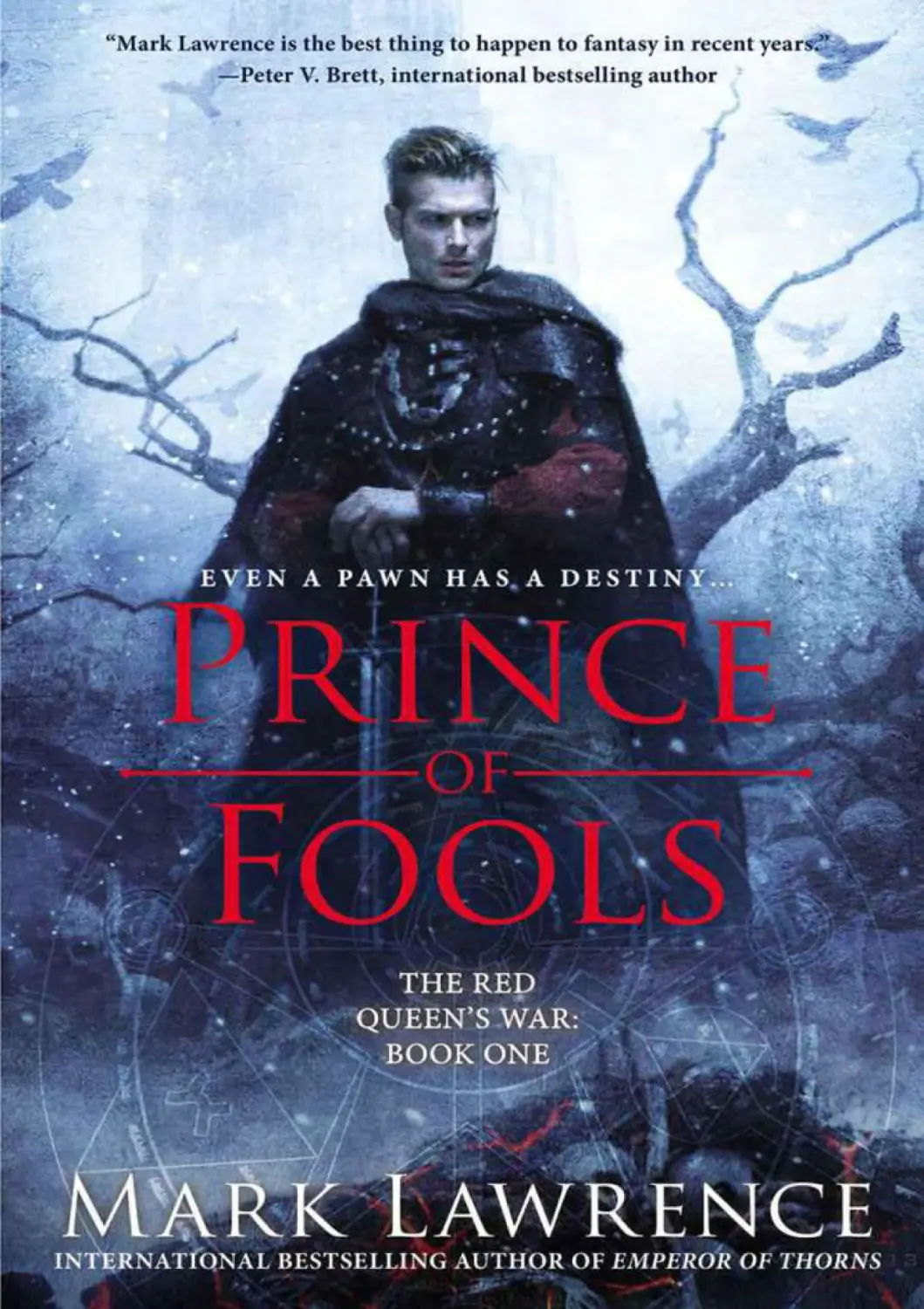
PRINCE OF FOOLS

THE BERKLEY PUBLISHING GROUP
Published by the Penguin Group
Penguin Group (USA) LLC
375 Hudson Street, New York, New York 10014

USA • Canada • UK • Ireland • Australia • New Zealand • India • South Africa • China
penguin.com
A Penguin Random House Company
This book is an original publication of The Berkley Publishing Group.
Copyright © 2014 by Bobalinga, Ltd.
Penguin supports copyright. Copyright fuels creativity, encourages diverse voices, promotes free speech,
and creates a vibrant culture. Thank you for buying an authorized edition of this book and for complying
with copyright laws by not reproducing, scanning, or distributing any part of it in any form without
permission. You are supporting writers and allowing Penguin to continue to publish books for every reader.
Ace Books are published by The Berkley Publishing Group.
ACE and the “A” design are trademarks of Penguin Group (USA) LLC.
eBook ISBN: 978-1-101-63093-8
Library of Congress Cataloging-in-Publication Data
Lawrence, Mark, 1966–
Prince of fools / Mark Lawrence. — First Edition.
pages cm. — (The Red Queen’s War; 1)
ISBN 978-0-425-26878-0 (hardback)
1. Queens—Fiction. 2. Imaginary wars and battles—Fiction. I. Title.
PS3612.A9484P45 2014
813’.6—dc23
2013048142
FIRST EDITION: June

2014

Cover art by Christian McGrath.
Map reprinted by permission of HarperCollins Publishers Ltd © 2014 Andrew Ashton.
This is a work of fiction. Names, characters, places, and incidents either are the product of the author’s
imagination or are used fictitiously, and any resemblance to actual persons, living or dead, business
establishments, events, or locales is entirely coincidental.
Version_1

CONTENTS

Ace Books by Mark Lawrence
Title Page
Copyright
Dedication
Acknowledgments
Map
ONE
TWO
THREE
FOUR
FIVE
SIX
SEVEN
EIGHT
NINE
TEN
ELEVEN
TWELVE
THIRTEEN
FOURTEEN
FIFTEEN
SIXTEEN
SEVENTEEN

EIGHTEEN
NINETEEN
TWENTY
TWENTY-ONE
TWENTY-TWO
TWENTY-THREE
TWENTY-FOUR
TWENTY-FIVE
TWENTY-SIX
TWENTY-SEVEN
TWENTY-EIGHT
TWENTY-NINE
THIRTY
THIRTY-ONE

Dedicated to my daughter, Heather

ACKNOWLEDGMENTS

Many thanks to the good folk at Ace Books who have made
this all happen and put the book in your hands. Special thanks
to Ginjer Buchanan and Rebecca Brewer.
Thanks also to Justin Landon, who read the early portion
of the book and provided much-appreciated feedback.
And finally, another round of applause for my agent, Ian
Drury, and the team at Sheil Land for all their sterling work.

ONE

I

I’m a liar and a cheat and a coward, but I will never, ever, let a
friend down. Unless of course not letting them down requires
honesty, fair play, or bravery.

’ve always found hitting a man from behind to be the best
way to go about things. This can sometimes be
accomplished by dint of a simple ruse. Classics such as,
“What’s that over there?” work surprisingly often, but for truly
optimal results it’s best if the person doesn’t ever know you
were there.
“Ow! Jesu! What the hell did you do that for?” Alain
DeVeer turned, clamping his hand to the back of his head and
bringing it away bloody.
When the person you hit doesn’t have the grace to fall
over, it’s generally best to have a backup plan. I dropped what
remained of the vase, turned, and ran. In my mind he’d folded
up with a pleasing “oofff” and left me free to leave the
mansion unobserved, stepping over his prone and senseless
form on the way. Instead his senseless form was now chasing
me down the hall bellowing for blood.
I crashed back through Lisa’s door and slammed it behind
me, bracing myself for the impact.
“What the hell?” Lisa sat in the bed, silken sheets flowing
off her nakedness like water.
“Uh.” Alain hammered into the door, jolting the air from
my lungs and scraping my heels over the tiles. The trick is to
never rush for the bolt. You’ll be fumbling for it and get a face
full of opening door. Brace for the impact; when that’s done,
slam the bolt home while the other party is picking himself off
the floor. Alain proved worryingly fast in getting back on his
feet and I nearly got the door handle for breakfast despite my
precautions.

“Jal!” Lisa was out of bed now, wearing nothing but the
light and shade through the shutters. Stripes suited her.
Sweeter than her elder sister, sharper than her younger sister.
Even then I wanted her, even with her murderous brother held
back by just an inch of oak and with my chances for escape
evaporating by the moment.
I ran to the largest window and tore the shutters open.
“Say sorry to your brother for me.” I swung a leg over the
casement. “Mistaken identity or something . . .” The door
started to shudder as Alain pounded the far side.
“Alain?” Lisa managed to look both furious with me and
terrified at the same time.
I didn’t stop to reply but vaulted down into the bushes,
which were thankfully the fragrant rather than thorny variety.
Dropping into a thorn bush can lead to no end of grief.
Landing is always important. I do a lot of falling and it’s
not how you start that matters so much as how you finish. In
this instance, I finished concertinaed, heels to arse, chin to
knees, half an azalea bush up my nose and all the air driven
from my lungs, but with no bones broken. I fought my way out
and limped towards the garden wall, gasping for breath and
hoping the staff were too busy with predawn chores to be
poised and ready to hunt me down.
I took off, across the formal lawns, through the herb
garden, cutting a straight path through all the little diamonds
of sage, and triangles of thyme and whatnot. Somewhere back
at the house a hound bayed, and that put the fear in me. I’m a
good runner any day of the week. Scared shitless I’m world
class. Two years ago, in the “border incident” with Scorron, I
ran from a patrol of Teutons, five of them on big old destriers.
The men I had charge of stayed put, lacking any orders. I find
the important thing in running away is not how fast you run
but simply that you run faster than the next man.
Unfortunately my lads did a piss-poor job of slowing the
Scorrons down, and that left poor Jal running for his life with
hardly twenty years under his belt and a great long list of
things still to do—with the DeVeer sisters near the top and
dying on a Scorron lance not even making the first page. In

any event, the borderlands aren’t the place to stretch a
warhorse’s legs, and I kept a gap between us by running
through a boulder field at breakneck speed. Without warning I
found myself charging into the back of a pitched battle
between a much larger force of Scorron irregulars and the
band of Red March skirmishers I’d been scouting on behalf of
in the first place. I rocketed into the midst of it all, flailed
around with my sword in blind terror trying to escape, and
when the dust settled and the blood stopped squirting, I
discovered myself the hero of the day, breaking the enemy
with a courageous attack that showed complete disregard for
my own safety.
So here’s the thing: Bravery may be observed when a
person tramples one fear whilst in secret flight from a greater
terror. And those whose greatest terror is being thought a
coward are always brave. I, on the other hand, am a coward.
But with a little luck, a dashing smile, and the ability to lie
from the hip, I’ve done a surprisingly good job of seeming a
hero and of fooling most of the people most of the time.
The DeVeers’ wall was a high and forbidding one, but it
and I were old friends: I knew its curves and foibles as well as
any contour Lisa, Sharal, or Micha might possess. Escape
routes have always been an obsession of mine.
Most barriers are there to keep the unwashed out, not the
washed in. I vaulted a rain barrel, onto the roof of a gardener’s
outbuilding, and jumped for the wall. Teeth snapped at my
heels as I hauled myself over. I clung by my fingers and
dropped. A shiver of relief ran through me as the hound found
its voice and scrabbled against the far side of the wall in
frustration. The beast had run silent and almost caught me.
The silent ones are apt to kill you. The more sound and fury
there is, the less murderous the animal. True of men too. I’m
nine parts bluster and one part greed and so far not an ounce of
murder.
I landed in the street, less heavily this time, free and clear,
and if not smelling of roses then at least of azalea and mixed
herbs. Alain would be a problem for another day. He could
take his place in the queue. It was a long one and at its head

stood Maeres Allus clutching a dozen promissory notes, IOUs,
and intents to pay drunkenly scrawled on whores’ silken
lingerie. I stood, stretched, and listened to the hound complain
behind the wall. I’d need a taller wall than that to keep
Maeres’s bullies at bay.
Kings Way stretched before me, strewn with shadows. On
Kings Way the town houses of noble families vie with the
ostentation of merchant-princes’ mansions, new money trying
to gleam brighter than the old. The city of Vermillion has few
streets as fine.
“Take him to the gate! He’s got the scent.” Voices back in
the garden.
“Here, Pluto! Here!”
That didn’t sound good. I set off sprinting in the direction
of the palace, sending rats fleeing and scattering dungmen on
their rounds, the dawn chasing after me, throwing red spears at
my back.

T

TWO

he palace at Vermillion is a sprawling affair of walled
compounds, exquisite gardens, satellite mansions for
extended family, and finally the Inner Palace, the great stone
confection that has for generations housed the kings of Red
March. The whole thing is garnished with marble statuary
teased into startlingly lifelike forms by the artistry of Milano
masons, and a dedicated man could probably scrape enough
gold leaf off the walls to make himself slightly richer than
Croesus. My grandmother hates it with a passion. She’d be
happier behind granite barricades a hundred feet thick and
spiked with the heads of her enemies.
Even the most decadent of palaces can’t be entered
without some protocol, though. I slipped in via the Surgeons’
Gate, flipping a silver crown to the guard.
“Got you out early again, Melchar.” I make a point of
knowing the guards’ names. They still think of me as the hero
of Aral Pass and it’s helpful to have the gatekeepers on side
when your life dangles from as large a web of lies as mine
does.
“Aye, Prince Jal. Them’s as works best works hardest, they
do say.”
“So true.” I had no idea what he’d said but my fake laugh
is even better than my real one, and nine-tenths of being
popular is the ability to jolly the menials along. “I’d get one of
those lazy bastards to take a turn.” I nodded towards the
lantern glow bleeding past the crack of the guardhouse door
and strolled on through the gates as Melchar drew them open.
Once inside, I made a straight line for the Roma Hall. As
the queen’s third son, Father got invested in the Roma Hall, a
palatial Vatican edifice constructed by the pope’s own
craftsmen for Cardinal Paracheck way back whenever.
Grandmother has little enough time for Jesu and his cross,
though she’ll say the words at celebrations and look to mean

them. She has far less time for Roma, and none at all for the
pope that sits there now—the Holy Cow, she calls her.
As Father’s third son I get bugger-all. A chamber in Roma
Hall, an unwanted commission in the Army of the North, one
that didn’t even swing me a cavalry rank since the northern
borders are too damn hilly for horse. Scorron deploy cavalry
on the borders, but Grandmother declared their pigheadedness
a failing the Red March should exploit rather than a
foolishness we should continue to follow. Women and war
don’t mix. I’ve said it before. I should have been breaking
hearts on a white charger, armoured for tourney. But no, that
old witch had me crawling around the peaks trying not to get
murdered by Scorron peasants.
I entered the Hall—really a collection of halls, staterooms,
a ballroom, kitchens, stables, and a second floor with endless
bedchambers—by the west port, a service door meant for
scullions and such. Fat Ned sat at guard, his halberd against
the wall.
“Ned!”
“Master Jal!” He woke with a start and came perilously
close to tipping the chair over backwards.
“As you were.” I gave him a wink and went by. Fat Ned
kept a tight lip and my excursions were safe with him. He’d
known me since I was a little monster bullying the smaller
princes and princesses and toadying to the ones big enough to
clout me. He’d been fat back in those days. The flesh hung off
him now as the reaper closed in for the final swing, but the
name stuck. There’s power in a name. “Prince” has served me
very well—something to hide behind when trouble comes, and
“Jalan” carries echoes of King Jalan of the Red March, Fist of
the Emperor back when we had one. A title and a name like
Jalan carry an aura with them, enough to give me the benefit
of the doubt—and there was never a doubt I needed that.
I nearly made it back to my room.
“Jalan Kendeth!”

I stopped two steps from the balcony that led to my
chambers, toe poised for the next step, boots in my hand. I said
nothing. Sometimes the bishop would just bellow my name
when he discovered random mischief. In fairness I was
normally the root cause. This time, however, he was looking
directly at me.
“I see you right there, Jalan Kendeth, footsteps black with
sin as you creep back to your lair. Get down here!”
I turned with an apologetic grin. Churchmen like you to be
sorry and often it doesn’t matter what you’re sorry about. In
this case I was sorry for being caught.
“And the best of mornings to you, Your Excellency.” I put
the boots behind my back and swaggered down towards him
as if it had been my plan all along.
“His Eminence directs me to present your brothers and
yourself at the throne room by second bell.” Bishop James
scowled at me, cheeks grey with stubble as if he too had been
turfed out of bed at an unreasonable hour, though perhaps not
by Lisa DeVeer’s shapely foot.
“Father directed that?” He’d said nothing at table the
previous night, and the cardinal was not one to rise before
noon whatever the good book had to say about sloth. They call
it a deadly sin, but in my experience lust will get you into
more trouble and sloth’s only a sin when you’re being chased.
“The message came from the queen.” The bishop’s scowl
deepened. He liked to attribute all commands to Father as the
church’s highest, albeit least enthusiastic, representative in
Red March. Grandmother once said she’d been tempted to set
the cardinal’s hat on the nearest donkey, but Father had been
closer and promised to be more easily led. “Martus and Darin
have already left.”
I shrugged. “They arrived before me too.” I’d yet to
forgive my elder brothers that slight. I stopped, out of arm’s
reach as the bishop loved nothing better than to slap the sin out
of a wayward prince, and turned to go upstairs. “I’ll get
dressed.”

“You’ll go now! It’s almost second bell and your preening
never takes less than an hour.”
As much as I would have liked to dispute the old fool, he
happened to be right and I knew better than to be late for the
Red Queen. I suppressed a sneer and hurried past him. I had
on what I’d worn for my midnight escapades and whilst it was
stylish enough, the slashed velvets hadn’t fared too well
during my escape. Still, it would have to serve. Grandmother
would rather see her spawn battle-armoured and dripping
blood in any event, so a touch of mud here and there might
earn me some approval.

THREE
late to the throne room with the second bell’s echoes
Icame
dying before I reached the bronze doors, huge out-of-place
things stolen from some still-grander palace by one of my
distant and bloody-handed relatives. The guards eyed me as if
I might be bird crap that had sailed uninvited through a high
window to splat before them.
“Prince Jalan.” I rolled my hands to chivvy them along.
“You may have heard of me? I am invited.”
Without commentary the largest of them, a giant in firebronze mail and crimson-plumed helm, hauled the left door
wide enough to admit me. My campaign to befriend every
guard in the palace had never penetrated as far as
Grandmother’s picked men; they thought too much of
themselves for that. Also they were too well paid to be
impressed by my largesse, and perhaps forewarned against me
in any case.
I crept in unannounced and hurried across the echoing
expanse of marble. I’ve never liked the throne room. Not for
the arching grandness of it, or the history set in grim-faced
stone and staring at us from every wall, but because the place
has no escape routes. Guards, guards, and more guards, along
with the scrutiny of that awful old woman who claims to be
my grandmother.
I made my way towards my nine siblings and cousins. It
seemed this was to be an audience exclusively for the royal
grandchildren: the nine junior princes and singular princess of
Red March. By rights I should have been tenth in line to the
throne after my two uncles, their sons, and my father and elder
brothers, but the old witch who’d kept that particular seat
warm these past forty years had different ideas about
succession. Cousin Serah, still a month shy of her eighteenth
birthday, and containing not an ounce of whatever it is that
makes a princess, was the apple of the Red Queen’s eye. I

won’t lie, Serah had more than several ounces of whatever it is
that lets a woman steal the sense from a man, and accordingly
I would gladly have ignored the common views on what
cousins should and shouldn’t get up to. Indeed I’d tried to
ignore them several times, but Serah had a vicious right hook
and a knack for kicking the tenderest of spots that a man owns.
She’d come today wearing some kind of riding suit in fawn
and suede that looked better suited to the hunt than to court.
But damn, she looked good.
I brushed past her and elbowed my way in between my
brothers near the front of the group. I’m a decent-sized fellow,
tall enough to give men pause, but I don’t normally care to
stand by Martus and Darin. They make me look small and,
with nothing to set us apart, all with the same dark-gold hair
and hazel eyes, I get referred to as “the little one.” That I don’t
like. On this occasion, though, I was prepared to be
overlooked. It wasn’t just being in the throne room that made
me nervous. Nor even because of Grandmother’s pointed
disapproval. It was the blind-eye woman. She scares the hell
out of me.
I first saw her when they brought me before the throne on
my fifth birthday, my name day, flanked by Martus and Darin
in their church finest, Father in his cardinal’s hat, sober despite
the sun having passed its zenith, my mother in silks and pearls,
a clutch of churchmen and court ladies forming the periphery.
The Red Queen sat forwards in her great chair booming out
something about her grandfather’s grandfather, Jalan, the Fist
of the Emperor, but it passed me by—I’d seen her. An ancient
woman, so old it turned my stomach to look at her. She
crouched in the shadow of the throne, hunched up so she’d be
hidden away if you looked from the other side. She had a face
like paper that had been soaked then left to dry, her lips a
greyish line, cheekbones sharp. Clad in rags and tatters, she
had no place in that throne room, at odds with the finery, the
fire-bronzed guards and the glittering retinue come to see my
name set in place upon me. There was no motion in the crone;
she could almost have been a trick of the light, a discarded
cloak, an illusion of lines and shade.

“. . . Jalan?” The Red Queen stopped her litany with a
question.
I had answered with silence, tearing my gaze from the
creature at her side.
“Well?” Grandmother narrowed her regard to a sharp point
that held me.
Still I had nothing. Martus had elbowed me hard enough to
make my ribs creak. It hadn’t helped. I wanted to look back at
the old woman. Was she still there? Had she moved the
moment my eyes left her? I imagined how she’d move. Quick
like a spider. My stomach made a tight knot of itself.
“Do you accept the charge I have laid upon you, child?”
Grandmother asked, attempting kindness.
My glance flickered back to the hag. Still there, exactly the
same, her face half-turned from me, fixed on Grandmother. I
hadn’t noticed her eye at first, but now it drew me. One of the
cats at the Hall had an eye like that. Milky. Pearly almost.
Blind, my nurse called it. But to me it seemed to see more than
the other eye.
“What’s wrong with the boy? Is he simple?”
Grandmother’s displeasure had rippled through the court,
silencing their murmurs.
I couldn’t look away. I stood there sweating. Barely able to
keep from wetting myself. Too scared to speak, too scared
even to lie. Too scared to do anything but sweat and keep my
eyes on that old woman.
When she moved, I nearly screamed and ran. Instead just a
squeak escaped me. “Don-don’t you see her?”
She stole into motion. So slow at first you had to measure
her against the background to be sure it wasn’t imagination.
Then speeding up, smooth and sure. She turned that awful face
towards me, one eye dark, the other milk and pearl. It had felt
hot, suddenly, as if all the great hearths had roared into life
with one scorching voice, sparked into fury on a fine
summer’s day, the flames leaping from iron grates as if they
wanted nothing more than to be amongst us.

She was tall. I saw that now, hunched but tall. And thin,
like a bone.
“Don’t you see her?” My words rising to a shriek, I
pointed and she stepped towards me, a white hand reaching.
“Who?” Darin beside me, nine years under his belt and too
old for such foolishness.
I had no voice to answer him. The blind-eye woman had
laid her hand of paper and bones over mine. She smiled at me,
an ugly twisting of her face, like worms writhing over each
other. She smiled, and I fell.
I fell into a hot, blind place. They tell me I had a fit,
convulsions. A “lepsy,” the chirurgeon said to Father the next
day, a chronic condition, but I’ve never had it again, not in
nearly twenty years. All I know is that I fell, and I don’t think
I’ve stopped falling since.
Grandmother had lost patience and set my name upon me
as I jerked and twitched on the floor. “Bring him back when
his voice breaks,” she said.
And that was it for eight years. I came back to the throne
room aged thirteen, to be presented to Grandmother before the
Saturnalia feast in the hard winter of 89. On that occasion, and
all others since, I’ve followed everyone else’s example and
pretended not to see the blind-eye woman. Perhaps they really
don’t see her, because Martus and Darin are too dumb to act
and poor liars at that, and yet their eyes never so much as
flicker when they look her way. Maybe I’m the only one to see
her when she taps her fingers on the Red Queen’s shoulder. It’s
hard not to look when you know you shouldn’t. Like a
woman’s cleavage, breasts squeezed together and lifted for
inspection, and yet a prince is supposed not to notice, not to
drop his gaze. I try harder with the blind-eye woman and for
the most part I manage it—though Grandmother’s given me an
odd look from time to time.
In any event, on this particular morning, sweating in the
clothes I wore the night before and with half the DeVeers’
garden to decorate them, I didn’t mind in the least being
wedged between my hulking brothers and being “the little

one,” easy to overlook. Frankly, the attention of either the Red
Queen or her silent sister were things I could do without.
We stood for another ten minutes, unspeaking in the main,
some princes yawning, others shifting weight from one foot to
the other or casting sour glances my way. I do try to keep my
misadventures from polluting the calm waters of the palace.
It’s ill advised to shit where you eat, and besides, it’s hard to
hide behind one’s rank when the offended party is also a
prince. Even so, over the course of the years, I’d given my
cousins few reasons to love me.
At last the Red Queen came in, without fanfare but flanked
by guards. The relief was momentary—the blind-eye woman
followed in her wake, and although I turned away quicker than
quick, she saw me looking. The queen settled herself into her
royal seat and the guardsmen arrayed themselves around the
walls. A single chamberlain—Mantal Drews, I think—stood ill
at ease between the royal progeny and our sovereign, and once
more the hall returned to silence.
I watched Grandmother and, with some effort, kept my
gaze from sliding towards the white and shrivelled hand
resting behind her head on the throne’s shoulder. Over the
years I’d heard many rumours about Grandmother’s secret
counsellor, an old and half-mad woman kept hidden away—
the Silent Sister, they called her. It seemed, though, that I
stood alone in knowing that she waited at the Red Queen’s
side each day. Other people’s eyes seemed to avoid her just as
I always wished mine would.
The Red Queen cleared her throat. In taverns across
Vermillion they tell it that my grandmother was once a
handsome woman, though monstrous tall with it. A
heartbreaker who attracted suit from all corners of the Broken
Empire and even beyond. To my eye she had a brutal face,
raw-boned, her skin tight as if scorched, but still showing
wrinkles as crumpled parchment will. She had to have seventy
years on her, but no one would have called her more than fifty.
Her hair dark and without a hint of grey, still showing deepest
red where the light caught it. Handsome or not, though, her
eyes would turn any man’s bowels to water. Flinty chips of

dispassion. And no crown for the warrior queen, oh no. She sat
near-swallowed by a robe of blacks and scarlets, just the
thinnest circlet of gold to keep her locks in place, scraped back
across her head.
“My children’s children.” Grandmother’s words came so
thick with disappointment that you felt it reach out and try to
throttle you. She shook her head, as if we were all of us an
experiment in horse breeding gone tragically astray. “And
some of you whelping new princes and princesses of your
own, I hear.”
“Yes, w—”
“Idle, numerous, and breeding sedition in your numbers.”
Grandmother rolled over Cousin Roland’s announcement
before he could puff himself up. His smile died in that stupid
beard of his, the one he grew to allow people at least the
suspicion that he might have a chin. “Dark times are coming
and this nation must be a fortress. The time for being children
has passed. My blood runs in each of you, thin though it’s
grown. And you will be soldiers in this coming war.”
Martus snorted at that, though quiet enough that it would
be missed. Martus had been commissioned into the heavy
horse, destined for knight-general, commander of Red March’s
elite. The Red Queen in a fit of madness five years earlier had
all but eliminated the force. Centuries of tradition, honour, and
excellence ploughed under at the whim of an old woman. Now
we were all to be soldiers running to battle on foot, digging
ditches, endlessly practising mechanical tactics that any
peasant could master and that set a prince no higher than a
potboy.
“. . . greater foe. Time to put aside thoughts of empty
conquest and draw in . . .”
I looked up from my disgust to find Grandmother still
droning on about war. It’s not that I care overmuch about
honour. All that chivalry nonsense loads a man down and any
sensible fellow will ditch it the moment he needs to run—but
it’s the look of the thing, the form of it. To be in one of the
three horse corps, to earn your spurs and keep a trio of

chargers at the city barracks . . . it had been the birthright of
young nobles since time immemorial. Damn it, I wanted my
commission. I wanted in at the officers’ mews, wanted to swap
tall tales around the smoky tables at the Conarrf and ride along
the Kings Way flying the colours of the Red Lance or Iron
Hoof, with the long hair and bristling moustache of a
cavalryman and a stallion between my legs. Tenth in line to a
throne will get you into a not-insignificant number of
bedchambers, but if a man dons the scarlet cloak of the Red
March riders and wraps his legs around a destrier, there are
few ladies of quality who won’t open theirs when he flashes a
smile at them.
At the corner of my vision the blind-eye woman moved,
spoiling my daydream and putting all thoughts of riding, of
either kind, from my head.
“. . . burning all dead. Cremation is to be mandatory, for
noble and commoner alike, and damn any dissent from
Roma . . .”
That again. The old bird had been banging on about death
rites for over a year now. As if men my age gave a fig for such
things! She’d become obsessed with sailors’ tales, ghost
stories from the Drowned Isles, the ramblings of muddy
drunkards from the Ken Marshes. Already men went chained
into the ground—good iron wasted against superstition—and
now chains weren’t enough? Bodies must be burned? Well, the
church wouldn’t like it. It would put a crimp in their plans for
Judgment Day and us all rising from the grave for a big grimy
hug. But who cared? Really? I watched the early light slide
across the walls high above me and tried to picture Lisa as I’d
left her that morning, clad in brightness and shadow and
nothing more.
The crash of the chamberlain’s staff on flagstones jerked
my head back up. In fairness I’d had very little sleep the night
before and a trying morning. If I hadn’t been caught a yard
from my bedchamber door I would have been safely
ensconced therein until well past noon, dreaming better
versions of the daydream Grandmother kept interrupting.

“Bring in the witnesses!” The chamberlain had a voice that
could make a death sentence boring.
Four guardsmen entered, flanking a Nuban warrior, scarmarked and tall, manacled wrist and ankle, the chains all
threaded through an iron ring belted around his waist. That
perked my interest. I misspent much of my youth gambling at
the pit fights in the Latin Quarter, and I intended to misspend
much of what life remained to me there too. I’ve always
enjoyed a good fight and a healthy dose of bloodshed, as long
as it’s not me being pummelled or my blood getting spilled.
Gordo’s pits, or the Blood Holes down by Mercants, got you
close enough to wipe the occasional splatter from the toe of
your boot, and offered endless opportunity for betting. Of late
I’d even entered men on my own ticket. Likely lads bought off
the slave boats out of Maroc. None had lasted more than two
bouts yet, but even losing can pay if you know where to place
your wagers. In any event, the Nuban looked like a solid bet.
Perhaps he might even be the ticket that could get Maeres
Allus off my back and silence his tiresome demands for
payment for brandy already consumed and for whores already
fucked.
A weedy half-caste with a decorative arrangement of
missing teeth followed the Nuban to translate his mumbo
jumbo. The chamberlain posed a question or two and the man
answered with the usual nonsense about dead men rising from
the Afrique sands, elaborating the tales this time to make it
small legions of them. No doubt he hoped for freedom if his
story proved sufficiently entertaining. He did a fine job of it,
throwing in a djinn or two for good measure, though not the
normal jolly fellows in satin pantaloons offering wishes. I felt
tempted to applaud at the end, but Grandmother’s face
suggested that might not be a wise idea.
Two more reprobates followed, each similarly chained,
each with a more outrageous fable than the last. The corsair, a
swarthy fellow with torn ears where the gold had been ripped
from him, spun a yarn about dead ships rising, crewed by
drowned men. And the Slav spoke of bone-men from the
barrows out in the grass sea. Ancient dead clad in pale gold
and grave goods from before the Builders’ time. Neither man

had much potential for the pits. The corsair looked wiry and
was no doubt used to fighting in close quarters, but he’d lost
fingers from both hands and age was against him. The Slav
was a big fellow, but slow. Some men have a special kind of
clumsiness that announces itself in every move they make. I
started to dream about Lisa again. Then Lisa and Micha
together. Then Lisa, Micha, and Sharal. It got quite
complicated. But when more guards marched in with the
fourth and last of these “witnesses,” Grandmother suddenly
had all my attention. You only had to look at the man to tell
the Blood Holes wouldn’t know what had hit them. I’d found
my new fighter!
The prisoner strode into the throne room with head held
high. He dwarfed the four guards around him. I’ve seen taller
men, though not often. I’ve seen men more heavily muscled,
but seldom. I’ve even on rare occasions seen men larger in
both dimensions, but this Norseman carried himself like a true
warrior. I may not be much of a one for fighting, but I’ve a
great eye for a fighter. He walked in like murder, and when
they jerked him to a halt before the chamberlain, he snarled.
Snarled. I could almost count the gold crowns spilling into my
hands when I got this one to the pits!
“Snorri ver Snagason, purchased off the slave ship
Heddod.” The chamberlain took a step back despite himself
and kept his staff between them as he read from his notes.
“Sold in trade exchange off the Hardanger Fjord.” He traced a
finger down the scroll, frowning. “Describe the events you
recounted to our agent.”
I had no idea where the place might be, but clearly they
bred men tough up in Hardanger. The slavers had hacked off
most of the man’s hair, but the thick shock remaining was so
black as to almost be blue. I’d thought Norsemen fair. The
deep burn across his neck and shoulders showed he didn’t take
well to the sun, though. Innumerable lash marks intersected
the sunburn—that had to sting a bit! Still, the fight pits were
always in shadow so he’d appreciate that part of my plans for
him at least.

“Speak up, man.” Grandmother addressed the giant
directly. He’d made an impression even on her.
Snorri turned his gaze on the Red Queen and gave her the
type of look that’s apt to lose men eyeballs. He had blue eyes,
pale. That at least was in keeping with his heritage. That and
the remnants of his furs and sealskins, and the Norse runes
picked out in black ink and blue around his upper arms.
Writing too, some sort of heathen script by the look of it but
with the hammer and the axe in there as well.
Grandmother opened her mouth to speak again, but the
Norseman preempted her, stealing the tension for his own
words.
“I left the North from Hardanger, but it is not my home.
Hardanger is quiet waters, green slopes, goats, and cherry
orchards. The people there are not the true folk of the North.”
He spoke with a deep voice and a shallow accent,
sharpening the blunt edges of each word just enough so you
knew he was raised in another tongue. He addressed the whole
room, though he kept his eyes on the queen. He told his story
with an orator’s skill. I’ve heard tell that the winter in the
North is a night that lasts three months. Such nights breed
storytellers.
“My home was in Uuliskind, at the far reach of the Bitter
Ice. I tell you my story because that place and time are over
and live only in memory. I would put these things into your
minds, not to give them meaning or life, but to make them real
to you, to let you walk among the Undoreth, the Children of
the Hammer, and to have you hear of their last struggle.”
I don’t know how he did it, but when he wrapped his voice
around the words Snorri wove a kind of magic. It set the hairs
pricking on the backs of my arms, and damned if I didn’t want
to be a Viking too, swinging my axe on a longboat sailing up
the Uulisk Fjord, with the spring ice crunching beneath its
hull.
Every time he paused for breath the foolishness left me
and I counted myself very lucky to be warm and safe in Red

March, but while he spoke a Viking heart beat in every
listener’s chest, even mine.
“North of Uuliskind, past the Jarlson Uplands, the ice
begins in earnest. The highest summer will drive it back a mile
or three, but before long you find yourself raised above the
land on a blanket of ice that never melts, folded, fissured, and
ancient. The Undoreth venture there only to trade with
Inowen, the men who live in snow and hunt for seal on the sea
ice. The Inowen are not as other men, sewn into their sealskins
and eating the fat of whales. They are . . . a different kind.
“Inowen offer walrus tusks, oils sweated from blubber, the
teeth of great sharks, pelts of the white bear and skins. Also
ivories carved into combs and picks and into the shapes of the
true spirits of the ice.”
When my grandmother interjected into the story’s flow,
she sounded like a screeching crow trying to overwrite a
melody. Still, credit to her for finding the will to speak—I’d
forgotten even that I stood in the throne room, sore-footed and
yawning for my bed. Instead I was with Snorri trading shaped
iron and salt for seals carved from the bones of whales.
“Speak of the dead, Snagason. Put some fear into these
idle princes,” Grandmother told him.
I saw it then. The quickest flicker of his glance towards the
blind-eye woman. I’d come to understand it was common
knowledge that the Red Queen consulted with the Silent Sister.
But as with most such “common knowledge,” the recipients
would be hard pressed to tell you how they came by their
information, though willing to insist upon its veracity with
considerable vigour. It was common knowledge, for example,
that the Duke of Grast took young boys to his bed. I put that
one about after he slapped me for making an improper
suggestion to his sister—a buxom wench with plenty of
improper suggestions of her own. The vicious slander stuck
and I’ve taken great delight in defending his honour ever since
against heated opposition who “had it from a trusted source!”
It was common knowledge that the Duke of Grast sodomized
small boys in the privacy of his castle, common knowledge
that the Red Queen practised forbidden sorceries in her highest

tower, common knowledge that the Silent Sister, a parlous
witch whose hand lay behind much of the empire’s ills, was
either in the Red Queen’s palm or vice versa. But until this
brutish Norseman glanced her way I’d never encountered any
other person who truly saw the blind-eye woman at my
grandmother’s side.
Whether convinced by the Silent Sister’s pearl-eyed stare
or the Red Queen’s command, Snorri ver Snagason bowed his
head and spoke of the dead.
“In the Jarlson Uplands the frozen dead wander. Corpse
tribes, black with frost, stagger in columns, lost in the swirl of
the frostral. They say mammoth walk with them, dead beasts
freed from the ice cliffs that held them far to the north from
times before Odin first gave men the curse of speech. Their
numbers are unknown, but they are many.
“When the gates of Niflheim open to release the winter,
and the frost giants’ breath rolls out across the North, the dead
come with it, taking whoever they can find to join their ranks.
Sometimes lone traders, or fishermen washed up on strange
shores. Sometimes they cross a fjord by ice bridges and take
whole villages.”
Grandmother rose from her throne, and a score of
gauntleted hands moved to cover sword hilts. She cast a sour
glance towards her offspring. “And how do you come to stand
before me in chains, Snorri ver Snagason?”
“We thought the threat came from the North, from the
Uplands and the Bitter Ice.” He shook his head. “When ships
came up the Uulisk in depths of night, black-sailed and silent,
we slept, our sentries watching north for the frozen dead.
Raiders had crossed the Quiet Sea and come against the
Undoreth. Men of the Drowned Isles broke amongst us. Some
living, others corpses preserved from rot, and other creatures
still—half-men from the Brettan swamps, corpse-eaters,
ghouls with venomed darts that steal a man’s strength and
leave him helpless as a newborn.
“Sven Broke-Oar guided their ships. Sven and others of
the Hardassa. Without their treachery the Islanders would

never have been able to navigate the Uulisk by night. Even by
day they would have lost ships.” Snorri’s hands closed into
huge fists and muscle heaped across his shoulders, twitching
for violence. “The Broke-Oar took twenty warriors in chains
as part of his payment. He sold us in Hardanger Fjord. The
trader, a merchant of the Port Kingdoms, meant to have us
sold again in Afrique after we’d rowed his cargo south. Your
agent bought me in Kordoba, in the port of Albus.”
Grandmother must have been hunting far and wide for
these tales—Red March had no tradition of slavery and I knew
she didn’t approve of the trade.
“And the rest?” Grandmother asked, stepping past him,
beyond arm’s reach, seemingly angled towards me. “Those not
taken by your countryman?”
Snorri stared into the empty throne, then directly at the
blind-eye woman. He spoke past gritted teeth. “Many were
killed. I lay poisoned and saw ghouls swarm my wife. I saw
Drowned men chase my children and couldn’t turn my head to
watch their flight. The Islanders returned to their ships with
red swords. Prisoners were taken.” He paused, frowned, shook
his head. “Sven Broke-Oar told me . . . tales. The truth would
twist the Broke-Oar’s tongue . . . but he said the Islanders
planned to take prisoners to excavate the Bitter Ice. Olaaf
Rikeson’s army is out there. The Broke-Oar told it that the
Islanders had been sent to free them.”
“An army?” Grandmother stood almost close enough to
touch now. A monster of a woman, taller than me—and I
overtop six foot—and probably strong enough to break me
across her knee. “Who is this Rikeson?”
The Norseman raised an eyebrow at that, as if every
monarch should know the tawdry history of his frozen wastes.
“Olaaf Rikeson marched north in the first summer of the reign
of Emperor Orrin III. The sagas have it that he planned to
drive the giants from Jotenheim and bore with him the key to
their gates. More sober histories say perhaps his goal was just
to bring the Inowen into the empire. Whatever the truth, the
records agree he took a thousand and more with him, perhaps
ten thousand.” Snorri shrugged and turned from the Silent

Sister to face Grandmother. Braver than me, though that’s not
saying much—I’d not turn my back on that creature. “Rikeson
thought he marched with Odin’s blessing, but the giants’
breath rolled down even so, and one summer’s day every
warrior in his army froze where he stood and the snows
drowned them.
“The Broke-Oar has it that those taken from Uuliskind are
excavating the dead. Freeing them from the ice.”
Grandmother paced along the front line of our number.
Martus, little me, Darin, Cousin Roland with his stupid beard,
Rotus, lean and sour, unmarried at thirty, duller than
ditchwater, obsessed with reading—and histories at that! She
paused by Rotus, another of her favourites and third in line by
right—though still it seemed she would give her throne to
Cousin Serah before him. “And why, Snagason? Who has sent
these forces on such an errand?” She met Rotus’s gaze as if he
of all of us would appreciate the answer.
The giant paused. It’s hard for a Norseman to pale but I
swear he did. “The Dead King, lady.”
A guard made to strike him down, though whether for the
improper address or for making mock with foolish tales I
couldn’t say. Grandmother stayed the man with a lifted finger.
“The Dead King.” She made a slow repetition of the words as
if they somehow sealed her opinion. Perhaps she’d mentioned
him before when I wasn’t listening.
I’d heard tales, of course. Children had started to tell them
to scare each other on Hallows Night. The Dead King will
come for you! Woo, woo, woo. It took a child to be scared.
Anyone with a proper idea of how far away the Drowned Isles
were and of how many kingdoms lay between us would have a
hard time caring. Even if the stories held a core of truth, I
couldn’t see any serious-minded gentleman getting overly
excited about a bunch of heathen necromancers playing with
old corpses on whatever wet hillocks remained to the Lords of
the Isles. So what if they actually did raise a hundred dead
men twitching from their coffins and dropping corpse-flesh
with every step? Ten heavy horse would ride down any such in
half an hour without loss and damn their rotting eyes.

I felt tired and out of sorts, grumpy that I’d had to stand
half the morning and more listening to this parade of nonsense.
If I’d been drunk too I might have given voice to my thoughts.
It’s probably a good job I wasn’t, though the Red Queen could
scare me sober with a look.
Grandmother turned and pointed at the Norseman. “Well
told, Snorri ver Snagason. Let your axe guide you.” I blinked
at that. Some sort of northern saying, I guessed. “Take him
away,” she said, and her guards led him off, chains clanking.
My fellow princes fell to muttering, and me to yawning. I
watched the huge Norseman leave and hoped we’d be released
soon. Despite the call of my bed I had important plans for
Snorri ver Snagason and needed to get hold of him quickly.
Grandmother returned to her throne and held her peace
until the doors had closed behind the last prisoner to exit.
“Did you know there is a door into death?” The Red
Queen didn’t raise her voice and yet it cut through the princes’
chatter. “An actual door. One you can set your hand against.
And behind it, all the lands of death.” Her gaze swept across
us. “There’s an important question you should ask me now.”
No one spoke—I hadn’t a clue but was tempted to answer
anyway just to hurry things along. I decided against it and the
silence stretched until Rotus cleared his throat at last and
asked, “Where?”
“Wrong.” Grandmother cocked her head. “The question
was, ‘Why?’ Why is there a door into death? The answer is as
important as anything you’ve heard today.” Her stare fell upon
me and I quickly turned my attention to the state of my
fingernails. “There is a door into death because we live in an
age of myth. Our ancestors lived in a world of immutable
laws. Times have changed. There is a door because there are
tales of that door, because myths and legends have grown
about it over centuries, because it is set in holy books, and
because the stories of that door are told and retold. There is a
door because in some way we wanted it, or expected it, or
both. This is why. And this is why you must believe the tales
that have been told today. The world is changing, moving

beneath our feet. We are in a war, children of the Red March,
though you may not see it yet, may not feel it. We are in a war
against everything you can imagine and armed only with our
desire to oppose it.”
Nonsense, of course. Red March’s only recent war was
against Scorron, and even that had fallen into an uneasy truce
this past year . . . Grandmother must have sensed she was
losing even the most gullible of her audience and switched
tactics.
“Rotus asked ‘where,’ but I know where the door is. And I
know that it cannot be opened.” She stood from her throne
again. “And what does a door demand?”
“A key?” Serah, ever eager to please.
“Yes. A key.” A smile for her protégée. “Such a key would
be sought by many. A dangerous thing, but better we should
own it than our enemies. I will have tasks for you all soon:
quests for some, questions for others, new lessons for others
still. Be sure to commit yourselves to these labours as to
nothing before. In this you will serve me, you will serve
yourselves, and most importantly—you will serve the empire.”
Exchanged glances, muttering, “Where was Red March in
all that?” Martus perhaps.
“Enough!” Grandmother clapped her hands, releasing us.
“Go. Scurry back to your empty luxuries and enjoy them while
you can. Or—if my blood runs hot in you—consider these
words and act on them. These are the end days. All our lives
draw in towards a single point and time, not too many miles or
years from this room. A point in history when the emperor will
either save us or damn us. All we can do is buy him the time
he needs—and the price must be paid in blood.”
At last! I hurried out amongst the others, catching up with
Serah. “Well, that settles it! The old bat’s cracked. The
emperor!” I laughed and flashed her my cavalry grin. “Even
Grandmother isn’t old enough to have seen the last emperor.”
Serah fixed me with a look of disgust. “Did you listen to
anything she said?” And off she strode, leaving me standing

there, jostled by Martus and Darin as they passed by.

F

FOUR

rom the throne room I sprinted down the grand corridor,
turning left where all my family turned right. Armour,
statuary, portraits, displays of fanned-out swords, all of them
flashed past. My day boots pounded a hundred yards of
staggeringly expensive woven rug, luxuriant silks patterned in
the Indus style. I turned the corner at the far end, teetering on
the edge of control, dodged two maids, and ran flat-out along
the central corridor of the guest range, where scores of rooms
were laid ready against the possibility of visiting nobility.
“Out the fucking way!” Some old retainer doddered from a
doorway into my path. One of my father’s—Robbin, a grey
old cripple always limping about the place getting underfoot. I
swerved past him—Lord knows why we keep such hangers-on
—and accelerated down the hallway.
Twice guardsmen startled from their alcoves, one even
calling a challenge before deciding I was more ass than
assassin. Two doors short of the corridor’s end I stopped and
made an entrance to the Green Room, gambling that it would
be unoccupied. The room, chambered in rustic style with a
four-poster bed carved like spreading oaks, lay empty and
shrouded in white linens. I passed the bed, wherein I’d once
spent several pleasant nights in the company of a dusky
contessa from the southernmost reaches of Roma, and threw
back the shutters. Through the window, onto the balcony, vault
the balustrade, and drop to the peaked roof of the royal stables,
an edifice that would put to shame any mansion on the Kings
Way.
Now, I know how to fall, but the drop from the stables roof
would kill a Chinee acrobat, and so the speed with which I ran
along the stone gutter was a careful balance between my desire
not to fall to my death and my desire not to be stabbed to my
death by Maeres Allus or one of his enforcers. The giant
Norseman could bludgeon me a way out of debt altogether if I

managed to secure his services and make the right wagers.
Hell, if people saw what I saw in the man and wouldn’t give
me good odds, then I could just slip him some bonewort and
bet against him.
At the far end of the stables hall two Corinthian pillars
supported ancient vines, or vice versa. Either way a good, or
desperate, climber could make his way to ground there. I slid
the last ten foot, bruised my heel, bit my tongue, and ran off
towards the Battle Gate spitting blood.
I arrived there winded and had to bend double, palms on
thighs, heaving in great lungfuls of air before I could assess
the situation.
Two guards watched me with undisguised curiosity. An
old soak commonly known as Double, and a youngster I didn’t
recognize.
“Double!” I straightened up and raised a hand in greeting.
“What dungeon are the queen’s prisoners being taken to?” It
would be the war cells up in the Marsail keep. They might be
slaves but you wouldn’t put the Norseman in with common
stock. I asked anyway. It’s always good to open with an easy
question to put your man at ease.
“Ain’t no cells for them lot.” Double made to spit, then
thought better of it and swallowed noisily.
“Wh—?” She couldn’t be having them killed! It would be
a criminal waste.
“They’s going free. Tha’s what I heard.” Double shook his
head at the badness of the business, jowls wobbling.
“Contaph’s coming up to process them.” He nodded out across
the plaza and sure enough there was Contaph, layered in his
official robes and beetling towards us with the sort of selfimportance that only minor functionaries can muster. From the
high latticed windows above the Battle Gate I could hear the
distant clank of chains, drawing nearer.
“Damn it.” I glanced from door to subchamberlain and
back again. “Hold them here, Double,” I told him. “Don’t tell
them anything. Not a thing. I’ll see you right. Your friend too.”

And with that I hurried off to intercept Ameral Contaph of
House Mecer.
We met in the middle of the plaza where an ancient sundial
spelled out the time with morning shadows. Already the
flagstones were beginning to heat up and the day’s promise
simmered above the rooftops. “Ameral!” I threw my hands
wide as though he were an old friend.
“Prince Jalan.” He ducked his head as if seeking to take
me from his sight. I could forgive him his suspicions; as a
child I used to hide scorpions in his pockets.
“Those slaves that put on this morning’s entertainment in
the throne room . . . what’s to become of them, Ameral?” I
moved to intercept him while he tried to circumnavigate me,
his order-scroll clutched tight in one pudgy fist.
“I’m to set them on a caravan for Port Ismuth with papers
dissolving any indenture.” He stopped trying to get past me
and sighed. “What is it that you want, Prince Jalan?”
“Only the Norseman.” I gave him a smile and a wink.
“He’s too dangerous to just set free. That should have been
obvious to everyone. In any event, Grandmother sent me to
take charge of him.”
Contaph looked up at me, eyes narrow with distrust. “I’ve
had no such instructions.”
I have, I must confess, a very honest face. Bluff and
courageous, it’s been called. I’m easy to mistake for a hero,
and with a little effort I can convince even the most cynical
stranger of my sincerity. With people who know me, that trick
becomes more difficult. Much more difficult.
“Walk with me.” I set a hand to his shoulder and steered
him towards the Battle Gate. It’s good to steer a man in the
direction he intended to go. It blurs the line between what he
wants and what you want.
“In truth the Red Queen gave me a scroll with the order. A
hasty scrawl on a scrap of parchment, really. And to my shame
I’ve let it drop in my rush to get here.” I took my hand from
his shoulder and unfastened the gold chain from around my

wrist, a thing of heavy links set with a small ruby on both
clasps. “It would be deeply embarrassing for me to have to
return and admit the loss to my grandmother. A friend would
understand such things.” I took to steering him again as if my
only desire were for him to reach his destination safely. The
chain I dangled before him. “You are my friend, aren’t you,
Ameral?” Rather than drop the chain into a pocket of his robe
and risk reminding him of scorpions, I pressed it into the midst
of his sweaty palm and risked him realizing it was red glass
and gold plated over lead, and thinly at that. Anything of true
value I’d long since pawned against the interest on my debts.
“You’ll retrace your steps and find this document?”
Contaph asked, pausing to stare at the chain in his hand. “And
bring it for filing before sunset?”
“Assuredly.” I oozed sincerity. Any more and it would be
dripping from me.
“He is dangerous, this Norseman.” Contaph nodded as if
persuading himself. “A heathen with false gods. I was
surprised, I must admit, to see freedom set against his name.”
“An oversight.” I nodded. “Now corrected.” Ahead of us
Double appeared to be engaged in heated conversation through
the view grille set into the Battle Gate’s subdoor. “You may
allow the prisoners out,” I called to him. “We’re ready for
them now!”
•••
looking uncommonly pleased with yourself.”
“You’re
Darin strolled into the High Hall, a dining gallery named
for its elevation rather than the height of its ceiling. I like to
eat there for the view it offers, both out across the palace
compound and, via slit windows, into the great entrance hall of
my father’s house.
“Pheasant, pickled trout, hen’s eggs.” I gestured at the
silver plates set before me on the long trestle. “What’s not to
be pleased about? Help yourself.” Darin is self-righteous and
overly curious about my doings, but not the royal pain in the
arse that Martus is, so by dint of not being Martus he carries
the title of “favourite brother.”

“The domo reports dishes keep going missing from the
kitchens of late.” Darin took an egg and sat at the far end of
the table with it.
“Curious.” That would be Jula, our sharp-eyed head cook,
telling tales to the house domo, though how such whispers
came to Darin’s ear . . . “I’d have a few of the scullions beaten.
Soon put a stop to it.”
“On what evidence?” He salted the egg and bit deep.
“Evidence be damned! Bloody up a few of the menials,
put the fear into the lot of them. That’ll put an end to it. That’s
what Grandmother would do. Light fingers get broken, she’d
say.” I went for honest outrage, using my own discomfort to
colour my reactions. No more selling off the family silver for
Jal, then . . . that line of credit had come to an end. Still, I had
the Norseman safely stowed away in the Marsail keep. I could
see the keep from where I sat, a slouching edifice of stone
more ancient than any part of the palace, scarred and
disfigured but stubbornly resisting the plans of a dozen former
kings to tear it down. A ring of tiny windows, heavily barred,
ran around its girth like a belt. Snorri ver Snagason would be
looking up at one of those from the floor of his cell. I’d told
them to give him red meat, rare and bloody. Fighters thrive on
blood.
For the longest time I stared out the window, watching the
keep and the vast landscape of the heavens behind it, a sky of
white and blue, all in motion so that the keep seemed to move
and the clouds stay still, making a ship of all that stone,
ploughing on through white waves.
“What did you think of all that rubbish this morning?” I
asked the question without expecting an answer, sure that
Darin had taken his leave.
“I think if Grandmother is worried, we should be too,”
Darin said.
“A door into death? Corpses? Necromancy?” I sucked and
the flesh came easily off a pheasant’s bone. “Am I to fear
this?” I tapped the bone to the table, looked away from the

window, and grinned at him. “Is it going to pursue me for
vengeance?” I made it walk.
“You heard those men—”
“Have you ever seen a dead man walk? Forget distant
deserts and ice wastes. Here in Red March, has anyone ever
seen such?”
Darin shrugged. “Grandmother says at least one unborn
has entered the city. That’s something to be taken seriously.”
“A what?”
“Jesu! Did you really not listen to a word she said? She is
the queen, you know. You’d do well to pay attention from time
to time.”
“An unborn?” The term rang no bells. It didn’t even
approach the belfry.
“Something born into death rather than life, remember?”
Darin shook his head at my blank look. “Forget it! Just listen
now. Father expects you at this opera of his tonight. No
showing up late, or drunk, or both. No pretending nobody told
you.”
“Opera? Dear God, why?” That was the last thing I
needed. A bunch of fat and painted idiots wailing at me from a
stage for several hours.
“Just be there. A cardinal is expected to finance such
projects from time to time. And when he does, his family had
better put in an appearance or the chattering classes will want
to know why.”
I had opened my mouth to protest when it occurred to me
that the DeVeer sisters would be among those chattering
classes. Phenella Maitus too, the newly arrived and allegedly
stunning daughter of Ortus Maitus, whose pockets ran so deep
it might even be worth a marriage contract to reach into them.
And of course if I could have Snorri make his debut in the pits
before the show started, then I would likely find no end of
aristocratic and mercantile purses opening in the opera
intermissions to wager on this exciting new blood. If there’s
one good thing to be said about opera, it’s that it makes a man

appreciate all other forms of entertainment so much more. I
closed my mouth and nodded. Darin left, still munching his
egg.
The appetite had left me. I pushed the plate away. Idle
fingers discovered my old locket beneath the folds of my cloak
and I fished it out, tapping it against the table. A cheap enough
thing of plate and glass, it clicked open to reveal Mother’s
portrait. I snapped it shut again. She last saw me when I was
seven; a flux took her. They call it a flux. It’s just the shits,
really. You weaken, fever takes you, you die stinking. Not the
way a princess is supposed to die, or a mother. I slipped the
locket away unopened. Best she remember me as seven and
not see me now.

B

•••

efore leaving the palace I picked up my escort, the two
elderly guardsmen allotted to the task of preserving my
royal hide by my father’s generosity. With the pair in tow I
swung by the Red Hall and collected a handful of my usual
cronies. Roust and Lon Greyjar, cousins of the Prince of
Arrow, sent to “further relations,” which seemed to entail
eating all our best vittles and chasing chambermaids. Also
Omar, seventh son of the Caliph of Liba and a fine fellow for
gambling. I’d met him during my brief and inglorious spell at
the Mathema, and he’d persuaded the caliph to send him to the
continent to broaden his education! With Omar and the
Greyjars I headed up to the guest range, that wing of the Inner
Palace where more important dignitaries were housed and
where Barras Jon’s father, the Vyene ambassador to court, kept
a suite of rooms. We had a servant fetch out Barras and he
came sharp enough, with Rollas, his companion-cumbodyguard, trailing behind.
“What a perfect night to get drunk on!” Barras saluted me
as he came down the steps. He always said it was a perfect
night to get drunk.
“For that we’d need wine!” I spread my hands.
Barras stepped aside to reveal Rollas behind him carrying
a large flask. “Big goings-on in court today.”

“A meeting of the clan,” I said. Barras never stopped
fishing for court news. I had a hunch half of his allowance
depended on feeding gossip to his father.
“The Lady Blue playing her games again?” He flung an
arm around my shoulders and steered me towards the
Common Gate. With Barras everything was a plot of nation
against nation or worse, a conspiracy to undermine what peace
remained in the Broken Empire.
“Damned if I know.” Now he mentioned it, there had been
talk of the Lady Blue. Barras always insisted that my
grandmother and this purported sorceress were fighting their
own private war and had been for decades—if true, then to my
mind it was a piss-poor excuse for one as I’d seen precious
little sign of it. Tales about the Lady Blue seemed as doubtful
as those about the handful of so-called magicians who seemed
to haunt the western courts. Kelem, Corion, half a dozen
others: charlatans the lot of them. Only the existence of
Grandmother’s Silent Sister lent any credence at all to the
rumours . . . “Last I heard our friend in blue was flitting from
one Teuton court to the next. Probably been hung for a witch
by now.”
Barras grunted. “Let’s hope so. Let’s hope she’s not back
in Scorron stirring up that little war again.”
I could agree with him there. Barras’s father negotiated the
peace and treated it like his second son. I’d rather a close
relative came to harm than that particular peace deal. Nothing
would induce me back into the mountains to fight the
Scorrons.
We left the palace by the Victory Gate in fine spirits,
passing our flask of Wennith red between us while I explained
the virtues of wooing sisters.
As we entered Heroes’ Plaza the wine turned to vinegar in
my mouth. I half-choked and dropped the flask.
“There! Do you see her?” Coughing, wiping tears from my
eyes, I forgot my own rule and pointed at the blind-eye
woman. She stood at the base of a great statue, the Last
Steward, sombre on his petty throne.

“Steady on!” Roust thumped me between the shoulders.
“See who?” Omar asked, staring where I pointed. Dressed
in tatters, she might in another glance be nothing more than
rags hanging on a dead bush. Perhaps that was what Omar
saw.
“Nearly lost this!” Barras retrieved the flask, safe in its
reed casing. “Come to Papa! I’ll be looking after you from
now on, little one!” And he cradled it like a baby.
None of them saw her. She watched a moment longer, the
blind eye burning across me, then turned and walked away
through the crowds flowing towards Trent Market. Jostled into
action by the others, I walked on too, haunted by old fears.
We approached the Blood Holes in the early afternoon, me
sweating and nervous, and not just because of the unseasonal
heat or the fact that my financial future was about to ride on
two very broad shoulders. The Silent Sister always unsettled
me, and I’d seen entirely too much of her today. I kept
glancing about, half-expecting to spot her again along the
crowded streets.
“Let’s see this monster of yours!” Lon Greyjar slapped a
hand to my shoulder, shaking me out of my rememberings and
alerting me to the fact that we’d arrived at the Blood Holes. I
made a smile for him and promised myself I’d fleece the little
fucker down to his last crown. He had an annoying way about
him, did Lon, too chummy, too keen to lay hands on you, and
always snipping away at anything you said as if he doubted
everything, even the boots you were standing in. Fair enough,
I lie a lot, but that doesn’t mean cousins of some minor
princeling can take liberties.
I paused before approaching the doors and stepped back,
casting my gaze along the outer walls. The place had been a
slaughterhouse once, though a grand one, as if the king back in
those days had wanted even his cattle murdered in buildings
that would shame the homes of his copper-crown rivals.
On the only other occasion I’d seen the blind-eye woman
outside the throne room, she had been on the Street of Nails up
close to one of the larger manses towards the western end. I’d

come out of some ambassador’s ballroom with an enticing
young woman, got my face slapped for my efforts, and was
cooling off, watching the street before going back in. I had
been wiggling one of my teeth to check that the damned girl
hadn’t knocked it loose when I saw the Silent Sister across the
broadness of the street. She stood there, bolder than brass, a
bucket in one white hand and a horsehair brush in the other,
painting symbols on the walls of the manse. Not the garden
walls facing the street but the walls of the building itself,
seemingly unnoticed by guard or dog. I watched her, growing
colder by the moment as if a crack had run through the night,
letting all the heat spill out of it. She showed no sign of hurry,
painting one symbol, moving on to the next. In the moonlight
it looked like blood she was painting with, broad dark strokes,
each running with countless dribbles, and coming together to
make sigils that seemed to twist the night around them. She
was encircling the building, throwing a painted noose about it,
patient, slow, relentless. I ran back in then, far more scared of
that old woman and her bucket of blood than of the young
Countess Loren, her overquick hand, and whatever brothers
she might set upon me to defend her honour. The joy of the
night was gone, though, and I left for home quick enough.
A day later I heard report of a terrible fire on the Street of
Nails. A house burned to ash with not a single survivor. Even
today the site lies vacant, with nobody willing to build there
again.
The walls of the Blood Holes were blessedly free of any
decoration save perhaps the scratched names of temporary
lovers here and there where a buttress provided shelter for
such work. I cursed myself for a fool and led on through the
doors.
The Terrif brothers who ran the Blood Holes had sent a
wagon to collect Snorri from the Marsail keep earlier in the
day. I’d been particular in the message I dispatched, warning
them to take considerable care with the man and demanding
assurances of a thousand in crown gold if they failed to ensure
his attendance in the Crimson Pit for the first bout.

Flanked by my entourage I strode into the Blood Holes,
enveloped immediately in the sweat and smoke and stink and
din of the place. Damn, but I loved it there. Silk-clad nobles
strolled around the fight floor, each an island of colour and
sophistication, close pressed by companions, then a ragged
halo of hangers-on, hawkers, beer-men, poppy-men and
brazens, and at the periphery, urchins ready to scurry between
one gentleman and the next bearing messages by mouth or
hand. The bet-takers, each sanctioned and approved by the
Terrifs, stood at their stalls around the edge of the hall, odds
listed in chalk, boys ready to collect or deliver at the run.
The four main pits lay at the vertices of a great diamond,
red-tiled into the floor. Scarlet, Umber, Ochre, and Crimson.
All of a likeness, twenty foot deep, twenty foot across, but
with Crimson first amongst equals. The nobility wound their
way between these and the lesser pits, peering down,
discussing the fighters on display, the odds on offer. A sturdy
wooden rail surrounded each pit, set into a timber apron that
overlapped the stonework, reaching a yard down into the
depression. I led the way to Crimson and leaned over, the rail
hard against my midriff. Snorri ver Snagason glowered up at
me.
“Fresh meat here!” I raised my hand, still staring down at
my meal ticket. “Who’ll take a cut?”
Two small olive hands slid out over the rail beside me. “I
believe I will. I feel you owe me a cut, or two, Prince Jalan.”
Aw hell. “Maeres, how good to see you.” To my credit I
kept the blind terror from my reply and didn’t soil myself.
Maeres Allus had the calm and reasonable voice that a scribe
or tutor should have. The fact that he liked to watch when his
collectors cut the lips off a man turned that reasonable tone
from a comfort to a horror.
“He’s a big fellow,” Maeres said.
“Yes.” I glanced around wildly for my friends. All of
them, even the two old veterans picked specially by my father
to guard me, had slunk off towards Umber without a word and

let Maeres Allus slide up beside me unannounced. Only Omar
had the grace to look guilty.
“How would he fare against Lord Gren’s man, Norras, do
you think?” Maeres asked.
Norras was a skilled pugilist, but I thought Snorri would
pound the man flat. I could see Gren’s fighter now, standing
behind the barred gate opposite the one that Snorri had come
through.
“Shouldn’t we call the fight? Get the odds set?” I shot
Barras Jon a look and called out to him, “Norras against my
fresh meat? What numbers there?”
Maeres set a soft hand to my arm. “Time enough for
wagering when the man’s been tested, no?”
“B-but he might come to harm,” I flustered. “I plan to
make good coin here, Maeres, pay you back with interest.” My
finger ached. The one Maeres had broken when I came up
short two months back.
“Indulge me,” he said. “That will be my interest. I’ll cover
any losses. A man like that . . . he might be worth three
hundred crowns.”
I saw his game then. Three hundred was just half what I
owed him. The bastard meant to see Snorri die and keep a
royal prince on his leash. There didn’t seem to be a way past
it, though. You don’t argue with Maeres Allus, certainly not in
his cousins’ fight hall and owing him the best part of a
thousand in gold. Maeres knew how far he could push me,
minor princeling or not. He’d seen past my bluster to what lies
beneath. You don’t get to head an organization like Maeres’s
without being a good judge of men.
“Three hundred if he’s not fit to fight wagered bouts
tonight?” I could slip back after Father’s ridiculous opera and
buy into the serious fights. This afternoon’s exercise had only
ever been intended to whet appetites and stir up interest.
Maeres didn’t answer, only clapped his soft hands and had
the pit guards raise the opposite gate. At the sound of iron

grating on stone and chains ratcheting through their housings,
the crowds came to the rail, drawn by the pull of the pit.
“He’s huge!”
“Handsome fella!”
“Norras will ugly him up.”
“Knows his stuff, does Norras.”
The beefy Teuton came out of the archway, rolling his bald
head on a thick neck.
“Fists only, Norseman,” Maeres called down. “The only
way out of that pit for you is to follow the rules.”
Norras raised both hands and balled them into fists as if to
instruct the heathen. He closed the distance between them,
swift on his feet, jerking his head in sharp stutters designed to
fool the eye and tempt an ill-advised swing. He looked rather
like a chicken to me, bobbing his head like that, fists at his
face, elbows out like little wings. A big muscular hen.
Snorri clearly had the reach, so Norras came in fast. He
ducks his head, does Norras—takes punches on his skull.
That’s what I was going to say. I’d seen men hurt their hands
on the Teuton’s thick and bony head before. I didn’t have time
to get the words out. Norras jabbed and Snorri caught the
man’s fist in the flat of his palm, closing his fingers to trap it.
He yanked Norras forwards, punching with his other arm,
brushing aside the wild swing of the Teuton’s left with his
elbow. The Norseman’s huge fist hammered into Norras’s
face, knuckles impacting from chin to nose. The man flew
back a yard or more, hitting the floor with a boneless thump,
blood spattered on his upturned face, mixed with teeth and
muck from his flattened snout.
A moment of silence, then a roar went up that hurt my
ears. Half delight, half outrage. Betting parchments flew, coins
changed hands, all informal wagers made in the moment.
“An impressive specimen,” Maeres said without passion.
He watched while two pitmen dragged Norras away through
the double-chambered exit valve. Snorri let them do their
work. I could see he’d calculated his chances of escape and

found them to be zero. The second iron gate could be raised
only from the outside and then only when the first had been
lowered.
“Send in Ootana.” Maeres never raised his voice but was
always heard amidst the din. He offered me a thin smile.
“No!” I strangled back the outrage, remembering that I had
seen lipless men even in the palace. Maeres Allus had a long
arm. “Maeres, my friend, you can’t be serious?” Ootana was a
specialist, with countless knife bouts notched onto his belt.
He’d sliced open half a dozen good knife-men this year
already. “At least let my fighter train with the hook-knife for a
few weeks! He’s from the ice. If it’s not an axe they don’t
understand it.” I tried for humour, but Ootana already waited
behind the gate, a loose-limbed devil from the farthest shores
of Afrique.
“Fight.” Maeres raised his hand.
“But—” Snorri hadn’t even been given his weapon. It was
murder, pure and simple. A public lesson to put a prince firmly
in his place. The public didn’t have to like it, though! Boos
rang out when Ootana stepped into the pit, his hooked blade
held carelessly to the side. The nobles hooted as if we were
watching mummers in the square. They might hoot again
tonight with equal passion if Father’s opera contained a
suitably villainous party.
Snorri glanced up at us. I swear he was grinning. “No rules
now?”
Ootana began a slow advance, passing his knife from hand
to hand. Snorri spread his arms, not fully but enough to make a
wide man wider still in that confined space, and with a roar
that drowned out the many voices above, he charged. Ootana
jigged to one side, intending to slash and dodge clear, but the
Norseman came too fast, swerved to compensate, and reached
with arms every bit as long as the Afriqan’s. At the last Ootana
could do no more than attempt the killing blow; nothing else
would save him from Snorri’s grapple. The exchange was lost
in the collision. Snorri pounded into his man, driving him back
a yard and slamming him into the pit wall. He held there for a

heartbeat—perhaps a word passed between them—then
stepped away. Ootana slid to a crumpled heap at the base of
the wall, white fragments of bone showing through dark skin
at the back of his head.
Snorri turned to us, shot an unreadable glance my way,
then looked down to inspect the hook-knife driven through his
hand, hilt hard against his palm. The sacrifice he’d made to
keep the blade from his throat.
“The bear.” Maeres said it more quietly than ever into the
noise of the erupting crowd. I’d never seen him angry, few
men had, but I could see it now in the thinness of his lips and
the paling of his skin.
“Bear?” Why not just shoot him with crossbows from the
rail and be done! I’d seen a Blood Holes bear once before, a
black beast from the western forests. They set it against a
Conaught man with spear and net. It wasn’t any bigger than
him, but the spear just made it angry and when it got in close it
was all over. It doesn’t matter how much muscle a man may
carry, a bear’s strength is a different thing and makes any
warrior seem weak as a child.
It took them a while to produce the bear. This clearly
hadn’t been part of the plan that involved Norras and Ootana.
Snorri simply stood where he was, holding his injured hand
high above his head and gripping the wrist with his other hand.
He left the hook-knife where it was, embedded in his palm.
The fury the crowd had shown at Ootana’s entrance flared
to new heights when the bear approached the gate, but Snorri’s
booming laugh silenced them.
“Call that a bear?” He lowered his arms and thumped his
chest. “I am of the Undoreth, the Children of the Hammer. The
blood of Odin runs in our veins. Storm-born we!” He pointed
up at Maeres with his transfixed hand, dripping crimson,
knowing his tormentor. “I am Snorri, Son of the Axe. I have
fought trolls! You have a bigger bear. I saw it back in the cells.
Send that one.”
“Bigger bear!” Roust Greyjar shouted out behind me, and
his fool brother took up the chant. “Bigger bear!” Within

moments they were all baying it and the old slaughterhouse
pulsed with the demand.
Maeres said nothing, only nodded.
“Bigger bear!” The crowd roared it time and again until at
last the bigger bear arrived and awed them to silence.
Where Maeres had procured the beast I couldn’t say, but it
must have cost him a fortune. The creature was simply the
biggest thing I’d ever seen. Dwarfing the black bears of the
Teuton forests, overtopping even the grizzled bears from
beyond the Slav lands. Even slouched behind the gate in its
off-white pelt it stood nine foot and more, and heavy with
muscle beneath fur and fat. The crowd drew breath and
howled its delight and its horror, ecstatic at the prospect of
death and gore, outraged at the unfairness of the killing to
come.
As the gate lifted, and the bear snarled and went to all
fours behind it, Snorri took hold of the hook-knife and pulled
it free, making that curious turn of the blade at the last moment
necessary to prevent the wound from becoming larger still. He
bunched the injured hand into a scarlet fist and took the blade
in an overhand grip in the other.
The bear, clearly some arctic breed, came in unhurriedly
on all fours, swinging its head from side to side in great
sweeps, drawing in the stink of men and blood. Snorri
charged, stamping his great feet, arms wide, roaring that
deafening challenge of his. He drew up short but it was
enough to make the bear rear, returning the challenge with a
snarl that nearly unloosed my waters even behind the safety of
the rail. The bear stood ten foot, forelegs lifted, its black claws
longer than fingers. Snorri’s knife, crimson with his own
blood, looked a sorry little thing. It would hardly penetrate the
bear’s fat. It would take a longsword to reach its vitals.
The Norseman shouted out some curse in his heathen
tongue and flung out his wounded hand, holding it wide,
splattering blood across the bear’s chest, a pattern of red on
white. “Madness!” Even I knew not to let a wild thing see that
you’re wounded.

The bear, more curious than enraged, bent down, folding
up to sniff and lick at its bloody fur. And at that instant Snorri
charged. For a moment I wondered if he could actually kill the
thing. If by some miracle of war he could drive his blade just
so into its spine while its head was down. All of us drew a
single breath. Snorri leapt. He set his injured hand flat to the
top of the bear’s head and like some court tumbler vaulted
onto its shoulders, crouching. Roaring outrage, the bear
snapped erect, reaching for the annoyance, powering up to its
full height as if Snorri were a child and it the father carrying
him aback. As the bear straightened Snorri straightened too,
leaping upwards with their combined thrust and reaching high
with his knife hand. He drove the blade into the wooden skirts
of the rail some twenty feet above the floor of the pit. He
pulled, reached, swung, and in a broken second he was
amongst us.
Snorri ver Snagason surged through the highborn crowd,
trampling full-grown men underfoot. Somewhere in those first
few steps he found a new knife. He left a trail of flattened and
bleeding citizens, using his blade only three times when
members of the Terrif pit team made more earnest efforts to
stop him. Those he left gutted, one with his head nearly taken
off. He was out into the street before half the crowd even knew
what had happened.
I leaned over the rail. The hall was in chaos; everywhere
men were finding their courage and starting to give chase now
that their quarry was long gone. The bear had returned to
sniffing the pit floor, licking blood from the flagstones, the red
print of Snorri’s hand stark across the back of its head.
Maeres had vanished. He had a way for coming and going,
that one. I shrugged. The Norseman was clearly too dangerous
to keep. He would have been the death of me, one way or
another. At least this way I’d put a three-hundred-crown dent
in my debt to Maeres Allus. It would keep him off my back for
a good three months, maybe six. And a lot can happen in six
months. Six months is an eternity.

O

FIVE
pera! There’s nothing like it. Except wild boars rutting.

The only good thing about Father’s interminable
opera was the venue, a fine domed building in Vermillion’s
eastern quarter where a preponderance of Florentine bankers
and Milano merchants gave the city a very different flavour.
For the first hour I gazed up at the nymphs cavorting nude
across the dome, somehow painted so that the curved surface
presented them without distortion. As much as I admired the
artist’s eye for detail, I found the scene frequently interrupted
by flashes of imagery from the Blood Holes. Snorri felling
Norras with what must have been a fatal punch. Ootana falling
forwards from the pit wall, the back of his head broken open.
That leap. That spectacular, impossible, insane leap! On stage
a soprano soared through an aria as I replayed the Norseman
launching himself to freedom.
In the intermission I searched for familiar faces. I had
come late to the showing and had shuffled my way noisily to a
seat blocking everyone’s view. In the dim light and separated
from my more punctual companions I had to settle for sitting
amongst strangers. Now under the lanterns of the intermisso
hall and plucking glasses of wine from every passing tray, I
found that despite my brother Darin’s dire warnings the
opening night was surprisingly poorly attended. It seemed that
Father himself had failed to arrive. Taken to his bed, the gossip
had it. He was never a music lover but the Vatican’s coffers
had financed this tripe of angels and devils wailing one against
the other, fat men sweltering under wings of wax and feathers
whilst belting out the chorus. The least their most senior local
representative could do was attend and suffer with the rest of
us. Damn it all, I couldn’t even spot Martus, or fucking Darin.
I jostled past a man in a white enamel mask, as though he
were attending a masquerade rather than an opera. Or at least I
attempted to jostle past, failed, and bounced off him as if he

were cast from iron. I turned, rubbing my shoulder. Something
in the eyes watching from those slits swept away in a cold
wash of fear any inclination I had to complain. I let the press
of people separate us. Had it even been a man? The eyes
haunted me. The irises white, the whites grey. My shoulder
ached as though infection ate at the bone . . . Unborn. Darin
had said something about an unborn in the city . . .
“Prince Jalan!” Ameral Contaph hailed me with irritating
familiarity, puffed up in ridiculous finery no doubt purchased
for just this occasion. They must have been desperate to fill
the seats if toadies of Contaph’s water were invited to the
premiere. “Prince Jalan!” The flow of the crowd somehow
pulled us farther apart and I affected not to see him. The
fellow was probably just pursuing me for the fictional
paperwork regarding Snorri. Worse still, he might have already
heard the Norseman was running amok in Vermillion’s
streets . . . Or perhaps he’d scratched off the gold plate from
my gift. Either way, none of the reasons he might want to talk
to me seemed to be reasons I might want to talk to him! I
turned sharply away and found myself face to face with Alain
DeVeer, sporting an unbecoming bandage around his head and
flanked by two large and ugly men in ill-fitting opera cloaks.
“Jalan!” Alain reached for me, finding only a handful of
my own exquisitely tailored cape. I shrugged the garment off
and let him keep it while I sprinted for the stairs, weaving a
dangerous path around dowagers sporting diamonds in their
hair and gruff old lords knocking back the wine with the grim
determination of men wishing to dull their senses.
I have quick feet, but it’s probably my total disregard for
other people’s safety that allowed me to open a considerable
lead so swiftly.
There are communal privies at the rear of the opera house.
For the men, a dozen open seats above water flowing in
channels that pour out into the alley behind. The water runs
from a large tank on the roof. A small band of urchins spend
all day filling it with buckets—an activity I had occasion to
note when using one of the cast changing rooms for an
assignation with Duchess Sansera a season previously. I was

banging away dutifully as a chap does with a woman of
declining years and increasing fortune when hoping to cadge a
loan, but every time I seemed to be getting anywhere a small
boy would wander past the door, heavy buckets sloshing.
Quite put me off my stride. And the old cow didn’t loan me so
much as a silver penny.
That afternoon with Duchess Money-Buckets wasn’t a
complete waste, though. After I’d let her usher me out of there
with a wet kiss and a goosing of my buttocks, I chased down
as many of those ratty little children as I could and kicked
some arse. It’s true that my foe outnumbered me, but I am the
hero of Aral Pass, after all, and sometimes when Prince Jalan
Kendeth is roused to anger it’s best to flee, whatever your
number. If you’re eight.
I had found three of the little bastards cowering in the tiny
utility room where the buckets are stored along with assorted
brooms and mops. And that was the payoff—another hiding
place to add to my list.
Racing along the same corridor now, with Alain and
friends a corner or two behind me, I stopped dead, hauled the
closet door open, and dived in. The thing with closing doors
behind you is to do it quickly but quietly. That proved a
challenge whilst trying to disentangle myself from various
broom handles in the dark without the teetering bucket towers
crashing down around me. Seconds later when Alain and his
heavies clattered down the corridor, the hero of Aral Pass was
crouched amongst the mops, hands clamped to mouth to stifle
a sneeze.
I managed to hold the sneeze back almost long enough,
but no man can be in complete control of his body, and there’s
no stopping such things sometimes—as I told the Duchess
Sansera when she expressed her disappointment.
“Achoo!”
The footsteps, fading at the edge of hearing, stopped.
“What was that?” Alain’s voice, distant but not distant
enough.

Cowards divide into two broad groups. Those paralysed by
their fear, and those galvanized by it. Fortunately I belong to
the latter group and burst out of that closet like a . . . well, like
a lecherous prince hoping to escape a beating.
I’ve always made a close study of windows, and the most
accessible windows in the opera house were in the
aforementioned communal privies, which needed them for
obvious reasons. I pounded down the corridor, swerved,
banked, and crashed through into the fetid gloom of the men’s
privy. One old gent had settled himself there with a flagon of
wine, clearly feeling that breathing in the sewer stink was
preferable to a seat closer to the stage. I ran straight past,
climbed onto the rear throne, and tried to jam my head
between the shutters. Normally they were propped ajar to offer
sufficient ventilation to prevent the place exploding if one
more overfed lordling passed wind. Today, like everything else
since I got up, they seemed to be against me and stood firmly
closed. I shook them hard. They weren’t latched and it made
no sense that they wouldn’t give. Fear lent strength to my arm,
and when the damn things wouldn’t open I ripped out the slats
before thrusting my head through.
For a half second I just stood with that cool, slightly less
fetid air on my face. Salvation! There’s something almost
orgasmic about getting out from under a heap of trouble,
winning free and thumbing your nose at it. Tomorrow maybe
that same trouble will be waiting around a corner for you, but
today, right now, it’s beaten, left in the dust. Cowards,
overburdened with imagination as we are, spend most of our
attention on the future, worrying what’s coming next, so when
that rare opportunity to live in the moment arrives I seize it
with as many hands as I’ve got spare.
In the next half second I realized that we were on the third
floor and the drop to the street below seemed likely to injure
me more grievously than Alain and his friends would dare to. I
should perhaps puff myself up, brazen it out, and remind Alain
whose damned father’s opera this was and whose grandmother
happened to be warming the throne. No part of me wanted to
bank on Alain’s common sense outweighing his anger, but an

ankle-breaking drop into the alley where they flushed the
shit . . . that didn’t appeal either.
And then I saw her. A tattered figure in the alley, bent over
some burden. A bucket? For one ridiculous moment I thought
it was another of those little boys lugging water for the tank. A
pale hand lifted a brush; moonlight glimmered on what
dripped from it.
“Jalan Kendeth, hiding in the privies. How appropriate.”
Alain DeVeer, banging open the door behind me. I didn’t turn
my head even a fraction. If I hadn’t taken care of business at
the start of the intermission I would have rapidly filled the
privy I was standing on by way of both trouser legs. The figure
in the alley looked up and one eye caught the moonbeams,
glowing pearly in the darkness. My shoulder ached with a
sudden memory of the masked figure I’d barged into.
Conviction seized me by the throat. That had not been a man.
There had been nothing human in that stare. Outside the blindeye woman painted her fatal runes, and inside, amongst the
lords and ladies, hell walked with us.
I would have run headfirst into a dozen Alain DeVeers to
get away from the Silent Sister. Hell, I’d have flattened
Maeres Allus to put some space between me and that old
witch. I’d have put my foot in his groin and told him to add it
to the debt. I would have charged right at Alain and his two
friends but for the memory of a fire on the Street of Nails. The
walls themselves had burned. There had been nothing left but
fine ash. Nobody got out. Not one person. And there had been
four other fires like that across the city. Four in five years.
“Oh, Jalan!” Alain drew the a out, making it a singsong
taunt, “Jaaaalaan.” He really hadn’t taken having that vase
broken over his head very well.
I jammed myself farther through the broken shutter,
wedging both shoulders into the gap and splintering more
slats. Some kind of webbing stretched across my face. Because
right now I needed a big spider on my head? Once more the
gods of fate were crapping on me from a height. I looked to
the left. Black symbols covered the wall, each like some
horrifying and twisted insect caught in its death throes. To the

right, more of them, reaching up from where the blind-eye
woman had returned to her work. They seemed to have grown
along the sides of the building, like vines . . . or crawled up.
There was no way she could reach so high. She planted her
hideous seeds as she circled the building, painting a noose of
symbols, and from each one more grew, and more, rising until
the noose became a net.
“Hey!” Alain, his gloating turning to irritation at being
ignored.
“We’ve got to get out of here.” I pulled free and glanced
back at the three of them in the doorway, the old man
clutching his wine looking on, bemused. “There’s no time—”
“Get him down from there.” Alain shook his head in
disgust.
The drop to the street had been knocked off the top of the
list of today’s most terrifying things, where it had nestled just
above Alain and friends. The writing on the wall immediately
outside swept all that other stuff right off the list and into the
privies. I stuck both arms through the hole I’d made and
launched myself out. I made it a couple of feet and came to a
splintering halt with my chest wedged into the shutter frame.
Something dark and very cold stretched across my face again,
feeling for all the world like a web spun by the world’s
toughest spider. The strands of it closed my left eye for me and
resisted any further advance.
“Quick!”
“Grab him!”
Pounding feet as Alain led the charge. When it comes to
wriggling out of things I’m pretty good, but my current
situation offered little purchase. I seized the windowsill with
both hands and tried to propel myself forwards, managing an
advance of a few inches, jacket ripping. The black stuff over
my face pulled even harder, pressing my head back and
threatening to throw me back into the room if I lessened my
grip even a little.

Now, nature may have gifted me a pretty decent physique
but I do try to avoid any strenuous activity, at least whilst
clothed, and I’ll lay no claims to any great strength. Raw terror
does, however, have a startling effect on me and I’ve been
known to toss extraordinarily heavy items aside if they stood
between me and a swift escape.
Anticipating the arrival of Alain DeVeer’s hand on my
flailing shin occasioned just the right level of terror. It wasn’t
the thought of being dragged back in and given a good kicking
that worried me—although it normally would . . . a lot. It was
the idea that whilst they were kicking me, and whilst poor old
Jalan was rolling about manfully taking his lumps and
screaming for mercy, the Silent Sister would complete her
noose, the fire would ignite, and we’d each and every one of
us burn.
Whatever had stretched across my face had stopped
stretching and was instead keeping me from getting any farther
forwards, all its elasticity used up. It felt more like a length of
wire now, cutting across my forehead and face. With my feet
finding nothing to push against, I hung, one-third out, twothirds in, thrashing helplessly and roaring all manner of threats
and promises. I rather suspect Alain and his friends might have
paused to have a laugh at my expense because it took longer
than I expected before someone laid a hand on me.
They should have taken the matter more seriously. Flailing
legs are a dangerous proposition. Fuelled by desperation I
struck out and made a solid connection, booted heel to
something that crunched like a nose. Someone made a noise
very similar to the one Alain had made that morning when I
broke the vase over his head.
The added thrust proved sufficient. The wirelike
obstruction bit deeper, like a cold knife carving through me,
then something gave. It felt more as though it were me that
gave rather than the obstruction, as if I cracked and it ran
through me, but either way I won free and tumbled out in one
piece rather than two.
As victories go it proved fairly Pyrrhic, my prize being the
liberty to pitch out face first with a two-storey drop between

me and the flagstones. When you run out of screaming during
a fall, you know that you’ve dropped way too far. Too far and
too fast in general for there to be any reasonable prospect of
you ever getting up again. Something tugged at me, though,
slowing my descent a fraction, an awful ripping sound
overriding my scream as I fell. Even so, I hammered into the
ground with more than enough force to kill me but for the
large mound of semisolid dung accumulated beneath the privy
outlet. I hit with a splat.
I staggered up, spitting out mouthfuls of filth, roared an
oath, slipped, and plunged immediately back in. Derisive
laughter from on high confirmed I had an audience. My
second attempt left me on my back, scraping dung from my
eyes. Looking up I saw the whole side of the opera house
clothed in interlocking symbols, with one exception. The
window from which I tumbled lay bare, a man’s face peering
from the hole I’d left. Elsewhere the black limbs of the Silent
Sister’s calligraphy bound the shutters closed, but across the
broken privy shutter, not even a trace. And leading down from
it, a crack, running deep into the masonry, following the path
of my descent. A peculiar golden light bled from the crack,
flickering with shadows all along its length, illuminating both
alley and building.
With more speed and less haste I found my feet and cast
around for the Silent Sister. She’d rounded the corner, quite
possibly before I fell. How far she had to go until completing
her noose I couldn’t see. I backed to the middle of the alley,
out of the dung heap, wiping the muck from my clothes to
little avail. Something snagged at my fingers and I found
myself holding what looked like black ribbon but felt more
like the writhing leg of some nightmare insect. With a cry I
tore it from me and found the whole of one of the witch’s
symbols hanging from my hand, nearly reaching to the ground
and twisting in a breeze that just wasn’t there—as if it were
somehow trying to wrap itself back around me. I flung it down
in revulsion, sensing it was more filthy than anything else that
coated me.
A sharp retort returned my gaze to the building. As I
watched, the crack spread, darting down another five yards,

almost reaching the ground. The shriek that burst from me was
more girlish than I would have hoped for. Without hesitation, I
turned and fled. More laughter from above. I paused at the
alley’s end, hoping for something clever to shout back at
Alain. But any witticism that might have materialized
vanished as all along the wall beside me the symbols started to
light up. Each cracked open, glowing, as if they had become
fissures into some world of fire waiting for us all just beneath
the surface of the stone. I realized in that instant that the Silent
Sister had completed her work and that Alain, his friends, the
old man with his wine, and every other person inside was
about to burn. I swear, in that moment I even felt sorry for the
opera singers.
“Jump, you idiots!” I shouted it over my shoulder, already
running.
I rounded the corner at speed and slipped, shoes still slick
with muck. Sprawling across cobbles, I saw back along the
alleyway, now lit in blinding incandescence shot through with
pulsing shadow. Each symbol blazed. At the far end, one
particular shadow stayed constant: the Silent Sister, ragged
and immobile, still little more than a stain on the eye despite
the glare from the wall beside her.
I gained my feet to the sound of awful screaming. The old
hall rang to notes that had never before issued from any mouth
within it down the long years of its history. I ran then, feet
sliding and skittering beneath me—and out of the brilliance of
that alleyway something gave chase. A bright and jagged line
zigzagged along my trail as if the broken pattern sought to
reclaim me, to catch me and light me up so that I too might
share the fate I’d fought so hard to escape.
You would think it best to save your breath for running,
but I often find screaming helps. The street I had turned into
from the alley ran past the back of the opera house and was
well-trodden even at this hour of the night, though nowhere
near as crowded as Paint Street, which runs past the grand
entrance and delivers patrons to the doors. My . . . manly
bellowing . . . served to clear my path somewhat, and where
townsfolk proved too slow to move I variously sidestepped or,

if they were sufficiently small or frail, flattened them. The
crack emerged into the street behind me, advancing in rapid
stuttering steps, each accompanied by a sound like something
expensive shattering.
Turning sideways to slot between two town-laws on patrol,
I managed a glance back and saw the crack jag left, veering
down the street, away from the opera house and in the
direction I’d taken. The people in the road hardly noticed,
transfixed as they were by the glow of the building beyond, its
walls now wreathed in pale violet flame. The crack itself
seemed more than it first appeared, being in truth two cracks
running close together, crossing and recrossing, one bleeding a
hot golden light and the other revealing a consuming darkness
that seemed to swallow what illumination fell its way. At each
point where they crossed golden sparks boiled in darkness and
the flagstones shattered.
I barged between the town-laws, the impact spinning me
round, hopping on one foot to keep my balance. The crack ran
under an old fellow I’d felled in my escape. More than that, it
ran through him, and where the dark crossed the light
something broke. Smaller fissures spread from each crossing
point, encompassing the man for a heartbeat before he literally
exploded. Red chunks of him were thrown skyward, burning
as they flew, consumed with such ferocity that few made it to
the ground.
Whatever anyone may say about running, the main thing is
to pick your feet up as quickly as possible—as if the ground
has developed a great desire to hurt you. Which it kind of had.
I took off at a pace that would have left my dog-fleeing self of
only that morning stopping to check whether his legs were still
moving. More people exploded in my wake as the crack ran
through them. I vaulted a cart, which immediately detonated
behind me, pieces of burning wood peppering the wall as I
dived through an open window.
I rolled to my feet inside what looked to be, and certainly
smelled like, a brothel of such low class I hadn’t even been
aware of its existence. Shapes writhed in the gloom to one side
as I pelted across the chamber, knocking over a lamp, a wicker

table, a dresser, and a small man with a toupee, before
pulverizing the shutters on the rear window on my way out.
The room lit behind me. I crashed across the alleyway into
which I’d spilled, let the opposite wall arrest my momentum,
and charged off. The window I came through cracked, sill and
lintel, the whole building splitting. The twin fissures, light and
dark, wove their path after me, picking up still more speed. I
jumped a poppy-head slumped in the alley and raced on. From
the sound of it the fissure cured his addiction permanently a
heartbeat later.
Eyes forward is the second rule of running, right after the
one about picking up your feet. Sometimes, though, you can’t
follow all the rules. Something about the crack demanded my
attention, and I shot another glance back at it.
Slam! At first I thought I’d run into a wall. Drawing breath
for more screaming and more running, I pulled away, only to
discover the wall was holding me. Two huge fists, one
bandaged and bloody, bunched in the jacket over my chest. I
looked up, then up some more, and found myself staring into
Snorri ver Snagason’s pale eyes.
“What—” He hadn’t time for more words. The crack ran
through us. I saw a black fracture race through the Norseman,
jagged lines across his face, bleeding darkness. In the same
moment something hot and unbearably brilliant cut through
me, filling me with light and stealing the world away.
My vision cleared just in time to see Snorri’s forehead
descending. I heard a crack of an entirely different kind. My
nose breaking. And the world went away again.

F

SIX

irst check where my money pouch is, and pat for my
locket. It’s a habit I’ve developed. When you wake up in
the kinds of places I wake up in, and in the company I often
pay to keep . . . well, it pays to keep your coin close. The bed
was harder and more bumpy than I tend to like. As hard and
bumpy as cobbles, in fact. And it smelled like shit. The
glorious safe moment between being asleep and being awake
was over. I rolled onto my side, clutching my nose. Either I’d
not been unconscious very long, or the stink had kept even the
beggars off. That and the excitement down the road, the trail
of exploded citizens, the burning opera house, the blazing
crack. The crack! I staggered to my feet at that, expecting to
see the jagged path leading down the alley and pointing
straight at me. Nothing. At least nothing to see by starlight and
a quarter moon.
“Shit.” My nose hurt more than seemed reasonable. I
remembered fierce eyes beneath heavy brows . . . and then
those heavy brows smacking into my face. “Snorri . . .”
The Norseman was long gone. Why small charred chunks
of us both weren’t decorating the walls, I couldn’t say. I
remembered the way those two fissures had run side by side,
crossing and recrossing, and at every junction, a detonation.
The dark fracture line had run through Snorri—I had seen it
across his face. The light—
I patted myself down, sudden frantic hands searching for
injury. The light one had run through me. Pulling up my
trouser legs revealed grubby shins with no sign of golden light
shining from any cracks. But the street showed no sign of the
fissure either. Nothing remained but the damage it had
wrought.
I shook thoughts of that blinding golden light from my
mind. I’d survived! The screams from the opera house
returned to me. How many had died? How many of my

friends? My relatives? Had Alain’s sisters been there? Pray
God Maeres Allus had been. Let it be one of those nights he
pretended to be a merchant and used his money to buy him
into social circles far above his station. For now, though, I
needed to put more distance between me and the site of the
fire. But where to go? The Silent Sister’s magic had pursued
me. Would she be waiting at the palace to finish the job?
When in doubt, run.
I took off again, along dark streets, lost but knowing in
time that I would hit the river and gain my bearings anew.
Running blind is apt to get you a broken nose, and since I had
one of those already and wasn’t keen to find out what came
next I kept my pace on the sensible side of breakneck. I
normally find that showing trouble my heels and putting a few
miles behind me makes things a whole lot better. As I ran,
though, breathing through my mouth and catching my side
where a muscle kept cramping, I felt worse and worse. A
general unease grew minute by minute and hardened into a
general crippling anxiety. I wondered whether this was what
conscience felt like. Not that any of it had been my fault. I
couldn’t have saved anyone even if I’d tried.
I paused and leaned against a wall, catching my breath and
trying to shake off whatever it was that plagued me. My heart
kept fluttering behind my ribs as if I’d started to sprint rather
than come to a halt. Each part of me seemed fragile, somehow
brittle. My hands looked wrong, too white, too light. I started
to run again, accelerating, any fatigue left behind. Spare
energy boiled off my skin, rattled through me, set my teeth
buzzing in their sockets, my hair seeming to float up around
my head. Something was wrong with me, broken; I couldn’t
slow down if I wanted to.
Ahead the street forked, starlight offering just the lines of
the building that divided the way. I veered from one side of the
street to the other, unsure which path to follow. Moving to the
left made me worse, my speed increasing, sprinting, my hands
almost glowing as they pumped, head aching, ready to split,
bright light fracturing across my vision. Veering right restored
a touch of normality. I took the right fork. Suddenly I knew the

direction. Something had been tugging at me since I picked
myself up off the cobbles. Now, as if a lamp had been lit, I
knew the direction of its pull. If I turned from it, then whatever
malady afflicted me grew worse. Head towards it and the
symptoms eased. I had a direction.
What the destination might be I couldn’t say.
It seemed to be my day for charging headlong down the
streets of Vermillion. My path now followed the gentle
gradient towards the Seleen where she eased her slow passage
through the city. I started to pass the markets and cargo bays
behind the great warehouses that fronted the river docks. Even
at this hour men moved back and forth, hauling crates from
mule-drawn trolleys, loading wagons, labouring by the mean
light of lanterns to push the stuff of commerce through
Vermillion’s narrow veins.
My path took me across a deserted marketplace smelling
of fish and fetched me up against a wide expanse of wall, one
of the city’s most ancient buildings, now co-opted into service
as a docks warehouse. The thing stretched a hundred yards and
more both left and right, and I had no interest in either
direction. Forwards. My route lay straight ahead. That’s where
the pull came from. A broad-planked door cracked open a few
yards off and without thought I was there, yanking it wide,
slipping past the bewildered menial with his hand still trying
to push. A corridor ran ahead, going my way, and I gave
chase. Shouts from behind as men startled into action and tried
to catch me. Builder-globes burned here, shedding the cold
white light of the ancients. I hadn’t realized quite how old the
structure was. I charged on regardless, flashing past archway
after archway each opening on to Builder-lit galleries, all
packed with green-laden benches and walled with shelf upon
shelf of many-leaved plants. When, about halfway through the
width of the warehouse, a plank-built door opened, slamming
out into my path, all I had time to think before blacking out
was that hitting Snorri ver Snagason had hurt more.
•••
back to consciousness lying horizontal once again, and
Icame
hurting in so many places that I missed out the blissful

ignorance stage and went directly into the asking of stupid
questions.
“Where am I?” Nasal and hesitant.
The bright but flickering light and the faint unnatural
whine helped me to remember. Somewhere with Builderglobes. I made to sit up and found myself tied to a table.
“Help!” A little louder. Panicked, I tested my strength against
the ropes and found no give in them. “Help!”
“Best save your breath!” The voice came from the
shadows by the door. I squinted. A thickset ruffian leaned
against the wall, looking back at me.
“I’m Prince Jalan! I’ll have your fucking head for this!
Untie these ropes.”
“Yeah, that’s not going to happen.” He leaned forwards,
chewing something, the flickering light gleaming on his
baldness.
“I’m Prince Jalan! Don’t you recognize me?”
“Like I know what the princes look like. I don’t even
know the princes’ names! Far as I’m concerned you’re some
toff who got juiced up and went swimming in a sewer. Just
your bad luck to end up here. Horace, though, he did seem to
know you from somewhere. Told me to keep you here and off
he went. ‘Keep an eye on that one, Daveet,’ he said. ‘Keep a
good watch.’ You must be some kind of important or you’d be
floating down the river by now with your throat cut.”
“Kill me and my grandmother will raze this quarter to the
ground.” A blatant lie, but, spoken with conviction, it made
me feel better. “I’m a rich man. Let me go and I’ll see you’re
fixed up for life.” I’ll admit I have a gift for lying. I sound
least convincing when I tell the truth.
“Money’s nice an’ all,” the man said. He took a step away
from the wall and let the flickers illuminate the brutality of his
face. “But if I let you go without Horace’s say-so then I
wouldn’t have no fingers to count it all with. And if it turned
out you really were a prince and we let you go without the
boss’s say-so, well me and Horace would think having our

fingers taken was the easy part.” He bared his teeth at me—
more gaps than teeth, truth be told—and settled back into the
shadow.
I lay back, moaning from time to time, and asking
questions that he ignored. At least the strange compulsion that
had me running headlong into this mess in the first place had
now faded. I still had that sense of direction, but the need to
pursue it had lessened and I felt more my old self. Which in
this instance meant terrified. Even in my terror, though, I
noticed that the direction that nagged at me was changing,
swinging round, the urge to pursue it growing more faint by
the minute.
I drew a deep breath and took stock of my surroundings. A
smallish room, not one of those long galleries. They’d been
growing plants there? That made no sense. No plants in here,
though. The broken light probably meant it wasn’t suitable.
Just a table and me tied to it.
“Why—” The door juddered open and cut through my
nineteenth question.
“Good lord, it stinks in here!” A calm and depressingly
familiar voice. “Stand our guest up, why don’t you, and let’s
see if you can’t sluice some of that filth off him.”
Men loomed to either side, strong hands grasped the table,
and the world turned through a right angle, leaving the table
standing on end, and me standing too, still bound to it. A
bucket of cold water took my breath and vision before I had a
chance to look around. Another followed in quick succession.
I stood gasping, trying to get a breath—no mean task with
your nose clogged with blood and water everywhere—whilst a
fragrant brown pool began to spread around my feet.
“Well, bless me. There seems to be a prince hidden under
all this unpleasantness. A diamond in the muck, as they say.
Albeit a very low-carat one.”
I shook the wet hair from my eyes, and there he stood,
Maeres Allus, dressed in his finest as if bound for high
company . . . and an opera perhaps?

“Ah, Maeres! I was hoping to see you. Had a little
something to hand over towards our arrangement.” I never
called it my debt. Our arrangement sounded better. A little
more as if it was both our problems, not just mine.
“You were?” Just the slightest smile mocking at the
corners of his mouth. He’d worn that same smile when one of
his heavies snapped my index finger. The ache of it still ran
through me on cold mornings when I reached for the flagon of
small beer they put by my bed. It ran through that same finger
now, secured at my side.
“Yes.” I didn’t even stutter. “Had it with me at the opera.”
By my reckoning the business with Snorri had bought me in
the region of six months’ grace, but it never hurts to sound
willing. Besides, the main thing when tied to tables by
criminals is to remind them how much more valuable you are
to them when not tied to a table. “The gold was right in my
pocket. I think I must have lost it in the panic.”
“Tragic.” Maeres lifted a hand, cupped his fingers, and a
man came from the shadows to stand at his shoulder. A dry
rustling accompanied his advance and stopped when he did. I
didn’t like this one at all. He looked too pleased to see me.
“Another fire with no survivors.”
“Well . . .” I didn’t want to contradict Maeres. My eyes
slid to the man beside him. Maeres is a slight fellow,
unremarkable, the kind of little man you might find bent over
the ledgers at some merchant’s office. Neat brown hair, eyes
that are neither kind nor cruel. In fact, remarkably similar to
my father in age and appearance. Maeres’s companion,
though, he looked like the sort of man who would drown
kittens recreationally. His face reminded me of the skulls in
the palace catacombs. Stretch skin over one and press in some
pale staring eyes, and you’d have this man, his smile too wide,
teeth too long and white.
Maeres clicked his fingers, snapping my attention back to
him. “This is Cutter John. I was telling him as we came in just
how unfortunate it is that you’ve seen my operation here.”

“O-o-operation?” I stuttered the question out. Victory
could be measured now by a lack of soiling myself. Cutter
John was a name everyone knew, but not many claimed to
have seen him. Cutter John came into play when Maeres
wanted to hurt people more creatively. When a broken finger,
amputated toe, or good beating wouldn’t suffice, when Maeres
wanted to stamp his authority, set his trademark upon some
poor soul, Cutter John would be the man to do the work. Some
called it artistry.
“The poppies.”
“I didn’t see any poppies.” Row upon row of green things
growing, here under Builder-lights. My Uncle Hertert—the
heir-apparently-not, as Father liked to call him—had made
countless initiatives to cut the opium supply. He’d had townlaw out on boats patrolling God knows how many miles of the
Seleen, convinced it came upriver from the port of Marsail.
But Maeres grew his own. Right here. Under Hertert’s nose
and ready to go up everyone else’s. “I didn’t see a thing,
Maeres. I ran into a door, for godsakes. Blind drunk.”
“You sobered up remarkably well.” He lifted a golden
vinaigrette to his nose, as if the stink of me offended him.
Which it probably did. “In any event it’s a risk I can’t run, and
if we have to part company we may as well make it a
memorable event, no?” He tilted his head at Cutter John.
That was enough to let my bladder go. It wasn’t as if
anyone would notice, soaked and reeking as I was. “C-come
now, Maeres, you’re joking? I owe you money. Who’ll pay if
I . . . if I don’t pay?” He needed me.
“Well, Jalan, the thing is, I don’t think you can pay. If a
man owes me a thousand crowns he’s in trouble. If he owes
me a hundred thousand, then I’m in trouble. And you, Jalan,
owe me eight hundred and six crowns, less some small amount
for your amusing Norseman. All of which makes you a small
fish that can neither swallow me nor feed me.”
“But . . . I can pay. I’m the Red Queen’s grandson. I’m
good for the debt!”

“One of many, Jalan. Too much of any denomination
waters down the currency. I’d call ‘prince’ an overvalued
commodity in Red March these days.”
“But—” I’d always known Maeres Allus for a
businessman, a cruel and implacable one of a certainty, but
sane. Now it seemed that madness might be spiralling behind
those dark little eyes. Too much blood in the water for the
shark in him to lie quiet any longer. “But . . . what good would
killing me do?” He couldn’t ever tell anyone. My death
wouldn’t serve him.
“You died in the fire, Prince Jalan. Everyone knows that.
None of my doing. And if a hint of a rumour floated behind
Vermillion’s conversations, a whisper that you might have died
elsewhere, in even less pleasant circumstances, over a matter
of debt . . . well then, what new heights might my clients reach
in their efforts not to disappoint me in future? Might there be
ladies of ill repute who would recognize Cutter’s latest
bracelet and spread the word as they spread their legs?” He
glanced towards Cutter John, who raised his right arm. Dry
bands of pale gristle encircled the limb, rustling against each
other, dozens of them, starting at his wrist and reaching past
his elbow.
“Wh-what?” I didn’t understand what I was seeing, or
perhaps some part of my brain was sensibly stopping me from
understanding.
Cutter John circled his own lips with one finger. The
trophies along his arm whispered together as he did so. “Open
wide.” His voice slithered as though he were something not
human.
“You shouldn’t have come here, Jalan.” Maeres spoke into
the silence of my horror. “It’s unfortunate that you can’t unsee
my poppies, but the world is full of misfortunes.” He stepped
back to stand by Daveet at the door—the lights flickering
across his face providing the only animation, a shadow smile
there and gone, there and gone.
“No!” For the first time ever I wanted Maeres Allus not to
leave. Anything was better than being abandoned to Cutter

John. “No! I won’t talk! I won’t. Not ever.” I put some anger
into it—who would believe a sobbing promise of strength?
“I’m saying nothing!” I strained at my ropes, rocking the table
back against its legs. “Pull my nails. I won’t talk. Hot pincers
won’t drag it from me.”
“How about cold ones?” Cutter John raised the shorthandled iron pincers he’d been holding all this time in his
other hand.
I roared at them then, thrashing, useless in the ropes. If one
of Maeres’s men hadn’t been standing on the table legs, it
would have tipped forwards and I’d have gone face first into
the flagstones, which bad as it sounds would have been far less
painful than what Cutter John had in mind for me. I was still
roaring and screaming, working my way rapidly towards
sobbing and pleading, when a hot wet something splattered
across my face. It was enough to make me unscrew my eyes
and pause my bellowing. Although I’d stopped yelling the din
was no less deafening, only now it wasn’t me screaming. I’d
drowned out the crash of the door bursting open, too far gone
in my terror to notice it. Only Daveet stood there now, framed
in the doorway. He turned as I watched, slit from collarbone to
hip, spilling coils of his guts to the floor. To the left a large
figure moved at the edge of my vision. As I turned my head
the action shifted behind the table; another scream and a pale
arm wrapped in bracelets made from men’s lips landed on the
flagstones about a foot from where Daveet’s head hit the stone
when he tripped on his intestines. And in one moment there
was silence. Not a sound save for men shouting far down the
corridor outside, echoey in the distance. Daveet appeared to
have knocked himself out or died from sudden blood loss. If
Cutter John missed his arm, he wasn’t complaining. I could
see one more of Maeres’s men lying dead. The others might be
dead behind me or taking a leaf from my book and sprinting
for the hills. If I hadn’t been tied to the damn table I would
have been overtaking them on the way to the aforementioned
hills myself.
Snorri ver Snagason stepped into view. “You!” he said.

The hooded robe he’d been wearing when I ran into him
was half-torn from his shoulders; blood splattered his chest
and arms and dripped from the scarlet sword in his fist. More
of the stuff ran down his face from a shallow cut on his
forehead. It wouldn’t be hard to mistake him for a demon risen
from hell. In fact, in the flickering light, blood-clad and with
battle in his eyes, it was quite hard not to.
“You?” The eloquence Snorri had demonstrated in
Grandmother’s throne room had wholly abandoned him.
He reached for me, and I shrank back, but not far because
that fucking table was in the way. As that big hand came close,
I felt a tingle on my cheekbones, my lips, forehead, like pins
and needles, a kind of pressure building. He felt it too—I saw
his eyes widen. The direction that had led me, the destination
that had drawn me on . . . it was him. The same force had led
Snorri here and set him amongst Maeres’s men. We both
recognized it now.
The Norseman slowed his hand, fingers an inch or two
from my neck. The skin there buzzed, almost crackling
with . . . something. He stopped, not wanting to find out what
would happen if he touched me skin to skin. The hand
withdrew, returned full of knife, and before I could squeal he
set to cutting my bonds.
“You’re coming with me. We can sort this out somewhere
else.”
Abandoning me amongst loops of sliced rope, Snorri
returned to the doorway, pausing only to stamp on someone’s
neck. Not Maeres’s, unfortunately. He ducked his head
through, pulling back immediately, a quick bobbing motion.
Something hissed past the entrance, several somethings.
“Crossbows.” Snorri spat on Daveet’s corpse. “I hate
bowmen.” A glance back at me. “Grab a sword.”
“A sword?” The man clearly thought he was still in the
wilds amongst the overly hairy folk of the North. I cast my eye
across the carnage, looking behind the table. Cutter John lay
sprawled, the stump of his arm barely pulsing, an ugly wound

on his forehead. No sign of Maeres. I couldn’t imagine how
he’d escaped.
None of them had any weapon more offensive than a sixinch knife; carrying anything larger within the city walls just
wasn’t worth the trouble from town-laws. I took the dagger
and kicked Cutter John in the head a few times. It really hurt
my toes, but I felt it a price worth paying.
I hobbled back round the table holding my new weapon
and earned a withering look from the Norseman. He picked up
the door. “Catch.” I didn’t quite manage it. Whilst I hopped on
my good foot, clutching my face and swearing nasally, Snorri
quickly hacked the legs from the table and, bearing it like a
huge shield, advanced towards the corridor. “Get my back!”
The fear of being left behind, and finding myself in
Maeres Allus’s clutches again, spurred me into action. With
some effort I picked up the door and together we propelled our
shields into the corridor before stepping between them.
Crossbow bolts thudded into both immediately, iron heads
splintering partway through.
“Which direc—” Snorri was already too far away to hear
me even if he hadn’t been shouting his battle cry. He’d
stormed off down the corridor behind me. I followed as best I
could, trying to hold the door across my back while I stumbled
after him, keeping my head down, reaching over my shoulders
to hold the door in place. Shouts and screams ahead indicated
that Snorri had gotten to grips with his hated bowmen, but by
the time I got there it was all blood and pieces. The main
difficulty lay in not slipping over in the gore. Several more
bolts hit the boards across my back with powerful thuds, and
another skipped between my ankles, letting me know that I’d
left a gap. Fortunately I had just ten yards to reach the exit.
With the door scraping the floor behind me, and just the tips of
my fingers exposed, I broke out into the night air. My
traditional moment of triumph at escaping yet again was
curtailed by a muscular arm that reached from the darkness
and yanked me to one side.
“I’ve got a boat,” Snorri growled. Normally when you say
someone growled something it’s just a turn of phrase, but

Snorri really put something feral into his words.
“What?” I shook my arm free, or he let it go, a mutual
thing, neither of us liking the burning needling sensation
where his fingers gripped me.
“I’ve got a boat.”
“Of course you do, you’re a Viking.” Everything seemed
rather surreal. Perhaps I’d been hit in the face one too many
times since Alain made a grab for me in the opera house only
an hour or two earlier.
Snorri shook his head. “Follow. Quick!”
He took off into the night. The sounds of men approaching
down the warehouse corridor convinced me to give chase. We
crossed a wide space stacked with barrels and crates, passed
dozens of hanging nets, the sails of riverboats poking up above
the river wall beside us. By moonlight we crossed a quay and
descended stone steps to the water, where a rowing boat lay
tied to one of the great iron rings set into the wall.
“You’ve got a boat,” I said.
“I was a mile downstream, free and clear.” Snorri tossed
his sword in, stepped in after it, and picked up an oar.
“Something happened to me.” He paused, staring for a
moment into his hand, though it held only darkness.
“Something . . . I was getting sick.” He sat and took both oars.
“I knew I had to come back—knew the direction. And then I
found you.”
I stood on the step. The Silent Sister’s magic had done
this. I knew it. The crack had run through us, the light through
me, the dark through him, and as Snorri and I separated, some
arcane force tried to rejoin those two lines, the dark and the
light. We had drawn away from each other, the river carrying
Snorri west, and those hidden fissures started to open again,
started to tear us both apart just so they could be free to run
together once more. I remembered what happened when they
joined. It wasn’t pretty.
“Don’t stand there like an idiot. Loose the rope and get
in.”

“I . . .” The rowing boat moved as the current tried to
wrest it from its mooring. “It doesn’t look very stable.” I’ve
always viewed boats as a thin plank between me and
drowning. As a sensible fellow I’d never entrusted my safety
to one before, and close up they looked even more dangerous.
The dark river slurped at the oars as if hungry.
Snorri nodded up at the steps, up towards the gap in the
river wall they led to. “In a moment a man with a crossbow
will stand there and convince you that waiting was a mistake.”
I hopped in sharp enough at that, Snorri deploying his
weight to stop me turning the boat over before I managed to sit
down.
“The rope?” he asked. Shouts rang out above us, drawing
closer.
I pulled my knife, slashed the rope, nearly lost the knife in
the river, tried again, and finally sawed at the strands until at
last they gave and we were off. The current took us and the
wall vanished into the gloom along with all sight of land.

SEVEN

“Are you going to be sick again?”

“Has the river stopped flowing?” I asked.
Snorri snorted.

“Then yes.” I demonstrated, adding another streak of
colour into the dark waters of the Seleen. “If God had intended
men to go on water he would have given them . . .” I felt too ill
for wit and hung limp over the side of the boat, scowling at the
grey dawn coming up behind us. “. . . given them whatever it
is you need for that kind of thing.”
“A messiah who walked on water to show you all it was
exactly where God intended men to go?” Snorri shook that big
chiselled head of his. “My people have older learning than the
White Christ brought. Aegir owns the sea and he doesn’t
intend that we go onto it. But we do even so.” He rumbled
through a bar of song: “Undoreth, we. Battle-born. Raise
hammer, raise axe, at our war-shout gods tremble.” He rowed
on, humming his tuneless tunes.
My nose hurt like buggery, I felt cold, most of me ached,
and when I did manage to sniff through my twice-broken
snout I could tell that I still smelled only slightly less bad than
that dung heap that saved my life.
“My—” I fell silent. My pronunciation sounded comical;
my nose would have come out “by dose.” And although I had
every right to complain, it might rile the Norseman, and it
doesn’t pay to rile the kind of man who can jump on a bear to
escape a fight pit. Especially if it was you who put him in that
pit in the first place. As my father would say, “To err is human,
to forgive is divine . . . but I’m only a cardinal and cardinals
are human, so rather than forgiving you I’m going to err
towards beating you with this stick.” Snorri didn’t look the
forgiving kind either. I settled for another groan.

“What?” He looked up from his rowing. I remembered the
remarkable number of bodies he left in his wake coming in
and out of Maeres’s poppy farm to get me. All with his
weapon hand badly injured.
“Nothing.”

W

•••

e rowed on through the garden lands of Red March.
Well, Snorri rowed on, and I lay moaning. In truth he
mostly steered us and the Seleen did the rest. Where his right
hand clutched the oar he left it bloodstained.
Scenery passed, green and monotonous, and I slumped
over the side, muttering complaints and vomiting sporadically.
I also wondered about how I’d moved from waking beside the
naked delights of Lisa DeVeer to sharing a shitty rowing boat
with a huge Norse maniac all in the space between two dawns.
“Will we have trouble?”
“Huh?” I looked up from my misery.
Snorri tilted his head downstream to where several rickety
wooden quays reached out into the river, a number of fishing
boats tied up at them. Men moved here and there along the
shore checking fish traps, mending nets.
“Why should—” I remembered that Snorri was very far
from home in lands he had probably only glimpsed from the
back of a slave wagon. “No,” I said.
He grunted and set an oar to angle us into deeper water
where the current ran fastest. Perhaps in the fjords of the
frozen North any passing stranger was game and you became a
stranger ten yards from your doorstep. Red March enjoyed
ways a touch more civilized, due in no small part to the fact
that my grandmother would have anyone who broke the bigger
laws nailed to a tree.
We carried on past various nameless hamlets and small
towns that probably had names but held too few distractions
ever to make me care what those names were. Occasionally a
field hand would rest fingers on hoe, chin on knuckles, and
watch us pass with the same vacancy that the cows used.

Urchins chased us from time to time, following along the
banks for a hundred yards, some throwing stones, others
baring their grimy arses in mock threat. Washerwomen
splatting husbands’ second smocks against flat stones would
raise their heads and hoot appreciatively at the Norseman as he
flexed his arms against the oars. And finally on a lonely
stretch of river where the Seleen explored her floodplain, with
the sun hot and high, Snorri deflected us beneath the broad
fringe of a great willow. The tree leaned out across lazy waters
at the extreme of a long meander and encompassed us beneath
its canopy.
“So,” he said, and the prow bumped up against the willow
trunk. The hilt of his sword slipped from the bench and
clunked on the planks, blade dark with dried blood.
“Look . . . about the fight pits . . . I—” Much of the
morning of my maiden voyage had been spent planning the
smooth denials that now refused to stutter from my tongue. In
between the vomiting and the complaining I’d been rehearsing
my lies, but under the focused gaze of a man who appeared to
be more than ready to slaughter his way through any situation,
I ran out of the spit required for falsehoods. For a moment I
saw him staring up at Maeres from the pit floor. “Bring a
bigger bear?” I remembered the smile he had on him. A snort
of laughter broke out of me and, fuck, yes it hurt. “Who even
says that kind of thing?”
Snorri grinned. “The first one was too small.”
“And the last one was just right?” I shook my head, trying
not to laugh again. “You beat Goldilocks to the punch line by
one bear.”
He frowned at that. “Goldilocks?”
“Never mind. Never mind. And Cutter John!” I sucked in a
huge breath and surrendered to the joy of the memory, of
escaping that goggle-eyed demon and his knives. The mirth
bubbled out of me. I doubled up, gasping with hysterical
laughter, beating the side of the boat to stop myself. “Ah, Jesu!
You took the bastard’s arm off.”

Snorri shrugged, holding back another grin. “Must have
gotten in my way. Once your Red Queen changed her mind
about letting me go, she put her city at war with me.”
“The Red Qu—” I caught myself. I’d said it was the
queen’s order that he be sent to the pits. He had no reason not
to believe me. Remembering the anchor points of any web of
lies is part of the basics when practising to deceive. Normally
I’m world class at it. I blamed my failure on extenuating
circumstances. I had, after all, escaped from Alain DeVeer’s
frying pan into the fire of the opera only to plunge from that
into something even worse. “Yes. That was . . . harsh of her.
But my grandmother is known as somewhat of a tyrant.”
“Your grandmother?” Snorri raised his eyebrows.
“Um.” Shit. He hadn’t even noticed me in the throne room
and now he knew me for a prince, a prize hostage. “I’m a very
distant grandson. Hardly related at all, really.” I raised a hand
to my nose. All that laughing had left it pulsing with hurt.
“Take a breath.” Snorri leaned forwards.
“What?”
He snaked out an arm, catching my head from behind,
fingers like iron rods. For a second I thought he was just going
to crush my skull, but then his other hand blocked my view
and the world exploded in white agony. Pinching the bridge of
my nose with finger and thumb, he pulled and twisted.
Something grated and if I’d had anything left to vomit I’d have
filled the boat with it.
“There.” He released me. “Fixed.”
I hollered out the pain and surprise in one burst, trailing
into coherence at the end of it, “. . . Jesu fuck me with a
cross!” The words came out clear, the nasal twang gone. I
couldn’t bring myself to say thank you, though, so I said,
“Ouch.”
Snorri leaned back, arms resting on the sides of the boat.
“You were in the throne room then? You must have heard the
tale we prisoners were brought in to tell.”
“Well, yes . . .” Certainly bits of it.

“So you’ll know where I’m headed, then,” Snorri said.
“South?” I ventured.
He looked puzzled at that. “I’d be more at ease going by
sea, but that may be hard to arrange. It might be I need to trek
north through Rhone and Renar and Ancrath and Conaught.”
“Well, of course . . .” I had no idea what he was talking
about. If there had been a word of truth in his story he
wouldn’t want to go back. And his itinerary sounded like the
trek from hell. Rhone, our uncouth neighbour to the north, was
always a place best avoided. I’d yet to meet a Rhonish man I’d
piss on if he were on fire. Renar I’d never heard of. Ancrath
was a murky kingdom on the edge of a swamp and full of
murderous inbreds, and Conaught lay so far away there was
bound to be something wrong with it. “I wish you luck of the
journey, Snagason, wherever you’re bound.” I held my hand
out for a manly clasping, a prelude to a parting of our ways.
“I’m going north. Home to rescue my wife, my
family . . .” He paused for a moment, pressing his lips tight,
then shook off the emotion. “And it went poorly the first time I
left you behind,” Snorri said. He eyed my outstretched hand
with a measure of suspicion and extended his own cautiously.
“You didn’t feel that just now?” He touched his own nose with
his other hand.
“’Course I bloody felt it!” It was quite possibly the most
painful thing I’d ever experienced, and that from someone
who learned the hard way not to jump into the saddle from a
bedroom window.
He brought his hand closer to mine and a pressure built
against my skin, all pins and needles and fire. Closer still, and
more slow, and my hand started to pale, almost to glow from
within, while his darkened. With an inch between our
extended palms it seemed that a cold fire ran through my
veins, my hand brighter than the day, his looking as if it had
been dipped in dark waters, stained with blackest ink that
collected in every crease and filled each pore. His veins ran
black while mine burned, darkness bled from his skin like
mist, a wisp of pale flame ghosted across my knuckles. Snorri

met my gaze, his teeth gritted against a pain that mirrored
mine. Eyes that had been blue were now holes into some inner
night.
I gave one of those yelps that I always hope will go
unnoticed and whipped my hand away. “Damnation!” I shook
it, trying to shake the pain out, and watched as it shaded back
to normality. “That bloody witch! Point taken. We won’t shake
on it.” I gestured to a gravel beach on the outer edge of the
meander. “You can drop me off there. I’ll find my own way
back.”
Snorri shook his head, eyes returning to blue. “It was
worse when we got too far apart. Didn’t you notice?”
“I was rather distracted,” I said. “But, yes, I do recall some
problems.”
“What witch?”
“What?”
“You said ‘bloody witch.’ What witch?”
“Oh nothing, I—” I remembered the fight pits. Lying to
the man on this point would probably be a mistake. I was lying
out of habit, in any case. Better to tell him. It might be that his
heathen ways could lead to some kind of solution. “You met
her. Well, you saw her in the Red Queen’s throne room.”
“The old völva?” Snorri asked.
“The old what?”
“That crone at the Red Queen’s side. She’s the witch
you’re talking about?”
“Yes. The Silent Sister, everyone calls her. Most don’t see
her, though.”
Snorri spat into the water. The current took it away in a
series of lazy swirls. “I know this name, the Silent Sister. The
völvas of the North speak it, but not loudly.”
“Well, now you’ve seen her.” I still wondered at that.
Perhaps the fact that we could both see her had something to

do with her magic failing to destroy us. “She set a spell that
was to kill everyone at the opera I went to last night.”
“Opera?” he asked.
“Better not to know. In any event, I escaped the spell, but
when I forced my way through, something broke, a crack ran
after me. Two cracks, interwoven, one dark, one light. When
you grabbed hold of me, the crack caught up and ran through
both of us. And somehow stopped.”
“And when we separate?”
“The dark fissure ran through you, the light through me.
When we pull them apart it seems the cracks try to tear free, to
rejoin.”
“And when they join?” Snorri asked.
I shrugged. “It’s bad. Worse than opera.” However
nonchalant my words might be, though, and despite the heat of
the day, my blood ran colder than the river.
Snorri set his jaw in that way I’d come to recognize as
consideration. His hands quietly strangled the oars. “So your
grandmother sentences me to the fight pit and then you bring
down her witch’s curse on me?”
“I didn’t seek you out!” The nonchalance I’d been striving
for wouldn’t come from a dry mouth. “You stopped me dead
in the street, remember?” I regretted using the word dead
immediately.
“You’re a man of honour,” he said to no one in particular. I
looked for the smirk and found nothing but sincerity. If he was
acting, then I needed lessons from the same place he’d gotten
his. I concluded that he was reminding himself of his duties,
which seemed odd in a Viking whose duties traditionally
extended to remembering to pillage before raping, or the other
way around. “You’re a man of honour.” Louder this time,
looking right at me. Where the hell he got that idea, I had no
notion.
“Yes,” I lied.

“We should settle this like men.” Absolutely the last words
I wanted to hear.
“Here’s the thing, Snorri.” I eyed the various escape
options open to me. I could jump overboard. Unfortunately I’d
always viewed boats as a thin plank between me and
drowning, and swimming as the same again but without the
plank. The tree offered the next best option, but willow fronds
aren’t climbing material unless you happen to be a squirrel. I
selected the last option. “What’s that over there?” I pointed to
a spot on the riverbank behind the Norseman. He didn’t so
much as turn his head. Shit. “Ah, my mistake.” And that was
me out of options. “As I was saying. The thing is. The thing.
Well, honestly.” The thing had to be something. “Um. I’m
afraid that when I kill you, the crack will run out of you just
the same as it would if we got too far apart. And then—boom
—a split second later I’d be too far apart. So tempting as it is
to pit my princely fighting skills against those of a . . . what is
your rank? I never found out.”
“Hauldr. I own my land, ten acres from Uulisk shore to the
ridge top.”
“So as much as it tempts me to break with societal rules
and pit the arm of a prince of Red March against a . . . a
hauldr, I’m concerned that I wouldn’t survive your death.”
From his frown I could see that it might be a risk he was
willing to take if no better alternative were on offer, so to
forestall him I added, “But as it happens I’ve always had a
hankering to visit the North myself and see firsthand just how
reaving is done. And besides, my grandmother worries so
about these dead ghost-men of yours. It would put her heart at
ease to have the business sorted out. So I’d best come with
you.”
“I mean to travel fast.” Snorri’s frown deepened. “I’ve left
it too long already and the distance is great. And be warned: It
will be a bloody business when I get there. Slow me down
and . . . but you were moving pretty quick when you crashed
into me.” His brow smoothed, thunderclouds clearing, and that
smile lit him up, half-wild, half-friendly, and all dangerous.

“Besides, you’ll know more about the terrain than me. Tell me
about the men of Rhone.”
And just like that we were travelling companions. I’d
bound myself to his quest for rescue and vengeance in some
distant land. Hopefully it wouldn’t take too long. Snorri could
save his family, then slaughter his enemies to the last man,
necromancer, and corpse monster, and that would be that. I’m
good at self-deception but I couldn’t manage to make the plan
sound like anything other than a suicidal nightmare. Still, the
icy North was a long way off—plenty of opportunity to break
the spell that bound us together and run away home.
Snorri took up the oars again, paused, then, “Stand a
moment.”
“Really?”
He nodded. I’ve good balance on a horse and none at all
on water. Even so, not wanting to fall out with the man within
moments of our new understanding, I got to my feet, arms out
to steady myself. He tipped the boat, a sharp deliberate move,
and I pitched into the river, grasping desperately at willow
twigs as a man about to drown will clutch at straws.
Above the splashing I could hear Snorri having a good old
laugh to himself. He was saying something too: “. . . clean . . .
together . . .” But I could only catch the odd word since
drowning is a noisy business. Eventually, when I’d given up
trying to save myself by swallowing all the water and had
slipped below the surface for the third and final time, he
snagged my waistcoat and hauled me back in with distressing
ease. I lay in the bottom flopping about like a fish and retching
up enough of the river almost to swamp the boat.
“Bastard!” My first coherent word before I remembered
quite how big and murderous he was.
“I couldn’t have you come to the North smelling like
that!” Snorri laughed and steered back out into the current, the
willow trailing its fingers over us in regret. “And how can a
man not know how to swim? Madness!”

T

EIGHT

he river took us to the sea. A journey of two days. We
slept by the banks, far enough back to escape the worst of
the mosquitoes. Snorri laughed at my complaints. “In the
northern summer the biters are so thick in the air they cast a
shadow.”
“Probably why you’re all so pale,” I said. “No tan and
blood loss.”
I found sleep elusive. The hard ground didn’t help, nor did
the itchiness of anything I used to soften it. The whole
business reminded me of the misery that had been the Scorron
Campaign two summers earlier. It’s true I wasn’t there more
than three weeks before returning to be feted as the hero of the
Aral Pass and to nurse my bad leg, strained in combat, or at
least in inadvertently sprinting away from one combat into
another. In any event, I lay on the too-hard and too-scratchy
ground looking at the stars, with the river whispering in the
dark and the bushes alive with things that chirruped and
rustled and creaked. I thought then of Lisa DeVeer and
suspected that few nights would pass between now and my
return to the palace when I wouldn’t find occasion to ask
myself how I ended up in such straits. And in the smallest
hours of the night, feeling deeply sorry for myself, I even
found time to wonder again if Lisa and her sisters might have
survived the opera. Perhaps Alain had convinced his father to
keep them home as punishment for the company they’d been
keeping.
“Why don’t you sleep, Red March?” Snorri spoke from the
darkness.
“We’re in Red March, Norseman. It only makes sense to
call someone by their place of origin when you’re a long way
from it. We’ve been through this.”
“And the sleeping?”

“Women on my mind.”
“Ah.” Enough silence that I thought he’d dropped off,
then, “One in particular?”
“Mostly all of them, and their absence from this
riverbank.”
“Better to think of one,” he said.
For the longest time I watched the stars. People say they
spin, but I couldn’t see it. “Why are you awake?”
“My hand pains me.”
“A scratch like that? And you a great big Viking?”
“We’re made of meat just like other men. This needs
cleaning, stitching. Done right and I’ll keep the arm. We’ll
leave the boat when the river widens, then skirt the coast. I’ll
find someone in Rhone.”
He knew there would be a port at the mouth of the river,
but if the Red Queen had marked him for death then it would
be madness to go there seeking treatment. The fact that
Grandmother had ordered his release and that the port of
Marsail was a renowned centre of medicine, with a school that
had produced the region’s finest doctors for close on three
hundred years, I kept to myself. Telling him would unravel my
lies and paint me as the architect of his fate. I didn’t feel good
about it, but better than I would if he decided to trim me with
his sword.
I returned to my imaginings of Lisa and her sisters, but in
the deepest part of the night it was that fire that lit my dreams,
colouring them violet, and I saw through the flames, not the
agonies of the dying but two inhuman eyes in the dark slit of a
mask. Somehow I’d broken the Silent Sister’s spell, escaped
the inferno, and borne away part of the magic . . . but what
else might have escaped and where might it be now? Suddenly
each noise in the dark was the slow step of that monster,
sniffing me out in the blind night, and despite the heat my
sweat lay cold upon me.
•••

orning struck with the promise of a blazing summer’s day.
More of a threat than a promise. When you watch from
a shaded veranda, sipping iced wine as the Red March
summer paints lemons onto garden boughs—that’s
promise. When you have to toil a whole day in the dust to
cover a thumb’s distance on the map—that’s threat. Snorri
scowled at the east, breaking his fast on the last stale remains
of the bread he’d stolen in the city. He said little and ate lefthanded, his right swelling and red, the skin blistering like that
on his shoulders but not burned by the sun.

M

The river held a brackish air, its banks parting company
and surrendering to mud flats. We stood by our boat, the water
now fifty yards off, sucked back by tidal flow.
“Marsail.” I pointed to a haze on the horizon, a smear of
darkness against the wrinkled blue where the distant sea
crowded beneath the sky.
“Big.” Snorri shook his head. He went to the rowing boat
and made a slight bow, muttering. Some damn heathen prayer,
no doubt, as if the thing needed thanking for not drowning us.
Finished at last, he turned and gestured for me to lead the way.
“Rhone. And by swift roads.”
“They’d be swifter if we had horses.”
Snorri snorted as if offended by the idea. And waited. And
waited some more.
“Oh,” I said, and led off, though in truth my expertise
ended with the knowledge that Rhone lay north and a little
west. I hadn’t the least clue about local roads. In fact, past
Marsail I would struggle to name any of the region’s major
towns. No doubt Cousin Serah could reel them off pat, her
breasts defying gravity all the while, and Cousin Rotus could
probably bore a librarian to death with the populace, produce,
and politics of each settlement down to the last hamlet. My
attentions, however, had always been focused closer to home
and on less worthy pursuits.
We left the broad strip of cultivated floodplain and
climbed by a series of ridges into drier country. Snorri ran with
sweat by the time the land levelled out. He seemed to be

struggling; perhaps a fever from his wound had its hooks in
him. It didn’t take long for the sun to become a burden. After a
mile or three of trekking through stony valleys and rough
scrub, and with my feet already sore, my boots already too
tight, I returned to the subject of horses.
“You know what would be good? Horses. That’s what.”
“Norsemen sail. We don’t ride.” Snorri looked
embarrassed, or perhaps it was the sunburn.
“Don’t or can’t?”
He shrugged. “How hard can it be? You hold the reins and
go forwards. If you find us horses, we’ll ride.” His expression
darkened. “I need to be back there. I’ll sleep in the saddle if a
horse will get me north before Sven Broke-Oar finishes his
work in the Bitter Ice.”
It occurred to me then that the Norseman truly hoped his
family might yet survive. He thought this a rescue mission
rather than just some matter of revenge. That made it even
worse. Revenge is a business of calculation, best served cold.
Rescue holds more of sacrifice, suicidal danger, and all
manner of other madness that should have me running in the
opposite direction. It made breaking whatever spell bound us
an even higher priority. By the look of his hand, which seemed
worse from one hour to the next, with the infection’s spread
now marked by a darkening of the veins, any spell-breaking
would need to be done soon. Otherwise he might die on me
and then my dire predictions concerning the consequence for
one of us if the other expired might soon be put to the test. I’d
made the claim as a lie, but it had felt true when I spoke it.

W

•••

e trudged on through the heat of the day, forcing a path
through a dry and airless conifer forest. Hours later the
trees released us, scratched, and sticky with both sap and
sweat. As luck would have it, we spilled from the forest’s
margins directly onto a broad track punctuated with remnants
of ancient paving.

“Good.” Snorri nodded, clearing the side ditch with one
stride. “I’d thought you lost back there.”
“Lost?” I feigned hurt. “Every prince should know his
realm like the back of . . . of . . .” A glimpsed memory of Lisa
DeVeer’s back came to me, the pattern of freckles, the knobs
of her spine casting shadows in lamplight as she bent to some
sweet task. “Of something familiar.”
The road wound up to a plateau where innumerable
springs chuckled from the eastern hills along stony beds and
the land returned to cultivation. Olive groves, tobacco,
cornfields. Here and there a lone farmhouse or collection of
stone huts, slate-roofed and huddled together for protection.
Our first encounter was an elderly man driving a still more
venerable donkey ahead of him with flicks of his switch. Two
huge panniers of what looked to be sticks almost engulfed the
beast.
“Horse?” Snorri muttered the suggestion as we
approached.
“Please.”
“It’s got four legs. That’s better than two.”
“We’ll find something more sturdy. And not some ploughhorse either. Something fitting.”
“And fast,” said Snorri.
The donkey ignored us, and the old fellow paid scarcely
more attention, as if he encountered giant Vikings and ragged
princes every day. “Ayuh.” And he was past.
Snorri pursed his blistered lips and walked on, until a
hundred yards farther down the road something stopped him in
his tracks. “That,” he said, looking down, “is the biggest pile
of dung I’ve seen in my life.”
“Oh, I don’t know,” I said. “I’ve seen bigger.” In fact, I’d
fallen in bigger, but as this appeared to have dropped from the
behind of a single beast I had to agree that it was pretty
damned impressive. You could have heaped a score of dinner
plates with it if one were so inclined. “It’s big, but I have seen

the like before. In fact, it’s quite possible that we’ll soon have
something in common.”
“Yes?”
“It’s quite possible, my friend, that we’ll both have had our
lives saved by a big pile of shit.” I turned towards the
retreating old man. “Hey!” I hollered down the road at his
back. “Where’s the circus?”
The ancient didn’t pause but simply extended a bony arm
towards an olive-studded ridge to the south.
“Circus?” Snorri asked, still transfixed by the dung pile.
“You’re about to see an elephant, my friend!”
“And this effelant will cure my poisoned hand?” He held
the offending article up for inspection, wincing as he did so.
“Best place to get wounds seen to outside a battle hospital!
These people juggle axes and burning brands. They swing
from trapezes and walk on ropes. There’s not a circus in the
Broken Empire that doesn’t have half a dozen people who can
stitch wounds and with luck an herbman for other ailments.”
A sidetrack turned from the road a quarter of a mile on and
led towards the ridge. It bore evidence of recent traffic, and
large traffic at that—the hard-baked ground scarred by wheel
ruts, the overhanging trees sporting fresh-broken branches. On
cresting the ridge we could see an encampment ahead: three
large circles of wagons, a scattering of tents. Not a circus set
up to entertain but one on the move and enjoying a rest stop. A
dry-stone wall enclosed the field where the travellers had
camped. Such walls were common in the region, being as
much a place to put the ubiquitous chunks of rock that the soil
yielded as they were a means of containing livestock or
marking boundaries. A sour-looking grey-haired dwarf sat
guarding the three-barred gate at the field’s entrance.
“We already got a strongman.” He eyed Snorri with a
short-sighted squint and spat an impressive amount of phlegm
into the dust. The dwarf was the kind that resemble common
men in the size of their head and hands, but whose torsos have
been concertinaed into too small a space, their legs left thin

and bandy. He sat on the wall cleaning his fingernails with a
knife, and his expression announced him more than happy to
stick strangers with it.
“Come now! You’ll offend Sally!” I remonstrated. “If
you’ve already got a bearded lady I can scarce believe she’s as
comely as this young wench.”
That got the dwarf’s attention. “Well, hello, Sally! Gretcho
Marlinki at your service!”
I could feel Snorri looming behind me in the way that
suggested my head might get twisted off in short order. The
little fellow jumped from the wall, leered up at Snorri, and
unhitched the gate.
“In you go. Blue tent inside the circle on the left. Ask for
Taproot.”
I led on in, thankful that Gretcho was too short to pinch
Snorri’s backside or we might be owing this Taproot for a new
midget.
“Sally?” the Norseman rumbled behind me.
“Work with me,” I said.
“No.”
Most of the circus folk were probably sleeping out the
noon heat, but a fair number worked at assorted tasks around
the wagons. Repairs to wheels and tack, tending animals,
stitching canvas, a pretty girl practising a pirouette, a heavily
pregnant woman tattooing the back of a shirtless man, the
inevitable juggler throwing things up and catching them.
“Utter waste of time.” I nodded at the juggler.
“I love jugglers!” Snorri’s grin showed white teeth in the
cropped blackness of his beard.
“God! You’re probably the sort that likes clowns!”
The grin broadened as if the mere mention of clowns were
hilarious. I hung my head. “Come on.”
We passed a stone-walled well beyond which, away down
the slope, a scattering of headstones stood. Clearly generations

had used this place to pause their travels. And some had never
left.
The blue tent, though faded almost to grey, proved easy to
spot. Larger and cleaner and taller than the rest, it stood
centrally and sported a battered painted sign outside on two
posts.

Dr. Taproot’s famous circus
Lions, tigers, bears, oh my!
By appointment to the Imperial Court of Vyene
Since knocking is difficult with tents, I leaned in towards
the entrance flap and coughed.
“. . . couldn’t just paint some stripes on the lion?”
“. . .”
“Well, no . . . but you could wash them off again before
that?”
“. . .”
“No, it’s been a while since I last gave a lion a bath, but
—”
My second, more theatrical cough, caught their attention.
“Come!”
And so I ducked, Snorri ducked lower, and we went in.
It took a moment for my eyes to adjust to the blue gloom
within the tent. Dr. Taproot I judged to be the skinny figure
seated behind a desk, and the more substantial form leaning
over at him, hands planted firmly on the papers between them,
must be the fellow objecting to bathing lions.
“Ah!” said the seated figure. “Prince Jalan Kendeth and
Snorri ver Snagason! Welcome to my abode. Welcome!”
“How the hell—” I caught myself. It was good that he
knew me. I’d been wondering how to convince anyone that I
was a prince.
“Oh, I’m Dr. Taproot, I know everything, my prince.
Watch me!”

Snorri passed me and snagged an empty chair. “Word gets
around. Especially about princes.” He seemed less impressed
than I was.
“Watch me!” Taproot nodded, birdlike, a sharp-featured
head on a thin neck. “Message-riders on the Lexicon Road
carry gossip along with their sealed scrolls. And what a story!
Did you truly jump an arctic bear, Mr. Snagason? Do you
think you could jump one of ours? The pay’s good. Oh, but
you’ve injured your hand. A hook-knife, I hear? Watch me!”
Taproot’s chatter came so rapid and moved so fast that without
your full attention the flow of it would hypnotize you.
“Yes, the hand.” I latched onto that. “Have you a
chirurgeon? We’re light on funds”—Snorri scowled at that
—“but I’m good for credit. The royal coffers underwrite my
purse.”
Dr. Taproot offered a knowing smile. “Your debts are the
stuff of legend, my prince.” He raised his hands as if trying to
frame the enormity of them. “But fear not, I am a civilized
man. We of the circus do not let a wounded traveller go
untended! I shall have our sweet Varga see to the matter
presently. A drink, perhaps?” He reached for the desk drawer.
“You may go, Walldecker.” He shooed away the scar-faced
man who had stood in silent disapproval through our
conversation. “Stripes! Watch me! Good ones. Serra has black
paint. See Serra.” Returning his attention to me, he fished out
a dark glass bottle, small enough for poison. “I have a little
rum. Ancient stuff from the wreck of the Hunter Moon,
dredged up by scallop men off the Andoran coast. Try it.” He
magicked three tiny silver cups into being. “I’m always one to
sit and chat. It’s my burden. Watch me. Gossip runs through
my veins and I must feed the habit. Tell me, my prince, is your
grandmother well? How is her heart?”
“Well she’s got one, I suppose.” I didn’t like the man’s
impertinence. And his rum smelled like the stuff the herbmen
rub on chilblains. Now that I had a chair under my arse and a
tent about me and my name and station recognized, I began to
feel a little more my old self. I sipped his rum and damned him
for it. “Don’t know anything about how it’s ticking, though.”

The idea of my grandmother suffering any frailties of the flesh
seemed alien to me. She’d been carved from bedrock and
would outlast us all. That was how Father had it.
“And your elder brothers, Martus, isn’t it, and Darin?
Martus must be coming up to twenty-seven now? Yes, in two
weeks?”
“Um.” Damned if I knew their birthdays. “They’re well.
Martus misses the cavalry, of course, but at least he got a
damn chance at it.”
“Of course, of course.” Taproot’s hands were never still,
plucking at the air as if snatching scraps of information from
it.
“And your great-uncle? He was never a well man.”
“Garyus?” Nobody knew about the old man. I didn’t even
know he was a relative for the first few years after I took to
visiting him in the tower where they kept him. I climbed in
through the window so nobody saw me come and go. It was
Great-Uncle Garyus who gave me Mother’s picture in a locket.
I must have been about five or six. Yes, not long after the
Silent Sister touched me. The blind-eye woman, I called her
back then. Gave me a lepsy. Fits and shakes for a month. I
found old Garyus by accident when I was small, clambered in
before I noticed the room wasn’t empty. He scared me,
hunched on his sickbed, twisted in ways a man shouldn’t twist.
Not evil, but wrong. I feared catching it, that’s the honest truth.
And he knew it. Good at knowing a man’s mind was Garyus,
and a boy’s.
“I was born this way,” he had said. Not unkindly, though I
had stared at him as if he were a sin. His skull bulged as if
overfilled, misshapen, like a potato.
He lay propped up in his bed, a jug and goblet on the table
close at hand, lit by dusty sunlight. No one came to him in this
high tower, just a nurse to clean him, and sometimes a small
boy clambering through the window.
“Born broken.” Each sentence gasped between breaths. “I
had a twin, and when we were birthed they had to break us

apart. A boy and a girl, the first joined twins that weren’t both
boys or both girls, they say. They broke us apart. But we didn’t
break even. And I got . . . this.” He lifted a twisted arm as if
doing so were a labour of Hercules.
He had reached out from his sheets—a grave shroud, that
was what those sheets made me think—he had reached out and
given me that locket, a cheap enough thing but with my
mother’s picture inside, so fine and real you’d swear she was
looking right at you.
“Garyus,” Taproot agreed, breaking a silence I’d not
noticed.
I shook off the memory. “He’s well enough.” None of your
damn business, I wanted to say, but when you’re far from
home and poorer than church mice it pays to curb your pride.
Garyus was the only one of them I had time for, really. He
couldn’t leave his room. Not unless someone carried him. So I
visited. Possibly it was the only duty I’d ever kept. “Well
enough.”
“Good, good.” Taproot wrung his hands, squeezing out his
approval, a pale wrestling of too-long fingers. “And Hauldr
Snagason, how stands the North?”
“Cold, and too far away.” Snorri set down his empty cup,
licking his teeth.
“And the Uuliskind? Still fair? Red goats for milk on the
Scraa slopes, black for wool on the Nfflr ridges?”
Snorri narrowed his eyes at the circus-master, perhaps
wondering if the man was reading his mind. “Have you . . .
been to the Uuliskind? The Undoreth would remember a
circus, and yet I’d never heard of an effelant before today. And
that reminds me. I must see this beast.”
Taproot smiled: narrow, even teeth behind thin lips. He
uncorked the rum again, moving to replenish our cups. “My
apologies, but you can see how it is with me. I pry. I question.
I devour travellers’ tales. I store each snippet of information.”
He tapped his forehead. “Here. Watch me!”

Snorri took the little cup before him in his good hand.
“Aye. Red goats on the Scraa, black on the Nfflr. Though none
to tend them, most like. The black ships came. Dead things
from the Drowned Isles. Sven Broke-Oar brought this doom
upon us.”
“Ah.” Taproot nodded, steepled his fingers, pursed his lips.
“He of the Hardassa. A hard man. Not a good one, I fear.” Pale
hands shaped his opinion. “Perhaps the goats, the red and the
black, have new herders now. Boys of the Hardassa.”
Snorri drank off his rum. He set his poisoned hand upon
the table, the knife wound a livid and weeping slot between
the tendons. “Mend me and you’ll have to change that tale,
circus-master.”
“Of a certainty.” A quick smile lit Taproot’s face. “Kill or
cure, that’s our motto. Watch me.” His hands moved around
the Norseman’s, never touching, but framing it, following the
line of the incision.
“Go to Varga’s wagon. The smallest, with a red circle upon
the side. In the grouping close to the gate. Varga can clean a
wound, pack it, stitch it. Best poultices you ever saw. Watch
me! Even a sour wound may yield to them.”
Snorri stood, and I rose to go with him. It had become a
habit.
“You might stay, Prince Jalan?” Taproot did not look up,
but something in his tone kept me there.
“I’ll find you later,” I told Snorri. “Save you the shame of
weeping before me when this Varga sets to his work. And
watch out for that effelant. They’re green and like the taste of
Vikings.”
Snorri answered with a snort and ducked out into the
blinding brightness of the day.
“A fierce man. Watch me!” Taproot eyed the tent flap,
swaying in Snorri’s wake. “Tell me, prince. How is it that you
travel together? I didn’t imagine you as one for the hardships
of the road. How is it that the Norseman hasn’t killed you for
the pits or that you haven’t fled for your home comforts?”

“I’ll have you know I learned a sight more about hardship
in the Scorron Heights than—” Something in the slow regret
with which Taproot shook his head took the bluster from my
sails. I feared if I mentioned my heroism at the Aral Pass, he
might laugh at me. That’s the trouble with men who know too
much. A sigh escaped me. “In truth? We’re bound by some
enchantment. A damned inconvenient one. You wouldn’t
happen to have a—”
“A mind-sworn wizard? A hidden hand that might separate
you? Watch me! If I had such, this circus would be a gold
mine and me the richest of all rich men.”
I had expected him to laugh at my claims of enchantment,
so to be taken seriously was a relief, though hearing how hard
it might prove to be to undo the magic was less pleasing.
Taproot finished his drink and put the little bottle back in
the drawer. “Speaking of rich men, you might care to know
about one Maeres Allus.”
“You know—” Of course he knew. Taproot knew of the
Red Queen’s secret brother, too broken for the throne. He
knew about goats chewing on the slopes of distant fjords. He
would hardly not know of Vermillion’s greatest crime lord.
“Watch me.” Taproot laid a slim finger alongside his slim
nose. “Maeres has secrets that even I don’t know. And he is
not best pleased with you.”
“Perhaps a journey north would be good for my health in
any case, then,” I said.
“True enough.” And Taproot waved me out, fluttering his
hands as if I were a tumbler come to beg more sawdust for the
centre ring and not a prince of Red March. I let him do it too,
for when a man who knows too much knows not to waste his
manners on you, it’s best to be moving on.

T

NINE

he pregnant woman, done for the moment with her
tattooing, led me to Varga’s wagon. She waddled ahead of
me looking fit to pop at each step, though she said her time lay
weeks ahead.
“Daisy,” she told me. Her name, or perhaps what she
planned to call the whelp if it proved female. I hadn’t been
listening too hard. We’d passed a wagon where a woman in
tight silks sat with her ankles crossed behind her head, and my
attention had wandered.
“Daisy? A fine name.” For a cow.
I spotted the elephant, corralled by a fence that it could
swat aside, tethered to a thick post by a length of chain. A
number of circus men, showing off lean and muscular bodies,
lounged around a bar made of two barrels and a plank,
watching the elephant and whatever else might pass. Behind
them a well-laden beer wagon provided shade. Circuses
always came amply provisioned with ale for the audience. I
guess it must be easier to impress a drunken crowd.
Further on we passed a shabby tent stitched with moon and
stars, symbols of the horoscope dotted amongst the faded
heavens. An ancient sat outside on a three-legged stool,
snaggle-toothed and liver-spotted.
“Cross my palm, stranger.” I couldn’t tell if the creature
was man or woman.
“Don’t humour her.” Daisy increased the speed of her
waddle. “Cracked, that one is. Everything’s doom and gloom.
Drives the punters away.”
“You’re quarry.” The old woman called after us, then
coughed as if a lung had burst. “Quarry.” I couldn’t tell which
of us she’d aimed the words at.

“Save it for the peasants,” I called back, but it left a chill.
Always does. I expect that’s why prophecy sells.
We walked on until the hacking cough faded behind us. I
laughed, but in truth I had felt hunted since we left the city.
Though by what I couldn’t say. More than the Silent Sister,
more than Maeres’s terrors even, it was the eyes behind that
enamel mask that watched me from my quiet moments. Just a
glimpse at the opera, just a glancing encounter, and yet it
haunted me.
“Varga.” Daisy pointed at a wagon much as Taproot
described. She drew in a deep sigh and started to waddle off,
back the way we’d come. I offered no thanks, distracted now
by the small crowd of scantily clad young women clustered
around the open end of Varga’s wagon. Dancers, by the
litheness of them and the snatches of silk they wore.
“Ladies.” I approached, flashing them my best smile. It
seemed, however, that a tall blond prince of Red March was
less interesting than a huge dark Norseman bulging with
muscle as if his arms and legs had been crammed with
boulders. The girls pointed into the gloom beneath the awning,
giggling behind their hands, exchanging appreciative
whispers. I leaned around and stepped up onto the buckboard.
“You didn’t need to take his shirt off,” I said. “It’s his hand
that needs removing.”
Snorri offered me a dark look from the sloping couch he’d
been arrayed upon. He really did have an alarming topology,
his stomach ridged and divided by muscle, his chest and arms
bursting with power, veins writhing across him to feed blood
into the engines of his strength, all tensed now against the pain
Varga’s investigations were causing him.
“You’re blocking my light.” Varga turned from the messy
work in hand. She was a woman of middling years, tending to
grey, with a homely face of the kind that supports compassion
and disapproval in equal measures.
“Will he live?” I asked, my interest genuine though selfmotivated.

“It’s a nasty wound. The tendons are undamaged but one
of the small bones of the hand has been broken, others
displaced. It will heal, but slowly, and only if the infection is
contained.”
“A yes then?”
“Probably.”
“Good news!” I turned back to the girls outside. “That
calls for a celebration. Let me buy you fine ladies a drink and
we can afford my companion a little privacy.” I stepped down
amongst them. They smelled of greasepaint, cheap perfume,
sweat. All good. “I’m Jalan, but you can call me Prince Jal.”
At last my old enchantment started to work. Even the
sculpted magnificence of Snorri ver Snagason had a hard time
competing with the magic word prince.
“Cherri. Pleased to meet you, Your Highness.” Some
doubt in her voice, but I could tell she wanted to believe her
prince had come.
I took her hand. “Enchanted.” And she smiled up at me,
pretty enough with a snub nose and wicked eyes, fair hair,
curled, streaked with blond.
“Lula,” said her friend, a petite wench with short black
hair, pale despite the summer, and sculpted as if to satisfy a
schoolboy’s dream.
With Cherri on one arm, Lula on the other, and a clutch of
dancers following behind, I led the way back to the beer
wagon. Snorri let out a sharp gasp from under Varga’s awning.
And life was good.

T

•••

he afternoon passed in a pleasant haze and parted me from
the company of my last silver crowns. The circus men
proved remarkably tolerant of my pawing their women, as did
the circus women, and we sprawled on cushions before the
beer wagon drinking wine from amphorae, growing louder as
the shadows lengthened.

Annoyingly, the dancers kept asking me about Snorri, as if
the hero of Aral in their midst weren’t quite enough to hold
their attention.
“Is he a chieftain?” Lula asked.
“He’s so big.” A red-haired beauty named Florence.
“What’s his name?” A tall Nuban girl with copper loops
through her ears and a mouth made for kissing. “How is he
called?”
“Snorri,” I said. “It means wife-beater.”
“No?” Cherri, all round-eyed.
“Yes!” I faked sadness. “Terrible temper—if a woman
upsets him he cuts her face.” I drew a line across my cheek
with one finger.
“What’s the North like?” The Nuban girl wasn’t so easily
deflected.
I tipped the amphora to my mouth, gulping wine while I
held my hand out at a steep angle. “Like that.” I wiped my
lips. “Only icy. All the northmen slip to the coasts, where they
congregate in miserable villages smelling of fish. It gets very
crowded. Every now and then a bunch more come sliding
down from the hills on their arses and the only place for the
ones closest to the shore is on a boat. And off they sail.” I
mimicked a ship’s progression across the waves. I gave Lula
my amphora. “Those horns on their helms?” I made myself
two horns, a hand to each side of my head. “Cuckold’s horns.
The new arrivals are bouncing abed with the wives left behind.
Terrible place. Don’t ever go there.”
A small girl and small boy came out to sing for us, a
remarkable pair with high clear voices, and even the elephant
moved closer to listen. I had to shush Cherri to hear
uninterrupted when the children sang “High-John,” but I let
her giggle through their rendition of “Boogie Bugle.” Without
warning their voices soared into an aria that drew me back to
Father’s opera. They sang it sweeter and with more heart, but
still the world seemed to close about me and I heard those
screams in the fire. And beneath those screams my memory

ran a deeper sound, something heard but at the time not
understood, a different kind of howling. The roar of something
angry rather than scared.
“Enough.” I threw a cushion at them. It missed and the
elephant snagged it from the ground. “Scram!” The little girl’s
lip wobbled for an instant and they both fled.
“. . . ‘give them what they want, dears.’ That’s all he says.
With Taproot it’s all hips and tits. There’s no art in it for him.”
Lula looked up at me over her clay goblet, seeking
affirmation.
“Well, to be fair, Lula, you are mostly hips and tits,” I
said, a slight slur to my words now.
They giggled at that. The combination of a title and freely
flowing wine will have people laughing at anything you offer
up as funny, and I’ve never once complained about it. A sharp
oath rang out from the direction of Varga’s wagon. I put an
arm around Cherri, another around Lula, and drew them close.
Enjoy the world while you can, I say. A shallow enough
philosophy by which to live, but shallow is what I’ve got.
Besides, deep is apt to drown you.
The first evening stars watched me being taken for a
guided tour of the dancers’ wagon, supported on either side by
Cherri and Lula, though who was doing the most supporting
would be hard to say. We tumbled inside and strange to say
that in the dark nearly everything we wanted to do required
three pairs of hands.
•••

I

n the dead of night a commotion interrupted proceedings
within the dancers’ wagon. At first we ignored it. Cherri
was making her own commotion and I was doing my best to
help. We ignored it until the wagon’s rocking stopped dead,
moving Cherri to draw breath. Until that point I’d heard little
above her exclamations and the creaking of axles and
supports.
“Jalan!” Snorri’s voice.

I stuck my head out through the flaps into the starlight, far
from pleased. Snorri stood with one thick arm gripping the
wagon bed, arresting its motion. “Come.”
I hadn’t the breath to tell him that was what I was trying to
do. Instead I slipped out, lacing up what needed to be laced.
“Yes?” Not keeping the temper from my voice.
“Come.” He led off between the nearest wagons. I could
hear weeping now. Wailing.
Snorri followed the field’s gradient, letting it lead us a
little way out from the wagons and carts encircling Taproot’s
tent. Here several dozen of the circus folk huddled before a
bright fire.
“A child died.” Snorri set a hand to my shoulder as if
offering comfort. “Unborn.”
“The pregnant woman?” A foolish thing to say—it had to
be a pregnant woman. Daisy. I remembered her name.
“The babe’s buried.” He nodded to a low mound in the dirt
out past the fire, snug between two old grave markers. “We
should show our respects.”
I sighed. No more fun for Jal tonight. I felt sorry for the
woman, of course, but the troubles of people I don’t know
never reached that far into me. My father, in one of his rare
moments of coherence, declared it to be a symptom of youth.
My youth, at least. He called on God to visit compassion upon
me as a burden to be carried in later life. I was just impressed
that he’d noticed me or my ways this once, and of course it’s
always nice for a cardinal to remember to call on God every
now and then.
We sat a little apart from the main group, though close
enough to feel the fire’s heat.
“How’s the hand?” I asked.
“Hurts more, feels better.” He held out the appendage in
question and flexed it slightly, wincing. “She removed a lot of
the poison.”

Thankfully Snorri omitted greater detail. Some folk will
seek to entertain you with the gory details of their ailments.
My brother Martus would have painted each glistening drop of
pus for me in one of his woe-is-me monologues for which the
only remedy is a swift exit.
The night held enough warmth, combined with the fire and
my recent exercise, to leave me pleasantly sleepy. I lay back
on the ground, without complaint for the hardness of it or the
dust in my hair. For a moment or three I watched the stars and
listened to the soft weeping. I yawned once and sleep took me.
Strange dreams hunted me that night. I wandered an empty
circus haunted by the memory of the eyes behind that
porcelain mask but finding only the dancers, each sobbing in
her bed, and breaking into bright fragments as I reached to
touch them. Cherri was there, Lula too, and they broke
together, speaking a single word. Quarry. The night fractured,
cracks running through tents, wheels, barrels; an elephant
bellowed unseen in the darkness. My head filled with light
until at last I opened my eyes to keep from being blinded.
Nothing! Just Snorri’s bulk, seated beside me, knees drawn
up. The fire had fallen to red embers. The circus folk had gone
to their beds, taking their sorrow with them. No sound but for
the whirr and chirp of insects. My heart’s pounding slowed.
My head continued to ache as if it were cracked through, but
the blame for that lay with a quart of wine gulped down in the
heat of the day.
“It’s a thing to make the world weep, the loss of a baby.”
Snorri’s rumble was almost too deep to make sense of. “In
Asgard Odin sees it and his unblinking eye blinks.”
I thought it best not to mention that technically a one-eyed
god can only wink. “All deaths are sad.” It seemed like a good
thing to say.
“Most of what a man is has been written by the time his
beard starts to prickle. A babe is made of maybes. There are
few crimes worse than the ending of something before its
time.”

Once more I bit my tongue and made no complaint that
this was exactly what he had accomplished at the dancers’
wagon earlier. It wasn’t tact that held me silent so much as the
desire not to get my nose broken yet again. “I suppose some
sorrows can only truly touch a parent.” I’d heard that
somewhere. I think perhaps Cousin Serah had said it at her
little brother’s funeral. I recall all the grey heads nodding and
exchanging words about her. She probably fished it from a
book. Even at fourteen she was scheming for Grandmother’s
approval. And her throne.
“When you become a father, it changes you.” Snorri spoke
towards the fire’s glow. “You see the world in new ways.
Those who are not changed were not properly men to begin
with.”
I wondered if he was drunk. That’s when I tend to speak
profundities to the night. Then I remembered that Snorri was a
father. I couldn’t picture it. Wee ones bouncing on his knee.
Tiny hands tugging at his battle braids. Even so, I understood
his mood better now I could guess what he might see amongst
the embers. Not this unborn child, but his own children,
fleeing horrors in the snows. The thing that drew him north
against all sense.
“Why are you still here?” I asked him.
“Why are you?”
“I passed out.” Mild exasperation coloured my voice. “I’m
not sitting vigil! In fact, now that I’m awake I’ll find a better
place to sleep.” Perhaps one with more interesting contours
and a snub nose. I stood, aching along my side, and stamped to
get some life back into my legs.
“Can’t you feel it?” he said as I turned to go.
“No.” But I could. Something wrong. A sense of
brokenness. “No, I can’t.” Even so, I didn’t step away.
With one breath the insects ceased their chorus. A deep
noise reached me, rumbling up through the soles of my feet,
still bare. “Ah hell.” My hands trembled, with the customary

terror of the unknown, but also with something new, as if they
were full of fractured light.
“Hel’s about right.” Snorri stood too. He had his stolen
sword in hand. Had he held it all the time or gone to fetch it
while I slept? He pointed the blade towards the baby’s grave.
The noise had come from there. A burrowing, a scratching, the
sound of roots pushing blind paths through soil. The headstone
to the left tilted as the ground sank beneath it. The one to the
right toppled forwards, coming to rest with a dull thud. All
around the child’s mound the soil cracked and heaved.
“We should run,” I said, having not the least idea why I
was not already doing so. The word quarry repeated over and
again behind my eyes. “What’s happening down there?”
Perhaps a sick fascination kept me there, or the immobility of
the rabbit beneath hawk’s claws.
“Something is being built,” Snorri said. “When the unborn
return, they take what they need.”
“Return?” I sometimes ask even when I really don’t want
to hear the answer. Bad habit.
“It’s hard for the unborn to return. They are not like fallen
that rise from the deaths of men.” Snorri began to swing his
sword left-handed, blurring it around him in fire-glow
glimmers, making the air sigh. “They are uncommon things.
The world must be cracked open to admit them, and their
strength is surpassing. The Dead King must want us very
badly indeed.”
I found my feet at that and ran. As the ground heaved and
some dark thing rose, shedding dry clods of earth and
shrugging off gravestones, I raced five full steps before
tripping on an abandoned wine jug—possibly one I’d brought
with me—and sprawling face first.
I rolled and saw, edged by the radiance of stars and the
faint light of embers, a horror still knee-deep in the earth and
yet towering above the Norseman, a thin thing of old bones,
tattered cloth, encompassing arms with talons built from too
many finger bones to count. And about these dry and creaking
remains, something wet and glistening, some vital freshness

running along a golem built of long-dead grave litter, knitting
this to that, bleeding quickness into the construct.
Snorri bellowed his wordless challenge, but he held his
ground: No charging against this foe. It overreached him by a
yard and more. The dead thing extended an arm, talons
questing for Snorri, then snatched the hand back. A grey skull,
filled with new wetness, craned down on a neck that was once
the entirety of a man’s spine. And it spoke! Though it had no
lungs for bellows, no tongue to shape its words, it spoke. The
unborn’s voice squealed like tooth on tooth, grated bone on
bone, and somehow carried meaning.
“Red Queen,” it said.
Snorri took a pace back, sword raised. The skull swivelled
and those awful wet pits that served for eyes found me,
barefoot, weaponless, and scooting away on my backside.
“Red Queen.”
“Not me! Never heard of her.” The strength went from my
legs and I stopped trying to escape, although it was the only
thing I wanted to do.
“You carry her purpose,” it said. “And her sister’s magic.”
It swung its head towards Snorri and I could breathe again.
“Or you,” it said. “And you?” The unborn returned its gaze to
me, now on my feet. Under that inspection I started to die once
more. “Hidden?” The skull tilted in query. “How is it hidden?”
Snorri attacked. As the unborn’s attention pinned me he
leapt forwards, sword in his off hand, and hacked at its narrow
waist of bone, dry skin, old gristle. The thing lurched
alarmingly, recovered itself, and slapped him away with a lazy
backhand that lifted the Norseman from his feet and sent him
sprawling, his sword flying past me, lost in the night.
Battles are all about strategy, and strategy pivots on
priorities. Since my priorities were Prince Jalan, Prince Jalan,
and Prince Jalan, with “looking good” a distant fourth, I took
the opportunity to resume running away. I find that the main
thing about success is the ability to act in the moment. A hero

attacks in the moment; a good coward runs in it. The rest of
the world waits for the next moment and ends up as crow food.
I made it ten yards before nearly slicing my foot off on
Snorri’s sword, which had ended its trajectory point first. Nine
inches of the blade lay buried in the hard earth, the rest jutting
up dangerously. Even in my terror I recognized the value in
three foot of cold steel and paused to haul it clear. The action
spun me around and I could see the unborn looming over
Snorri, ghostly in the starlight. Weaponless, he refused to run
and held what looked to be a gravestone above him like a
shield. The stone shattered beneath the unborn’s descending
fist. A thin hand of many bones encircled the Viking’s waist—
in another moment he would be gutted or have his head torn
off.
Something huge and dark and wailing like a banshee
swept towards me from the camp. Rather than be flattened
beneath its ground-shaking bulk I ran, selecting the direction I
happened to be pointing in. I needed all my speed to keep clear
of the massive pounding feet behind me, and screaming, I
charged directly at the unborn, desperately trying to find the
extra legs to veer to the side.
At the last moment, with pants-wetting haste, I dived left,
narrowly missing Snorri, rolled, rolled again, and somehow
avoided skewering myself on the sword. I rose to watch in
astonishment as Cherri bounced past atop an enraged elephant.
The unborn went down with the sound of a hundred wet sticks
snapping, ground to pieces beneath blunt feet the size of
bucklers. The elephant thundered on into the night, still
bearing the girl, and trumpeting loud enough to wake the dead,
if any had still been asleep.
Snorri landed close by with a thud that made me wince. He
lay without moving for five beats of my heart, then levered
himself up on thick arms. I held his sword out to him and he
took it.
“My thanks.”
“Least I could do.”

“Not every man would run off to recover a comrade’s
weapon, then charge an unborn single-handed.” He got to his
feet with a groan and stared off into the night. “Elephant, eh?”
“Yup.”
“And a woman.” He went to the fire and started kicking
embers over the unborn’s remains.
“Yup.”
Circus folk were streaming towards us now, dark shapes
against the night.
“Think she’ll be all right?”
I considered the matter, having spent some time between
her thighs myself. “I’m more worried for the elephant.”

B

TEN

y first light the circus camp had been half packed away.
None of them held any desire to remain, and I expected
Dr. Taproot would have to find a new stopover the next time
they passed this way.
Cherri returned with the elephant as I waited for Snorri by
the field gate. The dwarf had returned to his post and we were
both trying to cheat each other at cards. I stood and waved.
Cherri must have had to wait for dawn to find her way back.
She looked worn out, her face paints smeared, dark streaks
around her eyes. A gentleman pretends not to notice these
things, and I hastened over to catch her as she slipped from the
creature’s back. She felt good enough in my arms to make me
regret the need to leave.
“My thanks, lady.” I set her down and backed away from
the elephant’s questing trunk. The beast made me seven kinds
of nervous and smelled of farms to boot. “Good boy!” I
slapped its wrinkled flanks and dodged towards the gate again.
“She’s a girl,” Cherri said. “Nelly.”
“Ah. What else could she be called?” Saved by a dancing
girl on a female elephant. I wouldn’t be adding that to the tale
of the hero of Aral Pass.
Cherri took the elephant’s halter rope and led her off into
the camp, shooting me one last wicked glance that made me
wish for another night, at the least.
Snorri arrived moments later. “Hell of a thing.” He shook
his head. “Elephants!”
“You could take one home,” I suggested.
“We have mammoths! Even bigger, but in fur coats. I’ve
never seen one, but I want to now.” He looked back into the
camp. “I paid my respects to the mother. There’s nothing to
say at such times, but it’s better to say something than nothing

even so.” He slapped an overly familiar hand to my shoulder.
“We should go, Jal, our welcome’s worn thin. Unless you
wanted to barter for horses?”
“With what?” I pulled out my pockets. “They sucked me
dry.”
Snorri shrugged. “That locket you’re always fiddling with
would buy ten horses. Fine ones.”
“I hardly ever touch it.” I blinked at him, telling myself to
remember his sharp eyes. I didn’t recall looking at it once
since we met. “And it’s of no value.” I doubted the old man on
the road would have swapped his donkey for the locket and a
silver crown.
The Norseman shrugged and made to leave. I nudged his
arm as he passed. “Taproot’s come to see us off.”
Dr. Taproot approached. He looked uncomfortable in the
open air, removed from his desk. Two men flanked him,
leading their horses, a pale gelding and a dun mare. The first
the lion tamer we met in the blueness of Taproot’s tent, the
second a hugely built man who was obviously occupying the
strongman job that Snorri had initially been taken to be an
applicant for. I wondered if the good doctor was expecting
trouble of some kind.
“Taproot.” Snorri inclined his head. The stolen sword hung
at his hip now, depending from an arrangement of rope and
leather strips.
“Aha! The travellers!” Taproot looked up at his strongman
as if weighing him in the balance with Snorri. “Heading north
now. Watch me!”
Neither of us had an answer to that. Taproot continued.
“Dogged by ill fortune perhaps? The kind of misfortune that
fills and empties graves. Watch me!” His hands moved as if
performing each task while he described it. “That would have
been valuable information. At yesterday’s noon that
information would have earned its keep.” The sorrow on his
long features seemed almost too perfect, almost caricature. It
worried me that I couldn’t tell if the baby’s death had meant

anything to him or not. “In any case, the milk was spilt.” He
trailed off, then turned to go but caught himself and spun once
more to face us. “Unborn!” Almost a shout now. “You bring
unborn into the world? How—” He found his control once
more and carried on, his voice conversational again. “This was
not well done. Not well done at all. You must go far from here.
And fast.” He indicated the two horses and his companions
stepped forwards, holding the reins out towards us. I took the
gelding. “Twenty crowns on your debt slate, my prince.”
Taproot inclined his head a fraction. “I know you will be good
for it.”
I looked my steed over, patted his neck, felt the meat over
his ribs. A decent enough nag. Snorri stood woodenly beside
his as if worried she might bite him.
“My thanks,” I said, and swung up into the saddle. Twenty
in gold was a fair enough price. A touch steep, but fair under
the circumstances. I felt better mounted. God gave us horses
so we could run away faster.
“Best be quick on your path—you’re at the centre of a
storm, young prince, and no mistake.” Taproot nodded as if it
had been me talking and him agreeing. “There are hands
aplenty in this matter, many fingers in the pot. All stirring. A
grey hand behind you, a black hand in your path. Scratch a
little deeper, though, and you might find blue behind the black,
red behind the grey. And deeper still? Does it go deeper? Who
knows? Not this old circus-keeper. Perhaps everything goes
deeper than deep, deep without end. But I’m old, my eyes
grow dim, I only see so far.”
“Um.” It seemed the only sensible reply to his outpouring
of nonsense. I could see now who trained up the circus
fortune-teller.
Taproot nodded at my wisdom. “Let us part friends, Prince
Jalan. The Kendeths have been a force for good in Red
March.” He held out his thin hand and I took it quick enough,
for I guessed it pained him to keep it still so long. “There!” he
said. “I was sorry to hear of your mother’s death, my prince.” I
released his hand. “Too young—too young she was for the
assassin’s blade.”

I blinked at him, nodded, and nudged my new horse on
down the lane. “Come on, Snorri.” Over my shoulder. “It’s
like rowing a boat.”
“I’ll walk a little first,” he said, and followed on, leading
his nag by the reins.
I’ll admit some regret in leaving the circus behind. I liked
the people, the air of the place, even on the move. And of
course the dancers. Despite that, I had a small smile on my
lips. It was good to know that even Taproot’s vast stock of
information failed him from time to time. My mother died of a
flux. I touched the lump made by the locket under my jacket,
Mother’s picture inside. A flux. The contact made me uneasy
all of a sudden, my smile gone.

W

•••

e got to the main road and turned back along the path
we’d first taken, guided by directions from the midget
cardsharp at the gate. Neither of us spoke until we reached the
pile of elephant dung that had first alerted me to the circus’s
proximity.
“So, you can’t ride, then?”
“Never tried,” he said.
“You’ve never even sat on a horse?” It seemed hard to
credit.
“I’ve eaten plenty,” he said.
“That doesn’t help.”
“How difficult can it be?” he asked, making no move to
find out.
“Less difficult than jumping onto bears and off again, I
suspect. Luckily I’m the finest horseman in Red March and a
great teacher.” I pointed at the stirrup. “Put your foot in there.
Not the foot you first thought of—the other one. Step up, and
don’t fall off.”
Lessons continued slowly and to his credit Snagason did
not fall off. I did worry that he might cave in the horse’s ribs
with those oh-so-muscly legs of his, but in the end Snorri and

the horse reached an uneasy truce where they both adopted a
fixed grin and got on with moving forwards.
By the time the sun had passed its zenith I could tell the
Norseman was suffering.
“How’s the hand?”
“Less painful than the thighs,” he grunted.
“Perhaps if you loosened your grip a little and let the poor
horse breathe . . .”
“Tell me about Rhone,” he said.
I shrugged. We wouldn’t reach the border until the next
evening and the last mile would suffice to tell him anything
worthwhile about the place, but it seemed he needed
distraction from his aches and pains.
“Not so much to tell. Awful place. The food’s bad, the men
surly and ignorant, the women cross-eyed. And they’re thieves
to a man. If you shake a Rhonish hand, count your fingers
afterward.”
“You’ve never been there, have you?” He shot a narrow
look back at me, then lurched to keep his place in the saddle.
“Did you not listen to what I said? Why would I go
somewhere like that?”
“I don’t understand it.” He risked another glance back.
“Rhonish kings founded Red March, did they not? Wasn’t it
the Rhonish who saved you from Scorron invasion? Twice?”
“I hardly think so!” Now he mentioned it, though, it did
trigger a faint memory of too-hot days in the Grey Room with
Tutor Marcle. “I suspect a prince of Red March knows a little
more about local history than some . . . hauldr off the frozen
slopes of a fjord.” I’ll admit to sleeping through most of
Marcle’s history lessons, but I probably would have noticed a
thing like that. “In any event, they’re a bad sort.”
To change the topic of conversation, and because every
time I glanced back my imagination hid monsters in the
shadows, I brought up the topic of pursuit.

“When I ran into you, the fissure, the crack that was
chasing me . . . it came from the Silent Sister’s spell.”
“You told me this. The spell she placed to kill everyone at
this opera of yours.”
“Well . . . it would have killed everyone, but I don’t think
that was the reason she cursed the place. Maybe she wasn’t out
to destroy us all—maybe she had her target and the rest of us
were just in the way. Could whatever she was after have
chased us to the circus?”
Snorri raised his brows, then frowned, then shook his
head. “That unborn was new-formed, from Daisy’s child. It
didn’t follow us there.”
That sounded a touch more hopeful. “But . . . it didn’t just
happen by chance, surely? Aren’t these things supposed to be
very rare? Someone made that happen. Someone trying to kill
us.”
“Your Red Queen was gathering tales of the dead. She
knows Ragnarok is hard upon us—the last battle is coming.
She’s drawing her plans against the Dead King and likely he’s
drawing his plans against her. The Dead King may know about
us, he may know we’re headed north, dragging the witch’s
magic with us. He may know we’re bound for the Bitter Ice
where his dead are gathering. He may want to stop us.”
Whilst I’d successfully steered the conversation away
from Rhone, Snorri had told me absolutely nothing to ease my
mind. I chewed on all that he’d said for the next few miles and
very sour it tasted. We were pursued, I knew it, blood to bone.
That thing from the opera stalked us, and in running before it
we plunged headlong into whatever the Dead King placed in
our path.
•••
later we met our first examples of the type of
Aday
Rhonishmen I’d been warning Snorri against. A guard post
of five Rhone soldiers attached to a sizable inn that straddled
the border. Red March’s own guard post of four men adjoined
the opposite end of the inn, and the two groups dined together

most evenings on opposing sides of a long table through which
the border ran, marked across the planks by a line of polished
nail heads.
I introduced myself as a down-at-heels nobleman since
none of them would recognize a Red March prince and,
thinking themselves mocked, would take offence. I suppose I
could have held up a gold crown with Grandmother’s face on
it and remonstrated about the family resemblance, but I didn’t
have one. Or a silver crown. And the coppers mostly had the
Iax Tower on them or King Gholloth, who reigned before
Grandmother and looked nothing like his daughter or me.
Snorri said little at the inn, his tension clear, worried that
word might have been sent to secure the borders against him.
We spent the remainder of my coppers on a small meal of
cabbage soup and mystery meat before moving on into Rhone,
which despite my misgivings, seemed very much like Red
March, except that the people tended to roll out their r’s in an
annoying manner.
The first Rhonish town we came to coincided with our first
evening. A sizable place with the dull but worthy name of
Milltown. We rode at gentle pace along the muddy high street,
a thoroughfare crowded with traders, travellers, and townsfolk.
Snorri reined in towards a smithy open to the street and loud
with hammers.
“We should get you a sword, Jal.” He’d taken to calling
me Jal, not “my prince,” or “Prince Jalan,” or even “Jalan,”
but “Jal.” I didn’t let him know it annoyed me because he’d
just do it exactly the same amount of times but with a broader
grin. “How are you with a blade?”
“Better than you are with a horse,” I said.
Snorri snorted and his mare joined in. He’d called her
Sleipnir after some heathen nag, and they seemed to be getting
on despite him riding like a big log stuck on a saddle, and
weighing about the same as his steed. He dismounted, the
effect not dissimilar to the aforementioned log falling off its
perch.

“Show me?” He pulled out his sword and offered it hilt
first.
I looked around. “You can’t just go swinging swords on
the main street. Someone will lose an eye! And that’s only if
the town-law aren’t on you first.”
Snorri looked puzzled, as if on the ice-coated slopes of the
North it would be the most natural thing in the world. “It’s a
blacksmith’s.” He waved to the ironmongery laid out beside
us. “The smith makes swords. People must try them out here
all the time.” The sword hilt poked my way again.
“I doubt it.” Hands firmly on the reins. I nodded down to
the display tables—scythe blades, baling hooks, nails, and
other domestic goods were all that lay before me. “Town this
size might have a weapon-smith somewhere. This ain’t it,
though.”
“Ha!” Snorri pointed to a sword hanging up back in the
gloom under the awnings. “Smith!”
The smith emerged at Snorri’s booming, a short man, ugly
with sweat, thick in the arms of course but with a surprising
bookish look to him. “Evenin’.”
“I’ll test that blade.” Snorri pointed to the hanging sword.
“Repairing that for Garson Host,” the smith said. “Taking
out the notches, putting a fresh edge on it. T’aint for sale.”
“Don’t humour him.” I nodded my approval at the man.
The smith bit his lip. I’d forgotten that Rhonish men
always look for a chance to put a Red March man on his arse,
and that common men like nothing better than seeing their
betters knocked about. I would have been wiser to hold my
tongue. Snorri might be a foreigner but at least he hadn’t
committed the cardinal sin of being a foreigner from the
country next door.
“Don’t s’pose Garson’ll mind if it’s three notches I knock
out of the blade or five notches.” The smith went back and
reached up to retrieve the sword.

Resigned to my fate, I dismounted and took the hilt that
Snorri poked at me again. It happens that I’m not that bad a
swordsman when my life’s not in danger. In the practice yard
with dull blades and sufficient padding I could always hold my
own well enough. More than well. But all those lessons went
running down one leg on the only day I was ever called on to
swing a sword in earnest. As we crashed in amongst those
Scorron soldiers up in the Aral Pass, raw terror washed away
all my training in an instant. Those were great big angry men
with sharp swords actually wanting to cut pieces off me. It’s
not until you’ve seen a red gaping wound and all the complex
little bits inside a man all broken up and sliced open, and
known that they weren’t ever getting back together again, and
vomited your last two meals over the rocks . . . it’s not until
then that you understand the business of swords properly and,
if you’re a sensible man you vow to have nothing to do with it
ever again. I remember nothing from the battle in the Aral
Pass but frozen moments shuffled together—steel flashing,
crimson arcs, horrified faces, one man choking on blood as he
backed away from me . . . and the screaming, of course. I still
hear that today. Everything else about the battle is a blank.
Snorri took his new sword in his uninjured hand and
jabbed at me. I swatted it away. He grinned and came at me
again. We traded thrusts and parries for a few moments, the
clash of steel bringing much of the street to a halt, heads
turning our way. Usually strength, while important, is not the
prime factor in swordwork, even with heavier blades of the
type we employed. The rapier is all about quickness, but even
the longsword is more about quickness, once you have the
strength to swing it, than it is about excess strength. Properly
trained, a swordsman will benefit more from a small increase
in skill and speed than from a large increase in strength. The
sword is, after all, a lever. With Snorri, however, strength was
a factor. He used basic enough moves, but blocking them
made my hand hurt, and the first blow he put any real effort
into nearly took the blade from my grasp. Even so, it was clear
quite early on that I had more sword skills in my right hand
than the Norseman had in his left.
“Good!” Snorri lowered his weapon. “You’re very good.”

I tried not to simper under his praise. “Grandmother
requires that all her family be well versed in the arts of war.”
Whether they want to be or not . . . I recalled endless training
as a young prince, gripping a wooden blade until I got blisters,
and being beaten mercilessly by Martus and Darin, who saw it
as part of their duties as elder brothers.
“Keep the sword,” Snorri said to me. “You’ll make better
use of it than me.”
I pursed my lips. As long as having the sword didn’t mean
I had to use it, then I was fine with the arrangement. I certainly
cut a better swagger with a longsword at my hip. I tilted the
blade and let the light run along it. At one point the metal had
taken on a dark stain. Perhaps where it had bit into the unborn
when Snorri swung at its body. I pushed the memory away.
“What about you?” I asked, concerned with my safety
rather than his.
“I’ll buy a replacement.” He turned to the smith, who
made no effort to hide his disappointment at not seeing the
giant Viking squash me.
“You can’t afford another sword!” He couldn’t afford
anything—he’d been a prisoner for months until his recent
escape. Not the most lucrative of occupations.
“You’re right.” Snorri handed the smith’s sword back. “It’s
not for sale in any case.” He nodded into the forge. “Do you
have a good axe? A war-axe, not something for cutting wood.”
As the smith headed in to delve through his stock, Snorri
pulled a pouch on a string from about his neck. I crowded over
to see what he had. Silvers! At least five of them.
“Who’d you murder for those?” I frowned, more at the
thought of Snorri being richer than me than at the thought of
robbery with violence.
“I’m not a thief.” Snorri lowered his brows.
“All right, we’ll call it pillage,” I said.
Snorri shrugged. “Viking lands are poor, the soil sparse,
winters cruel. So some do reach out and take from the weak.

It’s true. We Undoreth, however, prefer to take from the strong
—they have better stuff. For each longboat launched against
distant shores there are ten and more launched to raid close
neighbours. The Viking nations waste their main strength on
each other and have always done so.”
“You still haven’t answered the question.”
“I took from the strong!” Snorri grinned and reached out to
take the axe the smith brought him. “That big man with
Taproot when we left? The Amazing Ronaldo! Circus
strongman.” No Norse axe this, but a serviceable footman’s
axe, a single triangular blade, the ash haft iron-banded and
dark with age. The axe was ever a peasant’s weapon, but this
one at least had been made for a peasant signed to some lord’s
levy. Snorri twirled it, coming alarmingly near to the stock
tables, me, and the smith. “The Amazing Ronaldo made a
wager with me regarding a feat of strength. He didn’t win.
That dwarf said they’ll call him the Amazed Ronaldo now!”
Snorri hefted the axe and held the blade close to his ear as if
listening to it. “I’ll take it.”
“Three.” The smith held up the appropriate number of
fingers as if Snorri hadn’t been speaking the Empire Tongue.
“He’s robbing you! Three silvers for what’s basically a
farm implement?”
But Snorri paid over the coins. “Never haggle over a
weapon’s price. Buy or don’t buy. Save the arguments for
when you own it!”
“We’ll have to get you a sword,” I said. “When funds
allow.”
Snorri shook his head. “An axe for me. Swords trick you
into thinking you can defend. With an axe all you can do is
attack. That’s what my father named me. Snorri. It means
‘attack.’” He lifted the axe above his head. “Men think they
can defend against me—but when I knock, they open.”
•••
the hell are unborn?” It took three days for me to
“What
ask the question. We’d come riding into the town of

Pentacost, covering about a hundred miles from the border.
Snorri still rode like a log, but fortunately he also endured like
a log and hadn’t murmured a word of complaint. Rain found
us on the road and poured on our heads for the last ten miles,
so we came dripping from the stables and now sat at the centre
of our own little lakes, steaming gently before an empty hearth
in the King of Rhone tavern.
“You don’t know?” Snorri raised wet eyebrows at that and
plastered his hair farther up his forehead, shaking the excess
water from his fingers.
“No.” I’m often like that. I have a bad habit of blanking
unpleasantness from my mind—something I’ve done since I
was a child. Genuine surprise is a great help when faced with
an unwelcome duty. Of course, when it’s the paying of debts
you’re forgetting, that can lead to broken fingers. And worse. I
guess it’s a form of lying—lying to oneself. And I’m very
good at falsehoods. They often say the best liars half-believe
their lies—which makes me the very best because if I repeat a
lie often enough I can end up believing it entirely, no half
measures involved! “No, I don’t know.”
During our travels, mainly down dull and muddy tracks
and past innumerable dreadful little farms, I’d spent a lot of
time reminiscing to myself about Cherri’s charms and Lula’s
pleasing sense of exploration, but of the incident at the
graves . . . nothing, just a brief memory of Cherri riding to the
rescue. A dozen times I’d pictured the bouncing of her breasts
as she’d thundered past. It took a three-hour soaking at the end
of a three-day ride for the unborn to at last surface with a
nagging insistence that finally made me ask. The truth could
scarcely be worse than what my imagination had begun to
suggest. I hoped.
“How can you not know?” Snorri demanded. He didn’t
thump the table, but I knew he wanted to.
Snorri proved the ideal travelling companion for a man
like me who didn’t want to dwell on past mistakes and the
like. As far as Snorri was concerned all his goals, ambitions,
loves, and dangers lay ahead—anything in our wake, Red
March and all its peoples, Grandmother and her Silent Sister,

the unborn, all these things of the South, were to be left
behind, outpaced, no longer of concern or consequence.
“How can you not know?” he repeated.
“How can you not know what eleven times twelve is?”
“A hundred and thirty-two.”
Damn. “I’m just more interested in the finer things in life,
Snorri. If you can’t ride it—one way or another—and it
doesn’t play dice, or cards, or pour from a wine bottle, then
I’m really not that bothered. Especially if it’s foreign. Or
heathen. Or both. But this . . . thing . . . said something that
worried me.”
“Quarry.” Snorri nodded. “It was sent after us.”
“By? The other day you said it might be the Dead King,
but couldn’t it be someone else?” I wanted it to be someone
else. “Some necromancer or—”
“The Dead King is the only one who can send the unborn
anywhere. They laugh at necromancers.”
“So. This Dead King. I’ve heard of him.”
Snorri spread his hands, inviting more of my wisdom on
the subject.
“A Brettan lord. Some godless island-hopper from the
Drowned Lands.” I sipped my wine. A Rhonish red. Vile stuff,
like vinegar and pepper. Other countries wouldn’t be so bad if
they weren’t crammed with foreigners and all their stuff. This
Dead King was a case in point.
“That’s it? That’s what you know about the Dead King?
‘He’s from the Drowned Isles.’” It seemed to me that the
steam was coming off Snorri rather more rapidly now.
I shrugged. “So why would some Brettan send a monster
after us? How would he even know? I bet Maeres Allus put
him up to it. Six will get you ten. Maeres Allus!”
“Ha!” Snorri drained his ale, wiped the foam from his
moustache, and made to order another before remembering our
poverty. “That, Jal, would be like a minnow ordering a whale.

This Allus of yours is nothing. Get ten miles from the walls of
your city and nobody knows the man.”
Prince Jalan, damn it! Ten miles outside my city and
nobody knows I’m a prince. “So why send the monster?”
“The Dead King and this Silent Sister, they’re hidden
hands, they play a game across the empire, them and others,
pushing kings and lords across their board. Who knows what it
is they want in the end? Perhaps to remake the empire and
give it an emperor with strings by which he can be made to
dance, or perhaps to wipe the board clear and start the game
anew. In any event the unborn said we carried the Red Queen’s
purpose, and then it said we carried magic. Which we do.” He
jabbed a finger at my shoulder and that unpleasant crackling
energy built immediately, remaining until he withdrew the
offending digit.
“But that was some kind of accident! We’re not on
anyone’s purpose! Certainly not my grandmother’s.” Not
unless the Silent Sister’s blind eye saw into the future and
selected an unlikely chance. An unsettling thought. She was,
after all, battling the dead, and Snorri was dragging both me
and the witch’s magic north to where his foes worked
alongside corpse-men brought in on the black ships of the
Drowned Isles. “It’s just coincidence!”
“So maybe the unborn was wrong, the Dead King too.
Maybe we’ve got them, the Silent Sister, and even your weasel
Allus on our trail. Let them come. We’ll see how much staying
power they have! It’s a long way to the North.”
“So,” I said, returning to my theme. “What the hell is an
unborn?” I had a vague memory of the name from before the
nightmare journey began. I think the first time I heard it I had
rather hoped they were just risen corpses, which given their
size would be easily dealt with. Not that I’m keen to stamp on
babies, dead or otherwise, but it’d be a sight less dangerous
than what happened at the circus. “And how the hell is an
‘unborn’ a huge grave-horror that takes a charging elephant to
put down?”

“Potential, that’s what the unborn are. Potential.” Snorri
picked up his empty tankard, checked its emptiness, and put it
down again. “The one we faced wasn’t so dangerous as it had
only been dead a few hours. All that potential for growth and
change a child has—all that goes to the deadlands if the child
dies unborn. It becomes twisted there. Soured. Time passes
differently there, nothing stays young. The unborn child’s
potential is infected with older purpose. There are things that
have always been dead, things that dwell in the Land Beyond
Death, and it’s those ancient evils that ride the unborn
potential, possess and haunt it, hungry to be born into the
world of life. The longer the unborn stays in the deadlands, the
more strength it draws from that place but the less it can
change, the harder it becomes to return. No common
necromancer can summon an unborn. Even the Dead King is
said to have been able to bring through only a handful, and
seldom in a place of his choosing. They serve as his agents, his
spies, able to grow into new forms, disguise themselves, walk
amongst men unseen for what they are.”
“New ones are not so dangerous?” I’d latched onto that
and repeated it to myself in disbelief whilst the rest of what he
said washed over me. “It would have ripped you in half if not
for a handy elephant! Let’s hope we don’t ever meet another
one, because elephants are in short supply around here, if you
hadn’t noticed. Christ!”
Snorri shrugged. “You did ask.”
“Well, I wish I hadn’t. Remind me not to in future.” I took
a deep draught of my wine, regretting that we lacked the
wherewithal to buy enough to get roaring drunk and wash the
whole business back into convenient amnesia.
“There was something there that night at the opera.” I
didn’t want to speak about it, but things could hardly get
worse.
“This demon of yours?”
I nodded. “I broke the spell.” Cracked it. “Anyway. There
was something in there with us. A demon. It looked like a
man. Or its body did—I never saw the face. But there was

something wrong. I know it. I saw it as clear as I see the Silent
Sister when everyone else looks past her.”
“An unborn, you think?” Snorri frowned. “And now you
say it’s following us?” He shrugged. “It’s not doing a very
good job of catching up. I’d worry more about what lies ahead
than behind.”
“Hmmm.” Stop worrying about the frying pan because the
fire’s hotter? I shrugged but couldn’t get those eyes out of my
imagination. “But what if it did catch us up?”
“That would be a bad thing.” Snorri studied his empty
tankard again.
I looked out at the rain, and at the sky darkening with a
gathering storm, and at the night’s approach. Whatever Snorri
said, out there something that loved us not was following our
trail. Quarry it had called us. I picked my wet cloak off the
floor, still dripping. “We should press on to the next town. No
point dawdling.” Nice as a night under a good roof would be,
it was time to be off.
Keep still and your troubles find you. I might not have
known much about the unborn, but I sure as hell knew about
running!

ELEVEN
not raining!” I hadn’t noticed at first. My body still
“It’shuddled
as if against the downpour, but on this evening,
beside the muddy trail and close enough to our fire to make
my clothes steam, there wasn’t a drop of rain to hide from.
“Stars.” Snorri stabbed a finger at the midnight-blue
heavens.
“I remember those.” Not long ago I’d been watching them
on a hot night, leaning out from Lisa DeVeer’s balcony and
lying. “Those there are the lovers,” I had told her. Pointing at
some random piece of sky. “Roma and Julit. It takes an expert
to spot them.”
“And is it good luck when they shine on us?” Lisa had
asked, half-disguising a smile that made me think she might
well know more astrology than I’d given her credit for.
“Let’s find out,” I had said, and reached for her. And they
did turn out lucky that night. Even so, I suspected myself a
victim of Grandmother’s insistence on education for all. It’s
hard on a chap when the women he wishes to impress are
better schooled than he is. I suspect my cousin Serah could
name every constellation in the sky while penning a sonnet.
“I wasn’t captured on the Uulisk slopes,” Snorri said.
I frowned at the stars, trying to make sense of that.
“What?”
“What I told your queen would lead her to believe that I
had been.”
“Had been what?” I was still trying to see what this had to
do with stars.
“I said Broke-Oar sailed up the Uulisk. That they fell upon
us there, that the Undoreth were broken, my children scattered.
I said he took me to his ship in chains.”

“Yes,” I said, trying to remember any of it. I recalled that
the throne room had been stuffy, that my legs ached with
standing, that I’d lost a night’s sleep and found a hangover.
The details of Snorri’s tale, not so much—except that I had
thought he’d been lying the horns off his Viking hat and now
he seemed to be telling me that he really had been.
“When the spring comes to the Uulisk it comes in a rush,
ready for war!” Snorri said, and he told his story, with the fire
crackling at our backs and our eyes upon the innumerable
stars. He spun the tale out into the darkness, weaving pictures
with his voice, too bright, too vivid to look away from.

H

•••

e had woken that morning to the groaning of the ice. For
days black water had glimmered at the fjord’s centre.
Today, though, today the thaw would come in earnest and with
the sun’s first touch, reaching down across the high ridges of
Uuliskind, the shore ice groaned in protest.
“Get up! Up you big ox!” And Freja pulled the furs from
the cot, letting cold air nip at his flesh. Snorri groaned as the
ice had groaned. Some forces of nature cannot be resisted.
Outside, the ice grumbled and surrendered to the authority of
the spring thaw; inside, a husband gave way before a mother
ready to sweep away a whole winter’s worth of filth and to
throw the shutters wide. Neither were to be withstood.
Snorri reached for his shirt and breeches, yawning wide
enough to crack his jaw. Freja worked around him, twisting
aside with practised ease when his hands sought her hips.
“You behave, Snorri ver Snagason.” She started to lift the
bedskins and tug out the heather beneath. “There’s those pens
want fixing on the Pel slope. Spring’ll have the he-goats
nosing around the she-goats.”
“This he-goat wants his she-goat,” Snorri snorted, but he
stood and made for the door. Freja was right, as always. The
fences wouldn’t keep kids in or wolves out. Not as they stood.
Not how the winter had left them. He took his iron-toothed
saw from the wall. “Ver Magson will have staves. I’ll promise
him a barrel of salted hake.”

“You’ll promise him half a barrel, and check the timber
first,” Freja said.
Snorri shrugged and kept his mouth pressed closed on a
smile. He took a roll of seal hide, his steel knife, a whetstone.
“Where are the children?”
“Karl’s off string-fishing with the Magson boy. Emy went
out to look for her peg doll, and Egil”—Freja toed a lump in
the bed furs up against the wall—“Egil is still sleeping and
needs to wake up!” Her voice rose into a command and the
lump shifted, muttering some complaint, a shock of red hair
now just visible at the far end of the furs.
Snorri tugged on his boots, took his sheepskin from the
hook, patted his battle-axe secured high above the lintel, and
pushed open the door. The cold hit him at once, but it lacked
its winter bite—this was a wet cold and, soon enough, spring
would wrestle it round to mild.
The rocky slope ran from his doorstep past a half dozen
other stone-built huts to the Uulisk’s ice-locked shore. The
fishing boats slouched in their winter berths, cradled in timber
above the worst of the snow. Eight quays led out over the ice,
strutting on pine legs, planking warped by too many harsh
seasons. The town had been named for them, Eight Quays,
back in an age when eight was a number to boast of. Einhaur,
six miles seaward, had twenty and more, but Einhaur had been
nothing but ice and rock when Snorri’s grandfather’s
grandfather had settled the shore at Eight Quays.
A small figure was making its way out along the longest of
those quays as Snorri watched.
“Emy!” Snorri’s shout had heads thrusting from doorways,
window hides lifting. The little girl almost fell from the longquay in shock, which had been precisely the threat that had
scared the shout out of him in the first place. But she caught
herself after jolting forwards and hung to an upright, little
fingers clutching the icy timber, white hair falling across her
face and reaching for the dark waters a couple of feet below.
One slip and the fjord would swallow her, the cold stealing
both breath and strength.

Snorri dropped his gear and ran out along the long-quay,
sure-footed, stepping where it would bear his weight and
losing no time over the choices. He’d run the long-quay all his
life.
“Fool girl! You know you’re not to—” Fear made his
voice harsh as he fell to his knees and scooped Emy into his
arms. He bit back the anger. “You could have fallen,
Einmyria!” A child raised to the Undoreth should have more
sense, even at five. He held her tight to his chest, still careful
not to crush her, his heart hammering. Emy had been a babe at
her mother’s breast when Jarl Torsteff led the Undoreth against
Hoddof of Iron Tors. At no point in that battle—not charging
the shield wall, not wet with Edric ver Magson’s blood, not
pinned by stockade timber with two men of Iron Tors
approaching—had Snorri known fear such as that which
seized him seeing his own child hanging over dark waters.
Snorri held Emy away from him. “What were you doing?”
Soft now, almost beseeching.
Emy bit her lip, struggling to hold back the tears filling her
eyes—the same cornflower blue as her mother’s. “Peggy’s in
the water.”
“Peggy?” Snorri tried to recall a child of that name. He
knew all the children by sight, of course, but . . . it came to
him, a wash of relief erasing any exasperation. “Your doll?
You’re out here looking for a peg doll you lost before the
snows?”
Emy nodded, still close to tears. “You find her! You find
her, Papi.”
“I don’t—She’s lost, Einmyria.”
“You can find her. You can.”
“Some lost things can be found again and some can’t.” He
broke off his explanation, seeing in his daughter’s eyes the
exact moment that a child first understands there are limits on
what her parents can do, rather than just limits on what they
choose to do. He knelt before her in a moment’s silence,

somewhat less than he had been just seconds before, and Emy
a half step closer to the woman she would one day become.
“Come on.” He stood, lifting her. “Back to your mama.”
And he walked back, careful now, watching the planks,
placing each foot with precision. Carrying Emy up the slope,
Snorri echoed with an old pain, the hurt of every parent
separated from their child, whether by a sudden slip into deep
and hungry water or by slow steps along divergent paths
bound for the future.

T

•••
hey came that night.

Snorri had often said that Freja saved his life. She
took from him the rage that had forged his skill with axe and
spear, setting in its place new passions. He said she had given
him purpose where all he had before was confusion that he
hid, as most young men do, behind an illusion of action.
Perhaps she saved his life again that night, some dreammurmured warning thinning his sleep.
What woke him, Snorri couldn’t say. He lay in the dark
and the warmth of his covers, Freja close enough to touch but
not touching. For long moments he heard only the sound of
her breathing and the creak of ice re-forming. He had no
concern over attack—the jarls had settled the worst of their
squabbles, for the now. In any case, only a fool would risk a
raid with the season barely starting to turn.
Snorri set a hand to the smoothness of Freja’s hip. She
muttered some sleepy rejection. He pinched.
“Bear?” she asked. Sometimes a white bear would nose
around, take a goat. The best thing to do was to let it. His
father advised, “Never eat a white bear’s liver.” As a boy,
Snorri had asked why, were they poisonous? “Yes,” his father
had said, “but the main reason is that if you try to, the bear
will be busy eating yours, and he has bigger teeth.”
“Maybe.” Not a bear. Where his surety came from, Snorri
didn’t know.

He slid from the furs and the cold gripped him. Clad only
in skin, he took down his axe, Hel. His father had given him
the weapon, a single broad blade, half-moon cutting edge.
“This blade is the start of a journey,” his father had said. “It
has sent many men to Hel, and it will send her more souls
before its time is done.” With the axe in his hand Snorri felt
clothed, the cold laying no finger upon him for fear he might
hack it off.
Someone stumbled outside, close by the hut, yet not so
close that it left no room for doubt. “That you, Haggerson?
Taking a piss on the wrong ground?” Sometimes Haggerson
would drink with Magson and Anulf the Ship, then stumble off
in search of home—lost even though he had but forty huts to
choose from.
A soft but penetrating cry went up, almost the call of a
loon, but not quite, and in any case the birds were silent before
the ice left. Snorri slipped the latch, set the ball of his foot to
the timber, and kicked his door open as hard as he could.
Someone howled in pain and staggered back. Snorri barrelled
through, into a moonless night pierced by lantern light, more
lanterns being unhooded by the moment. Snow lay thick on
the ground. It fell in fat and heavy flakes: spring snow, not the
tiny crystals of winter. Snorri’s bare feet nearly slid from
beneath him, but he kept his balance, swung, and sank his axe
into the spine of the man still clutching his face after kissing
the door. A savage tug ripped the blade free of the man’s lower
back as he collapsed.
“Raid!” Snorri bellowed it. “To arms!”
Lower down the slope, a fire struggled to keep burning on
the turf roof of a hut closer to shore. Dark shapes hurried past
amidst white flurries, caught in the glow for a moment, then
swallowed by the night once more. Foreigners, then: Vikings
might set torch to thatch when raiding in warmer climes, but
none of them would waste time on that in the North.
Figures converged on Snorri, three rounding the hut, halfrunning, one tripping over the log stack. Others came up the
slope. Smaller, scrawny shapes that made no sense to the eye.
Snorri rushed the closest trio. Darkness, flame, and shadow

offered little chance to pick out the glimmer of weapons and
defend himself. Snorri made no attempt at it, relying instead
on the logic that says if you kill your foe immediately you
have no need of shield or armour, no need to parry or to evade.
He swung, double-handed, arms extended, body turning with
the blow. Hel sheared through the first man’s head, hit the
second in the shoulder, and buried deep enough to leave his
arm swinging on threads. Snorri reversed his turn, feeling but
not seeing the hot spray of blood across his shoulders as he
spun. The rotation brought him level with the third man, rising
with an oath amongst the scattered logs. Snorri’s shin caught
the man’s face, his momentum wrenched Hel free, and he
brought the axe down, overhead, as he had so many times
before in this very spot—a different axe, splitting logs for the
fire. The result was much the same.
Something hissed past his ear. Cries and screams went up
across Eight Quays now, some terrified, some the terminal
sounds men make when wounded beyond repair. He could
hear Freja shouting at the children inside the hut, getting them
to stand behind her by the stone hearth. Something sharp
struck him between the shoulders, not hard, but sharp. He
turned, sighting figures atop Hender’s hut, straddling the roof,
dislodging the snow to fall in miniature avalanches, some kind
of sticks in their hands . . . A dart struck him in the shoulder,
no longer than his finger. He pulled at it, running for Hender’s
doorway, where he would be out of sight from the roof. The
dart resisted, its barbs hooked deep in his flesh, and yet there
was no pain, just a numbness. Snorri ripped the thing free,
careless of the damage.
Hender’s door hung from one leather hinge, men in black
rags huddled over something at the far end of the main
chamber, hinted at by the glow of a dying fire. The place stank
of rot, so bad it made Snorri’s eyes sting, rotten meat and an
acrid bog stench. Dark footprints marked the floor around a
pool of blood before the hearth.
A roar from behind brought Snorri twisting back to the
scene outside. Before Magson’s hut Olaaf Magson laid around
him with the broadsword his father won from a Conaught
prince. His son, Alrick, beside him with a torch flaring in one

hand and a hand-axe in the other. Ragged men pressed in on
all sides, weaponless, their flesh sunken, skins stained dark,
hair in black ropes. They came forwards, even without hands,
even with Alrick’s hand-axe buried in the join between neck
and shoulder. A huge figure strode past the melee, wolfskins
trailing from his shoulders, double-headed battle-axe in one
hand, small iron buckler in the other. Two Vikings kept at his
side.
“Broke-Oar.” Snorri breathed the name, pressing back
against the log wall. Few men overtopped Snorri and only one
was renegade and traitor enough for this night’s work. Though
had anyone accused the Broke-Oar of sailing with
necromancers Snorri would have laughed at the notion. Until
now.
Small darts stood from Olaaf Magson’s neck. Snorri saw
them in the torchlight as Alrick went down, grappled by his
attackers. Magson tried to lift his sword, arms trembling, then
vanished beneath his foes. Snorri reached up between his
shoulders and pulled the dart there clear. He had pressed it
deeper against the wall and not felt it. Even now a weakness
ran through him.
Dead men moved towards the door of Snorri’s hut,
stepping frozen-footed through the snow. Between the ver
Lutens’ huts a hundred yards upshore, the Broke-Oar and a
handful of his men stood with torches raised. Around them
mire-ghouls found the rooftops, blowpipes ready.
From the shoreline voices barked orders, their accents
strange, clipped like those of Brettan men. The Drowned Isles
then, a raid from the Drowned Isles, guided in by Sven BrokeOar. It made no sense.
The first dead man set his frost-black hands upon Snorri’s
door. When Snorri had seen Emy that morning walking with a
five-year-old’s lack of guile along the long-quay, he’d known a
terror like no other. His child had been, in that moment, out of
reach, alone with her danger. It hadn’t been the danger that
unmanned him but his inability to stand between it and her.

“Thor. Watch me.” Snorri had never had much time for
calling on gods. He might raise a flagon to Odin on feast day,
or swear by Hel when they stitched his wounds, but in general
he saw them as an ideal, a code to live by, not an ear to moan
and complain into. Now, though, he prayed. And launched
himself into the corpse-crowd before his door.
As Snorri broke cover he heard nothing above his own
battle roar: not the ghouls’ sharp exhalations or the hissing
flight of their darts. Even the sting as they punctured his
shoulder, arm, and neck he barely noticed. He took the head
from the closest of the dead men, the arm that reached for him,
a hand, another head. All the time Hel felt heavier in his
hands, as if the axe were stone. Even his arms grew heavy,
muscles almost unable to bear the weight of the bones they
wrapped. A black fist struck him, frostbitten knuckles
hammering his temples. Hands caught hold around his knees,
some fallen opponent still unable to die despite grievous
wounds. Snorri started to fall, toppling to the side. With the
last of his strength he launched himself to break the grip
around his legs, rolling heels over head along the icy margins
of his hut. The invaders pressed on towards the hut’s door in a
tight huddle, leaving only the pieces of bodies shorn by his axe
and a corpse near-severed at the spine but hauling itself
towards him hand over hand.
A numbness ran through Snorri, deep as any that cold will
put in a man. He couldn’t feel his limbs, though he saw his
arms before him corpse-white and smeared with the dark ichor
that lay still in the dead men’s veins. No part of him would
move, though every fibre of his will demanded it. Only the
sound of door planks splintering shocked his traitor body into
rising. An avalanche hammered him back to the ground.
Something on the roof of his hut—ghouls, shifting the snow as
they scampered into position—and in one mass it fell, pressing
him down with a soft but implacable hand.
Snorri lay helpless, the last of his strength gone, his naked
body entombed in snow, waiting for death, waiting for the
strangling grip of dead hands or the teeth of ghouls or the axe
of one of the Broke-Oar’s reavers. No matter what the Broke-

Oar was being paid, he would want no witnesses to this night’s
shame.
A high shriek reached him, even through his cocoon of
snow. Emy! Then Freja’s screams, her battle cry, a mother’s
rage, the roar from Karl, his eldest, as he attacked. Every part
of his mind howled for motion, every ounce of his will trying
to force his arms to reach, legs to pump . . . but no piece of
him moved. All that anger and desperation, yet only a sigh
escaped the numbness of his lips, drooling into the blind white
all about him.

T

•••

he incessant tapping had woken him. The tap-tap-tap of
rain. Rain pouring off the eaves, washing away the snow,
taking the ice from his eyelids so he could open them to the
day. He turned his head and the water ran from his eyes. The
remains of the snow heap lay around him, a touch whiter than
the marble of his flesh.
Snow makes a soft bed, but no man wakes from it. That
was the wisdom of the North. Snorri had seen enough drunks
frozen where they slept to know the truth of it. A groan
escaped him. This was death. His dead body would shamble
after the corpse legions, his mind trapped within. He had never
thought that good men might watch helpless from behind dead
eyes, in thrall to necromancers.
Still the water splattered across him, gushing from behind
the fascia board, falling in a grey curtain all along the roof’s
edge. It beat at his ear, ran across his chest, almost warm
though icicles fringed the eaves, defying the thaw. He rolled
clear across half-frozen ground. The motion took him by
surprise, left him unsure whether he owned it or not.
The raid! As if Snorri’s mind were thawing too, memory
began to leak behind his eyes. In a moment he found his feet,
rain starting to clean the mud from his side. He stood,
unsteady, a tremble running through him, the cold reaching
him for the first time. “Gods no!” He stumbled forwards,
reaching for the wall for support, though his hands had no
more sensation in them than his feet.

The door lay flat, torn off its leather hinges, the interior
beyond strewn with bed furs, broken pots, scattered corn.
Snorri staggered in, searching through the furs with blunt
fingers, seized by a shivering beyond his control, tossing the
bedding aside, dreading to find nothing, dreading to find
something.
In the end he discovered only a pool of blood on the
hearthstone, dark and sticky and smeared by feet. Against the
whiteness of his fingers the blood regained its crimson vitality.
Whose blood? How much spilled? Nothing left of his wife, of
his children, but blood? At the door, a clump of red hair caught
his attention, snagged by a crack in the support, made to dance
by the wind. “Egil.” Snorri reached for his son’s hair with
bloodstained hands. Convulsions overtook him and he fell
back, thrashing and trembling amongst the hides of grey wolf
and black bear.
How many hours it took for the ghouls’ poison to leave
him, Snorri could not have said. The venom that had preserved
him in the snow, slowing his heart and drawing back life into
the tightest core, now restored all sensation as it left his
system. It put an edge on each of the senses, heightening the
pain of returning circulation, making a misery of the cold
despite being wrapped with many furs, even putting fresh
barbs on a grief that already seemed beyond enduring. He
raged and he shook and by slow degrees both warmth and
strength returned to his limbs. He dressed, tying laces with
still-numb fingers in an ecstasy of fumbling, pulled his boots
on, crammed the last of the winter stores into his travel pack,
dry hake and black biscuit, salt in a wrap of sealskin, fat in an
earthenware jar. He took his travelling skins, seal in two
layers, trapping the down of the cliff gull. Above it he wore a
wolfskin, a grey beast that like the dark bears travel north with
the summer and retreat before the snows. It would be enough.
Spring had won her war, and like the summer wolf Snorri
would strike north and take what he needed.
“I will find you,” he promised the empty room, promised
the dent in the bed where his wife had slept, promised the roof
above them, the sky above it, the gods on high.

And ducking the lintel, Snorri ver Snagason left his home
to find his axe amidst the thaw.
•••
you find it?” I asked, imagining his father’s axe
“Andlyingdidthere
in the melting snow, and Snorri lifting it with
awful purpose.
“Not first.” The Norseman’s voice put so much despair
into just two words I couldn’t ask him to speak more and held
my peace, but a moment later he spoke on unprompted.
“I found Emy first. Discarded on a midden heap, limp and
ragged, like a lost doll.” No sound but for the crackle of the
fire beside us. I wanted him to keep silent, to say nothing
more. “The ghouls had eaten most of her face. She still had
eyes, though.”
“I’m so sorry.” And I was. Snorri’s magic had reached into
me again and made me brave. In that moment I wanted to be
the one to stand between the child and her attackers. To keep
her safe. And failing that, to hunt them to the ends of the earth.
“Death must have been a kindness.”
“She wasn’t dead.” No emotion in his voice now. None.
And the night felt thick around us, the dark deepening into
blindness, swallowing stars. “I pulled two ghoul-darts from
her and she started to scream.” He lay down and the fire
dimmed as if choked by its own smoke, though it had burned
clean enough when set. “Death was kind.” He drew a sharp
breath. “But no father should have to give such a kindness to
his child.”
I lay down too, no care for the hard ground, damp cloak,
empty stomach. A tear made its way along the side of my
nose. Snorri’s magic had left me. My only desire lay south,
back in the comforts of the Red Queen’s palace. An echo of
his misery rang in me and confused itself with my own. That
tear might have been for little Emy—it might have been for
me—it probably was for me, but I’ll tell myself it was for both
of us, and perhaps one day I’ll believe it.

O

TWELVE

n the morning after Snorri’s tale of horror in the North,
we neither of us spoke of it. He broke his fast in a
sombre mood, but by the time it came to ride on, his good
humour had returned. Much of the man was a mystery to me,
but this I understood well enough. We all practise selfdeception to a degree; no man can handle complete honesty
without being cut at each turn. There’s not enough room in a
man’s head for sanity alongside each grief, each worry, each
terror that he owns. I’m well used to burying such things in a
dark cellar and moving on. Snorri’s demons might have
escaped into a quiet moment the night before while we sat
watching the stars, but now he’d harried them back into some
cellar of his own and barred the door once more. There’s tears
enough in the world to drown in, but Snorri and I knew that
action requires an uncluttered mind. We knew how to set such
things aside and move on.
Of course he wanted to move on to daring rescue and
bloody revenge in the North whilst I wanted to move on to
sweet women and soft living in the South.

A

•••

nother day’s travel: damp, muddy, grey skies, and a stiff
wind. Another roadside camp with too little food and too
much rain. I woke the next morning at dawn, disappointed to
find myself beneath the same dripping hedge and wet cloak I’d
shivered myself to sleep under the evening before. My dreams
had been full of strangeness. At first the usual horror of the
demon from the opera stalking us through the rain-dark night.
Later, though, my nightmare became full of light and it
seemed a voice addressed me from a great distance at the heart
of all that brilliance. I could almost make out the words . . .
and finally as I opened my eyes to the first grey hints of the
day it seemed I saw, through the blurry lash-filled slit of my

eyes, an angel, wings spread, outlined in a rosy glow, and at
last one word reached me. Baraqel.

T

•••

hree more days riding through the continuous downpour
that served as a Rhonish summer and I was more than
ready to gallop back south towards the myriad pleasures of
home. Only fear bound me to our course. Fear of what lay
behind and fear of what would happen if I got too far from
Snorri. Would the cracks run through me from toe to head,
spilling out light and heat until I crisped? Also fear of his
pursuit. He would know the direction I took, and though I
trusted my riding skills to keep me safely ahead in the chase I
had less faith in the city walls, town guard, and palace security
to keep the Norseman out once I’d stopped running.
Twice over the next three days I saw a figure, halfimagined through miles of rain, on distant ridges, dark against
the bright sky. Common sense said it was a herder following
his flock or some hunter about his business. Every nerve I
owned told me it was the unborn, escaped from the Sister’s
spell and dogging our heels. Both times I urged my gelding
into a canter and kept Snorri bouncing along behind me until
I’d outrun the worst of the cold terror the sight put in me.
With dwindling resources we ate mean fare in small
portions, cooked by peasants I wouldn’t trust to feed my horse.
We spent two more sleepless nights huddled beneath lean-to
shelters of branches and bracken that Snorri constructed
against the hedgerows. He claimed it to be all a man needed
for slumber and proceeded to snore all night. The downpour he
proclaimed to be “fine damp weather.”
“North of Hardanger the children would run naked in
warm rains like these. We don’t sew our bearskins on until the
sea starts to freeze,” he said.
I nearly hit him.
I slept better in the saddle than I had in his shelter, but
wherever sleep found me, dreams came too. Always the same
theme—some inner darkness, a place of peace and isolation,
violated by light. First bleeding through a hairline fracture,

then brightening as the crack forks and divides, and beyond
the thin and breaking walls of my sanctum, some brilliance too
blinding to look upon . . . and a voice calling my name.
“Jal . . . Jal? . . . Jal!”
“Wh-what?” I jerked awake to find myself cold and
sodden in the saddle.
“Jal.” Snorri nodded ahead. “A town.”

T

•••

he sixth night out from Pentacost saw us in through the
gates of a small, walled town named Chamy-Nix. The
place sounded vaguely promising but proved to be a big
letdown, just another wet Rhonish town, as dour and worthy as
all the rest. Worse still, it was one of those damnable places
where the locals pretend not to speak the Empire Tongue.
They do, of course, but they hide behind some or other ancient
language as if taking pride in being so primitive. The trick is to
repeat yourself louder and louder until the message gets
through. That’s probably the one thing my military training
was good for. I’m great at shouting. Not quite the boom that
Snorri manages, but a definite blare that comes in handy for
dressing down unruly servants, insubordinate junior officers,
and of course as a last-ditch means of intimidating men who
might otherwise put a sword through me. Part of the art of
survival as a coward is not letting things get to the point where
that cowardice is exposed. If you can bluster your way through
dangerous situations it’s all to the good, and a fine shouting
voice helps immensely.
Snorri led us to a dreadful dive, a low-roofed subterranean
tavern thick with the stink of wet bodies, spilled ale, and
woodsmoke.
“It’s a touch warmer and slightly less damp than outside,
I’ll grant you.” I elbowed my way through the crowd at the
bar. Local men, dark-haired, swarthy, variously missing teeth
or sporting knife scars, packed around small tables towards the
back in a haze of pipe smoke.

“At least the ale will be cheap.” Snorri slapped what might
be our only copper on the beer-puddled counter.
“Qu’est-ce que vous voulez boire?” the barkeep asked,
still wiping someone’s spit from the tankard he intended to
serve in.
“Kesquer-what?” I leaned in over the counter, natural
caution erased by six days of rain and the foul mood that
torrent had exposed. “Two ales. The best you have!”
The man favoured me with the blankest of stares. I drew
breath to repeat myself rather more loudly.
“Deux biéres s’il vous plaît et que vous vendez repas?”
Snorri answered, sliding his coin forwards.
“What the hell?” I blinked at him, talking over the
barkeep’s reply. “How—I mean—”
“I wasn’t raised speaking the Tongue, you know?” Snorri
shook his head as if I were an idiot and took the first full
tankard. “When you’ve had to learn one new language you
develop an interest in others.”
I took the tankard from him and eyed the beer with
suspicion. It looked foreign. The floating suds made an island
that put me in mind of some alien place where they’d never
heard of Red March and cut princes no slack. That put a bad
taste in my mouth before I’d even sipped it.
“We of the North are great traders, you know?” Snorri
continued, though what sign I’d given that I might be
interested I could not imagine. “Far more comes in through
our ports on Norse cargo ships than in the holds of longboats
returning from raids. Many a Norseman knows three, four,
even five languages. Why, I myself—”
I turned away and took my foul-tasting beer off towards
the tables, leaving Snorri to negotiate the food in whatever
mangled tongue was required.
Finding a space proved problematic. The first burly
peasant I approached refused to move despite my obvious
station, instead hunkering over his huge bowl of what looked
to be shit soup, but smelled infinitely worse, and ignoring me.

He muttered something like “murdtet” as I moved off. The rest
of the ill-mannered louts kept to their seats, and in the end I
had to squeeze into place beside a nearly spherical woman
drinking gin from a clay cup. The soup man then proceeded to
give me the evil eye whilst toying with his wicked-looking
knife—an implement generally not required for the
consumption of soup—until Snorri came up with his beer and
two plates of steaming offal.
“Budge up,” he ordered, and the whole row of locals
edged along, my neighbour wobbling like gelatine as she
undulated to the left, leaving sufficient room for the new
addition.
I eyed the plate before me. “This is what any decent
butcher removes from the . . . what I’ll generously assume was
a cow . . . before sending it to the kitchens.”
Snorri started tucking in. “And what you leave will make a
meal for someone who’s really hungry. Eat up, Jal.”
Jal again! I would have to sort that out with him sometime
soon.
Snorri cleared his plate in about the same time it took me
to decide which bit of mine looked least dangerous. He took a
stale hunk of bread from his pocket and started scraping up the
gravy. “That fellow with the knife looks like he wants to stick
it into you, Jal.”
“What can you expect from this kind of establishment?” I
tried for a manly growl. “You get what you pay for, and soon
we won’t be able to pay for even this.”
Snorri shrugged. “Your choice. If you want luxury, sell
your locket.”
I restrained myself from laughing at the barbarian’s
ignorance—all the more puzzling, as you would think a man
accustomed to the business of loot and pillage would have a
better eye when it came to appraising which valuables to carry
off. “What is it with you and my locket?”
“You’re a brave man, Jal,” Snorri said, apropos of nothing.
He poked the last of the bread between his lips and started

chewing, cheeks bulging.
I frowned, trying to figure out why he’d said that—was it
some kind of threat? I also tried to figure out what the thing
dangling from the end of my knife was. I put it in my mouth.
Best not to know.
Finally Snorri managed to swallow down his huge
mouthful and explained. “You let Maeres Allus break your
finger rather than pay your debts. And yet you could have paid
the man off at any time with that trinket of yours. You chose
not to. You chose to keep and honour the memory of your
mother over your own safety. That’s loyalty to family. That’s
honour.”
“That’s nonsense!” Anger got the better of me. It had been
a rotten day. A rotten week. The worst ever. I whipped the
locket from its hiding place in a small pocket under my arm.
Better judgment warned me against it. Worse judgment
warned me too, but Snorri had worn both away. Snorri and the
rain. “This,” I said, “is a simple piece of silver and I’ve never
been brave in my—”
Snorri tapped it out of my hand and it went sailing in a
bright and glittering arc that set it splashing down in the soup
man’s dish, splattering him with a generous helping of brown
muck. “If it’s not worth anything and you’re not brave, then
you won’t be going over there to get it back.”
To my astonishment I found myself most of the way across
the intervening space before Snorri had got past his third word.
Soup man rose, bawling out some threat in his gibberish:
“murdtet” featured again. His knife looked even more
unpleasant up close, and in a desperate attempt to stop him
sticking it into me I caught hold of his wrist whilst punching
him in the throat as hard as I could. Sadly his chin got in the
way, but I knocked him back and as a bonus the wall smacked
him round the back of the head.
We stood there, me frozen in fear, him spitting out blood
and soup through the gaps left by missing teeth. I clung onto
his wrist for dear life before realizing that he wasn’t making
any effort to stab me. At that point I noticed that my dinner

knife was still clenched in the fist I had wedged under his chin.
A fact that he had already registered. I stared expectantly at his
knife hand and he obliged by opening it to let his blade fall. I
released his wrist and snagged the chain of my locket from the
edge of his bowl, bringing the trinket dripping from the soup.
“If you have a problem, peasant, bring it up with the man
who threw it.” My voice and hand shook with what I hoped
would be considered suppressed manly rage but was in fact
cold terror. I nodded towards Snorri.
Having kicked the man’s knife under the table, I withdrew
my own from beneath his chin and returned to sit by the
Norseman, making sure my back was to the wall.
“You bastard,” I said.
Snorri tilted his head. “Seems that a man who would come
back with my sword against an unborn wasn’t going to be
scared of a mill worker with an eating knife. Even so, if it
were worthless you might have paused for thought before
going to reclaim it.”
I wiped at the casing with what had left the city of
Vermillion as a handkerchief and was now little more than a
grey rag. “It’s my mother’s picture, you ignorant—” The soup
smeared away to reveal the jewel-set platinum beneath. “Oh.”
I’ll admit that seen through a coating of muck and the misting
in my eyes it was hard to judge the thing’s value, but Snorri
had not been far off. I remembered now the day that GreatUncle Garyus set the locket in my hand. It had glittered then,
catching the light within cut diamonds and returning it in
sparkles. The platinum had glowed with that silver fire that
makes men treasure it above gold. I remembered it now as I
hadn’t for many years. I’m a good liar. A great one. And to be
a great liar you have to live your lies, to believe them, to the
point that when you tell them to yourself enough times, even
what’s right before your eyes will bend itself to the falsehood.
Every day, year on year, I took that locket and turned it in my
hand and saw only cheap silver and paste. Each time my debts
grew, I told myself the locket was worth a little less. I told
myself it wasn’t worth selling, and I offered myself that lie
because I had promised old Garyus, up there on his bed in that

lonely tower, crippled and twisted as he was, that I would keep
it safe. And because it held my mother’s picture and I didn’t
want a reason to sell it. Day by day, by imperceptible degrees,
the lie became real, the truth so forgotten, so walled away, that
I sat there and denied Maeres Allus—the lie became so real
that not even when the bastard had his man break my finger
did any whisper of the truth reach me and allow me to betray
that trust to save my hide.
“Ignorant what?” asked Snorri without rancour.
“Huh?” I looked up from cleaning the locket. One of the
diamonds had come loose, perhaps from hitting the bowl. It
came free in my fingers and I held it up. “Let’s get some real
food.” Mother wouldn’t begrudge me. And so it began.
Already the gleam of the thing was attracting attention. A
man watched intently from the bar, a man with short iron-grey
hair save for a peculiar broad strip, darker than a raven’s wing,
across the top, as though the years had missed that part. I hid
the locket away sharpish and he smiled, but kept on looking as
if I’d been the object of his interest all along. For a moment I
felt a shudder of recognition, though I’d swear I never met the
man. The déjà vu passed as my fingers left the locket, and I
busied myself with my ale.

S

•••

norri spent the last of his money on a bigger bowl of slop,
more ale, and a few square yards of space on the floor of
the tavern’s communal sleeping hall. The hall seemed to serve
as a method to prevent loss of drunks who might otherwise
wander off in search of a spot to sleep and wake closer to
some competing tavern. By the time we were ready to retire,
the remaining locals were busy roaring out songs in Old
Rhonish.
“Alley wetter, Jonty’s alley’s wetter!” boomed Snorri,
rising from his seat.
“A fine singing voice you have, to be sure.” This from a
man close by, nursing a pewter cup that brimmed with dark
liquor. I looked up to find it was the fellow with the blue-black
strip amidst his greying hair. “Edris Dean I am. Traveller

myself. Will you be heading north in the morning?” He
stepped from the bar and leaned in to be heard above the song.
“South,” Snorri said, the humour gone from him.
“South. Do you say so?” Edris nodded and sipped his
drink. He had a hard look about him under the smile. A smile
that not only reached his eyes but filled them with good
humour—which is a difficult trick to pull if you don’t mean it.
Even so, something in the thin-seamed scars along his arms,
pale through the dirt, made me nervous. That and the quick but
solid build of the body wrapped by the worn leather jerkin,
and the knives at each hip—and not the kind for eating, more
the kind for opening a bear from gut to growl. He had a thick
ridge of scar on his cheek too, an old one, running along the
bone. That one drew my eye and made me hate him, though I
couldn’t say why.
Edris smacked his lips and called across to two men he’d
been with at the bar. “South, he says!”
Both men joined us. “My associates. Darab Voir and
Meegan.” Darab looked to have a touch of Afrique in his mix,
swarthy and a bruiser, overtopping me by an inch or so, with
the blackest eyes and ritual scar patterns on his neck vanishing
down into his tunic. Meegan scared me the most, though,
smallest of the three but with long ropey arms and pale staring
eyes that put me in mind of Cutter John. Beneath a pretence of
casual interest, all of them studied me with an intensity that set
my teeth on edge. They marked Snorri too, and I found myself
wishing he hadn’t stowed his axe with the horses.
“Stay. Have another ale. This lot are only getting warmed
up.” Edris waved at the tables, where the singing had reached
a whole new level.
“No.” Snorri didn’t smile. Snorri had smiled at the bear;
now he looked grim. “We’ll sleep well enough, song or no
song.” And with that turned his broad back on the trio and
walked off. I managed an apologetic grin, spread my hands,
and backed away after him, instinct not allowing me to present
the space between my shoulder blades to them.

In the gloom of the next hall it was easy enough to find
Snorri—he made the largest lump.
“What was that about?” I hissed at him.
“Trouble,” he said. “Mercenaries. They’ve been watching
us half the night.”
“Is this about the locket?” I asked.
“I hope so.”
He was right; any alternatives I could imagine were worse
than robbery. “Why would they tip their hand? Why be so
obvious?” It made no sense to me.
“Because they don’t mean to act now. They might hope to
spook us into unprepared action, but failing that it’s just to
give us a night or two without sleep—to wear at our nerves.”
I settled down close by, kicking aside the outstretched arm
of a rather pungent human-shaped lump and the legs of
another. Tomorrow I’d sell that diamond and put an end to this
nightly misery of choosing between stench and lice, or cold
and rain. I made a pillow of my cloak and set my head on it.
“Well,” I said. “If they meant to spook us, it’s working.” I kept
my eyes on the arch into the barroom and the shapes in
silhouette that passed back and forth. “Damned if I’m
sleeping. I wo—”
A familiar rumbling snore cut across me.
“Snorri? Snorri?”

THIRTEEN

F

Never having been troubled by a conscience before, I was far
from sure what to expect of one, and so when for a minute or
two each day at dawn a voice began to whisper to me to be a
better man, I decided the shock of recent events had finally
woken mine. My conscience had a name—Baraqel. I didn’t like
him much.

rom the moment I jerked into the waking world that
morning, suddenly terrified that I’d fallen asleep with
Edris and his murderers waiting close by, to the moment we
left town under a brightening sky, I had been looking over my
shoulder.
“You won’t miss them,” Snorri said.
“No?” There was no part of Rhone I would miss. Though
perhaps now with my purse fat and jingling once more, the
nation might open her arms to me and deign to show a visiting
prince a good time.
“There’ll be too many to hide.” Snorri’s voice wobbled
with the gait of his steed, jolting up and down when the mare
picked up the pace.
“How do you know that?” Annoyance coloured my
question. I didn’t like the open reminder of our troubles. With
Snorri troubles were always put front and centre and dealt
with. My style was more to shove them under the rug until the
floor got too uneven to navigate, and then to move house.
“He was too confident, that Edris. There’ll be a dozen of
them at least.”
“Shit.” A dozen! I squeezed my nag along that little bit
faster. I’d named the gelding Ron, after the Amazing Ronaldo
whose ill-advised bet with Snorri had financed the early part
of our trip.
We rattled along up the valley at a decent pace, fast
enough to startle the sheep in successive fields into waves of

woolly panic. It had to be said that, as uninspiring as ChamyNix was, the surroundings viewed with the morning coming
up red and rosy behind them were quite stunning. Rhone gets
hilly as you work your way north. Hills become mountains,
mountains become peaks, and from Chamy-Nix you can see
the white heights of the Aups, mountains so tall and so legion
that they divide the empire more surely than a blade. In many
senses the empire had always been broken and the Aups were
the sword that divided it.
An hour later, gaining height and with our path back to
Chamy-Nix laid out behind us, I spotted the pursuit. “Hell, that
looks like a lot more than a dozen!” And a dozen was a lot
more than we could handle. In fact, if it had been only Edris,
Darab, and Meegan, that would have been too many. My
stomach folded around itself in a cold knot. I remembered the
Aral Pass. There’s no way any sensible person could view the
prospect of someone else attempting to open them with a sharp
edge as anything but terrifying. I found myself eyeing up the
larger rocks in the hope I might hide beneath one of them.
“Twenty. Near enough.” Snorri looked back up the track
and nudged Sleipnir on. He’d told me the original bearer of the
name in his heathen tales had sported eight legs. It’s possible
that on such an overendowed beast even Snorri stood a chance
of outpacing the band on our trail. On any regular mount,
though, it was never going to happen.
“Maybe if we just left the locket here . . .” It took about
three seconds for my resolve to fail. I could abandon Snorri
and set Edris’s band a stiffer test. By rights I would win clear,
but Ron was far from the best of horses and in such
mountainous terrain it’s easy to lame an animal if you push too
hard. That would leave me meeting the band alone—if, of
course, I managed to survive Snorri’s death given the magics
binding us. Abandoning the locket to them seemed the easiest
of paths.
Snorri just laughed as if I’d made a joke. “We should keep
one of them alive,” he said. “I want to know who set them on
us.”

“Oh, right.” A madman, I was riding with a madman. “I’ll
try to keep a small one for later.” Snorri, it seemed, was as
capable of deluding himself about upcoming battles as I was
about the value of my locket. Perhaps that was all bravery was
—a form of delusion. It certainly made it much easier to
understand if that were the case.
“We need a good place to make a stand.” Snorri cast about
as if this might be such a place. I could have told him with
some confidence that no such place existed, anywhere. Instead
I tried a different tactic.
“We need to get higher up.” I pointed to the barren slopes
above us where the mean grass lost its footing and bare rock
cut a path towards the heavens. “We’ll have to abandon our
horses, but so will they, and then the fact you can’t ride for shit
won’t matter any more.” And if I had my way we’d lose
Edris’s party amongst the confusion of ridge and gorge, then
win free to buy better horses somewhere else.
Snorri rubbed his short beard, pursed his lips, looked back
at the distant band, and nodded. “Better if everyone is on two
feet.”
I led the way, urging Ron off the track and up towards the
ridges impossibly far above us. Beyond those ridges peaks
rose, white with snow and brilliant in the sunshine. A fresh
breeze followed us up the side of the valley, offering a helpful
push, and for a while I felt hope sinking its cruel hooks into
me.
Tough mountain grass gave way to boulder fields and
scree; Sleipnir’s hooves skittered out from under her and she
fell, legs flailing, looking for a moment as if she might
actually have eight of them. Snorri grunted as he hit the
ground, pulling clear while Sleipnir struggled to right herself.
“That hurt.” He brushed his thigh where the horse’s weight
had pressed, then used his fingers to pry loose the small stones
bedded into his flesh. “I’ll walk from here.”
I stayed in the saddle for another five or ten minutes, while
Snorri hobbled along without complaint. At last, though, even
with my expert guidance, the going became too steep for Ron.

Rather than wait for the inevitable tumble, which would
probably see us both rolling down the slopes to where Snorri
had had his own fall, I dismounted.
“Off you go, Ronaldo.” The climb ahead of us would test a
mountain goat. I gave his flank a sound slap and moved on,
burdened once more beneath my few possessions. The sword
that Snorri had given me was the heaviest of my loads and
kept trying to trip me. I held on to it mainly to please the
Norseman, though my ultimate plan was to throw it away and
beg for mercy if cornered.
The wind became less friendly as we gained height, colder
and capricious, seeming to press us to the rocks one moment,
then in the next try to yank us clear so that we might tumble
back the way we’d come. I paused frequently to check the
progress of our pursuit. They had ridden harder than us and
abandoned their horses later. A bad sign. These were driven
men. Ahead of me, Snorri crested the ridge we’d been aiming
for during the long climb. He still hobbled, but his injury
seemed no worse than it had been at the start.
“Crap.” The Aral Pass ran between two huge mountains in
the Auger range on the Scorron borderlands. I had always felt
that mountains could come no larger—the rocks at the bottom
would surely be unable to support the weight. I had been
wrong. The Aups above Chamy-Nix deceive the eye. It’s not
until you get amongst them that you understand just how
ridiculously big they are. A whole city would be little more
than a stain on the flanks of the tallest. Beyond the ridge we
now clung to, defying a murderous wind, rose a second ridge
and a third and a fourth, each separated by deep-cut gorges,
the slopes between variously lethal with scree or unclimbably
steep. And all the ways open to us lay divided by smaller
gorges and littered with boulders the size of buildings, each
poised to fall.
Snorri set off down, grunting once as his foot tried to slip
out from under him. I knew if he started to slow me I would
leave him behind. I wouldn’t want to, and I would dislike
myself for doing so, but nothing would compel me to stand
against twenty mercenaries. It sounded better like that. More

reasonable. Twenty mercenaries. The truth was that nothing
would compel me to stand against one mercenary, but twenty
sounded like a better excuse to leave a friend in the lurch. A
friend? I pondered that one on the way down. An acquaintance
sounded better.
By the time we needed to start heading up again, there
were few parts of me that didn’t hurt. I’ve developed a good
degree of resilience when it comes to riding. Walking, not so
much. Climbing, none at all. “W-wait a minute,” I panted,
trying to snatch a breath from the wind—less fierce in the
valley but still insistent. The air seemed thinner, unwilling to
replenish my lungs. Snorri didn’t appear to notice, his
breathing scarcely harder now than when we started the climb.
“Come.” He said it with a grin, though he had grown more
sombre as we went on. “It’s good to make a stand in a high
place. Good for the battle. Good for the soul. We’ll make an
end of this.” He looked back at the ridge we descended from.
“I had dark dreams last night. Of late all my dreaming has
been dark. But there’s nothing of darkness in warriors met for
battle on a mountainside beneath a wide sky. That, my friend,
is the stuff of legend. Valhalla awaits!” He thumped my
shoulder and turned to the climb. “My children will forgive
their father if he dies fighting to be with them.”
Rubbing at my shoulder and at the stitch in my side, I
followed. His “warriors met beneath a wide sky” nonsense
was full of darkness as far as I was concerned, but as long as
we were still doing our best not to meet the mercenaries
anywhere at all, then we were in accord.
We had to scramble in places, leaning so far forwards we
practically kissed the mountain, reaching for crevices in the
folded bedrock to haul ourselves up. My breath came ragged,
the cold air filling my lungs like knives. I watched Snorri pathfinding, sure, measured, no fatigue, but favouring his
uninjured leg. He had spoken of his dreams, but he didn’t have
to. I’d slept alongside him, heard his muttering, as if he argued
the night away with some visitor and when he woke that
morning on the tavern floor his eyes, usually a Nordic blue,
sky pale, were black as coals. By the time he rose to break

fast, no trace of the change remained and I could pretend it a
trick of shadows in a hall lit only by borrowed light. But I had
not imagined it.
I sighted the first of the pursuit cresting the ridge behind
us while we closed the last hundred yards to the ridge above
us. Losing sight of them as we descended the next gorge gave
me some comfort. Troubles are troublesome enough without
having to look at them all the time. I hoped they’d find the
going as tough as I had and that at least a few of the bastards
would take the last tumble of their lives.
The shadows started to reach, striating the slopes. My
body told me we’d been climbing for a month at the least, but
my mind was surprised to discover the day almost over. Night
would at least offer a chance to stop—to snatch some rest.
Nobody could navigate slopes like these in the dark.
Mountains are pretty at a distance, but my advice is to
never let them get to be more than scenery. If you have to
crane your neck to look at something, you’re too close. By the
time we were approaching the top of the third ridge I was
practically crawling. Any disloyal thoughts about abandoning
Snorri with his injured leg were cast aside far below us. I had
promoted him to best friend and to man most likely to carry
me. In places it wasn’t the steepness that had me crawling but
sheer exhaustion, my raw lungs unable to draw sufficient
breath to work my limbs. We threaded our way along a series
of broad ledges littered with boulders from man-size to ones
that dwarfed elephants, hunting along each ledge for climbable
access to the next.
“Come. It’s easy.” Snorri looked down at me from the
level above, holding out a hand. I’d come to a halt about twothirds of the way up, caught on a steep field of loose, frostshattered stone resting on solid rock beneath. I took a step
towards him, reaching for the offered hand.
“F—” I started to say “Fuck” but as my boot continued to
slide the word drew out into a wail that turned into a scream
and ended with an “Ooffff!” and me on my arse.
“Try again.” Snorri. Ever helpful.

“I can’t.” I said it through gritted teeth. My ankle had
filled with a hot, liquid pain. I’d felt the joint flex past the
angle any ankle should make. There might have been a
snapping under my scream, or perhaps just a tearing, but either
way the idea of putting weight on it was not one I could
entertain.
“Get up!” Snorri roared it at me as if I were a common
soldier on parade. He would have made a good drill sergeant
because I was on my feet before better judgment could stop
me. I toppled forwards and collapsed screaming, hiking my
breath in to vent in successively louder outbursts.
When I fell silent I could hear a slithering of stones, and a
second later Snorri loomed above me, blocking out the day.
“I don’t abandon comrades,” he said. “Come on, I’ll help
you.”
Now, I’m not a man who takes his pleasure in other men,
but in that moment Snorri’s overmuscled and sweaty embrace
was a thousand times more welcome than any I might get from
Cherri or Lisa. He hefted me over one shoulder and started
walking. The proximity caused that strange crackling energy
to begin building between us, but I was prepared to risk it
being less fatal than Edris and his murderers.
“Thank you,” I burbled, half-delirious with the pain. “I
knew you wouldn’t leave me. I knew—” Snorri stopped and
set me with my back to a boulder, propped up on one foot.
“What?”
“It’s fine.” Snorri cast about, studying the layout of the
boulders, the width of the ledge. “This will do, here. I’m not
leaving.”
“I want you to leave!” I hissed the words past gritted teeth.
“Keep going, you big lummox.” Just take me with you! I kept
that last part behind my teeth. Not because Snorri might think
badly of me, but just because I didn’t think it would change his
mind. Of course, if he actually made to leave I would be
immediately addressing the issue of being hauled along too.
For the now, me play-acting the bluff hero would at least keep

him happy and more likely to put some effort into defending
me in my incapacitated state.
Snorri unlimbered his axe. He would have been more
content with the broad crescent of a Norse axe suited to the
shearing off of limbs. The weapon he carried sported a heavy
wedge of a blade designed to punch a hole in armour. If the
mercenaries had any significant armour and yet had managed
to climb to where we were, then we might as well give up
since they’d have to be supermen.
A short way back the ledge narrowed and a huge rock
sealed off all but two or three feet of it, leaving a harrowing
stretch where we had had to edge along the boulder beside a
drop of ten yards to the ledge below. Snorri crouched down
where he would be out of sight of the men as they came along
that open and narrow path.
“That’s the plan? You surprise the first one and then it’s
just the other nineteen to deal with?”
“Yes.” He shrugged. “I was only running because I knew
you’d stay with me and I didn’t want your death on my hands,
Jal. Now we’re in it together as the gods must have wanted
from the start.” The smile he offered made me really want to
punch him.
“We’re out of sight. We could hide. They go past, spread
out, lose us, give up. They can’t track us on rock!” I didn’t
mention he’d have to carry me.
Snorri shook his head. “They could wait us out. If we tried
to leave the ledges they’d see us on the more exposed slopes.
Better this way.”
“But . . .” There’s fucking twenty of them, you moron!
“They’re strung out, Jal. A proper leader would have kept
them together, but they’re too confident, eager for the kill. The
four or five at the front are nearly a quarter of a mile ahead of
the last man.” He spat as if to show his disgust for their poor
tactics. I would have spat too, but my mouth was too dry.
“Steady on, let’s think this one through—”

Snorri cut me off with a hiss and a raised hand. A clatter of
rock on rock from the ledge below. An oath. I hadn’t realized
how much I’d been slowing the Norseman down; our pursuers
were only minutes behind. I lay back against the cold rock. My
final resting place? I would likely die within a yard of it. At
our elevation the mountain held nothing in common with the
world I knew, just bare fractured stone, too exposed and too
high for lichen or moss, not a twig or scrap of grass or any hint
of green to rest the eye upon. As lonely a spot as I’d ever seen.
Nearer to God, perhaps, but godforsaken.
In the west the sun dropped towards high and snowcapped
peaks, the sky crimson all about them.
Snorri grinned across at me, eyes clear and blue once
more, the wind playing raven hair around his neck, across his
shoulders. He saw death as a release. I could see that now. Too
much had been taken from him. He wouldn’t ever surrender,
but he relished the impossibility of the odds. I grinned back—
it seemed the only thing to do—that or start crawling away.
The wind brought faint sounds of men climbing now.
Stones slipping beneath boots, weapons clattering, curses
offered to each other and to the world in general. I tested my
ankle and nearly bit my tongue off, but only nearly—so
sprained rather than broken. I took the quickest of steps on it
and found myself back against the rock, having blacked out for
a moment. Perhaps I could hop and stumble on a bit farther,
buoyed up with terror, but I’d be caught soon enough and
without Snorri for protection. The moment he fell, though, I’d
be off, hope or no hope.
Find a happy place, Jalan. I hopped around my boulder,
trying to remember my last moments with Lisa DeVeer.
Footsteps sounded along the narrow path between the drop and
the boulder. The fall was the least of their worries, though they
didn’t know it. Crouching and biting back on the pain, I peered
around the edge of my rock to see them arrive. I would have
wet myself but the mountain air is very dehydrating.
The first man to come into view was Darab Voir, just as I
recalled him from the tavern, a bald-headed bruiser, scarpatterned in the traditions of some Afrique tribes, sweat

glistening on his dusky skin. He never saw Snorri. The
Norseman’s axe descended in an arc, paralleling the side of the
rock as Darab emerged. I’ve always considered a head to be a
solid object, but as Snorri’s axe passed through the
mercenary’s I had to reconsider. The wedge of his blade
entered Darab’s skull at the back, near the top, and emerged
beneath his chin. The man’s face literally bulged, the sides of
his head seemed to flow outward, and as he toppled away over
the drop, without cry or protest, the rocks were drenched with
him.
Snorri roared then. The ferocity in it would have given
Taproot’s elephant pause, but that wasn’t where the terror lay.
The horror was in the simple unabashed joy of it. He didn’t
wait for anyone else to emerge. Instead he rounded the corner
swinging his axe to cave in the side of the next man’s head and
smash him against the rock wall. He ran then, literally ran
through them, striking quick short blows as if his axe were a
rapier, light as a willow switch. Two, three, four men variously
pitched into empty space or slammed against the rock, all of
them with a hole in them big enough to put your fist into.
Somewhere out of sight Snorri found a pause and started
to declaim, not some Norse battle dirge but ancient verse from
the “Lays of Rome.”
Then out spake brave Horatius,
the Captain of the Gate:
“To every man upon this earth
Death cometh soon or late.”
Another grunt of exertion, a clatter of metal on rock. The
thump of bodies falling.
“And how can man die better
than by facing fearful odds,
For the ashes of his fathers,
And the temples of his gods.”
Damn the barbarian. He was enjoying this madness! He
thought himself Horatius on the narrow bridge before the gates

of Rome, holding back the might of the Etruscan army! I
started to crawl away. It’s shame that gets us killed. Shame is
the anchor, the heaviest burden to carry from the battlefield.
Fortunately shame was an affliction I’d never suffered from. I
did wonder, though, hearing Snorri move on to the next verse
of his epic, whether he might not be able to hold out there
indefinitely. Providing they didn’t have bows with them . . . Of
course, if that Edris were any kind of a leader he’d have sent
men to flank his enemy. No single man can stand against many
when they come at him from two sides. I would have flank—
“Hello. What have we here?”
I looked up into the pale staring eyes of Meegan—Edris’s
second companion from the night before. The setting sun
framed him with a bloody light. He’d struck me back at the
tavern as one of the last men on earth I’d want to meet in a
dark alley. Like Cutter John he had the look of a man who kept
a distance from the world, as if viewing us all from behind the
confessional screen. Such men make good torturers.
At Meegan’s shoulder stood a hard-bitten warrior tending
to grey with a longsword ready in his hand. More men sent to
flank us probably approached along the ledge as Meegan and I
blinked at each other, me on all fours, him leaning forwards as
if in enquiry.
Whatever you do in dangerous situations, the main thing is
to do it quickly. I’ve always maintained just because it’s given
to you to be a coward doesn’t mean it’s something you can’t
strive to do well. My father used to admonish me to excel in
all things. Excellence in cowardice means being quick off the
mark. If you want to run away fast, then the first thing to do is
take off in whatever direction you happen to be facing.
“Ooof” was the only remark Meegan had an opportunity to
make as I ran through him, and that utterance was chosen for
him by the fact a lot of air needed to vacate his lungs in a
hurry. I launched forwards off my good ankle and put my
shoulder into the little bastard. Being a big bastard helps in
these exchanges. The man behind him staggered back,
tripping.

One good thing about falling over on a mountain—good at
least when it’s other people—is that you’re pretty much
guaranteed to hit your head on a rock. Meegan showed no
signs of wanting to get up again. The other man managed to
land on his arse, though, and sprang back up sharpish with a
curse. We both found ourselves looking at the gleaming length
of my sword between us, held at one end by my hand on the
hilt and at the other by the ribs he had wrapped around the
blade. I had no memory of drawing it, let alone pointing it at
him.
“Sorry.” Don’t ask me why I apologized. In the heat of the
moment my ankle’s complaints were ignored and I hurried on
past the mercenary, yanking my steel clear of his flesh with a
sick-making wet tearing sound and the grate of cutting edge
against bone. I saw more figures negotiating the boulderstrewn ledge ahead of me and executed a swift turn on my
good ankle before hobbling at speed back towards the ambush
point where I’d last seen Snorri.
I met him coming in the opposite direction. Or, more
accurately, I threw myself to the ground when he came
charging around a corner, drenched in blood, axe held blade to
ear, haft to chest. The silent purpose in him was terrifying—
and then he roared his battle cry and all of a sudden the silence
of his purpose would have been fine. A moment later I worked
out that he had been shouting, “Behind you!”
Four men had been practically within stabbing range of
my heels. Snorri burst amongst them with reckless disregard
for everyone’s safety, including mine and his. His axe head
buried itself in one man’s solar plexus on a rising arc that split
his sternum. He shoulder-charged another man, a hefty fellow,
lifting him off his feet and mashing him against a sharp corner
of rock. A third man thrust at Snorri but somehow the twisting
giant conspired not to be in the way, the mercenary’s sword tip
lancing between the Norseman’s elbow and chest. Snorri’s
continuing turn trapped the blade and wrenched the weapon
free from his attacker’s grasp. The last of the four had Snorri
cold. Axe bedded in one foe, tangled with another, he stood
open to the man’s spear thrust.

“Snorri!” Why I shouted a useless warning, I don’t know.
Snorri could see the problem well enough. The spearman
hesitated for a split second. I don’t think my cry distracted
him. Most likely he was intimidated by the blood-soaked giant
before him, his scarlet battle-mask divided by a fierce and
broad grin. A split second should not have been enough, but
with a roar Snorri impossibly powered his axe through his
victim’s chest, splattering the varied insides of the man in the
process, and cut away the spear’s head just before it reached
his neck. The backswing broke open the spearman’s face with
the blunt reverse of the blade. And I swear to you the iron
trailed darkness as it cut the air. Swirls of night left in its wake,
fading like smoke. The last man, now swordless, spun away
and ran for it. Snorri turned to me, eyes wholly black, panting,
snarling, unseeing.
I rolled to my feet—well, foot—sword hanging from my
hand, and for a moment we faced each other. Over Snorri’s left
shoulder the last burning scrap of the sun fell behind the
mountains.
“You’ve got a bit of . . .” I mimed with my hand, scraping
at my chin. “Um . . . something in your beard. Lung, I think.”
He reached up, a slow movement, eyes clearing as he did
so. “Could be.” He flicked the gobbet of flesh away. A grin.
Snorri again.
“There are more coming?” I asked.
“There are more,” he said. “Whether they’re coming or not
is yet to be decided. I think there are eight remaining.” He
wiped his face, smearing the crimson. Where clean skin
showed he looked far too pale—even for a Norseman. The
dark and flowing nature of the gore beneath his ribs on the left
suggested that not all the blood belonged to our enemy.
“Edris?” I asked.
Snorri shook his head. “Him I would remember putting
down. He’ll be bringing up the rear, making sure none of his
stragglers decide the mountain’s too steep.” He leaned back
against the rock, axe dangling from his hand, flesh white
beneath the scarlet now, veins curiously dark.

“We should give them something to think about,” I said. I
knew the power of fear better than most men, and Snorri had
left a frightful mess. I took hold of the man Snorri had ripped
his axe out of to save himself from the spear thrust. His left
boot proved the least slippery part of him and I tugged him
towards the drop where our ledge fell away to the next. I’d
moved him about six inches before discovering that while
blind terror is a great anaesthetic in the moment, once the
immediate danger is passed the effect wears off rapidly. I fell
back clutching my ankle and inventing new swear words that
might more effectively convey my distress. “Bollockeration.”
“Toss the corpses over?” Snorri asked.
“It might make them think twice.” It would make me think
just the once, and the thought would be I’ll come back later.
Snorri nodded and, taking two men by the ankle, threw
them over the edge. They landed with a sound that was wet
and crunchy at the same time, and my stomach lurched. It
would be the path the mercenaries’ rear guard would likely
take—the route we had taken. Meegan and his companions
had only been inspired to the alternative and more difficult
ascent by the sounds of battle. The sensible desire to flank
Snorri rather than face him one by one in the narrow defence
point he’d chosen had driven them up a more dangerous path.
Still sat on my backside, I grabbed another man by the
wrist, braced my good leg against a ridge of rock, and started
to tug him by inches towards the drop. I moved him about a
yard in the time it took Snorri to toss all but one of the rest in
the area.
“This one’s still alive.” Snorri leaned over Meegan and
kicked him in the ribs. “Out cold, though.” He looked over at
me with an appreciative grin. “You saved a small one for
questioning like you promised.”
“All part of the plan,” I grunted, shifting my corpse
another three inches. He was the spearman. Thankfully he lay
facedown. His passage across the rocks had left a red smear
where I’d dragged him. I clutched him below the hand, not
wanting to touch his warm dead fingers.

“I’ll sort out the others.” And Snorri headed off to deal
with any of the fallen from his initial attack who hadn’t yet
fallen far enough.
“No, I’m fine. Don’t trouble yourself.” I got no reply—
with Snorri already out of earshot and the rest of my audience
dead or unconscious, my sarcasm was wasted. “Heave!” and I
heaved again. The corpse slid forwards another three inches.
Dead fingers moved against my skin, a convulsion of them
like spider legs flexing, stroking down the veins and tendons
in my wrist. I nearly let go fast enough, but the hand clasped
me as I unclasped it, the dead man lifted his head, and the ruin
of his face gaped a crimson grin at me, white skull visible
beneath flapping flesh. Fear lends a man strength, but so too
does being dead, apparently. I wrenched hard enough to drag
the spearman a whole extra yard, but it didn’t win me free, just
brought him close enough to reach for my throat. I managed
half a scream before dead fingers, still warm, cut it off with an
iron grip.
It’s not until you’ve actually been throttled that you realize
how terrible it is. It doesn’t take enormous strength to seal
your air off completely—and the dead man’s strength was
enormous. When you’re denied a breath, then all of a sudden
breathing is the only thing you’re interested in. I clawed at the
wrist beneath my chin, dug at the fingers, but if a face can kiss
Snorri’s axe and still find a smile, then fingernails aren’t going
to mean much. I planted a foot on the dead thing’s shoulder
and pushed for all I was worth. It felt as though my throat
would be ripped from my neck, but the grip wasn’t released.
Black spots began to grow in my vision, joining at the edges to
make a wall of darkness. Blinding cracks ran through the
black, my heart hammered behind its cage of ribs, and the
stink of burning flesh filled my nostrils even though I could
draw no air into them.
And then, as suddenly as the hand had seized me, it was
gone. Snorri loomed over me, gripped under my armpits, and
hauled me clear. If my throat hadn’t been so well lubricated
with terror-sweat I suspect I would have seen it still clutched
in the dead man’s fingers, red and dripping.

Snorri snatched up his axe while I sucked air through the
straw that being choked had left me with. The dead man stood,
still grinning amidst the butchered remains of his face, and
raised his hands towards us, the wrists and forearms curiously
burned, wisps of smoke still lifting from them. Snorri made to
advance, but two figures tackled him from the rear. He
staggered, desperate to keep his footing. Two of his victims
clung to him, blood still oozing from the fatal wounds his axe
had given them.
Gasping and weak, I backed away from the spearman, still
on my arse, shuffling amongst the rocks, retreating before his
unhurried advance. Snorri looked in trouble too, with one of
the things clinging to his back, the other encircling his waist
with both arms and trying to eat its way into his stomach.
“Help.” I only managed to squeak it out as a whisper. I
don’t think Snorri noticed. He’d just thrown himself back
against the rock wall to the next ledge, sandwiching the corpse
on his back between the broadness of his shoulders and the
stone. He might not have heard my cry for aid, but I heard the
resulting cracking of ribs and vertebrae loud and clear.
“Mffgl.” The dead spearman tried to speak just before he
fell upon me. Torn flesh and a broken jaw rendered him
incomprehensible.
“Help!” I managed a touch more volume, and this time,
expecting to be throttled again, I caught both the creature’s
wrists. The thing’s strength was shocking, and the burned flesh
slid and tore beneath my grip.
Across the way, just behind my attacker’s head, I saw
Snorri butcher the corpse-man he’d crushed, not severing its
head but pulverizing its neck with two quick axe blows. With
the second blow a horrifying change came over my opponent.
Its strength multiplied and where it had been inexorably
pressing my arms back it now brushed aside any attempt at
defence and sealed both hands around my bruised neck once
more.
The ruined face came close to mine, dripping, tongue
writhing over shattered teeth and a hideous intelligence in its

eyes. Yards behind, Snorri caught the head of his last opponent
in both hands and with an oath pushed it away from his side. It
took all his strength, as if his enemy had also grown in power,
and the scarlet mouth he tore from his hip trailed skin and
strands of flesh from its jaws. Snorri drove his knee right into
the thing’s face, booted it away, then pursued, raising a big
rock on high to pulp its head.
Again, as if some necromantic vitality had been shared
amongst the corpses and now flowed from the destroyed
corpse into the last available vessel, my enemy’s strength
redoubled. It stood, lifting me as if I were nothing. By rights it
should have snapped my neck, but although the strength of its
arms had grown, the creature’s grip actually weakened.
I looked down and where my hands fastened upon the
dead skin, a blinding light burned. The white heat of a desert
sun bled between my fingers, my bones just shadows in a rosy
haze of pumping blood and living flesh. The dead thing
crisped where I touched it. Fats bubbled, flesh burned back,
exposing sinews that smouldered, then shrivelled.
I nearly let go in shock.
Snorri came running, axe recovered and ready. He whirled
it in a blow towards the monstrosity’s head, but somehow it
took one hand from my throat and caught the weapon beneath
its blade. The haft thunked against its palm with a dull and
wooden sound. Snorri struggled to pull his axe free, but
though he dragged the dead man several yards, and me too,
still held in its choking fingers, he couldn’t defeat the thing’s
strength.
The Norseman paused, slipped his grip to the end of the
axe haft and to the head, and used the weapon as a lever to
twist the spearman’s wrist. Bones snapped with loud retorts,
tendons gave, flesh tore. Leaving his axe in the broken hand,
Snorri bore his foe to the ground and proceeded to pulp the
grinning face with a large chunk of rock.
Released, I rolled clear, struggling for air. The hand that
had held me now rested on two blackened arm bones jutting
from the dead man’s forearm. Even now my breath wouldn’t

draw. I fell into unconsciousness, reflecting rather abstractly
that I’d never even known that there were two bones in a
man’s forearm.

FOURTEEN

“Wake up.”

I don’t want to.

“Wake up.” A slap this time. Perhaps there had been one
the first time too.
Not if I’m still on that sodding mountain. Someone had
packed my throat with brambles and my chest hurt.
“Now!”
I opened one eye. The sky still kept an echo of the day
though the sun had set. Already the cold had rolled down from
the peaks. Damn. Still on the mountain. “Bugger.” The word
came out in thin slivers. Snorri let my head slide back onto my
pack and moved away.
“What are you doing?” Not enough of the question
emerged for him to respond. I gave up and let the air wheeze
back into my lungs. A charred hand rose before my face and I
yelped, flinching from it before realizing it was my own. The
strange disconnected feeling persisted as I edged into an
upright position and started to pick pieces of blackened skin
from my palm. Not my skin, but fragments from the dead
thing that had tried to kill me. The pieces of skin, part crispy,
part wet, fell amongst the rocks, too heavy for the wind to
take. Memories of the attack were just as broken and
unwelcome. Trying not to think about it didn’t help. I kept
seeing the light bleeding out from beneath my hand, blinding
and without heat. How did it burn without heat?
“What are you doing?” Perhaps Snorri would distract me.
My voice came louder this time, and he looked up.
“Cleaning the wound. Damn thing bit me.”
I could see teeth marks in the flesh above his hip. “The
sword cut looks worse.” A red furrow sliced through the
ridged topography of his abdomen.

“Bites are dirty wounds. Better to be skewered through the
arm by a sword than bitten on the hand by a hound.” Snorri
squeezed the damaged flesh again, producing a rush of blood
that ran down over his belt. He grimaced and reached for his
water flask, tipping some of our last reserves over the injury
site.
“What the hell happened?” Most of me didn’t want to
know, but apparently my mouth did.
“Necromancy.” Snorri took a needle and thread from his
pack, something he must have acquired at the circus. Both
were covered in an orange paste. Some heathen conceit to
keep ill humours out of the wound, no doubt. “No unborn
here,” he said. “But a powerful necromancy to return the dead
so soon after death.” Another stitch placed. My stomach
lurched. “And for the necromancer to not even be present!” He
shook his head, then nodded to a spot behind me. “I expect our
friend knows more.”
“Buggeration!” Twisting my neck to look reminded me
that someone had filled it with broken glass. I edged my whole
body around by degrees, keeping my head facing front and
centre. Finally Meegan came into view, pale eyes goggling at
me over a gag of knotted cloth. Snorri had bound him hand
and foot and sat him with his back to a boulder. Saliva clung to
the stubble on his chin and his arms trembled, from fear or the
cold or both.
“So how are you going to make him talk?” I asked.
“Beat him about, I expect.” Snorri glanced up from his
stitching. The needle looked ridiculously small in the great
paws of his hands, and at the same time far larger and more
pointy than anything I’d want to have to push through my own
flesh.
I sniffed. The place stank of death and the wind couldn’t
scour it clean. “Edris!” The memory hit me like cold water. I
reached for my sword and couldn’t find it.
“Gone.” Snorri sounded a touch disappointed. “The bodies
we threw down got up again and scared his lot off. I watched
them go.”

“Hell! More of those things?” I’d rather face Edris than
another of those grinning corpses with their refusal to play
dead and their penchant for throttling me.
Snorri nodded, dipped to bite through the thread, then spat
it out. “Can’t climb, though. They weren’t great at it when
they were alive. Now?” He shook his head.
I had no desire to look over the edge and see their faces
staring up at me, raw fingers clutching at the rocks, climbing,
sliding back, climbing again. I remembered the look in those
eyes as the thing choked me. Bile rose at the back of my
throat. Something different had watched me from those eyes,
something far worse than whatever had looked out through
them for all the years prior to those last minutes.
Meegan might have scared me back in the tavern, studying
me as if I were an insect he would enjoy pulling legs off, but
on the mountain he proved one of the least worrying things to
look at. “Beating him’s apt to knock him senseless again. And
your idea of a beating would probably kill an ox.”
“We can’t kill him,” Snorri said. “Who knows what we’d
get?”
“I know that.” I set my forehead in my hand, reminding
myself just how much bigger Snorri was than me. “And now
he does too. Which isn’t helping our cause.”
“Oh.” Snorri placed another stitch, drawing two ragged
edges of his belly together. “Sorry.”
“I say we take his boots off and light a small fire under his
feet. He’ll know his only chance of getting off this mountain is
to be able to walk. And it won’t take long to loosen his
tongue.”
“Look around.” Snorri gestured with the knife he was
using to trim a bandage. “No wood. No fire.” He frowned.
“That last corpse I threw over, though . . . the arms were
burned. How did you do that?” Narrowed eyes focused in on
my hands, still blackened.
“It wasn’t me.” It almost sounded true. It couldn’t have
been me. “I don’t know.”

Snorri shrugged. “Calm down. I’m not one of your Roma
Inquisitors. Just thought it might be useful with Goggle there.”
He pointed his knife at Meegan.
I looked at my hands and wondered. It’s often said that
cowards make the best torturers. Cowards have good
imaginations, imaginations that torment them with all the
worst stuff of nightmare, all the horrors that could befall them.
This provides an excellent arsenal when it comes to inflicting
misery on others. And their final qualification is that they
understand the fears of their victim better than the victim does
himself.
All this might be true, but I’ve always found myself too
scared that somehow, some way, any victim of mine might
escape, turn the tables, and work the same horrors on me.
Basically the cowards who make good torturers are less
cowardly than me. Even so, Meegan did need some
encouragement and I needed to understand what had happened
with the corpse-man. Snorri had mentioned the Roma
Inquisitors, without doubt the most accomplished torturers in
the Broken Empire. If I wanted to avoid discussing “my
witchcraft” with those monsters, then I would be best advised
to understand it myself so as to be rid of it as quickly as
feasible and to be able to hide it as effectively as possible.
Meegan had an ugly-looking cut on his arm, just below the
shoulder. Some edge of the rock had ripped through his
padded jerkin and chewed on into his flesh. I reached out
towards it. Always start with a weak point.
“Myltorc! Myltorcdammu!” He chewed at the gag trying
to get the words out.
I have to admit a small thrill at having the upper hand after
what seemed like weeks of nothing but running, sleeping in
ditches, and being terrified. Here at last was a foe I could
handle.
“Oh, you’ll talk all right!” I used the menacing voice I
used to scare my younger cousins with when they were small
enough to push around. “You’ll talk.” And I slapped my palm
to his wound, willing him to burn!

The results were . . . underwhelming. At first I felt nothing
but the decidedly unpleasant squishiness of his injury as he
writhed and jerked beneath my touch. I had to press hard to
keep him from twisting away. At least it seemed to be hurting
him, but that turned out to be more by way of anticipation than
anything else, and he quieted down soon enough. I tried
harder. Who knows what working magic is supposed to feel
like? In the games we used to play in the palace, the sorcerer
—always Martus, by dint of being the eldest brother—cast his
spells with a strained face, as if constipated, squeezing his
reluctant magic into the world through a small . . . well, you
get the picture. Lacking any better instruction, I put into
practice what I’d learned as a child. I crouched there on the
mountain, one hand on my hopefully terrified victim, my face
constipated with the awesome power I was straining to release.
When it actually happened, nobody there was more
surprised than me. My hand tingled. I’m sure all magic tingles
—though it may have been pins and needles—then a peculiar
brittle feeling stole from each fingertip, joining and spreading
to the wrist. What I first took to be a paling of the flesh
became a faint but unmistakable glow. Light started to leak
around my fingers as if I were concealing something brighter
than the sun within my grip, and a faint warmth rolled beneath
my palm. Meegan stopped struggling and stared at me in
horror, straining at his bonds. I pushed harder, willing hurt into
the little bastard. Bright fracture lines started to spread across
the back of my hand.
The light and the warmth seemed to draw on me, flow
from my core to the single extremity where they burned. The
day grew colder, the rocks harder, the pain in my ankle and
throat sharp and insistent. The spreading cracks frightened me,
too strong a reminder of the fissure that had chased me when I
broke the Silent Sister’s spell.
“No!” I jerked my hand back, and the weight of
exhaustion that settled on me nearly pressed me to the rocks.
A shadow loomed across us. “Have you broken him yet?”
Snorri squatted beside me, wincing.

I lifted my head. It weighed several times more than it
should. The rip in Meegan’s jerkin showed pale and unbroken
skin beneath the blackening smears of blood, a faint scar
recording where his wound had been. “Shit.”
Snorri tugged at the man’s gag. “Ready to talk?”
“I been ready since I came round,” Meegan said, trying to
roll back into a sitting position. “I was trying to tell that one.
No need for any rough stuff. I’ll tell you everything I know.”
“Oh,” I said, vaguely disappointed, though it was exactly
what I would have done in his position. “And we’re supposed
to let you go after that, are we?”
Meegan swallowed. “It’d be right fair of you.” He had a
nervous, sweaty way about him.
“Fair as twenty against two?” Snorri rumbled. He’d
brought his axe with him and ran his thumb along its edge as
he spoke.
“Ah, well.” Meegan swallowed again. “Weren’t anything
personal. That’s just how many she paid for. Was just business
for Edris. He spread her coin around and got together a bunch
of us local men, fellas who’d seen some trouble, fellas who’d
fought a battle or hired theirselves out for sharp-work before,
that kind o’ thing.”
“She?” I knew plenty of women who’d like to see me take
a beating, and not a few who might pay to have it done, but
twenty men was excessive, and most of them would probably
not want the castigation to be fatal.
Meegan nodded, eager to please, spittle drying on his chin,
snot on his upper lip. “Edris said she were a fine-looking
woman. Didn’t say it all polite like that, though, no sir.”
“You didn’t see her?” Snorri leaned in.
Meegan shook his head. “Edris made the deal. He ain’t
local. Knows a lot of bad folk. Passes through once, twice a
year.”
“She’ll be the necromancer. Did she have a name?” Snorri
asked.

“Chella.” Meegan licked his lips. “Had Edris scared, she
did. Never seen him scared afore. I didn’t want to meet her,
not after that. Don’t care how tasty she were built.”
“And would you know where to find this Chella now?”
Snorri’s great hands closed around the haft of his axe as if
imagining it the necromancer’s throat.
Meegan shook his head, a quick shake like a dog flinching
off water. “Ain’t from around here. A northerner, Edris said.
Had a bottle of liquor off her, he did, for us all to toast the
mission with. Some Gelleth brew, I think Darab said it was.
Strange burn to it.” He smacked his lips. “Passing strange.
Made you want more of it, though. Most like she’s from
Gelleth. Perhaps she went back. Perhaps she’s watching us
right now. Something stood the boys back up after you
knocked ’em down.”
“What should we do?” I didn’t like the idea of some
necromancer witch watching from the ridges, ready to send
her dead men after us. The whole idea had sounded faintly
ridiculous back in Grandmother’s court. I’d been sure most of
it was lies, and whatever parts of it might have held truth
didn’t seem so scary. Mouldy old corpses jerking witlessly
after frightened peasants seemed no threat to proper soldiery.
But miles from civilization—and Rhonish civilization at that
—outnumbered by the dead on treacherous ground, my view
of things had suffered an about turn. “I mean, we should do
something.”
“With him?” Snorri kicked Meegan’s bound feet.
“About her,” I said.
“My goal is in the North. If anything gets in my way, I’ll
put a hole through it. If not, I’ll leave it behind.”
“We pick up the pace, keep heading north. I like it.” When
a plan involves running away, I’m in.
“And him?” None of the solutions for Meegan looked
good. I didn’t want to let him go, I didn’t want to keep him,
but whilst I’ll do my fellow man down at every turn, I’ve no
murder in me.

“Let him join his friends.” Snorri knotted a hand in the
ropes around Meegan’s wrists and hoisted him to his feet.
“Hey now, that hardly seems fair. He was going to kill—”
Snorri took three strides, dragging Meegan to the edge
where the rock fell away in a single steep step . . . and pushed
him over. “Those friends.”
Meegan’s wail of despair ended with a wet thunk and the
sound of something, or things, running towards the place he
hit. Snorri met my shocked gaze. “I try to be a fair man, to live
with honour, but come against me armed and looking to take
my life, and you will not walk away again.”

N

FIFTEEN

ights spent on mountains are not to be recommended.
Nights where the dark is full of the sounds of dead men
trying to climb up to where you’re shivering under thin
blankets, even less so.
In the end the morning came. That’s what matters.
“So you healed that man.” Snorri led the way across the
mountain face, looking for a way down that would not be
accessible to the corpses in our wake.
“No, I didn’t.” Deny everything was a policy I’d adopted
at an early age. “Shit!” I missed my footing and set my boot
down harder than intended. The white-hot needles of pain
lancing up from my ankle let me know that getting down off
the mountain was going to hurt.
“He had a rip in his arm deeper than the cut I’ve got on my
belly.”
“No. Just his jerkin. Big hole in his jerkin, little scrape on
his arm. He bled a lot. That’s probably what fooled you. I just
wiped the blood away some.” I could see where this was
going. Snorri wanted the same treatment. Well, no. The cut on
Meegan’s arm had sucked out too much of my energy as it
was. A whole night with the DeVeer sisters might have left me
more go in my legs. Snorri’s injuries would leave me crawling.
“Sorry but I— Ouch! Christ bleeding, that hurt!” A light
knock of ankle against boulder.
“Of course,” said Snorri, “a man who could erase a gash
like that would have mended his own ankle by now. I must
have been mistaken.”
I took three more painful steps whilst that one sank in,
then sat on the nearest suitable boulder, “You know, it does
hurt quite a lot. I’ll just try to rub some life back into it.” I
tried to be surreptitious about it, but he just stood there
watching, with his arms folded, like some big suspicious

Norseman. The thought of walking down on a sound ankle
proved too much temptation. With teeth gritted and jaw set, I
bound both hands around the joint and strained. Snorri raised a
brow. I reached for whatever magic had burned in me and
pushed harder.
“I, erm, can leave you to it if you need a quiet moment.”
The tight line of his lips in that black beard gave no indication
that he was mocking me.
“You’re mocking me, aren’t you?”
“Yes.”
I let go and gave my ankle an experimental wiggle.
“Motherf—” Words became an inarticulate howl.
“Not fixed then?” Snorri asked.
I stood up slowly. It seemed that whatever I’d done to
Meegan was, like tickling, something you can’t do to yourself.
And all in all, healing Meegan had been a complete waste of
effort given that Snorri had pushed him over the ledge a
minute or two later. Perhaps it had been a one-off thing. I
hoped so.
“You want some?” I held out a hand towards Snorri’s
waist.
He took a sharp step back. “Best not. Bad stuff happens if
we touch, and I’ve got a feeling it would be worse than last
time.”
I remembered reaching for his hand as I slipped down the
mountain. In retrospect the damage done to my ankle might
have been the lesser of two evils. If I had managed to grab
hold we might just have burned up like the dead man.
“What’s going on?” I held my hands up, palms towards
me. “That dead man fried where I touched him. And you.” I
looked back up at Snorri, angry now, scared and angry and in
that moment not caring if he took offence. “You! There’s
something wrong with you, Norseman. I’ve seen those black
eyes. I saw . . . smoke, hell, I’ll call it what it is, I saw
darkness swirl around you when you killed those men, like
your axe was cutting the stuff out of the air.” I made the

connection then. I should have seen it before. “And that’s
what’s in you, isn’t it? Dark eyes, dark dreams. Darkness!”
Snorri hefted his axe, running a speculative eye along its
length. For a moment I thought he might strike me down, but
he shook his head and offered a grim smile. “It took you until
now to understand? It’s the curse you brought on me. On us.
Your witch, the Silent Sister. Her curse. That broken spell, that
twin crack, running after you, dark and light. I got darkness—
you got light—both whispering to us, and both of them
wanting to get out.
“In the North the wise women say the world is a cloth,
woven from many strands and stretched across what is real.
The world we see is thin.” He held up a thumb and finger,
almost touching. “Where it tears, deeper truths escape. And we
are torn, Jal. We’re carrying wounds we can’t see. We’re
carrying it north and the dead want to stop us.”
“Look, we’ll go back. My grandmother is the Red Queen,
damn it. She can have this made right. We’ll go back and—”
“No.” Snorri cut me off. “I took the prince out of the
palace, but the palace is still crammed firmly up the prince’s
arse. You need to stop moaning about every hardship, stop
chasing every woman you lay eyes on, and concentrate on
surviving. Out here—” He waved the axe at the bleakness of
the mountains. “Out here you need to live in the moments.
Watch the world. You’re a young man, Jal, a child who’s
refused to grow up. Do it now, or you’ll die a young man.
Whatever is behind this pursuit, it all started in Vermillion.
Whatever war is being fought there is being lost. The Dead
King is trying to kill us because we’re taking the Sister’s
strength north.”
I got to my feet. “So we stop going north! Go back. Make
this right! It’s nonsense anyhow. It was all an accident. Just ill
fortune. Nobody could have planned it. It’s all a mistake.”
“I saw her too, Jal. This Silent Sister of yours.” Snorri set
the tip of his index finger just above his cheekbone. “She had
one white eye.”

“Half blind, yes.” One pearly eye. I’d called her the blindeye woman for years before I knew any other name.
Snorri nodded. “She sees the future. She looked too far
and it blinded her. But she still has a second eye to look with.
She looked through the might-have-beens and saw far enough
to know you would escape, meet me and take her power
north.”
“Hell.” There didn’t seem much else to say.

W

•••

e found a route down from the mountains that did not
allow the dead men to follow us, though it could be
argued that it came closer to killing us both than they might
have. I say “we,” but Snorri led the way. My navigational
skills are more suited to the city, where I can find a low dive
with unerring skill. On mountains I’m more like water. I head
down, tumbling over rocks where necessary.
In their haste the retreating mercenaries hadn’t collected
all of their fallen comrades’ mounts, and better still, we found
Ron and Sleipnir browsing on the lower slopes. Neither horse
was anything to boast about, but they were used to us, and we
loaded them with the most useful items we’d managed to steal
off the strays before driving them off. Sleipnir continued her
placid munching at the saw grass while Snorri heaped his loot
upon her, flinching only when he climbed aboard. To be fair, it
looked as if they should take turns—I thought the Norseman
fully capable of carrying his mare up the valley.
“We should look out for Edris and his friends,” I said. Not
that I’d stopped doing exactly that at any point. “Oh, and that
necromancer bitch.” The idea of some death-sworn beauty
lurking out amongst the rocks was unsettling. That she could
frighten Edris with just a look, return the dead, and might well
slip into our camp in the middle of night was the stuff of
nightmare—not that I planned to sleep again. Ever. “And
Maeres might yet have an agent on our tail . . . and if those
corpses know where to—”
“How about we just look out for trouble?” And Snorri led
the way north.

W

•••

e spent another night on high ground, our beds as cold
and stony as the one before, the shadows just as
threatening. Worse—if it could get worse—as the sun set
Snorri grew distant and strange, his eyes drinking in the gloom
and growing even blacker than they had been when
slaughtering his foe and painting the slopes red. The way he
looked at me just before the last burning piece of the sun fell
behind the mountain’s shoulder made me consider hobbling
away as soon as he slept. Though minutes later he seemed
returned to his old self and reminded me to aim downslope if
nature called in the night.
With the mountains demoted to scenery, we followed the
borderlands, first along the border with Scorron, which would
soon be the border with Gelleth. Snorri kept his eyes always
fixed on the horizon, hunting the north, mine always turned
south, towards home, and to look for what dangers might be
on our heels. Borderlands offer swift travel to those not
seeking to cross over as the folks there are often occupied with
their neighbours and not so keen to question travellers, to
detain them, or to seek taxes from them. Such lands are,
however, unhealthy places to linger. Many of my own worst
experiences occurred on Red March’s border with Scorron—
all of them in fact, until I met Snorri.
In the province of Aperleon the kingdom of Rhone meets
the duchy of Gelleth and the principality of Scorron.
Monuments to the dead of a hundred battles crowd the
elevations, most in ruin, but the land is lush and people return
to resettle it time and again, as people are wont to. Snorri led
the way along the approach to the town of Compere, famed for
its cider and for the quality of tapestries woven there. Where
he learned this stuff I couldn’t say, but the Norseman would
always win some new fact or other from even the shortest of
exchanges with passersby.
The summer found us at last and we rode in bright
sunshine, sweating beneath our travel-stained rags, throwing
dark shadows and swatting at flies. We saw few people, then

fewer still, all steering away upon their own paths, drawing
back as if we might carry contagion.
Further on, the land took on a neglected air. Ron and
Sleipnir plodded placidly between high hedgerows, Snorri’s
white skin turned red in the sun, and for a moment I started to
feel at ease, lulled by the heat and the arable peace. It didn’t
last. We soon found fields untended and overgrown,
farmhouses empty, their animals gone. In one place churned
earth, an abandoned helm, a crow-pecked hand. A chill
returned to me, despite the warmth of the day.
The castle of Rewerd’s Curse—the ancestral seat of the
House Wainton—stands on a high bluff of pale rock some
miles from Compere Town. It watched us with empty eyes, the
walls black with smoke, the cliffs beneath it still stained a
rusty colour as if the blood of the last defenders had poured
from the gates and overflowed the plateau. The sun had started
to sink behind the fortification, making serrated silhouettes of
the battlements and sending its shadow questing towards us,
an accusing finger, long and dark.
“This is fresh.” Snorri drew a long breath through his nose.
“You can smell the char.”
“And the rot.” I regretted sniffing so deeply. “Let’s find
another path.”
Snorri shook his head. “You think any path is safe?
Whatever happened here has passed.” He pointed to a faint
haze ahead, indistinct trails of smoke rising to join it. “The
fires have all but burned out. You’ll find more peace in ruins
than in any other place. The rest is all waiting to be ruins. Here
it’s already happened.”
And so we rode on and came by evening to the desolation
of Compere.
•••
was vengeance.” The walls had been toppled,
“This
standing nowhere higher than three stones atop each
other. “Punishment.” I stepped over the rubble. Heat still rose
from the ground. Beyond a forest of blackened spars a carpet

of cinders marched into the distance until the drifting smoke
overwrote it.
“Murder.” Snorri towered at my shoulder, a stillness in
him.
“They never meant to hold this place,” I said. “Whoever
‘they’ were.” It could have been Gelleth troopers, a raid out of
Scorron, or even a Rhonish army reclaiming what had been
taken. “I’ve never seen the like.” I knew the Hundred’s
squabbles left such damage in their wake, but I’d not seen it,
not like this.
“I have.” Snorri passed me by, striding on into the
remnants of what had once been Compere.
We made camp in the ruins. Swirls of ash and cinder stung
our eyes and made the horses cough, but night was upon us
and Snorri proved unwilling to press on. At least we didn’t
have to choose between the risk of a fire and a cold camp.
Compere came with its own fires. Dying beds of embers in the
main, but giving off a great heat.
“I’ve seen worse.” Snorri repeated himself, pushing aside
the stew he’d prepared. “At Eight Quays the Islanders made
swift work and moved on. At Orlsheim, farther up the Uulisk,
they took their time.”
And in the ruins Snorri once more stole me away to the
North, winding his tale around the night.

S

•••

norri followed the raiders’ tracks through the thaw. Their
ships had gone, perhaps to some secluded cove to shelter
from both storm and hostile eyes. He knew they would be
planning a return to collect the Drowned Isles necromancers,
their troops, and their captives. Even in the spring the interior
was an inhospitable place this far north. The Broke-Oar would
have told them that. How many of the captives might be on the
ships and how many with the raiders, Snorri couldn’t tell. The
raiders, though, he could follow, and eventually they would
lead him to their ships.

Orlsheim lay three miles farther inland, on the edge of the
Uulisk where the fjord started to taper and pine forests reached
almost to the water on gentler slopes than those at Eight
Quays. The Brettans had left a broad trail, burdened as they
were by many captives. Apart from Emy there had been only a
handful of dead: three babes in arms, chewed and discarded,
and Elfred Ganson, missing a leg and left to bleed out. Snorri
guessed any others killed in the fighting would just have been
added to the ranks of the necromancers’ servants and set
stumbling ahead to Orlsheim. How Elfred came to lose a leg
Snorri couldn’t guess, but it had at least saved him the horror
of a living death.
Where the settlement at Eight Quays had been stone-built,
the houses of Orlsheim were timber, some rude constructions
of logs and wattle, others clinker-built of planks like the
longboats themselves, defying the weather with the same
obstinacy that the Vikings’ ships offered the sea. Smoke had
signalled Orlsheim’s destruction even from the doorstep of
Snorri’s home, but not until the last few hundred yards had he
imagined the fire to be so all-consuming. Even the great meadhall of Braga Salt had left no more than a heap of embers,
every roof beam consumed, its eighteen pillars each thicker
than a mast and deep carven with saga tales, all devoured by
the flames.
Snorri pressed on, leaving the Uulisk shores when the
raiders’ tracks turned to skirt Wodinswood, a dense and
unwelcoming forest that reached for fifty miles and more until
the foothills of the Jorlsberg defeated it. Men called
Wodinswood the last forest. Turn your face north and you
would find no more trees. The ice would not admit them.
And on the margins of that forest, where he had so often
come in search of the reindeer who browse the tree moss,
Snorri found his eldest son.
•••

“Iknew him the moment I saw him,” Snorri said.

“What?” I shook my head, ridding myself of the dream the
Norseman had woven. He addressed me directly now,

demanding a response, demanding something—perhaps just
my company in this moment of rediscovery.
“I knew him, my son . . . Karl. Though he lay far ahead.
There’s a deer trail up alongside the Wodinswood from the
Uulisk, broadened into mud by the raiders, and he lay
sprawled beside it. I knew him from his hair, white-blond, like
his mother. Not Freja, she bore me Egil and Emy. Karl’s
mother was a girl I knew when I wasn’t much more than a boy
myself: Mhaeri, Olaaf’s daughter. We weren’t but children, but
we made a child.”
“How old?” I asked, not really knowing if I meant him or
the boy.
“We must have been fourteen summers. She died bringing
him into the world. He died just stepping into his fifteenth
year.” The wind changed and shrouded us in thicker smoke.
Snorri sat without motion, head bowed over his knees. When
the air cleared, he spoke again. “I rushed to him. I should have
been cautious. A necromancer could have left his corpse to
waylay anyone trailing them. But no father has that caution in
him. And as I came closer I saw the arrow between his
shoulders.”
“He escaped, then?” I asked, to let him take his pride in
that at least.
“Broke free.” Snorri nodded. “A big lad, like me in that,
but more of a thinker. People always said he thought too much,
said I’d always be the better Viking however strong he grew. I
said he’d always be the better man, and that mattered more.
Though I never said it to him, and I wish now that I had.
They’d had them in iron shackles, but he broke free.”
“He was alive? He told you?” I asked.
“He had a breath left in him. He didn’t use it to tell me
how he escaped, but I could see the iron marks on him and his
hands were broken. You can’t escape slave shackles without
breaking bones. He only had four words for me. Four words
and a smile. The smile first, though I saw it through tears,
biting down on my curses so I could hear him. I could have
been there quicker, I could have run, found him hours earlier.

Instead I’d gathered my belongings, my weapons, as if I were
going on a hunt. I should have run them down the moment the
snowbank gave up its hold. I—” Snorri’s voice had grown
thick with emotion and now broke. He bit the word off and
ground his jaw, face twitching. He lowered his head, defeated.
“What did Karl say?” I couldn’t tell you where along the
way I’d started to care about the Norseman’s story. Caring was
never my strong suit. Perhaps it was the weeks together on the
road that had done it, or more likely some side effect of the
curse that chained us together, but I found myself hurting with
him, and I didn’t like it one bit.
“They want the key.” Spoken to the ground.
“What?”
“That’s what he said. He used his last breath to tell me
that. I sat with him but he hadn’t any more words. He lasted
another hour, less than that maybe. He waited for me and then
he died.”
“A key? What key? That’s madness—who would do all
that for a key?”
Snorri shook his head and held up a hand as if begging
quarter. “Not tonight, Jal.”
I pursed my lips, looked at him hunched before me, and
swallowed all the questions bubbling on my tongue. Snorri
would tell me or he wouldn’t. Perhaps he didn’t even know.
Either way, it was of no great consequence for me. The North
sounded more terrible by the minute, and whilst I was sorry
for Snorri’s losses I had no intention of chasing dead men
across the snow. Sven Broke-Oar had taken Freja and Egil to
the Bitter Ice. And Snorri seemed to think his wife and son
were still alive there now—and perhaps they were. Either way,
that was a matter between Snorri and the Broke-Oar.
Somewhere between us and the northern ice would be a means
to unlock the two of us, at which point I’d be off before the G
of Good-bye had cleared the Norseman’s beard.
We sat in silence. Or almost silence, for it seemed as if
Baraqel’s voice spoke just beyond the edge of hearing, gentle

and full of music. After a time I lay down and set my head on
my pack. Sleep took me quick enough, and as it caught hold
the voice came more clearly so that in the moments before
dreaming washed over both me and the voice, I could almost
make out the words. Something about honour, about being
brave, about helping Snorri find his peace . . .
“Bugger that,” I replied. Words muttered half-asleep over
slack lips—but heartfelt nonetheless.

W

SIXTEEN

e came to Ancrath along the border roads between
Rhone and Gelleth. Snorri travelled with a native
caution that kept us safe on several occasions, holding us back
amidst a wood as battle-ragged troops marched south, taking
us into the corn when brigands rode by in search of
wickedness. I was keener to avoid such encounters than
Snorri, but my senses were better honed to detecting the
approach of trouble across a crowded feast hall or through the
smokes of an opium parlour than on horseback across open
country.
In the town of Oppen, just a few miles into Ancrath, I
bought more serviceable travelling clothes. I made sure to buy
sufficient quality to mark me out as a man of distinction,
though of course normally I’d not be seen dead in sturdy boots
and tough-wearing garments made to withstand rough
treatment. I’d rejected the idea of letting a Rhonishman fit me
for cloak and hat but decided I could suffer the attentions of an
Ancrath tailor. Snorri snorted and stamped so much during the
fitting that I had to send him out to find an axe more suited to
his tastes.
The moment he’d gone I started to feel an unease. Nothing
to do with the slight stretching of the magics that bound us,
and everything to do with the certainty that the necromancer
who had sought our deaths in Chamy-Nix would still be hard
upon our trail. Her or that creature that had watched me from
behind its mask at the opera. The Silent Sister’s trap had been
set for that one. I was certain of it now. She’d been prepared to
sacrifice the lives of two hundred, including some of
Vermillion’s finest—including me, damn it—to burn that one
monster. I could only pray the crack I’d put in her spell whilst
escaping hadn’t let it free. And of course other servants of the
Dead King might lurk around any given corner. Even in a
tailor’s shop!

In the end I left Oppen with a sense of relief. Being on the
move had become a habit, and I wasn’t sure I would ever feel
entirely comfortable settled in one place again.
We skirted the Matterack Mountains, a dour range with
none of the Aups’ grandeur, and found our way in time to the
Roma Road, which I’d long argued we should have followed
the whole way. “It’s better paved, safer, equipped with inns
and whorehouses at regular intervals, passes through two
dozen towns of note . . .”
“And is easily watched.” Snorri guided Sleipnir out onto
the ancient flagstones. She immediately started to clatter. I
think of that noise, horseshoe on stone, as the sound of
civilization. In the countryside everything’s mud. Give me a
clatter over a clomp any day.
“So why are we risking it now?”
“Speed.”
“Will it make—” I bit off the words. Would it make a
difference? To Snorri it would. His wife and younger son
would have been captive for months now, even before he’d
been dragged in chains to Vermillion. And if they had endured
all this time, labouring at some task the Drowned Isles
necromancers set them to, the chances were that a few days
either way wouldn’t make much difference to their situation. I
couldn’t say that to him, though. Mostly because I’m fond of
my teeth, but also the angel that kept whispering to me
wouldn’t approve, and you don’t want to piss off an angel that
lives under your skin. They’re the worst sort. “We’ve been
making good time, pacing ourselves for the journey. Why do
we need to travel faster now all of a sudden?” I settled on
letting him say it himself. It’s harder to lie to yourself out loud
with an audience. Let him tell me he still truly believed his
wife and child lived.
“You know.” He gave me a dark look.
“Tell me anyway,” I said.
“The voices. We need to get this over and done, get that
bitch’s curse off us, before the voice I’m hearing stops

suggesting and starts telling.”
That left me with my mouth open and nothing to say. Ron
clip-clopped his way up another twenty yards of the Roma
Road before I found the presence of mind to press my lips
together.
“You’re trying to tell me you’re not hearing a voice?”
Snorri leaned around in the saddle to scowl at me. He could
manage the sort of scowl that reminded you he named his
axes.
I could hardly deny it. The voice that had whispered
beyond the edge of hearing in Compere had grown more
distinct day by day, and its directives more frequent. It grew
loudest each dawn. At first I had imagined that this was what
people like Cousin Serah meant when urging me to listen to
my conscience. I thought perhaps that too much fresh air and a
lack of alcohol had opened me up to the nagging monologue
of conscience for once in my life. Morning after morning of
pious lecturing had me doubting my theory, though. Surely
everyone couldn’t go around with some sickeningly moral
voyeur hectoring them each moment of their life? How would
they stay even vaguely sane? Or have fun?
“And what does this voice say to you?” I asked, still not
admitting to anything.
Snorri returned his gaze to the road ahead, showing me
broad shoulders. “I’m dark-sworn, Jal. Cracked through with
it. What kind of secrets do you think the night whispers?”
“Hmm.” That didn’t sound good, though frankly I
wouldn’t have minded swapping. Unsavoury suggestions
bubbled out of the darkness at the back of my mind all the
time. Most I ignored easily enough. Being upbraided on my
own moral shortcomings at every turn, on the other hand, was
proving most annoying. “Does your voice have a name?”
“She’s called Aslaug.”
“She? You got a woman?” I couldn’t keep the complaint
from my voice. Nor did I try.

“Loki lay with a jötnar, a beauty with a spider’s shadow.”
Snorri sounded self-conscious, no hint of the storyteller now,
hesitating as he repeated unfamiliar details. “She birthed a
hundred daughters in the dark places of the world, and none of
them ever stepped out into the light. Old Elida used to tell us
that tale. Now one of those daughters walks in my shadow.”
“So you got a beauty with a dirty mind, and I got a pious
killjoy. Where’s the justice in that?”
“Called?” Snorri glanced back at me.
“Baraqel. I expect my father used to drone on about him
from the pulpit. Damned if I know the name, though.” I was
sure Baraqel would be eager to burden me with his lineage if I
gave him the chance. He seemed to be a disembodied voice
who liked the sound of his own pronouncements. Fortunately
his visitations were limited to the few minutes between the sun
cresting the horizon and clearing it—the rest of the time I
could pretty much ignore him. And what with me being almost
entirely made of sins that needed to be vilified, it didn’t leave
much time for other matters.
“Well,” said Snorri. “It’s pretty clear we need to make
haste, before Baraqel makes a decent man of you. And before
Aslaug makes a bad one of me. She’s not fond of you, Jal, you
should know that.”
“You should hear what Baraqel has to say about my choice
of heathen travelling companion.” Not a bad return shot, but
annoyingly my angel held Snorri up as something of a paragon
during our morning chats, so it was better that the Norseman
didn’t hear after all.
We rode all day and for once the sun blazed. It appeared
that Ancrath was enjoying the summer so long denied to us on
our trail. Perhaps the weather skewed my judgment, but I have
to say that Ancrath struck me as a fine corner of the empire:
free of the Rhonish taint, fertile lands well farmed, pleasingly
humble peasants, and the merchant classes as servile as you
like in the hunt for coin.
I kept close watch on Snorri all that day for any signs of
evil, though what I’d do about it if I spotted any I hadn’t a

clue. Being shackled to a battle-hungry Viking on route for a
suicidal rescue mission had been harrowing enough. Now I
was shackled to one who might become a creature of the night
at the drop of anyone’s hat.
The day passed peacefully enough and Snorri showed no
inclination towards the traditional demonic pursuits, though I
did convince myself that his shadow was rather darker than
everyone else’s and found myself peering into it every now
and again, searching for any hint of his new mistress.
My own little blessing from the Silent Sister woke me at
the instant of sunrise just as the cocks were throat-clearing for
the first crow of the day.
“The heathen has become a servant of darkness. You
should denounce him to some suitable member of the church
inquisition.” Baraqel spoke quiet enough, but there’s
something about a voice behind your eardrum that’s hard to
ignore. Also he had a very irritating tone about him.
“Wh—what?”
“Have him arrested.”
I yawned and stretched. Pleased to find myself in a bed for
once, albeit unaccompanied. “I thought Snorri was your
golden boy. Everything I should strive to be?”
“Even a heathen can embody character traits that may be
admired, and good role models are hard to come by in the
wilds, Prince Jalan. However, his lack of true faith left him
open to possession and he has been tainted beyond salvation.
The rack and fire are his last best chance to lessen his sentence
in hell now.”
“Hmmm.” I scratched my balls. Unfamiliar fleas were a
small price to pay for the comfort of a bed. “I doubt he’d thank
me for the favour.”
“Snorri’s wants are not of importance, Prince Jalan. The
evil that has possessed him must be burned out. She must be
cast into the fire and—”
“She? So you know Snorri’s passenger, do you? Old friend
of yours?”

“You endanger your soul each time you mock me, Jalan
Kendeth. I am God’s servant on earth, descended from heaven.
Why wou—”
“Why would God create fleas? Did he ever tell you? Ah!
Got one, you little bastard!” I cracked it between two
fingernails. “So, what’s coming up today, Baraqel? Anything
useful I should know? Let’s hear some of that divine wisdom.”
It wasn’t so much that I didn’t believe he was an angel, and I
certainly wasn’t about to dispute the existence of such—my
neck still bore the trace of bruises where a dead man tried to
throttle me—it was just that I felt Baraqel must be a rather
poor example. After all, angels should tower above you in
gold and feathers carrying flaming swords and speaking
wisdom in tongues. I didn’t expect them to hide away and nag
me to get up each morning in a voice suspiciously like my
father’s.
Baraqel remained silent for several moments, then a
cockerel let out a raucous hallelujah to the morning close by,
and I decided my angel had taken his leave.
“Dark travellers on the road. Born of flame. A prince has
sent them. A prince of evil, of darkness and revenge, a prince
of lightning. A thorn prince. They are his work. Messengers of
the doom to come.”
The pronouncement startled me awake again. “That’s the
sort of nonsense I could have off Dr. Taproot’s old fortuneteller for half a copper.” More yawning, more scratching.
“What prince? What doom?”
“The thorn prince. He whose line will spill heaven into
hell and rip the world asunder. His gift is the death of angels,
the death of . . .” And blessedly he trailed off, the sun having
cleared the horizon somewhere out beyond the musty confines
of my room.
I stretched, yawned, scratched, contemplated the end of all
things, and went back to sleep.
We left the inn after a breakfast of liver and fried potatoes
washed down with small beer. So far the famed cuisine of
Ancrath had proved the least appealing aspect of the country,

but riding a horse day in, day out for weeks on end gives a
man an appetite of the kind that’s ready to try anything. Even
horse.
Joining the Roma Road once more from the dirt track to
the inn, I fell into my customary daydreaming, the sort that’s
apt to get you killed in the wilds but is the kind of luxury
civilization affords us. I realized simultaneously that I had no
idea what a liver was for and that I also didn’t ever want to eat
one again, especially not for breakfast with garlic.
Snorri stopped me pursuing that line of thought any further
by drawing up in the road directly ahead of me. A ragged
group of travellers were heading north towards Crath City,
blocking the road, some pulling handcarts, others labouring
under their possessions, others still flapping along in just the
tatters they wore. And amongst them not a clean limb showed:
All were black with filth of some kind.
“Refugees,” Snorri said.
Dark travellers. An echo of Baraqel’s prophecy ran
through my mind.
As we caught them up I saw many bore wounds, still raw
and open, and each of them—man, woman, child—was black
with soot, or with dried mud, or black with both. Snorri
nudged Sleipnir in amongst them, offering apologies. I
followed, trying not to let any of them touch me.
“What happened here, friend?” Snorri leaned from his
saddle towards a tall fellow, peasant-thin, an ugly rip along the
top of his scalp.
The man offered a blank-eyed stare. “Raiders.” Little more
than a mutter.
“Where away?” Snorri asked, but the man had turned from
him.
“Norwood.” A woman on the other side, grey-haired and
hobbling. “They burned it down. There’s nothing for us now.”
“Baron Ken’s troops? Is Ancrath at war?” Snorri frowned.

The woman shook her head and spat. “Raiders. Renar
men. Everywhere’s burning. Sometimes it’s knights and
soldiers, sometimes just rabble. Road scum.” She turned away,
head down, lost in her misery.
“I’m sorry.” Snorri didn’t try to cheer her or claim her lot
would soon improve—but he said something. More than I
would know to do. A shake of reins and he moved on.
We made our passage through the refugees, thirty of them
maybe, and picked up speed. It was a relief to be clear of the
stink. I’d been poor for a day or three and hadn’t liked it one
bit. The survivors of Norwood had been poor enough to start
with, and now they had nothing but need.
“They’re hoping to throw themselves on the mercy of
King Olidan,” Snorri said. “That’s the measure of their
desperation.”
It still irked me just how much the Norseman knew about
lands that lay across the sea from his. I’d heard of Olidan, of
course. His reputation had reached even into my cosy world:
Grandmother complained of his manoeuvring more than
enough for that. But who ruled in Kennick and how relations
stood between Ancrath and its muddy neighbour I had no idea.
Snorri had upbraided me about my tenuous grasp of empire
history, but I told him history’s just old news, prophecy that’s
well past its sell-by date. Current affairs were more my thing.
Especially my current affairs, and Crath City could improve
those no end. There would be wine, women, and song, all
much missed on our long and miserable trek so far—women in
particular. In addition, where better to find some wise men to
strike off the shackles the Silent Sister had bound me to Snorri
with?
The Roma Road bore us swifter than a river and we came
in sight of Crath City as the sun plunged behind its towers,
making a black architecture of spires and spans. I’d heard
Olidan’s capital rivalled Vermillion for the grandness of its
buildings and the wealth spent there in bricks and mortar.
Martus visited on an embassy two years previously and
described the Ancrath palace as the stump of some Builder-

tower, but my brother was ever full of lies and I’d be able to
make my own judgment on that soon enough.
“We should skirt around.” Snorri had fallen behind and
when I turned all his face lay in shadow, only the ridges of his
brow and cheekbones catching the redness of the sunset.
“Nonsense. I’m a prince of the March. We have
agreements with the Ancraths and it’s my duty to call in on the
king.” Duty had nothing to do with it. Crath City was my last
best chance to break the Silent Sister’s curse. With luck King
Olidan could be persuaded to help. He would have magicians
in his service. And even without his help there were always
spell-smiths of one kind or another tucked away in such an
ancient city. I’d never set much store by such things before.
Smoke, mirrors, and old bones, I’d called it. But even a prince
of Red March may have to revise his opinion on occasion.
“No,” Snorri said. I couldn’t see his eyes in the half-light,
and as the shadows stretched out across the road I remembered
that this would be the time she spoke to him. Aslaug, his dark
spirit, would be whispering her poison while the sun fell from
the world.
“Rushing in unprepared didn’t work so well for you the
first time, did it? You want to save Freya? Little Egil? Cut
Sven Broke-Oar into several pieces? It’s time to use your head,
to understand what we’re up against and formulate a plan.” I
had to move him somehow, even if it risked provoking the
Viking in him and daring the consequences. “This is Crath
City. How much of the world’s lore came from this very spot?
Dig down far enough into anything the wise say and there’s a
document from the vaults of the Loove at the bottom of it.” I
paused for breath, having exhausted everything I could
remember my tutors saying about Crath City. “Wouldn’t time
here be well spent? Advice on the nature of your foe? Maybe
an antidote to ghoul poison. Or even a cure for the curse on us.
You’re risking the Roma Road, rushing north at full tilt,
hoping to make it before the dark seduces you . . . and the
solution might be just behind those walls. The Silent Sister’s
not the only witch in the Broken Empire, not by a long shot.
Let’s find one who can help us.”

We faced each other now, horses nose to nose, me waiting
for some reply.
The silence stretched. “You’re right,” Snorri said at last,
and nudged Sleipnir into motion towards the city. The sense of
relief that washed over me as he passed by proved short-lived.
It occurred to me that I didn’t know for sure who he was
talking to. Me or his demon? I waited a minute, then shrugged
and rode on after. Who really cared? I got what I wanted. A
chance. After all, that’s all a man really needs: a big city full of
sin and sleaze, and a chance.
“Aslaug speaks of you,” Snorri said as I drew level on the
road. “Says the light will turn you—set you in my path.” He
sounded weary. “I doubt Loki’s daughter can utter anything
that’s not half a lie, but she has a silver tongue and even a halflie is half true. So listen when I say it would be . . . poor
advice . . . that led you to try to stop me.”
“Ha.” I slapped him on the shoulder and wished I hadn’t,
my hand crackling with painful magics. “Can you think of
anyone less likely than me to listen to an angel, Snorri?”

C

•••

rath City opened her arms and invited us in. We drifted
along the riverbank, enjoying the warmth of the night.
Everywhere along the dusty path, inns lit the way from the
right, barges from the left, moored and decked with lanterns.
The city folk drank at tables, at barrel tops, standing in groups,
lying on the sod, or on the decks of the barges. They drank
from clay cups, pewter mugs, wooden trenchers, from jugs,
bottles, kegs, and ewers, the method of delivery as varied as
the brews poured down so many throats.
“A jolly lot, these Crathians.” Already the place had
started to feel like home. Any wanderlust had wandered off the
moment I smelled cheap wine and cheaper perfume.
A ruddy-cheeked peasant reeled backwards across our
path, somehow maintaining his pint mug at an angle that
spilled no ale, though he stumbled as if at sea on a stormy
night. Snorri shot me a grin, the black mood Aslaug had left
him with now lifting.

A crowd of men on the nearest beer-barge broke out into
the chorus of the “Farmer’s Lament,” a bawdy ballad detailing
in seventeen verses what amusement one can and can’t get up
to with livestock. I knew it well, though in Red March it’s a
Rhonish man who’ll have no peace till he grabs a fleece, not a
Highlander.
“Must be a festival day.” Snorri breathed in deeply; the air
came laden with the smell of meat a-roasting. That’s a scent
that will set your belly growling after a long day’s travel.
Snorri’s stomach practically roared. “It can’t be like this every
night.”
“The lost prince is back. Didn’t you know?” A woman in
her cups, passing by and reaching up to paw at Snorri’s thigh.
“Everyone knows that!” She reversed direction and walked
alongside Sleipnir, hand still exploring Snorri’s leg. “Oh my!
There’s a lot of meat down here!”
A husband or suitor managed to snag the woman’s hand
and pull her away, frowning all the while but hardly in a
position to blame Snorri. Which was probably for the best, all
things considered. I watched her go. Tempting as the roast in
her own way, well fed, fat some might say, but jolly with it, a
twinkle in her eye. She even had most of her teeth. I sighed. I
had been entirely too long on the road.
“Lost prince?” Hadn’t Baraqel said something about a
prince?
Snorri shrugged. “You’re a lost prince. They always seem
to turn up again. Some prodigal son has returned. If it puts the
locals in a good mood, then that makes life easier. We get in,
take what we need, leave.”
“Sounds good.” Of course, we weren’t talking about
entirely the same things—but it did sound good.
We crossed the Sane by the Royal Bridge, a fine broad
construction sitting on great piles that must have survived the
Thousand Suns. Crath City rose from the docks on the
opposite bank, sprawling over gentle hills and reaching up to
the walls of the Old City where the money lived, looking out
over what it owned. The Tall Castle waited in the middle of it

all, high above us. I let the gradient guide the way. It took us
into an ill-lit quarter where the sewers ran rank and drunks
staggered narrow paths along the middle of the alleyways, not
trusting the shadows.
“We’ll find a place down here tonight,” I said.
“Somewhere unsavoury.” Tomorrow I’d be a prince again,
knocking on Olidan’s doors. Tonight I wanted to take full
advantage of my anonymity and enjoy the benefits of
civilization to the full. The benefits of a decadent civilization.
If Baraqel was going to wake me up at cockcrow for a lecture
on morality, I might as well make it worth his while. Besides,
if I found a low enough dive and woke amidst as much sinning
as I hoped to, he might just decide not to show.
“There?” Snorri pointed down a thoroughfare broad
enough to host taverns, the houses stacked three storeys high,
each stage heavy-beamed and overstepping the one below so
they crowded out into the street as they rose. Snorri’s thick
finger directed me towards one of several hanging signs.
“The Falling Angel. Sounds about right.” I wondered what
Baraqel would make of that.
With the horses given over to an ostler and stabled, I
followed Snorri into the bar. He had to duck low to avoid the
lanterns over the street door, and when he stepped aside the
place lay revealed to me. A dive indeed, and populated by a
collection of the most dangerous-looking men I’d laid eyes on
outside a fighting pit . . . and quite possibly inside one too. My
instinct was to execute a rapid reversal of direction on one heel
and find a less intimidating venue, but Snorri had already
secured a table, and having seen him demolish Edris’s crew in
the mountains I felt it might be safer to stick close to him than
try my luck alone outside.
The Angel had that reek to it: sweat, horses, stale beer, and
fresh sex. The serving girls looked harried, the three barkeeps
nervous; even the whores were keeping to the stairs, peering
down between the railings as if no longer sure of their chosen
profession. It seemed as though the bulk of the customers
crowding the place from front wall to back weren’t regulars. In
fact, as I slid along the bench to sit beside my Viking I noticed

that the night’s clientele looked every bit as far-flung as a
Norseman and a native of Red March. The Nuban close by the
hearth had perhaps travelled farthest. A powerfully built man
with tribal scars and a watchful gravitas about him. He caught
me staring and flashed a grin.
“Mercenaries,” Snorri said.
I noticed as he said it that almost every man in the place
carried a weapon, most of them several weapons, and not the
civilized man’s poniard or rapier but bloody great swords,
axes, cleavers, knives for gutting bears, and the biggest
crossbow I’ve ever seen occupied most of the table before the
Nuban. Several of the men wore breastplates, grimy and
battered as if from hard service; others old chain-mail shirts or
quilted armour stitched with the occasional bronze plate.
“We could try that place down the street, the Red Dragon,”
I suggested as Snorri raised his arm for ale. “Somewhere a bit
less crowded and”—I raised my voice to compete with a cheer
from the next table—“noisy.”
“I like this place.” Snorri raised his arm higher. “Beer,
woman, beer! For the love of Odin!”
“Hmmm.” I saw cards and dice aplenty, but something told
me that winning money off any of these men might be a shortlived pleasure. Beside Snorri an old and toothless man supped
his ale from a saucer, still managing to spill most of it over the
grey stubble of his chin. A young fellow sat next to the elder,
this one not quite old enough to shave, slim, slight,
unremarkable save for a fine quality to his features that might
make him handsome in the right light. He shot me a shy smile,
but the truth of it was I didn’t trust either of them to be what
they seemed. Keep the company of brigands such as filled the
Angel and you had to have some iron in you, probably a whole
parcel of wickedness too.
Our ale arrived, smacked down in earthenware cups and
frothing over the sides. They were poorly fashioned, made in a
hurry for the lowest cost, the sort of cups that expected to get
broken. I sipped from mine—bitter stuff—and wiped away the
white moustache. Across the room, through smoke and past

the to-and-fro of bodies, a huge man was giving me the evil
eye. He had the kind of blunt weapon of a face you could
imagine breaking through a door, and he sat head and
shoulders above the men beside him. To the giant’s left a man
who seemed too fat to be dangerous but somehow managed to
look scary anyway, with a patchy beard straggling down over
multiple chins, piggy eyes assessing the crowd whilst he
chomped the meat off a bone. To the right was the only
normal-sized man of the trio, looking somehow ridiculous in
their shadow, and yet I’d be giving him the widest of berths.
Everything about him said warrior. He ate and drank with an
intensity that unnerved me, and if a man can unnerve you
across a crowded room just by cutting his beef, then you
probably don’t want to see him draw steel.
“You know, I really think we’d be better off at the Red
Dragon down the street,” I said, putting down my cup halfempty. “This is obviously a private party . . . I don’t think it’s
safe here.”
“Of course it isn’t.” Snorri gave me that same worrying
grin he had offered on the mountain. “That’s why I like it.” He
raised his cup, coming dangerously near to splattering another
of the band with foam, this one a moustachioed fellow with an
unlikely number of knives bound about his person. “Meat!
Bread! And more ale!” I could imagine him now in the meadhall of his jarl at a gathering of the clans, grasping a drinking
horn. He looked more relaxed than I’d seen him since the
blood pits in Vermillion.
I caught sight of the ugly giant throwing me another dirty
look. “I’ll be back.” I struggled up between bench and table
and went out the front to relieve myself. If my admirer across
the tavern had stood and come over to make trouble I probably
would have wet myself, so getting out of his eyeline to answer
nature’s call seemed a good move.
The Falling Angel turned out not to be entirely without
class. They had a decent purpose-built wall to piss against and
a little gutter running down into the street gutter to carry away
the used beer. Although the fact that someone was lying
facedown in the street gutter and leaking blood into it did

detract somewhat from the otherwise pleasant scene of life
flowing through the less salubrious arteries of Crath City.
Beyond him, bravos and labourers, goodwives with their
goodhusbands, vendors of food on sticks, all came and went,
glimpsed in the light of one lantern, lost, then seen again in the
light of another, passing by the purveyors of affection on the
street corner and lost again never to return.
I finished up and went back in.
“—think that but you’d be wrong.”
I’d been outside for two minutes, three at the most, and
returned to find Snorri flanked by mercenaries and swapping
stories like old friends. “No,” Snorri continued, back halfturned to me. “I’m telling you he’s not. I mean, you might
think it to look at him, granted. But I hauled him out of this
place, they had him tied to a table, wanted some information
and the knives were out. And we’re not talking a gentle
jabbing here—they were about to cut off the kind of bits you’d
miss.” Snorri drained off the last of his ale. “Know what he
said to them? Roared at them he did. I heard it out in the
corridor. ‘I won’t ever tell!’ Shouted it in their faces. ‘Get the
pincers out if you like. Heat them in the coals. I ain’t talking.’
Now that’s the kind of man who’s got fire in his belly. Might
look like there’s nothing behind the bluster, but you can’t trust
your gut with this one. Brave man. Charged an unborn all by
himself. Thing must have been twelve foot of grave-horror,
had me disarmed, and in came Jal swinging a sword—” Snorri
glanced my way. “Jal! I was just talking about you.” He
gestured across the table. “Make a hole!” And they did, two
mean-eyed thugs sliding apart so I could wedge in. “These fine
fellows are Brother Sim”—he pointed out the slight lad
—“Brother Elban, Brother Gains . . .” He indicated the old
man and a tow-haired bully. “Well, they’re all brothers. It’s
like a holy order of the road, only without any ‘holy.’” He
waved his half-gnawed bone down the line. “Brothers
Grumlow, Emmer, Roddat, Jobe . . .” The knife-man, a stern
close-shaved fellow, and two younger men, both sallow, one
scar-cheeked, the other pockmarked. “More beer!” And he
thumped the table hard enough to make everything on it jump.

Somehow Snorri’s loudness had broken the tension and the
Angel came alive. The staff relaxed, the girls came down off
the stairs to ply their trade, and laughter ran more freely. I may
have been the only man there still miserable. It’s in my nature
to absent myself from danger whenever possible, and relaxed
or not, this brotherhood we’d fallen in with sweated danger
from every pore. Besides, Snorri’s magic hadn’t reached all
corners of the room. I could still feel the giant’s hostile gaze
searing across the back of my neck. I snatched up the ale set
before me and knocked it back, hoping to deaden the
sensation.
Relief came in the instant. An inviting softness squeezed
against my neck to replace the feeling of being stared at,
hennaed curls flooded over my shoulder, narrow hands
massaged my upper arms, and the ridges of a whale-boned
corset pressed the length of my back.
“Where’s your smile, my handsome?” She leaned around
me, bodice offering her goods for display. Pale hands ran
down across my chest, over the flatness of my stomach. I’ll
admit that weeks of unwanted exercise and privation had
stripped me of any padding. “I’m sure I could find it.” Her
fingers slid lower. Years of experience in such situations kept
my attention divided between the twin distractions of breasts
served up on the bodice and the location of my own valuables.
She leaned in and husked into my ear, “Sally will make it all
good.”
“My thanks, but no.” I surprised myself. She still had her
youth, and the good looks she’d been born with. Those had yet
to be stripped by the bitter wind of experience that blows
through the backstreets of such places. But I’m not at my best
in a cold sweat, and every coward’s instinct I had told me I
should be running. Under such circumstances my ardour
grows softer.
“Truly?” She leaned in, breasts swaying, breathing the
word into my ear.
“I’ve no money,” I said, and in an instant the warmth fell
from her expression, her eyes dismissing me to seek out other
opportunities. Snorri caught her attention, of course, but he

was well wedged into his corner and attacking a slab of beef
on the bone with such ferocity that Sally perhaps doubted she
would be able to compete. In a swirl of skirts she was gone.
Nervous or not, I still turned to watch her retreat and found
myself the study of two veterans, grey heads, but lean and
tough like old leather, the same dispassionate speculation in
their eyes that I’d seen when Cutter John took my measure. I
turned back to my plate, lacking appetite. Someone had called
those two Brothers Liar and Row. I had no desire to find out
how they came by their names. A roar of laughter from Snorri
overwrote my fears, though I did flinch when he slammed his
axe down on the table.
“No. That’s an axe. What you’ve got is more by way of a
hatchet.”
As Snorri held forth about longboats, axe design, and the
price of salt-fish, I glanced around with as much
surreptitiousness as can be achieved over the rim of a beer
mug. Aside from the trio of huge, fat, and deadly behind me,
one other table seemed set on matters more serious than the
emptying of barrels. In an alcove across the room, two men
debated over a table. The few pieces of armour they still wore
were far better quality than anything the Brothers had. Both
were tall, both with long dark hair, one straight, one curled, the
elder maybe thirty, a generous face perhaps not given to its
current sombre look, the other young, very young, maybe not
yet eighteen, but dangerous. If the rest of the Brothers set off
my warning bells, this sharp-featured boy rang them off their
mountings. He cast me a look the moment I found focus on
him. A thousand-yard stare that told me to turn away.
Ale continued to flow and gradually my appetite returned,
followed by my good humour. Ale has a way of washing away
a man’s fears. Sure enough he’ll find them the next day,
sodden and wrapped around his ankles, with a couple of new
ones thrown into the mix and a headache fit for splitting rocks,
but in the moment ale is a fine substitute for bravery, wit, and
contentment. Before very long I was exchanging tales of
wenching with the taciturn Brother Emmer wedged beside me.
A fairly one-way exchange, truth be told, but I do warm to the

subject once my tongue’s been loosened, as do most young
men in good health.
By the time the next whore approached I was ready with a
quite different answer to the one I’d given Sally. Mary had
pared the corset-and-gown ensemble down to just corset, and
the combination of her long dark hair, mischievous eyes, and
the ample portion of recklessness the ale had lent me had me
getting to my feet. At which point I noticed that the giant—the
Brothers called him Rike—was inbound, his face heaped up
over raw bones into a fearsome scowl. I sat immediately and
suddenly found the bottom of my cup to be fascinating.
Relief sighed out of me as the giant’s shadow passed over
us and moved on. The man was taller than Snorri by at least a
hand’s width, his arms lacking the Norseman’s well-defined
muscle but thicker than my thighs. Brothers scattered out of
his way as he closed on Snorri: Young Sim literally slid under
the table to avoid being caught between them—slippery that
one, as I suspected. Mary also vanished with commendable
speed. Snorri himself seemed unconcerned, placing his ale
mug on the next table along and wiping the beard at the
corners of his mouth to clean away any of the larger detritus
from his meal.
Generally, even when a fight is inevitable, both parties
take a short while to warm to the idea. A disparaging remark is
aimed, the reply ups the stakes, someone’s mother is a whore,
and an instant later—whether the mother was in fact a whore
or not—there’s blood on the ground. Brother Rike favoured a
shorter path to violence. He simply let out an animal roar and
closed the final three paces at speed.
At the last moment Snorri shifted his considerable weight
and the end of the hastily cleared bench shot up to smack Rike
under the chin, then jam against his throat. Even with Snorri
sitting on it, the bench scraped several inches along the floor
before arresting Rike’s advance. Snorri stood, letting the bench
fall as Rike reeled back, then in one quick stride seized the
man behind his head with both hands and rammed him face
first into the table. The impact sent my ale vaulting out of its

cup and into my lap. Rike himself slid to the floor, trailing a
long red stain across the beer-soaked boards.
The killer stood behind his fallen companion. Red Kent,
they called this one. His hand on the hatchet at his side, a
question on his brow.
“Ha! Let him sleep it off.” Snorri grinned at Kent and sat
down. Brother Kent returned the smile and went back to sit
with his fat companion.
Snorri returned to his place and reached across to retrieve
his drink from the other table.
I felt much better after that. Rike’s sudden downfall filled
me with no end of good humour. I snatched another ale from a
passing serving girl, tossing a copper onto her tray.
“Well, Brother Emmer.” I paused to quaff—a style of
drinking not dissimilar from swigging but which involves
spilling rather more of the brew down your chest. “I don’t
know about you but I’m in the mood for some more horizontal
entertainment.” And as if on cue sweet Mary stood at my side,
smile in place. “Hail Mary, full of grace,” I said, alcohol
substituting for wit. “My father’s a cardinal, did you know
that? Let’s go upstairs and discuss ecumenical matters.” Mary
giggled dutifully, and with a hand on Brother Emmer’s
shoulder I found my feet. “Lead on, dear lady.” I started a bow
but thought better of it, most traces of balance having deserted
me.
I followed Mary to the stairs, veering from one side to the
other but thankfully not managing to spill a Brother’s pint or
otherwise causing offence, and always drawn back on course
by her tempting wiggle. At the bottom of the stairs Mary took
a candle from the wall box, lit it, and led on up. It seemed I’d
started a trend as someone else followed us up the steps, boots
thudding.
A long passageway divided the second floor, doors to
either side. Mary led the way to one of the ones standing ajar.
She set the candle in a holder on the wall and turned. Her
smile slipped away, eyes widening.

“Get lost.” For a moment I wondered why I’d said that,
then realized that the voice had come from behind me.
Mary dodged aside and pattered back down the corridor
whilst I wrestled with the business of turning around without
falling over. Before I could manage it, fingers knotted in the
hair at the back of my head and steered me into the darkened
room.
“Snorri!” What had been meant as a manly cry for
assistance came out more as a squeak.
“We don’t need him.” The hand steered me further in.
Shadows swung as the candle moved behind me. “I—” A
pause to deepen my voice. “I don’t have any money. Just a
copper or two. The Viking carries for me.”
“I don’t want your money, boy.”
Even a skinful of ale only allows so much room for
optimism. The edge of a bed frame pressed sharp against my
shins. “Fuck that!” I swung round, fist flailing. The flickering
light allowed me a glimpse of Brother Emmer before a twohanded shove sent me tumbling backwards. My fist found only
air, and the candle went out.
“No!” It became a wail. The bedclothes engulfed me,
lavender scented to obscure the stink of old sweat. I lashed out
again but the blanket tangled my arm. I heard the door kicked
shut. The weight of a body covered me.
“Emmer! I’m not like that!” A shout now. “I’m—” I
remembered my knife and started to hunt it.
“Oh, shush.” Much softer tones, close to my face. “Just
behave.”
“But—”
“It’s Emma.”
“What?”
“Emma, not Emmer.” An iron grip encircled my wrist as
my fingertips found the hilt of my dagger. The body pinning
me now stretched out on mine, hard with muscle but shorter
than me, and at such close quarters, quite possibly female.

“Emma,” she said again. “But let that slip outside this room,
pretty boy, and I’ll cut your tongue out and eat it.”
“But—”
“Just relax. I’ve saved you half a silver ducet.”
So I did.

SEVENTEEN
in sin!” The annoyingly judgmental voice rang
“Mired
behind my ears and sent shards of white pain into my
head. “Deeper in deed than in thought! I hadn’t considered it
possible.”
“Oh God!” Someone had turned my stomach inside out
and filled it with eels. I was sure of it.
“How dare you call upon him!” Baraqel’s anger carried a
hint of delight, as if nothing pleased him more than finding
good fresh sin to condemn.
“Just kill me!” I rolled over. All of me hurt. I must have
slept with my mouth open because by the taste of it the rats
had been using it as a latrine all night.
“How a creature such as you came to the light . . .”
Baraqel’s imagination or eloquence failed him.
I cracked one eye open. Daylight streamed in like razors,
slivers of it reaching through heavy shutters to illuminate a
filthy chamber. I ran a hand across my chest, remembering
somebody pushing me. Naked? My locket! I lurched up, my
stomach lurched faster, and for a moment I struggled not to
decorate the headboard. My clothes lay strewn over the
floorboards, and an ill-advised lunge placed my hand over the
comforting lump that the locket made in the shirt that I’d been
wearing since Oppen. This time my struggle was in vain and I
threw up what appeared to be everything I’d eaten the night
before, along with a couple of other people’s meals and a bag
of diced carrots I’d no memory of consuming.
“Cover yourself, man! There’s a lady present.” I winced at
the angel’s voice, roaring like nails down the chalkboard of my
soul.
“Uuuurgod,” proved to be my snappiest response. I wiped
my mouth and hauled myself up so my head rose above the
edge of the bed.

On the far side, across a wrinkled sea of soiled linen and
grey wool, Emma was pulling herself back into a pair of worn
leather trousers. Even in my delicate state I managed to admire
the hard, if grimy, lines of her body before they were entirely
hidden away. She turned, buttoning her jerkin over tightwrapped breasts, her expression a mix of amusement and mild
disgust. I took her to be somewhere in her thirties, towards the
end of them perhaps. Even with her short hair and broken
nose, I couldn’t understand how I’d not seen her for what she
was before.
“My secret.” She grabbed herself between the legs, all
traces of amusement dropping from her face. “Speak of it and
I’ll cut you to look the same.” Suddenly I couldn’t see any
trace of a woman in her at all.
“There’s no secret, Brother Emmer,” I said.
“That’s right.” She flipped a copper crown at me, pulled
her knife from where it had been wedging the door shut, and
left the room.
Alone in the unsavoury mess, I took a moment to reflect.
“A helluva woman!” I crawled back onto the bed.
“Naked as the devil and clothed in sin!” Baraqel howled—
or at least it felt as if he howled it. “Find a priest, Prince Jalan,
and—” Somewhere the sun parted company with the horizon
and shut him up. The daylight lanced ever more pointedly
through the shutters and I pulled the blanket over my pounding
head. The pounding got worse. After a few confused minutes
of rolling about in misery, holding my temples, I figured out
that a fair portion of the pounding was actually coming
through the wall as a headboard struck against it repeatedly. I
buried my head under my arms, then decided against it; the
mattress was a long way from wholesome, several national
boundaries away from it probably. Instead I just plugged my
ears and hoped for the world in general to go away, and for
whoever was having such a good time in the next room to run
out of energy. Or die.
An indeterminate amount of time later the stink of the
place drove me to stagger to the door, still reeling, half-drunk

from the night before, wrapped in a thin blanket and clutching
most of my clothes, my boots, my sword. I took Emma’s
copper too. Waste not, want not. The shirt I left as a gift for the
next occupant—minus Mother’s locket, of course.
“—royally fucked.” A man stood in the doorway to the
next room, facing into it. From the back he looked a lot like
the older of the two mercenaries in the alcove last night. “So,
are we ready to go?” he asked.
“Tell them an hour. I’ll be ready in an hour.” A younger
man, inside the room.
The other shrugged and turned to leave, pulling the door
behind him. A woman in the room said something about a
prince, but the rest of it was lost as the door closed. The man
—it was the fellow from the alcove—strode past me, a slight
smile twitching on his lips.
It occurred to me that I might wear my clothes rather than
carry them. I dressed, somewhat gingerly, sore in all manner of
places, and went down the stairs.
The bar was largely deserted—just a handful of Brothers
slumbering at their tables with heads on folded arms, and
Snorri in the midst of it all attacking a pewter plate mounded
with bacon and eggs. The dark-haired man from the corridor
sat beside him.
“Jal!” Snorri shouted, loud enough to split my head, and
waved me over. “You look like hell! Get some food inside
you.”
Resigning myself to his good cheer I sat at the table, as
close to his breakfast as my stomach would allow.
“This is Makin.” He jabbed a loaded fork at the man
beside him.
“Charmed,” I said, feeling anything but.
“Likewise.” Makin nodded politely. “I see they have
fearsome bedbugs in this establishment.” His gaze slid to
where my jacket hung open, exposing chest and belly.

“Christ on a bike.” Something had bitten me all right.
Emma’s tooth marks left me looking like I had some kind of
giant pox all over.
“One of the women said you had some trouble with
Brother Emmer last night?” Snorri shovelled half a sliced pig
into his mouth, tucking in stray ends of bacon with a finger.
“That Emmer’s a tricky sort,” Makin said, nodding to
himself. “Lightning fast. Some smarts too.” He tapped his
forehead.
“No.” I avoided squeaking the denial. “No trouble.”
Snorri pursed his lips around his mouthful, peering down
at my bites. I clasped my jacket closed over them. “I’m not
judging,” he said, one eyebrow elevating.
“Man’s free to choose his own path.” Makin rubbed his
chin.
I shot to my feet, immediately wishing I’d taken more time
over it. “Damned if I’m sitting here watching you stuff down
pig like a . . . like . . .”
“A pig?” Snorri suggested. He lifted his plate and scraped
several fried eggs towards his mouth.
“I’m getting some decent clothes and a bath, and a meal at
some half-civilized establishment.” My headache appeared to
be trying to split me down the middle and I hated the world.
“I’ll meet you at the castle gates at noon.”
“It’s noon now!”
“Three hours!” I called it from the doorway and staggered
out into the sunshine.

T

•••

he sun watched from the west as I climbed the long hill to
the outer gate of the Tall Castle. I’d soaked off the road
stink at a bathhouse, leaving the waters black; had my hair cut
and tamed; and calmed my head with some powders the barber
swore were good for the easing of pain, also beneficial in
cases of plague and dropsy. Finally I had purchased a fresh
linen shirt, adjusted to my size with a few well-placed stitches;

a cloak of brushed velvet, trimmed with something claimed as
ermine and probably squirrel; and a silverish clasp mounted
with a piece of rubyish glass to round it off. Not quite princely
garb, but enough to pass muster as gentry on casual inspection.
Snorri hadn’t turned up. I considered going on without him
but decided against it. Apart from the show of having a
bodyguard, I’ve always been in favour of having one, for
guarding my body. Especially a maniac over six and a half
foot tall, packed with muscle and with a vested interest in not
letting me die.
It took perhaps another half hour before I saw the
Norseman on the broad street below. He had Sleipnir and Ron
in tow but at least hadn’t managed to have any of the Brothers
tag along.
“You should have left the nags where they were.” I knew
better than to upbraid him for being late. He would just grin
and slap me on the back as if I were joking.
“I thought only beggars arrived on foot in these flat
countries.” Snorri grinned and ran a hand through Sleipnir’s
mane. “Besides, I’ve grown fond of the old girl, and she’s
carrying all my stuff.”
“Better to let them think I’ve a decent horse stabled
somewhere nearby than to march up to the gates with this
mangy pair and suffer the pity of guardsmen.”
“Well—”
“Look, never mind, just pretend they’re both yours.” I
walked on, letting him follow at a respectful distance.
I presented myself at the appropriately named Triple Gate
to the most senior of several chain-armoured guards standing
to vet potential visitors. There’s a certain arrogance expected
of aristocracy, and a life of service had trained men such as the
ones before me to respond to it. My brother Martus had a
marvellous way of looking down his nose at even the tallest of
underlings, and I do a decent job of it myself. I summoned my
reserves and radiated disdain. Snorri would of course assert,
and frequently did, that I’d never let go of my royal superiority

—though his turn of phrase would run something along the
lines of “still got the sceptre up your arse”—but he’d yet to see
me in full flow.
“Prince Jalan Kendeth of Red March, scion of the Red
Queen, heir deximal to Vermillion and all its domains.” I
paused to let the “prince” sink in. “I’m travelling north and
have detoured from the Roma Road to pay a courtesy call on
King Olidan. In addition to the normal pleasantries, I will be
offering to bear back to the Red Queen any diplomatic
correspondence subsequent to the recent visit of my brother,
Prince Martus.” For once in my life I had cause to be thankful
that Martus and I looked so alike.
“Welcome to the Tall Castle, Your Highness.” The man, a
sturdy fellow with steel-grey hair escaping his helm, took a
step towards me. He ran his beady black eyes over my attire
and peered pointedly behind me as if looking for my retinue.
“I’m travelling in haste. This man here is my personal
guard. We’ve rooms down in the Old Town.” I left hanging the
suggestion that more retainers might be occupying those
rooms.
“Of course, Prince—” He frowned. “Jalan?”
“Yes. Jalan. Now tell Olidan I’m here and be quick about
it.”
That got his attention. There aren’t many who’d lose King
Olidan his title when face to face with his guards. Even fewer
who would want an audience with the king under false
pretences. By all accounts King Olidan was not the nicest of
men.
“I’ll send a messenger immediately, Your Majesty. Perhaps
you would like to wait in my chamber in the gatehouse. I can
have a man stable your . . . horses.”
I considered waiting in the shade of the wall. It promised
to be a nice night, but if he kept us waiting too long we’d be
standing on our dignity to the amusement of gawkers. “Lead
on,” I said. It’s always better to sit on your dignity in private
than to stand on it in public.

We followed on beneath the gates to a small door in the
thickness of the wall. The stairs behind led upwards. The
Captain of the Triple Gate had himself a garret above the
entranceway, tucked behind the fearsome winding gear and the
recesses in which the three portcullises rested when not
keeping people out. It proved clean and boasted a table and
chairs. I doubted many foreign princes had been entertained
there, but probably rather few arrived unannounced and all but
unaccompanied.
Snorri squeezed his knees in under the table. “A beer
wouldn’t go amiss.”
The gate captain raised a brow at that and looked to me. I
nodded. Not that I was going to touch the stuff. I’d sworn off it
for good that morning. “I’ll see what I can do,” he said, and
went out the door. We heard him bellowing in the stairwell a
moment later.
“Seems to be going all right.” Snorri reached out for the
hunk of bread at the table’s centre and started filling his beard
with crumbs.
“Hmmm.” He had no worries. The risk would all come my
way. I had to trust that Olidan would know I wasn’t important
enough to rank as a hostage and that even a man as cold and
ruthless as the King of Ancrath was reputed to be would think
twice before earning my grandmother’s displeasure.
Grandmother was my best chance. There were plenty of
stories about how she had made Red March feared amongst its
neighbours, and some of them, whilst hard to believe, were the
sort that give a man nightmares. In any event, I judged the risk
of Ancrath’s court worth the chance that I might be released
from the chains that bound me to Snorri and set free to scuttle
away south once more.
The beer arrived with a jug and two pewter tankards. I
watched Snorri savour his while my stomach attempted
various feats of acrobatics. Despite the Norseman’s easy way, I
could see the impatience banked behind his gaze. He ached to
be back on the road, riding for the coast with all haste, and I
could only delay him in Ancrath so long.

The captain returned an hour or so later to say that we
were to be given quarters in the keep and most likely
summoned to court on the afternoon of the next day. Better
than I’d hoped.
We trailed down the narrow steps once more to the
entrance, where the captain gave us into the care of a velvetclad page boy, and we finally emerged from the gate tunnel
and went on into the Tall Castle.
You could tell at once that the keep was Builder-work; it
was ugly, angular, and resilient. The Thousand Suns had
scorched the earth all across the Broken Empire. In many
places the soil had burned to the bedrock and the bedrock had
melted into glass. But the Tall Castle had survived. The fact
that the Ancraths made their home here said a lot about their
character and intentions.
The curtain wall set about the compound and the various
outbuildings—barracks, a smithy, stables, and the like—were
all three or four centuries old, but the keep, that was stone
poured a thousand years ago. I recall from my lessons that the
Builders seldom held on to buildings long. They threw them
up, then tore them down as if they were no more than tents.
But for things not intended to last they did a damn good job of
it.
The page boy led us on towards the keep under the
watchful eyes of various guards at station, men patrolling on
the walls, and passing knights. It was Snorri who drew their
attention, of course: not the blasted prince of Red March
deigning to grace their mean halls, but some freakishly large
Norseman with ten acres of slope to his name. Something
about the braids in his hair, or the arctic flash of his eyes, or
perhaps the bloody great axe across his back, is apt to make
any castle dweller think for a moment that their defences have
been breached.
The keep stood in clear ground with courtyards marked
out for training at horse and arms. It made an alarming
contrast with the palace at Vermillion, and I suspect
Grandmother would have swapped in a heartbeat. This was a
place built for war, not built to look like it. A castle that had

withstood sieges, and fallen to at least one of them, for if
Snorri’s tales were to be believed, the Ancraths weren’t the
first to reclaim the place after the tribes of men spread back
into the poisoned lands.
“Nice castle.” Snorri gazed up at the Tall Castle while we
waited for the great door of iron-banded oak before us to be
opened.
The castle was tall. I couldn’t complain about that. Though
it looked unfinished or more likely broken off. The thing
didn’t taper or show any concession to height at all as a tower
might these days. It simply launched itself straight up at the
heavens and gave the impression that before the Thousand
Suns had cut short its ambition, nothing shy of hitting the
clouds would stop it.
“I’ve seen better,” I lied.
The door swung open and one of Olidan’s table-knights, in
gleaming half-plate, offered me a bow.
“Prince Jalan, an honour to meet you. I am Sir Gerrant of
Treen.” As he straightened I took a half step back. They’d
obviously noted Snorri’s stature and decided to put forwards
their biggest man to receive us. Sir Gerrant stood near as tall
and broad with it, a handsome face divided by an ugly scar. He
spread his arm out to the side, inviting us in. The smile on his
scar-split lips looked genuine enough. “I’ll show you to your
rooms. You come too, Stann.” He glanced back at the page.
“Prince Jalan will need someone to fetch and carry for him.”
Sir Gerrant led us up a wide flight of steps and along
several corridors. The architecture had an alien quality to it, as
if those who made it a thousand years before were not men.
Everywhere I saw the signs of more recent work, of efforts
made to construct a more human habitation. Floors had been
removed, rooms broadened and heightened, curves introduced
with carved timber supports, though nothing the Builders
made needed any reinforcement.
“I had the honour of meeting Prince Martus during his
mission the summer before last.” Sir Gerrant opened another

set of doors and held them for us. “Your family resemblance is
remarkable.”
I bit back a sharp reply and grimaced. It’s true my brothers
both share something of my looks—which came from Father’s
side of the family, the gold in our hair at least—the height
from Grandmother and the handsome from Mother, our father
being a short and unprepossessing fellow who would look as
suited to being an office clerk as he does to wearing the
cardinal’s hat. Martus, though, was shaped with a blunt hand.
Darin a touch better. The artist had perfected the design by the
time he got to me.
We passed through one hall where ladies watched us from
a high gallery. I rather suspected Sir Gerrant had been induced
to parade us for their inspection. I played the game and
affected not to notice. Snorri, of course, stared up openly,
grinning. I heard giggles and one of their number stagewhispered, “Not another vagabond prince?”
My room, where we finally arrived, was well appointed
and, whilst not quite as grand as a visiting prince might expect,
a hundred times better than any accommodation I’d seen since
hastily exiting Lisa DeVeer’s bedroom what seemed like a
lifetime before.
“I’ll show your man here to a servant’s chamber, or Stann
here can do it later,” Sir Gerrant said.
“Take him away,” I said. “And don’t let any of your men
mess with him. He’s not house-trained and he’ll end up
breaking them.” I shooed Snorri back into the corridor with
fluttering motions of my fingers. He made no reply, only
grinned infuriatingly and set off after Gerrant.
I slumped down in an upholstered chair. The first
comfortable seat I’d sat in for an age. “Boots.” I lifted a leg
and the page came over to start tugging off the first of them.
That was something I’d really missed on the road. Being bone
idle. Father was too cheap to staff the hall properly, but when
we had important visitors he would import a decent number of
servants. The ideal level is where if you drop something
there’s a maid on hand to scoop it up almost before it hits the

floor, and if you’ve an itch that might otherwise require a twist
or a stretch, you have only to mention it before indentured
fingernails have scratched it for you.
The boot came free with a jerk and the child staggered
away, then returned for the next. “And then you can bring me
some fruit. Apples and some pears. Conquence pears, mind,
not those yellow Maran ones; all mush they are.”
“Yes, sir.” The second boot came free and he took both off
to wait beside the door. Hopefully someone would give them a
good polish before the morrow, or better still replace them
with a nicer pair. The boy opened the door and stepped out.
“I’ll get the fruit.”
“Wait a moment.” I leaned forwards in my chair, wiggling
my toes. “Stann, ain’t it?” It occurred to me the scamp might
prove useful.
“Yes, sir.”
“Fruit, and some bread. And find out where this lost prince
everyone’s celebrating has got to. What’s his name, anyway?”
“Jorg, sir. Prince Jorg.” And he was off without waiting for
a dismissal, or even shutting the door behind him.
“Jorg, eh?” It struck me as odd now that I thought about it.
Last night none of the Brothers had so much as mentioned this
lost prince, gathered anew to his father’s bosom. The whole of
Crath City had seemed wrapped in the celebration of the
prodigal’s return and somehow we had found the only tavern
in sight of the Tall Castle where nobody wanted to talk about
it. Most odd.
A shadow at the doorway caught my attention and I let go
my musings. “Yes?” Had young Stann been running from
rather than running to? The man in the doorway didn’t look
very frightening, but he must have been approaching along the
corridor when Stann broke and ran . . .
The fellow before me would have been the most
unremarkable of men, giving even my dear father some
competition in the “ordinary” stakes, if not for the fact that
every inch of his exposed skin, which amounted to hands,

neck, and head, was tattooed with foreign scrawl. The letters
even crawled up across his face, crowding his cheeks and
forehead with dense calligraphy.
An uncomfortable silence built in the aftermath of his
arrival, and certainly at home I would have been tempted to
damn his eyes and demand that he speak up or get out,
possibly encouraging him to one or the other with the aid of
whatever was close enough at hand to throw. I’d spent too
long on the road, though, where any given peasant might stab
me for looking at his sister wrong, and my old instincts had
rusted up.
“Yes?” Even though it was his place to explain, not mine
to ask.
“My name is Sageous. I advise the king on more . . .
unusual matters.”
“Hallelujah!” Perhaps not the thing to say to someone with
such heathen looks, but in the joy of discovering a man who
might undo my curse, I was prepared to overlook
shortcomings such as being of distinctly foreign origin and
failing to worship the right deity. Snorri shared those faults,
after all, and despite my misgivings had proved to have several
redeeming features.
“People are not always so pleased to see me, Prince Jalan.”
A small smile on his lips.
“Ah, but not everyone needs a miracle.” I got to my feet
and advanced on the man, pleased to find I towered over him.
I guessed him to be about forty and from my vantage point I
could read what was written on the top of his head. Or at least
I could if I knew the script. I guessed the writing to be from
somewhere east and maybe south too. A long way east and
south. A place where the writing looked like spiders mating.
I’d seen the like before in my mother’s chambers. Sageous
tilted his head to meet my gaze and I forgot all about his
inconvenient script, lack of stature, even the spice-stink of him
that had just reached my nostrils. All of a sudden those
unremarkable eyes of his became everything that mattered.
Twin pools of contemplation, calm, brown, ordinary . . .

“Prince Jalan?”
I shook my head to find the damnable little man snapping
his fingers in front of my face. If I hadn’t wanted something
from him, I’d have kicked his arse all the way to the Triple
Gate. Well, if he hadn’t been a sorcerer as well. Not people to
rub the wrong way. Rubbed the right way, though . . . as with
Aladdin’s lamp, I might get my wish. At least I knew now that
he wasn’t a charlatan with the mirrors and the smoke and the
quick hands.
“Prince Jal—”
“I’m fine. Came over dizzy for a second. Come in. Sit. I
need to ask you about something.” I pinched the bridge of my
nose and blinked a few times to refocus as I walked a lessthan-straight path back to my chair. “Sit.” I waved at another
seat.
Sageous took an elegant ladder-back but stood behind it
rather than following my bidding. Tan fingers ran over wood
so dark as to be almost black, investigating each polished and
gleaming curve as if seeking meaning. “You’re a puzzle,
Prince Jalan.”
I bit back on my opinion and resisted damning him for his
impudence.
“A puzzle of two pieces.” The heathen watched me with
those placid eyes of his. He released the chair and ran his
fingers over his forehead, brows, cheekbones, cheeks.
Everywhere his fingertips touched it seemed that for a
heartbeat the tattooed script grew darker, like fissures through
his flesh into some inner blackness. He cocked his head, then
looked back towards the corridor. “And the second piece is
close by.”
“I would have expected no less of someone from whom a
king such as Olidan seeks counsel.” I flashed my best grin, the
one that says “amiable bluff hero with the common touch.”
“The truth is I got caught up in some foul spell along with the
Norseman I’ve brought with me. We’re bound together by the
magics. If we get too far apart, bad things happen to us. And
all I want to do is have someone unbind us so we can go our

separate ways again. The man who could do that would find
me a very generous prince indeed!”
Sageous looked far less surprised than I had expected.
Almost as if he’d heard the story already. “I can help you,
Prince Jalan.”
“Oh, thank God. I mean, thank any god. You don’t know
how hard it’s been, yoked to that brute. I thought I was going
to have to trek all the way to the fjords with him. Cold does
not agree with me at all. My sinus—”
Sageous raised a hand and cut off my babbling.
Unconscionable that he should interrupt a prince, but it’s true
that the relief of it all had overloosened my tongue.
“There is, as in many things, an easy way and a hard way.”
“The easy way sounds easiest,” I said, leaning forwards,
for the heathen spoke very soft.
“Kill the other man.”
“Kill Snorri?” I jolted back, surprised. “But I thought if he
—”
“On what grounds did you think this, Prince Jalan? A
sensible man may fear certain possibilities, but don’t let fear
turn possibility into certainty. If either of you dies, the curse
will die with you and the other may carry on unencumbered.”
“Oh.” It did seem silly that I had been so sure of what
would happen. “But I can’t kill Snorri.” I didn’t want him
dead. “I mean, it would be very difficult. You’ve not met him.
When you do, you’ll understand.”
Sageous shrugged, the slightest raising of shoulders. “You
are in King Olidan’s castle. If he commanded the man dead,
then the man would die. I doubt he would refuse a prince’s
request for the life of a commoner. Especially a man from the
ice and snow, given to the worship of primitive gods.”
My early enthusiasm escaped me in a long sigh. “Tell me
the difficult way . . .”

EIGHTEEN
in a cold sweat, the bed warm around me. For a
Iwoke
moment I wondered which tavern I was in. I even thought
for one instant that Emma might be lying beside me, but my
questing fingers found only linen sheets. Fine linen. The
castle. I remembered and sat up, blind night on every side.
Nightmares had been chasing me, one into the next, and
my heart still pounded from the exercise, but I couldn’t recall
any details. Nothing came to me save the memory of
something dreadful stalking me through dark places, so close I
felt its breath on my neck, felt it clutching, snagging my
shirt . . .
“Castle, Jal; you’re in a castle.” My voice rang thin as if I
were in some vast and empty space.
The candle I’d left burning must have blown out—not
even a scent of it remained. I had tinder and flint, but they
were in a saddlebag wherever Ron had been stabled.
“You’re too big a boy to be scared of the dark.” The fear in
my voice convinced me I was better off keeping silent. I
listened for any sound other than my own breathing, but none
reached me.
I threw myself down into the pillow, pulled the sheets
about me, and to distract myself from night terrors I
concentrated on my last exchange with Sageous.
“The difficult way?” he had asked, as if surprised I would
consider it. “The difficult way would be to complete the spell’s
work for it. Each enchantment is an act of will that strives
towards completion. The desires of the most powerful, when
spoken, when enunciated along the paths that their art has
graven within the fabric of what is, become like living things.
The spell will twist and turn; it will change, consider, conspire
until it achieves the aim that formed it.

“The spell is incomplete because the target remains.
Destroy that target, and the enchantment, this curse that bends
you to its own ends, will fade away.”
I had thought of the eyes behind that mask.
“Kill Snorri, you say?” The easy way did sound easier.
The eyes that had glittered behind the slits in that porcelain
work of masquerade, those same eyes had watched me through
my nightmares. My skin crawled with the possibility of that
scrutiny even now. The linen sheets I held were a child’s
protection, and even steel armour would offer no salvation
against this horror. Kill Snorri?
“A simple matter that I can arrange for you, my prince.”
Everything the heathen said sounded reasonable.
“No, truly, I can’t. He’s become something of a f—” I bit
that off. “Something of a trusted retainer.”
Sageous had shaken his head, lines of text blurring before
my eyes. “This is a madness you have fallen into, my prince.
The barbarian has taken you prisoner—a hostage to his own
fortunes—and drags you into terrible danger. A wise man,
Lord Stoccolm, wrote of this many centuries ago. By degrees
the prisoner comes to see his captor as a friend. You have
fallen into his dream, Prince Jalan. Time to wake up.”
And lying there in the silent dark of that room, with
nothing but two handfuls of sheets for protection from the
conviction that the nameless horror from Vermillion stood
watching at the foot of my bed, I did try to wake. I ground my
teeth and tried either to sleep or to wake—but only the
memory of Sageous’s voice offered any escape.
“You merely need ask King Olidan for his protection—I
will carry the message—and come morning this Norseman
will occupy a pauper’s grave down by the river. You will wake
a free man, ready to return to the life you were snatched from.
Free to take up your old ways as if nothing had happened.”
I had to admit it had sounded very tempting. It still did.
But my tongue kept refusing the words. Perhaps that too was
part of this Stoccolm’s disease. “But he’s . . . well, a loyal

retainer.” And of course, whilst I may be a liar and a cheat and
a coward, I will never, ever, let down a loyal retainer. Unless,
of course, it requires honesty, fair play, or bravery to avoid
doing so—or an act that in some other manner mildly
inconveniences me. “I see your point . . . still, there must be
another way. Can’t you do something? A man with your
skills?”
Again the shake of the head, so slow and slight that you
could almost believe the sorrow. “Not without great risk, my
prince, to myself and to you.” He turned those mild eyes on
me and I felt the draw of them immediately, as if at any
moment he could pull me in to drown. “There is a third way.
The blood of the person who placed the curse on you.”
“Oh, I couldn’t—” The thought of that old witch
unmanned me almost as much as the creature at the opera did.
“The Silent Sister is too cunning and Grandmother dotes on
her.”
Sageous nodded as if expecting this. “She has a twin. One
whom fate may place in your path. The blood of the twin will
accomplish the same goal. It will quench the spell’s fire.”
“A twin?” It was hard to imagine two such monsters. The
blind-eye woman had always seemed so singular.
“She is named Skilfar.”
“God damn it all!” I’d heard of Skilfar. And anyone
you’ve heard of is trouble. That’s bankable wisdom, that is.
The Wicked Witch of the North—I’m sure I’d heard
Grandmother call her that, smiling as if she’d said something
clever. “Damn it all.” Killing Snorri would be hard. I’d been
happy to spend his life in the blood pits against the possibility
of coin. But now I knew him and it put a different shine on
things. In fact, it soured the whole business of the pits. All the
men there had lives, and I wasn’t sure I’d ever be able to enjoy
the sport again knowing that. Life has ways of getting under
your skin, spoiling your fun with too much information. Youth
is truly the happiest time where we roll in the bliss of
ignorance.
“Your old life, my prince. Returned to you.”

My old life, the pleasures of the flesh, and of the gaming
table, and sometimes the first on the second. It had been
shallow and balanced on Maeres’s knife edge, but sometimes
shallow is more than enough. You can drown in deep. “I’ll
sleep on it,” I had said.
Except that I couldn’t sleep. Instead I lay in the cold sweat
that fear had wrapped me in and stared at the night. Snorri’s
death, the monster’s destruction, the blood of the Silent Sister
or her northern twin. None of them easy. Each hard in its
separate way.
“Ask the king for the Norseman’s head,” Sageous had told
me. “It’s the easiest way.” Aren’t you good at easy? That’s
what the writing seemed to say—offered up on his palms.
Aren’t you good at leaving?
If I were good at leaving I would know where the blasted
door was. I normally kept good tabs on such things, plotted my
escape routes, got the lay of the land. But when the heathen
left the room, a great weariness wrapped itself around me and
I fell into the bed like a stone into the deepest pool.
“Kill the Norseman.” It sounded more reasonable each
time he said it. After all, it would save Snorri the discovery
that his family were dead. All he had before him was a long
trip to the worst news in the world. Didn’t he greet battle like
an old friend, eager to meet his end? “Kill the Norseman.” I
couldn’t tell if I’d said it or Sageous.
I had sat in the softness of the great chair, facing the
heathen, listening to his truths. Had sat? Was sitting? I sat
opposite him now as he stood behind the ladder-back chair,
fingers running over its rungs as if they were a harp on which
a melody could be played. “So you’ll ask for his head.” Not a
question. Those mild eyes fatherly now. A father and friend.
Though lord knows, not my father; he always seemed
embarrassed by the whole business of father and son.
Yes. Sageous was right. I started to say the words. “I’ll ask
for his—”
The point of a sword emerged from Sageous’s narrow
chest, and not your common or garden sword either but one as

brilliant as the dawn, bright as steel drawn from the white heat
of the furnace. Sageous looked down at the point, astonished,
and it advanced until a foot of gleaming blade stood from his
chest.
“What?” Blood ran from the corners of his mouth.
“This is not your place, heathen.” Wings unfurled behind
the man as if they were his own. White wings. White like
summer clouds, eagle-feathered, broad enough to bear a man
skyward.
“How?” Sageous gargled blood now, spilling it down his
chin with the word.
The sword withdrew and a head unbowed, rising above the
heathen, a face as proud and inhuman as those wrought in
marble upon statues of Greek gods or Roman emperors. “He is
of the light.” And in a flash the blade took the heathen’s head,
shearing through his neck as a scythe takes grass.
“Wake up.” Not a voice from the angel that loomed above
Sageous’s corpse. A voice that came from outside the castle,
huger than sound should be, loud enough to break stone.
“Wake.”
It made no sense. “What—”
“Wake up.”
I blinked. Blinked again. Opened my eyes. Instead of
blackness, postdawn grey. I sat up, sheets still clinging to my
sweat-soaked limbs. Behind the pale ghosts of lace curtains,
the sky lightening in the east.
“Baraqel?”
“A lowly dream-smith thinking he could sully one of the
light-sworn!” Baraqel sounded smug. Then in a more serious
tone, “I see a hand behind him, though. With a more deadly
touch . . . blue fingered. The L—”
“T-that was you? But, you’re so . . . well . . . such a pain.”
I slid from the bed, each part of me aching as if I’d spent the
night wrestling a Barbary ape. The room lay bare, the angel
confined to my head again.

“I speak in the voice you give me, Jalan. I’m limited by
your imagination, shaped by your conceits. Each of your
failings diminishes me, and they are many. I—”
The last burning edge of the sun broke the horizon, turning
a whole forest to gold. And the silence was golden. Baraqel
had had his moment. I returned to the comfortable chair,
pulling on my trews, but found I didn’t want to sit in it. I
looked at the ladder-back and imagined Sageous there as he’d
been in my dream, head severed and just starting to drop. He
wanted me to have Snorri killed. His arguments had seemed
sound enough, but although I lost more money at the card
table than I won, I’d spent enough time there to know when I
was being played.

B

•••

y the time I’d washed and dressed, the day had entered
stage east, cocks crowed, people with jobs to do bustled
about them, and below the Tall Castle Crath City shook itself
awake. A timid tapping turned me from my contemplation at
the window.
“What?”
“It’s S-Stann, Your Majesty.” A pause. “Did you need a
dresser or should I—”
“Go get my Viking and bring him here. We’ll take
breakfast where they serve the best stuff.”
He scampered away, the sounds of his retreat fading. I sat
on the bed and pulled out my locket. A patchwork thing now,
each gem I’d sold leaving an empty socket to stare at me in
blind accusation. It seemed fitting. Justice is blind. Love is
blind. Another gem would buy me back to Vermillion in the
comfort of a fine carriage. One more would buy wine and
company at every stop. Two more sockets to watch my
passage, to watch me leave a friend in a pauper’s grave and
return to the shallows. I wondered if Baraqel saw my soul
when he looked at me. Did it look like this? Bartered away, a
little each day, buying a coward’s path through the margins of
life?

“Still,” I told myself. “Better a long ignoble life of shallow
pleasures than a short stab at heroism, ending with a short stab.
And just because one man plays another doesn’t always mean
that it’s not the right direction for both of them.” I thought of
the cold North, and the horror-laden stories Snorri told of it,
and shivered.
“Jal!” Snorri filled the doorway and his grin filled his face.
“You look worse after a night alone in silk sheets than after a
night at the Angel wrestling with your friend who likes to
bite.” Behind him Stann hovered in the corridor, trying to find
a way past.
I stood up. “Come on. We’ll let the boy find us some
breakfast.”
The two of us trailed Stann, matching his jog with an easy
stride. “Food can be brought to your rooms, my lords.” He
said it over his shoulder, catching his breath.
“I like to mingle,” I said. “And I’m a royal highness to
you, boy. He’s a . . . hauldr. The correct address for one of that
station is ‘Oi you.’”
“Yes, Your Royal Highness.”
“Better.”
Another corridor, another turn, and we came through an
arch into a sizable hall boasting three long tables. Men ate at
two of the tables, guests by the look of them, or figures of
some rank within the castle. None of them royalty but not
common folk. Stann indicated the unoccupied table. “Your
Royal Highness.” He eyed Snorri up, biting his lip, hopping
from one foot to the other in his indecision, doubting now that
the Norseman’s rank warranted a place at any of the tables.
“Snorri will eat with me,” I said. “Special dispensation.”
Stann breathed a sigh of relief and showed us to our chairs.
“I’ll have eggs, scrambled with a pinch of salt, a pinch of
black pepper, and then a fish. Kipper, mackerel, something
smoked. The Viking will probably have a pig, lightly killed.”

“Bacon.” Snorri nodded. “And bread. The blacker the
better. And beer.”
The boy ran off, repeating his orders as fast as he could.
Snorri leaned back in his chair and yawned mightily.
“How did you sleep?” I asked.
He grinned and gave me an appraising look. “I had strange
dreams.”
“How strange?”
“I dream of Loki’s daughter each night. If a dream makes
Aslaug’s appearances seem ordinary, then you can imagine it
to be very strange.”
“Try me.”
“A small man covered in scribble spent the night trying to
convince me to kill you this morning. At least most of the
night . . . until Aslaug ate him.”
“Ah.”
We sat in silence for a minute, until a serving man arrived
with two flagons of small beer and a loaf of bread.
“So?” I asked, more than a little tense. A long knife lay
between us, next to the bread.
“I decided against it.” Snorri reached out and broke the
loaf in half.
“Good.” I relaxed with a sigh.
“Better to wait until we’re out of the castle, then do it.” He
chomped down on the bread to hide his grin. “And you?
How’d you sleep?”
“About the same,” I said, but Snorri had lost interest, his
gaze drawn to the doorway.
I turned to see a young woman approaching: tall, slender
but not weak, not a conventional beauty but she had something
about her that filled me with unconventional thoughts. I
watched her advance with sure steps. High cheekbones,

expressive lips, dark red curls frothing down around her
shoulders. I stood, ready with my bow. Snorri kept his seat.
“My lady.” I held her gaze. Extraordinary eyes, green but
giving back more light than they took in. “Prince Jalan
Kendeth at your service.” I waved a hand at the table. “My
man Snorri.” Her dress was a simple thing but made with a
care and understated quality that said she came from money.
“Katherine ap Scorron.” She looked from me to Snorri,
back again. Her accent confirmed Teuton origins. “My sister,
Sareth, would like the pleasure of your company for a light
lunch.”
A grin spread across my face. “I’d be delighted,
Katherine.”
“Well and good, then.” She ran an eye over the length of
me. “I wish you a good stay and safe travels onward then,
prince.” And she turned with a swish of skirts, making for the
corridor. Nothing in her tone or pale face had suggested she
thought my company might be a pleasure for her sister. In fact,
a redness around her eyes made me wonder if she had been
crying.
I leaned down to Snorri. “I sense sisterly conflict! Big
sister got to dine with the prince and little sister’s pretty nose
is out of joint about it.” My instincts in these matters are
seldom wrong. The dynamics of sisterly rivalry are well
known to me. Snorri frowned—a touch of the green-eyed
monster himself, no doubt. “Don’t wait up for me!” And I
made to follow the girl.
A big hand caught at my wrist, snatched back at the sharp
crackle between us. Enough to stop me, though. “I don’t think
that was an invitation of that sort.”
“Nonsense. A highborn lady doesn’t deliver messages. She
would have sent a page. There’s more than one message here!”
I could forgive the barbarian for his ignorance of court
subtleties.
Katherine reached the doorway. It’s true that her retreat
lacked the swaying come-on one sees in places like the Falling

Angel. I found it tempting even so. “Trust me. I know castle
life. This is my game.” And I hurried after her.
“But her arm—” Snorri called after me. Something about
an armband.
I had to smirk at the thought of a hut-born Norseman
trying to instruct me in the ways of castle women. She’d come
without chaperone or champion, bolder than brass, taking a
good look at all the prince on offer.
“Katherine.” I caught her in the corridor, yards from the
hall. “Don’t run away now.” Lowering my voice into a
seductive growl. I took hold of her backside in my cupped
hand through the layers of taffeta. Smooth and firm.
She turned more swiftly than I thought possible in such a
garment and— Well, the next eternity or so I spent in a blind
white place full of pain.
I’ve always felt that the placement of a man’s testicles is
an eloquent argument against intelligent design. The fact that a
slight young woman can with a well-placed knee reduce the
hero of the Aral Pass to a helpless creature too full of agony to
do anything but roll on the floor hoping to squeeze the
occasional breath past his pain—well, that’s just poor planning
on God’s part. Surely?
“Jal?” A shadow against the white agony. “Jal?”
“Go. Away.” Past clenched teeth. “And. Let. Me. Die.”
“It’s just, you’re blocking the corridor, Jal. I’d pick you up,
but . . . you know. Stann, get a guardsman to help you haul the
prince back to his room, will you?”
Some dim awareness of motion penetrated my misery. I
knew my heels were dragging over stone floors, and
somewhere behind them Snorri was trailing along, engaging in
cheerful banter with the people towing me.
“A misunderstanding, I expect.” And he chuckled.
Chuckled! It’s in the code—when one man is wounded so
ignominiously, all men must wince and show sympathy, not
chuckle. “They probably do things differently down south . . .”

“Losing my touch.” I managed to gasp the words.
“I think you probably touched too much, knowing you,
Jal! Didn’t you see the black armband? The girl’s in
mourning!” Another chuckle. “Might have given him a proper
beating if she hadn’t been! She’s got spirit, that one. Saw it the
moment she arrived. Norse blood probably.”
I just groaned and let them haul me to my chamber.
“Damned if I’m going to see the sister. She’ll be a
monster.” They lifted me onto my bed.
“Gently, lads,” Snorri said. “Gently!” Though he still
sounded far too good-humoured about the whole thing.
“Damnable Scorron bitch. Ahh!” Another wave of pain
shut me off. “Countries have gone to war for less!”
“Technically you are at war, aren’t you?” The chair
creaked as Snorri lowered himself into it. “I mean, those men
you heroed over at this Aral Pass, they were Scorrons, weren’t
they?”
He had me there. “I wish I’d killed fifty more of them!”
“Anyway, the sister’s even prettier.”
“How the hell would you know?” I tried to roll over and
gave up.
“Saw them both on a balcony yesterday.”
“Yes?” I managed to roll. It didn’t help. “Well, she can go
hang.” I gave him the dirtiest look that would fit through my
squint.
Snorri shrugged and bit into the pear he’d stolen off my
side table. “Dangerous way to talk about the queen if you ask
me.” All through a full mouth.
“Queen?” I rolled back to face the wall. “Ah shit.”

NINETEEN
behind Stann as he led the way to Queen Sareth’s
Ihobbled
personal chambers. I wondered that the meeting had been
arranged for her rooms but didn’t doubt that her virtue would
be well guarded.
It struck me as peculiar that our path led through the
underbelly of the castle, down steps and into a long corridor
where kitchen stores lay stacked ceiling-high in stockrooms
right and left, but I had told Stann to lead me by the shortest
route owing to the delicacy with which I needed to walk. We
ascended by a narrow stair, surely a servants’ passage for the
delivery of meals to the royal quarters.
“The queen asks that you be discreet if questioned about
any visits,” Stann said, holding the lantern high in a long
windowless passage.
“Do you know what discreet means, boy?”
“No, sir.”
I harrumphed at that, not certain whether he was
displaying ignorance or discretion.
Stann tapped at a narrow door, a key turned in a heavy
lock, and we entered. It took a moment to realize that the
queen herself had unlocked the door. I thought at first it must
be a lady-in-waiting, but when she turned back to watch me
emerge there could be no mistaking her. A lady-in-waiting
would never have worn so fine a gown, and Sareth shared too
many of Katherine’s looks to be anyone but her sister. I judged
her to be in the midst of her twenties, a touch shorter than her
sister, her face softer and more classically beautiful: full lips,
waves of deepest red hair. She had green eyes too but without
the peculiar inner light of her sister’s.
The other thing to notice about Queen Sareth, a fact that
no gown short of a pavilion would be able to disguise, was that

she had either recently swallowed a piglet, or she was quite
pregnant.
“You may show Prince Jalan to his chair and pour his
wine, Stann, then scuttle off.” She made a shooing action with
her hands.
The lad plumped a cushion for me in a large chair
acceptably far from the queen’s, which is to say in the opposite
corner. In truth a properly acceptable distance would be one
that put me out in the corridor, for no queen should be alone
with a strange man in her private chambers, especially if that
strange man is me.
I walked carefully to the chair, moved the cushion, and
lowered myself onto it.
“Are you well, Prince Jalan?” A look of genuine concern
furrowed the smoothness of her brow.
“Ah, just . . .” I settled. “Just an old war wound, my queen.
It plays up from time to time. Especially if I’ve been too long
without a good fight.”
Beside me Stann pressed his lips tight together and filled
the silver goblet on the service table from a tall ewer of wine.
His job done, he retreated through the servant door and the
patter of his feet diminished into the distance. It occurred to
me that if I were found here, unattended, then my life might
well depend upon whatever story the queen decided to tell. It
seemed unlikely that she would admit to extending an
invitation, and I’m sure her vicious younger sister would paint
an unflattering picture of my earlier advances if the whole
matter were brought before Olidan. I resolved to extricate
myself from the situation at the first opportunity.
“And how are you enjoying Ancrath, Prince Jalan?”
Sareth’s accent kept more of the Teuton edge than her sister’s
and recalled to mind the cries of the Scorron patrolmen who
had tried to ride me down in the Aral Pass. It did little to calm
my nerves.
“It’s a lovely country,” I said. “And Crath City is very
impressive. Celebrations were in full swing when we arrived.”

She frowned at that, pursing her lips. Evidently, I’d struck
a sour note. Pregnant or not, she was very pretty. “Scorron is a
more beautiful land, and the Eisenschloss a finer fortress.” She
didn’t seem aware that we men of Red March counted the
Scorrons as our mortal enemies. No matter—I’ve long been a
proponent of love, not war, though they often make close
bedfellows. “But you are right, Prince Jalan, Ancrath has
much to recommend it.”
“Indeed. I fear though, my queen, that I’m somewhat at a
loss here. I think perhaps it would be more seemly if we
discussed these matters this afternoon at court? Your beauty is
talked of far and wide, and people might mistake my
intentions if it were known that . . .” Normally I would be
happy to cuckold any man foolish enough to leave a woman
like Sareth wanting more . . . but Olidan Ancrath? No. And
besides, her pregnancy and my present invalid status both
helped to lessen my interest in the opportunity.
Sareth’s face crumpled in dismay, her bottom lip wobbled,
and, hefting herself from her chair, she hastened across to
kneel beside mine. “Forgive me, Prince Jalan!” She took my
dark and callused hands in her slim white ones. “It’s just—just
—we’ve all had such a shock what with the arrival of this
dreadful boy.”
“Boy?” I’d had very little sleep for two nights now and
none of this was making sense.
“Jorg, Olidan’s son.”
“Ah, the lost prince,” I said, enjoying her hands around
mine.
“Better he had stayed lost.” And I glimpsed some steel
behind her tear-stained prettiness.
Suddenly even my sleep-deprived mind couldn’t refuse to
see the problem any longer. This returned prince couldn’t be
Sareth’s son, she wasn’t old enough for that . . . A second
wife, then, busy producing what she had thought would be an
heir of her own?

“Ah.” I leaned forwards, my glance falling to her belly. “I
can see his return might be a problem for you.” Her face
contorted in misery again. “There, there, don’t cry, my queen.”
And I pawed her a bit, the bluff hero comforting a damsel in
distress, and perhaps running his hands through that wonderful
hair.
“Why couldn’t the boy stay lost and wandering?” She
turned those wet-lashed eyes on me.
“Boy, you say?” I’d thought the prince a grown man for
some reason. “Just how old is—”
“A child! A week ago he was thirteen and forgotten. Past
all care. Now he’s reached majority and . . .” Another flood of
tears, her face buried against my shoulder. “Oh, the trouble
he’s caused. The chaos in the throne room.”
“It’s a difficult age.” I nodded wisely and drew her closer.
It’s an instinct. I can’t help it. She smelled gorgeous, of lilac
and honeysuckle, and pregnancy hadn’t just filled her womb—
her bodice overflowed with nature’s gifts too.
“In my homeland they call you the Devil of the Aral,” she
said. “The Red Prince.”
“They do?” I tried the words again, removing the surprise
from my voice. “They do.”
A nod against my shoulder. “Sir Karlan survived the battle
in which you fought, and escaped to the North. At court he
told us how you battled without fear—like a madman, striking
down man after man. Sir Gort amongst them. Sir Gort was the
son of my father’s cousin. A warrior of some renown.”
“Well . . .” I guessed some tales grew in the telling and
that too much fear might sometimes look like no fear at all.
Either way, the queen had given me a gift and it was beholden
to me to milk it. “My people do call me the hero of the pass. I
suppose it’s fitting that the Scorrons call me the devil. I will
wear the name with pride.”
“A hero.” Sareth sniffed, wiped at her eyes, one slim hand
on my chest. “You could help.” Soft words, almost a whisper,
and close enough to my ear to make me shiver deliciously.

“Of course, of course, dear lady.” I caught myself before I
promised too much. “How?”
“He’s a bully, this Jorg. He needs putting in his place. Of
course, he’s too highborn for just anyone to deliver the lessons
he deserves. But a prince could challenge him. He’d have to
accept a challenge from a prince.”
“Well . . .” I breathed in her scent and covered the hand on
my chest with my own. Visions of chasing those damnable
bucket-boys through the back corridors of the opera house
floated before me. I’d kicked a few backsides that day! A
ragged thirteen-year-old princeling, returned cap-in-hand after
a month starving by the waysides before hunger defeated his
pride and he came home to Daddy . . . I could see myself
delivering a sharp lesson to such a lad. Especially if it won
favour with his lovely stepmother.
Sareth nuzzled closer, lips very near to my neck, her
overfull breasts squashing against me. “Say you will, my
prince.”
“But Olidan . . .”
“He’s an old man, and cold. He barely sees me now he’s
done his duty.” Her lips touched my throat, hand sliding to my
stomach. “Say you’ll help me, Jalan.”
“Of course, lady.” I closed my eyes, surrendering to her
ministrations. Kicking an arrogant little boy-prince around the
court would be fun, and by the time I came to tell the tale in
Vermillion, Prince Jorg would be older and my audience
would forget that he’d been a child when I taught him his
lesson.
“I don’t mind if you hurt him.” She walked her hand twofingered across my shirt, scratching at the buttons, playful.
“Accidents do happen,” I murmured.
That proved somewhat prophetic as the words inspired
Sareth to explore rather more robustly and her hand plunged
down into my trousers.
As any man wounded in the line of duty can tell you, a
knee to the groin takes a while to recover from, and it may be

several days before a prince’s crown jewels are ready for
inspection once more. Sareth’s overhasty “cupping” reignited
the earlier agonies, and I must admit that my cry of pain could
be described as somewhat high-pitched. Possibly even . . .
girly. Which would explain why the queen’s door guard took it
upon themselves to crash in through her bolted door to rescue
their charge from whatever fiend assaulted her.
Fear can be an excellent anaesthetic. Certainly the sudden
appearance of two mean-faced men in Ancrath livery with
bare steel in their hands gets rid of ball-ache double quick. A
catapult could have ejected me from that chair no faster and I
was clattering down the servant stair before you could say
“adultery,” door slamming behind me.
I reached my room, panting and still in panic. Snorri had
abandoned the chair I’d placed him in and now lay sprawled
on the bed. “That was quick.” He raised his head.
“We should probably leave,” I said, realizing as I looked
about for my belongings that I didn’t actually have any.
“Why?” Snorri swung his legs over the side of the bed and
sat up, the structure creaking alarmingly beneath him.
“Uh . . .” I leaned back out into the corridor, looking for
the approach of guardsmen. “I may have . . .”
“Not the queen?” Snorri stood and I became acutely aware
once more of just how much he towered over me. “Who saw
you?” Anger in his voice now.
“Two guards.”
“Her guards?”
“Yes.”
“She’ll buy them off. It will all be buried.”
“I’m just not wanting to get buried with it.”
“It’ll be fine.” I could see him thinking about that meeting
with King Olidan, about all the lines I had sold him regarding
knowing his enemy and getting the curse taken off us.
“You think?”

“Yes.” He nodded. “Idiot.”
“We could leave anyway. I mean. I spoke to the king’s
magician last night and he wasn’t that helpful—”
“Hah!” Snorri sat down again with a thump. “That old
dream-witch! We’ll have to look elsewhere for help, Jal. His
power’s broken. The boy smashed Sageous’s totem a couple of
days back. Some kind of glass tree. Jorg pushed it over in the
throne room. Pieces of it everywhere!”
“Where—where do you get all this stuff?”
“I talk to people, Jal. While the queen’s sticking her
tongue in your ear I’m busy listening instead. Prince Jorg
undid Sageous’s power, and boldly. There must be some other
sorcerer or wise woman who can help us. Sageous can’t be the
only one in the whole country. We need King Olidan to advise
us if we want this curse taken off.”
“Ah . . .”
“Ah?”
“I made a promise to rough up this boy-prince for Sareth.
I’m hoping that won’t sour things with King Olidan. If he
dotes on the child it could cause problems.”
“Why?” Snorri looked up at me, spreading his broad
hands. “Why would you do that?” His axe lay by the bed and I
toed it underneath, out of sight, just in case.
“You did see her, the queen?” I asked. “How could I say
no?”
Snorri shook his head. “I’ve never seen a man who
understands so little about women and yet is so led about by
them.”
“So, this boy. Will it cause problems if I knock him around
a bit?” I asked. “Since you seem to know all there is to know
about the Ancraths.”
“Well. The father doesn’t love the son. I know that much,”
Snorri said.
“That’s a relief.” I relaxed enough to sink into the chair.

“And I know you’re a brave man, Jal, and a hero from the
war . . .”
“Yes . . .”
“But I wouldn’t be so sure about knocking this Prince Jorg
around. You did see him at the Angel the other night?”
“The Angel? What are you talking about?”
“The Falling Angel. I know you had other things on your
mind, but you might have noticed the place was packed with
his band. The Brothers.”
“What?” The chair contrived to trap me in its clutches as I
tried to stand again.
“The prince was there, you know? In the corner with Sir
Makin.”
“Oh God.” I remembered his eyes.
“And banging Sally in the room next to yours, I hear. Nice
girl. From Totten just south of the Lure.”
“Dear God.” I’d thought Makin’s young companion to be
eighteen at the least. He couldn’t have been less than six foot.
“And of course you know what prompted him to take
another trip so soon after his return to the Tall Castle?”
“Remind me.” I would have thought making a mortal
enemy of a dream-witch would be enough to get most men
planning a long journey.
“He killed the king’s champion, the Captain of the Guard,
Sir Galen. That’s who Sareth’s sister was in mourning for.”
“You’re going to tell me it wasn’t by poisoning his mead?”
“Single combat.”
“We’re leaving.” I called it from the corridor.

N

TWENTY

obody had orders to stop a visiting prince taking a ride
around the city before his appointment at court. We
collected Ron and Sleipnir and clattered down into Crath City.
And kept on going. Riding proved a misery and I shifted
constantly in my saddle, seeking more comfortable positions
and cursing all Scorrons, their damned women most of all.
“Both of them had their eyes too close together too . . . I
never liked ginger hair in any case, and I’m sure that younger
one had—”
“She had something about her, that Katherine,” Snorri
interrupted. “I could imagine her going places—doing great
things. She had the look.”
“If you liked her so much you should have made your
move.” Pain made me goad him, seeking distraction. “Perhaps
she was looking for a bit of rough.”
Snorri shrugged, rolling in his saddle as we followed the
Roma Road. “She’s a child yet. And I’m a married man.”
“She was seventeen if she was a day. And I thought you
Vikings operated under ship rules?”
“Ship rules?” Snorri raised a brow. Crath City was nothing
more than a stain in the air behind us now.
“If you get there by ship there are no rules,” I said.
“Ha.” He narrowed his eyes a touch. “We’re men as any
other. Some good. Some bad. Most in between.”
I blew through my lips. “How old are you anyway,
Snorri?”
“Thirty. I think.”
“Thirty! When I’m thirty I want to still be having fun.”
Again the shrug, a small smile. Snorri didn’t take offence
at much. Which was a good thing all told. “Where we’re

going, living to thirty is hard work.”
“Is there anything good about the North? Anything at all?
Any single thing that I can’t better find somewhere warm?”
“Snow.”
“Snow’s not good. It’s just cold water gone wrong.”
“Mountains. The mountains are beautiful.”
“Mountains are inconvenient lumps of rock that get in
people’s way. Besides, if it’s mountains I want, I have the
Aups on my doorstep.”
We clomped along in silence for a minute. The traffic on
the Roma Road had thinned, but on its long straight sections
you could still see carts and horsemen, even travellers afoot,
stretching off into the distance.
“My family,” he said.
And though I laid no claim to wisdom, I was wise enough
to say nothing to that.

T

•••

he summer that had welcomed us belatedly in Ancrath
wore thin as we progressed north. At the town of Hoff,
amidst fields ripe for harvest and on a cold day with more of
autumn in it than any other season, Snorri led us east from the
Roma Road.
“We could take ship from a Conaught port,” I said.
“Men of the true North are not loved in Conaught,” Snorri
replied. “We have visited too often.” He urged Sleipnir onto
the unkempt and rutted track that pointed east towards the
mountains of northern Gelleth.
“And the Thurtans will be better?”
“Well, the Thurtans will be bad too,” he admitted. “But in
Maladon a warmer welcome awaits.”
“Fewer visits?”
“There we stayed. We’ll take ship in Maladon. I have
cousins there.”

“We’d better, because I’m not going any farther east.” East
of Maladon was Osheim, and nobody went to Osheim. Osheim
was where the Builders built the Wheel, and every fairy tale
that ever launched a nightmare starts, “Once upon a time, not
far from the Wheel of Osheim.”
Snorri nodded, solemn. “Maladon. We’ll take ship in
Maladon.”
The mountains thrust us up through autumn and into
winter. Those were bad days, despite warm clothing and good
provisions bought in Hoff. I’d paid the coin out with more
than the usual measure of begrudging, knowing that the pieces
of silver could have been paving my way back to the heat of
Vermillion.
Amidst the high places of Gelleth I came to miss the small
taste of luxury our night in the Tall Castle had afforded us.
Even the stinking cots of the Falling Angel would have been
heaven compared to bedding amongst rocks in the teeth of a
gale halfway up some nameless mountain. I suggested to
Snorri that we take the longer but less arduous path via the
Castle Red. Merl Gellethar, the duke who kept that seat, was
Grandmother’s nephew and would have some family duty to
help us on our way.
“No.”
“Why the hell not?”
“It’s too long a detour.” Snorri muttered the words, ill
tempered—an unusual thing for him.
“That’s not the reason.” He always grew cross when lying.
“No.”
I waited.
“Aslaug cautioned against it,” he growled.
“Aslaug? Isn’t Loki the Father of Lies? And she’s his
daughter . . .” I paused for him to deny it. “So that would make
her . . . a lie?”
“I believe her this time,” he said.

“Hmmm.” I didn’t like the sound of that. When your sole
travelling companion is a seven-foot maniac with an axe, it
can be unsettling to hear that he’s starting to believe the devil
that whispers in his ear when the sun sets. Even so, I didn’t
argue the point. Baraqel had told me the same thing that
morning. Perhaps when an angel whispered to me at sunrise, I
should start believing what he said.
I dreamed of Sageous that night, smiling a calm smile to
himself as he watched the board across which I was pushed,
from black square to white, white to black, dark to light . . .
Snorri beside me, matching my moves, and all about us,
shadowed pieces, orchestrated to some complex design. A
grey hand pushed its pawns forwards—I felt the Silent Sister’s
touch and stepped forwards, black to white. Behind her
loomed another, more huge, deepest crimson, the Red Queen
playing the longest game. A dead black hand reached across
the board, high above it a larger hand, midnight blue, guiding.
I could almost see the strings. Together the Lady Blue and the
Dead King advanced a knight and without warning the unborn
stood before me, only a plain porcelain mask to preserve my
sanity from its horror. I woke screaming and waited for dawn
without sleeping.

I

•••

n the Thurtans we kept to ourselves, avoiding inns and
towns, sleeping in hedges, drinking from the rivers, of
which there are too many, dividing the country into
innumerable strips.
On the border between East and West Thurtan there lies a
great forest known as Gowfaugh, a vast expanse of pine, dark
and threatening evil.
“We could just take the road,” I said.
“Better to cross the border without notice.” Snorri eyed the
forest margins. “Thurtan guards are like as not to give us a
month inside one of their cells and take any valuables as
payment for the privilege.”
I looked back along the trail we’d taken down from the
hills, a faint line across a dour moorland. The Gowfaugh had

nothing inviting about it, but the threat behind worried me
more. I felt it daily, nipping at our heels. I had been expecting
trouble since we left Crath City, and not from King Olidan
worried that I’d sullied his queen’s honour. The Dead King
had moved twice to stop us and the third time could be the
charm.
“Forwards, Jal, that’s the place to keep your attention. You
southerners are always looking back.”
“That’s because we’re no fools,” I said. “You’ve forgotten
the unborn at the circus? Edris and his hired men, and what
they became when you killed them?”
“Someone is seeding our path to stop us, but they’re not
chasing us.”
“But the thing in Vermillion—it escaped, Sageous said we
would meet it, he—”
“He told me the same thing.” Snorri nodded. “You don’t
want to believe much that man says, but I think he’s right. It
did escape. I suspect the creature you saw in the opera house
was an unborn, one grown old in its power, the target of the
Silent Sister’s spell. Probably an important lieutenant to the
Dead King. A captain of his armies maybe.”
“But it’s not following us?” It was following us. I knew it.
“Did you not listen to the dream-witch, Jal?”
“He said a lot of things . . . Mostly about killing you—and
how I could go home if I did.”
“The curse, the Silent Sister’s spell? Why’s it still on us?”
That did ring a bell. “Because the unborn wasn’t
destroyed. The enchantment is an act of will. It needs to
complete its purpose.” I crossed my arms, pleased with
myself.
“That’s right. And we’re heading north and the spell is
giving us no problems.”
“Yes.” I frowned. This was going somewhere bad.

“The unborn isn’t chasing us, Jal. We’re chasing it. The
thing’s gone north.”
“Hell.” I tried to calm myself. “But . . . but, come on, what
are the odds? We’re headed for the same place?”
“The Silent Sister sees the future.” Snorri touched a finger
to his eye. “Her magic is aimed towards tomorrow. The spell
sought out a way to reach the unborn—it followed the path
that would see it carried by someone, some somebodies, who
would end up in the same place as its target.”
“Hell.” I hadn’t any more to say this time.
“Yup.”
We skirted the Gowfaugh until we found a trail, too wide
for a deer path, too narrow for a woodsman’s track. On
reflection, as we pushed our way along it, leading the horses
and trying to avoid getting a branch in the eye, the Gowfaugh
wasn’t the kind of forest you’d hope to find deer in. Or
woodsmen.
“Forests.” Snorri rubbed at three parallel scratches on his
bicep and shook his head. “I’ll be glad to be free of this one.”
“Woods where a man can hunt stag and boar, that’s what
we have in Red March, with proper trees, not all this pine,
with charcoal burners, timber cutters, the occasional bear or
wolf. But in the North . . .” I waved at the close-packed trunks,
branches interlaced so a man would have to cut his path every
yard of the way. “Dead places. Just trees and trees and more
trees. Listen! Not even a bird.”
Snorri shouldered his way ahead. “Jal—this one point I’ll
cede you. The south has better forests.”
We crumped along, following convoluted paths, footsteps
muffled by the thick blanket of old dry needles. It didn’t take
long to become lost. Even the sun offered few clues as to
direction, its light coming diffuse from louring clouds.
“I do not want to spend a night in here.” The darkness
would be utter.

“Eventually we’ll find a stream and follow it out.” Snorri
snapped a branch from his path. Needles fell with a faint
patter. “Shouldn’t take long. These are the Thurtans. You can’t
take three steps without finding yourself ankle-deep in a
river.”
I made no reply but followed him. It sounded like sense,
but the Gowfaugh lay tinder-dry and I imagined the woven
roots drinking up any stream before it penetrated half a mile.
The forest seemed to press closer on every side. The slow
lives of trees overwhelming all else, insensate and implacable.
The light started to fail early and we pressed on through a
forest twilight, though far above us the sun still scraped across
the treetops.
“I’d swap a gold coin for a clearing.” I would have paid
that much for room to stretch my arms. Ron and Sleipnir
followed behind, heads down, brushed on both sides,
miserable in the way that only horses can be.
Somewhere the sun had started to sink. The temperature
dropped with it, and in the half-light we struggled against
unyielding walls of dead branches in the airless gloom. The
noise when it came was startling, shattering the arboreal
silence through which we had laboured so long.
“Deer?” More in hope than belief. Something big and less
subtle than a deer, snapping branches as it moved.
“More than one.” Snorri nodded to the other side. The
sound of dry wood breaking grew louder from that direction
too.
Soon they were flanking us on both sides. Pale
somethings. Tall somethings.
“They had to wait until it got dark.” I spat out dry needles
and drew my sword with difficulty. I’d have no hope of
swinging it.
Snorri stopped and turned. In the gloom I couldn’t see his
eyes, but something in the stillness of the man told me they
would be black, without feature or soul.

“They would have been wiser to come in the light.” His
mouth moved, but it didn’t sound like him.
All of a sudden I wasn’t sure whether the path might not
be the least safe place for me in the whole of Gowfaugh. One
of the creatures flanking us drew momentarily closer and I saw
a flash of pale arms, a man’s legs but naked and whitish-green.
A glimpse of a white face, gums and teeth exposed in a snarl, a
glittering eye fixed for a heartbeat on mine, betraying an awful
hunger.
“Dead men!” I may have shrieked it.
“Almost.” And Snorri swung his axe in a great loop,
shearing off branches in scores. I would have bet against even
a blade of razor-honed Builder-steel carving through like that.
Again, another huge loop. I lunged away, stopped only by
Ron’s blunt head, blocking the path we’d forged. Snorri sang
now, a wordless song, or perhaps a language lay behind it, but
not of men, and he carved a space, ever more wide, until he
strode from one side to hack deeper and then four paces to the
other, five paces, six. The stumps of trees, some thicker than
my arm, studded the space, poking up knee-high through drifts
of fallen timber. In the clearing, despite open sky above,
twilight-blue and cradling the evening star, it was darker than
the forest. And the darkness trailed his axe.
“Wh—what?” Snorri came to a halt, panting. The twilight
had taken on a new quality. The sun had set. Aslaug confined
once more to whatever hell she inhabited. He looked down at
his weapon. “It’s not a wood-axe! Gods damn it!”
I stepped closer, smartish, worried that corpse-white arms
might reach for me from the darker shadows.
“Make a light, Jal. Quick.”
So with Snorri standing over me and the horses nervous,
wedged along the trail, I fumbled in my pack, whilst all around
us branches broke and pale men moved between the trees.
“Come out. I’ll bet you cut easier than wood,” Snorri
called to them, though I detected an edge of fear in his voice—
something I’d never heard before. I think the forest unnerved

him more than the enemy within it. I found tinder and then
flint, managing to drop both in the darkness, finding them
again with trembling fingers. The scent of pine sap grew
around us, strong and sickly, almost overpowering.
I struck spark to tinder as Snorri swung at the first of the
men to rush from the trees. Branches snapped on all sides,
more of them pushing through. An ill-advised glance upwards
showed them lean and naked, pale greenish-white ghosts in the
dimness. The passage of Snorri’s axe carved a great furrow
through the creature from left hip to right nipple, slicing
through gut, ribs, sternum, and lungs. Evidently the axe
retained some edge despite being used to cut timber. Still the
pine-man came on, the stink of sap overwhelming as the stuff
oozed from his bloodless wound. At the last he tripped on a
stump, crashed down, and became snarled in a mess of loose
entrails and stray branches. By then Snorri had plenty of other
problems to worry about.
Success! Spark became glow became smoke became
flame. A month earlier it would have taken me half an hour to
get the same result. Crouched close to the ground and with
Snorri swinging and grunting above me, and the scream of
terrified horses, I managed to transfer the fire to one of the
pitch torches I’d bought back in Crath City, offered there for
exploring the extensive municipal catacombs.
“Burn it!” A pale, twitching limb landed beside my foot.
“What?”
“Burn it!” Another grunt and a head dropped close by. A
pine-man leapt onto Snorri’s back.
“Burn what?” I shouted.
“Everything.” He fell backwards, impaling his passenger
on several stumps.
“That’s madness!” We’d burn up too.
Snorri’s move, whilst genius in the short term, left me
exposed, and at least four pine-men were pulling free of the
trees to enter the clearing, more behind them. The look in their

eyes frightened me more than the fire. I shoved the pitch brand
into the mass of broken branches before me.
Flames rose up almost immediately. The pine-men took
two or three more steps before halting, each with their face to
the fire. Behind me Snorri tore free of his opponent and rose
with a groan. “Follow the horses!”
Already the flames were spreading, a fierce crackling
building as needles popped in the heat and the fire raced along
desiccated branches, quickened by pine-men’s blood. Terrified
out of whatever wits horses possess, Sleipnir and Ron bolted,
stampeding across the small clearing Snorri had carved,
scattering both pine-men and fire. I managed to follow
Snorri’s example and roll clear, very nearly impaling myself
on a couple of inch-thick stumps.
The two horses punched their own passage through the
trees. I hoped they’d avoid being blinded, but it seemed a
damn sight better than being barbecued. Snorri gave chase and
I stumbled along in their wake. Behind me the fire roared like
a living thing and the pine-men answered it with thin cries of
their own agony.
For a brief while we left the fire behind us, plunging
unseeing along the horses’ path. As my breath grew short I
paused for a moment and, glancing back, saw the whole forest
lit from within by an orange glow, countless trunks and
branches in black silhouette. “Run!” I shouted uselessly,
thereafter saving my breath to better follow my own order.
The inferno leapt through the trees with spectacular speed.
It jumped between treetops faster than it moved on the ground,
and several times we found ourselves beneath a roof of flame
whilst the beast roared behind us. Trees exploded within
moments of the inferno wrapping them. Literally blown apart,
great swirls of orange embers rising above them. The flame
rushed through the needled branches like a wind, consuming
everything. A burning hand pressed against my back, driving
me to greater exertions. Ron’s path split from Sleipnir’s; I
chose the one to the left. A hundred yards on I saw my horse
through the trees to the side, snared on something, hook-briar
most like, screaming. It takes a lot to snare a horse, and Ron

was a strong one, fuelled with terror of the flame. But he hung
there and I raced on, cursing. At least the fire put a quick end
to him. The gelding would have been molten fat and charring
bones before he knew the firestorm had him.
I saw Snorri up ahead, fire-lit. Sleipnir’s strength failing
her, both of them toiling up a steep slope.
“Run.” A gasp, little louder than my rasping breath.
We made the ridge before the flames, save those dancing
high above us in the treetops. “Hel be praised.” Snorri leaned
against a trunk, gasping. The slope ran away from us, just as
steep on the way down as it was on the rise, trees thinning
yard by yard and where the ground grew level, stretching out
before us, mile upon mile of moonlit grassland.

TWENTY-ONE
can drown in the grass seas of Thurtan. In the swaying
Aman
green, wind-rippled, with twenty miles and more of cold
bog and saw grass on every side, it can seem that you’ve been
set adrift in an ocean without end.
The fire at our back at least provided a reference point, an
idea of distance and measure. These are things easily lost in
the grass. As we walked, Snorri had told me the men of the
pines had haunted forests like Gowfaugh for generations. The
stories differed on the source of the original evil but now they
perpetuated themselves, letting out the blood of their victims
and replacing it with the sap of the oldest trees. The creatures
kept some measure of intelligence, but if they served any
master other than their own hunger it wasn’t spoken of. It
seemed hard to credit, though, that the Dead King hadn’t
steered them into our path.
“No more forests,” I said.
Snorri wiped the soot from his eyes and nodded.
We trekked a mile, another mile, and collapsed on the side
of a gentle rise, looking back to watch the smoke and flame
swirl above the burning forest. It seemed inconceivable that
such an inferno, lofting embers into the heavens and scorching
the clouds themselves, could have started with the tiny spark
struck from my flint and nursed by my breath. Still, perhaps
that’s all lives are, all the world is, a collision of vast
conflagrations, each sparked from nothing. It might be said
that the whole course of my own adventure sprang from a die
that should have rolled a five or a two, landing instead with a
single snake eye pointing at me, a pitiless eye watching me
plunge further into Maeres Allus’s debt.
“That,” I said, “was close.”
“Yes.” Snorri sat knees to chest, watching the fire. He
pulled a stick loose, tangled in his hair.

“We can’t go on like this. The next time we won’t be so
lucky.” He had to see sense. Two men couldn’t carry on
against such opposition. I’d gambled on long odds before—not
my life, but my fortune—but never on so hopeless a bet as
Snorri offered. Without prize or purpose.
“I would have given Karl such a pyre.” Snorri waved a
hand at the burning horizon. “I built his beside the
Wodinswood from deadfall. The trees were too heavy with the
winter’s snow for the fire to spread, but I would have burned
them all.
“He should have had a ship, my Karl. A longship. I would
have laid him before the mast with my father’s axe and such
armour as would serve him in Valhalla. But there was no time
and I couldn’t leave him for the dead to find and use. Better
wolves have him than that.”
“He told you about a key?” I said. Snorri had spoken of it
back in the ruins of Compere but fallen silent. Perhaps now,
with mile upon mile of blazing forest burning as Compere had
burned, he would speak again. His eldest boy broke bones to
escape his shackles and his last words to Snorri had been of a
key.
And in the darkness of the grassland, with Gowfaugh
burning red behind us, Snorri told me a story.
•••
told me the tale of Olaaf Rikeson and his march
“Mytofather
the Bitter Ice. I heard it by the hearth many times.
Father would spin it out on the deepest nights of winter when
the ice on the Uulisk made sharp complaint against the cold.
“It takes more than a warrior or a general to lead ten
thousand men into the Bitter Ice. Ten thousand who were not
Viking would die before they reached the true ice. Ten
thousand who knew enough to survive would know enough
not to go. There is nothing there for men. Even the Inowen
keep to the shore and the sea ice. Whale, seal, and fish is all
that will sustain men in such places.

“It might be that no jarl ever had more longboats at his
command than Olaaf Rikeson, or had brought more treasure
across the North Sea, won with axe and fire from weaker men.
Even so, it took more than his word to gather ten thousand
from the bleak shores of the fjords where a hundred men were
counted an army, and to march them into the Bitter Ice.
“Olaaf Rikeson had a vision. He had the gods at his side.
The wise echoed what he said. The rune stones spoke for him.
And more than this. He had a key. Even now the völvas argue
over how he came to own it, but in the tale Snorri’s father told,
Loki had given it to Olaaf after he burned the cathedral of the
White Christ at York and slaughtered twice a hundred monks
there. What Olaaf had to promise in return was never told.
“The fact that the god’s gift had been a key had always
disappointed Snorri, but then Loki was the god of
disappointment, amongst other things, things such as lies and
trickery. Snorri would have preferred a battle ram. A warrior
destroys the door—he doesn’t unlock it. But his father told
him that Olaaf’s key was a talisman. It opened any lock, any
door, and more than that—it opened men’s hearts.
“The oldest legends have it that Olaaf marched to open the
gates of Niflheim and beard the frost giants in their lair, to
shame the gods and their false Ragnarok of many suns, and to
bring about the true end of all things in a last battle. Snorri’s
father never denied the tale but spoke of how one thing might
hide another, like a feint in combat. Men, he said, were more
often moved by more basic wants—hunger, greed, and lust.
Stories grew from seed and spread like weeds. Perhaps the
gods touched Rikeson, or perhaps a bloody-handed reaver took
a few hundred men north to raid the Inowen and from his
failure sprang a song that bards wove into a saga and placed
amongst the treasured memories of the North. Whatever truth
there was, years have stolen it from us.”

S

•••

norri left his son’s pyre, the last logs still blazing, the snow
on all sides retreating to expose the black earth of the
Wodinswood. Behind him embers swirled skyward amidst
dark smoke. He trekked the hills of the hinterland, leaving the

Uulisk far behind, tracking Sven Broke-Oar and the men of the
Drowned Isles across the boulder fields of Törn, where vicious
winds shape the rocks themselves. Above Törn the Jarlson
Uplands, and beyond those, the Bitter Ice.
What he would do when he reached his enemy, Snorri had
no idea, other than to die well. Grief and guilt and rage
consumed him. Perhaps any of these on its own would have
destroyed him, but in conflict, each with the next, they
achieved a balance within him and he carried on.
The pace the raiders set was fierce and Snorri couldn’t
think it one that Freja or Egil, with just ten years to his name,
could match. In grim visions he saw them dead, marching with
the tireless corpses that had come ashore at Eight Quays. But
Karl had been alive; they had shackled prisoners—it made no
sense to be taking them inland, but the necromancers had
wanted live prisoners, that much was clear.
Only night stopped him. The light fled early, still new to
the world after the winter darkness that had held the ice for
months. Without sight a man can’t follow a trail. All he’ll find
in the dark is a broken leg, for the hinterlands are treacherous,
the rocky ground ice-clad and fissured.
The night had lasted forever, a misery of cold, haunted by
visions of the slaughter at Eight Quays. Of Karl, broken and
dying by the Wodinswood, of Emy . . . Her screaming had
followed Snorri into the wilderness and the wind spoke it all
through the long wait for dawn.
And when the light came, snow came also, falling heavy
from leaden skies, though Snorri had thought it too cold for
snow. He’d roared at it. Lofted his axe at the clouds and
threatened every god he could name. But still the snow fell,
careless, dropping into his open mouth as he shouted, filling
his eyes.
Snorri carried on without a trail to follow, lost in the
trackless white. What else was there for him? He took the
direction his quarry had taken and struck out into the empty
wastes.

He found the dead man hours later. One of the Islanders
who had been dead on the deck of his ship as it sailed the
North Sea bound for the mouth of the Uulisk. No less dead
now and no less hungry. The man struggled uselessly, bound
chest-deep in a drift whose soft snow had accepted his dead
flesh, then locked about it as his efforts to escape compressed
the walls of his prison into something hard as rock. He reached
for Snorri, his fingers black with the freezing blood locked
inside. A sword blow had opened his face from eye to chin,
exposing a jawbone wrapped in freeze-dried muscle, shattered
teeth, frost-darkened and bloodless flesh. The remaining eye
fixed Snorri with inhuman intensity.
“You should be solid.” He had found men dead in the
snow before, their limbs frozen hard as ice. He stared a
moment longer. “You’re no part of what is right,” Snorri told
it. “This is Hel.” He lifted his axe, knuckles white on the haft.
“But you didn’t come from there, and this won’t send you to
the river of swords.”
The dead man only watched him, straining at the snow,
tearing at it, without the wit to dig.
“Even the frost giants would want no part of you.” Snorri
struck the man’s head from his shoulders and watched it roll
away, spattering the clean snow with rotten blood, sluggish
and half frozen. The air held a strange chemical scent, like
lamp oil, but different.
Snorri wiped Hel’s blades in the snow until all trace of the
creature had gone, then walked on, leaving the body still
twitching in the drift.

B

•••

y the time a man reaches the Bitter Ice he will have seen
nothing but a world in shades of white for day upon day.
He will have walked upon ice sheets and seen no tree or blade
of grass, no rock or stone, heard no sound but that of his own
loneliness and the mockery of the wind. He will believe there
is in all the world no place more cruel, no place less suited to
the business of living. And then he will see the Bitter Ice.

In places the Bitter Ice may be gained by snow-clad slopes
as one might scale a mountain. In other places the ice shelf
towers in a series of vast cliff faces, some frost-white, some
glacial blue and offering clear depths. When the midnight sun
shines on such faces, it reaches in and hints of shapes are
revealed as if the ice has swallowed and held great ocean
whales, and leviathans that dwarf even these, all trapped for
eternity beneath a mile and more of glacier. For the Bitter Ice
is just that, one huge glacier, spread across a continent, always
advancing or retreating at a pace that makes men’s lives seem
brief as mayflies.
Snorri couldn’t believe the Broke-Oar would allow himself
to be led up onto the high ice, whatever madness might infect
the Islanders with their dead men. Greed drove Sven BrokeOar; he would accept risk, but never suicidal risk. Armed with
this assessment of the man, Snorri trekked along the margins
of the ice cliffs, low on food, as numb with the cold as he had
been with the ghouls’ poisons.
When Snorri first saw the black spot he thought it part of
dying, his vision failing as the wilderness claimed him. But the
spot persisted, kept its place, grew as he staggered on. And in
time it became the Black Fort.
•••

“Black Fort?” I asked.

“An ancient stronghold built at the farthest reach of the
Bitter Ice. Miles from it now. Built in days when that land was
green.”
“And what— Who holds it? Was your wife there?”
“Not tonight, Jal. I can’t speak of it. Not tonight.”
Snorri turned his face to the blaze in the west. He sat, lit
with the fire glow, and I saw the memories take him, back to
the Wodinswood once again, where he had burned his son.

M

TWENTY-TWO

aladon is Norse-land. Crossing from East Thurtan you
see it almost immediately. In the use of the land, the
monuments, rough-hewn works of stone, carrying a power and
a beauty not seen in the roadside chapels of the Thurtans.
Many of the houses are roofed with turf, and the roof beams
sport curving prows to remember the longboats that bore their
ancestors to these shores. Perhaps some are even those same
timbers, taken from ships beached on once-hostile shores.
“These are Vikings, then?” I asked on passing our first
Maladon peasants at work gathering in their harvest.
“Fit-firar. Land men. Good stock, brave, but the sea spat
them out. A true Viking knows the oceans like a lover.”
“Says the man who has ridden a thousand miles rather than
go by ship.”
Snorri harrumphed at that. I didn’t mention that now he
wasn’t even riding but walking. Although technically both the
horses were mine since I paid for them, I felt I was riding
Sleipnir on sufferance and that any mention of it might get me
turfed off, or at the very least mocked for being such a
footsore southerner.
The mare bore deep scratches all along her neck, chest,
and shoulders from our escape the night before. I’d spent
much of the morning digging out splinters and cleaning the
wounds. Both her eyes were scratched and thick with rheum. I
did what I could with them but thought she might lose the left
in time. Later I dug a good number of splinters from my own
arms and two particularly painful ones from under my
fingernails. I may not be much of a man but I count myself an
excellent horseman, and a horseman takes care of his mount
before himself. I’m not given to praying, but I said a prayer for
Ron out on the grass and I’m not ashamed to say so.

In the distance the sky held an ominous yellow cast.
“Some city?” I asked. Crath City stained the skies with the
smoke of ten thousand chimneys, and that had been in
summer, just cook-fires and industry. I hadn’t thought the
North held such cities, though.
“The Heimrift.”
“Oh.”
“You don’t know what that is, do you?”
“I’ll have you know I was educated by the finest scholars,
including Harram Lodt, the famed geographer who made the
world map that hangs in the pope’s own library.”
“Do you?”
“No.”
“It’s a set of volcanoes.”
“Fire mountains.” I was pretty certain that’s what a
volcano was.
“Yes.”
“Finest scholars. Very clever men.”
•••
or two along the track we passed a hammer-stone, a
Amile
crude representation of Thor’s hammer hacked from a
piece of rock about five foot high and set by the road. Snorri
seemed more interested in the pebbles lying around it. He bent
to investigate, and I had to rein Sleipnir in or leave him
crouched by the verge. Pride kept me there, waiting in the
middle of the track rather than go back to see what the hauldr
had found.
“Interesting rocks?” I asked when he finally deigned to
join me.
“Rune stones. Wise men and völvas leave them. It’s a kind
of message system.”
“And you can read it?”

“No.” Snorri admitted it with a grin. “But these ones were
pretty clear.”
“And?”
“And our friendly dream-witch seems to have been right.
The stones say Skilfar is at her Maladon seat. It’s been many
years since that one came south.”
“If she’s the Silent Sister’s twin, we should stay well away.
She’s nobody we should have dealings with.”
“Even if her blood could break this curse?” He reached up
for me with his palm open and I shrank back.
“You don’t believe that?” I said. Sageous had no reason to
tell the truth, and some men’s tongues are burned by truths in
any case. They tend to leave mine a little sore, I’ve found.
“Believe she’s the twin . . . and her blood might help us.
Believe she’s not the twin and your reasons for fearing her go
away. Both ways mean we should see her. Even if every word
Sageous spoke was false, Skilfar is a völva of vast renown. I
know of none more famed. If she can’t break this curse, then
no one can. And even if she can’t break the spell, she will
know about the necromancers and their doings at the Bitter
Ice.” Snorri ran a finger along the blade of his axe. “Charging
in didn’t serve me so well last time. Knowledge is power, they
say, and I may need a better edge than this.”
I spat into the road. “Damn your barbarian logic.” It was
all the counterargument I could muster.
“So it’s settled, then. We’ll go.” Snorri smiled and walked
on up the track.
I nudged Sleipnir after him. “Surely if she’s so allpowerful she won’t just see the likes of anyone.”
“We’re not just anyone, Jal,” Snorri called over his
shoulder. “I’m a hauldr of the Uuliskind. You and I bear
unusual magics, and Sleipnir is possibly the descendant of a
horse of legend.” Ten more paces and then, “And you’re a
prince of somewhere.”

Damned if I ever wanted to see another witch long as I
lived—I hadn’t even wanted to see the first one—but options
were running short if I didn’t want to find myself on a boat
sailing heathen seas in search of an unborn captain of the Dead
King’s army.
I drew level with the Norseman. “So how do we find her?”
“That’s the easy part,” Snorri said. “We catch a train.”

W

•••

hat a train might be I had no idea, but I wasn’t going to
let the Viking taunt me with my ignorance again, so I
followed without complaint.
We passed a few farmsteads, locals carting the harvest to
be sold and stored against the winter. All of them remarked us,
Snorri in particular, and whilst it still irked that a commoner,
and Norseman at that, upstaged a full-blooded prince of Red
March, it was pleasing to see he was as much a rarity in his
stature in the North as in the South. Part of me had secretly
worried that all men might be built along Snorri’s lines up
amongst the fjords and I might find myself a dwarf amidst
giants.
Some amongst the fit-firar tried to speak to Snorri in the
old tongue of the North, but he answered them in the Empire
Tongue with good humour, thanking them for their courtesy.
Each person we encountered told the same story about Skilfar.
The völva had arrived without warning a month earlier, and
none had seen her save those foolhardy enough to seek her
out. Snorri asked for the nearest station, and armed with
directions we abandoned the road north and headed out across
open country.
The station turned out to be nothing more than a broad and
grassy ditch in the ground, overhung on one side by some kind
of stone lip. We reached it under grey skies and a chill drizzle.
“She lives in a ditch?” I’d heard of trolls living under
bridges and witches in caves . . .
“Now we follow the tracks,” Snorri said, and headed off
along the side of the ditch, bound north and east.

In time the ditch became shallow, then invisible, but we
carried on through moor and meadow, finding the line again,
now as a ridge, raised a yard above the surrounding terrain.
Not until we reached the uplands did I first get an impression
of what a fearsome creature the train must have been to leave
such tracks. Where a man might go around, or weave a path of
least resistance up a slope, the train had just ploughed on. We
walked in one place along a rock-walled ravine thirty yards
deep where the train had scored its path through the bedrock.
Finally the land rose in a series of more substantial hills
and still the train had kept its course. Ahead of us a circular
hole waited, punched into the hillside, ten yards in diameter
and blacker than sin. The rain strengthened, trickling down my
neck and carrying its own cold and peculiar misery with it.
“Yeah . . . I’m not going in there, Snorri.” Sir George
might have followed his dragon into the cave, but damned if I
was hunting train down in the bowels of the earth.
“Ha!” Snorri punched me on the shoulder as if I’d made a
joke. It really hurt, and I reminded myself not to make any
actual jokes with him in arm’s reach.
“Seriously. I’ll wait here. You let me know how it went
when you come back.”
“There are no trains, Jal. They’re long gone. Not so much
as a bone left behind.” He looked back across the rough
country behind us. “You can stay here alone, though, if you
like, while I go in to see Skilfar.” He pursed his lips.
Something in the word alone, spoken in empty country,
made me change my mind. Suddenly I didn’t want to be left
standing out in the rain. Besides, I needed to hear what this
witch had to say about the curse, rather than whatever Snorri
might remember of her words or choose to share. So together
we went in, Snorri taking the lead and me guiding Sleipnir
behind.
Within a hundred yards the circle of light to our rear did
little but offer a reminder that once upon a time we could see.
“I’ve still got two torches.” I reached for my pack.

“Better to keep them,” Snorri said. “There’s only one way
to go.”
Horrors stalked us in the dark, of course. Well, they
stalked me. I imagined the pale men from the forest padding
behind me on quiet feet, or waiting silent to either side as we
marched past.
We walked for miles. Snorri trailed a stick along the wall
so he wouldn’t lose contact with it, and I followed the sound
of scraping. Sleipnir clip-clopped along behind. In places the
roof dripped or slime hung in long ropes. Every five hundred
yards or so a shaft led up, no thicker than a man and offering a
pale glimpse of sky. Strange plants clustered around these
openings, reaching for the light with many-fingered leaves. In
other places partial collapses saw us clambering up mounds of
loose rubble, Sleipnir’s hooves dislodging small avalanches of
broken rock. In one section some huge piece of Builder-rock
blocked all but a narrow gap to one side and we had to edge
through. Snorri allowed me to light the torch for that transit
but had me quench it in a standing pool thereafter. I didn’t
argue—both torches would most likely have been burned out
along the path we’d taken so far, and what the light revealed
looked boring enough, with no monsters on show, not even a
discarded skull or shattered bone.
When stiff arms enfolded me without warning, I screamed
loud enough to collapse the roof and went down swinging
wildly. My fist made contact with something hard, and the
pain only amplified my distress. A hollow clattering went up
on all sides.
“Jal!”
“Get off! Get the fuck off!”
“Jal!” Snorri, louder this time, tense but calm enough.
“Oh you fucker!” Something hard jabbed me in the eye as
my assailant fell away, clattering.
“Now would be the time for that torch, Jal.”
Silence, except for my panting and the nervous stamp of
Sleipnir’s hooves.

“Fuckers!” I got my knife in hand and slashed the air a
couple of times for good measure.
“Torch.”
“I’ve got— It’s somewhere.” A minute or two of fumbling
straps and digging through my pack and I’d set flame to tinder.
The torch took the fire and spread its glow. “Christ Jesu!”
Ahead of us pale figures filled the tunnel, rank upon rank
upon rank of them. Statues all of them, men and women, most
of regular height, all naked and without genitalia. On every
side of me lay toppled examples, my most recent foe reaching
for the ceiling with a straight arm.
“Hemrod’s army,” Snorri said.
“What?” Some of the statues had eyes painted into their
sockets, some hair, also painted, but most were bald, eyeless,
many lacking definition, some to the degree that their fingers
were fused, faces blank. Many struck oddly nonchalant poses,
looking more like idle nobility than marching warriors. There
was space to walk between each rank and somehow Snorri had
ended up doing so, leaving me to crash into the first line.
“Hemrod,” Snorri said.
“Hemroids to you. I’ve never heard of him.” I took hold of
the outstretched arm before me and pulled the figure to its feet.
The thing had almost no weight to it. Whatever it had been
fashioned from was far lighter than wood. I tapped it.
“Hollow?”
“These are Builder things. Statues, I guess. Hemrod held
sway in this region before the empire grew across his lands.
When they buried him down here, they set an army of these
plasteek warriors to guard him and to serve him in the life
beyond. Perhaps they wait for Ragnarok with him in Valhalla.”
“Pah.” I stood and dusted myself down. “I’d want better
soldiers. Look: I felled seven of them while fighting blind.”
Snorri nodded. “Though to be fair you did have a
screaming girl to help you.” He glanced back down the tunnel.
“I wonder where she ran off to.”

“Eat dung, Norseman.” I started off between the rows.
•••
omeone must keep standing them up, you know.” Snorri
spoke from behind me.

“S

I paused and swapped the torch from one hand to the other.
My arm hurt from holding it overhead and dribbles of hot
pitch kept escaping to burn my fingers.
“Why?”
“It stands to reason. They’ve stood here five hundred years
and more. You can’t be the first to fetch up against one.”
“I mean, why bother?”
“Magic.” Snorri puffed a breath through his lips. “It’s an
old charm, a defence. They say old magic runs deepest. Skilfar
makes her home here for a reason when she comes south.”
“Well, I ain’t going back to stand them up again.” I lifted
the torch higher. “Some kind of chamber up ahead . . .”
As we drew closer I saw that the space might better be
called a cavern, not for the nature of it—men had built this—
but for the size of the place. Cavernous would be the word to
use. The blackness within swallowed the light of my torch. A
rust-covered floor stretched away and Builder statues filled the
portion of the chamber I could see, all pointing outward from
some hidden centre. To either side, tunnel mouths opened,
statues marching away into the darkness. If the spacing held
constant I guessed maybe eight or ten tunnels met here. Truly
it must once have been a den of trains, coiling about each other
like great serpents.
Snorri nudged me on and I advanced with caution between
the ranks. Some prurient part of me that is always on duty
noted that the vast majority of the statues here were of women,
all in the same kinds of stiff and awkward poses, my torchlight
flickering across hundreds if not thousands of ancient but
perky plasteek breasts.
“Getting colder.” Snorri at my shoulder.

“Yes.” I stopped, handed him the torch, and circled around
a nude plasteek woman to stand behind him. “After you. She’s
your Wicked Witch of the North after all.” Somehow the
“wicked witch” part contrived to echo about the chamber,
taking a damnably long time to die away.
Snorri shrugged and went ahead. “Leave the horse.”
The radial aisles of statues created a steady narrowing as
we approached the centre, and soon Sleipnir would be
knocking them over left and right. I let go her reins. “Stay.”
She blinked one gunked-up eye at me, the other glued tight
with secretions, and lowered her head.
The temperature fell by the yard now and frost glittered on
plasteek arms to every side. I hugged myself and let my breath
plume before me.
In the middle of the chamber a circular platform rose in
four steps and in the centre of that, in an ice-clad chair, sat
Skilfar: tall, angular, white skin stretched tight across sharp
bones, draped in the skins of several arctic foxes and with a
white mist running from her limbs as if they might be cold
enough to shatter steel. Eyes like frozen seawater fixed upon
Snorri’s torch and out it went, the firelight replaced instead by
a star-glow that rose from the frost-wrapped limbs of her
ancient guardians.
“Visitors.” She rolled her neck, and ice crunched.
“Hail Skilfar.” Snorri bowed. Behind him I wondered just
what it was this witch did sitting here in the dark when she
didn’t have us to talk to.
“Warrior.” She inclined her head. “Prince.” Cold eyes
found me again. “Two of you, bound by the Sister, how droll.
She does enjoy her little jokes.”
Little jokes? Anger rose, elbowing aside a measure of my
sensible fear. “Your sister, madam?” I wondered how cold her
blood was.
“She would tell you she was everybody’s sister. If she ever
spoke.” Skilfar rose from her chair, the freezing air flowing
from her skin like milk, pouring to the floor. “A stench of ill

dreaming hangs around you both.” She wrinkled her nose.
“Whose taint is this? It was not well done.”
“Are you twin to the Silent Sister?” Snorri, through gritted
teeth, his axe moving.
“She has a twin, certainly.” Skilfar advanced to the front of
the platform, just yards from us. My face ached with the cold.
“You don’t want to strike me, Snorri ver Snagason.” She
pointed one long white finger at his axe, the blades now level
with his shoulder.
“No,” he agreed, but his body remained coiled for the
blow.
I found myself advancing, sword raised, though I’d no
recollection of drawing it or desire to get any closer than I
was. Everything held a dreamlike quality. My eyes filled with
visions of the witch dying on the blade before me.
Skilfar wafted the air towards her face, inhaling deeply
through a sharp nose. “Sageous has touched your minds. You
particularly, prince. But crude work. He normally has a more
subtle hand.”
“Do it!” The words burst from me. “Do it now, Snorri!” I
clapped a hand to my mouth before I could damn myself
further.
Two bounds had him on the step below Skilfar, his axe
high above her, the huge muscles of his arms ready to haul it
down through her narrow body. And yet he held the blow.
“Ask the right question, child.” Skilfar glanced away from
Snorri, meeting my gaze across the sea of statues. “Better that
you shrug Sageous off for yourself. Safer than if I do it.”
“I—” I remembered Sageous’s mild eyes, his suggestions
that had turned into truths as I’d considered them. “Who—
who is the Sister’s twin?”
“Pah.” Skilfar snorted out a breath that wrapped white and
serpentine around her thin torso. “I thought she would choose
better.” She extended a hand towards me, clawed, talons of ice
springing from her nails.

“Wait!” A shout. For some reason I saw my locket. Whole,
its gems in place. “I— Who— Garyus! Who is Garyus?”
“Better.” The hand relaxed. Still no smile though. “Garyus
is the Sister’s brother.”
I saw him, my great-uncle, twisted and ancient in his tower
room, the locket in his hand. “I had a twin,” he had told me
once. “They broke us apart. But we didn’t break evenly.”
On the step below Skilfar Snorri lowered his axe, blinking
as if shaking off the dregs of sleep.
“And his blood could break this curse?” The question
billowed white before me.
“His sister’s spell would be broken.” Skilfar nodded.
“How else can it be broken?” I asked.
“You know the ways.”
“Can’t you do it?” I tried a hopeful smile, but my frozen
face wouldn’t cooperate.
“I don’t wish to.” Skilfar returned to her chair. “The
unborn have no place amongst us. The Dead King plays a
dangerous game. I would see his ambition broken. Many
hidden hands are turned against him. Perhaps every hand but
that of the Lady Blue, and her game is more dangerous still.
So no, Prince Jalan, you carry the Silent Sister’s purpose and
the magics with which she sought to destroy the greatest of the
Dead King’s servants. I’ve no interest in taking it from you.
The Dead King needs his claws trimmed. His strength is like a
forest fire.” I wondered at her choice of words. “But like such
conflagrations it will burn itself out, and the forest will prevail.
Unless of course it burns the very bedrock itself. Destroy the
unborn; that will complete the spell’s purpose and it will fade
from you. There are no other choices for you, Prince Jalan,
and when there are no choices all men are equally brave.”
“How?” I asked, without really wanting to know. “Destroy
the unborn? How?”
“How do the living ever defeat the dead?” She smiled a
small cold smile. “With every beat of your heart, every hot

drop of your blood. The truth of the Sister’s spell is hidden
from me, but carry it where it leads you and pray it proves
sufficient. These are the ends you serve.”
Snorri came down the steps, dropping from one to the
next, and stood at my side. “I have my own ends, Skilfar. Men
do not serve the völvas.” He covered the blades of his axe with
the leather protectors he had stripped off a minute before.
“Everything serves everything else, Snorri ver Snagason.”
No heat in the witch’s voice. If anything it felt colder than
ever.
To distract the pair of them from further disagreements, I
raised my voice in a question. “Pray it proves sufficient?
Praying’s all well and good, but I never set much faith by it.
The Silent Sister had to take her enemies unaware. She had to
paint her runes and slowly draw her net around them. Even
then the unborn escaped when I broke just one rune . . . so say
we do find some way to release this spell . . . how can it defeat
even one unborn, let alone several?”
Skilfar raised her brows a fraction as if wondering herself.
“They say some wines improve with age when bottled.”
“Wine?” I glanced up at Snorri to see if he understood.
“These magics couldn’t be carried by just any two men,”
Skilfar said. “Magic requires the right receptacles. Something
about this spell, about you two, just fits together. You’re her
blood, Prince Jalan, and Snorri has something to him,
something that suits him to this task. Pray or don’t pray, but
the only hope you have is that the spell strengthens within you,
because of who and what you are, because of your journey,
and that when the time comes it will be stronger rather than
weaker than it was.”
“I’m not going north as a witch’s lapdog,” Snorri growled.
“I’m bound there on my own purpose and I’ll—”
“Why is she silent?” I elbowed the Norseman to shut him
up, offering the question up to distract them both from the
quarrel brewing on his lips. “Why does the Sister never
speak?”

“It’s the price she pays for knowing the future.” Skilfar
looked away from Snorri. “She may not speak of it. She says
nothing so that the bargain will remain unbroken by any
accident or slip of tongue.”
I pursed my lips, nodding with interest. “Well. That’s . . .
that sounds reasonable. In any event, we really must be
going.” I reached out and tugged at Snorri’s belt. “She’s not
going to help us,” I hissed.
Snorri, though, obstinate as ever, would not be pulled
away. “We met a man named Taproot. He also spoke of hidden
hands. A grey one behind us, a black one blocking our path.”
“Yes, yes.” Skilfar waved the question away. “The Sister
set you on your path, the Dead King seeks to stop you. A
reasonable ambition considering you’ve been sent to stop him
gathering an army of dead men from the ice.”
“No one sent us!” Snorri said, louder than is advisable in
front of an ice-witch. “I escaped! I’m bound north to save my
—”
“Yes, yes, your family. If you say so.” Skilfar met his gaze,
and it was Snorri who looked aside. “Men who’ve made
choices always feel they own their destiny. Few ever think to
ask who shaped and offered up those choices. Who dangles the
carrot they think they’ve chosen to follow.”
Now that Snorri had mentioned Taproot’s whitterings and
Skilfar lent them a measure of importance with her
interpretation, I remembered something else he’d said.
“A blue hand behind the black, a red behind the grey.” The
words tripped off my tongue.
Those eyes turned my way and I felt the winter settle cold
upon me. “Elias Taproot said that?”
“Uh . . . yes.”
“Well now, that man has been paying closer attention than
I gave him credit for.” She steepled white fingers beneath the
angularity of her chin. “The Red and the Blue. There you have
the battle of our age, Prince Jalan. Lady Blue and the Red
Queen. Your grandmother wants an emperor, prince. Did you

know that? She wants to make the Broken Empire whole
again . . . seal all the cracks, seen and unseen. She wants an
emperor because such a man . . . well, he could turn the wheel
back. She wants this and the Lady Blue does not.”
“And you, völva?” Snorri asked. “What wheel?” I would
have asked.
“Ah. Both courses require a terrible price be paid, and both
are fraught with risk.”
“And there’s no third way?”
Skilfar shook her head. “I have cast the runes until they
broke from falling. I see nothing but the red and the blue.”
Snorri shrugged. “Emperor or no emperor, it makes no
difference to me. My wife and son, Freja and Egil, that’s what
calls me to the ice. I’ll see Sven Broke-Oar die and have my
justice. Can you tell me if he still bides at the Black Fort?”
“Still fixed upon your carrot, Snorri ver Snagason? Look
past it. Look ahead. When the Uuliskind sail, do they navigate
by staring at the water beneath their prow? You should ask
why it might be that he is there at all. Do they dig beneath the
ice just for more corpses? And if not, what else do they seek
and to what purpose?”
Something like a growl, but worse, rose in Snorri’s throat.
“The Broke-Oar—”
“Let’s go!” I yanked harder at Snorri’s belt before his
temper buried both of us.
Snorri hunched his massive shoulders and made a stiff
bow. “Gods keep you, Skilfar.”
I let him pass and made my own much deeper bow. Social
standing is one thing, but I always feel a scary hell-born witch
deserves as much bowing and scraping as it takes to avoid
being made into a toad. “My thanks, madam. I’ll take my
leave and pray your army keeps you safe.” With an instinctive
sideways glance at a particularly well-formed young plasteek
woman, I turned to go.

“Step carefully on the ice.” Skilfar called after us as if she
had an audience. “Two heroes, one led willy-nilly by his cock,
the other northward by his heart. Neither bringing their brain
into any decision of import. Let us not judge them harshly, my
soldiers, for nothing is truly deep, nothing holds consequence.
It’s from the shallows that emotions born of simple wanting
arise to steer us as they have always steered man, steered the
Builders, steered the gods themselves, towards true Ragnarok,
an end to all things. A peace.” She couldn’t resist a
commentary. I guess it’s hard for even the wisest not to show
off that they are wise.
Her words followed us from the chamber. I halted a short
way into the tunnel to relight my torch. “Ragnarok. Is that all
the North ever thinks about? Is that what you want, Snorri?
Some great battle and the world ruined and dead?” I couldn’t
blame him if he did. Not with what had befallen him this past
year, but I would be disturbed to know he had always lusted
after such an end, even on the night before the black ships
came to Eight Quays.
The light kindling on my torch caught him in midshrug.
“Do you want the paradise your priests paint for you on
cathedral ceilings?”
“Good point.”
We left without further theological discussion. When my
brand started to gutter and flare, I lit the last of our torches
from the old, tired of being slapped in the face by slime ropes,
tripped by stray plasteek legs, soaking my feet in cold pools,
and stubbing my toe on blocks fallen from the ceiling. Also
the possibility of ghosts disturbed me. For all my bravado in
the witch’s chamber the long night of the tunnels had shattered
my nerves. Her guardians looked more ominous by the
minute; in the dancing shadows their limbs seemed to move.
At the corner of my eye I kept seeing motion but when I
swung round their ranks remained unbroken.
I’ve never been one for wandering in the dark. It seemed,
though, that our light couldn’t last the journey. I held the torch
high and prayed that before it failed we’d see a circle of
daylight far ahead.

“Come on. Come on.” Muttered in short breaths as we
walked. The plasteek soldiers had been left far behind, but for
all I knew they stalked us just beyond the range of the torch’s
illumination. “Come on.”
Somehow the torch kept going.
“Thank God!” I pointed up ahead to the long-awaited spot
of daytime. “I didn’t think it would last.”
“Jal.” Snorri tapped my shoulder. I looked round, my gaze
following his to my hand, raised above my head. “Holy sh—”
The torch was a blackened stump, no longer even smoking.
The fingers gripping it were, however, another matter, glowing
fiercely with an inner light. At least they were until Snorri
drew them to my attention. At that point they blinked out,
plunging us into darkness, and I did what any sensible man
would. I ran hell for leather for the outside.
A storm waited for us.

T

TWENTY-THREE

he port of Den Hagen sits where the River Oout washes
into the Karlswater, that stretch of brine the Norse call the
Devouring Sea. A collection of fine homes huddle on the
rising slopes to the east—well, fine for the North where every
building crouches low, granite-built to withstand the weather
that sweeps in from the frozen wastes. Log cabins, round
houses, inns, ale-halls, and fish markets reach down to huge
warehouses that fringe the docks like receiving mouths.
Greater ships sit at anchor in the quiet waters of the bay; other
vessels crowd the quays, masts rising in a profusion of spars
and rigging. Seagulls circle overhead, ever mournful, and men
fill the air with their own cries, voices raised to call out prices,
summon fresh hands to load or unload, issue challenge, share
jokes, curse or praise the many gods of Asgard, or to bring the
followers of Christ to the small and salt-rimed church at the
water’s edge.
“What a hole.” The stink of old fish reached me even on
the cliff tops where the coast road snaked in from the west.
Snorri, walking ahead of me, growled but said nothing. I
leaned forwards and patted Sleipnir’s neck. “Time for us to
part soon, old one-eye.”
I would miss the horse. I’ve never liked walking. If God
had meant man to walk he wouldn’t have given us horses.
Wonderful animals. I think of them as the word escape,
covered in hair and with a leg at each corner.
We wound down into Den Hagen, the road lined with
shacks that looked as though the first winds of winter would
clear them from the slopes. On a high corner overlooking the
sea, seven troll-stones watched the waves. They looked like
stones to me, but Snorri claimed to see a troll in each of them.
He pulled open his weather jacket and jerked up the layers of
his shirts to reveal a fearsome scar across the hard-packed

muscles of his stomach. “Troll.” With a finger he implied a
series of additional scars from hip to shoulder. “I was lucky.”
In a world where dead men walked, unborn rose from
fresh graves, and the people of the pines haunted forests, I
could hardly dispute his claim.
On the final stretch of the road we passed three or four
hammer-stones set on the verges to honour the thunder god.
Snorri checked for rune stones around each but found only a
stray black pebble, river-smoothed and wide enough to cover
his palm, bearing a single rune. Perhaps local children made
off with the rest.
“Thuriaz.” He let it fall.
“Hmmm?”
“Thorns.” He shrugged. “It means nothing.”

T

•••

he town boasted no wall, and nobody save a handful of
sorry-looking merchants watched the entrance—not that
there was an entrance, just an increase in the crowding of
houses. After weeks of rough living and hard travelling, even a
place such as Den Hagen has its appeal. Every piece of
clothing on me still held its measure of rain from the storm
that had lashed us for two days across the moorland fastness
surrounding Skilfar’s seat. A man could have slaked his thirst
on what he could squeeze from my trews. He’d have to be
damnable dry to risk it, though.
“We could pop in there and see if the ale tastes any better
here?” I pointed to a tavern just ahead, barrels placed in the
street before it for men to rest their tankards on, a painted
wooden swordfish hanging above the door.
“Maladon beer is fine.” Snorri walked on past the
entrance.
“It would be if they forgot to salt it.” Foul stuff, but
sometimes foul will do. I’d asked for wine back in the town of
Goaten and they’d looked at me as if I’d asked them to roast a
small child for my meal.

“Come on.” Snorri turned towards the sea, waving away a
man trying to sell him dried fish. “We’ll check the harbour
first.” A tension had built in him as we approached the coast,
and when we first saw the sea from a high ridge he had sunk to
his knees and muttered heathen prayers. Since the troll-stones
he’d been walking with such purpose I had to nudge Sleipnir
along to keep up.
Several boats were tied at mooring points along the dock
front, amongst them one that required neither loading nor
unloading.
“A longboat,” I said, spotting at last the classic lines that
Snorri must have recognized from the coast road. I slipped
from Sleipnir’s back as Snorri strode towards the vessel,
breaking into a run over the last fifty yards. Even a landlubber
like myself could see that the ship had been through rough
times, the mast broken some yards short of its proper height,
the sail ragged.
Without slowing Snorri reached the harbour’s edge and
dropped from sight, presumably onto the unseen deck of the
longboat. Cries and shouts went up. I prepared myself for the
sight of carnage.
Making a slow advance and peering over the side, with the
caution of a man not wanting a spear in the forehead, I
expected to be met with a boat full of blood and body parts.
Instead Snorri stood amidst the rowing benches grinning like a
loon with six or seven pale and hairy men crowding around
him, exchanging welcome punches. And all of them trying to
talk at once in some godforsaken language that sounded like it
needed to be retched up from the depths of a man’s belly.
“Jal!” He glanced up and waved. “Get down here!”
I debated the matter, but there seemed no escape. I slung
Sleipnir’s reins over one of the ship lines and went off to find
a means of descent that didn’t involve breaking both ankles on
arrival.
Disentangling myself from a rickety ladder of salty rope
and rotting planks, I turned to find myself an object of study
for eight Vikings. The most immediate thing to strike me was

not the traditional Norse “fist of welcome” but the fact that
most of them were identical.
“Quins now, is it?” I counted them off.
Snorri slung an arm about two of the five, white-blond
types with ice-chip eyes and beards far more close-cut than the
usual “big-enough-to-lose-a-baby-in” style of the North. “Sore
point, Jal. These are Jarl Torsteff’s octuplets. Atta sits at
Odin’s table now, in Valhalla, with Sex and Sjau.” He cast me
a stern look and I kept my face a mask. “These are Ein, Tveir,
Thrir, Fjórir, and Fimm.”
My guess was that I’d just had a lesson in counting to
eight in Norse, and simultaneously a look at the meagre state
of Jarl Torsteff’s imagination. I decided to call them the quins
in any event. Less morbid.
“Also Tuttugu.” Snorri reached out to pummel the
shoulder of a short fat man. A ginger beard fluffed out from
both sides of the man’s head with great enthusiasm but failed
to quite meet across his chins. Older this one, midthirties, a
decade over the quins. “And Arne Dead-Eye, our greatest
shot!” This last the oldest of them, tall, thin, melancholy, bad
teeth, balding, grey in the black of his beard. If I’d seen him
bent over weeds in a field I’d have thought him a common
peasant.
“Ah,” I said, hoping we wouldn’t have to mix blood or spit
in each other’s hands. “Delighted to make your acquaintance.”
Seven Vikings looked at me as if I might be some kind of
hitherto unseen fish they’d just landed. “Run into trouble?” I
pointed at the broken mast, but unless the thirty or so
additional men required to fill the rowing benches were up at
the Swordfish enjoying tankards of salt-beer, then the trouble
had entailed much more than a shortening of the mast and
some ripped sailcloth.
“Drowned Isles trouble!” A quin, possibly Ein.
“We don’t have a settlement on Umbra any more.” This
another quin, directed at Snorri.

“Call them the Dead Isles now.” Tuttugu, jowls wobbling
as he shook his head.
“Necromancers chased us onto our ships. Storms chased
us south.” Arne Dead-Eye, looking at the calluses on his hand.
“Got wrecked on Brit. Took months to repair. And the
locals?” A quin spat over the side and a remarkably long way
out to sea.
“Been hopping along the coast ever since, trying to get
home.” Arne shook his head. “Dodging Normardy’s navy,
patrol boats off Arrow, Conaught pirates . . . And Aegir hates
us. Sent storm after storm to beat us back.”
“I was expecting sea serpents next; a leviathan, why not?”
Tuttugu rolled his eyes. “But we’re here. Friendly waters. Few
more repairs and we can cross the Karlswater!” He slapped a
random quin across the shoulders.
“You don’t know?” I asked.
Snorri’s brow furrowed and he moved to the side of the
boat, leaning out to stare north across the open water.
“Know what?” From many mouths, all eyes on me.
I realized my mistake. Don’t board a man’s ship bearing
bad news. You’re likely to leave again swiftly and by the wet
side.
“We know there’s no word of the Undoreth in Den
Hagen.” One of the quins, Ein with the scar at the corner of his
eye. “No longships docking. Tales come from the Hardanger
ports of raids along the Uulisk, but no detail. We’ve been here
four days and that’s all we’ve discovered. You know more?”
“Snorri’s the one to tell it,” I said. “My stories are all from
him and I’d not trust myself to remember them right.” And
that turned all those pointed stares Snorri’s way.
He stood, towering above us all, grim, a hand on his axe.
“It’s a thing that must be told where we can toast the dead,
brothers.” And he walked to the harbour wall, climbing
quickly up a series of jutting stones that I’d missed on my way
down.

•••
norri led us to a dockside tavern where the drinking tables
would afford a view of the longship. I didn’t judge it
worth stealing, but perhaps he was wise not to put that to
the test. After all, a place like Den Hagen would make
anyone frantic to leave after a short while, so there might have
been men there desperate enough to sail off in any untended
vessel, even a leaking tub like the one that brought the
Norsemen to harbour.

S

I walked along at the rear of the group with Tuttugu. “I
thought longships would be, you know, longer.”
“It’s a snekkja.”
“Oh.”
“The smallest type.” Tuttugu managed a grin at my
ignorance, though his mind must have been on what Snorri
would tell. “Twenty benches. Skei carry twice as many. Ours
is called Ikea, after the dragon, you know?”
“Yes.” I didn’t, but lying is easier than listening to
explanations. I wasn’t even that interested in their boat, but it
looked as though I might be trusting myself to it, and sooner
than I wanted to. Twice the size of their snekkja still didn’t
sound like a big ship—but the strength of the North had
always been in swift boats, and many of them. I had to pray
that with all that practice the damn things were at least
seaworthy.
We drew up stools around a long bench, several locals
wisely deciding to relocate to other tables. Snorri called for ale
and sat at the head of the table, looking out across the length
of it at the snekkja’s sails flapping above the harbour wall. The
sky behind them held a complex mix of dark and moody
clouds, some trailing rain, but all lit by the slanting rays of the
afternoon sun.
“Valhalla!” Snorri swiped the first foaming tankard off the
tray as the serving women brought them out.
“Valhalla!” A pounding of the table.

“A warrior fears the battle he missed. More than any fight
he can make his own, he fears the fight that’s gone, that ended
without him, that no feat of arms can change.” Snorri had their
attention. He paused to drink deep and long. “I didn’t fight at
Einhaur, but I heard the tale of it from Sven Broke-Oar, if any
straight word can come from his crooked tongue.”
The crew of the Ikea exchanged glances at that, muttering
amongst themselves. The tone of the snatches I caught made it
clear they shared a low opinion of the Broke-Oar.
“The battle at Eight Quays I fought in. A massacre more
than a battle. My survival shames me every day.” He drank
again, and told the story.
The sun dropped, shadows stretched, the world went by,
but unnoticed. Snorri held us under the spell of his voice and I
listened, sipping my ale without tasting it, even though I had
heard it all before. All of it until he reached the Black Fort.

W

•••

hen Snorri first saw the black spot he thought it part of
dying, his vision failing as the wilderness claimed him.
But the spot persisted, kept its place, grew as he staggered on.
And in time it became the Black Fort.
Built of huge blocks carved from the ancient basalt fields
beneath the snows, the Black Fort sat in squat defiance of the
Bitter Ice, dwarfed by the vast and rising cliffs of the ice sheet
just five miles to the north. In all the long years of the fort’s
existence the ice had advanced, retreated, advanced again, but
never quite reached those black walls, as if the fort stood as
man’s final guardian against the dominion of the frost giants.
Strengthened by the sight, Snorri journeyed closer,
drawing his sealskin cloak all about him, white with snow. An
east wind picked up, scouring across the ice, picking up fine
dry snow and driving it in eddies and streams. Snorri leaned
into the teeth of the gale, the last scraps of warmth stolen away
from him, each step threatening to end in a huddle from which
there would be no rising.

When the fort’s bulk blocked the wind, Snorri almost
toppled, as if his support had been snatched away. He hadn’t
seen that he was so close, or truly believed that he would ever
reach his goal. Nobody watched from the battlements. Each
narrow window stood shuttered and snow-clad. No guard
waited on duty at the great gates. Numb of hand and brain,
Snorri stood, uncertain. He had carried no plan with him, just
the desire to finish what had started in Eight Quays and what
should have ended there. He had outlived two children. He had
no desire to outlive Egil or Freja, only to battle to save them.
Feeble as he was, Snorri knew that he would only grow
weaker waiting in the snow. He could no more scale the walls
of the fort than he could climb the cliffs of the Bitter Ice. He
took Hel in both hands and with his father’s axe he beat upon
the doors of the Black Fort.
After an age a shutter high above broke open, scattering
ice and snow upon Snorri’s head. By the time he looked up the
shutters had closed once more. He pounded the door again,
knowing his mind clouded with the slowness and stupidity that
cold brings, but unable to think of an alternative.
“You!” A voice from on high. “Who are you?”
Snorri looked up and there in wolf furs, leaning out for a
better look, Sven Broke-Oar, face unreadable in the red-gold
swirl of his hair.
“Snorri . . .” For a moment Snorri couldn’t summon his
full name to numb lips.
“Snorri ver Snagason?” the Broke-Oar boomed in
amazement. “You vanished! Fled the battle, men said. Oh, this
is most fine. I’ll be down to open the doors myself. Wait there.
Don’t run away again.”
So Snorri stood, white hands tight around his axe, trying to
let his anger warm him. But the cold had wrapped around his
bones, sapping strength, sapping will and even memory. Cold
has its own taste. It tastes of a bitten tongue. It coils around
you, a living thing, a beast that means to kill you, not with
wrath, not with tooth nor claw, but with the mercy of

surrender, with the kindness of letting you go gentle into the
long night after such a burden of pain and misery.
The scraping of the doors shook him from his reverie. He
startled backwards. The grunting of men at labour as the two
great slabs of timber juddered back over icy stone. If they had
simply left him waiting he might never have moved again.
Ten yards back, beyond the thickness of the walls,
standing in the open courtyard, Sven Broke-Oar waited, axe in
one gloved hand, his small iron buckler across the other.
“I could have finished you with a spear from the walls, or
let the snows have you, but the champion of the Iron Fields
deserves a better end than that now.”
Snorri wanted to say that a man concerned with honour, or
with the rights and wrongs of how a warrior dies, should have
come to Eight Quays in the daylight, sounding his horn across
the fjord. He wanted to say a lot of things. He wanted to talk
of Emy and of Karl, but ice had sealed his lips and whatever
strength remained he would use to kill the man before him.
“Come then.” The Broke-Oar beckoned him in. “You’ve
come this far. It would be a shame for fear to keep you from
the last few paces of the journey.”
Snorri made a shambling run, his feet too frozen for speed.
Sven Broke-Oar’s laugh—that was the last thing he
remembered before the club struck the back of his head. The
men who had drawn open the doors simply waited behind
them and brought him down once he’d passed by.
A blazing heat woke him. Heat in his arms, stretched
above him. Heat in his extremities, as if they burned. Heat
across his face. And pain. Pain everywhere.
“Wh—”
The breath that broke from him plumed the air. Fragments
of ice still clung to his beard, water dripping to his chest.
Neither so hot as it felt then, nor so cold as it had been.
Raising his head brought the wound at the back of his
skull against the rough stone wall, and half an oath burst from
his cracked lips. The hall before him housed a dozen men,

crowded before a small fire in a cavernous hearth around the
far end of a long stone table. Broke-Oar’s men, Red Vikings
from the Hardanger, even less at home so close to the Bitter
Ice than the Undoreth, who kept to the Uulisk shores.
Snorri roared at his captors, bellowed his rage, uttered dire
curses, shouted until his throat grew raw and his voice weak.
They ignored him, sparing hardly a glance, and at last sense
prevailed over his anger. No hope remained to him, but he
realized what a pathetic figure he cut, tied there on the wall
and issuing threats. He had had his chance to act. Twice. He
had failed both times.
The Broke-Oar entered the hall from a doorway close by
the fire and warmed his hands there, exchanging words with
his men before walking the length of the table to inspect his
prisoner.
“Well, that was foolish.” He rubbed his chin between
thumb and forefinger. Even close up his age proved elusive.
Forty? Fifty? Scarred, weathered, raw-boned, huger even than
Snorri, his mane of red-gold hair still thick, crow’s feet at the
corner of each dark eye, a shrewdness in his gaze as he
weighed his man.
Snorri made no reply. He had been foolish.
“I expected more from a man trailing so many mead-hall
tales.”
“Where is my wife? My son?” Snorri made no threats. The
Broke-Oar would laugh at them.
“Tell me why you ran. Snorri ver Snagason has been
shown to be stupid and I’m not greatly surprised. Though I
expected more. But a coward?”
“Your creatures’ poison brought me down. I fell and snow
covered me. Where is my son?” He couldn’t speak of Freja
before these men.
“Ah.” Broke-Oar glanced back at his men, all of them
listening. There could be scant entertainment in the Black Fort.
Even the coals they burned must have been hauled in by sled

at great effort. “Well, he’s safe enough, as long as you carry on
being no threat.”
“I didn’t tell you his name.” Snorri tugged at his ropes.
The Broke-Oar merely raised a brow. “You think the son
of the great Snorri ver Snagason hasn’t been telling anyone
who’ll listen how his father will storm our gates with an army
to rescue him? Apparently you’ll take all our heads with an
axe and roll them across the fjord.”
“Why do you have them?” Snorri met the man’s gaze. His
pain helped distract him from thoughts of Egil’s trust in a
failed father.
“Ah, well.” Sven Broke-Oar pulled over a chair and sat
with his axe across his knees. “Out at sea a man’s a small
thing, his ship not much bigger, and we go where the weather
wills. We run before the storm. We rise and fall with the
waves. Skinny fisherman off the Afrique coast, big Viking
with a hundred kills to his name out on the Devouring Sea, it’s
all the same—we’re driven by the wind.
“Here’s the thing, Snorri ver Snagason. The wind has
changed. It blows from the Isles now and there’s a new god
making the weather. Not a good god, not a clean one, but that’s
not ours to change. We’re at sea and we bow our heads to our
tasks and hope to stay afloat.
“The Dead King holds the Isles now. He broke Jarl
Torsteff’s strength there, and that of the Iron Jarl, of the Red
Jarls of Hardanger. All driven back to their ports.
“Now he comes for us, with dead men, our dead amongst
them, and monsters from beyond death.”
“You should fight them!” Snorri found himself straining,
useless against the ropes’ strength.
“How is that working out for you, Snorri?” A hardness
around his eyes, something bitter and difficult to read. “Fight
the sea and you drown.” He hefted the axe on his lap, finding
comfort in its weight. “The Dead King is persuasive. If I
brought this wife and son of yours here, to this room, held a
hot iron to their faces . . . you might find me persuasive, no?”

“Vikings don’t make war on children.” Snorri knew defeat.
Better to have let the ice claim him than come here to fail his
family.
“The Undoreth leave orphans and widows untouched
when they raid?” A snort of derision at that from the men
around the hearth. “Snorri Red-Axe has adopted the sons and
daughters of the many men he’s sent on their final voyage?”
Snorri had no answers. “Why are they here? Why take
captives? Why here?”
The Broke-Oar only shook his head, looking older now,
closer to fifty than to forty. “You’ll sleep better not knowing.”
•••
I’ve had.” Snorri raised his head at the end of
“Thethedreams
tavern table. Aslaug looked out at us from his eyes,
now beads of jet glimmering and bloody with the last light of
the setting sun. You could imagine them watching from the
web and believe for a moment the tale of Loki, the god of lies,
cleaving to a jötnar beauty with nothing but a spider’s shadow
to betray her true nature. “Such dreams.” That gaze fell cold
upon me. “Hard to imagine them darker still.”
I felt Baraqel move beneath my skin and half-expected
that glow to start, ready for light to fracture through the scars I
still bore from the Gowfaugh, for radiance to bleed from
beneath my nails. Across the length of the table, that crackling
force we knew from brief contacts began to build. I knew it
now for the energy between Aslaug and Baraqel, between
avatars of darkness and light, ready for war.
I wanted to ask why, to echo Snorri’s demand of the
Broke-Oar: Why? I wanted to know how he came to be sold
and to what end. Most of all, though, I wanted Aslaug to look
away, and so I lowered my gaze and held my peace. The
others around the table saw or sensed the strangeness that had
come over their countryman and kept silent also—though
perhaps their quiet held a touch of mourning in it for the
Undoreth.
“Einhaur was sacked too?” A quin, breaking the moment.

“Before they came to Eight Quays?” Another.
“What of Dark Falls?” Tuttugu.
“It must be all of them.” Arne Dead-Eye kept his gaze on
the table. “Or we would have heard the tale a dozen times by
now.”
Every man at the table, save Snorri, took their ale and
drank until they had no more.
“The enemy is there, past the Black Fort,” Snorri said. The
night pooled around him, darker than it should be while the
sun still sank in the west, not yet swallowed by the sea. “We
will go there. Kill everyone. Raze their works. Show them a
horror darker than death.”
The northmen lowered their tankards, watching Snorri
with uneasy fascination. I looked out to sea once more, west,
along the coast to where the burning rim of the sun still beaded
the horizon with red jewels. Fewer, fewer, gone.
“I said, Undoreth, we will paint the snows with Hardanger
blood!” Snorri surged to his feet, freed by the sunset, eyes
clear, the table scraping back across the stones. “We will take
back what we love and show these Red Vikings how to bleed.”
He raised his axe above his head. “We are of the Undoreth, the
Children of the Hammer. The blood of Odin runs in our veins.
Storm-born we!”
And where Aslaug left the northmen unmoved with her
dark threats, Snorri ver Snagason had them on their feet in a
moment, roaring their defiance at the evening sky, pounding
the table until the wood splintered and the tankards leapt.
“More ale!” Snorri sat at last, thumping the table one more
time. “We drink for the dead.”
“Will you come with us, Prince Jalan?” Tuttugu asked,
taking a tall flagon from the server, the head of foam as white
as the quins. “Snorri says they call you a hero in your
homeland, and your foes named you ‘Devil.’”
“Duty compels me to see Snorri to his homeland.” I
nodded. When a course of action is forced upon you it’s best to
accept it with grace and milk it for whatever you can get, right

up to the moment the first opportunity to weasel out of the
deal presents itself. “We’ll see what these Hardanger
scavengers make of a man of the Red March.” Hopefully I’d
find a way for it not to be a corpse.
“What makes us think we’ll fare any better with nine than
Snorri did with one?” Arne Dead-Eye wiped ale foam from his
moustache, his voice morose rather than fearful. “The BrokeOar had enough men to lay waste to Einhaur and every village
along the Uulisk.”
“Fair question.” Snorri reached out to point at Arne. “First
understand that there were very few men at the Black Fort, and
it’s not a place that could ever be garrisoned to its capacity.
Every meal eaten there must be hauled across the ice. Every
log or sack of coal must be carried there. And what is there to
defend against? Slaves labouring beneath the Bitter Ice,
digging tunnels in search of a myth?
“Second, we will go better prepared, not dressed in what
could be scavenged from ruins in the moment. We will go with
clear heads, the murder in our hearts locked away until it is
needed.
“Third and finally. What else are we to do? We are the last
of the free Undoreth. Anything that survives of our people is
there, on the ice, in the hands of other men.” He paused and
set his broad hands upon the table, staring at the spread of his
fingers. “My wife. My son. All my life. Each good thing I
have done.” Something twitched at his mouth and became a
snarl as he stood, voice growing towards a roar once more.
“So I’m not offering you victory, or a return to your old
lives, or the promise that we will build again. Just pain, and
blood, and red axes, and the chance to make war upon our
enemies together, this last time. What do you say?”
And of course the maniacs roared their approval, and I
banged my fist halfheartedly against the table and wondered
how I could get the hell out of this mess. If Sageous hadn’t
been lying, or wrong, then perhaps if Snorri fell in the assault
and I lurked near the back I could run off once the spell had
broken. Of course, with nine men there aren’t exactly a lot of

ranks to hide behind, and this Black Fort sounded
inconveniently far from any safe haven that a man might run
to.
I decided the best policy for the now would be to drink
myself insensible and hope the morrow had better to offer.
“The most important message here,” I said into a gap
where the Norsemen were all momentarily silenced by their
tankards, “is not to act too hastily. Planning is the key.
Strategy. Equipment. All those things that Snorri missed out
on the first time in his impatience.”
The longer we delayed, the more chance there was that
this curse might wear off or some opportunity for escape
would happen along. The important thing was for the Ikea not
to sail before I’d exhausted all opportunities for me not to be
onboard when it did. With a shrug I drained my ale and
signalled for another.

S

TWENTY-FOUR

ome hangovers are so horrific that it seems the whole
world rocks and sways around you, the very walls
creaking with the motion. Others are relatively mild and it just
turns out that in your drunkenness a collection of Vikings have
thrown you onto a heap of coiled ropes in their longship and
set to sea.
“Oh, you bastards.” I cracked open an eye to see a broad
sail flapping overhead and gulls wheeling far above me
beneath a mackerel sky.
I sat up, threw up, stood up, tripped up, threw up, crawled
to the side of the boat, vomited copiously, crawled to the other
side and groaned at the thin dark line on the horizon, the only
hint at the world I knew and might never see again.
“Not a sailor, then?” Arne Dead-Eye, watching me from a
bench, his oar locked before him, a pipe in his hand.
“Vikings smoke?” It just looked wrong, as if his beard
might catch light.
“This one does. You don’t get handed a book of rules, you
know.”
“I suppose not.” I wiped my mouth and hung there on the
boat’s side. The quins were doing complicated things with sail
and rope. Tuttugu watched the waves from the prow and
Snorri held the tiller at the stern. After a while I felt strong
enough to lurch over and collapse on the bench beside Arne.
Thankfully the wind carried his smoke the other way or we
would have had a chance to see whether any of last week’s
meals might reappear if I tried really hard.
“What other rules in this handbook that you don’t get have
you broken?” I needed distraction from the heave and swell.
We appeared to be weathering some kind of storm, despite the
clearing skies and moderate winds.

“Well.” Arne puffed on his pipe. “I’m not really one for
the mead-hall and the singing of all those songs. I’d rather be
out on the ice doing a spot of fishing.”
“You’d think a man of your talents would want to be
stalking prey that he could bring down with a shot rather than
hook out of the water through a small hole in the ice.” I’d
placed a fair measure of my hope for survival in Arne DeadEye. The great thing about a man who is deadly with a bow is
that not much gets close enough to trouble him. Those are the
sort of men I like to stand next to in a battle if events conspire
to keep me from galloping off into the distance. “Hell!
Where’s my damn horse?”
“Bits of it are probably all over the lower slopes of Den
Hagen.” Arne mimed chewing. “Stew, sausages, horse-bacon,
roast horse, tongue soup, liver with onions, fried horse, mwah.
All good.”
“What? I—” My stomach had the last word of that
sentence. A long word full of vowels and spoken mostly over
the side at the rolling sea.
“Snorri took her up to the stockyard this morning and sold
her,” Arne called at my back. “Got more for the saddle than
the mare.”
“Hell.” I wiped more drool from my chin before the wind
had a chance to decorate the rest of me with it. Back on the
bench I rested a moment, head in hands. It seemed we were
coming full circle. This nightmare had started with me being
bundled into a boat full of Viking, and now here we were
again. A bigger boat, more water, more Vikings, and the same
number of horses.
“Dead-Eye, heh?” I hoped to cheer myself with the idea
that Arne might keep me safe. “How’d you earn that title?”
Arne puffed out a cloud of vile smoke, which was quickly
stripped away by the wind. “There’s two ways to hit a small
target that’s a long way off. Skill or luck. Now I’m not a bad
shot—I’m not saying that. Better’n average for sure.
Especially now with all the practice I get. It’s ‘Let the DeadEye take the shot.’ ‘Give Arne the bow.’ But that day at Jarl

Torsteff’s wedding celebrations . . .” Arne shrugged. “Had
men from all over come to take part in the contests. Axethrowing. Rock-lifting. Wrestling. All that. Archery, well, it’s
never been our strong point, but there were plenty willing. The
jarl set up this coin, far too far out, and nobody could hit the
damn thing. It was getting dark before they let me have a go.
Took it down first try. Never heard the last of it. And that’s
how it is in this world, boy. Start a tale, just a little tale that
should fade and die—take your eye off it for just a moment
and when you turn back it’s grown big enough to grab you up
in its teeth and shake you. That’s how it is. All our lives are
tales. Some spread, and grow in the telling. Others are just told
between us and the gods, muttered back and forth behind our
days, but those tales grow too and shake us just as fierce.”
I groaned and lay back across the bench, trying to find
some angle that brought it past the halfway mark on the line
dividing “torture device” and “bed.” I would have just lain
down between the benches, but each lunge of the boat brought
foul-smelling bilgewater sloshing along the aisle in miniature
imitation of the vast waves on which we tossed.
“Wake me when the storm’s passed.”
“Storm?” A shadow fell across me.
“You’re going to tell me that it’s always like this, aren’t
you?” I squinted up at the figure, dark against the bright sky,
sunlight fracturing around him to sting my eyes. A tall man,
annoyingly athletic. One of the quins.
“Oh no.” He sat on the bench opposite, his good cheer like
acid on my hangover. “It’s rarely as good as this.”
“Urrrg.” Actual words seemed insufficient to express my
feelings on the matter. I wondered if Skilfar had seen that I
was destined to fill a longship with vomit and drown in the
resulting mess.
“Snorri says you’re good with wounds.” He started
tugging up his sleeve without invitation. “I’m Fjórir, by the
way—we can be hard to tell apart.”

“Jesus!” I winced as Fjórir unwrapped the soiled linen
from around his forearm. The jagged tear went right down into
the meat of him, with every shade from black to puce on show
in the puffy flesh to either side. The stink of it told the story.
When a man’s wound starts to smell wrong, you know he’s on
a slow walk to the cemetery. Perhaps losing the arm might
save him—I didn’t really know. Beyond adjusting the odds
when betting on pit fights, my experience didn’t really concern
such things. True, there had been similar unpleasantness on the
Scorron borders, but I’d successfully discarded those
memories. Or at least I had until a whiff of a Norseman’s
putrid arm brought them all back in a flood. At least this time I
made it to the side before retching into the dark swell of the
waves. I spent a long time hanging there, holding a loud but
wordless conversation with the sea.
Fjórir was still sitting where I left him when I came back
empty-stomached and trembling. The whole boat continued to
threaten to capsize at each surge of the waves, but nobody else
seemed concerned.
“That’s . . . That’s a hell of a cut you’ve got there,” I said.
“Ripped it on a loose spear in a storm off the Thurtans.”
Fjórir nodded. “Nasty, though. Gives me no peace.”
“I’m sorry.” And I was. I liked the quins. They were that
sort. And soon they’d be quads.
“Snorri says you’re good with wounds.” Fjórir returned to
his theme. He seemed unaccountably cheerful about the whole
business, though I wouldn’t bet on him lasting the week.
“Well, I’m not.” I peered at the mess with morbid
fascination. “You seem less worried about it than I am.”
“The gods are taking us in order. Youngest first.” Again
that grin. “Atta fell to ghouls in Ullaswater. Then a dead man
pulled Sjau into the bog at Fenmire. Sex took an arrow from a
Conaught bowman. So Fimm’s next, not me.”
And all of a sudden I found myself scared as hell. Snorri I
understood. I didn’t share his passions or bravery, but I could
feel them as greater or lesser versions of my own emotions or

thinking. The man before me looked like one of us on the
outside, but inside? The gods had put the Torsteff octuplets
together differently from other men. Or at least this one.
Perhaps the parts he was missing were present twofold in one
of his brothers. Or maybe when the eight started dying, each
death left the survivors more broken. Fjórir still had the
amiability, the immediate sense of dependability, but I couldn’t
know what else might be missing behind that too-easy grin
and those wide, ice-blue eyes.
“I don’t know why Snorri said that—I’m no doctor. I don’t
even—”
“He said you’d try to weasel out of it. He said for you to
do what you did in the mountains.” Fjórir held his arm out for
me, no hint of trepidation on his face.
“Go on!” Snorri shouted from the back of the boat. “Do it,
Jal!”
Pressing my lips tight against revulsion, I extended a hand
without enthusiasm, holding it several inches above the injury.
Almost immediately a warmth built in my palm. I snatched the
hand back. My plan of faking it seemed unlikely to succeed
now—the reaction had been far stronger and more immediate
than with Meegan’s wound back in the Aups.
“The last person I did this to, Snorri threw off a cliff a
moment later.”
“No cliffs at sea. That felt good. Do it again.” Fjórir had
no guile in his eyes, like a child.
“Ah, hell.” I stuck my hand back out, as close to the
rotting flesh as I could without risk of being slimed. Within
seconds I could see the glow from my hand, as if it were a
white handprint through that blustery northern day into the
desert blaze of the Indus. My bones buzzed with whatever ran
through them and the heat built. The wind grew icy around
me; the weakness from my vomiting became enfeeblement to
the point that even holding my hand up was a labour of
Hercules. And suddenly I wasn’t holding anything up. The
boat revolved around me and I pitched into darkness.

A bucket of cold and salty water hauled me back into the
waking world.
“Jal? Jal?”
“Is he going to be all right?”
A reply in their heathen tongue.
“. . . soft, these southerners . . .”
“. . . bury at sea—”
More nonsense words in northern gibberish.
Another bucket. “Jal? Talk to me.”
“If I do, will you stop pouring seawater over me?” I kept
my eyes shut. All I wanted to do was lie very still. Even
moving my lips seemed too much effort.
“Thank the gods.” Snorri paused. I heard a heavy bucket
being put down.
They left me alone to dry after that. I sprawled on the
bench until a particularly big wave rolled me off. Then I lay
against the hull. Occasionally I called on Jesu. It didn’t help
much.
The light was failing by the time I found the strength to
haul myself up and sit on the spot where I’d fallen from. Fjórir
brought me over some dry fish and cornmeal cake, but I
couldn’t do much more than glance at it. My stomach still
rolled with each wave and made no promise to keep anything I
gave it.
“My arm’s better!” Fjórir held it out by way of proof. The
wound still looked ugly but free of infection now, and healing.
“My thanks, Jal.”
“Don’t mention it.” A weak murmur. I guessed he really
was invulnerable until poor Fimm took his place in line.
Hopefully he’d pay me back by putting his invulnerable self
between me and harm’s way.
•••

he sun set and Snorri spent that time in the Ikea’s prow, staring
north, his black eyes no doubt hunting the Norsheim coast. My
strength made no return; if anything, I grew weaker as the
night fell. I tried some dry bread and water, donated them
to the sea, and dropped into a dreamless slumber.

T

Dreamless at least until I started dreaming of angels.
I stood in the predawn, on the hills just beyond
Vermillion’s farmlands, looking down at the Seleen snaking
westward towards the distant sea. Baraqel stood above me, on
the hilltop, statued against the sky, unmoving until the rays of
the rising sun lit his shoulders.
“Hear me, Jalan Kendeth, son of—”
“I know who I’m son of.”
The angel had far more gravitas about him now than he
had in his early visits. As if he spoke more with his own voice
than the one I’d fashioned for him back when he was nine
parts imagination.
“The time will soon come when you will need to
remember where you sprang from. You sail into the land of
sagas—a place where heroes are needed, and made. You will
need your courage.”
“I don’t think remembering my father will help there. The
good cardinal would turn and run if a goat blocked his path. It
wouldn’t have to be a big one either.”
“It’s in the nature of children to see past the strengths of
their parents. Time to grow up, Jalan Kendeth.” He lifted his
face to me, golden-eyed, glowing with the dawn.
“And what’s so great about being brave? Skilfar had the
right of it. We’re all running around each according to our
nature, some cunning, some honest, some sly, some brave—
but what of it?”
Baraqel flexed his wings. “Your grandmother spoke to her
sister of you. ‘Has he the mettle? Has he the courage
required?’ An ‘idle, shallow boy, full of bluster but ringing
hollow,’ she called you, Jalan. ‘A mind blunted by sloth,
blinkered by a dry wit,’ she said, ‘but whet it and that mind

could take an edge. Had we but world enough and time what
we might make of the child . . . but we have neither world nor
time. Our cause is narrowing to a point not so many miles
distant, a second not so many years hence and in that spot, in
that moment, will come a test on which the world will turn.’
These are the words she drew you with.”
“I’d be surprised if she knew which one I was. And I’m
sharp enough when I need to be. Bravery is just a different
kind of broken. The quins are missing whatever it is a man
needs in order to feel fear. Snorri’s scared of being a coward.
There’s a wyrm like that in their heathen stories, Oroborus,
eating its own tail. Scared of being a coward, is that what
bravery is? Am I brave because I don’t fear being afraid?
You’re of the light; the light reveals. Shine a bright enough
light on any kind of bravery and isn’t it just a more complex
form of cowardice?”
I stood a moment, the heels of my palms pressed to my
forehead, hunting the words.
“Humanity can be divided into madmen and cowards. My
personal tragedy is in being born into a world where sanity is
held to be a character flaw.” I ran out of words under his gaze.
“Cleverness builds ever more elaborate structures of selfjustification,” he said, judgment spilling from his mouth. “But
in the end you know what is and what is not right. All men do,
though they may spend their years trying to bury that knowing,
burying it beneath words, hatreds, lusts, sorrow, or any of the
other bricks from which they build their lives. You know what
is right, Jalan. When the time comes, you’ll know. But
knowing is never enough.”
They told me I spent the best part of a week insensible.
Sleeping twenty-two hours in twenty-four, half-waking to let
Tuttugu spoon warm gruel down my throat—some of it down
the inside, some down the outside. A quin had to hold each
arm when nature called me on infrequent trips to the side, or
I’d have pitched in and not have been seen again. We crossed
the open sea, then followed the Norsheim coast day upon day,
heading north.

“Wake up.” The angel’s only instruction this sunrise.
I opened my eyes. Grey dawn, flapping sailcloth, the cry
of gulls. Baraqel silenced. The angel spoke true. I always
know what is right. I just don’t do it. “Are we nearly there
yet?” I felt better. Almost good.
“Not far.” Tuttugu sitting close by. Others moved about the
longship in the dimness.
“Oh.” From behind closed eyelids I tried to imagine terra
firma, hoping to stave off a prebreakfast vomit.
“Snorri says you’re good with wounds,” Tuttugu said.
“Christ. This voyage is going to kill me.” I tried to sit and
fell off the bench, still weak. “I thought it would be the undead
horrors and mad axe-men out on the ice. But no. I’m going to
die at sea.”
“Probably for the best.” Tuttugu offered a hand to help me
up. “Good clean death.”
I almost took his hand, then snatched mine back. “Oh no.
Not falling for that one.” It wouldn’t be long before I couldn’t
beat a leper out of my way without curing the bastard. “You
don’t look injured.”
Tuttugu buried his fingers in the ginger bush of his beard
and scratched furiously, muttering something.
“What?” I asked.
“Brothel rash,” he said.
“Whore pox?” That at least made me smile. “Ha!”
“Snorri said—”
“I ain’t laying on hands down there! I’m a prince of Red
March, for God’s sake! Not some travelling apothecary-cumfaith-healer!”
The fat man’s face fell.
“Look,” I said, knowing I’d need all the friends I could
make once we hit dry land. “I might not know much about

wounds, but whore pox I know far more about than any man
ever should. Do you have mustard seed aboard?”
“We might.” Tuttugu furrowed his brow.
“Rock salt? Some black treacle, tanners’ acid, turpentine,
string, two needles, very sharp ones, and some ginger . . . well,
that’s optional, but it helps.”
A slow shake of the head.
“Ah, well, we’ll pick it up in port. I can cook it up to an
old family recipe. Apply as a topical paste to the affected
regions and you’ll be a new man within six days. Seven tops.”
Tuttugu grinned, which was good, and gave me the Norse
punch of friendship, which hurt a lot more than the traditional
manly shoulder punch down south, and that was that. At least
until he frowned and asked, “And the needles?”
“Well, when I said ‘apply’ what I really meant was ‘smear
on a needle and jab in.’ You’ll need more than one as the
mixture corrodes them.”
“Oh.” Little remained of Tuttugu’s grin. “And the string’s
to hang myself with?”
“To tie the bag on . . . Look, I’ll explain the gory details
when you’ve got the stuff.”
“Land ho!” One of the quins from the prow, providing a
welcome distraction.
My nightmare at sea was all but done.

M

TWENTY-FIVE

ist shrouded Norsheim, offering me only glimpses of
wet black cliffs and menacing reefs of rock as we closed
the last mile or so to reach the shore. We came in past other
Norse vessels plying their trade. Fatter-bodied boats in the
main, trailing nets or laden with cargo, but all with northern
lines to their construction. We saw other longships too, most of
the dozen or so at anchor, one heading out to open sea, red
sails already too small to make out the device set upon them.
Coming in closer still, we saw the port of Trond rising
from a shoreline of black stone to crowd the lower slopes of
mountains that stepped wet-footed from the sea. I had thought
Den Hagen looked dour and uninviting, but compared to
Trond the port of Den Hagen was a paradise, practically openlegged with welcome. The northmen built their homes of slate
and heavy timber, turf-roofed, windows mere slits to defy the
slim fingers of the wind that already had filched most of my
warmth. Rain started to fall, lacing the wind and stinging like
ice where it hit my cheeks.
“And this is summer? How can you tell?”
“Glorious summer!” Snorri spread his arms beside me.
“You can tell because in the winter there are no midges,”
said Arne behind me. “Also, the snow is six foot deep.”
“And you could walk to the port from here,” Snorri said.
“I didn’t even know the sea could freeze . . .” I went to the
side to consider the matter and leaned out between two of the
shields the men had fixed there in preparation for our arrival.
“At least it would stop it bobbing about all the time.”
We rowed in the last quarter mile, sail down. I say “we.” I
provided moral support.
“How is it the Broke-Oar got his name?” I asked, seeing
them all bending to their task.

“The first time he went to row a longship.” Quin Ein.
“He must have been fourteen, or fifteen.” Quin Tveir,
probably.
“Hauled on the oar so hard he broke it.” Quin Thrir,
possibly.
“Didn’t know his own strength, even then.” Fjórir, his arm
still scarred.
“Never seen anyone pull an oar that hard.” Fimm, by
process of elimination.
“Is he stronger than you, Snorri?” I found the thought
unsettling.
Snorri pulled back on his oar, keeping rhythm with the
others. “Who can say?” Another stroke. “The Broke-Oar
doesn’t know his own strength.” Another stroke. “But I know
mine.” And the look he gave me, all ice and fire, made me
very glad not to be his enemy.

A

•••

t the dockside I was pleasantly surprised to find the
North wasn’t all hairy men in animal skins. There were
also hairy women in animal skins. And, to be fair, also some
townsfolk in cloaks woven from wool, with tweed or linen
jackets, trews cross-bound from ankle to thigh as is the fashion
in the Thurtans.
We disembarked and I staggered at the unfamiliar feeling
of something solid and unmoving beneath my feet. I could
have kissed it, but didn’t. Instead I followed on, burdened by
my pack, now adorned with tightly bundled winter gear, more
to be added soon. Snorri knew the port well and led us up
towards a tavern that he held a good opinion of.
Trond, unlike many of the smaller towns and villages
along the coast and fjords, wasn’t the fiefdom of some jarl,
dominated by his mead-hall and with every arrival noted,
taxed, and subject to his approval. Trade ruled in Trond. The
port’s external security balanced upon a number of wellfinanced alliances, and its internal security depended on a
militia paid in Empire coin by the collective of merchant lords

who governed the place. As such it presented an ideal landing
spot and place to resupply. Snorri planned to travel overland to
the Uulisk, a journey of two days or so across mountainous
terrain. To limp up the fjord on a badly undermanned snekkja
would lose the only advantages a small band possesses,
namely agility, speed, and surprise. It sounded a sensible plan
given that we were determined foolishly to head into trouble,
and Snorri even credited me with helping to formulate it
during my more lucid moments on the long voyage, though I
had no memory of it.
As we’d pulled into harbour I’d made out storm clouds
louring across the ranges to the north, lightning deep inside
them as if Thor himself were present. Somewhere out there
beyond those peaks, Sven Broke-Oar waited for us in the
Black Fort, and beyond him the Bitter Ice with its frozen dead,
necromancers, and the unborn. My chances to escape had all
but slipped away, and our long journey was at last closing on
what would likely prove to be a short sharp end.

T

•••

he tavern of Snorri’s choosing bore three rusting axes,
stapled to the wall high above the doorway. The
Norsemen installed me at a table, then ordered most of a pig to
be roasted and brought out along with copious ale, maintaining
that both were excellent cures for a man in weakened health.
The rest of the clientele were a rough lot, but none of them
appeared to be looking for trouble. You develop an instinct for
such things if you frequent as many low dives as I have.
Additionally, the fact that I had eight Undoreth warriors in my
corner would not have gone unnoticed.
“We’ll meet up here come nightfall.” Snorri sniffed the air
with a certain longing. The smell of roasting dominated over
all the usual tavern stink of smoke and sweat and ale. And
with a sigh he led his men off into the town, Tuttugu armed
with my pox recipe. I assumed that Jarl Torsteff’s men must
have escaped with at least some of the proceeds of their
looting on the Drowned Isles because for once Snorri hadn’t
asked me for funds, and he had plenty he needed to buy—

warm gear and provisions for nine not the least of it. I patted
for my locket, just to be sure.
A lean southerner walked in as the last of my Vikings
departed, wrapped in a motley cape, dulled by age, and with a
mandolin under his arm. He settled by the fireplace, raising an
arm for beer. Another man opened the street door, halflowered his hood, thought better of it, then left. Not a music
lover, perhaps, or finding the place too packed. Something
about him struck me as familiar, but my meal arrived and my
stomach demanded my full attention.
“There you go, my lovely.” A perky, fair-haired tavern girl
set down my roast pork, a heel of bread, a steaming jug of
gravy, and a tankard of ale. “Enjoy.” I watched her leave and
started to feel twenty-two again rather than ninety-two. Good
food, ale, and a floor beneath me that had the manners to stay
where it was put . . . the world had started looking up. All I
needed was a plausible excuse for staying in Trond until the
nastiness up north had been dealt with and I could look upon
this whole sorry affair as a vacation gone tragically astray.
I noticed a blond woman watching me from beside her
companion, young and really quite striking once you looked
past the homespun and dirt. Another pretty young thing, whiteblond and pale, slanted glances my way from beside an older
man. None of them dressed like professional company, even
accounting for the summer chill. It seemed as though taking
your sister or daughter to the tavern might just be the done
thing in Trond. Another woman walked in through the street
door, this one solid and dour, and pushed a path to the bar to
order black ale. I chewed over that one with my meat. Things
appeared to run very differently in the North. Still, I had no
objections. I might complain about Cousin Serah and my
grandmother’s plan to circumvent the rightful chain of
succession, but in general I found the women with the most
freedom to act were by far the most fun to be around. After all,
it’s hard for the old Jalan charm to get to work if there’s a
chaperone or inconvenient brother like Alain DeVeer in the
way.

I sat for a moment, letting the conversations flow across
me. Many of the locals spoke in the Empire Tongue. Arne told
me it was common enough in the larger port towns. In the
villages along the fjords a man could go for weeks without
hearing a word not spoken in the old speech.
Across the room the troubadour began to pick at his
mandolin, scattering a few notes over the crowd. I wiped pork
fat from my mouth and swigged my ale. The older blonde kept
watching me and I gave her the Jalan smile, the one the hero
of Aral Pass offers to the masses. The man beside her seemed
to have no interest in our exchange, a slightly built fellow with
a drooping moustache and twitchy eye. Still, any peasant can
stick a knife in you, so I curbed my instinct to barge over there
and introduce myself. Instead I decided to put my goods on
show and let the bees come to the honey.
“Do you know ‘The Red March’?” I called across to the
mandolin player. Most bards do, and he looked well travelled
in any case.
By way of answer, fingers flickered across strings and the
first few bars rolled out. I stood, bowed to the various ladies,
and crossed to the fireplace. “Prince Jalan of Red March at
your service one and all. A guest to your shores and pleased to
be here amongst such fierce warriors and fair maids.” I nodded
to my new friend and he started to play. I’ve got a decent
baritone and the princes of Red March are trained in all the
arts: We declaim poetry, we dance, we sing. Mostly we’re
trained in the arts of war, but wordcraft and painting are not
neglected. Add to this that “The Red March” is a rousing
military chorus that forgives a singer’s weaknesses and
encourages others to join in and you have the ideal icebreaker.
Even the frozen seas of the North couldn’t withstand my
charm! I hoisted my tankard and gave full voice with the
troubadour filling in the gaps with his own mellow tones.
I’ll say this for Norsemen, they like to sing. Before I’d
finished either my ale or song almost everyone under that roof
was roaring out “The Red March,” ignorance of the words
proving no obstacle. Better still, my delicious blonde had
detached herself from Droopy Moustache to stand at my side,

showing herself during her approach to have been blessed in
all the right places by the gods of Asgard. The pretty pale waif
had also ditched her father to keep me company on the other
side.
“So you’re a prince?” As the din of the last verse subsided.
The blond beauty, more attractive by the moment, leaned in.
“I’m Astrid.”
“I’m Edda.” The pale girl, hair flowing like milk, very
fine-featured. “Who was that warrior with you? You know, the
big one.”
I did my best to keep the irritation from my face. “You
don’t want to worry about him, Edda. He’s tall, yes, but
women report that he’s very unsatisfactory in the furs. Used all
his growing getting too high off the ground and didn’t save
enough for the important things. It’s a sad story. His mother
and father . . . well, brother and sister—”
“No?” Her lips made a circle.
“Yes.” I shook my head sadly. “And you know how it goes
with those sorts of children. They never grow up properly. I do
my best to look out for him.”
“So generous of you,” Astrid purred, steering my attention
away from sweet Edda.
“My dear lady, it’s the moral duty of nobility to—”
Someone crashed in through the street door, cutting me
off. “A brandy if you please!”
A commotion as the crowd parted. A young man, a touch
taller than me, a touch older, walked forwards grasping the
wrist of his right hand, blood dripping on the floor.
“Oh my— What happened?” Edda clutched her hands
below her breasts.
“Just a dog.” The fellow was golden-haired, not whiteblond like her, and handsome with it. “The baby’s fine,
though.”
“Baby?” Astrid, coming over all motherly.

The man reached the bar and a hairy warrior signalled he’d
get the drink for him. “Snatched him from his mother’s arms,”
the man said. Someone passed him a cloth and he started
wrapping it around his hand.
“Oh, let me help!” And Edda fled my side, Astrid in hot
pursuit.
“Well, I chased it. The cur didn’t want to give up his prize.
We disagreed and I got the baby, and this.” He held up his
bandaged hand.
“Isn’t that marvellous, Prince Jalan?” Edda glanced back
over her shoulder at me. She looked even more tempting at a
distance.
“Marvellous.” I managed a mutter.
“Prince?” The fellow bowed. “Delighted to meet you.”
Now I’m a good-looking fellow. No doubts about that.
Good thick hair, honest smile, face in order, but this interloper
could have stepped from some frieze of the sagas, chiselled to
perfection. I hated him with a rare and instant passion.
“And you are?” I aimed for a level of disdain with enough
edge to cut but not to make me look bad whilst doing it.
“Hakon of Maladon. Duke Alaric is my uncle. Perhaps
you know him? My longships are the green-sailed ones in the
harbour.” He knocked back the brandy. “Ah, a mandolin!” He
spied the troubadour. “May I?”
Hakon took the instrument, strumming with his injured
hand, and immediately music began to flow like liquid gold.
“I’m better on the harp, but I’ve tried these a few times.”
“Oh, would you sing for us?” Astrid, pressing her gifts
against him.
And that was that. I slunk back to my table while Golden
Boy held the tavern spellbound with a gloriously rich tenor,
running through all their favourite songs. I chewed my
lukewarm roast and found it hard to swallow, my ale sour
rather than salt. I glowered through narrowed eyes as Hakon

stood bracketed by Edda, Astrid, and various other wenches
drawn from the shadows by his cheap show.
At last I could take it no longer and got up to go out back
for a piss. A final resentful glance at Hakon saw him
disentangling from Astrid to follow me out. I pretended not to
notice. Once in the blustery yard, rather than making
immediately for the latrine I waited, leaving the door ajar and
listening for his approach.
The wind had picked up something fierce and put me in
mind to play a trick I’d used a time or two back in Red March.
On hearing him take the handle I gave the door a hearty kick,
slamming it shut. A meaty thud and an oath rewarded me. I
counted to three and hauled the door open.
“Hell! Are you all right, man?” He was on his backside,
clutching his face. “The wind must have caught the door.
Terrible thing.”
“. . . be okay.” Both hands still clasped over his nose, the
injured one atop the good.
I crouched beside him. “Best have a look.” And pulled
back his bad hand. Immediately that familiar warmth built, and
with it came an idea both despicable and delicious in equal
parts. I gripped his bitten hand tight. The day went dim around
me.
“Ow! What the—” Hakon pulled away.
“You’re fine.” I hauled him to his feet. Fortunately he
helped, because I could barely lift myself.
“But what—”
“You’re just a bit dazed.” I steered him back into the
tavern room. “You got hit by a door.”
Astrid and Edda converged on Golden Boy and I stepped
away, letting them at their prey. As I left I tugged the loose end
of the bloodstained cloth about his hand and pulled it away
with me.
“What—” Hakon lifted his uncovered hand.

“How many babies did you save?” I said it quiet enough
over my shoulder as I returned to my table, but too loud to
miss.
“There’s no bite there!” Astrid exclaimed.
“Not even a scratch.” Edda stepped back as if Hakon’s lies
might be contagious.
“But I—” Hakon stared at his hand, holding it up even
higher, turning it this way and that in astonishment.
“He can pay for his own damn brandy!” The warrior at the
bar.
“A cheap trick.” The thickset woman, slamming down her
tankard of ale.
“He’s no kin of Alaric!” Anger starting to colour the
complaints.
“I doubt he’s spoke a true word since he came in.”
“Liar!”
“Thief!”
“Wife-beater!” That last one was me.
The crowd folded about poor Hakon, their shouts
drowning him out, punches flying. Somehow he made it
through them, half-running through the street door, halfthrown. He sprawled in the mud, slipped, fell, scrambled up,
and was gone, the door slamming behind him.
I leaned back in my chair and took the last chunk of pork
off my knife. It tasted sweet. I can’t say I was entirely proud
about using the healing gift of angels to screw over the better
man just for being more handsome, taller, and more talented
than me, but then again I couldn’t bring myself to feel too bad
about it either. I looked out over the crowd and wondered
which of the girls to reel back in.
“You, boy.” A stout ginger-haired man blocked my view of
Astrid.
“I’m—”

“I don’t care who you are, you’re in my seat.” The fellow
had the kind of aggressive red face that makes you want to
slap it, his bulk girded in thick leathers set with black iron
studs, knife and hatchet at his hips.
I stood up—not without effort, for healing Hakon’s bite
wound had taken a lot out of me. I towered over the man,
which is always unfortunate if you want an excuse to duck out
of a fight. In any event, standing was a necessary part of the
process since I intended to vacate the chair rather than get cut
into chunks over the issue. I puffed out my cheeks even so and
blustered a piece—you can’t let the weakness show or you’re
dead.
“Men of my standing don’t cross the seas to brawl in
taverns. Damned if I care which chair I’m in.” The weight of
my sword tugged at me and I wished Snorri hadn’t forced the
thing on me. It’s always easier to back out of such
confrontations if you can claim to have left your sharp iron at
home.
“Dirty bastard, aren’t you?” The Norseman looked up at
me with a sneer. “I hope you’ve not left any of that stain on
my chair.” He frowned in pantomime. “Or doesn’t that stain
come off however you scrub?”
To be fair we were probably equally dirty, with his grime
smeared over skin so fish-belly white you could see the veins
snaking blue paths underneath, and mine the proud olive hue
that a man of Red March retains however long it’s been since
he saw the sun, darkened still further with Mother’s heritage
from the Indus.
“Your chair.” I stepped aside, indicating the free seat. My
whole attention focused on the man, every muscle I owned
ready for action.
The tavern held quiet now, anticipating violence and
waiting for the show. Sometimes such things can’t be avoided
—unless you’re a true professional. Most, for example,
wouldn’t think to just run like hell.
“It is dirty!” The Viking pointed to the chair, as filthy as
any other in the place. “Suppose you get down there and clean

it. Right now.” More men pressed through the street door, not
that he needed the backup.
“I’m sure a cleaner chair can be found for you.” I puffed
up, pretending I thought he was joking and hoping the size of
me would intimidate the man.
Just as cowards often have an instinct for trouble, many
bullies have a nose for fear. Some small clue hidden in the way
I carried myself told him I wouldn’t be a problem. “I said, you
do it, foreigner.” He raised a fist to menace me.
Snorri loomed behind the man, caught his wrist, broke it,
and tossed him into the corner. “We’ve no time for games, Jal.
There’s three boatloads of Maladon sailors headed up here—
something about Lord Hakon being set upon . . . anyway, we
don’t want to get caught up in it.”
And with that he bundled me through the room, with Arne,
Tuttugu, and the quins in tow, and out the back door.
“We’ll make camp in the hills,” he said, hefting open a
gate in the wall of the enclosed yard.
And like that my dreams of a warm bed and warmer
company blew away in a cold wind.

TWENTY-SIX
along at the back of the party, bent double under my
Itrailed
pack. It felt as though Snorri had decided it was important
we each took several large rocks with us to the Bitter Ice.
Tuttugu laboured along beside me, short of breath and walking
awkwardly.
“You ‘applied’ the paste, then?”
He nodded, striding on with the gait of a man who didn’t
make it to the dunghole in time. “It really stings.”
“That’ll be the mustard seed.” On reflection it had
probably been fennel seed the recipe called for, but I decided
not to mention it now.
I shifted my pack to what turned out to be a less
comfortable position. “So, Tuttugu, looking forwards to
wetting your axe in the blood of your enemies?” I needed
some insight into the Viking mind-set. My only escape route
lay through understanding what made these men tick.
“Honestly?” Tuttugu glanced ahead at the others, the first
pair of quins some twenty yards farther up the slope.
“Let’s try honesty first and move on to lies if it proves too
upsetting.”
“Honestly . . . I’d much rather be back in Trond with a big
plate of liver and onions. I could settle there, do a spot of
fishing, find a wife.”
“And the axe-wetting?”
“Scares me shitless. The only thing that stops me from
running away in battle is knowing everyone else is faster than
me and I’d get cut down from behind. The best chance lies in
facing the enemy head-on. If the gods had given me longer
legs . . . well, I’d be gone.”

“Hmmm.” I shifted the pack to the least comfortable
position so far. The thing was already making my lungs ache.
“So why are you trekking up this mountain?”
Tuttugu shrugged. “I’m not brave like you. But I’ve got
nothing else. These are my people. I can’t leave them. And if
the Undoreth really have all been slaughtered . . . someone has
to pay. Even if I don’t want to be the one to make them—
someone has to pay.”

T

•••

oiling across the mountainside gave fresh impetus to the
finding of reasons not to go. With gritted teeth I put in the
effort needed to catch up to Snorri at the head of our trek.
“This Broke-Oar of yours. He’s a war leader, important
amongst his people?”
“He has a reputation. His over-clan is the Hardassa.”
Snorri nodded. “Many followers, but he doesn’t rule in
Hardanger. He’s feared more than loved. He has a way about
him. When he focuses on a man, many find it hard to resist
him—they’re swept along with his energy—but when he turns
away, often that man will remember reasons to hate him
again.”
“Even so.” I paused to recover my breath. “Even so. He’s
not going to spend year after year sitting in this little fort in an
icy wasteland? Not a man like that? You can’t expect to find
him where you left him?”
“We weren’t just buying furs in Trond, Jal.” Snorri glanced
back at the stragglers. Well, straggler. Tuttugu. “There’s no
other place in the North like Trond for finding out what’s
going on. Tales come in on the ships. Sven Broke-Oar has
been raiding up and down the coast. The Waylander and
Crassis clans in Otins Fjord, the Ice Jarls in Myänar Fjord, and
the Hørost on the Grey Coast. All of them have been hit, and
hard. Many captives, many slaughtered. And last reports have
him entering the Uulisk. There’s nothing there for him except
the trek to the fort. He’s set to winter there. Ice locks up all the
high North in the long night. Everyone draws in, holds fast,

waits for spring. The Broke-Oar reckons himself secure at the
Black Fort. We’ll teach him a different lesson.”
I had no answer to that, other than that I was a worse
teacher of lessons than I was a pupil, and I was a terrible pupil.

W

•••

e trudged on, mile after mile, up unforgiving slopes of
bedrock shelving skyward from the sea and angled
towards daunting heights. Weariness took me into dark places.
I grumbled about the weight of my pack until I hadn’t even the
energy for that. Several times I thought about ditching my
sword just to be free of the weight. At last I fell into a kind of
reverie, plodding on whilst replaying the highlights of my
afternoon, Astrid and Edda’s highlights in particular. All of a
sudden it hit me. The man who had stepped in, lowered his
hood a fraction, then ducked out . . . a band of raven-dark hair,
greying to the sides.
“Edris!” I stopped in my tracks. “Snorri! That fucker Edris
Dean was there. In town!”
Up ahead Snorri turned, raising a hand to stop the quins. “I
saw him too,” he called back. “With a dozen men of the
Hardanger. Another reason we left in a hurry. The Red Vikings
are a significant force in Trond.”
They waited until Tuttugu and I caught up. “We’ll camp
here,” Snorri said. “And keep a watch for anyone following up
the slopes.”
Sleeping on mountains is a miserable business, but I have
to admit that it’s less miserable in a thick fur-lined sleep-sack
with a canvas and leather awning to divert the worst of the
wind around you. Snorri and the others had spent their money
well and we had an untroubled night.
Come morning we broke fast on black bread, cold chicken,
apples, and other perishables from Trond. Before long we’d be
back on hardtack and dried meat, but for the now we ate like
kings. At least like impoverished kings who happen to be
stuck on a mountainside.

“Why the hell is Edris in Trond?” I asked the question I’d
been too bone-tired to voice the previous evening.
“The thing we’re chasing—being dragged after—it seeded
its trail with trouble for us.” Snorri chewed off another piece
of bread, attacking it like meat on the bone. “The Dead King
lies behind all this, and he collects men, living ones as well as
the dead. The right kind of man he’ll draw to him. Men like
the Broke-Oar and this Edris.”
“Edris will be chasing us now?” I hoped not. The man
scared me, and more than trouble did in general. Something
about him gnawed at me. Whatever quality ran through
individuals like Maeres Allus, Edris had his measure of it too.
An understated menace—the kind you know that when it does
speak will be worse than any threat or posture from men
capable only of common cruelty.
“Trying to get ahead of us, most like.” Snorri swallowed
and stood, stretching until his bones creaked. “He’ll aim for
the Black Fort, or maybe the mining at the Ice first. If they’re
warned we don’t stand much chance.”
We didn’t stand a chance in any event. I kept that opinion
to myself. Perhaps if Edris did warn them, the others would
see it was hopeless and abandon the effort.
“All right, but . . .” I got up too, lugging my pack up onto
my shoulder. “Explain to me again why a horror from Red
March runs a thousand miles and more to some godforsaken
hole in the ice?”
“I don’t know it all, Jal. Sageous told me some of it,
though that may be lies. Skilfar had more to say—”
“What? When?” I didn’t remember any of that.
“She didn’t speak to you?” Snorri raised his brows.
“Of course she did. You heard her. Some nonsense about
my Great-Uncle Garyus and being led by my cock. Dreadful
old crone, mad as a brush.”
“I meant . . . without words.” He frowned. “She spoke in
my head, the whole time.”

“Hmmm.” I wondered how much faith to place in words
spoken in Snorri ver Snagason’s head. It seemed quite
crowded in there and who knew how many voices Aslaug
might use? Or perhaps Baraqel might be responsible for
Skilfar’s words not reaching me—though whether he would be
acting in my best interests with such selective deafness, I
didn’t know. “Remind me.”
“The unborn are hard to summon. Very hard. Only a few
come through, where the conditions are right, where the
timing, the place, the circumstances all align.”
“Well, anyone knows that!” All new to me.
“And so they are scattered.”
“Yes.”
“But what the Dead King has ordered in the Bitter Ice, the
work his minions are accomplishing there . . . is drawing the
unborn, from all corners of the earth. To one place. Perhaps
when your friend at the opera found himself targeted and
escaped he abandoned whatever mission called him there and
ran for the gathering in the North. Or maybe he was always
bound there after whatever business drew him into
Vermillion.”
“Ah.” Oh hell. “But your wife is in the Black Fort, right?
And the unborn are beneath the Bitter Ice? Yes? So we never
have to meet them . . . right?”
Snorri didn’t answer immediately, only started walking.
“Yes?” At his back.
“We’re taking the Black Fort.”
I tried to remember Snorri’s tale from the tavern in Den
Hagen. The Broke-Oar had told him his son was safe. That’s
all he said. He’d also talked Snorri into getting clubbed around
the back of the head. All about me the Norsemen were hefting
packs, moving on. Already I could feel the faintest tug as the
curse binding me to their leader began to stretch out across the
slope. “Crap on it.” And I followed in his footsteps.

The True North is much as Snorri described it from
experience and much as I described it from ignorance. All of it
appears to be sloping up to start with, though later it slopes
both up and down as if in a great hurry to get somewhere. The
air is thin, cold, and full of winged insects that want to suck
your blood. Drawing your breath through your teeth helps
strain the buggers out and keep your lungs clear. Also they die
away as you gain height.
Much of the place is bare rock. As soon as you gain any
altitude it’s bare rock covered with last winter’s snow. From
the heights you can see mountains, mountains, and more
mountains, with lakes and pine forests huddling in the dents
between them. I took Tuttugu’s advice early on and bound
about my boots the rabbit furs and sealskin overguards from
my pack. With this and my feet in thick woollen socks the
snows didn’t freeze my toes. It would only get worse as we
headed north, though, into the Jarlson Uplands, where the
wind off the interior came armed with knives.
We paused in the lee of one high ridge whilst Snorri and
Arne discussed our route.
“Ein, is it?” The scar by his eye gave it away.
“Yes.” The quin with the longest life expectancy flashed
me a smile.
“How is it that Snorri’s in charge here?” I asked. “You’re
Jarl Torsteff’s heir, aren’t you?” I didn’t plan to undermine
Snorri’s authority, unless it turned out Ein could order him to
give up his quest—which seemed unlikely whatever the chain
of command should be—but as a prince it did strike me as odd
that a man whose only birthright was a few acres of sloping
rock fields should be ordering the North’s aristocracy about.
“Actually I have seven older brothers. Two sets of triplets
and a singleton, Agar, Father’s heir. It might be that they’re all
dead now, I suppose.” He pursed his lips at that, as if seeing
how the idea tasted. “But Snorri is a champion of the
Undoreth. There are songs about his deeds in battle. If Einhaur
and my father’s halls are burned—then my authority stands on

nothing but ash. Better to let a man who truly knows war to
lead us on our last raid.”
I nodded. If we were bound to our course, then Snorri was
the man to take us to the bitter end. Even so, I didn’t like the
concept of a man’s rank being something that could so easily
be set aside. It might be true for a jarl’s son here amidst the
snows, but in the warmth of Red March a prince would be a
prince no matter what came. I took a measure of comfort in
that, and in the fact that dawn had long since passed so
Baraqel couldn’t sour my mood with his own judgment on the
matter of princes.

T

•••

owards evening of that second day we reached a great
work and wonder of the Builders, high amongst the peaks.
A huge dam wall had been constructed, spanning a valley,
taller than any tower, thick enough at the top for four wagons
to drive along it side by side, and wider still at the bottom. A
vast lake must once have been held behind it, though to what
purpose I couldn’t say.
“Wait!” I needed a rest and the ruins provided the perfect
excuse.
Snorri came back along the slope, frowning, but he
allowed that we might stop for a few minutes whilst I satisfied
my aristocratic curiosity. I satisfied it from a sitting position,
letting my gaze roam along the valley sides. Enormous stone
pipes ran out through the bedrock beneath the dam, obviously
to control the flow of water, but why I couldn’t guess. The
whole place was built on the scale of the mountains, each
structure huge enough to make ants of men. Even the pipes
would accommodate several elephants walking side by side,
with headroom for riders. In such a place you could believe
the Norse stories of frost giants who shaped the world and
cared nothing for humanity.
I sat on my pack beside Tuttugu, staring out across the
valley, both of us munching on apples he’d dug from his pack,
wizened but still sweet with the taste of summer.

“So every Viking name seems to mean something . . .
Snorri means ‘attack,’ Arne is ‘eagle,’ the quins came out
numbered . . .” I broke off to let Tuttugu supply the
explanation of his own, something heroic probably. If they
applied names with any accuracy, Tuttugu would mean “timid
fatty” and Jalan would mean “runs away screaming.”
“Twenty,” he said.
“What?”
“Twenty.”
I glanced towards the huddle of quins. “Good God! Your
poor mother!”
Tuttugu grinned at that. “No, it’s not my birth name, just
what people call me. There was a contest at Jarl Torsteff’s
feast after the victory over Hoddof of Iron Tors, and I won.”
“A contest?” I frowned, trying to puzzle how Tuttugu won
anything.
“An eating contest.” He patted his belly.
“You ate twenty . . .” I tried to think of something a person
might reasonably eat twenty of. “Eggs?”
“Close.” He rubbed his chins, short fingers buried in
ginger fuzz. “Chickens.”

I

•••

t took four days rather than the promised two before we
looked down upon the sparkling length of the Uulisk from a
high ridge, endless miles of mountain trekking to our rear.
Snorri pointed out a dark spot along the shoreline.
“Einhaur.” I could tell nothing of its fate from our remove,
save there were no fishing boats at its quays.
“Look.” Arne pointed out along the fjord, further seaward.
A longship, tiny from where we stood, a child’s toy out on the
flat waters of the Uulisk. Near the prow a red dot . . . a painted
eye?
“Edris and his Hardanger friends, I’m guessing,” Snorri
said. “Best press on.”

T

TWENTY-SEVEN

he trek to the Black Fort proved much as Snorri had
described it. Only a lot worse. Although Edris might have
followed us, or have been ahead in the race to the fort, in such
a huge and empty expanse it’s impossible to think of yourself
as chased or chasing. You are either alone, or not alone. We
were alone, and our enemy pressed us on every side. The wind
and the cold of the Uplands are things that must be
experienced; words will not tame them into something that can
be given over. We left behind trees, then bushes, then even the
hardiest of grasses until the world was nothing but rock and
snow. The snow patches joined each to the next to become
unbroken. The days grew shorter with frightening speed, and
each morning Baraqel would no longer harangue me but
merely unfold his wings, golden with the dawn, and bid me be
worthy of my line. Snorri would sit apart from us when the sun
fell, plunging from the sky and drawing the long night behind
it. In those moments, as ice devoured sun, I could see her walk
about him: Aslaug, a lean beauty fashioned from the gloom,
her spider form scurrying in her footsteps, black across the
snow.
Each hour became a process of taking a dull future and
squeezing it into a dull past through the narrow slot of the
moment—a moment, like each other, crowded with pain and
exhaustion, and with a cold that crept around you like a lover
carrying murder in her heart. I tried to keep myself warm with
thoughts of better times, most of them in someone else’s bed.
Strange to say, and surely a sign of my brain’s slow freeze,
although I could summon to mind countless moments of
coitus, long limbs, smooth curves, waves of hair, the only face
that would appear was Lisa DeVeer’s, showing—as it always
did—part amusement, part exasperation, part affection. In fact,
as the cold North sucked the life out of me I found myself
remembering times outside her bed more than within it—
conversations, the way she ran her fingers through her hair

when puzzling, the cleverness of her replies. I blamed it on
snow fever.
We camped in the lee of any outcrop we could find and
burned charcoal from our packs to put a little warmth into our
food. The snows south of the Bitter Ice would thaw
occasionally. Maybe two years would pass, maybe five, but
eventually a particularly high summer would melt them back
to bare rock in all but the deep places, and so the ice we
walked on was never thick enough to cover every rise and fold
of the land. The Bitter Ice itself, however, that glacial sheet
never melted, though it might retreat a mile or three over the
course of lifetimes. And the land beneath it hadn’t seen the sun
in centuries, maybe since Christ walked the world. Maybe
never.
On the long march through an icy waste, no one talks. You
keep your mouth closed to seal the heat in your body. You
cover your face and watch a white world through the slit that
remains. You put one foot before the next and hope that it’s a
straight line you’re plotting—letting the rise and fall of the sun
guide your progress. And while you try to force your body
along the straightest path, the paths your mind follows become
increasingly twisted. Your thoughts wander. Old friends
revisit. Old times catch you up once more. You dream. With
your eyes open, and with the plod and plod of numb feet to
punctuate each minute, you dream.
I dreamed of Great-Uncle Garyus, lying broken in his high
tower, older than sin and smelling only slightly better. His
nurses cleaned him, carried him, fed him, took away a measure
of his dignity every day, though he never seemed to lack for
more.
Garyus probably would have thanked any god that could
give him even a day of walking, even in a place like this. And
even at the end of a day of such labour, bone-cold, bone-tired,
hunched within my misery, I wouldn’t have swapped with
him.
My great-uncle had lain there year upon year, placed by
age and infirmity on death’s doorstep. The Red Queen had told
us that there really was a door into death, and it seemed that

Garyus had been knocking on it since the day he’d come
broken into the world.
In my dreams I returned to that day with the sun slanting
in past his shutters, when Garyus had folded my hands around
that locket in his own, large-knuckled, liver-spotted, and
tremulous. “Your mother’s likeness,” he had said. “Keep it
safe.” And safe meant secret. I knew that, even at six.
I’d sat and watched that old and broken man. Listened to
his stories, laughed at them as children do, sat silent and
round-eyed when the tales turned dark. Most of that time I
never knew him as my great-uncle. And none of that time did I
know him as brother to the Silent Sister—though of course it
seemed only right the Sister should be someone’s sister.
I wondered if Garyus were scared of his twin, the blindeye woman, his silent sister. Could a person be scared of their
twin? Would that be like being scared of yourself? I knew that
many men were scared of themselves, frightened that they
would let themselves down, that they would run rather than
fight, choose the dishonourable path, the easy path rather than
the hard. Me, I trusted myself always to do what was right—
for Jalan Kendeth. The only times I scared myself were the
rare occasions I was tempted to stand and fight, those few
times when anger had gotten the better of me and almost
stepped me into danger.
How much did Garyus, there in his tower with his stories
and gifts for children, know of his sisters’ battles? I looked at
those memories now as a puzzle. Was there another way to see
them? Like those trick drawings where everything is obvious
until someone tells you “the lump is a dent” and suddenly you
see it—what was a bump is now a hollow, pushed in, not
standing out—they all are, every rise and hollow reversed, the
image has changed, its meaning flipped around, and try as you
like you can’t see it as before: solid, unambiguous, worthy of
your trust.
Did Garyus know his younger sister thought she knew
where death’s door lay?
“Jal.” A tired voice. “Jal.”

I thought of Garyus, the Red Queen’s brother, eyes aglitter
in that narrow bed. Older than her, surely? Had he known her
plans? How much of all this had that crippled old man set in
motion?
“Jal!”
Shouldn’t he have been king? Wouldn’t he have been King
of the Red March if he weren’t broken so?
“JAL!”
“What?” I stumbled, almost fell.
“We’re stopping.” Snorri, bowed and tired, the ice wastes
making mock of his strength just as it did of all men’s strength.
He raised a hand, pointing within his glove. I followed his
direction. Ahead of us the walls of the Bitter Ice rose without
preamble: sheer, beautiful, taller than my imagination.

W

•••

e ate despite the effort it took, fumbling with dead
fingers to make a spark, using the last of our kindling,
lighting the charcoal to heat a pot and knowing there would be
no heat but what our bodies made from then on.
That night for the longest time I didn’t sleep. The skies
grew clear overhead and stars dazzled down upon us as the
temperature fell away. Each breath hurt, drawing frozen razors
of air into my chest. Death seemed both near and inviting. I
shivered despite the furs, despite layers and more layers. And
when at last dreams took me down I held no surety of ever
waking.
In some dead hour past midnight the silence woke me. The
unrelenting wind had for once relented, dropping away to
nothing. I cracked open an eye and stared into the darkness.
The miracle came suddenly and without warning. In one
moment the sky lit with shifting veils of light, rolling through
the colours, first red, then an eerie green, next a blue I’d not
seen before. And always shifting, from one serpentlike form to
the next. The silence and the scale of it kept the breath in my
chest. The whole sky overwritten, a hundred miles and more

of the heavens dancing with glory to some tune that only
angels hear.
I know now that it must have been a dream, but in that
moment I believed it with all my heart, and it filled me with
wonder and with fear. Nothing before or since has made me
feel so small, and yet that great and dancing mystery of light,
huger than mountains, played out above an empty wasteland to
no audience but me . . . it made me feel, just for the briefest
time . . . significant.
In the morning Fimm did not rise.
“Now it is my turn.” Fjórir sewed his brother into his
sleeping sack with a long bone needle and gut thread.
“Will he rise?” I eyed the sack, half-expecting it to move.
Snorri shook his head, solemn. Behind him Tuttugu
rubbed his eyes. Of all of us the quins, now quads, seemed
least moved.
“He’s frozen,” Snorri said.
“But.” My face felt too solid for frowning. “But you found
a dead man struggling after a day or more in a snowbank.”
“The necromancers inject them with an elixir. Something
of oils and salts, the Broke-Oar said. It keeps them from
locking solid.” Snorri had told me this before, but the cold had
frozen my memory.
“This army beneath the ice . . . Olaaf Rikeson’s troops—
the Dead King’s men—will need to thaw them and treat them
in this manner. Unless they have some new magics it doesn’t
seem possible. The effort involved to drag them frozen to the
south, or to bear sufficient fuel north . . .” I thought of the
other part to the tale Snorri had told. The key that would open
the frost giants’ gates—Loki’s gift. The key that would open
anything. “Perhaps all they ever wanted was Rikeson’s key.
That one thing.” And for some reason that thought worried me
more than an army of corpses rising from the ice.
•••

norri had aimed west of the fort so that the line of the Bitter
Ice could lead us east towards it. If he had steered us wrong,
then we were walking away from the fort into the icebound wastelands of the interior, where we would all die
without the least inconvenience to anyone. Death seemed
certain either way, and if turning back alone offered even the
slightest hope of survival, then I would have been off without
delay. Unfortunately, as Tuttugu had discovered in battle,
running away is sometimes the least safe option, and whilst
dying was the last thing I wanted to do, dying by myself
seemed somehow worse.

S

I staggered on, across the unending whiteness, wondering
if the Silent Sister had already watched my suffering when she
looked beyond tomorrow. I crunched the ice, feet numb, the
wind’s keening filling my head. Had she counted out each
frozen step or just seen the great white shape of our trek across
the snows? How many possibilities had lain strewn across the
future for her? And how many of them saw us dead? Foot
before foot, too cold for shivering, dying by degrees. Perhaps
in some futures the crack that chased me had caught and
destroyed me before I even reached Snorri; in others he may
have killed me as I ran into him. Did she know for certain that
her spell would find a home in us, be carried north to the very
edge of the Bitter Ice? Did she know whether her magics
would wither inside us or take root and grow into more than
they had been? Was she certain, or was she maybe, like her
great-nephew, a gambler always ready to roll those dice one
time too many? I saw her narrow smile in my mind’s eye, and
it did little to warm me. Foot before foot. Endlessly on.

J

•••

ust as Snorri had described, the Black Fort took me by
surprise. The landscape offered no clues, no buildup, no
growing promise of journey’s end. One moment it was a
featureless white wasteland, bounded on one side by the Bitter
Ice; the next moment it was the same featureless wasteland,
except there was a feature, a black dot.
The trek had worn us to our final strength—Fimm it had
worn past even that—but we were none of us the shambling,

frostbitten wreck that Snorri had been when he had last
stumbled to the gates. We came with at least some measure of
fight in us, some final reserve to draw upon. And, as little as I
wanted to battle anyone, I knew for sure that without the
chance to rest and restock in the shelter offered by the Black
Fort, I for one would not survive a return journey.
Snorri led us closer. Urging swiftness. He wanted to be
inside before the sun set—wanted Aslaug’s strength in the
fight to come. The terrain offered no cover and we relied only
on being white upon a white background to hide us, and also
on the hope that nobody would be looking out for us. This
latter proved an unfounded hope.
“Wait.” Ein, raising a gloved hand. “Man in the south
tower.”
However well we blended against the snow, with the sun
sinking behind us our shadow might yet announce our
approach if the man were paying close enough attention.
The Black Fort is a squat, square construction with a
crenellated tower at each corner. A central keep, barely taller
than the outer walls, sits amidst a large courtyard. Snorri
believed the keep unmanned and that the small garrison kept
to chambers within the thickness of the walls around the main
gates.
“The Dead-Eye will shoot him,” Snorri said. “Then we
climb.”
Arne rubbed gloved fingers across his face guard, the soft
hide frozen stiff and hanging with miniature icicles. The wind
swirled around us, full of razors. “It’s a long shot.”
“Not for the Dead-Eye!” A quad slapped him on the
shoulder.
“And the light’s failing.” A shake of the head.
“Easy!” Another quad.
A slump of shoulders. “I’ll get my bow ready,” Arne said.
“Then we move closer.”

It took a damned long time, extracting and unwrapping the
bow, finding the string, waxing that, flexing this, warming
fingers, hooking one thing to another. They’d taught me
archery back in Vermillion, of course. Every prince had to
know the art. Rather than having us become crack shots,
Grandmother was, apparently, more interested that we know
and understand the possibilities and limitations of the weapon
so that we could better utilize it en masse upon the battlefield.
Even so, we still had to hit the bull’s-eye.
If all those long hours of much-resented archery practice
had taught me anything, it was that wind will make a fool of
even the best archer, a swirling, gusty wind especially so.
At last Arne had equipped himself and we crept forwards
across the snow, crouching low now, as if that might make a
difference. The figure in the tower moved several times, facing
our way for a heart-stopping moment, but showed no signs of
interest.
“Do it here.” Snorri caught Arne’s shoulder. I think the
Dead-Eye would have closed to fifty yards if they’d let him.
“Odin, guide my arrow.” Arne removed a glove and set a
shaft to his bow.
On a still day with warm hands and no pressure on the
outcome, it was a shot I might hope to make four times in five.
Arne loosed his shaft and it hissed away, invisible against the
sky.
“Miss.” I stated the obvious to break the still moment that
held us all. The shot had gone so wide the man in the tower
hadn’t even noticed it.
Arne tried again, taking deep breaths to steady himself.
Fingers white on the bowstring. He loosed.
“Miss.” I hadn’t meant to say anything, the word just
spoke itself into the expectant hush.
Arne pulled away his face guard and gave me a sour look.
He ran his tongue over an array of teeth, most brown, one
black, one grey, one white, two missing. He took another
arrow, one of maybe a dozen remaining, and returned his

attention to the tower. Three breaths, hauled in, released
slowly, and he took the shot.
To be fair I waited several seconds. It was lucky all three
shots had gone high rather than striking the stonework. The
man on the tower hadn’t so much as flinched. “Miss,” I said.
“You fucking do it!” Arne shoved the bow at me.
Safe in the knowledge I couldn’t do much worse, I
stripped off a glove and strung an arrow. The wind made an
agony of my fingers within moments. Those moments would
be all I had before the wind stopped them hurting and made
them useless. I lined up on the man, guessed at compensation
for the wind, and shifted my aim yards to the right. The lack of
time helped. It stopped me thinking about what I intended to
do. I’m told that I killed men in the Aral Pass, but I’ve no clear
memory of it. On the mountain with Snorri a man had pretty
much impaled himself on my sword—and I’d apologized to
him for the accident before I knew what I was saying. That
had all been in hot blood. But here I crouched, arms trembling,
blood as cold as it had ever been, ready to punch an arrow
through a man’s chest, to take his life without warning,
without seeing his face. A different matter entirely.
“Miss.” I whispered it as I let fly.
Two heartbeats passed and I was sure I’d done no better
than Arne.
“Yes!” The man spun around as if from a sudden impact.
“Yes!” Snorri shouted.
“Shit!” That from Tuttugu as the guardsman remained
standing, advanced to the wall, unsteady and clutching his
arm, then turned to flee.
“Hel! Shoot him again!” Snorri shouted.
The man had descended by steps to the main wall and was
running hell for leather towards the far tower where
presumably his companions were housed. Why he wasn’t
watching from that tower, I couldn’t tell you.
“We’re done.” I gestured at the distant wall. The man
could be glimpsed every half second or so as a dark streak

through the crenels notched down into the battlements.
Arne snatched his bow back, strung an arrow, and loosed it
at the sky. “A pox on all the gods.” He spat and his phlegm
froze before it landed.
“Why waste another arrow?” I watched the walls,
wondering if they would come out to kill us or leave us to
freeze.
The man fell with a thin cry, nailed as he and Arne’s arrow
arrived together at the third crenel before the tower door, six
yards short of his sanctuary.
“Dead-Eye!” A quad punched Arne in the shoulder.
“Dead arm if you’re not careful.” But he sounded pleased.
Snorri had already hurried away from us, towards the
walls. We gave chase. It seemed to take forever to cross the
hundred-yard gap. He had out a long coil of rope, knotted for
climbing and stored away from the ice for this moment. At one
end a grapple hook that looked suspiciously like the anchor
from a small fishing boat. He threw it over the wall and it
caught first time. Snorri had already reached the top as I made
it to the base of the wall. A quad went up next, then Arne, then
me, slipping and cursing now the knots were slippery with ice
from the others’ boots. The body of the man Arne shot
plummeted past me as I reached the halfway point. I bit off
another complaint and kept my mouth shut after that.

W

•••

ith only Tuttugu yet to climb, we pulled our packs up
on a rope and then hauled Tuttugu after them. That
effort at last got a little warmth into my blood. I helped him to
his feet after his rather undignified struggle between the
battlements to reach the walkway.
“Thanks.” He grinned, a nervous thing, quick then gone,
and unslung his axe from across his back. An unusual weapon,
closer to the armour-piercing wedge design favoured down
south.
On the gritted ice beneath my feet, spatters of the tower
guard’s blood—shocking colour after what seemed an eternity

of white. The droplets captured my gaze. All the talk, all the
travel, had come to this moment, these crimson splashes. From
abstract to real—too real.
“Are we ready?” Snorri from before the door our man had
been running for. The word no fought to get past my lips.
“Good.” Snorri held his axe in a double grip, Arne a
broadsword, the brothers each with a double-headed broadaxe,
short-handled, a knife in the off hand. I drew my longsword,
last of all of them. Satisfied, Snorri nodded and set his hand to
the iron door handle. The plan did not have to be reiterated. It
was, as plans go, a simple one. Kill everyone.
The door opened with a squeal of hinges, shedding ice,
and we were through, crowding onto the steps beyond. Snorri
closed it behind us and I shut my eyes, taking a moment to
enjoy the simple ecstasy of being out of that wind. No winter
night of Red March had ever been as cold as it was there in
that corridor within the Black Fort, but without the wind it was
a paradise compared to the outside. We all took a moment,
several moments, stamping a touch of life back into our feet,
swinging our arms to recover a little of that lost flexibility.
Snorri led on, down the steps and into a long corridor. We
expected to find most of Sven Broke-Oar’s men in one spot.
It’s what men do in cold places. They huddle by the hearth,
shoulder to shoulder, for as long as they can stand each other’s
company. With fuel so hard to come by, they would not light
many fires.
Although in many places the interior walls were ice-clad,
it felt hot in the Black Fort. My skin burned with it, life
creeping back into my hands and even threatening to invade
my fingers.
Arne lit a small lantern, the oil carefully hoarded during
our long trip for just this purpose. Perhaps with its warmth
Fimm would not have died in the night. The guard had carried
no source of light, knowing his path through the dark.
At each door we paused and Snorri tried the handle. None
of them were locked, though some were jammed and opening
them quietly tested even Snorri’s strength. The first two

proved empty: long, narrow chambers with no hint of their
purpose save a lack of fireplaces that told us they had never
been intended for habitation. A third chamber stood stacked
high with blocks of the same basalt that formed the walls
themselves. Materials for repair. A fourth had been used as a
latrine, though not recently; the mounds of frozen dung gave
not the slightest scent.
The fifth door yielded after a silent struggle, one loud
scrape echoing along the corridor as it gave. We held still,
waiting for the challenge, but none came. The horror of my
situation had started to settle on me as my body began to
recover. I grew warm enough to shiver at about the same time
that I grew scared enough to shake.
“Hel.” Snorri drew back from the part-open door, his face
thrown into eerie relief by the lantern held beneath it.
“Is it safe?” Tuttugu, unwilling to lower his axe.
Snorri nodded. “Take a look.” He beckoned me, raising the
lantern overhead.
The scene reminded me of Skilfar’s lair. Figures, row upon
row, so close they leaned one upon the next, unable to fall.
Men, shrouded in ice, bearded with frost, caught in every pose
from curled in sleep to contorted in agony, but most just head
down, captured in that plodding motion I knew so well from
the past few days.
“Olaaf Rikeson’s men?”
“Must be . . .” Snorri pulled the door closed.
The next five halls all held frozen corpses, all warriors.
Hundreds of them in total. Dead for centuries but ice-locked
against the years. I wondered if whatever spirit a necromancer
might return to them would be all the darker for those lifetimes
spent with the devil.
The quads huddled together and the momentary joy we’d
all known at escaping the wind faded swiftly in that grim
place, surrounded on all sides by the ancient dead.
The corridor passed two sets of spiral stairs, coiling up and
down in their narrow shafts. Snorri passed them by. This

section seemed more often used, the walls free of ice, grit on
the floor to make for surer footing.
There was no missing or mistaking our target. The air
grew warm, thick with the smell of smoke and cooking,
something meaty stewing in a pot if I were any judge. My
mouth began to water immediately. Just the scent of that hot
food had me ready to kill for my supper. The door at the end of
the corridor stood taller than the side doors, studded with black
iron, muffled sounds emerging.
We looked, one to the other, preparing to organize for an
entry. As often happens in life, the decision was taken from us.
A heavyset Viking emerged without warning, calling some
insult back over his shoulder.
Arne’s arm flickered and the hatchet he’d carried so long
at his hip now sprouted from the dark red curls of the man’s
beard. It didn’t look quite real. Snorri and the others surged
forwards without a sound save for boots on stone. The man
scrabbled at the hatchet, blood pouring down his neck, and fell
beneath them.
I found myself standing with only Tuttugu at my side. He
gave an embarrassed grin and jogged off after the others. That
left me alone in a corridor with frozen dead men packed into
all the rooms to either side. The first battle cry rang out,
Snorri’s roar of joyous violence as the others barged through
the big door behind him. I screwed up whatever courage I
could find and set off after Tuttugu, sword at the ready.
The sight beyond the door proved arresting. So arresting
that even with all his momentum Tuttugu had come to a dead
halt and I ran into his back, sandwiching my blade between us.
A score or more Red Vikings had been crowded into the far
end of the hall before the large fireplace. Stone tables ran
nearly the length of the hall, and I could only think this was
where Snorri had been brought and hung upon the wall.
The Hardanger men, Red Vikings as they’re known, hailed
from a tribe darker in colouring than the Undoreth, more red
heads amongst them, more dark-haired men, a tough breed,
broad in the chest and blunt-featured. They weren’t armoured

or armed for war, but Norse warriors are seldom beyond reach
of their axes and will always wear a knife or hatchet.
Snorri had leapt onto the table to the left and run its length,
taking the head from one man sitting at it, close to the door,
and carving a furrow through the face of another sitting on the
opposite side, farther along, closer to the fire. He’d dropped
amongst the crowd by the hearth, swinging in great red arcs.
Hardanger men scattered away into the length of the hall,
grabbing their weapons, putting space between themselves and
Snorri, only to be engaged by the quads, broadaxes flashing
firelight as they ploughed flesh.
A quad went down, a backhand swing by a black-haired
Viking burying an axe in his neck. The man was fearsomely
fast, tall, lean, muscles like knots in rope along dirt-stained
arms. Tuttugu ran forwards, screaming as if gripped by the
worst kind of terror, and hammered his axe into the blackhaired man’s chest before he could wrench his own axe from
the quad’s vertebrae. I saw Hardanger men hurrying along
either wall of the hall, weapons drawn. A path that would see
them converge on the doorway where I stood. In response I
chased after Tuttugu, between the tables. Sometimes advance
is the best form of retreat. Inadvertently I kicked the severed
head of the first man to die and sent it rolling away towards
the melee.
Crimson arcs decorated the far end of the hall. The fire
smoked with spattered blood and a hand sizzled there, forearm
still attached. Men staggered back from Snorri’s blizzard of
sharp iron, some with gaping wounds, guts vomiting from slits
running groin to shoulder, others screaming, blood jetting from
sliced limbs with sufficient pressure to stain the ceiling five
yards above us. Others still hurled themselves at Snorri and the
Undoreth with deadly intent, axes swinging.
The noise of it, the stink, the colour. The room revolved
around me, the din fading in and out, time seeming to slow.
Tuttugu hauled his narrow axe from his enemy’s sternum. I
heard the crack of bone, saw the blood gush, the man fall
away, arms reaching, face dark with fury, not understanding
that he’d died. A big red-haired man with a two-handed sword

rushed at Tuttugu. Behind me three men vaulted the tables,
two from the left, one from the right, eager to wet their blades.
The door to the left of the great fireplace burst open,
disgorging more Vikings, the first with an iron helm, studded
all over, a crosspiece noseguard beneath. The man behind him
raised a wide round shield, a spike on its central boss. More
men crowded behind.
A spear sprung from a quad’s chest as he rushed the
doorway. The force of it took him backwards, white hair
flying. Blood sprayed across me from closer at hand, filling
my eyes, filling my mouth with salt and copper. I heard
screaming and knew it was mine. The Red Vikings closed on
me from both sides and I watched them from behind a crimson
veil. My sword flickered out—
•••
Faint beneath the pounding in my ears, the thunder in
“Jal?”
my chest, the harshness of each drawn breath. “Jal?”
I could see the flagstones, awash with blood, black points
of my fringe hanging before my eyes, dripping.
“Jal?” Snorri’s voice.
I was standing. My hand still held my sword. A table to
either side. Corpses leaking—some under the tables, some
sprawled across them.
“Jal?” Tuttugu, nervous.
“Is he safe?” A twin. Or perhaps just Ein now.
I looked up. Three Undoreth watched me at a safe
distance, Snorri glancing towards the doorway through which
the reinforcements had come.
“Baresarker!” Ein smacked his fist to his chest.
Snorri spared me a grin. “I’m starting to understand the
hero and devil of Aral Pass!” His sealskins were ripped wide
across his hip, exposing an ugly wound. Another deep cut on
the muscle mounded around the join of shoulder and neck bled
copiously.

My free hand started to shake uncontrollably. I looked
around the room. The dead lay strewn. Around the hearth they
lay in heaps. Arne sat on the table behind me, deathly pale, his
cheek ripped so badly I could see through to the rotten teeth,
half of them smashed out of his jawbone. The spreading pool
of crimson around him told me that dentistry was the last of
his worries. A wound to his thigh had cut the artery deep in the
meat of him.
“Jal.” Arne offered me a broken grin, his words blurred by
the face wound. He slumped down, almost graceful. “It was a
great shot, though, wasn’t it . . . Jal?”
“I—” My voice cracked. “A great shot, Arne. The best.”
But the Dead-Eye was past hearing. Past everything now.
“Snorri ver Snagason!” A roar issuing from the doorway
beyond the hearth.
“Sven Broke-Oar!” Snorri shouted in return. He hefted his
axe and approached the fire. “You must have known I’d be
back. For my wife, my boy, my vengeance. Why would you
even sell me?”
“Oh, I knew.” The Broke-Oar even sounded pleased about
it, which, now that the strange sense of dissociation was
fading, brought all my fears back from whatever corners of my
mind the battle madness had driven them into. “It was hardly
fair to rob you of your fight now, was it? And we of the
Hardanger do love our gold. And of course my new masters
have expenses. The elixir they need for the dead in these cold
climes requires oils from Araby, and those are hard to find. A
man must trade good coin for such exotics.”
Even dazed I recognized the taunt. Telling Snorri he’d
financed this horror with his own flesh and failure. Whatever
was said of the Broke-Oar, none called him stupid.
Ein, Tuttugu, and I went to stand at Snorri’s side. Another
chamber lay beyond the doorway, most of it out of our line of
sight. A Red Viking lay half in one room, half in the other, his
head split wide. Ein tugged the spear from his brother—Thrir
if the order had held true.

“There’s more to it than that, Broke-Oar. You could have
killed me and still had nine-tenths and more of your blood
gold.” Snorri paused as if struggling to voice his question.
“Where’s my wife? My boy? If you’ve harmed—” He snapped
his jaw shut on the words, the muscles in his cheeks working.
Tuttugu hastened to bind Snorri’s side with strips from a
cloak, Ein holding Snorri back as the warrior made to advance.
Snorri relented and let them—the shoulder wound would bleed
the strength from him soon if not staunched.
“There’s more to it than that,” Snorri repeated.
“It’s true, Snorri.” A touch of sadness in the Broke-Oar’s
voice. Despite his reputation the man sounded . . . regal, a king
declaiming from his throne. Sven Broke-Oar had the voice of a
hero and a sage, and he wound it around us like a spell. “I’ve
fallen. You know it. I know it. I bent in the wind. But Snorri?
Snorri ver Snagason still stands tall, pure as autumn snow, as if
he stepped from the sagas to save us all. And whatever else I
might be, Snorri, I am a Viking first. The sagas must be told,
the hero must have his chance to stand against the long winter.
Vikings we—born to hold against trolls, frost giants, even the
sea. Even the gods themselves.
“Come, Snorri. Let’s make an end of this. Just you and me.
Let your friends bear witness. I stand ready.”
Snorri started forwards.
“No!” I grabbed hold of his arm and heaved back with
whatever strength I had left. The curse flared between us, the
resulting blast shredding his sleeve and throwing me back
across the table, afterimages of ink and sunlight overwriting
my vision. The scent of burned air filled my nostrils, a sharp
astringency that took me back to that street in Vermillion,
running as if all Satan’s devils were at my heels, the cobbles
cracking open behind me.
“What in Hel?” Snorri spun in my direction.
“I know—” Only a whisper came. I coughed and spoke
again. “I know bastards.”

Ein bent and picked up the discarded shield. Tuttugu took
another two from a display on the wall.
“These are your last moments, Broke-Oar!” Snorri
shouted, and, bearing the shields high and low, Tuttugu and
Ein stepped towards the doorway.
Crossbow bolts hammered into the shields in the instant
Snorri’s guardians crossed the archers’ line of sight. Snorri
unleashed a wordless roar and, pushing between his
companions, launched himself into the next room.
I followed, still a touch dazed. If I’d had my wits about me
I would have sat down with Arne and played dead.
Sven Broke-Oar stood at the far side of a chamber smaller
than the one we’d come from, dwarfing the three crossbowmen beside him. I won’t say he made Snorri look small, but he
sure as hell stopped him looking biggest. The man’s mother
must have slept with trolls. Handsome trolls, though. With his
great red-gold beard plaited across his chest and his hair
flowing free, the Broke-Oar looked every inch a Viking king,
down to the gold chasing at the edges of the scarred iron
breastplate he had on. He held a fine axe in one hand, the iron
buckler on his other about the size of a dinner plate, smooth
and thick.
Ein veered towards the two men on the left; Tuttugu
charged the one to the right. Sven Broke-Oar advanced to meet
Snorri.
There’s not much you can do about an axe swinging your
way with a man’s strength behind it. Killing the axe’s owner
before he completes his blow is your best option. With a sword
you can impale your foe. But if like your foe you’re armed
with an axe, then “swing faster and hope” seems to be the best
advice on offer. And of course to swing at your man you need
to be a certain distance off—exactly the same distance he
needs you to be at in order to swing at you.
Snorri had a different solution. He reached out before him,
axe extended, running faster than is possible for any man
building for a swing. The turn of speed spoiled the BrokeOar’s timing, his cutting edge arriving a split second too late,

the haft of his axe just below the blade hammered into Snorri’s
raised shoulder, while Snorri’s axe smashed into the BrokeOar’s neck, not with the cutting edge but bracketing the man’s
throat with the horns of the blade.
That should have been an end to it. A narrow piece of
metal driven against a throat by a powerful man. Somehow,
though, the Broke-Oar slammed his buckler into the side of
Snorri’s head and fell back, clasping his neck. Both men
should have been down, but instead they reeled, unsteady on
their feet, then came together like bears, grappling.
Ein had killed one of his two opponents and now wrestled
the second, both men clutching knives, trying to drive them
into each other’s faces whilst stopping the other man doing the
same. Tuttugu had killed his foe, but the Red Viking had
loosed his dagger before Tuttugu split his head. I couldn’t see
how bad the wound was, but the speed with which the blood
spilled over the fat man’s hands where he clutched his belly
said it couldn’t be good.
The two giants stood, fingers interlocked, straining one
against the other. Purple in the face and spraying crimson with
each explosive exhalation, the Broke-Oar forced Snorri down,
inch by inch. Muscle heaped, veins bulged fit to burst, both
men groaned and laboured for breath. It seemed bones must
give—that in a sudden snap the immense forces would shatter
limbs—but all that happened was that by degrees, pumping
blood past the bindings on shoulder and side, Snorri gave,
until with a swift release he was on his knees, the Broke-Oar
still pressing down upon him.
Tuttugu took one dripping hand from his belly and bent
with agonizing slowness to retrieve his axe. The Broke-Oar,
without even seeming to have looked, kicked behind him and
broke the Undoreth’s knee, sending Tuttugu sprawling with a
scream of pain. Snorri tried to surge up and got a leg beneath
him, but with a roar the Broke-Oar drove him back down.
Ein and the Hardanger man were still rolling on the floor,
both cut now. I looked at my sword, already scarlet from tip to
pommel. That’s Snorri there. I had to say it to myself.
Companion through innumerable miles, through weeks of

hardship, dangers . . . The Broke-Oar pressed him lower, both
men howling animal threats. A sudden twist and Sven BrokeOar had Snorri’s throat in his huge right paw, their other hands
still locked, Snorri’s unburdened hand trying to tear the fingers
from his neck.
The Broke-Oar was exposed. Head bowed. “Christ, Jalan,
just do it!” I had to shout the words at myself. And, reluctant
at first, picking up speed, I ran towards them, sword overhead.
I’d not wanted to hit the man in the tower, not even with an
arrow from a hundred yards off. Sven Broke-Oar I wanted to
die, right then, right there, and if it had to be me to do it . . .
I brought both arms down, scything my blade through the
air, and somehow in that instant the Broke-Oar tore his off
hand from Snorri’s grasp and interposed his buckler. The
shock of it rang through my sword as if I’d hit stone, shaking
it from my grip. One swift lunge, pushing Snorri over
backwards with the hand still locked to his throat, and the
giant punched me just below the heart, a combined impact of
broad knuckles and the edge of his buckler. The breath left me
in a wordless whoosh, ribs snapped, and I fell as if hamstrung.
From the floor I saw the Broke-Oar flick off the buckler
and lock his second hand around Snorri’s throat. I managed to
draw the breath that Snorri couldn’t. The air wheezed into me
like acid poured into my lungs, ribs grating around their
fractures.
Sven Broke-Oar started to shake Snorri, slowly at first,
then more fiercely as the younger man’s face darkened with
the strangulation. “You should have stayed gone, Snagason.
The North has nothing else like me. It takes more than a boy to
bring me down.”
I could see the life leaving Snorri, arms falling away limp,
and still all I could manage was the next breath. Ein had fallen
away from his enemy, both of them lying spent. Tuttugu lay in
a spreading pool of his own blood, watching but beyond
helping.
“Time to die, Snorri.” And the muscles bunched in the
Broke-Oar’s forearms, tightening a grip that could snap an oar.

Somewhere, unseen, the sun set.
Snorri lifted his arms. His hands closed on Sven BrokeOar’s wrists, and where they touched the Hardanger man’s
flesh it turned black. A snarl twisted the Broke-Oar’s lips as
Snorri raised his head and pulled the fingers from his neck. A
sudden, vicious downward yank and both the Broke-Oar’s
forearms snapped, the bone jutting from crimson gore. A
backhanded blow and he fell, sprawling beside Tuttugu.
“You?” Snorri’s voice blending with Aslaug’s as he stood.
“It’s me the North should walk in fear of.” He held the
discarded buckler now, nothing but darkness in his eyes.
“Better.” From his place on the ground Sven Broke-Oar
managed a laugh. “Better. You might even stand a chance.
Make a ruin of them, Snorri, send them howling back to Hel!”
Snorri knelt beside Sven Broke-Oar, leaning in.
“They put a fear in me, Snorri, gods damn them. Gods
damn them all.”
“Where’s Freja?” Snorri took Broke-Oar around the neck,
pounding his head against the floor. “My son? Where is he?”
Each question roared into the man’s face.
“You know!” Broke-Oar spat out a bloody answer.
“You’ll tell me!” Snorri set his thumbs against the BrokeOar’s eyes.
I fainted at that point, just as Snorri started to press and
Broke-Oar let out a scream that was half laughter.
Those dark and insensible moments were the only period
of comfort I had in that black fort. Washed away too soon by
the passage of what could only have been seconds.
“Time to die, Broke-Oar.” Snorri bent low over the fallen
giant, hands crimson.
A wet red splutter, then, “Burn the dead—”
Sven Broke-Oar had time for no more. Snorri crushed his
skull with a sharp blow of the heavy buckler.

“Snorri.” I couldn’t manage above a whisper, but he
looked up, the darkness fading from his eyes, leaving them
clear and ice-blue.
“Jal!” Despite his wounds he was at my side in a moment,
seizing the hood of my winter coat, deaf to my protests. For
one moment I thought he was going to help me, but instead he
dragged me across to lie beside Ein.
The Red Viking next to Ein looked dead enough, but
Snorri took the knife from the man’s hand and cut his throat
with it just to be sure. “Alive?” He turned to Ein and slapped
him. Ein groaned and opened his eyes. “Good. What can you
do for him, Jal?”
“Me?” I lifted an arm. I don’t know why—perhaps to ward
off the suggestion—and found that I’d been stabbed, high in
the bicep. “Hell!” Rolling over was an agony, but it let me
confirm another flash of memory from the red haze of my
battle—I’d been cut on the thigh too. “I’m worse than Ein is.”
With the injuries I’d taken without knowing or remembering
them, it was almost true. But Ein had a stab wound in his
chest. One that bubbled and sucked with each breath out and
in. The killing kind.
“He’s worse, Jal. And you can’t heal yourself. We know
that.”
“I can’t heal anyone without half-dying myself. It’d kill
me.” Though dying would at least stop each breath being a
torture. My side had been filled with broken glass, I was sure
of it.
“The magic is stronger here, Jal; you must feel it trying to
break out? I can almost see it glowing in you.” An edge of
pleading in his voice. Not for himself, never that, but for the
last of his countrymen.
“Jesus! You people will be the death of me.” And I slapped
my palm to Ein’s stab wound—harder than necessary.
In an instant my hand flared, too bright to look at, and
every ache I had became an agony, my ribs something beyond

comprehension. I snatched my hand back almost immediately,
panting and cursing, blood and drool dripping from my mouth.
“Good. Now Tuttugu!” And I felt myself dragged. I
watched through one eye as Ein struggled to sit up, poking at
the unbroken but bloodstained skin where the knife had slid
beneath his ribs.
Snorri set me beside Tuttugu and we met each other’s
gaze, both of us too weak for talking. The Viking, who had
been pale to start with, now lay as white as frost. Snorri pulled
Tuttugu around, moving him without effort despite his girth.
He tugged Tuttugu’s hand clear of the stomach wound and
drew in an involuntary breath.
“It’s bad. You’ve got to heal this, Jal. The rest can wait,
but this will sour. The guts are cut inside.”
“I can’t do it.” I’d more easily stab a knife through my
hand or put a hot coal in my mouth. “You don’t
understand . . .”
“He’ll die! I know Arne was too far gone, but this, this is a
slow death—you can stop it.” Snorri kept talking. It washed
over me. Tuttugu said nothing, only watched me as I watched
him, both of us lying on the cold stone floor, too weak to
move. I remembered him on the mountainside overlooking
Trond, telling me he would run from every battle if only his
legs were longer. A kindred soul, almost as deep in his fears as
me, but he’d gone to war in the Black Fort even so.
“Shut up,” I told Snorri. And he did.
Ein came to join him, moving with an old man’s care.
“I can’t do it. I really can’t.” I pointed my gaze towards
my free hand. The other still clutched my sword for some
reason; it was probably glued on by all the gore. “I can’t do it.
But no man should go to Valhalla with brothel rash.” Again,
pointing with my gaze.
Finally Ein took the hint. I screwed both eyes shut, gritted
my teeth, clenched what could be clenched, and he grabbed
my forearm, setting my hand against the rip in Tuttugu’s belly.
It made healing Ein seem like a simple thing.

TWENTY-EIGHT
before the heat of a fire. My side ached like a bastard,
Iwoke
but the heat felt wonderful and if I didn’t move a single
muscle it was almost comfortable.
Gradually other hurts made themselves known. A
throbbing pain in my thigh, a stabbing pain in my arm, a
generalized wretchedness from all the muscles I could name
and many I couldn’t.
I opened an eye. “Where’s Snorri?”
They’d laid me out on one of the long tables at the end
closest to the hearth. Ein and Tuttugu sat before the fire,
Tuttugu binding a splint about his knee, Ein sharpening his
axe. Both had cleaned and stitched their wounds, or had the
other do it.
“Burning the dead.” Tuttugu pointed towards the far door.
“He’s building a pyre on the wall.”
I tried to sit up and lay back cursing. “There’s not enough
wood, surely? Why not leave them to freeze?”
“He found the wood store, and he’s been knocking doors
off hinges, ripping down shutters.”
“But why?” I asked, not sure I wanted an answer.
“Because of what will be coming from the Bitter Ice,” Ein
said. “He doesn’t want the bodies raised against us.” He didn’t
say that his last three brothers lay amongst them, but
something in his face told it anyway.
“If they’re frozen they won’t be able to . . .” I tried to sit
again. Sitting is an important precursor to running away.
“Might not freeze in time,” Tuttugu said.
“And Snorri doesn’t want anything left to be defiled
after . . .” Ein set his whetstone down and admired his edge in
the firelight.

Between them the two men I’d saved had managed to
make my blood run cold. That “in time” and that “after” were
not encouraging. A corpse would freeze solid overnight.
“We’re expecting . . . trouble . . . before morning?” I tried
to make it not sound like whining, and failed.
“No ‘we’ about it. It’s what Snorri says. He says they’re
coming.” Tuttugu tightened the bindings about his knee and
whimpered in pain.
“How does he know?” I made a third attempt to sit,
galvanized by fear, and succeeded, ribs grating.
“Snorri says the dark told him.” Ein set his axe down and
looked my way. “And if he doesn’t end this in the dark, then
you’ll have to do it in the light.”
“This—” I eased down from the table and the pain cut me
off. “This is madness. He finds his wife and child, and then we
go!” I left off the “finds them dead or alive” part. “Broke-Oar
is dead—it’s done.”
Without waiting to be contradicted, I hobbled off towards
the far door. The blood smears, drying to black and deepest
scarlet now, showed the way. Where Snorri found the energy
to drag approaching thirty corpses out along that corridor and
onto the fort wall I didn’t know, but I did know that he would
have neither the fuel, stamina, nor time to add the frozen dead
of Olaaf Rikeson’s army to his pyre.
The stairs up to the outer door were slippery with blood,
already freezing where it had dripped from one step to the
next. Opening the door, I found the night lit with a vast blaze,
the wind trailing orange flame out over the battlements. Even
with all that heat not twenty yards off, the cold bit me
immediately, the alien cold of a landscape that held in it
nothing for men or for any other living thing.
Snorri stood silhouetted against the inferno. I could see
corpses and timbers, some black against the hot glow, others
melting into it. Even the wind’s strength couldn’t keep the
scent of roasting flesh from my nostrils. The walkway ran with
hot fats, burning even as they spilled down the inner wall.

“It’s done, then?” I had to raise my voice above the crackle
of the fire and the wind’s discontent.
“They’re coming, Jal. The dead men from the Bitter Ice,
the necromancers who herd them, Edris and the rest of the
Broke-Oar’s following.” He paused. “The unborn.”
“What the hell are you doing out here, then?” I shouted.
“Search for your wife and let’s be gone.” I ignored the fact that
I could barely walk the length of the corridor and that if his
child were here we couldn’t march across the Uplands with
him. Such truths were too uncomfortable. Besides, the woman
and boy were probably dead, and I would rather die trying to
cross the ice than facing necromancers and their horrors.
Snorri turned away from the fire, eyes red with smoke.
“Let’s go in. I’ve spoken the words. The flames will carry
them to Valhalla.”
“Well, not Broke-Oar and his bastards,” I said.
“Even them.” Snorri glanced back at the blaze, a halfsmile twisting his split lip. “They died in battle, Jal. That’s all
it takes. When we arm against the jotün and the jotnär at
Ragnarok, all men with fire in their blood will stand together.”
We walked in side by side, Snorri matching my snail’s
pace as I hobbled down the stairs, mis-stepping once and
uttering every foul word I knew until I reached the bottom.
“We can’t stay here, Snorri.”
“It’s a fortress. Where better to stay when your enemies
march?”
He had me there.
“How long was I out? How much time is left?”
“It’s two hours until dawn. They’ll be here before that.”
“What will we do?” Sven Broke-Oar had been bad
enough. I had no desire to wait to see whatever it was that had
terrified a monster like him.
“Barricade ourselves in the gatehouse. Wait.”

As much as I liked the idea of defence, it didn’t sound like
Snorri. His very name meant “attack.” To hold back sounded
like an admission of defeat. But the man was all done in. I
could see that. I could no more heal his wounds than I could
my own. Just walking beside him set the air crackling with
uncomfortable energies. Even with a yard between us, my skin
crawled as if somewhere in the marrow of my bones, that
crack, the one the Silent Sister’s magic had fractured into the
world—between worlds—as if that crack were seeking to
break out. It wanted to run through me and join its dark twin
as it broke from Snorri, to join together and race towards the
horizon, splitting and splitting again until the world lay
shattered.

T

•••

he gatehouse held several chambers, the foremost of
which offered views down over the gate should a man be
motivated to crack open the shutters and lean out. In addition
three covered murder-holes would allow the pouring of
whatever unpleasant liquid one might wish to flush upon the
heads of any standing at the great doors. This close to the
Bitter Ice, just pouring water onto unwelcome guests would be
fatal for most. The room held a fireplace with wood stacked to
either side and two copper buckets filled with coal. Tuttugu
and Ein set to lighting a fire, both of them moving awkwardly
as their injuries had stiffened. Tuttugu had fashioned a crutch
from a spear, pieces of furniture, and a wadded cloak, but it
was clear he could cover no great distance on it. Our serious
fighting force consisted of Snorri and Ein, both much
diminished by their injuries. Tuttugu and I together could have
been defeated by a single determined twelve-year-old armed
with a stick.
The doors and shutters were all of heavy construction, iron
bolts oiled and locked in place.
“They’ll come over the walls,” I said.
“The dead won’t.” Snorri swung his arms to loosen them.
He had Sven Broke-Oar’s axe now, or rather I suspected he
had reclaimed his father’s axe from the man.

“Then the Hardanger men will.” Edris would be with
them. I couldn’t say why he frightened me more than the
Vikings, but he did.
“I doubt they have grapples, probably not even rope. But
maybe.” Snorri shrugged. “We can’t patrol the walls of this
fort with two men. They would just try in three places at once.
They’ll get in or they won’t. Either way they will be cold.
We’ll keep watch from the gatehouse roof and decide what to
do when it needs to be done.”
“But it’s dark.”
“If they come in the night, Jal, they’ll carry lights, now
won’t they? The ones that can climb need to see. I don’t know
what the dead see, or if they need it to be light, but the dead I
saw in Eight Quays were like the dead on the mountain by
Chamy-Nix. They won’t be scaling walls.”
“And the unborn?”
“Let those come.” He made a sudden lunging strike at the
air with his axe.

I

•••

t fell to Tuttugu and me to keep watch, one taking a turn
after the other. It made no sense for either man who could
still fight to freeze his arse off on the roof. Tuttugu took the
first hour. I could only guess what it cost him to climb the
stairs with his shattered knee. I found him huddled in his furs,
blue with cold and semiconscious when I hobbled up the long
spiral of steps to relieve him an hour later. Ein had to come up
to help his friend down again.
I stood my turn, there in the dark with the wind howling
all about and nothing to see but the glow of the bone-fire by
the east tower. I’d been warm for only a few hours, but already
the bitter chill outside came as a shock. I found it hard to
imagine we had endured it day after day.
In the dark, as I made a slow tour of the guard wall, my
mind played tricks: voices on the wind, colours in the night,
faces from my past come to visit. I imagined the Silent Sister,
here on the ice, her tatters flying in the wind as she made her

circuit of the Black Fort, painting out her curse across its walls
as she went. She should be here, that old woman. She’d
brought us to this, somehow, in some way I couldn’t quite
fathom. It was her fault. I’d called her evil, the blind-eye
woman, a witch burning people in their homes. And yet it
seemed perhaps that on each occasion it had been an unborn or
some other minion of the Dead King that had been her true
target. The people had just been in the way. Or bait, perhaps.
As a prince I’d been taught that good opposes evil. I’d
been shown the good, shining in chivalric honour, and the evil
hunched about its wrongness, crowned with horns. And
always I wondered where I fitted into this grand scheme, little
Jalan built of petty wants and empty lusts, nothing so grand as
evil, nothing closer to good than imitation. And now it seemed
that the blind-eye woman of my childhood terrors was in fact a
great-aunt of mine. Indeed, if Great-Uncle Garyus was the true
king, then surely the Silent Sister, older than my grandmother,
was his heir?
I knuckled my eyes through the stiff leather of my face
guard, trying to knead the tiredness from them, perhaps the
confusion too. I blinked to clear my blurred vision. Embers
from the bone-fire danced on the wind, out against the
blackness of the ice plain. Despite the wind, they hung there.
Another blink, and another, wouldn’t clear them.
“Ah, hell.” Through numb lips.
Lanterns.
They were coming.

S

TWENTY-NINE
norri watched the advance through a crack he’d opened in
the shutters. I felt the wind’s knife even at my place by the

fire.

“They’re coming to the front gate.”
“How many?” I asked.
“Two dozen, a few more perhaps.”
I had been expecting an army, but it made sense that there
were so few. Supporting any significant numbers out here on
the edge of survival would be a huge undertaking, and
pointless if there were dead men to do the bulk of the labour.
But that made me wonder once again about the captives. They
had sold the men south. I’d not given it much thought before,
but surely if they wanted captives for digging in the ice
then . . . It made no sense at all—they would have killed any
captives they kept and let them serve the same purpose in
death, tireless and requiring no sustenance.
“There are no captives!” I spoke it aloud—not a whisper,
not a shout, just a statement.
“About fifty dead ranked behind those . . . at least that’s all
I can see in their lights, but it’s a tight-packed group.” Snorri
continued his report. “There may be necromancers and Island
men amongst them—I can’t tell.”
“What—” I couldn’t find the right words. “Why—” If
there were no captives . . . where were Freja and little Egil?
“Men coming to the doors.” Snorri crossed over to the
central murder-hole. “Oil.”
Ein came across with the iron bucket of oil they’d had
heating on the fire. Carrying it with padded tongs. Apparently
boiling water would freeze and spread as it fell, landing as a
dust of ice crystals.

Three muffled thuds from below as someone hammered on
the great door. Snorri pulled the cover of the murder-hole clear
and Ein poured. When the bucket was empty Snorri replaced
the cover, muting the screams.
“What now?” Tuttugu, wide-eyed, recovered enough to be
terrified.
“Jal, back to the roof to watch,” Snorri said.
“The steps will kill me if nothing else does.” I shook my
head and made what speed I could up the coiled stair.
From the roof I could see what Snorri had described, and
nothing more. Perhaps what he saw had been the sum of them.
Heart pounding, and shaking with both the cold and with the
thought of what the dark might hide, I made a circuit of the
guard wall. Nothing. No other light. Nothing to see at all. That
worried me, both in general and for some other reason I
couldn’t quite put my finger on.
For long minutes only the wind howled, the Vikings held
their ranks in the lee of the walls, the dead behind them, and
nothing moved. A dread grew in me, but it hardly required any
extra malign influence for that. There were dead things out
there, wanting us to share their state; only a madman wouldn’t
be quaking.
With only the lights to watch, I watched the lights. I
wondered how I could ever have fooled myself they were just
embers from the bone-fire blown out across the ice field. The
mind spends half its time in self-deception, it seems. Or maybe
I’m deceiving myself . . . I watched the lights a moment
longer, then slapped my brow. It’s not often that people
actually do slap their brow when a sudden realization
illuminates their skull from the inside, especially without an
audience. But I did it. And then I ran down the icy stairs, two
and three at a time, swearing at the pain with each impact.
“What? What is it? What did you see?” All three of them
together as I hunched over my hurt, clutching my ribs, fighting
to draw breath.
“Give him some room.” Snorri, stepping back.

“I—” The cut on my leg had broken past the stitches Ein
had set there while I slept, blood running down my thigh.
“What did you see?” Tuttugu, white-faced.
“Nothing.” I gasped it out and drew a breath.
“What?” Three blank looks.
“Nothing,” I said. “Just the Hardanger men’s lanterns.”
Another moment of incomprehension.
“There’s no fire on the wall.” I pointed in the rough
direction of Snorri’s great pyre.
“It can’t have gone out,” Ein said. “It’ll still be hot this
time tomorrow.”
“Yes.” I nodded. When I came down to report the visitors
from the Bitter Ice, the bone-fire had been ten yards of orange
embers with flames licking over them when the wind gusted.
“I’ll go check.” Ein took up a lantern from the mantelpiece
and went to the heavy door that connected back to the corridor
and halls beyond. A pounding from down below stopped him
in his tracks. It sounded more like a battering ram than the
crash of shield on wood that we’d heard before.
“Tuttugu! Oil!” And Snorri hauled the cover from the
murder-hole. He stared down, brow furrowing. “There’s
nothing th—”
BOOM!
The sound of the impact drowned him out.
“Hel! It’s coming from the inside!” Snorri whipped round
towards Ein, who stood at the doorway with his back towards
it.
“I’ll find out—” Ein bit his sentence short and staggered
forwards, accompanied by a splintering thud. Something sharp
and thick and gore-coated now jutted from beneath his
sternum. A moment later the door came off its hinges and the
horror beyond shook the door and Ein’s corpse from the
appendage it had impaled them both with.

“Jesus!” A shriek. Something hot ran down my leg. I’d
like to say it was blood. The thing blocked the corridor, a
rolling mass of melted and blackened flesh, bones embedded,
here a cloven helmet, there a skull, still smouldering—the
stinking remnants of the bone-fire, quenched and animated
into something more like a corrupt and giant slug than any
man.
Snorri leapt past me, roaring and hacking. Chunks of
steaming flesh flew across the room. The stench of the thing
put me on my knees vomiting. Most of my puke went down
the murder-hole, but there was nobody to receive the torrent.
Snorri’s roaring continued for quite a while, punctuated by the
booms from below.
At about the time I finally raised my head, Snorri paused
in his assault. The nightmare had sagged in the doorway,
spilling a yard or so into the room, overflowing part of the
door and covering Ein’s legs to the hip. Apart from where
Snorri sank his axe into it once more, for good measure, it
didn’t seem to have any motion left in it.
“It’s done.” Tuttugu from beside the fire, nervous, almost
hopping on his one good leg.
Tuttugu had barely shut his mouth when Ein’s head
snapped up from the floor. The eyes he fixed me with were
eyes I last saw on a mountain in Rhone and held the same
undead hunger. Lips twitched but whatever the thing that was
Ein had been about to say was cut off, with his head, by way
of Snorri’s descending axe.
“Sorry, brother.” He snatched the severed head up by the
hair and threw it into the blazing hearth.
“This isn’t all of it,” I said. There had been much more in
the bone-fire than the mass before us.
By way of confirmation the doors below splintered open;
in truth the restraints on the locking bar must have broken
rather than the doors. Two men could have opened the gates
from inside without much problem, but the insensate monster
the necromancers had raised lacked the required dexterity or
intelligence. Instead it had battered the locking bar free and

now, spent like its smaller counterpart up above, it collapsed
through the opening it had made.
“What now?” I needed somewhere to run.
“We run,” said Snorri.
“Oh, thank God!” Although I couldn’t do more than
hobble with my shattered ribs. I paused a moment and looked
at him. It seemed his final admission of defeat, Snorri running
from the fight. “Where to?”
Already he’d pulled open the second door, the one leading
to the chambers within the walls’ thickness on the left of the
gatehouse, opposite those where we’d battled the Broke-Oar.
“There’s a strong-room in the keep. Iron doors. Many
locks. We need to hold out for morning.” He hurried through
into the freezing corridor beyond, breath steaming around him.
“Why?” I hollered after him, trying to keep up. I was all
for running and hiding, but I hoped there was a better reason
than delaying the inevitable. Behind me Tuttugu’s crutch
clacked against the flagstones as he swung along with what
speed he could muster.
“Why?” With almost no breath as I caught up a hundred
yards on.
Snorri, waiting at the head of a flight of stairs, looked past
me to the light of Tuttugu’s swinging lantern. “Hurry!”
“Why?” I almost reached to catch hold of him.
“Because we can’t win. Not in the dark. Maybe in the
morning such magics, such creatures . . . maybe they won’t be
so strong. Maybe not. Either way, we’ll die in the daylight.”
He paused. “I don’t care about Aslaug’s gifts. I don’t like what
she’s tried to turn me into.” A grin. “Let’s go to Valhalla with
the sun on our faces.”
Snorri paused for me to answer. All I had to say was I
didn’t think the sun would find us in a strong-room buried in
the middle of the keep, but I kept those words behind my
teeth. He grinned again, tentative this time, then turned and set
off down the stairs. I followed, cursing that I had yet more icy

steps to contend with, though fat Tuttugu and his broken knee
would have a still harder time of it behind me.
Ice had sealed the door to the courtyard. Snorri broke it
open and waited for us, the wind howling outside.
“How will we even get in?” I panted the question.
“I took keys off Sven Broke-Oar.” Snorri patted his jacket.
“I’ve been over there already. Opened it all up . . . I had to
search . . .” He hooded his lantern so no glimmer of it showed.
Tuttugu did the same when he arrived puffing at the bottom of
the stairs.
We stepped out into the courtyard. I could see nothing but
a scattering of lights around the great doors as the Red Vikings
came through. No doubt they’d be checking on their
companions and stores first. Without food and fuel they faced
a bleak future. Fort or no fort, the Bitter Ice would kill them
all.
“Come.” Snorri led off.
“Wait!” I literally couldn’t see him. We could be separated
and lose each other in the dark. The dawn was much less than
an hour away but the sky held no hint of it.
Tuttugu hobbled between us and set a hand on Snorri’s
shoulder. “Take a hold, Jal.”
I held on to Tuttugu, and in a blind convoy we set out,
crunching over the ice and snow, across the expanse of
courtyard.
The Red Vikings might be busying themselves securing
their old holdings, but I worried more about those who had
brought them here. The night felt haunted—the wind speaking
with a new voice, more chill and more deadly than before,
though I hadn’t thought it possible. We pressed on, and with
each step I expected some hand to be laid upon my shoulder,
pulling me back.
Sometimes our worst fears aren’t realized—though in my
experience it’s only to make room for the fears our
imagination was insufficient to house. In any event we reached
the keep and Snorri set a great iron key into the lock of the

subdoor that sat within a greater portal large enough to admit
wagons. With effort he turned the key—I thought to find the
lock too frozen, but again my fears were unfounded; the lock
had after all been built in the cold by people who understood
the winter.
Snorri led the way inside. He closed the door, locked it,
unhooded his lantern. We stood for a moment, the three of us,
looking at each other’s pale, blood-spattered faces, our breath
pluming before us. “Come.” Snorri pressed on, threading
through various empty chambers, more doors, more stairs—
less icy here deep within the building. We hurried through
deserted halls, shadows swinging all around us with the sway
of our two lanterns. Our bubble of tentative illumination sailed
through a consuming darkness. Our footsteps echoed in those
cold and empty places and it seemed we made an awful clatter.
I pushed the phrase loud enough to wake the dead to the back
of my mind. Side passages yawned at us as we passed, dark
with threat. Onward, through a tall archway into a long hall, an
iron door standing ajar at the end of it.
“There.” Snorri gestured with his axe. “That’s our
stronghold.”
Salvation! In the worst of times even temporary salvation
feels like a blessing. I glanced back at the archway, convinced
some grave horror would step from the shadows at any
moment and tear after us. “Hurry!”
Snorri jogged across and, with a squeal of hinges, pulled
the door wide for us to pass through. Beyond it lay a narrow
corridor set with a series of thick iron doors. It was as well that
Snorri had unlocked them on his previous visit or we’d be
fumbling with keys while the shadows reached for our backs.
When he pulled the first one closed behind us, the sound of
him locking it was a special kind of music to my ears. My
whole body slumped as that awful tension eased.
I wondered where Freja and Egil might be and hoped it
was somewhere secure. I didn’t mention it, though, in case
Snorri decided to go out searching for them again. If they’d
lasted this long they’d last a little longer, I told myself. In my
mind’s eye I pictured them, clothing their names in Snorri’s

descriptions, Freja capable, determined . . . She wouldn’t give
up hope, not in him, not while her son lived. I saw the boy too,
scrawny, freckled, inquisitive. I saw him smile—the easy grin
his father had—and scamper off about some mischief amongst
the huts of Eight Quays. I couldn’t picture them here, couldn’t
imagine what this place might have made of them.
I leaned back against the wall for a moment, closing my
eyes and trying to convince myself that the grave-scent
hanging in the air was imagination. Perhaps it was, or perhaps
the pursuit had been as close as I feared, but either way the
locking of that door was a good thing. A very good thing
indeed. Snorri shot home heavy bolts, top and bottom. Better
still.
“Keep moving.” He waved me on, careful not to touch me;
the air crackled and spat if we got too close and my skin
glowed so bright I could almost light the way. Four doors
stood between the hall and the strong-room. Snorri locked all
four behind us, bolting them too in case the enemy held
additional copies of the keys.
With the last door sealed behind us we collapsed upon the
sacks heaped around the walls. The lanterns revealed a small
cubic room without windows or any exit but the one we
entered by.
“What’s in the sacks?” Tuttugu asked, patting one that
protruded from beneath him.
“Black corn, wheat flour, some salt.” Snorri gestured at
two barrels in the opposite corner. “Crushed ice, and in the
other one, whiskey.”
“We could survive a month on this,” I said, trying to
imagine it.
“Daylight. That’s all we’re waiting for. In the morning we
attack.” Snorri looked grim.
As much as I wanted to argue, it made sense. No relief
would come, no reinforcements were inbound. Either they
would break in eventually, or we would starve in our own filth.
Even so, I knew when it came to leaving, to actually putting

ourselves in the hands of the unborn, they would have to drag
me. I’d rather slit my wrists and be done with it.
“What’s out there, Snorri?” I lay back and watched the
shadows dance on the ceiling. “Did Aslaug tell you that? Did
she say what she’d seen in the darkness?”
“Unborn. Maybe a dozen of them. And the worst of them,
the Unborn Captain. The Dead King’s hand in the North. All
digging out troops for whatever war he’s planning. The troops
are just a bonus. What they’re really after is Rikeson’s key.
Not that Rikeson fashioned it. Aslaug says he tricked Loki out
of it. Or Loki let it seem that way, but really it was Loki who
tricked Olaaf Rikeson into taking it.”
Tuttugu stretched out his leg, sniffing and pulling his furs
about him. He wrinkled his nose, disapproving of the air.
“Baraqel doesn’t tell me anything useful. I guess all the
best secrets are told at night.” I didn’t pay too close a heed to
Aslaug’s talk of Loki. It seemed the voices that the light and
the dark used to speak to us were ones we’d given them, taken
from our expectations. Only natural then that explanations
should come to Snorri wrapped in heathen tales, whilst I got
the true version, spoken by an angel such as one might see in
the stained glass at the cathedral in Vermillion.
Vermillion! God, how I wanted to be back there. I
remembered that day, the day I left the city—that crazy chaotic
whirl of a day—and before I had even broken my fast on that
morning the Red Queen had been bending our ears, all of us
grandchildren, and at the last when I was desperate to be off
about my own plans, hadn’t Grandmother been talking of
tasks, of quests, of hunting for . . . a key?
“Smells like something crawled in here and died.” Tuttugu
interrupted my thoughts. He sniffed again, casting a suspicious
glance my way.
I shushed him with a waved hand. The pieces were coming
together in my mind. The Red Queen’s story about a door into
death, an actual door. Who would ever want to open such a
door?

“The Dead King—”
“Jal—” Tuttugu tried to cut across me.
“I’m thinking!” But death’s door couldn’t ever be opened
—the lock had no . . . “Loki’s key can open anything!”
“Jal!” Snorri surging to his feet. “Get down!”
An empty sack fell across my shoulders as I threw myself
forwards, forgetting how much it would hurt. I heard grain
shifting and spilling. The grave-stink intensified into
something almost physical.
“No!” Tuttugu screamed, and threw himself at whatever
had risen behind me, axe raised. I hit the ground and my world
lit with the agony of the impact against my broken ribs. A
meaty thud and through slitted eyes I caught a glimpse of
Tuttugu flying back across the room. He hit the wall with the
kind of crunch that meant he wouldn’t be getting up again.
I rolled over and the unborn towered above me, uncoiling
long and scabrous limbs, shedding the full sacks and empty
sacking that it had hidden beneath. A freshly skinned face
peered down at me, the top of that wet and hairless scalp
nearly scraping the ceiling. The eyes held the same feral
hunger as those that had haunted me for all this long and wild
flight from Red March, but they weren’t the same eyes that
had set me running on the night of the opera what seemed a
lifetime ago. These terrified but held little of that awful
knowing.
I lurched aside and tried to crawl for the door as a hand
made of dripping flesh and too many bones reached down for
me.
“Jal!” Snorri leapt in. Snorri would always leap in. He
hacked at the arm, sweeping it aside. The unborn clawed at
him with its other hand, sickle talons shredding through many
layers to the skin and muscle beneath.
I almost made it to the door. What I would have done there
if I had reached it I can’t say. Scrabbled at the cold iron in
desperation, most likely. The unborn saved me from those
broken fingernails by spearing a long and unclean finger

through my side and dragging me back. I fought every inch of
the way, kicking and screaming. Mostly screaming.
Snorri charged again, soaked with his own blood, and the
unborn caught him about the waist, raising him off the ground,
talons sinking deep.
“Die, you bastard!” A howl as his eyes darkened. And
with the last of his strength Snorri ver Snagason swung his
father’s axe, hauling the heavy weapon through the air in a
sideways swing, turning in the unborn’s grip, driving its talons
deeper still but adding momentum to his blow. The blade cut
through lantern light, trailing streaks of darkness. It sheared
into the unborn’s head, splitting that unholy skull, and with a
roar Snorri yanked the axe clear, splattering grey filth as he
cracked the monster wide.
The unborn’s convulsions threw us both clear, scattering
grain, salt, pieces of torn sack while it thrashed and
diminished. I lay with blood pouring in a river from the dark
hole the creature had put through me. Snorri found his feet
again, though barely, swaying as he dragged his axe back
towards the foe.
By the time the Norseman made it across the room, all that
remained amidst a welter of old bones and shed skin, curled
and blackened, was a small red thing. It looked almost like a
baby. And, falling to his knees before it, Snorri bent double
and wept as though his heart had broken.

THIRTY
fucked up.” I raised my hand to wipe the blood
“We’re
from my mouth. The arm felt like someone else’s,
almost too heavy to move. Too much blood to wipe. I must
have bitten my tongue.
“We are.” Snorri lay back, the sacks around him stained
crimson. His leg looked uncomfortable, folded awkwardly
beneath him, but if it bothered him he lacked the strength to
move it. It bothered me, seeing him like that, without fight in
him. Snorri never gave up. He never would, not with his wife
and child so close. I looked at him again, sprawled, bleeding,
defeated. And then I knew.
“Tell me.” I lay on sacks every bit as bloody as those
beneath him. We would both bleed to death soon enough. I
wanted to know if this had ever been a rescue mission—if his
wife and child could ever have been saved. “Tell it all.”
Snorri spat blood and opened his hand to let his axe drop.
“The Broke-Oar told me, back in the hall, he would have told
me back when he had me captive. He told me not to ask, that
day when they caught me—and he scared me out of it . . . I
hadn’t the courage to ask. He said I shouldn’t ask or he would
tell. And I didn’t, and he kept his silence.” Snorri drew a great
slow breath. His cheekbone had been shattered; pieces of bone
showed through the skin. “But in the hall with Aslaug filling
me and his eyes put out, I asked him again . . . and this time he
answered.” Snorri drew a shuddering breath and my face grew
numb, my cheekbones tingling, eyes hot and full. “Egil and the
other children they gave to the necromancers. The lives of
children can be fed to unborn and to the lichkin—horrors just
as bad.” Another breath, hitched in. “The women were killed
and their corpses raised, then used to mine the ice. Only Freja
and a handful of others were spared.”
“Why?” Maybe I didn’t want to know after all. My life
was pooling crimson on the floor around me. Bright memories

called to me, lazy days, sweet moments. Better to spend what
time remained with them instead. But Snorri needed to tell me,
and I needed to let him.
Dying wasn’t as bad as I had imagined. I’d spent so long
afraid, endured so many deaths in my imagination, but here I
lay, close to the end, almost at peace. It hurt, yes, but I had a
friend close by and a certain calmness enfolded me. “Why?” I
asked it again.
“I didn’t tell you.” Snorri gasped at some sudden pain. “I
couldn’t. It wasn’t a lie. I just couldn’t say the words . . . too
big . . . if you—”
“I understand.” And I did. Some truths you can’t speak.
Some truths come barbed; each word would tear you inside
out if you forced them from your lips.
“She— Freja, my wife.” A breath hitched in. “Freja was
pregnant. She carried our child. That’s why they kept her. To
make unborn. She died when they cut the baby from her
belly.” A breath burst from him in a crimson spray, hurt
escaping in the short wet gasps we men make to keep from
crying like children.
“Pregnant?” All this time and he hadn’t spoken of it. Our
long journey a hopeless race against that baby’s fate. A tear
rolled down my cheek, hot and slow, cooling as it met the
frigid air.
“I just killed my son.” Snorri closed his eyes.
I rolled my head and saw once more the foetus curled
amidst the ruin of the body the unborn had built—the core of
it, the potential, misused and ill-spent by some horror that had
never lived.
“Your son . . .” I didn’t ask how he could know. Perhaps
that bond between them had let the unborn know his mind, had
led it to wait for us in this room. I didn’t ask anything—I
hadn’t the words. Instead I spoke the smallest one—the one I
should have used more in my short and foolish life.
“Sorry.”

We lay a long moment without speaking. Life leaked away
from me, drop by drop. I felt I should miss it more.
A squealing noise broke the silence.
“What in hell?” I lifted my head a fraction. It sounded like
—
“Hinges!” Snorri rose, slowly, supporting himself on his
elbows.
“But you locked that door.” The squeal of iron on iron set
my teeth on edge. “Bolted it too.”
“Yes.”
Another squealing sound. Louder this time, closer.
“How is that possible?” Some energy returning to my
voice now. A whining edge too, I’ll admit. “Why aren’t they
having to break them down?”
“They have the key.” Snorri reached for his axe, groaning.
“But you bolted all the doors! I saw you.”
Another shriek, the noise of old iron scraping across stone
as the third door surrendered. Only one remained—the door I
had my horrified gaze fixed upon.
“The key. Rikeson’s key. Loki’s key. The key that opens
all doors.” Snorri managed to sit, deathly pale, a tremor in his
limbs. “It’s the Unborn Captain. They must have found the key
under the ice.”
Moments remained to us. I heard a dry scratching beyond
the door and rust bloomed across the ancient black iron. It felt
suddenly colder in that room, and more sad, as if a weight of
sorrow had settled across my shoulders. More than I could
bear.
“Jal—it has been an honour.” Snorri held his hand out
towards me. “I’m proud to have known you.” He brushed his
palm over the blade of his father’s axe, slicing it open. “Bleed
with me, brother.”
“Ah, hell.” The bolts shot back on the last door with loud
retorts. “I always knew you’d try this Viking shit on me.” The

door started to judder open, inch by inch, pushing sacks aside.
“Likewise, Hauldr Snagason.” I slit my palm on my sword
blade, wincing at the deep sting of it, and held my hand out
towards Snorri, cupping the blood.
The door jerked open the last half of its swing, and there in
the dying light of our lanterns the Unborn Captain waited,
hunched within the confines of the corridor, a parody of flesh,
drawn out into malformations of every kind, a plague of bones
jutting out around a face that spoke only of awful needs.
Somewhere out beyond the walls of the Black Fort the sun
pushed its brilliant edge above the ice horizon and broke the
long night.
The air between Snorri and me spat and sparked as our
hands shaped to grasp the other. My arm filled with light so
fierce I couldn’t look at it. Snorri’s became jet, a hole in the
world that ate all illumination and returned nothing.
The unborn launched itself forwards.
We clasped hands.
The world fractured.
Night interlaced day.
Pretty much everything exploded.

T

•••

he Silent Sister’s magic left us and pursued its prey.
Detonations rang out throughout the keep, out into the
dawn-dark courtyard, and off beyond the walls. The Unborn
Captain had lasted less than a heartbeat. The twin cracks had
run through him, dark had crossed light, and small pieces of
him had ricocheted about the corridor as the cracks raced on.
The force of the blast set us both on our backs and blew us
apart. I lacked the strength to disagree and lay where the
explosion had dumped me.
The crack that had raced away from us began in the floor
at the spot where we had clasped hands, the spot where our
blood had mixed and spilled. The free end of it began to

spread, slow this one, fracturing stone with a sound like
breaking ice, the bright fissure woven with the dark one.
“Christ!” I blasphemed. May as well die with a final sin on
my lips.
The crack veered towards me, blindingly bright, blindingly
dark. I blinked at it and behind my eyes an echo of Baraqel
stood, wings folded. “It’s in your hands now, Jalan Kendeth.”
I cursed him to be gone and let me die.
“It’s in your hands.” Quieter now, the image more faint.
Snorri struggled to get to his feet, using his axe for
support. Somehow the big bastard was actually doing it—too
dumb to know when to quit. Still, it didn’t do for a prince of
Red March to be outdone by a northern hauldr. I rolled,
cursing, set the point of my sword into the gap between
flagstones, and tried to heave myself up. It was too hard.
Somewhere in the back of my mind Grandmother loomed, tall,
regal, scary as hell in her scarlets. Get up! And, roaring with
the effort and the pain, I did.
A step back and my shoulders were to the wall, the crack a
yard from me, sacks splitting as it fractured the stone beneath,
corn kernels leaping into the air and turning inside out with
curious popping sounds.
When there’s nowhere to run you sometimes have to resort
to extreme measures. Baraqel had kept talking about my line.
The Red Queen’s image dominated my imagination in that
moment, commanding, fearless, but over her shoulders I saw
Garyus and the Silent Sister, and before her, my father. I’ve
taken his name in vain time enough, called him a coward, a
drunk, a hollow priest, but I knew deep down what had broken
him and that he had stood his ground when my mother needed
him and not surrendered to his demons until she was past
saving.
I stepped towards the fracture, that crack between worlds,
knelt before it on one knee, reached out.
“This is mine—I made it and the enchantment from which
it spread started with my line; an unbroken chain of blood

joins me to the one that set the spell.” And I reached out with
my hand and with whatever else lay in the core of me and I
pinched it shut.
All along its length the fissure flared, darkened, flared
again, and shrank back upon itself until only a foot of it
remained, bright and dark, leading out from the point where I
pinched it between finger and thumb.
The fracture flexed and groaned, miniature breaks
spreading up from where I held it, out across the back of my
hand, the pain excruciating.
“I can’t hold it, Snorri.” I was already dying, but my greataunt’s spell seemed ready to make that happen immediately
rather than an hour hence.
He had to crawl, heaving himself over the sacks, the thick
muscles in his arms trembling with the effort, black blood
spilling from his mouth. But he made it. His gaze met mine as
he reached to close the other end.
“Will it die with us? Will this be an end to it?”
I nodded, and he closed finger and thumb on the other end.

T

THIRTY-ONE

he crackle of logs, burning in a hearth. I relaxed. In my
dream it had been the fires of hell waiting to feed on my
sin. I lay for long minutes just enjoying the warmth, seeing
only the play of light and shadow through closed eyes.
“Run!” I jerked into a sitting position as I remembered the
strong-room, the unborn, the doors opening.
“What the hell?” I looked down at the furs that had slid
from me, at the smooth skin where I’d been skewered through,
no doubt puncturing several of the squidgy, vital organs that
men are packed with. I pressed the region, and apart from a
little tenderness, nothing. Running my hands over myself,
patting and pinching, I found no injury worse than the odd
bruise.
I looked around. A hall in the Black Fort, Tuttugu walking
towards me with a slight limp.
“You’re dead!” I cast about for my sword. “I saw you hit
that wall!”
Tuttugu grinned and grabbed his belly. “Padding!” Then,
more serious, “I would have died if I hadn’t been healed. You
would too.”
“The unborn?” Snorri had said there were a dozen or
more. The spit dried from my mouth, and spread hands were
all I could manage to frame the question.
“Any of them that weren’t destroyed have fled.
Necromancers, Red Vikings, corpse-men . . . all gone,”
Tuttugu said. “How are you feeling?” He seemed a touch
apprehensive.
“Fine. Good. Better than good.” Fingers pressed to where
my thigh had been cut produced no twinge at all. “How is that
possible?”

“You’re not feeling . . . evil . . . then?” Tuttugu pressed his
lips into a line, his face a mask.
“Um, no . . . not especially.” I looked around for Snorri but
saw nothing apart from heaps of furs and some supplies tightbound into bails. “How did this happen?” I couldn’t heal
myself.
“Snorri did it.” Tuttugu sounded grim. “He said a valkyrie
—”
“An angel?”
“He said valkyrie. He said the valkyrie helped him. There
was more but he couldn’t speak much at the end. He said . . .
but there are no male valkyrie . . . I think the valkyrie was a
god . . .”
“Baraqel? Did he say Baraqel?”
Tuttugu nodded.
“At the end?” My stomach became a cold knot. I recalled
how much any healing had taken from me. “Is he—”
“Dead?” Tuttugu limped to the heaped furs. “No. But he
should be.” He pulled a wolfskin aside and there lay Snorri,
pale but breathing. He looked to be asleep rather than
unconscious. The broken bones in his face had been
repositioned and the skin sewn over them. “I’ve done what I
can. We can only wait now.”
“How long have I been sleeping?” It seemed important,
even with our enemies fled.
“All day, Jal. It’s nearly sunset.”
“But if Snorri . . . Baraqel, you said? And healing . . . So
he’s light-sworn now.” I looked again where my wounds
should be. “Then the one who’s dark-sworn is . . .”
Tuttugu nodded.
“Ah.”
I lay back. It would be a long journey back to Vermillion,
and if we didn’t beat the arrival of winter, then the Black Fort
would be our home until spring. I’d make it, though, and I’d

take whatever still remained of my newfound courage and
stand before the Red Queen’s throne and demand she get her
damned sister to take this spell out of us.
All that, of course, depended on no one being able to talk
me out of it between now and then.
Somewhere the sun was setting. I closed my eyes and
waited to see just how persuasive Aslaug would be.

S

•••
ix weeks later and the first deep snows of winter came,
falling from leaden skies, driven by a cruel wind.

“Bring me another ale, will you, Tuttugu, there’s a good
chap!”
Tuttugu gave a complacent shrug, pushed his roast chicken
to one side, and went to fill a tankard at the barrel.
Outside, the streets of Trond lay clogged with snow. I
didn’t care. I snuggled back deeper into the fur of what must
have been a white bear every bit as big as the one Snorri
vaulted in the Blood Holes. Very cosy. Nobody came or went
without good cause, and the Three Axes tavern saw little trade
—which was probably the reason the owner had sold me the
whole place, lock, stock, and no small number of barrels, for
just two of the diamonds pried from Mother’s locket.
It was good to have so many fears lifted from me, so many
cares shed, to be safe and warm in the grip of winter. The only
worries to trouble me now in the long nights were little ones,
or at least far away. The problem of Maeres Allus seemed
small compared to the problem of how to get home. In fact,
the only thing to steal my sleep, at least the only noninvited
thing, was the thought that though the Unborn Captain had
frightened me to the point at which my heart forgot to beat,
and though his gaze was a terrible thing, those weren’t the
eyes that had watched me through the slit of that porcelain
mask back in the opera so very many miles and months ago.
That stare had been worse still and haunted me even now.
•••
ife is good.

Today Astrid has to be about her work in town, but I
have the lovely Edda to warm me up instead. Snorri says
it will end in tears and has taken to giving me disgusted
looks as if I should have learned something by now. My own
opinion is that if I keep juggling, then all the balls will stay in
the air (even Hedwig, a beauty I’ve my eye on and daughter to
Jarl Sorren) and my comeuppance will never come down,
however richly deserved. Aslaug agrees. She is, it must be
said, far more agreeable than Baraqel ever was. I’m amazed
Snorri took against her so.

L

Yes, I should grow up, and yes, I will, but there’s time for
that tomorrow. Today is for living.
So here we are, snug in the Three Axes with nothing to do
but do nothing. Winter has us locked in, safe from the outside
world, trapped in our own little inside world. Ironic when our
prize was a key that can open anything, and here we are locked
in, kept in Trond until the spring unlocks the ice and sets us
free.
For a time back there in that awful fort, with Baraqel
nagging at me and my rotten little existence coming rapidly to
a sharp point, I did start to wonder if I could have made a
better job of the business of living. I started to see my old life
of wine, song, and as many women as would have me as
something shallow. Tawdry even. On the trek across the ice
and in that long dark night within the Black Fort, I will confess
to wishing for my time over, to promising I would treat
everyone better, set aside ugly prejudice. I resolved to seek out
Lisa DeVeer, vow fidelity, throw myself on her mercy, to be
the man my age demanded, not the child it allowed. And the
horror of it all was that I really meant it!
It didn’t take Aslaug long to talk me down. All I truly
needed was someone to let me know I’d been fine as I was,
slap me on the back and tell me that the world was waiting for
me out there, and to go and get it!
As for Snorri, he’s gloomier than ever now that Baraqel
lectures him each dawn. You’d think with his family lost and
his vengeance exacted, he would move on. Tuttugu has. He
goes out ice fishing with the locals now that the harbour has

frozen over. Even has himself a girl in town, so he says.
Snorri, though, he broods on the past. He’ll sit there on the
porch when it’s cold enough to freeze waves in place, wrapped
up, axe across his lap, staring at that key.
Now I like keys by and large, but that thing, that piece of
obsidian—that I don’t like. You look at it and it makes you
think. Too much thinking isn’t good for anyone. Especially for
a man like Snorri ver Snagason who’s apt to act upon his
thoughts. He sits there staring at it and I can tell the ideas that
are spinning in his head—I didn’t need Aslaug to tell me that.
He has a key that will open any door. He has a dead family.
And somewhere out there is a door that leads into death, a
door that swings both ways, a door that shouldn’t ever be
opened, a door that couldn’t ever be opened.
Until now.