/














Текст
                    A DESCRIPTION
OF THE
HOTCHKISS
REVOLVING CANNON.
И^тн Tables giving Results obtained in Experiments
MADE WITH IT.
BY
ALFRED KOERNER.
aaith .Six finite.
PRINTED FOR PRIVATE CIRCULATION.
1874.
An edited reproduction by
Americana Archives Publishing, Topsfield, Mass.
4
PAGE
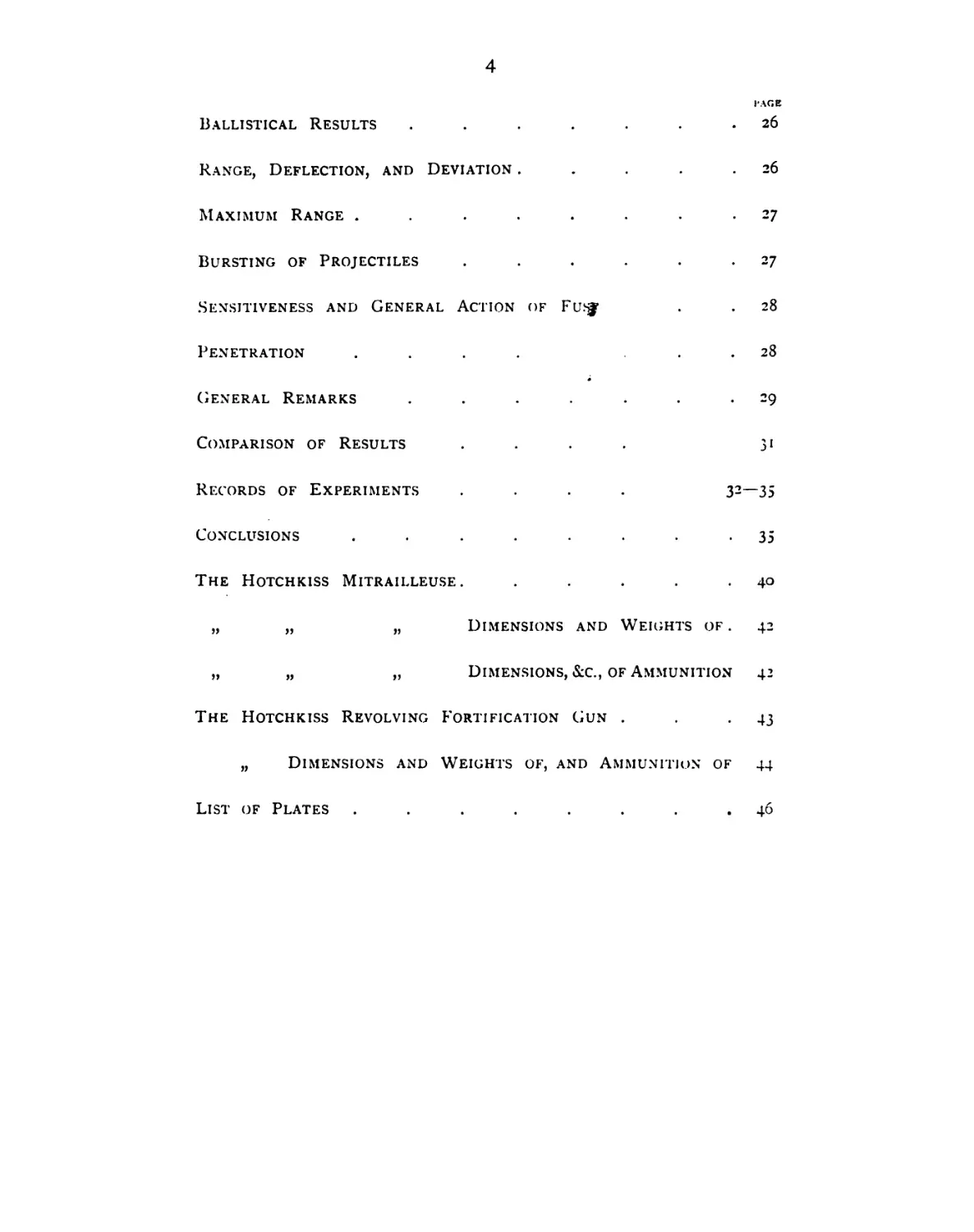
Ballistical Results .	.	.	.	.	.	.26
Range, Deflection, and	Deviation .	.	.	.	.26
Maximum Range .......	27
Bursting of Projectiles ......	27
Sensitiveness and General Action of Fu.^	.	.	28
Penetration ....	...	28
General Remarks .......	29
Comparison of Results	....	31
Records of Experiments	....	32—35
Conclusions .	.	.	.	.	.	.	-35
The Hotchkiss Mitrailleuse. .	.	.	.	.40
„	„	„	Dimensions and Weights of . 42
„	„	„	Dimensions, &c., of Ammunition 42
The Hotchkiss Revolving Fortification Gun .	.	.43
„ Dimensions and Weights of, and Ammunition of 44
List of Plates
40
THE HOTCHKISS
REVOLVING CANNON,
ETC.
INTRODUCTORY HISTORICAL NOTE ON THE
HOTCHKISS REVOLVING CANNON.
It was during the Franco-German war, in 1870, that
Mr. В. B. Hotchkiss first conceived the idea of constructing a
simple machine-gun, which should fire a small cast-iron explo-
sive shell with great rapidity, at very long ranges, and which
should have no recoil to interfere with the continual operation
of the gun, or the accuracy of its fire.
It was in the same year that the first gun of this kind,
made at Vienna, was fired in' the presence of the Austrian
Artillery Committee, and though it was thereby proved to be
excellent as to general principle, it left much to be desired
from a ballistical point of view.
A 2
8
central shaft. The series of barrels are in this way placed in a
rectangular frame, which is attached to the breech, the near end
of the shaft penetrating the same to receive the rotary motion
from the driving gear.
The breech itself is composed of a solid cast-iron breech-
block, weighing 175 kilogrammes. This absorbs the greater part
of the recoil. It has a door at the rear-end, which can be easily
opened, so that * the mechanism is freely . accessible, and cam
if necessary, be dismounted and put back into its place in a few
minutes without the aid of any special tools.
A peculiar feature in this gun consists in the barrels remaining
still during the discharge, so that there is no movement, of any
kind to impede the accuracy of fire. This stop or lost motion
is obtained by the shape of the driving-worm, which is so con-
structed that the inclined driving-thread only covers half its cir-
cumference, the other half of the thread being straight. The effect
of this is, that the barrels only revolve during half a revolution
of the worm, and stand still during the other half revolution.
The combination of the mechanism is so arranged that the
loading, firing, and extracting takes place during this pause.
This feature is of great importance for the accuracy of fire, and
the durability of the system.
The worm-shaft projects through the breech on the right side,
9
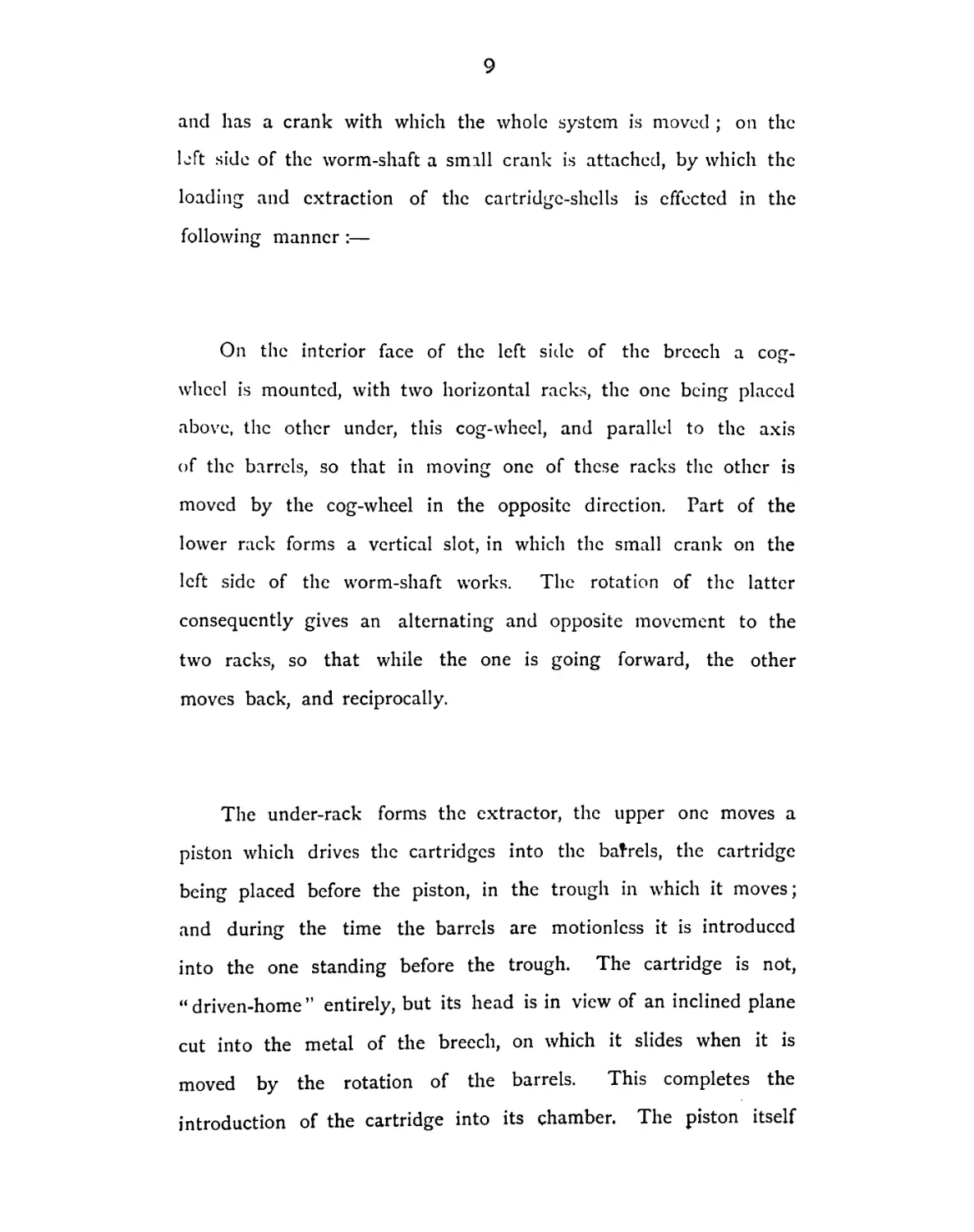
and has a crank with which the whole system is moved ; on the
left side of the worm-shaft a small crank is attached, by which the
loading and extraction of the cartridge-shells is effected in the
following manner :—
On the interior face of the left side of the breech a cocf-
wheel is mounted, with two horizontal racks, the one being placed
above, the other under, this cog-wheel, and parallel to the axis
of the barrels, so that in moving one of these racks the other is
moved by the cog-wheel in the opposite direction. Part of the
lower rack forms a vertical slot, in which the small crank on the
left side of the worm-shaft works. The rotation of the latter
consequently gives an alternating and opposite movement to the
two racks, so that while the one is going forward, the other
moves back, and reciprocally.
The under-rack forms the extractor, the upper one moves a
piston which drives the cartridges into the barrels, the cartridge
being placed before the piston, in the trough in which it moves;
and during the time the barrels are motionless it is introduced
into the one standing before the trough. The cartridge is not,
“driven-home” entirely, but its head is in view of an inclined plane
cut into the metal of the breech, on which it slides when it is
moved by the rotation of the barrels. This completes the
introduction of the cartridge into its chamber. The piston itself
IO
is a simple cylinder connected with the rack, and running in a
slot in the conducting-trough.
When the racks are in their extreme positions, they remain
still a moment. This stop is obtained by giving the slot in its
centre part a circular shape concentrically to the shaft of the
crank. This is necessary, because at the moment of the barrels
arriving at the end of their course, the head of the cartridge-case
becomes engaged in the hooks of the extractor, which would not
be possible if it were in motion at the time.
The extractor is a large double-hook at the end of the
bottom rack; it is very solid, and its proper working is certain
under all circumstances.
After the cartridge is extracted from the barrel, it strikes
against an ejector, which pushes it out of the extractor, and it
falls to the ground through an opening in the under part of the
breech. The firing-pin has an elongation, pointing downwards,
which, by the operation of a spring, is pressed against a cam
on the worm, and as the worm rotates, the cam drives the firing-
pin back, and compresses the spring. The moment the firing-pin
becomes liberated, it strikes the primer of the cartridge, and
the discharge takes place.
To obviate the difficulties which exist in other systems,
when the cartridges are piled one upon the other, the opening
II
of the introduction-trough is closed by a little door, which
goes down by the weight of the cartridges, the first of which
drops into the trough, and then the piston in moving forward
raises the door, and allows no more cartridges to enter until the
proper time.
All parts of the mechanism are very strong and durable,
and hardly exceed in number those of an ordinary small-arm,
there being besides the group of barrels, thirteen parts, viz.:—
I, 2. The breech-block with its door for closing the rear-end.
3, 4, $. The crank-shaft, with its worm for moving the barrels,
and small crank for working the loader and extractor.
6. The crank.
7, 8. The firing pin and spiral spring.
9.	The extractor.
10,	11. The loading-piston and rack for moving it.
12.	The cog-wheel for transmitting the movement of the
extractor to the loading-piston, and,
13.	The door for regulating the feed of cartridges.
В
12
THE OPERATION OF THE MECHANISM, THE
RAPIDITY OF FIRE, AND THE NUMBER OF MEN
TO WORK THE GUN.
The operation of the mechanism may be described as
follows, supposing the crank to be in continual motion :—
A cartridge is placed in the introduction-trough, the piston
pushes it into the barrel, then the barrels begin to revolve,
and the cartridge is carried on till it arrives before the firing-
pin which penetrates the solid part of the breech, and which
has in the meantime been retracted by the action of the cam.
Then, as soon as the cartridge has arrived into this position,
the barrels cease to revolve, and the primer of the cartridge is
struck by the firing-pin and discharged; then the revolution of
the barrels begins again, and the fired cartridge-shell is carried
on until it comes to the extractor, this in the meantime has
arrived up to the barrels and the cartridge-head rolls into it.
As soon as the head is laid hold of by the extractor, the
barrels again cease to revolve, and during this period the
cartridge-shell is withdrawn and dropped to the ground. As
during every stoppage of the barrels the gun is supplied with
a new cartridge, and the firing and extraction is also per-
formed, during this time a continuous but slow fire is kept
up. By supplying the gun in this manner with single cartridges,
about thirty rounds per minute may be fired.
13
Should rapid firing be required, the gun is then supplied, not
with single cartridges, but with “ feed-cases,” containing groups of
ten cartridges each, and in this manner from sixty to eighty
rounds per minute can be fired, with only three men to work
the gun ; viz., one man to train the gun and revolve the crank ;
one man to place the “ feed-cases ” containing the cartridges
into the “ feed-trough ; ” and a third man at the ammunition
chest, to charge the “ feed-cases,” and to hand them to the
charger.
Attached to the frame is a turn-table, which connects the
cannon to the “ trunnion-saddle,” arranged in such manner that
without displacing the carriage, a certain amount of lateral
motion as well as of elevation may be given to the gun. Thus
the gun is made to sweep horizontally along a line, by adjust-
ment, between each single shot, or during rapid discharge.
THE AMMUNITION.
The ammunition for the Revolving Cannon consists of a centre-
fire metallic cartridge of special construction, holding in each
one the powder, the projectile, and the lubricating-wad, arranged
like the similar ammunition generally used for small arms.
Two different kinds of projectiles are used, the one an
explosive shell, and the other a case-shot. Nothing need be said
в 2
ч
of the latter, as it docs not differ from the common case or
canister shot used in ordinary cannon.
THE SHELL.
The shell is of a novel construction ; it is of cast iron, of a
cylindro-ogival shape, slightly rounded at the rear end. The
packing consists of a brass coat of about one calibre in length,
and placed equidistantly from the centre of gravity. This coat
is a piece of soft brass tubing, contracted with great pressure
over the body of the projectile, it being provided with longitudinal
grooves, and two grooves encircling it at the top and bottom
ends of the packing. The coating is forced into these grooves,
and any disturbance of it on the body at starting is thus
obviated. These grooves serve at the same time as breaking-lines
of the shell.
After the coating is attached to the projectile, some small
saw-tooth-like grooves are cut into it, to reduce the strain while
being forced through the rifling of the barrel. These grooves
can be filled with a lubricating substance, and this is then carried
perfectly between the projectile and the bore of the barrel.
The coating of the projectile is conical at its front part,
corresponding with the cone in the projectile chamber, so that
15
it is exactly centered in the bore as soon as the forward move-
ment commences. Its rear end is cylindrical to within about
one-third of its length.
The shell is turned smooth all over, and is 0.4'”'“* in
diameter less than the bore of the barrel. This projectile is
made with great care and exactness, with only a very small
deviation in dimension.
THE FUSE.
The fuse employed is that known as the Hotchkiss percussion
fuse used in large quantities during the last war in America.
It consists of a gun-metal body, closed at the front end with
a nose screw, forming the ogival point of the projectile; it has a
conical hole at the rear, which is closed with a lead plug (the
safety-plug) pressed in very tightly, so that the plug projects a
little through the base of the body-case, towards the inside.
The plunger is composed of lead cast into a brass casing to
strengthen it, and to prevent the lead being upset by the shock
of discharge. Л brass wire is cast into the lead of the plunger,
and holds it suspended in the case, the wire going through the
hole in the bottom of the case, and being held securely in position
by the safety-plug. The plunger has a nipple cast into the lead,
* In these pages the French measurements of length and weight are thus
abbreviated:—“met.” for metre; “cm.” for centimetre; “mm.” for milimetre ;
“ kil.” for kilogramme; “gr.” for gramme.
1б
and is primed with an ordinary gun-cap; in its axis it has a powder-
chamber containing the igniting charge.
The operation of the fuse is thus:—The safety-plug is dis-
lodged backwards into the interior of the projectile by the shock
of discharge, the wire then being not held tight in the hole, the
plunger is disengaged and rests on the bottom of the fuse case,
and is free to move in the line of axis. When the flight
of the projectile is suddenly retarded by its striking any object,
the plunger, in consequence of its inertia, is driven forward, and
the primer strikes against the nose-screw, thus igniting the
powder in the channel, and so firing the bursting charge of the
projectile.
The Hotchkiss percussion-fuse is extremely simple in its con-
struction, and requires no adjustment before use. It is perfectly
safe in transport, and during all manipulations with the pro-
jectiles, as the plunger is held securely by the safety-plug, which
must receive the great shock of the discharge to discharge it
from its hole, and thus liberate the plunger.
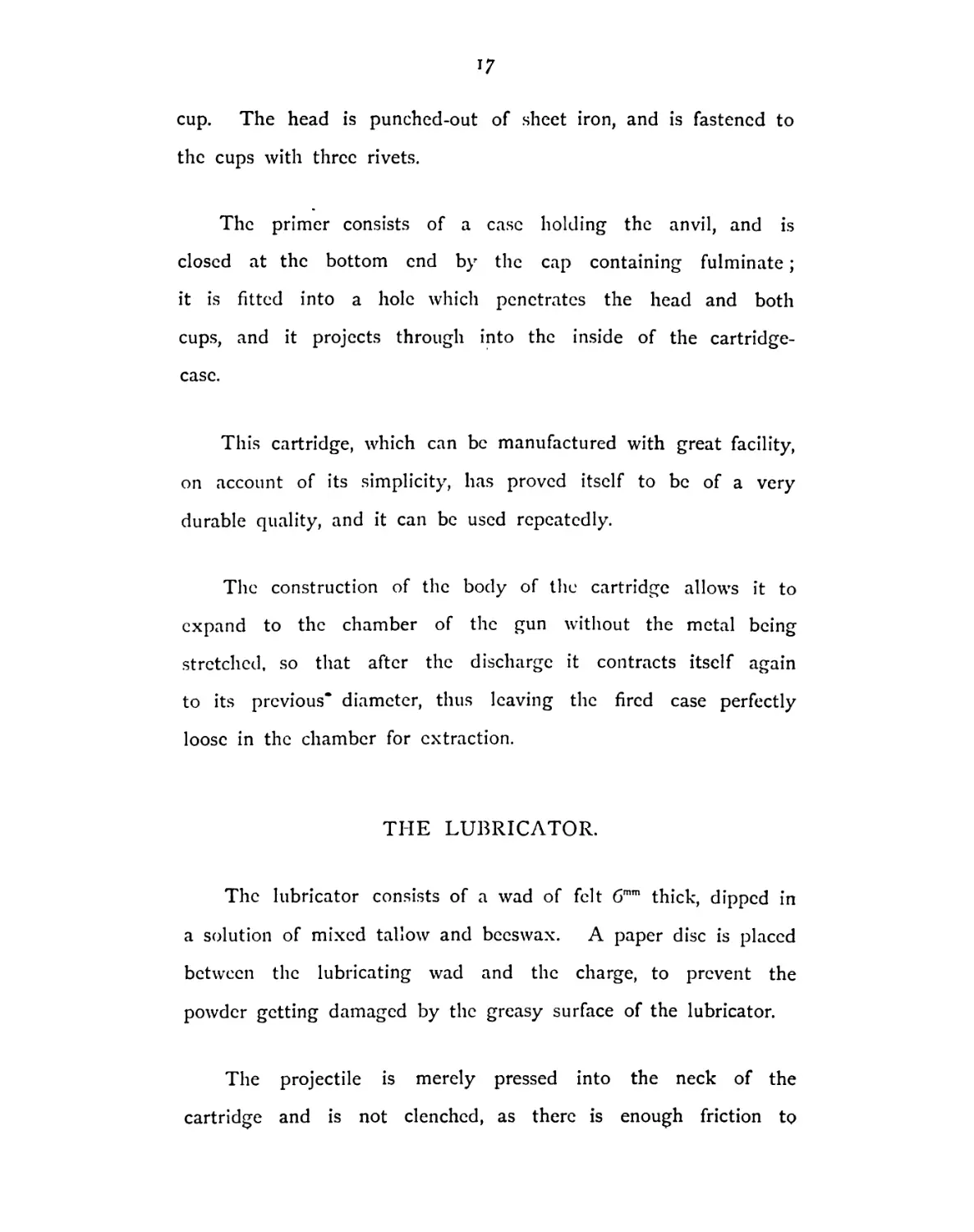
THE CARTRIDGE CASE.
The cartridge-case consists of a spirally-rolled tube of sheet-
brass, strengthened at the head with an inside and an outside
I?
cup. The head is punched-out of sheet iron, and is fastened to
the cups with three rivets.
The primer consists of a case holding the anvil, and is
closed at the bottom end by the cap containing fulminate;
it is fitted into a hole which penetrates the head and both
cups, and it projects through into the inside of the cartridge-
case.
This cartridge, which can be manufactured with great facility,
on account of its simplicity, has proved itself to be of a very
durable quality, and it can be used repeatedly.
The construction of the body of the cartridge allows it to
expand to the chamber of the gun without the metal being
stretched, so that after the discharge it contracts itself again
to its previous* diameter, thus leaving the fired case perfectly
loose in the chamber for extraction.
THE LUBRICATOR.
The lubricator consists of a wad of felt 6mTn thick, dipped in
a solution of mixed tallow and beeswax. A paper disc is placed
between the lubricating wad and the charge, to prevent the
powder getting damaged by the greasy surface of the lubricator.
The projectile is merely pressed into the neck of the
cartridge and is not clenched, as there is enough friction to
j8
hold it absolutely secure. Of course the ammunition is, as in
the ease of all modern small arm ammunition, which it
resembles, rendered safe against influences of weather and danger
of explosion.
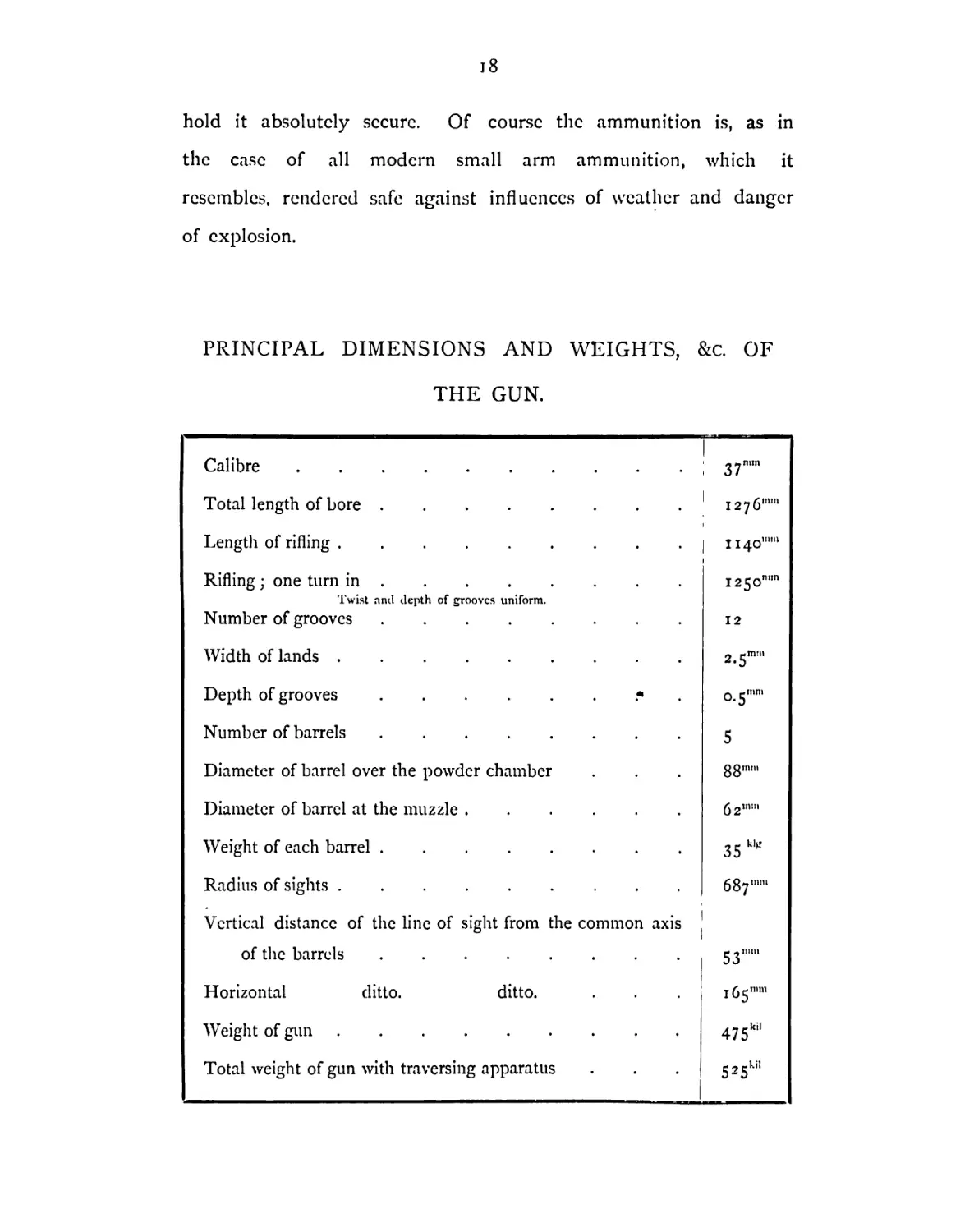
PRINCIPAL DIMENSIONS AND WEIGHTS, &c. OF
THE GUN.
Calibre		1 ; 37nun
Total length of bore		1 1276"""
Length of rifling		। 1140’“'“
Rifling •, one turn in .......	. Twist and depth of grooves uniform.	I25On,,n
Number of grooves		12
Width of lands		2.5m:“
Depth of grooves	.•	.	o.5n,n*
Number of barrels		5
Diameter of barrel over the powder chamber	88,nm
Diameter of barrel at the muzzle		62,n,n
Weight of each barrel		35 к,и
Radius of sights		687n,lu
Vertical distance of the line of sight from the common axis	1
of the barrels		53n,1“
Horizontal	ditto.	ditto.	165n,m
Weight of gun		475kil
Total weight of gun with traversing apparatus	525kil
IQ
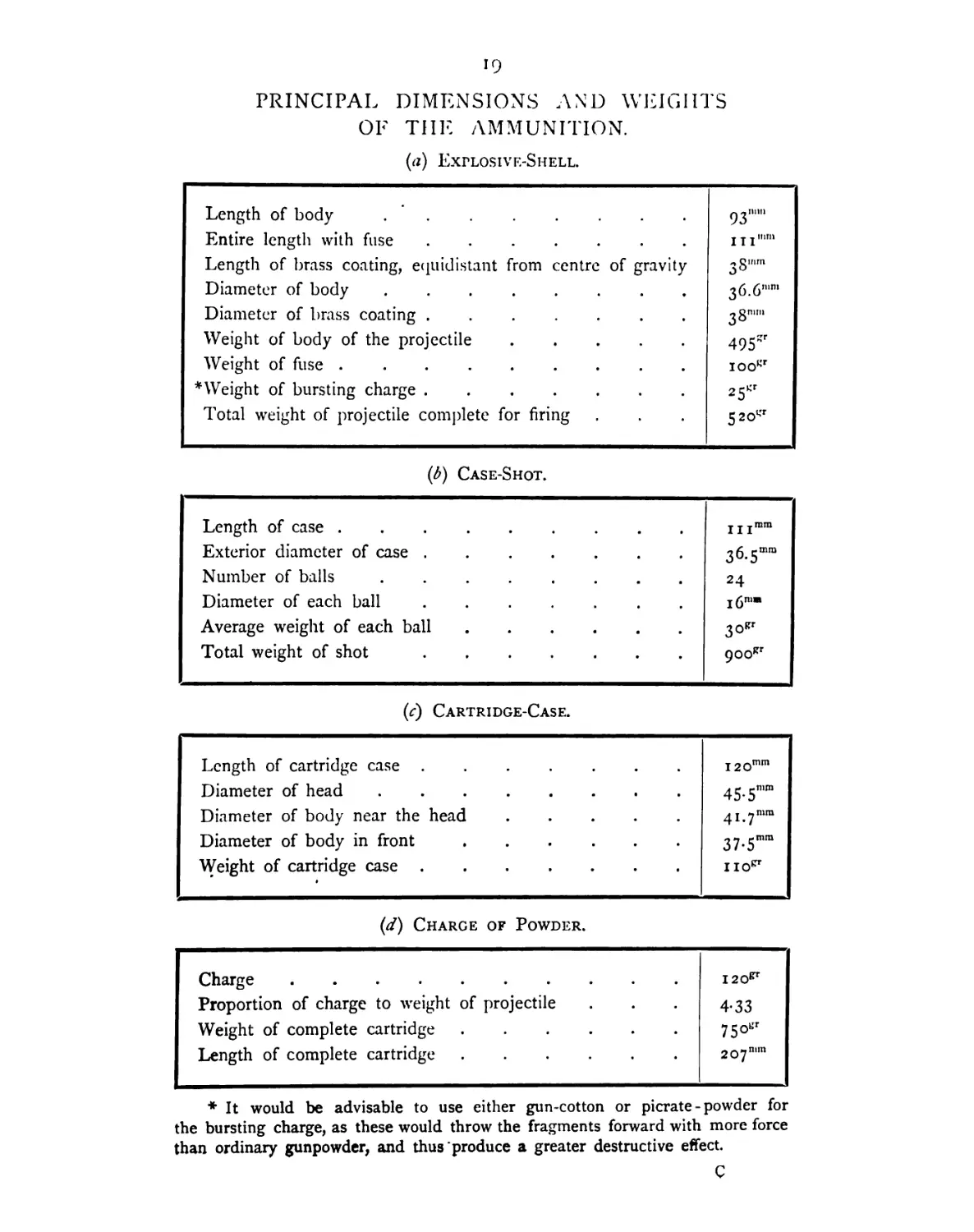
PRINCIPAL DIMENSIONS AND WEIGHTS
OF THE AMMUNITION.
(a) Explosive-Shell.
Length of body				Q^nnil
Entire length with fuse		III"1”1
Length of brass coating, equidistant from centre of gravity	o ginm
Diameter of body		Зб.6шп'
Diameter of brass coating		38n‘"'
Weight of body of the projectile		495"r
Weight of fuse		IOOg'
* Weight of bursting charge		25>:r
Total weight of projectile complete for firing	520^
(b) Case-Shot.
Length of case .........	inrara
Exterior diameter of case .......	36.5mm
Number of balls		24
Diameter of each ball		i6n'"
Average weight of each ball		30^
Total weight of shot		9ooRr
(r) Cartridge-Case.
Length of cartridge case .......	12Omm
Diameter of head		45-5nirn
Diameter of body near the head		4i.7mm
Diameter of body in front		37-5mra
Weight of cartridge case		IIO^
(zZ) Charge of Powder.
Charge	 Proportion of charge to weight of projectile Weight of complete cartridge	 Length of complete cartridge		i2opr 4-33 75°gr 2O7nun
* It would be advisable to use either gun-cotton or picrate - powder for
the bursting charge, as these would throw the fragments forward with more force
than ordinary gunpowder, and thus produce a greater destructive effect.
C
20
THE CARRIAGE.
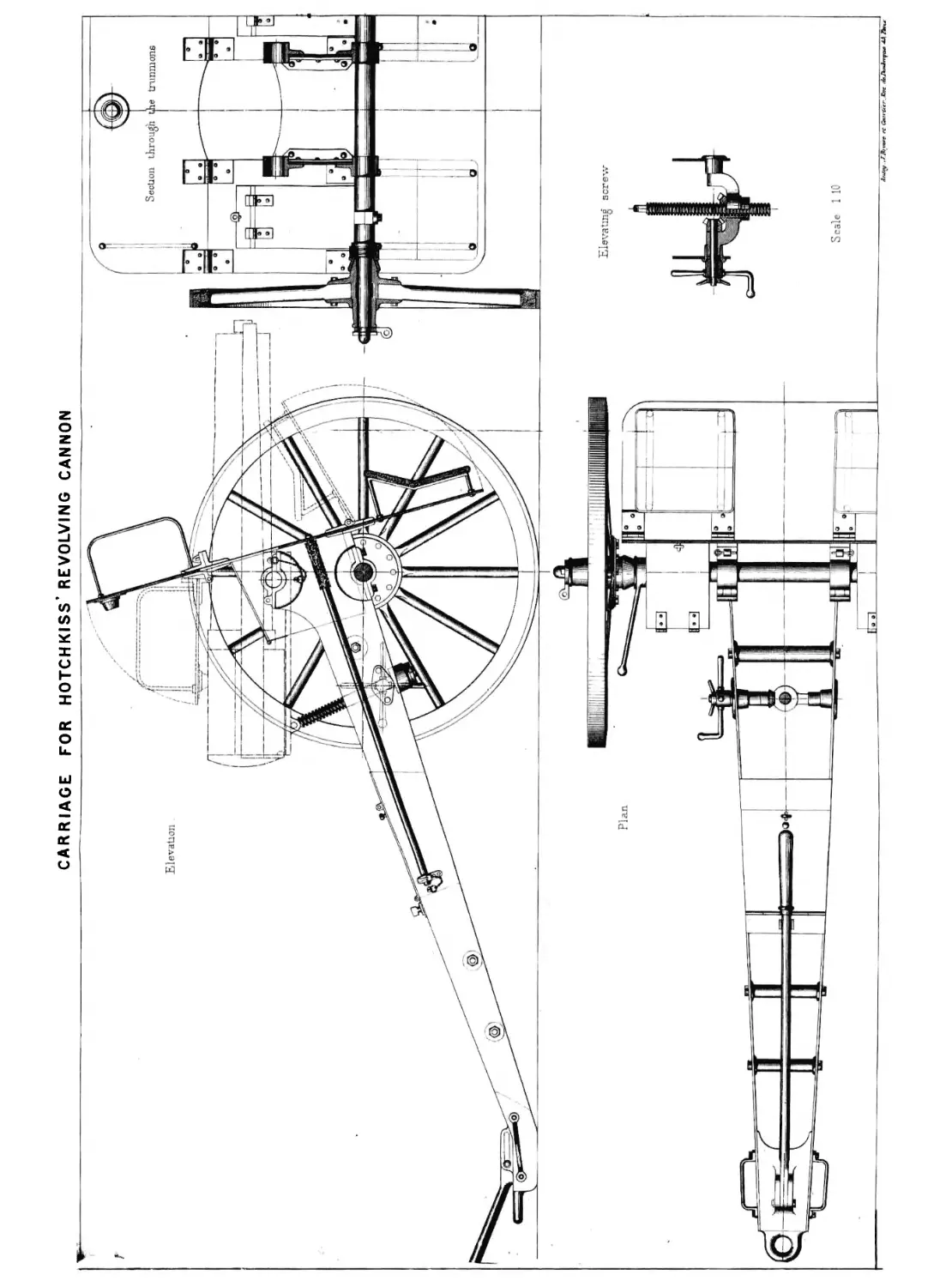
For the Revolving Cannon a special carriage has been con-
structed ; this was found necessary, as the ordinary field gun-
carriage is not provided with the means for procuring an excel-
lent and immoveable rest for this gun.
The trail of the carriage consists of two brackets of steel
plate, connected by three transoms and bolts, the rear-end being
connected by the trail eye-piece. The brackets diverge against
the trunnions.
The trunnion-bearings, and the bearings for the axle-tree,
are riveted to the outside of the brackets, and are fitted in the
ordinary manner.
The axle-tree is of steel, the arms being slightly conical.
The wheels have metallic naves and ring-tires. The nave consists
of two parts : the inside flange with the pipe box, and the outside
flange. The spokes are cut in a conical form at their “hub”
ends, so that they fill the nave flanges, and the two parts of the
nave are bolted together with the spokes with six screws.
These wheels are very strong, and have been found practical
and economical in service, and they allow spokes to be easily
substituted for others when broken.
21
The elevating arrangement consists of a screw working in a
gun-metal nut, resting in the oscillating bearing; this nut is
revolved by conical gear wheels from the left side of the trail,
the top end of the screw being attached to the trunnion saddle
plate.
The handspike is hinged to the trail so as to fold back in
travelling. A tool-box is placed between the trail, this at the same
time makes a solid connection of the trail brackets.
The carriage of the Revolving Cannon is usually provided
with a light steel shield for the protection of the gunners from
small arms fire.
This shield is of three parts, made to fold together, thus
forming seats for two men. It can immediately, when coming
into action, be unfolded, and only the muzzles of the barrels and
the wheels of the carriage are exposed to the enemy. The steel
plates are 6 mm. in thickness.
Two boxes are attached to the axletree, each to carry three
feed-cases loaded with ten rounds of ammunition.
On the carriages not provided with a shield, these ammunition
boxes are protected by light steel plates in front, and have a lid
of steel, which, when raised, forms a small protecting-shield, and
C 2
22
when closed, they form scats for two gunners, so that with two or
three gunners on the limber, a sufficient number of men to serve
the piece would be taken into action with the gun itself.
To check the recoil of the gun, a brake of the following
construction is used :—
Each axle-arm has a screw cut on its extremity, this carries
a nut, forming a conical cap, partly enveloping the front side of
the wheel nave, which is likewise conical, to fit the inside of the
cap; this has a short crank, by which it can be revolved on the axle.
When screwed-up, this cap grips the cone of the nave of the wheel,
and the tighter the cap is screwed-up so the wheel turns with the
more difficulty on its axis, until it gets immovably locked on the
axle by the friction of the cones. When the cap is unscrewed, it is
disengaged from the wheel, which then can turn freely on the axle.
The screws on the ends of the axle-arms have right and left-
handed threads, so that the caps become tightened by the effect
of the recoil.
This brake is used at the same time as an ordinary travelling-
brake, and it can be applied without the carriage being stopped,
as is necessary with the shoe-brake commonly used on gun
carriages.
23
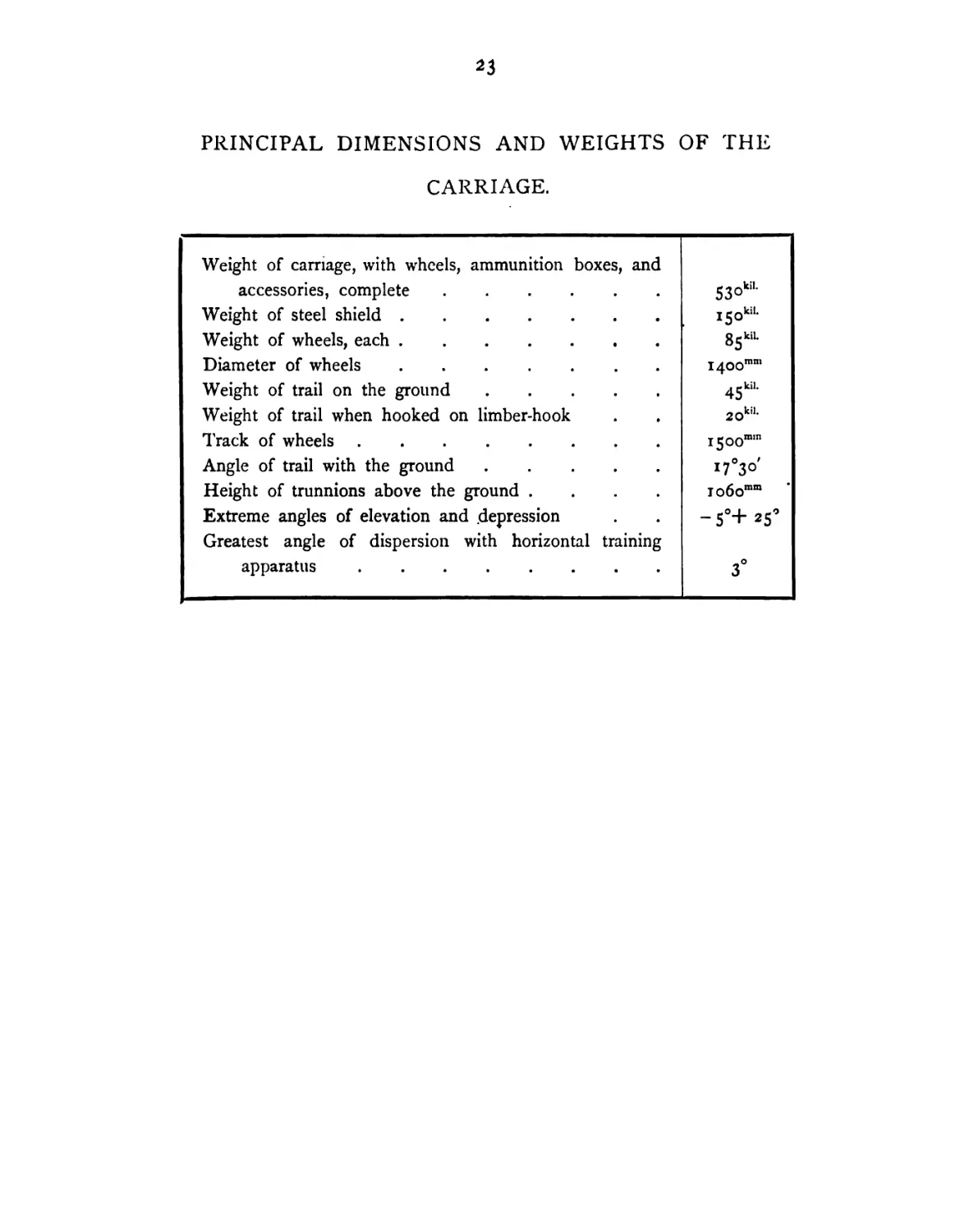
PRINCIPAL DIMENSIONS AND WEIGHTS OF THE
CARRIAGE.
Weight of camage, with wheels, ammunition boxes, and accessories, complete ...... Weight of steel shield	 Weight of wheels, each	 Diameter of wheels	 Weight of trail on the ground	 Weight of trail when hooked on limber-hook Track of wheels	 Angle of trail with the ground	 Height of trunnions above the ground .... Extreme angles of elevation and .depression Greatest angle of dispersion with horizontal training apparatus		53°“' 150“- 85kiU 1400™" 45kik 2Okih i5oora,n i7°3o' io6oram -5°+ 25’ 3°
24
THE LIMBER AND THE AMMUNITION-CHEST.
The limber resembles in general construction the French
Government service limber ; it consists of a frame-work of wood,
placed upon wheels of equal size and construction as those of the
gun-carriage.
The axletree is of steel, it has no axletrec-bed, but is attached
directly to the “futchells.”
The trail of the gun-carriag« hooks up to a hook-pintail
attached to the axletree. The limber has a swing splinter-bar
to which the traces of the horses are attached, and the shaft is
arranged for double draught.
The limber carries an ammunition-chest made of wood, con-
veying four hundred rounds of ammunition, and it is fitted with four
boxes, each containing one hundred rounds. The cartridges are held
immovably in the boxes when the lids are closed, to prevent their
being injured in travelling over rough roads. The ammunition-
chest is covered with painted sail-cloth, and is rendered water-
tight ; the corners are protected by angle-irons, and it is attached to
the limber by two hooks and screws.
The weight of the limber, with ammunition-chest complete
is 300 kil.
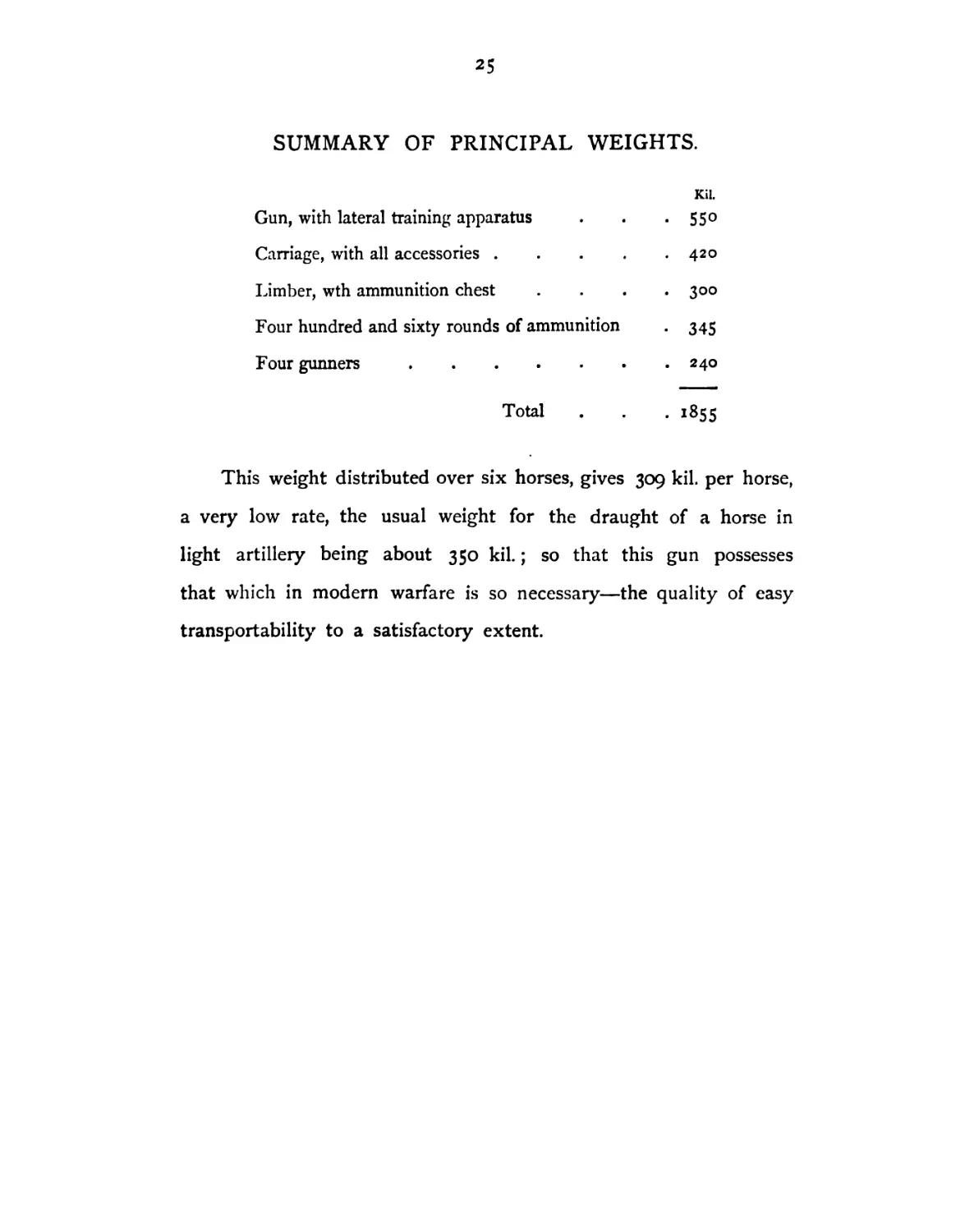
25
SUMMARY OF PRINCIPAL WEIGHTS.
Kil.
Gun, with lateral training apparatus .	.	«55°
Carriage, with all accessories ..... 420
Limber, wth ammunition chest .... 300
Four hundred and sixty rounds of ammunition . 345
Four gunners........................................240
Total .	.	. 1855
This weight distributed over six horses, gives 309 kil. per horse,
a very low rate, the usual weight for the draught of a horse in
light artillery being about 350 kil.; so that this gun possesses
that which in modern warfare is so necessary—the quality of easy
transportability to a satisfactory extent.
2б
BALLISTICAL RESULTS OBTAINED WITH THE
HOTCHKISS REVOLVING CANNON AT GAVRE,
in January, 1874.
Initial velocities measured at 25met- distance from the muzzle.
French Ripault powder, density of charge, 0.908*
Weight of charge		ioogr-	TIOBr#
Weight of projectile		5°7gr'	507^
Mean initial velocity		42I-7,net.	432-9roct
RANGE, DEFLECTION, AND DEVIATION.
Weight of projectile 507gn, charge ioo^* Ripault powder.
Total angle of elevation	 Velocity J parallel to line of fire	 of wind 1 perpendicular to line of fire .... Density of air	........ Mean range	 Mean deflection to the right ...... Mean J longitudinal	 deviation ( lateral		 Mean angular deviation (in minutes) .... Mean deviation in velocity ...... ♦ From ahead.	t From right.	1 34° 47' I n*ct. * I.lm" + r-247 40i4mct- 32.2»ct- 25.01""' ! 5met. O' 14" o.oii4”ct
From the above table it will be seen that the accuracy of
fire is more remarkable than has been known to have been
* Since this period, some new ballistical improvements have been made on
this gun, and at trials made by the French Government at Bourges in June, 1874,
a mean initial velocity of 458.8nict- was obtained with no^- of powder, and a
projectile weighing 507^
The ranges at this trial were:—
Elevation .	2° 40'	5°	10е	15°	20°	25°	3o° 1 35°
Range in met. .	1003	1723	2842	3460	3916	4240	4580 | 4700
27
obtained from any other gun, the proportion of the mean
longitudinal deviation to the range being only 0.00623, and that
of the mean lateral deviation 0.00039, whilst the mean variation
in velocity o.oii4met’ is practically nothing.
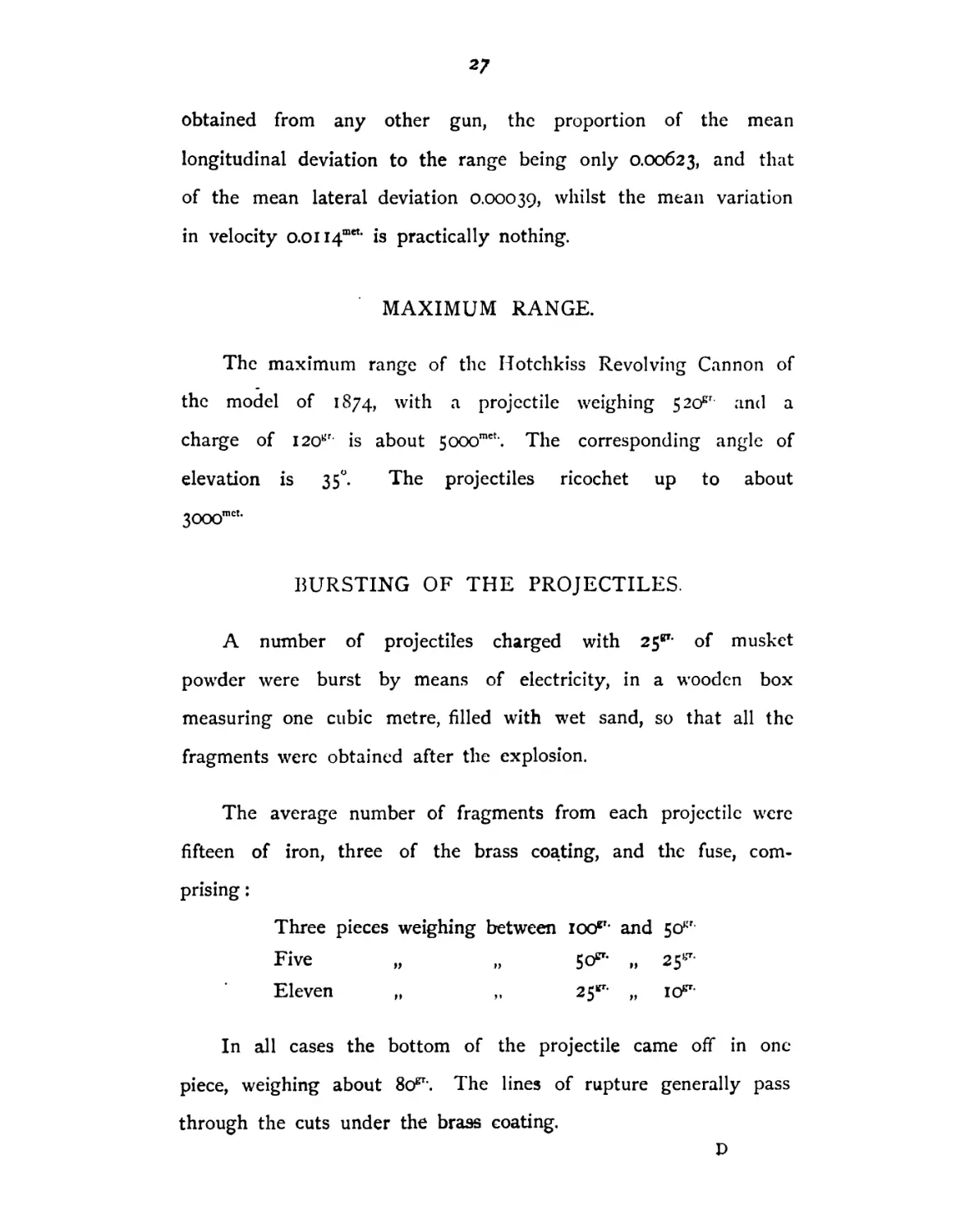
MAXIMUM RANGE.
The maximum range of the Hotchkiss Revolving Cannon of
the model of 1874, with a projectile weighing 520^ and a
charge of I2ogr is about 5ooomct\ The corresponding angle of
elevation is 350. The projectiles ricochet up to about
3ooomct*
BURSTING OF THE PROJECTILES.
A number of projectiles charged with 2^’ of musket
powder were burst by means of electricity, in a wooden box
measuring one cubic metre, filled with wet sand, so that all the
fragments were obtained after the explosion.
The average number of fragments from each projectile were
fifteen of iron, three of the brass coating, and the fuse, com-
prising :
Three pieces weighing between ioo^* and 50^
Five	„	„	50^	„	25^
Eleven	„	„	25^	„	10^
In all cases the bottom of the projectile came off in one
piece, weighing about 80^. The lines of rupture generally pass
through the cuts under the brass coating.
D
28
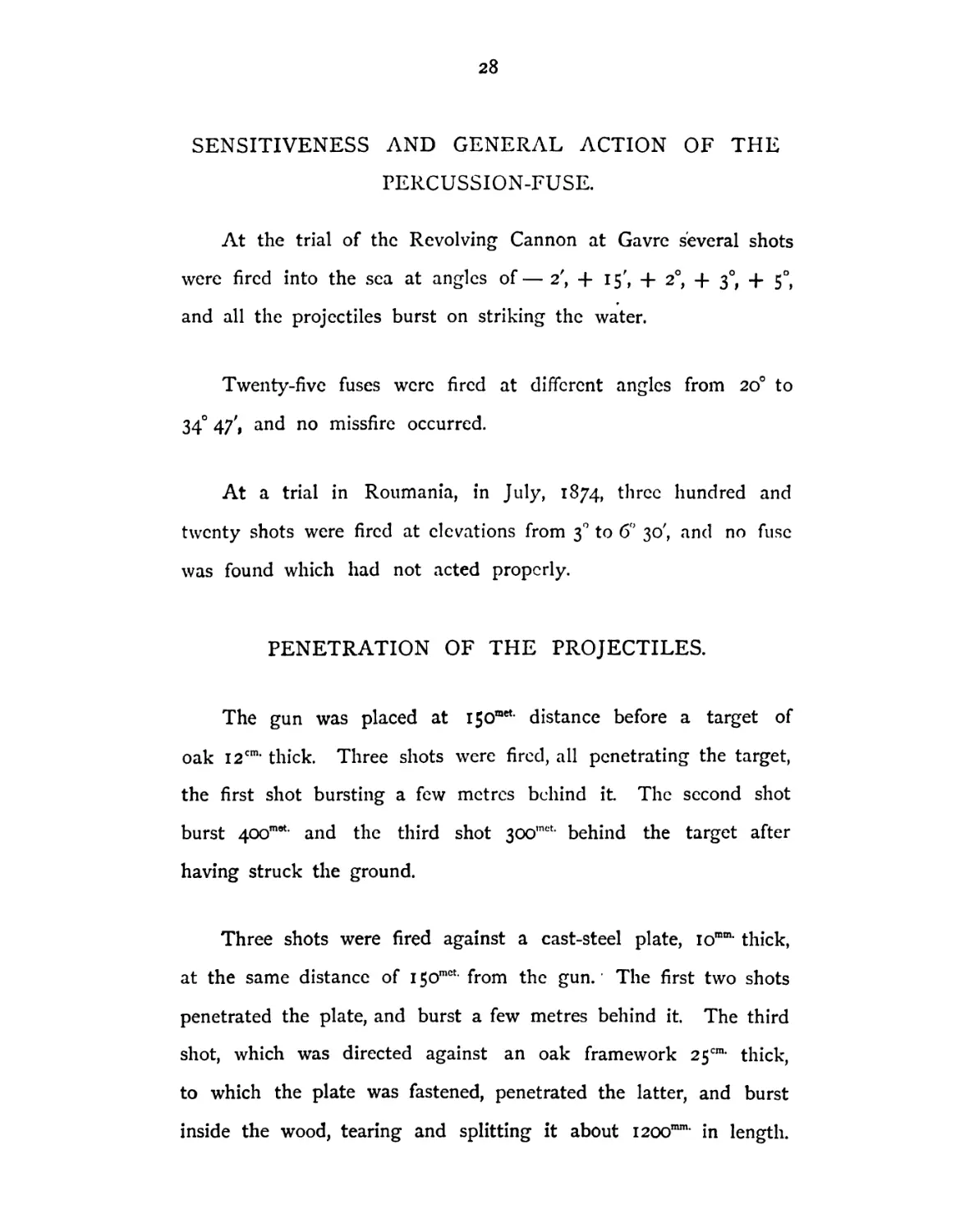
SENSITIVENESS AND GENERAL ACTION OF THE
PERCUSSION-FUSE.
At the trial of the Revolving Cannon at Gavre several shots
were fired into the sea at angles of— 2', + 15', + 2°, + 30, + 50,
and all the projectiles burst on striking the water.
Twenty-five fuses were fired at different angles from 20° to
340 47'f and no missfire occurred.
At a trial in Roumania, in July, 1874, three hundred and
twenty shots were fired at elevations from 30 to 6° 30', and no fuse
was found which had not acted properly.
PENETRATION OF THE PROJECTILES.
The gun was placed at Igo®*- distance before a target of
oak I2cm’ thick. Three shots were fired, all penetrating the target,
the first shot bursting a few metres behind it The second shot
burst 400™*' and the third shot 3OO’nct- behind the target after
having struck the ground.
Three shots were fired against a cast-steel plate, iomm- thick,
at the same distance of i5omct from the gun. The first two shots
penetrated the plate, and burst a few metres behind it. The third
shot, which was directed against an oak framework 25cm- thick,
to which the plate was fastened, penetrated the latter, and burst
inside the wood, tearing and splitting it about I2oomm‘ in length.
29
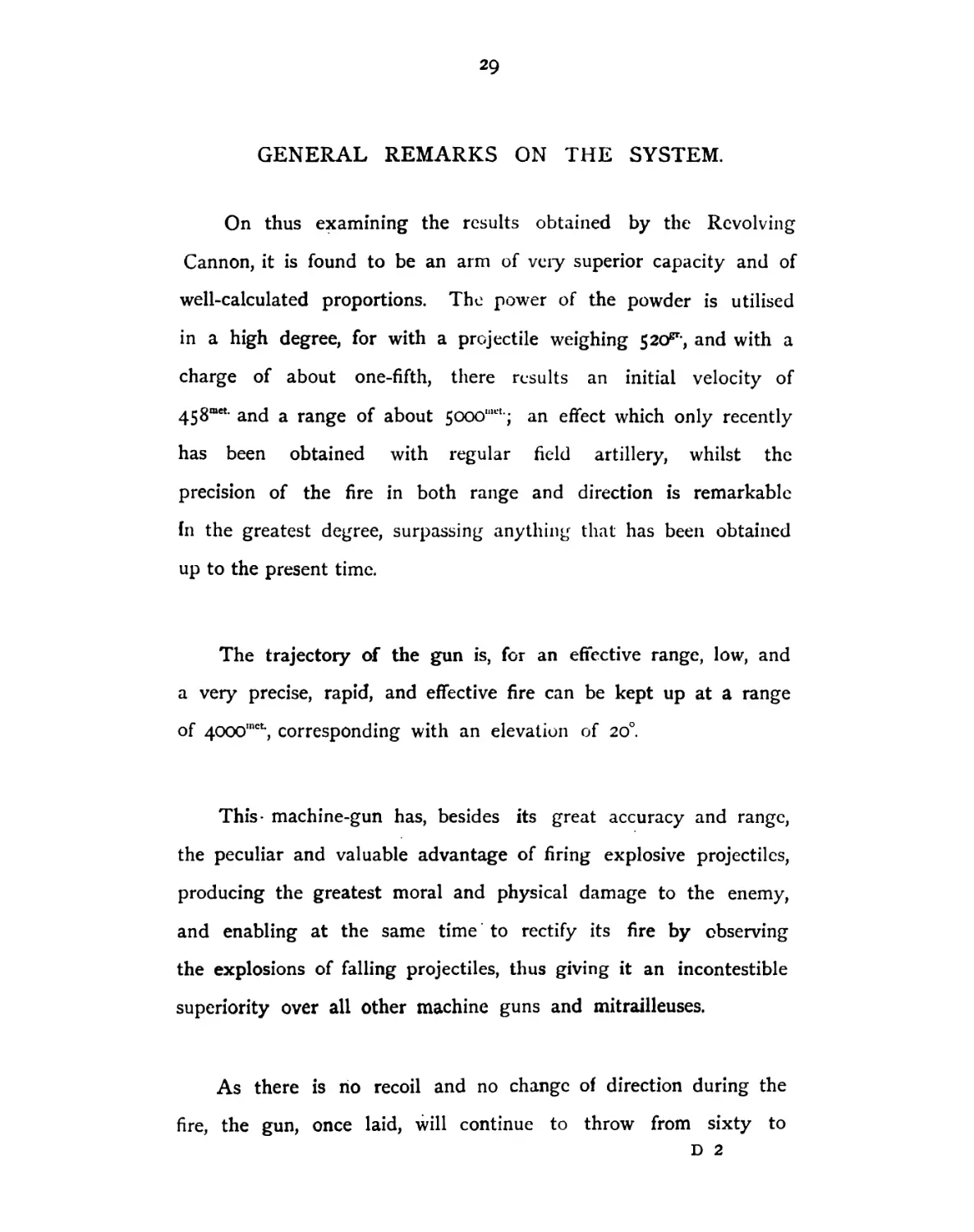
GENERAL REMARKS ON THE SYSTEM.
On thus examining the results obtained by the Revolving
Cannon, it is found to be an arm of very superior capacity and of
well-calculated proportions. The power of the powder is utilised
in a high degree, for with a projectile weighing $20^*, and with a
charge of about one-fifth, there results an initial velocity of
458mer and a range of about 5OOOnut; an effect which only recently
has been obtained with regular field artillery, whilst the
precision of the fire in both range and direction is remarkable
fn the greatest degree, surpassing anything that has been obtained
up to the present time.
The trajectory of the gun is, for an effective range, low, and
a very precise, rapid, and effective fire can be kept up at a range
of 4OOO’nct, corresponding with an elevation of 20°.
This- machine-gun has, besides its great accuracy and range,
the peculiar and valuable advantage of firing explosive projectiles,
producing the greatest moral and physical damage to the enemy,
and enabling at the same time to rectify its fire by observing
the explosions of falling projectiles, thus giving it an incontestible
superiority over all other machine guns and mitrailleuses.
As there is no recoil and no change of direction during the
fire, the gun, once laid, will continue to throw from sixty to
D 2
30
eighty explosive shells per minute, at ranges approaching to those
of field artillery, on the same spot, or on various points of any
line requiring the same elevation, without any further operations
than those of supplying the gun with cartridges, turning the
crank, and regulating the lateral adjustment.
The essentially mechanical arrangement of the system is
simple and compact; the working parts are strong and of simple
form, and they are all encased within the solid breech, and not
one of them is exposed to the shock of discharge.
The brass coating of the projectiles affords an excellent
bearing for the grooves of the rifling, and at the same time
obviates the difficulties of leading and fouling of the bore, while
the saw or tooth-like grooves cut into it reduce the friction to
the greatest possible extent, thus giving a satisfactory velocity
with a minimum of strain on the gun.
The metallic cartridge always produces an absolutely gas-
tight closure of the breech.
Another feature of this arm, to be well estimated in actual
service, is its facility of manipulation. The operation of loading
is simple, and the gunners only require the briefest instruction,
as, besides the laying of the gun, nothing is necessary but to
supply it with cartridges, and to revolve the crank.
31
COMPARISON OF THE RESULTS OF THE HOTCHKISS
REVOLVING CANNON WITH THOSE OBTAINED BY
OTHER GUNS AT GAVRE.
A part of the before-mentioned trial at Gavre in July, 1873,
comprised some practice with a revolving cannon under exactly
the same conditions as with four Gatling guns of different calibres,
which had shortly before been under experiment by the same
commission, with a view of comparing the effects of these different
kind of arms.
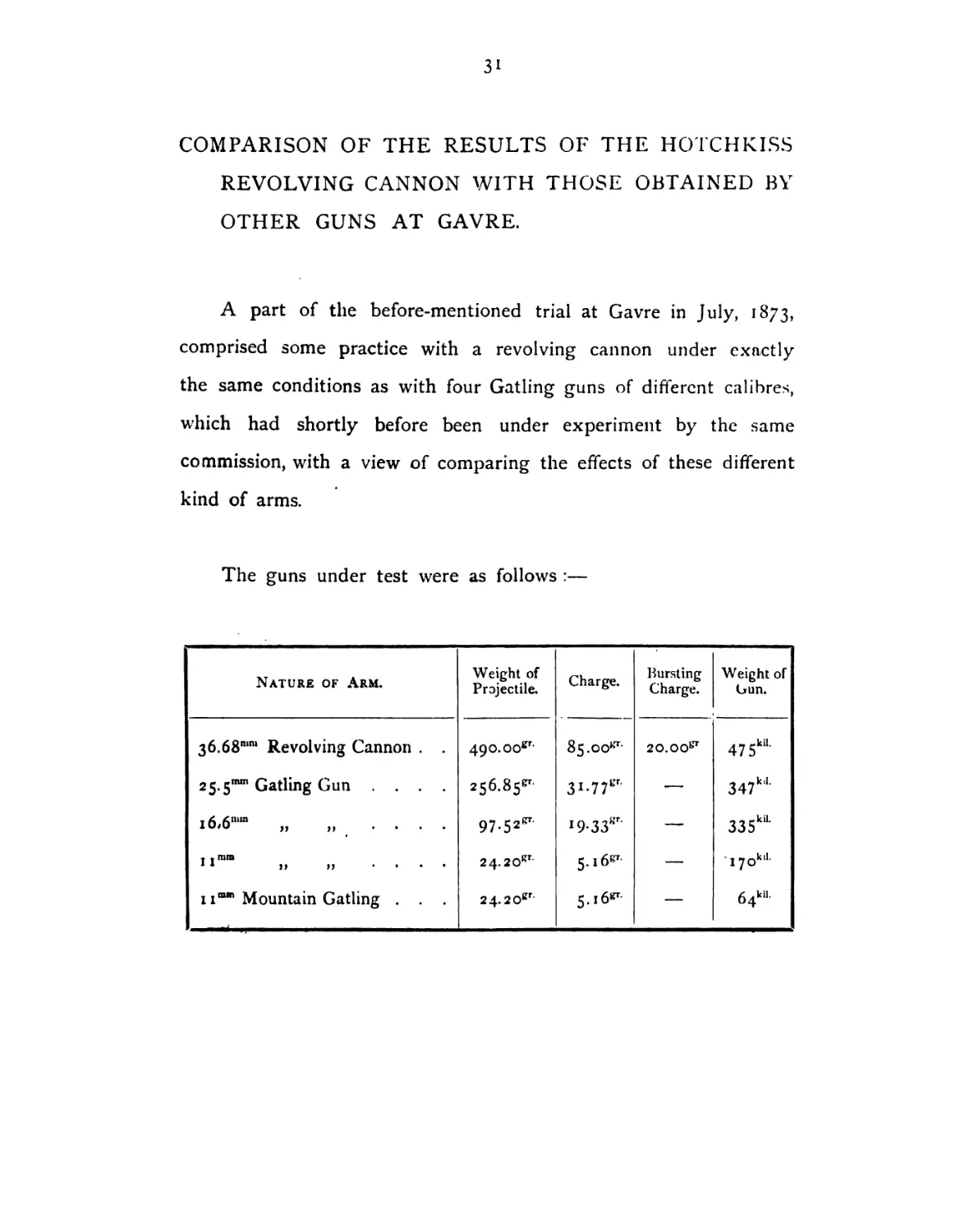
The guns under test were as follows :—
Nature of Arm.	Weight of Projectile.	Charge.	Bursting Charge.	Weight of Gun.
Зб.68шт Revolving Cannon . .	49o.ooffr’	85 .OOKr-	2O.OOgr	475k“
25.5"”" Gatling Gun ....	гЗ6-^8*	зм?8'	—	347kJ-
iW/U	,,	,,	....	97-52("	«9-338'	—	335klL
J .mm 1 i	,,	,,	.	,	.	.	24.2Offr	5-i6BT	—	i7okl1'
11BW‘Mountain Gatling . . .	24.2Ogr	5.i6«T-	—	64kil
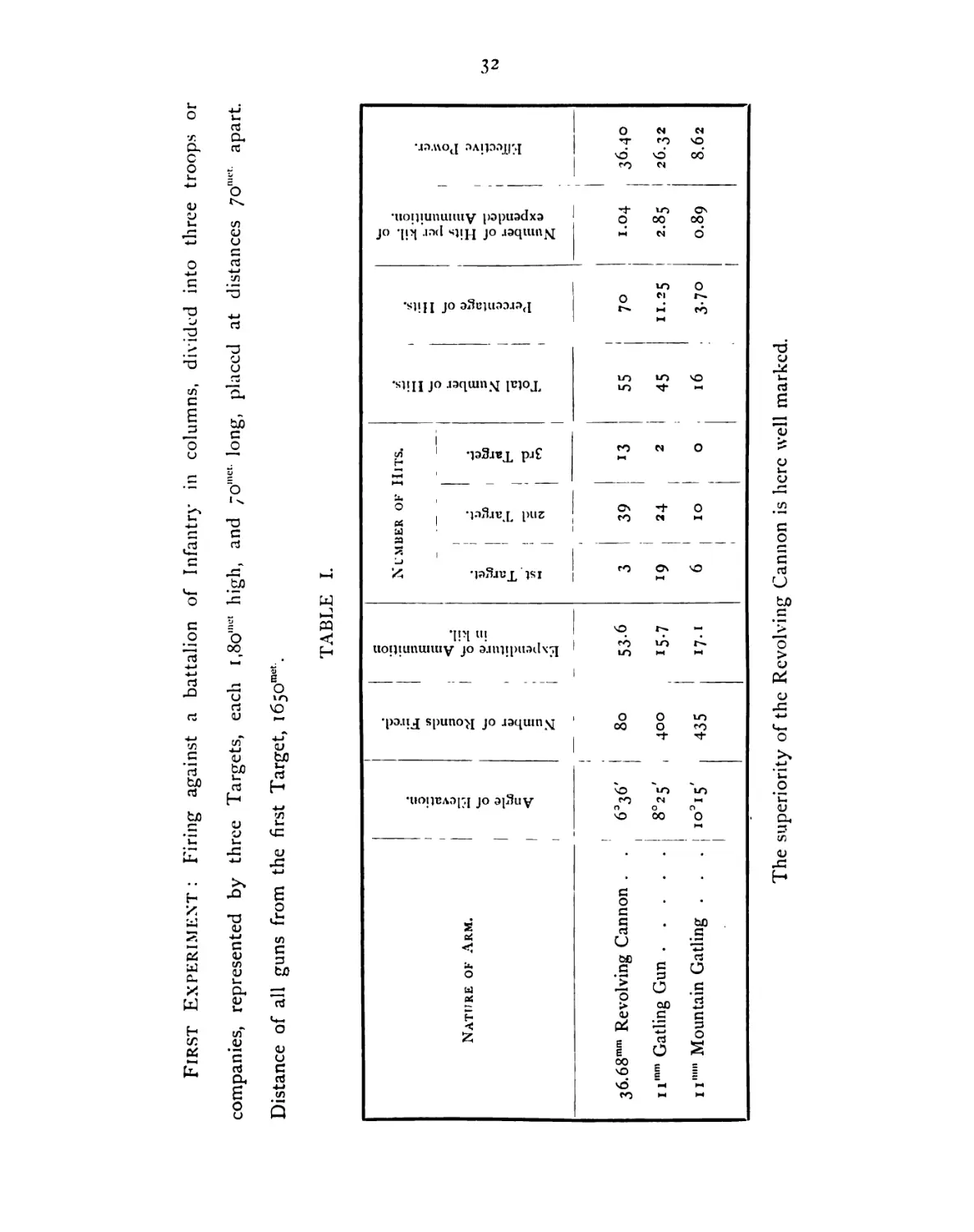
FIRST EXPERIMENT : Firing against a battalion of Infantry in columns, divided into three troops or
companies, represented by three Targets, each i,8o,net high, and ~o,nct long, placed at distances 7on,ct apart
Distance of all guns from the first Target, i65oraet.
TABLE I.
Nature of Arm. 1 1	Angle of 1£1 ovation.	! Number of Rounds Fired.	Expenditure of Ammunition in kil.	Number of Hits.			Total Number of Hits.	Percentage of Hits. 1	Number of Hits per kil. of expended Ammunition.	b 0 Ju 2
				1st Target. 1 _		1	1	3rd Target. ! 1
36.68mm Revolving Cannon . .	i 6’36'	8o	53-6	3	39	13	55	70	1 I.04	36-40
цтт Gatling Gun	j	8°25' ,	400	, x5-7		24	2 1	45	11.25	! 2-85	I 26.32
11 mm Mountain Gatling . . . | 1	IO°I5'	435	17.1	6 1 1	IO	I 0 i	16 1	3-70	0.89 1	8.62
The superiority of the Revolving Cannon is here well marked.
SECOND EXPERIMENT : Firing against a battalion of Infantry in columns, divided into platoons represented
by 6 Targets each, i,8omet high, and 35met long, placed 35met distance apart. Distance of all guns from first
target, I795met.
TABLE II.
Naturi о! Лкм.	Angle of Elevation.	Number of Rounds fired.	Expenditure of Ammunition in kil.	1 Number of Hits.	|						Total Number of Hits.	Percentage of Hits. '		Number of Hits per kil. of Ammunition expended.	Effective Power.
				1st Target.	2nd Target. 			1	3rd Target.	4th Target.	5th Target.	1 6th Target. j
36.68“““ Revolving Cannon	6°зо'	80	53-6	2	49	42	к	20 1	1	139	173 7	1 2-S9	i • 90-32
25.5“”“ Gatling Gun . . .	6°i'	300	ИЗ-4	12	76	66	12	1 3	3	172	57-33	1-45	33-82
16.6“““ Gatling Gun . . .	6°i4'	216	3<>-5	3	6	6	20	5 ।	I	41	18.9	0.90	3J-49
In this case, also, the Revolving Cannon much surpasses the other Guns.
34
By the aid of extracts from the “ Official Report on Com-
petitive Experiments of the Montigny Mitrailleur and Gatling
Guns, at Shoeburyness, in August and September, 1870,” there
are means of making a comparison of the Hotchkiss Revolving
Cannon with the guns under consideration at that trial.
The following tables comprise the practice at ranges of
i28on,c1, and i89Omet, as a comparison can only be then made if
the ranges and other circumstances do not differ largely from
each other.
Trials at Shoeburyness in 1870.
First Experiment: Firing against a column of targets 16.44"’”
long, representing 90 infantry, divided into three troops or companies
i8.3Omet apart. Distance of all guns from first target, I28o,ucl
Time of firing, two minutes.
TABLE III.
Nature of Arm. 1 1	Number of Rounds Fired.	Number of Hits.	Percentage of Hits.
25.5mm Gatling Gun		=ss	99	38
	=39	236	1	98
J 1	>»			1	1	545	104	19
Montigny Mitrailleur		272	68	24 1
35
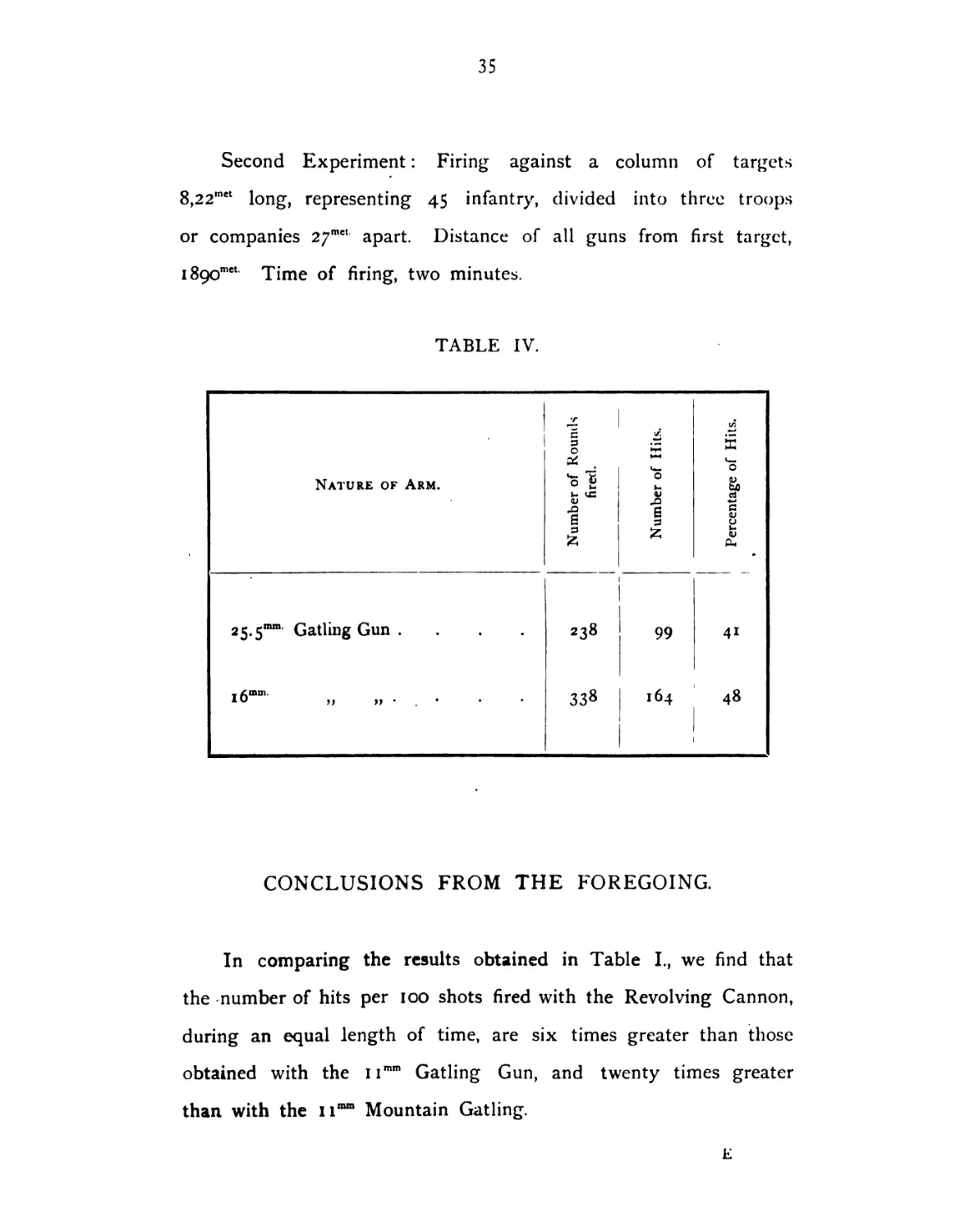
Second Experiment: Firing against a column of targets
8,22,net long, representing 45 infantry, divided into three troops
or companies 27met apart. Distance of all guns from first target,
1890*"* Time of firing, two minutes.
TABLE IV.
I
Nature of Arm.
25.5mm- Gatling Gun .	238	99	4»
1U	,,	.	338	164 I	48
CONCLUSIONS FROM THE FOREGOING.
In comparing the results obtained in Table I., we find that
the number of hits per 100 shots fired with the Revolving Cannon,
during an equal length of time, are six times greater than those
obtained with the umm Gatling Gun, and twenty times greater
than with the 11““ Mountain Gatling.
E
Зб
The number of hits per kil. of expended ammunition is less
for the Revolving Cannon than for the Field Gatling, but more
than for the Mountain Gatling, while the effective power* is :—
For the Revolving Cannon ..... 36.40
For the Field Gatling...........................26.32
For the Mountain Gatling.........................8.62
In Table II. the percentage of hits of the Revolving Cannon
is three times higher than the 25.5“™ Gatling, and nine times
higher than that of the i6.6inm Gatling, and the number of hits
* By the effective power of an arm is understood the compound quantity
which is governed by the number of hits on the targets, the time of firing, the
distance the targets are placed from the gun, and the dimensions of these targets.
In the determination of the effective power, there are, besides the unit of
time, two quantities, which are fixed by the conditions of the practice, viz., the
range and the dimensions of the targets, as these are chosen analogically to
the circumstances under which the arms to be tested are subjected in actual
service, we have the means of comparing different kinds of arms under the
practical conditions they are employed in.
Observe that the effective power under the above stated conditions affords
no judgment of the weight of ammunition expended ; and as there are certain
cases where it is not only important to know what effect can be produced with
an arm, but what quantity of ammunition it requires to produce this effect, it is
necessary to compare these two figures with each other, and we can thus form
a true judgment of the merits of the different arms.
This definition of effective power is used by the French Artilleries, and in
the present case is taken out of the “ Memorial de 1’Artillerie de la Marine/
2>ne. livraison, 1874, where the comparative trials of the Hotchkiss Revolving
Cannon with the other guns are reported.
37
per kil. of expended ammunition is nearly double of those obtained
with the 25.5, and nearly three times that of the i6.6”,,n Gatling.
The effective powers are :—
For the Revolving Cannon.......................90.32
For the 25.5ram Gatling........................33.82
For the i6.6mm Gatling.........................31.49
That is to say, in this case the Revolving Cannon obtained
an effect nearly three times as destructive as the Gatling guns, with an
expenditure of half the weight of ammunition.
Comparing the number of hits per cent, of the guns in Tables
III. and IV”. with the Revolving Cannon, in Tabies I. and II., the
number of hits is higher for the Revolving Cannon than for all
other guns.
Note the time of firing in Tables I. and II. was one minute,
whilst the times of firing in Tables III. and IV. were two
minutes, so that, considering the time of firing, the number of
hits is much greater for the Revolving Cannon than for the
other guns.
In the report of the “Memorial de Г Ar tiller ie de la Marine?
2",e livraison, 1874, page jij, it says: “ Le canon revolver Hotchkiss
realise un tir rapide et precis jusqii h 3,5°° ^	sur des troupes
placees en colonne, ou sur des tirailleurs presentant une grande pro-
38
fondeur, il pent produirc. a des distances supericures a la Umile du
tir ejficaee de Г infanterie, des effets plus considerables quo les mitrail-
leuses Gatling.”
It must also be remarked that these results were obtained
with a Revolving Cannon of the first model, built in 1871, of
inferior ballistical capacity, with a projectile weighing 49Ok'r and
a charge of 85^ Since this time the inventor has, from his own
experiences, and according to some valuable suggestions and
indications made by the committee of experiments at Gavre,
’augmented the power of his arm, so that there is reason to expect
from the guns of most recent date, using a projectile of $2Ok’r and
a charge of i2Ogr , results much superior to those obtained at Gavre
in January, 1873, an<3 it *s to be regretted that sufficient data for
making a comparison of the effects obtained with the latest
models did not exist.
Judging from the general results, it may be concluded that
the Hotchkiss Revolving Cannon is in most respects superior to,
and can be used with greater advantage than, any other arm tested
in the Tables from I. to IV.* for all purposes of defence, or on
* The Memorial de Г Artilletie de la Marine, 2we livraison, 1874, says, in
page 310: “La justesse cn direction est remareable, la justesse cn portee est
satisfaisantc, et le tir conserve sa reglarite jusqu' a ta portie maxima de t'obus
ou du boulet, soil 3,600 el 4,000 metres; le canon revolver a done a cet c'gard
une superiority incontestable sur les mitrailleuses qui out dija У1У examinees.”
39
open ground at ranges approaching field artillery, for damaging
material, and reaching troops behind cover ; for the employment
in advanced trenches or field works; and for repelling cavalry
attacks and assaults on forts. This gun may be applied for
offensive purposes in nearly all cases where light artillery can be
advantageously used. It is, besides, a very valuable arm for
marine use, when placed on the decks of ships, or for arming
boats and for landing purposes.
For the last-named purposes, where it is not necessary that
the gun should be absolutely without recoil, a lighter model is
manufactured, its weight being only about 300 kil.
In the Hotchkiss Revolving Cannon the advantages of the
Mitrailleuse are combined with the long ranges, precision, and moral
effect of the explosive shells of artillery. The projectiles have
also, to a certain extent, the penetrating power of the same.
The superiority of the Revolving Cannon over Mitrailleuses
becomes the more remarkable the greater the distance at
which it is used ; whilst at ranges up to 250 or 3oomct and
for purposes of flank defence, case-shot also can be used with
success.
It is evident therefore that both in mechanism and in general
results, this arm possesses important advantages over all other
systems of machine-guns.
40
The system of the Hotchkiss Revolving Cannon is not
restricted to any particular calibre; it can be constructed cither
as a Mitrailleuse, which employs small-arm ammunition, or of
calibres much larger than the before described gun, thereby
affording the advantage of uniformity in the system of armament.
Two essentially different calibres besides the 37"in‘ calibre
Revolving Cannon are now manufactured; the one is known as
the “Hotchkiss Mitrailleuse,” and another gun, designed specially
for use in forts or fortified positions, this latter with a calibre
of 52,1U” and a projectile weighing 2kil
THE HOTCHKISS MITRAILLEUSE.
This arm entirely resembles the Revolving Cannon in its
construction, but it is generally made with nine instead of five
barrels, the motion of the crank being accelerated by two helical
wheels, to allow a speed of fire of about 150 shots per minute.
This comparatively low speed has been adopted to insure the
perfect and reliable action of the gun, as it is known that most
of the defects in the working of other systems of Mitrailleuses
are due, in great part, to the excessive speed at which the
mechanism has to work, and the impossibility of being able to
supply the gun with ammunition with the necessary precision and
order.
The speed of 150 rounds per minute allows the application
of the simple mechanism adopted for this arm, and it is also
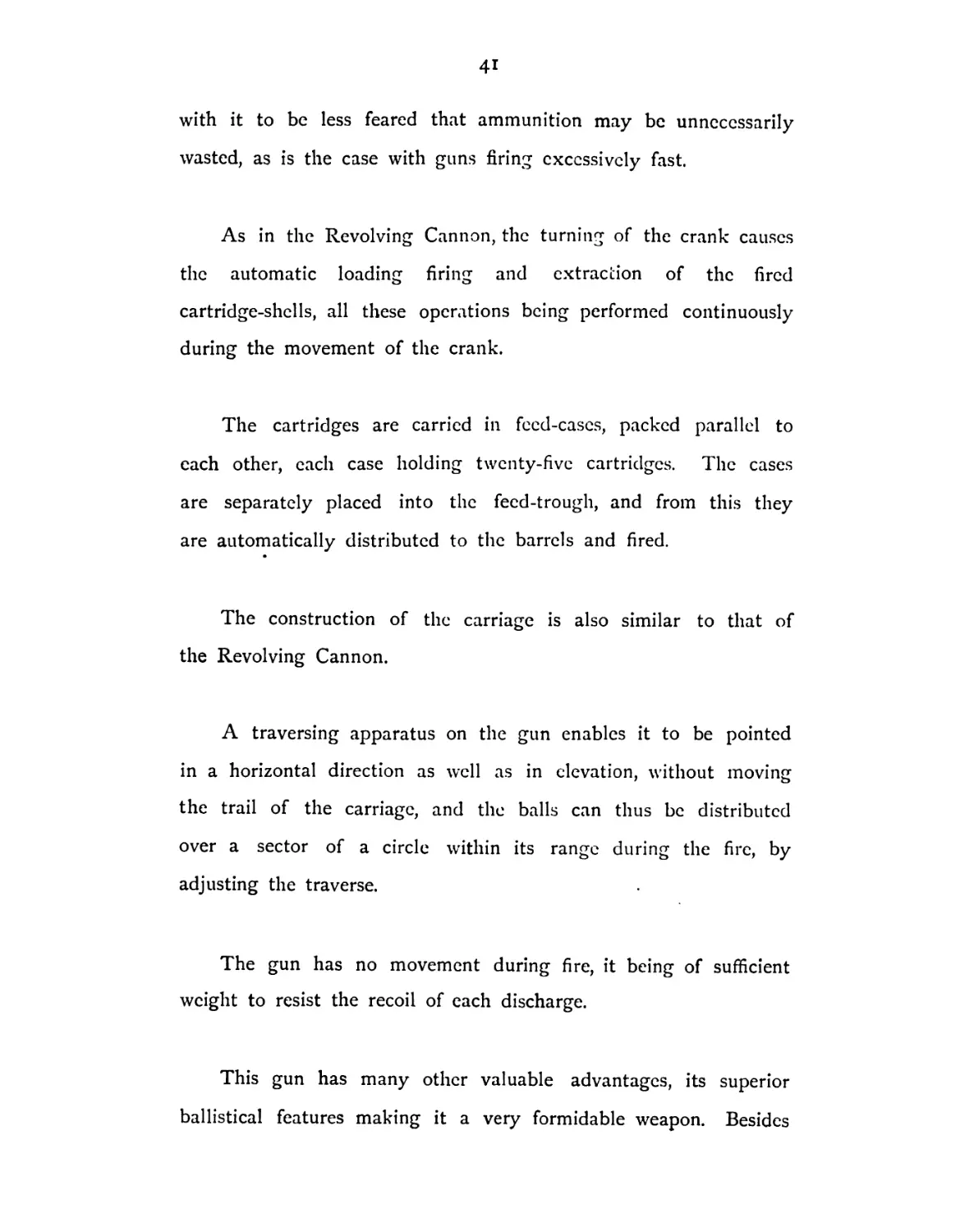
41
with it to be less feared that ammunition may be unnecessarily
wasted, as is the case with guns firing excessively fast.
As in the Revolving Cannon, the turning of the crank causes
the automatic loading firing and extraction of the fired
cartridge-shells, all these operations being performed continuously
during the movement of the crank.
The cartridges are carried in feed-cases, packed parallel to
each other, each case holding twenty-five cartridges. The cases
are separately placed into the feed-trough, and from this they
are automatically distributed to the barrels and fired.
The construction of the carriage is also similar to that of
the Revolving Cannon.
A traversing apparatus on the gun enables it to be pointed
in a horizontal direction as well as in elevation, without moving
the trail of the carriage, and the balls can thus be distributed
over a sector of a circle within its range during the fire, by
adjusting the traverse.
The gun has no movement during fire, it being of sufficient
weight to resist the recoil of each discharge.
This gun has many other valuable advantages, its superior
ballistical features making it a very formidable weapon. Besides
42
this, the simplicity and durability of its mechanism better
qualifies it for actual service than the Mitrailleuse guns hitherto
constructed.
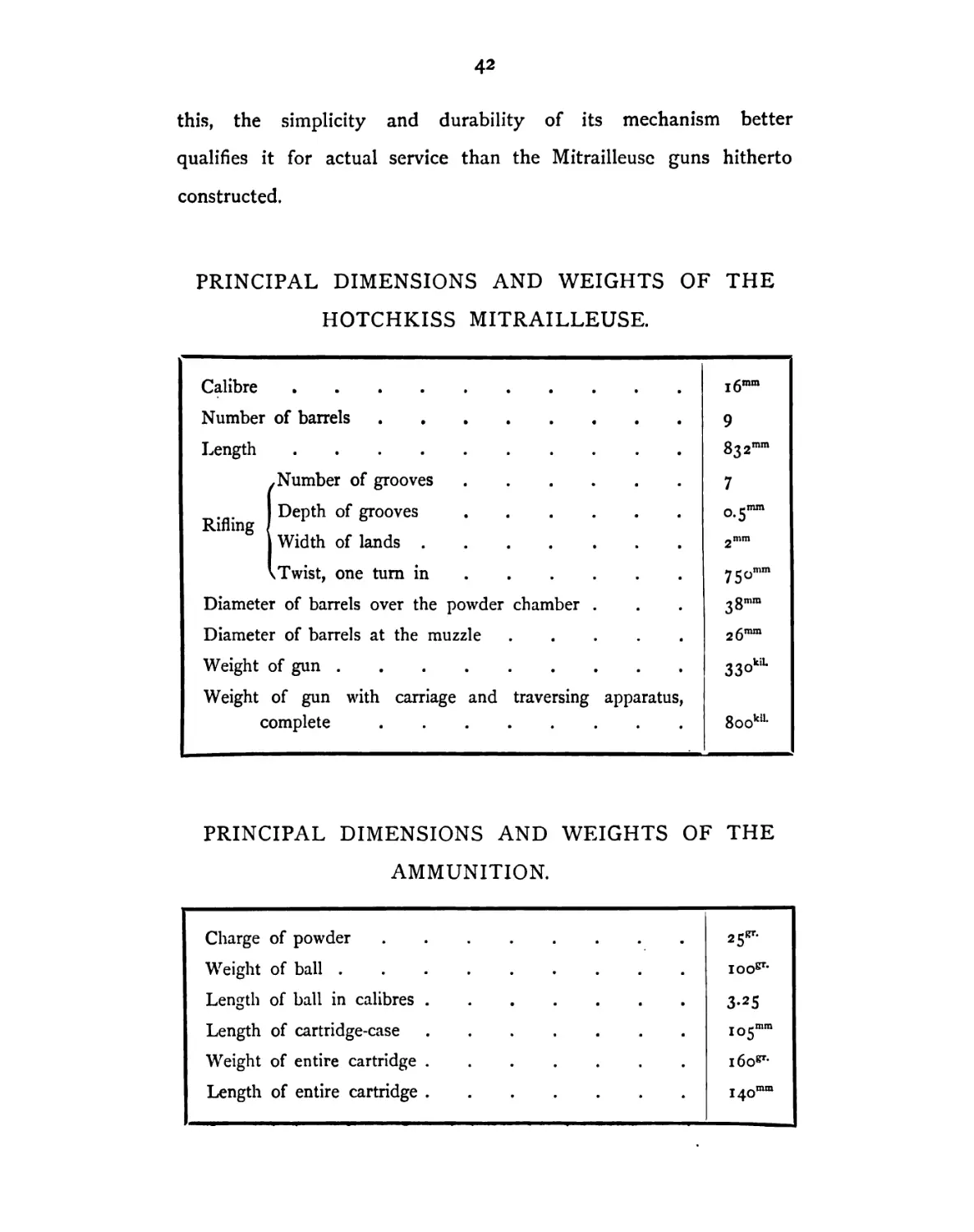
PRINCIPAL DIMENSIONS AND WEIGHTS OF THE
HOTCHKISS MITRAILLEUSE.
Calibre	 Number of barrels		i6mm 9
Length	 Number of grooves		832™ 7
Depth of grooves	 1 ing Width of lands	 Twist, one turn in		0.5™ 2mm у
Diameter of barrels over the powder chamber .	38™
Diameter of barrels at the muzzle		26™
Weight of gun	 Weight of gun with carriage and traversing apparatus,	33°kiL
complete		8ooM-
PRINCIPAL DIMENSIONS AND WEIGHTS OF THE
AMMUNITION.
Charge of powder		25кг.
Weight of ball		ЮО8^’
Length of ball in calibres		3-25
Length of cartridge-case		105™
Weight of entire cartridge		160^
Length of entire cartridge		140™
43
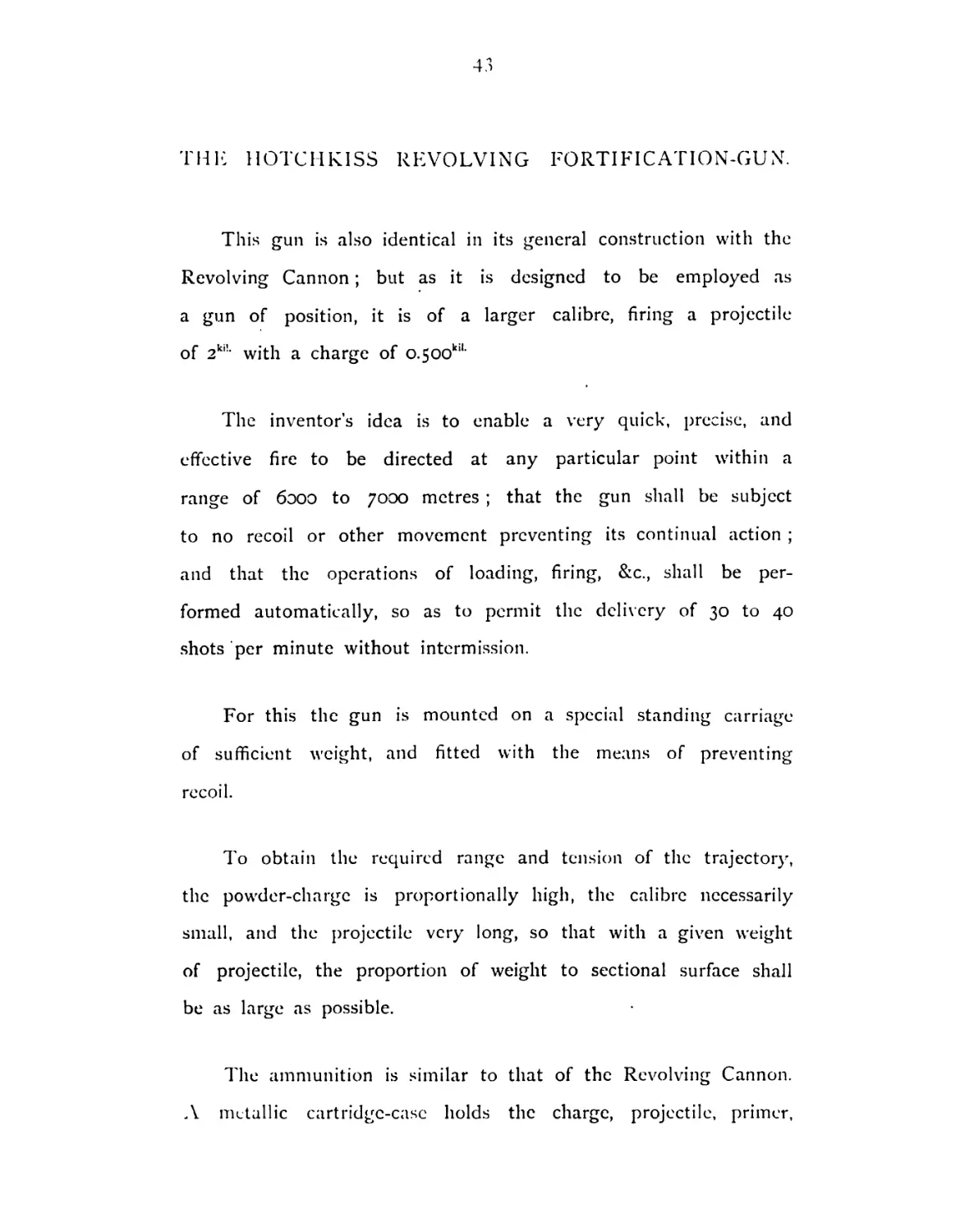
THE HOTCHKISS REVOLVING FORTIFICATION-GUxN.
This gun is also identical in its general construction with the
Revolving Cannon; but as it is designed to be employed as
a gun of position, it is of a larger calibre, firing a projectile
of 2k,!- with a charge of o^oo161’
The inventor’s idea is to enable a very quick, precise, and
effective fire to be directed at any particular point within a
range of 6ooo to 7000 metres ; that the gun shall be subject
to no recoil or other movement preventing its continual action ;
and that the operations of loading, firing, &c., shall be per-
formed automatically, so as to permit the delivery of 30 to 40
shots per minute without intermission.
For this the gun is mounted on a special standing carriage
of sufficient weight, and fitted with the means of preventing
recoil.
To obtain the required range and tension of the trajectory,
the powder-charge is proportionally high, the calibre necessarily
small, and the projectile very long, so that with a given weight
of projectile, the proportion of weight to sectional surface shall
be as large as possible.
The ammunition is similar to that of the Revolving Cannon.
A metallic cartridge-case holds the charge, projectile, primer,
44
and lubricating wad combined in one. The projectile has a brass
packing to take the rifling.
The cartridges are placed singly into the feed-trough ot
the gun, and from thence they arc automatically distributed to
the barrels, and then fired.
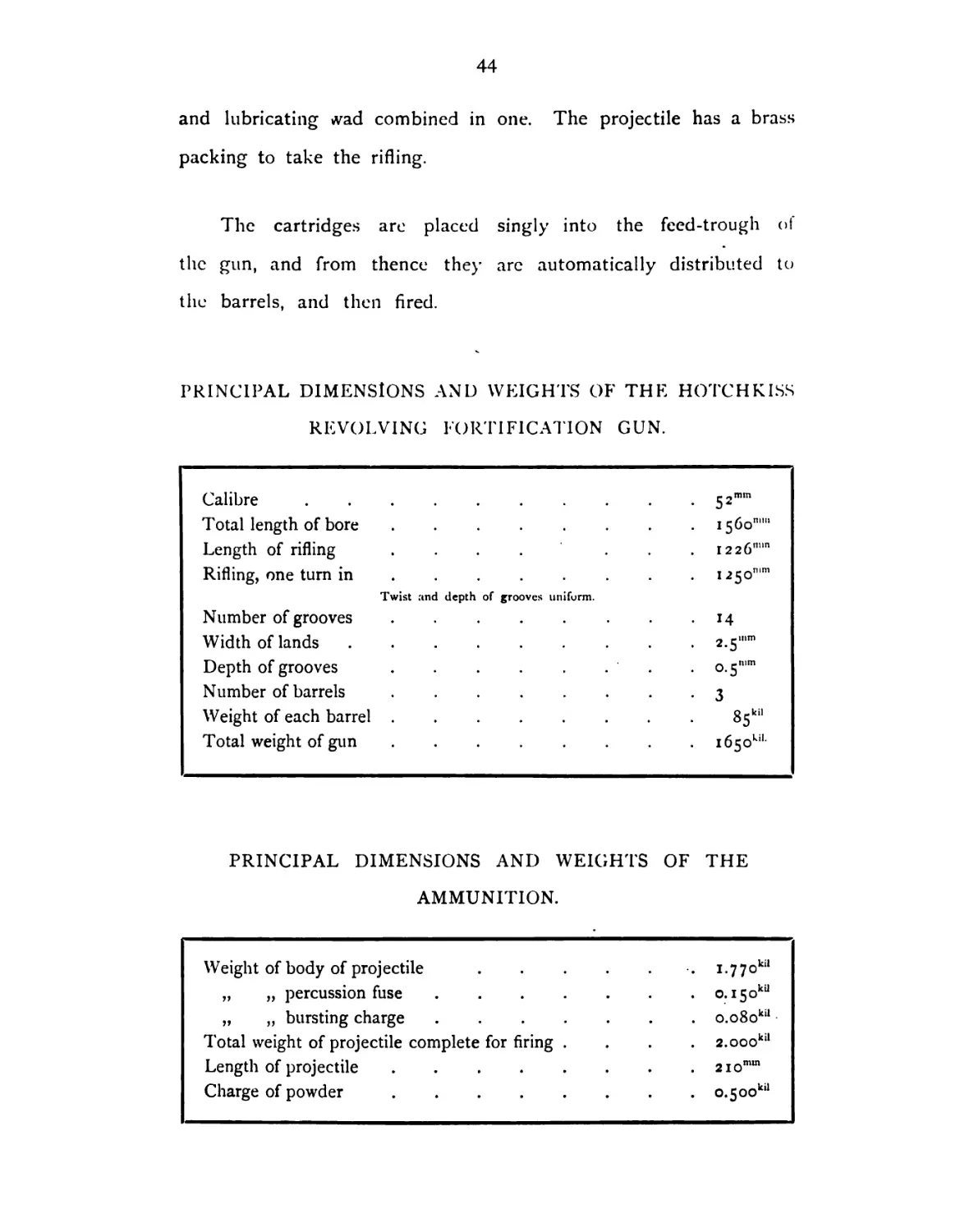
PRINCIPAL DIMENSIONS AND WEIGHTS OF THE HOTCHKISS
REVOLVING FORTIFICATION GUN.
Calibre		2mm
Total length of bore		1560"""
Length of rifling	....	.	.	. I2 26'n,n
Rifling, one turn in ......	.	. I25On,m
Twist and depth of grooves uniform.
Number of grooves		. 14
Width of lands	  .	2 51,,m
Depth of grooves			. o.5n,m
Number of barrels		• 3
Weight of each barrel		85kil
Total weight of gun		1650™-
PRINCIPAL DIMENSIONS AND WEIGHTS OF THE
AMMUNITION.
Weight of body of projectile	....	. 1.770™
„	„ percussion fuse		. 0.150™
„	„ bursting charge		. 0.080™
Total weight of projectile complete for firing .	2.000™
Length of projectile		. 2IOmm
Charge of powder		. O.5OO™
45
Comparing various effects, the inventor is of opinion that a
far more destructive result may be obtained from 30 to 40
rounds weighing 2kit each, from this gun during the time
necessary to fire three to four projectiles weighing perhaps
25 to 3Okil from a large ordinary fortification gun.
When rapidity can be combined with accuracy of fire
the effect is certainly great, and the advantage is gained, with
a rapidly-firing gun, to be able to produce a terribly destruc-
tive fire in decisive moments in an engagement, so that this
gun, worked systematically and with deliberation, will no doubt
produce very formidable effects. It will be found of particular
value for clcaring-away troops in th.c act of fortifying them-
selves, or when they are bringing siege-artillery into position ;
also for dislodging siege-batteries and repelling assaults. Its
proper application in fortifications will make it almost impossible
for an enemy to establish himself within its range.
The author hopes that this description may serve to draw
the attention of military authorities to Mr. Hotchkiss’s system
of arm, as it certainly deserves their serious consideration, and
will doubtless bear its full share in the determination of future
wars, for but little demonstration is needed to point out the
fearful execution of which such an arm is capable.
46
LIST OF PLATES.
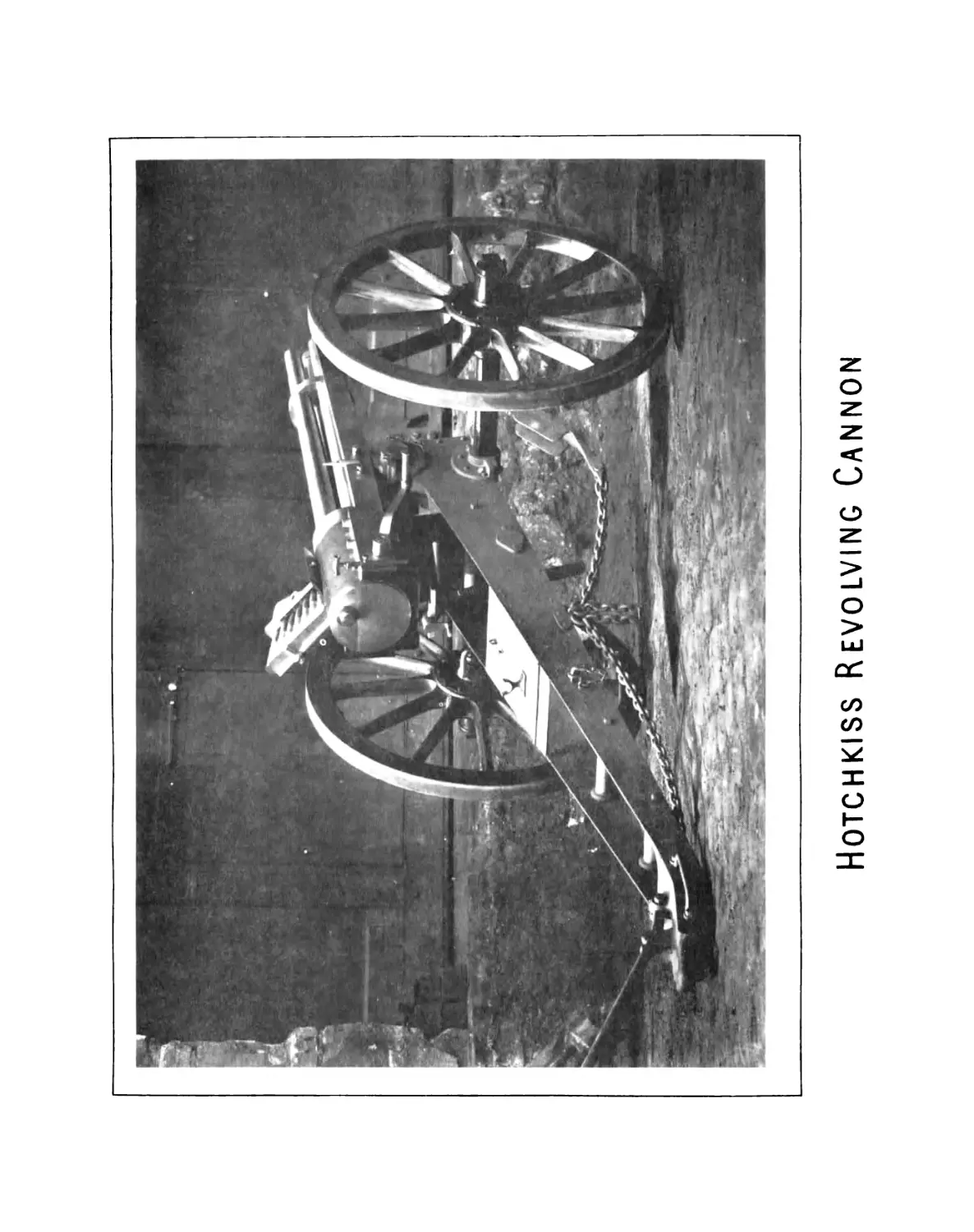
i.	Gun and Carriage, without the Shield.
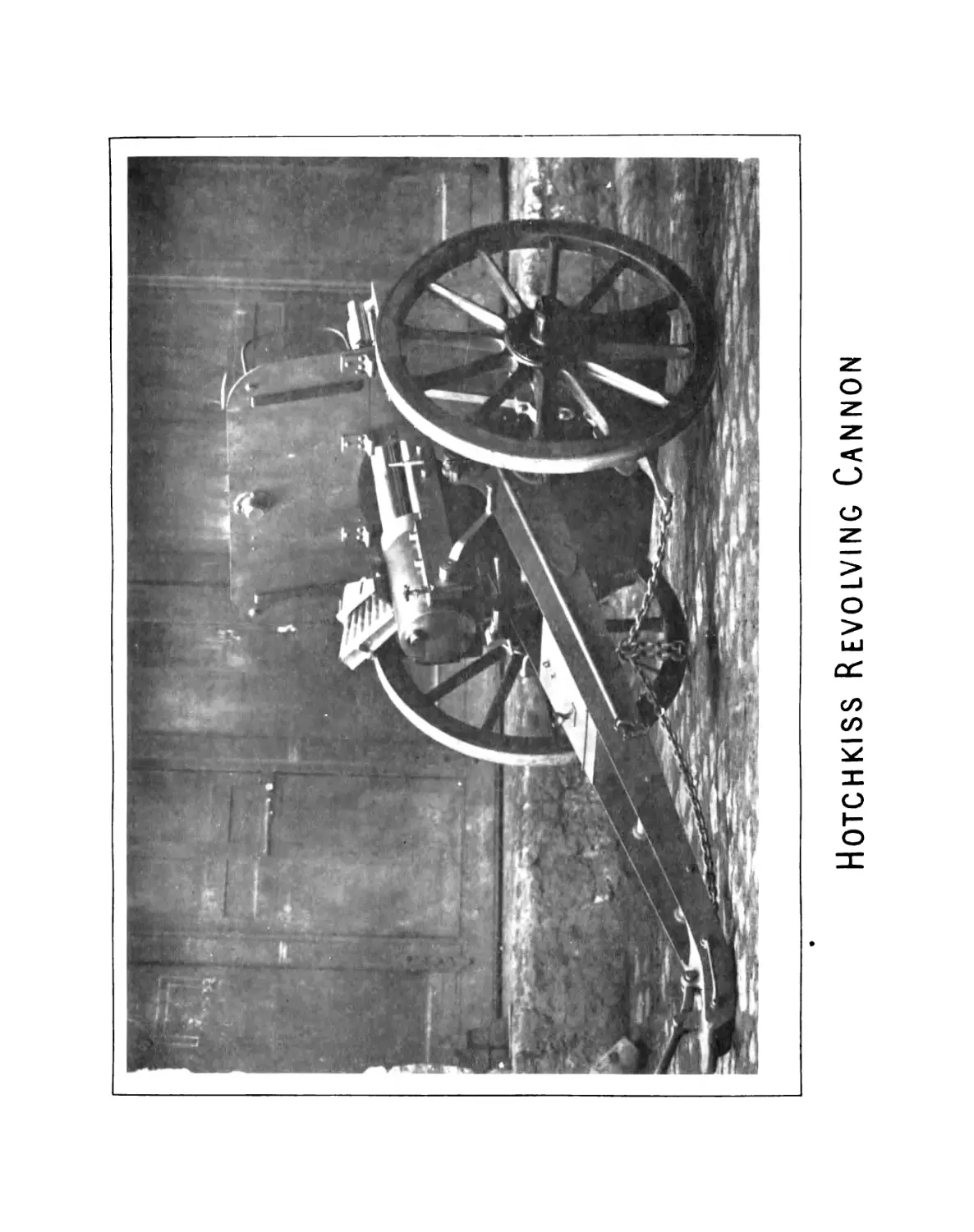
2.	Gun and Carriage, with the Shield opened, in
Firing Position.
3.	Gun, with the Carriage and Limber, with the Shield
Closed, and the Gun limbered-up.
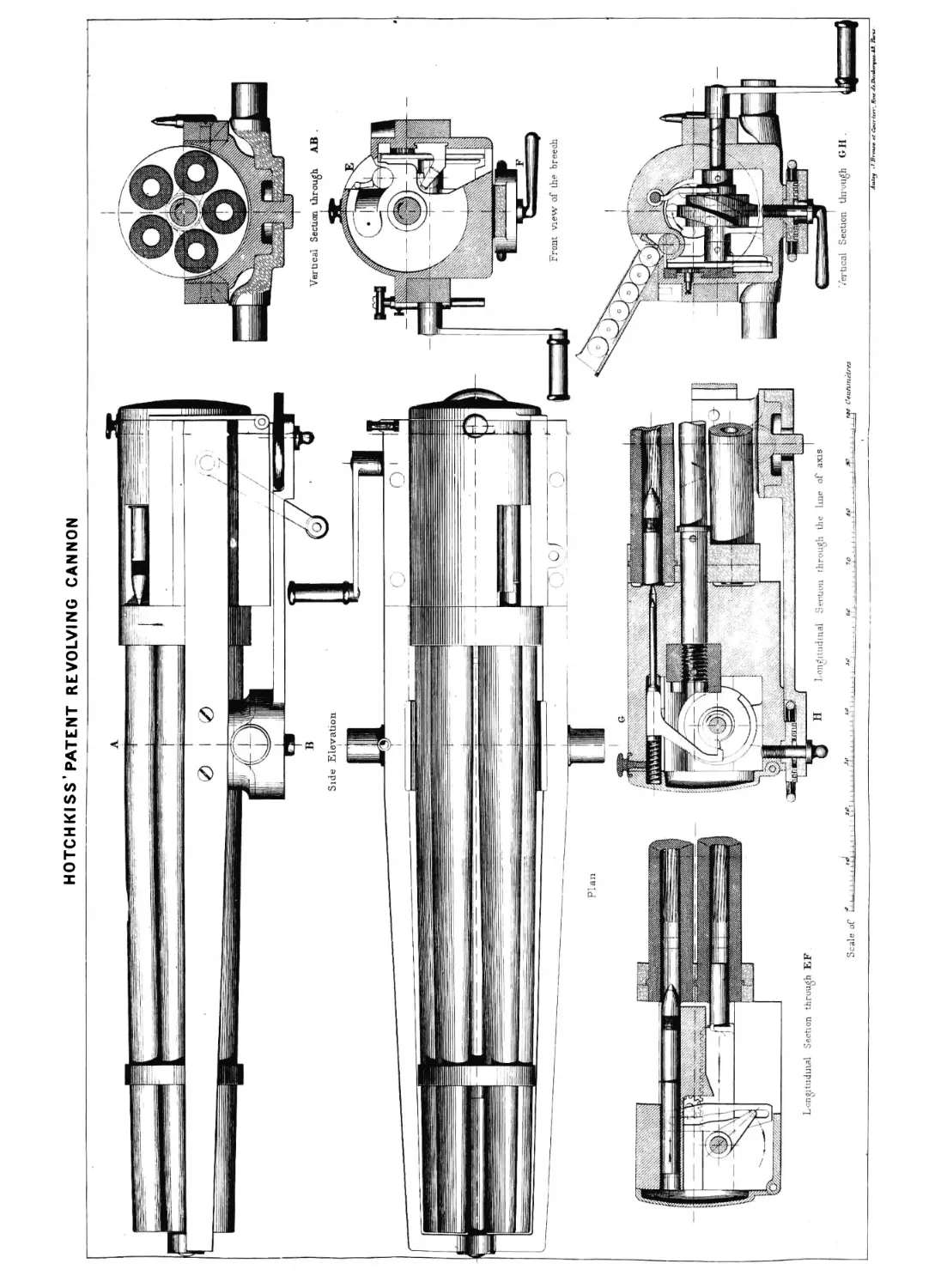
4.	Geometrical Drawings and Sections of the Gun.
5.	Ammunition used with the Gun.
6.	Geometrical Drawings of the Carriage.
Hotchkiss Revolving Cannon
Hotchkiss Revolving Cannon
Hotchkiss Revolving Cannon
HOTCHKISS'PATENT REVOLVING CANNON
AMMUNITION FOR THE HOTCHKISS ’ REVOLVING CANNON
CARRIAGE FOR HOTCHKISS’REVOLVING CANNON