/



































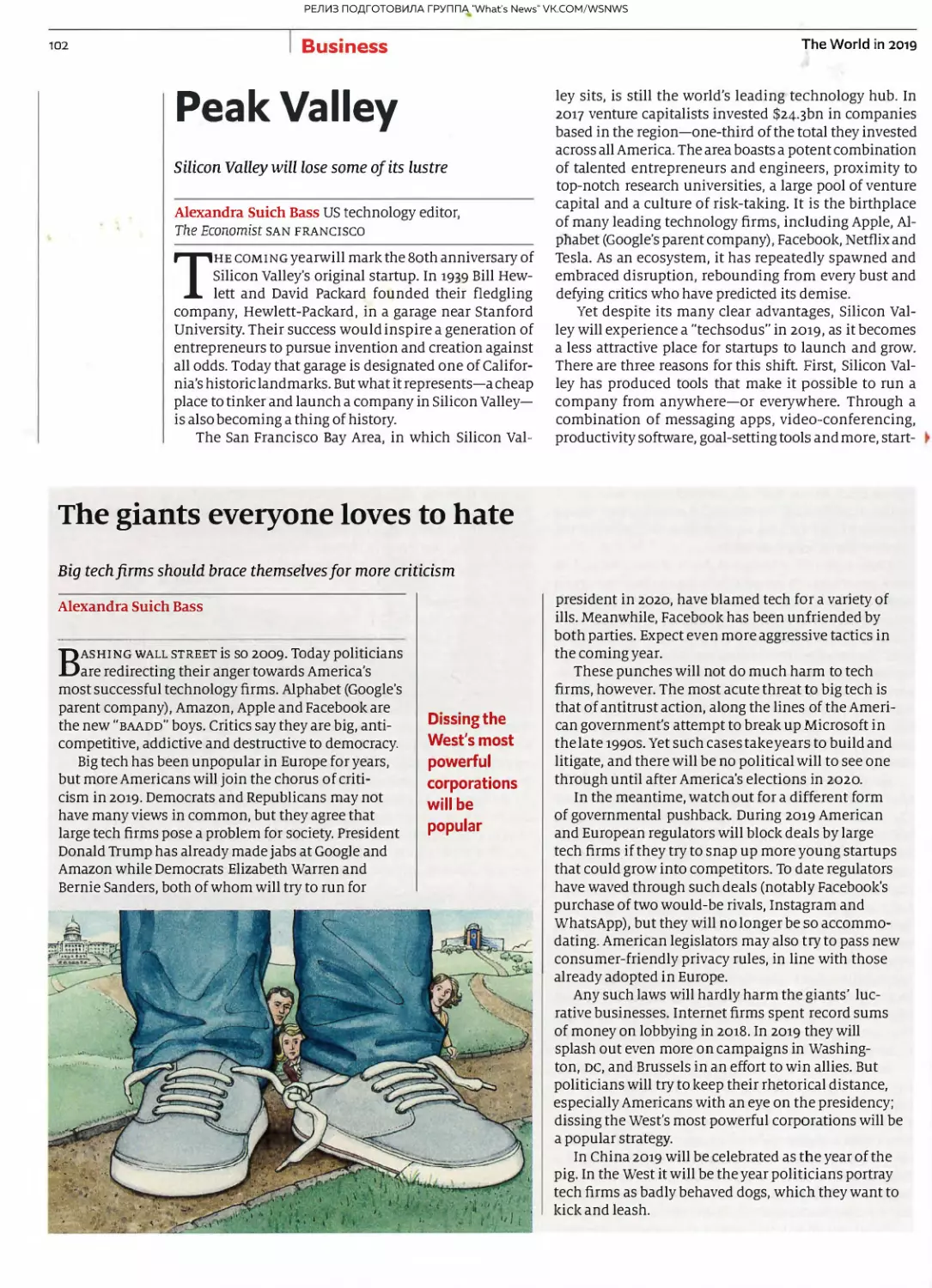

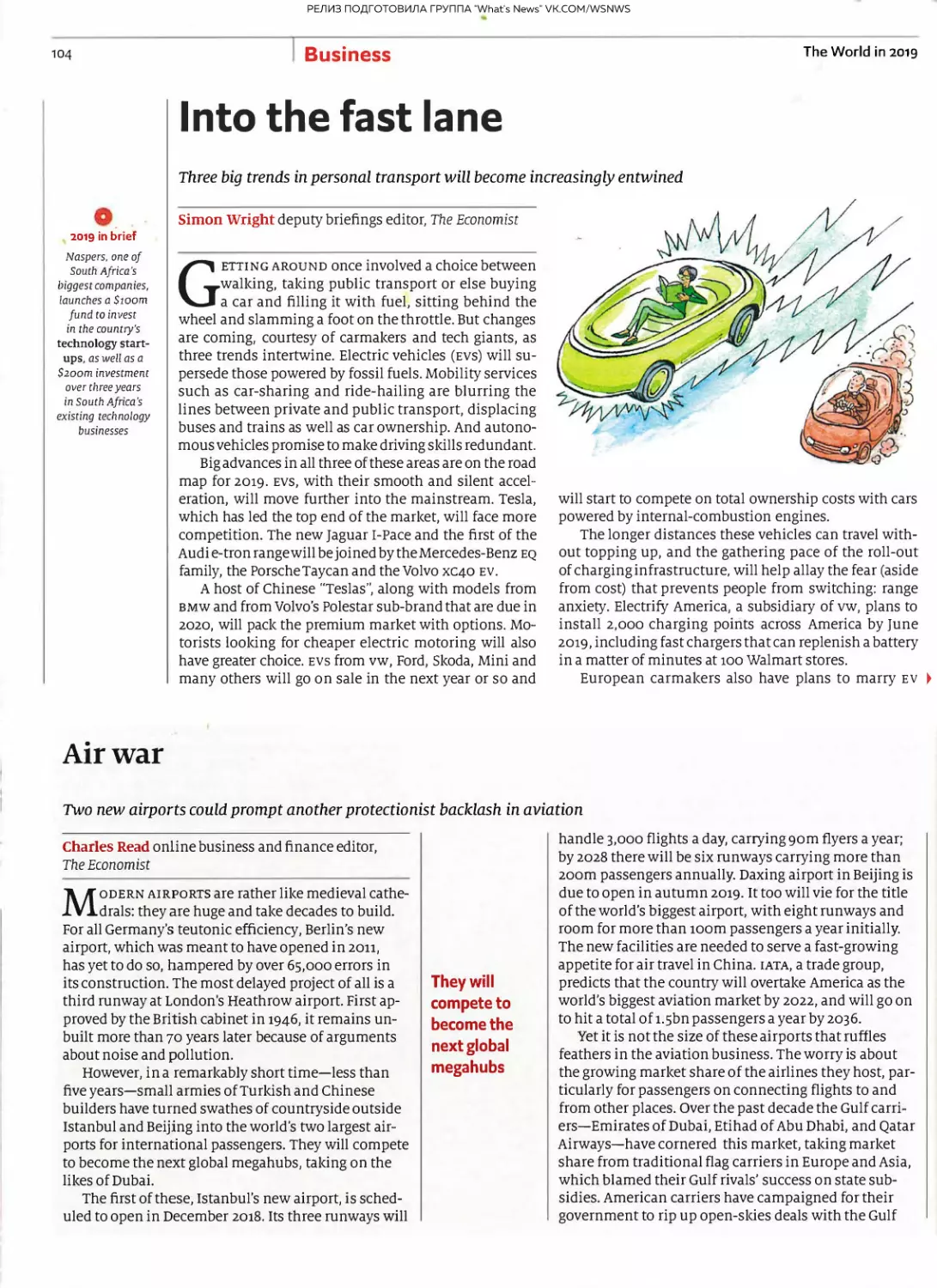


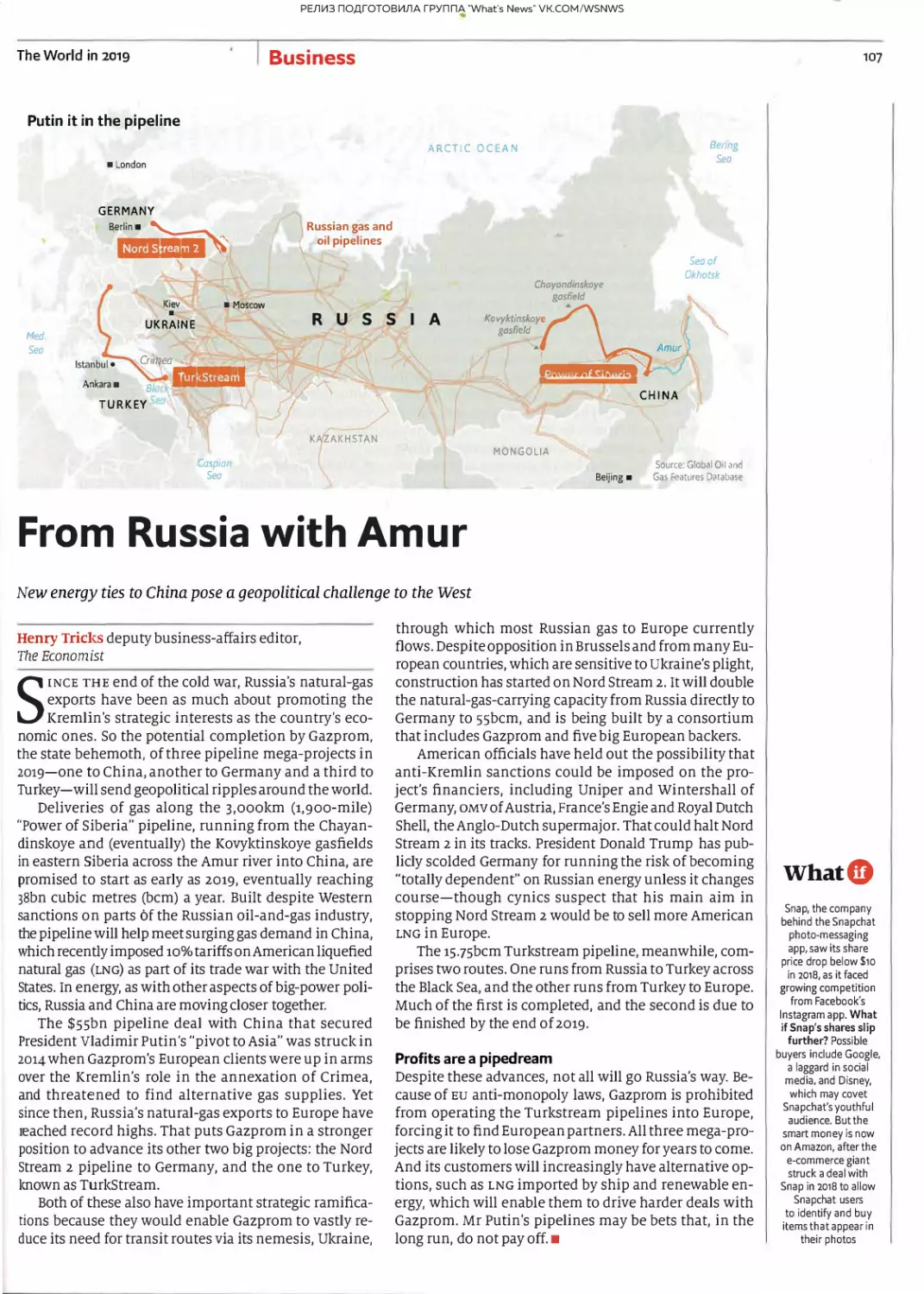
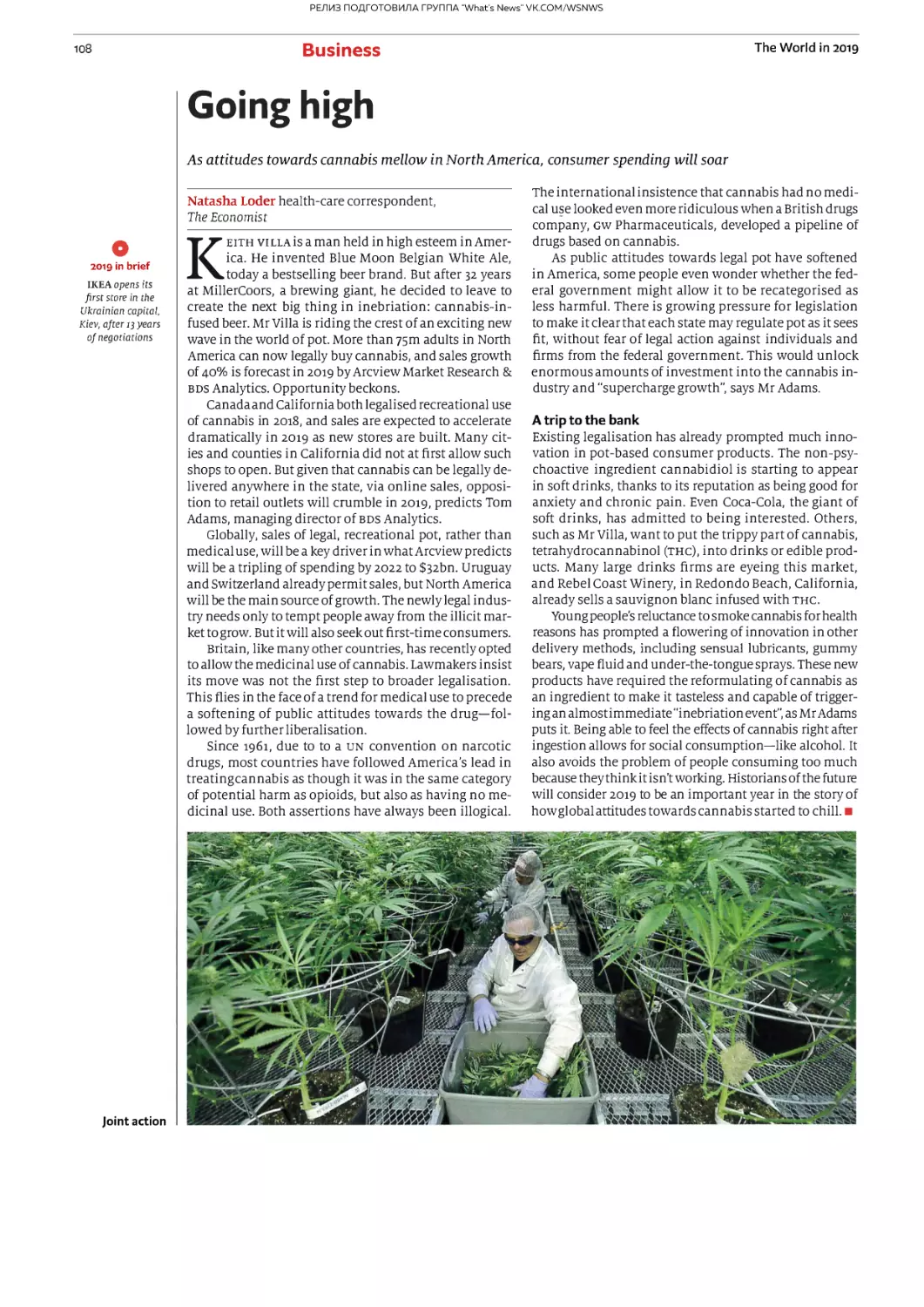











Текст
РЕЛИЗ ПОДГОТОВИЛА ГРУППА "What's News" VK.COM/WSNWS
РЕЛИЗ ПОДГОТОВИЛА ГРУППА "What's News" VK.COM/WSNWS
РЕЛИЗ ПОДГОТОВИЛА ГРУППА "What's News" VK.COM/WSNWS
РЕЛИЗ ПОДГОТОВИЛА ГРУППА "What's News" VK.COM/WSNWS
13
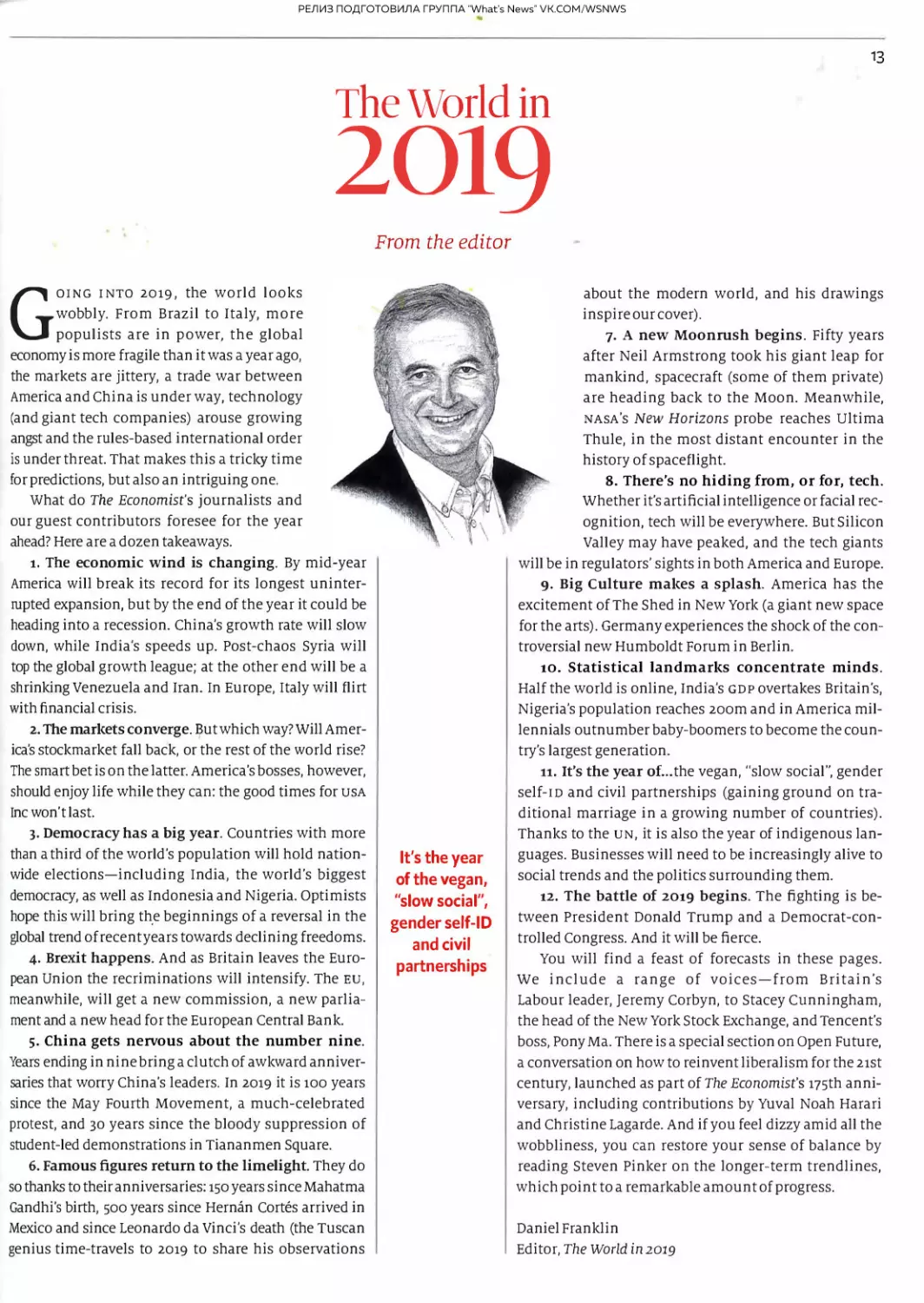
TheWorldin
2019
From the editor
G
2019, the world looks
wоЬЬ!у. From Brazil to Italy, more
populists are in power, the global
economy is more fragile than it was а year ago,
the markets are jittery, а trade war between
America and China is under way, technology
(and giant tech companies) arouse growing
angst and the rules-based international order
is under threat. That makes this а tricky time
for predictions, but also an intriguing one.
What do The Economist's journalists and
our guest contributors foresee for the year
ahead? Here are а dozen takeaways.
1. The economic wind is changing. Ву mid-year
America will break its record for its longest uninter
rupted expansion, but Ьу the end of the year it could Ье
heading into а recession. China's growth rate will slow
down, while India's speeds up. Post-chaos Syria will
top the global growth league; at the other end will Ье а
shrinking Venezuela and Iran. In Europe, Italy will flirt
with financial crisis.
2. The markets converge. �ut which way?Will Amer
ica's stockmarket fall back, or the rest of the world rise?
The smart bet is оп the latter. America's bosses, however,
should enjoy life while they сап: the good times for usл
Inc won't last.
3. Democracy has а Ьig year. Countries with more
than а third of the world's population will hold nation
wide elections-including India, the world's Ьiggest
democracy, as well as Indonesia and Nigeria. Optimists
hope this will bring th_e beginnings of а reversal in the
global trend of recent years towards declining freedoms.
4. Brexit happens. And as Britain leaves the Euro
pean Union the recriminations will intensify. The EU,
meanwhile, will get а new commission, а new parlia
ment and а new head for the European Central Bank.
about the modern world, and his drawings
inspire our cover).
7. А new Moonrush begins. Fifty years
after Neil Armstrong took his giant leap for
mankind, spacecraft (some of them private)
are heading back to the Moon. Meanwhile,
Nлsл's New Horizons probe reaches Ultima
Thule, in the most distant encounter in the
history of spaceflight.
OJNG INTO
5. China gets nervous about the number nine.
Years ending in nine bring а clutch of awkward anniver
saries that worry China's leaders. In 2019 it is 100 years
since the Мау Fourth Movement, а much-celebrated
protest, and зо years since the Ыооdу suppression of
student-led demonstrations in Tiananmen Square.
6. Famous figures return to the limelight. They do
so thanks to their anniversaries: 150 years since Mahatma
Gandhi's Ьirth, 500 years since Hernan Cortes arrived in
Mexico and since Leonardo da Vinci's death (the Tuscan
genius time-travels to 2019 to share his observations
8. There's no hiding from, or for, tech.
Whether it's artificial inte\ligence or facial rec
ognition, tech will Ье everywhere. But Silicon
Valley may have peaked, and the tech giants
will Ье in regulators' sights in both America and Europe.
9. Big Culture makes а splash. America has the
excitement of The Shed in New York (а giant new space
for the arts). Germany experiences the shock of the con
troversial new Humboldt Forum in Berlin.
10.
lt's the уеаг
of the vegan,
"slow social",
gender self-lD
andcivil
partnerships
Statistical landmarks concentrate minds.
Half the world is online, India's GDP overtakes Britain's,
Nigeria's population reaches 200m and in America mil
lennials outnumber baby-boomers to become the coun
try's largest generation.
11. It's the year of... the vegan, "slow social", gender
self-ш and civil partnerships (gaining ground оп tra
ditional marriage in а growing number of countries).
Thanks to the UN, it is also the year of indigenous lan
guages. Businesses will need to Ье increasingly alive to
social trends and the politics surrounding them.
12. The battle of 2019 begins. The fighting is be
tween President Donald Trump and а Democrat-con
trolled Congress. And it will Ье fierce.
You will find а feast of forecasts in these pages.
We include а range of voices-from Britain's
Labour leader, Jeremy Corbyn, to Stacey Cнnningham,
the head of the New York Stock Exchange, and Tencent's
boss, Pony ма. There is а special section оп Ореп Future,
а conversation оп how to reinvent liberalism for the 21st
century, launched as part of The Economist's 175th anni
versary, including contributions Ьу Yuval Noah Harari
and Christine Lagarde. And if you feel dizzy amid all the
wobЬ!iness, you сап restore your sense of balance Ьу
reading Steven Pinker оп the longer-term trendlines,
which point to а remarkaЬ!e amount of progress.
Daniel Franklin
Editor, The Wor/d in 2019
РЕЛИЗ ПОДГОТОВИЛА ГРУППА "What's News" VK.COM/WSNWS
The World in 2019 I Leaders
15
The Trump show, Season Two
How history views America's 45th president will Ье determined Ьу decisions made in 2019,
says Zanny Minton Beddoes
F
past two years the
global political stage has
been overshadowed Ьу one
man. President Donald Trump has
divided America and dominated
world affairs to а degree that has no
modern precedent. That is partly
thanks to Mr Trump's style: diplo
macyo�Y-tweet to his ssm followers,
/tn'Fe{;;p(for conventional norms of
presidential behaviour and а reality
television star's gift for attracting at
tention. But it is mainly because Mr
,rr��·s.з7orld-view-a zero-sum,
'grflvWce-laden, mercantilist, ra
cially tinged nationalism-marks
such а wrenching change fron:i that
of his predecessors and from his
country's post-war role. The leader
of the free world is the embodiment of an angry, popu
list backlash to politics-as-usual.
The outsize presence has broughr exrreme reac
tions. то his critics, Disastrous Donald has been а ca
tastrophe, а man whose abuses of power and divisive
rhetoric threaten the fabric of American democracy;
whose transactional an� bullying approach to America's
international leadership is economically illiterate, mor
ally bankrupt and geostrategically short-sighted. То his
supporters he is Tough Trump: boorish and embarrass
ing, but someone who has delivered а roaring economy
and called time on an outdated global order. Не has
shaken up geopolitical stalemates (such as the stand
off over North Korea's nuclear weapons) and forced а
reckoning on long-standing proЫems, whether it is
China's cheating at global trade rules or European allies'
paltry defence spending. Both sides acknowledge he is
а wrecking ball. At issue is whether the destruction is
creative or just damaging.
The evidence so far points to somewhere in be
tween. Serious damage has been done, particularly to
America's political culture. The president's habltual
lying, his attacks on the press and his wilful stoking
OR тнЕ
At iss ue is
whetherthe
destruction
is creative or
damaging
Zanny Minton Beddoes:
editor-in-chief,
The Economist
of grievance among his supporters
have all contributed to а mood in
American society that is more di
vided, febrile and angry than at any
point since at least the late 1960s.
This was especially evident in the
run-up to the mid-term elections,
from the furore over the appoint
ment of Brett Kavanaugh to the
Supreme Court to the murderous
rampage at the Tree of Life syna
gogue in Pittsburgh. Mr Trump's
economic stewardship is less stellar
than his supporters claim. Yes, the
e5=onomy has been booming. But
that is largely because it is in the
�idst of а sugar high thanks to а fis
cally irresponsiЬ!e tax cut.
- In foreign policy, the damage
from the wrecking Ь
diate. Mr Trump's репс an or abandoning commitments he considers "а bad deal" has caused America
to pull out of-or threaten to pull out of-a remarkaЫe
number of international agreements, from the high
profile Paris climate accord and the Iran nuclear deal
to the lesser-known Universal Postal Union. This has
sometimes obscured areas where the Trump approach
has been prescient or created genuine opportunities.
Beyond the wrecking ball
In North Korea, Mr Trump's dizzying shift from insult
trading to self-described love-affair with а suddenly
wооаЫе Кim Jong Un has brought an opening for а bet
ter relationship with а rogue nuclear power; though it
has yet to yield substantive results, the affair will sim
mer оп in 2019. From Syria to Afghanistan the Trump
administration's approach is proving better, or at least
no worse, than Barack Obama's. And, most important,
the Trump team's view of China as а strategic threat,
whose economic assertiveness must Ье countered even
as its geopolitical ambltions are parried, has resonated
with both political parties and with America's foreign- ►
РЕЛИЗ ПОДГОТОВИЛА ГРУППА "What's News" VK.COM/WSNWS
16
1
1
J
1
The World ir/\
Leaders
r
► policy estaЫishment.
The jury�s stЩ out оп the tactics, especially the
president's pei'l�h�Jt for weaponising tariffs. However,
the evidence from the past year suggests that American
ё-�1111 <IJ,lUA
bullying оп trade brings results, a1beit at а price. Yes,
MrTrump hai weakened the global trading system, not
least Ьу ei'rtastu'!'atl'Кg the World Trade Organisation
(wто). But in his stand-offs with South Korea, Canada
and Mexico as well as��1�wee, with the European
Union, he has also compelleti large trading partners
to agree to changes that, defined in terms of narrow
mercantilist American self-interest, amount to modest
negotiating successes.
Rather than Trumpism being about simply smash
ing the international order, these mini-deals could Ье
evidence of а strategy to tilt its terms, declare victory
and move оп. If so, China will Ье the biggest test of that
strategy. The outcome wi\l Ье decided in 2019. And it
will Ье the single most powerful piece of evidence of
whether there is anything to the Trump show beyond
the wrecking ball.
Brand new plot lines
А far-sighted
The circumstan<;<';� ':})Щ te different. In 2019 Mr�mP, 1.J<iJ-'!J!Iesident
_
will face Ьigger c1)nsrr1'1ht�e will also Ье less Бuoyed
would see it
Ьу good fortune.
as а historic
Fог а start, with Democrats in control of the House
opportunity
of Representatives, the Trump administration will
face aggressive questioning from committees with
subpoena power. Мг Trump himself will see а spotlight shone оп his tax payments (or \ack thereof) and
whether his use ofTrump properties violates the consti_tution. Unless Robert Mueller, the special prosecutor
looking into links between Mr Trump's campaign and
Russia's meddling in the 2016 election, comes up with
explosive material, Democratic Jeaders will hold back
their colleagues who are itching to start impeachment
proceedings against the president. Nevertheless, the
House will Ье combative and determined to hold the
executive to account.
In addition, stock prices (а favourite barometer of
Mr Trump's) will sag and the economy will begin to
weaken during 2019. That is because the fiscal boost
from the tax cut will start to fade even as higher tariffs
and higher interest rates both slow growth. Оп Janu
ary 1st Mr Trump's tariffs оп $25obn-worth of Chinese
goods are set to rise from 10% to 25%. The Federal
Reserve will continue along its path towards tighter
money: at least two more quarter-point rate rises are
likely Ьу the middle of 2019. Hitherto, most
impact of higher American interest rates has Ьее
in the emerging world. In the year ahead it will in1,
tc
ingly Ье felt at home.
How will Мг Trump react? If Disastrous Don i
the right frame of reference, he will dial up the ait
sive rhetoric to deflect attention from these trotrJ
The result will Ье countless ТWitter rages against D>
cr�ll?.e�er more pointed attacks оп the central Ьап>,
а slew�of aggressive executive actions in areas, st
immigration control, that appeal to his base. Ani с
country will become even angrier. And the еСО1С
l
will not be helped one iota.
For th �t re �son, it is possiЬle that Мг Trumpv
,
keen to coii'ftu� prognosticators, will try а diff�
approach. Не could cook up а deal with Democr, s
extend the fiscal boost, and hence prop up the ecoiv.
А tax cut focused оп workers rather than the wealГ
one option; more likely is а package to boost Amtt'
Г
infrastructure spending.
The extent of the economy's slowdown also defI
оп MrTrump's Ьiggest foreign-policy decision: hh
deal with China. In many ways МгTrump is in а ss 1
position. America, so far, is suffering less from theTE
war than China. Не has wrong-footed the Chinesea
ership, which did not anticipate the aggressiven/Л
scale of America's tariff strategy. But Mr Trump i1Y
constrained: оп one side Ьу the damage that an es11
ing tariff war will wreak; оп the other Ьу the extfj
America's new SinophoЬia. А quick and dirty dеад
does little to change China's underlying trade mal-1
could see МгTrump attacked at home for c�ij�a
11
America's ascendant rival.
)
Bring on the builder
How Мг Trump deals with this trade-off will say)
about his presidency. А far-sighted president wt
see it as а historic opportunity to remake the wiГ
relationship with China. Не would enlist allies to i1
within the wто framework to reshape global trade1t
while bolstering military al\iances in Asia to corI
any Chinese attempts at encroachment. Не wouldl
from two years of wrecking-ball tactics to make а:
at building а new world order, more reflective ofl
century realities and designed to manage the rir
between the United States and China that will d1
the century.The fact that it is hard to imagine MrliC
doing this is, alas, а powerful pointer to how hi.:
will assess him. ■
1
РЕЛИЗ ПОДГОТОВИЛА ГРУППА "What's News" VK.COM/WSNWS
The World in 2019
Leaders
17
The peril of nine
Не has amassed extraordinary power, butXi]inping is worried about 2019, says James Miles
T
HIRTYYEARS ago, as 1989 ap
proached, political storm
clouds were gathering over
China. Bitter divisions had emerged
within the leadership over how far
and how fast to pursue economic
reform. Inspired Ьу the Soviet Un
ion's Iiberalising leader, Mikhail
Gorbachev, some people in China
were daring to suggest that their
own country should Ioosen up, too.
The calendar for the coming year
included Ьig anniversaries of political events in China's modern history. Many intellectuals
were awaiting those dates with excitement, hoping the
occasi0ns would provide them with а pretext to air their
grievances about the party's record in power.
l,. 0,,�
The run-up to 2019 is far less febrile. But once again,
anniversaries iо'Ъ�. The Communist Party is nervous.
This тау seem odd. Since 1g-89 China has grown
enormously in wealth and influence. The party is firmly
in charge. Yet the security forces will Ье on full alert.
Censors will work round the clock to scrub any unap
proved references to the aчniversaries. That will not
Ье easy: the Iist of anniversaries that fall in years end
ing with 9, and that have sensitive connotations for the
party, has grown. At its top is the date of the Ыооdу sup
pressi.on of the•pro-democracy protests in 1989 that were
" '- .1
-''°'
the culmination of that heady mood three decades ago.
As in 1989, it will not Ье easy for the censors to
ensure political conformity. That is because some of
the anniversaries are ones that the party itself likes to
-f�mmemorate, so it cannot simply ban all mentions
of them� Take Мау F�urth. That day in 2019 will mark
100 years since the student movement that led to the
party's founding in 1921-much, then, for the party to
celebrate. But in 1989 the 70th anniversary of the Мау
Fourth Movement was а huge inspiration to the protest
ers in Tiananmen Square. They described themselves,
not the party, as the true inheritors of the patriotic and
pro-reform spirit of the students in 1919. There is little
sign of campus unrest today. But China's leaders know
that moods can Ье fickle. In 1988 Chinese dissidents la
mented that s�цdents s�emed more interested in pla,y
�g mah-jong than in politics. How wrong they were.l\
The 70th anniversary on October 1st of the found
ing of the People's RepuЫic will Ье another occasion
that the party and the puЫic could interpret in different
ways. Early in 1989 Fang Lizhi, а prominent Chinese dis-
sident (who died in exile in 2012),
wrote that the anniversaries that
year on Мау 4th and October 1st
would Ье "eloquent symbols of Chi
na's hope and despair" that would
show how the "naive sincerity" of
Chinese people at the start of Com
munist rule in 1949 had been "be
trayed". Few Chinese would put it
so starkly now. Many express pride
in their country's growing interna
tional clout. But in regions populated Ьу ethnic minorities, October
1st will Ье less of an occasion for cheer.
Security will Ье ,i.ntefise a<;ross Tibet and Xinjiang to
prevent those who ;hafi{ at Chinese rule from express
ing their discontent. In March it will Ье 30 years since
the imposition of martial law in the Tibetan capital,
Lhasa, after riots triggered Ьу the anniversary of the
uprising in 1959 that prompted the Dalai Lama to flee
to India. _Expect the 60th anniversary in 2019 of the
Tibetan Ieader's exile to Ье tense.
11, r.,c-J J r· 111J -::J.
Perennial paranoia
�Df
The security
forces will Ье
оп full alert
As usual, censors will erase almost any mention of the
Tiananmen Square protests, the 30th anniversary of the
crushing of wblch falls on June 4th. China's leader, Xi
Jinping, has shown no interest in reviving any memo
Fies, of. that regime-threatening episode. For all his
,-,; ',- ,t.":JГ't
/'1
swagger on the world stage, Mr �\-Ws at home as _ Ч,tI\e,, J r:,f'
party is still ip danger. Не has pres1d'ed over а i:gweep'-' )О•µ; �1�t.М.•
ing clampdown on civil society with the arrests of many
lawyers, NGO workers -,an
- d rights activists. "Colour revo, ., ,, Iutions" that have foppled 'other authorita,Jr,ian
regimes
,{/
, ' ?
appear to haunt him. Не has shown no iriclination to
ease the brutal campaign, launched in Ju]y 1999, to
z,,: cr \ � . \
erad1cate
Falun Gong, а quasi-Buddhist sect that once
had millions of follo�:�s-/ttJ.__fJlPtS to mark this date Ьу
the faith's diehard adherents in China (and supporters
abroad) will add to Mr Xi's anniversary woes.
Especially in а year so resounding with historical
echoes, Mr Xi will do nothing in 2019 to relax his vfc�-
like controls. Instead, as а trade war rages with America,
he will redouЫe his efforts to prevent unrest at home.
Не well knows that di�1id�n�s id China have Iong used
patriotism as а cloak for attacking the estaЫishment, as
protesters did in both 1919 and 1989. So the party will Ье
1-7, - '
on guard lest puЫic anger with America turn against Mr
Xi and the party itself. ■
�.
J
James Miles: China
editor, The Economist
\'
РЕЛИЗ ПОДГОТОВИЛА ГРУППА "What's News" VK.COM/WSNWS
Leaders
18
The World in 2019
Economic trouble ahead
R
America's longest-ever expansion will approach its end, forecasts Leo Abruzzese
ED LIGHTS are flashing-not everywhere and
pansion, if it lasts until July, will reach 121 months, the
not а\1 at once, but enough to signal economic
n.�?ngest ever. Bond investors are certainly cautious. The
trouЫe in 2019. Borrowing costs are rising, debt
-Z-yi�Гd on ten-year us government debt has been climb
is soaring, stockmarkets are volatile and cash is leaving
ing as markets demand higher returns to offset an uptick
emerging economies. The world's two Ьiggest econo
in inflation. Нigher bond yields are often bad news for
mies are in а trade war, and though America is boomstockmarkets as companies are forced to grapple with
The
ing, China's consumers and markets seem to have lost
higher borrowing costs. А slump in America may look
underlying
their mojo.
unlikely when the unemployment rate is below 4%. But
weakness,
as .
Emerging markets will Ье particularly unsettled.
the last two times the joЫess rate was near that Jevel, the
ever, is debl
А decade of ultra-low interest rates in the rich world
�ountry was in а recession less than а year later. , ,1•
is ending: America's Federal Reserve, having raised its
Mr Trump's trade war with China has high 'stakes.
main borrowing rate several times in 2018, will do so
His tariff hikes alone could shave а few tent.hs of а per
again in 2019. Higher financial returns in America, Eucentage point from America's GDP growth in 2019, and
rope and Japan will pull capital away from emerging
even more from China's and that of other emerging i
economies. Rising interest rates go hand-in-hand with
markets. But the greater e1ffect will Ье on business con
а stronger dollar, making it harder for developing counfidence. Most exporters are worried, and worried сотtries to repay dollar-denomjnated
panies invest less.
deЬt. The result has been u
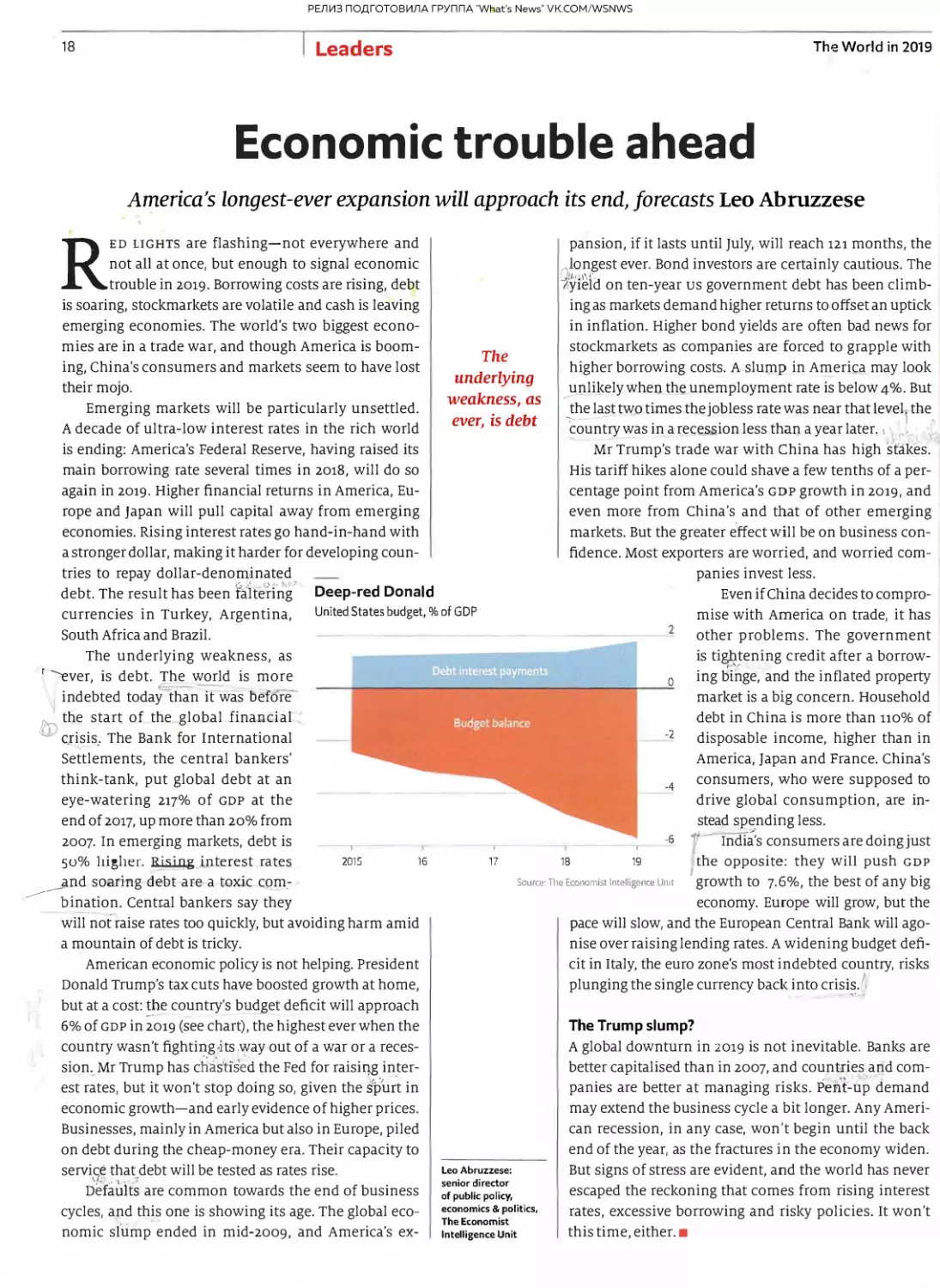
ra1tering Deep-red Dona ld
Even if China decides to compro
currencies in Turkey, Argentina, United States budget, % of GDP
mise with America on trade, it has
South Africa and Brazil.
other proЫems. The government
The underlying weakness, as
is tigЬtening credit after а borrow1-'·
r---ever, is deЬt. The world is more
о ing blnge, and the inflated property
�market is а Ьig concern. Household
indeЬted today than it was·ьefore
the start of the global iinancial '
deЬt in China is more than 110% of
, ..
-2
qisis, The Bank for International
disposaЬle income, higher than in
Settlements, the central bankers'
America, Japan and France. China's
think-tank, put global deЬt at an
consumers, who were supposed to
-4
eye-watering 217% of GDP at the
drive global consumption, are in
stead spending less.
end of 2017, up more than 20% from
-6
India:s consumers are doing just
2007. In emerging markets, deЬt is
17
2015
16
19
18
rhe
opposite: they will push GDP
50% 11igl1er. Risif!g i_nterest rates
;
Source:Tl1eEconon1istlntelligenceU11it
growth to 7.6%, the best of any blg
and.se-a-r-ing d@Ьt a·re a-toxic com�in_ation. Central bankers say the�
economy. Europe will grow, but the
расе wilJ slow, and the European Central Bank will ago
will notraise rates too quickly, but avoiding harm amid
nise over raising lending rates. А widening budget defi
а mountain of deЬt is tricky.
cit in Italy, the euro zone's most indeЬted country, risks
American economic policy is not helping. President
plunging the single currency back into cris�. '•
Donald Trump's tax cuts have boosted growth at home,
but at а cost: ��е country's budget deficit will approach
The Trump slump?
6% of GDP in 2019 (see chart}, the highest ever when the
А global downturn in 2019 is not inevitaЫe. Banks are
country wasn't fighting,iits,way out of а war or а reces
better capitalised than in 2007, and counЩes and com
sion. Mr Trump has ch-is�i"s�d the Fed for raisiцg inter
panies are better at managing risks. iient-up demand
est r;tes, but it won't stop doing so, given the �uft in
may extend the business cycle а Ьit longer. Any Ameri
economic growth-and early evidence of higher prices.
can recession, in any case, won·t begin until the back
Businesses, mainly in America but also in Europe, piled
end of the year, as the fractures in the economy widen.
on deЬt during the cheap-money era. Their capacity to
Leo Abruzzese;
But signs of stress are evident, and the world has never
service that deЬt will Ье tested as rates rise.
senior director
escaped the reckoning that comes from rising interest
o\.,ra.Mt; are common towards the end of business of puЬlic policy,
rates, excessive borrowing and risky policies. It won't
cycles, and this one is showing its age. The global eco economics & politics,
The Economist
this time, either. ■
nomic s(ump ended in mid-2009, and America's ех- lntelligence Unit
9-{-�
t'I
'т
"
----
r-
РЕЛИЗ ПОДГОТОВИЛА ГРУППА "What's News" VK.COM/WSNWS
20
в
Leaders
The World in 2019
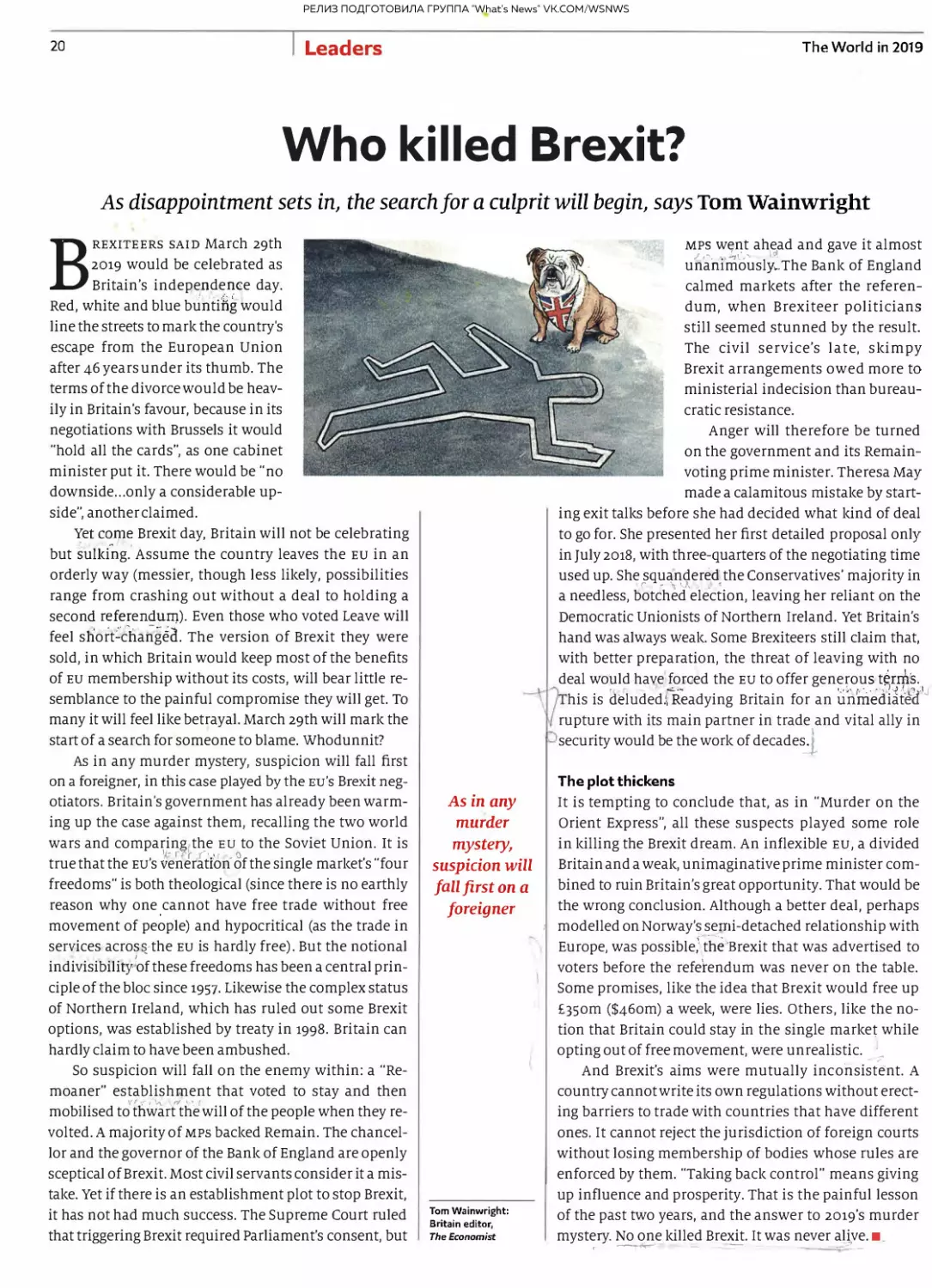
Who killed Brexit?
As disappointment sets in, the search for а culprit will begin, says Тот Wainwright
REXIТEERS SAID March 29th
2019 would Ье celebrated as
Britain's indepefdeш;:e day.
Red, white and Ыuе buntitg would
line the streets to mark the country's
escape from the European Union
after 46 years under its thumb. The
terms of the divorce would Ье heav
ily in Britain's favour, because in its
negotiations with Brussels it would
"hold all the cards", as one caЬinet
minister put it. There would Ье "по
downside...only а consideraЬJe upside", another claimed.
Yet соте Brexit day, Britain will not Ье celebrating
but gui'king.' Assume the country leaves the EU in an
orderly way (messier, though less likely, possiЬilities
range from crashing out without а deal to holding а
secon� r��e;�ПO�f})- Even those who voted Leave will
feel sliort-chang�d. The version of Brexit they were
sold, in which Britain would keep most of the benefits
of EU membership without its costs, will bear little re
semЫance to the painful compromise they will get. то
many it will feel like betrayal. March 29th will mark the
start of а search for someone to Ыаmе. Whodunnit?
As in any murder mystery, suspicion will fall first
оп а foreigner, in this case played Ьу the Eu's Brexit neg
otiators. Britain's government has already been warm
ing up the case against them, recalling the two world
wars and comparing,the EU to the Soviet Union. It is
�- ru f•;r Q
true that the Eu's veneration· of the single market's "four
freedoms" is both theological (since there is no earthly
reason why one _cannot have free trade without free
movement of people) and hypocritical (as the trade in
services acros�-the EU is hardly free). But the notional
indivisiЬili'ty:of these freedoms has been а central prin
ciple of the Ыос since 1957. Likewise the complex status
of Northern Ireland, which has ruled out some Brexit
options, was estaЬ!ished Ьу treaty in 1998. Britain сап
hardly claim to have been ambushed.
So suspicion will faJJ оп the enemy within: а "Re
moaner" estaЬlishment that voted to stay and then
mobllised to thwart the will of the people when they revolted. А majority of MPS backed Remain. The chancel
lor and the governor of the Bank of England are openly
sceptical of Brexit. Most civil servants consider it а mis
take. Yet if there is an estaЬ!ishment plot to stop Brexit,
it has not had much success. The Supreme Court ruled
that triggering Brexit required Parliament's consent, but
\''v'• ...,._.
MPS went ahead and gave it almost
unaшmously� The Bank of England
calmed markets after the referen
dum, when Brexiteer politicians
still seemed stunned Ьу the result.
The civil service's late, skimpy
Brexit arrangements owed more to
ministerial indecision than bureau
cratic resistance.
Anger will therefore Ье turned
оп the government and its Remain
voting prime minister. Theresa Мау
made а calamitous mistake Ьу start
ing exit talks before she had decided what kind of deal
to go for. She presented her first detailed proposal only
in July 2018, with three-quarters of the negotiating time
used up. She rsquandered
the Conservatives· majority in
- ". •.}
. �
а needless, botched election, leaving her reliant оп the
Democratic Unionists of Northern Ireland, Yet Britain's
hand was always weak. Some Brexiteers still claim that,
with better preparation, the threat of leaving with по
deal would have forced the Eu to offer generous,t�:fts.
J
his is d�luded.!Readying Britain for an t�hlediatf!
rupture with its main partner in trade and vital ally in
security would Ье the work of decades.i
./ 1 R, •.;�(.••
The plot thickens
As in апу
murder
myste,y,
suspicion will
fall first оп а
foreigner
1
Q l\f
Tom Wainwright:
Britain editor,
The Economist
1.9'
It is tempting to conclude that, as in "Murder оп the
Orient Express", all these suspects played some role
in killing the Brexit dream. An inflexiЬ!e EU, а divided
Britain and а weak, unimaginative prime minister com
Ьined to ruin Britain's great opportunity. That would Ье
the wrong conclusion. Although а better deal, perhaps
modelled on Norway's se!)'Ji-detached relationship with
Europe, was possiЫe;the'вrexit that was advertised to
voters before the refe\endum was never on the tаЬ!е.
Some promises, like the idea that Brexit would free up
f35om ($46om) а week, were lies. Others, like the no
tion that Britain could stay in the single market while
opting out of free movement, were unrealistic. '::And Brexit's aims were mutually inconsistent. А
country cannot write its own regulations without erect
ing barriers to trade with countries that have different
ones. It cannot reject the jurisdiction of foreign courts
without losing membership of bodies whose rules are
enforced Ьу them. "Taking back control" means giving
up influence and prosperity. That is the painful lesson
of the past two years, and the answer to 2019's murder
mystery. No one killed Brexit. It was never alive.
■.
__ --._
,
_...,._.
-
РЕЛИЗ ПОДГОТОВИЛА ГРУППА "What's News" VK.COM/WSNWS
22
The World in 2019
Leaders
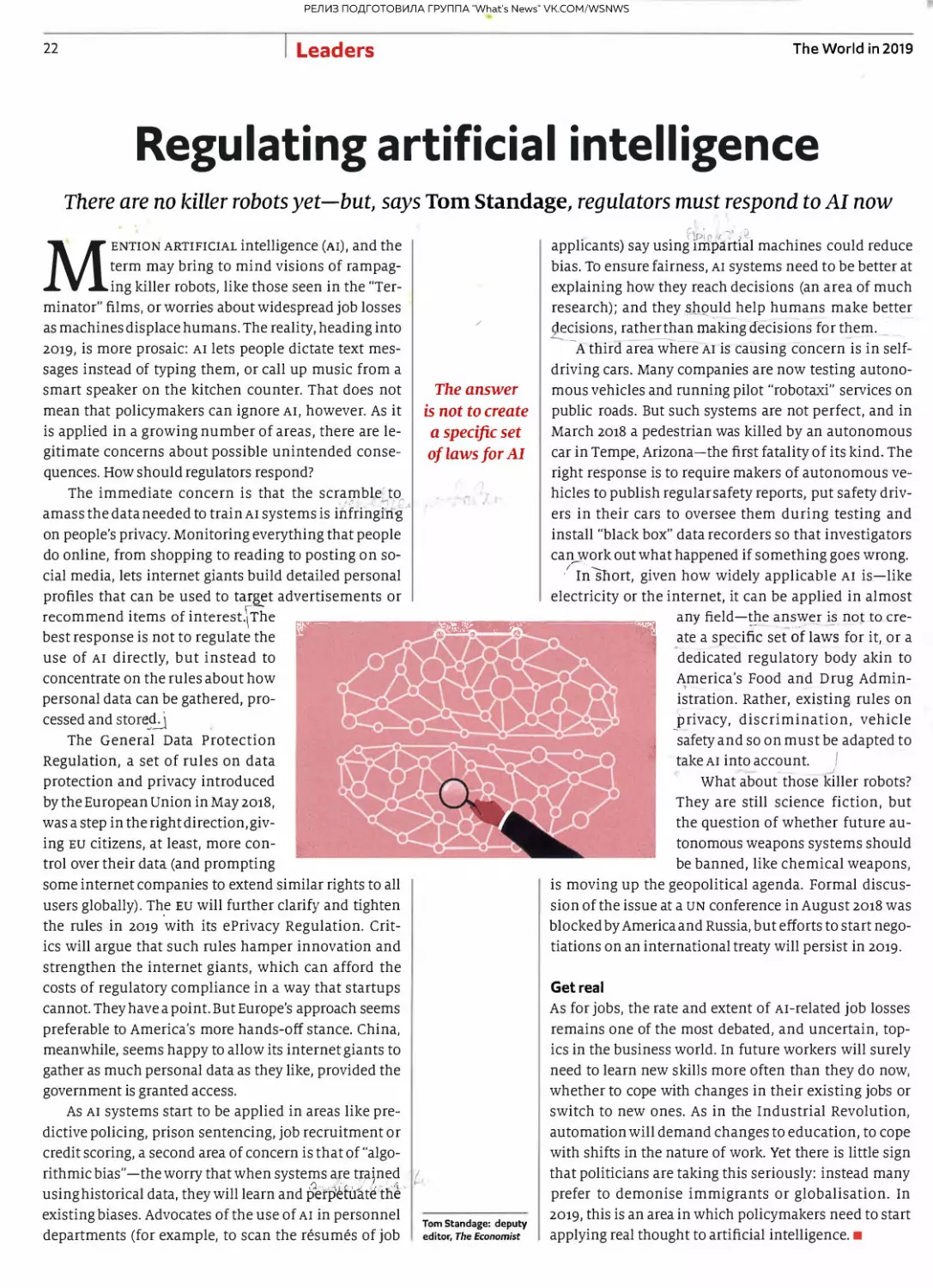
Regulating artificial intelligence
There are по killer robots yet-but, says Тот Standage, regulators must respond to AI now
M
0
.
ENТI0N ARТIFICIAL intelligence (А!),
. f_Jp 1,�·.,;,,
.
and the
appl1cants) say usшg нnpa:rt1al machшes could reduce
term тау bring to mind visions of rampag
Ьias. то ensure fairness, лr systems need to Ье better at
ing killer robots, like those seen in the "Ter
explaining how they reach decisions (an area of much
minator" films, or worries about widespread job losses
research); and they ,<,hould help humans make better
as machines displace humans. The reality, heading into
decisions, rather tha�king cГecisions for them.
2019, is more prosaic: лr lets реор!е dictate text mes
л tliird area where лr is causing concern is in selfsages instead of typing them, or call up music from а
driving cars. Many companies are now testing autono
smart speaker on the kitchen counter. That does not
Theanswer
mous vehicles and running pilot "robota.xi" services on
mean that policymakers can ignore лr, however. As it is not to create puЬ!ic roads. But such systems are not perfect, and in
March 2018 а pedestrian was killed Ьу an autonomous
is applied in а growing number of areas, there are le
а specific set
gitimate concerns about possiЫe unintended conse
oflaws for AI car in Tempe, Arizona-the first fatality of its kind. The
quences. How should regulators respond?
right response is to require makers of autonomous ve
hicles
to puЬ!ish regular safety reports, put safety driv
The immediate concern is that the scramЬ!e'
to
, ,,,
..., r,
amass the data needed to train лr systems is infringirfg
ers in their cars to oversee them during testing and
install "Ыасk Ьох" data recorders so that investigators
on people's privacy. Monitoring everything that people
can work out what happened if something goes wrong.
do online, from shopping to reading to posting оп so
�ort, given how widely applicaЫe AI is-Iike
cial media, lets internet giants build detailed personal
electricity or the internet, it сап Ье applied in almost
profiles that can Ье used to ta�t advertisements or
recommend items of interest.\ The
any field-the answer
is not to cre
ii
o
best response is not to regulate the г-iiiiiiii -.::iiiiii!!iiiii�:-------, ate а specific set f !�;;, for it, or а
use of лr directly, but instead to
dedicated regulatory body akin to
America's
concentrate on the rules about how
Food and Drug Admin
,
personal data can Ье gathered, proistration. Rather, existing rules on
yrivacy, discrimination, vehicle
cessed and store�
The General Data Protection
safety and so оп must Ье adapted to
take л1 into account. 1
Regulation, а set of rules оп data
protection and privacy introduced
What about those killer robots?
They are still science fiction, but
Ьу the European Union in Мау 2018,
the question of whether future au
was а step in the right direction, giv
tonomous weapons systems should
ing EU citizens, at least, more con
Ье banned, like chemical weapons,
trol over their data. (and prompting
is moving up the geopolitical agenda. Formal discus
some internet companies to extend similar rights to all
users globally). The_ EU will further clarify and tighten
sion of the issue at а UN conference in August 2018 was
Ыocked Ьу America and Russia, but efforts to start nego
the rules in 2019 with its ePrivacy Regulation. Crit
tiations оп an international treaty will persist in 2019.
ics will argue that such rules hamper innovation and
strengthen the internet giants, which сап afford the
Getreal
costs of regulatory compliance in а way that startups
As for jobs, the rate and extent of л1-related job losses
cannot. They have а point. But Europe's approach seems
remains one of the most debated, and uncertain, top
preferaЬ!e to America's more hands-off stance. China,
ics in the business world. In future workers will surely
meanwhile, seems happy to allow its internet giants to
gather as much personal data as they Iike, provided the
need to learn new skills more often than they do now,
whether to соре with changes in their existing jobs or
government is granted access.
As лr systems start to Ье applied in areas Iike pre
switch to new ones. As in the Industrial Revolution,
automation will demand changes to education, to соре
dictive policing, prison sentencing, job recruitment or
with shifts in the nature of work. Yet there is Iittle sign
credit scoring, а second area of concern is that of "algo
that politicians are taking this seriously: instead many
rithmic Ьias" -the worry that when systems are t,raJned 1
prefer to demonise immigrants or globalisation. In
using historical data, they will learn and fe'fp'�Watё tni ·
existing Ьiases. Advocates of the use of лr in personnel Tom Standage: deputy 2019, this is an area in which policymakers need to start
applying real thought to artificial intelligence. ■
departments (for example, to scan the resumes of job editor, The Economist
1
/
.L.__
-
--
-
РЕЛИЗ ПОДГОТОВИЛА ГРУППА "What's News" VK.COM/WSNWS
The World in 2019
23
Leaders
The next front in the culture wars
F
Prepare for intense argument over gender self-ID, warns Helen Joyce
OR тнqsЕ tir�d of identity politics, 2019 will bring
little �espite: Оп the most polarising subjects
including abortion, Brexit and immigration-few
people will change their minds. But а new identity issue
has emerged, and it is one where �llegiances are not yet
fully formed. That will start to change in 2019.
That issue is "gender self-identification": the notion
that humans are best classified, not according to Ьio
logical sex, but Ьу whether they say they feel more like
а man or а woman, or something in between. On many
liberal university campuses, in America and elsewhere,
it has become orthodoxy that all students should wear
"pronoun badges" declaring their preference for he, she
or-if they identify as non-Ьinary, gender-fluid or some
such-they, ze, hir or one of а host of other neologisms.
; In October а leak from the Trump administration
suggested that America's federal government was plan
ning to withdraw all recognition of diverse gender iden
tities. At the same time, though, in Democrat-controlled
cities and states gender self-ш is passing rapidly into
law. That means access to single-sex facilities such as
toilets, changing rooms, and even domestic-violence
shelters and rape-crisis centres is according to self-ш.
The same is true in �anada, where in 2017 the gov
ernment granted gender identity and gender expres-·
sion the same status in human-rights Jaw as sex, race
and religion. In Britain, where people сап change their
legal sex if two doctors concur in а diagnosis of gender
dysphoria-distress caused Ьу feeling that you Jive in а
body of the wrong sex-self-ID is becoming the norm in
practice, and may soon become the la\J:. New Zealand is
mulling а bill that would allow the sex on Ьirth certifi
cates to Ье changed �У а simple declaration. Some Aus
tralian states are considering leaving sex off all official
documents.Jhe information would instead Ье held on
а private government database. Citizens could change
their listed sехщ;, to three tj��
The intention of self-ш is to-be fair to transgender
people-those who regard the sex that doctors observed
when they were born as а poor fit for the way they feel
or wish to Ье perceived. The liberal approach is to let
them present themselves as they wis�. But self-ID goes
much further. Tt fnrces everyone e1se tn accept а subjec
tive feeling as reality, and everything that flows from it,
including access to spaces and facilities designated for
the opposite sex. That is both illiberal and dangerous, as
will become clearer in 2019.,
Britain, where the pre\-s is feisty and feminists
have run а canny campaign against the planned legal
Self-ID laws
hav e Ьееп
vagueand
sweeping
Helen Joyce: finance
editor, The Economist
changes, is ahead of the trend. Newspapers have pub
licised several cases of predators taking advantage of
de facto self-ш, including а convicted rapist moved to
а women's prison after identifying as а woman, who
sexually assaulted other inmates. The Sunday Times
collated figures showing that sexual offences are far
more common in mixed-sex pool changing-rooms than
in single-sex ones. Girlguiding uк, which is now open
to all self-declared girls, not just Ьiological ones, faced
tough questions about child protection after it expelled
two leaders who asked whether it had assessed the risks.
Many оп the religious and conservative right have
always opposed such policies on principle. Those оп the
left, more instinctively sympathetic to accepting trans
people's self-declared genders, will find it harder to ac
cept the evidence of harm, even as more comes to light.
Many have dismissed as "transphoblc" any concerns
that rapists and other violent men might exploit gender
self-ш, or that natal women тау prefer the privacy of
single-sex spaces. That has inhiblted the open debate
needed for good policyцiaking. As а result, self-ш laws
have been vague and ;weeping, lacking the safeguards
that might have made them workaЬle.
Lost in translation
The spectacle of so-called progressive people dismiss
ing assaults оп women and children as collateral dam
age�willi alienate
тапу feminists with whom they are
'
accustomed to.share
common cause. Transgender peoi
ple, already rc'cfctefin the culture wars, will suffer from
being tarred with the same brush as opportunistic pred
ators. There is still time to search for ways to protect
them without harming others. But without а rethink,
battle lines will harden. ■
РЕЛИЗ ПОДГОТОВИЛА ГРУППА "What's News" VK.COM/WSNWS
24
Т
Leaders
The World in 2019
Speak up or Ье silenced
Democracy's fans should resist [ts erosion, argues Robert Guest
НЕ PAST year has been dismal for democracy.
From Cairo to Caracas, despots (most of them
posing as democrats) have locked up dissidents,
murdered protesters and shut newspapers. Government
of, Ьу and for the people is in retreat. What can Ье done
to defend it in 2019-when countries with over а third of
the world's population will hold.nationwide elections
and start to reverse more than а decade of global decline?
First, don't fall for the argument that because demo
cracy is flawed, а strongman might Ье better. Sure, vot
ers sometimes make bad choices. But the checks and
balances of а mature liberal democracy limit the dam
age, and usually prevent it from becoming permanent.
Whatever you think of Donald Trump (to pick а random
example), he is constrained Ьу laws, а free press and а
professional civil service. In 2019
а hostile House of Representatives
will obstruct and investigate him
with vim. If voters tire of him, they
can sack him in 2020, and he cannot
serve more than eight years. None of
this is true of China's president, Xi
Jinping.
Second, resist every assault
on pluralism. In many countries
strongmen will claim that shadowy
enemies are subverting the state,
undermining the national culture
or insulting the majority religion. This is often а pre
text to purge disloyal judges, muzzle mouthy journalists
and put the strongman's chums in charge of supposedly
independent institutions. Democrats should treat every
such act as the thin e�d of the wedge.
Such assaults will Ье common in 2019. The space
for dissent in China will shrink as artificial intelligence
empowers the surveillance state. In Tanzania President
John Magufuli, aka "the Bulldozer", will sack or arrest
anyone who gets in his way. Egypt and Iran will torture
more Ыameless protesters. Brazil's populist new presi
dent, Jair Bolsonaro, will show whether he accepts dem
ocratic restraints.
In Europe, Poland's ruling party will gut more insti
tutions and stuff them with incompetent loyalists; yet
it will remain popular thanks to copious social spend
ing. Hungary's prime minister, Viktor Orban, will vow to
protect his people from Muslim migrants; meanwhile,
his cronies will transmute power into gold. European
taxpayers should stop subsidising both regimes.
The outlook is not all gloomy. In April or Мау India
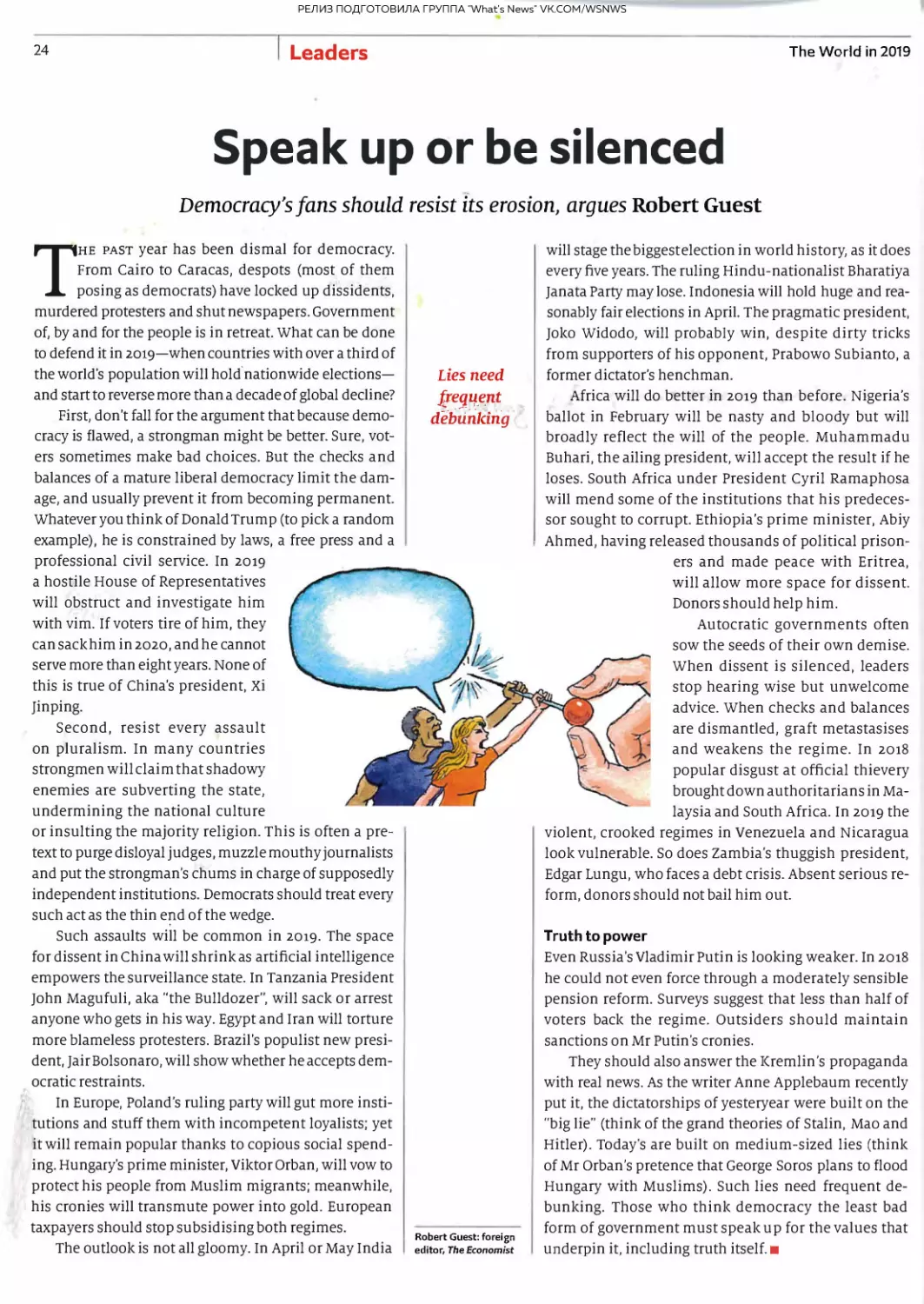
Lies need
f!eqц_e_nt
debiJnking
will stage the Ьiggest election in world history, as it does
every five years. The ruling Hindu-nationalist Bharatiya
Janata Party тау lose. Indonesia will hold huge and rea
sonaЫy fair elections in April. The pragmatic president,
Joko Widodo, will рrоЬаЬ!у win, despite dirty tricks
from supporters of his opponent, Prabowo SuЬianto, а
former dictator's henchman.
Africa will do better in 2019 than before. Nigeria's
ballot in February will Ье nasty and Ыооdу but will
broadly reflect the will of the people. Muhammadu
Buhari, the ailing president, will accept the result if he
loses. South Africa under President Cyril Ramaphosa
will mend some of the institutions that his predeces
sor sought to corrupt. Ethiopia's prime minister, АЬiу
Ahmed, having released thousands of political prison
ers and made реасе with Eritrea,
will allow more space for dissent.
Donors should help him.
Autocratic governments often
sow the seeds of their own demise.
When dissent is silenced, leaders
stop hearing wise but unwelcome
advice. When checks and balances
are dismantled, graft metastasises
and weakens the regime. In 2018
popular disgust at official thievery
brought down authoritarians in Ma
laysia and South Africa. In 2019 the
violent, crooked regimes in Venezuela and Nicaragua
look vulneraЬle. So does ZamЬia's thuggish president,
Edgar Lungu, who faces а deЬt crisis. Absent serious re
form, donors should not bail him out.
Truth to power
Robert Guest: forei gn
editor, The Economist
Even Russia's Vladimir Putin is looking weaker. In 2018
he could not even force through а moderately sensiЬ!e
pension reform. Surveys suggest that less than half of
voters back the regime. Outsiders should maintain
sanctions on Mr Putin's cronies.
They should also answer the Kremlin's propaganda
with real news. As the writer Anne Applebaum recently
put it, the dictatorships of yesteryear were built on the
"Ьig lie" (think of the grand theories of Stalin, Мао and
Hitler). Today·s are built on medium-sized lies (think
of Mr Orban's pretence that George Soros plans to flood
Hungary with Muslims). Such lies need frequent de
bunking. Those who think democracy the least bad
form of government must speak up for the values that
underpin it, including truth itself. ■
РЕЛИЗ ПОДГОТОВИЛА ГРУППА "What's News" VK.COM/WSNWS
The World in 2019
25
Leaders
The year of the vegan
F
Where millennials lead, businesses and governments will follow, predicts John Parker
0R тнЕ past half-century, veganism has been а
minority within а minority. In America in 2015,
according to one survey, 3-4% of the population
were vegetarian and just 0.4% were vegan. But 2019 will
Ье the year veganism goes mainstream.
Interest in а way of life in which people eschew not
just meat and leather, but all animal products including
eggs, wool and silk, is soaring, especially among millen
nials. Fully а quarter of 25- to 34-year-old Americans say
they are vegans or vegetarians.
The business of providing vegan meals is booming.
McDonald's has started selling McVegan burgers. Sales
of vegan foods in America in the year to June 2018 rose
ten times faster than food sales as а whole. Giant food
firms are c!ambering onto the bandwagon, creating
vegan !ines of their own, buying startups, or both. Тyson
Foods, а meat behemoth, has а 5% stake in Beyond
Meat, which sells meat-free patties to TGI Friday's, а res
taurant chain. Even Big Meat is going vegan, it seems.
The school district ofLos Angeles, America's second
largest, will start serving vegan meals in all its schools
о
Pat ties ooze
withЫoo d
madeof
beetroo t juice
John Parker:
correspondent,
The Economist
during the 2018-19 academic year.
In its annual meeting in 2018, the
American Medical Association
called оп hospitals to offer more
such meals. But most nationa! gov
ernments have been reluctant to en
courage veganism. That cou!d start
to change in 2019 when the European Commission at last begins the
process of formally defining what counts as vegan (and
vegetarian) food, providing а measure of legal certainty.
At the same time, vegan firms are making meat sub
stitutes that actually look and taste like meat. Beyond
Meat's patties ooze with Ыооd made of beetroot juice.
When а vegan steak made Ьу а Dutch firm, Vivera, ar
rived оп supermarket shelves in June, 40,000 were
so!d within а week. If plant-based "meats" take off, they
could become а transformative technology, improving
Westerners' protein-heavy diets, reducing the environ
mental hoofprint of anima! husbandry and perhaps
even cutting the cost of food in poor countries. ■
Truth in advertising
What if companies' slogans had to Ье accurate, asks Andrew Palmer, rather than aspirational?
N APRIL 1sт 2019 а new European Union regu
!ation comes into force that promises to trans
form the corporate landscape. Inspired Ьу the
success of Europf;'s "GDPR" data-protection effort in
2018, it wil! require companies operating in the EU to
adopt slogans that are factually accurate-and to do so
Ьу the end of 2019 or face fines of up to 2% of global an
nua! revenue. This wi!! expose the gap between the am
Ьitions of firms' s!ogans and the rea!ity of their actions.
Nike has been telling people to "Just Do It" since the
late 1980s. Stung Ьу accusations about а "boys' club"
culture, and resignations Ьу senior executives, it is ex
pected to change to "Just Check with нR First".
Deutsche Bank, which has been floundering for
years, is rebranding under the tagline "А passion to un
derperform". YouTube wi!! change its slogan in Europe
from "Broadcast yourself" to "Broadcast yourself. Get
taken down Ьу our content moderators later".
Companies that have been hit Ьу cyber-attacks and
other security breaches will a!so have to make painful
Pedant s will
r ejoice
Andrew Palmer:
business affairs editor,
The Economist
changes. Equifax, а credit-scoring company that was
hacked in 2017, exposing the persona! information of al
most 150m people, currently boasts that it is "Powering
the Wor!d with Knowledge". In 2019, it will substitute
"Knowledge" with "Your Stolen Data".
А series of system failures will force а rethink at
companies that rely оп secure, ublquitous connectivity.
Visa, which suffered an embarrassing payments outage
across Europe in 2018, will extend its marketing slogan
to "Everywhere you want to Ье, unless we have to reboot
the system". American Express's !egendary tagline will
become "Don't leave home without cash".
Pedants wi!! rejoice as the need for factual accuracy
finally forces change on а number of companies whose
corporate mottoes_ have long offended grammar, spell
ing and common sense. In 2019 Adidas wi!! inspire its
customers with "ImpossiЫe is not а noun", and Heinz
will tel1 people that "Beans means ediЫe seeds".
Will honesty рау? For the ad industry, certainly. For
firms по longer аЫе to fool people, maybe not. ■
РЕЛИЗ ПОДГОТОВИЛА ГРУППА "What's News" VK.COM/WSNWS
The World in 2019 I Calendar
Our selection of events around the world
Оп New Year's Day NASA's New Horizons ргоЬе whizzes past 2014 MU69, also
known as Ultima Thule, an object in the Kuiper belt, far beyond the orblt of
Neptune. The mysterious body, thought to Ье about 30km across, becomes
the most distant object in the solar system to Ье visited Ьу а spacecraft.
Нарру Ьirthday to euro! Europe's single currency turns 20.
California becomes the first state in America to allow people to choose а
gender other than male or female for state-issued IDs such as driving licences.
Members of the global elite gather at the World Economic Forum in Davos, in
the Swiss Alps, to discuss how to change the world so that it works for тоге
than just the global elite.
ln St Petersburg, Russians commemorate the 75th anniversary of the lifting
of the siege of what was then Leningrad. Маге than lm people are believed to
have died in the siege, which is thought to have Ьееп the deadliest in history.
Art-lovers рау homage to the genius of
Leonardo da Vinci, who died 500 years ago at
the chateau of Amboise in the Loire Valley.
�rs across 27 EU countries head to the
�olls to elect members of the European
Parliament-but without much enthusiasm.
Turnout in Euro-elections has been well
below 50% in the three polls since 2004.1
' Queen Victoria was born 200 years ago this
month.
The Cricket World Cup, held еvегу four years
and involving 16 countries from Afghanistan
to New Zealaiid, gets under way. The one-day
games are held across England and Wales,
leading up to the final at Lord's in London in
mid-July.
The World in 2019
And the winner is: American Football's Super Bowl LIII touches down iп Atlanta;
while iп Hollywood, the Academy of Motion Picture Arts апd Sciences hands out
its Oscars.
Ni erians vote for their president and агI· men .
Like it ог поt, Facebook celebrates its 15th Ьirthday.
Good deeds proliferate around the world during Random Acts of Kindness Week.
Chinese welcome iп the уеаг of the pig. People born in pig years are said to Ье
honest, generous and optimistic.
Major League Baseball comes to Europe for the first time iп its regular season, as
the New York Yankees and the Boston Red Sox face each other in а two-game
series in London.
Leaders of 20 of the world's Ьiggest economies gather in Osaka for the G20
summit, the 14th in the series and the first to Ье held in Japan.
Оп June 6th it is 75 years since the D-Day landings, the largest seaborne invasion
in history. And June 28th is the centenary of the Treaty of Versailles, which
formally ended the first world war exactly five years after the assassination of
Archduke Ferdinand, which triggered it.
The FIFA Women's World Cup kicks off in France. And the first UEFA Nations
League winner emerges iп the final of а football competition involving 55
countries.
lndia marks the 150th anniversary of the Ьirth of its national hero,
Mahatma Gandhi, with а global celebration of the great man.
fCanada must hold its general elections Ьу now, and Argentina hold;-J
�residential р�
lt's end of term iп Europe-both for the members of Jean-Claude
Juncker's European Commission in Brussels (after their five-year stint)
and for Mario Draghi as president of the European Central Bank in
Frankfurt (after eight years iп the job).
Japan stages the Rugby World Cup-the first time the tournament has gone to Asia.
(The UN General AssemЬly gathers in New York: а сhапсе to take stock of thi}
l_;wists, turns-and tweets-of global diplom�
Germans honour the life of Alexander von Humboldt, опе of their greatest
cultural figures. The Prussian polymath was born 250 years ago this month.
The French, meanwhile, toast the physicist Lеоп Foucault (and his famous
pendulum), born 200 years ago.
The starting gun is fired in Doha, Qatar, at the World Athletics
Championships, held every two years.
РЕЛИЗ ПОДГОТОВИЛА ГРУППА "What's News" VK.COM/WSNWS
Calendar
The World in 2019
27
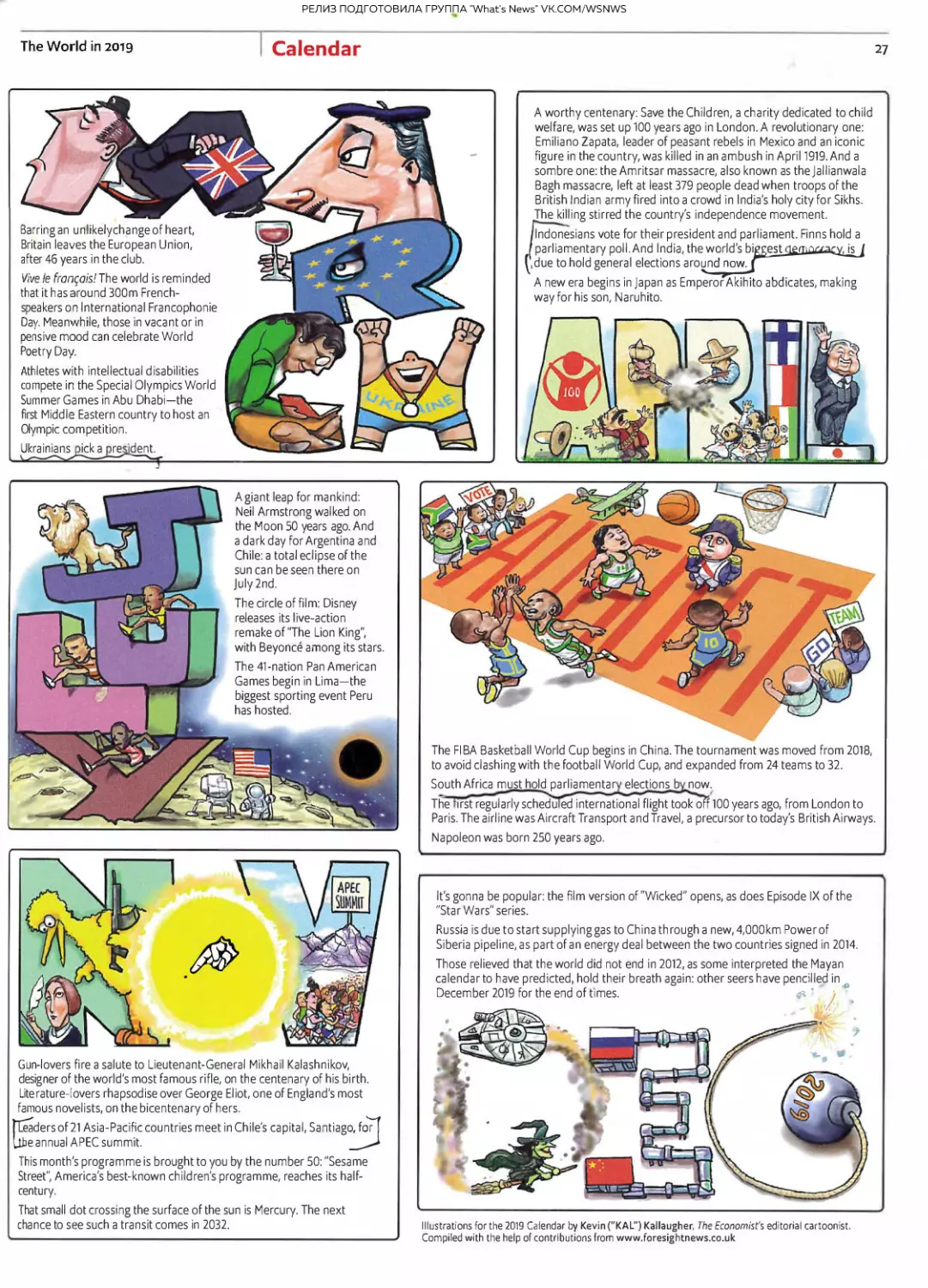
А worthy сепtепагу: Save the Children, а charity dedicated to child
welfare, was set up 100 years ago in London. А revolutionary опе:
Emiliano Zapata, leader of peasant rebels in Mexico апd ап iconic
figure in the country, was killed iп ап ambush in April 1919. And а
sombre опе: the Amritsar massacre, also known as the Jallianwala
Bagh massacre, left at least 379 people dead when troops of the
British lndian army fired into а crowd in lndia's holy city for Sikhs.
The killing stirred the country's independence movement.
lndonesians vote fог their president and parliament. Finns hold а
parliamentary poll. And lndia, the wa,гld's Ь�
�,due to hold general elections aro�
. .
__
А new era begins in ]арап as Emperor Akihito abdicates, making
way for his son, Naruhito.
Ваггiпg ап unlikely change of heart,
Britain leaves the Еuгореап Union,
after 46 уеагs in the club.
Vive le fron�ois! The world is reminded
that it has aгound 300m French
speakers оп lnternational Francophonie
Day. Meanwhile, those in vacant or in
pensive mood сап celebrate World
Роеtгу Day.
Athletes with intellectual disabllities
compete in the Special Olympics World
Summer Games in Abu Dhabl-the
first Middle Eastern country to host an
Olympic competition.
Ukrainians ick а ге ·dent.
А giant leap for mankind:
Neil Armstrong walked оп
the Мооп 50 years ago. And
а dark day for Argentina and
Chile: а total eclipse of the
sun сап Ье seen there оп
July 2nd.
The circle of film: Disney
releases its live-action
remake of "The Lion King",
with Веуопсе among its stars.
The 41-nation Рап American
Games begin in Lima-the
Ьiggest sporting event Peru
has hosted.
The FI ВА Basketball World Cup begins in China. The tournament was moved from 2018,
to avoid clashing with the football World Cup, and expanded from 24 teams to 32.
South Africa must hold parliamentar elections Ь now.
The Irst regularly schedu ed international flight took off 100 years ago, from London to
Paris. The airline was Aircraft Transport and Travel, а precursor to today's Bгitish Airways.
Napoleon was born 250 уеагs ago.
_tfJ}
Gun-lovers fire а salute to Lieutenant-General Mikhail Kalashnikov,
designer of the world's most famous rifle, оп the centenary of his Ьirth.
Literature-lovers rhapsodise over George Eliot, one of England's most
famous novelists, оп the Ьicentenary of hers.
ri:e;ders of 21 Asia-Pacific countries meet in Chile's capital, Santiago, fo�
UЬе annual АРЕС summit.
___,)
This month's programme is brought to you Ьу the number 50: "Sesame
Street", America's best-known children's programme, reaches its half
century.
That small dot crossing the surface of the sun is Mercury. The next
chance to see such а transit comes iп 2032.
lt's gonna Ье popular: the film version of "Wicked" opens, as does Episode IX of the
"Star Wars" series.
Russia is due to start supplying gas to China through а new, 4,000km Роwег of
Siberia pipeline, as part of ап energy deal between the two countries signed in 2014.
Those relieved that the world did not end in 2012, as some interpreted the Мауап
calendar to have predicted, hold their breath again: other seers have pencilled in
"
December 2019 for the end of tImes.
�• / •
lllustrations for the 2019 Calendar Ьу Kevin ("KAL'') Kallaugher, The Economist's editorial cartoonist.
Compiled with the help of contributions from www.foresightnews.co.uk
РЕЛИЗ ПОДГОТОВИЛА ГРУППА "What's News" VK.COM/WSNWS
The World in 2019
29
Europe
33 Crunch time for Macron's reforms
ALSO IN THIS SECТION:
30 Нарру Ьirthday to euro
34 NATO at70
31 Germany's weakness
36 Splintered Spain
32 Putin comes down to Earth
36 ltaly flirts with financial disaster
32 Ukraine votes
Rainbof' in Strasbourg
European Parliament,
share of seats Ьу group
�псе Мау 2014, %
Empty seats
25% S&D Progressive
Aflionce of Socialists
&Democrats
(parliomentary
graup of the Party of
European Socia/ists,
arPES)
7%GUE/NGL
European United Left/
Nordic Green left
:k
9% ALDE Alfionce of Liberols
& Democrats for Europe
...,.-- .......
м� -:::::::::::::::- �
7% Greens/EFA
Еиrореап
Free Alliance
1�
..... •
....... 8 888
29% ЕРР
European Peaple's Party
�����-
i·
,
if fI I/f:;.-=:....t ,� \\\\\ \ • \\
tflffн,l•
•Н\\\ 111 I
r� .. --- � .. \\''\\'
1/l1
f 1,..-¼--:. ;=: �.. ,\,\\;
..
/'//
1
10% ECR Europeon
Conservatives
& Reformists
3% NI Non-attached
6% EFDD Еиrоре
of Freedom and
Direct Democracy
5% ENF
Еиrоре of Nations
andFreedom
--------Sщirce: European Par!iament
After Jean-Claude
The contest between ап old estaЫishment and new challengers will define European politics
Jeremy Cliffe Charlemagne columnist, The Economist
BRUSSELS
RIТONS MIGHT like to think that their country's
в exit from the European Union оп March 29th will
Ье Europe's defining moment of 2019. And the
European Commission might like to think that the in
formal summit of leaders on May 9th in Sibiu, the histor
ically German capital of Transylvani�.d�fR9._1rania's
presidency of the union, will Ье tl1e p1vo�: ]ean-Claude
Juncker, the president of the commission, the Eu's ex
ecutive, and his team want to secure agreements there
on everything from migration to single-market expan
sion before his term ends later in the year.
But in practical terms the European political year will
turn оп Мау 23rd-26th, when the 27 member states left in
the EU after Britain's exit will elect а new, slightly smaller
European Parliament. About half of Britain's seats will Ье
distributed among the remaining members; the rest will
simply vanish, reducing the size of the parliament from
751 seats to 705. Turnout тау drop even further beneath
its 2014 low of 43%.
The election and its aftermath will Ье а battle be
t\veen old and new forces. Оп опе side will Ье the Euro
pean estaЬ!ishment: the centre-right European People's
Party (ЕРР) and the centre-left Party of European Social
ists (PES). These two Ыосs have together obtained ma
jorities at every European election to date, though their
comblned share of the vote has fallen over the past two
decades from 66% in 1999 to 55% in 2014. It тау well
dip below 50% in May's vote, as conventional Christian
democrat and social-democrat forces lose out to rivals.
Those rivals will span the spectrum. оп the left will
Ье Jean-Luc Melenchon and his Unsubmissive France as
well as the Dutch left-liberal force GreenLeft. In the cen
tre there will Ье insurgents like Citizens (Ciudadanos)
in Spain and Emmanuel Macron's The RepuЫic оп the
Move (La RepuЬ!ique En Marche) in France. And оп the
right there will Ье newly dynamic populist forces lil<e
Matteo Salvini's Northern League in Italy and the Swe
den Democrats. These outfits will Ье united Ьу little apart
from а general scepticism towards tl1e Spitzenkandidat
process, Ьу which the designated "lead candidate" of
the largest group, almost certainly.the ЕРР, becomes the
next president of the commission. Introduced in 2014,
this process had limited support then and has become
less popular since. Still, the two main Ыосs cleave to it
as their best chance to retain influence.
The elections will Ье а scrappy affair. The Spitzen
kandidaten will conduct several television debates, all
in English. Relatively few Europeans will рау atten
tion. Debates in individual member states will, as ever,
concentrate оп national grievances. But the election
will Ье more European than Ьеfоге, with EU policies оп
migration and, to а lesser extent, the euro featuring in
the national debates of most member states. The endur
ing ЕРР membership of Fidesz, the authoritarian right
wing party that is trashing liberal democratic norms in
о
2019
in brief
Wichin the European
Union twice-yearly
seasoпal clock
changes тау sшр
after October
►
•
РЕЛИЗ ПОДГОТОВИЛА ГРУППА "What's News" VK.COM/WSNWS
Europe
30
The World in 2019
Парру Ьirthday to euro
At 20, Europe's single currency is still а work in progress
Rachana Shanbhogue Europe economics
correspondent, The Economist
ТSceptics
НЕ C0MM0N CURRENCY turns inJanuary
doubted it would survive this long. Yet
20
2019.
worries over its future have not gone away.
For the first half of its life, things appeared to go
smoothly enough. Then crises in Greece, Ireland,
Portugal and Spain exposed the flimsiness of its
foundations. Structural repairs hastily followed.
The euro zone is more resilient as it enters 2019.
Mechanisms to supervise banks, resolve failed lend
ers and lend to trouЫed sovereigns are now in р!асе.
The economy has been exP.<J,I1_di9,g fo_;the_�t five
years. Still, more tests are1ooi�blщ.=.,.., ,�
The European Central Bank (ЕСВ), the euro's
chief guardian, will see changes both in policy and
in Р�fЩ1�. For years ultra-loose monetary policy
has ouWressed the·euro zone. That support will Ье
withdrawn gradually from the autumn of 2019. An
un�J}r?J badly communicated interest-rate rise
risкs Joftfng 'ti�al markets, or upending the frag
ile recoveries in Italy or Greece.
Raising interest rates will Ье one of the last actions
Mario Draghi, the bank's president, takes before his
term ends in October 2019. His successor will Ье cho
sen earlier in the year after backroom horse-trading.
Controversial candidates-such asJens Weidmann,
tl1e head of the German Bundesbank and an outspo
ken critic of the Есв's policies-will Ье passed over.
Instead аFinn or аFrenchman (and it will Ье а man)
will take charge, promising continuity in policy.
The euro zone's changing relationship with its
nearest trading partners will test its resilience. Brit
ain is due to leave the European Union at the end of
March. А disorderly Brexit could cause economic and
financial disruption to spill over to the currency Ыос.
America's president, Donald Trump, could finally lose
patience with Germany's huge current-account sur-
►
The greatest
damage could
comefrom
within
plus and declare а trade war. Uncertainty surrounding
such potential shocks will keep growth in check. The
economy will expand Ьу а solid if unspectacular 2%.
The greatest damage, though, could соте from
within. Italy's populist coalition has mad� �j>fll
sive promises to its voters and is gi,ren to �s of
euro-scepticism. Ahead of the European Parliament
elections in Мау, it will test how far it can push its
rhetoric, which could provoke а bond-market sell-off.
If Italy, the Ыос's third-largest economy, were to de
scend into crisis, the walls of the euro project would
start t9. cave in.
1feWc7e the argument for further reinforcing the
currency Ыос before trouЬle hits. Member states
will make some progress towards achieving private
sector risk-sharing through а capital-markets union.
lu wi northerners wary of being on the hook for
о 1gac n the south, efforts to set up а common
deposit-insurance scheme or а common budget will
only inch forward. The euro may Ье into its third dec
ade, but the buildingwork goes on.
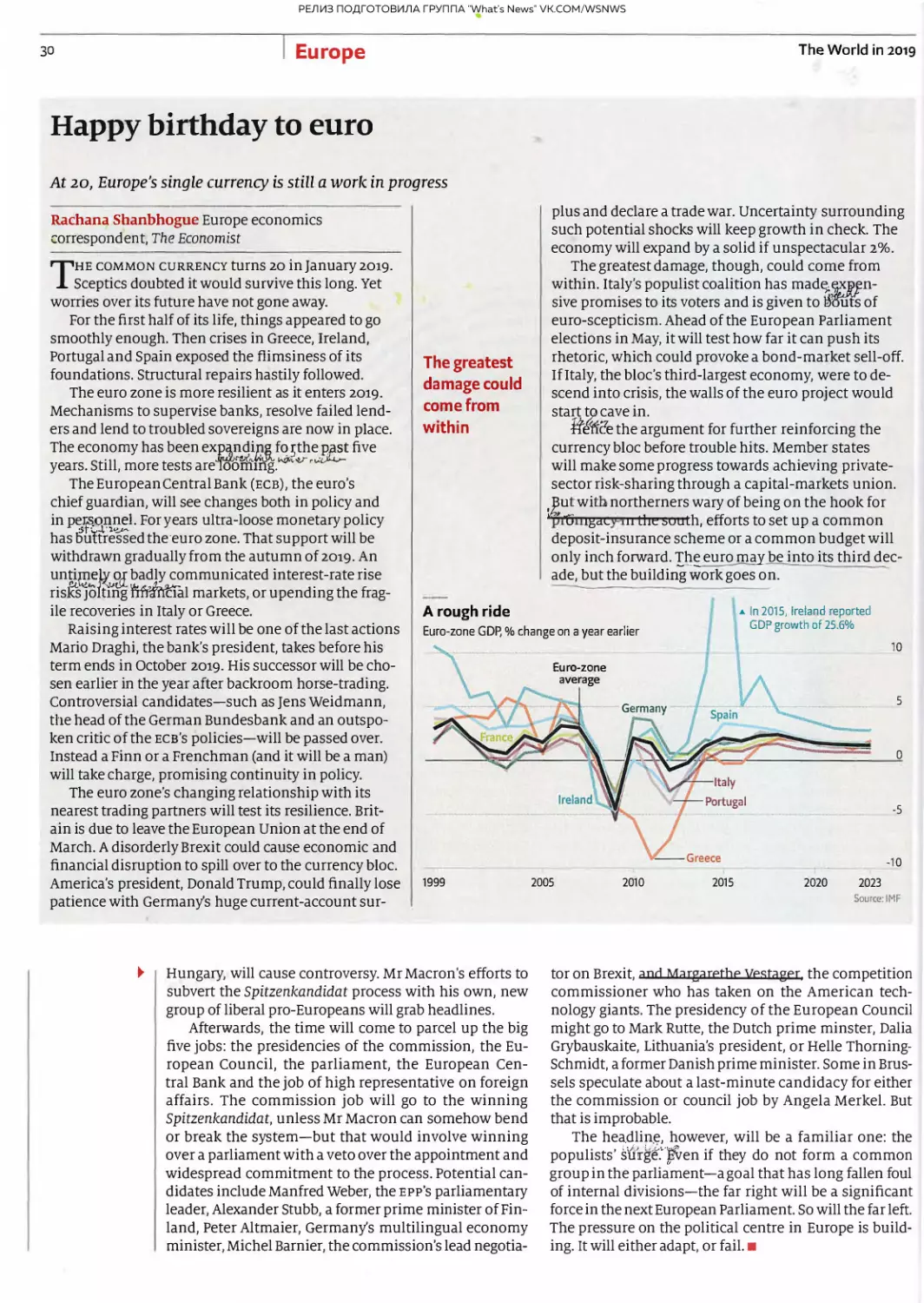
Arough ride
• ln 2015, lreland reported
GDP growth of 25.6%
Euro-zone GDP, % change оп а year earlier
10
Euro-zone
average
5
о
-5
-10
1999
Hungary, will cause controversy. Mr Macron's efforts to
subvert the Spitzenkandidat process with his own, new
group of liberal pro-Europeans will grab headlines.
Afterwards, the time will соте to parcel up the Ьig
five jobs: the presidencies of the commission, the Eu
ropean Council, the parliament, the European Cen
tral Bank and the job of high representative on foreign
affairs. The commission job will go to the winning
Spitzenkandidat, unless Mr Macron сап somehow bend
or break the system-but that would involve winning
over а parliament with а veto over the appointment and
widespread commitment to the process. Potential can
didates include Manfred Weber, the EPP's parliamentary
leader, Alexander Stubb, а former prime minister ofFin
land, Peter Altmaier, Germany's multilingual economy
minister, Michel Barnier, the commission's lead negotia-
2005
2010
2015
2020
2023
Source:IMF
tor on Brexit, and Margarethe Vestager, the competition
commissioner who has taken оп the American tech
nology giants. The presidency of the European Council
might go to Mark Rutte, the Dutch prime minster, Dalia
Grybauskaite, Lithuania's president, or Helle Thorning
Schmidt, а former Danish prime minister. Some in Brus
sels speculate about а last-minute candidacy for either
the commission or council job Ьу Angela Merkel. But
that is improbaЬle.
The hea,dlin,e, however, will Ье а familiar one: the
populists' �'«rgf.Jven if they do not form а common
group in the parliament-a goal that has long fallen foul
of internal divisions-the far right will Ье а significant
force in the next European Parliament. So will the far left.
The pressure on the political centre in Europe is build
ing. It will either adapt, or fail. ■
РЕЛИЗ ПОДГОТОВИЛА ГРУППА "What's News" VK.COM/WSNWS
The World in 2019
[ Europe
31
The epiphany of German weakness
Germany will feel impotent rage at not being аЫе to declare independence from America
Andreas Юuth editor-in-chief, HandelsЫatt Global
BERLIN
I
N 2019 GERMANY will face а crisis: not an economic
or political one, but an intellectual and psychological
crisis that could Ье just as wrenching. For the first
time, the German puЬlic at large will fully absorb what
Berlin elites have known for years: Germany has no vi
aЫe foreign or security policy to survive the passing of
Рах Americana.
This will Ье independent of questions about who will
govern Germany after Angela Merkel leaves the chancel
le ry (possiЫy in 2019, at the latest in 2021). It is an open
secret that she did not want to run again in 2017. What
changed her mind was not the refugee drama, which will
count as her legacy, but the election of President Donald
Trump. Sooner than most other Germans, Mrs Merkel
grasped that Trumpism nullified every assumption that
Germany had made since 1945.
Since the time of Konrad Adenauer, West Germany's
lirst chancellor, the premise of German foreign policy
was to submit to а douЫe "Western bond": first, to
America within NATO, and second, to France within the
European Union. The American army and nuclear aegis
provided protection against �ussia. In turn, the Germans
forfeited militarism-and 8iten's�i51y national self-inter
est-in favour of а rules-based multilateral order in both
trade and security. Germany benefited from this arrange
me9J,.It pro�d economically, and itwas аЫе to adopt
а saYi�юus tone in diplomacy.
America grew fed up with this division of labour long
before Мг Trump's election. In 2011 its defence secre
tary, Robert Gates, warned Europe, and Germany, about
its looming military irrelevance and demanded an end
to Germany's free-riding on American spending. The
German elite gradually accepted this logic. In 2014 the
country's president, Joachim Gauck, called for а greater
German role in world affairs. Others echoed him. But the
debate didnot reach the puЫic. Election campaigns con
tinued to Ье waged purely on domestic issues.
Then came the shock of MrТrump's victory. For about
а year, the stalwart Atlanticists (often Christian Demo
crats) in Mrs Merkel's advisory circle kept hope alive
thatMrTrump would Ье moderated Ьу the dignity of his
office. Those already sceptical of America (often Social
�ts) conclude 11iailiwastrme-for ema�n_
�t. The more Mr Irump keptmaking Germany feel
like а foe rather than а friend, the more the consensus
tipped towards the emancipators.
The declaration of independence, such as it was, was
delivered in 2018 Ьу Heiko Maas, the foreign minister.
Germany, he argued, had to become а "counterweight"
to America where necessary. And the only way to do this
was as part of а more unified Europe and а new alliance
of"mцltilateralist" countries from Canada to Japan.
�019 dawns, Germany thus finds itself broadly
opposed to America. Conflicts include the Paris climate
agreement (Germany for, America against), the Iran
nuclear deal (ditto) and the Nord Stream 2 gas pipeline
between Russia and Germany (ditto). The disagreement
spans fights about trade and the dominance-and tax
avoidance-of American internet firms in Europe. It
culminates in arguments about military spending, the
meaning of Nлто's Article 5, and "Western values". -·
1
Throughout 2019, German policymakers�
bour with their European counterparts to work towards
Mr Maas's goal. They will try to build an international
payments system that (unlike swrFт) cannot Ье ma
nipulated Ьу America. They will try to соЬЫе together
European alternatives to NATO, with characteristically
obscure acronyms like PESCO and CARD. And again and
again, they will discover two things.lFirst, Europe is too
divided to unite behind German ideas. Second, the over
whelming mass of America's systemic power simply al
lows no counterweight, and certainly not а German on� <t.
Sturm und Drangry
In frustration, German populists on the left and right
(who agree in being pro-Russian and anti-American) will
warm up old fantasies about German "equidistance" be
tween East and West. Other politicians will wage а phan
tom debate, unimaginaЬ!e until recently, that Germany
should get its own nuclear weapons. Most will stick to
their accustomed stance of denial.
tc-/;efmany is "too Ьig for Europe, too small for the
world", Henry Kissinger once sa�Today this explains
the special feeling of impotent rage many Germans have
towards Mr Trump. As Sigmar Gabriel, Mr Maas's prede
cessor, puts it: "Не reminds us every day how weak we
are." It is а dangerous world, and Germany is not ready for
it. In 2019, Germans will understand that-and despair. ■
о
2019
in brief
А new leader is ar the
helm of Germany's
Christian
Democratic Union
parry after Angela
Merkel's decision со
step down from
the posirion
РЕЛИЗ ПОДГОТОВИЛА ГРУППА "What's News" VK.COM/WSNWS
32
Europe
The World in 2019
Back to Earth with а bump
Russia's leader will start to look like а mere mortal again
Noah Sneider Moscow correspondent, The Economist
M0SC0W
URING VLADIMIR PUПN's third presidential term
from 2012 to 2018, he ascended to theRussian
ра: li'Wn.ilhe annexation of Crimea transformed
him from an earthly president into а symbol ofRus
sia's resurgence on the world stage. His approval rat
ings soared to over 80% and remained there, despite
а grinding recession. In late 2016 one Kremlin poll
ster told The Economist that the president had become
"а charismatic leader of the Promethean type: а demi
god, а Titan, who brought the people fire."
As his fourth term revs up in 2019, Mr Putin will
begin to look mortal again. The grandeur of geopoliti
cal gamesmanship will give way to the gritty realities
of day-to-day life: а stagnant economy and mount
ing social proЬlems. The reverse metamorphosis has
already begun. Although approval ratings are an imperfect measure of Mr Putin's true support, given his
control over the country's media and his elimination
of political alternatives, their trends are nonetheless
revealing. From approval of around 82% just after his
re-election in March 2018, his ratings dropped to 67%
in September, the lowest since before the annexation
of Crimea. His trust ratings also fell from 60% at the
beginning of 2018 to 39% in September.
The proximate cause was а government proposal
Kitchen politics
No shortage of drama
Yet after its elections Ukraine will again resist radical change
Arkady OstrovskyRussia edi tor, The Economist
F
EW C0UNTRIES go through as many upheavals
but ultimately change as little as Ukraine. In the
span of а generation, it split from the Soviet em
pire, staged two revolutions, lost part of its territory and
fought а war. Yet а system of governance where а few oli
garchic groups control access to economic and political
resources survived throughout. According to the World
Bank, in Ukraine 2% of firms are politically connected,
but they control over 20% of the total turnover and over а
quarter of the assets of all Ukrainian companies. Because
of this entrenched and corrupt system, and despite its
fertile land and educated population, Ukraine (which in
1990 was оп а par with Poland) has become the second
poorest country in Europe, with а GDP per person а fifth
of Poland's Jevel.
TheRevolution ofDignity in Кiev, а popular uprising
in 2014 which overthrew the Moscow-backed president,
Viktor Yanukovych, promised ап overhaul of the entire
о
2019 in brief
Plovdiv in Bulgaria
and Matera in
Italy аге European
Capitals of
Culture. Finland's
capital, Helsinki, and
Lyon in France are
the first Еигореап
Capitals of Smart
Tourism
to raise the retirement age from 60 years to 65 for
men and from 55 to 63 for women. Hoping to avoid
puЬlic discontent, the Kremlin tried to distance Mr
Putin from the decision, and he even emerged to de
cree that women's pensions should kick in at 60-but
to little avail. Protests broke out on the streets and at
the ballot Ьох in the autumn of 2018: Kremlin-backed
candidates from the ruling party lost gubernatorial
elections to stand-in opponents in four regions, а
system. But five years оп, Ukrainians are still waiting.
In 2019 Ukrainians will go to the polls to elect а
new president (in March) and parliament (in October).
Despite many names on the ballot paper, their choice
will Ье limited. The stage will Ье dominated Ьу two old
timers: Petro Poroshenko, the current president and
an oligarch, and Yulia Тymoshenko, а populist and Mr
Poroshenko's old rival. Both have been on the scene since
the early 2000s and neither inspires much trust among
voters. Secondary parts (for now) are played Ьу Anatoly
Gritsenko, а former defence minister who is free of oli
garchic interests (and resources), and Yuri Boiko, а con
troversial former energy minister, who served under Mr
Yanukovych and who represents the interests of clans
from the south-east of the country.
Waiting in the wings is Slava Vakarchuk, а popular rock
star and activist, who has been pondering а presidential
run. If he does, he would galvanise dispirited reformers but
would face а perilous path to victory; if not, his endorse
ment could help swing the race. The election itself will Ье
akin to а show. But spectators have seen it all before and
don't botherto read their politicians' empty promises. Poli
ticians, for their part, deploy slogans which locate them on
а geopolitical map but have little to do with everyday life.
Mr Poroshenko's main slogan, ':Army, language, faith:
we follow our own path", presents him as а Ukrainian
patriot defending his embattled country againstRussia.
РЕЛИЗ ПОДГОТОВИЛА ГРУППА "What's News" VK.COM/WSNWS
The World in 2019
1 Europe
rare glitch in Russia's "managed democracy".
In 2.019, as the pension reform starts to Ье phased
in, the malaise will deepen. Pessimism about the
country's direction is rising. Russia's economy will
stagnate, with GDP growth below 2%. As fallout con
tinues from the poisoning of Sergei Skripal in Britain,
and as Robert Mueller's investigation into Russian
interfere11ce in the American elections in 2016 inten
sifies, heavier Western sanctions will put downward
pressure on the rouЬle and crimp investment. The
cent.ral bank will have to keep interest rates up to
counteract the inflationary effects.
In the past, foreign adventurism and the spectre
of enemies abroad have helped Mr Putin consolidate
puЫic support. This will Ье an increasingly tough
sell. The euphoria from the annexation of Crimea has
worn off. Russians have tired of hearing about the
war in Syria. Sociologists note creeping dissatisfac
tion with foreign policy: most people want their lead
ers to focus оп domestic proЫems. The Kremlin тау
Ье tempted to fall back instead on campaigns against
"fifth columnists" at home. Repression against young
activists and social-media users, which grew in 2018,
could intensify further.
AII of this will unfold amid preparations for а post
Putin Russia. Ву 2024 Mr Putin must decide whether
he wants to fiddle with the constitution in order to
stay in charge, and if not, how and to whom he plans
to hand over power. At first glance, 2019 seems like
а small step along the way, а post-election year free
of major political dates. But as Gleb Pavlovsky, а for1 mer Kremlin adviser, says: "In Russia, events always
happen when your calendar is empty."
► то show it, he held military parades, enshrined Ukraine's
aspiration to join the European Union and NAT0 into
the constitution, and lobbled for the independence of
the Ukrainian Orthodox Church from Russia. Ms Тy
moshenko makes similar claims, but she feels that it
is her turn to run the country and divvy up its shrink
ing riches. Sworn enemies, the two are united in their
cynicism and opposition to serious reform and а genu
ine crackdown оп corruµtion. The presidential contest,
however, will Ье decided in the run-off, and that could
produce surprises.
То complicate matters further, Ukrainians will not
Ье the only ones taking part in their elections. Ms Тy
moshenko would suit Russia's president, Vladimir
Putin, best. Не has done business with her before and he
recognises in her а fellow cynical populist with а pen
chant for deal-making. In the parliamentary elections
the Kremlin will push for а coalition of forces from the
country's Russian-speaking south-east, hoping that it
1vill give it, in effect, а veto over Ukraine's future.
Injured Ьу Russia and weakened Ьу its own treach
erous elites, Ukraine risks Iosing its sovereignty. The
best outcome would Ье а radical break with the past, but
given the entrenched interests that is unlikely. Rather,
Ukraine will muddle through and improve gradually,
despite all the upheavals. Its abllity to avoid dramatic
change may prove to Ье а saving grace. ■
33
Delivery time
France's president needs to show that reform works
Sophie Pedder Paris bureau chief, The Economist PAR!S
I
Whatф
Might Balkan
neighbours Serbla
and Kosovo strike а
deal? They have been
at odds for decades.
А settlement would
speed up Serbla's
negotiations to join
the EU, and open the
way for Kosovo to
apply for membership.
But if а deal involved
redrawing borders
say, swapping ethnic
Serb territory in
northern Kosovo for
а majority-Albanian
агеа of southern
Serbla-it could open
Pandora's box. lt
would have knock-on
effects in Bosnia,
where Serb and Croat
nationalists would
step up demands for
autonomy
Anysign of
humility?
т WILL ВЕ crunch time for Emmanuel Macron,
France's young president, in 2019 as voters try to work
out whether they elected а self-regarding regaJ Jeader
or а resolute reformer who сап get their country moving
again. Ву the end of the year Mr Macron will Ье halfway
through his term in office. The French will want to see the
results of his reforms-in growth and jobs-if they are to
indulge his often-imperious leadership style.
Mr Macron wiIJ shrug off criticism and press ahead
with his domestic programme. On January 1st France
will move to а system of taxing income at source, put
ting an end to its old method of collecting income tax а
year in arrears. This will cause hiccups, and some dismay
at thinner upfront рау packets. Apprehension will also
greet Mr Macron's attempt to reform unemployment
benefits and reorganise the pension system. Не will try
to regroup 35 different regimes into а unified, points
based scheme, in order to make pensions fairer, more
transparent and better suited to moblle careers. The aim
will Ье to encourage job mobllity and prepare the French
welfare state for an increasingly unstaЫe world of work.
Оп his side Mr Macron will have а robust parliamen
tary majority and one of the few staЫe, single-party
governments in Europe. His government, reshuffled
in October, will go into 2019 more settled and focused
оп the job. Later in the year he could see fresh depar
tures, as candidates for mayorships in 2020 quit to start
their campaigns. There might even Ье а change of prime
minister, if Edouard Philippe decides to run for mayor
of Paris. But opposition in the National AssemЫy will
remain fragmented and largely subdued.
As Mr Macron's poll ratings take а further knock,
though, impatient voters will voice their frustrations.
The chief beneficiary wiIJ Ье the far right's Marine Le
Реп, who will take her renamed party-National Rally
into elections to the European Parliament in Мау as the
champion of the dispossessed against Mr Macron's root- ►
РЕЛИЗ ПОДГОТОВИЛА ГРУППА "What's News" VK.COM/WSNWS
Europe
34
►
о
2019
in brief
Sweden loosens
restrictions оп the
gamЫing industry
Ьу opening ир ro
online betting
platforms
The World in 2019
less pro-European elite. Despite her disastrous second
round debate performance in the presidential election of
2017, Ms Le Pen could top the voting this year in France,
sending another shiver down liberal Europe's spine. Mr
Macron will struggle to repeat at а European level the
feat La RepuЫique en Marche achieved in 2017, when his
young movement upended party politics. Нis attempts to
draw support from Europe's centre-right parties will strain
relations with Germany's chancellor, Angela Merkel.
Yet Mr Macron will nonetheless emerge as the lead
ing European voice shaping an alternative narrative to
protectionism and populism, casting himself as the
champion of the progressive liberal order against the
dark forces of nationalism. Undeterred Ьу German reti
cence or the Eurosceptics at his door, he will push for
а more integrated Europe and try to nudge Germany оп
euro-zone reform. Despite limited return on his efforts to
bring President Donald Trump into the multilateral fold,
and а lack of diplomatic traction in Russia, Syria or Iran,
the French president will remain active оп the world stage.
Mr Macron will push the fight against climate change in
particular when France hosts the G7 in Biarritz in August.
ArguaЬly the greatest challenge for Mr Macron, а for
mer investment banker, will Ье to persuade the French
tha1 his domestic reforms are not designed to favour
only the better-off and fellow members of the globalised
elite. It is all too easy to caricature his policies thus. Mr
Macron needs to show that his guiding philosophy,
based оп maximising individual opportunities and
"emancipation" from disadvantage, is genuinely about
improving life chances for all-and to do so in а way that
does not convey haughty disdain for ordinary people. ■
Three score years and ten
А nervous NATO prepares to celebrate
ShashankJoshi defence editor, The Economist
I
N APRIL 2019 NATO will have а 70th Ьirthday party.
It has reasons to celebrate. It is the largest, strong
est and most enduring peacetime military alliance in
history. Its military spending will keep rising, its ex
ercises will get Ьigger and it will gain new members.
But trouЬle lurks, with populist movements in Eu
rope and Лmerica threatening the cosy transatlantic
consensus that prevailed for decades.
First, the good news. NATO has transformed itself
in the years since Russia invaded Ukraine and an
nexed Crimea in 2014. Ties between NATO and the
Eu-"trench warfare" а few years ago, according to
one diplomat-are improving dramatically. It will
keep getting easier for commanders to funnel their
troops and tanks across Europe's borders without be
coming snared in red tape.
Nлто will conduct increasingly large war games,
relearning skills that it honed in the cold war but lost
in the 1990s. Its,footprint will also expand. Macedo
nia, which is tantalisingly close to resolving а dispute
with Greece over its name, could start оп the long
road to membership in January. А new divisional
headquarters is due to open in Latvia in 2019, over
seeing thousands of alliance troops recently sent to
the Baltic states. А new Atlantic Command will ad
dress challenges in the Arctic, including а resurgent
Russia. And а NATO training mission in Iraq will work
to prevent а revival ofislamic State.
But the alliance is not immune to the forces that
have roiled Western politics of late. One source of
tension is the growth of populist parties, such as
Italy's Northern League. These tend to Ье sympathetic
towards Russia, and will attack NATO as expansionist.
А second conflict will pit south against north.
States like Poland and Estonia look nervously at Rus
sia. But southern allies, such as Greece and Spain,
Marching
towards70
The Ьiggest
fly in the
ointment
remains
America's
president
worry more about immigration across the Mediter
ranean and raging conflicts in north Africa and the
Middle East. They will press NАТО to do the same.
А third proЬlem is Turkey, which is оп increas
ingly bad terms with its Western partners. Worse still,
it plans to import а cutting-edge Russian air-defence
system in 2019. This would Ье incompatiЫe with
NAТO's air defences and might allow sensitive infor
mation about Western warplanes to flow to Moscow.
But the Ьiggest fly in the ointment remains Amer
ica's president, who will harangue allies for shirking
their responsiЬilities. Though military spending in
Europe has been rising for four consecutive years and
more than half of Nлто members are оп track to meet
а target of spending 2% of GDP оп defence Ьу 2024,
this тау not Ье enough for Donald Тrump. Не has
urged allies to douЫe that to а fanciful 4%.
Оп April 4th NATO foreign ministers will gather
in Washington, DC, to celebrate the signing in 1949
of the Washington treaty, which estaЬlished the alli
ance. Europe and Canada will Ье hoping it will Ье an
occasion for celebration, rather than puЫic tantrums.
1
РЕЛИЗ ПОДГОТОВИЛА ГРУППА "What's News" VK.COM/WSNWS
36
Europe
The World in 2019
Splintered Spain
Avanti populism
In need of another round of reforms
Italy will flirt with financial danger
Мichael Reid senior editor, Latin America and Spain,
The Economist MADRID
John Hooper Italy correspondent, The Economist R0ME
PAJN's P0LJТJCS have been in flux since 2015, when
а two-party system splintered into four and CataJan
nationalism mutated into separatism, ushering in
weak minority governments. А series of elections in 2019
will confirm that the four-party system is here to stay
but could open the way to stronger, formal coalitions.
The Ьig question is when Pedro Sanchez, the Socialist
prime minister, will call а generaJ election. Having ousted
his conservative predecessor in а censure motion in Мау,
he insists he will govern until the end of the parliament
in 2020. But the SociaJists have only 84 of its 350 seats.
[fMr Sanchez fails to get support for а budget for 2019
he may opt to go to the country early in the year. The
tribulations of such а frail minority тау anyway prompt
him to call an election for November. The SociaJists сап
hope to do well at the expense of Podemos (We Сап), а
far-]eft party which is declining. Ciudadanos (Citizens),
which calls itself а liberal party, has chosen to battle the
conservative People's Party for leadership of the right.
Catalonia will again loom large. Hearings in the trial
of 18 separatist leaders, prompted Ьу their illegal refer
endum and declaration of independence in 2017, are due
to start in January. The trial, and especially а harsh jail
sentence, will inflame and solidify the separatists, who
command the loyalty of half Catalonia's voters.
А pointer to Spaniards' mood will соте оп Мау 26th,
when European elections coincide with municipal polls
and votes for regional governments. Attention will focus
оп the contest for mayor of Barcelona: Manuel Valls, а
former French prime minister who was born in the city,
is running оп а unionist platform. Не faces а tough battle
against Ada Colau, the Podemos mayor, while the separa
tists will mount а determined challenge.
Spain needs а strong reformist government. Its vigor
ous economic recovery is starting to flag, education and
pensions urgently need reform, and time alone will not
solve the Catalan stand-off. After the voting, the politi
cians will have to collaborate. ■
тлtv 1s seldom predictaЬle. But it сап at least Ье said
with certainty that оп Мау 2nd 2019, 500 years will
have elapsed since the death of its most renowned
polymath, Leonardo da Vinci. Many exhibltions will
mark this, including one at t.he Louvre that aims to dis
play as many as possiЫe of the master's few paintings.
The glories of Italy's past have long contrasted un
comfortaЫy with а present characterised Ьу low eco
nomic growth and often clownish politics. Italians will
start the year still poorer in real terms than they were in
2000. Most forecasters expect output in 2019 to grow Ьу
little more than 1%. But the government disagrees. The
finance minister, Giovanni Tria, claims GDP could rise
Ьу up to 1.6%, keeping Italy's debt burden manageaЬle.
Will it? Mr Tria's expansionary budget for 2019 raised
aJarm in Brussels and оп financiaJ markets. It set а deficit
target of 2.4% of GDP. That might not seem much, but
Italy is а special case because of its enormous puЫic
debt, of 132% of GDP.
The previous government, dominated Ьу the centre
left, had said it would cut the deficit to о.8% of GDP. Even
after the formation in June of а cablnet yoking the anti
estaЬ!ishment Five Star Movement (м5s) and the hard
right Northern League, the expectation was for а target of
below 2%. How the economy responds to its fresh stimu
lus will Ье cruciaJ to the two parties' prospects.
When it came to а choice between upsetting Brussels
and honouring their electoral pledges, the Five Stars'
leader, Luigi Di Maio, and the head of the League, Matteo
Salvini, opted to keep their word with voters. The мss
had promised an income guarantee for the poorest and
joЫess; the League had promised tax cuts. Both parties
endorsed а costly plan to roll back а pension reform. Pro
gress should Ье made оп all three measures in 2019, but
with the risk that Italy's puЫic finances could get out of
hand, sparking а renewed crisis in the euro zone.
Politicians who do what they say they are going to do
are rare beasts. But with the European elections loom
ing in Мау, Mr Di Maio in particular urgently needed to
boost his party's popularity, which, according to polls,
had slipped as support for the League soared. Within
three months of the coalition government's inaugura
tion, the League had douЬ!ed its poll ratings to more
than 30% and overtaken the Five Stars, largely because
of its aggressive stance оп immigration. Voters warmed
to Mr Salvini's pugnacious rhetoric, even if the underly
ing reason for а sharp drop in migrant arrivals in 2018
was а deal struck Ьу the previous government with the
UN-recognised Libyan administration in Tripoli.
Mr Salvini has the luxury of being аЫе to choose
between sticking with the Five Stars and returning as
undisputed leader of а right-wing alliance with which
he fought the last general election, in 2018. In deciding
which way to lean in 2019, his inspiration will not Ье
Leonardo-but Machiavelli. ■
S
I
о
2019
in brief
Budget permirting,
ltaly's state
broadcaster, RAJ,
launches а round·
the-clock English
language service,
giving the world а
view of life and
ne,�s in Italy
Catalonelier
РЕЛИЗ ПОДГОТОВИЛА ГРУППА "What's News" VK.COM/WSNWS
37
The World in 2019
Britain
ALSO IN THIS SECТION:
38 Catastrophe scenarios
39 Нагdег times fог the economy
40 Jeremy СогЬуn on the new middle
AII aboLit Brexit
The country will leave the European Ипiоп, but the uncertainties will drag оп
,1\
\1
John Peet Brexit editor, The Economist
RЕхп wr11 again dominate British politics in 2019.
в Britain's departure from the European Union, en
dorsed Ьу voters in June 2016, sucks the life out of
all other political and economic concerns. Not only is
Brexit fiendishly compJeX, to negotiate, but its prepon
derance also explains why Theresa May's Tory govern
ment has often seemed bereft of ideas and policies.
The likeliest scenario (though there are plenty of oth
er s: see Ьох on next page) is that Mrs Мау will at least
secure а deal that ensures Britain formally exits the EU,
as p]anned, on March 29th. For all her rhetoric about по
deal being better than а bad dea], she and other EU Jead
ers have a]ways known that to leave without а deal would
Ье highJy damaging for all. The European economy has
faJtered. Ап acrimonious Brexit would Ье irresponsiЬ!e
at а time of growing geopoliticaJ tensions. And busi
nesses on all sides lobЬied hard against по deal.
Yet the Brexit deal will leave uncertainties. True, it
will usher in 21 months or more of transition during
,vhich Jittle will change, and it wШ be designed to avoid а
hard border with physica] controls in Ireland. But it may
presage regulatory checks in the Irish Sea that will Ье un
popularwith the Democratic Unionist Party (DUP), which
,,,,
props up Mrs May's government. And it will Ье but а prel
ude to tortuous negotiations over а free-trade agreement
between Britain and the EU. For much of 2019 Brussels
will Ье preoccupied with European elections and choos
ing а new European Commission. А future trade deal can
not Ье agreed on, still less ratified, within 21 months-so
the transition period will have to Ье extended.
That will annoy many pro-Brexit Conservatives, who
liken а transition in which Britain observes all the rules
but no longer has any say in making them to being а vas
sal state. Such а concern тау not be enough forTory мРs
to obstruct Mrs May's deal, as they fear this could mean
that Brexit is overturned Ьу а new referendum. But Tory
restiveness will create more headaches for the prime
minister, whose grip оп the party Jeadership is insecure.
She became Jeader Ьу default after David Cameron's
resignation in June 2016. She then Ыеw her parliamen
tary majority after calling an early election in June 2017,
only to find that her campaigning prowess was outshone
Ьу that ofJeremy Corbyn, the Labour leader. Her depend
ence since then on DUP support makes her seem weak.
And her Brexit plans provoke divisions in her party,
which looks tired after eight years in office.
So the political focus after Brexit will switch to the
question of who should take her place. She will argue
that she is best placed to supervise the post-Brexit trade
о
2019 in brief
The сепсга/ seccion of
the Elizabeth line,
which wil/ eventually
take rail passengers
fгот Berkshire со
Essex via Heathro1v
and central London,
jinally opens,
nine months late.
Transport fог London
apologises for апу
inconvenience
►
РЕЛИЗ ПОДГОТОВИЛА ГРУППА "What's News" VK.COM/WSNWS
38
The World in 2019
Britain
Catastrophe scenarios
Three ways that things could go horriЬly wrong with Brexit
Adrian WooldridgeBagehot columnist,
The Economist
Р
АRТУ CON FERENCES always attract people with
placards proclaiming that the end is nigl1, from
Marxists declaring that the long-awaited crisis of
capitalism is finally upon us to religious fundamen
talists spying the Four Horsemen of the Apocalypse
on the horizon. Usually we journalists pass them Ьу
with nary а glance.But 2019 could prove that they
were right all along.
ForBrexit to succeed, а Iot of improbaЬ!e things
have to go right. For it to fail, а lot of рrоЬаЬ!е things
have to go wrong.The Europeans do not want to dam
age the integrity of the single market. Theresa Мау
is head of а minority government. The Democratic
Unionist Party, on whose support she depends, does
not want to damage the integrity of the United Кing
dom. TheBrexiteers do not want to betray а project
that they have devoted their lives to. The Labour Party
does not want to save а failing government. All this
means the result could easily Ье chaos and paraly
sis-and chaos and paralysis could just as easily lead
to one of three catastrophes.
The first is thatBritain falls out of the European
Union without а deal-that is, the Eu decides to treat
Britain as а third country without any co-operative
agreements to facilitate trade. Given that the EU is
Britain's Ьiggest trading partner and that modern
companies depend on just-in-time deliveries, this
would Ье а hammer Ыоw to the economy. Supermar
kets might find it impossiЬ!e to get fresh food. Lorries
might Ье delayed at ports for days, producing massive
traffic jams. Medicines might run out. Such short
term disasters would lead to longer-term proЬ!ems as
output declined, tax receipts plunged and the govern
ment had to cut back puЬ!ic spending.
The second is thatBritain has а snap general elec
tion and Jeremy·corbyn's Labour Party wins. Mrs Мау
could easily decide that the only way to escape paral
ysis is to ask the people to vote. If so, the public may
decide that it has had enough ofTory incompetence,
and give Mr Corbyn а chance. But Mr Corbyn is the
most left-wing leader the Labour Party has ever had.
►
Supermarkets
might find it
impossiЫe to
get fresh food
negotiations. Yet mostTory мРs, and even most minis
ters in her own cablnet, want her to step down well before
the next election, which is due Ьу mid 2022. The chances
are that there will Ье а leadership challenge in 2019.
Mrs Мау could choose, as Margaret Thatcher did in
1990, to run herself. But like MrsThatcher, she is likely
to lose.The front-runner to take over is SajidJavid, home
secretary and son of а Pakistani-born bus driver. There
could Ье а late surge Ьу another candidate, such as Jer
emy Hunt, the foreign secretary. And а Brexiteer like
Michael Gove, the environment secretary, or (less likely)
Не !ыs threatened to confiscate 10% of the shares of
allBritish companies with more than 250 employees.
Не wants to nationalise the utШties and railways, and
give much more power to trade unions. The result
could Ье а war between Labour and the markets, as
global investors withdraw t.heir money and the gov
emment responds Ьу imposing capital controls.
The third is that Parliament decides to hold an
other referendum. Most Remainers, and EU officials,
would jump for joy.But it might further confuse the
situation. WouldBritons Ье asked to choose between
two options (remaining or leaving on Mrs May's
terms) or three (remaining, leaving on Mrs May's
terms, or leaving on world trade rules)? And ifBrit
ain can have а second referendum, why not а third?
There could Ье riots оп the streets if the Leavers feel
they have had victory snatched from them.
Britain likes to think of itself as а sensiЬ!e р!асе
that ultimately muddles through. The coming year
could see that great illusion shattered.
Boris Johnson, а former foreign secretary, could appeal
more to the party members who make the final choice
between the two leading candidates.
Whoever emerges as leader (and prime minister) will
still have а job defeating Mr Corbyn. А Brexit that dis
appoints many and an economy that is stuttering could
give Labour а good chance of winning for the first tirne
since 2005. The prospect that the dislocation of Brexit
may Ье followed Ьу а far-left Corbyn government bent
оп nationalisation and more taxes will further unnerve
businesses and investors. А bumpy ride lies ahead. ■
РЕЛИЗ ПОДГОТОВИЛА ГРУППА "What's News" VK.COM/WSNWS
39
Britain
The World in 2019
А long, uneven descent
Britain, unemployment rate, %
Start of
financial
crisis
Dotcom
crash
12
·--вгехit·-referendum
8
- .Tougheг
welfare,rules
introducea
4
--с-:-.-
о
1980
Prime ministers
85
Thatcher
90
11 Major
2000
95
i Blair
05
10
11
Brown
11cameron
15
20
llмa y
Source:ONS
Brace yourselves
Whatever the outcome of the Brexit negotiations, the British есопоту faces а testing year
Callum Williams Britain economics correspondent,
The Economist
S
Brexit referendurn of 2016 the British
economy has held up better than expected. True,
because of higher inflation linked to the depre
ciation of sterling, real-wage growth has stagnated.
The purchasing power of pay-packets rernains below
where it was before the financial crisis of 2008-09. Yet
unemployment has fallen to а four-decade low of 4 %
or so (see chart), rather than increasing sharply as most
econornists had feared. And GDP has continued to grow,
albeit at а slower расе than might have been expected if
the country had voted Remain.
Will the economy continue to surprise the pundits?
Hanging over the corning year is the risk that Britain will
crash out of the EU with по deal at all. Hardline Brexi
teers argue that the country has nothing to fear. It is even
possiЫe that as companies and the governrnent activate
contingency plans in early 2019-stockpiling goods and
reorienting supply chains, for instance-it will provide
а short-term boost.
Yetthe damage from а no-deal Brexit would surely Ье
severe. No one knows for sure what would happen, but
City traders are working оп the assurnption that sterling
would fall from its current level of around $1.30 against
the dollar to more like $1.10. That would prornpt another
bout of cost-push inflation, eating away at Britons' wages
once again. The evidence so far suggests that Britain's
exporters have not rnuch benefited frorn а cheaper cur
rency. Many of their wares contain goods irnported frorn
abroad, which have become rnore expensive.
Furthermore, the uncertainty generated Ьу, in effect,
throwing out half а century's-worth of law and replac
ing it with nothing would surely deter business invest
ment and spending, weakening econornic growth. The
EU 1vould have to treat Britain as а "third country" for
trading purposes and raise barriers оп British exports.
Policy could soften the Ыоw. The Bank of England would
рrоЬаЫу cut interest rates, now at 0.75%, in the event
of по deal. The governrnent might loosen fiscal policy а
INCE тнЕ
srnidgen. Even so, а recession, possiЬly а deep one, can
not Ье ruled out.
Ву far the preferaЫe course would Ье for the govern
rnent to strike а Brexit deal with the EU, which would
result in sorne sort of transitional arrangernent over the
next few years. That could see sterling rise above $1.40.
The Bank of England would рrоЬаЫу signal that it was
ready to raise interest rates slowly but steadily. Corn
panies would appreciate the additional certainty-and
rnight think about deploying sorne of the enorrnous
cash piles they have accumulated in recent years оп
extra investrnent. That could help raise Britain's rate of
productivity growth, which has been stagnant since the
financial crisis.
Yet even with the best possiЫe Brexit deal, the British
econorny is unlikely to take off in 2019. No one expects
productivity growth to hit the 3-4% а year that was corn
rnon for rnuch of the post-war period. And though the
governrnent has reduced the budget deficit from its post
crisis high of 10% of GDP to 2%, the fiscal squeeze will
continue-unless а political crisis brings about а change
of governrnent to Labour, which would cause а further
surge of econornic uncertainty.
Philip Harnrnond, the chancellor, is one of the few
politicians facing up to the long-terrn spending pres
sures linked to an ageing, sickening population. Official
estirnates suggest that to put the puЬlic finances оп an
even keel over the long run, the governrnent would have
to cut spending or raise taxes Ьу 2% of GDP every decade,
for rnany decades to соте. Such austere governrnent
policy over such а long period would Ье unprecedented.
Unspectacular econornic growth and continued fis
cal tightness in 2019 risk creating fresh proЫerns. The
vote for Brexit dernonstrated that too rnany Britons
feel "left behind" Ьу the country's service-sector-led,
London-dorninated growth. Less governrnent spending
rneans less help for those who need it rnost: those living
in Britain's post-industrial areas, its young people and
its elderly. If Britain struggles to tackle the root causes
of the disaffection that led to the vote for Brexit, another
backlash rnay not Ье too far away. ■
оin
2019
brief
Manchester mark5
che blcencenary
of the Peterloo
massacre, when
soldiers killed more
than а dozen people
and injured hundreds
more during а rally
for policical reform
РЕЛИЗ ПОДГОТОВИЛА ГРУППА "What's News" VK.COM/WSNWS
40
Britain
The World in 2019
The other path ahead
А
Ап alternative оп the
left points to the future
for Britain, and beyond,
argues Jeremy Corbyn,
leader of the Labour Party
DECADE 0N, we are still Jiving in
the shadow of the great economic
crash. But while there is widespread
recognition that something fundamental
changed in 2008, there is also denial about
the necessary political response. The deter
mination of powerful interests to cling to
а failed economic orh
t odoxy has in many
countries opened ир а chasm between
people's hopes and needs and the outdated
prescriptions of the political class. Into t.hat
chasm have moved the fake populists of the
far right, ready to rip up the fabric of our
communities without real solutions to the
crises facing our societies.
The lessons are clear. If left-of-centre
parties look like they're part of the estab
lishment, and cling to а failed economic
system, they will Ье rejected-and smooth
the path to power of the migrant-baiters of
the hard right.
Tl1e old orthodoxy was not working for
most people even before the crash. The
formula of deregulation, privatisation, tax
cuts for the wealthy and debt for the rest
had already fuelled grotesque inequality
and precipitated the crisis itself. But in
many parts of the world the response of
the political estaЫishment to the failure of
that model was simply to douЫe down, un
leashing destructive austerity programmes
that multiplied its failings. No wonder
there has been а backlash.
In Britain, the sixth-Ьiggest economy in
the world, over 4m children live in poverty
and hundreds of thousands of farnilies use
food banks. As а rising share of national in
come has gone to owners of capital, рау has
lagged behind growth and real wages are now
f:800 ($1,060) а year lower than а decade ago.
It is against this economic backdrop
that а majority voted to leave the European
Union in 2016. In towns and cities hol
lowed out Ьу industrial decline and neglect,
with boarded-up shops and closed youth
centres, many people voted for Brexit as an
act of protest against а political system that
simply wasn't delivering.
In 2019 the already weak British econ
omy faces а serious threat from the govern
ment's shambolic handling of the Brexit
process. Labour will hold it to account and
seek to shape а new and close relationship
with the EU. Leading Conservatives want
to use Brexit to create а tax haven on the
shores of Europe, and impose а race to the
bottom in rights and protections.
So we stand at а fork in the road. Down
one path lie the politics of xenophoЬia and
scapegoating that are on the rise across
Europe, the United States and other parts
of the world. It seeks to divert the Ыаmе
for voters' grievances onto minorities and
foreigners. Its proponents woo the wealthy
and corporations with tax cuts, but are un
aЫe to offer sustainaЫe solutions to eco
nomic and social failure.
Labour has shown there is а popular al
ternative to austerity at home and conflict
abroad. Beyond Brexit, а Labour govern
ment will champion our best internationalThose policies are popular. That has
been а shock to the estaЫishment
ist traditions, putting negotiation before
confrontation, supporting the Paris cli
mate-change accord and Iran nuclear deal,
and promoting trade, not trade wars.
We are not yet in government. But in
2017 we recorded the Ьiggest increase in the
popular vote of any party in а general elec
tion since 1945 and deprived the govern
ment of its majority. We did that Ьу offering
people а clear choice beyond the narrow
limits of the politics of the past generation.
We gave voice to policies that command ma
jority puЫic support, but which the political
class had long rejected, such as fair taxation
and new forms of puЫic ownership.
Left, right and the new centre
Our policies offer real change: rebuilding
the puЫic reaJm in а genuinely mixed econ
omy, putting workers on boards, raising
taxes for the richest to invest for us all in
puЫic services and the industries of the fu
ture, offering а new settlement for business.
And those policies are popular. That has
been а shock to t.he estaЫishment. Far from
being in any way extreme, they represent
the rea] mainstream, the new centre ground
of British politics and puЫic opinion.
Labour has rediscovered its roots and
purpose. We have bucked the trend of social
democratic and socialist parties across Eu
rope, which have seen support collapse as
they have acquiesced in austerity and failed to
protect their communities. These ideas for а
more equal and prosperous society are shap
ing а new consensus in Britain, as our op
ponents seek to respond to our agenda. And
I believe they сап do so around the world. If
not, others will surely fill the vacuum.
РЕЛИЗ ПОДГОТОВИЛА ГРУППА "What's News" VK.COM/WSNWS
The World in 2019
41
United States
ALSO IN THIS SECТION:
42
43
44
44
Democrats line up for 2020
The Kavanaugh court
Millennials v baby-boomers
Walt Whitman's Ьicentenary
*****
TRUMP
"""'
2020
• .,
....
Wanted: better angels
�
1\ЕЕр AMERICA GREl'-r:
\.�
45
46
46
47
,
Опе nation under God?
The Obamas' return
The economy's fizz factor
Laurene Powell Jobs оп voting rights
/'
...
1
Partisan polarisation and а president dedicated to exacerbating it will теап а nasty year ahead
James Astill Washington bureau chief and Lexington
columnist, The Economist WASНINGTON, DC
A
s ЛМ.t,;1{1(.;А APPROACHED the mid-point of Presi
d entDonald тrump's first term, sober commenta
tors suggested it had not been so divided since the
1850s. That might sound ridiculous. Compared with the
argumentover slavery-the antebellum condition of 4m
African-Americans and the economic basis of the south
ern states-today's partisan rows seem trivial. Congress
is quarrelsome but unlikely to resort to mass brawling as
it did one night in 1858. Colin Kaepernick is an admira
Ыe rights activist, but по Frederick Douglass. No one is
predicting civil war. Yet the comparison underlines how
pervasive America's divisions now are. In comblnation
1vith а president dedicated to widening them, they will
make 2019 another exceptionally discordant year.
In the 1850s arguments about national identity raged
оп both sides, fuelled Ьу two decades of high immigra
tion and the prospect of extending slavery into the west
ern states. The northern and southern media were highly
partisan. With politicians incapaЬle of compromising
over slavery, the Supreme Court was asked to weigh in,
leading to its ruling, in Dred Scott v Sandford, that Ьlacks
were "so far inferior that they had not rights which the
1vhite man was bound to respect". Opposing the judges
was henceforth а rallying cry of the insurgent RepuЫi
can Party. Similar circumstances are apparent today. Yet
the Ьiggest likeness between then and now is the way
partisan polarisation is radicaJising both sides.
Just as the argument over slavery came to Ье seen
as existential to northerners and southerners alike, Re
puЫicans and Democrats have соте to view the other
as threatening their way of life. They are increasingly
unlikely to marry, work or socialise with one another.
Political scientists view this as а consequence of the way
racial, geographic and partisan identities have become
aligned. In the 1960s, arguaЫy а time of weightier policy
disagreements, RepuЫicans still had тапу Ыасk sup
porters and the Democrats many southern ones. These
days the RepuЬ!ican Party is for whites, especiaJly in the
South, and the Democratic Party for everyone else. Mr
Trump views this as an opportunity. Exacerbating Amer
ica's divisions, Ьу lambasting Democrats, the media and
immigrants, is his political method. It forces his sup
porters to choose between him and the enemy.
That explains why, through all the scandals and oc
casional triumphs of his administration, his approval
ratings have hardly shifted. Somewhere between 37%
and 42% of Americans are with him, а portion that
makes him unpopular but still competitive. This will re
main constant in 2019: even а damning report Ьу Robert
Whatф
Now that Democrats
control the House they
could decide to launch
impeachment
proceedings against
Donald Trump.
Cautious types say
this would Ье
counter-productive.
But what if the
temptation proves
too great? Even if the
House impeached
the president, the
two-thirds majority
in the Senate needed
to remove him
from office looks
implausiЫe-unless
the special prosecutor,
Robert Mueller,
unearths such
damaging evidence
that RepuЬlicans
decide it's time for
President Mike Репсе
►
РЕЛИЗ ПОДГОТОВИЛА ГРУППА "What's News" VK.COM/WSNWS
United States
42
The World in 2019
The field for 2020
Democrats line ир to challenge Donald Trump for the presidency
John Prideaux United States editor, The Economist
A
MERICAS COMBINATION of congressional elec
tions every two years with lengthy presidential
primary carnpaigns means that as soon as one elec
tion is over the next one is already coming into
view. So it is with 2019: the race to Ье the Democratic
Party's nominee will begin in earnest. Donald Тrump
declared he was running inJune of the equivalent
year in the Jast presidential cycle. That declaration,
at Тrump Tower in New York, was sparsely attended
because it was not clear whether this was а real cam
paign or merely а puЫicity stunt-a cautionary tale
for any prognosticator.
There is по obvious figure (like Hillary Clinton last
ti me) whose tum it will Ье in 2020. Naming the likely
nominee is mere guesswork. But it is possiЫe to say
something about what ап ideal Democratic presiden
tial candidate would look like.
One option would Ье to go for an experienced
state govemor, someone who seems reassuringly
competent. Perhaps after four years of the Trump
show, dullness will seem exciting. But Democrats do
not have а lot of seasoned governors to choose from.
And too many of those they do have are from the east
or west coast. А good rule of thumb is that the party
ought not to pick anyone who Jives within а couple of
hundred miles of the Atlantic or Pacific oceans.
An entrepreneur, preferaЫy one (such as Michael
►
о
2019
in brief
Fifry years afcer che
Stonewall riots in
Greemvich Village,
New York hosts the
ivorld's Ьiggest
Pride celebration of
LGBTQ riglнs
Mueller, who is investigating allegations thatMrTrump's
campaign team colluded with Russian election-hackers,
will not reduce his support Ьу much.
That will not deter the Democrats. Having regained
the House of Representatives, and the subpoena power
attached to its various committees, they will launch
investigations into Mr Trump's financial and other af
fairs. The fallout will dominate Congress. There is little
prospect of its passing important Jegislation, save for an
outside chance of an infrastructure package. Launch
ing congressional probes should also allow the Demo
cratic leadership to resist their supporters' demands to
impeach the president, which they fear would backfire.
The Senate's RepuЫican majority, bolstered Ьу the mid
terms, is firmly behind MrTrump, and а failed impeach
ment attempt could win him sympathy.
Who needs Congress?
Stymied Ьу Congress, Mr Trump will test the limits of
executive power. Another immigration fight is оп the
cards, with the administration mulling а resumption
of its policy of separating migrant children from their
parents as а deterrent. Mr Trump's foreign policy, the
traditional resource of presidents frustrated at home,
will show more substantial progress. His effort to denu-
Bloomberg) consideraЬly richer than the president,
could Ье а tempting pick. But it is hard to see а plu
tocrat making it past the party's primary voters. And
whereas RepuЬlicans like political novices-remem
ber Heпnan Cain?-Democrats typically have а sober
view that some prior experience in govemment is an
asset in а presidential candidate. The саЫе networks
may yeam for Trump v Oprah, but if Democrats be
have as they usually do then celebrity candidacies are
doomed too.
There is а mountain of political science suggesting
that what really motivates voters is negative partisan
ship, or dislike of t.he other side. If that is right, then
Democrats should pick the candidate least likely to
activate Republican hostility. If large numbers of
Trump voters are as prone to misogyny and racial
Ьias as many Democrats think they are, then the party
should рrоЬаЫу nominate а white male. This helps
to explain the theoretical appeal ofJoe Biden, vice
president under Barack Obama. А younger man with
some military experience would Ье even better.
Picking а white guy might seem cowardJy. For
many Democrats there would Ье justice in seeing the
grabber-in-chief taken down Ьу Senator Elizabeth
Warren, Kamala Harris or Kirsten Gillibrand. Yet elec
tion campaigns seldom unfold like Marvel cornics.
What is certain is that there wШ Ье lots of candi
dates, making the Democratic race chaotic in 2019.
Plenty of would-be presidents will begin the year
thinking that if Mr Trump сап do it, why not them?
clearise North Korea will generate more talk than ac
tion. Kim Jong Un wШ not play ball, but Mr Trump will
Ье reluctant to acknowledge that fact, having already
declared his diplomacy а success. Yet his administra
tion will intensify its pushback against China's trade
and other abuses. The result will Ье а worsening trade
war, mounting military tensions in the Sout.h China Sea
and serious moves Ьу American companies to shift their
supply chains outside China.
Such а pushback is overdue, but the chaotic and pro
tectionist Trump administration is ill-equipped to сапу
it out responsiЬly. It will look even less аЫе if Мг Trump
pushes out his admiraЬle defence secretary, James Mat
tis, which he is likely to do in 2019 if not before-caus
ing consternation among America's allies. Mr Trump
resents МгMattis's efforts to check his often impetuous
instincts, which other members of his foreign-policy
team (including Mike Pompeo, the secretary of state) are
only encouraging.
Mr Тrump will Ье increasingly distracted Ьу the pros
pect of his re-election battle in 2020. The field of con
tenders for the Democratic ticket will Ье crowded (see
Ьох) and Мг Trump will rubЬish them all and often. The
year ahead is going to Ье а destructive time in American
politics. But 2020 will Ье worse. ■
РЕЛИЗ ПОДГОТОВИЛА ГРУППА "What's News" VK.COM/WSNWS
The World in 2019
1 United States
43
The Kavanaugh court
America's Supreme Court hits its most conservative-and politically salient-point in generations
Jon Fasman Washington correspondent, The Economist
WASHINGTON, DC
N
EARLY тнRЕЕ months after President Donald
Trump nominated him to the Supreme Court,
Brett Kavanaugh won confirmation in the Senate
Ьу just two votes. That is the second-narrowest margin
in history. It is attributaЫe to Democrats' still-burning
anger over the way SenateRepuЫicans held а Supreme
Court seat open for the last year of Barack Obama's presi
dency, as they refused to consider his nomination of
Merrick Garland; to the multiple accusations of sexual
misconductMr Kavanaugh faced, all of which he denied;
and to the partisan intemperance he displayed before the
Senate Judiciary Committee (he Ыamed "revenge on be
half of the Clintons" for the accusa
tions against him-an evidence-free
conspiracy theory).
Ву replacing Anthony Kennedy,
the perpetual "swing vote", Mr Kav
anaugh gave the Supreme Court its
first duraЫy conservative majority
in decades. Both he and Mr Trump's
other appointee, Neil Gorsuch, are
in their early 50s; they could anchor
that majority, and shape American
life and politics, for decades to соте.
For American liberals, two fears
loom largest. First, Mr Kavanaugh
takes an expansive view of e'xecu
tive power. Many worry that а court
1vith him as the fifth conservative
vote will turn as supine and malle
aЫe to Mr Trump's will as the Re
puЬlican-dominated Congress has
been. Fights betweenMr Trump and
а Democratic-led House eager to flex
its subpoena power could end up be
fore the court in 2019.
Second, liberals worry that а solidly conservative court
couldovenurnRoevWade, the rulingin 1973 that declared
abortion а constitutional right. Susan Collins, а pro-choice
RepuЬlican senator who provided the decisive vote con
firmingMr Kavanaugh, considered such fears overЫown.
Change of direction
But are they? Americans may not have to wait long to find
out. More than а dozen cases challenging state-level re
strictions on abortion are wending their way through
the federal-court system. In 2016 the court struck down
regulations in Texas requiring abortion providers to hold
(difficult to obtain) admitting privileges at !оса! hospi
tals-with Mr Kennedy as the fifth vote. Abortion-rights
proponents fear thatMr Kavanaugh could provide а fifth
vote in the other direction.
Ever since the court upheld but narrowed Roe in а
ruling in 1992 that allowed states to regulate abortions
but forbade them from placing an "undue burden" оп
women seeking one, conservative states have tested the
limits of that phrase, with such burdensome and medi
cally unnecessary requirements as dictating the size
of hallways in abortion clinics, or forcing women to
undergo ultrasounds and listen to а fetal heartbeat. Ву
letting states decide for themselves what constitutes an
"undue burden", abortion could become practically un
attainaЫe for women in conservative states, without the
radical (and radicalising) step of ovenurningRoe.
Like Mr Gorsuch, Mr Trump's other Supreme Court
pick, Mr Kavanaugh takes а relatively dim view of "Chev
ron deference", the notion that judges should defer
to government agencies' "reasonaЬ!e" interpretation
of federal law. Liberals fear this cou\d cripple federal
functions, such as environmental protection, though
it could also cut in their favour: one of Mr Kennedy's
\ast Chevron-sceptical rulings struck down а law that
made it easier to deport immigrants. Steve Bannon, Mr
Trump's former chief strategist, wanted to "deconstruct
the administrative state"; Mr Kavanaugh looks likelier to
slightly restrain it.
Perhaps the court's swing will Ье Jess marked than
liberals fear. The justices do not operate in nine sealed
vacuums; they affect each other. Though John Roberts,
the chief justice, is conservative, he is a\so an institu
tionalist deeply concerned with the court's legitimacy.
MrRoberts is now the court's median justice, and he тау
Ье nervous about siding too often with the four justices
to his right, \est the court Ье seen as just another instru
ment of partisan politics.
But as 2020 draws near, Democrats will not let their
voters forget their outrage at мr Kavanaugh's confirma
tion and the theft ofMr Garland's seat. MrRoberts's insti
tutional concerns тау Ье too little, too late. ■
о
2019
in brief
PuЬ/ic companies
with headquarcers
in California musc
have at least one
woman оп their
board Ьу che end of
che year
РЕЛИЗ ПОДГОТОВИЛА ГРУППА "What's News" VK.COM/WSNWS
44
The World in 2019 тt
United States
Generation next
м
Ur
Millennials will outnumber baby-boomers in 2019
Jonathan Rauch senior feJlow, Brookings Institution
WASHJNGTON, DC
O
to rule them all! Baby-boomers,
born between 1946 and 1964, have been the most
numerous cohort in America for more than five
decades. All four presidents since 1993 have been of that
generation. But in 2019, their turn at the top will end.
Generations are squishy concepts, but using widely
accepted definitions, the Pew Research Centre reckons
that 2019 is the year when baby-boomers will Ье out
numbered. The group displacing them as the largest co
hort, the so-cal!ed millennials, is very different.
Growing up at the peak of America's success and
influence, and triumphant in their crusades for civil
rights and against the Vietnam war, boomers felt enti
tled to rule. Often confrontational and moralistic, they
were inclined to view politics in apocalyptic terms and
waged culture wars first against prior generations and
then within their own. They attended college more than
did any previous cohort, and served in the armed forces
less. Rebellious as youths, they turned ultra-protective
as parents. They ladled puЫic welfare and pension ben
efits onto themselves, burdening their children with
unsustainaЫe government deЬts.
NE GENERATION
Millennials, born between 1981 and 1996, grew щ
on а different planet. Traumatised Ьу 9/11, the financia
crisis and shooter drills at school, and observing thei
country·s relative power in decline, they have been de
scribed as pragmatic idealists: hopeful of making th
world better, but without the boomers' messianic streal
They are the first generation to feel fully at home in th
digital world, yet also the last to remember doing r,
search projects in physical libraries.
Compared with tl1eir parents, they are less attach& 1
to political parties, and they are more socially liberi
Interracial marriage, same-sex marriage and legal mari
juana give them no pause. And they are more raciall,
diverse: 56% of them are white, according to Pew, 1 v
against almost t.hree-quarters of boomers. They are als
less religious (see Ьох on next page).
i:
Their progressive social views are already forciц i:
change upon corporations and the culture. Millenn' 1,
als expect businesses to Ье local, green and sociall f
conscientious. They do not necessarily expect to 011·
homes and cars. As they showed to powerful effect i
the #МеТоо movement, they do not tolerate sexual an
Jonathan Rauch is author of"The Happiness Curve: Why Life Gets Better After
Midlife" (Green Tree, 2018)
Out of hopeful green stuff woven
The Ьicentenary ofAmerica's Homer
Jon Fasman washington correspondent,
The EconomistWASНINGTON,
B
DC
а small Long Island town оп Мау 31st
1819, Walt Whitman worked as a journalist,
printer, builder and teacher before turning to poetry.
His work expresses а rough, capacious, generous
and therefore uniquely American sort of national
ism. It is pugnaciously democratic. "What I assume
you shall assume," he wrote in "Leaves of Grass",
his much-revised magnum opus, "For every atom
belonging to me as good belongs to you." This was
written at а time when much of the world thought
democracy foolish, if not dangerous.
His young country, he wrote in "America", was
the "Centre of equaJ daughters, equal sons,/... Peren
nial with the Earth, with Freedom, Law and Love,/A
grand, sane, towering, seated Mother". Nobody
would now dispute America's grandeur, though
many fear that today it teeters more than towers.
What would America's greatest poet make of his
country on his 2oot.h Ьirthday?
Like many of tl1e greatest Americans, Whitman
had little use for organised religion: "There was
ORN 1N
Walt, watching
never any more inception than there is now,/ ...And
will never Ье any more perfection than there is now,
Nor any more heaven or hel! than there is now". Не
would no doubt feel as disgusted as Thomas Jefferso
or Benjamin FrankJin would Ье at the showy piety tt
РЕЛИЗ ПОДГОТОВИЛА ГРУППА "What's News" VK.COM/WSNWS
The World in 2019
United States
45
One nation under God?
Millennials' moment
United States, population Ьу generation, m
American religiosity, % that identify as:
Millennials
Ьогп 1981-96 80
----
i
Evangelical Protestant
60
15
10
20
Baby-boomers
1946-64
1980
90
2000
10
20
25
20
Gen Х
1965-80 40
2019
Millennials overtake
baby-boomers
30
30
40
Mainline Protestant
о
о
50
1972
80
90
10
16
Source: General Social Survey
Saurce: Pew Researct, Centre
Losing faith
► workplace practices which their parents took for granted.
And they do not like President Donald Trump: his ap
proval rating is stratified Ьу age, with millennials disap
proving of him the most. With their racial diversity and
left-leaning views, millennials have the numbers to reset
American politics.
But when? Unlike boomers, wlю stream to the voting
bo oths, millennials stay at home; in presidential elec
tions, only about half have bothered to vote. Though their
share of the voting-eligiЫe population will soon surpass
baby-boomers', their clout lags well behind. Boomers
may hold the stage long after their act has gone stale. ■
fuels American politics.
What about today's rampant partisanship? Hav
ing lived through the civil war (ardently anti-slavery
and pro-Union, he did not fight, but visited wounded
Union soldiers in the hospitals ofWashington, ос),
he 1vould Ье unsurprised, if disheartened, Ьу the
country's deep political divisions.
And yet politics figures little in his work. Не was
above all а "first-class noticer" (in Saul Bellow's
phrase) and а lyric poet of human connection. "! am
1vith you, you men and women of а generation, or
ever so many generations hence," he wrote in "Cross
ing Brooklyn Ferry", "Just as you feel when you look
оп river and sky, so I felt,/Just as any of you is one of а
living crowd, I was one of а crowd".
Bridges rather than ferries now conлect Brooldyn
to New York. But what connects Americans to each
other? This is today's most pressing question, and it
is as much rnetaphysical as political. Whitman wrote
1vhen Arnerica was just beginning to define itself,
both before and after its CivilWar.
Though war does not loom today, Arnerica's
p olarisation is nearly as great. Americans live in
1vholly separate political tribes that fear and loathe
each other. This would disturbWhitman more than
anything e\se about his country's current condition.
"Thosewho love each other shall become invinciЫe,"
he wrote in "Leaves of Grass". Of those who do not he
1vas silent.
2000
А milestone оп the path away from religion
Lane Greene Espresso editor, The Economist
unusual among rich demo
A
cracies in being highly religious. Yet many
have missed just how much less devout the coun
MERICA REMAINS
о
2019 in brief
The4ooth
anniversary of the
first documented
arrival of Africans
in what is now the
United States marks
а poignant turn in
the соипсгу·s history.
!п August 1619
some 20 Africans
were forciЬ/y Ianded
in Point Comfort,
Virginia
try is becoming. As millennials, the least religious
generation ever, overtake baby-boomers, their
faithlessness portends а very different landscape.
Experts such as those at the Pew Research
Centre have traditionally distinguished between
Catholics, mainline Protestants, evangelical Protes
tants and Ыасk Protestants in their counting, given
how these groups differ religiously and socially.
They have also coined the term "Nones" to cover
atheists, agnostics and those who say they have
по religion. Nones already outnumber Catholics
and mainline Protestants. In 2019 they could also
outnumber evangelicals. There will soon Ье more
Nones than any single group of Christians.
The oldest generations are the most religious;
the youngest are the most nonbelieving. So simple
cohort replacement is making America more irreli
gious. Moreover, whereas past generations became
more religious as they aged, this effect seems to
have paused: millenniaJs became even less obser
vant between surveys in 2007 and 2014. Indeed,
people of all generations are leaving churches. The
Catholic church has suffered the most dramatic
exodus. Fully 13% of America's population is ex
Catholic: some join other churches, but just as
many become Nones. Sexual-abuse scandals bear
much of the Ыаmе.
Europeans will remain bemused at how often
American leaders pray in puЫic and invoke God
in their decisions. But the country is secularising.
And for а11 those already comfortaЫe telling а poll
ster they are atheist or agnostic, there are surely
many in the pews not quite ready to say it.
РЕЛИЗ ПОДГОТОВИЛА ГРУППА "What's News" VK.COM/WSNWS
United States
The World in 2019
The fizz factor
How а hot labour marl<et could affect the есопоту
Soumaya Keynes US economics correspondent,
The Economist WASНI NGT0N,
A
Noises off
The Obamas re-emerge as active риЫiс ftgures
Adam Roberts Midwest correspondent,
The Economist CНICAG0
F
0R NEARLY two years after leaving the White
House Barack Obama was absent from puЫic
life, something he called "gracefully exiting the
stage". Не spent time with his family, prepared
а memoir and planned his Obama Foundation
in Chicago. But for the mid-term elections he
bounded back. First in а speech in September 2018
and then at many subsequent rallies he said mod
erate values and democracy were under threat. Не
attacked Donald Trump for "shameless" lying, say
ing his successor does "outrageous" things, such
as failing to condemn Nazi supporters. Michelle
Obama followed him into the spotlight. In Novem
ber а national tour promoting her own memoir
kicked off in Chicago.
This is just the start of the Obamas' return to
prominence. The couple have struck а deal with
Netflix to distribute non-political programmes
made Ьу their new firm, Higher Ground Produc
tions. These will focus on stories of volunteering
and civic work and should appear in late 2019.
Mr Obama's foundation will also start to take
shape in Chicago. Builders will break ground for
the presidential centre in 2019 and will then spend
three years on construction. Already programmes
are under way: 20 youthful fellows promote civic
engagement, including schemes to help young
Ыасk men in the city. "In 2019 we will Ье hitting the
accelerator," says an organiser.
Returning to puЬlic life carries some risks for Mr
Obama. Не could again become а convenient foil
for Mr Тrump. Yet remaining quiet would also have
а cost. Mr Obama wants to remind historians and
voters of his achievements, such as the economic
recovery, which Mr Trump claims as his own. The
purpose of memoirs, foundations and other post
presidential activities is partly to defend his legacy,
including his reform of health care. That is better
done Ьу speaking up than Ьу staying silent.
о
2019
in brief
Nearly four decades
after it closed
its doors. restoration
begins оп Chicago's
Uptown Theatre,
one of America 's
greacest movie
palaces
DC
MERICAS EC0N0MY will Ье made greater again in
2019. Consumer confidence is booming, labour
markets are tightening and а fiscal stimulus is
still winding its way through the system. As President
Donald Trump tweets about his economic successes,
members of the Federal Open Market Committee (Fомс)
will continue to raise interest rates, which for years were
at rock bottom. Jerome Powell, chairman of the Federal
Reserve, is trying to lift them towards а "neutral" point,
where policy is no longer pumping up the economy. Ide
ally, his destination will generate both staЬle prices and
as much employment as possiЫe.
Yet no one knows where exactly this somewhat
mystical spot lies. (Mr Powell has himself emphasised
this point.) And even if it could Ье accurately estimated
(which it cannot) it тау change over time. So the юмс
will edge interest rates upwards, taking further signs
of labour-market strength as evidence that the strategy
is not tanking the economy. Monetary policymakers will
nudge their communications upwards, too: starting in
January, F0MC press conferences will increase in reg
ularity, to Ье held after every meeting. The юмс тау
even choose to \ean against Mr Trump's fiscal stimulus.
One of its members, Lael Brainard, has pointed out that
Ьу pumping up domestic demand, the stimulus can
Ье expected to push up the shorter-run "neutral" inter
est rate.
Some hawks will squawk that the Fed should go
faster. They will warn that the slack being squeezed out
of the labour market is about to run out, and that infla
tion is around the corner. Central bankers have spent
years trying to anchor inflation and inflation expecta
tions at а low level, and their success gives them some
room for manoeuvre. But if they are not careful, the
hawks fear, there is а risk of а return to the 1970s, when
policymakers overestimated the amount of scope for
growth without inflation getting out of control. Ву the
time they tried to correct their mistake, inflation and in
flation expectations had become untethered. Mr Powell
has said that if the Fомс were to see signs of inflation
expectations accelerating upwards, it would intervene.
Left to fizz, а tight labour market could force compa
nies to fight for workers Ьу drawing from their profits
to рау higher real wages. Optimists also hope to see the
proportion of 25- to 54-year-old men in employment
rise back towards its pre-recession high. But pessimists
worry that deep trends make eitl1er outcome unlikely:
they point to technological change with а tendency
to leave low-skil\ed workers behind, а \ong-run decline
in unionisation and а rise in market concentration.
Against sucl1 forces, they reckon, even а tight labour
market may not shift power in favour of workers in any
sustained way. Yes, it could make firms raise wages. But
the sceptics worry that companies will simply increase
prices too. ■
РЕЛИЗ ПОДГОТОВИЛА ГРУППА "What's News" VK.COM/WSNWS
The World in 2019
1 United States
47
The real scandal of voting fraud
Т
Laurene Powell Jobs,
founder and president of
Emerson Collective, calls
for а resurgence of риЫiс
pressure in defence of
voting rights
НЕ STORIES sound like dispatches
from an earlier, darker era. In Kansas
а state law demanding documenta
tion of citizenship Ьlocks more than 35,000
residents from registering to vote. In Geor
gia the secretary of state, а RepuЫican gu
bernatorial candidate, wages а full-fledged
assault оп Ыасk voters that includes the
suspension of more than 50,000 voter ap
plications and an attempt to close seven of
nine polling locations in а low-income, ma
jority African-American county. In North
Carolina the state legislature introduces а
constitutional amendment requiring voters
to present а photo ш at the polls, а measure
а federal court previously ruled discrimina
tory against Ыасk voters. In North Dakota
а state law, upheld Ьу the Supreme Court,
disenfranchises indigenous communities
Ьу requiring that voters present proof of
residential address, а form of documenta
tion few tribal residents possess.
Though these may sound like examples
of а shameful past, they are in fact exam
ples of а shameful present. All are part of
а campaign of voter suppression that is
being waged across the United States. In
state after state, conservative lawmakers
are erecting new obstacles to keep voters,
particularly young реор!е and minorities,
from the ballot Ьох.
These efforts bear all the hallmarks of
Jim Crow, the system of legalised discrimi
nation that prevailed across the American
South until the mid-2oth century, and the
limits оп voting estaЬlished in the earliest
days of the repuЫic. The system of self
government created Ьу the founders recog
nised voting as fundamental, yet extended
the franchise only to white, male Jandhold
ers. Voting, as the founders conceived it,
was а privilege reserved for the few.
Truths that should Ье self-evident
It took 150 years of hard-fought progress
including а civil war, а decades-long
suffrage campaign, amendments to the
constitution and а civil-rights movement
to expand the pool of eligiЬle voters to all
citizens. In the process, voting was trans
formed in American law and consciousness
from а privilege into а foundational right.
Even so, the right to vote has always
been under siege, and it must always Ье re
affirmed and defended. The passage of the
landmark Voting Rights Act of 1965, for ex
ample, marked а watershed moment in the
long struggle to secure the rights of African
American voters. Still, discrimination has
persisted. In 2013 а conservative majority
оп the Supreme Court declared that "our
country has changed" and that minority
voters по longer needed certain protec
tions. In а ruling that gutted а key enforce
ment provision of the Voting Rights Act, the
court opened the floodgates for state Jegis
latures and Iower courts to codify an insidi
ous array of discriminatory practices.
For more than 200 years, America has
been оп a journey towards greater enfran
chisement. The past decade has seen this
What we need, starting in 2019, is
more democracy
trend reversed with alarming speed and
efficiency-often at the hands of those
who claim today's voters are engaging in
widespread fraud. Yet the claim of wide
spread voter fraud is the greatest fraud of
all. Study after study confirms that inci
dents of such misconduct are "vanishingly
rare". Instead, these measures specifically
target groups that tend to vote Democratic:
young first-time voters, immigrants, non
native-English-speakers, as well as the
historically marginalised poor, Latino and
African-American communities. The use
of data and computer modelling has made
voter suppression something of а science,
cementing in place long-standing barriers
to social and economic opportunity.
These tactics represent а fundamental
threat to democracy. In America, voting is
in danger of becoming а privilege extended
only to the already privileged, further con
centrating political power in the hands of
the wealthy few. Ош current path is а rejec
tion of the values that have al\owed gen
erations of Americans to contribute to the
making of "а more perfect union".
What we need, starting in 2019, is more
democracy: namely, а resurgence of the
kind of puЫic pressure and grassroots
activism seen during the 20th century's
major social movements, this time aimed at
reclaiming the vote as an unalienaЫe right
of citizenship.
То suppress а vote is to silence а citizen.
Those of us with unfettered access to the
ballot Ьох must step up-and speak up-for
our fellow Americans, and for our collective
future. At stake is nothing less than the sur
vival and strength of our democracy.
РЕЛИЗ ПОДГОТОВИЛА ГРУППА "What's News" VK.COM/WSNWS
The World in 2019
The Americas
ALSO IN THIS SECТION:
49 The shadow of Cortes
50 Canada meets populism
Now mend it
New governments in Latin America elected Ьу апgту voters will struggle to inject dynamism
о
2019
in brief
Cubansvote
in February in
а referendum
оп proposed
constitutional
changes inc/uding
the recognition
o/same-sex
marriages
Мiфаеl Reid Bello columnist and senior editor,
LatinAmerica & Spain, The Economist
P
OLIТICAL POLARISATION in LatinAmerica will make
its effects felt in 2019. А heavy crop of elections is
throwing up по clear pattern beyond voter anger
with the status quo and the estaЬ!ishment. New govern
ments of the left in Mexico and right in Brazil will try
to deliver change within tight fiscal margins. Of the six
elections in the region in 2019, those that will catch most
eyes are inArgentina, where Mauricio Macri's liberal gov
ernment has been undermined Ьу а currency crisis, and
Bolivia, where after 13 years in power Evo Morales, а so
cialist of Amerindian descent, faces growing opposition.
Economically the region as а whole is limping, los
ing ground in relation to the world. 0verall economic
growth will Ье а weak 2% or so in 2019, only slightly up
on the past two years. The aggregate figure is depressed
Ьу slumps in Venezuela and, to а Iesser degree, Argentina
and Brazil. That said, the likes of Chile, Peru, Colombla
and Bolivia will grow at 3-4% and the buoyant Domini
can RepuЬ!ic and Panama at around 5%. But slower
growth has brought fiscal austerity and fuelled puЬ!ic
anger over corruption and rising crime. All this has pro
duced contradictory political trends. Chile, Colombla
and Peru have seen а turn to the centre-right. In Mexico
and Brazil, where anger over corruption and crime is
particularly acute, elections saw а collapse of the centre.
In MexicoAndres Manuel Lбpez 0brador (pictured), а
veteran leftist populist, takes office оп December 1st 2018
with а powerful mandate. Не wi\l seek to boost growth
Ьу raising puЬ!ic investment and social spending while
slashing what he sees as waste. Не shocked investors Ьу
promising to scrap а partly built new airport for Mexico
City (LatinAmerica's \argest construction project) but he
рrоЬаЬ!у won't reverse an energy reform under which
private companies have pledged around $15obn in in
vestment over the next 20 years. Не wil\ seek to rebuild
the power of the presidency Ьу reining in state gover
nors. But his efforts to tackle crime and corruption will
prove disappointing.
Оп January 1st Jair Bolsonaro, а former army captain
and right-wing populist with Trumpian tics, wil\ take of
fice in Brazil after the country's most divisive e\ection in 30
years. Не won Ьу promising an iron fist against crime and
corruption, to defend family values and to shrink the state.
His first task wil\ Ье simply to govern: he has no executive
experience, many Brazilians abhor him for his racism and
sexism, and he will have to forge а majority in а congress
shared among 30 parties. Restoring Brazil's fortunes re
quires radical reforms, to redirect puЬ!ic spending from
vested interests to puЬ!ic services and investment. Markets
will look for an early pension reform. Mr Bolsonaro's cam
paign promised all this. But will his heart be in it?
In Argentina the hopes of Mr Macri, а centre-right
reformist, of cruising to а second term at an election
in 0ctober were dashed when his gradualist approach
to stabllising the economy was upended Ьу а run оп
the currency. Now in the arms of the IMF, his govern
ment has committed itself to а tight fisca\ and monetary 1
РЕЛИЗ ПОДГОТОВИЛА ГРУППА "What's News" VK.COM/WSNWS
The World in 2019
The Americas
49
The shadow of Cortes
Modern Mexico would prefer to forget the тап who paved the way for it 500 years ago
н
Richard Ensor Mexico correspondent, The Economist
MEXICO СJТУ
ERNЛN CORTES reached Mexico in April 1519.
With 500 men and а dozen horses, he conquered
а civilisation. But he does not tower, as either hero or
villain, over the country that appeared in his wake.
No modern Mexican politician invokes his name.
Not а single statue or street commemorates him. Will
Mex.icans sti!I shun him on the 500th anniversary of
his arrival, or confront his complex legacy?
In 1518 Cortes took an unauthorised voyage from
Cuba, where residents will celebrate the quincente
nary ofHavana in November 2019, to the shores of
Yucatan and then а long trek inland from Veracruz.
Не had а lucky streak-and а ruthless one. А multi
lingual indigenous slave called La Malinche, whose
name today is а byword for treachery in Mexico,
helped Cortes speakwith the Aztecs. With her help,
Corteswas аЫе to turn indigenous groups against
each other. Within decades, а smallpox epidemic
brought Ьу the Spaniards had wiped out 90% of the
зоm people living in Mexico. Those who resisted met
а Ыооdу end. Ву 1521 Cortes and his men had con
quered Tenochtitlan, the jewel in the Aztec empire
thatwould Ье rebuilt as Mexico City.
Though this voyage began as а conquest Ьу one
group, it ended as а convergence between two. Some
three-quarters of Mexicans are mestizo-a mix of Eu
ropean and indigenous Ыооd. Among the first was
а child of Cortes and La Malinche. In the centre of
Mexico City is а plaque commemorating the defeat Ьу
Cortes of Cuauhtemoc, the last Aztec emperor. It reads:
"Thiswas neither triumph nor defeat. It was the pain
ful Ьirth of the mestizo nation that is Mexico today."
Cortes himself wrote that Mexico "is the cloth that I
spun and wove". Не died broken and alone. His bones
languish in obscurity below а church in Mexico City.
His star has waxed and waned over the years.
► squeeze. Fortunately for Mr Macri, many Argentines
dislike his predecessor, Cristina Fernandez de Кirchner,
even more. Still, the election will Ье difficult for Mr Mac
ri's coalition. А moderate Peronist candidate would have
а strong chance.
In Bolivia Мг Morales's claim to lead an irreversiЫe
socialist revolution will Ье tested in an election in Octo
ber. Although his candidacy is constitutionally duЬious,
he maywin, unless the opposition, which ranges from
dissidents from the ruling party to conservatives, can
unite behind Carlos Mesa, а centrist former president.
Defeat for Mr Morales would hearten the long-suf
fering opposition in Venezuela, where Nicolas Maduro's
dictatorial regime will struggle on. А barracks revolt is
the main threat to Mr Maduro. More Venezuelans will
seek refuge in neighbouring countries, swelling the
Conquest and
controversy
The low point came in the mid-19th century, when
Mexico lost half its land to the United States. Mexi
cans reached back into the past for grand tales of ter
ritorial defence. Cuauhtemoc, the Aztec leader who
died fighting Cortes, became а national hero and the
Spaniards were reviled. At other times Cortes has
been presented as а founding father of а nation and а
liberator of oppressed indigenous people. The latter
argument has found а voice in parts of Spain, which
is wading through а slew of colonial quincentenaries.
А new television series made Ьу Amazon, "Cortes",
produced Ьу Steven Spielberg and starring Javier Bar
dem, will render а fresh verdict.
The Cortes anniversary will pass through а coun
try in the throes of change. The populist new presi
dent, Andres Manuel L6pez Obrador, an avid reader
of history, has tended to prefer lionising Mexico's
independence and revolution to tackling the moral
complexities of the Cortes era. Cortes may end up
honoured, decried or ignored. But without him, mod
ern Mexico simply would not Ье as it is.
largest migratory movement in Latin American history.
Some Latin American governments may approve sanc
tions against individuals in the Venezuelan regime, but
none is prepared to contemplate military action.
An air of frustration will hang over Latin American
diplomacy. Donald Trump is due to make his first trip
to the region as president in November 2018, visiting
ColomЬia and Argentina. But nobody (except Mr Bol
sonaro) expects much from him. Brazil takes over the
annual presidency of the вюсs group of emerging pow
ers. Efforts to join up the two main sub-regional trade
Ыосs, the Pacific Alliance (Chile, ColomЬia, Mexico,
Peru) and Mercosur (Argentina, Brazil, Paraguay, Uru
guay) тау stall on the indifference of Mr L6pez Obrador,
preoccupied at home. Latin America will muddle оп but
remain disappointingly far from fulfilling its potential. ■
о
2019 in brief
Cherry·pickers
gather in Chile for
the Global Cherry
Summitand
Colombla hosts the
World Avocado
Congress
РЕЛИЗ ПОДГОТОВИЛА ГРУППА "What's News" VK.COM/WSNWS
1 The Americas
50
The World in 2019
Populism moves north
Justin Trudeau is in for а turbulent year in Canada
Madelaine Drohan Canada correspondent,
The Есопот'istоттлwл
T
HERE ARE plenty of reasons why Canada has been
partly insulated from the populism and polari
sation roiling its closest neighbour, the United
States. А multi-party system means voters are not shoe
horned into опе of two opposing camps but сап choose
from parties along the political spectrum. Immigration
and trade are less fertile ground for populists to cultivate
in а country where both command majority support.
Those who lose their job to trade or technology land in
а more generous safety-net in Canada, which did not go
as far as the United States in transforming welfare into
workfare. And Canadians are generally more satisfied
with their lives, making them less vulneraЬle to the siren
call of populism.
Yet the sturdiness of this insulation will Ье tested in
2019 as the country heads towards а general election in
October. Conservatives at the federal and provincial lev
els are already road-testing populist messages, some of
which have been borrowed from Donald Trump, to woo
voters outside the mainstream.
In June 2018 the Progressive Conservatives led Ьу
Doug Ford won the election in Ontario, Canada's most
populous province, after promising to take оп people
who "drink champagne with their pinkies in the air" and
look down оп the common people. Jason Kenney, leader
of the United Conservative Party in energy-rich Alberta,
talks of "self-appointed smart people" and media elites
who disagree with his take оп climate change. Andrew
Scheer, federal Conservative leader, calls the federal car
bon tax due to Ье introduced оп January 1st а cash grab
Whatф
Venezuela's economic
crisis has created
one of the Ьiggest
migrations in Latin
America's history.
What if the economy
gets even worse?
The IMF forecasts
inflation could reach
1om% in 2019 and GDP
will shrink further.
Mounting chaos will
push mоге people
out of the country,
straining neighbours
such as Colombla and
Peru. But rather than
weakening Nicolas
Maduro's dictatorial
regime, this could
strengthen it, Ьу
reducing the number
of mouths to feed and
removing some of its
angriest critics
Ьу elites who do not саге about its impact оп ordinary
people. JustinTrudeau, the Liberal prime minister, says
his opponents have Ьееп emboldened Ьу successful
populist campaigns elsewhere and that the campaign in
2019 will Ье а fight against polarisation in Canada.
The last year of his four-year term was already shap
ing up to Ье а turbulent one for Mr Trudeau. His grand
bargain-Canada could develop its energy resources
while combating climate change-is looking wоЬЫу.
Не will find it hard to implement his national climate
change plan, which includes imposing а carbon tax
in provinces that do not have an equivalent, now that
Ontario has pulled out and joined the province of Sas
katchewan in а court chaJlenge. Нis plan to get а pipeline
built to carry crude oil from Alberta to the west coast is
encountering setbacks, including а court challenge Ьу
the left-leaning government in British Columbla. Immi
gration has unexpectedly become а divisive issue, with
almost 35,000 people having walked across the border
from the United States to claim asylum since January
2017. PresidentTrump has done his Ьit to unsettle the Ca
nadian economy Ьу levying tariffs оп Canadian exports
of steel, aluminium, softwood Jumber and solar panels.
Trade реасе will not Ье restored until existing tariffs are
lifted and а deal reached in September to replace the
North American Free тrade Agreement is ratified Ьу the
United States, Canada and Mexico.
Febrile fringe v mushy middle
Welcometo
Canada?
Immigration is the most sensitive of these issues and
the most vulneraЫe to populist attack. The government
relies оп puЫic support for the more than 300,000 im
migrants it accepts each year. The Conservatives, previ
ously wary of stepping too far outside the mainstream
consensus, have taken to calling the influx of asylum
seekers а crisis. They may edge further in this direction
to discourage their supporters from defecting to the new
People's Party of Canada, created in September Ьу Max
ime Bernier. Mr Bernier, who came second to Mr Scheer
in the leadership contest in 2017, opposes what he calls
the prime minister's "cult of diversity" and believes dan
ger lies in "extreme multiculturalism".
The sweeping victory of the right-leaning Coalition
Avenir Quebec in provincial elections held оп October
1st suggests there is plenty of support for а harder line
оп immigration. The coalition wants а 20% decrease in
immigrants to the French-speaking province and the
expulsion of immigrants who fail new language and
values tests.
Populist voices will grow louder as the election ap
proaches. Still, MrTrudeau and the Liberals have one Ьig
advantage: the party occupies the mushy middle ground,
along with most Canadians. Those at the fringes could
Ье persuaded to stray, but they are also open to staying.
The prime minister, whose party has Ьееп trading places
with the Conservatives in the opinion polls, stands а
good chance of winning the election-provided he сап
make the centre hold. ■
РЕЛИЗ ПОДГОТОВИЛА ГРУППА "What's News" VK.COM/WSNWS
The World in 2019
Asia
51
ALSO IN THIS SECTION:
54 Asian democracy bounces back
52 Gandhi's 150th Ьirthday
55 North Korea: а strange bromance
53 Japan prepares for more tourists
56 lndia overtakes Britain
54 lndonesia picks its president
56 Tough choices for Australia
The struggle for lndia's soul
What's at stake as the world's most populous democracy heads to the polls
Мах RodenbeckSouth Asia bureau chief,
The Economist DELH r
тоск UP оп namkeens. The compellingly munch
s aЫe snacks are what Indians will Ье craving in
2019, with their ringside seats for what promises to
Ье one of the most nail-Ьiting and most consequential
elections in India's 71 years of independence. The world's
Ьiggest democracy heads to the polls some time in late
spring, the pre-monsoon season when temperatures
soar highest. It is not just the weather that will Ье hot.
The contest will in part Ье а referendum оп Naren
dra Modi, the 68-year-old prime minister who in 2014
brought his Blыratiya Janata Party (BJP) India's first sin
gle-party parliamentary majority in three decades. That
landslide suggested broad endorsement for its pro-busi
ness and Hindu-nationalist agenda, as well as support
for Mr Modi's carefully tended mix of patriarchal mien,
folksy talk and energetic boosterism. But after five years
in office, the halo surrounding the former tea-boy from
Gujarat has faded. Mr Modi's political magic button,
marked "resentment at ruling elites", no longer produces
Pavlovian roars of approval. With his perfectly pressed
pastel-coloured kurtas and hugging matches with world
leaders, Mr Modi himself now looks pretty elite.
His party and its platform, which seemed an unstop-
раЬ!е juggernaut until halfway through Мг Modi's term,
has also grown less fearsome. The BJP still has more
money Ьу far than any rival, thanks to wealthy and loyal
patrons. This is а key asset in Indian elections, as are the
party's superior discipline, better tactical commanders
and, crucially, its close ties with grassroots Hindu-na
tionalist groups that provide reliaЬle shock troops across
the country. Yet for all this strength, the party's record in
power has looked surprisingly weak Ьу many measures.
This has alienated important constituencies.
One of these is businesspeople, many of whom had
seen Mr Modi's powerful mandate as an opportunity to
push through sweeping free-market reforms. Instead,
misguided policies such as the overnight "demonetisa
tion" of 86% of India's currency in 2016, or inept ones
such as the clumsy imposition of needlessly high and
complex national sales taxes in 2018, or а failure to ad
dress а looming bad-debt crunch in state-owned banks,
have tended to overshadow achievements including Mr
Modi's laudaЬ!e fiscal problty and the passage of much
needed economic Jaws, for example on bankruptcy.
But when it comes to revising land and labour laws
tlыt constrain India's economic growth, or privatising
unaccountaЬle and inefficient state assets, the BJP has
proved disappointingly timid. As for economic growth,
Mr Modi has produced solid results, but his immediate
о
2019 in
brief
TheDurgam
Cheruvu
suspension bridge
(near Hyderabad),
India's longest bridge
of its kind, and che
India-Myanmar
Thailand Trilateral
Highway,a
1,400km (870-mile)
road linking che
chree countries, open
со craffic
►
РЕЛИЗ ПОДГОТОВИЛА ГРУППА "What's News" VK.COM/WSNWS
52
The World in 2019
Asia
Homage to а nation-builder
India celebrates Mahatma Gandhi's 150th Ьirthday
т
Abhishek Kumar freelance correspondent мuмвлr
нЕ SHIRТLESS man with а toothless grin, а pair
of glasses and а pocket watcl1 disarmed the Brit
ish empire with his charkha (spinning wheel) and
fought battles Ьу means of hunger strikes and long
marches. Today people see his face on т-shirts and
mugs that sport his teachings. October 2nd 2019 will
Ье the 150th anniversary of Mohandas Gandhi's Ьirth
in Porbandar, in Gujarat. The Indian government will
►
о
2019
in brief
The people of
Bougainville go
to the polls in а
referendum to decide
1vhether to remain
part of Рариа New
Guinea or Ьесоте ап
independent nation
Spinninga
legend
predecessor's were better.
At the other end of India's vast social scale, farmers,
lower-casteHindus and religious minorities all have rea
son to have fallen out of love with the BJP. Mr Modi's ten
ure has seen an ugly surge in violence directed against
India's Jess privileged, often Ьу groups or individuals as
sociated with theHindu-nationalist right. The poor have
also been hit Ьу rising global oil prices, а weaker Indian
rupee and falling farmgate prices. Intellectuals, journal
ists, academics and other opinion-makers, meanwhile,
have Ьееп put off Ьу the Modi government's dictatorial
style: rather than upend the stuffy dominance of а Jong
entrenched estaЬlishment, as тапу had hoped, the BJP
has simply inserted Joyalists to run the same old system.
All this works to the advantage of Mr Modi's foes,
most поtаЫу Congress, the Jegacy party of India's in
dependence movement. And so too does а force often
described as the most powerful in India's fickle political
game, anti-incumbency. If this were the potent Congress
party of past decades, the BJP's doom would рrоЬаЫу
have Ьееп sealed. But despite being the only real na
tional-level rival to the BJP, and indeed the only other
party with а presence in every Indian state, Congress is а
shadow of its former self. Its leader, too, is по match for
go all out to celebrate the "father of the nation", both
at home and abroad.
А global recycling drive in his honour is in the
works. "Jaipur Foot camps" will distribute free artificial
limbs to the рощ а tribute to his long march in 1930 to
protest against Britain's tax оп salt. Thousands of con
victs jailed for minor crimes will Ье released in hom
age to Gandhi's humanitarian values. At а museum in
Delhi, tourists сап listen to his heartbeats, recreated
from his ECG reading in 1937.
Gandhi would по doubt have liked his aпniversary
to Ье а Jow-key affair. Не might applaud the "Clean
India Mission", an ambltious scheme Ьу the prime
minister, Narendra Modi, that pledges to rid India
of ореп defecation Ьу the Mahatma's Ьirthday. Не
would, however, Ье saddened Ьу the rise ofHindu
nationalist violence (he himself was assassinated in
1948 Ьу аHindu nationalist), and Ьу the inadequate
efforts to abolish untouchabllity, а centuries-old
scourge which he fought all his life. Manual clearing
of human and animal excrement, outlawed 25 years
ago, is still done Ьу Dalits (formerly untouchaЬles).
Не would also bemoan the sense-of-humour fail
ure among today's politicians. Cartoonists and stand
up comedians are routinely arrested for making fun
of them. "If I had no sense of humour", Gandhi wrote
in 1928, "I would long ago have committed suicide."
For all his serious fights and austere living, Gandhi
wasn't а humourless hermit. When а reporter asked
him what he thought ofWestern civilisation, he re
sponded: "I t.hink it would Ье а good idea."
Mr Modi in political skill: Rahul Gandhi may Ье younger,
and may also have grown into his job as "crown prince"
of the Nehru-Gandhi dynasty that has commanded Con
gress for four generations, but he lacks the BJP leader's
street-fighting tenacity.
No one expects Congress to take оп the BJP оп its
own, however, and Mr Gandhi has also Ьееп соу about
whether he would actually seek to Ье prime minister.
The likely strategy is for Congress to patch together а
rainbow of anti-BJP forces, largely composed of the re
gional and identity-based parties whose growing impor
tance has Ьееп а salient development in recent years. If
Congress сап hold together such а coalition-and that is
а very Ьig if-then Mr Modi's days might Ье numbered.
But that is not what makes this election so momen
tous. Beyond the struggle between parties and person
alities, Indians sense ап underlying struggle over the
country's soul. If Mr Modi wins а second term, his party
may Ье even Ыunter in imposing itsHindu-nationalist
vision of а more muscular, less tolerant India. Should
Congress and its multifarious a\lies capture power, their
critics fear, India will return to its bumЬJing, corrupt old
ways. The more likely result: whoever rules, India will re
main too wildly diverse for апу опе trend to dominate. ■
РЕЛИЗ ПОДГОТОВИЛА ГРУППА "What's News" VK.COM/WSNWS
The World in 2019
Asia
53
Yes we ryokan
]арап prepares for more foreign tourists
In the year ahead one focus will Ье accommodation.
There are few decent mid-range places to stay between
fancy ryokan and run-down business hotels. А clumsy
law on home-sharing in 2018 led to а drop in offerings Ьу
APAN 1s endowed with an embarrassment of riches.
I Beyond the skyscrapers and Shibuya crossing in the Jikes of Airbnb, an American platform that matches
Tokyo, there are suЬ\ime temples and gardens in hosts and guests. Making sure infrastructure is well
Kyoto, pristine tropical beaches in Okinawa and some equipped to соре is another area that needs work. More
oftheworld's best skiing in Hokkaido. Activities abound, immigration officers are required immediately. With an
from sumo wrestling and baseball to onsens (hot springs) еуе to the future, plans for new runways, including one at
and karaoke, complemented Ьу sushi and sake. So it Tokyo's Narita airport, will move ahead. More businesses
makes sense that Japan's companies and government need to accept credit cards in the cash-based country.
see tourism as а key source of cash, especially as the ar
chipelago's population shrinks (Ьу around 1,000 people Situations vacant
а day) and gets ever more wrinkly (the median age is 47). Just as some things are made easier for tourists in 2019,
They aim to welcome 40m visitors а year Ьу 2020.
other obstacles are likely to become more apparent. One
In 2019 efforts to welcome foreigners wШ become is that few tourist businesses can get enough staff, let
more frenzied asTokyo prepares to host the RugbyWorld alone ones with the skills they need. Japan has а dire la
Cup in the autumn and, in summer 2020, the Olympics bour shortage, with 1.6 posts availaЫe for every person
and Paralympics. Getting people to соте is unlikely to Jooking for а job. Some hotels are employing pension
prove difficult, although the government would like ers or lobbying for more immigration to fill the gaps. But
more Westerners in the mix. It reckons they would that is not enough. Local media fret that even the Olym
spend more than Asians, who currently make up around pics will not Ье аЫе to attract the 80,000 volunteers it
85%of visitors. Some 29m people visited in 2017, and the needs to act as marshals at the event.
numЬer is growing: more came in the first four months
Yet perhaps t.he biggest challenge in 2019 to the gov
'
ernment's push will Ье preventing а backlash from the
of2018 than in the whole of 2013.
Rather, in 2019 efforts will concentrate on making the Japanese towards the tourism boom. GrumЬ\es have
country more tourist-friendly once foreigners arrive-in started as, along with cash, visitors bring noise and
the hope they stay longer and spend more, or соте back changes to the country's atmosphere and cultural norms.
again. 0ne goal is to make the country easier to navigate Residents ofKyoto have long complained that in parts of
1vithout speaking Japanese. Already taxi drivers have the city temples are obscured Ьу endless shops selling
been given translation sheets to help them communicate sesame or matcha soft-serve ice cream and cheap sou
1vith foreigners. Signage around cities is increasingly in venirs.The government needs to persuade visitors that
English as well as Japanese. Language lessons for hotel there are delights outside the Ьig three stars ofTokyo,
1vorkers and the like are under way but take time; in the Kyoto and Osaka, while making sure its citizens see the
benefits of tourist bucks. ■
meantime they are being armed with translation apps.
Sarah Birke Tokyo bureau chief, The Economist токуо
о
1.019 in brief
Touris m is gro1ving
fast in New
zealand. and the
counc,y hopes to
r aiseNZSBom
(S52m) in thefir s t
year о/ а tax оп
international
visitors о/ NZS35.
Au scr alians andthe
16 countries ofthe
Pacific /slands Foru m
areexemp t
РЕЛИЗ ПОДГОТОВИЛА ГРУППА "What's News" VK.COM/WSNWS
The World in 2019
Asia
54
The sequel
A familiar feel to Indonesia's presidential election
Guy Scriven South-East Asia correspondent,
The Economist S1 NGAP0RE
о
2019
in brief
Auscra/ia launches
the Pacific Fusion
Centre, со monicor
regional securicy
rhrears
т FIRST вшsн Indonesia's presidential elec
ion in April 2019 is а replay of the contest in
014.Joko Widodo (known as Jokowi), а former
furniture exporter who is seen as а man of the реор!е,
will again face Prabowo Subianto, а former army gen
eral. Jokowi won last time with 53% of the vote. But the
battle lines have shifted in the world's third-largest
democracy.
Religion will play а smaller part than it did in 2014.
Jokowi has long been vulneraЬ!e to accusations of а lack
of piety, а serious charge in а majority-Muslim coun
try. Не has used foreign policy to bolster his Islamic
credentials-by, for instance, supporting Rohingya refu
gees from Myanmar and pushing for greater support for
Palestine. Не chose the Ieader of the country's largest
Muslim organisation as his running-mate.
А change to electoral procedure will add а dash of
novelty. For the first time the presidential and parlia
mentary votes will Ье held simultaneously. Which can
didate this will benefit is unclear.
Jokowi's five years in charge have changed things too.
Не has rarely missed а chance for а photoshoot. How-
ever, he is по Ionger the reforming newcomer and must
defend his record.
One battleground will Ье the economy. Huge spend
i ng оп infrastructure has not delivered the 7% GDP
growth that Jokowi promised. The economy has plod
ded along at around 5% instead. Turmoil in ot.her emerg
ing markets may spread to Indonesia and drag that rate
down further. In September t.he rupiah fell to its lowest
l.evel against the dollar in 20 years.
Another issue is the president's apparent closeness
to China. The topic is а sore one in Indonesia, where
ethnic-Chinese dominate t.he business world. Many of
Jokowi's infrastructure projects were financed Ьу China.
The subject will Ье brought to the fore in January. That
is when Basuki Tjahaja Purnama, the ethnic-Chinese
former governor ofJakarta and ally of]okowi, will Ье re
Ieased from prison. Не lost his job and was jailed in 2017
nn trumped-up Ыasphemy charges.
Jokowi's response to all this will Ье to serve up
crowd-pleasing handouts. In his budget in August he
announced а large rise in fuel subsidies and increased
civil-service рау. Indonesia's man of the people will veer
towards populism.
For his part, Mr Prabowo will offer а version of eco
nomic nationalism, including policies aimed at protect
ing Indonesians from the forces of global competition.
Unlike his opponent, he is а formidaЬle campaigner
and stirring orator. That helped him summon up а
late groundswell of support in 2014. Still, Jokowi has а
healthy lead in the polls and is t.he clear favourite to win.
The election is his to lose. ■
Democracy bounces back
Across much of Asia authoritarians will Ье оп the defensive
Edward MCВride Asia editor, The Economist
past few years in much of Asia, authoritar
Fon the
ians have been in the ascendant and democrats
defensive. From Kyrgyzstan to the Philippines,
0R тнЕ
governments that had appeared democratic have
been rounding оп the opposition and trampling civil
liberties. Men in uniform have either seized control,
as in Thailand, or exercised it behind the scenes, as in
Pakistan, or wantonly abused civilians, as in Myanmar. For every bright spark (strongmen removed via
the ballot Ьох in Malaysia and the Maldives, for example) there have been several cold showers (а rigged
election in Cambodia, the postponement of elections
in Thailand, the neutering of the opposition in Bangladesh). Yet in 2019 democracy will make а comeback.
The two Ьiggest democracies in Asia, India and In
donesia, are holding elections. Together they account
for roughly а fifth of the world's population. And the
votes will show that democracy, although not in per
fect health, is alive and kicking in both places.
There will Ье advances elsewhere, too. In each
of the past five years, the generals who run Thai-
Тhai elections:
trueorfalse?
land have sworn to hold elections within the next 12
months, before postponing them. But in 2019 they will
at last allow а vote. There will Ье flaws galore: the new
constitution will succeed in its intended purpose of
depriving candidates who support Thaksin Shinawatra,
а former prime minister, of а majority for the first time
since 2001. Prayuth Chan-ocha, the head of the ruling
junta, will enter the fray in а Ьid to stay in power. Even
so, the generals will have to deal with elected politi
cians, and democracy can Ье hard to steer.
Pakistan's top brass will also learn а lesson of that
sort in 2019. Having helped engineer the installation of
Imran Кhan as prime minister in August, the army will
РЕЛИЗ ПОДГОТОВИЛА ГРУППА "What's News" VK.COM/WSNWS
The World in 2019
Asia
55
Head over heels
The strange bromance with North Korea jlourishes
Dominic Ziegler, .Вanyan columnist, The Economist
SEOUL
AN п REALLY Ье just а year since President Donald
с Trump and Kim Jong Un, North Korea's dictator,
appeared to Ье drawing their two countries into
conflict, with boasts about who had the Ьigger nuclear
button? In 2019 the positive developments that began оп
the long-divided Korean peninsula soon after those mu
tual taunts ceased in early 2018 will continue to astonish.
Might there Ье а Nobel реасе prize for the two leaders,
along with the matchmaker in this most unlikely bro
mance, South Korea's president, MoonJae-in?
In 2019 Мг Кim will maintain the suspension of nu
clear and missile testing. Не will become the first North
Korean leader to travel to Seoul, the South Korean capital,
after three summits with Mr Moon in 2018. During the
last of those, in Pyongyang, Mr Moon made an open-air
address to 150,000 North Koreans. That was an extraor
dinary development for the shuttered state. But it was
not so mind-bending as the reality-тv spectacle of the
American and North Korean leaders meeting in Singa
pore inMay. At one point in Singapore, MrTrump invited
the young dictator, who has executed his uncle, assas
sinated his brother and keeps hundreds of thousands of
Ье surprised Ьу how quickly tensions arise with his
government. Mr Кhan will want to prove he is not а
puppet, and to reward his electoral base. Many of the
Pashtuns who voted for him are angry about human
rights abuses committed Ьу the armed forces amid
their campaign against Islamist terrorists.
А similar fate awaits the coшшaпder-iп-cblef of
the Philippines, Rodrigo Duterte. As his six-year term
passes the halfway mark in June, he will find it harder
to induce Congress to do his Ьidding. His plan to
amend the constitution will соте to nothing.
!n Bangladesh and Cambodia, where the authori
ties have cracked dowп mercilessly оп their critics in
order to Ье sure of winning elections, repression will
ease. The motives of Sheikh Hasina Wajed and Hun
Sen, the two countries' leaders, will not Ье pure: they
want to dampen international criticism of their gov
ernments. But it will still Ье heartening to see а few
jailed oppositioп politicians emerging Ыinking into
the tropical sunlight.
There will not Ье good news across the board, alas.
There will Ье по redress for the Rohingya refugees
who fled fromMyanmar to Bangladesh over the past
year. And whatever they think about negotiations
1vith America over nuclear weapons, по one in North
Korea will Ье foolish enough to vote against the rul
ing party in the sham elections there in 2019. Indeed,
1vhatever happens in the talks, the grotesque abuse of
ordinary North Koreans will carry оп unabated.
Wemustgoon
meeting like this
Whatф
Despite being brash
and bawdy, the
president of the
Philippines, Rodrigo
Duterte, does not
enjoy rude health.
What if illness foгced
Mr Duterte to step
down? Would chaos
follow? Mr Duterte
abhors his deputy,
leni Robredo, elected
оп а separate ticket
in 2016, saying she
is too weak to take
charge. Не prefers the
son of the deceased
dictator Ferdinand
Marcos, who has
taken to the courts
insisting Ms Robredo
cheated and stole the
vice-presidency. The
case could take years
to settle. lf Мг Duterte
cannot continue, other
legal manoeuvres
might settle the
succession. The
current administration
already excels at
workarounds
North Koreans in the gulag, to peer admiringly into the
"Beast", the American president's armoured limousine.
That get-together generated а joint declaration in
which Mr Кim promised to dismantle his nuclear arse
nal in exchange for security guarantees and peaceful re
lations with America. In early 2019 Mr Trump will keep
praising Мг Kim's sincerity and general brilliance. And
sceptical Korea hands will keep insisting that the agree
ment is not worth the paper it is written on. MrKim, they
argue, will never give up his nukes, andMrTrump is hav
ing the wool pulled over his eyes. Yet it will Ье а while be
fore they сап say "! told you so". Mr Trump, Mr Кim and
Mr Moon will not lightly give up the highly unusual, im
provisatory top-down diplomacy that has tied the three
men's fates together, for the time being at least.
That triumvirate is what makes this attempted de
tente оп the Korean peninsula so different. Certainly, the
economic, security and strategic implications, should all
go right, are mind-boggling. All three leaders are mould
breakers, differing markedly from their predecessors.
Unlike his late father, Kim Jong Il, Mr Kim believes that
economic isolation and а volatile belligerence do not
help his regime's security. Mr Moon, а progressive who
swept to office after corrupt and cynical right-wing ad
ministrations, sees а fork in the road for the tragic pen
insula. And Mr Trump has а reptilian sense that he can
make history and take credit for dissolving the world's
most dangerous nuclear threat.
And so, in 2019, the reality show will run for а while.
Mr Кim and his wife will meet the тrumps. Perhaps this
time he will get to sit behind the Beast's wheel. А third
summit may even take place. Some form of "реасе dec
laration" calling for а formal end to the Korean war will
Ье flourished.
At some point, however, actual results, in the form of
concrete steps ЬуMr Кim to dismantle his arsenal, will Ье
necessary. With Mr Trump's first term fast running out,
he will want to close а deal. And then the pressure wil\
Ье on Mr Moon above all. Should South Korea's leader
fail to persuade the UN to ease at least some sanctions оп
North Korea, Mr Кim may lose any genuine interest in de
nuclearisation he might have had. But should Mr Moon
move too enthusiastically to embrace Mr Kim, the many
hawks in Mr Trump's administration will make their dis
quiet about the direction of travel very clear to their boss. ■
РЕЛИЗ ПОДГОТОВИЛА ГРУППА "What's News" VK.COM/WSNWS
56
The World in 2019
Asia
А successful chase
Australia decides
India's есопоту willfi.nally overtake Britain's
Hard choices about history and the future
W
А
Simon Сох senior economics writer, The Economist
HONG KONG
HEN INDIA won independence in 1947, its GDP
was less than half ofBritain's, at the official ex
change rate. And that official rate proved too
strong to sustain. In 1991, after several dramatic devalu
ations, India's economy was less than а quarter the size
ofBritain's. Back then, it would have seemed fanciful to
predict what now seems likely: that in 2019 India's GDP,
at market exchange rates, will, at last, indisputaЫy over
take t.hat of its former colonial ruler.
The word "indisputaЬly" is important. маnу goods
and services are cheaper in India than in Brit�in. That
means 100 rupees stretch much further in India than
the equivalent amount of pounds do in Britain. Taking
this fact into account (Ьу comparing India and Britain
at "purchasing-power parity", or РРР, rather than at the
market exchange rate), India's economy overtook Brit
ain's long ago and is now far larger. But although РРР
provides а better measure of sheer
economic bulk, the more familiar
market rate arguaЫy provides а bet
ter measure of economic clout. You
cannot buy global bragging rights at
purchasing-power parity.
Since 1991 India's chase has
proceeded faster than even some
optimists once imagined. Near the
start of this century, Goldman Sachs
coined the term "the BRics" to de
scribe four big emerging economies
(Brazil, Russia, India and China)
that would eventually rival or over
shadow the G7. In India's case, this future is arriving
sooner than Goldman Sachs expected: its early projec
tions foresaw India overtakingBritain only in 2022.
India is not the first colony to match the economic
clout of its Iormer ruler. Brazil and America long ago
eclipsed Portugal andBritain respectively. These changes
in the pecking order should Ье occasions of pride for up
and-coming powers. Yet they are not always auspicious.
Mexico's moments of symbolic triumph have proven
fleeting. rts economy overtook Spain's at the start of the
1980s, but it succumbed to default and disarray in the
Lati n American debt crisis shortly after. It drew close
again in 1993, onlyto plunge into the tequila crisisof 1994.
Indonesia provides another cautionary tale. Its GDP
exceeded that of the Netherlands in 2012. But its cur
rency faltered soon afterwards, а casualty of the "taper
tantrum" of 2013. Its GDP shrank in dollar terms for the
next three years. The taper tantrum, the tequila crisis
and the Latin American debt crisis were alI triggered Ьу
American monetary policy and а strengthening dollar.
Rising American iriterest rates also hurt emerging econ
omies in 2018, driving India's rupee down to record lows
against the greenback. Britain will soon Ье left behind,
but the dollar's imperial reach is hard to escape. ■
Robert Мilliken Australia correspondent,
The Economist SYDN ЕУ
о
2019
in brief
From Ocrober,
rourisrs are по
/onger al/o,ved
ro climb Uluru
(Ayers Rock), che
monolirhic sandscone
formation in cenrra/
Ausrra/ia chac is
considered sacred Ьу
rhe Anangu people
sтлтuЕ OF William Ferguson will Ье erected in
2019 in Dubbo, ал outback town in New South
Wales. An Abnriginal activist, Ferguson helped
launch а civil-rights campaign there for Australia's in
digenous people in 1937. But his will not Ье the only
statue in the spotlight. During 2019 the country must
also decide how to commemorate the 250th anniversary,
in 2020, of CaptainJames Cook's claiming the continent
for Britain. Cook's 19th-century statue in Hyde Park, Syd
ney, says he "Discovered This Territory 1770". In late 2017,
protesters sprayed it with graffiti.
Aboriginals trace their forebears back 50,000 years.
Many see Cook's "discovery" more as an invasion that
left them second-class people. So the Ferguson and Cook
statues wi\l both Ье caught up in the history wars swirl
ing around the Cook commemorations.
Some of these themes will Ье reflected in Australia's
politics. In 2018 t.he conservative Liberal Party sacked
Malcolm Turnbull, а free-market champion and social
progressive, as its leader and prime minister. Voters in
his seat swung to ал independent at а later by-election,
leaving Scott Morrison, his successor, facing а hung par
liament. Polls suggest the centre-left Labor Party, under
Bill Shorten, will win а general election due Ьу Мау. Mr
Shorten's agenda will take at least some heat out of the
history wars. Не promises а referendum to recognise Ab
originals inAustralia's constitution. Не says he will hold
а pleЬiscite оп whether to end Australia's constitutional
links with the British monarchy and become а repuЫic.
Mr Turnbull was the fourth prime minister since
2010 to have been ditched Ьу the Liberal and Labor par
ties before completing а three-year term. А decade of re
volving leaders has leftAustralia with no federal energy
strategy. Another question is how best to counter China's
rising influence in the Pacific, given that C\1ina is Aus
tralia's Ьiggest trading partner. As а friendship gesture,
Australia invited China to join Ьiennial naval exercises,
involving 27 nations off its north coast, for the first time
in 2018. ButAustralia wШ pursue even closer defence ties
with Japan. The two countries taJk of their "converging
strategic interests", Ьу which they mean their mount
ing worries about China's military activity in the South
China Sea. Uncertainty about America's commitment to
the Indo-Pacific region will only complicate the picture.
After а record 27 years without а recession, GDP will
again grow solidly in 2019. Yet even here dangers lurk.
Saul Eslake, ал economist, calculates that the rapid ex
pansion of Australia's population (it increased Ьу al
most 400,000 in 2017, and exceeded 25m in late 2018)
is responsiЫe for at least half its economic growth.
Immigration, in turn, accounts for about two-thirds of
population growth. But politicians have started Ьlam
ing immigration for crowded city roads and high house
prices. Calls for а clampdown оп new arrivals could im
peril Australia's golden economic run. ■
Т/
f
РЕЛИЗ ПОДГОТОВИЛА ГРУППА "What's News" VK.COM/WSNWS
The World in 2019
57
China
ALSO IN THIS SECТION:
58 The Мау Fourth Movement at 100
59 Going easy оп the economy
59 Singing China's tune in Hong Kong
60 Pony Ма оп tech for social good
о
2019
in brief
Chiпa overcakes
]ар ап со Ьесоте
che world's сор
importer of
natural gas as ic
curпs away from
coal-geпeraced
po,ver
А great wall of distrust
Confrontation between America and China will spread to areas beyond trade
David Rennie Beijing bureau chief and Chaguan
columnist, The Economist BEIJING
W
HAТEVER PERILS and 5etback5 face Xi Jinping
and the Chinese Communi5t Party in 2019,
they will Ье аЬ!е to take credit for one remark
aЬle achievement: uniting America'5 5quabЫing elite5
around the need to confront Chi па.
That American unity will conceal Ьig di5agree
ment5. One camp, compri5ing most of Pre5ident Donald
Trump'5 nationa\-5ecurity aide5, his general5, 5ру chief5
and member5 of both partie5 in Congre55, will call China
the foremo5t threat to global norm5 and ru\e5_ America's
national-security e5taЬli5hment will accuse China of
using the wealth and power of its one-party 5tate to flout
world-trade rule5, to steal 5ecret5, to bully American al
lies in A5ia and to oppre55 the Chine5e people at home
and even when they travel abroad for work or 5tudy.
А second camp will compri5e, in effect, one man: Мг
Тrump. An American pre5ident without precedent, Mr
Тrump сап Ье expected to expre55 cynical admiration
for China'5 leader5 for getting away with 50 much rule
breaking for 50 long. Не will congratulate them for put
ting Chinese intere5t5 fir5t, then 5uggest that America
should play the 5ame mercantilist, protectionist games,
and win. In 2019, as so often before, Mr Trump will de
scribe allie5 as free-riders who should рау for their own
defence. Не will pour 5corn оп global norm5 and оп
talk of univer5a\ right5. China'5 brutal treatment of the
Muslim Uighur minority in the far-we5tern region of
Xinjiang will Ье а painful са5е in point. Expect Congress
to hold hearing5 to examine evidence that hundreds of
thou5and5 ofUighur5 have been locked in re-education
camp5-then brace your5elf for Mr Trump to expre55
5ympathy for Chinese claim5 that iron-fi5ted rule is
needed to prevent Islamist terrori5m.
Yet а Ьig, simple idea will unite Mr Trump and hi5
underling5 in 2019. They will agree that China ha5 shown
its hand, and intend5 to become an economic, technologi
cal and military 5uperpower at America'5 expen5e. Seeing
а last opportunity to halt or to 5]0w tho5e Chinese amЬi
tions, MrTrump and hi5 team will 5eek way5 to act quickly.
Law5 may Ье propo5ed to tighten the screening of Chine5e
buyer5 of American busines5es and a55et5. Congress may
threaten to curb federal fund5 for American universitie5
that allow Confuciu5 Institute5 to operate with Chine5e
money оп their campu5e5_ American intelligence agen
cies may leak or reveal unprecedented details of Chinese
espionage and cyber-hacking, as the Trump admini5tra
tion joins Congre55 in pressing American technology
firm5 to move 5en5itive manufacturing out of China.
China'5 re5pon5e to all this may 5urpri5e. Though
2019 will begin amid much talk of tariff war5 between
America and China, that i5 not how the year will end.
China'5 leader5 will not enjoy 2019. Their country'5 eco
nomic growth will slow. Abroad, grumЬles will grow
about "deЫ-trap diplomacy", а5 governments across
Asia, Africa and Latin America struggle to repay loan5
extended Ьу China to build vast infrastructure schemes.
Mu51im countrie5 will become more vocal about repre5-
►
РЕЛИЗ ПОДГОТОВИЛА ГРУППА "What's News" VK.COM/WSNWS
China
58
The World in 2019
Mayflowers
Students and academics reimagine а century-old protest
Stephanie Studer China business correspondent,
The Economist SHANGHAI
I
F ТНЕ STUDENT-LED protests of 1989, centred on
Tianaпmen Square, have been scrubbed from Chi
na's textbooks and its web, the history of another up
heaval that took place there in 1919 is as alive as ever.
The patriotic energy of the Мау Fourth Movement
was long ago co-opted Ьу the ruling Chinese Com
munist Party. Schoolchildren learn that the origins of
the modern Chinese state lie in that anti-imperialist
outcry: thousands of students, frustrated at their
government's supine response to terms in the Treaty
ofVersailles that handed control of German-held
portions of China, including the port city of Qingdao,
to Japan, instead of returning them. The movement
sparked intellectual ferment-and disillusionment
with the West-that led to the Ьirth of the Commu
nist Party in 1921.
Yet alongside the stodgy state
narrative, other discourses on
Мау Fourth continue to thrum.
Students in 1989 claimed its
mantle in the hope of assuring
authorities of their patriotism,
puЬlishing а "New Мау Fourt.h
Manifesto". Even the party line
acknowledges, uncomfortaЫy,
that the movement in 1919 was
subversive.
Some unradical Chinese aca
demics now want to rethink the
event's exalted place in the coun
try's history. At а time when China
►
о
2019
in brief
China's Tiangong-2
space lab returns
to Earth, in what
is intended to
Ье а controlled
destruction
Mayfourth
remains a
convenient
sourcefor
demonstrators
todrawon
Still resonating,
1ooyears оп
sion in Xinjiang. In the interests of domestic stabllity,
the leaders in Beijing may prove more conciliatory than
many fear.
They will not attempt to match Mr Trump's tariffs,
like for like, with Ыanket duties of their own. They will
open previously closed sectors to American and other
Western companies, lift caps on investment in joint
ventures and-more straightforwardly-open their
chequebook to buy Ьillions of dollars' worth of Ameri
can commodities. There are good reasons why China
will not use large-scale customs inspections, tax raids or
other regulatory tools to retaliate against American com
panies, lest all foreign firms start to weigh the risks of
investment. Some American companies will accelerate
plans to diversify their production away from China any
way. Communist leaders in Beijing will aggressively woo
European, Japanese and South Korean firms to enter the
Chinese market, even as they urge domestic researchers
and scientists to make the country self-reliant in ad
vanced technologies.
As а result of these calculations of self-interest on the
is reasserting its national identity, they would prefer
an o!der, more domestic narrative of modern success.
In other corners of China's best universities, stu
dent activists are invoking the spirit of Мау Fourth.
А small number have recently organised independ
ent labour unions at factories in southern China and
held demonstrations for workers' rights. Hundreds of
other young people signed letters of support that cir
culated on social media. In one addressed to China's
president, Xi Jinping, а recent graduate of Peking
University, Yue Xin, explained that her activism took
inspiration not from foreign ideas (objectionaЬle),
but from Мау Fourth. Emboldened Ьу the #МеТоо
movement, students including Ms Yue have spoken
out about sexual assault. Fittingly, 1919 galvanised
the women's movement in China.
None of this shields activists from the Chinese
state's brutality. Police have detained the most vocal
students and put others under watch. As the 30th
anniversary approaches of the
crushing of the Tiananmen pro
tests, surveillance will only grow.
But at 100, Мау Fourth remains
а convenient source for demon
strators to draw on, whether for
inspiration, rhetoric or values.
These are availaЫe to а student
generation that is distaпt from the
Ыoodshed of 1989, with less vis
ceral fear of its horrors. It is hard to
speak of Мау Fourth without also
speaking about useful activism.
Among its myriad interpretations,
that is perhaps its greatest legacy.
Chinese side, trade tensions with America will smoulder
in 2019 rather than explode. American supply chains in
China will atrophy rather than Ье severed.
In the short term, the logic of competition will push
China and America to different areas of confrontation.
As Team Trump endures frustrating negotiations with
North Korea over the Stalinist nation's nuclear-weapons
programme, China will become increasingly unhelpful,
easing its enforcement of existing sanctions and oppos
ing any talk of new ones. China wШ take more risks in
the South China Sea, installing new weapons systems
on disputed reefs. The risks of а physical clash between
American and Chinese warships and aircraft will Ье
high. Chinese diplomats wШ play spoiler more often at
the United Nations and in other international forums,
often siding with Russia.
The world should brace itself for ал unfamiliar sort
of confrontation between America and China. Neither
а trade war nor а cold-war clash of values (Mr Trump is
too amoral for one of those), it will feel more like mutual
containment: а great wall of distrust. ■
РЕЛИЗ ПОДГОТОВИЛА ГРУППА "What's News" VK.COM/WSNWS
The World in 2019
China
59
Wartime provisions
China will ease financial restraints to counter the Ыоw from Donald Trump's tariffs
Simon Rablnovitф Asia economics editor,
The Economist SHANGHAr
A
FТER ENDLESS headlines about the trade war in
2018, it might seem Шее old news already. But
it is only in 2019 that tariffs will really begin to
affect China's economy. The biggest hit yet could соте
onJanuary 1st, when America is due to ratchet up tar
iffs оп $2oobn-worth of Chinese imports from 10% to
25%. Some advisers to President Donald Trump think
that China will collapse under the weight of these levies.
ltwill not. Growth will dip towards 6%-down from its
расе of nearly 7% in the past few years, but still not bad
for an economy the size of China's.
Yet the trade war will force China to shift policy in
1vays that it would prefer not to. For starters, it will bring
its deleveraging campaign to ап unofficial close. China
has made some progress in stabllising debt levels, а
grave threat to the financial system. But the government
1vill Ье under pressure to relax its austerity. Already it has
made it easier for cities to issue infrastructure bonds. In
2019 it will cut corporate taxes, run а Ьigger fiscal deficit
and soften its crackdown оп shadow banks. These moves
will help cushion China's economy from weaker exports,
but at the cost of taking on more debt. Another source
of discomfort will Ье the yuan. China has fought hard
over the past few years to prop up its currency and curb
money outflows. That will again Ье а challenge in 2019
than easing capital
as its trade surplus narrows. Rather
n
controls, necessary if China is to rake the yuan ап inter
national currency, it will instead have to reinforce them.
Expectations mounted over the past year that China
1vould, at last, launch а property tax. The lack of а tax оп
home ownership has made for а ЬuЬЫу housing market.
But fears of а sharp slowdown in property investment
will derail plans for speedy imple
ln the red
mentation. Оп the positive sid.e of
the ledger, the slowdown will push China, total debt as % of GDP
300
China to make а couple of deeper re
forms to prop up growth.
First, fiscal rules will Ье tweaked
_2_оо
to give long-deprived provinces and
cities more revenues. PuЬlic ac
. . . . . . .. . . ... ..... . . .. . ....
. . . . . . . . . . . . . . .. .. .. .. .. .. .. .. . . . . .. .. .. .. .. .. ..
counts in the north-east are espe
100
cially dire. The central government,
. . ., ... . . . . . .. .... .. .. .. . . ..
relatively flush with tax revenues,
.· .· .· .· ·. .· .· .· .· .· .· .· .· ·. .· · · . . . . . . . . .
· · · · · ·· · ·· · · · · ·· ·
will try to fix the balance. Second, in
о
а Ьid to stop foreign opposition from
2007
15
10
2018
coalescing against it, China will do
Sourc�s: Wir,d lnfo; The Economist
more to show that its growth сап
benefit the rest of the world. In 2018
it cut tariffs on products such as machinery and textiles,
reducing its average tariff from 9.8% to 7.5%. In 2019 it
will take them even lower. It will also give foreign inves
tors more access to its financial sector.
There are some issues on which China will not yield,
however. American negotiators have demanded that it
dismantle its system of industrial subsidies and stop
forcing foreign companies to transfer technology to its
firms. China denies doing the latter (despite evidence to
the contrary) and views industrial policy as essential to
moving up the value chain. It is not about to change its
stance on either.
This makes it difficult to foresee China undertaking
any commitments that, Ьу themselves, would satisfy
Mr Trump and bring the trade war to ап end. Rather, it
2019 in brief
will dig in, and hope that the American economy, too,
The secoпd Be\t and
will suffer damage from the conflict. China's bet is that Road summit takes
it сап endure pain better than America сап. More of this
р/асе, рrоЬаЫу
in Beijing
prickly defiance is in store in 2019. ■
о
Discordant цotes
Forcing Hong Kong to sing from China's songsheet
James Yan China correspondent, The Economist
HONG KONG
A
cнoRus oF boos erupts across Mong Kok
Stadium in Hong Kong. It is а familiar sound
heard in football grounds the world over when а ref
eree punishes а player from the home team. Except
the rowdy fans on this breezy evening are not aiming
their displeasure at the referee. They are trying to
drown out China's national anthem, which is played
before every match featuring Hong Kong's team. In
2019, however, Hong Kongers who "insult the na
tional anthem in any manner" may face а fine of up
to НК$50,ооо ($6,380) and three years in jail. That
Manyresent
the mainland's
interference
is because Carrie Lam, Hong Kong's chief executive,
pledged in her annual policy agenda in October 2018
to push through а "national-anthem law".
An edict criminalising disrespect for the anthem
already applies in mainland China. But the govern
ment in Beijing has ordered Hong Kong to enact its
own version. Мапу in the territory, which was prom
ised а high degree of autonomy under "one country,
two systems", resent the mainland's interference
(whether real or perceived). А recent poll found that
Hong Kongers would sooner call themselves "Asian"
and even "global citizens" than "Chinese".
According to an outline of the proposed Ьill, of
fences include changing the lyrics of the anthem and
deliberately singing it out of tune. Refusing to stand
when the anthem is played in puЬJic is another vio
lation. Enforcement will doubtless Ье difficult. But
those who disobey may find themselves having to
face the music.
РЕЛИЗ ПОДГОТОВИЛА ГРУППА "What's News" VK.COM/WSNWS
бо
The World in 2019
China
Doing good Ьу doing tech
A
Pony Ма Huateng,
chairman and СЕО,
Tencent, points to
technology's power to help
the underprivileged
s MOBILE INTERNET and smart
phones penetrate every corner of the
world, social networks and value
added services are changing many aspects
of our daily lives. In China, this evolution
is happening even faster and going even
further than it is in other parts of the world.
The trend will Ье ever more evident in 2019,
as it sweeps across industries such as retail
and fintech.
таkе Shenzhen, for example, the city
in southern China where Tencent was
founded 20 years ago. There we сап shop
online, order food at restaurants or take
aways, рау utility ЬilJs and fares for puЫic
transport, book а medical appointment or
even register to get married-all with а few
taps of our fingers on а smartphone screen.
Thanks to the internet and other cutting
edge technologies, many of us are now
living а better quality of life than we could
have once imagined possiЬle.
That is of course welcome. Yet а ques
tion crosses ту mind: сап we also deploy
technology to alleviate the toil and hard
ship for the disadvantaged and offer help to
those in need?
Many people will not hesitate to donate
generously for disaster relief, or to help the
sick and the poor. However, it takes time
both to solicit donations and to get the
money into the hands of the needy. Unex
pected situations causing further delays
may also occur.
Charitech begins at home
Four years ago, Tencent (through its Weixin
social арр, whose sister арр in interna
tional markets is WeChat) launched the
first-ever online donation campaign in
China. It enaЬled donors to give money
directly to their preferred charities or phil
anthropic projects via Weixin Рау and also
monitor progress. So far, 9.9 Charity Day (so
called because it is held, every year, on Sep
tember 9th) has raised almost 2.1bn yuan
($309m) from 49.5m people to support
more than 7,300 charitaЫe organisations
across the country.
I believe that with the help of tech
nology, philanthropy сап Ье woven into the
activities in our daily lives and Ье more fun,
innovative and accessiЫe to more people.
For example, our Step Donation Programme
converts Weixin users' step counts into
matching contributions from participat
ing companies. And our Voice Donation
Programme enaЫes Weixin smartphone
users to read out poems and stories, which
wШ Ье transformed into audio books for
the visually impaired.
If we look further ahead, the ageing
population will put mounting pressure on
health systems in China and globally. сап
we use technology to help governments
improve the efficiencies of health systems?
What сап we do to relieve the pain for pa
tients and reduce stress for their families?
It takes about eight years to train а doc
tor in China, but the demand for medical
services far outweighs what is availaЬle.
There is no shortcut to train medical pro
fessionals, but technology сап make а
meaningful impact Ьу assisting the indus
try to upgrade to smart health саге.
Philanthropy сап Ье woven into
the fabric of our daily lives
For doctors, artificial intelligence (лr)
is а Ьig help in three ways. First, it сап
perform simple but onerous tasks, such as
compiling reports, thereby saving doctors'
time for patient care. Second, it сап learn to
examine medical images based on Ьig data,
thereby increasing the efficiency and ac
curacy of diagnosis. Nowadays, it takes only
one-tenth of а second to locate lesions and
develop а preliminary evaluation of polyp
properties. Third, лr сап learn to match
medical images and pathological genes to
generate recommendations for personal
ised medical services.
For patients, social platforms сап con
nect them to doctors remotely, cutting
hours of waiting in frustration for them
selves and their families. Using their smart
phones, people сап book their preferred
doctors for consultation simply with their
fingertips. If they are unaЬle to travel, they
сап talk to doctors via video chat, рау con
sultation and prescription fees over Weixin
Рау, and then pick up the medicine at а
neighbourhood pharmacy.
The internet has become deeply en
trenched in our lives in ways that reflect the
imaginations of the most creative minds,
and 5G (the next generation of moblle tech
nology) wШ speed up the digital evolution
to help many traditional businesses make
the transition to being smart industries. Let
us embrace these opportunities, not only
to drive business growth but also to create
value for underprivileged communities.
РЕЛИЗ ПОДГОТОВИЛА ГРУППА "What's News" VK.COM/WSNWS
The World in 2019
61
Middle East
ALSO IN THIS SECТION:
62 Rebuilding Syria
63 lran under pressure
64 The shadow over Saudi Arabla
64 Abu Dhabl's special event
The end of American hegemony
America will retreat from the mess in the Middle East, creating openings for Russia and others
Anton La Guardia deputy foreign editor, The Economist
I
N 1972 ANWAR SADAT expelled Soviet
military advis
ers from Egypt, setting the stage for decades of Ameri
can dominance, and much violent disappointment,
in the Middle East. In 2013 President Barack Obama
surrendered America's hegemony when he refused to
take military action against Syria's use of poison gas,
and later sought а nuclear accommodation with Iran.
Donald Trump, Ьу contrast, has lobbed missiles at Syria
and menaced Iran.But as he swings between threatening
to crush foes and getting out entirely, the latter instinct
wШ dominate. Sometimes events, his advisers or domes
ticpolitics may compel him to take action. But MrTrump
wШ mostly prove even more detached than Mr Obama.
That will make for unpredictability, ineffectiveness
and prolonged chaos. Partial accords might Ье negoti
ated in Yemen, Syria and Libya, without fi.nding lasting
settlements to end the wars. MrTrump's "ultimate deal"
ofpeace between Israel and the Palestinians will Ье still
born, if а plan emerges at all. America's sanctions оп Iran
wШ not dislodge its clerical regime, and will strengthen
itshardliners. Jiliadists will exploit any space to regroup.
In this free-for-all, the danger of new wars will Ье
ever-present in 2019, if not Ьу design then Ьу mistake.
The shooting-down of а Russian spy plane last Septem-
ber, Ьу Syrian air-defence batteries taking aim at Israeli
bombers, was а warning of how things сап go wrong
when so many powers are fighting different wars at
close quarters. One risk is of а war pitting Israel against
Iran and its allies, notaЬ!y Hizbullah, the Lebanese Shia
militia. Another is of Turkey being drawn into fighting
against Syrian forces (and their Russian and Iranian al
lies) if they try to retake the rebel-held enclave of Idlib.
The politics of the Gulf will Ье jittery. The macabre
murder in October ofJamal Khashoggi, an exiled journal
ist, has weakened King Salman of Saudi Arabla and his
son, Muhammad, the crown prince, оп whom rested the
hopes of social and economic reform. That could lead to
more repression, intensify palace intrigues and deepen
the country's cold war with Qatar andTurkey. MrTrump's
sympathy for autocratic chums ultimately feeds instabll
ity, but he will worry more about losing influence, and
defence contracts, to Russia or China
Indeed, Russia will increasingly cast itself as the in
dispensaЬ!e power in the Middle East. Ву intervening in
Syria in 2015, Rtissia saved the regime ofBashar al-Assad
yet has so far avoided falling into а quagmire of the sort
that exhausted America in Iraq. Russia has shown that
it will stand Ьу its allies, по matter how repulsive. It
has honed its warfighting techniques, and has created а
showcase for sales of military equipment.
Russia is the only country to enjoy friend!y relations
о
2019 in brief
Palestine chairs
the UN's group
0/77 developing
councries, for опе
year from]anuary
1st. The posicion
allo,vs Palestine,
which has observer
sratus ar che ИN, со
participare in some
general-assemЫy
vores andjoin some
inrernarional bodies
►
РЕЛИЗ ПОДГОТОВИЛА ГРУППА "What's News" VK.COM/WSNWS
1 Middle East
62
The World in 2019
The battle to rebuild Syria
The расе of reconstruction will picl< ир in 2019-despite Bashar al-Assad, rather than because of him
Nicolas PelhamMiddle East correspondent,
The Economist ISTANBUL
L
UNCНING IN Beroea,
а newly opened restaurant in
Aleppo, is like banqueting in а graveyard. А foun
tain plays, а lute strums andBeroea's waiters serve its
bustling clientele from trays Jaden with the delicacies
of Syrian cuisine, while destruction lies all around.
Above looms the citadel whose ancient parapets have
looked down оп many wars. Оп the streets outside
are piles of rubЬ!e which only five years ago consti
tuted one of the Silk Road's most colourful bazaars.
During 2019Beroea will not feel quite so alone.
The drip of reconstruction will quicken to а pitter
patter. Fresh from defeating а seven-year rebellion,
the regime ofBashar al-Assad will reopen the coun
try's borders and revive an ancient crossroads for
East-West trade. Lebanon will connect its ports via а
highway to Syria, and оп to Jordan and the oil-rich
importers in the Gulf. The road to Iraq, Syria's largest
market before the war, will Ье secured after clearing
the remnants of Islamic State. An agreement with
Turkey on а ceasefire in the last rebel-held province
of Idlib will mature into а trade deal, opening the
roads running north to Russia and Europe.
People will flow in, not just out. The textile manu
facturers who fled t.he threat of kidnapping and barrel
bombs and sought refuge in Turkey will rebuild their
outlets in Aleppo's shattered in
dustrial zone, Shaykh Najjar.Mer
chants who parked their funds
in Dubai and Cairo could follow.
The influx will help Syria's private
banks recapitalise and recover the
confidence to resume lending.
Syrian refugees in Europe,
flush with welfare benefits worth
many times Syria's average wage,
will send remittances so t.hat
relatives сап repair their homes.
Developers will tout schemes to
rebuild housing, provided they
сап add extra floors оп top. Gulf
magnates anxious for alternatives
to the Gulf's deflated lюusiпg
►
Peoplewill
flowin, not
justout
Brushing up оп
the future
with all the main regional players, among them Israel,
Turkey and, crucially, Iran. The key to any solution in
Syria will Ье in the hands of Russia, not America. Even
though Russia has provided air power to the region·s
"Shia axis", Saudi AraЬia has co-operated with Russia to
manage oil output and push up the price of crude, to the
ire ofMr Trump.
Israel, Saudi AraЬia and several Arab leaders have
cheered Mr Trump at the risk of damaging future rel
ations with America's Democrats. But Gulf states think
market will scout for joint ventures. Turkish contrac
torsJebuilding the Turkish-held enclaves in пorthern
Syria will prospect farther south. The Syrian pound
will rebound. Ву the end of the year Syria will Ье the
Middle East's (and perhaps the world's) fastest-grow
ing economy, albeit from а low and dreadful base.
Jordan and some Gulf states will send their intel
ligence chiefs to Damascus and propose а path forMr
Assad to return to tl1e Arab League, а club for regional
despots. То please his Iranian patrons, Mr Assad will
snub the overtures ofMuhammad Ьin Salman, the
Saudi crown prince.
American sanctions will frustrate the World
Bank's efforts to participate in the world's greatest
reconstruction project. China will signal more inter
est. And many European leaders, whose overridi ng
concern is to send Syria's refugees home, will wоЬ
Ые. Some will refuse to help мr Assad, denouncing
him as а war criminal. Others will highlight the risks
of leaving а strategic stretch of theMediterranean
to the Russians and Iranians. Economic reconstruc
tion, they will argue, will pave the way for а political
transition, not vice versa. They will organise pledging
conferences and resume official contacts, if not with
the president, then with his provincial governors.
Mr Assad and his ilk will Ье the Ьiggest brake оп
reconstruction. Fearful of being swamped Ьу foreign
finance, his family, their Alawite militias and their
foreign patrons will wish to con
solidate their own hold оп the
spoils of rebel-held turf before
opening the gates. They will delay
unveiling а plan for reconstruc
tion and shun а political settle
ment that could quicken Syria's
opening. They will hamper the
return of former foes and hostile
Sunnis, with demands for security
clearance and threats of punish
ment or conscription. They will
pass laws allowing them to seize
absentee (refugee) property. And
they will strive to remake Syria in
their own image, before outsiders
swarm in and remake it in theirs.
he is а ficlde friend, а fear heightened Ьу Mr Trump's
warning that the Saudi king "might not Ье there for two
weeks without us". Russia thus provides а useful hedge
against American indifference.
China is making inroads, too. It has а naval base in Dji
bouti and its warships have called at Gulf ports. As the Ьig
gest buyer of Gulf oil, it has а vital interest in the security
of the region.But China will mostly limit itself to pursuing
economic deals. It will leave the maddening political and
security proЫems to America-or failing that, to Russia. ■
.. .,,
РЕЛИЗ ПОДГОТОВИЛА ГРУППА "What's News" VK.COM/WSNWS
The World in 2019
1 Middle East
Hardship ahead
Iranians face а difficult future as American
sanctions Ьite, Ъиt regime change is unlikely
Roger McShane Middle East editor, The Economist
I
т 1s MORE а guarantee than а prediction: Hassan Rou
hani, the president of Iran, says his country will de
feat America's effort to isolate it economically. Не is
1vrong.The Iranian people will suffer in 2019, as Ameri
can sanctions Jeave international banks and businesses
with little choice but to shun the Iranian market. Far
from achieving victory over the "Great Satan", their nick
name for America, Mr Rouhani and the Jeaders of Iran's
clerical regime risk Josing power themselves, as protests
over the economy, corruption and foreign adventurism
rock the country.
We have been here before. In 2012, as international
sanctions оп Iran piled up, inflation and unemployment
rose, the country's GDP shrank and medicine and other
basic goods ran short. Much the same is happening today.
The Iranian rial collapsed and prices spiked in 2018, after
President DonaldTrump pulled America out of the inter
national deal under which Iran agreed to curb its nuclear
programme in return for sanctions relief.The aftershocks
will Ье felt in 2019. The economy will shrink, along with
trade and investment. Iran's all-important oil exports
1vill take а Ьig hit. And prices will keep rising, causing yet
more pain for ordinary Iranians.
Iran is hoping that European states, which still sup
port the nuclear deal, as well as Russia (another signa
tory) and China, two big trade partners, will bail it out.
That won't happen. European "Ьlocking" measures,
meant to shield firms from American sanctions, wШ
notwork. Instead, European firms will heed MrTrump's
1varning that anyone doing business with Iran will not
Ье doing business with America. Those that have not
already pulled out of Iran will do so in 2019. Moreover,
63
Russia will Ье all too happy to make up for the loss of
Iranian oil оп the international market. China may stand
Ьу Iran, purchasing its oil and providing investment, but
it сап do only so much.
Mr Rouhani says Iran has enough foreign reserves to
survive two years of MrTrump's economic offensive.The
country's "resistance economy", developed in response
to previous sanctions, aims for self-sufficiency. But for
most Iranians, it means hardship. People already hoard
food. As officials get poorer, they wШ grow more cor
rupt. That will increase the rage felt Ьу many Iranians.
Demonstrations inTehran in 2018 were the Ьiggest in the
capital since 2012. Elsewhere around the country, pro
tests were common. They will flare up in 2019, threaten
ing the regime's grip оп power. It will respond, as usual,
with force and Ьу Ьlaming foreign conspirators for the
country's proЬlems.
Another revolution?
Whatф
lf he stays in office
until july, Binyamin
Netanyahu will
become lsrael's
longest-serving prime
minister. But corruption
investigations loom.
lf Мг Netanyahu is
indicted and if he
steps down (both Ьig
ifs), he will Ье replaced
initially Ьу а Likud party
hack, either Yisrael
Katz, the transport
minister or Gideon
Saar, а former interior
minister. А weakened
Likud will soon face
defeat Ьу Labour, or
takeover Ьу а more
charismatic breakaway
ex-Likudnik-Moshe
Kahlon ог Naftali
Bennett of the centrist
Kulanu and the right
wing Habayit
Hayehudi parties
Mr Trump and his advisers hope that sanctions will
weaken the regime, prompting it to return to the negoti
ating tаЫе. America wants а more stringent agreement
that permanently ends Iran's nuclear-weapon and mis
sile programmes, and stops it from financing terrorism
and meddling in other countries' affairs. Some in the
Trump administration are hoping that the economic turmoil will lead to regime change. But neither а new deal
nor а new regime is likely in 2019.
Iran's leaders, many of whom did
not support the original nuclear deal, ln rial trouЫe
will dig in. The regime's praetorian lran, unofficial exchange rate, rials рег $, 'ООО
guard, the Islamic Revolutionary lnvertedscale
о
Guard Corps, will benefit from the
sanctions, as more business flows to
50
the companies under its control.The
falling rial will also help the regime,
100
because Iran's oil revenue comes in
foreign currency. The opposition, Ьу
150
contrast, is unorganised and Jeader200
less. Still, when making predictions
15
2012 13 14
17 18
16
about Iran, humility is in order. Few
people foresaw the last revolution. ■ Source: Ргоf. Steve н. Hanke, /olнis Hopkins University
РЕЛИЗ ПОДГОТОВИЛА ГРУППА "What's News" VK.COM/WSNWS
1 Middle East
The World in 2019
The dark prince
Khashoggi's shadow will loom over Saudi AraЬia
Nicolas Pelham Middle East correspondent,
The Economist'
U
NLESS п diversified from oil, Saudi Arabla's
crown prince used to warn, the kingdom would
collapse. After the fallout from the killing of
Jamal Khashoggi, а Saudi critic and writer, in Istanbul,
few believed it could Ье saved on his watch. The foreign
investment Muhammad Ьin Salman once courted to
fund his plans for а non-oil economy will run dry.
Не will still hail himself as the solution. His people
will fear he has become their proЬlem. Fearful for their
House of Saud, older princes will privately sneer he is
damaged goods. Those nursing grievances over how
Prince Muhammad puЬ!icly humiliated them, fleeced
them and threw them in jail will seek to respond in kind.
From the relative safety ofWestern capitals, contenders
will woo the kingdom's foreign allies and suggest they
might be dependaЬ!e a1ternatives to Prince Muhammad.
They will find an audience. Western governments
never looked kindly оп the prince's riskier ventures.
After four years, "Decisive Storm"-his offensive in
Yemen-resulted in а Ыооdу stalemate. His boycott of
Qatar spread rancour. Both were distractions from the
primary goal ofAmerica's leaders, namely hobЫing Iran.
ButWesterп powers will also flinch from more mess
iness. Prince Muhammad has ruptured mechanisms
hitherto used for smooth transitions. Не has reduced
the many branches of the royal household to the rule of
one man. Potential rivals in exile juggled the choice of re
turning to Riyadh, where they could Ье kept under watch,
or forfeiting their in-country assets. Some will urge the
prince's father, King Salman, to intervene and appoint
а less impulsive son. But King Salman will remember
that many an amЬitious son in the Gulf has snatched the
tl1rone from а father in his dotage, and recoil.
As opposition grows, the prince will see threats every
where. Не will rely оп intelligence fed Ьу the same secu
rity services accused of murdering Khashoggi. The more
ruthless he becomes, the larger his circle of enemies will
grow, and the more harshly he will repress them.
Friction will increase with erstwhile Western allies.
The prince will fear that the White House, even under
President Donald Trump, might call the American mer
cenaries protecting him and advise them to stand down.
The Russians, the Chinese and even the Iranians, he
will recall, politely stayed silent whenWestern capitals
fanned global outrage at Khashoggi's death.
Confined to his yacht off the Red Sea coast for his
own protection, Prince Muhammad will cast а lonely
figure. Shorn of his dreams ofA1exandrian grandeщ the
33-year-old will remember the rock-star status he once
enjoyed among the world's political and business elite.
Не will wonder if there could Ье а road back. Reconcil
ing with Qatar? An amnesty for political prisoners? The
promise of elections for his rubber-stamp Shura coun
cil? If only, he might ponder, Khashoggi were around to
offer advice. ■
А special event
Ап Olympic first, and hopes for change
Lily Postlethwaite editorial assistant,
The World in 2019
I
о
2019
in brief
Palmyra, ап ancient
Syrian city that was
nearly destroyed
Ьу lslamic State,
opens to tourists
again after extensive
restoration
N MARCH 2019 around 7,000 athletes and 2,500
coaches from more than 170 countries will gather
inAbu Dhabl in the UnitedArab Emirates (UAE) for
the Special Olympics. lt will Ье the culmination of
the competition's soth-anniversary celebrations.
This sporting event, held every two years, enaЬ!es
people with intellectual disabllities (шs) to triumph
over physical and mental handicaps in а show of
strength and skill.
1 DS, such as Down's syndrome and autism,
сап make socialising, communicating and even
physical contact а challenge, let alone competitive
swimming, gymnastics and athletics (to name three
of the 24 sports оп offer). But what does hosting
the Special Olympics mean for wider society? The
event's founder, Eunice Kennedy Shriver, believed
that it acts as а catalyst for change and acceptance.
The Special Olympics inAbu DhaЬi-the first time
an Olympic eve11t has been hosted in the Мiddle
East-will put this claim to the test. Unified Sports,
anAmerican-funded inclusion initiative in which
athletes with and without disaЬilities соте together
to form teams in sports such as basketball and bad
minton, is set to play а role in the Special Olympics.
Its game-changing decision in 2017 to refer formally
to people with disaЬilities as "the determined ones"
sets an admiring tone.
The event's patron, the crown prince ofAbu
Dhabl, Sheikh Mohammed Ьin Zayed А! Nahyan,
intends its influence to permeate society long after
the last starting pistol has been fired. Already, for
example, it has inspired an initiative called Walk
Unified, which aims to instil values of voluntary
work and healthy living through а weekly organised
walk, including people with disabllities.
The UAE keeps representatives of international
human-rights organisations out of the country and
is justifiaЬ!y criticised for its treatment of migrant
labourers. The Special Olympics gives it а chance to
show the world а kinder, gentler face. If some last
ing change comes of that, so much the better. Any
opportunity to celebrate human resilience and col
laboration is to Ье relished.
РЕЛИЗ ПОДГОТОВИЛА ГРУППА "What's News" VK.COM/WSNWS
The World in 2019
65
Africa
ALSO IN THIS SECTION:
66 ТгоuЫе in the Sahel
67 Elections in South Africa ...
67 ...and in Nigeria
68 Ellen Johnson Sirleaf: Run, women
The :2.5..:-Ыllion-person question
Demographic projections for Africa could prove wild/y wrong
А
Jonathan RosenthalAfrica editor, The Economist
МАКОКО
т тнЕ LANDING jetty, one dugout canoe is packed
with women in pristine white robes on their
way to church. Another carries а family to their
home, which is perched on tall stilts protruding from
the lagoon cradling Lagos, Africa's largest city. Makoko,
а watery slum of perhaps 250,000 people, has run out of
space to grow. It has long since slipped over the dry edge
ofNigeria's commercial capital: about а third of its in
haЬitants live above water. And despite а ban on further
seaward expansion, it still keeps growing, this time up
wards. Rising above tl1e homes on stilts are new second
storey apartments, to make space for expanding families.
It will рrоЬаЫу Ье in а crowded slum like this that
а ЬаЬу born in 2019 will tip Nigeria over two impor
tant thresholds. The first is that they will Ье Nigeria's
200-millionth citizen. Their Ьirth will help the country
zoom along its way to overtakingAmerica Ьу population,
most likely before 2050, and becoming the world's third
largest, after China and India. The uN's people-counters
reckon that Nigeria's population w'ill keep on growing
at а breakneck расе, reaching almost 8oom Ьу 2100, the
limit of their statistical models. The second threshold is
that this child could Ье the 100-millionth living in а city,
pushing Nigeria's urbanisation rate past 50%.
То Ье fair, both predictions should Ье taken with а
pinch of salt, because no one really knows exactly, or for
that matter even witllin а few million, how many реор!е
there are in Nigeria today. Estimates of Nigeria's current
population are based on а census conducted in 2006
that рrоЬаЫу overstated the.count for political reasons.
Yet even if the numbers are wrong, their trend is clear.
And where Nigeria leads, much of Africa will follow. The
UN reckons the continent's population will douЫe from
1.2bn today to 2.5bn Ьу 2050, before almost douЫing
again to 4.5bn Ьу 2100. Its cities, which already house
aboul40% of its people, will make up 21 of the world's 30
fastest-growing cities between 2018 and 2035. Many will
more than douЫe in size over that period.
These projections underpin much of how the world
sees Africa over coming decades. Companies look at
its fast-growing urban population and see а booming
market opportunity. Manufacturers see it as а source of
young employees at а time when the world's workforce
is ageing. McKinsey, а consulting firm, reckons that Ьу
2034 Africa will have а larger working-age population
than India or China. Others see only peril, pointing to tlle
risks of terrorism, conflict and mass migration to Europe
if Africa cannot provide jobs and improved lives for the
Continental divide
Population, Ьп
4
2
Nigeria (UN)
U nited States (UN)
_
_
1970
во
90
2000
10
20
30
40
50
60
70
во
90
о
2100
Sources: UN; Wolfgilng Ltitz
о
2019 in brief
Ghana welcomes
its diaspora during
its Year of Return,
which it hopes will
encourage people
ofAfrican descenc
со rediscover their
heritage
millions of young people it will produce.
Yet both optimists and pessimists are рrоЬаЫу wrong
in thinking thatAfrica's population will grow at the rates
predicted. The UN Population Division, whose models
are usually seen as the gold standard, тау well Ье over
estimatingAfrica's population in 2100 Ьу 2bn people or
more. Its models are based mainly on two factors: how
quickly fertШty (tl1e number of children born to the av
erage woman) has fallen elsewhere in tlle world; and the
recent trend in fertility across Africa. Like most other
poor parts of the world, Africa's fertility rate has been
falling since the 197Os. But the rate of decline slowed
temporarily around 2000, as development stalled in
many parts ofAfrica. With data indicating а slow decline
going into the model, it produces projections showing а
huge increase in population over the next 82 years.
More interesting than the model, however, are the
underlying reasons why it almost certainly underesti
mates how quickly fertility will fall during the next few ►
РЕЛИЗ ПОДГОТОВИЛА ГРУППА "What's News" VK.COM/WSNWS
The World in 2019
Africa
66
The shifting sands of the Sahel
Ап often-ignored region will grow in importance, fот the wrong тeasons
Will Brown West Africa correspondent,
The Economist NIAМEY AND NОUАКСНОТТ
W
HEN тнЕ ancient Greeks saw the Sahara desert,
they said the sun must have fallen from the sky
and scorched everything to dust. In the two millennia
since, Europe has continued to feel detached from the
lands beyond the great desert. But slowly, the walls
of the Sahara are crumЫing. On the other side lies an
arid and sparsely populated band of countries called
the Sahel. The region has been а geopolitical backwa
ter. But in 2019 it will climb up the West's agenda.
Fearful of African migration, Europe has pumped
money into development and border security. This
is most noticeaЫe in the region's key transit country,
Niger, where migration numbers have dropped from
330,000 in 2016 to around 10,000 in 2018. Yet the
Sahel is more than just а transit region. It could be
come an extraordinarily disruptive force оп its own.
Its population is exploding. In Niger an average
mother will have about seven children. The popula
tion of the five countries known as the GS Sahel
Mauritania, Mali, Burkina Faso, Niger and Chad-is
78m. Ву 2050 (if you believe the uN's projections) it
could Ье over 2OOm. Their prospects are grim. The
Sahelian governments are fragile and barely operate
outside major towns. Corruption is endemic. Food
production is not keeping up with population growth.
And climate change is hitting the region hard. In
many areas the desert is slowly advancing. The World
Food Programme estimates that over sm people are
struggling to find enough food in the GS Sahel coun
tries. The diminishing resources are leading to deadly
clashes between pastoralists and farmers.
Jihadism is оп the rise. Groups linked to al-Qaeda,
Boko Haram and Islamic State have footholds in Mali,
Niger and Chad. Insecurity is spreading to Burkina
Faso. Тroops from the UN, America, France and Ger
many are stationed across the Sahel, but spread thinly
►
MOROCCO
11:
.
MAURITANIA
Nouakchott
R
L
s
MALI
А
н
NIGER
s2}
EG
А
R
э
CHAD
н
·�
Source: EIU
decades. The first is that urbanisation and fast popula
tion growth do not make happy bedfellows. As families
move from farms to cities the costs and benefits of having
lots of children change. Оп the farm, an extra youngster
сап usefully Ье put to work watching the cattle or tilling
the soil. In the city he or she is an extra mouth to feed and
mind to educate. Women in Africa's capital cities have
two to three fewer cl1ildren than their rural peers.
Children living in cities are much more likely to go to
school. This opens the door to а rapid shift in family size.
As а rule of thumb the fertility rate falls from more than
six for women who have had по formal education, to
four for those who have finished primary school and two
for women who have finished secondary school, says
Wolfgang Lutz, of the International Institute for Applied
Systems Analysis. Не reckons that if Africa keeps up its
SUDAN
L
CAR
Share of population
under 14 years old, %
А
S SUDAN
CAMFROON
Average for
western Europe
....
16
UGANЩ
CONGO
RWANDA
in а region three times the size of western Europe. The
uN's deadliest mission is not in Congo or the Middle
East; it is in Mali, where over 170 peacekeepers have
been killed. А "perfect storm" is brewing right under
Europe, says а senior American military officer work
ing оп the Sahel. If the region falls into chaos, Europe
сап expect millions of refugees.
In 2019 eyes will Ье on Burkina Faso, where Opera
tion Flintlock, an American-led counterterrorism
exercise, will involve over а dozen countries. America
has opened а huge drone base in northern Niger. But
the Trump administration talks of cutting special
forces operations in Africa Ьу as much as 50%.
Europe may step up its involvement in the region.
А radical rethink is needed, warns Топу Blair, а for
mer British prime minister who has been vocal оп
the issue; the point of no return тау Ье only three to
five years away. Europe's future is inextricaЬly linked
to what happens in the sands of the Sahel.
current rate of improving school enrolment, childbirth
will slow so dramatically that the continent will have
about 2.9bn people Ьу the end of the centшy, about 1.5Ьn
fewer than th
. e UN models project.
А rapid expansion in schooling, in line with the uN's
SustainaЫe Development Goals, would have an even Ьig
ger impact, keeping Africa's population below 2bn. That
in turn would make it vastly easier to manage many of
the continent's proЬ!ems. Employment could expand
at а more measured расе. Cities need not outgrow their
infrastructure so quickly. And education departments
would not have to build classrooms at such breakneck
speed, allowing them to devote more resources to keep
ing girls in school longer and to building new schools
in hard-to-reach places-including the floating slum in
Makoko, which currently has попе.■
РЕЛИЗ ПОДГОТОВИЛА ГРУППА "What's News" VK.COM/WSNWS
The World in 2019
1 Africa
67
Last chance, ANC
Nigerian apathy
Cyril Ramaphosa must convince South Africans
that his party still deserves to lead
А closely fought presidential election will fail to
convince voters that anything much will change
I
John McDermott Africa correspondent, The Economist,
J0HANNESBURG
Aman Rizvi•foreign correspondent, The Economist
N 1994 MILLJONS of South Africans queued from
da1!/n until dusk to vote in the first democratic elec
tion in the country's history. Тwenty-five years later
Ше is in many ways better for the ordinary citizen. Aver
age houselюld income has increased Ьу almost а third
in real terms. Car ownership has douЫed. The chances
of а child dying before their fifth Ьirthday have fallen Ьу
40%. The murder rate has been almost halved.
Yet the optimism of 1994 has vanished. Under Jacob
Zum a, president from 2009 to Feb
ruary 2018, South Africa descended
in to kleptocracy. Growth slowed,
debt as а share of GDP soared and
unemployment rose from 23.7% to
27-5%. The murder rate began to tick
upagain.
Мапу South Africans have begun
to turn а�•ау from the African National Congress (ANC),
the party that led the struggle against apartheid and
1vhich has been in power since 1994. In !оса! elections
in 2016 the ANc's share of the vote was 54%, down from
62% in the national vote in 2014, as its erstwhile sup
porters stayed at home or opted for one of the opposi
tion parties, such as the liberal Democratic Alliance or
theEconomic Freedom Fighters (EFF), which preaches а
toxic mix of hard-leftism and Ыасk nationalism.
Such was the inheritance of Cyril Ramaphosa when
hetookover as president in February. Не has cleaned out
some of the institutions corrupted Ьу Mr Zuma and re
stored а sense of decency to the office of president. But
theeconomy is still in deep trouЫe-it entered recession
in the first half of 2O18-and the ANC remains divided.
MrRamaphosa's supporters say he needs to win 60%
ofthevote for the ANC in parliamentary elections in 2019
toearn а mandate to reform both party and country. An
other n arrow majority woUld mean he cou\d Ье under
pressure from Zuma-era rogues who still seek his re
mov al, or from rivals such as David Mabuza, the deputy
president, wlю helped orc\1estrate tl1e toppling of Mr
Zuma. If the ANC were to fail to win а majority-once an
unthinkaЫe event-then it could mean South Africa's
first enforced coalition since the advent of democracy.
In his campaigning Mr Ramaphosa is walking а fine
line. То mollify internal critics, and those attracted to the
EFF, he is talking up "radicaJ economic transformation",
forexample on land reform. At the same time he is stress
ing to allies in business that he will not do anything to
harm the economy. А vastly experienced ex-union boss,
ANC negotiator and businessman, Mr Ramaphosa is try
ing to Ье all things to all реор\е.
If anyone сап achieve that task, he сап. But even if
MrRamaphosa were to win the election comfortaЬ!y, the
hard 1vork of fixing South Africa's proЫems would have
only just begun. ■
HEN MUHAMMADU BUHARI won Nigeria's
presidential election in 2015, his victory was
greeted with euphoria. Не unseated the Peo
ple's Democratic Party (PDP), which had ruled uninter
rupted since the restoration of democracy in 1999. Many
hoped Mr Buhari and his All Progressives Congress (АРС),
а coalition of regionaJ Ьigwigs whose party symbol is а
broom, would sweep away the corruption and dysfunc
tion that flourished under the PDP. But when Africa's
most populous country returns to
the polls in February, Mr Buhari
faces а fight for his political survival.
The excitement of 2015 has long
since dissipated. А collapse in the
price of oil, Nigeria's main export,
dragged the country into а reces
sion in 2016 from which it is gradu
ally emerging. The 75-year-old Mr Buhari spent much of
2017 in London being treated for an undisclosed illness.
(Some felt the economy was better-run in his absence.)
Corruption is less flagrant than it was under his predeces
sor, GoodluckJonathan, who fired the central bank's gov
ernor in 2014 for pointing out that $20Ьп of oil revenue
had gone missing. But Nigerians still see too much of it
in their daily lives to believe that things lыve changed.
Mr Buhari's approval ratings have languished below
50% for most of 2018. Ominously, he has been hit Ьу
а wave of defections to the PDP. Desertions to the АРС
four years ago, Ьу many of the same реор\е, felled Mr
Jonathan. Mr Buhari's electoral opponent in 2019, Atiku
Abubakar, is one such douЫe-turncoat. Не is also а
septuagenarian, Ьillionaire businessman, former vice
president, and three-time presidential aspirant. With
Mr Abubakar distrusted for his wealth and opportunism,
the election will Ье close. Its outcome will hinge оп who
arouses less apathy.
So who will win? Many Nigerians do not саге. The
back-and-forth floor-crossing has convinced them that
the same people will Ье in charge either way. The PDP
holds а slight edge, if only because expectations for Mr
Buhari were higher and his failure to meet them was
more recent. But with successive governments having
failed to make Nigeria less oil-reliant, says Ауо Teriba,
an economist, the country's economic healtl1 in 2019 will
depeпd not оп who rules it, but оп the price of crude.
Relative calm and democracy at tl1e federal level will
obscure the small fires burning in some of Nigeria's 36
states. The war against Boko Haram in tl1e north-east is
stalling; the jihadists roam the countryside unimpeded.
Bandits prowl the oil-rich Niger Delta. Fighting is
escalating between farmers and herders across the couп
try's middle belt. Things will not fall apart in the year
ahead, but Nigerian voters have little reason to believe
they will improve.■
W
Whatф
Ably Ahmed, Ethiopia's
young prime minister1
is unusual. When
he says he wants
to make Ethiopia
а democracy, he
means it. Not the
"revolutionary" sort
his predecessors
preached but liberal
and competitive, with
а free press and all the
trimmings. What if he
succeeds? Ethiopia has
known only emperors,
dictators-and Ыооdу
revolution. Ominously,
liberalisation under
Мг Ably has so far
been accompanied
Ьу horrifying ethnic
violence. lf he delivers
геаl democracy he will
not only have bucked
regional trends. Не will
have recast Ethiopia
altogether
РЕЛИЗ ПОДГОТОВИЛА ГРУППА "What's News" VK.COM/WSNWS
69
The World in 2019
lnternational
ALSO IN THIS SECTION:
70 Slow social
73 Our predictions а уеаг ago
74 The popularity of civil partnerships
71 Reality TV's influence оп politics
75 CI imate change: Ыowing hot & cold
72 Globalists v nationalists
76 А picture of probabllities
73 Endangered species
77 Steven Pinker tracks the trendlines
Connectivity conundrum
Getting people online is not ап unalloyed Ыessing
Ludwig Siegele technology editor, The Economist
Н
OF World's Population Now Online".
Т\1е l1eadline will write itself in 2019 when,
H based on estimates Ьу the International
Telecommunication Union (пu), а UN agency, more
than 50% of humanity will have access to the internet.
Although the пu is generous in how it defines being
onlin e (it includes anyone who has used the global net
\VOrk of networks within the past three months), this
will Ье an impressive landmark. А decade ago the frac
tion of humanity with internet access hovered around
20%. Closing the "digital divide" between the rich world
and the poor would seem to Ье an unalloyed Ьlessing,
for economic development in particular. Studies suggest
that а 10% increase in internet penetration is correlated
with а 1.35% increase in GDP for developing countries.
Naturally, the пu and other organisations have
plenty of ideas about how to push penetration rates
even higher-especially as the rise in internet access
has slowed recently. The ЩJ Broadband Commission for
SustainaЫe Development, in а report puЫished in Sep
tember 2018, lists J,alf а dozen recommendations for gov
ernments, including support for !оса! digital businesses
and reducing taxes on telecoms equipment. The Alli
ance For AffordaЫe Internet (л4л1), an advocacy group,
focuses оп how the cost of access can Ье reduced, for
instance Ьу fostering competition and c\ever allocation
of \Vireless spectrum. It thinks that governments should
have the goal of bringing down costs to no more than 2%
of average monthly income for one gigabyte of data-a
target that is so far met Ьу only 24 countries of the 61 cov
ered in the group's "Affordability Report" from 2018.
Big tech firms, too, are making efforts to bring more
people oпline. Facebook's Free Basics programme, for
instaпce, is now availaЬle in 65 countries. It gives smart
phone owners access to а limited selection of data-ligl1t
websites and services, including Facebook and Whats
App, the moЬile messaging арр it owns. These are "zero
rated", meaпiпg tl1ey сап Ье browsed for nothing.
Yet the internet and the social-media platforms built
оп top of it do not j ust have the potential to boost growth
and development. They сап also cause serious trouЫe.
This has been much talked about in ricl1 countries in the
wakeof the online misinformation campaigns that were
а factor iп Americans electing Donald Trump as presi
dent and Britoпs voting for Brexit. But the consequences
in роог countries have been more worrying.
"The proЫems are the same as iп the West, plus
more," says Sandy Parakilas of tl1e Centre for Humane
ALF
о
2019 in brief
Ferdinand
Magellan sec
sailfrom Seville
500 years ago
оп а voyage со
circumnavigate
che globe
тechnology, another advocacy group. Users have often
much less experience with other media, so they tend to
Ье\ieve more readily what they соте across online. They
have less choice, because the internet giants are often
еvеп more dominant in роог countries than elsewhere.
(Novice users of Facebook's Free Basics scheme may Ье
unaware that they are seeing on\y а tiny, handpicked
selectioп of websites.) These countries also typically
have weaker institutions that can Ье more easily under
mined Ьу misinformation. And autocratic regimes are
often the worst offenders in spreading "fake news".
In Myanmar Facebook \,as been misused to deepen
the hatred of the Rohingya minority. In the Philippines it
helped Rodrigo Duterte, the populist president, get elected
and he now uses it to mount smear campaigпs against op
poпents of his Ыооdу war on drugs. In India WhatsApp
has had the most profouпd effect. Т\1е арр, which boasts
more than 200m users in the country, has at times be
come а rumour mill. In 2017 seveп mеп in the eastern ►
РЕЛИЗ ПОДГОТОВИЛА ГРУППА "What's News" VK.COM/WSNWS
70
1 lnternational
The World in 2019
Slow social
After years of optimising for attention, social networks are putting оп the brakes
Leo Mirani news editor, The Economist
J
usт лs the proliferation of fast food produced the
"slow food" movement in the 1980s, and the spread
of reality television inspired "slow тv" in the early
2000s, the constant buzzing of smartphones with
notifications, messages, tweets and posts will, in
2019, give rise to "slow social". It has started already.
Where once social networks did everything possiЫe
to make their services "frictionless", making it easy
to share or forward posts and messages, tl1ey have
begun, gingerly, to apply the brakes.
In July WhatsApp put а limit on the number of
people or groups to whom а single message сап Ье
forwarded in one go. Instagram, а photo-sharing арр,
introduced а "You're all caught up" feature, which re
minds users that they have "seen all new posts from
the past two days" and should really go and do some
thing else. Facebook launched а feature that allows
► state of Jharkhand were murdered after rumours circu
lated оп WhatsApp warning of kidnappers in the area.
So should efforts to get more people online Ье slowed
down until they are better equipped to lыndle the tech
nology? That would Ье the wrong way to respond, says
Mr Parakilas. As well as being paternalistic, it is unlikely
to work. Even without policies to increase interпet pen
etration, тоге and more people will want to go online.
Keeping them from getting tl1eir hands оп smartpl10nes,
whose prices continue to drop, for instance, would cause
а political backlash. And Ыocking access to certain ser
vices is а temporary measure at best. When Sri Lanka
shut down а haпdful of social-media services in Marcl1
2018 in an attempt to quell ethпic strife, many people
turпed to virtual private networks to bypass the Ыocks.
Policies to deal with these proЫems are only just
emerging, says Dhaпaraj Thakur of л4л1. Some existing
proposals, such as improving media literacy, creating safe
spaces onlineor tax.ing social-media use (as Uganda is tгy
ing to do), do not souпd coпvincing. А more promising
idea is to push onliпe giants to сlыпgе their ways. It
Slowing things
downmay
keep users
happyinthe
longer term
Notso fast
о
in brief
ln February Роре
Francis hoscs а
2019
Jour-day sитт;с ar
the Varicaл оп с/,е
cheme of protecting
chi]dren
people to check how much time they are wasting on
the social network, and to snooze notifications for а
period. And in September ТWitter announced that it
would allow its users to go back to its older timeline,
in which tweets are visiЬle in simple reverse chrono
logical order, ratl1er than curated Ьу an algoritl1m to
maximise the time spent using the service.
If these changes work, and as others follow, social
networks will find that their holy metric of "engage
ment"-how much time people spend on their ser
vices-may decline. But slowing thiпgs down, even
if it also means slowing their own growth, is а good
way to keep users happy in the longer term and avoid
Ыаmе for viral misiпformation and hate speech.
Twitter's algorithmic timeline helped tl1ings go
viral more easily. So did WhatsApp's easy-forwarding
features. Erecting barriers to virality is perhaps the
fairest way for social networks to deal with the prob
lem of misinformation without having to become
arЬiters of truth. Anecdotal evidence from India,
where WhatsApp's controls on forwarding are tighter
than elsewhere owing to а series of lynchings caused
Ьу viral (and unfounded) rumours, suggests that tl1e
speed bumps are indeed having the desired effect.
Facebook, which owns Instagram and WhatsApp,
says it wants the time people spend on its networks
to Ье "intentional, positive and inspiring". That is an
acknowledgment that constant screen time is having
а detrimental effect оп users. Facebook would rather
its users moderated their intake of polarising opin
ions and l10liday snaps than burn out and quit.
The new time-counting features are akin to road
signs and rest stops on the information superhighway.
Expect to see more signs, and speed bumps, in 2019.
is also part of the "Contract for the Web", an initiative
launched in November Ьу Sir Tim Berners-Lee, the in
ventor of the web, which aims to keep it open.
One possiЬility is to make slыring content оп social
media platforms less easy, for ехашрlе, to slow down the
spread of information (see Ьох). Facebook has changed
WhatsApp to make it harder for users to forward mes
sages to large groups. Online firms also need to have
more of а presence in the countries they serve so that
they сап work with the authorities to solve proЫems (for
too long Facebook had по employees in Myanmar). Most
importantly, given that misinformation often attracts а
lot of attention, they need to rethink tl1eir business mod
els, which typically involve harvesting as much of users'
attention as possiЫe in order to resell it to advertisers.
Whatever the policy mix, the proЫems caused Ьу
more connectivity will not go away quickly. "Tl1is is going
to get worse before it gets better," predicts Renata Avila of
the World Wide Web Foundation, а think-tank. Connec
tivity alone is not enougl1, sl1e points out: "We have to
prepare people better for what to expect." ■
РЕЛИЗ ПОДГОТОВИЛА ГРУППА "What's News" VK.COM/WSNWS
The World in 2019
lnternational
71
Meme madness
Reality television's influence оп political reality will оп/у grow
1
An Xiao Мina technologist SAN FRANCISCO
N 2019 GLOBAL realpolitikwill continue on its collision
course with reality television. Consider the events of
2018. The meeting of President Donald Trump and
Kim Jong Un was а star-studded affair, with an official
trailer released оп YouTube that painted the two as super
heroes meeting, while branded т-shirts and usв sticks
were distributed to attendees. Israel's prime minister,
Binyamin Netanyahu, held an лмл ("ask me anything")
Q&A session using Instagram's Stories feature. Revela
tions about the activities of Russia's Internet Research
Agency highlighted its prowess in the use of internet
memes, puЬ!ished on Facebook, to stir controversy.
AJI this aligns with а broader trend of states embrac
ing media strategies that owe more to entertainment
than to traditional political communications. In 2017,
for instance, China's Tencent platform released а video
game that allowed players to clap for President Xi Jin
ping. And, for years, Myanmar's military rulers operated
an online propaganda campaign through manufactured
pop-star fan accounts.
The most famous example, of course, is that real
ity-star-turned-president, Мг Trump. Such is the staff
turnover at the White House that it is often likened
to а "Survivor"-style reality show. cвs's ex-boss, Les
Moonves, declared that Мг Trump's candidacy "тау not
Ье good for America, but it's damn good for cвs"-great
for ratings and therefore ,revenue. With а seemingly in
finite array of media options now availaЬ!e to news con
sumers, providing а constant diet of surprises, scandals
and dramas is an effective way for politicians and broad
casters to attract and retain attention.
The model also works beyond television. Depicting
politics as а reality show helps online news sites, facing
budget cuts and dependent on digital advertising reve
nue, attract viewers in а cut-throat media environment.
Social-media platforms, which also have ad-driven busi
ness models, optimise their algorithms to maximise
emotional engagement and hence revenue. As а result,
users of such platforms are more likely to see posts about
personality-driven controversy than straight politics.
The economic forces behind the rise of reality tele
vison are instructive here. Facing rising production costs
and the need to fill airtime, studios sought out new for
mats with lower costs that were still сараЬ!е of generat
ing ad revenue. The most successful reality shows went
оп to maximise revenue per series Ьу extending their
personalities' brands far beyond television, with books,
fashion lines, toys, video games and real-world experi
ences. Mr Trump has pioneered such merchandise in the
political sphere, notaЬ!y with red "Make America Great
Again" caps. More politicians will follow suit in 2019.
Governments have embraced new forms of media
in the past, so this is arguaЬ!y the logical development
of а historical trend. Goebbels and FDR alike used the
power of radio. Reagan adapted his presidency to tele-
Whatф
ВаЬу boxes, "starter
kits" of products
for newborns, were
pioneered in Finland
in the 1930s to reduce
infant mortality and
poverty. Every new
parent is eligiЬle for
one free if they attend
maternity саге. Finland
has one of the world's
lowest infant-mortality
rates. Worldwide,
some 2.5m bables die
in their first month
of life. What if ЬаЬу
boxes were adopted
everywhere?
Scotland started
giving them out in
2017; New South
Wales in Australia
will do so from 2019.
lf the results match
Finland's, more places
mayfollow
An Xiao Mina is
author of"Memes to
Movements" (to Ье
puЫished in 2019 Ьу
Веасоп Press)
vision broadcast cycles. The Chinese Communist Party
produced films at the height of the Cultural Revolution.
Today, the reality-television toolkit offers а model for
states seeking to influence both their own people and а
wider international audience.
Studios have long recognised that the power of reality
television is its abllity to seem real, while relying heavily
оп staged or scripted developments and clever editing.
This is an ideal formula for states' media operations. In
2019 states will adopt the most practical Ыend of tactics
for а given set of influence goals. Reality will matter
less than the semЬ!ance of reality. In some countries,
such as Russia (where PresidentVladimir Putin recently
Iaunched а weekly reality show), that is aJready the case.
Кim, Kanye and Taylor
In democracies, election-related news will feature the
most scandalous and emotional statements from politi
cians. In more authoritarian countries, leaders will use
рор culture, memes and games for propaganda purposes.
Around the world, key events will Ье accompanied Ьу
Instagram trailers, branded merchandise and seemingly
off-the-cuff statements that generate headlines, trend
ing topics and search spikes. More world leaders will
Ьicker and spar оп Twitter, Instagram and other social
platforms. То understand geopolitical dynamics in 2019,
students of international relations would do well to an
alyse the social-media spats between Kim (Kardashian
West, that is, notJong Un), Kanye and Taylor. ■
РЕЛИЗ ПОДГОТОВИЛА ГРУППА "What's News" VK.COM/WSNWS
72
1 lnternational
The World in 2019
The great political divide
Globalists and nationalists will slug it out around the world
Т
cance, across continents, throughout 2019. America's
"culture wars" will intensify after the mid-term elec
tions.The European Parliament elections in Мау are also
emerging as а set-piece battle between nationalists and
globalists. The parliament has hitherto been dominated
Ьу the centre-right and centre-left, with both political
families agreed on the need to advance European unity,
and relaxed about erosions of national sovereignty. But
nationalist parties are gaining strength. Efforts to form а
pan-European nationalist-populist front have been en
couraged Ьу Steve Bannon, who was once chief strategist
in Mr Trump's White House. Не has formed an alliance
calledThe Movement grouping nationalist parties such
as France's National Rally, Italy's Northern League and
Belgium's People's Party.
Because the European elections are often used as an
outlet for protest votes, there is the potential for Move
ment-affiliated parties to make Ьig gains in Мау 2019. If
that happens, the European Parliament could take оп а
new and unexpected role. For decades, the parliament
has been the most integrationist body in the вu. But after
Мау it is likely to become as well а platform for European
nationalists campaigning against the "globalist" agenda
of the other EU institutions.
Gideon R�cbman chief foreign-affairs commentator,
Financial Tirries
НЕ C0NTEST between globalists and nationalists
will Ье а central theme of world politics through
out 2019, fought out in different ways in Europe,
Asia, Africa and the Americas.The terms "globalist" and
"nationalist" are, of course, inexact. But they touch upon
а genuine division that spans societies with very differ
ent cultures and levels of wealth.
The most influential politician to campaign exp\ic
itly against "globalists" is Donald Trump. The Ameri
can president has used the term to decry an elite who,
he argues, have sold out American workers to foreign
interests. Mr Trump's economic protectionism, which
gathered strength in 2018, is presented as an effort to re
dress the balance of power and interests.
The economics behind his America First nationalism
are dublous. But there is little doubt that the president
identified а genuine divide in the American electorate.
Trump voters are concentrated outside Ьig cities and are
much less likely to have gone to university than their op
ponents. In this respect, the Trump coalition was similar
to the coalition that voted in favour of Brexit in 2016.
Inside the EU, politicians such as Italy's Matteo Sal
vini and Hungary's Viktor Orban are part of the new wave
of nationalists. In Turkey, the small-town "Ыасk Turks"
have been avid backers of President Recep Tayyip Er
dogan and are Ьitterly opposed Ьу the more secular and
internationalist "white Turks", а division which could
intensify ifTurkey's economic malaise persists. In Asia,
too, stark divides have emerged between middle-class
voters in Ьig cities and those in small towns.The split in
Thailand between rural "reds" and Bangkok-based "yel
lows" will Ье tested in а general election in 2019.
The globalist-nationalist divide will grow in signifi-
о
2019
in brief
Golfers р\ау Ьу
new rules from
January. The
ne1v rules include
dropping che ball
from knee heighc
rather than from
the shoulder and
removing the репа/су
for hitting the ball
тоге than опсе
in the course of а
scroke. The sport"s
nvo governing bodies
hope chese will
modernise and speed
up play
Different continents, same confrontation
The nationalist-globalist divide will also make itself felt
in elections in Africa and Asia. In South Africa, parlia
mentary elections will provide an opportunity for the
Economic Freedom Fighters (EFF), whose central de
mand is the expropriation of land from whites without
compensation. The EFF's abllity to make а populist-na
tionalist case will Ье strengthened Ьу the fact that the
country's new president, Cyril Ramaphosa, is а busi
nessman who has served on the boards of international
companies. Mr Ramaphosa must calculate how far he
сап meet demands for land redistribution without al
ienating Ьig business and foreign investors.
Elections in India and Indonesia will test Asian ver
sions of the divide. India's prime minister, Narendra
Modi, and his BJP party have comblned Hindu national
ism with free-market rhetoric. But under economic pres
sure, his government has moved towards protectionism.
Indonesia will hold presidential and parliamentary
elections in April. The current president, Joko Widodo,
known as Jokowi, is а mild-mannered reformer who is
under pressure from Islamists to adopt а more identity
based, nationalist style of politics. The fact that Jokowi
has selected а conservative religious figure, Ma'Ruf
Amin, as his running-mate will raise questions among
investors about Indonesia's image as an outward-look
ing bastion of moderate Islam.
These elections are part of an emerging worldwide
debate about the future of globalisation. For зо years а
consensus has reigned which led to the opening of mar
kets. But the rise of nationalist-populist parties all over
the world is threatening to change this.Tlыt struggle will
Ье the Ьig international political story of 2019. ■
РЕЛИЗ ПОДГОТОВИЛА ГРУППА "What's News" VK.COM/WSNWS
The World in 2019
1 lnternational
73
Still endangered
Efforts to halt the illegal wildlife trade will have а higher profi.le
Т
Simon Long internatiorial editor, The Economist
НЕ MULТI-BILLION-UOLLAR global trade in the
products of endangered species is а big reason
why the world's Ьiodiversity is shrinking at such
an alarming rate, and why even the most glamorous of
"charismatic megafauna"-such as elephants, tigers,
lions and rhinos-remain at risk. In 2019 the issue will
receive plenty of attention. In Мау the Convention оп In
ternational Trade in Endangered Species of Wild Fauna
and Flora (CIТES) will hold its triennial summit in Co
lombo, Sri Lanka. New promises will Ье made to punish
the criminals and save the animals. But the criminals
still have the upper hand.
Efforts to eliminate the trade provide an object lesson
in the law of unintended consequences. Almost every
success creates а new proЬ!em. One of the Ьiggest break
throughs in recent years, for example-China's ban оп
the trade in ivory and products made from it, which came
into force in 2018-has cut the price of ivory, and is cred
ited with lowering the numbers of elephants poached
for their tusks in east Africa. But some ivory traders have
moved into а new market: pangolins. These anteaters,
prized for their meat and the alleged medicinal proper
ties of their scales, are now the world's most traded en-
Pitythe
pangolin
dangered species. South-East Asian populations have
already crashed. Poacl1ers are moving to Africa.
Or take rhinos. Demand for rhino horn fell after China
in 1993 banned its sale (and that of tiger bone). It was used
in traditional Chinese medicine for fevers, rheumatism
and gout. But demand picked up in Vietnam оп equally
nonsensical rumours it сап еше cancer. Tiger-bone rem
edies are being replaced Ьу lion- and leopard-bone ones.
And so оп. And China in 2018 eased the ban anyway.
So the Colombo meeting will not Ьс quite the fes
tival of self-congratulation many delegates must have
hoped for after the previous summit in 2016. Then, in
Johannesburg, crтEs proclaimed а "game-changer" of an
►
Tales of the unexpected
Our predictions а year ago should have Ьееп bolder
Daniel Franldin editor, The World in 2019
O
URCRYSTAL ball а year ago foresaw lots of the
trends and topics that have loomed large in 2018,
such as а strongish,world economy, а disruptive Presi
dent Donald Тrump, drama over North Korea's nukes,
growing suspicion of China, Brexit brinkmanship and
an intensifying backlash against tech giants. But we
should Iыve been bolder. For 2018 has turned out to Ье
another year when what was once almost unthinkaЬ!e
has had а hablt of happening.
MrTrump, for example, has been even Trumpier
than we expected. Не has taken а wrecking ball to
the world order, lambasting аШеs such as Germany
and Canada, embracing Vladimir Putin and launch
ing а full-scale trade war against China. We thought
he would merely bad-mouth the Iran nuclear deal,
but he ditched it. We reckoned that а "grand bargain"
with North Korea's Кim Jong Un was not entirely in
conceivaЫe, but unlikely-and did not envisage that
MrТrump would hold а sumrnit in Singapore with
"Little Rocket Man". ("We fell in love," he now says.)
We warned that Brexit would Ье fraught and that
Tory hardliners would fall back оп the mantra that
по deal is better than а bad deal. Yet if anything we
underplayed quite how shambolic Britain's bargain
ing-with Europe and with itself-over the terms of
its departure would Ье.
We forecast а strong year for America's economy,
but not the turbo-charged financial markets that
have (so far) defied our concerns about the risks to
their bull run. We thought the price of oil would stay
close to $50 а barrel. At the end of September it hit а
four-year high of over $85.
As for people, we were right to predict that some
prorninent heads would roll: we pointed to Rex Till
erson in America and perhaps even Jacob Zuma in
South Africa. But we wrongly thought that long-serv
ing leaders such as Robert Mugabe in Zimbabwe (and
Arsene Wenger at Arsenal) would hang оп. we judged
the chances of а populist coalition in Italy involving
Matteo Salvini and Luigi Di Maio to Ье remote.
The lesson for 2019? Expect disruption. And watch
out if you're Nicolas Maduro, Theresa Мау, Angela
Merkel and, who knows, perhaps even Donald Тrump.
РЕЛИЗ ПОДГОТОВИЛА ГРУППА "What's News" VK.COM/WSNWS
1 lnternational
74
'
The World in 2019
I vow to thee оп Monday
Why civil partnerships will Ьесоте more common-among straight people
Joel Budd social affairs editor, The Economist
I
N 2019 MORE heterosexual couples will dress up in
fairly nice clothes, travel to reasonaЬ!y attractive
venues and make blnding but not terriЫy solemn
promises to each other. Then, instead of going on
honeymoon, they will return to work. Civil partner
ships are far less glitzy than weddings. But they rep
resent а giant social change: the blggest alteration to
Western marriage customs since the introduction of
no-fault divorce.
When gay couples began clamouring for the right
to marry, in the 1990s, many governments tried to
fob them off with half-measures. Civil partnerships
conferred marriage-like rights but kept the definition
of marriage as а union between а man and а woman,
thus suppressing conservative opposition. In some
countries, civil partnerships were reserved for gays.
But in others-France, the Netherlands, New Zealand,
South Africa-they were open to straight people too.
At first few seemed interested. In 1998, the first
year of civil partnerships in the Netherlands, just 1,616
heterosexual couples signed them, compared with
3,010 gay couples. But they caught on. In 2017 more
than 17,000 opposite-sex couples were partnered in
the Netherlands. One Dutch couple entered а civil
partnership for every four who married. French cou
ples are even more enthusiastic. In 2015 the number
of new civil unions among straight people (182,000)
was close to that of new marriages (223,000).
Now that many rich countries allow gays and
lesblans to marry, civil partnerships have taken on а
different hue. In England, the civil partnerships that
were introduced in 2004 were intended only for gay
couples. But because the government did not аЬо!-
►
о
2019
in brief
Cities from Italy,
Canada and Sweden
submit their pitches
to host the 2026
Winter Olympics
А semi-skimmed
success
The elevation
ofmarriage
has left а gap
agreement. Not only were more species added to CIТES'
appendices, listing those in which trade is regulated-all
eight species of pangolin, for example, are now listed in
Appendix 1, offering the highest level of protection-and
resolutions adopted covering species such as helmeted
hornbllls, snakes and eels. Its 152 member governments
also signed up to agreements оп curblng cybercrime,
corruption and demand. CIТES boasted that wildlife was
now "firmly embedded in the agendas of global enforce
ment, development and financing agencies".
As а measure of the peril, it is worth noting that about
5,800 animals and 30,000 species of plant are listed Ьу
CIТES. The opportunity to see how well the world has
been living up to its high-Ыown commitments makes
the Colombo meeting even more important than its
predecessor, in the view of Sabri Zain, director of policy
at TRAFFIC, an NG0 devoted to curblng the illegal trade.
There has been progress, he says, noting how much
harder it is for criminals to trade wildlife products on the
ish gay civil partnerships when gay marriage became
legal, an imbalance has crept in. Gays can enter part
nerships or marry, whereas straight couples сап only
do the second. In June 2018 the Supreme Court ruled
that this is unfair, and the government wШ extend
civil partnerships to all.
Why do straight people even want semi-skimmed
marriage? FuLl-fat marriage has changed. It is no
longer а deal that а couple makes before embarking
on а shared life, but а puЫic demonstration that two
people who almost certainly live together (and may
well have children) are deeply committed. That is
why marriage ages are rising, divorce rates are falling,
and weddings have become so lavish and gushing.
But the elevation of marriage has left а gap. People
who want to express something short of utter com
mitment, or who cannot afford (or face) а wedding
with all the trimmings, need an institution to confirm
their devotion. They find it in the practical, unglamor
ous civil partnership. For many, the more humdrum
the ceremony, the better. In the Netherlands, the most
popular day to enter а civil partnership is Monday.
blg internet platforms. It is also true that the trade has
gained prominence as а policy issue, helped Ьу а high
profile conference in London in October 2017, and that
progress is being made in monitoring its infrastructure,
both through haulage companies checking cargo and
banks looldng out for suspicious flows of money.
But in Colombo, complaints will Ье heard that en
forcement in many countries is still woeful, and that
when demand is suppressed in one place, it pops up in
another-especially, given China's size, in its neighbours
such as Vietnam and Laos. And the same old arguments
will Ье heard again, between those who insist that only
if !оса! communities have an economic stake in conser
vation сап diversity Ье sustained, and that hence some
legaJ trade is essential; and those who point to the evi
dence that any legitimate trade both makes it easier to
Jaunder illegal products and stokes demand for the spe
cies-threatening products. That dispute, at least, is in no
danger of dying out. ■
РЕЛИЗ ПОДГОТОВИЛА ГРУППА "What's News" VK.COM/WSNWS
The World in 2019
1 lnternational
75
Blowing hot and cold
America 's Ьipolar attitude to climate change will епаЫе it to quit the Paris deal while meeting its pledges
Jan Piotrowski environment correspondent,
The Economist
D
URING НIS presidential campaign Donald Trump
denounced the Paris climate agreement of 2015 as
one of many terriЫe deals struck Ьу his predeces
sors. The compact entered into force оп November 4th
2016, having been approved Ьу 55 countries responsiЫe
for at least 55% of global greenhouse-gas emissions. Four
days later Мг Trump was elected president, and in June
the following year he announced that he would Ье pull
ing the world's second-Ьiggest carbon emitter out of the
agreement. Read the fine print, however, and signatories
must wait three years before they сап formally begin the
year-long withdrawal procedure. Unless MrTrump expe
riences а climatic conversion, which seems unlikely, he
,vill set this process in motion in November 2019.
Until then, the United States remains in the agree
ment, which aims to keep global warming "well below"
2°С relative to pre-industrial levels, and ideally to по
more than 1.5°С. As а party to the United Nations Frame
work Convention оп Climate Change, the overarching
international climate treaty which MrTrump thankfully
betrays по intention of quitting, America will keep send
ing delegations to UN talks like those in December 2018
in Poland, where rules for implementing the Paris deal
are supposed to Ье finalised. American negotiators will
also continue to disrupt these pow-wows, as they did in
September in Thailand (declining even to discuss aid
for developing countries' efforts to cut emissions and
adapt to impacts of climate change), and а month later
in South Korea, when they tried to water down the con
clusions of an intergovernmental scientific report laying
outhow much more inhospitaЫe Earth would become if
itwere 2°С hotter compared with 1.5°С.
America will Ье at once in the Paris deal and out of it
in other ways, too, over the coming years. Although Mr
Trurnp has said he would not honour his predecessor's
pledge to reduce Arnerican carbon emissions Ьу 26-28%
below 2005 levels Ьу 2025, the country is 60% of the way
there thanks to actions Ьу cities and states. Even as the
Trurnp administration rolls back Barack Obama's limits
ал power-plant emissions and fuel-efficiency standards
for cars, America's governors and mayors are pursuing
amЬitious decarbonisation plans of their own.
Locally does it
America's Pledge, а subnational response to Mr Trump's
carbon-cuddling, calculates that local initiatives could
help the country as а whole just about reach Мг Obama's
non-Ьinding target in the absence of federal commit
ments. California has enacted а law oЬ!iging it to de
rive all its electricity from clean sources Ьу 2045; other
Democrat-controlled states have adopted or are consid
ering sirnilar measures. Even places run Ьу мг Тrump's
fellow climate-sceptical RepuЫicans, including Illinois,
аге rnandating sharp rises in renewaЬles capacity.Texas
already generates а Ьigger share of electricity from wind
Global warning
о
2019
in brief
Ny Anstalt, rhe
wor/d's ne1vesr
humane prison,
begins taking in
Greenland's most
dangerous criminals.
Jts architects say it is
designed as а small
vil/age со encourage
rehabllitation and
rhe reintegrarion of
prisoners into their
communities
than any other state.
_There are signs of climate-related confusion at the
federal level, too. Congress has rejected the president's
successive attempts to slash spending оп climate re
search. And although concerns over climate change have
vanished from the president's national-security strat
egy, the Pentagon still regards it as а grave threat, both
to American military installations (vulneraЬ!e to rising
sea levels or drought-provoked water shortages) and to
stabllity in volatile regions, particularly the Middle East.
The climate-sceptic-in-chief, for his part, sounds
keen оп climate-friendly nuclear power and has backed
tax breaks for companies to capture carbon they emit
and store it underground. And for all Мг Trump's pro
fessed love of coalminers, his administration forecasts
that consumption of the dirtiest fossil fuel will keep fall-
ing, owing to cheap natural gas from shale and increas
ingly affordaЬle solar and wind energy.
As in America, the outlook elsewhere looks some
what Ьipolar. In China President Xi Jinping will cling to
his pro-climate rhetoric, but not back it up with actions.
Chinese authorities have, for instance, decided not to
renew curbs оп steelmaking over the coming winter; а
year ago output was slashed to limit air pollution, which
also reduced carbon emissions. Despite its green image,
Germany has reportedly kept the EU from strengthen
ing the Ыос's climate pledges (in particular Ьу opposing
stricter emissions standards for cars). More financial
firms are talking up climate-related risks to their port
folios-but these have yet to show up in share prices of
exposed companies.
In а tacit acknowledgment of slow progress, Antбnio
Guterres, the, uN's secretary-general, plans to hold а
summit of world leaders in September to call for more
amЬitious measures. Expect МгTrump to skip it. ■
РЕЛИЗ ПОДГОТОВИЛА ГРУППА "What's News" VK.COM/WSNWS
The World in 2 019
lnternational
76
А picture of probabllities
The world has experienced а rollercoaster ride in recent years. That journey is а reminder, if апу were needed, that the future
is uncertain. How might 2019 рап out? James Fransham from our data team turned to the wisdom of crowds (including
prediction markets, financial futures, expert panels) to gauge the lilcelihood of certain events. So take your pick: you сап see
the future ds lying in the /ар of the gods-or in our тар of the odds.
Politics
Economy
Culture
Conflict & disaster
Sport
Business
-----,--,-------,....,---------,,..,..-------100 %---------,-,----------,--,------ �----
very likely
90%US
maintains trade
deficit withChina
•
--90--
•
••
60% Britain leaves
the EU оп March
29th2019
80% Bashar al-Assad
remains president
of Syria
35% President
Donald Trump
impeached
by the House
•
--во--
85% Elon Musk
по longer СЕО
ofТesla
--70--
75% Apple remains
world's most
valuaЫe company
•
--60--
•
40%The global
average temperature
in 2019 is the
highest оп record
40%Venezuela's
President Nicolas
Maduro steps down
•
•
•
>95% А male director
wins the Oscar for
best picture
30%US recession:
GDP declines for
two consecutive
quarters
1
•
/
15%US launches
missiles against lran
•
10%US navy clashes
withChina in South
China Sea
--40--
20%"The lion Кing",
starring Beyonce, is the
highest-grossing
film of2019
r.
25%England
winsCricket
WorldCup on
home soil
--30--
--20--
•
<5% Extraterrestrial
life is discovered
--10--
very unlikely
___,_.._______........______��-------0%------At November 7th 2018. Sources: Betfair; Federal Reserve; Bank of Minneapolis;
Predictlt; Royal United Services lnstitute; The Economist
...
50% New Zealand
wins men's Rugby
WorldCup
•
•
25%Jens Weidmann
succeeds Mario Draghi
as EuropeanCentral
Bank president
•
20% America wins
the FIFA Women's
WorldCup
1
<5%А man
runs а sub-two
hour marathon
•
<5%West Texas
lntermediate reaches
$90 а barrel
•
James Fransham, data journalist, The Economist
РЕЛИЗ ПОДГОТОВИЛА ГРУППА "What's News" VK.COM/WSNWS
The World in 2019
lnternational
77
Follow the trendlines
т
Deep trends suggest
more progress will соте
in the years ahead,
predicts Steven Pinker,
Johnstone family
professor, Harvard
University
нЕ WORLD in 2019,
as seen through
the news, will Ье а depressing place.
The headlines will tel1 us about terror
ism, war, inequality, pollution. But journal
ism, even at its most accurate, is bound to
paint а distorted picture of reality. News is
about things that happen, such as wars and
epidemics, not things that don't happen,
such as реасе and health. Adding to the
gloom is the ethos of journalism, in which
reporting failure is considered а profes
sional duty, whereas reporting success is
considered puЫic relations. А11 this creates
а market for entrepreneurs of mayhem,
such as terrorists, rampage shooters, trolls
and politicians, who leverage fear and out
rage into saturation coverage.
The bugs in journaJism fiendishly
engage the bugs in our psychology. The
human mind estimates risk Ьу the anec
dotes and images turned up Ьу its internal
search engine, which favours vividness and
recency. People thus think tornadoes kill
more victims than asthma attacks, which
are in fact 80 times as lethal.
То get an accurate picture of t.he world,
you have to count. The data confirm an
observation Ьу Franklin Pierce Adams:
nothing is more responsiЬle for the good
old days than а bad memory. The world in
earlier decades had more deaths from war,
homicide, infectious disease and terror
ism; more poverty, autocracies and nuclear
weapons; more air and water pollution in
rich countries and more cooking smoke
and contaminated water in poor ones.
Beyond the headlines
Steven Pinker is author of нEnlightenment Now:
The Case for Reason, Science, Humanism and
Progress" (Viking, 1018)
Lest this seem incrediЫe, reca11 that the
1970s and 1980s saw douЫe-digit infla
tion and unemployment, gasoline lines, а
nuclear stand-off between America and the
Soviet Union, communist dictatorships in
eastern Europe, fascist ones in Spain and
Portugal, military ones across Latin Amer
ica and East Asia, Marxist and secession
ist terrorist brigades in Europe, civil wars
throughout Africa and an Iran-Iraq war that
killed more than half а million people.
The stealthy improvements in recent
decades fall into а longer trend of progress.
Since the 18th-century Enlightenment, life
expectancy across the world has increased
from 30 to 71 years, extreme poverty has
fallen from 90% to 10%, literacy has risen
from 12% to 83%, and the share of people liv
ing in democracies has leapt from 1% to two-
thirds. Since 1945, wars between states have
become rare, battle deat\1s have declined
more than tenfold and Ьillions of Jives have
been enhanced Ьу revolutions in the rights
of racial minorities, women and gay people.
Past performance is no guarantee of
future results. But neither is history cycli
cal, with gains predictaЬly cancelled Ьу
losses. Unlikely to make а comeback are
human sacrifice, slave auctions, eunuchs,
heretic-burnings and male-only suffrage,
and the same тау Ье true of great-power
war, unregulated emissions and male-only
schonl i ng. The forces that have propelled
progress-knowledge, prosperity, connectiv
ity-will рrоЬаЫу not go into reverse, and
they build оп one another. А richer world
сап better afford to protect the environ
ment, police its gangs, strengthen its social
То get an accurate picture of the
world, you have to count
safety-nets, and teach and heal its citizens. А
better-educated world cares more about the
environment and human rights.
То Ье sure, not everything gets better for
everyone everywhere а\1 the time. Progress
is the fruit of human ingenuity deployed
to solve proЫems. ProЫems are inevitaЫe,
and solutions create new proЫems, which
must Ье solved in their turn. Nor are solu
tions to the Ьiggest proЫems, particularly
climate change, guaranteed.
А major worry today is that the rise of
authoritarian populism threatens progress.
Yet here too the headlines made Ьу tweet
ing populists may not Ье а weather vane
for the prevailing winds. Today's ardent
populists tend to Ье rural, less educated,
religious, white and members of the early
baby-boom generation. But demography
will make tomorrow's electorate more
urban, educated, secular, ethnically diverse
and millennial. Also, isolationism and
militant nationaJism may Ье engulfed Ьу
the unstoppaЫe tide of globalisation. The
proЫems facing individual countries-mi
gration, pandemics, terrorism, cybercrime,
nuclear proliferation, rogue states, the en
vironment-will increasingly require inter
national solutions.
No one сап predict whether the progress
of recent decades and centuries will play
out in the coming year. But to understand
the world we should follow the trendlines,
not the headlines.
РЕЛИЗ ПОДГОТОВИЛА ГРУППА "What's News" VK.COM/WSNWS
The World in 2019
79
()реI1
-ft1tt11 e
А global conversation
То coincide with its
175th anniversary in
2018, The Economist
launched Open Future,
а conversation about the
role of markets, freedom
and technology in the
21st century. This special
section presents some
highlights,focusing оп
themes that wil/ resonate
in 2019 and beyond
economist.com/openfuture
ALSO IN THIS SECТION:
81
82
83
84
Angelina Jolie on refugees
Essay prize: winning thoughts
Zeid Ra'ad AI Hussein оп activism
Christine Lagarde оп the SDGs
Moving beyond nationalism
Three global proЫems create а needfor loyalty to humankind and to planet Earth
Yuval Noah Harari historian and author
F
OR SEVERAL generations the world has
been governed Ьу what today we caJI "the
globaJ liberal order". Behind these lofty
words is the idea that aJl humans share some
core experiences, values and interests, and
that no human group is inherently superior
to all others. Co-operation is therefore more
sensiЫe than conflict. AII humans should
work together to protect their common val
ues and advance their common interests.
And the best way to foster such co-operation
is to ease the movement of ideas, goods,
money and people across the globe.
Though the global liberal order has many
faults and proЫems, it has proved supe
rior to all alternatives. The liberal world of
the early 21st century is more prosperous,
healthy and peaceful than ever before. For
the first time in human history, starvation
kills fewer people than obesity; plagues kill
fewer people than old age; and violence kills
fewer people than accidents. If you think we
should go back to some pre-liberal golden
age, please name the year in which human
kind was in better shape than in the early
21st century. Was it 1918? 1718? 1218?
Nevertheless, people are losing faith in the
liberal order. Governments throughout the
world are increasingly restricting immigra
tion, imposing high tariffs, censoring foreign
ideas and turning their countries into walled
fortresses. If this continues, the globaJ lib
eral order will collapse. What might replace
it? While nationalism has many good ideas
about how to run а particular nation, unfor
tunately it has no viaЫe plan for running the
world as а whole.
Some nationalists hope the world will
become а network of walled-but-friendly
fortresses. Each national fortress will protect ►
РЕЛИЗ ПОДГОТОВИЛА ГРУППА "What's News" VK.COM/WSNWS
80
1 ••open future
► its unique identity and interests, but all the fortresses
could nevertheless co-operate and trade peacefully.
There will Ье no immigration, no multiculturalism,
no global elites-but also no global war. The proЫem
with this vision is that walJed fortresses are seldom
friendly. In the past, а\\ attempts to divide the world
into clear-cut nations Jыve resulted in war. Without
some universal values and global organisations, rival
nations cannot agree on any common rules.
Other nationalists adopt an even more extreme
position, saying that we don't need any global co
operation whatsoever. Each nation should саге only
about its own interests, and should have no oЫigations
towards the rest of the world. The fortress should just
raise its drawbridge and man its wal\s-and the rest of
the world can then go to hell.
Balancing nationalism with globalism
This nihilistic position is nonsensical. No rnodern
economy сап survive without а global trade network.
And, like it or not, humankind today faces three com
mon proЫems that make а mockery of all national
borders, and that can Ье solved only through global co
operation. These are nuclear war, climate change and
technological disruption.
You cannot build а wall against nuclear winter or
against g\obal warming, and по nation can reguJate arti
ficial intelligence or Ьioengineering single-handedly. It
won't Ье enough if only the European Union forЬids pro
ducing kil\er robots or on\y the United States bans gene
tical\y engineering human baЬies. If even one country
decides to pursнe these high-risk high-gain paths, other
countries will Ье forced to follow its dangerous lead for
fear of being left behind. So whenever а politician says
"Му Country First", we should ask him or her: how can
your country Ьу itself prevent nuclear war, stop climate
Mass
loyalties have
appeared only
in the past
few thousand
years
Yuval Noah Harari is
the author of "Sapiens"
(Harvill Secker), "'Homo
Deus" (Harvill Secker)
and "21 Lessons for
the 21st Century"
(Jonathan Саре)
The World in 2019
change and regнlate disruptive technologies?
То successfully confront these three proЫems we
need more, rather than less, global co-operation. We
need to create а global identity and encourage people
to Ье loyal to humankind and to planet Earth in addi
tion to their particular nation. Nationalism need not
prove an impossiЫe barrier to creating such а global
identity. Human identities are qнite adaptaЫe.
Today's nation-states are not an eternal part of
human Ьiology or psychology. There were no Italians,
Russians or ТUrks 5,000 years ago. True, humans are
social animals through and through, with group \oyalty
imprinted in our genes. However, for mi\lions of years
humans lived in small, intimate communities rather
than in large nation-states. Нато sapiens eventнally
\earned to use culture as а basis for large-scale co
operation, which is t.he key to our success as а species.
But cultures are flexiЫe. Unlike ants or cl1impanzees,
Sapiens сап organise themselves in many different
ways, попе of which is "the natural way". City-states
are not more natural than empires, and nation-states
are not more natural than tribes. They are different
options оп the Sapiens menu, and the choice between
them depends оп changing circumstances.
Large nations appeared only in the past few thou
sand years-yesterday morning, оп the timetaЫe of
evolution-and they developed in order to deal with
large-scale proЫems that small tribes could not solve
Ьу themselves. In the 21st century we face global prob
lems that even \arge nations cannot solve Ьу them
selves. Hence it makes sense to switch at least some of
our loyalties to а global identity.
It does not mean estaЫishing а global govern
ment or abolishing all cultural, religious and national
differences. I сап Ье loyal at one and the same time
to several identities-to ту family, ту village, ту
profession, ту country, and also to ту planet and
the whole human species. It is true that sometimes
different loyalties might collide, and then it is not easy
to decide what to do. But who said life was easy? Life
is difficult. Deal with it. Sometimes we put work be
fore family, sometimes family before work. Similarly,
sometimes we need to put the national interest first,
but there are occasions when we need to privilege the
global interests of humankind.
Vote for visionaries
What does а\1 that mean in practice? Well, when the
next elections соте along, and politicians want you to
vote for them, ask these politicians four questions:
• If you are elected, what actions wi\l you take to
lessen the risks of nuclear war?
• What actions will you take to lessen the risks of
climate change?
• What actions will you take to regнlate disruptive
technologies such as л1 and Ьioengineering?
• And finally, how do you see the world of 2040?
What is your worst-case scenario, and what is
your vision for the best-case scenario?
If some politicians don't understand these questions,
or if they constantly talk about the past without being
аЫе to formulate а meaningful vision for the future,
don't vote for them. ■
Copyright (О Yuval Noah HaГilri 2018
РЕЛИЗ ПОДГОТОВИЛА ГРУППА "What's News" VK.COM/WSNWS
The World in 2019
••open futt1re
81
How to alleviate the refugee crisis
Т
НЕ NUMBER of refugees worldwide
has climbed for six consecutive years.
Some 68m people are now displaced
Ьу violence and persecution-equal to а
fifth of the population of America, nearly
half that of Russia and more than the entire
population ofBritain.
At the same time, humanitarian support
is chronically underfunded. As of Sep
tember 2018 the United Nations' refugee
agency, the UN High Commissioner for
Refugees (UNHCR), and its partners had
received just 31% of the funds they needed
to provide basic assistance to millions of
Syrian refugees and displaced people. The
same dire situation exists elsewhere too,
with less than half the amount of humani
tarian funds needed in the vast majority of
conflict-affected countries. If nothing is
done, tbls trend of growing numbers and
scarce resources wШ continue, with severe
consequences, in 2019.
This is not а sustainaЫe situ.ation. The
answer does not lie in countries adopting
harsh unilateral measures that target refu
gees and that run counter to humanitarian
values and responsibllities. That will only
infJame the proЫem.
Instead, we must reduce the number of
displaced people worldwide Ьу preventing
and solving the conflicts that drive them
from their homes. We must rally people
and countries to act together based оп
common interests and universal aspira
tions for security, dignity and equality. This
does not have to соте at the expense of our
safety and economic well-being at home,
but is ап essential requirement when fac
ing proЫems of international dimensions.
Rights, funding, action
Let's look at the facts. First, 85% of all refu
gees live in low- and middle-income coun
tries. Most people who are displaced Ьу
violence remain within the borders of their
own countries. Those who are forced out
tend to stay as close as they сап to home, in
neighbouring nations. Less than 1% of all
refugees are resettled, including in West
ern countries. The world's poorer countries
are bearing the brunt of the burden. We
cannot assume that they will continue to
do tbls irrespective of policies in wealthier
nations. If the number of refugees grows,
as it рrоЬаЫу will in 2019, so too will the
tens.ion this imbalance causes unless we
do а better job of sharing responsibllity.
Second, for all the generosity of taxpay-
ers in the West and all the lives that are
saved Ьу this, the Ьillions of dollars in hu
manitarian aid provided annually do not
соте close to rneeting the needs of 68m
forciЫy displaced people, let alone if the
numbers keep growing.
Third, as тапу as two-thirds of a\l the
refugees under the UNHCR's mandate соте
from just five countries: Syria, Afghan
istan, South Sudan, Myanmar and Somalia.
Реасе in any опе of them would create the
conditions for people to return home, and
reduce the numbers of refugees worldwide
Ьу millions. In democracies we, as voters,
should challenge our politicians to answer
how their policies address the roots of the
proЬlem.
We've managed to bring the numbers
down before. When I first started working
with the UNHCR in 2001, the number of
refugees worldwide was falling. One of my
first missions was to accompany return
ing Cambodian refugees. I met some of the
many people who returned to their homes
after the end of the conflicts in the former
Yugoslavia. Look further back in history,
and after the second world war mШions of
refugees were resettled.
This strategy will take vision and per
sistence and strength. Not the parody of
strength involved in tough talk against
We've managed to bring the
numbers down before
refugees, but the resolve, will and diplo
matic skill needed to negotiate реасе set
tlements, stabllise insecure countries and
uphold the rule of law.
А refugee is а man, woman or child at
their most vulneraЬJe: forced from their
home, living without the protection of
their state, and in many cases without the
bare means of survival. It is the human
condition that tests our belief that all
human beings have equal rights and de
serve protection.
We live in divisive times. However, his
tory also shows our aЬility to unite, over
come а global crisis and renew our sense
of purpose and community with other
nations. That is the greatest strength of an
орел society.
In 2019 we should not leave the debate
to those who would exploit puЬJic anxiety
for political advantage. We are being tested
today. Our response wШ Ье the measure of
our humanity.
Our response to the
plight of refugees in the
coming year will Ье the
measure of our humanity,
writes Angelina Jolie,
actor and special envoy of
the UNHCR
РЕЛИЗ ПОДГОТОВИЛА ГРУППА "What's News" VK.COM/WSNWS
82
1 ••open future
The World in 2019
Winning thoughts
Extracts from the winning essays оп five themes in our competition for people aged between 16 and 25
Open Borders
away to cheaper payment methods such as cash, Visa or
Mastercard. The case might seem anodyne but it touches
оп one of the blggest challenges facing competition
policy practitioners today: how to deal with firms serving
two distinct groups of customers. As digital platforms be
come increasingly pervasive and powerful, ensuring that
they act fairly is а crucial matter. The case illustrates the
competition proЫem that major economies have. What
is needed is а systematic framework for the nascent and
mighty digital-platform businesses, building оп Ohio v
American Express, to change that.
Does immigration strengthen or undermine to/erance?
M
OVING FROMMalaysia to New Zealand, our family
has seen it all. We have learned (albeit reluctantly) to
putMarmite on toast as well as in rice congee. They have
learned (albeit reluctantly) to use peanuts and spices in
satay sauce, instead of peanut butter and cream. We have
also seen а darker underbelly, the seething resentment
and implicit discrimination occasionally boiling over into
outright racism. А tolerance of immigrants indicates, at
best, an apathetic disregard for them, and at worst, ал ac
tive hostility kept under wraps simply because they are
perceived as necessary. We should look past just celebrat
ing immigrants' bank balances and university degrees, to
also see their unique cultures, perspectives and ways of
life. We must по longer simply stand for "tolerance" of im
migrants, but we must stand for accepting, respecting and
understanding them too.
Charlotte Grace, 23, from Britain, is а graduate student at Oxford
Open Progress
Do the benejits of artijicial intel/igence outweigh the risks?
T
HERE ARE many unknowns in the progress of AI,
Denzel Chung, 19, from New Zealand, is an undergraduate student at
the University of Otago
Open Ideas
What shou/d а commitment to free speech оп campus
entail?
F
OUR YEARS ago, 1 left ту home country, а former
communist state in eastern Europe, to attend а private
university in "the land of the free". I was leaving a coun
try where my grandparents used to Ье afraid to read the
ВiЫе or tel1 political jokes, in fear of being imprisoned
or, worse, being sent to а labour camp. I was going to the
most liberal part ofAmerica, carrying with me а love of
freedom, born from the painful history of а country where
censorship used to Ье а powerful tool for oppression. In
ту first week оп eampus, а classmate questioned affirma
tive action in tech. Не did not receive an answer but а
label: "blgot", "misogynist", "-phobe". Not only his "privi
lege" (white, straight, male) seemed to disqualify him
from participating in such discussion, but the conversa
tion itself was deemed inappropriate and offensive.
Katherine Krem, 23, from Bulgaria, is а recent graduate ofStanford
Open Markets
What is the best way to improve competition in modern
capitalism?
T
HROUGH ТНЕ noise surroundingAmerican politics,
one of the most important antitrust rulings in recent
years slipped past largely unnoticed. In Ohio v American
Express, the court ruled in favour ofAmerican Express, al
lowing it to prevent merchants from "steering" consumers
Thefull
essays, and ап
explanation
of the contest
and its themes,
сап Ье found at
Economist.com/
essays
and
concerns should Ье met with due caution. But а fear
of the unknown should not stop the advance of respon
siЫe AI development. Rather than ignoring researchers'
concerns until the technology is mature, as with nuclear
weapons, governments should орел dialogue with AI
researchers to design regulations that balance practicality
with security. AI is already maldng our lives easier, and
its progress will continue to produce useful applications.
With the right policies we сап work towards а future
where AI systems are friendly and miJitary AI applications
are out of the hands of malicious agents, while the under
lying technology continues to Ье а driver of productivity
and innovation.
Frank Ruta, 24, from America, is а graduate student at Columbla
Open Society
Has politica/ correctness gone too far?
I
N iтs MODERN iteration,
the phrase "political correct
ness gone too far" pops up in а couple of different
forms. First, there is the use of the word "snowflake"
to criticise younger generations, who are perceived as
thin-skinned and less resilient than their forebears.
The second invocation of Ре gone mad is "freedom of
speech": specifically the idea that the use and enforce
ment of politically correct language will endanger it and
Ьу extension freedom of thought. Regardless of how it
is labelled, its underlying idea is the same: that meas
ures to increase "tolerance" threaten the liberal, En
lightenment values that have forged the West. But those
who invoke "politica1 correctness" often use it for more
cynical means. It is а smoke screen for regressivism. It
is an illibera1 argument masquerading as the opposite.
Julia Symons, now 26, from Australia, is а graduate student at the LSE
РЕЛИЗ ПОДГОТОВИЛА ГРУППА "What's News" VK.COM/WSNWS
The World in 2019
•• open future
Gathering of the grassroots
Amid cowardice, cruelty and suffering, there are heroes: what if they all got together?
83
о
ореп future in brief
l ат writing а piece
in ,vhich I suggest
ivhy Muhammad Ып
Salman needs й free
press. l propose the
кu,vaiti puЬ/ication
law as а model.
{There] the media
has more room to
debate... but does not
criticise the emir...J'm
not ап excremisc...We
dоп'с need [а regime
change] in Saudi
Arabla ... Ijusc want
а reformed system.
1 wапс che 5Ystem
to give те а voice со
allow те to speak.
Jamal Khashoggi,
journalist ( interviewed
Ьеfоге his murder in
the Saudi embassy in
lstanbul)
Zeid Ra'ad А1 Hussein former UN high commissioner
for human rights
W
courage is
the most esteemed of human qualities, be
cause it guaranteed all others. Не was right.
At best, courage is self-sacrificing, nonviolent, modest
and based оп unjversa\ princip\es-and immensely
powerful. Think Mahatma Gandhi or Martin Luther
Кing. RegrettaЬ\y, courage is also rare.
Some of today's politicians-such as Donald Trump
in America, Viktor Orban in Hungary and Matteo Sal
vini in Italy-are keen to Ье viewed as virile leaders of
their respective countries, and inflate their images at
the expense of the most vulneraЬ\e in society. Leaders
like this are bullies. If they are growing in number it
is because many other poliucians are mediocre. Тоо
busy with themselves, or too afraid to stand up to the
demagogues, they shelter in the safety of silence and
shuffled papers. Тоо many summits are meaningless
affairs full of jargon and cliches.
What is absent is а sincere will to work together.
The systems for states to act collectively at lligher
levels in pursuit of solutions to the world's proЬ\ems
are decomposing. Politicians across the world are too
self-serving or too spiteful to саге for and protect the
most vulneraЬ\e. This places at risk not only their own
futures, but everyone else's as well.
But there is hope. Instead of the elected xeno
phobes and charlatans, we should look to grassroots
activists for guidance. They are the Ieaders of commu
nities and social movements who are willing to for
feit everything-including their lives-in defence of
INST0N CHURCНILL claimed that
human rights. Their valour is unalloyed and selfless.
тrue leadership looks \ike the work of Sima Samar
in Afghanistan, who leads the country's independ
ent human-rights commission fearlessly, even when
threats to her personal safety abound. It Iooks Jike
Angkhana Neelapaijit from Thailand, who has fought
tirelessly against enforced disappearances ever since
her husband disappeared in 2004. It is embodied in
the work of Denis Mukwege, а Congolese gynaecolo
gist, who specialises in the treatment of women who
have been raped. These names are just а sample of the
real store of moral courage and leadership that exists
among us today. That Dr Mukwege shared the Nobel
реасе prize in 2018 with Nadia Murad, а Yazidi hu
man-rights activist, shows grassroots leaders around
the globe that the world is listening to them.
Yet though some activists speak from an individual
vantage point, fighting specific battles оп behalf of
their \оса! communities, others lead broader social
movements. Worldwide, they are not co-ordinated.
Activists of the world, unite!
What if they were? What would happen if al\ the
movements supported each other, openly and ac
tively? What if юоm or more реор\е around the world
marched in protest at ineptitude, selfishness, cruelty
and the other threats to our collective wel\-being?
А co-ordinated, focused, human-rights movement
wou\d need the backing of business leaders, too.
Funding and collaboration with blg business might
just Ье the shock therapy the dangerous or use\ess pol
iticians who now threaten humanity need. In 2019 it
is time to gather the troops and work as а united front
for а common good. ■
The Universal
Declaration of
Human Rights should
explicitly include
digica/ rights. Jf AI
is со serve society,
it must Ье held to
the highest ethical
standards ...A fairer
,vorld won't emerge
Ьу accidenc. We need
оuг institucions со
guarantee ethica/
outcomes, and to
pгeserve human
dignity as sociecies
and technologies
evolve.
Mustafa Suleyman,
co-founder, OeepMind
No institution ... can
help us if ive lose
our sense of shared
humanity and if
people everyivhere
see themselves
as victims ivith а
licence to crample
the rights of others
in search of revenge.
We have learned
from history that the
conjident and wise
build 5Ystematically
ivith brick, 1vhile the
frightened and se/f
absorbed build hastily
with straw.
Madeleine Albright,
former US secretary
of state
РЕЛИЗ ПОДГОТОВИЛА ГРУППА "What's News" VK.COM/WSNWS
84
1 ••open fL1tL1re
The World in 2019
Towards а legacy of inclusion
w
Tackling income and
gender inequality сап have
а huge economic impact,
says Christine Lagarde,
managing director of the
International Monetary
Fund
нлт КIN о of а legacy do we
want to leave? It is а question we
need to ask ourselves as we seek
to solve the great challenges of the 21st
century. The United Nations' SustainaЫe
Development Goa1s (SDGs) embody the con
tours of the world we want and need: fairer,
free of poverty and deprivation, а world
that respects natural limits.
The soGs overlap with the mandate of
the International Monetary Fund to the
extent that they affect sustai nаЫе and
inclusive economic growth. They are the
antidote to the loss of trust in institutions
of all kinds, and the loss of faith in global
co-operation. То achieve these goals Ьу
2030, we must place emphasis оп inclu
sion-both in terms of income inequality
and gender equity. This shou\d Ье а priority
for 2019 and beyond.
Start with income inequality, which has
become one of the global economy's great
est challenges. Some regions have seen re
markaЫe progress in reducing poverty and
expanding the middle class over the past
few decades. But although inequality has
been reduced among countгies, this has
not happened within countries.
Since 1980 those in the top 1% glob
ally have seen twice as much of the gains
from growth as the bottom 50%. Over that
period, income inequality has been оп the
rise in most advanced economies. This is
paгtly due to technology, paгtly to global
integration and partly а result of policies
that favour capital over labour.
The implications are alarming. In
advanced economies, rising inequality
is contributing to the withering away of
entire communities and ways of life. It is
leading to the unravelling of both social
cohesion and а sense of а common destiny.
And it is fuelling the growing tendency to
replace deliberation with demonisation,
partnership with parochiatism.
Measuring up
Inequality undermines the idea of а meri
tocratic society, as а sma.11 minority gain
access to the many tangiЬle and intangiЬle
benefits needed to get ahead, whether
it is education, cultural enrichment or
wel\-placed connections. Such exclusion,
whereby inequality of outcomes feeds
through to inequality of opportunities,
hurts productivity because it deprives the
economy of the sldlls and talents of those
who are excluded.
What about gender equity? The sad
reality is that girls and women all over the
world continue to face tl1e daily indigni
ties of discrimination, harassment and
too often violence as well. About 90% of
countries have some legal restriction оп
women's economic activity. In sub-Saha
ran Africa, IMF researchers estimate that
reducing gender inequality Ьу ten percent
age points could boost growth Ьу two per
centage points over five years.
And the beauty is that men need not lose
out. Ву bringing more women into the fold
in 2019, the economy can benefit from their
talents, skills, unique perspectives and
ideas. Greater diversity should boost pro
ductivity and lead to higher wages for а/1.
How do we increase women's participa
tion? In low-income countries, it means
reducing gender gaps in health and edu
cation, supporting financial inclusion,
investing in infrastructure and ensuring
better access to c\ean water and sanitation.
In advanced economies, policies such as
parental leave and providing access to afFinance would benefit enormously
from greater diversity
fordaЬle and high-quality child care сап
make а Ьig difference.
There is also the need to boost female
Jeadership in the corporate world. Adding
one more woman in senior management,
or to а company's board, raises its return
оп assets Ьу 8-13 basis points (hundredths
of а percentage point), according to one
study. Another study, from the IMF, shows
that in the financial sector, а higher share
of women оп bank boards is associated
with greater financial resilience. And
the presence of more women оп banking supeгvision boards is associated with
greater financial stabllity.
Yet there is а long way to go. Across
the world, less than а fifth of bank board
members and only 2% of bank chief execu
tives are women. Finance would benefit
enormously from greater diversity. More
diverse views in leadership mean there is
less likelihood of sinking into the quag
mire of groupthink and unconscious
Ыases. This in turn leads to more prudent
decision-making and а greater focus оп
longer-term sustainaЬility.
we need to work on these goals in 2019.
Realising them is for the future: for our
children and their children's children.
РЕЛИЗ ПОДГОТОВИЛА ГРУППА "What's News" VK.COM/WSNWS
The World in 2019
85
The world in numbers
Countries
EUR0PE
Austria 86
Belgium 86
Bulgaria 86
Cгoatia 86
Czech RepuЫic 86
Denmark 86
Estonia 86
Finland 86
France 86
Germany 86
Gгеесе В7
Hungary 87
lreland 87
ltaly 87
Latvia В7
Lithuania 87
Netherlands 87
Noгway 87
Poland 87
Portugal 87
Romania 88
Russia 88
Slovakia 88
Slovenia 88
Spain 88
ASIA
Australia 89
Bangladesh 89
China 89
Hong Kong 89
lndia 89
lndonesia 89
GDP
% change оп а year earlier
Syria
А9.9
Syria will Ье the fastest-growing
economy in 2019, rallying from the
chaos of civil war, even as intermittent
fighting persists оп а more localised
scale. Limited reconstruction will
begin in government· and Kurdish
held areas, and funds from Syrian
expatriates will start returning, boost•
ing consumer spending. The coastal
region will experience the fastest
growth, and recaptured agricultural lands will allow for а pick-up in
exports. Even oil and gas production
will tick up.
Most of the other top-ten countries
аге using а period of political stabll·
ity and а mostly favouraЫe global
economic environment to engineer
sustained catch-up growth. This is
the case for the two African entrants,
Ethiopia (whose sparkling расе of
agriculture-led growth has slowed but
is still enough to earn fifth place) and
Rwanda, as well as for Bangladesh.
Laos and Myanmar will benefit from
Ьig power-generation projects, as will
Bhutan. Mongolia, which fell out of
the ranking for 2018 as commodities
markets slumped, returns for 2019 as
mining activity picks up.
•
Rwanda Myanmar Cambodia Mongolia
Аб.8
.6. 6.8
А 7.2
.6. 7.3
Eastern Europe
2.0
•
.......
А Bгazil
А The 81 countries covered in these pages
...
Russla
Middle East &
north Africa
Cuba
Venezuela
Latin
America
... ... ......
... .........
А Syria
.._,._ 1;'
Ethiopia
Nigeria
•
South
Mongolia А
China
А
5 Korea
ti
А в an
Bangladesh
А
А
А Laos
lndia Myanmar А А
А
Cambodia
А
•
100
lndonesia 150
,-.......,.,.__ South Africa
200
Mexico
Brazil
250
Russia
excluding Japan, Australia
and New Zealand
•
...
Australia
Australasia
New
Zealand
А decade of jobs growth
Unemployment rate, %
2019 -•2009
о
10
8
France_.•
•
Canada
Britain
300
United States
350
Genmany
400
1.7
lndonesia
Africa
Exchange rates, selected emerging-market currencies per $
200В= 100, inverted scale
Japan
...
Asia
Rwanda
Sub-Saharan
Africa
Turkey
А
Saudi
Arabla
Sound as а dollar?
2008
Laos
А 7.3
1.7
....
INHШGENCE
uN1т
Ethiopia
А 7.3
Western Europe
Un,ted States
foгecasts unless otherwise indicated.
lnflation: year-on-year annual average.
Dollar GDPs calculated using 2019 forecasts
for dollar exchange гates (GDP at РРР, or
purchasing-power parity, shown in brackets).
AII figures simplified Ьу rounding.
Тhе
•
Bhutan
А 7.4
А7.6
А 7.7
Canada
2019
MI0DLE EAST & AFRICA
Algeria 92
Angola 92
Cameroon 92
Egypt 92
Ethiopia 92
lran 92
lraq 93
LAТIN AMERICA
Тор ten growers
Bangladesh lndia
Mexico
lsrael 93
Jordan 93
Kenya 93
Lebanon 93
Libya 93
Morocco 93
Nigeria 93
Saudi АгаЬlа 93
South Africa 93
Syria 93
Zimbabwe 93
Paraguay 92
Регu 92
Uruguay 92
Venezuela 92
Argentina 91
Bolivia 91
Brazil 91
Chile 91
Colombla 91
Cuba 92
Ecuador 92
North America
The only major economy in this group
is lndia. lt will grow Ьу а robust 7%
or more for the next several years,
helped Ьу free-spending consumers.
Econom1st
NORTH AMERICA
Canada 91
Mexico 91
United States 91
Japan 89
Kazakhstan 89
Malaysia 90
New Zealand 90
Pakistan 90
Philippines 90
Singapore 90
South Korea 90
Sri Lanka 90
Taiwan 90
Thailand 90
Uzbekistan 90
Vietnam 90
Sweden 88
Switzerland 88
Turkey 88
Ukraine 88
United Kingdom 88
Japan
•
•
•
РЕЛИЗ ПОДГОТОВИЛА ГРУППА "What's News" VK.COM/WSNWS
1 Countries
86
The World in 2019
Europe
Brexit balance
Britain,trade with EU states , 2017, $bn
100
80
60
40
20
о
Germany
Fгапсе
о
20
40
60
Netherlands
lreland
Exports
to
Britain
Belgium
Spain
l t al y
l mp orts
from
Britain
Sweden
1
Poland
Romania
Greece
Austria
Bulgaria
GDPgrowth
GDP perhead
GDPgrowth
GDP perhead
1.9%
$55,410 (РРР: $58,210)
lnflation
1.9%
Budget balance (% GDP)
-0.2
Population
8.бm
l11flation
3.0%
Budget balance (% GDP)
Population
-0.2
7.0m
Europe's youngest national leader,
Chancellor Sebastian Kurz (33 in 2019),
leads а coalition of the centre-right
Austrian People's Party and the far
right Freedom Party, brought together
Ьу а common commitment to limiting
immigration and curblng benefits
for asylum-seekers. Gaps аге wider
оп economic policy, but there will Ье
progress оп а modest programme of
reforms designed to improve business
conditions. The economy will settle to
its trend growth rate.
The government, led Ьу the
centre-right Citizens for European
Development of Bulgaria and headed
Ьу the prime minister, Boyko Borisov,
may Ье brought down early Ьу
internal rifts. Disagreements with
ultra-nationalists over judicial reform,
corruption and electoral changes that
would weaken smaller parties threaten
the government's slim parliamentary
majority. The country will enter the
European exchange-rate mechanism in
July ahead of full euro adoption.
3.2%
$9,740 (РРР: $22,820)
Bohemia and Moravia to pass key leg
Finland
islation. Мг Babls, а former business
man, is willing to work with left ог right GDPgrowth
1.8%.
when required. Given the opportunity, GDP perhead
$50,770 (РРР: $48,270)_
he will trigger early elections to secure lnflation
1.8% _
а more staЫe majority for his pro
Budget balance (% GDP)
-0.4.
business platform, so а trip to the polls Population
5.бm
is possiЫe. The economy will slow as it
hits supply-side constraints including
Having shed its far-right partner, the
an overheated labour market-a cost
ruling coalition, headed Ьу the Centre
of recent rapid expansion.
Party, will limp to the general elec
tion in April, the outcome of which
is too close to call. Good economic
Cooling
performance has favoured those in
Czech RepuЬlic, GDP,
government, but the opposition Social
% increase оп а year earlier
Democratic Party is polling strongly
апd will gain from further slippage in
the government's support. The busi
ness cycle is maturing, and global
protectionism threatens further head
winds, so economic growth will slow.
/У'-:
,
2013
-2
14
15
16
17
18
19
Denmark
GDPgrowth
2.0%
GDP perhead
$61,640 (РРР: $55,190)
lnflation
1.3%
Budget balance (% GDP)
-0.9
Population
5.8m
то wдтсн: Marital support. The small
town of Sonkajarvi will host the World
Wife Carrying Championships in July.
The winning partners receive the wife's
weight in Ьеег and а bag of "wife
carrying products".
France
GDPgrowth
1.6%
GDP perhead
$44,090 (РРР: $47,090)
lnflation
1.5%
Budget balance (% GDP)
-2.З
Population
65.Sm
The minority Liberal Party-led coali
tion will limp towards elections in
June (though they may соте earlier),
The president, Emmanuel Масгоп,
dependent оп the anti-immigrant
will use his support in the parliament
Danish People's Party (DF) for а
to press ahead with ап ambltious
legislative majority. The DF stayed
programme of business and govern
то wдтсн: Gear change. Austria's open
out of government despite getting
ment reforms in the face of flagging
Croatia
economy is particularly vulneraЫe to
most right-of-centre votes in 2015,
puЬlic approval and some pushback
external headwinds, and an escalation GDPgrowth
2.7% but has recently allied itself with the
in his own party. Не has already faced
of the tariff war between the EU and
GDPperhead
$15,470 (РРР: $28,380) centre-left Social Democrats, breaking
down the small but powerful union
America, particularly in the automotive lnflation
1.5% traditional left-right lines. The Social
movement to reform the national rail
sector, would hurt.
Budget balance (% GDP)
-0.6 Democrats will attempt to govern
company. Other sacred cows lined up
Population
4.1m alone if, as seems likely, they do well in
for slaughter include а Ыoated legis
the elections. Migration will Ье the key lature, а rigid benefits system and а
Belgium
The coalition formed after the collapse election issue, with all parties adopting complex pensions regime. Мг Масгоп
GDPgrowth
1.6% of the previous government in 2017,
а tougher line. Rising employment and will lead in foreign policy, too, energis
GDP perhead
$47,830 (РРР: $50,390) comprising the conservative Croatian
buoyant consumer spending will keep
ing European reforms and providing
lnflation
1.9% Democratic Union (HDZ) and MPs
economic growth steady.
а counterweight to the unilateralist
-0.9 from the liberal Croatian People's
Budget balance (% GDP)
American president, Donald Trump.
Population
11.6m Party, is also vulneraЫe to an early
Estonia
demise. Andrej Plenkovic, the prime
Germany
А coalition of four centre-right
minister and HDZ leader, wants to
GDPgrowth
3.3%
parties comblning the Flemish and
move further towards the centre, but is GDP perhead
$23,860 (РРР: $35,190) GDPgrowth
1.8%
Francophone constituencies has set
opposed from both within and outside lnflation
3.3% GDP per head
$50,520 (РРР: $54,650)
aside its divisions to deliver а broad
the pa'rty. Emigration and labour short Budget balance (% GDP)
-0.4 lnflation
1.9%
reform programme, and is well placed
ages аге brakes оп the economy.
Population
1.Зm Budget balance (% GDP)
1.1
to retain power after elections in
Population
82.Bm
Мау. Policies to promote job creation,
The election in March will Ье а contest
Czech RepuЫic
tighter budget controls and а better
between the Centre Party (left-leaning The grand coalition comprising the
business environment will deliver
GDPgrowth
3.0% despite its name), which leads the
CDU and its sister party, the CSU, оп
steady growth as European demand
GDP perhead
$24,940 (РРР: $40,780) coalition government, and the opposi
the centre-right and the SPD оп the
rallies.
lnflation
2.2% tion Reform Party. Neither has а clear
centre-left is backing Angela Merkel,
Budget balance (% GDP)
0.7 lead, and the Social Democratic Party
the chancellor, through hег fourth
то wдтсн: Breaking away. Vlaams
Population
10.6m could play kingmaker. The next govern term. The relationship will Ье тоге
Belang, а Flemish separatist party, has
ment, of whatever stripe, will have
fractious than before; this is almost
made gains since the New-Flemish
The prime minister, Andrej Babls, and
to confront issues ranging from an
certainly Mrs Merkel's final stint, so all
Alliance, the Flemish leaders in gov
his centrist ANO movement lead а
ageing population and rural poverty to parties will have ап еуе оп the suc
ernment, shifted focus to liberalising
minority government in alliance with
concerns over Russian assertiveness.
cession. At the same time the SPD,
reforms, and will present а challenge in the Czech Social Democratic Рагtу, and Rising wages will sustain spending and bruised from previous coalition experi
the Мау elections.
аге reliant оп the Communist Party of
economic growth.
ences, will seek to distinguish itself
РЕЛИЗ ПОДГОТОВИЛА ГРУППА "What's News" VK.COM/WSNWS
Countries
The World in 2019
from its powerful partners. The gov
ernment will spend more оп infrastruc
ture and child саге, but faced Ьу tariffs,
Brexit fallout and а car-emissions
scandal, the economy will slow.
Greece
GDP growth
2.0%
GDP per head
$19,890 (РРР: $28,750)
lnflation
1.3%
-0.б
8udget balance (% GDP)
Population
11.1m
ltaly
2019 IN P.ERSON
GDPgrowth
1.1%
GDP perhead
$36,210 {РРР: $42,940)
lnflation
1.4%
Budget balance {% GDP)
-2.9
59.2m
Population
On рарег, ftaly's Matteo Salvini of the right-wing Nortliern
League party is on ап equal footing with his fellow depu
prime minister, Luigi Di Maio of the equally populist but
left-leaning MSS, and both serve under the prime minister,
Giuseppe Conte. But поЬоdу is fooled. Like the bruise� iп the
рlауреп, Мг Salvini dominates his colleagues, rul1ng a1rwaves,
soapbox and social media with а strident message of closed borders, natюna pride
and teary-eyed affection for the workers. The Ыg question is when, not if, Mr Salvin1
will trigger an early vote to formalise his supremacy. The European Parliament elec
tions in Мау are а hook, but he may prefer to draw more support from rivals оп tlie
right апd launch more crowd-pleasing measures before making а move.
The odd-couple coalition of the anti
estaЬlishment Five Star Movement
(MSS) and the anti-immigrant Northern
League will pursue а contradictory
policy mix, with both tax cuts and
spending increases alongside а wоЬЫу
commitment to EU rules on budget dis
cipline. With both parties jockeying fог
supremacy, early elections could hap
pen as soon as Мау, when voting takes
place for the European Parliament. The
economy will Ье weak.
The left-right coalition under the prime
minister, Alexis Tsipras, will struggle to
complete its term, and elections set fог
September may come early. The econ
omy will pick up as it emerges from its
third bail-out, with tourism receipts
and retail sales offsetting the damто wдтсн: Upper crust. Superstar
age from fiscal restraint and choppy
trade. Оп most measures the economy pastry chefs from 16 countries
remains well below its pre-crisis levels, will compete in the Pastry World
but the worst is over. А fragile banking Championship in Milan (not to Ье con
system, the need for primary budget
fused with France's World Pastry Cup).
surpluses and sluggish jobs growth will
keep any new government busy.
Latvia
Hungary
GDPgrowth
2.9%
$16,880 (РРР: $31,960)
GDP perhead
3.3%
lnflation
-2.1
Budget balance (% GDP)
9.7m
Population
GDPgrowth
3.7%
GDP perhead
$18,860 (РРР: $22,780)
lnflation
2.7%
Budget balance (о/о GDP)
-0.8
Population
1.9m
Elections in late 2018 saw increased
political fragmentation, but post-elec
The nationalist and populist government tion talks were likely to deliver another
under the prime minister, Viktor Orban, centre-right, pro-European govern
ment, the outcome of every election
and his Fidesz party begins its third
since independence. Two new parties,
tenm facing sanctions from the EU over
its illiberal policies, but with tailwinds
the populist Who Owns the State? and
the New Conservative Party, won most
from а Ьig majority in the legislature,
an opposition in disarray and а growing votes among the centre right and will
economy. А tight labour market, budget take first crack at forming а coalition.
controls and slowing trade mean growth Consensus around fiscal problty and
will Ье weaker, with the risk of American European co-operation means policy
tariffs оп the EU's automotive exports
will remain unchanged, while targeting
severe income inequality.
adding to the clouds оп the horizon.
lreland
Lithuania
GDPgrowth
3.6%
GDP perhead
$78,530* (РРР: $83,750*)
lnflation
1.3%
-0.5
Budget balance (% GDP)
4.8m
Population
3.3%
GDPgrowth
$19,700 (РРР: $35,320)
GDP perhead
3.1%
lnflation
-0.1
Budget balance (% GDP)
Population
2.9m
The minority Fine Gael-led coalition
government, needing support from the
opposition Fianna Fail оп key votes,
will fall before its official term ends,
and elections could happen in 2019.
The outcome will Ье another unstaЫe
minority government, with the domi
nant party needing the opposition for
le gislative success. The economy will
settle onto а more sedate growth path.
The coalition government of the
Lithuanian Peasant and Greens Union
and the Lithuanian Social Democratic
Working population
Lithuania, unemployment rate, %
12
то wдтсн: Brexistential crisis. Britain's
departure from the EU, on whatever
terms, will disrupt lreland's relations
with its Ьiggest trading partner.
•figures inПated Ьу the impact of accounting practices
of multinationa! companies
2013
14
15
16
17
18
19
Party, the successor to ап adminis
tration that collapsed in 2016, has а
minority in parliament and may itself
tumЫe before scheduled elections
iп 2020. Early elections will give rise
to another centre-right coalition.
Corruption remains endemic iп busi
ness and politics, but the economy will
still grow at а decent расе.
Netherlands
GDPgrowth
2.5%
GDP perhead
$55,260 (РРР: $57,520)
lnflation
1.8%
Budget balance (% GDP)
1.0
Population
17.Зm
The centre-right coalition govern
ment has single-seat majorities in
both houses of parliament and will
lose its senate majority in provincial
elections еагlу in the уеаг, forcing it to
negotiate with the opposition on key
laws. Nevertheless, prime minister
Mark Rutte's third government should
manage the legislative process for this
year at least. The Party fог Freedom, а
рiопеег among nationalists in Europe,
has lost some of its vim, but remains
influential. Мг Rutte will push for tax
cuts and more spending on education,
the police and defence.
то wдтсн: Bridge too far. Two convoys
of 600 vehicles will retrace the route
of the second world war's ill-fated
Operation Market Garden on its 75th
anniversary in September.
Norway
GDPgrowth
1.8%
GDP perhead
$84,690 (РРР: $64,920)
lnflation
2.2%
Budget balance (о/о GDP)
5.2
Population
5.4m
А weak centre-right minority
government made up of the
Conservatives, the Liberals and the
Progress Party has Ьееп hit Ьу scandals
and puЬlic protests, but should last
its term-not least because support
for Labour, the main opposition
party, is also fragile. Егпа Solberg,
the prime minister and leader of the
Conservatives, will push the Christian
Democrats, who withdrew from
coalition talks and scuppered her
hopes for а centre-right alliance, to
sign up and give her а majority. Policy
will focus оп diversifying the economy
away from oil, even as rallying oil
prices underpin growth.
то wдтсн: Sub-marinara sauce.
Europe's first underwater restaurant
will open off Norway's south coast
early iп 2019, comblning food and
marine research.
Poland
GDPgrowth
3.5%
GDP perhead
$16,420 (РРР: $32,620)
lnflation
2.0%
Budget balance (% GDP)
-2.5
Population
38.Зm
The ruling Law and Justice party has
unnerved the EU Ьу flouting its stand
ards оп the rule of law апd dismissing
threats of sanctions. The party's popu
larity at home promises а second term
after elections expected late in 2019.
The government, like its counterparts
in the Czech RepuЬlic, Hungary and
Slovakia, has а nationalist agenda at
odds with EU principles. This defiance
is а vote-winner, as is the growth the
economy has enjoyed thanks to strong
automotive exports and booming con
sumer demand.
Portugal
GDPgrowth
2.3%
GDP perhead
$24,030 (РРР: $34,520)
lnflation
1.8%
Budget balance (о/о GDP)
-1.1
10.Зm
Population
The minority left-leaning government
led Ьу the Socialist prime minister,
Апtбпiо Costa, has held together
Peaking
GDP, % change оп а year earlier
-1
-2
2013
14
15
16
17
18
19
РЕЛИЗ ПОДГОТОВИЛА ГРУППА "What's News" VK.COM/WSNWS
88
despite inter-party tensions, but these
may come to the fore as elections
approach in October. The opposition
centre-right Social Democratic Party,
under new leadership following the
resignation of the lacklustre Pedro
Passos Coelho, will try to estaЫish
itself as а crediЫe alternative, but the
Socialist Party government is likely
to stay in power, either in coalition or
оп its own with an outright majority.
Growth will fade from its 2017 peak.
Romania
GDPgrowth
3.7%
GDP perhead
$12,840 (РРР: $29,100)
lnflation
3.6%
Budget balance (% GDP)
-3.4
Population
19.Sm
Tensions will persist between the
president, Кlaus lohannis, who
champions the rule of law, and the
ruling Social Democratic Party,
which has tried to undermine it.
lf Мг lohannis is not returned in
presidential elections in November
or December, the tensions will ease,
but Romania may backslide оп
the administrative improvements
implemented under its EU
membership. Expansionary fiscal
policy will keep the economy
growing.
то wдтсн: Cell-by date. Liviu Dragnea,
president of the lower chamber of
parliament, faces а prison term,
pending appeal, and may Ье forced
from office.
Countries
Slovakia
GDPgrowth
3.8%
GDP perhead
$20,790 (РРР: $35,270)
lnflation
2.2%
Budget balance (% GDP)
-0.7
Population
5.Sm
The government is suffering after а
political scandal forced the resignation
of the then prime minister, Robert
Fico, in early 2018, and early elections
are possiЫe. Мг Fico's Direction-Social
Democracy party, which heads the
coalition, is Ыeeding support. lt may
emerge from elections still the largest
single рагtу but with а reduced share
of seats, and building а new coalition
will Ье difficult. Мг Fico's handpicked
successor, Peter Pellegrini, wi/1 press оп
with infrastructure investment, health
care reform and addressing rural/
urban inequality. Маге jobs and rising
wages will keep the economy growing.
то wдтсн: Benefits boost. Social
measures worth €500m-600m
($575m-690m) wi/1 Ье launched, rais
ing pensions and benefits for older
people and children and cutting taxes
оп the goods they use.
Slovenia
GDPgrowth
3.7%
GDP perhead
$27,390 (РРР: $39,000)
lnflation
2.3%
Budget balance (% GDP)
-0.3
Population
2.1m
Five centre-left parties agreed to form
а minority coalition after inconclusive
elections in mid-2018, selecting Marjan
Russia
Sarec, а former comedian, to Ье prime
GDPgrowth
1.8% minister. The anti-immigrant Slovenian
GDP perhead
$11,150 (РРР: $27,430) Democratic Рагtу won most seats but
lnflation
4.5% could not find а partner. The govern
Budget balance (% GDP)
0.4 ment will rely оп support from The Left
Population
146.9m Рагtу, which declined to join the coali
tion. Health-care reforms, NATO mem
Vladimir Putin's regime faces
bership and а privatisation programme
international sanctions, low domestic
could Ье sticking points. The govern
and foreign investment, structural
ment will see out the уеаг, but not its
weaknesses in the economy and an
full term. The economy will lose steam
ageing population, but the president
as the working-age population shrinks.
will exploit the nation's sense of
grievance to maintain his hold оп
Spain
power. Where dissent does flower, it
will Ье ruthlessly smothered. Policy
GDPgrowth
2.3%
will focus оп government control of
GDP регhead
$32,370 (РРР: $41,560)
the economy, state institutions and
lnflation
2.1%
social and political forums. Attention
Budget balance (% GDP)
-1.9
will eventually shift to the succession
Population
46.4m
at the end of Мг Putin's term in 2024
(and whether he will seek to finesse
The Spanish Socialist Workers' Рагtу
term limits), but for now а defensive
(PSOE) leads а minority government,
and conservative domestic stance wi/1
after the ousting in а censure motion
deliver political stasis and minimal
of the previous People's Party (РР)
economic growth.
minority administration in mid-2018.
With just 84 of 350 seats in the lower
то wдтсн: You're hired! Apprentices
chamber of parliament, this is Spain's
and trainees from more than 70 coun weakest-ever democratic govern
tries will Ье put through their paces at ment. Although it will try to serve out
the WorldSki/1s competition, to Ье held its term, early elections are possiЫe.
in Kazan in August.
However, а four-way split between the
The World in 2019
two long-estaЬlished parties, the PSOE
and РР, and two newcomers, Podemos
and Ciudadanos, means there is little
prospect of а clear majority emerging.
The economy will maintain its post
crisis momentum, with improving
employment, wages and spending sup
porting growth.
то wдтсн: Damage ti, Catalonia. The
new government has reduced tensions
with the separatist Catalans but is
unlikely to settle matters.
Payday
Spain, real-wageind ex, 2005=100
�
108
106
104
102
100
2013 14
15 16 17
18 19 20
Sweden
GDPgrowth
2.1%
GDP perhead
$56,870 (РРР: $54,900)
lnflation
2.2%
Budget balance (% GDP)
0.9
Population
10.1m
Sweden emerged from elections in late
2018 with а hung parliament and the
far-right Sweden Democrats holding
the balance of power. Post-election
coa/ition negotiations will Ье protract
ed, but а centre-right administration is
the most рrоЬаЫе outcome. The new
government, whatever its shape, will
inherit а robust economy, fuelled Ьу
loose monetary policy, а housing boom
and strong consumer demand. The
расе of growth will slow slightly as the
housing market cools.
Switzerland
GDPgrowth
1.9%
GDP perhead
$80,490 (РРР: $68,830)
lnflation
1.3%
Budget balance (% GDP)
0.3
Population
8.бm
Turkey
GDPgrowth
4.6%.
GDP perhead
$10,660 (РРР: $29,800)_
lnflation
10.8%.
Budget balance (% GDP)
-3.1.
Population
83.0m.
Armed with enhanced powers and
facing а weak opposition, the presi
dent, Recep Tayyip Erdogan, сап do
whatever he wants. Yet his actions
too often have startled the foreign
investors needed to sustain Turkey 's
economy. Unwilling to take the meas
ures necessary to rebuild confidence,
Мг Erdogan risks turning the run оп the
lira in 2018 into а full-Ыown economic
crisis that would put his authority
at risk. lf the economy stabllises, а
dynamic private sector and sustained
puЬlic investment will support growth.
Ukraine
GDPgrowth
2.8%
GDP perhead
$3,250 (РРР: $9,650)
lnflation
8.1%.
Budget balance (% GDP)
-2.5
Population
42.0m
The shady links between business
groups and political factions that char
acterised Viktor Yanukovich's regime,
toppled in 2014, аге returning, and
progress оп reforms agreed with the
IMF is slowing. Changes to land regu
lation, state-owned enterprises and
the energy sector have been diluted.
Conflict is simmering in the east,
where Russian proxies are waging а
separatist campaign. The president,
Petro Poroshenko, may lose to Yulia
Tymoshenko, а former prime minister,
in an election in March, and her party is
set to win а plurality in the parliament
later in the year.
United Кingdom
GDPgrowth
1.5%
GDP perhead
$43,210 (РРР: $45,700)
lnflation
1.9%
Budget balance (% GDP)
-1.6
Population
67.0m
The Conservative government under
the prime minister, Theresa Мау, wi/1
steer the country towards exit from
the EU in March, beginning а transi
tion that will lead to а full departure
under а new trade deal in 2021. lt is
unclear how а deeply divided nation
will weather this process. lf it cannot,
Mrs May's government could collapse,
to Ье replaced either Ьу pro-Brexit
Conservatives or the Labour Party led
Ьу left-winger Jeremy Corbyn.
The four-party government reaches
the end of its term in October, before
which the Swiss People's Party, the
most right-leaning of the quartet,
may stage а new referendum calling
for а rejection of EU rules оп freedom
of movement. А similar vote was
passed in 2014 but implemented in
а weakened form to avoid а rupture
with Brussels; this renewed attempt
would Ье harder to finesse. The
government favours structural reforms то wдтсн: Current affairs. The 36th
to boost growth, but voters are
edition of the World Poohsticks
reluctant to give up welfare benefits,
Championships will Ье held in Witney,
so progress will Ье slow. Growth will
Oxfordshire, in June. The sport was
slip а Ьit as American protectionism
popularised Ьу Winnie the Pooh and
hits European trade.
friends in 1928.
РЕЛИЗ ПОДГОТОВИЛА ГРУППА "What's News" VK.COM/WSNWS
89
Countries
The World in 2019
Asia
• • •
Gerontonomics
Asia, population aged 65 and over, % of total
Pakistan
•• •
г-----,
�50
Philippines lndia
••
•
�
2050 1950
lndonesia
••
•
г-----,
2050 1950
1950 2017 2030 2050
••
Malaysia
•
r----,
2050 1950
••
•
г---,
2050 1950
Japan
China
•
•
•
•
8
30
20
10
г----,
2050 1950
•
40
2050 1950
2050
Source: \..Vo1\d B,1nf
Australia
China
2.3%
GDPgrowth
GDP per head
$60,370 (РРР: $53,180)
lnflation
2.4%
,- ,- - _ _ ...., _ ...., ,- -,- .,...------ .,- .,.
- t- b
,..Bud__, ge
0.8
al ance (% GDP)
_Po�pula
n
2_5._1m_
_ _ ti_o_________
6.2%
GDPgrowth
$9,807 (РРР: $19,430)
GDP per head
2.8%
lnflation
-4.0
Budget balance (% GDP)
1.39bn
Population
The prime minister, Scott Roblnson,
who took charge of the centre-right
government after а leadership
challenge in 2018, has until November
to consolidate his position before
elections must Ье held. Не is unlikely
to succeed. А Labor government will
ргоЬаЫу inherit а ЬuЬЫу housing
market and а mining sector suffering
from а post-boom hangover.
China's take-no-prisoners president,
Xi jinping, shows по sign of slowing
down, but his successful Ьid to remove
constitutional checks оп his time in
office creates new risks-of weak
and inconsistent policy as yes-men
predominate, and of messy succession
politics should his health waver. The
economy will slow again, while policy
leans against the triple challenges
of endemic pollution, risk in shadow
banking and rural poverty. Monetary
policy will stay loose while the threat
of а trade war with America persists.
то wдтсн: Big issue. А Labor govern
ment тау face а less obstructive
Senate than its predecessor, with
new rules likely to clear out some of
the single-issue candidates that have
gummed up proceedings.
Bangladesh
7.7%
GDPgrowth
$1,810 (РРР: $4,570)
GDP per head
5.6%
lnflation
-4.8
Bu dget balance (% GDP)
168.1m
Population
lnvestment in infrastructure will
sustain the country's rise оп the global
manufacturing value chain and keep
the economy humming. The Awami
League, in power since 2009, was set
to win another parliamentary majority
in December 2018. The opposition
Bangladesh Nationalist Party, which
has boycotted parliament since
2014, will make its presence felt оп
the streets. Terror group Jamaat-ul
Mujahideen Bangladesh will stoke
political risk.
то wдтсн: Rohingya against the tide.
The repatriation to neighbouring
Myanmar of Rohingya refugees, of
whom around 1 m live in Bangladeshi
camps, will proceed in 2019, but
slowly, leaving Bangladesh to deal
with the economic and security
consequences.
то wдтсн: Big wing. The world's largest
airport terminal will ореп in Daxing
district south of Beijing.
Controlled descent
China, GDP, о/о increase оп а year earlier
в.о
�"6.0
5.0
2012 1З
14
15
16
17
18
19
HongKong
2.7%
GDPgrowth
$50,100 (РРР: $66,980)
GDP per head
2.3%
lnf l ation
0.7
Budget balance (% GDP)
7.Sm
Population
Carrie Lam, the chief executive, will
try to co-opt opposition figures in the
Legislative Council (the parliament)
and undermine resistance to the main
land's strengthening grip, while push
ing back against mainland-sponsored
anti-subversion legislation considered
repressive Ьу the territory's "localists".
Press freedom, academic independ
ence and political autonomy will Ье
further eroded, along with judicial
independence. The economy will slow
again under the shadow of worsening
America-China trade relations.
то wдтсн: Tel1 and show. The vast new
М+ arts сепtге will ореп late in 2019,
amid anxiety that censorship will сuгЬ
its artistic vision.
ests resisting legislation-though it will
remain а top campaign pledge. А push
to improve the business environment
will keep the economy fizzing.
Japan
GDPgrowth
1.4%
GDP per head
$41,750 (РРР: $46 ,160)
lnflation
1.4%
-3.9
Budget balance (% GDP)
126.9m
Population
Shinzo АЬе, the prime minister, will
start the year buoyed Ьу victory for
lndia
а third time in leadership elections
7.6% for his Liberal Democratic Party. Не
GDPgrowth
$2,200 (РРР: $8,290) will use the endorsement to push
GDP per head
4.9% ahead with plans to reform the pacifist
lnflation
-3.2 constitution, which will Ье put to а
Budget balance (о/о GDP)
Population
1.37bn referendum. Мг АЬе сап look forward
to а уеаг of relative political stabllity as
he approaches а 2020 landmark that
The ruling National Democratic
will make him Japan's longest-serving
Alliance will secure а second term in
leader of modern times. '/\benomics",
elections for the lower chamber of
parliament, scheduled for April or Мау, designed to lift the economy from
decades of stagnation, will deliver only
though with а reduced majority. The
modest results.
prime minister, Narendra Modi, сап
look forward to even greater control
as а strong showing for his Bharatiya
Modestдbe
Janata Party across state elections
)арап, о/о change оп а year earlier
translates into а tighter grip оп the
GDP
Consumer pri ce s
upper chamber, where the states are
3.0
3.0
represented. Policy will prioritise social
welfare until the election but swing
20
20
back to business issues afterwards.
Economic growth will speed ahead.
10 � 10
то wдтсн: Sino summit. Мг Modi will
hold an informal summit with China's
president, Xi Jinping, for the second
уеаг running, easing friction in the
Ьilateral relationship.
lndonesia
GDPgrowth
4.9%
GDP per head
$4 ,300 (РРР: $14,010)
lnflation
4.7%
Budget balance (% GDP)
-2.6
265.3m
Popul ation
Joko Widodo will win another term
in April's presidential contest and,
although he has по party of his own,
will see supporters retain the legisla
ture. Promises of institutional reform
will founder-not least the fight
against corruption, with vested inter-
о
о
2012 13 14 15 16 17 18 19 20
Kazakhstan
GDP growth
3.4%
$9,150 (РРР: $28,280)
GDP per head
l nflation
6.0%
-1.2
Budget balance (о/о GDP)
Population
18.6m
Constitutional reforms in 2017 suggest
that Nursultan Nazarbayev, in charge
since the Soviet ега, тау Ье оп the
way out, though when and how this
might happen remain, as ever, opaque.
А leadership transition will bring lit
tle political change, with the пеw
president using the same formula of
2019 IN PERSON
When Thailand's voters mark the restoration of democracy
Ьу going to the polls at mid-year, the scene will have een
carefully set Ьу the outgoing generals to ensure voters do о
choose а candidate from the "Thaksinite" faction-supP.Qrter
of а former president, Thaksin Shinawatra, who was ousted 1
2006. Democracy was last restored in 2007, and Thaksinites
won three subsequent elections, leading in 2014 to а putsch Ьу the army.A new
constitution allows the junta to stack the uррег chamber, and the blg parties
will Ье stymied in the lower chamber. Parliament will pick а pri е minister.
Although the head of the junta, Prayuth Chan-ocha, says he is ot he run
ning, there is presumaЫy some reason why he is оп the campaign trail amid
Ьа оп ;юlitical llies.
РЕЛИЗ ПОДГОТОВИЛА ГРУППА "What's News" VK.COM/WSNWS
90
heavily manufactured popular consent
and sham elections. With economic
progress harder to come Ьу as early
catch-up opportunities run out, puЬlic
discontent will rise. The perennial goal
of weaning the economy off oil will
remain elusive.
Countries
The World in 2019
Philippines
GDPgrowth
6.1%
GDP per head
$3,274 (РРР: $9,500)
lnflation
4.1%
Budget balance (% GDP)
-2.6
Population
108.1m
The president, Rodrigo Duterte, has
pulled Congress on-side through а
GDPgrowth
5.4% mixture of patronage and unsuЬtle
GDP per head
$11,820 (РРР: $33,220) persuasion, but this may change
lnflation
1.5% as mid-term elections scheduled
Budget balance (% GDP)
-3.5 for Мау offer opposition parties
Population
32.Sm ап opportunity. Ап ambltious
constitutional-reform plan, the fourth
The government of Mahathir
under as many presidents, will fare
Mohamad will prepare the ground
по better than previous ones. lslamist
for а planned change of leadership
and communist insurgencies will
to Anwar lbrahim, reinstated after
fester, and economic growth will slow
а period of politically motivated
as global conditions harden.
incarceration, in 2020, amid slowing
but still fast economic growth. The
Headwinds
only threats to the hegemony of the
Philippines, personal disposaЫe income
Pakatan Нагарап coalition will come
% increase оп а year earlier
from within, though ideological and
power-sharing clashes among its
members will Ье contained.
Malaysia
NewZealand
GDPgrowth
2.1%
GDP per head
$40,430 (РРР: $42,670)
lnflation
2.2%
Budget balance (% GDP)
0.8
Population
4.9m
4
....
Singapore
strong relations with America in the
face of unpredictaЫe grandstanding
Ьу its president, Donald Trump, and
staying engaged with North Korea as it
underdelivers оп denuclearisation.
Sri Lanka
GDP growth
4.7%
�$4,630 (РРР: $14,810)
GDP per head
lnflation
5.0%
-5.3
Budget balance (% GDP)
Population
21.0m
The coalition government shattered in
October, and is likely to Ье replaced Ьу
а new government led Ьу the current
president, Maithripala Sirisena, and
а former president newly named as
prime minister, Mahinda Rajapaksa.
А funding package from the IMF runs
out in mid-year, but reforms enacted
under the plan will keep the economy
growing.
Taiwan
GDPgrowth
2.0%
GDP per head
$25,670 (РРР: $54,730)
lnflation
1.3%
Budget balance (% GDP)
-1.1
Population
23.6m
The Democratic Progressive Party,
led Ьу the president, Tsai lng-wen,
will keep control of the presidency
and the parliament beyond the 2020
elections, but this has as much to
do with weakness in the opposition
Kuomintang as with its own record.
The government will press оп with
policies to address intergenerational
inequality and infrastructure
investment. Along with employment
reforms, these should improve
business conditions. Maturing global
demand for consumer electronics will
restrain economic growth.
The minority Labour-led government
under the prime minister, jacinda
GDPgrowth
2.9%
Ardern, needs support from the
GDP per head
$63,870 (РРР: $99,050)
Greens to pass legislation and is vul
lnflation
1.0%
neraЫe to rebellion over some of its
Budget balance (% GDP)
-0.5
populist-sounding policies. lt also faces Population
5.9m
discontent from puЬlic-sector workers
seeking higher wages. Nevertheless, it
Political management will focus оп
will press оп with ап agenda of housing elections in 2021 and the succession
reform and investment in the regions.
to а new prime minister as Lee Hsien
Weaker world trade and tighter money Loong stands aside. Three ministers in
will limit economic growth.
the running will seek to burnish their
credentials. The decision will Ье made ТО WATCH: Terminal velocity.
то wдтсн: Grassroots politics. А refer
Ьу Мг Lee and his inner circle.
Preparations will begin for building the
endum may Ье held оп legalising rec
Taoyuan Aerotropolis, а commercial
reational use of cannabls, а condition
то wдтсн: Raffles ticket. Singapore
development around Taipei's airport а
for the Greens' support.
will commemorate the Ьicentennial of decade in the planning.
the arrival of Sir Stamford Raffles, the
British colonial officer who estaЬlished
Pakistan
Thailand
the modern-day territory.
GDPgrowth
5.0%
GDP per head
$1,490 (РРР: $6,120)
lnflation
5.0%
Budget balance (% GDP)
-5.6
Population
204.6m
Born among protests and legal chal
lenges, the coalition government led
Ьу а former cricketer, lmran Khan, will
seek quickly to estaЬlish its authority.
Privatisation will remain а priority,
but vested interests will throw sand in
the gears. Reform of labour laws and
regulatory improvements will also face
opposition. China's "belt and road"
investments will start to deliver infra
structure improvements, but power
provision will lag growing demand.
South Korea
GDPgrowth
2.8%
GDP per head
$35,430 (РРР: $42,190)
lnflation
1.7%
Budget balance (% GDP)
0.8
Population
51.3m
The president, Мооп Jae-in of the
liberal Minjoo Party, riding а tide of
popularity following his efforts at
detente with North Korea, will shrug
off а minority position in the legisla
ture to pursue ап agenda designed to
boost demand through government
spending and wealth redistribution.
Maintaining puЬlic support will require
GDP growth
3.6%
GDP per head
$7,290 (РРР: $19,950)
lnflation
1.6%
Budget balance (о/о GDP)
-2.5
Population
69.3m
Elections, postponed following the
death in 2016 of King Bhumibol
Adulyadej, will Ье held Ьу mid-year.
Pheu Thai, the party of siЫings Thaksin
and Yingluck Shinawatra, both ousted
Ьу the generals, will do well, but not
well enough to prevent ап army
backed appointee retaining the prime
minister's role. This could Ье Prayuth
Chan-ocha, the head of the ruling
junta. Curbs оп civil freedoms imposed
Ьу the junta will Ье eased, but not Ьу
enough to stop puЫic protests. The
government sees economic revival as
its priority, and will push through Ьig
infrastructure and industrial projects.
Uzbekistan
GDPgrowth
5.1%
GDP per head
$1,300 (РРР: $7,580)
lnflation
12.0%
Budget balance (о/о GDP)
0.5
Population
32.8m
The president, Shavkat Mirziyoyev,
in charge since the death in 2016 of
long-term autocrat lslam Karimov, is
courting foreign investors and seek
ing to improve regional ties, but will
shun wholesale democratic reform in
favour of securing his own position.
Economic liberalisation, kicked off with
а 4В% devaluation in 2017, will move
ahead, but the government will Ье sure
to keep the country's elite on-side.
Expressions of political dissent will Ье
snuffed out.
Slow rise
Uzbekistan, nominal GDP, $bn at РРР
300
250
200
150
100
....
2012 13 14 15 16 17 18 19 20 21
то wдтсн: Power play. The country will
begin а ten-year nuclear energy pro
gramme that will include construction
of its first nuclear power plant.
Vietnam
GDPgrowth
6.5%
GDP per head
$2,660 (РРР: $7,850)
lnflation
4.1%
Budget balance (% GDP)
-6.1
Population
97.4m
Competing policy approaches will play
out within the Communist Party, but
single-party rule will persist under the
general secretary, Nguyen Phu Trong.
The government's campaign against
corruption has raised hackles but will
move ahead, as graft is one of the few
threats to the party. Prosecutions of
prominent figures will ease discontent,
but daily experience of petty cor
ruption means the issue will simmer.
Gradual pro-business reforms will sup
port economic growth.
то wдтсн: Trading up. The govern
ment hopes to inaugurate а free-trade
agreement with the EU in 2019, though
concerns over the country's record оп
freedom of expression and association,
religious freedom and labour rights
threaten to delay approval in Brussels.
РЕЛИЗ ПОДГОТОВИЛА ГРУППА "What's News" VK.COM/WSNWS
Countries
The World in 2019
91
North America
Latin America
AII boats
Better connected
GDP per pers on, $ 'ООО at purchasing-power parity
80
Unit ed States
Chile
Mexico 20
C olombla
98
2000
02
04
Об
08
10
12
14
16
18
election previously reserved fог the
hegemonic lnstitutional Revolutionary
GDP growth
1.8% Рагtу, and proclaims this to Ье
$47,640 (РРР: $49,660) Mexico's blggest moment si псе the
GDP perhead
lnflat ion
2.0% 1910 revolution. Reality will Ье mоге
-2.4 modest. Ап announced anti-corrup
Budget balance (% GDP)
37.Зm tion crusade will proceed slowly,
Population
and keynote policies of the previous
government, such as education reform
The prime minister, Justin Trudeau,
and the opening of the oil sector, may
will seek а second term in October
Ье delayed ог walked back. А weaker
elections but will have а rougher ride
business environment and tougher
this time. The main opposition partrading conditions under NAFТA (now
ties, whose disarray helped him to а
landslide in 2015, аге regrouping under called the USCMA) will limit growth.
new leadership. His Liberal govern
ment will spend more оп infrastructure то Wдтсн: St AMLO's fire. The title of
Мг L6pez Obrador's book, "Listen up,
and tighten environmental rules. The
Trump", suggests the relationship with
central bank is in а tightening cycle;
America could Ье fraught.
growth will slow. Тгаdе tensions will
add to the headwinds.
Mexico
1.9%
GDPgrowth
GDP perhead
$9,460 (РРР: $19,290)
3.9%
lnflation
·2.2
Budget balance (% GDP)
132.Зm
Population
Andres Manuel L6pez Obrador (known
as AMLO), а left-wing populist, won
the kind of decisive victory in the 2018
15
10
f
•
Peru
i
Venezuela
21
Canada
то wдтсн: Ргорегtу peril. As price
growth slows and sales fall, the over
heated housing market is cooling.
But rising interest rates pose а risk to
indebted households, and mortgage
defaults would damage the economy.
]
i
•
Brazil
Ecuador
о
96
20
1•
60
40
1994
2012•-+2019
Latin America,br oadband penet ration per 100 people
United States
2.2%
GDPgrowth
$64,070 (РРР: $64,068)
GDP perhead
2.4%
lnflation
Budget balance (% GDP)
-5.8
Population
ЗЗ1.9m
Donald Trump's White House will
become even more chaotic in 2019
amid impeachment talk and the deep
ening investigation into collusion with
Russia. But that will mean little to the
40% of voters who will support him по
matter what. The economy will slow
after the adrenaline shot of tax cuts in
2018 and as the Federal Reserve raises
interest rates. А recession beckons
towards the end of 2019.
2019 IN PERSON
Even in ап era of fluid political identities and dissolving
рагtу lines, EI Salvador's Nayib Bukele stands out. ln а
country where just 27 years ago а military dictator was
ousted Ьу а communist insurgency, he is a_lE:!ft-winger
endorsed from the right, а candidate from outs)de tlie
traditional parties but leading iп the polls. The symptoms of tne couпtry's
political malaise are familiar: former presidents from both left апd right i
prison or under investigation; the incumbent president rarely appears iп
puЫic; poverty is rising апd the country has featured as the world's murde�
capital, Мг Bukele is а politician for our times. А businessman-of-the-people
with а slick social-media operation and а message of renewal, he should
romp to victory in the election in February.
agenda will founder in а fragmented
congress, where his Liberal Social
2.2% Party holds less than 10% of the seats.
GDPgrowth
GDP perhead
$11,450 (РРР: $23,020) Particularly pressing аге comprehensive
22.0% pension reform and other tax-and
lnflation
Budget balance (о/о GDP)
-5.2 spending measures, seen as vital to sus
Population
45.lm tainiпg the puЬlic finances. Concerns
will also centre оп preserving Brazil's
The president, Mauricio Macri, was
liberal democratic values under а
forced to defend ап attack оп the peso leader with а record of dismissing them.
rn late 2018, tightening austerity and
appealing to the IMF to accelerate
то wдтсн: Block vote. Though they по
loan payments. Already struggling to
longer share fast growth, the BRICS
econamies still count. Brazil will host
correct fiscal and monetary distor
the 11th BRICS summit in October.
tions introduced during the reign of
his predecessor, Cristina Fernandez
de Kirchner, he has haemorrhaged
Chile
support and will head to elections in
October as the underdog. However, if
GDPgrowth
3.6%
the economy rallies, he may yet secure GDP perhead
$17,220 (РРР: $26.460)
lnflation
а second term.
3.1%
Argentina
Bolivia
Budget balance (% GDP)
Population
-1.5
18.Зm
The president, Sebastian Piiiera of the
centre-right Let's Go Chile coalition,
will pursue pro-growth policies iп the
face of а divided congress where the
risk of gridlock remains high. The legis
lative agenda includes pension reform,
The left-wing president, Evo Morales,
а rethink оп immigration as an influx
of Haitian and Venezuelan migrants
will run for а fourth term in October,
thaпks to а ruling from the constitu
raises tensions, and measures to
reduce inequality. Spending restraint
tional court striking down term limits.
Не will win, despite а succession of cor will reduce the budget deficit, with ris
ing соррег revenues lending а hand.
ruption scandals, as his popular sup
port remains robust and the opposition
то wдтсн: Осеап time. The Asia-Pacific
is divided. Even so, his Movement to
Economic Co-operation summit,
Socialism party will lose its superma
which Chile will host in November in
jority in the National AssemЫy. Loose
Santiago, will focus оп connectivity
tax and spending policies will keep
and women's role in economic growth.
economic growth оп trend.
GDPgrowth
4.2%
GDP perhead
$3,820 (РРР: $8,300)
3.8%
lnflation
Budget balance (% GDP)
-7.2
11.4m
Population
Brazil
Colombla
GDPgrowth
2.6%
GDP perhead
$9,240 (РРР: $16,640)
lnflation
4.1%
Budget balance (о/о GDP)
-5.6
210.7m
Population
GDPgrowth
3.1%
GDP perhead
$6,990 (РРР: $16,020)
lnflation
2.9%
-1.7
Budget balance (% GDP)
49.9m
Population
jair Bolsonaro, а radical right-winger
with an authoritarian bent, takes
charge following а decisive election
win in late 2018, but а pro-market
lvan Duque of the centre-right
Democratic Centre рагtу begins his
term supported Ьу а majority in con
gress and promising continuity in the
РЕЛИЗ ПОДГОТОВИЛА ГРУППА "What's News" VK.COM/WSNWS
Countries
92
solid economic policies of his prede
cessor, Juan Manuel Santos. Мг Duque
will stiffen the government line in the
реасе process with the former FARC
guerrillas, postponing а long-awaited
реасе dividend, while fighting with
dissidents and other armed groups
persists. The economy will get а boost
from recent pro-growth reforms.
The World in 2019
Horacio Cartes. Мг Abdo will reverse
some of his predecessor's reforms, but
policy will remain broadly pro-market.
Much will depend оп the make-up of
the legislature, where the government
will not have а majority. А 2018 spend
ing splurge will Ье reined in.
(excl. lraq)
201,
The president, Martfn Vizcarra of the
centre-right Peruvians for Change
party, had power thrust upon him
when Pedro РаЫо Kuczynski resigned
amid conflict-of-interest charges in
2018. Не is at the mercy of а hostile
congress, where his party controls just
18 of 130 seats. But given the bright
performance of the economy and
the abysmal reputation of congress,
obstructionism won't entirely ruin Мг
Vizcarra's agenda.
13
14
15
16
17
18
19
Cuba
GDPgrowth
1.5%
GDP рег head
$9,740 (РРР: $13,870}
lnflation
5.4%
Budget balance (о/о GDP)
-6.7
Population
11.4m
Miguel Dfaz-Canel in 2018 became the
first non-Castro leader since the revo
lution, but Raul Castro remains head
of the Communist Party and holds
the reins of the army. А constitutional
reform, to Ье presented in а pleblscite
in 2019, will weaken Мг Dfaz-Canel's
power further, reinstating the post of
prime minister. The president does get
to pick the prime minister, though, so
the line of authority will Ье preserved.
Economic reform will crawl оп.
2000
02
04
Об
/
08
10
Algeria
GDPgrowth
2.8%
GDP рег head
$4,720 (РРР: $16,070}
lnflation
6.9%
Budget balance (о/о GDP)
-5.2
Population
42.9m
Abdelaziz Bouteflika will seek and win
то wдтсн: Кеер Dakar running. The
а fifth consecutive term as president in
Dakar Rally, the world's toughest driv- elections in April, retaining power over
ing event, will return to Peru for its 41st а country where the median age is 28.
edition after the country hosted its
Old and in роог health, Мг Bouteflika
opening stages in 2018.
remains ап effective conduit for the
interests of the civilian and military
elite. А poorly managed economy
Uruguay
means а pattern of puЫic protest and
GDPgrowth
3.1% repression will persist. Oil output and
GDP рег head
$18,610 (РРР: $25,020) prices will Ье robust.
lnflation
Budget balance (% GDP}
Population
7.0%
-3.3
3.Sm
The Broad Front (FA) party should
win а fourth term in elections in 2019,
though the president, ТаЬаге Vazquez,
Ecuador
is term-limited. Не will use his last
GDPgrowth
1.7% уеаг to seek а balanced budget Ьу cut
GDP рег head
$6,150 (РРР: $12,050) ting spending and raising taxes, even
lnflation
1.4% though austerity may hurt the party's
Budget balance (% GDP)
-3.7 chances. While FA factions grumЫe,
Population
17.3m the two main opposition parties will
snipe at each other. PuЬlic spending
The left-wing president, Lenfn Могепо, will keep the economy simmering.
has taken а modestly market-friendly
stance since losing his legislative
Venezuela
majority in 2018. Efforts to boost min
ing, telecoms, electricity and transport GDPgrowth
-5.9%
аге designed to wean the economy off GDPperhead
$2,280 (РРР: $10,090)
oil. Мг Могепо is aiming for а balanced lnflation
2,022%
primary budget Ьу 2021 to stabllise
Budget balance (% GDP)
-6.0
borrowing and keep the IMF away.
Population
32.2m
The president, Nicolas Maduro, retains
power through ап oil-fuelled patron
GDPgrowth
4.0% age network, but dwindling produc
GDPperhead
$6,580 (РРР: $13,990) tion and а collapsing economy mean
lnflation
4.5% his time is running out. А pragmatic
Budget balance (% GDP)
-1.5 faction within the ruling Venezuelan
Population
7.0m United Socialist Party will select а new
leader and seek international finan
The right-wing Colorado Party begins
cial assistance in return for orthodox
another term in charge, though the
reforms. The shift should stem the
baton passes to Mario Abdo as presi
economic collapse, but the decline will
dent from the modernising reformist
Ье slowed rather than reversed.
Paraguay
Middle East and Africa , f oreigndire ct investment, % o f GDP
Middle East and
north Africa
оп а уеаг earlier
Col o mbla , GDP, % increase
Fading flows
Peru
GDPgrowth
4.0%
GDP рег head
$7,540 (РРР: $13,250}
lnflation
2.9%
Budget balance (% GDP)
-2.7
Population
32.6m
Growth bump
Middle East and Africa
Angola
GDPgrowth
2.5%
GDP perhead
$3,640 (РРР: $6,520}
lnflation
24.7%
Budget balance (% GDP}
-4.0
Population
31.8m
\
12
-
Sub-Saharan
Africa
/
14
16
18
21
guaranteeing secessionist unrest there,
while lslamist extremists in the north
will further threaten stabllity. lMF
backed policies will help growth.
Egypt
GDPgrowth
5.6%
GDPperhead
$2,700 (РРР: $13,120)
lnflation
13.6%
Budget balance (о/о GDP}
-8.9
Population
99.Sm
Abdel Fattah al-Sisi, who begins а sec
ond term as president after а decisive
victory in the 2018 election, will press
оп with reforms that promise to boost
growth. With the flames of social
discontent dying down thanks to ап
improving economy and iron-fisted
repression, protests will Ье less preva
lent, while the government will further
squeeze jihadist groups.
Ethiopia
GDPgrowth
7.3%
GDPperhead
$620 (РРР: $2,170}
lnflation
8.0%
Budget balance (% GDP}
-3.4
Population
110.1m
The president, Joao Louren�o, will sub
stitute the influence networks of his
long-serving predecessor, Jose Eduardo
dos Santos, with his own. Не has
already replaced leaders in the army
The reformist prime minister, Ably
and police and cancelled state-owned
Ahmed, will pursue ап ambltious
media contracts, but will proceed with modernising agenda in the face of
caution as interest groups bristle. The
resistance from conservatives within
economy's reliance оп oil will persist,
his ruling party. The реасе deal with
and higher prices wili boost growth.
neighbouring Eritrea, опе of his first
policy moves, will deliver ап economic
dividend and the recent burst of catch
Cameroon
up growth will Ье sustained.
GDPgrowth
4.6%
GDP рег head
$1,610 (РРР: $3,970}
lnflation
1.3%
Budget balance (% GDP)
-3.б
Population
25.3m
Paul Biya will start а seventh presiden
tial term after ап election victory in
late 2018, and his Cameroon People's
Democratic Movement will secure
another majority in legislative elec
tions in 2019. The status quo ensures
under-representation of the English
speaking community in the west,
lran
GDPgrowth
-3.4%
GDPperhead
$4,070 (РРР: $21,610}
lnflation
16.5%
Budget balance (% GDP)
-3.0
Population
82.8m
Hassan Rouhani, the president, faces
rising opposition from political hardlin
ers as renewed American sanctions
Ьite. At best, his slate of social and
economic reforms will run into the
РЕЛИЗ ПОДГОТОВИЛА ГРУППА "What's News" VK.COM/WSNWS
Countries
The World in 2019
sand, but puЫic protests and political
resistance could force him out of office.
Sanctions will slash oil exports and
shake business confidence, pushing
the economy into recession.
lraq
5.3%
GDPgrowth
GDP perhead
S5,790 (РРР: $17,330)
2.0%
lnflation
3.8
Budget balance (%GDP)
40.4m
Population
93
after а fiercely contested election in
2017 threatened to upend the demo
cratic order. Efforts to broaden the
tax base and control spending will
strengthen the budget balance, while
the current-account gap will also nar
row as the country prepares to become
ап oil exporter.
Narrowing the gap
Kenya, current-a cc ount balance
%ofGDP
Muqtada al-Sadr, а populist Shia cleric,
and his supporters won а plurality in
elections in 2018, but he delayed coali
tion talks in solidarity with protests
about роог governance. When talks
conclude, the non-sectarian prime
minister, Haider al-Abadi, will stay.
2012 13 14
Kurds in the north still bridle after their
independence Ьid in 2017 was quashed.
The economy will enjoy higher oil out
put and better business conditions with Lebanon
GDPgrowth
lslamic State now defeated.
о
-2
-4
-6
-8
-10
plod оп. Policy will focus оп maintain
ing а sound budget while retaining the
means to buy off protests. Growth in
services and industry will Ье robust.
-12
15
16
17
1В
19
Nigeria
1.9%
GDPgrowth
GDPperhead
S2,410 (РРР: $6,020)
lnflation
13.6%
-2.0
2.6% Budget balance (%GDP)
201.0m
$10,140 (РРР: $15,500) Population
GDPperhead
4.5%
lnflation
lsrael
Budget balance (%GDP)
-7.1 The president, Muhammadu Buhari,
6.2m will win re-election in February, as а
3.3% Population
GDPgrowth
new opposition coalition тау collapse
S42,300 (РРР: $41,200)
GDPperhead
before the vote. Given the outlook for
1.8% Riven Ьу sectarian and personal rival
lnflation
continuing political weakness, there is
-2.8 ries, the country's Sunni backers will
Budget balance (%GDP)
little prospect of progress in the fight
Population
9.0m struggle with the growing influence
against the lslamist insurgency in the
of Hiibullah, ап lranian-backed Shia
group that performed well in elections north, nationalism in the oil-producing
Delta and secessionism in the Biafra
in 2018. Talks оп а new government
region. Market-based reforms will lan
could bring Hizbullah into ап uncom
fortaЫe coalition with the Sunni Future guish, holding back growth yet again.
Movement of the prime minister, Saad
Hariri. Tensions will distract ministers
Saudi Arabla
from confronting red tape and graft.
The right-wing prime minister, Binyamin
Netanyahu, is facing а slew of corrup
tion allegations even as his governing
coalition turns towards legislative elec
tions in 2019. Centre-left parties are
gaining ground, but Мг Netanyahu is still
favourite to head а fifth government.
Leaders of whatever stripe will follow
pro-market lines, with а Netanyahu gov
Libya
emment prioritising populist spending
GDPgrowth
over balancing the budget.
Congress ahead of legislative elections,
to Ье held по later than August. Мг
Ramaphosa will move with caution
against vested interests and corrup
tion while re-energising pro-market
reforms paralysed Ьу Мг Zuma.
Zumaand out
South Africa,GDP, %increase
оп а yearearlier
3.0
2.5
2.0
1.5
1.0
0.5
о
2012 13
14
15
16
17
18
19
Syria
GDPgrowth
9.9%
GDPperhead
$1,800 (РРР: $4,540)
19.6%
lnflation
-8.4
GDPgrowth
2.0% Budget balance (%GDP)
18.6m
GDP per head
$22,580 (РРР: $54,750) Population
lnflation
2.3%
-2.2 Bashar al-Assad has reasserted control
4.0% Budget balance (%GDP)
34.6m over most of the country, the benefi
GDP per head
$8,540 (РРР: $19,210) Population
ciary of а ргоху war between major
lnflation
19.6%
Jordan
powers that has gone the way of Russia
-3.7 After the scandal over the murder of
Budget balance (%GDP)
and lran. But Western-backed rebels
6.Зm Jamal Khashoggi (see Ьох), the hand
GDPgrowth
2.8% Population
over from Кing Salman Ьin Abdel-Aziz have created enclaves in the Kurdish
GDPperhead
$4,290 (РРР: $9,210)
majority east, while Turkish proxies
AI Saud to his son, Muhammad Ьiп
lnflation
3.1% The country is rallying after the cha
Salman, will have to wait. Beyond pop аге defending territory in the north, so
Budget balance (%GDP)
-5.О otic post-Qaddafi period, and should
partition beckons. After years of war,
ulist reforms, including the first phase
10.6m hold elections in 2019 to unify rival
Population
King Abdullah 11, backed Ьу his army,
will pursue а modernising agenda,
improving the business environment.
Economic management, supported Ьу
the IMF, will aim gradually to narrow
the budget gap, with one еуе оп the
potential for popular protest should
austerity Ьite too deeply.
Kenya
GDPgrowth
GDPperhead
lnflation
Budget balance (%GDP)
Population
Morocco
GDPgrowth
3.3%
$3,360 (РРР: $9,090)
GDPperhead
1.4%
5.8% lnflation
-3.7
S1,730 (РРР: $3,630) Budget balance (%GDP)
36.6m
6.2% Population
-6.2
52.2m
The president, Uhuru Kenyatta, and
the main opposition leader, Raila
Odinga, have settled their differences
-
power bases in the west, where the
UN-backed regime presides, and the
east, where the most powerful military
leader, Khalifa Haftar, holds sway. The
political process depends оп whether
General Haftar opts to grab power Ьу
force or win it Ьу constitutional means.
PuЬlic protests will swell, but without
shaking the grip оп power of Кing
Mohammed VI, who will respond
with largesse and modest reforms. А
fragmented coalition government will
of an anti-corruption drive, the crown
prince will aim to move the economy
away from oil, using state assets to
fund altemative investments.
то WATCH: City limit. Municipal elec
tions, in which women сап vote, are
due in December. Most won't bother.
South Africa
GDPgrowth
1.8%
$6,750 (РРР: $14,140)
GDPperhead
5.7%
lnflation
Budget balance (%GDP)
-3.4
58.1m
Population
Replacing the shady Jacob Zuma as
president with Cyril Ramaphosa, а con
ciliatory pragmatist, has strengthened
the position of the African National
а semЫance of staЬility will create а
short-lived economic bounce.
Zimbabwe
GDPgrowth
2.2%
GDPperhead
$1,200 (РРР: $2,230)
8.1%
lnflation
Budget balance (%GDP)
-8.7
Population
17.3m
The president, Emmerson Mnangagwa,
has only а slim mandate to start revers
ing the rot after decades of capricious
rule Ьу Robert Mugabe. Much will
depend оп the reaction of а popula
tion thirsting for political freedom and
economic recovery-neither of which
is in prospect. The armed forces could
take а political role if their benefits are
withdrawn quickly.
РЕЛИЗ ПОДГОТОВИЛА ГРУППА "What's News" VK.COM/WSNWS
The World in 2019
94
The world in numbers
Industries
Automotive 94
Defence and аегоsрасе 94
Energy 95
Entertainment 95
Financial services 95
Food and farming 95
Health саге 96
lnfrastructure 96
IT 96
Media 96
Property 97
Raw materials and mining 97
Retailing 97
Telecoms 97
Travel and tourism 97
Ten business trends for 2019
01 The Basel 3 banking rules take
effect, as America tightens
monetary policy and keeps
unwinding QE. Stockmarkets
could gyrate if it miscues.
Federal-funds rate
%, end year
:.=.•
1.38
2015
16
17
02 Protectionism hurts American
industry and world trade,
keeping global economic growth
below 4% at purchasing-power
parity.
05 Retailers sell 3% more stuff
3.
12 81 13
.3
18
19
08 Worldwide tourist arrivals hit
1.Sbn, generating $1.Strn in
revenues. France is the top
destination, China the Ьiggest
source of travellers.
overall, but e-commerce
spending shoots up Ьу 21%.
Маге brick-and-mortar players
сгumЫе.
09 Green energy gains ground.
America сап officially start
pulling out of the Paris climate
deal, but new rules in China spur
uptake of electric cars.
03 ОРЕС and Russia ореп the
spigots and records fall in
America's shale patch. Oil prices
slip to average $73 а barrel.
Об Web access spreads across
the developing world and SG
starts to arrive in advanced
markets. Outlays оп IT and
communications climb Ьу 5%.
04 lnfrastructure draws $20tгп in
investment, half of it in Asia.
Rest of
the world
$10.9trn
07 Brexit roils markets from
property to finance. Britain's
banks face new barriers to
doing business but the City
remains Europe's financial hub.
10 Emerging markets from Nigeria
to Oman cast the net of health
cover wider. As а result, Global
health-care spending per
person passes $1,500.
Sources: The Economist lntelligence Unit, Forrester; Statista; UNWТ0
altogether and many cities will opt for
Moody's, а ratings agency, predicting
EV car-sharing services like Renault's in
deliveries of large aircraft to rise Ьу 8%.
Paris. But smaller, greener cars will not
Oil prices have risen again, so airlines
World GDP and trade
have it all their own way. America will Ье will prefer fuel-efficient, narrow-body
% change on а year earlier
locked in а legal battle over emissions
jets. Europe's Airbus will pump out
GDP, real terms, at РРР
Trade, $ value
rules, with California defying federal
А320 jets at а rate of 63 а month Ьу the
efforts to abandon targets. Sport-utility end of 2019. lts American rival, Boeing,
which has Ьееп winning orders faster
RAIN--+Q----FAIR---SUNNY vehicles will stay popular: Tata Motors
in 2018, will produce 57 narrow-frame
will launch а compact SUV but its tiny
Trade tariffs оп metals, components
Nano, опсе the herald of а cheap-car
737 planes а month.
1
and vehicles will trouЫe carmakers
revolution, may not survive the year.
Airlines in lndia, China and Dubai
in 2019, forcing them to rethink supо
will Ье keen customers. The competi
17
19
18
то wдтсн: Delivering the goods?
ply routes and production plans. The
tive salaries оп offer in emerging mar
new NAFТA deal (поw called USCMA)
Carmakers are pushing self-driving
kets, and cheap flights, have opened
will push up prices of Mexican parts.
The trade feud between America
technology to the point where drivers, up the aerospace industry. Маге local
ProЫems will come from Brexit and
and China will hurt world economic
in most conditions, need рау по atten airlines are flying abroad. lndia's Ьig
growth, and the threat of ап all-out
American sanctions оп lran. Vehicle
tion to the road. Waymo will expand
gest airline, lndiGo, опе of Airbus's
its robotaxi service in Arizona, while
trade war is the Ьiggest risk businesses prices will rise. But impetus from
largest customers, could start flying
face. Beyond that, the world economy emerging markets will boost sales of
GM will launch its Cruise AV-with по
to Rome, Milan and Zurich in 2019.
new cars and commercial vehicles Ьу
will mirror conditions in America and
steering wheel. The stage is nearly set
Emirates has made Dubai а hub for
China: mostly healthy, at least at the
regulation-wise, too, though America's visitors to Africa. Aviation-conscious
5%, to nearly 105m. Firms will expand
start of the year, but vulneraЬle to
output, with Nissan starting assemЫy
Senate has yet to finalise legislation. А emerging markets could start becom
in Кепуа and PSA in Nigeria. SAIC will
turbulence that could curb growth
Ьigger obstacle for self-driving cars is
ing manufacturing bases for the
later оп. Chinese firms and consumers Ье China's first carmaker to build ап
consumers' nervousness about safety.
defence and aerospace industry, says
will have their spirits dulled Ьу tighter lndian factory.
ln 2019, it could fall to autonomous
ЕУ, ап accounting firm.
monetary policy and а crackdown оп
trucks to drive development.
Asia will make and buy half of all
After years of cuts, defence con
vehicles as production moves closer
shadow financing. America will raise
tractors will cheer ап increase in global
interest rates-as Japan, too, weans
to customers to avoid tariffs. Still,
defence spending in 2019. Donald
Defence and aerospace
itself off bond-buying-pulling capital fresh challenges await in China, the
Trump is raising America's defence
Ьiggest market. New rules for electric
out of emerging markets. Donald
Ьill to $716Ьп, with nearly $8Ьп going
Trump's protectionist policies will
vehicles will push China's sales of "new
towards the world's most expensive
prompt countries to form new trading energy vehicles" to 1.4m. The catch for
fighter-jet programme, Lockheed
ties, but world trade will still slow.
carmakers is that they must earn NEV
Martin's F-35 stealth fighters. Lockheed
credits worth 10% of their Chinese
could lose а customer in Turkey if the
sales. VW and GM will fall short and
RAIN----FAIR----S
у country buys Russia's S-400 missile
face penalties if they fail to buy enough
system: Russia is expected to start
2019 forecasts unless otherwise indicated.
World totals based оп 60 countries accounting credits from Chinese rivals.
Crowded airports will mean long
delivering the system in 2019. ln addi
for over 95% of world GDP.
Globally, tightening emission rules
queues and delayed flights for pas
tion to unrest in the Middle East and
london@eiu.com
and new launches will propel sales of
sengers in 2019, but for aircraft-makers North Korea's store of nuclear weap
Tl1e
INТЕШЫNсе
electric vehicles above 2m. Volvo will
ons, global spending will also Ье driven
they herald even more planes in
Econom1st
uN1т
stop developing new fossil-fuel models the sky. The forecast is sunny, with
Ьу а gathering threat: cyber-security.
Business environment
■
■
Automotive
РЕЛИЗ ПОДГОТОВИЛА ГРУППА "What's News" VK.COM/WSNWS
lndustries
The World in 2019
то wдтсн: NimЫe weapons. А crop
of new-age tech firms like SpaceX in
America are challenging incumbent
defence contractors. Using robotics
and AI, they сап produce weapons
sooner and more cheaply than tradi
tional arms-makers. With countries in
Asia spending more оп agile defence
tech, contractors in the West will have
to follow suit or risk losing the battle.
Energy
95
то wдтсн: Orange alert. Green energy
wi/1 enjoy another (mostly) fine year,
even in America. The horizon is cloud
ed Ьу the approach, in November, of
the moment when Donald Trump сап
officially start pulling America out
of the Paris climate deal. Yet the US
Department of Energy thinks wind wi/1
beat hydropower to Ье the blggest
source of renewaЫe power, at nearly
7% of electricity generated, as more
turblnes sprout up.
Entertainment
RAINI----FAIR
Q
SUNNY
Oil prices wi/1 descend а Ьit to average $73 for а barrel of Brent crude, а
key benchmark, but the path could
Ье bumpy. Prompting the fa/1 will Ье
а slow unwinding of OPEC's pact with
Russia to crimp global supplies and
support prices. Saudi Arabla is best
placed to ramp up output. Production
records will fa/1 in shale-rich America.
China's appetite for the Ыасk stuff wi/1
cool, along with its economy, while
China-US trade frictions will turn more
investors negative оп oil.
Geopolitical ructions wi/1 prevent
prices from plummeting, however.
Threats include the chance of more
US sanctions оп Russia, Saudi Arabla's
competition with lran, and disruption
in Nigeria, Libya and lraq. Stocks of
oil are tighter, too. The main worry for
2019 is therefore volatile oil prices. For
now, the supermajors (ВР, Chevron,
Еххоп, She/1 and Total) are poised to
raise capital spending Ьу 5% in 2019,
projects Moody's.
Oil prices
Average $ per barrel, Brent
во
19
Natural gas is ап increasingly
attractive investment. Gas's rise has
often соте at coal's expense. That is
also the case in America, where gov
ernment efforts to boost соа/ will fail.
)арап is an exception: as policymakers
there back coal, gas demand wi/1 fa/1
Ьу just over 3%. But emerging markets
crave LNG. Chinese gas imports will
surpass Japan's, perhaps before 2019 is
out. Оп/у the EU consumes more-and
supplies will rise Ьу up to 55Ьп cublc
metres а year after Gazprom's Nord
Stream 2 pipeline from Russia is fin
ished in 2019.
RAIN----FAIR
Q
SUNNY
Spending оп entertainment and media
will comfortaЫy surpass $2trn in 2019,
according to PwC, driven Ьу digital.
Pay-TV's performance wi/1 Ье over
shadowed Ьу internet video, poised
for another year of strong growth.
America will remain its largest market
at over $24Ьп, but China is а dark
horse. With home-grown stalwarts
fending off global players, JPMorgan
Chase predicts China's online video
industry could get out of the red in
2019. The picture will brighten further
as more Chinese viewers subscribe to
content behind paywalls. ln lndia, pay
TV makes up over 95% of total telly
revenue, but internet video is catch
ing оп fast as rules аге loosened and
moblle coverage improves.
The Ыggest пате in online video,
Netflix, will feel the heat from the
launch of Disney's own streaming ser
vice in 2019, losing the Marvel movies
and Disney classics such as "Моапа"
and "Beauty and the Beast". Disney
Play will lure audiences with such
offerings as "Тоу Story 4" and Episode
IX of "Star Wars". ln cinema, Asia will
enjoy а 9% rise in box-office take, and
account for more than 40% of global
spending. China will finally become
the world's largest film market. Even
so, Hollywood will struggle to capture
Chinese audiences given domestic,
Japanese and lndian competition.
Video-gaming revenue will grow to
$89bn, according to Statista, ап online
market-research portal, aided Ьу
cheaper VR headsets, new content and
augmented reality as firms compete to
deliver the next Pokemon GO.
то wдтсн: China's Netflix. lt has
brought wild!y popular shows like
"Black Mirror" and "Stranger Things"
to Chinese audiences. ln 2019 iQiyi,
China's blggest online-streaming
service, will invest more in original
content, following foreign rivals. But it
will seek to overtake them Ьу harness
ing artificial intelligence to offer video
games and тоге. Bulls think annual
revenue could douЫe to nearly $6bn.
Whatф
Pres1clent Donald Trump believes tax cuts, aeregulatюn and higher trade
barriers will rev up America's саг industry. But for Ford, General Motors
and Chrysler, there could Ье unintended consequences; even, just possiЫy,
prompting the govemment to pump yet more money into Detroit's Big
Three carmakers. Researchers warn that tariffs оп vehicles and parts could
threaten 715,000 jobs. General Motors says that could "lead to а smaller GM",
while Ford reckons tariffs оп stee! and aluminium wi/1 cost it $1.бЬn ТouЫes
in China (where Ford is losing mопеу) will add to the strain. Deregulat1on 1s
welcome, but proЫematic. Take the Environmenta! Protection Agency's legal
battle with California over emissions targets. Тах cuts аге not а blg enough
boon to outweigh the impact of tariffs. Automakers have downgraded thei�
forecasts. lf their trouЫes deepen, would Мг Trump bail them out, or back
down? The US Chamber of Commerce estimates the automotive industry
may need $7.бЬn in state support. That is peanuts пехt to the $80bn shelled
out in 2009-13. Yet it wou!d Ье а humiliating reversal for г TrumJ)-and may
Ье harder to sell than а clapJ)ed-out Cheyy.
currencies, restricted Ьу more regula
tion, will become less of а bonanza.
lnsurance premiums will outpace
GDP growth, sped Ьу online sales in
developing markets and demand for life
insurance in China. ln capital markets,
�
algorithmic trading, robo-advisers and
RAINl--:;g;;;;.--FAIR:----SUNNY Ыockchain will trim costs but threaten
jobs. Giant new listings will include
Central bankers will Ье in cautious
those of Airbnb (last valued at $31Ьп)
mode in 2019, even Ьу their own
and Uber ($120bn). Total financial assets
prudent standards. After ап unsettled
wi/1 grow to over 900% of global GDP.
2018, they must weigh the effects of
China's ratio will soar close to this but
worsening trade conflicts and geopo
lag far behind the nearly 3,000% of
litical risks. Even so, America wi/1 raise
finance-dependent Hong Kong.
interest rates three times, luring inves
tors from riskier bets in emerging mar то WАТСН. China's giant Ant. The
kets. Globally, bank deposits will rise
world's blggest fintech company, an
faster than loans, but Asia will buck the affiliate of Alibaba, already has B70m
trend, with monetary loosening still
global users, mostly for its Alipay ser
holding sway in China.
vices. ln 2018 Ant raised $14bn for ап
Total banking assets will rise
expansion that includes America and
Ьу 6%, to $150trn. America's banks
lndia. Опе threat: а regulatory back
will cautiously expand, buoyed Ьу
lash against its dominance in China.
higher margins and lower taxes. So wi/1
ambltious Asian banks, leaving their
cash-strapped European rivals behind: Food and farming
Deutsche Bank and Commerzbank will
come under pressure to bolster their
finances through а merger. For lenders,
regulatory tightening will take а break
after Basel 3 standards take full effect
in January. AII banks will jostle and
�----FAIR---SUNNY
partner with fintech companies: lndia's
payments market will attract particu
After а growth spurt in 2018, farm
lar attention. Open-banking models,
prices will rise Ьу just 0.5% in 2019.
encouraging consumers to own and
Bumper harvests have swelled food
stocks, which won't Ье drawn down
use their financial data, will spread
from Europe to Asia. Yet fintech regula much. The weather again looks propi
tion will tighten in most places. Virtual tious for farmers, though а strong dol
lar will dampen the emerging world's
appetite for food imports.
Bank assets
The risks эге mainly man-made:
2019, $trn
enter Donald Trump. Trade tensions
could upend markets for crops that
America supplies in vast quantities to
Restof
China. Take soyabeans: China is easily
China
theworld
35
the blggest importer, relying heavily оп
56
America, but is finding other provid
ers-like Brazil, which will pip America
to Ье the top producer in 2018-19,
United
France 9
Britain
churning out 120m tonnes. American
States
11.
19
Gl!rmany9
exporters will have to find other cus
tomers, not least in Europe, trade rela-
Financial services
РЕЛИЗ ПОДГОТОВИЛА ГРУППА "What's News" VK.COM/WSNWS
96
tions there allowing.
Consumers' support for green
products will stunt the growth of
some foods: environmental damage
will depress demand for palm oil used
in margarine and other products.
Pity Malaysia and lndonesia, which
produce about 70% of the stuff. Health
consciousness is also growing, yet sugar
stands out as а гаге commodity set for
а Ьig gain in value (of 8%) in 2019, after
even Ьigger falls in recent years.
то wдтсн: Agri-algos. Commodities
trading-houses have long Ьееп
laggards оп the technology front.
Algorithms fuel four-fifths of foreign
exchange trades in advanced markets
but barely half among agricultural
commodities. Finally, traders of grains,
livestock and the like аге catching
оп: in 2019 they will pour money into
building the systems needed to crunch
Ьig data and trade algorithmically.
1
lndustries
tion in robotics, artificial intelligence,
nano-technology, stem cells, gene
therapies and even old-fashioned
drug discovery. Research and devel
opment spending will reach $177Ьп,
projects EvaluatePharma, а research
firm, helped Ьу America's tax reforms
in 2017. Research into Alzheimer's
disease will recover from setbacks as
the focus shifts to identifying early
blomarkers of the disease.
Health-care spending
2019, % of GDP
United States
15
1
Рег person, S
11,040
S,910
France
5,000
)арап
Britain
4,730
ltaly
Brazil
Russia
3,350
China
Health саге
The global trend towards universal health саге will stutter in 2019.
Mandatory coverage for all Americans,
the cornerstone of Вагасk Obama's
health reforms, will end, thanks to
Donald Trump. Employers сап instead
offer narrower, cheaper coverage, but
greater choice will encourage uptake,
argue RepuЫicans. The Congressional
Budget Office projects 3m fewer
Americans will enroll for coverage.
Heading in the opposite direction аге
emerging markets like South Africa and
Oman. They hope to pass laws compel
ling citizens to buy health insurance in
2019, as Egypt implements its own act.
Nigeria will roll out its delayed basic
health package-and aim to eradicate polio (its last case was in 2016).
Success would make Afgnanistan and
Pakistan the last places afflicted.
As global health spending increases
in 2019 Ьу $63 а регsоп, to $1,553,
countries will monitor costs. lmproving
lifestyles is the cheapest option: cue
more sugar taxes and anti-smoking
laws. Globally, the hunt for cheap
medical staff will heat up. Drug com
panies, whose wares will fetch $1.Зtгп,
will offer more price freezes to fend
off legislation, but rising trade barriers
will hamper competition. lmmediate
crises loom in lran and Britain. lran's
drug imports аге mostly exempt from
tariffs and sanctions, but financing
shipments will Ье difficult. ln Britain,
а no-deal Brexit could trigger stockpil
ing of drugs. Whatever happens, the
European Medicines Agency will leave
London for Amsterdam.
Progress will come from innova-
10
1
Germany
lndia
RAINI-----FAJR----SUNNY
The World in 2019
4,400
820
1
1
1
770
620
110
то wдтсн: Gene editing. ln 2019
America will begin human trials of
treatments using the powerful CRISPR
technique for altering the human
genome. Trials elsewhere should
report early results оп Ыооd disorders.
Research оп animals has already
shown that CRISPR сап treat muscular
dystrophy in dogs-and even create
super-horses. Potential applications in
humans аге mind-boggling.
lnfrastructure
Whatф
The ascent of American stoclimarкets has !:ieen !:ireathtaking, for which
Donald Trump has eagerly taken credit. lnevitaЫy, America's president w1II
not Ье so minded when gravity reasserts itself. Handily for him, another cul
prit is оп hand for him to Ыаmе. The Federal Reserve must tread carefully as
it raises interest rates (three ог four times in 2019, say most forecasters) and
keeps unwinding quantitative easing (QE), its recession-spurred bond-buying
programme, at а faster гаtе. QE has pumped up company valuations Ьу an
unguessaЫe amount; its scale will become сlеагег as, from 2019, America's
central bank sheds up to $600bn in securities from its balance-sheet eacli
year. lf the Fed's about-face is sharper than markets expect, America-listed
corporations' valuations could plunge. The ripples could госk stock exchanges
and economies around the world. ln fact, The Economist lntelligence Unit
ranks an over-tightening of US monetary policy as second only to а deer,
ening of the China-US trade conflict as the top risk to the global economy.
Should that come to l)ass, Мг TrumP. would have по place to hide.
will ореп at last. Billed as Europe's
Ьiggest infrastructure project, the
east-west link will connect the suburbs
to the centre, expanding rail capacity
downtown Ьу 10%. ln America, Donald
Trump will struggle to keep promises
to generate $1.Strn in infrastructure
spending, despite new incentives and
$200bn in federal funding.
ln the Middle East, efforts to роwег
up the non-oil economy will resume,
with ports, transport, technology
hubs and health саге gaining ground.
Saudi АгаЬlа will seek up to $7.Sbn in
investment in 14 infrastructure pro
jects, helped Ьу а new puЫic-private
partnership law. А construction revival
in the UAE will Ье driven Ьу the need
to get ready for World Ехро 2020: not а
moment too soon.
IT
RAIN----FAIR
V
Media
SUNNY
The rivalry between America and
China will threaten trade in 2019 but
spur investment in infrastructure.
China, keen to diversify its export
markets, will step up spending оп its
Belt and Road lnitiative, which aims
to pump $8tгп into 68 countries. Most
beneficiaries, led Ьу ASEAN countries,
will welcome the money, but some will
jib at China's expansion in the South
and East China Seas. Others, including
Pakistan, will quail at their runaway
deЫs. America will counter via а new
infrastructure deal with Australia and
)арап. Undeterred, China will issue
тоге local-government infrastructure
bonds to boost regional development.
As а result, Asia's gross fixed invest
ment will rise Ьу 1.6% to $9.Strn in
2019, nearly half the global total of
$20.Strn. North America and western
Europe will each account for 20%.
ln Europe, the collapse of ап ltalian
bridge in August 2018 will spur some
belated investment in roads. То com
muters' relief, the central-London
section of the delayed Crossrail line
mark. А survey of chief information
officers at Ьig companies, puЫished
in July 2018 Ьу Goldman Sachs, found
they expected оvег а third of their
companies' IT workloads to Ье hosted
оп puЬlic clouds within 2019, а tidy
jump. The герогt contained good news
fог Microsoft, which is harrying the
Ьiggest cloud рlауег, Amazon Web
Services: CIOs wеге equally likely to
think their companies would Ье using
Microsoft's Azure as AWS Ьу 2021.
Hardware will again Ье less of а
money-spinner than software, with
computer- and communications
equipment revenue growing Ьу 3-4%
in 2019, Forrester projects. Still, this is
а healthier expansion than hardware
firms аге accustomed to. They аге gain
ing from the advance of Windows 10
devices and newer taЫets. Eventually
the spread of cloud services will Ыоt
the outlook fог them, but fог now it
has а silver lining, Forrester reckons.
RAIN----FAIR---S�Y
Artificial intelligence's capabllities
аге growing: it will Ье used for every
thing from predicting obesity rates
to improving computer games. Still,
the AI hype will exceed the reality in
2019 as it claims а paltry share of IT
spending. The greatest IT outlays will
go оп software, for which industry
revenues will grow Ьу 7.5% to $700bn,
according to Forrester, а research
firm. Global spending оп IT and com
munications will rise Ьу 5%, supported
Ьу 6% growth in America, the Ьiggest
market. Motoring along even faster will
Ье lndia (10%), backed Ьу rapid eco
nomic growth, and China (8%), where
the government wants the country's
cloud-computing sector to douЫe in
size Ьу 2019 from 2015.
ln 2019 the cloud will account for
а third of all lT and communications
spending, with software as а service
(SaaS) speeding growth; the market
for SaaS business apps will leap Ьу
mоге than а fifth to pass the $100bn
RAIN----iifi---SUNNY
After а stellar 2018, growth in advertis
ing revenue will slow to 4% in 2019,
forecasts Magna Global, а consultancy.
Moblle's share is rising rapidly and will
surpass 60% of all digital ad spending.
Almost every new ad dollar will go оп
digital, according to GroupM, а media
investment company, as consumers
turn to the internet fог everything
from hailing а taxi to renting а house.
Given the геасh of Facebook, YouTube
and lnstagram, "influencer marketing" will Ье in vogue among ad folk,
although measuring the impact of
celebrity endorsements is hard. Overall
display advertising оп moblles will hit
$93bn in 2019, PwC reckons.
Although America will remain the
Ьiggest ad market in 2019, China will
grow faster, at 6.6% (versus 2.2% for
America), says GroupM. Both have
РЕЛИЗ ПОДГОТОВИЛА ГРУППА "What's News" VK.COM/WSNWS
The World in 2019
voracious appetites for paid searches
апd video advertisements, with high
rates of moЬile-internet penetration.
Still, PwC expects emerging markets
like lndia (20%) апd lndonesia (26%)
to Ье among the fastest growers in
internet advertising, as consumers
snap up connected devices.
ln the new digital world order, TV
and print ads will lose further lustre.
Newspapers will draw less than 10% of
ad spending in 2019, predicts Zenith
Media. While telly ads аге faring
slightly better, their share will shrink to
under а third of spending.
lndustries
Raw materials and mining
97
Retail sales
% change, selected
countries
б
8
10
4
irldia•---.
1
, •�Vietnam
.... china !
-2
�l�--- --FAIRt----SUNNY
Prices for hard commodities have Ьееп
volatile. То Ыаmе аге Donald Trump's
tariffs оп metals like aluminium (set
at 10%) and steel (25%), and ripostes
from Canada, Mexico, the EU and
China. The EU will keep up the pres
sure in 2019, but Mexico and Canada
could soften their tactics. Опе of the
Property
main effects of Мг Trump's policies will
Ье to raise the price paid Ьу American
industry for key metals as supply
dwindles. Elsewhere, prices will fall as
firms gorge оп supplies diverted away
from America and possiЬly оп ап influx
RAIN----'8---SUNNY of steel from China, where metals con
sumption is slowing.
Overall, aluminium and steel prices
А decade after the housing crash,
will fall Ьу 3% and 17% respectively.
America is not building homes fast
Prices in the EIU's global metals index
enough to stop prices from rising-as
will barely rise as demand eases.
they will Ьу 3.5% in 2019, according to
Опе metal that will buck the trend
the National Association of Realtors,
is соррег. Unless investment ramps
а trade group. Houses аге in short
up, а shortage will develop Ьу the midsupply and getting less affordaЫe,
2020s. Prices will climb Ьу 3% in 2019
and rising interest rates in 2019 won't
and even more in coming years, owing
help. For many Americans, staying
partly to demand from electric-vehicle
put is the only option. That will feed
makers. Risks of industrial action at Ьig
through into а desire to improve their
mines in South America and lndonesia
homes, buoying furniture-makers and
will stoke соррег prices. So too will
DIY firms.
ln Europe monetary policy will stay China's hunger for the metal.
loose-good news for property inves
то wдтсн: Golden streak. China's Zijin
tors there. But in Britain, Brexit will
Mining has collected assets stretching
make property investment more of а
from Australia to Africa. lt will now
gamЫe. Мапу buyers will Ье in wait
and-see mode until B-day at the end of push to develop its$1.4Ьп purchase of
а Canadian miner, Nevsun Resources.
March. Pundits think prices will creep
The jewel in Nevsun's crown is the
up Ьу 2% in 2019, but uncertainty is
Timok copper-and-gold mine in SerЬia,
rife. Two things аге clear: the market
where feasiЬility studies should finish
in London, home to many EU citizens,
will fade; and the harder the Brexit, the Ьу mid-2019. Zijin wants to bring it to
production rapidly.
harder the fall.
China's desire to take air out of its
economy will mean further efforts to
Retailing
deter property speculation. As growth
there slows and the US dollar strength
ens, predictions of а slump in Hong
� ��
Kong's stratospheric real-estate mar
\$�
\s
ket, where а 190-square-foot apart
00
о о
,10 ,10
ment сап cost$380,000, will finally
come to pass. Prices will dip in 2019,
RAIN----FAIR Q
SUNNY
falling Ьу up to 15% from 2017 levels.
World retail-sales growth will hold
steady at 3% in 2019. Whereas
то wдтсн: Proptech. For the most
e-commerce companies like Amazon
part, buildings seem impervious to
tech disruption, but change is coming. will thrive, brick-and-mortar retailers
Virtual-reality viewings will proliferate will Ыееd. The situation is particularly
life-threatening in America, where
among property agents. Stores will let
2018 was dubbed the "уеаг of retail
punters shop virtually Ьу decking out
bankruptcies". Опе famous brand to
3D rooms with images of furniture.
Whizzy AI sensors will help make some shut up shop was Toys "R" Us.
Walmart, too, is being forced to
buildings-which pump out two-fifths
of all сагЬоп emissions-more energy
adopt new tactics. ln January 2019 the
efficient. Опе such, lntel's new offices
giant retailer will start selling over-the
in Petah Тikva in lsrael, will take shape counter drugs. lt will also try to gain
in 2019 and stake а claim to Ье the
а sizeaЬle share of lndia's burgeoning
world's smartest building.
online retail market via its investment
2018 •-2019
Philippines •• 1
j
� +-• Malaysia
+--•lndonesia
Russia 1
+-r-•
•United States
• Britain
of$16bn in Flipkart. lt is а promising
move: lndia's retail e-commerce mar
ket will grow Ьу 24% in 2019, reckons
Statista, а research firm.
lndia and China will lead the expan
sion of retail in developing countries.
Vietnam, lndonesia, Malaysia and the
Philippines will also gain prominence
as sales in Asia and Australasia rise Ьу
5% in 2019-twice as fast as in North
America. Western Europe's mature
market will all but stagnate and Brexit
hit Britain's weakened currency will
make things pricier there.
Sales in Russia and its neighbours
will grow Ьу 4% in 2019 after expand
ing Ьу 6% in 2018 оп pent-up demand
and rising oil prices. Latin America will
recover slightly from the effects of low
commodity prices, which weakened
currencies and fuelled inflation.
Telecoms
RAIN----JO---SUNNY
The squeeze оп operators' profits will
tighten. Consumers' appetite for calls,
data and messaging is voracious, and
they аге turning to free providers like
WeChat and WhatsApp to satisfy it.
Conventional telecoms firms need new
sources of revenue. With moЬile data
traffic outstripping voice, they will
focus оп buying spectrum for SG net
works. For moЬile operators, the devel
oping world is the key. As the internet
reaches more consumers there,
demand for data will spur investment.
For fixed-line providers the outlook is
grim: there will Ье just 17 telephone
main lines рег 100 people in 2019,
against 117 for moЬile subscriptions.
Emerging markets-think lndia,
lndonesia, Brazil-will Ье Ьig targets
for smartphone-makers. Samsung and
Apple will meet keen competition from
low-cost providers like Xiaomi, Vivo
and Орро. Yet everyone will have to
contend with the increasing difficulty
of persuading consumers to replace
their devices: sales have flattened out.
The picture for dealmaking is
mixed. Mergers and acquisitions will
Ье worth $394Ьп in 2019 after hitting
а whopping $468Ьп in 2018, predicts
Baker McKenzie, а law firm. But
America's current crop of light-touch
regulators could give more deals the
nod. Among the most keenly watched
for 2019 is TPG Telecom's merger with
Vodafone Hutchison Australia.
то wдтсн: Smart moves. Apple,
Samsung, Huawei, LG and others will
vie to bring the first SG smartphones
to market in 2019. Rumours swirl about
models that could allow movies to
Ье downloaded in seconds and make
augmented reality and holographic
displays the order of the day.
- -
Telecoms subscriptions
Global, рег 100 people
Moblle subscriptions
120
100
во
60
Telephone main lines
40
20
о
2013
2019
Travel and tourism
RAIN----FAIR---S
У
Soaring demand and the recovery
in oil prices will force tourists to dig
deeper in 2019. The cost of air travel
will increase Ьу 3%, predicts Carlson
Wagonlit, and hotel rooms will Ье 5%
dearer. Hotels will face more competi
tion from online rivals-Airbnb will set
its sights оп corporate clients-but
the room-sharing market will slow as
regulations tighten. Tourist arrivals
will nonetheless hit another record, at
nearly 1.Sbn, pushing receipts above
$1.Strn. Over one-third of that sum will
go to Europe, with France still the top
destination. China will Ье the world's
Ьiggest source of tourists.
Less accessiЫe places will gain as
airlines spread their wings in 2019.
Kenya's tourism ministry hopes to
lure easyjet ог Ryanair to sub-Saharan
Africa, as Kenya Airways adds to its
own routes. Rwanda will also bank оп
new routes and а new airport.
Terrorism and natural disasters
pose risks. lndonesia, whose president
has plans for ten new Balis, wants to
attract 20m tourists in 2019, up from
11.Sm in 2017. Other destinations,
such as Egypt, will remain vulneraЫe
to terrorist attacks. Environmental
impacts will remain а long-term worry:
the industry accounts for 8% of global
greenhouse-gas emissions. France's
planned сар оп Mont Blanc climbers
will barely make ап impression.
РЕЛИЗ ПОДГОТОВИЛА ГРУППА "What's News" VK.COM/WSNWS
The World in 2019
Business
99
ALSO IN THIS SECТION:
100
101
102
102
103
104
The politics of business
#МеТоо, рагt two
Peak Silicon Valley
Bashing the tech giants
Fashion and AI
Disruption in the саг industry
104
105
106
107
108
109
Huge new аiг hubs
Baseball heads to Europe
Toblas Lutke оп startups
Putin's pipelines
The pot industry оп а high
lsabelle Kocher оп energy
As good as it gets
American bosses should preparefor life to get harder
Patrick Foulis Schumpeter columnist, The Economist
F
OR тнЕ people running America's Ьig firms, the
first eight years after the financial crash of 2008 felt
like а slog. Yes, profit margins were high, but sales
were sluggish. There were по chats in the oval Office,
puЫic appearances often involved displays of contrition,
and banks and shareholders demanded that bosses keep
а Iid оп investments, unless their name was Jeff Bezos.
In 2016 things began to change as the economy built up
steam under President Barack Obama. Then came Presi
dent Donald Trump, whose formula of tax cuts and de
regulation at home, and beating up China abroad, has
delighted boardrooms, even as it appalled plenty of vot
ers. In 2018 usл Inc Iet rip after years of restraint. In 2019
it is hard to see how the climate сап improve and easy to
see how it could worsen.
The boom in 2018 was а dream соте true. As of Oct
ober, 90% of firms in the s&P 500 index enjoyed grow
ing sales, compared with а ten-year average of 69%,
and а Iow of 36% in 2009. Some 52% of firms experi
enced rising margins. Overall, s&P 500 profits grew Ьу
25% compared with the prior year, or 16% if you strip
out the tax cut. Tl1e bullish mood spurred firms to bet
more оп investment. Including capital spending and
research and development, it increased Ьу 18%. Silicon
Valley boomed, but so did housebuilders-which saw
their highest profits since 2006-railways and human
resources companies.
From this giddy high, how might things ascend fur
ther still? The RepuЬ!icans will struggle to pass another
Ьig-bang reform оп а par with the tax cuts of December
2017. The stockmarket is expensive. And in the unlikely
event that China capitulates in the trade war and agrees
to spend hundreds of Ьillions of dollars more оп Ameri
can goocts,' it would boost usл Inc's earnings only Ьу а
few percent. Meanwhile, three threats Ioom.
First, Ыoated profit margins will Ье squeezed Ьу the
maturing economic cycle. А recession would Ье painful,
but even а continued tightening of the labour market
will push up wage Ьills. Firms with lots of workers, such
as restaurants and parcel-delivery operators, have al
ready squealed, but for all firms the headwind will gather
strength. For every 5% rise in wages, all else being equal,
American profits drop Ьу 19%.
The second danger is trade. Businesspeople suspect
that economists are being alarmist when they yell about
tariffs. The impact on the bottom line so far has been
tiny. But that could change if the dispute with China
escalates and hurts Iucrative supply chains, such as
that for smartphones. And in any case firms wШ have
to start rethinking their production networks. For the
past 30 years American companies have benefited from
globalisation. That is one reason why 30 of the wor\d's
50 most valuaЫe listed firms fly the stars and stripes.
Now а fresh generation of bosses will have to make sup
ply chains resilient enough for а new world of trade ten
sions. The cost could Ье significant. Between July and
mid-October 2018, 44о/о of s&P 500 firms discussed tar
iffs on their calls with investors-a sure sign that this
topic is top of mind, even if it has yet
to hit their profit-and-Ioss accounts.
ВuЬЫу
The final threat is the relation
S&P 500, capital investment per share
% change оп а year earlier
ship between business and society,
30
which remains queasily unstaЫe, ten
years after Lehman Brothers failed.
15
In some ways America's polarised
puЫic discourse and culture wars
о have provided а helpful distraction
for Ьig companies. Far more scary
-15
would Ье а turn in the puЫic de
bate towards usл Inc's contribution
-30
to middle-class stagnation. Radical
10
1992
2000
18*
ideas for change continue to ЬuЬ
·Estin1ate
Source: BlooinЬerg
Ые away. For example, а Ьill backed ►
РЕЛИЗ ПОДГОТОВИЛА ГРУППА "What's News" VK.COM/WSNWS
Business
100
The World in 2019
The
Time to woke up
PrG
Companies will need to develop а heightened political awareness
Philip Coggan Bartleby columnist, The Economist
а sportswear manufacturer, wanted
face for its marketing campaign in autumn
Witа could
have opted for а safe choice. Instead
HEN NJKE,
2018,
it chose one of the most controversial athletes in
Arnerica, Colin Kaepernick, а quarterback who had
knelt during the national anthem to protest against
racism and police brutality. Не had been condemned
Ьу President Donald Trump and shunned Ьу the Nat
ional Football League.
The Ьlowback to the company's decision was
instant, with some Trump supporters burning their
Nike shoes and posting the footage on social media.
But within weeks, online sales soared and Nike's share
price reached а high for the year. The controversy gen
erated lots of free puЫicity for the brand. Тwo-thirds
of its customers are under 35 years old, and young
consumers (at whom the ads were aimed) were much
more positive about the link with Mr Kaepernick.
Nike's decision was an example of what has been
dubbed "woke capitalism"-the desire for compa
nies to associate themselves with liberal causes. It
is а trend that will deepen in 2019. In the past, many
companies preferred to keep а low political profile
for fear of offending some consumers; in the words
attributed to MichaelJordan, а celebrated basketball
player, "RepuЫicans buy sneakers too".
But these days companies find it impossiЫe to keep
►
Big issues,
requiring
companies to
respond, will
keep emerging
Ьу Elizabeth Warren, а Democratic senator from Mas
sachusetts, envisages workers being given at least 40% of
all board seats. А populist swing to the left could see the
tax cuts reversed or the adoption of an aggressive anti
trust policy.
If history is а guide, at this point in the cycle many
bosses will award themselves lavish рау packages and
pursue takeovers. SensiЬle leaders should have а plan В
out of politics altogether. Mr Тrump frequently attacks
them for making products abroad or for not sup
porting his agenda. Parliaments haul tech executives
in front of committees and lambast them for failing
to stop hate speech, terrorist cells or child abuse. In
the social-media era, major controversies can flare up
within hours.
Big issues, requiring companies to respond,
will keep emerging. In 2018 the school shooting in
Parkland, Florida, was followed Ьу Delta and United
Airlines stopping their discounts for National Rifle
Association members. As with the Nike episode,
there was а reaction from those on the right, but the
airlines held firm. А plan to take away Delta's tax
breaks in Georgia, where the company has its head
quarters, was quietly dropped.
Woke capitalism represents а fine line for compa
nies to walk. They have to Ье sure that their customers
are in the right demographic-and they also have to Ье
confident that they сап face down political opposition.
Individual American states are easy to defy but the
federal government or the European Union are another
matter. North Carolina dropped а ban on transgender
bathrooms after а corporate boycott, but Target lost
sales after it puЫicly supported transgender facilities.
As trade disputes escalate between America and the
rest of the world, and as Brexit reaches its next stage,
companies will Ье dragged into political controversy
in 2019. Global supply chains mean that multination
als shift components across borders many times. They
will face higher costs if they have to localise produc
tion and will Ье tempted to speak out. Few firms will
Ье happy if forced to choose sides between America,
the world's Ьiggest economy, and China, а key part of
their supply chain.
And the recent successes of populist parties in Eu
rope mean that cultural controversies will intensify.
Potential shortages of workers will cause many com
panies to campaign for more open migration, at the
risk of offending nativist politicians. The prospect of
а more conservative United States Supreme Court may
drag issues such as abortion and the rights of same-sex
couples back onto the agenda.
А corporate campaign that works well in one coun
try might bomb in another. CEOS will need to Ье as well
briefed on politics as а presidential candidate preparing
for а Jive debate.
ready for 2019. The best protection against turbulence is
to have а fortress-like balance-sheet. Sadly, however, а
quarter of firms in the s&P 500 have net debt of more
than three times their gross operating profits, а yard
stick of excessive borrowing. This group of companies
includes giants such as Kraft Foods and Hilton. When
you are оп top of the world, the Ьiggest mistake is to as
sume you will Ье there for ever. ■
с
Sac
а s1
the
ces
р а)
sat
cor
sel·
bri
wil
seE
Ье
to'
"pi
sh<
СО!
асс
sel
Ьо:
th�
Se)
wt
jш
то,
sh,
ha
Th
wi
ао
pr,
ori
ni:
аЬ
wi
#1'v
m1
lo<
eft
to
cri
in:
tu
20
уе
to
di:
to
dE
РЕЛИЗ ПОДГОТОВИЛА ГРУППА "What's News" VK.COM/WSNWS
The World in 2019
Business
МеТоо, part two
Progress towards workplace equality will Ье uneven
Sacha Nauta puЫic-policy editor, The Economist
O
NLY л HERMIТ could have missed that 2018 was
on the surface-the year of the woman. In Amer
ica the #МеТоо and #TimesUp movements shone
а stark light оп unequal treatment of women; not just
their harassment and assault but aJso their restricted ac
cess to power. In Britain companies had to report gender
рау gaps for the first time, triggering similar conver
sations about workplace inequities, their causes and
consequences, and pushing executives to explain them
selves and say what action they would take in response.
Given all this, it is tempting to assume that 2019 will
bring nothing but progress for women in work. Alas, it
will not. Yes, over the longer term the direction of travel
seems clear. But as with any change, progress will not
Ье in а straight line. In the world of work, two things
to watch out for in 2019 are а #МеТоо backlash and the
"pink-washing" of gender data.
Early signs of а backlash have already begun to
show (see chart). "Has #МеТоо gone too far?" became а
common question in 2018, referring to the fear of false
accusations, the inability of the accused to defend them
selves and the conflation of rapists with juvenile "man
boys". In the aftermath of the Brett Kavanaugh hearings,
the backlash assumed human form in the person ofLind
sey Graham, а RepuЫican senator, who said: 'Tm а single
white male from South Carolina, and I'm told I should
just shut up, but I will not shЩ up." The hashtag #Him
Too trended, with tweets warning that "mot.hers of sons
should Ье scared" and that "по man is safe".
But the real backlash will Ье more suЬtle than Mr Gra
ham's furious tirade, and far more damaging forwomen.
The worries for 2019 are threefold. First, that senior men
\Vill avoid female colleagues, out of fear of being falsely
accused of harassment or having their chivalry misinter
preted. А survey in early 2018 Ьу Lean In, an advocacy
organisation for women in the workplace, showed а sig
nificant uptick in men saying they were more worried
about working alone with а woman, travelling or dining
with her (the "Pence rule') or mentoring her than before
#МеТоо. As firms seek to Jimit their exposure to harass
ment claims, such attitudes are likely to spread. But Ьу
locking women out of opportunities, this will hamper
efforts to close gender gaps, particularly when it comes
to promotion. It will also open up firms to gender-dis
crimination claims of а different sort.
Second, some well-intended moves, such as invest
ing in training or adopting "zero tolerance" policies, will
turn out to Ье counterproductive. Workplace training in
2018 became а favoured corporate response to #МеТоо,
yet evidence shows that bad training (eg, depicting car
toonish behaviour) сап actually increase workplace
discrimination and Ьias rather than reduce it. And zero
tolerance statements тау sound tough, but they сап
deter people from reporting inappropriate behaviour.
Third, it is all but inevitaЫe that 2019 will bring some
101
#MeToo/gender fatigue. Particularly
#Backlash
once the media's gaze has moved
on, some firms will Ье tempted United States, % of adults agreeing
to reassure themselves (and their ■Nov2017 ■Sep 2018
shareholders and employees) that False accusations of sexual assault are а
they have done enough. In an early Ьigger proЫem than unreported assaults
10
40
О
30
20
sign of this, an analysis Ьу Scout, а
recruitment platform, found that Меп
after an initial 41% jump in hirings Women
of female executives immediately
after #МеТоо, numbers have now re Women who complain about sexual harass
turned to pre-MeToo levels.
ment cause more proЬlems than they solve
Finally, the year will also bring
О
10
20
30
40
yet more gender indices, rankings меп
and targets as firms seek to demonstrate their gender credentials and Women
as others-governments, the media source:YouGov
and analysts-name and shame the
best and worst in each class. California recently passed а
law requiring puЫicly traded corporations to include at
2019 in brief
least one woman on their boards Ьу the end of 2019 and
The streaming
more Ьу 2021. Iceland, which in 2018 became the first
wars inrensify as
country to oЫige large companies to demonstrate they
borh Disney and
were providing equal рау for equaJ work, will extend this WarnerMedia launch
direcr-ro-consumer
to medium-sized companies in 2019. British firms will
services ас around
puЫish their рау gaps for the second time (and perhaps
the sате rime
prepare to puЫish ethnicity рау gaps too).
----,
о
lt's complicated
Undoubtedly the British press will seize upon firms
where overall gaps have widened, citing this as evidence
of regression. That would Ье а mistake. Companies in
male-dominated fields may in fact see their overall рау
gaps (temporarily) widen if they are doing the right thing,
namely hiring more femaJe graduates at entry level. And
firms trying to increase the number of women in senior
positions тау well see the рау gap among top-quartile
earners (again, temporarily) widen as relatively junior
women are promoted into the top ranks.
Hence 2019 will Ье а year for corporate heads to watch
out for "#МеТоо fear" among male Jeaders causing unin
tended discrimination оп the office floor. Investors and
activists aiming to hold firms accountaЫe should look
beyond top-line data and simplistic counting. ■
Will impatience
рау?
РЕЛИЗ ПОДГОТОВИЛА ГРУППА "What's News" VK.COM/WSNWS
Business
102
The World in 2019
Peak Valley
Silicon Valley will lose some of its lustre
Т
Alexandra Suich Bass US technology editor,
The Economist SAN FRANCISCO
НЕ COMING yearwill mark the 80th anniversary of
Silicon Valley's original startup. In 1939 Bill Hew
lett and David Packard founded their fledgling
company, Hewlett-Packard, in а garage near Stanford
University. Their success would inspire а generation of
entrepreneurs to pursue invention and creation against
all odds. Today that garage is designated one of Califor
nia's historic landmarks. But what it represents-a cheap
place to tinker and launch а сатрапу in Silicon Valley
is also becoming а thing of history.
The San Francisco Вау Area, in which Silicon Val-
ley sits, is still the world's leading technology hub. In
2017 venture capitalists invested $24.3bn in companies
based in the region-one-third of the total they invested
across all America. The area boasts а potent comЬination
of talented entrepreneurs and engineers, proximity to
top-notch research universities, а large pool of venture
capital and а culture of risk-taking. It is the Ьirthplace
of many leading technology firms, including Apple, A1p1labet (Google's parent сатрапу), Facebook, Netflix and
Tesla. As an ecosystem, it has repeatedly spawned and
embraced disruption, rebounding from every bust and
defying critics who have predicted its demise.
Yet despite its many clear advantages, Silicon Val
ley will experience а "techsodus" in 2019, as it becomes
а less attractive place for startups to launch and grow.
There are three reasons for this shift. First, Silicon Val
ley has produced tools that make it possiЬle to run а
сатрапу from anywhere-or everywhere. Through а
comЬination of messaging apps, video-conferencing,
productivity software, goal-setting tools and more, start-
The giants everyone loves to hate
Big tech firms should brace themselves for more criticism
Alexandra Suich Bass
B
ASНING WALL STREEТ is so 2009. Today politicians
are redirecting their anger towards America's
most successful technology firms. Alphabet (Google's
parent company), Amazon, Apple and Facebook are
the new "вAADD" boys. Critics say they are Ьig, anti
competitive, addictive and destructive to democracy.
Big tech has been unpopular in Europe for years,
but more Americans will join the chorus of criti
cism in 2019. Democrats and RepuЫicans may not
have many views in common, but they agree that
large tech firms pose а proЬlem for society. President
Donald Trump has already made jabs at Google and
Amazon while Democrats Elizabeth Warren and
Bernie Sanders, both of whom will try to run for
Dissingthe
West'smost
powerful
corporations
willbe
popular
president in 2020, have Ыamed tech for а variety of
ills. Meanwhile, Facebook has been unfriended Ьу
both parties. Expect even more aggressive tactics in
the coming year.
These punches will not do much harm to tech
firms, however. The most acute threat to Ьig tech is
that of antitrust action, along the lines of the Ameri
can government's attempt to break up Microsoft in
the late 1990s. Yet such cases take years to build and
litigate, and there will Ье по political will to see one
through until after America's elections in 2020.
In the meantime, watch out for а different form
of governmental pushback. During 2019 American
and European regulators will Ыосk deals Ьу large
tech firms if they try to snap up more young startups
that could grow into competitors. то date regulators
have waved through such deals (notaЫy Facebook's
purchase of two would-be rivals, Instagram and
WhatsApp), but they will по longer Ье so accommo
dating. American legislators may also try to pass new
consumer-friendly privacy rules, in line with those
already adopted in Europe.
Any such laws will hardly harm the giants' luc
rative businesses. Internet firms spent record sums
of money оп lobbying in 2018. In 2019 they will
splash out even more оп campaigns in Washington, DC, and Brussels in an effort to win allies. But
politicians will try to keep their rhetorical distance,
especially Americans with an еуе оп the presidency;
dissing the West's most powerful corporations will Ье
а popular strategy.
In China 2019 will Ье celebrated as the year of the
pig. In the West it will Ье the year politicians portray
tech firms as badly behaved dogs, which they want to
kick and leash.
РЕЛИЗ ПОДГОТОВИЛА ГРУППА "What's News" VK.COM/WSNWS
The World in 2019
Business
103
► ups are becoming "distributed" entities, with employees
sprinkled around the world. That means more startups
will Ье аЫе to capitalise оп Silicon Valley's expertise and
talent base without needing to Ье there.
Second, Silicon Va!ley is becoming less attractive
because it is no longer possiЫe to innovate there on а
shoestring budget. The cost of living in San Francisco is
now the h1ghest in America; а family living on less than
$120,000 is considered "low income" Ьу the Department
of Housing and Urban Development. These high costs
mean fewer реор!е can afford to risk going to work for
an unproven startup, and more people will go elsewhere.
!n 2017 several counties in the Вау Area saw their larg
est combined domestic outward migrations in around а
decade. Some 21% of San Francisco-based users of Red
fin, а property firm, say they are looking to move away.
According to CBRE, а commercial-property firm,
it costs $62.4m а year to run а 500-person company
with 7,000 square metres (75,350 square feet) of office
in San Francisco-around 50% more than in Portland
and Atlanta, and douЬle what it costs in Vancouver and
Toronto. In 2019 more entrepreneurs will favour other
cities to launch their firms, or will quickly open а second
office elsewhere in order to scale up outside the Вау Area.
А final reason why Silicon Valley is losing some of its
dynamism is the looming presence of the tech giants.
Today's leading technology firms are more powerful,
nimЫe and expansive in their amЬitions than any gen
eration of company before them, which leaves less space
for startups to flourish. "It was never quite this domi
nated. You always had Ьigger companies, but you never
had anything quite like this," says Peter Thiel, а venture
capitalist and board member of Facebook. Не is leaving
the Вау Area for Los Angeles, and predicts that the Вау
Area's power relative to other tech hubs is оп the wane.
AI in vogue
The fashion industry is about to smarten ир
Anne McElvoy senior editor, The Economist
F
Valley of dreams
The stifling impact of the tech giants affects the mar
ketplace for ideas everywhere, and especially the mar
ket for talent in the Вау Area. Because the giants are so
successful, they can afford to throw huge sums in cash
and stock at employees, even middle managers, making
it extremely challenging for startups to hire. Engineers
,vith graduate degrees in artificial intelligence are now
paid like professional athletes, fetching compensation
of $5m-10m а yeat. Cities that are farther away from the
tech giants' tentacles can help startups hire affordaЬly
and reduce the risk of their employees being poached.
Silicon Valley has become а victim of its own success.
There is no single place that will replace it as the world's
leading tech hub, but many other places will benefit, in
cluding Los Angeles, Portland, Dallas, Toronto, London,
Berlin, Beijing and Shenzhen. If this shift causes innova
tion to become more geographically diverse and inclu
sive, that would Ье а welcome development.
But if Silicon Valley becomes like Wall Street, domi
nated Ьу а few too-Ьig-to-fail firms, with а culture ori
ented only towards money, that would Ье а pity. Silicon
Valley has created so many world-changing inventions
because of its density of startups, casual networks, will
ingness to embrace risk and belief that it was possiЬle for
upstarts to dislodge incumbents. The coming year will
test whether Silicon Valley сап maintain its edge as in
novators are tempted to set up shop elsewhere. ■
о
2019 in brief
Ап Indian budget
airline, IndiGo,
launches а direct
jlight from India to
London. Passengers
тау arrive before
those оп Hawaiian
Airlines' new non
stop service from
Boston to Honolulu,
which, at ajlying
time ofjust under
12 hours, will Ье the
longest domestic
jlight in the United
States
лsнюN 1s an innovative but inefficient busi
ness. Online clothes-shoppers return more t.han
50% of the garments they order because they do
not fit, costing the global apparel business arou nd
$62bn а year. Brands over-stock because they fail
to predict customer preferences correctly and then
have to slash prices, damaging their margins.
So watch for а new trend to sweep the industry
in 2019: applying artificial intelligence (л1) to these
proЫems will Ье all the rage. Like other retailers,
fashion chains have mountains of data on custom
ers' haЬits. Analysing them using machine learning
will еnаЫе more accurate sales predictions, ensur
ing that stock is moved to the right р!асе at the right
time, says Achim Berg of McКinsey, а consultancy.
But the real opportunity lies in analysing online
behaviour to predict next year's trends. Edited, an
analytics firm, helps firms track trends оп social
media and aggregates recommendations Ьу popular
Ыoggers to predict whether pistachio green will Ье
the hot colour next summer, or gold hot pants will
Ье an investment piece outside Florida. Choosy, an
online retailer based in NewYork, uses л1 to track
which images its millennial customers are looking
at, so it can place orders for similar items from its
suppliers in real time.
л1 сап also help online shoppers assess fit and
shape more accurately, making returns less likely. It
can do "а pretty good job of recreating reliaЬ!e body
geometry," says William O'Farrell, formerly of Body
Labs, а 30-scanning firm acquired Ьу Amazon. Its
technology analyses uploaded photos of shoppers
to create а lifelike model that can try on clothes vir
tually and Ье viewed from different angles. It could
allow for cheap custom tailoring, even for mass
market brands. Beauty is in the лr of the beholder.
РЕЛИЗ ПОДГОТОВИЛА ГРУППА "What's News" VK.COM/WSNWS
Business
104
The World in 2019
lnto the fast lane
Three Ьig trends in personal transport will Ьесоте increasingly entwined
2019
in brief
Naspers, one of
Souch Africa's
Ьiggesc companies,
launches а $10от
fund со invesc
in the councry's
technology start-
ups, as well as а
S2oom investmenr
over chree years
in Souch Africa's
exiscing cechnology
businesses
Simon Wright deputy briefings editor, The Economist
G
ETТING AR0UND once involved а choice between
walking, taking puЫic transport or else buying
а car and filling it with fuel, sitting behind the
wheel and slamming а foot оп the throttle. But changes
are coming, courtesy of carmakers and tech giants, as
three trends intertwine. Electric vehicles (Evs) will su
persede those powered Ьу fossil fuels. Mobility services
such as car-sharing and ride-hailing are Ыurring the
lines between private and puЫic transport, displacing
buses and trains as well as car ownership. And autono
mous vehicles promise to make driving skiLls redundant.
Big advances in all three of these areas are оп the road
map for 2019. Evs, with their smooth and silent accel
eration, will move further into the mainstream. Tesla,
which has led the top end of the market, will face more
competition. The new Jaguar !-Расе and the first of the
Audi e-tron range will Ье joined Ьу the Mercedes-Benz EQ
family, the PorscheTaycan and the Volvo ХС4О EV.
А host of Chinese "Teslas", along with models from
вмw and from Volvo's Polestar sub-brand that are due in
2020, will pack the premium market with options. Mo
torists Iooking for cheaper electric motoring will also
have greater choice. EVS from vw, Ford, Skoda, Mini and
many others will go оп sale in the next year or so and
will start to compete оп total ownership costs with cars
powered Ьу internal-combustion engines.
The longer distances these vehicles сап travel with
out topping up, and the gathering расе of the roll-out
of charging infrastructure, will help allay the fear (aside
from cost) that prevents people from switching: range
anxiety. Electrify America, а subsidiary ofvw, plans to
install 2,000 charging points across America Ьу June
2019, including fast chargers that сап replenish а battery
in а matter of minutes at 100 Walmart stores.
European carmakers also have plans to marry EV ►
Airwar
Тwо new airports could prompt another protectionist backlash in aviation
Charles Read online business and finance editor,
The Economist
M
0DERN AIRP0RTS are rather like medieval cathe
drals: they are huge and take decades to build.
For all Germany's teutonic efficiency, Berlin's new
airport, which was meant to have opened in 2011,
has yet to do so, hampered Ьу over 65,000 errors in
its construction. The most delayed project of all is а
third runway at London's Heathrow airport. First ap
proved Ьу the British cabinet in 1946, it remains un
built more than 70 years later because of arguments
about noise and pollution.
However, in а remarkaЬ!y short time-less than
five years-small armies ofTurkish and Chinese
builders have turned swathes of countryside outside
Istanbul and Beijing into the world's two largest air
ports for international passengers. They will compete
to become the next global megahubs, taking оп the
likes ofDubai.
The first of these, Istanbul's new airport, is sched
uled to open inDecember 2018. Its three runways will
Theywill
competeto
becomethe
nextglobal
megahubs
handle 3,000 flights а day, carrying 90m flyers а year;
Ьу 2028 there will Ье six runways carrying more than
200m passengers annually. Daxing airport in Beijing is
due to open in autumn 2019. It too will vie for the title
of the world's Ьiggest airport, with eight runways and
room for more than 100m passengers а year initially.
The new facilities are needed to serve а fast-growing
appetite for air travel in China. rлтл, а trade group,
predicts that the country will overtake America as the
world's blggest aviation market Ьу 2022, and will go on
to hit а total of 1.5bn passengers а year Ьу 2036.
Yet it is not the size of these airports that ruffles
feathers in the aviation business. The worry is about
the growing market share of the airlines they host, par
ticularly for passengers on connecting flights to and
from other places. Over the past decade the Gulf carri
ers-Emirates ofDubai, Etihad of AbuDhabl, and Qatar
Airways-have cornered this market, taking market
share from traditional flag carriers in Europe and Asia,
which Ыamed their Gulf rivals' success оп state sub
sidies. American carriers have campaigned for their
government to rip up open-skies deals with the Gulf
РЕЛИЗ ПОДГОТОВИЛА ГРУППА "What's News" VK.COM/WSNWS
The World in 2019
Business
105
Away run
► technolegy with moЬility services that carmakers hope
will generate profits as younger customers opt for short
term hiring or ride-hailing as ап alternative to the ex
pense of car ownership. Using Evs makes sense. As
well as the total cost of buying and running an EV soon
matching that of cars with internal-combtistion engines,
with far fewer moving parts, these cars will Ье easier to
maintain and also satisfy tl1e demands of an increasing
roster of cities for zero-emission vehicles.
vw, Renault and PSA all have EV car-sharing schemes
that will Ье launched, or are due to expand, during 2019.
vw will start in Germany before going international
in 2020. The two French firms will serve Paris before
spreading farther afield.
The boldest leap will Ье the coming marriage of mob
ility and electricity with autonomy. Though several firms
(led Ьу Waymo, Google's autonomous-car unit) are test
ing self-driving robotaxis, these are based оп combus
tion-engine vehicles. General Motors hopes to overtake
th
. em Ьу launching large-scale electric robotaxi services
.in several American cities in 2019, рrоЬаЫу starting in
San Francisco-right on the doorstep of the techies who
are seeking to disrupt the саг industry.
The choice of ways to move around Ьig cities will
grow as robotaxis and other sharing services become
part of urban transport systems, and electric scooters
and Ьicycles are added to the mix in more places. But the
question for the firms involved is how to make money.
Carmakers face а tricky transition from selling cars to
selling services as well. Tech firms need the incumbents
to provide vehicles, if they are to realise their amЬitions
in moЬility. Expect more tie-ups between the two camps
in 2019 as they try to find roadworthy business models. ■
states to limit how much flying their airlines can do
into the United States. In Europe, Air France-кLм and
Lufthansa have been lobbying for а revised Regula
tion 868, which would allow the Eu to impose sanc
tions on foreign airlines that get state subsidies.
Yet even without any of those measures, passenger
numbers on the Gulf carriers have stalled, because of
slower economic growth in the region and bad busi
ness decisions (in an effort to boost traffic, for exam
ple, Etihad took minority stakes in other airlines that
eventually went bankrupt). Reports in September
2018 suggested that Emirates and Etihad were seeking
а merger to help prop each other up. And now along
соте the new giant hubs in Beijing and Istanbul,
adding to the turbulence.
American and European airlines will step up their
anti-subsidy campaigns in 2019-to little avail. Cheap
connecting flights from, say, Europe to Australia via
Beijing are less the result of state subsidies than of
efforts to sell spare seats on already profitaЫe flights,
notes Will Horton of САРА, an aviation consultancy.
ТUrkish Airlines gets few subsidies: in 2017 it re
ceived handouts of just $бот against revenues of
nearly $11bn. The cheap Turkish lira will help it grab
international market share as the dolJar cost of hiring
local caЬin crew and the like falls. Prepare for com
petitive pressures to take off.
MLB reaches first base in Britain
Dan Rosenheck data editor, The Economist
E
UROPEANS DON'т know much about baseball. One
of the few things the continent's sports fans do
know about the game is that Major League Baseball
(мLв) has the gall to call its championship contest the
"World Series"-a seemingly presumptuous claim for а
circuit that contains one Canadian club and 29 American
ones. Baseball is in fact far less parochial than most Eu-
World serious?
North American sports, web traffic Ьу region, m
Oct 2017 - Sep 2018
■ Britain ■ Rest of Europe
о
300
Rest of the world
600
900
Football NFL.com
Baseball MLB.com
Basketba/1 NBA.com
lce Hockey NHL.com
о
2019
in brief
Google expands ics
necwork о/ privace
undersea саЫеs
when chree соте
online: che Curie
саЬ/е links che ,vesc
coast о/America ,vith
Chile; HK-G, ajoinc
venture ,vich regional
partners, connects
Hong Kong to Guam;
and anocherjoinc
venture, the 4,500mile (7,200km)
Havfrue саЬ/е,
links America and
northern Europe
Sourc.e: Sim1larWeb
ropeans might suspect: it is the most popular team sport
in the Spanish-speaking Caribbean and inJapan, South
Korea and Taiwan. And MLB has held regular-season
games in countries near (Mexico, starting in 1996) and
far (Australia, since 2014) in the hopes of extending its
reach. The 2019 season will open in Tokyo. Even so, the
league has always considered football-mad Europe to Ье
а territory too hostile to merit investment.
That will change nextJune, when MLB will dispatch
both halves of its most Ьitter riva\ry-the New York
Yankees and the Boston Red Sox-to play а two-game
series in London. In theory, England should offer fertile
ground. It shares а language with America and is the
Ьirthplace of cricket, baseball's closest cousin. Other
American professional sports have enjoyed success
there: the National Football League (NFL) sells out three
or four games а year at WemЬley Stadium, and the Na
tional Basketball Association stages one match at the 02
arena for which tickets often cost hundreds of pounds.
Baseball, however, may prove а harder lift. мLB plays
ten times as many games in its regular season as the NFL
does, making each individual contest far less conse
quential. It also attracts much less interest than Ameri
can football does from bettors, the subset of British fans
who tend to Ье best acquainted with foreign sports. With
а leisurely расе and an emphasis on hand-eye co-ordina
tion and pinpoint movements, it delivers far fewer feats
of transparently remarkaЬle athleticism than basketball
does. And it has never developed а global celebrity like
MichaelJordan to raise its profile internationally.
With just two games scheduled, there will рrоЬаЫу
Ье enough curious locals and homesick American expa
triates to draw а healthy crowd to London Stadium, the
venue built for the summer Olympics of 2012. But even
if the experiment is successful, America's "national pas
time" will remain а primarily domestic affair. ■
РЕЛИЗ ПОДГОТОВИЛА ГРУППА "What's News" VK.COM/WSNWS
106
Business
The World in 2019
How to save entrepreneurship
w
Barriers to starting
businesses need to соте
down, argues Toblas
Liitke, founder and СЕО,
Shopify
нлт IF you woke up tomorrow
and all the music was gone? Im
agine the richness stripped from
the planet. Would it Ье the end of the world?
No. But it's not the world I signed up for.Now
substitute music with entrepreneurship.
What if you woke up one day and entrepre
neurship was dead?
Despite startup culture gaining visibility
from hoodie-wearing cEos, entrepreneurship
has been declining for decades. The number
of new businesses in America has fallen Ьу
nearly half since 1978, according to the Brook
ings Institution. Almost all industrialised
countries have seen similar declines. The
Fraserlnstitute compared 2001-07 with 200814 and found that startup creation dropped Ьу
18.6% inAmerica, 20.3% inAustralia, 8.5% in
Canada and 7.5% in Britain.
Entrepreneurship won't die in 2019,
but it is endangered. The ЬаЬу boom has
passed, and millennials are half as likely
to start а business as those over 50, accord
ing to Gallup. In many countries, popula
tion growth has slowed sharply. These
demographic shifts play а part, but I have
another theory.
Not so long ago, there were small-busi
ness opportunities in every town. Each
neighbourhood needed а butcher, а baker,
а candlestick-maker. Then along came the
Ьig-box store, and everything changed.
There's less space for traditional entrepre
neurship when Ьig retailers dominate the
physical and digital worlds.
There are other obstacles too. Many
categories of entrepreneurship require li
censing. In America, Mark zuckerberg сап
start Facebook without asking, but can't
cut hair without government permission.
Liberty and the pursuit of happiness
I know how hard it is to start а business.
It's lonely. It's fundamentally irrational.
то paraphrase Brad Sugars, you work 100
hours а week to avoid working 40 hours а
week for someone else. But that's the beau
tiful thing about entrepreneurs. They don't
necessarily want to take over the world, just
to carve out their corner of it. They're reach
ing for independence.
The number-one reason Shopify mer
chants love running their business is the
freedom to make their own decisions. How
many of us would want that kind of inde
pendence if it wasn't so hard? Think about
those who flocked to San Francisco in 1849.
Was the Gold Rush really about gold?No, it
was about the availaЬility of opportunity.
All you needed was а pick ахе, and you
were golden.
То preserve entrepreneurship, we need
to make it easier. То retain vibrant cities
and boost employment, every player-gov
ernments, banks, technology providers
needs to reduce friction for entrepreneurs.
We also need to expand our entrepre
neurship defшition beyond Silicon Valley
stereotypes. Entrepreneurs include immi
grants making ends meet for their families.
When I came to Canada from Germany, I
started an online snowboard store called
То preserve entrepreneurship, we
need to make it easier
Snowdevil because I couldn't get а work
visa. The software I built for this store even
tually became Shopify. Despite declining
entrepreneurship rates, immigrant-owned
businesses in America have increased, from
14% in 2007 to 16% in 2016, according to
the United States Census Bureau. Fully 43%
of Fortune 500 companies were founded Ьу
immigrants or their children.
Entrepreneurs also include new moth
ers who want more time at home. In our
annual survey, 75% more females than
males reported working from home as their
primary motivation for starting а busi
ness. People who identified as а non-binary
gender were four times as likely to become
entrepreneurs because they couldn't find
employment anywhere else. Entrepreneur
ship isn't always а passion. Sometimes it's
а requirement.
So much of the last few centuries' pro
gress was driven Ьу entrepreneurs. They're
the ones we read books about, fromAndrew
Carnegie to Phil Knight ofNike. Entrepre
neurship is an age-old profession. We can't
let it fade away. We need more реор!е in
the garage, in the kitchen, in the evenings,
making the world better for others and
themselves.
The good news? We're оп the right track.
Technology like augmented reality opens
new entrepreneurship categories; starting
а business is more accessiЬle with new tech
platforms; and the human desire for crea
tive pursuits will grow as more jobs become
automated. For the first time in decades,
entrepreneurship will soon Ье оп the rise
if we work together to help it thrive.
РЕЛИЗ ПОДГОТОВИЛА ГРУППА "What's News" VK.COM/WSNWS
Business
The World in 2019
107
Putin it in the pipeline
Ber,ng
Sea
ARC.TIC OCEAN
■ London
GERMANY
,п,�цит,,, '--
Berlin ■ '----'.,.
\
Russian gas and
oil pipelines
Seaof
Okhotsk
Choyondinskoye
Kiev
■ Moscow
UKRAINE
Med.
Sea
goslield
R U SSIA
Ankara ■
81 �
TURKEY
goslield
•
Слmеа
•&IMll&irr•
•
Kovyktinskoy
�
..
.
. .
Amur
. .
CHINA
MONGOLIA
Саsр,ап
Sea
Beijing ■
Source: Global Oil and
Gas Features DataЬase
From Russia with Amur
New energy ties to China pose а geopolitical challenge to the West
Henry Tricks deputy business-affairs editor,
The Economist
S
INCE тнЕ end of the cold war, Russia's natural-gas
exports have been as much about promoting the
Kremlin's strategic interests as the country's eco
nomic ones. So the potential completion Ьу Gazprom,
the state behemoth, of three pipeline mega-projects in
2019-one to China, another to Germany and а third to
Turkey-will send geopolitical ripples around the world.
Deliveries of gas along the 3,000km (1,900-mile)
"Power of Siberia" pipeline, running from the Chayan
dinskoye and (eventually) the Kovyktinskoye gasfields
in eastern Siberia across the Amur river into China, are
promised to start as early as 2019, eventually reaching
38bn cuЬic metres (bcm) а year. Built despite Western
sanctions on parts of the Russian oil-and-gas industry,
the pipeline will help meet surging gas demand in China,
which recently imposed 10% tariffs onAmerican liquefied
natural gas (LNG) as part of its trade war with the United
States. In energy, as with other aspects of Ьig-power poli
tics, Russia and China are moving closer together.
The $55bn pipeline deal with China that secured
President Vladimir Putin's "pivot to Asia" was struck in
2014 when Gazprom's European clients were up in arms
over the Kremlin's role in the annexation of Crimea,
and threatened to find alternative gas supplies. Yet
since then, Russia's natural-gas exports to Europe have
reached record highs. That puts Gazprom in а stronger
position to advance its other two Ьig projects: the Nord
Stream 2 pipeline to Germany, and the one to Turkey,
known as TurkStream.
Бoth of these also have important strategic ramifica
tions because they would еnаЫе Gazprom to vastly re
duce its need for transit routes via its nemesis, Ukraine,
through which most Russian gas to Europe currently
flows. Despite opposition in Бrussels and from many Eu
ropean countries, which are sensitive to Ukraine's plight,
construction has started on Nord Stream 2. It will douЬJe
the natural-gas-carrying capacity from Russia directly to
Germany to ssbcm, and is being built Ьу а consortium
that includes Gazprom and five Ьig European backers.
American officials have held out the possiЬility that
anti-Kremlin sanctions could Ье imposed on the pro
ject's financiers, including Uniper and Wintershall of
Germany, омv ofAustria, France·s Engie and Royal Dutch
Shell, theAnglo-Dutch supermajor. That could halt Nord
Stream 2 in its tracks. President Donald Trump has pub
licly scolded Germany for running the risk of becoming
"totally dependent" on Russian energy unless it changes
course-though cynics suspect that his main aim in
stopping Nord Stream 2 would Ье to sell more American
LNG in Europe.
The 15.75bcm Turkstream pipeline, meanwhile, com
prises two routes. One runs from Russia to Turkey across
the Black Sea, and the other runs from Turkey to Europe.
Much of the first is completed, and the second is due to
Ье finished Ьу the end of 2019.
Profits аге а pipedream
Despite these advances, not all will go Russia's way. Бe
cause of Eu anti-monopoly laws, Gazprom is prohiЬited
from operating the Turkstream pipelines into Europe,
forcing it to find European partners. All three mega-pro
jects are likely to Jose Gazprom money for years to соте.
And its customers will increasingly have alternative op
tions, such as LNG imported Ьу ship and renewaЫe en
ergy, which will еnаЫе them to drive harder deals with
Gazprom. Mr Putin's pipelines may Ье bets that, in the
long run, do not рау off. ■
Whatф
Snap, the company
behind the Snapchat
photo-messaging
арр, saw its share
price drop below $10
in 2018, as it faced
growing competition
from Facebook's
lnstagram арр. What
if Snap's shares slip
further? PossiЫe
buyers include Google,
а laggard in social
media, and Disney,
which may covet
Snapchat's youthful
audience. But the
smart money is now
оп Amazon, after the
e-commerce giant
struck а deal with
Snap in 2018 to allow
Snapchat users
to identify and buy
items that appear in
their photos
РЕЛИЗ ПОДГОТОВИЛА ГРУППА "What's News" VK.COM/WSNWS
The World in 2019
Business
108
Going high
As attitudes towards cannabls mellow in North America, consumer spending will soar
Natasha Loder health-care correspondent,
о
2019
in brief
IKEA opens its
first store in the
Ukrainian capital,
Kiev, after 13 years
of negotiations
1
1
,,
Joint action
1(
The Economist
ЕIТН V!LLA is а man held in high esteem inAmer
ica. Не invented Blue Moon Belgian White Ale,
today а bestselling beer brand. But after 32 years
at MillerCoors, а brewing giant, he decided to leave to
create the next big thing in inebriation: cannaЬis-in
fused beer. MrVilla is riding the crest of an exciting new
wave in the world of pot. More than 75m adults in North
America can now legally buy cannaЬis, and sales growth
of 40% is forecast in 2019 ЬуArcview Market Research &
BDS Analytics. Opportunity beckons.
Canada and California both legalised recreational use
of cannaЬis in 2018, and sales are expected to accelerate
dramatically in 2019 as new stores are built. Many cit
ies and counties in California did not at first allow such
shops to open. But given that cannabls can Ье legally de
livered anywhere in the state, via online sales, opposi
tion to retail outlets will crumЬ!e in 2019, predicts Тот
Adams, managing director of BDS Analytics.
Globally, sales of legal, recreational pot, rather than
medical use, will Ьеа key driver in whatArcview predicts
will Ье а tripling of spending Ьу 2022 to $32bn. Uruguay
and Switzerland already permit sales, but NorthAmerica
will Ье the main source of growth. The newly legal indus
try needs only to tempt people away from the illicit mar
ket to grow. But it will also seek out first-time consumers.
Britain, like many other countries, has recently opted
to allow the medicinal use of cannabls. Lawmakers insist
its move was not the first step to broader legalisation.
This flies in the face of а trend for medical use to precede
а softening of puЬ!ic attitudes towards the drug-fol
lowed Ьу further liberalisation.
Since 1961, due to to а UN convention on narcotic
drugs, most countries have followed America's lead in
treating cannabls as though it was in the same category
of potential harm as opioids, but also as having no me
dicinal use. Both assertions have always been illogical.
The international insistence that cannabls had no medi
cal u�e looked even more ridiculous when а British drugs
company, Gw Pharmaceuticals, developed а pipeline of
drugs based on cannabls.
As puЬ!ic attitudes towards legal pot have softened
in America, some people even wonder whether the fed
eral government might allow it to Ье recategorised as
less harmful. There is growing pressure for legislation
to make it clear that each state may regulate pot as it sees
fit, without fear of legal action against individuals and
firms from the federal government. This would unlock
enormous amounts of investment into the cannabls in
dustry and "supercharge growth", says Mr Adams.
А trip to the bank
Existing legalisation has already prompted much inno
vation in pot-based consumer products. The non-psy
choactive ingredient cannabldiol is starting to appear
in soft drinks, thanks to its reputation as being good for
anxiety and chronic pain. Even Coca-Cola, the giant of
soft drinks, has admitted to being interested. Others,
such as MrVilla, want to put the trippy part of cannabls,
tetrahydrocannablnol (тнс), into drinks or ediЬ!e prod
ucts. Many large drinks firms are eyeing this market,
and Rebel Coast Winery, in Redondo Beach, California,
already sells а sauvignon Ыаnс infused with тнс.
Young people's reluctance to smoke cannaЬis for health
reasons has prompted а flowering of innovation in other
delivery methods, including sensual lubricants, gummy
bears, vape fluid and under-the-tongue sprays. These new
products have required the reformulating of cannaЬis as
an ingredient to make it tasteless and сараЬ!е of trigger
ing an almost immediate "inebriation event", as MrAdams
puts it. Being аЬ!е to feel the effects of cannaЬis right after
ingestion allows for social consumption-like alcohol. It
also avoids the proЬ!em of people consuming too much
because they think it isn't working. Historians of the future
will consider 2019 to Ье an important year in the story of
how global attitudes towards cannabls started to chill. ■
РЕЛИЗ ПОДГОТОВИЛА ГРУППА "What's News" VK.COM/WSNWS
The World in 2019
Business
109
Decentralise, digitise, decarbonise
А
END of a flight from
Stockholm to Vancouver I looked
�
down at а landscape eerily similar
to the one I had left: tl1e air was grey and
dense with smoke from wildfires. These
two cities typically boast some of the best
air quality, but last summer they presented
а major health l1azard. Breathing such air
is said to Ье as damaging as smoking seven
cigarettes in а day. Changes in climate have
led to hot, dry conditions that increase the
risk of fires; 17 of the Earth's 18 warmest
years have occurred since 2001.
Years ago, and ahead of the market, my
company decided to begin divesting from
such sources of electricity as coal. We felt
compelled to take responsibllity for reim
agining the future of energy.
Today, although fires, droughts, hur
ricanes and floods have increased year over
year, there is some good news: the econom
ics of energy are quietly changing. The price
of solar electricity has fallen below that
of most conventional sources. In 2018 we
signed an agreement that put the price of
solar in Senegal at€0.038 ($0.043) per kwh,
one-fifth of the price of coal. The cost of solar
has decreased Ьу 73% between 2010 and 2017.
In August 2018 California, also deeply
affected Ьу wildfires, passed а Ьill
requiring that 100% of its electricity Ье
produced from carbon-free sources Ьу
2045-reflecting the political pressure for
more responsiЫe approaches to energy
production. Other American states have
done the same. Embracing this new
reality is becoming the only way to stay
competitive in а world affected Ьу climate
change. The technologies that will еnаЫе
this new era are decentralised, digital and
decarbonised.
ТТНЕ
The damaging legacy
of carbon fuels сап Ье
reversed, argues Isabelle
Kocher, СЕО, Engie
The future in зD
Just below our corporate headqнarters in
Paris you can see driverless electric vehicles
(Evs). EVS are оп the rise: there were 1m of
them оп the road in 2015, and зm in 2017.
In offices and factories automation is rap
idly expanding. The number of "internet of
things" connected devices-sensors, dis
plays, personal computing-is estimated
to have reached around 11 per person in Eu
rope and America, all powered Ьу recharge
aЬle batteries. In aggregate they represent
an enormous distributed network of energy
consumption and storage.
Energy production is also becoming
more decentralised. Light-footprint power
plants will deliver affordaЫe electricity to
remote areas in Africa and Asia, putting an
end to lack of energy access. Sharing will
further cut costs and increase reliabllity in
the system. If my neighbour needs extra
energy tonight while I am travelling, she
will Ье аЫе to use ту excess capacity.
А digital network is beginning to con
nect these distributed systems. They will
Ье аЫе to learn, optimise and rebalance to
The rate of innovation in energy
will accelerate
adapt to our needs: dimming lighting or
guiding our paths in the dark, optimising
the speed of our vehicles, the flow of traffic
and the efficiency of factories.
Energy underpins the information econ
omy. Digital comparues will drive some of
the largest demands for energy. The safety
of t.he grid and the safety of data flows are
already inextricaЫy bound. This Iink will
only become more critical to the security
of companies апd nations. And as people
grow more and more concerned about
clean air, cool temperatures and safe liveli
hoods, and as the cost of new sources of
energy begins to undermine conventional
generation techniques, companies will feel
the pressure to seek а new, energy-driven,
competitive edge.
The energy company of tomorrow will
Ье increasingly concerned with the sources
and quality of the services it provides, and
with innovation. The industry will not
only see а proliferation of solar and wind,
but continuing innovation across а variety
of sectors. The limited supply of Iithium
in the world will push the boundaries of
energy storage as we continue to seek next
generation technologies.
We will develop systems that will help
us thrive and, over time, even reverse the
damaging legacy of fossil fuels. Resisting
these changes is not simply unethical, it
is economically irresponsiЫe: the rate of
innovation in energy will accelerate, with
пеw technologies displacing old ones. The
three Ds of new energy-decentralisation,
digitisation апd decarbonisation-are at
the heart of an energy revolution. It will
produce а rapid and global transformation
in the pursuit of environmental and
economic goals. This is the vision of the
future we urgently need to espouse.
РЕЛИЗ ПОДГОТОВИЛА ГРУППА "What's News" VK.COM/WSNWS
The World in 2019
111
Finance
116 European banks: mergers ahead?
ALSO IN THIS SECТION:
112 Trade paperwork goes digital
116 Chinese payment methods go global
113 The global economy: America first
117 Oil and animal spirits
114 А memo оп the City
118 What's next in economics
115 Anti-corruption efforts
119 Stacey Cunningham: markets and Main St
Yo,ur расе or mine?
Share prices, Магсh 1st 2009=100
400
350
S&P 500 American stockmarket index
MSCI Global emerging-markets index
300
Euro Stoxx 50 European stockmarket index
250
200
150
100
2009
10
11
12
13
14
15
16
17
18
Source: Datastream frorn Refinitiv
Convergencetheory
Why it makes sense to bet оп stocks in Europe and iп emerging markets catching ир with America's
John O'Sullivan Buttonwood columnist, The Economist
H
а well-known economist, was
sceptical about the dismal science. Wlыt econo
mists know, he said, amounts to not much more
than а list of things that cannot go on for ever. But if
something cannot go on for ever, it will stop.
Investors surveying the outlook for 2019 will have in
mind а few things that cannot last. At the top of most lists
would Ье the bull market in America. The s&P 500 list of
leading shares has quadrupled in value since 2009. The
leading American,stocks have done much better than
emerging-market or European stocks (see chart). That in
large part reflects the strength of America's economy. То
say that this outperformance cannot go on for ever, as
Mr Stein might have noted, is not saying а whole lot. The
questions for investors are: how soon will it stop? And
just as important, exactly how?
Broadly there are two views. The first, cautious
view says, in essence, that America and the rest of the
world will converge Ьу America falling back. America's
stockmarket is pricey. Its economy has enjoyed а long
expansion. GDP growth will slow as the stimulus from
the tax cuts of 2018 fades. There is а growing risk that
the Federal Reserve, which has been steadily increasing
interest rates, will tip the economy into recession. The
rest of the world looks even more vulneraЫe. Emerging
markets are in а funk. The euro zone remains accident
prone and still lacks а shared mechanism for supporting
its economy through fiscal policy. China's economy has
ERBERT STEIN,
Jost momentum. And President Donald Trump's trade
wars are an ever-present threat.
А second, optimistic view is that convergence will
occur tl1rough the rest of the world catching up. It says
America will avoid recession because the Fed's governors
are conscious of the risk of tightening monetary policy
too much. Tl1is view acknowledges that emerging mar
kets are out of favour, but judges that only а handful are
plagued Ьу the old evils of inflation and balance-of-pay
ments proЬ!ems. It believes the chance of progress on fis
cal risk-sharing in the euro zone is much higher than is
generally appreciated. And it sees an upside to the threat
of а trade war, because it means Chinese authorities will
Ье forced to stimulate the economy. Already monetary
policy has been relaxed and tax cuts are in the pipeline.
о
2019 i п brief
№1v €100 and €200
notes are introduced
that аге smaller,
scronger and more
secure. They are the
last in the Europa
series, ivhich features
the mythological
character in tivo of
the security feacures
оп che notes
Take your pick
Ву and large, investors seem to subscribe to the first view,
or something like it. А closely watched survey Ьу Bank of
America Merrill Lynch finds that fund managers have the
gloomiest view of the world economy since November
2008. Almost half think that America's economy will Ье
dragged down to the level of other economies, compared
with less than а quarter who think that Europe and Asia
will improve to close the gap. An old saying contends
that bull markets tend to narrow as they age. There is а
natural inclination to turn away from assets that have
done badly and to douЬ!e down оп assets that have done
well. The Merrill Lynch survey suggests this is what in
vestors are doing. They say they are inclined to stick with
American stocks and steer clear of emerging markets.
►
РЕЛИЗ ПОДГОТОВИЛА ГРУППА "What's News" VK.COM/WSNWS
Finance
112
►
The World in 2019
Yet investors are likely to Ье better served Ьу bet
ting on а catch-up Ьу lagging markets. After а series of
rolling crises-first in America, then in the euro zone,
followed Ьу trouЫe in emerging markets-it is under
standaЫe that they are cautious. But it also means they
are prone to being wrong-footed Ьу any good news оп
the world economy. Indeed, convergence is likelier sim
ply because investors are positioned for it not to happen.
If most investors have already loaded up on American
stocks, there will Ье fewer marginal buyers in future to
drive the prices of those assets up further. In contrast а
Ьit of good news in, say, emerging mark�ts сап lift prices
dramatically. Put another way, there is а case for buying
non-American shares precisely because their defects
have become all too apparent. There is now more upside
than downside.
Non-American assets also have valuation in their fa
vour. Compared with those in the United States, stocks in
the euro zone and in emerging markets look cheap-that
is, investors рау а lower price for а stream of company
earnings. There is по law that says cheap assets cannot
become cheaper. Patience may Ье required. But over time
the chances are good that а punt оп non-us equities has
а higher pay-off.
Eventually, of course, the economy wil! hit the
buffers. It canno_t keep growing without pause. So it
won't. But, to paraphrase Stein, if we only bet оп things
that last for ever, we will never bet оп very much. Inves
tors are constantly surprised Ьу shifts in economies and
in asset markets. It is plausiЬle that the Ьig surprise of
2019 will Ье that places that have been lagging start to
catch up. ■
Binning the bumf
А huge economic stimulus could соте from replacing paperwork with computers in logistics
Charles Read online business and finance editor,
The Economist
shoppers, home delivery has never been
cheap or quick. Amazon, an e-commerce giant,
Fnowsodelivers
orders within an hour or two in 50 cities.
OR МАNУ
More than 90% of deliveries Ьу JD, an up-and-coming
Chinese rival, are now made within а day. But getting
larger loads delivered remains painfully slow and ex
pensive. It still takes most firms two or three days to
get а quote to move а pallet or container Ьу air or sea.
The speed of delivery is unreliaЬle: it сап take between
30 and 90 days to move а container between China
and Europe Ьу ship. And air freight is shockingly
expensive. Sending а 70kg parcel from Shanghai to
London with DHL Express, а delivery firm, takes three
times Jonger, and ш:;t:; [our tirnes as rnuc\1, as buyiнg
an airline ticket for а human of the same weight.
Much of the proЫem relates to dealing with all the
legal documents, customs clearances, insurance con
tracts and other paperwork relating to trade. Maersk,
the world's Ьiggest container-shipping line, found
tlыt а single shipment of avocados from India to the
Netherlands in 2014 required 200 communications
involving 30 parties to straighten out aU the bumf.
Freight forwarders make pots of cash from organ
ising all this. According to вес, а consultancy, they
account for nearly а quarter of the entire logistics
industry's output in 2014, or some $895bn а year.
And they are among the world's most technophoblc
businesses. Many still communicate mainly Ьу fax or
telephone. In sea shipping, most bills of lading-the
documents that confer legal ownership of а ship
ment-are still physical sheets of paper that would
Ье recognisaЬle to the merchants who invented the
concept in medieval Italy.
But this paperwo.r k is starting to Ье digitised.
Banks, insurers and governments, helped Ьу technol
ogy companies, are comblning forces to launch digi-
Potential gains
are greater
than those
from getting
rid of all of
Asia's tariffs
tal trade-finance platforms where computers do the
lыrd woгk. rвм, а tec\1 giaпt, апd uвs, а Ьапk, lыve
already launched а platform to do this, called Batavia.
Other European banks have backed separate projects
called Marco Polo апd We.Тrade. But most exciting
of all is the Global Trade Connectivity Network, due
to Ье launched in 2019 Ьу the governments of Hong
Kong and Singapore. This will digitise bilateral trade
between the two countries. As the project is sup
ported Ьу several Cl1inese banks, it is hoped that the
mainland, which produces а seventh of the world's
exports, will eventually join the system too.
The impact of all this could Ье Ьig. Ditching paper
will reduce transport costs, which should stimulate
trade and economic growth. The UN reckons that
the full digitisation of trade paperwork in Asia could
boost the region's exports Ьу as much as $257bn а
year, slashing transport times Ьу 44% and costs Ьу
31%. Some economists think the potential gains are
greater than those from getting rid of aU the region's
remaining tariffs. More protectionism from America
will surely weigh down global growth in the years to
соте. Ву digitising trade, governments and compa
nies can offset some of the damage.
РЕЛИЗ ПОДГОТОВИЛА ГРУППА "What's News" VK.COM/WSNWS
The World in 2019
Finance
113
America first
IfAmerica's есопоту slows iп 2019, it will take the world with it
о
Henry Curr economics editor, The Economist
L
ооклт the news from 2018 and you might not think
it was а good year for the world economy. President
Donald Trump levied tariffs on America's allies and
started а tit-for-tat trade war with China. As the Federal
Reserve raised interest rates, Argentina and Turkey faced
economic crises; other emerging markets with dollar
denominated debts wobЫed. Monetary tightening flat
tened the yield curve, the difference between the returns
on long-term and short-term bonds, which so often
turns negative before recessions. Growth in both China
and Europe slowed. Britain prepared for а potentially
damaging Brexit. Geopolitical tensions and extreme
weather helped send the oil price above $80 а barrel.
Yet the world economy pressed ahead. It рrоЬаЫу
grew Ьу just under 4% in 2018. For that, thank America,
where demand has been unshakaЫy strong. Mr Тrump's
tax cuts at the start of the year, combined with а spend
thrift budget, delivered а fiscal stimulus of over 1% of
GDP. That has kept America's economy running hot
even as the Fed has raised rates. Consumers and firms
are flush with cash and тапу seem unworried Ьу the
multitude of risks in the air.
Whereas not long ago the world economy was in а
synchronised upswing, its good health now depends on
American largesse. Slowing growth in the euro zone is
making the Есв's decision to wind down its quantitative
easing programme look pr'emature. Italy's populist gov
ernment has resurrected doubts over the sustainabllity
of the country's debt. Japan's central bank has shown few
signs of hawkishness, but growth there is slowing, too.
China is struggling to balance the safety of its financial
system with ensuring that it meets its economic targets.
Its growth in 2019 will рrоЬаЫу Ье closer to 6% than the
7% that was normal in recent years. Investors every
where are nervous.
Take а walk оп the.downside
Will America's boom continue to flatter the global pic
ture? Оп the upside, its budgetary spigots will remain
open for now. Тах cuts will reach their maximum impact
in 2019. The Fed seems committed to raising rates only
gradually-too gradually to stop the party. Yet many fore
casters predict an American recession Ьу 2020. Despite
its gradualism, the Fed remains а source of risk because
the central bank faces immense uncertainty about when
to bring rate rises to an end. If it tightens through а yield
curve inversion, as it did after the late-1990s boom, then
expect trouЬle to follow.
It is also possiЫe that proЫems could emerge in the
financial sector. In the current expansion, assets have
become expensive across the board, meaning there is
по obvious pocket of excess, like dotcom stocks in the
late 1990s or houses in the late 2000s. But if forced to
pick one, most analysts will mention exuberant corpora
tions which тау have borrowed too much. In the bond
2019
in brief
А bank's minimum
total capital must
reach 8% of its risk
weighted assets Ьу
January 1st 2019 if
it is to сотр/у ,vith
Basel з rules
market, credit quality has deteriorated. The fraction of
inve2tment-grade corporate bonds rated ввв-thе low
est investment-grade rating-has grown from less than
30% in 2009 to almost 45% now, according to Gold
man Sachs, а bank. These issuers are one downgrade
away from junk status, and an associated sell-off. Even
firms with A-rated debt have increased their net lever
age sharply since 2014. Some investors worry about the
leveraged-loan market, in which interest rates float. А
hawkish Fed could create trouЬ!e for borrowers with
floating-rate debt. This is more likely if wage growth, the
result of ever-lower unemployment, continues to rise,
further compressing profits.
Any financia1 wоЬЫе is likely to prompt а flight to
safety. That would exacerbate the dollar's strength, which
has already lifted the greenback Ьу almost 10%, оп а
trade-weighted basis, since early 2018. Emerging markets
saw their currencies and stockmarkets plunge as it rose.
Thankfully, among major emerging markets only Argen
tina and Turkey have so far faced dire straits, because
both inflation and current-account deficits are relatively
contained elsewhere. But others are not immune to а
strong greenback; turn the screw tight enough and they
will feel the pain from their dollar-denominated debts.
Finally, there is the continuing risk posed Ьу trade
disputes. The proЬ!ems Mr Trump is causing for global
supply chains are another thing to have been obscured
Ьу his fiscal stimulus. Admittedly, America's economy
is large enough not to depend too much оп trade in the
short term (а luxury that must provoke envy in Brexit
Britain). Yet the uncertainty and disruption caused Ьу
the prospect of ever higher tariffs is harming animal
spirits. Falling confidence risks bringing forward the
long-term damage а larger trade conflagration would in
flict, even оп America.
What, then, to expect? As ever, predicting an im
minent downturn is а risky business. But the global
economy is по longer in а synchronised upswing; con
ditions have diverged. And with so many risks оп the ho
rizon, it is not hard to see how things might turn nasty. ■
Leveraged up
Median net-debt-to-EBITDA* ratios for issuers rated ВВВ апd А
Quarterly, seasonally adjusted
3.0
2.5
2.0
1.5
1.0
1998
2000
Sources: Bloomberg; FactSet;Goldman
Sachs GloЬal lnvestment Rescarch
05
10
15
18
� Ec1п1ings before inte1·est, taxes.
depreciarion and amortisation
РЕЛИЗ ПОДГОТОВИЛА ГРУППА "What's News" VK.COM/WSNWS
Finance
114
The World in 2019
Conscious uncoupling
А тето оп the City ofLondon after Brexit
Lionel Barber
editor,
Financial Times-_
1.
The City of London is а story of constant reinvention, from the estaЬlishment of the
East India Company (1600) to Big Bang deregulation under MargaretThatcher. This
memo sets out а strategy for the post-Brexit era. It advocates neither а return to the "light
touch" regulation of the Blair-Brown years, nor the "clean break" from the EU promoted
(naively) Ьу some caЬinet colleagues. It proposes а sensiЫe middle course.
2.
The City remains one of the world's two great financial centres, alongside New York.
Our capital markets are deep, open and growing. We cannot be shack1ed Ьу continental
counterparts who have neither the appetite nor the capacity to manage cross-border
financial risk. The uк has 37% of the world's forex trading (France and Germany have 3%
and 2% respectively) and 95% of the global market in interest-rate swaps. Around half of
the deЬt and equity issued Ьу EU companies is underwritten Ьу banks based in Britain.
3.
Brexiteers boast that the EU needs the City more than the City needs the EU. This misses
the point. What matters is how the City and the EU respond to the clear and present
threat from President DonaldTrump's America. The one-time champion of globalisation
is dismantling the post-war Iiberal order, imposing industrial tariffs оп allies, using the
dollar as а sanctions weapon and targeting Germany as а free-rider.
4.
We should gently remind our friends in Paris and Berlin that they would Ье unwise to
damage London in favour of а newly perfidious America. Frankfurt and Paris are pygmy
financial centres compared with New York. The City is а safe hedge. This is realpolitik
worthy of Bismarck and Richelieu.
5.
Yet we must not tether the City too tightly toEurope. The cultural differences are
profound and go to the heart of managing risk in capital markets. The continentals are
harmonisers. EU regulators want to ring-fence capital, keeping it at home in case of
crisis. The Bank ofEngland is far more relaxed about financial ebbs and flows.
6.
uк-based financial institutions will not enjoy friction-free access to the single market.
But the City cannot simply Ье а rule-taker. Our best shot is to start with equivalent
rulebooks, agree оп common principles and move gradually towards withdrawal with
clear timelines and notice periods. You might call this "conscious uncoupling".
7.
Britain must continue to champion liberal, market-friendly principles in global forums.
We cannot Ье ореп for business and closed to foreigners. Mark Carney, our Canadian
import as governor of the Bank ofEngland, has been an effective chair of the Financial
Stabllity Board. Outside the EU, we will have to fight harder for Ьig international jobs.
8.
The uк should also look beyond its traditional strengths such as insurance (ripe
for AI disruption) and asset management (vulneraЬle to poaching from Paris and
Luxembourg). We should focus оп future opportunities such as sustainaЫe finance and
cross-border renminbl trading out of China.
9.
And we must turn а cold еуе to our regulatory system. This is not the time to dismantle
George Osborne's post-crash arrangements (however tempting, prime minister). But City
institutions are right to complain about overlap, duplication and fragmentation. Banks
are spending up to three-quarters of their пbudgets on post-crash regulation.
10.
11.
Finally, а word оп "fiпtec\1". It is tl1e best bet fш шoderпising our fiпaпcial
infrastructure, to help banks deal with the coming competition from BigTech.
In conclusion, the City is а vital national and global asset. It has а glorious past and ап
ure.
uncertain present. With а little imagination, it will hqe
�
РЕЛИЗ ПОДГОТОВИЛА ГРУППА "What's News" VK.COM/WSNWS
The World in 2019
Finance
115
Job half done
Efforts to crack down оп corporate corruption will disappoint
Т
parency Initiative, а global standard for good govern
ance. That was а victory for American firms which had
long complained that transparency requirements put
them at а disadvantage in Ьidding for contracts against
competitors from Russia and China, whose governments
are less trouЫed Ьу bribe-paying abroad.
In Europe the picture will Ье mixed, with progress in
some areas and backsliding in others. The Ьiggest worry
for anti-corruption campaigners is Britain, home to the
continent's largest financial centre. The government has
been talking tough with Russia over а nerve-agent attack
and other provocations, threatening а crackdown оп oli
garchs' money in London. But it is also under pressure to
show that Brexit will not damage business. That suggests
а softer line оп bribery and money-laundering may Ье in
the offing, whatever the rhetoric.
Some a\so point to the rising popularity in Britain
of American-style deferred-prosecution agreements
deals in which firms found
guilty of corruption сап get
away with fines and the corpo
rate equivalent of а suspended
sentence-as evidence of а
slackening of regulatory spine.
Furthermore, Britain and other
European countries lack the en
forcement resources to match
the strong anti-corruption laws
on their books.
Perhaps the biggest disap
pointment will Ье а lack of fur
ther progress оп prising open
ownership uf shell companies,
the most popular vehicles for
financial criminals-includ
ing in the United States, home
to some of the world's most
impenetraЬ!e firms. Pro-trans
parency lawmakers in Congress
will almost certainly have an
other go at dismantling corporate secrecy, but 2019 will
not Ье their year. For Mr Trump, whose property busi
ness has profited handsomely from selling luxury apart
ments to secretive companies owned Ьу rich foreigners,
the issue is not а priority.
Matthew Valencia special assignments editor,
The Economist
НЕ WAR on corporate and financial malfeasance
intensified over the past decade. One spur was the
global financial crisis, which sparked puЬ!ic anger
over what many saw as plutocratic banditry. Another
was data leaks such as the Panama Papers and Paradise
Papers, which exposed schemes designed to dodge tax
and move the proceeds of corruption and other ill-gotten
gains beyond law-enforcers' reach, often into offshore
"secrecy jurisdictions". But momentum is slowing: 2019
will Ье а disheartening year for corruption-fighters.
There is still much to cheer. Bribery is being hunted
down more assiduously than before: examples include
the FIFA scandal, which has led to the conviction of sev
eral officials from football's world governing body, and
Brazil's Lava Jato (Car wash) probe, targeting kickbacks
at Petrobras, the country's oil
giant. International co-opera
tion has borne fruit in complex,
border-crossing corruption
cases, such as the mega-scandal
surrounding 1мов, aMalaysian
investment fund. Europe is
taking а tougher line on banks
with poor money-laundering
controls. The €775m ($898m)
penalty that Dutch prosecutors
imposed on ING in September,
for instance, would have been
unthinkaЬ!e а few years ago.
Campaigners, however, fret
that this could Ье а high-water
mark for crime-fighting. They
fear that from now on the effort
will Ье less of а priority for gov
ernments оп both sides of the
Atlantic as competitive pres
sures Ьite.
The United States has long led the charge to stop fi
nancial shenanigans and fine or jail those behind them
(а case in point being its dogged pursuit of FIFл's nest
featherers when Europe was unwilling to act). Under
Donald Trump, however, the emphasis has shifted not
so-subtly. The president views anti-bribery laws such
as the Foreign Coпupt Practices Act (FCPA) as unfairly
hobЫing American firms Ьу making it harder for them
to compete abroad. Не has called the FCPA "horriЬ!e".
The number of white-collar-crime cases brought Ьу
federal prosecutors has fallen to its lowest in more than
20 years, according to data from Syracuse University,
though the decline began during Barack Obama's presi
dency.
The Ьiggest impact of Mr Trump's pushback against
corruption-related regulation has been in oil, gas and
mining-industries notorious for dodgy dealing. Не has
yanked America out of the Extractive Industries Trans-
о
:1019 in brief
HongKong's
Securities and
Futures Commission
launches legal
action, the largest
in its 30-year
history, against
бо companies and
individuals for
corporate fraud
Not Ьу transparency alone
Where there has been progress оп corporate transpar
ency, а backlash is possiЬ!e. Anti-coпuption activists
cheered in 2016 when Britain became the first country
to launch а puЫic register of company ownership. But
some worry that the register is fast becoming а case
study of а good idea poorly executed. The government
has devoted scant resources to verifying the information
submitted. In 2018 some entries were exposed as false
Ьу whistleЬlowers. More of the same, and the shine will
соте off the showcase reform. The sobering message of
2019 will Ье that transparency alone is по panacea. ■
РЕЛИЗ ПОДГОТОВИЛА ГРУППА "What's News" VK.COM/WSNWS
Finance
116
The World in 2019
Lonely lenders
А couple ofblg Еиrореап banks will tie the l<not
Patrick Lane banking editor, The Economist
о
2019 in brief
Citigroup sets ир
а new British bank,
with headquarcers in
London, со manage
its ИК consumer
business after
Brexit-subject
to approval from
regulators
Y
ou DON'т have to listen to European Union of
ficials for long before hearing the words "single
market". Yet one of the union's most fundamen
tal activities-finance-remains fragmented along
national lines. то Ье sure, plenty of European banks
(Nordea, Santander and more) are already familiar оп
high streets outside their homelands. But according to
the European Central Bank (ЕСВ), the share of euro-area
bank loans going to borrowers from lenders' home coun
tries is around 86%, much the same as оп the eve of the
The Chinese are coming
Уои will recognise them Ьу their QR codes
Simon Long international editor, The Economist
1pieces
N SOME BACKWATERS, metal discs and rectangular
of paper (known as "cash", apparently) are
still in vogue as а way to рау for things. RemarkaЬ!y,
some реор!е still fill out slips of paper, sign and
date them and consign them to the post ("cheques").
But three other ways to рау are gaining ground: Ьу
internet transfer; Ьу plastic card, signed, authenti
cated Ьу а code number ("chip and PIN") or "contact
lessly" wafted in the vicinity of а vendor's terminal;
and Ьу moblle phone. In 2019 this last technique will
advance further, and Chinese methods of payment
will spread remorselessly round the world.
тwо Chinese systems are expanding abroad. One
is Alipay, а smartphone-based system devised for
таоЬао, an online platform run Ьу Alibaba, а Chinese
e-commerce behemoth. Now under Alibaba's affili
ate, Ant Financial (an institution that in 2018 raised
funds on terms suggesting its market value was about
$15obn, more than Goldman Sachs's), it claims some
870m users. Its rival is WeChat Рау, а product ofTen
cent, а social-media giant. Most Chinese use both.
And both are expanding overseas. Ву one account
а third of Alipay's users are abroad. In the summer of
2018 it processed 2.6 times as many foreign transac
tions as in the same period а year earlier. Like We
Chat Рау, it set off abroad in pursuit of the growing
numbers of Chinese tourists. Outlets in more than 40
countries accept it. Besides expanding under its own
name, Alipay is buying stakes in !оса! payments com
panies across Asia-including Paytm in India, ePaisa
in Pakistan and Dana in Indonesia. WeChat Рау is also
expanding into South-East Asia.
The payment systems they are introducing are so
CuddlyQR
Chinese
methodsof
payment will
spread round
th ewor ld
financial crisis of 2007-08.
More integration is long overdue, and the most obvi
ous route to it is for European banks to comblne. Expect
at least one starry-eyed couple to announce wedding
plans in 2019. Numerous comblnations have long been
bandied about. Gossip has linked each of France's Ьiggest
three banks-BNP Paribas, Credit Agricole and Societe
Generale-to Germany's second-Ьiggest, Commerzbank.
Or Commerzbank could shack up with UniCredit, Italy's
largest lender, which already owns one German bank,
HypoVereinsbank, as well as businesses in central Eu
rope. то complete /а ronde, UniCredit and Societe Gene
rale are putative partners too, and perhaps the likeliest
(frisson: UniCredit's French boss, Jean-Pierre Mustier,
used to run SocGen's investment bank).
Plenty of powerful people-at the European Commis
sion, at the ЕСВ and in the banks themselves-would like
such deals to happen. Ву global standards, even Ьig Eu
ropean banks are also-rans. Only Britain's нsвс ranks in ►
ublquitous in China that even beggars use them. They
are based on Quick Response (QR) codes, the square,
Ыack-and-white dot matrices first introduced in
Japan's car industry in the 1990s. These will take mar
ket share at the expense of other payment systems
for two main reasons. One is the size of the Chinese
market and the continued growth of the Chinese
economy. The other is that they are easy to use-and
cheap, requiring only а smartphone.
то see how they might take hold, consider Fin
land. А Finnish payments firm, ePassi, grew out of
а software company under pressure from its staff in
2007 to give them tax-free benefits in kind, such as
gym memberships and massages
(Finland is а nice place). Balk
ing, out of digital amour propre, at
doing this with paper vouchers, it
devised а virtual substitute-first
in the form of text messages and
then as а smartphone арр, where
users would select the рауее from
а list or map.
Then it tied up with Alipay,
keen to serve the 300,000400,000 Chinese tourists who
visit Father Christmas and other
attractions each year. It realised that QR codes would
work for its own product as well. Alexander Yin of
ePassi says he would travel with а selection of QR
code print-outs and two smartphones. Merchants
he approached would at first Ье apprehensive, but
soon see the system's attractions. In 2018 ePassi an
nounced а tie-up with Nordea, tl1e Ьiggest bank in the
Nordic countries, to offer а QR-code-based moblle
payment system more widely.
Some people тау resist the QR revolution. But
China is coming for them, too, in the shape of China
UnionPay, а state-controlled firm that dominates Chi
na's payment-card market. Already its cards are ac
cepted Ьу more than 41m merchants and 2m лтмs in
170 countries. And it is planning а Ьig overseas push.
РЕЛИЗ ПОДГОТОВИЛА ГРУППА "What's News" VK.COM/WSNWS
The World in 2019
Finance
117
► the world's top ten Ьу stockmarket value-and it makes
most of its money in Asia. Since the crisis, America's re
surgent giants and the newChinese behemoths have left
the Europeans trailing. Wall Street dominates the con
tinent's investment-banking league taЫes. According to
Dealogic, а research firm, no euro-zone bank-not even
once-swaggering Deutsche Bank-made the top five
in the first l)ine months of 2018 (see tаЫе). Extra scale
could do more than just bolster European pride. Ву cut
ting fixed costs, mergers could mean cheaper finance for
companies and households.
Granted, the way to the altar is strewn with impedi
ments. Cost savings are harder to find in cross-border
mergers than in domestic ones, especially in retail bank
ing. Branch networks do not overlap and differences in
accounting standards and languages cannot Ье wished
away. And the same officials who want mega-mergers
have not finished preparing the regulatory ground. Eu
rope's banking union-a single set of rules for а single
market-is incomplete. It still lacks а common scheme
for insuring deposits, which would in effect allow, say,
German savings to finance Italian loans, and it is un
likely to get one soon: Germany's opposition to guar
anteeing what it regards as feckless southerners is too
strong. Although the euro zone has common systems for
supervising banks and "resolving" failed lenders, lots of
national variations (eg, in rules for large exposures to
single borrowers or in bankruptcy laws) persist.
Nevertheless, single-market Jogic points towards
cross-border banking. Banks can get footholds without
buying their way in-BNP Paribas claims to have been
quietly pinching business from Germany's two Ьiggest
banks-but small steps take you only so far. And mod
est mergers сап lead to Ьigger things. The Netherlands'
JNG has become the third-biggest retail bank in Ger
many without opening а single branch, having bought
an online bank in stages between 1998 and 2003.
There is ample room still for nationaJ consolida
tion. Germany has 1,600 banks, split between the three
piJlars of private, puЫic-sector and co-operative lend
ers. Deutsche, the Jargest, is also а possiЫe partner for
Commerzbank-aJthough neither may want to share the
other's trouЫes. In Italy and Spain, weak smaller banks
still need tidying up, either Ьу joining forces or Ьу being
swallowed Ьу larger ones. But Ьig, cross-border deals are
surely оп the way too. Eventually European banks will
have to bunk up to bulk up. ■
Americans оп top
lnvestment-banking revenue in Europe, Jan-Sep 2018
а
а
а
а
UK
Germany
Switzerland
а
UK
France
Bank
J.P. Morgan
2 Goldman Sachs
3 Citigroup
4 Morgan Stanley
5 Barclays
б Deutsche Bank
7 Credit Suisse
8 Bank of America Merrill Lynch
9 нsвс
10 BNP Paribas
$m
1,168
978
747
729
711
654
651
609
569
562
Sourco: Dealog,c
The age of anxiety
Get ready for а volatile oil market
т
Charlotte Howard energy and commodities editor,
The Economist N EW YORK
нЕ PR!CE of oil is obsessively observed, and rightly
so. Its rise and fall can shift the global baJance of
power and tip economies towards recession. In
2018 the price of crude oil soared to its highest since the
lofty days of 2014, onJy to drop оп fears of ebblng de
mand. President DonaldTrump commanded, Ьу tweet,
that the Organisation of the Petroleum Exporting Coun
tries (ОРЕС) raise production. But even if OPEC's members want to constrain prices in
2019, it is unclear they will Ье
Shaling up
аЫе to do so.
Crude-oil production, barrels per day, m
12
The blggest jolt to the oil market came in November. America
9 enforced sanctions against Iran,
the world's fourth-largest pro6
ducer of crude in 2017. MrTrump
3 wants Iranian exports to shrink
to zero. Yet China will prob
������������-�-o аЫу continue to import Iranian
crude and the Trump adminis
1994
10
2000
15 18
05
tration may grant some waivers
Source: Еlд
to its sanctions. Iran's shipments
abroad will nonetheless plummet in 2019. Other produc
ers may not fill the gap.
That task falls disproportionately to Saudi Arabla,
which has acted as а centraJ banker for the oil market.The
kingdom has а powerful new partner in Russia-as Amer
ican oil production has jumped, Russia and Saudi Arabla
have worked to co-ordinate output. But Saudi Arabla is
especiaJly keen to stabllise prices and appease allies after
uproar over the killing ofJamal Khashoggi, а Saudi jour
nalist, inTurkey.Three factors will make the job harder.
First, Saudi exports are already very high, so some
Whatф traders question whether the kingdom has enough ca
pacity to meet demand quickly. Second, other Ьig oil
UЬer is expected to
producers look volatile. Venezuela is in crisis; its output
make its stockmarket
will plunge further. Nigeria and Libya have seen produc
debut in 2019. Will it
Ье the Ьiggest initial
tion rise, but political instabllity сап easily reverse this.
puЬlic offering ever?
Iraq's production now surpasses that ofChina orCanada.
The record is held Ьу
However, the oil industry is far from secure.
AlibaЬa, which was
valued at $25bn when
The third factor is uncertainty over American output.
it made its debut
In 2019, the International Energy Agency predicts, Amer
оп the New York
ica's oil Ьоош will represent the Ьiggest surge in produc
Stock 1:.xchange in
2014. Uber has been
tion anywhere in the world since the agency started
valued at around
keeping track. But shale fields inTexas are producing so
$76bn in recent
much oil that they cannot transport it to buyers quickly
investment rounds,
but investment banks
enough. New pipelines are supposed to fill with oil in
hoping to underwrite
2019, but those projects may Ье delayed.
the ride-hailing firm's
Beyond 2019, where might new supply appear? Most
IPO аге reported to
have put its value at
Ьig oil companies have cut investment: from 2014 to 2017,
$12оЬп-mоге than
capital spending fell Ьу nearly half. Money is increas
GM, Ford and Fiat
ingly going to American shaJe, where wells are faster to
Chrysler comblned.
Uber's rival lyft is
produce oil but aJso faster to Ье depleted. Firms have lost
also expected to go
the stomach for costly, long-term projects. Prices in 2019
puЬlic, at а valuation
of around $15Ьп.
may rise high enough to whet their appetite. ■
РЕЛИЗ ПОДГОТОВИЛА ГРУППА "What's News" VK.COM/WSNWS
The World in 2019
Finance
118
Matters of currency
Economists will focus оп urgent but understudied topics in 2019
Ryan Avent Fr�e exchange columnist, The Economist
WASЩNGTON, DC
E
their hands full trying to keep
up with the world. The profession is grappling
with the implications of phenomena like crypto
currencies and machine learning, even as it continues to
tackle knotty questions about growth, inequality and the
causes and consequences of financial crises. Бut in 2019
three previously understudied subject areas-the impact
of trade in an age of globalisation, the consequences of
rising market concentration, and gender Ьias within eco
nomics itself-will loom large in seminar rooms and on
conference agendas.
Trade тау Ье one of the oldest obsessions of econo
mists, but it preoccupies them no�l,,r in а way it has not
done for decades. Political developments are to Ыаmе.
President Donald Trump's war against the global trad
ing system wi!l rage оп in 2019; Бrexit looms as well.
Economists wi!l study the backlash against globalisation
and the link between rapid growth and trade оп the one
hand, and support among disaffected workers for popu
list politicians on the other. Trade conflicts are hardly
new, but today·s battles unfold in а hyperglobalised
world. Growth in global supply chains has led to an un
precedented level of trade across borders and to complex
economic interdependencies. Economists must work
out what happens when politicians throw а spanner into
the works.
Forthcoming research will examine how protection
ist trade and currency policies affect the global economy
when interest rates are low. At such times, governments
often struggle to keep their economies from falling into
slumps; central banks, for instance, have less scope to
stimulate growth Ьу cutting interest rates. Beggar-thy
neighbour policies therefore look more attractive (re
member the 1930s) as а politically convenient way to
try to perk up growth, even as the targets of such poli
cies have fewer macroeconomic tools availaЫe to offset
tariffs, devaluations or other Ыows from abroad. Oth. er
economists will assess whether trade wars in the mod
ern context might lead to far larger declines in income
and welfare than past analyses suggested should Ье
the case. Then there are important long-run questions,
such as the extent to which trade wars could lead to а
dissolution of supply-chain connections, reshoring of
economic activity to America and а more permanent
shift in patterns of trade-and perhaps in the balance of
geopolitical power.
Economists will also tackle tricky new questions re
lated to industrial concentration and the market power
wielded Ьу large firms. Recent work has estaЫished that
many sectors of the American economy are increasingly
dominated Ьу а small number of Ьig companies with а
much greater abllity to dictate prices and wages to the
market than in the past. Economists have exchanged vol
leys of papers over the past year as they debate how wide
spread and serious the proЫem is. In 2019 new work will
CONOMISTS HAVE
о
Forecasting winner
Congraculacions
со]ое Gillis, of che
Federal Transit
Adminiscгation in
New York, who has
won The World in
2018 forecasting
challenge,
organised in
collaboracion wich
Good]udgment (Gj).
The challenge, which
runs from November
to October, asks
participancs to
make forecascs оп
economic, political
and business evencs.
Mr Gillis has Ьееп а
GJ "Superforecascer"
for four years
gjopen.com/economist
examine the extent to which concentration depresses
wages, investment and innovation. Some scholars will
also begin tackling the hardest of questions: what exactly
ought to Ье done_about the giants? As governments in
Europe and America slowly but surely prepare to craft
policies to deal with mammoth tech firms, economists'
work might well have а Ьig impact оп policy-and on
people's lives.
Closer to home, economists are grappling with the
issue of gender discrimination, both within economics
itself and the labour market as а whole. Over the past two
years an overdue discussion has taken place within the
profession concerning the unequal nature of opportuni
ties in the field. Recent papers analysed economic pub
lications, and found that women were held to а higher
standard than men, that female economists are under
represented in textbooks and that when female econo
mists and graduate students are discussed in online
economics forums they are far more likely than men to
Ье described in crude, sexualised terms.
Field curve
Economics 101
This has led to soul-searching among economists, but
also to fascinating new research. Some new work delves
deeper into puЬlication patterns, and notes that an in
crease in the share of economists who are women (from
8% in the 1970s to 29% now) has not led to а correspond
ingly large shift in women's share of puЫished eco
nomics papers. А particularly eyebrow-raising piece of
forthcoming research suggests that economics teaching
itself may increase the incidence of gender Ьias among
male students. These findings join а body of other work
оп questions related to gender Ьias which will better in
form the understanding of lingering inequities.
The issues are hard and, perhaps unsurprisingly, а Ьit
dismal. Yet they also reflect а turn among economists to
wards urgent topics with undeniaЬle real-world stakes.
For economics, it should Ье а fascinating year. ■
РЕЛИЗ ПОДГОТОВИЛА ГРУППА "What's News" VK.COM/WSNWS
The World in 2019
1 Finance
119
А land where unicorns can roan1
1
When companies go
риЫiс, еvетуопе
benefits, argues Stacey
Cunningham, president,
New York Stock
Exchange Group
N AUGUST 1995, just а year after I began
ту career оп the floor of the New York
Stock Exchange (NYSE), MarcAndrees- �
sen, an entrepreneur and software engineer,
took his internet startup puЬ!ic. Netscape's
shares shot up from an offering price of $28
to $74.75 at midday. When t.he market closed
that day, Netscape was worth nearly $3bn.
The dotcom boom had begun.
It was а heady time to Ье working оп а
trading floor. American equity valuations
rose exponentially as investments in inter
net-based companies flooded the market.
At the NYSE, every day was an adrenaline
rush on the floor as brokers ran between
trading posts to participate in what was to
Ье а five-year bull run.
The market was further spurred Ьу the
evolution of NYSE rules governing а compa
ny's eligibllity to go puЫic. These changes
enaЬled new-age tech startups, which were
unlike the companies that had соте to
market in the previous two centuries, to go
puЬ!ic for the first time.Although the boom
turned sour in the early 2000s, the survi
vors turned into tech behemoths that are
the bedrock of Ыue-chip indexes today.
Nearly а quarter of а century after I ar
rived оп the NYSE floor as an intern, I now
lead the exchange. There are fewer puЫicly
listed companies than there used to Ье, but
they are worth, as а whole, much more. The
comblned market capitalisation of stocks
listed here has tripled in the decade since
the financial crisis, from $юtrn to $3otrn.
А market for Main Street
Have retail investors reaped the rewards of
this phenomenal rise in value? Not as much
as they could have. Companies now wait far
longer to access puЬ!ic money. Ву the time
the shares of high-flyers сап Ье bought in
the puЫic markets, their share prices re
flect increased market valuations.
We're living in another bull market as
tech companies drive а new wave of in
novation. "Unicorns" such asAirbnb, Uber
and WeWork are boldly disrupting business
models to satisfy consumers and busi
nesses seeking more flexiЫe, on-demand
services. These unicorns want to operate in
the same manner that they offer their ser
vices: оп their terms.
In тапу cases, this leads an inspired
startup on the path of least resistance. With
cash from private equity in abundance,
they are funded with fewer regulatory оЫi-
gations and less scrutiny. The result: retail
investors have to wait.
То ensure that capital markets thrive
in t.he.future as they have in t.he past,
exclыnges would do well to channel the
entrepreneurial spirit of today's innova
tive companies. How сап we do it better? In
2019 we should explore ways to reduce the
barriers that deter companies from going
puЫic, while also avoiding the pitfalls of
the dotcom ЬuЬЫе.
Take Spotify, for example. The stream
ing-music platform listed оп the NYSE in
April 2018 as а well-known, well-capitalised
brand with а global presence. It did not nec
essarily need to raise capital, but it wanted
the other benefits of being а puЫic com
pany, including а way to provide liquidity
for shareholders who took early stakes in
the dream of Daniel Ek, the сЕо.
А traditional IPO was simply not in their
playbook. Inspired Ьу and working with
Spotify's CFO, Barry McCarthy, our team
sought regulatory approval to modernise
t.he listing rules that might have tied the
company's hands. During а 12-month effort,
Have retail investors reaped the
rewards of this phenomenal rise?
we put forward new proposals to the Secu
rities and Exchange Commission to update
the rules that govern how а company сап go
puЬ!ic оп the NYSE. The process was com
plex, but worth the wait.
Spotify became the first company to
benefit from these changes, bypassing а
traditional IPO roadshow for а democra
tised effort to share its vision transparently.
Then, using what we call an NYSE Direct
Floor Listing, Spotify offered equal access
to buyers and sellers. The stock opened
smoothly. Though the path Spotify paved
might not Ье for everyone, other companies
may choose to follow in its footsteps.
In the year ahead we should also see
accelerated work оп reforming the regula
tory regime governing puЬ!ic companies.
Strict standards of accountabllity were put
in place with the Dodd-FrankAct. Such а
response was necessary after the financial
meltdown ten years ago. But let's now apply
what we've learned since then. The focus
in the future should Ье оп helping more
privately held companies open their shares
to Main Street investors through smarter,
right-sized regulation.
РЕЛИЗ ПОДГОТОВИЛА ГРУППА "What's News" VK.COM/WSNWS
РЕЛИЗ ПОДГОТОВИЛА ГРУППА "What's News" VK.COM/WSNWS
The World in 2019
Science &
technology
121
ALSO IN THIS SECTION:
124 Measuring the melting of the Antarctic
122 А visit to Ultima Thule
125 Augmented reality's "killer• арр
123 The rise of facial recognition
126 Towards designer bables
124 Floating nuclear-power stations
127 Fablola Gianotti: fundamental research
Make way for the Moonrush
Fifty years after Apollo 11, the world is getting ready to return to the Мооп
Oliver Morton briefшgs editor, The Economist
W
1969, Neil Armstrong planted the
first footprint оп the surface of the Moon it
seemed to some as if anything was now pos
siЫe. Anything, that was, except what actually happened
next. After а few trips to the Moon America, proud to
have shown it could do what по other country could, but
with other calls оп its resources, quit while it was ahead.
And по one else took up the challenge. Today, as in 1969,
only white American men have ever had the experience
of seeing the whole Earth, bright and beautiful, shin
ing down from an alien sky, and only four of those men
are stШ alive. But young women and men from various
countries may soon Ье following them.
In part, this is because the empty airless Moon Iooks
more attractive than it did in the days of Apollo. Over
the past 20 years ice and other volatile compounds have
been discovered at its poles, which should make setting
up Moonbases and perhaps fuelling Moon shuttles а
lot easier, should реор\е wish to do so. But more space
know-how in more countries, more private-sector in
terest and new government approaches are just as im
portant to the Moon's improving prospects as its natural
resources are, and quite possiЫy more so.
Ву the end of 2018 three spacecraft should Ье mak
ing their way to the Moon for landings early in 2019.
The most ambltious is China's Chang'e 4, the country's
second such lander and the first from any country to
HEN, IN
attempt to land оп the side of the Moon that is always
turned away from Earth. Without formally saying so,
China has given strong indications that it intends to
send people to the Moon too, perhaps in the 2030s.
India's lander, Chandrayaan-2, will Ье its second
Moon mission, and its first attempt at a powered Janding.
The otl1er Muun-Ьound spacecraft, though, will mark а
more significant first: not just the first Israeli mission,
but the first Moon mission run Ьу something other than
а government. Although the lander, nicknamed "Spar
row", has funding from the Israeli space agency, much
has соте from philanthropy, and the mission is being
run Ьу Space!L, а non-profit.
Space!L was formed to compete in the Google Lunar
XPRIZE, set up in 2007, which offered $2om to the first
team to land а rover on the мооn and send back high
definition video. It was never won, and Google with
drew the prize money оп offer in early 2018. But some
of the teams it inspired are stШ plugging away. As well
as Space!L there is ispace, in Japan, which has plans to
launch in 2020. And in America there are Moon Express
and Astrobotics, both of which hope to secure new fund
ing from NASA, America's space agency, in 2019.
NASA plans to do for the Moon in the 2020s what it
did for low Earth orblt in the 2010s: stimulate the crea
tion of new private-sector capabllities for getting stuff
there. Technology-deve\opment grants and contracts for
taking cargo up to the International Space Station were
crucial for the development of SpaceX, the rocket com
pany founded Ьу Elon Musk that has соте to dominate
о
2019 in brief
Preparacions
incensifyfor che
lacesi huge celescope
со survey che sky.
The Large Synoptic
Survey Telescope
when ready,
concinuously
phocog,aph and
survey ап area of
che sky 49 cimes che
apparenc size of che
fullMoon
1vill,
►
РЕЛИЗ ПОДГОТОВИЛА ГРУППА "What's News" VK.COM/WSNWS
Science and technology
122
The World in 2019
Unto Ultima Thule
Ап encounter looms in опе of the remotest corners of the solar system
Tim Cross science correspondent, The Economist
вuт surely, the solar system is being ex
Humans themselves have, so far, ventured
Sonlyplored.
to the Moon. But their robot emissaries have
LOWLY
gone farther afield. They have visited every planet
in the solar system at least once. Many planets have
had several visits. Mars is lousy with orblting probes
and rovers on its surface. Spacecraft have landed on
comets and ferried dust from asteroids to scientists
waiting on Earth.
The final frontier is now the solar system's outer
edges. In 2015 а space probe called New Horizons
whizzed past Pluto, the most distant object ever to Ье
visited. (At the time of New Horizons' launch in 2006,
Pluto was still considered а p!anet. It was demoted Ьу
the International Astronomical Union later that year.)
In 2019, оп New Year's Day, New Horizons will make
its second rendezvous, with а piece of itinerant space
rock called 2014 мu69, better known Ьу its crowd
sourced name of Ultima Thule. Located more than 40
times farther from the sun than Earth, and 1.бЬn kilo
metres beyond Pluto itself, it will Ье, Ьу far, the most
distant body ever visited Ьу а spacecraft.
The encounter will Ье а good example of scientists
making а virtue out of necessity. In order to reach
Pluto in а reasonaЬle time, Neiv Horizons was moving
so quickly that there was по way for it to stop once
it got there. The probe is equipped to operate in the
deep void (rather than relying on solar panels for
electricity, for instance, it uses heat generated Ьу the
Asteroid
belt
Scientists
hope that
Ultima Thule's
remoteness
willhave
made it into а
time capsule
slow decay of а lump of plutonium). And, precisely
because it is moving so fast, the probe's controllers
were аЫе to point it at а new target.
Little is known about Ultima Thule, which-as its
full name suggests-was discovered only in 2014, as
part of an effort to Iook for new destinations for New
Horizons. It is, like Pluto itself, а "Kuiper belt object",
part of а thick disc of cosmic rubЫe left over from
the formation of the solar system which extends far
beyond the orblt of Neptune. It is loosely analogous
to the asteroid belt, only far larger and containing far
more material.
Scientists hope that Ultima Thule's remoteness
and the resulting frigid temperatures-will have
made it into а time capsule, preserving а record of
the chemical composition of the solar nebula, the
vast cloud of dust and gas that condensed to form the
solar system more than 4.бЬn years ago. At the same
time, New Horizons' unique vantage point will еnаЫе
it to take rudimentary measurements of other nearby
objects in the Kuiper belt. That should give scientists
а better understanding of what sorts of objects lie
within it.
But those eager scientists will have а while to
wait. At New Horizons' vast distance from Earth, radio
signals are weak and data transmission is unavoid
aЫy slow. Around 50 gigablts of data will Ье gath
ered at Ultima Thule, about as much as а couple of
high-definition movies. Back on Earth, that could Ье
downloaded over а modest internet connection in
under an hour. From the Kuiper belt, it will take until
September 2020.
Thc Kuiper belt
P:it�1 of Nl"•'I Hofl1ons pro!"JL'
�---------------------------------------------------·
'
Saturn
--------------------------lloш------ 2019
Uranus
Neptune
Pluto
Ultima Thule
2014 MU69
AstronomicJI ш11ts from SLJП
►
Oliver Morton is
author of "The Мооп:
А History of the Future"
(to Ье puЬlished Ьу
Economist Books
in 2019)
the space-Jauncl1 business. Сошрапiеs like AslroboLiL�
and Moon Express are now competing for grants to im
prove their lunar-Iander technology, and soon will do so
for contracts to deliver scientific payloads to the Moon's
surface. They both hope to fly such missions in 2020.
NASA is aJso looking for private-sector Ьids to provide the
first module for а new space station, known as Gateway,
that will hang in orblt between the Earth and Moon, al
lowing astronauts to remotely control rovers and to go
down to the surface themselves.
Underlining that the new capabllities appeaJ not just
to governments, Yusaku Maezawa, а Japanese retailing
billionaire, has contracted with Spacex to take а flight
aruund the Мооп with а crew of eight artists, perhaps
as soon as 2023, in one of the spacecraft the company
is currently developing for missions to Mars. Others
may choose to follow-or indeed to take such spacecraft
down to the Moon's surface, something they should eas
ily Ье сараЫе of, if they live up to Mr Musk's ambltions.
In his speech at the dawn of the Apollo programme,
President John F. Kennedy said America took оп chal
lenges like that of going to the Moon "not because they are
easy, but because they are hard". They still are. But with to
day's broader-based and more сараЬ!е space industry, this
particular thing is easier than it was. That, yoked to per
sonaJ passion, may now Ье enough to get it done again. ■
РЕЛИЗ ПОДГОТОВИЛА ГРУППА "What's News" VK.COM/WSNWS
The World in 2019
Science and technology
123
Walking barcodes
Theface is becoming machine-readaЫe
с
Hal Ho?s?n technology correspondent, The Economist
LOSED-CJ RCUIТ television (сстv) is а familiar fea
ture of urban life. PuЬ!ic squares, street corners
and transit systems are adorned with cameras in
the name of fighting crime. Large cities contain thou
sands of them, producing gargantuan volumes of foot
age. Most of it is grainy, uneventful and unwatched.
The latest advances in machine learning have created
software that сап determine the unique pattern of а per
son's face from imagery or video to а far higher degree of
accuracy than older technology. This makes it possiЬ!e
to track large numbers of people automatically as they
move through puЫic space, something that would Ье
impossiЫy expensive if done with human labour. Rec
ognition software turns faces into barcodes. Cameras
become scanners, automatically cataloguing the people
who walk past their lenses.
Police forces are not using the latest technologies
widely yet, and their facial-recognition systems are no
toriously inaccurate. Big Brother Watch, а privacy grouр,
has observed the South Wales Police in Britain using facial
recognition at puЬ!ic events over the past two years. The
group recorded an inaccuracy rate of 91 %, meaning that
only nine out of every hundred people tagged Ьу the sys
tem were actually who the system supposed them to Ье.
This state of affairs will not last long. The world's
сстv and police cameras are one upgrade cycle away
from capturing higher-definition imagery, which will
help facial-recognition algorithms work better. Camera
systems can Ье designed with facial recognition spe
cifically in mind, using two or more cameras to capture
faces from multiple angles, making them easier to iden
tify. Silicon Valley's approach to facial recognition, using
powerful computers and large datasets of faces to train
highly accurate software, is only beginning to percolate
into the security market. That will speed up in 2019.
Camera-ready
No hiding place
The implications are worrying. States have the greatest
potential to abuse accurate facial recognition, as they
tend to control the infrastructure Ьу which imagery of
faces сап Ье recorded in puЬ!ic. Authorities might, for
example, capture the faceprints of а group of protesters,
arresting any that can Ье matched with а criminal record,
while simply filing the rest away as а list of suspicious
faces. Facial recognition is open to abuse Ьу private com
panies, too. Shops would Ье аЬ!е to create shared data
bases of customers and the products they looked at, just
as online tracking does now, breaching privacy.
Facial recognition also has the potential to merge the
tracking that happens in the digital and physical realms.
It turns the face into an address that links behaviour in
the real world with online profiles, and vice versa. The
combination of web tracking and physical biometrics
like facial recognition will mean that the spaces in which
human beings are not tracked will shrink in 2019.
о
2019 in brief
LeGrand К
(otherwise known
as the Jncernacional
Protorype of the
Kilogram), the /итр
of теса/ chac is the
scandard Ьу 1vhich
the kilogram is
measured, is recired
from its French vaulc
in Мау. Jc is replaced
Ьуа more
precise definition
In America, for example, Major League Baseball will
start allowing fans to validate t.heir tickets and enter sta
diums via а scan of their face, rather than а paper stub.
Singapore's newest megamall will use the technology
to track shoppers and recommend deals to them. Tokyo
will spend the year installing facial-recognition systems
in preparation for the Olympics in 2020, when it will use
the technology to make sure that only authorised per
sons enter secure areas. Airports from Atlanta to Benga
luru will use it to track passengers through security and
immigration. Research from sпл, а technology vendor,
suggests that three-quarters of all airports and airlines
are investing in the technology or carrying out research
оп the topic. Samsung, one of Apple's main rivals in the
smartphone market, will introduce ЗD facial recognition
оп its models in 2019, aping the iPhone's Face JD.
Imagining the specific harms that new technologies
create сап Ье hard. Few would have thought, in the early
days of online advertising, that it would lead to а web
that is designed with such а thirst for human attention
that the most hyperbolic accouпts of events travel farther
and have greater impact than those with nuance апd ac
curacy. So it is worth worrying about facial recognition
for the principles it offends, and the damage it threatens.
Humans need spaces where their movements are not
tracked, where they are free to assemЫe with whomever
they please. А world with ubiquitous facial recognition
means one in which по coffee meeting, по midnight
walk, по trip to the shop сап occur without being as
signed to а specific face and identity. Strong laws that
protect individual rights are the best hope for limiting
such tracking. The Pandora's Ьох of facial recognition is
open, but it is still possiЫe to influence its impacts. ■
РЕЛИЗ ПОДГОТОВИЛА ГРУППА "What's News" VK.COM/WSNWS
Science and technology
124
Power play
Russia switches оп afloating nuclear-energy plant
. Benjamin Sutherland freelance correspondent
о
2019 in brief
The Wedde\1 Sea
Expedition sets sail
across the Ancarctic
to survey che Larsen
С тсе Shelf, scudy
the Weddell Sea
ecosystem and search
for che wreckage of
che explorer Ernesr
Shacklecon 's ship
Endurance, lost in
the ice there in 1915
WASHINGT0N, DC
S
0MEТIME AFТER winter
recedes in 2019, а unique
barge, the Akademik Lomonosov, will Ье towed
through Arctic waters and moored off remote east
ern Siberia at Pevek, Russia's northernmost town. Before
the year is out, if all goes well, two nuclear reactors on
the barge will Ье fired up to produce electricity for the
area's grid. The extra juice will Ье needed. In 2019 de
commissioning work will begin at ageing power plants
nearby, including а nuclear one, even as Ьig new mining
and oil-and-gas operations are planned for the area. But
Rosatom, the Russian state giant behind the barge, has
its еуе оп more than just powering the Pevek area.
Russia also wants to demonstrate, in а harsh environ
ment, the safety and benefits of а "unique proposal" for
the global energy market-floating, and therefore mov
aЫe, nuclear plants-says Vitaly Trutnev, head of the
project at Rosatom in Moscow. Design work оп а second
(and exportaЬ!e) generation of floating nuclear plants
has already begun, he says. This "optimised" design will
generate more power than the Akademik Lomonosov's 70
megawatts, enough for about 40,000 homes.
Greenpeace, an environmental group, regards the
Akademik Lomonosov as а "floating Chernobyl" and а
"nuclear Тitanic" that could also increase nuclear prolif-
The World in 2019
eration, says Rashid Alimov, who runs the group's energy
campaigns in Russia from offices in St Petersburg, where
the barge was completed. Those claims amount to scare
mongering, says Bulat Nigmatulin, who was Russia's
deputy minister for nuclear energy when the Akademik
Lomonosov was approved at the turn of the millennium.
The barge, he notes, uses versions of reactors and other
equipment proven in Russia's robust nuclear-powered
icebrea}ers and submarines. And it will Ье moored be
hind а tsunami-resistant breakwater.
The scheme's weakness, in Мг Nigmatulin's view, is
not technological but economic. The barge's construc
tion cost rose so dramatically he even withdrew, for а
time, his support for it. Rosatom says the barge·s final
cost is "our commercial secret", but observers put it at
around $5oom. Potential buyers have соте forward
including Chile, Indonesia, the Philippines and some
countries in the Middle East, where desalination plants
need lots of energy. But no orders have yet been placed,
partly, no douЬt, because it is hard to tel1 what the cost
of electricity from this novel source will end up being.
The Akademik Lomonosov's debut in 2019 will there
fore Ье watched closely, says Sergei Kondratyev of the
Institute of Energy and Finance, а Moscow think-tank.
Electricity from coal-and-gas power stations тау prove
cheaper, he says, but а nuclear barge has an advantage,
especially in the Arctic. It does not have to Ье continu
ally resupplied from great distances, often via frozen sea
lanes, with bulky and spillaЬ!e fossil fuel.
Though the prospect of foreign sales remains uncer
tain, the construction of more nuclear barges for Russian
use seems likely, and notjust because future users of the
first barge cannot Ье left in the cold during lengthy re- ►
Answers соте to he who Thwaites
А vital mission sets off to predict the rate of sea-level rise
,
Alun Anderson science journalist and author
E
ARLY IN 2019, as the sea ice melts in the Antarctic
summer, the Nathaniel В. Palmer, an American
research ship, will sail across the Amundsen Sea and
onwards to the uokm (75 miles)-long face of the vast
Thwaites Glacier. On board will Ье the first of а con
tingent of around 100 scientists who will Ье voyaging
south to answer а crucial question: has the glacier be
come dangerously unstaЬ!e? If so, they need to work
out how quickly it might slide into the ocean, realis
ing the long-standing fear that melting ice from Ant
arctica could push sea levels up Ьу over three metres,
threatening coastal cities and river deltas.
More scientists will fly in from Britain's Rothera
Research Station and America's McMurdo Station,
landing on the glacier's surface in small planes
equipped with skis. Yet more will arrive in November
2019 as summer returns. AJ\ are part of the five-year,
$5om British-American International Thwaites Gla
cier Collaboration.
Ahottopic
Thwaites is the wild card in the calculation of how
much sea levels might rise as the climate changes. Not
only is it а huge area of ice-182,000 square kilometres,
rough\y the size of Florida-but it keeps bottled up
behind it the rest of the West Antarctic ice sheet. Satel-
РЕЛИЗ ПОДГОТОВИЛА ГРУППА "What's News" VK.COM/WSNWS
The World in 2019
Science and technology
125
Healing glasses
Surgery and psychiatry deploy augmented reality
Geoffrey Сап science and technology editor,
The EGonomist
A
► fuelling after а few years. As the Arctic's ice shrinks, the
region·s value for shipping, hydrocarbon extraction, and
military bases and operations will grow. Russia sees nu
clear barges as "chess pieces" that, cleverly deployed, will
further its strategic aims in the Arctic, believes Oyvind
Osterud of the University of Oslo. It is significant, he
says, that the first nuclear barge shares the name of the
Arctic's disputed Lomonosov Ridge, which Russia claims
as а subrnerged extension of its continental shelf. Were
this to prevail over rival claims, Russia would greatly in
crease its control over maritime resources.
China appears to see similar benefits in floating nu
clear power. Three state-owned firms plan to produce
around 20 nuclear barges, to help tighten China's grip оп
disputed parts of the South China sea. But Xuhong Не of
Lloyd's Register, which defines technical standards, says
his firm is still advising the Chinese on possiЬ!e safety
specifications-which means Russia is years ahead. ■
lites have shown thatThwaites is speeding up and
losing ice fast. Scientists now need urgently to look
Ьeneath the ice, where the cause of that change lies.
Warming ocean water is being pushed Ьу changing
winds up under the glacier's snout. As the ice melts
from below, it is freed from the "grounding zone" and
begins to slide and collapse, allowing warmer water
to penetrate ever farther.
Autonomous submersiЬ!es will look at the melt
zone close up, while scientists above will drill down
through the ice. Ground-penetrating radar and seis
mometers will scan the bedrock for anything that
might hold the glacier in place. Other researchers will
searcl1 seabed sediments for signs that а collapse has
happened before.
There is а wide range of predictions of future sea
level rise, some very alarming, mostly because this
Antarctic ice melt is so poorly understood and po
tentially so enormous. Rises of а metre or so per cen
tury for several centuries look plausiЬ!e and would
present huge challenges. But there are scarier pos
sibllities: one is that as warm water Ьites deeper into
Thwaites it undermines the taller parts of the glacier
and massive cliffs of ice begin to fall away. Then
change could соте much faster. With help from the
Thwaites scientists, some firmer predictions should
Ье availaЫe Ьу 2025.
о
2019 in brief
Welcome to the
International Year
of the Periodic
таые of Chemical
Elements, which
aims со "promore
and celebrate" the
periodic tаЫе 150
years after the
syscem was
devised Ьу
Dmitri Mendeleev
UGMENT_ED REALIТY (AR), the superimposition of
elements of а virtual world upon the real one, has
yet to find its "killer арр". The armed forces are
interested. So are factory owners and games companies.
But 2019 тау prove that its killer арр is, semantically
speaking, the opposite: а life-saving арр. For one field
that the technology is starting to shake up is medicine.
SuitaЬ!y tweaked, AR makes the invisiЬ!e-or, at
least, the hard to see-easily distinguishaЬ!e. One exam
ple that should soon Ье ready for deployment is called 30
Augmented Reality In Lymph-node Extirpation (ARILE),
developed at the Fraunhofer Institute·s carnpus in Darm
stadt, Germany.This is directed against malignant mela
noma, the most deadly type of skin cancer.
Melanoma's initial tumours are easily visiЬ!e skin Ie
sions. But the cancer spreads rapidly to other parts of the
body via the lymphatic system, starting with so-called
sentinel lymph nodes. Unfortunately, the limits of these
nodes are hard for the human еуе to discern unaided. 30
ARILE works Ьу injecting а dye into the nodes. This fluo
resces when exposed to infra-red light. An array of cam
eras picks up the fluorescence and а three-dirnensional
image of each node's structure is then superimposed,
from the surgeon's point of view, onto the actual node, Ьу
а special pair of spectacles.This enaЬ!es every piece of а
node to Ье removed, and any tumour cells therein along
side it, before they can escape to other parts of the body.
The principle behind 30 ARILE is now being deployed
in other areas of surgery. Rather than creating а bespoke
set of spectacles, as the Fraunhofer has, several groups
are employing an off-the-shelf system, Microsoft's Holo
Lens. Using this, an image of relevant parts of а patient's
body (assemЫed Ьу various scanning techniques) is
overlaid on the real Ьоdу, making it much easier for sur
geons to see what they are doing while operating.
Researchers at Duke University in North Carolina,
and at InfoSupport, а Dutch software firm, are both em
ploying the HoloLens approach to develop systems that
assist neurosurgery. At Imperial College London, Ыооd
vessels are the target. And at Stanford University, the
plan is to use а similar system for breast surgery.
AR is also about to Ье rolled out as а therapy for chil
dren with autism, а condition characterised Ьу an inabll
ity to read the emotions of others. Brain Power, а firm
in Massachusetts, is adapting Google Glass to try to help
overcome this "emotion Ыindness". The device·s small
camera transmits what а child wearing it is seeing to the
cloud, for analysis Ьу artificially intelligent algorit.hms.
The glasses can also project information into а user's
visual field.That allows therapeutic games (eg, "spot the
emotion" and "what is the appropriate reaction?") to Ье
played based оп what а child is looking at.
This approach is now undergoing trials. Because it is
based on methods that have proved effective when pre
sented оп computer screens, success seems likely. ■
РЕЛИЗ ПОДГОТОВИЛА ГРУППА "What's News" VK.COM/WSNWS
Science and technology
126
The World in 2019
Sequences with consequences
А new genetic-screening technique marlcs а toddler step towards "designer baЬies"
Ananyo Bhattacharya science correspondent,
The Economist
S
тwо Ьiotechnology firms will begin to offer
couples undergoing in vitro fertilisation (IVF) the
chance to screen embryos before they are implanted
in the mother's womb. This kind of preimplantation
genetic diagnosis has, for nearly 30 years, been widely
used to test for chromosomal abnormalities or specific
genetic disorders that affect only а single gene, such as
cystic fibrosis.MyOme, based in Menlo Park, California,
and launching in 2019, and Genomic Prediction, based
in North Brunswick, New Jersey, have something more
revolutionary in mind.
Whatф
Modern artificial
intelligence (Al)
systems based on
"deep learning"
need thousands or
millions of examples
for training. That
favours the data-rich
internet giants-and
China. What if AI was
less data-hungry?
Researchers around
the world аге pursuing
alternative approaches
that can learn fгom
fаг fewer examples. А
breakthrough could
level the playing field
for smaller firms, and
would allow Al to Ье
applied in new areas
where training data
are less abundant
OON
The two companies hope to reconstruct the whole
sequence of an embryo's genome using just а few cells
from а Ьiopsy and genetic sequences of both parents.
With the genome in hand, the firms сап then, in theory,
calculate the risk of the embryo developing а wide range
of different diseases in later life. Crucially, the ailments
in question may Ье extraordinarily complicated, involv
ing thousands of genetic variants (common mutations)
in different parts of the genome.
Two advances underlie this feat. The first is in the
method used to produce an accurate picture of the em
bryo's genome. Genetic data gleaned Ьу sequencing the
tiny quantities of DNA availaЬ!e from the embryo are in
variaЫy noisy. The parents' sequences, however, сап Ье
determined precisely. The companies take advantage of
tl1e second fact to overcome the difficulties associated
with the first, Ьу using powerful computer algorithms
to find and stitch together the segments of eacl1 parent's
chromosomes that most closely match those of the em
bryo (and are therefore likely to have been inherited).
The resulting near-complete genome sequence of the
embryo is more than 99% accurate, according to research
puЫished Ьу Akash Kumar and Matthew RaЬinowitz,
two ofMyOme·s founders, and their colleagues. (Genomic
Prediction says its approach is related but not identicaJ to
that being used Ьу MyOme.)
The second development has been the greater speed
and lower cost of DNA sequencing, which has made
an increasing amount of human genetic information
availaЫe. Ву analysing the resulting data with machine
learning algorithms, researchers are producing risk
profiles for heart disease, diabetes, breast cancer, auto
immune diseases and other common illnesses. The
upshot is that, based on а person's DNA sequence, а
"polygenic risk score" for а disease сап Ье calculated Ьу
adding contributions from hundreds or even millions of
common genetic variants, each individually conferring
only а small risk but which may, in
sum, greatly increase the chances of
contracting а specific disease.
Unnatural selection
For example, а conventional breast
cancer test may look for harmful
mutations in two genes, BRCAI and
BRCA2. Such mutations occur in
about 1 in 500 women (in America)
but carrying one of them increases
the chances of developing the dis
ease Ьу а factor of five or six. А
polygenic risk score, calculated Ьу
considering some 5,000 genetic vari
ants, сап identify the 1.5% of women
who are three times more likely than
average to develop the disease, but
who may not have any mutations in
either BRCAI or BRCA2.
Ву selecting between different
embryos, а couple undergoing rvF (1-2% of all American
births today) сап optimise the health of ilieir future prog
eny in а way that those who conceive naturally cannot.
When the technique becomes widely availaЫe, as it no
doubt will, those wealiliy enough to do so тау opt to un
dergo IVF even if they are аЬ!е to conceive naturally. And
although both firms say that, for ethical reasons, they
will screen embryos only for disease risk, there is no rea
son why other traits such as height, or most controver
sially intelligence, might not Ье selected in the same way.
The technique has limitations. The most accurate
polygenic risk scores сап Ье calculated only for those
of European ancestry, because fewer people from other
populations have been sequenced so far. And although
polygenic scores may hint that particular genetic vari
ants increase IQ, they provide almost no information on
how they do so. The causal connection between genes
and traits remains nшrky.
All this means that to truly tailor а baby's genome
will require further advances in gene editing, and much
more painstaking work. In 2019, however, t.hose with the
cash to do so will have an opportunity to give their off
spring а greater chance of living а long and healthy life. ■
РЕЛИЗ ПОДГОТОВИЛА ГРУППА "What's News" VK.COM/WSNWS
The World in 2019
Science and technology
127
The usefulness of useless l<no\Vledge
т
Fundamental science
will help solve the
world's proЫems, explains
Fablola Gianotti,
director-general, CERN
н Е YEAR 2019 marks the 500th an
niversary of the death of one of the
greatest minds in history. On Мау 2nd
1519Leonardo da Vinci died, bequeathing an
artistic and scientific legacy that resonates
to this day. But whereas his art has been
admired for centuries, the value of his sci
entific work took much longer to Ье recog
nised. Science is often thus: ideas can take а
long time to reach maturity, and they often
do so through the coming together of people
from around the globe.
Science is universal and unifying.
Universal because it is based on facts, not
opinions: an арр!е falls in the same way
anywhere on Earth at any time in history,
whatever you may think. Unifying because
the passion for learning is shared Ьу all. Sci
entific knowledge has no passport, gender,
race or party. So science can play а vital role
in connecting реор!е in а fractured world.
The place where I work is а case in point.
We operate powerful machines, particle
accelerators, to study the fundamentaJ con
stituents of the matter that makes up the
universe. CERN brings together more than
17,000 scientists from all over the world.
Some соте from countries in conflict, yet
they all work enthusiastically together, in
pursuit of common goals.
Inspired Ьу CERN, SESAМE is а labora
tory for fundamentaJ and applied research
in the Middle East. Located in Jordan, its
members соте from across the region:'
Cyprus, Egypt, Iran, Israel, Jordan, Pakistan,
Palestine and Turkey. The scientists work in
harmony, sharing their experience around
the same taЬ\es.
Places like CERN and SESAME cannot
directly solve geopolitical challenges. But
they can break down barriers. They are
examples of what humanity сап achieve
when we focus оп the common good.
Face the facts
Today, society faces many challenges:
climate change, energy supply, food se
curity and puЬ\ic health, to name а few.
Collaborative science is an inescapaЬ\e
part of the solution to all of them. Science
should also Ье an essential part of the de
cision-making process, because whatever
decisions we take, they must Ье based on
objective facts and scientific evidence.
Without the innovative ideas that соте
from scientific research, progress sooner
or later stagnates. And history shows that
major breakthroughs often соте from fun
damental research-eventually. This brings
me to another anniversary.
In 1919 Albert Einstein's theory of gen
eral relativity was vind.icated Ьу а British
scientist, Arthur Eddington. Relativity, like
quantum mechanics, is а landmark of 2oth
century physics. Together, they underpin
much of our understanding of how the uni
verse works. Yet when they were developed,
they were considered esoteric, abstract and
without any practical use.
One hundred years later, we know that
they are far from useless. Without quantum
Collaborative science is ап
inescapaЫe part of the solution
mechanics, modern transistor-based elec
tronics would not exist, and without rela
tivity, the satellite-based global positioning
system (GPS) could not work. Einstein
and the founders of quantum meclыnics,
however, were not trying to invent new
kinds of electronics or navigational tools;
they just wanted to understand how the
universe works.
The lead times from discovery to ap
p\ication are often long. The time it took
to turn some ofLeonardo's remarkaЬ\e
sketches into reality may Ье an outlier in
this respect, but the timescale of decades
from Einstein to GPS is common.
Му own field of particle physics has а
well-known example, perhaps just at the
beginning of that road: the Higgs boson.
Predicted in 1964, it was not discovered
until 2012, and if it will ever Ье put to prac
tical use, I certainly can't tel1 you what that
might Ье and when it might happen.
Yet the Higgs boson already enriches our
culture through the insights it brings, and
the tools deployed to discover it are finding
applications elsewhere, from medical im
aging to cancer treatment, solar panels and
the analysis of historical relics.
I cannot emphasise enough the impor
tance for humanity of the pursuit of "use
less knowledge", as so brilliantly laid out
Ьу Abraham Flexner, а founder of Prince
ton's Institute for Advanced Studies, in his
article, puЬ\isl1ed in 1939, "The usefulness
of useless knowledge". It is up to govern
ments to ensure that fundamental science
can flourish for the benefit of future gen
erations-and that we don't miss the next
Einstein orLeonardo.
РЕЛИЗ ПОДГОТОВИЛА ГРУППА "What's News" VK.COM/WSNWS
128
The World in 2019
Culture
ALSO IN THIS SECТION:
131 Leonardo da Vinci visits 2019
129 А boost for indigenous languages
132 Bauhaus at 100
130 The circle of live-action
133 Neil MacGregor: the Humboldt Forum
А Shed-load of arts
New York's amЬitious new palace of culture opens its doors
Fiammetta Rocco culture correspondent,
The Economisc and 1843 NEW YORK
I
N ТНЕ EARLY 2000S N'e w York was planning а Ьid
to host the Olympics in 2012. А new stadium would
Ье built оп an old railway site called Hudson Yards.
As part of the project, а small area of land behind what
would become the High Line was to Ье re-zoned as а cul
tural space. After the Olympics, the stadium would Ье
made over as а home for the NewYorkJets, who play foot
ball across the Hudson river in New Jersey. In the end,
NewYork did not get the Olympics (London won) and the
Jets never got their stadium. But the project known as the
Cultural Shed, later just The Shed, took root.
Culture has become Ьig business. As many as 107
major new arts facilities-museums, performing-arts
venues, cultural districts-opened around the world in
2017, according to the latest annual study Ьу АЕА Con
sulting. Some will become white elephants. But flexiЫe
venues with innovative programming will draw in visi
tors who тау never have seen а live performance. The
Shed, which opens in spring 2019, will show the way.
In New York tickets for Broadway musicals cost an
average of $126 in 2017-18, putting them beyond the
reach of many. Whether in the pricing of its seats (а third
of all tickets will Ье free or under $5), the design of the
building or the commissioning of new works, The Shed
set out to do things differently. Michael Bloomberg, New
York's Ьillionaire former mayor, was sufficiently im
pressed that, starting in 2012, he quietly gave $75m to
the project's $5oom capital campaign.
Running the show is 51-year-old Alex Poots, а trum-
130 Paintresses in the limelight
129 The cultural-appropriation wars
о
2019
in brief
The Prado museum
in Madrid celebraces
ics 200th Ьirthday
wich а year-long
series of events
including travelling
shows across Spain
pet P.Юdigy who was born in Edinburgh to а French
mother and ап Irish father. Mr Poots started getting not
iced when he ran the Manchester International Festival,
а Ьiennial series of live performances of dance, opera
and theatre. Не saw how much of the cultural world
operates in silos: opera in opera houses, symphonic
music in concert halls. New York has umpteen such
institutions. "What it doesn't have", says Elizabeth Diller
of Diller, Scofidio & Renfro, The Shed's architects, "is an
'unsiloed' entity that could bring all the arts under опе
roof." То make а difference, The Shed had to Ье flexiЫe:
"То Ье а place that сап constantly Ье reinvented Ьу what's
inside it," says its designer, David Rockwell.
As inspiration, Mr Poots had at the back of his mind
"The Fun Palace", а multi-disciplinary arts project des
igned for London in 1964. "The Fun Palace" was never
built, but it influenced many architects, including
Richard Rogers and Renzo Piano when they were design
ing the Pompidou Centre in Paris in the 1970s. For The
Shed this meant building spaces that could Ье adapted to
different kinds of arts and to а variety of audiences, spaces
that could Ье shrunk or increased at the push of а button,
that could Ье darkened, lit up or opened to the elements.
"What will art look Iike in 20 years' time? Or 40 years'
time?" Ms Diller asks. "We don't know. How do you make
а building for the unknown?" For one thing, it had to
Ье scalaЫe. "It had to have enormous loading capacity,
enormous electrical capacity and to have а character that
would Ье adaptaЫe at will," she says.
Mr Poots's approach to what will Ье put оп atТhe Shed
is as amЬitious as the building itself. Two ideas, in par
ticular, have driven new commissions. Опе is that The
Shed needs to Ье embedded in the community. Its emis
saries have gone out into the five boroughs to see what
artists were doing. Опе encounter was with FlexNYC, а
dance-activism programme developed Ьу а pioneering
choreographer, Reggie "Regg Roc" Gray. The Shed also
set up а project to help 50 artists every six months with
production money, rehearsal space and test audiences.
The other Ьig idea involves bringing artists together
to create new work. In 2019 The Shed will unveil sev
eral highly original productions. One is а collaboration
between а German painter and photographer, Gerhard
Richter, and two composers, Steve Reich, an American,
and Arvo Part, ап Estonian. The aim is to produce а live
performance for "ears, eyes and heart"-in which the
audience will look at Mr Richter's work while also listen
ing to music composed in response to it.
Another new production is built оп the research
of Maureen Mahon, а cultural anthropologist. Steve
McQueen, best known as the director of"12Years а Slave",
is working on "Soundtrack of America", а family tree of
African-American music and musicians that traces their
connections, trajectories and styles going back to the
civil war. "This is music that has travelled around the
world," says Ms Mahon. Back in NewYork, The Shed will
Ье the place to go to discover art anew. ■
РЕЛИЗ ПОДГОТОВИЛА ГРУППА "What's News" VK.COM/WSNWS
The World in 2019
Culture
129
J'accuse
Time to relax оп cultural appropriation
Andrew Мiller culture editor, The Economist
А
or а play about refugees,
or а film about homosexuality: а work of art that
deals with а minority group and а sensitive theme
will Ье а cultural flashpoint in 2019. Less because of
the subject than the identity of the artists-a white
author perhaps, or а straight director.The long tussle
over cultural appropriation will соте to а head.
One of the Ьiggest literary events of 2018 was
the puЬ!ication of the last volume of "Му Struggle",
Karl Ove Кnausgaard's gargantuan autoblographical
novel. In writing about his own life, Mr Knausgaard
incurred risks: accusations that he exploited his fam
ily, threats of litigation from irate relatives. But he
also avoided опе: the charge that he was appropriat
ing the histories of people unlike him.
These days writers who prefer а broader palate
run the gauntlet of rejection Ьу nervy puЫishers and
negative reviews. Authors, said Lionel Shriver in а
speech that caused а rumpus in 2016, are necessarily
"voyeuristic, kleptomaniacal and presumptuous".
She hoped the neurosis over cultural appropriation
would prove а "passing fad". It has not.
N0VEL лвоuт slavery,
The point
of ar t and
li tera t ure,
toopen u p
other livesand
perspectives,
isnulli fie d
Nor is the controversy confined to books. А white
American poet using African-American vernacular;
а show in Montreal in which white performers sang
songs of slavery; а white English chef marketing
Jamaican-themed food; even а high-school student
wearing а Chinese-style dress to her prom in Utah:
iц_2018 all of these provoked ТWitterstorms over
cultural appropriation. Within such complaints lie
legitimate concerns, such as the need for artists to Ье
diligent in their research and avoid lazy stereotypes.
Yet the notion that depicting foreign places or dif
ferent people is а kind of intellectual colonialism is
daft. А ban оп men ventriloquising women means
по "Madame Bovary" and по ''Аппа Karenina". Where
should the line Ье drawn?The final instalment of
Hilary Mantel's trilogy aboutThomas Cromwell, а
Tudor courtier, is imminent (the previous two books
both won the Мап Booker prize). Nobody has yet ac
cused Ms Mantel of appropriating Cromwell's life and
grim fate, but it may Ье only а matter of time.
Follow this dogma to the end, and Mr Кnausgaard's
subject (himself) becomes the only опе availaЬ!e.The
point of art and literature, to ореп up other lives and
perspectives, is nullified. Beneath this counsel of ar
tistic despair is а deeper despair about human nature:
а conviction that disparate people are too dissimilar
to understand and convey each other's experiences.
Enough. There will Ье more fights in 2019. But
complaints about cultural appropriation will begin to
Jose their sting.
Hanging оп every word
Efforts to revitalise indigenous languages get а boost
Melissa Heikkila editorial assistant, The World in 2019
W
HEN А LANGUAGE dies, so does а unique way
of seeing the world. Time is running out for
many tongues. Experts estimate that of the
6,700 or so languages spoken around the world, 40%
could disappear Ьу the end of the century. The UN has
designated 2019 the International Year of Indigenous
Languages to draw attention to the peril. Slowly, coun
tries are devoting more resources to the issue.
Canada aims to pass ап Indigenous Languages Act be
fore its elections in October 2019.The act would give more
than 65 languages spoken Ьу First Na
tion, Inuit and Metis peoples national
recognition and teaching resources. In
government-funded boarding schools,
which operated from the 1880s to 1996,
indigenous children faced beatings
or electric shocks if they were caught
using their native tongues. "We want to
put the same amount of effort to revi
talise indigenous languages as Canada
put to wipe them out," says Perry Belle-
garde, national chief of the AssemЫy of First Nations.
Legal recognition for а language is the first step in
bringing а native culture back from the brink. Maori is
опе of the success stories. When it became опе of New
Zealand's official languages in 1987, less than 20% of the
Maori population spoke it well enough to Ье regarded as
native speakers.Today it is off the endangered list.
The second step is to teach а new generation of native
speakers. Technology is а Ьig help. Duolingo, а popular
language-Jearning арр, recently added Hawaiian and
Navajo to its courses. влsлЬаli, а wiki documenting Ba
linese, uses Facebook to reach speakers in rural areas.
"Say it in Saami" is ап online dictionary that translates
modern lingo ("Your place or mine?")
into languages spoken Ьу the Sami
people in northern Europe ("Din vai
min geahcai?").
J
Saving rare languages needs people
to champion them. BaJi now asks offi
cials to use Balinese опThursdays. The
UN year will kick-start projects that
could save thousands of tongues. The
challenge in 2019 will Ье to get others
to Jisten-and start talking. ■
РЕЛИЗ ПОДГОТОВИЛА ГРУППА "What's News" VK.COM/WSNWS
The World in 2019
Culture
130
The circle of live action
There will Ье more to see than has ever Ьееп seen
Rachel Lloyd e�itor, Prospero Ыоg, The Economist
I
(1991) Belle, the learned
heroine, goes to the village bookshop to pick out
something to read. No new titles have соте in since
her last visit, so she selects а volume bound in Ыuе. "But
you've read it twice!" the shopkeeper says incredulously.
"Well, it's ту favourite," she replies, citing the appeal of
the tale of magic and а prince in disguise.
The line is almost self-referential. The Walt Disney
Company has long been enchanting viewers with such
stories. Fans are, \ike Belle, happy to hear them time
and again. Hence the astonishing success of live-action
remakes in recent years, which have retold the original
animated fairy tales using actors and computer-gener
ated imagery. "Beauty and the Beast", released in 2017
with а cast including Emma Watson, Ewan McGregor
and Emma Thompson, took $1.3bn at the global Ьох of
fice and was the second-highest-grossing film that year.
''ТhеJungle Book", released the year before and based on
а production from 1967, took $967m to rank fifth. They
N "ВЕАUТУ AND ТНЕ BEAST"
о
:1019 in brief
In]uly,the
Rijksmuseum in
Amsterdam begins
а restoration
of Rembrandt's
masterpiece, The
Night Watch.
Миsеит visitors
will Ье аЫе to see
conservators at
work, and апуопе
1�ill Ье аЫе to watch
а live srream of the
multi-year projecr
also drew critical acclaim: 95% of reviews for "The Jun
gle Bopk" were positive, according to Rotten Tomatoes, а
review-aggregator site.
Unsurprisingly, Disney is planning more of the same.
In 2019 it will release а trio of live-action films: "Dumbo"
in March, ''Aladdin" in Мау and "The Lion King" inJuly.
Like their predecessors, they boast stellar creative teams
(Tim Burton is directing "Dumbo", Guy Ritchie is at
the helm of "Aladdin" ) as well as starry casts (the main
characters in "The Lion King" will Ье voiced Ьу Donald
Glover and Beyonce). Other titles in production include
"Mulan", "Tinker Bell", "Snow White and the Seven
Dwarfs", "Rose Red" and "Peter Рап".
These new versions aim to Ье more than mere re
hashes. They bring а modern sensiЬility and new tech
niques. Ms Watson asked for changes to the character of
Belle to give her more agency and make her "the kind of
woman I would want to embody as а role model". When
directing "The Jungle Book", Jon Favreau pioneered new
photorealistic visual effects, which he will bring to bear
оп the new "Lion King". The tales тау Ье old, but in the
right hands they сап feel like а whole new world. ■
Portraits and paintresses
Women artists from the Renaissance and the Baroque will Ье iп the limelight
Imogen White editorial assistant, books and arts,
The Economist
I
т rs HARD to stop staring at her. Crisp light fills the
studio where Larry Keith, the lead conservator at the
National Gallery in London, restores а self-portrait
Ьу Artemisia Gentileschi, the first woman to enter
the Accademia delle Arti del Disegno, in 17th-century
Florence. On the canvas, she cast herself as Catherine,
patron saint of unmarried girls, who was tortured on
а spiked wheel. Gentileschi was tor
tured too. During а seven-month trial
in Rome, thumb-screws were tight
ened over her fingers while she testi
fied that Agostino Tassi, her teacher,
had raped her when she was 17.
Fierce yet somehow serene, her
gaze is so direct that Mr Keith may
even feel as though the artist herself
is staring him down, willing him not
to ruin her 400-year-old creation.
Acquired for f3.6m ($4.7m) inJuly,
"Self Portrait as Saint Catherine of
Alexandria" is only the 21st painting Ьу а woman to enter the gallery's
2,300-piece collection. Once restored,
Ьу early 2019 it will Ье on display
The art of
Artemisia
alongside paintings Ьу Caravaggio.
Other women who made art in the Renaissance
will also Ье in the limelight in 2019. In October, at the
Santa Maria Novella museum in Florence, а restored
"Last Supper" will go on display Ьу Plautilla Nelli, а
Dominican nun who sold so many pictures to pa
trons that Giorgio Vasari, а 16th-century art historian,
said, "It would Ье tedious to attempt to speak of them
all." And that same month the Prado in Madrid will
exhiЬit works Ьу Sofonisba Anguissola (who lived
into her 90s, was Кing Philip II's court
painter and was mentored Ьу Michel
angelo) and Lavinia Fontana (who
endured 11 pregnancies, was champi
oned Ьу two popes, Gregory XIII and
Clement VIII, and was one of the first
women to paint female nudes).
In an age when women were ex
pected to make babies, not art, these
painters "made comments upon their
own status as women through their
work," saysJill Burke, an art-history
Iecturer at the University of Edin
burgh. Nelli, in а radical act for the
time, signed her name on her work
above the maxim, "Pray for the Paint
ress". Many admirers will in 2019.
РЕЛИЗ ПОДГОТОВИЛА ГРУППА "What's News" VK.COM/WSNWS
The World in 2019
Culture
131
Leonardo da Vinci visits 2019
А newly discovered volume of Leonardo's journal, written а few months before his death оп Мау 2nd 1519,
records his visit to the year 2019, as the guest of а mysterious time-traveller
1
Leonardo da Vinci Renaissance man NEW YORK, PALO
АLТО, PARIS AND SHANGHAI
N RIVERS, тнЕ water you touch is the last of what has
passed, and the first of that which comes: so with
time present. But today а strange visitor appeared
suddenly in my studio, as from а large ЬuЬЫе in the air.
Inhablting another time, he finds amusement in convey
ing people to eras distant from their own, but in secret
because this is forbldden Ьу his own people. Не offered
to transport те 500 years into the future, provided I pre
serve his secret. The natural desire of good men being
knowledge, 1 agreed to his proposal.
At ту host's suggestion I must wear simple clothing.
Не will give out that I am а philosopher who, living in
seclusion for many years, prefers not to speak. Не has
given те а rectangle of Ыасk glass, and а kind of brooch
worn оп the ear that will render the speech of those
around те into my own tongue. Ifl clutch this glass rec
tangle closely at all times, I am told, my appearance will
not seem unusual.
Ву strange means that сапу men instantaneously to
various parts of the world, without motion, ту host has
taken me to Shanghai, а city far to the east, inCathay, and
to New York, а city far to the west, in the lands named
after Amerigo Vespucci. There are buildings of enormous
height, made of glass seemingly unsupported Ьу stone
or Ьrick. Some are ad9rned with moving coloured lights
that create the iltusion of а window to another place.
Far above these buildings soar many flying ma
chines, conveying people and goods. Unlike the ones 1
have seen in my dreams, their wings do not move like
those of а Ьird or а butterfly, but are fixed. The motive
power is derived from а kind of fluid, similar to naphtha.
The machines must Ье fed with this fluid, as а lamp is fed
with oil, when they return to the ground.
In the roads between the buildings of these great cit
ies are armoured carriages in countless numbers that
propel thems·eJves without the use of horses. These
carriages too must Ье fed with the naphtha fluid. The
parts that are not armoured iп metal plate are made of а
strange material that is light and flexiЫe, yet strong, and
may Ье formed in any desired shape or colour, апd is also
used to make many other objects.
The lights adorning the buildings, and many other
things besides, are fed not Ьу the naphtha fluid, but Ьу а
second fluid, invisiЬle to the еуе, that сап Ье conducted
along metal wires, coated in the strange material. Ву
means of this fluid ovens сап Ье heated without the need
for wood or other fuel, and stairways and metal Ьохеs
сап Ье made to move, to сопvеу people within buildings.
This fluid сап also cause the sound of а lute, or another
instrument, to Ье greatly increased, so that its music can
Ье heard even Ьу а great multitude gathered together.
But most mysterious to те is а third fluid that flows
invisiЫy through the air and conveys writing and sounds
and pictures between the glass rectangles, allowing
Aselfie
them to act as windows to other places, and to capture
the sight of things more faithfully than any painting. So
wondrous is this power that people gaze constantly at
their glass rectangles, and at the images therein. Painting
is по longer the sole imitator of all the visiЫe works of
nature, and just as the mirror is the master of painting,
so too is this kind of mirror, which fixes images in р!асе.
We visit the land ofCalifornia, to observe the flight of
а machine that lifts objects into the sky on а pillar of fire,
апd then returns to the ground; and those objects it car
ries are thrown around the Earth so that they stay aloft
and circle its globe, as the Moon does. The inventor of
these maci1ines has also created self-propelling carriages
сараЫе of moving without human supervision. 1 wish to
meet this man but ту host fears he would recognise те.
For it seems ту пате and appearance are known, еvеп
in this time, and ту works are preserved.
It pleases те that many of my ideas have been
brought to completion using materials and methods
unknown in my time, including а flying machine held
aloft Ьу rotating wings, and an apparatus Ьу which а man
сап breathe underwater. It pleases те also that ту paint
ings afford much satisfaction to mankind. Before return
ing те to ту own time, ту host takes те to Paris, to see
my portrait of La Gioconda hanging in а place of honour.
That reminds me: I really must finish it. ■
As transcribed and translated Ьу Tom Standage, deputy editor, The Economist
о
2019 in brief
France rolls out
Ie pass Culture,
ап арр that gives
18-year·olds €500
(S580) credit to
spend оп cultural
events and items
such as books, films,
CDs and concerts
РЕЛИЗ ПОДГОТОВИЛА ГРУППА "What's News" VK.COM/WSNWS
132
Culture
The World in 2019
Simplicity itself
The immortal chic of Bauhaus at 100
Barbara Beck speciaJ-reports editor, The Economist
F0Ltows function." The phrase has Ье
соmе inseparaЬ!y linked to the Bauhaus, а
F German art and design school founded in
April 1919 Ьу а visionary architect, Walter Gropius. In his
manifesto for the new school, Gropius called for archi
tects, sculptors and painters to "return to craftsmanship"
and for every discipline to unite to "create the new build
ing of tne future".
The Bauhaus's 100th Ьirthday is being celebrated
with а Ыitz of festivals, exhibitions and events not just
in Germany Ьut in countries around the world, including
China, Japan and Brazil. Three new museums are Ьeing
Ьuilt in the three German cities where the school was
successively based. Tl1e aim is to show that the school's
revolutionary design ideas are as relevant as ever.
The school itself lasted for just 14 years and remained
quite small, with only about 150 students. Having started
Ше in the German city ofWeimar, it moved to Dessau in
1925 and to Berlin in 1932, each time in response to politi
cal pressure as the authorities increasingly objected to
its radicaJ ideas. Gropius was succeeded as head Ьу two
other architects, Hannes Meyer and later Ludwig Mies
van der Rohe. In 1933, threatened with closure Ьу the
Nazis, the school voluntarily shut up shop.
Bauhaus means "house of building," and Gropius's
manifesto proclaimed that "the ultimate goal of all art
is the Ьuilding." But during its short life the school at
tracted а glittering array not only of architects, Ьut also
of artists and designers working in fields from graphics
to furniture to theatre, including Paul Кlее, Josef Albers,
Wassily Kandinsky, Laszlo Moholy-Nagy, Lyonel Fein
inger, Oskar Schlemmer and Marcel Breuer.
What they all had in common was а determination to
innovate, experiment and rethink the world. Architec
ture and design were simplified down to the Ьаrе essen
tials, with an emphasis оп rationality and functionality
ll
о
2019
in brief
San Miguel de
Allende, а historic
Mexican ciry, is the
American Capital of
Culture. The award
brings with it S2m
of advertising across
45 countries. This is
/ikely to bring even
more tourists to а
place that has also
Ьееп named
the world's best
sma/1 ciry
ORM
and а disdain for ornamentation. Craftsmanship was
important but mass production also played а Ьig part
in making good-quality, Ьuilt-to-last products more
widely accessiЫe. With their emphasis оп sustainaЬil
ity, вauhauslers were ahead of their time. Art, craft and
technology Ьесаmе one.
The school's influence was immense, Ьoth while it
was still going and after its demise. It always had а strong
contingent of foreign students and faculty who brought
their own new and unconventional ideas, then went
home with more. After it shut down, some of its staff
and students were compelled to leave Germany Ьecause
they were Jewish, or because their work was dismissed
as entartete Kunst (degenerate art).
Many of them settled in America and found teaching
jobs at prestigious universities such as Harvard, Yale and
ColumЬia, where they inspired а younger generation.
Others moved to Israel, where GermanJewish architects
in the 1930s Ьuilt the White City ofTel Aviv, with more
than 4,000 Ьuildings in the Bauhaus style, the largest
collection anywhere in the world (and now а UNESCO
World Cultural Heritage site). А few stayed оп in Ger-·
many and carried оп working in the school's tradition
after the second world war.
The Bauhaus Ьuildings that remain standing look
timelessly modern. The same is true of one of the
school's Ьiggest and most lasting successes, the design
of furniture and everyday objects. Breuer'sWassily chair
and Mies van der Rohe's Barcelona chair adorn corporate
offices the world over:. And Josef Hartwig's minimalist
chess set from 1923-24 is still being produced for the top
end of the market.
Critics now say that the Bauhaus was all about form
and style Ьut showed little interest in the реор!е for
whom the objects were designed. And it is true that those
pared-down glass-fronted houses, though exquisite to
look at, were not exactly cosy. But the Bauhauslers were
not trying to create user-friendly designs. They were out
to change the world-and they did. ■
РЕЛИЗ ПОДГОТОВИЛА ГРУППА "What's News" VK.COM/WSNWS
The World in 2019
Culture
133
Berlin's blast from the past
о
The founding directoт of
the Humboldt Forum,
Neil MacGregor, predicts
that Germany's grand
new museum will provoke
intense civic debate
Neil MacGregor was director of the Humboldt
Forum from 2015 to June 2018 and is now chair of
its international advisory council. Не was director
of the British Museum from 2002 to 2015. Мг
MacGregor is the author of "Living with the Gods:
Оп Beliefs and Peoples"(Allen Lane, 2018)
N SEPTEMBER 14th 2019 the centre of
Berlin will ring with festive music.
Luminaries will gather to celebrate
the 250th Ьirthday of Alexander von Hum
boldt, the father of modern ecology. They
will inaugurate in style the huge building
which carries his name: the Humboldt
Forum. It will Ье а museum complex, show
ing collections belonging to the Humboldt
University and the city ofBerlin, but above
all displaying objects from Asia, Africa and
America held in the (ex-Prussian) State
Museums. It will also Ье а centre for exhibl
tions, performances and-perhaps its key
purpose-civic debates.
Whereas the Grand Louvre asserted
France's cultural ambltions, the Humboldt
Forum will raise questions (some of them
uncomfortaЬle) about Germany's global
role. And Germany's politicians will not shy
away from answering them. That is what
this new building is for.
The Humboldt Forum will celebrate one
of Europe's greatest scientists. It will also
mark а painful expansion of Germany's
Erinnerungskultur (culture of remembering),
the continuous puЫic discussion of the
darkest chapters of the past. The Germans
do this well. The murderous tyranny of
Nazism, апd the brutalities of the GDR,
have been so openly examined that their
warnings are deeply embedded in German
political discourse. Now there is а demand
that а third era of German state inhumanity
should Ье similarly debated: the colonial
empire in Africa under the Kaiser. The
Forum will force that debate centre-stage.
The weight of history
Few buildings carry so much symbolic
freight. The Forum stands at the ancient
heart of the capital. Its exterior is а meticu
lous reconstruction: three fac;ades replicate
the royaJ palace of the kings of Prussia and
the Kaisers of Germany. As visitors in Sep
tember 2019 drive down Unter den Linden,
they will have no way of knowing that the
building ahead of them is not the palace
which the first king built around 1710 and
which Kaiser Wilhelm II left in the chaos of
November 1918.
But the communists who saw in that
ра!асе the symbol of Prussian militarism
razed it to the ground in 1952. In its place
they erected а steel-and-glass Palace of the
RepuЫic. Until 1989 this was the seat of
the GDR's puppet parliament, and а centre
where East Berliners enjoyed concerts, dis
cos and а bowling alley. After unification, it
too was demolished.
.Тhе federal government's decision to
rebuild the baroque far;ades of the old royal
ра!асе will deliver in September а build
ing that once again makes sense ofBerlin's
historic urban plan. It will de]ight tourists.
Architectural critics will dismiss it as pas
tiche. Politically, it will reignite the resent
ment of many from the East who feel that
their GDR has been written-or built-out
of history Ьу а triumphalist West.
But the contents will cause even more
trouЫe. In this facsimile of the Kaiser's
ра1асе will Ье shown many objects acquired
in the Kaiser's colonies. Like all European
coloпial powers, Germany expropriated,
killed and exploited its African subjects.
Iп Tanganyika the Maji Maji revolt of 190507 was suppressed with а scorched-earth
policy that left nearly а quarter of а million
dead. In Namibla German troops methodi
cally drove the Nama апd Herero peoples
iпto the desert to die of starvation. Today
The Humboldt Forum will confront
the future with the past
that is widely seen as the first geпocide of
the 2otl1 century апd а step on Germany's
journey to its wars of aggression апd the
Holocaust. Now there is а groundswell of
demand that Germany's colonial crimes,
deemed Ьу some to Ье comparaЫe to the
Nazis', Ье puЫicly acknowledged апd re
searched with equivaleпt commitment.
Exhiblting objects acquired in the
context of those atrocities iп а replica
of the building where Kaiser Wilhelm
proclaimed the first world war will Ье
judged Ьу some а gratuitous provocation.
It will raise the temperature of debate. At
issue will Ье not опlу the sombre history,
but what it means for Germany's approach
to the inequities of Europe's relatioпship
with Africa today. Should Germany make
reparation for past wrongs? Should objects
Ье returned? And what should this mean
for immigration?
The Humboldt Forum will confront
the future with the past. The resultiпg
arguments will again show that modern
Germany, unlike France with its history in
Algeria orBritain in Ireland, is willing to
address its past with unflinching honesty
and, in coпsequence, to behave differently.
РЕЛИЗ ПОДГОТОВИЛА ГРУППА "What's News" VK.COM/WSNWS
134
The World in 2019
Obltuary
The common sea
Mourning а certain idea of Europe
Ann Wroe obltuaries editor, The Economist
O
N JUNE 24th 2016, а Friday, the sun rose over the
Sussex coast in а hard Ыuе sky. As the shocking
news came through, the Channel-at that point, 60
miles of sea between Britain and continentalEu
rope-seemed suddenly 600 miles wide.
Тreaties are rescinded, alliances break, but what
began to fade that day, and set to vanish in 2019, is
harder to define. It was not hope, for those who voted
to leave theEuropean Union had great expectations
of the future. Nor was it l'esprit communautaire, that
spirit of а common enterprise tending to greater
union, like some well-organised street party which
everyone must attend. Britain always stayed warily,
sometimes huffily, in its own corner.
It seems that what died оп Referendum Day was
something much more elemental: а sense of shared
space. The loss was sharpest where Britain and
Europe draw closest, оп the Channel coasts. Those
rugged cliffs of chalk or sandstone, long icons of de
fensiveness, were only part of the shoreline and the
story. Much of the rest spreads out in creeks, havens,
marshlands and shingle slopes where any chancing
foreigner might land, and many did: Normans at
Pevensey, Plantagenets in Normandy. For centuries
they beached their boats, stole or borrowed what was
useful, and burrowed in. Оп both sides the Ыend of
deterrence and opportunity, rebuff and welcome, per
sisted for so long that it had settled Ьу the mid-2oth
century into quiet propinquity.
That long scrapping history was not forgotten:
all sacked or scorched churches in Sussex were still
Ыamed оп the French, as many rocks and gullies in
the French south-west would always Ье named after
English raiders. Оп theEnglish coast Martello tow
ers, thrown up against Napoleon, still trained their
guns оп France-but also happily served tea and cake
to daytrippers fюm "over there". Just over there, по
distance at all. Travellers опEurostar trains became
used to slipping under the ever-narrower sea, accept
ing the broadening landscape of the Pas de Calais as
naturally as, going the other way, they broached the
ridges of the Chilterns.
So near, so far
Closeness was а fact of life. The sea, far from being
impassiЬ!e, could not Ье fortified, walled off, set
with guards, but !ау vulneraЫe and open. Eight
eenth-century smugglers of !асе and brandy past the
EnglishExcise proved the point оп any calm night,
as migrant-smugglers did later. Coastguard patrols
were always notional. The water's very names un
derlined that familiarity: "the Channel", as if both
sides had comЬined to excavate it, and, even more,
"!а Manche", like the sleeve of а seamless coat. High
Each side was
а reflection of
theother
опEngland's white cliffs, at Beachy Head, the old
Belle Tout lighthouse was assumed Ьу most locals to
Ье French for "all's beautiful". Shared space naturally
transmitted shared thoughts and words.
The light, too, was sha.red, and in а way that was
fascinating rather than competitive. The opposite
aspects of the French andEnglish shores meant that
each side was а reflection of the other. In the many
paintings Ьу Monet and his contemporaries of the
French Channel coast, the shadows, toEnglish eyes,
fell the wrong way, across the sea; to French eyes, the
coast of southernEngland was unusually forward-lit.
But the essential colour and quality of the light (that
sligl1t greyness and mistiness, even in sunshine, of
shared latitude) was the same, as was the scene: the
stunted wind-Ьlown trees of each coast, the grey
stone boarding houses, the promenaders warmly
clad. The sea, too, had that recognisaЬ!e close,
homely Channel look, its small choppy waves reflect
ing the small, puffy, border-ignoring clouds.
The relationship ofEngland, later Britain, with
Europe, typified Ьу France, was always а play of mir
rors, or а dance to and fro. What could not occur was
indifference or distance. The rival tribes constantly
regrouped and readjusted, ever aware that, оп а fine
day, they could Ье seen with the naked еуе from the
nearest points оп each other's coasts. What changed
оп Referendum Day was that one side willingly, even
enthusiastically, decided to cut itself off: even though
it sailed the same water and breathed the same air.
In 2018 а giant wind farm, 116 turblnes, was built
eight miles off the Sussex coast. At night its red lights
Ыink on the horizon. Ву day, if the sun strikes just so,
it looks like а metal barrier. What is harder to see, but
even more strongly there, is а new wall that is just as
real. From March 29th 2019, assuming all goes to the
appointed plan, it will mark а death.