/





Текст
NOVEMBER 2023
THEATLANTIC.COM
Is Kamala Harris Ready
to Be President?
By Elaina Plott Calabro
Eight Years at
he Washington Post
By Martin Baron
Black Success,
White Backlash
By Elijah Anderson
Plus: New iction
by Jesmyn Ward
he Patriot
O F N O PA R T Y O R C L I Q U E
VOL. 332–NO. 4
NOVEMBER 2023
CONTENTS
Features
14
COVER STORY
The Patriot
What does a general do when
the commander in chief undermines the Constitution?
By Jefrey Goldberg
34
We Are Not at War.
We Are at Work.
Running he Washington Post
in Donald Trump’s D.C.
By Martin Baron
46
Her?
No one seems to think Kamala
Harris is ready to be president.
Here’s what they’re missing.
By Elaina Plott Calabro
64
What Mitt Romney
Saw in the Senate
By McKay Coppins
Behind closed doors, the
hypocrisy and cynicism are even
worse than you think.
Mitt Romney in his Senate office
PHOTOGRAPH BY YAEL MALKA FOR THE ATLANTIC
3
NOVEMBER 2023
Front
Dispatches
Culture & Critics
Back
6
9
78
96
The Commons
OPENING ARGUMENT
OMNIVORE
FICTION
Discussion & Debate
Black Success,
White Backlash
Black prosperity has provoked
white resentment that can
make life exhausting for people
of color—and it has led to the
undoing of policies that have
nurtured Black advancement.
By Elijah Anderson
What Is Comedy For?
he question has never been
harder to answer.
By James Parker
She Who Remembers
By Jesmyn Ward
80
BOOKS
106
Caleb’s Inferno
A crossword by
Caleb Madison
Madonna Forever
Why the artist keeps scandalizing each generation anew
By Sophie Gilbert
85
On a Clear Day
A poem by Victoria Chang
86
BOOKS
The Smartest Man
Who Ever Lived
A novelist transforms the
physicist John von Neumann
into a scientiic demon.
By Adam Kirsch
On the Cover
90
BOOKS
The Iliad We’ve Lost
Emily Wilson’s new translation
is inviting to modern readers,
but doesn’t capture the barbaric world of the original.
By Graeme Wood
4
NOVEMBER 2023
PHOTOGRAPH
BY ASHLEY
GILBERTSON / VII
ATLANTIC EVENTS
PEOPLE V. CANCER
NOVEMBER 9, 2023
|
NEW YORK, N.Y.
&
VIRTUAL
STATE OF OUR UNION: MISSISSIPPI
NOVEMBER 30, 2023
|
JACKSON, M.S.
&
VIRTUAL
THE ATLANTIC’S EQUITY REVIEW
DECEMBER 14, 2023
|
WASHINGTON, D.C. & VIRTUAL
REGISTER NOW
VISIT THEATLANTIC.COM/LIVE FOR MORE INFORMATION
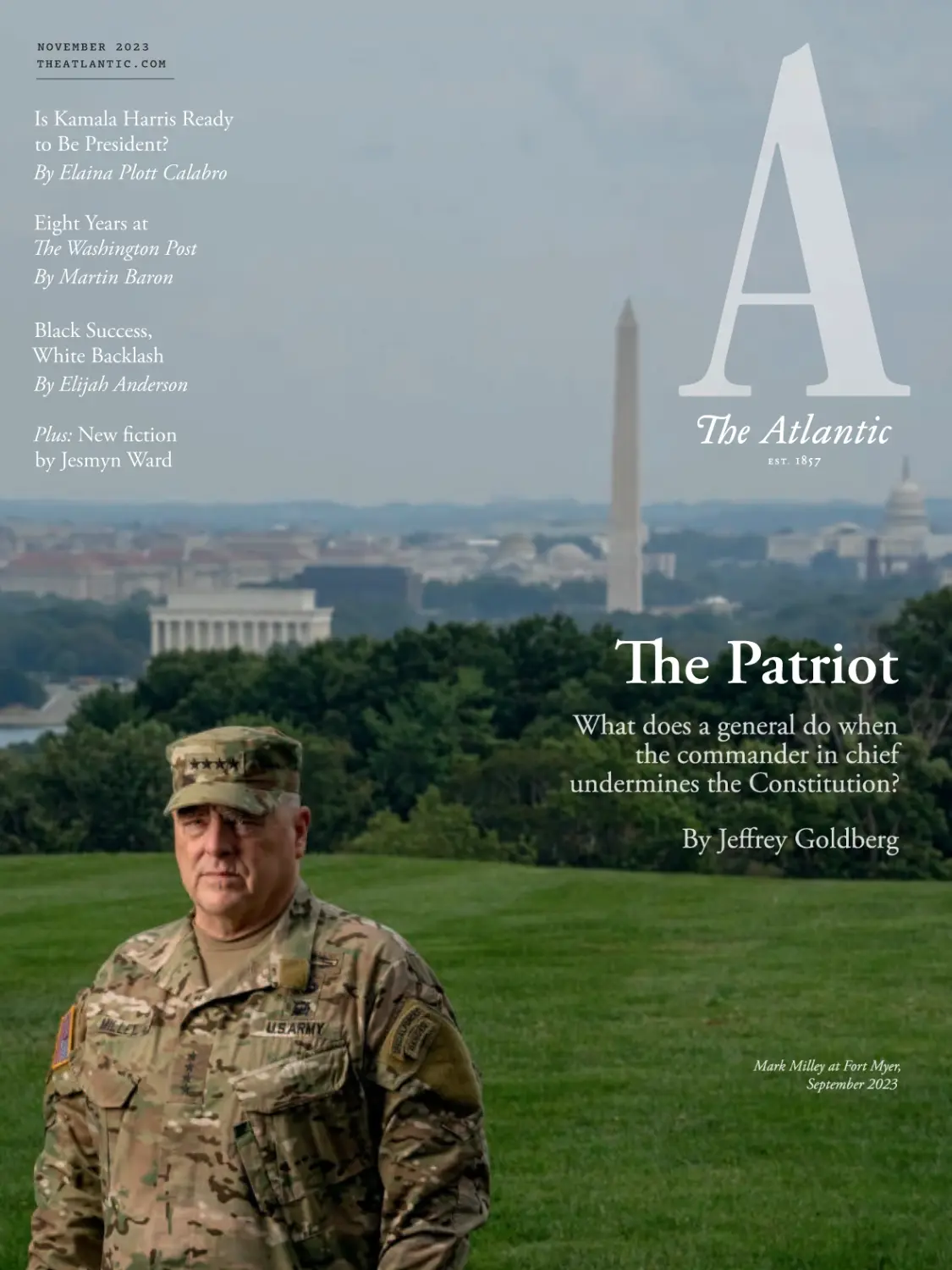
B e h i n d t h e C o v e r : In this issue’s cover story, he Atlantic’s
editor in chief, Jefrey Goldberg, proiles General Mark Milley,
the retiring chairman of the Joint Chiefs of Staf. For our cover
image, the war photographer Ashley Gilbertson captured Milley
outside Quarters Six, the chairman’s residence in Arlington,
Virginia. Quarters Six looks out onto the Capitol from Joint
Base Myer–Henderson Hall, originally built to defend Washington, D.C., from the Confederate army during the Civil War.
Gilbertson was a inalist for a 2022 Pulitzer Prize for his photograph of the Capitol Police oicer Eugene Goodman as he
defended the building from insurrectionists on January 6, 2021.
— Bifen Xu, Photo Editor
Jennifer Senior’s
aunt Adele was
institutionalized as
a toddler because
of an intellectual
and developmental
disability. For the
September 2023 issue,
Senior considered
the life Adele could
have lived.
The Ones We
Sent Away
Letters
J
6
Jennifer Senior’s story about
her aunt’s institutionalization
struck a deep chord with me.
My family has a similar story,
made worse when I found out
that I was the reason my sister was sent to a state “school.”
My mother cared for her oldest child, who was developmentally delayed, for the irst two
years of her life. But in 1950,
she surrendered her to the state
under intense pressure from
family members, who felt that
my expectant mother wouldn’t
be able to handle a newborn—
me—and a high-needs daughter
at the same time. My sister languished at the “school” for many
years and never learned to walk.
She died shortly after the institution was closed; an exposé had
made public its shortcomings. I
met my sister only once, when I
was in college. I’ll never forget
how happy she seemed having
somebody watch her eat lunch.
She never took her eyes of me;
it was like she knew who I was.
Hardly anyone remembers her
now, but I will, always. Her
name was Cheryl.
Wayne April
Pasadena, Calif.
I felt tears welling up as I read
Jennifer Senior’s moving story
about her aunt Adele, and by
its conclusion, they ran freely.
My older brother, Larry,
shares a birthday with Adele.
He, too, was born with severe
disabilities; in fact, at birth, the
doctors told my parents that he
would not survive more than a
few weeks.
NOVEMBER 2023
THE
Larry proved them wrong—
repeatedly. He recently celebrated his 47th birthday. My
parents did not institutionalize
him, but cared for him through
dozens of complex surgeries,
years of developmental frustrations, and countless instances
of unfeeling relatives asking
why they bothered to keep
him. hey had two more children after Larry: myself and my
younger brother. Putting in the
emotional, physical, and logistical labor to care for a child with
special needs while maintaining the bandwidth to meet the
needs of their other children was
a signiicant challenge for them.
My younger brother and
I have felt the repercussions
of that challenge for decades
now, for both good and bad.
Larry, more than anyone else,
has made me the man I am. But
to this day, when I hear about a
family raising a child with special needs, I feel obligated to
stress the importance of making sure that their other children are given as much attention and love as possible.
Ryan Wagman
Northbrook, Ill.
I would like to share my family’s
experience, which cuts against
the current prevailing sentiment
that the best place for children
with severe developmental and
behavioral disabilities is their
family’s home.
My stepson J. has a number
of diagnoses, all of which fail to
describe the problems he lives
with. I entered his life when he
was a little over 2 years old. He’ll
turn 9 in a couple of months.
C OM MONS
J. isn’t nonverbal, but his ability
to meaningfully communicate
is quite poor. Lately, you can
catch him sitting in the living
room before dawn, wearing his
headphones and singing along
to the Sesame Street spin-off
he Furchester Hotel at an earsplitting volume. His ecstatic
refrain ills the house over and
over as he rewinds the clip to the
bit he loves. Half of my heart
loods with his joy, but the other
half sinks with the woe of a
mom whose babies are going
to be up an hour early. He isn’t
potty-trained and uses diapers.
Some days, he prefers to take
of his clothes and use the loor.
J. has the highest highs and
the lowest lows. He loves football. He loves going to church
and, afterward, Runza (“But not
the drive-through,” he reminds
us). No one loves a birthday
party more than J., as long as
he gets to blow out some candles. But, in general, it doesn’t
take long for him to grow frustrated, and for his frustration
to turn into violence. He bites,
scratches, punches, kicks. He
pulls hair. He slams his head into
the ground, the walls, the windows. He hurts the dogs. He’s
broken the glasses on a teacher’s
face and the television on the
wall. He’s sent two adults to the
emergency room. Our nanny
stopped caring for him after she
was injured. He was dismissed
from his specialized before- and
after-school care program. He
can still attend school, but who
knows how long that will last?
His older brother tries to
keep quiet about the sufering he
experiences. He will occasionally
admit that a mark on his skin is
a scratch or bruise from trying to
escape J.’s aggression. He recently
mentioned that he would like
it if J. would wear clothes more
often and stop going to the bathroom on the carpet. He prefers to
stay home and avoid the gawking public. J.’s two younger halfsiblings are frightened by the
outbursts, but so far are too
young to really understand.
I often wonder what terrible
choice I will have to make if one
of them is severely hurt.
J. has progressed to a point
where he no longer its safely
in the context of a family. We
hold our breath, hoping each
day that this won’t be the time
things really go bad. But at any
suggestion that it might not be
safe for J. to live in our family
home, we are told that, no, the
best place for any disabled child
is in the family home. Because,
you know, the Bad Old Days.
At irst, this felt like it must
be true. Over time, however, it
has come to feel like a disingenuous strategy to keep care cheap.
he conditions at many of the
institutions where children
like J. were once warehoused
were horriic, as Jennifer Senior
makes clear in her article. But
that doesn’t mean institutional
care can’t work, or be the right
DISCUSSION
&
DEBATE
solution for some children—
which Senior also acknowledges.
J. needs specialized care. He
needs an adult to make him their
sole focus from when he wakes
up until he goes to sleep. It’s a
full-time job—not something a
parent can easily do while maintaining a career, a marriage, or
a relationship with their other
children. If there were a willingness to make the necessary investment, I imagine we
could develop a system of highquality care for children with
serious behavioral disorders
that meets each child and family where they are, providing the
right care in the right setting
at the right time. In the meantime, we feel like we are failing
J. and our other children. he
implied message we hear from
many we encounter is that if we
were able to love him better or
be more dedicated, we could do
it. We feel overwhelmed all the
time, helpless and inadequate.
We are old beyond our years and
carry the special weariness of the
chronically heartbroken.
Name Withheld by Request
Omaha, Neb.
I began volunteering with individuals with disabilities as a
junior in high school in 1979.
In 1982, it became my career.
A signiicant part of my job in
the early years was helping facilitate the deinstitutionalization of
individuals with developmental disabilities in West Virginia.
I’m proud that West Virginia
was among the irst states in the
nation to fully close its institutions; even so, I witnessed
untold horrors in those places.
hen, in 1993, my son, Benjamin, was born with Down
syndrome and autism-spectrum
disorder. What had been a career
choice suddenly became my life
24/7. hough the institutions
no longer exist, signiicant perils
remain: Individuals with disabilities are much more likely to be
victims of abuse or neglect than
nondisabled individuals. Across
the country, disabled adults lack
housing, meaningful jobs, and
support services.
As long as we are able to care
for Ben, he will reside with us.
he day I can no longer care for
him will be the worst day of my
life. Even though Ben will go
to live with his sister, I know
I’ll feel as though I failed him.
I’m now 60 and have been in
the ield for more than 40 years.
I’m still working with the orneriest of the ornery, and I’m still
loving it. We must never forget the evil that occurred and
continues to occur to individuals with developmental disabilities, our most vulnerable population. A sincere thanks to Jennifer
Senior for reminding us.
Kent Moreno
Shepherdstown, W.Va.
To respond to Atlantic articles or
submit author questions to he Commons,
please email letters@theatlantic.com.
Include your full name, city, and state.
editorial offices & correspondence he Atlantic considers unsolicited manuscripts, iction or noniction, and mail for the Letters column. Manuscripts will not be returned. For instructions on sending
manuscripts via email, see theatlantic.com/faq. By submitting a letter, you agree to let us use it, as well as your full name, city, and state, in our magazine and/or on our website. We may edit for clarity.
customer service & reprints Please direct all subscription queries and orders to: +1 855-940-0585. For expedited customer service, please call between 9 a.m. and 6 p.m. ET, Monday through
Friday. You may also write to: Atlantic Customer Care, P.O. Box 37564, Boone, IA 50037-0564. Reprint requests should be made to Sisk at 410-754-8219 or atlanticbackissue@siskfs.com.
A discount rate is available for students and educators. Please visit theatlantic.com/subscribe/academic. advertising offices he Atlantic, 130 Prince Street 3rd Floor, New York, NY 10012, 646-539-6700.
7
Perform Next Level
Unlock your unique potential with the next generation Sleep Number® smart beds.
You need a bed that performs as well as you do. Effortlessly adjusting and responding to you.
Learning how you sleep, so you learn to sleep better—night after night. From $1,099.
Sleep Next Level
™
visit sleepnumber.com/atlantic | 1-877-346-5412
Prices higher in AK and HI. SLEEP NUMBER, SLEEPIQ, SLEEP NUMBER 360, the Double Arrow Design, and SELECT COMFORT are registered trademarks of Sleep Number Corporation. © 2023 Sleep Number Corporation
D I S PAT C H E S
OPE NING A RGU M E N T
BLACK
SUCCESS,
WHITE
BACKLASH
Black prosperity has provoked white
resentment that can make life
exhausting for people of color—and it
has led to the undoing of policies that
have nurtured Black advancement.
BY ELIJA H A NDERSON
F
For more than half a century, I have been
studying the shifting relations between
white and Black Americans. My first
journal article, published in 1972, when
I was a graduate student at the University of Chicago, was about Black political
power in the industrial Midwest after the
riots of the late 1960s. My own experience of race relations in America is even
longer. I was born in the Mississippi Delta
during World War II, in a cabin on what
used to be a plantation, and then moved
as a young boy to northern Indiana, where
as a Black person in the early 1950s, I
was constantly reminded of “my place,”
9
Dispatches
and of the penalties for overstepping it. Seeing the image
of Emmett Till’s dead body in
Jet magazine in 1955 brought
home vividly for my generation of Black kids that the consequences of failing to navigate
carefully among white people
could even be lethal.
For the past 16 years, I
have been on the faculty of the
sociology department at Yale,
and in 2018 I was granted a
Sterling Professorship, the
highest academic rank the university bestows. I say this not
to boast, but to illustrate that
I have made my way from the
bottom of American society to
the top, from a sharecropper’s
cabin to the pinnacle of the
ivory tower. One might think
that, as a decorated professor at an Ivy League university, I would have escaped
the various indignities that
being Black in traditionally
white spaces exposes you
to. And to be sure, I enjoy
many of the privileges my
white professional-class peers
do. But the Black ghetto—a
destitute and fearsome place
in the popular imagination,
though in reality it is home to
legions of decent, hardworking
families—remains so powerful that it attaches to all Black
Americans, no matter where
and how they live. Regardless
of their wealth or professional
status or years of law-abiding
bourgeois decency, Black people simply cannot escape what
I call the “iconic ghetto.”
I know I haven’t. Some
years ago, I spent two weeks
in Wellleet, Massachusetts, a
pleasant Cape Cod town full
of upper-middle-class white
vacationers and workingclass white year-rounders. On
my daily jog one morning, a
white man in a pickup truck
stopped in the middle of the
10
road, yelling and gesticulating.
“Go home!” he shouted.
Who was this man? Did
he assume, because of my
Black skin, that I was from the
ghetto? Is that where he wanted
me to “go home” to?
This was not an isolated
incident. When I jog through
upscale white neighborhoods
near my home in Connecticut, white people tense up—
unless I wear my Yale or
University of Pennsylvania
sweatshirts. When my jogging outit associates me with
an Ivy League university, it
identiies me as a certain kind
of Black person: a less scary
one who has passed inspection under the “white gaze.”
Strangers with dark skin are
suspect until they can prove
their trustworthiness, which
is hard to do in leeting public
interactions. For this reason,
Black students attending universities near inner cities know
to wear college apparel, in
hopes of avoiding racial proiling by the police or others.
I once accidentally ran a
small social experiment about
this. When I joined the Yale
faculty in 2007, I bought
about 20 university baseball
caps to give to the young
people at my family reunion
that year. Later, my nieces
and nephews reported to me
that wearing the Yale insignia
had transformed their casual
interactions with white strangers: White people would now
approach them to engage in
friendly small talk.
But sometimes these signifiers of professional status
and educated-class propriety
are not enough. This can be
true even in the most rareied
spaces. When I was hired at
Yale, the chair of the sociology department invited me
for dinner at the Yale Club
of New York City. Clad in a
blue blazer, I got to the club
early and decided to go up to
the fourth-loor library to read
The New York Times. When
the elevator arrived, a crush of
people was waiting to get on it,
WHEN I JOG
THROUGH
UPSCALE WHITE
NEIGHBORHOODS
NEAR MY HOME,
WHITE PEOPLE
TENSE UP—
UNLESS I WEAR
MY YALE OR PENN
SWEATSHIRT.
so I entered and moved to the
back to make room for others.
Everyone except me was white.
As the car filled up, I
politely asked a man of about
35, standing by the controls,
to push the button for the
library loor. He looked at me
and—emboldened, I have to
imagine, by drinks in the bar
downstairs—said, “You can
read?” he car fell silent. After
a few tense moments, another
man, seeking to defuse the
tension, blurted, “I’ve never
met a Yalie who couldn’t
read.” All eyes turned to me.
The car reached the fourth
loor. I stepped of, held the
door open, and turned back
to the people in the elevator.
“I’m not a Yalie,” I said. “I’m
a new Yale professor.” And I
NOVEMBER 2023
went into the library to read
the paper.
I t e l l t h e s e stories—and
I’ve told them before—not to
fault any particular institution (I’ve treasured my time
at Yale), but to illustrate my
personal experience of a recurring cultural phenomenon:
Throughout American history, every moment of signiicant Black advancement has
been met by a white backlash.
After the Civil War, under the
aegis of Reconstruction, Black
people for a time became professionals and congressmen.
But when federal troops left
the former Confederate states
in 1877, white politicians in
the South tried to reconstitute slavery with the long rule
of Jim Crow. Even the Black
people who migrated north
to escape this new servitude
found themselves relegated to
shantytowns on the edges of
cities, precursors to the modern Black ghetto.
All of this reinforced what
slavery had originally established: the Black body’s place
at the bottom of the social
order. his racist positioning
became institutionalized in
innumerable ways, and it persists today.
I want to emphasize that
across the decades, many white
Americans have encouraged
racial equality, albeit sometimes under duress. In response
to the riots of the 1960s, the
federal government—led by
the former segregationist Lyndon B. Johnson—passed farreaching legislation that inally
extended the full rights of citizenship to Black people, while
targeting segregation. These
legislative reforms—and,
especially, airmative action,
which was implemented
via LBJ’s executive order in
GETTY / ARTPARTNER-IMAGES
OPE NING A RGU M E N T
1965—combined with years
of economic expansion to produce a long period of what I
call “racial incorporation,”
which substantially elevated
the income of many Black
people and brought them
into previously white spaces.
Yes, a lot of airmative-action
eforts stopped at mere tokenism. Even so, many of these
“tokens” managed to succeed,
and the result is the largest
Black middle class in American history.
Over the past 50 years,
according to a study by the
Pew Research Center, the
proportion of Black people
who are low-income (less than
$52,000 a year for a household of three) has fallen seven
points, from 48 to 41 percent. The proportion who
are middle-income ($52,000
to $156,000 a year) has risen
by one point, to 47 percent. The proportion who
are high-income (more than
$156,000 a year) has risen
the most dramatically, from 5
to 12 percent. Overall, Black
poverty remains egregiously
dis proportionate to that of
white and Asian Americans.
But fewer Black Americans are
poor than 50 years ago, and
more than twice as many are
rich. Substantial numbers now
attend the best schools, pursue professions of their choosing, and occupy positions of
power and prestige. Airmative action worked.
But that very success has
inlamed the inevitable white
backlash. Notably, the only
racial group more likely to
be low-income now than 50
years ago is whites—and the
only group less likely to be
low-income is Blacks.
For some white people displaced from their
jobs by globalization and
deindustrialization, the successful Black person with a
good job is the embodiment
of what’s wrong with America.
he spectacle of Black doctors,
CEOs, and college professors
of interaction, in the guise of
a casual watercooler conversation, the gist of which is a
sort of interrogation: “Where
did you come from?”; “How
did you get here?”; and “Are
is required, a performance in
which the worker must demonstrate their propriety, their
distance from the ghetto. his
can involve dressing more formally than the job requires,
“out of their place” creates an
uncomfortable dissonance,
which white people deal with
by mentally relegating successful Black people to the ghetto.
hat Black man who drives a
new Lexus and sends his children to private school—he
must be a drug kingpin, right?
In predominantly white
professional spaces, this racial
anxiety appears in subtler
ways. Black people are all too
familiar with a particular kind
you qualified to be here?”
(The presumptive answer to
the last question is clearly no;
Black skin, evoking for white
people the iconic ghetto, confers an automatic deficit of
credibility.)
Black newcomers must signal quickly and clearly that they
belong. Sometimes this requires
something as simple as showing a company ID that white
people are not asked for. Other
times, a more elaborate dance
speaking in a self-consciously
educated way, and evincing a
placid demeanor, especially in
moments of disagreement.
As part of my ethnographic
research, I once embedded in a
major inancial-services corporation in Philadelphia, where
I spent six months observing
and interviewing workers. One
Black employee I spoke with, a
senior vice president, said that
people of color who wanted to
climb the management ladder
ILLUSTRATION BY GABRIELA PESQUEIRA
11
Dispatches
must wear the right “uniform”
and work hard to perform
respectability. “hey’re never
going to envision you as being
a white male,” he told me, “but
if you can dress the same and
look a certain way and drive a
conservative car and whatever
else, they’ll say, ‘his guy has a
similar attitude, similar values
[to we white people]. He’s a
team player.’ If you don’t dress
with the uniform, obviously
you’re on the wrong team.”
This need to constantly
perform respectability for
white people is a psychological drain, leaving Black people
spent and demoralized. hey
typically keep this demoralization hidden from their white
co-workers because they feel
that they need to show they
are not whiners. Having
to pay a “Black tax” as they
move through white areas
deepens this demoralization.
his tax is levied on people of
color in nice restaurants and
other public places, or simply while driving, when the
fear of a lethal encounter with
the police must always be in
mind. he existential danger
this kind of encounter poses
is what necessitates “he Talk”
that Black parents—fearful
every time their kids go out
the door that they might not
come back alive—give to
their children. The psychological effects of all of this
accumulate gradually, sapping the spirit and engendering cynicism.
Even the most exalted
members of the Black elite
must live in two worlds.
They understand the white
elite’s mores and values, and
embody them to a substantial extent—but they typically
remain keenly conscious of
their Blackness. hey socialize with both white and Black
12
people of their own professional standing, but also members of the Black middle and
working classes with whom
they feel more kinship, meeting them at the barbershop,
in church, or at gatherings
of long-standing friendship
groups. The two worlds seldom overlap. This calls to
mind W. E. B. Du Bois’ “double consciousness”—a term
he used for the first time in
this publication, in 1897—
referring to the dual cultural
mindsets that successful African Americans must simultaneously inhabit.
For middle-class Black people, a certain luidity—abetted
by family connections—
enables them to feel a connection with those at the lower
reaches of society. But that
connection comes with a risk
of contagion; they fear that,
meritocratic status notwithstanding, they may be dragged
down by their association with
the hood.
W h e n I w o r k e d at the
University of Pennsylvania,
some friends of mine and I
mentored at-risk youth in
West Philadelphia.
One of these kids, Kevin
Robinson, who goes by
KAYR (pronounced “K.R.”),
grew up with six siblings in
a single-parent household on
public assistance. Two of his
sisters got pregnant as teenagers, and for a while the
whole family was homeless.
But he did well in high school
and was accepted to Bowdoin
College, where he was one
of five African Americans in
a class of 440. He was then
accepted to Dartmouth’s Tuck
School of Business, where he
was one of 10 or so African
Americans in an M.B.A. class
of roughly 180. He got into
the analyst-training program
at Goldman Sachs, where his
cohort of 300 had ive African
Americans. And from there
TO SURVIVE
IN WHITE
WORKPLACES,
BLACK
NEWCOMERS
MUST PERFORM
AN ELABORATE
DANCE IN
WHICH THEY
DEMONSTRATE
THEIR
DISTANCE
FROM THE
GHETTO.
he ended up at a hedge fund,
where he was the lone Black
employee.
What’s striking about Robinson’s accomplishments is
not just the steepness of his
rise or the scantness of Black
peers as he climbed, but the
extent of cultural assimilation
he felt he needed to achieve in
order to fit in. He trimmed
his Afro. He did a pre-college
program before starting Bowdoin, where he had sushi for
the irst time and learned how
to play tennis and golf. “Let
me look at how these people live; let me see how they
operate,” he recalls saying to
himself. He decided to start
reading he New Yorker and
Time magazine, as they did,
and to watch 60 Minutes. “I
wanted people to see me more
as their peer versus … someone from the hood. I wanted
NOVEMBER 2023
them to see me as, like, ‘Hey,
look, he’s just another middleclass Black kid.’ ” When he
was about to start at Goldman Sachs, a Latina woman
who was mentoring him there
told him not to wear a silver
watch or prominent jewelry:
“ ‘KAYR, go get a Timex with
a black leather band. Keep it
very simple … Fit in.’ ” My
friends and I had given him
similar advice earlier on.
All of this worked; he
thrived professionally. Yet even
as he occupied elite precincts
of wealth and achievement, he
was continually getting pulled
back to support family in the
ghetto, where he felt the need
to code-switch, speaking and
eating the ways his family did
so as not to insult them.
he year he entered Bowdoin, one of his younger
brothers was sent to prison for
attempted murder, and a sister who had four children was
shot in the face and died. Over
the years he would pay for
school supplies for his nieces
and nephews, and for multiple
family funerals—all while
keeping his family background
a secret from his professional
colleagues. Even so, he would
get subjected to the standard
indignities—being asked to
show ID when his white peers
were not; enduring the (sometimes obliviously) racist comments from colleagues (“You
don’t act like a regular Black”).
He would report egregious
ofenses to HR but would usually just let things go, for fear
that developing a reputation as
a “race guy” would restrict his
professional advancement.
Robinson’s is a remarkable
success story. He is 40 now; he
owns a property-management
company and is a multimillionaire. But his experience
makes clear that no matter what
OPE NING A RGU M E N T
professional or inancial heights
you ascend to, if you are Black,
you can never escape the iconic
ghetto, and sometimes not even
the actual one.
The most egregious
intrusion of a Black person
into white space was the election (and reelection) of Barack
Obama as president. A Black
man in the White House!
For some white people, this
was intolerable. Birthers, led
by Donald Trump, said he
was ineligible for the presidency, claiming falsely that
he had been born in Kenya.
The white backlash intensified; Republicans opposed
Obama with more than the
standard amount of partisan
vigor. In 2013, at the beginning of Obama’s second term,
the Supreme Court gutted
the Voting Rights Act, which
had protected the franchise
for 50 years. Encouraged by
this opening, Alabama, Mississippi, North Carolina, and
Texas moved forward with
voter-suppression laws, setting
a course that other states are
now following. And this year,
the Supreme Court outlawed
affirmative action in college
admissions. I want to tell a
story that illustrates the social
gains this puts at risk.
Many years ago, when I was
a professor at Penn, my father
came to visit me. Walking
around campus, we bumped
into various colleagues and students of mine, most of them
white, who greeted us warmly.
He watched me interact with
my secretary and other department administrators. Afterward, Dad and I went back to
my house to drink beer and
listen to Muddy Waters.
“So you’re teaching at that
white school?” he said.
“Yeah.”
“You work with white
people. And you teach white
students.”
“Yeah, but they actually come in all colors,” I
responded. I got his point,
though.
“Well, let me ask you one
thing,” he said, furrowing his
brow.
“What’s that, Dad?”
“Do they respect you?”
After thinking about his
question a bit, I said, “Well,
some do. And some don’t. But
you know, Dad, it is hard to tell
which is which sometimes.”
“Oh, I see,” he said.
He didn’t disbelieve me;
it was just that what he’d witnessed on campus was at odds
with his experience of the typical Black-white interaction,
where the subordinate status
of the Black person was automatically assumed by the white
one. Growing up in the South,
my dad understood that
white people simply did not
respect Black people. Observing the respectful treatment
I received from my students
and colleagues, my father had
a hard time believing his own
eyes. Could race relations have
changed so much, so fast?
They had—in large part
because of what affirmative
action, and the general processes of racial incorporation
and Black economic improvement, had wrought. In the
1960s, the only Black people
at the inancial-services irm I
studied would have been janitors, night watchmen, elevator
operators, or secretaries; 30
years later, affirmative action
had helped populate the irm
with Black executives. Each
beneficiary of affirmative
action, each member of the
growing Black middle class,
helped normalize the presence
of Black people in professional
and other historically white
spaces. All of this diminished,
in some incremental way, the
power of the symbolic ghetto to
hold back people of color.
Too many people forget, if
ever they knew it, what a profound cultural shift airmative
action efected. And they overlook airmative action’s crucial
role in forestalling social unrest.
Some years ago, I was
invited to the College of the
Atlantic, a small school in
Maine, to give the commencement address. As I stood at the
sink in the men’s room before
the event, checking the mirror
to make sure all my academic
regalia was properly arrayed,
an older white man came up
to me and said, with no preamble, “What do you think of
airmative action?”
“I think it’s a form of reparations,” I said.
“Well, I think they need to
be educated irst,” he said, and
then walked out.
I was so provoked by this
that I scrambled back to my
hotel room and rewrote my
speech. I’d already been planning to talk about the beneits
of affirmative action, but I
sharpened and expanded my
case, explaining that it not
only had lifted many Black
people out of the ghetto, but
had been a weapon in the Cold
War, when unaligned countries
and former colonies were trying
to decide which superpower to
follow. Back then, Democrats
and some Republicans were
united in believing that airmative action, by demonstrating the country’s commitment
to racial justice and equality,
helped project American greatness to the world.
Beyond that, I said to this
almost entirely white audience, airmative action had
helped keep the racial unrest
of the ’60s from flaring up
again. When the kin—the
mothers, fathers, cousins,
nephews, sons, daughters,
baby mamas, uncles, aunts—
of ghetto residents secure
middle-class livelihoods, those
ghetto relatives hear about it.
his gives the young people
who live there a modicum
of hope that they might do
the same. Hope takes the
edge of distress and desperation; it lessens the incentives
for people to loot and burn.
What opponents of airmative action fail to understand
is that without a ladder of
upward mobility for Black
Americans, and a general
sense that justice will prevail,
a powerful nurturer of social
concord gets lost.
Yes, continuing to expand
the Black professional and
middle classes will lead to
more instances of “the dance,”
and the loaded interrogations, and the other awkward
moments and indignities that
people of color experience in
white spaces. But the greater
the number of affluent, successful Black people in such
places, the faster this awkwardness will diminish, and the less
power the recurrent waves of
white reaction will have to set
people of color back. I would
like to believe that future generations of Black Americans
will someday ind themselves
as pleasantly surprised as my
dad once was by the new levels
of racial respect and equality
they discover.
Elijah Anderson is the Sterling
Professor of Sociology and of African
American Studies at Yale, and a
recent Stockholm Prize laureate. His
most recent book is Black in White
Space: he Enduring Impact of
Color in Everyday Life.
13
14
NOVEMBER
TK 2021
2023
THE
PATRIOT
What does
a general
do when the
commander
in chief
undermines
the
Constitution?
By
JEFFREY
GOLDBERG
Photographs by
Ashley Gilbertson
15
T
he missiles that comprise the land
component of America’s nuclear
triad are scattered across thousands of
square miles of prairie and farmland,
mainly in North Dakota, Montana,
and Wyoming. About 150 of the
roughly 400 Minuteman III intercontinental ballistic missiles currently
on alert are dispersed in a wide circle
around Minot Air Force Base, in the
upper reaches of North Dakota. From
Minot, it would take an ICBM about
25 minutes to reach Moscow.
hese nuclear weapons are under
the control of the 91st Missile Wing
of the Air Force Global Strike Command, and it was to the 91st—the
“Rough Riders”—that General
Mark Milley, the chairman of the
Joint Chiefs of Staf, paid a visit in
March 2021. I accompanied him on
the trip. A little more than two months had passed since the
January 6 attack on the Capitol, and America’s nuclear arsenal
was on Milley’s mind.
In normal times, the chairman of the Joint Chiefs, the principal
military adviser to the president, is supposed to focus his attention
on America’s national-security challenges, and on the readiness and
lethality of its armed forces. But the irst 16 months of Milley’s term,
a period that ended when Joe Biden succeeded Donald Trump as
president, were not normal, because Trump was exceptionally unit
to serve. “For more than 200 years, the assumption in this country
was that we would have a stable person as president,” one of Milley’s
mentors, the retired three-star general James Dubik, told me. hat
this assumption did not hold true during the Trump administration
presented a “unique challenge” for Milley, Dubik said.
Milley was careful to refrain from commenting publicly on
Trump’s cognitive unitness and moral derangement. In interviews, he would say that it is not the place of the nation’s lag
oicers to discuss the performance of the nation’s civilian leaders.
But his views emerged in a number of books published after
Trump left oice, written by authors who had spoken with Milley,
and many other civilian and military oicials, on background.
In he Divider, Peter Baker and Susan Glasser write that Milley
believed that Trump was “shameful,” and “complicit” in the January 6 attack. hey also reported that Milley feared that Trump’s
“ ‘Hitler-like’ embrace of the big lie about the election would
prompt the president to seek out a ‘Reichstag moment.’”
hese views of Trump align with those of many oicials who
served in his administration. Trump’s irst secretary of state, Rex
Tillerson, considered Trump to be a “fucking moron.” John
Kelly, the retired Marine general who served as Trump’s chief
of staf in 2017 and 2018, has said that Trump is the “most
lawed person” he’s ever met. James Mattis, who is also a retired
Marine general and served as Trump’s irst secretary of defense,
has told friends and colleagues that the 45th president was
16
“more dangerous than anyone could ever imagine.” It is widely
known that Trump’s second secretary of defense, Mark Esper,
believed that the president didn’t understand his own duties,
much less the oath that oicers swear to the Constitution, or
military ethics, or the history of America.
Twenty men have served as the chairman of the Joint Chiefs
since the position was created after World War II. Until Milley,
none had been forced to confront the possibility that a president
would try to foment or provoke a coup in order to illegally remain
in oice. A plain reading of the record shows that in the chaotic
period before and after the 2020 election, Milley did as much, or
more, than any other American to defend the constitutional order,
to prevent the military from being deployed against the American people, and to forestall the eruption of wars with America’s
nuclear-armed adversaries. Along the way, Milley delected Trump’s
exhortations to have the U.S. military ignore, and even on occasion commit, war crimes. Milley and other military oicers deserve
praise for protecting democracy, but their actions should also cause
deep unease. In the American system, it is the voters, the courts,
and Congress that are meant to serve as checks on a president’s
behavior, not the generals. Civilians provide direction, funding,
and oversight; the military then follows lawful orders.
he diiculty of the task before Milley was captured most
succinctly by Lieutenant General H. R. McMaster, the second
of Trump’s four national security advisers. “As chairman, you
swear to support and defend the Constitution of the United
States, but what if the commander in chief is undermining the
Constitution?” McMaster said to me.
For the actions he took in the last months of the Trump presidency, Milley, whose four-year term as chairman, and 43-year career
as an Army oicer, concluded at the end of September, has been
condemned by elements of the far right. Kash Patel, whom Trump
installed in a senior Pentagon role in the inal days of his administration, refers to Milley as “the Kraken of the swamp.” Trump
himself has accused Milley of treason. Sebastian Gorka, a former
Trump White House oicial, has said that Milley deserves to be
placed in “shackles and leg irons.” If a second Trump administration were to attempt this, however, the Trumpist faction would be
opposed by the large group of ex-Trump-administration oicials
who believe that the former president continues to pose a unique
threat to American democracy, and who believe that Milley is a
hero for what he did to protect the country and the Constitution.
“Mark Milley had to contain the impulses of people who
wanted to use the United States military in very dangerous ways,”
Kelly told me. “Mark had a very, very diicult reality to deal
with in his irst two years as chairman, and he served honorably
and well. he president couldn’t fathom people who served their
nation honorably.” Kelly, along with other former administration
oicials, has argued that Trump has a contemptuous view of the
military, and that this contempt made it extraordinarily diicult
to explain to Trump such concepts as honor, sacriice, and duty.
Robert Gates, who served as secretary of defense under Presidents
George W. Bush and Barack Obama, told me that no Joint Chiefs
chairman has ever been tested in the manner Milley was. “General
Milley has done an extraordinary job under the most extraordinary
NOVEMBER
TK 2021
2023
of circumstances,” Gates said. “I’ve worked for eight presidents,
and not even Lyndon Johnson or Richard Nixon in their angriest
moments would have considered doing or saying some of the things
that were said between the election and January 6.”
Gates believes that Milley, who served as his military assistant
when Gates was Bush’s secretary of defense, was uniquely qualiied to
defend the Constitution from Trump during those inal days. “General Milley expected to be ired every single day between Election
Day and January 6,” he said. A less conident and assertive chairman
might not have held the line against Trump’s antidemocratic plots.
When I mentioned Gates’s assessment to Milley, he demurred.
“I think that any of my peers would have done the same thing.
Why do I say that? First of all, I know them. Second, we all think
the same way about the Constitution.”
Some of those who served in Trump’s administration say that
he appointed Milley chairman because he was drawn to Milley’s
warrior reputation, tanklike build, and four-star eyebrows. Senator Angus King of Maine, a political independent who is a supporter of Milley’s, told me, “Trump picked him as chief because
he looks like what Trump thinks a general should look like.” But
Trump misjudged him, King said. “He thought he would be loyal
to him and not to the Constitution.” Trump had been led to believe
that Milley would be more malleable than other generals. his
misunderstanding threatened to become indelibly ingrained in
Washington when Milley made what many people consider to be
his most serious mistake as chairman. During the George Floyd
protests in early June 2020, Milley, wearing combat fatigues, followed Trump out of the White House to Lafayette Square, which
had just been cleared of demonstrators by force. Milley realized
too late that Trump, who continued across the street to pose for
a now-infamous photo while standing in front of a vandalized
church, was manipulating him into a visual endorsement of his
BEFORE MILLEY,
NO JOINT CHIEFS
CHAIRMAN HAD BEEN
FORCED TO DEAL
WITH A PRESIDENT
WHO’D ATTEMPTED
TO FOMENT A COUP
IN ORDER TO REMAIN
ILLEGALLY IN OFFICE.
martial approach to the demonstrations. hough Milley left the
entourage before it reached the church, the damage was signiicant.
“We’re getting the fuck out of here,” Milley said to his security
chief. “I’m fucking done with this shit.” Esper would later say that
he and Milley had been duped.
For Milley, Lafayette Square was an agonizing episode; he
described it later as a “road-to-Damascus moment.” he week
afterward, in a commencement address to the National Defense
University, he apologized to the armed forces and the country.
“I should not have been there,” he said. “My presence in that
moment and in that environment created a perception of the
military involved in domestic politics.” His apology earned him
the permanent enmity of Trump, who told him that apologies
are a sign of weakness.
Joseph Dunford, the Marine general who preceded Milley as
chairman of the Joint Chiefs, had also faced onerous and unusual
challenges. But during the irst two years of the Trump presidency,
Dunford had been supported by oicials such as Kelly, Mattis,
Tillerson, and McMaster. hese men attempted, with intermittent
success, to keep the president’s most dangerous impulses in check.
(According to the Associated Press, Kelly and Mattis made a pact
with each other that one of them would remain in the country at
all times, so the president would never be left unmonitored.) By
the time Milley assumed the chairman’s role, all of those oicials
were gone—driven out or ired.
At the top of the list of worries for these officials was the
management of America’s nuclear arsenal. Early in Trump’s term,
when Milley was serving as chief of staf of the Army, Trump
entered a cycle of rhetorical warfare with the North Korean dictator Kim Jong Un. At certain points, Trump raised the possibility
of attacking North Korea with nuclear weapons, according to
the New York Times reporter Michael S. Schmidt’s book, Donald Trump v. he United States. Kelly, Dunford, and others tried
to convince Trump that his rhetoric—publicly mocking Kim as
“Little Rocket Man,” for instance—could trigger nuclear war. “If
you keep pushing this clown, he could do something with nuclear
weapons,” Kelly told him, explaining that Kim, though a dictator,
could be pressured by his own military elites to attack American
interests in response to Trump’s provocations. When that argument
failed to work, Kelly spelled out for the president that a nuclear
exchange could cost the lives of millions of Koreans and Japanese,
as well as those of Americans throughout the Paciic. Guam, Kelly
told him, falls within range of North Korean missiles. “Guam isn’t
America,” Trump responded.
T h o u g h t h e s pe c t e r of a recklessly instigated nuclear confrontation abated when Joe Biden came to oice, the threat was
still on Milley’s mind, which is why he set out to visit Minot
that day in March.
In addition to housing the 91st Missile Wing, Minot is
home to the Air Force’s 5th Bomb Wing, and I watched Milley
spend the morning inspecting a leet of B-52 bombers. Milley
enjoys meeting the rank and ile, and he quizzed air crews—
who appeared a little unnerved at being interrogated with such
exuberance by the chairman of the Joint Chiefs—about their
17
roles, needs, and responsibilities. We then lew by helicopter
to a distant launch-control facility, to visit the missile oicers
in charge of the Minuteman IIIs. he underground bunker is
stafed continuously by two launch oicers, who are responsible
for a light of 10 missiles, each secured in hardened underground
silos. he two oicers seated at the facility’s console described
to Milley their launch procedures.
he individual silos, connected to the launch-control facility by buried cable, are surrounded by chain-link fences. hey
are placed at some distance from one another, an arrangement
that would force Russia or China to expend a large number of
their own missiles to preemptively destroy America’s. he silos are
also protected by electronic surveillance, and by helicopter and
ground patrols. he Hueys carrying us to one of the silos landed
well outside the fence, in a farmer’s ield. Accompanying Milley was
Admiral Charles Richard, who was then the commander of Strategic Command, or Stratcom. Stratcom is in charge of America’s
nuclear force; the commander is the person who would receive
orders from the president to launch nuclear weapons—by air, sea,
or land—at an adversary.
It was windy and cold at the silo. Air Force oicers showed us
the 110-ton blast door, and then we walked to an open hatch.
Richard mounted a rickety metal ladder leading down into the
silo and disappeared from view. hen Milley began his descent.
“Just don’t touch anything,” an Air Force noncommissioned oicer said. “Sir.”
hen it was my turn. “No smoking down there,” the NCO said,
helpfully. he ladder dropped 60 feet into a twilight haze, ending at
a catwalk that ringed the missile itself. he Minuteman III weighs
about 80,000 pounds and is about 60 feet tall. he catwalk surrounded the top of the missile, eye level with its conical warhead.
Milley and I stood next to each other, staring silently at the bomb.
he warhead of the typical Minuteman III has at least 20 times the
explosive power of the bomb that destroyed Hiroshima. We were
close enough to touch it, and I, at least, was tempted.
Milley broke the silence. “You ever see one of these before?”
“No,” I answered.
“Me neither,” Milley said.
I couldn’t mask my surprise.
“I’m an infantryman,” he said, smiling. “We don’t have these
in the infantry.”
He continued, “I’m testifying in front of Congress on nuclear
posture, and I think it’s important to see these things for myself.”
Richard joined us. “his is an indispensable component of the
nuclear triad,” he said, beginning a standard Strategic Command
pitch. “Our goal is to communicate to potential adversaries: ‘Not
today.’” (When I later visited Richard at Ofutt Air Force Base, the
headquarters of Stratcom, near Omaha, Nebraska, I saw that his
oice features a large sign with this same slogan, hanging above
portraits of the leaders of Russia, China, Iran, and North Korea.)
I used this moment in the silo to discuss with Milley the stability of America’s nuclear arsenal under Trump. he former president’s ignorance of nuclear doctrine had been apparent well before
his exchanges with Kim Jong Un. In a 2015 Republican-primary
debate, Trump was asked, “Of the three legs of the triad … do you
18
have a priority?” Trump’s answer: “I think—I think, for me, nuclear
is just—the power, the devastation is very important to me.” After
this, Senator Marco Rubio, a foreign-policy expert who was one of
Trump’s Republican-primary opponents, called Trump an “erratic
individual” who could not be trusted with the country’s nuclear
codes. (Rubio subsequently embraced Trump, praising him for
bringing “a lot of people and energy into the Republican Party.”)
I described to Milley a speciic worry I’d had, illustrated most
vividly by one of the more irrational public statements Trump
made as president. On January 2, 2018, Trump tweeted: “North
Korean Leader Kim Jong Un just stated that the ‘Nuclear Button
is on his desk at all times.’ Will someone from his depleted and
food starved regime please inform him that I too have a Nuclear
Button, but it is a much bigger & more powerful one than his,
and my Button works!”
his tweet did not initiate a fatal escalatory cycle, but with
it Trump created conditions that easily could have, as he did at
several other moments during his presidency. Standing beside the
missile in the silo, I expressed my concern about this to Milley.
“Wasn’t going to happen,” he responded.
“You’re not in the chain of command,” I noted. he chairman
is an adviser to the president, not a ield commander.
“True,” he answered. “he chain of command runs from the
president to the secretary of defense to that guy,” he said, pointing
to Richard, who had moved to the other side of the catwalk. “We’ve
got excellent professionals throughout the system.” He then said,
“Nancy Pelosi was worried about this. I told her she didn’t have to
worry, that we have systems in place.” By this, he meant that the
system is built to resist the eforts of rogue actors.
Shortly after the assault on the Capitol on January 6, Pelosi,
who was then the speaker of the House, called Milley to ask if
the nation’s nuclear weapons were secure. “He’s crazy,” she said of
Trump. “You know he’s crazy. He’s been crazy for a long time. So
don’t say you don’t know what his state of mind is.” According to
Bob Woodward and Robert Costa, who recounted this conversation in their book, Peril, Milley replied, “Madam Speaker, I agree
with you on everything.” He then said, according to the authors,
“I want you to know this in your heart of hearts, I can guarantee
you 110 percent that the military, use of military power, whether
it’s nuclear or a strike in a foreign country of any kind, we’re not
going to do anything illegal or crazy.”
Shortly after the call from Pelosi, Milley gathered the Pentagon’s
top nuclear oicers—one joined by telephone from Stratcom
headquarters—for an emergency meeting. he lag oicers in
attendance included Admiral Richard; the vice chairman of the
Joint Chiefs, General John Hyten, who was Richard’s predecessor
at Stratcom; and the leaders of the National Military Command
Center, the highly secure Pentagon facility from which emergencyaction messages—the actual instructions to launch nuclear
weapons—would emanate. he center is stafed continuously,
and each eight-hour shift conducts drills on nuclear procedures.
In the meeting in his oice, Milley told the assembled generals and
admirals that, out of an abundance of caution, he wanted to go
over the procedures and processes for deploying nuclear weapons.
Hyten summarized the standard procedures—including ensuring
NOVEMBER
TK 2021
2023
ASHLEY GILBERTSON / VII FOR THE ATLANTIC
General Milley outside his residence on Generals’ Row at Fort Myer,
alongside Arlington National Cemetery, in Virginia
the participation of the Joint Chiefs in any conversation with
the president about imminent war. At the conclusion of Hyten’s
presentation, according to meeting participants, Milley said, “If
anything weird or crazy happens, just make sure we all know.” Milley then went to each oicer in turn and asked if he understood
the procedures. hey all airmed that they did. Milley told other
members of the Joint Chiefs of Staf, “All we’ve got to do is see to
it that the plane lands on January 20,” when the constitutional
transfer of power to the new president would be completed.
I found Milley’s conidence only somewhat reassuring. he
American president is a nuclear monarch, invested with unilateral authority to release weapons that could destroy the planet
many times over.
I mentioned to Milley a conversation I’d had with James Mattis
when he was the secretary of defense. I had told Mattis, only halfjoking, that I was happy he was a physically it Marine. If it ever
came to it, I said, he could forcibly wrest the nuclear football—the
briefcase containing, among other things, the authentication codes
needed to order a nuclear strike—from the president. Mattis, a wry
man, smiled and said that I was failing to take into account the mission of the Secret Service.
When I mentioned to Milley my view that Trump was mentally and morally unequipped to make decisions concerning war
and peace, he would say only, “he president alone decides to
launch nuclear weapons, but he doesn’t launch them alone.”
He then repeated the sentence.
He has also said in private settings, more colloquially, “he
president can’t wake up in the middle of the night and decide to
push a button. One reason for this is that there’s no button to push.”
During conversations with Milley and others about the nuclear
challenge, a story from the 1970s came frequently to my mind. he
story concerns an Air Force oicer named Harold Hering, who was
dismissed from service for asking a question about a crucial law in
America’s nuclear command-and-control system—a law that had
no technical solution. Hering was a Vietnam veteran who, in 1973,
was training to become a Minuteman crew member. One day in
class, he asked, “How can I know that an order I receive to launch
my missiles came from a sane president?” he Air Force concluded
that launch oicers did not need to know the answer to this question, and they discharged him. Hering appealed his discharge, and
responded to the Air Force’s assertion as follows: “I have to say I feel
I do have a need to know, because I am a human being.”
he U.S. military possesses procedures and manuals for every
possible challenge. Except Hering’s.
After we climbed out of the missile silo, I asked Milley how
much time the president and the secretary of defense would have
to make a decision about using nuclear weapons, in the event of a
reported enemy attack. Milley would not answer in speciics, but
19
he acknowledged—as does everyone in the business of thinking
about nuclear weapons—that the timeline could be acutely brief.
For instance, it is generally believed that if surveillance systems
detected an imminent launch from Russia, the president could
have as few as ive or six minutes to make a decision. “At the
highest levels, folks are trained to work through decisions at a
rapid clip,” Milley said. “hese decisions would be very diicult
to make. Sometimes the information would be very limited. But
we face a lot of hard decisions on a regular basis.”
T h e s to r y o f Milley’s promotion to the chairmanship cap-
tures much about the disorder in Donald Trump’s mind, and in
his White House.
By 2018, Trump was growing tired of General Dunford, a
widely respected Marine oicer. After one White House briefing by Dunford, Trump turned to aides and said, “hat guy is
smart. Why did he join the military?” Trump did not consider
Dunford to be suiciently “loyal,” and he was seeking a general who would pledge his personal fealty. Such generals don’t
tend to exist in the American system—Michael Flynn, Trump’s
QAnon-addled irst national security adviser, is an exception—
but Trump was adamant.
he president had also grown tired of James Mattis, the defense
secretary. He had hired Mattis in part because he’d been told his
nickname was “Mad Dog.” It wasn’t—that had been a media
confection—and Mattis proved far more cerebral, and far more
independent-minded, than Trump could handle. So when Mattis recommended David Goldfein, the Air Force chief of staf, to
become the next chairman, Trump rejected the choice. (In ordinary
presidencies, the defense secretary chooses the chairman of the
Joint Chiefs, and the president, by custom, accedes to the choice.)
At that point, Milley was Mattis’s choice to serve in a dual-hatted
role, as NATO supreme allied commander in Europe and the head
of U.S. European Command. Mattis has said he believed Milley’s
bullish personality made him the perfect person to push America’s
European allies to spend more on their collective defense, and to
focus on the looming threat from Russia.
But a group of ex–Army oicers then close to Trump had been
lobbying for an Army general for the chairmanship, and Milley, the
Army chief of staf, was the obvious candidate. Despite a reputation for being prolix and obstreperous in a military culture that, at
its highest reaches, values discretion and rhetorical restraint, Milley was popular with many Army leaders, in part because of the
reputation he’d developed in Iraq and Afghanistan as an especially
efective war ighter. A son of working-class Boston, Milley is a
former hockey player who speaks bluntly, sometimes brutally. “I’m
Popeye the fucking sailorman,” he has told friends. “I yam what I
yam.” his group of former Army oicers, including Esper, who
was then serving as the secretary of the Army, and David Urban, a
West Point graduate who was key to Trump’s Pennsylvania election
efort, believed that Trump would take to Milley, who had both
an undergraduate degree from Princeton and the personality of a
hockey enforcer. “Knowing Trump, I knew that he was looking for
a complete carnivore, and Milley it that bill,” Urban told me. “He
checked so many boxes for Trump.”
20
In late 2018, Milley was called to meet the president. Before
the meeting, he visited Kelly in his West Wing oice, where he
was told that Trump might ask him to serve as chairman of the
Joint Chiefs. But, if given a choice, Kelly said, he should avoid
the role. “If he asks you to go to Europe, you should go. It’s crazy
here,” Kelly said. At the time of this meeting, Kelly was engaged
in a series of disputes with Ivanka Trump and Jared Kushner (he
referred to them acidly as the “Royal Couple”), and he was having
little success imposing order over an administration in chaos. Each
day, ex–administration oicials told me, aides such as Stephen
Miller and Peter Navarro—along with Trump himself—would
loat absurd, antidemocratic ideas. Dunford had become an expert
at making himself scarce in the White House, seeking to avoid
these aides and others.
Kelly escorted Milley to the Oval Oice. Milley saluted
Trump and sat across from the president, who was seated at
the Resolute Desk.
“You’re here because I’m interviewing you for the job of chairman of the Joint Chiefs of Staf,” Trump said. “What do you
think of that?”
Milley responded: “I’ll do whatever you ask me to do.” At
which point, Trump turned to Kelly and said, “What’s that other
job Mattis wants him to do? Something in Europe?”
Kelly answered, “hat’s SACEUR, the supreme allied commander in Europe.”
Trump asked, “What does that guy do?”
“hat’s the person who commands U.S. forces in Europe,”
Kelly said.
“Which is the better job?” Trump asked.
Kelly answered that the chairmanship is the better job. Trump
ofered Milley the role. he business of the meeting done, the
conversation then veered in many diferent directions. But at one
point Trump returned to the job ofer, saying to Milley, “Mattis
says you’re soft on transgenders. Are you soft on transgenders?”
NOVEMBER
TK 2021
2023
“KNOWING TRUMP,
I KNEW THAT
HE WAS LOOKING
FOR A COMPLETE
CARNIVORE,
AND MILLEY FIT
THAT BILL.”
Milley responded, “I’m not soft on transgender or hard on
transgender. I’m about standards in the U.S. military, about who
is qualiied to serve in the U.S. military. I don’t care who you sleep
with or what you are.”
he ofer stood.
It would be nearly a year before Dunford retired and Milley
assumed the role. At his welcome ceremony at Joint Base Myer–
Henderson Hall, across the Potomac River from the capital, Milley
gained an early, and disturbing, insight into Trump’s attitude toward
soldiers. Milley had chosen a severely wounded Army captain, Luis
Avila, to sing “God Bless America.” Avila, who had completed ive
combat tours, had lost a leg in an IED attack in Afghanistan, and
had sufered two heart attacks, two strokes, and brain damage as
a result of his injuries. To Milley, and to four-star generals across
the Army, Avila and his wife, Claudia, represented the heroism,
sacriice, and dignity of wounded soldiers.
It had rained that day, and the ground was soft; at one point
Avila’s wheelchair threatened to topple over. Milley’s wife, Hollyanne, ran to help Avila, as did Vice President Mike Pence. After
Avila’s performance, Trump walked over to congratulate him, but
then said to Milley, within earshot of several witnesses, “Why do you
bring people like that here? No one wants to see that, the wounded.”
Never let Avila appear in public again, Trump told Milley. (Recently,
Milley invited Avila to sing at his retirement ceremony.)
hese sorts of moments, which would grow in intensity and
velocity, were disturbing to Milley. As a veteran of multiple combat
tours in Iraq and Afghanistan, he had buried 242 soldiers who’d
served under his command. Milley’s family venerated the military,
and Trump’s attitude toward the uniformed services seemed supericial, callous, and, at the deepest human level, repugnant.
M i l l e y wa s r a i s e d in a blue-collar section of Winchester,
Massachusetts, just outside Boston, where nearly everyone of
a certain age—including his mother—was a World War II veteran. Mary Murphy served in the women’s branch of the Naval
Reserve; the man who became her husband, Alexander Milley,
was a Navy corpsman who was part of the assault landings in
the central Paciic at Kwajalein, Tinian, and Iwo Jima. Alexander was just out of high school when he enlisted. “My dad
brought his hockey skates to the Paciic,” Milley told me. “He
was pretty naive.”
hough he was born after it ended, World War II made a powerful impression on Mark Milley, in part because it had imprinted
itself so permanently on his father. When I traveled to Japan with
Milley this summer, he told me a story about the stress his father
had experienced during his service. Milley was undergoing a bit
of stress himself on this trip. He was impeccably diplomatic with
his Japanese counterparts, but I got the impression that he still
inds visiting the country to be slightly surreal. At one point he
was given a major award in the name of the emperor. “If my father
could only see this,” he said to me, and then recounted the story.
It took place at Fort Drum, in upstate New York, when Milley
was taking command of the 10th Mountain Division, in 2011.
His father and his father’s younger brother Tom, a Korean War
veteran, came to attend his change-of-command ceremony. “My
father always hated oicers,” Milley recalled. “Every day from the
time I was a second lieutenant to colonel, he was like, ‘When are
you getting out?’ hen, all of sudden, it was ‘My son, the general.’”
He continued, “We have the whole thing—troops on the ield,
regalia, cannons, bugle—and then we have a reception back at
the house. I’ve got the Japanese lag up on the wall, right over the
ireplace. It’s a lag my father took from Saipan. So that night,
he’s sitting there in his T-shirt and boxers; he’s having probably
more than one drink, just staring at the Japanese lag. One or
two in the morning, we hear this primeval-type screaming. He’s
screaming at his brother, ‘Tom, you got to get up!’ And I’ll say it
the way he said it: ‘Tom, the Japs are here, the Japs are here! We
gotta get the kids outta here!’ So my wife elbows me and says,
‘Your father,’ and I say, ‘Yes, I igured that out,’ and I go out and
my dad, he’s not in good shape by then—in his 80s, Parkinson’s,
not super mobile—and yet he’s running down the hallway. I grab
him by both arms. His eyes are bugging out and I say, ‘Dad, it’s
okay, you’re with the 10th Mountain Division on the Canadian
border.’ And his brother Tom comes out and says, ‘Goddamnit,
just go to fucking bed, for Chrissakes. You won your war; we
just tied ours.’ And I feel like I’m in some B movie. Anyway, he
calmed down, but you see, this is what happens. One hundred
percent of people who see signiicant combat have some form
of PTSD. For years he wouldn’t go to the VA, and I inally said,
‘You hit the beach at Iwo Jima and Saipan. he VA is there for
you; you might as well use it.’ And they diagnosed him, inally.”
Milley never doubted that he would follow his parents into military service, though he had no plans to make the Army a career. At
Princeton, which recruited him to play hockey, he was a politicalscience major, writing his senior thesis on Irish revolutionary guerrilla movements. He joined ROTC, and he was commissioned as
a second lieutenant in June 1980. He began his Army career as
maintenance oicer in a motor pool of the 82nd Airborne; this did
not excite him, so he maneuvered his way onto a path that took
him to the Green Berets.
His irst overseas mission was to parachute into Somalia in 1984
with a ive-man Special Forces A-Team to train a Somali army
detachment that was ighting Soviet-backed Ethiopia. “It was basically dysentery and worms,” he recalled. “We were out there in the
middle of nowhere. It was all small-unit tactics, individual skills.
We were boiling water we got from cow ponds, and breakfast was
an ostrich egg and latbread.” His abiding interest in insurgencies
led him to consider a career in the CIA, but he was dissuaded by
a recruiter who told him working in the agency would make having any kind of family life hard. In 1985, he was sent to Fort Ord,
where he “got really excited about the Army.” his was during the
Reagan-era defense buildup, when the Army—now all-volunteer—
was emerging from what Milley describes as its “post-Vietnam
malaise.” his was a time of war-ighting innovation, which Milley
would champion as he rose in rank. He would go on to take part
in the invasion of Panama, and he helped coordinate the occupation of northern Haiti during the U.S. intervention there in 1994.
After September 11, 2001, Milley deployed repeatedly as a
brigade commander to Iraq and Afghanistan. Ross Davidson,
a retired colonel who served as Milley’s operations officer in
21
Milley getting his ROTC commission
at Princeton in 1980
Milley played high-school hockey at
Belmont Hill School, in Massachusetts,
in the mid-’70s.
Milley with
his mother
and father,
both World
War II veterans,
at his ROTC
commissioning
ceremony
in 1980
Milley (left)
deployed
in Somalia
with the
Green Berets
of the 5th
Special Forces
Group in
the 1980s.
Baghdad when he commanded a brigade of the 10th Mountain
Division, recalled Milley’s mantra: “Move to the sound of the
guns.” Davidson went on to say, with admiration, “I’ve been
blown up, like, nine times with the guy.”
Davidson witnessed what is often mentioned as Milley’s most
notable act of personal bravery, when he ran across a booby-trapped
bridge at night to stop a pair of U.S. tanks from crossing. “We had
22
no communication with the tanks, and the boss just ran across the
bridge without thinking of his own safety to keep those tanks from
blowing themselves up,” he told me. “It was something to see.”
Davidson and others who fought for Milley remember him
as ceaselessly aggressive. “We’re rolling down a street and we
knew we were going to get hit—the street just went deserted—
and bam, smack, a round explodes to our right,” Davidson said.
NOVEMBER
TK 2021
2023
In the late ’90s, Milley (seated on truck)
served in the 2nd Infantry Division in
South Korea, the forward line against a
North Korean invasion.
Returning home to Fort Ord,
California, after the invasion of
Panama, January 1990
COURTESY OF THE MILLEY FAMILY
In 1994, Milley helped coordinate the
U.S. occupation of northern Haiti.
“Everything goes black, the windshield splinters in front of us,
one of our gunners took a chunk of shrapnel. We bailed out
and Milley says, ‘Oh, you want a ight? Let’s ight.’ We started
hunting down bad guys. Milley sends one Humvee back with
the wounded, and then we’re kicking doors down.” At another
point, Davidson said, “he wanted to start a ight in this particular area north of the city, farm ields mixed with little hamlets.
Milley speaks to members of the
10th Mountain Division’s 2nd
Brigade Combat Team, which he
commanded, in Iraq in 2005.
And so we moved to the middle of this ield, just circled the
wagons and waited to draw ire. He was brought up in a school
of thought that says a commander who conducts commandand-control from a ixed command post is isolated in many
regards. He was in the battle space almost every day.”
Once, when the commanding general of the 10th Mountain
Division, Lloyd Austin—now the secretary of defense—was visiting
23
Baghdad, Milley took him on a tour of the city. Milley, Austin, and
Davidson were in a Humvee when it was hit.
“Mark has the gift of gab. I don’t remember what he was talking about, but he was talking when there was an explosion. Our
second vehicle got hit. Austin’s window shattered, but we didn’t
stop; we punched through,” Davidson said. “Wedged into Austin’s
door was this four-inch chunk of shrapnel. If it had breached the
door seam, it would have taken Austin’s head clean of. It was a
‘Holy shit, we almost got the commanding general killed’ type of
situation. hat wouldn’t have gone well.”
(When I mentioned this incident recently to Austin, he said, “I
thought that was Mark trying to kill his boss.” hat’s an elaborate
way to kill the boss, I said. “You’ve got to make it look credible,”
Austin answered, smiling.)
Dunford, Milley’s predecessor as chairman of the Joint Chiefs,
was the four-star commander of NATO forces in Afghanistan
in 2013 when Milley, by then a three-star general, came to serve
as the international joint commander of all ground forces in the
country. He describes Milley as ambitious and creative. “He was
very forward-leaning, and he set the bar very high for himself and
others,” Dunford told me. “He puts a lot of pressure on himself
to perform. here’s just a level of ambition and aggressiveness
there. It would be hard for me to imagine that someone could
have accomplished as much as he did in the role. Hockey was
the right sport for him.”
S o o n a f t e r b e co m i n g c h a i r m a n , Milley found himself
in a disconcerting situation: trying, and failing, to teach President
Trump the diference between appropriate battleield aggressiveness on the one hand, and war crimes on the other. In November 2019, Trump decided to intervene in three diferent cases that
had been working their way through the military justice system.
In the most infamous case, the Navy SEAL Eddie Gallagher had
been found guilty of posing with the corpse of an Islamic State prisoner. hough Gallagher was found not guilty of murder, witnesses
testiied that he’d stabbed the prisoner in the neck with a hunting
knife. (Gallagher’s nickname was “Blade.”) In an extraordinary
move, Trump reversed the Navy’s decision to demote him in rank.
Trump also pardoned a junior Army oicer, Clint Lorance, convicted of second-degree murder for ordering soldiers to shoot three
unarmed Afghans, two of whom died. In the third case, a Green
Beret named Mathew Golsteyn was accused of killing an unarmed
Afghan he suspected was a bomb maker for the Taliban and then
covering up the killing. At a rally in Florida that month, Trump
boasted, “I stuck up for three great warriors against the deep state.”
he president’s intervention included a decision that Gallagher
should be allowed to keep his Trident insignia, which is worn by all
SEALs in good standing. he pin features an anchor and an eagle
holding a lintlock pistol while sitting atop a horizontal trident.
It is one of the most coveted insignia in the entire U.S. military.
his particular intervention was onerous for the Navy, because
by tradition only a commanding oicer or a group of SEALs on
a Trident Review Board are meant to decide if one of their own
is unworthy of being a SEAL. Late one night, on Air Force One,
Milley tried to convince Trump that his intrusion was damaging
24
Navy morale. hey were lying from Washington to Dover Air
Force Base, in Delaware, to attend a “digniied transfer,” the repatriation ceremony for fallen service members.
“Mr. President,” Milley said, “you have to understand that the
SEALs are a tribe within a larger tribe, the Navy. And it’s up to them
to igure out what to do with Gallagher. You don’t want to intervene.
his is up to the tribe. hey have their own rules that they follow.”
Trump called Gallagher a hero and said he didn’t understand
why he was being punished.
“Because he slit the throat of a wounded prisoner,” Milley said.
“he guy was going to die anyway,” Trump said.
Milley answered, “Mr. President, we have military ethics and
laws about what happens in battle. We can’t do that kind of thing.
It’s a war crime.” Trump answered that he didn’t understand “the
big deal.” He went on, “You guys”—meaning combat soldiers—
“are all just killers. What’s the diference?”
At which point a frustrated Milley summoned one of his aides, a
combat-veteran SEAL oicer, to the president’s Air Force One oice.
Milley took hold of the Trident pin on the SEAL’s chest and asked
him to describe its importance. he aide explained to Trump that,
by tradition, only SEALs can decide, based on assessments of competence and character, whether one of their own should lose his pin.
But the president’s mind was not changed. Gallagher kept his pin.
When I asked Milley about these incidents, he explained his
larger views about behavior in combat. “You have accidents that
occur, and innocent people get killed in warfare,” he said. “hen
you have the intentional breaking of the rules of war that occurs
in part because of the psychological and moral degradation that
occurs to all human beings who participate in combat. It takes
an awful lot of moral and physical discipline to prevent you or
your unit from going down that path of degradation.
“I’ll use Gallagher as an example. He’s a tough guy, a tough, hard
Navy SEAL. Saw a lot of combat. here’s a little bit of a ‘here but
for the grace of God go I’ feeling in all of this. What happened to
Gallagher can happen to many human beings.” Milley told me
about a book given to him by a friend, Aviv Kochavi, a former
chief of staf of the Israel Defense Forces. he book, by an American academic named Christopher Browning, is called Ordinary
Men: Reserve Police Battalion 101 and the Final Solution in Poland.
“It’s a great book,” Milley said. “It’s about these average police
oicers from Hamburg who get drafted, become a police battalion that follows the Wehrmacht into Poland, and wind up
slaughtering Jews and committing genocide. hey just devolve
into barbaric acts. It’s about moral degradation.”
During Milley’s time in the Trump administration, the disagreements and misunderstandings between the Pentagon and the White
House all seemed to follow the same pattern: he president—who
was incapable of understanding or unwilling to understand the
aspirations and rules that guide the military—would continually try
to politicize an apolitical institution. his conlict reached its nadir
with the Lafayette Square incident in June 2020. he day when
Milley appeared in uniform by the president’s side, heading into
the square, has been studied endlessly. What is clear is that Milley
(and Mark Esper) walked into an ambush, and Milley extracted
himself as soon as he could, which was too late.
NOVEMBER
TK 2021
2023
ASHLEY GILBERTSON / VII FOR THE ATLANTIC
he image of a general in combat fatigues walking with a president who has a well-known afection for the Insurrection Act—the
1807 law that allows presidents to deploy the military to put down
domestic riots and rebellions—caused consternation and anger
across the senior-oicer ranks, and among retired military leaders.
“I just about ended my friendship with Mark over Lafayette
Square,” General Peter Chiarelli, the now-retired former vice
chief of staf of the Army, told me. Chiarelli was once Milley’s
superior, and he considered him to be among his closest friends.
“I watched him in uniform, watched the whole thing play out,
and I was pissed. I wrote an editorial about the proper role of the
military that was very critical of Mark, and I was about to send
it, and my wife said, ‘You really want to do that—end a treasured
friendship—like this?’ She said I should send it to him instead,
and of course she was right.” When they spoke, Milley made no
excuses, but said it had not been his intention to look as if he was
doing Trump’s bidding. Milley explained the events of the day to
Chiarelli: He was at FBI headquarters, and had been planning to
visit National Guardsmen stationed near the White House when
he was summoned to the Oval Oice. Once he arrived, Trump
signaled to everyone present that they were heading outside.
Ivanka Trump found a Bible and they were on their way.
“As a commissioned oicer, I have a duty to ensure that the
military stays out of politics,” Milley told me. “his was a political
act, a political event. I didn’t realize it at the moment. I probably
should have, but I didn’t, until the event was well on its way. I
peeled of before the church, but we’re already a minute or two
into this thing, and it was clear to me that it was a political event,
and I was in uniform. I absolutely, positively shouldn’t have been
there. he political people, the president and others, can do
whatever they want. But I can’t. I’m a soldier, and fundamental
to this republic is for the military to stay out of politics.”
Trump, inlamed by the sight of protesters so close to the
White House, had been behaving especially erratically. “You are
losers!” the president screamed at Cabinet members and other
top oicials at one point. “You are all fucking losers!”
According to Esper, Trump desperately wanted a violent
response to the protesters, asking, “Can’t you just shoot them?
Left: Milley wears the patch of the Joint Chiefs of Staff on his sleeve, September 2023.
Right: Milley with the flag his father took from Saipan during World War II.
Seeing it on Milley’s wall once plunged his father, who had PTSD, into a combat flashback.
25
Just shoot them in the legs or something?” When I raised this with
Milley, he explained, somewhat obliquely, how he would manage
the president’s eruptions.
“It was a rhetorical question,” Milley explained. “‘Can’t you
just shoot them in the legs?’”
“He never actually ordered you to shoot anyone in the legs?”
I asked.
“Right. his could be interpreted many, many diferent ways,”
he said.
Milley and others around Trump used diferent methods
to handle the unstable president. “You can judge my success
or failure on this, but I always tried to use persuasion with the
president, not undermine or go around him or slow-roll,” Milley
told me. “I would present my argument to him. he president
makes decisions, and if the president ordered us to do X, Y, or
Z and it was legal, we would do it. If it’s not legal, it’s my job
to say it’s illegal, and here’s why it’s illegal. I would emphasize
cost and risk of the various courses of action. My job, then and
now, is to let the president know what the course of action could
be, let them know what the cost is, what the risks and beneits
are. And then make a recommendation. hat’s what I’ve done
under both presidents.”
He went on to say, “President Trump never ordered me to tell
the military to do something illegal. He never did that. I think
that’s an important point.”
We were discussing the Lafayette Square incident while at Quarters Six, the chairman’s home on Generals’ Row at Fort Myer,
in Arlington, Virginia, across the Potomac from the Washington
Monument, the Lincoln Memorial, and the Capitol. Next door to
Quarters Six was the home of the Air Force chief of staf, General
Charles Q. Brown Jr., who was slated to become the next chairman. Generals’ Row was built on land seized by the Union from
Robert E. Lee’s plantation. It is a good place to hold a discussion
about the relationship between a democracy and its standing army.
I tried to ask Milley why Lafayette Square had caught him of
guard, given all that he had seen and learned already. Only a few
weeks earlier, Trump had declared to the Joint Chiefs of Staf,
in a meeting about China, that the “great U.S. military isn’t as
capable as you think.” After the meeting, Milley spoke with the
chiefs, who were angry and lustered by the president’s behavior.
(Esper writes in his memoir, A Sacred Oath, that one member of
the Joint Chiefs began studying the Twenty-Fifth Amendment,
which can be used to remove an unit president.)
“Weren’t you aware that Trump—”
“I wasn’t aware that this was going to be a political event.”
I tacked. “Were you aware that this was”—I paused, searching
for an artful term—“an unusual administration?”
“I’ll reserve comment on that,” Milley responded. “I think there
were certainly plenty of warnings and indicators that others might
say in hindsight were there. But for me, I’m a soldier, and my task
is to follow lawful orders and maintain good order and discipline
in the force.”
“You didn’t have situational awareness?”
“At that moment, I didn’t realize that there was a highly
charged piece of political stagecraft going on, if you will. And
26
when I did, I peeled of.” (hat evening, Lieutenant General
McMaster texted Milley the well-known meme of Homer Simpson disappearing into a hedge.)
he lesson, Milley said, was that he had to pay more attention.
“I had to double down on ensuring that I personally—and that the
uniformed military—that we all stayed clear of any political acts
or anything that could be implied as being involved in politics.”
he week after Lafayette Square, Milley made his apology in the
National Defense University speech—a speech that helped repair
his relationship with the oicer corps but destroyed his relationship with Trump.
“here are diferent gradients of what is bad. he really bad days
are when people get killed in combat,” Milley told me. “But those
90 seconds were clearly a low point from a personal and professional
standpoint for me, over the course of 43, 44 years of service. hey
were searing. It was a bad moment for me because it struck at the
heart of the credibility of the institution.”
he chasm dividing Milley and Trump on matters of personal
honor became obvious after Lafayette Square. In a statement,
referring to Milley’s apology, Trump said of the chairman, “I saw
at that moment he had no courage or skill.”
Milley viewed it diferently. “Apologies are demonstrations of
strength,” Milley told me. “here’s a whole concept of redemption
in Western philosophy. It’s part and parcel of our philosophy, the
Western religious tradition—the idea that human beings are fallible, that we sin and that we make mistakes and that when you
do so you own the mistake, you admit it, and then you learn from
that mistake and take corrective action and move on.”
For his part, General Chiarelli concluded that his friend had
simply been in the wrong place at the wrong time. Quoting Peter
Feaver, an academic expert on civil-military relations, Chiarelli said,
“You have to judge Mark like you judge Olympic divers—by the
diiculty of the dive.”
hat summer, Milley visited Chiarelli in Washington State and,
over breakfast, described what he thought was coming next. “It was
unbelievable. his is August 2, and he laid out in speciic detail what
his concerns were between August and Inauguration Day. He identiied one of his biggest concerns as January 6,” the day the Senate
was to meet to certify the election. “It was almost like a crystal ball.”
Chiarelli said that Milley told him it was possible, based on
his observations of the president and his advisers, that they would
not accept an Election Day loss. Speciically, Milley worried that
Trump would trigger a war—an “October surprise”—to create chaotic conditions in the lead-up to the election. Chiarelli
mentioned the continuous skirmishes inside the White House
between those who were seeking to attack Iran, ostensibly over
its nuclear program, and those, like Milley, who could not justify
a large-scale preemptive strike.
In the crucial period after his road-to-Damascus conversion,
Milley set several goals for himself: keep the U.S. out of reckless,
unnecessary wars overseas; maintain the military’s integrity, and
his own; and prevent the administration from using the military
against the American people. He told uniformed and civilian
oicials that the military would play no part in any attempt by
Trump to illegally remain in oice.
NOVEMBER
TK 2021
2023
he desire on the part of Trump and his loyalists to utilize
the Insurrection Act was unabating. Stephen Miller, the Trump
adviser whom Milley is said to have called “Rasputin,” was
vociferous on this point. Less than a week after George Floyd
was murdered, Miller told Trump in an Oval Oice meeting,
“Mr. President, they are burning America down. Antifa, Black
Lives Matter—they’re burning it down. You have an insurrection
on your hands. Barbarians are at the gate.”
According to Woodward and Costa in Peril, Milley responded,
“Shut the fuck up, Steve.” hen he turned to Trump. “Mr. President, they are not burning it down.”
I asked Milley to describe the evolution of his post–Lafayette
Square outlook. “You know this term teachable moment ?” he
asked. “Every month thereafter I just did something publicly to
continually remind the force about our responsibilities … What
I’m trying to do the entire summer, all the way up to today, is
keep the military out of actual politics.”
He continued, “We stay out of domestic politics, period, full
stop, not authorized, not permitted, illegal, immoral, unethical—
we don’t do it.” I asked if he ever worried about pockets of insurrectionists within the military.
“We’re a very large organization—2.1 million people, active
duty and reserves. Some of the people in the organization get
outside the bounds of the law. We have that on occasion. We’re
a highly disciplined force dedicated to the protection of the Constitution and the American people … Are there one or two out
there who have other thoughts in their mind? Maybe. But the
system of discipline works.”
So you had no anxiety at all?
“Of anything large-scale? Not at all. Not then, not now.”
In the weeks before the election, Milley was a dervish of activity. He spent much of his time talking with American allies and
adversaries, all worried about the stability of the United States.
In what would become his most discussed move, irst reported by
Woodward and Costa, he called Chinese General Li Zuocheng,
his People’s Liberation Army counterpart, on October 30, after
receiving intelligence that China believed Trump was going to
order an attack. “General Li, I want to assure you that the American government is stable and everything is going to be okay,” Milley said, according to Peril. “We are not going to attack or conduct
any kinetic operations against you. General Li, you and I have
known each other for now ive years. If we’re going to attack, I’m
going to call you ahead of time. It’s not going to be a surprise …
If there was a war or some kind of kinetic action between the
United States and China, there’s going to be a buildup, just like
there has been always in history.”
Milley later told the Senate Armed Services Committee that
this call, and a second one two days after the January 6 insurrection, represented an attempt to “deconlict military actions,
manage crisis, and prevent war between great powers that are
armed with the world’s most deadliest weapons.”
he October call was endorsed by Secretary of Defense Esper,
who was just days away from being ired by Trump. Esper’s successor, Christopher Miller, had been informed of the January call.
Listening in on the calls were at least 10 U.S. oicials, including
MILLEY FOUND
HIMSELF IN A
DISCONCERTING
SITUATION: TRYING,
AND FAILING, TO
TEACH PRESIDENT
TRUMP THE
DIFFERENCE BETWEEN
APPROPRIATE
BATTLEFIELD
AGGRESSIVENESS
AND WAR CRIMES.
representatives of the State Department and the CIA. his did
not prevent Trump partisans, and Trump himself, from calling
Milley “treasonous” for making the calls. (When news of the calls
emerged, Miller condemned Milley for them—even though he
later conceded that he’d been aware of the second one.)
Milley also spoke with lawmakers and media igures in the days
leading up to the election, promising that the military would play
no role in its outcome. In a call on the Saturday before Election
Day, Milley told news anchors including George Stephanopoulos,
Lester Holt, and Norah O’Donnell that the military’s role was to
protect democracy, not undermine it. “he context was ‘We know
how fraught things are, and we have a sense of what might happen,
and we’re not going to let Trump do it,’” Stephanopoulos told me.
“He was saying that the military was there to serve the country,
and it was clear by implication that the military was not going to
be part of a coup.” It seemed, Stephanopoulos said, that Milley was
“desperately trying not to politicize the military.”
When the election arrived, Milley’s fear—that the president
would not accept the outcome—came to pass. A few days later,
when Acting Secretary Miller arrived at the Pentagon accompanied by a coterie of fellow Trump loyalists, including Kash Patel,
senior oicers in the building were unnerved. Patel has stated his
conviction that the Pentagon is riddled with “deep state” operatives.
A few days after Esper’s iring, Milley gave a Veterans Day
speech, in the presence of Miller, to remind the armed forces—
and those who would manipulate them—of their oath to the
Constitution. he speech was delivered at the opening of the
National Army Museum at Fort Belvoir, in Virginia.
27
“he motto of the United States Army for over 200 years …
has been ‘his we will defend,’” Milley said. “And the ‘this’ refers
to the Constitution and to protect the liberty of the American
people. You see, we are unique among armies. We are unique
among militaries. We do not take an oath to a king or queen,
a tyrant or dictator. We do not take an oath to an individual.
No, we do not take an oath to a country, a tribe, or religion. We
take an oath to the Constitution … We will never turn our back
on our duty to protect and defend the idea that is America, the
Constitution of the United States, against all enemies, foreign
and domestic.”
He closed with words from homas Paine: “hese are times
that try men’s souls. And the summer soldier and the sunshine
Patriot will in this crisis shrink from the service of their country.
But he who stands by it deserves the love of man and woman.
For tyranny, like hell, is not easily conquered.”
When Miller followed Milley, his remarks betrayed a certain
level of obliviousness; Milley’s speech had sounded like a warning
shot directed squarely at hard-core Trumpists like him. “Chairman, thanks for setting the bar very high for the new guy to come
in and make a few words,” Miller said. “I think all I would say to
your statements is ‘Amen.’ Well done.”
I asked Milley later if he’d had Miller in mind when he gave
that speech.
“Not at all,” he said. “My audience was those in uniform. At
this point, we are six days or so after the election. It was already
contested, already controversial—and I wanted to remind the
uniformed military that our oath is to the Constitution and that
we have no role to play in politics.”
He would remain a dervish until Inauguration Day: reassuring
allies and cautioning adversaries; arguing against escalation with
Iran; reminding the Joint Chiefs and the National Military Command Center to be aware of unusual requests or demands; and
keeping an eye on the activities of the men dispatched by Trump
to lead the Pentagon after Esper was ired, men who Milley and
28
others suspected were interested in using the military to advance
Trump’s eforts to remain president.
Shortly after Esper was ired, Milley told both Patel and Ezra
Cohen-Watnick, another Trump loyalist sent to the Pentagon,
that he would make sure they would see the world “from behind
bars” if they did anything illegal to prevent Joe Biden from taking
the oath of oice on January 20. (Both men have denied being
warned in this manner.)
I asked Milley recently about his encounters with Trump’s
men. As is his on-the-record custom, he minimized the drama
of those days.
I said, “You literally warned political appointees that they
would be punished if they engaged in treasonous activities.”
He responded: “I didn’t do that. Someone saying I did that?”
“You warned Kash Patel and others that they were fucking
around and shouldn’t have been.”
“I didn’t warn anybody that I would hold them accountable
for anything.”
“You warned them that they would be held accountable for
breaking the law or violating their oaths.”
Suddenly, acquiescence.
“Yeah, sure, in conversation,” he said. “It’s my job to give
advice, so I was advising people that we must follow the law. I
give advice all the time.”
Today Milley says, about Trump and his closest advisers, “I’m
not going to say whether I thought there was a civilian coup or
not. I’m going to leave that to the American people to determine,
and a court of law, and you’re seeing that play out every day. All
I’m saying is that my duty as the senior oicer of the United States
military is to keep out of politics.”
What is certain is that, when January 20 inally arrived, Milley exhaled. According to I Alone Can Fix It, by the Washington
Post reporters Carol Leonnig and Philip Rucker, when Michelle
Obama asked Milley at the inauguration how he was doing, he
replied: “No one has a bigger smile today than I do.”
N OVEMBER
TK 2021
2023
PATRICK SEMANSKY / AP
On June 1, 2020,
Milley and Secretary of
Defense Mark Esper (center)
accompanied Donald Trump
partway to St. John’s
Church after the clearing of
Lafayette Square. Milley’s
apology for appearing to
lend military support to a
political photo op earned
him Trump’s enmity.
T h e a r r i v a l of a new president did not mean an end to chal-
lenges for Milley, or the Pentagon. Attempts to enlist the military
in America’s zero-sum culture war only intensiied. Elements of the
hard right, for instance, would exploit manifestations of performative leftism—a drag show on an Air Force base, for instance—
to argue that the military under Biden was hopelessly weak and
“woke.” (Never mind that this was the same military that Trump,
while president, had declared the strongest in history.) And in an
unprecedented act of interference in the normal functioning of the
military, Republican Senator Tommy Tuberville of Alabama has
placed holds on the promotions of hundreds of senior oicers to
protest the Defense Department’s abortion policies. he oicers
afected by the Tuberville holds do not make such policies.
An even more substantial blow to morale and force cohesion
came late in the summer of 2021, when American forces were
withdrawn from Afghanistan against the advice of Milley and most
other senior military leaders. he withdrawal—originally proposed
by Trump, but ordered by Biden—was criticized by many veterans
and active-duty soldiers, and the damage was exacerbated by the
callous manner in which Biden treated America’s Afghan allies.
his summer, Milley and I visited the War Memorial of Korea,
in Seoul, where Milley laid a wreath in front of a wall containing the names of hundreds of Massachusetts men killed in that
war. I asked him about the end of America’s war in Afghanistan.
“I’ve got three tours in Afghanistan,” he said. “I lost a lot of
soldiers in Afghanistan, and for any of us who served there and
saw a considerable amount of combat in Afghanistan, that war
did not end the way any of us wanted it to end.”
Do you consider it a loss?
“I think it was a strategic failure,” he answered, refusing to
repeat the word I used. “When the enemy you’ve been ighting for
20 years captures the capital and unseats the government you’re
supporting, that cannot be called anything else.”
He continued, “We sunk a tremendous amount of resources,
a tremendous amount of money and, most importantly, lives
into helping the Afghan people and giving them hope for a better
future. For 20 years we did that. And our primary goal for going
there was to prevent al-Qaeda or any other terrorist organization
from striking the United States ever again. hat was the strategic
promise President Bush made to the American people. And we
have not, to date, been attacked from Afghanistan, so all the
soldiers, sailors, airmen, and Marines that served in Afghanistan
should hold their heads high and should be proud of their contributions to American national security. But at the end of the
day, the Taliban took the capital.”
Milley had recommended to Biden that the U.S. maintain
a residual force of soldiers to buttress the American-allied government in Kabul. Biden, Milley said, listened to the military’s
advice, weighed it, and then chose another path. “It was a lawful
order, and we carried out a lawful order,” Milley said.
But, I asked him, did you think Afghanistan was winnable?
“I think it would have been a sustainable level of efort over
time,” he answered. “Take where we’re at right now. We are still
in Korea today, 70 years after the armistice was signed. When
North Korea came across the border in the summer of 1950, the
South Korean military was essentially a constabulary, and we had
a limited number of advisers here. And then we reinforced very
rapidly from our occupation forces in Japan, and then we fought
the Korean War. So we ended up preventing North Korea from
conquering South Korea, and that efort led to one of the most
lourishing countries in the world.”
He went on to say, however, that he understood why leaders
of both political parties, and a majority of Americans, wanted
U.S. troops pulled out of Afghanistan. “hese operations aren’t
sustainable without the will of the people,” he said. “Would I
and every soldier who served there wish that there was a better
outcome? Absolutely, yes, and to that extent, that’s a regret.
“he end in Afghanistan didn’t happen because of a couple of
decisions in the last days,” he said. “It was cumulative decisions
over 20 years. he American people, as expressed in various polls,
and two presidents of two diferent parties and the majority of
members of Congress wanted us to withdraw—and we did.”
I f t h e w i t h d r awa l from Afghanistan was a low, then a
continuing high point for the Defense Department is its enormous efort to keep the Ukrainian army in the ight against Russia. Milley and Lloyd Austin, his former commander and Biden’s
secretary of defense, have created a useful partnership, particularly
regarding Ukraine.
he two men could not be more unalike: Milley cannot stop
talking, and Austin is loath to speak more than the minimum
number of words necessary to get through the day. But they seem
to trust each other, and they sought, after Austin’s appointment, to
bring stability back to the Pentagon. When I met Austin in his oice
“I ABSOLUTELY,
POSITIVELY SHOULDN’T
HAVE BEEN THERE,”
MILLEY SAYS OF
LAFAYETTE SQUARE.
“I’M A SOLDIER,
AND FUNDAMENTAL
TO THIS REPUBLIC
IS FOR THE MILITARY
TO STAY OUT
OF POLITICS.”
29
in mid-September, he alluded to this common desire, and to the
turbulence of the recent past. “We needed to make sure we had the
relationship right and the swim lanes right—who is responsible for
what,” he said. “he trust was there, so it was easy to work together
to reestablish what we both knew should be the rules of the road.”
he massive efort to equip, train, and provide intelligence
to Ukrainian forces—all while preventing the outbreak of direct
warfare between the U.S. and Russia—must be considered (provisionally, of course) a consequential achievement of the AustinMilley team. “We’ve provided Ukraine with its best chance of
success in protecting its sovereign territory,” Austin told me.
“We’ve pulled NATO together in a way that’s not been done,
ever. his requires a lot of work by the Department of Defense.
If you look at what he and I do every month—we’re talking
with ministers of defense and chiefs of defense every month—
it’s extraordinary.”
Milley has been less hawkish than some Biden-administration
oicials on the war with Russia. But he agrees that Ukraine is
now the main battleield between authoritarianism and the democratic order.
“World War II ended with the establishment of the rulesbased international order. People often ridicule it—they call it
‘globalism’ and so on—but in fact, in my view, World War II
was fought in order to establish a better peace,” Milley told me.
“We the Americans are the primary authors of the basic rules of
the road—and these rules are under stress, and they’re fraying at
the edges. hat’s why Ukraine is so important. President Putin
has made a mockery of those rules. He’s making a mockery
of everything. He has assaulted the very irst principle of the
United Nations, which is that you can’t tolerate wars of aggression and you can’t allow large countries to attack small countries
by military means. He is making a direct frontal assault on the
rules that were written in 1945.”
The magnitude of this assault requires a commensurate
response, but with a vigilant eye toward the worst possible outcome, nuclear war. “It is incumbent upon all of us in positions
of leadership to do the very best to maintain a sense of global
stability,” Milley told me. “If we don’t, we’re going to pay the
butcher’s bill. It will be horriic, worse than World War I, worse
than World War II.”
the Constitution of the United States of America?” he asked.
“What is wrong with having some situational understanding
about the country for which we are here to defend?”
hese comments caused a new round of criticism of Milley in
some senior military circles, including from generals who agreed
with him but believed that this sort of commentary was the purview of the political echelon.
Colonel Ross Davidson, Milley’s former operations oicer, who
was watching the hearing, told me he thinks Milley’s contempt for
the January 6 insurrectionists was not the only thing that motivated
his testimony. Seeing Austin, the irst Black secretary of defense
and his friend, under sustained criticism led Milley, as Davidson
describes it, to “move to the sound of the guns.”
“hat’s in his nature,” Davidson said. “‘Hey, man, my battle
buddy Lloyd is being attacked.’”
Today, Austin defends Milley’s statements: “In one instance, in
one academic institution, a professor was exposing his students to
this,” he said, referring to critical race theory. “If you are familiar
with all of our curriculum and what we do in our various schools
and how we train leaders, it’s kind of upsetting and insulting” to
suggest that the military has gone “woke.”
When I asked Milley recently about this episode, his answer was,
predictably, lengthier, more caustic, and substantially more fervent.
“here’s a lot of discourse around whether it’s a tough Army
or a woke Army,” he said, referring to commentary on right-wing
news channels. “Here’s my answer: First of all, it’s all bullshit. Second, these accusations are coming from people who don’t know
what they’re talking about. hey’re doing it for political purposes.
Our military wasn’t woke 24 months ago, and now it’s woke?”
He continued, “You want woke? I’ll give you woke. Here’s
what your military’s doing: here are 5,000 sorties a day, including combat patrols protecting the U.S.A. and our interests
around the world. At least 60 to 100 Navy warships are patrolling the seven seas, keeping the world free for ocean transport.
T h e c lo s e re l at i o n s h i p between Milley and Austin may
help explain one of Milley’s missteps as chairman: his congressional testimony on the subject of critical race theory and “white
rage.” In June 2021, both Milley and Austin were testifying before
the House Armed Services Committee when Michael Waltz, a
Republican representative from Florida (and, like Milley, a former
Green Beret), asked Austin about a lecture given at West Point
called “Understanding Whiteness and White Rage.” Austin said
that the lecture sounded to him like “something that should not
occur.” A short while later, Milley provided his own, more expansive views. “I want to understand white rage, and I’m white,” he
said. And then it seemed as if the anger he felt about the assault
on the Capitol spilled out of its container. “What is it that caused
thousands of people to assault this building and try to overturn
30
NOVEMBER
TK 2021
2023
“I’M NOT GOING TO SAY
WHETHER I THOUGHT
THERE WAS A CIVILIAN
COUP OR NOT. I’M GOING
TO LEAVE THAT TO
THE AMERICAN PEOPLE
TO DETERMINE, AND
A COURT OF LAW.”
We have 250,000 troops overseas, in 140 countries, defending the rules-based international order. We’ve got kids training
constantly. his military is trained, well equipped, well led, and
focused on readiness. Our readiness statuses are at the highest
levels they’ve been in 20 years. So this idea of a woke military
is total, utter, made-up bullshit. hey are taking two or three
incidents, single anecdotes, a drag show that is against DOD
policy. I don’t think these shows should be on bases, and neither does the secretary of defense or the chain of command.”
his table-pounder of a speech prompted an obvious question:
What will Milley say publicly once he’s retired? Donald Trump
is the presumptive favorite to win the Republican nomination
for president, and Trump represents to Milley—as numerous
books, and my understanding of the man, strongly suggest—an
existential threat to American democracy.
“I won’t speak up in politics. I won’t. You can hold me to
it,” he said. “I’m not going to comment on elected oicials. I’ll
comment on policies, which is my purview. I have a certain
degree of expertise and experience that I think enable me to
make rational contributions to conversations about complex
topics about war and peace. To make personal comments on
certain political leaders, I don’t think that’s my place.”
Never?
“here are exceptions that can be made under certain circumstances,” he said. “But they’re pretty rare.”
It is hard to imagine Milley restraining himself if Trump
attacks him directly—and it is as close to a sure thing as you
can have in American politics that Trump will. At one point
during his presidency, Trump proposed calling back to active
duty two retired lag oicers who had been critical of him,
Admiral William McRaven and General Stanley McChrystal,
so that they could be court-martialed. Mark Esper, who was
the defense secretary at the time, says he and Milley had to talk
Trump out of such a plan.
During one conversation at Quarters Six, Milley said, “If
there’s something we’ve learned from history, it’s that aggression
left unanswered leads to more aggression.” He was talking about
Vladimir Putin, but I got the sense that he was talking about someone else as well.
If Trump is reelected president, there will be no Espers or
Milleys in his administration. Nor will there be any oicials of
the stature and independence of John Kelly, H. R. McMaster,
or James Mattis. Trump and his allies have already threatened
oicials they see as disloyal with imprisonment, and there is
little reason to imagine that he would not attempt to carry out
his threats.
Milley has told friends that he expects that if Trump returns
to the White House, the newly elected president will come after
him. “He’ll start throwing people in jail, and I’d be on the top of
the list,” he has said. But he’s also told friends that he does not
believe the country will reelect Trump.
When I asked him about this, he wouldn’t answer directly,
but when I asked him to describe his level of optimism about
the country’s future, he said: “I have a lot of conidence in the
general oicer corps, and I have conidence in the American
32
TRUMP HAS ALREADY
THREATENED
OFFICIALS HE SEES
AS DISLOYAL WITH
IMPRISONMENT, AND
THERE IS LITTLE
REASON TO IMAGINE
THAT HE WOULD NOT
ATTEMPT TO CARRY
OUT HIS THREATS.
people. he United States of America is an extraordinarily resilient country, agile and lexible, and the inherent goodness of
the American people is there. I’ve always believed that, and I
will go to my grave believing that.”
I pressed him: After all you’ve been through, you believe that?
“here are bumps in the road, to be sure, and you get through
the bumps, but I don’t want to overstate this. What did I do? All
I did was try to preserve the integrity of the military and to keep
the military out of domestic politics. hat’s all I did.”
hese assertions will be debated for a long time. But it is fair
to say that Milley came close to red lines that are meant to keep
uniformed oicers from participating in politics. It is also fair to
say that no president has ever challenged the idea of competent
civilian control in the manner of Donald Trump, and that no
president has ever threatened the constitutional underpinnings of
the American project in the manner Trump has. he apportionment of responsibility in the American system—presidents give
orders; the military carries them out—works best when the president is sane. he preservation of a proper civil-military relationship is hugely important to democracy—but so too is universal
acceptance of the principle that political oicials leave oice when
they lose legitimate elections.
When Milley ceded the chairmanship, he also ceded Quarters
Six. I visited him there on a number of occasions, and almost
every time he walked me out onto the porch, he would look out
theatrically on the city before us—on the Capitol that was sacked
but not burned—and say, “Rome hasn’t fallen!”
One time, though, he said, “Rome hasn’t fallen—yet.”
Jefrey Goldberg is the editor in chief of he Atlantic.
NOVEMBER
TK 2021
2023
The Instant #1 New York Times Bestseller
In this beautiful and moving novel
about family, love, and growing up,
Ann Patchett once again proves
herself one of America’s finest writers.
“Patchett leads us to a
truth that feels like life
rather than literature.”
© Brigitte Lacombe
© Emily Dorio
—THE GUARDIAN
LISTEN TO THE
AUDIOBOOK,
NARRATED BY
MERYL
STREEP
For more
information,
visit HC.com
We Are
Not at War.
We Are
at Work.
BY MARTIN
BARON
RU N N I N G T H E
WA S H I N G TO N P O S T
IN DONALD
T RU M P’S D.C.
34
35
36
it produced. As the newspaper’s owner, Jef Bezos, envisioned it, this was not a slogan
but a “mission statement.”
And it was not about Trump,
although his allies took it to be.
Producing a mission statement
had been in the works for two
years before Trump took oice.
hat it emerged when it did is
testimony to the tortuous, and
torturous, process of coming
up with something suiciently
memorable and meaningful
that Bezos would bless.
Bezos, the founder and now
executive chair of Amazon, had
bought he Washington Post in
2013. In early 2015, he had
expressed his wish for a phrase
that might encapsulate the
newspaper’s purpose: a phrase
that would convey an idea,
not a product; it nicely on a
T-shirt; make a claim uniquely
ours, given our heritage and
our base in the nation’s capital;
and be both aspirational and
disruptive. “Not a paper I want
to subscribe to,” as Bezos put
it, but rather “an idea I want
to belong to.” The idea: We
love this country, so we hold
it accountable.
No small order, coming up with the right phrase.
And Bezos was no distant
observer. “On this topic,” he
told us, “I’d like to see all the
sausage-making. Don’t worry
about whether it’s a good use
of my time.” Bezos, so ixated
on metrics in other contexts,
now advised ditching them.
“I just think we’re going to
have to use gut and intuition.”
And he insisted that the chosen words recognize our “historic mission,” not a new one.
“We don’t have to be afraid of
the democracy word,” he said;
it’s “the thing that makes the
Post unique.”
Staff teams were assembled. Months of meetings
were held. Frustrations deepened. Outside branding consultants were retained, to no
avail. (“Typical,” Bezos said.)
Desperation led to a long list
of options, venturing into
the inane. he ideas totaled
at least 1,000: “A bias for
truth,” “Know,” “A right to
know,” “You have a right to
know,” “Unstoppable journalism,” “The power is yours,”
“Power read,” “Relentless pursuit of the truth,” “he facts
matter,” “It’s about America,”
“Spotlight on democracy,”
“Democracy matters,” “A
light on the nation,” “Democracy lives in light,” “Democracy takes work. We’ll do our
part,” “he news democracy
needs,” “Toward a more perfect union” (rejected lest it
summon thoughts of our own
workforce union).
By September 2016, an
impatient Bezos was forcing
the issue. We had to settle on
something. Nine Post executives and Bezos met in a private room at the Four Seasons
in Georgetown to inally get
over the inish line. Because
of Bezos’s tight schedule, we
had only half an hour, starting at 7:45 a.m. A handful
of options remained on the
table: “A bright light for a free
people” or, simply, “A bright
light for free people”; “The
story must be told” (recalling the inspiring words of
the late photographer Michel
du Cille); “To challenge and
inform”; “For a world that
demands to know”; “For people who demand to know.”
None of those passed muster.
In the end, we settled on
“A free people demand to
know” (subject to a grammar check by our copy desk,
which gave its assent). Success
was short-lived—mercifully,
no doubt. Late that evening,
NOVEMBER 2023
Bezos dispatched an email in
the “not what you’re hoping
for category,” as he put it. He
had run our consensus pick
by his then-wife, MacKenzie
Scott, a novelist and “my inhouse wordsmith,” who had
pronounced the phrase clunky.
“Frankenslogan” was the word
she used.
By then, we needed Bezos
to take unilateral action.
Finally, he did. “Let’s go with
‘Democracy dies in darkness,’”
he decreed. It had been on our
list from the start, and was a
phrase Bezos had used previously in speaking of the Post’s
mission; he himself had heard
it from the Washington Post
legend Bob Woodward. It was
a twist on a phrase in a 2002
ruling by the federal-appellatecourt judge Damon J. Keith,
who wrote that “democracies
die behind closed doors.”
“Democracy dies in darkness” made its debut, without announcement, in midFebruary 2017. And I’ve never
seen a slogan—I mean, mission
statement—get such a reaction.
It even drew attention from
People’s Daily in China, which
tweeted, “ ‘Democracy dies in
darkness’ @washingtonpost
puts on new slogan, on the
same day @realDonaldTrump
calls media as the enemy of
Americans.” Merriam-Webster
reported a sudden surge in
searches for the word democracy. he Late Show host Stephen Colbert joked that some
of the rejected phrases had
included “No, you shut up”
and “We took down Nixon—
who wants next?” Twitter
commentators remarked on
the Post’s “new goth vibe.” he
media critic Jack Shafer tweeted
a handful of his own “rejected
Washington Post mottos,”
among them “We’re really full
of ourselves” and “Democracy
PREVIOUS PAGES: FRANCO PAGETTI / VII / REDUX
I
s h o u l d n o t h a ve
been surprised, but I
still marveled at just
how little it took to
get under the skin
of President Donald
Trump and his allies. By February 2019, I had been the
executive editor of he Washington Post for six years. hat
month, the newspaper aired
a one-minute Super Bowl
ad, with a voice-over by Tom
Hanks, championing the role
of a free press, commemorating
journalists killed and captured,
and concluding with the Post’s
logo and the message “Democracy dies in darkness.” he ad
highlighted the strong and
often courageous work done
by journalists at the Post and
elsewhere—including by Fox
News’s Bret Baier—because we
were striving to signal that this
wasn’t just about us and wasn’t
a political statement.
“here’s someone to gather
the facts,” Hanks said in the
ad. “To bring you the story.
No matter the cost. Because
knowing empowers us. Knowing helps us decide. Knowing
keeps us free.”
Even that simple, foundational idea of democracy was
a step too far for the Trump
clan. he president’s son Donald Trump Jr. couldn’t contain himself. “You know how
MSM journalists could avoid
having to spend millions on a
#superbowl commercial to gain
some undeserved credibility?”
he tweeted with typical twobit belligerence. “How about
report the news and not their
leftist BS for a change.”
Two years earlier—a month
into Trump’s presidency—the
Post had affixed “Democracy
dies in darkness” under its
nameplate on the printed newspaper, as well as at the top of
its website and on everything
Gets Sunburned If It Doesn’t
Use Sunscreen.”
Bezos couldn’t have been
more thrilled. The mission
statement was getting noticed.
“It’s a good sign when you’re
the subject of satire,” he said a
couple of weeks later. he four
words atop our journalism
had certainly drawn attention to our mission. Much
worse would have been a collective shrug. Like others at
the Post, I had questioned the
wisdom of branding all our
work with death and darkness. All I could think of at
that point, though, was the
Serenity Prayer: “God grant
me the serenity to accept the
things I cannot change.”
But the phrase stuck with
readers, who saw it as perfect
for the Trump era, even if that
was not its intent.
t e m u s t h av e b e e n an
odd-looking group, sitting
around the dining-room table
in the egg-shaped Blue Room
of the White House: Bezos,
recognizable anywhere by
his bald head, short stature,
booming laugh, and radiant
intensity; Fred Ryan, the Post’s
publisher, an alumnus of the
Reagan administration who
was a head taller than my own
5 feet 11 inches, with graying
blond hair and a giant, glistening smile; the editorial-page
editor, Fred Hiatt, a 36-year
Post veteran and former foreign
correspondent with an earnest,
bookish look; and me, with a
trimmed gray beard, woolly
head of hair, and what was
invariably described as a dour
and taciturn demeanor.
Five months after his inauguration, President Trump had
responded to a request from
the publisher for a meeting,
and had invited us to dinner. We were joined by the
first lady, Melania Trump,
and Trump’s son-in-law and
senior adviser, Jared Kushner.
By coincidence, just as we
were sitting down, at 7 p.m.,
the Post published a report
that Special Counsel Robert
Mueller was inquiring into
Kushner’s business dealings
in Russia, part of Mueller’s
investigation into that country’s interference in the 2016
election. The story followed
another by the Post revealing
that Kushner had met secretly
with the Russian ambassador,
including hers. “Very Shakespearean,” she whispered to
Kushner. “Dining with your
enemies.” Hiatt, who had overheard, whispered back, “We’re
not your enemies.”
As we dined on cheese soufflé, pan-roasted Dover sole,
and chocolate-cream tart,
Trump crowed about his election victory, mocked his rivals
and even people in his own
orbit, boasted of imagined
accomplishments, calculated
how he could win yet again in
four years, and described he
At our dinner,
Trump sought at times
to be charming.
It was a superficial
charm, without warmth
or authenticity.
He did almost all
the talking.
Sergey Kislyak, and had proposed that a Russian diplomatic post be used to provide
a secure communications line
between Trump oicials and
the Kremlin. The Post had
reported as well that Kushner
met later with Sergey Gorkov,
the head of a Russian-owned
development bank.
Hope Hicks, a young
Trump aide, handed Kushner
her phone. Our news alert
had just gone out, reaching
millions of mobile devices,
Washington Post as the worst
of all media outlets, with he
New York Times just behind us
in his ranking in that moment.
Trump, his family, and
his team had put the Post on
their enemies list, and nothing
was going to change anyone’s
mind. We had been neither
servile nor sycophantic toward
Trump, and we weren’t going
to be. Our job was to report
aggressively on the president
and to hold his administration,
like all others, to account. In
the mind of the president and
those around him, that made
us the opposition.
There was political benefit to Trump in going further: We were not just his
enemy—we were the country’s enemy. In his telling,
we were traitors. Less than a
month into his presidency,
Trump had denounced the
press as “the enemy of the
American People” on Twitter.
It was an ominous echo of the
phrase “enemy of the people,”
invoked by Joseph Stalin, Mao
Zedong, and Hitler’s propagandist, Joseph Goebbels,
and deployed for the purpose
of repression and murder.
Trump could not have cared
less about the history of such
incendiary language or how it
might incite physical attacks
on journalists.
Whenever I was asked
about Trump’s rhetoric, my
own response was straightforward: “We are not at war
with the administration. We
are at work.” But it was clear
that Trump saw all of us at
that table as his foes, most
especially Bezos, because
he owned the Post and, in
Trump’s mind, was pulling
the strings—or could pull
them if he wished.
At our dinner, Trump
sought at times to be charming. It was a supericial charm,
without warmth or authenticity. He did almost all the talking. We scarcely said a word,
and I said the least, out of
discomfort at being there and
seeking to avoid any confrontation with him over our coverage. Anything I said could
set him of.
He let loose on a long
list of perceived enemies and
slights: The chief executive
of Macy’s was a “coward” for
pulling Trump products from
37
store shelves in reaction to
Trump’s remarks portraying
Mexican immigrants as rapists; he would have been picketed by only “20 Mexicans.
Who cares?” Trump had better
relations with foreign leaders
than former President Barack
Obama, who was lazy and
never called them. Obama had
left disasters around the world
for him to solve. Obama had
been hesitant to allow the military to kill people in Afghanistan. He, Trump, told the military to just do it; don’t ask for
permission. Mueller, Attorney
General Jef Sessions, ired FBI
Director James Comey, and
FBI Deputy Director Andrew
McCabe were slammed for
reasons that are now familiar.
Two themes stayed with
me from that dinner. First,
Trump would govern primarily to retain the support of his
base. At the table, he pulled a
sheet of paper from his jacket
pocket. The figure “47%”
appeared above his photo.
“his is the latest Rasmussen
poll. I can win with that.” he
message was clear: hat level of
support, if he held key states,
was all he needed to secure a
second term. What other voters thought of him, he seemed
to say, would not matter.
Second, his list of grievances appeared limitless. Atop
them all was the press, and
atop the press was the Post.
During dinner, he derided
what he had been hearing
about our story on the special
counsel and his son-in-law,
suggesting incorrectly that it
alleged money laundering.
“He’s a good kid,” he said of
Kushner, who at the time was
36 and a father of three, and
sitting right there at the table.
The Post was awful, Trump
said repeatedly. We treated
him unfairly. With every such
38
utterance, he poked me in the
shoulder with his left elbow.
A few times during that dinner, Trump—for all the shots
he had taken during the campaign at Bezos’s company—
mentioned that Melania was a
big Amazon shopper, prompting Bezos to joke at one point,
“Consider me your personal
customer-service rep.” Trump’s
concern, of course, wasn’t
Amazon’s delivery. He wanted
Bezos to deliver him from the
Post’s coverage.
The effort quickened the
next day. Kushner called Fred
Ryan in the morning to get
his read on how the dinner
had gone. After Ryan ofered
thanks for their generosity and
graciousness with their time,
Kushner inquired whether
the Post’s coverage would now
improve as a result. Ryan diplomatically rebufed him with
a reminder that there were to
be no expectations about coverage. “It’s not a dial we have
to turn one way to make it better and another way to make it
worse,” he said.
Trump would be the one to
call Bezos’s cellphone that same
morning at eight, urging him to
get the Post to be “more fair to
me.” He said, “I don’t know if
you get involved in the newsroom, but I’m sure you do to
some degree.” Bezos replied that
he didn’t and then delivered a
line he’d been prepared to say
at the dinner itself if Trump had
leaned on him then: “It’s really
not appropriate to … I’d feel
really bad about it my whole life
if I did.” he call ended without bullying about Amazon but
with an invitation for Bezos to
seek a favor. “If there’s anything
I can do for you,” Trump said.
Three days later, the bullying began. Leaders of the
technology sector gathered at
the White House for a meeting
of the American Technology Council, which had been
created by executive order a
month earlier. Trump briely
pulled Bezos aside to complain
bitterly about the Post’s coverage. he dinner, he said, was
apparently a wasted two and
a half hours.
hen, later in the year, four
days after Christmas, Trump
in a tweet called for the Postal
Service to charge Amazon
“MUCH MORE” for package deliveries, claiming that
Amazon’s rates were a rip-off
of American taxpayers. The
following year, he attempted
to intervene to obstruct Amazon in its pursuit of a $10 billion cloud-computing contract
from the Defense Department.
Bezos was to be punished for
not reining in the Post.
Meanwhile, Trump was
salivating to have an antitrust
case filed against Amazon.
The hedge-fund titan Leon
Cooperman revealed in a
CNBC interview that Trump
had asked him twice at a
White House dinner that summer whether Amazon was a
monopoly. On July 24, 2017,
Trump tweeted, “Is Fake News
Washington Post being used
as a lobbyist weapon against
Congress to keep Politicians
from looking into Amazon
no-tax monopoly?”
A s T r u m p sought to tighten
the screws, Bezos made
plain that the paper had no
need to fear that he might
capitulate. In March 2018,
as we concluded one of our
business meetings, Bezos
ofered some parting words:
“You may have noticed that
Trump keeps tweeting about
us.” The remark was met
with silence. “Or maybe you
haven’t noticed!” Bezos joked.
He wanted to reinforce a
NOVEMBER 2023
statement I had publicly
made before. “We are not at
war with them,” Bezos said.
“hey may be at war with us.
We just need to do the work.”
In July of that year, he once
again spoke up unprompted
at a business meeting. “Do
not worry about me,” he said.
“Just do the work. And I’ve
got your back.”
A huge advantage of Bezos’s
ownership was that he had
his eye on a long time horizon. In Texas, he was building a “10,000-year clock” in
a hollowed-out mountain—
intended as a symbol, he
explained, of long-term thinking. He often spoke of what
the business or the landscape
might look like in “20 years.”
When I irst heard that timeline, I was startled. News
executives I’d dealt with routinely spoke, at best, of next
year—and, at worst, next
quarter. Even so, Bezos also
made decisions at a speed
that was unprecedented in
my experience. He personally owned 100 percent of the
company. He didn’t need to
consult anyone. Whatever he
spent came directly out of his
bank account.
In my interactions with
him, Bezos showed integrity and spine. Early in his
ownership, he displayed an
intuitive appreciation that an
ethical compass for the Post
was inseparable from its business success. here was much
about Bezos and Amazon that
the Post needed to vigorously
cover and investigate—such as
his company’s escalating market power, its heavy-handed
labor practices, and the ramiications for individual privacy
of its voracious data collection.
here was also the announcement that Bezos and MacKenzie Scott were seeking a
CHIP SOMODEVILLA / GETTY; THE WASHINGTON POST / GETTY
divorce—followed immediately by an explosive report
in the National Enquirer disclosing that Bezos had been
involved in a long-running
extramarital relationship with
Lauren Sánchez, a former TV
reporter and news anchor. We
were determined to fulill our
journalistic obligations with
complete independence, and
did so without restriction.
I came to like the Post’s
owner as a human being and
found him to be a far more
complex, thoughtful, and
agreeable character than routinely portrayed. He can be
startlingly easy to talk to: Just
block out any thought of his
net worth. Our meetings took
place typically every two weeks
by teleconference, and only
rarely in person. During the
pandemic, we were subjected
to Amazon’s exasperatingly
inferior video conferencing
system, called Chime. The
one-hour meetings were a
lesson in his unconventional
thinking, wry humor (“This
is me enthusiastic. Sometimes
it’s hard to tell”), and fantastic
aphorisms: “Most people start
building before they know
what they’re building”; “The
things that everybody knows
are going to work, everybody is
already doing.” At one session,
we were discussing group subscriptions for college students.
Bezos wanted to know the size
of the market. As we all started
to Google, Bezos interjected,
“Hey, why don’t we try this?
Alexa, how many college students are there in the United
States?” (Alexa pulled up the
data from the National Center
for Education Statistics.)
In conversation, Bezos
could be witty and selfdeprecating (“Nothing makes
me feel dumber than a New
Yorker cartoon”), laughed
easily, and posed penetrating
questions. When a Post stafer
asked him whether he’d join
the crew of his space company, Blue Origin, on one of
its early launches, he said he
wasn’t sure. “Why don’t you
wait a while and see how things
go?” I advised. “hat,” he said,
“is the nicest thing you’ve ever
said about me.”
Cochrane, who developed “warp
drive,” a technology that allowed
space travel at faster-than-light
speeds. “he reason he’s earning
so much money,” his high-school
girlfriend, Ursula Werner, said
early in Amazon’s history, “is to
get to outer space.”
From the moment Bezos
acquired the Post, he made
clear that its historic journalistic
that I sarcastically advised substituting “stuff.” Journalists
were recategorized as “content
producers,” top editors retitled
“chief content oicers.” Bezos
was a diferent breed.
He seemed to value and
enjoy encounters with the news
staff in small groups, even if
they were infrequent. Once, at
a dinner with some of the Post’s
Pulitzer Prize winners, Bezos
asked Carol Leonnig, who had
won for exposing security lapses
by the Secret Service, how she
was able to get people to talk to
her when the risks for them were
so high. It had to be a subject
of understandable curiosity for
the head of Amazon, a company
that routinely rebufed reporters’
inquiries with “No comment.”
Carol told him she was straightforward about what she sought
and directly addressed individuals’ fears and motivations. he
Post’s reputation for serious,
careful investigative reporting,
she told Bezos, carried a lot of
weight with potential sources.
hey wanted injustice or malfeasance revealed, and we needed
their help. he Post would protect their identity.
Anonymous leaking
out of the government didn’t
Top: The Post’s publisher, Fred Ryan, speaks to the
newsroom as the staff celebrates winning a Pulitzer Prize
in 2016. Bottom: Baron’s office at the Post.
Science iction—particularly
Isaac Asimov, Robert Heinlein,
Larry Niven—had a huge inluence on Bezos in his teenage
years. He has spoken of how his
interest in space goes back to his
childhood love of the Star Trek
TV series. Star Trek inspired
both the voice-activated Alexa
and the name of his holding
company, Zefram, drawn from
the fictional character Zefram
mission was at the core of its
business. I had been in journalism long enough to witness
some executives—unmoored by
crushing pressures on circulation, advertising, and proits—
abandon the foundational
journalistic culture, even shunning the vocabulary we use to
describe our work. Many publishers took to calling journalism “content,” a term so hollow
begin with the Trump administration. It has a long tradition
in Washington. Leaks are often
the only way for journalists to
learn and report what is happening behind the scenes. If
sources come forward publicly,
they risk being ired, demoted,
sidelined, or even prosecuted.
he risks were heightened with
a vengeful Trump targeting
the so-called deep state, what
he imagined to be inluential
government oicials conspiring against him. he Department of Justice had announced
early in his term that it would
become even more aggressive
39
in its search for leakers of classiied national-security information. And Trump’s allies and
supporters could be counted
on to make life a nightmare for
anyone who crossed him.
Journalists would much
prefer to have government
sources on the record, but
anonymity has become an
inextricable feature of Washington reporting. Though
Trump-administration officials claimed to be unjust victims of anonymous sourcing,
they were skillful practitioners
and beneiciaries as well. he
Trump administration was
the leakiest in memory. Senior
oicials leaked regularly, typically as a result of internal
rivalries. Trump himself leaked
to get news out in a way that
he viewed as helpful, just as he
had done as a private citizen in
New York.
Trump had assembled
his government haphazardly,
enlisting many individuals
who had no relevant experience and no history of previously collaborating with one
another—“kind of a crowd of
misit toys,” as Josh Dawsey, a
White House reporter for the
Post, put it to me. Some were
mere opportunists. Many oicials, as the Post’s Ashley Parker
has observed, came to believe
that working in the administration was like being a character in Game of hrones: Better to knife others before you
got knifed yourself. Odds
were high that Trump would
do the stabbing someday on
his own. But many in government leaked out of principle.
They were astonished to see
the norms of governance and
democracy being violated—
and by the pervasive lying.
Trump’s gripes about anonymity weren’t based on the
rigor of the reporting—or
40
even, for that matter, its veracity. Leaks that relected poorly
on him were condemned as
false, and the sources therefore
nonexistent, even as he pressed
for investigations to identify the
supposedly nonexistent sources.
With his followers’ distrust of
the media, he had little trouble
convincing them that the stories were fabrications by media
out to get him—and them.
Conflating his political selfinterest with the public interest, he was prone to labeling the
leaks as treasonous.
Nakamura reported that
Trump had defied cautions
from his national security
advisers not to offer wellwishes to Russian President
Vladimir Putin on winning
reelection to another six-year
term. “DO NOT CONGRATUL ATE,” warned
brieing material that Trump
may or may not have read.
Such advice should have been
unnecessary in the irst place.
After all, it had been anything
but a fair election. Prominent
opponents were excluded
Though administration
officials claimed to be
unjust victims of anonymous
sourcing, they were skillful
practitioners and beneficiaries
as well. The Trump
administration was
the leakiest in memory.
At the Post, the aim was
to get at the facts, no matter
the obstacles Trump and his
allies put in our way. In January 2018, Dawsey reported
that Trump, during a discussion with lawmakers about
protecting immigrants from
Haiti, El Salvador, and African countries as part of an
immigration deal, asked:
“Why are we having all these
people from shithole countries come here?” In March,
Dawsey, Leonnig, and David
from the ballot, and much
of the Russian news media
are controlled by the state.
“If this story is accurate, that
means someone leaked the
president’s briefing papers,”
said a senior White House
oicial who, as was common
in an administration that condemned anonymous sources,
insisted on anonymity.
To be sure, sources sometimes want anonymity for
ignoble reasons. But providing anonymity is essential to
NOVEMBER 2023
legitimate news-gathering
in the public interest. If any
doubt remains as to why so
many government officials
require anonymity to come
forward—and why responsible
news outlets give them anonymity when necessary—the
story of Trump’s famous phone
call with Ukrainian President
Volodymyr Zelensky ofers an
instructive case study.
In September 2019, congressional committees received
a letter from Michael Atkinson, the inspector general for
the intelligence community.
A whistleblower had filed a
complaint with him, he wrote,
and in Atkinson’s assessment,
it qualified as credible and a
matter of “urgent concern”—
deined as a “serious or lagrant
problem, abuse or violation of
the law or Executive Order”
that involves classiied information but “does not include
differences of opinion concerning public policy matters.”
Soon, a trio of Post nationalsecurity reporters published a
story that began to lesh out the
contents of the whistleblower
complaint. The article, written by Ellen Nakashima, Greg
Miller, and Shane Harris, cited
anonymous sources in reporting that the complaint involved
“President Trump’s communications with a foreign leader.”
he incident was said to revolve
around a phone call.
Step by careful step, news
organizations excavated the
basic facts: In a phone call
with Zelensky, Trump had
effectively agreed to provide
$250 million in military aid to
Ukraine—approved by Congress, but inexplicably put on
hold by the administration—
only if Zelensky launched an
investigation into his likely
Democratic foe in the 2020
election, Joe Biden, and his
THE BOSTON GLOBE / GETTY
Baron and his Boston Globe colleagues react to winning the 2003 Pulitzer Prize for Public
Service for the paper’s coverage of sexual abuse by priests in the Roman Catholic Church.
alleged activities in Ukraine.
This attempted extortion
would lead directly to Trump’s
impeachment, making him
only the third president in
American history to be formally accused by the House of
Representatives of high crimes
and misdemeanors.
The entire universe of
Trump allies endeavored to
have the whistleblower’s identity revealed—widely circulating a name—with the spiteful
aim of subjecting that individual to fierce harassment
and intimidation, or worse.
Others who ultimately went
public with their concerns, as
they responded to congressional
subpoenas and provided sworn
testimony, became targets of
relentless attacks and mockery.
Lieutenant Colonel Alexander Vindman of the National
Security Council, who had
listened in on the phone call
as part of his job, became a
central witness, implicating
Trump during the impeachment hearings. He was fired
after having endured condemnation from the White
House and deceitful insinuations by Trump allies that
he might be a double agent.
Vindman’s twin brother, Yevgeny, an NSC stafer who had
raised protests internally about
Trump’s phone call with Zelensky, was ired too. Gordon
Sondland—the hotelier and
Trump donor who was the
ambassador to the European
Union and an emissary of sorts
to Ukraine as well—was also
ired. He had admitted in congressional testimony that there
had been an explicit quid pro
quo conditioning a Zelensky
visit to the White House on
a Ukrainian investigation of
Biden. The Vindmans and
Sondland were all dismissed
within two days of Trump’s
acquittal in his irst impeachment trial. Just before their
ousters, White House Press
Secretary Stephanie Grisham
had suggested on Fox News
that “people should pay” for
what Trump went through.
he acting Pentagon comptroller, Elaine McCusker, had
her promotion rescinded,
evidently for having merely
questioned whether Ukraine
aid could be legally withheld.
She later resigned. Atkinson,
the intelligence community’s
inspector general, was ired as
well, leaving with a plea for
whistleblowers to “use authorized channels to bravely speak
up—there is no disgrace for
doing so.”
“The Washington Post is
constantly quoting ‘anonymous sources’ that do not
exist,” Trump had tweeted
in 2018 in one of his familiar lines of attack. “Rarely do
they use the name of anyone
because there is no one to
give them the kind of negative quote that they are looking for.” he Ukraine episode
made it clear that real people
with incriminating information existed in substantial
numbers. If they went public,
they risked unemployment. If
41
they chose anonymity, as the
whistleblower did, Trump and
his allies would aim to expose
them and have them publicly
and savagely denounced.
“ W e a r e n o t at war with
to discover the truth, and we
should tell the public unlinchingly what we learn. We should
support the right of all citizens
to participate in the electoral
process without impediment.
We should endorse free speech
and understand that vigorous
debate over policy is essential to democracy. We should
favor equitable treatment for
everyone, under the law and
out of moral obligation, and
abundant opportunity for all
to attain what they hope for
themselves and their families.
We owe special attention to the
least fortunate in our society,
and have a duty to give voice
to those who otherwise would
not be heard. We must oppose
intolerance and hate, and stand
against violence, repression, and
abuse of power.
I also believe journalists
can best honor those ideals by
adhering to traditional professional principles. he press will
do itself and our democracy no
favors if it abandons what have
long been bedrock standards.
Too many norms of civic discourse have been trampled.
For the press to hold power to
account today, we will have to
maintain standards that demonstrate that we are practicing our craft honorably, thoroughly, and fairly, with an open
mind and with a reverence for
THE WASHINGTON POST / GETTY
the administration. We are
at work.” When I made
that comment, many fellow
journalists enthusiastically
embraced the idea that we
should not think of ourselves
as warriors but instead as professionals merely doing our job
to keep the public informed.
Others came to view that posture as naive: When truth and
democracy are under attack,
the only proper response is to
be more iercely and unashamedly bellicose ourselves. One
outside critic went so far as to
label my statement an “atrocity” when, after my retirement,
Fred Ryan, the Post’s publisher,
had my quote mounted on the
wall overlooking the paper’s
national desk.
I believe that responsible
journalists should be guided
by fundamental principles.
Among them: We must support
and defend democracy. Citizens
have a right to self-governance.
Without democracy, there can
be no independent press, and
without an independent press,
there can be no democracy. We
must work hard and honestly
Baron and the Post’s owner, Jef Bezos, in 2016
42
NOVEMBER 2023
“The Rise of FTX, and Sam Bankman-Fried, Was a Great Story.
ITS IMPLOSION IS EVEN BETTER.” —NEW YORK TIMES
Available wherever books are sold
wwnorton.com
evidence over our own opinions. In short, we should practice objective journalism.
he idea of objective journalism has uncertain origins.
But it can be traced to the
early 20th century, in the aftermath of World War I, when
democracy seemed imperiled
and propaganda had been
developed into a polished
instrument for manipulating
public opinion and the press
during warfare—and, in the
United States, for deepening
suspicions about marginalized
people who were then widely
regarded as not fully American.
The renowned journalist and thinker Walter
Lippmann helped give currency to the term when he
wrote Liberty and the News,
published in 1920. In that
slim volume, he described
a time that sounds remarkably similar to today. “here
is everywhere an increasingly
angry disillusionment about
the press, a growing sense of
being baffled and misled,”
he wrote. The onslaught of
news was “helter-skelter, in
inconceivable confusion.” he
public sufered from “no rules
of evidence.” He worried over
democratic institutions being
pushed of their foundations
by the media environment.
Lippmann made no
assumption that journalists
could be freed of their own
opinions. He assumed, in fact,
just the opposite: hey were as
subject to biases as anyone else.
He proposed an “objective”
method for moving beyond
them: Journalists should pursue “as impartial an investigation of the facts as is humanly
possible.” hat idea of objectivity doesn’t preclude the liedetector role for the press; it
argues for it. It is not an idea
that fosters prejudice; it labors
44
against it. “I am convinced,” he
wrote, in a line that mirrors my
own thinking, “that we shall
accomplish more by ighting
for truth than by ighting for
our theories.”
In championing “objectivity” in our work, I am swimming against what has become,
lamentably, a mighty tide in
my profession of nearly half
a century. No word seems
more unpopular today among
many mainstream journalists.
A report in January 2023 by
a previous executive editor at
more ferociously than during Trump’s presidency and its
aftermath. Several arguments
are leveled against it by my fellow journalists: None of us can
honestly claim to be objective,
and we shouldn’t profess to
be. We all have our opinions.
Objectivity also is seen as just
another word for neutrality,
balance, and so-called bothsidesism. It pretends, according
to this view, that all assertions
deserve equal weight, even when
the evidence shows they don’t,
and so it fails to deliver the plain
We must be more
impressed by what we
don’t know than
by what we know,
or think we know.
he Washington Post, Leonard
Downie Jr., and a former CBS
News president, Andrew Heyward, argued that objectivity
in journalism is outmoded.
They quoted a former close
colleague of mine: “Objectivity has got to go.”
Objectivity, in my view, has
got to stay. Maintaining that
standard does not guarantee
the public’s conidence. But it
increases the odds that journalists will earn it. he principle of
objectivity has been under siege
for years, but perhaps never
truth to the public. Finally, critics argue that objectivity historically excluded the perspectives
of those who have long been
among the most marginalized
in society (and media): women,
Black Americans, Latinos, Asian
Americans, Indigenous Americans, the LGBTQ community,
and others.
Genuine objectivity, however, does not mean any of
that. This is what it really
means: As journalists, we can
never stop obsessing over how
to get at the truth—or, to use
NOVEMBER 2023
a less lofty term, “objective
reality.” Doing that requires
an open mind and a rigorous
method. We must be more
impressed by what we don’t
know than by what we know,
or think we know.
Jo u r n a l i s t s ro u t i n e l y
expect objectivity from others.
Like everyone else, we want
objective judges. We want
objective juries. We want
police oicers to be objective
when they make arrests and
detectives to be objective in
assessing evidence. We want
prosecutors to evaluate cases
objectively, with no prejudice
or preexisting agendas. Without objectivity, there can be
no equity in law enforcement,
as abhorrent abuses have demonstrated all too often. We
want doctors to be objective
in diagnosing the medical
conditions of their patients,
uncontaminated by bigotry
or baseless hunches. We want
medical researchers and regulators to be objective in determining whether new drugs
might work and can be safely
consumed. We want scientists
to be objective in evaluating
the impact of chemicals in the
soil, air, and water.
Objectivity in all these
fields, and others, gets no
argument from journalists.
We accept it, even insist on it
by seeking to expose transgressions. Journalists should insist
on it for ourselves as well.
Martin Baron retired as the
executive editor of he Washington Post in 2021. He was
previously the editor of The
Boston Globe and the Miami
Herald. His book, Collision of
Power: Trump, Bezos, and he
Washington Post, from which
this article was adapted, was
published in October.
PROMOTION
46
NOVEMBER 2023
Her?
No one seems to think Kamala Harris
is ready to be president. Here’s what
they’re missing.
By Elaina Plott
Calabro
Vice President Kamala Harris and President Joe
Biden at the White House, 2022
47
48
But after nearly three years in oice, the symbolic fact of Harris’s position has proved more resonant than anything she has
actually done with it. From almost the beginning, Harris’s vice
presidency has unfolded in a series of brutal headlines: “Exasperation and Dysfunction: Inside Kamala Harris’ Frustrating Start
as Vice President” (CNN, November 2021). “A Kamala Harris
Staf Exodus Reignites Questions About Her Leadership Style—
And Her Future Ambitions” (he Washington Post, December
2021). “New Book Says Biden Called Harris a ‘Work in Progress’”
(Politico, December 2022). “Kamala Harris Is Trying to Deine
Her Vice Presidency. Even Her Allies Are Tired of Waiting” (he
New York Times, February 2023).
he hazy nature of Harris’s responsibilities has made for easy
satire—“White House Urges Kamala Harris to Sit at Computer
All Day in Case Emails Come hrough,” read an early Onion
headline. Clips of Harris sound bites gone wrong have ricocheted
across social media, and not just right-wing sites. A Daily Show
feature in October 2022 paired clips from various Harris speeches
(“When we talk about the children of the community, they are
a children of the community …”) with clips from the ictional
vice president Selina Meyer, played by Julia Louis-Dreyfus, on
Veep (“Well, we are the United States of America because we are
united … and we are states”).
In June 2023, an NBC News poll put Harris’s approval rating
at 32 percent. While Biden’s own approval numbers, in the low
40s, are hardly inspiring, the percentage of those who disapprove
of Harris’s performance is higher than for any other vice president
in the history of the poll.
Ordinarily, as people around Harris like to remind reporters,
a vice president’s approval rating does not warrant notice. But
if Biden—already the country’s oldest president—wins reelection, he would begin a second term at age 82. And although
Democrats recoil at any mention of Biden’s mortality, it’s hardly a
coincidence that, as the 2024 campaign gathers pace, people have
begun to contemplate the possibility that Harris could become
president. In the campaign’s announcement video and at events
across the country for the past few months, Harris has been
enlisted more prominently as a spokesperson for the administration’s accomplishments—more visible, often, than the president
himself. But unlike Biden, Harris does not simply need Americans
to agree that she deserves four more years in her current job. She
needs them to trust that she is ready, should the moment require
it, to step into his.
Republicans may ofer a mandatory “God forbid” when raising the prospect of some presidential health crisis, but they are
already pushing the idea that “a vote for President Biden is a vote
for President Harris.” hey are doing so in large part because
they see her as a more inviting target than the president himself:
a woman of color whose word-salad locutions turn themselves
into campaign ads, and whose outspoken advocacy on social issues
makes her easier to paint as an ideologue lying in wait.
Harris and I talked at the residence for an hour. Toward the
end of the conversation, she patted the cushion between us.
“No reporter has sat here ever,” she said. It was a small moment,
but it seemed to represent a recognition that something had to
NOVEMBER 2023
PREVIOUS PAGES: DOUG MILLS / REDUX
On a hursday morning in April, I met with Vice President Kamala
Harris at Number One Observatory Circle, the Victorian mansion that, for the past two and a half years, she and the second
gentleman, Doug Emhof, have called home. She can be a striking
presence when she walks into a room, with a long stride and an
implacable posture that make her seem taller than she is (about
5 foot 2). By the time I saw Harris at the residence, I had already
traveled with her to Atlanta, New York, Los Angeles, and Reno,
Nevada, as well as to Africa, trips on which she had carried herself
with ease and conidence.
Ease and conidence have not been the prevailing themes of
Harris’s vice presidency. Her irst year on the job was deined by
rhetorical blunders, staf turnover, political missteps, and a poor
sense among even her allies of what, exactly, constituted her portfolio. Within months of taking oice, President Joe Biden was
forced to confront a public perception that Harris didn’t measure
up; ultimately, the White House issued a statement insisting that
Biden did, in fact, rely on his vice president as a governing partner.
But Harris’s reputation has never quite recovered.
Harris is intensely private, so I was somewhat surprised to be
invited to her home. he residence had been redecorated, and
in keeping with past practice the work was done without fanfare. here have been no photo spreads, and the designer, Sheila
Bridges, signed a nondisclosure agreement. But Harris seemed to
enjoy showing me around. In the turret room, she pointed to the
banquette seating built along the curve. (“I just love circles,” she
said.) She gestured at some of the art she’d brought in, on loan
from various galleries and collections, describing each piece in
terms of the artist’s background rather than its aesthetic qualities—
Indian American woman, African American gay man, Japanese
American. “So you get the idea,” she said. We moved into the
library, with its collection of books devoted to the vice presidency.
(Who knew there were so many?) he green-striped wallpaper pattern that the Bidens had favored when they lived here was gone.
Now there was bright, punch-colored wallpaper—chosen, Harris
explained, in order to “redeine what power looks like.”
She said this with a laugh, but it was a studied phrase.
Redeining what power looks like has been the theme of every
chapter of Kamala Harris’s political career. She is the U.S.-born
daughter of immigrants—her mother a cancer researcher from
India, her father an economist from Jamaica. As Biden’s running
mate, she became the irst woman, irst Black American, and irst
South Asian American to be elected vice president. Before that,
she was the irst South Asian American and only the second Black
woman to serve in the U.S. Senate. Before that, she was the irst
woman, Black American, and South Asian American to serve as
attorney general of her native California. Before that, she was the
irst Black woman in California to be elected as a district attorney.
When Biden underwent a colonoscopy in November 2021, Harris served as acting president, becoming the irst woman (and irst
South Asian American) to oicially wield presidential authority. If
vice presidents have historically been tormented by the question of
legacy—compelled to wonder not how they will be remembered
but whether they will be remembered at all—Harris was assured of a
mandatory nod in the history books the moment she was sworn in.
change—if not about the way Harris actually does her job, then
about the way she presents herself, and her role, in public.
MARY F. CALVERT / MEDIANEWS GROUP / THE MERCURY NEWS / GETTY
E v e n to d ay, people who have worked for Harris make a point
of telling you where they were during the Lester Holt interview.
Usually, it is because they want to make clear that they were not
involved.
In June 2021, at the end of a two-day trip to Guatemala, the
vice president sat down with the NBC anchor to discuss Biden’s
immigration agenda. Harris had recently become the administration’s lead on the so-called root-causes element of border policy,
working with Central American countries to alleviate the violent
and impoverished conditions that lead many migrants to lee
north to the U.S. in the irst place. he questions should have
been easily anticipated—such as whether Harris had any plans
to visit the border itself, where crossings had surged. Yet when
Holt did ask that question, Harris threw up her hands in evident
frustration. “At some point, you know, I—we are going to the
border. We’ve been to the border. So this whole, this whole—this
whole thing about the border. We’ve been to the border. We’ve
been to the border.” Holt corrected her: “You haven’t been to the
border.” Harris became defensive. “And I haven’t been to Europe,”
she snapped. “I don’t understand the point you’re making.”
he exchange became the subject of headlines and late-night
monologues. (“Well, that escalated quickly,” Jimmy Fallon said
on his show the same night.) Afterward, Harris shied away from
the camera for months.
For many Americans, the Holt interview was the irst real
exposure to Harris as vice president. She had spent the better
part of her career as a “smart on crime” prosecutor who won
her irst election—district attorney of San Francisco, in 2003—
by positioning herself as a pragmatic reformer. As California’s
attorney general, she targeted transnational gangs and cartels
and won billions in extra relief from big banks at the center of
the foreclosure crisis. She had been the state’s junior senator for
just over two years when she launched a bid for the presidency,
in 2019, buoyed by the brief but bright lashes of stardom she’d
earned from her tough, courtroom-style questioning of Trumpadministration oicials, including Attorney General Jef Sessions
(“I’m not able to be rushed this fast; it makes me nervous,”
Sessions complained to her at one point), and of the Supreme
Court nominee Brett Kavanaugh. And although she was an early
favorite for the 2020 Democratic presidential nomination, raising millions in donations as she promised to “prosecute the
case against Donald Trump,” her campaign fell apart before the
Iowa caucus, beset by uneven messaging, disorganization, and
low morale.
hroughout her time in national politics, Harris has repeated
some advice imparted to her by her mother: “You don’t let people
tell you who you are. You tell them who you are.” Yet a consistent theme of Harris’s career has been her struggle to tell her
own story—to deine herself and her political vision for voters
in clear, memorable terms. he result, in Harris’s irst months as
vice president, was that high-proile mistakes assumed the devastating weight of irst impressions. Verbal fumbles (“It is time
for us to do what we have been doing. And that time is every
day”) became memes and were anthologized online. Shortly after
the Holt interview, White House aides began leaking to various
news outlets about top-to-bottom dysfunction in Harris’s oice
and Biden’s apparent concern about her performance. In her irst
year and a half as vice president, Harris saw the departure of her
chief of staf, communications director, domestic-policy adviser,
national security adviser, and other aides. Her current chief of
staf, Lorraine Voles—formerly Al Gore’s communications director, who has expertise in crisis management—was brought on
initially to help with, as Voles put it, “organizational” issues with
the team still in place.
Ron Klain, Biden’s irst chief of staf, told me that after her
initial missteps, Harris became highly risk-averse: “She’s always
nervous that if she does something that doesn’t go well, she’s
setting us back.” David Axelrod, a former senior strategist for
President Barack Obama, noticed the same trait. “I think it’s
one of the things that plagued her in the presidential race,” he
told me. “It looked as if she didn’t know where to plant her feet.
hat she wasn’t sort of grounded, that she didn’t know exactly
who she was.” He went on: “People can read that. When you’re
playing at that level, people can read that.”
Harris in 1997, when she was a deputy district
attorney of Alameda County, California
49
干刂 一土
hose closest to Harris have tried to make sense of why the
vice president’s positive qualities—her intelligence, her diligence,
her integrity—have failed to register with Americans. It is impossible, of course, to talk about perceptions of Harris without laying
some of the blame on racism and sexism. he briefest glance at the
toxic comments about Harris on social media reveals the bigotry
that motivates some of her most fervent detractors. But the vice
president’s allies also acknowledge that she has struggled to make
an airmative case for herself. Judging from what has gone viral
online, she is better known for her passion for Venn diagrams
than for any nugget of biography; right-wing personalities enjoy
mocking this predilection almost as much as they enjoy mocking
the way she laughs.
Harris may understand intellectually the imperative to seem
“relatable” to a broad audience—to condense her background to
a set of compelling SparkNotes to be recited on cue—but she hasn’t
made a habit of doing so. In smaller settings, she can be funny at
her own expense. When I asked her what advice she would give
to a successor, she referred back to some of those social-media
reviews: “Don’t read the comments.” In our conversation at the
residence, she touched briely on how her “irst woman” status
shapes even the most workaday elements of the job: “I’m not going
to tell you who said to me—it’s a previous president of the United
States. He said, ‘Wow, women—I get up, I go work out, I jump
in the shower, and I’m out the door. You guys …’” (I suspect she
was quoting Obama, a friend of hers who has spoken about his
eicient morning routine.) Harris told me that she has to let the
Secret Service know a day in advance if she is going to be wearing
a dress instead of a pantsuit, because agents have to pick her up in
a diferent kind of car.
But she prefers a discreet distance from topics like these. A
friend of Harris’s advised me before our irst interview to avoid
“small talk” or “diving immediately into personal matters.” he
friend explained: “She appreciates the respect in that way.” Minyon
Moore, a Democratic strategist with long-standing ties to Harris,
made a related point: “She’s not a person—which I kind of like,
but it doesn’t do her any good—she’s not a person that’s going
to brag on herself. In fact, she’s very uncomfortable, say, beating
her own chest. She just wasn’t raised that way.” Lateefah Simon, a
former MacArthur fellow and now a candidate for Congress, was
in her mid-20s when Harris hired her to run a program for young
people convicted of nonviolent felonies, mostly involving drugs.
Simon remembers Harris telling her she could either stand outside
with a bullhorn or come push for change from the inside. “If you
know Kamala Harris, she’s stern—she was a stern 38-year-old,”
Simon recalled. But she could also be more than that: Harris gave
Simon her irst suit after she showed up on day one in Puma sweats.
Nearly three years after Harris’s swearing-in, her current and
former staf still seem to be unearthing pertinent elements of her
life story. Twice while I was reporting this article, aides highlighted
an experience in Harris’s adolescence—one that had informed
her decision to become a prosecutor—that they’d learned about
only after joining her team. In high school, a friend conided in
Harris that she was being molested by a family member, so Harris insisted that the friend move in with her own family (and she
50
did). he outrage Harris felt in that moment would help deine
her path to the Alameda County district attorney’s oice, where
much of her work as a deputy involved prosecuting sex crimes
against children.
I understood why her aides wanted me to hear that story,
which is not widely known. I wondered why—when I’d asked
about her decision to become a prosecutor—Harris hadn’t
mentioned it herself. When we spoke at the residence, she did
acknowledge the “request, sometimes the demand,” for personal
revelation. “I guess it’s a bit outside of my comfort level,” Harris
said, “because for me, it really is about the work. You know, I am
who I am. I am who I am. And I think I’m a pretty open book,
but I am who I am.” She went on a little longer, making clear that
she understands that people want to know more. And then, in a
softer tone, she said: “And I just, you know, yeah. I don’t know
what to say about that.”
B u t w h at i s “t h e wo r k” ? For the irst time in her career,
Harris holds a job devoid of any clear benchmarks of success.
She was a transformational igure by the mere fact of her election, but the oice to which she was elected doesn’t lend itself to
transformational leadership.
After settling into Observatory Circle, Harris made a point
of gathering historians for dinners—to discuss not just American democracy but also the history of the vice presidency itself.
“You’re not supposed to be visible,” Heather Cox Richardson,
who attended one dinner, told me, referring to the nature of
the vice president’s job. “So there’s that really ine tightrope you
walk, between how do you make people understand that you’re
qualiied without looking like you’re unqualiied because you
don’t understand your role.”
Neither Biden nor Harris arrived in Washington with a particular vision for Harris’s vice presidency. Harris had issues in
which she was interested—racial justice, climate change, gun
violence, maternal mortality—and as vice president she has
explored these and others. But America imposed its own urgent
agenda: Getting the pandemic under control absorbed much of
everyone’s attention. With a 50–50 partisan split in the Senate,
Harris was also compelled to spend much of her time in her old
place of work, exercising the vice president’s constitutional duty
to cast the deciding vote in the case of a tie. “We couldn’t make
plans for me to be outside of D.C. for at least four days of the
workweek,” she recalled.
More fundamentally, Biden and Harris came into oice with
few instructive models for their partnership, despite Biden having once held the job himself. For nearly half a century, with
occasional exceptions, the vice president has been a creature of
the capital. he president, in contrast, has been a relative outsider. Walter Mondale, the archetype of the modern American
vice president, had 12 years in the Senate under his belt when he
was sworn in. He became Jimmy Carter’s anchor to Washington.
George H. W. Bush did the same for Ronald Reagan, as did Al
Gore for Bill Clinton, Dick Cheney for George W. Bush, Joe
Biden for Barack Obama, and Mike Pence for Donald Trump.
But Harris and Biden lipped the script: a comparative newcomer
NOVEMBER 2023
SPONSOR CONTENT
This content is made possible by our sponsor and is independent of The Atlantic’s editorial staff.
What’s the difference
between a job and a good job?
Anyone who has ever worked knows that not every job is a good job.
But how exactly do you tell one from the other?
Sure, it’s about pay. But it’s also about benefits and growth and flexibility.
It’s about the impact on an employee’s personal life and the impact on the
life of the broader community.
Only half of American workers say they’re highly satisfied with their job.
To understand what separates them from the other half, you need to hear
from some of them directly. Amazon and Atlantic Re:think, the creative
marketing studio at The Atlantic, are teaming up to tell those stories.
The Difference is a series of stories highlighting what distinguishes a job from a good job.
Find more stories in this series at TheAtlantic.com/TheDifference
SPONSOR CONTENT
Bismark Appiah started working at Amazon just two weeks after moving to the U.S. More than 10 years and several promotions later, he’s still working at the company.
SPONSOR CONTENT
“There are a lot of jobs around here.
But there are not a lot of good jobs around here.”
For one New Jersey employee, Amazon offers opportunities for growth,
day-one health care, and a path to the American dream.
When Bismark Appiah immigrated to the
United States from his home country, Ghana, in August 2012, he needed to get a job
quickly. Pretty much any job would do, as
long as it covered his share of the rent.
Appiah’s roommate knew a job that fit
the bill. He had just applied for a seasonal
job at Amazon, and so Appiah applied, too.
Two weeks later, he reported for work as an
associate at an Amazon fulfillment center
in Phoenix.
Everyone he knew told him it wouldn’t
last, that it was just a temporary stop on
the road to another opportunity. But more
than a decade later, he’s still working at
Amazon—now, several promotions later,
as an area manager at the company’s fulfillment center in Edison, New Jersey. That’s
because, for Appiah, the job at Amazon
hasn’t been like any other job. Rather, it’s
been a good job, one that has invested in
his growth and opened a door to the kind
of life he’s long imagined for himself and
his two sons.
“At first, I just wanted a paycheck. But
now I see this as a career,” he says. “If you
take care of your people, the people are going to take care of the business. That has
always been my mantra and that’s why I
work so hard.”
In 2016, Appiah saw his hard work pay
off in big ways. It was the year he unlocked
new growth opportunities, first becoming a
certified ambassador with the ability to train
new associates, and then getting his first
promotion, to the role of process assistant.
It was also the year when his infant son,
Benjamin, demonstrated a delay in speech
development and was diagnosed with autism. As an Amazon employee, Appiah had
health insurance that fully covered his son’s
therapy visits. Now Benjamin is a happy and
talkative 7-year-old.
“As an immigrant, the one thing that I
used to hear a lot was that it’s hard to get
health insurance in this country. But I take
my son to all these therapists and I don’t pay
anything, when other people are paying like
Appiah’s son Benjamin was diagnosed with autism at
an early age. Amazon’s health insurance got him the
care he needed.
$1,000 every month,” says Appiah. “Without
the insurance, my son wouldn’t have been
able to get the help he needed.”
Providing for his family is a strong motivator for Appiah at work, where he spends
his time overseeing more than 40 associates and ensuring that thousands of packages per day make it out the door at his
local Amazon fulfillment center. He’s also
motivated by a desire to help his co-workers
make strides in their own careers. In coordination with his manager, he started a
first-of-its-kind mentorship program, where
he helps fellow employees build the skills
necessary to get promoted.
“Since 2020, we’ve been able to get
almost 50 associates promoted from entry-level roles. And we’ve helped about 15
more get promoted to area managers,” says
Appiah. “It’s something that gives me a lot
of pride, knowing that I’ve helped people
take the next step.”
Appiah’s own promotions have set him
up for the kind of life he could only dream
of back home in Ghana—a life where he’s
able to buy a house, and save up for his
kids’ college education. The opportunities
at Amazon have been transformative for not
only Appiah, but the entire Edison community. The 900,000-square-foot warehouse
where he works was once an air-conditioner
manufacturing plant whose owner was the
town’s second-biggest employer. When it
closed in 2003, the site sat vacant for more
than a decade, and residents feared Edison would become a ghost town. Now the
fulfillment center employs 2,500 full-time
workers with all the same benefits Appiah enjoys—including day-one health care,
free on-the-job skills training, and prepaid
college tuition. Edison remains one of the
state’s largest municipalities, and an increasingly popular home for immigrants.
Amazon isn’t the only place in Edison
one can find a job. But it’s certainly unique
among them. As Appiah describes it: “There
are a lot of jobs around here. But there are
not a lot of good jobs around here.”
SPONSOR CONTENT
As an area manager, Appiah (center) oversees more than 40 associates and ensures that thousands of packages leave his local Amazon fulfillment center on time every day.
Amazon creates 4,400 jobs
on average in communities
with an Amazon facility.
Employment is the backbone of every economy. But healthy
communities don’t merely need a large quantity of jobs; they
need high-quality jobs.
Today, many Americans struggle to find growth, prosperity,
and fulfillment at work. At Amazon, however, employees across
the country have access to the pay, benefits, time, and skills
training needed to build a solid career and a good life.
Roughly 26 million Americans are uninsured.
At Amazon, full-time and part-time employees get health
insurance on day one.
Only 24% of American private-sector workers have access
to paid family leave.
At Amazon, hourly employees get up to 20 weeks of fully paid
parental leave.*
More than half of American workers want to update their skills
for the jobs of tomorrow.
Amazon is investing more than $1.2 billion to provide free on-thejob training opportunities to over 300,000 of its U.S. employees.
*20 weeks fully paid leave for birthing parents; six weeks fully paid leave to
supporting/adoptive parents. More info: aboutamazon.com/benefits
Find out what a good job means to Amazon employees TheAtlantic.com/TheDifference
serving as vice president to a man who’d launched his Senate
career before she reached her tenth birthday.
In our interviews, Harris spoke of her relationship with Biden
largely in generalities. When I asked how she and the president
complement each other, she said, “Well, irst of all, let me just tell
you, we really like each other,” and then went on to talk about
shared values and principles. When I asked Harris what aspects
of her skill set Biden depends on, she was more direct: “You’ll
have to ask him.” (When I did, a spokesperson for Biden sent
this statement: “Kamala Harris is an outstanding vice president
because she’s an outstanding partner. She asks the hard questions,
thinks creatively, stays laser-focused on what we’re ighting for,
and works her heart out for the American people. She inspires
Americans and people around the world who see her doing her
job with skill and passion and dream bigger for themselves about
what’s possible. I trust her, depend on her, admire her. And I’m
proud and grateful to have her by my side.”)
Current and former aides to both say Harris and Biden have
a good friendship. he president made the relationship a priority
early on, setting up weekly lunches with Harris, like the ones he
himself had valued with Obama. She still has lunch with him,
she says, “when he’s not traveling, when I’m not traveling.” Given
that Harris loves to cook—and regularly has friends and family
over for meals—I asked whether she and her husband had hosted
the Bidens for dinner. She said that they hadn’t, and seemed
momentarily stuck in a feedback loop: “We have a plan to do
it, but we have to get a date. But he and I have a plan, we have
a plan to do it. And yeah, no, we actually have a plan to do it.”
As vice president, Harris has been unfailingly loyal to Biden.
For West Wing staf, especially at the beginning, this was no
small thing. During Harris’s vetting for the job, some of those
close to Biden—reportedly including his wife, Jill—struggled
with the memory of her sharp attacks on him during the presidential primary. In a televised debate, Harris had brought up the
subject of Biden’s past opposition to busing, leading to one of
the most withering exchanges of the race. “here was a little girl
in California who was part of the second class to integrate her
public schools, and she was bused to school every day,” Harris
told Biden. “And that little girl was me.”
Perhaps in recognition of this history, Harris has been an
unswerving advocate of Biden and his policy priorities. Ultimately, she told me, that is what she
sees as the core of her mandate as vice
president. Building out the rest of the
mandate has proved more complicated.
The path to the Lester Holt interview
began with tension over Harris’s policy
portfolio. During one of the administration’s early multiagency meetings about
the surge of unlawful crossings at the
Mexican border, Biden was impressed
as Harris outlined ideas for engaging the
Central American countries that many
of the migrants were coming from.
According to Ron Klain, the president turned to Harris and said,
“Well, why don’t you do that?”—meaning, become the point person on the morass of root-cause elements. Harris approached the
chief of staf after the meeting. “And she said,” as Klain recalled,
“‘Well, I wasn’t really looking for that assignment—my idea was,
this is what we should do, and someone else should do it.’” Klain
told Harris he understood but, as vice president, Biden had worked
on this aspect of immigration policy for Obama, and they needed
her to take it on as well.
It wasn’t that Harris lacked relevant experience; as attorney general of California, she had worked extensively with law
enforcement in Mexico on drug and human traicking. But the
politics of the issue were radioactive. Harris knew this, and so did
Klain. “It was obviously a controversial assignment,” he acknowledged to me. “It wasn’t necessarily anyone’s idea of a glory assignment.” (Asked about this, the vice president’s oice responded
that Harris had “plunged into the issue with vigor.”) Harris broke
the news of the task to her staf on a mordant note, opening a
meeting with the announcement that she was “going to oversee
the Israeli-Palestinian conlict,” according to a person who was
in the room, then dialing back to the slightly less grim reality.
As Klain saw it, Biden intended the appointment—to the
same role he had once held—as a show of respect. But it also
suggested obliviousness to Harris’s need, early in her term, for
a measure of stability and success. Of course, as the Holt interview showed, Harris could make the task harder all on her own.
Republican lawmakers and Fox News personalities relished the
prospect of pinning the border crisis on Harris. She may have
been responsible for just one sliver of U.S. policy, but they used
her proximity to border issues to fuel the image of Harris as
Biden’s “border czar.”
In the irst year of his presidency, Biden did little to present
Harris as essential to the administration; neither did the Democratic Party more broadly. Indeed, there was a sense that Harris
might be a liability more than anything else. Less than two weeks
into oice, Harris appeared on a West Virginia news station to
pitch the Biden administration’s coronavirus stimulus package—
which Joe Manchin, the state’s conservative Democratic senator,
was not yet sold on. In an interview on the same station the
next day, Manchin said he was shocked that Harris had given
him no notice of the appearance. “I couldn’t believe it,” he said.
WHEN I ASKED HARRIS WHAT
ASPECTS OF HER SKILL SET
BIDEN DEPENDS ON, SHE SAID:
“YOU’LL HAVE TO ASK HIM.”
55
“hat’s not a way of working together.” Later that year, as my
colleague Franklin Foer has reported, Biden invited Manchin
to the Oval Oice to discuss the stimulus package; Harris was
there initially, but after pleasantries was sent on her way. Biden
had once said that Harris’s would be “the last voice in the room”
during important conversations. Not this time.
In June 2021, Biden asked Harris to take the lead on voting
rights for the administration. he House had recently passed
the For the People Act—a massive overhaul of election law that
addressed voter access, gerrymandering, campaign inance, and
other matters—and Democratic leaders were eager to see movement in the Senate. hat was unlikely. Mitch McConnell, the
Senate GOP leader, promised that no Republican would support
the bill; not all Democrats were on board either. he legislation
would likely die by ilibuster—a procedure that Biden, despite
calls from many in his party, was almost certainly not going to
try to undermine.
Harris’s allies would later characterize voting rights as one
of those impossible issues—intractable is the word they often
use—that the president had saddled her with. Yet it was Harris
herself who had lobbied for the assignment. Her personal background made her a natural spokesperson, and as attorney general
of California, she had signed on to an amicus brief urging the
Supreme Court to uphold the protections against discrimination
in the Voting Rights Act—the protections eventually struck down
in Shelby County v. Holder. But the bill’s death by ilibuster was
virtually inevitable. And Harris didn’t do much to stave it of.
Harris’s aides once described her to reporters as potentially a
key emissary for the administration in Congress—helping corral votes by way of “quiet Hill diplomacy.” But she lacked the
deep relationships needed to exert real inluence. Congressional
56
oicials told me that Harris rarely engaged the more persuadable holdouts on either side of the aisle. At a key moment in the
negotiations, Biden went to talk with the two resistant Democrats, Joe Manchin and Arizona’s Kyrsten Sinema. Harris did
not go with him. A White House oicial declined to get into
details and said only that Harris was “interested and engaged”
in conversations with Democratic lawmakers during this period.
Harris shifted the terms of the discussion when I asked how her
Senate background had proved useful in the administration’s push
for legislation: “I mean, I think the work we have to do is really
more in getting folks to speak loudly with their feet through the
election cycle”—an unusual image, though the point was clear
enough: Electing more Democrats might be more efective than
trying to twist more arms.
For now, Senate Democrats are not ighting for time with
Harris when she’s on the Hill. “You’d be hard-pressed to ind
a Democratic oice that actually engages with her or her team
on a regular basis,” one Democratic senator’s chief of staf told
me. Traditionally, this person said, oicials from the executive
branch who visit the Capitol are cornered by lawmakers hoping
to get their priorities before the president. But few people are
“scrambling to make alliances” with Harris—not because of any
dislike, as this person and other congressional oicials told me,
but simply because of uncertainty about the nature of her role.
“In her case,” the chief of staf said, “it’s kind of like, ‘Hey, good
to see you.’ And that’s kind of the end of it.”
T h i s pa s t s p r i n g , I traveled with Harris to Los Angeles,
where she was scheduled to appear on Jennifer Hudson’s daytime
talk show. When Hudson asked Harris what she missed most
about her old life, before the White House, the vice president
NOVEMBER 2023
ERNEST ANKOMAH / GETTY
Harris and her husband,
Doug Emhof, as they
arrived in Accra, Ghana,
in March 2023
replied, “Have you watched he Godfather?” I was in the greenroom with her staf as they looked apprehensively at the screen,
wondering where their boss was going with this. Harris went on
to describe the scene in which Michael Corleone is out for a quiet
walk in Sicily with his iancée, “and then the shot pans out, and
the whole village is on the walk with them.”
here’s no escaping the reality that her every move is probed
and dissected. During our conversation at the residence, Harris
pointed to the veranda. “Sometimes in the summer, I’ll come and
sit out with my binders and a cup of tea, and it’s just really nice
and quiet,” she said. It wasn’t until later, when I listened again to
the tape of the conversation, that I remembered what she’d said
next: “You almost forget that there are 5,000 people around here.”
Having worked in politics and government for the better part
of her life, Harris is accustomed to a certain amount of scrutiny.
But in her past jobs—as a prosecutor, as attorney general—people
were looking at her actual accomplishments. hat was how it
seemed to her, at least. A friend of Harris’s told me that her professional yardstick was “outcome driven.” Campaigning for district attorney of San Francisco, Harris criticized the incumbent’s
low conviction rate for felonies; running later for reelection, she
talked about how she had improved it by 15 percentage points.
Communication wasn’t a matter of rhetoric. It was just laying
out the facts.
his is still, in some ways, how Harris tends to perceive her job.
She is always asking aides to get to the point: Show me the data;
show me the metrics. And for some things, this works. But success
in national politics involves gauzier, more emotional elements.
It’s not an accident that the single utterance by Harris that most
people can call to mind—“hat little girl was me”—drew on searing personal experience.
Go to enough of Harris’s events and you’ll notice a pattern.
Many of them—conversations with community leaders at, say, a
college campus or a civic center—begin shakily. he moderator
opens by asking Harris a sweeping question about the state of the
country, or the administration’s approach to some major issue—the
sort of question that a seasoned politician should be able to spin
her way through on autopilot. And yet Harris often sounds like
she’s hearing the question for the irst time.
During a discussion at Georgia Tech focused on climate change,
I listened as Harris was asked to speak about the administration’s
progress over the past two years in addressing the crisis. Her
baroque response began: “he way I think about this moment
is that I do believe it to be a transformational moment. But in
order for us to truly achieve that capacity, it’s going to require all
to be involved … and I will say, on behalf of the administration, a
whole-of-government approach to understanding the excitement
that we should all feel about the opportunity of this moment, and
then also thinking of it in a way that we understand the intersection between so many movements that have been about a ight for
justice and how we should see that intersection, then, in the context
of this moment … And so I’m very excited about this moment.”
his is not Churchill. It’s not even Al Gore. Only when Harris
assumed the role of interrogator herself did she seem to ind her
rhythm, pressing the moderators on the stage—two scientists—to
discuss their personal journey toward an interest in climate issues.
She then leveraged one moderator’s story to explain the administration’s plan to replace lead pipes across the country—using
$15 billion from the bipartisan infrastructure deal, one of the
Biden administration’s marquee victories. he communities that
have been sufering from contamination “have been ighting for
years and years and years,” Harris noted. “It didn’t take a science
degree for them to know what was happening to their children.”
he audience responded as if at a church service, with murmurs
of airmation.
Hillary Clinton told me that she has met with Harris at the
White House and the vice president’s residence, and has talked
with her numerous times by phone. “I’ve tried to be as helpful and
available to her as possible,” Clinton said, adding, “It’s a tough role.”
She noted that Harris isn’t a “performance” politician, a comment
she intended not as a criticism but as an acknowledgment that
Harris’s skills mainly lie elsewhere. (Clinton isn’t a performance
politician either.) Harris doesn’t dispute the point: “My career was
not measured by giving lovely speeches,” she told me.
Harris communicates most efectively when she can shift the
focus away from herself. he irst two conversations I had with
the vice president, both while traveling with her, felt stilted and
strained, as if I were tiptoeing around glass. But at the residence,
alone, Harris was warm, inviting, at times even maternal. “You’re
newly married,” she said. (“Yes,” I responded, though it wasn’t
a question.) “Pay attention to your marriage,” she counseled.
“Friendships, marriage require that you pay attention. Because
life has a way of sweeping you up.”
Harris has conigured many of her public events to resemble
a back-and-forth conversation rather than a standard Q&A: She
likes talking with people. he grassroots settings that Harris enjoys
represent a mode of retail politics that rarely grabs national attention. But such events have given her a good read on what voters
care about. hey have also allowed her to inhabit her own space.
As Klain observed, in Washington, you’re “just the vice president.”
In the rest of the country, you’re “the vice president.”
In the aftermath of the Supreme Court’s 2022 decision in
Dobbs v. Jackson Women’s Health Organization, which overturned
the abortion protections embodied in Roe v. Wade, Harris had
a strong sense of American public opinion on the issue. Amid
a crush of headlines predicting a so-called red wave in the
upcoming midterm elections—with the economy as the central
issue—Harris was steadfast in her view that abortion rights
would shape the contest. She spent much of 2022 on the road,
hosting conversations on reproductive rights in red and blue
states alike. Women, she told me, “won’t necessarily talk loudly”
about an issue like abortion. “But they will vote on it.” In this
respect, Harris understood the mood of the country, and the
potential impact at the ballot box, better than most people in
Washington. In the midterms, the Democrats did far better than
expected, even winning a majority in the Senate; there was no
red wave. Harris has continued to travel and talk about abortion
rights ever since. It is a central issue for the Democratic base and
one that Biden—a devout Catholic who, in his own words, isn’t
“big on” abortion—has been reluctant to press himself.
57
by the pandemic. But in the
weeks before the event, relations
between Washington and Paris had
been pitched into tumult after the
announcement of a lucrative joint
U.S.-British submarine deal with
Australia that nullified France’s
own submarine deal with Australia. French President Emmanuel
Macron was furious, recalling his
ambassador from Washington;
Biden soon admitted that his handling had been “clumsy.” For Harris, the trip to Paris went from optional to crucial.
In front of the cameras, Harris and Macron both said what
they were expected to say about a positive long-term bilateral
future. he atmosphere was one of chilly civility. But behind the
scenes, Harris was helping lay the groundwork for cooperation
on the looming crisis in Ukraine. She used her nearly two-hour
meeting with Macron at the Élysée Palace to present an array of
U.S. intelligence. Harris urged the French president to take seriously the threat of a Russian invasion of Ukraine.
Three months later, Biden asked Harris to represent the
administration at the high-visibility Munich Security Conference.
It was a sign of Biden’s conidence—on a personal level (Biden
had attended the conference many times) and also because of the
timing. he U.S. now knew that a Russian invasion of Ukraine
was imminent, and Harris was tasked with helping press allies
and partners to develop a coordinated response. Five days before
the invasion, Harris met with Ukrainian President Volodymyr
Zelensky to share U.S. intelligence and plans for military support.
Publicly, Zelensky still seemed uncertain about Russia’s intentions
and the scale of the threat. “he vice president directly and very
clearly conveyed to Zelensky and his team that this was going to
happen,” an oicial on the trip told me, “and they should really
be planning on that basis and not waste any time.”
Harris returned to the Munich Security Conference this past
February. Speaking for the administration, she formally declared
the U.S. view that Russia had committed “crimes against humanity” in Ukraine.
A month later, I joined Harris on a multicountry tour of
Africa. China’s deepening presence on the continent provided the
geopolitical backdrop. But Harris was bringing with her more
than $7 billion in commitments, largely from the private sector,
to promote climate-resilience initiatives, money she had raised
herself through months of tree-shaking phone calls to companies
and individuals. he trip was a seven-day sprint, and logistically
taxing. On one occasion, the American advance team had to
upgrade an entire road from dirt to gravel; the vice president’s
Secret Service code name may be “Pioneer,” but there are limits
to what her motorcade can handle.
In Cape Coast, Ghana, Harris walked through the Door of
No Return, where enslaved people had taken their inal steps in
Africa before being forced onto ships. She discarded her prepared
remarks—something she had almost never done before—and spoke
AFTER DOBBS, HARRIS UNDERSTOOD
THE MOOD OF THE COUNTRY BETTER
THAN MOST PEOPLE IN WASHINGTON.
Fighting Dobbs will be a long battle. But it’s the kind Harris
may be suited for. In one of our conversations, she spoke about “the
signiicance of the passage of time”—a line that featured in one of
her more unwieldy speeches as vice president. I remember steadying
myself when the phrase surfaced. But what followed was a revealing commentary about the diligence and patience that are required
to produce real change. Harris told me about a commencement
speech she had given at the law school of UC Berkeley. She spoke
to the new graduates about Brown v. Board of Education—about
how, after the ruling, integration largely took place on a creeping,
county-by-county basis, and only in response to continual pressure.
Exerting that pressure meant building a legal foundation, erecting a
structure brick by brick, and laboring over the details, all in return
for progress that was often measured in inches. his is a truth, Harris noted, that hurgood Marshall and Charles Hamilton Houston
and Constance Baker Motley all knew. “And I just got up there
and I was like, ‘You want to be a lawyer?’” she recalled. If you do,
she told them, then you must learn to “embrace the mundane.”
She laughed at the memory of that line. “And the parents
are like, Ooh, this is good,” she recalled. “And the kids are like,
Oh, fuck.”
H a r r i s’s e n g ag e m e n t w i t h abortion rights has broken
through to voters more than anything else in her vice presidency,
according to the Democratic pollster Celinda Lake. But Harris
has been efective in another arena—diplomacy—that to the
public is hardly visible at all.
During his two terms as vice president, Joe Biden traveled
to 57 countries—and before that, as a senator, he had decades
to acquire experience abroad. In the past two years, Harris has
traveled to 19 countries, including France, Germany, Poland,
Guatemala, Mexico, hailand, Singapore, Vietnam, the Philippines, Ghana, Tanzania, Zambia, and Indonesia. She has met
with 100 or so foreign leaders. hey have tended to appreciate,
as more than one White House oicial told me, how fact-based
and direct she is. She has “very little patience,” one of them said,
for the euphemisms and platitudes of routine diplomacy. Harris’s
risk aversion appears to stop at the water’s edge.
Her irst major diplomatic test came during a ive-day trip
to France in November 2021. For some time, Harris had been
considering an invitation to attend the Paris Peace Forum,
whose purpose was to discuss global inequalities exacerbated
58
NOVEMBER 2023
powerfully about the legacy of the diaspora in the Americas. In
Lusaka, Zambia, she was driven to the rural outskirts of the capital
to visit Panuka Farm, powered entirely by renewable energy. he
vice president had spent time on a farm as a child; wearing jeans
and Timberlands, she seemed at home inside the netted enclosures
of sweet peppers and iceberg lettuce. Washington felt very far away.
Harris’s allies touted the Africa trip as a historic efort to deepen
ties with the fast-growing continent. But it hardly registered back
home. Terrance Woodbury is a Democratic pollster who focuses
on young and minority voters; he saw the Africa trip as a “pivot”
in terms of Harris’s self-presentation. Yet when I asked whether
the trip had made any diference politically, he said, simply, “No.”
he trip also ofered a reminder of Harris’s ongoing struggle
when it comes to telling her own story—and of the Veep comparison. he vice president’s visit to Zambia had been billed as
a kind of homecoming. As a young girl, Harris spent time in
Lusaka with her maternal grandfather, P. V. Gopalan, who had
been dispatched there in the 1960s from India to advise Zambia’s
irst independent government on refugee resettlement. Now,
decades later, she was returning to Zambia as one of the most
prominent public igures in the world. Harris’s scheduled stop at
her grandfather’s old home in the capital, where she was expected
to speak about his work and how his career as a civil servant had
shaped her own ambitions, promised to be a special moment.
Instead, dozens of reporters and others looked on as Harris
laughed somewhat awkwardly in front of a concrete-and-stucco
oice building. Greeting her near the doorway was a U.S.-embassy
oicial, who explained that, after a year of combing through public records, researchers had managed to locate the plot of land on
which Gopalan’s house had stood. he house itself, however, had
been replaced by the headquarters of a Zambian inancial-services
group. Seeming not to know what else to do, Harris accepted an
ofer to tour the building. Reporters and cameramen, who had
been anticipating a press conference at the end of the event, were
ushered away. When I asked why the press conference had been
scrapped, an aide said, “She needed a private moment.” Life has a
way of sweeping you up.
M y c o n v e r s at i o n w i t h H a r r i s at the residence came
three weeks after our return from Africa. She took me through
her herb garden, just of the driveway, crouching to examine the
state of her oregano, dill, rosemary, thyme, and sage. Washington’s
springtime pollen was at its worst, and my eyes were red-rimmed
and watery as we made our way inside. After inding a box of tissues, Harris sympathized, referring to D.C. as “a toxic swamp of
pollen.” People from outside the area, she went on, “are not acclimated to this mix.” It was a botanical comment, but it reminded
me of something one of Harris’s old friends had told me about the
vice president’s seeming discomfort in the capital, and how much
happier she appeared when traveling to other parts of the country.
Perceptions of Harris appear to be frozen in 2021. A recent
op-ed in he Hill, largely sympathetic to the vice president, urged
the Biden campaign to get her “of the sidelines”—this during a
week when she traveled to Indianapolis; Jacksonville, Florida; and
Chicago. (Many weeks, she is on the road at least three days out of
seven.) At one point during my conversation with David Axelrod,
he wondered why Harris hadn’t become more of a champion for
the administration’s most signiicant achievements, such as the
infrastructure package. But much of her cross-country travel is
focused exactly on that.
AILEEN PERILLA / REDUX
Harris marking the
50th anniversary
of Roe v. Wade
at an event in
Tallahassee, Florida, in
January 2023
59
Of course, Harris is not alone in
having trouble breaking through.
“I mean, why do only a third of
voters know what the president has
done?” Celinda Lake, the pollster,
asked when we spoke. “My God,
they spent millions of dollars on it.
hey’ve got ads up now.” If voters
don’t know what the president has
done, Lake said, “they sure as heck
aren’t going to know what the vice president has done.”
his summer, I asked Jef Zients, the current White House
chief of staf, if he could recall a moment when Biden had noticeably leaned on Harris for guidance, or when her input had meaningfully changed the administration’s approach to an issue. He
had mentioned earlier in our interview that Harris had been
instrumental in putting “equity” at the forefront of the administration’s COVID response—ensuring that public-health eforts
reach the underserved. Other examples? “Let me think of a speciic anecdote, and I’ll have somebody follow up,” he said. His
spokesperson texted after the call to conirm that the oice would
get back to me. Despite my follow-ups, that was the last I heard.
Vice presidents are chosen mainly for political reasons—as
Harris was—and not actuarial ones. In most of the presidential
elections during the past half century, the possibility that the
candidate at the top of the ticket might die in oice was not a
signiicant issue. (It was an issue for John McCain, in 2008, with
his history of multiple melanomas, which was one more reason
McCain’s selection of the erratic Sarah Palin as his running mate
had such negative resonance.) his time around, given Biden’s
age, the words heartbeat away connote a real possibility.
When I asked Zients what he’s observed in Harris that makes
him conident about her abilities as a potential chief executive,
he at irst started chuckling in what seemed to be discomfort at
the subtext of the question. (“Well, I want to, you know, make
sure we’re not talking about anything—but, you know, she’s prepared.”) But after that he went on thoughtfully: “You know, the
irst thing I go to is when you’re president, there are so many
issues, and understanding what’s most important to the American people, what’s most important to America’s position in the
world—it takes experience, which she has, and it takes a certain
intuition as to what matters most, and she’s very good at quickly
boiling it down to what matters most, and focusing on those
issues, and then within those issues or opportunities, understanding what’s most important, and holding the team accountable.”
hat’s a sharp assessment of what a vice president can bring
to the table, and not a bad way to make important observations
about Harris that seem matter-of-fact and not tied to the prospect
of a sudden transition.
So I was surprised when another White House oicial, who
knows both Harris and Biden well, treated the topic of readiness
as if it were somehow illegitimate—a ploy by desperate Republican candidates. “People who are polling near the bottom do
things and say things to try and be relevant and get oxygen.”
Was it ridiculous to ask about Harris’s constitutional closeness
GIVEN BIDEN’S AGE, THE WORDS
HEARTBEAT AWAY CONNOTE
A REAL POSSIBILITY.
60
to the presidency? “She is the closest to the presidency, as all of
her predecessors have been.”
Nikki Haley, Tim Scott, Chris Christie, and Ron DeSantis, all
of them presidential candidates, have explicitly raised the specter
of a “President Harris.” So have other Republicans. he probable
GOP nominee, Donald Trump, who habitually belittles women,
will likely do so too. He has referred to Harris as “this monster”
and has questioned her citizenship. On one occasion, he made
fun of her name—“Kamala, Kamala, Kamala,” repeating it slowly
with various pronunciations. Harris called him childish for that,
but has largely declined to take the bait. Perhaps not surprisingly
for a former prosecutor, she has become more publicly outspoken
than anyone else in the White House about the indictments that
Trump faces and the need to hold lawbreakers accountable.
he Biden administration has every incentive to embrace Harris. Why does addressing preparedness seem so diicult? Harris has
airmed that she is ready, if need be, but there’s a limit to what she
herself can say. It’s not unusual for a president, any president, to take
pains to demonstrate his vice president’s readiness for the top job, if
only by regularly referencing their closeness—the notion that the
person is briefed on everything and has an opportunity to weigh
in on major decisions, even if the ingerprints aren’t always visible.
And no president comes to the Oval Oice with every necessary
skill. Harris is an uncomfortable it in the vice president’s role,
whatever that is, and she cannot speak or act independently; the
job makes every occupant a cipher. But she has been a successful
public servant for more than three decades. She ran the secondlargest justice system in America, in a state that is the world’s ifthlargest economy. By virtue of her position, she is among those who
represent the future of her party, and she represents its mainstream,
not its fringe. Of course Kamala Harris is ready for the presidency,
to the extent that anyone can be ready. his should not be hard for
her own colleagues to talk about. Not talking about it leaves the
subject open for political exploitation—by opponents whose own
likely candidate makes the idea of readiness absurd.
And yet the topic is treated as a trip wire. In a brief conversation after an abortion-rights rally in Charlotte, North Carolina, on
the irst anniversary of the Dobbs decision, I asked Harris herself:
Had she and Biden discussed how to address questions about her
readiness to step in as president, should circumstances ever require
it? “No,” she said. And that was the end of the conversation.
Elaina Plott Calabro is a staf writer at he Atlantic.
NOVEMBER 2023
LIVERIGHT PUBLISHING
HISTORY IN THE MAKING
From “the world’s most famous classicist”
(Guardian) and author of New York Times
bestseller SPQR comes a panoramic history
of Roman emperors.
A “truly extraordinary” (Bassey Ikpi) debut
novel of modern Belfast that sings a tender
hymn to messy love, quiet grief, and the hangovers in
between, Lazy City is “witty and profoundly moving”
(Bookseller, Editor’s Choice).
“In a luminous, splendidly illustrated melding of art history
and memoir, Pulitzer Prize–winning biographer, translator,
and essayist Moser pays homage to 17th-century artists
whose works he discovered when he first settled in the
Netherlands 20 years ago.”
“[Jill Lepore is] the finest practitioner of historical
extrapolation working today…. [The Deadline is] a riveting
survey of America, a vital reminder that ‘history isn’t a
pledge, it’s an argument.’”
— Sloane Crosley, New York Times Book Review
“I watched all the movies. I devoured all the
articles. I listened to all the pods. I thought I knew
everything there was to know about the
[Marvel Cinematic Universe] . . . and then I
read this magnificent book.”
—Damon Lindelof
New York Times Bestseller
From J.M. Coetzee—“one of the last great
novelists” (The Nation) and the Nobel Prizewinning author of Disgrace — The Pole is a
psychologically probing novel of music, love,
and the instability of human relationships.
Taken with a 35mm camera by Paul McCartney, these
largely unseen photographs capture the explosive period
in which The Beatles became an international sensation
and changed the course of music history.
Nobel Laureate Kip Thorne and award-winning
artist Lia Halloran present epic verse and pulsating
paintings to shed light on time travel, black holes, and
the birth of the universe.
“An incisive guide to the tangle of race, politics,
and business that Anna May Wong encountered….
Mr. Huang turns the spotlight back onto an
important but largely forgotten film icon.”
—Julia Flynn Siler, Wall Street Journal
—Kirkus Reviews, starred review
Liveright Publishing Corporation • An imprint of W. W. Norton & Company • Independent Publishers Since 1923 • liverightpublishing.com •
IT’S TIME TO
PUT ON YOUR
SANTA
HAT
Christmas is a time of magic, hope and belief. Around
the world, children anxiously create their wish lists.
While some wish for new doll houses and toy cars,
others wish for necessities like food and water. This year,
join an incredible team of everyday Santas and Heifer
International to ensure these wishes come true.
Ri
ake twice a
co e true with our special h
any wishes
BE SOMEONE’S SANTA AT
HEIFER.ORG/ATLANTIC
atch!
Subekchay from Nepal
wants her parents to not
worry about money.
Misheck from Malawi
wants breakfast
every morning.
Samata from
Honduras wants
school supplies.
W H A T
M I T T
R O M N E Y
S A W
I N
T H E
S E N A T E
BEHI ND CLOSED DOOR S,
T H E H Y POCR IS Y A ND C Y N ICISM A R E
EV EN WOR SE T H A N YOU T HI N K .
By
M
C
K A Y
C O P P I N S
64
Photograph by Yael Malka
F O R
M O S T
L I F E ,
H A S
O F
M I T T
R O M N E Y
N U R S E D
M O R B I D
W I T H
H I S
O W N
S U S P E C T I N G
I T
A S S E R T
A
F A S C I N A T I O N
D E A T H ,
T H A T
travesty. Romney’s name has been popping up in some frightening corners of the internet, which is why King needed to talk to
him. He isn’t sure Romney will be safe.
Romney hangs up and immediately begins typing a text to
Mitch McConnell, the Senate majority leader. McConnell has
been indulgent of Trump’s deranged behavior over the past four
years, but he’s not crazy. He knows that the election wasn’t stolen,
that his guy lost fair and square. He sees the posturing by Republican politicians for what it is. He’ll want to know about this,
Romney thinks. He’ll want to protect his colleagues, and himself.
Romney sends his text: “In case you have not heard this, I
just got a call from Angus King, who said that he had spoken
with a senior oicial at the Pentagon who reports that they are
seeing very disturbing social media traic regarding the protests
planned on the 6th. here are calls to burn down your home,
Mitch; to smuggle guns into DC, and to storm the Capitol. I
hope that suicient security plans are in place, but I am concerned
that the instigator—the President—is the one who commands
the reinforcements the DC and Capitol police might require.”
McConnell never responds.
H I S
M I G H T
I T S E L F
O N E
D A Y
S U D D E N L Y
A N D
V I O L E N T L Y .
He controls what he can, of course. He wears his seat belt,
and diligently applies sunscreen, and stays away from secondhand
smoke. For decades, he’s followed his doctor’s recipe for longevity
with monastic dedication—the lean meats, the low-dose aspirin,
the daily 30-minute sessions on the stationary bike, heartbeat at
140 or higher or it doesn’t count.
He would live to 120 if he could. “So much is going to happen!” he says when asked about this particular desire. “I want to
be around to see it.” But some part of him has always doubted
that he’ll get anywhere close.
He has never really interrogated the cause of this preoccupation, but premonitions of death seem to follow him. Once, years
ago, he boarded an airplane for a business trip to London and
a light attendant whom he’d never met saw him, gasped, and
rushed from the cabin in horror. When she was asked what had so
upset her, she confessed that she’d dreamt the night before about
a man who looked like him—exactly like him—getting shot and
killed at a rally in Hyde Park. He didn’t know how to respond,
other than to laugh and put it out of his mind. But when, a few
days later, he happened to ind himself on the park’s edge and
saw a crowd forming, he made a point not to linger.
All of which is to say there is something familiar about the
unnerving sensation that Romney is feeling late on the afternoon
of January 2, 2021.
It begins with a text message from Angus King, the junior
senator from Maine: “Could you give me a call when you get a
chance? Important.”
Romney calls, and King informs him of a conversation he’s
just had with a high-ranking Pentagon oicial. Law enforcement
has been tracking online chatter among right-wing extremists
who appear to be planning something bad on the day of Donald
Trump’s upcoming rally in Washington, D.C. he president has
been telling them the election was stolen; now they’re coming to
steal it back. here’s talk of gun smuggling, of bombs and arson,
of targeting the traitors in Congress who are responsible for this
66
I b e g a n m e e t i n g w i t h R o m n e y in the spring of 2021.
he senator hadn’t told anyone he was talking to a biographer,
and we kept our interviews discreet. Sometimes we talked in his
Senate oice, after most of his staf had gone home; sometimes we
went to his little windowless “hideaway” near the Senate chamber.
But most weeks, I drove to a stately brick townhouse with perpetually drawn blinds on a quiet street a mile from the Capitol.
he place had not been Romney’s irst choice for a Washington residence. When he was elected, in 2018, he’d had his eye
on a newly remodeled condo at the Watergate with glittering
views of the Potomac. His wife, Ann, fell in love with the place,
but his soon-to-be stafers and colleagues warned him about the
commute. So he grudgingly chose practicality over luxury and
settled for the $2.4 million townhouse instead.
He tried to make it nice, so that Ann would be comfortable when she visited. A decorator illed the rooms with tasteful
furniture and calming abstract art. He planted a garden on the
small backyard patio. But his wife rarely came to Washington,
and his sons didn’t come either, and gradually the house took on
an unkempt bachelor-pad quality. Crumbs littered the kitchen
counter; soda and seltzer occupied the otherwise-empty fridge.
Old campaign paraphernalia appeared on the mantel, clashing
with the decorator’s mid-tone color scheme, and a bar of “Trump’s
Small Hand Soap” (a gag gift from one of his sons) was placed in
the powder room alongside the monogrammed towels.
In the “dining room,” a 98-inch TV went up on the wall and
a leather recliner landed in front of it. Romney, who didn’t have
many real friends in Washington, ate dinner alone there most
nights, watching Ted Lasso or Better Call Saul as he leafed through
brieing materials. On the day of my irst visit, he showed me
his freezer, which was full of salmon illets that had been given
to him by Lisa Murkowski, the senator from Alaska. He didn’t
especially like salmon but found that if he put it on a hamburger
bun and smothered it in ketchup, it made for a serviceable meal.
NOVEMBER 2023
Sitting across from Romney at 76, one can’t help but become
a little suspicious of his handsomeness. he jowl-free jawline. he
all-seasons tan. he just-so gray at the temples of that thick black
coif, which his barber once insisted he doesn’t dye. It all seems a
little uncanny. Only after studying him closely do you notice the
signs of age. He shules a little when he walks now, hunches a
little when he sits. At various points in recent years, he’s gotten so
thin that his staf has worried about him. Mostly, he looks tired.
Romney’s isolation in Washington didn’t surprise me. In less
than a decade, he’d gone from Republican standard-bearer and
presidential nominee to party pariah thanks to a series of public
clashes with Trump. What I didn’t quite expect was how candid
he was ready to be. He instructed his scheduler to block of evenings for weekly interviews, and told me that no subject would
be of-limits. He handed over hundreds of pages of his private
journals and years’ worth of personal correspondence, including
sensitive emails with some of the most powerful Republicans in
the country. When he couldn’t ind the key to an old iling cabinet
that contained some of his personal papers, he took a crowbar to it
and deposited stacks of campaign documents and legal pads in my
lap. He’d kept all of this stuf, he explained, because he thought
he might write a memoir one day, but he’d decided against it. “I
can’t be objective about my own life,” he said.
Some nights he vented; other nights he dished. He’s more
puckish than his public persona suggests, attuned to the absurdist
humor of political life and quick to share stories that others might
consider indiscreet. I got the feeling he liked the company—our
conversations sometimes stretched for hours.
“A very large portion of my party,” he told me one day, “really
doesn’t believe in the Constitution.” He’d realized this only
recently, he said. We were a few months removed from
an attempted coup instigated by Republican leaders,
and he was wrestling with some diicult questions.
Was the authoritarian element of the GOP a product of President Trump, or had it always been there,
just waiting to be activated by a suiciently shameless demagogue? And what role had the members of
the mainstream establishment—people like him, the
reasonable Republicans—played in allowing the rot
on the right to fester?
I had never encountered a politician so openly
reckoning with what his pursuit of power had cost,
much less one doing so while still in oice. Candid
introspection and crises of conscience are much less
expensive in retirement. But Romney was thinking
beyond his own political future.
Earlier this year, he conided to me that he would
not seek reelection to the Senate in 2024. He planned
to make this announcement in the fall. he decision
was part political, part actuarial. he men in his family had a history of sudden heart failure, and none had
lived longer than his father, who died at 88. “Do I want
to spend eight of the 12 years I have left sitting here and
not getting anything done?” he mused. But there was
something else. His time in the Senate had left Romney
worried—not just about the decomposition of his own political
party, but about the fate of the American project itself.
Shortly after moving into his Senate oice, Romney had hung
a large rectangular map on the wall. First printed in 1931 by Rand
McNally, the “histomap” attempted to chart the rise and fall of the
world’s most powerful civilizations through 4,000 years of human
history. When Romney irst acquired the map, he saw it as a curiosity. After January 6, he became obsessed with it. He showed
the map to visitors, brought it up in conversations and speeches.
More than once, he found himself staring at it alone in his oice at
night. he Egyptian empire had reigned for some 900 years before
it was overtaken by the Assyrians. hen the Persians, the Romans,
the Mongolians, the Turks—each civilization had its turn, and
eventually collapsed in on itself. Maybe the falls were inevitable.
But what struck Romney most about the map was how thoroughly
it was dominated by tyrants of some kind—pharaohs, emperors,
kaisers, kings. “A man gets some people around him and begins
to oppress and dominate others,” he said the irst time he showed
me the map. “It’s a testosterone-related phenomenon, perhaps. I
don’t know. But in the history of the world, that’s what happens.”
America’s experiment in self-rule “is ighting against human nature.”
“his is a very fragile thing,” he told me. “Authoritarianism
is like a gargoyle lurking over the cathedral, ready to pounce.”
For the irst time in his life, he wasn’t sure if the cathedral
would hold.
O p t i m i s m — q u a i n t i n r e t r o s p e c t , though perhaps
delusional—is what irst propelled Romney to the Senate. It was
2017. Trump was president, and the early months of his tenure had
been a predictable disaster; the Republican Party was in trouble.
I had never
encountered a
politician so
openly reckoning
with what his
pursuit of power
had cost.
67
68
Romney emailed the story to his advisers, describing himself as
“the turd in the punch bowl.” “hese guys have got to justify their
silence, at least to themselves.”
Romney had spent the weeks since his election typing out a
list of all the things he wanted to accomplish in the Senate. By the
time he took oice, it contained 42 items and was still growing.
he legislative to-do list ranged from complex systemic reforms—
overhauling immigration, reducing the national deicit, addressing
climate change—to narrower issues such as compensating college
athletes and regulating the vaping industry. His staf was bemused
when he showed it to them; even in less polarized, less chaotic
times, the kind of ambitious agenda he had in mind would be
unrealistic. But Romney was not deterred. He told his aides he
wanted to set up meetings with all 99 of his colleagues in his irst
six months, and began studying a lip-book of senators’ pictures
so that he could recognize his potential legislative partners.
In one early meeting, a colleague who’d been elected a few years
earlier leveled with him: “here are about 20 senators here who do all
the work, and there are about 80 who go along for the ride.” Romney
saw himself as a workhorse, and was eager for others to see him that
way too. “I wanted to make it clear: I want to do things,” he told me.
He quickly became frustrated, though, by how much of the
Senate was built around posturing and theatrics. Legislators gave
speeches to empty chambers and spent hours debating bills they
all knew would never pass. hey summoned experts to appear at
committee hearings only to make them sit in silence while they
blathered some more.
As the weeks passed, Romney became fascinated by the strange
social ecosystem that governed the Senate. He spent his mornings
in the Senate gym studying his colleagues like he was an anthropologist, jotting down his observations in his journal. Richard
Burr walked on the treadmill in his suit pants and loafers; Sherrod
NOVEMBER 2023
COURTESY OF MITT ROMNEY
Romney’s friends were encouraging him to get back in the game,
and he was tempted by the open Senate seat in Utah, a state where
Trump was uniquely unpopular among conservative voters. On his
iPad, he typed out the pros and cons of running—high-minded
sentiments about public service in one column, lifestyle considerations in the other. hen, at the top of the list, he wrote a line
from Yeats that he couldn’t get out of his mind: “he best lack
all conviction, while the worst / Are full of passionate intensity.”
To Romney, this was the problem with the Trump-era GOP.
He believed there were still decent, well-intentioned leaders in
his party—they were just nervous. hey needed a nudge. A role
model, perhaps. As the former nominee, he told me, he felt that
he “had the potential to be an alternative voice for Republicans.”
Five years earlier, while running for president, Romney had
accepted Trump’s endorsement. At the time, he’d rationalized the
decision—yes, Trump was a bufoon and a conspiracy theorist,
but he was just a guy on reality TV, not a serious political igure.
Romney now realized that he’d badly underestimated the potency
of Trumpism. But in the summer of 2017, it still seemed possible
that the president would be remembered as an outlier.
Two days before he was sworn in as a senator, Romney published an op-ed in he Washington Post designed to signal his
independence from Trump. “On balance,” Romney wrote, the
president “has not risen to the mantle of the oice.” He pledged to
work with him when they agreed on an issue, to oppose him when
they didn’t, and to speak out when necessary. He thought of this
as a new way to be a Republican senator in Trump’s Washington.
His colleagues were not impressed. A few days after Romney
was sworn in, Politico ran a story about the “chilly reception”
he was receiving from his fellow Republican senators. he story
quoted several of them, on the record or anonymously, griping
about his unwillingness to get along with the leader of their party.
Left: Mitt and
Ann Romney at
a dinner in
Washington for
Richard Nixon’s
inauguration,
January 1973.
Center: Romney
speaking to a
Mormon congregation
in the Boston area,
1980s. Right: Romney
and several of
his sons.
Brown and Dick Durbin pedaled so slowly on their exercise bikes
that Romney couldn’t help but peek at their resistance settings:
“Durbin was set to 1 and Brown to 8. :) :). My setting is 15—not
that I’m bragging,” he recorded.
He joked to friends that the Senate was best understood as a
“club for old men.” here were free meals, on-site barbers, and
doctors within a hundred feet at all times. But there was an edge
to the observation: he average age in the Senate was 63 years old.
Several members, Romney included, were in their 70s or even 80s.
And he sensed that many of his colleagues attached an enormous
psychic currency to their position—that they would do almost
anything to keep it. “Most of us have gone out and tried playing
golf for a week, and it was like, ‘Okay, I’m gonna kill myself,’” he
told me. Job preservation, in this context, became almost existential.
Retirement was death. he men and women of the Senate might
not need their government salary to survive, but they needed the
stimulation, the sense of relevance, the power. One of his new colleagues told him that the irst consideration when voting on any
bill should be “Will this help me win reelection?” (he second and
third considerations, the colleague continued, should be what efect
it would have on his constituents and on his state.)
Perhaps Romney’s most surprising discovery upon entering the
Senate was that his disgust with Trump was not unique among his
Republican colleagues. “Almost without exception,” he told me,
“they shared my view of the president.” In public, of course, they
played their parts as Trump loyalists, often contorting themselves
rhetorically to defend the president’s most indefensible behavior. But in private, they ridiculed his ignorance, rolled their eyes
at his antics, and made incisive observations about his warped,
toddlerlike psyche. Romney recalled one senior Republican senator frankly admitting, “He has none of the qualities you would
want in a president, and all of the qualities you wouldn’t.”
his dissonance soon wore on Romney’s patience. Every time
he publicly criticized Trump, it seemed, some Republican senator
would smarmily sidle up to him in private and express solidarity.
“I sure wish I could do what you do,” they’d say, or “Gosh, I wish I
had the constituency you have,” and then they’d look at him expectantly, as if waiting for Romney to convey profound gratitude. his
happened so often that he started keeping a tally; at one point, he
told his staf that he’d had more than a dozen similar exchanges.
He developed a go-to response for such occasions: “here are worse
things than losing an election. Take it from somebody who knows.”
One afternoon in March 2019, Trump paid a visit to the
Senate Republicans’ weekly caucus lunch. He was in a buoyant
mood—two days earlier, the Justice Department had announced
that the much-anticipated report from Special Counsel Robert
Mueller failed to establish collusion between the Trump campaign
and Russia during the 2016 election. As Romney later wrote in
his journal, the president was met with a standing ovation it
for a conquering hero, and then launched into some rambling
remarks. He talked about the so-called Russia hoax and relitigated
the recent midterm elections and swung wildly from one tangent
to another. He declared, somewhat implausibly, that the GOP
would soon become “the party of health care.” he senators were
respectful and attentive.
As soon as Trump left, Romney recalled, the Republican caucus burst into laughter.
F e w o f h i s c o l l e ag u e s surprised him more than Mitch
McConnell. Before arriving in Washington, Romney had known
the Senate majority leader mainly by reputation. With his low,
cold mumble and inscrutable perma-frown, McConnell was
viewed as a win-at-all-costs tactician who ruled his caucus with
an iron ist. Observing him in action, though, Romney realized
69
that McConnell rarely resorted to threats or coercion—he was
primarily a deft manager of egos who excelled at telling each of
his colleagues what they wanted to hear. his often left Romney
guessing as to which version of McConnell was authentic—the
one who did Trump’s bidding in public, or the one who excoriated him in their private conversations.
In the fall of 2019, Trump’s eforts to pressure Ukrainian
President Volodymyr Zelensky into investigating the Biden
family’s business dealings were revealed in the press. Romney
called the scheme “wrong and appalling,” and Trump responded
with a wrathful series of tweets that culminated with a call to
#IMPEACHMITTROMNEY. A few weeks later, Romney read
in the press that McConnell had privately urged Trump to stop
attacking members of the Senate. Romney thanked McConnell
for sticking up for him against Trump.
“It wasn’t for you so much as for him,” McConnell replied. “He’s
an idiot. He doesn’t think when he says things. How stupid do
you have to be to not realize that you shouldn’t attack your jurors?
Romney had come
to dread the GOP caucus
meetings. They had
a certain high-schoolcafeteria quality
that made him feel
ill at ease.
“You’re lucky,” McConnell continued. “You can say the things
that we all think. You’re in a position to say things about him
that we all agree with but can’t say.” (A spokesperson said that
McConnell does not recall this conversation and that he was “fully
aligned” with Trump during the impeachment trial.)
As House Democrats pursued their impeachment case
against the president, Romney carefully studied his constitutional role in the imminent Senate trial. He read and reread
Alexander Hamilton’s treatise on impeachment, “Federalist
No. 65.” He pored over the work of constitutional scholars and
reviewed historical deinitions of “high crimes and misdemeanors.” His understanding was that once the House impeached
70
a president, senators were called on to set aside their partisan
passions and act as impartial jurors.
Meanwhile, among Romney’s Republican colleagues, rank
cynicism reigned. hey didn’t want to hear from witnesses; they
didn’t want to learn new facts; they didn’t want to hold a trial at
all. During an interview with CNN, Lindsey Graham frankly
admitted that he was “not trying to pretend to be a fair juror
here,” and predicted that the impeachment process would “die
quickly” once it reached the Senate.
On December 11, 2019, McConnell summoned Romney to
his oice and pitched him on joining forces. He explained that
several vulnerable members of their caucus were up for reelection,
and that a prolonged, polarizing Senate trial would force them
to take tough votes that risked alienating their constituents.
McConnell wanted Romney to vote to end the trial as soon as
the opening arguments were completed. McConnell didn’t bother
defending Trump’s actions. Instead, he argued that protecting the
GOP’s Senate majority was a matter of vital national importance.
He predicted that Trump would lose reelection, and
painted an apocalyptic picture of what would happen
if Democrats took control of Congress: hey’d turn
Puerto Rico and D.C. into states, engineering a permanent Senate majority; they’d ram through left-wing
legislation such as Medicare for All and the Green
New Deal. Romney said he couldn’t make any promises about his vote. (McConnell declined to comment
on this conversation.)
A week later, Republican senators met for their regular caucus lunch. Romney had come to dread these
meetings. hey had a certain high-school-cafeteria
quality that made him feel ill at ease. “I mean, it’s
a funny thing,” he told me. “You don’t want to be
the only one sitting at the table and no one wants to
sit with you.” He had always had plenty of friends
growing up, but his religion often made him feel like
he didn’t quite it in. At Cranbrook prep school, in
Michigan, he was the only Mormon on campus; at
Stanford, he would go to bars with his friends and
drink soda. Walking into those caucus lunches each
week—deciding whom to sit with, and whether
to speak up—Romney felt his diferentness just as
acutely as he had in his teens.
he meeting was being held shortly before Christmas break, and Romney hoped the caucus would get some guidance on what to expect from the trial. Instead, he was dismayed
to learn that the featured guest was Vice President Mike Pence,
who was there to talk through the White House’s defense strategy.
“Stunning to me that he would be there,” Romney grumbled in
his journal. “here is not even an attempt to show impartiality.”
(Romney had long been put of by Pence’s pious brand of Trump
sycophancy. No one, he told me, has been “more loyal, more willing to smile when he saw absurdities, more willing to ascribe God’s
will to things that were ungodly than Mike Pence.”)
At the next meeting, McConnell told his colleagues they should
understand that the upcoming trial was not really a trial at all. “his
NOVEMBER 2023
DREW ANGERER / GETTY
Romney leaves the
Trump National
Golf Club after
meeting with the
president-elect,
November 19, 2016.
is a political process,” he said—and it was thus appropriate for them
to behave like politicians. “If impeachment is a partisan political
process, then it might as well be removed from the Constitution,”
Romney recalled muttering to Ted Cruz and Mike Lee, who were
seated near him. he senators politely ignored him.
Two articles of impeachment arrived at the Senate on January 15, 2020, and the trial began. Romney did his best to be a
model juror—he took notes, parsed the arguments, and agonized
each night in his journal over how he should vote. “Interestingly,
sometimes I think I will be voting to convict, and sometimes I
think I will vote to exonerate,” he wrote on January 23. “I jot
down my reasons for each, but when I inish, I begin to consider
the other side of the argument … I do the same thing—with less
analysis of course—in bed. hat’s probably why I’m not sleeping
more than 4 or 5 hours.”
he other members of his caucus didn’t seem quite so burdened. hey mumbled dismissive comments while the impeachment managers presented their case. He heard some of them
literally cheer for Trump’s defense team. Maybe Romney was
naive, but he couldn’t get over how irresponsible it all seemed.
“How unlike a real jury is our caucus!” he wrote in his journal.
And yet, to at least some of his fellow Republicans, the case
against Trump was compelling—even if they’d never say so in
public. During a break in the proceedings, after the impeachment managers inished their presentation, Romney walked by
McConnell. “hey nailed him,” the Senate majority leader said.
Romney, taken aback by McConnell’s candor, responded carefully: “Well, the defense will say that Trump was just investigating
corruption by the Bidens.”
“If you believe that,” McConnell replied, “I’ve got a bridge I
can sell you.” (McConnell said he does not recall this conversation and it does not match his thinking at the time.)
By the time the defense wrapped up its arguments, on January 28, Romney was privately leaning toward acquittal. In his
journal, he rationalized the vote—Trump hadn’t explicitly told
Zelensky he would withhold military aid until an investigation
was open—but he also admitted a self-interested motive. “I do
not at all want to vote to convict,” he wrote. “he consequences
of doing so are too painful to contemplate.”
When he informed his senior staf of his thinking the next
morning, he detected a palpable sense of relief. Maybe their
boss still had a future in Republican politics after all. Romney’s
wife, though, seemed less elated by the news. Ann didn’t argue
with him. She didn’t render any judgment at all. She just said
she was “surprised.” Romney, who’d organized much of his life
around winning and keeping Ann’s respect, couldn’t help but
wonder if she meant something more.
On January 30, the senators were allowed to question lawyers
on both sides of the impeachment case. Late in the day, a question submitted by Graham caught Romney’s attention: Even if
Trump really had done exactly what the House accused him of,
he asked, “isn’t it true that the allegations still would not rise to
the level of an impeachable ofense?” Trump’s lawyers concurred.
he answer stunned Romney. Until then, Trump’s defense had
been that he wasn’t really trying to shake down a world leader for
political favors by threatening to withhold military aid. Now, it
seemed to Romney, Trump’s lawyers were efectively arguing that
such a shakedown would have been ine. Allowing that argument
to go unchallenged would set a dangerous precedent. When the
Senate recessed, Romney returned to his oice to go over the facts
of the case again. he gravity of the moment was catching up to
him. Finally, Romney knelt on the loor and prayed.
A few days earlier, Romney had paid a visit to Senator Joe
Manchin’s houseboat, Almost Heaven—the West Virginian’s
home in Washington. he impeachment trial had presented a
serious political quandary for Manchin, a moderate Democrat
whose state Trump had carried with 68 percent of the vote in
2016. While the voters there liked Manchin’s independence,
they wouldn’t be happy if he voted to convict. After listening
to Manchin describe his predicament, Romney ofered his take:
“We’re both 72. We should probably be thinking about oaths
and legacy, not just reelection.”
71
72
he would be the lone Republican to ind Trump guilty. Even so,
he said, “with my vote, I will tell my children and their children
that I did my duty to the best of my ability, believing that my
country expected it of me.”
He would never feel comfortable at a Republican caucus
lunch again.
E a r ly o n t h e m o r n i n g of January 6, 2021, Romney slid
into the back of an SUV and began the short ride to his Senate
oice, with a Capitol Police car in tow. Ann had begged him not
to return to Washington that day. She had a bad feeling about all
of this. In the year since his impeachment vote, her husband had
become a regular target of heckling and harassment from Trump
supporters. hey shouted “traitor” from car windows and confronted him in restaurants. Romney had tried to make light of
her concern: “If I get shot, you can move on to a younger, more
athletic husband.” A special police escort had been arranged for
NOVEMBER 2023
YAEL MALKA FOR THE ATLANTIC
Now it was time for Romney to follow
his own advice. Writing in his journal, he
once again laid out the facts of the case as
he understood them. Hundreds of words,
page after page, he wrote and wrote and
wrote, until inally the truth was clear to
him: Trump was guilty.
Romney slept itfully that night, rising
at 4 a.m. to review the case one more time.
Still convinced of the president’s guilt, he
opened up a laptop at his kitchen table
and wrote the irst draft of the speech he’d
eventually give on the Senate loor.
After that, he made his way to the Russell Building, where he broke the news to
his senior staf. Some were surprised but
approving; others were distressed. One
stafer simply put her head in her hands.
She didn’t speak or look up again for the
rest of the meeting.
Shortly before 2 p.m. on the day of the
vote, Romney left his oice and walked
to the Capitol, where he waited in his
hideaway for his turn to speak. Minutes
before going on the loor, he received an
unexpected call on his cellphone. It was
Paul Ryan. Romney and his team had kept
a tight lid on how he planned to vote, but
somehow his former running mate had
gotten word that he was about to detonate his political career. Romney had been
less judgmental of Ryan’s acquiescence
to Trump than he’d been of most other
Republicans’. He believed Ryan was a sincere guy who’d simply misjudged Trump.
And yet, here was Ryan on the phone,
making the same arguments Romney had
heard from some of his more calculating
colleagues. Ryan told him that voting to Romney’s
convict Trump would make Romney an Senate office
outcast in the party, that many of the people who’d tried to get him elected president would never speak to
him again, and that he’d struggle to pass any meaningful legislation. Ryan said that he respected Romney, and wanted to make
absolutely sure he’d thought through the repercussions of his vote.
Romney assured him that he had, and said goodbye.
He walked onto the Senate loor and read the remarks he’d
written at his kitchen table. “As a Senator-juror,” Romney began,
“I swore an oath before God to exercise impartial justice. I am
profoundly religious. My faith is at the heart of who I am—” His
voice broke, and he had to pause as emotion overwhelmed him. “I
take an oath before God as enormously consequential.”
Romney acknowledged that his vote wouldn’t change the outcome of the trial—the Republican-led Senate would fall far short
of the 67 votes needed to remove the president from oice, and
him that morning. But now, as he looked out the window at the
streets of D.C., he found himself wondering about its utility. If
somebody wants to shoot me, he thought, what good is it to have
these guys in a car behind me?
He tried to go about his morning as usual, but he struggled to
concentrate. Two miles away, at the White House Ellipse, thousands of angry people were gathering for a “Save America” rally.
he Senate chamber is a cloistered place, with no television
monitors or electronic devices, and strict rules that keep outsiders of the loor. So when the Senate convened that afternoon to
debate his colleagues’ objection to certifying the 2020 electoral
votes, Romney didn’t know exactly what was happening outside.
He didn’t know that the president had just directed his supporters to march down Pennsylvania Avenue—“We’re going to the
Capitol!” He didn’t know that pipe bombs had been discovered
outside both parties’ nearby headquarters. He didn’t know that
Capitol Police were scrambling to evacuate the Library of Congress, or that rioters were crashing into police barricades outside
the building, or that oicers were beginning to realize they were
outnumbered and wouldn’t be able to hold the line much longer.
At 2:08 p.m., Romney’s phone buzzed with a text message
from his aide Chris Marroletti, who had been communicating with
Capitol Police: “Protestors getting closer. High intensity out there.”
He suggested that Romney might want to move to his hideaway.
Romney looked around the chamber. he hideaway was a few
hundred yards and two lights of stairs away. He didn’t want to
leave if he didn’t have to. He’d stay put, he decided, unless the
protesters got inside the building.
A minute later, Romney’s phone buzzed again.
“hey’re on the west front, overcame barriers.”
Adrenaline surging, Romney stood and made his way to the
back of the chamber, where he pushed open the heavy bronze
doors. He was expecting the usual crowd of reporters and staf
aides, but nobody was there. A strange, unsettling quiet had
engulfed the deserted corridor. He turned left and started down
the hall toward his hideaway, when suddenly he saw a Capitol
Police oicer sprinting toward him at full speed.
“Go back in!” the oicer boomed without breaking stride.
“You’re safer inside the chamber.”
Romney turned around and started to run.
He got back in time to hear the gavel drop and see several
men—Secret Service agents, presumably—rush into the chamber
without explanation and pull the vice president out. hen, all at
once, the room turned over to chaos: A man in a neon sash was
bellowing from the middle of the Senate loor about a security
breach. Oicials were scampering around the room in a panic,
slamming doors shut and barking at senators to move farther
inside until they could be evacuated.
Something about the volatility of the moment caused Romney—
a walking amalgam of prep-school manners and Mormon niceness
and the practiced cool of the private-equity set—to lose his grip,
and he inally vented the raw anger he had been trying to contain.
He turned to Josh Hawley, who was huddled with some of his
right-wing colleagues, and started to yell. Later, Romney would
struggle to recall the exact wording of his rebuke. Sometimes he’d
remember shouting “You’re the reason this is happening!” Other
times, it would be something more terse: “You did this.” At least
one reporter in the chamber would recount seeing the senator
throw up his hands in a it of fury as he roared, “his is what you’ve
gotten, guys!” Whatever the words, the sentiment was clear: his
violence, this crisis, this assault on democracy—this is your fault.
Soon, Romney was being rushed down a hallway with several of his colleagues. he mob was only one level below, so they
couldn’t take the stairs; instead, the senators piled into elevators,
10 at a time, while the rest loitered anxiously in the hallway.
When they reached the basement, Romney asked a pair of
police oicers, “Where are we supposed to go?”
“he senators know,” one of the oicers replied.
Marroletti, Romney’s aide, spoke up: “hese are the senators.
hey don’t know. Where are we supposed to go?”
Romney was mystiied by the ineptitude, but he knew the situation wasn’t the police’s fault. He thought about the text message
he’d sent to McConnell a few days earlier explicitly warning of this
scenario. How were they not ready for this? It was, in some ways,
a perfect metaphor for his party’s timorous, shortsighted approach
to the Trump era. As a boy, he’d read Idylls of the King with his
mother; now he could understand the famous quote from Tennyson’s Guinevere as she witnesses the consequences of corruption
in Arthur’s court: “his madness has come on us for our sins.”
Eventually the senators made it to a safe room. here were no
chairs at irst, so the shell-shocked legislators simply wandered
around, murmuring variations of “I can’t believe this is happening.” When someone wheeled in a TV and turned on CNN, the
senators got their irst live look at the sacking of the Capitol. A
sickened silence fell over the room as anger and outrage were
replaced by dread. To Romney, the Senate chamber was a sacred
place. Watching it transform into a playground for violent, costumed insurrectionists was almost too much to bear.
he National Guard inally dispersed the crowd and secured
the Capitol. As the Senate prepared to reconvene late that night,
Romney took solace in assuming that his most extreme colleagues
now realized what their ruse had wrought, and would abandon
their plan to object to the electors. Romney had written a speech
a few days earlier condemning their procedural farce, but now he
was thinking of tossing it. Surely the point was moot.
But to Romney’s astonishment, the architects of the plan still
intended to move forward. When Hawley stood to deliver his
speech, Romney was positioned just behind the Missourian’s right
shoulder, allowing a C-SPAN camera to capture his withering glare.
What bothered Romney most about Hawley and his cohort
was the oily disingenuousness. “hey know better!” he told me.
“Josh Hawley is one of the smartest people in the Senate, if not
the smartest, and Ted Cruz could give him a run for his money.”
hey were too smart, Romney believed, to actually think that
Trump had won the 2020 election. Hawley and Cruz “were making a calculation,” Romney told me, “that put politics above the
interests of liberal democracy and the Constitution.”
When it was Romney’s turn to speak, he wasted little time
before laying into his colleagues. “What happened here today was
an insurrection, incited by the president of the United States,”
73
Romney said. “hose who choose to continue to support his
dangerous gambit by objecting to the results of a legitimate,
democratic election will forever be seen as being complicit in an
unprecedented attack against our democracy.” His voice sharpened when he addressed the patronizing claim that objecting to
the certiication was a matter of showing respect for voters who
believed the election had been stolen. It struck Romney that, for
all their alleged populism, Hawley and his allies seemed to take
a very dim view of their Republican constituents.
“he best way we can show respect for the voters who are upset is
by telling them the truth!” Romney said, his voice rising to a shout.
Before sitting down, he posed a question to his fellow
senators—a question that, whether he realized it or not, he’d been
wrestling with himself for nearly his entire political career. “Do
we weigh our own political fortunes more heavily than we weigh
the strength of our republic, the strength of our democracy, and
the cause of freedom? What is the weight of personal acclaim
compared to the weight of conscience?”
F o r a b l e s s e d m o m e n t after January 6, it looked to Romney as if the fever in his party might inally be breaking. GOP
leaders condemned the president and denounced the rioters.
Trump, who was booted from Twitter and Facebook for fear
that he might use the platforms to incite more violence, saw his
approval rating plummet. New articles of impeachment were
introduced, and McConnell’s oice leaked to the press that he
was considering a vote to convict. Federal law enforcement began
sifting through hundreds of hours of amateur footage from January 6 to identify and arrest the people who had stormed the Capitol. Joe Biden was sworn in as the 46th president of the United
States, and Trump—who skipped the inauguration—lew of to
Florida, where he seemed destined for a descent into political
irrelevance and legal trouble.
But the Republicans’ lirtation with repentance was short-lived.
Within months, Fox News was ofering a revisionist history of January 6 and recasting the rioters as martyrs and victims of a vengeful,
overreaching Justice Department. he House Republican leader,
Kevin McCarthy, who’d initially blamed Trump for the riot, paid a
visit to Mar-a-Lago to mend his relationship with the ex-president.
Some of the reluctance to hold Trump accountable was a
function of the same old perverse political incentives—elected
Republicans feared a political backlash from their base. But
after January 6, a new, more existential brand of cowardice had
emerged. One Republican congressman conided to Romney that
he wanted to vote for Trump’s second impeachment, but chose
not to out of fear for his family’s safety. he congressman reasoned
that Trump would be impeached by House Democrats with or
without him—why put his wife and children at risk if it wouldn’t
change the outcome? Later, during the Senate trial, Romney heard
the same calculation while talking with a small group of Republican colleagues. When one senator, a member of leadership, said
he was leaning toward voting to convict, the others urged him to
reconsider. You can’t do that, Romney recalled someone saying.
hink of your personal safety, said another. hink of your children. he senator eventually decided they were right.
74
As dismayed as Romney was by this line of thinking, he
understood it. Most members of Congress don’t have security
details. heir addresses are publicly available online. Romney
himself had been shelling out $5,000 a day since the riot to
cover private security for his family—an expense he knew
most of his colleagues couldn’t aford.
By the time Democrats proposed a bipartisan commission
to investigate the events of January 6, the GOP’s 180 was complete. Virtually every Republican in Congress came out in fullthroated opposition to the idea. Romney, who’d been consulting
with historians about how best to preserve the memory of the
insurrection—he’d proposed leaving some of the damage to the
Capitol unrepaired—was disappointed by his party’s posture, but
he was no longer surprised. He had taken to quoting a favorite
scene from Butch Cassidy and the Sundance Kid when he talked
about his party’s whitewashing of the insurrection—twisting his
face into an exaggerated expression before declaring, “Morons.
I’ve got morons on my team!” To Romney, the revisionism of
January 6 was almost worse than the attack itself.
In spring 2021, Romney was invited to speak at the Utah
Republican Party convention, in West Valley City. Suspecting
that some in the crowd might boo him, he came up with a little
joke to defuse the tension. As soon as he went onstage, he’d ask
the crowd of partisans, “What do you think of President Biden’s
irst 100 days?” When they booed in response, he’d say, “I hope
you got that out of your system!”
But when Romney took the stage, he quickly realized that he’d
underestimated the level of vitriol awaiting him. he heckling
and booing were so loud and sustained that he could barely get
a word out. As he labored to push through his prepared remarks,
he became ixated on a red-faced woman in the front row who
was furiously screaming at him while her child stood by her side.
He paused his speech.
“Aren’t you embarrassed?” he couldn’t help but ask her from
the stage.
Afterward, Romney tried to reframe it as a character-building
experience—a moment in which he got to live up to his father’s
example. When he was young, Mitt had watched an audience
stacked with auto-union members vociferously boo his dad during
a governor’s debate. George had been undeterred. “He was proud
to stand for what he believed,” Romney told me. “If people aren’t
angry at you, you really haven’t done anything in public life.”
But there was also something unsettling about the episode.
As a former presidential candidate, he was well acquainted with
heckling. Scrufy Occupy Wall Streeters had shouted down his
stump speeches; gay-rights activists had “glitter bombed” him at
rallies. But these were Utah Republicans—they were supposed to
be his people. Model citizens, well-behaved Mormons, respectable
patriots and pillars of the community, with kids and church callings and responsibilities at work. Many of them had probably been
among his most enthusiastic supporters in 2012. Now they were
acting like wild children. And if he was being honest with himself,
there were moments up on that stage when he was afraid of them.
“here are deranged people among us,” he told me. And in
Utah, “people carry guns.”
NOVEMBER 2023
“It only takes one really disturbed person.”
He let the words hang in the air for a moment, declining
to answer the question his confession begged: How long can a
democracy last when its elected leaders live in fear of physical
violence from their constituents?
I n s o m e way s , Romney settled most fully into his role as a
senator once Trump was gone. He joined a bipartisan “gang” of
lawmakers who actually seemed to enjoy legislating, and helped
pass a few bills he was proud of.
He even tried to work productively within his caucus. Romney
drew a distinction between the Republican colleagues he viewed
as sincerely crazy and those who were faking it for votes. He was
open, for instance, to partnering with Senator Ron Johnson of
Wisconsin, the conspiracy-spouting, climate-change-denying,
anti-vax Trump disciple, because while he could be exasperating—
once, Romney told me, after listening to an extended lecture on
Hunter Biden’s Ukrainian business dealings, he blurted, “Ron,
is there any conspiracy you don’t believe?”—you could at least
count on his good faith. What Romney couldn’t stomach any
longer was associating himself with people who cynically stoked
distrust in democracy for selish political reasons. “I doubt I will
work with Josh Hawley on anything,” he told me.
But as Romney surveyed the crop of Republicans running
for Senate in 2022, it was clear that more Hawleys were on their
way. Perhaps most disconcerting was J. D. Vance, the Republican
candidate in Ohio. “I don’t know that I can disrespect someone
more than J. D. Vance,” Romney told me. hey’d irst met years
earlier, after he read Vance’s best-selling memoir, Hillbilly Elegy.
Romney was so impressed with the book that he hosted the author
at his annual Park City summit in 2018. Vance, who grew up
in a poor, dysfunctional family in Appalachia and went on to
graduate from Yale Law School, had seemed bright and thoughtful, with interesting ideas about how Republicans could court
the white working class without indulging in toxic Trumpism.
hen, in 2021, Vance decided he wanted to run for Senate, and
reinvented his entire persona overnight. Suddenly, he was railing
against the “childless left” and denouncing Indigenous Peoples’
Day as a “fake holiday” and accusing Joe Biden of manufacturing
the opioid crisis “to punish people who didn’t vote for him.” he
speed of the MAGA makeover was jarring.
“I do wonder, how do you make that decision?” Romney
mused to me as Vance was degrading himself on the campaign
trail that summer. “How can you go over a line so stark as that—
and for what?” Romney wished he could grab Vance by the shoulders and scream: his is not worth it! “It’s not like you’re going
to be famous and powerful because you became a United States
senator. It’s like, really? You sell yourself so cheap?” he prospect
of having Vance in the caucus made Romney uncomfortable.
“How do you sit next to him at lunch?”
By the spring of 2023, Romney had made it known to his
inner circle that he very likely wouldn’t run again. He’d been leaning this way for at least a year but had kept it to himself. here
were practical reasons for the coyness: He didn’t want to start
hemorrhaging stafers or descend into lame-duck irrelevance. But
some close to Romney wondered if he was simply being stubborn.
Several Utah Republicans were already lining up to run for his
seat, and the talk in political circles was that he’d struggle to win
another primary. Romney, who couldn’t stand the idea of being
put out to pasture, insisted that stepping down was his call. “I’ve
invested a lot of money already in my political fortunes,” he told
me, “and if I needed to do so again to win the primary, I would.”
But he was now at an age when he had to ruthlessly guard his
time. He still had books he wanted to write, still dreamed of teaching.
He wanted to spend time with Ann while they were both healthy.
Yet even as he made up his mind to leave the Senate, he
struggled to walk away from politics entirely. Trump was running again, after all. he crisis wasn’t over. For months, people
in his orbit—most vocally, his son Josh—had been urging him
to embark on one last run for president, this time as an independent. he goal wouldn’t be to win—Romney knew that was
impossible—but to mount a kind of protest against the terrible
options ofered by the two-party system. He also wanted to ensure
that someone onstage was efectively holding Trump to account.
SENATE TELEVISION / AP
Romney glares at
Missouri’s Josh Hawley
as he addresses the Senate
on January 6, 2021.
75
“I was afraid that Biden, in his advanced years, would be incapable
of making the argument,” he told me.
Romney relished the idea of running a presidential campaign
in which he simply said whatever he thought, without regard for
the political consequences. “I must admit, I’d love being on the
stage with Donald Trump … and just saying, ‘hat’s stupid. Why
are you saying that?’” He nursed a fantasy in which he devoted an
entire debate to asking Trump to explain why, in the early weeks
of the pandemic, he’d suggested that Americans inject bleach as a
treatment for COVID-19. To Romney, this comment represented
the apotheosis of the former president’s idiocy, and it still bothered him that the country had simply laughed at it and moved
on. “Every time Donald Trump makes a strong argument, I’d say,
‘Remind me again about the Clorox,’” Romney told me. “Every
now and then, I would cough and go, ‘Clorox.’”
Romney almost went through with it, this maximally disruptive, personally cathartic primal scream of a presidential campaign. But he abandoned it once he realized that he’d most likely
end up siphoning of votes from the Democratic nominee and
ensuring a Trump victory. So, in April, Romney pivoted to a new
idea: He privately approached Joe Manchin about building a new
political party. hey’d talked about the prospect before, but it
was always hypothetical. Now Romney wanted to make it real.
His goal for the yet-unnamed party (working slogan: “Stop the
stupid”) would be to promote the kind of centrist policies he’d
worked on with Manchin in the Senate. Manchin was himself
thinking of running for president as an independent, and Romney
tried to convince him this was the better play. Instead of putting
forward its own doomed candidate in 2024, Romney argued,
their party should gather a contingent of like-minded donors and
pledge support to the candidate who came closest to aligning with
76
its agenda. “We’d say, ‘his party’s going to endorse whichever
party’s nominee isn’t stupid,’” Romney told me.
He acknowledged that this plan wasn’t foolproof, that maybe
he’d be talked out of it. he last time we spoke about it, he was
still in the brainstorming stage. What he seemed to know for
sure was that he no longer it in his current party. hroughout
our two years of interviews, I heard Romney muse repeatedly
about leaving the GOP. He’d stayed long after he stopped feeling at home there—long after his ive sons had left—because he
felt a quixotic duty to save it. his meld of moral responsibility
and personal hubris is, in some ways, Romney’s deining trait.
When he’s feeling sentimental, he attributes the impulse to the
“Romney obligation,” and talks about the deep commitment to
public service he inherited from his father. When he’s in a more
introspective mood, he talks about the surge of adrenaline he
feels when he’s rushing toward a crisis.
But it was hard to dispute that the battle for the GOP’s soul
had been lost. And Romney had his own soul to think about.
He was all too familiar with the incentive structure in which the
party’s leaders were operating. He knew what it would take to
keep winning, the things he would have to rationalize.
“You say, ‘Okay, I better get closer to this line, or maybe step
a little bit over it. If I don’t, it’s going to be much worse,’” he told
me. You can always convince yourself that the other party, or the
other candidate, is bad enough to justify your own decision to
cross that line. “And the problem is that line just keeps on getting
moved, and moved, and moved.”
McKay Coppins is a staf writer at he Atlantic and the author of
Romney: A Reckoning, from which this article was adapted.
NOVEMBER 2023
KENT NISHIMURA / LOS ANGELES TIMES / GETTY
Romney leaves
the Senate chamber
after a vote,
May 4, 2023.
O M NIVOR E
What Is Comedy For?
he question has never been harder to answer.
By James Parker
78
ILLUSTRAT ION BY ELIZABETH HART
What do you get if you give a whale
a cellphone? Moby Dick pics.
I made that one up. Is it funny?
I don’t think so. Nonetheless, it’s
a joke. Or what Jesse David Fox,
in his compendious, deeply considered, provoking, and rather
dizzying new Comedy Book, calls
a “joke-joke.” A verbal-conceptual
circuit, an abstract frivolity. “Jokejokes,” Fox writes, “are jokes you
ind in joke books. hey’re freestanding, authorless, utilitarian
tools to produce laughter.” Or if
not laughter, then perhaps just a
faint tickle in the forebrain, as of
a very tiny problem, solved.
Fox, a comedy critic at New York
magazine, is explaining joke-jokes
to distinguish them from what
comedians mean when they say
“jokes”—comedy jokes—which are
bits, stories, ideas, images, moods,
themes, words, basically anything
that produces the comedy feeling,
that does the thing that comedy is
supposed to do.
Which is what, exactly? What’s
comedy for? Ah, well, now we’re in
it. Comedy is for jabbing us in our
pleasure centers. For being nice by
being nasty. For puncturing grandiosity. For relieving tension, creating tension, living in tension.
It’s for making us laugh, but then
again—is it?
We are in a moment, comedywise. On the one hand, there’s
never been more of it—more specials, podcasts, comedy-generated
discussions and debate and cultural
lare-ups. here’s a rhythm and an
expertise about comedy criticism
DIMITRIOS KAMBOURIS / GETTY; SCOTT CAMPBELL / GETTY; MIKE COPPOLA / GETTY
U9M2CZ
right now (Fox’s very much included) that reminds
me of good jazz writing from the ’50s and ’60s: savvy,
insidery, immersed, excited, with its own developing vocabulary.
On the other hand, comedy, like everything else,
is in bits. Online, it has shattered into memes and
trolls and culture warlords and goats singing Bon Jovi.
Laughter itself has fragmented. Just listen to it: You’ve
got your gurgling, impotent he Late Show With Stephen Colbert laughter over here; you’ve got your harsh
and barkingly energized Trumpist laughter over there;
you’ve got your free-loating Joe Rogan–podcast yuks;
and then you’ve got the private snuling and seizurelike sounds that you yourself make when you’re watching Jay Jurden Instagram clips alone, on your phone,
with your earbuds in. And for most of us, behind all of
this, the feeling that we’re whistling past the graveyard:
that the sludge is rising, politically; that the bullyboys
are cracking their knuckles; that we’re “just kind of
half-waiting,” as Marc Maron put it in a recent HBO
special, “for the stupids to choose a uniform.”
How did we get here? How did we arrive at a
place where Jordan Peterson, who wouldn’t know a
good joke if it ran him over, is instructing us on the
importance of comedy as a defense against totalitarianism, while Dave Chappelle—one of the funniest
men alive—burns up his comic capital defending his
right to be mean about trans people?
Not laughing. hat’s big right now too. Laughter
withheld by the audience, out of disapproval, but also
laughter withheld by the comedian: laughter checked,
thwarted, confused, made to think about itself. Hannah Gadsby’s Nanette, which debuted on Netlix in
2018, was the supreme exhibition of stopped laughter.
Fox calls it “the most revolutionary piece of standup of my lifetime.” Having carefully, and with many
chuckles along the way, explained and deconstructed
the primal mechanism of stand-up comedy for their
audience—the building of tension, the controlled
release—Gadsby then refused to do the second part.
hey built the tension, horrendously, via a story about
a homophobic assault they’d sufered, and then left
it there, held it there, undischarged. “his tension,”
they said. “It’s yours. I am not helping you anymore.
You need to learn what this feels like.”
More recently, Jerrod Carmichael used his intimate,
small-venue special, Rothaniel, to publicly come out
as gay, fragilizing and tenderizing the whole exchange
between a comedian and his audience. Rothaniel, by
leaving the performer so exposed, made the audience
wonder about the eagerness and vulgarity of its laughter.
Fox has thought long and hard about all of this—
about TikTok, memes, sadness, Adam Sandler movies,
Maria Bamford, bombing onstage, and the ultimate
joke, which is death. He shares his own grief at the
loss of his brother, and wonders whether comedy, in
the end, might simply be for helping us get through
this diicult and sorrow-illed life.
D o n a l d T r u m p, the stand-up at the gates of hell,
Comedy, like
everything
else, is in
bits. Laughter
itself has
fragmented.
COMEDY BOOK:
H OW C O M E D Y
CONQUERED
C U LT U R E — A N D
T H E M A G I C T H AT
MAKES IT WORK
Je s s e D a v i d
Fo x
FARRAR, STRAUS
AND GIROUX
NOVEMBER 2023
is obviously a massive problem for comedy. Clinically
humorless, destitute of jokes, too strange to be hacky,
and with the comic precision of a broken bicycle
chain, he still—as the comedians say—destroys. He
kills, night after night. He gives people, by God, that
comedy feeling, or his version of it: gaseous, loopy,
sneering, idolatrous, incipiently violent. Fascist levity. He’s almost a prop comic, but his prop is human
weakness. Is he, in his dark-side-of-the-moon way,
teaching us something about comedy? What if the
breakthrough comedy event of the past ive years was
not Nanette or Rothaniel but the Trump rally where he
said, “I can be more presidential than any candidate
that ever ran, than any president, other than maybe
Abraham Lincoln when he is wearing his hat”?
“he sense of what is funny,” Fox writes in a chapter
titled “Funny,” “is so subjective—so completely built
into your persona—that it feels objective.” What’s
funny to you? What’s funny to me? I worship Sarah
Silverman. I can’t understand Bo Burnham. Meanwhile,
YouTube keeps suggesting that I watch interview clips
of heo Von. I still enjoy the comedy of Louis C.K., but
I want a bit more from him. For two minutes he was
the world’s pariah; he’s been busted and disgraced at a
level granted to few mortals, a near-cosmic level, and
he should tell us about it. Not just in a couple of jokes,
which he’s already done; not just with a lit-up SORRY
sign behind him—but in a full set, a full blinded-bythe-darkness artistic reckoning with who he was and
who he is now. Is that too much to ask?
Well, yes it is. There’s no should in comedy.
Louis C.K. will do what he wants. A bonus side efect
of reading Comedy Book, of reading about all these
comedians and their processes, was that I was cured,
inally, of my sentimental attachment to the idea of
the stand-up as truth-telling philosophe. Comedians
love comedy. hey love it more than anything else:
more than truth, or people, or the vision of a more just
society. hat’s what makes them comedians. It’s a gift,
a faulty chip, or a quirk of evolution. As Steve Harvey
put it, talking to Jerry Seinfeld: “Tragedy strikes. I got
news for you. We have the jokes that night.” Comedy
goes where the pain is—yours, mine, the comedian’s,
the world’s—straight to it, because that’s where the
laughs are; because the laughs are pain, transmuted.
Simple as that. Comedy has no responsibility. It never
will. And we need it like air.
James Parker is a staf writer at he Atlantic.
79
Culture & Critics
BO OKS
Madonna Forever
Why the artist keeps scandalizing
each generation anew
By Sophie Gilbert
We like our female icons, as they age, to go
quietly—to tiptoe backwards into semi-reclusion,
away from our relentless curiosity and our unforgiving gaze. Tina Turner managed this arguably better
than anyone else, holed up for the last decade of her
life in a gated Swiss château with an adoring husband
and a consulting role on the hit musical about her
life, watching a younger performer step nimbly into
her gold tassels. Joni Mitchell retreated to her Los
Angeles and British Columbia properties for so long
that when she reappeared for a full set at the Newport
Folk Festival last year, it was as though God herself
was suddenly present, ensconced in a gilded armchair,
her voice still so sonorous that practically every single
person onstage with her wept.
If you age in private, the deal goes, you can reemerge
triumphantly as royalty in your silver era. But Madonna
never signed up for digniied placating. At 47, as sinewy as an impala in a hot-pink leotard and ishnets,
she moved with such controlled, physical sensuality
in the video for “Hung Up” that the 20-something
dancers around her seemed bland by comparison.
At 53, she headlined a Super Bowl halftime show—
part gladiatorial circus, part intergalactic ancientEgyptian cheerleading meet—while 114 million
people watched. At 65, Madonna regularly uploads
videos of herself to TikTok, her face plumped into
uncanny, doll-like smoothness, strutting to snippets of
obscure dialogue or electronica in psychedelic outits
categorized by one commenter as “colorful granny.”
What’s most striking to me about the videos is how
Madonna retains the power to scandalize each generation anew—even teenagers nourished on a cultural diet
of Euphoria and hard-core pornography—with her
adamantly sexual self-presentation. “Lost her mind,”
one TikTok commenter wrote as Madonna, wearing a
black lace fetish mask, simply stared confrontationally
at the camera. About a clip of her waving her arms in a
80
diamanté cowboy hat, her chest festooned with chains,
a cheerful-looking boy posted, “Someone come get
Nana she’s wandering again.”
his is, mark you, almost 40 years after Madonna
rolled around on the loor at the MTV Video Music
Awards in a corseted wedding dress, her white underwear and garters fully visible to the cameras, in an early
TV appearance that an outraged Annie Lennox called
“very, very whorish … It was like she was fucking the
music industry.” At the time, Madonna’s manager,
Freddy DeMann, told her she’d ruined her career. One
of the few who approved was Cyndi Lauper, perpetually
compared to Madonna in those days. Lauper seemed
to recognize what her contemporary was trying to do,
and what she’s been doing ever since, often operating
just beyond the frequency of comprehension. “I loved
that,” Lauper said. “It was performance art.”
People have argued about Madonna from the very
beginning. hat people are still arguing about her—
over whether she’s too old, too brazen, too narcissistic,
too sexual, too deluded, too Botoxed, too shameless—
underscores the scope and endurance of Madonna’s
oeuvre. She makes music, but she’s not a musician. She’s
not an actor either, or a director, or a children’s-book
author, even though she’s embodied each of these roles
(with varying degrees of success). She is, rather, an artist. More than that, she’s a living, breathing, constantly
metamorphosing work of art, a Gesamtkunstwerk—her
life, her physical self, her sexuality, her presence in the
media interweaving and coalescing into the totality of
the spectacle that is Madonna. “My sister is her own
masterpiece,” Christopher Ciccone told Vanity Fair
in 1991, the year Madonna: Truth or Dare, a movie
capturing her Blond Ambition tour, became the thenhighest-grossing documentary in history.
In her reverent, 800-page Madonna: A Rebel
Life, the writer Mary Gabriel ofers the argument
that Madonna’s entire biography is an exercise in
NOVEMBER 2023
KEN REGAN / CAMERA 5 / CONTOUR RA BY GETTY
81
Culture & Critics
reinventing female power. She crystallizes this mission
of masterful deiance in a chapter about Madonna’s
Sex, a 1992 cofee-table collection of photographic
erotica that sold more than 1.5 million copies and
almost torched her career. A decade into her stardom,
Madonna had already
inhabited all the stereotypes that patriarchal society
concocted for women—dutiful daughter, gamine,
blond bombshell, adoring wife, bitch—in her pursuit
of a new woman, a person who exercised her power
freely, joyously, even wantonly, if that’s what she
wanted. Her quest was what the French philosopher
Hélène Cixous described as the search for a “feminine
imaginary … an ego no longer given over to an image
deined by the masculine.”
Before long, Madonna had broken multiple
records for a female solo artist, having sold more than
150 million albums around the world. She had also
“transformed the traditional pop-rock concert format
into a full-scale theatrical experience,” Gabriel writes,
“raised music video from a sales tool to an art form,
and put a woman—herself—in control of her own
music, from creation to development to distribution.”
All of this is true, and yet the volume of evidence
that Gabriel amasses reveals something even greater:
not just a cultural phenomenon, or even a postmodern artist transforming herself into the ultimate
commodity, but a woman who intuits and manifests
social change so far ahead of everyone else that she
makes people profoundly uncomfortable. We may
not understand her in the moment, but rarely is she
wrong about what’s coming.
We may not
understand
Madonna in
the moment,
but rarely is
she wrong
about what’s
coming.
T o t r y to w r i t e about Madonna is to stare into
an abyss of content: the music, the videos, the movies, the books, the fashion, but also the responses that
those things generated, a corpus almost as signiicant
to the construction of Madonna as the work itself.
More than 60 books have been devoted to her, encompassing biography, critical analysis, comic books,
sleazy proiteering, and even a collection of women’s
dreams about her. “With the possible exception of
Elvis, Madonna is without peer in having inscribed
herself with such intensity on the public consciousness
in multiple and contradictory ways,” Cathy Schwichtenberg wrote in he Madonna Connection, a 1993
book of essays summarizing the growing academic
ield known as Madonna Studies.
Gabriel’s biography is astonishingly granular in its
attention to biographical detail, and also to historical
context. You could, if you wanted, read the book as a
kind of late-20th-century history of women’s ongoing ight for liberation, iltered through the lens of
82
someone whom Joni Mitchell variously derided as
“manufactured,” “a living Barbie doll,” and “death to
all things real” and Norman Mailer described as “our
greatest living female artist.” More often, A Rebel Life
reads like a Walter Isaacson biography of a Great
Man, a thorough life-and-times synthesis of a worldchanging, civilization-deining genius—only with a
lot of cone bras and syncopated beats.
Gabriel’s attention to context is key, because trying to understand Madonna as a flesh-and-blood
person—the biographer’s traditional endeavor—is a
trap. Self-exposure, for her, is about obfuscation more
than revelation. Every new identity she disseminates
into the world is just a diferent layer; the more you see
of her, the more the “truth” of her is obscured. Truth
or Dare famously includes a contretemps between
Madonna and her boyfriend at the time, the actor
Warren Beatty, while Madonna is having her throat
examined by a doctor mid-tour. “Do you want to talk
at all of camera?” the doctor asks. “She doesn’t want
to live of camera, much less talk,” Beatty interjects.
“Why would you say something if it’s of camera?
What point is there of existing?”
Beatty was then the embodiment of Old Hollywood, square-jawed and restrained, while the considerably younger Madonna supposedly represented the
MTV generation, coarse and venal, willing to trade
even her most intimate moments for hard profit.
(Truth or Dare premiered a full year before he Real
World ushered in a new realm of “reality” entertainment.) What Beatty, along with many others, missed
was that exposure wasn’t about selling out in any conventional sense. For Madonna, the construction of
her public-facing persona was about spinning masquerade, fantasy, and fragments of self-disclosure into
mass-media magic that confounded, again and again,
eforts to categorize her.
She teased ideas about gender luidity and bisexuality; she declared herself to be a “gay man”; she played
up her friendship with the comedian Sandra Bernhard
as rumors lew that the two were sleeping together.
he main constant through her kaleidoscopic permutations was the response they elicited: As the cultural
theorist John Fiske once put it, her sexuality was perceived as a new caliber of threat—“not the traditional
and easily contained one of woman as whore, but the
more radical one of woman as independent of masculinity.” (No wonder Beatty, the most masculine of
screen stars, chafed at it.)
A n d y e t, believe it or not, Madonna is human, and
she was born—to a woman also named Madonna
and a man named Silvio “Tony” Ciccone—in Bay
City, Michigan, in 1958. When she was 5 years old,
her mother died, a fact that seems as fundamental to
NOVEMBER 2023
BO OKS
the arc of her career as music or sex or religion. Tony,
Gabriel writes, struggling alone with a houseful of
unruly children, simply raised Madonna in the same
way that he raised her two older brothers. (At the time
of her mother’s death, Madonna had three younger
siblings; two more followed when Tony married the
family’s housekeeper.) She played as they played; she
fought and bit and belched and yelled just as they
did. When we think about Madonna later, efortlessly
disrupting conventions of feminine sexual presentation and power dynamics, this upbringing makes
perfect sense. (In one of my favorite photos from Sex,
Madonna stands by a window, facing outward, wearing just a white tank top, motorcycle boots, and no
underwear, her buttocks exposed as she appears to
scratch an imaginary pair of balls.)
Gabriel, from the start, is alert to signs of Madonna’s self-transfiguring urges: how, in elementary
school, she put wires in her braids to make them
stick up like those of her young Black friends; how,
in eighth grade, she scandalized her junior-high-school
audience with a risqué, psychedelic dance sequence
set to the Who’s “Baba O’Riley”; how, at 15, she irst
presented herself to her dance teacher and mentor,
Christopher Flynn, as a childlike igure carrying a doll
under her arm, as if to signal that she was a blank slate
for him to work on.
But the years that seem most crucial are the ones
she spent in New York City trying to make it as a
modern dancer after dropping out of the University
of Michigan. In 1978, when she arrived, the city was
experiencing ungovernable urban blight and a simultaneous creative renaissance. Modes of artistic expression were becoming ever more luid; the Warholian
creation of a persona, and the postmodern appropriation of original ideas and images into new art forms,
expanded performance possibilities. After quickly
realizing her limitations as a dancer, Madonna did
a stint as a drummer in a New Wave band called the
Breakfast Club. She did nude modeling to pay for a
series of truly scuzzy apartments. When her father
begged her to come home, she’d say, “You don’t get
it, Dad. I don’t want to be a doctor. I don’t want to
be a lawyer. I want to be an artist.”
Her desire to make art was tied up with her ferocious
ambition, her early comprehension that celebrity could
be its own kind of art form. A friend of Madonna’s
recalls to Gabriel that when she irst met her, in a club
in New York in the early ’80s, Madonna said, “I’m
going to be the most famous woman in the world.”
By 1982, she had redirected her focus toward music
and become embedded in what Gabriel describes as “a
radical art kingdom” that melded high and low culture,
where punk kids and street artists were suddenly the
new creative aristocracy. he previous year, MTV had
MADONNA: A
REBEL LIFE
Mar y Gabriel
LITTLE, BROWN
transformed music into a visual medium. Madonna
started writing songs, and seems right from the start
to have had a sweeping conception of what pop music
could provide: not the kind of plastic, bubblegum stardom that jeering critics believed she was after, but a
global canvas on which she aimed to project her vision.
Kim Gordon, of the band Sonic Youth, once wrote
that “people pay to see others believe in themselves.”
Madonna’s earliest fans were girls, gay men, queer
teenagers of color who found community in the
same spaces where her own sense of self was honed.
In the video for her irst single, “Everybody,” in 1982,
Madonna dances onstage at a nightclub in a strikingly unsexy, punk-esque outit: brown leather vest,
plaid shirt, tapered khaki pants, theatrical makeup.
he camera keeps its distance; you can hardly see her
face. But by the video for her second, “Burning Up,”
a year later, she’s unmistakably Madonna, with teased
blond hair, armfuls of rubber bracelets, the mole above
her lip and the slight gap between her teeth underscoring her confrontational, intent gaze. his was the
moment when the product of Madonna seems to have
coalesced. She wasn’t just making music (one critic
famously described her vocals on her early albums as
“Minnie Mouse on helium”). Provocation was part of
her act—her second record, 1984’s Like a Virgin, was
clear on that front—but not the point of it.
Rather, what her fans immediately recognized
in Madonna was the animating spirit of her work:
complete certainty in her worth, and a pathological
unwillingness to give credence to anyone other than
herself. Everything else about Madonna may change,
but this fundamental self-conviction is always there.
And for anyone who’s been raised to be or to feel like a
modiied, shamed, incomplete version of themselves,
it’s intoxicating. At 7, in 1990, I wore out my cassette
tape of I’m Breathless—the concept album Madonna
recorded to accompany her role in Dick Tracy—thrilled
by the unthinkable bravado, the cockiness of “Sooner
or Later.” At 40, I keep coming back to her “Hung Up”
video, stunned at the visual evidence that a middle-aged
mother of young children could be so strong, so strange
and charismatic and compelling.
T h i s k i n d o f p o w e r is unnerving to observe in
women; instinctively, we’re either drawn to it or driven
to destroy it. A Rebel Life sometimes feels excessively
boosterish, noting and then brushing over criticism of
Madonna’s more questionable acts over the years—her
decision to forcibly kiss Drake at Coachella in 2015,
to his apparent distress, among them. But Gabriel’s
useful goal is perhaps to get beyond a debate that’s
been stoked by an extraordinary amount of viliication. Madonna, the most successful female artist of
all time, is also indubitably the most loathed. And
83
Culture & Critics
her haters often respond to the same quality in her
self-presentation that her most ardent fans do: her
conidently incisive mockery of the way culture prefers women to be portrayed. People reacted to Sex—a
work that constantly identiies and then undercuts
how people want to see her—with the pearl-clutching
faux horror that tends to accompany Madonna’s provocations, as though she had done something utterly
novel and irredeemably graceless.
In fact, the book was right in step with contemporaneous art-world forays into hard-core erotica. Sex
scandalized a mainstream audience that had presumably
never seen Cindy Sherman’s Sex Pictures (the artist was
one of Madonna’s inspirations) or Jef Koons’s Made in
Heaven series, in which the artist created explicit renderings of himself having sexual intercourse with the
porn performer Ilona Staller, who was briely his wife.
Madonna has said she intended her book to be funny
(in more than one photo, she outright laughs). But Sex
also asserts her engagement with a lineage of artists who
helped shape her, and highlights her determination to
unsettle the conventional gaze.
Madonna’s videos and live shows, Gabriel argues,
tend to be where you get the most complete sense of
her vision, “a new kind of feminism, a lived liberation” that pointed the way for a woman to be captivating “not because she was so ‘pretty’ but because
she was so free.” In her 1986 video for “Open Your
Heart,” which features a giant Art Deco nude by the
Polish painter Tamara de Lempicka, Madonna struts
in a black corset in front of an audience that watches
her—sneeringly, or with feigned lack of interest—but
doesn’t see anything more than surface-level sexuality.
At the video’s end, Madonna (dressed now in a suit
and a bowler cap, with cropped hair) dances away with
a preteen boy who’s been waiting for her outside. he
spectators in the club want to possess and objectify
Madonna; the boy wants to be her, recognizing her
as an artistic kindred spirit, not just a sex object. (he
video has long been interpreted by Madonna’s queer
and trans fans as a gesture of airmation.)
hree years later, in “Express Yourself,” directed
by David Fincher, Madonna stages a rif on the 1927
Fritz Lang movie Metropolis, in which she rides a stone
swan through a dystopian cityscape. She’s a kind of
Ayn Randian femme fatale in a green silk gown, holding a cat; later, dressed in an oversize suit, she lexes
her muscles and grabs her crotch; in another scene,
she lies naked, in chains, on a bed. (“I have chained
myself,” she later clariied in an interview with Nightline. “here wasn’t a man that put that chain on me.”)
Madonna moves luidly from subject to object, man
to woman, captor to captive, skewering misogynistic
Hollywood tropes. Her potent allure, whatever her
guise, is unexpectedly disconcerting.
84
BO OKS
Her haters
often respond
to the same
quality that her
most ardent
fans do: her
confidently
incisive mockery
of the way
culture prefers
women to be
portrayed.
he video also has almost nothing whatsoever to
do with the song, which is a totally generic, upbeat
pop confection encouraging women to pick men who
validate their mind and their self-worth. he discrepancy is, I think, purposeful: It begs us to notice the different registers her work is operating in, and to observe
how “pop star,” for her, is just another chameleonic
guise. I love Madonna’s music, which functions at a
level that enables her to be stupendously successful,
ridiculously wealthy, a public igure of a sort no one
has ever seen before. But those accomplishments are
so much less interesting than everything else her music
allows her to do through the performance she choreographs around it: blast through boundaries of sexuality
and presentation; explore the permeability of gender;
expose the hypocrisy of a music-video landscape in
which, as she said in that same Nightline interview,
violence against women is readily portrayed but sex
gets you banned from MTV.
hirty years later, in a culture where bombastic, sexless superhero movies now dominate mass entertainment and where erotica—as opposed to porn—has
been all but banished to the nonvisual realm of iction,
her explorations of sexuality feel as radical as ever. And
we continue to resist them, to relexively recoil. When I
told people I was writing about Madonna, they invariably responded with some dismayed version of “Her
face!!!” It’s easy to assume that she’s just another woman
navigating the horror of aging in plain sight via an
overreliance on cosmetic enhancements, just another
former bombshell who won’t concede that her time as
the ultimate sex object has ended.
But Madonna has never seemed to think of herself
as a sex object. An objectiier who greedily prioritizes her own pleasure, yes; an alpha, absolutely; but
never a sop to someone else’s fantasy. And the AI-esque
strangeness of her appearance now suggests something
else, too. I keep thinking about bell hooks’s argument,
in a 1992 essay, that Madonna “deconstructs the myth
of ‘natural’ white girl beauty” by exposing how artiicial it is, how unnatural. She bends every efort, hooks
notes, to embody an aesthetic that she herself is simultaneously satirizing. One might deduce that Madonna
senses better than anyone where female beauty standards are heading, in an era of Facetune, Ozempic,
livestreamed TikTok surgeries, and Instagram face.
And that she knows what she’s doing: Her current
mode of self-presentation is Madonna supplying yet
another dose of what the media want from women—
sexiness, youth, erasure of maturity—distorted just
enough to make us linch.
Sophie Gilbert is a staf writer at he Atlantic. She
was a inalist for the 2022 Pulitzer Prize for Criticism.
NOVEMBER 2023
On a Clear Day
By Victoria Chang
Agnes said her
grids came
from the
innocence of
trees. I’ve
always
thought trees
were guilty.
hey never
have an alibi,
can never say
they were
somewhere
else or that
they didn’t
witness the
murders. Is this
why I desire
to cut out
Agnes’s grids
and dismantle
them? Each
morning, I
enter the yard
and wait for
the trees to
speak back to
me. his is my
50th year
doing so. I
inally realize
that the trees
won’t tell
me. hat
there is no
irst draft of
a life. It is only
and always
a inal draft,
the rectangles
drawn as we
go. Each one
the same as
the others,
though some
years may have
tried to be like a
circle. his is
by design, so
that when one
looks back at a
life, all we
remember are
the equal and
divided
sadnesses.
Victoria Chang is the Bourne Chair in Poetry at Georgia Tech. Her forthcoming
book of poems is With My Back to the World. The gridlike form of this poem is inspired
by the paintings of Agnes Martin.
85
IANDAGNALL COMPUTING / ALAMY
Culture & Critics
86
ILLUSTR ATION BY LOLA DUPRE
BO OKS
he Smartest Man
Who Ever Lived
A novelist transforms the physicist John
von Neumann into a scientiic demon.
By Adam Kirsch
If the most dangerous invention to emerge from World
War II was the atomic bomb, the computer now seems
to be running a close second, thanks to recent developments in artiicial intelligence. Neither the bomb nor
the computer can be credited to, or blamed on, any
single scientist. But if you trace the stories of these two
inventions back far enough, they turn out to intersect
in the igure of John von Neumann, the Hungarianborn polymath sometimes described as the smartest
man who ever lived. hough he is less famous today
than some of his contemporaries—Albert Einstein,
J. Robert Oppenheimer, Richard Feynman—many
of them regarded him as the most impressive of all.
Hans Bethe, who won the Nobel Prize in Physics in
1967, remarked: “I have sometimes wondered whether
a brain like von Neumann’s does not indicate a species
superior to that of man.”
Born in Budapest in 1903, von Neumann came to
the U.S. in 1930, and in 1933 he joined the Institute
for Advanced Study, in Princeton, New Jersey. Like
many émigré physicists, he consulted on the Manhattan Project, helping develop the implosion method
used to detonate the irst atomic bombs. Just weeks
before Hiroshima, he also published a paper laying out
a model for a programmable digital computer. When
Los Alamos National Laboratory got its irst computer, in 1952, it was built on the design principles
known as “von Neumann architecture.” he machine
was jokingly christened MANIAC, and the full name
followed, devised to it the acronym: Mathematical
Analyzer, Numerical Integrator, and Computer.
And that’s not all. Von Neumann also established
the mathematical framework for quantum mechanics,
described the mechanism of genetic self-replication
NOVEMBER 2023
before the discovery of DNA, and founded the ield of
game theory, which became central to both economics and Cold War geostrategy. By the time he died of
cancer, in 1957, possibly due to radiation exposure at
Los Alamos, he was one of the American government’s
most valued advisers on nuclear weapons and strategy.
His hospital bed at Walter Reed Army Medical Center
was guarded by a security detail, to make sure he didn’t
reveal any secrets in his delirium.
In his new novel, he MANIAC, the Chilean writer
Benjamín Labatut suggests that the name of the computer von Neumann helped invent its the physicist
himself all too well. If our world often seems mad—if
we are unable to distinguish the real from the virtual,
avid for technological power we can’t use wisely, always
coming up with new ways to destroy ourselves—then
perhaps the great minds that invented our world could
not have been entirely sane. But did the man who
helped create nuclear weapons and artiicial intelligence know that he was putting the human future in
jeopardy? Or was the thrill of scientiic discovery so
intense that he didn’t care?
he MANIAC sets out to penetrate this mystery with
imaginary testimonies by real people—siblings and
teachers, colleagues and lovers—who knew von Neumann at diferent stages of his life. Labatut mingles
biographical facts with ictional episodes and details
to take us through each stage, from the child prodigy
in Budapest to the dying man in Washington, D.C.,
raging as his mind erodes. Along the way, the scientiic
and mathematical background of von Neumann’s work
is sketched in for a lay audience.
From the very beginning, Labatut makes it clear
that von Neumann is no ordinary human being.
His mother jots down notes on his development,
as in a baby book: “Did not cry after doctor’s slap /
Unnerving / Looked more like middle-aged man not
newborn.” His math professor tells the class about an
“exceedingly diicult” theorem that no one has been
able to prove, only to see the boy raise his hand, go
to the chalkboard, and write down a complete proof:
“Years, all my years of work, passed by in a second …
After that, I was afraid of von Neumann.”
Even as the novel trains its focus on von Neumann,
however, its structure keeps him at a distance; he is not
a person we come to know so much as a problem we
need to solve. he problem, all of the narrators agree,
is that his genius was exhilarating and frightening in
equal measure. “What he could do. It was so rare and
beautiful that to watch him was to weep,” his math
tutor says. “Yes, I saw that, but I also saw something
else. A sinister, machinelike intelligence that lacked
the restraints that bind the rest of us.”
Labatut is intent on casting von Neumann as a
Faustian igure, a man who transgressed the limits of
87
Culture & Critics
knowledge to become something more and less than
human. his idea may be Labatut’s greatest departure
from biographical fact. In reality, the “maniac” seems
to have impressed people with his cheerfulness and
zest for life. In Ananyo Bhattacharya’s 2022 biography,
he Man From the Future, von Neumann is described
by his friend and fellow physicist Eugene Wigner as
“a cheerful man, an optimist who loved money and
believed irmly in human progress.” By contrast, the
Wigner who narrates several sections of he MANIAC
speaks of von Neumann as a “luciferin” igure who
“ranged beyond what was reasonable, until he inally
lost himself.”
L a b at u t’s d a r k v i s i o n of modern science, and
the way he skillfully distorts von Neumann’s biography to communicate that darkness, will be familiar
to readers of When We Cease to Understand the World,
his irst work to be translated into English, in 2020.
Blending biographical facts with outrageous fables,
that novel ofered miniature portraits of ive 20thcentury geniuses, including Fritz Haber, a chemist
who invented both new fertilizers and chemical weapons, and Werner Heisenberg, the pioneer of quantum
mechanics. he narrative technique owes a good deal
to W. G. Sebald, who loved to ruminate on strange
and troubling episodes from history, blurring the
boundary between fact and iction.
Labatut, however, is far freer in his distortions,
which become more flamboyant and surreal with
each section of the book. He depicts some of the
most important igures in 20th-century science as
haunted men, driven to madness by their pursuit of
total knowledge. By the time we read that the French
physicist Louis de Broglie, traumatized by the suicide
of his best friend, commissioned an insane artist to
create a replica of Notre-Dame Cathedral made of
human feces, we are clearly in the realm of fable.
Yet the truly shocking thing is how many of the
horrors described in When We Cease to Understand
the World are entirely factual. he irst gas attack in
history, during the Battle of Ypres in 1915, actually
did make “hundreds of men [fall] to the ground
convulsing, choking on their own phlegm, yellow
mucus bubbling in their mouths, their skin turning
blue from lack of oxygen.” And Haber’s wife, Clara,
really did shoot herself in the heart, bleeding to death
in the arms of her young son, possibly out of guilt
over her husband’s role in creating gas warfare. When
Labatut tells the story of 20th-century science as a
dark parable, he is extrapolating from history but
not entirely falsifying it.
he MANIAC opens with a short, third-person
narrative that has no explicit connection with the life
of John von Neumann, but would have it perfectly in
88
THE MANIAC
Benjamín
Labatut
PENGUIN PRESS
NOVEMBER 2023
the earlier book. It is the true story of Paul Ehrenfest,
an Austrian physicist who was a friend of Einstein’s,
and whose life ended in an act of horror: In 1933, he
killed his 15-year-old son, Wassik, who lived in an
institution for children with Down syndrome, and
then himself. hough Ehrenfest lived in the Netherlands, Labatut suggests that he may have been motivated by fear of the Nazis, who had come to power
in Germany earlier that year and passed a new law
mandating the forced sterilization of people with disabilities. In Labatut’s telling, Ehrenfest’s act was a premonition not just of Nazi crimes, but of the terrifying
development of modern science. He could think of no
better way to keep his son “safe from the strange new
rationality that was beginning to take shape all around
them, a profoundly inhuman form of intelligence that
was completely indiferent to mankind’s deepest needs.”
For Ehrenfest, the most disturbing thing about this
monstrous spirit is that it springs from within science
itself, “hovering over his colleagues’ heads at meetings
and conferences, peering over their shoulders … a truly
malignant influence, both logic-driven and utterly
irrational, and though still ledgling and dormant it
was undeniably gathering strength, wanting desperately
to break into the world.”
Ehrenfest’s response is an act of madness, but
Labatut suggests that von Neumann’s failure to be
disturbed by the rise of the “inhuman” betrays an
even deeper madness. Like the sorcerer’s apprentice,
von Neumann helped the malignant spirit of modern science “break into the world” without thinking
about the price the world would pay. “he problem with those games, the many terrible games that
spring forth from humanity’s unbridled imagination,” his wife, Klara, muses, “is that when they are
played in the real world … we come face-to-face
with dangers that we may not have the knowledge
or the wisdom to overcome.”
he MANIAC drives this point home in a variety
of ways, starting with an early-childhood memory
shared by von Neumann’s brother Nicholas. One
night, their banker father brought home a Jacquard
loom, which could be “programmed” to weave different patterns using sets of punch cards—a kind
of primitive ancestor of the computer. he young
János—his original Hungarian name, later Americanized to John—grows obsessed with the device, refusing to eat or sleep while he tinkers with it, trying to
learn how it works. Soon the boy panics, fearing that
he won’t be able to put the loom back together and it
will be taken away: “He said that he simply could not
part with the machine.” he details of János’s experience are imaginary, but the episode allows Labatut to
ofer a tidy preview of von Neumann’s fatal law, as
well as a little lesson in computer history.
BO OKS
his is a much tamer kind of ictionalizing than in
When We Cease to Understand the World, and in general
he MANIAC feels like a more accessible and conventional treatment of its predecessor’s basic idea—the
moral corruption at the core of modern science. his
is partly because Labatut has set himself a more dificult narrative challenge by focusing on a single life at
greater length. He has to convey biographical details
about von Neumann to readers who have never heard
of him, introduce complex concepts from a range
of scientiic ields, and simultaneously weave all this
information into a moody allegory about knowledge
and transgression.
his means the literary spell is often broken by sentences that sound like they could have come from a
textbook (“In 1901, Bertrand Russell, one of Europe’s
foremost logicians, discovered a fatal paradox in set
theory”), and others that could be intoned in a movie
preview (“He was the smartest human being of the 20th
century … His name was Neumann János Lajos. A.k.a.
Johnny von Neumann”). he fact that he MANIAC
is Labatut’s irst book written in English, rather than
Spanish, may also play a role in this tonal unevenness.
describes von Neumann’s work on the
atomic bomb, but it strongly suggests that his most
troublingly inhuman achievement was laying the
groundwork for artificial intelligence. Late in the
novel, we learn about von Neumann’s work on cellular
automata, which combined two of his major interests:
computing and game theory. In his book heory of
Self-Reproducing Automata, he imagined a grid of cells
in which each cell changed its state—say, from “on”
to “of,” or from one color to another—according to
inputs received from its neighbors. Essentially, this
was a way of modeling how systems could evolve from
simplicity to complexity based on what we now call
an algorithm, the iterative application of a set of rules.
he concept has been highly inluential in the study
of both biological life and artiicial intelligence.
In addition to explaining the basics of cellular
automata, Labatut turns the idea into a symbol of von
Neumann’s failure to respect the diference between
the gamelike abstractions of mathematics and the
messy seriousness of human life. So it is poetic justice
when Klara, infuriated by her husband’s “pigheadedness,” takes a printout of his work—“gorgeous iligrees
of dots and lines that intermingled, fused, and then
tore apart like the teeth of a broken zipper”—and sets
it on ire in a trash can. It is another episode invented
to point a moral: When science is inhumane, humanity has the right to take its revenge.
Yet in the long term, Labatut suggests, it may be
humanity that has to submit. After bringing von
Neumann’s story to a close, he MANIAC pivots to
THE MANIAC
When science
is inhumane,
humanity
has the right
to take its
revenge.
a lengthy postlude about Go, the ancient Chinese
board game in which players take turns placing black
and white stones on a board, capturing an opponent’s
territory by surrounding it. In 2016, Lee Se-dol of
South Korea, one of the world’s top-ranked Go players, was challenged to a match against AlphaGo, an
AI developed by Google’s DeepMind. Garry Kasparov
had lost a chess match to IBM’s Deep Blue 20 years
earlier, but Go players were conident that their game
was so much more complex that no machine could
master it. Like so many skeptics before and since, they
were proved wrong; AlphaGo won the match, taking
four games to Lee’s one.
After telling von Neumann’s life story in about 200
pages, he MANIAC devotes its last 80 pages to this
match. he efect is anticlimactic, but clearly Labatut
sees the episode as the culmination of the book’s tragic
arc. Ehrenfest dreaded the emergence of an inhuman
intelligence, von Neumann made that emergence possible, and now Lee sees it taking place in front of him.
“When future historians look back at our time and
try to pin down the irst glimmer of a true artiicial
intelligence,” Labatut writes, “they may well ind it
in a single move during the second game between
Lee Sedol and AlphaGo.” hat move was so radically
unexpected that it seemed to throw thousands of years
of Go tradition out the window; no human watching
the game could understand the justiication for it, yet
it led to the computer’s victory. By the end of the ifth
game, Lee no longer hoped to win, only to postpone
defeat. Labatut imagines one Go oicial’s view on
the matter, saying, “here’s no point in playing out
the endgame if you know you’re going to lose, right?”
Today, when AI is on the cusp of making everyone
from coders to truck drivers obsolete, that question
feels more uncomfortably relevant than ever.
he MANIAC doesn’t quite say that this is all John
von Neumann’s fault, and of course it isn’t. he really
frightening thing is that even such a great mind can
do relatively little to hasten or slow the progress of
science. If von Neumann had never lived, someone
else would likely have made his discoveries at about
the same time, the way Gottfried Leibniz and Isaac
Newton both invented calculus and Charles Darwin
and Alfred Russel Wallace both came up with the
theory of evolution. “It is not the particularly perverse destructiveness of one speciic invention that
creates danger,” an observer in the novel says of von
Neumann. “he danger is intrinsic. For progress there
is no cure.”
Adam Kirsch is an editor of he Wall Street Journal’s
weekend Review section and the author of he Revolt
Against Humanity: Imagining a Future Without Us.
89
Culture & Critics
BO OKS
he Iliad We’ve Lost
Emily Wilson’s new translation is inviting
to modern readers, but doesn’t capture the
barbaric world of the original.
By Graeme Wood
90
ILLUSTRATIO N BY RACHEL LEVIT RUIZ
Early in Norman Mailer’s Harlot’s Ghost,
perhaps the greatest novel about an American bureaucracy, the narrator describes
a most unbureaucratic figure, a Maine
fisherman named Snowman Dyer who
died in 1870 in his sister’s home. Dyer
once “bartered five lobsters for a small
Greek tome that belonged to a classics
scholar at Harvard.” he English translation, which was printed between the
lines of Greek, so intrigued Dyer that he
decided to read the original. Having no
teacher other than the dead page before
him, he assigned the letters sounds at random. “As he grew older, he grew bolder,
and used to recite aloud from this unique
tongue while wandering over the rocks,”
Mailer writes. “hey say that to spend a
night in the dead sister’s house will bring
Snowman Dyer’s version of Greek to your
ear, and the sounds are no more barbaric
than the claps and groans of our weather.”
As knowledge of Greek has become
more exotic—the mark of pedants, nerds,
and graduates of expensive schools—
capturing the barbarism of ancient Greek,
and of the ancient Greeks themselves, has
become harder. he ghost of Snowman
Dyer would be a helpful tutor. Classical Greece is often thought to be a pillar
that holds up modern civilization, and
that impression is not wrong. Take away
the tradition that begins with Greece,
and everything political from Cicero to
Machiavelli to homas Jeferson to Barack
Obama tumbles down, and along with it
a literary inheritance extending through
Virgil to Wole Soyinka.
Learned men and women carried Greek
civilization into the present. Where did
the barbarism go? In The Iliad, Homer
refers to the Carians, allies of the Trojans,
as barbarophonoi—“barbarophones,” or
speakers of gobbledygook. (The Greek
adjective barbaros, whence came the English
barbaric, is imitative of foreign speech, like
our meaningless blah-blah-blah.) Homer
contrasts the barbarians with the civilized
Greeks. But any modern account of the
ancient Greeks—particularly the marathon
of homicide in the Trojan War—has to capture both the heights of poetry and civilization, and the total, savage negation of what
we recognize today as civilized. hey are in
the same people; they are in the same poem.
hat poem has been slowly replaced in the popular imagination by a child’s storybook version of the
Trojan War that bears only vague resemblance to he
Iliad. his version involves a kidnapped queen, battles,
a wooden horse, and the fall of a great city. Elementary
schools teach about Greece and the Trojan War, but
if they taught the rape- and gorefest that is the actual
Iliad, I daresay parents would complain. he Iliad
starts in the middle of the war, when the Greek King
Agamemnon coniscates Briseis, the favorite sex slave
of Achilles, the greatest Greek warrior. Achilles pouts
over his loss for most of the poem and refuses to ight.
hen, when the Trojans kill Achilles’s friend Patroclus, he stirs to action and slices through the Trojan
ranks for more than 1,000 sanguinary verses, culminating in the slaying of the Trojan warrior Hector and
desecration of his corpse. Troy still stands when the
poem concludes. he Iliad ’s plot is built on honor
and dishonor, the hacking of flesh, and the grief
of men and gods. We should not be surprised that
this unrelenting premodern carnage is not the story
most people know. here is no clever trickery with a
wooden horse, no tossing of a golden apple inscribed
“To the fairest!” to get the goddesses squabbling. he
average reader can take these Disney-ready touches
but can stand only so many minutes at a time in the
true Homeric abattoir of antiquity.
Emily tilson’s translation of he Iliad is an Iliad
for the masses, written in English verse legible to
people who do not normally read verse. Some readers expecting Disney will ind themselves ankle-deep
in viscera. Her Iliad follows her translation of he
Odyssey six years ago, which was overpraised for
having been written by a woman— women have
been translating Homer for centuries—and praised
just the right amount for having reviviied Homer
and made that poem readable to a new generation.
Many of the most commonly read English translations had begun to sound fusty, she said, and it
was time for an update. Other recent translations,
of course—by Richmond Lattimore, Robert Fitzgerald, Robert Fagles—were heralded in their time
as having chased away the previous generation’s
archaisms. The bell of fustiness: It tolls for thee.
When the classicist David Grene praised early
excerpts of Lattimore’s Iliad, before its inal publication in 1951, he called the translation “studiously
simple,” with words that are “not literary.” What was
simple then has ceased to be simple, and Fitzgerald
garnished his translation, published in 1974, with
literary language that Lattimore had avoided. he
demands of reading poetic language, even at the high
level of skill displayed by Fitzgerald, are excessive for
many readers today. (In the opening lines, Lattimore
The Iliad’s
plot is built
on honor and
dishonor, the
hacking of
flesh, and the
grief of men
and gods.
NOVEMBER 2023
writes that Achilles dispatched many a warrior to the
“house of Hades,” which is the Greek word as well
as the English. Fitzgerald writes “the undergloom.”)
Fagles’s translation, published in 1990, moved
from “Hades” to “House of Death,” which I believe is
an underground Norwegian heavy-metal club. Hades
is Death as well as death’s domain, and the choice
is defensible. It is also a sign of Fagles’s drift away
from the demands of knowing context: A reader will
stumble if she doesn’t know which god Hades is, but
“House of Death” is legible to all English speakers.
In the same spirit, Fagles drifted consistently toward
phrases that were modern rather than archaic. His
Homer is comprehensible because his language is
tediously familiar, and indeed so saturated with modern cliché that the efect must be intentional.
Take the translation of the notoriously slippery
word polytropon, used in the irst line of he Odyssey to describe Odysseus. It is among Homer’s most
famous epithets, and therefore a helpful benchmark.
It connotes cleverness, versatility, and movement.
Many-turning would be the straightforward translation, although it is plainly unsatisfactory as a matter
of English style. Lattimore went with: “the man of
many ways.” Better, if a little cryptic. Fitzgerald allows
himself more syllables: “skilled in all ways of contending.” Fagles, faced with this untranslatable word,
resorts to cliché: “the man of twists and turns.” As a
translation of a single word, this choice, too, is defensible, but as poetry it is a leadof grounder to irst.
Confronting the same problem, Wilson calls Odysseus a “complicated” man. I doubt the irony is lost
on her: he word complicated is a simple solution to a
complicated, even insoluble, problem of translation.
he word isn’t perfect (Odysseus’s epithet should not
sound like his relationship status on Facebook), but
its clarity and concision make her predecessors seem
dithering and stuck. Little is known about Homer—
whether he was one man or many, whether he was
blind, whether he had a scribe—but we can be sure
he didn’t pause with his audience to mull word choice.
Wilson doesn’t either. Her choices do not call attention to themselves. hey let the poem proceed.
In 1860, Matthew Arnold argued that Homer’s
translator should be like Homer: “rapid in movement,
simple in style, plain in language, natural in thought.”
Wilson is here to answer that call. Many previous translations, she writes in her translator’s note, ended in “a
reading experience that mirrors how irst-year language
students labor valiantly through each word,” unlike the
“quick energy” of the original.
Here is the Trojan warrior Hector, after his wife,
Andromache, has complained that by heading into
battle, he could get himself killed; their son, Astyanax,
orphaned; and Andromache raped and enslaved:
91
Culture & Critics
Homer himself does so, with stunning dramatic efect.
Much of the poem is spent waiting for the sulking Achilles to be roused to action. When the wrath of Achilles
appears, like the monster in a horror ilm, its anticipation
has ratcheted up the efect.
Before Achilles starts his rampage, his beloved fellow warrior Patroclus borrows his weapons and armor
for an opening spree of death, a preview of the blood
to low. Wilson’s translation is at its minimal best:
“Strange woman! Come on now,
you must not be too sad on my account.
No man can send me to the house of Hades
before my time. No man can get away
from destiny, irst set for us at birth,
however cowardly or brave he is.
Go home and do the things you have to do.
Work on your loom and spindle and instruct
the slaves to do their household tasks as well.
War is a task for men—for every man
born here in Troy, but most especially, me.”
So Andromache is the “strange” one, for objecting to
these fates! (Hector says the rape and enslavement are
not really his concern, because he’ll be gloriously dead
by then.) Fitzgerald renders the irst line as “Unquiet
soul, do not be too distressed”; Lattimore, as “Poor
Andromache! Why does your heart sorrow so much
for me?” Fitzgerald’s Hector—like all characters in his
translation—is a poet manqué. Lattimore’s Hector
pities his soon-to-be-widow, also poetically. (Even in
1951, people didn’t “sorrow” for one another, except
in poetry.) Wilson’s Hector, I would say, is an afectless psychopath, shifting topics abruptly from grief
to neglected housework. Her translation meets only
the minimal deinition of metrical verse (unrhymed
iambic pentameter, the business casual of English
prosody), and in the bareness of her rendering, we
get a refreshingly direct impression of this warrior’s
unsentimentality.
T h e c ri t i c Guy Davenport, in a pan of Lattimore,
Patroclus came in close, speared [hestor’s] right jaw
and drove the wooden spear shaft through his teeth,
to hook and drag him over the chariot rail,
as when a man sits on a jutting rock,
and hooks a holy ish with shining bronze
and ishing line, and drags it from the sea—
just so he dragged him from the chariot,
mouth gaping round the shining spear, and hurled him
face downward on the ground and as he fell,
life left him.
THE ILIAD
H o m e r, t ra n s l a t e d
by Emily Wilson
NORTON
wrote that translation is a game of two languages, and
that “the translator is in constant danger of inventing a third that lies between.” By this standard—
and avoiding invention is more demanding than it
sounds—Wilson is a prodigy. Her characters speak
not like orotund Shakespeare imitators but like people talking in their native languages and registers.
Wilson’s language does not challenge anyone’s idea
of what English can be. When she is given a chance
to coin a new and unusual phrase and free into English a word hitherto trapped in the amber of Greek,
she unfailingly chooses the ordinary and imperfect
English word. Strange, for example. Daimonie, the
Greek word applied to Andromache by Hector (and
also, a few lines earlier, by Andromache to Hector),
implies both endearment and nuttiness. Strange lacks
the vigor and color of “unquiet soul,” but it is something spouses might actually call each other, and anyway, the poem must go on.
I can think of few poems that are less patient, more
eager to proceed toward the inevitable, than he Iliad.
Much of it is about appointments with fate. Impeding
progress toward that end would seem wrong, although
92
Ezra Pound claimed that Homer wrote with such anatomical precision that one might wonder whether he
was an army doctor. A few lines later, Patroclus sends
a spear through the torso of the Lycian warrior Sarpedon, a son of Zeus. “It struck Sarpedon’s lungs and
throbbing heart”:
Death veiled his eyes
and blocked his nose. Patroclus set his foot
onto the dead man’s chest and tugged his spear
out of the lesh, and with it came the lungs.
He pulled out both the weapon and the life.
In every line of Homer, a feast of choices is laid
before the translator. But every dish chosen means a
dozen others left uneaten. Ask a hoplite pikeman, if
you have one handy: When you impale a man, and
your spear doesn’t come out clean, is it your victim’s
“diaphragm” (as Fitzgerald has it), heart sac (as some
have suggested), or lung that’s likely to be clinging
to your weapon? he Greek word for this mass of
epigastric sinew is phrenes—the source of the English
phrenology and frenzy—a word connected in ancient
Greece to the idea of respiration and of the soul. It is
the spirit within us that is alive as long as we breathe.
In goes the spear, and out comes a chunk of lung
or Lycian hanger steak, soul and lesh on the same
skewer. (Fagles opts for midrif, which once meant
“diaphragm” in English but today makes it sound
like Sarpedon was speared somewhere between his
low-rise jean shorts and his crop top.)
Wilson opts for lungs, which is simple and speeds
the action right along. It is folly to try to pack all knowledge of Greek medicine and etymology into one line.
NOVEMBER 2023
“A dazzling memoir by the world’s
most venerated rare manuscript
dealer and document collector.”*
“Whether Rendell is appraising
Martin Luther King Jr.’s papers or
declaring the Hitler Diaries a hoax…
he is always the consummate professional.
Every page sparkles with wisdom.
A must read!”
—*DOUGLAS BRINKLEY
“We are drawn to historical documents,
artifacts and autographs because
they represent a portal into worlds
and people no longer with us….
How fortunate to gain intimate access to
the complicated life of one of our greatest
collectors of historical artifacts.
Ken Rendell humanizes and
personalizes the scope and
promise of human endeavor.”
—KEN BURNS
“This eloquent, captivating
and moving memoir
takes the reader on the journey of an
11-year-old boy… who, with the sale of a
single 1806 coin, goes on to become the
world’s most notable collector, dealer
and appraiser in historical letters,
documents, and artifacts.”
—DORIS KEARNS GOODWIN
“Ken Rendell is the
greatest collector in
the world.”
—STEPHEN AMBROSE
“Ken is a personal repository for the actual Holy Grail documents of great
repute and I would recommend that everybody pay attention to him.”
—TOM HANKS
AVAILABLE WHEREVER BOOKS ARE SOLD
KENNETHWRENDELL.COM
Culture & Critics
But we lose something in the simplicity. Compare
the choice of Homer’s irst English translator, George
Chapman. In 1611, he rendered the same word as the
ilm and strings of his yet panting heart, a lovely and
horrid phrase worth every one of the nine extra syllables it cost.
Wilson ofers an Iliad that a modern reader can consume without excessive mental interruption—perhaps
like an Ionian peasant would have, as part of the poem’s
original listening rather than reading audience. Her
method yields what to my ear are some infelicities—she
expresses concern about how best to translate o popoi,
a Greek interjection a bit like holy crap or sweet Jesus.
After the Iliad ’s climactic duel between Hector and
Achilles, the Greeks touch Hector’s once-fearsome
corpse, ind it softly human, and say, “o popoi.” “Look
at this!” writes Wilson—a little too Well I’ll be for my
taste. (Lattimore has “See now.”) Her modern language
sometimes feels distractingly modern. She has Menelaus chide Antilochus, who has been driving his chariot
maniacally fast, by yelling “You are the worst! Reckless
endangerment!”—a phrase bizarrely transported to
antiquity from American criminal law. But in general
this Iliad is judicious and, yes, easy, at the expense of
being poetic in the grand manner.
T h e m o d e r n r e a d e r can have all of this. But
he cannot have everything. he ease brings us back
to the question of barbarity. he skewered lungs and
ishhooked faces will strongly suggest to the reader that
these ancient Greeks did not exactly share our modern
values. To the warriors of antiquity, life has no point but
to seize others’ booty and women, then die heroically
and be sent on a glorious pyre to the undergloom. Anyone who hesitates in embracing this order of things is
reproached. When Zeus himself wonders whether he
should intervene to save Sarpedon, Hera tells him to
quit being such a softy and cheer on noble Sarpedon’s
death. he poem does not entertain the modern view
that old age, surrounded by loved ones and beeping
hospital equipment, is the death devoutly to be wished.
Even in the grand duel between Achilles and Hector,
the winner is the warrior less modern in his habits and
predilections. Achilles has no life outside a military
encampment. Hector has a wife and son and lives in
a city. He dies, and his face is ground into the mud.
For these homicidal aliens to speak in a crystalline modern idiom feels truer than for them to speak
in a high literary style. But to sound modern at all
feels, in its way, inescapably false. he older the work
of literature, the tighter the translator’s bind: he
authors’ and characters’ eras are gone, and the more
they sound like modern men and women, the less
they sound like the wild selves preserved in the Greek.
Rendering them into approachable modern language,
94
In every line
of Homer, a
feast of choices
is laid before
the translator.
But every dish
chosen means
a dozen
others left
uneaten.
as Wilson has, brings them closer to us. But this exercise must always fail. Making them into speakers of
contemporary English is like lifting up to sea level
the bizarre creatures scuttling in the deepest ocean.
hey cannot survive the journey. You can see their
ruptured remains. You cannot see them.
I am aware of no literary solution to this problem,
although some approaches make it worse. One way
to handle it, I suppose, would be to defy Guy Davenport and invent what he warns against, a third language
between the Greek and the English—“a treacherous
nonexistent language suggested by the original and not
recognized by the language into which the original is
being transposed.” Call this the Snowman Dyer solution. Lean hard into the inhumanity, the weirdness, the
foreignness. Make them speak some language never
heard by man or lobster. Taking the opposite approach,
Wilson no doubt pleases Norton, her publisher, which
hopes that many students will buy this book as a novicefriendly Iliad. (hey should.)
Maybe the needed perspective is less literary than
anthropological. In the early 2000s, I hiked around
Afghanistan and tribal areas of Pakistan. Violence was
ubiquitous, and Pashtuns spoke of friends and relatives
who’d had their brains dashed out with rocks, or died
valiantly in battle. hey spoke about concepts that exist
only vestigially in the cultures in which I was raised but
that are the warp and weft of Homer’s world: feuds,
vendettas, the ofering and acceptance of hospitality as
a solemn bond. I told them I would prefer not to have
my head crushed, and they understood. hey were not
stupid or savage. But they lived in more Homeric social
worlds than my own. hey said that because I was their
guest, they would protect me even if it meant ighting,
possibly to the death, their friends and neighbors. his
bond is integral to Pashtun culture and is called melmastia. It is a theme in Homer, who called it xenia. I had
memorized Greek verb forms and read he Iliad during
my own expensive education, but the poem never felt
more present than when I was listening to my Pashtun
host vow to repay blood with blood.
Short of getting some very nasty paper cuts, however, one can’t reasonably expect a mere book to
deliver such vivid evocations of a blood culture. he
next best thing is to make the text low, to make the
story proceed, and to conserve as much as possible
of the direct, savage beauty of Homer. hat will help
a new generation understand why for thousands of
years, readers have discovered that time spent reading
Homer is never wasted or regretted. he original text
will still retain its awful secrets.
Graeme Wood is a staf writer at he Atlantic.
NOVEMBER 2023
New from Princeton University Press
“Does free will exist or is it an illusion?
This captivating book explores the science
behind the existence of free will.”
—Sarah-Jayne Blakemore, author of
Inventing Ourselves
“A very welcome and original addition for
those who want to know something about
future prospects for democracy.”
—David Stasavage, author of
The Decline and Rise of Democracy
“Angus Deaton’s beautiful mind and
generous spirit are on full display in this
insightful and charming book on the
strengths and sins of economics.”
—Matthew Desmond, Pulitzer Prize–
winning author of Evicted
“As stark and urgent as the moment of
racial reckoning that inspired it.”
—Jelani Cobb, Columbia Journalism School
“A compelling portrait of the beloved
classicist who instilled a love for Greek
myth in generations of readers.”
—Adrienne Mayor, author of
Flying Snakes and Griffin Claws
“The care and brilliance with which
Rogers treats African American political
thought is breathtaking and inspiring. . . .
A foundational book.”
—Nicholas Buccola, author of
The Fire Is Upon Us
FICTION
She Who
Remembers
By
Jesmyn
Ward
96
he Georgia men wake
everyone in the drenched
dark. he pain of the
march simmers through
me, and I wipe at my
mud-soaked clothing,
swipe at the threads of
soil in my wounds—all
of it futile. We are tired.
Even though the Georgia
men threaten and harass
and whip, we chained
and roped women plod.
“Aza,” I say, sounding the
name of the spirit who
wore lightning: “Aza.”
Every step jolts up my leg,
NOVEMBER 2023
GHI VINTAGE / UNIVERSAL HISTORY ARCHIVE / UNIVERSAL
IMAGES GROUP / GETTY; BETTMANN / GETTY
PHOTO-ILLUS TRATIONS BY OLIVER MUNDAY
97
my spine, my head. Every step, another beat
of her name: Aza.
We walk down into New Orleans,
and each step is a little falling. We leave
the lake and the stilted houses behind;
the trees reach, swaying and nodding on
all sides, and us in the middle of a green
hand. When the hand opens, there is a
river, a river so wide the people on the
other side are small as rabbits, half-frozen
in their feed in the midmorning light.
Aza disappears. he boat that carries us
over this river is big enough that all the
women fit. There is no reprieve from
our rope here. his river is wordless, old
groans coming from its depths. After we
cross, there are more houses, one story,
narrow and long, and then two stories,
clustered close together, sometimes side
to side, barely space for a person to stand
between them. he grandest are laced with
wrought iron and broad balconies: great
stone palaces rising up and blotting out
the sky. Long, dark canals cut the city at
every turn. he air smells of burning coffee and shit.
People crowd the streets. White men
wearing floppy hats coax horses down
rutted roads turned to shell-lined avenues. White women with their heads
covered usher children below awnings
and through tall, ornate doorways. And
everywhere, us stolen. Some in rope and
chains. Some walking in clusters together,
sacks on their backs or on their heads.
Some stand in lines at the edge of the
road, all dressed in the same rough clothing: long, dark dresses and white aprons,
and dark suits and hats for the men, but
I know they are bound by the white men,
accented with gold and guns, who watch
them. I know they are bound by the way
they stand all in a row, not talking to one
another, fresh cuts marking their hands
and necks. I know they are bound by the
way they wear their sorrow, by the way
they look over an invisible horizon into
their ruin.
But some brown people look like they
ain’t stolen. Some of the women cover
their hair in patterned, shimmering head
wraps, and they walk through the world
as if every step they take is their own.
hey are fair as I am, some of them even
fairer, as milk-hued and blue-veined as
98
the white women in their bonnets and
hats. I slide close to Phyllis, lean away
from the caravan of wagons rumbling
past. A handful of women snake by; their
head wraps are bright and glittering as
jewels, and they look everywhere but at
our bound line: stooped, bleeding, and
raw from the long walk.
“hey’re free,” I tell her.
“Who?” Phyllis asks.
“hem.” I point with my chin.
Phyllis sneezes and wipes her nose on
her arm.
I know they are
bound by the
way they wear
their sorrow,
by the way they
look over an
invisible horizon
into their ruin.
Three boys, heads shaved, follow
behind an olive-skinned woman in a
cream head wrap. The boys stare at us,
their eyes wide and wondering, and the
woman, who must be their mother, grabs
the closest by his shoulder and herds the
boys in front of her.
“Non,” the woman says. She hurries
them to a trot that matches the horses
pulling the wagons. “Allons-y.” One of the
boys trips, but she bears him up with her
hand on the back of his collar.
NOVEMBER 2023
Phyllis watches them until they disappear around a tree-lined bend. I try
not to, but I still search for more head
wraps, more quick walkers with averted
eyes who wear deep, brilliant colors. More
who are free.
“Move,” the Georgia Man says, shouting us deeper into this warren of a city
until he stops outside a wooden fence high
as two women standing on each other’s
shoulders. Haphazard roofs, tiled and
patched, show over the top. here is a gate
at the center of the fence, and as it swings
wide, the sound of someone wailing in the
enclosure swoops outward.
“In,” says the Georgia Man.
We walk in a knot through the door.
I look back at the two-story houses and
stone businesses. A white man with a
bushy mustache stands on the porch of
a home, his hands shoved in his pockets,
watching us being herded. His face as
blank as the windows.
“In, girl,” the Georgia Man says. he
man across the street rubs one hand down
his black-vested chest and tips his hat. he
gate closes, ill-itting wood scraping, and
we are inside.
W e e n t e r into a courtyard clustered
with buildings: Two are tall and whitewashed brick. The rest are short and
windowless, their bricks dark as the river.
he ground beneath us is beaten to dirt
and sand, nearly as even as a wooden loor.
But there are footprints in it, so many
footprints: the dimples of five toes, the
smooth ball of heels, sometimes ringed by
the mark of a horse’s hooves. he Georgia
Man enters one of the tall buildings, and his
men dismount their horses and lead them
to a stable. Laughter echoes from inside the
buildings. Dogs yip and bark at the noise.
“Come,” says one of his men, short
and burnt red at the forehead. His hair
snakes below his collar. We women follow to one of the long, low, dark-brick
buildings, while a white man leads the
chained men to another building—this
shack’s twin. We women stoop to enter,
and when I stand, my hair brushes the
ceiling. he taller women stoop and shufle into the close darkness. here are no
windows, and the only light comes from
cracks between the bricks. he man takes
his time untying us; the irst woman he
unbinds limps to the farthest corner of
the room and sits. One woman drops to
her knees right as the rope is taken of.
Another hunched woman holds her hands
in front of her like she has an ofering,
listing side to side. Phyllis slides down
the closest wall. When my length of rope
falls, I step backwards, slowly, as I did
with my bees on days when it took time
for the smoking moss to calm them. For a
moment, the longing for my hive feels so
strong, it makes me stumble to remember:
the clearing, the old char of the tree, the
honey, amber and heavy.
“Annis,” Phyllis says.
The Georgia Man closes the door. I
sink to the loor next to Phyllis, lean my
head back against the brick, close my eyes,
and try to recall how beekeeping taught
me to hold myself still, my mirth muted.
How once, in my breathing, there was joy.
W e s l e e p h u n g r y, wrapped in rags.
Phyllis’s rasping breath has turned to a hard,
hacking cough. Some of the women snore,
but most of them are still and silent as fallen
trees. Snakes of smoke coil on the ceiling,
and I wonder if this is where my mama
came, if she slept on this loor too. If she
laid in the close, hot darkness and thought
of me. I scratch my scalp and imagine the
press of my ingers as my mama’s the last
time she washed my hair, oiled it, and
braided it. I scoot so that my back grazes
Phyllis’s, and for one minute, I let myself
pretend she’s my mama, warm and whole.
A tendril of smoke winds through the
crack of the bricks, gathers to sooty coils
under the seam of the roof. Aza takes
shape in a darker black.
“You came back,” I say.
“Others called.”
“Did you follow my mama here? To a
pen?” I whisper.
Lightning rings Aza’s neck before sizzling to darkness. She does not descend
to the loor.
“Yes.”
“What happened to her?” I ask.
he lightning arcs across her head in an
electric halo. She frowns before speaking.
“he same that will happen to you,”
Aza says. Her face changes. A softening
around her eyes could be sympathy, but
then it is gone, fast as the zip of a litting
hummingbird over her cheek. “You will
sorrow. One will come and take you away.”
“You know?” I ask. “You know where
my mama went?” Hope foams up my
throat, and I do my best to swallow it all,
the feeling, the hope, down.
“Out of this place,” Aza says. “She was
taken away, north and inland.”
he feeling, the hope, is a heavy cream
now, and it sinks down to my stomach.
“Did you follow her?” I ask.
Aza inally descends in a blanketing
mist.
“She was ill, but she wouldn’t call me.”
I reach out a inger. At the edge of Aza’s
smoky garments is a pepper of cool rain.
Her face is placid, still water. “Spirits need
calling,” Aza says. “hat’s the last I saw
of her.”
I ball my hand into a ist and rub it
against my stomach: It aches with cold.
“You knew she needed you,” I say, and
wish I hadn’t. My hope gone rancid, bubbling up to eat at the back of my tongue
like acid.
What I don’t say: You did nothing.
Aza is sharp and beautiful in the darkness. She looks away from me, beyond the
brick walls, and her proile, for one perfect moment, is my mother’s. She seems
near, near in the night, and longing clangs
through me.
“Yes,” Aza says. “Sleep.”
I turn to my side, wondering how cold
can soothe one moment and sear the next.
T h e y m a k e u s wa s h in a trough
before they dress us in sack dresses, all
the same color brown. hey take the irst
woman away midmorning while we are
crouching in the low, dark building. When
the irst woman returns, she stumbles into
the room before slinking into a corner.
She refuses to speak, even when the other
women crowd her, asking after her. Men
come to the door and take us away, one
at a time, calling us by name: Sara, Marie,
Elizabeth, Aliya, Annis.
When the white man, featureless in
the blotted-out doorway, calls me, I follow him into the bright, hot day. The
slave pen is dusty and barren, but over
the gate that separates us from the outside, the treetops lining the street sway.
Clouds, with the underbellies of doves,
loat in the sky. he horses roped to poles
shuffle and neigh. Men’s voices tangle
into one rope, loop around me, squeeze.
I can’t breathe. he white man leads me
through the door of the grand building
that the Georgia Man entered yesterday,
but the Georgia Man is gone. here is a
ireplace and a mantel inside, candlesticks
to light the room, glowing before mirrors
edged in gold. There is a desk, a table
with ornate scrolling at the corners, and
high-backed wooden chairs. here are
ive white men, clean-clothed, their hair
smashed lat in indents left by the hats
they’ve hung at the door. hey are whitewhiskered, tall and short, paunchy and
lean, pale. hey wear watch fobs. heir
teeth gleam in the candlelight.
“Come here, girl,” says the shortest
and paunchiest of them. He is red at the
edges: his hands, his hairline, his cheeks all
mottled red, as if he has slashed some animal’s throat and been splashed with blood.
Another white man, lean and bald, stands
next to him.
“Good gait,” the short man says.
“Bright eyes.”
“She looks healthy enough, given you
feed her,” says the lean man to his paperwork.
“As I will,” the short man says.
he lean man scribbles and talks over
his shoulder.
“Take her in.”
“Yes, sir,” a voice says, and it is only
then that I notice the brown woman, her
hair covered and wrapped, her eyes on the
loor, who stands from her seat and walks
toward us, her shirt and skirt loose and
plain. She puts out her hand to me but
doesn’t take mine, and she turns, expecting me to follow her, before disappearing through a small door. he men are all
watching me, but they say nothing. Inside,
there is a low table with a stained cloth on
it. I don’t want to go anywhere near it, but
she points and says, “Please, sit.” I perch
on the edge so the wood cuts into my legs.
“hat’s the doctor, and he’s going to
examine you. Ensure you’re healthy, and
if something wrong, he’ll treat it.” She
talks, but she looks beyond me, as if there
is another me behind me, loating midair, ascending through the ceiling. Aza, I
think. Aza, you said you would stay.
99
10 0
open mouth, my ears, peers into my eyes.
I jump when he palms my skull, presses
down onto the plates of my head, rubs
across my closed eyes. I keep them shut
when his hand works its way from my
crown to my neck and crawls downward,
a walnut-knuckled, pale spider.
“Delicate features from some admixture.
She shows no marks from childbearing.
Slender waist,” the doctor murmurs. “And
wide hips.” The head-wrapped woman
scribbles his notes, her gaze fixed to the
page. “Would probably sell best as a fancy
girl,” he says. I imagine myself like Aza,
loating above the head-wrapped woman,
above the doctor, above the little worms of
pain burrowing into me with the doctor’s
ingers as he works them over me, into me,
into sleeves and pockets ever more tender,
even softer. But knowing that my mama
endured this, and worse, snaps me back,
back into my body. For all the ighting she
knew, she prized, she could not rebuke this.
Oh, Mama.
O n e o f t h e m e n leads me back to the
low brick building. It is hot and close,
NOVEMBER 2023
and I want to warn Phyllis before she
follows the same man back out, tell her
of the woman, the thin doctor, his stabbing hands. But I can’t. I sit next to her
and hug myself, every part of me wet:
my head, my face, down the middle of
my shoulder blades, my stomach, my
wrists, between my legs where the doctor probed, and down to my red, open
feet. I lean into the wall. I squint against
the sharp threads of daylight coming in at
the seams; there are etchings in the brick.
Some letters. A shape that looks like a
sun. And further down, a straight long
line with a little triangle across the top.
I touch it, trace it; it looks like a spear. I
wonder if my mother might have carved
this, put her mark here since she could
never write her name.
I wonder if she left this for me.
When Phyllis returns, she tilts to a
fall next to me. Her sobs, soft as they are,
come out of her like pulled teeth. I wait
for her to still, and then I take the ivory
awl from my hair, from where it is hidden
in my scalp, from where I have worn it
every day since my mother was taken, and
PAVLINA POPOVSKA / GETTY; MARCUS SCHAEFER / TRUNK
“ You understand? Nod if you
understand.”
I look at her, right at her: the splash of
freckles across her high forehead, the mole
at the side of her nose, the crooked set of
her canine teeth.
“You understand,” she says.
Aza, I think. This woman free. Who
spare her?
he doctor walks in.
“Undress,” the woman says.
Aza, look, I think. Look at her.
I pull my sack dress over my head.
I swallow a small sound when the air
touches my skin with a chill hand.
Aza. here is a shimmering at the side
of my eye.
“He’s a doctor,” the woman says. She
glances toward me and her eyes stick for a
moment, and then she looks away. Shame
like a frown on her. “He’ll … examine
you,” she whispers, and she looks past her
folded hands and down to her feet.
Aza, I think. Please.
he waxy string bean of a doctor walks
in and measures: height, hands, feet, waist,
legs, arms, and head. He looks in my
DROP THE
F*BOMB
TALK TO YOUR KIDS ABOUT FENTANYL
Fentanyl is being used to make counterfeit pills and
is being laced into other illicit drugs. Make sure your
teens know the facts.
Learn the facts on fentanyl and start a life-saving
conversation with your teen.
DropTheFBomb.com
I scrape into the wall next to the mark that
could be my mother’s. I scratch a circle,
draw a straight line down the center of it,
and then draw a little oval on one side of
the circle, and on the other side, another:
wings. When I squint, it could be a bee.
W e a r e awa k e when the next white
man comes to the squat building, unlocks
the door, and directs us into the courtyard, where he lines us up before the seller,
the short blotchy man laden with gold
over his big-knuckled hands. he doctor stands of to the side with the woman
who looks like us. Phyllis, next to me,
crosses her arms over her stomach, as if
she could protect her soft parts, those
parts not bound by bone. he woman at
the end of the line is short, shorter than
most of us but muscled where the rest of
us are thin as ribbon. he seller stands in
front of the irst woman and reaches out,
grabbing her face.
“You a full hand. If a buyer asks, you
say, ‘Yes, sir.’”
he doctor writes.
“ Do n’t , a n d yo u’l l b e l a s h e d .
Understand?”
he woman trembles, shivering like
a horse run too long. Then she nods.
The seller moves down the line, studies each woman’s arms, fingers, legs,
and back before speaking. “You a lady’s
maid,” he tells a woman with one drooping eye. “You a prime hand,” he tells the
big woman. “You a sick nurse,” he tells
another who lurches with a limp. “You a
child’s nurse,” he tells another with knotted hair falling down her back. “You a
cook,” he tells the one whom the walk
didn’t pare to nothing. “You a seamstress,” he tells Phyllis. She doesn’t even
nod; her chin falls into her chest.
“And you …” He brushes one knuckle
up my arm. “You don’t speak,” he says.
“he buyers’ll know.”
He echoes the doctor, telling me that
I am a fancy girl, my only worth between
my legs.
A finger of fog curls over his head,
encircles it, and grows fat. Aza rises from
it. She shines in the sun: river water lit
from above. Her arms hang loosely from
her sides, and her mouth moves.
“See,” Aza says, and points to the seller’s back, where there is a lame, narrow as
a candle, in the air. he thief moves to the
“She is the witness
to your sufering,
to all sufering,”
Aza says. “She
witnesses and
remembers. hat
is her power.”
next woman, speaks to her, but his words
are muled. he lame blooms to a ire. A
molten head rises from it, then shoulders,
then a torso, then a blazing gown. The
face turns dark, and a nose appears, then
a mouth, and then eyes. he spirit’s hair
is a conlagration. Her head and shoulders crackle with deinition, her visage a
log ire, banked and blackened. Hovering
over the man, over all of us, is a smoldering cloud of a woman, a burning spirit.
“See,” Aza says. “She Who Remembers.”
The seller steps to the next woman
in our sad line and tells her how she will
be sold.
The blazing spirit flexes her arms,
which have turned black as her face. he
seams in the wood of her forearms curl
and move, form lines, form script. he
ire at her heart slides into words. hese
words low up her arms, over the hills of
her shoulders, and into the valley of her
black, black mouth.
“She is the witness to your sufering, to
all sufering,” Aza says. “She witnesses and
remembers. hat is her power.”
The other spirit crackles and spits
embers as the accounting scrolls up her
arms, over her face, her whole body, only
to disappear and make way for more as the
women of our line nod at their narratives.
“his world makes us all anew. Calls
new spirits, feeds the old. Gives us followers, oferings,” Aza says. “Us a piece,”
she says.
I clench my hands, as if I could choke
the seller’s words back into his mouth,
back down his throat. I look over the other
women in the line, past Aza, to the spirit
who remembers. She looks back, her gaping mouth swallowing the last word, and
smoke rises from her. here, the smell of an
old ire, an ancient ire, a ire prodded and
fed and blazed and stoked for generations. I
wish I could speak; I want to ask Aza: What
she going to do with it? What her remembering going to do? Aza’s fog obscures her hands,
her arms, her gown, her neck, until all of
her is wreathed, and with a crack, she disappears. She Who Remembers looks down at
me, and her legs disintegrate, then her hips,
her torso, her arms, and last, her face, all of
it raining ash.
I would bury the awl in this short
man’s eye.
Jesmyn Ward is the author of four novels.
his story was adapted from her most recent,
Let Us Descend, published in October.
he Atlantic (ISSN 1072-7825), recognized as the same publication under he Atlantic Monthly or Atlantic Monthly (he), is published monthly except for combined issues in January/February and July/August by he
Atlantic Monthly Group, 610 Water Street SW, Washington, DC 20024 (202-266-6000). Periodicals postage paid at Washington, D.C., Toronto, Ont., and additional mailing offices. Postmaster: send all UAA to CFS
(see DMM 707.4.12.5); NONPOSTAL AND MILITARY FACILITIES: send address corrections to Atlantic Address Change, P.O. Box 37564, Boone, IA 50037-0564. Printed in U.S.A. Subscription queries: Atlantic
Customer Care, P.O. Box 37564, Boone, IA 50037-0564 (or call +1 855-940-0585). Privacy: We occasionally get reports of unauthorized third parties posing as resellers. If you receive a suspicious notiication, please
let us know at fraudalert@theatlantic.com. Advertising (646-539-6700) and Circulation (+1 855-940-0585): 610 Water Street SW, Washington, DC 20024. Subscriptions: one year $69.99 in the U.S. and poss., add
$10.00 in Canada, includes GST (123209926); add $20.00 elsewhere. Canada Post Publications Mail Agreement 41385014. Canada return address: he Atlantic, P.O. Box 1051, Fort Erie, ON L2A 6C7. Back issues:
For pricing and how to order, see heAtlantic.com/BackIssues or call 410-754-8219. Vol. 332, No. 4, November 2023. Copyright © 2023, by he Atlantic Monthly Group. All rights reserved.
102
NOVEMBER 2023
Red
CLASSIC BRITISH
CORDUROY
PANTS
Black
Sand
only
$95 SAVE $10
buy 2 for $180
Burgundy
Moss
Classic British corduroy pants, expertly tailored in
the finest quality thick, 8-wale corduroy. Smart,
comfortable and hard wearing – they look great
and retain their color and shape, wash ater wash.
Brought to you, by Peter Christian, traditional
British gentlemen’s outfitters.
Emerald
- FREE Exchanges
Royal Blue
- 100% cotton corduroy
- Single pleat with French bearer fly front
- 2 buttoned hip and 2 deep side pockets
- Hidden, expanding comfort waistband
allows for 2" of flexibility
Toffee
Waist: 32 34 36 38 40 42 44 46 48 50 52"
Leg: 27 29 31 33"
Colors: Red, Black, Sand, Burgundy,
Corn, Emerald, Royal Blue, Toffee, Navy,
Burnt Orange, Moss, Purple, Brown
Navy
Model is 6' tall and wears 34/29"
FREE
SHIPPING
“Best quality cord pants
available today.”
Burnt
Orange
*
from the UK
+ Free Exchanges**
Allan, New Jersey
use code
Use code
32W42
to order
Corn
32W 42
RATED EXCELLENT
for
Purple
FREE SHIPPING
Corduroy Pants
(ref. MT08)
Sand
peterchristianoutfitters.com
Call Us – EST
Local call rates apply
(631) 621-5255
Mon-Fri 4am-7pm
Sat-Sun 4am-12pm
Go Online or Call for a Free Catalog
*Free shipping from the UK, of 5-10 working days, ends midnight GMT 12/17/23.
$50 minimum spend applies. dŚŝƐŽīĞƌŵĂLJŶŽƚďĞƵƐĞĚŝŶĐŽŶũƵŶĐƟŽŶǁŝƚŚĂŶLJ
ŽƚŚĞƌŽīĞƌ
džƉƌĞƐƐƐŚŝƉƉŝŶŐĂǀĂŝůĂďůĞĂƚĐŚĞĐŬŽƵƚ^ĂůĞƐƚĂdžĞƐĐŚĂƌŐĞĚĂƚĐŚĞĐŬŽƵƚ
ŝĨĂƉƉůŝĐĂďůĞΎΎ&ƵůůZĞĨƵŶĚĂŶĚ
džĐŚĂŶŐĞŝŶĨŽƌŵĂƟŽŶĂǀĂŝůĂďůĞŽŶůŝŶĞ
Brown
SPECIAL ADVERTISING SECTION
GO AHEAD, WRITE ON THE WALLS.
WhiteWalls ® Magnetic Dry-Erase
Made in
Whiteboard Wall Panels
the USA
You deserve a better cup.
Find a moment of serenity or boost your energy with a variety of
expertly curated loose leaf teas that are easy to steep and enjoy.
Visit us today at www.uptontea.com
SPECIAL ADVERTISING SECTION
BRILLIANCE WITH BREVITY
W. W. Norton & Company inaugurates a new century of visionary independent publishing with Norton Shorts.
Written by leading-edge scholars, these eye-opening books deliver bold thinking and fresh
perspectives in under two hundred pages.
AGAINST
TECHNOABLEISM:
WILD GIRLS:
HOW THE OUTDOORS
SHAPED THE WOMEN
WHO CHALLENGED
A NATION
RETHINKING WHO NEEDS
IMPROVEMENT
A manifesto exploding
what we think we know
about disability and
arguing that disabled
people are the real
experts when it comes
to technology
and disability.
An award-winning
historian shows how
girls who found selfunderstanding in the
natural world became
women who changed
America.
wwnorton.com/norton-shorts
Available wherever books are sold.
“Could not be timelier.... Put this book
at the top of your reading list.”
—russ feingold, former United States Senator
We are in a climate emergency—but there
is a path forward. This groundbreaking book
profiles the visionary scientists, farmers,
business leaders, and activists whose scalable
solutions to climate change give us a roadmap
to a more hopeful future.
“Comprehensive. Everyone will find at
least one thing useful in here that they
can do to help.”—eill mckieeen,
author of The End of Nature
sevenstories.com
Available wherever books are sold.
SEVEN
STO R I E S
PRESS
CALEB’S INFERNO
By Caleb
Madison
Warning: his crossword puzzle starts easy, but gets devilishly
hard as you descend into its depths. See which circle you can reach
before you abandon all hope.
ACROSS
1
4
7
8
9
10
11
13
15
19
20
21
22
24
25
26
30
31
32
33
36
37
38
39
Vehicle like a Nissan
or a Honda
Furniture for sleeping
Time travel forward at
the normal speed
____ the day (have a ton
of regrets)
Egg ____ (holiday quaf)
Anger
“Shining” protection for a knight
Digging
Information for a statistician
High-end tablet you might use
an Apple Pencil with
Fortune
Cookie created
to imitate a Hydrox
So-called betrayer of the
Church of England
Sissy played her in
Coal Miner’s Daughter
Cause of some pleasant
tingling, briely
Initial cutter at a mill
Issue
Horndogs of myth
“____ you”
Union buster?
Flier to Seeb
Small volume, briely
“2 busy 2 text”
He played the Sam of
“Play it, Sam”
FOR HINTS A ND
S O L U T I O N S , V I S I T:
41 A ____ perro con ese hueso
(“You can’t fool me!”)
42 Hit music?
45 Bad space for a DJ set?
47 First name in pop?
48 Young pop fan, perhaps?
D OW N
1
2
3
4
5
6
12
13
14
16
17
18
22
23
24
27
28
29
33
34
35
40
43
44
46
“Yes, we ____” (2008
Obama slogan)
In the past
Yacht races
Edge of a fedora, say
Currency that replaced the
peseta, the mark, and the lira
Does or bucks
2002 Newman-Hanks drama
about a mob enforcer
“Already accomplished that!”
Where a mullet may rest
Joie de vivre
First name in terse,
masculine iction
Maker of the world’s all-time
best-selling car
Impersonate
Fleeting association?
1939 co-star of Garland,
Haley, and Bolger
Make some biting
opening remarks?
Awful act
Ford feature?
Speaking elliptically?
Party line?
Aesthetic that features ’90s
graphic design
Stow the equipment
Keeping it requires
staying cool
A milli milliUnconscious cycle, briely
TheAtlantic.com/inferno
10 6
NOVEMBER 2023
For the 257 million women with no access
to contraception, unwanted pregnancies
can lead to desperate choices.
You can provide a woman with a year of
contraception for just $8.
How many women will you help?
msiunitedstates.org
ED CLARK
ON VIEW AT WEST 22ND STREET, NEW YORK
NEW PUBLICATION AT SHOP.HAUSERWIRTH.COM
Ed Clark in his New York studio: Photo by © 1975 DwightCarter.Com
IN THE STUDIO: