/



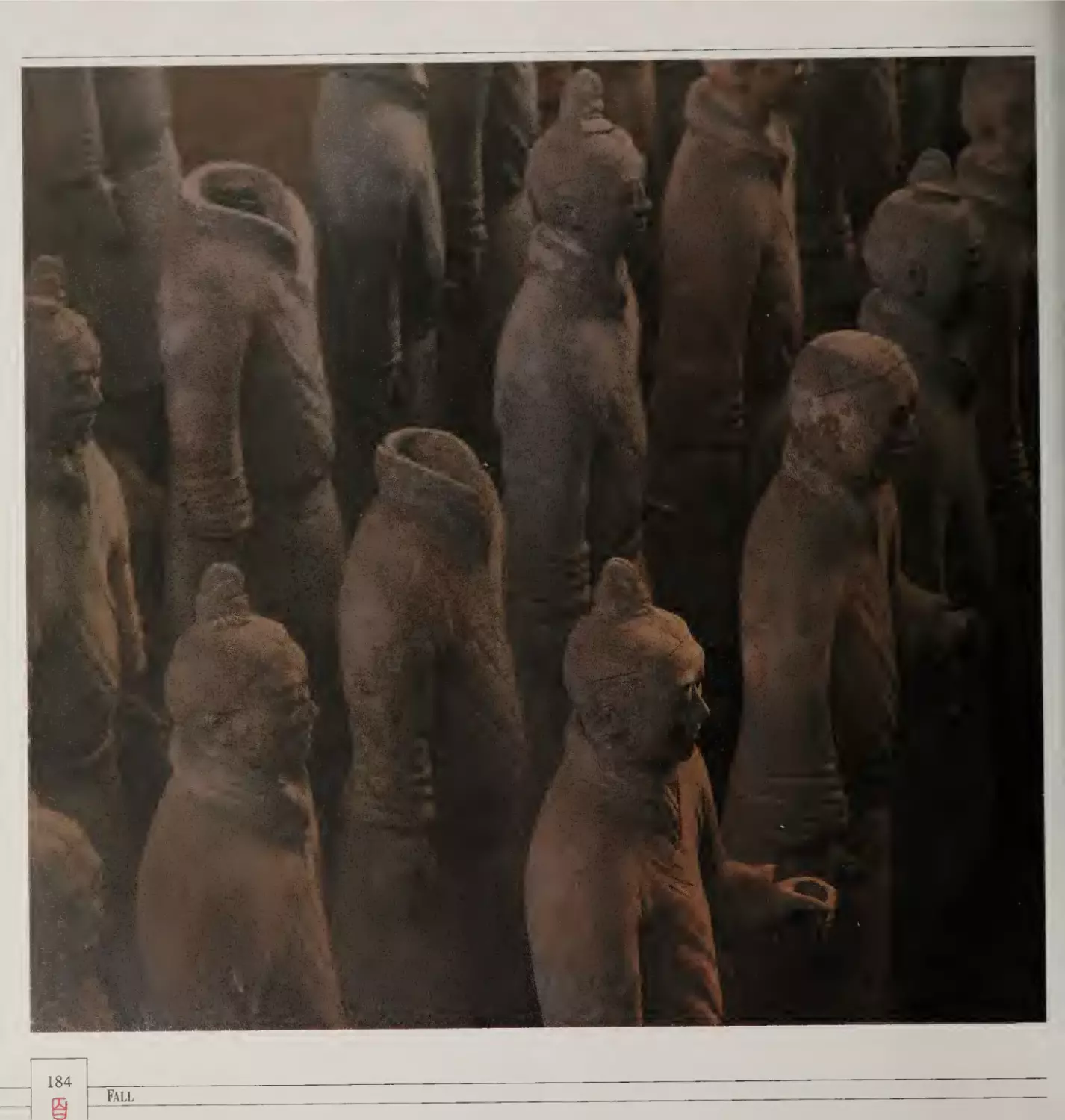
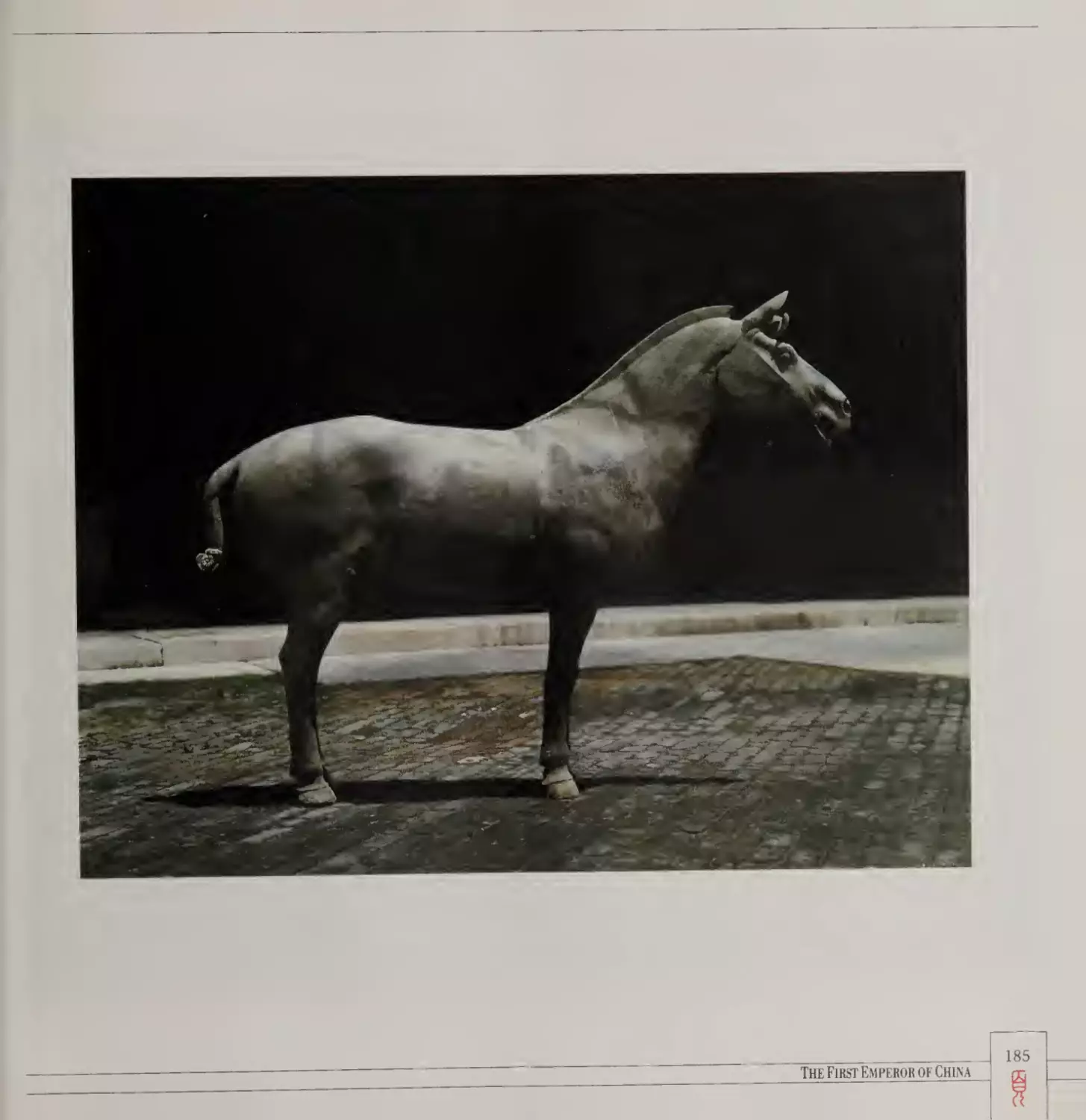
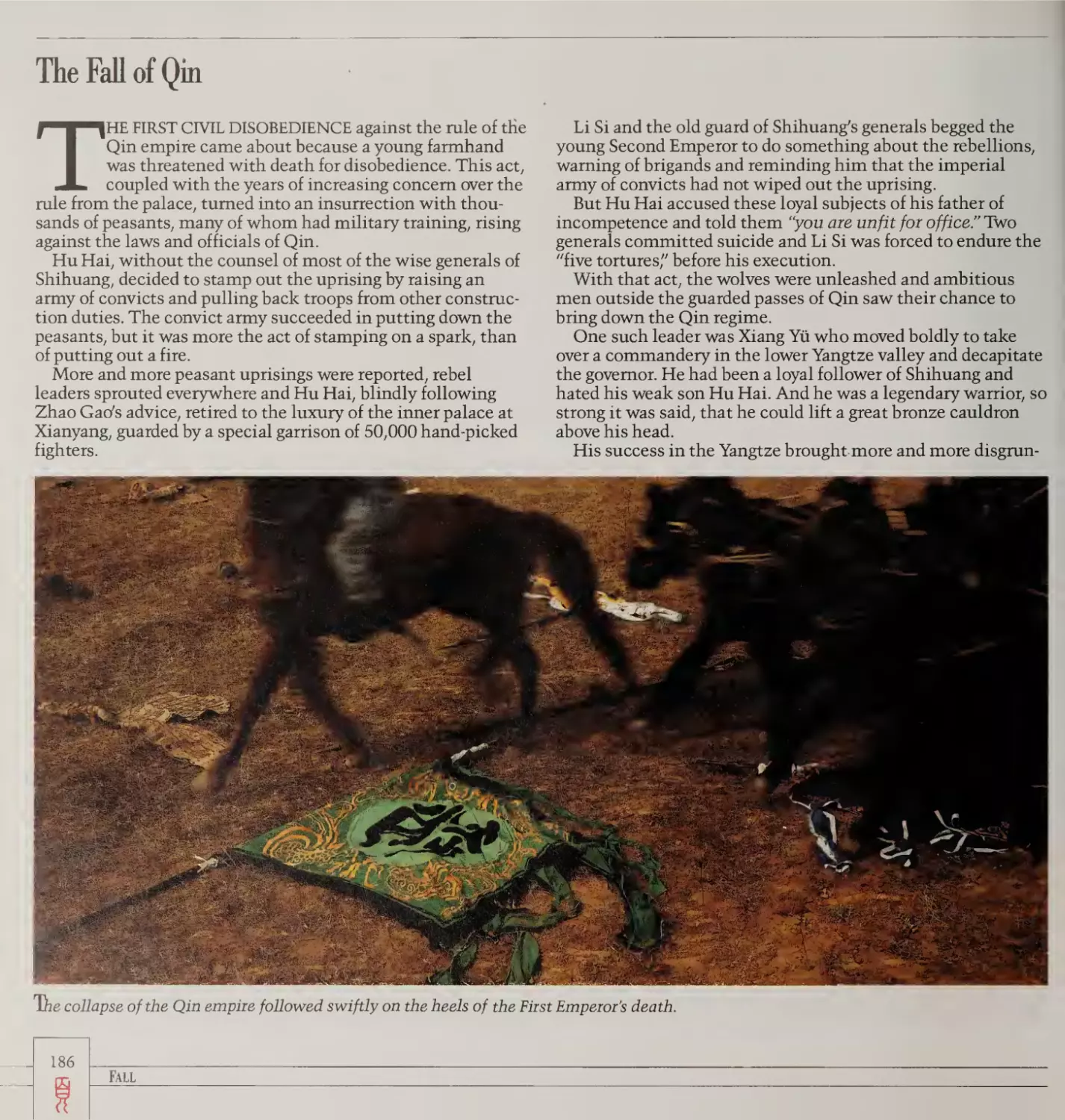
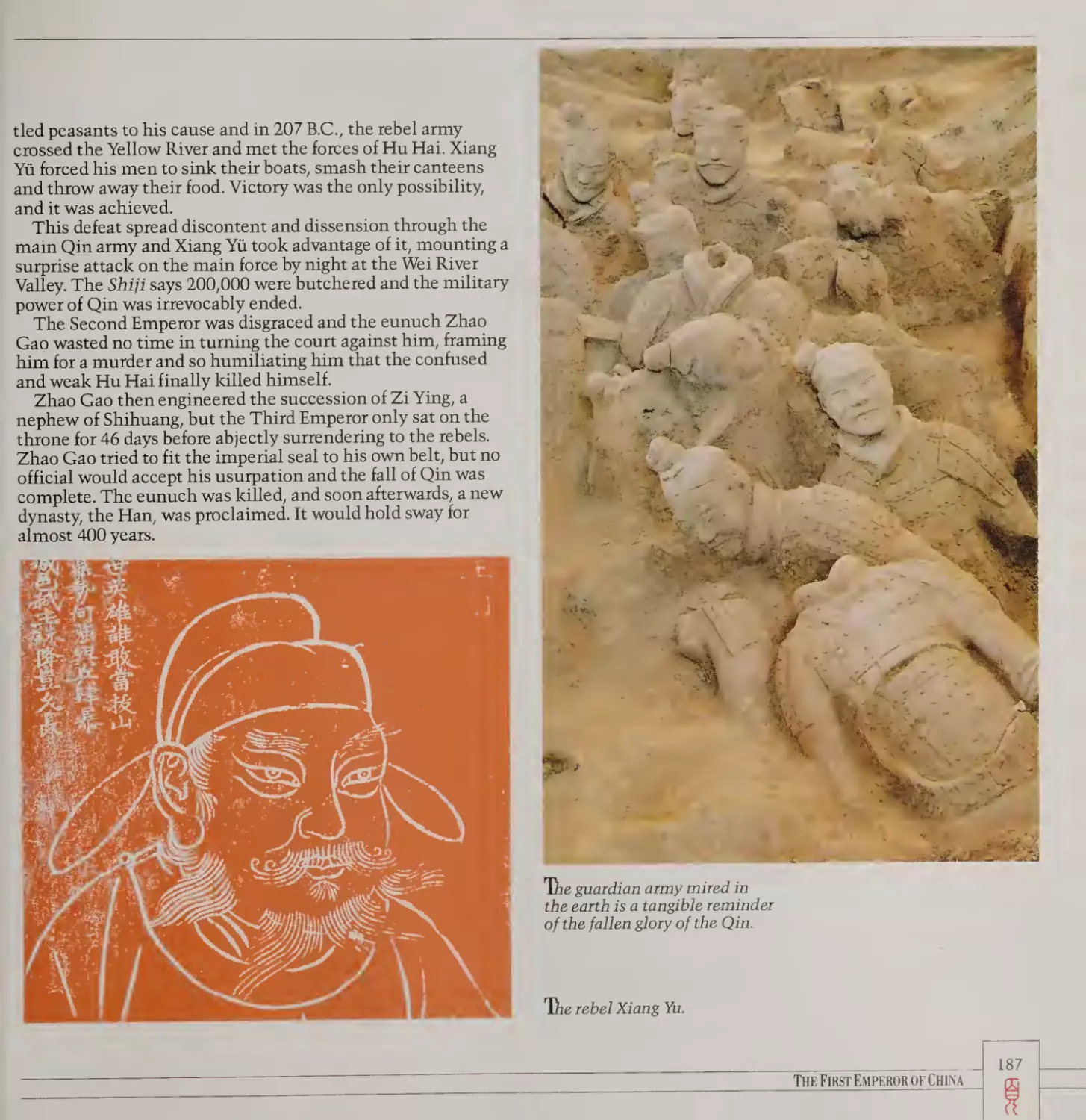

Похожие


Текст
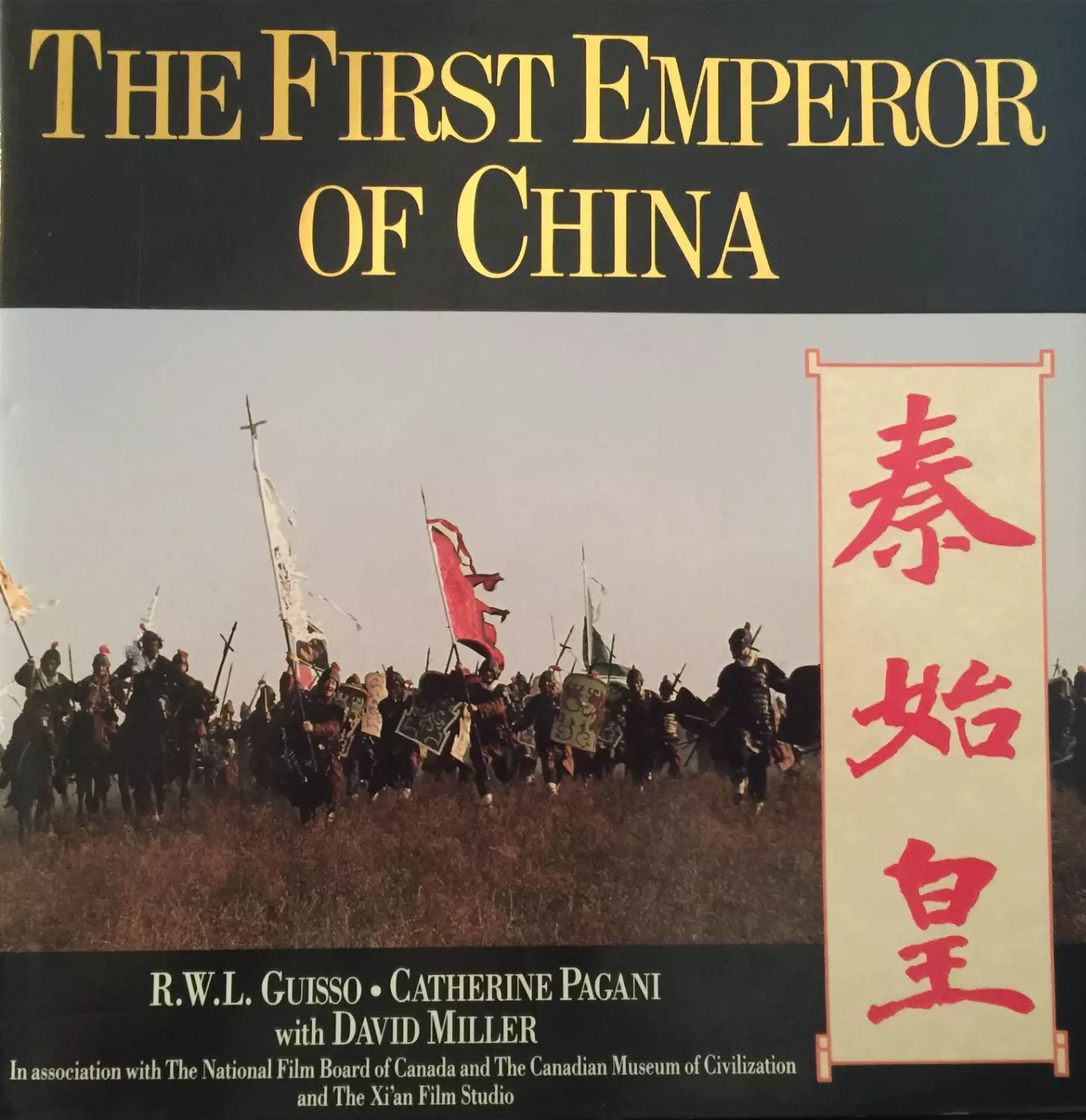
                    The First Emperor
of China

H

is name was Qin (pronounced "Chin")
Shihuang, founder and very first ruler of
all of China. He gave China its name, the
world the word "emperor" and also set up
the longest running form of government-China's
Imperial System which lasted over 2,200 years.
THE FIRST EMPEROR OF CHINA chronicles
Shihuang's life from his birth in 259 B.C. until his
descent into madness and death in 210 B.C. Much
of the story of one of mankind's most fascinating
conquerors, builders and destroyers has never been
told before. Yet, few Westerners are aware of what
Qin Shihuang achieved.
The illegitimate son of a treacherous merchant
and a licentious concubine, his birth, ascension to
the throne, conquests and amazing reign are
vividly retold through a 50,000 word text illus¬
trated by full-color photographs, maps and paint¬
ings from ancient China.
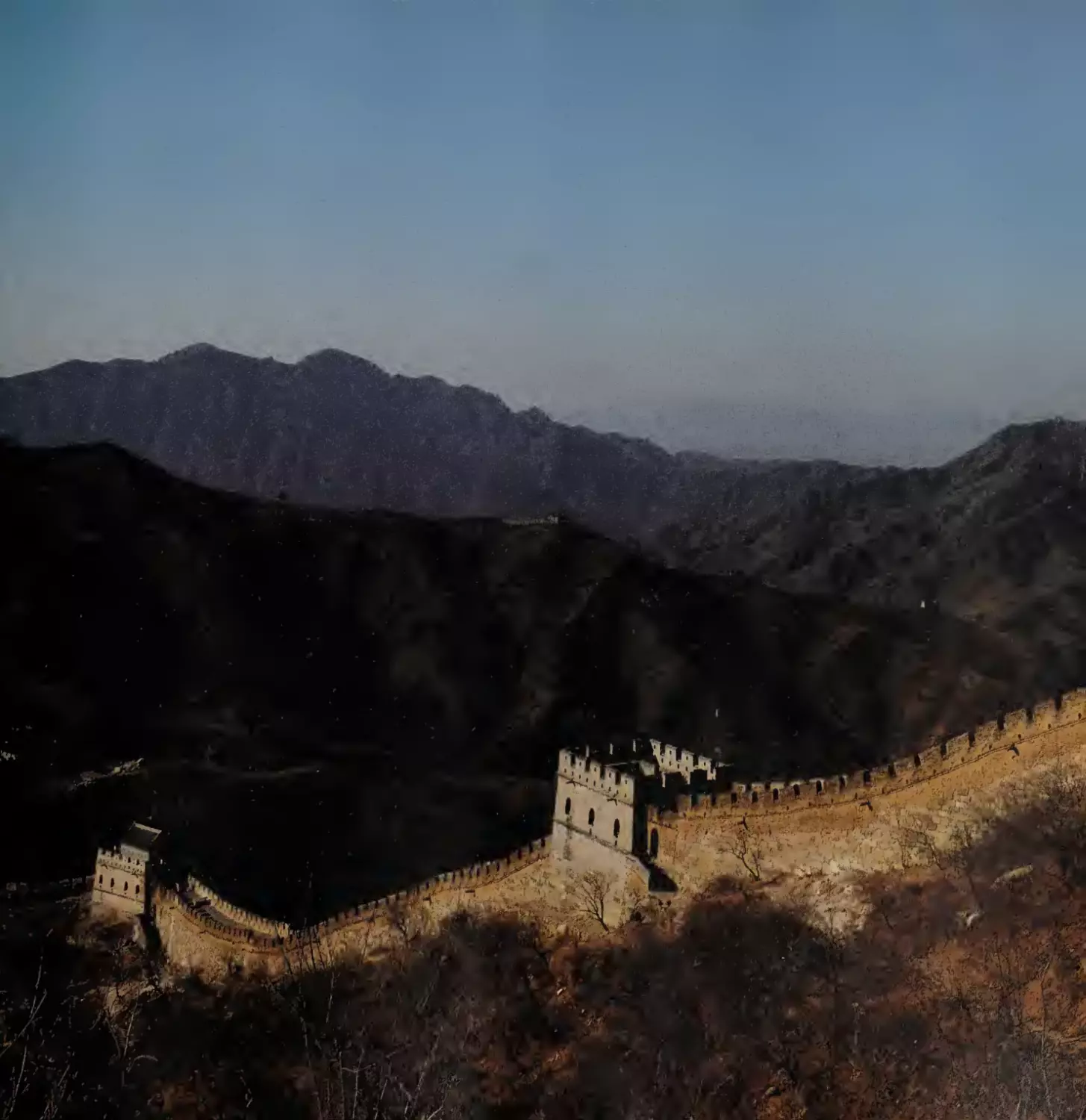
A man of astonishing energy, he built the Great
Wall, known as the Wall of Tears (during its
construction 300,000 workers reportedly perished)
as well his own great mausoleum where in the
1970s, one of the most remarkable archaeologiccal finds of the century was made - more than
7,000 life-size terracotta soldiers and horses which
guard the entrance to his tomb.
Qin Shihuang was also a man of great whim and
enormous cruelty and buried alive over 400 scho¬
lars for spreading "heretic ideas." He also main¬
tained a harem of 3,000 concubines that were
housed in 270 palaces and pavilions.
As Emperor, Qin Shihuang abolished the fuedal
system of land holding. He standardized weights,
measures, calendars, chariot axles, even folk
music, and imposed a detailed, uniform code
of law.

(continued on back flap)

ryf^si
I !«-l'i^ j'j j .';.’j*r *
?$$$&
v.f’iij* ;ivV ':•
#Mb4fei
jSsSjEj^ Av |

•■wr&+
Wm

h'4fiuk'&1;1'
,'»&
’ SSHk *> <
'iHwMNL v \

R.W.L. Guisso
Catherine Pagani
with David Miller
In association with The National Film Board of Canada and
The Canadian Museum of Civilization
and The Xi’an Film Studio
A Literary Management Group Book

Birch
Lane
Press

Conceived, edited and designed by
The Literary Management Group Inc.
1250 Bay Street, Suite 400
Toronto, Ontario, M5R 2B1
Canada
Publisher: Allan J. Stormont
Editor: Colleen Dimson
Designer: Fortunato Aglialoro
(Falcom Design & Communications Inc.)
Calligrapher: Charles Wing-Hoi Chan
Picture Editor: Catherine Pagani
Copyright© 1989 by The Literary Management Group Inc.
and
The National Film Board of Canada
A Birch Lane Press Book
Published in the USA, 1989 by Carol Publishing Group
Editorial Offices
600 Madison Avenue
New York, NY 10022
Sales & Distribution Offices
120 Enterprise Avenue
Secaucus, NJ 07094
All rights reserved. No part of this book
may be reproduced in any form, except by
a newspaper or magazine reviewer who wishes
to quote brief passages in connection
with a review
ISBN 1-55972-016-6
LIBRARY OF CONGRESS CATALOGING-IN-PUBLICATION DATA
Guisgo, R.W.L.
The First Emperor of China.
"A Birch Lane Press book."
Bibliography: p.
Includes index.
1. Ch'in Shih-huang, Emperor of China, 259-210 B.C.
2. China -Kings and rulers- Biography. I. Pagani, Catherine. II. Title.
DS747.C47G85 1989
931'.04'092 [B]
89-15742
ISBN 1-55972-016-6

Printed and Bound in Canada
Typesetting:
Origination:
Printing:
Binding:

PrimeType Inc., Toronto, Canada
Colour Technologies, Toronto, Canada
Ashton-Potter Limited, Toronto, Canada
T.H. Best Printing Company, Toronto, Canada

Acknowledgements

W

E WOULD LIKE TO THANK the following for their
generous time, expertise, patience and many
intangible contributions to this project in unusual
and sometimes trying times.
The National Film Board of Canada, in particular Colin Neale
and to Margaret Wong for an outstanding effort; The Canadian
Museum of Civilization; The China Film Coproduction
Corporation; China Xi'an Film Studios; Doris Dohrenwend,
Sara Irwin, Barbara Stephen and Jack Howard of the Far Eastern
Department of the Royal Ontario Museum,- Mr. John Summers
and Mr. B. Cocchiola; Philippa Lewis of London, England for
some absolutely intrepid research; Mr. Dan Mokich of the
Department of External Affairs, Ottawa for his interest and
generous help; and finally to Herb Hilderley and to Howard
Albert each for their individual roles in helping develop the
project in early days.

The First Emperor of China

Contents H %
Introduction

8
Guide to
Pronouncuoton

9

Part One

Part Two

Part Three

A Tiger
or A Wolf

The Land
of Hungry
Ghosts

All
Under
Heaven

The Life and Deeds
of Qin Shihuang

Warfare in
Ancient China

The Unification
of China

10

40

82

Tjkf,

Part Four

Part Five

Part Six

Background

The Emperor
and His
Blackhaired
People

The Death of
the Primal
Dragon

Ten
Thousand
Generations

209

The Fall
of the Qin Dynasty

The Legacy of
Qin Shihuang

158

190

Life in the
Qin Dynasty

112

Future Reading

211
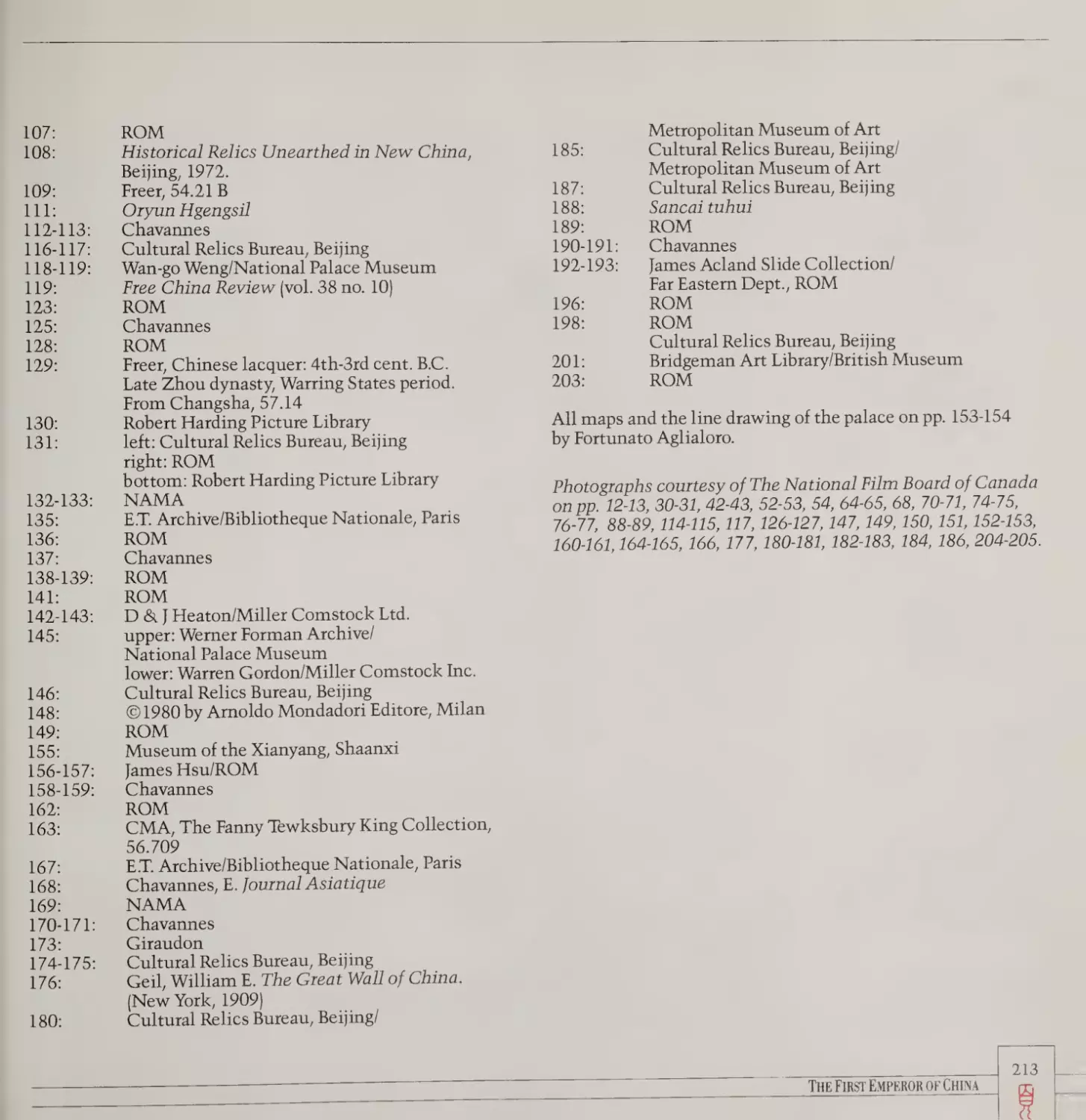
Illustration &
Photo Credits

212
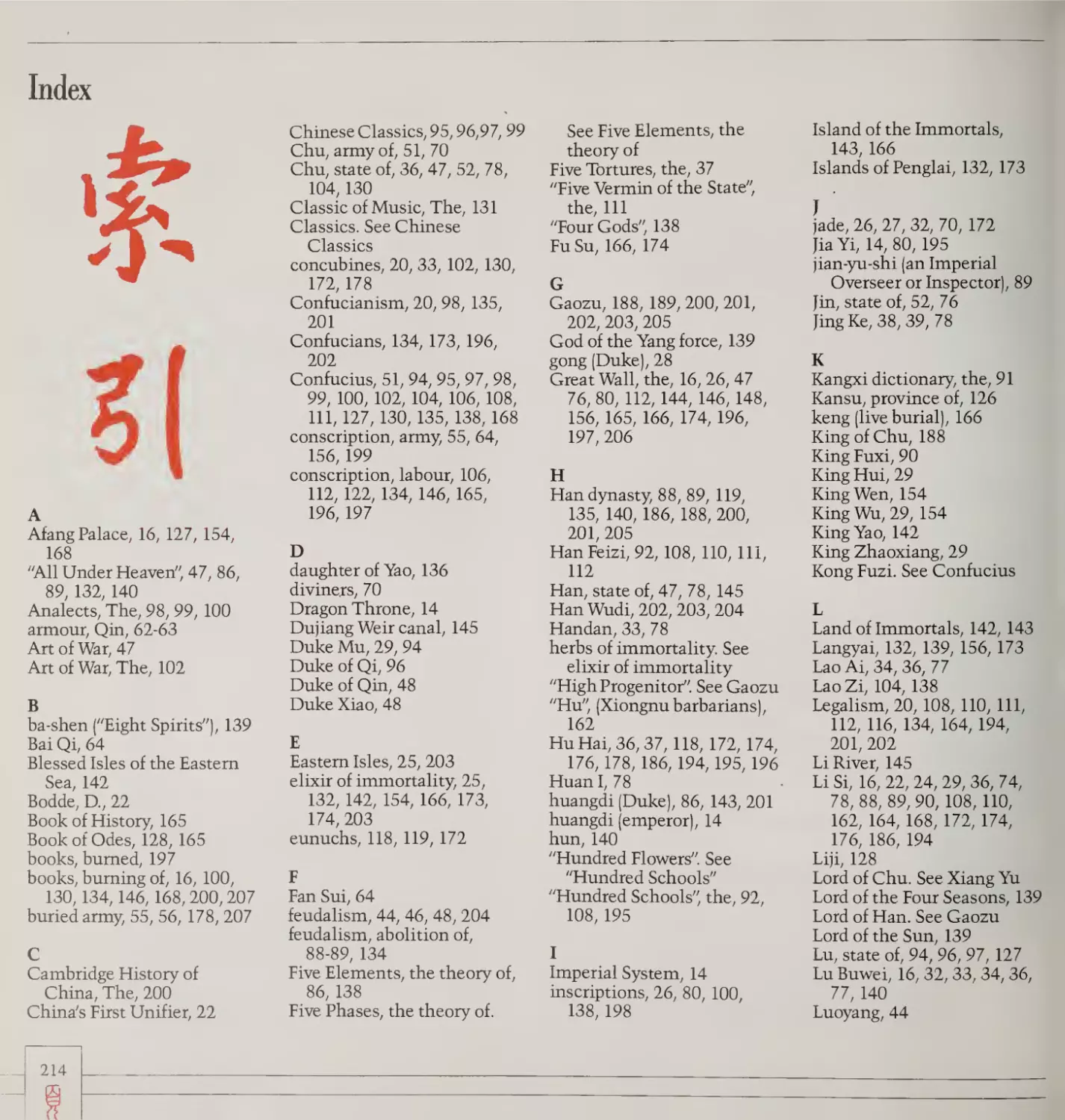
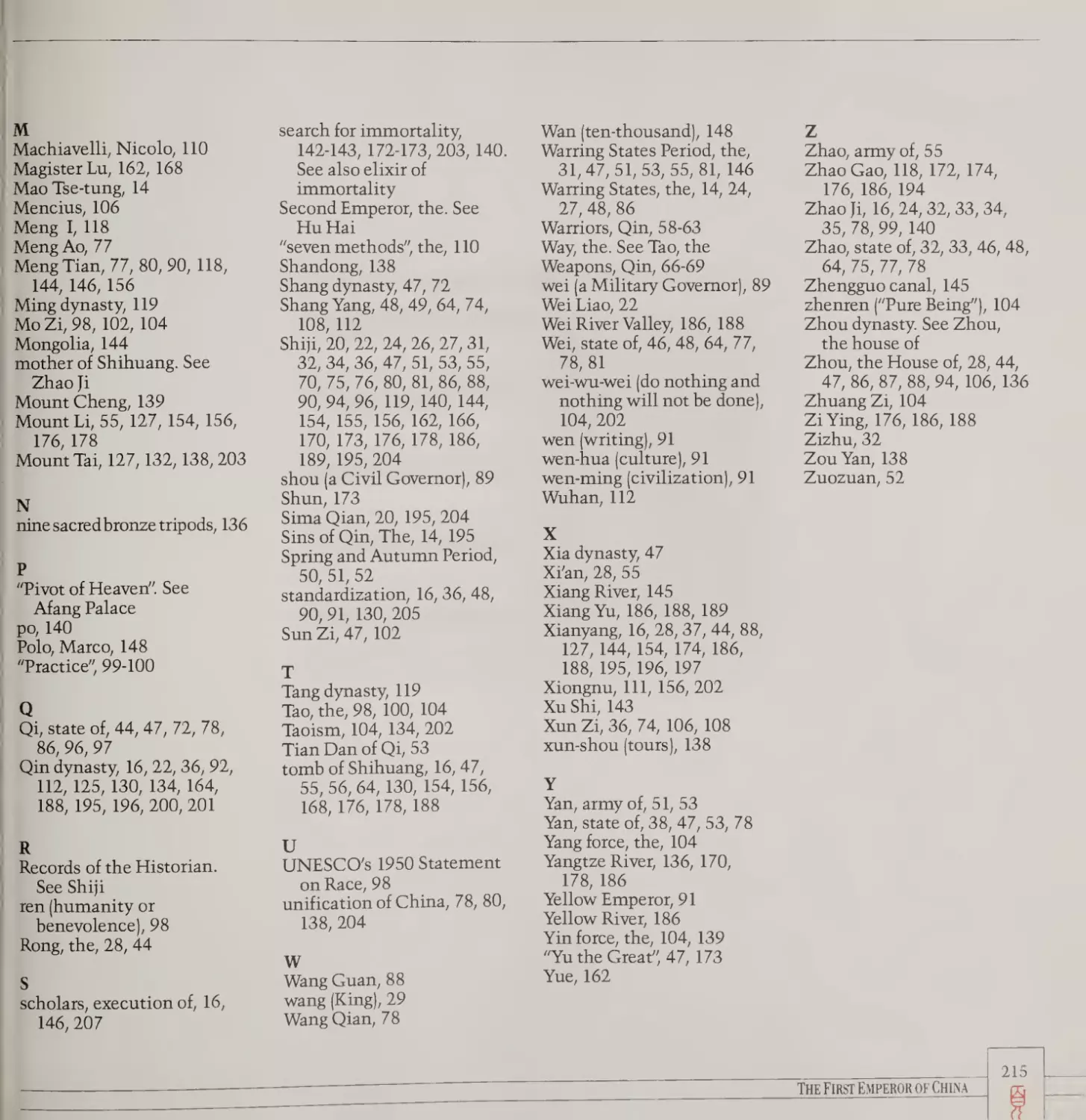
Index

214

Introduction

a

A

S THIS BOOK WAS going to press in the early Summer
of 1989, events as remarkable as those recorded in
these pages were again taking place in China.
Extraordinarily noble crowds of people in Beijing's
Tiananmen Square were calling for unprecedented, yet basic,
human rights in the most unique and dramatic way.
The students of Tiananmen Square seemed to be writing
history in a manner as large as their First Emperor Qin Shihuang
did more than two thousand years ago - as this time they
engaged and galvanized a watching world using the 20th
century's electronic media.
The leadership of The People's Republic appeared to be
retreating to the same secrecy as the First Emperor himself
had employed in the face of unparallelled threats.
And so, as contemporary China changes and the secrets of its
ancient past are being slowly revealed, the interest in this vast
nation and its extraordinary past has never been higher.
In a quite unexpected way then, The First Emperor of China
presents a most uncannily relevant portrait of the nature of
China and its approach to people and government - then
and now.
Events will most certainly have raced on and changed China
in probably quite radical ways before you the reader will hold
these stories of its great First Emperor-however we hope that

8
Portrait

we have provided you an entertaining and useful guide to some
of the history of this most fascinating nation.
This book presents the story of The First Emperor of China a man who must be considered remarkable by any standards of
any period in human history. Until fifteen years ago, the name
of China's First Emperor was unknown in the West. In spite
of his towering achievements, his historical notoriety among
the Chinese, and a legacy still prominent in China today,
he has long remained a shadowy figure, a cypher and a symbol
shrouded in the mists of time. Only with the discovery of his
tomb in 1974, along with the army of life-size terracotta soldiers
which stands guard over it, have the mists parted to reveal
something of the man who, for 2200 years, has been hidden
within them: Qin Shihuang-First Sovereign Emperor of China.
Few visitors to the world's most populous nation can remain
unaware of his works for long. The emperor's legacy surrounds
us all, whether we marvel in astonishment at the architectural
feat known as the Great Wall, or gaze in wonder upon row after
row of his exquisitely-detailed terracotta soldiers. The magnifi¬
cence of the Forbidden City in Beijing, we are reminded, pales
before the fabled splendours of Shihuang's palaces. And as we
travel the system of roads and canals which he began, or hold
in our hands the coins he made standard, we are reminded of
this remarkable ruler. The script we see all around us, in news¬
papers and on shop-signs, traces its form to his rule. He was a
man of "firsts," and in a real sense, the maker of China.
For the past 150 years China has suffered much. Humiliated
by Western imperialism throughout the nineteenth century,
and subjected to warlordism, foreign invasion, civil war and
mass revolutionary movements in the twentieth, the people of
the Middle Kingdom have known little peace. Even today,
their struggle for modernization and for the "democratization'
of their political system is a turbulent one. And the people of
China are looking now to the rest of the world, seeking to define
their role in it. We in the West, have a duty to understand.
In the twentieth century, Western views of China have varied
from puzzlement to pity, from fear to scorn, and only rarely do
they include admiration. Yet, historically, China has been a
donor civilization, enriching the culture of the whole world
with her science and technology, her arts and her philosophy.
She still has much to contribute. The achievements of the
First Emperor are not just the dusty monuments of a long-dead
past. They symbolize, rather, the heights reached in his own
time by those whom he called the "Blackhaired people," and
the heights once more within their reach.
This work is a modest step in the direction of greater mutual
understanding.
R.W.F. Guisso
June 1, 1989

Guide to Pronunciation
The romanization of the Chinese language used in this
book follows the pinyin system which is now the official
phonetic system of Mainland China. Each character is
rendered into one syllable. The pronunciation of the letters
used in this system does not always follow those to which
Westerners are accustomed. The following list is a rough
guide to the most unusual of these.
Initials
c
is pronounced as ts in 'cats'
is pronounced like g in 'gem'
)
is pronounced like ch, but is strongly aspirated
q
r
is pronounced like su in 'measure'
is an aspirated sound somewhat equivalent
X
to sh
is pronounced as ds in 'seeds'
z
zh
is pronounced as j in 'joy'
Finals
i
o
u
ai
an
ou
ui
ang
eng
ong
chi
shi
zhi

is pronounced as ee in 'see'
is pronounced as o in 'stop7
is similar to the French u sound
is pronounced as igh in 'high'
is pronounced as an in 'tan'
is pronounced as o in 'no'
is pronounced as ay in 'stay7
the a has the sound of a in 'father7
is pronounced as ung in 'rung7
the o is somewhat similar to ow in 'own'

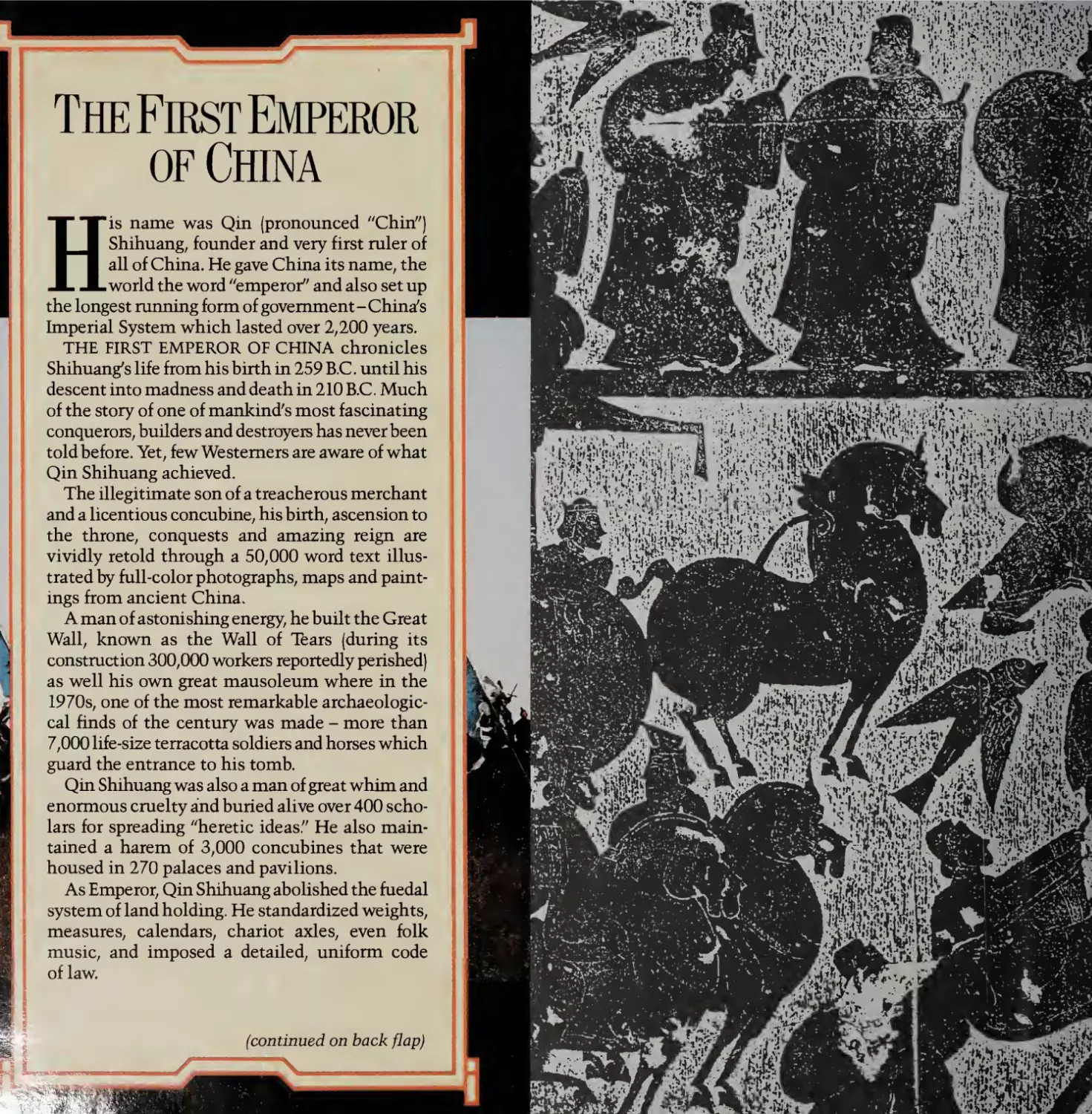
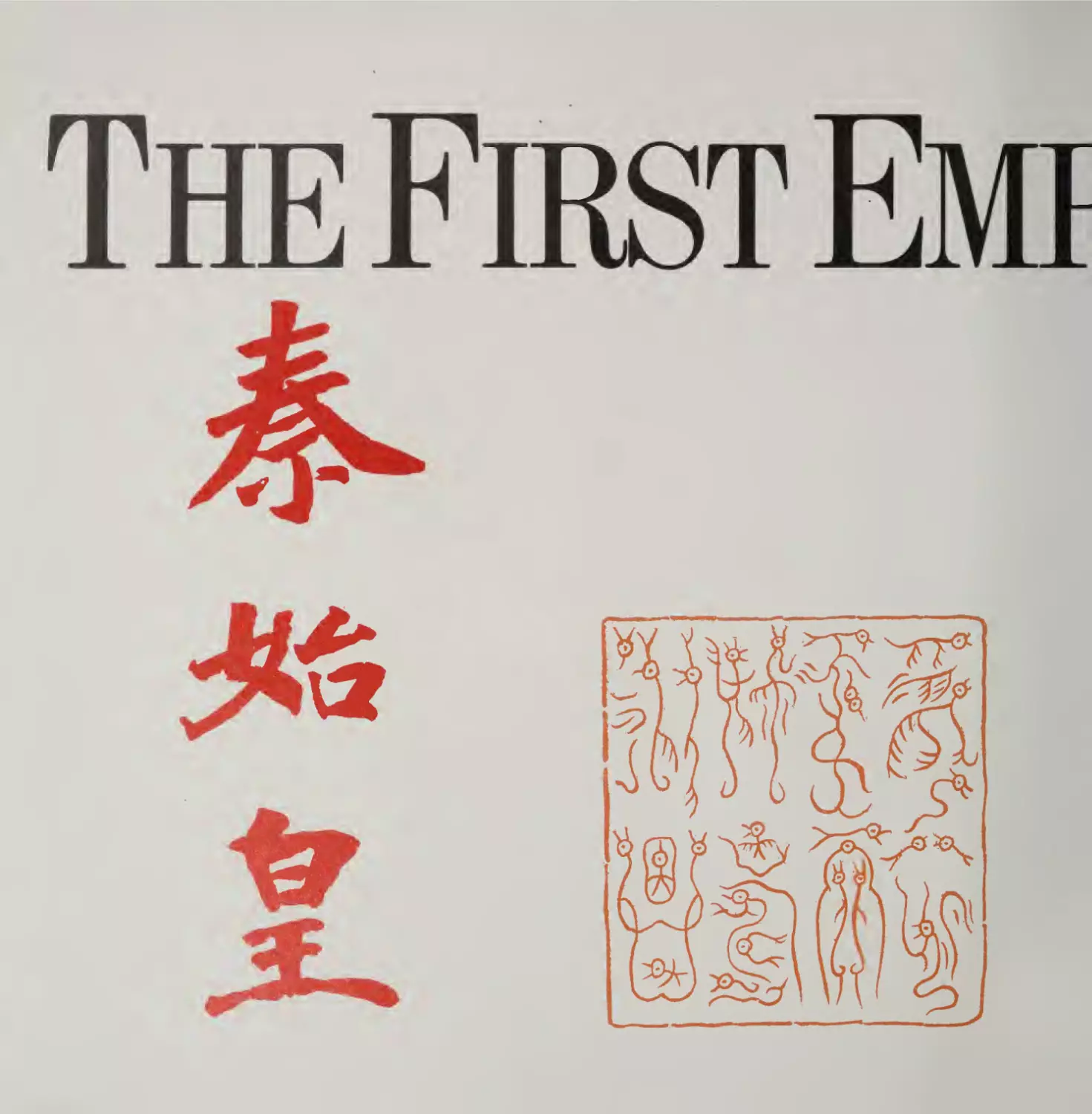
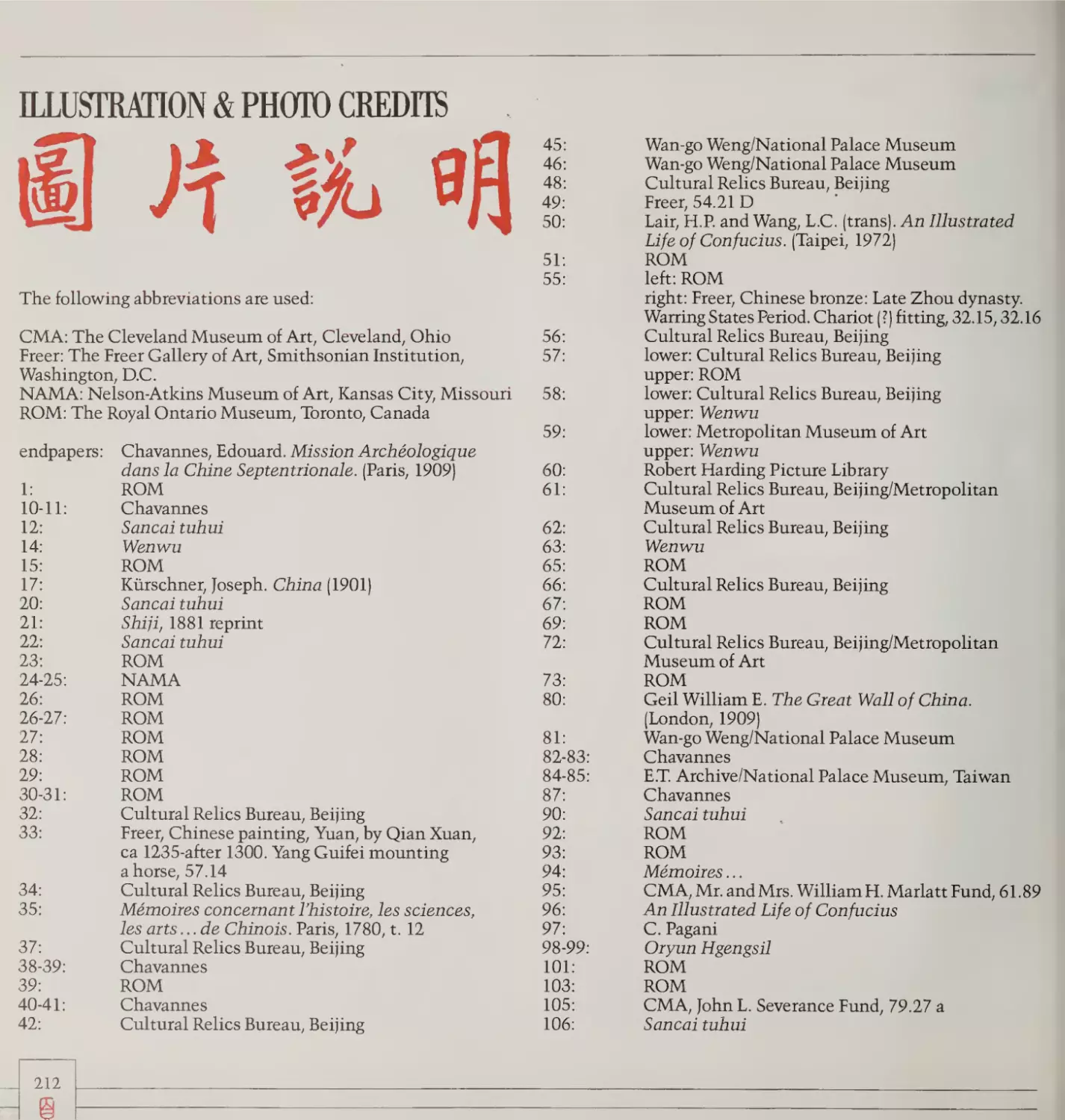
On the title page of the book, Qin Shihuang’s seal is written
in an unusual style of Chinese characters called “bird script.”
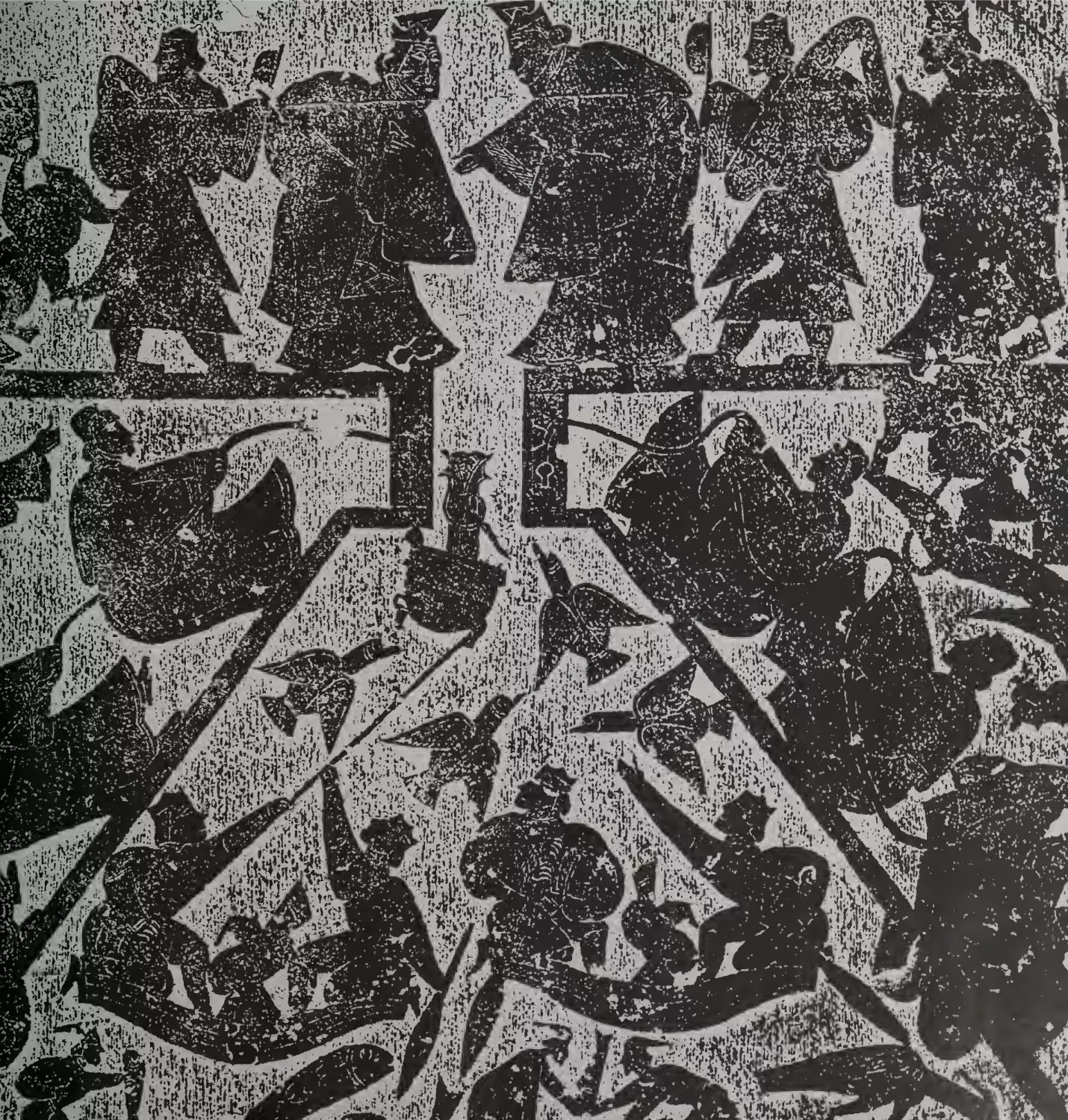
The illustrations used for the endpapers and the section
openers are rubbings made by the eminent sinologist
Edouard Chavannes of Han dynasty stone pillars from the
Wu family tomb. These rubbings, made in the early part of
this century, show lively depictions of various stories and
legends from China’s past.
Along with the English titles for each section of the book, the
Chinese characters have also been provided.
The ancient Chinese character for “page” has been placed
with each page number of the book.

in these three syllables, the final i is
pronounced as er in 'her7

For example, the name of the First Emperor, Qin Shihuang,
is pronounced as 'Chin Sher-huang.' Flis tomb mound is
located near present-day Xi'an, pronounced 'Shee-an.'

9
The First Emperor of China

12

H

Portrait

Demon or Demi-God?

I

T WAS A TIME OF ENDLESS WARS and constant death
when Qin Shihuang was bom in 259 B.C. The bastard son
of a treacherous merchant, he would become the founder
of China, but at his birth, the feudal land he would one
day rule was tom apart by savage battles, and the peasants'
lives were filled with wretchedness. Under Qin Shihuang's
mle, much of his people's misery would end, but the First
Emperor's methods of achieving peace and prosperity would
make him, even to this day, the subject of fierce division
among the world's historians.
Was he a demon or demi-god? they argued. A visionary or
despot? A tyrant who rode his fabled six white horses over the
back of millions of peasants, or a benevolent mler who truly
cared about the fate of his people?
To begin, he was the First Emperor of China—the first in
the long line of 210 men and one woman to occupy the Dragon
Throne before its collapse in 1911. In fact, the very word
"emperor" (huangdi) we owe to Qin Shihuang, and it is from
the name of his dynasty called Qin (pronounced "Chin") that
we are given the word for the country we call China. He was
also a visionary who united the Warring States of his time,
imposed order and conformity upon them, and so founded
China's 2200-year-old Imperial System — the longest-enduring
of all human political systems.
One of the most amazing mlers of all time, Qin Shihuang
was a conqueror, a unifier, a centralizer, a standardize^ a
builder — and a destroyer. If we sought in Western history, men
of comparable achievement, it is the names of Alexander the
Great, (356-323 B.C.) and Julius Caesar, (100-44 B.C.) that most
readily come to mind.

rrihe adulation of Qin ShihuJ. ang by Chinese historians
began after an unsuccessful at¬
tempt on the life of Chairman
Mao Tse-tung in September of
1971. According to documents
later released, his enemies had
referred to Mao as a "feudal ty¬
rant" and "a contemporary Qin
Shihuang." His supporters
then mounted a nation-wide
campaign to show that Shihu¬
ang had been an enlightened
ruler whose greatest achieve¬
ment was, like Mao's, the unifi¬

14
Portrait

Why is it, then, that from the time of his death the
historians of Imperial China have vilified his memory?
He "cracked his great whip to bend the world to his will,"
and "placed deceit and violence above kindness and justice,
making tyranny the foundation of his Empire." These are the
words of his earliest critic, a scholar called Jia Yi whose
famous essay "The Sins of Qin" was written shortly after the
fall of the Qin dynasty. Few scholars have disputed this judge¬
ment until recent years, and it was not until Mao Tse-tung
expressed his admiration both for the success and ruthlessness
of the First Emperor that widespread reappraisal began.
In 1958 at a meeting of the Central Committee of the
Chinese Communist Party, Chairman Mao remarked that
Qin Shihuang was a ruler who advocated the extermination
of those who "used the past to criticize the present." Mao
went on to say, "What does he amount to anyway? He buried
only 460 scholars alive, while we have buried 46,000 counter
revolutionary scholars alive."
In response to Mao's remarks, highly favorable and basically
uncritical biographies of Shihuang began to appear from 1972
in China where they sold in editions numbering in the mil¬
lions. It was exactly the kind of mass mobilization that the
First Emperor would have approved of and understood!
Tyrannical or enlightened ruler? Deliverer of his people, or
oppressor? Princely son of a king, or illegitimate child of a
contemptible merchant? The polarization of historical opin¬
ion can both illuminate and obscure the facts of a ruler's life,
so let us re-examine his accomplishments and see what con¬
clusions we can draw from the life and deeds of China's First
Emperor.

cation of China. Numerous
books and articles on Shihu¬
ang appeared in a short space
of time and formed the basis
for discussion meetings
throughout the country. The
most widely-distributed was a
biography of the First Emperor
by Hong Shidi. The initial
printing of this work, in May
of 1972, was 1.3 million copies
and in just over a year, there
were over 2 million copies in
print!

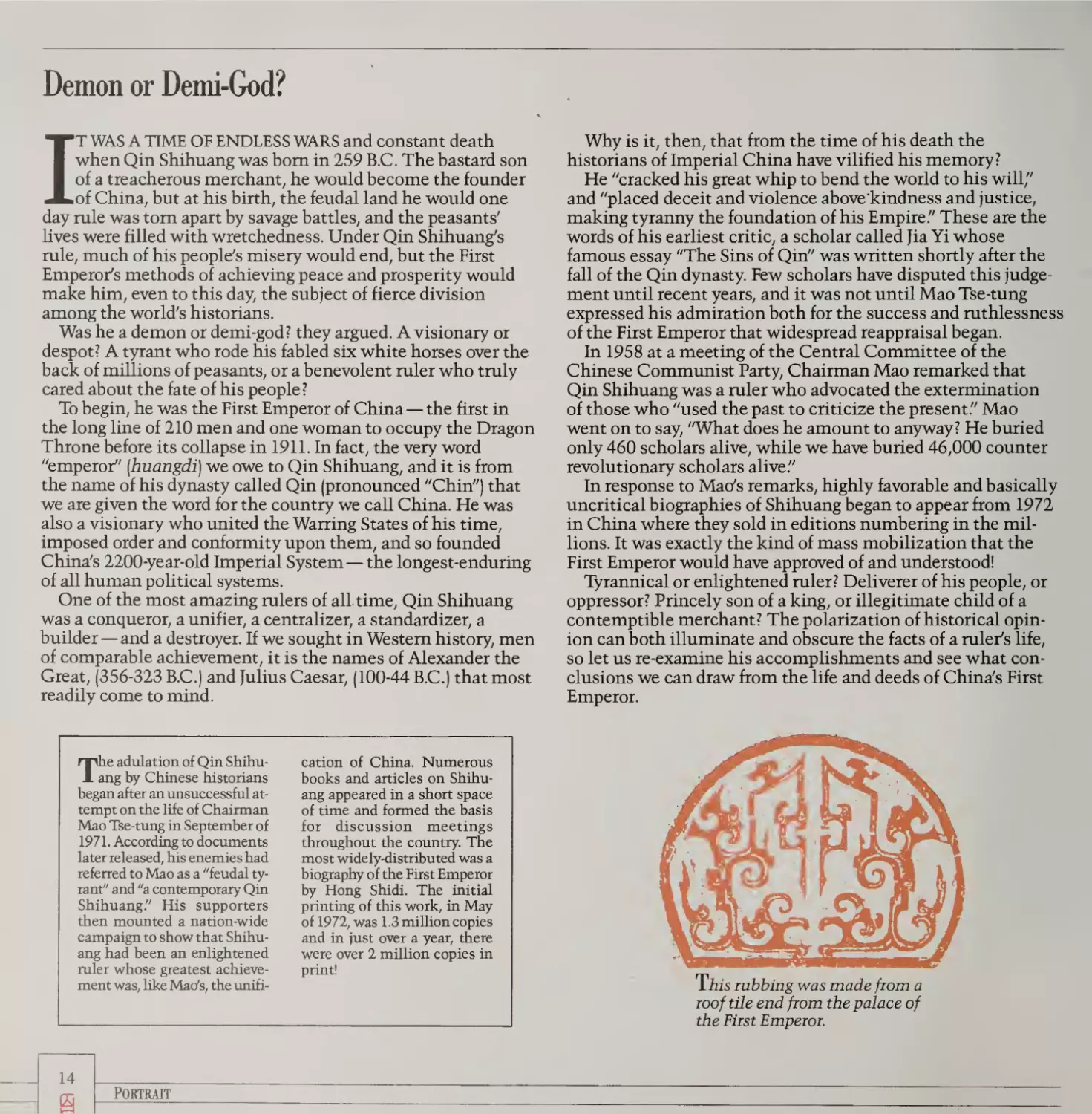
This rubbing was made from a
roof tile end from the palace of
the First Emperor.

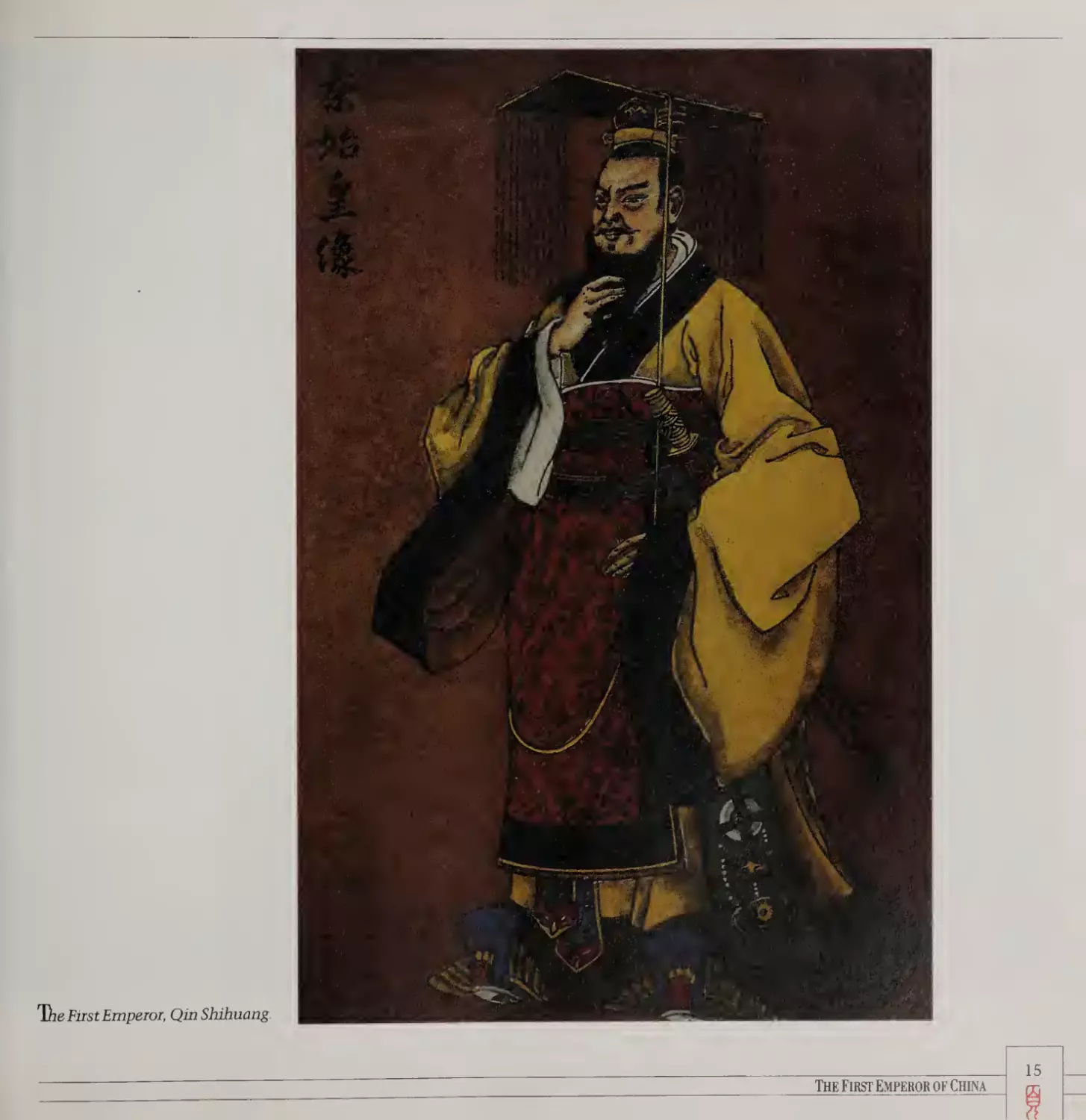
The First Emperor, Qin Shihuang.

The First Emperor of China

The Great Unifier

A

lthough reliable details about the life of the
First Emperor are sketchy, we do know that he was
bom in 259 B.C. and died in 210 B.C. after twentynine years of rule, first as King Zheng of Qin, and
then as Shihuang, the "First Emperor" of the Qin dynasty.
However, it is by the name of Qin Shihuang that he is known
to history, and when one considers the short time he lived and
reigned, his accomplishments seem even more astounding
than at first glance.
He was only thirteen years old when he ascended to the
throne of the state of Qin in 246 B.C., and the country of China
did not yet exist. At that time Qin was merely one of seven
warring states vying for control of the Central Plain in what
seemed a never-ending series of bloody and corrosive battles.
After a period of eight years, while his mother, a one-time
courtesan who had become dowager queen, and Lu Buwei, the
court advisor, rumored to be her lover and Shihuang's real
father, acted as regents for the boy king, Shihuang donned the
cap and sword of his majority in 238 B.C.
Now that he had reached the age of twenty-one, it became
obvious that Shihuang had learned more under his mentors
than even they had suspected. Informed of a plot to rebel
against him masterminded by the ambitious and disloyal
Lu Buwei, Shihuang, swiftly and without qualms, disgraced
his chief advisor and then forced him to commit suicide.
He then immediately raised up a new advisor in his place, and
together with this man, Li Si, who during his twenty years with
Shihuang rose to the highest position in the land, Chancellor
of the Left, the young king set out to unify the land.
Firmly Shihuang took control, directing the expert diplo¬
macy and the careful formation of alliances which led to his
brilliant success in the brutal unification wars that dominated
the history of that period in the 220s. After five centuries
of disunity and strife in the land, Shihuang had succeeded
in what no ruler before him had been able to accomplish:
The country was united and the Qin dynasty proclaimed in
221 B.C. It had taken Shihuang only twenty-five years to
accomplish his goal of becoming the First and August Emperor
of a vast and undivided land.
Li Si, the advisor who had succeeded Lu Buwei, was later
to make the misleading remark that the power of the new
emperor had prevailed as easily "as sweeping dust from the
kitchen stove." Yet when we leam from the traditional histori¬
cal sources of the time that the casualties during this period
come to over a million deaths, we can see that Li Si's state¬
ment was made to flatter his emperor rather than reveal the
truth about the costs involved.

16
nr.
i—i

Portrait

Although Shihuang had only eleven more years to live after
founding his dynasty, under his rule a total transformation of
the land we now call China took place. He created new admin¬
istrative units for the capital city of Xianyang and the rest of
the country, he abolished the feudal system of landholding and
removed the aristocratic warlords. Weights, measures and
currencies were standardized throughout the land, and even
such details as the width of chariot axles were regulated to
help prevent ruts in the thousands of miles of new roads that
were being constructed. The various and confusing local
scripts were eliminated and one standardized script used
throughout the land where a uniform and enormously detailed
code of law was imposed everywhere.
Meanwhile hundreds of thousands of labourers and convicts
were conscripted into Shihuang's great building projects-the
canals and irrigation works plus the hundreds of palaces and
pavilions for the nobles whom he had moved away from their
own conquered territories in order to weaken their power. His
most magnificent works, those which would make his name
immortal, were also being carried out during this period of
enormous change - the Great Wall, his fabled palace at Afang
and his enormous tomb where his childless concubines were
buried with him.
And in the year 213 B.C. an event took place which would
make the First Emperor infamous to all succeeding genera¬
tions - the burning of the country's books followed by the
deaths of 460 scholars of the period whom he had buried alive.
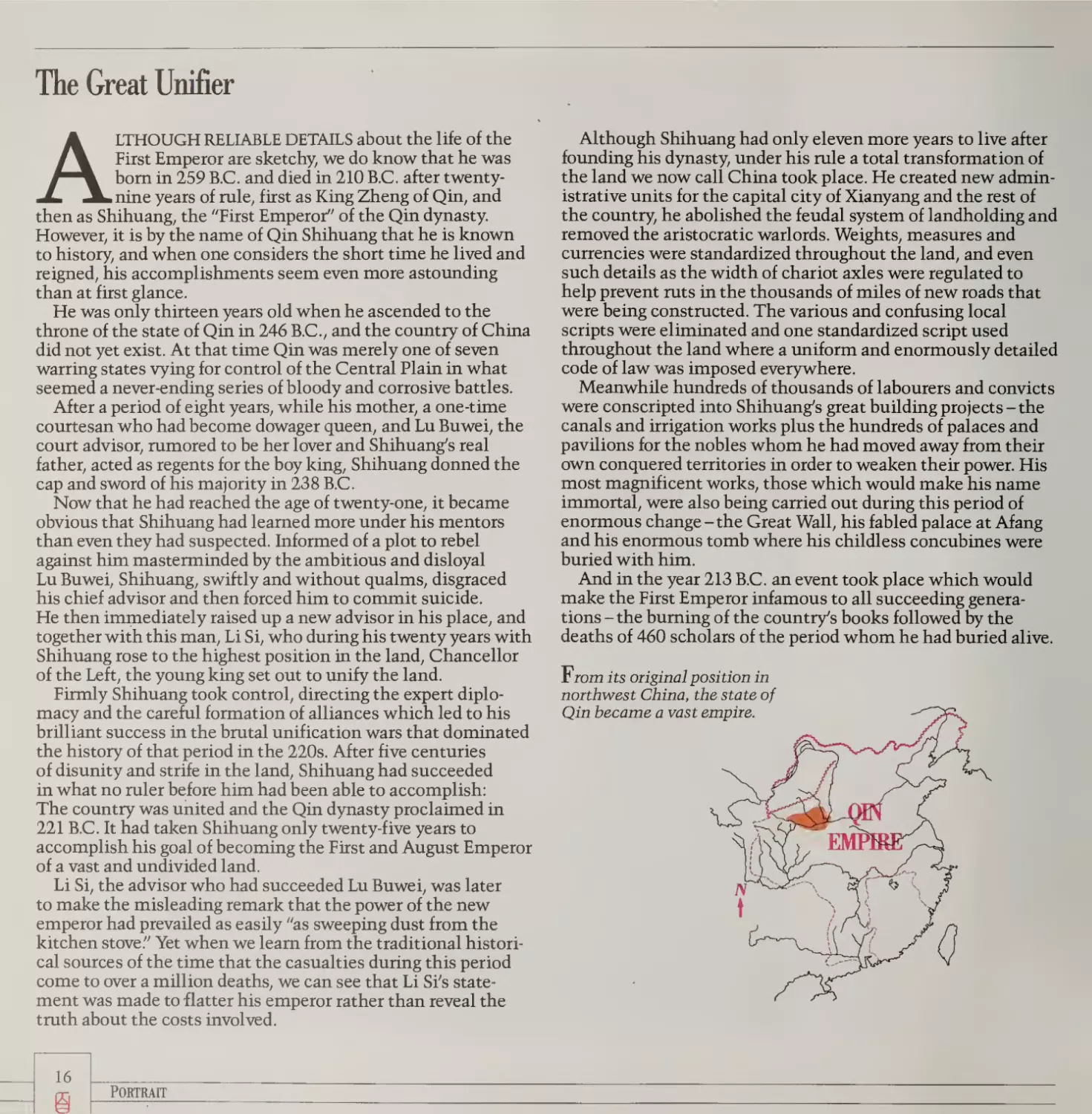
From its original position in
northwest China, the state of

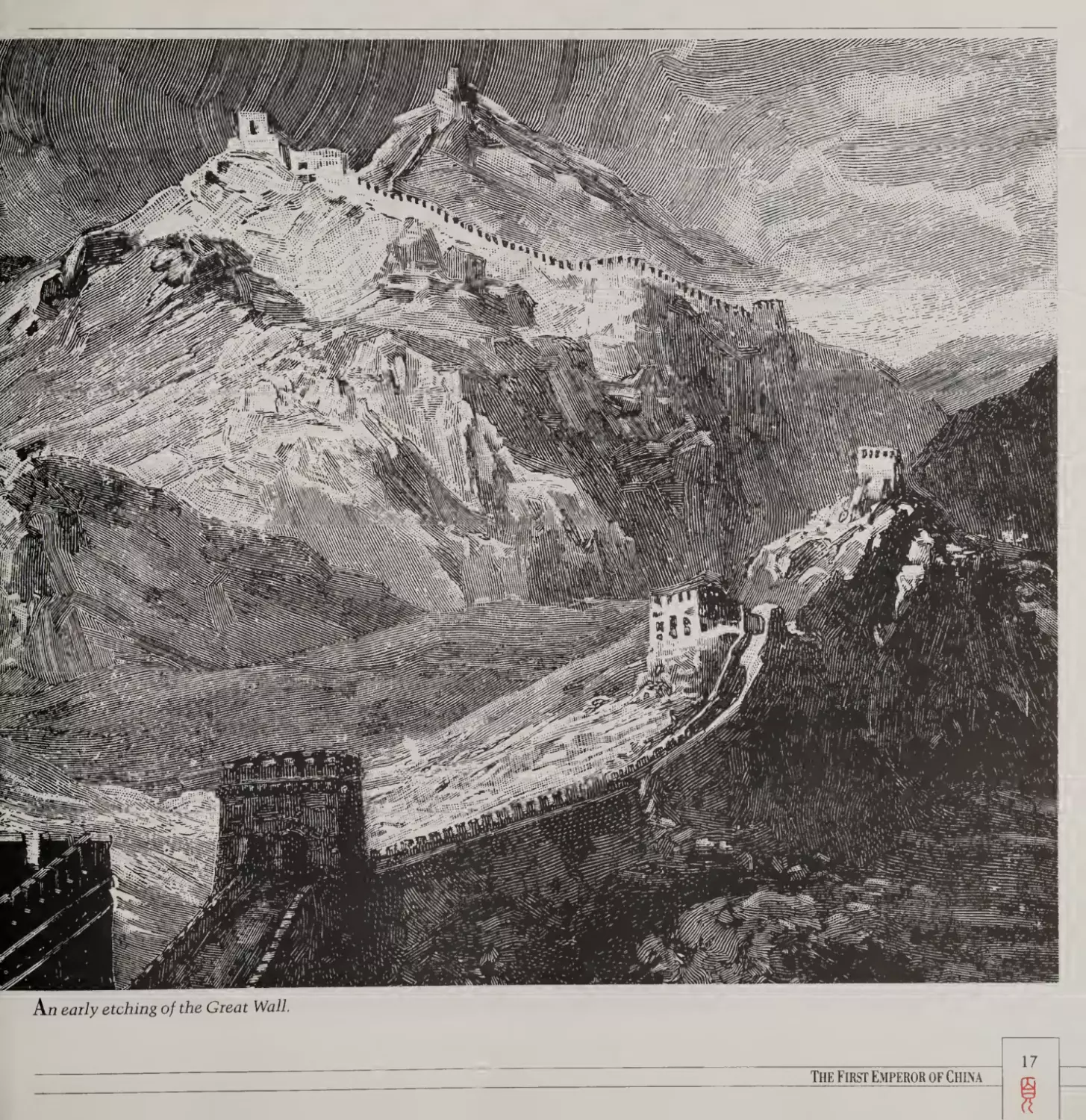
An early etching of the Great Wall.

17
The First Emperor of China

a

Chronologies

Qin (300-200 B.C.)

c. 300 B.C.

General

c. 1765-1027 B.C.
1027-256 B.C.
1027-771 B.C.
770-256 B.C.
770-481 B.C.
481-221 B.C.
221-207/206 B.C.

Shang Dynasty
Zhou Dynasty
Western Zhou period
Eastern Zhou period
Spring and Autumn period
Warring States period

285 B.C.

c. 280 B.C.

c. 261 B.C.

Qin Dynasty
260 B.C.

206/202 B.C.-A.D. 220
206/202 B.C.-A.D. 9
A.D. 24-220

Han Dynasty
Former Han period
Later Han period

c. 258 B.C.
c. 257B.C.
256 B.C.
251 B.C.

250 B.C.

248 B.C.
247 B.C.
246 B.C.

238 B.C.
237 B.C.

237-219 B.C.
233 B.C.
230 B.C.
228 B.C.
227 B.C.
225 B.C.
223 B.C.

18
Portrait

The Qin people build a long wall to
resist the nomads of the north-west.
Threatened rebellion in the state of
Shu leads to the incorporation of the
territory in the state of Qin.
Li Si, the future Grand Councillor to
the First Emperor of China, is bom
in Chu state.
In Handan, Lu Buwei befriends
Zizhu, the hostage prince of Qin and
father of the First Emperor.
The battle of Chang Ping is fought
in which Qin slaughters 400,000
Zhao prisoners.
Zheng, the future First Emperor, is
bom.
Qin builds a bridge across the
Yellow River.
The troops of Qin depose the Zhou
ruler.
King Xiaowen summons Prince
Zizhu and Lu Buwei to the capital of
Xianyang.
Prince Zizhu assumes the throne of
Qin as King Zhuangxiang and Lu
Buwei is appointed as Grand
Councillor.
Liu Bang, the future first Han
emperor Gaozu is bom.
King Zhuangxiang dies. Li Si leaves
Xunzi for Qin.
Zheng, the future First Emperor, Qin
Shihuang, ascends the Qin throne at
the age of thirteen and his 'second
father7 Lu Buwei acts as regent. King
Zheng makes Li Si a senior scribe.
The Zhengguo canal opens
Lao Ai rebels.
Lu Buwei is exiled to the state of
Shu where, two years later, he com¬
mits suicide. Li Si, along with other
aliens, is saved from deportation.
Li Si becomes justice minister.
Han Feizi dies in Xianyang.
Qin annexes the state of Han.
Qin annexes the state of Zhao.
Jing Ke tries unsuccessfully to ass¬
assinate King Zheng.
Qin annexes the state of Wei.
The state of Chu is subdued by

222 B.C.
221 B.C.

219B.C.

218 B.C.

215B.C.

214 B.C.

213B.C.
212B.C.

210B.C.

General Wang Jian, and Qin then
annexes it.
Qin annexes the state of Yan.
The last feudal state, Qi, is annexed
by Qin. King Zheng becomes
Emperor under the title of Qin
Shihuang to mark the event.
Li Si recommends that feudalism
be abolished.
Qin Shihuang establishes a uniform
code of law, standardizes currency,
measures, weights, and the written
language, and founds a centralized
state governed by a non-hereditary
bureaucracy.
The Qin empire is divided into
thirty-six, later forty-two, commanderies connected by a network of
roads.
Weapons are collected, melted down
and cast into statues at Xianyang.
The influence of Taoism on Qin
Shihuang becomes apparent.
The tomb at Mount Li is mentioned
for the first time.
Qin Shihuang tours his empire.
He tries unsuccessfully to obtain
the elixir of immortality.
The assassination attempt by Gao
Jianli fails.
Zhang Liang tries unsuccessfully to
assassinate the First Emperor while
he is on tour.
Qin Shihuang commissions a
second search for the elixir of
immortality.
General Meng Tian is victorious
over the nomads.
General Meng Tian is mentioned in
connection with the construction of
the Great Wall, which was accom¬
plished over many years.
Li Si advises the First Emperor to
bum the country's books.
Qin Shihuang buries 460 scholars at
Xianyang and banishes Prince Fu
Su, his eldest son, to the Great Wall.
Constmction is begun on the Afang
palace.
Nanhai is annexed.
Qin Shihuang dies while on a tour
of inspection.

209 B.C.

208 B.C.

207 B.C.

206 B.C.

205B.C.
202B.C.

200 B.C.

90 B.C.

Zhao Gao and Li Si force Fu Su and
Meng Tian to commit suicide; they
bring back the body of Qin Shihuang
to the capital, and announce the
funeral and the accession of the
younger son, Hu Hai, to the throne.
The Second Emperor purges the
imperial family, the court and the
imperial bureaucracy. Zhao Gao
influences the emperor. Chen She
and Wu Gang, the first peasant
leaders in Chinese history, rebel.
Zhang Han successfully quells the
rebellion but further uprisings soon
engulf him.
In the battle of Dingtao, Xiang
Liang, a southern rebel leader, falls.
Zhao Gao gains power at Xianyang.
Li Si is executed.
Zhang Han joins the rebel army.
Nearly 200,000 soldiers are killed in
the Xin'an massacre.
Two weeks after presenting the
young emperor with a stag, Zhao
Gao compels him to commit
suicide.
Zi Ying, the nephew of the Second
Emperor, ascends the throne.
Zhao Gao dies.
Liu Bang gains control of the Wei
River valley through the battle of
Lantian.
King Zi Ying submits to Liu Bang.
Under the leadership of Xiang Yu,
rebel troops destroy Xianyang and
the tomb of the First Emperor.
Liu Bang seizes the Land within the
Passes after a division of the empire
by the rebels.
Near Pengcheng, Xiang Yu defeats
Liu Bang.
Xiang Yu dies.
Lui Bang is enthroned as Emperor
Gaozu of the Han dynasty.
'A general amnesty for the world' is
proclaimed.
Across the Wei River from Xian¬
yang, Chang'an is made the Han
capital.
Death of Sima Qian, the historian
and author of the Shiji.

19
The First Emperor of China

The Heart of a Tiger

I

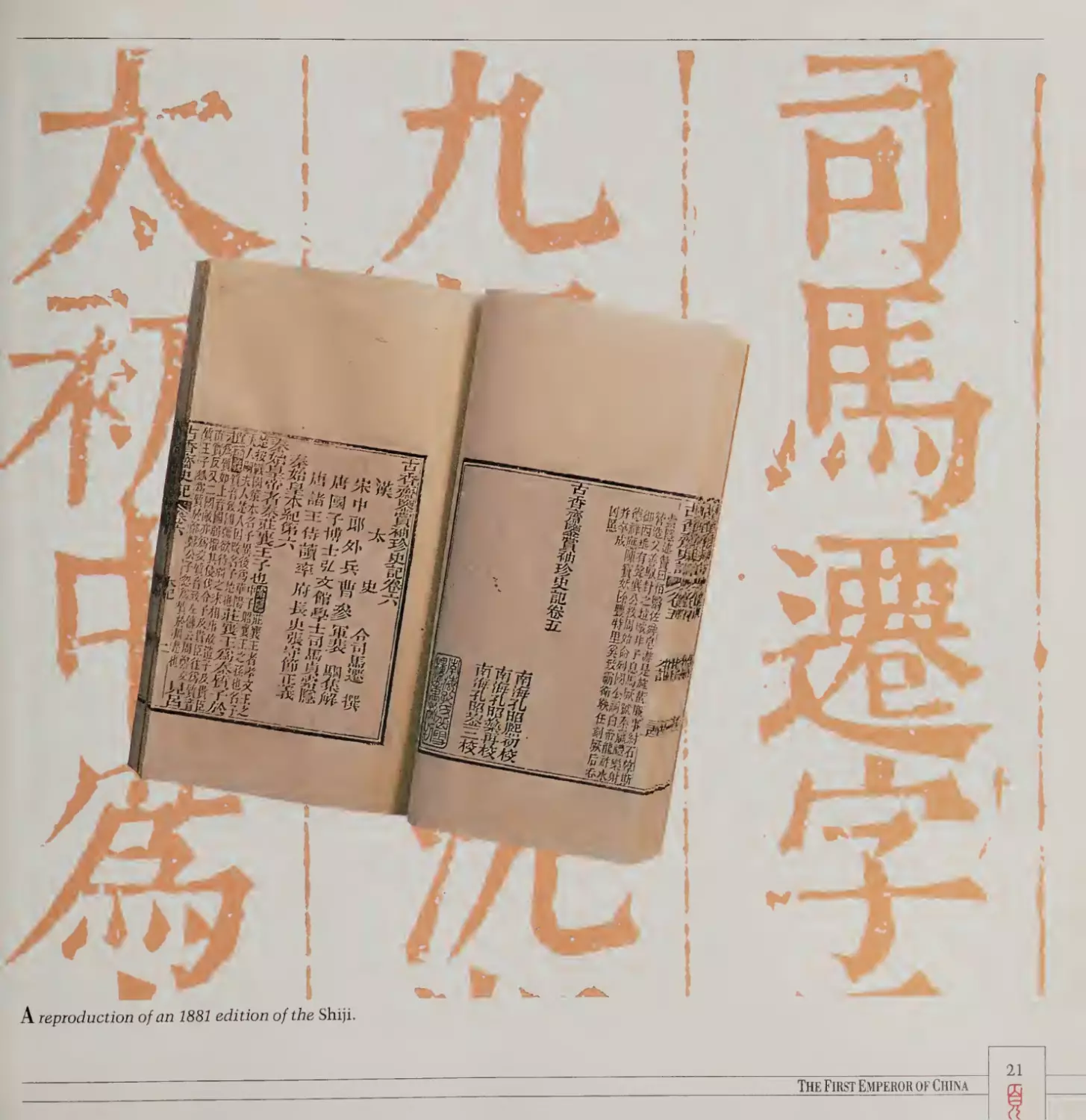
T IS LARGELY FROM A SINGLE SOURCE, the Records of
the Historian or Shiji by Sima Qian that we learn anything
about the life of Qin Shihuang. Designed to cover the
whole of human history, at least as the Chinese saw it,
from its origins all the way down to the author's death in 90
B.C., the Shiji is China's first real work of history. Because of

Sima Qian, historian and author of the Shiji.

S

ima Qian, the author of the
Shiji, held the high official
post of Grand Historian of the
Han dynasty from 107 B.C.,
and began to write the official
Shiji history three years later.
To prepare for his task, he
consulted the records of his
father, combed the Imperial
library for documentary frag¬
ments and travelled widely
to check private libraries and
record the recollections of the
learned and elderly.
For the next eight years, he
combined his writing with
other court duties, but in 99
B.C., he made the mistake of

20
Portrait

defending a certain general
who had been forced to sur¬
render to the Huns.
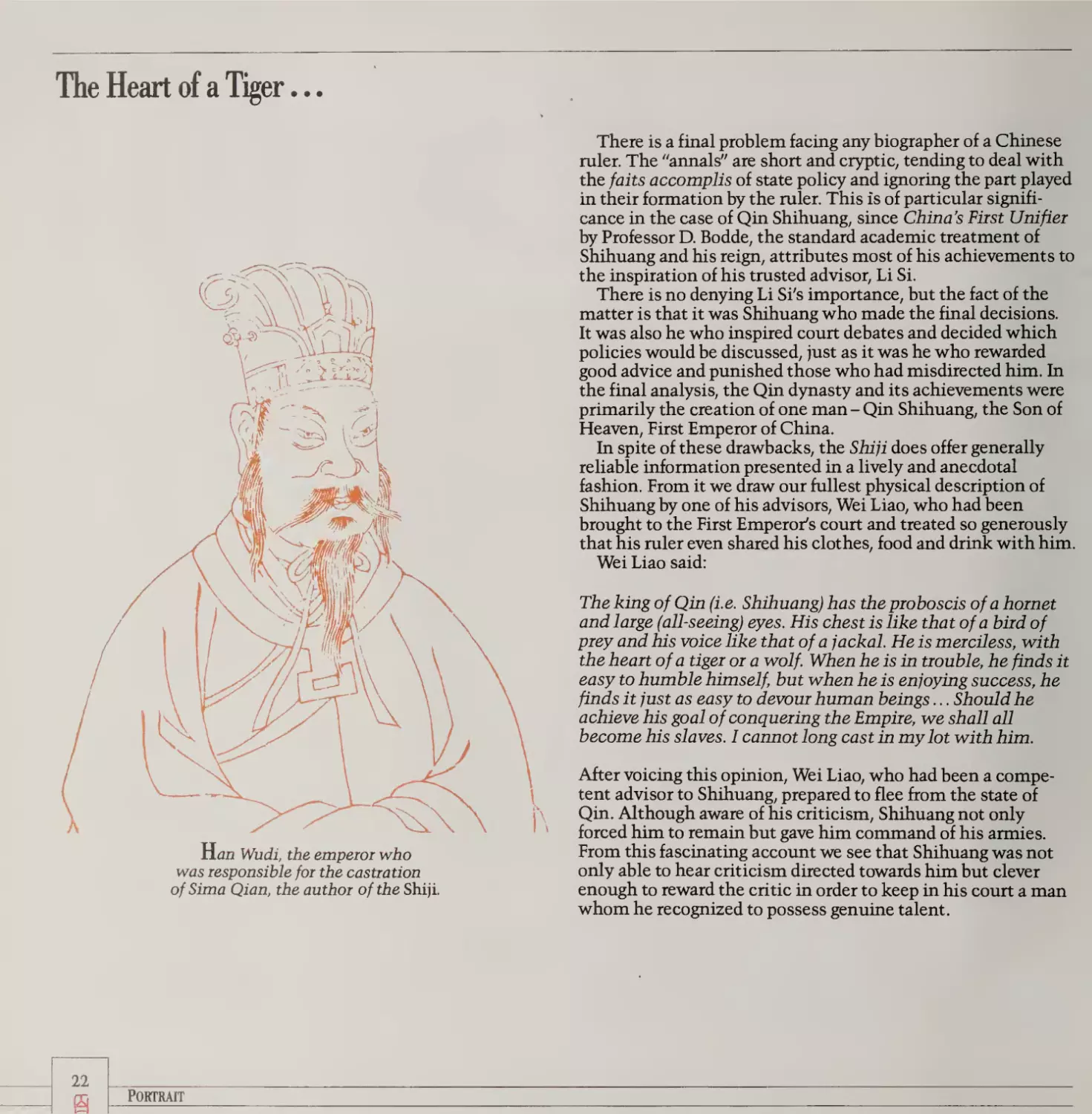
The autocratic emperor,
Han Wudi, had him castrated
and imprisoned for three years,
but despite his suffering, Sima
Qian continued his work in
prison and when he was
released at the age of fifty, be¬
came a palace secretary and
completed his work in 91 B.C.
The Shiji is divided into 130
chapters and contains about
500,000 Chinese characters. It
is still considered today, the
definitive source of early
Chinese history.

its antiquity, it has enjoyed immense prestige and almost
universal admiration right up to the present day. Dealing with
the state of Qin, both before and after unification in two chap¬
ters of "annals", it also provides additional information about
prominent figures of the period in other biographical sections
of the book.
However, even though the Shiji must rank as our most im¬
portant evidence for the life and deeds of Qin Shihuang, its
words must be treated with caution, for it was written a full
century after the fall of the Qin dynasty. What sources still re¬
mained to the author we have no idea and there is a possibility
that imagination could have taken the place of actual facts.
The book was also written when Confucianism was the offi¬
cial state ideology and the philosophy of Legalism which had
been dominant in Shihuang's time stood discredited. Although
we do not know which philosophy the author of the Shiji held
dear, it is obvious that Sima Qian was no admirer of the First
Emperor. Later commentators on the Shiji were even more
critical than he had been of Shihuang's dynasty and all it stood
for, and there is good evidence that some of them inserted
unflattering passages about the First Emperor. The problem of
bias against Shihuang remains, therefore, a very real one.
There is a second barrier which also stands between us and
our attempt to learn more about the real nature of the man
who had made himself the country's August Emperor and it
involves the nature of Chinese traditional historiography.
Chinese history, for instance, is primarily court history written
with a didatic purpose to serve as a "mirror" for future rulers
and their ministers. Affairs which have no direct bearing on
current events are left unrecorded and so, for instance, the first
thirteen years of Shihuang's life, the period before he came to
the throne, are a total blank. Even after he became the mler,
intimate details about his personal life are not recorded so
that although we do know he had more than twenty children,
we have no idea which of his many concubines were
their mothers.
We do not even know if Shihuang ever had a favourite among
his hundreds of women or ever raised one to the official posi¬
tion of empress. This is especially curious considering that
Chinese historians from the Qin dynasty onwards, have
recorded at least the names of all subsequent empresses of
China. Although in Chinese legends, Shihuang has a reputa¬
tion as a formidable lover endowed with enormous sexual
prowess, a man who spread his amorous favours among the
great number of beautiful women brought to his court from all
over China, the truth about this side of his life may never be
discovered.

The First Emperor of China

The Heart of a Tiger...
There is a final problem facing any biographer of a Chinese
ruler. The "annals" are short and cryptic, tending to deal with
the faits accomplis of state policy and ignoring the part played
in their formation by the ruler. This is of particular signifi¬
cance in the case of Qin Shihuang, since China’s First Unifier
by Professor D. Bodde, the standard academic treatment of
Shihuang and his reign, attributes most of his achievements to
the inspiration of his trusted advisor, Li Si.
There is no denying Li Si's importance, but the fact of the
matter is that it was Shihuang who made the final decisions.
It was also he who inspired court debates and decided which
policies would be discussed, just as it was he who rewarded
good advice and punished those who had misdirected him. In
the final analysis, the Qin dynasty and its achievements were
primarily the creation of one man - Qin Shihuang, the Son of
Heaven, First Emperor of China.
In spite of these drawbacks, the Shiji does offer generally
reliable information presented in a lively and anecdotal
fashion. From it we draw our fullest physical description of
Shihuang by one of his advisors, Wei Liao, who had been
brought to the First Emperor's court and treated so generously
that his ruler even shared his clothes, food and drink with him.
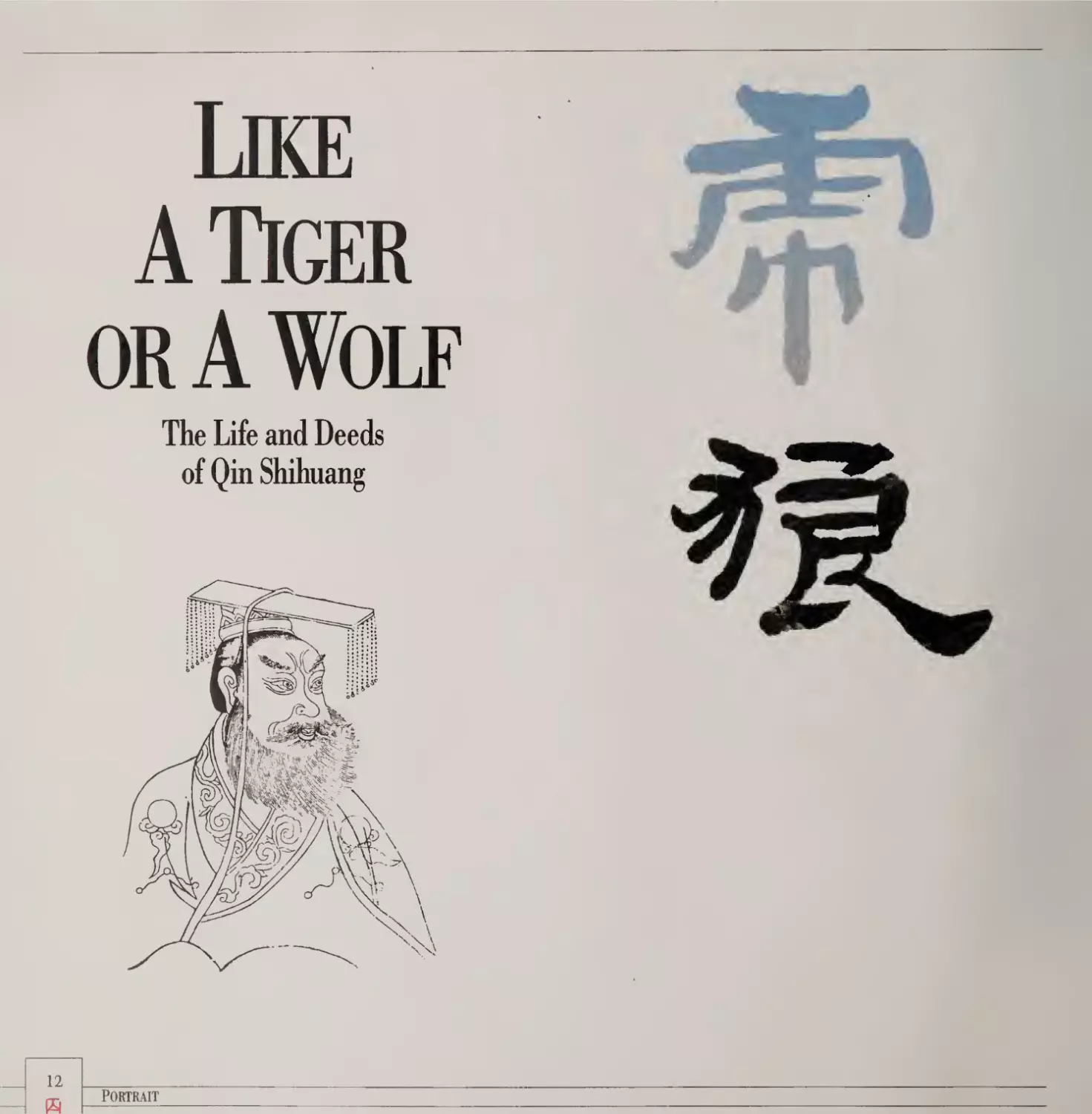
Wei Liao said:
The king of Qin (i.e. Shihuang) has the proboscis of a hornet
and large (all-seeing) eyes. His chest is like that of a bird of
prey and his voice like that of a jackal. He is merciless, with
the heart of a tiger or a wolf. When he is in trouble, he finds it
easy to humble himself, but when he is enjoying success, he
finds it just as easy to devour human beings... Should he
achieve his goal of conquering the Empire, we shall all
become his slaves. I cannot long cast in my lot with him.

of Sima Qian, the author of the Shiji.

22
Portrait

After voicing this opinion, Wei Liao, who had been a compe¬
tent advisor to Shihuang, prepared to flee from the state of
Qin. Although aware of his criticism, Shihuang not only
forced him to remain but gave him command of his armies.
From this fascinating account we see that Shihuang was not
only able to hear criticism directed towards him but clever
enough to reward the critic in order to keep in his court a man
whom he recognized to possess genuine talent.

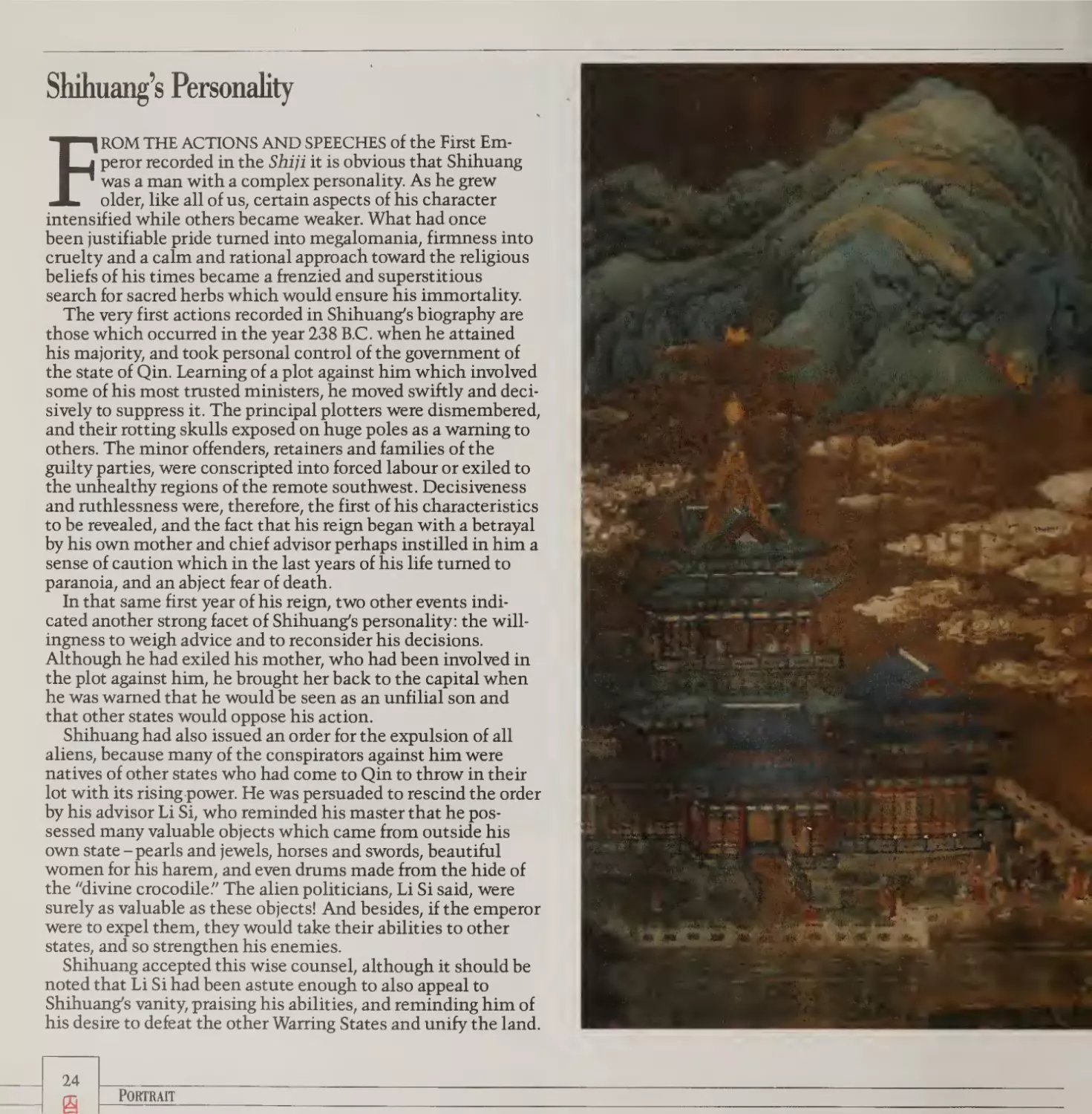
There are many colourful tales
surrounding Qin Shihuang’s
suspicious nature, and one of
the more unusual legends tells
of a special bronze mirror in
his possession. This mirror,
which was roughly four feet
by six feet in size, projected
inverted images of anyone
who stood before it. It also had

magical powers and could
reveal the viscera and other
internal parts of both men
and women. It was useful in
medical examinations and
in unmasking any dangerous
thoughts held by those in the
presence of the Emperor. Thus
even Qin Shihuang’s own con¬
cubines could not hide their

innermost thoughts from him.
Mirrors, such as the one
pictured here, were made of
a bronze containing a high
percentage of tin. One side
is quite decorative, while the
reverse is smooth and polished
to a high gloss.

23
The First Emperor of China

Shihuang’s Personality

F

ROM THE ACTIONS AND SPEECHES of the First Em¬
peror recorded in the Shiji it is obvious that Shihuang
was a man with a complex personality. As he grew
older, like all of us, certain aspects of his character
intensified while others became weaker. What had once
been justifiable pride turned into megalomania, firmness into
cruelty and a calm and rational approach toward the religious
beliefs of his times became a frenzied and superstitious
search for sacred herbs which would ensure his immortality.
The very first actions recorded in Shihuang's biography are
those which occurred in the year 238 B.C. when he attained
his majority, and took personal control of the government of
the state of Qin. Learning of a plot against him which involved
some of his most trusted ministers, he moved swiftly and deci¬
sively to suppress it. The principal plotters were dismembered,
and their rotting skulls exposed on huge poles as a warning to
others. The minor offenders, retainers and families of the
guilty parties, were conscripted into forced labour or exiled to
the unhealthy regions of the remote southwest. Decisiveness
and ruthlessness were, therefore, the first of his characteristics
to be revealed, and the fact that his reign began with a betrayal
by his own mother and chief advisor perhaps instilled in him a
sense of caution which in the last years of his life turned to
paranoia, and an abject fear of death.
In that same first year of his reign, two other events indi¬
cated another strong facet of Shihuang's personality: the will¬
ingness to weigh advice and to reconsider his decisions.
Although he had exiled his mother, who had been involved in
the plot against him, he brought her back to the capital when
he was warned that he would be seen as an unfilial son and
that other states would oppose his action.
Shihuang had also issued an order for the expulsion of all
aliens, because many of the conspirators against him were
natives of other states who had come to Qin to throw in their
lot with its rising power. He was persuaded to rescind the order
by his advisor Li Si, who reminded his master that he pos¬
sessed many valuable objects which came from outside his
own state-pearls and jewels, horses and swords, beautiful
women for his harem, and even drums made from the hide of
the "divine crocodile." The alien politicians, Li Si said, were
surely as valuable as these objects! And besides, if the emperor
were to expel them, they would take their abilities to other
states, and so strengthen his enemies.
Shihuang accepted this wise counsel, although it should be
noted that Li Si had been astute enough to also appeal to
Shihuang's vanity, praising his abilities, and reminding him of
his desire to defeat the other Warring States and unify the land.

24
Portrait

Q

in Shihuang was a man
with a deep interest in the
sacred and a profound rever¬
ence for the supernatural.
Studies of his life by Western
historians too often use the
term “superstitious" to de¬
scribe him. This is wrong. He
lived in a world populated by
spirits and ghosts, and in a
world in which the connection
between Heaven and Earth was
perceived to be much closer
than is the case today. He
sought to live a long time, per¬
haps forever, and those around
him promised that he could
achieve immortality. There
were secrets hidden on the
"Eastern Isles," and there were
ways of synthesizing a pill or
an elixir which could prolong
life forever. Cinnabar was an
important ingredient of these
formulae and so were such
other substances as mercury
and phosphorous. Shihuang
probably ingested all these
substances, and rather than
lengthening his life, they
shortened it.

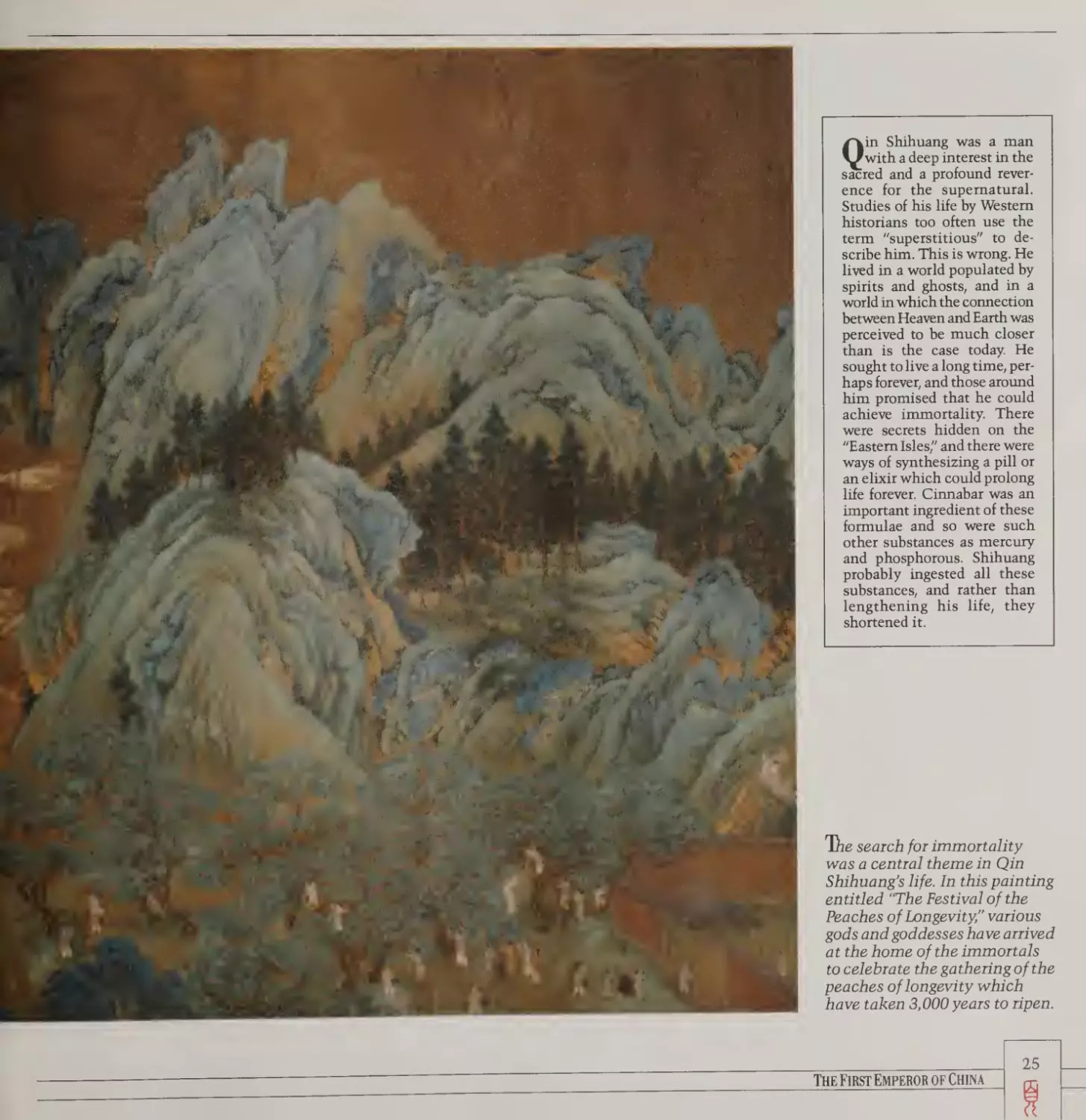
The search for immortality
was a central theme in Qin
Shihuang’s life. In this painting
entitled “The Festival of the
Peaches of Longevity,” various
gods and goddesses have arrived
at the home of the immortals
to celebrate the gathering of the
peaches of longevity which
have taken 3,000 years to ripen.

25

The First Emperor of China

The Visionary

T

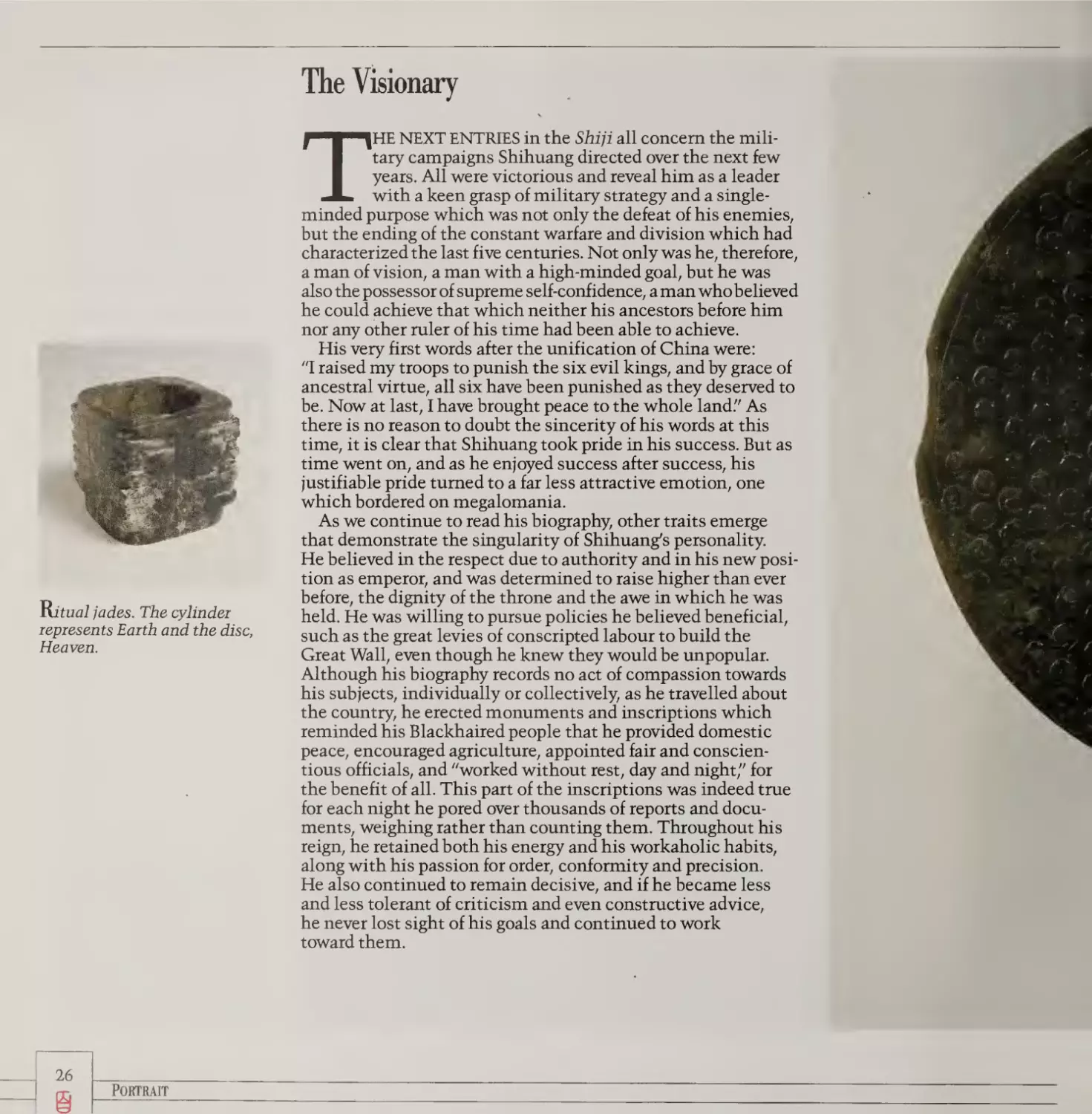
Ritual jades. The cylinder
represents Earth and the disc,
Heaven.

HE NEXT ENTRIES in the Shiji all concern the mili¬
tary campaigns Shihuang directed over the next few
years. All were victorious and reveal him as a leader
with a keen grasp of military strategy and a singleminded purpose which was not only the defeat of his enemies,
but the ending of the constant warfare and division which had
characterized the last five centuries. Not only was he, therefore,
a man of vision, a man with a high-minded goal, but he was
also the possessor of supreme self-confidence, a man who believed
he could achieve that which neither his ancestors before him
nor any other ruler of his time had been able to achieve.
His very first words after the unification of China were:
"I raised my troops to punish the six evil kings, and by grace of
ancestral virtue, all six have been punished as they deserved to
be. Now at last, I have brought peace to the whole land." As
there is no reason to doubt the sincerity of his words at this
time, it is clear that Shihuang took pride in his success. But as
time went on, and as he enjoyed success after success, his
justifiable pride turned to a far less attractive emotion, one
which bordered on megalomania.
As we continue to read his biography, other traits emerge
that demonstrate the singularity of Shihuang's personality.
He believed in the respect due to authority and in his new posi¬
tion as emperor, and was determined to raise higher than ever
before, the dignity of the throne and the awe in which he was
held. He was willing to pursue policies he believed beneficial,
such as the great levies of conscripted labour to build the
Great Wall, even though he knew they would be unpopular.
Although his biography records no act of compassion towards
his subjects, individually or collectively, as he travelled about
the country, he erected monuments and inscriptions which
reminded his Blackhaired people that he provided domestic
peace, encouraged agriculture, appointed fair and conscien¬
tious officials, and "worked without rest, day and night," for
the benefit of all. This part of the inscriptions was indeed true
for each night he pored over thousands of reports and docu¬
ments, weighing rather than counting them. Throughout his
reign, he retained both his energy and his workaholic habits,
along with his passion for order, conformity and precision.
He also continued to remain decisive, and if he became less
and less tolerant of criticism and even constructive advice,
he never lost sight of his goals and continued to work
toward them.

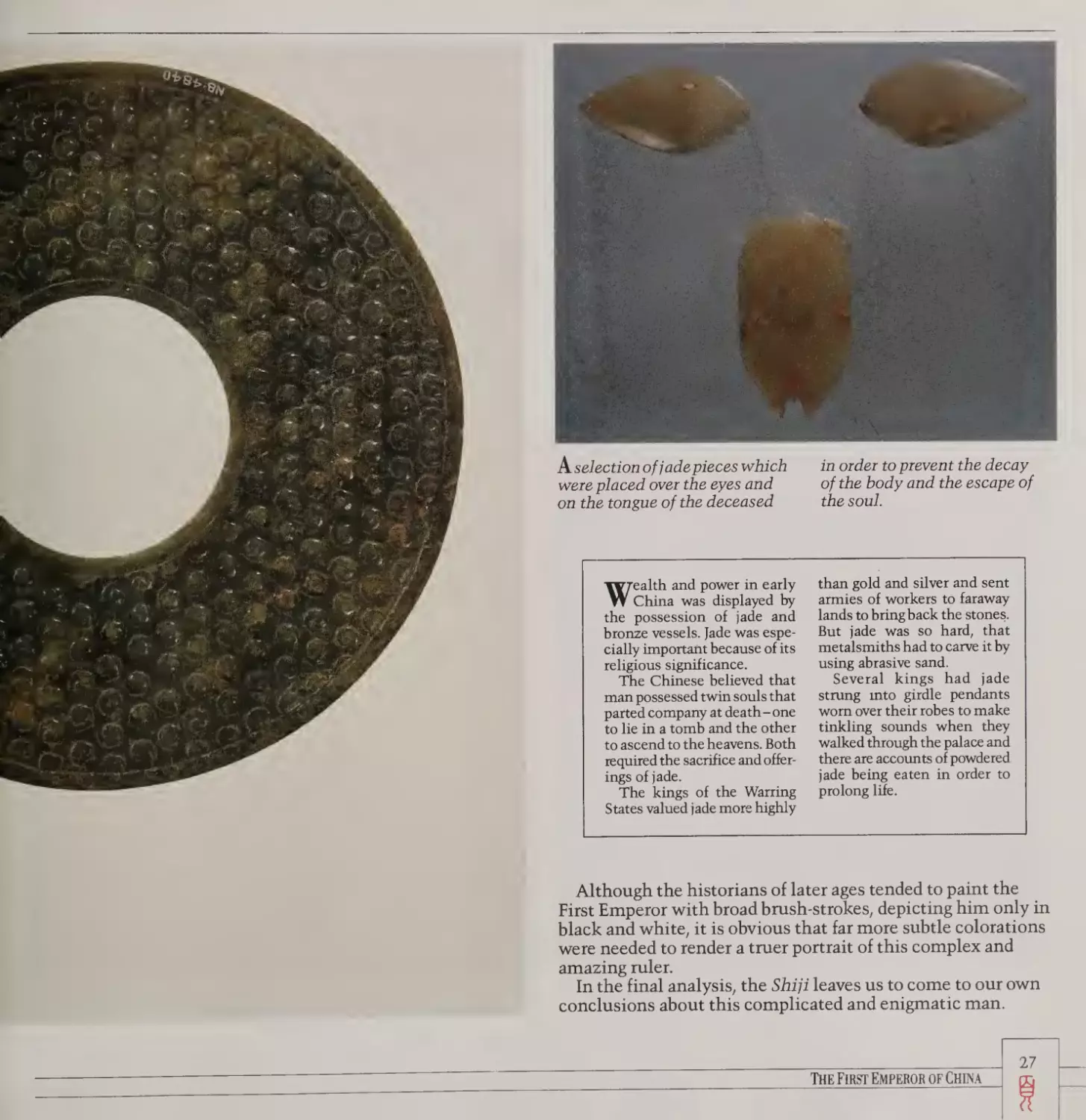
A selection of jade pieces which
were placed over the eyes and
on the tongue of the deceased

W

ealth and power in early
China was displayed by
the possession of jade and
bronze vessels. Jade was espe¬
cially important because of its
religious significance.
The Chinese believed that
man possessed twin souls that
parted company at death-one
to lie in a tomb and the other
to ascend to the heavens. Both
required the sacrifice and offer¬
ings of jade.
The kings of the Warring
States valued jade more highly

in order to prevent the decay
of the body and the escape of
the soul.

than gold and silver and sent
armies of workers to faraway
lands to bring back the stones.
But jade was so hard, that
metalsmiths had to carve it by
using abrasive sand.
Several kings had jade
stmng mto girdle pendants
worn over their robes to make
tinkling sounds when they
walked through the palace and
there are accounts of powdered
jade being eaten in order to
prolong life.

Although the historians of later ages tended to paint the
First Emperor with broad brush-strokes, depicting him only in
black and white, it is obvious that far more subtle colorations
were needed to render a truer portrait of this complex and
amazing ruler.
In the final analysis, the Shiji leaves us to come to our own
conclusions about this complicated and enigmatic man.

27
--"

~~

The First Emperor of China

£1

a

The Origins of Shihuang

B

ECAUSE OF THE CHINESE veneration of antiquity, the
leaders of the state of Qin, like the other rulers of the
time, fashioned legends to make their origins date as
far back as possible. Qin, therefore, claimed its people
had originated in the third millenium B.C. when the grand¬
daughter of a legendary figure ate the egg of a totemic swallow
and gave birth to the line of Qin. More prosaic but reliable
sources date the history of Qin back to 897 B.C. when the
House of Zhou gave land to a tribal chieftain so he could breed
horses. From its very beginnings, then, the horses of Qin and
the horsemanship of its people were a part of the state's tradi¬
tion and its cavalry would later make a great contribution to
its military might.
A remarkable group of men, the ancestors of Shihuang, had
been among the first of the 170-odd Zhou nobles to illegally

28
Portrait

raise their titles to the high rank of "Duke" [gong] and from
677 B.C. had advanced their capital eastward by stages until
they had occupied most of the lands formerly owned by the
Zhou. In 350 B.C. they finally came to rest in Xianyang which
is only ten miles away from the present-day city of Xi'an.
Their advance had been carried out in the midst of largescale warfare with their nomadic neighbours, the Rong, whom
they eventually subdued. This constant battling with the war¬
like nomads had one very positive result for the state of Qin it sharpened their warriors' military skills. However, the inter¬
marriage with the Rong women that was the inevitable result
of victory over the nomads had a negative aspect according to
the more "civilized" states of the Central Plain who felt that
the people of Qin had learned distressingly bad manners from
their barbarian kinfolk.

Even Li Si, Shihuang's chief advisor, could not refrain from
complaining about the barbaric music of the Qin to his
master: “Now the beating on earthen jugs, knocking on jars,
plucking the strings of the guitar, and striking on thigh bones,
all the while singing and crying ‘Wu! Wu!’ as a means of
delighting the ear and eye: this indeed was the music of Qin.”
Although comparison between Shihuang's ancestors and the
leaders of other states is difficult because Shihuang had these
records destroyed later in his reign, it seems clear from the
few sources that do still remain, that the state of Qin enjoyed a
consistent succession of capable leaders.
Among the more noteworthy of Shihuang's remote ancestors
was one Qin leader who was astute enough to provide protec¬
tion to the disgraced leader of Zhou when he was forced to
move his capital in the eighth century B.C. Another, Duke Mu
(659-21 B.C.) was awarded the grand title of "Hegemon of the
West" for his military successes against the barbarians.
Later there were other formidable leaders, especially after
the Qin leaders decided that the title "Duke" was not suffi¬
ciently majestic and usurped the title of "King" [wang] in
325 B.C. One of these new Qin kings, Wu, surrounded himself
with wrestlers and strongmen and astounded his peers with
his physical strength until his attempt to lift an enormous
bronze couldron over his head finally finished him off in
307 B.C. Then there was King Hui, a clever diplomat in his
short reign, who used "beautiful women and comely boys"
to subvert his enemies, and who formed, and then broke,
a number of strategic alliances. Following him was King
Zhaoxiang, an ambitious but careful ruler who summoned to
his court the renowned advisors of his enemy rulers, and was

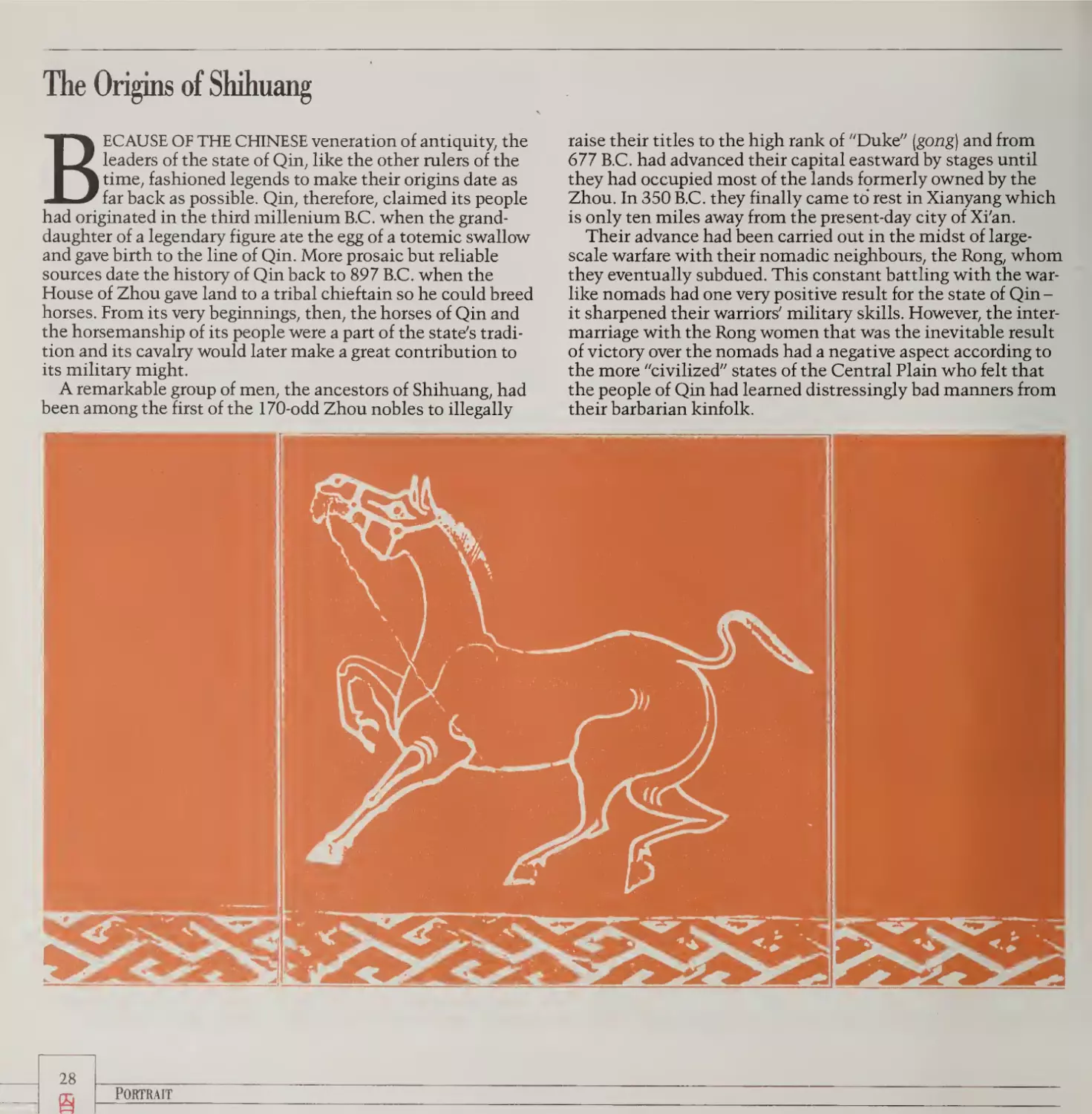
< Horses were an important part
of Shihuang’s heritage as his
ancestors were horse breeders.

not ashamed to kneel (in private) before them. It was he who
charted Qin's course through the crucial period when it was
emerging as one of the seven paramount states. Perhaps he was
able to manage this difficult task because he was in the habit
of listening to his advisors, one of whom warned him that
because Qin was becoming so powerful it would be "like a
bone thrown among the hounds" to the other six states.
We can see, then, that Shihuang was heir to a tradition of
strong, courageous leaders who were also clever statesmen.
One of the more striking features possessed by the state of Qin
was that its rulers were not only talented military leaders but
brilliant strategists, as well. It was this combination of abili¬
ties that accounted for the state's rise. Later, Shihuang himself
would show by his own actions, that he had studied and taken
to heart the lessons in leadership displayed by his ancestors.

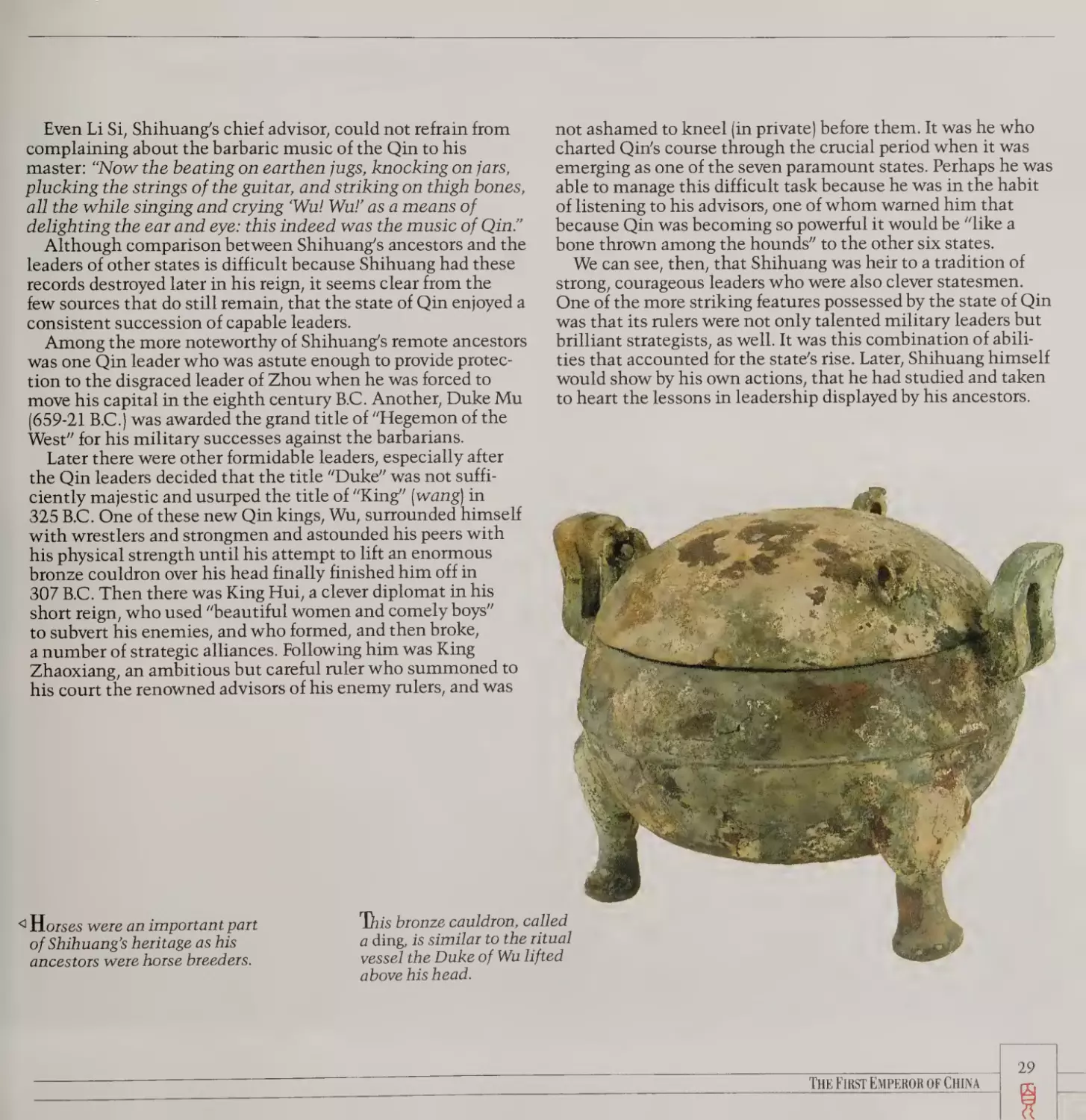
This bronze cauldron, called
a ding, is similar to the ritual
vessel the Duke of Wu lifted
above his head.

29
The First Emperor of China

A Product of the Warring States

T

HE PERIOD OF THE WARRING STATES of which the
First Emperor was a product was a fluid, restless, bru¬
tal time, an era of fierce and unrelenting inter-state
competition. The competing states vied with one
another not just for supremacy but for actual survival, for all it
took was one, single, fatal mistake for a state to be annexed by
its more powerful neighbours. As the states became fewer and
fewer, each one scrambled to adopt the newest techniques of
agriculture, warfare, diplomacy and state organization-any¬
thing which would strengthen themselves and weaken or
deter their neighbours. Men of ideas were eagerly sought after,
and travelled freely from state-to-state, offering their advice or
plans to the highest bidder. The intense competition resulted
in astonishingly rapid technological progress, and by the time
Shihuang had become emperor in 221 B.C., China probably
exceeded the Mediterranean world in almost every measure of
material civilization.
The darker side of this period was, however, an exceedingly
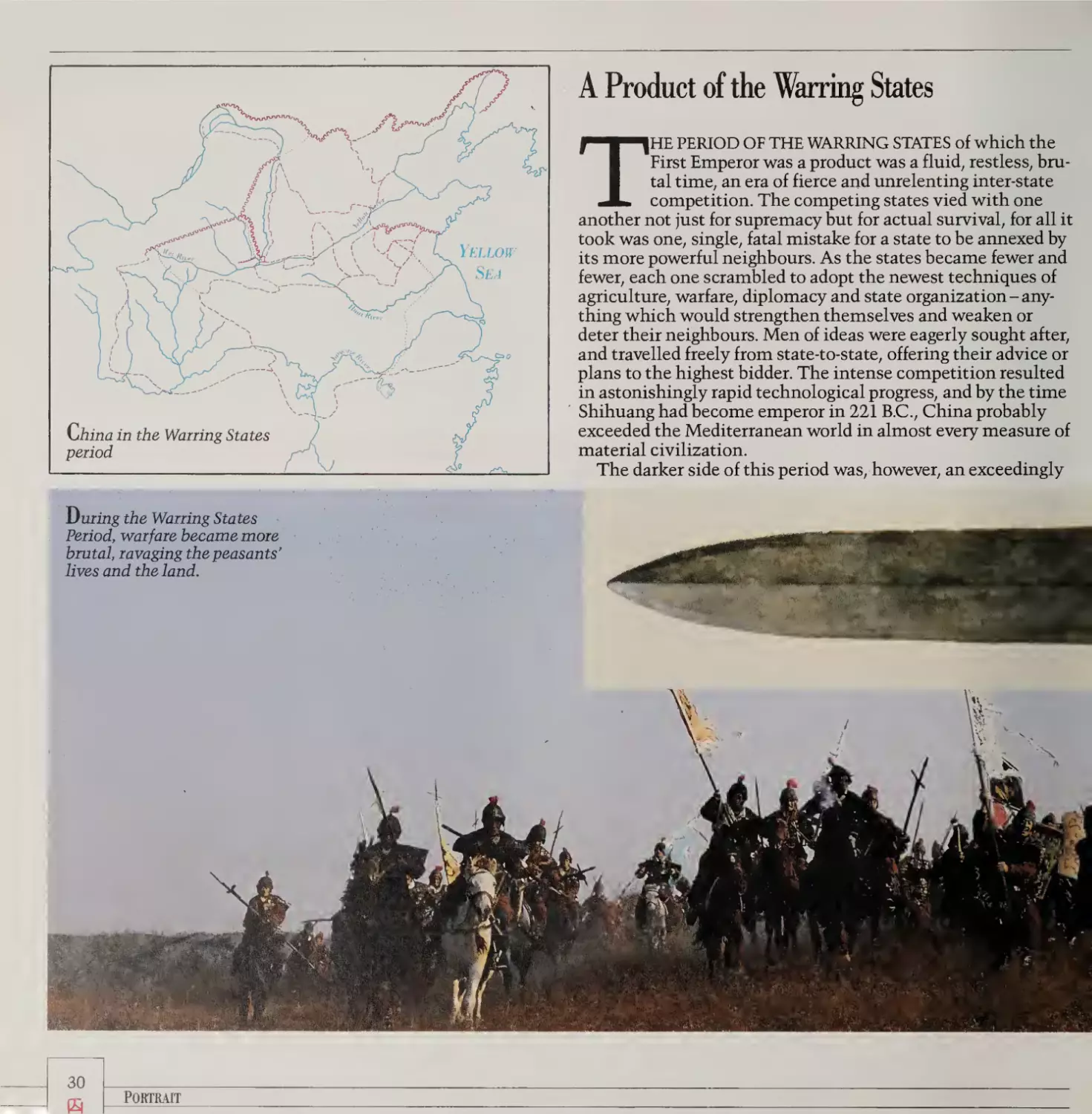
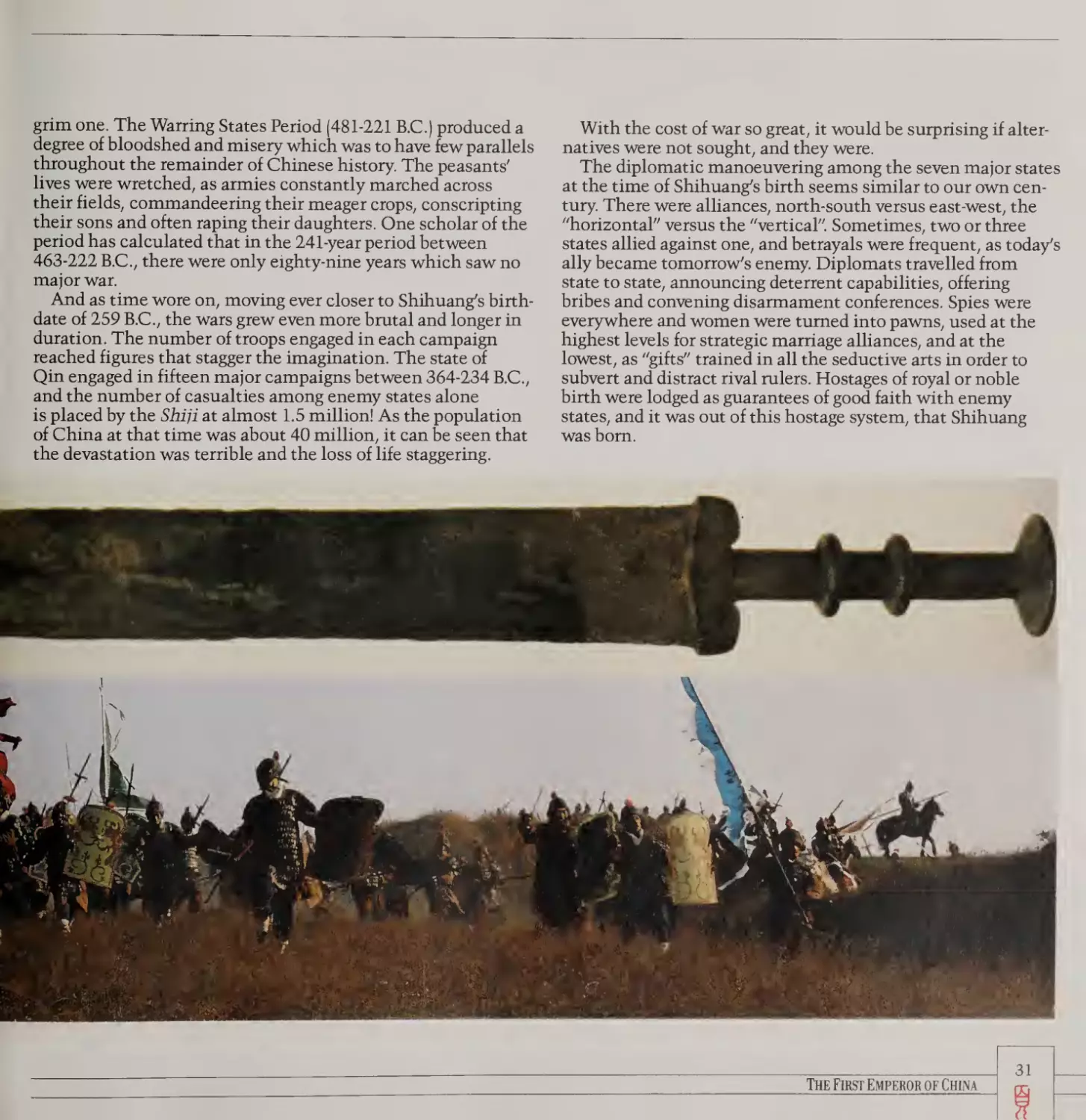
During the Warring States
Period, warfare became more
brutal, ravaging the peasants’
lives and the land.

30
a

Portrait

grim one. The Warring States Period (481-221 B.C.) produced a
degree of bloodshed and misery which was to have few parallels
throughout the remainder of Chinese history. The peasants'
lives were wretched, as armies constantly marched across
their fields, commandeering their meager crops, conscripting
their sons and often raping their daughters. One scholar of the
period has calculated that in the 241-year period between
463-222 B.C., there were only eighty-nine years which saw no
major war.
And as time wore on, moving ever closer to Shihuang's birthdate of 259 B.C., the wars grew even more brutal and longer in
duration. The number of troops engaged in each campaign
reached figures that stagger the imagination. The state of
Qin engaged in fifteen major campaigns between 364-234 B.C.,
and the number of casualties among enemy states alone
is placed by the Shiji at almost 1.5 million! As the population
of China at that time was about 40 million, it can be seen that
the devastation was terrible and the loss of life staggering.

With the cost of war so great, it would be surprising if alter¬
natives were not sought, and they were.
The diplomatic manoeuvering among the seven major states
at the time of Shihuang's birth seems similar to our own cen¬
tury. There were alliances, north-south versus east-west, the
"horizontal" versus the "vertical". Sometimes, two or three
states allied against one, and betrayals were frequent, as today's
ally became tomorrow's enemy. Diplomats travelled from
state to state, announcing deterrent capabilities, offering
bribes and convening disarmament conferences. Spies were
everywhere and women were turned into pawns, used at the
highest levels for strategic marriage alliances, and at the
lowest, as "gifts" trained in all the seductive arts in order to
subvert and distract rival rulers. Hostages of royal or noble
birth were lodged as guarantees of good faith with enemy
states, and it was out of this hostage system, that Shihuang
was bom.

31
The First Emperor of China

IS
5?

Shihuang’s Parents

T

HE STORY IS TOLD in the Shiji that Shihuang was the
son of a merchant, a man called Lu Buwei, said to be
an immensely rich dealer in luxury goods who "bought
cheap and sold dear." At that time he was residing
in the state of Zhao, Qin's foremost enemy, where the king of
Qin had sent one of his younger sons, Zizhu, as a hostage.
Buwei was a shrewd and ambitious man, and realizing that
the state of Qin was the rising power, and that the young
prince, Zizhu, was living in straitened circumstances, he
gained the young man's friendship by a gift of a thousand gold
pieces, regarding it as "a sound investment in rare merchan¬
dise." Then he travelled to the state of Qin, determined to
influence a change in the royal succession there.
Circumstances favoured him, for as luck would have it, the
favourite wife of the king was childless. Showering her with gifts
of jewels and jade and reminding her subtly, that as her beauty
faded she was likely to lose her husband's favour, he persuaded
her to use her charms on her husband and convince him to
make his protege, Zizhu, successor to the throne of Qin. When
he became king, said Buwei, her future would then be secured
as queen-mother. As Buwei had also freely dispensed his treasures
and money to the couriers surrounding the king of Qin, it was
not too difficult for the king's wife to get them to back her
suggestion to the ruler who finally agreed. An elated Buwei
rushed back to Zhao to convey the good news to Zizhu.

Now secure in his position as Crown Prince, Zizhu
demanded even more favours from the wealthy merchant,
promising to repay him when he became king. To Buwei's mor¬
tification, among the gifts the young prince demanded was the
merchant's favourite concubine, a woman called Zhao Ji, the
daughter of a wealthy family, who was also a skilled dancer, a
seductive beauty, and judging from her later conduct, a woman
of wanton tastes. Buwei reluctantly agreed to give her up, but
unbeknownst to the young prince, she was pregnant by Buwei
at the time.
When Prince Zizhu returned to the court of Qin, Zhao Ji
accompanied him and gave birth to the squalling infant
Zizhu believed to be his own son.
Zizhu ascended the throne of Qin in 249 B.C., and he im¬
mediately made Lu Buwei his Chancellor of State. When he
died after a short reign of only three years, the son of Zhao Ji
and Buwei succeeded him.
The Shiji thus informs us that Qin Shihuang was the bas¬
tard son of a merchant, a profession considered contemptible
at that time, and a woman of easy virtue. Recent scholarship
has been a little reluctant to accept this story, attributing it to
bias against Shihuang and to later textual interpolation, but
the fact remains that the story has been accepted as truth for
more than 2,000 years and is believed by most Chinese today.

Shihuang's
mother had been
the concubine of Lu Buwei,
and according to the Shiji, she
had also been the "finest
dancer and the most seductive
courtesan" in her native city of
Handan in the state of Zhao.
At the time of Shihuang, con¬
cubinage was common in the
upper ranks of society. Its pur¬
pose was to ensure the birth of
a male heir and, of course, in
that firmly patriarchical soci¬
ety, to provide the male with
an additional sexual outlet.

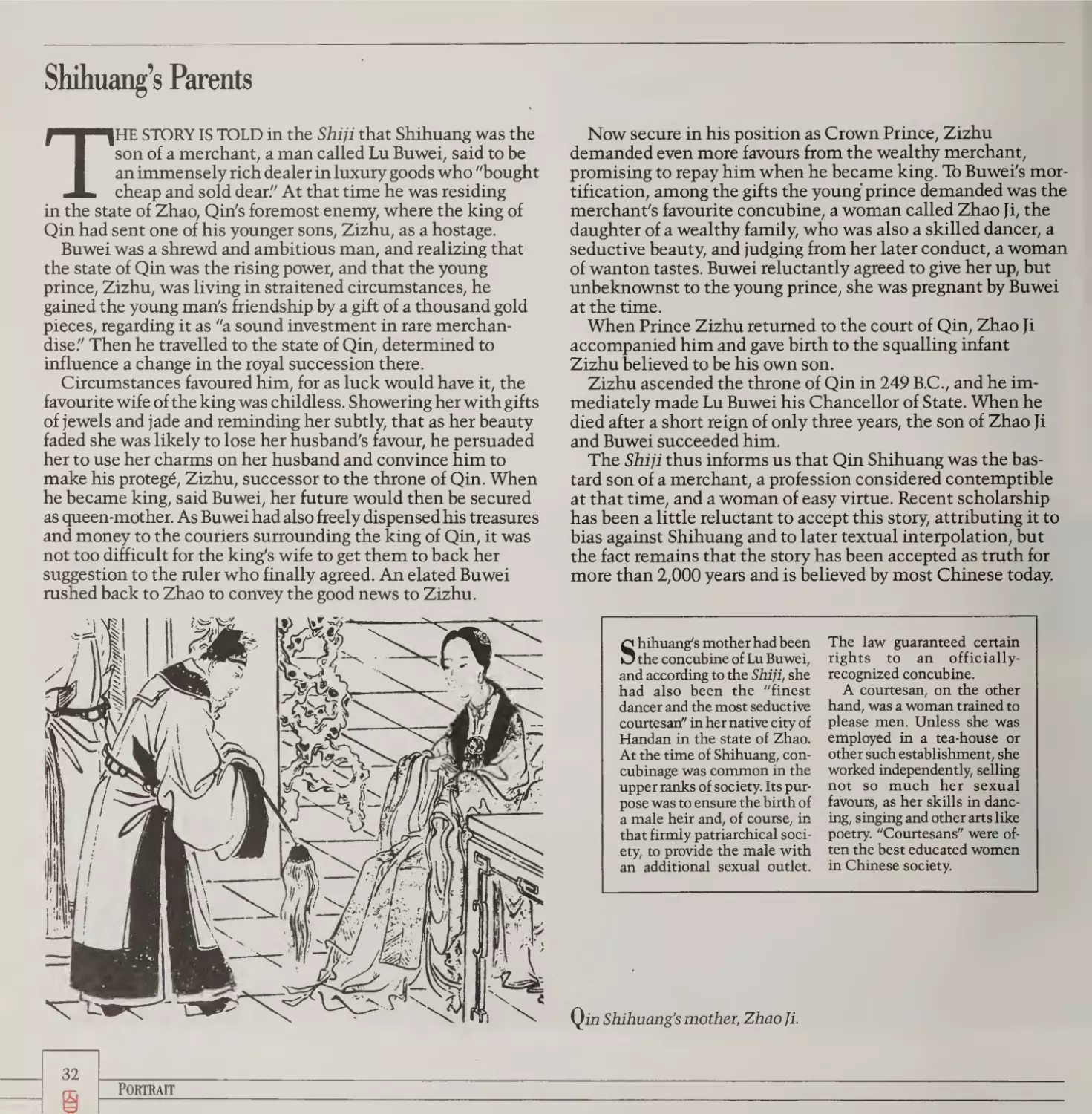
Qin Shihuang’s mother, Zhaoji.

32
Ki

Portrait

The law guaranteed certain
rights to an officiallyrecognized concubine.
A courtesan, on the other
hand, was a woman trained to
please men. Unless she was
employed in a tea-house or
other such establishment, she
worked independently, selling
not so much her sexual
favours, as her skills in danc¬
ing, singing and other arts like
poetry. "Courtesans" were of¬
ten the best educated women
in Chinese society.

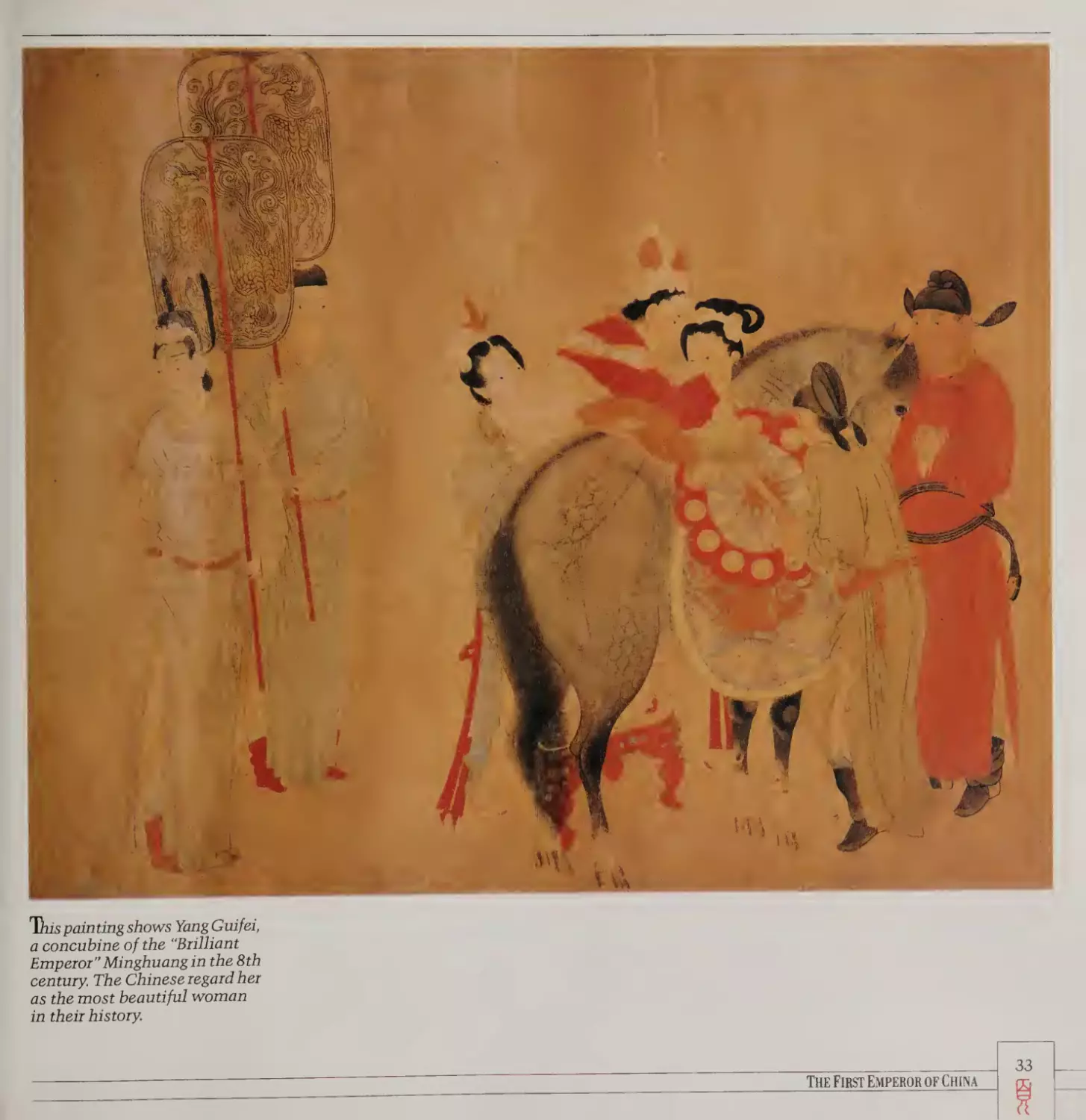
This painting shows YangGuifei,
a concubine of the “Brilliant
Emperor” Minghuang in the 8th
century. The Chinese regard her
as the most beautiful woman
in their history.

33
--

The First Emperor of China
«

The Downfall of Lu Buwei

A

S SHIHUANG WAS ONLY THIRTEEN when he came
to the throne, the affairs of state were left in the
hands of his Chancellor, Buwei, who soon became
immensely rich and powerful, with "as many as ten
thousand household retainers." Ashamed of his merchant
origins, he surrounded himself with scholars and had them
produce an encyclopedia to encompass all human knowledge.
He then placed this book, which we still possess today, in
the marketplace of the capital, offering a reward of a thousand
gold pieces to any scholar who "could add or subtract a single
word!" He also resumed his sexual relationship with his
former concubine, now the queen mother, a move which
would eventually lead to his downfall.
As Shihuang grew to manhood, Buwei became more and
more nervous about his relationship with Shihuang/s mother,
and fearful that the young king would learn about their sex¬
ual liason. In order to disengage himself from the lascivious
Zhao Ji, he conceived a bold plan. One of his retainers, a man
by the name of Lao Ai, was famed for his enormous sexual
endowment. The Shiji tells us that "in order to inflame" the
queen-mother, Buwei had this man parade around with a cart¬
wheel balanced on his phallus! Hearing of this, Zhao Ji
decided she wanted him as her lover and to prevent scandal,
Lao Ai's beard and eyebrows were plucked to disguise him as
a eunuch, and he was given to her. He must have lived up to
her expectations for she made her new lover rich and powerful.
In return, he gave her two sons, whom she concealed. Buwei's
involvement in the affair apparently remained undetected, for
not only did Shihuang continue to entrust to him the affairs of

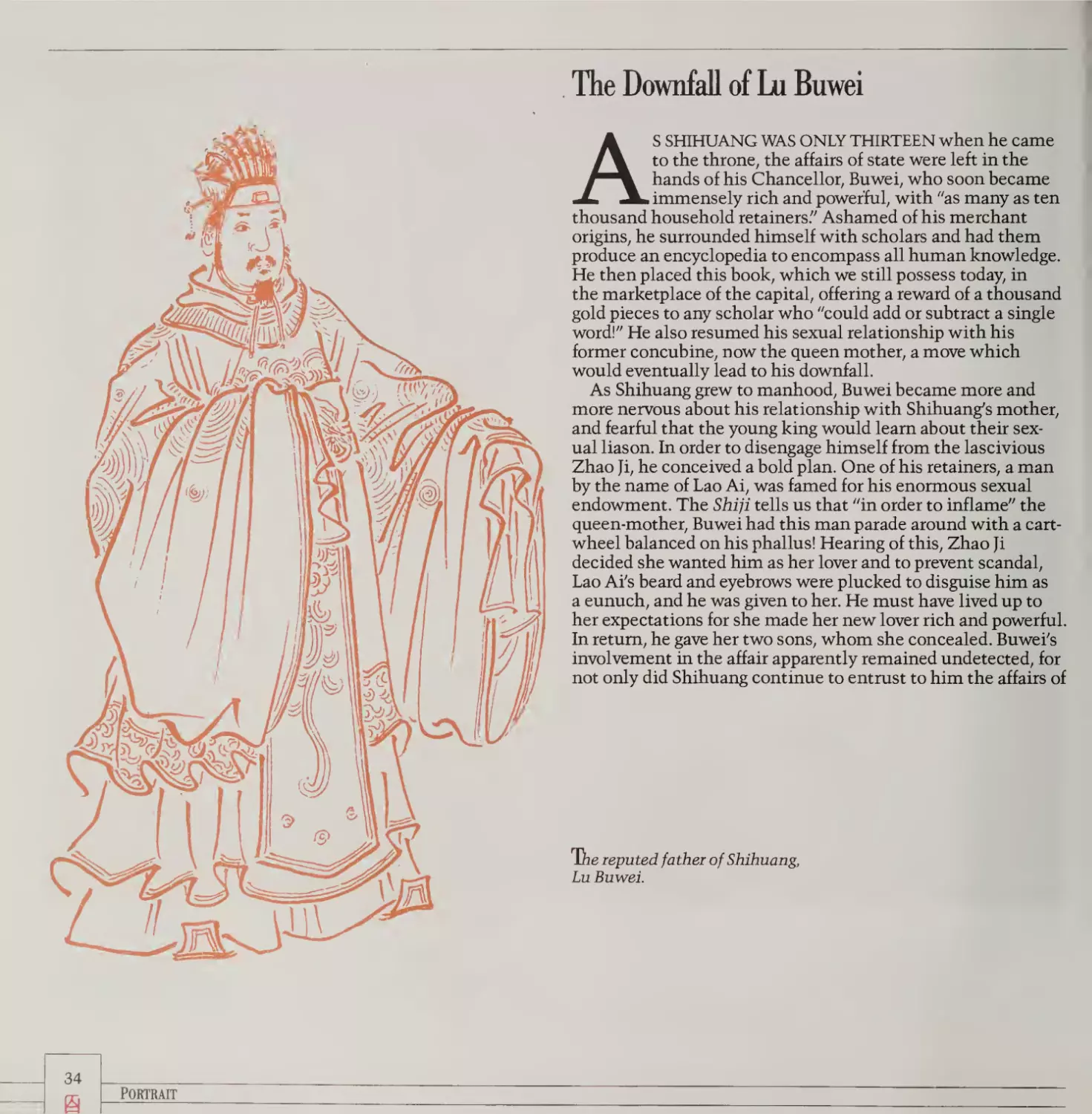
The reputed father of Shihuang,
Lu Buwei.

state, but he also bestowed on him the affectionate, honorary
title of "Second Father."
But in 238 B.C. when Shihuang attained his majority and
took the government into his own hands, ambitious informers
soon revealed to him the scandal concerning his mother and
her lover. Lao Ai, with the help of the queen-mother and per¬
haps Buwei, rose in rebellion, but Shihuang swiftly and ruth¬
lessly suppressed the plot, and when Lao Ai escaped capture in
the ensuing battle, Shihuang placed a price on his head - one
million cash if he were taken alive, and half that sum if his
head were presented to him! What terrible vengeance was
Shihuang planning had Lao Ai been taken alive? Fortunately
for him he was killed while in flight.
Shihuang, however, did get the opportunity to show what
kind of punishment he would mete out to future plotters
against his throne - other members of the rebellion, some of
whom had held office within his palace, were dismembered
and their bodies were exposed to the populace.
Although Buwei had been implicated in the affair, he was
temporarily spared by Shihuang, but the queen-mother was
sent into exile. Later he brought her back to the capital on the
advice of his counsellors and installed her in her own palace
where she quietly resided for the next seventeen years.
As for Lu Buwei, the following year he received a letter from
Shihuang. "What have you done to benefit Qin?" the letter
asked. Buwei took the hint, and the man whom historians
consider to be the real father of the First Emperor killed him¬
self by drinking poison.

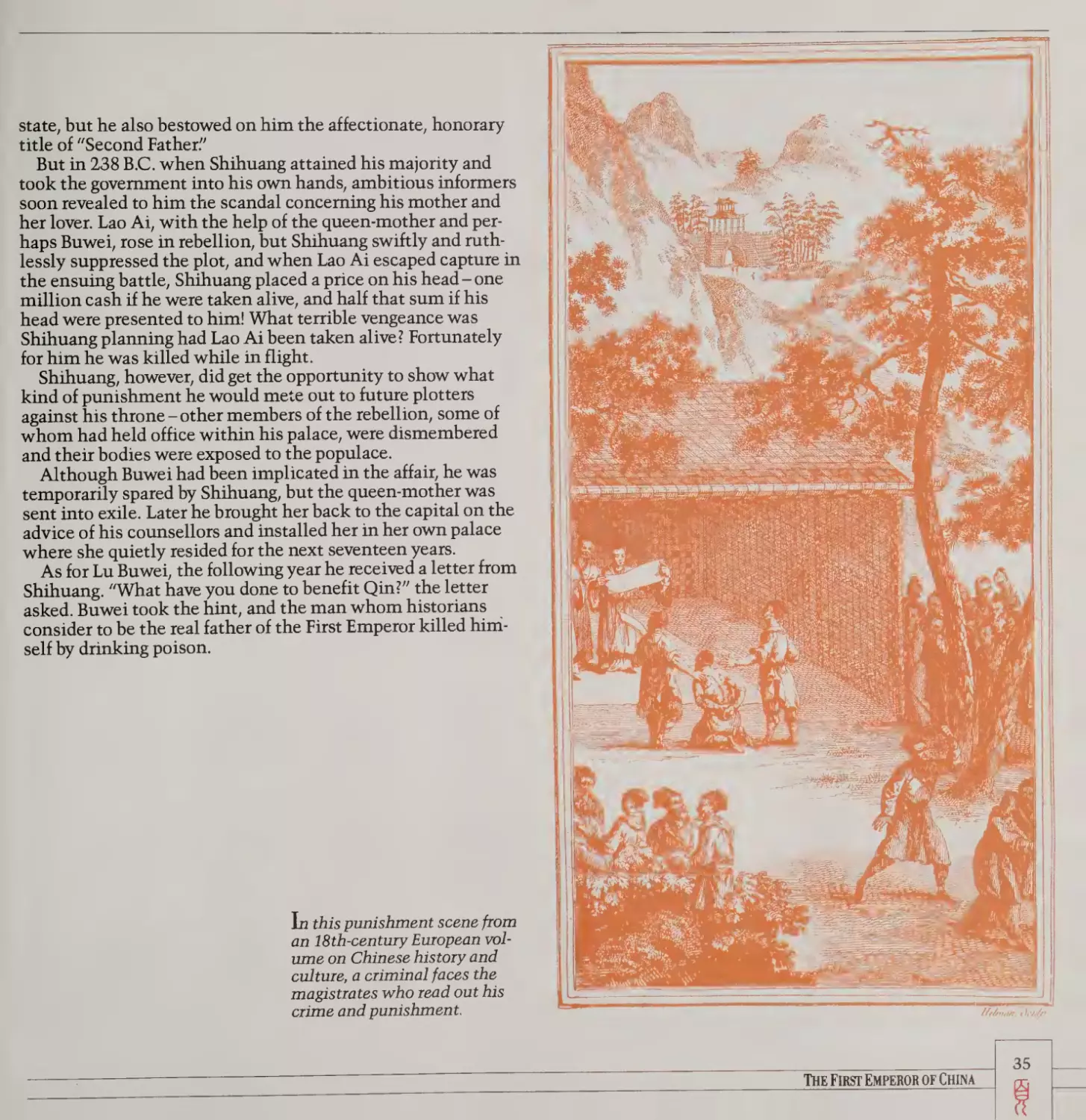
In this punishment scene from
an 18th-century European vol¬
ume on Chinese history and
culture, a criminal faces the
magistrates who read out his
crime and punishment.

35
----

The First Emperor of China

a

Shihuang’s Brilliant Minister - Li Si

I

T WAS THE FALL of Lu Buwei that brought about the rise of
Li Si, the man who, next to Shihuang himself, was des¬
tined to have the greatest influence on the political life of
his times.
Li Si was a southerner, a petty clerk from the state of Chu,
and we are told that one day, as he entered his office privy, he
noticed that the rats there were scrawny, filthy and frightened.
In the granary near his office, however, the rats were sleek,
well-fed and arrogant. "A man's ability or lack of ability," he
sighed, "is just like that of these rats. His condition in life
depends on where he places himself." Soon realizing that Qin
was emerging as the strongest of the states, he travelled there
in 247 B.C., the year before the thirteen-year-old Shihuang suc¬
ceeded to the throne. Determined to place himself amongst
the powerful men of the time, he entered the service of
Lu Buwei.
Ambitious and opportunistic, Li Si soon contrived to meet
the young king of Qin, and by adroit flattery and clever advice
not only won Shihuang's confidence, but was also given the
title of Alien Minister, an honour sometimes conferred in
Qin upon advisors from other states. He engaged in secret
diplomacy, manipulating a network of agents and spies, and

36
Portrait

found time to continue the studies he had earlier begun under
the great Confucian philosopher, Xun Zi.
His career was almost cut short in 237 B.C. when Shihuang,
disgusted with the rebellious activities of Lao Ai, Lu Buwei,
and other alien politicians who had come to Qin, issued a
decree for the expulsion of all aliens. Li Si, in a smooth and
carefully-worded speech, persuaded him to cancel his order,
and as a reward was promoted to Minister of Justice.
We hear no more of him until the conquest was complete,
but presumably he was at Shihuang's side, offering advice from
his own experiences in espionage, and in 221 B.C. when the
Qin dynasty was proclaimed, he became Grand Councillor.
From that time until the death of the First Emperor, he was
the most powerful of state ministers, although he never did
achieve dominance over Shihuang who always made sure
that the final decisions during his rule would be his alone.
However, many of Shihuang's policies are attributed to Li Si.
He stood firm against majority opinion in 221 B.C. when the
Emperor was advised to restore the feudal system of nobles,
and hence played a role in Shihuang's centralization of China.
To Li Si is also attributed the systematization of the variant
scripts of the time and the composition of China's first die-

tionary. He accompanied Shihuang on all of his tours of in¬
spection and is said to have been the author of some of the
great stone inscriptions left behind to praise his master's
achievements. But he is remembered, above all, as the man
who advised Shihuang to decree the "Burning of the Books,"
and it is because of this act, that he shares in the hatred with
which historians have regarded Shihuang.
His power remained undiminished until the end of his life.
His sons and daughters were married into the Emperor's
family, and so great was his influence, that the Shiji remarks,
"the number of chariots and horsemen [begging favours] at his
front gate, could be numbered in the thousands."
A faithful servant of Shihuang until the very end, Li Si was
with the First Emperor when he died on his last tour which he
had taken in order to search for the elixir of immortality.
It was Li Si who was instrumental in placing on the throne,
Prince Hu Hai, by tricking Shihuang's actual heir-apparent
into killing himself. Ironically, it was because the Second Em¬
peror believed that Li Si was showing disloyalty to him by not
properly completing the tasks set out by his father Shihuang,
that Li Si was sent to prison where he suffered the Five
Tortures: the slitting of the nose,- amputation of a hand;
amputation of a foot; castration, and finally, execution.

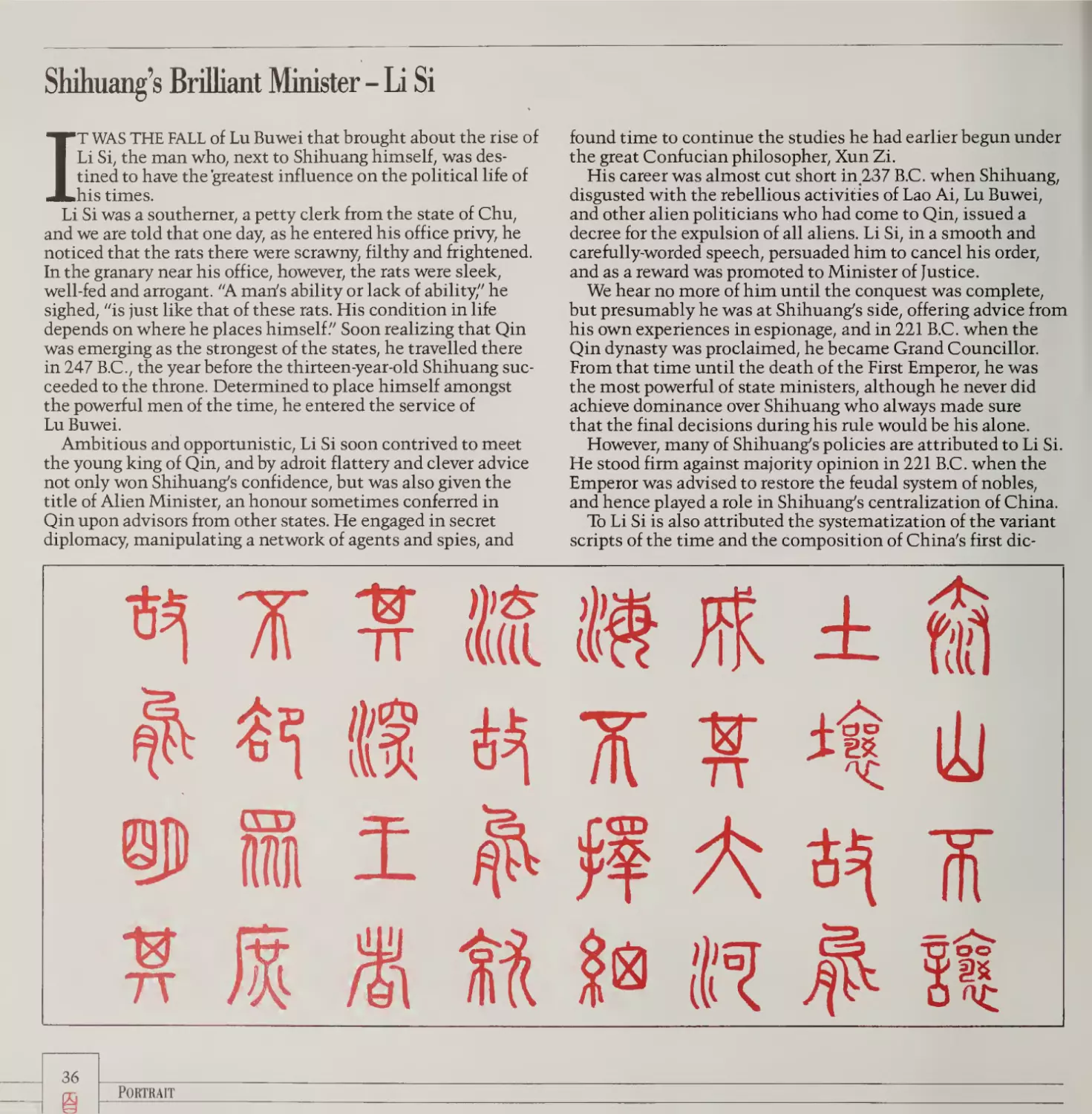
L

< A sample of the calligraphy
current in the time of Li Si.
The passage is taken from his
memorial to Shihuang advo¬
cating the abolition of feudalism.

i Si was put to death by the
Second Emperor of Qin
after trying time and again to
warn him of the result of his
follies. In prison, he is said to
have exclaimed, “The Second
Emperor has attacked his
elder and younger brothers,
without examining their
guilt, and has executed his
loyal ministers, one by one
without looking at their mis¬
fortunes. He has undertaken
great constructions of palaces
and has heavily taxed the
whole world, without con¬
sidering the consequences ...
We shall soon see rebels tak¬
ing the city of Xianyang and
deer wandering through the
palace courtyards.” Expe¬
rienced statesman that he was,
his words were prophetic.

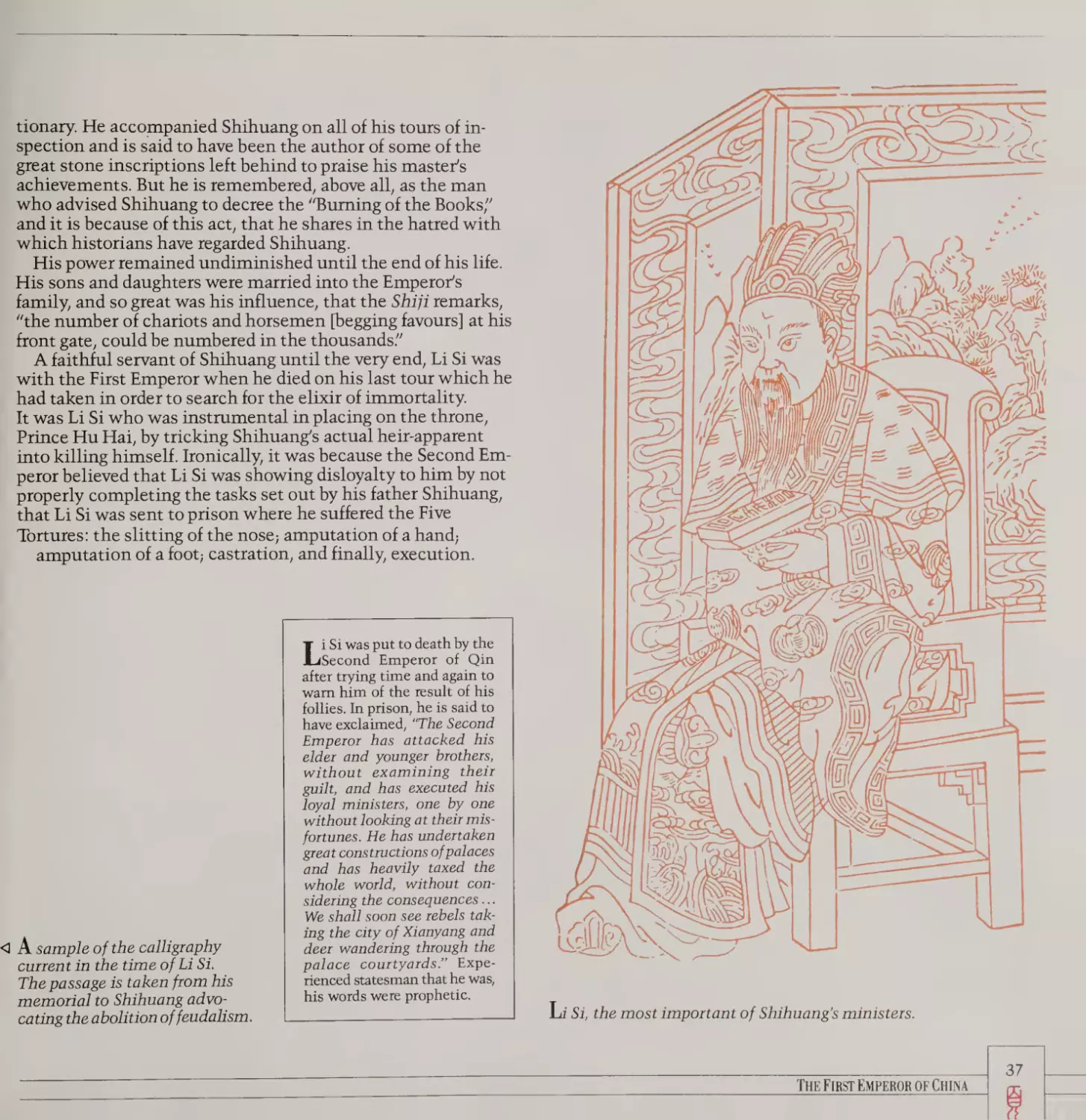
Li Si, the most important of Shihuang’s ministers.

37
The First Emperor of China

2d

An Assassination Attempt

I

N THE YEAR 227 B.C., after twenty years of successful war¬
fare and with his troops only six years away from total vic¬
tory Shihuang almost lost his life.
This famous event, often depicted in Chinese art, fic¬
tion and drama, was the first of three assassination attempts
which Shihuang would survive, and it was the most serious.
Had it been successful, it would have changed the course of
Chinese history.
The would-be killer, Jing Ke, was a man from the north¬
eastern state of Yan, a state exhausted by defeat and terrified
that it would soon become the next of Qin's victims. A clever
man, and a sensualist, fond of wine and women, he was also an
expert in the martial arts and deadly with his sword. He had
befriended a renegade general from Qin, and when his prince
suggested to him that the assassination of Shihuang was the
only way to stop the Qin advance, he went to his friend for
advice. The general laughed, knowing that Shihuang was a
suspicious man and that no citizen of Qin, much less a
foreigner, ever got past his guards without a thorough search.
He advised Jing Ke that the only way to gain audience was to
offer Shihuang something he really wanted, and here, said
the general, he could help. Shihuang wanted his head, and had
offered a great reward for it. Why not take it? Jing Ke hesitated,
but the general immediately slit his own throat and rather
than let the head go to waste, Jing Ke sealed it in a box and
set off for Qin.
He also carried with him maps of of the terrain of his state, a
closely-guarded secret in those days because of their use to an
invading army. Within these maps, he concealed his famous
dagger, razor-sharp and tipped with a poison so deadly that
"when it drew so much as a thread of blood," the victim died
instantly.
Jing Ke's gifts secured him an audience with the king, and he
was allowed to mount the dias where Shihuang stood alone
and unprotected. Unrolling his maps, he seized the hidden
dagger in one hand and Shihuang's sleeve in the other. Startled
though he was, Shihuang was too fast for the assassin. He tore
away his sleeve and took shelter behind a stone pillar, trying to
draw his own sword as Jing Ke hurled the deadly blade. Miss¬
ing Shihuang by inches, it lodged in the pillar, and Shihuang, it
is said, fainted dead away.
After Shihuang's guards had seized Jing Ke, he was immedi¬
ately beheaded and his corpse mutilated, while Shihuang
vented his fury by launching a full-scale attack on Yan. His
generals inflicted terrible casualties, annexed much territory,
and brought back to Shihuang the head of the mler who had
ordered the assassination. Five years later, the state of Yan fell.

Portrait

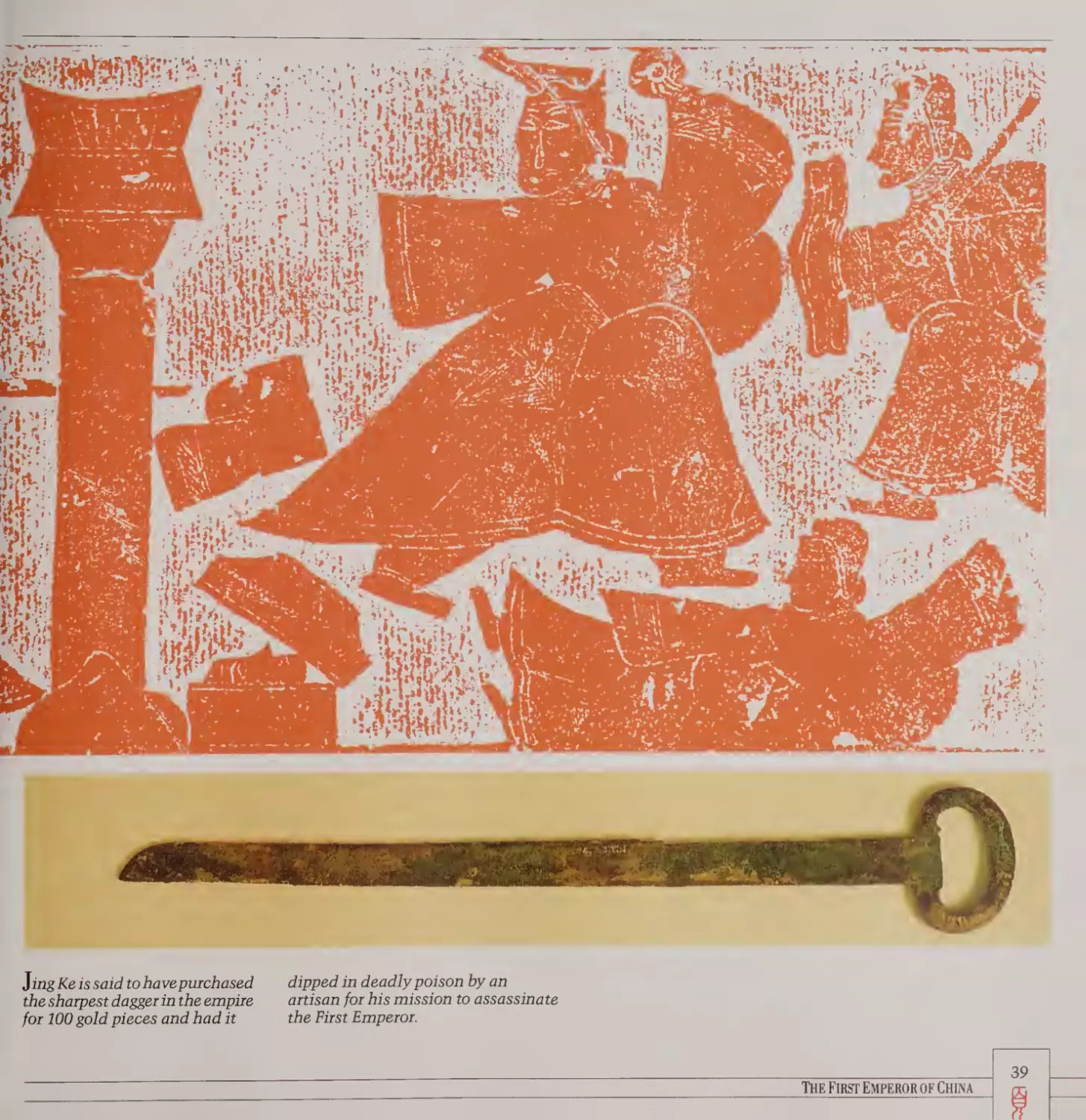
In this Han representation
of the assassination attempt,
Qin Shihuang is holding an imperial jade disc while Jing Ke is

seized by Shihuang’s physician,
The dagger was so sharp it
could even pierce the stonepillar.

From that time onward, Shihuang took ever-greater precau¬
tions to ensure his own safety. And he became less trusting of
those around him. Near the end of his life this distmst had
turned into a paranoia so severe that he had the roads leading
to his hundreds of palaces covered over so that he could not
be seen.

JingKeis said to have purchased
the sharpest dagger in the empire
for 100 gold pieces and had it

dipped in deadly poison by an
artisan for his mission to assassinate
the First Emperor.

39
The First Emperor of China

The Manners of Barbarians

T

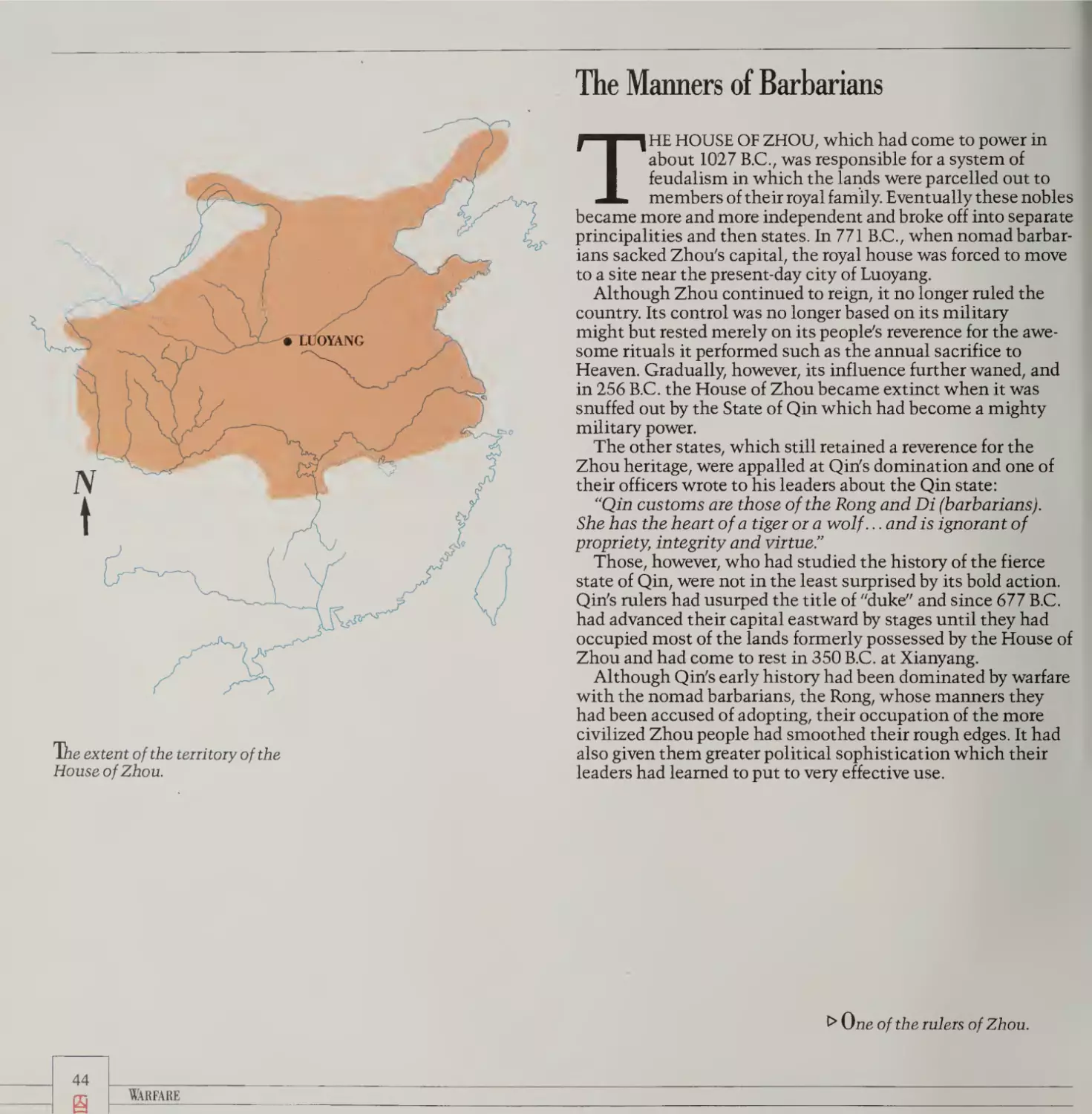
The extent of the territory of the
House of Zhou.

HE HOUSE OF ZHOU, which had come to power in
about 1027 B.C., was responsible for a system of
feudalism in which the lands were parcelled out to
members of their royal family. Eventually these nobles
became more and more independent and broke off into separate
principalities and then states. In 771 B.C., when nomad barbar¬
ians sacked Zhou's capital, the royal house was forced to move
to a site near the present-day city of Luoyang.
Although Zhou continued to reign, it no longer ruled the
country. Its control was no longer based on its military
might but rested merely on its people's reverence for the awe¬
some rituals it performed such as the annual sacrifice to
Heaven. Gradually, however, its influence further waned, and
in 256 B.C. the House of Zhou became extinct when it was
snuffed out by the State of Qin which had become a mighty
military power.
The other states, which still retained a reverence for the
Zhou heritage, were appalled at Qin's domination and one of
their officers wrote to his leaders about the Qin state:
“Qin customs are those of the Rong and Di (barbarians).
She has the heart of a tiger or a wolf... and is ignorant of
propriety, integrity and virtue.’’
Those, however, who had studied the history of the fierce
state of Qin, were not in the least surprised by its bold action.
Qin's mlers had usurped the title of "duke" and since 677 B.C.
had advanced their capital eastward by stages until they had
occupied most of the lands formerly possessed by the House of
Zhou and had come to rest in 350 B.C. at Xianyang.
Although Qin's early history had been dominated by warfare
with the nomad barbarians, the Rong, whose manners they
had been accused of adopting, their occupation of the more
civilized Zhou people had smoothed their rough edges. It had
also given them greater political sophistication which their
leaders had learned to put to very effective use.

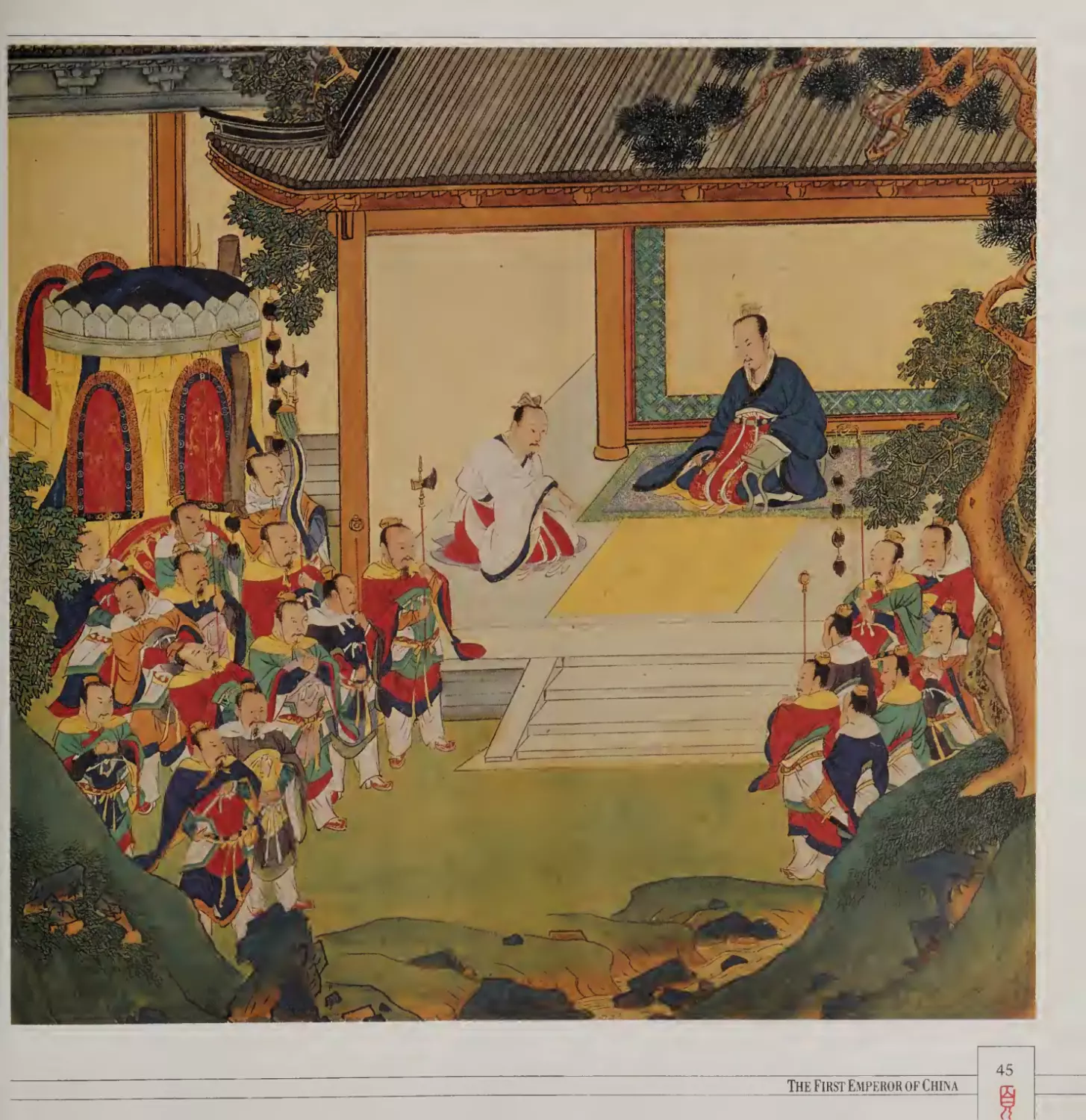
bO ne of the rulers of Zhou.

44
Warfare

1

45
The First Emperor of China
5?

3fl

W
J
-‘—S^r : if £§.y

TTTTTT

46

Warfare

PF.
y g

—-is?-

ydS!

AI|ilftA%

ig la A

\j

l^i^lin;iTr^

Shihuang’s Philosophy of War

B

Y THE TIME QIN SHIHUANG had taken control of his
government, the young man had been well-trained by
his mentors in the sophisticated political traditions
the Qin had learned from the clever statesmen of
Zhou. One of the more striking facts he would have learned
about the fierce dukes and kings who were his ancestors was
that they saw their roles more as strategists than warriors and
saw no need to lead their troops into battle.
Shihuang appeared to agree with their strategy, and despite
the many conquests and bloody battles conducted by his
troops, it is nowhere recorded that he was ever present on
any battlefield. As brilliant a military tactician as his ancestors
had been, he began to select his generals on the basis of merit rather
than social status. And he believed in a certain philosophy of war:
“War is that matter which is most vital to the state. It is the
province of life or death, and the path which leads to survival
or to ruin.” These are the opening words of Sun Zi's Art of War,
China's classic manual of strategy and tactics.
Dating from somewhere between 400 and 320 B.C., it was a
work widely distributed in the later days of the Warring States
Period and must have been essential reading for Shihuang who
gloried in his victories, savoured the fruits of revenge and - at
least in the beginning - set his goal as peace for his Blackhaired
people.
No matter how noble the aims, however, his wars added to
the burden of the people who had been plagued by constant
strife for a long, long time.
In the beginning there were Three Dynasties - Xia, Shang
and Zhou - traditionally spanning the period from 2205
to 256 B.C. They, in turn, had followed from a much longer

3 The legendary sage-king Yu the
Great who, it is said, had taught
the Chinese the techniques of
irrigation and flood control 2,000
years before the birth of Qin
Shihuang.

period of rule by sage-kings and culture heroes who had pre¬
sided over a "Golden Age" and who are said to have passed the
throne, not to the eldest son, but to the most virtuous of their
subjects.
Only with "Yu the Great," the founder of Xia and the man
who built the country's first dikes and canals, did primogeni¬
ture come to China. Yu's achievements were so popular that
the lords around him insisted that his son succeed him. And
so was founded the dynastic principle.
The Xia, still considered by many to be a legendary dynasty,
were probably nothing more than the paramount tribe in a
tribal period. When the Shang who succeeded them and are
regarded by most historians to be a kingdom, they controlled
their alliance of tribes by periodic hunts and a loose feudal
relationship.
When the Zhou came to power, in about 1027 B.C., they
refined and extended this rudimentary feudalism, establishing
1,773 fiefdoms which were to a large extent self-governing.
The Zhou rulers called themselves "Sons of Heaven" and
decreed that their lands encompassed "All under Heaven."
In reality, however, they could not control their vassals and
this weakness was graphically demonstrated in 771 B.C. when
the lords failed to respond to the ruler's beacon fires to defend
the capital from the barbarian Rong. The result was total
defeat of the Zhou and their flight to safer lands in the east
where they set up a new capital.
At this time there were only 170 principalities. By the time
Shihuang came to the throne of Qin in 246 B.C., this number
had been lowered by bloody strife to only seven. These were
the states of Qin, Zhao, Yan, Qi, Chu, Wei, and Han.

T

he size of the armies as
reported by the Shiji varied
widely.
Shihuang in his unification
campaigns is reported to have
had an army of 600,000. The
later Han dynasty, on the other
hand, seemed to get by with
an army ranging from 130,000

to 300,000 which included
troops and cavalry.
Shihuang's huge force is
believable, however, when it
is noted that he mobilized
100,000 men to labor on the
Great Wall and 700,000 to
build his tomb.

47
The First Emperor of China

Shang Yang’s Reforms

Shang Yang, the early Qin
statesman, whose reforms
strengthened the state.

T

HE REDUCTION IN NUMBER of the feudal states can
be traced to several factors, but the most important
reason was war. The states in this period were
rudimentary in organization and the ruler or duke
usually presided from a walled city which he tried to defend
against his avaricious rivals while at the same time trying to
protect the surrounding peasantry who were his only source
of revenue.
The peasants' lives were generally miserable. Subject to
land taxes in most states from 594 B.C. and always liable for
military conscription, they worked from dawn to dusk for
a bare subsistence and were protected from marauders only by
the mud walls of the villages they returned to at night.
The iron dukes, thus took much and gave little, unmerci¬
fully using the peasants to wage war in order to protect their
lavish lifestyle at court.

48
Warfare

Shihuang was among the first rulers to realize that, instead
of war, agriculture was the essential occupation of the state
and that if the peasants were treated properly the whole land
might some day be unified.
His new policies arrived just in time because the states had
been gradually destroying themselves and each other for years.
The expansion of the states on the periphery of the Central
Plain, due in part to their geographical advantages, had allowed
them to gobble up the smaller principalities which lined the
Yellow River.
The northern states, such as Zhao, for instance, had also
used cavalry as a war instrument earlier and more successfully
than their neighbours and it was here that trousers first
became a part of the soldiers' uniforms, showing the growing
importance of horsemanship in war.
Initially equal in power, the Warring States slowly exhausted
themselves as they mounted ever more deadly experiments
in warfare. In Qin, the reforms which made the state truly
strong took place only about a century before Shihuang
became king. As the other states exhausted themselves in
battle, Qin's geographical position kept it aloof and it was not
regarded as a great threat, at least in the beginning.
The architect of Qin's change was Shang Yang (390-338 B.C.),
a man of some military reputation who answered the call to
battle from Duke Xiao of Qin in 361 B.C. and whose advice
helped the state to regain lands lost to their neighbours.
Also a man of great political acumen, Lord Shang trans¬
formed the face of Qin by dividing part of it into 31 counties,
each administered by a centrally-appointed magistrate instead
of a feudal lord. He also raised the status of the peasants,
allowing them to buy and sell land, thus attracting new
immigration from the surrounding states. Because of these
policies, the population grew larger and provided more soldiers
for Qin's army.
New laws also appeared, "sparing neither the powerful nor
the high," and fierce punishments were meted out to crimi¬
nals, such as boiling alive, dismembering at the waist and the
rending apart of the body by chariots.
Systems of reward were also established and honorary ranks
were lavishly bestowed for service to the state. Most were
given for military valor: “Whomever cuts off one enemy head
will be awarded a single degree of rank.”
Thus Shang Yang's reforms succeeded in strengthening the
state of Qin when China, as we know it today, was truly a land
of "life or death."

L

As this ancient scroll shows,
agriculture has always been
central to the Chinese way of life.

ord Shang Yang is impor¬
tant in the later unification
efforts of Shihuang because he
developed early laws and made
attempts at standardization
and currency changes. But
Shang Yang nearly did not be¬
come the first minister of Qin.
The descendent of a concu¬
bine, Shang Yang was raised in

the state of Wei and served
under the prime minister who
recognized his ability. When
the prime minister became ill,
the king visited him and the
prime minister recommended
Shang Yang as his successor.
“If you do not mean to take
my advice and employ him,”
warned the dying prime

minister, “take my advice and
have Yang killed. Do not let
him leave the country.”
Alas, the king did not act
and Shang Yang was eventu¬
ally recruited by the Duke of
Qin, later to become first min¬
ister there and lay the ground¬
work for Qin's eventual
domination of all the states.

Warfare in the Spring and Autumn Period

C

HINESE HISTORIANS DIVIDE this era into two parts.
The first, taking its name from a book by Confucius,
was called the Spring and Autumn Period and lasted
from 770-481 B.C. The second, which ran to the Qin
unification in 221 B.C., is called the Period of the Warring States.
It was a time of huge growth in the scope, frequency and
brutality of war. In one 130-year period, the Shiji recorded 15
major battles or campaigns in which Qin was involved and the
death toll - just for Qin's opponents - amounted to 1,489,000,
a figure possibly exaggerated by Qin to impress the other states.
During the Spring and Autumn Period, battles were care¬
fully conducted according to recognized codes, complete with
chivalry and a good deal of ceremony. Actual combat involved
far more propriety than savagery, and there are many
documented episodes of archers courteously exchanging
arrows with one another until one of them was finally killed.
In another case, while the Chu troops were observing the
Yan army, one of their spies noticed that the Yan always

50

a

Warfare

favoured the left wing and told the officers that this fact surely
indicated that the Yan king was sure to be on that side.
Although the right flank of the Yan army was considered to be
more vulnerable to attack, the Chu commander ordered his
forces against the left, saying, "If we do not oppose the king,
we are no sort of opponent" The result was that the Chu
army was soundly defeated, albeit nobly.
One of the other codes of battle at that period was the un¬
written rule that one could never take advantage of an adver¬
sary in distress. There is recorded evidence that one battle was
not rejoined because the enemy had not yet cleared up its
dead. When the field was finally swept clear of bodies, their
opponents who had been chivalrously waiting to begin the
attack on them, moved their army forward only to discover
that their good manners had been taken advantage of and the
enemy had stolen away during the night.
The Shiji also speaks of the soldiers' boldness and
resolution:

When one takes up arms he must heed the code of war,
which calls for them. To kill the enemy is resolute, and to dis¬
play resolution in the highest degree is boldness.
If one does otherwise, he should be killed in disgrace.
Neither fear nor a sense of inferiority were permitted to
affect performance in the carefully plotted campaigns.
One conflict was marked by this observation:
Fighting is a matter of valorous spirit. When the drum first
beats, that excites the spirit. With a second beating, it is
diminished. With a third, it is exhausted.
When theirs was exhausted, ours was abundant. Therefore
we conquered them. Yet these great states are difficult to
fathom, and I feared there might be an ambush. But I
observed their chariot tracks were disorderly and when
I looked at their banners, they were drooping.
Thereupon we pursued them.

D

ivination was considered
so important that in the
case of one fight, a general of
Qin, worried about the out¬
come, summoned a music
master who, as the Shiji
records it, sang a song, and
then reported to the general,
“It will do no harm. I have
been loudly singing a north¬
ern melody and then again a
southern one. The latter was
not strong and had the tone of
many deaths.
“The enemy will certainly
accomplish nothing.’’
The blind musician thus for¬
tified the Qin general and
assured him he was in tune
with the heavenly gods. It
must have worked because the
battle was short and decisive
with Qin winning easily.

Oracle bones were used from
atleast 1500 B.C. for the purposes
of divination. Characters were
inscribed in the bones and
diviners read the oracle from
cracks which appeared when the
bones were placed over fire.
Some scholars speculate that
skilled diviners could control
the configuration of the cracks.

51
The First Emperor of China
5?

The Conduct of Battle

B

ATTLES WERE NOT ENGAGED IN lightly during the
Spring and Autumn Period. The spirits were consulted
through omens, dreams or professional diviners and if
the signs were unfavourable the attack was sometimes
aborted. It was also necessary for the state leaders to justify
military action and to show that right was on their side before
they moved into action.
If an army had been victorious, the defeated troops were pur¬
sued and, if captured, held for ransom or enslaved. There was
little indiscriminate slaughter and if territory had been
annexed, few of the vanquished nobles were killed, nor was
the royal line ever extinguished. During the huge three-day
feasts that followed victories, the blood of the dead was occa¬
sionally smeared on the war drums and the left ear of the dead
soldiers and the surrendered captives was cut off and used as a
tally to record the number of men killed and slaves acquired.
Many vivid accounts of actual battles exist in the records of
the Spring and Autumn Period and have been preserved in a
work called the Zuozuan. Among them is a lengthy report
on a great battle which took place in 647 B.C. between the
northern state of Jin and the southern state of Chu.
Each side divided its forces into three battalions and the war
chariots were divided into two formations of fifteen each. The
chariots were supported by 125 footsoldiers. Prior to the battle,
one three-man chariot penetrated the enemy ranks, and one of
the officers darted into the enemy ranks, daringly cut off a
soldier's left ear and took him prisoner.
Returning to his own lines, this unknown charioteer also
stopped to kill a stag and presented it to the pursuing enemy to
show his coolness under fire.
When this battle actually started, the troops were manoeuvered by signals from flags and drums. The charioteers shot at

Although battles in the period
770-481 B.C. were chivalrously
conducted, they eventually
became more and more brutal.
In one 130-year period, the
death toll for Qin’s opponents
amounted to 1,489,000.

52

E

Warfare

the enemy with arrows and the footsoldiers fought with spears
and swords. When the signal for retreat was mistakenly
sounded by a Jin drummer and as the army retreated back
across a river, a Jin officer promised a reward to the first men
who made it back to shore. Soon the boats were full of the
severed fingers of the Jin soldiers attempting frantically to
climb into the departing boats.

wsi

The state of Jin was disgracefully defeated in the great
battle, but the leader of the Chu refused to gloat over his
enemies or, as was the custom after a victory, to bury the
defeated dead in a great mound as a monument to the glory of
the conquering army.
Instead, he made a remarkably idealistic speech about
the preservation of the state, the need for harmony among the

rival states and the bestowal of peace upon the peasants, the
better to enlarge the general wealth.
Although a noble attempt by the Chu leader, his words had
little lasting effect as the battles became even more frequent
and savage as time went on.

D

/1

IK

S&MKj

^ ml

T

'-"'ynB

uring the Warring States
Period, there were many
famed tacticians, among them
Tian Dan of Qi who once
broke out of a siege by the
forces of Yan when escape
seemed impossible. The Shiji
says:
"He assembled more than a
thousand bulls, covered them
in red silk, painted them in
many colours so that they
resembled dragons, lashed dag¬
gers to their horns, and to their
tails he tied straw soaked in
oil. At night the straw was set
afire and the bulls were
released through rifts in the
city wall, followed by five
thousand strong men. Driven
mad by their burning tails, the
bulls attacked the army of Yan,
taking them by surprise. To the
men of Yan, the bulls illumi¬
nated by the unearthly glow of
their flaming tails, seemed like
dragons bent on destruction.
After the bulls came the
five thousand men, mouths
gagged, followed by the entire
population of the city shout¬
ing and banging on copper ves¬
sels, the old and infirm beating
so loudly that the noise shook
heaven and earth. Yan's forces
retreated in terror and confu¬
sion, pursued by the throng.
Every city they passed threw
off Yan's bondage and flocked
to Tien Dan's support.

53
The First Emperor of China

54
Warfare

The Warring States Period

A

S THE WARRING STATES PERIOD began in 481 B.C.
the Shiji tells us that battles became longer, fiercer
and were fought on a much larger scale. Brutality
and cruelty became the norm and chivalry was
increasingly disregarded. Wholesale slaughter of the conquered
often followed a large-scale battle and according to the Shiji,
450,000 Zhao soldiers were massacred by the Qin army after a
battle in 260 B.C.
There is evidence, however, that these figures were so high
because they covered not only the dead and wounded but also
the captives and deserters from the enemy ranks. But it is clear
that no tactic was too vicious to use and, on more than one
occasion, dikes were deliberately breached which not only
drowned great numbers of the enemy but innocent civilians
as well.
In the third century B.C., Qin, as well as its foes, conscripted
boys as young as fifteen to fight and the size of the standing
armies often reached a figure as high as 600,000.
3 The lightning-fast footsoldiers
and cavalry were decisive
factors in Qin’s victories over
other states.

The importance of war is
demonstrated by the care and
expense lavished on these fittings. The round bronze piece

served a decorative purpose
while the others were attached
to chariots to hold the crossbow,

The legendary war chariots of Qin were drawn by four horses
and carried three men - a driver in the middle with the leader
on the left and a spearman on the right.
The chariot directed the footsoldiers - anywhere from thirty
to seventy-five men - with drums, gongs, and flags, so that the
sounds of battle were deafening. Often the chariots were
equipped with scythes on the axles and could cut a swath of
blood through the ranks of the enemy.
Our best clues as to the type of weapons and the kinds of
armour worn by the Qin soldiers in the Warring States Period
come from the tomb of Shihuang, one of the most important
archaeological finds of all time.
Here, in the 1970s, archaeologists discovered a vast buried
army of terracotta warriors, archers, and footsoldiers each
armed and set up in perfect formation for battle, along with
their chariots. No two are alike and each warrior bears distinc¬
tive facial features. Three pits have now been unearthed show¬
ing the diversity of weapons and the sophistication of battle
formations during Shihuang's time. Shihuang ordered these
clay warriors created to protect his sacred mausoleum, a tomb
that has still not been uncovered on the site at Mount Li near
modem day Xi'an.

55
The First Emperor of China
5?

Shihuang’s Buried Army

U

. »-•

test..

*>
f
»*!

a

1-

..Ur
fr

(,

A «w'|

!

W,

a, .;t,

u>-j

NTIL A LITTLE OVER A DECADE ago, there was
relatively little information available about warfare
in the Qin period. Then, in the early 1970s, the
situation changed dramatically with the discovery
of a vast buried army of clay warriors, armed and in perfect
formation for battle with archers, chariots, and footsoldiers.
For the first time, information was available on armour, military
formations, chariot construction, weaponry and even soldiers'
hairstyles. Previous to this, the history of warfare in this period
had been written from fragmentary records, but here, a whole
army, in lifelike detail, had been perfectly preserved. Within a
few years, not one but three pits had been discovered, each one
containing artifacts which provided a more complete picture
of Qin period warfare.
Because the Qin was involved in near-perpetual warfare with
other states from the seventh to the third centuries B.C., it is
hardly surprising to find quite a diversity among weapon types
and a sophistication in military strategies and formations.
Warfare took a prominent position in Qin society, and many of
their developments in armaments, armour and tactics were to
form the foundations for the military organization of succes¬
sive decades.
Archaeologists have found many Qin period tombs contain¬
ing a wide variety of artifacts, related to Qin culture, including
lacquerware, ceramic and bronze vessels, and bronze weapons.
Undoubtedly the best artifacts for studying warfare in the Qin,
however, come from the three pits containing life-size terra¬
cotta warriors, set up and buried as part of the funerary trap¬
pings for Qin Shihuang. Each of the warriors in the buried
army is individually modelled, and so detailed that historians
are able to study the various types of armour worn by the sold¬
iers to determine how they were constructed, what materials
were used in their manufacture, and even how the warrior put
it on. Although the warriors of the buried army are modelled
from clay, their weapons are real, and from these we are able to
gain valuable information both on the advancement of weaponry
and on the metal-working technology used to create their
swords, crossbows and other tools of war.

A terracotta infantryman
kneels in anticipation of battle.

56
Warfare

F

Mounted on a long pole, the
dagger axe was a formidable
weapon in the battles of
Shihuang’s time.

T he head of one of the terra¬
cotta horses, complete with
bronze bridle.

ailure on the battlefield was
never tolerated as this tell¬
ing of the Qin conquest of Yan
demonstrates:
"The general said 'I'll just
exterminate these fellows and
then I'll have them for break¬
fast' and without armoring his
horses he charged. He was
wounded by an arrow and the
blood ran down to his shoes,
but he did not break off the
sound of the drum.
"He said 7 am in pain’
but his charioteer said: ‘Sire,
bear it.'
"The general then said: The
ears and eyes of the army are
upon our banner and drum.
By those, they advance and
retreat. While one man can
still guide this chariot, we can
yet gain the day. How can we,
on account of pain, bring our
lord's great affairs to failure!
"lb don armor and take up
arms is to comt death. If the
pain is not yet mortal, strive
against it.’ ”
"With that, he drove his
chariot onward and the army
followed. This was the fierce¬
ness of the Qin."

57
The First Emperor of China
@
X

Warriors

F

rom the almost 8,000 figures unearthed in the three pits
(a fourth pit was found to be empty), we can see that the
pits were designed in military formations. It has even been
suggested that the buried soldiers represent actual army units.
Pit 1 is the largest, containing primarily infantrymen:
unarmoured bowmen and crossbowmen, archers, armoured
infantrymen and chariots with charioteers. Pit 2, smaller in
size, contains a more complex layout of military personnel
divided into four units of archers, chariots and cavalrymen. Pit
3 contains only sixty-eight figures, who may, by virtue of the
small size of the group, represent officers or a command unit.
Most of the soldiers wear long double-layer tunics which wrap
in front and are belted at the waist; leggings; and square-toed
footwear. A thick fabric roll is worn at the neck. This would
offer protection against chafing at the neck for those wearing
armour.

T

he hairstyles are elaborate. Each is fashioned individually,
to such a fine degree that one can see every strand of hair.
For the infantryman, the hair is pulled up on the top of the
head and is tied in a chignon, slightly to the right. Some of the
hairstyles also incorporate elaborate plaiting into the designs.

A

number of the figures, most notably the cavalrymen, wear
soft caps with chin straps. The officers and charioteers
have crisp bonnets, and although those of the charioteers are
not as fancy as those of the officers, the difference in the
headwear styles may indicate a difference in rank between the
charioteers and the capless regular infantry.

58
Warfare

Pit 3

Pit 2

■~1
!

T

he arrangement of soldiers in Pit 1 is remarkably similar
to this: the unarmoured bowmen and crossbowmen occupy
the front ranks; behind them, eleven corridors of soldiers stand
in formation. The two outer ranks contain two rows of archers,
the outermost of which faces outward, prepared against any
flank attacks. The other line faces ahead with the rest of the
army. In the remaining nine columns, armed and armoured
infantry stand at the ready. Within these ranks, not far behind
the unarmoured infantry, are six chariots, each pulled by a
team of four horses. A charioteer and a warrior man each
chariot. Protecting the rear of this army of nearly 6,000 figures
are three lines of armoured infantry.
In Pit 2, by comparison, the force is composed mainly of
chariots and cavalry, whereas Pit 1 contains mostly infantry.
Pit 3 has a large number of officers. Taken together, then, the
three pits represent components of a single army in an arrange¬
ment common even to Western armies through the nineteenth
century. The main body of the force is composed of infantry,
while a smaller, more mobile force of mounted troops is
detached to act separately, and a command unit oversees the
whole operation.

Pitl

,86ttt6t666t66<.6tt6t6666SC00C0OC»c>wB08000»0oe00000C<lB«>BO«>
e c c c c c_o_o_c coco coo o occoooocoooo P_P chou

_, , , ■ I I. I I. 1.1 I. I. I n I I, nil I, > ^

t Sc c c c t t t t H t • H H t * *

ft n Hi <1 * > fft fl HD H6 8 t t C H C O H C C 0 t I—I^r - - -

!iilliil!!il!j;slilji;!lil=!iii!=j!il=!lli!il!!j!Ili!!lfI!ljf!!!SIIi!I!l?5i!T!ij?IIIIII!iiiIlil iiffiiiiiii...UIHiiiiiHI.Ski jj j
„ „ „ ©oooocooooooooooooococoodoooccocoooococoooocooocooo
©©ooooooooooooocooooeooooocooooooooooooooccooocooooooo
00
cooooooooooooooooooooooococoococoooeocooooccoooooi.-j.v
CeOCCCOCOOCCOOOOOOOOOPOOOOOPOct,COOOOOCCOCOOOCOCICIOCtlCP-

liiMIIHHMHilUHiHiiiiiiiililiiiiiliilitiiiUlUuilUBSillulumi

00000000000

og
H H M e00

BUBBWWWVWVWVWVVw;y5?$$S5 a A A
ceooococoocooccoooeooooo

111 II1 llllllllIIlIIIIIITlITTITllTilllllllllllllllilillilllilsIlililll-iil

ooooooooooooooo©ooccoooccocoeocoooocooccceoccccococ
00000000000000000000000000000000000 wvOOOOOOOOOO
000000000000
oooocoooccocoooooooooooooooooooococ
000000000000
o c c c o c p s c p o c 0 c c $ o o c t £ c c c e o o t c i o £ | i t

.

»»»»»»»» g°°gggg»ggggggggggggggrg7gTITngTT1TTTITtTIggggggggg8gSggggSggSg 88 ggggSS; 8 g

°°°»°<’«'°gg||ggg||g||cooog.gggococcoooggggcocggo.gcgocogooce.,8o.gogegSccocoggocggooo»..oco

lilii!Hili?niiiiii!iiiliiiiitiiiiiliHiiinil!nniiSllii8ii

000000000

ocoooooooo00

HH' oeesnMHHHttoooooeoooooocooc
.....tCMOCCOOOO

iSI’g] Hi liliiilliiUiiil iiiiil iiiilli iliJlUsill

00000000000
00000000000

miuiiii

cTToTTm
....I.
8888S
8 8 1 1 1 1 8 8 8 8 8 8 8 8 8 8 8 8 8 8 8 8 8 8 88 8 8 8 8 8 8 8 8 8 8 8 8 8 8 8 8 8 8.88 !!
8 8 85.8
8 8 8 8 8 8 8 8 8 88 8 8 8 8 8 8 8 8 8 8 8 8 88 811 g g g 8 g g g
fmriTiJc © 0 0 0 © C 0 0 0 0 0 0 0 0 0 0 0 0 0 0 0 0 O O O o J V v v V V g V V . s

J 5

J J 5

DCOCOOCCO

DOOOOOOOOOOOOOOOOOOO
OOOOOOOOOOOOOOOOOOOO

88888-®--*-*-"-

COOOOCCOOCOOOOOOOOOOOCOOOOOOOOOOOOWOOOOOOOOOWWYvvwvvvvvvvjjv*-* - ■—,'T J

~ ~ ^^r
i. rrf r i' rrr r n r. r\ r n r n Ci r. re c n ccc C:C c t
8gggggggggggggginggSggg£»8S»g»gg[I||II|I|SgHg!ggggggg|8r^j”g9????????;?;?;””v???g;;
mini 11 linn ml in g H i lining 8ii g i iiiii .;»»»»»»»»»

oocoocooooccooooooooocoooooooooooooocoooooooooooooooeooopcooocc|

0

The First Emperor of China

59
E
a

W

hen buried, the figures were painted but much of this
paint has since flaked off. The paint reflected different
uniform colours which served to distinguish between various
units of the army. At least two colour schemes are present in
Pit 1. The first group had green robes with lavender collars and
cuffs. Their trousers were dark blue, and their black shoes had
red laces. The armour consisted of black plates, white rivets,

60

a

Warfare

purple cords and gold buttons. The second group had red
tunics, with the collars and cuffs in pale blue. The armour was
dark brown with red or light green rivets and orange cords.
Brightly coloured, the massed troops would have presented an
imposing sight when freshly painted and must have looked
remarkably similar to a real army.

T

he organization of the buried army is precise and regular,
with the soldiers organized in columns. Two military
instruction manuals of the period suggested that military
formations should be organized as follows:
long-range crossbows in front, halberds behind,
bows are the outer layer, halberds and shields the inner,
skilled soldiers and strong bows on the flanks.

A terracotta general, wearing
his decorated armour, stands
tall.
61
The First Emperor of China

Armour

A

rmour used by early Chinese soldiers covered only part of
the body. There was usually a breast plate, which could
sometimes also have a section which covered the back as well.
Pieces which protected the shoulders and upper arms were
sometimes attached to this to form a shirt-like covering for the
upper body. Helmets were occasionally used to protect the
head.
Until the excavation of the pits, very little was known about
Qin period armour. The first evidence of armour in China
comes from tombs in Anyang which date to the Shang dynasty
jc. 1765-1027 B.C.). This armour consisted of leather strips
brightly painted in red, white, yellow and black. Nearly one
thousand years later, during the Warring States Period (481-221
B.C.), leather plates, lacquered and laced together with leather
thonging, were used to protect soldiers from enemy weapons.
There is some evidence of armour being made of bronze, but
this was only used in areas outside central China, and there¬
fore was not relevant to the Qin.
Helmets made of bronze also date to the Shang dynasty, and
while texts mention a helmet of iron, only one such piece of
armour made of iron plates laced together has been found,
and it dates to the fourth century B.C. For centuries, this
leather armour provided enough protection against contem¬
porary bronze weapons. Then, however, the change in
weaponry in the late Warring States period was the catalyst for
changes in body armour.

62
0

WARFARE

T

he pits give us the most complete and detailed informa¬
tion on Qin period armour. There are eight different styles
which may be classified into two groups. In the first, leather
forms the foundation layer to which rectangular scales were
attached. For the second type, the scales are strung together
without a base layer. The armour was slipped on over the head
and buckled with a right front closure. It is difficult to know
what this armour was made of, but scholars feel that it most
likely was made of lacquered leather, as no metal plates of this
size have been discovered.
Commanding officers wore armour of the first type, and this
was the most distinctive armour. The front portion of the
armour extended to a point, and the wide-sleeved under-robe,
the intricate armour plates and the elaborate design indicated
the elevated rank of the wearer. A bright, tassled cape was
worn at the shoulders. The simplest stye of armour also con¬
sisted of scales over a leather foundation. It is in fact very simi¬
lar to the protection worn by a modem baseball catcher, where
the front of the body is protected and the whole covering is
held in placed by crossed straps at the back.
Ordinary infantrymen, charioteers and cavalry wore armour
of the second type and this armour was adapted according to
the rank and weaponry of the individual warrior. For the
cavalrymen, the armour consisted of a short vest which was
suitable for riding, being trim and efficient. The armour of the
charioteers was more substantial and covered more of the body
than any other soldier's armour. This armour had a neck guard
and articulated sleeves to protect the arms without hindering
movement. Armour composed of small plates in this manner
had to be very complex if it was to allow the soldier to move as
well as provide protection. In the charioteers' suits, for exam¬
ple, there are 323 separate plates which make up the covering.

M

ost likely these plates were attached in such a way that
they flexed or moved with the body. It appears from the
armour of the clay warriors that the plates were joined
together by nails. However, all of the plates could also have
been joined by leather thongs, and in that case, the rivet-like
bumps would simply be the knots of the thong.

The First Emperor of China

63
m
W

Qin’s War Machine

T

HE SOPHISTICATION OF THE QIN war machine is
evident to us from the findings at Shihuang's tomb
and from the literary sources we still have of the
period. It is clear that this machine was the product
of several centuries of development.
Qin had quickly realized that the expensive, heavy and slow
chariots were not contributing to their campaigns, and as
early as 644 B.C., there are indications that the state had
switched extensively to cavalry and was flouting the rules of
ceremonial warfare. With its long tradition of horse-breeding,
Qin also enjoyed an advantage in this type of warfare.
Earlier, Qin had also realized the importance of reliable
sources of manpower, and it was among the first of the states
to impose universal conscription which made possible the

64
Warfare

astonishing size of its armies.
Lord Shang's division of the population into groups of
five or ten families which were obliged to furnish a quota of
fifteen-year-old conscripts, combined with the growth of Qin's
population due to the state's agricultural innovations, made
possible a standing infantry force of one million men.
These men were virtually all rough peasants trained at an
early age for battle. When they fought, their lighter armour
and cavalry permitted the troops to out-manoeuvre the more
traditionally outfitted soldiers of the other states who were
still slowed down by their heavy armour and cumbersome
chariots.
There were three other features of the Qin military machine
that also contributed to their success.

First, Shang Yang's decree that only those who excelled in
warfare should be accorded a life of luxury, neatly created a
professional military class. It also held out to the more lowly
a chance to rise rapidly in the social and economic hierarchy.
Those who so succeeded developed an intense loyalty to
the state.
Secondly, failure or insubordination in the army was not
tolerated. Many generals were demoted or executed after they
failed to live up to expectations, including the mighty Bai Qi,
a successful general for thirty-five years and the man responsi¬
ble for the great victory over Zhao in 260 B.C. When he refused
to command an invasion in 258 B.C. because he thought it was
doomed to failure, instead of receiving respect for his expe¬
rienced military judgement, he was demoted to the rank of

common soldier, and after suffering this indignity, was executed.
Thirdly, the state often used generals who had risen from
obscure origins, or had even come from other states. One
example was Fan Sui, a native of Wei, who rose to high posi¬
tion in Qin by formulating that strategy whereby Qin formed
alliances with distant states while concentrating on the
conquest of those nearby.
His astute counsel lasted for fifteen years until two generals
he had recommended to posts of command surrendered in
battle and Fan Sui was summarily dismissed. In Qin law, the
failure of one's proteges also meant punishment for the spon¬
sor. Warfare in the state of Qin was so important that not even
a single error would be forgiven.

S

pies and intelligence were
also extremely important
in the victories of Qin. There
are numerous stories of troops
made to look unprepared and
sloppy in order to lull the
enemy into a false sense of
security.
One despatch from the field
reads:
“They [the enemy] are stop¬
ping up the wells with mud.
They all got into their chariots
and now the men on the left
and right have taken their
weapons and got down. They
are listening to the order of
their commander.
“Will they fight! I cannot
tell yet.”

One of the first of the Warring
States to practise universal
conscription, Qin forced thou¬
sands of peasants to join their
war machine.

To insure the secure transmis¬
sion of orders, one half of a tiger
tally was given out to the mes¬
senger. Only if it formed an exact
fit with its mate was the order
carried out.

65
The First Emperor of China

Weapons

B

ecause warfare was central to the Warring States Period,
many bronze weapons had been cast in the years before
the short-lived Qin dynasty was established. Of these, a large
percentage were inscribed, and fromthese inscriptions we can
see that the weapons were cast either by the central govern¬
ment or were products of a local foundry. These inscriptions
also tell us other interesting information, such as the date of
the weapon's manufacture. All of this helps us to piece together
a picture of life and society in the days of the first emperor.

T

he more than ten thousand real weapons unearthed from
the pits of the terracotta army give a clear picture of the
use and development of weapons, and the stage of metallurgy
in Qin China. Ironically, however, the fact that the clay army
was buried with real weapons has meant that the tombs were
pillaged by later dynasties for military supplies. A number of
different weapon types were used in the Qin period, including
swords, crossbows, bows, halberds, long- and short-handled
spears and pikes.
All of the weapons are finely made, indicating that the Qin
possessed advanced metal-working technology. The vast
majority of the weapons are made of cast bronze, which is an
alloy of copper and tin. In some cases, there are traces of other
metals such as nickel, bismuth, zinc and silicon. The percen¬
tages of metals were varied according to the type of armament
being cast, so as to best suit the weapon for its purpose.
Swords, for example, had a tin content of 21%, which refined
the texture and increased the hardness comparable to that of
tempered carbon steel. Arrowheads, on the other hand, had
less tin but more lead, roughly 7%. The addition of the dense,
heavy lead to the arrowhead alloy would increase its mass and
therefore its impact on its target, and the lead, being relatively
inexpensive, would help to "stretch" the more costly bronze
alloy. This implies that Qin metal workers were able to control
the proportions of the metals in the alloys they produced, thus
demonstrating a knowledge of the properties of metals which
enabled the Qin to make advances in military power.

Stacked on a pole, dagger axes
and halberds proved to be
formidable weapons.

66
WARFARE

R

emarkably enough, in spite of having been buried for two
thousand years, the swords found in the pits are for the
most part uncorroded, and many of them are clean, shiny, and
still able to split a hair. Weapons found near the mausoleum of
Qin Shihuang appear to have undergone some type of anti¬
corrosion treatment. Scientific analysis of these weapons reveals
a very dense oxide layer, and suggests that the methods used
by the Qin metal workers involved the use of chrome on the
surface of the weapons, a method not discovered by Europeans
until the 1930s.

These two slender blades were
cast in bronze.

67
The First Emperor of China

§

Weapons...

C

rossbows, judging by the large number of bronze trigger
mechanisms unearthed in the pits, seem to have been more
common in the Qin than they had been earlier. Although few
fragments of the wooden bodies of these crossbows remain,
archaeologists are able to reconstmct the crossbow. It seems
that originally, these Qin crossbows were painted red. Intro¬
duced to warfare in the mid-Warring States Period, the cross¬
bow was a deadly weapon, much more powerful than any other
type of armament at that time, and capable of piercing armour
at great distances. Unlike the long bow, which was drawn by
the archer's arm, the crossbow was set by mechanical means,

and therefore could be drawn to a much greater tension.
Wooden bows were also reinforced with an extra layer of wood
to increase their resiliency and power. The crossbow was fired
with a trigger mechanism much like a gun. This trigger
mechanism was cast in four separate pieces, a process which
required great precision on the part of the bronze caster. The
"bolts," or arrows, for the crossbows consisted of two separately
made parts: the triangular heads and the circular shafts.
Two bronze crossbow mechanisms and six quivers with 80-100
arrows apiece were found in the same trench as some of the
clay figures.

T

he swords carried by Qin soldiers were double-edged, and
were carried in wooden scabbards when not in use. There
were two general sizes, both of which were made from cast
bronze. The longer of the two was narrow and tapering, with a
long, plain hilt. The shorter was broader, less tapered, and had
two rings on the hilt to provide a firmer grip for the warrior.
The grip of both types could be made more secure by binding
twine around the handle. Swords were not common, however,
as they were carried only by cavalrymen, fighting charioteers
and officers, and not the infantry who formed the bulk of the
army.

O

A bronze crossbow mechanism

ne type of weapon carried by infantry was the ge, or hal¬
berd, which consisted of a dagger-shaped blade mounted
across the top of a long wooden shaft. The shaft of this
weapon, up to three metres in length, made it an even more
deadly weapon than the sword, since it measurably increased
the soldier's reach, enabling him to harm a sword-carrier while
remaining out of reach.

I

n discussing the weaponry of Qin, the question arises
concerning the use of the iron sword. It has long been thought
that the victory of the Qin over the other states was due to
advanced iron technology which enabled the Qin warriors
to use wrought-iron weapons in their campaigns against the
other states, who were using inferior swords made of bronze.
Archaeological finds, however, do not substantiate this. In fact,
evidence from sites dating to the Warring States Period reveals
a much greater proportion of bronze weapons than iron. Fur¬
thermore, the few iron pieces that were found were not from
areas controlled by the Qin.

A selection of bronze spearheads

Weapons, however highly
decorated, are instruments of
destruction. The wise man
will have nothing to do with
them.
Mencius

^ S hihuang’s army of Blackhaired
peasants staunchly face their
attackers.

69
The First Emperor of China

§
7Z

Preparation for Battle

D

ESPITE THE INNOVATIONS that made Qin the most
formidable state during Shihuang's reign, his
generals followed well-established precedents in
their conduct of battle, and before each engagement,
diviners carried out the customary rituals in order to forecast
the battle's outcome.
Studying the heavens for signs and portents, and addressing
questions to the guardian spirits of the state, the diviners also
"listened to the wind," a task carried out by blind men who
were considered to be in tune with the cosmos.
The Shiji also speaks of the secret alliances that were made,
and the confusion of an enemy's strategy by the formation of
far-flung cabals. To encourage the troops to fight more savagely,
the lines of retreat were sometimes cut off even before the

Banners flying, drums pound¬
ing, the Qin cavalry plunges
into battle.

battle began. Huge spy networks were employed, as well, to
bring back crucial information about the enemy's tactics
and covenants made with allies were often ignored once the
battle began.
As the moment of battle approached, the emphasis switched
to provocation or flouting of the enemy. Hot-headed young
warriors often delighted in provoking an attack by foolhardy
displays of bravado.
Designed to impress the enemy with their spirit and readi¬
ness to fight, these displays might take the form of a daring
rush into the enemy ranks in order to kill an officer and cut off
his ear. Such acts were rewarded by the state of Qin with a
promotion in rank and before each battle, generals sometimes
even chose a particular "hero" to provoke the opposition.

The lower ranks—the bulk of the fighting force—performed
the usual rituals of preparation for battle, sharpening their
weapons, and watering the horses while they listened to their
officers exhorting them to fight well.
It was not uncommon even for generals to walk among their
men on the eve of battle and to send back to their homes the
sick and the very young, thus demonstrating their wisdom
and compassion for the individual soldier which, it was
hoped, would inspire loyalty among the men under them.
The soldiers were sometimes told to level the cooking areas
and bum their sleeping blankets. On the one hand, this
cleared the chosen field of action, and on the other, hammered
home the simple proposition that there would be no turning
back from the battle that lay ahead.

Meanwhile the covert activities that were part of the prepa¬
rations for every battle continued. Troops were advanced and
brought back without actually engaging the enemy; fires were
lit and then extinguished in order to deceive the enemy about
their position; spies and deserters crossed the lines, back and
forth, and were welcomed by either side, and any minute detail
that might prejudice the outcome, such as the sickness of an
officer, was kept secret.
Finally, ringing declarations of hostility were made, each
carefully formed in classical language which condemned the
enemy and justified the oncoming battle. Then the drums and
gongs filled the air with a wild clamor, the state banners flew,
the troops hurled themselves into the fray and the battle was
joined. There would be no quarter given, and no mercy shown.

Another
tactic of war was
flouting the enemy and
one account tells of 300 Qin
chariots being paraded before
the army of Chu with each
chariot leader neatly doffing
his cap to the enemy as it
slowly rolled by. Designed as a
mockery of a royal salute, the
insult seemed to work for the
Chu strategists sniffed,
“The army of Qin is frivo¬
lous and lacking in propriety;
they will surely be defeated. If
they are frivolous, then they
are deficient in wise counsel.
If they lack propriety, then
they are careless.
“If they carelessly get into a
tight place and are deficient
in counsel as well, can they
escape defeat1 ”
As it turned out, they could
and did.

71
The First Emperor of China

Chariots, Horses and the Cavalry

D

uring the Shang Dynasty (c. 1765-1027 B.C.) and through¬
out most of the Zhou dynasty (1027-256 B.C.), the war
chariot was a principal weapon of war. Historical records tell
of many battles in which large numbers of chariots were
involved. For example, a battle between the states of Qi and Jin
in 589 B.C. involved some 800 chariots and 12,000 troops. The
chariots of the Zhou period were ornamented with fine bronze

fittings such as axle-caps and linch-pins, and were sumptuously
inlaid with gold and silver. Large and difficult to manoeuvre,
this symbol of strength and military authority required open
country with flat, dry expanses of land for it to be useful,
making the chariot an impractical vehicle for the rough terrain
battles of the Warring States Period.

Bronze bridle fittings.

B

ecause the war chariots buried in the pits were made of
wood, only small pieces of them have survived the long
entombment. However, extant bronze trappings, odd wooden
fragments and imprints in the earth yield enough of the
picture to allow us to reconstruct these Qin chariots. They
were almost square in plan, measuring 1.3 to 1.5 metres wide
and 1.2 metres long with an openwork balustrade around the
vehicle which was open at the back to allow for entry. The
charioteer held on to a raised horizontal bar across the front
when driving. The two wheels were 1.8 metres in diameter.
Planking covered the floor, and the chariot was adorned with
geometric designs painted in lacquer.
Each chariot was drawn by a team of four thick-set and
sturdy horses set four abreast, whose yokes were attached to
the chariot by means of a single shaft. The innermost horses
had yokes in the shape of an inverted "V" while leather traces
connected the two outside horses.
In Pit 2, the numbers of chariot teams and cavalry are
about equal. This suggests that the armies of the Qin had
not yet fully embraced the notion of mounted warfare, since in
succeeding periods, there were proportionally more cavalry. In
battle formation, the chariots were concentrated close to the
infantrymen, while the cavalry were placed along the periph¬
ery, so as to take maximum advantage of their greater mobil¬
ity. The cavalrymen were armed with swords and crossbows.

T

he horses in the pits came complete with bridles. The
bridle consisted of a two-part snaffle bit with rings at each
end into which S-scroll guides were inserted and could slide
easily. The tops and bottoms of these guides connected to the
headstall straps. Two pendants hang from the snaffle bit rings;
and the reins are attached to these. The headstall and the reins
are made of bronze wire.

A

lthough they were only a portion of the force, cavalary
were nonetheless important to the Qin armies. The riders
were practically dressed in trousers with shorter tunics; gone
were the long Chinese robes, which could only hinder move¬
ment. The saddles, made of leather and metal and decorated
with ribbons, were secured on top of the saddle blanket by a
girth strap and a crupper. Stirrups were not to be used for
another five centuries. When buried, the saddles were painted
red, white, red-brown and blue.

A

ccording to the Shiji, cavalry were used in Zhou China by the
troops of King Wu Ling of Zhao state (reigned 325-299 B.C.).
When mounted tribesmen threatened the northern borders of
his territory, he ordered his troops to adopt the horseback
riding and mounted archery which were practiced by the
nomadic peoples. Saddle horses with mounted warriors were
far more mobile than the chariots and they could handle
uneven ground. By the 3rd to 2nd centuries B.C., therefore, the
chariot took a lesser role in tactics and served only as a symbol
of power and authority.

73
The First Emperor of China

Qin’s Leadership

A

lthough the military machine was the finest
in the land, Qin also enjoyed another advantage over
its rivals — its location in the valley of the Wei River.
Defence of the state was relatively easy because it
could only be entered through a very few strategic passes. The
fertility of the irrigated soil prevented flooding — a curse of the
central states — and farm yields were stable. The army was
also in a constant state of readiness because of the need to
constantly defend against the raids of maurading nomads.
But above all, it was the intangible components of power
which brought about Qin's success. Between the time of Shang
Yang's reforms and the enthronement of Shihuang, Qin
enjoyed leadership under rulers of talent and competence,
many of whom enjoyed exceptionally long reigns.
Three dukes held power for a total of 107 years and kept in
force the early reforms of Shang Yang, widely recruiting for
civil and military officers and rejuvenating the state again and
again with new people, new thoughts and up-to-date statecraft.
These rulers valued the art of diplomacy as highly as they did
war to achieve their ends. They used threats, bribery and stra¬
tegic alliances with consummate skill. Unlike some of the
other states, in the century before Shihuang's rule there is no
uprising recorded in Qin.
Twenty years before Shihuang became the king of Qin, the
philosopher Xun Zi remarked:
“Qin’s frontier defences are mountainous, its geographical
configurations are beneficial. It has mountains, forests,
streams and valleys and its natural resources are abundant.
Thus in its geographical advantages, it is outstanding.
“Entering its frontiers and observing its customs, I saw that
its people were simple and unsophisticated. Their music was
not corrupting or licentious, nor was their clothing frivolous.
“They stood in deep awe of the officials and are people who
follow the old customs obediently. When I entered the cities
and towns, I saw that their officials were dignified and there
were none who were not courteous, temperate, honest, sin¬
cere and tolerant. Their officials are worthy men.”
Later, when Shihuang came to power and turned to his prin¬
cipal adviser, Li Si, to debate the philosophies of the early
thinkers, Li Si was more abrupt and to the point. His simple
analysis was:
“For four generations now, Qin has won victory. Its armies
are the strongest in the world and its authority sways the
other feudal lords. It did not reach this position by benevo¬
lence and righteousness, but by taking advantage of its
opportunities.
“That is all.”

74
Warfare

I

n the 130-year history of Qin
warfare (364-234 B.C.), the
Shiji lists fifteen battles and
in all but one instance, the
enemy casualties were never
less than 20,000.
In four of these battles,
100,000 dead opponents are
listed. The heaviest death toll
appears to have happened in
260 B.C. in the campaign
against Zhao when the Shiji
records that Zhao lost 50,000
men. The army of 400,000
then surrendered and was mas¬
sacred except for 240 who were
allowed to return.
The combined casualties
allegedly inflicted by Qin on
its rivals during the 130 years
amounts to 1,489,000.

8

in’s military machine was
e finest in the land.

75
The First Emperor of China
5?

Shihuang’s Early Campaigns

W

HEN HE CAME TO THE THRONE in 246 B.C.,
Shihuang found himself king of a state pulsing
with energy and ready to take advantage of all mili¬
tary opportunities. Shihuang missed none of them.
As soon as he reached adulthood, he started his march
across the land. Unfortunately, the chronicles of the Shiji are
little more than lists of battles in which Qin was victorious,
but it was obvious that he increased the military activity of
his state in the drive for conquest.
His standing army remained honed and ready for combat
as Shihuang subtly shifted Qin from a state holding the balance

supremacy: Qi, Yan, Zhao,
Han, Wei, Qin and Chu.
rphe tales of war from the
M. Shiji often illustrate the
codes of chivalry, especially
this one involving an incident
between Jin and Chu at the
great battle of Pi.
One Jin chariot got stuck in
a rut as it was retiring from the
field of warfare and a courteous
Chu soldier came along and
advised the Jin commander on
how to lighten the chariot and
get it out of the mud-hole.
Obviously upset, the Jin
warrior snarled at the enemy
benefactor: “We cannot equal
youi great state in the number
of times we have mn away."

76

i

Warfare

Shihuang’s vast army swept
across the land on their drive
for conquest.

of power in a savage land to a fierce principality preparing to
bring the rest of the states under its heel.
Shihuang now sent out a new generation of generals in a
series of wide-ranging campaigns. They were led by Meng Ao,
whose son, Meng Tian, later became the architect of the Great
Wall. In the first years of Shihuang's reign, Qin conquered the
two border states on the east, Wei and Zhao.
This was a direct retaliation for an invasion of Qin in
241 B.C. When Wei and Zhao, aware of the growing threat to
their security that Qin posed, had sent their enemies against
Shihuang's, their invasion was quickly put down, and they

suffered more than 400,000 casualties.
At that time, military strategy in Qin was being guided by
the regent, Lu Buwei, aided perhaps by the queen's lover,
Lao Ai. Historians of the period, while acknowledging that the
policies were sound, also record a number of unfavourable
omens such as a plague of locusts, untimely comets and
famine in Qin. These are historical conventions, intended to
suggest that Qin would be victorious but that the cost to the
people would be high.

77
The First Emperor of China

The Wars of Unification

F

ROM THE TIME SHIHUANG became King of Qin in
246 B.C., Qin was, like her neighbours, constantly at
war. But these conflicts were shapeless and inclusive,
with the advantage see-sawing back and forth. It was
not until after he assumed his majority in 238 B.C., and until
Li Si began to offer his counsel that the conquest began to take
shape and the overall strategy of Qin became apparent.
The first step was to strengthen his economic base with fur¬
ther colonization in the southwest. Four thousand households
were transported there in 237 B.C., while he temporarily
secured his eastern flank with huge bribes, of 300,000 pieces
of gold to influential ministers of the various states in order to
prevent alliances against Qin. Then, using two of the finest
generals of the age, Wang Qian and Huan I, he began a series of
probing attacks against his nearest neighbours. The states of
Zhao, Flan and Wei, victims of successive defeats by Qin, were
forced to cede to Shihuang more and more territory. Bribes,
espionage and fear kept the more distant states from coming to
the aid of their threatened neighbours, and no grand alliance
was formed against Qin.
In 231 B.C., a grand force was mobilized in Qin and the real
work of conquest began. First to fall, in 230 B.C. was the state
of Han, its king captured, and all its territory turned into a
single commandery of Qin. Two years later, Zhao, which had
been the most persistent of Qin's foes was also annexed, and
after Wang Qian's great victory there, Shihuang left his own
palace and travelled to Handan, the fallen capital of Zhao. This
was the home of his mother, and there he coldly supervised
the murder of all those who had mistreated her in her younger

days. He had a long memory and always avenged wrongs
against either him or his family.
The inexorable march of Qin to the east, caused the ruler of
Yan, in desperation, to send Jing Ke on his ill-fated assassina¬
tion attempt on Shihuang, and the next year, 226 B.C., he lost
his capital and his life to Wang Qian's forces. In 222 B.C., the
state of Yan was extinguished.
Wei fell in 225 B.C., when a ruthless Qin general destroyed
the dikes of the river on which its capital stood, and flooded
the city, causing a vast number of casualties.
Now there remained only the battered and weakened state
of Qi in the northeast, a truncated Yen, and Qin's most formi¬
dable foe, the powerful southern state of Chu. Perceiving little
threat in the north, Shihuang forced his veteran general Wang
Qian, out of retirement, and placed him in charge of an army
said to number 600,000. His invasion was bloody but success¬
ful, and once again, Shihuang left his own capital to survey his
newest acquisition. Chu, however, refused to accept his rule,
and Wang Qian was forced to suppress one last, great uprising
before the state was annexed in 223 B.C.
Yan fell in 222 B.C., and then only Qi stood, beleaguered and
alone. Once the most powerful of the states, and possessor of
a proud tradition, its king put up what small resistance he
could, but it was fruitless. Shihuang sent one of his agents to
invite the king to come to Qin and surrender, offering him
large land grants and an honourable retirement. The king
agreed, and in 221 B.C., made his sad progress to Qin, and
there, was immediately imprisoned and starved to death.
China, at great cost, was at last united.

>The empire unified.

78
Warfare

An Imperfect Peace

T

HE SPEED OF THE UNIFICATION and the number of
Shihuang's conquests is astounding. After five
centuries of division, China had been united by
twenty-five years of war. The most populous of the
world's nations now owed its allegiance to one ruler, the
"Tiger Emperor."
The peasants who formed the army thought that what they
most wanted had been finally achieved: They could return
home to work their fields in peace and establish their families.
They rejoiced, believing the time had now come when, laying
down their crossbows and halberds, they could take up their
scythes and work their farms.
But Shihuang did not allow them to rest. Instead of permit¬
ting the peasants to return to their fields, he was soon to
use vast numbers of them as a construction force to build his
roads, palaces, canals, and the Great Wall.
Despite his promises he did not end war. Although the in¬
scriptions he left on the mountain tops always made reference
to the peace he had brought to the land, the battles never
ended. He continued to fight, either to hold his nomadic foes
at bay, or to win new territories in the southeastern part of the
land. Eventually Shihuang's territory stretched almost to the
borders of Viet Nam.
Shihuang's ambitions would not allow him to stop and his
visions for his new empire were far more important to him,
finally, than the happiness of his Blackhaired people. The Shiji
tells of military campaigns long after unification and the socalled peace. General Meng Tian was ordered to build the road
network and the Great Wall while at the same time thousands
of troops were deployed along the outer borders to hold back
the barbarians.

Shihuang often erected stelae,
upright stone slabs decorated
with inscriptions, promising
the peace he had brought to all
the land.

80
Warfare

These troops, who were sometimes conscripted from distant
parts of the country and forced to leave their homes and families,
became bewildered and angry at the never-ending labour.
And there was no question of their disobeying — the fierce
punishments meted out to all who rebelled saw to that.
Many thousands of soldiers also died while constructing the
Great Wall. While an honourable death on the field of battle
might have been acceptable, death caused by the unremitting
labour and harsh working conditions far from their homes was
not — and for one very important reason: Burial without the
performance of the proper family rituals condemned the dead
to wander eternally as "hungry ghosts."
Shihuang failed, fatally, as it later turned out, to recognize
the distinction between "obtaining and maintaining" an
empire, or as Qin's first critic, Jia Yi more graphically put it:
"On the back of a horse, one might win an empire, but can
one govern that empire without dismounting1 ”

I

n the time of the Warring
States, a battle between Chu
and Wei was marked by the
seizing of the Wei king's sacred
vessel, a talisman carried into
all the Wei battles. The Wei
general pointed out to his army
that the loss of the sacred ves¬
sel was an offence so grave they
would all be eventually killed,
so they decided to retrieve it.
Going through the ranks,
they selected three men with
long beards who looked
slightly like the warriors of

T

he rallying cry and the
boosting of the troops'
morale played an important
part in pre-battle psychology.
No one did better than the
generals of Qin. One handled
it this way by walking through
his quivering forces on the eve
of battle and announcing:
“Let the old and the young
return home. Send back single
sons and the sick. Where there
are two soldiers of one family,

This long and slender bronze
sword, which dates between
the eighth and the fifth cen¬
turies B.C., has an inscription
inlaid with gold concerning
its date of manufacture.

Wei and sent them by night
into the camp of the victorious
Chu who were now feasting
and dancing to celebrate their
victory.
As the three impostors did
not know the password, they
were killed but their support¬
ing force managed to retrieve
the vessel and even though
Chu won the original battle,
the Ship historians recorded it
as a hollow victory because the
talisman of Wei was recovered.

let one return. Select your
weapons and look to your
carriages. Feed your horses
and have a good meal.
“When the army has been
marshalled, burn yom resting
places. Tbmorrow we shall
fight."
It worked. The army cheered
the action and the loss of a few
hundred men was more than
offset by the new vigor of the
Qin troops.

i-—
All Under
Heaven
The Unification of China

1
4

1
I

i
5
I
I

i
84
Unification
1-

£

The Symbolism of the Qin Dynasty

I

MMEDIATELY AFTER RECORDING the fall of Qi, the last
of the Warring States to be conquered by Shihuang,
the Shiji tersely remarks: "... And now Qin possessed
"All under Heaven."
The next passage in the Shiji contains a speech by Shihuang
justifying each of his conquests on the basis of the bad faith of
his rivals. Attributing his success to the virtue of his ances¬
tors, he then demands that his ministers suggest for him a new
title, one commensurate with his great deeds, so that they
might be transmitted to later generations. Clearly, he sought
a title which would set him apart from all earlier rulers, since,
as one of his sycophantic ministers remarked, his achieve¬
ments surpassed those of all his predecessors, including even
the legendary sage-kings of antiquity.
After some deliberation, he made the choice himself.
He announced that he would henceforth be known as
"August Emperor" or huangdi. Huang was a term previously
used for a series of three legendary culture-heroes, and di had
sacred associations of even greater import, having been used to
address the supreme deity more than a thousand years before.
The shi of his title meant "first" for his dynasty would endure,
he said, "for generations without end." The overall effect of his
new title was that Shihuang had made himself almost
superhuman.
Nor did he lose any time in transforming the symbolism of
his regime.

At that time a certain theory existed called the Five Ele¬
ments or Five Phases. According to it, fire, water, earth, wood
and metal succeeded each other in an endless cycle, each des¬
troying its predecessor to give a dominant character to its age.
The wise ruler harnessed the dominant element and used it
along with its associated colour and number to legitimize his
reign. Since the Zhou dynasty had ruled by the virtue of fire,
Shihuang chose water as his element, the colour black for his
court robes, pennants and flags, and the number six, the water
number, as the standard measurement for such things as caps,
axle-widths and even a man's regular "pace." He re-named his
people "the Blackhaired ones," and since water was considered
a cold and harsh element, he determined that his law would
also be harsh and repressive and his rule, severe. "For a long
time," remarks the Shiji, "there were no amnesties."
With his own position now suitably elevated, and that of his
regime secure, Shihuang next set out to transform China.
It is difficult to imagine the magnitude of the tasks he set
for himself, for we must remember that the conquest had been
swift. Each of the proud states he had brought to their knees
possessed its own valued traditions and might easily rise up
again if these were threatened. Hundreds of thousands of men,
all experienced soldiers, existed in the defeated states, along
with the royal families who had been their rulers.
What should Shihuang do with these potential threats to
his rule?

six
‘black”
The element water was asso¬
ciated with the colour black
and the number 6.

86
m
tv

Unification

There was a widespread belief
that the guardian element of
the dynasty preceding Qin was
fire. Qin’s choice of water was
dictated by the fact that water
extinguishes fire just as the
Qin dynasty toppled the House
of Zhou.

87
-

The First Emperor of China

©

The Rejection of Feudalism

N

Shihuang had the bronze
weapons of the captives melted
and twelve massive statues cast.
These were later melted down
for coins.

88
ts
Ph

Unification

EVER INDECISIVE, SHIHUANG moved rapidly to make
sure that the defeated aristocrats would be rendered
powerless. We are told that he immediately moved
120,000 of the "rich and powerful" families
away from their old homes, and brought them to Xianyang
where he constructed for them new palaces, perhaps in the
style of their former homes - a marvelous architectural feat!
The weapons of the demobilized troops, except for those of the
Qin soldiers, were collected and melted down, we are told, to
make bronze bells and twelve, almost unbelievably huge
statues, each weighing nearly thirty tons. These statues,
probably guardian figures, adorned the palace courtyard for
almost four-hundred years, until at the end of the Han dynasty,
they were, in turn, melted down.
There was more behind these moves by Shihuang than just
the purely tactical. Certainly it made sense to keep potential
enemies under close surveillance in the capital, and to remove
the weapons of their supporters. However, what a grand con¬
ceit it was, for the new emperor to embellish his city with the
tone and the lavish lifestyle of the former aristocrats and to
embellish his palace with the awe-inspiring statues. Never
before in China had there been such a capital!
The Shiji, after relating the territorial extent of the new
empire, tells us that it was a time of great celebration perhaps the equivalent of "peace in our time" among ordinary
people. In the capital area, the replicas of the palaces of
captured states were constructed, and, "... in court after court,
there were walled-in walkways and covered galleries, one
after the other. Here were kept the beautiful women and the
musical instruments captured from other states.”
After this period of rejoicing, Shihuang now moved on to
his most serious reforms, the first of which was to politically
cement his unification.
The manner in which he chose to do this is interesting. Not
only does it show his acumen, his decisiveness, and willing¬
ness to discard precedent, but it also shows his vision for a
new China.
In 221 B.C., the conquest now complete, his Chancellor,
Wang Guan, suggested that the more distant states could not
be effectively governed from Xianyang. He advocated the
restoration of the Zhou system of feudal investiture, with
Shihuang's sons ennobled and given charge of these more
distant units.
His view, however, was immediately challenged by his jun¬
ior officer, Li Si. He argued brilliantly that the Zhou example
had proven to be disastrous and had led to nothing but strife,
which the Zhou ruler had become increasingly unable to pre-

vent. Skillfully appealing to Shihuang's vanity, he reminded
him that "his divine might" had given him possession of the
whole world. Did he intend, the implication was, to be less
than all-powerful, and to weaken the unity he had forged at so
great a cost? Li Si argued that state revenues and other rich
rewards would be enough to content the princes of Qin as well
as the generals and officials who had aided in the conquest.
All power, however, should remain in the emperor's hands.
Agreeing with Li Si's argument, Shihuang did not hesitate
to remind all his ministers that it was his conquest that had
brought, at long last, a respite from war. There would be no
more armies in the land, he told them and decreed that "All
under Heaven" be divided into thirty-six administrative units
called commanderies, with each further subdivided into coun¬
ties. In each commandery, there were stationed three represen¬
tatives of the central government-a Civil Governor (shou), a
Military Governor (wei) and an Imperial Overseer or Inspector
[jian-yu-shi).
No longer was government in the hands of aristocrats. These
officials were appointed for their ability, and while the divi¬
sion of responsibility among the three is not so clear as we
might like, we do know that the offices were salaried, nonhereditary, and held only for a period determined by the
throne. The Overseer, moreover, seems to have been akin to a
personal representative of the emperor, which guaranteed
tight imperial control and created a system of checks-andbalances so that no provincial official became too powerful.
Each country was also governed by a centrally-appointed
magistrate.
The system was not a Qin innovation, nor was Shihuang the
first ruler to apply it. He did, however, refine it and was, of
course, the first to apply it universally. It was adopted with
some modification by the following dynasty, the Han, and
became the ancestor of the provincial system still used in
China today. Its real importance, however, lies in the fact that
it provided an alternative to the looseness of "feudal" admin¬
istration and made China one of the world's first centralized
bureaucracies. Henceforth, the educated administrator would
increasingly supplant the warrior as the dominant figure in
society, and the imperial institution would be immensely
strengthened.
The centralization of political power in the cause of unity is
perhaps Shihuang's greatest accomplishment.

89
The First Emperor of China
w

The Standardization of Chinese Script

S

TILL FLUSHED WITH SUCCESS, the First Emperor turned
his attention to an important priority-the imposition
of a greater degree of cultural unity. It has only been in
recent years that the astonishing cultural variety and
regional differences which existed in the Chinese culture
prior to unification have been revealed to us through archaeol¬
ogy. Each region had distinctive characteristics in artistic
expression and folk customs, in the use of bronze and iron
technology, in the type of agricultural implements and land
use, in weaponry, in coinage, in weights and measures, in bur¬
ial practices, in systems of ranks and titles, and even in script.
To bring about total cultural unity was a monumental, per¬
haps impossible task - and no Chinese dynasty has ever suc¬
ceeded in doing it. Shihuang, however, would make great
strides.
For the First Emperor, far and away the most urgent task lay
in the area of communication. Just as today, when the speech
of a man from, say, Hong Kong is largely incomprehensible to a
man from Beijing, so too, in those early times, there must have
been marked dialectical differences from state to state.

The sage-king Fuxi, the originator of Chinese script.

90
Unification

Moreover, and unlike today, the same word was often
represented by a different character or pictograph, depending
on the time it was written and probably to a lesser extent, on
the region in which it was found. Though only a tiny propor¬
tion of the population was literate, the lack of a systematic
script not only made inaccessible any common literary heri¬
tage, but vastly impeded the work of the government.
Again, Shihuang took swift action. The annals of the First
Emperor in the Shiji record that in the very year of unification,
and even before the wealthy families were brought to the capi¬
tal, "the script was unified," a laconic phrase that tells us little.
Another section of the same work, which attributes the re¬
form to Li Si, adds that the new characters were "made univer¬
sal in the Empire" but provides no further details, so once
again we must have recourse to archaeology. There is an exten¬
sive literature on the subject, and recent research seems to
agree that the process of reform was primarily a matter of sim¬
plifying the complexities of earlier script and suppressing
variant forms of the same word. Later tradition, probably un¬
reliable, attributes to Li Si, a dictionary of the newlystandardized forms consisting of 3,300 characters.
The effects of this standardization of the script cannot be
over-estimated. Although it must have taken some years to be
put into effect, the Qin "Small-seal" script and its offshoot, the
"clerk" style, provided the standard for all further evolution of
the written Chinese language. It lent itself, too, to graceful
expression, especially as the use of the writing brush - an
invention traditionally but erroneously ascribed to Shihuang's
general Meng Tian-became more widespread. Calligraphy
was to become the most respected of the Chinese arts, the
foundation of Chinese painting, and an important element in
the attainment of an official career!
So elegant and so strangely efficient was this written lan¬
guage, that its pictographical aspect could add a deeper
dimension to Chinese poetry as easily as it could provide an
astonishing force and economy to Chinese prose. As time
passed the language became more complex and the number of
characters proliferated, reaching about 80,000 in the famous
Kangxi dictionary of the eighteenth century. Yet not until the
twentieth century were there serious calls for replacement of
characters with an alphabet. The solution since 1949 has been
to simplify the form of the characters and to restrict the
number in common use - echoing with some precision, the
very solution chosen by Shihuang.
But dwarfing all the other effects of the reform is one single
fact: The standardization of the written language held China
together.

$
ft

*

%
k

f
It

k

$

Af\ik

$4

Ahii

<3

f
%
t
f
f

T

o the Chinese, writing
(wen) had extraordinary
significance. The first of the
legendary culture heroes, Fuxi,
had been the inventor, inspired
by the markings on the back of
a mystical turtle who emerged
from the Yellow River before
his eyes. The sage-king known
as the Yellow Emperor, a very
popular figure in the Qin cul¬
ture, had first systematized the
script. The Chinese word for
"culture" (wen-hua) means
literally "to transform by writ¬
ing," and the word for "civiliza¬
tion" (wen-ming), means "to
make brilliant by writing." In
short, the written word was
the measure and the marker of
societal and individual attain¬
ment, and a transcendental
gift from highest antiquity.

l'

II
•ill

_J

1

$9

%

T he three Chinese characters
pictured here from left to right
are dragon, horse and bird.
This chart shows the gradual
evolution of the Chinese script
from the most ancient time to
our modern standard style
with the earliest style, the
oracle bone script, shown at
the top. Today’s characters are
at the bottom of the chart.
91
The First Emperor of China

Ancient Chinese Thought

T

HE AGE INTO WHICH SHIHUANG was bom was both
philosophically and religiously eclectic, a time of
intellectual ferment during which rapid social
mobility brought the rawest forms of folk belief into
the upper levels of society at the same time that their own
elevated and agnostic moralism filtered gradually down into
the hut of the meanest peasant. It was a time of confusion, a
time when differing ideologies competed for primacy every bit
as fiercely as the bloodthirsty states competed in war. It was
also a time when the greatest struggle was between those loyal
to the past, those who harboured a nostalgic vision of restoring
the Golden Age of the legendary sage-kings, and their rivals,
those who had long tired of this "vain and empty" longing for a
long-gone utopia. And they were ready and eager to deal with
present-day realities and crash headlong into the future.
Shihuang was one of the latter, a realist interested in the
solutions for his own period of time and the legacy he would
leave for future generations of the Qin Dynasty. While he was
conversant with all the currents of thought in his time, and
demonstrated an astonishing ability to blend and use them to
validate his actions, his greatest loyalty was to the new, the
novel and the first. Never would he lose sight of the fact that
he was the first to unite his country and, therefore, had the
right to make himself the First Emperor of China. And that
meant rejecting the past, rejecting the constant and irritating
calls with which his scholars frequently plagued him:
"Restore the feudal system of feoffdoms!" "Learn from the
books of the past!" "Place your government in the hands of
trusted ministers!" "Rule by virtue and benevolence, not harsh
law. For these are the ways of the sages, and their mles were
long!" But Shihuang ignored them and, instead, concentrated
on the words of his most influential teacher, Han Feizi:
.. .And there was once a man of the [state of] Song who tilled
his field. In the midst of his field stood the stump of a tree,
and one day a hare, running at full speed, bumped into the
stump, broke its neck and died. Thereupon the man left his
plow and kept watch at the stump, hoping that he would get
another hare. But he never caught another hare, and was only
ridiculed by the people of Song. Now those who try to rule the
people of the present age with the conduct of government of
the early kings are all doing exactly the same thing...
History does not repeat itself, contended Feizi, and more than
anything else, it was Shihuang's grasp of that essential fact
which made him the First Emperor of China.

92

C

Unification

He was almost alone among the rulers of the time in acting
on this belief, for the rest gave their allegiance to the solutions
proposed by one or more of the so-called "Hundred Schools," or
more commonly, the "Hundred Flowers," which had bloomed
only a few centuries before.

Buddhism did not appear in
China until the first century A.D.
This is a representation of
Guanyin, the Deity of
; Compassion.

^ Few people realize that the
historic Buddha was a near
contemporary of Confucius.

The First Emperor of China

93
g
ff

Confucius and the Chinese Classics
HE FIFTH CENTURY B.C. was a remarkable time in
China, just as it was in other centres of the civilized
world. In China, we associate the great efflorescence
of thought, the outpouring of guiding values for whole
civilizations, with the name of Confucius, but other societies
had their sages too. In India, it was the time of the historic
Buddha, the systematization of the vedas and the upanishads
and the foundation of Jain. And on the littoral of the Mediter¬
ranean world, we have the great Hebrew prophets of the
Babylonian Captivity, the formulations of Zoroaster in the rising
Persian Empire, and of course, the brilliance of the philosophers
and mathematicians who adorned Periclean Athens. What
was in the air in this fecund period of human endeavour?
In China, there was desperation in the air. Two centuries of
internecine strife had devasted the land, had turned father
against son and brother against brother, and had made the exis¬
tence of state and individual so precarious, that the thinkers of
the time had no interest in the abstract dialectic of the Greeks.
And since centuries of appeal to Heaven and the faithful
sacrifices of the Zhou kings had brought no respite, the
patient predictions of a Hebrew Messiah and the first of the
Buddha's Four Noble Truths, that "life is pain and illusion,"

Confucius, the most important
of all Chinese philosophers.

94
Unification

held no appeal for them. Man's problems were to be solved by
men, and thus the major Chinese schools of thought all had a
decidedly humanistic cast. They taught that problems of this
world should be solved by those in .this world. Chinese
thought, at that time, was thus far less "religious" than in
many other parts of the contemporary world.
The first and greatest of the Chinese thinkers was called
Confucius-the Latinized version of "Master Kong" (Kong
Fuzi), as he was known when the Jesuits first arrived in China.
His life, traditionally considered to be from 551-479 B.C., was
an undramatic one and, perhaps in his own eyes, a failure. His
Shiji biography tells us that his only sign of distinction as an
infant was that he was born with a hollow in his head perhaps the repository of his later wisdom! He was bom into a
decayed noble family, the son of an elderly father and his teenaged secondary wife, so that he was orphaned while still a
child. Somehow, perhaps by virtue of family tradition, he
managed to gain an education, and held a relatively minor
office in his native state of Lu in the northeast.
Either because he felt unappreciated there, or because his
vision was a wider one, he set out to become one of the many
roving scholars who sought to gain audience with the contend¬
ing lords, and to advise them on how best to govern their
people. But, says his biography, "he was dismissed from Qi,
driven out of Song and Wei, and ran into trouble between Chen
and Zai." Thus, anticipating the cliche, that "those who can,
do; while those who can't do, teach", he returned to his native
state of Lu and began to gather disciples about him.
Soon his reputation spread, and he was entmsted with
higher state offices and with some delicate diplomatic mis¬
sions. He was uncompromising in his devotion to rectitude,
wholly devoted to the lessons of history, and of such com¬
manding presence - the Shiji tells us he was nicknamed the
"Tall Man" - that he enjoyed much success. He was clearly
aware of the rising power of Qin, for in 521 BC., he remarked
on the secret of Duke Mu of Qin's success: “Small though it is,
Qin aspires to great things. An outlying state, it follows the
correct ways of behaviour. Duke (Mu) ransomed a slave with
five sheepskins and after examining him for three days,
entrusted to him the afffairs of state. For this reason, we may
call him a king, not just a conqueror!”
In the words of Confucius, there is often some meaning
lying below the surface, and his statement here may have
been a gentle rebuke to a lord who was not utilizing to the
fullest the talents of Confucius himself. At the same time,
though, and exactly three centuries before the unification, he
knew that Qin "aspired to great things."

T

he so-called "Confucian
Classics" became the canon
and "Bible" of the Chinese
people from the second cen¬
tury B.C. to the present day.
The whole educational system
and the civil service examina¬
tions were based on these
works, and though they run to
over 400,000 words, it was not
uncommon for scholars to
memorize them in toto.
Originally, there were six
Classics, but the one con¬
cerned with music has disap¬
peared. The others consist of
the Book of Changes, a manual
of divination; the Book of
History which is concerned
with the speeches and the
deeds of the legendary sagekings of antiquity; the Book of
Poetry which contains over
three hundred poems later
interpreted as having hidden
moral meaning; the Spring
and Autumn Armais, a history
of Confucius' home-state, and
finally, the Book of Ritual,
which regulates proper be¬
haviour for everyone from the
ruler to the meanest peasant.
Modem scholarship is dubi¬
ous that these works ever
had a direct connection with
Confucius, but for twenty cen¬
turies, the Chinese regarded
him as the author or editor of
all of them.
Since most of them con¬
tained the message that the
past was superior to the pres¬
ent, it is easy to see why
Shihuang wanted to have them
destroyed!

The Confucian classics formed
the foundation of the Chinese
educational system for over
2,000 years. Here, an elderly
woman transmits the knowl¬
edge of the ages.

95
The First Emperor of China
-—-~

The Political Failure of Confucius

D

URING THE NEXT DECADE, Confucius refined his
thinking and seemed to have in prospect a fine
career in Qi until one of his critics convinced the
Duke there that he was an arrogant, self-willed
"windbag," and that his emphasis on etiquette and ritual, and
codes of behaviour were irrelevant to the serious work of state
preservation and expansion. Back in his home state after this
rebuff, Confucius began his great work of editing what became
the Chinese Classics, six works (one no longer extant), which
were to become the basis of the Chinese educational system
and the Chinese value system from the second century B.C.
until well into the twentieth century.
Although past fifty now, he was enticed once more into
government service, and according to the Shiji, became chief
miniser of Lu at the age of fifty-six, "delighting in his high
position only because it gave him a chance to show his
humility."

After only three months, his strengths as an administrator
were so evident that the neighbouring state of Qi grew fearful
of Lu's strength and sent, to seduce the duke, "eighty of her
most beautiful dancing-girls and sixty pairs of dappled horses."
Accepting the gifts against the advice of Confucius, the duke
began to neglect the affairs of state, and Confucius left his
service, reputedly singing a song which began:
The tongue of a woman
Costs a man his post,
And the words of a woman,
May cost a man his head.
Why not retire,
And spend one’s years in peacel

He was later to remark, with a sigh, "Food and sex are [the
motivating forces of] human nature."
Still optimistic that some prince would heed him,
Confucius continued to travel, "like a stray dog," as he him¬
self put it, for the next fourteen years. Finally, he was invited
back to Lu along with the seventy-two close disciples who
had accompanied him on his travels. Shihuang, though no
admirer of Confucius, probably set up the institution of the
seventy "scholars of wide learning" in direct imitation of
this number!
Back in his own state, Confucius received no post, but
continued to teach and edit the last of the Classics until
his death at the age of seventy-three. His last words were a
lament that "the world has long strayed from the Tme Way."

Confucius, in his robes of
office as the Magistrate of the
state ofLu overseeing the hunt.

>Ir2 his own lifetime, Confucius

JUliix.

received little honour. In later
ages, lavishly decorated temples
devoted to him dotted the
Chinese landscape.

97

----

The First Emperor of China
7?

T

_

The True Way of Confucius

O THE TWENTIETH CENTURY Western mind, already
familiar with similar ideas from Greek philosophy
and Christianity, the philosophy of Confucius seems
so undramatic that he hardly seems to deserve his
reputation as the moulder of the Chinese tradition. In point of
fact, China did not become "Confucian" until five centuries after
his death, and certainly during the Qin dynasty, Confucianism
was not the dominant strain of thought. If there was one single,
paramount reason for this, it lay in the fact that Confucius
was an idealist.
For Confucius, like the "religious" leaders of other tradi¬
tions, the solution to troubled times lay in a return to virtue:
conformity by all human beings to a moral and natural order,
which he called the Tao, the Way. But the Tao was not easy to
understand, and Confucius, therefore, advocated that his fol¬
lowers "respect what is above, but keep it at arm's length." He
concentrated on making human beings virtuous and he de¬
fined goodness as the practice of ien, a particular virtue which
is usually rendered as "humanity" or "benevolence." His own
definitions, as found in his collected sayings, The Analects,
equated ren with the simple phrase, "Love mankind." Some¬
times he defined it as a combination of other virtues like
generosity, diligence, courtesy and kindness, and at other
times, with his negative formulation of the Golden Rule,
"Do not do unto others what you would not have them do
unto you."
Confucius' solution to the disorder of his era was not strik¬
ingly original even in his own times, and one contemporary,
Mo Zi, advocated an even more "universal" love of others.
Confucius, however, provided in specific terms, a blueprint of the
process through which mankind could obtain true humanity.
Confucius took as his starting-point, the grand statement
which now begins UNESCO's 1950 Statement on Race-"By

Onetalesof ofChina's
more famous
filial piety involved
a peasant called Dong Yong,
who the Shiji say, was bom
around A.D. 200. His family
was so poor that Dong Yong
raised the money for his
father's funeral by selling him¬
self as a bonded servant for
"ten thousand cash."
But after the funeral, while
Dong Yong was preparing to
begin his life-long indenture,
he met a woman who agreed to
marry him despite his plight.
She proved so diligent and

98
El

Unification

devoted that during their first
month together, she wove
three hundred pieces of silk,
enough to pay off the funeral
expenses.
Dong Yong was astonished
and happy until the woman
told him she was not mortal.
She was the star Chi Nu, the
Weaving Maiden, sent by the
Lord of Heaven as a reward for
Dong's filial piety, she told
him, and after making the startling announcement, she
vanished into thin air.

nature, human beings are all alike." But he went on to say that
it was "learning and practice" which set them apart. We, there¬
fore, find much of the Analects devoted to education, both for¬
mal and informal. Because of his insistence that there could be
no class distinctions in education, that a teacher should "lift
one comer of the square and the student three comers," and
that "learning without thinking is labour lost" he became the
foremost educator in Chinese history. And his ideal curricu¬
lum - literature, poetry, music, ethics and history, was to give
China, through the ages, an enormous respect for formal edu¬
cation and particularly for "humane" studies.
"Practice" meant for Confucius, a combination of the desire
to become humane, and the discipline to maintain the virtue,
not forgetting it "even for the space of a single meal." And he
enjoined upon everyone three main modes of behaviour,
which, he taught, would make people humane.
The first was the practice of "filial piety," a love and respect
for parents and grandparents, which made the family, not the
J individual, the basic social unit. Through the love and har¬
mony of the ideal family, each member would be prepared to
go into a world in which "all within the four seas are brothers,"
he wrote. Respect for the aged was also Confucius' most radi¬
cal departure from the values of his own age, for he knew that
' war was a young man's game, one which required strength and
1 passion. He promoted, instead, the contemplation and wisdom
which come only with age. Filial piety became in time the real
i hallmark of Chinese civilization, and it is interesting to note
that even Shihuang, who happily burned the Confucian
Classics, was not immune from its demands. After exiling his
adulterous mother for the part she played in her lover's rebel¬
lion in 238 B.C., he was persuaded to bring her back to the
capital and to treat her with respect when a minister warned
that all the other states would oppose him if he did not do so.

I

44 Ifilial piety is the root of
f all virtue!1 Confucius,
the great Chinese philosopher
and teacher who lived from
551-479 B.C., taught, and
respect for one's parents was,
and still is, considered of great
importance in China.
Many of China's legends and
tales concern the love and duty
owed to one's parents such as
the following which concerns
Meng Zong, an official of the
Qin dynasty in the time of
Shihuang.
It seems that Meng Zong
was so devoted to his mother

that in the middle of a snow
storm he attempted to find
bamboo shoots to make her
favourite soup.
The task was hopeless but
Zong dug into the snow and
began to weep as his fingers
stiffened and his hands began
to freeze. His tears melted the
snow and, the legend says,
fresh bamboo shoots grew up
which he collected and took
home to his sick mother.
Filial piety is "the way to

heaven, the principle of earth,
and the practical duty of
man" Confucius wrote.

99
The First Emperor of China

The Political Beliefs of Confucius

T

HE SECOND ASPECT of Confucian "Practice" is a
principle called the "rectification of names" - "a
father is a father, and a son is a son, a ruler is a ruler,
and a subject is a subject." Tomes of scholarship have
discussed this principle, but its practical meaning is clear.
Confucius believed the root cause of disorder was greed, which
made people fight to gain something to which they were not
entitled. Hence, large states annexed their weaker neighbours
and ambitious sons usurped the positions of their fathers. In
the more static society envisaged by Confucius, roles would be
well-defined, and while they might change, they would not do
so violently. Many of Shihuang's inscriptions adhere to this
principle, his very first one stating:
High and low are set apart,
Men and women observe their proper etiquette,
And fulfil their respective tasks.
The distinction is clear between public and private,
And peace reigns.
The final Confucian principle is that of "propriety," sometimes
rendered as "ritual behaviour," "etiquette," or "civility." And it
was his preoccupation with this virtue which led to the later
charges that he was a pompous windbag and that the elaborate
rites he demanded for weddings and funerals were wasteful
and impractical. But none of these criticisms would have fazed
Confucius, for he was convinced that even the smallest act of
courtesy mirrored and expanded a righteous and humane
mind. More importantly, Confucius saw the past as a better
and more genteel time, an idyllic period when "the world was
shared by all alike." By preserving and replicating the old forms
of ritual and etiquette, he hoped that a better world would be
restored. It was this love of history, the need to learn from it,
that clashed most profoundly with Shihuang/s desire to be
first, to be unfettered by precedent, and one of the reasons he
burned the books.

100
Unification

Confucius preached that the end result of "learning and
practice" would be the creation of a different type of human
being, the Confucian "gentleman" or more accurately, the
"princely man." Only to men like these, would the government
of the state be entrusted.
Although the Analects do not define the princely man,
many passages, however, present a composite picture of a
human being who was wise, brave and without anxiety, who
practiced what he preached before preaching it, who con¬
cerned himself with the "Way" and not with profit, and who
calmly and easily bore his mantle of humanity, "reaching
below" to the masses to aid them in their quest to also become
"princely men."
Finally, at the top of the pyramid, would rule the most
princely of these men, the king who gained his position, not
by heredity or force, but simply by his manifest virtue. And if
this were the case, if the ruler were truly upright, "all would go
well without orders" and "the people would become good."
The True Ruler transforms by virtuous example, Confucius
taught and he was once very explicit in conversation with the
oligarch of his own state: “Why, sir, should you employ capital
punishment in your government! fust so long as you yourself
desire the good, the people will be good. The virtue of the
princely man may be compared to the wind and that of the
commoners to the weeds. When the wind blows, the weeds
cannot but bend!”
This, then, was the advice which Confucius offered to the
rulers of his time - the hard-headed princes who dealt con¬
stantly with spies, assassins, unruly and often disloyal sub¬
jects, the intrigues of their own families, and the ever-present
threat of some rival state's army sweeping into their territory.
Many of the rulers who sent him on his way must have echoed
the sentiments of one who sighed that Confucius' words con¬
stituted but "a difficult and distant ideal."
Shihuang was not the first to reject the Confucian view of
the ideal ruler, but when he did, it was not with a sigh.

mm

The insignia on the robes of
later officials indicated their
rank in the hierarchical world
envisioned by Confucius. This
hanging scroll painting shows
a Qing dynasty official in his
robes of office.

101
The First Emperor of China

Competing Systems of Thought in China

I

N HIS OWN TIME, Confucius was but one of many itinerant
scholars who travelled from state to state, and many were
more successful than he. For example, Sun Zi, the reputed
author of The Art of War, made his reputation as an advi¬
sor to the ruler of a rival state. The skeptical ruler asked him to
demonstrate the efficacy of his techniques by training his 180
concubines to fight. Sun trained and armed them, but when it
came time to demonstrate their prowess to the duke, they
broke down in laughter. Sun demanded the right to execute
the two "generals" the two favourite concubines of the duke,
and despite the duke's protests, did just that. Due to his practi¬
cal advice, he became an honoured and successful general,
and his "thirteen chapters," have remained a manual for the
Chinese military down to the present time.
Mo Zi, a near contemporary of Confucius, was far more suc¬
cessful in gaining the ear of the rulers than Confucius had
been. It was not because of his doctrines, but because he and
his band of disciples were experts in the art of defensive war¬
fare, often rushing to threatened cities to advise on the han¬
dling of sieges. On one occasion, they are said to have arrived
naked after a ten-day march during which they tore their
clothing into shreds to wrap their bleeding feet!
On the whole, Mo Zi's message was anti-Confucian, recog¬
nizing that education, the prerequisite of the "princely man"
could never be open to the peasantry. His doctrine also con¬
demned the waste of costly ceremonials, and the irrelevance of
poetry and music at a time when the drums of war sounded
every day. There was a strain of idealism in Mo Zi's own phi¬
losophy, with its absolute condemnation of offensive war as
the most wasteful of all human activity and his curiously
modem belief that the reduction of government expenditure
would generalize prosperity. And more than this, in his doc¬
trine of "universal" or "overflowing" love, he even exceeded
Christ's injunction to "Love they neighbour as thyself." Instead,
he advocated total altruism - that one be "willing to destroy
oneself from head to foot" for the sake of one's neighbour.
But where Mo Zi surpassed Confucius in his understanding
of human psychology is that his philosophy contained incen¬
tives. For Confucius, goodness is its own reward, and for some¬
one trying to change human behaviour, that is the central

weakness in his teachings. He promised neither the riches of
the world nor salvation in another world for those who were
virtuous.
Mo Zi, in contrast, advanced the notion of "benefit" or
"profit" as the mainspring of human action, and he promised
that if Heaven, which desired the greatest good for all human
beings, were honoured, the whole world, and everyone in it
would prosper. He saw the ghosts and spirits which populated
the world in his immensely superstitious age, as the mess¬
engers of Heaven. Confucius had advised that they "be kept at
arm's length," but Mo Zi believed they should be heeded.
Mo Zi's "common man" approach touched a chord at all
social levels, and his adherents easily outstripped those of
Confucius for some centuries. Even Shihuang, in all his
majesty, and with all the so-called "rational" scholars who
surrounded him, was never to lose his awe of the spirits Mo Zi
taught were messengers of great importance.

This representation of the forces
of yin and yang is called the taiji
or the Supreme Ultimate. It
explains the workings of the
universe.

Unification

^ Harem women were more likely
to spend their time arranging
flowers than fighting as Sun Zi
insisted they do.

103
The First Emperor of China

(5

a

Taoism and its Influence on Shihuang

A

LONG WITH THE TEACHINGS of Confucius and
Mo Zi, there were also many other schools of thought
in ancient China. One was concerned with the
complementary forces of Yin and Yang, and with the
use of these forces to predict and manipulate the future.
Another school debated abstract questions - the nature of
space, time, quality, and reality, much in the fashion of their
contemporary Greek analogues. And one, destined to be far
more influential than the Mo-ists in China, debated the nature
of "The Way."
Taoism was destined to have an immense influence on Qin
Shihuang, though not in the manner one might expect.
In its original formulation, Taoism was the philosophy of
Nature, of spontaneity and acceptance, of transcendence over
the mundane; and a philosophy which advised any would-be
ruler that the best government was no government - "a govern¬
ment whose name only is known to the people." This was
laissez-faire at its best, and because it also advised that the
practice of rule was simple, it was appealing. “A sage rules
his people thus: he empties their minds while filling their
bellies. And while weakening their ambition, he strengthens
their bones. He works to keep them innocent of knowledge
and [excessive] desires, and keeps the educated ones from
interference.”
These are the words of the philosopher Lao Zi, who may or
may not have existed, and whose "5000-word classic" was
produced, it is said, only under duress. Despairing at the state
of his country, he was, so the story goes, forced by the Keeper
of the Passes to write down his thoughts for posterity before he
left (to become the Buddha, according to another legend).
Unlike so many of his contemporaries, Lao Zi did not travel
the land seeking a ruler to implement his message. For him
and his many followers, the ideal life was that of the recluse or
hermit, alone in the wilderness, communing with the eternal
mystery of the Tao, becoming one with Nature. Indeed, his

most famous disciple, the philosopher Zhuang Zi (b. ca. 369
B.C.), was once approached by two officials of the great south¬
ern state of Chu whose ruler wished to make him his chief
minister. Zhuang Zi, typically holding his fishing pole, is
recorded to have said:
"I have heard that the state of Chu possesses a sacred tortoise,
three-thousand-years-old, and that the king keeps it wrapped
up and stores it in a box in his ancestral temple. Is this
tortoise better off dead, its bones venerated, or would it be
happier with its tail dragging in the mud!” And when the two
ministers replied that it would be better off dragging its tail
in the mud, Zhuang Zi told them to go away, for he too,
would drag his tail in the mud.
The core of the Taoist message was non-interference, or non¬
action as expressed in Lao Zi's injunction wei-wu-wei, "do
nothing and nothing will not be done." For believers of this
philosophy, history was little more than the dreary story of
man's interference with the Tao, and hence they opposed edu¬
cation, taxation, law and any other government function
which might interfere with man's self-actualization. The
Taoist writings were romantic and mystical, and if their tenets
on government did not appeal to Shihuang, there was a side of
their philosophy that did.
Zhuang Zi had written of "pure beings" and "perfected
beings" who were able, after a lifetime of "non-seeking" the
Tao, to pass through fire without being burned and to lie down
in the snow without freezing-in short, to become immortal.
In 212 B.C., when Shihuang began to construct the 270 palaces
in which he would conceal himself from mortal eyes, he also
changed the way he would refer to himself. Instead of using
the royal "we," he would henceforth call himself the "Pure
Being" (zhenren), employing the precise term used by
Zhuang Zi. He was the only Chinese emperor ever to do so!

c> Liaozi rides an ox on his
journey to the west.

104
Unification

Z

huang Zi was probably the
wittiest, most romantic
and most skeptical philoso¬
pher of the "Hundred Schools."
Living towards the end of the
Warring States period, he saw
little hope for a world gone
mad, and insisted on the culti¬
vation of the individual, and
the preservation of one's own
life. He strongly believed that
since knowledge was limitless
and man's life limited, it was
foolish and dangerous to pur¬
sue "the limitless with what
was limited". This view is
expressed in what is perhaps
the most famous passage in his
work. Zhuang Zi fell asleep
and dreamed that he was a
butterfly, fluttering about and
enjoying himself. When he
was suddenly awakened, he
did not know whether he was
Zhuang Zi dreaming he was a
butterfly or a butterfly dream¬
ing that he was Zhuang Zi!
To him human life was a
"Great Dream."

The First Emperor of China

105
on

Mencius and Sun Zi

I

N THE YEARS FOLLOWING the death of Confucius, the
philosophers debated among themselves, sometimes
elaborating and expanding the words of their masters, and
sometimes even challenging them. The two most promi¬
nent of Confucius' disciples, for example, upheld most of his
tenets, but were at odds with the Master on some points, and
were diametrically opposed to each other on some fundamen¬
tal questions. Mencius (ca. 372-289 B.C.) contended that
human beings were bom good, and needed only education and
virtuous example from above to return, after the cormpting
influence of a disordered world, to their "original hearts." He
saw "the people," not the ruler, as the most essential element
of the state, and his philosophy gave them something akin to
the right of rebellion if Heaven warned a bad ruler to change
his ways and he failed to respond. It was these "heavenly warn¬
ings" in the form of omens and portents - comets and meteors,
earthquakes, floods and prophetic sayings - which came to ob¬
sess Shihuang in the last years of his life. Mencius' answer for
any ruler who was so warned, was to advise the king to show
compassion and love for his people, and thus rejuvenate and
solidify his position. But Shihuang, whose huge conscriptions
of labour made his people unhappy, did not take Mencius'
advice. In the end, his own visions were too important to him
and he would not give them up.
Xun Zi (fl. 298-238 B.C.) was also a Confucian, but a far more
rationalistic one than Mencius. "Heaven operates with con¬
stant regularity," he said, denying that bad government brought
about natural calamity. More importantly, he was convinced
that human nature was evil, .that all of us are bom with a
desire for gain, are greedy, envious and with "passions of the
ear and eye." In his view, all human beings were in need of
regulation, but in the societal hierarchy, the forms of regula¬
tion differed. For the "princely men," the mles of propriety and
decomm were sufficient, but for the vast majority, only strict
law and heavy punishment would work. Unlike Confucius, he
was no foe of capital punishment!
And in those dying days of the old order, Xun Zi saw Qin
snuff out the royal house of Zhou, and win victory after vic¬
tory. He visited Qin in about 264 B.C., and was much im¬
pressed with what he saw. The people were disciplined and
strong, the officials conscientious. But he also saw a darker
side, and in the same passage remarked on how the Qin mlers
"used their people harshly, frightened them with their power,
cajoled them with rewards, and used punishments to force
them to submit." He saw neither ritual, nor propriety, in Qin.

106
Unification

Nonetheless, it was because of his teachings, more than
the work of any other philosopher, that the victory of Qin
came about.

rphe philosopher Mencius,
X who studied under the
grandson of Confucius, fol¬
lowed most of his tenets, but
placed a greater emphasis on
the concept of "responsibility'
which was perhaps instilled
into him by his mother, one of
China's most famous mothers.
She moved her household three
times so that young Mencius
would be raised in the proper
scholarly atmosphere, and on
one occasion, when her son
neglected his studies, destroyed
her beautiful weaving in front
of him to demonstrate that he
was wasting his opportunities.
On another occasion, when
Mencius entered his bedroom
to find his wife undressed, she
was so ashamed that she asked
him to divorce her. He was
ready to do so, until his mother
instructed him that he, too,
was at fault for failing to knock
before entering. He retained
his wife.

X

un Zi, who probably died in
238 B.C., just as Shihuang
attained his majority, is some¬
times called a "left-handed"
Confucian because of his rejec¬
tion of some of the Master's
teachings, particularly the
views that law and punish¬
ment were unnecessary under
a virtuous mler, and that man
learned from history. "The
beginning of Heaven and
earth," he proclaimed, "is
today!"
Very much a rationalist, he
also said that he hated the cor¬
ruption of the governments of
his time, the decadent states
and the bad rulers who did not
follow the Way but devoted
themselves to magic and
prayers, and to omens and por¬
tents. Although impressed
with the Qin government
when he visited the state, he
lamented the lack of Confu¬
cian scholars and Confucian
teaching there.

It was painstaking labour
creating Chinese silk embroid¬
eries, as is shown in this detail
from a Qing Dynasty woman’s
robe.
For the mother of Mencius, the
unravelling of her handiwork
was a severe object lesson to
her son.

107
The First Emperor of China

§

The Legalist Solution

I

T IS OFTEN SAID that Xun Zi had two famous students,
Han Feizi and Li Si. It would be more accurate to say that
he had three famous students, for it was from these two
men that Qin Shihuang learned his philosophy. From them,
he learned that man was by nature evil, and that harsh law was
the most effective regulator of human behaviour. These were
Legalist tenets.
The philosophy which we term Legalism, or sometimes
"legism" or statism" was the last of the "Hundred Schools" to
develop a coherent theoretical position. This is not surprising,
given that the great names in its development were practicing
politicians like Shang Yang, who, concerned with the day-today details of state management, had neither the time nor the
inclination for what they regarded as idle speculation. In fact,
Han Feizi (d. 233 B.C.), the synthesizer of Legalism, regarded
the speculations of the Hundred Schools not only as idle, but
as dangerous. "While stupid and deceptive teachings and heret¬
ical and contradictory talk... are listened to equally, how can
there be anything but chaos?"
For the Legalists, all morality was tied to the state which
was the highest good, and anything done to preserve,
strengthen and expand it was, by definition, good. To achieve
their statist aims the Legalists used three principles - supreme
power vested in an absolute ruler, subtle techniques of state¬
craft to manipulate officials, and harsh, detailed law applied
regularly and without distinction to everyone below the ruler.
These principles, of course, grew from Xun Zi's conviction
that human beings were by nature evil and in need of regula¬
tion by law. But his three students took these principles much
further than he would have ever imagined.
They believed the position of the mler, his status and
authority, had to be beyond challenge, if the regicides and
usurpations so common in the period were to cease. And the
first step in this process was the elevation of the mler to that
of a mysterious and god-like figure, for as an early theorist put
it: "A flying dragon rides on the clouds and a soaring serpent
strolls through the mist. When the clouds disperse and the
mists clear away, dragon and serpent are then no different than
earthworms and ants."
Shihuang took this advice to heart, hiding himself away
so effectively in his 270 palaces, "that no one knew his
whereabouts."
And there were other ways of raising the dignity of the
throne, all of them outlined in Han Feizi's works, and indeed,
demonstrated in the lives of Li Si and Shihuang.
The best mler would brook no criticism, nor would he
accept advice unless it had been specifically requested. Han

Feizi praises an ancestor of Shihuang who was informed by his
chief minister that the tutors of his son were corrupting the
boy with Confucian doctrine. The minister recommended the
death penalty for the tutors. They were executed, but, so too
was the informer for daring to recommend a course of action
to the mler!
Ordinary human ethics had no place in politics, and the
mler did not "transform by example," as Confucius would have
it, but by swift, stem action against which there was no
appeal. Han Feizi also praised the actions of a Duke of Qi who
executed two Taoist recluses who could be neither
"encouraged or intimidated" into his service. In Legalist
theory, the mler should be able to command instant obedience
from all those below him, and on more than one occasion,
Shihuang/s servitors, aware of the danger involved, decided to
flee rather than attempt to resign from their duties under him.

Standardization was an important feature of Legalist
philosophy. This bronze weight

is hollow and is inscribed with
two long decrees relating to the
standardization of measures.

mi
In Legalist theory, agriculture
was the essential occupation
for the Blackhaired people.

109
The First Emperor of China

a

The Tutor of Shihuang

A

S HAN FEIZI TAUGHT, "The enlightened ruler does
not govern his people, but rather his officials." In
Legalist theory it was the officials who constituted
the greatest threat to the ruler and his position, and
Feizi offered certain techniques by which a ruler could bring
them under control. He devoted much thought to this problem,
and in the thirtieth chapter of his work he summarizes his
findings in the "seven methods" so often compared to the work
of the sixteenth-century statesman, Nicolo Machiavelli.
Fezi, however, is more explicit than the Italian statesman,
advising that the enlightened mler should:
1) know and compare all the various possibilities,2) punish failure with unvarying severity to maintain the
awe in which he is held;
3) grant generous and reliable rewards for success;
4) listen to all views, and hold the proposer responsible for
every word;
5) issue unfathomable orders and make deceptive
assignments;
6) conceal one's own knowledge when making enquiries of a
minister;
7) speak in opposites and act in contraries.
These were lessons which Shihuang learned well. No minister
ever succeeded in dominating him and those who see Li Si as a
"guiding genius" are probably mistaken.
Han Fezi also said: "All the great matters of the ruler of men
are either matters of law or methods. The laws are to be com¬
piled in documents, stored in every government office and
made known to all the people."
The 1975 discovery of a number of bamboo slips of Qin law
in the coffin of one of Shihuang's officials who died in 217
B.C., shows how seriously the law was taken, for it was even to
accompany this magistrate to the afterlife! The mle of law was

110
Unification

the fundamental principle of Legalist philosophy, and as scho¬
lars examine these finds, it becomes more and more apparent
that in Qin, the laws were detailed, regular, and embodied
both heavy punishments and large rewards.
The laws, however, had a particular purpose. Penal law and
the system of rewards were seen by Shihuang and his advisors
as the twin "handles" to be used by the ruler to manipulate his
people for two purposes: war and agriculture.
In a very famous passage, called the "Five Vermin of the
State," Han Feizi demonstrates a view unique in all of Chinese
antiquity, and one to which Shihuang surely subscribed. In it
he called for the elimination of five classes of people - men of
learning, itinerant scholars like Confucius, mercenary soldiers,
nobles and courtiers, and merchants and artisans. In short, he
wished to expunge from the state all distractions such as learn¬
ing, culture and mercantile activity, and create a nation of
soldiers and farmers, rather in the mould of ancient Sparta.
This is the context - agriculture and war - into which we
must put so many of Shihuang's activities. From the time he
reached his majority in 238 B.C., his armies were not idle for a
single year until the unification. Even after 221 B.C. he sent
his troops against the Xiongnu in the north and the aboriginal
peoples of the south. Warfare against external enemies united
his people and made them docile, amenable to his decrees.
And as he opened new lands and colonized them, he sent not
only experienced agriculturists, but merchants, incompetent
officials, and even those among the young who had been slow
to marry and establish their own farms. In Legalist theory,
agriculture was the root occupation, the basis of any state's
wealth, and Shihuang had not forgotten his training.
The Chinese historians who, in later centuries, wrote about
Shihuang's Blackhaired people, portrayed them as a nation of
dumb, militarized farmers.

As advised by the philosopher
Han Feizi, severe punishments
for failure were part of Chinese
life under Shihuang.

T he name of Han Feizi written
in Chinese.

Ill
The First Emperor of China

0

The Emperor
and his
Blackhaired
People
Life in the
Qin Dynasty

114
Dynasty

f*
A
f. f * i

1

,p^S|
K- |>

Hgpii

i

Mfl! ***
Ii

.***
u

«

flae’
ft

,

I*S ' •fi
WVV jfe

»-V- >.':..->7^

fej* - a;

;J‘i'vr. •'■'rt

"' *T

$v

/
iu*kUmVuL i

ill

QinLaw

T

he MOST PERSISTENT STEREOTYPE of the Qin
Dynasty, and one that has endured for over 2,000 years
is that it was a wholly "Legalist" regime with every
aspect of life controlled by laws for which harsh, cruel
and disproportionate punishments were meted out when they
were broken. This view arose because of the writings by Qin's
earliest critics and also because of the failure of contemporary
statesmen such as Shang Yang and Han Feizi to write down the
specific details of the Qin law.
In 1975, however, in a tomb near present-day Wuhan, over
1100 bamboo strips of Qin law were discovered. Dating back to
217 B.C., four years after Shihuang established his dynasty,
they had been buried with a local magistrate, and dealt with
both penal and civil law. Rather narrow in scope, they probably
represent a guide for the type of decisions he would have to
make in his official career. They are mostly concerned with
the management of granaries, labour by both free conscripts
and convicts, and the kinds of criminal cases a typical magis¬
trate of the period would be called upon to investigate. However,
incomplete as they are, they throw new light on the laws of
Shihuang and many long-held views must now be revised.
There is no doubt that the punishments for the more serious
crimes could be harsh, and the usual punishment was
beheading. But cruel as that penalty may have been, there
were two others which were considered far more degrading.
One, translated as "being tom apart by chariots," may simply
have meant the public exposure of the corpse; and the other
consisted of being cut in two at the waist. These penalties
often incorporated the principle of joint responsibility in
which a lighter punishment such as forced labour was imposed
upon the criminal's family.
Physical punishments were a terrible disgrace for all con¬
cerned since they meant the mutilation of the human body
which was considered something which must be kept inviolate

\)in law was written on wooden
slips such as these. Scholars are
currently attempting to decipher
examples found recently in a
Qin tomb.

116
©

3

Dynasty

as, according to the tenets of filial piety, it was a gift from one's
parents. In later Chinese law, strangulation or hanging were
both seen as a privileged form of capital punishment because
they did not desecrate the body. During the Qin Dynasty, these
capital punishments must have been reserved for such serious
crimes as treason and murder, and it is of some interest to note
that nowhere in the discovered documents is there any mention
of live burial. This throws some doubt on the account of
Shihuang's "burial of the scholars" in 212 B.C.
As a penalty, forced labour was far more common than these
capital punishments and was applied to a wide variety of crimes.
The condemned were usually sent to work on construction
projects such as the Great Wall. This punishment usually
involved some form of mutilation, as well, the most severe
being the amputation of both feet. In other cases, the nose was
cut off or the criminal was tattooed on the forehead or cheeks,
and in every case, the Wall builders had their hair and beards
shaved off. It seems likely that female convicts also suffered
some form of mutilation before being transported to cook for
the male labourers. Thus all criminals displayed the mark of
their shame.
Other sentences of forced labour included such things as
agricultural work, guard duty and service in government store¬
houses and workshops. This duty was for a specified period
of time and was the penalty paid for such crimes as theft, the
severity of punishment depending on the value of the stolen
goods and the existence of extenuating factors. Banishment,
and flogging with a bamboo pole were also frequently used
as punishment, and though we are certain castration was
common, we do not know which crimes warranted this
penalty. Fines were also common, and applied most frequently
to officials or to those holding honorary rank, but they could
also be used to redeem more severe punishments.

k * :
V/ -AiL;

One form of punishmen t in
<>
Qin law was rending apart by
chariots. Shang Yang, who was
so important in the early rise of
Qin, reportedly met this fate.

y
117
The First Emperor of China

IS

Eunuchs

C

ASTRATION SEEMS TO HAVE BEEN a common
punishment in Qin law, and the most famous of those
to suffer the penalty was a man called Zhao Gao.
He was the man most responsible for the fall of
Qin, and was the first of many eunuchs blamed by traditional
historians for the fall of later dynasties.
According to his biography, his elder and younger brothers
were also eunuchs. He, himself, had been condemned to castra¬
tion for some serious crime by Meng I, the younger brother of
the general, Meng Tian. Thus, he hated the family, and after
the death of Shihuang, succeeded in having both brothers put
to death.
Eunuchs had been an important part of the political struc¬
ture since perhaps the eighth century B.C. when they are first
mentioned in the texts. They had, however, existed long before
that, probably as early as five or six hundred years before,
when polygamy became part of the Chinese marriage
stmcture.
In the earliest periods, it was captured enemies who were
probably made into eunuchs, and for much of Chinese history,
they came from the south where the aboriginal tribes were slow
to be assimilated. Castration was also one of the Five Great
Punishments even prior to Qin times and since the penalty
was often coupled with a period of state slavery, eunuchs were
employed for a variety of tasks, but they were most often
placed in the harem of mlers and other high officials. Here
they guarded and taught the women, and performed the heavy
work of the palace without posing a threat to the purity of the
royal blood-line. They also helped to educate the sons of
concubines, and Zhao Gao, for instance, instructed Hu Hai,
the Second Emperor, in the code of law. If one of their pupils
gained the throne, their continued influence was assured
and the eunuchs within the palace tended to work together,
conspiring against the scholar-officials who had access to the
emperors only in formal policy sessions. Eunuchs shared the
emperor's most private moments, often escorting the favoured
concubine to his bed, and were often privy to his most secret
policy decisions.
No sources detail the method of castration in the Qin period
but it was probably the same as in later ages when the entire
genitalia were removed and a plug inserted, with the new
eunuch forbidden to drink water for three days. Convalescence
took three months and after that, palace duties began.
It was palace ladies like these
who were often the closest
associates of eunuchs.

118

S

Dynasty

Eunuchs were usually presented with the severed organs
called their bao or "treasure." These had to be preserved and
shown to the head eunuch to prove that they had truly been
castrated if they wished to obtain promotion within the
palace, and they were also kept for the eunuchs' burial.
Eunuchs believed that if they were buried with their
"treasure," they would be restored to masculinity in the next
world.
The Shiji mentions a few cases of voluntary castration by
ambitious men who "wished to be close to the ruler," but it
does not seem to have been common in Shihuang's time.
In later periods, those living under the crushing burden of
poverty, sometimes castrated their sons and grandsons in the
hope that they would enter the emperor's service and become
influential enough to support the whole family. During the
Ming Dynasty in the fifteenth century, voluntary castration
became such a severe problem that it was forbidden by law, but

the dynastic records tell us that at the end of the dynasty there
were 20,000 applicants for 3,000 positions in the palace. When
the dynasty fell in 1644, there were over 100,000 eunuchs in
the capital!
Traditional Chinese histories attribute the fall of three
dynasties, the Han, Tang, and Ming primarily to the eunuchs'
baleful influence on the government.

Eunuchs were especially im¬
portant under female mlers.
Pictured here is CiXi, the famed
Empress Dowager, who held
power for almost half a century
until her death in 1908. With
her are two of her favourite
eunuchs.

J

Crime and Punishment
UST AS IN OUR OWN society, murder, infanticide, and
injuring a fellow citizen were considered serious crimes
during Shihuang's reign. However, extenuating circum¬
stances played a large part in determining the punishments
to be meted out.
For instance, if a newly-bom child were killed for economic
reasons, the punishment was tattooing and a period of forced
labour. If, however, the child had been bom deformed, or "had
strange things on its body," to do away with it was not con¬
sidered a crime.
Immaturity was no excuse when it came to murder, how¬
ever, and if a youth, someone not yet of full stature, was
involved in a plot to kill someone, he was executed and his
corpse was exposed to the populace.
Premeditation was the cmcial condition when a person was
accused of wounding or injuring another citizen. If the offense
was committed with a needle or awl, or any ready-to-hand tool,
the punishment was a fine of two suits of armour. If, however,
the wound had been inflicted by a weapon which had to be
drawn from a sheath, a much heavier penalty was enforcedtattooing and forced labour.
Family morality was also heavily regulated. A man who
repudiated his wife and failed to report it in writing to the
authorities was fined two suits of armour. And so was the
divorced wife!
If children of the same mother but different fathers had
sexual relations, they were both beheaded, a punishment
reflecting the traditional Chinese horror of incest, and also
suggesting that Shihuang's injunction against the remarriage
of widows, in one of his inscriptions, was not honoured.
A wife who left her husband and married another man
would be divorced by him if he discovered that she had been
married previously. If not, he faced forced labour and so did
she. And a man who found his wife in bed with another man
was allowed to kill them both as long as he acted immediately.
If he took the time to think it over and then slew them, he
could be tried for murder.
Under Shihuang, China remained a firm and uncompromis¬
ing patriarchy and although the attitudes towards women
embodied in the laws of his time were not new, as part of his
legacy, they continued on as part of the patriarchal code in the
later dynasties.

Transported colonists faced
a difficult existence in some of
the more desolate parts of China.

120
14)

Dynasty

The First Emperor of China

The Magistrates of Qin
S SHIHUANG RULED UNDER the principle that

"the Emperor governs the officials and the officials
govern the people," the officials' conduct was expected
to set an example for the populace. The law, therefore,
regulated many aspects of the officials' existence ranging from
their uniforms to their deportment. For example, an official
who had been seen carrying women in his official chariot was
fined two suits of armour.
Above all else, the law required that officials carry out their
duties with both competence and exactitude. In the granaries,
not only was a precise annual accounting required but the
weights and measures used were also subjected to an annual
checkup by the central authorities. Since the grain was destined
to be distributed both for official salaries as well as rations for the
free labour conscripts, shortfalls resulted in heavy punishments
for those responsible. Officials were also punished if their
negligence had allowed rain or other inclement conditions to
spoil the grain in their storehouses, and that went so far as to
include rodents in the bams. On one inspection, three rat-holes
were discovered, and the official in charge was fined one shield.
Three mouse-holes, the law decreed, were the equivalent of
one rat-hole!
In the eventuality that, despite the fine distinctions in the
Qin code of law, something had not been covered, the principle
of "analogy" was incorporated into the law. If, for example, a
felon knocked out another man's teeth in a fight, and this
crime was not included in the law, the magistrate could penalize
the offender in the same way he would have if the man had
inflicted "welts and bruises." This principle remained a feature
of traditional Chinese law up to the twentieth century.
Qin magistrates also had to function as policemen or detec¬
tives. They were given models for the conduct of investigations
in the form of either actual or hypothetical cases which ranged
from a woman who miscarried because she was in a fight with
another woman, to a man who had failed to report his leprosy.
In each case the magistrate was advised on how he should
proceed. One of the more intriguing cases concerns a man
found hanged. Was it suicide or murder?

122
Dynasty

The document first outlines the report of the investigating
magistrate. In almost photographic detail, it explains the dis¬
position of the room, the state of the corpse, the length of the
rope, the dead man's clothing, and the lack of such clues as
sharp weapons or footprints near the body.
The text continues:
When investigating, it is essential first to carefully examine
and consider the traces. One should go alone to the place
where the corpse is, and consider the knot of the rope... Then
observe whether the tongue protrudes or not, how far the feet
and head are distant from the place of the knot and the ground,
and whether he had undischarged faeces and urine or not.
Then untie the rope and observe whether the mouth and nose
emit a sigh or not... [After freeing the body, remove the clothes
and] observe the body, from inside the hair on his head down
to the perineum....
The magistrate was then alerted to the suspicious signs which
may have indicated murder rather than suicide, and was instructed
to question carefully all members of the man's household.
It appears that the magistrates during Shihuang's reign were
required to be the Sherlock Holmes of their time.

E ach Qin magistrate had his
distinctive badge of office.
This so-called mandarin
square, although from a later
period, follows the tradition of
identifying rank by insignia on
the robes.
The embroidered tiger
square represents a rank in
the military hierarchy.

The First Emperor of China

A Net of Responsibility

I

T IS CLEAR THAT SHIHUANG expected more than just
competence from his officials - he demanded excellence,
and law after law bears this out. For instance, when a wall
was built, the men in charge were responsible for their work
for a full year after the job was completed. If, for any reason,
the wall collapsed, the official in charge was held criminally
liable!
Officials in charge of the royal hunts were fined either a suit
of armour or a shield if the quarry - a tiger or leopard - escaped.
If the horses drawing the rider's chariot were injured during
the hunt, there were also penalties. "A tear in the skin is fined
one shield; for two inches, the fine is to be two shields. For
over two inches the fine is two suits of armour." We do not
know exactly what a shield or suit of armour was worth, but
we do know that in Qin times, the reward for denouncing a
murderer, thief or absconded convict was two ounces of gold,
the equivalent of 1250 copper cash. A suit of armour may have
been worth about the same.
Qin Shihuang's laws for his bureaucrats also included a
regulation which may make modem readers envious. "When
forwarding royal commands, as well as documents marked
'urgent,' these are to be forwarded immediately. Those that are

not urgent are to be dealt with in one day..."
There were also laws regulating the daily rations and treat¬
ment of conscripted labourers who could not be kept too long
on the job or forced to perform unreasonable labour. These laws
do not seen too harsh and the greatest hardship for these men
was probably to work far away from their families in unhealthy
and dangerous parts of the land.
Even some sound ecological principals were embodied in
Qin law:
...In the second month of spring, one should not venture to
cut timber in the forests or block water courses. Except in the
months of summer, one should not venture to burn weeds to
make ashes, to collect young animals, eggs or fledglings. One
should not... poison fish or tortoises or arrange pitfalls and
nets. By the seventh month these prohibitions are lifted...
In the season of young animals, one should not venture to
take dogs to go hunting...”
Reflecting the cosmological principles which preceded his
reign, Shihuang's laws viewed men and women as part of the
cosmos, and their behaviour was supposed to adapt to the

rhythms of the wider world and so produce harmony. The
presumption for criminals, or even those denounced as crimi¬
nals, was not "innocent until proven guilty," but the opposite.
Torture was permitted in Qin jails to extract confessions, but
these confessions were regarded with suspicion and there was
a right of appeal against some judgements.
So detailed were the Qin laws, that the judges obviously had
to know their jobs, and, at least on paper, the laws were fairly
administered. They had been written with care, and the judi¬
cial precepts were centuries old, probably going back to the
eighth century. Any irregularities on the part of the magis¬
trates were punished.
All in all, the laws of Shihuang seem strict rather than
unduly harsh. But it must have been difficult for the ordinary
man to know all their intricacies, and many were undoubtedly
caught in the network of laws they did not fully understand.
The historians who see the harsh laws as the root of the Qin
Dynasty's fall, really mean that there were too many laws, and,
as a result, too many convictions of people who had unwit¬
tingly broken them. To these people, their punishment would
have been unjust, and many of them finally rebelled.

The notorious severity of Qin
law is illustrated in the passage
written in the calligraphic
style of Qin times.

Qin law was concerned with
the balance of nature. It offered
protection to birds, animals, fish
and even to trees. Wood could
be cutout of season only to build
a coffin for one’s deceased parent.

125
The First Emperor of China
X

The Imperial Tours

O

NCE HIS BASIC LEGAL SYSTEM was in place, Shihuang
began a "hands-on" inspection of his vast new domain
through a series of tours that were remarkable in
their scope.
In the past, with only a few exceptions, the rulers of China
had preferred to remain safely in their palaces, "facing the
south," and relying on reports from officials to assess the state
of the nation.
Shihuang was different. He made five imperial inspection
tours during a single decade of his reign and the last extended
for almost a full year.
His tours were not made solely for religious or strategic
purposes. He also travelled to see what he had wrought, to awe

126

IS
5?

Dynasty

his subjects with his might, to record his achievements, and
to leam more about his people and his country.
The costs were enormous, of course. The local communities
had to provision the expeditions and billet the hundreds and
thousands of retainers who travelled with the emperor. But
Shihuang was above all these mundane details, travelling by
royal prerogative and seeking for immortality.
His first tour, in 220 B.C., was the only one which took him
to the west - back to the heartland of his heritage, to the
southern part of present-day Kansu province where his
ancestors had begun their march so long before.
On this tour, he did not erect a monument. But on his return
he began to build a palace complex in Xianyang centred aroum

his former ancestral temples. It was to be called the "Pivot of
Heaven" and is known today as the Afang Palace. And he
ordered it connected by a covered walkway to Mount Li where
he selected a site for his own tomb.
Thus, Shihuang placed himself firmly into the context of
his own history.
His next four tours took him to the east, to the mountains,
long regarded as sacred, and to the sea.
The second tour, in 219 B.C., turned into a pilgrimage, when
he stopped in the ancient state of Lu-the birthplace of
Confucius and the home of the most respected ritualists in the
land. Here he discussed with them the proper form of "the
sacrifices to Heaven and earth and to the mountains and the

rivers." And then, secure in his knowledge, he ascended Mount
Tai, the holiest of all China's mountains to perform what later
became the most awe-inspiring of all imperial rites - the feng
and shan sacrifices.
In all of Chinese history, only five of the more than 200
emperors who followed Shihuang have felt themselves worthy
to carry out this most solemn ceremony. The aim of the
sacrifice was twofold: the acknowledgment of a Heavenly
Mandate to rule and a report to Heaven of complete success
in that task.

Qin Shihuang travelled with a
huge entourage on his tours of
inspection.

Food and Drink in the Qin Empire
LTHOUGH WE DO NOT KNOW specifically what
Shihuang ate or drank, from a variety of sources, we
can gather some idea of the cuisine of the period.
In northern China, the principal grain was millet,
but other cereal grains like wheat, hemp and barley were
common. Soybeans were grown in China, probably before they
appeared anywhere else in the world, perhaps as early as the
first millenium, and one pre-Qin text, the Book of Odes, lists
no fewer than forty-six different vegetables in its poems. For
meat dishes, the dog and the pig have the longest history in
China, but cattle, sheep and goats were also eaten during the
time of Shihuang. Chicken, goose, pheasant and quail were
the common fowl, and we even hear of the consumption of
vultures! Carp, turtles, frogs and snails were also a common
feature in the kitchens of the land-locked state of Qin. There
were at least four distinct kinds of alcoholic beverage and we
know that drinking parties were common at that time.

The cooking methods were highly sophisticated-ingredients
had to be properly proportioned, the time and temperature for
each ingredient carefully measured, and the most important
property of any dish was considered to be the mixing of flavours.
Some of the cooking methods were a result of the care lavished
on individual dishes for sacrificial offerings, and some of the
richness of Chinese cuisine developed because of the interest
Shihuang and his successors took in the quest for immortality.
Certain roots and herbs found today on the menu of every
Chinese restaurant were initially ingested to obtain long life,
and the Eastern Isles of the Immortals were said to produce
certain fungi, most importantly the linggi or "divine"
mushroom which guaranteed it.
The following dishes are mentioned in poems from
Shihuang's period:
- ribs of fatted ox
- stewed turtle and roast kid with yam sauce
- goose cooked in sour sauce
- flesh of the great crane
- seethed tortoise
- fried honey-cakes of rice flour and malt-sugar sweetmeats
- plump orioles, pigeons and geese flavoured with broth of
jackal's meat
- dog cooked in bitter herbs and zingiber-flavoured mince
- salad of artemisia with stewed magpie and green goose.
A work, (Liji), which probably appeared shortly after the fall
of the Qin speaks of:
-pheasant-soup made with snail-juice and water-squash
- boneless meat sauce mixed with mouldy millet and kept for
a hundred days before serving.
The same work also gives us some recipes for foods which
were served to the elderly and to the upper classes. These recipes,
which insist on such ingredients as "rice grown on dry soil,"
suggest that the preparation was painstaking for many dishes.
For example, a suckling pig was stuffed with dates, baked in
clay, and the crackling was then mixed with seasonings and
smeared over the pig which was then deep-fried. But this was

Dus beautifully decorated
bronze vessel, called a dui, can
be separated to form two serving
bowls.

128
no

Dynasty

not the end of the recipe. Next it was sliced and the slices were
boiled in "fragrant herbs" and water for three days and nights.
The final result was served with pickled meat and vinegar.
The cooking and eating vessels during Shihuang's time were
made of bronze or pottery and the type of food served in each
was subject to regulation, so that food or drink made from grain
was restricted to bronze vessels. And certainly within the

palace, the meals were served with a ritual so exacting that
when a fish was placed on a plate, its position was determined
by the season of the year!
A tomb discovered in 1972 and dating from about 168 B.C.
contained no fewer than twenty-four different meats and fish,
and we may be sure that with the resources of the whole empire
at his disposal, Shihuang enjoyed a diet every bit as varied!

beautifully decorated and
highly valued, lacquer plates
like this graced the tables of
Shihuang’s feasts. Lacquer is
both durable and versatile, able
to withstand heat and impervi¬
ous to liquids. Archaeologists
have found many examples of
lacquer which are more than
2,000 years old

129
The First Emperor of China

The Artifacts of the Qin Dynasty

I

N ADDITION TO THE GREAT mausoleum of Qin Shihuang,
more than six hundred Qin tombs have been excavated,
spanning the long history of the state from about the eighth
century B.C. to the end of the Qin dynasty. From these
discoveries, it is clear that from the beginning, Qin was a state
with highly individualistic characteristics. People were buried,
for instance, in a distinctive posture, with the lower limbs
stretched up, rather than laid out flat. The interior of some of
the large tombs are coated with charcoal and green lime-clay,
and this is probably the earliest use of these materials to seal
tombs. Human sacrifice was common in the tombs of Shihuang's
ancestors, so it is perhaps not surprising that his "childless
concubines" were forced to accompany him into his
mausoleum.
In these newly-discovered tombs, a rich store of artifacts
contributes to further knowledge about life in the state of Qin,
both before and after the unification.
We find, for instance, examples of the standardized weights
and measures of the dynasty, some of them inscribed with words
of praise for Shihuang's accomplishments and injunctions to
the officials who used them to make sure that the Blackhaired
people would understand the nature of the emperor's reforms.
There are also measuring cups designed so that prisoners and
conscripts received precisely the amount of daily rations to
which they were entitled by law. Some of these vessels were
inscribed with Shihuang's edicts as a tangible reminder of his
power both to his officials and to his victims.
Bronze bells have also been found, the most recent a fine
example from the area of Shihuang's mausoleum, which
reminds us that in Shihuang's program of standardization,
even music was included. His court musicians are said to have
tuned their bells to musical stones, and then to have standardized
all the bells in China to the same pitches. Highly-ornamented,
the Qin bells were so perfectly crafted that when hung in a
frame and struck from the outside, they could play complex
melodies.
At the time of Shihuang, Chinese musical instruments were
not classified by the way they were played, but by the eight
materials from which they were made. At the court of the
emperor there were instruments of gourd, bamboo, wood, silk,
clay, metal, stone and skin. Each was associated with a season
and with some aspect of nature, so that the bamboo pipes, for
instance, were associated with spring and mountains, while
bells were associated with autumn and the phenomenon of
dampness. Bells were also associated with the west, the Qin
homeland, and this made them particularly appropriate for
use in the dynasty. Stone drums were associated with the

130
Dynasty

This pottery figure was dis¬
covered near Shihuang’s tomb.

northwest, so they too, were an important part both of the
ritual and of the enjoyment of music. Stone "drums" with
inscriptions cursing the state of Chu, Qin's arch-enemy, have
been found, and they were probably used in rituals before
battles with Chu.

During Shihuang's "burning of the books/' musical manu¬
scripts were not spared, and a work attributed to Confucius,
The Classic of Music, appears to have been destroyed, one of
the major losses to future civilizations.
Archaeology in China has but scratched the surface of the
Qin remains, and there is no doubt that someday we will have
a much fuller picture of the dynasty than we have at present.

v

M

any of the Qin pottery
measures were inscribed using
seals. Each seal consisted of
4 characters and formed an
edict by Shihuang relating to
unification.

This pottery vessel was themost
common type of liquid container
in Qin.

The First Emperor of China

131
g
5r

The Search for Inunortality

I

T IS INTERESTING TO SPECULATE upon why Shihuang
was the first ruler to climb Mount Tai for his ritual
sacrifices. Perhaps it was his ego that demanded it or
perhaps it was his sense of style. Shihuang obviously
knew that Mount Tai, with its point of highest elevation, was
the place where spirits from above descended to the world
below. To pass such a sacred place without acknowledgment
of the presence of the gods was to invite their wrath. The
Chinese believed in sacred mountains as cosmic axes and the
points of the creation of the world. In Shihuang's time, five
peaks were considered sacred, and Mount Tai was paramount.
Convinced of his own oneness with heaven and earth, Shihuang
descended from Mount Tai after his sacrifice and took shelter
from a rainstorm under a great tree. When the storm passed, it
is written that he rewarded the tree with the title of Minister
of the Fifth Rank.
He also left a stone monument on Mount Tai praising his
achievements of unification and pacification and announced
that "All under Heaven" now had one law and one form. And
he reminded his subjects that his tours to faroff places were for
their benefit, and that he was tireless in his care for them, rising
"at the first light of dawn" and lying down to sleep "only in the
dead of night."
After Mount Tai, Shihuang proceeded regally to the beautiful
terraced lands of Langyai on the eastern coast where he viewed
the sea, the Eastern extremity of his realm, and looked towards
the Islands of Penglai, the fabled home of the Immortals.
Shihuang was so captivated with this lovely land that he
remained there for three months and built a grand tower
which he adorned with the longest of his inscriptions. He also
ordered 30,000 families from other parts of the empire to settle
there, and exempted them from taxation and conscription for
twelve years, the better to colonize the land.
He finally returned to his capital by a circuitous route
and along the way met a group of magicians who begged for
permission to mount an expedition to the fairy islands of
Penglai to find the elixir of immortality. Delighted with the
idea, Shihuang sent the magicians out with a conscripted force
of "thousands of youths and maidens" to find the mysterious
potion.
To the best of our knowledge, they never returned.
If, as the legends said, the islands were lands of milk and
honey, "where all creatures, the birds and the beasts, were
white and the gates and palaces were fashioned of gold and
silver," it is understandable why this expedition decided to
remain. Legend also has it that the comely youths sent on this
expedition were the founders of the Japanese race.

132
Dynasty

A depiction of the land of the immortals, sought by Shihuang throughout his life.
133
The First Emperor of China

©

The Beliefs of Shihuang

T

HE QIN DYNASTY has always been regarded as the
supreme embodiment of Legalism in action. And
Shihuang, as its head, has always been seen by later
historians, Confucians to a man, as a single-minded
devotee of that philosophy. In their one-dimensional view, he
was a tyrant and a tiger, a maker of draconian law, and a destroyer
of all competing systems of thought. In this case, however,
history is wrong.
Shihuang may have been many of the things he was accused
of by the historians, but stupid he was not. He had at his
disposal the finest minds of his age, his seventy "scholars of
wide learning7' and his three hundred observers of the Heavens.
His biography shows that he consulted them on a wide variety
of matters, all the way from the interpretation of his dreams to
the question of abolishing feudalism. And the very fact that
these advisors possessed such a wide range of expertise makes
clear the eclectic nature of thought in his time. The labels
"Confucian" and "Legalist" are little more than helpful
conventions, and in many cases, they mislead us rather
than inform.
If we really want to understand the emperor's beliefs, we
should look at his actions. No one would deny that his laws
and his armies, his book-burning and his forced labour con¬
scriptions were more closely identified with Legalism than
with any other system of thought. But what, then, are we to
make of his inscriptions, filled as they are with "Confucian"
sentiments - "He cares for the common people," "The common
people know peace," "All people benefit from his benevolence,"
and "He overcame all the other states by virtue"? And what are
we to make of his constant quest for immortality, a concept so
closely identified with Taoism?
What emerges most clearly from these seeming contradic¬
tions is that like most brilliant men, Shihuang was adaptable,
able to select and fashion for his own use the philosophies of

134
Dynasty

the time. For ruling the state, he selected Legalism with its
emphasis on strength, discipline and organization. For ruling
his Blackhaired people, he chose Confucianism, with its
emphasis on a humane ruler who cared for the common
people. And for his personal spiritual satisfaction, the emperor
turned to Taoism and the folk beliefs which had become a part
of it.
During Shihuang's reign there was, as yet, no imperial religion.
In later periods, and beginning with the Han dynasty, emperors
would perform a large number of carefully defined rituals - an
annual sacrifice to Heaven, the ceremonial plowing of the first
furrow to inaugurate the agricultural season, the sacrifice of
the Southern Suburb, ceremonials to honour their ancestors and
sometimes to honour Confucius and other "sages." But these
rituals were not possible until both the empire and culture had
been unified and defined. During the short-lived Qin dynasty,
imperial religion was still in the process of formation, and the
local religious observances of the conquered states were far
more prominent.
Although profoundly interested in both the sacred, and later,
in the supernatural beliefs of his land, Shihuang fashioned his
religion to suit his needs, and he performed numerous local
rites which were no longer used as imperial ceremonials after
his time. Before we accuse him of cynicism, however, we must
remember that he had only two principal options in his religious
observances. He could either convert the gods and ceremonials
of the Qin state to empire-wide significance, and so stress
his state's dominance, or he could discount Qin religion and
create something new, something unique for a new empire.
But he did neither, because for him, religion was too important
and personal a matter to be dominated by political considerations.
When it came to his own salvation, he left no stone unturned,
trying to cover all his bets.

■VfHf']

■Hi

Shihuang constantly sought the
advice of his seventy scholars
of wide learning.

The First Emperor of China

135
nn
2

Mightier than the Gods

W

HILE THE FRUITLESS quest for immortality was
going on in the east, Shihuang returned to his cap¬
ital, pausing at the Si River in Jiangsu where he
was captivated again by another mystic tale.
This river was said to be the repository for the last of the
nine sacred bronze tripods of Zhou. These huge vessels were
said to have been fashioned in the dim past to represent each
of the nine regions of China. Qin already possessed eight and
to make perfect the legitimacy of the dynasty, the complete set
was required.
Shihuang imperiously ordered one thousand divers to be
brought from the countryside and sent them deep into the
river to search for the tripod. The search was unsuccessful and
artists in later years painted pictures of the divers battling
huge monsters from the deep who had impeded their task.
This failure was regarded as heavenly disapproval of
Shihuang's rule and the First Emperor was angry and deeply
anxious. But there was another disturbing omen to follow.
While attempting to cross the mighty Yangtse River to
return to the capital, Shihuang's boats were assailed by heavy
winds and rain, and the emperor's vessel almost capsized.
Shihuang was enraged. This was the last straw after the
failure of both the quest for immortality and the search
for the elusive ninth tripod.
He discovered that the guardian deity of that part of the river
was the daughter of Yao, one of China's legendary sage-kings,
and that she was buried under a nearby hill.
He then ordered a force of three thousand convicts to destroy
all the trees and vegetation on the hill and paint it bright redthe bloody color worn by convicted criminals. It was an act of
defiance, and showed clearly that Shihuang considered himself
mightier than the gods of heaven and not subject to the rules
that governed mere mortals.
Twice more, in 218 and 215 B.C., he travelled back to the
east, back to his beloved mountains and to the sea where he
was convinced that the secret of immortality was still to be
found.

The state of Qin succeeded in
obtaining eight of the nine sacred
tripods of the House of Zhou in
255 B.C.; the last one eluded
the grasp of the First Emperor.

136
Dynasty

On the 218 B.C. inspection, he almost lost his life to an
assassin, but few details are known other than the fact that the
would-be killer was never caught.
On the following tour, its primary purpose, was once again
to seek the herbs of immortality. He decided to destroy the
fortifications of the area, to ensure that it remained peaceful,
and again sent out his magicians. Once more there was failure,
and frustrated, Shihuang, returned to the capital where he
remained until his final and ill-fated tour of 211 B.C.
It is easy to pass judgment on the inspections of Shihuang
and to conjecture on his final frenzied search for immortality.
But his motives, clouded as they later became, were clear in
the beginning. He wanted to inspect his realm and to inform
the Blackhaired people that a new era of peace had been inau¬
gurated. And he wanted to show, beyond any doubt, that he
was in control.

Shihuang was so successful in
all his endeavors that later
artists could only attribute his
failure to obtain the sacred
tripods to the intervention of
supernatural opponents. Here,
a dragon severs the cord being
used to raise the tripod.

137
The First Emperor of China

The Gods of Shihuang

A

t THE BEGINNING OF his reign, Shihuang wor¬
shipped the "Four Gods" - the di associated with
colours, animals, and the elements. Red represented
fire, and blue-green, the dragon; white, the tiger; and
yellow, the earth or the sun.
The slaughtered animals offered to these gods were either
burnt so that the rising smoke united the heavens to the earth,
or buried, in the belief that they would reach the gods below.
During this period we hear of many sorts of blood sacrifices calves, sheep, white dogs, horses, etc., but there was a gradual
tendency in Shihuang/s time to replace them with effigies the "straw dogs" mentioned by the philosopher, Lao Zi.
Shihuang's tours were also conducted for religious reasons.
The Chinese word for this sort of tour -xunshou means not
only to follow a road, but also to "shepherd" or "care for." An
emperor on tour represented Heaven, demonstrated his love
for his subjects, and by visiting and making sacrifices at vari¬
ous sites, also performed his own pilgrimage. Burnt offerings
were made at many of these sites where the emperor consulted
with local notables and officials, often correcting their calen¬
dars so they would accord with the Heavenly Seasons which it
was his prerogative to define.
Shihuang's long inscriptions were also primarily of religious
significance. Yes, they may have served a political purpose
with their emphasis on his achievements of peace and unifica¬
tion, and yes, they may have been his legacy to the ages,
demanding that future generations marvel at what he had
done. "Great and manifest" he said in his first inscription, "is
the virtue of the Sovereign Emperor. It is to be handed down to
generations yet to come. Without change." But above all, his
inscriptions were an announcement to Heaven of his deeds
and a prayer that Heaven would continue to bless him. That is
why he would proclaim, in the same inscription, (219 B.C.)
that he rose early and went late to bed, tirelessly labouring for
the sake of his people. He was assuring Heaven that his people
"celebrated his virtue," and that Heaven should therefore
permit his rule to continue.
Shihuang's tours took him almost always to the northeast,
to present-day Shandong province, which in those days was
probably more sophisticated, more learned and more mystical
in its religious beliefs than any other part of China. It was the
home of Confucius and of Zou Yan, the philosopher to whom
The Taoist pantheon was a
huge one, still in the process of
formation in the time of Shihu¬
ang.

Dynasty

Pictured here are represen¬
tative Taoist deities which
once adorned the walls of a
Yuan dynasty temple.

is attributed the formulation of the Five Element theory; and
it was the site of Mount Tai, the most sacred of mountains.
Here he met with the learned men of the area. Here, too, he
performed several rites, many of them devoted to the so-called
"Eight Spirits," or ba-shen, whom the Shiji tells us, had long
been neglected. The interesting thing about these observances
is that he did not sacrifice equally to the Eight, but chose three
for special worship: the God of the Yang Force, the Lord of the

• VW--W

1 'm-Kj'i)

ff

II

r r-,

{If iif'vjfe

■ r\ ." i

^jf f
•• {

\\,W7

V

h

i#* •

! I
»F

Four Seasons, and the Lord of the Sun.
The active Yang force, from the dim beginnings of this cos¬
mology, had been the complement of the receptive Yin force,
both forces interacting, eternally changing and melding to cre¬
ate a cosmic harmony. Probably by Qin times, dozens of other
associations had clustered around these forces - male and
female, father and son, heaven and earth, sun and moon, etc.
But Yang was always the vital force, the creator, the initiator.

At the beginning of the new year, Shihuang worshipped The
God of the Four Seasons at Langyai, his favourite site. The
Lord of the Sun was also worshipped nearby, at a temple
located on a promontory beneath Mount Zheng, where
Shihuang could watch the sun rise from the sea.
Shihuang worshipped the gods of the beginning, the
moment of creation, the gods who best represented his own
self-image.

139
The First Emperor of China
5?

The Purposes of Shihuang’s Rituals

I

F SHIHUANG'S INTEREST IN beginnings reflects his aware¬
ness of his historical role, it also reflects something else.
The beginning of each day is the morning, the fresh and
uncluttered time, the time of rejuvenation and the
awakening of life. By the time Shihuang unified "All under
Heaven" in 221 B.C., he was only thirty-eight years old. But
since the age of thirteen, he had been under siege: thrust as a
boy onto the throne of a major state contending for supreme
power; manipulated by his "Second Father," Lu Buwei; betrayed
by his mother; the target of an assassination which almost
succeeded; and year-by-year, the director of campaigns which
meant life or death to his state. He was tired. But as China's
First Unifier, his work had just begun. It is little wonder that
on his tours, he also sought rejuvenation for himself. And that
he sought immortality.
The search for immortality is a recurrent and constant
theme in Shihuang's life, and it helps to explain many of the
more puzzling of his religious observances. Scholars have often
wondered, for instance, why he forbade, by decree, the worship
of the "Bright Star" (Venus). The simple explanation is proba¬
bly the fact that from his capital, it was most often seen in the
west, the direction associated with the autumn season and
with impending death. He did not want to be reminded of his
own mortality nor to think of the end of his life.
As the Shiji tells us, Shihuang sacrificed to no fewer than
eighteen mountains and seventeen rivers, and at hundreds
of shrines in the vicinity of the capital. There were shrines to
the gods of the sun and the moon, to the various planets, to the
winds and the rains, and to a variety of other natural forces
which would ensure that the Heavenly Seasons were regular.
Shihuang had decreed from the time of his unification, that
the variant sacrifices would all be unified, that "the various
officials in charge of sacrifices put into order the worship of

Heaven and Earth, the famous mountains and the great rivers,
as well as the other spirits who had customarily been
honoured in the past." Thus, he demanded that the rivers
thawed on time and that the grain ripened when it should.
Sacrifices of cows and calves, and of jade and silk ensured that
this would happen, and more than that, ensured that Shihuang
would himself live to see his full seasons.
And always, there was the search for the herbs and drugs
which would bring him immortality.
It is difficult to know with precision just what Shihuang's
ideas were on the afterlife, since nowhere, except perhaps in
his still-to-be opened tomb, is there explicit evidence. We do,
however, know a good deal about the ideas of life and death
which were current in his time since we have much evidence
about them in the literature of the Han dynasty, a period not
too long after his death.
The basic belief was that human beings had two souls,
called the hun and the po. Combining in man's material body,
they harmonized to create the spark of life, and were separated
only at death. The hun directed the intellect and the spiritual
activity, while the po directed movement and physical activity.
At death, the hun proceeded either to a vague realm of ances¬
tors and spirits called di, or sometimes xian or immortals.
This realm was somewhere aloft, invisible to human eyes, but
still below Heaven. The immortals drank from rivers of jade
and ate the fruit of magical trees, and sometimes, they came
back to the earth to pluck the Herbs of Immortality found on
the highest mountain-tops. The po, on the other hand, stayed
with the corpse for a long time and unless the proper rituals of
the dead were performed, could wander the earth as a quei or
a hungry ghost. The prophecy that Shihuang's empire would
be destroyed by Hu was delivered by one of these ghosts.

The yang force is pictured in
many ways. One of the most
common is the vibrant red
crown of the crane of longevity.
Shihuang often worshipped
this yang force.

140
Dynasty

The Land of Immortals

S

HIHUANG AND HIS PEOPLE believed that there were
men living on earth who had prolonged their lives
forever by the ingestion of magic herbs, or by potions
and elixirs. During the Qin period these immortals
were to be found in the Blessed Isles of the Eastern Sea, and in
later times, in the mountainous realm of the Queen Mother
of the West. Our fullest early description of the Blessed Isles
dates from about the third century A.D. but clearly draws
upon much earlier mythology, and certainly upon Shihuang's
own beliefs.
East ofBohai, we know not how many thousands and
millions of leagues away, there is a mighty abyss, in truth
the bottomless vale, with no base beneath and named
“The Way to the Void.” The water from the eight corners
and the nine divisions of the universe ...all flow into this
valley which grows neither larger nor smaller. There are
five mountains there... [which] measure thirty thousand
leagues in height and in girth, and there is a flat plain at
the summit which stretches for nine-thousand leagues....
The terraces and towers at the top are all made of gold
and jade; the animals and birds are all pure white. Trees
of pearls and precious gems flourish there, with flowers
and fruits of a delicious taste. None of those who eat of
them grow old or die, and the beings who live there are...
immortal beings and holy men. In the course of a single
day and night, they fly from one island to another, times
without number.
The passage goes on to say that the mountains were freefloating until anchored on the backs of giant turtles, perhaps

Sacred
mountains and
mountain-top worship in
China is a very ancient tradi¬
tion. In fact, the legendary
sage-king, Yao, is said to have
been the first to make a ritual
circuit of the "Five Sacred
Mountains" as early as 2346
B.C. As in other cultures,
mountain-tops were seen as
the meeting-place of Heaven
and earth and the dwellingplace of benevolent spirits.

142
Dynasty

In China, the five peaks
which Shihuang ascended
marked the boundaries of the
Chinese world in mytholog¬
ical times and he made
sacrifices on them to show
that he had restored unity. He
wished also to demonstrate
that he was the highest of all
human beings, extending his
domain to the north, south,
east and west.

the very beasts which prevented Shihuang's magicians from
landing on the isles in 211 B.C.! Another tradition had it that
when human beings approached, the mountains would recede
and disappear like a mirage, but Shihuang's magicians did not
dare to use this excuse with him. Their very lives depended
upon their ability to convince him that the herbs could be
obtained.
What, then, are we to make of Shihuang's never-ending search
for immortality? He was a practical man, not a gullible one.
He demanded results from his other officials and swiftly
punished those who failed or who showed incompetence. But
he showed a strange leniency toward his alchemists and magi¬
cians. Books of divination were excluded from the burning of
the books in 213 B.C., and the investigation of those scholars

buried the next year was restricted to those who resided in the
capital. Purposely it seems, he spared those like Xu Shi, who
were stationed on the eastern coast to oversee the search for
the Blessed Isles.
Three explanations of his search for immortality are possi¬
ble. The first is that Shihuang needed time. Although he had
accomplished so much, he was acutely aware that there was
more to do, that the changes he had wrought were still fragile
and impermanent. His activities heightened rather than slack¬
ened in the last years of his life, and increasingly, he placed
less trust in those around him. He refused until the very last
moment even to designate an heir! Thus, in order to complete
his tasks, he needed to live on.
A second explanation, and one which may be just as likely,

is that he accepted the reality of a physical death but wished to
live on as a god. He wanted the institution of emperor, which
after all, he had created, to be godlike. His very title, huangdi,
set him above ordinary mortals, and in his inscriptions, we
find references to his "divine power," his "brilliant holiness,"
and his ability to influence even the fertility of the beasts of
the field. Within a century of his death, the institution of the
Chinese Emperor did indeed, take on godlike characteristics,
and this was assuredly among the most important of his
political legacies.
And there is the final possibility: Shihuang, at the end of his
life, simply lost his perspective, and his grasp on reality. He
succumbed, like so many figures of towering achievement, to a
megalomania which made him look for a way to live forever.

V

The First Emperor of China

143
m
V

The Royal Roads

T

HE IMPERIAL INSPECTIONS OF Shihuang could not
have been accomplished without the great road net¬
work he had built, remnants of which still exist
today. Some modem highways in China parallel or
follow the roadways Shihuang began in 220 B.C.
Again, these projects were an integral part of the unification
of Shihuang's empire. The roads radiated from the capital like
wheel-spokes and were called "fast-roads." They were built by
convicts and conscripts under close direction from the emperor
who demanded progress at any cost, human or material.
Made of packed earth and very wide, they were decorated
with willow trees placed at intervals alongside them. Near the
capital, there are indications even of a centre lane reserved
strictly for imperial use.
Today, the roads of Shihuang would be called expressways
or throughways. In his time, they were even more remarkable
because he had standardized the axles of carts and chariots to
ensure that the mts in the roads were uniform, the better to

In 212 B.C., Shihuang ordered his finest general, Meng Tian,
the builder of the Great Wall, to constmct a north-south artery
from his summer palace north of Xianyang far into present-day
Mongolia. This so-called "straight road" can still be seen today
near a modem highway.
In total, the royal roads of Shihuang covered about 4,250
miles, thus exceeding by 500 miles the Roman road system as
it existed 350 years later.
They stimulated commercial development, tied the empire
together and helped bring about the tax surpluses suggested by
the Shiji which records that in 214 B.C., Shihuang felt wealthy
enough to bestow to each village, as a year-end gift, a certain
quantity of rice and two sheep.
There were other huge construction projects during the time
of Shihuang which also contributed to the prosperity of the
period.
First were canals and irrigation works designed to stimulate
agriculture and transport grain and goods.
Shihuang was responsible for three large canal projects, two
of them begun around the time he came to the throne in 246
B.C. The first was the Zhengguo canal. The man who first sug¬
gested it was an engineer from the rival state of Han who
hoped that the project would not only take the Qin rulers'
minds off war but also exhaust the state's resources.
Ironically, the effect was quite the opposite. The Shiji
remarks:
“And thus the lands of Qin within the passes were turned
into a fertile plain and there were no more years of famine.
Qin became strong and rich, and in the end, overcame the
various feudal lords.
The second canal was the Dujiang Weir and it was built in
the southwest on the Chengdu plain in Sichuan province. This
was a hinterland in Qin times and the Weir became so import¬
ant that the canal has been constantly kept in repair and
today waters China's most populous province.
The final canal was begun around 219 B.C. and was origi¬
nally designed to transport supplies to the armies in the south.
This three-mile canal was built through mountains to connect
the Xiang and the Li Rivers, both tributaries of the Yangtze.
It formed a crucial link between them and is still in use today.
But the roads paled before Shihuang's other major engineer¬
ing feat - the Great Wall of China, a monument or, if you will,
a barrier to barbarism that will always be associated with the
name of the First Emperor.

144
Dynasty

Shihuang’s irrigation systems
contributed to the fertility of
the land.

Although this detail of along
Chinese scroll painting shows
the celebration of the spring
festival along a river, we can
imagine that such gaiety
became part of Chinese life
along the canals.

145
The First Emperor of China

g

A

The Building of the Great Wall
NY DESCRIPTION OF THE Great Wall of China must

begin with China's past. Seven principalities in the
Warring States period had constructed walls to pro¬
tect their northern borders and when Shihuang
ordered the Great Wall, it was both a consolidation of earlier
walls and an extension.
The Wall should also be associated with the name of
General Meng Tian who was given this huge task in 221 B.C.
when he was ordered to protect the northern frontier of the
empire from the nomadic steppe tribes. To carry out his work,
he was given an army of more than 300,000 men who simul¬
taneously fought the "barbarians," constructed roads and built

the Great Wall. Thousands of convicts were also sent to the
Great Wall for forced labor punishment.
It took Meng Tian ten years to finish the wall and it was a
mammoth achievement, stretching uninterrupted for more
than ten thousand li, or about 4,100 kilometres (2,600 miles).
This is considerably longer than the Wall today which is
estimated to have an overall length of 3,400 kilometres or
2,150 miles.
Whether sections fell or the early Chinese over-estimated
the length we do not know. But the engineering involved, the
incredible logistics of conquering large sections of mountains,
of transporting materials and even crossing semi-deserts, is
almost incomprehensible.
For every man working on the wall, ten must have been
assigned to build the roads and transport the supplies to it.
The men worked through brutally cold winters, and through
blazing summers. There was little rest and the death toll must
have been enormous.
Unlike such stationary constructions as the sphinxes,
pyramids and other monumental wonders of the ancient
world, wall-building required every skill in the engineer's
repertoire.
As the contours of the land changed, so too did the logistics
of erecting the Wall. And as the Wall progressed, the lines of
supply became longer and transportation became more and
more difficult.
Natural obstacles had to be removed or circled without the
help of the kind of equipment or explosives that would be
used today. The terrain transversed by the Wall includes the
marshes and quicksand of the Ordos region and the semidesert conditions of the east. In one area, the wall was built at
a height of 6,000 feet above sea level.
In addition to the extreme climate and inclement weather
conditions, the laborers were subject to attack and harassment
from the marauding nomads as well as to the constant urgings
from Meng Tian to build faster, faster, faster.
Included in the many thousands who died were soldiers and
conscript laborers, convicts, prisoners of war, magistrates who
failed in their duties and even scholars who had refused to sur¬
render their books for burning. Many were buried within the
wall itself, and we shall never know the exact number. One
clue is the frequent reference by Chinese historians to the
"Wall of Tears" or to the "Longest Graveyard in the World."
Qin unified and extended
existing walls to create the
Great Wall of China.

146
Dynasty
5?

147
The First Emperor of China

Tales of the Great Wall

T

HERE ARE MYRIAD TALES about the building of the
Great Wall. One says Shihuang was told by a magi¬
cian that the Wall could not be completed until
"ten-thousand" [wan) had been buried in it.
Shihuang then found a man whose given name contained
the word "ten-thousand" and had him killed and interred in
the wall so the work could proceed.
In another tale, it is said Shihuang himself became a magi¬
cian and travelled to the moon, the better to survey the land
and plan the course of the Wall. While there, he received a
miraculous whip to cut down the mountains, stay the flow of
the rivers and drive the miserable workers to even greater
efforts.
Still another legend gives Shihuang a magic black horse
with a red mane and eyes which glowed in the dark. The horse
dredged out the earth with his saddle dragging behind him,
and the workmen followed his meandering course as they
built the Wall. This accounts for its curves and twists.
There are ghost stories about the Wall also and we find, in
dynasty after dynasty, poets who lament the suffering caused
by its construction. And there are simple poignant stories told
even today to those who visit the Wall.

One of the best-known stories concerns a beautiful princess.
When her state fell to Shihuang in the last days of unification,
her husband was condemned to work on the Wall where he
died and was buried, like many others, inside it.
Seeking his body, the princess, after a long and dangerous
journey, finally reached the Wall but found that no one could
find her husband's body among so many corpses.
Devastated, she was preparing to return home when a spirit
appeared to her. The spirit told her to cut her hand and walk
along the length of the Wall. The blood would form a trail and
lead her to the resting place of her beloved husband. She
obeyed the spirit's instructions and found her husband's body,
taking it from the Wall and back to her home for proper burial.
Legends aside, the Wall has fascinated people for generations.
For a while during the seventeenth century, there was fierce
debate about when the Wall was built. Why, for example, did
Marco Polo who visited China in the thirteenth century, not
mention it?
Some other scholars said the Wall was not erected until after
the Mongols had left China. Archaeology came to the rescue,
and Shihuang's achievements were duly recognized. As for
Marco Polo, it was later realized that he entered China by
a route which would not have taken him through the Wall.
Many popular beliefs - like the legends - are pure myth. The
wall cannot be seen from outer space, nor from the moon. It is
also not continuous and it is not built entirely from stone.
Nevertheless, it is an astounding monument to one man and
his dynasty.

The First Emperor maps his
wall in sand.

Dynasty

N

ot a solid rampart of earth
or stone like the Roman
walls in northern England, the
Great Wall was laid on stone
foundations or solid rock, and
made of hard-baked brick with
a clay filling between. Brick
platforms were built on top,
crowned by parapets.
The Shiji does not tell us if
the Wall was built in a con¬
tinuous line or by two distinct
parties of workers who started
at each end and eventually met
in the middle. The upper sur¬
face of the Wall was built to
allow rainwater to drain off,
and there were loopholes for
archers in the parapets.
Every few hundred yards, a
watchtower rose above the
wall to provide cross-fire in the
case of attack. When the wall
was complete, there were
2,500 such towers, each 40 feet
square and 40 feet high.

The sinuous outline of the wall
resembles a writhing dragon.

Watchtoweis were built at
intervals along the Great Wall.

150
Dynasty

152
Dynasty
i

'■''bOBs

V

"

• t*

"

mBJ1
i BI»TH j, t| i fj r T> i wrar. r _.A*_
.

*

,

,"
,75
i

kiSBH

x

_

it
*

|

1

j
SB

1
'J

•■

p^yST

.

1 r ^nr
\.»K mam
r^mm9M
~

1

is

||

•

-

%

fr,;l'WHI
V.vl

<■’

f

«•♦

i-

f ut

The First Emperor of China

The Emperor’s Palaces

O

THER CONSTRUCTIONS DESIGNED to enhance
the majesty of the Emperor Shihuang are still
clouded in mystery because little detail is available
from traditional Chinese sources. Each year,
however, new archaeological finds show more and more
the grandeur of his work even though the interior of his tomb
had not yet been opened.
The first reference to Shihuang's constructions occur in the
Shiji under the year 221 and are not mentioned again until the

T he name of Qin Shihuang’s
palace - Afang - written in Chinese.

The opulence and grandeur of
the palaces of Qin Shihuang.

154
Dynasty

year 212 B.C. In the year of the dynastic proclamation, 221
B.C., it is said that he began the enhancement of the capital
with the mansions for his defeated enemies.
According to the Shiji, he ordered huge galleries, connecting
walkways, and magnificent parks and gardens. But it is not
clear if this was an ongoing process or accomplished quickly
with a huge force of laborers.
Then, the second passage of the Shiji states that in 212 B.C.,
Shihuang started a new building project.
“And then, Shihuang made up his mind that the population
of Xianyang had grown large while the royal palaces of his
ancestors were still small. He said: ‘I have heard that the
(sage kings) Wen and Wu of Zhou had their capitals at Fong
and Hao.
“ "The region between them is suitable for a capital for
emperors and kings.’ ”
Shihuang then began building new throne palaces south of
the Wei River in the middle of the Shanglin Park. He first build
the Front Palace, the Afang (whose name means "beside the
capital") and its huge dimensions were obviously designed to
impress the magnificence of Shihuang's new dynasty on all
who saw it.
The Afang measured 675 metres east to west and 112 metres
north to south. The galleries, it is said, could hold 10,000 per¬
sons, and from the floor to the ceiling, banners fifty feet high
could stand.
A huge causeway wide enough for horses circled the palace

and climbed to the South Mountain to end in a triumphal arch
on the top. Another road bridged the Wei River and entered
Xianyang to symbolize the corridor of stars which crosses the
Milky Way from the constellation known as the Apex of
Heaven to the Constellation of the Royal Chamber.
More than 700,000 men, many of them castrated prisoners,
were sent to work on the Afang site and the neighboring
mausoleum at Mount Li.
Quarried stone and special woods and timber beams were
transported from the south and southwest. And, the Shiji says,
there were three hundred palaces built within the original Qin
homeland in the Wei River Valley and more than four hundred
outside.
Some of Shihuang's building efforts were driven more by fear
than by a desire to impress. In the year 212 B.C., two years before
his death, Shihuang was approached by a frightened magician
who offered the following explanation for his failure to find
the elixir of the immortals. He told Shihuang that evil spirits
were everywhere and the emperor must escape them by keep¬
ing his whereabouts secret. The emperor must become almost
invisible, he warned him, or the secret of immortality would
never be his.
Further, the magician said, his future divinity would be
threatened if his ministers or subjects knew where he was.
Shihuang, obviously desperate now for immortality, believed
all this and ordered a network of secret passages and covered
roadways built to connect the 270 palaces and pavilions.

aMRRPRMt

II

IrIhHl

.1

IF lb-11—n^r-

.

—.... . I. , .. .

,-n-m

Attention was given to the
smaller details as can be seen

in the intricacy of these roof
tile ends.

The Shiji concludes the passage by saying:
“After this time, no one knew where he was. When he dealt
with official matters, he presented his ministers only with
what he had already decided, and all was determined within
his Xianyang palaces.”

.; it:—! ri.:1 . I III I!1! M I!'i

! 11! 11:1

111! i:: 111 " IIIN Mm l.hft

155
The First Emperor of China

Prelude to the Fall of Qin

H

OW WAS IT THAT Qin Shihuang could carry out
such massive construction throughout his land in
such a short period of time?
Although scholars of pre-modem China are accus¬
tomed to the numerical exaggerations in the ancient records,
the figures given for the conscript and convict labour used
on the Great Wall and for Shihuang's other building projects,
may not be too far off the mark. For only by massive and
cruel impressment of labour could he have achieved such
rapid results.
As he watched a new world arise around him, a world he
himself had planned and realized, how godlike he must have
felt! Meanwhile, his subjects, the Blackhaired people, were
living with the consequences of Shihuang's godlike ambition.
Although from 221 B.C. until his death, China had enjoyed
widespread domestic peace, this had not meant that the

Dynasty

farmer was left in peace to till his fields. Troops must have
been levied for General Meng Tian's garrisons encamped along
the outer borders where he "awed and terrified the Xiongnu,"
and also for the campaigns which from 214 B.C. onward added
new territory to the Empire in the south so that China began
to approach its modem territorial extent. To accomplish these
conquests the troops must have been conscripted from the
farmers of the land.
Nor did Shihuang have any compunction about moving
ordinary civilians to territories which he felt were in need
of colonization. He sent more than 30,000 households - most
unwillingly - to the Langyai area after his first visit there in
219 B.C. and, as his military campaigns became more inten¬
sive, he sent other families to populate new territorial
acquisitions.

The Shiji says he sent enough people to the north to establish
thirty-five counties and he ordered merchants and bondservants to the south. In 213 B.C., more families were sent to
populate areas near the Great Wall and to support the con¬
struction work there.
In 212 B.C., when his attention turned to building projects
closer to home, he ordered another 30,000 families to Mount
Li to work on his tomb, and another 50,000 were sent to his
summer palace, the southern terminus of the great road
moving north from that point.
The year before his death, Shihuang moved another 30,000
families to the Ordos region and although each received an
advance of one degree of honorary rank, there was still a
growing chorus of protest rising against the vast upheaval of
the common people. As a family consisted usually of five per¬

sons during this period, large numbers of people were affected
each time the emperor spoke - not only those who were trans¬
ported but their relatives who were left behind.
After centuries of warfare, the peace Shihuang's Blackhaired
people had dreamt of, the chance to raise their families, was
still not in sight. Under the First Emperor's regime, more and
more people felt their dream would never come true, and
discontent swept across the land.

A mood of melancholy fell
across the land in the last years
of Shihuang’s reign.

157
The First Emperor of China

@
a

The Demi
Of The
Primal
Dragon
The Fall of the Qin Dynasty

The Great Debate

C

HINESE POLITICAL THEORY during Shihuang/s reign
took the position that a ruler held the empire by a
mandate from Heaven, and when he ceased to follow
the mandate, Heaven sent omens and portents to
warn him to change his ways.
By 215 B.C., Shihuang was displaying more and more the
signs of meglomania and paranoia that were to mark his later
years. The educated courtiers began to whisper of Heaven's
disapproval in that year, and the Shiji records the first sign
of a crack in his iron rule.
A magician, Magister Lu, returned from a fruitless search for
the elixir of immortality and presented to Shihuang a book he
had supposedly obtained from a Taoist immortal. Lu claimed
the book contained the first prediction of the fall of Qin.
The text said the cause of Qin's overthrow would be “Hu,” a
term usually used to refer to the Xiongnu barbarians in the
north. Shihuang reacted quickly and sent new forces against
them to stay the prophecy.
But Shihuang forgot that his favorite son who later became
his heir also had the word “Hu” in his name. Later events,
despite the acceleration of warfare and the hardship it caused,
would prove the prophecy true.
Shihuang's reaction to the warning was typical of his mle.
Instead of interpreting it as a sign from Heaven to change his
ways, he retaliated with his war machine and attempted to
destroy the threat. This stopped the palace couriers' mumbling
for a while, but within two years, a much more serious protest

In Shihuang’s time, China’s
nomadic neighbours were called the hu.

arose and Shihuang would shock the empire with his danger¬
ous and impetuous actions.
Early in the year 213 B.C., the emperor gave a banquet in the
palace to celebrate his birth and invited his seventy "scholars
of wide learning." Among these officials were numerous
sycophants all too ready to flatter the emperor, wish him a
long life and write flowery tributes to his greatness.
Most followed this script but there was a dissenting opinion,
almost unheard of in previous days and yet another sign of a
widening crack in Shihuang's control.
A scholar called Yue boldly suggested at the banquet that
the reason the earlier dynasties had survived for so long was
because of the distribution of lands to favoured members of
the ruling house and meritorious ministers who, in turn, set
up loyal tributaries.
Survival of the Qin, Yue contended, depended upon an
ability to learn from the past.
Although carefully couched in scholarly terms, this was a
direct rebuke to Shihuang's centralized, non-feudal form of
government and it seemed to have stunned the emperor. But
he carefully listened to the thesis and called for a debate on
the subject.
He, of course, would make the final decision.
And it was Li Si, the paramount minister, who presented the
counter-argument to Yue, at the same time proposing a bold
policy which would have ramifications in China for the next
2,200 years.

Throughout Chinese history
the quest for immortality was
pervasive. This Qing dynasty
plate shows a mountaintop
dwelling of the immortals.

EmK

The First Emperor of China

The Burning of the Books

A

S THE EMPEROR SAT LISTENING on the throne with
his ministers and scholars gathered below him in
the banquet hall, Li Si claimed that the kings and
Sons of Heaven of the previous dynasties did not copy
each other but instead, innovated new laws in response to the
needs of the time. Only the foolish failed to understand this.
The Qin dynasty was a new era, Li Si went on, a time when
“all the laws and all decrees issue from a single source,
when the ‘Blackhaired people' support themselves by farming
and handicrafts and students study only the laws
and prohibitions.”
In short, Qin had become a utopia, the perfect embodiment
of Legalist state-theory. Then Li Si became more vitriolic,
turning his criticism against the scholars themselves, men he
intimated were fomenting revolution in the minds of the
people.
“They study the past in order to criticize the times in which
we live,” he said, “and they sow confusion among the Black¬
haired people. Speaking frankly, and on pain of death, I can¬
not but say that in the past, when the world was torn by
chaos and disorder, no one could unify it.
“That is why so many would-be rulers arose, using the past

M

edical treatises were
spared from Shihuang's
book burning, and archeologi¬
cal evidence shows that by this
time, these works were both
numerous and detailed. One
example, a silk roll recently
unearthed in Hunan province,
dates from a period prior to the
unification, and lists no fewer

than 100 medical conditions,
with over 300 treatments
described which use 240 differ¬
ent herbal preparations. The
silk roll also depicts more than
40 exercises for the prevention
of various diseases, pre-dating
our emphasis on jogging and
aerobics by almost 2500 years.

Qin Shihuang attempted to
destroy the literary heritage
of his people.

to denigrate the present, burying reality in their empty argu¬
ments and rhetoric.”
Li Si warned the emperor that “there are those who con¬
demn your laws and your orders, and as soon as they hear
that a decree has been issued, they debate its merits accord¬
ing to their own school of thought, opposing it secretly in
their hearts at court and disputing it openly in the streets.
“This lowers the prestige of the sovereign and leads to the
formation of factions below. It must be stopped.”
Then Li Si stunned the court by offering a proposition that

would one day be seen as the beginning of the end of the Qin
dynasty a proposition so startling that historians for centuries
have vilified Shihuang for agreeing to it.
“All the official histones of the contending states, except
the annals of Qin should be burned. Anyone who possesses
the (Confucian) Book of Odes and the Book of History or the
philosophical discourses of the hundred schools must present
them to the proper civil authorities for burning.”
Anyone who "dared" to discuss the works in public would be
executed, Li Si suggested, and their bodies left exposed for all

to see. Anyone who refused the edict would have his face tat¬
tooed and be sent to forced labor on the Great Wall, a penalty
which in many cases amounted to a sentence of death.
The only exceptions to the burning - in essence the destruc¬
tion of many centuries of Chinese thought - were books on
medicine and pharmacy, divination, agriculture and forestry.
Shihuang agreed with this favoured minister and put the
decree into effect. The books were burned, a fiery cleansing
which was designed to preserve the empire but instead, even¬
tually helped to destroy it.

T

o speak of "books" in the
time of Shihuang is some¬
thing of a misnomer since the
Chinese did not invent true pa¬
per until 105 A.D. Prior to that,
silk was used, but because it
was still scarce and expensive,
wooden strips were far more
common. The "books" which
Shihuang burned were proba¬
bly in this form.
To make a "book" the wood
was first dried of sap, then cut
and planed into thin strips of
standard length, usually about
50 cm. long. Characters were
usually written on one side
only, and then the strips were
bound with hemp which was
passed through grooves
designed to preserve the proper
order of the "pages." The whole
thing was rolled up like a rug
for storage and transport. Offi¬
cial documents and imperial
edicts were also dispatched in
this form, but only after the
strings were covered with clay
and the proper seal affixed.
When the clay hardened, the
document could not be tam¬
pered with until it reached its
proper destination.

165
The First Emperor of China

The Execution of the Scholars

S

O FEARFUL HAD THE ATMOSPFIERE in the palace become
that even Shihuang's three hundred official astronomers
I - employed to observe the movements of the Heavens did not dare to report any unfavorable omens.

Nervous and irritable, Shihuang surrounded himself with
flatterers who did little but offer flowery speeches of respect.
He felt increasingly that he could trust no one, and he took
upon his own shoulders the entire weight of administration.
The Shiji tells us that he had documents of state weighed
morning and night, not sleeping until 120 pounds had passed
through his hands.
He also continued blindly to send out officials to discover
the Island of the Immortals and the elixir of life. None
succeeded, but Shihuang was convinced that if he found the
magical herbs, he could live forever.
He was, perhaps, slowly going mad. Certainly, by 212 B.C.,
he was highly frustrated by the failure of his soothsayers to
synthesize the elixir or to reach the Islands of the Immortals.
And he was impatient about the costs. When two of the magi¬
cians absconded, he was in a rage, and said,
“Now I learn that these many magicians have departed
without warning, having spent millions with no results. I
have showered them with honors and yet they slander me,
reproaching me with my faults.
“I have had enquiries made about the scholars who con¬
sorted with these magicians and find that they are spreading
vicious rumors in the capital to confuse the Blackhaired
people.”
With that, Shihuang ordered a full judicial inquiry into the
hunt for immortality and the role of the scholars. He appeared
to be convinced his magicians were in collusion with scholars
who did not wish to see him succeed in his quest for eternal
life.
He called together the scholars and when they were assem¬
bled- “all scrambling one to incriminate the other,” as the
Shiji records it - he personally selected 460 of them to use as
an example. All were put to a horrible death.
The method of execution was called keng, a term which can
mean "live burial" and though recent scholarship disputes
this interpretation, the Chinese have always believed that the
scholars were literally buried alive from the neck down.

The Chinese people have always
believed that the scholars were
buried alive.

166

IS

Fall

This horrifying act, coming within a year of the book burn¬
ing, further shocked the people and became etched forever in
Chinse history, determining that Shihuang would be seen as a
cruel and unreasoning despot. These two acts overshadowed
his achievements.
The execution of the scholars also divided the emperor's
own family. His eldest son, Fu Su, dared to oppose the decree,
warning his father that the act would be ultimately destruc¬
tive to the dynasty, and was not worth the short-term gains.
The emperor again went into a dark rage and banished Fu Su to
the Great Wall, sending with him the last group of terrified
scholars.
No one, not even the heir-apparent among his many chil¬
dren, could criticize the Tiger Emperor with impunity.
>In this Qing dynasty painting,
Qin Shihuang oversees the
burning of the books and the
burying of the scholars. Some¬
time after this painting was
made the eyes of the First
Emperor were scratched out.

UHe burned the books and
buried the scholars”has become
a common expression in China.

167
The First Emperor of China

Fear of "The Dragon”

S

HIHUANG'S BOOK-BURNING was not the first in Chinese
history, nor would it be the last. The great literary
inquisition of the Quianlong Emperor from 1772-88 A.D.
was far more destructive, and the frequent sacking of
imperial libraries in times of rebellion or dynastic change also
cost the Chinese people many great works.
But, nevertheless, no event in Qin history so gripped the
minds of later generations.
It was the first universal act of philistinism among a people
who venerated literature and philosophy and it came at a time
when books were rare and precious things — hand-copied with
painstaking care.
The fragile legacy of the past, the annals of a people in the
process of melding and forming their own identity, was sum¬
marily lost. And of course, many of the books consigned to the
flames were attributed to Confucius and others who were to
become the sages of later eras for the Chinese people. Most of
the works were not canonical in Qin times, but later came to
be regarded with such reverence, that their destruction was
regarded with even greater horror.
The burning had extreme ramifications, both practical and
symbolic. The edict was not formally revoked until 191 B.C.
and much of the intellectual life of the next dynasty was
devoted to reconstruction through the oral tradition of the
prohibited texts and also through copies said to have been
successfully hidden, though some were obviously forgeries.
It took almost four centuries, until 175 A.D., to reach con¬
sensus on recognized versions and even today, scholars debate
the authenticity of most of these "classics." All agree, however,
that Shihuang's actions signalled the end of the Golden Age of
Chinese thought.

There was soon to follow another dark event that was to
become associated with the burning of the books, an event
almost as terrible, and one which became part of every
Chinese vocabulary: “Shihuang burned the books and buried
the scholars.”
It occurred in 212 B.C., a year later and long after the thirty
days specified by Shihuang for scholars to turn in their books.
It came at a time when the emperor was beginning his new
northern highway and conscripting 700,000 men to work on
the Afang palace and on his mausoleum.
It also came at a time when Magister Lu, now gaining
greater control over the emperor with his magic and omens,
convinced Shihuang to hide himself from mortal eyes and
move secretly among the 270 sleeping palaces he had newlyconstructed precisely for that purpose.
As his thoughts became ever more closely focussed on his
own mortality, Shihuang was becoming more imperious
and cmel. On one occasion, it is said, he looked down from his
palace wall and, seeing the huge retinue which surrounded
Li Si, complained to his ministers that Li Si was becoming
too proud. He had begun to mistrust his only tme ally.
When Li Si heard of the comment, he dutifully acknowl¬
edged it and diminished the size of his entourage. This enraged
Shihuang, who knew that someone around him had told
Li Si of his remarks. So he had everyone who had been with
him on that day seized and put to death, without the usual trial.
Within the palace walls the courtiers became extremely
nervous and the magicians and sorcerers secretly began to
accuse Shihuang of cruelty, intimidation and megalomania.
The atmosphere of the court became poisonous with fear.

The Chinese have many ways of
representing the character shou,
meaning “long life.” It adorns
everything from textiles to por¬
celain, from greeting cards to
tea cups.

UPenglai”, one of the Isles of
the immortals.

As Shihuang grew older, his in¬
terest in preserving his life grew
more intense. The Isle of the
Immortals beckoned ever more
strongly.

169
The First Emperor of China

A Portent of Death

T

HE EROSION OF MORALE continued, however, and
now even the heavens conspired with the doomsayers
who said the time of Shihuang was rapidly coming to
an end. Mars entered the constellation known as the
Scorpion's Heart, a most unfavourable placement in the minds
of those who watched the skies. And a meteor fell flaming to
earth. By the time it was examined by the court astrologers,
someone had inscribed upon it the words:
“After the death of the Primal Dragon, the empire will be
divided.”
When this terrible divination was brought before him,
Shihuang panicked and sent out spies to find the author of
the cryptic - and telling - message. When the hunt failed,
Shihaung quickly had everyone in the area where the meteor
had fallen put to death by beheading.
This act of cruelty is followed in the Shiji with the words,
“He was unable to find happiness.” Shihuang became more

170

IP

Fall

tormented and deathly afraid. He trusted no one; none of his
obsequious followers could win his favour. He spent long and
lonely hours wandering through his vast palaces, reading docu¬
ments and pacing through the vast halls.
But he continued to try to manipulate his fate and delay his
impending death. His few remaining scholars, most of them
terrified now to make a wrong move, still tried to interpret
the emperor's incoherent thoughts. After the incident of the
meteor, they were ordered to compose poems of praise to the
immortals. When they were accepted after due ceremony,
Shihuang had them set to music and ordered them to be sung
and played to him every night while he pored through the end¬
less documents from his magistrates and governors. He began
to refer to himself as the "Perfected Being," one who was
immortal, insisting that his courtiers refer to him in that way.
Then came another omen. The Shiji writes that an imperial
envoy was accosted one night by a mysterious figure who

Omens and portents were
handed him a jade tally for the emperor and said: “In this year,
the First Emperor will die.” The figure, according to legend,
then dissolved in smoke.
Shihaung was terrified when told of the incident and given
the piece of jade, he had it examined by his imperial treasurers
and then finally admitted it was the same piece he had
sacrificed to the Yangtze River in 219 B.C., almost a decade
earlier.
This admission stunned the court because water was the
guardian-element of the dynasty, and since now the water was
returning his offering, it seemed all too likely that the gods
and heavens had rejected the emperor.
Shihuang, quivering in the face of what he saw as this over¬
whelming heavenly disfavour, was suddenly unable to use his
armies to answer inauspicious signs. Perhaps he finally real¬
ized he was failing and, perhaps, foresaw his own death.

taken seriously in Shihuang's time and it was believed
that unusual phenomena con¬
stituted a warning to the ruler
to reform, since "Good deeds
produce things of a good na¬
ture and foul deeds summon
foul events." Thus, Heaven
produced portents like
eclipses, comets, and meteors,
while Earth produced omens
like floods, earthquakes,
plagues of insects, and even

The gods in the heavens began
to show their disfavour to
Shihuang’s reign at the end of
his life. This stone rubbing
shows supernatural beings in

the birth of strange animals
such as two-headed dogs.
Like Shihuang, subsequent
Chinese Emperors employed
great numbers of astronomers
to monitor these happenings,
and as a result China has
produced the most accurate
and complete record of astral
phenomena in human history.
In 132 A.D., a Chinese in¬
ventor fashioned the world's
first seismograph for the detec¬
tion of earthquakes!

their domain above the clouds
In Chinese art, the cloud
scroll motif generally signifies
the divine.

171
The First Emperor of China

Shihuang’s Final Tour

C

LOSE TO DESPERATION, the First Emperor now
turned to his new army of oracles and astronomers.
No satisfactory solution was recorded about the jade
message, but Shihuang, guided in part by divination
from magicians desperate to please the emperor, decided the
time was auspicious for travel. And so, on November 1, ignoring
the approaching winter, he set forth on what would become
his final tour in 211 B.C.
Summarily ordering Li Si to accompany him, he took a
southerly route to the sea, perhaps to revitalize his reign
through the guardian element of water. The entourage also
included his newly-favored son Hu Hai, who had impetuously
asked to be included in the party. Concubines and eunuchs
were also part of the royal entourage, including the most
powerful of the eunuchs, Zhao Gao, who was officially in
charge of dispatching any messages or decrees which the
emperor wished to send back to the capital.
This tour, doomed to be his final trek across his beloved
land, was fuelled again by the First Emperor's search for
immortality. Depressed by omens, concerned about his own
actions and feeling betrayed by his subjects, Shihuang felt an
even greater urgency than before.
He was not yet fifty but his physical condition was probably
poor - he was worn down by stress, by his agitated mental state
and by the growing burden of managing an empire and deploy¬
ing an army of increasingly rebellious workers. His refusal to
delegate any authority whatsoever added to an already crush¬
ing work-load.
Shihuang remained obsessed with his search for the elusive
secret of immortality. His magicians constantly failed to find
the right herbs despite forays throughout the land and the sea,
but Shihuang was so convinced that success was just around
the comer that he kept full-time alchemists at court working
constantly to synthesize the sacred herbs.
There are also indications that he tested some of the concoc¬
tions they created, drinking potions which contained such
toxic elements as compounds of mercury and phosphorous.
We can only conjecture as to the possible effects upon his
health and wonder if the First Emperor might not have been
slowly poisoning himself in his search for immortality.

One can imagine, then, the mental and physical state of the
First Emperor as he made his last tour. Ailing and desperate,
he ascended the high mountains to make sacrifices, and, for
the first time in his life, paid obeisance to the sage-kings of
antiquity. Never before had Shihuang acknowledged the power
of any ancestors but his own, but with these rituals he was
trying to protect his own soul and guarantee for himself a
place among the kings who had trod and conquered the lands
before him.
He usually climbed to the tops of the mountains on his own
and, as he stood in silence before the burial mounds of the
ancient kings, what thoughts, we wonder, passed through his
mind, at this, the end of his life.
His first sacrifice was to Shun, a figure much admired by the
Confucians, and it was made at a site never visited by him
before. The second was made to Yu The Great, a king known
for the beginnings of the irrigation and dike system that
Shihuang had continued to construct during the unification
period.
Here, close to Yu's tomb, Shihuang etched the last of his
inscriptions, once again praising his own deeds and trying, per¬
haps desperately, to convince the long-dead Yu that his rule
was worthy of preservation.
After these ritualistic acts, Shihuang turned northward to
the coast, stopping to rest at Langyai where he called to
account his magicians and asked for a report on the search for
the immortals.
But the wily magicians had new excuses and told the
emperor the elixir of immortality was to be found on Penglai,
an island that was guarded by great herds of giant whales, vari¬
ously described as sea serpents, monsters and creatures of the
deep, depending on which history is read.
Shihuang was intrigued by this new explanation and the
magicians told him they needed skilled archers to kill the sea
beasts. Shihuang believed them and then, according to the
Shiji, had a dream that he was locked in combat with a sea-god
in human form.

Qin Shihuang sets out on his
final tour, little knowing that
his death was near.

173
The First Emperor of China

The Death of Shihuang

T

HE FIRST EMPEROR now believed that in order to
survive, he must first conquer a huge sea-god and
then drink the elixir of eternal life.
In a final burst of passion, Shihuang immediately
mobilized his huge entourage and searched the coastline for
the sea-beasts, for a great school of giant fish. He ordered
special crossbows fashioned to kill the monsters and fast boats
constructed to master the swells and tides of the seas.
Finally, he located a school of great fish, probably whales,
and shot and killed a huge specimen. Satisfied with his con¬
quest and sure in his heart that the gods had been pacified,
Shihuang set off on his long trek back to his capital of
Xianyang. He had been gone almost eight months and it was
now the time of sweet summer in the capital.
But the deities above were not happy and Shihuang, travel¬
ling in his special litter drawn by eight chargers, fell ill long
before the capital was in sight. As he grew weaker, those
around him knew his end was near. But they were so afraid of
his mercurial anger that no one dared to raise the matter of
arrangements for his funeral or for the succession, something
which had long been a Chinese tradition when a ruler was
about to die.
But Shihuang knew he was dying, and under his imperial
seal he wrote a decree to his eldest son, Fu Su, who was
stationed in disgrace at the Great Wall. The decree ordered
him simply to meet the funeral cortege at Xianyang and to
bury his father there. The implication, of course, was that Fu
Su would be his successor.
Shihuang sent the letter to the eunuch, Zhao Gao, whose
official position as Keeper of the Stables and Chariots,
included the office which transmitted imperial missives. As
Zhao Gao had plans of his own for the succession, the letter
was never sent, and, in a grand irony, the last command of
Shihuang was the first ever to be disobeyed. And shortly
thereafter he died.
Aware of the potential for trouble within the discontented
empire now that the emperor had died so far away from home,
Li Si hit upon a bold plan. Enlisting the aid of Shihuang's son,
Hu Hai, and his ex-tutor, Zhao Gao, along with other trusted
eunuchs, he concealed the emperor's death in an elaborate
charade whereby food was still delivered to Shihuang's covered
chariot and decrees issued from it, as the procession returned
to the capital.

During the return journey, Zhao Gao, who as Hu Hai's tutor
had gained great influence over him, persuaded the weak
prince as well as Li Si that if the sealed letter from the emperor
was sent to Fu Su, all of them would be lost. They joined to¬
gether in a plot to make Hu Hai the next emperor. They forged
a letter to Fu Su in which his father supposedly reproached
him for his earlier unfilial behavior and his failure to win new
territory on the frontier. Along with the letter they sent a

This closed-in chariot was prob¬
ably similar to the one which
made possible the concealment
of Qin Shihuang’s death on the
return to the capital.

sword with which he was ordered to kill himself. Fu Su,
the most filial of sons, committed suicide, opening the way
for Hu Hai's usurpation of the throne.
There was to be a final indignity for the First Emperor. The
summer heat of the long journey home made it more and
more difficult to conceal the fact that there was a corpse in the
emperor's carriage. Li Si ordered a measure of highly odorous
salt-fish placed in each carriage so that the occupants would

not notice any other smell. And so, in this manner, Shihuang
was returned to his capital where, on the basis of yet another
forged order, Hu Hai was proclaimed the Second Sovereign
Emperor.

175
The First Emperor of China

The Second Emperor of Qin

Z

HAO GAO WAS CONFIDENT of his ability to dominate
the new emperor because the young man had neither
political experience nor the time to develop a core of
official advisers. Although he had been raised in the
palace he had not formed an agenda or plan of action for the
future. Hu Hai, himself, deciding that his inadequacies as a
ruler would soon become evident, moved quickly to eliminate
all possible rivals. His first act as Second Emperor was to have
both a number of his father's ministers and his other sons - his
own brothers and half-brothers - executed. So frightened was
he of plots against his throne, that even his sisters, who could
scarcely constitute a threat, were killed.
One brother of Hu Hai was so terrified that he asked the
Second Emperor for money to pay for his own burial in the
tomb of Shihuang. He had decided it was better to follow his
father to the grave than to wait for an ignominious death. The
request was granted.
There was further slaughter among the palace guards and
army in order to remove all possible dissidents and then Li Si
was subtly removed from his relationship with the throne.
The writing was on the wall as far as the Grand Councillor
was concerned and the Shiji records that Hu Hai refused to
grant audiences with Li Si and "made reproving inquiries"
about all of his activities.
Two years later, in 208 B.C., Zhao Gao was to engineer Li Si's
disgrace and death. Until his death Li Si continued to offer
counsel but was seldom heeded and meanwhile Zhao Gao con¬
vinced the Second Emperor to withdraw to the inner palace
and allow him and his coterie to direct the affairs of state.
Once Zhao Gao had manoeuvered Li Si out of the corridors
of power, it was the beginning of the end for the young
emperor. Even though Shihuang had proclaimed that his proud
dynasty would last for "endless generations," Hu Hai would

rule for barely two years and his successor, Zi Ying, for less
than two months.
So complete was the collapse of the empire that the Third
Emperor of Qin, Zi Ying, surrendered to a rebel army in 206
B.C. wearing a cord around his neck and driving a plain car¬
riage with white horses, to show his humility and acceptance
of defeat.
Hu Hai is remembered for one major act - the completion of
his father's tomb at Mount Li. Regardless of his weakness,
shortcomings and lack of vision, Hu Hai was rigid in his
obedience to what he saw as the will of his dead father, regard¬
less of the cost.
When the tomb was complete, Hu Hai had already begun to
question his future: “The leading ministers question my poli¬
cies, the officials hold [too] much power, and the [remaining]
princes are determined to contest my authority. What shall
I dor
Zhao Gao had a simple solution - an inspection tour that
would become in essence an execution march. False crimes
would be discovered against ministers and officials, questionable
army officers would be beheaded, and all those whom Hu Hai
feared would disappear.
“This is not the time for gentleness,” said Zhao Gao.
“Strength is required. I beg you to act swiftly before these offi¬
cials have time to plot, so that as a wise ruler you win over
the rest of your subjects, raising up the lowly, enriching the
poor and making the distant close. Then high and low will
rally to your cause and the Empire will be secure.”
Hu Hai followed this advice and conducted a royal purge a purge that sparked a rebellion among the Blackhaired people
that would further hasten the downfall of the already
weakened Qin empire.

All imperial decrees had to bear
the seal of the emperor. Large,
heavy, and carved from jade,
Qin Shihuang’s seal was lost in
the centuries following his death.

The Tomb of Shihuang

T

HE TOMB IN WHICH HU HAI buried his father is one

of the wonders of the world. More than 700,000 men
were commissioned to build it, and when they were
finally finished, Hu Hai ordered many of them
entombed with his father, Shihuang, so that they would never
be able to reveal its secrets to grave-robbers. He also sent the
childless concubines of the First Emperor into the mausoleum
to be buried with their former ruler. It would be the last time
that such a hideous act would ever take place in China.
We cannot be sure when the constmction on the tomb was
begun, though some scholars believe the plans for it were
made as early as 246 B.C. when Shihuang became King of Qin.
Others say that is was not until 212 B.C. that actual work on
the site began.
What lies within the tomb is still unknown, but the Shiji
describes its grand concept:
“And the First Emperor was buried at Mount Li.

“From the time he first came to the throne, Shihuang had
begun the excavation and building at Mount Li, and when he
had gathered into his hands the whole empire, more than
700,000 workers were sent to the site to toil.
“Through three underground springs they dug, and they
poured molten bronze to make the outer coffin and to make
the models of the palaces, pavilions and government offices
with which the tomb was filled.
“And there were marvelous tools and precious jewels and
rare objects brought from afar. Artisans were ordered to
fashion crossbows as traps so that any grave-robbers would
meet sudden death.
“Using quicksilver, they made the hundred rivers of the
land, the Yellow and the Yangtse, and the wide sea, and
machines kept the waters in motion. The constellations of
the heavens were reproduced above and the regions of the
earth below.

W

e have talked at length of
the tomb of Shihuang, but
other finds from the Qin and
Han dynasties have also con¬
tributed much to our under¬
standing of Chinese culture.
These tombs were mainly of
prominent and wealthy mem¬
bers of society. Because belief
in the after-life was strong, the
tombs have rich furnishings
including jade and bronze,
lacquer vessels, talismans,
musical instruments and com¬
ments, either written on
wooden or bamboo strips or on
silk.
Other necessities of every¬
day life in China circa 200 B.C.
included lamps, dishes, plates,
weapons and exquisite boxes
of lacquer. There were also
clothes, food, drink and
money.
The Han tombs, like that of
Shihuang, contain carriages,
boats, millstones or miniature
farmyards complete with pigs.
The body of the deceased was
preserved carefully thanks to
the techniques of the under¬
takers and the nature of the
soil.

Th e hill-like mound of Qin Shihuang’s tomb blends in naturally with the Xi’an countryside.

“Torches were made of whale oil to burn for a long time.
Concubines without sons were ordered to follow the emperor
in death and of the artisans and workers, not one was allowed
to emerge alive.
“Vegetation was planted so that it appeared to be a
mountain.”
This, then, was his tomb, complete with replicas of his
palaces and a silent clay army rigidly arrayed before it in battle
formation. It was a monument to his majesty and a dark
reminder of the suffering of his people.
Probably no other ruler of China created a memorial of this
magnitude. And the tomb was not just as the Shiji described
it-it was much, much more. Excavations which began in
1974 show that the Shiji description is inadequate.
To begin, the site is huge - the earthen mound covering the
mausoleum is about 45 metres high, somewhat less than half
the height recorded in the third century A.D. and a fact easily

explained by erosion. The total circumference of the tomb is
eight miles.
And its exterior is far more elaborate than the Shiji descrip¬
tion. There were gardens, four gates leading to the enclosures,
comer towers, a sacrificial palace, and in all likelihood, resi¬
dences for priests and guards.
Literary evidence suggests the tomb has twice been opened,
first by the troops of the rebels in 207 B.C. in a search for
weapons, and then 700 years later when it was plundered.
Until the excavations are completed, we will not know what
depredations have been done to it.
The inner tomb of Shihuang has not yet been opened as
Chinese archaeologists painstakingly sift by hand through the
outer pits and courtyards. So far, they have uncovered only the
incredible terracotta army of Shihuang.

179
The First Emperor of China

The First Emperor of China

Fall

183
The First Emperor of China

s
5?

The First Emperor of China

The Fall of Qin
HE FIRST CIVIL DISOBEDIENCE against the rule of the
Qin empire came about because a young farmhand
was threatened with death for disobedience. This act,
coupled with the years of increasing concern over the
mle from the palace, turned into an insurrection with thou¬
sands of peasants, many of whom had military training, rising
against the laws and officials of Qin.
Hu Hai, without the counsel of most of the wise generals of
Shihuang, decided to stamp out the uprising by raising an
army of convicts and pulling back troops from other construc¬
tion duties. The convict army succeeded in putting down the
peasants, but it was more the act of stamping on a spark, than
of putting out a fire.
More and more peasant uprisings were reported, rebel
leaders sprouted everywhere and Hu Hai, blindly following
Zhao Gao's advice, retired to the luxury of the inner palace at
Xianyang, guarded by a special garrison of 50,000 hand-picked
fighters.

Li Si and the old guard of Shihuang's generals begged the
young Second Emperor to do something about the rebellions,
warning of brigands and reminding him that the imperial
army of convicts had not wiped out the uprising.
But Hu Hai accused these loyal subjects of his father of
incompetence and told them “you are unfit for office.” Two
generals committed suicide and Li Si was forced to endure the
"five tortures," before his execution.
With that act, the wolves were unleashed and ambitious
men outside the guarded passes of Qin saw their chance to
bring down the Qin regime.
One such leader was Xiang Yu who moved boldly to take
over a commandery in the lower Yangtze valley and decapitate
the governor. He had been a loyal follower of Shihuang and
hated his weak son Hu Hai. And he was a legendary warrior, so
strong it was said, that he could lift a great bronze cauldron
above his head.
His success in the Yangtze brought more and more disgrun-

The collapse of the Qin empire followed swiftly on the heels of the First Emperor’s death.

tied peasants to his cause and in 207 B.C., the rebel army
crossed the Yellow River and met the forces of Hu Hai. Xiang
Yu forced his men to sink their boats, smash their canteens
and throw away their food. Victory was the only possibility,
and it was achieved.
This defeat spread discontent and dissension through the
main Qin army and Xiang Yu took advantage of it, mounting a
surprise attack on the main force by night at the Wei River
Valley. The Shiji says 200,000 were butchered and the military
power of Qin was irrevocably ended.
The Second Emperor was disgraced and the eunuch Zhao
Gao wasted no time in turning the court against him, framing
him for a murder and so humiliating him that the confused
and weak Hu Hai finally killed himself.
Zhao Gao then engineered the succession of Zi Ying, a
nephew of Shihuang, but the Third Emperor only sat on the
throne for 46 days before abjectly surrendering to the rebels.
Zhao Gao tried to fit the imperial seal to his own belt, but no
official would accept his usurpation and the fall of Qin was
complete. The eunuch was killed, and soon afterwards, a new
dynasty, the Han, was proclaimed. It would hold sway for
almost 400 years.

The guardian army mired in
the earth is a tangible reminder
of the fallen glory of the Qin.

The rebel Xiang Yu.

187
The First Emperor of China
a

The Rise of the Han Dynasty

T

HE QIN DYNASTY was brought to a formal end not by
the arrogant warrior Xiang Yu, but by a coarse peasant
who rose through the ranks of another rebel force
to become the founder and first ruler of the
Han dynasty.
He is known to history as Gaozu, or "High Progenitor", a
name given him after his death. He was a native of Central
China who, like Xiang Yu, had thrown off the yoke of servitude
and killed the Qin magistrate of his home area. He then
quickly raised a force of convicts and peasants and threw his
support behind the King of Chu who was also fighting against
the embattled Qin empire.
Gaozu rose quickly, history tells us, and soon led his own
large force which succeeded in penetrating the heart of the
Qin stronghold in the Wei River Valley. It was he who accepted
the formal surrender of the Third Qin Emperor, Zi Ying, and
found himself in command of the imperial capital of
Xianyang. The dynasty founded by Shihuang came to an end in
the tenth month, 206 B.C. It had lasted for only fifteen years.
But Gaozu did not pillage or destroy, but simply awaited
orders from the King of Chu, his commander. However Xiang
Yu arrived first, and had the last emperor of Qin murdered, the
palaces set on fire, and even allowed his troops to pillage the
mausoleum of Shihuang.
Xiang Yu had a master plan of his own - to form a confeder¬
acy of states with himself as head, and to eliminate any possible
opposition, he had the King of Chu assassinated, and attempted
to "buy off' Gaozu by awarding to him the mountainous territory
known as Han.
That set the stage for a final battle for mastery between the
two leaders. Gaozu took the initiative by defeating three
newly-declared kings and advancing to Xiang Yu's base.
However, he was soundly defeated by Xiang Yu's forces and
it was only thanks to a storm that he was able to make his
escape with a handful of cavalry. But the wily Gaozu was not
yet finished. He retired to the east and was able to rebuild his
support there and establish a new base of operations.

Gaozu, the peasant leader who
established four hundred years
of Han rule.

Xiang Yu, outraged, marched again against his hated adver¬
sary and lay siege to his base. Gaozu was defeated again
and barely escaped with his life. But Xiang Yu still could not
control eastern China - Gaozu's stronghold - and finally, in
203 B.C., confronted him and offered to settle the future of
China by single combat.
Gaozu, who by now had raised his third army, demanded a
full trial of military strength. Instead, however, they reached a
formal agreement to divide China between them, with Gaozu
as Lord of Han and Xiang Yu as Lord of Chu.
Gaozu, fine strategist that he was, wasted no time in
breaking the agreement. Realizing that his rival's army was
exhausted, he mounted one final attack, and succeeded in
circling the demoralized force. Most surrendered.
The Shiji tells us that Xiang Yu escaped, but was left with
only twenty-eight followers and, with a last great show of
courage, committed suicide.
Gaozu had used warfare to gain an empire, ironically
following the same path Shihuang had trodden forty years
earlier. And, in, 202 B.C., he took the title of emperor, which
had been created by Shihuang.

In spite ofQin Shihuang’s Great
Wall, the nomads remained a
constant threat, and Han dy¬
nasty tombs were often built
with watchtowers.

189
The First Emperor of China

IS
V

**»

Ten
Thousand
Generations
The Legacy of
Qin Shihuang

192
Legacy

.&
■-

11

-

■

g\wm

■ ■

ws,
:

i:ir%

The Moral Failure of the Qin Dynasty

A

lthough the lack of leadership was the most
obvious and dramatic cause of the Qin Dynasty's
failure to survive for long after the death of the
First Emperor, there were other factors of equal
importance. It is true that power so heavily concentrated
needed strong hands to hold it, and the Second Emperor was
not just inexperienced, and ill-prepared for the task, but he was
also a fool and something of a lazy debauchee. He sacrificed to
the ambitions of a cunning eunuch, the life of the one man,
Li Si, who might have helped him, and to his administration
generally, one is tempted to apply the charge that he "fiddled
while China burned."
When we regard his rule, we also see that the Second Emperor
disregarded one of the three central Legalist tenets: the use of
"methods" to manipulate his ministers in such a way that none
ever gained dominance over him. But still, whatever imbalance
this created, it need not have been fatal, since, theoretically,
the universal rule of law should have maintained order among
the masses. In pure Legalism, and as Zhao Gao advised the
Second Emperor, "[If you] make the laws more severe, and the
punishments heavier... appoint [only] those with whom you
are close and surround yourself with people you trust... [then]
what is harmful will disappear and evil plots will be cut short
... Your Majesty may than recline peacefully on His high
pillow, giving free rein to his desires, and enjoying what gives
him pleasure."
Shihuang, realizing that the theory was flawed, had been
shrewd enough to change and adapt. His son was not.
Nonetheless, the speed with which the Qin Dynasty
collapsed suggests that the discontent was deeper, more
widespread, and of longer-standing than can be explained by
mere failure within the Second Emperor's palace and court.
And several explanations have been advanced.

In the traditional view, the fall of the Qin dynasty was
caused by its moral failure. It was a harsh and cruel reign that
existed for the mlers, not for all the people. The root of this
view lies in the famous essay of Jia Y-i (201-169 B.C.) called
"The Sins of Qin," which the historian Sima Qian considered
so excellent that he appended it in toto to Shihuang's annals in
the Shiji. Thus, every scholar studying Shihuang's life was
exposed to it. It reads, in part:
... And then there came the First Emperor to carry on the
great achievements of six generations [of his ancestors].
Cracking his long whip, he drove the whole world before him
...He climbed to the highest position and extended his sway
over the six directions, scourging the world with his rod, and
shaking the four seas with his power... Then, he discarded
the ways of the former kings and burned the writings of the
“Hundred Schools” in order to keep his people mired in igno¬
rance. He tore down the great fortifications of the states,
executed their powerful leaders, collected all the arms of the
Empire, and had them brought to his capital at Xianyang...
all this in order to weaken the people of the Empire ...He gar¬
risoned each strategic point with expert generals and skilful
bowmen and placed his trusted officials and well-trained
soldiers where they could protect the land with their
weapons and question all who passed back and forth ...He
believed deep within his heart that ...he had built a dynasty
that would be enjoyed by his descendents for ten-thousand
generations.
And for a while after the death of the First Emperor, the
memory of his strength continued to over-awe the common
people...
But only for a short while.

ilb 5*?
fR_

3
p*
J%5-

This selection from the famous
essay ‘The Sins ofQin”is written
in the calligraphic style ofjia Yi’s
time.

195
The First Emperor of China
(f

An Unpopular Reign

W

HEN WE CONSIDER THE MAGNIFICENCE of the
Imperial Qin Dynasty-the fact that Qin Shihuang
had become the absolute master of a grand empire,
it seems hard to believe that his ancestral temples
could be toppled so quickly by a single commoner. And yet the
Second Qin Emperor mled for only three years and his succ¬
essor for less than two months. And when the days of this
great dynasty had ended, there were few who regretted its fall,
and many who applauded.
Why?
According to one theory there were two reasons: The Qin
Dynasty failed to rule with humanity and righteousness,
and it also failed to realize that there are two kinds of power:
One that seizes by force, and the other that retains what has
been seized-and these two kinds of power are not one and
the same.
There is, at least, a partial truth in this view, and we need
look no farther than Shihuang's huge conscriptions of labour
for the Great Wall and the palaces at Xianyang to understand
his people's disaffection for his rule. Neither the privileged
classes - the former nobility, the scholars and wealthy mer¬
chants - nor the peasantry could prosper under his rule, and it
may be significant that the First Emperor's later critics came
from the privileged Confucian scholars who must have shud-

>

The Blackhaired people suffered
severely under the harsh rule of
Qin Shihuang.

196
§

Legacy

dered to think of what their own fates might have been under
his rule. Although absolute rulers are not usually noted for
either morality or benevolence, and Shihuang was no differ¬
ent in these respects from many of the emperors who would
later follow him, because he was the First Emperor, he had
become the exemplar. He would be either emulated or rejected
by those who followed him, and his critics hoped fervently
that their writings would dissuade future emperors from the
path Shihuang had taken.
Another explanation for the fall of Qin is also related to the
fact of Shihuang being "first." Although never denying the intel¬
lect of Shihuang, traditional historians have castigated him for
failing to learn from history. In his rush to be an innovator, to
be the first in all things, they suggest that he both failed to
emulate the goodness of the sages of the past and to avoid the
harsh government which had destroyed so many earlier rulers.
Although we may or may not agree, we can scarcely argue with
the same historians' depiction of the Second Emperor as a man
both intellectually and morally blind. Several historians, how¬
ever, depict the entire Qin dynasty as anti-intellectual, using
its book-burning and its pogrom of the scholars as proof. But
as we have tried to show, Shihuang directed his intellect to
the realities of statecraft in all its manifestations, and to the
study of spiritual and sacred matters. Neither statemanship

nor religion can be regarded as frivolous or anti-intellectual
interests! Nor did he ever discourage anyone from the study of
war, agriculture or medicine. And, it must be remembered, he
attempted to preserve copies of the burned books in the
Imperial Library for the use of scholars.
But the dramatic impact of the book-burning and its aftermath must have certainly alienated the scholars, and perhaps
all of the educated classes during the last years of the dynasty.
Another explanation for the fall of the dynasty concerns the
other alienated groups who lived under Shihuang's rule. The
social stmcture of China in the Qin dynasty is still something
of a mystery, but as in all societies, there must have been g,roup
identification and group interest. What happened to the dis¬
possessed royalty and nobility of the conquered states when
they were transported to Xianyang? Could they be expected to
support Shihuang? And what about the hundreds of thousands
of conscripted labourers, dispossessed colonists, and convicted
criminals, who were often mutilated or even castrated, and
condemned to forced labour? Or the merchants, officially
despised and sometimes transported to new colonies or to
slavery on the Great Wall?
There must have been a deep pool of resentment, even hatred
for Shihuang, or the early rebels against the regime would not
have found so much support!

197
The First Emperor of China

Too Much, Too Soon

A

FOURTH EXPLANATION FOR THE FALL is simply

that of over-ambition-the dynasty attempted to do
too much, too fast. In the third-century B.C., China
may well have been the most advanced of contem¬
porary human civilizations, but its geographical size was enor¬
mous, its communications primitive, and its populace illiterate.
The changes brought about by Shihuang were imposed from
above and how deeply they permeated through the society, we
can only conjecture. So massive was his projected transforma¬
tion that it is inconceivable that it could be totally absorbed
and assimilated by the people under him during the single
decade of his rule. And the impatience he showed in implement¬
ing his vision must surely have caused pockets of disaffection
in certain quarters.
It is clear that Shihuang was not content to wait even a
decade for this transformation. The long stone inscription
he erected on Mount Langyai in 218 B.C. was set up to exalt
the power of his dynasty only three years after its establish¬
ment, and, according to the Shiji, to "make manifest his will."
A new age has been inaugurated by the [First] EmperorLaws
and measures have been made right...
Agriculture, the root occupation, is encouraged, and all
secondary pursuits discouraged...
Tools and measures are of uniform standard...
The written script is everywhere the same...
Local customs have been regulated...
Irrigation ditches have been made and the farmlands
divided...
The Emperor makes [new] laws, leaving nothing unclear, and
telling his people the prohibitions.
The magistrates know their duties and smoothly is the work
of the government carried out...
The tasks [of the farmer] are done in due season, and all
things grow and prosper.
The people know peace and have laid down their armour and
their weapons...
The realm of the Emperor
Extends to the lands of the desert,
And South to where the dwellings face north;
East to the Eastern Oceans,
Stelae which Shihuang in¬
scribed on his tours demon¬
strate his desire for the rapid
transformation of the world
as he knew it.

Legacy

And North to beyond the lands ofDaxia...
His compassion bathes even the beasts of the field,
All living things benefit from his virtue,
And dwell quietly in tranquility, at home!
However, few of Shihuang's subjects were ever given that
chance.
Think of a magistrate who is forced to learn immediately,
hundreds of new laws; a farmer, suddenly conscripted to fight
in the cold and remote north; a mother bidding goodbye to a
son called that very day to labour at the capital. Think of the
chaos when taxes were raised without notice or explanation,
or when the First Emperor was touring an area and his
entourage needed the grain which every family had so carefully
stored for the winter. And on, and on and on.

All of these "small" dislocations were part of Shihuang's
larger vision and perhaps, even of a greater good for the state.
But it may be the case that from the beginning, the resources
of Shihuang were overextended. He overestimated his powers;
and his only hope, one which became more and more evident
to him in the last years of his life, was that he would live
forever. But ordinary people did not have so long, and their
lives were being made even shorter and more unhappy by the
emperor who had promised them peace.

T he time of Qin Shihuang was
one in which the Chinese had
already developed a high
degree of skill in bronze cast¬
ing and jade carving, to name
but two achievements. This
jade dragon, with the smooth
curves of its outline and low

relief decoration, illustrate
this, fade was the hardest sub¬
stance known to the Chinese
at that time, and the stone was
fashioned through grinding
and wearing away with an
abrasive rather than through
cutting.

The First Emperor of China

The Legacy Rejected

T

HE CAMBRIDGE HISTORY OF CHINA, the most recent
scholarly study of the Qin dynasty and of the works
of Shihuang, concludes with the judgment that
whether or not one admired Shihuang's achievement,
it had to be recognized as so great a transformation of the face
of China that it deserved the name "revolution" even though it
had been imposed by the ruler, rather than forced by the popu¬
lace. Indeed, the study concludes, "it was China's only real
revolution until the present century."
This judgement strikes us as a true one.
We do not know how tightly Shihuang was able to fasten his
"revolution" upon China in his own time, but we do know that
he left a legacy which has never been surpassed.
For two thousand years, the most populous people on the
face of the earth lived their lives and laboured at their work,
bore their children and buried their dead, in the world Shihuang
had created. Ironically, the man whose burning of the books
was a public rejection of the past, himself became a figure
whose life was later used by historians as an object lesson for
all future generations of Chinese.
There were two faces to his legacy, and the first was a rejection
of all the First Emperor had stood for.
The founder of the next dynasty, the Han, was a man of
peasant origin, known to history by his posthumous "temple
name" of Gaozu or "lofty progenitor." He was, according to the
sources, a man with a "dragon forehead," a large nose and
a full beard, and a sensualist, fond of women and wine. It is said
that on his left thigh he had seventy-two moles - a number
considered a mystical one because the multiplication of the
two highest male and female numbers (9x8), came to this total
and combined with the Five Elements (5 x 72), came to the
number of days in the Chinese year. But whatever signs of
greatness lay upon him, he was not an educated man and had
no grand scheme for the dynasty he founded. His aim was
simply to overthrow the Qin dynasty and all that it had meant.
It is of great significance that his very first act on entering
the Qin capital in 206 B.C., even before the proclamation of his
own dynasty, was the abolition of the Qin law code. This
suggests that the code was the most unpopular feature of the

dynasty, but perhaps not so much for its harshness as for its
complexity. The code Han established was far more simple,
specifying punishments as heavy as those of the Qin, but only
for murder, injury and theft.
Only in the second month of 202 B.C. did Gaozu formerly
declare himself huangdi or "Sovereign Emperor" of the longlived Han dynasty, which was to endure, with a short inter¬
regnum, for four centuries. Like all of China's future emperors,
he had no hesitation in using the title created by Shihuang,
and in those early years, he even adopted most of the religious
practices and ceremonials of the late Emperor. But he rapidly
found that to give even lip service to anything which smacked
of the previous regime was immensely unpopular. In 205 B.C.,
he had expressed a desire to continue as his own guardian
element, the force of water, the guardian element of the Qin
dynasty. The suggestion was greeted with horror, and in time,
and after much debate, he was forced to accept the patronship
of earth, being persuaded by the argument that earth soaks up,
and so overcomes water.
But if Gaozu could not follow the philosophy of Legalism,
which had, after all, unified "the world" after five centuries of
division, where would he find a guiding ideology for his new
dynasty?
Confucianism was the obvious alternative. It provided a
blueprint for the humane and well-ordered state, but it would
have no appeal for a rough-hewn peasant like Gaozu. With its
high-flying idealism, its rich store of precedent and ancient
lore, its insistence on education, on the niceties of etiquette
and the virtuous example that should be set by the cultivated
ruler, he must have seen it as an inappropriate solution for a
man attempting to bring order out of the chaos of the Qin
collapse.
One of the more vivid images of Gaozu in Chinese literature
tells of him meeting with a group of Confucian scholars who
are trying to persuade him to their point of view. After listen¬
ing to their arguments, he expressed his own opinion. Seizing
the high official cap of their spokesman, he stood before them
all and urinated in it.

In the following Han dynasty,
the Legalist tenets of Shihuang
were cast aside. Here, an in¬
structress teaches Confucian
principles to court ladies.

201
The First Emperor of China

The Legacy Accepted

A

FTER THE REJECTION OF Qin's Legalism, and the
Confucian scholars whose doctrines were as yet,
imperfectly understood, there was but one alternative
left. Taoism, and the whole amalgam of folk-belief
which clustered around it seemed the answer to Gaozu.
The first half-century of Han rule was therefore dominated
by the Taoist doctrine of wei-wu-wei, - "do nothing and nothing
will not be done." For the only extended period in Chinese
history, more than half a century, the emperors sat "with
unruffled garments and folded hands." The rejection of Qin
Shihuang's legacy allowed the Chinese people finally to rest.
During this period, the population increased, new land was
opened, and commerce flourished. However, even though the
state became more complex and the tasks of government more
demanding, little was changed. Taxes remained far lower than
they had been under Shihuang, and raids by the Xiongnu
or Huns along the northern frontier became ever more persist¬
ent and were so successful that they threatened the capital,
causing many to suggest that it be moved to a safer location
in the east.
And in the year 141 B.C., there came to the throne in China
another young man, still a teenager, who would turn out to be
the real heir of Qin Shihuang and indeed, who ruled in so
similar a fashion, that he could have been his later incarnation!
Known as the emperor, Han Wudi, he. was to rule for a long
time, until 87 B.C.; and under him, consolidation gave way to
expansion: There were new laws and heavier taxes and great
building schemes and military campaigns and the strict,
sometimes harsh control of court and countryside which had
marked Shihuang's career.

H

an Wudi was dominated by
his mother, the Empress
Dowager, in the early years of
his reign. Not only did she put
to death those tutors who
taught her son what she
regarded as the "wrong" teach¬
ings, but she also placed many
members of her own family in
positions of power. He made
no protest, for the Chinese
tenets of filial piety demanded
that a son obey his mother.

A good deal of Chinese polit¬
ical history, therefore, was
controlled not by the em¬
perors, but by their widowed
mothers.
Wudi's solution to this prob¬
lem was a death-bed decree
that his widow be put to death
so that she could not influence
her son, the new emperor.
Regrettably, there were later
emperors who also followed
his example.

Like Shihuang, he was determined to rule the whole empire
without irritant or distraction, and though the quasi-feudal
principalities established by Gaozu were no direct threat, he
determined to emasculate them. Thus, he made heavy and
arbitrary financial demands on them, stripped the lords of
their titles on the slightest pretext, and decreed that their
domains be equally divided among all male heirs, so that they
continually shrank in size. By the end of his long reign, their
existence was more fictional than real.
Also like Shihuang, he was no real admirer of the merchant
class, many of whom had amassed huge fortunes under the
laissez-faire policies of the early Han rulers, since they were
largely exempt from taxation. Wudi changed all that. He levied
numerous taxes on mercantile activity, forbade merchants to
own farmland by the foreclosure of mortgages, and established
state monopolies on salt, iron and even liquor, so that these
lucrative trades enriched the throne, rather than falling into
private hands.
The name "Wudi" in Chinese means the "Martial Emperor,"
and his title was well-deserved. If anything, his military
successes exceeded those of Shihuang. He subdued renegade
Chinese states in the far south and southeast between ill109 B.C., and at the same time extended Chinese control over
Manchuria and the Korean peninsula. His greatest triumphs,
however, came against the Xiongnu, or Huns, who had been
activated by Shihuang's aggressive policies. Beginning in
133 B.C., he began to direct the energies of his people against
them for almost two decades until he controlled most of Inner
Mongolia and Chinese Turkestan. He sent, it is said, 700,000
Chinese to farm and colonize the area, just as Shihuang had
done in other border regions.
And like the First Emperor, he was deeply interested in the
sacred, the occult and the quest for immortality. He performed,
throughout his reign, many of the same sacrifices as Shihuang
on Mount Tai, sent his generals in 102 B.C. in search for the
famous "blood-sweating horses" of Fergana. Again, just as the
First Emperor had, he surrounded himself with magicians who
promised, but failed, to synthesize the magic elixir or obtain it
from the Eastern Isles.
An even more active seeker of immortality than Shihuang,
Han Wudi was to ensure that the positive side of the First
Emperor's legacy endured up till the twentieth century
in China.

The standardization of weights,
measures and coinage helped
to forge a true unity of the
Chinese people, fust as the
coins became recognizable
as belonging to one nation,
so too did the Chinese people.

203
The First Emperor of China

The Enduring Legacy

I

T WAS THE IDEA of unity that was Shihuang's most positive
legacy to China. The early Han rulers had restored a much
scaled-down version of feudalism, complete with noble
titles and feoffdoms for the early supporters of the regime
and the sons of the early emperors. But conscious of the danger
of separatism, they had gradually reduced the powers of the
kingdoms, and even provoked seven kings to rebellion in 154 B.C.
After the suppression of this uprising, steps were taken to
ensure that it never happened again, and Wudi carried out a
number of administrative measures, most notably in 108 B.C.,
which gave him a degree of centralized power in every sense
equal to what Shihuang had enjoyed. By the end of the dynasty,
around 220 A.D., the people of China thought only in terms of
a unified, centralized empire. Never again would any dynasty
seek seriously to re-introduce feudalism.
Secondly, the Han rulers, after the first period of laissez-faire
government, began to employ one after the other, the organiz¬
ing principles initiated under Shihuang. The systems of
provincial administration, taxes and labour services, universal
miliary conscription and other aspects of the Qin order were
modified, usually in the direction of less harshness, but there
is no question that the policies of Qin Shihuang were followed
as the model.
A third and positive part of Shihuang's legacy was the
Imperial system of government. The manner in which the
position of emperor evolved in the first fifty years of the Han
is a complex story, and need not be told here. Suffice it to say
that Wudi insisted upon and received every prerogative which
Shihuang had demanded. He also meted out harsh punishment
to every official who failed him or whose criticism was too
trenchant, and by the end of Wudi's long reign, the position

of emperor had been defined very much in Shihuang's terms,
and was to change very little thereafter. It is interesting to note
that Sima Qian, the author of the Shiji, had been castrated by
Wudi for his outspokenness, and some scholars believe that
his unfavourable historical treatment of Qin Shihuang was, in
fact, a veiled criticism of his own emperor!
Fourthly, within a decade of Shihuang's death, and in spite
of the widespread criticism of his laws, the Han dynasty came
to the realization that the short, simplistic legal code of Gaozu
was ineffective. Hence, in 200 B.C., a new code was issued

which actually enlarged the six-chapter Qin code by three
chapters, and as far as we can tell, made little change in the
nature of criminal punishment. Subsequent emperors, how¬
ever, modified this, "Confucianizing" the law with the aboli¬
tion of the harsher penalties, and although officials were still
subject to stem punishment for any malfeasance on their part,
they were also allowed special privileges which set them apart
from the common herd. Shihuang's legacy was the example
for later ages of a detailed, regular nationwide system of laws
which throughout history contributed to a high degree of

social order both in court and the countryside.
Little more need be said of the standardization of such
things as weights and measures, of currency and the writing
system. Changes occurred in later times, but they were minor
in nature and the principle of a single unifying standard for the
whole country was never again challenged. Shihuang's roads
endured for some centuries, and though gradually they fell
into disrepair as economic conditions changed and water
transport gained in importance, they had done their work.
His major canals, of course, exist to the present day.

205
The First Emperor of China

Q

A Symbol for the Ages
IN SHIHUANG'S LEGACY of the Great Wall cannot
be overestimated. Its practical value as a barrier to
invasion has been much debated, but most scholars
agree that when properly-manned, it was fairly
effective. If it could never stop the full-scale
nomadic invasions which so often placed parts of north China,
and indeed, sometimes the whole country, under "barbarian"
rule in later times, it did effectively delay and discourage
smaller-scale raids which could have prevented Chinese settle¬
ment in the north and northwest and made the peasants' life
there a misery.
But far more importantly, the Wall defined the Chinese
identity, dividing symbolically, the civilized "within" from the
uncivilized "without." It marked the territory which emperors
from Shihuang onward needed to rule firmly, directly and
benevolently to be considered legitimate as "Sons of Heaven."
What lay outside the Wall was of marginal interest, perceived
only in terms of potential threat, and China, therefore, has
been one of the least imperialistic of nations throughout her
long history. By unifying and extending all the existing walls,
Qin Shihuang created a Long Wall which gave China a defined
border, and one which satisfied most of his successors. Only a
very few of the most ambitious emperors ever sent their troops
beyond it in search of conquest.
And so, through the ages it served the.cause of peace rather
than of war. It was one of Shihuang's greatest gifts to later
generations of the "Blackhaired people."

And ironically, the long-term legacy of the "burning of the
books" turned out to be a positive one. The symbol of all that
was harsh and philistine about the Qin dynasty, the destruc¬
tion of the empire's books impressed on later generations the
value of their heritage, and the study of the classical tradition
in China far exceeds that of any other civilization. In every age
of Chinese history, education began with the carefully recon¬
structed books which Shihuang had burned. So powerful have
books always been considered in China, that their importance,
even in our own time, has led to the persecution of scholars
who have often become martyrs of the written word. Shihuang's
attempted destruction of the works of China's greatest
philosophers - men who had contemplated the human condition
and who had offered their own modest guidelines for a good
life - made later generations determine to die, if need be,
rather than once again lose their written history. What Shihuang
had tried to destroy, he preserved forever.
Who was he, and what was he, this First Emperor of China?
Although there are no clear anwers, he was, unquestionably,
a great man. If sometimes flawed, and often wrong he did
create a country, China, which has made enormous contribu¬
tions to the science and culture of the world's civilizations.
It is as both a symbol and an exemplar, that Qin Shihuang
lives on in today's China. His deeds live just as surely as 7,000
terracotta soldiers stand guard over his last resting-place.

207
The First Emperor of China

The Background of the Book and Film

T

he story behind the film of the first emperor
OF CHINA, and the book which was created as a result
of it, is unique. It marks the first time the National
Film Board of Canada and the People's Republic of China
have collaborated on a movie shot in the wide-screen Imax format.
The almost $7 million film, to open June 27, 1989, at a gala
at the new Canadian Museum of Civilization in Ottawa and
later to be shown in museum theatres across North America,
is the realization of a dream for veteran director Tony Ianzelo
of the National Film Board.
With 23 documentaries to his credit, including 4 films
about China, Ianzelo conceived the idea for THE FIRST
EMPEROR OF CHINA after a visit to the country nine years ago.
He proposed filming a documentary about Shihuang's terracotta
army of 7,000 life-size figures buried with the Emperor in his
huge mausoleum in 210 B.C.
Ianzelo opened discussions with the China Xi'an Film Studio
and with the help of co-producers Barrie Howells and Margaret
Wong, years of negotiations were finally concluded. In 1987, a
new round of careful talks was begun to assure Chinese cultural
experts that its terracotta treasures would be carefully
respected in the film which had now been broadened to a
40-minute docudrama on the life and achievements of Shihuang.
A Chinese co-director, Liu Hao Xue, was appointed to work
with Ianzelo and THE FIRST EMPEROR OF CHINA marks the
first time he has worked on a film that had entirely synchronized
sound. Finally, a NFB crew under Ianzelo journeyed to
China to film, on location, the story of Shihuang, an incredible
history of the god-like ruler who is almost unknown to the
Western world.
Full co-operation was extended by the Chinese ministry of

culture in Beijing and the Chinese Embassy in Ottawa, Canada,
which were eager to collaborate on an Imax production, a 70 mm
process that uses screens 30 metres wide by 23 metres high.
Filming began in China's Shaanxi Province on October 30,
1988, and ended on February 13, 1989. It was the first time, a
foreign film board had shot actual footage at the archaeological
dig at Shihuang's huge eight-mile round tomb.
THE FIRST EMPEROR OF CHINA is the largest project in the
history of the Xi'an Studio and at peak production, more than
1,100 were employed behind the scenes. A total of 368 Chinese
and 10 Canadians worked on location on the film including 39
costume designers, 35 makeup artists, 30 prop builders, 22 art
designers, 40 lighting technicians and 30 horse trainers.
There were 11 studio sets and 20 major locations shot and a
royal palace, seven-storeys-high, was built for the film. Props
and costumes were made at 37 different factories and one took
an entire month just to make the silk for the costumes.
The 40-minute movie used 1,600 extras for the epic battle
scenes, 180 horses and 30 battle chariots, each carefully built
to replicate the war wagons of Shihuang (246-210 B.C.). More
than 700 musicians were assembled in front of the palace in
one shot alone.
A total of 1,000 suits of armor were made and 3,200 pairs of
shoes and boots were also painstakingly recreated. More than
3,200 weapons were used as props including 200 cross-bows,
the weapons used by Shihuang's vast armies of 600,000 to
conquer the Warring States of China.
This book, THE FIRST EMPEROR OF CHINA, was created and
developed in close co-operation with Colin Neale, executive
producer, of the National Film Board, during the final stages of
the shooting and editing of the film.

Further Reading

T

HIS IS A WORK designed for the general reader, and as
such, utilizes a good deal of published research.
For several reasons, the authors have avoided the use
of footnotes, but would like in this short essay, to
acknowledge those who have gone before them and at the same
time, to provide the interested reader with the opportunity for
further exploration.
The principal source for the study of Qin Shihuang and his
dynasty is, of course, the Shiji. This lengthy work has never been
fully translated, but the great French Sinologist, E. Chavannes
has provided a nearly complete translation in five volumes,
entitled Les memories historiques de Se-Ma Ts’ien. While most
translations were made directly from the Chinese, we have
relied heavily on the most recent edition of this work, from
E.J. Brill (Leiden, 1967). In English, Hsien-yi and Gladys Yang
have translated several sections of the Shiji, including the
annals of Shihuang, in Records of the Historian, (Hong Kong,
1974); and B. Watson, in Records of the Grand Historian of China,
(New York, 1961), and Records of the Historian (New York,
1965) has translated the biographies of many other figures of
the period.
Professor D. Bodde has long been interested in the Qm period
and has produced three useful works. The earliest, China’s First
Unifier (Leiden, 1938), propounds the thesis that Li Si was the
real unifier of China and was responsible for most of Shihuang's
policies. In Statesman, Patriot, and General (New Haven, 1940),
he provides carefully annotated biographies of Lu Buwei, Jing Ke
and Meng Tian; and most recently, he has written an overview
of the Qin dynasty in The Cambridge History of China Vol. 1,
(Cambridge, 1986). His insights are gratefully acknowledged.
Since the discovery of Qin Shihuang's buried army, numerous
articles on the subject have appeared in such periodicals as

Wenwu and Kaogu (in Chinese), and though we have used a
number of them, there seems little point in listing them here.
In English, there are several treatments of the subject, for
instance, in periodicals such as Smithsonian (10:8, 1979) and
Early China (3:1977). M. Heam discusses the terracotta army
in The Great Bronze Age of China (New York, 1980), and there
is a good deal of useful information in A. Cotterell, The First
Emperor of China, (Macmillan, London, 1981). The best
summary of recent archeology is Li Xueqin, Eastern Zhou and
Qin Civilizations (Yale, New Haven, 1985), but a work perhaps
too technical for the lay reader.
For specialized subjects, we have used several works. The
definitive work on Qin law, for instance, is A.F.P. Hulsewe,
Remnants of Ch’in Law (Brill, Leiden, 1985), and for political
philosophy, the best source is K.C. Hsiao, A History of Chinese
Political Thought (Princeton, 1979). J. Needham's magisterial
study, Science and Civilization in China, is probably the most
important Sinological project of the twentieth century. The
first of several volumes was published by Cambridge University
Press in 1954, and the work continues. These volumes provide a
wealth of information about many aspects of traditional Chinese
civilization and were useful to us for their discussion of roads,
canals, wall-building and the elixirs of immortality. M. Loewe's
various studies of the Han dynasty, which followed the Qin,
are of value to anyone interested in early China since the Han
period is far better known than the short-lived Qin. K.C. Chang
is the editor of an interesting volume called Food in Chinese
Culture (Yale, New Haven, 1977), and we might also mention
Li Yu-ning, The First Emperor of China, (New York, 1977). This
is an historiographical study of Qin Shihuang, and offers trans¬
lations of the numerous articles praising him which appeared
in China during the 1970s. Cho-yun Hsu's Ancient China in
Transition, (Stanford, 1965), is an excellent study of society
and social mobility during the five centuries prior to the
Qin unification.
Finally, in addition to the translations cited above, there are
three others of some relevance. H.H. Dubs, The History of
the Former Han Dynasty by Pan Ku, 3 vols. (Baltimore, 1938,
1944 and 1955) is an excellent source for the rise of the Han.
J.J.L. Duyvendak, The Book of Lord ShanglLondon, 1928)
studies the life and career of Shang Yang whose reforms set the
state of Qin on the road to conquest. J.I. Crump's, Chan-kuo Ts’e
translates this collection of the diplomatic intrigues of the
Warring States Period, including, of course, those of Qin.
We acknowledge gratefully the work of all these authors,
and recommend them to the interested reader. Any errors in
this text are those of the present authors.

211
-

■

“

The First Emperor of China

§

ILLUSTRATION & PHOTO CREDITS

ffl

)\ «.

45
46
48
49
50
51:
55:

The following abbreviations are used:
CMA: The Cleveland Museum of Art, Cleveland, Ohio
Freer: The Freer Gallery of Art, Smithsonian Institution,
Washington, D.C.
NAMA: Nelson-Atkins Museum of Art, Kansas City, Missouri
ROM: The Royal Ontario Museum, Toronto, Canada

56:
57:
58:
59:

endpapers:
1:
10-11:
12:
14:
15:
17:
20:
21:
22:
23:
24-25:
26:
26-27:
27:
28:
29:
30-31:
32:
33:

34:
35:
37:
38-39:
39:
40-41:
42:

Chavannes, Edouard. Mission Archeologique
dans la Chine Septentrionale. (Paris, 1909)
ROM
Chavannes
Sancai tuhui
Wenwu
ROM
Kiirschner, Joseph. China (1901)
Sancai tuhui
Shiji, 1881 reprint
Sancai tuhui
ROM
NAMA
ROM
ROM
ROM
ROM
ROM
ROM
Cultural Relics Bureau, Beijing
Freer, Chinese painting, Yuan, by Qian Xuan,
ca 1235-after 1300. Yang Guifei mounting
a horse, 57.14
Cultural Relics Bureau, Beijing
Memoires concernant l’histoire, les sciences,
les arts...de Chinois. Paris, 1780, t. 12
Cultural Relics Bureau, Beijing
Chavannes
ROM
Chavannes
Cultural Relics Bureau, Beijing

60:
61:
62:
63:
65:
66:
67:
69:
72:
73:
80:
81:
82-83:
84-85:
87:
90:
92:
93:
94:
95:
96:
97:
98-99:
101:
103:
105:
106:

Wan-go Weng/National Palace Museum
Wan-go Weng/National Palace Museum
Cultural Relics Bureau, Beijing
Freer, 54.21 D
Lair, H.P. and Wang, L.C. (trans). An Illustrated
Life of Confucius. (Taipei, 1972)
ROM
left: ROM
right: Freer, Chinese bronze: Late Zhou dynasty.
Warring States Period. Chariot (?) fitting, 32.15,32.16
Cultural Relics Bureau, Beijing
lower: Cultural Relics Bureau, Beijing
upper: ROM
lower: Cultural Relics Bureau, Beijing
upper: Wenwu
lower: Metropolitan Museum of Art
upper: Wenwu
Robert Harding Picture Library
Cultural Relics Bureau, Beijing/Metropolitan
Museum of Art
Cultural Relics Bureau, Beijing
Wenwu
ROM
Cultural Relics Bureau, Beijing
ROM
ROM
Cultural Relics Bureau, Beijing/Metropolitan
Museum of Art
ROM
Geil William E. The Great Wall of China.
(London, 1909)
Wan-go Weng/National Palace Museum
Chavannes
E.T. Archive/National Palace Museum, Taiwan
Chavannes
Sancai tuhui
ROM
ROM
Memoires...
CMA, Mr. and Mrs. William H. Marlatt Fund, 61.89
An Illustrated Life of Confucius
C. Pagani
Oryun Hgengsil
ROM
ROM
CMA, John L. Severance Fund, 79.27 a
Sancai tuhui

107:
108:
109:
111:
112-113:
116-117:
118-119:
119:
123:
125:
128:
129:

130:
131:

132-133:
135:
136:
137:
138-139:
141:
142-143:
145:

146:
148:
149:
155:
156-157:
158-159:
162:
163:
167:
168:
169:
170-171:
173:
174-175:
176:
180:

ROM
Historical Relics Unearthed in New China,
Beijing, 1972.
Freer, 54.21 B
Oryun Hgengsil
Chavannes
Cultural Relics Bureau, Beijing
Wan-go Weng/National Palace Museum
Free China Review (vol. 38 no. 10)
ROM
Chavannes
ROM
Freer, Chinese lacquer: 4th-3rd cent. B.C.
Late Zhou dynasty, Warring States period.
From Changsha, 57.14
Robert Harding Picture Library
left: Cultural Relics Bureau, Beij ing
right: ROM
bottom: Robert Harding Picture Library
NAMA
E.T. Archive/Bibliotheque Nationale, Paris
ROM
Chavannes
ROM
ROM
D & J Heaton/Miller Comstock Ltd.
upper: Wemer Forman Archive/
National Palace Museum
lower: Warren Gordon/Miller Comstock Inc.
Cultural Relics Bureau, Beijing
© 1980 by Arnoldo Mondadori Editore, Milan
ROM
Museum of the Xianyang, Shaanxi
James Hsu/ROM
Chavannes
ROM
CMA, The Fanny Tewksbury King Collection,
56.709
E.T. Archive/Bibliotheque Nationale, Paris
Chavannes, E. Journal Asiatique
NAMA
Chavannes
Giraudon
Cultural Relics Bureau, Beijing
Geil, William E. The Great Wall of China.
(New York, 1909)
Cultural Relics Bureau, Beijing/

185:
187:
188:
189:
190-191:
192-193:
196:
198:

201:
203:

Metropolitan Museum of Art
Cultural Relics Bureau, Beijing/
Metropolitan Museum of Art
Cultural Relics Bureau, Beijing
Sancai tuhui
ROM
Chavannes
James Acland Slide Collection/
Far Eastern Dept., ROM
ROM
ROM
Cultural Relics Bureau, Beijing
Bridgeman Art Library/British Museum
ROM

All maps and the line drawing of the palace on pp. 153-154
by Fortunato Aglialoro.
Photographs courtesy of The National Film Board of Canada
onpp. 12-13, 30-31, 42-43, 52-53, 54, 64-65, 68, 70-71, 74-75,
76-77, 88-89,114-115,117,126-127,147,149,150,151,152-153,
160-161 164-165, 166, 177, 180-181, 182-183, 184, 186, 204-205.

213
The First Emperor of China

Index
Chinese Classics, 95,96,97, 99
Chu, army of, 51, 70
Chu, state of, 36, 47, 52, 78,
104, 130
Classic of Music, The, 131
Classics. See Chinese
Classics
concubines, 20, 33, 102, 130,
172, 178
Confucianism, 20, 98, 135,

201
Confucians, 134, 173, 196,

202
Confucius, 51, 94, 95, 97, 98,
99, 100, 102, 104, 106, 108,
111, 127, 130, 135, 138, 168
conscription, army, 55, 64,
156, 199
conscription, labour, 106,
112, 122, 134, 146, 165,
196, 197

A
Afang Palace, 16, 127, 154,
168
"All Under Heaven" 47, 86,
89, 132, 140
Analects, The, 98, 99, 100
armour, Qin, 62-63
Art of War, 47
Art of War, The, 102

B
ba-shen ("Eight Spirits"), 139
Bai Qi, 64
Blessed Isles of the Eastern
Sea, 142
Bodde, D., 22
Book of History, 165
Book of Odes, 128, 165
books, burned, 197
books, burning of, 16, 100,
130, 134, 146, 168,200,207
buried army, 55, 56, 178, 207

C
Cambridge History of
China, The, 200
China's First Unifier, 22

214

D
daughter of Yao, 136
diviners, 70
Dragon Throne, 14
Dujiang Weir canal, 145
Duke Mu, 29, 94
Duke of Qi, 96
Duke of Qin, 48
Duke Xiao, 48

E
Eastern Isles, 25, 203
elixir of immortality, 25,
132, 142, 154, 166, 173,
174, 203
eunuchs, 118, 119, 172

F
Fan Sui, 64
feudalism, 44, 46, 48, 204
feudalism, abolition of,
88-89, 134
Five Elements, the theory of,
86, 138
Five Phases, the theory of.

See Five Elements, the
theory of
Five Tortures, the, 37
"Five Vermin of the State"
the, 111
"Four Gods" 138
Fu Su, 166, 174

G
Gaozu, 188, 189, 200, 201,
202, 203, 205
God of the Yang force, 139
gong (Duke), 28
Great Wall, the, 16, 26, 47
76, 80, 112, 144, 146, 148,
156, 165, 166, 174, 196,
197, 206

H
Han dynasty, 88, 89, 119,
135, 140, 186, 188, 200,
201, 205
HanFeizi, 92, 108, 110, 111,

112
Han, state of, 47, 78, 145
Han Wudi, 202, 203, 204
Handan, 33, 78
herbs of immortality. See
elixir of immortality
"High Progenitor". See Gaozu
"Hu" (Xiongnu barbarians),
162
HuHai, 36,37, 118, 172, 174,
176, 178, 186, 194, 195,196
Huan I, 78
huangdi (Duke), 86, 143, 201
huangdi (emperor), 14
hun, 140
"Hundred Flowers". See
"Hundred Schools"
"Hundred Schools" the, 92,
108, 195

I
Imperial System, 14
inscriptions, 26, 80, 100,
138, 198

Island of the Immortals,
143, 166
Islands ofPenglai, 132, 173

J
jade, 26, 27, 32, 70, 172
JiaYi, 14, 80, 195
jian-yu-shi (an Imperial
Overseer or Inspector), 89
Jin, state of, 52, 76
Jing Ke, 38, 39, 78

K
Kangxi dictionary, the, 91
Kansu, province of, 126
keng (live burial), 166
King of Chu, 188
King Fuxi, 90
King Hui, 29
King Wen, 154
King Wu, 29, 154
King Yao, 142
King Zhaoxiang, 29
Kong Fuzi. See Confucius

L
Land of Immortals, 142, 143
Langyai, 132, 139, 156, 173
Lao Ai, 34, 36, 77
Lao Zi, 104, 138
Legalism, 20, 108, 110, 111,
112, 116, 134, 164, 194,

201, 202
Li River, 145
Li Si, 16, 22, 24, 29, 36, 74,
78, 88, 89, 90, 108, 110,
162, 164, 168, 172, 174,
176, 186, 194
Liji, 128
Lord of Chu. See Xiang Yu
Lord of the Four Seasons, 139
Lord of Han. See Gaozu
Lord of the Sim, 139
Lu, state of, 94, 96, 97,127
Lu Buwei, 16, 32, 33, 34, 36,
77, 140
Luoyang, 44

M
Machiavelli, Nicolo, 110
Magister Lu; 162, 168
Mao Tse-tung, 14
Mencius, 106
Meng I, 118
Meng Ao, 77
MengTian, 77, 80, 90, 118,
144, 146, 156
Ming dynasty, 119
Mo Zi, 98, 102, 104
Mongolia, 144
mother of Shihuang. See
Zhao Ji
Mount Cheng, 139
Mount Li, 55, 127, 154, 156,
176, 178
Mount Tai, 127,132,138,203

N
nine sacred bronze tripods, 136

P
"Pivot of Heaven". See
Afang Palace
po, 140
Polo, Marco, 148
"Practice", 99-100

Q
Qi, state of, 44, 47, 72, 78,
86, 96, 97
Qin dynasty, 16, 22, 36, 92,
112, 125, 130, 134, 164,
188, 195, 196, 200, 201

R
Records of the Historian.
See Shiji
ren (humanity or
benevolence), 98
Rong, the, 28, 44

search for immortality,
142-143, 172-173, 203, 140.
See also elixir of
immortality
Second Emperor, the. See
HuHai
"seven methods", the, 110
Shandong, 138
Shang dynasty, 47, 72
Shang Yang, 48, 49, 64, 74,
108, 112
Shiji, 20, 22, 24, 26, 27, 31,
32, 34, 36, 47, 51, 53, 55,
70, 75, 76, 80, 81, 86, 88,
90, 94, 96, 119, 140, 144,
154, 155, 156, 162, 166,
170, 173, 176,178,186,
189, 195, 204
shou (a Civil Governor), 89
Shun, 173
Sima Qian, 20, 195, 204
Sins of Qin, The, 14, 195
Spring and Autumn Period,
50, 51, 52
standardization, 16, 36, 48,
90, 91, 130, 205
Sun Zi, 47, 102

T
Tang dynasty, 119
Tao, the, 98, 100, 104
Taoism, 104, 134, 202
Tian Dan of Qi, 53
tomb of Shihuang, 16, 47,
55, 56, 64, 130, 154, 156,
168, 176, 178, 188
U
UNESCO's 1950 Statement
on Race, 98
unification of China, 78, 80,
138, 204

W
S
scholars, execution of, 16,
146, 207

Wang Guan, 88
wang (King), 29
Wang Qian, 78

Wan (ten-thousand), 148
Warring States Period, the,
31, 47, 51, 53, 55, 81, 146
Warring States, the, 14, 24,
27, 48, 86
Warriors, Qin, 58-63
Way, the. See Tao, the
Weapons, Qin, 66-69
wei (a Military Governor), 89
Wei Liao, 22
Wei River Valley, 186, 188
Wei, state of, 46, 48, 64, 77,
78,81
wei-wu-wei (do nothing and
nothing will not be done),
104, 202
wen (writing), 91
wen-hua (culture), 91
wen-ming (civilization), 91
Wuhan, 112

Z
Zhao, army of, 55
Zhao Gao, 118, 172, 174,
176, 186, 194
Zhao Ji, 16, 24, 32, 33, 34,
35, 78, 99, 140
Zhao, state of, 32, 33, 46, 48,
64,75,77,78
Zhengguo canal, 145
zhenren ("Pure Being"), 104
Zhou dynasty. See Zhou,
the house of
Zhou, the House of, 28, 44,
47, 86, 87, 88, 94, 106, 136
ZhuangZi, 104
ZiYing, 176, 186, 188
Zizhu, 32
ZouYan, 138
Zuozuan, 52

X
Xia dynasty, 47
Xi'an, 28, 55
Xiang River, 145
Xiang Yu, 186, 188, 189
Xianyang, 16, 28, 37, 44, 88,
127, 144, 154, 174, 186,
188, 195, 196, 197
Xiongnu, 111, 156, 202
Xu Shi, 143
Xun Zi, 36, 74, 106, 108
xun-shou (tours), 138

Y
Yan, army of, 51, 53
Yan, state of, 38, 47, 53, 78
Yang force, the, 104
Yangtze River, 136, 170,
178, 186
Yellow Emperor, 91
Yellow River, 186
Yin force, the, 104, 139
"Yu the Great", 47, 173
Yue, 162

215
The First Emperor of China

216

fnjflffipy <jS£
^gfegk- m

1

y2T nSSiBSn’w^ ’;■« :'*&>-L.
' r.iMii ^flA

MHSreapg

BbM t'f. '»■'•■ fgjfM

\mm

;^1!

gig|p

f3. /; J«£.' t

-"ym

‘Ajj

(continued from front flap)
Both deified and despised during his lifetime, no
man, before or since, has had the effect upon his
country that Shihuang, also known as the Tiger
Emperor, had on China. What he achieved in his
36 years of rule probably surpasses the accom¬
plishments of Alexander the Great, Hannibal or
Julius Caesar.
THE FIRST EMPEROR OF CHINA is being pub¬
lished in association withThe National Film Board
of Canada which produced a $7 million docudrama in China with the cooperation of The
Chinese Government, historians, artists and
thousands who replicated the great works, wars
and triumphs of the Qin Shihuang dynasty.
The docu-drama, also called THE FIRST EM¬
PEROR OF CHINA, will be shown in museum
theatres throughout the world. It uses huge, wide¬
screen IMAX technology.

R.W.L. Guisso is Professor of East Asian Studies at
the University of Toronto, and one of the leading
authorities on ancient China. Catherine Pagani
received a Master of Museum Studies from the
University of Toronto and David Miller is an
award-winning Toronto journalist.
Cover Photos: The National Film Board of Canada
A BIRCH LANE PRESS BOOK
Published by Carol Publishing Group

'

•

The First Emperor of China was both a shining
liberator of his people and a cruel despot who
yoked millions to lives of blind obedience.
He ended 500 years of countless wars,
established an Empire and gave China
the name of his own dynasty - Qin (pro¬
nounced Chin).
Builder of the Great Wall of China-he
set some 300,000 men to the task burying countless thousands in the
Wall itself.
Moving almost 120,000 nobles to his
capital - to live under 'velvet arrest' - he
constructed hundreds of palaces and
pavilions as replicas of the displaced
nobles homes!
His own enormous palace of many
buildings, built to house sons, daughters
and his personal entourage stretched
for a extraordinary mile and a half!
&

Qin Shihuang burned historical
and philosophical books and buried
alive some 460 Confucian scholars.
He built an enormous tomb and was
buried with more than 7,000 life-size
terracotta soldiers and horses along
with an unknown number of childless
concubines.