/










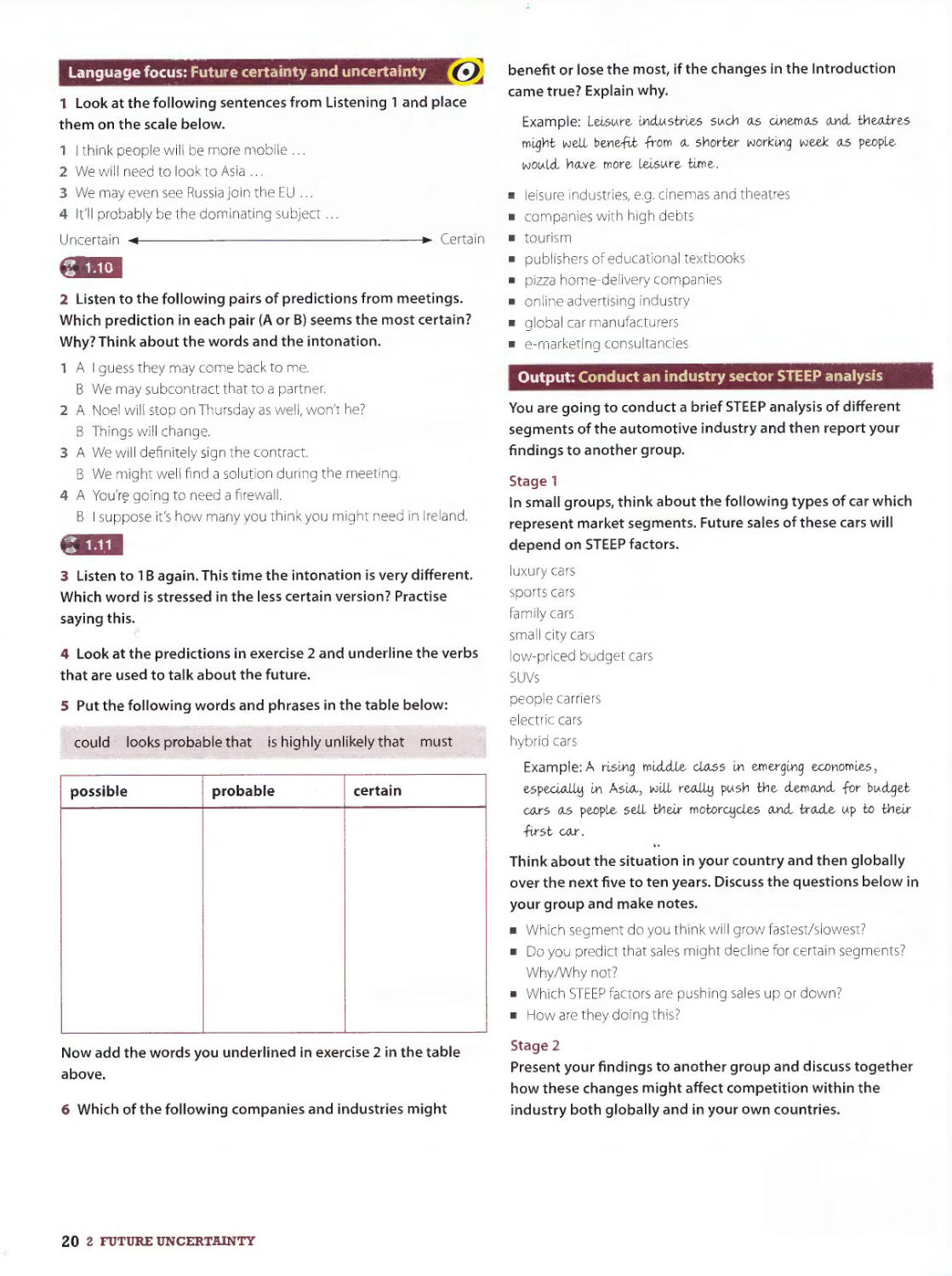
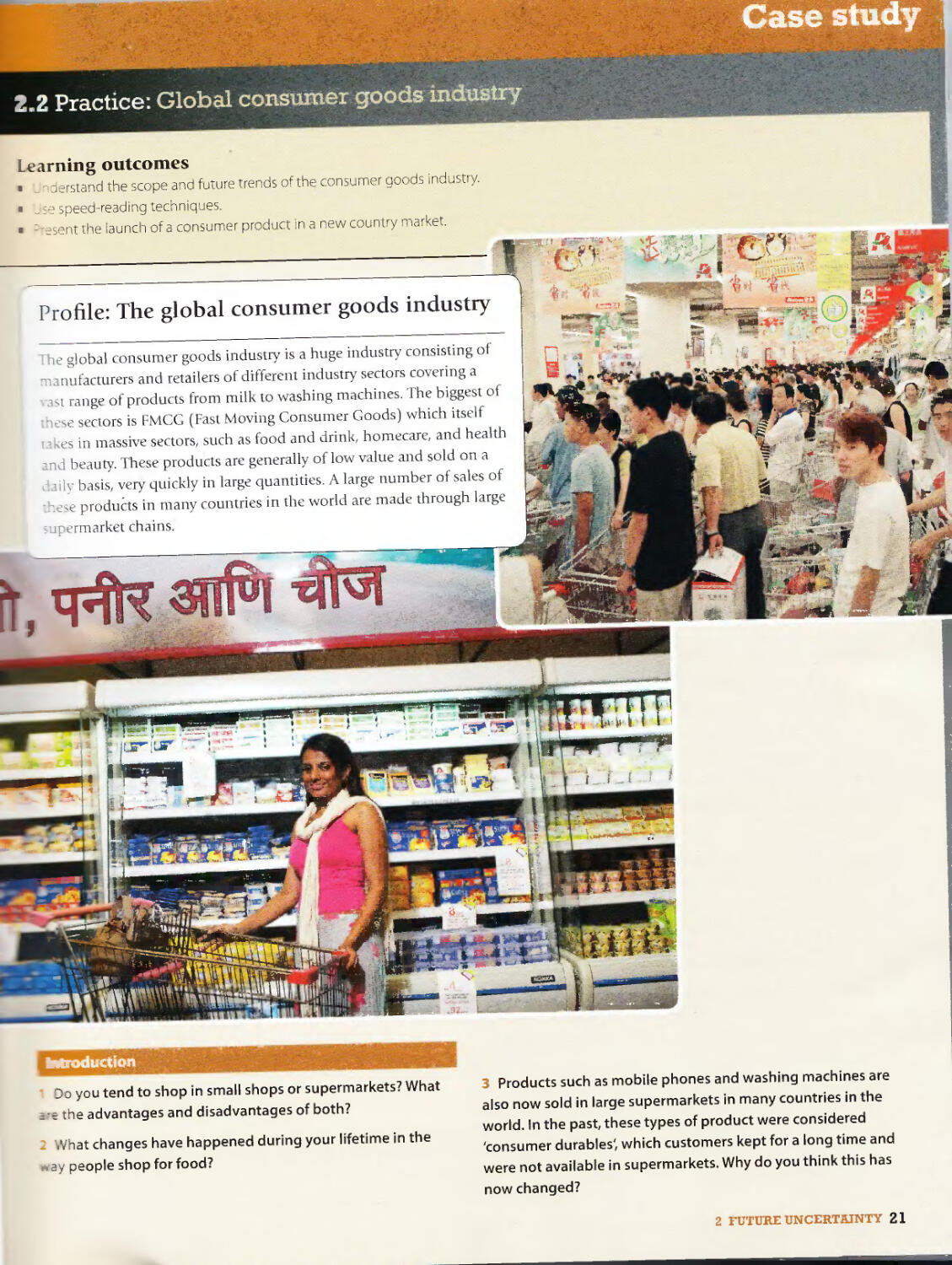
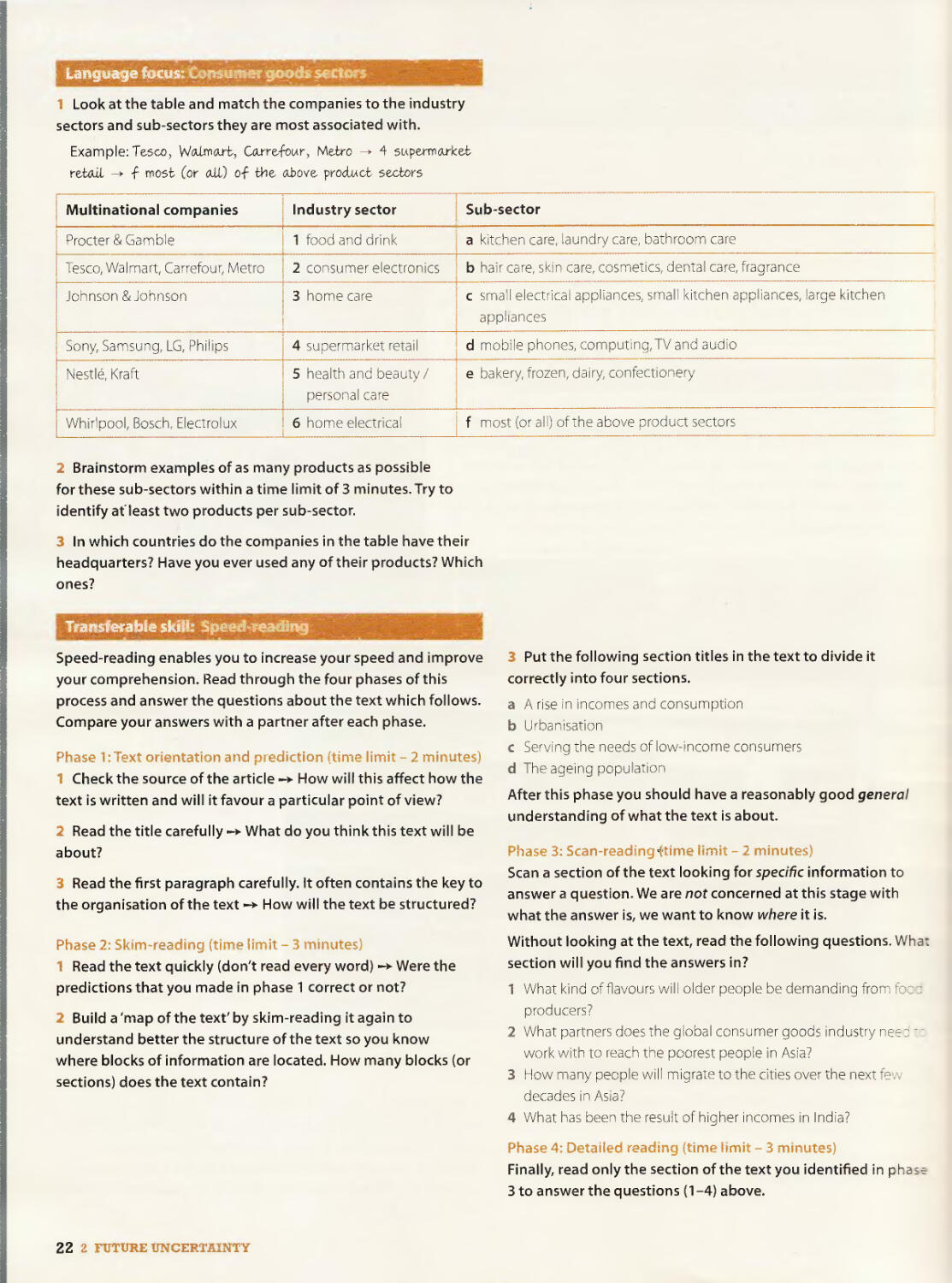

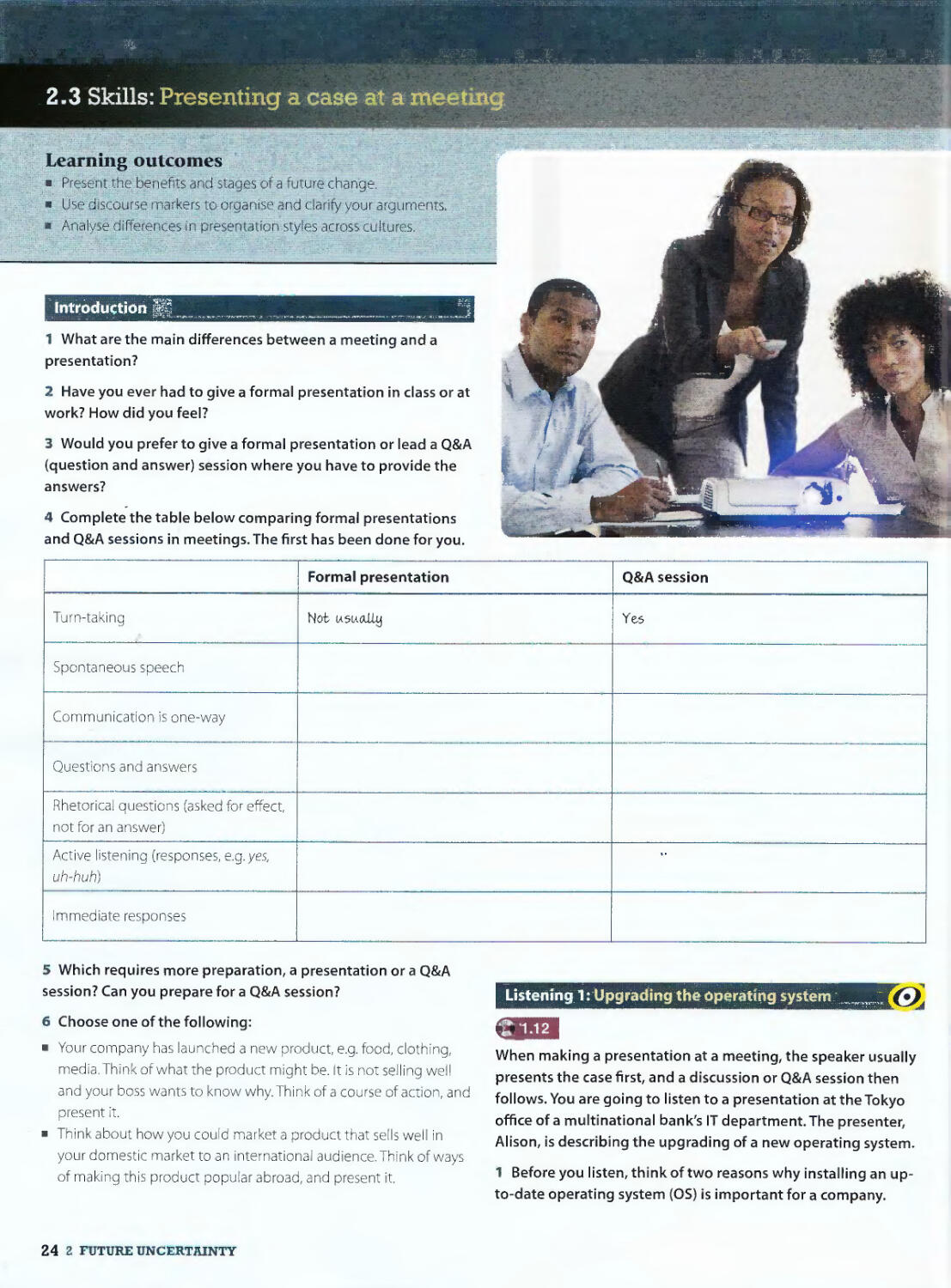






















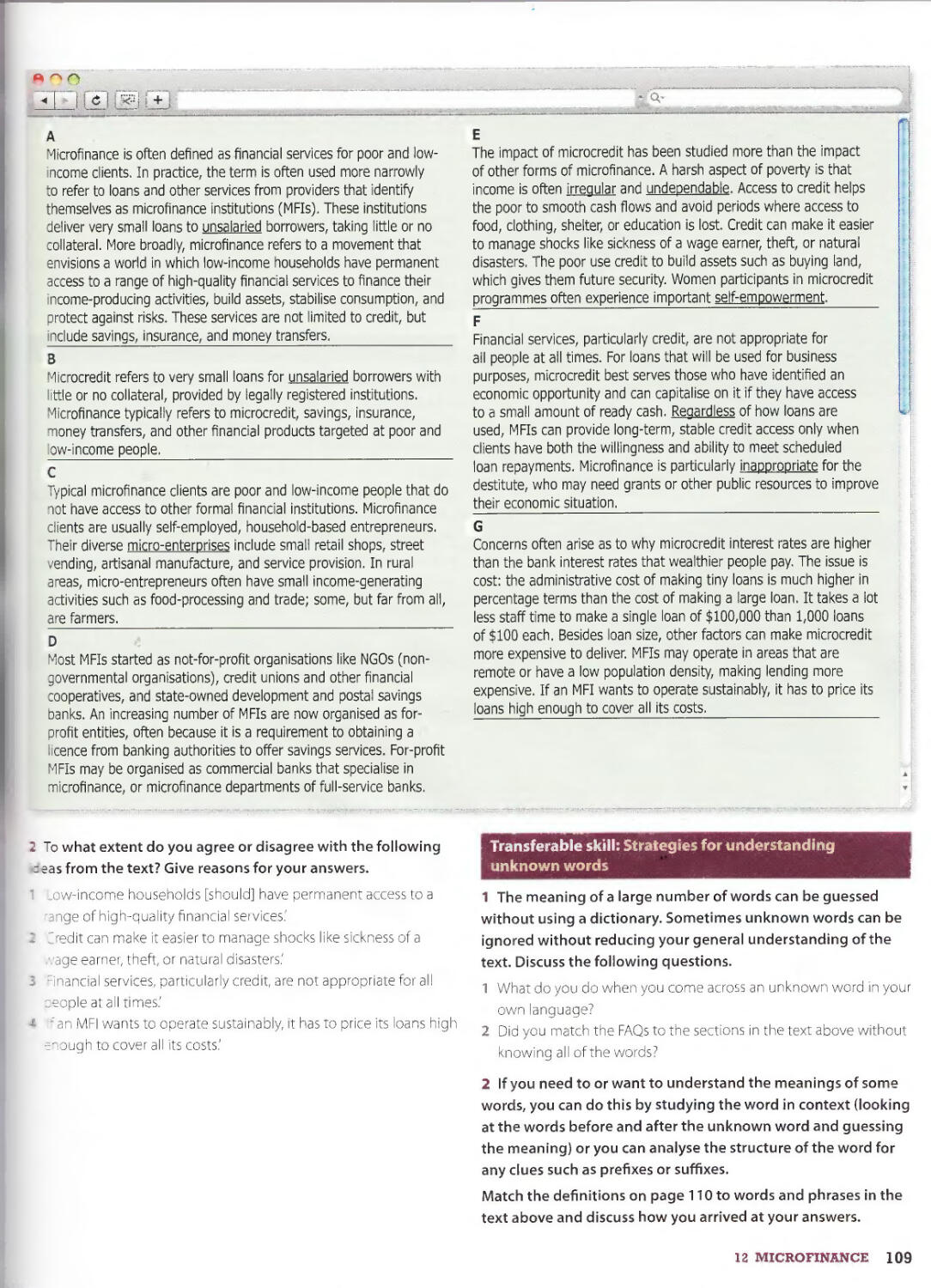
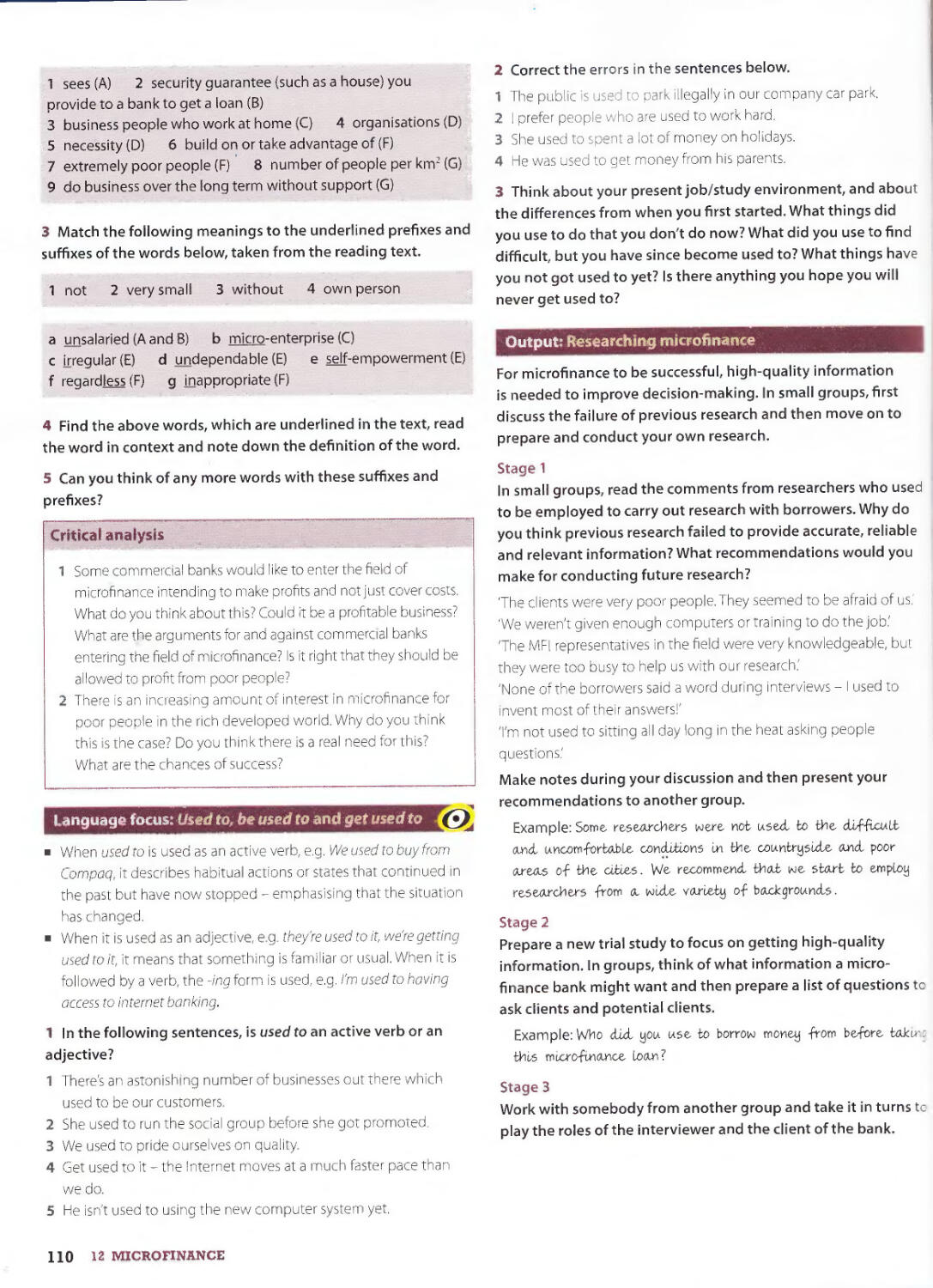

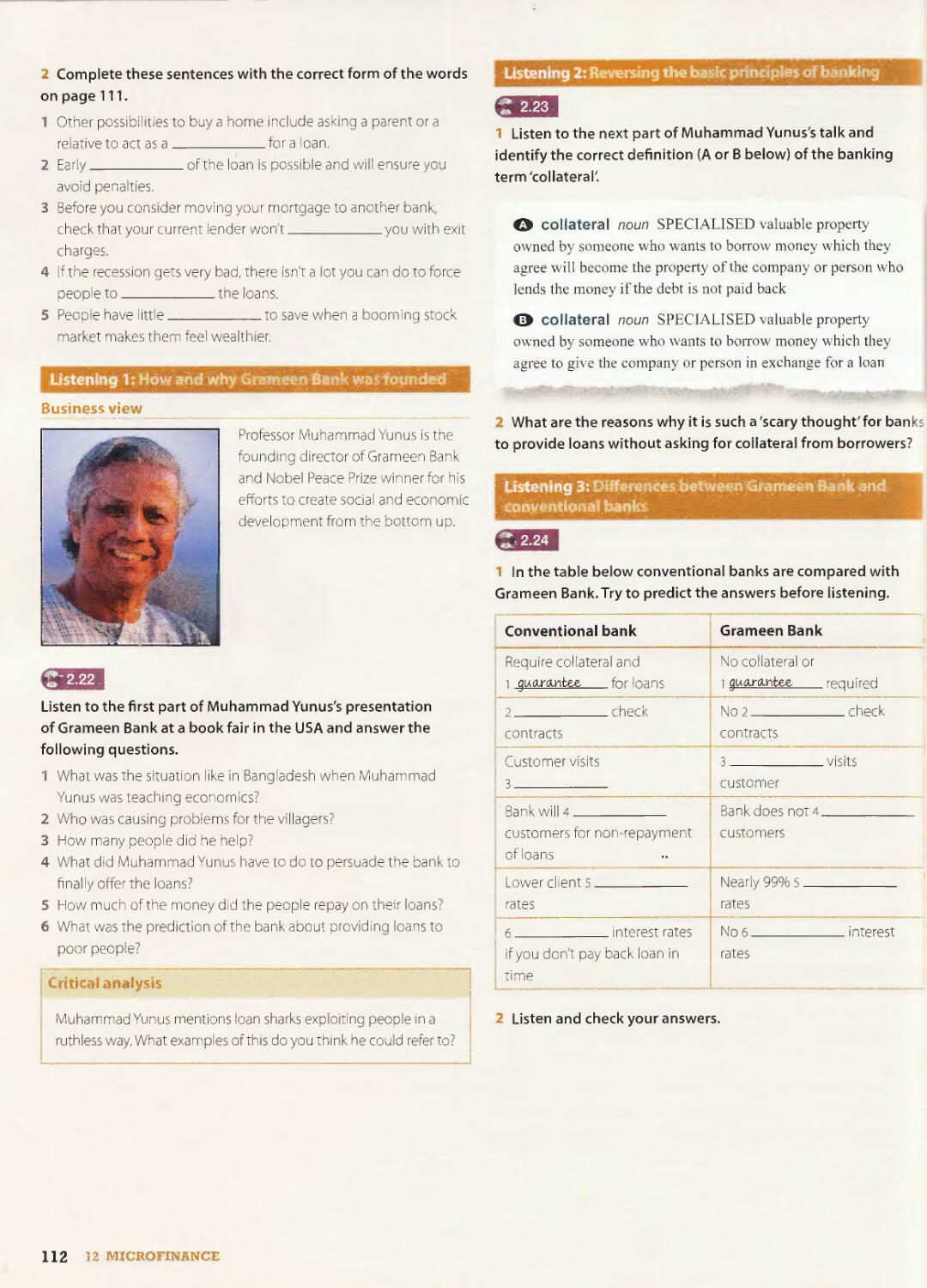
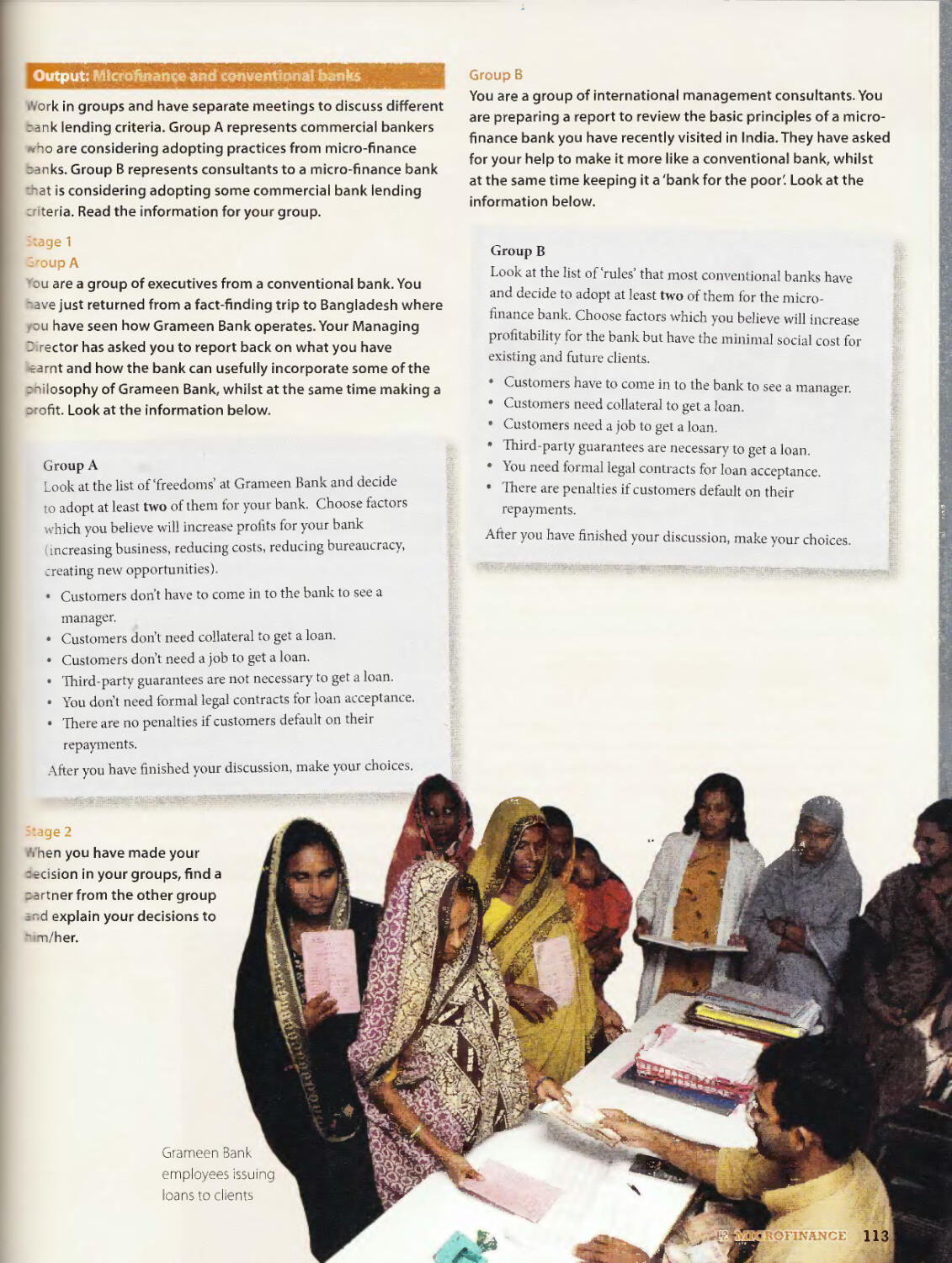

























Теги: business
ISBN: 978-0-521-13217-6


Текст
                    Michael Handford, Martin Lisboa, Almut Koester, Angela Pitt

Business
ge
Student’s Book
Upper-intermediate
MichStel Handford. Martin Lisboa.
Almut Koester, Angela Pitt
ny
0001081607
Cambridge
UNIVERSITY PRESS

REMAULT NISSAN
Dr Sally Hibbert
Associate Professor of Marketing,
Nottingham University Business School
Muhammed Yunus
Founding Director of Grameen Bank
and Nobel Peace Prizewinner
www. Cambridge, org/elt/businessadvantage
Business
success starts here
Business Advantage contains a wealth of expert advice from
global business leaders, thinkers and specialists, and uses
content taken from a corpus of business language as well as
vocabulary from real meetings in real companies.This ensures
that you benefit from learning the skills and the language that
reflect the reality of working in business.
Dell	Renault-Nissan
Dr Jochen Runde	Suleyman Narimanov
Director ofthe MBA Programme	Project Manager, Russian oil industry
and Reader in Economics, Cambridge
Judge Business School, University
of Cambridge
The case studies that accompany each unit of Business
Advantage have been carefully selected, meaning you will
benefit from seeing how business is done across a wide range
of different industry sectors, in organisations of all sizes (both
profit and not-for-profit), and from all around the world.
Thanks to the innovative Theory-Practice-Skills approach and
Upper-Intermediate
the substantial input into	the lessons	and activities	from the	Student's Book with DVD	978	0 521 13217 6
Personal Study Book with Audio CD 978 0 521 28130 0
world	of business, success starts with	Business Advantage.	Teachers B00k	97s	1107422315
^	Audio CDs	978	0 521 13217 6
plus online material
Havaianas

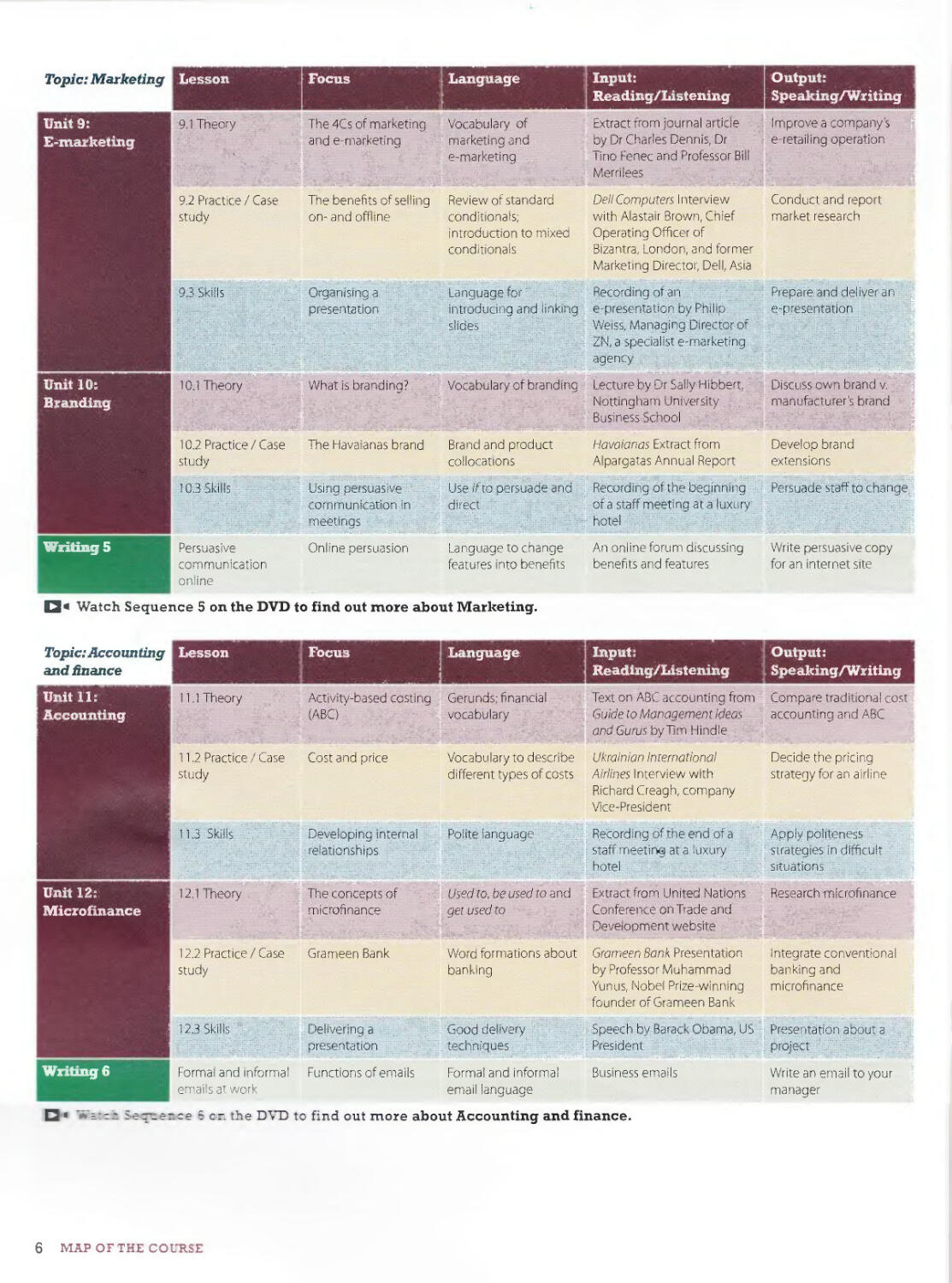
Map of the course
Topic: Business
environment
Unit 1:
Competitive
environment
Unit 2:
Future
uncertainty
Writing 1
Topic: Managing
people
Unit 3:
Rewarding
performance
Unit 4: Fostering
creativity
Lesson
Focus
Language
Input:
Reading/Listening
Output:
Speaking/W riting
1.1 Theory
Concepts of
competitive markets
tanguage to describe
levels of competition
Interview with Professor
JocHen Runde, Cambridge I
Judge Business School,
University of Cambridge ; ;
Prepare and deliver a
competitive apatysts „
1.2 Practice / Case
study
A highly competitive
company
Past tense review
Saint-Gobain Extract from
company website
Present to a potential
distributor
1.3 Skills
Building relationships
across companies
Making your feelings
understood
Recording of small talk in an
international meeting
Develop a relationship
with clients
2.1 Theory
STEEP analysis
; language of certainty/.
Uncertainty
Interview with Dr Hans-Martin
Beyer, ESB Business School
Conduct industry sector
STEEP analysis
2.2 Practice / Case
study
Global consumer
goods industry
Language to describe
the consumer goods
sector
Global Consumer Goods
Industry Industry association
report
Launch a new product
2.3 Skills
Presenting a case at a
meeting
Discourse markers to
link speech
Recording of an IT meeting in
a multinational bank
Present the benefits/
stages of a future change
Preparing
presentation slides
Creating a strong
visual impact
Summarising
;nformation for
presentations
Presentation materials
Tom the Globai Commerce
initiative
Design effective
presenralion slides
nee 1 on the DVD to find out more about Business environment.
Lesson
Focus
Language
Input:
Reading/Listening
Output:
Speaking/Writing
3.1 Theory
Employee reward
strategies
Vocabulary of pay and ;
incentives
Interview with Professor
Stan Siebert, Birmingham
University Business Schopl
Construct a pay package
3.2 Practice/Case
study
Performance-Related
Pay (PRP) in practice
Compound nouns
Nokia Corporation Extract
from company Executive
Compensation Report
Make executive pay
decisions
3.3 Skills
Negotiating a pay rise
Language for
negotiations
Recording of a performance
appraisal in a business
consultancy
Negotiate a pay rise
with your employer
4.1 Theory
Creative thinking and
creative management :
Word formations
Extract from Creative
Management by Dr Jane
Henry, Open University
Business School
Solve problems
creatively
4.2 Practice / Case
study
Innovation in practice
Past modals
Carnegie Wave Energy
Interview with Jeff Harding,
Non-Executive Director
Make a product into a
commercial success
4.3 Skills
Decision-making
Evaluative metaphors
and idioms
Recording of a meeting
about contracts between
two companies
Decide between two
contracts
Describing a process
Describe a creative
problem-solving
process
Review passives;
linking language
Creative problem-solving
processes from the Open
University MBA programme
Write a description of a
business process
I* Watch Sequence 2 on the DVD to find out more about Managing people.
4 MAP OF THE COURSE

Topic: Managing
cultures
Lesson
Focus
Language
Unit 5:
Organisational
cultures
5.1 Theory
: Understanding
organisations
Vocabulary to talk
about organisations ■ -
5,2 Practice / Case
study
i Creating a successful
culture
Ways of asking
questions effectively
5.3 Skills
Dealing with
problems across
departments
Language for making
summaries in meetings -
Unit 6:
Working across
cultures
6.1 Theory-
Culture and individual
'Strategies in business
Vocabulary for culture;
reporting verbs
6.2 Practice/Case y
L study
Multicultural mergers
Vocabulary to make
positive arid negative
judgements
6.3 Skills
International team¬
building
Metaphors of
movement
Writing 3
Argument-led
writing
Arguments for and
against
Vocabulary of reason,
reSult-and contrast
Input:
Reading/Listening
Fxtract from Understanding
Organizations by Professor
Charles Handy, founder of
the London Business School
Mundipharma International:
Lid Interview with Ake
Wikstrom, Regional Director -
Record ing of a n -inter¬
departmental meeting
Interview with Professor;
Helen Sjjencer-Gatey, the
University of Warwick
Renault-Nissan Extracts from
company website and an
academic article
Recording of a meeting-
between two international
logistics departments- - o'
Arguments for and against
privatisation from
BusinessWeek
Output:
Speaking/Writing
Decide on an
appropriate culture for
an organisation
Allocate budgets across
departments
Improve
communication across
departments
Maintain good relations
in difficult situations
(Manage an alliance
between companies
from different cultures
- Develop guidelines for
an international team
Write about pros
and cons of private
ownership
I* Watch Sequence 3 on the DVD to find out more about Managing cultures.
Topic: Managing
operations
Lesson
Focus
Language
Input:
| Reading/Listening
Output:
Speaking/Writing
Unit 7:
Change
management
7,1 Theory
DICE theory
Cohesion and
referencing languagey
Extract of article from The :
Boston Consulting Group
1 Pla n and evaluate a
; change; to study or work I
project
7.2 Practice/Case
study
Implementing change
Present perfect
tenses; non-verbal
communication
idMTechnologiesBeijing_
Interview with Charlie
Peppiatt, Vice-President of
-Global Operations, Laird PEG/’
Improve team
performance and
productivity
7.3 Skills
Externainegotiating
Ways to. organise
.spokenTanguage:
Recording of meeting
between two multinational
pharmaceutical companies '- -
-Negotiate issues in a
joint venture
Unit 8:
Project
management
8.1 Theory-:;;' Ty
The principles of -
project management
Verb/noun
combinations : s y . y
Extract from The Project;'
Workout by Robert Buttrick,
Programme Manager at
CableS Wireless
-Schedufea project
8.-2 Practice/Gasey
study
(Russian oil industry -
Sakhalin-1 Project
Future perfect and
future continuous:
tenses
Sakhalin-1 Project 1 nterview
with Suleyman Narimanov, /
Engineering Project Manager
Plan the goals and
objectives of a project
8.3 Skills
Maintaining
relationships
inclusive and exclusive
language
Recording of a sales meeting
between two IT companies
Negotiate sensitive
arrangements
Writing 4
Describing graphs
Describing graphs
Compare and contrast
figures and trends
Graphic information from The
Carbon Trust
Describe graph showing
carbon emissions across
industries
Q« Watch Sequence 4 on the DVD to find out more about Managing operations.
MAP OF THE COURSE 5

Topic: Marketing
Unit 9:
E-marketing
Unit 10:
Branding
9.1 Theory;
9.2	Practice / Case
study
9.3	Skills
10.1	Theory
10.2 Practice/Case
study
10.3 Skills
Persuasive
communication
online
The 4Cs of marketing	Vocabulary of
and e-marketing	marketing	and
e-marketing
The benefits of selling
on-and offline
Organising a
presentation
What is branding?
The Havaianas brand
Using persuasive
communication in
' meetings
Online persuasion
Review of standard
conditionals;
introduction to mixed
conditionals
Language for
introducing and linking
slides
Vocabulary of branding
Brand and product
collocations
Use if to persuade and
direct
Language to change
features into benefits
Input:
Reading/Listening
Extract from journal article
by Dr Charles Dennis, Dr
Tino Fenec and Professor Bill
Merrilees
Dell Computers Interview
with Alastair Brown, Chief
Operating Officer of
Bizantra, London, and former
Marketing Director, Dell, Asia
Recording of an
e-presentation by Philip
Weiss, Managing Director of
ZN, a specialist e-marketing
agency
Lecture by Dr Sally; Hibbert,
Nottingham University
Business School
Havaianas Extract from
Alpargatas Annual Report
Recording ofthe beginning
of a staff meeting at a luxury
hotel
An online forum discussing
benefits and features
|« Watch Sequence 5 on the DVD to find out more about Marketing.
Topic: Accounting
and finance
Lesson
Focus
Language
Input:
Reading/Listening
Unit 11:
Accounting
11.1 Theory
Activity-based costing
(ABC)
Gerunds; financial
vocabulary
Text on ABC accounting from
: Guide to Management Ideas
and Gurus toy Tim Hindie
11.2 Practice / Case
study
Cost and price
Vocabulary to describe
different types of costs
Ukrainian International
Airlines Interview with
Richard Creagh, company
Vice-President
11.3 Skills
Developing internal
relationships
Polite language
Record ing of the end of a
staff meeting at a luxury
hotel
Unit 12:
Microfinance
12.1 Theory:
The concepts of
microfinance
Used to, be used to and;
get used to
Extract from United Nations
Conference on Trade and
Development website
12.2 Practice / Case
study
- Grameen Bank
Word formations about
banking
Grameen Bank Presentation
by Professor Muhammad
Yunus, Nobel Prize-winning
"founder of Grameen Bank
12.3 Skills -
Delivering a
presentation
Good delivery
techniques
Speech by Barack Obama, US
President
Formal and informal
emails at work
Functions of emails
Formal and informal
email language :
Business emails
□ • * =	:rr.r::e:	cr.	:he	DVD	to	find	out	more	about	Accounting	and	finance.
Output:
Speaking/Writing
Improve a company's
e-retailing operation
Conduct and report
market research
Prepare and deliver an
e-presentation
Discuss own brandy,
man ufactufer % brand
Develop brand
extensions
Persuade staff to change
Write persuasive copy
for an internet site y
Output:
Speaking/Writing
Compare traditional'cost
accounting and ABC
Decide the pricing
strategy for an airline r
Apply politeness
strategies in difficult
situations
Research microfinance
Integrate conventional
banking and
microfinance
Presentation about a
project
Write an email to your
manager
6 MAP OFTHE COURSE

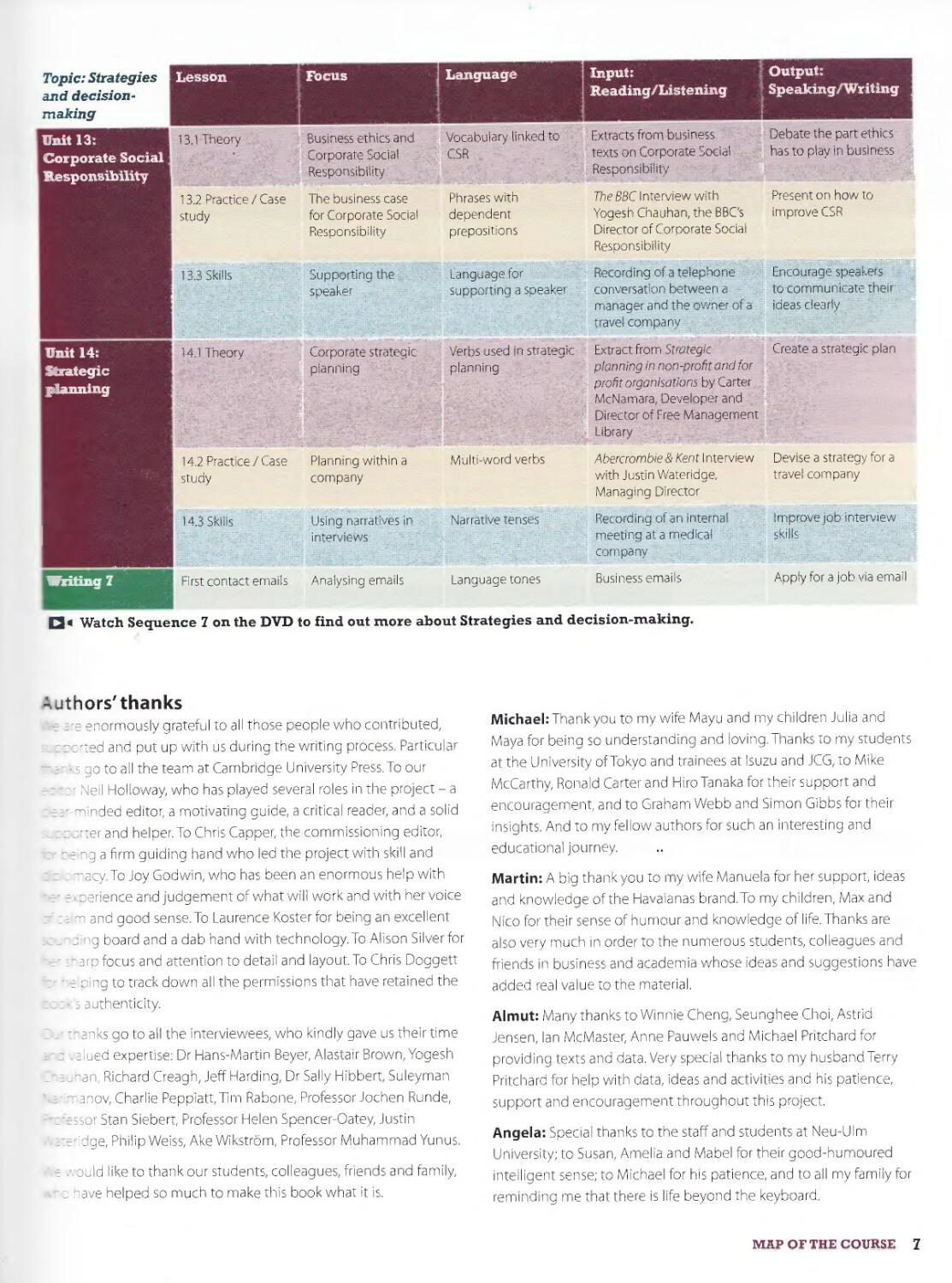
making
Unit 13:
13.1 Theory
Business ethics and
Vocabulary linked to
Extracts from business
Debate the part ethics
Corporate Social
Responsibility
Corporate Social
Responsibility
CSR
texts on Corporate Social
Responsibility
has to play in business
13.2 Practice / Case
The business case
Phrases with
The BBC Interview with
Present on how to
study
for Corporate Social
Responsibility
dependent
prepositions
Yogesh Chauhan, the BBC's
Director of Corporate Social
Responsibility
improve CSR
13.3 Skills
Supporting the
speaker
Language for
supporting a speaker
Recording of a telephone
conversation between a
manager and the owner of a
travel company
Encourage speakers
to communicate their
ideas clearly
Unit 14:
Strategic
planning
-14. t Theory
Corporate strategic -
planning
Verbs used in strategic
planning
Extract from Strategic
planning in non-profit and for
profit organisations by Carter
McNamara, Developer and
Directotof Free Management
Library
Create a strategic plan
142 Practice/Case
study
Planning within a
company
Multi-word verbs;/.
Abercrombie & Kent Interview
with Justin Wateridge,
Managing Director
Devise a strategy for a
travel company
143 Skills
Using narratives in
interviews
Narrative tenses
Recording of an internal
meeting at a medical
company
Improve job interview
skills
Writing 2
First contact emails ;
Analysing emails
Language tones
Business emails
Apply for a job via email
H « Watch Sequence 7 on the DVD to find out more about Strategies and decision-making.
Authors'thanks
are enormously grateful to all those people who contributed,
:o rrted and put up with us during the writing process. Particular
:---s go to all the team at Cambridge University Press.To our
' Neil Holloway, who has played several roles in the project - a
-minded editor, a motivating guide, a critical reader, and a solid
;: mter and helper.To Chris Capper, the commissioning editor,
fog a firm guiding hand who led the project with skill and
:macy. To Joy Godwin, who has been an enormous help with
- experience and judgement of what will work and with her voice
m and good sense.To Laurence Koster for being an excellent
.-ding board and a dab hand with technology.To Alison Silver for
warp focus and attention to detail and layout. To Chris Doggett
~e oing to track down all the permissions that have retained the
: :c* s authenticity.
.' thanks go to all the interviewees, who kindly gave us their time
: . alued expertise; Dr Hans-Martin Beyer, Alastair Brown, Yogesh
n auhan, Richard Creagh, Jeff Harding, Dr Sally Hibbert, Suleyman
manov, Charlie Peppiatt,Tim Rabone, Professor Jochen Runde,
;fessor Stan Siebert, Professor Helen Spencer-Oatey, Justin
ateridge, Philip Weiss, Ake Wikstrom, Professor Muhammad Yunus.
a ould like to thank our students, colleagues, friends and family,
v-: nave helped so much to make this book what it is.
Michael: Thank you to my wife Mayu and my children Julia and
Maya for being so understanding and loving.Thanks to my students
at the University ofTokyo and trainees at Isuzu and JCG, to Mike
McCarthy, Ronald Carterand HiroTanaka fortheir support and
encouragement, and to Graham Webb and Simon Gibbs for their
insights. And to my fellow authors for such an interesting and
educational journey.
Martin: A big thank you to my wife Manuela for her support, ideas
and knowledge ofthe Havaianas brand.To my children, Max and
Nico for their sense of humour and knowledge of life. Thanks are
also very much in order to the numerous students, colleagues and
friends in business and academia whose ideas and suggestions have
added real value to the material.
Almut: Many thanks to Winnie Cheng, Seunghee Choi, Astrid
Jensen, Ian McMaster, Anne Pauwels and Michael Pritchard for
providing texts and data. Very special thanks to my husband Terry
Pritchard for help with data, ideas and activities and his patience,
support and encouragement throughout this project.
Angela: Special thanks to the staff and students at Neu-Ulm
University; to Susan, Amelia and Mabel for their good-humoured
intelligent sense; to Michael for his patience, and to all my family for
reminding me that there is life beyond the keyboard.
MAP OF THE COURSE 7

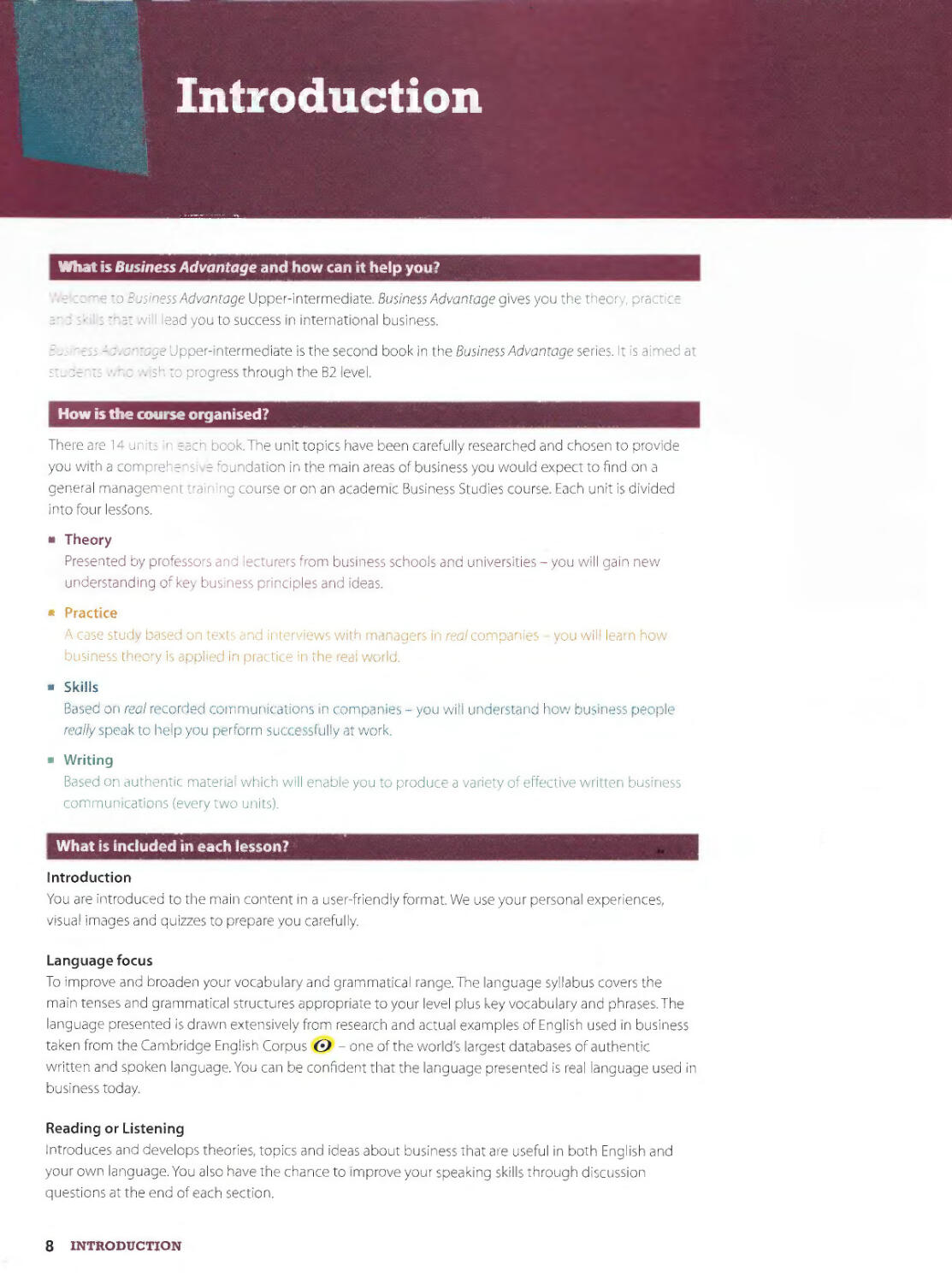
What is Business Advantage and how can it help you?
.’.e ::~e to Business Advantage Upper-intermediate. Business Advantage gives you the theory, practice
o S' s that .v;[l lead you to success in international business.
f"ess -s. outage Upper-intermediate is the second book in the Business Advantage series. It is aimed at
st-05'ts .'me wish to progress through the B2 level.
How is the course organised?
There are 14 units in each book.The unittopics have been carefully researched and chosen to provide
you with a comprehensive foundation in the main areas of business you would expect to find on a
general management training course or on an academic Business Studies course. Each unit is divided
into four lesions.
■ Theory
Presented by professors and lecturers from business schools and universities - you will gain new
understanding of key business principles and ideas.
■ Practice
A case study based on texts and interviews with managers in real companies - you will learn how
business theory Is applied in practice in the real world.
a Skills
Based on real recorded communications in companies - you will understand how business people
really speak to help you perform successfully at work.
■ Writing
Based on authentic material which will enable you to produce a variety of effective written business
communications (every two units).
What is included in each lesson?
Introduction
You are introduced to the main content in a user-friendly format. We use your personal experiences,
visual images and quizzes to prepare you carefully.
Language focus
To improve and broaden your vocabulary and grammatical range.The language syllabus covers the
main tenses and grammatical structures appropriate to your level plus key vocabulary and phrases. The
language presented is drawn extensively from research and actual examples of English used in business
taken from the Cambridge English Corpus & - one ofthe world's largest databases of authentic
written and spoken language. You can be confident that the language presented is real language used in
business today.
Reading or Listening
Introduces and develops theories, topics and ideas about business that are useful in both English and
your own language. You also have the chance to improve your speaking skills through discussion
questions at the end of each section.
8 INTRODUCTION

Output
Each lesson builds to a final Output section.This is usually a group task where you have to use the
language and ideas presented to solve a problem or deal with a business dilemma or issue.
Critical analysis and Intercultural analysis
Every unit also includes at least one Critical analysis and Intercultural analysis section. Critical analysis will
help you develop questioning skills that are necessary in the academic and business world. Intercultural
analysis will help you develop an understanding of your own culture and other cultures - a vital skill in
today's business world.
Transferable skill
You will also find a Transferable skill section in each unit which will provide you with some very useful
tools, such as speed-reading techniques, that will improve the way you learn and the way you work.
What is on the DVD?
The DVD in the Student's Book contains video case studies to watch after every two units. You can use
the DVD for extra listening practice and to find out more about the business topics in Business Advantage.
There are documentaries filmed at companies as well as round-table discussions filmed with MBA
students from the Cambridge Judge Business School, University of Cambridge. When you see in
.our Student's Book, ask your teacher about watching the DVD sequence in class, or watch it at home on
your computer or TV.
The video case studies are accompanied by worksheets available on the Business Advantage website:
www.cambridge.org/elt/businessadvantage
What is in the Personal Study Book?
The Personal Study Book gives you extra practice ofthe grammar, vocabulary and skills you have covered
in the Student's Book. There are also additional reading activities focusing on inspirational business
eaders and thinkers, together with further case studies on a variety of organisations.
Where can I find more activities?
-sk your teacher about the Professional English Online website for extra activities to do in class:
www.cambridge.org/elt/pro
•Ve hope you enjoy learning with Business Advantage and wish you every success.
Michael Handford
University ofTokyo, Japan
Martin Lisboa
Foundation Campus, Lucca / University of Pisa, Italy
Almut Koester
University of Birmingham, UK
Angela Pitt
University of Neu-Ulm, Germany

Introduction
Learning outcomes
a Learn theory, language and concepts of competitive markets.
* '..earn mind-mapping and note-taking techniques.
■ Prepare and deliver a mini-presentation using a mind map.
1 Discuss the following questions.
« How competitive are you in your work or studies?
■ Is it always important for you to be successful?
■ How important is it to be ambitious in order to become successful?
2 There are many parallels between the worlds of competitive
business and professional sport. Label the'strategies for
success' below (1-4) as follows (A, B, C or D).
A Appropriate for business	C	Appropriate	for	both
B Appropriate for sport	D	Appropriate	for	neither
1 Pay significant rewards to top performers
2 Maintain a large pay differential between best and worst performers
3 Fire the worst performers
4 Create a culture that focuses on winning at all costs
Discuss your answers and explain your reasons.
3 The following developments arguably make the business
environment more competitive. What effect would they have
on business in your country?
1 Manufacturers increasingly locate factories in low-cost countries.
2 A single global currency is introduced in all countries.
3 The government forcibly breaks up large companies that
dominate their industry sector.
4 New competitors from emerging economies enter the world
stage.
5 The speed of technological change increases.
6 The government cuts tariffs (import taxes) on goods and services
from overseas.
4 How competitive is the environment you work in (or want to
work in)? What makes it competitive (or uncompetitive)?
1 Sport is seen by many people as an analogy for business
competition. Complete the following sentences that link sport
to business using verbs from the box.
acted monopolised regulated invested globalised
1 Different sports, like different industries, are largely
by a small group of teams or companies.
2 Some business people, like some sports people, have
		illegally to'win at all costs)
3 Sport, like business, needs to be heavily	to	ensure
that competition is fair and equal.
4 Both business and sport are becoming increasingly
		compared to the past.
5 Sports teams and companies have	heavily	to
attract top talent.
In pairs, tell your partner about any examples that illustrate
some ofthe points above.
2 Underline the high-frequency collocations with adverbs in
the sentences above. Then try to memorise them.
Example: largely monopolised
10 1 COMPETITIVE ENVIRONMENT

3 Look at the following sports metaphors that are commonly
used in business and decide which sport they originate from.
Then complete the sentences below with the correct metaphor.
touch base kick off take it on the chin
the ball's in their court score an own goal
1 We've sent them our final offer, so now
2 We've arranged to have lunch first and then
		the	meeting	after	that.
3 That's a good idea. Let's	on	that
tomorrow.
4 If we're not careful here, we'll
5 It's hard to accept, but sometimes we just have to
4 What do you think these metaphors mean?
Professor Jochen Runde is Director
ofthe MBA Programme and Reader
in Economics at the Cambridge
Judge Business School, University of
Cambridge.
5 Listen to Professor Jochen Runde's definitions ofthe key
terms below and put them in the order you hear them being
described.
9HEH1
■ oligopoly	 .
■ perfect competition
■ natural monopoly
■ business environment
■ monopoly
Listening 1: The competitive environment in sport and
business
1 Listen to Professor Jochen Runde describe some connections
between competitive sport and the world of business, and note
down the four sports he mentions.
2 Listen again and answer the following questions.
1 What lessons can business learn from the Oxford-Cambridge boat
race?
2 What examples does he give of teams with 'market power'?
3 Why do these teams have 'market power' in his opinion?
4 Which sport has rules to ensure competition is fairer and more
equal?
Business view
5 What metaphor does he use to describe a sport that has unfair
rules that favour some teams over others?
6 What word or phrase that Professor Jochen Runde defined in
Language focus 1 question 3 best describes level playing field'?
I Critical analysis
1 What teams have the most market power in sports in your
country? Plow do they use this power? How can sports
governing bodies create a more'level playing field' by
reducing their market power?
2 What about business? What companies have the most
market power in their industry sector? How do they use it?
What can national governments and international institutions
do to restrict this power?
Listening 2: Monopolies, oligopolies and perfect
competition
0B21
1 Listen to the second part of the interview and answer the
questions.
1 What two things do monopolies do with their market power?
2 In what two situations does it make sense to have a natural
monopoly?
3 How possible is it in practice to create perfect competition?
4 How can you make markets more competitive?
2 Professor Jochen Runde uses the term 'reduce entry barriers',
which is also commonly expressed as'reducing barriers to
entry'or'reducing market entry barriers'. Here, we are referring
to barriers that companies build around their products and
services to stop competitors entering the market.
Look at the following strategies that big companies can use to
build barriers and categorise them as follows:
a Probably illegal in most countries
b Would probably be investigated by Competition Authorities
c Generally considered acceptable business practice
1 Make a takeover bid for a rival company
2 Agree common price strategy with rivals
3 Propose a merger with a rival company
4 Become a global company	__
5 Lower prices to below cost price
6 Register a lot of patents
3 Most countries or regions have institutions and laws to
monitor monopoly activities and restrict their market power.
Match the institutions below to their correct country or region:
1	Monopolies and Mergers Commission	USA
2	Federal Trade Commission	UK
3	Competition Commission	EU
What is the name of the corresponding institution in your home
region or country?
1 COMPETITIVE ENVIRONMENT 11

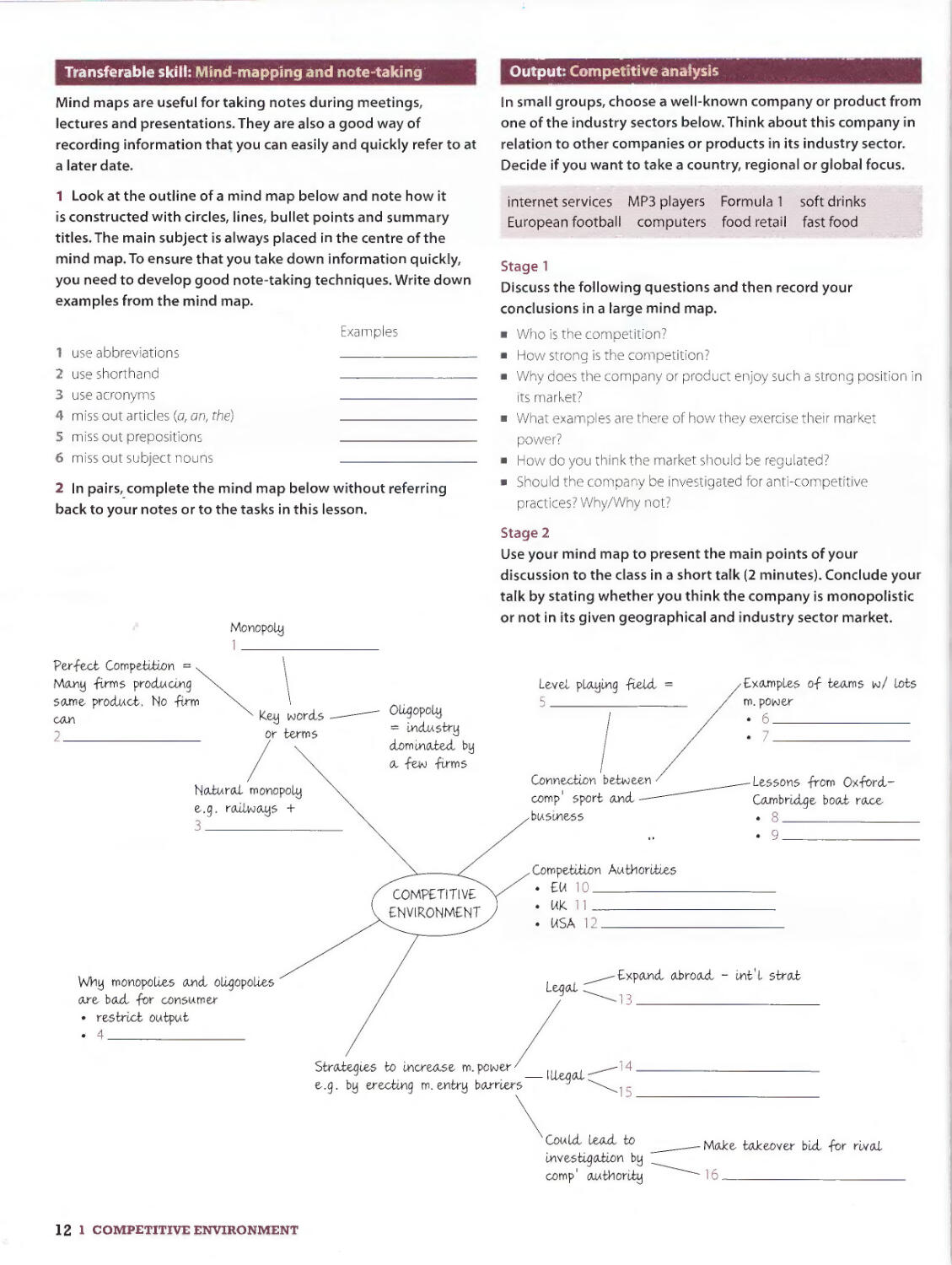
Transferable skill: Mind-mapping and note-taking
Output: Competitive analysis
Mind maps are useful for taking notes during meetings,
lectures and presentations. They are also a good way of
recording information that you can easily and quickly refer to at
a later date.
1 Look at the outline of a mind map below and note how it
is constructed with circles, lines, bullet points and summary
titles.The main subject is always placed in the centre ofthe
mind map. To ensure that you take down information quickly,
you need to develop good note-taking techniques. Write down
examples from the mind map.
Examples
1 use abbreviations
2 use shorthand
3 use acronyms
4 miss out articles (a, on, f/te)
5 miss out prepositions
6 miss out subject nouns
2 In pairs, complete the mind map below without referring
back to your notes or to the tasks in this lesson.
Monopoly
1
Perfect Competition =.
Many firms producing
same product. No firm
can
2
Key words
or terms
Oligopoly
= Industry
dominated by
a few firms
Natural monopoly
e.g. railways +
3.
Why monopolies and oligopolies
are bad for consumer
• restrict output
In small groups, choose a well-known company or product from
one ofthe industry sectors below. Think about this company in
relation to other companies or products in its industry sector.
Decide if you want to take a country, regional or global focus.
internet services MP3 players Formula 1 soft drinks
European football computers food retail fast food
Stage 1
Discuss the following questions and then record your
conclusions in a large mind map.
a Who is the competition?
■ How strong is the competition?
■ Why does the company or product enjoy such a strong position in
its market?
a What examples are there of how they exercise their market
power?
* How do you think the market should be regulated?
■ Should the company be investigated for anti-competitive
practices? Why/Why not?
Stage 2
Use your mind map to present the main points of your
discussion to the class in a short talk (2 minutes). Conclude your
talk by stating whether you think the company is monopolistic
or not in its given geographical and industry sector market.
Level playing field =
Connection between
comp' sport and
business
Competition Authorities
• EU 10
• UK 11
• USA 12
Examples of teams w/ lots
m. power
• 6
. 7
Lessons from Oxford-
Cambridge boat race
Legal.
-Expand abroad. - int'l strat
-13.
Strategies to increase m. power7	^-14
e.g. by erecting m. entry barriers ^
15.
x Could lead to
Investigation by
comp' authority
- Make takeover bid for rival
-16
12 1 COMPETITIVE ENVIRONMENT

Which large multinational corporations seem very powerful
at the moment? What sectors are they in? Who are their
competitors? Why do you think they are so successful? Is it only
oecause their products are so good?
Would you like to work for any of these companies? Why/Why
not?
What characteristics do you think a highly competitive
company should have?
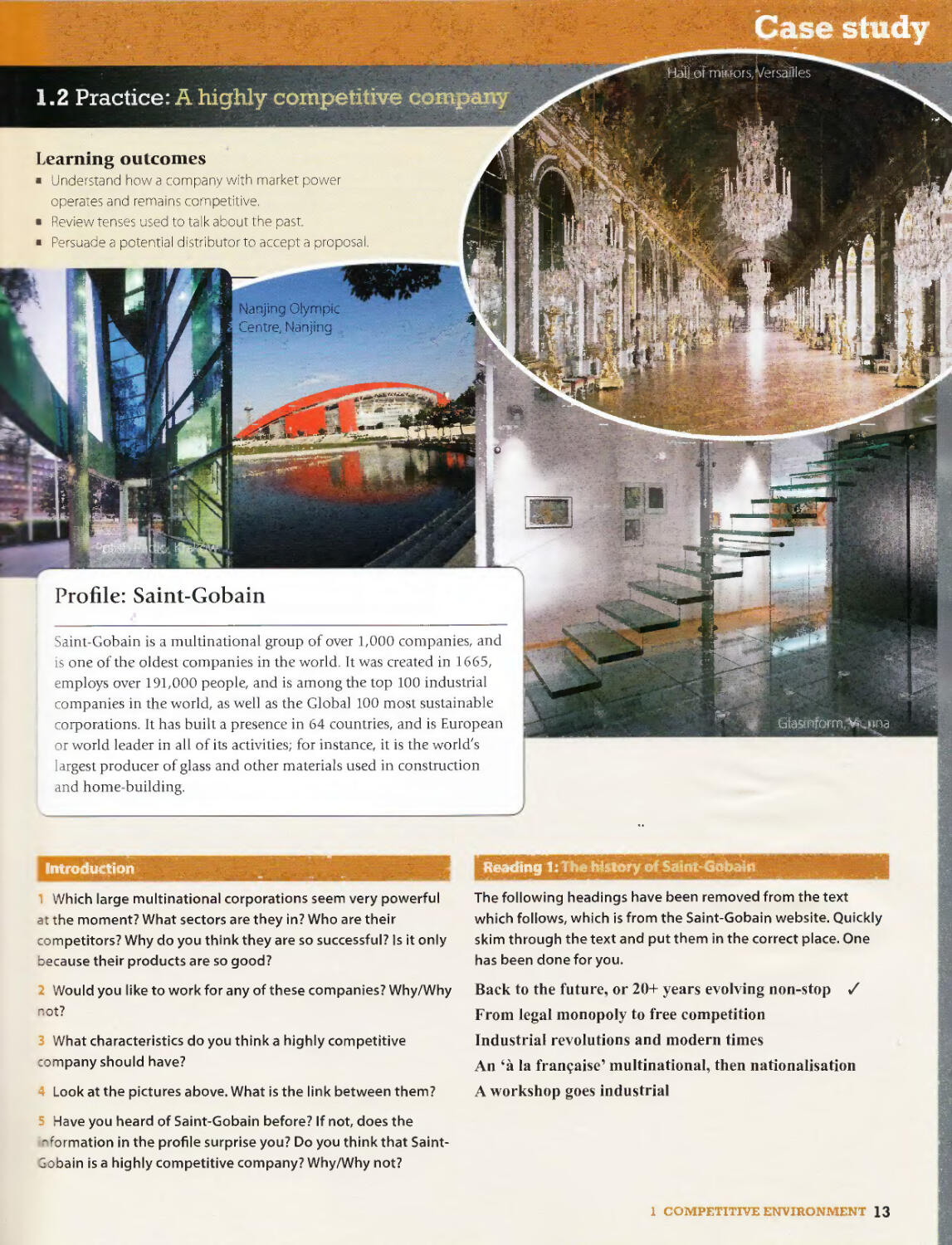
Look at the pictures above. What is the link between them?
Have you heard of Saint-Gobain before? If not, does the
iformation in the profile surprise you? Do you think that Saint-
Gobain is a highly competitive company? Why/Why not?
The following headings have been removed from the text
which follows, which is from the Saint-Gobain website. Quickly
skim through the text and put them in the correct place. One
has been done for you.
Back to the future, or 20+ years evolving non-stop /
From legal monopoly to free competition
Industrial revolutions and modern times
An ‘a la fran^aise’ multinational, then nationalisation
A workshop goes industrial
Profile: Saint-Gobain
Learning outcomes
■ Understand how a company with market power
operates and remains competitive.
■ Review tenses used to talk about the past.
■ Persuade a potential distributor to accept a proposal.
Saint-Gobain is a multinational group of over 1,000 companies, and
is one of the oldest companies in the world. It was created in 1665,
employs over 191,000 people, and is among the top 100 industrial
companies in the world, as well as the Global 100 most sustainable
corporations. It has built a presence in 64 countries, and is European
or world leader in all of its activities; for instance, it is the world's
largest producer of glass and other materials used in construction
and home-building.
E ENVIRONMENT 13

1665-1789:
Louis XIV signed the letters patent establishing the Manufacture
des Glaces de Miroirs in Paris in October 1665 - and founded
another 25 such establishments that year.
Louis XIV’s Chief Minister at the time was Jean-Baptiste
Colbert. His underlying political and economic agenda involved
undermining Venice’s supremacy in Europe’s glassmaking
industry. He accordingly granted this manufacturer a number
of tax breaks and advantages (including a temporary but
renewable monopoly) to help it keep pace with the demand for
mirrors in homes and royal buildings. The workshop nevertheless
received an impressive and symbolic order in 1684: 357 mirrors
for the Hall of Mirrors in the Palace of Versailles.
1789-1856:
The French revolution signalled the end of the legal monopoly,
brought the days of privilege to an end, and forced the
manufacturer to adjust its business model — and culture.
Privileges were abolished and business competition was
introduced. English and newer Belgian rivals took over half
the European glass market when glassware casting technology
became commonplace, and the legal and technical monopoly
vanished. The company, however, reacted.
1856-1970:
Buoyant markets, international expansion and market
diversification kept Saint-Gobain on an upward trend for three-
quarters of a century.
The glass industry blossomed during the second half of the 19th
century. Worldwide production grew practically 9% a year from
1850 to 1870, and Saint-Gobain started honing its strategy to
stay on the move and thereby fend off foreign competition. It
merged with its main domestic rival, Saint-Quirin, in 1858.
1970-1986:
The 1960s and 1970s brought deep-reaching changes across
French society - and predictably sent ripples through a number
of business sectors. Big industrial firms were trying to find the
critical mass they needed to survive in the new ‘economic
world war’.
A political development promptly shelved those plans: a left-
wing coalition won France’s 1981 presidential election and the
group was nationalised in 1982.
In 1986 it regained its freedom and took stock of the lessons it
had learned over the previous decade.
1986 to the present day:
Bcock to the, -future, or 20+ years evolving non-stop
The 1986 privatisation initiated a careful reshuffle. The
business portfolio it shaped as a result largely foreshadowed
the group’s profile today. It rolled out its transformation in two
main stages (one each decade).
Saint-Gobain spent the bulk of the first decade striving to
restore sustainable and profitable growth, and to establish
worldwide leadership across its business lines. Then it
redirected its strategy towards high-tech materials.
In those 20 years, from 1986 to 2006, Saint-Gobain saw its sales
multiplied by 350%. New business acquisitions accounted for
54% of that growth.
It has recently refocused its strategy on the habitat and
construction markets and set out to:
• build the homes of the future
• step up development in emerging countries
• further its operational excellence.
About 77% of Saint-Gobain’s €40 billion in sales last year
came from business lines associated with the housing and
construction markets. The Group is active in 64 countries.
It is still on the move today, and pushing ahead on three fronts
- expanding in emerging countries, consolidating certain
business lines with acquisitions, and stepping up its investment
in R&D.
Reading ,	.	-
Work in pairs.
Student A: Read the history of Saint-Gobain from 1665 to 1970.
Why were the following important in the history of Saint-
Gobain? Tell Student B about the people and events in your
own words.
Jean-Baptiste Colbert the French Revolution Saint-Quirin
Student B: Read the history of Saint-Gobain from 1970 to the
present day. Why were the following important in the history of
Saint-Gobain? Tell Student A what happened in these years in
your own words.
Language focus 1: Adjec
combinations
Match the adjectives with the nouns below, following this
pattern: adjective and adjective + noun.
Example: Legal ajnci technical monopoly
Adjectives: legal sustainable economic political impressive
technical profitable symbolic
Nouns: order agenda monopoly growth
Quickly scan through the text to find the phrases and check
your answers.
1982
1986
2006
Critical analysis
Do you believe that the government should protect certain
industries? Why/Why not? What about state monopolies? Do
you think that they are a good or bad thing?
14 1 COMPETITIVE ENVIRONMENT

ffJW ! fSI * 1 :
1 Match these sentences from the text with the tenses below.
Big industrial firms 'were trying to find the critical mass they
needed.
It 3has recently refocused its strategy.
It took stock ofthe lessons it 5had learned over the previous decade.
■ past simple
■ past continuous
■ present perfect
■ past perfect
2 Match the tenses above with their definitions.
1 The	is	used to talk about single events, habitual
events or states that happened at a definite time in the past.
2 The	is	used to talk about events taking place in the
past that connect with the present.
3 The	is	used to talk about a timeframe leading up
to a point in the past.
4 The	is	used to talk about events in progress around
a particular time in the past. It may refer to past time events
occurring as a background to other events which interrupt them.
Certain time words and expressions tend to go with
particular tenses. Match the following with the tenses (some
are used with more than one tense).
in my life last week when it happened this is the first time
for one year recently already yesterday
one hundred years ago this century in the 1980s
Complete the sentences using the correct tense of the verb in
brackets.
1 At the time she	part-time	in	a	shop	to	save
money to go travelling (work).
2 Mark Walker	Amazon.co.uk in May
last year (join). Before that he	first
as a retail bookseller and then as an editor on
Gramophone magazine (work).
3 	for	B&Q	as	a	graduate
management trainee in 2008 and 2009
(work). Since then, I	on
some smaller projects (work).
4 I was at the Doncaster office recently.
thought what they
looked marvellous (do). The finished
project looked fantastic.
In pairs, use the time expressions
in exercise 3 to ask questions and tell
each other about your own past.
Stage 1
Work in pairs. You work for a company in the clothes industry
(or an industry of your choice), and you are going to make
a short introductory presentation about your company to a
potential foreign distributor (choose the location). Look at the
list of questions you need to think about for your presentation.
Questions to consider:
■ When did your company start?
■ What were some ofthe important developments in your
company's past?
■ What market does your company target (women, young people,
etc.)?
■ Have you changed target markets during your history?
■ What age groups, gender and demographics (e.g. income group)
do you target?
■ Why did you decide to enter this foreign market?
■ What problems have you had with other distributors before?
■ What do you expect from this distributor?
■ What support can you offer this distributor?
■ Why is your company interesting?
Stage 2
Form groups of six people (three pairs). Each pair makes its
presentation to the others, who are the distributors. After all
the presentations, all six people vote for the best presentation,
but each pair is not allowed to vote for itself.

Business view
Listening 1: Pre-meeting small t
You will hear the beginning of a logistics planning meeting
between two large pharmaceutical companies. The participants
are:
LHN Pharmaceuticals	Worldpharma
Manufacturing director (Brian)	Supply manager (Helga)
Finance manager (Eldric)	Supply manager (Gisella)
Brian is from the UK and the other participants are from
Germany. The participants are working together to develop a
new production facility in Germany. Listen to the recording and
then answer the following questions.
1 What topic do they talk about?
2 Why do you think Brian, the director, asks so much about
the meal?
3 Does this communication seem more like a business meeting
or a conversation between friends?
1.3 Skills: Building relationships across c
Learning outcomes
■ Develop relationships with other companies.
■ Create a good impression in informal business situations.
» Learn strategies for small talk.
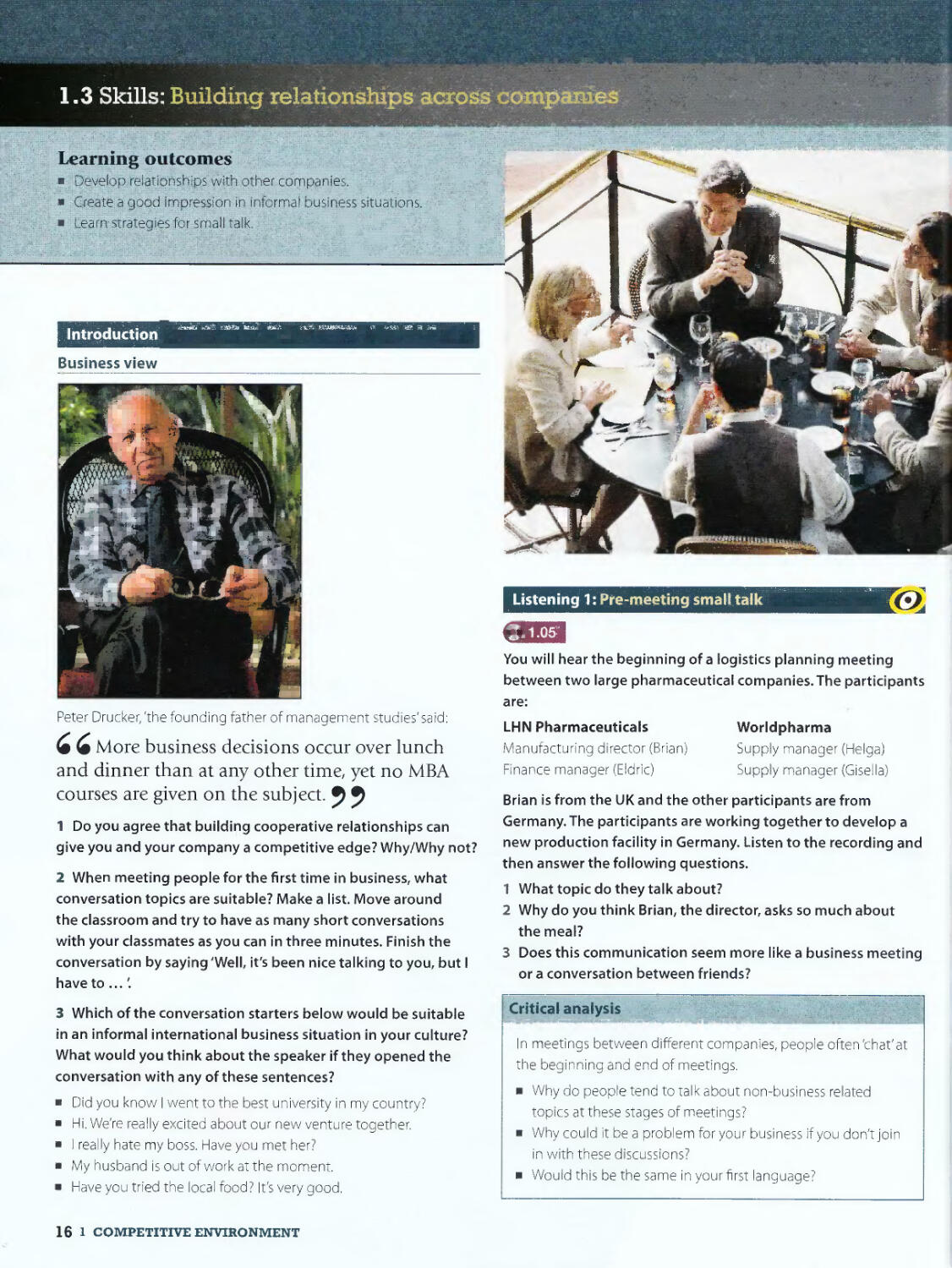
Peter Drucker, 'the founding father of management studies’ said:
More business decisions occur over lunch
and dinner than at any other time, yet no MBA
courses are given on the subject.
1 Do you agree that building cooperative relationships can
give you and your company a competitive edge? Why/Why not?
2 When meeting people for the first time in business, what
conversation topics are suitable? Make a list. Move around
the classroom and try to have as many short conversations
with your classmates as you can in three minutes. Finish the
conversation by saying 'Well, it's been nice talking to you, but I
have to ...'.
3 Which ofthe conversation starters below would be suitable
in an informal international business situation in your culture?
What would you think about the speaker if they opened the
conversation with any of these sentences?
■ Did you know I went to the best university in my country?
■ Hi. We're really excited about our new venture together.
■ I really hate my boss. Have you met her?
■ My husband is out of work at the moment.
■ Have you tried the local food? It's very good.
; Critical analysis
In meetings between different companies, people often'chat'at
the beginning and end of meetings.
■ Why do people tend to talk about non-business related
topics at these stages of meetings?
■ Why could it be a problem for your business if you don't join
in with these discussions?
■ Would this be the same in your first language?
16 1 COMPETITIVE ENVIRONMENT

Language focus 1: Making your feelings understood CO,
It's not just the things we say but the way we say them that
is important. When talking socially it is important to sound
interested and friendly, so the way you speak can be very
important.
1 Listen to a speaker say The hotel was fine five times, all with
different meanings. Match the recording with the choices below.
a a worried question about the hotel
b the speaker is amused
c the speaker is bored
d the speaker is angry
e the speaker is relieved
2 In pairs, take turns to ask How was the flight? and to reply It
was OK. When answering the question, use one ofthe emotions
above.
3 The way we say things can also show what is important
information and what is not. In the above example, is the word
flight'emphasised?
4 Listen to the answer: Well, the flight was OK, but the hotel was
terrible. Which words are stressed and why?
5 Now practise doing the same with these answers, giving
'eedbackto your partner.
■ Well, the food was OK, but the service was terrible.
■ The flight was OK, but the taxi from the airport wasn't.
Sometimes we leave words out of a sentence because the
meaning can be understood from the situation. This is much
more usual in informal situations.
1 Which ofthe sentences below have some words missing?
iVhat are the missing words?
1 Nice place?
2 haven't been there.
3 Jttle bit jealous, actually.
4 had a bowl of cereal.
2 Make these responses shorter and friendlier by taking words
out.
1 Ve just been to the cafe.
2 Have you read the report?
3 Can I have a glass of water, please?
3 Missing out words like this is known as ellipsis. It makes
the communication more direct and informal. Would it be
appropriate to use ellipsis with your boss? What about with a
very important, powerful client?
Hoi
Listening 2: Judging emotions
Listen to the recording of the meeting again and answer these
questions.
1 What do you notice about Brian (the first speaker)? Does he
seem: friendly? aggressive? bored? interested?
2 Does Brian often use ellipsis? Look at the audio script on
pages 147-8 and underline all the examples of ellipsis. Does
this make him seem friendly?
3 When using ellipsis, why is intonation especially important?
Think about the grammar.
4 How successful does this conversation seem as small talk?
Output: Developing the relationshi
Work in groups of four, with two hosts and two visitors.
Stage 1: Hosts
You work for a company that supplies materials to
manufacturers, and you are going to have a meeting with a new
client. You want to develop a good relationship with the client.
Make a list of ways you can develop the relationship and also
list some topics that you can discuss at the beginning ofthe
meeting. Discuss with your partner the type of impression you
want to create, and how you can do it. Try to use some of the
strategies from the lesson.
Stage 1: Visitors
You are going to have a first meeting with your new supplier.
You are keen to develop a good relationship with the supplier,
and you want to make sure you can trust them. Your previous
supplier proved very untrustworthy, and you do not want to
make the same mistake again! Discuss with your partner what
questions and topics you can talk about with the supplier
before you begin the first meeting.
Stage 2
The hosts should welcome the visitors, and start the meeting.
Stage 3
When you have finished, discuss these questions in your
groups:
■ How well did you help to build a relationship?
■ Do you have any advice about what the group could do better?
* What would you do differently next time?
1 COMPETITIVE ENVIRONMENT 12

Introduction
Learning outcomes
■ Understand how business deals with future uncertainty.
■ Learn language of future certainty and uncertainty.
■ Prepare a macro-environmental STFEP analysis.
Nothing can be certain
except death and taxes. ^ •)
Benjamin Franklin, scientist and one ofthe founding fathers ofthe USA
1 Are you optimistic or pessimistic about the future of your
country? Give some examples.
2 Imagine that the following changes happen in your country
over the next five to ten years. Which of them might affect your
future career or your company the most? Explain why.
1 A law is passed to reduce the average working week to 30 hours.
2 Friends see each other far less, online friendship is the norm.
3 Immigration increases dramatically.
4 Bank interest rates go down 50 percent.
5 The price of oil rises 100 percent.
6 Your government refuses to sign international agreements to
limit carbon emissions.
7 The cost of using internet-enabled mobile phones falls to almost
nothing.
8 Clouds of volcanic dust regularly stop all air travel.
9 Your country joins/leaves an international trading bloc (EU,
ASEAN, NAFTA, etc.).
10 FHigher broadband speeds lead to a big increase in online
distance-learning courses.
3 How much do you think individuals and companies are able
to control their own future?
Reading: STEEP analysis
A STEEP analysis is a commonly used tool in business that
companies and organisations use to make sense of their wider
macro-environment. The theory is widely taught in business
schools.
1 Read the first part of a text on STEEP analysis from learn
marketing.net on page 19, and find words which have the same
meaning as these:
1 influence (verb)
2 buy
3 very large
4 natural foods grown without chemicals.
5 on the other hand
6 insufficient supplies
7 thinking again
2 Answer the following questions according to the text.
1 Why are people joining health clubs and buying organic food?
2 What factor will lead to increased competition?
3 What are the two results of a rising world population?
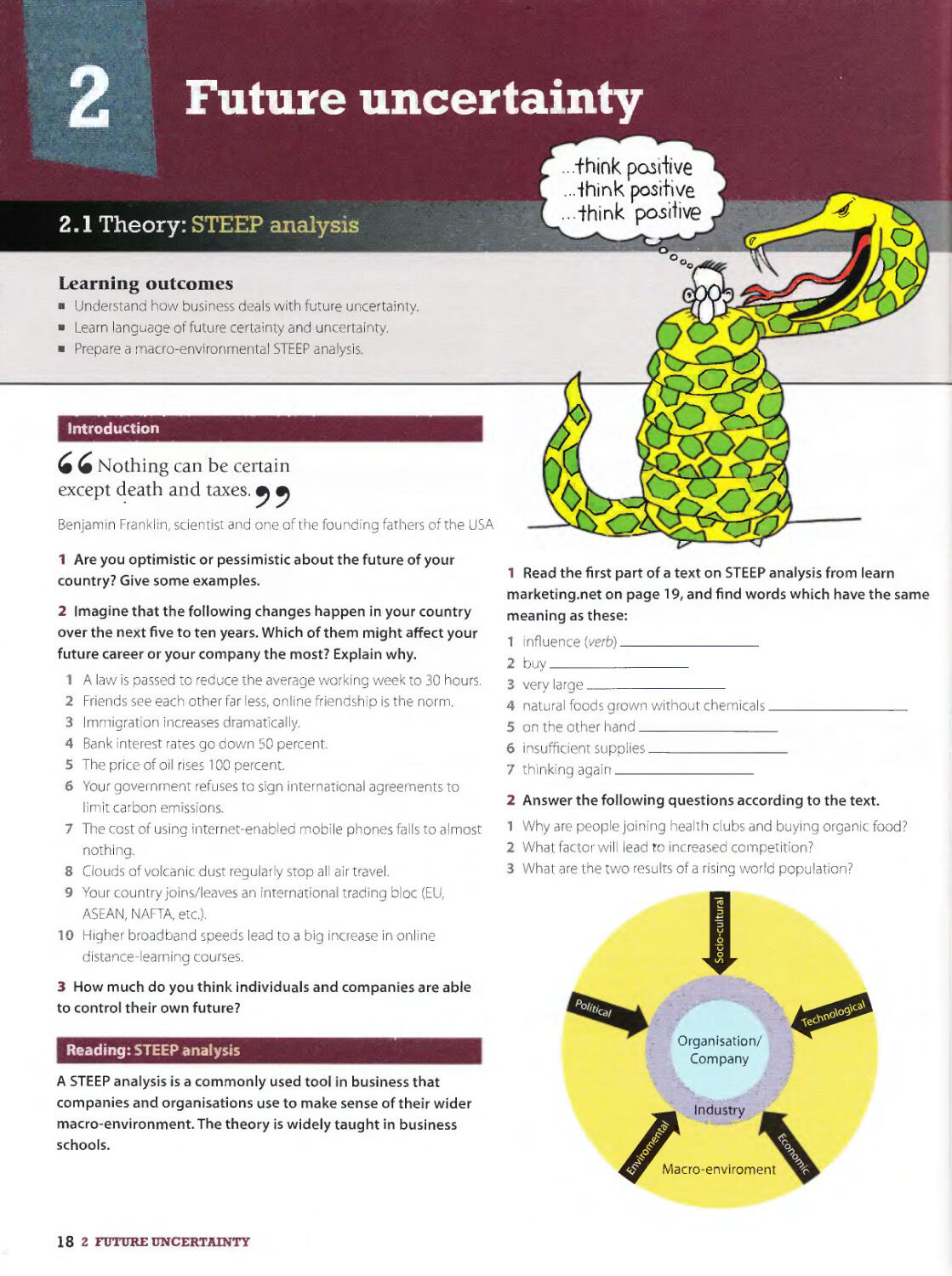
Organisation/
Company
Industry
Macro-enviroment
18 2 FUTURE UNCERTAINTY

A STEEP analysis is used to identify the external forces
affecting how individual companies compete within their
industry sector. These external forces within the wider
macro-environment consist of Socio-cultural, Technological,
Economic, Environmental and Political factors.
Socio-cultural
This aspect focuses its attention on forces within society
such as family, friends, colleagues, neighbours and the
media. Social forces affect our attitudes, interests and
opinions. These forces shape who we are as people, the way
we behave and ultimately what we purchase. For example, in
many countries in the world, people’s attitudes are changing
towards their diet and health. As a result, these countries are
seeing an increase in the number of people joining fitness
clubs and a massive growth in the demand for organic food.
Population changes also have a direct impact on
organisations. Changes in the structure of a population will
affect the supply and demand of goods and services within an
economy. Falling birth rates will result in decreased demand
and greater competition as the number of consumers fall in
dev eloped countries. Conversely, an increase in the global
population is currently leading to calls for greater investment
m food production. Due to food shortages African countries,
such as Uganda, are now reconsidering their rejection of
genetically modified foods.
3 Work in groups of four.
• Student A will read about technological factors - see page 137.
■ Student B will read about economic factors - see page 142.
« Student C will read about environmental factors - see page 145.
• Student D will read about political factors - see page 146.
After reading the text carefully, close your books and tell each
other about what you have read.
4 As a group, categorise the changes in exercise 2 of the
-production into the relevant STEEP factor.
Example: 1 Political
Listening 1: STEEP factors
Business view
Dr Hans-Martin Beyer is Professor
and Associate Dean at ESB
Business School Reutlingen
University, Germany and former
project manager for New Business
Development at the Ford Motor
Corporation (Europe).
1 Listen to Dr Hans-Martin Beyer describe five long-term trends
in the macro-environment that he believes will have an impact
on business in the future. Write the STEEP factors 1-5 in the
table below in the order you hear them.
STEEP factor
Notes
1
2
3
4
5
2 Listen again and note down some ofthe details mentioned
for each of these factors.
3 How might some of these factors impact directly or indirectly
on an industry such as the global automotive or computer
industry? Are they opportunities or threats for the industry?
4 What other trends do you think will be important for these
two industries? Will they present new opportunities or be a
threat?
Listening 2: How industries plan for the future
Listen to the second part of the interview with Dr Hans-Martin
Beyer, in which he talks about how industries plan for the
future. Answer the following questions.
1 How long does it take to develop a new car?
2 What do manufacturers of'complex products'need to do?
3 In what way was Bill Gates right about the future?
4 How does Apple manage to get the future right?
5 In what way have some automotive companies'not made the
right decisions'about the future?
6 Where are the decisions made 'at the end of the day'?
7 How important are the methods used by companies to forecast
the future?
Critical analysis
1 Do you think Apple and Microsoft are still 'getting it right'
about the future? Why/Why not?
2 Which car manufacturers do you think are'getting it right'?
Which ones aren't? Why?
2 FUTURE UNCERTAINTY 19

Language focus: Future certainty and uncertainty
1 Look at the following sentences from Listening 1 and place
them on the scale below.
1 I think people will be more mobile ...
2 We will need to look to Asia ...
3 We may even see Russia join the EU
4 It'll probably be the dominating subject...
Uncertain -b
Certain
2 Listen to the following pairs of predictions from meetings.
Which prediction in each pair (A or B) seems the most certain?
Why? Think about the words and the intonation.
1 A I guess they may come back to me.
B We may subcontract that to a partner.
2 A Noel will stop on Thursday as well, won't he?
B Things will change.
3 A We will definitely sign the contract.
B We might well find a solution during the meeting.
4 A You're going to need a firewall.
B I suppose it's how many you think you might need in Ireland.
€3111
3 Listen to 1B again. This time the intonation is very different.
Which word is stressed in the less certain version? Practise
saying this.
4 Look at the predictions in exercise 2 and underline the verbs
that are used to talk about the future.
5 Put the following words and phrases in the table below:
could looks probable that is highly unlikely that must
possible
probable
certain
Now add the words you underlined in exercise 2 in the table
above.
6 Which ofthe following companies and industries might
benefit or lose the most, if the changes in the Introduction
came true? Explain why.
Example: Leisure industries such os cinemas and theatres
might welt benefit from a shorter working week as people
would have more leisure time.
■ leisure industries, e.g. cinemas and theatres
■ companies with high debts
b tourism
b publishers of educational textbooks
b pizza home-delivery companies
b online advertising industry
■ global car manufacturers
■ e-marketing consultancies
Output: Conduct an industry sector STEEP analysis
You are going to conduct a brief STEEP analysis of different
segments ofthe automotive industry and then report your
findings to another group.
Stage 1
In small groups, think about the following types of car which
represent market segments. Future sales of these cars will
depend on STEEP factors.
luxury cars
sports cars
family cars
small city cars
low-priced budget cars
SUVs
people carriers
electric cars
hybrid cars
Example: A rising middle class in emerging economies,
especially In Asia., will really push the demand for budget
cars as people sell their motorcycles and trade up to their
first car.
Think about the situation in your country and then globally
over the next five to ten years. Discuss the questions below in
your group and make notes.
b Which segment do you think will grow fastest/slowest?
b Do you predict that sales might decline for certain segments?
Why/Why not?
b Which STEEP factors are pushing sales up or down?
b Plow are they doing this?
Stage 2
Present your findings to another group and discuss together
how these changes might affect competition within the
industry both globally and in your own countries.
20 2 FUTURE UNCERTAINTY

The global consumer goods industry is a huge industry consisting of
manufacturers and retailers of different industry sectors covering a
vast range of products from milk to washing machines. The biggest of
these sectors is F.VICG (Fast Moving Consumer Goods) which itself
takes in massive sectors, such as food and drink, homecare, and health
and beauty. These products are generally of low value and sold on a
daily basis, very quickly in large quantities. A large number of sales of
these products in many countries in the world are made through large
supermarket chains.
Learning outcomes
« .-derstand the scope and future trends of the consumer goods industry.
■ _ se speed-reading techniques.
. --esent the launch of a consumer product in a new country market.
Profile: The global consumer goods industry
kitroducti
■
Do you tend to shop in small shops or supermarkets? What
re the advantages and disadvantages of both?
What changes have happened during your lifetime in the
ay people shop for food?
3 Products such as mobile phones and washing machines are
also now sold in large supermarkets in many countries in the
world. In the past, these types of product were considered
'consumer durables', which customers kept for a long time and
were not available in supermarkets. Why do you think this has
now changed?
2 FUTURE UNCER^	21

1 Look at the table and match the companies to the industry
sectors and sub-sectors they are most associated with.
Example: Tesco, Walmart, Carre-four, Metro -* 4 supermarket
retail Hr if most (or all) of the above product sectors
Multinational companies
Industry sector
Sub-sector
Procter & Gamble
1 food and drink
a kitchen care, laundry care, bathroom care
Tesco, Walmart, Carrefour, Metro
2 consumer electronics
b hair care, skin care, cosmetics, dental care, fragrance
Johnson & Johnson
3 home care
c small electrical appliances, small kitchen appliances, large kitchen
appliances
Sony, Samsung, LG, Philips
4 supermarket retail
d mobile phones, computing, TV and audio
Nestle, Kraft
5 health and beauty/
personal care
e bakery, frozen, dairy, confectionery
Whirlpool, Bosch, Electrolux
6 home electrical
f most (or all) ofthe above product sectors
2 Brainstorm examples of as many products as possible
for these sub-sectors within a time limit of 3 minutes. Try to
identify at least two products per sub-sector.
3 In which countries do the companies in the table have their
headquarters? Have you ever used any of their products? Which
ones?
Transferable ski!!
Speed-reading enables you to increase your speed and improve
your comprehension. Read through the four phases of this
process and answer the questions about the text which follows.
Compare your answers with a partner after each phase.
Phase 1: Text orientation and prediction (time limit - 2 minutes)
1 Check the source of the article How will this affect how the
text is written and will it favour a particular point of view?
2 Read the title carefully What do you think this text will be
about?
3 Read the first paragraph carefully. It often contains the key to
the organisation of the text -> How will the text be structured?
Phase 2: Skim-reading (time limit - 3 minutes)
1 Read the text quickly (don't read every word) -> Were the
predictions that you made in phase 1 correct or not?
2 Build a'map ofthe text'by skim-reading it again to
understand better the structure of the text so you know
where blocks of information are located. How many blocks (or
sections) does the text contain?
3 Put the following section titles in the text to divide it
correctly into four sections.
a A rise in incomes and consumption
b Urbanisation
c Serving the needs of low-income consumers
d The ageing population
After this phase you should have a reasonably good general
understanding of what the text is about.
Phase 3: Scan-reading ■(time limit - 2 minutes)
Scan a section of the text looking for specific information to
answer a question. We are not concerned at this stage with
what the answer is, we want to know where it is.
Without looking at the text, read the following questions. What
section will you find the answers in?
1 What kind of flavours will older people be demanding from foe o
producers?
2 What partners does the global consumer goods industry neec::
work with to reach the poorest people in Asia?
3 How many people will migrate to the cities over the next few
decades in Asia?
4 What has been the result of higher incomes in India?
Phase 4: Detailed reading (time limit - 3 minutes)
Finally, read only the section ofthe text you identified in phase
3 to answer the questions (1-4) above.
22 2 FUT'-

Output: Lau
You are going to launch new consumer products on the
Japanese market. Your target market is the over-50s. Read the
information below. Work in four groups, and look at page 137.
Readin
Target market
You are launching a new product on the Japanese market.
Your target market is the over-50s, who are increasing in
number and who have a high amount of disposable income.
Before you market your product, look at the following factors
which are all of importance to the target group.
• Raw materials in Japan are scarce. The main agricultural
products are rice, vegetables, fruit, dairy products, eggs
and fish.
• Increased worries about the environment, global
warming and product safety are prime concerns.
• Known as 'silver surfers', the vast majority of the over-
50s have access to the Internet.
Task
You should design a 3-minute pitch that you will then give
to the other groups.
When you have heard all the presentations, choose which
product you will invest in. You cannot choose your own
product.
a what other ways do you think that urbanisation, a rising
middle class, continuing poverty and ageing population
could impact on the consumer goods industry in Asia?
India, in particular, has experienced dramatic income growtf
for a large segment of the population in the last two decades
“his prosperity has revolutionised consumer aspirations.
At the same time as average income is rising, there is still
i vast segment of Asian households that live on very low
ncomes, particularly in India but also in rural China too. Thi
income disparity has implications for the grocery industiy,
vhich needs to rise to the challenge of serving the needs
;f low-income consumers. To deliver this, our industry
■ ill need to work together and with governments and
communities to develop innovative products and services.
- iurce: GCI (Global Commerce Initiative), Global Consumer Goods
'dustry Association Industry Report (Spotlight on Asia)
Urbanisation and a growing elderly population are clear
global trends. These two demographic swings are also
apparent across most Asian countries, along with the
polarisation between the new middle class and the poor.
Projections indicate that more than 500,000,000 Asians
will move to cities in the next 25 years - almost 2,000,000
: people per month. This movement is placing a huge strain
on already inadequate transport, electricity, water and
sanitation systems.
Improved health care is resulting in the elderly living
longer. The increase in the elderly population is
particularly significant in Japan, where more than 20% of
the population is over 65.
In Japan, unlike many other markets including much of
:he West, Japanese pensioners have economic security and
considerable buying power. They also command a great
deal of respect from society.
This growing demographic group presents unique physical
end emotional needs and requires different product design,
packaging, marketing and retail distribution. Over the next
:en years this group will trigger a surge in products that
: focus on the elderly, from preserving health and wellness to
>picier foods to stimulate aged palates. But these Japanese
?enior citizens of the future will also be spending money
n their grand- and great-grandchildren, creating a market
for premium children’s products.
in most Asian countries, average household incomes are
ncreasing significantly. This is particularly so in cities:
: crban households in China have over three times more
cisposable income than rural households, according to the
National Bureau of Statistics of China.

1 What are the main differences between a meeting and a
presentation?
2 Have you ever had to give a formal presentation in class or at
work? How did you feel?
3 Would you prefer to give a formal presentation or lead a Q&A
(question and answer) session where you have to provide the
answers?
4 Complete the table below comparing formal presentations
and Q&A sessions in meetings. The first has been done for you.
Introducti
Formal presentation
Q&A session
Turn-taking
Not usually
Yes
Spontaneous speech
Communication is one-way
Questions and answers
Rhetorical questions (asked for effect,
not for an answer)
Active listening (responses, e.g. yes,
uh-huh)
"
Immediate responses
5 Which requires more preparation, a presentation or a Q&A
session? Can you prepare for a Q&A session?
6 Choose one of the following:
a Your company has launched a new product, e.g. food, clothing,
media. Think of what the product might be. It is not selling well
and your boss wants to know why. Think of a course of action, and
present it.
■ Think about how you could market a product that sells well in
your domestic market to an international audience. Think of ways
of making this product popular abroad, and present it.
£
0HH
When making a presentation at a meeting, the speaker usually
presents the case first, and a discussion or Q&A session then
follows. You are going to listen to a presentation at the Tokyo
office of a multinational bank's IT department. The presenter,
Alison, is describing the upgrading of a new operating system.
1 Before you listen, think of two reasons why installing an up-
to-date operating system (OS) is important for a company.
Listening 1: Upgrading the operating system
24 2 FUTURE UNCERTAINTY

2 The presentation has the following stages. Put them into
a logical order. Then listen to the presentation and see if you
were correct.
A Giving background information
B Outlining the problem and the risk
C Outlining how the solution will be achieved in practice
D Starting the presentation
E Stating the proposed change
Listening 2: Q&A sessio
Hi
■El
Following the presentation, there is a Q&A session. One person
in the audience, Nigel, asks about the global implementation
of the new operating system (OS). He wants to know if any
departments have implemented this system in all of their
worldwide offices. Listen to the recording.
Intercultural analysis: Presentation styles
	,	i	what	answer	does	the	presenter	give	to	the	question?
Presentation styles are different in different cultures. For
example, in the USA the main point ofthe presentation is
usually made at the start. In some countries, like Japan, people
often give the background and state the main point near the
end.The presentation at the meeting you have listened to is
;'om an American bank in Japan.
J.'hich style do you think is preferred in the workplace in the
listening? Which style do you prefer? What are the advantages
and disadvantages of each?
Language focus: Discourse marker
Os course markers link segments of talk to one another and
s •'ow how speakers organise, manage and feel about the
nformation.They do not contain information. Common
- arkers include: So, I mean, right, on the other hand, it's time to,
-en. A presentation that contains many discourse markers is
easier to follow.
1 Here are some sentences from the presentation you heard in
- stening 1. Underline the discourse markers.
" IT, we may as well start.
2 5c our Windows operating system. We've been using our present
15 ;n Japan for at least four years and it's time to upgrade.
3 : s more a question of what will happen if we don't upgrade ...
I b. iously, this creates a business risk for us because ... The longer
■•ve wait, the greater this risk becomes.
4 So how do we start? Well, I've already done this.
: just to give you a bit of background. Mainstream support for
she present system expired ...
I Match the sentences with the five stages in Listening 1
t>ercise 2.
2 The answer given by the speaker is not very clear. What are
some possible reasons for this?
3 When answering questions, the following format is useful:
Showing you will rephrase, e.g. So you mean ...
Rephrasing, e.g. You want to know...
Checking the response is sufficient, e.g. Does that answer your
question?
Listen again and see if the speaker follows this format.
4 Practise this format in pairs by asking each other a question.
Stage 1
Look back at Listening 1 and the five stages in a presentation.
Work in pairs. Prepare a 3-minute presentation on one of these
topics:
■ The problem of motivating lazy workers/students
a The introduction of new working hours at your workplace / pJace
of study
Use the five stages to put your presentation in a logical order,
and make sure you use discourse markers to organise your
presentation. Remember to note some key language from the
audio script (page 149). Make your solutions as imaginative as
you like. Then try to predict two or three questions that you
might be asked in a Q&A session. Practise answering them
following the steps in Listening 2.
Stage 2
Make your presentation to another pair, and encourage
questions afterwards. Listen to the other pair's presentation,
and ask some follow-up questions.
□ • Watch Sequence 1 on the DVD to find out more about Business environment.
2 FUTURE UNCERTAINTY 25

Learning outcomes
* Summarise information into concise bullet points.
■ Discuss dos and don'ts of slide-writing techniques.
■ Create presentation slides with strong visual impact.
Business view
A picture tells a thousand words.
Fred R. Barnard, advertising executive
1 Do you agree with the quote? Why/Why not?
2 Look at some other units in the book. Can you find two
images which you think work very well with the unit title? Why
do you think the images you have found are suitable for the
unit title?
3 Can you think of any presentations or lectures that you have
been to where the slides were particularly good or bad? In what
way were they good or bad?
Writing skill: Creating a strong visual impact
The following slides are taken from a 10-slide presentation by
the management consultancy company, Capgemini, with the
title'Eight trends and the industry opportunities for the global
consumer goods industry'. Supermarket chains and food and
drink producers form a large part of this industry.
1 Look at the four images in slide 1 above. What do you think
the presenter will talk about when this slide is on the screen?
2 Match the following headings to the four images on slide
1 and label them. The headings are examples of micro-bullet
points.
Low income Urbanisation Ageing population
New middle class
3 Do you like the style of slide 1 or would you prefer to see
more information included on the slide?
Slide 2
5 How could you change the four standard bullet points on
slide 2 into four strong visual images?
(ntercuitural analysis
Discuss the following questions.
■ Are you surprised to see humour used in a serious
presentation as on slide 2?
a How useful do you thinkthe humour is in communicating
the information on the slide?
■ How acceptable would it be to use humour in a presentation
in your organisation or country?
■ Would you personally use humour in a presentation?
Slide 1
4 Which of the four bullet points on slide 2 below does the
cartoon refer to?
Rising cost (and scarcity) of raw material
Continuing rise in cost of energy and raw material
Population spikes put pressure on water and food supplies
Increasingly volatile climate, affecting production and the
supply chain
Effects of political instability	50	T
OIL PRICES WENT UP
SINCE YESTERDAY!
4 DROPS Of PETROL,
PLEASE ...
26 WRITING 1: PREPARING PRESENTATION SLIDES

Language focus: Summarising information into concise
bullet points
The two slides in the Writing skill section show two techniques
for presenting information.
Slide 1: Writing high-impact micro-bullet points (maximum
three words)
Slide 2: Writing in standard bullet points (NOT in full sentences)
1 Change the four standard bullet points in slide 2 into four
micro-bullet points (three words maximum each).
2 Complete the sentences below to change the four standard
oullet points from slide 2 into full sentences.
1 “here	(be)	a	continuing rise in	cost
:f energy and raw material.
2 -opulation spikes	(put) pressure on water and
mod supplies.
3 	increasingly volatile climate
affect) production and the supply chain.
4 - s:ng costs   (lead) to political instability. What
a be the effects of that instability on the
	industry?
I The trends below are full sentence descriptions ofthe four
~ cro-bullets in slide 1. Change them into four standard bullet
points.
1 : soid urbanisation across the developing world is expected to
n srease even faster.
2 “-ere will still be a very large segment ofthe world's population
. ng on very low incomes.
3 Ageing populations are going to create challenges as well as
soportunities.
4 “-ere will be a big increase in the number of middle-class
ttnsumers, particularly in Asia.
- The headings of slides are often written as statements,
r though they often pose a question. Change the micro-bullet
coints for slide 1 into full sentence questions.
Critical analysis
1 There are some presentation slide guidelines at the back of
the book. Student A should read about how not to write
presentation slides on pages 137-8, while Student B should
read about howto write them on pages 142-3.
2 Look at two pairs of slides (slides 3A and 3B, 4A and 4B)
and decide which slide in each pair you prefer. Explain your
reasons to your partner with reference to the guidelines you
have just read.
Slide 3A
Developing Bn
Ask yourself t
• Who am I?
• What do I
• What are
• Who am I?	/
® What do i believe in?r
• What's my passion?
• Where do I want to go?
*■ What's my essence?
Slide 3B
Slide 4A
i\i
Slide 4B
Output: Designing effective presentation slides
In pairs, sketch out two slides in the same format as slides 1 and
2 on page 26 on the topic 'The future'. Decide whether to take
a personal, company, industry or global focus. After finishing
your slides, present the information to another pair.
WR.ITii.V& 1: PREPJi; .	.c	2?

3 Rewarding performance
3.1	Theory: Employ
Learning outcomes
■ Learn about the pros and cons of different types of reward system.
■ Learn word partnerships with incentive and pay.
■ Construct an appropriate reward package for your boss or teacher.
Introduction
1 John Wesley Hardin was a dangerous Texas gunfighter in the 19th
century who killed over 30 people. Why do you think the authorities
had to pay a reward to capture him? What would have happened if
they had increased or decreased the reward they were offering?
2 The word reward can be used as a compound noun and as a verb
in relation to executive pay, as in the statements below. Read the
statements and decide to what extent you agree with them. Circle
the number that reflects your opinion.
1 = strongly agree 7 = strongly disagree
1 Rewarding people with a higher salary
is the best way of motivating them.
2 Most senior executive reward
packages are far too generous.
3 Managers should be rewarded
for their performance at work.
4 It's impossible to create a reward
system that truly aligns managers'
pay to their company's success.
2 3 4 5 6 7
12 3 4 5 6 7
2 3 4 5 6 7
2 3 4 5 6 7
Compare your answers in pairs and give reasons for your opinions.
3 What are the similarities and differences between a bounty hunter
in the 19th century who got paid a reward to capture a wanted man
and how senior business executives are rewarded today?
4 The nouns in the table below are all synonyms to describe
earnings, but they have slightly different meanings. Match each
word to its definition.
JOHN WESLEY HARDIN
$5,000 REWARD
DEAD oe ALIVE
1 pay
a a technical word often seen in recruitment adverts for senior positions
2 reward
b a generic word to describe workers'earnings
3 salary
c used generally but also specifically to describe office workers'earnings, usually paid monthly by bank transfer
4 wage
d used generally but also specifically to describe company earnings
5 remuneration
e a semi-technical word emphasising payment linked to performance
6 income
f used generally but also specifically to describe factory workers'earnings, traditionally paid weekly in cash
REWARD
28 3 REWARDING PERFORMANCE

Listening 1: The role and function of pay
Business view
Professor Stan Siebert, Professor of
Labour Economics at the University
of Birmingham Business School, is a
specialist in the study of company
reward strategies.
&KEI
Listen to the first part of the interview with Professor Stan
Siebert and answer the following questions.
1 A nat are the two main functions of pay?
2 A nat are the two main types of reward system?
3 A nat are the different ways you can pay a company chief
executive, an apple picker and a coal miner?
Listening 2: Advantages and disadvantages of different
reward systems
1 Listen to the second part ofthe interview and complete the
taps in the table. Use no more than three words in each gap.
Disadvantages
Payment by time
1 There is a cost in terms of
Payment by output
2 You need to find a
that is
in the best interests ofthe company.
Advantages
Payment by time
3 It is
Payment by output
4 People put in
2 Listen again and answer the following questions.
'mat are some ofthe risks of paying chief executives according
share prices?
' ' at reward system is used to calculate Professor Stan Siebert's
Listening 3: Fair pay and motivation
^noi
Listen to the final part of the interview. Answer the following
questions by choosing the best answer (A-C).
1 What does Professor Stan Siebert say about the Theory X and
Theory Y view of people?
A Theory X views people as mainly motivated by money.
B Theory Y views people as mainly motivated by money.
C Theory X and Y are confusing.
2 According to Professor Stan Siebert, how big a factor is pay in
motivating people?
A It's probably an enormous factor.
B It's probably a small factor.
C It's probably a changeable factor.
3 What is Professor Stan Siebert's view on fair pay?
A People are right to be worried about fair pay.
B The idea of fair pay is in both companies'and workers'interests.
C He is not very concerned about fair pay.
4 What does Professor Stan Siebert say about his own salary?
A It wasn't enough 30 years ago.
B It's not enough now.
C It's appropriate.
Critical analysis
1 How important do you think fair pay is in general? What
about groups of workers, notably women, who are
consistently paid less than their male counterparts?
2 Professor Stan Siebert mentioned how apple pickers and
chief executives can twist incentives for their own personal
benefit. How can the owner ofthe apple farm or the directors
of companies stop this happening? Are there alternative
reward systems that can produce better results for the farmer
or the shareholders?
Language focus: Word partnerships with incentive
Li
and pay
1 Complete the gaps in the Cambridge Advanced Learner's
Dictionary definitions of incentive and pay.
1 incentive /in'sentiv/ noun something which
		someone	to	do	something
2 incentivise /in'sentivaiz/ verb to
someone want to do something
3 pay /pei/ verb (paid, paid) - to give money to someone
for	which	they	have	done
4 pay /pei/ noun the money you receive for doing a
;
3 REWARDING PERFORMANCE 29

Output: Constructing your boss or teacher's reward
package
2 The words pay (uncountable noun) and payment (countable
noun) can be confused. Payment refers to the amount of money
paid for goods or services provided, while pay is a synonym for
salary or wage. Complete the following sentences using pay or
payment(s).
1 It's an interesting job, but the	is	really	bad.
2 We need a deposit of £165 plus monthly	of	£60.
3 Executive	is increasing at an alarming rate.
4 Usually we ask for	on receipt ofthe goods.
3 The following groups of words often collocate with incentive,
incentivise and pay. Circle the word or phrase in each group
that does not make a collocation with the target word.
1 provide a(n) / give a(n) / big / bright / financial / less / little / long¬
term /no/strong - incentive
2 incentive - bonus / plan / package / pay / programme / scheme
/ finance
3 difficult to / designed to / forecast to / the best way to / want to -
incentivise
4 incentivise - investment in / management to / inflation to / staff
to/sales force to
5 high / low / average / strong / basic / performance-related /
annual / executive - pay (noun)
6 pay (noun) - rate / package / cut / terms / scale / rise
4 Complete the gaps using the correct collocation listed above.
1 Supermarkets have a big	incentive to sell ethnic food
as Hispanic shoppers spend more per annum.
2 CEO W.J. Sanders earns an incentive	equal	to	0.6%	of
operating profits.
3 Winsor complains that Network Rail is	incentivise due
to the absence of shareholders.
4 The government finds it difficult to incentivise
renewable energy from private capital.
5 The company's policy on	pay for sales staff means
they get paid by how much they sell.
6 He had to take a pay	when	he decided to go part-
time.
5 Write a list of points on the topic below. Each point should
include a collocation from exercise 3.
Topic: What are the best ways to motivate people at work?
Example: Companies should incentivise staff to keep -fib by
offering to cover 50% of the cost of gym membership.
Compare your points with other students and agree on a
shortlist ofthe best points.
In small groups, decide on an appropriate reward package for
your boss or teacher.
Stage 1
In your discussions you should reach agreement on at least five
outputs you are going to measure (e.g. how much homework
he/she marks). Remember that he/she might find ways to
use your incentive scheme to personal advantage (e.g. he/
she might not mark the homework properly if there is a lot to
mark). Make notes and complete the table below.
Output to be measured
Comments
1
2
3
4
5
Stage 2
Discuss and agree on the individual weighting (percentage)
for each of these five factors. For example, if your group thinks
that each of the five weightings is equally important, then each
factor will be weighted at 20%. Complete the table below.
Output to be measured
Weighting (%)
Reasons
1
2
3
4
5
Stage 3
Decide what proportion of your boss or teacher's reward
package should be linked to time spent working and how much
to the total outputs of their work. Draw a pie chart to reflect
your decision. For example, if your group thinks that three-
quarters ofthe pay package should be linked to outputs, it will
look similar to the one below.
Are there any other
factors which you think
should be included?
If so, note them down
and include them in
your pie chart.
Stage 4
Present your plans to
another group.
0 Reward by time
□ Reward by output
30 3 REWARDING PERFORMANCE

Language focus: Compound nouns
Introduction
Profile: Nokia
Corporation
1 Match the following phrases with their meanings on the right.
1
compensation programme
2
stretch goals / stretch targets
3
comparison companies
4
annual base salary
5
short-term cash incentives
6
increased shareholder value
7
operating profit
8
operating cash flow
9
equity-based awards
10
new product revenue
11
customer-retention rates
the percentage of customers
that stay loyal for the long term
cash generated from operating
activities
system of payment and rewards
for employees
company earnings before
interest and taxes
stock given to employees as
rewards
better returns for shareholders /
maximisation of share value
strategic objectives that are
extremely difficult to achieve
bonuses to encourage better
performance
income generated from recently
released products
yearly salary, excluding bonuses,
pensions, etc.
competitors
2 The phrases on the left above are all compound nouns.
Which of the patterns below do they follow? Do any of them
not follow these patterns?
■ adjective + noun
■ noun + noun
■ adjective + adjective or noun + noun
Learning outcomes
■ Understand how and why PRP is used.
■ Distinguish main ideas from
supporting information.
■ Learn how to form compound nouns.
Nokia was formed in 1865 and
started life as a paper mill, it took
its name from the Nokianvirta
river in Finland, on which the
mill was situated. In 1960 it
started its first electronics
department after becoming one
of the major players in the paper
industry In 1967 Nokia merged
v.ith Finnish Rubber Works and
Dnnish Cable to create Nokia
Corporation. The new company
oegan to concentrate on mobile
communications. It is now one
: f the best-known and most
successful manufacturers of
mobile phones in the world.
	J
Which ofthe following motivates you the most
i choosing a job: money, holidays, job security, job
satisfaction, comfortable working conditions, a good
social side to the job? How about motivating you to keep
■ orking? Are the factors the same?
Which of the following jobs do you think should use some
*'orm of performance-related pay (payment by results not
just time): investment bankers, elementary school teachers,
professional sports players, salespeople, cleaners, doctors,
actors, others? Which of these jobs do you think should be
me most highly paid? Why?
>ING PERFORMANCE 31

3 Do you think compound nouns are more common in spoken
or written business English?
1 What would a company like Nokia hope to achieve by using
PRP?
2 Read through the first part of Nokia's report on executive
compensation. Why do you think Nokia considers each
objective important? Which objective do you think is the most
important?
The obiectives of Nokia's executive comnensatinn
programmes are to:
• attract and retain outstanding executive talent;
• deliver a significant amount of performance-related
variable compensation for the achievement of both
short- and long-term stretch goals;
• appropriately balance rewards between both Nokia's
and an individual's performance; and
• align the interests of the executive officers with those
ofthe shareholders through long-term incentives in
the form of equity-based awards.
3 The personnel committee considers the factors below in
its review when determining the compensation of Nokia's
executives. Which ofthe following factors do you think the
executives can directly control?
1 The compensation levels for similar positions in relevant
comparison companies.
2 The performance demonstrated by the executive officer during
the last year.
3 The size and impact ofthe role on Nokia's overall performance
and strategic direction.
4 The internal comparison to the compensation levels ofthe other
executive officers of Nokia.
5 Past experience and time in role.
4 Which ofthe above factors do you think is the most
important for maintaining motivation within the company?
Which are important for encouraging executives to stay with
Nokia? Can you think of any other factors that should be
considered?
Reading 2: Understanding PRP in term
M\ ■'
; A ■ ;* \ s
HMBhNI
1 Read through the next part of Nokia's report. Are the
following statements true or false?
1 Shares are given as short-term incentives.
2 Cash incentives can be considerable amounts of money.
3 Financial objectives are based on goals that are easy to achieve.
4 The company's and individual's targets are assessed by the
personnel committee.
5 The president and the CEO are responsible for entry into new
markets.
Components of executive compensation
Our compensation programme for executive officers
includes annual cash compensation in the form of a base
salary, short-term cash incentives and long-term equity-
based incentive awards in the form of stock options and
shares.
Annual cash compensation: short-term
rash incentives
Short-term cash incentives are tied directly to
performance and represent a significant portion of an
executive officer's total annual cash compensation.
Measurement criteria for the short-term cash incentive
plan include those financial objectives that are
considered important measures of Nokia's success in
driving increased shareholder value. Financial objectives
are established which are based on a number of factors
and are intended to be stretch targets that, when
achieved, Nokia believes, will result in performance that
will exceed that of Nokia's key competitors in the high
technology, telecommunications and internet services
industries.
The incentive payout is based on performance relative
to targets set for each measurement criterion listed:
(a) a comparison of Nokia's actual performance to
pre-established targets for net sales, operating profit
and operating cash flow and (b) a comparison of each
executive officer's individual performance to his/her
pre-defined individual strategic objectives and targets.
Individual strategic objectives include market share,
quality, technology innovation, new product revenue,
customer-retention rates, environmental achievements
and other objectives of key strategic importance which
require a discretionary assessment of performance by the
personnel committee. In the case of the president and
CEO, the annual incentive award is also partly based on
his performance compared against strategic leadership
objectives, including entry into new markets and services
and executive development.
Source: Nokia report on Corporate Governance
32

-MM
Discuss the following questions in small groups.
1 Do you think that people in similar positions in different
organisations should receive approximately the same pay? Why/
Why not?
2 Do you think people working for the same organisation in the
same position in different countries shouldreceive the same pay?
,Vhy/Why not?
3 .Vhat do you think about pay being linked to experience? Should
pay be based more on merit, or experience, or time spent with the
company?
Critical analysis
- some companies, the CEO may receive 20 times the pay ofthe
3. erage worker, or possibly much more. Do you think this is fair?
Transferable skill: Distinguishing main ideas from
supporting information
We can separate main ideas from supporting information
:-rough our use of language. What is the main idea and what
; the supporting information in the following sentence? What
anguage helps to separate the ideas?
Our compensation programme for executive officers
includes annual cash compensation in the form of a base
salary, short-term cash incentives and long-term equity-
based incentive awards in the form of stock options and
shares.
.Vhat are the main ideas of the texts in Reading 1 and
; wading 2? Summarise the main points in less than 50 words.
S026*2«0«l
Work in small groups. You are the board of directors for a large
telecommunications company, and you have to make decisions
on the following situations.
Stage 1
You have to develop a new benefits package for your
executives. Several of your executives have recently left the
company and moved to your competitors. Traditionally,
your company pays the average salary for the industry, with
substantial equity-based awards. Up until now, only the CEO
has received substantial bonuses. Make the reward package as
detailed as possible.
Stage 2
Over the past six months your company has not entered
any new markets or developed any new services. These key
objectives are the responsibility of your (new) CEO. Decide
what size bonus, if any, you will give him/her. The previous CEO
was very strong in these areas, but left last year for one of your
competitors.
Stage 3
Maria Rodriguez, the sales director for Asia and Africa, has
worked for the company for five years longer than Geoff
Mutton, the director of sales for Europe. Maria's first four years
were successful, but last year she performed badly due to a
cancelled contract in South Africa. Geoff has only worked for
the company for one year and has increased sales due to a big
contract in Italy. Decide who should receive a bigger bonus.
Stage 4
Compare your decisions with another group.

Learning outcomes
■ Negotiate a pay rise.
■ Use vague language to negotiate.
■ Learn and use strategies to negotiate.
Introduction
Business view
u The purpose of
business negotiations
is to solve problems of
conflicting interests.
Professor Anne Marie Bulow, Department
of Culture and Communication,
Copenhagen Business School
1 Which people are usually involved in pay negotiations in
a company (e.g. during a performance review), and what are
some ofthe possible'problems'and'conflicting interests'?
2 If you were a boss deciding on an employee's pay rise, what
factors would you consider? With a partner, make a list of five
factors (e.g. relations with colleagues) and put them in order of
importance.
3 Find another pair with a different list of priorities, and
negotiate with them to come to an agreement about the two or
three most important factors.
Listen to a performance appraisal between a trainee business
adviser (Sophie) and her boss (Leroy) at a business consultancy
company.
■ Is Sophie, the trainee, for or against having PRP (Performance-
Related Pay), and why?
1 Negotiations are often described as win-win (where both
the employee and the company can have a positive result), or
win-lose (where one side takes a risk to get what they want). For
example, threatening to leave the company unless your demands
are met is a win-lose strategy. Which do you think is better for pay
negotiations? A win-lose approach or a win-win approach?
2 The following list includes several strategies for negotiating a
pay rise. Which four are win-lose strategies? Could any of them
be both win-win and win-lose?
1 Threaten to leave the company.
2 Say you'd like to be considered for promotion in the future.
3 Say you've had to give up your second job.
4 Mention you've been offered another post somewhere else.
5 State the salary is insufficient for your needs.
6 Say that you're disappointed with previous pay rises.
7 Say that you're thinking about leaving the company.
8 Say that you're not considering leaving the company.
9 Say how much you love this job.
10 Say how challenging this job is.
3 Listen to the second part of the conversation between the
trainee and the manager. Which strategies from the above list
does Sophie, the trainee, use?
4 Do you think that this negotiation is more of a win-win or
win-lose negotiation?
34 3 REWARDING PERFORMANCE

Being deliberately vague can be very useful in a negotiation,
r»::h as a way of showing you share understanding
:: aborative strategy), and as a bargaining technique
:: m petitive strategy).
'c/.ing shared knowledge (collaborative strategy)
■	: _ Know, like having to be approachable and flexible and having
: meet clients earlier in the morning or having to meet them
;-~er the working day or having to work through lunch and all
that kind of thing.
■ We talked about budgets and pricing and things like that.
:	showing your true position (competitive strategy)
• e might be able to do it.
< probably cost about $40 a unit.
2 Are the following sentences examples of A or B?
1 could have to consider other options.
2 _et's review the logistical implications and all that stuff.
3 don't know how my boss will react to that.
4 don't know exactly but I think it's about four thousand.
5 .Ve're thinking about Beijing, Shanghai, and places like that.
6 could do that if other things are good.
3 Vagueness can sometimes lead to misunderstanding, so if
someone says something vague you should try to clarify the
meaning. Match these clarifications with the sentences above.
a So you mean she may not like it?
b So by'other things'you mean pay?
c By'all that stuff'you mean the routes and weights?
d How sure of that are you?
e So you mean cities on or near the coast in China? How about
Hangzhou?
f So you mean there's not a very good chance of it happening, is
that right?
4 How can you make the following statements vaguer?
1 Your sales results are the lowest in the company.
2 i want a pay increase of 15%.
3 If I don't get a pay rise, I will definitely leave the company within
the next month.
4 We will consider your pay situation in six months.
5 In pairs, practise saying the sentences above and asking
clarifying questions.
6 Read through the audio script about negotiating for more
money on pages 150-1, and find the following phrases. Are
they are collaborative or competitive in style?
1 and all that kind of thing
2 probably more than double
3 I would be able to get a job as a business advisor
4 it's not a huge issue, but it may become one
5 allowances and everything else
6 and that kind of thing
Output: Negotiating a pay rise
Work in pairs.
Stage 1
Do you think the following advice for somebody who is
negotiating a pay rise is good or not?
■ Ask your friends in different types of job about their salary.
■ Find out the salary of people in jobs similar to yours.
■ Think about your experience before you negotiate.
■ Tell your boss how much cash you need.
■ Tell your boss how much cash you deserve.
Stage 2
Student A: look at page 138 and read the instructions.
Student B: look at page 143 and read the instructions.
3 REWARDING PERFORMANCE 35

Fostering creativity
4.1	Theory: Creative thinking and creative manageme
Learning outcomes
■ Understand principles and thinking behind creative management.
■ Learn and use word formations connected to creativity.
■ Take part in a creative problem-solving process.
Introduction
1 What does the image tell you about creativity?
2 What do the quotes mean? Do you agree with them?
Creative thinking is not a talent, it is a skill
that can be learnt.
Edward de Bono, champion of'lateral thinking'
A business has to be evolving, it has to be fun
and it has to exercise your creative instincts. 55
Richard Branson, successful entrepreneur and founder of Virgin
.
Language focus: Word formations connected with
creativity
1 Match the following nouns connected to creative
management with the correct definition.
m
1 imagination
a production of original and unusual ideas
2 creativity
b use of a new idea
3 invention
c the ability to visualise new ideas
4 interaction
d putting a plan into action
5 implementation
e movement of ideas and opinions to the same point (they become similar)
6 innovation
f movement of ideas and opinions away from each other (they become more different)
7 convergence
g something which has never been made before
8 divergence
h when two or more people or things communicate with each other
2 The majority of these nouns are formed with -tion. How are
adjectives generally formed? Change the nouns in the table
above into adjectives (where possible).
3 Write down the verb equivalent for the nouns above.
4 Who do you think is more creative, an inventor or an
innovator? Why?
36 4 FOSTERING CREATIVITY

Reading: Making sense of creativity
Business view
Dr Jane Henry is senior
lecturer in Applied
Psychology at the Open.
University Business School
and a writer on creativity.
1 Read the Introduction to an extract from Creative
'■Management by Dr Jane Henry. Then predict what the rest of
:ne text will be about by looking at the table.
Creative people
Creative processes
a ■ ou need creative people,
"novators and
e Traditional creative thinking
is ahoi it
b Deative people should not
f Convergent thinking enables
vot i to
Creative places
Creative products
c I'eativity happens where
c-ople are not
g In the West new product
development
d ~ne organisational structure
should he
h In Japan new product
development
Making sense of creativity
Introduction
Creativity is about the quality of originality that leads to
new ways of seeing and new ideas. It is a thinking process
associated with imagination, invention and innovation.
However, creativity is not just about an idea that is new
and different: for an idea to be truly creative it must also be
appropriate and useful.
A number of commentators have found it convenient to
distinguish between creative people, creative processes,
creative places and creative products.
2 Work in pairs. Student A should read the sections about People
and Place and Student B should read about Process and Product.
iVhen you have finished, cover the text and tell each other what
you have read.
People
Considerable energy and research has gone into trying to
work out the characteristics of creative individuals. Three
broad types of individuals have been identified: creative
people, innovators and entrepreneurs. Creative people
are usually seen as people who generate ideas, innovators
as those who take an idea and develop it into something
real (such as a product or service or business process) and
entrepreneurs as those who take the product to market or
implement the process and make it a commercial success.
Entrepreneurs in large organisations are referred to as
intrapreneurs.
Studies of creative people show characteristics such as
independent thinking, not being affected by peer pressure,
good verbal communication skills, imagination and a
reasonable but not outstanding level of intelligence. Creative
people are said to be better at asking the right questions. They
also appear comfortable with risk-taking and are open to new
ideas.
Place
These days a good deal of management thinking argues that
the society we live in and the organisational climate, culture
and structure have a major impact on creative output. The
suggestion is that creative ideas flow where new ideas and
challenges are welcomed and where people are encouraged
to play rather than controlled and threatened. It follows then
that organisations that want to promote creativity might
need to look at creating a flatter organisational stiucture
(removing levels of hierarchy) in an attempt to reduce
bureaucracy and speed up the creative processes.
Process
The creative thinking process is traditionally linked to
imaginative thinking which is expansive and divergent
in nature (such as brainstorming and lateral thinking) as
opposed to evaluative thinking which is convergent in
character. Divergent thinking helps people to generate a
large number and variety of ideas and approach problems
from different angles. The emphasis here is on quantity
where an ‘anything goes’ attitude is encouraged. Convergent
thinking on the other hand, is needed to narrow down
the output from the divergent phase. The focus here is on
quality - making one or two selections from a huge number
of possibilities. In practice, the creative process requires
a framework which allows for alternating phases between
divergent and convergent thinking.
Product
Creative products may arise from a radical breakthrough or
a series of small incremental steps. Management methods
in the West have emphasised radical breakthroughs, while
Japan has built much of its success on small incremental
steps. The task of the manager is to encourage and
coordinate multi-disciplinary teams working on product
development and drive these processes along.
3 After you have read your sections of the text, complete the
table with your partner.
4 FOSTERING CREATIVITY 37

4 Read the statements below and decide in which section
you would expect to find the answer: Person, Place, Process or
Product. Are the following statements true or false?
1 Research shows you need to be very intelligent to be creative.
2 A playful culture at work helps the creative process.
3 Convergent thinking plays no part in the creative thinking
process.
4 The product development manager's role is to create new
products.
5 Intrapreneurs are focused on making profits.
6 At all stages of creative thinking you need to choose carefully the
ideas you put forward.
5 Would you make a good creative manager? Why/Why not?
Transferable skill: Generating ideas
1 Read about the following two creative techniques. How
useful are they? Could you use any of them in your work,
studies or personal life?
5Ws and 1H
Ask questions: Why ...?, What...?, Where ...?, Who ...?,When ...?,
How ...7
This is a standard brainstorming technique to explore different
angles to a core problem.
Example: / don’t have- enough money to go on holiday.
• Why don’t you Have enough money to go on
holiday ?
• What did you spend your money on?
■ Where do you want to go on holiday?
• Who could you ask -for money?
• When would be a cheaper time to go?
• How could you save money?
Reverse thinking
This is a lateral thinking technique: you reframe the problem and
look at it from the opposite perspective.
Example: We don’t have enough money to develop this new
product.
What do we have enough money to develop?
2 Work with a partner to discuss this problem: I never have
enough time. Use the 5Ws and 1H and reverse-thinking
techniques to think about how you would help a person with
this problem.
Example: 'When do you -feel the problem Is most intense?’
(5Ws and 1H)
'What activities do you have time -for?’
(Reverse thinking)
Output: Creative problem-solving
Stage 1
In small groups, brainstorm a list of problems that you
personally have in your professional lives or with your
studies, such as'l always feel tired','I find it nearly impossible
to meet deadlines', etc. This is the expansive, divergent
phase of thinking where 'anything goes'. Don't judge if the
problem is a 'good one' or not at this stage - simply write the
problems down in a list with the name ofthe person who has
this problem. Focus on the quantity of ideas and keep the
atmosphere playful and fun.
Stage 2
Select one problem from the list that you as a group would
like to focus on. This is the convergent evaluative phase of the
process. Ask practical questions such as: 'How interesting is the
problem?' and 'How useful is solving the problem for the whole
ofthe group?'
Stage 3
Using the techniques you have learnt, explore the problem
more deeply by asking the 'problem holder' questions
(divergent phase). One person in the group should take notes.
Stage 4
Discuss how helpful the techniques were in solving the
problems. Which one do you think is more useful, 5Ws and 1H
or reverse thinking?

Learning outcomes
■ Understand how innovation works in practice.
» Jse modals to criticise past actions and explore alternative solutions.
■ Discuss and present stages of innovative product development.
a) As waves pass over yellow
sphere the water pressure
1
Off-the-shelf
technology
b) Pumps pushed up and down
by water acting
20-25 metres
water depth
\\
K
c)
e) Electricity passed through
water
pumped on to the land
Profile: Carnegie Wave Energy
Carnegie Wave Energy is a small to medium-sized
Australian company based in Perth that invests in and
develops clean energy projects. Its most important
project is a wave energy technology known as CETO.
Most competitor wave technologies have generally been
located on the surface of the water where the energy
levels are very high and where there is a high risk of
destruction by stormy seas. What is different about the
CETO technology is that it is below the rough water level,
where the risks of damage are much lower.
	J
1 Read the profile of Carnegie Wave Energy. What is the
advantage of CETO wave energy technology compared to its
competitor wave technologies?
2 Put these energy sources in two groups: renewable and non¬
renewable.
nuclear gas solar coal wind wave oil
3 What are some ofthe advantages and disadvantages ofthe
above energy sources?
4 Work in pairs. Look at the CETO process diagram above. How
do you think the technology might work?
4 fos	.tottt	39

Business view
Jeff Harding is an
entrepreneur and Non-
Executive Director of
Carnegie Wave Energy.
1 Look at the process diagram on page 39 again and try to
complete the labels before listening.
2 Listen to Jeff Harding describing the advantages ofthe
technology and how it works. While you listen, complete the
labels on the diagram.
3 What two advantages from the list below does Jeff Harding
mention at the end of this part of the interview?
a It produces electricity on land,
b It uses all new technology,
c It uses a mix of new and old technologies,
d It's protected in the ocean..
GBBM
Before listening, discuss the first two questions below.
1 Which of the experiences below might have helped the
inventor come up with the idea of CETO?
a He was in a boat doing some work,
b He was lying in the bath playing with a rubber duck,
c He was swimming in the sea watching the fish.
2 What does an organisation like Carnegie need, in order to
develop and commercialise an innovative technology such as
CETO? Choose from the list below and mark the factors as follows:
C = Commercialisation D = Development N = Not needed
1	clear rules and guidelines	5	culture of openness
2	distribution skills*	6	money
3	joint venture with a	large company 7	good team-working
4	recruit new people	8	accept crazy ideas
* knowing how to get the product to the customer
3 Listen to the next part ofthe interview and answer the
questions in 1 and 2 above with the answers Jeff Harding gives.
1 Past modals in English are often formed like this: verb +
have + past participle.The past modals are underlined in the
sentences below.
1 Sven could have been in Claudio's job now, but he didn't apply for
it.
2 You should have told him that you planned to be late today, he
wouldn't be angry now.
3 Caterina might have finished the report by now. I know she was
working until late.
4 They can't have forgotten about the appointment. I emailed them
a reminder yesterday.
5 We shouldn't have hired her - she doesn't have enni inh
experience to do the job properly.
6 Manuel must have been disappointed not to get promotion
Match the past modals in the sentences above with their use
below.
a It's possible that this happened, but the speaker is not completely
sure.
b It's impossible or very unlikely that this happened,
c The speaker is sure that this is the result of something that
happened.
d A past possibility, which did not come true,
e Something that was advisable in the past. (two answers)
2 The following is a list of reasons why innovations can fail.
Use modal verbs to make sentences which offer advice, criticise
the problems, or suggest different outcomes. There are several
possibilities.
Example: The leadership should have been better. / Better
leadership might have led to success.
a bad leadership
b bad communication
c badly defined goals
d bad teamwork
3 What mistakes hav^you and your colleagues made at work
or at college over the last two or three months? How could you
have dealt with the situation any better? Discuss in pairs, using
past modal verbs.
4 Some 'crazy ideas' lead to very serious products, and some
don't. In groups, explain how the US patented invention shown
on page 41 could or should have worked and what the inventor
could or should have done to improve it.
Listening 2:
40 4 FOSTERING CREATIVITY

Dog Rides Comfortably in Sack on
Running Board
Group B
Stage 1
Birth and development stage
Study the product from Kittywigs.com on page 143, a small
company based in Canada. It was designed for people to have fun
with their cats. Discuss how this idea might have been born and
some of the problems the company might have had during the
development stages.
Your dog will
ride safely in this
sack, which is
quickly attached or
removed
II rier_ v3u take your dog along for a ride, but prefer not
inside the car, it can ride safely and comfortably in
it -r:k. which is carried on the running board. The bottom
■ “c wck is clamped to the running board and the top is
i^-z-zc. to the lower part of an open window, with hooks
: -: a with small rubber tubing to prevent marring the car.
US Patent - Detachable dog sack
Groups A and B
Stage 2
Commercialisation stage
Brainstorm a marketing strategy for your company. At the
end of your discussion, take notes and prepare to present the
product and your marketing strategy to the other group. When
deciding on the marketing strategy, you will need to discuss the
following points:
■ Who is the target market for this product?
■ How is the product best distributed (direct sales on the Internet or
high street shops)?
s What are the best channels to promote it?
■ What message do you want to communicate in promotion and
advertising?
■ What price would you sell it for?
■ What new innovative variations ofthe product could you
develop?
■ How might you counter objections that'nobody would buy it'?
■ Would you consider a joint venture with a iarger company?
Why/Why not?
Stage 3
Present your product and marketing strategy to the other
group.
: ~ i crazy ideas' are patented into innovative, fun and
:-taoie products.
n small groups (A and B). Look at the following information.
~ and development stage
. r. the product from Phonefingers.com on page 138, a small
■— oany based in Austria. It was designed to stop you leaving
cerprints all over your phones or computer. Discuss how
; dea might have been born and some ofthe problems the
— oany might have had during the development stages.

Learning outcomes
■ Understand a decision-making process.
■ Evaluate using metaphors and idioms.
■ Make a decision about possible options.
.— a
1 Decision-making is closely tied to problem-solving, and is
often broken down into three stages. Put a, b and c in order so
that they make a logical process.
a choose and implement the best option
b explore and find the exact problem
c discuss possible solutions
2 In pairs, look at the pictures above, discuss the situation, and
arrange them to follow the three stages above.
3 In small groups, think about one problem you each have
when studying English. Take a few minutes to discuss some
solutions to each problem and choose the best solution to it,
following the process above.
4 Different people are good or bad at different stages of the
decision-making process. Answer the following questions (1
= strongly disagree, 5 = strongly agree), and then compare
your answers with a partner. Discuss whether you are a good
decision-maker.
I am a person who ...
• enjoys thinking about things deeply	1
• spends a lot of time deciding what to do	1
• finds it easy to come up with ideas	1
• is good at offering advice	1
• is happy about the decisions I’ve made in	my	life	so far	1
• enjoys looking at details and specific aspects	of a problem	1
r*-mmM
You are going to listen to part of a meeting between directors
from two IT companies. The sales director (Steve) and finance
director (Fiona) are discussing the details of a new contract with
their new client (Anabel).
1 What types of customer support would you pay extra for if you
hired a company to help you with IT issues in your company?
2 Listen to Steve, the sales director, outlining the key features
of the gold contract. Are the statements below true or false?
1 Twenty-four seven coverage is optional.
2 The client finds the problem and reports it to Steve's company,
who then fix it.
3 A senior engineer looks after the client's server.
2	3	4	5
2	3	4	5
2	3	4	5
2	3	4	5
2	3	4	5
2	3	4	5
42 4 FOSTERING CREATIVITY

m
Listening 2: The costs
'30
1 Why is Anabel (the client) not happy with the proposed
oricing for separate incidents?
2 Which two of the options does Fiona (the finance director)
suggest?
a :: jying a cheaper package
fa 'egotiating the cost
c _s og a separate automated service
3 Discuss in pairs which stage ofthe decision-making process
.ou think this meeting is concerned with. Why do you think it is
- s part ofthe meeting? If necessary, refer to the audio script
r~ page 152.
Language focus: Evaluative metaphors and idioms
E.aluating (judging something) is used at all stages of the
Pecision-making process. Two very common types of evaluative
a-guage found in business communication are metaphors and
■c oms.
1 Match up these definitions.
etaphors	a	Language	from	another	situation	that
2 c : ms	describes	what	something	is	like,	rather than
what it literally is.
Example: They took their eye off the bait
and lost the contract.
b A group of words whose meaning is different
from the individual words themselves.
Example: day in day out
- real communication it is often difficult to distinguish
between idioms and metaphors. The important point is that
"ry are both used to evaluate.
2 Read these four examples of idioms and metaphors from the
listening extracts and match them to the definitions. Do they
e.aluate the situation positively or negatively?
' -ave most issue with
2 ;ks in the throat
3 a serious cost on top
- pair ofthe right hands
a something you are very
unhappy about agreeing to
b a good level of support
c something you strongly
disagree with
d an extra, very big increase
3 Read through the audio scripts on pages 151-2 and find four
more examples of metaphors and idioms. What do the idioms
and metaphors you have found mean?
4 Evaluations often happen towards the end of each stage
of the decision-making process. Do these examples evaluate
positively or negatively?
1 Looking good ...
2 (the plans were) completely unreal...
3 (the rent is) stupid ...
4 That's absolute madness...
5 (That's) a good way forward ...
8 It eats into the time ...
7 (These are) solid plans...
8 I would really welcome that.
5 Managers use metaphors and idioms more than subordinates.
Why do you think this is? Why might it be a problem for a
subordinate to use a lot of evaluative language with a manager?
Output: Deciding which contract suits y
Work in pairs. Imagine that you are the executives of an IT sales
company, and have to make a decision about whether to renew
your contract with the company that looks after your internet
server (seethe audio scripts on pages 151-2).
Stage 1
1 What are the advantages of staying with the same company?
What are the risks of changing company?
2 Summarise the benefits and problems with the gold level
of service. Think about: support time, attractiveness of the
option to your customers, the degree of support, the level and
understanding of the engineer and the flat-rate cost.
3 Evaluate the options and make a decision about whether to:
a agree to the contract as proposed
b agree to the contract but negotiate some aspects, such as the
cost
c decide to find a new company.
Stage 2
Join another group and discuss the option that you have
chosen.
D* Watch Sequence 2 on the DVD to find out more about Managing people.
4 FOSTERING CREATIVITY 43

Learning outcomes
■ Describe a process.
■ Review passive forms.
■ Use linkers of sequencing, structuring and providing reasons.
Introduction
Discuss the following questions.
1 What do you think this diagram is about?
2 How does the visual impact of the diagram help you
understand the process better?
3 Diagrams of processes are very common. Are the following
processes industrial, technical, business, natural or intellectual
processes or two of these processes combined?
1 global warming
2 client software support assistance
3 steel production
4 online shopping
5 converting solar energy into electricity
6 learning Business English
Writing skill: Describe a creative problem-solving process
1 Read the following description of the diagram and complete
the gaps using the words below. The diagram shows the
creative problem-solving process which is taught on MBA
programmes and is widely used in business.
main splitting initial third since overall phase
stages followed
Creative problem-solving works by 1
-the
thinking about a problem into a number of different
2
Many authorities talk in terms of three 3	stages:
an 4.
. exploratory phase where the problem to
work on is identified and considered from different angles; a
second 5	when alternative ways of dealing with
the problem are considered; and a 6	phase
where the detailed implementation of a chosen way forward
is worked out. Within each of these phases it is common to
encourage an imaginative phase where different acts and
possibilities are considered, 7	by	an evaluative
phase where these possibilities are considered and a way
forward is chosen. 8	the	whole	process is itself
experimental, it needs its own 9	evaluation
phase as well - in effect a fourth stage.
Source: Open University MBA Programme
converge
Creative problem-solving
Stage 1; Explore problem
a) explore different angles
b) select problem
diverge
Stage 2: Generate ideas and plans
a) consider alternative ideas
b) select plan
diverge
♦
Stage 3; Implement plan
a) plan supporting action
converge
diverge
b) undertake action
I
diverge
2 What is the function of the colon (:) and semi-colons (;) in the
description?
3 What tense and voice (active or passive) is used to describe
this process? Why?
44 WRITING 2: DESCRIBING R PROCESS

Language focus 1: Review of tenses in passive form QOL
1 Read the following sentences about processes. Are the
sentences in the active or passive or mixed (both active and
passive)?
Example: Sentence 1 Is In the present simple passive.
1 More than a year is needed before that essential part ofthe
process is undertaken.
2 Staff have worked too hard to rush the process now.
3 The Chief Executive said: The whole process has been badly
planned from the beginning.'
4 Have we started the recruitment process yet?
5 His shares were in the process of being transferred into a pension
plan.
2 Identify the tenses used in each sentence above.
3 Match the following definitions, which describe how the
active and passive forms can be used, to the sentences above
1-5).
a t clarifies who is doing the action,
b t is used when you decide not to name someone,
c : emphasises the process rather than the agent/doer.
- Why do you think the Chief Executive in sentence 3 decided
not to use the active form?
Language focus 2: Linkers of sequencing, structuring
and providing reasons
Look at the list of words needed to complete the text in
A 'iting skill exercise 1. These words will help you sequence,
structure and provide reasons in your writing or when giving a
-'ormal talk. Categorise the words into these three groups.
Sequence
Structure
Provide reasons
jxliol
2 Look at the groups of words below and decide which word or
ohrase is not part of each group. Circle one word or phrase in
each group.
1 main core key principle principal
2 stage phase platform part section
3 since while because as considering
4 an initial an opening firstly an introductory a beginning
5 splitting breaking down dividing separating breaking up
6 followed by leading to preceded by after which comes
3 The following jumbled sentences are about business process
management. Put them into the correct order.
1 the initial phase ofthe project/followed rapidly by a technology-
based approach /The emphasis on / was market-driven
2 better than the competition / you need to undertake / Firstly/the
needs ofthe customer/a redefinition ofthe product to satisfy
3 and difficult to follow / the real data and model /1 have not used /
since it is more complex
Output: Writing a short description of a business process
Stage 1
Work in two groups. One group should look at the diagram of
an ordering process on page 138. The other group should look
at the diagram about dealing with software technical support
queries on page 143.
Stage 2
In groups, discuss your diagram.
Stage 3
Work on your own and write a description of your diagram.
Stage 4
Read out your description to a partner from the other group.
They should try and draw the diagram from your description.
When you have finished, change roles.
WRITING 2: DESCRIBING A PROCESS 45

ii
-
Organisational cultures
mas
5.1	Theory: Understanding organisations
Learning outcomes
■ Understand types of organisational culture.
■ Learn vocabulary to describe organisational cultures.
■ Discuss what cultures suit different organisations.
Introduction
1 Complete the following questionnaire about yourself by
choosing one answer (A-D) for each of the questions.
What organisational culture suits you?
1 I like working in places that have:
A a dear set of rules and methods to follow.
B flexible ways of working.
C no rules whatsoever.
D few rules, but these are made by the boss,
2 I think that key decision-making in the workplace is best taken:
A by my line manager.
B in a group where everyone has an equal say,
C by myself.
D by a strong leader.
3 I prefer organisations that communicate:
A through official means of communication.
B through a direct exchange of views.
C the minimum possible.
D through personal relationships.
4 I dislike working in organisations that:
A have no dear idea of what they want from you.
B place limits on your freedom to do the job.
C ask too much from you.
D treat you as a number and don't recognise your
individuality.
5 Which of these words best describe you?
A loyal and trustworthy
B creative
C independent
D a winner
6 I think bosses should:
A do their job.
B provide me with the resources to do my job.
C be invisible.
D be respected and followed.
2 Now turn to pages 138-9 to see which type of organisational
culture you are best suited to working in.
3 Do you agree with the result ofthe questionnaire? Why/Why
not?
Language focus: Vocabulary to talk about organisations
1 Look at the table below and match the target vocabulary to
the examples. All the target words appear in the reading text
which follows.
Target vocabulary
Examples
1 personality
a advertising, travel, stationery, product
development
2 reward systems
b outgoing, quiet, amusing
3 dress code
c relaxed, playful, serious, stressful
4 expense
accounts
d 'work hard, play hard';'winning is
everything';'people before profit'
5 organisational
structures
e fixed monthly salary, payment by
results
6 values
f smart, casual, smart-casual, dress-
down Friday
7 norms
g no smoking, flying business class only
permitted on intercontinental flights
8 atmosphere at
work
h Purchasing, Production, R&D
9 rules
i for dealing with customer enquiries,
for emergencies
10 procedures
j hierarchical, centralised, decentralised
11 departments
k nobody leaves work before the boss
at the end ofthe day; staff socialise
together on Friday evenings
12 budgets
1 corporate entertainment, travel costs,
business lunches
2 Can you think of any more examples of these target words?
Add to the list with a partner.
46 S ORGANISATIONAL CULTURES

Reading 1: What is organisational culture?
Business view
Reading 2: Types of organisational culture
1 Work in pairs. Student A will read about Task culture below
and Student B about Role culture on page 48. After reading
your text, complete the notes on the diagrams.
2 Explain the diagrams to each other and tell your partner
about the culture you have read about.
Student A: Task culture
Professor Charles Handy is a.business guru, writer and academic,
specialising in organisational management.
1 Read the following extract from Professor Charles Handy's
book Understanding Organizations. Are these statements true
or false according to the text?
1 There is a lot of similarity in how different organisations behave.
2 There are more differences between organisations than between
nations and societies.
3 The structures and systems of an organisation create the
organisational culture.
4 One organisation generally has more than one organisational culture.
Anyone who has spent time with any variety of
rrganizations will have been struck by the different
atmospheres, the different ways of doing things, the
different levels of energy, of individual freedoms, of
kinds of personality. For organizations are as different
md varied as the nations and societies of the world. They
have different cultures - sets of values and norms and
beliefs, which lead to different structures and systems.
In organizations there are deep-set beliefs about the way
work should be organized, the way authority should
be exercised, people rewarded, people controlled. Do
work hours or dress codes matter? What about expense
accounts, secretaries, stock options? These are all parts of
the culture of an organization. Even within organizations
cultures will differ. The R&D laboratory in the fields of
the countryside will have a different atmosphere to the
director’s floor in the central office, creating different
departmental cultures.
■ ■ ■ -
2 Have you noticed whether dress codes, attitudes, personalities
and energy levels vary from organisation to organisation?
Task culture is job- or project-orientated. It is a team
culture, characterized by high levels of cooperation
and fast decision-making. Its structure can be best
illustrated as a net. This clearly shows communication
across departments (the horizontal lines), not just within
departments (the vertical lines). Some of the strands of
the net are thicker and stronger than others, showing
that some communication lines have more influence.
This influence is based more on expert power than on
job position or personal power. Much of the power and
influence lies at the intersections of the net, at the knots.
Task culture is very adaptable and focuses on achieving
results above all else. It works best when given enough
resources to do the job. If there is too much pressure on
time and money then the cooperative nature of the task
culture starts to disappear and other cultures take its place.
Task culture
5 ORGANISATIONAL CULTURES 47

Student B; Role culture
Role culture can he pictured as a Greek temple. Role
culture places its strengths in its columns. These columns
represent the different departments, e.g. the finance
department and the purchasing department. The work of
the columns and the interaction between the columns is
controlled by procedures which describe in detail what
each department does and what each person does in
their job by means of a job description. This structure
is highly suited to stable environments or environments
where the organization has a lot of market power, such as
monopolies. The columns are coordinated at the top by a
narrow band of senior management. An organization with a
role culture is generally believed to be very stable but poor
at implementing change and adapting to a fast-changing
macro-environment.
3 In pairs, identify the strengths and weaknesses of these two
organisational cultures by circling the correct answer, Task or Role.
Strengths
1	Flexible and’focused on objectives	Task/Role
2	Works well in environments that it can	control	Task/Role
Weaknesses
3	Inflexible and slow to change	Task/Role
4	Breaks down where budgets and deadlines are tight Task / Role
4 In which organisational culture would you prefer to work?
Why? Is this the same type of organisation that the questionnaire
in the Introduction suggested you were most suited to?
Output: Deciding on an appropriate culture for an
organisation
In groups, look at the following factors that Professor Handy
identifies as influencing organisational culture. Discuss what
is the most appropriate culture or mix of cultures (power/task/
person/role) for one ofthe four organisations in the chart and
then present your findings to the class.
National Power
Eco-Energy
Polyglot
Global-Me
Size and industry
sector
Large national electricity-
generating company
Medium-sized renewable
energy company
Small online translation
agency with branches in
3 countries
Large global NFP (Not
For Profit organisation)
working in disaster relief
Age
40 years
3 years
1 year (start-up)
5 years
Technology
Expensive technology
FHighly specialist
technology
Online but low-tech
Low-tech
Goals and
objectives
Mixed. Range of stakeholders
(from customers and
shareholders to community
and government)
Grow the company; aim
to sell company in 3
years
Maximise profits
Save lives and serve the
international community
Environment
Stable but complex
Complex and fast-
changing
Stable
Alternating stable
and fast-changing
environments
Role culture
a) Columns represent
the  	  of
coordinate the
columns
between
b) Procedures control.
departments
48 5 ORGANISATIONAL CULTURES

Introduction
Profile: Mundipharma International
Limited
Learning outcomes
■ Understand the organisation and culture of a company.
■ Predict content when listening.
■ Allocate budgets for different departments.
Mundipharma International l imited (MINT) is a family-owned,
international pharmaceutical company with several associate
companies, and annual turnover of around S4 billion. It regularly
scores very highly in surveys of 'best places to work', and is
credited as having an excellent workplace culture.
Match the pictures above to the following departments:
r~ance Research and Development (R&D) Production Sales
Discuss the following questions in pairs.
• nat do you think it is like to work in each of these departments?
■ .'. hat do you think the atmosphere is like?
■ .Vhich department would you most like and least like to belong
to?
Cultural differences in business relationships can arise at the
•allowing levels:
1 flational (e.g. Germany andThailand)
2 Professional (e.g. accounting and marketing, in the same
company)
3 institutional (e.g. IBM and Toyota)
What are some ofthe possible problems that cultural
differences can lead to? What opportunities can they lead to?
4 Match the following situations with one of the examples
of cultural differences in exercise 3. Are they problems or
opportunities?
1 The R&D (Research and Development) department in your
company keeps rejecting the sales department's requests for
changes to the product.
2 You are upset with your foreign distributor because they never
give you a straight answer.
3 Your overseas office has come up with a great solution to your
domestic marketing problem.
4 You think you can apply the same manufacturing process that
your main competitor has recently introduced.
5 ORGIUraSATIONJUL CULTURES 49

In our first languages, we automatically predict language and
content. It is important to develop these skills when learning a
foreign language. Prediction involves two key stages:
■ making a prediction based on the context
■ listening and deciding whether your prediction was correct, partly
correct, or wrong.
Even if your predictions are wrong, predicting still helps you
understand, if you are willing to change your mind.
Look at the titles of Listening 1, 2, 3,4 and 5 based on an
1 Ake Wikstrom mentions five different departments in
Mundipharma in the UK. In pairs, predict which departments he
will mention from this list:
Sales Logistics Internal complaints Production R&D
Marketing Administration Sports injuries Construction
Give reasons why you think he will mention these departments
2 Listen to the recording and see if your predictions were correct,
Business view
Ake Wikstrom is the regional
director of Mundipharma
international Ltd.
comments below and circle which department - Marketing (M),
or Production (P) - you think they refer to:
They have fun ...'
They love to work together'
'Nothing seems to stand in their way'
They work three shifts a day and they don't travel'
2 Ake Wikstrom states what he thinks is the most important
factor in the success of a department. Predict his answer.
3 Listen to the recording and see if your predictions were
correct.
M/P
M/P
M/P
M/P
1 Ake Wikstrom talks about the size of Mundipharma and its
culture. Before you listen, think about what you already know
about the interview. For example, what do you know about the
company (see Profile), the speaker, this type of interview, the
title of this lesson, and this listening exercise? Predict answers
to the questions below and give reasons for your predictions.
1 Has the company grown or shrunk in recent years?
2 Has the culture got better or worse since Ake Wikstrom joined the
company?
3 Does Ake Wikstrom criticise other companies?
2 After listening, check your answers to the questions above
and summarise what Ake Wikstrom said about Mundipharma
in terms of growth, the ownership of the company, its turnover
and its culture.
Listening 4: C;
.26
4*H
1 Ake Wikstrom talks about the use of employee surveys in
creating a successful corporate culture. Why do you think
Mundipharma use such surveys?
a to evaluate staff and check their progress
s to find out what engages staff
2 Predict what Ake Wikstrom says about industry benchmarks
(measurable standards) and employee satisfaction surveys.
Complete the gaps.
1 Employee satisfaction surveys show what makes employees
		and	willing	to	contribute	to	an.
2 We started at 6 or 7%.
are running 7 or 8% above.
Listen to the recording and see if you were correct.
. industry benchmarks, now we
50 5 ORGANISATIONAL CULTURES

EBBS
What do you think Ake Wikstrom thinks is the most
important feature of the survey process?
How do you think the attitude of managers has changed
towards the surveys?
Now listen to the recording to see if you were correct.
Language focus: Asking questions effectively
In spoken communication, asking the right type of question
at the right time in the right way often makes the difference
between successful and unsuccessful communication.
Questions in spoken communication have two basic purposes:
to get a response of some kind, and to comment on what
somebody has already said.
Look at these two exchanges from meetings, and decide
.vhich question requires a response, and which one shows the
stener's surprise.
Manager: Which Saab model is it?
Salesperson: I don't know which Saab model it is.
2 Salesperson: I can't really see the point of contacting Dominic.
Manager: Really?
Spoken questions have many different functions. Below
are some of the most important functions. In pairs, think of a
question you could ask to do the following:
1 ask somebody to do something
Could you pick me, up oJb 8 o’clock?
2 check understanding or seek agreement
3 show surprise or interest
4 show politeness
5 make a suggestion
6 criticise somebody or show dissatisfaction
Which questions above do you think are more often used
oy more senior people in business? Which ones can have a
negative effect on a relationship?
Look at the questions below and match them with the
-unctions in exercise 2 above.
a Dan you change my email password?
b c s all right, isn't it?
c Ahy haven't you met your targets?
d Can I ask you to do something for me?
e -C I've got a contact there. B: Have you?
‘ A hy don't we take one product this afternoon?

Intercultural can describe communication between professional
cultures, not only national cultures.
1 Match the following departments in a typical company to
their main activities.The first has been done for you.
Sales'
testing of products
Sales \
promoting the product
R&D
developing/maintaining client relationships
R&D
I researching the market
Marketing
—	hitting sales targets
Marketing
creative thinking
2 Discuss how the different purposes may affect the priorities
of each department, e.g. for Sales, the priority is selling as many
products as often as possible, and probably not the internal
design ofthe product.
Output: Working in a cross-departmental team
You are part of a cross-departmental team, working on
developing, marketing and selling a new pharmaceutical
product. You are discussing how to allocate the $10,000,000
budget for the next financial year and there are considerable
differences of opinion concerning where funds should be
allocated.
Work in small groups. One group is the R&D department, one
group is Sales, one is Marketing, and another is from Finance
(the Chair). Look at page 139 and prepare for the meeting.
1 Prepare your arguments for why your department needs
more money.
2 Think about the arguments the other departments are likely
to have, and how you can respond to them.
3 If you are the Chair, think about some questions you want to
ask each department to find out why they need money.
Separate into new groups, with one person from each
department and one group leader. Have the meeting, and try to
come to a decision that all members agree with.
5 organisat:	..tures	51

5.3 Skills: Dealing with pro
Introduction
Listening 1: Introducing the problei
You are going to listen to three separate stages of an
inter-departmental meeting in an IT company, between the
finance director (Laura) and the technical director (Doz). The
company expects the technical team to become more'project
management focused' in dealing with installations, which
means they will have to communicate more with the customers,
Listen to the first part of the meeting.
1 According to Laura, what is the technical staff's attitude?
2 How does their attitude need to change?
-a what Hnpt; r>n7 <;a\/ ahni it the technical team's attitude?
Critical analysis
1 In many companies, the relationship between different
departments can be difficult. For example, technical staff may
not want to be involved in sales issues, and sales may think
that the finance department does not appreciate their efforts.
Why do you think this is?
2 What are the benefits for a company if the technical team
takes an interest in sales and the sales team takes an interest
in the technical side?
outcomes
1 Look at the photo and discuss these questions.
a What is the problem, and how would you deal with it if you were
in this situation?
a If you were the manager, what would you do?
2 The extracts below are all from meetings where a director
of one department is criticising the staff of another. Discuss
with a partner what the extracts mean, and what some of the
problems might be.
a They should think,'Hang on, the customer's my salary.'
b People should take problem ownership ...
c They've got to be very customer facing ...
d They have got to be proactive rather than reactive ...
e Good morning, this is your salary talking ...
f That's a mindset change ...
g They're very much,'! know what's best...'
Listening 2: Specific issues
mr&:
Listen to the recording and answer the questions.
1 What does Doz think the problem is?
2 What recommendation does Laura make about calling
customers?
52 5 ORGANISATIONAL CULTURES

Listening 3:
m
eeme
Output: Improving communication across departm
HMBBj
Listen to the recording and answer the questions.
1 According to Laura, what type of technical person is ideal?
2 What happens at the moment when Doz asks his staff to call
a customer? Why do you think this is a problem?
Intercultural analysis
Read through the audio scripts on pages 153-4 and discuss
in small groups whether the finance director is an effective
negotiator. Do you think she would be a successful negotiator
in your culture? What, if anything, would you do differently?
Language focus: Strategically summarising a position (B
When negotiating, speakers often 'strategically summarise'the
discussion at different points ofthe conversation. This means
that they summarise the points to suit their argument. This also
allows them to show they agree with the other person before
they argue the point.
Example: But all I’m saying is that the attitude has got to
slightly change.
1 Which of these expressions could be used as strategic
summaries?
■: we/We're/l'm saying ...
■: _'re/We're/l'm talking about...
-~dthen ...
\ . point is...
i> nat I mean is...
:~:nk, to be honest with you ...
it nat do you mean ...?
?: this means that...
ton't understand, to be honest...
2 Find other examples in the audio scripts on pages 153-4.
How do the phrases help Laura to try and persuade Doz to
agree with her point?
3 You can also use strategic summaries to clarify what you
mean by stating what you don't mean.
Example: I’m not saying that. I think they’re, -fabulous with
customers. What I’m saying is that of the customer doesn’t ring
them back in ten minutes’ time they’ve got to ring them again.
Clarify your position on each ofthe following in the same way,
using summarising language.
1 Your colleagues are not lazy, but they could work longer hours.
2 We don't disagree with the proposal, but we need some more
time to think about it.
3 Your staff think about sales, but they could think more.
4 Your staff know something about technical issues. However, more
understanding would benefit the company.
Imagine you work for a company which manufactures
electronic books. However, communication between the
R&D (research and development) department and the sales
department is very bad. A meeting has been called between
the senior staff of the two departments to see what the
problems are and how they can be improved. In groups of four,
one pair should read the sales staff card on page 139, and the
other pair should read the R&D card on page 143.
Stage 1
Prepare for the meeting with your partner and decide what
you want to say. Plan how you can use strategic summaries to
support each other and your arguments in the discussion.
Stage 2
Have the full meeting and decide on a set of'action points'that
will improve the situation.
5 ORGANISATIONAL CULTURES 53

Introduction
Working across cultures
6.1	Theory: Culture and individual strategies in business
If you have to work and particularly do
something significant in a country it is much
easier if somehow you [are] connected with
the country and you like the country and you
respect the people and you are curious about
the culture.
Carlos Ghosn, CEO and President of Renault-Nissan
Well over 10% of business can be lost
because of cultural barriers. 55
Professor Stephen Hagen, author of Business Communication Across
Borders
2 How would you feel and what would you do in the following
situations?
■ You don't get promoted, and somebody less qualified and
experienced than you gets the job.
■ You are in a meeting and the foreign guests disagree with
everything you say.
■ You don't feel your boss and/or your colleagues give you respect
at work.
■ You are unhappy about the level of cooperation in your team/
department.
Learning outcomes
■ Use'rapport management'to develop good business relationships.
■ Use direct and indirect reported speech with questions.
■ Distinguish fact from opinion.
In order to sell a product or a service,
a company must establish a relationship
with the consumer. It must build trust and
rapport. 55
Jay Levinson, advertising expert and author of Guerrilla Marketing
In this lesson we will look at rapport management and
concepts of politeness to see how they can improve working
relationships across cultures.
1 Discuss the following questions.
■ What are the main points ofthe three quotes above?
■ Are they facts or opinions?
■ Are you surprised by any ofthe information?
■ Do you agree with the opinions?
Listening 1: What is rapport management?
€SI£S
Business view	..
Professor Helen Spencer-Oatey
is director of Global People and
author of Culturally Speaking: Culture,
Communication and Politeness. She is
also director of applied linguistics at
the University ofWarwick.
Listen to Professor Helen Spencer-Oatey introduce her theory
of'rapport management', and answer the following questions.
1 What is rapport management?
2 In what situations is it important?
54 6 WORKING ACROSS CULTURES

Listening 2: Face, rights and problems
Listen to the second part ofthe interview with Professor Helen
Spencer-Oatey, and answer the following questions.
1 What is the meaning of the concept of'face'?
A How you want others to see you
B How others actually see you
2 What can happen if someone challenges our self-image? Tick
the following that apply.
A t's embarrassing.
B t's expected.
C t impacts negatively on rapport.
D You feel your right to be treated in a certain way has not been
respected.
3 What types of problems can affect rapport?
4 Read through the following short extract from an article
by Professor Helen Spencer-Oatey. Underline the nouns that
describe the following:
a rice
b sociality rights
. rapport management involves two main components: the
management of face and the management of sociality rights ...
r ace is associated with personal/social value, and is concerned with
reople’s sense of worth, credibility, dignity, honour, reputation,
-ompetence and so on. Sociality rights, on the other hand, are
-oncerned with personal/social entitlements, and reflect people’s
concerns over fairness, consideration, social inclusion/exclusion
snd so on.’
5 Do the following relate to face or sociality rights, or both?
How might each situation affect your future relationship with
the person concerned?
1 Someone in your group cheats and gets a higher score than you.
2 four boss gives you a compliment about your p^formance.
3 four boss threatens to fire you in front of your colleagues.
4 four boss asks you to work seven days a week for no extra pay
but with lots of compliments).
Language focus T: Vocabulary related to culture
1 Match the words on the left with the definitions on the right.
1 face	a	the distinct personality of an individual
2 sociality rights	b	the positive self-image we have
3 rapport	'	the access we have to social networks and
4 social inclusio-	sendees in society
5 dignity	i	how well you are getting on with someone
6 competence	a	being worthy of respect
7 identity-	f	our ability in a given field
g what members of society expect they are
entitled to
2 The words in exercise 1 are important words from the lesson.
Can you think of any other words that could be added to this list?
3 Look again at the first situation in exercise 2 in the
Introduction on page 54 (You don't get promoted, and somebody
less qualified and experienced than you gets the job). Which of
the concepts from the list of words in exercise 1 are relevant to
this situation?
Critical analysis
Look at the audio script for Listening 2 on page 154 and find
what Professor Helen Spencer-Oatey says about multiple
identities. Discuss the following questions with a partner.
■ Do you have different identities when you are with different
people?
a Do you think it is useful to be able to behave differently
towards other people in different situations?
* How can this be useful for intercultural communication?
Listening 3: Email anecdote
Listen to the third part of the interview with Professor Helen
Spencer-Oatey and answer the following questions.
1 Which countries were involved in the eChina project?
2 Why was the Chinese leader upset?
3 Which was affected, his face or his rights?
Intercultural analysis
According to Professor Helen Spencer-Oatey, the Chinese leader
ofthe project expected a separate email addressed specifically
to him because of his status, whereas in Britain the leader
would be included in all emails. Discuss these questions in small
groups.
■ In your culture, which style do you think would be
appropriate?
■ What does the difference suggest about power differences
and status in the two university cultures?
a Such differences may be reflected in other ways, for example
in the use of names and titles (Professor or Helen or Professor
Spencer-Oatey). How do you address your boss or teacher?
■ How do the concepts of face and rights help explain such
issues in intercultural professional communication?
6 WORKING ACROSS CULTURES 55

Language focus 2: Reporting verbs
m
Output: Dealing with face and rights
There are several verbs that are commonly used when
reporting speech, such as thank and promise.
1 Match sentences 1 -8 below with the verbs a-h to show what
each sentence is illustrating.
a thank b encourage c deny d promise e apologise
f refuse g offer h agree
1 'Yes, good idea, let's do it.'
2 'There's no way we are going there. The Liverpool site is a terrible
site.'
3 'I'm ever so sorry, Carla, you know I didn't even realise.'
4 'I can help you.'
5 'We can make sure that those 64 operating companies get a copy
ofthe magazine.'
6 'Thank you for cleaning up the website - it looks much better.'
7 'I've never mentioned a price to him, Robert.'
8 'You should apply for the job, you know you have all the skills.'
Stage 1
In pairs, act out each of these situations.
Scenario 1
A: You are the boss. You need your employee to work overtime
again this week.
B: You have worked late every nightthis week, and you wantto
spend more time with your family.
Scenario 2
A: You have just bought a house and your children have just starte;
at a new school. You like your job very much.
B: You are the boss. You need employee A to transfer to Shanghai
because he/she is the best person for the job.
Scenario 3
A: You are the boss. You need to make employee B redundant
because of falling sales, even though he/she has a good record.
B: You consider yourself the best salesperson in the team. You are
expecting a pay rise.
2 Put the verbs from exercise 1 into the following categories.
You can use a dictionary to help you. The first one has been
done as an example.
thank
-ing
Scenario 4
A: You want to complain about a client because the client is very
rude every time you visit the company.
B: You are the boss. Employee A has received a very serious
complaint because he/she has missed several meetings with the
client.
Stage 2
Report back to another pair about what you said, and ask the
other pair about their discussion. You should discuss how face
and rights were affected in the situation, and whether the
concerns and outcomes might be different in different cultures.
to + infinitive
Verb + obj. + for + -ing
3 Use verbs a-h to report sentences 1-8 in exercise 1
above.
Example:'Yes, good Idea., Let’s do Lt.’
She agreed to do it.
56 6 WORKING ACROSS CULTURES

6.2	Practice: Multicultur
Transferable skill: Recog
1 Different texts are written for different purposes. What is the
purpose of an academic journal article, and what is the purpose
of a company report for shareholders?
2 Read through the following two short extracts. Which is from
the Nissan company website, and which is from an academic
article? What language helped you decide?
Extract 1
Nissan's employees, both men and women, are of many
nationalities and boast a wide variety of experiences. All
members ofthe globally active Nissan family build strong
relationships of trust with one another by understanding
the viewpoints of and listening to opinions from their
counterparts around the world. The synergies created
by bringing this diverse group together drive sustainable
growth for Nissan.
Extract 2
Conflicting national and organisational cultures are
blamed for the failure of international alliances. However,
the Renault Nissan experience provides strong evidence
that where these differences are explicitly recognised and
accepted, and where appropriate processes and structures
are put in place, national and organisational culture obstacles
can be overcome.... In order to create synergy between the
two companies that values and uses difference, management
must employ an intercultural communication framework.
Introduction
Read the profile above. Discuss the following questions
O'iefly in pairs.
■ ould you rather work for a domestic or foreign company? Why/
ny not?
■ ould you like to work for your whole career in your own country,
would you like to work abroad as well?
■ hich companies in your country do a lot of international
easiness? Would you like to work for such a company? Why/Why
not?
■ ould you rather work for a boss of the same nationality as
/ourself? Why/Why not?
■ .Vhat qualities do you think a boss in a multicultural team needs?
Do you know of any successful or unsuccessful relationships
between companies from different countries? Many cross-
cultural mergers and alliances fail. What types of problem
might companies from different cultures have when they work
together?
Learning outcomes
■ Use cultural differences as an advantage in
business.
■ Overcome cultural problems in an intercultural
alliance.
■ identify different genres, and use nouns to make
oositive and negative judgements.
Profile: Renault-Nissan
The Renault-Nissan alliance was
established in 1999 and was the first
industrial and commercial partnership
involving French and Japanese
companies. At the start of the alliance,
many commentators thought the
partnership would not be a success, as
both companies had been performing
badly. However, the alliance has gone
from strength to strength and is one
of the few success stories of the car
rndustry over the last few years.
	J
6 WORKING ACROSS CULTURES 57

3 Although the two extracts are from very different texts,
they both suggest the cultural differences don't have to be
a problem. What steps do they recommend for achieving
success?
Critical analysis
Both extracts refer to the idea of'synergy'.
synergy the combined power of a group of things when
they are working together which is greater than the total
power achieved by each working separately
' - -
low coes this idea of synergy motivate intercultural alliances?
According to Geert Hofstede, founder ofthe Institute for
Research on International Cooperation/Cultural differences are
a nuisance at best and often a disaster.'
In your opinion, do you think intercultural business
communication is an opportunity for synergy, or a potential
disaster?
1 The following text is from the Renault-Nissan report
on sustainability. Read paragraph 1. What are the three
approaches for reconciling cultural differences?
Reconciliation of cultural differences can be approached
in a number of different ways. The most common one is
to adopt one partner's culture as dominant. The other
alternative is to separate or limit the activities of the partners
so as to minimise cultural interaction and hence the likelihood
of cultural clashes. These not only limit the prospect of
cultural conflicts but also reduce the potential of the partners
learning and benefiting from each other's culture and business
experience. The most integrative approach remains to face
up to, manage cultural differences by involving partners
at all levels, and participate in cross-cultural development
programmes.
-»T*T!=-aK.-	-•	«	-	— -'	-•	—	»-5o.. • r	-’'-"^Kssser^	-	^ezjmgt
2 Before reading paragraph 2, discuss in pairs what might
be the benefits and drawbacks of the three approaches in
paragraph 1.
3 Discuss in pairs which approach you think Renault-Nissan
used. Read paragraph 2 to find out if your predictions were
correct.
More recent research has claimed that it is not the
initial cultural clashes that create problems, but the
different organisations having different beliefs and
values which give rise to problematic situations. ... Strong
and efficient cultures are typically characteristic of Japanese
firms such as Nissan Motor Co. Renault culture is also seen
as very efficient, but both companies were used to different
management styles. They both needed to be aware that a
successful enterprise would only grow if they acknowledged
and respected each other's respective cultures and were
committed to cooperating and working closely together.
4 According to the paragraphs, what gives rise to problems
and what is the solution?
Reading 2;The alliance's principles
1 The alliance between Nissan and Renault was based on trust
and fairness. In pairs, decide which ofthe principles below
about partnership structures relate to trust and which to
fairness.
They should be simple and understandable by both
companies.
They should be trans-national.
They should facilitate confidence and transparency.
They should be based on the spirit of a win-win scenario.
No party should lose its cultural identities and/or brand.
Continuous dialogues and communication, despite
geographical distance, should be encouraged to promote a
spirit of partnership at all times.
2 Look at the problems below, and decide which of the
alliance's principles above are being broken.
a We don't understand what this means,
b We think this favours the other side,
c We think that the other side has lied about this,
d We don't think this is relevant for our market,
e All ofthe decisions are made on a local level,
f The distance between the offices is too far to have frequent
meetings.
58 6	s	acaoss	cultures

PIMRpv.■' ' I - (■)
ESS	■	-	JgjgBi^,
n both written and spoken business communication, people
use nouns to evaluate past, present and future relationships
2nd situations positively or negatively. Examples are: synergy/
:. nergies, opportunity/opportunities, chance(s), conflict(s),
=foblem(s), transparency/transparencies.
Which ofthe above nouns are positive and which are
--egative?
Work with a partner. Which of these nouns do you think are
more typical in written business and which are more typical in
spoken business communication? Can you see any similarities
between the nouns that are more typically written?
Match the nouns above with the verbs and prepositions that
go with them to make collocations.
Example: create, synergies between
• erbs
Hie explore lack resolve exploit have get
; . e stand create seek avoid inhibit enhance raise
: : ve cause
-'£ positions
re tween of with to for in among
n pairs, think of a problem relationship you have had (with
; :ner an individual or an institution) and use some of these
£ xpressions to describe the situation.
Two sports shoe companies from different countries are in an
international alliance together. The alliance has been successful
in the past, but recently there have been differences of view
between the two companies. Work in groups of four and discuss
how these differences can be reconciled.
Now divide into pairs. You work for sports shoe companies in
the international alliance. Pair A work for a company in South
America and Pair B work for a company in Asia. Pair A should
look at page 139 and Pair B at page 144. Read the information
about your negotiation positions.
Prepare your arguments and then have a meeting with the
other pair to make four key decisions.
After the meeting, look back at Renault-Nissan s principles.
Do you think the decisions you made would fit in with these
principles? Explain your findings to another group or the rest of
the class.
59

Introduction
Listening 1:The stages of building a team
k&:
QE3
Listen to the recording of an international business meeting
about the issue of quality control, and answer the following
questions.
1 How often does the chair (Mark) think checking should occu
2 What stage of the relationship do you think this team is at,
storming or performing?
A metaphor involves using one idea or expression to talkaboc
something else. In business, metaphors are very common; for
example, if we want to improve a damaged relationship we
might say we want to fix broken fences. Metaphors of moveme-
to describe progress are also very common in business. Look a-
the following examples:
So things are moving -forward now ... but it was obvious thac
things were going nowhere at one particular stage.
1 What do the underlined expressions mean in this context?
Language focus: Metaphors of movement
Learning outcomes
* Understand issues and stages in international team-building.
■ Show progress through metaphors.
■ Deal with problems and develop guidelines for international teams.
1 People from different countries who work together may have
different expectations about the best way to behave in certain
situations. The following is a list of areas that can cause problems
in international work teams. In small groups, decide whether
international teams should make guidelines for any of these areas
(you don't need to decide what the guidelines are at this stage).
a Dress at work
■ Time keeping at work
» Physical contact at work (touching, Kissing, shaking hands, etc.)
* Direct/indirect communication at work
* Problem-solving and decision-making
a Communication between genders
a Socialising outside the workolace
* Other?
2 Work in small groups. Imagine someone from overseas is
going to work in your country for one year. What advice would
you give him or her in some of these areas? How might the type
of job affect your advice (e.g. banker, teacher, cleaner)? Briefly
outline your suggestions to another group.
1 Team-building is often described as having the following four
consecutive stages: forming, storming, norming and performing.
In pairs, discuss briefly what you think each stage is about.
2 Now listen to Tim Rabone,
co-founder of IGB Network,
the management and
organisational consultancy
firm, talking about multicultural
team-building.
1 What advice does he give to
people setting guidelines for
multicultural teams?
2 How long, according to Tim
Rabone, does it take to reach
the performing stage?
60 6 WORKING ACROSS CULTURES

2 Metaphors are often used in business situations to increase
understanding between speakers. Are the following statements
about metaphor true or false?
1 They rely on shared knowledge.
2 They are often indirect.
3 “hey evaluate the situation.
4 “hey are not literal.
3 Many metaphors in business are used to show progress or
movement. Look at the following metaphors. Do they show
progress, a lack of progress, or a desire for progress?
1 Can we move on?
2 m completely lost.
3 naven't got anywhere with them.
4 Movingforward,...
5 “~e first step ... / the next step ...
6 .. go backwards.
4 Read through the audio script for Listening 2 on pages 154-5
s-d find the five metaphors the chair (Mark) uses. What do
•~ey mean?
5 Can you think of any other metaphors like the ones above
— at involve progress? Are the same metaphors used in your
^■st language?
Critical analysis
- wording to Carlos Ghosn, CEO of Renault-Nissan,'When you
- a /e a very diverse team - people of different backgrounds,
; fferen: culture, different gender, different age, you are going
:: get a more creative team, [and will] probably [be] getting
tetter solutions.'
f "rat do you think he means? Do you agree or not? Are there
i negative aspects of multicultural teams?
Output: Developing guidelines for an international team
For each stage, work in groups of four. Appoint a chair who is
responsible for 'moving the meeting along'.
Stage 1
You are in charge of developing guidelines for a multicultural
team that is going to work together and meet socially for one
year (you are at the forming stage). Write guidelines about
the following points. Remember that the guidelines should be
reasonably flexible at this stage,
a What should people wear to work?
* How should staff behave when they disagree with each other?
What about if they disagree with their manager?
a How punctual should staff be for work and meetings? Can start
and finish times be flexible?
m What guidelines should there be concerning physical contact in
the workplace, for example touching people or kissing?
■ Do you think men should speak to women in the same way they
do to each other? Should there be any differences in the way men
and women speak to each other?
■ What guidelines, if any, should there be for social events? For
example, should everyone attend, should certain topics be taboo,
should there be guidelines for dress?
Stage 2
Discuss the following questions.
B Could any ofthe guidelines you have written cause any problems?
a How do you think people from cultures other than your own
would feel about these guidelines?
Have a storming meeting where you alter the guidelines.
Imagine your team has been applying the guidelines
discussed in stage 1 for two months and has experienced some
problems. Try to use metaphors to express these concerns
and suggestions, for example those that show progress being
blocked or slowed down such as'We can't move forward with
this because ...'.
Q< Watch Sequence 3 on the DVD to find out more about Managing cultures.
6 WORKING ACROSS CULTURES 61

Writing 3: Argument-led writing
Introduction
Writing skill: Arguments for and against
1 Read the statements below and circle the number which best
reflects your opinion.
1 = strongly disagree 2 = disagree 3 = no opinion 4 = agree
5 = strongly agree
1 Roads and bridges are public services and
so should be free.
2 The more privatisation the better.
3 Governments should raise funds by
selling services to private companies.
4 Governments consider the least
well-off, private companies do not.
5 Lower taxes are better than free
roads and bridges.
12 3 4 5
12 3 4 5
12 3 4 5
2 Work in pairs and discuss your opinions about the statements
above.
3 When writing about arguments for and against something,
you need to consider both sides of the argument. Look at the
opinions above and decide whether they are for or against the
privatisation of roads.
Read the text below about privatising roads and bridges, and
note the points under the following headings.
Arguments for privatisation Arguments against privatisatior
There are some
advantages to
private control of
roads, utilities,
lotteries, parking
garages, water systems,
airports, and other properties.
To pay for their upkeep,
private firms can raise rates
at the tollbooth without fear
of being penalised in the
voting booth. Private sector
operators are also freer to
experiment with ideas like
peak pricing, a market-based
approach to relieving traffic
jams. And governments are
making use ofthe cash they’re
pulling in-balancing budgets,
decreasing debt, investing in
social programmes, etc.
But are investors getting
an even better deal? It’s a
question with major policy
implications as governments
sell major public assets for
years to come. Some public
interest groups complain that
the revenue from the higher
tolls which all citizens have
to pay will benefit only a
handful of private investors,
not society in	general.
The aggressive toll hikes
embedded in deals all but
guarantee pain for lower-
income citizens	- and
enormous profits	for the
buyers.
There’s also reason to worry
about the quality of service on
deals that can span 100 years.
The newly private toll roads
are being managed well now,
but owners could sell them to
other parties that might not
operate them as capably in the
future. Already, the experience
outside of toll roads has been
mixed. The Atlanta city water
system, for example, was so
poorly managed by private
owners that the government
had to take it back into public
ownership. ■
Source: BusinessWeek
62 WHITING 3: ARGUMENT-LED WRITING

Do the following sentences present reasons, state results or
make contrasts?
1 To pay for their upkeep, private firms can raise rates at the
tollbooth.
2 The newly private toll roads are being managed well now, but
owners could sell them to other parties that might not operate
them as capably in the future.
3 The Atlanta city water system, for example, was so poorly
managed by private owners that the government had to take it
back into public ownership.
4 The aggressive toll hikes embedded in deals all but guarantee
pain for lower-income citizens - and enormous profits for the
buyers.
2 There are also several words and phrases that can be used to
present reasons, state results and make a contrast.
Present reasons: because; since; for; in that; seeing as...; for the
reason that...
State results:so; so that; as a result; therefore
Make a contrast: but; while; whilst; even though; although;
nowever
Use some of the words and phrases above to make three
sentences about your opinions regarding the statements in the
Introduction.
Critical analysis
One ofthe possible results of privatisation in the text on page
62 is 'pain for lower-income citizens - and enormous profits for
me buyers'. Do you think these are desirable, unavoidable or
unacceptable results of privatisation in general?
■you were involved in managing the privatisation of your
country's public services or utilities, would you recommend any
measures to counter these effects? What would you do?
Output: The pros and cons of private ownership
Stage 1
Take a maximum of 5 minutes to write notes for a brief outline
for a one-page report on the topic of'pros and cons of private
ownership of roads (or another sector) in my country'. Follow
this pattern:
Introduction: introduce the topic; give background information
Main body
Paragraph 1: outline and analyse pros
Paragraph 2: outline and analyse cons
Conclusion
Summarise key points
State your conclusion
Stage 2
Write the main body paragraphs, under the heading 'Pros
and cons of private ownership of roads (or another sector) in
my country'. Make sure you use the functions practised in the
activities.
Stage 3
Compare your paragraphs with your partner's, and give
feedback to each other.
WRITING 3: ARGUMENT-LED WRITING 63

Introduction
1 How have you changed over the past five years? Which
changes have been for the better? How did you make the
changes?
2 What would you like to change about your job/study
environment? What factors or people are stopping you making
these changes?
2 Complete the following sentences using four of the
idioms in exercise 1.
1 People in direct sales are working
It is a really difficult job.
2 The rise in unemployment might mean that the economic
recovery is starting to
3 He loves all the attention. He really does
Who says you
can't change?
Learning outcomes
* Understand the Did theory of successful change
management.
* Learn idioms and the language of cohesion and
referencing.
» Plan and evaluate change using the Did formula.
A leopard doesn't change his spots.
Anon.
3 What would you like to change about yourself in the future?
Make a list of three things you want to change, and discuss the
best way to achieve your goals.
1 The following idioms and metaphors are underlined in the
reading text which follows. Try to guess their meaning by
matching them to their definitions. The first one has been done
as an example.
Idiom
Definition
1 peter out
a
feel very uncomfortable
2 windows of opportunityN
b
deal with difficult problems
3 crave the limelight
1 c
the place where the hardest work
is done
4 take root
d
start to have problems
5 at the coal face
e
want to be the focus of attention
6 gut-wrenching
f
start to become established
7 tackle the thorny issues I
9
chances/possibilities
8 run into trouble
h
slow down to a stop
4 Airline mergers traditionally	with
pilots'unions.
Business view
The article which follows is by Harold L. Sirkin, Perry Keenan and A a
Jackson, senior management consultants at The Boston Consultir:
Group.
1 The article says that two out of three initiatives to bring
about change within an organisation fail. Why do you think th :
is? Before you read the article, predict which four ofthe factors
from the list below you think are most relevant.
1 Staff are not fully consulted.
2 Senior managers do not communicate clearly.
3 Staff are frightened of change.
4 The change process is not reviewed regularly.
5 Change is forced upon staff.
6 The change project team lacks good enough people.
7 Top managers aren't fully committed.
8 Staff need to make too much effort to make the changes.
64	7	CHANGE	MANAGEMENT

Now read the first three paragraphs of the article (lines 1 to 17).
Which are the four factors the authors describe in the text? Do
they match your predictions?
2 Working in groups of four, read one section each of the
main text (Student A: Duration, Student B: Integrity, Student C:
Commitment, Student D: Effort).Then close your books and tell
each other about what you have read, using some of the idioms
jnderlined.
The hard side of change management
When French novelist Jean-Baptiste Karr (1808-1890) wrote ‘Plus
ga change, plus c’est la meme chose’ (The more things change, the
more they stay the same’), he could have been writing about change
management, as studies show that in most organisations, two out of
three transformation initiatives fail.
Managing change is tough, but part of the problem is that there is little
agreement on what factors most influence transformation initiatives.
Ask five executives to name the one factor critical for the success of
these programs, and you’ll probably get five different answers.
We researched change programs in a study of 225 companies and found
a consistent link between the outcomes (success or failure) of change
programs and four hard factors: project duration, particularly the time
between project reviews; performance integrity, or the capabilities of
project teams; the commitment of both senior executives and the staff
whom the change will affect the most; and the additional effort that
employees must make to cope with the change. We called these variables
the DICE factors because we could load them in favor of projects’ success.
Duration
Companies make the mistake of worrying mostly about the time it will
take to implement change programs. They assume that the longer an
initiative carries on, the more likely it is to fail - the early momentum
will peter out, windows of opportunity will close, objectives will be
forgotten, key supporters will leave or lose their enthusiasm, and
problems will accumulate. However, contrary to popular perception,
our studies show that a long project that is reviewed frequently is more
likely to succeed than a short project that isn’t reviewed frequently.
1
Integrity
By performance integrity, we mean the extent to which companies can
rely on teams of managers, supervisors, and staff to execute change
projects successfully. As the success of change programs depends
on the quality of teams, companies must free up the best staff while
making sure that day-to-day operations keep going.
5 Since project teams handle a wide range of activities, resources,
pressures and unforeseen obstacles, they must be cohesive and
well led. It’s not enough for senior executives to ask people at the
watercooler if a project team is doing well; they must clarify members’
roles, commitments and accountability. They must choose the team
leader and, most important, work out the team's composition.
2
Executives often make the mistake of assuming that because someone
is a good, well-liked manager, he or she will also make a decent team
45 leader. 3
3 Now read the whole article. Are the following statements
true or false?
1 Companies'assumptions about long projects are correct.
(Duration)
2 Well-liked managers make good team leaders. (Integrity)
3 The most influential people are not always the most senior
managers. (Commitment)
4 Change projects will probably fail if there is any increase in
existing day-to-day workloads. (Effort)
Usually, good team leaders have problem-solving skills, are results
oriented, are methodical in their approach but tolerate ambiguity, are
willing to accept responsibility for decisions, and while being highly
50 motivated, don’t crave the limelight.
Commitment
Companies must boost the commitment of two different groups of people
if they want change projects to take root. They must get visible backing
from the most influential executives (what we call C1), who are not
55	necessarily those with the top titles. And they must take into account the
enthusiasm - or often, lack of it - of the people who must deal with the
new systems, processes, or ways of working (C2).
Top-level commitment is vital to increasing commitment from those at.
the coal face. 4
60
In one financial services firm, top management’s commitment to a
program that would reduce errors and slash costs was low because
it meant people would lose their jobs. Senior executives found it gut-
wrenching to talk about layoffs in an organisation that had prided itself
65	on being a place where good people could find lifetime employment.
However, the CEO realised that he needed to tackle the thorny issues
around the layoffs to get the project implemented on schedule. He
asked a senior company veteran to organise a series of speeches
and meetings in order to provide consistent explanations for the
70	layoffs, the timing, the consequences for job security, and so on. He
also appointed a well-respected general manager to lead the change
program. 5
Effort
75 When companies launch transformation efforts, they frequently don’t
realise, or don’t know how to deal with the fact, that employees are already
busy with their day-to-day responsibilities. According to staffing tables,
people in many businesses work 80-plus-hour weeks. If, on top of existing
responsibilities, line managers and staff have to deal with changes to their
80 work or to the systems they use, they will resist.
Project teams must calculate how
much work employees will have to do
beyond their existing responsibilities to
change over to new processes. Ideally,
85 no one’s workload should increase more
than 10%. Go beyond that, and the
initiative will probably run into trouble.
Resources will become overstretched and
compromise either the change program
90 or normal operations. 6
Source: Han’ard Business Review
I CHANGE MANAGEMENT 65

1 The term 'hard factors' refers to factors that you can measure
or quantify. The DICE factors are seen by the authors as'hard
factors', but how easy do you think it really is to measure
these four factors?
2 'Soft factors' refer to factors such as organisational cultures,
leadership and motivation, and are generally seen as being
very important for successful change management but very
difficult to measure. How do you think it might be possible to
measure them?
Language focus 2: Cohesion and referencing
Using cohesive and referencing words helps you produce
language (written and spoken) that is properly joined together.
Understanding the significance of these words helps you
improve your reading and listening skills.
1 Match the two parts of the following sentences to explain
how different cohesive and referencing words and phrases from
the Reading article are used.
1 If you read the word thus,
then
a the information will follow that
names and contrasts these two
groups.
2 If you read the phrase that
sounds reasonable, but,
then
b you know that named
people's opinions were stated
previously.
3 If you read the words
those actions, then
c it will be followed by a
consequence relating to
the information mentioned
previously.
4 If you read the words they
assume, then
d the information that follows will
contrast with the information
mentioned before.
5 If you read the words two
different groups of people,
then
e you would expect to read
something that contrasts with
the valid point mentioned
before.
6 If a sentence or clause
starts with however, then
f you know the actions were
mentioned before.
2 Look at the Reading text again and choose the best
sentences below to fill the gaps 1 -6 in the article. Use the
information in the table to help you decide your answers.
a If employees don't see that the company's leadership is backing a
project, they're unlikely to change,
b That sounds reasonable, but effective managers of the status qu:
aren't necessarily good at changing organisations,
c Senior executives should personally interview people for the
project team so that they can construct the right portfolio of ski :
knowledge, and social networks,
d Thus, the time between reviews is more critical for success than a
project's lifespan,
e Those actions reassured employees that the organisation woulc
tackle the layoffs in a professional and humane fashion,
f Employee morale will fall, and conflict may arise between teams
and line staff.
3 Complete the following sentences about change management
1 Change which involves laying off staff will always be resisted.
Thus...
2 There are two different types of factor which change managers
can focus on:...
3 A company that refuses to change will die.That sounds
reasonable, but...
Output: Planning and evaluating change using DICE theory
In small groups, choose one of the following:
■ At college or university - introduce a new form of course
assessment or a new study timetable.
■ At work - introduce a new form of job assessment or system of
working hours.
Stage 1
You are course directors or senior managers for your
organisation. Agree what you need to do to make sure your
change project is successful by discussing the questions in
the table on pages 139-40. Make notes when you answer the
questions.
Stage 2
Present your change plans to another team. One team presents
while the other team evaluates their chances of success by
completing the table for the five factors indicated.
Use the following marking scale to judge how good the project
team's plan is for each of the five factors:
1 = Excellent 2 = Good 3 = Satisfactory	4 = Unsatisfactory
Stage 3
As a group, compare your marks for the five factors in the table
and agree on your evaluation for the other team. Then calculate
their DICE score using the following formula:
DICE score = D + (2 x I) + (2 x C1) + C2 + E
Tell the other team the DICE score you have agreed on. Then
look at page 140 to see whether your change plan is likely to be
successful or not.
66	1	CHANGE	MANAGEMENT

Introductio
»S!SS»sa3f»
Business view
Charlie Peppiatt was
General Manager of Laird
Technologies Beijing from
2006 to 2009. He has
managed operations and
change in Europe, the US
and China, and he is now
Vice-President of Global
Operations of Laird PLC.
Listen to four extracts (A-D) from the interview about
managing change with Charlie Peppiatt. Match these
summaries to the four extracts.
1 Importance of change from a manager's viewpoint
2 Resistance to change within the company	□
3 Successfully overcoming resistance to change
4 Different cultural attitudes to change
■ CHANGE MANAGEMENT 67
Learning outcomes
■ Understand how change can be
'mplemented in a company.
■ 3ersuade staff of the need to change.
» Use and contrast the present perfect and
oresent perfect continuous.
Profile: Laird
Technologies Beijing
Laird Technologies Beijing
is a subsidiary of the UK
multinational Laird PLC, one of
ihe world's largest manufacturers
of mobile phone parts. For
example, every day it produces
one million phone antennae. Its
largest customer is Nokia. After
starting production in Beijing
:n 2001 with just four people,
:t now has a factory in Beijing
employing 4,000 people, which
accounts for 23% of the parent
company's total sales revenue.
What have been the biggest changes in your lifetime in your
country?
Being open to and ready to implement change is seen as one
of the key qualities of a successful manager. Why is this? What
types of change might be required?
You are going to listen to an interview in which Charlie
Peppiatt of Laird PLC discusses five steps for successful change
management. Which of the steps below do you think is not one
of these five?
■ Develop a blame-free culture.
■ Maintain the respect and self-confidence of others,
■ zocus on team-working.
■ Punish those workers who make mistakes.
■ Reward people who get things done.
■ Managers should set the right example.
Choose one step from the list above that you think is very
important. Why do you think it is so important?

Listen to the recording and answer the questions.
1 According to Charlie Peppiatt, how should an organisation
approach the problem of resistance to change?
2 How many people in a well-managed company will be
resistant to change?
Listening 3:
Mwmm
Mr
Listen to the recording and answer the questions.
1 What does Charlie Peppiatt say about customers?
2 How did he establish some basic principles in the Laird
Beijing factory?
Transferable skill: Non-verbal communication
Charlie Peppiatt says that, when in international meetings,'You
need to be far more observant of people's body language, almost
of what they're not saying as well as what they are saying.'
1 What types of non-verbal communication (NVC) can you
think of?
2 Why do you think it is important to be aware of different
forms of non-verbal communication in different cultures?
3 Look at the pictures. What do you think the orang-utans are
communicating? Are you sure? One of the biggest problems
in intercultural communication is that the speaker's intended
meaning may not be interpreted as intended by the listener.
Why is this a problem, and why do you think it often happens
with NVC?
4 In pairs, count all the different facial gestures you use in
your first language(s). Compare with another pair, and discuss
any different facial gestures that you know are used in other
cultures.
5 Look at this list of different types of NVC:
facial expressions hand gestures head movements
body movements eye contact distance between speakers
touching kissing bowing shaking hands
Think of an example of each one that conveys meaning. Then,
in pairs, try to communicate a message to your partner without
saying anything, using as many types of NVC from the list as
you can. Next, ask your partner an open question (where the
answer is not yes or no), which they have to answer using NVC
6 Are any types of NVC taboo in your culture? Do you know
of any NVC taboos in other cultures? Why is such information
important in international business?
Charlie Peppiatt says in the interview that managers should be
'hard on the issue, fair on the person'. In what circumstances
do you think managers should be'hard on the person? What
would this mean in practice? Have you ever had to be'hard
on a person', either at work or in a school or university team or
group?
nguage
n
1 Look at these two sentences. The first sentence uses the
present perfect simple and the second uses the present perfect
continuous.
■ Charlie Peppiatt has managed operations and change in Europe
the US and China.
■ The Board has been working on establishing a set of core value:
for the group.
Both of these tenses can refer to events and situations in
the past that have results in the present. However, there are
differences. Which tense cannot be used about a single action?
Which tense is used to focus on a result?
2 Look at the following points. Are they applicable to one or
both tenses?
a Used to talk about past time
b Usually used to talk about the length of time
c To emphasise completion of an action
d To emphasise the situation is continuing now
e To show that the past action is still relevant
f Usually used to ask about amount (not time)

Imagine you work for a company where the team productivity
levels have been low, and you have also had the following
problems:
a Staff have taken a high number of sick days over the last year.
* There has been a high turnover of staff for the past two years.
§ Productivity is low on Monday mornings and Friday afternoons.
■ The quality of the product is inconsistent and high numbers of
faults have been found,
a Staff do not greet customers in a friendly way.
Match the points in exercise 2 with these sentences.
Some of the points can be applied to more than one
sentence.
1 They have been looking for a new location for the factory for ages.
2 How many spaces have we booked?
3 She's given me her mobile number, so I can-call her.
4 i would prefer Dell because I've worked with Dell.
5 He's been working on the project for six weeks.
5 /e finished writing the report.
Look at the sentence below. Which tense refers to a
= ngle action, and which refers to a repeated action?
■ “ney've been buying cranes from us for five years and have never
ever paid a carriage charge.
Make similar sentences to the example above using these
scompts.
1 some here/years... no problem
2 mop there / 2009 ... manager / once
1 z jy products / child ... single complaint
How could you say the following using either the present
zerfect simple or present perfect continuous?
ask the length of time of an employee's career in a company
2 ask the number of items produced by an employee since last
•veek
3 say the employee received three complaints since last month
4 ask the number of sick days taken by the employee in the past six
-onths
3 say the company started losing money last year, and it still is
Stage 1
Work in small groups. Brainstorm possible reasons for these
problems and possible solutions.
Stage 2
Half of each group are the production team and half are the
managers of the team. Have a meeting to discuss why some of
these problems have happened, and how changes can be made
to solve them.
Stage 3
After one month, the senior management reports that the
changes have not happened. Discuss what the managers
should do to improve the situation.

You are going to listen to a negotiation between two
multinational pharmaceutical companies (First Pharma, based
in Germany, and ABC Pharmaceuticals, from the UK). First
Pharma will start to produce and distribute ABC's products
from this year. They are talking about the issue of complaints,
and how responsibility for complaints is recorded in reports.
The participants are Ada from First Pharma and Giles and Helen
from ABC Pharmaceuticals.
1 Would you describe yourself as someone who
complains a lot or very little? What or who do you
often complain about? Who do you complain to?
2 Look at the following list of customer complaints.
In pairs, put them in order in terms of the size of the
problem. Then discuss what you think the company
should do about each one.
a Customers have complained that several of your sales staff are
rude to them.
b Many customers say your products are not as fashionable as they
used to be.
c One manager was seen sleeping at his desk by a customer,
d You receive many complaints about the high price of your
products.
e Customers have said your shops open too late in the morning,
f A group of customers is taking your company to court about
product reliability.
3 In pairs, choose one of the above situations and have a
mini-role play: Student A is the customer and Student B is a
concerned and apologetic manager.
| Intercuitural analysis
Whether people apologise or not can vary according to culture,
as well as personality. In your culture, do you think people
would apologise in the following situations? Why/Why not?
a You crash your car, but it isn't clear whose fault it is.
■ You accidentally bang into someone on a crowded train,
a You are late for work because the train was delayed,
a You lose a client at work because you made a mistake.
Listen to the first part of the meeting and answer the following
questions.
1 How many complaints have been made?
2 What is a'stock out'?
Listen to the next part of the meeting and answer the following
questions.
1 Does Ada from First Pharma agree or disagree with the way
'stock out'complaints are described in the report?
2 What is Giles's reaction?
70	7	CHANGE	MANAGEMENT

0BH
Jsten to the final part of the meeting and answer the following
questions.
1 Does Ada from First Pharma agree or disagree with the way
the compliance complaints are described in the report?
2 Why do you think Giles agrees with Ada here?
mmm
•/■... Y.//v '-v..'.'.	'	1/y	|
ox
Spoken language and written language are different: writers
—ake sentences, but speakers take turns. The structure of
sentences and turns can also be different.
1 Look at the examples of spoken language below and divide
each sentence into three parts.
■ E Jt the figures are already in a database anyway, aren't they?
■ E: the document will have a final review before it's sent, you mean?
2 This pattern can be called HBT (head, body, tail). Not all
:ooken English follows this HBT structure, but it is good to be
z-epared to use it in face-to-face communication in meetings,
-egotiations and general conversation. In pairs, discuss how to
address one of the complaints from the Introduction using the
•snguage in this table.
Head
Body
Tail
Speaker 1:1 think
X is an attractive option,
don't you?
Speaker 2: Well, yes,
X is interesting, but Y
do you see
500
may be possible too,
what 1 mean?
Speaker 1:1 see
Y is/has
doesn't it?
s oat you mean, but
3 Are the following words and expressions heads or tails? They
can be one or both.
Right You know Well I see what you mean but
I mean you know what I mean do you see what I mean
OK As far as I'm concerned But So Yeah
! m sorry to trouble you Erm Basically In my opinion
4 Are the following statements true or false?
’ Heads allow you to develop a relationship with the previous speaker.
2 Heads allow you to link your talk to the previous speaker.
3 Bodies contain the main information of your message.
4 Heads contain no new information.
5 Tails contain the key information.
5 Read through the audio script for Listening 1 on page 156,
and find the turns that start with heads. Notice how more than
one head can be used at the beginning of a turn.
Critical analysis
Do you use heads and tails in your first language? Many people
who learn only written English at school sometimes have
difficulty using heads and tails. What are some of the problems
with speaking in a very'written'style?
Output: Joint venture difficulties
Two mobile phone companies (one local and one multinational)
have set up a separate joint venture company in the local
company's home country market. This joint venture is owned
50/50 between the two companies.
The multinational company is responsible for the technology
and design of the mobile phone as well as providing the
manufacturing know-how and expertise.The local company
is responsible for the marketing and sales. Their expertise
lies in their understanding of the local market and what local
consumers really need and want.
The joint venture has been established for one year and both
companies are keen to maintain the good relationships that
have developed between them. However, there have been
several problems and they need to agree who is responsible
and propose solutions.
Stage 1
Divide into small groups, with some groups taking the role of
the local mobile phone manufacturer and other groups taking
the role of the multinational mobile phone manufacturer, and
prepare for the negotiation with the other company. Who was
responsible for the mistakes listed below and how can the
problems be resolved?
■ There have been several delays in production, especially in the
first half of the year.
■ The manufacturing equipment (plant) was not totally suitable, as
it was originally used for landline phones.
■ The cost of the phones was initially set too high for the market.
■ Customers complained that the product quality was not
consistent.
■ Customers have said the phones are too big.
Stage 2
Now work with a group from the other company and have the
negotiation meeting.
1 CHANGE MANAGEMENT 71

Introduction
Learning outcomes
■ Understand the principles of project management.
■ Learn the language of project management.
■ Take part in a project planning meeting.
1 Read the following definition of'project'. Which words in
the definition mean the same as deadline, budget and quality
objective?
A project is a task or set of tasks undertaken within specific
timescales and cost constraints in order to achieve a
particular benefit.
Business - The Ultimate Resource
2 On a corporate level, projects can range in scale from
organising a stand at a trade show, developing a new product
or service or building a giant sports stadium. Projects are also
something individuals do in their own lives. Note down the
time, cost and quality objectives of a project that you have
completed in the last few years such as:
■ organising a party
■ making a career change
■ arranging a holiday
■ moving house
3 There is always conflict between the three variables of time,
cost and quality. What might happen to the costs and quality
objectives in the project you described above if you had half
the time available? What would happen to your deadline and
quality objectives if the budget was suddenly cut by 50%?
4 There are similarities in approach to many projects. Work in
pairs and look at the photos above. Choose one of the following
projects and consider the preparation needed:
■ a climbing expedition up Mount Everest
■ a scheme to reduce traffic in a city centre
■ the launch of an exciting new product
Language focus 1: Project stages
1 Look at the six-stage model of project management. Match
the words in the box with the words with similar meanings
underlined in the sentences.
Stage 1 Proposal - identify the idea or need.
Stage 2 'Initial investigation - a 2brief3overview of the possible
•Requirements and solutions.
Stage 3 Detailed investigation - Undertake a feasibility study of:-'
options and define the chosen solution.
Stage 4 Development and testing - build the solution.
Stage 5 Trial - 6pilot the solution with real people.
Stage 6 Operation and closure -7put it into practice and close the
project.
a first b short c needs d do e general view
f implement g test something new
2 Why do you think the early stages of project management
are considered to be the most important?
Transferable skill: Engaging with the text
One of the best ways to improve your understanding of a text
is to engage with it actively and not simply passively take in
information.
1 Read the following opinions about project management and
mark which ones you agree or disagree with or don't know abou:
1 Projects need to be directed by a group of people, not one
single individual.
2 You should always make a detailed plan of the whole project
before you begin.
72	8	PROJECT	MANAGEMENT

3 Different projects require very different processes and
approaches.
4 “he early stage of a project (planning, testing, investigating)
takes 75% of the total time.
5 '.taking changes to the project once it is in full operation is very
costly.
6 Everybody involved in the project or affected by the project
should be engaged in the project.
7 -requent meetings make teams work more closely together.
8 : s almost impossible to communicate with your team if you
-ave no plan.
3 saving a good plan, combined with the right controls and
cmcesses, can help to eliminate risk.
M a good projects should come to an end.
2 Now read the text which follows and decide whether the
arbor agrees or disagrees with each of the above opinions.
Zcmpare your answers with a partner and explain why you
sgree or disagree with the text.
Reading: The principles of project management
' Bead the following extract from The Project Workout by
: roert Buttrick.
Slake sure vour projects are driven by benefits that support
w strategy.
S ou should be able to demonstrate explicitly how each
oroject you undertake fits your business strategy. It is
essential to screen out unwanted projects as soon as
possible. The less clear the strategy, the more likely
unsuitable projects are to pass the screening.
Each project should have a single project sponsor who
s accountable for directing the project and ensuring that
the expected benefits fit the strategy and are likely to be
realised.
1 7'se a consistent staged approach to manage your project.
It is rarely possible to plan a project from start to finish.
However, you should be able to plan the next stage in
detail and to the end of the project in outline. As you
nrogress through the project you gather information, reduce
uncertainty and increase confidence.
’ se a typical staged project framework.
You should use the same generic stages for all types of
project. This makes the use and understanding of the
process familiar and easier, avoiding the need to learn
different processes for various types of project. This generic
framework should then be tailored to take into account the
content of each project, the level of activity, the nature of
the activity, the resources required and the stakeholders and
decision-makers needed.
I
4 Place high emphasis on the early stages of the proiect.
High emphasis might mean that between 30% and 50% of
the project’s lifecycle is devoted to investigative stages.
Studies clearly show that placing a heavy emphasis on
research decreases the time of completion. Good investigative
work means clearer objectives and plans. In the early stages,
creative solutions can slash delivery times by half and cut
costs dramatically. Once development is under way, changes
can be very costly.
5 Engage vour stakeholders and understand their current and
future needs.
A stakeholder is any person involved in or affected by a
project. The involvement of stakeholders such as users and
customers adds considerable value at all stages of the project.
Engaging the stakeholders is a powerful mover for change,
while ignoring them can lead to failure. When viewed from a
stakeholder perspective, your project might be just one more
problem they have to cope with. If their consent is required to
make things happen, it is unwise to ignore them.
6 Encourage teamwork and commitment.
The more closely people from different disciplines work and
the more open the management style, the better they perform.
Although this is not always practical, closeness can be
achieved by frequent meetings and good communication.
7 Monitor against the plan.
Good planning and control are essential for effective project
management. If you have no definition of the project and
no plan, you’re unlikely to be successful. It will be virtually
impossible to communicate your intentions to the project team
and stakeholders. If there is no plan, terms such as ‘early’,
Tate’ and ‘within budget’ have no meaning.
Risk management is key: using a staged approach is itself a
risk management technique, with each stage acting as a formal
review point at which risk is put in the context of the business
benefits and costs of delivery. Projects are risky. It is essential
to analyse the project, determine which are the inherently
risky parts, and take action to reduce, avoid, or, in some cases,
insure against those risks.
Despite all this foresight and care, things will not always go
smoothly. Unforeseen issues do arise that, if not resolved,
threaten the success of the project. Monitoring against the
agreed plan is a discipline that ensures events do not take
those involved in the project by surprise.
8 Manage the proiect control cycle.
Monitoring should focus more on the future than on what
has actually been completed. The project manager should
continually check that the plan is still fit for purpose and likely
to deliver the business benefits on time.
Many projects are late or never even get completed. One of
the reasons for this is ‘scope creep’: more and more ideas are
incorporated into the project, resulting in higher costs and late
delivery.
9 Formally close the proiect.
Finally, every project must be closed, either because it has
completed its work, or because it has been terminated early.
By explicitly closing a project you make sure that all work
ceases, lessons are learned, and any remaining assets, funding
or resources can be released for other purposes.
8 PROJECT MANAGEMENT 73

2 With a partner, write down six comprehension questions
on a separate piece of paper that you can ask another pair of
students. Complete the two half-written questions below about
Parts 1 and 3 of the text, and then write four more questions
about the rest of the text on page 73 (Parts 4-9). Write answers
to your six questions on the back of the piece of paper.
1 When is the best time to ...? (Part 1)
2 Why is it a good idea to ... ? (Part 3)
Exchange your questions with another pair of students.
Language focus 2: Verb/noun combinations for project
planning
1 Without looking at the text, make collocations by completing
the following table with the words below.
information the stakeholders costs delivery times
unwanted projects confidence teamwork
2 Complete these sentences using some of the verb/noun
combinations from exercise 1.
1 We are going to have to	if	we want to ge:
the project finished on time.
2 Strong individuals may like taking control, but a good project
manager will
3 Successful project managers will have no problems in
		inside	and outside the organisation.
4 Unfortunately, we are going to have to
we want to get the project finished on budget.
5 It's important that we	and know exact).
what we need to do before we start the project.
6 After the last project failed, we need to
amongst the shareholders if we want to attract investment.
Critical analysis
1 The Reading text places a strong emphasis on planning, yet
what might be some of the dangers of too much planning!
2 Many people might disagree that having frequent meetings
means that people will work well together. What other war s
are there of building strong teams?
Part 1
screen out
unwanted, projects
Part 2-
gather
Part 2
increase
Part 4
slash
Part 4
cut
Part 5
engaging
Part 6
encourage
Now look at the text to check your answers.
Output: Scheduling a project
You are at the early stage of a proposed project to improve traffic
flow in your local city centre. Your task is to hold a meeting and
appropriately plan the different stages of this two-year project.
Stage 1
In small groups, look at the project schedule below. Discuss
what order the stages should logically be done in. Complete t-«e
column marked Stage in the table.
Stage 2
Discuss how long each stage of the project should take. Then
complete the table by shading in the cells. The first stage has
already been programmed over three months.
Project Stage
City Centre Traffic Management Project Schedule
Stage
Year 1
Year 2
J
F
M
A
M
J
J
A
S
0
N
D
J
F
M
A
M
J
J
A
s : N
Survey car and van drivers coming into the city centre
Put together project team, initial plan and schedule
1
Implement the selected traffic-flow solutions across the city
Propose selected solutions to key stakeholders to improve traffic flows
Measure car, van and bus traffic flows coming into city centre
Have preliminary meetings with all major stakeholders
Pilot and test possible solutions to improve traffic flow in one part of city
Monitor effectiveness of the new traffic-flow scheme
Visit other similar cities which use effective traffic-flow schemes
Z4 s PROJECT MANAGEMENT

Learning outcomes
• 3et an insider's view on one of the world's biggest projects.
• .earn future perfect and future continuous tenses.
« -Ian project goals and objectives.
The Russian Federation is one of the largest oil producers
end exporters in the world, with proven reserves of over
?0 billion barrels of oil. Most of these reserves are located
.n isolated and remote areas such as Siberia and the far
east of the country. Sakhalin-1 Project is a vast oil and
sas project on the island of Sakhalin.
introduction
.ook at the photos and read the brief profile above. Discuss the
~c owing questions.
What do you imagine the living and working conditions are
* e for people working on projects like this?
What type of personality and what type of skills do you think
oeople need to have to work in the oil industry in remote and
: ated locations?
Do you think you personally could work in the Russian oil
~dustry as a project manager on site? Why/Why not?
Reading: Sakhall
II : -« in pairs. Student A should read the project profile and
- B should read the island profile.
profile
Sakhalin-1 Project in the
Russian Federation is one
of the biggest oil and
gas projects in the world,
with projected reserves
.estimated at 2.3 billion
barrels of oil. In the first
phase of the project,
engineers had to design
and drill highly complex
offshore wells from an
onshore rig using extended drilling for record-breaking distances
of over ten kilometres, build oil terminals for storage and construct
a pipeline to transport the oil. In the second phase of the project,
an offshore platform was built. The operator of the project is Exxon
Neftegas Limited, which is an affiliate of the Exxon Mobil Corporation
in the USA. Other participants in the Sakhalin-1 Project include
Russian, Indian and Japanese oil companies. Other stakeholders
include the Russian government, the local government and the
population in Sakhalin. At the height of the project there were over
8,000 people from all over the world working there.
Island profile
The island of Sakhalin
is about 950 kilometres
long. It is a very remote
and isolated place in the
far east of the Russian
Federation, situated in an
earthquake and typhoon
zone. It is a nine-hour
flight from Moscow,
with a seven-hour time
difference. Temperatures
reach minus 40°C and much of the island is covered in snow, ice and
freezing fog for six months of the year, with huge sheets of moving
ice in the surrounding sea.This sea is also home to the endangered
grey whale. Mountains and forests cover most of the island, and
bears and reindeer roam wild.There are over 60,000 rivers and
streams, many of them breeding grounds for wild salmon. The local
population is under one million inhabitants - the main economic
activity is fishing.
  1
Profile: Russian oil industry -
Sakhalin-1 Project
8 PROJECT MANAGEMENT 75

Without looking back at the text, tell your partner about what
you have read.
2 What do you think are some of the main challenges and
issues of this project?
3 Look at the table below and match the issues and challenges
of the project with the examples, e.g. 1 g.
Issues and challenges
Examples
1 Living conditions
a predicting the weather and the price of oil
2 Health and safety issues
b non-availability of off-road vehicles that go anywhere
3 Environmental concerns
c establishing budgets/scheduling stages of the project
4 Dealing with the unknown
d different working styles and attitudes in multinational teams
5 Political issues
e working outside at temperatures of-40°C
6 Moving around the site
f effect on the grey whale population
7 Working conditions
g nothing to do in the evening
8 Technical and engineering issues
h transporting material to the site
9 Logistical complexity
i complex negotiations between the consortium and the Russian government
10 Intercultural communication issues
j disagreements between different participants within the consortium and between
the consortium and the local and national government in Sakhalin and Russia
11 Stakeholder conflicts
k long-distance drilling / building earthquake-proof structures
12 Initial project planning issues
1 procedures to prevent accidents and injury when dealing with heavy machinery on
site in isolated locations
Listening 1: Project overview
2 What do you think HSE refers to in extract 6?
3 Before you listen again, can you remember if the following
statements are true or false?
1 Extract 1: They used a tractor during building and excavation
works.
2 Extract 1:The Russian Niva four-wheel drive wasn't able to survi
in Sakhalin.
3 Extract 2: It's very difficult to correct mistakes made in the early
stages of the project.
4 Extract 3:The pipeline was constructed in the Philippines.
5 Extract 4:The airport can close for more than two weeks during
bad weather.
6 Extract 4: No one responds to the office email during bad weathe
7 Extract 5: All material must be built for arctic conditions.
8 Extract 6:There were some major injuries on the project.
9 Extract 6: It was difficult to work with the HSE people.
10 Extract 7:There was only one channel on theirTV.
4 Listen again. Are the statements above true or false?
5 What do you think you would find the hardest thing about
living and working on Sakhalin-1 ?
Business view
Listen to seven short extracts, where Suleyman Narimanov
speaks about working on the Sakhalin-1 Project. Match them to
seven of the areas of project management in the left column of
Reading exercise 3 above.
76	8	PROJECT	MANAGEMENT

When multinational teams live and work together in a remote
and isolated place there can be problems. What problems, as a
esult of cultural differences, might occur in the following areas?
» mod
• anguages
■ a sense of humour
• management styles
■ e /els of formality
• sports
How can project managers help multicultural teams get on
■ ell and work well together? How can the company help?
Listen to the second part of the interview with Suleyman
■ arimanov and note down what he says about the points
selow.
1 “he problems that can octur in multinational teams
2 How the company can help people overcome cultural problems
3 “he problems of having a senior manager from a different country
to the rest of the team
4 “he best ways to encourage good teamwork and commitment
i ntere
Different cultures can exist in different departments within the
tame company. Discuss the following questions.
1 Why do you think there is sometimes conflict between
project managers and health and safety inspectors?
2 Who deals with the following objectives: project managers or
health and safety inspectors?
1 keep within the budget	2 reduce risk
3 do the job on time	4 follow procedures
Language focus: Future perfect and future continuous(Q
Tie two tenses are formed like this:
ruture perfect: will + have + past participle of the verb
-uture continuous: will + be + -ing form of the verb
Are the tenses in these sentences future perfect or
uture continuous?
1 A representative will have phoned you by the end of the week.
2 So you'll be struggling for work next year.
3 II have done the work you've just given me by the end of next
week.
4 He'll be working on this bridge this time next year.
2 Which tense is used to do the following?
1 To talk about something in progress in the future (or expected to
be in progress in the future)
2 To talk about something that is seen as already completed before
a certain time
3 The future perfect is often used with phrases like by the end
of next week, and the future continuous is often used with
phrases like this time next week, etc.
Use the following prompts to make sentences using the future
perfect or future continuous about your personal, professional
or study plans.
by the end of the day	by the end of the year
this time next week	in a month's time
by the end of the month	this time next year
in a year's time
4 Complete these sentences with the correct form of the verb in
brackets, using the future perfect or future continuous.
1 We need to get on well, as we	together	closely	on
this project, (work)
2 In another 10 or 15 years all the North Sea gas
(go)
3 Within a month or two after graduating from this university, 98%
of those seeking jobs	one.	(find)
4 Give me the report because I	him	some	time	next
week, (see)
5 Fortunately, we	updating the server in time for the
start of the new project, (finish)
6 Without more state help, local communities	the
pain for years to come, (feel)
Output: Planning goals and objectives
You are going to take part in a meeting between project
managers for a Russian oil company and independent health,
safety and environmental managers hired by the company.
Your aim is to agree on a project schedule that ensures the
job is done in record time whilst minimising risk to the people
working on site.
Stage 1
Work in small groups. Half the groups should take the role of
project managers (see page 140), while the other groups should
take the role of health, safety and environmental managers (see
page 144). Read the project management team's schedule, the
notes and your role card and prepare for the meeting.
Stage 2
Conduct the meeting and agree on the schedule.
8 PROJECT MANAGEMENT 77

8.3	Skills: Maintaining relations!
Introducti
—
i—as
mmm
1 Look at the following list. Which ideas do you think are the
most important for developing a good business relationship?
showing respect at all times seeing the other's point of view
reaching a compromise where there are differences
avoiding conflict not being too direct in requests
showing that you are working together
being honest and open at all times
In what ways are good relationships in business different from
or similar to personal friendships?
2 We often use indirect requests to be polite. For example,
if you want someone to close a window, you could say, It's a
bit cold in here, isn't it? In pairs, discuss how you can make an
indirect request for a pay rise. How many different ways can you
think of to do this?
“Pd like a 150% rise.”
Learning outcomes
HJNK
3 You will hear the following indirect request in the Listening
which follows.
So I guess the best way forward is just to kind of leave you to sort of
digest this. And then you know, we'll perhaps wait for you to come back
to us about the next stage...
What examples of indirect language can you see? Which
functions from exercise 1 might be addressed by this type of
language? What would be a direct way of requesting this?
4 Directness is sometimes seen as a good thing in international
business meetings. Why do you think this is?
Sales manager: You want to tell the client you will contact them
about the figures by next week and you will schedule another
meeting when the client is ready.Try to develop a good relationship
with the client.
Client: Try to be flexible about dates and try to develop a
relationship with the sales manager.
2 Listen to the end of a meeting where the accounts manager
(Charles) and the sales director (Liam) from an IT company are
talking to a client (Valentina). Answer the following questions.
1 When does Liam say he can send the figures?
2 What is Valentina's response to this?
3 In your opinion, why does Liam mention the football game
between the two companies?
Listening: A sales meeting between IT companies
1 Work in pairs to role play the end of a meeting between a
sales manager and a client.
Critical analysis
Read through the audio script of the meeting on page 79, and
compare it with your role play in the Listening exercise.
1 How definite are the arrangements you made compared with
those in the audio script?
2 How did the participants on the recording try to build a
relationship? What about you in your role play?
3 Why do you think the speakers in the recorded meeting are
so indirect?
78	8	PROJECT	MANAGEMENT

«e' is far more important in business than in everyday
::mmunication.This is because, in business,'we'(and'us') can
-sfer to different groups of people and companies, and is used
:: emphasise cooperation. It can be used 'inclusively' - to talk
;3out everyone - and'exclusively'-to include some people
us!, but not others (you/them). Some languages have different
»ords for the inclusive and exclusive use of'we'.
‘ Look at the following two examples:
we think you should be looking at this...
2 so,, we agree on that...
n these examples, is'we'inclusive or exclusive?
2 Here is a list of some of the most common uses of'we'in
-eetings between different companies. Match the uses of'we'
' -5) to the explanations
(a-e).
* z> elusive present 'we'
a it is unclear exactly who it refers to
2 nelusive corporate 'we'
b both companies
3 usive present'we'
c the members of the speaker's
4 E* elusive corporate'we'
company who are present
5 ague'we'
d all participants who are present
e the speaker's company, not the
other company
3 n pairs, look at the audio script of the meeting, and highlight
the examples of'we'and'us'. Decide whether they are
rdusive or exclusive uses.
i ,Ve' often emphasises cooperation. Why is it important to
r-phasise cooperation in business?
:me uses of exclusive'we'can damage a relationship. For
a ■ ample, if a British person says'We British are very polite'to
::mebody from another country, how might the listener feel?
How could the speaker reword this?
Audio script
Charles:
... well, I mean we fully support that so it shouldn't
be a problem.
Valentina:
Right. OK.That might be a cheaper thing for us to do.
Charles:
OK.
Valentina:
Right.
Liam:
So, we need to get those figures to you. We should
be able to get those to you this afternoon or
tomorrow.
Valentina:
Whenever.There's no hurry.
Liam:
No?
Valentina:
No, just fit them in around what else you do. But it's
just useful information for us.
Liam:
OK.
Valentina:
Yeah.
Charles:
No problem.
Valentina:
Great.
Liam:
So, I guess the best way forward is just to kind of
leave you to sort of digest this. And then you know,
we'll perhaps wait for you to come back to us
about the next stage. I'm sure you're going to have
some more questions.
Valentina:
Probably.
Liam:
You know, really it's just about making this make
sense for you and for us.
Valentina:
Yes. Thank you.
Liam:
And I'm sure with all this stuff there's a way of
doing it where it's going to please us all. But I think
next time we'll just get together and we'll work
everything out then.
Valentina:
Great.
Liam:
OK?
Valentina:
Yes.That's great.Thanks very much.
Charles:
OK. Right.
Liam:
And I think we've got a football match the week
after next, haven't we?
Charles:
Yes, I spoke to Raj.
Valentina:
Is that here?
Liam:
Yeah.
Output: Negotiating sensitive arrangements
Stage 1
In pairs, carry out two role plays. Student A should look at page
140, and Student B should lookat page 144.
Stage 2
How effective were the meetings? What would you do
differently next time?
□« Watch Sequence 4 on the DVD to find out more about Managing operations.
8 PROJECT MANAGEMENT 79

Writing skill: Describing graphs
Learning outcomes
■ Compare and contrast figures
and trends.
■ Write a report describing figures
and trends in graphs.
■ Understand the issue of carbon
emissions across industries.
The graph below predicts possible carbon emissions scenario;
if governments and other policy-makers follow certain
regulations. Regulations could include lower speed limits
for vehicles, energy efficiency standards for factories and
machinery, and prohibiting the sale of certain products such a
high-energy light bulbs.
Introduction
1 Are you worried about global warming? Why/Why not?
2 Which of the possible effects of global warming below do you
think is the biggest problem? Order them in terms of seriousness:
■ rising sea levels
■ reduced tourism
■ species extinction
■ water shortages
■ increased disease
3 The need to reduce carbon emissions across industries to
slow down global warming is often discussed. Which of the
following situations do you think are most likely to happen?
Which would have the greatest effect?
■ Consumers change their behaviour and demand low-carbon
products.
■ Governments make regulations, such as a carbon tax for high-
carbon industries.
■ Technological advances (for example electric cars) lead to new
ways to cut emissions.
4 Different industries produce different amounts of carbon.
Look at the pictures above, and match them with these
industries. Which one do you think produces the most carbon,
and which produces the least?
a power b agriculture c manufacturing d transport
e waste disposal
o
u
4—1
O
Evolution of transmissions by major industrial
category for Targeted regulation scenario
70 —,	13 Manufacture
H Waste/fug:
60 H	^	—.	□	Agriculture
□ Land use
50-|	Six	^	Buildings
Mk. □ Transport
40-
30-
=3
C
C
<
20
10-
:i W
Power
2000	2010	2020	2030	2040	2050
Source: Carbon Trust and Oxera analysis
GtCO,e = Global tonnes of CO, equivalent
1 Discuss these questions and make notes.
1 What does the brief description above the graph tell you?
2 What does the title of the graph tell you?
3 What do the vertical and horizontal axes show?
4 What are the general trends over the 50-year period?
5 How do emission level differences compare across differing
decades? Example: In the Z.OZ.OS	...	however, In	Z.030	...
6	How do certain industries differ at the same point	in	time?
Example: In Z.040, the monu-fcccturLng industry’s emissions
2 Summarise the information on the graph in one sentence
80 WRITING 4: DESCRIBING GRAPHS

Language focus: Comparisons and contrasts
Output: Describing a graph
iVhen describing graphs, two of the key functions are making
comparisons and contrasts.
' What are the mistakes in the following sentences?
* The percentage of male and female executives is particularly the
same.
■ -he company faced a considerably low return once it didn't sell
enough to breakeven.
I Look at these different ways of comparing and contrasting
-formation.
1	A is	bigger than B.
2	A is	the same as B.
3	- is	different from B.
4	r jS	as big as B.
5	A is	the biggest.
•*. hich of the following words can fit into each gap in 1 -5 above?
:: nsiderably virtually exactly somewhat totally
completely quite about slightly a great deal
i-oproximately by far not very
: Look at the graph on page 80 and compare results from two
ooints on the timeline using phrases from exercise 2.
Example: In Z030, the. carbon emissions of the power Industry
ire predicted to be considerably higher than in Z050.
i Look at the mistakes below about the graph on page 80 and
correct them. Some of the mistakes are language mistakes and
some are about the content of the graph.
1 ~ne considerably biggest producer of carbon is power.
2 The power industry produces exactly more C02 than other
"dustries.
3 ~"e building industry is unique in reducing its carbon emissions
: .erthe 50-year period.
4 n 2020, the power industry will have the highest C02 emissions.
On the other hand, it will have greatly increased compared to
2000.
1 Read these incorrect comparisons of trends describing the
; -aph on page 80, and correct them.
n the graph, C02 emissions in the waste industry rise and then
■"a over the 50-year period, whereas they fall steadily in the power
"dustry.
2 Overall, C02 emissions gradually increase from 2000 to 2040 in
coth the agricultural and the power industries.
3 Both the agricuitural and manufacturing industries'emissions
ceak at around 2025, and then decline steadily.
The graph below shows the predicted effects of technological
advances in helping to solve the problem of carbon emissions
across major industries. Such advances could include electric
vehicles and cheap forms of renewable power, e.g. solar or
marine power.
Manufacturing
Waste/fugitive
Agriculture
Land use
Buildings
Transport
Power
2000	2010	2020	2030	2040	2050
Source: Carbon Trust and Oxera analysis
GtCO.e = Global tonnes of CO. equivalent
Stage 1
Summarise the information by selecting and reporting the
main features and make comparisons where relevant. You
should write three paragraphs.
Paragraph 1: A general description of the graph
Paragraph 2: Explanation of what is in the graph, starting with
comparisons of general trends, moving to comparisons of specific
points
Paragraph 3: A one-sentence conclusion that summarises the
general trend in the graph
Stage 2
In small groups, discuss whether your answers to exercise 3 in
the Introduction have changed.

9 E-marketing
9.1	Theory: The 4Cs of marketing and e-marketinc
Learning outcomes
■ Understand marketing theory of the 4Cs applied to e-marketing.
■ Learn marketing and e-marketing terms and concepts.
■ Propose ideas for making retailers better e-retailers.
s M
Can 1 help?
HjBI Introduction j
1 What does shopping mean to you? Tick (/) the following
reasons why you personally go shopping. Then discuss your
answers with a partner.
to get the best price to make me feel good
Question
1			 	 . 	 -	 J
to have an enjoyable experience
to buy quality products
to get what I need
to try the latest products
to get something straight away
to pass the time
to spend time with friends
2 Read the definition of marketing below and complete the
gaps with these words and phrases:
2 Discuss with a partner if you think you are more likely to
satisfy these needs by shopping on the high street or online.
3 How do you thinkthe high street and online shopping
experience will change over the next ten years?
4 Look at the image of the virtual assistant. She has been
designed for a railway company to answer customers'
questions. Virtual assistants like this are said to have a 90%
success rate. Discuss the advantages and disadvantages, from
the point of view of both the company and the customer, of
using a virtual assistant.
Example: From the company’s perspective, the advantage of
the assistant Is that the company can log ail enquiries and
then analyse them with software to understand customer
needs better.
Language focus 1: Marketing terms
t Put the marketing words for shop below into the following
groups:
■ online store
■ high street store
■ combined online and high street store
retail outlet e-retail shop e-tailer bricks retailer
dot.com multi-channel retailer virtual store
bricks and clicks operation physical store
product price target customers promotion
marketing mix
place
. available in:
  that
Marketing is about having the right 1
right 2	at	the right time at a 3
people are willing to pay and that is communicated with the me:
attractive 4	message	for this group of
5	All	these	elements,	combined	together,	are	kn;
as the 6	or	the 4Ps.
3 Read the text below comparing the 4Ps of marketing with
the 4Cs and complete the gaps using the following phrases.
The first has been done for you.
convenience to the customer customer wants and needs
customer's perspective cost to the customer
producer's perspective communication with the customer
The4C framework of marketing is a recent marketing theory wh t'
is considered highly relevant for retailers selling direct to the
consumer via virtual or high street stores.The framework is designs
to help companies view marketing from the 1 custome-r's perspecc.
and is critical of the 4Ps, which is seen to be a framework which
analyses marketing too much from the 2	While	the
4P marketing managers will look at what price their company she.
charge for their products or services, the 4C managers look at wha-
the 3	will	be.The4P managers will focus on selling
the product, yet the 4C managers will look instead at satisfying
 4	In a similar fashion, advocates of the 4Ps look at
82	3	E-M2BKETXNG

re promotion of their products, whilst the 4C managers will prefer
:: focus on 5	Finally,	in	the	world	of4P	marketing,
-anagers will be preoccupied with how to place their products in
"eir customers' hands, whereas the 4C marketeers will be working
: r how to locate their stores both virtually and physically to provide
-aximum 6	and	make them easy to find.
Critical analysis
Some people view the 4Cs as being basically the same as the
-3s approach. Others, however, see the customer focus of the
4Cs model as providing a more relevant and up-to-date model
■'or today's business. Who do you agree with?
Reading: The 4Cs of e-retail and retail
Business view
: ^ are going to read an article by Senior Marketing Lecturer Dr
F-arles Dennis from Brunei Business School, Brunei University
mdon, UK, and marketing and e-marketing experts DrTino Fenec
a~d Professor Bill Merrilees of Griffith University, Gold Coast, Australia.
1 Look at the section headings (C1-C4) in the text and decide
nere you will find the answers to the questions in exercise 2
oelow.
2 Now answer the questions, scanning only the section of text
L1-C4) where the answer is located.
1 -ow can e-tailers project a positive mood on their website?
2 . nat do customers think about prices online compared to the
high street?
3 iVhich type of retail operation is more successful: e-tail or multi¬
channel?
4 ,Vhat do customers buy instead of'products'?
5 -ow are retailers different from producers in their relationship
with the customer?
6 -ow are location decisions different for a high street retailer and a
curely online one?
7 Vhy do some customers start their purchase online, but don't
complete it?
• iVho can offer a better range of products, an e-tailer or a retailer?
Cl Convenience for the customer
'Place’ (from the 4Ps), rather than implying managements’
methods of placing products where they want them to
be, can be thought of as ‘Convenience for the customer’,
recognising the customers’ choices for buying in ways
convenient to them. For the bricks retailer, ‘Place’
incorporates what can be the most critical decisions
concerning ‘location’, reflecting shoppers’ preferences for
short travel journeys, easy access, parking and so on. For
the e-retailer, this is also important, as many customers
prefer a multi-channel approach: browse on the web, buy
instore or vice versa - or buy on the web and then return
to the store for a refund! This perhaps goes some way
towards explaining the success of high street and multi¬
channel retailers in e-retail, compared to the dot.com
‘pure plays’. ‘Location’ for the e-retailer also means
virtual location and the ease of finding the website.
This entails registration with search engines, location in
e-mails and links from associates. ‘Convenience’ also
includes key aspects of website design such as navigation,
layout and ease of purchase.
C2 Customer wants and needs
‘Product’, rather than being something that a company
has to sell, can be thought of as ‘Customer wants and
needs’ - meaning the bundle of services and satisfaction
wanted by customers. People do not buy ‘products’ as
such, but rather good feelings or solutions to problems.
An essential task of retail and e-retail is selecting the
range of products offered for sale - assembled for target
markets from diverse sources. The wide and deep range
that can be offered is one of the areas where the ‘clicks’
e-retailer can score relative to the ‘bricks’ retailer. The
lowest price does not always result in the highest sales,
as many shoppers may value aspects such as style, design
and fashion, for example.
C3 Cost to the customer
‘Price’ may be what companies decide to charge for their
products, but ‘Cost to the customer’ represents the real
cost that customers will pay, including, for example, in
the case of ‘bricks’ retail, their own transport costs. For
‘clicks’ e-retail, there are also the costs of carriage and
perhaps taxes to be added to the quoted prices. High
carriage charges may be one reason for the high rate
of carts abandoned at the checkout. Consumers have a
perception that prices should be lower online than instore,
and this can cause problems when customers buying via
other channels realise that they are paying more than
online customers.
C4 Communication.with the customer
‘Promotion’ suggests ways in which companies persuade
people to buy, whereas ‘Communication’ is a two-
way process also involving feedback from customers
to suppliers. Retailers are closer to the customer than
manufacturers are and have more access to customer
feedback. ‘Communication’ is not just advertising,
though, but all the ways in which retailers communicate
with their customers, including, for example, direct
mail, marketing database and loyalty schemes. In
addition to solving problems there is another reason for
customers buying products - to get good feelings. This
is a particularly difficult area for e-retailers. E-retailers
can create a ‘web atmosphere’ using, for example, music
and visuals such as 3D displays and downloadable video
clips. Such enhancements must always be a compromise,
on account of the need to avoid long download times.
Source: International Journal of Retail & Distribution Management
9 E-MARKETING 83

;4
% *
r -4
Language focus 2: E-marketing terms
1 Look at the following list of e-marketing tools and techniques
and match each of them to the two most relevant of the 4Cs.
1 Database marketing enables companies to analyse such things as
online customer feedback and enquiries with powerful software
which helps them understand their customers better.
2 Smart card loyalty schemes are an example of customer
relationship marketing, whereby retailers can deepen their
relationships with customers by giving them valuable information
to offer personalised products and services which they hope will
keep their customers loyal.
3 Web optimisation is all about how companies can best design their
website by making it fast and easy to navigate, a pleasant place to
browse, and above all, easy to find via search engines (known as
search engine optimisation).
4 Social media marketing helps companies create new media
campaigns using blogs and social network sites to interact in a
two-way process with their customers.
2 Can you think of some more examples or applications of each
of the e-marketing practices?
3 How have you experienced some of these practices as a
customer?
84	9	E-MARKETING
Transferable skill: Developing critical thinking skills
Read the following definition of'critical thinking'from the
Critical Thinking Foundation (a non-profit-making organisatic-
that aims to promote educational change through developing
critical thinking ideas) and answer the following questions
about the text using the method below:
Critical thinking is the art of analysing
and evaluating thinking with a view to
improving it.
1 identify point of view: What position does the writer take, pro4C
or pro 4Ps? What do the authors imply about the 4Ps?
2 Identify and challenge assumptions: The fourth C,'Communicat:
with the customer', assumes that customers want a two-way
communication with the company and are open to having an on¬
going relationship. Are these assumptions valid?
3 Consider the issue from an alternative perspective: How might a
supporter of the 4Ps framework criticise the 4Cs?
4 Engage personally: What is your personal view? Are you more
influenced by the 4Cs or the 4Ps? How can you relate this to you
own personal experience of shopping or doing business?
Output: Improving a company's e-retailing operation
Stage 1
Work in groups. You are going to make a proposal to the
Marketing Director on how you can improve your company's
e-retail operation. Choose one of the following companies:
Group A - KidZ Books
Group B - KarIZ Koffee
Group C- Carla's Cakes
Group D - Metropolitan Railways
Stage 2
Look at these pages and follow the instructions:
Group A - pages 140-1
Group B - page 145
Group C - page 146
Group D - page 146
Stage 3
When you are ready, give the presentation
to the rest of the class. Make sure that
everybody in your group speaks.

ntroduction
Read the summary below of the first part of the interview with
Alastair Brown and try to predict the words he uses.
E-marketing is about using electronic media for marketing purposes
- not just the Internet, but also 1 e	and
2 m	marketing.	In	one	sense,	e-marketing	is
very different to marketing because it means you can have a closer
3 r	with	the	customer. On the other hand,
e-marketing is simply an extension of marketing. You use the same
4 a	but	use	them through different
5 c
Now listen and check your answers.
Listen to the second part of the interview and answer the
questions below.
1 Which advantages of e-marketing does Alastair Brown
mention?
1 You can communicate your message quickly.
2 You can interact with your customers.
3 You can grow your business and make money.
4 You can easily measure how successful your communications are.
earning outcomes
■ _earn about Dell Computers'e-marketing strategy.
■ uearn mixed conditionals and review standard conditionals.
» I:nduct e-marketing research.
■
Profile: Dell Computers
Dell was founded by Michael Dell in 1984, with only $1,000
;n start-up capital, and was the first company to sell computers
eirectly to the customer, bypassing any intermediary. It is now one
: f the largest providers of PCs in the world and for a number of
ears has been the No. 1 PC supplier to small and medium-sized
rusinesses in the US. In 1996 the company launched www.dell.
;om and now a huge number of their total sales are made on the
internet. Until recently it was not possible to buy their computers
n retail shops on the high street. This strategy has now changed in
i number of countries.
: rad the company profile and discuss the following questions
with a partner.
' hat do you think are the advantages to you as a customer in
:. . ing a computer direct from the manufacturer over the Internet?
2 Vnat might be the advantages for Dell of this business model?
3 That disadvantages might there be for the customer and the
zompany?
Jt Vny do you think Dell changed its strategy and is now also selling
:_'ough shops?
5 . nat does this change of strategy say about the limits of
e-marketing?
B-siness view
Alastair Brown, Chief Operating
Officer of Bizantra, London, and
former Marketing Director of Dell,
Asia
9 E-MARKETING 85

' ..   ■' .
Listen to the third part of the interview with Alastair Brown and
complete the notes below with what he says.
Listen to the final part of the interview and answer the
questions below.
1 Which type of companies does Deil target first when it enters a
new market?
2 Which type of companies does Dell target next?
3 How do these two customer groups prefer to buy?
4 Why do these customer groups prefer to buy in this way?
5 Why are individual consumers different from companies?
2 After listening, discuss with a partner whether you agree
with this analysis of consumer buying behaviour. How do you
prefer to buy computer equipment and other electronic goods?
Listening 4: P
Benefits to company
Benefits to customer
1 Dell can know
3 Dell doesn't have to hold
4 Online selling means Dell
can cut out
2 Dell can design and build
computers to order. For
example, customers can
order a computer with
	if	they	do
graphics or playgames.
2 Are the statements below about Dell's sales channels true or
false?
1 Traditional marketing communication channe s have no place in
Dell's business model.
2 All Deli's sales made directly to the customer are done online.
3 Until recently the only place you could buy a Dell computer was
from De!l.
Language focus 1: Review stanc
1 Complete the following table about conditionals with the
information below. The first one has been done for you.
Type of conditional
Grammar
Use
Zero
l-f + present simple in both clauses
To talk about a general truth
First
Second
Third
Grammar	Use
lf+ past simple / would + infinitive	The past conditional - to talk	about the	hypothetical	unreal	past
lf+ present simple / will+ infinitive	To talk about a likely result in	the future
If + past perfect / would + have + past participle	To talk about a general truth
If + present simple in both clauses	The hypothetical conditional	- to talk about a	result	if the	present
future was different
86	9	E-MARKETING

Are the conditionals in the following sentences
examples of the zero, first, second or third conditional?
1 Market research shows that, if their favourite star moves, many
football fans across Asia will transfer their support to a different club.
2 ff you get a big marketing campaign, you're able to reach a lot of
people.
3 fou would have avoided paying interest if you had known about
tie charges earlier.
4 How would the company's shareholders feel, if they knew its
-arketing strategy was influenced by corporate entertainment?
(D
Mixed conditionals are also common, especially in spoken
English. Look at the following examples.
f .c j had looked at the financial ^ ... you would see that 45% of
;: -mentary ...	our work is for regional railways.
Ipast hypothetical condition)	(present hypothetical result)
ere paid that much
ent hypothetical condition)
K . I wouldn't have minded
paying the tax.
(past hypothetical result)
Complete the following sentences to show present
hypothetical) results of these past conditions for Dell and
ts marketing strategy. (The first has been done for you as a
ijggested possible answer.)
1 f Dell had focused more on the consumer market in the
- -winning, thea wovlcln’fc be, changing their business stmteqn now.
2 If Dell hadn't started selling its PCs through high street shops,
3 -there hadn't been high levels of broadband in South Korea,
4 f Dell had never adopted a business model based on selling
direct,
Complete the following sentences to show past hypothetical
-=sults of these present hypothetical conditions for Dell and
ts marketing strategy. (The first has been done for you as a
: ^ggested possible answer.)
* f Dell didn't use traditional marketing media such as newspaper
=Js, thexj wouldn't Hove had, the same levels o£ success.
2 f Dell used exclusively online sales channels,
3 f individual consumers behaved like companies,
4 -Dell held limited stock of pre-assembled computers,
A major computer company is reviewing its strategy and
e-marketing, and needs information before it can make major
decisions.
In pairs, conduct a short market research survey to collect
information. Student A should look at page 141 and Student B
at page 145.
Compare your answers with another pair. How might your
results impact on the strategy and e-marketing policy of the
computer company?
Report the findings of your survey and how you think they
could have an impact on the computer company's future
strategy and e-marketing to the rest of the class.

Learning outcomes
■ Structure a presentation in a logical order.
■ Introduce and link slides.
■ Prepare and deliver an e-presentation.
1
Introduction to ZN
Introduction
1 It is often said that, with presentations, it's not what you
say but how you say it that counts. Do you agree? Discuss with
a partner whether style is more important than content for
presentations.
2 Do the following presentation guidelines refer to content (C)
or style (S)?
1 keep the message simple
2 show enthusiasm
3 use slides with strong visual images
4 keep eye contact with audience
5 present information logically
6 use appropriate body language
7 speak slower than normal speech
8 make sure to keep to the time limit
In pairs, discuss which guidelines are the most important for
content and for style. Are there any other guidelines you can
think of?
E-marketing for
European HQs
A 5-minute online presentation
2
Let’s get started
In this presentation:
• About ZN
• HQ challenges
• How we can help you
Introduction to ZN
HQs
10 years
E-marketing
HU
Listening 1: Beginning an e-presentation
Business view
Philip Weiss is
Managing Director
of ZN, a specialist
e-marketing agency.
Before listening to the first part of Philip Weiss's presentation,
look at the first four presentation slides above (from a total of
nine) and answer the following questions.
1 What is the correct order of the slides?
2 Who is the presentation aimed at?
3 What does'HQs'refer to?
Listen to the first part of Philip Weiss's presentation on his
company's website and check your answers.
Listening 2: Developing an e-presentation
1 Look at the table below, which outlines the structure of the
whole presentation (slides 1 -9). Try to guess the content of the
remaining five slides by making a rough drawing of each one
Slide
Information communicated
1
Make personal introduction / open presentation
2
Summarise what the presentation will be about
3/4
Introduce the company
5/6
Outline challenges facing prospective clients
7/8
Propose solutions for clients
9
Request client makes contact / close presentation
Turn to page 141 to see the last five slides.
2 Listen to the final part of Philip Weiss's presentation and
put the remaining slides on page 141 into the correct order.
Complete the missing information on the slides using one or
two words.
88	9	E-MARKETING

Critical analysis
1 Do you think this is a good presentation? Why/Why not?
Use the guidelines on style and content in the Introduction
to assess this. Mark each guideline as either: Excellent, Good,
Average or Below average. Which guidelines are impossible to
assess as this is an e-presentation online and not face-to-face?
2 Here are some features of e-presentations:
■ You can build a relationship with your audience online.
■ Customers can replay sections of your presentation at will.
■ You can reach a worldwide audience 24/7.
■ You can track who watches your presentation.
Do you agree that these are advantages of e-presentations?
What are some of the disadvantages?
Language focus: Introducing and linking slides
1 Put these introductions to each slide in the correct order by
numbering each slide. The first one is done for you.
Slide
Introduction to slides
a If you're interested in pursuing this conversation,
we look forward ...
b ... and we focus specifically on ...
c The way we start our work is to focus first on ...
d Over the next five minutes I'll give you a brief
introduction of...
e We're an e-marketing agency based in ...
-1
f Hi, my name is Philip Weiss, and I'm ...
g Well, we've seen a big change in the role a
headquarters had over...
h So what are the main challenges facing HQs... ?
i So how can we help ... ?
2 After you have checked your answers, try to complete the
ntroductory sentence to each slide with a partner.
Example: HI, my name-’s Philip Weiss, and I’m Managing
Director o-f ZN.
When you have finished, you can check your answers with the
audio script on pages 158-9 or listen to the recordings again.
3 Rhetorical questions (asking and answering your own
questions as in slide 5) are a good way to introduce slides as
they create a sense of dialogue with the audience and help
presenters structure their talk more easily. Make rhetorical
questions to introduce the information on the following four
slides. Practise saying them.
Example:Slide. 1: 'Who are the customers o-f tomorrow?’
1 customers of tomorrow
2 statistics and graphs forecasting company sales over the next two
years
3 detailed analysis of sales figures for principal country markets
4 reasons for failure to break into markets in Asia last year
4 Phrases such as Now let's look at... are also very common
when introducing and linking slides. Similar phrases are: Now
let's turn to... /Moving on now to... /Now, I'd like to talk about
 Practise in pairs and try to introduce some of the above
information using these phrases.
Output: Preparing and delivering an e-presentation
In small groups, prepare and deliver an e-presentation to
introduce a company or organisation.
Stage 1
Write a maximum of eight slides to do the following:
1 Open your presentation and introduce yourself.
2 Summarise what your presentation will be about.
3 Introduce the company.
4 Describe present market conditions and customer needs.
5 Show how your company can meet these needs.
6 Close the presentation.
Write each slide on a single piece of paper using a large font or
use presentation software if you have access to it.
Stage 2
Deliver the e-presentation to the class. One student should
hold up the slide at the front of the class (or use a computer),
whilst another student provides the voiceover.
9 E-MARKETING 89

10 Branding
10.1	Theory: What is branding?
Learning outcomes
■ Understand the main ideas of branding.
b Use a range of vocabulary associated with branding.
■ Argue for and against different approaches to branding.
Introduction
Language focus: Branding expressions
r©
66 If Coca-Cola were to lose all of its
production-related assets in a disaster,
the company would survive. By contrast,
if all consumers were to have a sudden
lapse of memory and forget everything
related to Coca-Cola, the company
would go out of business.
1 Look at the quote above from an unnamed Coca-Cola
executive. In pairs, discuss what they mean. Why do people
regularly buy this drink?
2 Look at the pictures above. Which brands do you associate
with products like these?
3 Look at the characteristics of brands listed below. How
well do the brands you identified in exercise 2 match these
characteristics?
Brands...
a should be familiar to us.
■ represent more than just the product.
a help develop a relationship with the customer.
■ are relatively expensive.
■ have a personality.
1 The following words all go before or after the word brand.
Put the words in the correct position below. The first two have
been done for you.
image licensed awareness equity extension
manufacturer's own positioning repositioning luxury
licensed
brand
una.ge
2 Match each branding expression from exercise 1 with the
following definitions:
1 A measurement of the number of people who know the brand
2 The public perception ofthe brand.
3 The value investors put on a brand.
4 The use of an established brand name with a different product
5 A brand that is used by the company that developed and
produced the product.
6 A brand that is used by the distributor or shop selling the
product, not the manufacturer.
7 A brand that is leased to a manufacturer, who then makes the
product under that name.
8 The location of a particular brand in relation to the competition
9 A high-priced product aimed at the top ofthe market.
10 Changing the image of a brand to attract new market segments
90	10	BRANDING

Listening 1: introduction to a lecture on branding
Business view
You are going to
listen to a lecture
with Dr Sally Hibbert,
Associate Professor
of Marketing
at Nottingham
University Business
School.
Listening 2: Defining branding
1 Listen to the second part of the lecture and complete
the notes below with the words Dr Sally Hibbert uses. Then
compare your notes with a partner.
1 Listen to the first part of the lecture. Which slide is
correct, A or B?
1 brand definitions
2 brand features
3 differentiating brands
4 strategic decisions
5 benefits of branding
Slide A
1 brand definitions
2 brand features
3 differentiating brands
4 strategic marketplaces
5 disadvantages of branding
Slide B
2 Choose one commonly used product that you
-ave bought, for example a pair of shoes or a music
system. Make some brief notes on the following:
• .'. hat different brands are on the market for this
product, and how can you differentiate between
shem?
• hy did you choose that particular brand?
Then compare with a partner.
Product
1 Anything that
Brand
3 Goes much
A brand is represented by:
(or any combination of these)
Identifies
Allows manufacturers to have some way
2 What are the main differences between a product and a brand?
10 BRANDING 91

Listening 3: To brand or not to brand?
Output: Own brand or manufacturer's brand?
1 What are some of the advantages of brands for customers
and for companies?
2 Listen and take notes on the next (long) part of the lecture
using the headings below.
Advantages for customers
1
2
3
4
Advantages for companies
1
2
3
4
5
6
3 Dr Sally Hibbert mentions the'emotional benefits'of brands,
and companies talk about the importance of establishing
emotional ties with the customers. What do you think this
means?
4 What emotional ties do you have to any brand? What
adjectives could you use to describe these brands? Are they
exciting, reliable, comfortable or innovative? What other words
could you use to describe brands that you know well?
5 Dr Sally Hibbert outlines many advantages of brands. Look
at the list below. Which ofthe points do you think are the
biggest disadvantages of branding? Are they disadvantages for
customers, companies or the wider environment? Can you think
of any others?
A sports-shoe manufacturer is considering whether to develop
a company brand (manufacturer's brand), or to supply their
product direct to a retailer/distributor and let them brand the
product as their own brand. Work in two groups and follow the
instructions below.
Stage 1
Group A: Prepare an argument for developing a manufacturer:
brand and against a retailer's own brand.
Group B: Prepare an argument for developing the retailer's ov. -
brand and against developing a manufacturer's brand.
Both groups should consider the potential benefits and
drawbacks to the company, retailers, and consumers. Think
about cost, risk, competition, quality, market share, profit and
identity.
Stage 2
Work with members ofthe other group and discuss the ideas
you have prepared. Try to come to a decision.
You may want to make notes in the table below.
Costs
Benefits
Issues
high possibility ofthe brand failing
a high level of investment
difficult to distinguish from competition
brands can have too much influence
high cost of product
brand extensions can damage reputation
92	10	BRANDING

10.2	Practice: The Havaianas
Learning outcomes
■ Jnderstand brand value and values.
■ Jse vocabulary to describe brands and products.
• Be able to participate in a meeting discussing brand extension
Profile: Havaianas
■
Readu-cr
Havaianas is a Brazilian brand with a strong international
appeal. Havaianas are rubber sandals, but as a brand,
they are not any rubber sandals. These sandals are highly
regarded by consumers for their unique design and award-
winning publicity campaigns. Their sandal collections
change frequently and have included special editions such
as a Brazilian World Cup range and a promotional 18-carat
gold and diamond model. The company sells more than
173 million pairs of sandals in over 80 countries in the
world. It is owned by Alpargatas SA of Brazil, which owns a
number of well-known company brands.
	J
Read the profile on Havaianas and look at the pictures.
iVhat mood, feelings and associations are being created and
:ommunicated here? Choose some of the following words that
oest describe the brand for you personally and discuss with a
partner why you chose them. Can you think of any others?
■jn friendly Brazilian Hawaiian international
■'ashionable casual summery stylish exciting
cassionate joyful youthful simple sophisticated artistic
creative intelligent energetic fresh tropical optimistic
vaditional modern
Would the feelings and associations you identified
communicate well in your country market? What about for a
country with a cold climate?
Discuss the following questions about country branding.
1 What image do you have of Brazil as a country? How important
is the image of Brazil to the Havaianas brand? How does the
company use its country of origin to communicate Havaianas
brand values?
2 What about country branding for other countries? What images
and associations do you have of Italy, Germany, Japan or another
country you know? How do the companies in these countries
use the international image of their country to help sell their
products?
Ipargatas brands are well known and desired by
millions of consumers in Brazil and abroad. They are
at the centre of the company's growth strategy and go
beyond the purpose forwhich they were created, that is, to yield
comfort, well-being, pleasure, performance, design and style.
The sales of brands add value to footwear, sports goods and
textiles and consequently boost consumers' perception of
Alpargatas' value, not to mention the company s results. Brands
are product extensions. Although products are manufactured,
brands are sold and constitute important elements that guide
consumer behavior. A company establishes itself in the market
through the values and ideas it wants to transmit and through
its brands. These brands become an asset, influenced by
feelings, perceptions and ideas that are greater than the value
attributed to the product and to the use consumers put it to.
This way of understanding the value of its brands enabled
Alpargatas to increase its gross revenues from international
sales by over 132% over the previous year.
10 BRANDING 93
Read this extract from the Alpargatas Annual Report and
answer the questions below.
1 How does the company explain its success?
A It creates new brands.
B It knows its brands.
C It has quality products.

Read the text again. Are the following statements about
Alpargatas true or false?
1 Their brands change the way consumers view the company.
2 Their products are brand extensions.
3 Their products guide consumer behaviour.
4 Their brands and products have an equal value.
3 Find words and phrases in the text which have similar
meanings to these:
1 further than
2 increases quickly
3 continuations/enlargements
4 communicate
5 valuable property
6 ways of understanding
7 associated with/attached to
8 total value of sales (turnover)
1 What differences would you expect to see between a non¬
branded rubber sandal and a Havaianas sandal?
price? image? quality? customer feeling?
customer service? customer loyalty?
2 Why would some people pay more for a brand even if the
quality of the alternative product might be the same? Would
you be happy to pay a price premium (pay extra) for a
Havaianas sandal?
Language focus: Describing brands and products
Read this FAQ (Frequently Asked Question) from the
Havaianas website and choose from the phrases which
follow to complete the gaps.
havaianaf
Where did the inspiration for creating
the first Havaianas model come from?
The Havaianas design 1_
Japanese sandals known as Zori, made of a
thin rice straw sole and 2
To adapt the Japanese model to the Brazilian
market, Sao Paulo Alpargatas used rubber as
raw material and the rice grain format for
the 3	 -	one	of	its	many
. And that's how the
famous Havaianas were born.
1 A were inspired by B was inspired by C was inspired from
2 A fabric belts B fabric braces C fabric straps
3 A sole feeling B sole texture C sole music
4 A mistakable features B mistake features C unmistakable feature
2 Which word in each group does not usually collocate with th
first word?
Exampl e: product
We can say relaxed style, relaxed -feel and relaxed look but
we tend nob to say relaxed product.
relaxed - style feel product look
vibrant-spirit colours pleasure style
versatile-combinations passion features footwear
inspirational - feel pleasure colours combinations
iconic-brand comfort footwear look
affordable - style colours brand footwear
uncomplicated - style comfort look message
3 In small groups, choose
one of the brand extension
products here. Write a short
description for the website
using some of the language
presented above. Exchange
information with another
group when you have
finished.

Intercultural analysis
1 Most of the product names of Havaianas'different sandal
collections are standardised in English (Surf,Teams,Trend, Wave,
Wind, Fit) for international markets as well as the home market
in Brazil. Why do you think this is? Do you think it is a good
marketing strategy? Why/Why not? How is English used in your
country for advertising? Can you think of any exampies?
2 Portuguese is used to name a few of the Havaianas
collections (Camuflada andTradicional, meaning,
camouflaged and traditional) for both the international and
home markets. Do you think the company should do more of
this? Why/Why not?
Transferable skill: Expressing visual ideas
The greatest challenge for the architects of the Havaianas
store in Sao Paulo was to create a space that expressed the
-'eelings and associations people have for the brand. Think
about the brand and look at the pictures from the store below,
-ow successful have the architects been? Discuss your answers.
2 The store is divided into different zones and can also be
visited through a virtual tour on the company's website. Read
the mixed-up captions of two of the zones that appear on the
website and put them in the right order:
1 The Cube - who want to know / a space that always / to tell. / For
those / has a different story / the latest Havaianas news:
2 Cylinder - and fun / accessories to keep handy. / the Havaianas
handbags. / Cheerfulness, happiness /are always the best/Check
out
3 Write short captions for the Street market stall and the
Havaianas customisable zone (shown in the photos) in one or
two sentences.
4 Write a short paragraph to explain the success of the
Havaianas brand strategy.
f ‘	3	"""""	'	'	'	r~“	7	’	~~	~~~	"	j
; Critical analysis
Retail marketing is about communicating what the brand
j stands for through the design of the store. Discuss how well-
; known brands do this in stores you have visited. Think about the
following:
shop window product displays customer service lighting
store layout store location interior design use of colour
In small groups, work together in product development teams.
It is your job in the Marketing department to extend the
Havaianas brand.
Stage 1
Decide on a completely new brand extension, for example
a mobile phone, bottled water, an airline, a watch or
another product. Think in terms of both product design and
communication of brand values to the customer. Make notes
during your discussion in order to make a short presentation to
another team.
Stage 2
Give a brief presentation to another team about your brand
extension, and answer any questions they might have.
Output: Brand extension

Learning outcomes
■ Learn how to persuade people to cnange their behaviour.
■ Understand issues in customer care and company image.
■ Learn language to direct and persuade.
Introduction
1 In small groups, brainstorm all the jobs you can think of in
a hotel, e.g. chefs and waiters. What are the responsibilities of
each job?
2 Work in pairs and role play the following situation.
Student A: You recently stayed at an expensive hotel and were very
disappointed with the service. Phone the hotel to make a complaint.
Student B: You are the manager of an expensive hotel. Try to deal
with the customer in an appropriate way.
3 What problems can you have at a hotel? Have you ever
experienced any problems? Were any of these problems
connected with the staff? What do you think hotel staff are like
in your country?
4 What control does the manager have over these problems?
How might managers persuade, or directly force the staff to
change?
Critical analysis
Mary Jo Hatch and Majken Shultz have written several studies
on organisational management. They believe that the success of
a company's brand depends on aligning these three elements:
■ Vision (top management's goals and hopes for the company)
■ Culture (the organisation's behaviour and attitudes)
■ Image (the outside world's overall impression ofthe
company)
1 Which ofthe following relate to each ofthe above elements?
■ what customers think about the company
■ how employees fee! about the company
■ public opinion
■ the way the staff behave
■ management strategy
2 Which ofthe three elements do you think is the most
important for the staff of a company?
You are going to listen to an extract from a meeting in a luxury
hotel. Recently, the Rooms Division (responsible for providing
services to hotel guests) received a disappointing score on its
standards evaluation (standards compliance).This means the
staff have not been consistently following the service standards
1 If you were the Rooms Division manager trying to persuade
your staff to change their behaviour, how could you do this?
Discuss this in small groups and then listen to the recording.
2 The manager has divided her talk to the staff into four parts.
As you listen, number the order ofthe parts:
■ a story
■ practising the standards
■ the point ofthe story
■ background to the change
3 Listen to the recording again. Are the following statements
true or false?
1 The CEO held a meeting with all the hotel staff.
2 The goal ofthe company is to decide on appropriate standards.
3 Being a telephone operator is a steady job.
4 Staff must choose when to apply the standards.
5 Staff must always use the guest's name.
6 Management do not need to follow the standards.
"This really is an innovative approach, but I’m afraid
we can't consider it. It's never been done before."
96	10	BRANDING

Language focus 1: The language of persuasion CCL
* One powerful way to persuade people is through contrasts.
iVhen using contrasts, stress is very important. Listen to these
entences and underline the stressed words.
' —his is what we do. It's not an extra job. It is the job.
2 t'es, we love our employees but standards are our life.
IIIMI
2 Practise saying the sentences. Also practise the pause •
i be a powerful and persuasive tool.
: encecan
a
3 _he manager's talk contains several examples of
management jargon and management speak, for example
standards are our life'. This language makes the manager
round official and can be used to persuade staff. However,
-any people believe that'management speak'often does not
have much meaning or hides the real meaning. Listen to the
•; lowing extracts from the meeting, and fill in the missing
words.
' 	committed
. heart.
. people.
4 If you were a manager, would you speak like this? Would such
anguage persuade you?
Language focus 2: Using if to persuade and direct staff (fjjj
■ s used more frequently in business than in everyday English.
• is often used in sentences that try to persuade people or
d give orders politely. Sentences of this type often look very
: fferent from sentences with the conditional use of if. Look at
oese two sentences and answer the questions below.
' "’she had remembered her account number, she would have
oeen able to pay.
2 f I'm opening car doors at the front door I say'Welcome'.
‘ Which of the sentences uses if in a conditional sentence?
Vhich sentence is politely giving an order?
2 In pairs, give instructions to each other using if in these
: tuations.
I: u always have to smile at customers, use their names, offer to carry
:~eir bags, ask if they want a drink.
Example: // you see a. customer, you always smile a£ him
or her.
□ " Watch Sequence 5 on the DVD to find out more
ah out Marketing.
Your 3-star hotel has been bought by a 5-star hotel chain. It will
now try to rebrand itself as a 5-star hotel.
Stage 1
In small groups, brainstorm what changes need to be made.
Think about rooms, food in the restaurants, room service,
cleaning, uniforms and any other factors that affect the staff.
Stage 2
Now separate into different groups.
Group A: You are the hotel managers. You must communicate
these changes to the staff in a way that makes them feel
comfortable, while at the same time making them realise these
changes are required and not negotiable. Think about how you
will do this and what language you will use.
Group B: You are members of staff. You have heard that the
hotel is going to upgrade to a 5-star hotel. You want to raise
some concerns with the managers about this change. For
example, will the salaries be increased? Will training be given?
Will contracts be improved? etc. Think about how you can
communicate these ideas without putting your jobs at risk.
Stage 3
Have a meeting with the other group and try to reach
agreement about all the changes needed. How effectively did
the management communicate the changes in your meeting?

Learning outcomes
■ Understand key principles behind persuasive communication.
■ Use appropriate connectors to change product features into benefits.
■ Write persuasive sales copy for oniine home pages.
Introduction
Business view
Read this text and answer the questions that follow.
The people who line up for Starbucks
aren't just there for the coffee.
Howard Schultz, Starbucks CEO
Benefits not features
Most marketing experts agree that when you
are writing a product or service description,
you need to persuade your customers with
benefits and not just describe features.
Features are characteristics and specifications
ofthe product. For example, an MP3 player
can be said to have '64GB storage'. A benefit,
however, will tell customers how this feature
translates into solving their problems and
meeting their needs. For example, '64GB
storage allows you to store 14,000 songs'.
It tells customers what the feature can do
for them and helps them make sense of the
features. Copywriters and branding experts
will move further beyond benefits to highlight
hidden benefits (in text and visual images) -
these are seen as the real underlying reasons
why customers buy a product or service.
For example, the hidden benefit for having a
certain product
may be
because it is
seen as cool or
sophisticated. "
1 What do these quotes say about what customers really want?
2 How can we use this information to help us communicate
with customers to persuade them to buy?
3 Do you respond more to advertising and web pages which
emphasise features, benefits or hidden benefits? Give example;
4 When do you think it is more appropriate to write the other
way round and describe features not benefits?
5 How might the language of'describing benefits not features
work in a wider context, e.g. internal memos requesting
staff cooperation, email responses to requests for product
information, giving presentations, negotiations with your boss
teacher/partner, a cover letter for your CV, etc.?
Nobody who bought a drill
wanted a drill. They wanted a hole. 55
Perry Marshall, marketing guru
98 WRITING S: PERSUASIVE COMMUNICATION ONLINE

Language focus 1: The language of advertising
Language focus 2: Changing features into benefits
Read the question below posted on an online forum of small
businesses manufacturing and selling T-shirts. How might you
inswer the question?
W T
■fc :9.12:33:07 PM
eckless Tees
Srirt Lover
: - -1 Aficionado
_ can call me: Mike
2~ber Since: Feb 2007
Location: Phoenix, AZ
Posts: 191
Thanks: 3
Thanked 2 Times in 2 Posts
iow to sell ‘benefits’, not ‘features’
-a.e been doing a lot of reading about marketing/sales and I now
. ■ cerstand that you must sell your benefits to the customers, not
2 -eatures. My question is, how does one convey benefits or sell
:e~efits on a website? I don’t want my site to be a sales letter and it
■rest definitely is not structured as so. Any ideas how a website can
~ its benefits without sending the ‘buy me now’ message?
As we have seen in the replies, we can use'which means'to
change a feature into a benefit. We can also use the following
connecting words:
meaning that giving you which gives you allowing you to
which allows you to and so you will benefit by
so you will be able to
Write sentences using these connectors to'translate'the
following features of these products and services into benefits.
The first has been done for you.
1 Timberland boots - hard-wearing materials
Tlrobertanci boots are made of hard-wearing materials, so you
know they wilt Last a Long time.
2 Bose music systems - 0% finance
3 NatWest Private Banking - 24-hour customer service
4 American ExpressTravel Insurance - 150 years'experience
5 easyJet - no weight limit on hand luggage
6 Cifcleaning product-'strong yet gentle'cream
Output: Writing persuasive copy for an internet site
: Read some of the replies and choose the best answer for each
:ap from the choices below. The first one has been done for you.
29, 12:40:17 PM
- eople 1 I benefits
: er features because they want
: xnow: ‘What’s in it for me?’
-s T-shirts are quite simple,
rey don’t have many features,
: r. there are 2
:enefits.
•: j need to think about why
reople would want one of your
resigns - what’s it going to do
:' them? What human need will
  ?
‘You will make at least three
friends with this shirt.’ (Although
it’s funny, this benefit
4	‘desire for
acceptance’	)
If you don’t want to go so deep,
you can always just have a page
listing the physical product
benefits, 5	‘Why
buy from us?’
To get a benefit you just put
6‘	’ after the
feature, and explain it.
1 A buy bom B buy into C ouy up D buy in
2 A plenty of B considerably C numberless D too many
3 A fulfil B aim C desire D request
4 A pulls the ... handle B turns the ... switch
C pushes the ... door D presses the ... button
5 A titling B titles C title D titled
6 A gives you B allows you to C which means
D so means that
Work in pairs. Write and design an attractive web page for
'Phoenix Custom Shirts'. You want to maximise sales by
persuading customers to buy the products (up to 200 words).
Start by discussing an outline ofthe main points, the type of
photos, images and colours you want to use, and then make a
rough sketch of how the page will look. Finalise the text for the
page and then compare with another pair.
WRITING 5: PERSUASIVE COMMUNICATION ONLINE 99

Learning outcomes
■ Recognise and actively i_se vocabulary about cost accounting.
■ Learn the language of traditional cost accounting and activity-based
accounting.
■ Use gerunds more effectively.
PERSONNEL
CAPITAL
Introduction
1 Why might an organisation want to install new software?
2 Imagine that your organisation is considering installing new
software. Decide what purpose the software should have. What
would the costs be of installing the software? Note down ideas
about who you would have to pay and any costs the company
itself might have.
Costs
■ the cost of training staff to use it properly
3 What would be the benefits of installing the software?
Benefits
4 Why do you think that companies do cost-benefit analyses
like this before they decide whether to go ahead with a project?
Business view
Cost-benefit analysis
seeks to compare the costs
and benefits and take
decisions on the basis of
the findings. The problem
is that it is difficult to
quantify all benefits and
costs, especially the
intangibles.
GopinathanThachappilly, business writer
5 Look again at the costs and benefits of installing software
Are they all measurable? Is there an advantage to having these
things in figures? Which of the benefits and costs are intangible
(difficult to measure)?
Language focus 1: Key financial terms
You are going to read a
text about activity-based
costing activities (ABC).
There are different ways
of classifying costs: they
can be categorised by
behaviour (fixed and
variable costs) or by type
(direct or indirect costs /
overheads).
1 Match the terms below to their definitions.
a are related to a specific
product or department
b change according to level of
activity; usually volume-relate;
c regular and necessary costs
involved in operating a busire
d remain the same and are not
dependent on level of activit .
usually time-related
2 Here are some of the costs incurred when running a buildin:
firm. Which of the categories (1-4) above would you put them
in? There may be more than one possibility.
rent raw materials salaries of staff on a permanent contract
salaries of freelance staff insurance
1 Overheads / indirect co^ts
2 Fixed costs
3 Variable costs
4 Direct costs
100	11	ACCOUNTING

Reading: The advantages and disadvantages of
activity-based costing
^or a company to work profitably, it needs to understand how
tie costs of providing a product or service occur. Usually,
: is clear what the direct costs of a product are but the
ndirect costs also need to be allocated. Companies which use
t-aditional accounting methods allocate their indirect costs
in the same proportion (ratio) as the direct costs. Imagine a
company which produces robots and which uses traditional
cost-accounting methods. To produce standardised robots, the
company needs the same amount of direct labour and material
as when it produces customised robots, so the indirect costs of
both mass-produced and customised robots will be allocated
n the same way even though the customised robot has much
- gher research and development costs. Many experts feel that
■ - is is not an efficient way of calculating costs.
1 Read the text below quickly. What advantages and
: sadvantages of ABC does it mention? Note them down.
Activity-based costing
Activity-based costing (ABC) is a method of assigning costs to
products or services based on the resources that they consume.
Its aim, according to The Economist, is Lto change the way in
which costs are counted’.
Introducing activity-based costing is not a simple task. For
a start, all business activities must be broken down into
their discrete components. As part of its ABC programme,
tor example, a Swiss-Swedish power company divided
its purchasing activity into such areas as negotiating with
suppliers, updating the database, issuing purchase orders and
handling complaints.
Large firms should pilot a scheme before implementing the
system throughout their organisation. The information essential
for ABC may not be readily available and may have to be
calculated specially for the purpose. This involves making many
new measurements. Larger companies often hire consultants
who are specialists in the area to help them get a system up and
running.
The easy approach is to use ABC software in conjunction with
a company’s existing accounting system. The traditional system
continues to be used as before, with the ABC structure an extra
to be called upon when specific cost information is required to
help make a particular decision. The development of software
urograms has made the introduction of activity-based costing
easier.
Setting up an activity-based costing system is a prerequisite
for improving business processes and for any re-engineering
programme.
Robert Kaplan is credited as the founder of ABC. In a book
published in 2007. lie outlined time-driven activity-based
costing (TDABC), which tried to make activity-based costing
easier by relating the measurement ol'cost to time. As Kaplan
put it, only two questions need to be answered by TDABC:
• How much does it cost per time unit to supply resources for
each business process?
• How much time is required to perform the work needed
for a company’s products, transactions and customers?
ABC has many satisfied customers. The American car
manufacturer, Chrysler, claims that it saved hundreds of
40 millions of dollars through a programme that it introduced.
ABC showed that the true cost of certain parts that Chrysler
made was 30 times bigger than the original estimate, a
discovery that persuaded the company to outsource the
manufacture of many of those parts.
Source: Guide to Management Ideas and Gurus by Tim Hindle
2 Underline the correct phrase in the following statements
which reflect what the article claims.
1 One reason why it is (relatively easy/quite difficult) to set up ABC is
because each activity needs to be analysed into its constituent parts.
2 Bigger companies need to set up a trial (before/when) they
introduce ABC into all parts of the organisation.
3 One {simpler/more complex) way of introducing ABC is to set it up
in parallel to the organisation's normal way of costing.
4 It is now possible to implement ABC because companies know
(what each business activity involves / that software for this is
available on the market).
5 Implementing ABC is a condition for the success of strategies (for
the improvement of business processes / for engineering processes).
Critical analysis
What experience have you had of activity-based accounting as
a customer? Many car repair shops provide invoices which are
activity-based, i.e. each activity (changing oil, repairing a light,
etc.) has a given price as well as the cost of the material (oil, lamp,
etc.). As a customer, how do you feel about this? Are there any
areas where you think this would not be acceptable, e.g. medical
treatment?
gerund noun [C] a word that ends in -ing which is made
from a verb, and which is used like a noun
1 Underline the phrases which have gerunds in these
sentences. The first one has been done for you.
1 I'd be rfeally interested in knowing what those five items are.
2 Jerry is good at seeing how much change the organisation can
assimilate.
3 I enjoyed the challenge of managing different groups of staff
but what appalled me was my first real experience of seeing the
patient areas.
4 He kept on talking so fast.
5 Many consumers who see a promotion online go into a store to
buy it as a result of seeing that promotion.
6 Perez will focus on bringing our products into new markets.
7 Our clients have never had a problem in finding us.
II ACCOUNTING 101

2 Gerunds are often used after an adjective and preposition,
a verb and preposition or a noun and preposition. Write the
phrases you underlined in exercise 1 under the correct heading
below. One has been done for you.
Adjective + preposition + gerund
lntere.sbe<L In knowing
Verb + preposition + gerund
Noun + preposition + gerund
3 Look at the text on page 101 again and note down other verb
and noun phrases which use the gerund form. Add them under
the headings above.
4 There are two sentences in the text which use the gerund
form as a noun at the start of the sentence:
■ Introducing activity-based costing is not a simple task.
® Setting up an activity-based costing system is a prerequisite
for improving business processes and for any re-engineering
programme.
They could have been written in the following way, not using
the gerund form:
■ It is not a simple task to introduce activity-based costing.
■ A prerequisite for improving business processes and for any
re-engineering programme is to set up an activity-based
costing system.
What is the difference in meaning in the styles? How does the
emphasis change? Is this the same in your own language?
5 Rewrite these sentences using the gerund form at the start.
1 It is important to allocate costs accurately.
2 It is necessary to break down activities into their individual parts.
3 Chrysler saved hundreds of millions of dollars when it introduced
ABC.
6 Write a list ofthe activities involved in one of the following,
using the gerund form at the start.
Example: Making a. note of useful vocabulary and storing It
carefully Is essential.
* learning a foreign language
■ buying goods and services online
a selling a product
a organising an office excursion
Output: Comparing traditional cost accounting and ABC
Stage 1
Work in pairs or small groups. Decide if the following are
advantages or disadvantages of ABC.
1 It is more accurate than traditional accounting.
2 You need a lot of resources to do ABC properly.
3 You need to collect a lot of data before ABC can be introduced.
4 ABC looks at the unit cost of a product, not the total cost.
5 You can easily see the true cost of each overhead.
6 It is possible to see how much waste there is.
7 It costs a lot to maintain the system needed to do ABC.
8 It is easier to make comparisons with other companies in the
industry.
Stage 2
Work in pairs. You work in a company that is thinking of
introducing ABC to replace the traditional accounting methoc:
your company uses at the moment.
Student A should look at page 141 and Student B at page 145.
Follow the instructions and have the meeting.
Stage 3
Discuss with another pair whether you decided to implement
ABC accounting or not. In your opinion, which has the most
advantages - ABC accounting or traditional accounting?
102	11	ACCOUNTING

Introduction
•Vhat factors influence people when they buy an airline
wet? These ideas may help you:
■ "s location ofthe airport
• —e price ofthe flight
■ "5 hidden costs (e.g. for luggage, for not booking online, for food
and drink)
» ~e reputation ofthe airline (e.g. reliability and safety)
■ :~e design of the plane
,e you flown anywhere recently? How did you decide which
ne to fly with?
How do you feel about very cheap flights? Are you happy or
*: cried? Why?
Some people choose to travel by train, for both business and
wsonal purposes, rather than by plane. Why do you think this
' If you had to choose between a one-hour flight or a four-
•: -- train journey, which would you choose?
Here are two proverbs about price and value. What do you
r -<of them? What similar sayings do you have in your country?
(hat costs nothing is worth nothing. (The Netherlands)
• lake a second look. It costs you nothing. (China)
Learning outcomes
■ Consider the relationship between cost and, price.
* _earn and use vocabulary for discussions about costs.
» Learn skills for presenting information visually.
Profile: Ukrainian
International Airlines
Ukrainian International Airlines (UIA)
was founded soon after independence
:n 1992 and was one of the first joint
ventures in Ukraine which was set up
with the help of foreign capital. It was the
first airline in the CIS (Commonwealth
of Independent States) to use the modern
Boeing 737. It offers both passenger and
:argo transportation on services from
Ukraine and, together with its partners,
it flies to more than 3,000 destinations
vorldwide.
W- '	*'..i. 5?“	,
’   ^ ' '' . ' : •
Business view
You are going to listen to
Richard Creagh, the Vice-
President of UIA, who has
been with the company since
its early days.
1 In the first extract Richard Creagh talks about the services
which UIA offers. Which services do you think an airline might
offer? Listen to the first part of the interview. Which of the
following does he mention?
1 low-cost flights 2 charter flights 3 freight transport
4 package holidays 5 passenger handling
6 aircraft maintenance
II ACCOUNTING 103

2 Listen again and write down the numbers he mentions for
the following:
1 the population of Ukraine
2 the number ofthe aeroplane which carries freight
3 the number of countries which Swissport operates in
4 what percentage of their passenger handling UIA sold to
Swissport
5 how much the airline industry as a whole lost in the previous year
3 Richard Creagh mentions UlA's core business (flying
passengers and cargo) but says that they also look for partners
for the'peripheral' businesses which add value to the airline.
Which peripheral services does he mention?
a:ea ft:: w: a>'
In the next extract Richard Creagh talks about the factors
which influence the price and cost of flights. How would you
define 'price' and 'cost'? Listen to Richard Creagh and complete
what he says.
is what it costs you to put the 2.
. in
1
the market, and you have to keep trying to get that 3
down. Price is what the market will 4	you.'
2 Which factor has the most influence on the price of a flight,
according to Richard Creagh?
Business view
A } A'AaA
We may have fantastic ideas in our heads bu:
unless we have a way to show them to others, the
value of our ideas will never be known.
Dan Roam, expert in visual thinking and business consultant
1 Look at the pictures below. What do they tell you about the
visual thinking process? Why do you think that visual thinking
is important?
The process of visual thinking
1 What costs does an airline have? Listen to Richard Creagh
and complete the first column below.
Costs
Controlled by
2 What are the costs controlled by? Listen again and complete
the second column.
2 In your studies or job, when do you have to be able to
visualise ideas? How do you do this? Which ofthe following
have you used?
mind maps graphs diagrams tables flowcharts timeline:
What are the advantages of using these over using written
descriptions? Do you agree with the following statements?
Why/Why not?
■ Visuals provide a basis for verbal explanations,
a Visuals communicate faster than written text.
■ Visuals show the facts and let the listener do some ofthe tfeinkir
3 Imagine
4	Show
104	11	ACCOUNTING

Think again about what factors customers consider when
■ iey buy an airline ticket. Which ideas from exercise 1 in the
itroduction are represented here visually?
-ow could you visually represent some ofthe other ideas
-entioned in the Introduction?
Look again at the table in Listening 3. How could you
roresent some ofthe ideas visually? Prepare a simple
sualisation of one of the ideas from the table and discuss it
ofth a partner.
_ook at these costs which airlines have and match them to
tie definitions.
1
eeoreciation
a
guarantee of compensation
2
~3intenance
b
decline in value of an asset
3
merest
c
plotting a course
*
•sjrance
d
provision of food and drink
5
■ a. gation
e
keeping something in good condition
i
catering
f
payment on a loan
- company has direct, indirect and central costs.
■ I met costs are ones that can be identified with a particular
: 'eject or activity. Example: curcra.-ft
■ 'direct costs are not directly accountable to a particular project
:' activity. Example: <Aepredo±ion
• lentral costs are costs for corporate and regional functions.
Ex ample: Head office costs
: iV hich category do these costs belong to? Are they direct
: its, indirect costs or central costs?
ceoreciation aircraft airport charges head office costs
:	press	office	costs	insurance	navigation	charges
“sntenance fuel charges interest charges
: usenger handling charges catering charges
: "Ttink about a business activity which you are familiar with.
•"*h a partner, map out some ofthe different costs and their
categories.
You work for an airline which has a reputation for safety and
reliability.
Recently you have been making a loss. Market research shows
that passengers are choosing budget airlines rather than your
type of medium-price air services. Clearly, the company has to
do something to halt this trend. Here are some ideas to help
you, but you may like to add some of your own.
* At the moment, you offer a mix of self-service check-in at airports
as well as staff support to help passengers with the machines. You
could make savings by cutting the number of staff here.
■ Passengers can book flights via the Internet as well as through
travel agencies.The latter cost the airline more because it has to
pay commission to the agencies. If you cut this, you could save
money.
■ On your short-haul flights passengers receive a drink and a snack
as part of their ticket package. If you stopped doing this, you
could afford to cut the ticket price on these flights.
■ At the moment you offer ticket-holders a luggage limit of 20 kg.
You could generate more revenue if you cut this to 15 kg and
then charged for luggage over this limit.
Stage 1
Work in three groups. Group A are from the Finance
department (page 141), Group B are from Human Resources
(page 145) and Group C are from Marketing (page 146). Read
your information and discuss together in your group what
strategy the company should follow.
Stage 2
How could you visualise the ideas for your strategy? Look at
the suggestions in the Transferable skills section and together
create a visual of your strategy. (You will each need to have your
own copy of this visual.)
Stage 3
Work together
with people who
were in the other
groups. Using your
visuals, present your
strategies to each
other. Then discuss
the ideas and come
to an agreement. Can
you create a visual to
show this?
11 ACCOUNTING 105

Learning outcomes
■ Develop a good relationship with colleagues.
■ Use polite language and strategies.
■ Understand power and communication at work.
11.3	Skills: Developing inter
Introduction
Listening: Commenting on a meeti
Listen to the end of a meeting between Marco, the marketing
manager of a luxury hotel chain, and two of his staff, Jenny and
Veronique. Jenny is the first person you will hear speak in the
meeting.
What did Jenny think was going to happen at the meeting?
Was she pleasantly or unpleasantly surprised at the end ofthe
meeting?
What approach was used in the past, and how successful was it?
What will happen in the monthly meetings?
Do you think relations in this department are good or bad?
1
One action above involved 'complimenting somebody on their
appearance'. In pairs, discuss the following questions.
■ When do you think it is appropriate to compliment
somebody on their appearance in the workplace? When is
it appropriate between male and female staff? What about
between a manager and a staff member?
■ How about in an international workplace? What problems
could there be? Have you ever experienced this or a similar
situation?
Intercultural analysis
In the meeting, Jenny compliments Marco, her manager, a
lot. If you were Jenny, would you say things like this to your
manager? If you were the manager, how would you react to
these comments by one of your staff? In general, why is the
way the manager reacts to such comments important for staff—
management relations?
1 These are four common communication'channels' within an
organisation:
manager to manager	staff to manager
manager to staff	staff to staff
Which ofthe following actions would probably happen in each
ofthe four categories?
1 pay a compliment about somebody's work
2 gossip about a colleague
3 delegate a task
4 fire somebody
5 promote somebody
6 motivate somebody
7 make strategic decisions
8 make a request
9 complain about a customer
10 criticise somebody in front of their colleagues
11 pay a compliment about somebody's appearance
12 make an official complaint about somebody
2 Which ofthe actions do you think are the three most difficult
to perform? Why?
3 If you had to do the actions above, in which of them would
you try to be polite? How?
4 Research shows that in business, managers and staff try
hard to be polite to each other when performing many of these
actions. Why is it important to be polite?
106	11	ACCOUNTING

Language focus: Polite languag
~"ere are two types of polite language that show we care about
c-eople's feelings or 'face needs' (see Unit 6).
~ype A: make the listener feel good about him/herself or group
:-owing solidarity)
-> pe B: show we do not want to impose too much on the
stener or his/her group (showing respect)
1 Type A politeness involves the speaker boosting the self-
~age ofthe listener, whereas type B involves the speaker
: ■ ering his/her self-importance. Can you think of one example
: ■ each? In the following illustrations, lisa normal situation.
«nich is type A and which is type B?
© ©
maker Listener
n armal
o ©
Speaker Listener
© ©
Speaker Listener
3
2 _ook at this list of different 'polite' actions. Are they type A or B?
'	sonnplimenting	4	apologising
2	tiering praise	5	requesting indirectly
2	wing	6	thanking
3 Listen to the following examples of polite language and
-atch them with the actions in exercise 2,
a ranager to staff) Can I save this in my folder? Would you mind?
?r is this valuable information?
b raff to 60-year-old manager) And I really thought you were in your
early fifties!
: ranager to staff) Magic! Looking good!
d ranager to manager) Thanks for coming in, John.
*■ ranager to manager) Oh, you didn't have to slam it!
; raff to boss) I'm sorry I haven't done a copy of this one.
i Read through the audio script which follows. Underline
examples of polite language.
Audio script
Jenny: i was dreading this meeting because I was thinking,
'Oh, we're just going to be hearing all the bad
things we didn't do right, blah, blah, blah.'And now
we get to the end and i feel great.
Veronique: Well, I can say bad things about you if you want!
Jenny: No, no, I thought it was a good way of leading the
meeting.
Marco: Thank you.
Jenny: Because you know. It has to be addressed to us
anyway.
Marco: Yes.
Jenny: And, every time we have a meeting with you, I
Marco:
Jenny:
Marco:
Veronique:
Marco:
Veronique:
Marco:
Veronique:
Marco:
Jenny:
Marco:
Jenny:
Marco:
Jenny:
Marco:
Jenny:
Marco:
Jenny:
Marco:
Jenny:
don't know for everybody else, but for me it's very
motivating. 1 really feel like going back to work and
doing well.
That's good to hear.That's what I want.
Yeah.
Really, that's the effect a meeting should have.
Yes, that should be how we feel afterwards.
You know, it's no good sitting here telling everyone
off. That's what they did in the past and it didn't work.
Yeah.
And I knew it wouldn't work. We want to come up
with solutions but also take responsibility and stick
to the solutions that we decide now.
Yeah.
And for me it's like,'You had your chance to speak
your mind. If you didn't say what you think, then
you missed the opportunity.'
Yeah, then it's your problem.
Like some of you saying,'You know, we don't have
the right equipment.'You know, the issue should
have been raised at an earlier meeting.
That's true.
Speak up - in our monthly meetings we need to
speak about our problems and see if we can make
improvements. Some things might not happen.
Other things might happen, you know, who would
have thought that we could have wireless handsets?
Yeah.
We should get wireless keyboards and get proper
equipment. Hannah isn't shy about spending money
if it's for the guests. If we address it the right way, it
will happen.
Great.
OK, thank you both.
Cool.
Thanks for coming.
Thank you.
5 Research shows that cultures tend to prefer one type of
politeness over another (type A is more common in the US, type
B is more common in Japan). Which type of politeness is more
common in your culture? What other factors are relevant in
using type A or type B politeness?
Output: Applying politeness strategi
Stage 1
Work in pairs. Discuss the scenarios below and write a short
dialogue for each of them, making sure you use polite language.
■ You are a manager and have to gently criticise your employee about
his/her recent performance, while trying to motivate him/her.
« You have to tell your boss you want to make a request to transfer
to another department, but not because of him/her.
* You want to show your boss your excellent attitude towards your
job, because you think it will help get you promoted.
Stage 2
Perform your dialogue for another pair.
11 ACCOUNTING 107

Introduction
Reading: Microfinance FAQs
1 Read the following FAQs (Frequently Asked Questions)
from the microfinance pages of the UNCTAD website and
match them to the section (A-G) on page 109 that answers the
questions. Question 4 has been done for you.
1 How does microfinance help the poor?
2 Who are microfinance clients?
3 What kinds of institutions deliver microfinance?
4 What is microfinance? A
5 When is microfinance NOT an appropriate tool?
6 What is microcredit?
7 Why do MFIs (microfinance institutions) charge high interest rate:
to poor people?
UNCTAD (United Nations
Conference on Trade and
Development) promotes the
integration of developing countries
into the world economy. It is an
institution which aims to help shape
current policy debates and thinking
on development.
108	12	MICROFINANCE
Learning outcomes
« Understand the scope and
characteristics of microfinance.
* Use grammatical structures with
used to, be used to and get used to.
■ Evaluate and conduct research
into microfinance.
1 Which of the following financial services do you have or have
you used?
current bank account	savings bank account
long-term bank loan	mortgage
pension plan	short-term bank loan
money transfer	credit card
debit/cash card	emergency loan
PayPal	life/car/house/travel/health insurance
Why are these services useful to you? How would your life be
different without them? How easy or difficult was it for you
personally to get access to these services?
2 Look at the photos and discuss these questions:
■ What financial services might these people most benefit from?
■ Why do you think some people are excluded from access to these
services?
■ Is there a good reason for their exclusion or are banks too
conservative?
■ Who should pay the highest/lowest level of interest on bank
loans? Why?
Business view

■* J ; C ! | Sipj : +
A
Microfinance is often defined as financial services for poor and low-
income clients. In practice, the term is often used more narrowly
to refer to loans and other services from providers that identify
themselves as microfinance institutions (MFIs). These institutions
deliver very small loans to unsalaried borrowers, taking little or no
collateral. More broadly, microfinance refers to a movement that
envisions a world in which low-income households have permanent
access to a range of high-quality financial services to finance their
income-producing activities, build assets, stabilise consumption, and
protect against risks. These services are not limited to credit, but
include savings, insurance, and money transfers.
B
Microcredit refers to very small loans for unsalaried borrowers with
little or no collateral, provided by legally registered institutions.
Microfinance typically refers to microcredit, savings, insurance,
money transfers, and other financial products targeted at poor and
low-income people.
C
Typical microfinance clients are poor and low-income people that do
not have access to other formal financial institutions. Microfinance
clients are usually self-employed, household-based entrepreneurs.
Their diverse micro-enterprises include small retail shops, street
vending, artisanal manufacture, and service provision. In rural
areas, micro-entrepreneurs often have small income-generating
activities such as food-processing and trade; some, but far from all,
are farmers.
D
Most MFIs started as not-for-profit organisations like NGOs (non¬
governmental organisations), credit unions and other financial
cooperatives, and state-owned development and postal savings
banks. An increasing number of MFIs are now organised as for-
profit entities, often because it is a requirement to obtaining a
licence from banking authorities to offer savings services. For-profit
MFIs may be organised as commercial banks that specialise in
microfinance, or microfinance departments of full-service banks.
2 To what extent do you agree or disagree with the following
deas from the text? Give reasons for your answers.
1 Low-income households [should] have permanent access to a
'ange of high-quality financial services.'
2 Credit can make it easier to manage shocks like sickness of a
.vage earner, theft, or natural disasters.'
3 Financial services, particularly credit, are not appropriate for all
people at all times.'
4 fan MFI wants to operate sustainably, it has to price its loans high
enough to cover all its costs.'
The impact of microcredit has been studied more than the impact
of other forms of microfinance. A harsh aspect of poverty is that
income is often irregular and undependable. Access to credit helps
the poor to smooth cash flows and avoid periods where access to
food, clothing, shelter, or education is lost. Credit can make it easier
to manage shocks like sickness of a wage earner, theft, or natural
disasters. The poor use credit to build assets such as buying land,
which gives them future security. Women participants in microcredit
programmes often experience important self-empowerment.
F
Financial services, particularly credit, are not appropriate for
all people at all times. For loans that will be used for business
purposes, microcredit best serves those who have identified an
economic opportunity and can capitalise on it if they have access
to a small amount of ready cash. Regardless of how loans are
used, MFIs can provide long-term, stable credit access only when
clients have both the willingness and ability to meet scheduled
loan repayments. Microfinance is particularly inappropriate for the
destitute, who may need grants or other public resources to improve
their economic situation.
G
Concerns often arise as to why microcredit interest rates are higher
than the bank interest rates that wealthier people pay. The issue is
cost: the administrative cost of making tiny loans is much higher in
percentage terms than the cost of making a large loan. It takes a lot
less staff time to make a single loan of $100,000 than 1,000 loans
of $100 each. Besides loan size, other factors can make microcredit
more expensive to deliver. MFIs may operate in areas that are
remote or have a low population density, making lending more
expensive. If an MFI wants to operate sustainably, it has to price its
loans high enough to cover all its costs.
Transferable skill: Strategies for understanding
unknown words
1 The meaning of a large number of words can be guessed
without using a dictionary. Sometimes unknown words can be
ignored without reducing your general understanding of the
text. Discuss the following questions.
1 What do you do when you come across an unknown word in your
own language?
2 Did you match the FAQs to the sections in the text above without
knowing all ofthe words?
2 If you need to or want to understand the meanings of some
words, you can do this by studying the word in context (looking
at the words before and after the unknown word and guessing
the meaning) or you can analyse the structure ofthe word for
any clues such as prefixes or suffixes.
Match the definitions on page 110 to words and phrases in the
text above and discuss how you arrived at your answers.
12 MICROFINANCE 109

1 sees (A)	2 security guarantee (such as a house) you
provide to a bank to get a loan (B)
3 business people who work at home (C)	4 organisations (D)
5 necessity (D)	6 build on or take advantage of (F)
7 extremely poor people (F)	8 number of people per km2 (G)
9 do business over the long term without support (G)
3 Match the following meanings to the underlined prefixes and
suffixes of the words below, taken from the reading text.
1 not 2 very small	3 without 4 own person
a unsalaried (A and B)	b micro-enterprise (C)
c irregular (E) d undependable (E) e self-empowerment (E)
f regardless (F) g inappropriate (F)
4 Find the above words, which are underlined in the text, read
the word in context and note down the definition of the word.
5 Can you think of any more words with these suffixes and
prefixes?
Critical analysis
1 Some commercial banks would like to enter the field of
microfinance intending to make profits and not just cover costs.
What do you think about this? Could it be a profitable business?
What are the arguments for and against commercial banks
entering the field of microfinance? Is it right that they should be
allowed to profit from poor people?
2 There is an increasing amount of interest in microfinance for
poor people in the rich developed world. Why do you think
this is the case? Do you think there is a real need for this?
What are the chances of success?
■ When used to is used as an active verb, e.g. We used to buy from
Compaq, it describes habitual actions or states that continued in
the past but have now stopped - emphasising that the situation
has changed.
■ When it is used as an adjective, e.g. they're used to it, we're getting
used to it, it means that something is familiar or usual. When it is
followed by a verb, the -ing form is used, e.g. I'm used to having
access to internet banking.
1 In the following sentences, is used to an active verb or an
adjective?
1 There's an astonishing number of businesses out there which
used to be our customers.
2 She used to run the social group before she got promoted.
3 We used to pride ourselves on quality.
4 Get used to it - the Internet moves at a much faster pace than
we do.
5 He isn't used to using the new computer system yet.
2 Correct the errors in the sentences below.
1 The public is used to park illegally in our company car park.
2 I prefer people who are used to work hard.
3 She used to spent a lot of money on holidays.
4 He was used to get money from his parents.
3 Think about your present job/study environment, and about
the differences from when you first started. What things did
you use to do that you don't do now? What did you use to find
difficult, but you have since become used to? What things have
you not got used to yet? Is there anything you hope you will
never get used to?
Output: Researching microfinance
For microfinance to be successful, high-quality information
is needed to improve decision-making. In small groups, first
discuss the failure of previous research and then move on to
prepare and conduct your own research.
Stage 1
In small groups, read the comments from researchers who used
to be employed to carry out research with borrowers. Why do
you think previous research failed to provide accurate, reliable
and relevant information? What recommendations would you
make for conducting future research?
'The clients were very poor people. They seemed to be afraid of us.'
'We weren't given enough computers or training to do the job.'
'The MFI representatives in the field were very knowledgeable, but
they were too busy to help us with our research.'
'None ofthe borrowers said a word during interviews - I used to
invent most of their answers!'
'I'm not used to sitting all day long in the heat asking people
questions.'
Make notes during your discussion and then present your
recommendations to another group.
Example: Some- researchers were not used, to the difficult
and uncomfortable conditions In the countryside and poor
areas of the cities. We recommend that we start to employ
researchers from a wide variety of backgrounds.
Stage 2
Prepare a new trial study to focus on getting high-quality
information. In groups, think of what information a micro¬
finance bank might want and then prepare a list of questions to
ask clients and potential clients.
Example: Who did you use to borrow money from before takir;
this microfinance loan?
Stage 3
Work with somebody from another group and take it in turns tc
play the roles of the interviewer and the client of the bank.
110	12	MICROFINANCE

Case stud
% c; -
12.2	Practice: Grameen Bank
Introduction
£ <• Banks lend you an umbrella on £ £ The |ess haye (he
a sunny day and take it away again	mQK	are	»	.
the second it starts to rain. ^ ^	'
MuhammadYunus,founderofGrameen Bank
Robert Frost, American poet
What do these quotes tell you about the differences between
Aameen Bank and conventional banks?
Read the profile of Grameen Bank. What are the differences
retween Grameen Bank and standard commercial banks?
Would a bank offering microfinance to the poor be successful
n your country? Why/Why not?
Complete the table below to create different word
mrmations commonly associated with banking.
A bank is a place that will
lend you money if you can
prove you don't need it. 55
Bob Flope, American comedian
Verb
Noun
Person
:: penalise
1
(SuA GCacTy:: ■■ A:'X;AAA
2
guarantee
3
to pay
tc 'epay /to pay back
4
6
5
r centivise
7
-
If you owe the bank $100, that's
your problem. If you owe the bank
$100 million, that's the bank's problem. 55
John Paul Getty, founder ofthe Getty Oil Company
Learning outcomes
■ Contrast microfinance with conventional banking.
■ _earn word formations about banking.
■ Discuss bank lending criteria.
Grameen Bank was founded in 1983 in Bangladesh by Muhammad Yunus, who was
awarded the Nobel Peace Prize in 2006. It is sometimes referred to as 'the rural bank',
the bank for the poor' or 'the microcredit bank' as its operations are focused on making
small loans to people on very low incomes living in the 80,000 villages across the country. It has
over 7,500,000 borrowers, 97% of whom are women. Unusually for a bank, its client base also
includes 100,000 beggars. They have been given small loans to become door-to-door salespeople.
Client repayment of loans has been excellent and 10,000 of the beggars have now stopped
begging completely. The bank is owned by the borrowers, and the profit that the bank
makes goes back to the borrowers as shareholders.
Profile: Grameen Bank
18 MICROFINANCE 111

2 Complete these sentences with the correct form of the words
on page 111.
1 Other possibilities to buy a home include asking a parent or a
relative to act as a	for a loan.
2 Early	ofthe	loan	is	possible and will ensure you
Listening 2: Reversing the
avoid penalties.
3 Before you consider moving your mortgage to another bank,
check that your current lender won't	you	with	exit
charges.
4 if the recession gets very bad, there isn't a lot you can do to force
people to	the	loans.
5 People have little	to	save	when	a	booming	stock
market makes them feel wealthier.
Listening 1:
w, V/v.
Business view
Professor Muhammad Yunus is the
founding director of Grameen Bank
and Nobel Peace Prize winner for his
efforts to create social and economic
development from the bottom up.
Listen to the first part of Muhammad Yunus's presentation
of Grameen Bank at a book fair in the USA and answer the
following questions.
1 What was the situation like in Bangladesh when Muhammad
Yunus was teaching economics?
2 Who was causing problems for the villagers?
3 How many people did he help?
4 What did Muhammad Yunus have to do to persuade the bank to
finally offer the loans?
5 How much ofthe money did the people repay on their loans?
6 What was the prediction ofthe bank about providing loans to
poor people?
Critical analysis
Muhammad Yunus mentions loan sharks exploiting people in a
ruthless way. What examples of this do you think he could refer to?
1 Listen to the next part of Muhammad Yunus's talk and
identify the correct definition (A or B below) ofthe banking
term'collateral'.
O collateral noun SPECIALISED valuable property
owned by someone who wants to borrow money which they
agree will become the property of the company or person who
lends the money if the debt is not paid back
O collateral noun SPECIALISED valuable property
owned by someone who wants to borrow money which they
agree to give the company or person in exchange for a loan
2 What are the reasons why it is such a'scary thought'for banks
to provide loans without asking for collateral from borrowers?
€H£I
1 In the table below conventional banks are compared with
Grameen Bank. Try to predict the answers before listening.
Conventional bank
Grameen Bank
Require collateral and
l guarantee for loans
No collateral or
1 gwcmuitee required
7 check
No 3 check
contracts
contracts
Customer visits
a
a visits
customer
Rank will 4
Rank dnps not 4
customers for non-repayment
of loans
customers
1 nwer client S
Nearly 99% S
rates
rates
fi interest rates
Nnfi interest
if you don't pay back loan in
time
rates
2 Listen and check your answers.
112	12	MICROFIMJWCE

Work in groups and have separate meetings to discuss different
sank lending criteria. Group A represents commercial bankers
■■/ho are considering adopting practices from micro-finance
ranks. Group B represents consultants to a micro-finance bank
:nat is considering adopting some commercial bank lending
criteria. Read the information for your group.
stage 1
Group A
■ ou are a group of executives from a conventional bank. You
-ave just returned from a fact-finding trip to Bangladesh where
. ou have seen how Grameen Bank operates. Your Managing
Director has asked you to report back on what you have
earnt and how the bank can usefully incorporate some ofthe
□hilosophy of Grameen Bank, whilst at the same time making a
orofit. Look at the information below.
Group A
Look at the list of ‘freedoms’ at Grameen Bank and decide
to adopt at least two of them for your bank. Choose factors
which you believe will increase profits for your bank
increasing business, reducing costs, reducing bureaucracy,
creating new opportunities).
• Customers don’t have to come in to the bank to see a
manager.
• Customers don’t need collateral to get a loan.
• Customers don’t need a job to get a loan.
• Third-party guarantees are not necessary to get a loan.
• You don’t need formal legal contracts for loan acceptance.
• There are no penalties if customers default on their
repayments.
After you have finished your discussion, make your choices.
•Vhen you have made your
decision in your groups, find a
partner from the other group
:nd explain your decisions to
zim/her.
You are a group of international management consultants. You
are preparing a report to review the basic principles of a micro¬
finance bank you have recently visited in India. They have asked
for your help to make it more like a conventional bank, whilst
at the same time keeping it a 'bank for the poor'. Look at the
information below.
Croup B
Look at the list of‘rules’ that most conventional banks have
and decide to adopt at least two of them for the micro¬
finance bank. Choose factors which you believe will increase
profitability for the bank but have the minimal social cost for
existing and future clients.
• Customers have to come in to the bank to see a manager.
• Customers need collateral to get a loan.
• Customers need a job to get a loan.
• Third-party guarantees are necessary to get a loan.
• You need formal legal contracts for loan acceptance.
• There are penalties if customers default on their
repayments.
After you have finished your discussion, make your choices.
Grameen Bank
employees issuing
loans to clients

Learning outcomes
a Use techniques to improveyour delivery.
■ Give a dear and engaging presentation,
■ learn how metaphors can help to improve a presentation
12.3	Skills: Delivering a presentation
Listening 1: Good and bad delivery
Introduction
1 'Glossophobia' is the fear of public speaking. Seventy-five
percent of people are reported to suffer from the phobia - this
is more than the number of people who say they are frightened
of death. What about you? Do you enjoy giving presentations
and speaking in public?
2 Different cultures can expect different things from a
presentation. Which of these are considered important in
your culture, and which might be problematic? Which ofthe
points below do you think are most important for a successful
business presentation?
■ appearing very confident
■ making your audience laugh
■ maintaining eye contact with the audience
■ using good intonation and stressing key words
■ being modest
■ using linking language, such as 'firstly', 'on the other hand'
■ appearing enthusiastic
■ anything else?
1 When presenting, the way you say something is very
important. Listen and compare these two ways of saying the
same sentence.
* I'm sure you'll agree (that) our product is the best on the market.
2 Which of the presenters do you think is better? How would
you describe the delivery of each of the presenters?
3 The second speaker uses effective intonation, speaks
slowly and clearly, and breaks her sentence into clear
'chunks'(understandable groups of words separated by short
silences). Speaking in chunks is arguably the most important
presentation skill, because it makes your speech clear and
interesting. Good presenters chunk. In pairs, practise saying the
sentence above with clear chunking.
Listening 2: The President
3 Think of a very impressive speaker you have heard, either in
person or through the media. It could be a politician, a lecturer,
a business person, or somebody else. Tell a partner what the
person talked about, and why they were impressive.
114	12	MICRO	FINANCE
Barack Obama, Presider:
ofthe United States of
America

1 Listen to the whole of President Barack Obama's speech
about his visionary plans for the US following his election
. ictory in November 2008, and consider these questions.
1 ,Vhy is he easy to understand?
2 How does he sound confident?
3 How does he seem in control of his talk?
2 Listen again to the first part of Barack Obama's speech.
1 Does he separate his language into understandable groups of
words (chunks)?
2 How does he use pauses?
3 Listen again to the second part of Barack Obama's speech.
1 How does he use intonation?
2 Does he stress certain words to show what's important? Which
words?
Listening 3: The support manag
Mm
jsten to a support manager in a telecommunications company
talking about how the various departments have been
eorganised. Compare and contrast this presentation with
sarack Obama's. What are the main differences?
Language focus: Use techniques
delivery (stress, chunking and p;
in
■an
1 What conclusions can you draw about these factors when
presenting?
• stressing key words
■ thunking language
• soeed of speech
2 Look at this sentence from Barack Obama's speech. It has
seen chunked strangely, with the wrong words stressed. The
-nderlined words show the stress and the lines between words
mow the pauses.
~wfe are many who / won't agree with every decision or policy i
"ake as / president and we / know the government can't / solve
e t'.- problem.
3 Listen to the original, and correct the mistakes with stress
sod chunking in the sentence above.
4 Read through the beginning of a talk below. Underline the
key words and put pause lines between possible chunks.
Thank you very much for coming here today. We’re
very glad to have this opportunity	to tell	you	about
our products and we hope that	by	the end of	today
we’ll be ready to move our relationship on to the
next stage. So firstly we’d like to talk about the
history of our company. Then	we’ll	move	on to the
suitability of our products for	your	market.
5 What types of words are usually key words? Why is this?
Where do key words usually come in the chunk?
6 What is the maximum number of words in one chunk?
7 Where do the pauses come? Where shouldn't they come?
8 Practise reading the beginning of the talk above to a partner.
Critical analysis: M taphors
1 A common type of business metaphor is forward movement
as progress, e.g. We're getting there. Does Barack Obama use
this type of metaphor in his speech?
2 Read through the audio script of his speech on page 162 and
underline the metaphors.
3 While metaphors can be a good communication strategy
when speakers share a culture, in international business they
might be unsuccessful. Why?
Output: Short presentation
Stage 1
Prepare a short presentation (one or two minutes) about a
project you have been working on recently at work or as part of
your studies. Alternatively, you might think about a future work
or study project you would like to do. Think about the following
questions:
■ What is the project?
■ Why am I doing it?
■ What makes it interesting, difficult, etc.?
Stage 2
Practise delivering it on your own, using the techniques from
this lesson: chunking the language, stressing key words in
each chunk, using good intonation. You may want to include a
metaphor.
Stage 3
Give the presentation to a partner, and offer feedback to each
other on your spoken delivery.
Q* Watch Sequence 6 on the DVD to find out more about Recounting and finance.
12 MICROFINANCE 115

Learning outcomes
■ Consider relationships and appropriate styles when writing emails.
■ Understand and use a variety of functions in emails.
■ Write emails to superiors and clients.
Introduction
1 fn r\ p>
Hi Tony,
Really sorry to mess you around, but there's a
budgeting issue with the non-HK stuff. Can you
put in an invoice for only ¥35,000 this time, and
then we'll talk again next financial year. I hope
you haven't made the trip to the bank already.
All the best, and apologies again.
John
Gs Cs O
No worries - wasn’t
expecting a reply anyway!
3 n o
Dear all,
Please find the revised agenda for our meeting on
Thursday and Friday.
You should all have your hotel details, but give
us a ring if there are any problems. I'm afraid I
can't make it for dinner on the Thursday evening
this time. However, we have booked you a nice
restaurant on us (Loch Fyne, as you all know it and
seemed to like it last time) at 7.30, so it will be a
good chance to get to know each other a bit more.
Looking forward to a very productive meeting.
Best wishes,
Alex
« o o
4 Dear Claire,
I have been asked by Sara Quaile to let you know
my dates for the meeting in St Petersburg in
September. I will be staying two nights: Monday
1st and Tuesday 2nd September.
Best wishes,
Gila
f*s O O
Dear Mrs Bennett,
15th November is fine with me. Could you
come to 12th floor of the Isuzu Building around
9.30? I will collect the material to explain
our business and send it to you, probably by
tomorrow. Then we should discuss it by phone.
Regards,
Kenji Sato
1 Quickly read the emails. What do you think is the relationship
between the sender and receiver of each email?
2 Do you agree or disagree with these tips for writing emails to
clients?
1 Be concise at all times.
2 Don't use abbreviations (such as etc.).
3 Don't use emoticons (such as :o)).
4 Always check your email for mistakes before sending it.
5 Always start the email 'Dear + title (Ms/Dr) + family name'.
6 Use friendly language.
3 How about for internal emails to colleagues? What
differences do you think there are in terms of style, content,
directness, openness, negativity, etc.?
1 The following abbreviations may be used in emails. Do you
know them or can you guess the meaning?
cc e.g. i.e. etc. re asap BTW LOL FYI PLS THX
2 Some ofthe abbreviations above should not be used in
formal emails. What might happen if you use them with the
wrong person?
3 Which ofthe abbreviations could be used for these functions?
thanking requesting developing a relationship informing
4 Match the functions from exercise 3 with the sentences below.
Which would be suitable with clients and potential clients?
1 Could you please send us a written version ofthe agreement?
2 We are very sorry but, unfortunately, we do not think we can send
a representative at this time.
3 Please, let us express our gratitude for the offer.
4 Just to let you know, I will be available from 9.30 till 3.00 on
Thursday.
5 We are very keen to develop a long-term and mutually beneficial
relationship with your company.
5 Make a note of any language from the above sentences that
you could use in an email to a client.
116 WRITING 6: FORMAL AND INFORMAL EMAILS AT WORK

Intercultural analysis: Starting and finishing the emaii
Deciding on the appropriate opening and term of address
in emails can be very difficult, especially with people from
different cultures.
1 Put the following terms of address in order from the least
formal to most formal.
1 Dear Director1 2 Hi Mary 3 Dear Mary
4 Dear Ms Lee 5 Hello Mary 6 Dear Professor Lee
2 Put the following closings in order, with the least formal first.
1 Best wishes 2 Cheers 3 Yours sincerely
4 Kind regards 5 Regards 6 Best 7 All the best
8 Yours faithfully
3 In which situations would you use the different openings and
closings in your culture? In what ways may this be different
in other cultures? If you don't know the other person well, do
you think it is better to be too formal or too informal?
Writing skill: Functions of emails
1 Find examples of the following functions in the emails in the
Introduction. Each email may include more than one function.
■ informing
■ inviting
■ requesting
* thanking
■ confirming
■ apologising
■ developing a relationship
2 Underline the language in each email that addresses these
functions.
3 Plot each email on this diagram.
Close relationship
Conversational
style
Output: Deciding on the formality of an email
Stage 1
Look at the following email from your manager. Is it written in a
formal or informal style?
n, f\ r\	c_>
v!?
:p!y Ali Forward Prin
Hi,
Can you put together the following email to
Tunnelstone PLC re their enquiry?
1 Say thx for the email, etc.
2 Say sorry for the delay in getting back to them -
make some excuse
3 Ask them for more information on the pricing
scheme, e.g. discounts
4 Say something nice - they could be a good earner
for us
You going to Jen's leaving party tonight?
Cheers,
K
Stage 2
Write a brief response to your manager. Think about how your
relationship with your boss will affect the formality of the email.
Stage 3
Write the email as instructed. Consider the different functions
you will use in the email, and the appropriate level of formality
for this type of email.
Stage 4
Work in pairs. Look at each other's emails, and write a new
version combining the best parts of each email. Then read it out
to the rest of the class.
Formal business
letter style
' r
Stranger
WRITING 8: FORMAL AND INFORMAL EMAILS AT WORK 117

Introduction
Learning outcomes
■ Make connections between ethics and CSR.
■ identify authors'opinions in reading texts and edit writing styles.
■ Learn topic vocabulary and debate two sides of an argument.
1 What is your personal opinion of the statements below?
1 = strongly agree 2 = agree 3 = unsure 4 = disagree
5 = strongly disagree
Accepting gifts and generous	1	2	3	4	5
hospitality from clients is
acceptable.
Filling job vacancies internally	1	2	3	4	5
amongst staff, their friends
and family is fine.
Being open, honest and	1	2	3	4	5
truthful is always the best
course of action in business.
Companies should decide	1	2	3	4	5
what is right and wrong in
business, not the government.
A supplier's ethical standards	1	2	3	4	5
must be checked before doing
business with them.
Maximising profits is more	1	2	3	4	5
important than acting ethically.
Discuss your answers in pairs.
2 Many organisations have a Corporate Social Responsibility
(CSR) policy which deals with ethical issues such as those
outlined above. What decisions regarding CSR do you think the
following companies have to make?
■ a footwear company
■ a supermarket
■ a broadcaster
■ a government ministry
1 Take 2-3 minutes to skim read the texts on page 119. Are
they for or against CSR and ethical business dealings?
2 Each text deals with a specific aspect of Corporate Social
Responsibility. Match these four statements about CSR to the
four texts.
1 CSR is nothing more than a PR (Public Relations) exercise,
designed to communicate a positive image ofthe company to
the outside world.
2 The business world is a dog-eat-dog environment where only the
fittest survive - CSR, with its moral considerations, has no part to
play in it.
3 CSR should cover a wide area of corporate activity, both internal
and external to the company.
4 CSR doesn't turn companies into non-profit-making organisations.
The opposite is true - doing the right thing makes money.
118	13	CORPORATE	SOCIAL	RESPONSIBILITY

A
C
A businessman from time to time is almost compelled,
in the interests of his company or himself, to practice
some form of deception when negotiating with
customers, dealers, labor unions, government officials,
or even other departments in their own companies.
By knowingly giving misinformation and hiding
important facts - in short, by bluffing - he tries to
persuade others to agree with him. I think it is fair
to say that if the individual executive refuses to bluff
from time to time - if he feels obliged to tell the
truth, the whole truth and nothing but the truth - he
is ignoring opportunities permitted under the rules
and is at a heavy disadvantage in his business dealings.
Source: Is Business Bluffing Ethical? by Albert Z. Carr
mt nrnmMmmsr :isr	**•»	•• - -	-	•	--	-•	-	-
Why should these giant corporations, or any
company, for that matter - whose primary
purpose for existence is to maximise profits
for their shareholders, be concerned with
becoming good global citizens? Simply, in
addition to being the right thing to do, it
is good business. A study published by the
Institute of Business Ethics of the FTSE 250
companies, provides evidence that those
companies with an ethical code in place for
over five years generated greater economic
value and market value than their peers.
Source: Corporate Social Responsibility: Are you giving
back or just giving away? by Jim Gus Gustafson
Glossary
to be compelled:to be forced (to do something)
deception: not telling the whole truth
bluffing: misleading somebody; for example, you pretend to have
knowledge that you do not have
B
General Managers need to predict and monitor the
effects of corporate policy on environments inside and
outside the corporation. One way of understanding the
corporation is to divide its transactions into two types.
First the corporation acts as a moral agent when its
policies and actions affect outside stakeholders such
as suppliers, competitors, the local community and
the wider environment. Second, when policies affect
inside stakeholders (employees and shareholders), the
corporation can be viewed as a moral environment and
should therefore be managed with a view to the freedom
and wellbeing of its members.
Source: Note on the Corporation as a Moral Environment
by Kenneth E. Goodpaster
Glossary
monitor: to observe and record
stakeholder: person or group with an interest in an
| organisation
wellbeing: health and happiness
Glossary
primary purpose: main reason
FTSE250: index of top 250 companies listed in UK stock
exchange (Financial Times Stock Exchange)
CSR can seem to have taken ownership of a vast number
of issues, from work-life balance to procurement
policies for suppliers and contractors to customer
service. Many companies find themselves trying to
cover all the bases and the result can be little more than
a giant box-ticking exercise, with very little business
value. The reality of CSR for most organisations is
that it is only skin-deep and consequently almost
meaningless. Its primary function seems to be to
maintain outward appearances.
Source: CSR: More than PR. Pursuing Competitive
Advantage in the Long Run by John Surdyk
Glossary
vast: very large
work-life balance: refers to the relationship between work
and personal life. A good work-life balance is when work and
personal life are in harmony
procurement policy: policy regarding buying from suppliers
box-ticking exercise: following procedures without really
believing in them. It's as if you are just ticking boxes on a
form - done this, done that, etc.
3 Read the texts again. Which texts do you agree and disagree
with the most? Why?
13 CORPORATE SOCIAL RESPONSIBILITY 119

Language focus: CSR topic vocabulary
Check that you understand the meaning of the words below
taken from the texts. Then use these words to complete a
summary of the arguments for and against CSR.
work-life balance wellbeing bluffing box-ticking exercise
compelled vast primary purpose deception generated
procurement policies stakeholders
Not everyone agrees that companies should be
1	to	behave	as moral agents concerned with
the 2	of	their staff or of society as a whole.
Some writers argue that for the 3	majority of
companies, CSR is simply about image and PR. In other words, CSR
policy is not much more than a 4	In reality,
business is very much like a game where 5
and 6	are a recognised part of business life.
On the other hand, studies of FTSE 250 companies in the UK have
proved that CSR has 7	high	profits for ethical
companies. Having formal 8	for suppliers
to ensure they do not employ child labour, for example, means
companies not only do the right thing but also protect their brand
from negative publicity. Similarly, having guidelines to ensure a
good 9	for	staff means that employees
suffer less stress at home and are therefore more productive in the
workplace. In short, your opinion of CSR depends on how you see
the 10	of	business - is it simply to satisfy
shareholders and maximise profits or is it about meeting the more
complex needs of a much wider range of 11
inside and outside the company?
Critical analysis
1 Text A was written a number of years ago - why would many
people now consider the writing style (not the content) old-
fashioned and unacceptable?
2 Underline all the examples ofthe use ofthe male gender in
Text A when the writer means both men and women.
3 Many people think it is better to use the plural to refer to
people in general. For example, we can rewrite the first few
words ofText A as follows:
Businesspeople, -from time to time are almost compelled. ...
Change the other examples in the same way.
4 Is this similar in your language? What language structures
(if any) can you use to avoid using the male gender when
referring to men and women?
Output: Debate on CSR
Ethics has no place in business
- CSR in reality is nothing more
than words.
Stage 1
Work in two groups to prepare for the debate. Group A are for
the motion and Group B are against the motion. In your groups,
first prepare a list of points that support your position. Then
consider what the opposition will say and discuss how you can
counter their arguments. Make notes about the main points for
your discussion.
Stage 2
Group A should start the debate. Take it in turns to speak.
Everybody in the group should speak and spend two minutes
explaining their points. Group B should then speak, taking it in
turns, with each person speaking for about two minutes.
Stage 3
At the end of the debate, have a Q&A session where each group
asks the other group questions.
Stage 4
What is your personal opinion on CSR? Has your opinion been
changed at all by the debate?
120	13	CORPORATE	SOCIAL	RESPONSIBILITY

Introduction
1 Match the four images to the words below. Then discuss
in what ways companies can act with a sense of social
responsibility (or not) regarding the people and places
represented here.
community physical environment marketplace workplace
2 Read the profile of the BBC and note who the different
stakeholders are in the corporation. What do you think the
interests are of each of these stakeholders?
Example: Employees have an interest in the long-term success
of the BBC to guarantee job security.
Do you think it is possible for an organisation to meet the
needs of all its stakeholders or will the interests of these groups
always be in conflict?
Learning outcomes
■ Understand and discuss how CSR works in practice.
■ Improve listening skills by using paraphrase.
■ Use phrases accurately with the correct dependent preposition.
Profile: The BBC
The BBC is one of the most well-known broadcasting
corporations in the world, broadcasting programmes on
radio, television and online and employing over 23,000
people across the world. Its aim is to 'inform, educate and
entertain'. It is an independent organisation financed mostly by
television viewers in the UK who pay a licence fee to watch the B
TV channels. The licence fee is set annually in consultation with
the UK government. The BBC also generates some of its income
from commercial activities - selling programme content to other
networks, sales of DVDs, etc. However, the BBC has no shareholc
and states in its annual report that it 'does not seek to make a prc
from its public service activities'.
13 CORPORATE SOCIAL RESPONSIBILITY 121

Business view
Yogesh Chauhan is the
BBC Corporate Social
Responsibility Director.
1	You will	hear an interview with Yogesh Chauhan in which	he
talks about	CSR in general and CSR at the BBC. In the first	part
he gives a definition of CSR. Read the text below and try to
predict what he says.
Corporate responsibility 1	corporate	philanthropy.
Instead it is a holistic approach that companies and organisations
take to manage their business in a 2	manner.
The four key components to the BBC's CSR policy focus on the
3	the organisation has on the community, the
physical environment, the marketplace, and the workplace. CSR,
however, goes beyond just addressing these issues - it's about how
these factors are incorporated within the 4	of	an
organisation, how they are integrated into the company and how
5	it is in disclosing information.
2 Now listen to the interview and complete the summary using
the words you hear. Were any of your predictions correct?
1 Listen to the next part ofthe interview and make notes about
the four areas of CSR Yogesh Chauhan mentions: community,
physical environment, marketplace and workplace. You might find
it helpful to write notes using a mind map or a four-column table.
2 Do you think these four areas of CSR are of equal importance?
Transferable skill: Awareness of paraphrase in listening
To paraphrase means saying one or more words in a different
way while also keeping the original meaning. For example, firm,
organisation/business are all different ways of saying company.
Being able to identify and understand paraphrase helps you
improve your listening skills by helping you locate and identify
the answers to questions. It is also an important skill in making
your viewpoint clear in spoken and written language.
Look at the underlined phrases in Listening 3 exercise 1 and
write down different ways of saying these words.
1 Before listening to the next part of the interview with Yogesh
Chauhan, try to predict if the following statements are true or
false.
1 It's essential that there are good commercial reasons for CSR.
2 The CSR business case is focused on reducing expenditure.
3 Some CSR initiatives produce real advantages for the company
immediately.
4 The owners ofthe company are the most important stakeholders.
5 Short-term profit is not the only wav you can calculate how well a
company performs.
Now listen to the interview and check your answers.
2 Listen again and write down the actual words Yogesh
Chauhan used that paraphrase the underlined words in the
questions.
1 Listen to the final part of the interview with Yogesh Chauhan
and choose the best option to paraphrase what you hear.
1 It is	for	companies	to	use	their	CSR activities to
promote themselves.
A acceptable B unacceptable C vital D dangerous
2 The business practices ofthe Co-operative Bank	its
marketing.
A damage B match C decide D contradict
3 A lot ofthe misleading advertising is	by	the
Advertising Standards Authority.
A ignored B produced C edited D identified
2 What does the term greenwashing mean? Can you give any
examples of this kind of misleading advertising?
3 Do you think Yogesh Chauhan gives a good defence of CSR
against the attack that:'CSR is little more than corporate gloss'?
Why/Why not?
122	13	CORPORATE	SOCIAL	RESPONSIBILITY

Language focus: Phrases
Dependent prepositions are prepositions that are used with
certain words to create particular meanings. They tend to
follow nouns, verbs or adjectives, and should be memorised as
single items.
1 The following phrases are taken from Listening 1 and 2.
Decide which category below they fit in and write them in
the table.
the impact the organisation has on the community
we need to look at how these factors are incorporated
are mindful of other issues too
Noun +
preposition
Verb +
preposition
Adjective +
preposition
2 Find these phrases underlined in the audio scripts on pages
162-3. Notice what comes after the preposition and write down
the whole pattern in the table below. (Note other patterns are
also possible.)
.be) incorporated within	amount of	focus	on
be) integrated into	conscious of	aware	of
Put the phrases in the correct pattern in this table.
Noun +
preposition +
noun
Verb +
preposition +
noun
Adjective +
preposition +
noun
Output:
Work in small groups. You are going to give presentations on
how a supermarket and a government department can improve
their CSR. There are two role plays. Look at the following
information for your group.
Group A
Role plav 1
Look at the information on page 142. You are CSR consultants.
You are going to give a short presentation to the management
of a large supermarket (Group B) on how they can improve their
environmental CSR policies. Prepare your presentation using
the topics on page 142 and any others you think are suitable.
Role plav 2
You are the managers of a government department and Group
B are CSR management consultants. Group B are going to
present their ideas about how you can improve your CSR in the
workplace. First, predict what you think they will say. After the
presentation, report back to them, paraphrasing what they said
for confirmation.
Group B
Role plav 1
You are the managers of a supermarket and Group A are CSR
management consultants. Group A are going to present their
ideas about how you can improve your environmental CSR
policies. First, predict what you think they will say. After the
presentation, report back to them, paraphrasing what they said
for confirmation.
Role plav 2
Look at the information on page 146. You are going to give a
short presentation to the managers of a government department
(Group A) on how they can improve their CSR in the workplace.
Prepare your presentation using the topics on page 146 and any
others you think are suitable.
3 Put phrases from exercises 1 and 2 into these sentences.
1 They should be	the broader public interest.
2 It will reduce the	repetitive work.
3 NYTimes.com has now	these	articles
	its search tools.
4 The company said it would now	all	its	efforts
	two products.
13 CC	-	-	RESPONSIBILITY	123

Learning outcomes
* Learn how to be an active listener.
* Improve conversations and be aware of levels of formality.
■ Learn how to open conversations and support the speaker on
the telephone.
Introductl
Supporting the speaker means being an active listener. This does
not mean just concentrating on and being interested in what
the speaker is saying, but also showing that interest through
words and actions. For instance, nodding, asking questions and
interpreting what the speaker means are all ways of supporting
the speaker.
1 Look at the following list. Which are effective ways for
listeners to support the speaker in face-to-face conversations?
Can you think of any other examples?
1 facial gestures
2 body language
3 intonation
4 summarising what the speaker says
5 letting the speaker know when you don't understand
6 staying silent
7 using response words like'uh-huh'
8 closing your eyes
9 asking questions
2 Which ofthe above list are suitable for telephone
conversations, and which are not? Why/Why not?
3 In pairs, sit back to back and have a telephone conversation.
One person calls the other to book a holiday. Try to support
each other through active listening.
4 Some sales trainers recommend that staff should smile on
the phone. Do you think you can 'hear' a smile?
1 Read the dialogue below between the general manager and
the owner of a travel company.
Ken: Hi, Sarah. Ken here.
Sarah: Hi, Ken. Good to hear from you. Is everything OK?
Ken: Yes, very good. Just calling about...
»hbi
2 Now listen to the start of a conversation between a sales
representative (John) from the same company and a customer.
• • > nirn | 1:
Listen to the phone conversation between the general manager
(Ken) of a travel company and the owner of the company
(Sarah). Ken is discussing the promotional materials they have
been designing together.
1 How enthusiastic does Sarah seem about making changes?
2 How does Sarah show her feelings?
Listening 2: Showing interest on the telephone
3 Answer the following questions about both the dialogue and
the conversation you listened to.
1 How does the speaker introduce himself? What phrases are used
to do this?
2 How does the speaker introduce the topic? What language is usee
to do this?
3 How much small talk is there? Why do you think this is?
4 Put the following openings to conversations in order from
most formal to least formal.
J Good morning. I'm calling on behalf of Aster Electronics. My name
is Jin Peeranut.
2 Hi, Jeanne here.
3 Good morning. This is Ricky from Rococo Constructions.
4 Hi, it's Monica herefrom Peru Internationals.
5 Who do you think the speakers above are talking to? What
type of relationship do you think they have with the person
they are calling?
124	13	CORPORATE	SOCIAL	RESPONSIBILITY

Listening 3: Helping the speaker expand a top
1 What do you think is the difference between sponsorship and
support? Which is more specific?
2 Ken clarifies the company's level of involvement (as
sponsorship or support). Listen to the recording and answer
these questions.
1 How does Sarah's level of support here differ compared to the first
part ofthe conversation? Why do you think this is?
2 How does Sarah finish the conversation? Does this stage ofthe
conversation sound positive?
Language focus: Si
Critical analysis
Why are listener responses especially important on the
telephone? In what ways can we encourage the speaker to
continue in face-to-face communication?
intercultural analysis
In your first language, what sounds and words do people use
to show they are listening? Are they the same as in English in
terms of sound and level of support, or do some ofthe words
and sounds convey a different meaning?
1 Listeners in business often say yes, hmm and sure. Why do
you think listeners use these words?
2 The response that is used depends on the status and the
relationship of the speakers. Do you think sure is used more by
managers to clients, or to subordinates? How about hmml
3 Listener responses can be positive (encouraging and
supportive), e.g. sure, or neutral, e.g. hmm. The listener can
show in conversation that they disagree or think there is
some problem. Do you think that the following responses are
positive, neutral or negative?
absolutely maybe uh-huh sure oh (silence) hmm yes
really great
4 Work in pairs. Ask your partner a question (for example, What
did you do last weekend?) and then DON'T use any encouraging
words or offer any support while listening.The listener must
stay silent.
5 Change roles, and once again the listener should not respond.
Then discuss how it felt and the effect it had on the conversation.
6 When we listen in a second language we sometimes forget to
show we are listening because we are concentrating so hard on
understanding the message. How will this make the speaker feel?
7 Repeat the conversations with your partner. This time try to
be as supportive as possible by asking further questions and
showing that you are listening. What differences were there this
time compared to the conversation where there was no support?
Output: Helping speakers get their ide
HtiiiifiMHH
Stage 1
Work individually and take two minutes to think about and
prepare a short talk on a newspaper or magazine article you
have recently read. Make sure you answer these questions in
your talk:
■ Where did you see the article?
* What was it about?
s What was your opinion ofthe article?
Stage 2
Work in small groups. In turns, give the talk to members of your
group. This time the listeners should just listen to the speaker
and not make any comments.
Stage 3
Give the talk again. This time the listeners should help to
support the speaker by showing interest, asking for clarification
and asking any follow-up questions to get the speaker to
expand on the subject.
Stage 4
Work on your original talk after getting feedback from your
group and then deliver the talk to somebody from another
group over the phone. Once again, the listener should be very
supportive.
13 CORPORATE SOCIAL RESPONSIBILITY 125

Introduction
Learning outcomes
* Understand the process of strategic planning.
■ Learn words and phrases connected with strategic planning.
■ Create your own strategic plan.
1 The strategic planning process starts with five simple
questions about the company and the business environment it
operates in.
1 Where are we now?
2 Where do we want to go?	Company
3 How do we get there?
4 What dangers do we face?
......	,	,	Environment
5 What new possibilities are there?
Match the following formal business terms to the five questions.
a Strategy
b Goals and objectives
c Analysis ofthe company's own internal strengths and weaknesses
and its present competitive position
d Analysis of external opportunities
e Analysis of external threats
Note that analysis of strengths, weaknesses, opportunities and
threats is known as a SWOT analysis.
2 Answer the questions in exercise 1 about a company or
organisation you know well.
126	14	STRATEGIC PLANNING
.fhisa^le
moon

Transferable skill: Using visualisation techniques
Reading: Strategic planning
1 Match the images (a-h) on page 126 to these guidelines for
corporate strategic planning.
1 make forecasts
2 search for information
3 communicate goals and objectives
4 combine detailed analysis with long-range focus
5 set out objectives to aim for
6 measure progress constantly
7 remember action, not just words
8 don't ignore changes in your environment
2 Visualisation techniques such as these are widely used in
business to help communicate concepts that can sometimes
appear complex and difficult. It works for many people but not
everyone. What about you? How useful do you find it?
1 Match the following verbs taken from the text below to their
meaning.
1 implement
a
decide if something is good or not
2 monitor
b
go to someone for information
3 evaluate
c
clearly identify someone or something
4 conduct
d
check, observe and record
5 deviate
e
carry out
6 develop
f
make sure
7 specify
g
change direction (from an agreed one)
8 ensure
h
build
9 consult
i
put into action
2 Skim the text below on strategic planning in 2 minutes and
then match the headings (1 -5) with the paragraphs (A-E).
1 Advantages of strategic planning
2 What is strategic planning?
3 When should strategic planning be done?
4 Monitoring, evaluating and deviating from the plan
5 How do we ensure implementation of our new plan?
Simply put, strategic planning determines where an organisation
is going over the next year or more, how it’s going to get there and
how it will know if it got there or not. The focus of a strategic plan is
usually on the entire organisation, while the focus of a business plan is
usually on a particular product, service or programme. The corporate
strategic plan is best seen as an umbrella plan that incorporates
departmental plans: marketing plan, financial plan and operational
plan. There are a variety of strategic planning models but the most
common is goals-based planning.
Strategic planning should be conducted by a planning team. The chief
executive and board chair must be included in the planning group, and
should drive development and implementation ofthe plan.
B
Strategic planning serves a variety of purposes in organisations,
including the following. 1 Define the purpose ofthe organisation and
establish realistic goals and objectives in a specified time frame.
2 Communicate those goals and objectives to the organisation’s
main stakeholders. 3 Ensure the most effective use is made of the
organisation’s resources by focusing the resources on the key priorities.
4 Provide a base from which progress can be measured.
Always keep in mind that the real benefit of the strategic planning
process is the process itself, not the beautiful report that is submitted
to the boss.
Source: managementhelp.org
The scheduling for the strategic planning process depends on the
nature and needs of the organisation and its immediate external
environment. For example, planning should be carried out frequently in
an organisation whose products and services are in an industry that is
changing rapidly. In this situation, planning might be carried out once
or even twice a year.
Strategic planning should be done when an organisation is just getting
started. It should also be done in preparation for a new major venture,
for example, developing a new department, division, major new
product or line of products.
A frequent complaint about the strategic planning process is that it
produces a document that ends up collecting dust on a shelf - the
organisation ignores the information set out in the document. The
following guidelines will help ensure that the plan is implemented.
1 When conducting the planning process, involve the people who will
be responsible for implementing the plan and consult them regularly.
Use a cross-functional team (representatives from each of the major
departments or work groups involved). 2 Ensure the plan is realistic.
Continue asking planning participants: ‘Is this realistic? Can you really
do this?’ 3 Organise the overall strategic plan into smaller action
plans. 4 In the overall planning document, specify who is doing what
and by when.
Monitoring and evaluating the planning activities and status of
implementation of the plan is, for many organisations, as important as
identifying strategic issues and goals. One advantage of monitoring
and evaluation is to ensure that the organisation is following the
direction established during strategic planning. Note that plans are
guidelines. They aren’t rules. It isn’t a problem to deviate from a plan.
But planners should understand the reason for the deviations and
update the plan to reflect the new direction.
14 STRATEGIC PLANNING 127

3 Are the following statements true or false according to the text?
1 The strategic plan covers one part of an organisation's activities.
(A)
2 It is essential that top management lead the planning process.
(A)
3 The results of good planning mean investment is concentrated
on priorities. (B)
4 The final planning document is the most important part ofthe
process. (B)
5 There are no specific times when a company should start the
planning process. (C)
6 In fast-changing environments you shouldn't revise/update plans
regularly. (C)
7 The problem with the planning process is that plans are not
implemented. (D)
8 Don't be:concerned with setting highly ambitious goals and
targets. (D)
9 Setting objectives is more important than checking and
measuring progress. (E)
10 It is OK to change plans (after they are written) and follow a new
direction. (E)
4 The statements above express the writer's opinion. To what
extent do you agree with the points raised?
Language focus: Verbs for strategic planning
1 Choose the best word to complete this advice about good
strategic planning.
1 Keep reminding yourself that '{implementing/conducting) the
plan is the most difficult part ofthe process.
2 Remember that "{monitoring/ensuring) the planning process is
more important than "{consulting/evaluating) it.
3 In order to "{ensure/consult) the job is done, you need to "(specify/
consult) someone to do it.
4 It's probably not a good idea to "(deviate/conduct) too much
away from the agreed plan.
5 To successfully "(develop/deviate) a plan, it is best to "(consult/
evaluate) widely within the department.
2 Which is the most important piece of advice in your opinion?
Intercultural analysis
•
The planning process is not uniform across the world and
across all types of businesses and corporate cultures. In certain
cultures, decision-making is fast but the implementation
stage can take a long time.This is often because not enough
time is spent on the consultation stage and developing ideas
at the beginning. In other cultures, the opposite is true, as a
lot of importance is given to building consensus and getting
everyone's agreement and cooperation before implementing
the plan.
1 Which ofthesetwo timeline diagrams ofthe planning
process suits your personal way of working? Why?
Model A
ideas | Consultation | Implementation
Model B
Ideas	I	Consultation	|	Implementation
2 Which type of planning process (A or B) best represents what
happens in your country or organisation?
Output: Creating a strategic plan
Create your own personal strategic plan. You might find it
helpful to draw or visualise images to help you do this task.
■ What are your career goals in five years'time?
■ What steps do you need to take to get there?
* What are your present strengths and weaknesses?
a What might be the possible outside threats stopping you from
reaching your objectives?
a How might you overcome them?
a What opportunities can you take to help you reach these goals?
Make notes in the table below.
Goals
..
Steps
Strengths
Weaknesses
Threats
Opportunities
When you have completed your plan, discuss it with a partner.
128	14	STRATEGIC	PLANNING

giilf
14.2 Practice: Planning within a company
Listening
Introduction
What plans do you have for the future?
2 What strategy do you have to achieve these plans?
3 Which of the following characteristics do you think a
strategist in business needs?
■ decisiveness
■ aggression
■ thoughtfulness
■ intelligence
■ patience
■ a sense of humour
■ experience
■ listening ability
■ honesty
What faults might an unsuccessful strategist have?
How do you think the travel industry has changed in your
country over the last ten years?
How do you think the travel industry will develop in the
future?
How important is the travel industry for your country?
Learning outcomes
■ Discuss the key attributes for a successful
strategist.
■ Understand and apply SWOT information
to develop a corporate strategic plan.
■ Learn multi-word verbs and expressions.
Justin Wateridge is Managing Director of Abercrombie & Kent.
1 Listen to Justin Wateridge talk about what makes a good or
bad strategist. Note down his key points.
2 What happens if a strategist often changes his/her mind?
3 Are you suited to being a successful strategist? For example,
are you good at analysing lots of information?
14 STRATEGIC PLANNING 129
/
Profile: Abercrombie
& Kent
Abercrombie & Kent is an international
travel company, with over 60 offices
worldwide and head offices in the UK and
US. It specialises in luxury travel to exotic
locations, and the client's itinerary is carefully
planned to suit his/her personal needs. The
company was set up in 1962.

Listening 2: Company strategy
Language focus: Multi-word verbs and collocations
1 Listen to the next part of the interview. Are the following
statements true or false?
1 Abercrombie & Kent started off in Africa.
2 They have ground agents in 45 countries.
3 They also offer cheap package holidays.
4 Abercrombie & Kent's holidays are designed for individuals.
5 Abercrombie & Kent rely on brochures to sell their holidays.
6 Justin Wateridge thinks that travel should be an interesting
experience for the clients.
2 Listen again and complete the SWOT analysis (Strengths/
Weaknesses/Opportunities/Threats) diagram below for
Abercrombie & Kent, using the information that Justin
Wateridge gives. One has been done for you.
Strengths
Weaknesses
Sta-ff expertise
Opportunities
Threats
Critical analysis
Add your own ideas to the SWOT analysis for Abercrombie &
Kent. Use the following questions to help you.
■ What are the current issues for the travel industry?
■ What social issues does the travel industry have to take into
account?
■ What impact will the world economy have on the luxury
travel industry?
■ What environmental considerations are there?
Justin Wateridge uses several multi-word verbs, e.g. come
up with, set up, go back, put into. Multi-word verbs are very
common in spoken English.
1 Come, get, put and take form several multi-word verbs. Make
multi-word webs using these verbs. Use a dictionary to check
the meanings. Come has been partly done for you below.
across
2 Some multi-word verbs occur in fixed phrases. Can you put the
fixed phrases that Justin Wateridge used in the correct order?
1 forward in move direction the right
2 ideas practice into put
3 overtake a decision time
4 with ideas come up
3 Put the ideas from exercise 2 in a logical order for deciding
on and implementing strategy.
4 Here are some other phrases from the interview. Match them
to their meaning.
1	the company was set up in 1962	a	communicate
2	the company got to where it is	b	establish
3	these qualities have held it in good	stead	c	develop
4	we try to get that across to the customer	d	support and protec
5 Think of a famous company and its products. If you were
responsible for promoting it, what would you try to get across
to the customer?
Intercultural analysis
Justin Wateridge says that'you don't manage by democracy as
such'. What do you think he means by this, and do you agree?
Are there any situations in business where you should manage
by democracy?
130

Output: Devising a strategy f<
Work in small groups. You are going to devise a business
strategy for a tour operator in your country.
Stage 1
1 Discuss the types of tourism that are popular with people of
different age groups in your country.
2 Discuss any gaps in the market in your country or the country
where you are studying. Are there any unusual forms of tourism
you have heard about that might be interesting?
Stage 2
Choose one of the following and make a SWOT analysis for it.
You may find it helpful to look at the example in Listening 2
and the example of a SWOT analysis of tour operators in India
opposite.
■ 'fly and flop'holidays where people just want to relax
■ active sports holidays
■ study holidays where people go to iearn a skill (e.g. cooking, a
foreign language)
■ luxury holidays
■ eco-friendly (sustainable) holidays
■ holidays for the over-60s
Stage 3
1 Draw up a set of action points (a strategy) that you could give
to people who would like to enter the travel industry in your
target area.
2 Join another group and explain your proposals to them. Ask
for feedback, and then listen to the other group's proposals.
SWOT analysis of tour operators in India
Strengths
• Travel agents are moving from being mere ticket
issuers to travel consultants taking complete
responsibility for the consumers’ needs.
• Travel agencies not only provide the picture of the
country to the interested parties but also lure them
to visit a country with the attractive packages.
Weaknesses
• Travel agents are most affected by the taxes that
are part of the industry.
Opportunities
• As the number of tourists is increasing, there is a
need to identify their requirements, and the travel
agencies can tap this segment.
Threats
• With the advent of the Internet the role of travel
agents is changing and the whole industry faces a
threat of extinction unless it changes to meet the
needs of tourists.
Source: gourkanjilal.com
\	\	\	\	\	\	\	\	\	\	\	\	i	i	it	i
Notes
Stage 1
Types o-f tourism
Gaps In the market
Stage Z
Strengths
Weaknesses
Opportunities
Threats
Stage 3
Action points
Proposals
Feedback
14 STRATEGIC PLANNING 131

14.3 Skills: Using narratives in interviews
Introduction
Listening 2: Eye test
1 Spoken narratives (stories) often have the same
stages. Put the following stages in order.
1 a problem 2 an evaluation 3 a response to the problem
4 setting the scene
fZMM
2 Listen to Mike talking about a job interview. What was the
problem? What was the result?
3 At work and outside work, people often tell stories. In pairs,
make a list of the different situations where people may tell
stories. Then compare your list with another pair.
4 In small groups, create a short spoken story using the stages
in exercise 1. Your story should be about a funny, pleasant,
shocking or embarrassing experience you have had as a
customer or shopper or you could make a story based on one of
the pictures above.
r&:
0EE3
You are going to listen to a conversation between a systems
trainer and a manager who both work for a large medical
company that provides laser eye surgery. The systems trainer
went to one of the company's stores to have laser eye treatment
herself and met a customer there. Listen to the first part of the
conversation and answer these questions.
1 Why had the customer changed her mind about having the
laser treatment?
2 Did the customer know the systems trainer worked for the
company? Why might this be important?
Listening 1: Conversation with a customer
Critical analysis
1 What makes a story interesting or not?
2 Some of the most interesting stories may not be true. Do you
think it is acceptable to exaggerate the truth when telling
stories at work or outside work? Why/Why not?
3 What examples can you think of when you or somebody you
know has exaggerated a story?
4 Do you think it is acceptable to exaggerate or embellish the
truth in a job interview? Why/Why not?
Learning outcomes
■ Understand and teii a story or anecdote.
■ Describe yourself in a positive light in an interview.
■ Use narrative tenses and expressions.
@B1
1 Listen to the next part of the conversation.
1 What problem did the systems trainer have regarding her
appointment?
2 How was it resolved?
3 Why isn't the systems trainer going to have the eye treatment?
2 Would you consider laser treatment for bad eyesight? Why/
Why not?
3 Read through the audio scripts for Listening 1 and 2 on page
165. Does each part of the conversation resemble the narrative
structure outlined in the Introduction?
132	14	STRATEGIC	PLANNING

Language focus 1: Narrative tenses
Output: Job interview skills
1 Look at these sentences from Listening 1 and 2. Match the
underlined verbs with these tenses: past simple, past perfect,
past continuous, historic present. (The historic present is used
to dramatise events in the past by using the present form.)
1 I went to Bond Street...
2 A lady ... was having the same tests and things done ...
3 She had thought about having laser surgery done before ...
4 And she savs because we are doing it...
2 The past perfect tense (e.g. I looked at the information I'd been
given) is used much more in stories than in everyday conversation.
Why is the past perfect tense used in these sentences?
1 You thought I'd already done it.
2 It took ages to get here because a lane had been closed.
3 I think she just wanted to know what had been done about it,
3 Complete the following sentences in your own words using
the past perfect tense.
1 When I came back home last night, I realised ...
2 We heard on the news that...
3 The boss thought that we ...
4 It was a really boring presentation because ...
Language focus 2: Answering questions in interviews
In many interviews, interviewees are expected to tell stories
about themselves. Research shows that interviewees who fail
to do this well may not get the job. Look at the following typical
interview questions. Which can be answered with a story?
1 Can you tell me about a difficult experience you had, and how
you reacted?
2 How long have you worked in your present job?
3 How would your friends describe you?
4 What do you think is your greatest achievement in your life?
Stage 1
Work in pairs or small groups. Decide on a job each of you
would like to be interviewed for.
Stage 2
Look at the questions in Language focus 2 and Intercultural
analysis, and write down two or three more questions that you
could ask in an interview.
Stage 3
Take a few minutes to prepare some answers to these
questions. Make sure you include a story about yourself.
Stage 4
Take turns interviewing each other, and give some feedback
after the interview.
Intercultural analysis
1 Look at these typical 'behavioural'questions. Which are the
most difficult for you to answer and why?
■ What makes you angry at work?
■ Tell me about a time you had to make an unpopular
decision.
■ Tell me about a goal you set for yourself, and how you
achieved it.
■ Give me an example of when you showed initiative and
solved a problem.
2 Ask each other one question from the list, and try to give
a specific answer using the narrative structure in the
Introduction.
3 What types of response do you think companies are looking
for to such questions? Give examples. For instance, how
might a schoolteacher's answers to such questions be
different from those of a stockbroker?
□« Watch Sequence 7 on the DVD to find out more
about Strategies and decision-making.
14 STRATEGIC PLANNING 133

Writing 7: First contact emails
Learning outcomes
■ Write effective emails to people you don't know.
■ Distinguish between and make choices about language tones.
■ Make a formal and semi-formal request.
Introduction
1 A'first contact'email is sent to someone you don't personally
know yet, and have not contacted before. In the following list,
which ones might be'first contact'emails?
■ job application
■ complaint email
■ request email
■ promotion
■ reply to an invitation
■ invitation
2 The tone of an email concerns how respectful, formal,
convergent and direct the language is. Are the speakers trying
to appear close, or are they emphasising their differences?
Where do you think job applications, complaints and requests
would appear on the scales below?
1 respectful 	► friendly
2 formal m	►	informal
3 convergent m	► divergent
4 direct  ► indirect
3 Which of the points below do you think you should follow
when writing a request email to somebody you don't know?
1 Explain who you are very early in the email.
2 Subject headings should be imaginative and playful.
3 Use humour in the email to develop the relationship.
4 Always say thank you at the end.
5 Say why you are writing at the end.
6 State the request in the most direct and friendly way possible.
Writing skill: Analysing emails
1 Which of the emails below is a request for permission and
which is a request for information?
2 Write a title for the subject line in each email.
3 What is the tone of these emails and how formal are they?
Email 1
rs r\ n>
Pil	jBtk	i-J
vy
Delete Reply Reply Ail Forward Print
Subject:
Hi,
I'm a researcher in Japan, and I want to buy a software
package for recording meetings. I need the software
in English, and I was wondering whether you ship
internationally. If so, how long would it take to get the
package (or possibly two of them) to Japan? And how
much would that cost?
Also, I wanted to know if the Olympus AS 2400 recorder
would be sufficient for my needs: the files are of
communication on a building site between engineers. I
have some of the files already.
Many thanks,
Mike Handford
Email 2
^	s ®t H ^
Delete Reply Reply All Forward Print
S u b j e ct i 	  m.	—
Dear Sarah,
I am hoping you can help me. I work for Cambridge
University Press in the permissions department and we
are in the very early stages of planning for a book titled
Business Advantage. We would like to use information
from the Havaianas website. I have attached a very early
draft for this book, along with the permissions we would
need. Would this be a possibility? We would also like to use
images from your site, most notably the two I have put
in red. I can give you more details of the print run of the
book, etc. but I thought I would use this initial enquiry to
see how protective Havaianas are about their brand.
I look forward to hearing from you.
Best wishes,
Chris Doggett
134 WRITING 7: FIRST CONTACT EMAILS

Language focus: Tone through word choice
<2
English has many synonyms which differ in terms of formality.
The more formal words often originate from French and Latin,
e.g.'gratitude', whereas the more informal words are originally
from Old English, e.g.'thanks'.
1 Sort the following words into pairs with similar meanings.
Which ones come from Old English? How can you tell?
say appear really get do actually express look
good bad perform obtain impressive discuss
terrible thanks gratitude talk about
2 Rewrite the following sentence in a more informal and
friendly style.
• Obviously, your insights, experiences, and any advice
would be extremely beneficial for the trainees.
3 Rewrite the sentence below in a more respectful and formal
way.
• Thank you and check out my site (even if you do not buy
anything).
4 Phrasal verbs, like'check out', are usually informal. Match
the following phrasal verbs with their more formal (Latin)
synonyms.
Phrasal verb
1 put forward
2 figure out
3 go down
4 look into
5 breakup
6 get back
7 pass on
8 ask for
Formal verb
decrease
understand
analyse
communicate
separate
request
propose
return
5 The following stages can be used in request emails. Put them
in a logical order.
1 paragraph: explain who you are, and what the email is about
2 paragraph: explain and make the request
3 paragraph: say thank you
4 closing
5 greeting
6 subject line
6 Match the phrases below with each stage from
exercise 5.
1 Thanks so much ...
2 Please allow me to introduce myself...
3 I want to ask if you can ...
4 I would like to express my gratitude ...
Critical analysis
Research suggests that communication in many workplaces
has become less formal over the past 30 years. Some people
argue that this is not because workplaces have become fairer
or more democratic, but merely because informal, friendly
communication by bosses is the best way to motivate staff, and
therefore maintain or increase profits.
1 Do you agree? Why/Why not?
2 Would you feel more motivated in a formal or informal
workplace?
3 If you were the boss of an organisation how formal/friendly
would you be?
Output: Job application
Stage 1
Look at this list of jobs you could apply for.
■ CEO of a financial services company
■ Graduate trainee in a small design firm
■ Project manager for an oil company
■ Office assistant in a legal firm
■ Marketing executive in a computer company
■ Research assistant in a university
■ Human Resources officer in a large multinational company
■ Sales person for advertising in the media
Stage 2
Write an email applying for the job you have chosen. Think
about the order of the paragraphs and the tone. Decide
whether it would be more appropriate to write in a formal or
semi-formal style.
Stage 3
Look at the emails on page 142 and compare the styles. Reread
your email and make any changes which you think would
improve it. Show your email to a partner who applied for a
different job. Give your partner feedback on his/her email.
'MSSSSMl
Caiee
*	Sub

Additional materials
1 Contents
2.1 Reading: STEEP analysis Student A
137
2.2 Output: Launching a new consumer product
137
Writing 1: Critical analysis Student A
137
3.3 Output: Negotiating a pay rise Student A
138
4.2 Output: Making a product into a commercial success Group A
138
Writing 2: Output: Writing a short description of a business process Group A
138
5.1 Introduction
138
5.2 Output: Working in a cross-departmental team
139
5.3 Output: Improving communication across departments Sales managers
139
6.2 Output: Managing an alliance Pair A
139
7.1 Output: Planning and evaluating change using DICE theory
139
8.2 Project management team's schedule Group A
140
8.3 Output: Negotiating sensitive arrangements Student A
140
9.1 Output: Improving a company's e-retailing operation Group A
140
9.2 Output: E-market research Student A
141
9.3 Listening 2: Developing an e-presentation
141
11.1 Output: Comparing traditional cost accounting and ABC Student A
141
11.2 Output: Cutting costs Group A
141
13.2 Output: CSR presentation Group A
142
Writing 7: Output: Job application
142
2.1 Reading: STEEP analysis Student B
142
Writing TfCritical analysis Student B
142
3.3 Output: Negotiating a pay rise Student B
143
4.2 Output: Making a product into a commercial success Group B
143
Writing 2: Output: Writing a short description of a business process Group B
143
5.3 Output: Improving communication across departments R&D managers
143
6.2 Output: Managing an alliance Pair B
144
8.2 Project management team's schedule Group B
144
8.3 Output: Negotiating sensitive arrangements Student B
144
9.1 Output: Improving a company's e-retailing operation Group B
145
9.2 Output: E-market research Student B
145
11.1 Output: Comparing traditional cost accounting and ABC Student B
145
11.2 Output: Cutting costs Group B
145
2.1 Reading: STEEP analysis Student C
145
13.2 Output: CSR presentation Group B
146
9.1 Output: Improving a company's e-retailing operation Group C
146
11.2 Output: Cutting costs Group C
146
2.1 Reading: STEEP analysis Student D
146
9.1 Output: Improving a company's e-retailing operation Group D
146
136 ADDITIONAL MATERIALS

2.1	Theory:
Reading: STEEP analysis
Student A: Technological factors
Technological advances have greatly changed the manner in
which businesses operate. Technology has created a society which
expects instant results.This technological revolution has increased
the rate at which information is exchanged between stakeholders
(customers, suppliers, employees, government, etc.). A faster
exchange of information can benefit businesses as they are able
to react quickly to changes within their operating environment.
However, an ability to react quickly also creates extra pressure as
businesses are expected to deliver on their promises within ever-
decreasing timescales. Consumers can now shop online 24 hours
a day from their homes, work, or on the move from their phones.
Technology will continue to evolve and impact on consumer habits
and expectations. Organisations that ignore this fact face extinction,
2.2	Practice:
Group A
First read the information on page 23. You are going to make a sales
pitch for your brand of curry powder. You want to promote its taste
and health properties, and there is evidence that curry can help
prevent the brain ageing. Think about how you are going to market
your product, where you are going to sell it, where you will get the
spices, the packaging and any environmental concerns there might
be. You should also try to think of a brand name and slogan and an
idea for an advertisement (you can decide whether it will be on TV,
the Internet or in magazines).
Group B
First read the information on page 23. You are going to make a sales
pitch for a new brand of mobile phones. Your target group is the
over-50s. You need to think about what the main needs are of this
target group and what product features they might value.Think about
how you are going to market your product, where you are going
to sell it, where you will get the materials, the packaging and any
environmental concerns there might be. You should also try to think of
a brand name and slogan and an idea for an advertisement (you can
decide whether it will be on TV, the Internet or in magazines).
Group C
;'rst read the information on page 23. You are going to make a sales
pitch for your brand of skin-care products for the over-50s. You
■rant to use natural products and should decide on three different
oroducts in your range. Think about how you are going to market
■ our products, where you are going to sell them, where you will get
me ingredients, the packaging and any environmental concerns
mere might be. You should also try to think of a brand name and
s ogan and an idea for an advertisement (you can decide whether it
will be on TV, the Internet or in magazines).
GroupD
First read the information on page 23. You are going to introduce a
new fashion line for the over-50s.You want to promote the quality
and stylishness of the product. You need to decide if you will
concentrate on the male or female market or both, and the type of
clothes you want to sell.Think about how you are going to market
your product, where you are going to sell it, where you will get the
materials, the packaging and any environmental concerns there
might be. You should also try to think of a brand name and slogan
and an idea for an advertisement (you can decide whether it will be
on TV, the Internet or in magazines).
Writing 1:
slides
Critical analysis: Dos and don'ts of presentation slides
Student A
Read the information in the following four slides.Then close your
book and tell your partner what you have learnt. After exchanging
information, compare slides.
Slide structure - bad
• This page contains too many words for a
presentation slide, it is not written in point
form, making it difficult both for your
audience to read and for you to present
each point. It looks very complicated. In
short, your audience will spend too much
time trying to read this paragraph instead
of listening to you.
Colour - bad
______
• Using colour for decoration is distracting
and annoying
• Using a different colour for each point is
unnecessary
- Using a different colour for secondary
points is also unnecessary
• Tr :ng to b creative ca also be ad
Fonts - bad
• If you use a small font, your audience won't be able to
read what you have written
• CAPITALISE ONLY WHEN NECESSARY.
IT IS DIFFICULT TO READ
• Don't use a compiicated font
ADDITIONAL MATERIALS 137

H#
3.3	Skills:
LIXXLL
Output: Negotiating a pay rise
Student A
You are the manager of a mobile phone company where PRP is used.
You are going to do the yearly appraisal of one of your employees but
you want to give him/her the minimum salary increase. This is because:
■ your company is not predicted to do as well as expected this year
■ the employee is quite competent, but has yet to work on a big
project.
First discuss the year's work with the employee. Then try to
communicate the news about the pay increase in as motivating and
as friendly a way as possible. If absolutely necessary, you can offer a
slight increase. Take two minutes to prepare what you want to say.
Negotiate the pay rise with Student B.
4.2	Practice:
Output: Making a product into
Group A
Stage 1
Study the product below from Phonefingers.com.
Writing 2:
Output: Writing a short description of a business process
Group A
Write a short description (150 words) of the business process
diagram below for an online store. Make sure you include a brief
introduction and use both passive and active tenses.
E
rv- p|a5e *;
w ' orders ^
receive „
settle the 1
l/)
, invoice
payment ^
u
i
+
1
i
i
i
i
• order
i
i
1
;
i invoice | invoice
1 ,
1 i
I
i
i
1 payment
i
i
receive
orders
O
request
payment by ^
yes credit card ^
or bank cheque
good customer
credit rating
request
payment
in cash
Y
receive .
payment ^
ship order .
items
L.
close order
5.1	Theory:
Introduction
See how many a, b, c and d answers you have and then read the
description of the organisational culture that is best suited to you.
Mostlv'a'answers = Role culture
You value stability and long-term job security. You like to know in
advance what your job is about and what your objectives are - this
is best recorded in a formal job description and an annual job plan.
You would probably feel at home in the public sector or a large
organisation in a stable business environment, such as life insurance
and high street banking.
Mostly 'b' answers =Task culture
You enjoy working creatively in teams on projects where people can
exchange views openly and honestly and informally. A high salary is
not that important. You like to feel passionate about your job. Your
ideal working environment could be in the product development
section of a marketing department, a management consultancy firrr
or the creative side of an advertising agency.
Mostly'c'answers = Person culture
You are an individual above all else. Your worst nightmare would be
to work in an organisation where you had to sing the company song
every morning! Organisations are not your friend.They are not you'
enemy either. Organisations are simply a fact of life and can be used:
to you so long as they do not interfere with your work. You would ce
well suited to working in some academic departments of universitie:
or as a freelance contract worker, such as a software designer or
programmer.
138 ADDITIONAL MATERIALS

Mostly'd'answers = Power culture
You are a competitive person and like winning. You are happy to take
risks and prepared to work very hard to achieve what you want. You
like dynamic organisations with strong leaders who are not afraid
to take big decisions. You enjoy working environments which have
the minimum of rules and regulations and very little bureaucracy.
Organisations with this type of culture tend to be small and/or tend
to be concentrated in fast-changing business environments such as
investment banking, start-up companies and recently restructured
companies.
5.2	Practice:
Output: Working in « cross-departmental team
Each group should argue the case for the funds to be allocated as
follows.
■ R&D: You want more money to develop the product - therefore
you want 80% of the budget.
■ Sales: You want more staff on the ground - therefore you want
40% of the budget.
■ Marketing: You need money for promotion - therefore you want
50% of the budget.
■ Chair (from Finance): You have to decide where the funds should
be allocated.
5.3	Skills:
across d©Tp&rtrn©rs,tB
In your company, which manufactures electronic books,
communication between the R&D (research and development)
department and the sales department is very bad. A meeting has
oeen called between the senior staff of the two departments, to see
.■/hat the problems are and how they can be improved.
Sales managers
■ou think the R&D department have no understanding of the
oressures involved in sales, and do little to support your department.
ror example, the final price for the product is often much higher
man the initial price you were given by the R&D department,
meaning that you have to apologise to customers about the price
increase. Also, although your department often passes feedback
;-om customers to the R&D department, this feedback is usually
gnored. In this meeting, you want these two issues addressed.
6.2	Practice:
Pair A
•ou work for a sports shoe company in South America. Try to reach
m agreement with pair B, who are from another country, using the
coints below.
Your position:
1 The other company decided that all meetings should be in
English. However, you think that meetings where only locally
employed staff are present should be in the local language.
2 The company you are working with has a strong international
brand. Your brand is well-known locally, but not globally. You are
in favour of joint branding throughout the world.
3 You think that this is a very important stage for the new company
and that there should be weekly meetings to discuss new strategy
and policies.
4 The new management team is split 60% to 40% in favour of the
company you have formed an alliance with. You believe that each
company should have an equal amount of managers on the team.
Carry out the negotiation and complete the decision card below.
Language of local meetings - English or local?
Decision:
Branding - joint branding or use one global brand?
Decision:
Meetings - how frequent should they be?
Decision:
New management team - 50/50 split?
Decision:
7.1	Theory:
Stages 1 and 3
Factor
Details to be discussed
Mark
D
How long will the change project last?
Realistically, how frequently can we review
progress?
1
From what departments will we find the right
people for this project team?
How can we be sure they will have the right
skills?
How will we choose the team leader?
0
How committed are we as senior managers
to this change project?
How do we plan to communicate the need
for change?
What benefits do we hope to gain as an
organisation/company from making these
changes?
Output: Improving communication across departments
ADDITIONAL MATERIALS 139

C2
How can we ensure that staff will support the
changes proposed?
E
How can we ensure that the change
management team has enough time to do
the project and at the same time be able to
do their day-to-day work?
Scores between 7 and 14: The project is very likely to succeed.This
is the Win Zone.
Scores between 15 and 17: Risks to the project's success are rising,
particularly as the score approaches 17. This is the Worry Zone.
Scores over 17:The project is extremely risky. If a project scores
over 17 and under 19 points, the risks to success are very high.
Beyond 19, the project is unlikely to succeed. This is the Woe Zone
(the Sad Zone).
8.2	Practice:
Project management team's schedui
Group A
Stage 1
Build temporary living accommodation and
offices on site for project workers
2 months
Stage 2
Set up multiple communication links
(telephone, Internet, satellite)
1 month
Stage 3
Build basic access roads between the
different parts of the site (between the
future location of the oil terminals, the
warehouses, living accommodation, truck
depot, etc.)
3 months
Stage 4
Conduct on-site induction for the first group
of long-term project workers who arrive on
site (familiarisation with the climate, health
and safety requirements and local culture)
1 week
Project management team's notes
1 Already have the start date -for the -first group of workers
and their accommodation must be ready for when they arrive in
two months’ time.
Z Haven’t decided on a company to supply the telephone,
satellite and Internet links, but have two companies in mind -
have worked with them both before and are confident they can
deliver on time.
3 Have already planned all the roads and think that three
months is very generous. On the last project, which was very
similar, it took two months.
4 Think that one week is enough for induction as have a
multinational team of engineers who have a lot of experience of
working on similar projects.
Role card - Project managers
Read your project schedule and your notes about the suggested
times. You don't really want to change this schedule because you
have put so much work into preparing it. However, you are going to
have a meeting with health, safety and environmental managers ar:
you imagine they will want to slow things down.
Have a meeting in your team and try to think what HSE will object t:
about your schedule and then try to think of counter-arguments to
protect your schedule. Make a list of points.
Realistically, you know you will need to make some concessions, bur
you want to keep them to the minimum possible.
When you are ready, have a meeting with the HSE managers and try
to reach an agreement about the project schedule.
8.3	Skills:
Output: Negotiating sensitive arrangements
Student A
Scenario 1
You have had meetings today with Student B, a potential client
from another country. Your boss is keen to further develop the
relationship with this company, and wants you to take him/her out
for dinner this evening. It is important for your career to develop this
relationship. Invite him/her out this evening. You should speak first.
Scenario 2
You are in a meeting with a company that has been selling your
products. The meeting is coming to an end, and you are not very
happy with the result of the meeting - you feel the other company
is not as professional as it used to be. You therefore do not want to
arrange another meeting until you have spoken to your boss. Your
partner will start the conversation.
9.1	Theory:
Output: Improving a company's e-retailing operation
Group A: KidZ Books
You are a purely'clicks'operation selling children's books via your
web store. Discuss in your group how you can improve your
company's e-tail operation. Discuss the questions opposite, take
notes and then prepare a 5-minute presentation.
14 0 ADDITIONAL MATERIALS

Convenience for the
customer (Place)
How can you 'locate'your website to make
it convenient for your customers to find?
Customer wants and
needs (Product)
What wants and needs do children have
that you can satisfy online?
Cost to the
customer (Price)
How can you counter the customers'
perceptions that the cost of books should
be lower online?
Communication
with the customer
(Promotion)
How are you going to have a dialogue with
your customers? Think about both parents
and children.
When you are ready, give your presentation to the rest of the class.
9.2	Practice:
Output: E-market researc
Student A
Ask Student B the questions below.
1 If you couid buy a computer from your local supermarket, would
you purchase it?
2 Have you ever bought a computer, mobile phone or MP3 player
online?
3 If a branded computer costs 10% more in a high street computer
retailer than online, would you still buy it?
4 Do you thinkthat the brand of the computer is more important
than which shop you buy it from?
5 If internet penetration levels are high in a country, should a
computer manufacturer spend the majority of its advertising
budget on online adverts?
6 Do you ever click on online adverts?
Now answer Student B's questions.
Discuss your answers and Student B's answers. How might your
results impact on the strategy and e-marketing policy of the
computer company?
Present your findings with your partner to the class.
9.3	Skills:
Listening 2: Developing an e-presentation
Thank you
www.zn.be
info@zn.be
+32 123 123
How can we help you
get started?
Challenges of
European HQs
Hub of communication
Competition
Demanding a)
Complexity
b)
Challenges of
European HQs
How can we help you
get started?
Business objectives
Start small
0
11.1	Theory:
Output: Comparing traditional cost accounting and ABC
Student A
You believe that ABC accounting is good for your company for the
following reasons:
■ You currently produce very standard products, but would like to
extend your product range.
■ You think that you will be able to see waste more easily.
■ If managers understand overheads more clearly, they will be able
to cut costs.
■ You think ABC will help you make comparisons with other
companies and industry standards.
When you are ready, start /bur meeting with Student B and try to
come to a decision about using ABC in your workplace. You can use
the ideas above or any others you can think of.
You should start the meeting.
11.2 Practice:
ES93SKE3
Group A: Finance
Your department is concerned about the costs and is interested in
cutting loss-making activities. You feel that staff productivity needs
to be raised and you would like to see some incentives for this.
ADDITIONAL MATERIALS 141

13.2 Practice:
Output: CSR presen
Group A
CSR in the environment (supermarket)
■ transport of food to the store
■ heating and lighting in the store
■ location of the store
■ projects with the local community and charity work
■ type of products sold (organic, Fair Trade, etc.)
Writing 7:
Output: Job application
Email A
Dear Sir or Madam,
My name is	,	and	I am a university student
in Madrid. I am studying for a Bachelor's in business
administration, and am now in my final year. I am very
interested in embarking on a challenging career in
international business.
I am in the process of job-hunting, and recently
saw your company advertisement in The Guardian
newspaper. Having looked at your website, I was deeply
impressed by your company philosophy, and the exciting
work you are involved in. I would therefore very much
appreciate the chance to find out more about your
company, with the possibility of having an interview. I
think I have a lot of potential, I am ambitious, bright
and determined, and I am also good at working in a
team. I attach my CV for your reference.
I hope you will consider my request favourably.
Thank you in advance.
Yours faithfully,
Email B
Hi,
I'm	,	and	I'm	a final-year student at Madrid
University. I'm studying business administration, and
I'm now looking for an interesting and challenging job in
international business.
I recently saw your job advertisement in the newspaper.
Your company looks really exciting, and I think that I
am the type of person you are looking for. I am a hard
worker, and am keen to get a job that allows me to
work with other people, but also challenge myself. So I
hope you can consider me for an interview.
Thanks very much.
Best wishes,
2.1	Theory:
Reading: STEEP analysis
Student B: Economic factors
All businesses are affected by national and global economic factors.
National and global interest rates and tax policies will be set arounc
economic conditions. The climate of the economy dictates how
consumers, suppliers and competitors behave within society. For
example, an economy in recession will have high unemployment,
low spending power and low confidence. A successful organisation
will respond to economic conditions and respond appropriately. In
this global business world organisations are affected by economies
throughout the world and not just the countries in which they are
based or operate from. For example, cheaper labour in developing
countries affects the competitiveness of products from developed
countries.
Writing 1:
Critical analysis: Dos and don'ts of presentation slides
Student B
Read the information in the following four slides.Then close your
book and tell your partner what you have learnt. After exchanging
information, compare slides.
Slide structure - good
• Use 1-2 slides per minute of your
presentation
• Write in point form, not complete
sentences
• Include 4-5 points per slide
• Avoid wordiness: use key words and
phrases only
142 ADDITIONAL MATERIALS

Colour - good
• Use a colour of font that contrasts
sharply with the background
- e.g blue font on white oackground
• Use colour to reinforce the logic of your
structure
- e.g. light blue title and da'k b ue text
• Use colour to emphasise a point
- But only use this occasionally
Fonts - good
• Use at least an 18-point font
• Use different size fonts for main points
and secondary points
- this point is 24-point, the main font point is
28-point, and the title font is 36-point
• Use a standard font like Times New
Roman or Arial
J
We
Background - good
Use backgrounds such as this one that
are attractive but simple
Use backgrounds which are light
Use the same background consistently
throughout your presentation
3.3	Skills:
Output: Negotiating a pay rise
Student B
vou have worked in a mobile phone company for two years now.
Last year you received the minimum wage increase when you had
..our appraisal. You felt this was unfair as you had worked hard. You
~ave worked hard this year too, and need to tell your boss this in an
appropriate way. You would be disappointed if you did not receive a
'easonable pay rise. Think about how you might choose to express this
oisappointment.Take two minutes to prepare what you want to say.
f .egotiate the pay rise with Student A.
4.2 Practice:
Output: Making a produc
in p
WBM
—
Group B
Stage!
Study the product below from Kittywigs.com.
mg a process
Output: Writing a short description of a business process
Group B
Write a short description (150 words) of the business process
diagram below for a software technical support company. Make sure
you include a brief introduction and use both passive and active.
Software help desk
refer
Second-line support
Software
development
team
problem ■
can solve
problem
investigation • »/\n°	refer	software
;m ®	suspected	tested
software*
yes	defect
of problem
yes
give
solution
refer back *
solution HI
hotfix
released
inform
Helk A
desk
5.3	Skills:
Output: Improving communication across departments
In your company, which manufactures electronic books,
communication between the R&D (research and development)
department and the sales department is very bad. A meeting has
been called between the senior staff of the two departments, to see
what the problems are and how they can be improved.
R&D managers
You think the sales department do not understand your work, and
do not try to understand it. All the sales team have insufficient
technical knowledge, which means you often have to make
adjustments to products after they have been sold, because the
sales staff gave the customers the wrong information. Also, the sales
staff rarely return your calls or answer your emails. In this meeting,
you want these two issues addressed.
ADDITIONAL MATERIALS 143

6.2 Practice:
Pair B
You work for a sports shoe company in Asia. Try to reach an agreement
with pair A, who are from another country, using the points below.
Your position:
1 You are in favour of all meetings being in English. It is the
international language and all staff of both companies need to be
competent. It is also fair that neither of the languages is favoured.
2 Your company has a strong international brand; the company you
are working with has a strong local brand.Therefore you believe
that internationally your brand name should be used and the
other company should only have its brand name in their country.
3 You thinkthat having too many meetings is a waste of time. You
think there should be one big meeting every three months.
4 The new management team is 60% to 40% in your favour. You
thinkthat this is generous as your market share was originally 80%
to 20% when you and your partners were rivals.
Carry out the negotiation and complete the decision card below.
Health, safety and environmental team's notes
1 The bu'iLddnqs need, to be safe -from potential -fires and.
suitable, -for extreme temperatures. It will take two months to
build, the accommodation and. another month to make sure it
meets the other safety requirements.
Z The time -for setting up the communication links seems -fine,
If they have already chosen a company.
3 You have had, a look at the plans -for access roads and
think this will take -four months. You have also noticed that
some of the water crossings could seriously affect the fish in
the rivers and streams. This will cause problems with the loco,
population. You are also concerned that some of the roads wik
not take very heavy equipment.
4 You would like to have three weeks for the Induction. The
workers need to be brie-fed on Information connected with their
work, and also on how to communicate and behave towards the
local people. It Is Important that they are sensitive to the local
culture. You also believe that the health and safety Information
should be provided in English and the workers’ first language.
This is very Important and it will take time to prepare.
Role card - Health, safety and environmental managers
Read the project management team's schedule above and the
notes you have made about the suggested times. You think that the
project management team are trying to do things too quickly.
Have a meeting in your team and decide how you will get your
points across to the project managers.
Realistically, you know you will need to make some concessions, but
you want to keep them to the minimum possible.
When you are ready, have a meeting with the project managers anc
try to reach an agreement about the project schedule.
Language of local meetings - English or local?
Decision:
Branding -joint branding or use one global brand?
Decision:
Meetings - how frequent should they be?
Decision:
New management team - 50/50 split?
Decision:
Outp-w:
8.2 Practice:
Project management team's sched
GroupB
Stage 1
Build temporary living accommodation and
offices on site for project workers
2 months
Stage 2
Set up multiple communication links
(telephone, Internet, satellite)
1 month
Stage 3
Build basic access roads between the
different parts of the site (between the
future location of the oil terminals, the
warehouses, living accommodation, truck
depot, etc.)
3 months
Stage 4
Conduct on-site induction for the first group
of long-term project workers who arrive on
site (familiarisation with the climate, health
and safety requirements and local culture)
1 week
8.3	Skills: Maintaining relationships
Output: Negotiating sensitive arrangements
Student B
Scenario 1
You have been visiting Student A's company today, with a view to
developing an international relationship with them.Tonight, you
have to telephone your boss and report back about today's meetings
These telephone meetings are very important, and usually take a
long time, so you do not want to go out this evening. You will also
meet another potential partner tomorrow. Your partner will start the
conversation.
Scenario 2
You are in a meeting with a customer, but you feel the meeting has
not gone well. Try to agree on a date for a follow-up meeting with
the company, ideally within the next two weeks. This customer is
your most important customer. You should speak first.
144 ADDITIONAL MATERIALS

9.1 Theory:
11.1	Theory:
Output: Improving a company's e-retailing operation
Group B: KarIZ Koffee
You are a'bricks and clicks'operation with a small chain of coffee
shops on the high street and a virtual store supporting the high
street shops and selling coffee beans direct to the customer. Discuss
the questions below, take notes and then prepare a 5-minute
presentation.
Convenience for the
customer (Place)
How can you better integrate your'clicks
and bricks'operation to make it more
convenient for your customers?
Customer wants and
needs (Product)
Can you satisfy more customer wants and
needs online? How?
Cost to the
customer (Price)
Is the customer going to have the same
costs buying the coffee beans from you
online as in your high street shops?
Communication
with the customer
(Promotion)
What type of virtual assistant or loyalty
scheme would best enable you to deepen
your relationship with the customer?
When you are ready, give your presentation to the rest of the class.
9.2 Practice:
Student B
Answer Student A's questions.
Ask Student A the questions below.
1 If a computer company set up its own high street shops, would
you be more likely to buy their computers?
2 Would you ever buy a computer from an online shop that you
didn't know?
3 If you have problems with your computer, would you be happy to
contact technical support online or would you prefer to go to a shop?
4 Do you think it is ever possible to provide better customer care
online than over the phone or in person?
5 If you were interested in buying a computer and received product
information from a computer company by SMS on your mobile
phone, would you read it?
Discuss your answers and Student A's answers. How might your
results impact on the strategy and e-marketing policy of the
computer company?
Resent your findings with your partner to the class.
Output: Comparing traditional cost accounting and ABC
Student B
You believe that ABC accounting is bad for your company for the
following reasons:
■ Your products are very standard, so there is no need to cost each
activity.
■ Your company produces a lot of waste. If this appears in the
accounts you might get a bad reputation.
a You think that the cost of setting up ABC is too high.
■ You think that people are too busy and don't have the time to
collect the data or maintain the system.
When you are ready, start your meeting with Student A and try to
come to a decision about using ABC in your workplace. You can use
the ideas above or any others you can think of.
Student A will start the meeting.
11.2	Practice:
Output: Cutting costs
Group B: Human Resources
You are aware that recent developments in the airline industry mean
staff are very nervous about the security of their jobs and salaries.
You think that there is some danger of a strike if staff are asked to do
much more than in their current job or if any staff lose their jobs.
2.1	Theory:
Reading: STEEP analysis
Student C: Environmental factors
Companies and organisations are increasingly aware of the huge
impact the natural environment can have on the other STEEP factors
and on business in general. Factors include global warming and
climate change, increased pollution levels, deforestation, etc. If, for
example, there are adverse weather conditions in India, consumers
throughout the world will pay more for tea at their local supermarket.
Environmental factors are particularly important when it comes to the
question of energy and the decreasing availability of natural resources
such as oil, fresh water and minerals such as iron and uranium.
Rapidly increasing competition for these resources is leading to rising
prices and in some cases to wars and large-scale social unrest.
ADDITIONAL MATERIALS 145

13.2 Practice:
2.1 Theory:
Reading: STEEP analysis
Output: CSR presentation
Group B
9.1	Theory:
Output: Improving a company's e-retailing operation
Group C: Carla's Cakes
You are an exclusively virtual store selling cakes to a diverse group
of customers ranging from corporate clients'hospitality events to
children's birthday parties. Discuss the questions below, make notes
and then prepare a 5-minute presentation.
Convenience for the
customer (Place)
What extra conveniences can you
profitably provide your customers with that
a high street store can't provide?
Customer wants and
needs (Product)
What additional needs and wants might
your customers have, that you could satisfy
profitably?
Cost to the
customer (Price)
How can you reduce the cost to price-
sensitive customers by offering options on
delivery charges? (This needs to be done
without adding to your costs.)
Communication
with the customer
(Promotion)
How can you use social media marketing
to enable you and your clients to connect?
When you are ready, give your presentation to the rest of the class.
11.2	Practice:
Group C: Marketing
You are concerned about the image of the company. Until now your
marketing has been based on an image of safety and reliability and
you are worried that if you move towards the low-budget airline
image you will become just another cheap airline. At the moment
you have some loyal business passengers who regularly use your
airline - if you became a low-cost carrier, you could lose these.
Student D: Political factors
Political factors can create advantages and opportunities for
organisations. Conversely, they can place obligations and duties
on organisations. Political factors include legislation such as the
minimum wage, employment law and environmental legislation. An
example of tough environmental laws is California, which became
the first state in the USA to regulate emissions of the greenhouse
gas carbon dioxide from motor vehicles. Vehicles with high levels of
emissions simply cannot be sold any longer in California. Regulation:
and laws are not just at a national or a local level but are increasing!,
coming from international bodies such as the EU and the WTO
(World Trade Organisation) on issues such as market regulations,
trade agreements, import taxes, etc. Failure to conform to these legs
obligations can lead to sanctions such as fines, adverse publicity anc
imprisonment.
9.1	Theory:
Output: Improving a company's e-retailing operation
Group D: Metropolitan Railways
You are a regional train operator that provides train services mainly
to commuters travelling to and from work during the week and
leisure passengers at the weekend. You sell tickets at your train
stations and on your website. Discuss the questions below, make
notes and then prepare a 5-minute presentation.
When you are ready, give your presentation to the rest of the class.
CSR In the workplace {government department)
■ child care
■ working hours
■ benefits
■ office environment
■ recycling
Convenience for the
customer (Place)
How can you improve the website
experience so customers want to spend
more time on your site?
Customer wants and
needs (Product)
What other needs might customers have,
apart from buying tickets, which you can
satisfy profitably?
Cost to the
customer (Price)
How can you improve the online purchase
of tickets to make it as user-friendly as
possible?
Communication
with the customer
(Promotion)
How can you make better use of database
marketing?
146 ADDITIONAL MATERIALS

1 Competitive environment
1.1	Theory:
Definition 1
Jochen Runde: Well, strictly speaking it's an industry which is
dominated by one firm. So a one-firm industry. But the word is used
a bit more loosely than that, so you know, it also applies if you have
an industry with a really highly concentrated industry of one, two or
three firms.
Definition 2
Jochen Runde: Well, this term is used when there's more than one firm
in a highly concentrated industry. Strictly speaking, this should be used
when there are only two, three or four firms operating in the industry.
Definition 3
Jochen Runde: Vyell, the railway companies are an example or the
network industries would be another example, so is the supply of gas.
You know, if you have all the pipes, it wouldn't make sense to have a
couple of companies competing in the same field.
Definition 4
Jochen Runde: I'd define it as a market in which there are many
firms producing the same product, which means that because
there's so many of them in the industry as a whole, none of them has
any market power and can't influence the price.
Definition 5
Jochen Runde: Well, I'd understand it as the general context in
which a business is operating, like you know, rivals of the firm,
the characteristics of the customers of the firm. The regulatory
environment, the general economic climate, and so on.
0B
Interviewer: What connections are there between the world of
competitive sport and competitive business?
Jochen Runde: I think there's certainly lessons to be learnt from
professional competitive sports like motor racing and the way it
involves people and teamwork. I have a colleague called Mark De
Rond who's written a book on the Oxford-Cambridge boat race and
preparing for it, and he's drawn all kinds of indications for leadership
and managing teams out of that. There are also oligopolies in
professional sports. Well, certainly there are some football clubs which
have a lot of market power. You know, Real Madrid or Manchester
United. It's to do with brand and has to do with lots and lots of
support and history and all the rest of it. So, within particular sports,
there certainly are teams that have more market power. It's interesting
that the situation is different in American football, where they have
rules to make it more competitive, effectively the weaker teams get
first choice of the draft every year when they're getting new players in.
And that's to make the playing field more level. In football in Europe,
the playing field's not very level.
M
Interviewer: Let's go back to monopolies and oligopolies - why are
they considered uncompetitive and undesirable?
Jochen Runde: Well, the standard argument is that the trouble with
monopolies is that because they have market power they will restrict
output and raise the price, which obviously is not good news from
the consumer's point of view. The reason they do that is they can get
higher profits by doing so. However, there are industries in which
it makes sense to have a few very large firms and that would be
the case in natural monopolies where you can't have a competitive
environment simply because there's not enough scope in the market
or it's too expensive to set up a number of firms with the upfront
investment that's required.
Interviewer: OK, so monopolies and oligopolies are at one end of
the spectrum and we've got perfect competition at the other. In
your opinion, do you think it's possible to create markets where there
is perfect competition?
Jochen Runde: Perfect competition is an ideal and creating perfect
competition in the textbook sense with no transaction costs and
perfect information and all the rest of it, that's never going to happen.
However, i think it is possible to bring markets closer to the perfectly
competitive ideal and the way to do that might be to reduce entry
barriers, for example, and make it easier for firms to compete. So you
get something closer to a competitive environment.
1.3	Skills:
Brian:Tell me, last night...?
Helga:Yeah ...
Brian: A good meal out in Aachen ...?
Gisella: Yes.
Brian: Was it?
Helga: We went to the same restaurant where we had dinner with
Ada and Ton.
Eldric: At the Lycae?
AUDIO SCRIPTS 147

Gisella: Yes.
Helga: Yes.
Brian: Oh, Lycae?
Helga: Yeah.
Brian: Downstairs or upstairs? •
Gisella: In the garden.
Brian: Oh, I haven't been there. I must go sometime. Good?
Helga: Very. You should go sometime, it's quite reasonable.
Brian: And great food?
Gisella: Oh, yeah, great.
Helga: Yeah, yeah.
Brian: Little bit jealous, actually. I had a bowl of cereal last night.
Eldric: Oh, I had my mum's wonderful stew last night.
Brian: And only a few more meals to go, Eldric. And then you're all
by yourself. Well, I think we should make a start...
■
1 €1111
4 00531
The audio scripts are in the unit (see page 17).
2 Future uncertainty
2.1	Theory:
Listening 1: STEEP factors
1 I think people will be more mobile, travelling between countries,
and as a result the demand for goods may grow together as tastes
across different countries converge, so there may be more global
products like Coca-Cola, which is drunk all over the world.
2 We will need to look to Asia if we want to look for future
development in an economic field. We have China. We have India.
They are extremely large markets and players.
3 Regarding the EU, I believe there is a certain resistance to further
increase the size of the EU significantly in the next ten years, It
takes time to integrate new countries, to stabilise them. At one
point we may even see Russia join the EU but I believe that is
something which is some time away.
4 In the field of e-business I believe we are just in the starting phase,
or maybe at the end of the starting phase, if you wish. I think in
future we will see that marketing and selling online will probably
grow much further, particularly in certain fields of business like
retail. The only inhibitor may be that we find a certain level where
people get fed up with too much technology and want to go
back to the previous face-to-face business relationships.
5 I thinkthat the subject of C02 emissions will remain very high on
the agenda. And it'l! probably be the dominating subject over the
next few years to come in business boardrooms.
Listening 2: How industries plan for the future
0H22
Interviewer: I imagine that future planning must be very important
for an industry like the automotive industry where the lead time for
product development can be very long.
Dr Hans-Martin Beyer: To develop new models from scratch it takes
between two and four years, it may even be a bit more.
Interviewer:The world's going to be a very different place in three
or four years'time. So future forecasting and prediction becomes
pretty strategic, doesn't it?
Dr Hans-Martin Beyer:That's absolutely right. And that's always the
problem with introducing new products in such kinds of industries wit-
complex products. It takes quite some time. It's a much longer lead time
than with other highly technological products like mobile phones or
things like that. And therefore you always have to look into the future tc
avoid mistakes and increase the probability of success.
Interviewer: Some companies have been very successful in
anticipating future threats and opportunities, and some have not.
I wonder if you could give us some examples of when companies
have got it right, and when they've got it wrong.
Dr Hans-Martin Beyer: Well, this is a very interesting and difficult
question, because if we look at history, there were people who were
intuitively dealing with developing certain products. We can now
talk about the electronic or micro-electronic industry. Somebody life
Bill Gates got it right, with his expectation that every single person
wants to have a computer in front of them. And of course there are
other important companies in that field such as Apple.They get it
right, because they have an understanding of what people basicall.
want, and they have a vision.
And well, there are other companies that have not always made
the right decisions. And I have to say that some of the difficulties of
some automotive companies are because they have underestimate:
and misunderstood the potential effects in the field of C02 and
energy, which have now come higher up the agenda.
Interviewer: They were still producing cars which were producing :
lot ofC02 emissions, which were inefficient.
Dr Hans-Martin Beyer: Exactly, the American automotive industry
for example, has made some misjudgements in that field. There
are other automotive companies around the world that may have
read the future more correctly, but at the end of the day we need tc
be clear about one thing, that decisions are made in boardrooms,
and it comes down, very often, simply, to the opinions of those
who make the decisions. And therefore I believe that the methods
which we can apply to forecast the future, or at least get a better
understanding of what may happen, and to prepare for that, are
one important aspect. But they are not the decision. It comes down
finally to the decision-makers in business.
Language focus: Future certainty and uncertainty
13113 €HHS
The audio scripts are in the unit (see page 20).
Language focus 1: Making your feelings understood
148 AUDIO SCRIPTS

2.3 Skills:
Listening 1: Upgrading the operating syste
ffKlB
Alison: OK, we may as well start. So, our Windows operating system.
.Ve've been using our present OS in Japan for at least four years and it's
time to upgrade. It's more a question of what will happen if we don't
upgrade because as many of you know Microsoft has already stopped
support for the present OS and we are in the extended support phase.
So, just to give you a bit of background. Mainstream support for the
present system expired in the middle of last year. We paid Microsoft
fifty thousand dollars for an extended support contract and we
still have to pay Microsoft three hundred and fifty dollars an hour
:f we have any engineering for the present system. And as you can
magine, as time goes by, that figure's going to go up. Obviously, this
creates a business risk for us because current software and hardware
used by us is no longer supported by our vendors. The vendors
are all migrating their products to the new system and they're not
supporting the one we presently use any more.The longer we wait,
the greater this risk becomes. We've already seen this with certain
products on our desktops. And also more recently with our new Dell
standard workstation, it doesn't actually give support.
So why do we really want to upgrade besides the impact of not
doing it?
Well, we want to reduce the risk of maintaining and the cost of
maintaining our outdated desktop environment.There is also the
importance of global consistency too. Common desktop build
allows the development teams to develop to a common desktop
as opposed to what we do now which is we always ask, Oh what
do they use in that region?'And having to tailor your product or
have the support teams tailor their desktop so that your application
will work in that place. So what is our basic approach going to be
in Japan? On all previous desktop rollouts we've been able to do
it in one fell swoop. We've been able to plan for all desktops as a
whole, we have bought a big bunch of disks, built the new operating
system in advance, and just swapped them all. But we can't do that
this time because this time we're being forced to implement the
new system on a departmental basis. Some departments simply
might say,'no we cannot afford it,'and some departments might say,
'I wanted one yesterday' and that's exactly what has happened.
But because we're being forced to adopt this approach it really
dictates the basic approach that we need to take. So, how do we
start? Well, I've already done this. I have solicited the stakeholders,
which is you guys and support.Then we need to sit with the
department heads and analyse the costs and the risks and decide
whether or not to proceed.
And assuming that for a given department we get approval to
proceed then we need to get it signed off and proceed as follows -
which is to actually begin fixing the applications so that they work.
Listening 2: Q&A sess
pig
wM
influence the implementation here, or give us some advice?
Alison: So, you mean you want to know about whether other people
have experienced any problems that we can learn from, is that right?
Nigel: Yeah, basically.
Alison: I don't think there's a black and white answer to that. It's
being funded and deployed globally.
Nigel: OK.
3 Rewarding performance
3.1	Theory:
Listening l:The role and function of pay
Interviewer: What are the functions and purposes of employee pay
from the company's point of view?
Professor Stan Siebert: Well, one could write a book on that.The
first function, though, is to attract someone to do the job.There is a
demand for labour on the part of the company and the wage is how
the company pulls the employees in. And then a second function
would be to motivate employees, because we think that employees
like money - of course, we all like money - and the more of it we
have the harder we work. Of course, the pay scheme has to be
structured so that effort is rewarded. So those are the two - to fill the
job and to motivate the workers.
Interviewer: What are the different reward systems that companies
can use to pay their staff in order to hold and attract workers?
Professor Stan Siebert: Well, we distinguish two basic types of
reward systems. One's a reward system based on time, with payment
by the hour. The other method is payment according to effort, or on
output and performance. We can call this an incentive pay scheme.
In this case, people have a basic rate of pay and then the rest of the
pay is tied to how much they do. I mean an example that's often in
the news is paying chief executives share options which are geared
to the share price, which is thought to be in the chief executive's
control. And another way would be to pay apple pickers by the
apple or coalminers by the kilogram of coal.
Listening 2: Advantages and disadvantages of different
reward systems
Alison:... OK. Any questions?
Nigel: The global implementation of the new OS interests me.
Has anyone else done it? So, for example, if our head office in Los
Angeles has got some departments on the new OS, are they able to
Interviewer: What are the advantages and disadvantages of these
different reward systems?
Professor Stan Siebert: Well, there are different advantages and
disadvantages. There is a cost involved in paying people by time as
you have to try to ensure that people work by supervising them. But
the advantage of payment by time is that it's simple and also you
don't have to think of what to tie the payment to. This brings me to
the disadvantage of the payment according to output. You have to
find a measure of output that produces the desired results for the
company.To take the apple picker, you pay them by the number
of apples picked, well then the apple picker might just choose to
throw the apples into the back of the truck and bruise them, as he
only cares about the number of apples. But that perhaps isn't so bad.
The worst case, of course, is when you pay executives according
to the share price; they have an incentive to take all sorts of risky
accounting decisions to make the share price high.
Interviewer: Yes, as we've seen.
AUDIO SCRIPTS 149

Professor Stan Siebert: So, you can twist incentives to suit your
own personal benefit. The advantage of payment by output is
that you get more effort. The disadvantage is that you tend to get
a sort of 'gaining of the system'if you like, that's inevitable. So I
suppose most systems are imperfect and pay systems are too. Many
jobs simply don't lend themselves to payment by output and so
inevitably payment according to time also needs including. I mean,
as a university professor, I am sort of paid by output - the number of
articles I write, or the books I write, govern my pay. But I am also paid
by the hour. So it's a sort of mix.
Listening 3: Fair pay and motivation
3.3 Skills:
Listening 1: Performance revie
Interviewer: How big a factor is pay in motivating workers?
Professor Stan Siebert: Well, that's one on which I change my mind
every day.
Interviewer: Oh, right.
Professor Stan Siebert: There's something called the Theory X
view of people and the Theory Y view of people. The Theory X
view of people is that they are lazy and good for nothing and they
are interested only in pay to make them work.The Theory Y is the
opposite, that people are cooperative and kind and they aren't
motivated by pay. What they want is a feeling of satisfaction in doing
the job well. So, of course, those are the polar extremes...
Interviewer: Yes.
Professor Stan Siebert: Everyone's a mix. So, how big a factor is pay
in motivating workers? It's probably surprisingly small. Some people
earn enormous sums of money but that simply indicates how good
they are. Some of them would probably work for much less.
Interviewer: Yes, but in most offices, factories or shops you will
always find some people who feel they are getting paid too little
for doing too much. Do you think it's really possible to get reward
systems which people feel are fair?
Professor Stan Siebert: Well ... Fortunately, the market decides. I
don't really worry too much about fairness because if you feel you're
being paid too little for doing too much then the answer for you
is to quit your job and find a job which suits you better and stop
complaining, get moving!
Interviewer: Right.
Professor Stan Siebert: So, in other words the market ensures that
we get our reward systems right.
Interviewer: OK. I don't know whether I should ask you this next
question ... It looks a little bit too personal to me.
Professor Stan Siebert: No, no, no. Go ahead.
Interviewer: Oh, good! The question is: do you feel personally that
you are rewarded appropriately for the work you do?!
Professor Stan Siebert: Well, I've been in this job for thirty years. If
I'd disliked it...
Interviewer: You would've walked away?
Professor Stan Siebert: That's right. We're always...
Leroy: As we get into next year we might have to develop
something that's performance-related.
Sophie: Well, I'd really welcome that. I mean, I said that last time and
in fact I actually thought that the performance review was linked to
salary. I mean, I have no trouble being assessed on my performance
at all.
Leroy: OK.
Sophie: Because I know that I'm generating a lot of money.
Leroy: Mmm, mmm.
Sophie: Helping to generate a lot of money for RBC.
Leroy: Yes.
Sophie: So, fine.
Listening 2: Negotiating for more i
Sophie: The demands of the job mean that I have to take more
responsibility than I was probably originally intended to take or to
have and I absolutely don't mind that at all. What it does do is sort
of eat into the time. You know, like having to be approachable and
flexible and having to meet clients earlier in the morning or having
to meet them after the working day or having to work through lunch
and all that kind of thing. I've found this job to be such a challenge
that it's meant that I've had to give up the second job that I was
doing that was supplementing my income. And the fact that I came
here on the salary that I did, I knew I could manage because I was
also doing a second job, if you see what I mean.
Leroy: I wasn't aware of that at the beginning, you know. I didn't
know that you had a second job until quite recently.
Sophie: No. Well, it wasn't something that really impacted on this
job when I originally came here. I mean, all the way back in February,
when we had these sort of early conversations I was only going to
be doing three days a week.
Leroy: Right.
Sophie: And another thing, when I went on the course to develop
business counselling skills, 4-think it confirmed that the company
sees me as a business advisor. And I was equal to some of the
business advisors that were also in the room who were certainly
paid probably more than double what I'm being paid. Once I've
got through the national standards I would be able to do the job of
business advisor. I'd like to get promotion here. But...
Leroy: What are you saying ... ?
Sophie: Please don't think I will, because I won't, but I would be able
to get a job as a business advisor in other organisations.
Leroy: Within Business Link, for example?
Sophie: Well, starting salaries for business advisors in Business Link
are twenty-one thousand a year and I'm paid an awful lot less than
that. And I've been in contact with them ...
Leroy: OK.
Sophie: I've already talked about it more than I wanted to. It's not a
huge issue, but it may become one.
Leroy: Yes, I know.
Sophie: My husband's income is still spent in supporting his ex-wife
and putting his daughter through university.
150 AUDIO SCRIPTS

Listening 2: How CETO was born, developed and
commercialised
Leroy: Right.
Sophie: Which means that I'm pretty much solely responsible for
keeping my kids in designer trainers and allowances and everything
else.
Leroy: Yes.
Sophie: I have noticed since I gave up the second job the drop in
income.
Leroy: Well, this will get addressed when we said.
Sophie: Yeah, right.
Leroy: It will.
Sophie: So, that's OK. And I wouldn't ever want to be thinking about
moving on or doing anything differently without talking about it to
you anyway.
Leroy: No.
Sophie: I'm not going anywhere, I'm not interested in another role. I
really, really want to develop this one and that's why I'm working as
hard as I am.
Leroy: Me too. And I seriously want you to take a long-term view of
this because it's not that many years down the line when I want to
bethinking of retirement.
Sophie: Yeah.
Leroy: I want to do it in the right way and I want to have a proper
exit strategy where other people are in place and that kind of thing.
4 Fostering creativity
4.2	Practice:
Listening 1: How CETO technology works
Interviewer: How does Carnegie's CETO technology work?
Jeff Harding: As you can see from the slide, the waves are moving
towards shore and they pass over an array of submerged yellow
spheres, quite large spheres that are attached to the top of pumps.
As the wave passes over the top of the spheres the water pressure
increases because there's a much greater amount of water actually
acting on the spheres. It has maybe two or three metres more water
acting on it. That activates the pumps, which are shown here in yellow,
below the spheres and causes the generation of water pressure by
the pumps.The pumps are linked together and they force pressurised
water through the blue line that you can see onto the shore. It's
pumped on shore through the blue line where it drives the Pelton
turbine, an electrical generator generating electricity.The electricity
goes into the wires that you see there, the transmission line. And
the electricity then goes off to be used. The water, after it has been
through the Pelton turbine, has lost Its water pressure, so it has no real
pressure left in it.The water runs back underground into the ocean,
through what is shown in the diagram as a green pipe.
The attraction of CETO technology is that it is underwater. But another
real advantage is that the electricity-generation part of the process
is on shore in a protective environment, so there are no electrical
installations or electrical generating equipment actually in the ocean.
CETO cleverly combines highly innovative technology under water
with proven conventional technology (such as the hydro-electric
Pelton wheel turbine) on land. This land-based technology has been
used for almost a hundred years meaning that the technical risks, once
the water pressure is delivered to shore, are quite low.
Interviewer: I understand that Carnegie is now approaching full
development of the product with test sites in West Australia. But let
me take you back, if I can, to day 1 for a moment. How was the initial
idea developed?
Jeff Harding:The initial idea came from a gentleman called Alan
Burns. Alan developed the CETO concept. He's been a keen diver for
most of his life. He has an enormous understanding, appreciation and
respect for the sea as a result of spending so much time in there, and
he's also very observant and seems to have a good understanding of
the forces that operate in the sea. At a particular time when he was
on the bottom of the ocean and he was doing some work, he noticed
that fish that were at eye level would suddenly go lower or higher as
the pressure of the wave going over the top impacted on them. And I
guess that got him thinking about the forces that are applying below
the ocean and the fact that we have this extraordinary motion going
on in our oceans at all times. So he literally did some sketching of basic
design concepts when he got onto his boat, and the rest led onto the
development of the project.
Interviewer: OK. What makes the development stage successful?
Jeff Harding: The development stage is all about having the right team
and making sure they work together well. Within a team you need an
environment that allows for open communication and listening. As the
company grows there is a need to introduce new blood, new people
with new ideas. So you really need an environment where people feel
secure enough to talk about what perhaps might seem crazy. Often
crazy ideas can lead onto some amazing breakthroughs.
Interviewer: What about the next stage of the project?
Jeff Harding: Well, commercial stages of course are all important.
A new product is absolutely useless if it doesn't have a market. And
investors who have put money into developing the technologies are
obviously very interested to make sure that the commercial aspects
progress so that they can get a return on their investment. Carnegie
has established an agreement with a very large French utility company,
EDF, to help to distribute the product in the northern hemisphere.
The involvement of larger companies is useful as they are often better
at commercialising innovations because they have greater skills in
distribution, and they also have more finance to allow the product to
achieve its full potential.
4.3	Skills:
Steve: The gold support contract is kind of a higher-level support
contract so if there are any problems our guys'll go in and solve
them, and troubleshoot and correct the problem. And that's twenty-
four seven isn't it?
Fiona: Yeah.That's a twenty-four hour cover.
Anabel: OK, brilliant.
Fiona: So for example, you may not need to have that high level of
cover, in which case we can look at putting a lower level of cover in
for you.
Anabel: Yeah. Makes sense.
AUDIO SCRIPTS 151

Fiona: With the gold coverage, if one of those servers goes down at
three o'clock on a Sunday morning, one of our engineers gets paged
and he goes in and fixes it.
Anabel: Great.
Fiona: So you know, that's the very highest level of service.
Anabel: OK.
Fiona: Which may not be something you need, but you know, these
are all just options.
Anabel: Well, the important thing is for us to be able to offer it to
customers.
Steve: Yeah.
Anabel: Because customers are increasingly saying 'We want that
twenty-four cover.'
Fiona: Absolutely.
Anabel: So?
Fiona: So, I mean that's really us managing your servers as if they
were our own.
Steve: Yeah.
Anabel: Great.
Steve: So, I think the main difference really with the gold one and
the other contract is the fact that with this gold one, we'll actually
go in and find the problem out. With the other one it's pretty much
down to you guys to find what the problem is and then get us to
correct it.
Anabel: Yeah, no problem.
Steve:That's the main difference really.
Fiona: So it's kind of more likejusta pair of the right hands, isn't it
really?
Steve: Yeah.
Anabel: OK.
Fiona: It's really down to different levels of engineers that would
actually maintain the system. Obviously with the gold one you're
getting a senior network engineer.
Anabel: Right.
Fiona: It'd be someone who would understand not only networking
issues and internet issues but also the server and your company's issues.
Steve:That's right.
Anabel: OK.
Steve: So, with the gold option there's a flat rate of £25,000 per year,
plus £50 per incident. So, that will cover all the back-up.
Anabel: But that's quite a serious cost on top.
Steve: This is the biggest cost.
Fiona: Yeah.
Anabel: This is the one that we'd have most issue with.
Steve: OK.
Fiona: Right.
Anabel: Because obviously it's covered by the service we have at the
moment.
Fiona: Absolutely.
Anabel: It's something that really sticks in the throat.
Fiona: Well, we've put the standard cost down there. I think that's
probably one of the areas that we could negotiate on, if you thought
the gold option was the better option.
Anabel: OK.
Fiona: It may well be that, you know, there may be an alternative
way of doing it perhaps. You know, we actually have all ours done by
automated back-up service I think, and that could be a possibility too.
Anabel: Right.
Steve: But obviously there are costs again, so it's almost getting a
balance I think.
Anabel: OK.
Fiona: So it may be that there's just a way around it without having
to spend that money.
m
5 Organisational cultures
5.2	Practice:
Interviewer: How would you describe Mundipharma, and how has
it changed over your time with the company?
Ake Wikstrom: Oh, we have grown a lot. We have more than treble:
in the last eight years. We are today, on a global basis, probably the
largest, or second-largest family-owned pharmaceutical company ir
the world, it still has a turnover of around four billion dollars, so we
are not super-small, but we're obviously not a big pharma either.
Mundipharma has a culture of sharing, a lot of friendliness, warm
welcomes, exceptionally free from politics and backstabbing. Since
I joined I have just seen a continuous and actually quite dramatic
improvement of the culture and the way we do business. So we
have had success, which helps us to be happy. We have, I think, an
outstanding leadership team, and the culture is second to none.
Listening 2: Company department.
Interviewer: Do you have separate departments within each of
those companies?
Ake Wikstrom: Yes, we have different associates in different
countries, and different departments and functions in our different
companies as well. Like in the UK company here we have R&D, we
have Production, we have Marketing, Sales, Administration ...
Listening 3: Department cultur
Interviewer: Are there also perhaps different styles or cultures in
different departments?
Ake Wikstrom: We have some examples of where there is such a
buzz, such an involvement from people, that it's almost unreal, for
example marketing. People have so much fun, and they love to won
together so much that nothing seems to be able to stand in their
way in terms of obstacles and challenges. And did I mention a few
of the others where we have struggled? It is slightly more difficult in
terms of the production units where we have three shifts and they
don't travel, compared to the marketing department where they do
travel, and they have fun, and they do exciting things all the time,
right?
Interviewer: So it's partly related to the nature of the work as well?
Ake Wikstrom: Partly, I think less so than related to the boss. I think
the boss means a lot.
152 AUDIO SCRIPTS

Listening 4: Creating a successful culture
5.3 Skills:
Interviewer: How did Mundipharma create such a successful culture?
Ake Wikstrom: I am a big believer in employee's surveys. I have
been working with those surveys for fifteen, sixteen years. Since I
came here we run one every year across Europe.
Interviewer: Employee surveys?
Ake Wikstrom: Basically employee satisfaction surveys, engagement
surveys, with a set of questions that are very much linked and
correlated with customer satisfaction. And also with the general sort
of theory and knowledge about what makes people tick. What makes
them engaged and willing to contribute to an organisation. And we
have seen an absolutely phenomenal development since I joined
the group, in terms of the culture, the spirit. So if you look at... We
started roughly six or seven percent below industry benchmarks, and
now we're running seven, eight percent above. So that's the kind of
evolution we've had in our company culture and the way we have
operated over the last seven or eight years.
Interviewer: Why is the process so useful, and what changes have
taken place in that period of time?
Ake Wikstrom: The important thing is that the process forces
people to talk to each other. It forces managers to sit down and
listen to employees, because they have so much to say and so
much to contribute, if you are willing to listen and take the time to
do so. I'll tell you, it's remarkable ... I just talked to a guy yesterday
who was new on this floor and it is always interesting to speak to
new people who have been here for only a couple of months, it's
always very interesting to listen to the new eyes.'What do you see?'
'What surprises you here?"What has struck you as odd?"What do
you particularly like?'And almost without exception, what I get back
is that everybody is so friendly, and everybody is so willing to share
and help. And it sounds a bit corny, but it is actually true. It is an
incredibly positive and welcoming environment.
But it wasn't easy in the beginning, because I had to force people to
do this. Because most managers are a bit afraid of this, right, it's a bit
scary, it reveals weaknesses.
So initially we heard from the managers, 'Ah, shall we do this? I don't
believe in that.'And the year after when I said we were going to do it
again they said, 'Well, can we wait for another year? Let's give us an
eighteen-month gap so we can really do things.'And I said no.
Interviewer: No?
Ake Wikstrom: Not up for discussion. It is every year at the same
time, get used to it. And if you ask them today I think they would all
say that they want to continue the way we're doing it.
Listening 1: Introducing the problem
Laura: Something we need to work forward to is improving the attitude
of the technical team. If this is going to happen, to be honest with you,
Doz, their attitude's got to be'customer'. You know,'Good morning this
is your salary talking'is very much going to be the way it'll go forward.
Which may be alien to a technical individual because they're very much,
'we know what's best'. You know, arrogance is an unfair word, but they
can come across like this as they only focus on the technical and don't
help the customer. But the trouble is, if you enter into the world of
project management there's a completely different attitude.
Doz: Right.
Laura: All I'm saying is that the attitude has got to slightly change.
Doz: Having discussed it with them, it's mostly about ownership, I
think.
Laura: What do you mean?
Doz: You know, the technical people don't feel as if they're really part
of this process...
Laura: I think, to be honest with you, Doz, the technical team, if
they're going to manage these projects, they've got to be proactive
rather than reactive, and I think they've got to be very customer
facing and their attitude has got to change, which is what I just said.
Is that OK?
Doz: I don't think there's a problem with their attitude because when
they do speak to customers, I don't really have an issue with how
they speak to them.
Laura: No, I'm not saying that.
Doz: I just kind of feel that they don't ever feel as if it's their problem.
Laura: Yes, that's what I mean.Their attitude is...
Doz: It's someone else's problem?
Laura: Yes. They've got to now become project orientated.
Doz: But don't forget they're taking calls from customers all the time
that they're out there.
Laura: I'm not saying that. I think they're fabulous with customers.
What I'm saying is that if the customer doesn't ring them back in ten
minutes'time they've got to ring them again.
Doz: Right.
Listening 3: Reaching agr
U>
Laura: I'm just saying that when you do get a change like this it's
very important that everybody changes with it.
Doz: OK.
Laura: And that people take problem ownership.
Doz: Yes. I mean that's a big part of this.
Laura: And then you've got a sales-type technical person who will
think like a sales person.
Doz: Right.
Laura: And they'll think'Hang on, the customer's my salary. I'd better
think about this.'
AUDIO SCRIPTS 153

Doz: I agree, but I think it's just one of those things here - they'll find
lots of excuses not to do it and for some reason there does seem to
be a reluctance to speak to customers directly when they're not call
controllers.
Laura: It's a mindset change.There's going to have to be a mindset
change.
Doz: And, you know, like, you say to Doug,'Oh, can you phone the
customer'and tell him what you've just told me and he'll mail them
instead and you kind of think,'Why don't you just pick up the phone?'
Laura: It's because they don't want to talk to them.
Doz: Well, yes.
Laura: They're two different types of beasts, sales and techies.
6 Working across cultures
6.1	Theory:
Listening 1: What is rapport management?
Interviewer: So the general question is what is rapport
management and in what situations is it important?
Helen Spencer-Oatey:Yes, OK, I see rapport management as
managing relations, whether they're smooth or turbulent, whether
it's harmonious or problematic. And so rapport is the extent to which
you're getting on with the other person and rapport management
then is strategies for doing that. Why is it important? Well, it's not just
important in intercultural interaction. In any context really you need to
be able to get on well with people if you're to work well together.
Listening 2: Face, rights and problems
Interviewer: How do you see face and how does it relate to the
issue of rapport management?
Helen Spencer-Oatey: How the rapport goes is dependent on a
few things, and face is one of them. Because face is an aspect of our
identity, the image that we want to convey to others or we want
people to perceive us as. And so there are different aspects of our
identity and if you think about us all having multiple identities, we
want to be competent, we may want to be seen as attractive, it could
be a whole range of things slightly different for different people. And
so if somebody says something that challenges the quality that we
regard ourselves as having or wanting to have and they evaluate
us negatively, that is a challenge to our self-image. And of course
if it's in front of other people that's even more difficult to take. And
then naturally you will tend to have the emotions that go with it,
embarrassment and so on, and so that is likely to have some impact
on rapport. And the other side of things with rapport is that I think it's
not only just face but sometimes, you know, we have expectations
as to what is proper behaviour or the things that I have the right to
expect, and if I don't get that, it might not be a direct attack on my
personal qualities, I don't feel a sense of loss of face, but! may feel
irritated or angry because I feel my rights have not been upheld.
Listening 3: Email anecdote
Interviewer: Can you give us any examples of where someone has
felt a loss of face due to cultural differences?
Helen Spencer-Oatey: Yes, I'll give you one from the eChina
programme between British and Chinese universities, so it's an
intercultural one as well. What I and most of the other project
managers did when we were sending emails, we would copy in or
just include in the recipient list all the people to whom that email
was relevant and leave out those that we thought it was not relevan:
for. And we did that for a while and then after about six months or
something, one of the Chinese project managers sent me an emai
and said 'You've been copying everybody into the emails and this in
many ways is a good thing to do, but you shouldn't always do this ir
China. You have copied in the leader and by copying him in you've
treated him as if he is the same level as his subordinates.'
Interviewer:That's interesting.
Helen Spencer-Oatey: So he was saying, you know, you shouldn't
actually do that because you've caused him to lose face so, he hasn:
been given the deference of status he was expecting, so there
was both a loss of face but also probably his role rights have been
challenged because, in his understanding, he would have the right
to expect a different email because of his status.
6.3	Skills:
Listening 1: The stages of building a
Interviewer: What advice would you give to a new multicultural
work team, given the responsibility for developing the guidelines for
creating a successful work and social group?
Tim Rabone: The first guidelines you come up with in your kick-off
meeting, your first phase of face-to-face meetings, won't be the last
guidelines.There's a fairly well-known formula of how teams actually
get to a stage where they're working effectively and successfully. Anc
most teams, especially in multicultural teams, go through stages of
forming, which generally leads to storming. And storming is when
people say,'Well, I didn't really know that this was going to happen,'c-
'Yes, I agreed with the guidelines at first, but they're not really workir:
for us here now.'So, there's change, or realignment, which has to
happen on any guidelines for the team to work effectively. Which
leads to normlng, when the team makes the realignment official.
Which then, finally, hopefully within the first three months, leads to
performing. So the quicker you get through storming to norming,
the better, which means the first set of guidelines will, if you're going
to be successful, have to be looked at again and revised. So expect
to get into that kind of realignment work at some point in the team's
history. And also, don't make your initial guidelines too strict!
Listening 2: An international team meeting
Mark: So I think here I definitely need something to be able to say tc
my head office we're going to go ahead and do this checking. Peter s
my man, is that right?
Ursula: Yeah.
154 AUDIO SCRIPTS

Mark: OK. Because ore rrthe pieces of feedback Peter gave at the
last technical meeting «vas firstly, probably he's not too keen to share
this information with us snc I've got to understand why, and he's
not here to say'yes or no so it's probably a bit unfair to explore that,
but I did get the impression that it was like,'Well, we're not going to
be checking this on a monthly basis.' Now for me that immediately
scared me. Did we go over the top at Staines by checking it every
month? I don't know. You could have probably done it every two
months and kept things moving. But you know ... You can't just say
at the beginning of the year we'll do a quick check and stop there.
7 Change management
7.2	Practice:
Listening 1: An overview of the interview
Charlie Peppiatt: I believe for any senior executive, any manager of an
operation or a business unit, this is part of their job, it's not an optional
area. So the first thing is, what does it mean? It means it's actually
about doing my job every day as an executive within the Laird Group.
B
Charlie Peppiatt: I think this is something that's often over-played,
but international differences are something that should be taken
into consideration. I think in essence all people respond to an
environment where they're treated with respect, they're involved,
they're rewarded for good performance, they're given clear direction
and strong leadership.
C
Charlie Peppiatt: I believe people generally don't resist change
necessarily. What they resist is having change done to them, if you
like, change that's forced upon people. But there are various people
that are resistant to this, and there is a tough side, my belief here is
that one should be hard on the issue and fair on the person.
D
Charlie Peppiatt: I think the critical thing here is that at every stage
a lot depends on the commitment of the leadership as to whether a
programme will be successful.
Listening 2: Dealing with resistors to
in the organisation need to be part of the change process, in other
words, they will be involved in contributing to the change. And
when people get some ownership of the change that's taking place,
I believe the resistance diminishes.
Interviewer: Right.
Charlie Peppiatt: I think people need to understand the issue that
a business needs to change to survive, and if people block that then
it does need to be addressed with a firm line. But I believe generally,
within the right culture of a company, that there will only be a very
small minority who resist.
Listening 3: Successful
I RJPssTij KS i iWi ifl 81® ST4
0HH
Interviewer: So the need for change is not always welcome or
understood. Who and what have been the main resistors to change
in your context?
Charlie Peppiatt: I believe people generally don't resist change
necessarily. What they resist is having change done to them, if you
like, change that's forced upon people. But there are various people
that are resistant to this, and there is a tough side, my belief here is
that one should be hard on the issue and fair on the person.
Interviewer: Yes.
Charlie Peppiatt: So the first thing is, the most important thing here
is the way an organisation communicates, educates and converses
with all of the members of staff. Help everybody understand that, if
you like, the rules of combat, the requirement of business today, is
that we change. But part of this approach is the idea that the people
ora
Interviewer: How did you successfully implement change and
overcome resistance?
Charlie Peppiatt: I think the critical thing here is that at every stage
a lot depends on the commitment of the leadership as to whether
a programme will be successful. If an organisation doesn't have a
genuine belief and commitment from the very top then any form of
change programme becomes very difficult.
Also, if I speak about my experience over the three years in Beijing
with an organisation of 4,000 people, and some huge improvement
activity that's gone on, the first thing that needs to be done is
to establish what I call the basic principles, the way of doing
business. And if you like, these are codes of conduct so everybody
understands how, within the company, we're going to try and
behave. And there are five points that I passionately believe in.
The first is to create a blame-free culture, as I said earlier, hard on
the issue, fair on the person.The second one is maintaining the
self-confidence and respect of others. A better focus on team-
working, and here the concept of the internal and external customer
becomes critical. Meaning that we all understand the external
customer who buys our products or services, but also the idea that
each of us are customers to each other within the organisation. A
strong focus on action - rewarding and recognising people who
get things done, rather than people that talk about getting things
done. And then finally, understanding that we try and set the right
example. So there is a strong emphasis on all the managers leading
by example. But! think this has helped a lot.
And then one other area is to establish some core values within the
company. And the critical thing here is that this does not become
wallpaper or posters that are put up in conference rooms. So what we
did in Beijing was we involved five or six hundred members of staff and
employees, down to the operator level, to pool what to them, and all
the people in the company, were the core values thatthey believe they
want to find from a company that would mean something to them.
Interviewer: Right.
Charlie Peppiatt: Ultimately, the people in the organisation, the
management team and the leaders, down to production supervisors
and shift leaders, people that make the improvements and make this
happen, need to be encouraged, recognised and rewarded for that.
But an organisation must have a genuine belief and commitment
from the very top - if it doesn't, any form of change programme can
be very difficult.
AUDIO SCRIPTS 155

7.3 Skills:
.
Ada:... absolutely, we at First Pharma are very happy with that.
Giles: Moving on, the next point is First Pharma complaints. OK, Ada?
Ada: Yeah.
Giles: Right, Karl has told me that we've actually had five complaints
here.
Ada: Flave we?
Giles: Yes, now that hasn't been picked up in my monthly report so
I need to ensure that Karl's feeding in the information. It may be that
two or three of them were prior to the beginning of this year but he
says there've been five in total. So, for example, there's a compliance
complaint. And then the stock out page. Helen, run us through what
stock out page means, if you would.
Helen: Basically, it means how many markets have been out of stock
for the period.
Giles: Yes.
Helen: How many markets have been out of stock. The total days
that they were out of stock. So for the five markets it was forty days
in total, so the average is eight days.That's the average.
Listening 2: Discussing the complaints procedu
Ada: To be honest, I'm not very happy with the description as'First
Pharma stock out'. That means, from my point of view, that we at First
Pharma will be responsible for any stockout. But this will not show
if the market information from you at ABC has provided the wrong
figures for production.
Helen: Oh. What we used to do at ABC head office was we used to
have a number of markets out of stock and then we used to split it
down.
Ada: OK.
Giles: I think that's a fair comment from Ada because what we're not
saying here is if you know whether or not it's ABC or First Pharma's
fault. On a monthly basis, we should be root causing why and
understanding is this market driven or is it production driven, you
know, something like that. So i think we've got to know the reasons
why, and maybe there's got to be a comments column underneath
so people don't look at it and get the wrong impression. Because, as
you say, your first reaction was 'First Pharma stock outs? What have
we at First Pharma done wrong this year?'
Ada: Yeah, but it would be interesting to see what we can do to
make it better in the future.
Listening 3: Compliance complaints
Ada: Yeah, but it's the same issue with compliance. What does 'First
Pharma compliance' mean? It's the same. We have not made any
compliance mistakes at First Pharma.There is a reaction from the
customer saying they are not happy. I have an example.Today at
First Pharma we received material not in a temperature-controlled
lorry. I'm sorry, but we are not responsible for that. That is a customer
complaint and ABC is responsible for that.
Giles: I'm not sure I ...
Ada: Maybe we can make a separate line and write compliance
complaint or a complaint by a customer or whatever.
Giles: OK, I think I might have missed something. So we can add an
extra line to detail the complaint.
Ada: Yeah, yeah, good.
Giles: When it's our fault there's a complaint, we need to put our
hands up and say it was our issue at ABC.
Ada: OK.
8 Project management
8.2
Extract 1
Suleyman Narimanov:To work down where there is building and
excavation going on we could only use civilianised military tanks.
They are actually like tractors, but are a type of tank - it was quite a
funny experience. But for everything else, like going from the office to
workshops, we used four-wheel-drive cars - Land Rovers, Land Cruisers
things like that. And of course the Russian Niva - it's unbelievable, anc
had never thought that this car could survive in that place, but it did.
Extract 2
Suleyman Narimanov: In the early stage everything connected to the
negotiation is relevant, such as negotiation on the price of oil. It's also
at this stage when you discuss pre-designs, and when you're actually
pre-estimating your costs and budgets and everything. Every single
mistake during the early stages will impact hugely on your future
project. And also at this time it's very easy to change your mistakes, to
repair everything ... I mean on paper. It doesn't cost you a lot.
Extract 3
Suleyman Narimanov: A part of the pipeline was built in Malaysia,
painted in the Philippines and then reconstructed again at the
Hyundai factory in South Korea before being shipped to Sakhalin
Island. It was really interesting.
Extract 4
Suleyman Narimanov: In the summer it's about 25 to 30 degrees
plus. But in the winter it can.be a nightmare, minus 30 with a strong
wind, which makes work really hard. The island airport can be closec
for up to two weeks because of the snow.
Interviewer: So do you still have to work when it's minus 30 on site?
Suleyman Narimanov: It depends on the type of work.
Interviewer: So what type of work goes on?
Suleyman Narimanov: If it's welding, you can't work. But if it's
answering emails in the office you have to work.
Extract 5
Suleyman Narimanov: A big problem we have is the type of
materials we need to use in the cold climate. So during operations
it can really impact on your facility if you have not ordered the right
material in order to work under these conditions. Starting from smai
bolts right up to massive casts. Everything has to be made for an
arctic climate. And of course this makes your project double in costs.
Extract 6
Suleyman Narimanov: Fortunately, during my period there was no
major incident because we had a really strong HSE department. For
the construction people it was really hard to work in harmony with
156 AUDIO SCRIPTS

HSE people, but fortunately due to their influence on our project
mere were no major injuries. When they informed us there would be
3 temperature drop, we closed our facility and brought our people
oack from site, which helped to prevent a lot of problems.
Extract 7
Interviewer: In the evening, what do you do in a place like Sakhalin?
Suleyman Narimanov: Unfortunately, our site was in the middle
;■ nowhere.There were no leisure facilities. We had only one terrible
oilliard table.There was nothing there. In our camp we had only oneTV
Ith one Russian channel, which was the culture channel of Russia, and
about 15 channels in Japanese but we couldn't understand that at all.
Listening
Interviewer: What problems do you have when you work with
multinational teams? Is it just language problems or are there other
oroblems?
Suleyman Narimanov: First of all there is the language problem,
out if you avoid this problem by having a bilingual project manager
ne or she can easily speak with his or her own team. The second
ssue, funnily, is food. If you've got 15 or 16 nationalities, what
mod will you give them? The European people would like to have
European, etcetera. But when you have a nice set-up, the HR
department can assist you and help the project managers.
Interviewer: Can you think of an example where Human Resources
really helped a multicultural team work together?
Suleyman Narimanov: Yes, let me give you an example from a
BP project I was working on in Azerbaijan.The HR department
organised a lot of team parties plus some sort of recreation. But
sometimes they organised lunch with different menus.They advised
the catering company to bring food for the different nationalities, so
you could eat whatever you wanted.
Interviewer: Are there any problems where the senior manager is
from a different country to most of the engineers in the project?
Suleyman Narimanov: Well, I don't think so. If the manager is a nice
and polite person I don't think there will be a problem.
Interviewer: How can you encourage good teamwork and
commitment?
Suleyman Narimanov: By providing good working conditions.
Listening to the team, you have brought on board different
professionals from many disciplines, you have to listen to them. I'd
also say that good team-working culture can come from having a
team party at least once a month. Yes, definitely. When you have a
team party it makes people socialise and understand each other.
8.3	Skills:
Listening: A sales meeting between IT companies
Charles:... well, I mean we fully support that so it shouldn't be a
problem.
Valentina: Right. OK. That might be a cheaper thing for us to do.
Charles: OK.
Valentina: Right.
Liam: So, we need to get those figures to you. We should be able to
get those to you this afternoon or tomorrow.
Valentina: Whenever.There's no hurry.
Liam: No?
Valentina: No, just fit them in around what else you do. But it's just
useful information for us.
Liam: OK.
Valentina: Yeah.
Charles: No problem.
Valentina: Great.
Liam: So, I guess the best way forward is to just kind of leave you to
sort of digest this. And then you know, we'll perhaps wait for you to
come back to us about the next stage. I'm sure you're going to have
some more questions.
Valentina: Probably.
Liam: You know, really it's just about making this make sense for you
and for us.
Valentina: Yes. Thank you.
Liam: And I'm sure with all this stuff there's a way of doing it where
it's going to please us all. But I think next time we'll just get together
and we'll work everything out then.
Valentina: Great.
Liam: OK?
Valentina: Yeah.That's great.Thanks very much.
Charles: OK. Right.
Liam: And I think we've got a football match the week after next,
haven't we?
Charles: Yes, I spoke to Raj.
Valentina: Is that here?
Liam: Yeah.
9 E-marketing
9.2	Practice:
Listening 1: A definition of e marketing
Interviewer: What is e-marketing and how is it different to standard
marketing?
Alastair Brown: Right, OK, e-marketing's a widely used term used
to cover a wide variety of approaches, so there isn't a clear single
definition. Essentially though, I would define it as the use of electronic
media for marketing purposes. Electronic media usually means
the Internet, but It can also tie in to include email, mobile phone
marketing, and so on, In one way, it has radically changed marketing
because it means you can have a much closer relationship with the
customer. In another way though, it's an extension of marketing.
You're using the same approaches that you would traditionally use in
marketing, but just using them through different channels.
Listening
Interviewer: Presumably you use online advertising and
communication channels in those countries where the Internet is
that much more popular?
Alastair Brown: Yes, exactly. A country like South Korea, for example,
has huge broadband penetration and, you know, a great usage of IT,
versus some of your developing countries where it's not so great. If
people are used to receiving communications through their PC you
do that through e-marketing because there's a distinct advantage
to it potentially. You can move very quickly, you can get a message
AUDIO SCRIPTS 157

? with cn!i
out very quickly so you can scale your business very profitably but
you can also track the effectiveness of it in a very simple and clear
way. But that being said, there is also a place for other traditional
marketing even if it's a newspaper ad that drives people to go and
buy online, or drives people to pick up the phone and talk to you, or
drives people to your shop to go and bang on the door and say'Hey,
I want to buy from you.'
Interviewer: What about sales distribution channels? Dell
Computers are famous for being the first PC manufacturer to sell
their computers exclusively using an online channel. I mean how
does this strategy work?
Alastair Brown: Well, I think to just clarify, Dell has never been
exclusively online. What Dell has always been is exclusively direct. And
what I mean by direct is it's a PC manufacturer that establishes direct
relationships with its customers. So the only place that you could buy
a Dell was through Dell. And a large part of that particularly in recent
years has been done online, but a lot of the business has also gone on
over the telephone. You need to note though that in the last few years
Dell have started moving into retail channels as well.
Listening 3: The benefits of online selling
Interviewer: OK, so how does it work? I mean how can you buy a PC
online?
Alastair Brown: Well, the nice thing about this is that it allows Dell
to know exactly what their customers want and then build their
customers' needs and wants to order. So you go online and you say,
OK, I need a laptop. What do I need that laptop to do? Well, I need it
to do X, Y and Z, and then Dell through the website will identify the
right type of laptop for you. You might need faster memory because
you might do a lot of graphics work or play a lot of games, or you
might need a higher grade of memory than that or a bigger screen
and so you can actually configure your PC to order and your services
to order. It delivers on the classic dream of one-to-one marketing.
Interviewer: OK, you've explained the benefits to the customers but
what's the benefit to the company?
Alastair Brown: With this approach, the company does not need to
hold stock. In Its early days Dell had lost money because they put a
lot of stock in place and then realised that they'd invested in some
technology that wasn't what the customers wanted. Dell learnt from
that and is now very tightly integrated into suppliers, meaning that
they don't have to hold stock. So you pick up your phone, you talk
to Dell and you say, I'd like this sort of laptop, it's then ordered into
the Dell factory who then go off and talk to Intel, AMD or whoever
and say, this is, this is the kind of chip that we need, this is the type of
screen we need, those guys then send that into Dell, it's assembled,
then sent straight out to the customer so they hold no stock.
Interviewer: You mentioned stock - are there any other major
advantages for the company selling direct online?
Alastair Brown: Yes.This approach cuts out the middleman so it
means that there's no Dell PCs sitting in people's shops. It also means
that Dell can use the latest technology for their customers. It also
means that Dell can cut costs, which are then reinvested back into the
business to make it cheaper for the customers to go and buy a Dell PC.
Interviewer: Has this strategy been successful, though? Dell has
now changed this strategy and is selling through high street shop;
Why are we seeing this change of strategy?
Alastair Brown: Well, the strategy needs to change with the
marketplace. So the traditional direct mode! has been incredibly
successful for Dell in its traditional segments. Dell traditionally
started off as primarily a business-focused PC manufacturer and
service provider. So when they enter into a country, they will go in
and they'll go for the biggest companies and then they'll work their
way down to the smaller companies. And those sort of businesses
are very used to buying things direct and online, because they
get the best deal, it's an economic decision, it's not an emotional,
psychological decision. Howeve, Dell wanted to continue to grow
their market share. By doing that they wanted to get into the
consumer space because that's where they were least dominant,
and consumers, as we all know, behave very differently from
businesses. There is more of a need to touch and feel the product,
maybe to have a bit more of an emotional attachment to a product
and also with a lot of people who aren't familiar with PCs and a litt e
bit nervous about buying them, they need the reassurance of beir:
able to look somebody in the eye.
9.3	Skills:
Listening 1: Beginning an e-presentation
Philip Weiss
Siide 1
Hi, my name is Philip Weiss, and I'm the managing director of ZN.
Slide 2
Over the next five minutes I'll give you a brief introduction of who
we are, how we can help HQs meet their challenges and what
opportunities the Internet created for them, and how we develope:
a methodology to think differently and execute online campaigns
and, finally, we'll look at how we can help you.
Slide 3
We're an e-marketing agency based in Brussels...
Slide 4
... and we focus specifically on helping international headquarters
develop strategies on the Internet. We've been around for ten
years, we have a small team of people from all different European
countries, and we're really focused on creating and executing
e-marketing campaigns for our clients.
Listening 2: Developing an e-presentation
Philip Weiss
Slide 5
So what are the main challenges facing HQs today?
Slide 6
Well, we've seen a big change in the role a headquarters had over the
last ten years. Effectively they've moved from being an administrative
158 AUDIO SCRIPTS

hub to a real nexus of communication activity, and the web has actually
played a dramatic role in reshaping the focus and the possibilities
of HQ. Now, as everyone knows, there's tremendous competitive
and budget pressure on every major international company today,
there are also new demands from customers who want to be better
informed, who have multiple channels that they want to use to get that
nformation and who really expect a faster response.
There's also a tremendous increase of complexity, and new
technology, new players, new customer expectations mean that
headquarters have to reinvent their role and have to re-explore
opportunities on a constant basis and we look at how we can turn
this complexity into an opportunity. Globalisation is also making
messages international at the click of a mouse, and mean that your
customer can see what's going on not only in the market that they
ive in but of course across borders, so you need to adapt your
messages and your strategy to that. It fundamentally creates a big
opportunity because the Internet can really be the instrument that a
headquarters can use to meet these challenges.
Slide 7
So how can we help you?
Slide 8
The way we start our work is to focus first on understanding your
business objectives and priorities, and really start from your reality.
Because we need to understand what IT set-up you have, what
resources are in place, what's your current experience and how we can
take that and build a campaign that will deliver for your company and
for your team in the long run. But we know that we need to start small
and build campaigns step by step, but at the same time we like to
think big and have a strategic vision of where we're going. So we look
at your specific needs in the short term, but fit them in a long-term
strategy, and we help you to build that architecture and make your
campaigns happen within that framework.
Slide 9
ifyou're interested in pursuing this conversation, we lookforward to
hearing from you through email or phone.
10 Branding
10.1	Theory:
Listening 1: introduction to a lecture on branding
€HH
Dr Sally Hibbert: OK, at this point you'll have looked at lots of
different brands that you could do for your projects. And the idea is
that the symbols that are used to represent brands are so familiar to
us and they represent a whole lot of things to us that go beyond just
the basic product.
What I want to speak about today regarding branding is to
look at definitions of a brand, identify the features of brands
and differentiate different types of brands that are there in the
marketplace. And then we'll go on to look at the different types of
strategic branding decisions that are made and consider some of the
advantages of branding and good practice for branding.
Listening 2: Defining branding
Dr Sally Hibbert: Now a clear distinction to make is between the
basic product and a brand. A product is simply anything that satisfies
customer needs. So it's something that has a functional value, a
utility that hopes to satisfy our needs as consumers. But a brand goes
that much further and it's the name, term, symbol, design or any
combination of these which is used to identify good sorts of services
and therefore differentiates them from other functional products
on the market. OK, so this allows manufacturers, retailers, and so on
to have some way of grabbing our attention in these competitive
market places.
Listening 3: To brand or not to brand?
Dr Sally Hibbert: Now there are a number of branding decisions
that need to be made along the way. And we're going to look at
each of these. So, first of all you've got the branding decision. Do you
brand something at great expense or do you not brand it? And your
second decision is about who's going to be identified as the sponsor
of the brand. Is it going to be a manufacturer brand, a distributor
brand, a private brand or a licensed brand?
Now, there are some distinct advantages to branding not just for the
firm but from the customer's point of view as well. From a customer's
point of view the fact that things are branded allows us to recognise
the brands and the choices that we usually make. If you were to go
round a supermarket and everything was unbranded and you had to
start weighing up which were preferable products it would be very
difficult. From a consumer's point of view it gives us fast recognition
but also an assurance of quality and performance. OK, we learn over
time that we can trust some brands for certain things. And then
there are emotional benefits which add meaning or feeling to the
offering. So there are some distinct benefits to consumers, which is
why we like brands.
From a firm's point of view obviously the branding process increases
profitability quite substantially. It allows them to charge premium
prices. Again you only need to look at the supermarkets. You look
at the supermarket value ragge, the distributor's brand as opposed
to the manufacturer's brand and there's this big difference in price.
Secondly, it tends to give you a higher market share and the ability
to build market share. It gives you loyal customers so your income is
more stable. The whole idea of brand is that people like what you're
offering them, therefore they come back and choose your offering
as they regard it as superior and they choose it again and again. And
when you talk about brand equity it's about this issue of loyalty. How
committed people are to that brand and therefore you know how
much it's worth to them.The fourth point is that it gives you avenues
for future growth. And this is also linked to the fifth point if it gives
you directions for segmenting markets. So if you look at things like
confectionery manufacturers, they produce things for children, for
women, for men, for different eating occasions. It allows them to
pursue alternative segments in markets, to target new groups and to
target new occasions.The final point is that there's legal protection
for brand names and trade marks. So when you've created some
kind of customer alliance because of the brand you are to some
degree protected from the erosion of your market. Having said that,
AUDIO SCRIPTS 159

competitors come in with similar or superior positioned brands and it
can start to erode your market quite dramatically. But it does give you
some legal protection.
10.3	Skills:
Listening: Address to the staff at a hotel
Hotel manager: The standards focus really came into play as a
company about a year ago. Our CEO Mr Ford held a meeting in
New York with the hotel managers. And they made a commitment
that as a company our goal and our aim has to be to improve our
compliance with central standards. So we've committed ourselves
that this has to happen.
In a lot of our... No, I shouldn't say that. In some of our hotels,
especially the long-serving hotels like London, there are employees
that have been in their job for a number of years. You know, it's not
rare, fifteen, twenty, twenty-five, thirty years in a job, and an example
came up of a phone operator who works at one of our California
hotels. Because being a phone operator could be a position that
a person has for a while. It's a stable job and, you know, here is an
example of an employee who the guests love, she's a pleasant
enough person. Gets good guest feedback and things, but just
refuses to use the guest's name. And you know, as a company, we're
a company that manages with our heart first and we're a people
company, so we always would say,'Well, it's Amy, so we'll make an
exception. You know she's been here twenty years.'
Well, I'm hereto tell you that the company's now saying,'Yes, we love
our employees and we still provide an excellent work environment
for our employees. But standards are our life. Standards aren't just if
you want to, if it's convenient for you or when you want to do them.
This is what we do. It's not an extra job. It is the job.'
And it's all of us. If I walk into reception and answer a telephone, it
doesn't say that I don't have to use the guest's name. It says,'The guest's
name will be used, when known, in a natural and discreet manner.'
There are no exceptions. It doesn't matter if it's a planning committee
member, if it's a reservations agent, if it's Maria, if it's Georgina Powell.
They have to do it. If I'm opening car doors at the front door I say,
'Welcome to the Laker Hotel.'These are our standards. Period.
Language focus 1: The language of persuasion
€1111
Exercise 1
The audio script is in the unit (see page 97).
Exercise 3
The audio script is in the Answer key (see page 184).
11 Accounting
11.2 Practice:
Listening 1:The business of
Gmwd
Interviewer: Can you tell me what services UIA offers?
Richard Creagh: Well, we're a low-cost carrier, we're a charter carrier,
we're a cargo carrier, so we effectively serve all of those markets. The
domestic market's important for us because we have to serve all of
Ukraine, and Ukraine is a very big market offorty-six million people.
And freight, we make money carrying cargo in the belly-hold of
our passenger aircraft. But in addition to that, we want to develop
a freighter network. We already have one 737 freighter, and we'll
be adding more in the future. Our big question is always:'Flow can
we turn our skills into a revenue-generating activity?'We set up our
own passenger handling because we could do it better. And then
we started to serve other customers, for example British Airways,
Austrian Airlines, KLM, Air France, so we were effectively then providing
passenger handling for all of those companies. Then we had Swissport,
the biggest handling company in the world, their head office is in
Zurich.They're in about 180 countries. And they came to us and
wanted to participate in handling, so we sold 70% of the business
and kept 30% and handed over the management of the business to
them, and let them grow it with us. So that's been a very successful
strategy. Another strategy was we wanted to maintain our own aircraft
because we wanted, obviously, to get the cost under control and have
the quality under control. And we do all the heavy maintenance on
our own aircraft, we're also providing third-party maintenance-that's
third-party maintenance for airlines in Russia and the rest of the region,
which is very good because it generates a profit stream as well. So, we
don't want to divert focus too much from our core business, because
obviously you don't have the management resource to be running all
these businesses. But what we do is we'll keep bringing in partners, if
necessary, for the peripheral businesses that would add value to the
airline. But last year, the experts say that the whole airline industry itself
lost about, well, they're saying nine to ten billion dollars, and this year's
going to be equally tough. So it's a crazy business. An industry in chaos.
Listening 2:
|P
S&dSKMi
Interviewer: Flow would you define price and cost?
Richard Creagh: Cost is what it costs you to put the product in the
market, and you have to keep trying to get that unit cost down. Price
is what the market will pay you. If the price is too high people can't
afford to travel, that's assuming you have a monopoly. If the price is
too low we can't make money, so our price is really determined more
by competition, you know. And we always have to be competitive
on price or we're not in the marketplace.
Listening 3: Control
£1111
Interviewer: And what costs are involved?
Richard Creagh: Well, there are, unfortunately, major costs that are
outside our control. Fuel is a wonderful example, fuel is the biggest
cost. And the power of suppliers is a huge influence on cost where
you have fuel costs where there's more or less a monopoly. And
there's aircraft, at the moment we're in a position where the power
160 AUDIO SCRIPTS

is with the airlines in negotiating aircraft leases, or negotiating
aircraft purchase. And that's a cyclical thing, sometimes there are
troughs, like now, when supply is greater than demand but two
years ago, it was almost impossible to find good-quality aircraft,
because the demand was greater than the supply. Now, today, if
you're negotiating for aircraft you can do very well. So the power
of suppliers is a huge issue. What's important is also what is under
your control. Under your control is labour costs, labour productivity,
aircraft utilisation. So ail we've got to keep doing is try to increase
the utilisation of the resources under our control, so that we get
unit cost down. And then try and create competition where there's
more than one supplier - more than one handling company. So we
believe competition is very, very important and that's one of the
problems for our industry - that there's not enough competition.
11.3	Skills:
Listening : Commenting on a meeting
Bm
Jenny: I was dreading this meeting because I was thinking,'Oh,
we're just going to be hearing all the bad things we didn't do right,
blah, blah, blah.'And now we get to the end and I feel great.
Veronique: Well, I can say bad things about you if you want!
Jenny: No, no, I thought it was a good way of leading the meeting.
Marco: Thank you.
Jenny: Because you know. It has to be addressed to us anyway.
Marco: Yes.
Jenny: And, every time we have a meeting with you, I don't know for
everybody else, but for me it's very motivating. I really feel like going
back to work and doing well.
Marco:That's good to hear.That's what I want.
Jenny: Yeah.
Marco: Really, that's the effect a meeting should have.
Veronique: Yes, that should be how we feel afterwards.
Marco: You know, it's no good sitting here telling everyone off.That's
what they did in the past and it didn't work.
Veronique: Yeah.
Marco: And I knew it wouldn't work. We want to come up with
solutions but also take responsibility and stick to the solutions that
we decide now.
Veronique: Yeah.
Marco: And for me it's like,'You had your chance to speak your mind.
If you didn't say what you think, then you missed the opportunity.'
Jenny: Yeah, then it's your problem.
Marco: Like some of you saying,'You know, we don't have the right
equipment.'You know, the issue should have been raised at an earlier
meeting.
Jenny: That's true.
Marco: Speak up - in our monthly meetings we need to speak
about our problems and see if we can make improvements. Some
things might not happen. Other things might happen, you know,
who would have thought that we could have wireless handsets?
Jenny: Yeah.
Marco: We should get wireless keyboards and get proper
equipment. Hannah isn't shy about spending money if it's for the
guests. If we address it the right way, it will happen.
Jenny: Great.
Marco: OK, thank you both.
Jenny: Cool.
Marco: Thanks for coming.
Jenny:Thank you.
The audio script is in the unit (see page 107).
12 Microfinance
12.2	Practice:
Listening 1: How and why Grameen Bank was founded
Muhammad Yunus: I was teaching economics in the Department
of Economics, and we were going through a very rough period
in Bangladesh, there was famine. So I was trying to See what little
things I could do in the nearby villages. I made a list of people who
were borrowing from loan sharks. I had forty-two names on that list,
and the total money they borrowed was twenty-seven dollars.
So my first action was to solve this problem by giving loans so that
they didn't have to go back to the loan sharks and be exploited by
them in a Very ruthless way. Once 1 had done that it created a lot
of excitement among the people, and I wanted to continue with
this. So I thought one way I could solve this problem would be by
linking them with a bank located in my university campus. So when
I went to the bank, the bank said they could not lend money to poor
people. And it became a big struggle for me to persuade them.
Eventually I offered myself as the guarantor.! said I'll become the
guarantor, I'll sign all your papers, and you give the money, I'll take
the risk. So that was the first time I got involved with a bank lending
money to poor people. I had no idea whether people would pay
back the money. I had no experience of that. And when I did that, I
was amazed that every single penny came back despite the fact the
bank was trying to persuade me that it would never happen.That
encouraged me, and I wanted to expand, but the banks didn't want
to support me, they said it was a matter of time the whole thing
would collapse because it didn't make sense.
Muhammad Yunus:The conventional banks are based on one basic
principle: the more you have, the more you can get. So as a result
they became an institution which is focused on the bigger and bigger
people, so that they can give more money, so that they can grow bigger.
We reversed that principle. Our principle is this - the less you have,
the more attractive you are for us. So we have reversed the basic
principle of the bank thing itself.
In orderto create a completely new bank, we have to get rid of the
whole idea of collateral. The whole idea of banking is that you must
give something as a guarantee, against which I can give you a loan. So
if you don't pay back the loan, you lose that valuable property. But as a
result, banks cannot go to the poor people because they cannot give
you anything against which you can give the loan. We said I don't need
anything, I'll just give you a loan. It's a very scary thought. People get
very nervous: how can I give him money if he doesn't give me anything?
And that's what we do. We have no collateral. We have no guarantee.
AUDIO SCRIPTS 161

	MaafiilNMOMHHBHHBHHHNiHMHHBi
€H£I
Muhammad Yunus: And above a 11, we don't have any lawyers who
check our loan contract with the borrowers. Imagine banking without
lawyers, it's impossible to imagine, but we don't have lawyers.
In conventional banks you have to go to the bank. We reverse it.
We say people should not come to the bank, the bank should go to
the people. So we go to the people, all of the time. Every day that's
what we do. We have twenty-seven thousand staff in Grameen Bank.
They don't sit in the office behind the desk.These twenty-seven
thousand staff go to the villages, more than eighty thousand villages
in Bangladesh, to meet seven and a half million borrowers at their
doorstep every week.
The guestion everybody asks is 'Why do the people pay back? Are
they crazy?'They are not crazy.They are just people like us.Theyfmd
out it is in their interest to pay back. We organise the system in such
a way, it kind of focuses on the interest of paying back, the benefit of
paying back. If you pay back one immediate thing, you see the bank
is willing to lend you more. Having a credit channel opens doors. You
can keep on taking money and move on forward, you pay back one
loan, you are ready for another loan, and it goes step by step.
We don't penalise anybody, that's another thing. There is no
punishment. We don't sue anybody.That is very strange, we have no
lawyers, no collateral and no punishment, but still it works. We have a
ninety-eight, ninety-nine percent repayment rate - that's a lot higher
than commercial banks! We don't want to scare people. Also we don't
have any penalty interest rates. If you don't pay commercial banks
within the set period, your interest rate will go up - we don't have
that. So then why do they pay back? If they don't pay back, their door
gets closed, meaning that they can't take any more loans. But if they
do pay back, they don't have to go to the loan sharks. So that's a big
incentive for them to keep the door open, and to continue.
Part 2
Barack Obama: ~he'e I be setbacks and false starts.There are
many who won't acme with every decision or policy I make as
president and we <oc:ne government can't solve every problem.
But I will always be honest with you about the challenges we face,
will listen to you. especially when we disagree.
And above all, I wi asK you to join in the work of remaking this
nation the only way it's been done in America for two hundred and
twenty-one years, block by block, brick by brick, calloused hand by
calloused hand.
Listening 3: The support mana
Support manager: At the beginning of the year we went through
some big changes. I think we're now in a position, I think we're in
a position to really make some changes. I think we've got the right
number of people, well, not number perhaps, but the right people
who are able to really improve what we're trying to do, which is
customer satisfaction with support from our operations. There are
three of us involved in it, I think there are three.
Participant 1: What about the staffing issue?
Support manager: I'm going to go through it. I'm going to give it
to you from the top down and then any guestions come at the end.
But if you feel strongly about some particular point I've covered, ther
please shout out. Three guys in this area, myself, Janice Moore and
Lisa Ross. Right, so big change. We've got service and restoration in
one team. And the advantage is a multi-skilled force. So we've got
technicians and we've got installation people working together.The
planned project is going to need complex provision.
Participant 2:1 have a question. Can you define complex provision?
Support manager: Right. I should have put that at the beginning,
shouldn't I? Right, so the field engineers take complex equipment
into the ...
12.3 Skills:
Language focus: Use techniques to improve your
Listening 1: Good and bad delivery
■
delivery (stress, chunking and pace)
The audio script is in the unit (see page 114).
Listening 2: The President
The audio script is in the unit (see page 115).
13 Corporate Social Responsibility
13.2	Practice:
Part 1
Barack Obama:... this is your victory. I know you didn't do this
just to win an election and I know you didn't do it for me. You did
it because you understand the enormity of the task that lies ahead.
For even as we celebrate tonight, we know the challenges that
tomorrow will bring are the greatest of our lifetime - two wars, a
planet in peril, the worst financial crisis in a century.
Listening 1
The road ahead will be long. Our climb will be steep. We may not
get there in one year or even in one term, but America, I have never
been more hopeful than I am tonight that we will get there.
I promise you - we as a people will get there.
Interviewer: How would you actually define Corporate Social
Responsibility?
Yogesh Chauhan: Well, I guess the starting point is to say what it isn't.
Corporate Social Responsibility isn't corporate philanthropy. Instead it's
a holistic approach that companies and organisations take to manage
their business in a responsible manner. The four key components to
the BBC's CSR policy focus on the impact the organisation has on
the community, the physical environment, the marketplace, and the
162 AUDIO SCRIPTS

workplace. CSR, however, goes beyond just addressing these issues.
We need to look at how these factors are incorporated within the
strategy of an organisation, how it's integrated into the company and
how transparent it is in disclosing information.
Listening 2: The different sides of CSR
Interviewer: Can you give us some examples of how companies
might act responsibly in the four areas of community, physical
environment, marketplace and workplace?
Yogesh Chauhan: Yes, sure. If we start with the first one, community,
most companies tend to address that by doing something in their
local community byway of charitable donations. In our case we work
and support local communities through employees volunteering, so
we share the skills we might have with local communities and local
community organisations and allow local communities to come into
our business and find out a little bit more about what we are doing.
Interviewer: What about physical environment? Let's talk about that.
Yogesh Chauhan: Yes. Well, that I guess has been the one area that
generated the most amount of interest. What companies are doing is
looking at their environmental footprint in the round which includes
their C02 emissions from travel, from the products they might be
making, the buildings they might occupy, through to water use,
energy use, etc.
Interviewer: Right, what about the marketplace and in the
workplace in general?
Yogesh Chauhan: Oh, yes.The marketplace, some companies
specifically market their products as ethical products. Other
companies are mindful of other issues too, and certainly in our case,
how we advertise and promote our products. What impact they
might have on younger people or children, for example.The supply
chain is also an important part of this, and most consumers are now
conscious of and aware of issues like child labour and enforced labour
in manufacturing goods.
Interviewer: OK, and the workplace, the final area. I guess as the
name suggests it's very much about the employment practices that
a company has.
Yogesh Chauhan: I believe it to be correct. One statistic is that
nearly 70% of jobs in the UK are not advertised, and they're basically
through friends and connections and networks and that is deemed,
certainly within Corporate Social Responsibility, as not usually the
best practice. Big companies like the BBC and others would have
pretty clear guidelines and policies on its recruitment practices,
ensuring that jobs are advertised appropriately, that there's a fair
selection process and the most talented individuals, and the most
suitable individuals are recruited for jobs.
Listening 3:1
Ww,s£*6Ttsl5sfii
Interviewer: Let's have a look at the business case. I mean how far
is the business case and the need to cut costs the main driving force
behind organisations'CSR policies?
Yogesh Chauhan:There has to be a business case for CSR. And
it's not necessarily about cutting costs, it's aboutthe long-term
survival and health and profitability of the company. I do not think
necessarily that companies would enter into a Corporate Social
Responsibility activity in order merely to cut costs. Obviously, for
initiatives such as, for example, environmental policies, one of the
clear benefits is that if you use less energy, then you cut your costs
straight away. But in other examples then there usually is a financial
outlay. But in the long term that can repay itself to a company.
Interviewer: So shareholders are only one of many stakeholders?
Yogesh Chauhan: Absolutely, yes. I think that what Corporate Social
Responsibility has introduced, is the notion that short-term profit
gain isn't the only criteria by which you can measure the success of
a company.
Listening 4: is CSR Just co.
^1111
Interviewer: Some people say that CSR is little more than corporate
gloss and public relations - what would you say?
Yogesh Chauhan: I can understand that there are arguments for
and against a company using its CSR activities as a marketing tool
for building reputations. But I think on balance there is a role for
companies to do this. And I guess, the Co-operative Bank strike me
as one of the foremost examples of where their practices mirror their
marketing, and of how you perceive that company. And so I don't
think we should necessarily automatically criticise any attempt that a
company might make to tell its customers and others about its CSR
credibility as mere gloss.
Interviewer: So it's not so much corporate gloss but good public
relations to communicate a company's CSR policy?
Yogesh Chauhan:That's right. And I think it's a good thing as long
as there is truth in that. So what the company is actually telling its
customers and others about is actually a true and accurate reflection
of what it's actually doing. And in some cases that might not be the
case, and hence the criticism that this is mere gloss.
Interviewer: Right.
Yogesh Chauhan: For example, a car manufacturer suddenly
proclaiming that a car that they've manufactured for the last five years
is suddenly green, and they've done very little to actually change it
but certainly the marketing has got green images and green language
associated with the car, but the car itself hasn't substantially changed.
Then I think most customers see through it and many of those adverts
have been picked up by the Advertising Standards Authority as well
for this wrongful advertising or misleading advertising.
Interviewer:The classic case of greenwashing.
Yogesh Chauhan: Precisely.
13.3	Skills:
Listening 1: Opening telephone conversations
Customer: Hello.
John: Good morning. It's John here, from Latin America Holidays.
Customer: Yes. Hi.
John: I'm calling about your honeymoon trip to Peru and Ecuador.
My colleague Eleanor's been communicating with you and I know
she's away on holiday this week, lucky girl.
Customer: Oh, very nice too.
John: Congratulations, by the way, on getting married.
Customer: Oh, thank you. I can't believe it's only three weeks away.
AUDIO SCRIPTS 163

Listening 2: Showing interest on the telephone
Ken: Hi, Sarah. Ken here.
Sarah: Hi, Ken. Good to hear from you. Everything OK?
Ken: Yes, very good. Just calling about sorting out the brochure.
Sarah: OK.
Ken: It's just that it's not finished at the moment.
Sarah: Oh, OK.
Ken: But, we also need to try and get down on paper what our
mission is as clearly as possible. Do you agree?
Sarah: What do you suggest we change? I thought it was ready.
Ken: OK. But there are three headings there.The first one is
leadership, then communication and then sustainable tourism, yeah?
Sarah: Yeah.
Ken: OK. So we need to ...
Listening 3: Helping the speaker expand a topi
Ken: Yeah. I'm not totally happy with the next one which is
'sponsorship with local projects' because that implies to me a greater
involvement than we have at the moment.
Sarah: Uh-huh. Sure.
Ken: And I suppose what you're trying to say is that we are just
producing guide books, helping raise awareness of areas of national
parks. But, you're not actually directly giving money back to the
community as such.
Sarah: OK. Good point.
Ken: OK. Well, I'll change that to 'support' if'sponsorship' is too strong
a word. So that's fine.
Sarah: Good. Yes. Absolutely.
Ken: All right. I'll still play around with it and try and send that off to
you a bit later.
Sarah:That's wonderful, Ken. Do you think it'll be a success?
Ken: I do. Definitely. Definitely. OK?
Sarah: Thanks, Ken. Great job.
Ken: Cheers, Sarah.
14 Strategic planning
14.2	Practice:
ininq
ompam
Listening 1:The characteristics of a strategist
need to take it. You do listen to people but you don't manage by
democracy as such, you listen to them and that affects the way you
move forward in the right direction. But you can't chop and change
all the time, otherwise you lose confidence and confidence is key.
Listening 2: Company strategy
Interviewer: In your opinion, what makes a good strategist?
Justin Wateridge: Somebody who can listen ... you need to listen
to the people within a company, but also listen to the signals and
understand the signals in that industry as a whole. I think the ability
to analyse lots of information and get the answers directly from that
information is important. Communication is also important. And I
think it's important that you can come up with ideas, and that's a
part of strategy, but a good strategist is somebody who can actually
communicate all of this and then put it into practice.
Interviewer: Right. So you're saying it's basically listening, analysing
and communicating. Are there any qualities that you think a bad
strategist would have?
Justin Wateridge: To be uncertain -1 think you can take time over a
decision but I think once you've decided on a course of action, you
Interviewer: How did the company get to where it is now?
Justin Wateridge: Abercrombie & Kent was set up in Africa in 1962
by Jeff Kent and his parents, and it grew because it focused on two
things. Firstly, it was innovative, and secondly, it gave great service to
its clients. I think they have been two of its core premises and these
qualities have held it in good stead over the years.
Interviewer: OK, I see. Can you tell us about the strengths and
weaknesses of the company at the moment?
Justin Wateridge: One of the strengths of the company definitely a:
the moment is its staff. A&K is different from most companies in that
it has a network of offices around the world. Many other operators
sub-let and sub-contract their services to ground agents, whether
they be in Kenya, Peru or China, whereas A&K actually have offices
in over 35 countries, and that's a key strength. A high standard of
service is maintained throughout the world wherever you go.The
weakness is possibly that it's a luxury brand, so A&K are trying to
prove that we give value for money.
Interviewer: Right. What are the company's objectives for the next fi. e
years?
Justin Wateridge: We're really trying to stress our level of service. S:
we go back to our clients, our database, the public, and stress that
we give the very best service, and it's very personal, in that what v\e
do is all tailor-made, it's all bespoke. And that's going to be one of
the key things, delivering service. I think there's a lot of tour operate
out there, a lot of companies, but not all of them have the level of
service that we can offer and they will not have the expertise that v ■
have or the network that we have.
Interviewer: I see. Is there anything else about opportunities and
threats that you can see over the next five years?
Justin Wateridge: I think the Internet's certainly a double-edged
sword. On one hand, it gives the user access to a huge amount of
travel ideas, travel suggestions, places round the world that just
weren't available some ten years ago.That's a threat to us on one sice
obviously there's a lot of competition, there are some small niche
operators who can set up one-man bands and become very specia st
out of their back garden almost and their overheads are perhaps
lower than ours, but they don't have the network. On the other hanc
the Internet is a cost-effective way of us accessing lots of clients as
well. I think in the past, us and other operators have relied heavily on
brochures, which are costly in terms of finance to produce, in terms
of the opportunity cost, the time that you have to put into them, anc
also I think costly to the environment in terms of paper, even though
we try and do reuse paper that's sourced from sustainable sources.
Interviewer: Do you have anything to say about how A&K can
achieve your objectives?
Justin Wateridge: Travel is an amazing industry to work in as travel
gives people wonderful experiences that can be wonderfully diverse.
And it's trying to get that across, and being more experiential in
what we say to people, rather than just having a list of countries or a
catalogue of hotels. You sort of say, let's give a bit more to the clients
and an idea, a flavour of what they might be able to see and do. I thin-
164 AUDIO SCRIPTS

it's experience your travel as opposed to just flying and flopping as such.
Interviewer: What's that, flying and flopping?
Justin Wateridge: A fly and flop holiday is where you stay in one
place and don't do very much for a week or two.
14.3	Skills:
Interviewer: Have you ever had an interview for a job that went badly?
Mike: Yes, when I was about 24.1 went for an interview as a cafe
manager in London. And so, the morning of the interview I got
dressed up in my suit and tie and went along to the interview. And
then just before I went in I checked the information I had been given
and it said: 'Please dress casually for this interview, don't wear a suit.'
Interviewer: Oh! So did you get that job?
Mike: No, I didn't!
Systems trainer:... the only other comment I've got is from when I
went to Bond Street.
Manager: Oh, yes?
Systems trainer: For the laser treatment.
Manager: Oh, really?
Systems trainer:There was a lady there that I was talking to, who was
having the same tests and things done as me. And it's quite interesting
to get comments from somebody who doesn't work for the company.
Manager: Yes.
Systems trainer: To see what other people think about us. She'd come
all the way from Eastbourne to Bond Street to have a consultation.
Manager: Right.
Systems trainer: I asked her what she thought about the treatment,
and she said she had thought about having laser surgery done
before but wasn't sure about how safe it was. She said the thing that
made her come was because it was our company.
Manager: Excellent.
Systems trainer: And she says because we're doing it she thought it
must be all right. And I thought it was nice to be told that.
Manager: And she didn't know you worked for this company?
Systems trainer: She didn't.Though I did say afterwards.
Manager: Right.
Systems trainer: But she didn't know when she told me.
Manager: How was it, the whole experience?
Systems trainer: Well, it's supposed to take an hour and a half. When
I got there at twenty past one they were already running over an
hour behind, which is not very good if you've got a train to catch.
Fortunately for me, somebody didn't turn up because I actually
wouldn't have stayed for my appointment. I would have had to have
come away without the consultation, which I wouldn't have been very
happy about. Because there are lots and lots of tests that I had to have
done, and at the end of it they put stuff in to make your pupils dilate.
Manager: Right.
Systems trainer: I could only see through a quarter of my eye and I
looked 'super scary,'as James put it.
Manager: Oh?
Systems trainer: I couldn't even see my watch to tell the time.
Manager: Oh!
Systems trainer: My sight was so blurry.
Manager:That must have been a weird experience.
Systems trainer: Yeah, it was really weird. I just wanted to close my
eyes and go to sleep.
Manager: So you've had all the tests done, but have they said if you
can have the treatment?
Systems trainer:They've said yes I can have it done.
Manager: So when do you go and get the treatment?
Systems trainer: Well, I can go when I want, but I can't afford it at
the moment.
Manager: Maybe when you get your bonus?
Listening 1: Conversation with a custo
AUDIO SCRIPTS 165

Listening 2: Monopolies, oligopolies and perfect
competition
Answer key
1 Competitive environment
1.1	Theory:
Introduction
Suggested answers
Any combination of answers is possible depending on personal
attitudes to competition. A highly competitive attitude might
produce the answer: 1 C, 2 C, 3 C, 4 D. (Question 4 could be
considered problematic:'at all costs'could technically include acting
illegally and unethically.) Alternatively, a 'team player'attitude,
emphasising the importance of the team or group, might produce
the answer: 1 D, 2 D, 3 D, 4 D.
Language focus 1: Sport as a metaphor and analogy for
business
1
1 monopolised 2 acted 3 regulated 4 globalised
5 invested
2
1 largely monopolised 2 acted illegally 3 heavily regulated
4 increasingly globalised 5 invested heavily
rugby/football; take it on the chin -
tennis; score an own goal -
touch base - baseball; kick off
boxing; the ball's in their court
hockey/football
1 the ball's in their court 2 kick off 3 touch base
4 score an own goal 5 take it on the chin
4
touch base = speak (to clarify something); kick off = start; take it
on the chin = be strong and accept a difficult situation; the ball's in
their court = they have to do something before any progress can be
made; score an own goal = make a decision that has the opposite
effect from what was hoped for
5
1 monopoly 2 oligopoly 3 natural monopoly
4 perfect competition 5 business environment
Listening 1: The competitive environment in sport and
business
motor racing, boat race, football, American football
2
1 leadership, managing teams 2 Real Madrid, Manchester United
3 brand, support, lots of history 4 American football
5 The playing field is not very level 6 perfect competition
restrict output, raise prices
not enough scope in the market, expensive set-up costs or
upfront investment
It's never going to happen.
reduce entry barriers and make it easier for films to compete
b 2 a 3 b 4
UK 2 USA 3 EU
5 a 6 c
Transferable skill: Mind-mapping and note-taking
comp'sport = competitive sport; int'l strat = international strateg;.
m. power = market power
w/ = with; + = and
EU UK USA
producing same product = producing the same product; bad for
consumer = bad for the consumer; Oxford-Cambridge boat race
= the Oxford-Cambridge boat race; make takeover bid for rival =
make a takeover bid for a rival
lots market power = lots of market power
make takeover bid = Companies make a takeover bid; expand
abroad = Companies expand abroad
1 one firm industry
2 dominate the market
3 gas suppliers
4 raise prices
5 perfect competition
6 Real Madrid or Manchester United
7 Manchester United or Real Madrid
8 leadership or managing teams
9 managing teams or leadership
10 Competition Commission
11 Monopolies and Mergers Commission
12 Federal Trade Commission
13 Register patents
14 Lower prices below costs or Agree common price strategy with ri.
15 Agree common price strategy with rival or Lower prices below cos
16 Propose merger with rival
1.2	Practice:
Introductio
All the buildinas were constructed
166 ANSWER KEY

Reading
:y'j
Language focus 1: Making your feelings understood
m
1665
1789
1856
1970
789: A workshop goes industrial
856: From legal monopoly to free competition
970: Industrial revolutions and modern times
986: An 'a la frangaise' multinational, then nationalisation
1986 to the present day: Back to the future, or 20+ years evolving
non-stop
Reading 2: Sharing information about Si
Student A:
Jean-Baptiste Colbert was the Chief Minister and was responsible for
guaranteeing the early success of the company.
Following the French Revolution, the advantages the company had
enjoyed were removed, and it had to radically change the way it did
business.
Saint-Quirin was Saint-Gobain's main competitor before the two
companies merged.
Student B:
The company was nationalised in 1982.
The company was re-privatised in 1986.
By 2006, its sales had increased 350%.
;77
legal and technical monopoly
sustainable and profitable growth
political and economic agenda
impressive and symbolic order
1 past continuous 2 past simple 3 present perfect
4 past simple 5 past perfect
2
1 past simple 2 present perfect 3 past perfect
4 past continuous
3
past simple: last week, for one year, recently, already, yesterday, one
hundred years ago, in the 1980s
past continuous: when it happened
present perfect: in my life, this is the first time, for one year, recently,
already, this century
past perfect: when it happened, already
1
a 4 b 5 c 3 d 1 e 2
3
'Flight' is emphasised as it is the most important information.
4
'Flight' is not stressed much because it is 'given' information, that is
the questioner has said it already so there is no need to emphasise it.
'OK'is given some emphasis because this is new information.'Hotel'
and 'terrible'are given more stress because they are new information.
f 'Ca v C
Words missing:	1	Is	it	a	nice place?
No words missing: 2, 4
3 I'm a little bit jealous, actually.
1 Just been to the cafe. 2 (You) read the report?
3 A glass of water, please?
3
it is difficult to give a general answer to this question, because each
relationship is different, but it is worth remembering that too much
informality can create a negative impression, as can too much formality.
Listening 2: Judging emotion
He sounds friendly and seems to be in a good mood.
2
Brian often uses ellipsis. Examples:
Tell me [about] last night; [Did you have] a good meal out in Aachen?;
Oh, [did you go to the] Lycae?; [Did you sit] downstairs or upstairs?; I
must go there sometime; [Was it] good?; [I'm a] little bit jealous, actually.
3
Because if intonation is not used effectively questions will not sound
like questions.
4
It is effective, but a little one-sided as Brian starts most of the
conversations.
2 Future uncertainty
2.1	Theory:
1 was working 2 joined, had worked (the past simple can be
used here as well) 3 worked, have worked 4 had done
1.3	Skills:
Listening 1: Pre-meeting
1 Last night's meal/food.
2 To develop the relationship.
3 Both - the topic and language are very informal, but the one¬
sided questions asked by the most senior person make it seem
like a meeting.
No company or individual is able to fully control their own future.
However, successful companies and individuals are the ones who are
best able to predict the future accurately and take steps to respond in
the best way possible - defending themselves from possible threats
and positioning themselves to take advantage of opportunities.
Reading: STEEP analysis
1
1 affect/shape
5 conversely 6
2 purchase 3 massive 4 organic
shortages 7 reconsidering
ANSWER KEY 167

2
1 People's attitudes to health and diet are changing.
2 Falling birth rates
3 Calls for greater investment in food production; countries that
previously did not want to produce GM food are now having to
rethink this policy.
4
1 Political 2 Socio-cultural/Technological
3 Socio-cultural / Economic 4 Economic 5 Economic
6 Political 7 Technological 8 Environmental 9 Political
10 Technological
Listening 1: STEEP factors
1
1 Socio-cultural 2 Economic 3 Political 4 Technological
5 Environmental
2
Suggested answers
Socio-cultural - Fie believes that more people will be travelling
between countries and that this will lead to more global products as
tastes converge.
Economic - He believes Asia will become more important especially
as India and China continue to develop.
Political - He thinks there will be a resistance to further increasing
the size of the EU over the next ten years.
Technological - He thinks that marketing and selling online will
continue to grow. However, some people may become fed up with the
amou'nt of technology and move back to more face-to-face business.
Environmental - He believes that C02 emissions will be the most
important issue for business over the next fewyears.
3
Suggested answers
The global automotive industry will need to consider options such as
more standardisation of the product across different country markets,
opening up plants in India and/or China to supply new markets
(opportunity), watch very carefully for any future environmental
legislation that limits C02 emissions (threat), continue to invest in
greener technologies (opportunity). Finally, they might even consider
selling direct to the consumer via their own websites (opportunity).
In the computer industry there will be more demand for mobile
devices as more people travel (opportunity). Established companies
need to watch carefully for new competitors from China and India
making a move onto the international stage (threat). C02 issues in the
future may mean that computer manufacturers need to focus more on
recycling component parts to conform to possible future legislation
(threat/opportunity).
4
Suggested answers
Trends that would be relevant for the car industry to monitor include
predicting the price of oil and the continued future availability of oil.
They need to monitor green legislation in different country markets.
For the computer industry, monitoring changes in working and
lifestyle patterns will provide key information to companies on future
product development.
Listening 2: How industries plan for the future
1 11 ta kes betwee n two a n d fou r yea rs.
2 They should always look to the future.
3 He correctly predicted that everybody would want a computer in
their home.
4 They have an understanding of what people want and they have
a vision.
5 They have underestimated or misunderstood how important C0;
emissions and energy have become for the business agenda.
6 They are made in the boardrooms.
7 They are important, but the decisions that are made are more
important.
Language focus: Future certainty and uncertainty
1
Uncertain  ► CertaT
3	14	2
2
IB- may in B sounds more certain than guess in A.
2 B -The intonation in B is more certain than in A. Also the use of
a question in A to check that the information is correct makes it
sound much less certain.
3 A -The use of definitely in A makes this sound very certain and the
intonation suggests that it is a fact.
4 A-The intonation and use of going to in A sound very certain. In E
suppose and might make this sound less certain.
3
May is stressed, which makes it sound less definite.
4
1 may 2 will 3 will definitely, might well 4 going to, might
5
possible: may, could, guess, might, suppose
probable: looks probable (that), is highly unlikely (that), might well
certain: will, must, will definitely, going to
Rememberthatthe intonation will also affect how certain the
person is when they use these words and phrases.
6
Suggested answers
Companies with high debts will definitely benefit with lower interest
rates.
Tourism will suffer due to volcanic clouds and higher prices for
flights due to higher price of oil.
Publishers of educational textbooks may have opportunities to
provide digital editions for textbooks for new online courses.
Pizza home-dellvery companies may benefit as more people stay at
home with online friends on the computer.
The online advertising industry and e-marketing consultancies
would benefit as more people spend time and money online
on mobile devices - this will mean that companies will pay
more attention to selling online and will require more help from
e-marketing consultancies.
Global car manufacturers would reconsider investment in your
country if it joined or left a regional trading bloc.
Other possible winners might include importers and retailers
supplying ethnic food for new immigrants, organisations running
courses for people to follow in their extra free time. Possible losers
would include airlines and aeroplane manufacturers as people travel
less or switch to high-speed trains.
168 ANSWER KEY

2.2 Practice:
2.3 Skills:
Introduction
Introduction
Products now have shorter lifespans due to the increasing pace
of technological change, ever-increasing consumer demand and
greater general levels of consumer affluence. It is also often the
case that manufacturers will build obsolescence into their products
'forcing'consumers to upgrade after a relatively short period of time.
Language focus: Consumer goods sectors
1
Procter& Gamble-3 a
Tesco, etc. - 4 f
Johnson & Johnson - 5 b
3
Procter & Gamble (USA)
Tesco (UK)
Walmart (USA)
Carrefour (France)
Metro (Germany)
Johnson &Johnson (USA)
Sony (Japan)
Samsung (Korea)
Transferable skil
Phase 1
Sony, etc. - 2 d
Nestle, etc. - 1 e
Whirlpool, etc.-6 c
LG (Korea)
Philips (The Netherlands)
Nestle (Switzerland)
Kraft (USA)
Whirlpool (USA)
Bosch (Germany)
Electrolux (Sweden)
1 The source is 'Global Commerce Initiative'. It is likely that this report
will favour the interests of the global consumer goods industry.
2 The text is likely to be about the future trends that will affect the
Asian consumer goods market.
3 It is likely to be divided into three or four parts: urbanisation,
ageing populations, polarisation of new middle class and the
poor. (The last section could consist of two parts: rising incomes,
poverty and low incomes.)
Phase 2
2 Four blocks or sections
3 a before paragraph 6
c before paragraph 8
Phase 3
1 In section on ageing 2 In section on low-income consumers
3 In section on urbanisation 4 in section on rising incomes
Phase 4
1 spicier foods 2 governments and communities
3 500,000,000 4 it has revolutionised consumer aspirations
before paragraph 2
before paragraph 3
There tends to be more focus on the individual at a presentation and
less time for questions and answers.
Formal presentation
Q&A session
Turn-taking
Not usually
Yes
Spontaneous speech
No (hopefully!)
Yes
Communication is one-way
Usually
No
Questions and answers
Maybe
Yes
Rhetorical questions (asked
for effect, not for an answer)
Yes
Not usually
Active listening (responses,
e.g. yes, uh-huh)
No
Yes
Immediate responses
Not usually
Yes
A presentation requires a lot more preparation and practice, but it is
often possible to predict certain questions for a Q&A session.
lEEjjaEHl
Listening 1: Upgrading the operatin
Suggested answers
The reasons include: having a system that is compatible with the one
their clients are using; making sure that they have the right support
from their operating system suppliers; protecting the system from
attacks and viruses.
2
D E A B C
Intercultural analysis: Presentation styles
Suggested answers
Introducing the main point at the beginning makes the presentation
easy to understand, but introducing it later may engage the
audience more.
Language focus:
msm
OK. we mav as well start.
So, our Windows operating system. We've been using our present
OS in Japan for at least four years and it's time to upgrade.
It's more a question of what will happen if we don't upgrade ...
Obviousiv. this creates a business risk for us because ... The longer
we wait, the greater this risk becomes.
So, how do we start? Well. I've already done this.
So, just to give you a bit of background. Mainstream support for
the present system expired ...
D 2 E 3
4 C 5 A
Listening 2: Q&A session
i
She doesn't give an answer to the question. She rephrases it and
then says there isn't a black and white answer.
ANSWER KEY 169

2
Suggested answer
She might not answer the question because she does not have the
information; the change has not yet happened in other departments
or countries; she may fee! that the information is not relevant for
their discussion.
3
She follows the format.
Writing 1:
Writing skill: Creating a strong visual impart
2
Low income - bottom left photo
Urbanisation - top right photo
Ageing population - bottom right photo
New middle class - top left photo
4
It refers to the first bullet point.
5
Possible images
1st bullet: a graph showing increasing price of oil or wheat, etc.
2nd bullet: photo of an overcrowded food market in a developing
country
3rd bullet: photo of damage to crops or land caused by the weather
4th bullet: photo of a demonstration in a city with protesters carrying
placards about price inflation of basic foodstuffs
Intercultural analysis
Suggested answer
The use of humour will depend on the individual style of the
presenter and whether humour is acceptable in the context. You
should always ask yourself:'Who are the audience?'and'What is the
usual way of doing things?' in the particular organisation, industry or
country where you are giving the presentation.
Language focus: Summarising information into concise
bullet points
1
Suggested answers
Rising costs	Volatile climate
Population spikes	Political instability
2
1 There is / will be a continuing rise in the cost...
2 Population spikes are putting / will put pressure...
3 An increasingly volatile climate is affecting / will affect production ...
4 Rising costs are leading / will lead to political...
... instability on the consumer goods industry?
3
Suggested answers
1 Increasing speed of urbanisation in developing world
2 Large segment of world's population still living on low incomes
3 Ageing populations create challenges and opportunities
4 Big increase in middle-class consumers in Asia
4
Suggested answers
1 What will happen if rapid urbanisation increases even faster?
2 What will be the results of a large segment of the world's
population living on very low incomes?
170 ANSWER KEY
3 What challenges and opportunities does an ageing population
bring?
4 How will the increase in middle-class consumers in Asia have an
impact on the consumer goods industry?
Critical analysis: Dos and don'ts of presentation slides
2
Slides 3A and 3B
In the first pair of slides, both formats are acceptable, but slide 3B has
more impact. Slide 3B should be used if the context is clear and the
speaker wants to emphasise the figure of 72%.
Slides 4A and 4B
Slide 4A is better. Slide 4B has too many bullet points and too many
colours. Also, at least one of the colours is difficult to read. The image
in slide 4A is professional but not very exciting. The images in slide
4B are very basic - they might have come from a standard clip-art
software package. It is best to avoid this kind of image.
3 Rewarding performance
3.1	Theory:
Introduction
1
Suggested answer
A reward was offered to encourage people to catch Hardin. A higher
reward would encourage more people to look for him and it would
also give people more incentive to try harder to find him. If a lower
reward was offered, the opposite would happen.
3
Suggested answer
Bounty hunters and modern-day executives both get paid by results.
The difference is that bounty hunters received nothing if they didn't
meet their objectives, while today's executives sometimes receive a
large pay packet whether they perform well or badly.
4
1b 2 e 3c 4 f 5a 6 d
Listening 1: The role and function of pay
1 To fill the job and to motivate the workers
2 Payment by time (by the hour) and payment by effort, output or
performance
3 A chief executive can be paid by share options linked to share
price, an apple picker can be paid by the number of apples picked
and a coal miner by the kilogram of coal.
Listening 2: Advantages and disadvantages of different
reward systems
1
1 supervising people 2 measure of output 3 simple
4 more effort
2
1 They may take risky accounting decisions to make the share price
high.
2 He is paid by both output (the number of articles and books he
writes) and time (by the hour).
Listening 3: Fair pay and motivation
1 A 2 B 3 C 4 C

Language focus: Word partnerships with incentive and pay
1 encourages/motivates 2 make 3 work 4 job
2
1 pay 2 payments 3 pay 4 payment
3
1 bright 2 finance 3 forecast to 4 inflation to
5 strong 6 terms
4
1 financial 2 bonus 3 difficult to 4 investment in
5 performance-related 6 cut
3.2	Practice:
Language focus: Co
Main idea: Our compensation programme for executive officers includes
annual cash compensation and long-term equity-based awards
Supporting information: in the form of a base salary, short-term cash
incentives... in the form of stock options and shares
in the form of is used twice to signal the supporting information
2
The main ideas covered in Reading 1 concern how and why Nokia
use performance-related pay in their executive compensation
programmes.The main ideas in Reading 2 concern the short-term
cash component of the executive compensation programme.
3.3	Skills:
Introduction
1e 2 g 3k 4 j 5 h 6 f 7 d 8b 9 e 10 i 11a
2
adjective + noun: operating profit
noun + noun: stretch goals / stretch targets, compensation
programme, comparison companies
adjective + adjective or noun + noun: equity-based awards, annual
base salary, short-term cash incentives, increased shareholder value,
operating cash flow, new product revenue
Does not follow any of the patterns: customer-retention rates (noun
+ noun + noun)
3
Compound nouns tend to be more common in written business
English.
Reading 1: Nokia's approach to PRP
Companies in general use PRP to try to motivate staff and boost staff
performance.
2
Suggested answers
The factors are all important to Nokia, as they see them as a key way
of recruiting and retaining executives, while also making sure that
executives remain accountable to the shareholders.
Some people may think that balancing rewards between Nokia's and
an individual's performance is unfair as outside factors may affect an
individual's performance,
3
The executives can directly control factors 2 and 3.
4
Factors 2,3 and 4 are important for maintaining motivation within
the company. Factors I and 5 are key to encouraging executives to
stay with Nokia.
A manager and the employee are usually involved in pay
negotiations. For more senior employees, the board of directors may
be involved. Conflicts and problems most often occur when the
employee overestimates his/her performance or if the company is
unable to offer a pay increase.
2
The factors could include the number of sick days, lateness, general
attitude, productivity, relations with colleagues, relations with
customers, profits generated.
She is in favour of PRP because she thir
to the company.
iks she brings a lot of business
Listening 2: Negotiating for more money
mi
3 false 4 true 5 true
In general, win-win strategies are preferred in pay negotiations.
Using win-lose strategies can be very high risk.
2
Win-lose strategies: 1,4,5,7
2This could be a win-win strategy because it shows that you have
ambition and commitmentto the company. It could be a win-lose
strategy if there is little or no chance for advancement within the
company.
3 This could be a win-lose situation as it could upset your manager
if he/she is unaware that you had a second job. It could also be win-
win in that it shows that you are fully committed to the company.
6This could be a win-win strategy in that it puts pressure on the
company to offer you a better deal. It could also be a win-win
strategy if the company is very likely to give you a pay rise, as both
sides will feel satisfied with the result. It could be a win-lose strategy
in that the company may not be able to afford to give you a pay rise
or they may feel that you are behaving unreasonably.
8 This could be a win-win strategy in that it shows that you are
committed to the company. It could also be a win-lose strategy in
that it weakens your bargaining position.
3
She uses strategies: 2,3, 5, 7, 9,10
In this negotiation the trainee uses more win-win than win-lose
strategies.
ANSWER KEY 171

Language focus: Vague languag
2 A 3
2
1
3
1 f 2
4
Suggested answers
5 A 6
c 3 a 4 d 5
6 b
Your sales results could really be improved.
I think I've earned a reasonable pay rise.
If I don't get a pay rise, I may have to consider my future here.
We will probably consider your pay situation quite soon.
collaborative
collaborative
competitive
collaborative
3 competitive 4 competitive
4 Fostering creativity
4.1	Theory:
c 2 a
3 g 4 h 5 d 6b 7 e 8 f
imaginative
innovative
2 creative 3
7 convergent
inventive 4
8 divergent
interactive S
imagine 2 create 3
innovate 7 converge
invent 4 interact
8 diverge
5 implement
1
1
2
1
6
3
1
6
4
Most writers in the creative management field would say that
inventors are more creative as they are creating something new.
Innovators are also creative but generally work with other people's
ideas or inventions.They are generally considered more market
orientated in their approach as they are designing products for
specific groups of people (target markets).
Reading: Making sense of creativity
entrepreneurs
affected by peer pressure
controlled or threatened
flat (non-hierarchical)
imaginative thinking that is expansive and divergent
focus on quality, narrow down choices, make selections
is driven by (periodic) radical breakthroughs
is driven by continuous small incremental steps
Person (false) 2 Place (true) 3 Process (false)
Product (false) 5 Person (true) 6 Process (false)
4.2 Practice:
Introduction
alio
Renewable: solar, wind, wave
Non-renewable: nuclear, gas, coal, oil
Note that nuclear is generally considered non-renewable as it is
based on uranium which is a finite mineral. Some people in the
nuclear industry, however, state that nuclear fission is inexhaustible
and therefore there is no difference between it and other renewable
energy sources.
3
Coal, gas and oil have high CO2 emissions but produce relatively
cheap energy.
Solar, wind and wave energy produces high-cost energy and
generally needs subsidising by governments, but CO2 emissions are
very low.
Nuclear is politically controversial and there is a lot of opposition to it
but it has low COs emissions.
t ism mr.r:	-	'	.	.	'
a increases b on the spheres c high-pressure water
d electrical generator e transmission line f low-pressure water
3
a and c
3
c
1 N
2 C 3 C 4 D 5 D 6 C 7D 8 D
Languagefocu ,
1 d 2 e 3a 4b 5 e 6c
2
Suggested answers
b They could have communicated their ideas more clearly. /They
should have given the designers more information,
c They should have had more realistic goals. / More clearly defined
goals might have led to more success,
d The team should have tried to work together. / Better teamwork
could have produced better results.
4
Suggested answer
Detachable dog sack: The sack could have worked as the material
looks strong. It could have worked as the dog couldn't run away, but
could still breathe.The inventor should have realised that the dog
would hurt its head when the driver's door is opened.
4.3 Skills:
Introduction
1
b, c, a
2
b, c, a
It is located below the water surface so there is less risk of damage.
172 ANSWER KEY

2
1 false 2 false 3 true
1
Anabel is not happy with the extra cost of having to pay £50 for
every extra incident as well as the high flat-rate cost.
2
b and c
3
This meeting is concerned with the middle part of the process,
discussing options.
t
1 a 2 b
2
la 2 c 3d 4 b
3
troubleshoot the problem - find exactly what the problem is
twenty-four seven - 24 hours a day, 7 days a week
high level of cover-excel lent level of support
find the problem out - uncover the problem
it's down to you - it's your responsibility
getting a balance - finding a happy solution
there's just a way around it - how a solution can be found
4
Positive:
1 Looking good
5 (That's) a good way forward
7 (These are) solid plans
8 I would really welcome that.
Negative:
2 (the plans were) completely unreal
3 (the rent is) stupid
4 That's absolute madness
6 It eats into the time
5
Because a core responsibility and right of managers is to evaluate. If
a subordinate does it, he/she is in danger of upsetting the manager/
colleagues.This could lead to big problems in the workplace.
Writing 2:
Introduction
1
There is a description of the diagram in exercise 1 of the Writing skill
section, which follows the Introduction.
2
The arrows show that one stage follows another. The images help
illustrate the meaning. Generally, diagrams and visual information
help communicate complexity in a simple, immediate format.
3
1 industrial (and natural?) 2 business (and technical?)
3 industrial 4 business (and technical?)
5 technical (and industrial?) 6 intellectual
Writing skill: Describe a creative problem-solving process
1
1 splitting 2 stages 3 main 4 initial 5 phase 6 third
7 followed 8 Since 9 overall
2
The colon (:) is used to indicate the start of a list of phases.The semi¬
colon (;) is used to separate these different phases.
3
The present simpie passive is used to describe processes.The passive
emphasises the process, not the subject or doer of the action.
Language focus 1: Review of tenses in passive form
1
1 passive 2 active 3 mixed: active {said), passive {has been badly
planned) 4 active 5 passive
2
1 present simple (passive) x 2
2 present perfect (active)
3 past simple (active), present perfect (passive)
4 present perfect (active)
5 past continuous (passive)
3
1c 2a 3b 4a 5c
4
Suggested answer
Because he/she didn't want to name a particular person at the time
he/she was speaking. Maybe the Chief Executive was speaking to a
group of people - naming the person(s) who were responsible for
the bad planning would be embarrassing or rude.
Language focus 2: Linkers of sequencing, structuring
and providing reasons
1
Sequence: initial third followed
Structure: main splitting overall phase stages
Provide reasons: since
2
1 principle 2 platform 3 while 4 firstly 5 breaking up
6 preceded by
3
1 The emphasis on the initial phase of the project was market-
driven, followed rapidly by a technology-based approach. /The
emphasis on the initial phase of the project, followed rapidly by a
technology-based approach, was market-driven.
2 Firstly, you need to undertake a redefinition of the product to
satisfy the needs of the customer better than the competition.
3 I have not used the real data and model, since it is more complex
and difficult to follow.
5 Organisational cultures
5.1	Theory:
Language focus: Vocabulary to talk about organisations
1
1b 2 e 3 f 41	5	j	6	d	7k	8c	9g	10	i
11 h 12 a
Listening 2:The costs
ANSWER KEY 173

Suggested answers
1 reserved, confident 2 share schemes, sales bonus 3 uniforms,
shirt and tie 4 subsistence, petty cash 5 functional, divisional
6 'leadership, inspiration and positive change';'make the world
a better place' 7 the manager always praises staff for good
work; staff give each other cards on their birthdays 8 formal,
aggressive 9 staff must be at their desk by 9 am, all members must
attend departmental meetings 10 for dealing with complaints, for
organising cover for staff who are absent 11 Human Resources,
Marketing 12 research, marketing
Reading 1: What is organisational culture?
According to Ake Wikstrom, the company has grown a great deal, it
has a vibrant open culture, it is family-owned and it has a turnover of
$4 billion.
Listening 2: Company depar
R&D, Production, Marketing, Sales, Administration
Listening 3: Departmen
2131. ■:f 1 1
Marketing:They have fun, They love to work together, Nothing
seems to stand in their way
Production: They work three shifts a day and they don't travel
1 False - organisations are as different and varied as nations and
societies of the world
2 False - organisations are as different and varied ... NOT more
different
3 False - the opposite is true, i.e. the cultures create the structures
and systems
4 True - even within organisations, cultures will differ
Reading 2: Types of organisational culture
1
Student A: Task culture
a communication within departments
b communication across/between departments
c communication lines that have more influence
d where the power and influence lies
Student B: Role culture
a departments b interactions c Senior management
3
1 Task 2 Role 3 Role 4 Task
5.2	Practice:
Introductio
R&D b Sales c Production d Finance
1
a
3
Cultural problems can come from misunderstanding the other
group of people. For example, some groups are more direct than
others and can be seen as aggressive. Some groups are more relaxed
about time-keeping and can be seen as lazy. Some companies have
a relaxed dress code and can be seen as unprofessional by clients.
Opportunities can arise because of the greater range of perspectives.
1 Professional (problem)
3 National (opportunity)
2 National (problem)
4 Institutional (opportunity)
1 The company has grown a lot in recent years.
2 The culture has got better.
3 No
The boss is the key factor.
i
They use the surveys to find out what engages staff.
1 engaged, organisation 2 below
1 It makes employees at different levels of the company talkto each
other.
2 They were against them at first, but now they think they are a
good thing.
ii—
1 This requires a response. 2 This shows the listener's surprise.
3
More senior people in business have more options than more junior
people, so all of these types of question could be used. However, 1,
3 and 6 are more typical of senior people. 6, and to a lesser degree 1,
can have a negative effect on relationships.
4
1a 2b 3 e 4 d 5 f 6c
Intercultural analysi
1 and 2
Sales: developing/maintaining client relationships, hitting sales targets
The priority usually is to sell as much as possible, as fast as possible.
Many salespeople may not have a deep knowledge of the product.
R&D: testing of products, creative thinking
The priority is often to develop products that are efficient and
economical. Knowledge of and interest in the sales or marketing
aspects are often not the priority.
Marketing: promoting the product, researching the market
The priority is dealing with product promotion, costs and making the
product attractive to potential customers/clients. How the product is
made, or its contents, may not be the main concern.
174 ANSWER KEY

5.3 Skills:
Introduction
2
Suggested answers
a They need to appreciate the importance of customers,
b People should try to solve the problems themselves,
c They need to consider the needs of the customers,
d They should attempt to predict and prevent problems, rather than
waiting for them to happen,
e This has a direct relationship to their salary (usually about
customers, so similar to a),
f They need to change the way they think,
g They need to listen more and see issues from others'viewpoints.
The underlying issue with all these extracts is that the staff need to
change their attitude, be more flexible and responsive, and consider
the customers'needs more.
Critical analysis
2
Many managers argue that if the different departments in a
company are more integrated and understand each other more,
efficiency will be improved.
Listening 1: Introducing the problem
1 They are too focused on their technical work.
2 They need to consider the customers more.
3 They don't think they are part of the process (of managing the
project).
Listening 2: Specific issues
1 The technical staff don't see the problems as their responsibility.
2 If the customer doesn't call them back they should call them again.
Listening 3: Reaching agreement
1 One who considers sales and the customers.
2 They usually don't call, but send an email. It might be a problem
because a phone call is more personal (and they don't want to
speak directly to the customer).
Language focus: Strategically summarising a position
1
All the phrases can be used in strategic summaries apart from: What
do you mean ... ? I don't understand, to be honest...
2
It's mostly about ownership; I think, to be honest with you, Doz;
which is what I just said; No, I'm not saying that; I'm not saying that;
I'm just saying; I just think.
They enable her to persuade the technical director in a clear but not
overly aggressive way.
3
Suggested answers
1 I'm not saying your colleagues are lazy, but what I am saying is
they could work longer hours.
2 What I mean is, we don't disagree with your proposal. But my
point is that we need some more time to think about it.
3 We're not saying that your staff don't think about sales, but we are
saying they could think more.
4 My point is not that your staff don't know about technical
issues, but that the company would benefit if they had more
understanding.
6 Working across cultures
6.1	Theory:
Introduction
1
Quote 1: When you are working in another country you should show
respect and interest in the host culture, [opinion]
Quote 2: Cultural barriers can lose you a significant amount of
business, [fact] Quote 3: It is important to build relationships with
customers, [opinion]
Listening 1: What is rapport management?
1 Rapport management concerns managing the relationships
between people.
2 It's important in any situation.
Listening 2: Face, rights and problems
1
A
2
A, C, D
3
Being treated negatively by others and people not meeting our
expectations.
4
a personal/social value, sense of worth, credibility, dignity, honour,
reputation, competence
b personal/social entitlements, fairness, consideration, social
inclusion/exclusion
5
1 sociality rights 2 face 3 face 4 both
Language focus 1: Vocabulary related to culture
1
1b 2 g 3d 4c 5e 6 f 7a
2
Suggested answers
trust, synergy, conflict, respect, intercultural awareness
3
Primarily face, but also sociality rights, rapport and dignity
Listening 3: Email anecdote
1 China and Britain
2 He didn't think it was appropriate for him to be sent the same
email as his subordinates.
3 Primarily face
Language focus 2: Reporting verbs
1
1 h 2 f 3 e 4 g 5 d 6a 7c 8b
ANSWER KEY 175

Verb + fo +
infinitive
Verb + obj. +
for + -ing
Verb + -ing
Verb + for +
-ing
encourage
promise
refuse
offer
agree
thank
deny
apologise
1 She agreed to do it.
2 They refused to go to the Liverpool site.
3 He apologised for not realising.
4 She offered to help.
5 They promised to make sure the companies would get a copy of
the magazine.
6 She thanked them for cleaning up the website.
7 He denied mentioning a price.
8 She encouraged him to apply for the job.
6.2	Practice:
Introduction
There are many unsuccessful relationships, such as Volvo/Renault,
with Volvo paying Renault £120 million; AT&T and Olivetti also failed.
Successful examples include Sony's joint venture with Ericsson and
the strategic alliance between KLM and Northwest Airlines. Reasons
for failed relationships include communication breakdown, loss of
trust and lack of shared opportunities.
Transferable skill: Recognising genr
Academic journal articles usually try to inform other researchers
and interested people about their findings or persuade them of the
validity of these findings. A company report for shareholders should
report on certain aspects of the company's performance that are
relevant to the shareholders and potential shareholders.
2
Extract 1 is from the Nissan website and Extract 2 is from a journal.
The metaphors and positive language of Extract 1 (e.g. boast a wide
variety, All members... build, drive sustainable growth) contrast with
the more academic language (e.g. provides strong evidence, obstacles
can be overcome, employ an intercultural communication framework)
of the journal article. The journal article features many more passive
forms, whereas the company website text has more active verbs.
3
The steps include building relationships, sharing experiences, listening
to and understanding different viewpoints, recognising, accepting and
using cultural differences to create synergy, implementing appropriate
structures, and using an intercultural communication framework.
Reading 1:
1 Adopt one partner's culture as dominant.
2 Separate/limit shared activities.
3 Involve all partners at all levels, and work towards better integration.
When the different organisations have different values and
management styles this can lead to problems. Problems can be
avoided if the organisations show respect to each other and work
closely together.
Reading 2: The alliance's prin
1
Suggested answers
There is a lot of overlap between trust and fairness.
Trust: 3, 6 Fairness: 1, 2,4,5
3 d 5
2 f 6
I
Positive: synergy/synergies, opportunity/opportunities,
transparency/transparencies, chance(s)
Negative: conflicts), problem(s)
2
Written: synergy/synergies, opportunity/opportunities, conflict(s),
transparency/transparencies
Spoken: chance(s), problem(s)
The written nouns tend to have more syllables and be longer; this is
a common feature of written language compared with speech.
3
These are the most common collocations (others are possible too):
create/seek synergy/synergies between/among/with
seize/explore/exploit (an) opportunity/opportunities for/to
give/stand/create/have/get (a) chance/chances to/of
raise/resolve/avoid conflict/conflicts between/of (especially
conflict(s) of interests)
solve/cause/have (a) problem/problems with
inhibit/lack/enhance transparency/transparencies in/between
6.3	Skills:
Listening 1: The stages of building a team
Forming: the initial stage where the team gets to know each other
and makes some provisional guidelines.
Storming: after forming, the group usually finds that some of the
initial guidelines and expectations or behaviour are unsuitable.
Conflict is necessary and inevitable at this stage. Following this, the
guidelines need to be revised.
Norming: the group begins to work together, having overcome the
main issues in the previous stage.
Performing: the group performs effectively and efficiently, and
productivity is high.
2
1 To remember that the guidelines you start with may not be the
final guidelines
2 (Hopefully) three months
176 ANSWER KEY

Listening 2: An international tea
1 He thinks once a month is best.
2 This is from the storming stage - he is expressing strong concerns
about the procedures the team will use and the communication
in the team (particularly from Peter).
Language focus: Metaphors of moveme
'Moving forward'means making good progress;'going nowhere'
means making no progress
2
They are all true. Because metaphors are often indirect and rely on
shared understanding, they are a powerful way of developing a
good relationship between the speakers (they bring the speakers
together). Many metaphors in business show progress, or lack
of it, and fulfil the crucial steps of showing and judging how
communication is moving towards the goals.
3
1 a desire for progress 2 a lack of progress 3 a lack of progress
4 progress 5 progress 6 a lack of progress
4
go ahead (decide to do it); explore (discuss); go over the top (do
something too much); keep things moving (maintain production);
stop there (not do any more)
workaround the issue... I think
Examples include press ahead .
we're there.
Critical analysis
Possible negative aspects might include problems with developing
trust, understanding disagreements, and correctly interpreting
behaviour.
Writing 3:
Introduction
3
For: 2, 3, 5
Against: 1,4
Writing skill: Arguments for and against
Arguments for privatisation Arguments against privatisation
Easy to raise rates for upkeep
Easy to experiment
Governments can use money
for other things
High costs for the poor
High profits for a few investors
Good companies might sell to bad
ones
Concerns over quality of service
Language focus: Reason, result and contrast
1 Presents a reason 2 Makes a contrast 3 States a result
4 Makes a contrast
2
Suggested answers
Roads and bridges are public services and so should be free, therefore
they should be owned by the state and not private companies.
The more privatisation the better because a free market is necessary
for economic growth.
Governments should raise funds by selling services to private
companies even though some people believe that the state should
control services like roads, education and healthcare.
Governments consider the least well-off, private companies do not
since the government has a duty to the whole public while private
companies only need to consider their shareholders.
Lower taxes are better than free roads and bridges, so I believe that
they should be privatised.
7 Change management
7.1	Theory:
Language focus 1: Idiomatic language
1 h 2 g 3 e 4 f 5c 6a 7b 8 d
2
1 atthe coal face 2 peter out/run into trouble
3 crave the limelight 4 run into trouble
Reading: DICE theory - the hard side of change
management
1
4, 6, 7, 8
3
1 False ('Companies make the mistake of worrying mostly about the
time it will take to implement change programs.')
2 False ('Executives often make the mistake of assuming that
because someone is a good, well-liked manager, he or she will
also make a decent team leader.')
3 True
4 False ('Ideally, no one's workload should increase more than 10%.
Go beyond that, and the initiative will probably run into trouble.')
Critical analysis
Suggested answers
1 It can be very difficult to measure the different factors in DICE
theory.'Duration'is perhaps the easiest to measure, but integrity,
commitment and effort can be very difficult to measure and may
vary across time and from individual to individual.
2 Soft factors are perhaps best measured by the results that they
achieve over the duration of a project.
Language focus 2: Cohesion and referencing
c 2 e 3 f 4b 5a 6 d
2c 3b 4a 5 e 6 f
1
1
2
1 d
3
Suggested answers
1 ... it is very important to try to explain clearly why the company is
doing it.
2 ... there are hard factors which focus on measurable indicators
such as time and cost, and soft factors such as motivation and
culture that are difficult to measure but are just as important.
3 ... sometimes change can be very damaging to a company's day-
to-day business.
ANSWER KEY 177

7.2 Practice:
Introductio
Punish those workers who make mistakes.
Listening 1:	-	-	-
1 A 2 C 3D 4
Listening 2: Dealing with resistors to chang
1 Companies need to involve employees in the change process, and
it needs to be well managed.
2 Only a very small number will be resistant.
Listening a .■	'■	■	■	:■	c	vm
1 It's important to see colleagues as customers as well as those
people who buy the product, i.e. internal and external customers.
2 By asking 500-600 employees from all levels in the company what
type of company they wanted Laird to be.
Transferable skill: Non-verbal communicati
Suggested answers
I
1 There are various forms of NVC, including touching, kissing, shaking
hands, bowing, head movements, facial expressions, smiling, hand
movements, gestures and the distance between speakers.
2 Different forms of NVC across cultures can have very different
meanings. For example, slapping someone on the back is seen as
aggressive in some cultures and friendly in others.
3 NVC is different between cultures, and this can often be the
cause of failure to communicate effectively, and can lead to
misunderstandings.
6 In business it is essential that people show sensitivity towards
and understanding of other cultures in order to develop good
relationships.
La
nguage focus: Present
perfect simple and
present
P®
The present perfect continuous cannot be used to talk about a
single action. The present perfect simple is used to focus on a result.
2
(PPS = present perfect simple; PPC = present perfect continuous)
a both b PPC c PPS d PPC e both f PPS
3
Id 2 f 3e 4a/e 5b 6c
4
been buying cranes - repeated action; have never ever paid - single
action
5
Suggested answers
1 We've been coming here for years, and we've never had a problem.
2 We've been shopping there since 2009 and have met the
manager once.
3 I've been buying these products since I was a child, and I've only
made a single complaint.
Flow long have you been working here? ('have you worked'is also
possible)
Flow many items have you produced since last week?
You've received three complaints since last month.
Flow many sick days have you taken in the past six months?
The company's been losing money since last year.
7.3 Skills:
Listening 1: Complaints
1 Five
2 The number of markets that have been out of stock for a period of
time
Listening 2: Discussing the complaints procedure
1 She disagrees.
2 He agrees that the current way of recording complaints should be
changed.
Listening 3: Compliance complaints
1 She disagrees.
2 Perhaps because the present system seems unfair, and by
agreeing now it may be easier to get Ada to change her mind
about other points (a win-win approach).
Language focus: Organising spoken language - head,
body, tail
But / the figures are already in a database anyway / aren't they?
So/the document will have a final review before it's sent/you mean?
3
Heads: Right, You know, Well, I see what you mean but, I mean, OK,
As far as I'm concerned, But, So, Yeah, I'm sorry to trouble you, Erm,
Basically, In my opinion
Tails: Right, OK, Yeah (all with rising intonation), you know what I mean,
do you see what I mean, as far as I'm concerned (up-down intonation)
Both: Right, OK
4
True: 1,2,3,4 False: 5
5
Ada:... absolutely
Giles: Right, Yes, now,
Helen: Basically
Critical analysis
Suggested answer
Speaking in a written style can come across to the listener as too forma
and may cause confusion if you are speaking to non-native speakers.
8 Project management
8.1	Theory:
Introduction
deadline - specific timescales; budget - cost constraints; quality
objective - particular benefit
178 ANSWER KEY

Suggested answer
If you make the deadline tighter then either quality will suffer or
costs will increase. For example, you would need to bring in more
staff or outside contractors to finish in time. If the budget was cut,
either quality would suffer or the time taken to complete the project
would increase. For example, you would need to spend more time
finding alternative lower-cost suppliers and contractors.
4
Suggested answer
In all cases, project managers would need to design a fully costed
plan, put a team together of people with the right skills, and consult
and involve a number of external organisations to realise the project.
Language focus 1: Project stages
e 4c 5 d 6 g 7 f
1
la 2 t
2
Suggested answer
It is very expensive to make changes when the project is in operation.
It is therefore much better to spend longeron the planning stages,
where, by comparison, changes on paper are not problematic.
Transferable skill: Engaging with the text
Author agrees: 5,6, 7,8, 9,1
Author disagrees: 1,2,3,4
Reading: The principles of project management
Suggested questions and answers
1 When is the best time to screen out unwanted projects? - As soon
as possible. (Part 1)
2 Why is it a good idea to use the same generic stages for all types
of project? -The process is familiar and easier-there is no need
for people to learn a new approach. (Part 3)
3 What kind of benefits can creative solutions produce? - They can
result in dramatic cost savings and reduce delivery times by half.
(Part 4)
4 What can happen if you ignore stakeholders? - The project can
fail. (Part 5)
5 Flow important is risk management? - It's fundamentally
important, (Part 7)
6 What's the reason why many projects are late or not completed? -
Too many ideas are added. (Part 8)
Language focus 2: Verb/noun combinations for project
planning
screen out unwanted projects, gather information, increase
confidence, slash delivery times, cut costs, engaging the
stakeholders, encourage teamwork
2
1 slash delivery times 2 encourage teamwork
3 engaging the stakeholders 4 cut costs 5 gather information
6 increase confidence
Critical analysis
Suggested answers
1 One of the dangers of spending a lot of time on planning is
that too much time can be spent on planning rather than
implementing the project. If a lot of time is spent on planning,
members of the team may start to feel demotivated and feel that
the project is not moving forward, it should also be remembered
that you can't plan for every eventuality.
2 Many companies have social events to build teams. Some
managers also feel that if you have a clear set of goals at the start
of the project and choose the right people, frequent meetings will
not be necessary.
8.2 Practice:
■a, mg.
1 g 2! 3 f 4 a 5 j 6b 7e 8k 9 h 10 d 11
12 c
Listening 1: Project overvie'
1 Moving around the site 2 Initial project planning issues
3	Logistical complexity 4	Working	conditions
5	Technical and engineering issues	6	Health	and	safety	issues
7 Living conditions
2
Health, safety and environmental
4
1	false 2 false 3 false	4 false	5	false	6	false	7	true
8	false 9 true 10 false
Listening 2:
Focusi
ng on
1 There are language problems and differences in the type of food
different nationalities want to eat.
2 The company / HR can organise team parties, different types of
recreation and bring in catering for the different nationalities.
3 This is not a problem if the manager is nice and polite.
4 Provide good working conditions, listen to the team and have a
team party once a month.
Intercultural analysi
Suggested answer
There is sometimes conflict between project managers and health
and safety inspectors because they have different goals. Project
managers will want to finish a project on time and to budget. Health
and safety measures can take time and money which can lead to
extra costs and time for the project manager.
1 project managers 2
3 project managers 4
health and safety officers
health and safety officers
ANSWER KEY 179

1 future perfect 2 future continuous 3 future perfect
4 future Continuous
2
1 future continuous 2 future perfect
3
Suggested answers
I will have written a report by the end of the day.
This time next week I will be studying English.
I will have paid ail my bills by the end of the month.
In a year's time I will be working for another company.
My country will have elected a new government by the end of the
year.
I will be working in Paris in a month's time.
This time next year we will be working on a new project.
4
1 will be working 2 will have gone 3 will have found
4 will be seeing 5 will have finished 6 will be feeling
8.3	Skills:
Introduction
Suggested answers
If possible, I think it might be worth considering changing my salary ...
If it's not a bad time, perhaps we might have a talk about my salary?
A friend of mine who has the same post at company X gets a 25%
higher salary than me, and was saying the other day they were
looking for people ... .
3
Indirect language in bold:
So I guess the best way forward is just to kind of leave you to
sort of digest this. And then you know, we'll perhaps wait for you
to come back to us about the next stage ...
The functions include showing respect, avoiding conflict, not being
too direct in requests, and showing that you are working together.
A direct way to say this would be:'It is now your responsibility to
contact us when you are ready.'
4
Directness in international business can be useful as it makes sure
that the message is clear.
Listening: A sales meeting between IT compani
1 By this afternoon or tomorrow
2 That there is no hurry
3 Perhaps to emphasise indirectly that the two companies have a
good relationship
Critical analysis
—
in the recording, the participants tried to build a relationship by
showing that they were flexible ('Whenever.There's no hurry'), being
indirect ('So I guess the best way forward ...') and showing that
they are working together ('... well just get together and we'll work
everything out then').
The speakers are indirect because they are building a business
relationship and want to show that they are working together and
support each other.
Language focus: Signalling identities through 'we'
1
1 exclusive 2 inclusive
2
1 c 2
3d 4 e 5 a
All uses are exclusive until Liam says'... where it's going to please us
ail'. After that they are all inclusive.
4
Better relationships increase the chances of long-term business
success, for example through customer loyalty, more trust, and more
support when needed.
Interculturai analysis
The listener may feel that the speaker is saying that the British are
polite and is suggesting that people of the listener's nationality are
not polite. A better way of saying it would be:'I think in Britain, as in
other countries, it is important to be polite.'
Writing 4:
Introduction
4
1 e 2d 3b 4c 5a
The highest to the lowest industry sectors for carbon emissions are:
power, manufacturing, transport, agriculture, waste disposal.
Writing skill: Describing graphs
The graph shows us how the level of carbon emissions will
change if governments are willing to follow regulations.
It tells us that the changes are categorised by industry.
The Y axis shows the level of emissions in gigatonnes of C02.The
X axis shows the timeframe between 2000 and 2050.
Emissions steadily increase, peaking around 2030, and then
steadily decrease.
The highest level of emissions is around 2020 and 2030. The
lowest is around 2000 and 2050.
Suggested answers
Power is consistently the biggest cause of emissions over the
period and also shows the biggest amount of changes.
Manufacturing rises from 2000 to 2025 and then decreases
steadily.
Transport remains at roughly the same level across the time
period, although there is a slight decrease.
Land use remains at the same level until 2025 and then decreases
steadily.
Agriculture remains at roughly the same level across the period;
however, there is a slight increase from 2030 to 2050.
Waste remains at almost the same level across the whole time
period.
180 ANSWER KEY

2
Suggested answer
Even though emissions rise considerably over the first 25 years, by
2050 they are lower than 2000 levels.
Language focus: Comparisons and contrasts
1
1 The percentage of male and female executives is particularly
exactly the same.
2 The company faced a considerably tew lower return once it didn't
sell enough to break even.
3
1 A is considerably/somewhat/slightly/ a great deal bigger than B.
2 A is approximately/virtually / exactly/ about the same as B.
3 A is totally / completely / quite / not very different from B.
4 A is approximately / virtually / about as big as B.
5 A is approximately/ virtually / about / by far / slightly the biggest.
4
1 By far the The considerably biggest producer of carbon is power.
2 The power industry produces considerably exactly more C02 than
other industries.
3 The building industry is not unique in reducing its carbon
emissions over the 50-year period.
4 In 2020, the power industry will have the highest C02 emissions.
Furthermore On the other hand, it will have greatly increased
compared to 2000.
5
1 In the graph, C02 emissions in the waste industry rise very slightly
and then fall over the 50-year period, whereas they rise and fall
considerably steadily in the power industry.
2 Overall, C02 emissions gradually increase from 2000 to 204650 in
the agricultural industry.
3 Both the agricultural transport and manufacturing industries'
emissions peak at around 2025, and then decline steadily.
9 E-marketing
9.1	Theory:
Introduction
3
Suggested answer
High street shops may turn into demonstration showrooms where
people can try out the products, but the purchase, delivery and
initial customer research would be done online.
4
Suggested answers
Advantages: The virtual assistant can give instant responses to
customers'questions. All calls can be logged by the company which
means that they can use this information to develop the service with
regards to what their customers are asking for.
Disadvantages: Some customers will prefer to speak to a real person,
so they are more likely to buy their tickets from a telephone service.
If customers have an unusual request it is unlikely a virtual assistant
will be able to answer it.
Language focus 1: Marketing terms
1
Online store: e-retail shop, e-tailer, dot.com, virtual store
High street store: retail outlet, bricks retailer, physical store
Combined online and high street store: multi-channel retailer, bricks
and clicks operation
2
1 product 2 place 3 price 4 promotion
5 target customers 6 marketing mix
3
1 customer's perspective 2 producer's perspective 3 cost to the
customer 4 customer wants and needs 5 communication with
the customer 6 convenience to the customer
Reading: The 4Cs of e-retail and retail
1
Cl 3 6 C2 4 8 C3 2 7 C4 1 5
2
1 Web atmosphere such as music and video clips
2 The perception is that prices should be lower online
3 Multi-channel
4 Good feelings and/or solutions to problems
5 Retailers are closer to the customer and can get more feedback
6 Location for a retailer is where to set up shop to minimise travel
times for customers, provide convenient parking, etc.; for the pure
e-tailer, the location is virtual but needs to be easy to find using
search engines
7 High costs of carriage
8 An e-tailer (they can provide a wider and deeper range)
Language focus 2: E-marketing terms
1
Communication with the customer; 1, 2,4
Convenience for the customer: 3
2
Suggested answers
Database marketing: analysis of web traffic visiting company site
Customer relationship marketing: sending targeted direct emails,
monthly newsletters, special offers, online surveys, virtual assistants.
(Note that all the quantitative information flowing from this is
analysed using Database marketing.)
Web optimisation: fast download speeds, minimising time that
customers have to wait for information, cross-linking website to
other parties
Social media marketing: setting up a profile of a product on a social
networking site, using mobile phones and sending emails with
games and prize competitions
Transferable skill: Developing critical thinking skills
1 Pro 4Cs.There is an implicit criticism ofthe4Ps in the first sentence of
each of the four sections, where a feeling is created that the 4Ps are
something a'company does to a customer'.There is an implication
that this is simplistic and an old-fashioned'hard sell'approach.
2 Many people would find this assumption invalid. For example,
someone might simply see an advert, buy the product and not
want any more contact with the company. Direct mail is often
described as 'junk mail'.
ANSWER KEY 181

A possible criticism might be: The 4Cs is exactly the same as the
4Ps. There is no real difference. A 4P approach is just as customer
focused as the 4C. False differences are being created.'
You could say that different industries have different dynamics
and that in your experience certain industries are customer
centred (such as retail) but some are not, such as educational
institutions perhaps.
9.2	Practice:
Suggested answers
2 ... they would have M<ed losing customers to their competitors.
3 ... Dell wouldn't have changed their e-marketing strategy.
4 ... customers wouldn't have to wait long for their computers to
be delivered.
9.3	Skills:
Introduction
Listening 1: A definition of e-marketing
1 email 2 mobile phone 3 relationship 4 approaches
5 channels
Listening 2: Oniine communication and sales channels
1,3 and 4
2
1 false 2 false 3 true
Listening >;
1 exactly what their customers want 2 faster memory
3 stock 4 the middleman
Listening 4: Problems with online sales channels
1 biggest companies 2 smaller companies 3 direct and online
4 it's cheapest (best deal) - buying is an economic decision
5 Many people need to touch and feel the product - buying is not
just an economic decision, it is also psychological and emotional.
Language focus 1: Revie
Type of
conditional
Grammar
Use
Zero
lf+ present simple
in both clauses
To talk about a general truth
First
tf+ present simple
/ will + infinitive
To talk about a likely result in
the future
Second
lf+ past simple/
would + infinitive
The hypothetical conditional
-to talk about a result if the
present or future was different
Third
lf+ past perfect
/ would + have +
past participle
The past conditional - to
talk about the hypothetical
unreal past
2
1 First 2 Zero 3 Third 4 Second
Suggested answers
2 ... it would be difficult selling to first-time customers who didn't
have a computer.
3 ... they wouldn't be so successful in this market.
4 ... they would not be making many sales to business customers.
Content: 1, 3,5, 8 Style: 2,4, 6, 7
Listening 1: Beginning an e-presentation
1 Correct order: 3,2,1,4
2 The presentation is aimed at prospective customers, i.e. large
companies with FIQs in Europe
3 'HQs' refers to Fleadquarters
Listening 2: Developing an e-presentation
a customers b Globalisation
Correct order: 8, 7, 6, 9, 5
Missing information on slides:
c Think big
Critical analysis
1 Suggested answer
The e-presentation is excellent on a number of points. Philip
Weiss keeps things simple, sounds enthusiastic and presents the
information in a logical order. Fie doesn't speak too quickly and sticks
to his time limit. As this is an e-presentation, it is impossible to judge
the level of eye contact and the use of body language.
Language focus: Introducing and linking slides
f 2d 3 e 4b 5 h 6g 7
8 c 9 a
1
1
2
1
2
3
4
5
6
7
8
9
3
Suggested answers
1 Who are the customers of tomorrow?
2 So what do we expect our sales to be looking like over the next
two years?
3 How will our sales break down in our major country markets?
4 Why did we fail to break into the Asian markets last year?
... Managing Director of ZN.
... who we are, how we can help HQs meet their challenges and
what opportunities the Internet created for them ...
... Brussels...
... helping international headquarters develop strategies on the
Internet.
. today?
. the last ten years.
. you?
. understanding your business objectives and priorities...
. to hearing from you through email or phone.
182 ANSWER KEY

10 Branding
10.1	Theory:
Introduction
Possible answers
Car: Porsche
Sunglasses: Prada, Ray-Ban
Keyboard and mouse: Apple
Sound system: Bang & Olufsen, Bose
Language focus: Branding expressions
brand image, licensed brand, brand awareness, brand equity, brand
extension, manufacturer's brand, own brand, brand positioning,
brand repositioning, luxury brand
2
1 brand awareness 2 brand image 3 brand equity
4 brand extension 5 manufacturer's brand 6 own brand
7 licensed brand 8 brand positioning 9 luxury brand
10.2 Practice:
Reading: A company with desire
B - Understanding its brands enabled Alpargatas to increase its gross
revenues by over 132%
2
1 T 2 F 3 F 4 F
3
1 beyond 2 boost 3 extensions 4 transmit 5 asset
6 perceptions 7 attributed to 8 gross revenues
Critical analysis
2 Suggested answers
There is a general perception among many consumers (knowingly
or unknowingly) that branded products cost more, are better
quality, have a more favourable image, give better customer service
and leave the customer with a feel-good sense of well-being in
comparison to non-branded products. Many customers are happy
to pay more for these extras. Customers are buying feelings and
emotions more than a simple functional product when they choose
10 brand repositioning
a brand.
I Listening 1: Introduction to a lecture on branding
■ Language focus: Deso
1
Slide A
1
IB 2 C 3 B 4 C
Listening 2: Defining branding
1 product 2 pleasure 3 passion 4 pleasure
5 comfort 6 colours 7 comfort
Product
1 satisfies customer needs
2 functional
Transferable skill: Expressing visual
Brand
3 further 4 name,-term, symbol, design
6 of grabbing our attention
5 good sorts of services
A product is something that aims to satisfy the needs of consumers.
A brand also tries to satisfy consumer needs; however, it also tries
to differentiate itself from similar products by its use of symbols and
images which try to grab the attention of the consumer.
Listening 3:To brand or not to brand?
Advantages for customers
1 can be easily and quickly recognised by consumers
2 gives consumers assurance of quality and performance
3 builds trust
4 emotional benefits
Advantages for companies
1 increases profits substantially because of price premiums
2 gives higher market share and ability to build market share
3 provides loyal customers
4 provides avenues for future growth
5 allows for segmenting markets
6 provides legal protection
The Cube - For those who want to know the latest Havaianas
news: a space that always has a different story to tell.
Cylinder - Cheerfulness, happiness and fun are always the best
accessories to keep handy. Check out the Havaianas handbags. /
Check out the Havaianas handbags. Cheerfulness, happiness and
fun are always the best accessories to keep handy.
The descriptions on the Havaianas site:
'Street market stall - Similar to those on an ordinary street market, it
is a tribute to Havaianas'popular origins.'
'Havaianas customisables - You pick the sole, strap and pin and your
Havaianas are ready in minutes.'
10.3	Skills:
Critical analysis
Vision: management strategy
Culture: how employees feel about the company, the way staff behave
Image: what customers think about the company, public opinion
ANSWER KEY 183

Listening: Address to the staff at a hote
1 background to the change
4 practising the standards
a story 3 the point of the story
1 false 2 false 3 true 4 false 5 true
false
Language focus 1: The language of persuasi
Stressed words
1 extra, is 2 employees, standards, life
3
1 We've committed ourselves that this has to happen.
2 We're a company that manages with our heart first.
3 We're a people company.
Language focus 2: Using if to persuade and direct staff
Sentence 1 - a conditional sentence; sentence 2 - politely gives an
order
2
Suggested answers
If you see a customer, you always smile at him or her.
If you see a customer you recognise, you greet him or her by name.
If you see a customer with luggage, you offer to carry their bags.
If a customer is sitting in reception, you ask them if they want a drink.
Writing 5:
Introduction
Customers are looking for the benefits of the product, i.e. what the
product can do for them and how it can make them feel. They are
not necessarily interested in the product itself.
2
We need to focus on the benefits in the product descriptions and not
give a long list of'wonderful'features and facts about the product.
4
Describing features not benefits is appropriate for a technical
audience or when the writer or speaker knows that the customer is
very familiar with the product technology, characteristics, etc. and
knows the benefits of these things.
5
To persuade people to come round to your point of view, it is more
American Express Travel Insurance has over 150 years'experience,
which means you can trust that we will always be there for you.
With easyJet there is no .'.eight limit on hand luggage, giving you
the freedom to bring back more purchases from your holiday or
trip without the worry of checking them in.
Cif cleaning products are a strong yet gentle cream, allowing you
to clean through dirt but not damage or scratch your kitchen or
bathroom surfaces.
11 Accounting
11.1 Theory:
cu
-Based costmc
Introduction
Suggested answers
To be up to date with technical developments in their field; so that
they are working on the same platform as other institutions and
clients they work with; to ensure that the software they are using
does not become redundant
2
Suggested answers
■ the cost of purchasing the software
b the cost of installing the software
b the cost of training staff to use it properly
3
Suggested answers
■ being up to date with technical developments
■ ensures that the organisation is working on the same platform as
their clients
* speeds up processes in the long term
4
Companies do cost-benefit analyses to see if the project is
worthwhile. If the benefits are not higher than the costs then the
project is probably not worth pursuing.
Language focus 1: Key financial terms
1
1c 2d 3 b 4 a
2
Overheads: rent, insurance, salaries of staff on a permanent contract,
salaries of freelance staff
Fixed costs: rent, insurance, salaries of staff on a permanent contract
Variable costs: raw materials, salaries of freelance staff
Direct costs: raw materials
Reading: The advantages and disadvantages of
Language focus 1:The language of advertising
activity-based costing
2
1 B
2 A 3 A 4 D 5 D 6 C
Language focus 2: Changing features into benefits
Suggested answers
2 Bose music systems come with 0% finance, so you will be able to
enjoy great quality music today and spread your payments over
12 months at no extra charge.
3 NatWest Private Banking has 24-hour customer service, which
means you can call us any time day or night at a time convenient
to you.
Advantages:The development of software has made ABC easier,
ABC can improve business processes, it is needed for any re¬
engineering programme, it can also save the company a lot of
money
Disadvantages: ABC is not easy to introduce, the information that is
needed might not be readily available
2
1 quite difficult 2 before 3 simpler
4 that software for this is available on the market
5 for the improvement of business processes
184 ANSWER KEY

Language focus 2:Gerunds
1
1 interested in knowing 2 good at seeing
3 (the) challenge of managing, experience of seeing
4 kept (keep) on talking 5 (as a) result of seeing
6 focus on bringing 7 (a) problem in finding
2
Adjective + preposition + gerund: interested in knowing, good at
seeing
Verb + preposition + gerund: kept (keep) on talking, focus on bringing
Noun + preposition + gerund: (the) challenge of managing,
experience of seeing, (as a) result of seeing, (a) problem in finding
3
Verb + preposition + gerund: pilot a scheme before implementing
Noun + preposition + gerund: (a) method of assigning, a
prereguisite for improving
4
There is no difference in the meaning in these different styles, but a
little in the emphasis. We put the things which are most important
right atthe start of the sentence; this puts more emphasis on it.
5
1 Allocating costs accurately is important.
2 Breaking down activities into their individual parts is a necessity /
is necessary.
3 Introducing ABC saved Chrysler hundreds of millions of dollars.
6
Suggested answers
Making a note of useful vocabulary and storing it carefully is
essential; attending lessons regularly is important; speaking English
whenever you have a chance can help you learn; watching films
in English is a good way to learn more vocabulary; speaking and
writing to friends in English can improve your fluency.
Output: Comparing traditional cost accounting and ABC
Stage 1
Advantages; 1,4,5,6,8
Disadvantages: 2, 3, 7
11.2	Practice:
1
1,2, 3,5,6
2
1 46,000,000 2 737 3 180 4 70% 5 $9 to $10 billion
3
UIA have a 30% stake in passenger handling with Swissport, and
they provide aircraft maintenance for other airlines.
1
1 Cost 2 product 3 unit cost 4 pay
2
competition
1 and 2
Costs
Controlled by
fuel
suppliers
aircraft
supply and demand
labour costs
airlines
labour productivity
airlines
aircraft utilisation
airlines
1
Visual thinking can be a very useful way of communicating ideas
when it's hard to find the correct words. It can also form the basis of
describing a process using diagrams and visuals in a way that is more
real for the listener than simply using words.
3
1 the hidden costs 2 the location of the airport
1
1b 2 e 3 f 4a 5c 6 d
2
Direct costs: aircraft, staff, airport charges, passenger handling
charges, catering charges
Indirect costs: depreciation, insurance, navigation charges,
maintenance, fuel charges
Central costs: head office costs, press office costs, interest charges
11.3	Skills:
relati onshiDS
Introduction
1
Any type of communication is possible, but these are the more
common patterns:
manager to manager 3,7
staff to manager 8,12
manager to staff 1,4,5,6
staff to staff 2,9,10,11
2
Suggested answer
Numbers 4,10 and 12 all threaten a person's'face'(see Unit 6) and are
probably the most difficult to perform.
4
Suggested answer
Many of these actions involve potential 'face threats', that is they
can hurt the other person's feelings and sense of worth. Therefore,
people use politeness to lessen the force.
Listening 2:
Transferable ski
ANSWER KEY 185

Listening: Commenting on a meeting
1 Jenny thought that she was going to be criticised in the meeting,
but was pleasantly surprised as she found it motivating.
2 The old approach was to criticise and threaten the staff, and it was
unsuccessful.
3 They will discuss their problems and see how they can make
improvements.
4 They appear good at the moment, but were probably not in the past.
Intercultural analysis
Perhaps Jenny wants Marco to have a positive opinion of her, or she
thinks he lacks confidence, or she wants to be promoted. Reacting to
such comments is a sensitive issue because managers often have to
balance having good relations with maintaining the respect of the staff.
Language focus: Polite language
1
2 type B 3 type A
6 A
1 A 2 A 3 A 4 B 5
3
1b 2c 3 e 4 f 5a 6 d
Language focus: Used to, be used to and get used to
1 active verb 2 active verb 3 active verb
4 adjective 5 adjective
2
1 The public used to park illegally in our company car park. /The
public is used to parking illegally in our company car park.
2 I prefer people who are used to working hard.
3 She used to spend a lot of money on holidays.
4 He was used to getting money from his parents. / He used to get...
12.2	Practice:
Introduction
Suggested answer
Conventional banks will only lend you money when you don't need
it desperately, i.e. if you have money already. (You are seen as low risk
with a good credit rating.) However, if you find yourself in a difficult
financial situation and need to borrow money, the banks won't lend
to you. (You are considered high risk.) Grameen Bank, on the other
hand, takes the opposite approach.
Jenny pays compliments to Marco: 'And now we get to the end and
I feel great';'... it was a good way of leading the meeting';'every
time we have a meeting with you ... it's very motivating'
Marco shows solidarity:'We want to come up with solutions'
Marco ends the meeting on a positive note:'If we address it the right
way, it will happen'
Marco thanks Jenny and Veronique at the end of the meeting/OK,
thank you both';'Thanks for coming'
12 Microfinance
12.1 Theory:
ncepts of mix
Reading: Microfinance FAQs
1
1 E
2 C 3D 4 A 5 F 6
7 G
1 envisions 2 collateral 3 household-based entrepreneurs
4 entities 5 requirement 6 capitalise on 7 the destitute
8 population density 9 operate sustainably
3
1 a, c, d, g 2 b 3 f 4 e
4
Suggested answers
a no monthly income b very small business c not regular (for
example, not every month) d not dependable or not reliable
e sense of taking control of your life f not being affected by
something g not appropriate or not correct for a particular situation
5
Suggested answers
unlikely, microchip, irresistible, unbelievable, self-employed,
meaningless, indecisive
Suggested answers
Grameen Bank's clients are 97% women, they lend to beggars,
the bank is owned by its borrowers, the profits are returned to
borrowers, it focuses on small loans.
Language focus:
1 penalty 2 to guarantee 3 guarantor 4 payment
5 repayment 6 payee 7 incentive
1
guarantor 2 repayment 3 penalise 4 repay 5 incentive
Listening 1: How and why Grameen Bank was founded
1 It was a very rough period and there was famine.
2 Loan sharks caused the problems.
3 He helped 42 people.
4 He had to become the guarantor.
5 They paid it all back.
6 They thought that the whole thing would collapse and people
wouldn't repay the loans.
Critical analys
Suggested answer
He could refer to illegal or unregulated lenders who lend money
at very high interest rates. They use threats and often physical
aggression to force people to repay loans. Families can remain in
debt to these people for generations and in extreme cases it can
constitute a form of slavery.
mm
Listening 2: Reversing the basic p
1 A
2 There is no guarantee for the bank if borrowers do not repay their
loans.
186 ANSWER KEY

Listenin
convent
1 guarantee 2 lawyers 3 bank 4 penalise/sue
5 repayment 6 penalty
12.3	Skills:
Listening 1: Good and bad delivery
The second presenter is better, as she seems more authoritative and
confident.
Listening 2: The President
Hi
1
1 Barack Obama speaks clearly and pauses to add emphasis to key
points.
2 He sounds confident by sounding believable and not hesitating.
3 He has obviously organised and planned his talk and this makes
him sound in control.
2
1 Yes
2 Barack Obama uses pauses between groups of words to add
emphasis, create impact and make it easier for listeners to follow
his meaning and have confidence in his authority.
3
1 Barack Obama varies the rise and fall of his voice far more than
speakers would in a conversation.This reinforces the weight and
importance of his message.
2 He stresses the following key words: setbacks, starts, agree,
decision, policy, president, problem, honest, face, listen, especially,
ask, remaking, nation, America, two hundred, block - block, brick
- brick, calloused hand - calloused hand
Listening 3: The support manager
Suggested answer
The manager here sounds nervous and dearly hasn't organised what
he is going to say. He has prepared badly and sometimes this shows,
as his speech loses coherence and there is hesitation that makes him
sound as if he doesn't know what he is talking about. Chunking and
pausing are not used effectively.
Language focus: Use techniques to improve your
delivery (stress, chunking and pace)
They are all very important to consider when giving a presentation.
3
There are many who won't agree / with every decision or policy /
I make as president / and we know the government / can't solve
every problem.
Nouns and verbs are often the key words as they contain the content.
Over 90% of key words come at the end of the chunk.
6
Seven is usually the maximum.
7
The pauses come after chunks, not in the middle of them. They
shouldn't come between words that are part of a phrase. Example:
NOTThank you very / much.
Critical analysis: Metaphors
1
Barack Obama uses this type of metaphor in several places.
2
lies ahead;The road ahead will be long; Our climb will be steep; We
may not get there;
we will get there; we as a people will get there;There will be
setbacks and false starts;
remaking this nation ... block by block, brick by brick, calloused
hand by calloused hand
3
The problem is that people may not understand the metaphor at all,
or they may misunderstand it. For example, to have a thick skin in the
UK means that you can cope with criticism, but in Japan it means
that you are insensitive.
Writing 6:
Introduction
1
Suggested answers
1
2
3
This is probably to a colleague who the writer knows quite well.
This could be between friends.
This could be from somebody who is working on a project with
people from another company.
This could be to a secretary who the writer doesn't know well.
The writer probably doesn't know the person he is writing to very
well.
Points 1 -4 are probably appropriate in most emails to clients, but 5
and 6 are more difficult to generalise about.
3
Internal emails tend to be more informal and more open and can
include more negativity; however, it will also depend on the relative
seniority of the reader: if the email is to the company CEO, you may
have to use very formal and respectful language.
Language focus: Formality and functions
Thank you very much / for coming here today. / We're very glad to
have this opportunitv/to tell you about our products/ and we hope
/that by the end of today / we'll be ready to move our relationship /
on to the next stage. / So / firstly / we'd like to talk about / the history
of our company. /Then / we'll move on to / the suitability of our
products / for vour market.
cc - carbon copy (i.e. somebody else is copied in to the email)
e.g.-for example
i.e. - that is
etc. - et cetera
re - regarding
asap - as soon as possible
BTW - by the way
LOL - laugh out loud (funny)
ANSWER KEY 187

FYI - for your information
PLS - please
THX- thanks
2
Using language that is too informal may damage the relationship.
The reader may think the writer is unprofessional.
3
thanking — THX
requesting - asap, PFS
developing a relationship - LOL, PLS,THX
informing - i.e., re, BTW, FYI
4
1 requesting 2 informing 3 thanking 4 informing
5 developing a relationship
All of the sentences could be used with clients and potential clients.
Intercultural analysis: Starting and finishing the email
1
2, 5, 3,4, 6, 1
2
2, 6, 7,5,4/1, 174,3,8
Writing skill: Functions of emails
1 &2
Email 1: apologising (Really sorry to mess you around ..., and
apologies again), requesting (Can you ...)
Email 2: confirming (No worries), developing a relationship (wasn't
expecting ...)
Email 3: informing (Please find ..., We have booked ...), apologising
(I'm afraid ...), developing a relationship (Looking forward to ...)
Email 4: informing/confirming (my dates...)
Email 5: confirming (15th November is fine with me), inviting (Could
you come ...), informing (I will collect...), requesting (Then we should
...)
3	Close	relationship
l
1
2
Conversational M
^ Formal business
style
3 4 letter style
5
'
Stranger
13 Corporate Social Responsibility
13.1	Theory:
Introduction
2
Suggested answers
A footwear company has to consider where it sources its materials
and the working conditions in its factories.
A supermarket needs to consider monitoring the living conditions of
animals in farms which supply its meat and eggs.
A broadcaster needs to consider the effect its programmes have on
the audience and for news programmes, whether it is biased or not.
A government ministry needs to think about the reputation of the
companies it does business with.
Reading: Cases for and against CSR
1
For: B, C Against: A, D
2
1 D 2 A 3 B 4 C
Language focus: CSR topic vocabulary
1 compelled 2 wellbeing 3 vast 4 box-ticking exercise
5 deception/bluffing 6 deception/bluffing 7 generated
8 procurement policies 9 work-life balance
10 primary purpose 11 stakeholders
Critical analysis
1
The writer uses the male gender'he','man'and'his'to refer to both
men and women.This is not considered acceptable in many
countries today.
2
A businessman, his company or himself, he tries, to agree with him, if
he feels obliged, he is ignoring, his business dealings
3
their company or themselves they seek agree with them
if individual executives refuse if they feel obliged
they are ignoring in their business dealings
13.2	Practice:
i
community: bring corporate expertise and know-how to benefit
local community (Photo d)
physical environment: commission'green buildings'powered by
renewable energy sources (Photo a)
marketplace: provide honest information about company products
and services (Photo c)
workplace: provide good working conditions for staff including
good lighting and adequate space (Photo b)
188 ANSWER KEY

Listenin
The stakeholders are the employees, the licence fee payers in the UK,
the UK government and the BBC's commercial clients.Their interests
are as follows:
employees: to be valued by the organisation, to be paid
appropriately for the job they do, to do interesting and worthwhile
work where possible
UK licence fee payers: to watch BBCTV programmes and listen to
BBC radio shows that are entertaining and informative and match
the viewers'/listeners'interests. In particular, programmes should not
just cater for mass markets which can be catered for by commercial
broadcasters, but also address the needs of minority groups
UK government: to get value for money from the BBC, to ensure
that it meets the needs of the whole UK population, to ensure that it
is impartial and objective in news coverage
commercial clients: to be treated fairly, to have equal access to
contract work
'Conflict of interest'often happens between different stakeholders.
Senior managers will have to try and solve these conflicts in a way
that satisfies all stakeholders. At the same time they need to protect
the interests of the organisation as a whole.
Cto rw;CTc'\;T:w;T^	,w;v	tCw./m:
Listening 1:
1 isn't 2 responsible
T/KTwffiC
3 impact 4 strategy 5 transparent
community: charitable donations to local communities, employee
volunteering, skill-sharing, open doors of business to the local
community
physical environment: they need to look at their environmental
impact and CO2 emissions regarding: travel, products they make,
emissions from their buildings, how much water and energy they use
marketplace: ethical products, responsible advertising, supply chain
issues, e.g. child labour
workplace: responsible recruitment and career development policies
2
Suggested answer
The relative importance of these four factors will depend on factors
such as: what industry the company is in, the geographic location of
the company, etc. For example, an oil company would probably be far
more concerned with environmental CSR issues than a PR company.
Transferable skill;	;	.	.	V	..	■■
1 There (have to be / must be / need to be) good business reasons
2 cutting costs, spending less money, lowering costs
3 clear benefits now, definite results straight away
4 shareholders (UK) / stockholders (US)
5 way of measuring a company's success, means of assessing the
worth of a company
Listening 3:
true 2 false 3 true 4 false 5 true
1
1
2
1 There has to be a business case 2 cutting costs
3 clear benefits 4 shareholders
5 criteria by which you can measure the success of the company
1
1 A 2 B 3D
2
Greenwashing is misleading marketing or promotion that falsely
claims that the product, service or company is environmentally
friendly. Examples may include beauty products that claim to be
'truly organic'when only a small percentage of the ingredients are
actually organic; non-renewable energy companies that promote
themselves as'green'but contribute to global warming and
environmental destruction.
Language focus: Phrases with prepositions
Noun +
preposition
Verb + preposition
Adjective +
preposition
impact on
look at
mindful of
Noun +
preposition +
noun
Verb + preposition
+ noun
Adjective +
preposition +
noun
amount of interest
focus on the impact
(be) incorporated
within the strategy
(be) integrated into
the company
conscious of issues
aware of issues
amount of 3 integrated/incorporated, into/within
1 mindful of 2
4 focus... on
13.3 Skills:
Introduction
The answers to this will depend on your cultural background, but in
general, all apart from 6 and 8 are effective.
2
3,4,5,7 and 9 are all useful'bn the telephone.
1,2,6 and 8 aren't useful as the other speaker cannot see you.
Listening 1: Opening telephone conversations
In both conversations the person making the call introduces
themselves. In the recorded conversation the caller gives more
information, probably because the person they are calling does not
know them and is not expecting the call. Phrases used:'Hi, Sarah.
Ken here'and'Good morning. It's John herefrom Latin America
Holidays.'
They both go straight into the topic. However, in the recorded
conversation John is more formal and uses fuller sentences as
he does not know the person he is calling. Phrases used:‘Just
calling about ..."I'm calling about your honeymoon trip'and'My
colleague Eleanor's been communicating with you.'
There isn't any small talk in the first conversation. On the recording
there is a lot more small talk, as John doesn't know the client and
wants to offer a friendly service.
ANSWER KEY 189

Most formal first: 1,3,4,2
5
1 The speaker is probably calling another company for the first time.
The company they are calling could be a client or a potential client.
2 The speaker knows the other person fairly well. It is probably a
colleague from the same company.
3 This is quite informal and friendly.The caller is perhaps phoning a
client that they have had previous contact with.
4 The speaker is probably calling somebody in another company,
as they say which company they are from. However, it is quite
informal, so the person they are calling is probably at a junior level
or they have met each other before.
Listening 2: Showing interest on the telephone
1 She doesn't sound very enthusiastic.
2 She shows this through pauses and intonation and not asking for
more information.
Listening 3: Helping the speaker expand a topic
'Support' is a general term that can mean helping at many different
levels, whereas'sponsorship'specifically means ongoing financial help.
2
1 She sounds a lot more enthusiastic by showing she is listening
and asking questions.
2 She tells Ken he has done a great job. This is positive.
Sure is used more by managers to clients, whereas managers use hmm
more when listening to subordinates. This is because sure sounds very
positive and encouraging, whereas hmm is usually more neutral.
3
Positive: absolutely, uh-huh, sure, yes, really, great
Neutral: maybe, uh-huh, hmm
Negative: oh, (silence)
Note that many listener responses with rising intonation are positive,
but neutral or negative with flat intonation.
14 Strategic planning
14.1 Theory:
CtH
Introduction
1c 2b 3a 4 e 5 d
Transferable skill: Using visualisation techniques
1 g 2a 3 f 4 b 5c 6 h 7 d 8e
Reading: Strategic planning
1 i 2d 3a 4 e 5g 6 h 7c 8 f 9b
1 false 2 true 3 true 4 false 5 true 6 false 7 true
8 false 9 false 10 true
Language focus: Verbs for strategic planning
1 implementing 2 monitoring 3 evaluating 4 ensure
5 specify 6 deviate 7 develop 8 consult
14.2	Practice:
Listening 1: The characteristics of a stra
Suggested answers
Good strategist: somebody who can listen, who is good at analysis
and getting answers from the analysis; he/she should be a good
communicator and good at having ideas
Bad strategist: somebody who is uncertain and frequently changes
his/her mind
2
They lose confidence.
1 true 2 false 3 false 4 true 5 false 6 true
2
Strengths: staff expertise, A&K has offices in over 35 countries
Weaknesses: it is seen as a luxury brand
Opportunities: the Internet provides a cost-effective way of
reaching clients
Threats: the Internet has increased competition
Critical analysis
Suggested answer
The travel industry is sometimes accused of not supporting the
local social or physical environment of the host countries. For
example, waste and pollution can be issues.This in turn can make
the place itself less attractive, which may mean fewer visitors want
to go there and jobs are lost. Companies that actively support the
local environment may increase their opportunities and develop a
good reputation. Environmentally, the costs of luxury travel may be
high, for example, business/first class plane travel. Given the issue of
depleting oil reserves, the cost of flying may rise in the future.
1
Suggested answers
come: come up with, come across, come through, come over, come
on, come up against
get: get up, get over, get on, get on with, get away, get away with
put: put on, put up, put up with, put away, put across, put off, put
down, put into
take: take off, take on, take away, take out, take in, take over, take up
2
1 move forward in the right direction 2 put ideas into practice
3 take time over a decision 4 come up with ideas
IB 2 A 3 C 4 E 5 D
190 ANSWER KEY

3
4, 3, 2, 1
4
1b 2 c 3d 4 a
14.3	Skills:
Introduction
ttei
1
4, 1, 3, 2
2
He wore a suit to the interview, but the instructions said that
applicants should not wear a suit. He didn't get the job.
Listening 1: Conversation with a customer
1 Because the systems trainer's company does the treatment, and
she trusts this company.
2 No, the customer didn't know that the systems trainer worked for
the company. It is important because it means the customer has
no hidden reason for giving her opinion.
Listening 2: Eye test
1 There was a long delay.
2 Somebody cancelled their appointment.
3 She doesn't have enough money at the moment.
3
The first listening sets the scene; however, there isn't a problem or
resolution. There is a clear evaluation of the customer's opinion. The
second listening has a clear resolution to the problem of the delay,
but there is no clear evaluation.
Language focus 1: Narrative tenses
1
1 past simple 2 past continuous 3 past perfect 4 historic
simple
2
The past perfect can be described as the'past of the past'. In each
of the sentences it is used to describe something that happened
before something else.
3
Suggested answers
1 ... I had left my glasses at work.
2 ... the stock market had collapsed.
3 ... had over-run the budget.
4 ... the presenter had designed the slides badly.
Language focus 2: Answering questions in interviews
Questions 1 and 4 could definitely be answered with a story. It would
also be possible to answer question 3 with a story. You could not
answer question 2 with a story.
Writing 7:
Introduction
They could all be first contact emails except the reply to an invitation.
Suggested answers
Job application:The style of the email will depend on the job you
are applying for. It could be friendly and semi-formal or respectful
and formal. All job applications should be in the middle on the
convergent-divergent and the direct-indirect scales.
Complaint: Complaints tend to be in the middle of the respectful-
friendly scale, and formal, divergent and direct.
Request: It depends on what the request is for and who it is made to.
The only rule is that requests need to be fairly direct, as the person
you are writing to needs to know what the request is for.
3
Points 1,4 and 6 are good general rules. Points 2 and 3 might be
misunderstood by the reader, and 5 should come earlier in the email.
Writing skill: Analysing emails
1
Email 1: a request for information Email 2: a request for permission
2
Suggested answers
Email 1: Enquiry about recording software Email 2: Request for
permission
3
Suggested answers
Email 1: This is semi-formal and direct (although notice that the
writer uses 'Hi'to open the email — a more friendly opening than
'Dear Sir or Madam', which would be too formal for an email like this).
Email 2:This is more formal (notice the opening and closing'Dear
..; Best wishes').The request is worded quite indirectly:'! am hoping
you can help me ... permissions we would need. Would this be a
possibility?' Notice how, even in this formal email, the writer uses the
addressee's first name. In some cultures this would not be appropriate.
Language focus: Tone through word choice
Old English words first:
say - express, look - appear, really - actually, get - obtain, do -
perform, good - impressive, bad - terrible, talk about - discuss,
thanks - gratitude
The Old English words are all single-syllable words (except really
and about), and tend to be-more informal, whereas the French/Latin
words are longer and therefore more formal.
2
Suggested answer
If you could give the trainees any advice, or share your experiences
and thoughts with them, that would be great.
3
Suggested answer
I am truly grateful for your assistance, and if you had the opportunity
to glance briefly at my website, I would appreciate it very much.
It goes without saying that there is no compunction to purchase
anything.
4
1 g 2 b 3 a
5
6,5, 1,2, 3, 4
4c 5 e 6 h 7 d 8 f
6
7 1	3	2	4	3
ANSWER KEY 191

Acknowledgements
Because of confidentiality issues, sortie company names have been changed
in the Skills lessons.
The authors and publishers acknowledge the following sources of
copyright material and are grateful for the permissions granted. While
every effort has been made, it has not always been possible to identify
the sources of all the material used, or to trace all copyright holders. If
any omissions are brought to our notice, we will be happy to include
the appropriate acknowledgements on reprinting.
Saint-Gobain for the case study on pp. 13-14. Reproduced with permission
ofSaint-Gobain;The Consumer Goods Forum and Capgemini for the cartoon
on p. 26 ©The Consumer Goods Forum and Capgemini; Nokia for the case
study on pp. 31 -32; Sage Publications for the text on p. 37 'Making sense of
creativity'from Creative Management by Dr Jane Henry © Sage Publications,
1991. Reproduced with permission; Penguin for the text on pp. 47-48 from
Understanding Organizations by Charles Handy (Penguin Books 1976, Fourth
edition 1993)) Copyright © Charles Handy, 1976,1981,1985,1993,1999;
Renault-Nissan for the case study on p. 57. Reproduced with permission
of Renault-Nissan; Sophie Cacciaguidi-Fahy and James Cunningham for
the adapted extract 2 on p. 57 and the adapted paragraphs 1 and 2 on
p. 58 © Sophie Cacciaguidi-Fahy and James Cunningham; Harvard Business
Review for: the texts on p. 65 'The hard side of change management'by
Harold L. Sirkin, Perry Keenan and Alan Jackson. Copyright © 2006 by the
Harvard Business School Publishing Corporation; extract Aon p. 119 'Is
Business Bluffing Ethical?'by Albert Z. Carr© 1968 by the Harvard Business
School Publishing Corporation; extract B on p. 119'Note on the Corporation
as a Moral Environment' by Kenneth E. Goodpaster © 1989 by the Harvard
Business School Publishing Corporation; all rights reserved. Reprinted by
permission of Harvard Business Review; A & C Black for: the text on p. 73
The project workout'by Robert Buttrickfrom Business: The Ultimate Resource,
2006 © A & C Black; extract C on p.119 'Corporate Social Responsibility: Are
you giving back or just giving away?'by Jim Gus Gustafson from Business:
The Ultimate Resource, 2006 © A & C Black; extract D on p. 119 'CSR: More
than PR, Pursuing Competitive Advantage in the Long Run'by John Surdyk
from Business: The Ultimate Resource, 2006 © A & C Black. Reprinted with
permission. Charles Dennis,Tino Fenech, Bill Merrilees,'Sale the 7 Cs:
Teaching/training aid for the (e-)retail mix', International Journal of Retail
& Distribution Management, 33:3 (2005), pp. 179-193 for the text on p. 83;
Havaianas for the case study and text on p. 93. Reproduced with permission;
Profile Books for the adapted extract on p. 101 'Activity-based costing'from
Guide to Management Ideas and Gurus by Tim Hindle. Economist Books, 3rd
Edition, 2008. Reproduced with permission of Profile Books.
The publishers are grateful to the following for permission to
reproduce copyright photographs and material:
Key: I = left, c = centre, r = right, t = top, b = bottom
www.l23rf.com /© for p. 75(tl); Alamy /©imagel 00 for p. 49(tr), /©Denkou
Images for p. 49(cr), /©DCPhoto for p. 49(br), /©JG Photography for
p. 49(d), /©AWPhoto for p. 60(r), /©Adam Jones/lmageState for p. 68(bl),
/©Jake Norton for p. 72(tr),/©Alistair Laming for p. 72(br), /©ITAR-TASS
Photo Agency for p. 75(tr),/©Caro for p. 80(cr), /©apply pictures for
p. 84(t), /©Holger Burmeister for p. 85(t), /©Bubbles Photolibrary for p. 87,
/©Oleksiy Maksymenko for p. 90(bc), /©Vladislav Kochelaevskiy for p. 90(br),
/©Brt Photo for p. 108(tr), /©Eightfish for p. 108(tl), /©Chuck Place for
p. 108(bc),/©Danita Delimontfor p. 111(b),/©IS195/Image Source for
p. 114(tr), /©67photo for p. 126(e), /©Sergio Pitamitz/Robert Harding Picture
Library Ltd for p. 129(t), /©foto-begsteiger/vario images GmbH & Co.KG
for p. 132(tr); Dr Hans-Martin Beyer/©for p, 19; Courtesy of BITC/©Alastair
Fyfe for p. 121 (b); Alastair Brown /© for p. 85(b); Anne Marie Bulow /© for
p. 34(1); Carnegie /© for p. 41; Cartoonstock/©Tim Cordell for p. 18, /©John
Morris for p. 78,/©Aaron Bacall for p. 96,/©Dan Reynolds for p. 97;Yogesh
Chauhan/©for p. 122; Corbis /©Bettmann for p. 28,/©Radius Images for
p. 52; Richard Creagh /© for p. 103(b); Getty Images /©Philippe Lopez/
AFP for p. 10, /©Jules Hardouin Mansart/The Bridgeman Art Library for
p. I3(tr), /©Alan Levenson/Time Life Pictures for p. 16(1),/©Dick Luria/Taxi for
p. 16(r),/©Eightfish/Reportage for p. 21 (t),/©Yamini Chao/The Image Bank
for p. 21 (b), /©PhotoAlto/James Hardy for p. 24, /©Alex Mares-Manton/
Asia Images for p. 26(tl),/©PhotoAlto/James Hardy for p. 26(cr), /©Bounce/
UpperCut Images for p. 27(t, c),/©Martti Kainulainen/AFP for p. 31,/©Peter
Dazeley/Photographer's Choice for p. 33,/©Kimimasa Mayama/Bloomberg
for p. 57, /©Gary Vestal/Photographer's Choice for p. 68(tl), /©Digital Vision
for p. 70, /©Odile Noel/Redferns for p. 72(l), /©Abrahm Lustgarten/Aurora -
for p. 75(b),/©Universal Images Group/Eco Images for p. 80(br), /©George
Frey/Bloomberg for p. 86, /©Getty Images for Havaianas for p. 93(t), /©Getty
Images for Havaianas for p. 94(t),/©Paul Kane for p. 94(b), /©Getty Images
for Havaianas for p. 95(tc), /©Randy Brooke for p. 95(br), /©Thomas Barwick/
Lifesize for p. 106, /©Pierre-Philippe Marcou/AFR for p. 108(tc),/©Paolo Negri/
Digital Vision for p. 108(cr),/©ChinaFotoPress for p. 108(b),/©Mark Wilson
for p. 114(b),/©Seth Joel/Photographer's Choice for p. 121 (tc), /©Moxie
Productions/Blend Images for p. 121 (be), /©Headhunters/Photodisc for
p. 126(a), /©Brigitte Sporrer/Cultura for p. 126(d), /©Eric Audras/PhotoAlto
Agency RF Collections for p. 126(f), /©Image Source for p. 126(h)/ ©Altrendo
Images for p. 132 (l)/©Manfred Rutz/Photonica for p 132 (br); Photograph by
Elizabeth Handy/©for p. 47; Jeff Harding/©for p. 40; By permission ofwww.
havaianas.com /© for p. 93(b),/© for p. 95(bl),/© for p. 95(tl); Jane Henry,
The Open University /© for p. 37; Dr Sally Hibbert /© for p. 91 (t); iStockphoto.
com /©AlbanyPictures for p. 15,/©Don Bayley for p. 26(d),/©Pali Rao for
p. 27(b), /©Amanda Rohde for p. 36,/©Darren Wise for p. 45, /©Andresr
for p. 46, /©Kristian Sekulic for p. 48, /©Ryan Klos for p. 53, /©Diogo Basilio
for p. 56, /©PIKSEL for p. 59, /©Joe Potato Photo for p. 62, /©Dirk Freder for
p. 64,/©Nicolas Loranfor p. 65,/©Ben Blankenburg for p. 80(tr), /©Dave
Hughes for p. 80(d),/©Nadya Lukicfor p. 80(bl),/©photovideostock for
p. 81, /©Konstantin Shevtsov for p. 90(tr), /©Christina Solodukhina for
p. 90(bl),/©mediaphotosfor p. 91 (b), /©ranplett for p. 99(b),/©Skip ODonnel
for p. 100(t), /©Dmitry Kalinovsky for p. 100(c), /©Nicolas Hansen for p. 102,
/©AdamGregor for p. 105,/©Kristian Sekulic for p. 114(tl), /©ohdesign for
p. 118, /©gstudio for p. 124, /©Mark Evans for p. 126(b), /©Joe Gough for
p. 126(c), /©Peter Booth for p. 134, /©YinYang for p. 135; www.kittywigs.com
/©for p. 143(1),/©for p. 143(r); Laird PLC/©for p. 67(t),/©for p. 69; Frank
Lane Picture Agency /©Michael Dietrich/lmagebroker for p. 68(tr); Suleyman
Narimanov/© for p. 76;Charlie Peppiatt/©for p. 67(b); www.phonefingers.
com /© for p. 138; Photolibrary.com /©JochenTack/lmagebroker.netfor
p. 23,/©Jon Feingersh/Blend Images RFfor p. 54(t),/©Eric Baccega/Age
fotostock for p. 68(b$^©iraiislj< Pictures for p. 84(b);Tim Rabone /© for
p. 60(1); Rex Features/©FI Online for p. 26(tr), /©Ilyas J Dean for p. 108(bcr),
/©ITVfor p. 126(g); Jochen Runde/©forp. 11; By kind permission of Saint-
Gobain /©Polish Radio Krakow, Poland. Architect Mankowski Wrobel. Photo
Morycfor p. 13(1),/©Nanjing Olympic Centre, Nanjing, China. Photo Zou
Pei Jun for p. 13(c), /©Glasinform, Vienna, Austria. Architect Gerischer Wolf.
Photo Eckelt Glas for p. 13(br); Martin Sanders /© for p. 82; Shutterstock
/©Dmitriy Shironosovfor p. 34(r),/©Athanasia Nomikou for p. 38, /©llin
Sergey for p. 89,/©leungchopan for p. 99(t),/©TomaszTrojanowski for p. 120,
/©Dan Breckwoldt for p. 131, /©StockLite for p. 133; Stanley Siebert/©for
p. 29; Helen Spencer-Oatey/© for p. 54(b); Still Pictures/©Ron Giling/Lineair
for p. 111 (t), /©Shahidul Aiam for p. 112,/©Ron Giling/Lineair for p. 113,
/©Silke Reents/VISUM for p. 121 (t); Gopinathan Thachappilly /© for p. 100(b);
Ukrainian International Airlines /© for p. 103(t); Justin Wateridge /© for
p. 129(b); Philip Weiss/©for p. 88; Ake Wikstrom/© for p. 50.
Photos sourced by: Suzanne Williams/Pictureresearch.co.uk
Proofreader: Marcus Fletcher
The publisher has used its best endeavours to ensure that the URLs for
external websites referred to in this book are correct and active at the
time of going to press. However, the publisher has no responsibility for
the websites and can make no guarantee that a site will remain live or
that the content is or will remain appropriate.
192 ACKNOWLEDGEMENTS

Business
Business Advantage is the course for university and
in-company learners, equipping them with the language
they need to succeed in a business environment.
Business Advantage is based on a unique syllabus that
combines current business theory, business in practice and
business skills - all presented using authentic, expert input.
The course contains specific business-related outcomes
making the material highly relevant and engaging.
The business theory lessons of the Upper-intermediate
Student's Book contain input from leading business
organisations, including:
■ Cambridge Judge Business School, University of Cambridge
■ the European School of Business, Reutlingen University
■ the Boston Consulting Group
The business practice lessons contain case studies on a
wide range of companies, organisations and industry sectors,
such as:
Nokia
Dell
Havaianas
Grameen Bank
the Russian oil industry
The business skills lessons contain authentic content from
real business meetings that will help improve learners' skills
in areas such as presentations, negotiations, meetings and
relationship-building.
In addition, there are business writing sections which will
enable learners to produce a variety of effective written
business communications.
Business Advantage is informed by the Cambridge Business
Corpus and the Cambridge and Nottingham Spoken Business
English Corpus - both part of the Cambridge English Corpus,
a multi-billion word collection of real spoken and written
English. It is the first business course to benefit from a spoken
business English corpus, further guaranteeing that the
language learnt is both natural and up-to-date.
The Student's Book comes with a free DVD of video case
studies to watch after every two units. These are accompanied
by free worksheets available on the Business Advantage
website:
www.cambridge.org/elt/businessadvantage
Business Advantage is the course for tomorrow's
business leaders.
Business
<0 •
Business
U Advantage
<D
CAMBRIDGE ENGLISH CORPUS
The Cambridge English Corpus is a
multi-billion word collection of written
and spoken English. It includes the
Cambridge Learner Corpus, a unique
bank of exam candidate papers.
Our authors study the Corpus to sec how English is
really used, and to identify typical learner mistakes.
This means that Cambridge materials help students to
avoid mistakes, and you can be confident the language
taught is useful, natural and fully up-to-date.
www.cambridge.org/corpus
CAMBRIDGE QUALITY GUARANTEE
ISBN 978-0-521-13217-6
9 78052
132176