/































































Автор: Ebert R.J. Griffin R.W. Dracopoulos G. Starke F.A.
Теги: business
ISBN: 978-0-13-478885-2
Год: 2020



Текст
BUSINESS
ESSENTIALS
NINTH CANADIAN EDITION
RONALD J. EBERT
Professor Emeritus, University of Missouri-Columbia
RICKY W. GRIFFIN
Texas A&M University
GEORGE DRACOPOULOS
Vanier College and McGill University
FREDERICK A. STARKE
Professor Emeritus, University of Manitoba
A01_EBER8852_09_SE_FM.indd 1
1/14/19 8:54 PM
Pearson Canada Inc., 26 Prince Andrew Place, North York, Ontario M3C 2H4.
Copyright © 2020, 2017, 2014 Pearson Canada Inc. All rights reserved.
Printed in the United States of America. This publication is protected by copyright, and permission should be
obtained from the publisher prior to any prohibited reproduction, storage in a retrieval system, or transmission
in any form or by any means, electronic, mechanical, photocopying, recording, or otherwise. For information
regarding permissions, request forms, and the appropriate contacts, please contact Pearson Canada’s Rights
and Permissions Department by visiting www.pearson.com/ca/en/contact-us/permissions.html.
Authorized adaptation from Business Essentials, Twelfth Edition, Copyright © 2019 Pearson Education, Inc., Hoboken,
New Jersey, USA. Used by permission. All rights reserved. This edition is authorized for sale only in Canada.
Attributions of third-party content appear on the appropriate page within the text. Cover image: © Rawpixel.com /
Shutterstock
PEARSON, ALWAYS LEARNING, and MyLab are exclusive trademarks owned by Pearson Canada Inc. or its
affiliates in Canada and/or other countries.
Unless otherwise indicated herein, any third party trademarks that may appear in this work are the property of
their respective owners and any references to third party trademarks, logos, or other trade dress are for
demonstrative or descriptive purposes only. Such references are not intended to imply any sponsorship,
endorsement, authorization, or promotion of Pearson Canada products by the owners of such marks, or any
relationship between the owner and Pearson Canada or its affiliates, authors, licensees, or distributors.
If you purchased this book outside the United States or Canada, you should be aware that it has been imported
without the approval of the publisher or the author.
9780134788852
120
Library and Archives Canada Cataloguing in Publication
Ebert, Ronald J., author
Business essentials / Ronald J. Ebert, University of Missouri-Columbia, Ricky W. Griffin, Texas A&M
University, Frederick A. Starke, University of Manitoba, George Dracopoulos, Vanier College and McGill
University.—N inth Canadian edition.
Includes bibliographical references and indexes.
ISBN 978-0 -13-478885-2 (hardcover)
1. Industrial management—Textbooks. 2 . Business enterprises—Textbooks. 3 . Industrial management—
Canada—Textbooks. 4 . Business enterprises—Canada—Textbooks. 5 . Textbooks. I. Griffin, Ricky W., author II.
Starke, Frederick A., 1942-, author III. Dracopoulos, George, 1970-, author IV. Title.
HD70.C3E32 2018
658
C2018-903860 -8
A01_EBER8852_09_SE_FM.indd 2
1/14/19 8:54 PM
To Fran, for bringing a lifetime of friendship, fun, and love into our family.
— R.J.E .
For Paul and Sherry—Friends for life.
—R .W.G .
To Nitsa and Costa Dean.
—G.D.
To Ann, Eric, and Grant.
— F.A.S.
A01_EBER8852_09_SE_FM.indd 3
1/14/19 8:54 PM
v
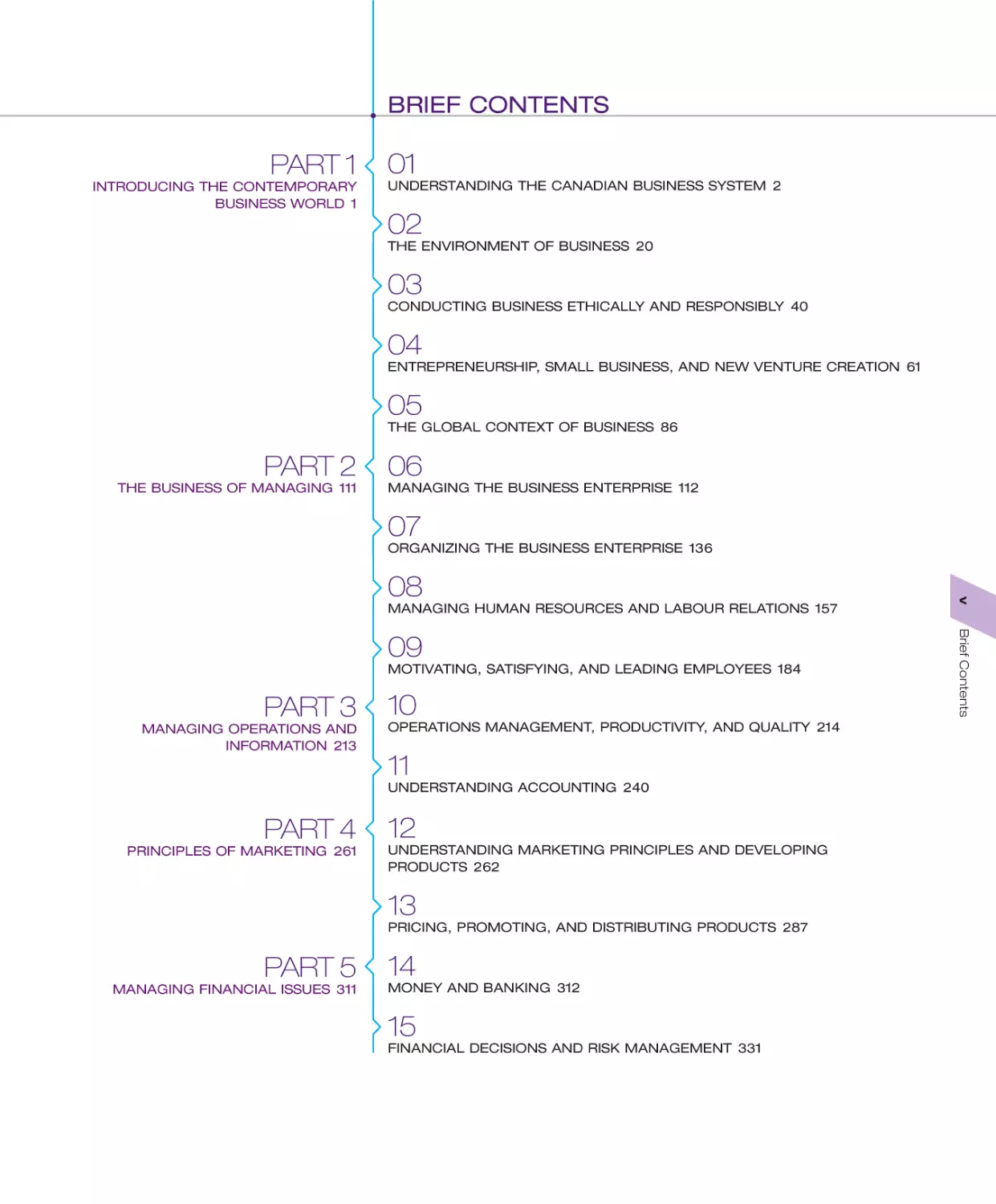
01
UNDERSTANDING THE CANADIAN BUSINESS SYSTEM 2
02
THE ENVIRONMENT OF BUSINESS 20
03
CONDUCTING BUSINESS ETHICALLY AND RESPONSIBLY 40
04
ENTREPRENEURSHIP, SMALL BUSINESS, AND NEW VENTURE CREATION 61
05
THE GLOBAL CONTEXT OF BUSINESS 86
PART 1
INTRODUCING THE CONTEMPORARY
BUSINESS WORLD 1
PART 2
THE BUSINESS OF MANAGING 111
PART 4
PRINCIPLES OF MARKETING 261
PART 5
MANAGING FINANCIAL ISSUES 311
PART 3
MANAGING OPERATIONS AND
INFORMATION 213
BRIEF CONTENTS
06
MANAGING THE BUSINESS ENTERPRISE 112
07
ORGANIZING THE BUSINESS ENTERPRISE 136
08
MANAGING HUMAN RESOURCES AND LABOUR RELATIONS 157
09
MOTIVATING, SATISFYING, AND LEADING EMPLOYEES 184
10
OPERATIONS MANAGEMENT, PRODUCTIVITY, AND QUALITY 214
11
UNDERSTANDING ACCOUNTING 240
12
UNDERSTANDING MARKETING PRINCIPLES AND DEVELOPING
PRODUCTS 262
13
PRICING, PROMOTING, AND DISTRIBUTING PRODUCTS 287
14
MONEY AND BANKING 312
15
FINANCIAL DECISIONS AND RISK MANAGEMENT 331
B
r
i
e
f
C
o
n
t
e
n
t
s
A01_EBER8852_09_SE_FM.indd 5
1/14/19 8:54 PM
v
i
i
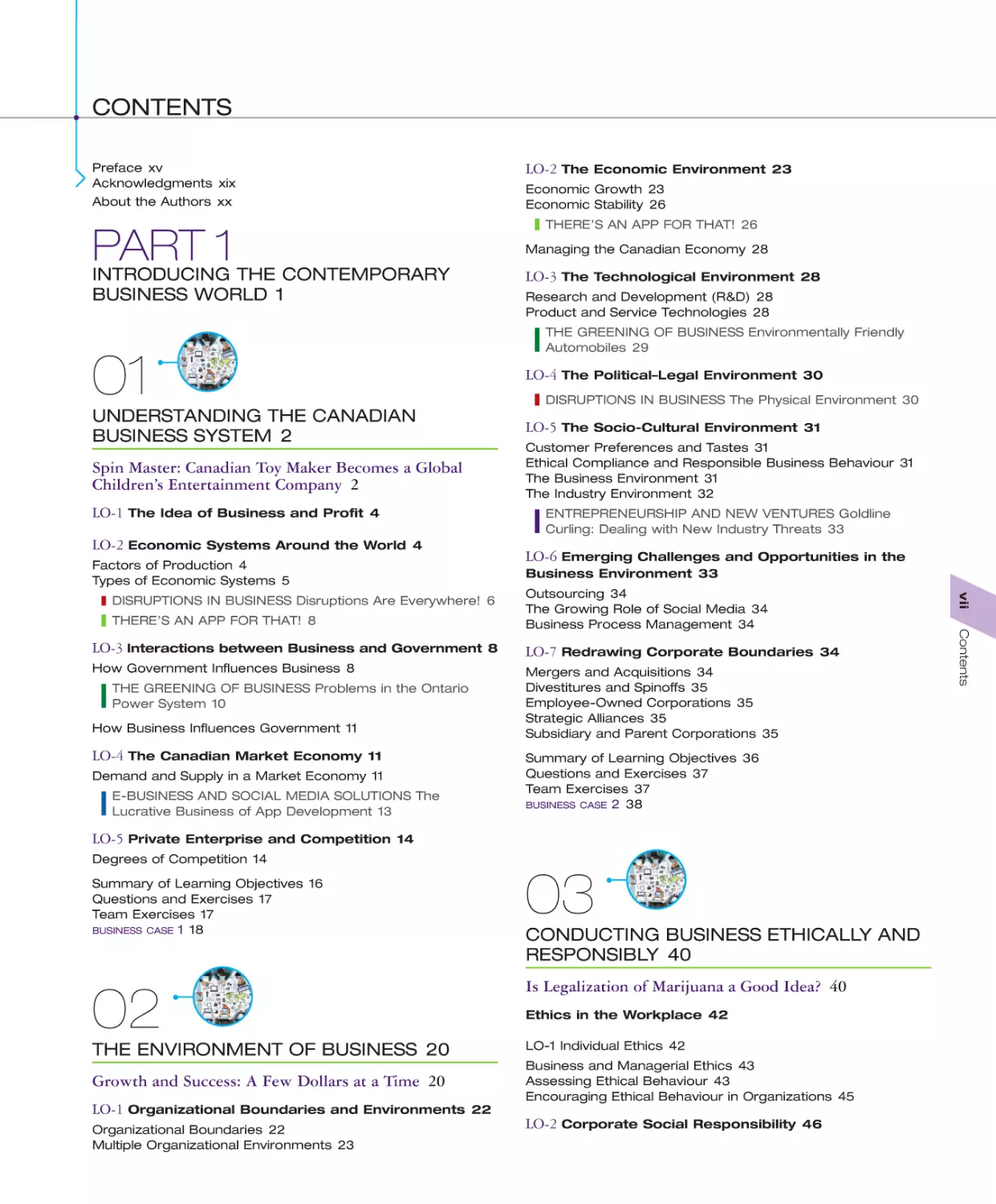
LO-2 The Economic Environment 23
Economic Growth 23
Economic Stability 26
THERE’S AN APP FOR THAT! 26
Managing the Canadian Economy 28
LO-3 The Technological Environment 28
Research and Development (R&D) 28
Product and Service Technologies 28
THE GREENING OF BUSINESS Environmentally Friendly
Automobiles 29
LO-4 The Political–Legal Environment 30
DISRUPTIONS IN BUSINESS The Physical Environment 30
LO-5 The Socio-Cultural Environment 31
Customer Preferences and Tastes 31
Ethical Compliance and Responsible Business Behaviour 31
The Business Environment 31
The Industry Environment 32
ENTREPRENEURSHIP AND NEW VENTURES Goldline
Curling: Dealing with New Industry Threats 33
LO-6 Emerging Challenges and Opportunities in the
Business Environment 33
Outsourcing 34
The Growing Role of Social Media 34
Business Process Management 34
LO-7 Redrawing Corporate Boundaries 34
Mergers and Acquisitions 34
Divestitures and Spinoffs 35
Employee-Owned Corporations 35
Strategic Alliances 35
Subsidiary and Parent Corporations 35
Summary of Learning Objectives 36
Questions and Exercises 37
Team Exercises 37
business case 2 38
03
CONDUCTING BUSINESS ETHICALLY AND
RESPONSIBLY 40
Is Legalization of Marijuana a Good Idea? 40
Ethics in the Workplace 42
LO-1 Individual Ethics 42
Business and Managerial Ethics 43
Assessing Ethical Behaviour 43
Encouraging Ethical Behaviour in Organizations 45
LO-2 Corporate Social Responsibility 46
PART 1
INTRODUCING THE CONTEMPORARY
BUSINESS WORLD 1
01
UNDERSTANDING THE CANADIAN
BUSINESS SYSTEM 2
Spin Master: Canadian Toy Maker Becomes a Global
Children’s Entertainment Company 2
LO-1 The Idea of Business and Profit 4
LO-2 Economic Systems Around the World 4
Factors of Production 4
Types of Economic Systems 5
DISRUPTIONS IN BUSINESS Disruptions Are Everywhere! 6
THERE’S AN APP FOR THAT! 8
LO-3 Interactions between Business and Government 8
How Government Influences Business 8
THE GREENING OF BUSINESS Problems in the Ontario
Power System 10
How Business Influences Government 11
LO-4 The Canadian Market Economy 11
Demand and Supply in a Market Economy 11
E-BUSINESS AND SOCIAL MEDIA SOLUTIONS The
Lucrative Business of App Development 13
LO-5 Private Enterprise and Competition 14
Degrees of Competition 14
Summary of Learning Objectives 16
Questions and Exercises 17
Team Exercises 17
business case 1 18
02
THE ENVIRONMENT OF BUSINESS 20
Growth and Success: A Few Dollars at a Time 20
LO-1 Organizational Boundaries and Environments 22
Organizational Boundaries 22
Multiple Organizational Environments 23
CONTENTS
Preface xv
Acknowledgments xix
About the Authors xx
C
o
n
t
e
n
t
s
A01_EBER8852_09_SE_FM.indd 7
1/14/19 8:54 PM
C
o
n
t
e
n
t
s
v
i
i
i
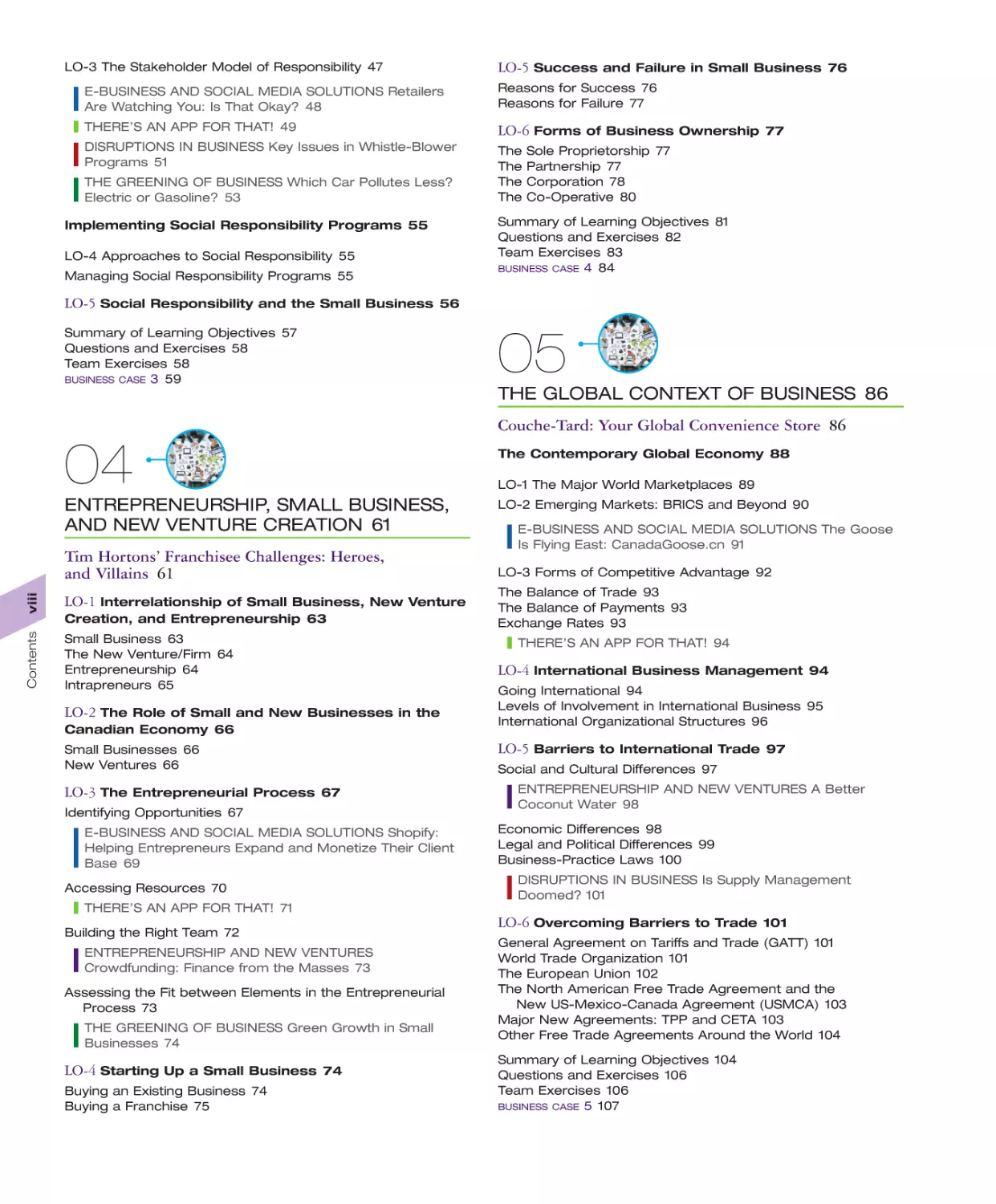
LO-5 Success and Failure in Small Business 76
Reasons for Success 76
Reasons for Failure 77
LO-6 Forms of Business Ownership 77
The Sole Proprietorship 77
The Partnership 77
The Corporation 78
The Co-Operative 80
Summary of Learning Objectives 81
Questions and Exercises 82
Team Exercises 83
business case 4 84
05
THE GLOBAL CONTEXT OF BUSINESS 86
Couche-Tard: Your Global Convenience Store 86
The Contemporary Global Economy 88
LO-1 The Major World Marketplaces 89
LO-2 Emerging Markets: BRICS and Beyond 90
E-BUSINESS AND SOCIAL MEDIA SOLUTIONS The Goose
Is Flying East: CanadaGoose.cn 91
LO-3 Forms of Competitive Advantage 92
The Balance of Trade 93
The Balance of Payments 93
Exchange Rates 93
THERE’S AN APP FOR THAT! 94
LO-4 International Business Management 94
Going International 94
Levels of Involvement in International Business 95
International Organizational Structures 96
LO-5 Barriers to International Trade 97
Social and Cultural Differences 97
ENTREPRENEURSHIP AND NEW VENTURES A Better
Coconut Water 98
Economic Differences 98
Legal and Political Differences 99
Business-Practice Laws 100
DISRUPTIONS IN BUSINESS Is Supply Management
Doomed? 101
LO-6 Overcoming Barriers to Trade 101
General Agreement on Tariffs and Trade (GATT) 101
World Trade Organization 101
The European Union 102
The North American Free Trade Agreement and the
New US-Mexico-Canada Agreement (USMCA) 103
Major New Agreements: TPP and CETA 103
Other Free Trade Agreements Around the World 104
Summary of Learning Objectives 104
Questions and Exercises 106
Team Exercises 106
business case 5 107
LO-3 The Stakeholder Model of Responsibility 47
E-BUSINESS AND SOCIAL MEDIA SOLUTIONS Retailers
Are Watching You: Is That Okay? 48
THERE’S AN APP FOR THAT! 49
DISRUPTIONS IN BUSINESS Key Issues in Whistle-Blower
Programs 51
THE GREENING OF BUSINESS Which Car Pollutes Less?
Electric or Gasoline? 53
Implementing Social Responsibility Programs 55
LO-4 Approaches to Social Responsibility 55
Managing Social Responsibility Programs 55
LO-5 Social Responsibility and the Small Business 56
Summary of Learning Objectives 57
Questions and Exercises 58
Team Exercises 58
business case 3 59
04
ENTREPRENEURSHIP, SMALL BUSINESS,
AND NEW VENTURE CREATION 61
Tim Hortons’ Franchisee Challenges: Heroes,
and Villains 61
LO-1 Interrelationship of Small Business, New Venture
Creation, and Entrepreneurship 63
Small Business 63
The New Venture/Firm 64
Entrepreneurship 64
Intrapreneurs 65
LO-2 The Role of Small and New Businesses in the
Canadian Economy 66
Small Businesses 66
New Ventures 66
LO-3 The Entrepreneurial Process 67
Identifying Opportunities 67
E-BUSINESS AND SOCIAL MEDIA SOLUTIONS Shopify:
Helping Entrepreneurs Expand and Monetize Their Client
Base 69
Accessing Resources 70
THERE’S AN APP FOR THAT! 71
Building the Right Team 72
ENTREPRENEURSHIP AND NEW VENTURES
Crowdfunding: Finance from the Masses 73
Assessing the Fit between Elements in the Entrepreneurial
Process 73
THE GREENING OF BUSINESS Green Growth in Small
Businesses 74
LO-4 Starting Up a Small Business 74
Buying an Existing Business 74
Buying a Franchise 75
A01_EBER8852_09_SE_FM.indd 8
1/14/19 8:54 PM
C
o
n
t
e
n
t
s
i
x
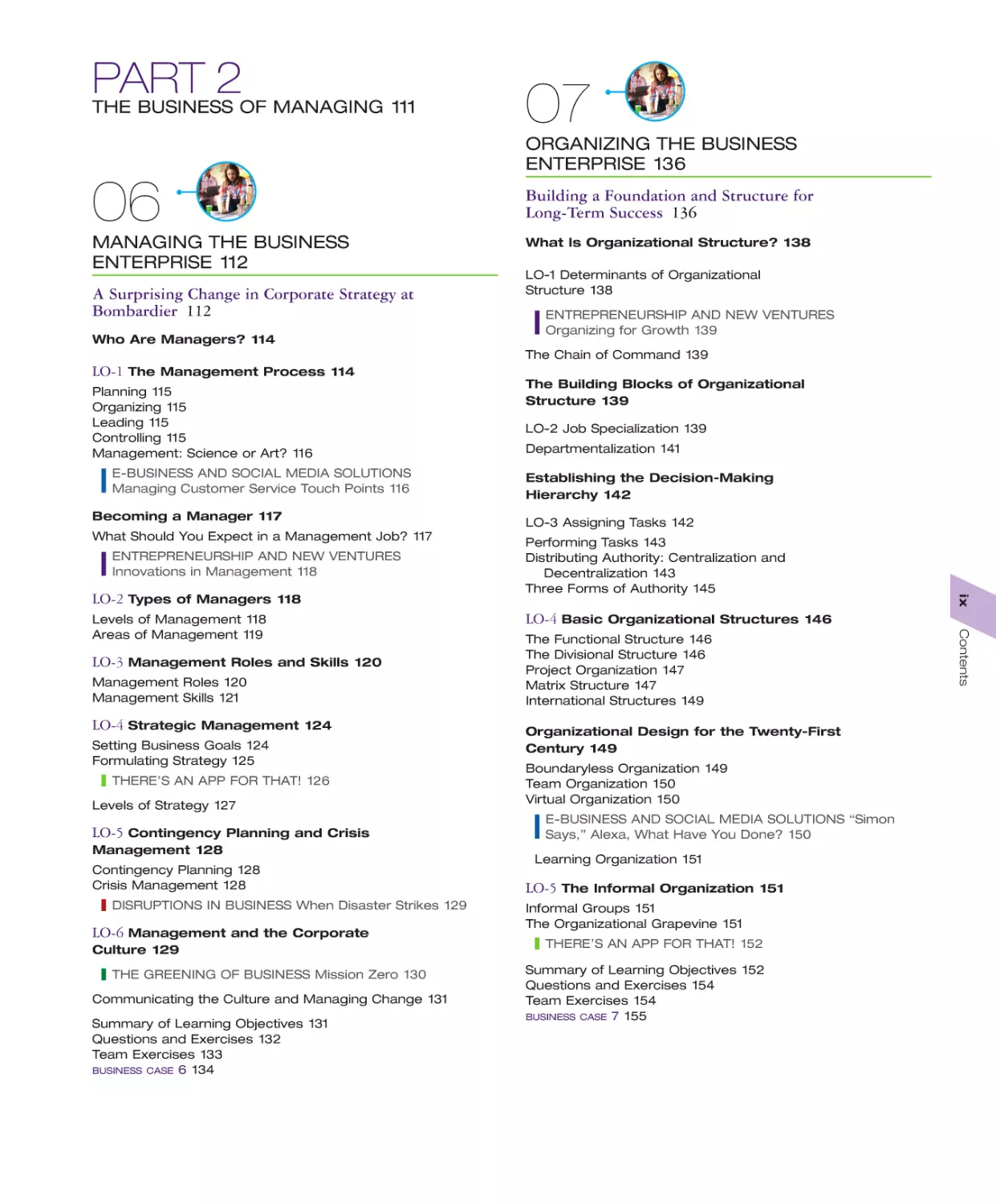
PART 2
THE BUSINESS OF MANAGING 111
06
MANAGING THE BUSINESS
ENTERPRISE 112
A Surprising Change in Corporate Strategy at
Bombardier 112
Who Are Managers? 114
LO-1 The Management Process 114
Planning 115
Organizing 115
Leading 115
Controlling 115
Management: Science or Art? 116
E-BUSINESS AND SOCIAL MEDIA SOLUTIONS
Managing Customer Service Touch Points 116
Becoming a Manager 117
What Should You Expect in a Management Job? 117
ENTREPRENEURSHIP AND NEW VENTURES
Innovations in Management 118
LO-2 Types of Managers 118
Levels of Management 118
Areas of Management 119
LO-3 Management Roles and Skills 120
Management Roles 120
Management Skills 121
LO-4 Strategic Management 124
Setting Business Goals 124
Formulating Strategy 125
THERE’S AN APP FOR THAT! 126
Levels of Strategy 127
LO-5 Contingency Planning and Crisis
Management 128
Contingency Planning 128
Crisis Management 128
DISRUPTIONS IN BUSINESS When Disaster Strikes 129
LO-6 Management and the Corporate
Culture 129
THE GREENING OF BUSINESS Mission Zero 130
Communicating the Culture and Managing Change 131
Summary of Learning Objectives 131
Questions and Exercises 132
Team Exercises 133
business case 6 134
07
ORGANIZING THE BUSINESS
ENTERPRISE 136
Building a Foundation and Structure for
Long-Term Success 136
What Is Organizational Structure? 138
LO-1 Determinants of Organizational
Structure 138
ENTREPRENEURSHIP AND NEW VENTURES
Organizing for Growth 139
The Chain of Command 139
The Building Blocks of Organizational
Structure 139
LO-2 Job Specialization 139
Departmentalization 141
Establishing the Decision-Making
Hierarchy 142
LO-3 Assigning Tasks 142
Performing Tasks 143
Distributing Authority: Centralization and
Decentralization 143
Three Forms of Authority 145
LO-4 Basic Organizational Structures 146
The Functional Structure 146
The Divisional Structure 146
Project Organization 147
Matrix Structure 147
International Structures 149
Organizational Design for the Twenty-First
Century 149
Boundaryless Organization 149
Team Organization 150
Virtual Organization 150
E-BUSINESS AND SOCIAL MEDIA SOLUTIONS “Simon
Says,” Alexa, What Have You Done? 150
Learning Organization 151
LO-5 The Informal Organization 151
Informal Groups 151
The Organizational Grapevine 151
THERE’S AN APP FOR THAT! 152
Summary of Learning Objectives 152
Questions and Exercises 154
Team Exercises 154
business case 7 155
A01_EBER8852_09_SE_FM.indd 9
1/14/19 8:54 PM
C
o
n
t
e
n
t
s
x
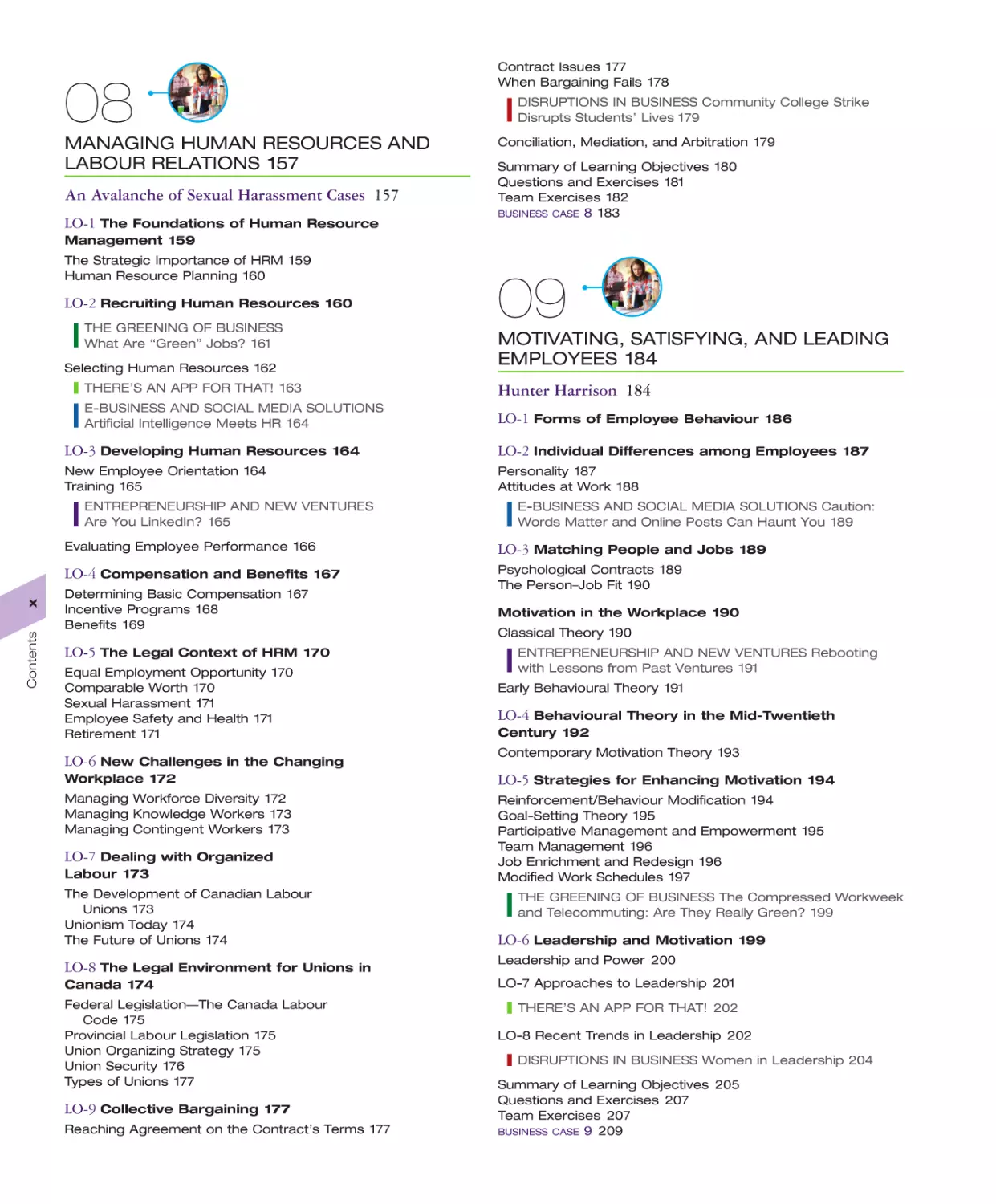
08
MANAGING HUMAN RESOURCES AND
LABOUR RELATIONS 157
An Avalanche of Sexual Harassment Cases 157
LO-1 The Foundations of Human Resource
Management 159
The Strategic Importance of HRM 159
Human Resource Planning 160
LO-2 Recruiting Human Resources 160
THE GREENING OF BUSINESS
What Are “Green” Jobs? 161
Selecting Human Resources 162
THERE’S AN APP FOR THAT! 163
E-BUSINESS AND SOCIAL MEDIA SOLUTIONS
Artificial Intelligence Meets HR 164
LO-3 Developing Human Resources 164
New Employee Orientation 164
Training 165
ENTREPRENEURSHIP AND NEW VENTURES
Are You LinkedIn? 165
Evaluating Employee Performance 166
LO-4 Compensation and Benefits 167
Determining Basic Compensation 167
Incentive Programs 168
Benefits 169
LO-5 The Legal Context of HRM 170
Equal Employment Opportunity 170
Comparable Worth 170
Sexual Harassment 171
Employee Safety and Health 171
Retirement 171
LO-6 New Challenges in the Changing
Workplace 172
Managing Workforce Diversity 172
Managing Knowledge Workers 173
Managing Contingent Workers 173
LO-7 Dealing with Organized
Labour 173
The Development of Canadian Labour
Unions 173
Unionism Today 174
The Future of Unions 174
LO-8 The Legal Environment for Unions in
Canada 174
Federal Legislation—The Canada Labour
Code 175
Provincial Labour Legislation 175
Union Organizing Strategy 175
Union Security 176
Types of Unions 177
LO-9 Collective Bargaining 177
Reaching Agreement on the Contract’s Terms 177
Contract Issues 177
When Bargaining Fails 178
DISRUPTIONS IN BUSINESS Community College Strike
Disrupts Students’ Lives 179
Conciliation, Mediation, and Arbitration 179
Summary of Learning Objectives 180
Questions and Exercises 181
Team Exercises 182
business case 8 183
09
MOTIVATING, SATISFYING, AND LEADING
EMPLOYEES 184
Hunter Harrison 184
LO-1 Forms of Employee Behaviour 186
LO-2 Individual Differences among Employees 187
Personality 187
Attitudes at Work 188
E-BUSINESS AND SOCIAL MEDIA SOLUTIONS Caution:
Words Matter and Online Posts Can Haunt You 189
LO-3 Matching People and Jobs 189
Psychological Contracts 189
The Person–Job Fit 190
Motivation in the Workplace 190
Classical Theory 190
ENTREPRENEURSHIP AND NEW VENTURES Rebooting
with Lessons from Past Ventures 191
Early Behavioural Theory 191
LO-4 Behavioural Theory in the Mid-Twentieth
Century 192
Contemporary Motivation Theory 193
LO-5 Strategies for Enhancing Motivation 194
Reinforcement/Behaviour Modification 194
Goal-Setting Theory 195
Participative Management and Empowerment 195
Team Management 196
Job Enrichment and Redesign 196
Modified Work Schedules 197
THE GREENING OF BUSINESS The Compressed Workweek
and Telecommuting: Are They Really Green? 199
LO-6 Leadership and Motivation 199
Leadership and Power 200
LO-7 Approaches to Leadership 201
THERE’S AN APP FOR THAT! 202
LO-8 Recent Trends in Leadership 202
DISRUPTIONS IN BUSINESS Women in Leadership 204
Summary of Learning Objectives 205
Questions and Exercises 207
Team Exercises 207
business case 9 209
A01_EBER8852_09_SE_FM.indd 10
1/14/19 8:54 PM
C
o
n
t
e
n
t
s
x
i
PART 3
MANAGING OPERATIONS AND
INFORMATION 213
10
OPERATIONS MANAGEMENT,
PRODUCTIVITY, AND QUALITY 214
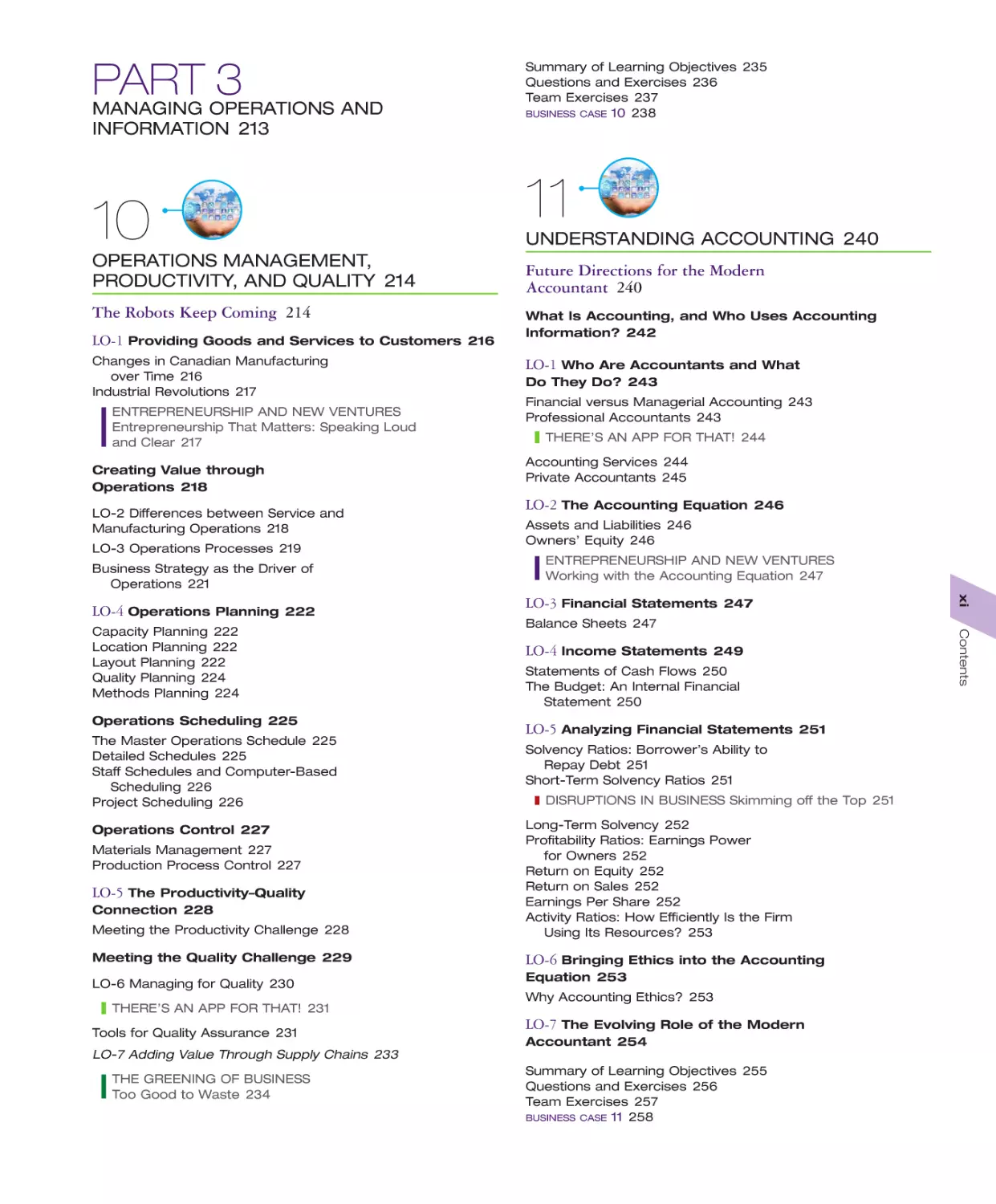
The Robots Keep Coming 214
LO-1 Providing Goods and Services to Customers 216
Changes in Canadian Manufacturing
over Time 216
Industrial Revolutions 217
ENTREPRENEURSHIP AND NEW VENTURES
Entrepreneurship That Matters: Speaking Loud
and Clear 217
Creating Value through
Operations 218
LO-2 Differences between Service and
Manufacturing Operations 218
LO-3 Operations Processes 219
Business Strategy as the Driver of
Operations 221
LO-4 Operations Planning 222
Capacity Planning 222
Location Planning 222
Layout Planning 222
Quality Planning 224
Methods Planning 224
Operations Scheduling 225
The Master Operations Schedule 225
Detailed Schedules 225
Staff Schedules and Computer-Based
Scheduling 226
Project Scheduling 226
Operations Control 227
Materials Management 227
Production Process Control 227
LO-5 The Productivity–Quality
Connection 228
Meeting the Productivity Challenge 228
Meeting the Quality Challenge 229
LO-6 Managing for Quality 230
THERE’S AN APP FOR THAT! 231
Tools for Quality Assurance 231
LO-7 Adding Value Through Supply Chains 233
THE GREENING OF BUSINESS
Too Good to Waste 234
Summary of Learning Objectives 235
Questions and Exercises 236
Team Exercises 237
business case 10 238
11UNDERSTANDING ACCOUNTING 240
Future Directions for the Modern
Accountant 240
What Is Accounting, and Who Uses Accounting
Information? 242
LO-1 Who Are Accountants and What
Do They Do? 243
Financial versus Managerial Accounting 243
Professional Accountants 243
THERE’S AN APP FOR THAT! 244
Accounting Services 244
Private Accountants 245
LO-2 The Accounting Equation 246
Assets and Liabilities 246
Owners’ Equity 246
ENTREPRENEURSHIP AND NEW VENTURES
Working with the Accounting Equation 247
LO-3 Financial Statements 247
Balance Sheets 247
LO-4 Income Statements 249
Statements of Cash Flows 250
The Budget: An Internal Financial
Statement 250
LO-5 Analyzing Financial Statements 251
Solvency Ratios: Borrower’s Ability to
Repay Debt 251
Short-Term Solvency Ratios 251
DISRUPTIONS IN BUSINESS Skimming off the Top 251
Long-Term Solvency 252
Profitability Ratios: Earnings Power
for Owners 252
Return on Equity 252
Return on Sales 252
Earnings Per Share 252
Activity Ratios: How Efficiently Is the Firm
Using Its Resources? 253
LO-6 Bringing Ethics into the Accounting
Equation 253
Why Accounting Ethics? 253
LO-7 The Evolving Role of the Modern
Accountant 254
Summary of Learning Objectives 255
Questions and Exercises 256
Team Exercises 257
business case 11 258
A01_EBER8852_09_SE_FM.indd 11
1/14/19 8:54 PM
C
o
n
t
e
n
t
s
x
i
i
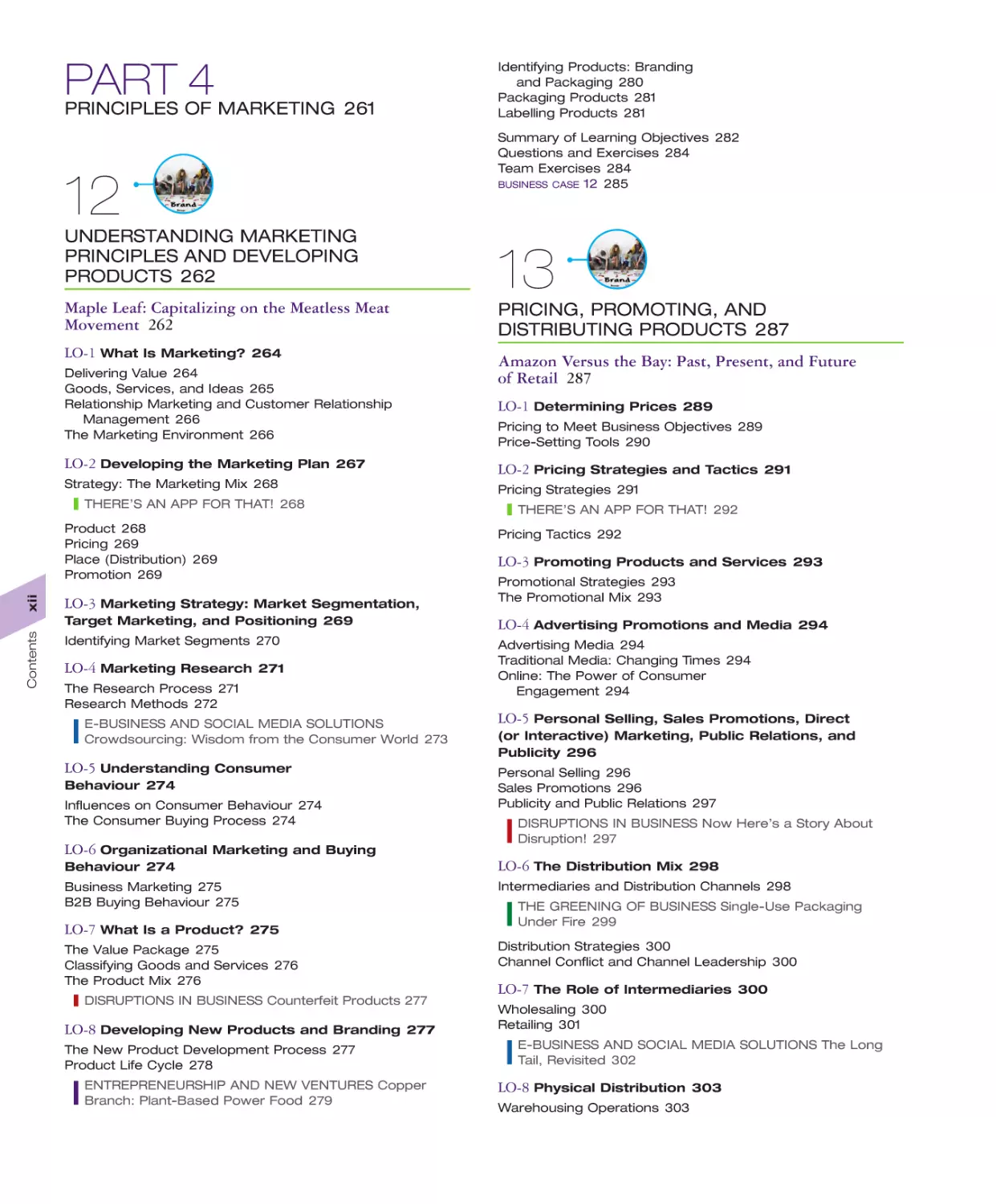
PART 4
PRINCIPLES OF MARKETING 261
12
UNDERSTANDING MARKETING
PRINCIPLES AND DEVELOPING
PRODUCTS 262
Maple Leaf: Capitalizing on the Meatless Meat
Movement 262
LO-1 What Is Marketing? 264
Delivering Value 264
Goods, Services, and Ideas 265
Relationship Marketing and Customer Relationship
Management 266
The Marketing Environment 266
LO-2 Developing the Marketing Plan 267
Strategy: The Marketing Mix 268
THERE’S AN APP FOR THAT! 268
Product 268
Pricing 269
Place (Distribution) 269
Promotion 269
LO-3 Marketing Strategy: Market Segmentation,
Target Marketing, and Positioning 269
Identifying Market Segments 270
LO-4 Marketing Research 271
The Research Process 271
Research Methods 272
E-BUSINESS AND SOCIAL MEDIA SOLUTIONS
Crowdsourcing: Wisdom from the Consumer World 273
LO-5 Understanding Consumer
Behaviour 274
Influences on Consumer Behaviour 274
The Consumer Buying Process 274
LO-6 Organizational Marketing and Buying
Behaviour 274
Business Marketing 275
B2B Buying Behaviour 275
LO-7 What Is a Product? 275
The Value Package 275
Classifying Goods and Services 276
The Product Mix 276
DISRUPTIONS IN BUSINESS Counterfeit Products 277
LO-8 Developing New Products and Branding 277
The New Product Development Process 277
Product Life Cycle 278
ENTREPRENEURSHIP AND NEW VENTURES Copper
Branch: Plant-Based Power Food 279
Identifying Products: Branding
and Packaging 280
Packaging Products 281
Labelling Products 281
Summary of Learning Objectives 282
Questions and Exercises 284
Team Exercises 284
business case 12 285
13
PRICING, PROMOTING, AND
DISTRIBUTING PRODUCTS 287
Amazon Versus the Bay: Past, Present, and Future
of Retail 287
LO-1 Determining Prices 289
Pricing to Meet Business Objectives 289
Price-Setting Tools 290
LO-2 Pricing Strategies and Tactics 291
Pricing Strategies 291
THERE’S AN APP FOR THAT! 292
Pricing Tactics 292
LO-3 Promoting Products and Services 293
Promotional Strategies 293
The Promotional Mix 293
LO-4 Advertising Promotions and Media 294
Advertising Media 294
Traditional Media: Changing Times 294
Online: The Power of Consumer
Engagement 294
LO-5 Personal Selling, Sales Promotions, Direct
(or Interactive) Marketing, Public Relations, and
Publicity 296
Personal Selling 296
Sales Promotions 296
Publicity and Public Relations 297
DISRUPTIONS IN BUSINESS Now Here’s a Story About
Disruption! 297
LO-6 The Distribution Mix 298
Intermediaries and Distribution Channels 298
THE GREENING OF BUSINESS Single-Use Packaging
Under Fire 299
Distribution Strategies 300
Channel Conflict and Channel Leadership 300
LO-7 The Role of Intermediaries 300
Wholesaling 300
Retailing 301
E-BUSINESS AND SOCIAL MEDIA SOLUTIONS The Long
Tail, Revisited 302
LO-8 Physical Distribution 303
Warehousing Operations 303
A01_EBER8852_09_SE_FM.indd 12
1/14/19 8:54 PM
C
o
n
t
e
n
t
s
x
i
i
i
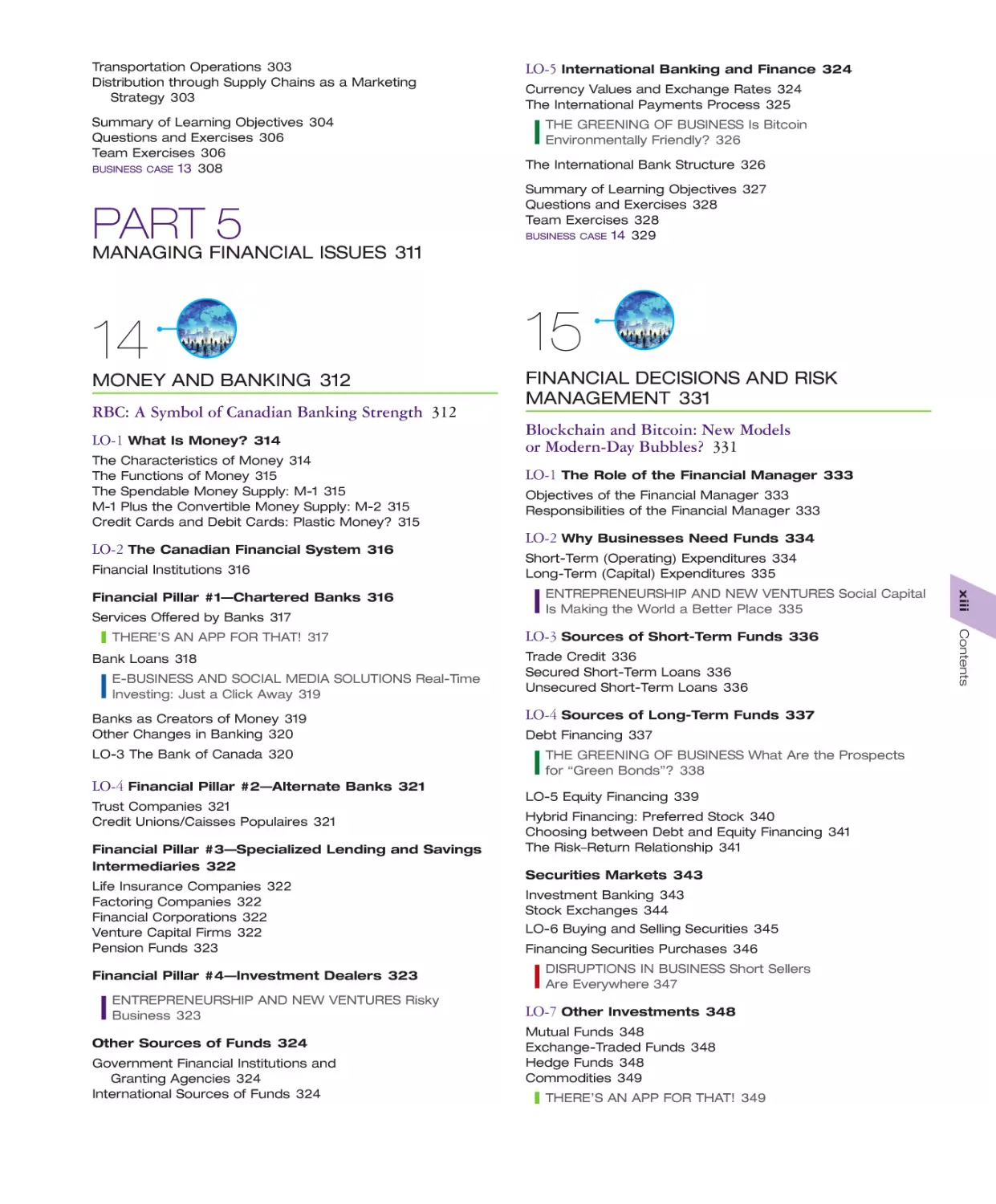
Transportation Operations 303
Distribution through Supply Chains as a Marketing
Strategy 303
Summary of Learning Objectives 304
Questions and Exercises 306
Team Exercises 306
business case 13 308
PART 5
MANAGING FINANCIAL ISSUES 311
14
MONEY AND BANKING 312
RBC: A Symbol of Canadian Banking Strength 312
LO-1 What Is Money? 314
The Characteristics of Money 314
The Functions of Money 315
The Spendable Money Supply: M-1 315
M-1 Plus the Convertible Money Supply: M-2 315
Credit Cards and Debit Cards: Plastic Money? 315
LO-2 The Canadian Financial System 316
Financial Institutions 316
Financial Pillar #1—Chartered Banks 316
Services Offered by Banks 317
THERE’S AN APP FOR THAT! 317
Bank Loans 318
E-BUSINESS AND SOCIAL MEDIA SOLUTIONS Real-Time
Investing: Just a Click Away 319
Banks as Creators of Money 319
Other Changes in Banking 320
LO-3 The Bank of Canada 320
LO-4 Financial Pillar #2—Alternate Banks 321
Trust Companies 321
Credit Unions/Caisses Populaires 321
Financial Pillar #3—Specialized Lending and Savings
Intermediaries 322
Life Insurance Companies 322
Factoring Companies 322
Financial Corporations 322
Venture Capital Firms 322
Pension Funds 323
Financial Pillar #4—Investment Dealers 323
ENTREPRENEURSHIP AND NEW VENTURES Risky
Business 323
Other Sources of Funds 324
Government Financial Institutions and
Granting Agencies 324
International Sources of Funds 324
LO-5 International Banking and Finance 324
Currency Values and Exchange Rates 324
The International Payments Process 325
THE GREENING OF BUSINESS Is Bitcoin
Environmentally Friendly? 326
The International Bank Structure 326
Summary of Learning Objectives 327
Questions and Exercises 328
Team Exercises 328
business case 14 329
15
FINANCIAL DECISIONS AND RISK
MANAGEMENT 331
Blockchain and Bitcoin: New Models
or Modern-Day Bubbles? 331
LO-1 The Role of the Financial Manager 333
Objectives of the Financial Manager 333
Responsibilities of the Financial Manager 333
LO-2 Why Businesses Need Funds 334
Short-Term (Operating) Expenditures 334
Long-Term (Capital) Expenditures 335
ENTREPRENEURSHIP AND NEW VENTURES Social Capital
Is Making the World a Better Place 335
LO-3 Sources of Short-Term Funds 336
Trade Credit 336
Secured Short-Term Loans 336
Unsecured Short-Term Loans 336
LO-4 Sources of Long-Term Funds 337
Debt Financing 337
THE GREENING OF BUSINESS What Are the Prospects
for “Green Bonds”? 338
LO-5 Equity Financing 339
Hybrid Financing: Preferred Stock 340
Choosing between Debt and Equity Financing 341
The Risk–Return Relationship 341
Securities Markets 343
Investment Banking 343
Stock Exchanges 344
LO-6 Buying and Selling Securities 345
Financing Securities Purchases 346
DISRUPTIONS IN BUSINESS Short Sellers
Are Everywhere 347
LO-7 Other Investments 348
Mutual Funds 348
Exchange-Traded Funds 348
Hedge Funds 348
Commodities 349
THERE’S AN APP FOR THAT! 349
A01_EBER8852_09_SE_FM.indd 13
1/14/19 8:54 PM
C
o
n
t
e
n
t
s
x
i
v
Securities Regulation 349
Financial Management for Small Businesses 349
Establishing Bank Credit and Trade Credit 350
Venture Capital 350
Planning for Cash-Flow Requirements 350
LO-8 Risk Management 350
Coping with Risk 350
Summary of Learning Objectives 351
Questions and Exercises 353
Team Exercises 354
business case 15 355
APPENDIX A A BRIEF HISTORY OF BUSINESS IN
CANADA 359
APPENDIX B BUSINESS LAW 360
APPENDIX C USING TECHNOLOGY TO MANAGE
INFORMATION IN THE INTERNET AND SOCIAL
MEDIA ERA 364
APPENDIX D MANAGING YOUR PERSONAL FINANCES:
A SYNOPSIS 376
APPENDIX E INSURANCE AS RISK MANAGEMENT 378
Endnotes and Source Notes 381
Name and Organization Index 409
Subject Index 415
A01_EBER8852_09_SE_FM.indd 14
1/14/19 8:54 PM
x
v
and responsibilities, but you’ll also need to understand how to
manage other people—how to motivate and reward them, how
to lead them, how to deal with conflict among them, and the legal
parameters that may affect how you treat them. Chapters 3, 6, 8,
and 9 provide a lot of information about how you can best wear
this hat, although information about the role of employer is found
throughout the book.
• The Consumer Hat. Even if you don’t work for a business, you will
still wear the hat of a consumer. Whenever you fill your car with
Petro Canada gasoline; buy on Amazon, Zara, or Reitmans; or
download a song from iTunes, you’re consuming products or ser-
vices created by businesses. To wear this hat effectively, you need
to understand how to assess the value of what you’re buying, your
rights as a consumer, and so on. We discuss how you can best
wear this hat in Chapters 1, 3, 12, and 13.
• The Investor Hat. The final business hat many people wear is that
of an investor. You may buy your own business or work for a com-
pany that allows you to buy its stock. You may also invest in other
companies through the purchase of stocks or shares of a mutual
fund. In order for you to invest wisely, you must understand some
basics, such as financial markets, business earnings, and the costs
of investment. Chapters 4, 11, 14, and 15 will help you learn how
to best wear this hat.
Most people wear more than one of these hats at the same time.
Regardless of how many hats you wear or when you may be putting
them on, you will interface with many different businesses in different
ways. Knowing how to best wear all of these hats is what this book is
all about.
The world is populated with a breathtaking range of businesses
and business opportunities. Big and small businesses, traditional and
online businesses, established and new businesses, broad-based
and niche businesses, successful and unsuccessful businesses,
global and domestic businesses—regardless of where your future
plans take you, we hope that you will look back on this course as one
of your positive first steps.
Keep in mind that what you get out of this course depends on at
least three factors. One factor is this book and the information about
business that you will acquire as a result of reading it. Another factor is
your instructor, who is a dedicated professional who wants to help you
grow and develop intellectually and academically. The third factor is YOU.
Learning is an active process that requires you to be a major participant.
Simply memorizing the key terms and concepts in this book may help
you achieve an acceptable course grade, but true learning requires that
you read, study, discuss, question, review, experience, evaluate––and
wear the four hats—as you go along. Tests and homework are neces-
sary, but we hope that you will finish this course with new knowledge
and increased enthusiasm for the world of business. Your instructor will
do his or her part to facilitate your learning. The rest, then, is up to you.
We wish you success.
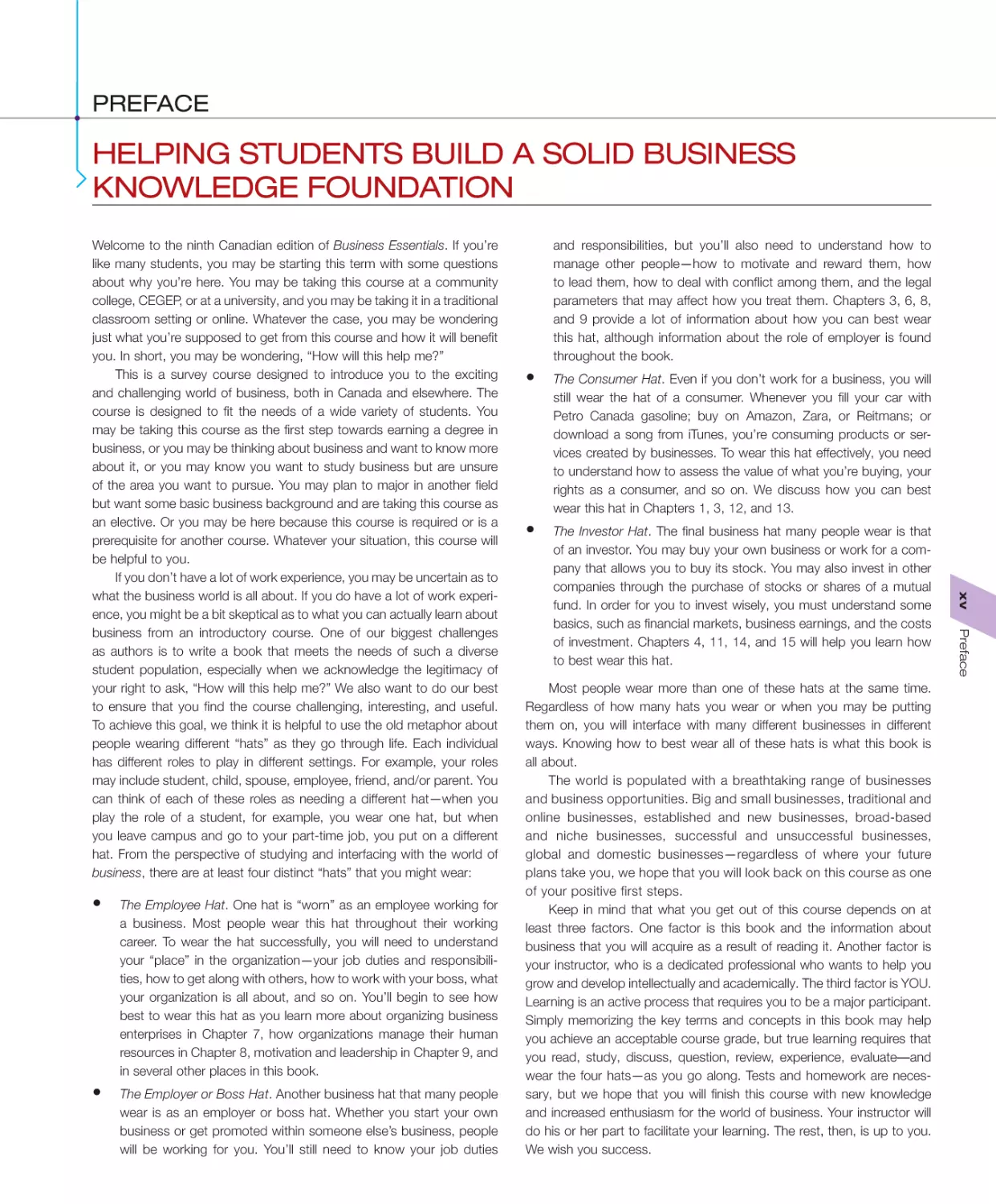
PREFACE
HELPING STUDENTS BUILD A SOLID BUSINESS
KNOWLEDGE FOUNDATION
Welcome to the ninth Canadian edition of Business Essentials. If you’re
like many students, you may be starting this term with some questions
about why you’re here. You may be taking this course at a community
college, CEGEP, or at a university, and you may be taking it in a traditional
classroom setting or online. Whatever the case, you may be wondering
just what you’re supposed to get from this course and how it will benefit
you. In short, you may be wondering, “How will this help me?”
This is a survey course designed to introduce you to the exciting
and challenging world of business, both in Canada and elsewhere. The
course is designed to fit the needs of a wide variety of students. You
may be taking this course as the first step towards earning a degree in
business, or you may be thinking about business and want to know more
about it, or you may know you want to study business but are unsure
of the area you want to pursue. You may plan to major in another field
but want some basic business background and are taking this course as
an elective. Or you may be here because this course is required or is a
prerequisite for another course. Whatever your situation, this course will
be helpful to you.
If you don’t have a lot of work experience, you may be uncertain as to
what the business world is all about. If you do have a lot of work experi-
ence, you might be a bit skeptical as to what you can actually learn about
business from an introductory course. One of our biggest challenges
as authors is to write a book that meets the needs of such a diverse
student population, especially when we acknowledge the legitimacy of
your right to ask, “How will this help me?” We also want to do our best
to ensure that you find the course challenging, interesting, and useful.
To achieve this goal, we think it is helpful to use the old metaphor about
people wearing different “hats” as they go through life. Each individual
has different roles to play in different settings. For example, your roles
may include student, child, spouse, employee, friend, and/or parent. You
can think of each of these roles as needing a different hat—when you
play the role of a student, for example, you wear one hat, but when
you leave campus and go to your part-time job, you put on a different
hat. From the perspective of studying and interfacing with the world of
business, there are at least four distinct “hats” that you might wear:
• The Employee Hat. One hat is “worn” as an employee working for
a business. Most people wear this hat throughout their working
career. To wear the hat successfully, you will need to understand
your “place” in the organization—your job duties and responsibili-
ties, how to get along with others, how to work with your boss, what
your organization is all about, and so on. You’ll begin to see how
best to wear this hat as you learn more about organizing business
enterprises in Chapter 7, how organizations manage their human
resources in Chapter 8, motivation and leadership in Chapter 9, and
in several other places in this book.
• The Employer or Boss Hat. Another business hat that many people
wear is as an employer or boss hat. Whether you start your own
business or get promoted within someone else’s business, people
will be working for you. You’ll still need to know your job duties
P
r
e
f
a
c
e
A01_EBER8852_09_SE_FM.indd 15
1/14/19 8:54 PM
x
v
i
Solutions—describes how rapidly changing technology has provided busi-
ness firms with many new ways to connect with customers. The second
series—Disruptions in Business—explains how existing businesses are
being dramatically changed by new ways of doing business, and how
entirely new industries are developing with astonishing speed and chal-
lenging traditional ways of doing business. The third series—Entrepreneurship
and New Ventures—provides real-life examples of entrepreneurs who saw
an opportunity to provide a new product or service in the marketplace,
and the activities they carried out in order to be successful. The fourth
series—The Greening of Business—analyzes the steps that businesses
are taking to be more environmentally friendly. Critical thinking questions
appear at the end of each boxed insert to motivate students to think about
what they have read.
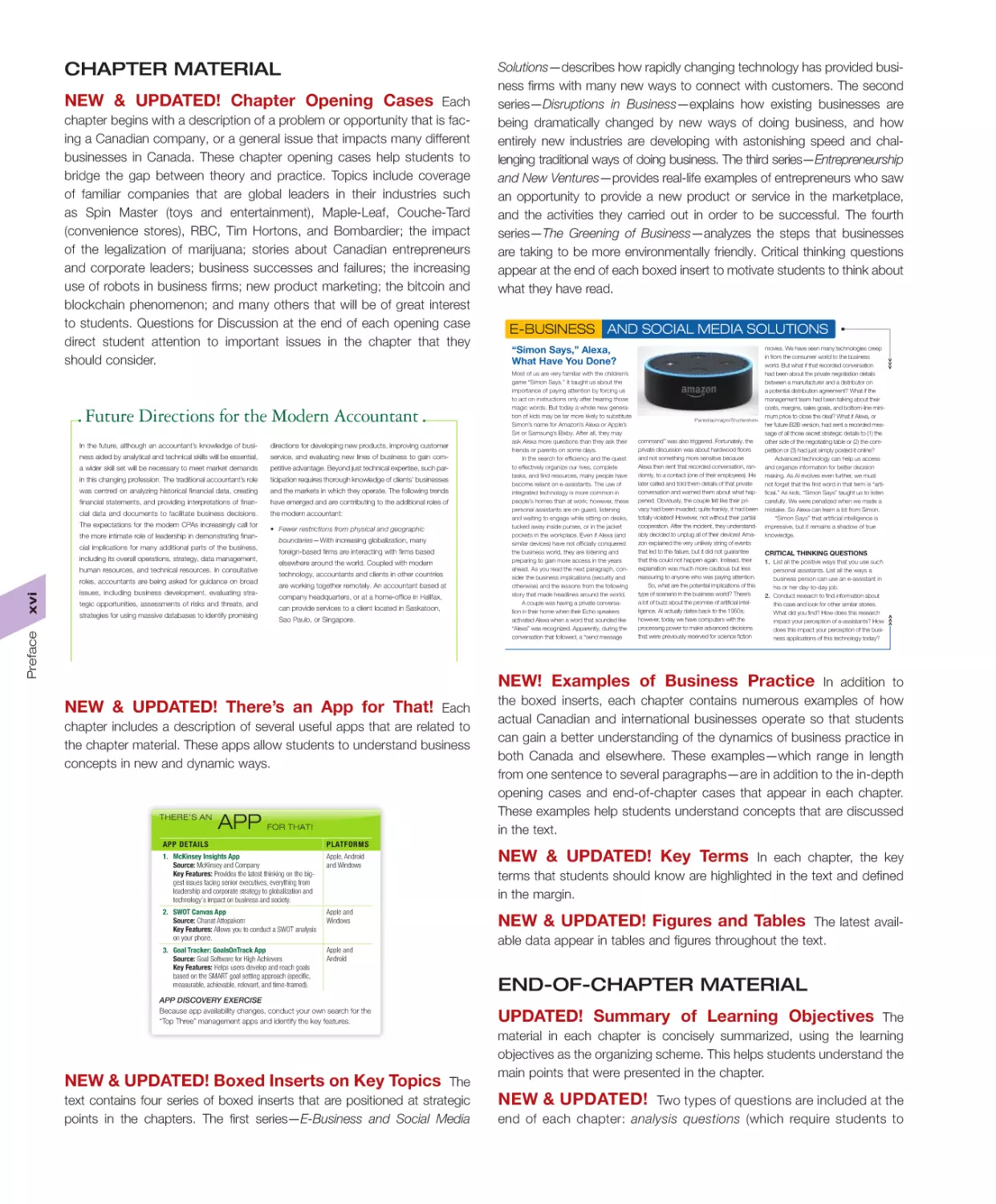
CHAPTER MATERIAL
NEW & UPDATED! Chapter Opening Cases Each
chapter begins with a description of a problem or opportunity that is fac-
ing a Canadian company, or a general issue that impacts many different
businesses in Canada. These chapter opening cases help students to
bridge the gap between theory and practice. Topics include coverage
of familiar companies that are global leaders in their industries such
as Spin Master (toys and entertainment), Maple-Leaf, Couche-Tard
(convenience stores), RBC, Tim Hortons, and Bombardier; the impact
of the legalization of marijuana; stories about Canadian entrepreneurs
and corporate leaders; business successes and failures; the increasing
use of robots in business firms; new product marketing; the bitcoin and
blockchain phenomenon; and many others that will be of great interest
to students. Questions for Discussion at the end of each opening case
direct student attention to important issues in the chapter that they
should consider.
P
r
e
f
a
c
e
P
a
r
t
3
M
a
n
a
g
i
n
g
O
p
e
r
a
t
i
o
n
s
a
n
d
I
n
f
o
r
m
a
t
i
o
n
2
4
0
directions for developing new products, improving customer
service, and evaluating new lines of business to gain com-
petitive advantage. Beyond just technical expertise, such par-
ticipation requires thorough knowledge of clients’ businesses
and the markets in which they operate. The following trends
have emerged and are contributing to the additional roles of
the modern accountant:
• Fewer restrictions from physical and geographic
boundaries—With increasing globalization, many
foreign-based firms are interacting with firms based
elsewhere around the world. Coupled with modern
technology, accountants and clients in other countries
are working together remotely. An accountant based at
company headquarters, or at a home-office in Halifax,
can provide services to a client located in Saskatoon,
Sao Paulo, or Singapore.
In the future, although an accountant’s knowledge of busi-
ness aided by analytical and technical skills will be essential,
a wider skill set will be necessary to meet market demands
in this changing profession. The traditional accountant’s role
was centred on analyzing historical financial data, creating
financial statements, and providing interpretations of finan-
cial data and documents to facilitate business decisions.
The expectations for the modern CPAs increasingly call for
the more intimate role of leadership in demonstrating finan-
cial implications for many additional parts of the business,
including its overall operations, strategy, data management,
human resources, and technical resources. In consultative
roles, accountants are being asked for guidance on broad
issues, including business development, evaluating stra-
tegic opportunities, assessments of risks and threats, and
strategies for using massive databases to identify promising
Future Directions for the Modern Accountant
Understanding Accounting
LO
AFTER READING THIS CHAPTER,
YOU SHOULD BE ABLE TO:
LO-1 Explain the role of accountants, distinguish between the three traditional
professional accounting designations in Canada, and understand the new
unified role of the Canadian Chartered Professional Accounting (CPA)
designation.
LO-2 Explain how the accounting equation is used.
LO-3 Describe three basic financial statements and show how they reflect the
activity and financial condition of a business.
LO-4 Explain the key standards and principles for reporting financial statements.
LO-5 Explain how computing financial ratios can help in analyzing the financial
strengths of a business.
LO-6 Discuss the role of ethics in accounting.
LO-7 Describe the evolving role of the modern accountant.
CHAPTER
11
Sdecoret/Shutterstock
M11_EBER8852_09_SE_C11.indd 240
1/14/19 3:21 PM
NEW & UPDATED! There’s an App for That! Each
chapter includes a description of several useful apps that are related to
the chapter material. These apps allow students to understand business
concepts in new and dynamic ways.
P
a
r
t
2
T
h
e
B
u
s
i
n
e
s
s
o
f
M
a
n
a
g
i
n
g
1
2
6
weakened companies tied to print photography. The Province of Ontario
introduced a new law that reduced the revenue pharmacies received for
dispensing prescription drugs. Some external threats are unpredictable,
like the volcanic eruption in Iceland a few years ago that halted air travel in
Europe for a week. Commercial airlines lost hundreds of millions of dollars
of revenue, while alternative service providers like trains saw demand for
their services soar.
Step 3: Matching The Organization
and Its Environment
The final step in strategy formulation is matching environmental threats
and opportunities with corporate strengths and weaknesses. Matching
companies with their environments lays the foundation for successfully
planning and conducting business. A firm should attempt to leverage its
strengths so as to capitalize on opportunities and counteract threats. It
should also attempt to shield its weaknesses, or at least not allow them to
derail other activities. For example, knowing how to distribute consumer
products (a strength) allows Pepsi to add new businesses and extend
existing ones that use the same distribution models. But a firm that lacks
a strong understanding of consumer product distribution would be foolish
to add new products whose success relies on efficient distribution. Just
because two companies are in the same industry does not mean they
will use the same strategies. The Toronto-Dominion Bank, for example,
aggressively expanded into the U.S. retail banking industry by acquiring
U.S. banks, but the Royal Bank of Canada has been much less aggres-
sive in this area.37
Understanding strengths and weaknesses may also determine
whether a firm takes risks or behaves more conservatively. Either approach
can be successful. For example, Google’s reputation as an innovator, its
cadre of creative product designers and engineers, and its strong cash
reserves all allow the firm to constantly look for new product ideas and
quickly test them in the marketplace. But Apple, which has many of the
same strengths, is more deliberate in rolling out new products because
its products require longer design and manufacturing cycles and, in most
cases, more financial investment.
Some Strategy Realities: Sobeys In 2013, Sobeys acquired
rival Safeway. At the time, industry observers thought it was a good stra-
tegic decision that would create greater efficiencies and give Sobeys a
national footprint. But it’s one thing to formulate a strategy, and quite
another to successfully implement it. Sobeys integration of Safeway into
its business was messy, and consumers complained about higher prices
and out-of-stock situations for products they wanted to buy. A loyalty pro-
gram at Safeway was also terminated, and some Safeway house brands
were replaced with Sobeys-branded goods. Safeway customers were
unhappy, and the resulting decline in sales led to a nearly $1 billion loss
in a single quarter for Sobeys. The stock price also dropped 22 percent
in 2016. As a result, the CEO was removed; the new CEO pledged to get
the company back on track. “Project Sunrise,” which was instituted in May
2017, involved integrating regional corporate structures into the national
structure, taking advantage of economies of scale, winning back lost cus-
tomers, and introducing measures to increase productivity. By late 2017,
sales were once again rising, as was the price of the company’s stock.
opened in Shanghai in 2016). Disney has also made a number of strategic
acquisitions, including Pixar, Marvel, and Lucas Films. Each of these initia-
tives has helped the company increase its revenues and profits. A negative
example is the Dieselgate fiasco at Volkswagen (see Business Case 3 in
Chapter 3), which caused the company to reconsider its strategic goals.
Step 2: Analyzing The Organization
and Its Environment
After strategic goals have been set, managers assess both their organiza-
tion and its environment using a SWOT analysis. This involves identifying
organizational Strengths and Weaknesses, and identifying environmental
Opportunities and Threats. Strengths and weaknesses are factors inter-
nal to the firm and are assessed using organizational analysis. Strengths
might include surplus cash, a dedicated workforce, an ample supply of
managerial talent and technical expertise. For example, Pepsi’s strength
in beverage distribution through its network of soft-drink distributors was
successfully extended to distribution of its Aquafina brand of bottled water.
Weaknesses might include a cash shortage, aging factories, and a poor
public image. Garden.com’s reliance on the Internet-based e-tailing model
was its downfall when the dot-com bubble burst.
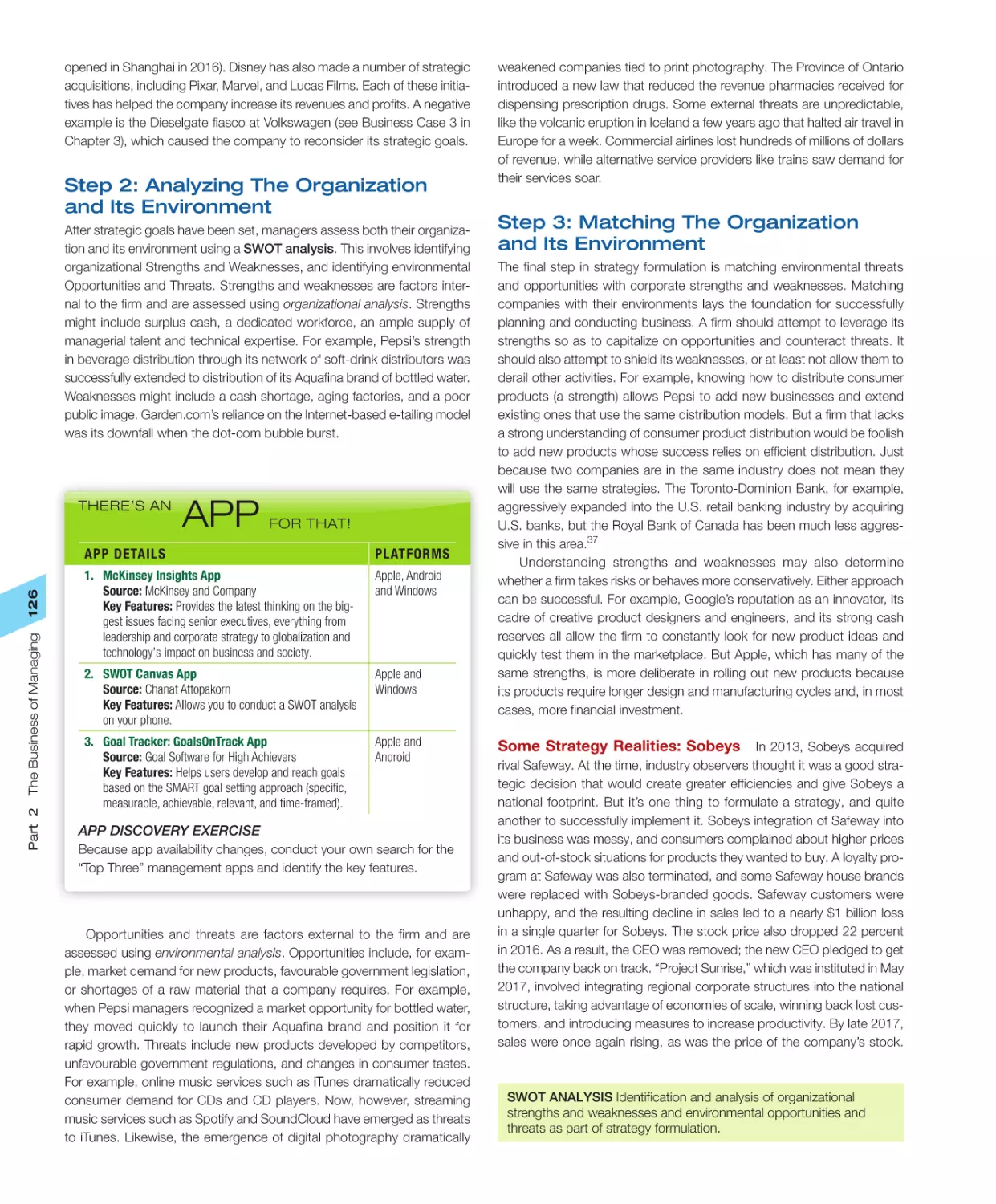
THERE’S AN
APP FOR THAT!
APP DETAILS
PLATFORMS
1. McKinsey Insights App
Source: McKinsey and Company
Key Features: Provides the latest thinking on the big-
gest issues facing senior executives, everything from
leadership and corporate strategy to globalization and
technology’s impact on business and society.
Apple, Android
and Windows
2. SWOT Canvas App
Source: Chanat Attopakorn
Key Features: Allows you to conduct a SWOT analysis
on your phone.
Apple and
Windows
3. Goal Tracker: GoalsOnTrack App
Source: Goal Software for High Achievers
Key Features: Helps users develop and reach goals
based on the SMART goal setting approach (specific,
measurable, achievable, relevant, and time-framed).
Apple and
Android
APP DISCOVERY EXERCISE
Because app availability changes, conduct your own search for the
“Top Three” management apps and identify the key features.
SWOT ANALYSIS Identification and analysis of organizational
strengths and weaknesses and environmental opportunities and
threats as part of strategy formulation.
Opportunities and threats are factors external to the firm and are
assessed using environmental analysis. Opportunities include, for exam-
ple, market demand for new products, favourable government legislation,
or shortages of a raw material that a company requires. For example,
when Pepsi managers recognized a market opportunity for bottled water,
they moved quickly to launch their Aquafina brand and position it for
rapid growth. Threats include new products developed by competitors,
unfavourable government regulations, and changes in consumer tastes.
For example, online music services such as iTunes dramatically reduced
consumer demand for CDs and CD players. Now, however, streaming
music services such as Spotify and SoundCloud have emerged as threats
to iTunes. Likewise, the emergence of digital photography dramatically
M06B_EBER8852_09_SE_C06.indd 126
1/12/19 8:07 PM
NEW & UPDATED! Boxed Inserts on Key Topics The
text contains four series of boxed inserts that are positioned at strategic
points in the chapters. The first series—E -Business and Social Media
P
a
r
t
2
T
h
e
B
u
s
i
n
e
s
s
o
f
M
a
n
a
g
i
n
g
1
5
0
demands of each unique situation. As the situation changes, the temporary
workforce changes in parallel, with some people leaving the organization and
others entering it. Facilities and subcontracted services also change. In other
words, the virtual organization exists only in response to its own needs.
Global Research Consortium (GRC) is a virtual organization. GRC
offers research and consulting services to firms doing business in Asia. As
clients request various services, GRC’s staff of three permanent employ-
ees subcontracts the work to an appropriate set of several dozen inde-
pendent consultants and/or researchers with whom it has relationships. At
any given time; therefore, GRC may have several projects under way and
20 or 30 people working in various capacities. As the projects change, so
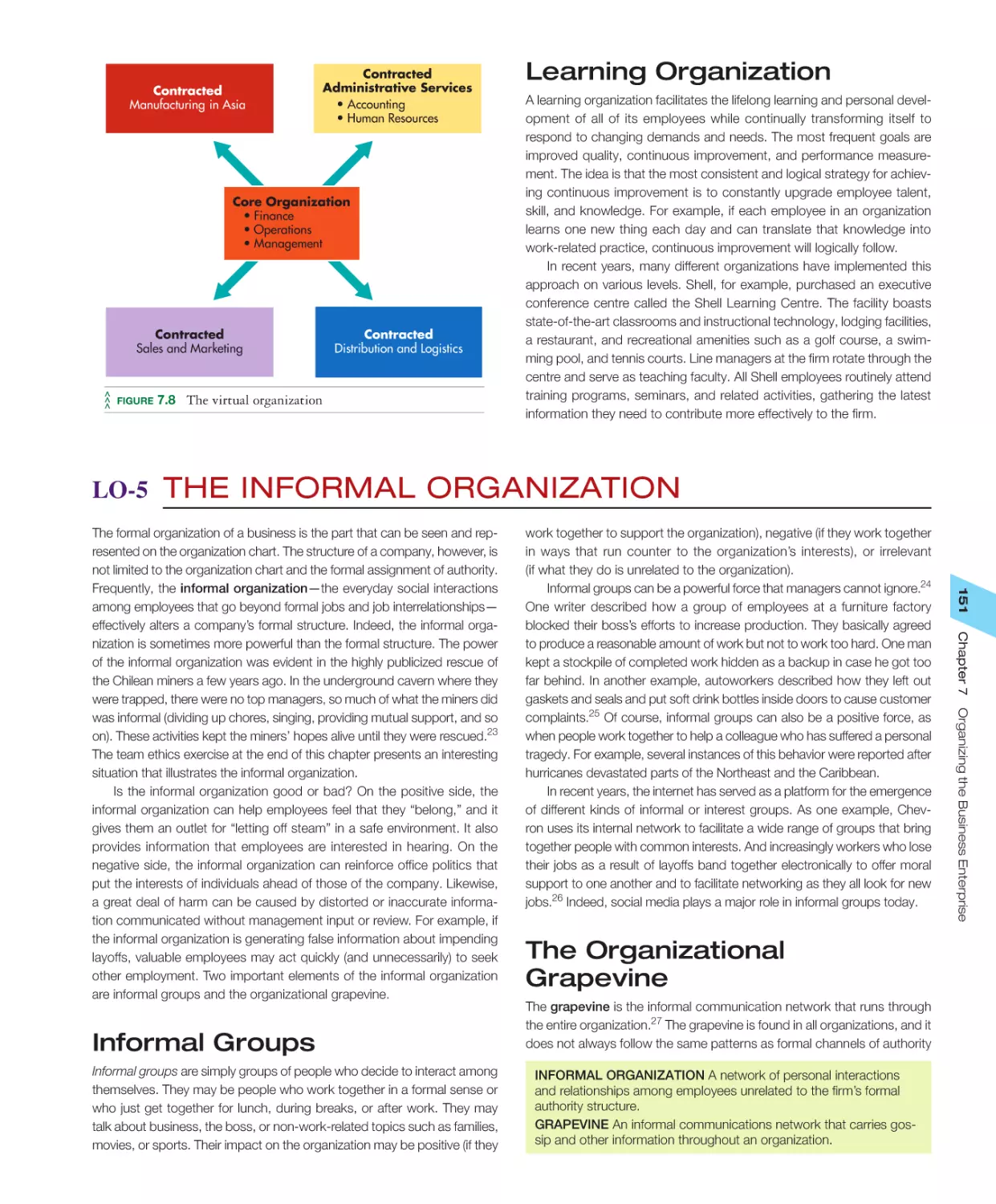
does the composition of the organization. Figure 7.8 illustrates the basic
structure of a virtual organization.
Using apps and modern technologies can help us organize our lives.
Efficient organization and communication among organization members
is vital particularly for virtual organizations. Read the following cautionary
tale in the E-Business and Social Media box entitled “‘Simon Says,’ Alexa,
What Have You Done?”
Team Organization
Team organization relies almost exclusively on project-type teams, with
little or no underlying functional hierarchy. People “float” from project to
project as dictated by their skills and the demands of those projects. At
Cypress Semiconductor, units or groups that become large are simply split
into smaller units. Not surprisingly, the organization is composed entirely
of small units. This strategy allows each unit to change direction, explore
innovative ideas, and try new methods without having to deal with a rigid
bureaucratic superstructure. Although few large organizations have reached
this level of adaptability, Apple and Xerox are among those moving toward it.
Virtual Organization
Closely related to the team organization is the virtual organization. A virtual
organization has little or no formal structure. Typically, it has only a handful of
permanent employees, a very small staff, and a modest administrative facility.
As the needs of the organization change, its managers bring in temporary
workers, lease facilities, and outsource basic support services to meet the
AND SOCIAL MEDIA SOLUTIONS
E-BUSINESS
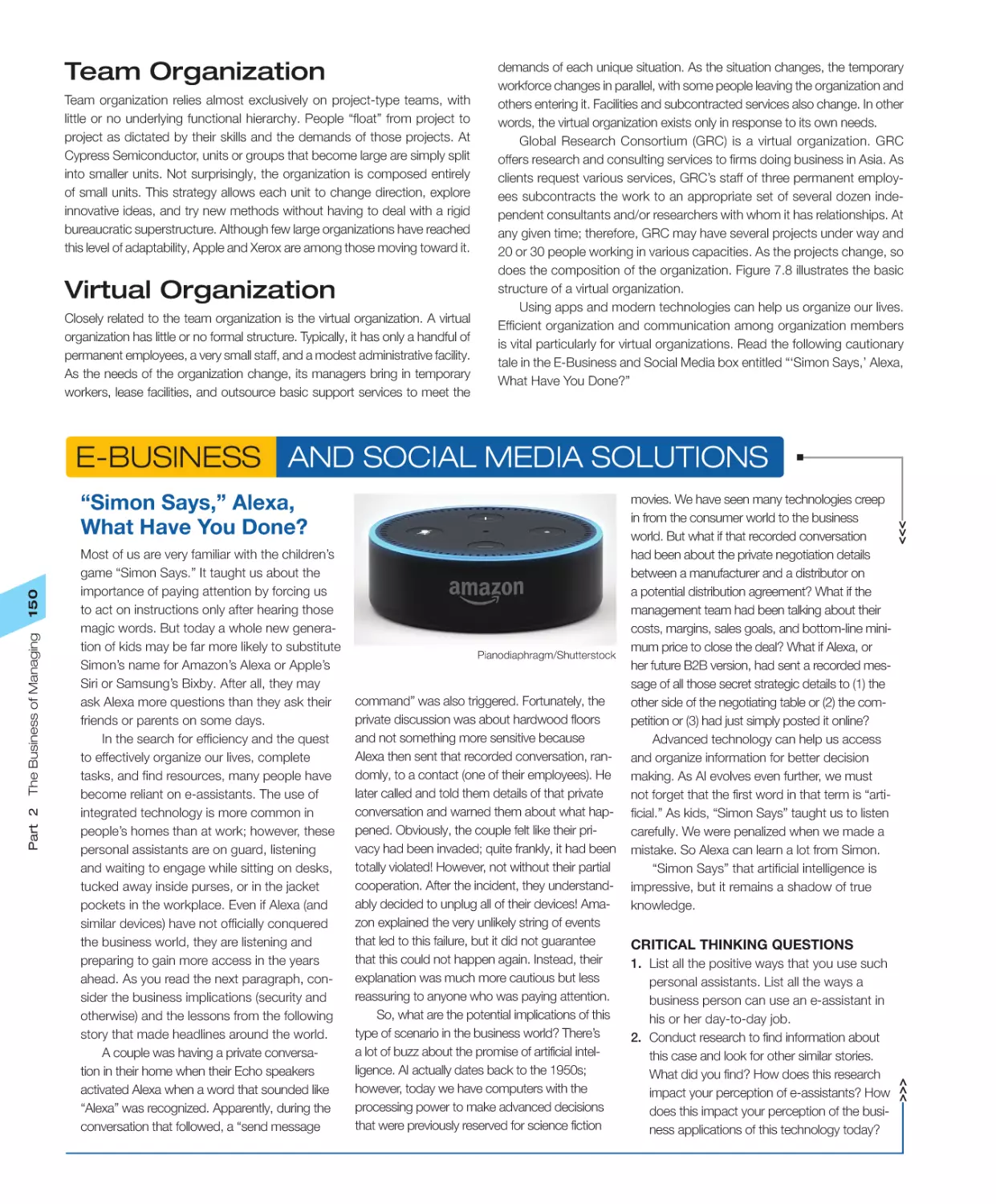
“Simon Says,” Alexa,
What Have You Done?
Most of us are very familiar with the children’s
game “Simon Says.” It taught us about the
importance of paying attention by forcing us
to act on instructions only after hearing those
magic words. But today a whole new genera-
tion of kids may be far more likely to substitute
Simon’s name for Amazon’s Alexa or Apple’s
Siri or Samsung’s Bixby. After all, they may
ask Alexa more questions than they ask their
friends or parents on some days.
In the search for efficiency and the quest
to effectively organize our lives, complete
tasks, and find resources, many people have
become reliant on e-assistants. The use of
integrated technology is more common in
people’s homes than at work; however, these
personal assistants are on guard, listening
and waiting to engage while sitting on desks,
tucked away inside purses, or in the jacket
pockets in the workplace. Even if Alexa (and
similar devices) have not officially conquered
the business world, they are listening and
preparing to gain more access in the years
ahead. As you read the next paragraph, con-
sider the business implications (security and
otherwise) and the lessons from the following
story that made headlines around the world.
A couple was having a private conversa-
tion in their home when their Echo speakers
activated Alexa when a word that sounded like
“A lexa” was recognized. Apparently, during the
conversation that followed, a “send message
command” was also triggered. Fortunately, the
private discussion was about hardwood floors
and not something more sensitive because
Alexa then sent that recorded conversation, ran-
domly, to a contact (one of their employees). He
later called and told them details of that private
conversation and warned them about what hap-
pened. Obviously, the couple felt like their pri-
vacy had been invaded; quite frankly, it had been
totally violated! However, not without their partial
cooperation. After the incident, they understand-
ably decided to unplug all of their devices! Ama-
zon explained the very unlikely string of events
that led to this failure, but it did not guarantee
that this could not happen again. Instead, their
explanation was much more cautious but less
reassuring to anyone who was paying attention.
So, what are the potential implications of this
type of scenario in the business world? There’s
a lot of buzz about the promise of artificial intel-
ligence. AI actually dates back to the 1950s;
however, today we have computers with the
processing power to make advanced decisions
that were previously reserved for science fiction
movies. We have seen many technologies creep
in from the consumer world to the business
world. But what if that recorded conversation
had been about the private negotiation details
between a manufacturer and a distributor on
a potential distribution agreement? What if the
management team had been talking about their
costs, margins, sales goals, and bottom-line mini-
mum price to close the deal? What if Alexa, or
her future B2B version, had sent a recorded mes-
sage of all those secret strategic details to (1) the
other side of the negotiating table or (2) the com-
petition or (3) had just simply posted it online?
Advanced technology can help us access
and organize information for better decision
making. As AI evolves even further, we must
not forget that the first word in that term is “arti-
ficial.” As kids, “ Simon Says” taught us to listen
carefully. We were penalized when we made a
mistake. So Alexa can learn a lot from Simon.
“Simon Says” that artificial intelligence is
impressive, but it remains a shadow of true
knowledge.
CRITICAL THINKING QUESTIONS
1. List all the positive ways that you use such
personal assistants. List all the ways a
business person can use an e-assistant in
his or her day-to-day job.
2. Conduct research to find information about
this case and look for other similar stories.
What did you find? How does this research
impact your perception of e-assistants? How
does this impact your perception of the busi-
ness applications of this technology today?
Pianodiaphragm/Shutterstock
M07_EBER8852_09_SE_C07.indd 150
1/12/19 8:14 PM
NEW! Examples of Business Practice In addition to
the boxed inserts, each chapter contains numerous examples of how
actual Canadian and international businesses operate so that students
can gain a better understanding of the dynamics of business practice in
both Canada and elsewhere. These examples—which range in length
from one sentence to several paragraphs—are in addition to the in-depth
opening cases and end-of-chapter cases that appear in each chapter.
These examples help students understand concepts that are discussed
in the text.
NEW & UPDATED! Key Terms In each chapter, the key
terms that students should know are highlighted in the text and defined
in the margin.
NEW & UPDATED! Figures and Tables The latest avail-
able data appear in tables and figures throughout the text.
END-OF-CHAPTER MATERIAL
UPDATED! Summary of Learning Objectives The
material in each chapter is concisely summarized, using the learning
objectives as the organizing scheme. This helps students understand the
main points that were presented in the chapter.
NEW & UPDATED! Two types of questions are included at the
end of each chapter: analysis questions (which require students to
A01_EBER8852_09_SE_FM.indd 16
1/14/19 8:54 PM
x
v
i
i
P
r
e
f
a
c
e
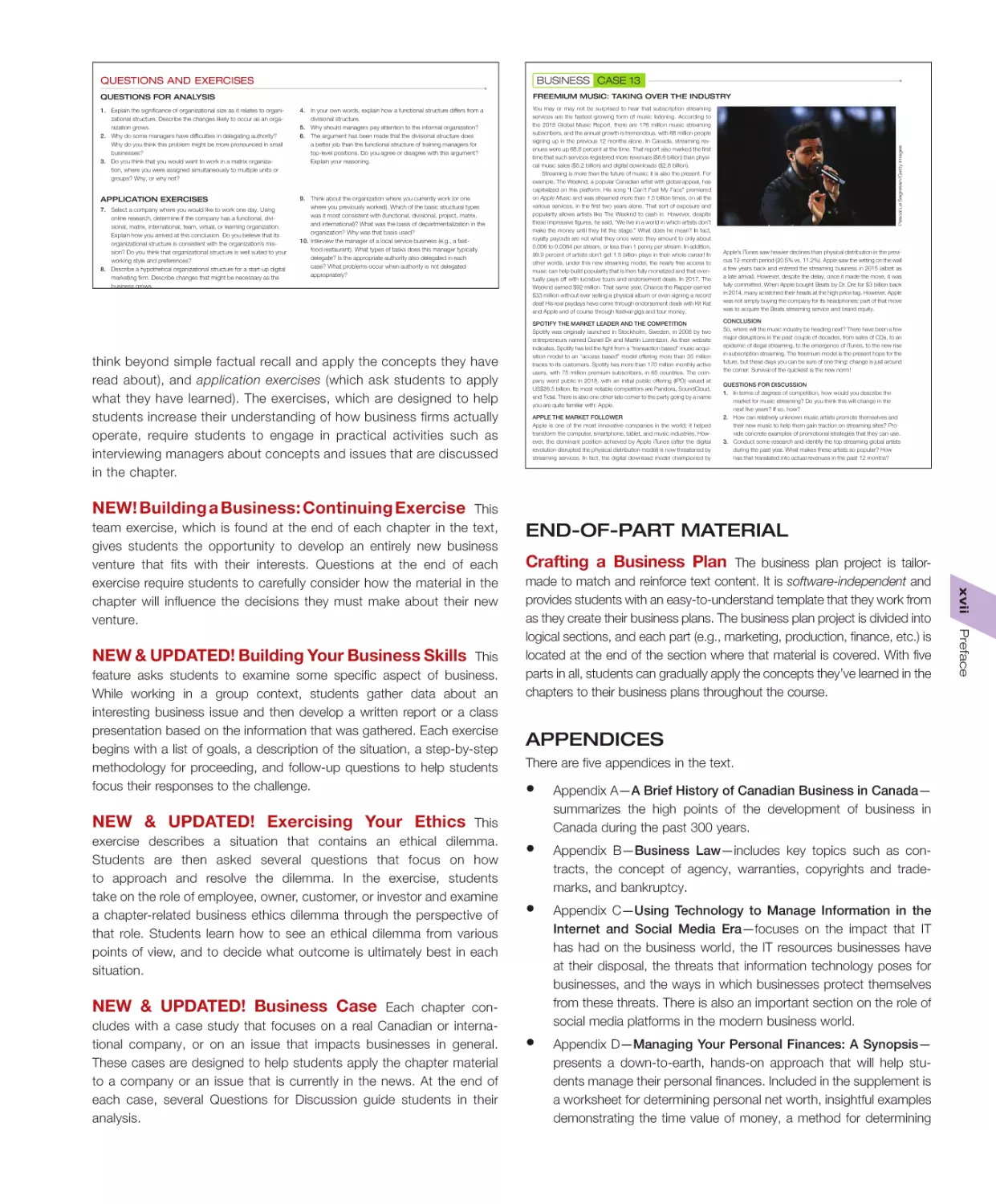
think beyond simple factual recall and apply the concepts they have
read about), and application exercises (which ask students to apply
what they have learned). The exercises, which are designed to help
students increase their understanding of how business firms actually
operate, require students to engage in practical activities such as
interviewing managers about concepts and issues that are discussed
in the chapter.
NEW! Building a Business: Continuing Exercise This
team exercise, which is found at the end of each chapter in the text,
gives students the opportunity to develop an entirely new business
venture that fits with their interests. Questions at the end of each
exercise require students to carefully consider how the material in the
chapter will influence the decisions they must make about their new
venture.
NEW & UPDATED! Building Your Business Skills This
feature asks students to examine some specific aspect of business.
While working in a group context, students gather data about an
interesting business issue and then develop a written report or a class
presentation based on the information that was gathered. Each exercise
begins with a list of goals, a description of the situation, a step-by-step
methodology for proceeding, and follow-up questions to help students
focus their responses to the challenge.
NEW & UPDATED! Exercising Your Ethics This
exercise describes a situation that contains an ethical dilemma.
Students are then asked several questions that focus on how
to approach and resolve the dilemma. In the exercise, students
take on the role of employee, owner, customer, or investor and examine
a chapter-related business ethics dilemma through the perspective of
that role. Students learn how to see an ethical dilemma from various
points of view, and to decide what outcome is ultimately best in each
situation.
NEW & UPDATED! Business Case Each chapter con-
cludes with a case study that focuses on a real Canadian or interna-
tional company, or on an issue that impacts businesses in general.
These cases are designed to help students apply the chapter material
to a company or an issue that is currently in the news. At the end of
each case, several Questions for Discussion guide students in their
analysis.
END-OF-PART MATERIAL
Crafting a Business Plan The business plan project is tailor-
made to match and reinforce text content. It is software-independent and
provides students with an easy-to-understand template that they work from
as they create their business plans. The business plan project is divided into
logical sections, and each part (e.g., marketing, production, finance, etc.) is
located at the end of the section where that material is covered. With five
parts in all, students can gradually apply the concepts they’ve learned in the
chapters to their business plans throughout the course.
APPENDICES
There are five appendices in the text.
• Appendix A—A Brief History of Canadian Business in Canada—
summarizes the high points of the development of business in
Canada during the past 300 years.
• Appendix B—Business Law—includes key topics such as con-
tracts, the concept of agency, warranties, copyrights and trade-
marks, and bankruptcy.
• Appendix C—Using Technology to Manage Information in the
Internet and Social Media Era—focuses on the impact that IT
has had on the business world, the IT resources businesses have
at their disposal, the threats that information technology poses for
businesses, and the ways in which businesses protect themselves
from these threats. There is also an important section on the role of
social media platforms in the modern business world.
• Appendix D—Managing Your Personal Finances: A Synopsis—
presents a down-to-earth, hands-on approach that will help stu-
dents manage their personal finances. Included in the supplement is
a worksheet for determining personal net worth, insightful examples
demonstrating the time value of money, a method for determining
TEAM EXERCISES
ASSIGNMENT
Meet with your team members and discuss your new business venture
within the context of this chapter. Develop specific responses to the
following:
1. Thinking ahead one year, how many employees do you expect
that you will have in your business? How did you come to this
conclusion?
2. Draw a sample organization chart for your business in one year.
Although you won’t know the names of all your employees, your
organization chart should include job titles.
3. Will decision making in your business be centralized or decentral-
ized? Be sure to support your conclusion.
4. How do you think that your organizational structure will change over
time? Will it be the same in 10 years?
BUILDING A BUSINESS: CONTINUING EXERCISE
P
a
r
t
2
T
h
e
B
u
s
i
n
e
s
s
o
f
M
a
n
a
g
i
n
g
1
5
4
1. Explain the significance of organizational size as it relates to organi-
zational structure. Describe the changes likely to occur as an orga-
nization grows.
2. Why do some managers have difficulties in delegating authority?
Why do you think this problem might be more pronounced in small
businesses?
3. Do you think that you would want to work in a matrix organiza-
tion, where you were assigned simultaneously to multiple units or
groups? Why, or why not?
4. In your own words, explain how a functional structure differs from a
divisional structure.
5. Why should managers pay attention to the informal organization?
6. The argument has been made that the divisional structure does
a better job than the functional structure of training managers for
top-level positions. Do you agree or disagree with this argument?
Explain your reasoning.
QUESTIONS AND EXERCISES
QUESTIONS FOR ANALYSIS
GOAL
To encourage students to understand the relationship between orga-
nizational structure and a company’s ability to attract and keep valued
employees.
SITUATION
You are the founder of a small but growing high-tech company that
develops new computer software. With your current workload and
new contracts in the pipeline, your business is thriving, except for one
problem—you cannot find computer programmers for product develop-
ment. Worse yet, current staff members are being lured away by other
high-tech firms. After suffering a particularly discouraging personnel raid
in which competitors captured three of your most valued employees,
you schedule a meeting with your director of human resources to plan
organizational changes designed to encourage worker loyalty. You
already pay top dollar, but the continuing exodus tells you that program-
mers are looking for something more.
METHOD
Working with three or four classmates, identify some ways in which spe-
cific organizational changes might improve the working environment and
encourage employee loyalty. As you analyze the following factors, ask
yourself the obvious question, If I were a programmer, what organiza-
tional changes would encourage me to stay?
• Level of job specialization. With many programmers describing their jobs
as tedious because of the focus on detail in a narrow work area, what
BUILDING YOUR BUSINESS SKILLS
GETTING WITH THE PROGRAM
APPLICATION EXERCISES
7. Select a company where you would like to work one day. Using
online research, determine if the company has a functional, divi-
sional, matrix, international, team, virtual, or learning organization.
Explain how you arrived at this conclusion. Do you believe that its
organizational structure is consistent with the organization’s mis-
sion? Do you think that organizational structure is well suited to your
working style and preferences?
8. Describe a hypothetical organizational structure for a start-up digital
marketing firm. Describe changes that might be necessary as the
business grows.
9. Think about the organization where you currently work (or one
where you previously worked). Which of the basic structural types
was it most consistent with (functional, divisional, project, matrix,
and international)? What was the basis of departmentalization in the
organization? Why was that basis used?
10. Interview the manager of a local service business (e.g., a fast-
food restaurant). What types of tasks does this manager typically
delegate? Is the appropriate authority also delegated in each
case? What problems occur when authority is not delegated
appropriately?
M07_EBER8852_09_SE_C07.indd 154
1/12/19 8:14 PM
P
a
r
t
4
P
r
i
n
c
i
p
l
e
s
o
f
M
a
r
k
e
t
i
n
g
3
0
8
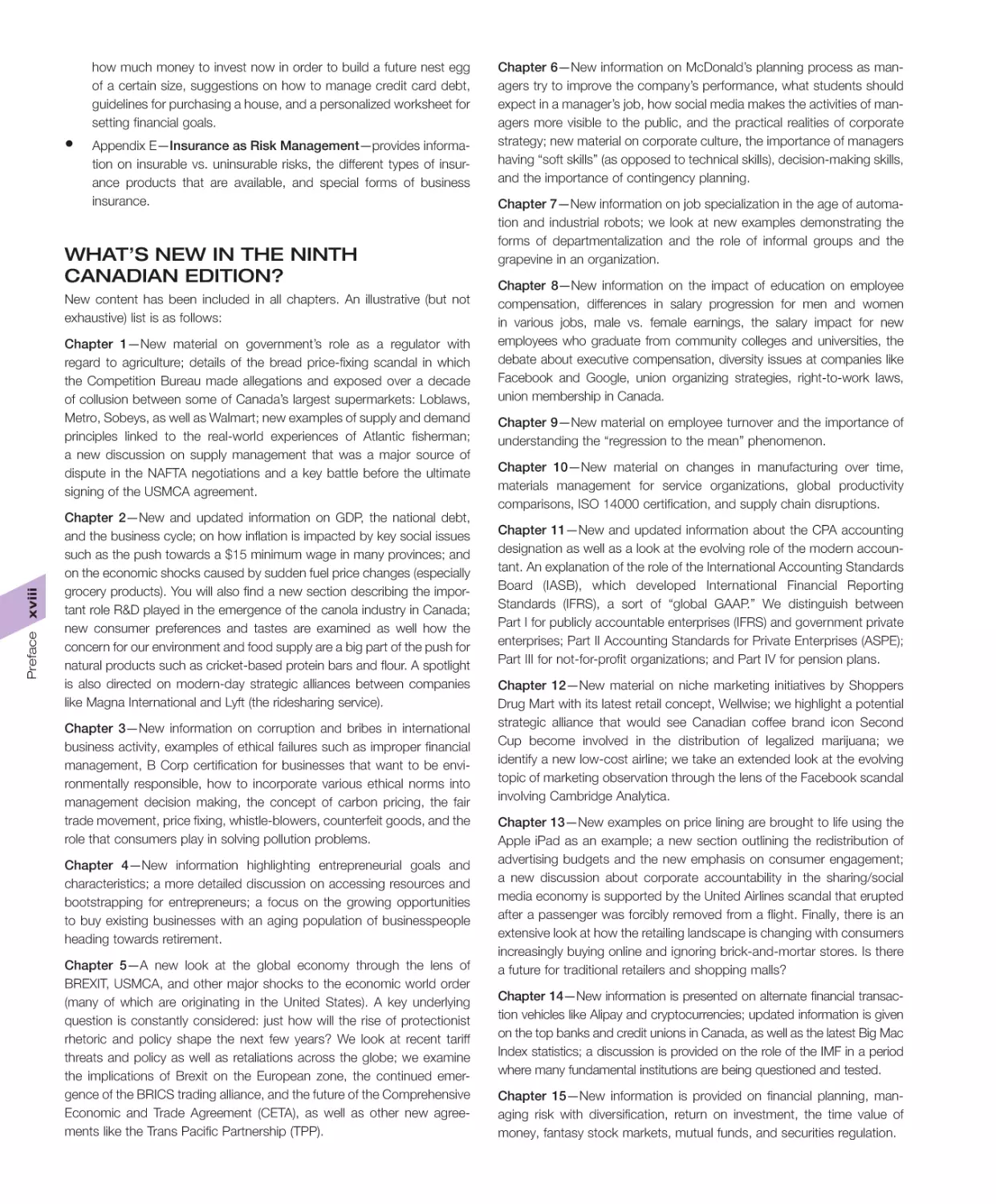
You may or may not be surprised to hear that subscription streaming
services are the fastest-growing form of music listening. According to
the 2018 Global Music Report, there are 176 million music streaming
subscribers, and the annual growth is tremendous, with 68 million people
signing up in the previous 12 months alone. In Canada, streaming rev-
enues were up 68.8 percent at the time. That report also marked the first
time that such services registered more revenues ($6.6 billion) than physi-
cal music sales ($5.2 billion) and digital downloads ($2.8 billion).
Streaming is more than the future of music; it is also the present. For
example, The Weeknd, a popular Canadian artist with global appeal, has
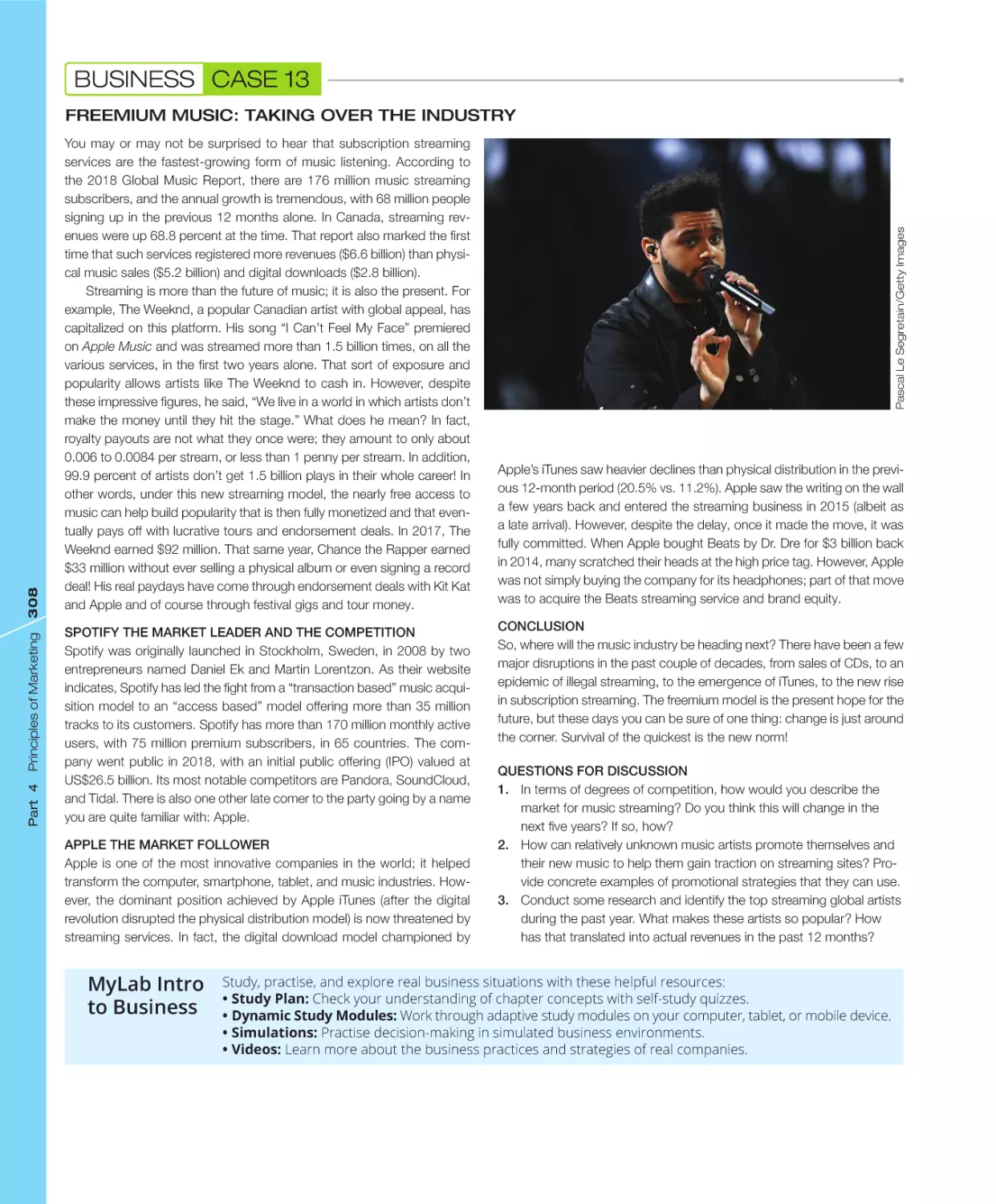
capitalized on this platform. His song “I Can’t Feel My Face” premiered
on Apple Music and was streamed more than 1.5 billion times, on all the
various services, in the first two years alone. That sort of exposure and
popularity allows artists like The Weeknd to cash in. However, despite
these impressive figures, he said, “We live in a world in which artists don’t
make the money until they hit the stage. ” What does he mean? In fact,
royalty payouts are not what they once were; they amount to only about
0.006 to 0.0084 per stream, or less than 1 penny per stream. In addition,
99.9 percent of artists don’t get 1.5 billion plays in their whole career! In
other words, under this new streaming model, the nearly free access to
music can help build popularity that is then fully monetized and that even-
tually pays off with lucrative tours and endorsement deals. In 2017, The
Weeknd ear ned $92 million. That same year, Chance the Rapper earned
$33 million without ever selling a physical album or even signing a record
deal! His real paydays have come through endorsement deals with Kit Kat
and Apple and of course through festival gigs and tour money.
SPOTIFY THE MARKET LEADER AND THE COMPETITION
Spotify was originally launched in Stockholm, Sweden, in 2008 by two
entrepreneurs named Daniel Ek and Martin Lorentzon. As their website
indicates, Spotify has led the fight from a “transaction based” music acqui-
sition model to an “access based” model offering more than 35 million
tracks to its customers. Spotify has more than 170 million monthly active
users, with 75 million premium subscribers, in 65 countries. The com-
pany went public in 2018, with an initial public offering (IPO) valued at
US$26.5 billion. Its most notable competitors are Pandora, SoundCloud,
and Tidal. There is also one other late comer to the party going by a name
you are quite familiar with: Apple.
APPLE THE MARKET FOLLOWER
Apple is one of the most innovative companies in the world; it helped
transform the computer, smartphone, tablet, and music industries. How-
ever, the dominant position achieved by Apple iTunes (after the digital
revolution disrupted the physical distribution model) is now threatened by
streaming services. In fact, the digital download model championed by
Apple’s iTunes saw heavier declines than physical distribution in the previ-
ous 12-month period (20.5% vs. 11.2%). Apple saw the writing on the wall
a few years back and entered the streaming business in 2015 (albeit as
a late arrival). However, despite the delay, once it made the move, it was
fully committed. When Apple bought Beats by Dr. Dre for $3 billion back
in 2014, many scratched their heads at the high price tag. However, Apple
was not simply buying the company for its headphones; part of that move
was to acquire the Beats streaming service and brand equity.
CONCLUSION
So, where will the music industry be heading next? There have been a few
major disruptions in the past couple of decades, from sales of CDs, to an
epidemic of illegal streaming, to the emergence of iTunes, to the new rise
in subscription streaming. The freemium model is the present hope for the
future, but these days you can be sure of one thing: change is just around
the cor ner. Survival of the quickest is the new norm!
QUESTIONS FOR DISCUSSION
1. In terms of degrees of competition, how would you describe the
market for music streaming? Do you think this will change in the
next five years? If so, how?
2. How can relatively unknown music artists promote themselves and
their new music to help them gain traction on streaming sites? Pro-
vide concrete examples of promotional strategies that they can use.
3. Conduct some research and identify the top streaming global artists
during the past year. What makes these artists so popular? How
has that translated into actual revenues in the past 12 months?
FREEMIUM MUSIC: TAKING OVER THE INDUSTRY
BUSINESS CASE 13
P
a
s
c
a
l
L
e
S
e
g
r
e
t
a
i
n
/
G
e
t
t
y
I
m
a
g
e
s
Study, practise, and explore real business situations with these helpful resources:
• Study Plan: Check your understanding of chapter concepts with self-study quizzes.
• Dynamic Study Modules: Work through adaptive study modules on your computer, tablet, or mobile device.
• Simulations: Practise decision-making in simulated business environments.
• Videos: Learn more about the business practices and strategies of real companies.
MyLab Intro
to Business
M13_EBER8852_09_SE_C13.indd 308
1/14/19 4:53 PM
A01_EBER8852_09_SE_FM.indd 17
1/14/19 8:54 PM
x
v
i
i
i
P
r
e
f
a
c
e
Chapter 6—New information on McDonald’s planning process as man-
agers try to improve the company’s performance, what students should
expect in a manager’s job, how social media makes the activities of man-
agers more visible to the public, and the practical realities of corporate
strategy; new material on corporate culture, the importance of managers
having “soft skills” (as opposed to technical skills), decision-making skills,
and the importance of contingency planning.
Chapter 7—New information on job specialization in the age of automa-
tion and industrial robots; we look at new examples demonstrating the
forms of departmentalization and the role of informal groups and the
grapevine in an organization.
Chapter 8—New information on the impact of education on employee
compensation, differences in salary progression for men and women
in various jobs, male vs. female earnings, the salary impact for new
employees who graduate from community colleges and universities, the
debate about executive compensation, diversity issues at companies like
Facebook and Google, union organizing strategies, right-to-work laws,
union membership in Canada.
Chapter 9—New material on employee turnover and the importance of
understanding the “regression to the mean” phenomenon.
Chapter 10—New material on changes in manufacturing over time,
materials management for service organizations, global productivity
comparisons, ISO 14000 certification, and supply chain disruptions.
Chapter 11—New and updated information about the CPA accounting
designation as well as a look at the evolving role of the modern accoun-
tant. An explanation of the role of the International Accounting Standards
Board (IASB), which developed International Financial Reporting
Standards (IFRS), a sort of “global GAAP.” We distinguish between
Part I for publicly accountable enterprises (IFRS) and government private
enterprises; Part II Accounting Standards for Private Enterprises (ASPE);
Part III for not-for-profit organizations; and Part IV for pension plans.
Chapter 12—New material on niche marketing initiatives by Shoppers
Drug Mart with its latest retail concept, Wellwise; we highlight a potential
strategic alliance that would see Canadian coffee brand icon Second
Cup become involved in the distribution of legalized marijuana; we
identify a new low-cost airline; we take an extended look at the evolving
topic of marketing observation through the lens of the Facebook scandal
involving Cambridge Analytica.
Chapter 13—New examples on price lining are brought to life using the
Apple iPad as an example; a new section outlining the redistribution of
advertising budgets and the new emphasis on consumer engagement;
a new discussion about corporate accountability in the sharing/social
media economy is supported by the United Airlines scandal that erupted
after a passenger was forcibly removed from a flight. Finally, there is an
extensive look at how the retailing landscape is changing with consumers
increasingly buying online and ignoring brick-and-mortar stores. Is there
a future for traditional retailers and shopping malls?
Chapter 14—New information is presented on alternate financial transac-
tion vehicles like Alipay and cryptocurrencies; updated information is given
on the top banks and credit unions in Canada, as well as the latest Big Mac
Index statistics; a discussion is provided on the role of the IMF in a period
where many fundamental institutions are being questioned and tested.
Chapter 15—New information is provided on financial planning, man-
aging risk with diversification, return on investment, the time value of
money, fantasy stock markets, mutual funds, and securities regulation.
how much money to invest now in order to build a future nest egg
of a certain size, suggestions on how to manage credit card debt,
guidelines for purchasing a house, and a personalized worksheet for
setting financial goals.
• Appendix E—Insurance as Risk Management—provides informa-
tion on insurable vs. uninsurable risks, the different types of insur-
ance products that are available, and special forms of business
insurance.
WHAT’S NEW IN THE NINTH
CANADIAN EDITION?
New content has been included in all chapters. An illustrative (but not
exhaustive) list is as follows:
Chapter 1—New material on government’s role as a regulator with
regard to agriculture; details of the bread price-fixing scandal in which
the Competition Bureau made allegations and exposed over a decade
of collusion between some of Canada’s largest supermarkets: Loblaws,
Metro, Sobeys, as well as Walmart; new examples of supply and demand
principles linked to the real-world experiences of Atlantic fisherman;
a new discussion on supply management that was a major source of
dispute in the NAFTA negotiations and a key battle before the ultimate
signing of the USMCA agreement.
Chapter 2—New and updated information on GDP, the national debt,
and the business cycle; on how inflation is impacted by key social issues
such as the push towards a $15 minimum wage in many provinces; and
on the economic shocks caused by sudden fuel price changes (especially
grocery products). You will also find a new section describing the impor-
tant role R&D played in the emergence of the canola industry in Canada;
new consumer preferences and tastes are examined as well how the
concern for our environment and food supply are a big part of the push for
natural products such as cricket-based protein bars and flour. A spotlight
is also directed on modern-day strategic alliances between companies
like Magna International and Lyft (the ridesharing service).
Chapter 3—New information on corruption and bribes in international
business activity, examples of ethical failures such as improper financial
management, B Corp certification for businesses that want to be envi-
ronmentally responsible, how to incorporate various ethical norms into
management decision making, the concept of carbon pricing, the fair
trade movement, price fixing, whistle-blowers, counterfeit goods, and the
role that consumers play in solving pollution problems.
Chapter 4—New information highlighting entrepreneurial goals and
characteristics; a more detailed discussion on accessing resources and
bootstrapping for entrepreneurs; a focus on the growing opportunities
to buy existing businesses with an aging population of businesspeople
heading towards retirement.
Chapter 5—A new look at the global economy through the lens of
BREXIT, USMCA, and other major shocks to the economic world order
(many of which are originating in the United States). A key underlying
question is constantly considered: just how will the rise of protectionist
rhetoric and policy shape the next few years? We look at recent tariff
threats and policy as well as retaliations across the globe; we examine
the implications of Brexit on the European zone, the continued emer-
gence of the BRICS trading alliance, and the future of the Comprehensive
Economic and Trade Agreement (CETA), as well as other new agree-
ments like the Trans Pacific Partnership (TPP).
A01_EBER8852_09_SE_FM.indd 18
1/14/19 8:54 PM
x
i
x
ACKNOWLEDGMENTS
Julius Bankole, University of Northern British Columbia
Barbara Dayton, Dawson College
Peter Elenakis, Marianapolis College
David Fleming, George Brown College
Wayne Greer, Nova Scotia Community College
Brent Groen, Trinity Western University
Carmen Kuczewski, Dawson College
Pauline Langlois, John Abbot College
Kathleen Rodenbury, University of Guelph
Bernie Warren, Thompson Rivers University
We owe special thanks to Scott Hardie, Portfolio Manager; John
Polanszky, Senior Content Manager; Joanne Sutherland, Content
Developer; Susan Johnson, Senior Project Manager; Melba Hopper,
copyeditor; and others at Pearson Education Canada who assisted with
the production, marketing, and sales of this edition.
We also appreciate the insights and suggestions of the following
individuals who provided feedback on the eighth edition:
A
c
k
n
o
w
l
e
d
g
m
e
n
t
s
A01_EBER8852_09_SE_FM.indd 19
1/14/19 8:54 PM
x
x
Mr. Dracopoulos also serves as a lecturer at McGill University. He
created an online pilot project, designing courses geared primarily to
aboriginal students in remote communities. He was also honoured
(among a select group) as “Professor of the Year” by a McGill University
publication for his work in the Desautels Faculty of Management. He
earned his MBA at McGill, as well as a graduate diploma in Education
and a graduate degree in Applied Management. He earned his BA at
Concordia University.
Outside his teaching career, Mr. Dracopoulos is an award-winning
entrepreneur. George does not simply write about disruptive technology.
A few years ago, he co-founded a company called Zero-Ohm Systems
after negotiating and acquiring the global licensing and manufactur-
ing rights to a patented invention (United States, Europe, and Russia)
serving the audio industry. He has successfully marketed the device at
international trade shows. In 2017 the company made a breakthrough
in Orlando, Florida, when it was honoured with the Best New Product
Technology Award at InfoComm (North America’s biggest trade show for
the AV market). In this capacity, Mr. Dracopoulos has been interviewed by
top industry media and trade publications in North America and Europe.
George is continuously engaged in executing real-world strategies.
He provides marketing and management consulting solutions (e.g.,
brand audits, customer relationship surveys, strategic consultations, and
IMC campaigns). He has also built web-based materials and training
documents for clients in various industries, including aviation/IT solutions,
publishing, and higher education. Mr. Dracopoulos has been invited
to provide motivational speeches and/or keynote addresses at events
across North America on topics such as Connecting with Millennials,
Effective Communication, and Transformational Leadership. He has
worked on various other text projects, including Business in Action, 2nd
Canadian edition (2009), co-authored with Courtland L. Bovée and John
V. Thill; and Business, 8th Canadian edition (2014), co-authored with
Ricky Griffin, Ronald J. Ebert, Frederick Starke, and Melanie Lang.
Frederick A. Starke is Emeritus Professor of Organizational
Behaviour in the Asper School of Business at the University of Manitoba.
He has taught courses in organizational behaviour, organization theory,
decision making, and marketing. He has served in several administrative
positions, including head of the Department of Business Administration
(from 1982 to 1987 and from 1989 to 1994), and as associate dean of
the Asper School of Business (from 1996 to 2005).
Dr. Starke earned his BA and MBA from Southern Illinois University
and his PhD in Organizational Behaviour from Ohio State University.
He has published research articles in scholarly journals such as
Administrative Science Quarterly, Journal of Applied Psychology,
Academy of Management Journal, Journal of Management Studies,
and Journal of Business Venturing. He has also written articles for
professional journals, such as the Journal of Systems Management,
Information Executive, and the Canadian Journal of Nursing
Administration. Dr. Starke also writes textbooks that are used by uni-
versity and community college students in business programs across
Canada. These titles include Organizational Behaviour, Business
Essentials, Management, and Business. Dr. Starke also presents
seminars on the topics of decision making and goal setting to practising
managers in both the public and private sectors.
Ronald J. Ebert is Emeritus Professor at the University of
Missouri-Columbia where he lectures in the Management Department
and serves as advisor to students and student organizations. Dr. Ebert
draws upon more than 30 years of teaching experience at schools such
as Sinclair College, University of Washington, University of Missouri,
Lucian Blaga University of Sibiu (Romania), and Consortium International
University (Italy). His consulting alliances include firms such as Mobay
Corporation, Kraft Foods, Oscar Mayer, Atlas Powder, and John Deere.
He has designed and conducted management development programs
for clients as diverse as the American Public Power Association, the
United States Savings and Loan League, and the Central Missouri
Manufacturing Training Consortium.
His experience as a practitioner has fostered an advocacy for
integrating concepts with best business practices in business educa-
tion. The five business books he has written have been translated into
Spanish, Chinese, Malaysian, and Romanian. Dr. Ebert has served as the
editor of the Journal of Operations Management. He is a past-president
and fellow of the Decision Sciences Institute. He has served as con-
sultant and external evaluator for Quantitative Reasoning for Business
Studies, an introduction-to-business project sponsored by the National
Science Foundation.
Ricky W. Griffin is Distinguished Professor of Management and
holds the Blocker Chair in Business in the Mays School of Business at
Texas A&M University. Dr. Griffin currently serves as executive associate
dean. He previously served as head of the Department of Management
and as director of the Center for Human Resource Management at
Texas A&M. His research interests include workplace aggression and
violence, executive skills and decision making, and workplace culture.
Dr. Griffin’s research has been published in journals such as Academy of
Management Review, Academy of Management Journal, Administrative
Science Quarterly, and Journal of Management. He has also served as
editor of Journal of Management. Dr. Griffin has consulted with organiza-
tions such as Texas Instruments, Tenneco, Amoco, Compaq Computer,
and Continental Airlines.
Dr. Griffin has served the Academy of Management as chair of the
organizational behaviour division. He also has served as president of the
southwest division of the Academy of Management and on the board
of directors of the Southern Management Association. He is a fellow
of both the Academy of Management and the Southern Management
Association. He is also the author of several successful textbooks, each
of which is a market leader. In addition, they are widely used in dozens
of countries and have been translated into numerous foreign languages,
including Spanish, Polish, Malaysian, and Russian.
George Dracopoulos is a member of the Business Administration
Department at Vanier College. He has served as department chairman
and is now the International Business Exchange Coordinator. In the past
15 years, George has built bridges with universities, government organi-
zations, and multinational corporations throughout France and Belgium.
Hundreds of students have benefitted from his initiatives. He is also the
co-organizer and co-founder of the national BDC/Vanier Marketing Case
Competition and was named the Vanier VIP for his dedication and devo-
tion to the community.
ABOUT THE AUTHORS
A
b
o
u
t
t
h
e
A
u
t
h
o
r
s
A01_EBER8852_09_SE_FM.indd 20
1/14/19 8:54 PM
01 INTRODUCING THE CONTEMPORARY
BUSINESS WORLD
PART
01 UNDERSTANDING THE CANADIAN BUSINESS SYSTEM 2
02 THE ENVIRONMENT OF BUSINESS 20
03 CONDUCTING BUSINESS ETHICALLY AND RESPONSIBLY 40
04 ENTREPRENEURSHIP, SMALL BUSINESS, AND NEW VENTURE
CREATION 61
05 THE GLOBAL CONTEXT OF BUSINESS 86
R
a
w
p
i
x
e
l
.
c
o
m
/
S
h
u
t
t
e
r
s
t
o
c
k
M01A_EBER8852_09_SE_P01.indd 1
1/12/19 6:20 PM
P
a
r
t
1
I
n
t
r
o
d
u
c
i
n
g
t
h
e
C
o
n
t
e
m
p
o
r
a
r
y
B
u
s
i
n
e
s
s
W
o
r
l
d
2
LO
million, which marked the ninth acquisition in a three-year
span. At the time, Anton and Ronnen were also being rec-
ognized on a list of the top 100 wealthiest people in Canada
with an estimated net worth of $1.64 billion dollars each.
So how did they go from Earth Buddies to buying iconic toy
brands? Well, have you heard of Paw Patrol or Hatchimals? Did
you play with Air Hogs or Bakugan when you were younger?
Have you recently purchased a Luvabella doll for your niece?
Do the words Meccano and Zoomer mean something to chil-
dren in your home and neighborhood? If you said yes, you have
part of your answer. If you said no to all these questions, then
where have you been? Let’s dig deeper into the full story.
Then and Now: Evolving
Models
Spin Master was founded approximately 25 years ago with
one product and a dream. Today it employs over 1500
people globally with offices in Canada, the United States,
Here’s a business success story that will inspire you. After
graduating from university, two young Canadian entrepreneurs
named Anton Rabie and Ronnen Harary formed a company
called Spin Master and were later joined by a third co-founder,
Ben Varadi. They started selling a fad product called Earth
Buddy and managed to secure some significant sales and
distribution. Never heard of it? Like all fads, it had its moment
in the sun, but eventually those sales dried up. It was a nylon
stocking, filled with sawdust, made to look like a head. It was
topped with grass seeds that grew to look like hair. For a
recent example of a big fad, think of the fidget spinner craze.
This initial success gave these entrepreneurs firsthand
experience with real-world sales, manufacturing, finance,
and accounting in an accelerated time frame as they
scrambled to meet demand. Mistakes were made but les-
sons were learned, and their passion and energy were richly
rewarded. In fact, at the beginning of 2018, Spin Master
purchased Gund, a 120-year-old stuffed toy brand for $79.1
Spin Master: Canadian Toy Maker Becomes
a Global Children’s Entertainment Company
Understanding the Canadian
Business System
AFTER READING THIS CHAPTER,
YOU SHOULD BE ABLE TO:
LO-1 Define the nature of Canadian business and identify its main goals.
LO-2 Describe different types of global economic systems according to how they
control the factors of production through input and output markets.
LO-3 Describe the interactions between business and government in Canada.
LO-4 Show how demand and supply affect resource distribution in Canada.
LO-5 Identify the elements of private enterprise and explain the various degrees of
competition in the Canadian economic system.
CHAPTER
01
Rawpixel.com/Shutterstock
M01B_EBER8852_09_SE_C01.indd 2
1/12/19 6:27 PM
C
h
a
p
t
e
r
1
U
n
d
e
r
s
t
a
n
d
i
n
g
t
h
e
C
a
n
a
d
i
a
n
B
u
s
i
n
e
s
s
S
y
s
t
e
m
3
Mexico, France, Italy, the United Kingdom, Slovakia, Poland,
Germany, Sweden, the Netherlands, China, Hong Kong,
Japan, Vietnam, and Australia.
Long-term success in any industry demands the ability
to evolve and to find new ways to satisfy customer needs. In
some ways, this task has become more difficult as modern
technologies are altering buying patterns and leaving many
established companies struggling to survive. In other ways,
this task has been greatly enhanced by modern technol-
ogy. For example, today we have YouTube influencers like
Ryan, a six-year-old toy-tester, with a following of 10.2 million
subscribers and more than 17 billion uploads of his toy
reviews. Spin Master teamed with this young millionaire (He
and his parents made more than 14 million in 2017 alone!)
to promote Soggy Doggy in a 10-minute video. That video
was viewed six million times in just two months right before
the peak holiday season.
These entrepreneurs have built an organization with the
ability to pivot and thrive in changing times. Spin Master has
received 92 Toy of The Year (TOTY) nominations and has 21
wins across a variety of product categories. As if this kind of
success was not enough, Spin Master has branched out into
the production of television series, including shows such as
Bakugan, Battle Brawlers, and the current big hit PAW Patrol,
which is broadcast in more than 160 countries and territories.
The Future
Spin Master is no longer just a toy company. It describes
itself as “a leading global children’s entertainment com-
pany that creates, designs, manufactures, licenses and
markets a diversified portfolio of innovative toys, games,
products and entertainment properties.” It’s a good thing
too. The toy industry is under tremendous pressure with
more and more children asking mom and dad for smart-
phones rather than stuffed animals at younger ages. The
recent shutdown of the iconic Toys “R” Us outlets in the
United States is yet another sign of the times. Although
much of that failure is due to the shift toward online sales,
in favor of companies like Amazon, industry experts have
estimated that this closure may further reduce toy sales by
10 percent in the United States. The future of Toys “R” Us
in Canada is also unclear.
So what does the future hold for Spin Master? Time will
tell, but with their track record of success and their diversifi-
cation experience, they clearly have the will to fight and the
capacity to meet new challenges.
QUESTIONS FOR DISCUSSION
1. Based on what you read in the preceding case, what are the
primary reasons for the long-term success of Spin Master?
2. In what ways does Spin Master demonstrate the basic
principles of business, the power of entrepreneurship and
creativity in a global economy?
3. In this chapter, we will discuss the different types of eco-
nomic systems. After reading that section, answer the fol-
lowing question. What features of the Canadian economy
helped make Spin Master’s success a reality? In what ways
would this task have been more difficult in a command
economy? Explain.
4. What are the greatest challenges facing Spin Master today?
What does the company need to do to thrive for another
25 years or more?
F
r
a
n
k
G
u
n
n
/
T
h
e
C
P
I
m
a
g
e
HOW WILL THIS HELP ME?
All businesses are subject to the influences of
economic forces. But these same economic
forces also provide smart managers and entre-
preneurs with opportunities for profits and
growth. The ideas presented in this chap-
ter will help you to better understand
(1) how managers deal with the chal-
lenges and opportunities resulting
from economic forces and (2) how
consumers deal with the chal-
lenges and opportunities of price
fluctuations.
Billion Photos/Shutterstock
M01B_EBER8852_09_SE_C01.indd 3
1/12/19 6:27 PM
P
a
r
t
1
I
n
t
r
o
d
u
c
i
n
g
t
h
e
C
o
n
t
e
m
p
o
r
a
r
y
B
u
s
i
n
e
s
s
W
o
r
l
d
4
LO-1 THE IDEA OF BUSINESS AND PROFIT
The opening Spin Master case provides an inspiring example of entre-
preneurship and a free-market economy. It shows how businesses must
evolve and stay in touch with new industry trends. It also shows how
business managers must pay attention to issues such as corporate strat-
egy, brand strategy, business–government relations, international busi-
ness opportunities, mergers, and many other concepts that you will read
about in this text.
Let’s begin by asking what you think of when you hear the word
business. Do you think of large corporations like Shoppers Drug Mart
and Walmart or smaller companies like your local supermarket or favor-
ite restaurant? Do you think about successful companies like Netflix,
CN, and Telus? Each of these firms is a business—an organization that
produces or sells goods or services to make a profit. Businesses produce
most of the goods and services that we consume, and they employ
most of the workforce in Canada. Taxes paid by businesses help support
government at all levels. In addition, businesses help support charitable
causes and provide community leadership. For example, Spin Master
has donated domestically to local causes and has even created a global
initiative called the Toy Movement; during the holiday season of 2017,
Spin Master delivered more than 45 000 toys to underprivileged children
in South Africa.1
Each year Forbes magazine evaluates and ranks 153 countries for
ease of conducting business transactions. In 2017, the United Kingdom
ranked first, followed by New Zealand, the Netherlands, Sweden, and
Canada.2
Profit is what remains after a business’s expenses have been sub-
tracted from its revenues. Profits reward the owners of businesses for
taking the risks involved in investing their time and money. Profits can be
very large if a company produces something that consumers really like.
For example, the Hunger Games series of movies have generated large
profits for Lions Gate and achieved combined total gross revenues of
approximately $1.5 billion.3
Many organizations in Canada do not try to make a profit. These not-
for-profit organizations use the funds they generate from government
grants or from the sale of goods or services to provide services to the
public. Charities, educational institutions, hospitals, labour unions, and
government agencies are examples of not-for-profit organizations. Busi-
ness principles are helpful to these not-for-profit organizations as they try
to achieve their service goals.
FACTORS OF PRODUCTION The resources used to produce
goods and services: labour, capital, entrepreneurs, and natural
resources.
ECONOMIC SYSTEM The way in which a nation allocates its
resources among its citizens.
PROFIT What remains (if anything) after a business’s expenses are
subtracted from its sales revenues.
BUSINESS An organization that seeks to earn profits by providing
goods and services.
NOT-FOR-PROFIT ORGANIZATION An organization that provides
goods and services to customers, but does not seek to make a
profit while doing so.
LO-2 ECONOMIC SYSTEMS AROUND THE WORLD
A Canadian business is different in many ways from one in China, and
both are different from businesses in Japan, France, or Argentina. A major
determinant of how organizations operate is the kind of economic system
that characterizes the country in which they do business. An economic
system allocates a nation’s resources among its citizens. Economic sys-
tems differ in terms of who owns and controls these resources, known as
the “factors of production.”
Factors of Production
The key difference between economic systems is the way in which
they manage the factors of production—the basic resources that a
country’s businesses use to produce goods and services. The factors
of production are labour, capital, entrepreneurs, natural resources, and
information.4
Labour
The people who work for a company represent the first factor of pro-
duction—labour. Sometimes called human resources, labour is the
mental and physical capabilities of people. Carrying out the business
of a huge company, such as Suncor Energy, requires a labour force
with a wide variety of skills ranging from managers to geologists to
truck drivers.
<
<
<
The Hunger Games Series has been a
huge success for Lions Gate.
Kathy Hutchins/Shutterstock
M01B_EBER8852_09_SE_C01.indd 4
1/12/19 6:27 PM
C
h
a
p
t
e
r
1
U
n
d
e
r
s
t
a
n
d
i
n
g
t
h
e
C
a
n
a
d
i
a
n
B
u
s
i
n
e
s
s
S
y
s
t
e
m
5
consumers through the Petro Canada retail brand) makes use of a wide
variety of natural resources. It obviously has vast quantities of crude oil to
process each year. But Suncor Energy also needs the land where the oil
is located, as well as land for its refineries and pipelines.
Information
Information includes the specialized knowledge and expertise of people
who work in businesses, as well as information contained in market fore-
casts and various other forms of economic data. Information is a key fac-
tor of production because, unlike land, labour, and capital, information can
be shared without being diminished. For example, if two people exchange
apples, they still each have only one apple, but if two people exchange
ideas, each person now has two ideas instead of one.5
Types of Economic Systems
Different types of economic systems manage the factors of production
in different ways. In some systems, ownership is private; in others, the
government owns the factors of production. Economic systems also
differ in the ways decisions are made about production and allocation.
A command economy, for example, relies on a centralized government
to control all or most factors of production and to make all or most pro-
duction and allocation decisions. In a market economy, individuals—
producers and consumers—make production and allocation decisions
through the mechanism of supply and demand.
The boxed insert entitled “Disruptions Are Everywhere” is the opening
box of a series that provides you with an overview of topics you will see
throughout this book and how disruptive business models are changing
the business landscape.
Capital
Capital refers to the funds required to start a business and to keep it oper-
ating and growing. For example, Petro Canada needs capital to pay for
its annual drilling costs, which run into millions of dollars each year. Major
sources of capital for businesses are personal investment by owners, the
sale of stock to investors, profits from the sale of products and services,
and funds borrowed from banks and other lending institutions.
Entrepreneurs
Entrepreneurs are people who accept the opportunities and risks involved
in creating and operating businesses. Sergey Brin and Larry Page
(Google), Mark Zuckerberg (Facebook), and Tobias Lutke (Shopify) are
well-known entrepreneurs.
Natural Resources
Natural resources include all physical resources, such as land, water,
mineral deposits, and trees. Suncor Energy (which sells products to
MARKET ECONOMY An economic system in which individuals con-
trol all or most factors of production and make all or most production
decisions.
COMMAND ECONOMY An economic system in which government
controls all or most factors of production and makes all or most pro-
duction decisions.
<
<
<
You are probably very familiar with Petro Canada, but (since
2009) the company behind the retail brand is Suncor Energy.
James Jones Jr/Shutterstock
<
<
<
Starbucks uses various factors of production, including labour (a Starbucks barista), entrepreneurs (CEO Howard Schultz), and natural
resources (such as coffee beans).
F
o
o
d
f
o
l
i
o
/
A
l
a
m
y
S
t
o
c
k
P
h
o
t
o
Z
U
M
A
P
r
e
s
s
,
I
n
c
.
/
A
l
a
m
y
S
t
o
c
k
P
h
o
t
o
P
a
u
l
W
a
r
b
u
r
t
o
n
/
A
l
a
m
y
S
t
o
c
k
P
h
o
t
o
M01B_EBER8852_09_SE_C01.indd 5
1/12/19 6:27 PM
P
a
r
t
1
I
n
t
r
o
d
u
c
i
n
g
t
h
e
C
o
n
t
e
m
p
o
r
a
r
y
B
u
s
i
n
e
s
s
W
o
r
l
d
6
e-commerce. People usually think of e-commerce as being business-
to-consumer (B2C) transactions, such as buying household goods from
Amazon for personal use. But business-to-business (B2B) transactions
far exceed B2C transactions in dollar value.
In a market economy, B2C and B2B exchanges take place without
much government involvement. To understand how a market economy
works, consider what happens when a customer goes to a fruit stand to
buy apples. Assume that one vendor is selling apples for $1 per kilogram,
Command Economies
The two basic forms of command economies are communism and social-
ism. As originally proposed by nineteenth-century German economist Karl
Marx, communism is a system in which the government owns and oper-
ates all sources of production. Marx envisioned a society in which indi-
viduals would ultimately contribute according to their abilities and receive
economic benefits according to their needs. He also expected govern-
ment ownership of production factors to be only temporary (historical
examples would tell us otherwise). During the past few decades, most
countries have abandoned communism in favor of a more market-based
economy. Even countries that still claim to be communist (e.g ., China,
Vietnam, and Cuba) now contain clear elements of a market-based econ-
omy. However, in China’s case, that should not be confused with easing of
political control. In 2018, Chinese leader Xi Jinping and his party eliminated
term limits, which gave him the potential ability to stay in power for life.
This was not a step forward toward continued reform.6
In a less extensive command economic system called socialism, the
government owns and operates only selected major industries. Smaller busi-
nesses such as clothing stores and restaurants may be privately owned.
Although workers in socialist countries can usually choose their occupations
or professions, a substantial proportion generally work for the government.
Many government-operated enterprises are inefficient because management
positions are frequently filled based on political considerations rather than on
ability. Extensive public welfare systems have also resulted in very high taxes.
Because of these factors, socialism is generally declining in popularity.7
Market Economies
A market is a mechanism for exchange between the buyers and sell-
ers of a good or service. For example, the internet is a technologically
sophisticated market that brings buyers and sellers together through
MARKET An exchange process between buyers and sellers of a
particular good or service.
COMMUNISM A type of command economy in which the govern-
ment owns and operates all industries.
Disruptions are
Everywhere!
Much has been said in the news lately about
how technological change is disrupting
traditional business practices. Of course,
disruptions have been occurring for thou-
sands of years. Think of the electric light
disrupting the whale oil business or the
automobile disrupting the wagon business.
But those changes occurred at a time when
the rate of change in society overall was
much slower than it is now. Now everything
seems to be changing all the time. Consider
what has happened in just the past couple
of decades:
• The business of travel agents was threat-
ened and severely impacted by online
reservations.
• The business of video rental (think Block-
buster) was disrupted by Netflix.
• Traditional food outlets such as Sobeys
and Loblaw’s are threatened by Amazon’s
purchase of Whole Foods.
• Uber and Lyft, the ride-hailing companies,
have created great concern among both
taxi companies and rental car companies.
• The abolition of the Canadian Wheat Board
has resulted in substantial changes in the
way crops are marketed and transported.
• The music industry has been severely dis-
rupted by file sharing and iTunes.
• Robo-advisors have disrupted the invest-
ment advice industry.
• Vaporizers and e-cigarettes have disrupted
the cigarette industry.
• Airbnb has disrupted the hotel industry.
• Self-driving cars may take the jobs of pro-
fessional drivers (taxi, delivery, long-haul).
• If electric cars become popular, the oil
industry may be disrupted because
such cars will sharply reduce the
demand for oil.
Disruption has become so common that
companies cannot ignore it. In subsequent
chapters, some of the disruptions mentioned
above will be explained in more detail. All the
changes that are occurring mean significant
improvements for consumers in the form of
new and useful products and services, but
they also pose a real threat to the financial
health of certain businesses, to the investors
who buy their stock, and to the managers and
workers who are employed by them. This is
the reality of the dynamic world of business.
CRITICAL THINKING QUESTION
Consider the following statement: The dis-
ruptions that are increasingly evident in the
Canadian economy increase stress levels and
the complexity of people’s lives. We should be
more concerned about our quality of life than
we are about new gadgets and new ways of
doing things. Do you agree or disagree with
the statement? Explain your reasoning.
IN BUSINESS
DISRUPTIONS
<
<
<
Xi Jinping is General Secretary of the Communist Party of
China, President of the People’s Republic of China, and Chair-
man of the Central Military Commission. With the recent change
in rules and the elimination of term limits, he can theoretically
remain in power until his death.
Justin Lane/Epa/Shutterstock
M01B_EBER8852_09_SE_C01.indd 6
1/12/19 6:27 PM
C
h
a
p
t
e
r
1
U
n
d
e
r
s
t
a
n
d
i
n
g
t
h
e
C
a
n
a
d
i
a
n
B
u
s
i
n
e
s
s
S
y
s
t
e
m
7
and another is charging $1.50. Both vendors are free to charge what they
want, and customers are free to buy what they want. If both vendors’
apples are of the same quality, the customer will likely buy the cheaper
ones. But if the $1.50 apples are fresher, the customer may buy them
instead. Both buyers and sellers enjoy freedom of choice.
Input and Output Markets A useful model for understanding how
the factors of production work in a pure market economy is shown in
Figure 1.1 .8 In an input market, firms buy resources from households
that supply the resources. In an output market, firms supply goods and
services in response to demand on the part of the households. The activi-
ties of these two markets create a circular flow. Ford Motor Company,
for example, buys labour directly from households, which may also sup-
ply capital from accumulated savings in the form of stock purchases.
Consumer buying patterns provide information that helps Ford decide
which models to produce and which to discontinue. In turn, Ford uses
these inputs in many ways and becomes a supplier to households when
it designs and produces various kinds of automobiles, trucks, and sport-
utility vehicles and offers them for sale to consumers.
Individuals are free to work for Ford or an alternative employer and
to invest in Ford stock or alternative forms of saving or consumption.
Similarly, Ford can create whatever vehicles it chooses and price them
at whatever value it chooses. Consumers are free to buy their next car
from Ford, Toyota, BMW, or any other manufacturer. The political basis
for the free-market economy is called capitalism, which allows private
ownership of the factors of production and encourages entrepreneurship
by offering profits as an incentive. This process contrasts markedly with
that of a command economy, in which individuals may be told where they
can and cannot work, companies may be told what they can and cannot
manufacture, and consumers may have little or no choice as to what they
purchase or how much they pay for items.
CAPITALISM An economic system in which markets decide what,
when, and for whom to produce.
OUTPUT MARKET Firms supply goods and services in response to
demand on the part of consumers.
INPUT MARKET Firms buy resources that they need in the produc-
tion of goods and services.
FIRMS
• Supply products in output markets
• Demand resources in input markets
HOUSEHOLDS
• Demand products in output markets
• Supply resources in input markets
INPUT MARKETS
Labour
Capital
Entrepreneurs
Natural resources
Information resources
OUTPUT MARKETS
Goods
Services
S
u
p
p
l
y
D
e
m
a
n
d
D
e
m
a
n
d
S
u
p
p
l
y
<<< figure 1.1 Circular flow in a
market economy
<
<
<
The People’s Republic of China has used a planned economic
model for many years but is now moving toward a mixed mar-
ket economy. But Hong Kong has been using the mixed market
model for years. These signs on a busy Hong Kong street are
promoting a variety of goods and services provided by mer-
chants along the street.
TungCheung/Shutterstock
M01B_EBER8852_09_SE_C01.indd 7
1/12/19 6:27 PM
P
a
r
t
1
I
n
t
r
o
d
u
c
i
n
g
t
h
e
C
o
n
t
e
m
p
o
r
a
r
y
B
u
s
i
n
e
s
s
W
o
r
l
d
8
Mixed Market Economies
Command and market economies are two extremes, or opposites. Most
countries rely on some form of mixed market economy that features
characteristics of both command and market economies. One trend in
mixed market economies that began back in the 1990s is privatization—
converting government enterprises into privately owned companies. In
Canada, for example, the air traffic control system was privatized, and
the federal government sold several other corporations, including Petro
Canada, Canadian National Railway, and Air Canada. The Organization
for Economic Co-operation and Development (OECD) said that Canada
Post’s monopoly should be ended, and it should be privatized.9
Deregulation means a reduction in the number of laws affecting busi-
ness activity and in the powers of governmental enforcement agencies.
A study by the Conference Board of Canada showed that deregulation
(in tandem with privatization and increased competition) caused a sharp
increase in productivity in sectors such as freight and airlines.10
THERE’S AN
APP FOR THAT!
APP DETAILS
PLATFORMS
1. The Economist App
Source: The Economist
Key Features: Free access to the editor’s top
six must-read articles; access to the full maga-
zine for subscribers.
Apple, Android,
Windows, BlackBerry
2. Khan Academy App
Source: Khan Academy Education
Key Features: More than 10 000 educational
videos with a wide selection of economics vid-
eos explaining core theory and concepts.
Apple, Android,
Windows
3. Financial Post App
Source: Postmedia Canada Network Inc.
Key Features: Up-to-date source of Canadian
business and investing news as well as market
and financial data.
Apple, Android
APP DISCOVERY EXERCISE
Because app availability changes, conduct your own search for
“top 3” economic statistics apps and identify the key features.
DEREGULATION A reduction in the number of laws affecting busi-
ness activity.
PRIVATIZATION The transfer of activities from the government to
the private sector.
MIXED MARKET ECONOMY An economic system with elements of
both a command economy and a market economy, which in prac-
tice is typical of most nations’ economies.
LO-3 INTERACTIONS BETWEEN BUSINESS
AND GOVERNMENT
In Canada’s mixed market economy, there are many important interac-
tions between business and government. The ways in which government
influences business and the ways business influences government are
described next.
How Government Influences
Business
Government plays several key roles in the Canadian economy, and each
of these roles influences business activity in some way. The roles govern-
ment plays are as follows.
Government as a Customer
The government buys thousands of different products and services from
business firms, including office supplies, office buildings, computers, bat-
tleships, helicopters, highways, water treatment plants, and management
and engineering consulting services. Many businesses depend on govern-
ment purchasing, if not for their survival, then at least for a certain level of
prosperity. Total government expenditures in 2017 were $311.3 billion.11
Government as a Competitor
The government also competes with business through Crown corpora-
tions, which are accountable to a minister of parliament for their conduct.
Crown corporations such as Hydro-Quebec and Canada Post generate
billions of dollars of revenue and account for significant economic activity
in Canada. Crown corporations exist at both provincial and federal levels.
Government as Regulator
Federal and provincial governments in Canada regulate many aspects of
business activity through administrative boards, tribunals, and commis-
sions, but there is a continuing debate about how much influence govern-
ment regulators have and how much they should have. From 1935 until
2012, the Canadian Wheat Board regulated the price of wheat and pro-
hibited farmers from selling their wheat directly to U.S . elevators. Instead,
farmers were required to sell their wheat through the Wheat Board. That
monopoly ended when the government introduced legislation to allow
farmers to sell direct. The last step in the process occurred in 2015, when
50.1 percent of the organization was sold for US$250 million to the Global
Grain Group (G3), a joint venture between the food company Bunge Ltd.
and a unit of Saudi Agricultural and Livestock Investment Co. known as
SALIC Canada Ltd. The rest of the shares were made available to farm-
ers who chose to work with the organization, which has now promised to
open new markets for farmers.12
The reasons for regulating business activity include protecting com-
petition, protecting consumers, achieving social goals, and protecting the
environment.
Promoting Competition Competition is crucial to a market econ-
omy, so government regulates business activity to ensure that healthy
M01B_EBER8852_09_SE_C01.indd 8
1/12/19 6:27 PM
C
h
a
p
t
e
r
1
U
n
d
e
r
s
t
a
n
d
i
n
g
t
h
e
C
a
n
a
d
i
a
n
B
u
s
i
n
e
s
s
S
y
s
t
e
m
9
the Toronto Real Estate Board (TREB) that its practices were anticompeti-
tive because brokers weren’t being allowed to share information over the
internet. TREB appealed, but in 2017, the courts upheld the initial ruling.18
Protecting Consumers The federal government has initiated
many programs that protect consumers. Consumer and Corporate Affairs
Canada administers many of these. Important legislation includes the
Tobacco Act (which prohibits cigarette advertising on billboards and in
stores), the Weights and Measures Act (which sets standards of accuracy
for weighing and measuring devices), the Consumer Packaging and Label-
ling Act (which stipulates labelling requirements for products), the Textile
Labelling Act (which regulates the labelling, sale, importation, and advertis-
ing of consumer textile articles), and the health care Food and Drug Act
(which prohibits the sale of food that contains any poisonous or harmful
substances).
Achieving Social Goals Social goals, which promote the well-
being of Canadian society, include things such as universal access to
health care, safe workplaces, employment insurance, and decent pen-
sions. All these goals require the interaction of business firms and the
Canadian government. But the decisions of foreign governments—as they
pursue their own social goals—can also affect Canadian businesses.
Protecting the Environment Government legislation designed to
protect the environment includes the Canada Water Act (which controls
water quality in fresh and marine waters), the Fisheries Act (which controls
the discharge of any harmful substance into water), and the Environmental
Contaminants Act (which establishes regulations for airborne substances
that are a danger to human health or the environment).
competition exists among business firms. Without these restrictions, a large
company with vast resources could cut its prices and drive smaller firms out
of the market. The guidelines for Canada’s competition policy are contained
in the Competition Act, which prohibits a variety of practices (see Table 1.1).
The Act prohibits agreements among companies that are designed
to reduce competition. Formerly, the government had to prove that such
agreements reduced competition, but recent changes to the legislation
mean that the mere existence of a conspiracy is assumed to be proof that
competition has been reduced.13 Another major change is the dramati-
cally increased fines for misleading marketing practices by corporations
(formerly $100 000 for the first offence, now $10 million).14
In recent years, Loblaws has been under the microscope as it relates
to the issue of competitive fairness. First, when Loblaws acquired Shop-
pers Drug Mart, the Competition Bureau imposed limits on how much the
company could squeeze Shoppers’ suppliers by demanding that those
suppliers reduce their prices. Loblaw was also required to sell 18 stores
and 9 pharmacies because the Bureau was concerned about anticom-
petitive practices.15 Second, in 2018, Loblaws along with six other com-
panies including Metro., Walmart, and Sobeys were accused of conspiring
to inflate the price of bread for a period stretching back over a decade.
According to the Competition Bureau, these companies committed illegal
activities that violated the Competition Act.16 Loblaws, for its part, has
apologized and also offered its customers a $25 gift card in an attempt to
recover some goodwill from upset customers. Accepting the gift card did
not remove the legal rights of those customers to participate in a class
action lawsuit against the company.17 This story will surely be in the news
for a few years to come as more legal actions are taken.
Businesses often complain that the Competition Bureau is too slow in
making decisions and that it makes decisions that are unfriendly to busi-
ness. One highly visible recent case has pitted the Competition Bureau
against the Canadian Real Estate Association (CREA). The dispute began
in 2010 when the Bureau alleged that CREA was acting in an anticompeti-
tive manner because it was refusing to allow online, low-cost real estate
brokers access to its Multiple Listing Service (MLS). The Bureau also told
Section 45
Prohibits conspiracies and combinations formed to unduly lessen competition in the production, transportation, or storage of
goods. Persons convicted may be imprisoned for up to five years, fined up to $1 million, or both.
Section 50
Prohibits illegal trade practices. A company may not, for example, cut prices in one region of Canada while selling at a higher
price everywhere else if this substantially lessens competition. A company may not sell at “unreasonably low prices” if this
substantially lessens competition. (This section does not prohibit credit unions from returning surpluses to their members.)
Section 51
Prohibits giving allowances and rebates to buyers to cover their adver tising expenses, unless these allowances are made
available propor tionally to other purchasers who are in competition with the buyer given the rebate.
Section 52
Prohibits marketing (promotion) activities that are false or misleading. Includes telemarketing activities.
Section 53
Prohibits the deceptive notice that a person has won a prize if the recipient is asked to pay money as a condition of winning
the prize.
Section 54
Prohibits charging the higher price when two prices are shown on a product.
Section 55.1
Prohibits pyramid selling (a par ticipant in the plan receives compensation for recruiting other individuals into the plan).
Section 61
Prohibits resale price maintenance. No person who produces or supplies a product can attempt to influence upward, or
discourage reduction of, the price of the good in question. It is also illegal for the producer to refuse to supply a product
to a reseller simply because the producer believes the reseller will cut the price.
Section 74
Prohibits bait-and-switch selling. No person can adver tise a product at a bargain price if there is no supply of the product
available to the consumer. (This tactic baits prospects into the store, where salespeople switch them to higher-priced goods.)
This section also controls the use of contests to sell goods and prohibits the sale of goods at a price higher than the
adver tised one.
<
<
<
table 1.1 The Competition Act
COMPETITION ACT Prohibits a variety of business practices that
lessen competition.
M01B_EBER8852_09_SE_C01.indd 9
1/12/19 6:27 PM
P
a
r
t
1
I
n
t
r
o
d
u
c
i
n
g
t
h
e
C
o
n
t
e
m
p
o
r
a
r
y
B
u
s
i
n
e
s
s
W
o
r
l
d
1
0
Problems in the Ontario
Power System
Ontario’s Green Energy Act came into effect
about a decade ago and was designed to
make the province a world leader in renew-
able energy. But things didn’t quite work out
as planned, and electricity bills for consum-
ers have doubled over the past decade. This
increase has occurred even though the cost of
generating electricity has declined to about 3
cents per kilowatt hour (kWh) due to the shale
gas revolution. The “all-in” cost of electricity
(which includes generation costs, transmis-
sion costs, and taxes) is now about 25 cents
per kWh in Ontario, but only 16.5 cents in the
United States.
Why did electricity rates go up so much in
Ontario when the cost of generating electric-
ity went down? The answer becomes clear
when we look at something called the Global
Adjustment (GA) tax, which is a surcharge that
is added on to everyone’s electric bill. This
surcharge helps to cover the costs that were
incurred as the province began its move to
green energy sources like wind and solar. The
province signed contracts that paid produc-
ers of wind-generated electricity 13.5 cents
per kWh and paid solar generators even
more. But the market price at the time was
only 2.5 cents per kWh for electricity that was
generated from traditional sources like hydro,
natural gas, and coal. The impact of the GA
has been dramatic. For example, at Automatic
Coating Inc., the bill for one sample month
showed a charge for electricity of $6500,
but the GA added about $25 000 more. In
defending its decisions, the government says
that closing coal plants saved $4.4 billion in
health care costs, and that thousands of new
jobs will be created by the move to renewable
energy. Critics reject both of these claims as
false and note that the recent cancelling of
several wind projects shows that the govern-
ment is finally accepting the fact that there
are big problems in the power generation
industry.
At the beginning of the millennium, coal
accounted for 20 percent of Ontario’s elec-
tricity supply. It seemed like a good idea to
replace coal-generated electricity with renew-
ables like solar and wind power to reduce air
pollution. So, the province decided to close all
the coal-generated power plants (the last plant
was shut down in 2014). But the business of
generating electricity is a complex one, and
organizations like Ontario’s Society of Profes-
sional Engineers have been highly critical of
the government for mismanaging the process
of changing from coal to renewables. As well,
Ontario’s auditor general has estimated that
it will cost about $130 billion to “go green”
over the next 30 years. The most general
criticism of the Ontario government is that
politics and ideology have driven decisions,
not economic analysis. Critics point out, for
example, that coal plants could have been ret-
rofitted to reduce pollution for a small fraction
of the costs that have actually been incurred
in paying subsidies to wind and solar power
companies.
CRITICAL THINKING QUESTION
1. Consider the following statement: “The
criticisms that have been levelled at the
Ontario government are unfair. While elec-
tric bills have gone up, the fact is that the
movement to green energy sources like
wind and solar is necessary to cope with
the threat of climate change. The Ontario
government has done the right thing by
protecting the long-term quality of life for
its citizens.” Do you agree or disagree with
the statement? Defend your reasoning.
<
<
<
OF BUSIINESS
THE GREENING
<
<
<
Government as a Taxation Agent
Taxes are imposed and collected by the federal, provincial, and local gov-
ernments. Revenue taxes (e.g., income taxes) are levied by governments
primarily to provide revenue to fund various services and programs. Pro-
gressive revenue taxes are levied at a higher rate on higher-income tax-
payers and at a lower rate on lower-income taxpayers. Regressive revenue
taxes (e.g., sales tax) are levied at the same rate regardless of a person’s
income. They cause poorer people to pay a higher percentage of their
income for these taxes than rich people pay. Restrictive taxes (e.g., taxes
on alcohol, tobacco, and gasoline) are levied partially for the revenue they
provide, but also because legislative bodies believe that the products in
question should be controlled.
Government as a Provider of
Incentives and Financial Assistance
Federal, provincial, and municipal governments offer incentive pro-
grams that attempt to stimulate economic development. Accord-
ing to a recent study, more than $29 billion is spent annually by the
federal government and the four largest provinces: Ontario, Quebec,
British Columbia, and Alberta.19 In one high-profile example, prov-
inces from across the nation have given hundreds of millions of dollars
in subsidies to film companies to motivate them to make major films
in their cities.20
Industry Canada offers many different programs designed to help
small businesses. The Canada Business program, for example, provides
<
<
<
Hazardous products must have warning labels to protect
consumers who use them.
Branislav/E+/Getty Images
M01B_EBER8852_09_SE_C01.indd 10
1/12/19 6:27 PM
C
h
a
p
t
e
r
1
U
n
d
e
r
s
t
a
n
d
i
n
g
t
h
e
C
a
n
a
d
i
a
n
B
u
s
i
n
e
s
s
S
y
s
t
e
m
1
1
Provincial and municipal governments provide
streets, sewage and sanitation systems, police
and fire departments, utilities, hospitals, and edu-
cation. All these activities create the kind of stabil-
ity that encourages business activity.
In public–private partnerships (called P3s), the
government pays a private sector company to build,
finance, and operate organizations such as hospi-
tals and transit lines. But studies show that P3s cost
more money than the traditional approach in which
the government puts up the money and then hires
contractors to do the necessary work.21
How Business Influences
Government
Businesses also try to influence the government by using lobbyists,
trade associations, and advertising (see Figure 1.2). A lobbyist is a
person hired by a company or industry to represent that company’s
interests with government officials. The Canadian Association of Con-
sulting Engineers, for example, regularly lobbies the federal and provin-
cial governments to make use of the skills possessed by private-sector
consulting engineers on projects such as city water systems. Some
business lobbyists have training in the industry, public relations experi-
ence, or a legal background. A few have served as legislators or gov-
ernment regulators.
The federal Lobbying Act requires lobbyists to register with the Com-
missioner of Lobbying so that it is clear which individuals are being paid
for such activity. It also sets rules for accountability and transparency
and requires lobbyists to report detailed information about their com-
munications with what are known as Designated Public Office Holders
(DPOHs).22 For many lobbying efforts, there are opposing points of view.
For example, the Canadian Cancer Society and the Tobacco Institute
present very different points of view on cigarette smoking and cigarette
advertising.
Employees and owners of small businesses that cannot afford lobby-
ists often join trade associations, which may act as an industry lobby to
influence legislation. They also conduct training programs relevant to the
industry, and they arrange trade shows at which members display their
products or services to potential customers. Most publish newsletters
featuring articles on new products, new companies, changes in owner-
ship, and changes in laws affecting the industry.
information on government programs, services, and regulations to improve
the start-up and survival rates of small- and medium-sized businesses. It
also encourages businesses to focus on sound business planning and the
effective use of market research. The Department of Foreign Affairs, Trade
and Development (DFATD) mandate helps Canadian companies doing
business internationally by promoting Canada as a good place in which
to invest and carry on business activities. It also assists in negotiating and
administering trade agreements.
Governments also offer incentives through the many services they
provide to business firms through government organizations. Examples
include the Export Development Corporation (which assists Canadian
exporters by offering export insurance against non-payment by foreign
buyers and long-term loans to foreign buyers of Canadian products),
Natural Resources Canada (which provides geological maps of Canada’s
potential mineral-producing areas), and Statistics Canada (which pro-
vides data and analysis on almost every aspect of Canadian society).
Industry Canada offers many different programs designed to help small
businesses.
There are many other government incentive programs, including
municipal tax rebates for companies that locate in certain areas, design
assistance programs, and deal with the remission of tariffs on certain
advanced technology production equipment. Government incentive pro-
grams may or may not have the desired effect of stimulating the econ-
omy. They may also cause difficulties with our trading partners, as we
shall see in Chapter 5.
Government as a Provider
of Essential Services
The various levels of government facilitate business activity through the
services they supply. The federal government provides highways, the
postal service, the minting of money, the armed forces, and statisti-
cal data on which to base business decisions. It also tries to maintain
stability through fiscal and monetary policy (discussed in Chapter 2).
Lobbyists
Advertising
Trade Associations
Business
Government
<
<
<
figure 1.2 How business influences government
TRADE ASSOCIATION An organization dedicated to promoting the
interests and assisting the members of a particular industry.
LOBBYIST A person hired by a company or an industry to represent
its interests with government officials.
LO-4 THE CANADIAN MARKET ECONOMY
Understanding the complex nature of the Canadian economic
system is essential to understanding Canadian business. In this sec-
tion, we will examine the workings of our market economy, includ-
ing markets, demand, supply, private enterprises, and degrees of
competition.
Demand and Supply in
a Market Economy
In economic terms, a market is not a specific place, like a supermarket,
but an exchange process between buyers and sellers. Decisions about
M01B_EBER8852_09_SE_C01.indd 11
1/12/19 6:27 PM
P
a
r
t
1
I
n
t
r
o
d
u
c
i
n
g
t
h
e
C
o
n
t
e
m
p
o
r
a
r
y
B
u
s
i
n
e
s
s
W
o
r
l
d
1
2
production in a market economy are the result of millions of exchanges.
How much of what product a company offers for sale and who buys it
depends on the laws of demand and supply.
The Laws of Supply and Demand
In a market economy, decisions about what to buy and what to sell are
determined primarily by the forces of demand and supply. Demand is the
willingness and ability of buyers to purchase a product or service. Supply
is the willingness and ability of producers to offer a good or service for
sale. The law of demand states that buyers will purchase (demand) more
of a product as its price drops. Conversely, the law of supply states that
producers will offer (supply) more for sale as the price rises.23
1
0
0
2
0
0
3
0
0
4
0
0
5
0
0
6
0
0
7
0
0
8
0
0
9
0
0
1
0
0
0
1
1
0
0
1
2
0
0
1
3
0
0
1
4
0
0
1
5
0
0
1
6
0
0
1
7
0
0
1
8
0
0
1
9
0
0
2
0
0
0
Quantity of Pizzas Demanded
DEMAND AND SUPPLY SCHEDULES
Price
$2
$4
$6
$8
$10
$12
$14
$16
$18
$20
Quantity of
Pizzas Demanded
2000
1900
1600
1200
1000
800
600
400
200
100
Quantity of
Pizzas Supplied
100
400
600
800
1000
1200
1300
1600
1800
2000
Demand Curve
When the price of pizza
is high, fewer people are
willing to pay for it. But
when the price goes
down, more people are
willing to buy pizza. At
the lower price, in
other words, more
people “demand”
the product.
1
0
0
2
0
0
3
0
0
4
0
0
5
0
0
6
0
0
7
0
0
8
0
0
9
0
0
1
0
0
0
1
1
0
0
1
2
0
0
1
3
0
0
1
4
0
0
1
5
0
0
1
6
0
0
1
7
0
0
1
8
0
0
1
9
0
0
2
0
0
0
$
20
19
18
17
16
15
14
13
12
11
10
9
8
7
6
5
4
3
2
1
P
r
i
c
e
o
f
P
i
z
z
a
s
$
20
19
18
17
16
15
14
13
12
11
10
9
8
7
6
5
4
3
2
1
P
r
i
c
e
o
f
P
i
z
z
a
s
Quantity of Pizzas Supplied
Supply Curve
$
20
19
18
17
16
15
14
13
12
11
10
9
8
7
6
5
4
3
2
1
P
r
i
c
e
o
f
P
i
z
z
a
s
1
0
0
2
0
0
3
0
0
4
0
0
5
0
0
6
0
0
7
0
0
8
0
0
9
0
0
1
0
0
0
1
1
0
0
1
2
0
0
1
3
0
0
1
4
0
0
1
5
0
0
1
6
0
0
1
7
0
0
1
8
0
0
1
9
0
0
2
0
0
0
Quantity of Pizzas
Supply
Curve
Demand
Curve
Profit-Maximizing
Quantity
EQUILIBRIUM PRICE
(DEMAND AND SUPPLY)
When the price of pizza is low,
more people are willing to buy
pizza. Pizza makers, however, do
not have the money to invest in
making pizzas and so they make
fewer. Supply, therefore, is
limited, and only when the
price goes up will pizza
makers be willing and
able to increase supply.
When the pizza makers increase
supply in order to satisfy demand,
there will be a point at which the
price that suppliers can charge
is the same as the price that a
maximum number of customers
is willing to pay. That point is the
market price, or equilibrium price.
<
<
<
figure 1.3 Demand and supply
Source: Adapted from Karl E. Case and Ray C. Fair, Principles of Economics, 8th ed., updated (Upper Saddle River, NJ: Prentice Hall, 2007).
SUPPLY The willingness and ability of producers to offer a good or
service for sale.
DEMAND The willingness and ability of buyers to purchase a prod-
uct or service.
MARKET An exchange process between buyers and sellers of a
particular good or service.
LAW OF SUPPLY The principle that producers will offer (supply)
more of a product as price rises.
LAW OF DEMAND The principle that buyers will purchase (demand)
more of a product as price drops.
M01B_EBER8852_09_SE_C01.indd 12
1/12/19 6:27 PM
C
h
a
p
t
e
r
1
U
n
d
e
r
s
t
a
n
d
i
n
g
t
h
e
C
a
n
a
d
i
a
n
B
u
s
i
n
e
s
s
S
y
s
t
e
m
1
3
decreases, and supply increases as price increases. When the demand
and supply curves are plotted on the same graph, the point at which
they intersect is the market price, or equilibrium price—the price at
which the quantity of goods demanded and the quantity of goods sup-
plied are equal. In Figure 1.3, the equilibrium price for pizzas is $10. At
this point, the quantity of pizzas demanded and the quantity of pizzas
supplied are the same—1000 pizzas per week.
The E-Business and Social Media Solutions box entitled “The Lucra-
tive Business of App Development” describes some of the success stories
and major players in the social media environment.
Demand and Supply Schedules
To appreciate these laws in action, consider the market for pizza in a small
town. If everyone is willing to pay $25 for a pizza (a relatively high price), the
local pizzeria will produce a large supply. If, however, everyone is willing to
pay only $5 (a relatively low price), the restaurant will make fewer pizzas.
Through careful analysis, we can determine how many pizzas will be sold
at different prices. These results, called a demand and supply schedule,
are obtained from marketing research and other systematic studies of the
market. Properly applied, they help managers understand the relationships
among different levels of demand and supply at different price levels.
Demand and Supply Curves
The demand and supply schedule can be used to construct demand and
supply curves for pizza. A demand curve shows how many products—in
this case, pizzas—will be demanded (bought) at different prices.
A supply curve shows how many pizzas will be supplied (cooked) at
different prices.
Figure 1.3 shows the hypothetical demand and supply curves for
pizzas in our illustration. As you can see, demand increases as price
MARKET PRICE (EQUILIBRIUM PRICE) Profit-maximizing price at
which the quantity of goods demanded and the quantity of goods
supplied are equal.
SUPPLY CURVE Graph showing how many units of a product will
be supplied (offered for sale) at different prices.
DEMAND CURVE Graph showing how many units of a product will
be demanded (bought) at different prices.
DEMAND AND SUPPLY SCHEDULE Assessment of the relationships
between different levels of demand and supply at different price levels.
AND SOCIAL MEDIA SOLUTIONS
E-BUSINESS
The Lucrative Business
of App Development
Snap Inc., the maker of Snapchat, joins
the ranks of notable companies started by
individuals who have resisted big buyout
offers from Facebook. Snap Inc. passed on
an offer of $3 billion for the company back in
2013, two years after the company was cre-
ated by two Stanford college roommates. As
CEO and founder, Evan Spiegel eventually
decided to sell shares to the public in the
form of an initial public offering (IPO) of stock
(listed as SNAP: NYSE) and raised almost
$5 billion establishing a market value of
$33 billion for the company.
Jack Dorsey, who founded Twitter, turned
down a $500 million offer from Facebook
and then five years later took the company
public. By the end of the day, the company
had reached a value of more than $32 billion.
But not everyone sells their shares on a stock
market in order to reap the rewards of inno-
vation. At about the same time, JackMa was
starting up Alibaba, two former employees
of Yahoo! quit their jobs, took a sabbatical,
and then applied for jobs with Facebook but
got turned down. Ever the entrepreneurs,
Jan Koum and Brian Acton saw future
opportunities in mobile apps and designed
WhatsApp—one of the first messaging appli-
cations for smartphones. In an ironic turn of
events, Facebook bought WhatsApp for a
whopping $19.3 billion.
Of course, any success in business,
whether traditional or in the social media realm,
is based on real numbers. In Snapchat’s case,
187 million people globally spend time on the
social media app every day. The Economist
reported that approximately 41 percent of
Americans aged 18 to 34 use Snapchat every
day. However, for people in emerging markets,
Snapchat’s data-intensive app is costly to
access, and it doesn’t have as wide an appeal
to the public or advertisers as Facebook or
even Twitter do. Whether Snap Inc. will be able
to withstand all the competition, only time will
tell. But the early results are promising. In fact,
Snapchat has a stronger reputation among
teenagers while companies like Facebook (that
has made gains with an older crowd) are los-
ing favour with this key demographic.
Based on the short history of social media
applications, we know that there is always
room for innovation and for a new technology
to feed a tech-savvy population increasingly
glued to their phones and devices. It’s also
true that no company can get too comfort-
able, as change is inevitable.
CRITICAL THINKING QUESTION
1. Look at the most recent statistics available
on Snapchat. Is their user base still grow-
ing? Do you believe Snapchat is gaining
popularity, or do you see another new
application eating into Snapchat’s base?
<
<
<
Snapchat is a popular photo messaging application
that allows users to share. On average 700 million
videos and photos are shared per day. Users set
a time limit of one to ten seconds for their snaps.
After that time, the message is deleted.
Z
o
o
m
T
e
a
m
/
F
o
t
o
l
i
a
M01B_EBER8852_09_SE_C01.indd 13
1/12/19 6:27 PM
P
a
r
t
1
I
n
t
r
o
d
u
c
i
n
g
t
h
e
C
o
n
t
e
m
p
o
r
a
r
y
B
u
s
i
n
e
s
s
W
o
r
l
d
1
4
rewards can vary greatly between seasons. Cape Breton fisherman Albert
Sampson and his crew brought in over $500 000 worth of lobsters in one
two-month season a couple of years ago. That was a particularly good
year because the high demand for lobsters meant that he received $8 per
pound, whereas he had received only $5.75 to $6.00 per pound the previ-
ous year. The supply is dependent on the overall catch of all fisherman,
but when it comes to demand, many factors are at play. For example,
the relative weakness of the Canadian dollar helped increase demand
and contributed to higher prices for Albert and his fellow fisherman that
season.25
Surpluses and Shortages
What would happen if the owner tried to increase profits by making
more pizzas to sell? Or what if the owner wanted to reduce overhead,
cut back on store hours, and reduce the number of pizzas offered for
sale? In either case, the result would be an inefficient use of resources.
For example, if the restaurant supplies 1200 pizzas and tries to sell them
for $10 each, 200 pizzas will not be purchased. The demand schedule
clearly shows that only 1000 pizzas will be demanded at this price.
The pizza maker will therefore have a surplus—a situation in which the
quantity supplied exceeds the quantity demanded. The restaurant will
thus lose the money that it spent making those extra 200 pizzas.
Conversely, if the pizzeria supplies only 800 pizzas, a shortage will
result, because the quantity demanded will be greater than the quantity
supplied. The pizzeria will “lose” the extra money it could have made by
producing 200 more pizzas. Even though consumers may pay more for piz-
zas because of the shortage, the restaurant will still earn lower profits than
it would have if it had made 1000 pizzas. In addition, it may risk angering
customers who cannot buy pizzas. To optimize profits, therefore, all busi-
nesses must constantly seek the right combination of price charged and
quantity supplied. This “right combination” is found at the equilibrium point.
These supply and demand ideas apply to all sorts of commodities. The
price of expensive truffles (an edible root) is also affected by the weather.
Prices declined from about $5000 a pound to $2000 a pound in 2014
because good growing conditions caused large harvests of the product
(more supply). That price declined as low as $1200 per pound in the next
two years. However, in 2017 an unusually hot summer in Italy led to the
worst crop in a decade, and with a minimal supply available, the price
jumped back up to $4000 per pound.24
Atlantic fisherman must deal with supply and demand conditions.
Even if they bring in a similar total catch from one year to the next, the
SURPLUS Situation in which quantity supplied exceeds quantity
demanded.
LO-5 PRIVATE ENTERPRISE AND COMPETITION
Market economies rely on a private enterprise system—one that allows
individuals to pursue their own interests with minimal government restric-
tion. Private enterprise requires the presence of four elements: private
property rights, freedom of choice, profits, and competition.
• Private property. Ownership of the resources used to create wealth is
in the hands of individuals.26
• Freedom of choice. You can sell your labour to any employer you
choose. You can also choose which products to buy, and producers
can usually choose whom to hire and what to produce.
• Profits. The lure of profits (and freedom) leads some people to abandon
the security of working for someone else and to assume the risks of
entrepreneurship. Anticipated profits also influence individuals’ choices
of which goods or services to produce.
• Competition. Competition is evident when two or more businesses vie
for the same resources or customers. While profits motivate individuals
to start businesses, competition motivates them to operate their busi-
nesses efficiently. Competition forces businesses to make products
better and/or cheaper.
Degrees of Competition
Economists have identified four basic degrees of competition within a
private enterprise system: perfect competition, monopolistic competition,
oligopoly, and monopoly.
Perfect Competition
In perfect competition, all firms in an industry are small, the number of
firms in the industry is large, and the products produced by the differ-
ent firms are virtually identical. Under these conditions, no single firm is
powerful enough to influence prices, so the market forces of supply and
demand determine them. Canadian agriculture is a good example of per-
fect competition. The wheat produced on one farm is the same as that
on another. Both producers and buyers are aware of prevailing market
prices. It is relatively easy to start producing wheat and relatively easy to
stop when it is no longer profitable.
Monopolistic Competition
In monopolistic competition, there are fewer sellers, but many buyers.
Businesses may be large or small, and small clothing stores, for example,
can compete successfully with large apparel retailers such as Reitmans.
Whatever their size, sellers try to make their products at least seem dif-
ferent from those of competitors, and this product differentiation (through
PRIVATE ENTERPRISE An economic system characterized by pri-
vate property rights, freedom of choice, profits, and competition.
PERFECT COMPETITION A market or industry characterized by a
very large number of small firms producing an identical product so
that none of the firms has any ability to influence price.
<
<
<
Atlantic fisherman are all very familiar with the
power of supply and demand.
Kevin Galvin/imageBROKER/Shutterstock
M01B_EBER8852_09_SE_C01.indd 14
1/12/19 6:27 PM
C
h
a
p
t
e
r
1
U
n
d
e
r
s
t
a
n
d
i
n
g
t
h
e
C
a
n
a
d
i
a
n
B
u
s
i
n
e
s
s
S
y
s
t
e
m
1
5
of dollars annually in recent years.28 There have been repeated calls to end its
monopoly on letters weighing less than 500 grams (competition from compa-
nies such as FedEx and UPS is allowed for parcels and express mail). During
the10 years since it became a Crown corporation, Canada Post has raised its
rates by 41 percent. By contrast, postal rates have dropped in countries where
the post office has been privatized (e.g., Germany and the Netherlands).29
Producers in several industries in Canada operate under a system
called supply management, which has some of the characteristics of a
monopoly. Domestic production quotas are established for commodities
such as dairy products, maple syrup, eggs, chickens, and turkeys. Pro-
ducers of these commodities are not allowed to produce more than the
quota they have been granted. To prevent foreign competitors from enter-
ing the market, high tariffs are charged on imports of these commodities
(e.g., the tariff on butter is 299 percent, on cheese 246 percent, and on
milk 241 percent).30 The supply management system continues to oper-
ate despite evidence that it increases costs to consumers, encourages
smuggling, reduces innovation, and inhibits exports.
The recent North American Free Trade Agreement renegotiation talks
put supply management back on the front pages. An article in MacLean’s
magazine put it this way: “Why Is Canada Jeopardizing NAFTA to Protect
13,500 Farmers?” Not only did the United States repeatedly point to the
dairy, poultry, and egg producers supply system, but this issue was also
a sticking point in the Trans-Pacific trade negotiations. In addition, this is
not simply an issue with foreign governments; many opponents exist within
Canada. One study estimated that supply management leads to approxi-
mately $399 in extra food costs annually, and because these extra amounts
are attached to basic goods, they hit low-income families particularly hard.31
Clearly, supply management creates artificial barriers and is anti-free
trade. Yet the Canadian government refuses to eliminate this system. The
US maintains similar “America First:” policies that also go against the spirit
of free trade. Despite these positions, in late 2018, Canada signed the
newly named USMCA ( NAFTA 2.0). In order to make the deal, the Cana-
dian government agreed to further open up the dairy market by 3.59% to
American Dairy farmers (this topic will be discussed in detail in chapter 5).
traditional media advertising, social media, and other brand-building tools)
gives sellers some control over prices. For instance, even though a shirt
sold at The Bay (from a fairly unknown brand) may look pretty much like a
Ralph Lauren Polo shirt, the latter can be priced $20 higher.
Oligopoly
When an industry has only a handful of very large sellers, an oligopoly
exists. Entry into an oligopolistic market is difficult because large capital
investment is usually necessary. Thus oligopolistic industries (such as the
automobile, rubber, and steel industries) tend to stay oligopolistic.
Companies in an oligopoly market have more control over their strat-
egies than monopolistically competitive firms do, but the actions of one
firm can significantly affect the sales of every other firm in the industry. For
example, when one firm cuts prices or offers incentives to increase sales,
the others usually protect sales by doing the same. Likewise, when one
firm raises prices, others generally follow. Therefore the prices of com-
parable products are usually similar. Ultimately, the firms usually realize
that they are better off fighting for market share on features and benefits
rather than price. In simple terms, cooperation in this industry leads to
better profits for all. Overly aggressive actions (especially price cuts) hurt
all companies in an oligopoly industry.
To understand oligopoly competition, look no further than your game
console. Nintendo, Sony, and Microsoft have been going head-to-head
for years. The industry was worth US$36.2 billion in 2017. These three
major console manufacturers literally own that market. Sony leads the
pack (main console: PS4), Microsoft is second (main console: Xbox One),
and Nintendo ranks third.27
Monopoly
When an industry or market has only one producer, a monopoly exists. Being
the only supplier gives a firm complete control over the price of its product.
Its only constraint is how much consumer demand will fall as its price rises. In
Canada, laws such as the Competition Act forbid most monopolies. So-called
natural monopolies—such as provincial electric utilities—are closely watched
by provincial utilities boards, and the assumption that there is such a thing as
a natural monopoly is increasingly being challenged. For example, the volume
of mail that Canada Post handles has declined, and it has been losing millions
MONOPOLISTIC COMPETITION A market or industry character-
ized by a large number of firms supplying products that are similar
but distinctive enough from one another to give firms some ability to
influence price.
OLIGOPOLY A market or industry characterized by a small number
of very large firms that have the power to influence the price of their
product and/or resources.
MONOPOLY A market or industry with only one producer that can
therefore set the prices of its products and resources.
<
<
<
Reitmans was founded in 1926 and serves Canadian men and
women with 640 stores under the following retail banners:
Reitmans, Penningtons Addition Elle, Thyme Maternity,
RW&CO., and Hyba.
JHVEPhoto/Shutterstock
<
<
<
Nintendo, Sony, and Microsoft exemplify oligopoly conditions in
the game console industry, as these three literally own the market.
Robtek/Shutterstock
M01B_EBER8852_09_SE_C01.indd 15
1/12/19 6:27 PM
SUMMARY OF
LEARNING
OBJECTIVES
LO-1 DEFINE THE NATURE OF CANADIAN BUSINESS AND IDENTIFY ITS
MAIN GOALS.
Businesses are organizations that produce or sell goods or services to make a profit.
Profits are the difference between a business’s revenues and expenses. The prospect
of earning profits encourages individuals and organizations to open and expand busi-
nesses. The benefits of business activities also extend to wages paid to workers and
to taxes that support government functions.
LO-2 DESCRIBE DIFFERENT TYPES OF GLOBAL ECONOMIC SYSTEMS
ACCORDING TO HOW THEY CONTROL THE FACTORS OF
PRODUCTION THROUGH INPUT AND OUTPUT MARKETS.
An economic system is a nation’s system for allocating its resources among its citi-
zens. Economic systems differ in terms of who owns or controls the five basic factors
of production: labour, capital, entrepreneurs, natural resources, and information. In
command economies, the government controls all or most of these factors. In market
economies, which are based on the principles of capitalism, individuals and busi-
nesses control the factors of production and exchange them through input and output
markets. Most countries today have mixed market economies that are dominated by
one of these systems but include elements of the other. The processes of deregulation
and privatization are important means by which many of the world’s planned econo-
mies are moving toward mixed market systems.
LO-3 DESCRIBE THE INTERACTIONS BETWEEN BUSINESS AND
GOVERNMENT IN CANADA.
Government plays many important roles within the Canadian economic system, and
in so doing, it influences business firms. Government can play the role of customer,
competitor, regulator, taxation agent, provider of incentives, and provider of essential
services. Businesses can influence government by lobbying, joining trade associa-
tions, and trying to convince voters to support or oppose certain regulations.
LO-4 SHOW HOW DEMAND AND SUPPLY AFFECT RESOURCE
DISTRIBUTION IN CANADA.
The Canadian economy is strongly influenced by markets, demand, and supply.
Demand is the willingness and ability of buyers to purchase a good or service. Supply
is the willingness and ability of producers to offer goods or services for sale. Demand
and supply work together to set a market or equilibrium price—the price at which the
quantity of goods demanded and the quantity of goods supplied are equal.
LO-5 IDENTIFY THE ELEMENTS OF PRIVATE ENTERPRISE AND EXPLAIN
THE VARIOUS DEGREES OF COMPETITION IN THE CANADIAN
ECONOMIC SYSTEM.
The Canadian economy is founded on the principles of private enterprise: private
property rights, freedom of choice, profits, and competition. Degrees of competi-
tion vary because not all industries are equally competitive. Under conditions of
pure competition, numerous small firms compete in a market governed entirely by
demand and supply. In monopolistic competition, there are fewer sellers, and each
one tries to make its product seem different from the products of competitors. An
oligopoly involves only a handful of sellers who compete with each other. A monopoly
involves only one seller.
P
a
r
t
1
I
n
t
r
o
d
u
c
i
n
g
t
h
e
C
o
n
t
e
m
p
o
r
a
r
y
B
u
s
i
n
e
s
s
W
o
r
l
d
1
6
M01B_EBER8852_09_SE_C01.indd 16
1/12/19 6:27 PM
C
h
a
p
t
e
r
1
U
n
d
e
r
s
t
a
n
d
i
n
g
t
h
e
C
a
n
a
d
i
a
n
B
u
s
i
n
e
s
s
S
y
s
t
e
m
1
7
TEAM EXERCISES
Build a team of three to five classmates. You will be working with this
team throughout the semester to make decisions about the launch of a
new product.
ASSIGNMENT
Meet with your team members and develop specific responses to the
following:
1. Have each team member work individually to identify at least three
trends that will create business opportunities. Come together as a
group and create a master list of trends.
2. Which trend do you think creates the greatest opportunity for suc-
cess? Why?
3. Identify a product, either a good or a service, that will allow your
team to take advantage of this opportunity. Although you will refine
this throughout the semester, write a four- to six-sentence descrip-
tion of your product and how it will spark buyer interest.
4. Who is your competition for this product, either direct competi-
tion or substitute products? Is competition a good sign for your
business?
BUILDING A BUSINESS: CONTINUING EXERCISE
1. Give an example of a situation in which a surplus of a product led to
decreased prices. Similarly, give an example of a situation in which
a shortage led to increased prices. What eventually happened in
each case? Why?
2. The Canadian government has provided export assistance to Bom-
bardier Inc. with its Technology Transfer Program. Is this consistent
with the principles of a free market system? Explain how this might
distort the system.
3. Explain how current economic indicators, such as inflation and
unemployment, affect you personally. Explain how they may affect
you as a manager.
4. Familiarize yourself with a product or service that is sold under condi-
tions of pure competition. Explain why it is an example of pure com-
petition and identify the factors that make it so. Then do the same for
a product in each of the other three competitive situations described
in the chapter (monopolistic competition, oligopoly, and monopoly).
5. Government plays a variety of roles in the Canadian mixed economy
(customer, regulator, taxation agent, provider of services, and so on).
Consider each of the roles discussed in this chapter and state your
view as to whether government involvement in each role is exces-
sive, insufficient, or about right. What criteria did you use to make
your assessments?
QUESTIONS AND EXERCISES
QUESTIONS FOR ANALYSIS
GOAL
To encourage students to understand how competition affects a prod-
uct’s price.
SITUATION
Assume that you are the owner of a local gym and fitness studio. You’ve
worked hard to build a loyal customer base, and your facility is top-
notch, with the latest equipment and a variety of classes for customers
at all fitness levels. Within your geographical area, there are three other
gyms, each charging the same price ($40 per month for individuals,
$60 per month for couples, and $75 per month for families). However,
you’ve become concerned because one of your competitors has just
announced that it is reducing membership costs by $10 per month
for each of the three categories of memberships. Rumour has it that
another facility plans to follow suit in the near future. You can’t afford to
get into a price war because you are just barely making a profit at your
current price structure.
METHOD
Divide into groups of four or five people. Each group is to develop a
general strategy for handling competitors’ price changes. In your dis-
cussion, take the following factors into account:
• how the demand for your product is affected by price changes
• the number of competitors selling the same or a similar product
• the methods—other than price—you can use to attract new custom-
ers and retain current customers
BUILDING YOUR BUSINESS SKILLS
ANALYZING THE PRICE OF DOING BUSINESS
APPLICATION EXERCISES
6. Visit a local shopping mall or shopping area. List each store that you
see and determine what degree of competition it faces in its imme-
diate environment. For example, if there is only one store in the mall
that sells shoes, that store represents a monopoly. Note those busi-
nesses with direct competitors (e.g., two jewellery stores) and show
how they compete with one another.
7. Pick a specific product that you use. Explain how the factors of pro-
duction work together to make that product available.
8. Interview a business owner or senior manager. Ask this individual to
describe for you the following things: (1) how demand and supply
affect the business, (2) what essential factors of production are most
central to the firm’s operations, and (3) how fluctuations in economic
indicators affect his or her business.
M01B_EBER8852_09_SE_C01.indd 17
1/12/19 6:27 PM
P
a
r
t
1
I
n
t
r
o
d
u
c
i
n
g
t
h
e
C
o
n
t
e
m
p
o
r
a
r
y
B
u
s
i
n
e
s
s
W
o
r
l
d
1
8
“Google is not a conventional company. We do not intend to become
one.” The co-founders also said: “As part of that, we also said that you
could expect us to make ‘smaller bets in areas that might seem very
speculative or even strange when compared to our current businesses.’
From the start, we’ve always strived to do more, and to do important
and meaningful things with the resources we have.” Sergey Brin and
Larry Page represent the fundamental idea and driving force behind the
company that now has over 80 000 employees worldwide and that has
created multiple platforms that satisfy consumer needs, such as Search,
Gmail, Google Maps, and Chrome. The co-founders recently chose to
reorganize and name their new holding company Alphabet because they
felt that it held a dual meaning, as a collection of letters that represent
language and as a reference to the investment term alpha (returns above
a benchmark).
Just as you observed in our opening case, the co-founders met at
university (Who’s sitting next to you now?). They were graduate students in
computer science. At the time, Page was working on a software develop-
ment project designed to create an index of websites by scouring sites for
keywords and other links. Brin joined him on the project, and when they
were satisfied that they’d developed something with commercial value,
they tried to license the technology to other search companies. Fortu-
nately, they couldn’t find a buyer and settled instead for finding enough
investment capital to keep refining and testing their product.
At the turn of the century, Brin and Page ran across the description
of a business model based on the concept of selling advertising in the
form of sponsored links and search-specific ads. They adapted it to their
own concept and went into business for themselves, eventually building
Google into the world’s largest search engine. But their ambitions and
ALPHABET: G IS FOR GOOGLE
BUSINESS CASE 1
ANALYSIS
Develop specific pricing strategies based on each of the following
situations:
• A month after dropping prices by $10 per month, one of your com-
petitors returns to your current pricing level.
• Two of your competitors drop their prices even further, reducing
membership costs by a further $5 per month. As a result, your busi-
ness falls off by 25 percent.
• One of your competitors announces that it will keep its prices low,
but it will charge members $2 per session for high-demand classes
such as Pilates.
• Each of the competitors that lowered their price makes an adjust-
ment, with reduced rates for families and couples, but they plan to
return to $40 per month for singles.
• All four providers (including you) have reduced their monthly fees.
One gym goes out of business, and you know that another one is in
poor financial health.
FOLLOW-UP QUESTIONS
1. Discuss the role that various inducements other than price might
play in affecting demand and supply in the market.
2. Is it always in a company’s best interest to feature the lowest
prices?
3. Eventually, what form of competition is likely to characterize this
market?
THE SITUATION
You are the owner of a small company that provides heating oil to residen-
tial and business customers in Central Canada. The business has been in
your family for several generations, and you are a well-respected member
of the community.
Although the business had once provided a steady income for you
and your family, increased energy efficiency and a move away from oil heat
have cut your profits to almost nothing in recent years.
THE DILEMMA
After the retirement of your long-time marketing manager, you’ve hired
a recent college graduate named Seema. She has analyzed your firm’s
financial position, as well as the most up-to-date demographic and
market information. In the prior heating season, oil prices were quite
high, and your customers became accustomed to paying more than
$1.15 per litre. You’ve done your research, though, and know that it’s
very likely that the price that you must pay suppliers will be much lower
EXERCISING YOUR ETHICS
GETTING CAUGHT OUT IN THE COLD
this winter because of an increase in the supply of heating oil as more
and more customers in other geographic areas switch to natural gas.
While you’re hoping to pass these cost savings on to your customers,
Seema is recommending just the opposite. She proposes that you send
out a “special offer” to your customers, allowing them to lock into a
price of $1.05 per litre for the upcoming heating season, although you
think that you could sell profitably at a much lower price. She believes
that many of your customers will jump at the opportunity and that you
will be able to make a significant profit during the upcoming winter. On
the one hand, it would be nice to generate a large profit and rebuild
your savings, but on the other hand, you’re wondering if this is really
the right thing to do.
QUESTIONS TO ADDRESS
1. What are the roles of supply and demand in this scenario?
2. What are the underlying ethical issues?
3. What would you do if you were faced with this situation?
M01B_EBER8852_09_SE_C01.indd 18
1/12/19 6:27 PM
C
h
a
p
t
e
r
1
U
n
d
e
r
s
t
a
n
d
i
n
g
t
h
e
C
a
n
a
d
i
a
n
B
u
s
i
n
e
s
s
S
y
s
t
e
m
1
9
innovations didn’t stop there.
By 2018, they had purchased
well over 200 companies,
such as Android, YouTube,
and DoubleClick, always striv-
ing to further their mission: to
organize the world’s informa-
tion and make it universally
accessible and useful. To bet-
ter separate all the different
directions the business had
taken, Brin and Page created a
holding company called Alpha-
bet in 2015 and turned the
control of Google over to an
up-and-coming star manager
named Sundar Pichai. Alpha-
bet’s annual revenue rose to
US$110.9 billion in 2017 (up approximately 23%), as Google, its major sub-
sidiary, provided more than 80 percent of the world’s search market.
Brin and Page have been extremely effective in attracting talented, cre-
ative employees, like Pichai, and providing them with a work environment
and culture that fosters productivity and innovation. They’ve also remained at
the forefront of Alphabet’s search for innovations, but nobody knows for
sure what Brin and Page have on the drawing board. In fact, outsid-
ers—notably potential investors—often criticize Google for being a “black
box” whereas they want a few more details on the company’s long-range
strategy. “We don’t talk about our strategy,” explains Page, “... because
it’s strategic. I would rather have people think we’re confused than let our
competitors know what we’re going to do.”
One of the reasons for
creating Alphabet was to pro-
vide greater transparency,
but the company seems to
have missed that mark. What
we do know is that Alpha-
bet’s semi-secret research
facility “X,” also known as
the “moonshot factory,”
is currently working on a self-
driving car, fuel from sea-
water, and other long-shot,
innovative projects that may
or may not pan out. If there is
a long-term strategic vision,
it may be simply to provide
the resources and freedom
to some of the best and
brightest dreamers in the world and then to let their ideas develop into
the reality of the future.35
QUESTIONS FOR DISCUSSION
1. What are the secrets to Google’s success? What role, if any, did
luck play?
2. Describe the factors of production as they relate to Alphabet. How does
this example demonstrate the foundations of free market economies?
3. What role do governments play in the day-to-day operations of a
company like Alphabet? Describe some of the ways governments
can help this global organization as well as ways that governments
may hurt this organization.
Study, practise, and explore real business situations with these helpful resources:
• Study Plan: Check your understanding of chapter concepts with self-study quizzes.
• Dynamic Study Modules: Work through adaptive study modules on your computer, tablet, or mobile device.
• Simulations: Practise decision-making in simulated business environments.
• Videos: Learn more about the business practices and strategies of real companies.
MyLab Intro
to Business
M
a
r
k
L
e
n
n
i
h
a
n
/
E
a
r
n
s
A
l
p
h
a
b
e
t
/
T
h
e
C
P
I
m
a
g
e
s
M01B_EBER8852_09_SE_C01.indd 19
1/12/19 6:27 PM
P
a
r
t
1
I
n
t
r
o
d
u
c
i
n
g
t
h
e
C
o
n
t
e
m
p
o
r
a
r
y
B
u
s
i
n
e
s
s
W
o
r
l
d
2
0
LO-1 Explain the concepts of organizational boundaries and multiple organizational
environments.
LO-2 Explain the importance of the economic environment to business and identify
the factors used to evaluate the performance of an economic system.
LO-3 Describe the technological environment and its role in business.
LO-4 Describe the political–legal environment and its role in business.
LO-5 Describe the socio-cultural environment and its role in business.
LO-6 Identify emerging challenges and opportunities in the business environment.
LO-7 Understand recent trends in the redrawing of corporate boundaries.
LO The Environment of Business
AFTER READING THIS CHAPTER,
YOU SHOULD BE ABLE TO:
accept credit cards. The dollar store is now also the $4 store;
more than 67 percent of company sales now come from prod-
ucts priced above $1.25.
Dollarama Origins
How did this story take shape? Dollarama was founded in
1992 by Larry Rossy, but arguably this success goes back to
1910 when his grandfather Salim Rossy opened his first shop,
S-Rossy Inc. Larry Rossy earned his stripes running that family
business from 1973 to 1992. As a third-generation member of
this business dynasty, Larry Rossy drew on a wealth of knowl-
edge and experience in the retail trade, which he applied as the
founder and chairman of Dollarama in 1992. Like most business
success stories, the key ingredients to Dollarama’s success
were an innate ability to understand an ever-changing external
environment; good, timely decisions; and strong execution.
Off-price retailers have always been in the market-
place, but Dollarama was formed to embrace the dollar
Quick, look at these numbers. In 2018, Dollarama had 1160
retail locations across Canada, with annual sales of $3.27
billion and a total market capitalization of $13 billion. The stock
had already appreciated 1800 percent since going public
nine years earlier! Are you impressed yet? You should be. At
a time when retailers are struggling, Dollarama continues to
grow and exceed market expectations. In 2018, revenues
were up 10 percent, and same-store sales (a key retail metric)
increased by 5.5 percent, while average customer transac-
tions increased by 5.8 percent. Profits were also up 17 percent
(at $519 million). At the time, Dollarama had also announced
a 3-for-1 stock split. Those who invested in Dollarama shares
at the initial public offering were richly rewarded. Plenty of ana-
lysts still predicted more sustained growth ahead. Irene Nan-
tel, from RBC Dominion Securities, believed the stock could
continue to appreciate in the15-to-20-percent growth range.
Such positive reviews were based largely on projections of
more store openings, higher price points, and the decision to
Growth and Success: A Few Dollars at a Time
02
CHAPTER
Rawpixel.com/Shutterstock
M02_EBER8852_09_SE_C02.indd 20
1/12/19 6:57 PM
C
h
a
p
t
e
r
2
T
h
e
E
n
v
i
r
o
n
m
e
n
t
o
f
B
u
s
i
n
e
s
s
2
1
retail concept that was gaining prominence across North
America at the time. Later, in 2009 when Dollarama went
public with a stock market IPO, the economy was suffering,
and consumers were scrambling for low-price solutions. The
timely funding gave the company more financial tools to
expand and establish a dominant place in Canadian retail.
Dollarama satisfied the low-cost, no-frills niche and created
a mega-success in the process. After presiding over the rise
of the Dollarama empire, Larry Rossy officially stepped down
in 2018 passing the reins to his son Neil Rossy (CEO and
fourth-generation retailer) and Stephen Gunn (chairman).
Competition, Always
Threatening
Success inevitably leads to new competition. Dollarama
already has plenty of domestic dollar stores to contend with,
but a new entry into the Canadian landscape threatens to
put up a real fight. Miniso, based out of Japan, recently
opened a handful of stores with plans to open 50 in British
Columbia, Alberta, Quebec, and Ontario by the end of
2018. It also announced ambitious intentions to open 500
locations across Canada by the end of 2021.
According to CEO Neil Rossy, “The retail environment
is relatively stable. It is always very competitive. Competitors
enter, and others leave.” Dollarama has found a way to meet
all challenges. That does not mean the company is resting on
its previous success. In 2018, Dollarama invested heavily in
its e-commerce platform to begin selling some of its products
in bulk online. In addition, it was also adding new technology,
giving associates hand-held scanners to improve efficiency,
while also adding smart cameras in stores. A new emphasis
was placed on analytic tools to help improve merchandising
and identify risks. In addition, Dollarama was in the process of
doubling the size of its primary distribution centre to 500,000
square feet by the end of 2019.
Looking Abroad?
Foreseeing the upper limits of your potential expansion may
be a difficult exercise in that everyone wants to imagine that
the good times will continue forever, but there are limits to
growth. Perhaps the future of Dollarama’s story lies in inter-
national markets. With that in mind, Dollarama has already
forged a relationship to sell products to Dollar City, which
has 77 stores in El Salvador and Columbia. Dollarama has
an option to buy the Latin American chain in 2020. Is this
the beginning of a new phase?
Legal Questions and
Government Challenges
International markets are a definite path to consider for
growth, but such moves bring new challenges from foreign
governments looking to protect local interests. Moreover,
Dollarama faces legal issues at home; it has not always lived
a squeaky-clean life in Canada. It is notorious for selling
knock-off products such as “Might be Mars” chocolates and
look-alike Milk-Bone treats for dogs. In fact, Dixon, maker of
the classic yellow HB pencils that we all used in elementary
school, is suing Dollarama for blatantly copying its product.
Should Dollarama be worried? Well, the Canadian govern-
ment did update its counterfeit laws in 2015 and promised a
tougher stance. However, because of a lack of enforcement,
the new laws have not changed practices so far. In one recent
year, only 50 shipments were seized at Canadian customs for
counterfeiting, whereas 36,500 shipments were seized in the
United States. If the government decides to get aggressive in
this matter, it may force Dollarama to make changes.
Moving Forward
According to Dollarama’s own estimates, it is near the per-
ceived saturation point for new stores in Canada. However,
new competitors are entering from abroad. Will Dollarama
rethink that maximum? The company is also looking at new
K
a
t
h
y
d
e
W
i
t
t
/
A
l
a
m
y
S
t
o
c
k
P
h
o
t
o
M02_EBER8852_09_SE_C02.indd 21
1/12/19 6:57 PM
P
a
r
t
1
I
n
t
r
o
d
u
c
i
n
g
t
h
e
C
o
n
t
e
m
p
o
r
a
r
y
B
u
s
i
n
e
s
s
W
o
r
l
d
2
2
LO-1 ORGANIZATIONAL BOUNDARIES
AND ENVIRONMENTS
technology to help build bulk sales. If indeed the company
is nearing a saturation point in Canada, it is not yet clear
where the future resources will be placed. To continue this
run of growth, the company will need to do what it has done
in the past. Its leaders must ensure that they are effectively
analyzing the external environment and executing strategies
to take advantage of the key emerging trends. Based on
their track record, it is hard to bet against them.
QUESTIONS FOR DISCUSSION
1. What are the biggest competitive challenges to long-term
success and profitability for Dollarama?
2. How do the external factors other than competition
(economy, technology, socio-cultural, and political–legal)
impact Dollarama?
3. Form a group of four to six people and divide them into two
groups. One group will provide arguments in favour of inter-
national expansion. The other group will prepare opposing
arguments. Debate the main points.
EXTERNAL ENVIRONMENT Everything outside an organization’s
boundaries that might affect it.
All businesses, regardless of their size, location, or mission, operate within
a larger external environment that plays a key role in determining their suc-
cess or failure. The external environment consists of everything outside an
organization that might affect it. Managers must understand the key features
of the external environment and then operate proactively to compete within it.
The opening case on Dollarama is a great example of a company that under-
stood external forces and made strategic decisions to exploit opportunities.
To better explain the environment of business, we begin by discuss-
ing organizational boundaries and multiple organizational environments.
Organizational Boundaries
An organizational boundary separates the organization from its environ-
ment. Consider the simple case of a neighbourhood grocery store that
includes a retail customer area, a storage room, and the owner or manag-
er’s office. In many ways, the store’s boundary coincides with its physical
structure; when you walk through the door, you’re crossing the boundary
into the business, and when you leave and return to the sidewalk, you
<<<
Bauer has been around since 1927, and in that time, it has
adjusted to many external shocks (especially technological and
economic ones). It has not been all smooth sailing in recent
years, but the new owners, Peak Achievement Athletics, are
monitoring the environment to meet the needs of consumers
of a brand that’s synonymous with hockey.
HOW WILL THIS HELP ME?
By understanding the material in this chapter,
you’ll be better able to assess (1) the impact
that events outside a business can have on its
owners and managers, (2) how envi-
ronmental change impacts you as a
consumer, and (3) the challenges
and opportunities that environ-
mental change provides to you
as an employee or an investor.
Flashon Studio/Shutterstock
A
l
e
x
B
r
a
n
d
o
n
/
A
P
i
m
a
g
e
s
M02_EBER8852_09_SE_C02.indd 22
1/12/19 6:57 PM
C
h
a
p
t
e
r
2
T
h
e
E
n
v
i
r
o
n
m
e
n
t
o
f
B
u
s
i
n
e
s
s
2
3
Multiple Organizational
Environments
Organizations have multiple environments. Some conditions, such as cur-
rent economic conditions, affect the performance of almost every busi-
ness. But other environmental dimensions are much more specific. The
neighbourhood grocery store, for example, will be influenced not only by
an increase in unemployment in its area but also by the pricing and other
marketing activities of its nearest competitors.
Figure 2.1 shows the major elements of the external environment:
economic conditions, technology, political–legal considerations, social
issues, the global environment, issues of ethical and social responsibility,
the business environment itself, and emerging challenges and opportuni-
ties. We will cover ethical and global issues in detail in Chapters 3 and
5, respectively, so here we discuss ethical and global issues only as they
relate directly to the other areas covered in this chapter.
cross the boundary back into the environment. But this is an oversimpli-
fication. During the business day, distributors of soft drinks, snack foods,
ice, and bread products may enter the store, inventory their products,
and refill coolers and shelves just as though they were employees. These
distributors are normally considered part of the environment rather than
the organization, but while inside the store, they are essentially part of
the business. Customers may even assume these distributors are store
employees and ask them questions as they restock shelves.
Now consider cases of large domestic businesses (e.g., GM Canada)
that are owned by even larger international corporations (e.g ., U.S .-based
General Motors). Domestic businesses have complex networks of relation-
ships with other businesses. For example, Magna International conducts
research and builds components for GM. GM Canada also deals with
companies that supply tires, glass, steel, and engines. But GM Canada
also functions within the boundaries of its international parent, which has
its own network of business relationships, some overlapping and some
distinct from GM Canada’s network.
AGGREGATE OUTPUT Total quantity of goods and services
produced by an economic system during a given period.
ECONOMIC ENVIRONMENT Conditions of the economic system
in which an organization operates.
BUSINESS CYCLE Pattern of short-term ups and downs
(expansions and contractions) in an economy.
GROSS DOMESTIC PRODUCT (GDP) Total value of all goods
and services produced within a given period by a national economy
through domestic factors of production.
LO-2 THE ECONOMIC ENVIRONMENT
The economic environment refers to the conditions of the economic sys-
tem in which an organization operates.1 In recent years, the economic envi-
ronment has been characterized by low growth, fairly low unemployment
rates, and low inflation. During periods of rising unemployment, people
are less likely to make unnecessary purchases, and they may delay the
purchase of a new car or new furniture. The fear of a potential job loss or
an uncertain pay cheque is a very powerful enemy of the economy. It’s only
rational to reduce your spending in tougher times, but this also means that
less needs to be produced, which can ultimately lead to more job losses
for the economy. In a positive economic period, momentum pushes unem-
ployment down as consumers spend more.
Despite low overall inflation, rising costs (i.e., from labour laws increas-
ing minimum wage) have put economic pressure on businesses in many
sectors. Restaurants and grocery stores have increased prices, reduced
shifts, or reduced package sizes to compete. For example, Loblaws raised
the price of its President’s Choice Granola cereal from $4.99 to $5.79,
while shrinking the package from 800 to 750 grams.2 As seen in the open-
ing case, many companies that cater to low-cost interests of consumers,
such as Dollarama and Costco, thrive in the tough economic times as
consumers search for cheaper prices.
Economic Growth
At one time, about half of the Canadian population was involved in pro-
ducing the food that we eat. Today, approximately 2.1 percent of the
population works in agriculture, mainly because agricultural efficiency has
improved so much that far fewer people are needed to produce the food
we need.3 We can therefore say that agricultural production has grown
because the total output of the agricultural sector has increased. We can
apply the same idea to a nation’s economic system, but the computations
are much more complex, as we will see.
Aggregate Output and the Standard
of Living
How do we know whether an economic system is growing? The main
measure of growth is aggregate output: the total quantity of goods and
services produced by an economic system during a given period.4 To put
it simply, an increase in aggregate output is economic growth.5 When
output grows more quickly than the population, two things usually follow:
output per capita (the quantity of goods and services per person) goes
up, and the system provides relatively more of the goods and services that
people want.6 And when these two things occur, people living in an eco-
nomic system benefit from a higher standard of living—the total quantity
and quality of goods and services they can purchase with the currency
used in their economic system.
The Business Cycle
The growth (and contraction) pattern of short-term ups and downs in an
economy is called the business cycle. It has four recognizable phases:
peak, recession, trough, and recovery (see Figure 2.2). A recession is usu-
ally defined as two consecutive quarters when the economy shrinks, but
it is probably more helpful to say that a recession starts just after the peak
of the business cycle is reached and ends when the trough is reached.7 A
depression occurs when the trough of the business cycle extends two or
more years. Periods of expansion and contraction can vary from several
months to several years.
Gross Domestic Product and Gross
National Product
The term gross domestic product (GDP) refers to the total value of all goods
and services produced within a given period by a national economy through
M02_EBER8852_09_SE_C02.indd 23
1/12/19 6:57 PM
P
a
r
t
1
I
n
t
r
o
d
u
c
i
n
g
t
h
e
C
o
n
t
e
m
p
o
r
a
r
y
B
u
s
i
n
e
s
s
W
o
r
l
d
2
4
GDP is now the key measure of economic growth because it tracks
an economy’s performance over time. However, some argue that such
measures are flawed. According to one study, more attention should be
paid to other indicators, such as rising debt. An article in The Economist
even referred to GDP as a “grossly deceptive product.”
12
Real Growth Rates GDP is the preferred method of calculating
national income and output. The real growth rate of GDP—the growth
rate of GDP adjusted for inflation and changes in the value of the country’s
currency—is what counts. Remember that growth depends on output
increasing at a faster rate than population. If the growth rate of GDP
exceeds the rate of population growth, then our standard of living should
be improving.
domestic factors of production. Canada’s GDP in 2017 was $2.1 trillion.8
According to Statistics Canada, that represented a 3 percent increase, which
was the best result in six years.9 Global GDP was approximately $76 trillion;
the top five countries were the United States, China, Japan, Germany, and
the United Kingdom.10 If GDP rises, a nation experiences economic growth.
GDP measures all business activity within a nation’s borders, and it
has widely replaced gross national product (GNP), which refers to the
total value of all goods and services produced by a national economy
within a given period regardless of where the factors of production are
located. For example, Bombardier is a Canadian company that manufac-
tures planes and trains and has a total of 73 production and engineering
facilities spread across 28 countries.11 All the manufacturing that occurs
in its foreign plants (including Kansas, Mexico, Ireland, and Morocco) is
included in the Canadian GNP but not in its GDP—because its output
is not produced in Canada. Conversely, those figures are included in
the GDP of those nations (United States, Mexico, Ireland, and Morocco,
respectively) but not their GNP—because the output is produced inside
their borders by a Canadian company.
GROSS NATIONAL PRODUCT (GNP) Total value of all goods and
services produced by a national economy within a given period
regardless of where the factors of production are located.
Economic
Environment
Political–Legal
Environment
Technological
Environment
Global Business
Environment
The Business Organization
Socio-cultural
Environment
Business
Environment
Emerging
Challenges and Opportunities
• Outsourcing
• The Growing Role of Social Media
• Business Process Management
<
<
<
figure 2.1 Dimensions of the external environment
M02_EBER8852_09_SE_C02.indd 24
1/12/19 6:57 PM
C
h
a
p
t
e
r
2
T
h
e
E
n
v
i
r
o
n
m
e
n
t
o
f
B
u
s
i
n
e
s
s
2
5
it takes 1 Canadian worker and 50 Canadian dollars to
make 10 pairs of leather boots in an 8-hour workday.
Let’s also say that it takes 1.2 Spanish workers and the
equivalent of $60 (in euros, the official currency used in
Spain) to make 10 pairs of equivalent leather boots in
the same 8-hour workday. We can say, then, that the
Canadian boot manufacturing industry is more pro-
ductive than the Spanish boot manufacturing industry.
The two factors of production in this simple case
are labour and capital. According to the Organisa-
tion for Economic Co-operation and Development
(OECD) rankings, Canada stood in sixteenth place
with a productivity ratio of 48.9 percent. Ireland,
Luxembourg, and Norway were the most produc-
tive nations at 83.1, 81.2, and 79.2 percent, respec-
tively.15 If more products are being produced with
fewer factors of production, what happens to the
prices of these products? They go down. Therefore
as a consumer, you will need less of your currency to
purchase the same quantity of these products. Thus
your standard of living—at least with respect to these
products—has improved.
The Balance of Trade and
the National Debt
Several factors can help or hinder the growth of an
economic system, but here we focus on just two of
them: balance of trade and the national debt.
Balance of Trade The balance of trade is the economic value of
all the products that a country exports minus the economic value of its
imported products. For decades, Canada had a positive balance of trade.
For example, from 2006 to 2008, Canada received $43 to $47 billion more
from exports than it spent on imports annually, but that long trend was
reversed in 2009 when Canada had a trade deficit of $6 billion, mainly
because of the sharp rise in the Canadian dollar relative to the U.S . dollar
at the time. However, in recent years, despite the fact that the Canadian
dollar is once again weaker relative to that of the United States (its main
trading partner), Canada had an overall trade deficit of $23.7 billion in
2017 (following deficits of $25.8 and $23.7 billion in the two previous
years).16 So what has changed? More manufacturing has moved over-
seas (e.g., more companies are shifting manufacturing to China and other
countries with low labour costs), so even with a cheaper Canadian dollar,
fewer products are being made in Canada to sell abroad.
A trade deficit negatively affects economic growth because the money
that flows out of a country can’t be used to invest in productive enter-
prises, either at home or overseas.
GDP Per Capita GDP per capita means GDP per person. We get
this figure by dividing total GDP by the total population of a country. As
a measure of the economic well-being of the average person, GDP per
capita is a better measure than GDP. Luxembourg has the highest GDP
per capita (approximately US$100 738), followed by Switzerland (US$79
887), Macao SAR, China (US$74 017), and Norway (US$70 068). Canada
ranked eighteenth at US$42 183 GDP per capita.13
Real GDP Real GDP means that GDP has been adjusted. To under-
stand why adjustments are necessary, assume that pizza is the only prod-
uct in an economy. Assume that a pizza cost $10 in 2018 and $11 in 2019.
In both years, exactly 1000 pizzas were produced. In 2018, the GDP was
$10 000 ($10 × 1000); in 2019, the GDP was $11 000 ($11 × 1000). Has
the economy grown? No. Because 1000 pizzas were produced in both
years, the aggregate output remained the same. If GDP is not adjusted for
2019, it is called nominal GDP, that is, GDP measured in current dollars.14
Purchasing Power Parity In our example, current prices
would be 2019 prices. On the other hand, we calculate real GDP when
we account for changes in currency values and price changes. When we
make this adjustment, we account for both GDP and purchasing power
parity—the principle that exchange rates are set so that the prices of
similar products in different countries are about the same. Purchasing
power parity gives us a much better idea of what people can buy. In other
words, it gives us a better sense of standards of living across the globe.
Productivity
A major factor in the growth of an economic system is productivity, which
is a measure of economic growth that compares how much a system pro-
duces with the resources needed to produce it. Let’s say, for instance, that
Bust
Depression
Recovery
Peak
TIME
Trough
Recovery
Expansionary
Contractionary
Boom
Recession
<
<
<
figure 2.2 The business cycle
BALANCE OF TRADE The total of a country’s exports (sales to
other countries) minus its imports (purchases from other countries).
PRODUCTIVITY Measure of economic growth that compares how
much a system produces with the resources needed to produce it.
PURCHASING POWER PARITY Principle that exchange rates are
set so that the prices of similar products in different countries are
about the same.
REAL GDP GDP calculated to account for changes in currency
values and price changes.
GDP PER CAPITA Gross domestic product per person.
M02_EBER8852_09_SE_C02.indd 25
1/12/19 6:57 PM
P
a
r
t
1
I
n
t
r
o
d
u
c
i
n
g
t
h
e
C
o
n
t
e
m
p
o
r
a
r
y
B
u
s
i
n
e
s
s
W
o
r
l
d
2
6
to buy available products, prices go up. Before long, high prices will erase
the increase in the amount of money injected into the economy. Purchas-
ing power therefore declines. The stated goal of the Bank of Canada is
to help maintain steady prices in the economy and see modest increases
on a year-to-year basis of between 1 to 3 percent, with a midpoint target
of 2 percent per year.18
Inflation varies widely across countries. One dramatic example
occurred in Zimbabwe about a decade ago, when inflation reached an
astonishing annual rate above 40 million percent (most countries have
rates between 2 and 15 percent). Within a three-year span, one Zimba-
bwean dollar would have been worth 1 trillion Zimbabwean dollars. Many
workers simply stopped going to their jobs because their pay was not
enough to cover their bus fare.19 The problem was finally solved when the
government began allowing people to pay their bills using other curren-
cies, such as the U.S. dollar and the South African rand.20 Inflation was
4 percent at the beginning of 2018 in South Africa (the rand is a more
stable measure of value in the region).21
Measuring Inflation: The CPI The Consumer Price Index (CPI)
measures changes in the cost of a “basket” of goods and services that a
typical family buys. What is included in the basket has changed over the
years. For example, the first CPI in 1913 included items such as coal and
spirit vinegar, whereas today it includes bottom-freezer fridges, flat-screen
TVs, energy-saving light bulbs, and laser eye surgery.22 These changes
in the CPI reflect changes that have occurred in the pattern of consumer
purchases. Figure 2.3 shows how inflation has varied over the past 30
years in Canada.
National Debt A country’s national debt is the amount of money
the government owes its creditors. Like a business, the government
takes in revenues (e.g ., taxes) and has expenses (e.g ., military spending,
social programs). For many years, the government of Canada incurred
annual budget deficits; that is, it spent more money each year than it
took in. These accumulated annual deficits created a huge national debt
(estimated to be above $651.5 billion at the beginning of 2018). This
figure amounts to approximately $17 500 per citizen. When you include
the debt of the federal crown corporations, Canadian debt surpassed
the 1-trillion-dollar debt marker for the first time in its history in the
2018–2019 fiscal year.17
How does the national debt affect economic growth? When the gov-
ernment of Canada sells bonds to individuals and organizations (both at
home and overseas), this affects economic growth because the Canadian
government competes with every other potential borrower—individuals,
households, businesses, and other organizations—for the available supply
of loanable money. The more money the government borrows, the less
money is available for the private borrowing and investment that increase
productivity.
Take a look at the following “There’s an App for That!” feature, which
outlines three economics apps.
Economic Stability
A key goal of an economic system is stability, a condition in which the
amount of money available in an economic system and the quantity
of goods and services produced in it are growing at about the same
rate. Several factors threaten stability—namely, inflation, deflation, and
unemployment.
Inflation
Inflation is evident when the amount of money injected into an economic
system outstrips the increase in actual output. When inflation occurs,
people have more money to spend, but there will still be the same quantity
of products available for them to buy. As they compete with one another
THERE’S AN
APP FOR THAT!
APP DETAILS
PLATFORMS
1. Inflation Calculator App
Source: Cal Stephens
Key Features: Provides up-to-date data for 18
international currencies.
Apple
2. The Economist World in Figures App
Source: The Economist
Key Features: Provides facts and figures for 190
sovereign states (GDP, inflation, population, etc.) .
Apple, Android,
Windows
3. State Debt–Public Debt Clock App
Source: Appisode
Key Features: Provides figures on the public
debt of 50 countries (including debt per person
and debt as percentage of GDP).
Android
APP DISCOVERY EXERCISE
Because app availability changes, conduct your own search for the
“Top Three” economics apps and identify the key features.
NATIONAL DEBT The total amount of money that a country owes
its creditors.
BUDGET DEFICITS The result of the government spending more in
one year than it takes in during that year.
CONSUMER PRICE INDEX (CPI) Measure of the prices of typical
products purchased by consumers living in urban areas.
INFLATION Occurrence of widespread price increases throughout
an economic system.
<
<
<
The balance of trade looks at all products, including popular
imports such as the Sony PlayStation. Of course, Sony is a very
popular Japanese game console manufacturer that makes prod-
ucts in Japan and China.
Epa european press photo agency b.v./Alamy Stock Photo
M02_EBER8852_09_SE_C02.indd 26
1/12/19 6:57 PM
C
h
a
p
t
e
r
2
T
h
e
E
n
v
i
r
o
n
m
e
n
t
o
f
B
u
s
i
n
e
s
s
2
7
13
12
11
10
9
8
7
6
5
4
3
2
1
P
e
r
c
e
n
t
a
g
e
I
n
c
r
e
a
s
e
i
n
C
o
n
s
u
m
e
r
P
r
i
c
e
I
n
d
e
x
Year
1982
1985
1990
2000
2010
2018
<
<
<
figure 2.3 Price increases in Canada
23
During the past 20 years, the rate of price increases in Canada has been low and quite stable.
Source: Bank of Canada website, CPI Statistics, https://www.bankofcanada.ca/rates/price-indexes/cpi/?page_moved=1,
[April 1, 2018].
U
n
e
m
p
l
o
y
m
e
n
t
R
a
t
e
(
P
e
r
c
e
n
t
)
10
9
8
7
6
5
4
3
2
1
WOMEN
MEN
Year
1970
1980
1990
1996
2000
2010
2015
2018
<
<
<
figure 2.4 Historical unemployment rate
30
Source: Statistics Canada, Labour Force Report.
UNEMPLOYMENT The level of jobless-
ness among people actively seeking work
in an economic system.
DEFLATION A period of generally falling
prices.
years, Maple Leaf Foods has increased
prices based on rising costs for inputs such
as corn and wheat, which have risen 95 per-
cent and 102 percent, respectively, in one
12-month period alone.24 What does this
mean for consumers? According to Canada’s
Food Price report (drafted by researchers
from Dalhousie University and the University
of Guelph), average household food costs
were set to increase by $348 for a family of
four in 2018.25
Understanding the true source of inflation
is not a simple task; it cannot be simplified
and linked to just one issue. For example,
lower oil prices logically lead to lower trans-
port costs and therefore lower prices for food.
However, lower oil prices tend to drive the
Canadian dollar down (since Canada is an oil-
producing country), and because Canadians
rely on many food products from the United
States (including meat, fruits, and vegetables),
it becomes more expensive to buy those
goods with a weaker exchange rate.26 The
government continuously monitors all known
variables to try to make good decisions based
on the reality in your local cities and shops.27
Deflation
Deflation (falling prices) is evident when the amount of money injected into
an economic system lags behind increases in actual output. Prices may fall
because industrial productivity is increasing and cost savings are being passed
on to consumers (this is good) or because con-
sumers have high levels of debt and are there-
fore unwilling to buy very much (this is bad).
Unemployment
At the beginning of 2018, 8.5 million men and
7.6 million women (over age 25) were working in
Canada’s labour force.28 Many additional peo-
ple wanted a job but could not get one. Unem-
ployment is the level of joblessness among
people actively seeking work. There are various
types of unemployment: frictional unemploy-
ment (people are out of work temporarily while
looking for a new job), seasonal unemploy-
ment (people are out of work because of the
seasonal nature of their jobs), cyclical unem-
ployment (people are out of work because of
a downturn in the business cycle), and struc-
tural unemployment (people are unemployed
because they lack the skills needed to perform
available jobs). Unemployment rates have var-
ied greatly over the years, as Figure 2.4 shows,
As mentioned earlier, even though official inflation rates, as measured
by the CPI, have remained low, price (caused by issues such as increased
fuel prices or minimum wage increases) has put pressure on companies
in all sectors. Food manufacturers are particularly vulnerable. In recent
M02_EBER8852_09_SE_C02.indd 27
1/12/19 6:57 PM
P
a
r
t
1
I
n
t
r
o
d
u
c
i
n
g
t
h
e
C
o
n
t
e
m
p
o
r
a
r
y
B
u
s
i
n
e
s
s
W
o
r
l
d
2
8
(see Chapter 14), the government can influence the ability and willingness
of banks throughout the country to lend money. The power of the Bank
of Canada to make changes in the supply of money is the centrepiece of
the Canadian government’s monetary policy. The principle is fairly simple:
• Higher interest rates make money more expensive to borrow and
thereby reduce spending by companies that produce goods and ser-
vices and consumers who buy them. When the Bank of Canada restricts
the money supply, we say it is practising a “tight” monetary policy.
• Lower interest rates make money less expensive to borrow and
thereby increase spending by both the companies that produce
goods and services and the consumers who buy them. When the
Bank of Canada loosens the money supply, we say it is practising an
“easy” monetary policy. During a financial crisis, central banks tend
to cut their interest rates to stimulate their countries’ economies.
with the rates for men generally being higher than the rates for women. At the
beginning of 2018, the Canadian unemployment rate stood at 5.8 percent,
which was the lowest rate in four decades!29
When unemployment is low, there is a shortage of labour available for busi-
nesses. As businesses compete with one another for the available labour sup-
ply, they raise the wages they are willing to pay. Then, because higher labour
costs eat into profit margins, businesses raise the prices of their products. If
prices get too high, consumers will respond by buying less. Businesses will
then reduce their workforces because they don’t need to produce as much.
But this causes unemployment to go up, and the cycle starts all over again.
Managing the Canadian
Economy
The federal government manages the Canadian economic system through
two sets of policies: fiscal and monetary. Fiscal policies involve the collec-
tion and spending of government revenues. For example, when the growth
rate of the economy is decreasing, tax cuts will normally stimulate renewed
economic growth. Monetary policies focus on controlling the size of the
nation’s money supply. Working primarily through the Bank of Canada
FISCAL POLICIES Policies whereby governments collect and spend
revenues.
MONETARY POLICIES Policies whereby the government controls
the size of the nation’s money supply.
LO-3 THE TECHNOLOGICAL ENVIRONMENT
As applied to the environment of business, technology generally includes
all the ways firms create value for their constituents. Technology includes
human knowledge, work methods, physical equipment, electronics and
telecommunications, and various processing systems that are used to
perform business activities.
Research and Development
(R&D)
Technological improvements and innovation in general are important con-
tributors to the economic development of a country. The innovation pro-
cess includes research and development (R&D), which provides new
ideas for products, services, and processes (see Chapter 12). There are
two types of R&D. Basic (or pure) R&D involves improving knowledge in
an area without a primary focus on whether any discoveries that might
occur are immediately marketable. For example, chemists in a laboratory
might examine how certain chemical compounds behave. The knowledge
gained from this activity might or might not result in a marketable product.
Applied R&D, on the other hand, means focusing specifically on how a
technological innovation can be used in the making of a product or service
that can be sold in the marketplace.
Do not simply link the importance of R&D to the new tech gadgets
that consume all of us. Consider the canola industry, which is worth $8.6
billion and is still growing.31 It was invented by Canadian scientists back
in 1974 after they managed to remove undesirable elements from the
rapeseed plant. Today canola oil is popular in cooking and deep frying
because it is rich in fatty acids that lower bad cholesterol, and it does not
have artery-clogging trans fats.32 This crop occupies a large percentage
of Canadian farmers’ fields—25 percent of the total acres in Canada—and
is surpassed only by wheat at 27 percent of farmers’ land.33
The Canadian private sector accounted for about 54 percent of R&D,
and universities supplied another 37 percent.34 For a look at the important
role and the long road from R&D to commercialization, read the boxed
insert “Environmentally Friendly Automobiles.”
Product and Service
Technologies
Although many people associate technology with manufacturing, it is also
a significant factor in the service sector. Just as an automobile follows a
predetermined pathway along an assembly line, a hamburger at McDon-
ald’s is cooked, assembled, and wrapped as it moves along a predefined
path. All aspects have been enhanced by technological developments
with the latest being the ability to purchase a Big Mac trio via mobile
order and payment systems.35 The rapid advancement of the internet and
RESEARCH AND DEVELOPMENT (R&D) Those activities that are
necessary to provide new products, services, and process.
<
<
<
Thanks to R&D conducted by Canadian Scientists, canola oil
is now a staple product with $8.6 billion worth of demand. In
recent decades, many farmers have converted their fields to take
advantage of this demand.
Smileus/Shutterstock
M02_EBER8852_09_SE_C02.indd 28
1/12/19 6:57 PM
C
h
a
p
t
e
r
2
T
h
e
E
n
v
i
r
o
n
m
e
n
t
o
f
B
u
s
i
n
e
s
s
2
9
social media into all types of business functions, from human resources to
marketing, to financial transactions, is also a reflection of the technological
environment.
Companies must constantly be on the lookout for technological
breakthroughs that might make their current products or services obso-
lete and thereby threaten their survival. Many breakthroughs do not
come from direct competitors or even from the company’s own industry.
Technology is the basis of competition for some companies, especially
when their goal is to be the technology leader in their industry. Apple
revolutionized the home computer business and transformed the smart-
phone and music industries. More recently, the company has invested
its resources in developing the Apple Watch. In 2018, Apple expected
to increase annual sales from 16 million to anywhere between 22 and 24
million. To put this in perspective, traditional Swiss watchmakers were
projected to sell 24 million watches as well.36 Do you think those Swiss
watchmakers saw Apple as a threat a decade ago? Times change.
Because of the rapid pace of new developments, keeping a leadership
position based on technology is increasingly difficult. Technology transfer
refers to the process of getting a new technology out of the lab and into
the marketplace where it can generate profits for the company. Efficient
technology transfer means an increased likelihood of business success,
Environmentally Friendly
Automobiles
At the 2017 Montreal Auto show, an impres-
sive array of new electric vehicles (EVs) were
on display. Included were Volkswagen’s
e-Golf, Honda’s Clarity, Hyundai’s Ioniq, and
Nissan’s Leaf. Suddenly there are lots of EVs
to choose from; almost 50 new versions will
come on the market by 2022. Toyota also
introduced its Mirai fuel cell electric vehicle in
2018 in Quebec. In 2017, Volvo announced
that all the new models it introduces in
2019 and later will be either hybrids or EVs.
Countries such as France, Britain, Norway,
China, and India have all announced plans to
reduce or ban the sale of gas- and diesel-pow-
ered vehicles over the next couple of decades.
China has the largest number of registered
EVs (336 000), but that is only 1.3 percent of
the country’s total car market. Worldwide in
2016, only 0.1 percent of the cars on the road
were electric. But the number will likely rise to
10 percent of new cars sold by 2025, and by
that year, EVs might constitute 4.5 percent of
total vehicles on the road. At the time, electric
car sales in Canada were 0.56 percent of
total car sales. The Bourgeois Chevrolet Buick
GMC car dealership in Rawdon, Quebec, is
the top seller of EVs in Canada.
To date, the sale of EVs has been influ-
enced by several factors: limited range, high
purchase price, long
charging times, and too
few charging stations.
But progress is being
made in dealing with
those shortcomings. For
example, Toyota is intro-
ducing a hydrogen fuel
cell vehicle that will get
1000 km per fill-up. That
is double what the best
EVs get now, and the
fuel cell car can be refueled in just three min-
utes. Improved efficiencies in batteries have
reduced battery prices, and this may make
EVs cheaper than gas-powered cars by 2025.
Work on further improvements in battery tech-
nology is ongoing at Dalhousie University and
at Hydro Quebec’s Montreal research lab.
Ontario has invested $200 million to build
more charging stations and that increased
availability should make consumers more will-
ing to purchase an EV. Quebec and Ontario
also pay subsidies to consumers who buy
EVs. Ontario gives $13 000 to consumers
who purchase a BMW i3 (the list price of the
car is $48 000). Quebec also mandates mini-
mum levels for sales of EVs. Starting in 2018,
3.5 percent of all auto sales in Quebec must
be electric, hybrid, or hydrogen fuel cell vehi-
cles. By 2025, the minimum increases to 15.5
percent. It is hoped that these incentives will
result in a big increase in the number of EVs
that are on the road. However, critics say that
subsidizing electric cars is both expensive and
ineffective. The Montreal Economic Institute
says that the subsidies offered by Ontario and
Quebec could cost those provinces a total
of about $17 billion by 2030, but they will cut
emissions by only 4 percent.
CRITICAL THINKING QUESTION
1. Consider the following statement: “Giving
money to consumers so they will be moti-
vated to purchase an electric car is a bad
idea. In a democratic, free-market society,
it is much better to let consumers consider
the various costs and benefits of each
type of car and make their own decisions
about which type they will purchase.” Do
you agree or disagree with the statement?
Explain your reasoning.
OF BUSINESS
THE GREENING
D
i
g
i
t
a
l
S
t
o
r
m
/
S
h
u
t
t
e
r
s
t
o
c
k
<
<
<
Apple is betting consumers will flock to the new Apple Watch
like they have to their other star products. Will the device
deliver the promised benefits to the consumer and to the com-
pany’s bottom line? Time will tell.
Pawan Kumar/Alamy Stock Photo
M02_EBER8852_09_SE_C02.indd 29
1/12/19 6:57 PM
P
a
r
t
1
I
n
t
r
o
d
u
c
i
n
g
t
h
e
C
o
n
t
e
m
p
o
r
a
r
y
B
u
s
i
n
e
s
s
W
o
r
l
d
3
0
competitive if they can decrease cycle times, many companies now focus
on decreasing cycle times in areas such as developing products, making
deliveries, and collecting credit payments.
as discussed above. A related challenge is meeting the constant demand
to decrease cycle time—the time from beginning to end that it takes a firm
to accomplish a recurring activity or function. Since businesses are more
The Physical Environment
In this chapter, we focus on the impact of
several “environments”—economic, tech-
nological, socio-cultural, political–legal, and
emerging business trends—that have an
impact on how business is conducted in Can-
ada. But there is another “environment”—the
physical environment—that also influences
businesses activity. Extreme temperatures,
floods, earthquakes, tornadoes, hurricanes,
and drought can influence companies in both
negative and positive ways. Consider how
unusually cold weather can negatively affect
business activity:
• Freight companies may have difficulty
moving products from manufacturers to
consumers because rivers are frozen or
because highways are snow-covered.
• Airlines and railroads may have trouble
keeping to their schedules because cold
weather complicates operations.
• Retail outlets may experience decreased
store traffic because fewer consumers are
willing to venture out during freezing weather.
• Consumers pay more for natural gas and
other heating fuels because prices rise as
demand for those products rises.
• Cattle farmers lose money because cattle
must expend more energy keeping warm
in cold weather, and they therefore lose
weight (and value).
• Consumers pay more for insurance
because more claims are filed for things
like ice damage.
But cold (and snowy) weather can be
beneficial to companies like ski resorts, airlines
that fly to tropical destinations, and retailers
that sell products like heavy-duty car batteries,
snow shovels, snow blowers, snowmobiles,
and other winter products because winter
weather increases the demand for these
products and services. By contrast, warm
(and sunny) weather benefits companies that
sell products like sunglasses, air condition-
ers, fans, sporting events, soft drinks, and
barbecues.
Business firms cannot do much to change
the physical environment. Their best strategy
is to adapt to the conditions the physical
environment imposes. For example, retailers
can adapt by having a good supply chain that
allows them to quickly stock products (e.g.,
snow shovels, air conditioners, electric gen-
erators, etc.) that consumers need in varying
weather conditions. Service providers such as
commercial airlines can adapt by having contin-
gency plans to move airplanes away from areas
that are predicted to have a heavy snowfall.
CRITICAL THINKING QUESTION
1. How important is the physical environment
compared to the other “environments
of business” that are discussed in this
chapter? Explain your reasoning.
LO-4 THE POLITICAL–LEGAL ENVIRONMENT
The political–legal environment reflects the relationship between business
and government, including government regulation of business. The legal
system defines what an organization can and can’t do. Although Canada is
a free-market economy, there is still significant regulation of business activ-
ity, as we saw in Chapter 1. At times, government policy can be tremen-
dously advantageous to businesses. For example, the Yukon government
has not raised taxes (royalties) on the extraction of gold since 1906. So the
2.5 percent export royalty is still based on a price of $15 per ounce of gold,
which translates into a royalty of only 37.5 cents an ounce at a time when
gold is selling at approximately US$1355 per ounce. In another case aimed
to encourage an industry, there are over 100 000 electric vehicles (EVs)
in Norway out of a population of 5 million. According to the government,
there may not be any gas-fueled cars sold in the country by 2025. Why the
boom? The government does not tax new electric vehicle purchases (other
cars are taxed 25 percent). EVs also get a break on annual fees: they don’t
have to pay tolls, and they can use bus lanes to avoid traffic.37 These are
extreme examples of government-sponsored business-friendly practices.38
On the other hand, Shoppers Drug Mart has been very vocal about its
opposition to Ontario government regulations that cut the price of generic
drug payments to as low as 20 percent of the original brand name prod-
uct’s cost, down from 50 percent. This regulation is saving the province
$55 million in costs but has hurt profits for pharmacies.39 Recently, a
similar fight took place between the Quebec government and Jean Coutu,
POLITICAL–LEGAL ENVIRONMENT Conditions reflecting the rela-
tionship between business and government, usually in the form of
government regulation.
and that public fight was a major reason behind a 30 percent decrease in
the share price for the company.40
Society’s general view of business (pro or anti) is also important. During
periods of antibusiness sentiment, companies may find their competitive
activities restricted. Even in positive times, the threat of government con-
trol is always there. Google was recently hit with a fine of 2.42 billion euros
by European regulators! Why? The reason given was that Google was
using its dominant search engine to favour its own shopping service.41
Political stability is also an important consideration, especially for multi-
national firms. No business wants to set up shop in another country unless
trade relationships with that country are relatively stable. Thus Canadian
firms are more likely to do business in England than in Iraq. Relations
between sovereign governments can also affect business activity. On a
smaller scale, similar issues occur at local and provincial levels. A new
mayor or provincial leader can have an impact on organizations, especially
small firms that do business in a single location and are subject to zoning
restrictions, property and school taxes, and the like.
Read the following boxed insert, “The Physical Environment,” to consider
yet another important challenge for businesses that is beyond their control.
IN BUSINESS
DISRUPTIONS
M02_EBER8852_09_SE_C02.indd 30
1/12/19 6:57 PM
C
h
a
p
t
e
r
2
T
h
e
E
n
v
i
r
o
n
m
e
n
t
o
f
B
u
s
i
n
e
s
s
3
1
LO-5 THE SOCIO-CULTURAL ENVIRONMENT
<
<
<
Are you ready for a cricket-based protein powder? Entomo Farms
is just one company of many across the nation leading this charge.
Bloomberg/Getty
The socio-cultural environment includes the customs, values, attitudes,
and demographic characteristics of the society in which a company oper-
ates. It influences the customer preferences for goods and services and
what standards of business conduct are acceptable.
Customer Preferences
and Tastes
Customer preferences and tastes vary both across and within national
boundaries. In some countries, consumers are willing and able to pay
premium prices for designer clothes with labels such as Armani. But
the same clothes have virtually no market in other countries. Product
usage also varies between nations. In China, bicycles are primarily
seen as a mode of transportation, but in Canada, they are marketed
primarily for recreational purposes. Although differences in tastes
across national borders are sometimes clear and obvious, it is impor-
tant to avoid stereotypical assumptions. Would you be surprised to
hear that Canadian lingerie retailers such as La Senza and La Vie
en Rose have a significant presence in the Middle East? Behind the
conservative, strict exterior dress code, there is a significant market
for lingerie.42
Consumer preferences and tastes also change over time. That’s
exactly what Loblaws is counting on since it recently added cricket flour to
its shelves. Approximately 80 percent of the world’s population consume
bugs on a regular basis. Canadians are part of the minority. Many people
also claim to be more environmentally friendly than previous generations.
So, because people are concerned about food supply and because 2.5
tablespoons of cricket flour contain 13 grams of protein, perhaps the
time has come. Maybe you start with cricket flour, or maybe you have
already taken the leap and enjoyed a cricket-based protein bar? Times
are changing.43
Ethical Compliance and
Responsible Business
Behaviour
An especially critical element of the socio-cultural environment is the
practice of ethical conduct and social responsibility. Keeping up with
today’s increasingly fast-paced business activities is putting a strain on
the accounting profession’s traditional methods for auditing, financial
reporting, and time-honoured standards for professional ethics. The
stakeholders of business firms—employees, stockholders, consumers,
labour unions, creditors, and the government—are entitled to a fair
accounting so they can make enlightened personal and business deci-
sions, but they often get a blurred picture of a firm’s competitive health.
Mountain Equipment Cooperative (MEC) has always stood out from
the crowd of retailers. From its initial founding in British Columbia, the
company’s mission has placed sustainability at its core. Many of the
retail locations are among the most environmentally friendly commer-
cial buildings in Canada, with a focus on reducing heating and cooling
and the effective use of roof space. Solar panels are just the begin-
ning; some locations collect rainwater to use for their sprinkler systems
and for other non-drinkable uses for the stores. MEC is a coopera-
tive, so the members are technically the owners. Those members led
the charge recently and took an ethical stand against Vista Outdoor
Inc. when they realized that the supplier that sold water bottles and
stand-up paddleboards to MEC also made assault weapons like the
ones used at yet another shooting in the United States, in Parkland,
Florida. The movement that began from this tragedy led to an online
petition and quick action from the executive team to cut all ties with
this supplier.44
The Business Environment
Business today is faster-paced, more complex, and more demanding than
ever before. As businesses aggressively try to differentiate themselves,
there has been a trend toward higher-quality products, planned obso-
lescence, and product life cycles measured in weeks or months rather
than years. This, in turn, has created customer expectations of instant
gratification. Consumers and business customers want high-quality goods
and services—often customized—for lower prices and with immediate
delivery. Sales offices, service providers, and production facilities are shift-
ing geographically as new markets and resources emerge in other coun-
tries. Employees want flexible working hours and opportunities to work
at home. Shareholders’ expectations also add pressure for productivity
increase, growth in market share, and larger profits. At the same time,
however, a more vocal public demands more honesty, fair competition,
and respect for the environment.
SOCIO-CULTURAL ENVIRONMENT Conditions including the
customs, values, attitudes, and demographic characteristics of the
society in which an organization functions.
M02_EBER8852_09_SE_C02.indd 31
1/12/19 6:57 PM
P
a
r
t
1
I
n
t
r
o
d
u
c
i
n
g
t
h
e
C
o
n
t
e
m
p
o
r
a
r
y
B
u
s
i
n
e
s
s
W
o
r
l
d
3
2
Read the Entrepreneurship and New Ventures box entitled “Goldline
Curling: Dealing with New Industry Threats” to see how one organiza-
tion used technological advancements to gain attention while upsetting
traditionalists.
Suppliers
The amount of bargaining power suppliers have in relation to buyers helps
determine how competitive an industry is. When only a few suppliers are
in an industry, they tend to have great bargaining power. The power of
suppliers is influenced by the number of substitute products available (i.e.,
products that perform the same or similar functions). When only a few
substitute products are available, suppliers obviously have more power.
Buyers
When there are only a few buyers and many suppliers, the buyers have a great
deal of bargaining power. For example, retail powerhouse Walmart is often
described as a buyer that puts tremendous pres-
sure on its suppliers to reduce their prices. It can
do this because it buys so much from them. In
another example, when Canadian Tire purchased
Forzani (owner of Sport Chek and Hockey
Experts stores) for $771 million a few years ago,
it was not necessarily good news for suppliers.
When two of your biggest customers merge, the
power relationship is somewhat altered. Bauer
CEO Scott Davis indicated that this merger may
lead to price pressure on his company.49
Substitutes
If many substitute products are available, the
industry is more competitive. For example, vari-
ous synthetic fibres can be used as substitutes
for cotton. The internet has changed the way
people pay bills. Because of online banking,
people use postal services much less than they
did in the past and thus spend less on stamps.
This is bad news for Canada Post, as the threat
from substitutes is expected to reduce mail vol-
ume by another 50 percent in the next decade.50
The Industry Environment
Every business firm operates in a specific industry, and every industry has
different characteristics. The intensity of the competition in an industry
has a big influence on how a company operates. To be effective, manag-
ers must understand the competitive situation and then develop a strategy
to exploit opportunities in the industry.
One of the most popular tools to analyze competitive situations in an
industry is Michael Porter’s five forces model.45 The model (see Figure 2.5)
helps managers analyze five important sources of competitive pressure
and then decide what their competitive strategy should be. We briefly
discuss each of the elements of the model in the following paragraphs.
Rivalry Among Existing Competitors
The amount of rivalry among companies varies across industries. Rivalry can
be seen in activities such as intense price competition, elaborate advertising
campaigns, and an increased emphasis on customer service. For many years,
Tim Hortons has dominated the Canadian coffee industry with its extensive
coverage of the market and strong brand equity. More recently, however,
we have seen stronger competitive efforts from the likes of Starbucks and
McDonald’s. McDonald’s has made some aggressive moves (e.g ., free coffee
for a week and adding fireplaces to McCafé locations) to gain market share.46
Threat of Potential Entrants
When new competitors enter an industry, they may cause big changes.
If it is easy for new competitors to enter a market, competition will likely
be intense, and the industry will not be very attractive. Some industries
(e.g., automobile manufacturing) are very capital-intensive and are there-
fore difficult to enter, but others (e.g., home cleaning and lawn-care
services) are relatively easy to enter. Holt Renfrew has new competition
with the entry of Nordstrom, Inc. north of the border. This American retailer
is taking it slow with five locations across the nation: one in Calgary, one
in Ottawa, one in Vancouver, and two in Toronto.47 The company also
opened its first Nordstrom Rack location (its off-price retail brand) in 2018,
with plans to open 15 locations across the country.48
Threat of
New Entrants
Threat of
Substitutes
Bargaining
Power of
Suppliers
Industry
Rivalry
Bargaining
Power of
Consumers
<
<
<
figure 2.5 Michael Porter’s five forces model
<
<
<
Nordstrom is taking it slow, but it is committed to building its presence in Canada.
RosaIreneBetancourt 7/Alamy Stock Photo
M02_EBER8852_09_SE_C02.indd 32
1/12/19 6:57 PM
C
h
a
p
t
e
r
2
T
h
e
E
n
v
i
r
o
n
m
e
n
t
o
f
B
u
s
i
n
e
s
s
3
3
Aaron Favila/ The CP Images
Goldline Curling:
Dealing with New
Industry Threats
When it comes to the sport of curling, Doug
Flowers and his family can only be described
as authentic entrepreneurs who represent
the values of the sport and the spirit of the
game. The company was founded by his
father, Ed Flowers, back in 1967. Doug
joined the business in the early eighties, and
now his daughter Erin is the third genera-
tion to be involved in the business. Accord-
ing to Doug, his daughter began working
for Goldline when she was only 7 years old
by assembling brushes; today she has the
true passion needed to ensure that Goldline
continues to hold its place in the competi-
tive curling landscape for years to come. In
fact, Goldline is one of the most recogniz-
able names in the sport and was awarded
the right to be the official uniform supplier
by Curling Canada for all teams at the Tim
Hortons Brier, for the Scotties Tournament
of Hearts, and for Team Canada at the
2018 Winter Olympics and Paralympics in
Pyeong Chang, South Korea. These gar-
ments were proudly made in Canada, and
the company created the Goldline Authentic
Wear Program to provide royalties to Curling
Canada and to the provincial and territorial
associations.
The Game and the Market
According to the World Curling Federation
(WCF), which sets the official rules and regula-
tions for the game, curling is a game of skill
and tradition; true curlers play to win, but they
play fair. They never distract opponents, and
no referees are needed because honour and
fair play are core values of the sport. Forget the
AND NEW VENTURES
ENTREPRENEURSHIP
bravado of more mainstream sports like foot-
ball, basketball, and hockey, where there is a
completely separate set of player expectations.
The curling industry is worth approximately
$18 million at retail. Canada represents the
industry’s largest market with approximately
80 percent of sales. To put this in perspec-
tive, there are more than 1300 curling clubs in
Canada. The United States ranks second with
approximately 130 clubs. The average curler
spends approximately $1000 per year to curl,
with about 30 percent of that money spent on
equipment. It was predicted that, from 2017
to 2021, the curling equipment market would
see considerable growth with an expected
compound annual growth rate (CAGR) of 2.01
percent.
New Competitors, New Rules
Goldline had revenues of approximately $5
million and their products are sold through
five brick and mortar stores in Alberta and
Ontario and are also sold national and inter-
national dealers and direct to chains such
as Sport Check and Canadian Tire. Its next
strongest competitor had sales of approxi-
mately $2 million. The key players included
Ashram Curling Supplies and Equipment,
Balance Plus, Hardline, Olson, Performance,
and Ultima.
A few years ago, the curling brush market
was disrupted by a revolutionary product by
Hardline (a more recent entry into the market).
Innovation is part of all businesses, so why
should curling be any different? The problem
was that the new Hardline brush was made of
a more abrasive material that marked rather
than smoothed the ice and made even begin-
ners experts capable of making impossible
shots. In other words, the art of shot-making
was gone! The respectful, cordial spirit of the
game was tested as curlers began to feel
cheated and accused each other of using
an unfair advantage. The federation eventu-
ally stepped in and banned the new brush
head after two Canadian scientists from the
National Research Council of Canada tested
it and confirmed the extreme effects of the
material. With this information, the federation,
with the support of top players, banned the
new material and announced that all sanc-
tioned events would require curlers to use
Nylon Oxford 420D fabric to compete. The
ban did not change what recreational curlers
chose to do on a Sunday afternoon. How-
ever, when Doug Flowers launched his new
line called the “Air” brush, little thought was
given to copying Hardline. Doug Flowers was
a traditionalist. Will that decision cost him?
Time will tell, but Doug believes in the purity
of the game.
CRITICAL THINKING QUESTION
1. Debate the following. Should Doug con-
tinue to uphold the spirit of the game, or
should he create a sub-line for those recre-
ational curlers who want that extra edge?
Who is it hurting after all? Choose a side
and debate with your classmates.
LO-6 EMERGING CHALLENGES AND OPPORTUNITIES
IN THE BUSINESS ENVIRONMENT
The most successful firms are dealing with challenges and oppor-
tunities in today’s business environment by focusing on their core
competencies—the skills and resources with which they compete
best and create the most value for owners. They outsource non-core
business processes and pay suppliers and distributors to perform
them, thereby increasing their reliance on suppliers. These new busi-
ness models call for unprecedented coordination—not only among
internal activities but also among customers, suppliers, and strategic
partners—and they often involve globally dispersed processes and
supply chains.
In this section, we discuss some of the most popular steps that com-
panies have taken to respond to challenges and opportunities in the busi-
ness environment. These include outsourcing, the growing role of social
media, and business process management.
M02_EBER8852_09_SE_C02.indd 33
1/12/19 6:57 PM
P
a
r
t
1
I
n
t
r
o
d
u
c
i
n
g
t
h
e
C
o
n
t
e
m
p
o
r
a
r
y
B
u
s
i
n
e
s
s
W
o
r
l
d
3
4
processes, payroll departments perform employee-payment processes,
purchasing departments perform processes related to ordering materi-
als, accounting departments perform financial reporting processes, and
marketing departments perform processes involved in taking orders from
customers.
Business process management means moving away from orga-
nizing around departments and moving toward organizing around
process-oriented team structures that cut across old departmental
boundaries. Companies often begin by asking, “What must we do well
to stay in business and win new orders?” Next, they identify the major
processes that must be performed well to achieve these goals. Then
they organize resources and skills around those essential processes.
By organizing according to processes rather than functional depart-
ments, decision-making is faster and more customer-oriented, materi-
als and operations are coordinated, and products get to customers
more rapidly.53
Outsourcing
Outsourcing is the strategy of paying suppliers and distributors to perform
certain business processes or to provide needed materials or services. For
example, the cafeteria in a museum may be important to employees and
customers, but the museum’s primary focus is on exhibits that will interest
the public, not on food-service operations. That’s why museums usually
outsource cafeteria operations to food-service management companies.
The result is more attention to museum exhibits and better food service for
customers. Firms today outsource numerous activities, including payroll,
employee training, and research and development.
The Growing Role of Social
Media
Social media sites and applications such as Facebook and Snapchat are now
an important part of everyday life for consumers (especially the youth market).
Companies are addressing this new reality by providing content and creating
various links to connect with consumers. Most organizations are being careful
about their online presence because they don’t want it to be an imposition,
but rather a natural extension of their real-world relationship with clients. As
we discuss throughout this book in the E-Business and Social Media Solu-
tions boxes, some companies are making strong inroads as this new model
evolves and companies learn to deal with an empowered consumer base.
Viral marketing predates the social media craze and first gained promi-
nence through basic email transfer; it describes word-of-mouth marketing
that spreads information like a virus from customer to customer and relies
on the internet to replace face-to-face communications. Messages about
new cars, sports events, and numerous other goods and services are
transferred from consumer to consumer. Using various formats—games,
contests, and instant messaging—marketers encourage potential custom-
ers to try out products and tell other people about them.51 Viral marketing
works because people increasingly rely on social media for information they
used to get from traditional media and because the customer becomes a
participant in the process of spreading the word by forwarding information
to friends and followers. For example, think of all the crowdsourcing con-
tests companies offer in which they ask their customers to develop a new
flavour, a new design, or a new slogan in return for prizes, with the ultimate
purpose of gaining information and increasing customer engagement.
Business Process
Management
A process is any activity that adds value to an input, transforming
it into an output for a customer (whether external or internal).52 For
example, human resources departments perform interviewing and hiring
OUTSOURCING Strategy of paying suppliers and distributors to
perform certain business processes or to provide needed materials
or services.
BUSINESS PROCESS MANAGEMENT Approach by which firms
move away from department-oriented organization and toward
process-oriented team structures that cut across old departmental
boundaries.
LO-7 REDRAWING CORPORATE BOUNDARIES
Successful companies are responding to challenges in the external envi-
ronment by redrawing traditional organizational boundaries and by joining
together with other companies to develop new goods and services. Sev-
eral trends have become evident in recent years: acquisitions and merg-
ers, divestitures and spinoffs, employee-owned corporations, strategic
alliances, and subsidiary/parent corporations.
Mergers and Acquisitions
In an acquisition, one firm simply buys another firm. For example, the
Hudson’s Bay Company (HBC) purchased Saks Inc. (Saks Fifth Avenue)
for US$2.4 billion.54 The transaction is like buying a car that becomes your
property. In contrast, a merger is a consolidation of two firms, and the
<
<
<
Instagram is a community of more than 800 million people who
capture and share the world’s moments on the service.
ALEX UGALEK/Shutterstock
M02_EBER8852_09_SE_C02.indd 34
1/12/19 6:57 PM
C
h
a
p
t
e
r
2
T
h
e
E
n
v
i
r
o
n
m
e
n
t
o
f
B
u
s
i
n
e
s
s
3
5
arrangement is more collaborative. In 2017, mergers and acquisitions in
Canada reached a total value of $243.5 billion.55
When companies in the same industry merge, it is called a horizontal
merger. When one of the companies in the merger is a supplier or cus-
tomer to the other, it is called a vertical merger. For example, the French
company Essilor, the world’s biggest lens maker, merged with the Ital-
ian company Luxottica, the largest eyewear frame maker in the world.
The merger, valued at $70 billion, created Essilor Luxottica, which touted
having well-known brands such as Oakley and Ray-Ban in its portfolio
and had enormous industry power at all levels. On the other hand, when
merged companies are in unrelated businesses, it is called a conglomer-
ate merger.
A merger or acquisition can take place in one of several ways. In a
friendly takeover, the acquired company welcomes the acquisition, per-
haps because it needs cash or sees other benefits in joining the acquiring
firm. For example, BCE Inc. bought Manitoba Telecom Services Inc. (MTS)
for $3.1 billion in 2017. In the joint announcement, BCE talked about how
it was going to invest heavily in building network improvements in the
province and how it was going to offer its Fibe-branded services in Mani-
toba.56 In a hostile takeover, the acquiring company buys enough of the
other company’s stock to take control, even though the other company
is opposed to the takeover.
Companies that want to fight a takeover attempt have options. A
poison pill is a defence tactic that management adopts to make a firm
less attractive to an actual or potential hostile suitor in a takeover attempt.
The objective is to make the “pill” so distasteful that a potential acquirer
will not want to swallow it. A few years ago, Air Canada announced plans
to institute a poison pill provision that would give all Class A and Class
B shareholders the right to purchase stocks at a discounted price the
moment any group or person announced the intention to buy more than
20 percent of the outstanding shares.57
Divestitures and Spinoffs
A divestiture occurs when a company decides to sell part of its existing
business operations to another corporation. When Pfizer Inc. decided
to divest its infant-nutrition and animal-health units, competitors jumped
at the chance. Nestlé and Groupe Danone both showed interest in the
strong infant-nutrition assets, and Nestlé eventually won the auction with
a bid of US$11.85 billion.58 Recently, Mosaic purchased Vale SA’s fertilizer
business for US$2.5 billion in cash and stock.59
In other cases, a company might set up one or more corporate units
as a new, independent company because a business unit might be more
valuable as a separate company. This is known as a spinoff. For example,
PepsiCo spun off Pizza Hut, KFC, and Taco Bell into a new, separate
corporation known as Yum! Brands, Inc.
Employee-Owned
Corporations
Corporations are sometimes owned by their employees. The current pat-
tern is for this ownership to take the form of employee stock owner-
ship plans, or ESOPs. A corporation might decide to set up an ESOP to
increase employee motivation or to fight a hostile takeover attempt. The
company first secures a loan that it then uses to buy shares of its stock on
the open market. Some of the future profits made by the corporation are
used to pay off the loan. The stock, meanwhile, is controlled by a bank or
other trustee. Employees gradually gain ownership of the stock, usually
SPINOFF Strategy of setting up one or more corporate units as new,
independent corporations.
DIVESTITURE Occurs when a company sells part of its existing
business operations to another company.
POISON PILL A defence that management adopts to make a firm
less attractive to an actual or potential hostile suitor in a takeover
attempt.
STRATEGIC ALLIANCE An enterprise in which two or more per-
sons or companies temporarily join forces to undertake a project.
MERGER The union of two companies to form a single new
business.
ACQUISITION The purchase of a company by another, larger firm
that absorbs the smaller company into its operations.
based on seniority. Even though they might not have physical possession
of the stock for a while, they control its voting rights immediately.
Strategic Alliances
A strategic alliance, or joint venture, involves two or more enterprises
cooperating in the research, development, manufacture, or marketing of
a product. For example, Magna International, the Canadian auto parts
giant, invested $200 million to partner with Lyft, the ridesharing service,
to jointly develop, finance, and manufacture self-driving systems. This
deal brought together a traditional industry giant, with extensive manu-
facturing knowledge, and a new-age firm that is on the leading edge of
disruptive new models.60 Companies form strategic alliances for two
main reasons: (1) to help spread the risk of a project and (2) to get
something of value (such as technological or industry expertise) from
their strategic partner.
Subsidiary and Parent
Corporations
A subsidiary corporation is one that is owned by another corporation. The
corporation that owns the subsidiary is called the parent corporation. For
example, the Hudson’s Bay Company (HBC) is the parent corporation of
Home Outfitters.
<
<
<
Magna International and Lyft formed an alliance to jointly
develop, finance, and manufacture self-driving systems.
Tero Vesalainen/Shutterstock
M02_EBER8852_09_SE_C02.indd 35
1/12/19 6:57 PM
SUMMARY OF
LEARNING
OBJECTIVES
LO-1 EXPLAIN THE CONCEPTS OF ORGANIZATIONAL BOUNDARIES AND
MULTIPLE ORGANIZATIONAL ENVIRONMENTS.
All businesses operate within a larger external environment consisting of everything
outside an organization’s boundaries that might affect it. An organizational boundary
is that which separates the organization from its environment. Organizations have
multiple environments: economic conditions, technology, political–legal consider-
ations, social issues, the global environment, issues of ethical and social responsibil-
ity, the business environment itself, and numerous other emerging challenges and
opportunities.
LO-2 EXPLAIN THE IMPORTANCE OF THE ECONOMIC ENVIRONMENT
TO BUSINESS AND IDENTIFY THE FACTORS USED TO EVALUATE
THE PERFORMANCE OF AN ECONOMIC SYSTEM.
The economic environment is the economic system in which business firms operate.
The key goals of the Canadian system are economic growth, economic stability, and
full employment. Gross domestic product (GDP) is the total value of all goods and ser-
vices produced within a given period by a national economy domestically. The govern-
ment manages the economy through fiscal and monetary policies.
LO-3 DESCRIBE THE TECHNOLOGICAL ENVIRONMENT AND ITS ROLE
IN BUSINESS.
Technology refers to all the ways firms create value for their constituents, including
human knowledge, work methods, physical equipment, electronics and telecommu-
nications, and various processing systems. The innovation process includes research
and development (R&D), which provides new ideas for products, services, and pro-
cesses. There are two general categories of business-related technologies: product
and service technologies and business process technologies.
LO-4 DESCRIBE THE POLITICAL–LEGAL ENVIRONMENT AND ITS ROLE
IN BUSINESS.
The political–legal environment reflects the relationship between business and
government. The legal system defines what an organization can and can’t do.
Various government agencies regulate important areas, such as advertising prac-
tices, safety and health considerations, and acceptable standards of business con-
duct. Pro-business or antibusiness sentiment in government can further influence
business activity.
LO-5 DESCRIBE THE SOCIO-CULTURAL ENVIRONMENT AND ITS ROLE
IN BUSINESS.
The socio-cultural environment includes the customs, values, and demographic
characteristics of society. Socio-cultural processes determine the goods and services
as well as the standards of business conduct that a society values and accepts. The
shape of the market, the political influence, and the attitudes of its workforce are only a
few of the many ways in which culture can affect an organization.
LO-6 IDENTIFY EMERGING CHALLENGES AND OPPORTUNITIES
IN THE BUSINESS ENVIRONMENT.
Successful companies focus on their core competencies. The innovative ways in
which companies respond to emerging challenges and opportunities include outsourc-
ing, the role of social media, and business process management.
P
a
r
t
1
I
n
t
r
o
d
u
c
i
n
g
t
h
e
C
o
n
t
e
m
p
o
r
a
r
y
B
u
s
i
n
e
s
s
W
o
r
l
d
3
6
M02_EBER8852_09_SE_C02.indd 36
1/12/19 6:57 PM
C
h
a
p
t
e
r
2
T
h
e
E
n
v
i
r
o
n
m
e
n
t
o
f
B
u
s
i
n
e
s
s
3
7
TEAM EXERCISES
ASSIGNMENT
Meet with your team members and develop specific responses to the
following:
1. Describe how the state of the economy might help or hurt your
chances of success in launching this new product? How sensitive
do you think this product is to economic shocks?
2. How might political and legal issues impact your business? For
example, are there any existing or proposed new laws that might
either help or hurt your new product?
3. Analyze how technological, socio-cultural, global, and general busi-
ness issues might impact your business.
4. Describe the importance of research and development in launching
your new product or service. Also describe the importance of ongo-
ing research to develop new features.
BUILDING A BUSINESS: CONTINUING EXERCISE
PURPOSE OF THE ASSIGNMENT
To help students identify the important role played by uncontrollable
natural events on the bottom line.
THE SITUATION
Rona is now part of the Lowe’s Canada family of brands, and there
are more than 430 Rona corporate and affiliate stores across Canada.
BUILDING YOUR BUSINESS SKILLS
HOW WEATHER IMPACTS THE BOTTOM LINE
LO-7 UNDERSTAND RECENT TRENDS IN THE REDRAWING OF
CORPORATE BOUNDARIES.
An acquisition occurs when one firm buys another. A merger occurs when two firms
combine to create a new company. A divestiture occurs when a corporation sells a part
of its existing business operations or sets it up as a new and independent corporation.
When a firm’s leadership sells part of the firm to raise capital, the strategy is known as
a spinoff. An ESOP plan allows employees to own a significant share of a corporation
through trusts established on their behalf. In a strategic alliance, two or more organiza-
tions collaborate on a project for mutual gain.
1. Why is it important for managers to understand the environment in
which their businesses operate?
2. It has been argued that inflation is both good and bad. Explain. Are
government efforts to control inflation well advised? Explain.
3. What are the benefits and risks of outsourcing? What, if anything,
should be done about the problem of Canadian companies out-
sourcing jobs to foreign countries? Defend your answer.
4. Explain how current economic indicators such as inflation and
unemployment affect you personally. Explain how they affect
managers.
5. At first glance, it might seem as though the goals of economic
growth and stability are inconsistent with one another. How can this
apparent inconsistency be reconciled?
6. What is the current climate in Canada regarding the regulation of
business? How might it affect you if you were a manager today?
QUESTIONS AND EXERCISES
QUESTIONS FOR ANALYSIS
APPLICATION EXERCISES
7. Select two businesses you are familiar with. Identify the major ele-
ments of their external environments that are most likely to affect
them in important and meaningful ways.
8. Assume you are the owner of an internet pharmacy that sells pre-
scription drugs to U.S . citizens. Analyze the factors in the external
environment (economic, technological, political–legal, and socio-
cultural) that might facilitate your company’s activities. Analyze the
factors in the external environment that might threaten your com-
pany’s activities.
9. Select a technology product, such as the Samsung Galaxy smart-
phone or Fitbit, and research how the various environments of busi-
ness (economic, technological, socio-cultural, global, political–legal,
and general business) are currently affecting the sales possibilities of
the product or service.
10. Interview two business owners or managers. Ask them to answer
the following questions: (a) What business functions, if any, do they
outsource? (b) Are they focusing more attention on business pro-
cess management now than in the past? and (c) How have internet
applications and the growth of social media changed the way they
conduct business?
M02_EBER8852_09_SE_C02.indd 37
1/12/19 6:57 PM
P
a
r
t
1
I
n
t
r
o
d
u
c
i
n
g
t
h
e
C
o
n
t
e
m
p
o
r
a
r
y
B
u
s
i
n
e
s
s
W
o
r
l
d
3
8
THE SITUATION
You are a business person in a small town, where you run one of two
local pharmacies. The population and economic base are stable. Each
pharmacy controls about 50 percent of the market. Each is reasonably
profitable, generating solid if unspectacular revenues.
THE DILEMMA
You have just been approached by the owner of the other pharmacy. He
has indicated an interest either in buying your pharmacy or in selling his
to you. He argues that neither company can substantially increase profits
and complains that if one pharmacy raises its prices, customers will simply
go to the other one. He tells you outright that if you sell to him, he plans
to raise prices by 10 percent.
He believes that the local market will have to accept the increase
for two reasons: (1) the town is too small to attract national competitors
such as Shoppers Drug Mart and (2) local customers can’t go elsewhere
to shop because the nearest town with a pharmacy is 50 kilometres
away.
TEAM ACTIVITY
Form groups of four and assign two members to represent the company
that is making the proposition and two members to represent the com-
pany that was approached. Answer the questions for discussion found
below and then role-play a discussion between the two company owners.
Are there alternative solutions? Do they cross ethical lines?
QUESTIONS FOR DISCUSSION
1. What are the roles of supply and demand in this scenario?
2. What are the underlying ethical issues?
3. What would you do if you were faced with this situation?
EXERCISING YOUR ETHICS
PRESCRIBING A DOSE OF COMPETITIVE MEDICINE
Financial performance and results in this industry are vulnerable to natural
weather patterns. For example, an extra-long winter can result in fewer
customers rushing out to buy things like home gardening supplies, which
traditionally pad the bottom line during the spring sales period. It is not
uncommon for home renovation stocks to see short-term declines in
the stock market simply because of bad weather. Why? Because labour
costs remain high while the staff has fewer customers to serve. Under
such circumstances, there is an incentive to offer discounts to attract
sales, but companies prefer to avoid such tactics. However, an extra
buildup of inventory leads to a direct holding cost, which may lead to
more drastic discounting once the shortened season arrives.
Weather patterns can play an important role in the short-term suc-
cess or failure of many businesses.61
ASSIGNMENT
Divide the participants into groups of four or five students. Each group
should begin by doing the following:
Step 1 Identify three big companies that might be positively affected by
warmer-than-usual weather during a season.
Step 2 Identify three big companies that might be negatively affected by
warmer-than-usual weather patterns during a season. If it is appropriate,
a company can appear on both lists.
Step 3 Now respond to the following items:
1. For each company that you identify, describe the specific effects on
each business.
2. Describe the most logical organizational response to these effects for
each company.
3. What kinds of plans, if any, should each organization develop in the
event of similar future events?
ALTERNATIVE ASSIGNMENT
Conduct the same exercise on small businesses and entrepreneurs and
highlight some of the unique challenges that they face. Then proceed
with Steps 1–3 above.
QUESTIONS FOR DISCUSSION
1. How could Rona better prepare for and handle negative weather
patterns?
2. Are unfavourable natural weather patterns more dangerous for
major retailers like Rona or for small businesses? Provide at least
one argument on each side before making a choice.
3. Is it possible for a manager to spend too much time trying to antici-
pate future events? Why or why not?
Whether you know it or not, there are essentially three major supermarket
chains left in Canada: (1) Loblaws, (2) Sobeys, and (3) Metro. Even if you
shop at a retail outlet operating under another banner, chances are it is
owned by one of these three entities. For example, are you wondering
why Safeway was not mentioned? It was the fourth company until it was
purchased by Sobeys. There have been many acquisitions in the past few
years as threats intensify from Walmart, upscale supermarkets, and evolv-
ing online grocers. This Canadian consolidation has had a major impact
on manufacturers, suppliers, and ultimately consumers. Let’s look at the
facts before analyzing the consequences.
LOBLAWS
Loblaws was founded in 1919. It is headquartered in Brampton,
Ontario, and is a division of Loblaws Companies Limited. Today it
has over 2500 retail outlets and more than 200 000 employees with
annual revenues of $46.7 billion. After years of building up its gro-
cery business and establishing different retail brands, Loblaws shifted
gears when it bought Shoppers Drug Mart for $12.4 billion. It is no
coincidence that this move occurred at a time when drugstores were
transforming into megastores with increased shelf space being allo-
cated to groceries.
CANADIAN SUPERMARKETS: MANY BRANDS, THREE MAJOR COMPANIES
BUSINESS CASE 2
M02_EBER8852_09_SE_C02.indd 38
1/12/19 6:57 PM
C
h
a
p
t
e
r
2
T
h
e
E
n
v
i
r
o
n
m
e
n
t
o
f
B
u
s
i
n
e
s
s
3
9
Loblaws Family of Retail Brands: Arz
Fine Foods, Atlantic Superstore, Dominion,
Extra Foods, Fortinos, Loblaws City Mar-
ket, Independent City Market, No Frills, Real
Canadian Superstore, Save Easy, Maxi & Cie,
Provigo, The Affiliated Independent Group,
T&T, Your Independent Grocer, Valu-Mart,
Wholesale Club, and Zehrs.
SOBEYS INC.
Sobeys Inc. (owned by Empire Co. Ltd.) was
founded in 1907 and has headquarters in Stel-
larton, Nova Scotia. Sobeys has more than
1500 stores with outlets in all ten provinces and
more than 380 retail fuel stations. It has over
125 000 employees and franchise affiliates.
A few years ago, Sobeys made major waves
with the purchase of Safeway for $5.8 billion. The integration was not
easy, and Sobeys had to write-down half the purchase price: a disastrous
outcome. On a positive note, annual revenues now stand at $24.6 billion.
In the first quarter of 2018, the company posted net earnings of $89.9 mil-
lion with more plans to replace outdated systems and inefficient processes
to compete more effectively.
Sobeys Family of Retail Brands: Bonichoix, FreshCo., Foodland,
IGA, Lawton’s Drug Stores, Needs, Price Chopper, Rachelle-Béry, Safe-
way, Sobeys, Thrifty Foods, and Les Marchés Tradition.
METRO INC.
Metro was founded in 1947 and is a distant third to Sobeys and
Loblaws. However, the Montreal-based company has 800 outlets and
65 000 employees with annual sales of $12 billion. These statistics dem-
onstrate that Metro is another important force in the Canadian grocery
business. Even if it does not have a true national reach like the other two
companies, Metro has a major presence in Ontario and Quebec.
Metro Family of Retail Brands: Food Basics, Les 5 Saisons, Metro,
Metro Plus, SuperC, Marché Richelieu, Marché Ami, Marché Extra, and
Adonis. It also owns the pharmacy brand Brunet, as well as 421 conve-
nience stores under the Service, Servi Express, and Dépanneurs Gem
banners.
WHAT DOES THIS CONSOLIDATION MEAN?
After acquiring Shoppers Drug Mart, Loblaws sent a notice to its suppli-
ers telling them that it would not accept any price increases for a full year.
Similarly, after the Safeway deal, Sobeys demanded a 1 percent price cut
from its suppliers; to make matters worse, it demanded that the reduc-
tion be retroactive (going back three months). Suppliers were obviously
not pleased, but when dealing with a company that controls a thousand
or more stores and billions in consumer purchases, what can you do?
These mega companies have power, and they are not afraid to flex their
muscles. In addition, they are pushing their own private-label brands (e.g .,
President’s Choice at Loblaws), which means
shelf space is now much tougher to acquire.
EXTERNAL THREATS AND
OPPORTUNITIES
With suppliers being squeezed, consumers
should expect cheaper prices, right? The short
answer is ... maybe. You can only push so far.
Legitimate increases in costs will find their way
to the aisles. To further complicate matters and
highlight the danger of such power in the hands
of a few powerful players, media outlets dis-
closed that the big three, along with Walmart and
Giant Tiger, were involved with two major bread
suppliers in a price-fixing scheme to artificially
raise prices of bread for well over a decade. This
is now a matter for the courts.
In a business where margins are very tight, external shocks are
extremely important. Metro’s CEO, Eric La Fleche, provided an interest-
ing explanation as to why his company realized increased profits. He said
that lower fuel prices in one six-month period led to increased consumer
spending in Metro supermarkets. While economists were worried about
the impact of the weak price of oil on the economy, at the time, super-
markets were seeing benefits because customers had an extra $20 to
$30 per week in their pockets to spend. However, on the downside, the
corresponding fall in the Canadian dollar (against the U.S. dollar) was lead-
ing to increases in the price of imported meat and produce, which meant
consumers would have to pay more.
FINAL THOUGHTS
Next time you are pushing a cart at your favourite grocery store, you
will realize that there is a great battle for your consumer dollar. Every
square centimetre of shelf space earned by a manufacturer represents
hard-fought territory. The external environment plays a key role in the
potential profitability for supermarket chains and the suppliers that provide
the products. This is a tough business operated on a low-margin, high-
volume basis, which requires a very delicate balancing act.
QUESTIONS FOR DISCUSSION
1. What are the biggest challenges to long-term success and profit-
ability for Loblaws, Sobeys, and Metro?
2. How would you categorize the threat from online retailers such as
Amazon (which recently bought Whole Foods)?
3. How do the external factors other than competition (economy, tech-
nology, socio-cultural, and political–legal) impact the grocery business?
4. The three main players in the Canadian grocery market each oper-
ate under various brands. Why do you think they still use all those
different brand names? Why don’t they just rebrand all their stores?
5. What are the main challenges for suppliers as the industry continues
to consolidate?
C
N
W
G
r
o
u
p
/
S
O
B
E
Y
S
I
N
C
/
N
e
w
s
c
o
m
Study, practise, and explore real business situations with these helpful resources:
• Study Plan: Check your understanding of chapter concepts with self-study quizzes.
• Dynamic Study Modules: Work through adaptive study modules on your computer, tablet, or mobile device.
• Simulations: Practise decision-making in simulated business environments.
• Videos: Learn more about the business practices and strategies of real companies.
MyLab Intro
to Business
M02_EBER8852_09_SE_C02.indd 39
1/12/19 6:57 PM
P
a
r
t
1
I
n
t
r
o
d
u
c
i
n
g
t
h
e
C
o
n
t
e
m
p
o
r
a
r
y
B
u
s
i
n
e
s
s
W
o
r
l
d
4
0
licensing categories, including cultivation, processing, test-
ing, import/export, and research. A 10 percent tax is lev-
ied on recreational marijuana purchases, and the revenues
from that tax will be shared by the federal and provincial
governments (perhaps 75 percent going to the provinces
and 25 percent to the federal government). The actual
regulation of marijuana distribution will be under provincial
control. Provinces can place their own restrictions on mari-
juana cultivation and distribution, and numerous variations
exist across provinces.
Many people have moral and ethical objections to the
legalization of marijuana (46 percent of Canadians think it
is a bad idea). It is therefore not surprising that a vigorous
debate has developed about the wisdom of the legislation.
Supporters of legalization argue that it will reduce federal
and provincial budget deficits because the tax on marijuana
sales will mean increased tax revenues for both the federal
and provincial governments. But critics point out that health
Bill C-45—the Cannabis Act—legalized the recreational
use of marijuana in Canada as of October 17, 2018. Sur-
veys showed that a majority of Canadians (54 percent)
thought marijuana should be legalized. A 2016 survey by
Deloitte found that 22 percent of Canadians occasionally
use marijuana, 7 percent use it daily, and 17 percent would
try it if it became legal. Statistics Canada estimates that
Canadians spent about $5.7 billion on marijuana in 2017
(by comparison, $22 billion was spent on alcohol and $16
billion on cigarettes).
Detailed rules and regulations regarding legaliza-
tion are contained in the federal Cannabis Act. The mini-
mum age for purchase and consumption of marijuana is
18, and a person can have up to 30 grams on his or her
person at any time for personal use. The federal Health
Minister has the power to approve prospective produc-
ers and distributors and to exclude people who are con-
nected to organized crime. The Act recognizes several
Is Legalization of Marijuana a Good Idea?
03
CHAPTER
LO Conducting Business Ethically
and Responsibly
LO-1 Explain how individuals develop their personal codes of ethics and why eth-
ics are important in the workplace.
LO-2 Distinguish ethics from social responsibility and identify organizational
stakeholders.
LO-3 Show how the concept of social responsibility applies both to environmental
issues and to a firm’s relationships with customers, employees, and investors.
LO-4 Identify four general approaches to social responsibility and describe the four
steps a firm must take to implement a social responsibility program.
LO-5 Explain how issues of social responsibility and ethics affect small businesses.
AFTER READING THIS CHAPTER,
YOU SHOULD BE ABLE TO:
Rawpixel.com/Shutterstock
M03_EBER8852_09_SE_C03.indd 40
1/12/19 7:09 PM
C
h
a
p
t
e
r
3
C
o
n
d
u
c
t
i
n
g
B
u
s
i
n
e
s
s
E
t
h
i
c
a
l
l
y
a
n
d
R
e
s
p
o
n
s
i
b
l
y
4
1
J
o
e
H
a
m
i
l
t
o
n
P
h
o
t
o
g
r
a
p
h
y
/
S
h
u
t
t
e
r
s
t
o
c
k
organizations, medical doctors, human resource manag-
ers, and Canada’s provincial premiers—expressed serious
concerns about the idea. Police organizations opposed the
timetable for legalization because they needed more time to
train officers about the new laws and to double the number
of officers who are qualified to do roadside drug-impaired
driving tests.
Medical doctors expressed concern that legalization of
marijuana would result in increased usage among teenagers
and cited evidence showing that excessive marijuana use
leads to lowered motivation levels and a reduced interest in
important life activities such as having a career. The medi-
cal journal Canadian Family Physician expressed the view
that marijuana is an ineffective and useless substance for
medical treatments.
Human resource managers were concerned because
most companies didn’t have policies in place to deal with
marijuana use and that if marijuana became legal, more
workplace problems would be likely, including worker
impairment, increased absenteeism, and decreased per-
formance. Moreover, with the legalization of marijuana, the
idea of a “smoke break” takes on a whole new meaning,
and employees cannot automatically be disciplined for
using it.
Canada’s provincial premiers warned the federal gov-
ernment that the provinces might not be ready with provincial
laws and regulations to accompany the federal legislation.
Also, the specific provisions that would be legislated would
not be consistent across all provinces.
The question of whether the legalization of marijuana
is a good idea will be answered over the next few years
as data are gathered on government revenues, the costs
incurred regulating marijuana sales, and consumer behavior
both on the job and off the job.
QUESTIONS FOR DISCUSSION
1. Consider the following statement: Legalizing the recre-
ational use of marijuana is a good idea because the majority
of Canadians think it should be legal. If consumers are
allowed to legally buy the product, this will also reduce the
involvement of organized crime in the marijuana business.
Do you agree or disagree with the statement? Explain your
reasoning.
and social costs will also rise because increased marijuana
use will result in more drug-induced car accidents, brain
damage to young people, and lung damage from smoking
marijuana. Critics argue that these costs will be far higher
than the tax revenues from pot. They note that by mid-
2017, the federal government had already budgeted more
than $800 million for activities such as licensing, inspec-
tion, compliance, enforcement, and public education. These
figures apply only to the federal government; the provinces
will also incur significant costs to manage the provincial pot
business.
Part of the debate focuses on a comparison of mari-
juana and alcohol. Supporters of legalization argue that
the two products are very similar and that because alcohol
is legal, marijuana should also be legal. Critics argue that
alcohol and marijuana are both intoxicants and that both
generate public safety concerns because they can be detri-
mental to the physical and mental health of users. They can
also be detrimental to “innocent bystanders” (e.g., people
who are injured or killed by cars driven by individuals who
are “under the influence”). Yet another part of the debate
focuses on the image of the marijuana industry. In 2017,
Environics Communications polled 1500 Canadians and
asked them how much they trusted 20 different sectors in
the economy to “do what is right for Canada.” The marijuana
sector ranked dead last, even behind sectors like media
platforms and pipelines.
While the debate about the wisdom of legalizing
marijuana was ongoing, several different groups—police
M03_EBER8852_09_SE_C03.indd 41
1/12/19 7:09 PM
P
a
r
t
1
I
n
t
r
o
d
u
c
i
n
g
t
h
e
C
o
n
t
e
m
p
o
r
a
r
y
B
u
s
i
n
e
s
s
W
o
r
l
d
4
2
ETHICS IN THE WORKPLACE
2. Use the three-step model presented in the chapter to analyze
the issue of whether the use of marijuana, alcohol, and ciga-
rettes is ethical. In your analysis, indicate what each of the
four common ethical norms (utility, rights, justice, and caring)
would imply about the use of the three drugs. After performing
your analysis, do you feel that it is ethical to use any of these
products? Explain your reasoning.
HOW WILL THIS HELP ME?
There is a growing dilemma in the busi-
ness world today: the economic impera-
tives (real or imagined) facing managers
versus pressures to function as good citi-
zens. By understanding the material
in this chapter, you will be better
able to assess ethical and social
responsibility issues that you will
face as an employee and as a
boss or business owner. The
information will also help you
understand the ethical and
socially responsible actions
of businesses you deal with as a
consumer and as an investor.
Ethics are beliefs about what is right and wrong or good and bad. An indi-
vidual’s personal values and morals—and the social context in which they
occur—determine whether a particular behaviour is perceived as ethical or
unethical. In other words, ethical behaviour is behaviour that conforms to
individual beliefs and social norms about what is right and good. Unethical
behaviour is behaviour that individual beliefs and social norms define as
wrong and bad. Business ethics refers to ethical or unethical behaviours
by a business’s manager or employee.
LO-1 Individual Ethics
Because ethics are based on both individual beliefs and social concepts,
they vary from person to person, from situation to situation, and from
culture to culture. But they have some commonalities. For example, most
societies view stealing as wrong. But what if you happen to see someone
drop a $20 bill in a store? Most people would probably say that you should
return it to the owner, but some might think it is OK to keep it. There will
be even less agreement if you find $20 and don’t know who dropped it.
Should you turn it in to the lost-and-found department? Or, because the
rightful owner isn’t likely to claim it, is it ethical for you to just keep it?
It is important to make the distinction between unethical and illegal
behaviour. A given behaviour may be ethical and legal (e.g ., providing high-
quality products to consumers), ethical and illegal (e.g., breaking the law
in a totalitarian regime in order to carry out humanitarian efforts), unethi-
cal and legal (e.g., paying low wages to workers at a company facility in
a foreign country), or unethical and illegal (e.g., “cooking the books” to
make a company’s financial situation look better than it really is). Some of
these distinctions are controversial. Consider the case of Netsweeper, a
Canadian company that sells web-filtering products that block pornogra-
phy and computer viruses. That sounds good, but what if these products
are used by a repressive government to block information it doesn’t want
its citizens to see (e.g., information on human rights)? While it is perfectly
legal for Netsweeper to sell the software, critics argue that the sales are
unethical because the company knows its products can be misused.1
Making ethical judgments is also complicated by the fact that prac-
tices that are legal in one country may not be legal in another. For example,
selling Nazi memorabilia online is legal in the United States but not in
Germany. In some cultures, ethically ambiguous practices are hallmarks of
business activity. Brazilians, for example, apply the philosophy of jeitinho—
meaning “to find a way”—by using personal connections, bending the
rules, or making a “contribution.”
2 If you need to get an official document,
you might start out determined to take all the proper bureaucratic steps
to get it. However, if you find yourself in a complex maze of rules and
regulations and think you’ll never get your document, you may resort to
jeitinho to get the job done.
Individual Values and Morals
The ethical views of individuals in a business—managers, employees,
agents, and other legal representatives—are determined by a combina-
tion of factors. We start to form ethical standards as children in response
to our perceptions of the behaviour of parents and other adults. When we
enter school, peers and the entertainment media also shape our lives and
contribute to our ethical beliefs and our behaviour. We also develop values
and morals that influence our behaviour. If you put financial gain at the top of
your priority list, you may develop a code of ethics that supports the pursuit
of material comfort. But if you put a high priority on family and friends, you’ll
probably adopt different standards. Because ethics are both personally and
culturally defined, differences of opinion arise as to what is ethical or unethi-
cal. This means that people can rationalize almost any behaviour as ethical.
ETHICS Individual standards or moral values regarding what is right
and wrong or good and bad.
BUSINESS ETHICS Ethical or unethical behaviours by a manager or
employee of a business.
Chunumunu/Fotolia
M03_EBER8852_09_SE_C03.indd 42
1/12/19 7:09 PM
C
h
a
p
t
e
r
3
C
o
n
d
u
c
t
i
n
g
B
u
s
i
n
e
s
s
E
t
h
i
c
a
l
l
y
a
n
d
R
e
s
p
o
n
s
i
b
l
y
4
3
an ultimatum like Caterpillar did because the company knew the workers
would not accept it. Others would disagree and say the company has
to do what it thinks is necessary for its survival. Here’s another example:
What if a manager receives confidential information about a competi-
tor from an unhappy, vengeful former employee of the competitor? Is it
acceptable in that case for the manager to use the information? Some
people would say that doing so is unethical, but others might argue that
because the manager didn’t go looking for the information, using it is
acceptable.4
Difficulties may also arise because business practices vary globally.
In some countries, bribes are a normal part of doing business, but in
Canada (and increasingly in other countries as well), bribes are seen as
clearly unethical and illegal. In 2017, Lee Jae-yong, then vice-president
of Samsung, was convicted of bribing a friend of South Korea’s president
in return for government favours.5 Also in 2017, construction giant Ode-
brecht admitted to paying almost $800 million in bribes across several
Latin American countries to acquire construction contracts. The company
was fined more than $2.5 billion.6 In 2015, the RCMP charged Canada’s
SNC-Lavalin Group with offering millions of dollars in bribes to Libyan
government officials.7 Alstom SA, a French company, agreed to pay $772
million in fines as a result of a widespread bribery scheme that was used
to help the company win energy contracts in various countries.8
A survey of global managers found that an average of 40 percent of
managers felt that corruption was widespread in their country (only 20 per-
cent of Canadian managers perceived that corruption was widespread in
Canada).9 The Organisation for Economic Co-operation and Development
(OECD) has expressed concerns about loopholes in Canada’s bribery
laws and the lack of enforcement of bribery penalties.10 (See Chapter 5
for more information about the issue of bribery.)
Assessing Ethical Behaviour
We can determine whether a particular action or decision is ethical or
unethical by using a three-step model to systematically apply ethical judg-
ments to situations that may arise during the course of business activities.11
1. Gather the relevant factual information.
2. Determine the most appropriate moral values.
3. Make an ethical judgment based on the rightness or wrongness of the
proposed activity or policy.
Business and Managerial
Ethics
Managerial ethics are the standards of behaviour that guide individual
managers in their work.3 There are three broad categories.
Behaviour Toward Employees
Issues such as hiring and firing, wages and working conditions, and pri-
vacy are important ethical questions. In Canada, ethical and legal guide-
lines state that hiring and firing decisions should be based solely on a
person’s ability to perform a job. A manager who discriminates against
any ethnic minority in hiring therefore exhibits both unethical and illegal
behaviour. But what about the manager who hires a friend or relative when
someone else might be more qualified? Such decisions may not be illegal,
but in Canada, they may be seen as unethical. But they may not be seen
as unethical in various other countries.
Wages and working conditions are also areas for debate. Consider
a manager who pays a worker less than what is deserved because the
manager knows that the employee can’t afford to quit. Although some
people will see that behaviour as unethical, others will see it as simply
smart business.
In Canada, the Personal Information Protection and Electronic Docu-
ments Act (PIPEDA) requires organizations to obtain consent before they
collect, use, or disclose information about individuals. Many people see
these guidelines as necessary and useful, but others view them as yet
another example of bureaucratic red tape and government interference
in business.
Behaviour Toward the Organization
Ethical issues also arise with respect to how employees behave toward
their employers. Common problems in the general area of honesty include
things like employees stealing supplies or padding expense accounts. Most
employees are honest, but organizations must be vigilant. Another problem
is conflict of interest, which occurs when an activity benefits an employee
at the expense of the employer. For example, suppose the shoe buyer for a
large department store chain accepts a free vacation from a shoe supplier. If
the supplier then asks the shoe buyer to increase the size of the next order,
the buyer may feel an obligation to do so. The buyer might also conclude
that more large orders will result in another vacation next year. Because this
type of behavior can lead to suboptimal outcomes, most companies have
policies that forbid buyers from accepting gifts from suppliers.
Behaviour Toward Other Economic
Agents
Ethical disputes may arise in the relationships between a company and
its customers, competitors, stockholders, suppliers, dealers, and unions.
When Caterpillar Inc. demanded that union workers at its London, Ontario,
factory take a 50 percent wage cut in order to help the company’s opera-
tions become more cost-effective, the union refused. The company
then closed the plant and moved the production to the United States.
Some people feel that it is unethical for a company to give employees
MANAGERIAL ETHICS Standards of behaviour that guide individual
managers in their work.
CONFLICT OF INTEREST Occurs when an activity benefits the
employee at the expense of the employer.
<
<
<
Odebrecht Construction was fined $2.5 billion for paying $800
million in bribes in several Latin American countries in order to
get lucrative construction contracts.
Joa Souza/Shutterstock
M03_EBER8852_09_SE_C03.indd 43
1/12/19 7:09 PM
P
a
r
t
1
I
n
t
r
o
d
u
c
i
n
g
t
h
e
C
o
n
t
e
m
p
o
r
a
r
y
B
u
s
i
n
e
s
s
W
o
r
l
d
4
4
Given this information, we need to determine the most appropriate
moral values (Step 2). There are four commonly used ethical norms we
can apply to make this determination:
Utility. Does a particular act optimize what is best for those who are
affected by it?
Rights. Does it respect the rights of the individuals involved?
Justice. Is it consistent with what we regard to be fair?
Caring. Is it consistent with people’s responsibilities to each other?
Figure 3.1 incorporates these ethical norms into a model of ethical
decision making. Now, let’s return to the case of the expense account
and make an ethical judgment (Step 3). The utility norm would acknowl-
edge that the manager benefits from padding an expense account, but
co-workers and owners do not. Likewise, inflating an expense account
does not respect the rights of others. It is also unfair and compromises
Let’s see how this process might work for a common dilemma faced
by managers: expense account claims. Companies routinely cover work-
related expenses of employees when they are travelling on company
business or entertaining clients for business purposes. Common exam-
ples of such expenses include hotel bills, meals, rental cars, and so forth.
Employees are expected to claim only those expenses that are work-
related. Suppose we have the following factual information (Step 1): A
manager takes a client to dinner while travelling on business and spends
$100; submitting a receipt for that dinner and expecting to be reimbursed
for $100 is clearly appropriate. Suppose, however, the manager also has
a $100 dinner the next night in that same city with a good friend for purely
social purposes. Submitting the receipt for full reimbursement would be
seen by most managers as unethical (but some might rationalize that it
is acceptable because they are underpaid and this is a way to increase
their pay).
<
<
<
figure 3.1 Model of ethical judgment making
Step 1: Gather relevant
factual information.
Gather the facts concerning
the act or policy
Step 3: Make an ethical
decision.
Step 2: Analyze the facts
to determine most
appropriate moral
values.
Is the act or policy acceptable according to the four ethical norms?
• Utility: Does a particular act optimize the benefits to those who are
affected by it?
• Rights: Does it respect the rights of all individuals involved?
• Justice: Is it consistent with what’s fair?
• Caring: Is it consistent with people’s responsibilities to each other?
• Is there any reason for
overriding one or two of the
ethical norms?
• Is one ethical norm more
important than the others?
• Is there any reason why a
person may have been forced
into committing an act or
following a policy?
No
The act or policy
is not ethical
The act or policy
is ethical
No on
one or two
criteria
No
on all
criteria
Yes
on all
criteria
Yes
M03_EBER8852_09_SE_C03.indd 44
1/12/19 7:09 PM
C
h
a
p
t
e
r
3
C
o
n
d
u
c
t
i
n
g
B
u
s
i
n
e
s
s
E
t
h
i
c
a
l
l
y
a
n
d
R
e
s
p
o
n
s
i
b
l
y
4
5
Adopt Written Codes of Ethics
A written code of ethics formally acknowledges that a company intends
to do business in an ethical manner. Codes of ethics increase public
confidence in a company, improve internal operations, and help manag-
ers respond on those occasions when there are problems with illegal
or unethical employee behaviour. About two-thirds of Canada’s largest
corporations have codes of ethics (90 percent of large U.S. firms do).
More and more regulatory and professional associations in Canada are
recommending that corporations adopt codes of ethics. The Canada
Deposit Insurance Corporation, for example, requires that all deposit-
taking institutions have a code of conduct that is periodically reviewed
and ratified by the board of directors. The Canadian Competition Bureau,
the Canadian Institute of Chartered Accountants, and the Ontario Human
Rights Commission are all pushing for the adoption of codes of ethics by
corporations.13 Many Canadian and U.S. firms are also adding a position
called “ethics director” or “ethics officer.”
If codes of ethics are to be effective, there must be a control system
and consistent enforcement when unethical behaviour occurs. Employees
will then know that the company is serious about its pursuit of high ethical
standards.
Provide Ethics Training
Can business ethics be “taught,” either in the workplace or in schools?
Business schools are important players in the debate about ethics, as they
sensitize students to academic integrity issues such as plagiarism and
cheating and how these unethical activities harm students and the educa-
tional system. But most analysts agree that companies must take the lead
in educating employees about ethics. More and more firms are actually
doing ethics training in which managers are reminded of the importance
of ethical decision making and are being updated on the most current
laws and regulations that are relevant for their firm. In some companies,
a more dramatic approach is used: ethics seminars are taught by former
executives who have spent time in prison for their own ethical misdeeds.14
the manager’s responsibilities to others. This particular act, then, appears
to be clearly unethical. But now suppose that the manager happens to
lose the receipt for the legitimate dinner but does not lose the receipt
for the social dinner. Would it be ethical to submit the illegitimate receipt
because the manager is only doing so to be reimbursed for what he or
she is entitled to? Or is submitting the second receipt unethical under any
circumstances? Changes in the factual information about the case may
make ethical issues more or less clear-cut.
Technological innovations such as the internet, cloning, satellite recon-
naissance, sophisticated computer software, and bioengineered foods have
created all sorts of new ethical dilemmas. For every innovation that prom-
ises convenience or safety, there seems to be a related ethical issue. For
example, Volkswagen installed clever software on its diesel vehicles that
could sense when the engine was being tested to determine if it adhered to
emissions regulations established by the Environmental Protection Agency
in the United States. The software caused the engine to function in such a
way that it would pass the inspection, but only for the brief time when it was
being tested. (For more detail on this incident, see Business Case 3 at the end
of this chapter.) Other examples are the internet and email, which are conve-
nient and efficient but present business people with a variety of ethics-related
problems. One manager sent emails to his workers in which he pretended
to be a recruiter from a competing firm. Employees who responded to the
emails were skipped for promotion. Electronic communication also makes it
possible to run swindles with greater efficiency than ever before.
Encouraging Ethical
Behaviour in Organizations
To promote ethical behaviour, managers must understand why unethical
behaviour occurs in the first place. Three general factors have been identi-
fied as important: pressure (the employee has some problem that cannot
be solved through legitimate means), opportunity (the employee uses his
or her position in the organization to secretly solve the problem), and
rationalization (the employee sees himself or herself as basically an ethical
person caught up in an unfortunate situation).12 To reduce the chance of
unethical behaviour, organizations should demonstrate top management
commitment to ethical standards, adopt written codes of ethics, and pro-
vide ethics training for employees.
Demonstrate Top Management
Commitment to Values and High
Ethical Standards
It is crucial that top management demonstrates a serious public commit-
ment to high ethical standards. For example, Mountain Equipment Co-op
is publicly committed to the concept of ethical sourcing, which means
monitoring factories that produce its products to make sure that those
factories are providing good working conditions for their employees. With-
out this ethical “tone at the top,” lower-level employees are not likely to
take ethics very seriously.
Figure 3.2 illustrates the essential role corporate ethics and values
should play in corporate policy. It shows that business strategies and
practices can change frequently and business objectives may change
occasionally, but an organization’s core principles and values should
remain the same. For example, Google’s core principle is “Don’t Be Evil.”
Google adapts its strategies and practices to meet the challenges posed
by the rapidly changing technology industry, but Google must do so in a
way that does not violate its core principle.
<
<
<
figure 3.2 Core principles and organizational values
Source: Baron, David P. Business and Its Environment permission of Pearson
Education, Inc Upper Saddle River, NJ.
Strategies
and Practices
Organizational
Objectives
Changed
Infrequently
Revised
Frequently
CORE PRINCIPLES
AND
ORGANIZATIONAL
VALUES
Unchanging
S
o
u
r
c
e
:
D
a
v
i
d
P
B
a
r
o
n
/
P
e
a
r
s
o
n
E
d
u
c
a
t
i
o
n
,
I
n
c
M03_EBER8852_09_SE_C03.indd 45
1/12/19 7:09 PM
P
a
r
t
1
I
n
t
r
o
d
u
c
i
n
g
t
h
e
C
o
n
t
e
m
p
o
r
a
r
y
B
u
s
i
n
e
s
s
W
o
r
l
d
4
6
operate internationally. For example, Wells Fargo’s reputation was dam-
aged in 2016 when it became known that employees were opening false
accounts for the bank’s current customers in order to make it look like
the bank’s customer base was growing. But that situation looked relatively
minor compared to the tragedy in Bangladesh when more than
1100 workers were killed when a garment factory collapsed (owners
ignored warnings that the building was unsafe for occupancy). That fac-
tory produced goods for Western companies such as Joe Fresh.16
Mary Gentile, a management consultant, says that employees know
the difference between right and wrong, but they occasionally behave
in an unethical fashion because they don’t know how to resist pressure
from peers and bosses to behave unethically.15 She provides sugges-
tions to help individuals resist such pressure and to act out their ethical
values.
Dealing with ethical issues is not a simple matter, and many compa-
nies struggle with ethical dilemmas. This is particularly true for those that
Corporate social responsibility (CSR) refers to the way in which a
business tries to balance its commitments to important individuals and
groups in its external environment. Mountain Equipment Co-op (MEC)
is an example of an organization with a strong sense of social respon-
sibility. The company does not simply try to maximize shareholder
wealth, but rather seeks a balance between financial and social and
environmental goals. To demonstrate its concern for social responsibil-
ity, MEC provides a safe and healthy workplace for employees, audits
suppliers who produce the products it sells, minimizes the negative
impact of manufacturing and packaging on the environment, ensures
that waste is disposed of in an environmentally responsible man-
ner, treats workers with dignity, pays workers fairly, and emphasizes
energy efficiency, pollution control, and recycling potential in MEC
buildings.17
Business firms that want to meet rigorous standards for social and
environmental responsibility can be certified by B Corp. Companies that
want to be certified must provide certain information about their opera-
tions, and if they qualify, they are certified as a B Corp by the non-profit
B Lab. There are about 175 B Corp companies in Canada, one of which
is Fairware, which produces sustainable and ethically sourced promo-
tional merchandise.18 Another B Corp company is Oliberte, which obtains
materials for its durable leather shoes from Africa and manufactures the
shoes in Ethiopia.19
There is some debate about the extent to which businesses should
be concerned about social responsibility. One view, called managerial
capitalism, is that a company’s only responsibility is to make as much
money as possible for its shareholders, as long as the company doesn’t
break any laws. Some people also fear that if businesses become too
active in social concerns, they will gain too much control over how those
concerns are addressed. These people point to the influence many busi-
nesses have been able to exert on the governmental agencies that are
supposed to regulate them. Other critics of business-sponsored social
programs argue that companies lack the expertise needed. They believe
that technical experts, not businesses, should decide how best to clean
up a polluted river, for example.
These arguments have been strongly challenged by an oppos-
ing view that says that companies must be responsible to a variety
of stakeholders, including customers, employees, investors, suppliers,
and the local communities in which they do business. Supporters of
CSR believe that corporations are citizens just like individuals and there-
fore should help improve our lives. Others point to the vast resources
controlled by businesses and note that because businesses often cre-
ate many of the problems social programs are designed to alleviate,
they should use their resources to help. Still others argue that CSR is
wise because it benefits firms in terms of good public relations and
that companies have become interested in CSR because that is what
consumers prefer.20
An example of social responsibility in action is the fair-trade
movement, which is motivated by several concerns: that workers in
developing countries who produce various products are not being
fairly treated on the job, that they are not receiving fair payment for
the products they produced, and that illegal child labour is being used
to produce the products. Companies in developed countries that are
concerned about this problem work with non-profit organizations such
as the Fairtrade Foundation and the Rainforest Alliance that certify farm-
ing cooperatives are paying workers fairly and are not damaging the
environment.
The Fairtrade Labelling Organizations International (FLO) is a global
non-profit network of fair-trade groups that work with cooperatives that
represent producers of products such as coffee and chocolate. The
FLO establishes standards for the producers’ products and operations
and enforces child labour laws. The money to support this activity
comes from importers, manufacturers, and distributors who buy and
sell commodities from FLO-certified producers. These seller groups
then have the right to promote their products as “fair trade.” Consum-
ers who want to support programs that empower farmers in devel-
oping countries are often willing to pay more for “organic fair trade”
products.
ChocoSol is a Toronto-based company that produces 1.4 tons of
chocolate per month. Even though owner Michael Sacco has never had
his company certified by a fair trade organization, he goes beyond what
most fair-trade companies do: he travels to Mexico to talk with the farmers
who actually produce the beans that ChocoSol uses in making chocolate.
He also pays farmers more than the fair-trade price for their beans.21
Divine Chocolate is another company that is taking fair-trade cocoa to
the next level by returning a share of its profits to the farmers in their sup-
ply chain. Divine’s largest shareholder group is Kuapa Kokoo, a fair-trade
cocoa cooperative. Cocoa farmers who belong to this group not only
receive a fair-trade price for their cocoa but also receive dividends from
the profits of Divine Chocolate.22
LO-2 CORPORATE SOCIAL RESPONSIBILITY
FAIR-TRADE MOVEMENT A movement designed to help workers
in developing countries receive fair payments for their work.
CORPORATE SOCIAL RESPONSIBILITY The idea that a business
should balance its commitments to individuals and groups that are
directly affected by the organization’s activities.
M03_EBER8852_09_SE_C03.indd 46
1/12/19 7:09 PM
C
h
a
p
t
e
r
3
C
o
n
d
u
c
t
i
n
g
B
u
s
i
n
e
s
s
E
t
h
i
c
a
l
l
y
a
n
d
R
e
s
p
o
n
s
i
b
l
y
4
7
beyond traditional financial measures such as return on investment. A
new measure—called the Social Return on Investment (SROI)—has been
developed that helps companies understand, manage, and communicate
the social value of their activities for stakeholders.24
Companies that strive to be socially responsible usually concentrate
on the following stakeholders: (1) customers, (2) employees, (3) inves-
tors, (4) suppliers, and (5) the local communities where they do business
(see Figure 3.3). They also show concern for protecting the natural
environment.
Responsibility Toward Customers
There are three key areas regarding the social responsibility of business
toward customers: consumer rights, unfair pricing, and ethics in advertising.
Consumer Rights Consumerism is a movement dedicated to
protecting the rights of consumers in their dealings with businesses. Con-
sumers have the following rights:
• The right to safe products. The physical or mental health of consumers
should not be damaged when they use a company’s product, but this
<
<
<
Starbucks helps local farmers gain access to credit, develops,
and maintains sustainability of the coffee crop and builds
farmer support centres in Latin America and Africa to provide
local farmers with agricultural and technical education.
Haak78/Shutterstock
<
<
<
figure 3.3 Major corporate stakeholders
Employees
Business Organization
Customers
Investors
Local Communities
Suppliers
WELCOME
TO
TOWNVILLE
LO-3 The Stakeholder Model
of Responsibility
Organizational stakeholders are individuals and groups that are directly
affected by the practices of an organization and therefore have a stake
in its performance.23 As companies have put increasing emphasis on
their social responsibility to stakeholders, there has been a move to go
ORGANIZATIONAL STAKEHOLDERS Groups, individuals, and
organizations that are directly affected by the practices of an
organization and that therefore have a stake in its performance.
CONSUMERISM A social movement that seeks to protect and
expand the rights of consumers in their dealings with businesses.
M03_EBER8852_09_SE_C03.indd 47
1/12/19 7:09 PM
P
a
r
t
1
I
n
t
r
o
d
u
c
i
n
g
t
h
e
C
o
n
t
e
m
p
o
r
a
r
y
B
u
s
i
n
e
s
s
W
o
r
l
d
4
8
or complaints. Many other retailers offer money-back guarantees if
consumers are not happy with their purchase.
• The right to choose what they buy. Central to this right is free and open
competition among companies. Sometimes companies in an industry
divide up a market so that they do not have to truly compete against
each other. Such practices are illegal.
• The right to be educated about purchases. All prescription drugs now
come with detailed information regarding dosage, possible side effects,
and potential interactions with other medications.
• The right to courteous service. This right is hard to legislate, but as
consumers become increasingly knowledgeable, they are more willing
to complain about bad service. Consumer hotlines can also be used
to voice service-related issues.
The boxed insert entitled “Retailers Are Watching You” provides infor-
mation on another aspect of the responsibility of businesses to customers.
right isn’t always guaranteed. In one of the most famous Canadian
cases, 20 people died after eating listeria-contaminated meat made
by Maple Leaf Foods.25 Some years earlier, Merck Pharmaceuticals
marketed a painkiller under the brand name Vioxx. When clinical trials
linked the drug to an increased risk of heart attacks and strokes, Merck
was forced to discontinue sales of Vioxx and recall supplies that it had
already shipped.
• The right to be informed about all relevant aspects of a product. Food
products must list their ingredients, clothing must be labelled with
information about its proper care, and banks must tell you exactly
how much interest you are paying on a loan. An example of how Volk-
swagen violated this right is described in Business Case 3 at the end
of this chapter.
• The right to be heard. Procter & Gamble puts a toll-free number on
many of its products that consumers can call if they have questions
AND SOCIAL MEDIA SOLUTIONS
E-BUSINESS
Retailers Are Watching
You: Is That Okay?
Can a retailer track your daily movements
and know if you recently visited a yoga
studio or coffee shop? The short answer is
yes. That technology exists, and many of
you are willing participants based on your
smartphone settings and opt-in decisions
(whether you fully understand the implica-
tions or not). Are you okay with that? Do you
consider it an invasion of privacy or simply
the cost of enjoying the benefits of a truly
connected world?
Understanding what consumers want and
providing it when they want it have always
been good business practices for retailers. In
small towns, general stores carry a variety of
goods, and the owner’s ability to understand
individual customer needs goes a long way in
satisfying those needs. Today, big-city retailers
may lack a personal relationship with you, but
they have tools to help them understand who
you are and what you buy. In addition, they
can track your location, monitor your actions
in high definition, and see how much time you
spend in certain departments. Retailers are
only beginning to scratch the surface of what
is possible with modern technology, but you
might be surprised to find out just how far they
have come. Retailers and malls have set up
Wi-Fi networks to satisfy customer needs, but
that same technology permits them to track
you. Here are a few interesting examples:
• Turnstyle Analytics (based out of Toronto)
placed more than 3500 data-recording
beacons in businesses in Canada and the
United States (including Subway and Burger
King locations) in just five years. They gath-
ered information by linking customer emails
from free Wi-Fi logins and charged businesses
a service fee for insights about their behavior,
such as visits, length per visit, frequency, and
so on. Turnstyle Analytics was purchased by
Yelp for US$20 million and rebranded as Yelp
WiFi in 2018.
• Boingo Wireless Inc. has more than one mil-
lion Wi-Fi locations on six continents; it has
systems that can monitor traffic patterns in
malls.
• Nearbuy Systems created a tool to allow
retailers to cross-reference the websites
shoppers visit on their phones with their
location in the outlet. The company was
bought out by RetailNext, a leading provider
of in-store analytics that claims to observe
800 million shoppers a month. That’s a lot
of data!
• Using a technology from iSign Media
Corp., Mac’s and Couche-Tard can stra-
tegically send ads to anyone within a 300
metre radius of one of their stores. The
messages request your permission, but
the reminder of the location’s proximity is
automatic and potentially quite effective.
• Alexander Fernandes founded Vancouver-
based QImaging for medical and industrial
use but found a great market in retail surveil-
lance. Fernandes and his team developed
High Definition Stream Management, which
makes it less expensive and easier to store
and send images.
All of this brings up questions of privacy,
but the companies pushing the intrusive
smartphone technology point out that you
can always turn off your smartphone or
the tracking capability. Of course, most
consumers are unaware. Even if they are
aware, will they really care? Retailers will
argue that they are just trying to understand
your needs to meet demands efficiently.
What do you think?
CRITICAL THINKING QUESTION
1. How do you feel about these practices?
Do you believe retailers are crossing ethi-
cal lines with some of this modern tech-
nology? Is this an invasion of privacy? Do
you think they have gone too far? If not,
where do you set the limits? Justify your
answers.
<
<
<
Retailers are tracking you via surveillance
cameras and your smartphone. So next
time you are posing for a selfie, don’t
forget to smile for the camera above your
shoulder as well.
William87/Fotolia
M03_EBER8852_09_SE_C03.indd 48
1/12/19 7:09 PM
C
h
a
p
t
e
r
3
C
o
n
d
u
c
t
i
n
g
B
u
s
i
n
e
s
s
E
t
h
i
c
a
l
l
y
a
n
d
R
e
s
p
o
n
s
i
b
l
y
4
9
Advertising of counterfeit brands is a problem in many different prod-
uct lines, including perfume, luggage, pharmaceuticals, designer clothing,
shoes, cigarettes, watches, sports memorabilia, golf clubs, and fine wines,
to name just a few. Because cancer drugs are so expensive, fake versions
have started to appear in various countries.31 In 2017, Louis Vuitton filed
a lawsuit against Dr Flea’s Flea Market in Etobicoke, charging copyright
infringement. The flea market has been raided by police three times in the
past 10 years, and one raid yielded more than $1 million in counterfeit
goods.32 The U.S . government claims that the sale of counterfeit goods
is pervasive at the Pacific Mall in Markham, Ontario, and that local authori-
ties have ignored requests for action against the mall.33 In 2017, online
pharmacy Canada Drugs was fined $5 million for selling counterfeit drugs
in the United States.34 More information on the problem of counterfeit
goods is provided in Chapter 12.
Responsibility Toward Employees
In Chapter 8, we describe the human resource management activities that
are essential to a smoothly functioning business. These same activities—
recruiting, hiring, training, promoting, and compensating—are also the
basis for socially responsible behaviour toward employees. Socially
responsible companies hire and promote workers without regard to race,
sex, or other irrelevant factors; provide a safe and non-bullying workplace;
do not tolerate managers who sexually harasses subordinates; promote a
work–life balance among employees; emphasize employee mental health;
and pay a living wage.
Progressive companies go well beyond legal requirements, hiring
and training the so-called hardcore unemployed (people with little
<
<
<
Legal standards regarding advertising differ across countries. For
example, in Canada and the United States, cigarette advertising
is generally not permitted on radio, television, or in print media,
but in some other countries, there are no such restrictions.
Jeff Morgan 02/Alamy Stock Photo
THERE’S AN
APP FOR THAT!
APP DETAILS
PLATFORMS
1. GoodGuide App
Source: UL GoodGuide
Key Features: Green app that uses a barcode to inform
you about that product's environmental footprint.
Apple, Android
2. Spotfund App
Source: Spotfund Technologies, Inc.
Key Features: Raises donations for causes by
leveraging your social networks for matching donations
starting at $1, $2, and $3.
Android
3. iRecycle App
Source: Earth911 Inc.
Key Features: iRecycle provides access to more than
800 000 ways to recycle more than 400 materials.
Apple, Android
APP DISCOVERY EXERCISE
Because app availability changes, conduct your own search for
the “Top Three” socially responsible and green business apps and
identify the key features.
Unfair Pricing Interfering with competition can also mean illegal pric-
ing practices. Collusion among companies—including getting together
to “fix” prices—is against the law. In 2017, Loblaw Companies Limited
admitted that it had conspired with other grocers to fix the price of bread
during the period 2001–2016.26 Sobeys and Metro immediately denied
that they were involved in the price-fixing scheme.27 A few years earlier,
three gas companies in Kingston and Brockville—Canadian Tire, Pioneer
Energy, and Mr Gas Ltd.— were fined a total of $2 million by the Canadian
Competition Bureau for fixing gas prices.28
In 2010, new laws came into effect that were designed to make it
easier for the Competition Bureau to convict price-fixers. In addition, the
maximum prison sentence for price fixing has been tripled to 14 years,
and the maximum fine has increased from $10 million to $25 million.29
Ethics in Advertising There are several ethical issues in adver-
tising, including truth-in-advertising claims, the advertising of counterfeit
brands, the use of stealth advertising, and advertising that is morally
objectionable.
Truth in advertising means that advertising claims must be demon-
strably true, but it is not hard to find examples where this principle is vio-
lated. For example, one movie critic regularly gave rave reviews to movies
released by Sony’s Columbia Pictures. But the critic was simply created
by Sony and did not actually exist.
Stealth advertising occurs when companies pay individuals to extol the
virtues of their products to other individuals. For example, one advertising
agency hired models to pose as “tourists.” The models asked real tourists
to take their picture with a new camera cellphone. The models then talked
up the advantages of the new product to the unsuspecting real tourists.30
Morally objectionable advertising involves portrayals of individuals or
products that offend customers’ sense of decency. Actions as diverse as
showing young female models in skimpy underwear, or targeting teenag-
ers with tobacco and alcohol advertisements, or the way that women are
portrayed in some video games are all seen as morally objectionable by
many people.
M03_EBER8852_09_SE_C03.indd 49
1/12/19 7:09 PM
P
a
r
t
1
I
n
t
r
o
d
u
c
i
n
g
t
h
e
C
o
n
t
e
m
p
o
r
a
r
y
B
u
s
i
n
e
s
s
W
o
r
l
d
5
0
whistle-blower—an employee who discovers and tries to put an end
to a company’s unethical, illegal, or socially irresponsible actions by
publicizing them.
One of the most publicized cases was that of WestJet employee
Melvin Crothers, who discovered that a fellow employee was somehow
accessing a restricted Air Canada website in order to obtain data about
Air Canada’s “load factor” (the proportion of seats filled) on certain flights.
It turned out that the employee had formerly worked for Air Canada, but
his access to confidential Air Canada data had inadvertently not been
cancelled. After discovering this fact, Crothers had a conversation with a
former WestJet president who was heading up an Air Canada discount
airline. That led to Air Canada filing a lawsuit against WestJet. Crothers
resigned from WestJet four days later.38
Whistle-blowers are often demoted or fired when they go public with
their accusations. Even if they are able to keep their jobs, they may still
be treated as outsiders and experience hostility from co-workers. One
study found that about half of all whistle-blowers eventually get fired, and
about half of those who get fired subsequently lose their homes and/or
families.39
Federal legislation to protect whistle-blowers was introduced in
Canada in 2003. In 2009, the Investment Industry Regulatory Organiza-
tion of Canada (IIROC) opened a whistle-blower hotline as a result of
an increased incidence of securities fraud such as Ponzi schemes. Calls
regarding fraud are forwarded to four of the top people at the IIROC so
that swift action can be taken.40 The boxed insert entitled “Key Issues in
Whistle-Blower Programs” presents information on several dilemmas that
are evident in whistle-blower programs.
Responsibility Toward Investors
It might sound odd to say that managers can be irresponsible toward
investors because the investors are the owners of the company, but man-
agers behave irresponsibly when they do things like paying themselves
outlandish salaries and bonuses or spending large amounts of company
money for their own personal comfort. If managers do not use the firm’s
financial resources in a responsible way, the ultimate losers are the owners
because they do not receive the earnings, dividends, or capital appre-
ciation due to them. Financial mismanagement can take many forms,
including improper financial management, misrepresentation of finances,
cheque kiting, and insider trading.
Improper Financial Management Executives may make bad
financial decisions, pay themselves outlandish salaries and bonuses,
or use investor money to buy expensive personal items like yachts and
$10 000 watches. In 2017, the government, investors, and the general
public were outraged when five top executives at Bombardier received
a nearly 50 percent salary increase. These increases were viewed as
inappropriate because the company had received millions of dollars in
government aid and because the company had been experiencing sig-
nificant financial problems. After the outcry, the company delayed some
of the increases.41 A few years earlier, R. Allen Stanford, head of the
Stanford Financial Group, was found guilty of wasting investor money on
yachts, failing businesses, and cricket tournaments. He was sentenced to
110 years in prison.42
education and training and a history of unemployment) and those who
have disabilities. Bank of Montreal, for example, sponsors a com-
munity college skills-upgrading course for individuals with hearing
impairments. Royal Bank provides managers with discrimination
awareness training. Rogers Communications provides individuals
with mobility restrictions with telephone and customer-service job
opportunities.35
Businesses also have a responsibility to respect the privacy of their
employees, though there is some controversy about exactly how much
control companies should have in areas like drug testing and computer
monitoring. When Canadian National Railway instituted drug testing for
train, brake, and yard employees, 12 percent failed. Trucking companies
have found that nearly one-third of truckers who had an accident were on
drugs.36 It seems likely that safety will be compromised when employees
in transportation companies use drugs, but there is controversy about
what kind of testing is appropriate.
Differences of opinion are also evident with regard to the computer
monitoring of employees while they are at work. New software programs
allow bosses to see things like employees’ Facebook comments and their
opinions about pubs on Foursquare. Social Sentry, a tracking system
developed by Social Logix, records employee social media activity from
work or home. The program looks for workers who leak sensitive com-
pany information or badmouth the company.37 Workers shouldn’t damage
the reputation of the company they work for, but there is no consensus on
what constitutes going “too far.”
Whistle-Blowers Respecting employees as people also means
respecting their behaviour as ethically responsible individuals. Employ-
ees who discover that their company has been engaging in practices
that are illegal, unethical, or socially irresponsible should be able to report
the problem to higher-level management and be confident that manag-
ers will stop the questionable practices. If no one in the organization
takes action to resolve the problem, the employee might decide to inform
a regulatory agency or the media. At this point, the person becomes a
WHISTLE-BLOWER An individual who calls attention to an unethi-
cal, illegal, or socially irresponsible practice on the part of a business
or other organization.
<
<
<
The safety of workers is an important consideration for all
organizations. The required use of protective clothing when
dealing with toxic substances is just one example of precautions
that companies can take to protect workers while they are on
the job.
Ahn Young-joon/The Canadian Press
M03_EBER8852_09_SE_C03.indd 50
1/12/19 7:09 PM
C
h
a
p
t
e
r
3
C
o
n
d
u
c
t
i
n
g
B
u
s
i
n
e
s
s
E
t
h
i
c
a
l
l
y
a
n
d
R
e
s
p
o
n
s
i
b
l
y
5
1
businesspeople, alleging that they ran a cheque kiting scheme that cost
BMO $20 million.45
Insider Trading Using confidential information to gain from the pur-
chase or sale of stock is called insider trading. The trader uses infor-
mation not available to the general investor by either buying stock just
before its price goes up or selling stock just before its price goes down.
The Alberta securities regulator charged several executives at Grande
Cache Coal Corp. with insider trading for selling company stock before
the company disclosed negative news about its sales.46 Raj Rajaratnam,
the co-founder of Galleon Group, was sentenced to 11 years in prison for
insider trading,47 and Matthew Martoma, who worked for an affiliate of
SAC Capital Advisors, was sentence to nine years.48 One study showed
that there was “abnormal” trading in 25 percent of takeover deals between
1996 and 2012.49 Critics say that the government is not doing nearly
enough to stop insider trading, but the offence can be hard to prove
because evidence is often circumstantial.50
Misrepresentation of Finances One of the most highly pub-
licized (and long-running) cases in this area started back in 1998 when
Garth Drabinsky and Myron Gottlieb, the top managers at a theatre com-
pany called Livent, Inc., were charged with producing false financial state-
ments to make the company look more profitable than it actually was.
The case worked its way through the courts very slowly, but in 2009,
both Drabinsky and Gottlieb were found guilty and sentenced to prison
terms.43 In another case, Conrad Black, who was then CEO of Hollinger
International, was convicted of fraud and obstruction of justice and was
sentenced to six and a half years in prison. The infamous Bernie Madoff
pleaded guilty to swindling investors in a $50 billion fraud. He is likely to
spend the rest of his life in prison.44
Cheque Kiting This involves writing a cheque from one account,
depositing it in a second account, and then immediately spending money
from the second account while the money from the first account is still in
transit. A cheque from the second account can also be used to replen-
ish the money in the first account, and the process starts all over again.
This practice obviously benefits the person doing the kiting, but it is
irresponsible because it involves using other people’s money without
paying for it. The Bank of Montreal sued several U.S . and Canadian
Key Issues in Whistle-
Blower Programs
Several key issues must be understood if
whistle-blowing programs are to be effec-
tive. The first issue is whether payment
should be made to whistle-blowers for the
information they provide. The first program
to pay whistle-blowers in Canada was intro-
duced in 2016 by the Ontario Securities
Commission (OSC); it pays whistle-blowers
up to $1.5 million under certain circum-
stances. Payments to U.S. whistle-blowers
are much larger than those in Canada. As of
mid-2017, the Securities and Exchange Com-
mission (SEC) had paid out about $85 million
to 32 different whistle-blowers. The largest
award was $30 million.
Those who support paying whistle-blow-
ers argue that it is a good idea because (a) it
gives employees an incentive to report bad
corporate practices, (b) companies try to dis-
credit whistle-blowers and this likely reduces
the person's future job prospects, and (c) the
government can recover large sums of money
from companies that behave badly if whistle-
blowers come forward. Opponents argue that
if whistleblowers are paid, they (a) will have an
incentive to bypass existing compliance pro-
grams and go straight for the money, and (b)
may make questionable charges as they put
their own financial interests ahead of the inter-
ests of the company they work for.
The second issue is the difficulty in actually
collecting fines that are levied against com-
panies that are found guilty of bad behaviour.
For example, in 2013, the OSC assessed
penalties of $80 million, but only $3.2 million
was collected. In 2014, $61.6 million was
assessed, but only $1.7 million was collected.
In 2015, penalties totalled $52.9 million, but
only $7.5 million was actually collected. Other
regulatory organizations, such as the Invest-
ment Industry Regulatory Authority of Canada
(IIROC) and the Mutual Funds Dealers Asso-
ciation, have also had trouble collecting on the
penalties they have levied.
The third issue is that of leniency for
whistle-blowers. If whistle-blowers know
about bad company behaviour because they
were actually involved in it (and may have
profited from it), it seems somehow unrea-
sonable to pay them for blowing the whistle.
The OSC recognizes that there is an ethical
dilemma when making payments to some
whistle-blowers. The OSC can therefore
reduce awards for a whistle-blower if that
person was involved in directing or planning
securities violations.
There is no simple way to resolve these
three issues, but most people seem to think
that at least some program should be in
place to ensure that bad corporate behavior is
brought to light. And whistle-blower programs
have resulted in more people coming forward
to report corporate misdeeds. In the United
States, for example, the number of whistle-
blower tips increased from 3000 in 2012 to
4000 in 2015.
CRITICAL THINKING QUESTIONS
1. In your own words, state the pros and
cons of paying whistle-blowers for the
information they provide. In your opinion,
do the pros or the cons have more
weight?
2. What are the arguments for and against
granting leniency to whistle-blowers who
have reported illegal or unethical activi-
ties but have themselves been involved in
those illegal or unethical activities?
IN BUSINESS
DISRUPTIONS
INSIDER TRADING The use of confidential information to gain from
the purchase or sale of stock.
Fred Lum/The Globe and Mail/The Canadian Press
M03_EBER8852_09_SE_C03.indd 51
1/12/19 7:09 PM
P
a
r
t
1
I
n
t
r
o
d
u
c
i
n
g
t
h
e
C
o
n
t
e
m
p
o
r
a
r
y
B
u
s
i
n
e
s
s
W
o
r
l
d
5
2
Children’s Foundation built a camp for underprivileged children at Sylvia
Lake in Manitoba. Almost all large Canadian companies make an annual
charitable contribution of some sort, and the average of those contribu-
tions is in the hundreds of thousands of dollars.55
Socially responsible companies acknowledge their commitment to
their stakeholders in each country where they do business. Daimler, for
example, has investors not only in Germany but also in Canada, the United
States, Japan, and various other countries. It also has suppliers, employ-
ees, and customers in multiple countries, so its actions affect communities
in many different countries. International businesses must also address
their social responsibilities in areas such as wages, working conditions,
and environmental protection across different countries (that have varying
laws and norms). ExxonMobil, for example, has helped build hospitals
and expand schools in Angola, and it also supports a local anti-malaria
program.
Responsibility Toward The Environment
Controlling pollution—the injection of harmful substances into the envi-
ronment—is a significant social responsibility challenge for business firms.
Air, water, and land pollution are the focus of most anti-pollution efforts by
business and governments.
Air Pollution Air pollution results when a combination of factors low-
ers air quality. Large amounts of chemicals such as the carbon monoxide
emitted by automobiles contribute to air pollution. So do smoke and other
chemicals emitted by manufacturing plants. Australia is the world’s largest
greenhouse gas emitter per capita, contributing 7.3 percent of the world’s
total. The United States (at 6.5 percent) and Canada (at 6.4 percent) are
close behind.
In Canada, air quality has actually improved over the past 30 years.
Between 1979 and 2015, ground level ozone declined 27 percent, sulphur
dioxide 92 percent, nitrogen dioxide 74 percent, and carbon monoxide
90 percent.56 But in the developing countries, there are significant con-
cerns about air pollution. In China, for example, 100 coal-fired power
plants are being built every year, and each plant uses 1.2 million tonnes of
Responsibility Toward Suppliers
Businesses that are socially responsible take care when managing their
relationships with their suppliers because they recognize the importance
of mutually beneficial partnership arrangements. Thus, they keep sup-
pliers informed about the company’s plans, and they negotiate delivery
schedules and prices that are acceptable to both firms. Some firms go
so far as to allow suppliers access to the firm’s internal records so the
supplier can better serve the firm. Toyota and Amazon.com are among
the companies acknowledged to have excellent relationships with their
suppliers.
In contrast, some large retailers put intense pressure on their suppliers
to lower their prices. If the supplier cannot get the price down to the level
the retailer demands, the retailer drops the supplier and finds another one
that will meet the price. The retailer does this so it will be able to charge
low prices to consumers and thereby improve its market share. Consum-
ers like the low prices, but suppliers may have difficulty surviving because
they cannot cover their costs.
Responsibility Toward Local
and International Communities
Businesses can demonstrate socially responsible behaviour in their local
communities by contributing to local programs like community hockey, by
donating to charities such as the United Way, and by many other actions
that support an improved quality of life for people who live in the local
community where the business operates.
Corporate Charitable Donations Many companies donate
money and time to different causes. Canada Goose, the outerwear com-
pany, pays for shipments to Arctic communities and supplies free fabrics,
buttons, and zippers to Inuit sewers, who then make hand-made jackets
and other clothing for their families and neighbours.51 The “Celebration
of Giving” program at Telus has generated millions of dollars of donations
to charities, and Telus employees have donated thousands of hours of
volunteer work.52 At AltaGas, employees can take two paid days off per
year to volunteer at a charity of their choice.53 Unilever Canada gives
employees four afternoons a year for community activities.54 Tim Hortons’
POLLUTION The introduction of harmful substances into the
environment.
<
<
<
Canada Goose is one of hundreds of companies in Canada that
make charitable donations of money, products, and employee
volunteer time. In doing so, they fulfill their social responsibility
to society.
Aaron Vincent Elkaim/The Canadian Press
<
<
<
High pollution levels in the city centre of Shanghai, China.
Air pollution is a major problem in some large cities in China
because power plants and factories have not installed proper
pollution controls.
Oceanfishing/Shutterstock
M03_EBER8852_09_SE_C03.indd 52
1/12/19 7:09 PM
C
h
a
p
t
e
r
3
C
o
n
d
u
c
t
i
n
g
B
u
s
i
n
e
s
s
E
t
h
i
c
a
l
l
y
a
n
d
R
e
s
p
o
n
s
i
b
l
y
5
3
coal and emits 3.7 million tons of carbon dioxide. High pollution levels in
China in late 2016 caused demands for face masks and filters to soar and
a “red alert” to be declared. Such an alert requires that schools and fac-
tories close, and automobile use is sharply curtailed.57 The boxed insert
entitled “Which Car Pollutes Less?” provides some interesting details on
gasoline-powered and electric automobiles.
Concerns about air pollution have led to an increasing emphasis on
the development of clean, renewable energy such as wind, solar, and
hydroelectric power as a way to reduce the pollution caused by burning
fossil fuels. Significant progress was made during the past decade, and
the cost of solar and wind power has dropped 64 percent and 41 percent,
respectively.58 But many people are unwilling to make the sacrifices that
are necessary to further reduce carbon emissions. A poll of 12 000 people
in 11 countries showed that less than half of the respondents were will-
ing to make lifestyle changes to reduce carbon emissions, and only
20 percent said they would be willing to spend extra money to fight climate
change.59
Over the past 20 years, there have also been several attempts to get
an international agreement that will involve all countries in the effort to
reduce greenhouse gas emissions. The 2015 Paris Climate Agreement
was signed by 196 countries that agreed to take actions that will mitigate
Which Car Pollutes Less?
Electric or Gasoline?
As we saw in the Greening of Business insert
in Chapter 2, electric cars may be about to
start taking market share away from traditional
gasoline-powered cars as consumers become
more concerned about the environment.
Because electric cars generate no air pollution
when they are driven, many people assume
that they are superior to pollution-generating
gas-powered cars. But things are not quite
that simple. We must take into account
the amount of pollution that is generated in
the total life cycle of both electric and gas-
powered cars. Three important areas are:
(1) the amount of pollution that is generated
when the car is manufactured, (2) when the
car is driven, and (3) when fuel (gas or electric-
ity) is produced for the car.
Multiple comprehensive life-cycle studies
have been conducted in recent years, and
there is a general level of consensus on the
following points:
• Both types of cars generate pollution.
• The process that is used to manufacture
gas-powered cars produces less pollution
than the process that is used to manufac-
ture electric cars.
• The operation of electric cars produces
less pollution than gas-powered cars.
• In terms of fuel, if electricity is produced
through wind, solar, or hydro power, then
electric cars are less polluting (overall)
than gas-powered cars; but if electricity
is produced by burning coal, then gas-
powered cars are less polluting (overall)
than electric cars.
These findings make it difficult to draw any
sweeping conclusions about which type of car
is best for the environment. A further complica-
tion is that a substantial amount of the electric-
ity that is produced worldwide is the result of
burning coal. So there are many places where
gas-powered cars will actually be less pollut-
ing than electric cars when the total life cycle
is taken into account. Although there is a trend
away from the use of coal to produce electric-
ity, many experts think that coal is going to
continue to be important in the generation of
electricity for many years because it is abun-
dant and relatively cheap. Because Canada
has been active in reducing the use of coal,
it might be argued that electric cars may be
best here. But Canadians often drive long
distances, and gasoline-powered cars have
a much greater range than electric cars and
are much easier to refuel. Both of these fac-
tors mean that consumers may be less will-
ing to purchase electric cars.
Nothing is simple in the debate about
electric versus gas-powered cars. For
example, if we take factors beyond the pre-
ceding ones into account, such as cost, the
subsidies that Ontario is giving for electric cars
cost the equivalent of more than $500 per ton
of emissions that are avoided by driving electric
cars. But that number is much higher than the
federal carbon pricing plan, which will be just
$50 a tonne by 2022. One life-cycle analysis
showed that a compact Mitsubishi Mirage with
an internal combustion engine produced less
carbon than an electric Tesla Model S. So why
should Tesla buyers get a big rebate in Ontario?
CRITICAL THINKING QUESTIONS
1. All things considered, are electric cars more
environmentally friendly than traditional gas-
powered cars? Explain your reasoning.
2. Do you prefer an electric vehicle or a gas-
powered car? Explain your reasoning.
OF BUSINESS
THE GREENING
the negative effects of global warming by reducing the amount of carbon
dioxide in the atmosphere. The goal is to keep average global tempera-
tures from rising more than 2 degrees Celsius. The United States is the
only country that has refused to sign the Agreement. Critics argue that
the Agreement has no effective enforcement mechanism and that carbon
dioxide levels will continue to rise.
The impetus for the Paris Agreement was the fact that during the
past 100 years, the amount of carbon dioxide in the atmosphere has
increased from about 300 parts per million to 375 parts per million. Many
scientists believe this increase is causing global warming—an increase
in the earth’s average temperature. But a debate is now evident on this
issue, with some scientists arguing that solar fluctuations are much more
important than carbon dioxide levels in causing global warming and cool-
ing. The head of space research at the prestigious Russian Academy of
Science’s Pulkovo Observatory predicts that a cooling period has already
begun, and a team of European researchers predicts a mini ice age
starting in 2030.60 These conflicting claims by qualified scientists make it
difficult for consumers to know what actions they should take to protect
the environment.
Some people think that the way to reduce greenhouse gas emis-
sions is to introduce a carbon tax. For example, Ontario’s “cap and trade”
Miroslav110/123RF
M03_EBER8852_09_SE_C03.indd 53
1/12/19 7:09 PM
P
a
r
t
1
I
n
t
r
o
d
u
c
i
n
g
t
h
e
C
o
n
t
e
m
p
o
r
a
r
y
B
u
s
i
n
e
s
s
W
o
r
l
d
5
4
example, converts sawdust into liquid fuel by blasting wood waste with a
sand-like substance that is heated. What’s left is bio-oil.70
One concern regarding land pollution is the practice of fracking—the
injection of water and chemical compounds into underground rock forma-
tions in order to break them apart. After this has been done, petroleum can
be extracted in areas where drilling was previously impossible. Fracking
has led to a dramatic increase in the supply of oil and has resulted in lower
energy prices. But environmentalists argue that the chemical compounds
used in fracking are polluting underground water sources and that fracking
is causing an increase in earthquakes.71
Under the Canadian and Ontario Environmental Protection Acts, land
pollution liability for a business firm can run as high as $2 million per day.
To avoid such fines, companies must prove that they showed diligence in
avoiding an environmental disaster such as an oil or gasoline spill.72 The
Environmental Choice program, sponsored by the federal government,
licenses products that meet environmental standards set by the Cana-
dian Standards Association. Firms whose products meet these standards
can put the logo—three doves intertwined to form a maple leaf—on their
products.73
Consumers and Pollution Consumers can take several actions
to reduce air, water, and land pollution, including recycling, walking instead
of driving, reducing household waste, using environmentally friendly prod-
ucts, and so on. But each of these actions requires consistent effort,
and not everyone is motivated to make the effort. Even consumers who
are motivated may be thwarted in their efforts to help the environment.
For example, consumers may want to buy products that are environ-
mentally friendly, but companies often make misleading claims about the
green characteristics of their products. A study of 5296 products by Ter-
raChoice, an environmental marketing company, found that there was at
least one misleading green claim on 95.6 percent of the products they
studied.74 The study also found that 100 percent of toy manufacturers and
99.2 percent of baby-product makers were guilty of “greenwashing”—
claiming that their products had environmental benefits when they didn’t.
Having a product certified by a recognized, independent third party
reduced the incidence of greenwashing, but fake certifications are readily
available on the internet.
Greenwashing has generated a certain level of skepticism among con-
sumers and that may make them reluctant to adopt a more environmen-
tally friendly lifestyle. A survey by the Boston Consulting Group in Toronto
showed that one-third of Canadians say they often purchase environ-
mentally friendly products, but 78 percent are unwilling to pay the higher
price that is often evident for green products.75 Another online survey of
1000 Canadians showed that people are willing to do certain small things
(e.g., buying environmentally friendly lightbulbs), but they are skeptical
about adopting bigger measures.76 A third study, conducted by Procter
& Gamble (P&G), showed that consumers are reluctant to spend more
money just because a product is eco-friendly. Only 10 percent of consum-
ers who were surveyed said they would pay a higher price (or accept a
performance decrease) for a product that would benefit the environment.
What’s worse, 75 percent said they would not accept any tradeoff.77
The proliferation of green claims that are being made by companies is
also creating confusion among consumers. They are confused about the
green options that are available because there is such a wide array of eco-
labels on products. Ecolabelling.org is a Vancouver-based company that
has identified 274 eco-labels, 23 of them originating in Canada.78 There
are labels touting compostable products, fair-trade products, energy-
efficient products, forest stewardship products, lake-friendly products, and
organic products. These eco-labels are supposed to help consumers sift
system puts emissions caps on large industrial operations and on energy
providers, and these caps decline by 4 percent each year. Companies
that exceed their cap buy carbon credits from the government, and those
credits give companies the right to exceed their cap.61 The money that is
collected is used to fund clean-air projects. Ontario received $1.9 million
from purchases of carbon credits in 2017 and expects to receive between
$5 billion and $9 billion over the next four years by selling carbon credits.62
It is hoped that the declining caps will be an incentive for companies to
reduce their greenhouse gas emissions.
In 2018, the federal government imposed a mandatory carbon price
of $10/tonne; the price will rise to $50/tonne by 2022.63 But the idea of
a carbon tax is controversial, and critics argue that it will slow economic
growth, increase business costs, reduce our standard of living, and under-
mine Canadian international competitiveness.64 A major concern is that
Canadian businesses will simply move to a lower-cost area that does not
have a carbon tax (e.g., a U.S . state) and result in job losses in Canada.
One way to avoid these problems is to exempt Canadian exports from
the carbon tax when the exports are going to countries that do not have
such a tax and to put tariffs on imports into Canada from countries that
do not have a carbon tax.65
There are also concerns that the carbon tax idea is subject to fraud.
Suppose, for example, that a forest operator sells a carbon permit to a
manufacturing firm that is exceeding its cap. That one transaction is fine,
but what if the forest firm sells the same carbon permit to several manufac-
turers instead of just one? That will make it appear like a lot more carbon
dioxide has been reduced than is actually the case. Multibillion-dollar fraud
has already occurred in the European Union’s carbon trading market,
and Europol’s Criminal Finances and Technology section estimates that
up to 90 percent of all carbon market volume in certain EU nations is
fraudulent.66
Water Pollution For many years, businesses and municipalities
dumped their waste into rivers, streams, and lakes with little regard for
the effects. Thanks to new, stricter legislation and increased awareness
on the part of businesses, water quality is improving in many areas. But
water pollution is still a concern, and several high-profile oil spills—such
as the BP disaster in the Gulf of Mexico in 2010—have occurred. Pol-
lution of the oceans by both cargo and passenger ships is a significant
problem, and ships cause more air pollution than all of the cars in the
world combined.67
Land Pollution Toxic wastes are dangerous chemical and radio-
active by-products of various manufacturing processes that are harmful
to humans and animals. Changes in forestry practices, limits on certain
types of mining, and new forms of solid waste disposal are all attempts to
address the issue of toxic waste.
An entire industry—recycling—has developed as part of increased
consciousness about land pollution. For example, MET Fine Printers in
Vancouver, which used to spend $3000 each month on waste disposal,
reduced that cost to just $300 after introducing a recycling program.68
Keurig Canada Inc., which has received much negative publicity about the
millions of its discarded coffee pods that pile up in landfills across Canada,
announced that its popular coffee pods will now be recyclable.69
Plant and animal waste can be recycled to produce energy; this
is referred to as biomass. Waste materials like sawdust, manure, and
sludge are increasingly being turned into useful products. Ensyn Corp., for
RECYCLING The reconversion of waste materials into useful products.
M03_EBER8852_09_SE_C03.indd 54
1/12/19 7:09 PM
C
h
a
p
t
e
r
3
C
o
n
d
u
c
t
i
n
g
B
u
s
i
n
e
s
s
E
t
h
i
c
a
l
l
y
a
n
d
R
e
s
p
o
n
s
i
b
l
y
5
5
website reports on both the environmental impact of products as well
as their health effects. Website visitors enter a product name and get a
score. The higher the score, the safer and more environmentally friendly
the product is. The goal is to help consumers get past the green claims
of companies and right to the facts.
through environmental claims, but what do these labels actually mean?
How can shoppers know which products are really eco-friendly and which
ones are simply hype?
One option is to look at websites like GoodGuide, which allows con-
sumers to identify the ingredients found in the products they buy.79 The
IMPLEMENTING SOCIAL RESPONSIBILITY PROGRAMS
Thus far, we have discussed corporate social responsibility (CSR) as
if there is agreement on how companies should behave in most situ-
ations. In fact, different companies have different approaches to social
responsibility.
LO-4 Approaches to Social
Responsibility
As Figure 3.4 illustrates, the four stances an organization can take con-
cerning its obligations to society fall along a continuum ranging from the
lowest to the highest degree of socially responsible practices. Keep in mind
that organizations do not always fit neatly into one category or another.
The Ronald McDonald House program has been widely applauded, for
example, but McDonald’s has also come under fire for allegedly misleading
consumers about the nutritional value of its food products.
Obstructionist Stance
Businesses that take an obstructionist stance to social responsibility do
as little as possible to solve social or environmental problems. When they
cross the ethical or legal line that separates acceptable from unaccept-
able practices, their typical response is to deny or cover up their actions.
Firms that adopt this position have little regard for ethical conduct and will
generally go to great lengths to hide wrongdoing. Volkswagen’s attempt
to falsify test readings about the pollution produced by its diesel engines
is an example of obstructionist behaviour.
Defensive Stance
An organization adopting a defensive stance will do everything required
of it legally, but nothing more. Such a firm, for example, would install
pollution-control equipment dictated by law, but would not install higher-
quality equipment even though it might further limit pollution. Tobacco
companies in Canada and the United States generally take this position in
their marketing efforts because they are legally required to include warn-
ings to smokers on their products and to limit advertising to prescribed
media. They follow these rules to the letter of the law, but some use more
aggressive marketing methods in countries that have no such rules.
Accommodative Stance
A firm that adopts an accommodative stance meets its legal and ethical
requirements but also goes further in certain cases if they are asked,
and solicitors must convince the firms that these programs are worthy
of funding. Many organizations respond to requests for donations to
community hockey teams, Girl Guides, youth soccer programs, and
so forth. But someone has to knock on the door and ask; accommo-
dative organizations do not necessarily or proactively seek avenues for
contributing.
Proactive Stance
Firms that adopt a proactive stance take to heart the arguments in favour
of CSR. They view themselves as good citizens of society, and they proac-
tively seek opportunities to contribute. The most common—and direct—
way to implement this stance is by setting up a foundation to provide
direct financial support for various social programs. The foundation may
be either private (controlled by a single donor or family) or public (managed
by an independent board of directors that is not controlled by one donor
or family). For example, The Calgary Foundation is a public foundation that
manages assets of more than $750 million.80 The money earned on these
assets is disbursed to various charities.
Managing Social
Responsibility Programs
The management of social responsibility programs can be done at both
formal and informal levels.
Formal Activities
At the formal level, top management states strong support for CSR and
makes it a factor in strategic planning. Without the support of top manage-
ment, no program can succeed. A specific executive must be given the
authority to act as the director of the firm’s social agenda. This individual
monitors the program and ensures that its implementation is consistent
with the policy statement and the strategic plan. Some companies appoint
a committee of top managers to develop plans that detail the level of
<<< figure 3.4 Spectrum of approaches to social
responsibility
Obstructionist
Stance
LOWEST LEVEL
OF SOCIAL
RESPONSIBILITY
HIGHEST LEVEL
OF SOCIAL
RESPONSIBILITY
Defensive
Stance
Accommodative
Stance
Proactive
Stance
M03_EBER8852_09_SE_C03.indd 55
1/12/19 7:09 PM
P
a
r
t
1
I
n
t
r
o
d
u
c
i
n
g
t
h
e
C
o
n
t
e
m
p
o
r
a
r
y
B
u
s
i
n
e
s
s
W
o
r
l
d
5
6
social, environmental, and economic performance of a company. Vancou-
ver City Savings Credit Union (Vancity) uses triple-bottom-line reporting.86
Companies that adopt mandatory sustainability reporting requirements
see positive effects on corporate performance.87
The Global 100 list of the most sustainable corporations in the world
is based on factors like energy productivity (the ratio of sales to energy
consumption) and water productivity (sales to water usage). In the 2017
ranking, Siemens AG (Germany) was first, Storebrand ASA (Norway) sec-
ond, and Cisco Systems (United States) third. Several Canadian com-
panies made the list, including RBC (#37), Enbridge (#39), and Sun Life
Financial (#45).88
Informal Activities
At the informal level, the culture of the organization (see Chapter 6)
is very important in either inhibiting or facilitating social responsibility
activities. Although members of the organization may not actually talk
much about the culture, it can have a strong influence on their attitudes
and behaviour, including their view of social responsibility. When orga-
nizational leaders demonstrate ethical leadership as part of the orga-
nizational culture, they convey to employees that socially responsible
behaviour is valued.
Whistle-blowing behaviour by employees is another facet of infor-
mal activities that can enhance social responsibility (even though some
members of top management may view such behaviour negatively).
How an organization responds to whistle-blowing gives some insight
into its actual stance on social responsibility. An employee who observes
questionable behaviour usually reports the incident to his or her boss
first. If nothing is done, the whistle-blower may then take more formal
steps and report to higher-level managers or to an ethics committee.
Eventually, the person may have to go to a regulatory agency or even
the media to be heard. Whistle-blowing typically does not become a
truly formal activity until the employee cannot get any satisfaction within
the company.
support that will be provided for the firm’s social responsibility initiatives.
For example, the company may decide to set aside a percentage of profits
for social programs. Levi Strauss has a policy of giving 2.4 percent of its
pretax earnings to worthy causes.
All of the organization’s formal activities are summarized in a social
audit, which is a systematic analysis of how a firm is using funds ear-
marked for its social responsibility goals and how effective these expen-
ditures have been.81 An important related element in a social responsibility
program is the idea of sustainable development, which means pursuing
activities that meet current needs but will not put future generations at a
disadvantage when they attempt to meet their needs. In 2015, Canada
adopted the United Nations’ 17 Sustainable Development Goals, which
are designed to improve the health of people and the planet.82 Agrium
Inc., a fertilizer company, has described how it is pursuing seven of those
goals.
More generally, Canadian businesses publish sustainability reports
that explain how companies are performing on issues such as the envi-
ronment, employee relations, workplace diversity, and business ethics.
A study by Ottawa-based Stratos Inc. found that 60 percent of the 100
largest Canadian companies report at least some sustainability perfor-
mance information.83 For example, Artopex Inc., a furniture manufacturer
in Quebec, has an active sustainability program.84 Baxter Corp., a medi-
cal products company, publishes an annual Global Sustainability Report
measuring the company’s progress on nine sustainable priorities, includ-
ing reductions in its carbon footprint.85 Social audits and sustainability
reports together constitute triple-bottom-line reporting—measuring the
In the most general sense, small businesses face many of the same
ethical and social responsibility issues as large businesses. But small
business owners face many specific ethical dilemmas that have an imme-
diate (and perhaps profound) effect on their business. For example, as
the owner of a small garden supply store, how would you respond to a
building inspector’s suggestion that a cash payment would “expedite”
your application for a building permit? As the manager of a nightclub,
would you call the police, refuse service, or sell liquor to a customer
whose ID card looked forged? Or, as the owner of a small medical labora-
tory, would you call the board of health to make sure that it has licensed
the company you want to contract with to dispose of the lab’s medical
waste? As the owner of a small manufacturing firm, are you justified in
overcharging by 5 percent a customer whose purchasing agent is lax?
As the owner of a small computer services company, should you pad
your income statement a bit to increase the chance that you will get a
much-needed bank loan?
Other dilemmas present themselves to small business owners in the
form of social responsibility issues. For example, can a small business
afford to pursue CSR objectives? Should it sponsor hockey teams, make
donations to the United Way, and buy lightbulbs from the Lion’s Club?
Should it join the local chamber of commerce and support the Better Busi-
ness Bureau because it is the responsible thing to do or just because it is
good business? Most of these decisions have financial implications, and the
owners of many small firms feel that they do not have any financial flexibility.
LO-5 SOCIAL RESPONSIBILITY AND
THE SMALL BUSINESS
SOCIAL AUDIT A systematic analysis of how a firm is using funds
earmarked for social responsibility goals and how effective these
expenditures have been.
SUSTAINABLE DEVELOPMENT Activities that meet current needs
but will not put future generations at a disadvantage when they try to
meet their needs.
M03_EBER8852_09_SE_C03.indd 56
1/12/19 7:09 PM
C
h
a
p
t
e
r
3
C
o
n
d
u
c
t
i
n
g
B
u
s
i
n
e
s
s
E
t
h
i
c
a
l
l
y
a
n
d
R
e
s
p
o
n
s
i
b
l
y
5
7
SUMMARY OF
LEARNING
OBJECTIVES
LO-1 EXPLAIN HOW INDIVIDUALS DEVELOP THEIR PERSONAL CODES OF
ETHICS AND WHY ETHICS ARE IMPORTANT IN THE WORKPLACE.
Individual codes of ethics are derived from social standards of right and wrong. Ethical
behaviour is behaviour that conforms to generally accepted social norms concern-
ing beneficial and harmful actions. Because ethics affect the behaviour of individuals
on behalf of the companies that employ them, many firms are adopting formal state-
ments of ethics. Unethical behaviour can result in loss of business, fines, and even
imprisonment.
LO-2 DISTINGUISH ETHICS FROM SOCIAL RESPONSIBILITY AND
IDENTIFY ORGANIZATIONAL STAKEHOLDERS.
Ethics are individual beliefs about what is right and wrong, whereas social responsi-
bility refers to the way a firm attempts to balance its commitments to organizational
stakeholders. Stakeholders are individuals, groups, and organizations that are directly
affected by the practices of an organization and that therefore have a stake in its
performance. The stakeholders that businesses usually pay the most attention to are
investors, employees, customers, and local communities. Businesses formerly paid
almost exclusive attention to investors, but public pressure and government regula-
tions have forced businesses to consider other stakeholders as well.
LO-3 SHOW HOW THE CONCEPT OF SOCIAL RESPONSIBILITY
APPLIES BOTH TO ENVIRONMENTAL ISSUES AND TO A FIRM’S
RELATIONSHIPS WITH CUSTOMERS, EMPLOYEES, AND INVESTORS.
Social responsibility toward the environment requires firms to minimize pollution of
air, water, and land. Social responsibility toward customers requires firms to provide
products of acceptable quality, to price products fairly, and to respect consumers’
rights. Social responsibility toward employees requires firms to respect workers both
as resources and as people who are more productive when their needs are met. Social
responsibility toward investors requires firms to manage their resources and to repre-
sent their financial status honestly.
LO-4 IDENTIFY FOUR GENERAL APPROACHES TO SOCIAL
RESPONSIBILITY AND DESCRIBE THE FOUR STEPS A FIRM MUST
TAKE TO IMPLEMENT A SOCIAL RESPONSIBILITY PROGRAM.
An obstructionist stance on social responsibility is taken by a firm that does as little as
possible to address social or environmental problems and that may deny or attempt
to cover up problems that may occur. The defensive stance emphasizes compliance
with legal minimum requirements. Companies adopting the accommodative stance
go beyond minimum activities, if asked. The proactive stance commits a company
to actively seeking to contribute to social projects. Implementing a social responsibil-
ity program entails four steps: (1) drafting a policy statement with the support of top
management, (2) developing a detailed plan, (3) appointing a director to implement the
plan, and (4) conducting social audits to monitor results.
LO-5 EXPLAIN HOW ISSUES OF SOCIAL RESPONSIBILITY AND ETHICS
AFFECT SMALL BUSINESSES.
Managers and employees of small businesses face many of the same ethical ques-
tions as their counterparts at larger firms; they also face the same issues of social
responsibility and the same need to decide on an approach to social responsibility.
The differences are primarily differences of scale.
1.
M03_EBER8852_09_SE_C03.indd 57
1/12/19 7:09 PM
TEAM EXERCISES
ASSIGNMENT
Meet with your team members and discuss your new business venture
within the context of this chapter. Develop specific responses to the
following:
1. Thinking about your business venture and identify at least three
ethical issues that could potentially arise.
2. Should your venture have a formal statement of company
practices and business ethics or simply rely on your own individual
ethical standards? What are the pros and cons of each approach?
3. Who are the primary stakeholders in your new venture? Rank them
in order of their relative importance.
4. Does it make sense for a new business to develop a formal social
responsibility program? Why or why not?
BUILDING A BUSINESS: CONTINUING EXERCISE
P
a
r
t
1
I
n
t
r
o
d
u
c
i
n
g
t
h
e
C
o
n
t
e
m
p
o
r
a
r
y
B
u
s
i
n
e
s
s
W
o
r
l
d
5
8
GOAL
To encourage students to apply general concepts of business ethics to
specific situations.
BACKGROUND
Workplace lying, it seems, has become business as usual. According to
one survey, one-quarter of working adults said that they had been asked
to do something illegal or unethical on the job. Four in ten did what they
were told. Another survey of more than 2000 secretaries showed that
many employees face ethical dilemmas in their day-to-day work.
METHOD
Step 1 Working with four other students, discuss ways in which you
would respond to the following ethical dilemmas. When there is a dif-
ference of opinion among group members, try to determine the specific
factors that influence different responses.
• Would you lie about your supervisor’s whereabouts to someone on
the phone?
• Would you lie about who was responsible for a business decision
that cost your company thousands of dollars to protect your own or
your supervisor’s job?
BUILDING YOUR BUSINESS SKILLS
TO LIE OR NOT TO LIE: THAT IS THE QUESTION
APPLICATION EXERCISES
7. Describe your personal code of ethics. Include what you think con-
stitutes right and wrong, as well as your ethical framework for mak-
ing decisions. Do you think your personal code of ethics might clash
with the practices of some companies? If so, how might you resolve
these differences?
8. Develop a list of the major stakeholders of your college or university.
What priority does the school assign to these stakeholders? Do you
agree or disagree with this priority? Explain your reasoning.
9. Interview the owner of a local small business. Ask the owner to (a)
describe the kinds of socially responsible activities the company is
currently involved in, and (b) identify the factors that facilitate and
inhibit socially responsible behaviour in small businesses.
10. Using newspapers, magazines, and other business references,
identify a company that illustrates the obstruction approach. Then
find one company that illustrates each of the other three approaches
(defensive, accommodative, and proactive). For each company, briefly
explain the actions it took that led you to categorize it as you did.
1. Write a one-paragraph description of an ethical dilemma you faced
recently (including the outcome). Analyze the situation using the
ideas presented in this chapter. Make particular reference to the
ethical norms of utility, rights, justice, and caring in terms of how
they impacted the situation. What would each of these suggest
about the correct decision? Is this analysis consistent with the out-
come that actually occurred? Why or why not?
2. What kind of company wrongdoing would most likely prompt you
to be a whistle-blower? What kind of wrongdoing would be least
likely? Explain the difference.
3. In your opinion, which area of social responsibility is most important
to you? Why? Are there areas other than those noted in this chapter
that you consider important as well? Describe those areas and indi-
cate why they are important.
4. Identify some specific social responsibility issues that might be
faced by small business managers and employees in each of
the following areas: environment, customers, employees, and
investors.
5. Choose a product or service and explain the social responsibility
concerns that are likely to be evident in terms of the environment,
customers, employees, and investors.
6. What role should the government play in social responsibility?
Should government create more regulations to encourage busi-
nesses to uphold their responsibility to stakeholders? Or should
government take a laissez-faire approach and allow businesses
to be as socially responsible as they choose? Explain your
reasoning.
QUESTIONS AND EXERCISES
QUESTIONS FOR ANALYSIS
M03_EBER8852_09_SE_C03.indd 58
1/12/19 7:09 PM
C
h
a
p
t
e
r
3
C
o
n
d
u
c
t
i
n
g
B
u
s
i
n
e
s
s
E
t
h
i
c
a
l
l
y
a
n
d
R
e
s
p
o
n
s
i
b
l
y
5
9
• Would you inflate sales and revenue data on official company
accounting statements to increase stock value?
• Would you say that you witnessed a signature when you did not if
you were acting in the role of a notary?
• Would you keep silent if you knew that the official minutes of a cor-
porate meeting had been changed?
• Would you destroy or remove information that could hurt your com-
pany if it fell into the wrong hands?
Step 2 Research the commitment to business ethics at a company
of your choice. Click on the company’s website and read any material
that is relevant to the company’s view of business ethics. As a group,
discuss ways in which the information that group members found would
(or would not) influence the specific behaviours mentioned in Step 1.
Step 3 Working with group members, draft a corporate code of eth-
ics that would discourage the specific behaviours mentioned in Step 1.
Limit your code to a single typewritten page but make it sufficiently
broad to cover different ethical dilemmas.
FOLLOW-UP QUESTIONS
1. What personal, social, and cultural factors do you think contribute
to lying in the workplace?
2. Do you agree or disagree with the following statement? The
term business ethics is an oxymoron. Support your answer with
examples from your own work experience or that of a family
member.
3. If you were your company’s director of human resources, how
would you make your code of ethics a “living document”?
4. If you were faced with any of the ethical dilemmas described in Step
1, how would you handle them? How far would you go to maintain
your personal ethical standards?
EXERCISING YOUR ETHICS
THE CASE OF ORPHAN DRUGS
THE SITUATION
You are an executive at Bell-X Pharmaceuticals, Inc. The firm’s mission is
to produce drugs that make people’s lives better. A team of your employ-
ees has been conducting research into new drugs for acid reflux, which is
a common ailment. The researchers were surprised to discover that one
of the products they were investigating was effective at treating a rare
neurological disorder, although it was completely ineffective at treating acid
reflux. The research team is elated with their discovery and would like the
company to move forward with clinical trials, government approval, and
commercialization.
THE DILEMMA
The financial manager for the pharmaceutical company has been asked
by the CEO to make a decision about whether to move ahead with clini-
cal trials for this new drug. There are many things to consider. On the one
hand, advocacy groups have made company executives aware of the great
suffering of children afflicted with this neurological disorder. They even orga-
nized a rally encouraging the company to move toward making the drug
commercially available. Doing so could create a lot of great press for the
company and could ease the suffering of children afflicted with the disorder.
In spite of these strong arguments for moving ahead with clinical tri-
als, the financial manager is concerned that there is little potential for profit
with this new drug. The costs associated with clinical trials, government
approval, and production of the drug are greater than the potential revenues
from sales. The financial manager feels a strong responsibility to stockhold-
ers to make the company as profitable as possible. From the perspective
of maximizing profit, it just doesn’t make sense to go ahead with this drug.
The CEO is pressing the financial manager for a recommendation
to either go ahead with clinical trials or to focus the company’s efforts on
other new drugs that could generate profits.
TEAM ACTIVITY
Assemble a group of four students and assign each group member to
one of the following roles:
• CEO of Bell-X
• the financial manager
• a member of the research team that developed the new drug
• the head of the advocacy group
ACTION STEPS
1. From the perspective of your assigned role, and before hearing
any of your group’s comments on this situation, decide what Bell-X
should do. Write down the reasons for your decision.
2. From the perspective of your assigned role, and before hear-
ing any of your group’s comments on this situation, decide what
the underlying ethical issues are in this situation. Write-down the
issues.
3. When the group gathers, have each person, in turn, reveal their
choices. Next, reveal the ethical issues listed by each member.
4. Appoint someone to record the main points of agreement and dis-
agreement within the group. How do you explain the results? What
accounts for any disagreements?
5. From an ethical standpoint, what does your group conclude is the
most appropriate choice for the company in this situation?
In 2015, a major scandal developed when it became clear that Volk-
swagen had used special computer software as a “defeat device” that
turned on pollution control systems only when a car was undergo-
ing emissions tests conducted by the U.S . Environmental Protec-
tion Agency. When the device was turned off under normal driving
conditions, the cars actually emitted up to 40 times the legal limit of
pollutants. About 11 million Volkswagen diesel vehicles thus appeared
to meet emission standards, but actually didn’t. As a result of the scan-
dal, sales of diesel-powered vehicles were suspended in both Canada
and the United States in September 2015. The software that was used
to perpetrate this fraud was very clever, but it was also illegal and
unethical.
DIESELGATE
BUSINESS CASE 3
M03_EBER8852_09_SE_C03.indd 59
1/12/19 7:09 PM
P
a
r
t
1
I
n
t
r
o
d
u
c
i
n
g
t
h
e
C
o
n
t
e
m
p
o
r
a
r
y
B
u
s
i
n
e
s
s
W
o
r
l
d
6
0
Volkswagen eventually admitted its guilt and paid a huge fine ($23.9
billion). The fine was so large because officials said Volkswagen con-
sciously planned the deception, then engaged in it, and then initially
denied it when suspicions arose about the vehicles. In 2017, a U.S . fed-
eral grand jury indicted six current and former VW executives for their part
in the emissions fraud. These senior executives worked in areas such as
engine development, quality control, and regulatory compliance. In August
2017, a Volkswagen engineer was sentenced to 40 months in prison for
his role in helping to develop the cheating software; he was also fined
$200 000. Another VW manager had pleaded guilty earlier in August. Volk-
swagen admitted that these executives had deliberately deceived both
regulators and customers and that they had tried to delete documents
that showed their guilt. They were charged with conspiracy to defraud
the United States and with violating the Clean Air Act. Volkswagen has
also incurred multibillion-dollar expenses because of expenditures it had
to make in order to buy back or retrofit problem vehicles.
In Canada, Volkswagen paid a $2.1 billion fine to 105 000 Canadians
who owned Jettas, Golfs, Passats, Beetles, and Audi A3’s from model
years 2009–2016. Canadian owners each received between $5100 and
$8000 in compensation. But this settlement was made six months after
a much larger settlement was made for U.S. car owners, and Canadians
complained that they were put in a very difficult position while they waited
for the settlement. Some of them did not drive their Volkswagen vehicles
because they feared that their insurance companies would not honor their
insurance if they happened to get into an accident with their car.
Volkswagen also paid a $15 million fine (levied by the Competition
Bureau) for misleading consumers and making the false claim that its
diesel engines were cleaner than gas engines.
In September 2017, the province of Ontario’s Ministry of the Environ-
ment and Climate Change charged Volkswagen with one count under
the province’s environment protection act because Volkswagen vehicles
did not comply with Ontario’s emissions standards. In 2018, Volkswagen
agreed to pay $290.5 million on Canadian claims for the cheating scandal.
Volkswagen is not the only car company to be involved in emissions
cheating; six other companies have also been charged. For example, in
May 2017, General Motors was accused of using defeat devices in its
trucks. GM truck owners filed a class action lawsuit alleging that the trucks
emitted two to five times the legal limit under regular driving conditions,
but much less when the defeat devices were operating during EPA tests.
Fiat Chrysler, Renault SA, and the PSA Group are also being investigated.
Daimler is recalling three million Mercedes-Benz diesel vehicles and will
provide a software patch that will cost the company about US$255 million.
If this is accepted by the U.S. government, Daimler might be able to avoid
the massive penalties that were levied on VW.
When a scandal like this is widely publicized, people often ask this
question: “What could possibly have motivated Volkswagen executives
to engage in such bad behaviour?” There are many reasons (including
human moral frailty), but one stands out. There was a push in Europe
about a decade ago to move toward diesel vehicles. Subsidies were
made available to encourage companies to develop “clean diesel” engines
because their noxious emissions were too high. Companies worked to
make diesel engines cleaner, but progress was slow and frustration was
evident. The temptation therefore existed to do something that would
allow the company to increase the sales of its diesel vehicles, particularly in
the big (and profitable) U.S. market. But Volkswagen knew it couldn’t sell
its vehicles in the United States until it could certify that its diesel vehicles
met U.S. emissions standards. Knowing that its diesel vehicles didn’t meet
the emissions standards, Volkswagen engineers and executives appar-
ently decided that it was faster and easier to develop software that would
make it seem like diesel vehicles were producing fewer emissions than
they actually were. After the software was developed, Volkswagen started
promoting its “clean diesel” vehicles as a way to sell more cars.
Some of Volkswagen’s competitors have benefited from the scandal.
For example, Toyota’s sales jumped 40 percent in the year after the scan-
dal broke. Toyota had emphasized hybrids, not diesels, so they were well
positioned to benefit from Volkswagen’s problems. However, it is interest-
ing to note that in spite of the scandal, VW sold more vehicles than any
other car company in 2016 (Toyota was second).
In the aftermath of the scandal, many experts now view diesel technol-
ogy as a commercial dead end. One report predicts that diesel engines
will almost disappear by 2025 and will be replaced by hybrids and bat-
tery electric vehicles. In an attempt to improve its image with consumers,
Volkswagen will shift its focus to electric vehicles.
QUESTIONS FOR DISCUSSION
1. Use the three-step model described in this chapter to analyze this
situation. In your analysis, consider each of the four ethical norms
(utility, rights, justice, and caring). If Volkswagen executives had
used this model, do you think it would have helped them to make a
better decision? Explain your reasoning.
2. In your own words, explain why managers in a respected interna-
tional company would become involved in such a scheme to fool
government regulators and consumers.
G
a
e
r
t
n
e
r
/
A
l
a
m
y
S
t
o
c
k
P
h
o
t
o
Study, practise, and explore real business situations with these helpful resources:
• Study Plan: Check your understanding of chapter concepts with self-study quizzes.
• Dynamic Study Modules: Work through adaptive study modules on your computer, tablet, or mobile device.
• Simulations: Practise decision-making in simulated business environments.
• Videos: Learn more about the business practices and strategies of real companies.
MyLab Intro
to Business
M03_EBER8852_09_SE_C03.indd 60
1/12/19 7:09 PM
6
1
04
CHAPTER
Entrepreneurship, Small
Business, and New Venture
Creation
LO
AFTER READING THIS CHAPTER,
YOU SHOULD BE ABLE TO:
LO-1 Explain the meaning and interrelationship of the terms small business, new
venture creation, and entrepreneurship.
LO-2 Describe the role of small and new businesses in the Canadian economy.
LO-3 Describe some key characteristics of entrepreneurial personalities and explain
the entrepreneurial process and describe its key elements.
LO-4 Describe three alternative strategies for becoming a business owner—starting
from scratch, buying an existing business, and buying a franchise.
LO-5 Identify four key reasons for success in small businesses and four key
reasons for failure.
LO-6 Describe four forms of legal organization for a business and discuss the
advantages and disadvantages of each.
corner in your city or town. However, most of these retail shops
are run by entrepreneurs (they usually own one or two loca-
tions). They face the same challenges as independent business
owners (hiring, managing staff, maximizing efficiency, control-
ling costs, etc.). In recent years, Tim Hortons has been a high
profile case study highlighting the challenges for franchisees in
the shadow of a powerful franchisor. The life of a Tim Hortons
shop owner also demonstrates the harsh realities of managing
a small business in an ever-changing economic climate.
Tim Hortons Franchise
Revolt: Fight the Power
When you become a Tim Hortons franchisee, you gain the
marketing knowledge, the business processes, and the
magic formula for proven success, but in return, you pay hefty
What does it take to be an entrepreneur? Is there a common
set of characteristics? What images immediately come to
mind? You are probably picturing people who launch new
ideas and concepts. These individuals take significant risks
to commercialize a new product or retail concept. How-
ever, another way to start a business is to take a different
calculated risk by joining a pre-established franchise chain
like Tim Hortons. It is not quite as exciting as launching a
new venture from scratch, but the success rates are much
higher. Of course, there are still no guarantees. Plenty of
business people thrive within the umbrella of a franchise
system, but there are also many examples of individuals
who regret the day they decided to travel down that road.
When you think of Tim Hortons, you may simply see a
massive chain that seems to have a location on every busy
Tim Hortons’ Franchisee Challenges:
Heroes, and Villains
C
h
a
p
t
e
r
4
E
n
t
r
e
p
r
e
n
e
u
r
s
h
i
p
,
S
m
a
l
l
B
u
s
i
n
e
s
s
,
a
n
d
N
e
w
V
e
n
t
u
r
e
C
r
e
a
t
i
o
n
Rawpixel.com/Shutterstock
M04_EBER8852_09_SE_C04.indd 61
1/12/19 7:22 PM
6
2
P
a
r
t
1
I
n
t
r
o
d
u
c
i
n
g
t
h
e
C
o
n
t
e
m
p
o
r
a
r
y
B
u
s
i
n
e
s
s
W
o
r
l
d
royalty fees: (1) 4% to 6.5% of gross sales, (2) another 4% of
gross sales for advertising, and (3) a lease for shop premises
from 7% to 8.5% of gross sales. The franchisee must also
purchase all products from the corporate head office. And
that’s not all. These small businesses are subject to a hard-
nosed parent who demands that you follow its rules! There is
not much room for entrepreneurial flair or creativity.
In late 2017, a group of Tim Horton franchisees filed an
$850 million class action lawsuit against Restaurant Brands
International (RBI), the parent company of both Tim Hortons
and Burger King. The lawsuit claimed that RBI was trying
to intimidate the franchisees, was interfering with the fran-
chisees’ right of association, and was trying to get rid of
certain franchisees who had formed the Great White North
Franchise Association (GWNFA). The complaints included
charging franchisees excessive amounts for supplies, pro-
viding lower-quality ingredients, reducing profitability oppor-
tunities for franchisees, failing to meet system standards,
compromising product quality, and failing to deal with health
and safety concerns. The group also accused RBI of mis-
using the promotion fund to pay administrative expenses
instead of spending it all on promoting the Tim Hortons
brand. The most general complaint in the lawsuit was that
RBI’s cost-cutting campaign (designed to make corporate
headquarters look good) was damaging the Tim Hortons
brand and the financial well-being of franchisees.
RBI executives strongly disagreed with all these claims
and said that the franchisees who had made public state-
ments about the dispute were harming the company. RBI
planned to take legal action against several franchisees
whom they said had leaked confidential information to the
press about Tim Hortons and made negative comments
about the company.
Entrepreneurs often start businesses for freedom. As
you can see, a franchise system is extremely restrictive, and
the head office can dictate terms just as your boss does at
work.
The Realities of Small
Business Economics
In the fight with the corporate giant, public perception was
on the side of the franchisees; however, those very same
people were the villains just a few months later. In January
2018, the Ontario government increased the minimum wage
from $11.6 to $14 per hour with an extra increase to $15
planned in 2019. This was essentially a 30% increase in two
years (a growing issue in many provinces). The net result was
that franchisees found themselves scrambling to figure out
how to pay for a huge increase in labour costs without the
ability to raise prices for their products. Independent entre-
preneurs can and usually do pass costs to consumers, but
in this case that decision was up to the Tim Hortons head
office, which had indicated that no such move was coming.
These entrepreneurs may agree with the government
argument that all employees deserve a fair living wage.
However, when governments across the nation take aggres-
sive, quick steps, small business owners need to figure out
how to make the numbers work because labour is a key
cost metric. In this case, because the Tim Hortons head
office refused to raise prices, many franchisees decided
to cut out certain employee benefits. For example, some
shops informed staff that their breaks would now be cat-
egorized as unpaid time. Was that fair? This issue gained
major media attention. Despite the pressure, many of these
business people defended their actions and said they had
to make cuts or risk laying off employees.
Tim Hortons Franchise
Ownership: The Full Picture
So, the next time you are in your local Tim Hortons, remem-
ber this: behind the big corporate machine, the frontlines are
being handled by individuals working hard for their wages
and people trying to run a small business, all trying to sat-
isfy consumers like you while being squeezed by a franchi-
sor demanding royalties and new government regulations.
Although it might seem easy to pinpoint heroes and villains,
S
t
e
v
e
R
u
s
s
e
l
l
/
T
o
r
o
n
t
o
S
t
a
r
/
G
e
t
t
y
I
m
a
g
e
s
M04_EBER8852_09_SE_C04.indd 62
1/12/19 7:22 PM
6
3
C
h
a
p
t
e
r
4
E
n
t
r
e
p
r
e
n
e
u
r
s
h
i
p
,
S
m
a
l
l
B
u
s
i
n
e
s
s
,
a
n
d
N
e
w
V
e
n
t
u
r
e
C
r
e
a
t
i
o
n
LO-1 INTERRELATIONSHIP OF SMALL BUSINESS,
NEW VENTURE CREATION, AND
ENTREPRENEURSHIP
those Tim Hortons’ storeowners must deal with econom-
ics 101. They need to make up for their increased costs
by increasing revenues or decreasing costs, just like every
other entrepreneur must to. Are their actions to cut out paid
breaks and other benefits justified? You be the judge. But
as a business student, make sure you understand all the
facts first.
CRITICAL THINKING QUESTIONS
1. How does this case help to demonstrate the challenges of
entrepreneurship?
2. What are the greatest differences between starting a busi-
ness from scratch and joining a franchise system?
3. Business owners must always analyze the external factors
(the economy, government regulations, social trends, etc.) to
compete and adjust to new marker realities. From the con-
tents of the case and based on your knowledge of recent
developments with Tim Hortons, what are the greatest exter-
nal threats and opportunities for Tim Hortons franchisees?
4. Consider the following statement: Franchisees should not
complain about actions that a franchisor takes because fran-
chisees sign an agreement that specifically lays out how the
franchise will operate. Franchisees should be grateful to the
franchisor, who provides a ready-made opportunity for indi-
viduals who want to run their own business. Do you agree or
disagree with the statement? Explain your reasoning.
In this chapter, we examine established companies with an enduring entre-
preneurial spirit (MTY Group and Tim Hortons), exciting growth-oriented
newcomers (Shopify), major family organizations that have stood the test
of time (e.g., Kal Tire), and a host of small organizations with dreams and
aspirations. Each of these examples gives us a glimpse of an important ele-
ment of the Canadian business landscape. We begin by examining the life-
blood of an economy: small business, entrepreneurship, and new ventures.
Self-employed Canadians account for 15.3 percent of the workforce.2
Every day, approximately 380 businesses are started in Canada.3 New
firms create the most jobs, are noted for their entrepreneurship, and are
typically small.4 But does this mean most small businesses are entrepre-
neurial? Not necessarily.
The terms small business, new venture, and entrepreneurship are closely
linked, but each concept is distinct. In the following paragraphs, we explain
these terms to help you understand them and how they are interrelated.
Small Business
The term small business is not easy to define. Locally owned and operated
restaurants, dry cleaners, and hair salons are obviously small businesses,
whereas giant corporations, such as Telus, Apple, and Canadian Tire, are
clearly big businesses. Between these two extremes, though, fall thou-
sands of companies that cannot be easily categorized. Various measures
might be used, including the number of people the business employs, the
company’s sales revenue, the size of the investment required, or the type
of ownership structure the business has. Some of the difficulties in defining
a small business can be understood by considering the way the Canadian
government collects and reports information on small businesses.
Industry Canada is the main federal agency responsible for small
businesses. In reporting small business statistics, the government relies
on two sources of information, both provided by Statistics Canada: the
HOW WILL THIS HELP ME?
A recent Gallup poll suggests that
almost half of the young people sur-
veyed were interested in entrepre-
neurship.1 Even if you are not among
that number, you will still be called on
to interact with small businesses and
entrepreneurs as a customer, as an
investor, or as a client. You may
also be trying to sell products
or services to small businesses
and entrepreneurs. One key
to understanding entrepre-
neurship is to understand
entrepreneurs themselves
and what it takes for them
to succeed. As an inves-
tor, you should also be
well prepared to assess
the market potential for
new and up-and-coming
businesses. This chapter
discusses these and addi-
tional issues important for starting
and owning a business, including the
business plan, the reasons for success and failure, and the advan-
tages and disadvantages of different kinds of ownership. We start
by defining a small business and identifying its importance in the
Canadian economy.
Minerva Studio/Fotolia
M04_EBER8852_09_SE_C04.indd 63
1/12/19 7:22 PM
6
4
P
a
r
t
1
I
n
t
r
o
d
u
c
i
n
g
t
h
e
C
o
n
t
e
m
p
o
r
a
r
y
B
u
s
i
n
e
s
s
W
o
r
l
d
is considered to be new if it has become operational within the previous
12 months, if it adopts any of the main organizational forms (proprietor-
ship, partnership, corporation, or co-operative), and if it sells goods or
services. Thus we define a new venture as a recently formed commercial
organization that provides goods and/or services for sale.
Entrepreneurship
Entrepreneurship is the process of identifying an opportunity in the mar-
ketplace and accessing the resources needed to capitalize on it. People
start new businesses because they want to control their own destiny and
prefer to take a chance rather than looking for a secure job. Entrepreneurs
are people who recognize and seize these opportunities.
For example, Mark Zuckerberg created Facebook from his dorm
room, and by 2018, the company had over 2.1 billion active users
accounting for nearly one-third of the planet’s population. Zuckerberg
worked long hours, and he and his team continue to constantly tailor the
website to suit their expanding audience.11 In another example, far from
the kind generally found in Silicon Valley, we find a different tale of entre-
preneurial success. After growing up in Toronto and studying in Montreal,
Elena Rosenfeld left life in the big city behind to set up shop in the small
town of Invermere, British Columbia. She and her partner, Leo Johnson,
started Kicking Horse Coffee from their garage with the mission of selling
fair-trade organic coffee. Today, the company operates a huge, 60 000
square foot facility in the town they fell in love with. The company now
employs more than 100 people and sells coffee across the country and
in the United States. It was recently honoured as one of the Top 10 Best
Workplaces in Canada.12
Government attitudes toward entrepreneurship can have a strong
impact through laws, taxation rules, and programs designed to nurture
small business. Every year, the Heritage Foundation publishes an index
of economic freedom, which assesses the extent to which entrepreneurs
Business Register (which tracks businesses) and the Labour Force Sur-
vey (which tracks individuals). To be included in the Register, a business
must have at least one paid employee, have annual sales revenues of
$30 000 or more, or be incorporated (we describe incorporation later in
this chapter).5 A goods-producing business in the Register is considered
small if it has fewer than 100 employees, while a service-producing busi-
ness is considered small if it has fewer than 50 employees. The Labour
Force Survey uses information from individuals to make estimates of
employment and unemployment levels. Individuals are classified as self-
employed if they are working owners of a business that is either incor-
porated or unincorporated, if they work for themselves but do not have
a business (some musicians would fall into this category), or if they work
without pay in a family business.6 In its publication Key Small Business
Statistics (www.strategis.gc.ca/sbstatistics), Industry Canada reports that
2.2 million “business establishments” exist in Canada and about 2.8 mil-
lion people are “self-employed.”
7 There is no way of identifying how much
these two categories overlap, but we do know that an unincorporated
business operated by a self-employed person (with no employees) would
not be counted among the 2.2 million businesses in the Register. This is
an important point because the majority of businesses in Canada have no
employees (just the owner), nor are they incorporated.
For our purposes, we define a small business as an owner-managed
business with fewer than 100 employees. We do so because it enables
us to make better use of existing information and because you are now
aware of how definitions can affect our understanding of small businesses.
According to Industry Canada’s statistics, small businesses contributed
approximately 30 percent of Canada’s GDP over the past decade. The
percentages are consistent across the country. According to research,
British Columbia has the highest rate of GDP contribution from small busi-
nesses at 33 percent and Newfoundland and Labrador have the lowest
percentage at 23 percent.8
Each year the Queen’s Centre for Business Venturing, in conjunction
with Aon Hewitt and Profit magazine, develops a ranking of the top 50
small and medium-sized employers. The top ten firms in the 2018 study
are listed in Table 4.1. Each of these companies exhibited superiority in
employee recognition, managing performance, career opportunities, and
organizational reputation.9
The New Venture/Firm
Various criteria can help us determine when a new firm comes into exis-
tence. Three of the most common are: when it was formed, whether it was
incorporated, and whether it sold goods and/or services.10 A business
Company
City
Province
Industry
Addenda Capital Inc.
Montreal
QC
Finance
Axonify
Waterloo
ON
Software
BlueShore Financial
Nor th Vancouver
BC
Credit Union
Bosa Proper ties
Vancouver
BC
Real Estate
Celero Solutions
Calgary
AB
IT Services
GEF Seniors Housing
Edmonton
AB
Diversified Consumer Services
NorWest Co-op Community Health
Winnipeg
MB
Health Care Providers & Services
Solvera Solutions
Regina
SK
IT Professional Services
The Berkeley Retirement Residences
Halifax
NS
Health Care Providers & Services
You.i TV
Kanata
ON
Software
<<< table 4.1 Top Small and
Medium-Sized Employers in
Canada, AON Rankings 2018
SMALL BUSINESS An independently owned and managed busi-
ness that does not dominate its market.
ENTREPRENEURSHIP The process of identifying an opportunity in the
marketplace and accessing the resources needed to capitalize on it.
NEW VENTURE A recently formed commercial organization that
provides goods and/or services for sale.
ENTREPRENEUR A businessperson who accepts both the risks
and the opportunities involved in creating and operating a new busi-
ness venture.
M04_EBER8852_09_SE_C04.indd 64
1/12/19 7:22 PM
6
5
C
h
a
p
t
e
r
4
E
n
t
r
e
p
r
e
n
e
u
r
s
h
i
p
,
S
m
a
l
l
B
u
s
i
n
e
s
s
,
a
n
d
N
e
w
V
e
n
t
u
r
e
C
r
e
a
t
i
o
n
concern for good long-term customer relations. Most of them also have
a strong desire to be their own bosses. Many express a need to “gain
control over my life” or “build for the family” and believe that building suc-
cessful businesses will help them do it. They can also deal with uncertainty
and risk.
Research shows that these characteristics are wide-ranging. Some
are behavioural (e.g ., taking initiative), others are personality traits (e.g.,
independence), and still others are skills (e.g., problem solving).15 Some
people think entrepreneurs are rare, but their characteristics have been
found to be widely distributed in the population.16 We also know that per-
sonal characteristics often have less impact on a person’s action than the
situation a person is in.17 What is really important is not who the person
is but what the person does.18
Consider Yoshiko Shinohara, who lost her father by the age of
eight, was divorced by the age of 28, and never received a college
education. At the age of 70, she is chairman and director of Tempstaff,
a Japanese temp agency that she started out of her one-room apart-
ment more than 35 years ago. Fueled by Japan’s need for temporary
workers during a period of stagnation in the 1990s and Shinohara’s
ambition, Tempstaff is now a $3.1 billion company with a high-rise
headquarters in Tokyo.19
Among other things, Shinohara’s story illustrates what is almost always
a key element in entrepreneurship: risk. Interestingly, most successful
entrepreneurs seldom see what they do as risky. Whereas others may
focus on possibilities for failure and balk at gambling on a new venture,
most entrepreneurs are so passionate about their ideas and plans that
they see little likelihood of failure. For example, when Shinohara started
Tempstaff, few Japanese businesses understood or had even heard of
the temporary worker concept. But Shinohara felt that she “had nothing
to lose anyway” and preferred taking that risk to ending up “serving tea or
just being a clerical assistant.”
20
Intrapreneurs
Many successful managers in large organizations in both public and
private sectors also exhibit similar characteristics. Entrepreneurial
behaviour therefore occurs in a wide range of contexts. People who
exhibit entrepreneurial characteristics and create something new within
an existing firm or organization are intrapreneurs. Procter & Gamble,
3M, and Xerox encourage intrapreneurship by having divisions that
focus on creating new products for specific markets. At Telus, a recent
redesign of the company’s website was accomplished by a small intra-
preneurial team that was given the mandate to operate in a creative
manner, independent of the bureaucratic structure that characterizes
large companies.21 A key difference between intrapreneurs and entre-
preneurs is that intrapreneurs typically do not have to concern them-
selves with getting the resources needed to bring a new product to
market because big companies tend to have the necessary resources
already available.
As we explore the entrepreneurial process later in this chapter, we will
do so within a new venture context. We now begin by outlining the role of
small and new businesses in the Canadian economy.
have freedom to pursue new business opportunities. In 2017, the top
three countries were Hong Kong, Singapore, and New Zealand, with
freedom scores of 89.8, 88.6, and 83.7, respectively. Canada ranked
seventh with a score of 78.5, and North Korea ranked last with a score
of 4.9.13
Entrepreneurship Goals
According to the Globe Careers Leadership Lab, 72 percent of millen-
nials dream of being business owners, and 30 percent of all Canadians
want to be their own boss.14 People may decide to pursue entrepreneur-
ship for a variety of reasons. Many entrepreneurs seek to launch a new
business with the goal of independence—independence from working for
someone else, coupled with some reasonable degree of financial security.
Such entrepreneurs want to achieve a safe and secure financial future for
themselves and their families but do not necessarily want to grow their
business beyond their capacity to run it.
Other entrepreneurs, however, launch new businesses with the goal
of growth and expansion—that is, to transform their venture into a large
business. This was Howard Schultz’s vision when he took over Starbucks;
he made plans to grow and develop the coffee company into a much
larger enterprise.
In still other cases, the goals of an entrepreneur may not always be
clear in the early stages of business development. For instance, one
entrepreneur might launch a business with little or no expectation that
it will have huge growth potential but then find that it can grow dramati-
cally. Another entrepreneur might start out with ambitious growth plans
but eventually realize that the expected opportunities can’t be achieved,
perhaps the market is not large enough or another firm established domi-
nance over that market first.
Entrepreneurial Characteristics
Regardless of their goals, many successful entrepreneurs share certain
characteristics. Among these characteristics are resourcefulness and a
INTRAPRENEURS People who create something new within an
existing large firm or organization.
<
<
<
Kicking Horse Coffee is a small-town success story with a large
reach across Canada and in the United States. Co-founder and
CEO Elana Rosenfeld has managed to build a solid business
out of selling organic, Fair Trade coffee. Take a look at Kicking
Horse Coffee’s new line of Cold Brew coffee.
C
o
u
r
t
e
s
y
o
f
K
i
c
k
i
n
g
H
o
r
s
e
C
o
f
f
e
e
M04_EBER8852_09_SE_C04.indd 65
1/12/19 7:22 PM
6
6
P
a
r
t
1
I
n
t
r
o
d
u
c
i
n
g
t
h
e
C
o
n
t
e
m
p
o
r
a
r
y
B
u
s
i
n
e
s
s
W
o
r
l
d
LO-2 THE ROLE OF SMALL AND NEW BUSINESSES
IN THE CANADIAN ECONOMY
PRIVATE SECTOR The part of the economy made up of companies
and organizations not owned or controlled by the government.
Small and new businesses play a key role in the Canadian economy. How-
ever, this role was not recognized and acknowledged until the previous
two decades. Prior to that time, only large businesses were the focus of
attention in terms of economic impact within industrialized nations.
Small Businesses
It may surprise you to learn that 97.9 percent of all businesses in Canada
are small (they have fewer than 100 employees), and more than half of
them have fewer than five employees. Medium-sized businesses (100 to
499 employees) make up 1.8 percent of employer businesses, and large
businesses (those with 500 or more employees) represent just 0.3 per-
cent.22 This pattern is consistent across all provinces. Although one large
business has many more employees than one small business does, as a
group, small businesses provide more jobs than large ones. Small busi-
nesses also lead the way when it comes to innovation and new technology.
While the previous figures profile the number of businesses in Canada
by size, we now look at how many people work in small versus medium-
and large-sized businesses. According to Statistics Canada, in 2017, there
were 11 885 600 employees in the private sector (the part of the economy
consisting of companies and organizations not owned or controlled by the
government).23 In all industries, at least half the workforce is employed
by small business. In addition, small businesses account for more than
80 percent of employment in four industries: agriculture, other services,
accommodation and food services, and construction (see Figure 4.1).24
New Ventures
Not only are new firms the main source of job creation, but they are also
responsible for the vast majority of new products and services. From 2005
to 2015, small businesses created 87.7 percent of all private-sector jobs
in Canada (on average 100 000 per year).25
Women are playing a more prominent role than ever before in start-
ing new ventures (see Figure 4.2). More and more women are starting
and successfully operating their own small businesses, and they now
account for half of all new businesses formed. However, on a negative
note, women lead only 12 percent of the small and medium-sized busi-
nesses that export goods and services.26
The RBC Canadian Woman Entrepreneur Awards are held annually
to recognize women that have made an impact. Previous winners include
Trina Bailey, Bailey Veterinary Surgical Specialty Ltd., from Mount Pearl,
Other reasons
7%
Gain control over
my schedule
46%
Saw a market
opportunity and
decided to pursue it
24%
Frustrated with
“glass ceiling” at
big companies
23%
<
<
<
figure 4.2 Reasons women give for starting their own businesses
Agriculture
90.7%
Other services
90.6%
Accommodation
and food services
89.6%
Construction
81.8%
<
<
<
figure 4.1 Small business employment
<
<
<
Rachel Mielke, from Regina, Saskatchewan, transformed her
Hillberg & Berk designer jewellery brand from a high-school
hobby into a successful business.
C
o
u
r
t
e
s
y
o
f
H
i
l
l
b
e
r
g
&
B
e
r
k
M04_EBER8852_09_SE_C04.indd 66
1/12/19 7:22 PM
6
7
C
h
a
p
t
e
r
4
E
n
t
r
e
p
r
e
n
e
u
r
s
h
i
p
,
S
m
a
l
l
B
u
s
i
n
e
s
s
,
a
n
d
N
e
w
V
e
n
t
u
r
e
C
r
e
a
t
i
o
n
Young entrepreneurs are involved in creating new ventures in Canada.
Rachel Mielke, from Regina, Saskatchewan, transformed her Hillberg &
Burk designer jewellery brand from a high-school hobby into a success-
ful business. She makes her hand-made jewellery out of sterling silver,
semiprecious stones, and Swarovski crystals. Her designs have ended
up in the Academy Award gift bags, and her company was featured on
Dragon’s Den.29
Newfoundland; Jennifer Carlson, Baby Gourmet, from Calgary; Emily
(Shi Yu) Zhang, Willowest hospitality furnishings, from Vancouver; and
Mandy Rennehan, FreschCo, from Oakville, Ontario.27
Women who run businesses from their homes are sometimes called
“mompreneurs.”
28 The Mompreneur Networking Group organizes semi-
nars and publishes Mompreneur, a free magazine that helps women who
want to start a business.
LO-3 THE ENTREPRENEURIAL PROCESS
The entrepreneurial process is like a journey (see Figure 4.3). It is influ-
enced by the social, economic, political, and technological factors in the
broader environment, but we will focus our attention on understanding
the three key elements in the entrepreneurial process—the entrepreneur,
the opportunity, and resources—and how they interact. As these key ele-
ments interact, they may or may not be well matched. For example, if an
entrepreneur identifies an opportunity for a new health service but does
not have the relevant background and skills to deliver the service, the busi-
ness may never get off the ground. However, if all the elements are har-
monious, the new business will likely become operational at some point.
Entrepreneurs must (1) identify an opportunity and (2) access resources.
Identifying Opportunities
Identifying opportunities involves generating ideas for new (or improved)
products, processes, or services, screening those ideas, and developing
the best ones.
Idea Generation
Typically, generating ideas involves abandoning traditional assumptions
about how things work and how they ought to be and seeing what others
do not. If the prospective new (or improved) product, process, or service
can be profitably produced and is attractive relative to other potential
venture ideas, it might present an opportunity. For example, Kevin Sys-
trom developed an app to allow people to virtually check in at locations
visited and broadcast that to a person’s social network. The idea eventu-
ally changed and evolved into a photo-sharing service, and Kevin’s ability
to pivot and evolve led to the creation of Instagram, which he sold to
Facebook for $1 billion.30
Where do ideas come from? Most new ventures do not develop from
a deliberate search for viable business ideas. Rather, the majority originate
from events relating to work or everyday life.31 In fact, work experience
is the most common source of ideas, accounting for 45 to 85 percent of
those generated. This happens because, as employees of a company,
prospective entrepreneurs are familiar with the product or service, the
customers, the suppliers, and the competitors. They are also aware of
marketplace needs, can relate those needs to personal capabilities, and
can determine whether they are capable of producing products or services
that can fill the void.
Other frequent sources of new venture ideas include a personal inter-
est or hobby (16 percent) or a chance happening (11 percent).32 The
latter refers to a situation in which a venture idea comes about unexpect-
edly. For example, while on vacation in another country, you might try a
new snack food that you feel would be in demand if introduced to the
Canadian market.
Entrepreneur(s)
New Venture
Start-up
Decline
Stability
Demise
Growth
M
i
s
fi
t
M
i
s
fi
t
F
i
t
Fit
Fit
EXIT
EXIT
EXIT
Misfit
Identifying
Opportunity
Accessing
Resources
Actions Ta ken to Form the Firm
SOCIO-CULTURAL, ECONOMIC, POLITICAL–LEGAL, AND TECHNOLOGICAL FACTORS
<<< figure 4.3 The Entrepre-
neurial Process in a New Venture
M04_EBER8852_09_SE_C04.indd 67
1/12/19 7:22 PM
6
8
P
a
r
t
1
I
n
t
r
o
d
u
c
i
n
g
t
h
e
C
o
n
t
e
m
p
o
r
a
r
y
B
u
s
i
n
e
s
s
W
o
r
l
d
Determining financial viability involves preparing financial forecasts,
that is, two-to-three-year projections of a venture’s future financial posi-
tion and performance. These forecasts typically consist of an estimate
of start-up costs, a cash budget, an income statement, and a balance
sheet (see Chapter 11 for more details about these financial documents).
These projections serve as the basis for decisions regarding whether to
proceed with the venture and, if so, the amount and type of financing
to be used in financing it.
The Idea Has Low Exit Costs The final consideration is the ven-
ture’s exit costs. Exit costs are low if a venture can be shut down without a
significant loss of time, money, or reputation.37 If a venture is not expected
to make a profit for many years, its exit costs are high because the project
cannot be reasonably abandoned in the short term.
Developing The Opportunity
As the “dead-end” venture ideas are weeded out, a clear notion of
the business concept and an entry strategy for pursuing it must be
developed. The business concept often changes from the original
plan. Some new ventures develop entirely new markets, products,
and sources of competitive advantage once the needs of the market-
place and the economies of the business are understood. So, while a
vision of what is to be achieved is important, it is equally important to
incorporate new information and to be on the lookout for unanticipated
opportunities.
New ventures use one or more of three main entry strategies: they
introduce a totally new product or service, they introduce a product or ser-
vice that will compete directly with existing competitive offerings but add
a twist (customization of the standard product), or they buy a franchise.39
A franchise is an arrangement in which a buyer (franchisee) purchases
the right to sell the product or service of the seller (franchiser). We discuss
franchising in more detail later in the chapter.
When capital requirements are high, such as when a manufacturing
operation is being proposed, there is a need for considerable research
and planning. Similarly, if product development or operations are complex,
research and analysis will be needed to ensure that the costs associated
with effectively coordinating tasks will be minimized. In these circum-
stances, or when the aim is to attract potential investors, a comprehensive
written business plan is required. A business plan is a document that
describes the entrepreneur’s proposed business venture, explains why
it is an opportunity, and outlines its marketing plan, its operational and
financial details, and its managers’ skills and abilities.38 The contents of a
business plan are shown in Table 4.2.
If market conditions are changing rapidly, the benefits gained from
extensive research and planning diminish quickly. By the time the
entrepreneur is ready, new competitors may have entered the market,
prices may have changed, a location may no longer be available, and
so on. Similarly, if the product is highly innovative, market research
Screening
Entrepreneurs often generate many ideas, and screening them is a key
part of the entrepreneurial process. The faster you can weed out the
“dead-end” venture ideas, the more time and effort you can devote to
the ones that remain. The more of the following characteristics an idea
has, the greater the opportunity it presents.
The Idea Creates or Adds Value for the Customer A
product or service that creates or adds value for the customer is one that
solves a significant problem or meets a significant need in new or differ-
ent ways. Consider Polar Mobile, a Toronto-based developer of mobile
applications that has made great strides since launching a few years ago.
Polar provides a software platform called MediaEverywhere that makes
it easy for media companies to launch apps for all types of smartphones
and tablet devices. Polar must be doing something right because major
companies are finding value in this relatively new company. In 2018, a
mere decade after it was established, Polar had hundreds of custom-
ers around the world being served by four offices located in Toronto,
New York, London, and Sydney. Its long list of media clients included
Vogue, Ad Week, USA Today, and The Economist. It seems like Polar
has clearly shown the capacity to add value based on this impressive list
of partners.33
The Idea Provides a Competitive Advantage That Can Be
Sustained A competitive advantage exists when potential customers
see the product or service as better than that of competitors. Sustaining a
competitive advantage involves maintaining it in the face of competitors’
actions or changes in the industry. All other things being equal, the longer
markets are in a state of flux, the greater the likelihood of being able to
sustain a competitive advantage. The inability to develop a competitive
advantage is a common fatal flaw in many new ventures.34
Cameron Piron founded Toronto-based Sentinelle Medical and spent
10 years developing a better cancer detection technology and another
two years convincing General Electric to use it in its MRI machines. For his
efforts, he received the Ontario Government Innovation Award. The tech-
nology proved successful and demonstrated a clear marketplace advan-
tage leading Invivo (a Philips health-care company) to acquire Sentinelle
Medical for this technology.35
The Idea Is Marketable and Financially Viable Although
it is important to determine whether there are enough customers willing
to buy a product or service, it is also important to determine whether
sales will lead to profits.36 Estimating the market demand requires an
initial understanding of who the customers are, what their needs are, and
how the product or service will satisfy their needs better than competi-
tors’ products will. Customers define the competition in terms of who
can satisfy their needs best. However, success also requires a thorough
understanding of the key competitors who can provide similar products,
services, or benefits to the target customer.
After learning about the competition and customers, the entrepreneur
must prepare a sales forecast, which is an estimate of how much of
a product or service will be purchased by the prospective customers for a
specific period of time—typically one year. Total sales revenue is estimated
by multiplying the units expected to be sold by the selling price. The
sales forecast forms the foundation for determining the financial viability
of the venture and the resources needed to start it. For an example of
how entrepreneurs are reaching their target markets in this modern age,
check out the E-Business and Social Media box entitled “Shopify: Helping
Entrepreneurs Expand and Monetize Their Client Base.”
BUSINESS PLAN Document in which the entrepreneur summarizes
her or his business strategy for the proposed new venture and how
that strategy will be implemented.
FRANCHISE An arrangement that gives franchisees (buyers) the
right to sell the product of the franchiser (the seller).
SALES FORECAST An estimate of how much of a product or
service will be purchased by prospective customers over a specific
period.
M04_EBER8852_09_SE_C04.indd 68
1/12/19 7:22 PM
6
9
C
h
a
p
t
e
r
4
E
n
t
r
e
p
r
e
n
e
u
r
s
h
i
p
,
S
m
a
l
l
B
u
s
i
n
e
s
s
,
a
n
d
N
e
w
V
e
n
t
u
r
e
C
r
e
a
t
i
o
n
is of less value because the development of entirely new products
involves creating needs and wants rather than simply responding to
existing needs.
Contrary to what many people think, planning does not have to be
completed before action is taken. For example, if an electrical contract-
ing business is being proposed in an area where there is a shortage of
tradespeople, it would be important to seek out qualified employees prior
to conducting other analyses that are needed to complete the business
plan. Such early action also helps to build relationships that can be drawn
on later. Obviously, some ventures do not lend themselves to early action,
particularly those that are capital-intensive. Because most entrepreneurs
have limited resources, it is important to concentrate on the issues that
can be dealt with and that will help determine whether to proceed and
how to proceed.39
AND SOCIAL MEDIA SOLUTIONS
E-BUSINESS
Shopify: Helping
Entrepreneurs Expand
and Monetize Their
Client Base
Shopify is an Ottawa-based tech company
with more than 3000 employees serving
customers from five offices across North
America (Toronto, Montreal, Kitchener-
Waterloo, San Francisco, and the head office
in Ottawa). It is the leader in cloud-based,
multi-channel commerce geared toward small
and medium-sized businesses. In fact, it has
helped more than 600 000 small and medium-
sized companies set up online stores in
175 countries. Shopify merchants account for
more than $55 billion worth of sales revenue
on the platform. Their services simplify
e-commerce and provide entrepreneurs with
online payment options and smooth integra-
tion into Amazon’s marketplace. But that’s not
all. Entrepreneurs can use the user-friendly
software to design and manage their stores.
It is built for reliability and scalability; so, as
the merchant’s company gets bigger, Shopify
seamlessly helps it grow and integrate various
sales channels from web, to mobile, to bricks
and mortar, to marketplaces, to social media,
to pop-up stores, and more. According to
Shopify (www.shopify.ca/about): “We focus
on making commerce better for everyone, so
businesses can focus on what they do best:
building and selling their products.”
Like all tech companies, in a fast-moving
environment, Shopify continues to evolve. It
recently added a service enabling merchants
to print shipping labels through a mobile
app. Essentially, the merchants can create,
print shipping labels, and manage the entire
workflow through their Android or Apple
devices. This is yet another way that Shopify
helps small and medium-sized companies
be quicker and more agile. Two of the great-
est problems entrepreneurs face are the time
crunch and lack of support employees to fulfill
orders at all times of the day. So now, even
while Jane and Bob are travelling halfway
across the world, they can process customer
orders from anywhere, anytime.
Shopify was founded by Tobias Lutke,
back in 2006, and it has become one of the
hottest tech stocks. According to Bloomberg,
its founder has an estimated worth of more
than US$1.1 billion from 9.7 million shares,
which represents approximately 11 percent
ownership of the company. Shopify has
become a bit of a tech darling. So, when tech
royalty appeared at one of the Shopify offices,
it was no shock. Apple’s CEO, Tim Cook,
visited Toronto in early 2018, and he did not
miss the chance to go to the local Shopify
offices; he was extremely complimentary of
the augmented reality capabilities on the plat-
form. This is a key area of interest. According
to Statista, the global market size for aug-
mented reality and virtual reality is expected
to reach US$215 billion by 2021. During the
visit, Mr. Cook watched Shopify demonstrate
three augmented reality-based applications it
was developing for its merchants. On his end,
Tobias Lutke announced that his company
would be using ARKit, Apple’s augmented
reality kit, to become the largest AR-enabled
e-commerce platform. The goal was to
offer small companies tools that are usually
reserved for the largest companies with deep
pockets. Obviously, there was a mutual
benefit here, for both companies, at the core
of all these compliments, but Tim Cook said
that he was a big fan of Shopify and declared
that it was in the process of democratizing
technology for entrepreneurs.
So, as you see traditional retail stores
suffering and as you watch many of them, such
as Sears Canada, shut their doors, e-com-
merce continues to grow at a rate of about
15% per year, with tremendous room with tre-
mendous room for additional growth. Shopify is
a Canadian tech company and a great vehicle
to help merchants reach untapped potential.
CRITICAL THINKING QUESTIONS
1. What are Shopify’s primary benefits for
merchants who decide to use its services?
What obstacles does Shopify help these
merchants overcome?
2. Look at the latest news on Shopify’s
online site or search the company’s
press releases. Have they added any new
features? Have they built any new major
partnerships? What new challenges do
they face?
M
4
O
S
P
h
o
t
o
s
/
A
l
a
m
y
S
t
o
c
k
P
h
o
t
o
M04_EBER8852_09_SE_C04.indd 69
1/12/19 7:22 PM
7
0
P
a
r
t
1
I
n
t
r
o
d
u
c
i
n
g
t
h
e
C
o
n
t
e
m
p
o
r
a
r
y
B
u
s
i
n
e
s
s
W
o
r
l
d
an adequate equity investment in the business—typically 20 percent of the
business’s value—and collateral (or security).
Collateral refers to items (assets) owned by the business (such as
a building and equipment) or by the individual (such as a house or car)
that the borrower uses to secure a loan or other credit. These items can
be seized by the lender if the loan isn’t repaid according to the specified
terms. To lenders, equity investment demonstrates the commitment of the
entrepreneur, as individuals tend to be more committed to a venture if they
have a substantial portion of what they own invested in it.
The most common sources of equity financing are:
1. Personal savings. New venture founders draw heavily on their own
finances to start their businesses. Most save as much as they can in
preparation for start-up.
2. Love money. This type of financing includes investments from friends, relatives,
and business associates. It is called “love money” because it is often given
based on the relationship, more than on the merit of the business concept.
3. Private investors. One popular source of equity is informal capital from
private investors called angels. Usually, these persons are financially well
Accessing Resources
Typically, entrepreneurs acquire the various resources needed to make the
venture a reality by bootstrapping, which means “doing more with less.”
Usually the term refers to financing techniques whereby entrepreneurs
make do with less and use other people’s resources wherever they can.
However, bootstrapping can also refer to the acquisition of other types
of resources, such as people, space, equipment, or materials loaned or
provided free by customers, suppliers, or other sources. For example,
26-year-old Omeed Asadi is the founder of Sherpa Tax, a website that
helps people find all the tax breaks they are entitled to. In a short time, he
has managed to attract the attention of major news media groups such
as The Globe and Mail, BNN, and CTV. Omeed is a firm believer in the
bootstrapping approach and proudly proclaimed in an article, “I would
not be able to be an entrepreneur if I didn’t live at home.” With rising rents
(especially in big cities), some young entrepreneurs like Omeed are finding
ways to stretch their dollars to keep their business dreams alive.40
Financial Resources
There are two main types of financing—debt and equity (see Chapter 15).
Because a business is at its riskiest point during the start-up phase, equity
is usually more appropriate and accessible than debt. However, most new
venture founders prefer debt because they are reluctant to give up any
control to outsiders. To obtain debt financing, the entrepreneur must have
I.
Cover Page. Name of venture and owners; date prepared; contact person and his or her address, telephone and fax numbers, and email
address; Facebook and LinkedIn information; and name of organization the plan is being presented to. The easier it is for the reader to
contact the entrepreneur, the more likely the contact will occur.
II.
Executive Summary. One-to-three-page overview of the total business plan. Written after the other sections are completed, it highlights
their significant points and aims to create enough excitement to motivate the reader to continue.
III.
Table of Contents. Lists major sections of the plan with page numbers for both the body and the appendices.
IV.
Company Description. Identifies the type of company: manufacturing, retail, and so on. Also describes the proposed form of organiza-
tion: sole proprietorship, par tnership, corporation, or co-operative. A typical organization of this section is as follows: name and location,
company objectives, nature and primary product or service of the business, current status (star t-up, buyout, or expansion) and history if
applicable, and legal form of organization.
V.
Product or Service Description. Describes the product or service and indicates what is unique about it. Explains the value added for
customers—why people will buy the product or service, features of the product or service providing a competitive advantage, legal pro-
tection (patents, copyrights, and trademarks, if relevant), and dangers of technical or style obsolescence.
VI.
Marketing. Has two key par ts, the market analysis and the marketing plan. The market analysis convinces the reader that the entrepre-
neur understands the market for the product or service and can deal effectively with the competition to achieve sales projections. The
marketing plan explains the strategy for achieving sales projections.
VII. Operating Plan. Explains the type of manufacturing or operating system to be used. Describes the facilities, labour, raw materials, and
processing requirements.
VIII. Management. Identifies the key players—the management team, active investors, and directors—and cites the experience and compe-
tence they possess. Includes a description of the management team, outside investors and directors and their qualifications, outside
resource people, and plans for recruiting and training employees.
IX.
Financial Plan. Specifies financial needs and expected financing sources. Presents projected financial statements, including cash budget,
balance sheet, and income statement.
X.
Supporting Details/Appendix. Provides supplementary materials to the plan such as résumés and other suppor ting data.
<
<
<
table 4.2 A Business Plan
A well-written business plan is formally structured, is easy to read, and avoids confusion. Organizing the information into sections makes it more
manageable. The amount of detail and the order of presentation may vary from one venture to another and according to the intended audience (if
the plan is intended for potential investors, it will require more detail than if it is intended for internal use by the entrepreneur). An outline for a stan-
dard business plan is provided below.
BOOTSTRAPPING Doing more with less.
COLLATERAL Assets that a borrower uses to secure a loan or other
credit and that are subject to seizure by the lender if the loan isn’t
repaid according to the specified repayment terms.
M04_EBER8852_09_SE_C04.indd 70
1/12/19 7:22 PM
7
1
C
h
a
p
t
e
r
4
E
n
t
r
e
p
r
e
n
e
u
r
s
h
i
p
,
S
m
a
l
l
B
u
s
i
n
e
s
s
,
a
n
d
N
e
w
V
e
n
t
u
r
e
C
r
e
a
t
i
o
n
business has trouble getting trade credit because its capacity to repay
has not been demonstrated.
Besides these conventional sources of financing, the possibilities for
bootstrap financing are endless. For example, an entrepreneur might require
an advance payment from customers. Equipment can be leased rather than
purchased (which reduces the risk of obsolete equipment). Office furniture
can be rented, premises can be shared, and manufacturing can be subcon-
tracted, thereby avoiding the expense of procuring materials, equipment,
and facilities. All of these activities free up cash that can then be used for
other purposes. The need for cost-reduction services is clear; Regus PLC,
a temporary rental space company based in Dallas, has opened 30 office
centres in Canada in the past decade. It has locations in 120 countries and
cities across the nation, including Calgary, Edmonton, Winnipeg, Regina,
Montreal, Toronto, Ottawa, Vancouver, Dartmouth, and Halifax.44
Other Resources
Businesses have other resources to help them with financing, legal, mar-
keting, or operational advice or support. The federal and provincial gov-
ernments have a wide range of financial-assistance programs for small
businesses. Among the various forms of assistance are low-interest loans,
loan guarantees, interest-free loans, and wage subsidies. We examine four
sources of information and assistance below: Business Development Bank
of Canada, business incubators, the internet, and crowdfunding vehicles.
Business Development Bank of Canada The Business
Development Bank of Canada (BDC) has a mandate to help develop
Canadian businesses, with a focus on small and medium-sized com-
panies. It provides financing, venture capital, and consulting strate-
gies. The BDC provides services to more than 30 000 businesses
from coast to coast and serves them through over 100 branch offices.
The BDC is a financial institution wholly owned by the Government
of Canada. Information can be found at www.bdc.ca or by calling
1-877-BDC-Banx.45
off; many are successful entrepreneurs. For example, Harley Finkelstein
was named Angel of the Year in 2017. He is the chief operating officer
of Shopify, but he is also involved with Akira MD (medical mobile app),
PopRx (pharmacy mobile app), Grobo (mini-greenhouses), Skip the
Dishes (food delivery platform), and Raven Telemetry (artificial intel-
ligence for manufacturing).41 New Brunswick also appears to be a
hotbed of angel investing, as Dan Martell won the Canadian Angel
Investor of the Year award for his support of 18 start-ups one year after
Gerry Pond won the same award.42
4. Venture capitalists. Investments by venture capitalists come from
professionally managed pools of investor money (venture capital).
Because the risk of receiving little or no return on investment is high,
only deals that present an attractive, high-growth business opportunity
with a return between 35 and 50 percent are considered. Very few
new ventures meet this criterion. Venture capital investment in Canada
was a source of concern a few years ago, but it has been increasing
steadily in recent years, totalling $3.2 billion (from 530 deals) in 2016,
more than double what was raised just five years earlier.43
The most common sources of debt financing are:
1. Financial institutions. Although commercial banks are the main pro-
viders of debt financing for established small businesses, it is usually
hard for a new business to get a loan. Banks are risk-averse, and new
businesses are considered very risky. Typically, entrepreneurs have
more luck obtaining financing for a new venture with a personal loan
(as opposed to a business loan). The most common way to obtain
a personal loan is to mortgage a house or borrow against the cash
value of a life insurance policy. In addition to commercial banks, other
sources of debt financing include trust companies, co-operatives,
finance companies, credit unions, and government agencies.
2. Suppliers. Another source of financing is suppliers who provide goods
(i.e ., inventory) or services to entrepreneurs with an agreement to bill
them later. This is referred to as trade credit. Trade credit can be helpful
in getting started because inventory can be acquired without paying
cash, freeing up money to pay other start-up costs. This type of financ-
ing is short-term; 30 days is the usual payback period. The amount of
trade credit available to a new firm depends on the type of business
and the supplier’s confidence in the firm. Frequently, though, a new
THERE’S AN
APPFOR THAT!
APP DETAILS
PLATFORMS
1. Trip It APP
Source: Concur
Key Features: Stores essential travel documents
and provides access to your itinerary on your
smartphone, tablet, computer, or wearable.
Apple, Android,
2. Entrepreneur Magazine APP
Source: Entrepreneur Media
Key Features: Looks at innovative approaches to
businesses that create lasting opportunities.
Apple, Android,
Windows, Blackberry
3. QuickBooks APP
Source: Intuit
Key Features: Access your finances: pay bills,
send customer invoices, and send receipts directly
from your phone.
Apple, Android,
Windows
APP DISCOVERY EXERCISE
Because app availability changes, conduct your own search for the
“Top Three” entrepreneurship and small business apps and identify
the key features.
<
<
<
Harley Finkelstein is a key figure in Shopify, but he is also a serial
angel investor. In fact, he was named Angel Investor of the year.
C
o
u
r
t
e
s
y
o
f
S
h
o
p
i
f
y
I
n
c
.
M04_EBER8852_09_SE_C04.indd 71
1/12/19 7:22 PM
7
2
P
a
r
t
1
I
n
t
r
o
d
u
c
i
n
g
t
h
e
C
o
n
t
e
m
p
o
r
a
r
y
B
u
s
i
n
e
s
s
W
o
r
l
d
Building the Right Team
One person might own a business, but entrepreneurship is not a solo
process. Various stakeholders can provide resources to the venture. When
ownership is shared, decisions must be made regarding how much each
stakeholder will own, at what cost, and under what conditions. The form
of legal organization chosen affects whether ownership can be shared and
whether resources can be accessed.
Deciding whether to share ownership by forming a venture team
involves consideration of two main issues:
• The size and scope of the venture. How many people does the ven-
ture require? Can people be hired to fill the key roles as they are
required?
• Personal competencies. What are the talents, expertise, skills, track
record, contacts, and resources that the entrepreneur brings to the
venture? How do they match with what the venture needs to succeed?
The nature of the team depends upon the match between the lead
entrepreneur and the opportunity and how quickly and aggressively he or
she plans to proceed. Most teams tend to be formed in one of two ways:
(1) one person has an idea (or wants to start a business), and then several
associates join the team in the first few years of operation; or (2) an entire
team is formed at the outset based on such factors as a shared idea,
a friendship, or an experience. The ideal team consists of people with
complementary skills covering the key areas of business (i.e ., marketing,
finance, and production). Small founding teams tend to work better than
big ones. It is quite common for the initial team to consist of just two
people—a craftsperson and a salesperson.
If the entrepreneur does not intend to establish a high-growth venture,
going solo may be a realistic option. Some new venture founders bring on
Incubators Business incubators provide new businesses
(“newborns”) with support to help nurture them into a successful future.
The type of support varies but some key forms of assistance include
consulting services, legal advice, accounting services, business contacts,
clerical services, and office space. According to the Canadian Association
of Business Incubation (CABI), business survival rates are greatly improved
by getting involved with an incubator. Survival rates after five years stand
at about 80 percent, far above the average rates for businesses that don’t
use incubators. You can learn more by visiting www.cabi.ca . See Table 4.3
for examples of incubators across the country.
Internet Countless resources online can help budding entrepreneurs
gather research information, write a business plan, and access govern-
ment grants. The banks all have unique sites dedicated to small business
and entrepreneurship resources. For example, Royal Bank of Canada
(RBC) has a great site that provides checklists, business plan formats and
samples, and advice on selecting business structures, and more (www.
rbcroyalbank.com/business/startingabusiness/index.html). There are also
government sites, such as the Canada Business Network, which is dedi-
cated to providing information and advice on every aspect of starting a
business, including accessing government grants (www.canadabusiness.
ca/eng).
Crowdfunding Of course, the online world is now much more than
a source for information. One important vehicle for financing is the use
of crowdfunding to raise money to fund new projects. The term refers to
the practice of collecting financial contributions from various individuals
through an online platform. It gives regular people the chance to pledge
funds to a company. For example, Revols is a Montreal-based company
that managed to raise more than US$2 530 756 from 10 569 backers. The
campaign to fund their revolutionary Quick Custom Fit Wireless Earphones
(that are tailored to the person’s ear within 60 seconds) was the most suc-
cessful funding of a Canadian-based project on the platform.47 To learn
more about this approach, read the Entrepreneurship and New Ventures
box entitled “Crowdfunding: Finance from the Masses.”
INCUBATORS Facilities that support small businesses during their
early growth phase by providing basic services, office space, legal
advice, and more.
Name
Industry Sector
Location
SFU Coast Capital Venture Connections Mixed use
Vancouver, British Columbia
Flight Path
Software, Digital media
Edmonton, Alber ta
Manitoba Technology Accelerator
Science and Technology
Winnipeg, Manitoba
Ryerson Digital Media Zone (DMZ) Digital Media
Toronto, Ontario
Genesis Centre
Technology (software)
St. John’s, Newfoundland
VennCentre
Technology
Moncton, New Brunswick
Innovacorp
Technology
Halifax, Nova Scotia
Springboard West Innovations
Mixed use
Regina, Saskatchewan
PEI BioAlliance
Human and Animal Health
and Nutrition
Charlottetown, Prince
Edward Island
Centre d’Entreprises et d’Innovation
de Montréal (CEIM)
Cleantech and Life Sciences
Montreal, Quebec
<<< table 4.3 Business Incuba-
tors across Canada46
M04_EBER8852_09_SE_C04.indd 72
1/12/19 7:22 PM
7
3
C
h
a
p
t
e
r
4
E
n
t
r
e
p
r
e
n
e
u
r
s
h
i
p
,
S
m
a
l
l
B
u
s
i
n
e
s
s
,
a
n
d
N
e
w
V
e
n
t
u
r
e
C
r
e
a
t
i
o
n
Prospective ventures that are of limited personal interest and require skills
and abilities that do not fit the entrepreneur should be quickly eliminated.
No matter how good the product or service concept is, as the opportunity
changes shape, it may demand skills a single entrepreneur lacks. This may
prompt a decision to acquire the needed skills either by forming a team
or by getting further training.
The Opportunity–Resources Fit
Assessing the opportunity–resources fit involves determining whether the
resources needed to capitalize on the opportunity can be acquired. When
challenges or risks appear, the aim is to determine whether they can be
resolved and to deal with them quickly. For example, if the venture requires a
greater financial investment than originally anticipated, this does not necessar-
ily mean that the venture should be abandoned. Other options, such as taking
on partners or leasing rather than building a facility, may be viable. Of course,
some ventures may not be viable regardless of the alternatives considered.
The Entrepreneur–Resources Fit
Once the resource requirements of the venture have been determined, the
entrepreneur needs to assess whether he or she has the capacity to meet
additional team members only as the business can afford them. Most suc-
cessful solo businesses are simple ventures (e.g., retail stores or service
providers).48 A team approach increases the odds for survival, growth,
profitability, and attracting capital.49
Assessing the Fit
between Elements in the
Entrepreneurial Process
Assessing the fit between the various elements in the entrepreneurial process
is an ongoing task because the shape of the opportunity, and consequently
the resources and people needed to capitalize on it, typically changes as
the opportunity is developed. The entrepreneur stands to gain the most by
attending to these issues and making necessary changes; however, other
stakeholders, such as investors, will be considering them as well.
The Entrepreneur–Opportunity Fit
The entrepreneur needs to decide whether the opportunity is something
he or she can do and wants to do. A realistic self-assessment is important.
Crowdfunding: Finance
from the Masses
Crowdfunding means raising money online
through sites such as Kickstarter and Indi-
egogo, usually by getting a small amount of
money from many investors. For example,
Kickstarter was used to raise seed money for
the Peachy Printer, an inexpensive ($100) 3-D
printer made by Saskatoon-based Rinnovated
Design. Because it acquired Vancouver-based
Huzza Media Inc., Kickstarter now has an
office in Canada. The popularity of crowdfund-
ing is undeniable. By early 2018, more than
US $3.5 billion had been pledged on Kick-
starter alone.
For years, Canadian provincial securities
regulations did not allow crowdfunding to
be used to raise equity funds from investors,
but crowdfunding was legal if the company
gave investors a product rather than an equity
stake. The restrictive rules protected contribu-
tors from fraud, but they also kept people who
contributed from sharing in any financial gains
the company made. Oculus VR Inc. (a maker
of virtual reality hardware) raised funds on
Kickstarter, but when Facebook bought Ocu-
lus, the people who had contributed money
to Oculus did not make any gains because
they didn’t hold an equity stake in Oculus. The
National Crowdfunding Association of Canada
and the Canadian Advanced Technology
Alliance both supported the idea of relaxing
AND NEW VENTURES
ENTREPRENEURSHIP
some of the restrictive rules governing crowd-
funding, and this was finally done in 2014.
In a study conducted by Pricewater-
houseCoopers LLP, women were found to
be 32 percent more successful than men in
achieving their funding goals on the platform.
According to the survey, women seemed to
have a better knack for writing emotional and
inclusive language that was appealing in these
pitches. However, men dominated fundrais-
ing for large campaigns; they led 89 percent
of the campaigns that raised more than
$1 million.
The news about crowdfunding is posi-
tive, but concerns have been expressed
that Canada’s performance is lagging that of
other countries. In 2016, crowdfunding raised
approximately $190 million in Canada, but
far more was raised in the United States and
Britain. Even considering our much smaller
population, crowdfunding is lagging in Can-
ada. Critics blame Canada’s strict regulations
and inconsistencies across different provinces.
For example, start-ups that try to raise money
specifically for social and environmental issues
(called social impact investing) must follow
strict rules. Investors must be “accredited,”
which means they must have a net worth of
at least $1 million. This regulation is designed
to protect individuals who don’t have a lot of
money to invest, but it does reduce the oppor-
tunities for investors who want to improve
society. This regulation regarding social
impact investing is stricter than the regulation
for crowdfunding in general, where any indi-
vidual investor can contribute, as long as it is
limited to $2500 for each project and does not
exceed $10,000 in one year.
Proponents of crowdfunding say that
it is a way to turn social media enthusiasts
into venture capitalists. But critics argue
that crowdfunding will lead to fraud because
unscrupulous operators will see an opportu-
nity to rip off unsophisticated investors. They
point out that if a start-up is really promising,
it will attract the attention of venture capital
firms. They conclude that if the rules are
relaxed, most of the companies doing crowd-
funding will be those that are not good invest-
ment options.
CRITICAL THINKING QUESTIONS
1. Go to Kickstarter, or another crowdfunding
site, and pick one campaign to analyze.
Describe the key benefits that the prod-
uct offers? Do you think the concept is
truly viable? What is the likelihood
of success? Would you invest your
hard-earned money?
2. Consider the following statement:
“Crowdfunding websites should not be
allowed to raise equity funds because con
artists will be able to fleece unsophisticated
investors.” Do you agree or disagree with
the statement? Explain your reasoning.
M04_EBER8852_09_SE_C04.indd 73
1/12/19 7:22 PM
7
4
P
a
r
t
1
I
n
t
r
o
d
u
c
i
n
g
t
h
e
C
o
n
t
e
m
p
o
r
a
r
y
B
u
s
i
n
e
s
s
W
o
r
l
d
Small businesses are increasingly seeing the need and investing
in resources that promote environmentally friendly practices. Read the
Greening of Business box entitled “Green Growth in Small Business.”
those requirements. For example, an entrepreneur with a strong reputation
for software development will have an easier time attracting employees for
a venture specializing in software than someone with no track record. If that
same entrepreneur is well connected with people in the industry, he or she will
be more likely to gain commitments from customers and, in turn, investors.
Green Growth in Small
Businesses
Small business owners are introducing many
easy-to-implement initiatives that help to pro-
tect the environment; these include changing
to energy-efficient lighting, using recycled
paper, and buying eco-friendly cleaning sup-
plies. One interesting development is the
increasing use of cargo bicycles instead of
delivery vans to move goods in congested
urban areas. For example, in Toronto, both
Vert Catering and Featherstone Two Wheels
Green Delivery use cargo bikes instead of cars
to make deliveries to customers. In Vancouver,
SHIFT Urban Cargo Delivery uses cargo bikes
to deliver everything from office supplies to
small furniture. Cargo bicycles with electric-
assist motors can move surprisingly heavy
loads.
In 2017, the Canadian Federation of
Independent Business (CFIB) published an
in-depth report that summarized the
responses of 5 982 small business owners to
a survey asking them about various environ-
mental issues. Some illustrative findings from
the survey are as follows:
• Seventy-eight percent of the respondents
felt that it was possible to “go green” and
grow the economy at the same time.
• The three most important environmental
issues identified by respondents were recy-
cling (66 percent of respondents), clean
water (52 percent), and energy conserva-
tion (50 percent).
• The three most frequently mentioned
actions that small businesses have taken
regarding the environment are introducing
recycling (71 percent), reducing electricity
usage (63 percent), and using more envi-
ronmentally friendly products (39 percent).
• The three most frequently mentioned rea-
sons for taking environmentally friendly
actions were personal views such as “it’s
the right thing to do” (84 percent), cost
saving (50 percent), and customers’ views
(35 percent).
• The three most frequently mentioned
reasons that prevented businesses from
implementing environmentally friendly
actions were issues such as restrictive
building codes where the small business
was located (38 percent), the high cost of
making the required changes (32 percent),
and the business owner’s lack of knowl-
edge about what changes would be useful
and effective (23 percent).
The report provided some interesting
examples of what specific actions small
business owners had taken to protect the
environment. An Ontario cheese producer said
that it was in the process of installing solar
panels to generate electric power for its oper-
ations. A Manitoba grocery store was planting
trees around its property. A Saskatchewan
trucking company had introduced a program
to minimize fuel use. A veterinary clinic in
Newfoundland and Labrador had installed
geothermal heating in its floors.
Dan Kelly, the president of CFIB, says that
many small business owners would like to
implement environmentally friendly activities
but find the cost of doing so prohibitive. He
says that the federal government could help
by introducing a 100-percent Capital Cost
Allowance for things such as clean technology
purchases.
CRITICAL THINKING QUESTION
1. Consider the following statement: Because
the failure rate of small businesses is high,
owners must focus all their energies on
trying to survive. Although they can imple-
ment some inexpensive green practices
that will have a slightly positive effect, they
simply do not have the time or the money
to implement significant green practices
that will really make a difference. Do you
agree or disagree with the statement?
Explain your reasoning.
OF BUSINESS
THE GREENING
LO-4 STARTING UP A SMALL BUSINESS
Most entrepreneurs start up a small business in one of three ways: they
start from scratch, they buy an existing business, or they buy a franchise.
We examined the “starting from scratch” alternative in detail in the preced-
ing section, so we turn now to the latter two alternatives.
Buying an Existing Business
According to a BDC study, the opportunities to buy existing businesses
are increasing. Approximately, 60 percent of Canada’s small business
owners are 50 or older. Forty percent of these entrepreneurs are planning
to exit their business in the next few years, representing $300 billion worth
of business value. Some businesses will be passed along to the next gen-
eration, but many will be sold. Therefore, in addition to people who sell for
other reasons (health, lifestyle, etc.), the demographics indicate that plenty
of additional buying opportunities will become available.50
Many experts recommend buying a successful existing business.
Doing so increases the chances of success as the business has already
proven its ability to attract customers and has established relationships
with lenders, suppliers, and other stakeholders. The track record also
gives potential buyers a clearer picture of what to expect rather than an
estimate of a new business’s prospects.
However, an entrepreneur who buys someone else’s business may not
be able to avoid certain problems. For example, there may be uncertainty
about the exact financial shape the business is in, the business may have
a poor reputation, the location may be poor, or it may be difficult to deter-
mine an appropriate purchase price.
M04_EBER8852_09_SE_C04.indd 74
1/12/19 7:22 PM
7
5
C
h
a
p
t
e
r
4
E
n
t
r
e
p
r
e
n
e
u
r
s
h
i
p
,
S
m
a
l
l
B
u
s
i
n
e
s
s
,
a
n
d
N
e
w
V
e
n
t
u
r
e
C
r
e
a
t
i
o
n
avoids this trend with a streamlined contract of about 26 pages.55 As you
saw in the opening case, franchisees usually make an initial payment for
the right to operate an outlet. They also make royalty payments to the fran-
chiser ranging from 2 to 30 percent of the franchisee’s annual revenues or
profits. The franchisee may also pay an advertising fee to the franchiser.
Initial franchise fees vary widely, from $25 000 for a Bento Sushi franchise
to hundreds of millions for a professional sports franchise.56
The Advantages and Disadvantages
of Franchising
Both franchisers and franchisees benefit from the franchising way of doing
business Table 4.4 clearly outlines the obvious advantages.
There are two sides to any story. However, many experienced people
will tell you that buying a franchise is like buying a job. The agreements
are long because franchisers want to protect their image and brand and
want franchisees to follow their rules. If they don’t abide by the agree-
ment, franchisees may be sued. So, if you have a great new breakfast
menu idea for your outlet and have creative promotional ideas, franchis-
ing may not be for you. If things go well, it can be rewarding, but it is
important to do your homework—there are many disappointed franchise
owners out there.
You need to read the agreement carefully and ensure that your ter-
ritory is protected and that you have the right of first refusal on potential
new stores within a certain distance (e.g., 10–15 kilometres or exclu-
sivity of your town). Some franchisees have been shocked to see their
franchiser place a new franchisee a few blocks away or even across
the street. Franchisees can benefit from support and advertising, but
that does not come for free. For example, a Harvey’s franchisee pays a
5 percent royalty fee and a 4 percent advertising fee (based on gross
sales), and these fees are payable each week in addition to regular oper-
ating costs and rent.57 This after paying anywhere from $750 000 to
$1 000 000 for a free-standing outlet. Plenty of franchisees who belong
to popular chains that are barely surviving are wondering whatever hap-
pened to that promised success.
Taking Over a Family Business
Taking over a family business poses both opportunities and challenges.
On the positive side, a family business can provide otherwise unobtain-
able financial and management resources—it often has a valuable reputa-
tion that can result in important community and business relationships,
employee loyalty is often high, and an interested, unified family manage-
ment and shareholders group may emerge. On the other hand, there may
be disagreements over which family members assume control. Choosing
an appropriate successor is a key issue for continuity, but it is also a key
source of conflict. In addition, if a parent sells his or her interest in the
business, the price to be paid may be an issue. Expectations can also be
problematic, as some family members may feel that they have a right to a
job, promotion, and an impressive title based on birthrights.51 Handling dis-
agreements among family members about the future of the business can
be a challenge. How do you fire a loved one if things are not working out?52
Plenty of companies have thrived for more than one generation. For
example, Kal Tire is headed by a second-generation leader named Robert
Foord. He took over from his late father, Tom Foord. Kal Tire was started
in 1953 in Vernon, British Columbia, and now has more than 250 loca-
tions, 5600 employees, and annual sales of $1.4 billion. Among the large
roster of employees, you can clearly trace the family tree: Tom Foord’s five
siblings, along with their spouses, children, and grandchildren.53
Buying a Franchise
If you drive around any Canadian town or city, you will notice retail outlets
with names like McDonald’s, RE/MAX, Canadian Tire, Chez Cora, and
Tim Hortons. These diverse businesses have one thing in common—they
are all franchises, operating under licences issued by parent companies
to entrepreneurs who own and manage them. Depending on how it is
defined, franchising now accounts for 40 percent of retail sales in Can-
ada. There are approximately 78 000 franchise establishments in Canada
that employ more than one million people and account for more than
$68 billion in annual revenues.54
A franchising agreement outlines the duties and responsibilities of
each party. It indicates the amount and type of payment that franchisees
must make to the franchiser. These franchise agreements have become
increasingly complicated, often 60 or even 100 pages long. Tim Hortons
<
<
<
Kal Tire is a positive example of a family business that has stood
the test of time and grown into a major company.
Rosanne Tackaberry/Alamy Stock Photo
<
<
<
Bento Sushi has successfully franchised across Canada with
more than 540 locations. Each franchisee must pay an initial fee
of $25 000 for the name, and an approximate $150 000 invest-
ment is required to get the business started.
FRANCHISING AGREEMENT Stipulates the duties and responsibili-
ties of the franchisee and the franchiser.
C
o
l
i
n
M
c
C
o
n
n
e
l
l
/
T
o
r
o
n
t
o
S
t
a
r
/
G
e
t
t
y
I
m
a
g
e
s
M04_EBER8852_09_SE_C04.indd 75
1/12/19 7:23 PM
7
6
P
a
r
t
1
I
n
t
r
o
d
u
c
i
n
g
t
h
e
C
o
n
t
e
m
p
o
r
a
r
y
B
u
s
i
n
e
s
s
W
o
r
l
d
ability to find a good franchise to buy, and the financial resources you
possess. If you are thinking seriously of going into franchising, you should
consider several areas of costs you will incur:
• the franchise sales price
• expenses that will be incurred before the business opens
• training expenses
• operational expenses for the first six months
• personal financial needs for the first six months
• emergency needs
In response to these issues, the provincial governments of Manitoba,
Alberta, Ontario, New Brunswick, and Prince Edward Island have cre-
ated laws to protect franchisees through Franchise Disclosure Documents
(FDD) that provide clear details of the agreement and help protect franchi-
sees in these jurisdictions.58
Is Franchising for You?
Do you think you would be happy being a franchisee? The answer
depends on many factors, including your willingness to work hard, your
<
<
<
table 4.4 The Benefits of Franchising
For the Franchiser
For the Franchisee
• The franchiser can attain rapid growth for the chain by signing up
many franchisees in many different locations.
• Franchisees own a small business that has access to big business
management skills.
• Franchisees share in the cost of adver tising.
• The franchisee does not have to build up a business from scratch.
• The franchiser benefits from the investment money provided by
franchisees.
• Franchisee failure rates are lower than when star ting one’s own
business.
• Adver tising money is spent more efficiently.
• A well-adver tised brand name comes with the franchise, and the
franchisee’s outlet is instantly recognizable.
• Franchisees are motivated to work hard for themselves, which creates
profit for the franchiser.
• The franchiser may send the franchisee to a training program run
by the franchiser (e.g., the Canadian Institute of Hamburgerology
run by McDonald’s).
• The franchiser is freed from all details of a local operation, which are
handled by the franchisee.
• The franchiser may visit the franchisee and provide expert advice on
how to run the business. Burger King has 145 coaches who travel
to franchisees to improve everything from cooking techniques to
cost-cutting measures.
59
• Economies in buying allow franchisees to get lower prices for the raw
materials they must purchase.
• Financial assistance is provided by the franchiser in the form of
loans; the franchiser may also help the franchisee obtain loans from
local sources.
• Franchisees are their own bosses and get to keep most of the profit
they make.
LO-5 SUCCESS AND FAILURE IN SMALL BUSINESS
Of every 100 small businesses that begin operation, 85 will still be oper-
ating after one year, 70 after three years, and 51 after five years.60 A
study conducted by CIBC World Markets found that small businesses
with above-average revenue growth were run by owners who had more
education, used professional advisers, adopted the corporate form of
ownership, did outsourcing work for other companies, had a high level
of internet connectivity, and used the internet to sell outside Canada.61
Reasons for Success
Beyond the specific findings like the CIBC study, four general factors typi-
cally are cited to explain the success of small business owners:
1. Hard work, drive, and dedication. Small business owners must be
committed to succeeding and be willing to put in the time and effort to
make it happen. Long hours and few vacations generally characterize
the first few years of new business ownership.
2. Market demand for the product or service. Careful analysis of market
conditions can help small business owners assess the probable recep-
tion of their products. If the area around a college has only one pizza
parlour, a new pizzeria is more likely to succeed than if ten are already
in operation.
3. Managerial competence. Successful small business owners have a
solid understanding of how to manage a business. They may acquire
competence through training (taking courses), experience, or using
the expertise of others. Few, however, succeed alone or straight out
of school. Most spend time in successful companies or partner with
others to bring expertise to a new business.
4. Luck. Luck also plays a role in the success of some firms. For example,
after one entrepreneur started an environmental clean-up firm, he/she
struggled to keep his business afloat. Then the government committed
a large sum of money to toxic waste clean-up. He/she was able to get
several large contracts, and his/her business is now thriving.
M04_EBER8852_09_SE_C04.indd 76
1/12/19 7:23 PM
7
7
C
h
a
p
t
e
r
4
E
n
t
r
e
p
r
e
n
e
u
r
s
h
i
p
,
S
m
a
l
l
B
u
s
i
n
e
s
s
,
a
n
d
N
e
w
V
e
n
t
u
r
e
C
r
e
a
t
i
o
n
decisions or don’t understand basic management principles, they
aren’t likely to succeed.
2. Neglect. Some entrepreneurs try to launch ventures in their spare time,
and others devote only limited time to new businesses. But starting a
small business demands an overwhelming time commitment.
3. Weak control systems. Effective control systems keep a business on
track and alert managers to potential trouble. If the control systems
don’t signal potential problems, the business may be in serious trouble
before obvious difficulties are spotted.
4. Insufficient capital. Some entrepreneurs are overly optimistic about
how soon they’ll start earning profits. In most cases, it takes months or
even years. Amazon.com didn’t earn a profit for 10 years, but obviously
still required capital to pay employees and cover expenses. Experts
say you need enough capital to operate six months to a year without
earning a profit.63
Co-founders Kevin Collins and Alex Clark of Bit Stew Systems Inc. exem-
plify the road to success, and their hard work eventually led to a buyout
of their BC-based start-up by GE for $153 million. GE on its end bought
the company to incorporate the technology into its operating systems for
industrial internet applications.62
Reasons for Failure
Small businesses fail for many reasons. Entrepreneurs may have no con-
trol over some of these factors (e.g., weather, accidents), but they can
influence most items on the list. Although no pattern has been established,
four general factors contribute to failure:
1. Managerial incompetence or inexperience. Some entrepreneurs over-
estimate their own managerial skills or believe that hard work alone
ensures success. If managers don’t know how to make basic business
LO-6 FORMS OF BUSINESS OWNERSHIP
Before embarking on the road to success and facing all the potential
problems, an entrepreneur must consider the best form of ownership:
sole proprietorship, partnership, corporation, or co-operative. Whether
entrepreneurs intend to run small farms, large factories, or online e-tailers,
they must decide which option best suits their goals.
The Sole Proprietorship
The sole proprietorship is a business owned and operated by one per-
son. Legally, if you set up a business as a sole proprietorship, your busi-
ness is considered to be an extension of yourself (and not a separate legal
entity). Though usually small, a sole proprietorship may be as large as a
steel mill or as small as a lemonade stand. Although the majority of busi-
nesses in Canada are sole proprietorships, they account for only a small
proportion of total business revenues.
Advantages of a Sole Proprietorship
Freedom may be the most important benefit of a sole proprietorship. Sole
proprietors answer to only themselves, since they don’t share ownership.
A sole proprietorship is also easy to form. If you operate the business
under your own name, with no additions, you don’t even need to register
your business name to start operating as a sole proprietor—you can go
into business simply by putting a sign on the door. The simplicity of legal
set-up procedures makes this form appealing to self-starters and inde-
pendent spirits, as do the low start-up costs.
The tax benefits are also attractive features. Most businesses suffer
losses in their early stages. Because the business and the proprietor are
legally one and the same, these losses can be deducted from income the
proprietor earns from personal sources other than the business.
Disadvantages of a Sole
Proprietorship
A major drawback is unlimited liability, which means that a sole pro-
prietor is personally liable (responsible) for all debts incurred by the busi-
ness. If the business fails to generate enough cash, bills must be paid
out of the owner’s pocket. Another disadvantage is lack of continuity; a
sole proprietorship legally dissolves when the owner dies. Finally, a sole
proprietorship depends on the resources of one person whose managerial
and financial limitations may constrain the business. Sole proprietors often
find it hard to borrow money to start up or expand. Many bankers fear
that they won’t be able to recover loans if the owner becomes disabled.
The Partnership
A partnership is established when two or more individuals (partners) agree
to combine their financial, managerial, and technical abilities to operate a
business for profit. This form of ownership is often used by professionals
such as accountants, lawyers, and engineers. Partnerships are often an
extension of a business that began as a sole proprietorship. The original
owner may want to expand, or the business may have grown too big for
a single person to handle.
There are two basic types of partners in a partnership. General
partners are actively involved in managing the firm and have unlimited lia-
bility. Limited partners don’t participate actively in the business, and their
liability is limited to the amount they invested in the partnership. A general
partnership is the most common type and is similar to the sole proprietor-
ship in that all the (general) partners are jointly liable for the obligations of
the business. The other type, the limited partnership, consists of at least
one general partner (who has unlimited liability) and one or more limited
partners. The limited partners cannot participate in the day-to-day man-
agement of the business or they risk the loss of their limited liability status.
PARTNERSHIP A business with two or more owners who share in
the operation of the firm and in financial responsibility for the firm’s
debts.
LIMITED PARTNER A partner who generally does not participate
actively in the business and whose liability is limited to the amount
invested in the partnership.
GENERAL PARTNER A partner who is actively involved in manag-
ing the firm and has unlimited liability.
SOLE PROPRIETORSHIP Business owned and usually operated by
one person who is responsible for all of its debts.
UNLIMITED LIABILITY A person who invests in a business is liable
for all debts incurred by the business; personal possessions can be
taken to pay debts.
M04_EBER8852_09_SE_C04.indd 77
1/12/19 7:23 PM
7
8
P
a
r
t
1
I
n
t
r
o
d
u
c
i
n
g
t
h
e
C
o
n
t
e
m
p
o
r
a
r
y
B
u
s
i
n
e
s
s
W
o
r
l
d
Advantages of a Partnership
The most striking advantage of a general partnership is the ability to grow
by adding talent and money. Partnerships also have an easier time bor-
rowing funds than sole proprietorships. Banks and other lending insti-
tutions prefer to make loans to enterprises that are not dependent on
a single individual. Partnerships can also invite new partners to join by
investing money.
Like a sole proprietorship, a partnership is easy to organize, with few
legal requirements. Even so, all partnerships must begin with an agree-
ment of some kind. It may be written, oral, or even unspoken. Wise part-
ners, however, insist on a written agreement to avoid trouble later. This
agreement should answer questions such as these:
• Who invested what sums of money in the partnership?
• Who will receive what share of the partnership’s profits?
• Who does what and who reports to whom?
• How may the partnership be dissolved?
• How will leftover assets be distributed among the partners?
• How will surviving partners be protected from claims by surviving heirs
if a partner dies?
• How will disagreements be resolved?
A partnership agreement is strictly a private document. No laws require
partners to file an agreement with a government agency. Nor are partner-
ships regarded as legal entities. In the eyes of the law, a partnership is
nothing more than two or more people working together. The partnership’s
lack of legal standing means that the partners are taxed as individuals.
Disadvantages of a Partnership
Unlimited liability is also the biggest disadvantage of a general partner-
ship. By law, each partner may be held personally liable for all debts of the
partnership. Also, if one partner incurs a debt, even if the other partners
know nothing about it, they are all liable if the offending partner cannot pay
up. Another problem with partnerships is the lack of continuity. When one
partner dies or pulls out, a partnership dissolves legally, even if the other
partners agree to continue the business.
A related drawback is the difficulty of transferring ownership. No part-
ner may sell out without the other partners’ consent. Thus the life of a
partnership may depend on the ability of retiring partners to find someone
compatible with the other partners to buy them out. Finally, a partnership
provides little or no guidance in resolving conflicts between the partners.
For example, suppose one partner wants to expand the business rapidly
and the other wants it to grow slowly. If under the partnership agreement
the two are equal, it may be difficult for them to decide what to do.
The Corporation
When you think of corporations, you probably think of giant businesses
such as Air Canada, Walmart, or Telus. The very word “corporation” sug-
gests bigness and power. Yet the tiny corner retailer has as much right to
incorporate as a giant oil refiner. Both of them have the same basic char-
acteristics that all corporations share—legal status as a separate entity,
property rights and obligations, and an indefinite lifespan. (See Table 4.5
for a list of the top ten corporations in Canada.)
A corporation has been defined as “an artificial being, invisible, intan-
gible, and existing only in contemplation of the law.” As such, corporations
may sue and be sued; buy, hold, and sell property; make products and
sell them to consumers; and commit crimes and be tried and punished
for them. Simply defined, a corporation is a business that is a separate
CORPORATION A business considered by law to be a legal entity
separate from its owners with many of the legal rights and privileges
of a person; a form of business organization in which the liability of
the owners is limited to their investment in the firm.
SHAREHOLDERS Investors who buy shares of ownership in the
form of stock.
COMMON STOCK Shares whose owners usually have last claim
on the corporation’s assets (after creditors and owners of preferred
stock) but who have voting rights in the firm.
BOARD OF DIRECTORS A group of individuals elected by a firm’s
shareholders and charged with overseeing, and taking legal respon-
sibility for, the firm’s actions.
Company
Sales Revenues
(in billions of $)
1. Manulife Financial
53.5
2. Power Corp. of Canada
50.6
3. Power Financial
49.0
4. Magna International
48.6
5. George Weston Ltd.
48.0
6. Great-West Lifeco
46.6
7. Loblaw Companies
46.4
8. Royal Bank of Canada
46.3
9. Alimentation Couche-Tard
45.0
10. Toronto-Dominion Bank
40.9
<
<
<
table 4.5 Top 10 Corporations in Canada, 201764
legal entity, that is liable for its own debts, and whose owners’ liability is
limited to their investment.
Shareholders are investors who buy shares of ownership in the form
of stock—they are the real owners of a corporation. (The different kinds
of stockholders are described in Chapter 15.) Profits may be distributed
to stockholders in the form of dividends, although corporations are not
required to pay dividends. Instead, they often reinvest the profits in the
business. Common stockholders have the last claim to all assets if a com-
pany folds. Dividends on common stock are paid on a per-share basis
(if a dividend is declared). Thus a shareholder with 10 shares receives 10
times the dividend paid a shareholder with one share. When investors
cannot attend a shareholders’ meeting, they can grant voting authority to
someone who will attend. This procedure, called voting by proxy, is how
almost all individual investors vote.
The board of directors is the governing body of a corporation. Its
main responsibility is to ensure that the corporation is run in the best inter-
ests of the shareholders. The directors choose the president and other
officers of the business and delegate the power to run the day-to-day
activities of the business to those officers. The directors set policy on pay-
ing dividends, on financing major spending, and on executive salaries and
benefits. Large corporations tend to have large boards with as many as 20
or 30 directors, whereas smaller corporations tend to have no more than
five directors. Usually, these are people with personal or professional ties
to the corporation, such as family members, lawyers, and accountants.
Inside directors are employees of the company and have primary
responsibility for the corporation. They are top managers, such as the
president and executive vice-presidents. Outside directors are not
employees of the corporation. Attorneys, accountants, university officials,
M04_EBER8852_09_SE_C04.indd 78
1/12/19 7:23 PM
7
9
C
h
a
p
t
e
r
4
E
n
t
r
e
p
r
e
n
e
u
r
s
h
i
p
,
S
m
a
l
l
B
u
s
i
n
e
s
s
,
a
n
d
N
e
w
V
e
n
t
u
r
e
C
r
e
a
t
i
o
n
distribute much of their cash flow to investors each month.67 However,
the government eventually changed the laws and put a tax on distribu-
tions that essentially put them on par, from a tax perspective, with regular
corporations.
Formation of a Corporation
The two most widely used methods of forming a corporation are federal
incorporation under the Canada Business Corporations Act and provincial
incorporation under any of the provincial corporations acts. The former
is used if the company is going to operate in more than one province;
the latter is used if the founders intend to carry on business in only one
province. Except for banks and certain insurance and loan companies,
any company can be federally incorporated under the Canada Business
Corporations Act. To do so, articles of incorporation must be drawn up.
These articles include information such as the name of the corporation,
the type and number of shares to be issued, the number of directors the
corporation will have, and the location of the company’s operations. The
specific procedures and information required for provincial incorporation
vary from province to province.
All corporations must attach the word “Limited” (Ltd./Ltée), “Incorpo-
rated” (Inc.), or “Corporation” (Corp.) to the company name to indicate
clearly to customers and suppliers that the owners have limited liability for
corporate debts. The same sorts of rules apply in other countries. British
firms, for example, use PLC for “public limited company,” and German
companies use AG for Aktiengesellschaft (corporation).
Advantages of Incorporation
The biggest advantage of the corporate structure is limited liability, which
means that the liability of investors is limited to their personal investment
in the corporation. In the event of failure, the courts may seize a corpora-
tion’s assets and sell them to pay debts, but the courts cannot touch the
investors’ personal possessions. If, for example, you invest $25 000 in a
corporation that goes bankrupt, you may lose your $25 000, but no more.
In other words, $25 000 is the extent of your liability.
Another advantage of a corporation is continuity. Because it has a
legal life independent of its founders and owners, a corporation can, in
theory, continue forever. Shares of stock may be sold or passed on to
heirs, and most corporations also benefit from the continuity provided
by professional management. Finally, corporations have advantages in
and executives from other firms are commonly used as outside directors.
Diversity within board seats is a growing concern, and a group of senators
has initiated Bill C-25 to encourage companies to be more inclusive and
to help increase the participation of females on boards, which stood at
only 14 percent in 2018.65
Corporate officers are the top managers hired by the board to run the
corporation on a day-to-day basis. The chief executive officer (CEO)
is responsible for the firm’s overall performance. Other corporate officers
typically include the president, who is responsible for internal manage-
ment, and various vice-presidents, who oversee functional areas such as
marketing or operations.
Types of Corporations
A public corporation is one whose shares of stock are widely held and
available for sale to the general public. Anyone who has the funds to pay
for them can buy shares of companies such as Petro-Canada, Bombar-
dier, or Air Canada. The stock of a private corporation, on the other
hand, is held by only a few people and generally is not available for sale.
The controlling group may be a family, employees, or the management
group. Pattison and Cirque du Soleil are two well-known Canadian private
corporations.
Most new corporations start out as private corporations because few
investors will buy an unknown stock. As the corporation grows and devel-
ops a record of success, it may issue shares to the public to raise addi-
tional money. This is called an initial public offering (IPO). IPOs are not
very attractive to investors during stock market declines, but they become
more popular when stock markets recover. According to a PWC report,
38 IPOs in Canada raised more than $5.1 billion in 2017.66
A public corporation can also “go private,” which is the reverse of
going public. Private equity firms buy publicly traded companies and
then make them private. They often make major changes to a company’s
operations to increase its value.
About a decade ago, many corporations converted to an income
trust structure, which allowed them to avoid paying corporate income tax
if they distributed all or most of their earnings to investors. Income trusts
LIMITED LIABILITY Investors’ liability is limited to their personal
investments in the corporation; courts cannot touch the personal
assets of investors if the corporation goes bankrupt.
PUBLIC CORPORATION A business whose stock is widely held
and available for sale to the general public.
PRIVATE EQUITY FIRMS Companies that buy publicly traded com-
panies and then make them private.
PRIVATE CORPORATION A business whose stock is held by a
small group of individuals and is not usually available for sale to the
general public.
CHIEF EXECUTIVE OFFICER (CEO) The highest-ranking executive
in a company or organization.
INITIAL PUBLIC OFFERING (IPO) Selling shares of stock in a com-
pany for the first time to a general investing public.
INCOME TRUST A structure allowing companies to avoid paying
corporate income tax if they distribute all or most of their earnings to
investors.
<
<
<
At the beginning of 2018, Drake was actively promoting his
partnership with spirits producer Brent Hocking for a planned
IPO for US$30 million for their Virginia Black Decadent
American Whiskey brand.
George Pimentel/Getty Images Entertainment/Getty Images
M04_EBER8852_09_SE_C04.indd 79
1/12/19 7:23 PM
8
0
P
a
r
t
1
I
n
t
r
o
d
u
c
i
n
g
t
h
e
C
o
n
t
e
m
p
o
r
a
r
y
B
u
s
i
n
e
s
s
W
o
r
l
d
Advantages of a Co-operative
Co-operatives have many of the same advantages as investor-owned cor-
porations, such as limited liability of owners and continuity. A key benefit
of a co-operative relates to its structure. Each member has only one vote
in the affairs of the co-operative, regardless of how many shares he or she
owns. This system prevents voting and financial control of the business by
a few wealthy individuals. This is particularly attractive to the less wealthy
members of the co-operative.
Unlike corporations, which are not allowed a tax deduction on dividend
payments made to shareholders, co-operatives can deduct patronage
refunds to members out of before-tax income. Thus income can be taxed
only at the individual member level rather than at both the co-operative
and member level.68
raising money. By selling stock, they expand the number of investors
and available funds. The term “stock” refers to a share of ownership in a
corporation. Continuity and legal status tend to make lenders more willing
to grant loans to corporations.
Disadvantages of Incorporation
One of the disadvantages for a new firm in forming a corporation is the cost
(approximately $2500). In addition, corporations also need legal help in meet-
ing government regulations because they are far more heavily regulated than
proprietorships or general partnerships. Double taxation is another problem
with the corporate form of ownership; a corporation must pay income taxes
on its profits, and then shareholders must also pay personal income taxes on
the dividends they receive from the corporation. The dividend a corporation
pays is the amount of money, normally a portion of the profits, that is distrib-
uted to the shareholders. Because dividends paid by the corporation are paid
with after-tax dollars, this amounts to double taxation. Others point out that
shareholders get a dividend tax credit, which largely offsets double taxation.
The Co-Operative
A co-operative is an incorporated form of business organized, owned,
and democratically controlled by the people who use its products and
services and whose earnings are distributed based on the use of the co-
operative rather than on level of investment. As such, a co-operative is
established to benefit its owners in the form of reduced prices and/or the
distribution of surpluses at year-end. Some popular forms of co-operatives
include consumer co-operatives such as Mountain Equipment Co-op and
financial co-operatives such as Vancity.
The process works like this. Suppose a group of farmers believe they
can get cheaper fertilizer prices if they form their own company and pur-
chase in large volumes. They might then form a co-operative, which can
be either federally or provincially chartered. Prices are generally lower to
buyers, and at the end of the fiscal year, surpluses are distributed to
members based on how much they purchased. If farmer Jones bought
5 percent of all co-op sales, he will receive 5 percent of the surplus.
The co-operative’s start-up capital usually comes from shares pur-
chased by the co-operative’s members. Sometimes all it takes to qualify
for membership in a co-operative is the purchase of one share with a fixed
(and often nominal) value. Federal co-operatives, however, can raise capital
by issuing investment shares to members or non-members. Co-operatives,
like investor-owned corporations, have directors and appointed officers.
In terms of numbers, co-operatives are the least important form of own-
ership. However, they are of significance to society and to their members
and may provide services that are not readily available or that cost more
than the members would otherwise be willing to pay. Table 4.6 compares
the various forms of business ownership using different characteristics.
CO-OPERATIVE An organization that is formed to benefit its owners
in the form of reduced prices and/or the distribution of surpluses at
year-end.
DIVIDENDS The amount of money, normally a portion of the profits,
that is distributed to the shareholders.
DOUBLE TAXATION A corporation must pay income taxes on its
profits, and then shareholders must also pay personal income taxes
on the dividends they receive from the corporation.
STOCK A share of ownership in a corporation.
Characteristic
Sole Proprietorship Partnership Corporation
Co-operative
Protection against liability for bad debts
Low
Low
High
High
Ease of formation
High
High
Medium
Medium
Permanence
Low
Low
High
High
Ease of ownership transfer
Low
Low
High
High
Ease of raising money
Low
Medium
High
High
Freedom from regulation
High
High
Low
Medium
Tax advantages
High
High
Low
High
<<< table 4.6 A Comparison
of Four Forms of Business
Ownership
<
<
<
MEC is an example of a retail cooperative that has outdoor
sporting goods stores across the country. Customers become
members with an initial fee of $5.
JHVEPhoto/Shutterstock
M04_EBER8852_09_SE_C04.indd 80
1/12/19 7:23 PM
8
1
C
h
a
p
t
e
r
4
E
n
t
r
e
p
r
e
n
e
u
r
s
h
i
p
,
S
m
a
l
l
B
u
s
i
n
e
s
s
,
a
n
d
N
e
w
V
e
n
t
u
r
e
C
r
e
a
t
i
o
n
equity invested, members do not have an incentive to invest in equity
capital of the co-operative. Another drawback is that democratic voting
arrangements and dividends based purely on patronage discourage some
entrepreneurs from forming or joining a co-operative.
Disadvantages of a Co-operative
One of the main disadvantages of co-operatives relates to attracting equity
investment. Because the benefits from being a member of a co-operative
arise through the level of use of the co-operative rather than the level of
SUMMARY OF
LEARNING
OBJECTIVES
LO-1 EXPLAIN THE MEANING AND INTERRELATIONSHIP OF THE
TERMS SMALL BUSINESS, NEW VENTURE CREATION, AND
ENTREPRENEURSHIP.
A small business has fewer than 100 employees. A new firm is one that has become
operational within the previous 12 months, has adopted any of four main organiza-
tional forms—sole proprietorship, partnership, corporation, or co-operative—and sells
goods or services. Entrepreneurship is the process of identifying an opportunity in the
marketplace and accessing the resources needed to capitalize on it. In relation to small
and/or new businesses, entrepreneurship is the process by which a small business or
a new business is created.
LO-2 DESCRIBE THE ROLE OF SMALL AND NEW BUSINESSES IN THE
CANADIAN ECONOMY.
Although 98 percent of employer businesses in Canada are small (fewer than 100
employees), about half of the total private-sector labour force work for small businesses.
The distribution of employment by size of firm varies across industries. The small
business sector’s capacity for entrepreneurship and innovation accounts for much of the
job creation; this sector contributes to the economy, with start-ups accounting for most
of the growth. Women are playing a major role in the growth of small businesses. New
businesses are also important to the Canadian economy because they are the main
source of new products and services.
LO-3 DESCRIBE SOME KEY CHARACTERISTICS OF ENTREPRENEURIAL
PERSONALITIES AND EXPLAIN THE ENTREPRENEURIAL PROCESS
AND DESCRIBE ITS KEY ELEMENTS.
Entrepreneurs are people who assume the risk of business ownership. Some entrepre-
neurs have a goal of independence and financial security, and others want to launch a
new venture that can be grown into a large business. Most successful entrepreneurs
are resourceful and concerned for customer relations. They have a strong desire to
be their own bosses and can handle ambiguity and surprises. Today’s entrepreneur is
often an open-minded leader who relies on networks, business plans, and consensus
and is just as likely to be female as male. Finally, although successful entrepreneurs
understand the role of risk, they do not necessarily regard what they do as being risky.
The entrepreneurial process occurs within a social, political, and economic context
and consists of three key elements: the entrepreneur, the opportunity, and resources.
Entrepreneurs typically access the various resources needed by bootstrapping—doing
more with less. These resources are both financial and non-financial. Two types of
financing—debt and equity—can be accessed from a range of sources.
LO-4 DESCRIBE THREE ALTERNATIVE STRATEGIES FOR BECOMING
A BUSINESS OWNER—STARTING FROM SCRATCH, BUYING AN
EXISTING BUSINESS, AND BUYING A FRANCHISE.
It is necessary to work through the entrepreneurial process to start a business from
scratch. Whether start-up efforts will result in a new business often depends upon how
well matched the entrepreneur’s skills and abilities are with the opportunity and the
resources required, as well as how well matched the opportunity and resources are.
Generally, when someone buys an existing business, the odds of success are better
M04_EBER8852_09_SE_C04.indd 81
1/12/19 7:23 PM
8
2
P
a
r
t
1
I
n
t
r
o
d
u
c
i
n
g
t
h
e
C
o
n
t
e
m
p
o
r
a
r
y
B
u
s
i
n
e
s
s
W
o
r
l
d
1. After considering the characteristics of entrepreneurs, do you think
that you would be a good candidate to start your own business?
Why or why not?
2. If you were going to open a new business, what type of business
would it be? Why?
3. Which industries are easiest for a small business to enter? Which
are hardest? Why?
4. Would you prefer to buy an existing business or start from scratch?
Why?
5. Why might a private corporation choose to remain private? Why
might it choose to “go public”?
6. Consider a new product or service that has recently become
available for purchase by consumers. To what extent did this
product or service possess the “screening” characteristics that
are described in the chapter (adding value, providing competitive
advantage, etc.)?
QUESTIONS AND EXERCISES
QUESTIONS FOR ANALYSIS
because it has existing customers, established relationships (e.g., lenders and sup-
pliers), and an existing track record. Potential buyers have a clearer picture of what
to expect. However, the business may have a poor reputation or poor location, and it
may be difficult to determine an appropriate purchase price. A special case of buying
an existing business involves family businesses, which pose both opportunities and
challenges. In buying a franchise, the buyer (franchisee) purchases the right to sell the
product or service of the seller (franchiser) according to the terms of the franchising
agreement. In return, the franchiser helps with the business’s start-up as well as with
ongoing operations once the business opens its doors.
LO-5 IDENTIFY FOUR KEY REASONS FOR SUCCESS IN SMALL
BUSINESSES AND FOUR KEY REASONS FOR FAILURE.
Four basic factors explain most small business success: (1) hard work, drive, and
dedication, (2) market demand for the products or services being provided, (3) mana-
gerial competence, and (4) luck. Four factors contribute to small business failure:
(1) managerial incompetence or inexperience, (2) neglect, (3) weak control systems,
and (4) insufficient capital.
LO-6 DESCRIBE FOUR FORMS OF LEGAL ORGANIZATION FOR A BUSINESS
AND DISCUSS THE ADVANTAGES AND DISADVANTAGES OF EACH.
Sole proprietorships are owned and operated by one person, are easy to set up, have
low start-up costs, and get tax benefits—and their owners enjoy freedom. However,
they have unlimited liability, a lack of continuity, and limited resources.
Under a general partnership, all partners have unlimited liability. Partnerships may
lack continuity and transferring ownership may be difficult. On the positive side, part-
nerships can grow by adding new talent and money, partners are taxed as individuals,
and banks prefer to make loans to enterprises that are not dependent on one indi-
vidual. All partnerships should have a partnership agreement.
Corporations are separate legal entities; they have property rights and obligations,
and they have indefinite life spans. They may sue and be sued; buy, hold, and sell
property; make and sell products; and commit crimes and be tried and punished for
them. The biggest advantage of incorporation is limited liability. Other advantages
include continuity, professional management, and improved ability to raise money by
selling stock. Disadvantages of the corporation include high start-up costs, complex-
ity, and double taxation. The majority of corporations are privately held. In forming a
corporation, a business will incorporate federally if it is going to operate in more than
one province and provincially if it is going to operate in only one province.
A co-operative is an organization that is established to benefit its owners in the form
of reduced prices and/or the distribution of surpluses at year-end. On the positive side,
co-operatives are democratically controlled, enjoy limited liability and continuity, and
are not subject to double taxation. The main disadvantages include difficulty in raising
equity.
M04_EBER8852_09_SE_C04.indd 82
1/12/19 7:23 PM
8
3
C
h
a
p
t
e
r
4
E
n
t
r
e
p
r
e
n
e
u
r
s
h
i
p
,
S
m
a
l
l
B
u
s
i
n
e
s
s
,
a
n
d
N
e
w
V
e
n
t
u
r
e
C
r
e
a
t
i
o
n
APPLICATION EXERCISES
7. There are thousands of mobile applications on the various mobile
platforms (you probably use some of them on a weekly or daily
basis). Identify an idea for a new application that can serve a con-
sumer need that is currently unmet or can be improved upon.
8. Interview the owner/manager of a sole proprietorship or a general
partnership. What characteristics of that business form led the
owner to choose it? Does he or she ever plan on changing the form
of the business?
9. Identify two or three of the fastest-growing businesses in Canada
during the past year. What role has entrepreneurship played in the
growth of these firms?
10. Although more than half of all small businesses don’t survive five
years, franchises have a much better track record. However, it can
be difficult to buy a franchise. Research a popular food industry fran-
chise, such as Subway, and detail the requirements for net worth and
liquid cash for the franchisee as well as upfront and annual fees.
TEAM EXERCISES
ASSIGNMENT
Meet with your team members and discuss your new business venture
within the context of this chapter. Develop specific responses to the
following:
1. To what extent do each of you really want to be an entrepreneur?
2. For the specific business you are starting (in this exercise), does it
make more sense to start from scratch, to buy an existing business,
or to buy a franchise? Why?
BUILDING A BUSINESS: CONTINUING EXERCISE
GOAL
To encourage you to identify options for financing a new business.
BACKGROUND INFORMATION
Suppose that you and three friends from college want to open a
new restaurant. Collectively, you have almost 20 years of experience
in the restaurant industry, and with lots of new houses in the area,
you think there’s an opportunity to make a lot of money if you can
offer interesting food at good prices. You’ve even identified a great
location, but you realize that it’s going to take a great deal of money
to get this business off the ground. As recent college graduates, you
don’t have a lot of money, so you’re looking for the best source of
funding. Realistically, you realize that you’re going to need at least
$100 000 to sustain operations until your business starts to return
a profit.
METHOD
Step 1 Individually or in a group of two or three students, brainstorm a
list of options for financing. You’ll want to do a little online research to
find out more about some of the loan programs identified in the text.
Step 2 For each of the funding options, develop a list of pros and cons.
Be sure to consider all the implications of each form of financing, con-
sidering interest rates, repayment options, and eligibility requirements.
FOLLOW-UP QUESTIONS
1. Before getting financing, what will be expected of you and your
business partners?
2. Which source of financing would be best for you and your partners?
Why?
3. What form of business ownership would be most appropriate for
your new restaurant and why?
BUILDING YOUR BUSINESS SKILLS
A TASTY IDEA
THE SITUATION
Connie and Mark began a 25-year friendship after finishing college and
discovering their mutual interest in owning a business. They established a
general partnership for their home-furnishings centre, which has sustained
successfully for 20 years through their share-and-share-alike relationship.
Start-up cash, daily responsibilities, and profits have all been shared equally.
Each partner works four days each week, except when busy seasons
require both to be in the store. Shared goals and compatible personalities
have led to a solid give-and-take relationship that helps them overcome
business problems while maintaining a happy interpersonal relationship.
The division of work is a natural match and successful combination
because of the partners’ different but complementary interests. Mark buys
the merchandise and maintains up-to-date contacts with suppliers; he
also handles personnel matters (hiring and training employees). Connie
manages the inventory, buys shipping supplies, keeps the books, and
manages the finances. Mark does more selling, with Connie helping out
only during busy seasons. Both partners share in decisions about adver-
tising and promotions. Mark has taken a particular interest in learning how
to use the latest social media tools and has begun to implement these
strategies successfully.
EXERCISING YOUR ETHICS
BREAKING UP IS HARD TO DO
M04_EBER8852_09_SE_C04.indd 83
1/12/19 7:23 PM
8
4
P
a
r
t
1
I
n
t
r
o
d
u
c
i
n
g
t
h
e
C
o
n
t
e
m
p
o
r
a
r
y
B
u
s
i
n
e
s
s
W
o
r
l
d
salary to jump from $4000 per month to $6000. At that point, she made a
promise to herself: “To even things out, I’ll find a way to get $2000 worth
of inventory for personal use each month, and I won’t give in on any future
profit-sharing adjustments.”
TEAM ACTIVITY
Assemble a group of four students and divide the four into two pairs and
answer the questions from one of the following perspectives:
• Mark’s perspective
• Connie’s perspective
QUESTIONS TO ADDRESS
1. Identify the ethical issues, if any, regarding Mark’s and Connie’s
respective positions on Mark’s proposed $2000 salary increase.
2. What kind of salary and profit adjustments do you think would be
fair in this situation? Explain why.
3. There is another way for Mark and Connie to solve their differ-
ences—because the terms of participation have changed, it might
make sense to dissolve the existing partnership. What do you rec-
ommend in this regard?
THE DILEMMA
Things began changing two years ago, when Connie became less inter-
ested in the business and got more involved in other activities. Whereas
Mark’s enthusiasm remained high, Connie’s time was increasingly con-
sumed by travel, recreation, and community-service activities. At first, she
reduced her work commitment from four to three days a week. Then she
indicated that she wanted to cut back further, to just two days. “In that
case,” Mark replied, “we’ll have to make some changes.”
Mark insisted that the profit sharing be adjusted from the original
50-50 arrangement to reflect his larger role in running the business. This
was not addressed immediately; however, he also proposed that Connie’s
monthly salary be cut in half (from $4000 to $2000). Connie agreed. He
recommended that the $2000 savings be shifted to his salary because
of his increased workload, but this time Connie disagreed, arguing that
Mark’s current $4000 salary already compensated him for his contribu-
tions. She proposed to split the difference, with Mark getting a $1000
increase and the other $1000 going into the firm’s cash account. Mark
said no and insisted on a full $2000 raise. To avoid a complete falling
out, Connie finally gave in, even though she thought it unfair for Mark’s
Stanley Ma is the undisputed king of the Canadian food court. At the
beginning of 2018, the company he founded, the MTY group, was absorb-
ing yet another massive acquisition when it purchased the Imvescor Res-
taurant Group for $248 million in cash and stocks. This move was aimed
at diversifying the food court king’s assets by boosting the number of
sit-down restaurants in his portfolio. This acquisition included well-known
brands in Eastern Canada, such as Baton Rouge, Pizza Delight, and
Scores. Regardless of the industry, pure entrepreneurs share a passion
and commitment for their businesses. Stanley Ma is a perfect example of
a true entrepreneur. Let’s find out more about his rise to success.
Who is he? You might not know the name, but you have probably had
a meal at one (if not dozens) of his 5700 restaurants across North America.
He built the MTY Group into a major force in the food-service sector, and
in 2018 (before the latest acquisition), its franchisees employed more than
25 000 people. Some of you may have even worked at one of its locations
at some point in your life. The MTY Group has restaurants that operate
under 75 separate banners (that are wholly owned subsidiaries or operat-
ing under exclusive licenses)—Mr. Sub, Thai Express, Country Style, Jugo
Juice, KimChi, Tiki-Ming, Cultures, and Yogen Früz, to name a few. In total,
MTY has system-wide revenues of approximately $2.9 billion annually.
ORIGINS OF A SUCCESS STORY
It all began back in 1979 when a young entrepreneur named Stanley Ma
opened his first restaurant serving Chinese and Polynesian food. By 1983,
Mr. Ma had made his first steps into the world of franchising after launch-
ing Tiki-Ming. This was the path that would eventually lead to exponen-
tial growth. The organic expansion phase lasted from 1988 until 2008; it
was centred on internal development of new restaurant concepts. During
that time, 13 brands were created and nurtured from within. However,
during the last few years of that time, Mr. Ma and his team began to
simultaneously focus on expansion through acquisition. In fact, from 2001
until 2013, MTY spent more than $170 million acquiring 22 restaurant
brands. Another key moment occurred in 2010 when MTY was listed on
the Toronto Stock Exchange.
In recent years, additional acquisitions have enabled MTY to add to
the roster with retail brands such as Van Houtte Coffee, Koryo Korean
BBQ, Manchu Wok, Sense Asian, Wasabi Grill and Noodle, Extreme Pita,
and Mr. Burrito.
NEW HORIZONS
Some of the new acquisitions have provided MTY with a growing footprint
in the United States, but Mr. Ma is now looking beyond North American
options. Look at some of the new MTY franchise locations that have
opened their doors abroad: Sushi Shop in Qatar, Tiki-Ming in Lebanon,
Vanelli’s in Kuwait, Sukiyaki in the United Arab Emirates, Tandori in Bah-
rain, Pad Thai in Saudi Arabia, Extreme Pita in Australia, and many more.
As you can see, it is not simply an expansion of a single restaurant con-
cept to a strategic market; it is an expansion of the various brands under
the MTY banner, with the supporting expertise, appearing where oppor-
tunities arise and where franchisees can be expected to thrive.
Despite the successful expansion, clearly this entrepreneur still has
a passion for what he does. Recently, while eating lunch at a food court
that houses about 20 of his restaurant banners, he was quoted as saying
that all his brands were like his children and he could not pick a favourite.
CANADIAN FOOD COURT KING EXPANDS HIS REACH
BUSINESS CASE 4
M
o
n
t
r
e
a
l
L
a
P
r
e
s
s
e
-
A
r
m
a
n
d
T
r
o
t
t
i
e
r
/
T
h
e
C
a
n
a
d
i
a
n
P
r
e
s
s
M04_EBER8852_09_SE_C04.indd 84
1/12/19 7:23 PM
8
5
C
h
a
p
t
e
r
4
E
n
t
r
e
p
r
e
n
e
u
r
s
h
i
p
,
S
m
a
l
l
B
u
s
i
n
e
s
s
,
a
n
d
N
e
w
V
e
n
t
u
r
e
C
r
e
a
t
i
o
n
Like any good parent (and entrepreneur), he still spends considerable
time observing his children and trying to find new ways to improve their
chances of success.
QUESTIONS FOR DISCUSSION
1. From what you have read, how does Mr. Ma fit the profile of an
entrepreneur?
2. What are the reasons for Mr. Ma’s success where so many others
have failed (particularly in the food service business)?
3. How does the case demonstrate the important relationships
between franchisors and franchisees in the modern business world?
Describe the role each side plays in the success of the other.
4. How does the decision to list MTY on the Toronto Stock Exchange
relate to the overall strategy pursued by MTY in recent years?
5. Conduct some research and read the latest news about MTY. Is the
news positive or negative? Is there any additional news concerning
acquisitions and expansions?
Study, practise, and explore real business situations with these helpful resources:
• Study Plan: Check your understanding of chapter concepts with self-study quizzes.
• Dynamic Study Modules: Work through adaptive study modules on your computer, tablet, or mobile device.
• Simulations: Practise decision-making in simulated business environments.
• Videos: Learn more about the business practices and strategies of real companies.
MyLab Intro
to Business
M04_EBER8852_09_SE_C04.indd 85
1/12/19 7:23 PM
P
a
r
t
1
I
n
t
r
o
d
u
c
i
n
g
t
h
e
C
o
n
t
e
m
p
o
r
a
r
y
B
u
s
i
n
e
s
s
W
o
r
l
d
8
6
of $1.9 billion. On average, the company serves nine million
customers and sells 190 million litres of fuel each day. In
short, Couche-Tard is the undisputed leader in the Canadian
convenience store market and one of the leaders in North
America (along with 7-Eleven) with more than 10 000 stores
on the continent and a global network of more than 15 0000
convenience stores.
A History of Acquisitions
and Growth
Couche-Tard has plenty of experience in the merger and
acquisition game. According to Derek Dley, analyst at
Canaccord Genuity, “These guys are the premier con-
solidator in the convenience-store-space globally.” Before
Can you name the largest company in Canada? Did you
guess one of the big Banks (TD, RBC, Scotiabank, BMO,
CIBC)? If so, good guess, but you would be wrong! The
largest company in Canada is not one of the insurance com-
panies (like Manulife, which ranked second, or Sun Life) or
one of the oil and gas companies (like Imperial Oil or Sun-
cor). According to the 2018 Report on Business Top 1000
report, convenience store giant, Alimentation Couche-Tard
Inc. is the correct answer. If you did not get it right, or if you
have never heard of the company, don’t feel too badly. In
the words of Couche-Tard’s CEO, Brian Hannasch, “Some
people say we are the largest $50-billion company that
nobody has ever heard of.” Here are some of the facts that
have taken them to the summit. Couche-Tard has 105 000
employees, creating revenues of $59.8 billion and a profit
Couche-Tard: Your Global Convenience Store
05
CHAPTER
The Global Context
of Business
LO
LO-1 Describe the growing complexity in the global business environment and
identify the major world marketplaces.
LO-2 Identify the evolving role of emerging markets and highlight the importance
of the BRICS nations.
LO-3 Explain how different forms of competitive advantage, import–export bal-
ances, exchange rates, and foreign competition determine how countries
and businesses respond to the international environment.
LO-4 Discuss the factors involved in conducting business internationally and in
selecting the appropriate levels of international involvement and organiza-
tional structure.
LO-5 Describe some of the ways in which social, cultural, economic, legal, and
political differences act as barriers to international trade.
LO-6 Explain how free-trade agreements assist world trade.
AFTER READING THIS CHAPTER,
YOU SHOULD BE ABLE TO:
Rawpixel.com/Shutterstock
M05_EBER8852_09_SE_C05.indd 86
1/12/19 7:33 PM
C
h
a
p
t
e
r
5
T
h
e
G
l
o
b
a
l
C
o
n
t
e
x
t
o
f
B
u
s
i
n
e
s
s
8
7
conquering North America and setting their sights on global
markets, Couche-Tard consolidated a huge percentage of
the Canadian market. In the past three decades, it has
acquired and integrated famous retail brands such as Mac’s,
Mike’s Mart, Beckers, Dairy Mart, Daisy Mart, Winks, Provi-
Soir, Perrette, and more recently, Esso convenience stores.
The major move into the United States occurred
in 2003 with the acquisition of the Circle K chain from
ConocoPhillips. In the deal, Couche-Tard added 1663
corporate stores as well as franchising or licensing rela-
tionships with more than 627 additional stores worldwide.
This was a major period of growth and was key to its
global branding future. In 2017, Couche-Tard completed
its biggest deal (for now) paying US$4.4 billion for Texas-
based CST Brands and adding US$9.3 billion annual rev-
enue in the process.
In Europe, the company made its major mark in 2012
with the acquisition of 2233 outlets (most under its Statoil
brand). Today, Couche-Tard is a leader in convenience
stores and road transportation and fuel retail in the Scandi-
navian countries of Norway, Sweden, and Denmark and the
Baltic countries of Estonia, Latvia, and Lithuania. The stores
are also present in Ireland, Poland, and Russia.
In addition to the acquisitions, there is also a network
of licensing agreements, under the Circle K banner, in 14
countries and territories, including China, Costa Rica, Egypt,
Guam, Honduras, Hong Kong, Indonesia, Macau, Malaysia,
Mexico, the Philippines, Saudi Arabia, the United Arab Emir-
ates, and Vietnam.
The Global Branding
Decision
Many of the original brands survived for years after their
acquisition. For example, Mac’s is a brand name with a
heritage that spans more than five decades. Couche-Tard’s
initial purchase of Mac’s led to a slight rebrand, with Mac’s
inheriting the winking owl logo, but the retail name remained
the same for years. However, all that changed a few years
ago. With more and more brands in its portfolio and a goal
to “become the world’s preferred destination for conve-
nience and fuel,” a decision was made to improve efficiency
and rebrand all locations under the Circle K banner. Many
of you have seen this change first-hand in your local towns
and cities. The only locations that were spared the great
rebrand (for now) were the Couche-Tard stores in Quebec;
however, that decision may be based more on nostalgia for
the founding name than on efficiency, and it may change
in the future.
Looking to the Future
Couche-Tard does not simply buy companies for added rev-
enues; it also tries to improve same-store sales and improve
efficiencies for each location. To succeed long-term, all
aspects must be constantly evaluated.
One clear threat for a company that makes a large per-
centage of its revenues from fuel sales and convenience pur-
chases (related to refuelling) is the decline of gas-powered
cars in favour of electric cars. Couche-Tard already has a
clear action plan for that. It is currently testing fast-charging
service centres in Norway that can charge an electric car in
M
e
u
n
i
e
r
d
/
S
h
u
t
t
e
r
s
t
o
c
k
S
i
l
j
e
A
O
/
S
h
u
t
t
e
r
s
t
o
c
k
M05_EBER8852_09_SE_C05.indd 87
1/12/19 7:33 PM
P
a
r
t
1
I
n
t
r
o
d
u
c
i
n
g
t
h
e
C
o
n
t
e
m
p
o
r
a
r
y
B
u
s
i
n
e
s
s
W
o
r
l
d
8
8
THE CONTEMPORARY GLOBAL ECONOMY
less than 10 minutes. You may be thinking, why Norway?
If you are a global company, you must maximize your net-
work and find solutions where it makes the most sense. In
this case, Norway is the undisputed market leader with the
highest penetration rate of electric vehicles. In fact, one in
three cars sold in Norway are electric; therefore, this solution
is already vital to these operations.
So, next time you are buying a cherry slush or a bag of
chips at one of Couche-Tard’s (Circle K) locations, you will
fully realize that you are contributing to the largest company
in Canada with a global footprint that is still growing.
QUESTIONS FOR DISCUSSION
1. What motivates Couche-Tard to continue to enter new
foreign markets? What are some of the obstacles that
they may face?
2. What role do social, economic, and political factors play
in the successful expansion and management of a net-
work of convenience stores around the world?
3. How might government policies (Canadian and foreign)
hurt or help Couche-Tard as it continues to expand
globally?
4. As you will read in this chapter, the ideological debate
between protectionism and free trade is heating up.
Which side of the debate do you think the directors of
Couche-Tard are on? Explain the practical reasons for
your answer from their perspective.
The total volume of world trade is immense—over $17 trillion in merchan-
dise trade each year.1 The world economy is increasingly transforming into
a single, interdependent system in a process called globalization. How-
ever, as we will explore in this chapter, there are significant countertrends
brewing, with “Brexit” and the U.S. policy actions as the centerpiece to
the countertrend.
We often take for granted the diversity of goods and services avail-
able as a result of international trade. Your tablet, smartphone, clothing,
and even the roast lamb on your dinner table may all be imports—that is,
products made or grown abroad, but sold in Canada. At the same time,
the success of many Canadian firms depends on exports—products
made or grown domestically and shipped abroad.
Major companies such as McDonald’s, Apple, Couche-Tard, and
Canada Goose have found international markets to be a fruitful area for
growth. But firms sometimes stumble when they try to expand abroad.
Home Depot closed most of the stores it opened in China, for example,
because labour costs are so low there that few homeowners are inter-
ested in do-it-yourself projects. Similarly, Best Buy closed its stores in
China because consumers there tend to buy their electronics goods at
lower prices from local or online merchants.2
The impact of globalization doesn’t stop with firms looking to open
locations abroad or closing locations that fail. Small firms with no interna-
tional operations (such as an independent coffee shop) may still buy from
GLOBALIZATION Process by which the world economy is becom-
ing a single interdependent system.
IMPORT Product made or grown abroad but sold domestically.
EXPORT Product made or grown domestically but shipped and sold
abroad.
HOW WILL THIS HELP ME?
As you will see in this chapter, global
forces—business as well as politi-
cal—affect all of us daily. Regardless
of whether you see yourself living
abroad, working for a big com-
pany, or starting your own
business, the global
economy will affect
you in a variety of
ways. Exchange rates
for different currencies
and global markets
for buying and selling
are all of major importance
to everyone, regardless of their
role or perspective. As a result,
this chapter will better enable
you to (1) understand how global
forces affect you as a customer,
(2) understand how globalization
affects you as an employee, and
(3) assess how global opportunities
and challenges can affect you as a business owner and as an inves-
tor. You will also gain insight into how wages and working conditions
in different regions are linked to what we buy and the prices we pay.
We will explore the major world marketplaces and trade
agreements that affect international business. We will examine
some of the social, cultural, economic, legal, and political factors
that affect doing business abroad. We will highlight several fac-
tors that help determine how countries and businesses respond to
international opportunities and challenges. We will also describe
some of the decisions managers must make if they intend to com-
pete effectively in international markets.
Mocker bat/Fotolia
M05_EBER8852_09_SE_C05.indd 88
1/12/19 7:33 PM
C
h
a
p
t
e
r
5
T
h
e
G
l
o
b
a
l
C
o
n
t
e
x
t
o
f
B
u
s
i
n
e
s
s
8
9
economies met in La Mal Baie, a small town in Quebec, in 2018. But
despite fears, globalization is an evolving reality.
LO-1 The Major World
Marketplaces
Managers involved with international businesses need to have a solid
understanding of the global economy, including the major world market-
places. This section examines some fundamental economic distinctions
between countries based on wealth and then looks at some of the world’s
major international marketplaces.
Distinctions Based on Wealth
The World Bank, an agency of the United Nations, uses per-capita income,
average income per person, to make distinctions among countries. Its cur-
rent classification method consists of four distinct categories of countries:5
1. High-income countries. Annual per-capita income greater than
US$12 366. They include Canada, the United States, most countries in
Europe, Australia, Japan, South Korea, Israel, Kuwait, the United Arab
Emirates, and the Cayman Islands.
2. Upper-middle-income countries. Annual per-capita income between
US$3956 and US$12 235. This group includes China, Colombia,
Lebanon, Turkey, Argentina, and South Africa.
3. Low-middle-income countries. Annual per-capita income between
US$1006 and US$3955. This group includes Ukraine, Philippines,
Armenia, Guatemala, Pakistan, and Vietnam.
4. Low-income countries (often called developing countries). Annual per-
capita income of US$1005 or less. Malawi, Bangladesh, Haiti, Togo,
and Afghanistan are among the countries in this group. Because of low
literacy rates, weak infrastructures, unstable governments, and related
problems, these countries are less attractive for international business.
Geographic Clusters
The world economy is evolving quickly with emerging markets playing an ever-
increasing role. However, this economy continues to revolve primarily around
three major marketplaces: North America, Europe, and Asia. These clusters
include relatively more of the upper-middle-income and high-income nations,
but relatively few low-income and low-middle-income countries. For instance,
because Africa consists primarily of low-income and low-middle-income
countries, it is not generally seen as a major marketplace. The three key geo-
graphic regions are home to most of the world’s largest economies, biggest
corporations, influential financial markets, and highest-income consumers.
North America The United States dominates the North American
business region. It is the single largest national marketplace and has been
the most stable economy in the world for decades. However, the United
States now has major problems, mainly due to recent policy decisions to
cut taxes that threaten to substantially increase the country’s already high
level of debt. In addition, nations are increasingly concerned about the
United States’ erratic behaviour in trade policy, especially toward tradi-
tional allies such as Canada, Europe, and Mexico. Some of those concerns
were decreased with the new USMCA deal (discussed later) but there are
many other disputes and battles with other counties and with Mexico and
Canada as well despite the deal. Canada also plays a key role in the global
economy. Many U.S . firms, such as Procter & Gamble, have maintained
successful Canadian operations for decades, and many Canadian firms,
such as Scotiabank, are also major international competitors.
international suppliers, and even individual contractors or self-employed
people can be affected by fluctuations in exchange rates.
Despite the major protectionist threats coming out of the United States
and elsewhere in the past couple of years, international trade is central
to the fortunes of most nations of the world, as well as businesses. The
U.S. administration, under President Trump, seems to be borrowing poli-
cies from decades past, when nations followed strict policies to protect
domestic companies. The problem is that trade is a two-way street. If you
close your doors or put new restrictions into place, your partner will fight
back and make it hard for your companies to sell in their country as well.
We examine this trend in more detail later in the chapter.
Most countries are aggressively encouraging international trade. They
are opening their borders to foreign businesses, offering incentives for
their own domestic businesses to expand internationally and making it
easier for foreign firms to partner with local firms through various alliances.
Today, it is not simply a question of Western nations pushing trade abroad.
China is making major inroads and increasing its economic and political
influence in Africa with major deals with Nigeria, South Africa, Ethiopia,
and Zambia and is now the largest trading partner in the region with trade
totalling more than $114 billion.3 In fact, China now ranks first in the world
with total exports of more than $2.3 trillion (ahead of the United States at
$1.54 trillion and Germany at $1.45 trillion).4
Several forces have combined to spark and sustain globalization. For
one thing, governments and businesses became more aware of the ben-
efits of globalization to their countries and stockholders. For another, mod-
ern technologies have made travel, communication, and commerce easier,
faster, and cheaper. The cost of overseas calls and seaborne shipping
costs per tonne have both declined sharply over the past several decades.
Likewise, transatlantic travel takes only a few hours by air. The internet
tore down barriers for large and small companies years ago. Social media
is now connecting people from around the world daily. Finally, there are
competitive pressures; sometimes a firm simply must enter foreign mar-
kets just to keep up with its competitors.
Globalization has critics who claim that businesses exploit workers
in less developed countries and avoid domestic environmental and tax
regulations. These critics also charge that globalization leads to the loss
of cultural heritage and benefits the rich more than the poor. As a result,
many international gatherings of global economic leaders (such as the G7
and G20) have been marked by protests. The leaders of the top seven
<
<
<
Some globalization protestors fear multinational companies will
wipe out small domestic businesses and prioritize profits over
fair wages and human rights.
CRM/Shutterstock
M05_EBER8852_09_SE_C05.indd 89
1/12/19 7:33 PM
P
a
r
t
1
I
n
t
r
o
d
u
c
i
n
g
t
h
e
C
o
n
t
e
m
p
o
r
a
r
y
B
u
s
i
n
e
s
s
W
o
r
l
d
9
0
The status of these countries has risen in international trade for several
reasons. Brazil is strong in commodities and agriculture, Russia is a
powerful energy supplier, and China is a major hub of manufacturing
activity. India has become a leading service provider at various levels,
ranging from basic customer service call centres to engineering solutions
providers. The growth and quick market development of the consumer
market in these nations is also providing great sales opportunities for
companies that manufacture cars and high-end clothing brands, and
so on.8
In fact, the old international trading patterns and activities are chang-
ing. In the past, Western companies used less developed markets to
acquire natural resources and to carry out simple assembly tasks. But the
BRIC nations now demonstrate relationships that are much more com-
plex. A clear signal of this shift was evident a decade ago when Indian
carmaker Tata acquired Jaguar and Land Rover from Ford. This was not
quite business as usual in the traditional sense.9 More recently, the initial
group of four extended an invitation to South Africa to form BRICS. The
move was surprising to many analysts, because there seemed to better
candidates for admission. However, it was clear that the informal group
was developing into an important political club with its own goals. South
Africa is rich in minerals and other resources, something that these emerg-
ing markets need to sustain growth. In addition, the new member, with
over a billion potential consumers, serves as a gateway to the African
continent.10
In an even stronger sign of the changing times, a formal BRICS meet-
ing was held in Durban, South Africa, to negotiate a $100 billion reserve
fund to protect their currencies and a $50 billion seed-capital plan (i.e.,
to promote new businesses). In addition, they negotiated details for the
creation of a development bank to compete with the World Bank. There
are even talks of an expansion plan called BRICS-Plus as the bloc matures
and flexes its muscles by inviting observer nations to meetings, including
Mexico, Thailand, Egypt, Guinea, and Tajikistan.11 The message is clear:
Mexico has become a major manufacturing centre, especially
along the U.S . border, where cheap labour and low transportation
costs encourage many firms from the United States and other
countries to build factories. The auto industry has been very active,
with Daimler, General Motors, Volkswagen, Nissan, and Ford all
running large assembly plants; and major suppliers have also built
facilities in the region. This is one of the key reasons behind the
United States’ new protectionist policies. However, in reality, Mex-
ico’s role as a low-cost manufacturing hub has been threatened
as many companies have shifted production to China instead.6
Europe Europe was traditionally divided into two regions—
Western and Eastern. Western Europe, dominated by Germany,
the United Kingdom, France, Spain, and Italy, has long been
a mature but fragmented marketplace. But the transformation
of this region, via the European Union (EU) (discussed later in
this chapter), into an integrated economic system has further
increased its importance. Major international firms such as Uni-
lever, the Renault Group, Royal Dutch Shell, Michelin, Siemens,
and Nestlé are headquartered in Western Europe. Eastern
Europe, once primarily communist, has also gained importance,
both as a marketplace and as a producer. Multinational corpora-
tions such as Nestlé and General Motors have set up operations
in Poland. Ford, General Motors, and Volkswagen have built new
factories in Hungary. However, governmental instability has slowed devel-
opment in Bulgaria, Albania, Romania, and other nations.
In recent years, the traditional view of Europe has been severely
altered by the European Union, the common currency, and a clear divide
between Northern Europe (led by Germany, the Netherlands, and, to a
lesser extent, France) and Southern Europe (including Spain, Italy, Greece,
and Portugal).
Asia Pacific Asia Pacific consists of Japan, China, Thailand, Malay-
sia, Singapore, Indonesia, South Korea, Taiwan, the Philippines, Vietnam,
and Australia (which is technically not in Asia, but is included because of
proximity). Fuelled by strong companies in the automobile, electronics,
and banking industries, the economies of these countries have grown
rapidly in the past few decades.
Asia Pacific is a major force on the world economic stage, and its influ-
ence is growing. The Japanese are the traditional regional force through
firms such as Toyota, Toshiba, and Nippon Steel. However, after catching
up a few years ago, China’s GDP is now nearly three times that of Japan.
Other key nations and regions are South Korea (Samsung and Hyundai),
Taiwan (China Petroleum Corporation and manufacturing for foreign firms),
and Hong Kong (a major financial hub). Many economists predicted that
the twenty-first century would be dominated by China. The early evidence
seems to indicate that the predictions have validity. China is the world’s
most densely populated country, and now it has the world’s second-
largest economy with a GDP of $14 trillion. That figure (an increase of
$2 billion in just one year!) puts the country behind only the United States,
which had a GDP of US$20.4 trillion (with China catching up quickly).7
LO-2 Emerging Markets:
BRICS and Beyond
The term BRIC denotes a group of four increasingly important nations in
global trade: Brazil, Russia, India, and China. The BRIC concept was first
used by Goldman Sachs in 2001. At first, these four nations began to act
like a unit, holding unofficial summits and discussing common strategies.
BRICS A term denoting a group of five important and powerful
emerging markets in the business world: Brazil, Russia, India, China,
and South Africa.
<
<
<
The BRICS nations are a force to be respected in the modern global
economy.
WindVector/Shutterstock
M05_EBER8852_09_SE_C05.indd 90
1/12/19 7:33 PM
C
h
a
p
t
e
r
5
T
h
e
G
l
o
b
a
l
C
o
n
t
e
x
t
o
f
B
u
s
i
n
e
s
s
9
1
Indonesia, South Korea, and Ukraine, to name just a few. According to
the Global Institute of Research, the opportunity in emerging markets
amounts to an annual projected consumption of $30 trillion by 2025.13 A
new world order is evolving, and “old” economic powers like the United
States, Japan, Germany, and even Canada are going to need to adapt.
It is not just the emerging markets that have adapted. Canadian
companies such as Canada Goose are also changing strategic pat-
terns to capture new opportunities, as shown in the E-Business and
Social Media Solutions boxed insert entitled “The Goose Is Flying East:
CanadaGoose.cn.”
protectionist policies from the United States or elsewhere will face united
responses.
Emerging economies are clearly not relying on “old world” economies,
and the BRICS nations clearly have their own, independent agendas. The
New Development Bank (as it is called) is based in China with its first
regional office in South Africa. The first chair of the board of governors
is Russian, and the first chair of the board of directors is from India.12
Although the BRICS nations have received a lot of publicity, there are
still major challenges to greater integration; and at the same time, there
are many tremendous opportunities in other emerging nations, including
AND SOCIAL MEDIA SOLUTIONS
E-BUSINESS
The Goose Is Flying East:
CanadaGoose.cn
Canada Goose might be the poster com-
pany for our national identity on the global
stage. At a minimum, it has appropriated the
image of the true north strong and free. It
has created an authentic brand that is built
on quality products that can help a person
survive the Arctic cold. However, most of its
consumers live in cities and towns in Canada
and around the world with much milder win-
ters. Style meets good design with the seal
of the iconic brand, whether you live in Van-
couver, Calgary, Halifax, New York, Tokyo,
or Milan. Beyond the image, Canada Goose
can be viewed as a patriotic company that
is doing something most companies have
long abandoned. It is manufacturing all its
coats in six Canadian facilities. Yes, the price
tag is heavy (coats retail between $725 and
$1695), but the company’s high margins
(reported to be in the 60 percent range for
online and in-store sales and 43 percent for
wholesale purchases) give it the financial
ability to make such a decision. Neverthe-
less, Canada Goose has gone totally against
the trend.
In this section of the chapter, we have
seen how emerging world markets have
created a new world order. These countries
no longer simply serve as resource provid-
ers; instead, they have their own ambitions
and multinational companies doing business
globally. Canada Goose is a company that
also demonstrates a new, unique approach.
Usually goods are made in China and sold
in Canada the United States, Europe, and
elsewhere. However, even while making a new
major push to increase sales in China, with a
new dedicated e-commerce site, to serve the
1.4 billion Chinese consumers, Canada Goose
is resisting the temptation of cheap overseas
manufacturing.
We may live in a global village, but true
success still requires special attention to key
markets. In 2018, the company launched
Canadagoose.cn, a dedicated e-commerce
site for the Chinese market. Why now? Well,
look at the following stats. Global luxury
sales are on the rise, and the premium seg-
ment in China is worth US$24.7 billion and
has a projected 10.2 percent annual growth
rate from 2017–2022. The new emphasis on
direct online sales was phase one of a strat-
egy to take advantage of the opportunity. It
started with a pilot project on a limited run of
items, but these products quickly sold out.
Because the appetite for Canada Goose was
so strong, the company decided to step up
its e-commerce presence by teaming up with
Alibaba Group’s Tmall, which is China’s larg-
est consumer platform for brands and retailers
with approximately 500 million active users per
month. That’s a lot of traffic! One year earlier,
Canada Goose expanded its e-commerce
channel to include seven new markets in
Germany, Sweden the Netherlands, Ireland,
Belgium, Luxembourg, and Austria. In total,
between direct retail and a growing e-com-
merce footprint, Canada Goose products
are readily available in 87 countries. Smart
e-commerce strategy coupled with a strong
social media presence is vital for most compa-
nies today.
We often hear that Canadian manufactur-
ing jobs are being lost to places like China;
however, in this case, if the projections are
correct, with the help of online communica-
tions, social media, and e-commerce, Canada
Goose may be further expanding manufactur-
ing in Canada to meet its growing venture in
the Chinese marketplace. How’s that for a
reversal and a new world order?
CRITICAL THINKING QUESTION
1. What factors will influence the long-term
success or failure of Canada Goose’s
e-commerce venture in China? Find recent
articles to see just how strong Canada
Goose’s sales are in China.
G
a
l
i
t
R
o
d
a
n
/
B
l
o
o
m
b
e
r
g
/
G
e
t
t
y
I
m
a
g
e
s
M05_EBER8852_09_SE_C05.indd 91
1/12/19 7:33 PM
P
a
r
t
1
I
n
t
r
o
d
u
c
i
n
g
t
h
e
C
o
n
t
e
m
p
o
r
a
r
y
B
u
s
i
n
e
s
s
W
o
r
l
d
9
2
international trade. National competitive advantage is based on four
conditions:
1. Factor conditions are the factors of production that we identified
in Chapter 1 (labour, capital, entrepreneurs, natural resources, and
information).
2. Demand conditions reflect a large domestic consumer base that pro-
motes strong demand for innovative products.
3. Related and supporting industries include strong local or regional sup-
pliers and/or industrial customers.
4. Strategies, structures, and rivalries refer to firms and industries that
stress cost reduction, product quality, higher productivity, and innova-
tive new products.
When all these conditions exist in an industry, the companies in that
industry are motivated to be very innovative and to excel. This combina-
tion also increases the likelihood that the companies will engage in inter-
national business. Japan, for instance, has a strong domestic demand
for automobiles. Its automobile producers have well-developed supplier
networks, and Japanese firms have competed intensely with each other
for decades. This set of circumstances explains why Japanese automobile
companies such as Toyota, Honda, Nissan, and Mazda are generally suc-
cessful in foreign markets.
International competitiveness refers to the ability of a country to
generate more wealth than its competitors in world markets. Every year,
LO-3 Forms of Competitive
Advantage
No country can produce all the goods and services its people need. Thus
countries export products they can make more efficiently or cheaper than
other countries. The proceeds are then used to import products they
cannot produce effectively. However, this principle does not fully explain
why nations export and import. Such decisions depend on the kinds of
advantages a country may enjoy regarding its abilities to create and/or sell
various products and resources.14 Traditionally, economists have focused
on absolute and comparative advantages to explain international trade.
But because this approach focuses narrowly on factors such as natural
resources and labour costs, the more contemporary view of national com-
petitive advantage has emerged.
Absolute Advantage
An absolute advantage exists when a country can produce something
more efficiently than any other country—in other words, if it can produce a
larger output of goods or services using the same or fewer input resources.
The concept was first proposed by economist Adam Smith in 1776. Saudi
oil, Brazilian coffee beans, and Canadian timber approximate absolute
advantage. The theory is simple: countries should focus on producing goods
and services that they have an absolute advantage in and buy products that
they do not produce more efficiently than other nations.15 Canada exports
timber because of its natural strengths and imports bananas because the
Canadian climate does not permit farmers to grow bananas efficiently. If
trade were limited to two countries, you might negotiate which nation should
produce which items for the greater good. However, the global economy
is a complex network and most decisions are not that simple. In addition,
true absolute advantage is very rare; most advantages are actually relative.
Comparative Advantage
A country has a comparative advantage in goods that it can produce
more efficiently or better than other goods. For example, if businesses
in a given country can make computers more efficiently than they can
make automobiles, that nation’s firms have a comparative advantage in
computer manufacturing. Canada has a comparative advantage in farming
(because of fertile land and a temperate climate), while South Korea has a
comparative advantage in electronics manufacturing (because of efficient
operations and cheaper labour). As a result, Canadian firms export grain
to South Korea and import electronic equipment from South Korea. All
countries have a comparative advantage in some products, but no country
has a comparative advantage in all products.
Developed countries tend to have a comparative advantage in making
high-tech products, while developing countries tend to have a compara-
tive advantage in making products that require lots of low-cost labour.
For example, in the past two decades, most of the textile manufacturing
jobs in Canada (and elsewhere) have moved to China. But the race to the
bottom (in terms of labour costs) now sees countries like Cambodia, Ban-
gladesh, and Vietnam taking manufacturing jobs away from China. Why?
In Cambodia, textile workers are paid $76 for a 60-hour week, whereas
in China, the wages range from $280 to $460. In other words, Cambodia
is like China was 20 years ago—bad news for Chinese manufacturing.16
National Competitive Advantage
In more recent years, the theory of national competitive advantage
has become a more widely accepted model of why nations engage in
<
<
<
Chinese textile workers are now learning what North American
textile workers learned years ago. Manufacturers are increas-
ingly moving textile manufacturing from China to lower-cost
locations like Cambodia, where workers (like the ones seen in
this photo) earn on average $76 for a 60-hour week as opposed
to $280–$460 in China.
Kzenon/Shutterstock
NATIONAL COMPETITIVE ADVANTAGE International competi-
tive advantage stemming from a combination of factor conditions;
demand conditions; related and supporting industries; and firm
strategies, structures, and rivalries.
COMPARATIVE ADVANTAGE The ability to produce some prod-
ucts more efficiently than others.
ABSOLUTE ADVANTAGE The ability to produce something more
efficiently than any other country.
INTERNATIONAL COMPETITIVENESS Competitive marketing of
domestic products against foreign products.
M05_EBER8852_09_SE_C05.indd 92
1/12/19 7:33 PM
C
h
a
p
t
e
r
5
T
h
e
G
l
o
b
a
l
C
o
n
t
e
x
t
o
f
B
u
s
i
n
e
s
s
9
3
imports, of Canadian-tourist spending overseas, of our foreign aid grants,
of our military spending abroad, of the investments made by Canadian
firms abroad, and of the earnings of foreigners from their investments in
this country. Canada has had an unfavourable balance of payments for
the past two decades; in 2017, it amounted to $63.9 billion.20
Exchange Rates
An exchange rate is the rate at which the currency of one nation can
be exchanged for another.21 For example, the exchange rate between
Canadian dollars and British pounds in 2018 was 1 to 1.73, which means
that it cost $1.73 in Canadian dollars to “buy” one British pound. Alter-
natively, it cost only 0.58 of a British pound to “buy” one Canadian dollar.
This exchange rate means that 0.58 of a British pound and one Canadian
dollar should have the same purchasing power.
the World Economic Forum publishes a global competitiveness ranking.
The ranking is based on both hard-economic data and a poll of business
leaders. In 2018, the top three countries on the list were Switzerland,
the United States, and Singapore. Canada ranked 14th; high taxes and
regulated industries put downward pressure on that ranking. At the time,
another concern was the trade uncertainties from US policy that were
threatening to disrupt free trade policies.17
The Balance of Trade
A country’s balance of trade is the difference in value between its total
exports and its total imports. A country that exports more than it imports
has a favourable balance of trade, or a surplus. A country that imports
more than it exports has an unfavourable balance of trade, or a deficit.
In 2017, Canada had a trade deficit of $23.9 billion.18 For many years,
Canada had a large trade surplus mainly because of a favorable relation-
ship with the United States. But in 2017 that surplus with the United States
amounted to $12 billion, which was substantially lower than in the past
(it was $49 billion just a few years earlier). This subject was a central talking
point of the U.S . representatives in the NAFTA (USMCA) trade negotia-
tions in 2018.19
The Balance of Payments
Even if a country has a favourable balance of trade, it can still have an
unfavourable balance of payments. A country’s balance of payments is
the difference between money flowing into the country and money flowing
out because of trade and other transactions. An unfavourable balance
means more money is flowing out than in. For Canada to have a favour-
able balance of payments for a given year, the total of our exports, of the
foreign-tourist spending and foreign investments in our country, and of the
earnings from overseas investments must be greater than the total of our
EXCHANGE RATE Rate at which the currency of one nation can be
exchanged for the currency of another nation.
DEFICIT Situation in which a country’s imports exceed its exports,
creating a negative balance of trade.
BALANCE OF TRADE The economic value of all the products that
a country exports minus the economic value of all the products it
imports.
BALANCE OF PAYMENTS Flow of all money into or out of a country.
SURPLUS Situation in which a country exports more than it imports,
creating a favourable balance of trade.
Factor Conditions
Strategies, Structures,
and Rivalries
Demand Conditions
Related and Supporting
Industries
<
<
<
figure 5.1 Attributes of national competitive advantage
Year
1990 1995 2000
0
100
200
300
400
500
600
B
i
l
l
i
o
n
s
o
f
d
o
l
l
a
r
s
2005 2010
Imports (in billions of $)
Exports (in billions of $)
2015 2017
<
<
<
figure 5.2 Canadian imports and exports of merchandise
M05_EBER8852_09_SE_C05.indd 93
1/23/19 7:01 PM
P
a
r
t
1
I
n
t
r
o
d
u
c
i
n
g
t
h
e
C
o
n
t
e
m
p
o
r
a
r
y
B
u
s
i
n
e
s
s
W
o
r
l
d
9
4
the Japanese yen in international commerce. The euro quickly rose in
value against the U.S . and Canadian dollars and stood as high as $1.73
within six years. However, when the European crisis began a decade
ago, it threatened the stability and future of the currency, so the euro
dropped as low as $1.22 . It was valued at around $1.51 against the
Canadian dollar in mid-2018.23 But a new potential crisis was brewing in
Italy causing downward pressure and spreading fear.24 In addition, even
though the United Kingdom never adopted the euro currency, the deci-
sion to leave the European Union (Brexit), was a serious threat. Markets
love stability; therefore, signs of potential stress usually lead to lower
currency values.
Exchange Rates and Competition
Companies that conduct international operations must watch exchange-
rate fluctuations closely because these changes affect overseas demand
for their products and can be a major factor in international competition. In
general, when the value of a country’s domestic currency rises—becomes
“stronger”—companies based in the country find it harder to export prod-
ucts to foreign markets, and it is easier for foreign companies to enter local
markets. It also makes it more cost-efficient for domestic companies to
move production operations to lower-cost sites in foreign countries. When
the value of a country’s currency declines—becomes “weaker”—just the
opposite patterns occur. Thus, as the value of a country’s currency falls,
its balance of trade should improve because domestic companies should
experience a boost in exports. There should also be a corresponding
decrease in the incentives for foreign companies to ship products into the
domestic market.
These dollar fluctuations have also had a significant impact on busi-
nesses. Canadian companies find it harder to compete internationally
when the dollar rises (because Canadian products become more expen-
sive in foreign currencies). However, on the flip side, companies such as
Nova Scotia–based High Liner Foods (which buys most of its raw fish
on the world markets in U.S . dollars) see a net benefit from a stronger
Canadian dollar.25
The value of one country’s currency relative to another varies with
market conditions. For example, when many English citizens want to
spend pounds to buy Canadian dollars (or goods), the value of the dollar
relative to the pound increases, or becomes “stronger,” and demand for
the Canadian dollar is high. It is also “strong” when there is high demand
for goods manufactured in Canada. Thus the value of the Canadian dol-
lar rises with the demand for Canadian goods. Exchange rates typically
fluctuate by very small amounts daily. More significant variations usually
occur over greater spans of time.
One of the most significant developments in foreign exchange has
been the introduction of the euro—a common currency among 19 of
the 28 members of the European Union.22 The euro was officially intro-
duced in 2002 and quickly became as important as the U.S . dollar and
THERE’S AN
APP FOR THAT!
APP DETAILS
PLATFORMS
1. Google Translate APP
Source: Google Inc.
Key Features: Overcomes language barriers by
translating 103 languages (59 languages are avail-
able for offline translation as well).
Apple, Android,
Windows
2. XE Currency App
Source: XE.COM Inc.
Key Features: Allows you to access live rates for
every currency in the world.
Apple, Android,
BlackBerry,
Windows
3. International Business Guide App
Source: Avant Web Solutions
Key Features: Offers up-to-date information and
economic profile of the hottest upcoming investment
destinations and comprehensive insight into trad-
ing, investment opportunities, and current business
climate (with a focus on Eurasia).
Apple, Android,
Windows
APP DISCOVERY EXERCISE
Because app availability changes, conduct your own search for the
“Top Three” global business apps and identify the key features.
EURO A common currency shared among most of the members of
the European Union.
LO-4 INTERNATIONAL BUSINESS MANAGEMENT
Wherever a firm is located, its success depends largely on how well it
is managed. International business is challenging because the basic
management responsibilities—planning, organizing, leading, and control-
ling—are much more difficult to carry out when a business operates in
several markets scattered around the globe. (We discuss the functions of
management in Chapter 6.)
Managing means making decisions. In this section, we examine the
three most basic decisions managers must make when faced with the
prospect of a global market. The first is whether to “go international” at
all. Often that decision is made because a company feels it must shift its
production to a low-cost foreign country to remain competitive. Once that
decision has been made, managers must decide on the company’s level of
international involvement and on the organizational structure that will best
meet its global needs.
Going International
The world economy is transforming into one large global village. As
Figure 5.3 shows, several factors enter the decision to go international.
One overriding factor is the business climate in other nations. Even expe-
rienced firms have encountered cultural, legal, and economic roadblocks,
as we will see later in this chapter. In considering international expansion,
a company should also consider at least two other questions: Is there
a demand for its products abroad? If so, do those products have to be
adapted for international consumption?
Gauging International Demand
Products seen as vital in one country may be useless in another. Snow-
mobiles are popular for transportation and recreation in Canada and the
M05_EBER8852_09_SE_C05.indd 94
1/12/19 7:33 PM
C
h
a
p
t
e
r
5
T
h
e
G
l
o
b
a
l
C
o
n
t
e
x
t
o
f
B
u
s
i
n
e
s
s
9
5
Some products—such as smartphones, Hollywood movies, and video
games—are popular all over the world. Movies such as Wonder Woman
and Justice League earn significant revenues in North America but gener-
ate even more revenues overseas. For example, The Fate of the Furious
earned approximately US$1.23 billion for Universal Studios in its first year
alone; $1 billion of that total was from international sales.26
Adapting to Customer Needs
If there is international demand for its product, a firm must still figure out
whether to adapt the product. If they decide to do so, they must figure out
how to change the product to meet the special demands and expectations
of foreign customers. For example, New Brunswick–based McCain Foods
Limited has worked hard to build market share in South Africa. It even
developed single-sized portions of frozen vegetables to serve customers
that do not have proper refrigeration.27 Likewise, McDonald’s restaurants
sell beer in Germany and meatless sandwiches in India to accommodate
local tastes and preferences. KFC’s dishes in China come with a side order
of rice and hot soy milk.28 They must be doing something right, because
at last count, KFC had more than 5000 outlets in 1100 Chinese cities.29
To sell its popular Echo speakers in India, Amazon gave Alexa (the
virtual assistant) a local makeover. In India, she now speaks “Hinglish” (a
mix of Hindi and English) with a clear accent. Speech scientists, engineers,
and developers worked hard to adapt to local needs, and this was just
a start. With a total population of 1.3 billion people, India has many lan-
guages and dialects and a few (such as Bengali, Telugu, Marathi, Tamil,
Urdu, Kannada, and Gujarati) are spoken by more people than the entire
population of Canada! Smart companies are identifying minor adaptations
to better appeal to groups and ultimately help make more sales.30
Levels of Involvement
in International Business
After a firm decides to go international, it must decide on the level of its
international involvement. Several options are available. At the most basic
level, it may act as an exporter or importer, organize as an international
firm, or operate as a multinational firm. Most of the world’s largest indus-
trial firms are multinationals.
Northern United States, but there would be no demand at all for them in
Central America. Although this is an extreme example, the point is quite
basic to the decision to go international. Specifically, foreign demand for
a company’s product may be greater than, the same as, or weaker than
domestic demand. Even when there is demand, advertising may still need
to be adjusted. For instance, in Canada, bicycles and small motorcycles
are mainly used for recreation, but in many parts of Asia, they are simply
transportation. Market research and/or the prior market entry of competitors
may indicate whether there is an international demand for a firm’s products.
<
<
<
The Fate of the Furious earned over a billion dollars in interna-
tional sales in its first year alone. Here is a poster from Russia.
Renovacio/Shutterstock
Yes
Yes
Yes
Yes
No
No
No
No
Is there
international
demand for
the firm’s
product
Can the
product be
modified to
fit a foreign
market?
Is the foreign
business
climate suited
to imports
Does the firm
have or can it
get the necessary
skills and
knowledge to
do business
Go International
Stay Domestic
<
<
<
figure 5.3 Going international
M05_EBER8852_09_SE_C05.indd 95
1/12/19 7:33 PM
P
a
r
t
1
I
n
t
r
o
d
u
c
i
n
g
t
h
e
C
o
n
t
e
m
p
o
r
a
r
y
B
u
s
i
n
e
s
s
W
o
r
l
d
9
6
The economic importance of multinational firms should not be under-
estimated. Consider the economic impact of the 500 largest multinational
corporations: they employ millions of people; buy supplies, parts, equip-
ment, and materials from thousands of other firms; and pay billions of
dollars in taxes. Moreover, their activities and products affect the lives of
hundreds of millions of consumers, competitors, and investors (some-
times not in a very positive way). Organized protests against the activi-
ties of multinational corporations have become quite common. In 2018,
Walmart ranked first in the Fortune 500 Global rankings of multinationals
with US$500 billion in revenues. Exxon Mobil was a distant second at
US$244 billion.34
International Organizational
Structures
Various levels of involvement in international business require different
organizational structures. For example, a structure that would help coor-
dinate an exporter’s activities would be inadequate for the activities of
a multinational firm. In this section, we briefly consider the international
organizational strategies, including independent agents, licensing arrange-
ments, branch offices, strategic alliances, and foreign direct investment.
Independent Agents
An independent agent is a foreign individual or organization that agrees
to represent an exporter’s interests in foreign markets. Independent agents
often act as sales representatives—they sell the exporter’s products,
collect payment, and ensure that customers are satisfied. Independent
agents often represent several firms at once and usually do not specialize
in a product or market. Levi Strauss uses agents to market clothing prod-
ucts in many small countries in Africa, Asia, and South America.
Licensing Arrangements
Canadian companies seeking more involvement in international business
may choose licensing arrangements. Firms give individuals or companies
in a foreign country the exclusive right to manufacture or market their prod-
ucts in that area. In return, the exporter typically receives a fee plus ongoing
payments called royalties.35 Royalties are usually calculated as a percent-
age of the licence holder’s sales. For example, Can-Eng Manufacturing,
Canada’s largest supplier of industrial furnaces, exports its furnaces under
licensing arrangements to Japan, Brazil, Germany, Korea, Taiwan, and
Mexico. Franchising is a special form of licensing that is also very popular.36
Both Amazon and Apple are currently pursuing direct licensing
agreements in Saudi Arabia after Crown Prince Mohammed Bin Salman
Exporters and Importers
An exporter is a firm that makes products in one country and then dis-
tributes and sells them in other countries. An importer buys products
in foreign markets and then imports them for resale in its home country.
These approaches represent the lowest level of involvement in interna-
tional operations and are excellent ways to learn the fine points of global
business. Exporters and importers tend to conduct most of their business
in their home nations. It is not just large companies that are exporting;
small firms also export products and services.
Large and small Canadian firms export products and services.
McCain Foods began in New Brunswick, but the company has a world-
wide presence. On a smaller scale, Target Marine Hatcheries, based in
Sechelt, British Columbia, is Canada’s lone producer of certified-organic
farmed sturgeon (selling under the brand name of Northern Divine). Their
tanks have more than 200 000 Fraser River sturgeon, and the company
can produce between 1 and 2 tonnes of caviar per year. The product
retails anywhere from $88 (for a 30-gram tin) to $4320 (for a 1.8-kilogram
tin), and it is sold to clients as far away as Japan, Europe, and Australia.31
International Firms
As firms gain experience and success as exporters and importers, they
may move to the next level. An international firm conducts a sizable por-
tion of its business abroad. Hershey, for example, sells its products in 90
foreign countries, and it buys ingredients for its chocolates from several
foreign suppliers. But it manufactures the majority of its products in the
United States. In fact, most of that manufacturing occurs in Pennsylva-
nia.32 So an international firm may be large and influential in the global
economy but remain basically a domestic firm with international opera-
tions. Its central concern is its own domestic market.
Multinational Firms
Most multinational firms do not think of themselves as having domes-
tic and international divisions. Instead, planning and decision making
are geared toward global markets.33 The locations of headquarters are
almost irrelevant. Royal Dutch Shell, Nestlé, IBM, and Ford are well-known
multinationals.
<
<
<
McDonald’s adapts its menu offerings in different regions of the
world to address unique tastes and expectations and to better
satisfy its consumers.
Bill Bachmann/Alamy Stock Photo
MULTINATIONAL FIRM Firm that designs, produces, and markets
products in many nations.
EXPORTER Firm that distributes and sells products to one or more
foreign countries.
INTERNATIONAL FIRM Firm that conducts a significant portion of
its business in foreign countries.
LICENSING ARRANGEMENT Arrangement in which firms choose
foreign individuals or organizations to manufacture or market their
products in another country.
IMPORTER Firm that buys products in foreign markets and then
imports them for resale in its home country.
INDEPENDENT AGENT Foreign individual or organization that
agrees to represent an exporter’s interests.
M05_EBER8852_09_SE_C05.indd 96
1/12/19 7:33 PM
C
h
a
p
t
e
r
5
T
h
e
G
l
o
b
a
l
C
o
n
t
e
x
t
o
f
B
u
s
i
n
e
s
s
9
7
agreement with Suning Appliance Co., which owns 1700 retail stores in
300 Chinese cities.39 This approach eases the way into new markets;
alliances also give firms greater control over their foreign activities than
independent agents and licensing arrangements do. (All partners in an
alliance retain some say in its decisions.) Perhaps most important, alli-
ances allow firms to benefit from the knowledge and expertise of their
foreign partners.
Foreign Direct Investment
The term foreign direct investment (FDI) means buying or establish-
ing tangible assets (e.g., a manufacturing plant) in another country.40
For example, Bombardier built a manufacturing facility in Casablanca,
Morocco.41 The Royal Bank of Canada recently purchased Los Angeles–
based City National Corp. for US$5.4 billion.42 However, despite such
moves, a debate has been going on for years about how FDI by foreign
firms in Canada affects Canadians. Recently, foreign buyouts of major
Canadian firms such as Rona, Four Seasons Hotels, Cirque du Soleil, and
Alcan have caused some Canadian business leaders to express concern.
The most general fear is that such buyouts will damage the economy
because head offices will move to foreign countries and major decisions
will be made there, not in Canada.
Investment Canada has a mandate to help attract foreign investment
to the nation, and, in the past three decades, foreign direct investment
in Canada has been growing steadily; it now averages more than $600
billion annually. More than half of that amount is flowing from the United
States; however, nearly half of FDI flowing from Canadian firms goes to
the United States as well.43
announced that he wanted to help make the conservative kingdom a more
high-tech nation. With 70 percent of the population below the age of 30
(many of them glued to social media sites), the wealthy nation has great
additional potential for these tech giants. Apple is in talks with SAGIA,
the country’s foreign investment authority to increase its presence in the
nation.37
Branch Offices
Instead of developing relationships with foreign companies or independent
agents, a firm may simply send some of its own managers to overseas
branch offices. A company has more direct control over branch managers
than agents or licence holders. Branch offices also provide a more visible
public presence in foreign countries. Potential customers tend to feel more
secure when a business has branch offices in their country.
When a business operates branches, plants, or subsidiaries in sev-
eral countries, it may assign one plant or subsidiary the responsibility for
researching, developing, manufacturing, and marketing one product or
line of products. This is known as world product mandating.
Strategic Alliances
The concept of a strategic alliance was introduced in Chapter 2. In interna-
tional business, a strategic alliance means that a company finds a partner
in a foreign country where it would like to conduct business. Each party
agrees to invest resources and capital in a new business or else to cooper-
ate in some way for mutual benefit.
The number of strategic alliances among major companies has
increased significantly over the past decade and is likely to grow further.
In many countries, including India and China, laws make alliances virtu-
ally the only way to do business within their borders.38 Whirlpool, the
world’s largest manufacturer of home appliances, has partnered with
Hisene Kelon Electrical Holdings Co. in China to manufacture appliances
locally. In addition, the company has signed a preferential distribution
FOREIGN DIRECT INVESTMENT (FDI) Buying or establishing tan-
gible assets in another country.
BRANCH OFFICE A location that an exporting firm establishes in a
foreign country to sell the company’s products more effectively.
LO-5 BARRIERS TO INTERNATIONAL TRADE
Whether a business is selling to just a few foreign markets or is a true mul-
tinational, several differences between countries will affect its international
operations. How a firm responds to and manages social, economic, and
political issues will go a long way toward determining its success.
Social and Cultural
Differences
Any firm involved in international business needs to understand something
about the society and culture in the countries it plans to operate in. Unless
a firm understands these cultural differences—either itself or by acquiring
a partner that does—it probably will not be successful in its international
activities.
Some differences are relatively obvious. Language can be a key fac-
tor. Beyond the barriers posed by people who speak different languages,
subtle differences in meaning can also play a significant role. Language
barriers can cause inappropriate naming of products. For example, Impe-
rial Oil markets gasoline under the brand name Esso in Canada. When
the firm tried to sell its gasoline in Japan, it learned that esso means
“stalled car” in Japanese. Many differences are discovered the hard way.
In Japanese, the word hai (pronounced “hi”) means “yes.” In conversation,
however, this word is used much like people in the United States use “uh-
huh”; it moves a conversation along or shows the person with whom you
are talking that you are paying attention. So, when does hai mean “yes”
and when does it mean “uh-huh”? This turns out to be a relatively tricky
question to answer. If a Canadian manager asks a Japanese manager if he
agrees to some trade arrangement, the Japanese manager is likely to say,
“Hai”—but this may mean “Yes, I agree” or “Yes, I understand” or “Yes,
I am listening.” Many Canadian managers get frustrated in negotiations
because they believe that the Japanese continue to raise issues already
settled (because the Japanese managers seem to have said yes). What
many of these managers fail to recognize is that yes does not always
mean yes in Japan.
The average physical stature of people in different countries can make
a difference. For example, the Japanese are slimmer and shorter on aver-
age than Canadians, an important consideration for firms that intend to
sell clothes. Differences in the average age of the local population can
also impact product development and marketing. Countries with grow-
ing populations tend to have a high percentage of young people. Thus
M05_EBER8852_09_SE_C05.indd 97
1/12/19 7:33 PM
P
a
r
t
1
I
n
t
r
o
d
u
c
i
n
g
t
h
e
C
o
n
t
e
m
p
o
r
a
r
y
B
u
s
i
n
e
s
s
W
o
r
l
d
9
8
considered rude to discuss business during dinner, and in Taiwan tapping
your fingers on the table is a sign of appreciation for a meal. In China, don’t
give a businessman a green hat and don’t wrap a gift in white or black
(a green hat on a Chinese man is said to indicate that his wife is unfaith-
ful, and black and white are associated with death). Deals can be lost
based on cultural misunderstandings. Local dos and don’ts are important
in international business activity. Do your homework.44
One important social trend is the growing demand for healthy, natural,
and organic goods. Read the Entrepreneurship and New Ventures box
entitled “A Better Coconut Water” to see how one company is making
a difference abroad while selling organic goods at home and overseas.
Economic Differences
Although cultural differences are often subtle, economic differences can
be fairly pronounced. In dealing with economies like those of France and
Sweden, firms must be aware of the extent of government involvement.
For example, the French government is more heavily involved in key indus-
tries and manufacturing. Similarly, a foreign firm doing business in a pure
electronics and fashionable clothing would likely do well. Countries with
stable or declining populations tend to have more elderly people. Generic
pharmaceuticals might be more successful in such markets.
A wide range of subtle value differences can also have an important
impact. For example, many Europeans shop daily. To Canadians, used
to weekly trips to the supermarket, the European pattern may seem like
a waste of time. But for Europeans, shopping is not just “buying food.” It
is also meeting friends, exchanging political views, gossiping, and social-
izing. What implications does this kind of shopping have for firms selling
in European markets? People who go shopping every day do not need
the large refrigerators and freezers common in North America. In Canada,
prepared and frozen foods are important, but Europeans often prefer to
buy fresh ingredients to do their own food preparation. These differences
are gradually disappearing, however, so firms need to be on the lookout
for opportunities as they emerge.
Business activity can be influenced by even more subtle behavioural
differences than this. For example, crossing your legs in a business meet-
ing in Saudi Arabia is inappropriate, because showing the sole of your foot
is viewed as an insult to the other people in the room. In Portugal, it is
A Better Coconut Water
Harmless Harvest is the manufacturer and
distributor of a popular line of organic coco-
nut water that is available at select retailers
such as Whole Foods and online through
Amazon. Douglas Riboud and Justin Guilbert
saw an opportunity with the sudden popular-
ity of coconut water, but they were troubled
by environmental and economic concerns.
After extensive research, Riboud and Guil-
bert concluded that the best-tasting coco-
nut water could be produced from a single
species of coconut from Thailand, despite
lower yields and more complex cultivation.
Unlike other producers, their coconut water
is pasteurized through high-pressure treat-
ment rather than heat, creating a raw, better
tasting product. According to Riboud, “The
most important thing for us is taste. And the
best we can do, the hardest job you can
do as a manufacturer who works in food, is
not screwuptheingredientyouhadinthe
first place.”
Harmless Harvest has addressed envi-
ronmental concerns by making sure that
their product is organic. They made an early
commitment to working with farmers to make
sure that no harmful pesticides or synthetic
fertilizers were used and worked to obtain
organic certification. Although this process
was time consuming and costly, it assured
Riboud and Guilbert that their entire supply
chain was built upon their vision of sustain-
ability. However, not all the news is good in
AND NEW VENTURES
ENTREPRENEURSHIP
this area. The company recently
got into some trouble when a
class-action lawsuit was filed
claiming that the advertising was
misleading. Harmless paid a fine
and agreed to remove the words
“100 percent organic and raw”
from the packaging.
Despite that setback, the
core mission of positive change
is clear and unchanged. Harm-
less Harvest has contributed to
positive economic and social
change in several ways. A couple
of years ago, the company
combined its Nam Hom coco-
nut water with organic coffee,
creating a drink with 50 mg of
naturally occurring caffeine, the
equivalent of a shot of espresso.
The Peruvian cooperative that
harvests Harmless Harvest’s
organic coffee beans has a focus
on empowering women and the
impoverished, with more than
50 percent of members located
in areas of extreme poverty. The
organization has seen a significant decrease
in domestic abuse against women, as well
as an increased priority on educating chil-
dren to strengthen the community. Guilbert
notes: “Sourcing from this cooperative is
just more proof that better products can be
made to benefit everyone involved. It’s worth
the extra effort.”
CRITICAL THINKING QUESTIONS
1. What are some of the challenges of selling
products from North America to locations
around the world with products sourced
from locations such as Thailand and Peru?
What impact might trade agreements have
on your success? How do these uncertain
times impact long-term planning?
B
r
e
n
t
T
.
M
a
d
i
s
o
n
/
A
l
a
m
y
S
t
o
c
k
P
h
o
t
o
M05_EBER8852_09_SE_C05.indd 98
1/12/19 7:33 PM
C
h
a
p
t
e
r
5
T
h
e
G
l
o
b
a
l
C
o
n
t
e
x
t
o
f
B
u
s
i
n
e
s
s
9
9
International Trade Commission voted 4–0 to eliminate the excessive tariff
on the grounds that it caused no injury to U.S. companies.50
After focusing mainly on steel and aluminum produced in other
nations, such as China, in mid-2018, the United States turned its atten-
tion to its closest ally when President Donald Trump announced that
Canada would also face a 25 percent tariff on steel and a 10 percent
tariff on aluminum. Canada is the largest supplier of these products to
the United States with annual sales of $20 billion.51 The stated goal is to
protect domestic producers, but these actions also hurt American com-
panies (that rely on that steel and aluminum) and consumers (who must
pay more). The Canadian government had been hearing these threats for
many months, so the response was quick. Prime Minister Justin Trudeau
announced new tariffs on goods worth an equal amount on U.S . imports
the very next day. However, he did announce that the tariffs would take
effect 30 days later.52 Some saw this as a sign of weakness, while others
saw this as a strategic move giving the Americans a chance to rethink
their move. Regardless of political opinion, economists agree that this
tit-for-tat approach is dangerous; however, being bullied is not an option
that can be tolerated. No nation is simply going to accept such moves
and bow down. For example, China also announced 128 new duties
toward the United States in response to the new steel and aluminum
tariffs from the United States.53 The next few years will see a lot of twists
and turns in this area.
A subsidy is a government payment given to a domestic business
to help it compete with foreign firms. When the government of a country
pays subsidies to one of its domestic companies or industries, this can
have a negative effect on producers in other countries. Bombardier has
received subsidies from both federal and provincial governments. These
funds, or sometimes low-interest loans, have helped the company com-
pete and develop its major projects. The company and its main rival,
Brazil-based Embraer, have accused each other of receiving excessive
unfair government support, which has led to official disputes at the World
Trade Organization (more information about the WTO is available at the
end of the chapter).
Protectionism—the practice of protecting domestic business at
the expense of free market competition—has advocates and critics.
Supporters argue that tariffs and quotas protect domestic firms and
jobs. These practices protect new industries until they can compete
internationally. Some claim they are necessary because other nations
have such measures. Still others justify protectionism in the name of
national security and argue that advanced technology should not be
sold to potential enemies.
But opponents of protectionism are equally vocal. They note that pro-
tectionism reduces competition and drives up prices. It is also a cause of
friction between nations. The opponents maintain that while jobs in some
industries would be lost if protectionism stopped, jobs in other industries
would expand if all countries abolished tariffs and quotas. As we have
already seen with the recent tariff fights, the debate between protectionism
and free trade is heating up.
command economy must understand the unfamiliar relationship of gov-
ernment to business. Another very important consideration is the level of
economic development and the financial infrastructure in a country. What
percentage of retail transactions are completed by credit card? Is financing
readily available? Is it a cash economy? And so on.
Navigating the economic differences and identifying the global oppor-
tunities is a major challenge for today’s corporations. Growth is quite often
fuelled by nations across the globe. For instance, luxury goods manufac-
turers can see major benefits as economies grow, and a taste for global
brands increases. Swiss watchmaker Patek Philippe experienced growth
of approximately 20 percent in two consecutive years, due largely to grow-
ing demand in China, where Swiss watches are often given to government
officials.45 According to Euromonitor, sales of cosmetics in China are set
to surpass those in the United States by 2021 (with a projected figure of
$40 billion).L’Oréalhaseveryintentionofmaintainingitsnumber-oneposi-
tion in the country. According to Sanford Browne, a growing percentage of
Chinese consumers have the willingness and capacity to pay for premium
quality, but they are the most demanding consumers in the world and
expect clear, identifiable benefits.46
Legal and Political
Differences
Legal and political differences are often closely linked to the structure of
the economic systems in different countries. These issues include tariffs
and quotas, local-content laws, and business-practice laws.
Quotas, Tariffs, and Subsidies
Even free-market economies often use some form of quota and/or tariff
that affects the prices and quantities of foreign-made products in those
nations. A quota restricts the total number of certain products that can
be imported into a country. It indirectly raises the prices of those imports
by reducing their supply. For example, the United States imposed quotas
on ice cream; Belgian ice-cream makers can’t ship more than 922 315
kilograms each year to the United States. The ultimate form of quota is an
embargo, a government order forbidding exportation and/or importation
of a product—or even all the products—of a country.
A tariff is a tax charged on imported products. Tariffs directly affect the
prices of products, effectively raising the price of imports to consumers.
Tariffs raise money for the government and somewhat discourage the sale
of imported products. Governments from around the world impose quotas
and tariffs. A couple of years ago, the Canadian government announced a
reduction in tariffs on sporting goods and baby clothes, which could lead
to potential annual savings of $76 million for consumers. However, at the
same time, the government announced higher tariffs on goods imported
from 72 countries, which could lead to a $330 million increase in costs for
Canadian shoppers. For example, the new rules cost Danier Leather an
estimated $1.2 million a year (or about $10–$20 per jacket). You can bet
that extra cost was passed along to the consumer.47
In the past few years, the U. S . government has increasingly demon-
strated an anti-free trade, protectionist attitude. It continued its targeting
of Canadian softwood lumber; Canadian producers were estimated to
be facing $1.3 billion in U.S. duties in 2018.48 The United States then
shocked the aviation industry, and one of Bombardier’s American clients,
when it slapped a 220 percent tariff on the Bombardier C-series planes
(in an effort to shield Boeing).49 The government actually increased that
tariff to 300 percent a few months later, before an independent U.S .
QUOTA A restriction by one nation on the total number of products
of a certain type that can be imported from another nation.
TARIFF A tax levied on imported products.
EMBARGO A government order forbidding exportation and/or
importation of a particular product.
SUBSIDY A government payment to help domestic business com-
pete with foreign firms.
PROTECTIONISM Protecting domestic business at the expense of
free market competition.
M05_EBER8852_09_SE_C05.indd 99
1/12/19 7:33 PM
P
a
r
t
1
I
n
t
r
o
d
u
c
i
n
g
t
h
e
C
o
n
t
e
m
p
o
r
a
r
y
B
u
s
i
n
e
s
s
W
o
r
l
d
1
0
0
Local-Content Laws
A country can affect how a foreign firm does business there by enacting
local-content laws that require products sold in a country to be at least
partly made in that country. These laws typically mean that firms seeking
to do business there must either invest directly or have a local joint-venture
partner. In this way, some of the profits in a foreign country are shared with
the people who live there.
Many countries have local-content laws. In an extreme case, Venezu-
ela forbids the import of any product if a similar product is made there.
A few years ago, Venezuela’s president said he would cancel all mining
licences and stop issuing new ones to foreign companies. This move was
designed to protect the many small local miners. Oil and gas licences
held by foreign companies had already been cancelled. These actions
make foreign companies more reluctant to invest in Venezuela.54 In fact,
GM recently halted all operations in Venezuela, even though it had been
the market leader for 35 years, after a judge ordered the seizure of one
of its plants. The company took a $100-million write-down and let go of
2700 workers.55
Local-content laws might even exist within a country, and when they
do, they act just like trade barriers. In Canada, for example, a low bid
on a bridge in British Columbia was rejected because the company that
made the bid was from Alberta; the job was given to a B.C. company.
A window manufacturer from New Brunswick lost a contract in Nova
Scotia despite having made the lowest bid; the job went to a company
in Nova Scotia.
The Agreement on Internal Trade (AIT) requires all ten provinces to
remove barriers to agricultural trade. However, internal conflicts are still
common. According to Perrin Beatty, president of the Canadian Chamber
of Commerce, interprovincial trade barriers are putting Canadian compa-
nies at a huge disadvantage. This must change if they are to survive and
thrive in a global marketplace.56
For another example of local protectionist laws read the Disruption
Management box entitled “Is Supply Management Doomed?”
<
<
<
Subsidies are designed to support domestic companies; however,
in this free-trade era, governments are increasingly generous
with foreign firms that can help develop local industries and
provide local jobs. A few years ago, Warner Bros. opened a new
studio to develop high-end video games in Montreal. Local
talent, reputation, and knowledge were key factors, but
government funding helped close the deal. The Quebec govern-
ment provided $7.5 million to get the studio off the ground.
Jae C. Hong/AP Images
Business-Practice Laws
Many businesses entering new markets encounter problems in meeting
strict regulations and bureaucratic barriers. Such practices are affected
by the business-practice laws that host countries set in their jurisdic-
tions. They can be frustratingly effective. Walmart left Germany and South
Korea because the company did not effectively adapt to local tastes or
rules and was unable to achieve economies of scale.57 In Germany, for
example, it had to stop refunding price differences on items sold for less
by other stores because the practice is illegal in that country. In another
case, Google agreed to pay $500 million to settle a case with the U.S .
government over advertising revenue earned from Canadian online phar-
macies; the government had accused the company of enabling the illegal
importation of drugs.58
Bribes to government officials to get business is another problem area.
A few years ago, SNC-Lavalin executives Ben Aissa and Stefane Roy
were accused of paying $160 million to Libyan officials (under the old
regime) to secure more than $2 billion worth of contracts in Libya (to build
an airport, a prison, and a water filtration plant) over a ten-year span.59
Canada’s Corruption of Foreign Public Officials Act prohibits bribery of
foreign officials, but as more Canadian companies do business abroad,
they find themselves competing against companies only too happy to pay
bribes. Clearly, practices and expectations vary around the world. Trans-
parency International (TI) sheds some light on the issue and publishes a
“Corruption Perceptions Index” that ranks countries based on the amount
of corruption perceived to exist according to ratings by business people,
academics, and risk analysts. The index showed that the least corrupt
countries were New Zealand, Denmark, Finland, and Norway and that the
most corrupt were Afghanistan, North Korea, Cambodia, and Bangladesh.
Canada ranked eight on the list.60
Cartels and Dumping A cartel is an association of producers
whose purpose is to control the supply and price of a commodity.
The most famous cartel is the Organization of the Petroleum Export-
ing Countries (OPEC). It has given oil-producing countries great power
in the past 60 years or so. At various times, other cartels have been
evident in diamonds, shipping, and coffee. Although nothing much can
be done when governments form a cartel like OPEC, private-sector
businesses can be prosecuted for doing so. Canada was involved in
a potash cartel with Belarus and Russia (these three nations account
for almost 80 percent of potash production), but when Uralkali (a
Belarussian company) quit the cartel, the price of Potash fell, and the
cartel essentially collapsed.61
Many countries forbid dumping—selling a product abroad for less
than the comparable price charged in the home country. Antidumping
legislation typically defines dumping as occurring if products are being
sold at prices less than fair value, or if the result unfairly harms domestic
industry. For example, India has accused China of dumping products on
the Indian market that it can’t sell elsewhere.62
LOCAL-CONTENT LAWS Laws requiring that products sold in a
particular country be at least partly made in that country.
CARTEL Any association of producers whose purpose is to control
supply of and prices for a given product.
BUSINESS-PRACTICE LAW Law or regulation governing business
practices in given countries.
DUMPING Selling a product for less abroad than in the producing
nation.
M05_EBER8852_09_SE_C05.indd 100
1/12/19 7:33 PM
C
h
a
p
t
e
r
5
T
h
e
G
l
o
b
a
l
C
o
n
t
e
x
t
o
f
B
u
s
i
n
e
s
s
1
0
1
LO-6 OVERCOMING BARRIERS TO TRADE
Is Supply Management
Doomed?
Canada’s supply management system sets
production quotas, controls prices, and levies
high tariffs on imported dairy, poultry, and egg
products. The merits of the system have been
debated for decades. Supporters argue that
the system protects family farms, stabilizes
supply and prices, and protects Canadian
jobs. Opponents argue that it raises the prices
that consumers pay for milk products, gives
consumers fewer options at the grocery store,
causes a low level of innovation in the indus-
try, and isolates Canada from international
markets. They note that the Organization for
Economic Cooperation and Development
(OECD) estimates that Canadian consum-
ers annually pay $3 billion more than they
should for poultry, egg, and dairy products.
The opponents think Canada should emulate
New Zealand, which successfully converted its
protected dairy sector into an exporting pow-
erhouse. Interestingly, this debate is also evi-
dent in the U.S ., with some farm groups there
actually arguing that the U.S. should introduce
supply management.
In 2017, ultrafiltered milk became a
political hot potato because Canadian dairy
farmers decided to reduce the price that
milk processors had to pay for this type of
milk. The lower price was designed to give
Canadian milk processors an incentive to
buy the milk from Canadian dairy farmers
instead of importing it from the U.S. The
price reduction did indeed cause Canadian
milk processors to start using Canadian
milk. But the positive outcome for Canadian
milk producers was matched by a negative
outcome for milk producers in U.S. states
like Wisconsin and Minnesota because
demand for their ultrafiltered milk suddenly
declined. Milk processors there sent let-
ters to scores of dairy farmers in those two
states saying that they would no longer
be buying their milk because there was no
demand for it.
With their livelihoods threatened, these
dairy farmers appealed to influential elected
representatives in the U.S . Congress to do
something to protect them. U .S . President
Donald Trump soon commented that U.S .
dairy farmers were being harmed by Canada’s
actions and that NAFTA would have to be
renegotiated to give the U.S . a better deal. In
October 2018, a revised NAFTA agreement
(called the U.S. -Mexico-Canada-Agreement,
or USMCA) was signed; in the new deal,
significant concessions were made that will
give U.S . producers increasing access to the
Canadian poultry and dairy markets. Cana-
dian producers immediately complained that
increased U.S . access to the Canadian market
would harm Canada’s supply management
system. Ontario Premier Doug Ford was criti-
cal of the deal and wanted to know what kind
of government compensation poultry produc-
ers would be receiving. Other industry observ-
ers noted that Canada’s supply management
system is being eroded by the Trans-Pacific
Partnership, the Comprehensive European
Trade Agreement (CETA), and by the new
USMCA.
CRITICAL THINKING QUESTION
1. Consider the following statement: Cana-
da’s supply management system should
be abolished because it inhibits free trade
and raises the prices that consumers pay
for dairy products, poultry, and eggs.
Canada will be at a disadvantage in future
trade negotiations if it retains the supply
management system. Do you agree or
disagree with the statement? Explain
your reasoning.
IN BUSINESS
DISRUPTIONS
GENERAL AGREEMENT ON TARIFFS AND TRADE (GATT) Inter-
national trade agreement to encourage the multilateral reduction or
elimination of trade barriers.
WORLD TRADE ORGANIZATION (WTO) Organization through
which member nations negotiate trading agreements and resolve
disputes about trade policies and practices.
Despite the barriers to trade described so far, international trade is flour-
ishing. This is because both organizations and free-trade treaties exist to
promote trade. The most significant of these are the General Agreement
on Tariffs and Trade (GATT), the World Trade Organization (WTO), the Euro-
pean Union (EU), and the North American Free Trade Agreement (NAFTA)
which is now known as the (USMCA- US-Mexico-Canada Agreement)
after some key terms were renegotiated in 2018. We will also examine
newly signed and potential agreements that promise to make a significant
impact: The Trans-Pacific Partnership (TPP) and the Canada-European
Union Comprehensive Economic and Trade Agreement (CETA).
General Agreement on
Tariffs and Trade (GATT)
Governments typically view exports as good (because they create jobs
in the country) and imports as bad (because they cause job losses in
the country). Consequently, governments may be tempted to build trade
barriers to discourage imports. But if every country does so, international
trade is damaged. To avoid this problem, the General Agreement on
Tariffs and Trade (GATT) was signed after World War II. Its purpose
was to reduce or eliminate trade barriers, such as tariffs and quotas, by
encouraging nations to protect domestic industries within agreed-upon
limits and to engage in multilateral negotiations.
Although 92 countries signed GATT, not all complied with its rules. The
United States was one of the worst offenders. A revision of GATT went
into effect in 1994, but many issues remained unresolved—for example,
the opening of foreign markets to most financial services.
World Trade Organization
On January 1, 1995, the World Trade Organization (WTO) came into
existence as the successor to GATT. The 160 member countries are
required to open markets to international trade, and the WTO is empow-
ered to pursue three goals:
1. Promote trade by encouraging members to adopt fair trade practices.
M05_EBER8852_09_SE_C05.indd 101
1/12/19 7:33 PM
P
a
r
t
1
I
n
t
r
o
d
u
c
i
n
g
t
h
e
C
o
n
t
e
m
p
o
r
a
r
y
B
u
s
i
n
e
s
s
W
o
r
l
d
1
0
2
However, the foundation of the EU was challenged in 2016 when
the citizens of the United Kingdom voted to withdraw. Being part of the
single market gave UK businesses easy access to all 500 million custom-
ers and allowed UK consumers and companies to purchase goods and
services from across the continent free of most tariffs and restrictions. It
also allowed the relatively free movement of people across borders. Still,
the British people continued to voice concerns. So former Prime Minister
David Cameron promised to put a referendum on the ballot asking voters
to decide if they wanted to stay in the EU or exit. The expected logical
outcome was to remain with the EU, but the main issues turned out to
be a British desire for full sovereignty and a fear of immigrants pouring
into the country. On the day of the vote, 51.9 percent of voters opted to
leave.68 The United Kingdom began the official process in 2017 and was
scheduled to officially leave in 2019. Of course, nothing is final until the
papers are signed, but there are no real signs of a reversal. In fact, Amster-
dam and Paris were recently granted two new agencies, the European
Medicine Authority (EMA) and the European Banking Authority (EBA). Both
were formerly based in London.69
What does this mean for businesses around the world? The full impact
of this decision won’t be fully understood for several years. As the econ-
omy and political climates change, expect to see traditional, long-standing
relationships, treaties, and trade organizations struggle to keep up with
the ups and downs of globalization.
2. Reduce trade barriers by promoting multilateral negotiations.
3. Establish fair procedures for resolving disputes among members.
The WTO is overseeing reductions in import duties on thousands of
products that are traded between countries. Canada, the United States,
and the European Union are founding members of the WTO.63 Unlike
GATT, the WTO’s decisions are binding, and many people feared that it
would make sweeping decisions and boss countries around. Those fears
were overstated.64 The WTO has served its role as a ruling body, but
appeals can often drag on for years.
It is a place to file complaints and to be heard in a civilized setting. For
example, the United States has filed complaints to the WTO against B.C .
wine sales practices noting that only local wines can be sold in grocery
stores in British Columbia. The United States sees this as an unfair advan-
tage.65 While that case may drag on for a long time, each country is free to
take its own actions. Canada is not waiting for the WTO to deal with the U.S.
steel and aluminum tariffs. In a clear act of trade retaliation, it has its eyes
set on California wine and maple syrup from Vermont as tensions grow.66
Despite all this protectionist momentum, new free-trade agree-
ments are promising to change the landscape once again (see upcoming
descriptions of TPP and CETA). Many senior trade officials are openly
questioning the long-term relevance of the WTO if the members don’t
adjust. Many of the new agreements have more modern, faster rules, such
as better coordination of standards and regulations (which sometimes act
as obstacles to trade).
The European Union
The European Union (EU) initially included only the principal Western Euro-
pean nations such as Italy, Germany, France, and the United Kingdom. But by
2018, 28 countries belonged to the EU (see Figure 5.4). Other countries were
in the process of applying for membership, including Serbia, Montenegro,
and Turkey. The EU eliminated most quotas and set uniform tariff levels on
products imported and exported within its group; it is the largest free market-
place in the world and produces nearly one-quarter of total global wealth.67
<
<
<
This beautiful view from Summerland, British Columbia,
overlooking Okanagan Lake was part of the escalating trade
battleground. The United States accused British Columbia of
unfair trade practices because of the rules governing wine sales
in the province. This issue was resolved with the USMCA deal
providing better access for US wine producers.
Stan Jones/Shutterstock
Spain
Portugal
France
Italy
Greece
Malta
Cyprus
Germany
Great
Britain
Ireland
Denmark
Sweden
Finland
Estonia
Latvia
Lithuania
Poland
Czech
Republic
Slovakia
Hungary
Slovenia
Bulgaria
Romania
Austria
Luxembourg
Netherlands
Belgium
<
<
<
figure 5.4 The nations of the European Union
EUROPEAN UNION (EU) Agreement among major Western
European nations to eliminate or make uniform most trade barriers
affecting group members.
M05_EBER8852_09_SE_C05.indd 102
1/12/19 7:33 PM
C
h
a
p
t
e
r
5
T
h
e
G
l
o
b
a
l
C
o
n
t
e
x
t
o
f
B
u
s
i
n
e
s
s
1
0
3
extensive Canadian presence in Mexico in everything from mining, to
auto parts, to banking. For example, Scotiabank, the most international
Canadian bank, has made great inroads in Mexico with more than two
million Mexican clients.71
Most observers agree that NAFTA achieved its basic purpose over
a quarter century—to create a more active and unified North American
market. However, the position of the United States changed dramati-
cally a few years ago. In fact, President Trump said that NAFTA was
one of the worst deals ever signed and he would seriously consider
canceling it. In his first two years in office, he continued the tough talk.
Negotiations on a new NAFTA agreement went on for many months
and got very ugly at times with the American President openly insult-
ing members of the negotiating team and the Prime Minister. In fact,
at one point American negotiators put Canada aside and focused on
striking a deal with Mexico. After reaching a deal with Mexico, the US
threatened the Canadian negotiating team to either get on board quickly
or be left out.72
Trade deals are created to help with economic stability and provide
opportunities for growth for companies and governments. One way or
another, it was in everyone’s best interests to settle this dispute and
to move forward. On September 30, 2018 Canada and its partners
agreed to a new revised deal that had a few minor and a couple of major
changes, and a new name. Here are some of the key items of note in this
US-Mexico-Canada Agreement (USMCA):
• It maintains the independent and impartial Chapter 19 binational dis-
pute resolution review panel.
• It opens up to 3.59% of the Canadian dairy market to the US.
• The revised automotive rules of origin require higher levels of North
American content (from 62.5% to 75%)
• USMCA will see the “de minimis threshold” on imported goods pur-
chased online – the limit on the amount of goods that can be imported
duty-free – lifted from $20 to $150.
• Article 32.10 (referred to by many as the China clause) has language
about procedures when starting free trade negotiations with non-
member countries.73
Major New Agreements:
TPP and CETA
Canada is actively seeking more open trade and participation in major
new agreements.
• The Trans-Pacific Partnership: Originally this agreement was to include
12 member-states, including Canada, the United States, Australia,
Brunei Darassalum, Chile, Japan, Malaysia, Mexico, New Zealand,
Peru, Singapore, and Vietnam. As you can probably guess from the
previous section in this chapter, the United States changed course
and decided to walk away in 2017. The other members are moving
forward and the agreement has been renamed as Comprehensive and
Progressive Agreement for Trans-Pacific Partnership.74
The North American Free
Trade Agreement and the
New US-Mexico-Canada
Agreement (USMCA)
On January 1, 1994, the North American Free Trade Agreement
(NAFTA) took effect. Its objective was to create a free-trade area for Can-
ada, the United States, and Mexico. It eliminated trade barriers, promoted
fair competition, and increased investment opportunities.
Surveys conducted before the deal showed most Canadians opposed
to NAFTA. They feared that jobs would be lost or Canada’s sovereignty
would be threatened and that Canada would be flooded with products
manufactured in Mexico, where wages are much lower. Supporters of
NAFTA argued that the agreement would open U.S. markets for Canadian
products and create more employment and that it would not threaten
Canada’s sovereignty.
What happened after NAFTA took effect? A group of economists
at the Canadian Economics Association concluded that free trade has
not been as good for Canada as predicted by its supporters or as bad
as predicted by its detractors.70 Several specific effects are noticeable:
• NAFTA has created a much more active North American market.
• Direct foreign investment has increased in Canada.
• U.S. imports from (and exports to) Mexico have increased.
• Canada has become an exporting powerhouse.
• Trade between the United States and Canada has risen sharply, and
for most of those years Canada had a large trade surplus with the
United States.
In fact, the feared Canadian manufacturing job losses have
occurred, but the majority have gone to low-cost nations. More
recently, there has been evidence that the benefits of NAFTA are slowly
being lost by ever-increasing delays at border crossings because of
security concerns. However, on the positive side, there is now an
<
<
<
This photo of a Mexican autoworker is the type of image that
protectionists fear and point to. Jobs that were once reserved
for places like Detroit and Windsor are now taking place
down south.
Rainer Unkel/Vario images GmbH & Co.KG/Alamy Stock Photo
UNITED STATES-MEXICO-CANADA AGREEMENT This trade
agreement replaces NAFTA as the deal to clarify trade between
these three nations by gradually eliminating tariffs and reducing other
trade barriers.
M05_EBER8852_09_SE_C05.indd 103
1/12/19 7:33 PM
SUMMARY OF
LEARNING
OBJECTIVES
LO-1 DESCRIBE THE GROWING COMPLEXITY IN THE GLOBAL
BUSINESS ENVIRONMENT AND IDENTIFY THE MAJOR WORLD
MARKETPLACES.
The world economy is changing, and emerging markets are playing a bigger role.
However, world trade still revolves greatly around three major marketplaces: North
America, Europe, and Asia.
LO-2 IDENTIFY THE EVOLVING ROLE OF EMERGING MARKETS AND
HIGHLIGHT THE IMPORTANCE OF THE BRICS NATIONS.
Old international trading patterns and activities are changing. In the past, West-
ern companies used less developed markets to acquire natural resources and to
carry out simple assembly tasks. Although this is still evident in international trade,
the relationships have become much more complex, and many former have-nots
are now exploiting relationships for their own gain. There are great opportunities
in places like Thailand, Indonesia, South Korea, and Ukraine. However, the BRICS
nations are getting most of the attention. BRICS stands for Brazil, Russia, India,
China, and South Africa.
P
a
r
t
1
I
n
t
r
o
d
u
c
i
n
g
t
h
e
C
o
n
t
e
m
p
o
r
a
r
y
B
u
s
i
n
e
s
s
W
o
r
l
d
1
0
4
• TPP is a comprehensive agreement that will increase Canada’s foot-
hold in Asia-Pacific. This region may account for two-thirds of the
world’s middle class by 2030, and 40 percent of global middle class
consumption.75 It promises to help open new markets. For example,
Canadian beef and pork producers will gain access to the sheltered
Japanese market. However, TPP has many domestic opponents,
including dairy farmers, the auto sector, and other groups.
• Canada-European Union Comprehensive Economic and Trade
Agreement (CETA): Canada has negotiated a comprehensive deal
with the EU. As previously stated, the 28 member states account
for a market of 500 million people. Since relations with the US
and the future of NAFTA were fairly unclear at the time, these
negotiations took even greater importance. Before CETA, only
25 percent of Canadian goods were duty-free in the EU. With
CETA, 98 percent are now duty-free, and eventually 99 percent
of tariffs will be eliminated.76
Other Free Trade
Agreements Around the
World
On January 1, 1995, a free-trade agreement known as Mercosur
went into effect between Argentina, Brazil, Uruguay, and Para-
guay. Venezuela became the fifth member in 2012 but was sus-
pended in 2017 because of President Nicolas Maduro’s brutal policies
and actions.77 In 2018, Canada actively started formal negotiations
with Mercosur to create a trade deal with this bloc that represents 260
million people.78
Around the world, groups of nations are banding together to form
regional trade associations for their own benefit. Some examples include
Vietnam
Malaysia
Singapore
Myanmar
Philippines
Indonesia
Cambodia
Thailand
Laos
Brunei
Darussalem
<
<
<
figure 5.5 The nations of the Association of Southeast Asian Nations
(ASEAN)
• the ASEAN Free Trade Area (see Figure 5.5);
• the Economic Community of Central African States (many nations in
Equatorial Africa);
• the Gulf Cooperation Council (Bahrain, Kuwait, Oman, Qatar, Saudi
Arabia, and the United Arab Emirates); and
• the Asia-Pacific Economic Cooperation (many nations of the Pacific
Rim, as well as the United States, Canada, and Mexico).
M05_EBER8852_09_SE_C05.indd 104
1/12/19 7:33 PM
C
h
a
p
t
e
r
5
T
h
e
G
l
o
b
a
l
C
o
n
t
e
x
t
o
f
B
u
s
i
n
e
s
s
1
0
5
LO-3 EXPLAIN HOW DIFFERENT FORMS OF COMPETITIVE ADVANTAGE,
IMPORT–EXPORT BALANCES, EXCHANGE RATES, AND FOREIGN
COMPETITION DETERMINE HOW COUNTRIES AND BUSINESSES
RESPOND TO THE INTERNATIONAL ENVIRONMENT.
With an absolute advantage, a country engages in international trade because it can
produce a good or service more efficiently than any other nation. Countries usually trade
because they enjoy comparative advantages; they can produce some items more effi-
ciently than they can produce other items. A country that exports more than it imports
has a favourable balance of trade, whereas a country that imports more than it exports
has an unfavourable balance of trade. If the exchange rate decreases, our exports
become less expensive for other countries, so they will buy more of what we produce.
The reverse happens if the value of the Canadian dollar increases. Changes in the
exchange rate, therefore, have a strong impact on our international competitiveness.
LO-4 DISCUSS THE FACTORS INVOLVED IN CONDUCTING BUSINESS
INTERNATIONALLY AND IN SELECTING THE APPROPRIATE
LEVELS OF INTERNATIONAL INVOLVEMENT AND INTERNATIONAL
ORGANIZATIONAL STRUCTURE.
In deciding whether to do business internationally, a firm must determine whether a
market for its product exists abroad and whether the firm has the skills and knowledge
to manage such a business. Firms must also assess the business climates in other
nations and the preferred level of international involvement: (1) exporter or importer,
(2) international firm, or (3) multinational firm. The choice will influence the organi-
zational structure of its international operations, specifically its use of independent
agents, licensing arrangements, branch offices, strategic alliances, and direct
investment.
LO-5 DESCRIBE SOME OF THE WAYS IN WHICH SOCIAL, CULTURAL,
ECONOMIC, LEGAL, AND POLITICAL DIFFERENCES ACT AS
BARRIERS TO INTERNATIONAL TRADE.
Social and cultural differences that can serve as barriers to trade include language,
social values, and traditional buying patterns. Differences in economic systems may
force businesses to establish close relationships with foreign governments before they
are permitted to do business abroad. Quotas, tariffs, subsidies, and local-content laws
offer protection to local industries. Differences in business-practice laws can make stan-
dard business practices in one nation illegal in another.
LO-6 EXPLAIN HOW FREE-TRADE AGREEMENTS ASSIST WORLD TRADE.
Several trade agreements have attempted to eliminate restrictions on free trade inter-
nationally. The World Trade Organization (WTO) has 160 members with the mandate to
help open markets to international trade. The European Union (EU) has eliminated virtu-
ally all trade barriers among the 28 member nations. The North American Free Trade
Agreement (NAFTA) eliminates many of the barriers to free trade between the United
States, Canada, and Mexico.
In the past few years, the United States has been increasing its protectionist tone
as it demanded a renegotiation of NAFTA. The resulting deal has been re-branded as
USMCA with a few important changes. As part of the Canadian openness to global-
ization and as protection against further actions south of the border, despite the deal,
Canada has moved forward with new partner agreements such as CETA and TPP, and
possibly with Mercosur.
M05_EBER8852_09_SE_C05.indd 105
1/12/19 7:33 PM
TEAM EXERCISES
ASSIGNMENT
Meet with your team members and discuss your new business venture
within the context of this chapter. Develop specific responses to the
following:
1. Are you likely to acquire any of your materials, products, or services
from abroad? Why, or why not?
2. Are there likely to be any export opportunities for your products or
services? Why, or why not? If you can export your product, will it
need to be adapted to sell in foreign markets?
3. To what extent, if any, will your new venture be affected by social
and cultural differences, economic differences, and/or legal and
political differences across cultures?
BUILDING A BUSINESS: CONTINUING EXERCISE
P
a
r
t
1
I
n
t
r
o
d
u
c
i
n
g
t
h
e
C
o
n
t
e
m
p
o
r
a
r
y
B
u
s
i
n
e
s
s
W
o
r
l
d
1
0
6
APPLICATION EXERCISES
6. China is one of the fastest-growing markets in the world. Conduct
research to uncover how to best describe China’s economic and
social environment.
7. Visit the website of a major global company such as Coca-Cola and
enter some of its international sites. Make sure to choose countries
from various parts of the world. What are some of the differences
that you see on the websites? Identify some of the similar themes
and report your findings.
8. The World Bank uses per-capita income to make distinctions
among countries. Research and identify at least three countries in
the following categories for last year: high-income countries, upper-
middle-income countries, lower-middle-income countries, and
lower-income countries. In addition, identify the source of the data
that you used to draw these conclusions.
9. What attributes of your province or region (cultural, geographical,
economic, etc.) would be of interest to a foreign firm thinking about
locating there? Visit provincial government sites and find resources
that are available for businesses to help them invest in your prov-
ince. Identify a company that has recently invested in your province.
What reasons did it give for its decision?
10. The United States has forced a renegotiation of the North American
Free Trade agreement. Research the latest articles and news about
the deal and write a short report on NAFTA and other trade deals
involving Canada, the United States, and Mexico.
1. What are the advantages and disadvantages of globalization from
a Canadian consumer’s point of view? From a Canadian manufac-
turer’s point of view?
2. Do you think a firm operating in many countries is better advised
to adopt a single global standard of ethical conduct or to adapt to
local conditions? Under what conditions might each approach be
preferable?
3. Explain how it is possible for a country to have a positive balance of
trade and a negative balance of payments.
4. The EU includes most of the Western European countries, but some
(such as Switzerland) have chosen not to join. Why might that be?
What are the implications for countries that do not join?
5. Make a list of five things you own, such as an item of furniture, a
vehicle, electronics, and other consumer goods, making sure that
each one was made in a different country. Develop a hypothesis
about why each product was made in that country.
QUESTIONS AND EXERCISES
QUESTIONS FOR ANALYSIS
GOAL
To encourage students to understand the reasons why companies shift
labour offshore and to understand the perspective of all the stakehold-
ers in such a major decision.
THE SITUATION
Able Systems is a software company specializing in technology solutions
for the food industry, including supermarkets and restaurants. All your
customers are in Canada and operate nearly 24 hours a day. You pro-
vide excellent phone support for customers who have an issue, but your
expenses are increasing and you’re looking for ways to contain costs.
Able Systems has tried to reduce ever-increasing phone support
costs by limiting the number of specialists working on each shift, but
long wait times have angered customers. Because of the technical and
problem-solving skills needed to provide remote support, hiring less
qualified employees is just not an option. Looking at competitors, you’ve
noticed that many have offshored their operations—hiring employees
in other countries to provide support. Because of a large number of
English speakers and an adequate supply of applicants with the edu-
cation needed for a support position, you are considering setting up a
phone support centre in Jamaica.
This solution is not without concerns. If you offshore your sup-
port operation, you will have to lay off most of the support employees.
You’re willing to provide outplacement services to make sure that they
can find new jobs, but you’re still concerned about the impact of layoffs
on your remaining employees. A group of programmers who heard of
BUILDING YOUR BUSINESS SKILLS
WEIGHING THE TRADE-OFFS
M05_EBER8852_09_SE_C05.indd 106
1/12/19 7:33 PM
C
h
a
p
t
e
r
5
T
h
e
G
l
o
b
a
l
C
o
n
t
e
x
t
o
f
B
u
s
i
n
e
s
s
1
0
7
China is officially a communist country, but what does that mean exactly?
The terminology can be confusing. In 1978, China moved away from its
socialist roots, where the government (in the form of the Chinese Com-
munist Party) owned the factories and farms, toward a more free-market
economy that China calls a “socialist market economy.” This relatively
new version of China allows individuals to own property and to take risks,
as Jack Ma did when he started Alibaba. The growth and diversification
has been impressive. The company provides online marketplaces that
connect buyers and sellers; Alibaba earns commissions and advertising
dollars for this service. It is the leading platform in China with a strong
footprint outside the country and global ambitions. In fact, Alibaba has
set a goal to serve two billion customers (one out of every four people in
the world) by 2036.
Ma’s story isn’t one of overnight success, even though it may seem
that way today. It took Ma Yun, aka Jack Ma, four years to pass the
ALIBABA AND THE GLOBAL ECONOMY
BUSINESS CASE 5
THE SITUATION
Assume you’re an up-and-coming manager in a regional Canadian dis-
tribution company. Firms in your industry are placing more emphasis on
foreign markets, and you’ve been assigned to head up your company’s
new operations in a Latin American country. Because at least two of your
competitors are also trying to enter this same market, your boss wants
you to move as quickly as possible. You also sense that your success in
this assignment will likely determine your future with the company.
You have just completed meetings with local government officials,
and you’re pessimistic about your ability to get things moving quickly.
You’ve learned, for example, that it will take ten months to get a building
permit for a needed facility. Moreover, once the building is up, it will take
another six months to get utilities. Finally, the phone company says that it
might take up to six additional months to get high-speed internet access.
THE DILEMMA
Various officials have indicated that time frames could be considerably
shortened if you were willing to pay special “fees.” You realize that these
“fees” are bribes, and you’re well aware that the practice of paying such
“fees” is both unethical and illegal in Canada. In this foreign country, how-
ever, it’s not illegal and not even considered unethical. Moreover, if you don’t
pay and one of your competitors does, you’ll be at a major competitive
disadvantage. In any case, your boss isn’t likely to understand the long lead
times necessary to get the operation running. Fortunately, you have access
to a source of funds you could spend without the knowledge of anyone in
the home office.
TEAM ACTIVITY
Assemble a group of four students and divide the four into two pairs and
answer the questions from one of the following perspectives:
• your perspective as an employee who is being tasked with the
authority to complete the job
• the perspective of the boss (assume that despite your assumptions,
this manager is actually aware of the business practices in this country)
QUESTIONS TO ADDRESS
1. What are the key ethical issues in this situation?
2. What do you think most managers would do in this situation?
3. What would you do?
EXERCISING YOUR ETHICS
PAYING ATTENTION TO FOREIGN PRACTICES
S
L
C
h
e
n
/
S
h
u
t
t
e
r
s
t
o
c
k
this proposal have begun to wonder if their jobs are next. Additionally,
local elected officials are concerned about the impact of layoffs on the
local economy. Your boss is pressuring you for a recommendation, and
you’re weighing the pros and cons of both options.
METHOD
Step 1 Assemble a group of four students and assign each group
member to one of the following roles:
• CEO of the Able Systems
• programmer at Able Systems
• liaison from a technical college in Jamaica who has graduates
looking for jobs in their country
• local government official
Step 2 Each member should write-down notes to express the position
of his or her role. Before hearing any of your group’s comments on this
situation, and from the perspective of your assigned role, do you think
that phone support should be offshored to Jamaica? Write-down the
reasons for your position.
Step 3 Gather your group together and reveal, in turn, each member’s
comments on whether phone support should be offshored. Appoint
someone to record main points of agreement and disagreement within
the group.
FOLLOW-UP QUESTIONS
1. Considering the interests of all stakeholders, what is the best option
in this situation?
2. Develop a group response to the following question: Can your team
identify other solutions to this dilemma?
M05_EBER8852_09_SE_C05.indd 107
1/12/19 7:33 PM
P
a
r
t
1
I
n
t
r
o
d
u
c
i
n
g
t
h
e
C
o
n
t
e
m
p
o
r
a
r
y
B
u
s
i
n
e
s
s
W
o
r
l
d
1
0
8
tough entrance exams for college in China, but he fought hard and finally
received a degree in English. Shortly after that, he worked his way through
graduate school, teaching English, to earn a degree in business. Still, he
couldn’t land a job in the tough Chinese job market. In the mid-1990s,
he took a trip to the United States and experienced the internet for the
first time. Back in China, he started building simple websites for Chinese
companies, and in 1999, he founded what is now known as the Alibaba
Group, a family of online wholesale and retail companies.
The empire began with Alibaba.com, a business-to-business platform
that allowed even small businesses access to a large network of sellers.
Building upon this success, Ma launched Taobao and Tmall.com, retail
sites targeting the growing Chinese middle class. One of the keys to the
success of these sites is Alipay, a financial services firm that provides safe
transactions. Through Alipay, money is held (in escrow) until the quality
of goods is confirmed. This protection has helped to overcome concerns
about subpar and fake goods and inadequate remedies through the Chi-
nese legal system.
Jack Ma took the company public in September of 2014, raising $25
billion overnight and making him one of the richest men in the world; it
has also allowed Alibaba to expand almost exponentially. In 2017, Alibaba
reported sales of almost US$25 billion, and counting third-party sales
through its websites (known as Gross Merchandise Volume, or GMV), the
company surpassed $547 billion. To put that in perspective, the value of
goods sold on Alibaba’s platforms was greater than the gross domestic
product of Sweden.
Marketing has played a big part in the company’s success. China is
experiencing a high volume of unmarried citizens, and Alibaba managed
to adopt an informal holiday, called Singles Day, on November 11 of each
year (11.11), which is like Valentine’s Day. Marketing gurus at Alibaba
began launching Double 11 deals to bolster sales during the slow period
before Christmas, and they hit a magic button. Sales went through the
roof, and Alibaba trademarked “Singles Day.” In just one 24-hour period,
Alibaba posted $17.8 billion in GMV.
It should be no surprise that sales in China are strong since China’s
population is now almost 1.4 billion (roughly 18.5 percent of the world
population). Compare that to a population in Canada of approximately
36.7 million. The middle-class consumers in China are still a small pro-
portion of the total population, but they are growing in power and size
and are consuming more and more goods, as evidenced by Alibaba’s
sales volume and that of Bombardier, General Motors, and the many
other international businesses selling to the Chinese markets. Some
experts estimate that right now the United States accounts for nearly
half of total world consumptions of goods and services, with only
5 percent of the total population. What happens to the world economy
when China catches up with and maybe even surpasses the Ameri-
cans per capita rate of consumption? Will there be enough goods and
services to supply that amount of demand? Will there be enough natu-
ral resources? One of the great challenges of this generation of busi-
ness people will be to find the socio-economic balance between global
demand and supply.
Meanwhile, protectionist threats from the United States and elsewhere
are a key concern. However, when all interests are examined, cooler heads
will likely win. The future opportunities for intelligent entrepreneurs seem to
be limited only by the imagination as the economy becomes global and
borders—both physical and political—continue to disappear. But while
the Alibaba Group is a leader in e-commerce, it did just buy a 36-percent
stake in China’s largest Walmart-style hypersmart named Sun Art Retail
Group. Is that a hedge against the drumbeat of threats of trade wars or
simply a wise investment in a local business? Time will tell. But one thing
is certain: The Alibaba Group is a global company with big ambitions and
a proven record of adapting to the times.
QUESTIONS FOR DISCUSSION
1. In what ways does Alibaba demonstrate the true promise of the
global economy?
2. How does the increased formalization of the BRICS group benefit
Alibaba?
3. In the past couple of years, we have seen growing protectionism
threats (especially from the United States). What is the potential
impact of these threats if a full trade war breaks out?
4. What impact do current trade agreements and proposed trade
agreements play on online global companies like Alibaba?
Study, practise, and explore real business situations with these helpful resources:
• Study Plan: Check your understanding of chapter concepts with self-study quizzes.
• Dynamic Study Modules: Work through adaptive study modules on your computer, tablet, or mobile device.
• Simulations: Practise decision-making in simulated business environments.
• Videos: Learn more about the business practices and strategies of real companies.
MyLab Intro
to Business
M05_EBER8852_09_SE_C05.indd 108
1/12/19 7:33 PM
C
h
a
p
t
e
r
5
T
h
e
G
l
o
b
a
l
C
o
n
t
e
x
t
o
f
B
u
s
i
n
e
s
s
1
0
9
GOAL OF THE EXERCISE
In Chapter 4, we discussed how the starting point for virtually every new
business is a business plan. Business plans describe the business strat-
egy for any new business and demonstrate how that strategy will be
implemented. One benefit of a business plan is that in preparing it, would-
be entrepreneurs must develop their idea on paper and firm up their think-
ing about how to launch their business before investing time and money in
it. In this exercise, you’ll get started on creating your own business plan.
EXERCISE BACKGROUND: PART 1 OF THE BUSINESS PLAN
The starting point for any business plan is coming up with a “great idea.”
This might be a business that you’ve already considered setting up. If you
don’t have ideas for a business already, look around. What are some busi-
nesses that you come into contact with on a regular basis? Restaurants,
childcare services, and specialty stores are a few examples you might
consider. You may also wish to create a business connected with a talent
or interest you have, such as crafts, cooking, or car repair. It’s important
that you create a company from scratch rather than use a company that
already exists. You’ll learn more if you use your own ideas.
Once you have your idea, your next step is to create an “identity” for
your business. This includes determining a name for your business and a
concept of what your business will do, and identifying the type of owner-
ship your business will take, a topic we discussed in Chapter 4. The first
part of the plan also briefly looks at who your ideal customers are, how
your business will stand out from the crowd, and how the business will
interact with the community and demonstrate social responsibility (these
last topics were discussed in Chapter 3). Finally, almost all business plans
today include a perspective on the impact of global business.
YOUR ASSIGNMENT
MyLab Intro to Business
Step 1 To complete this assignment, you first need to download
the Business Plan Student Template file from this text’s MyLab Intro
to Business. This is a Microsoft Word file you can use to complete your
business plan. For this assignment, you will fill in Part 1 of the plan.
Step 2 Once you have the Business Plan Student Template file, you can
begin to answer the following questions in Part 1: The Contemporary
Business World.
1. What is the name of your business?
Hint: When you think of the name of your business, make sure it
captures the spirit of the business you’re creating.
CRAFTING A BUSINESS PLAN
PART 1:
THE CONTEMPORARY BUSINESS
ENVIRONMENT
2. What will your business do?
Hint: Imagine that you are explaining your idea to a family member
or a friend. Keep your description to 30 words or fewer.
3. What form of business ownership (sole proprietorship, partnership,
or corporation) will your business take? Why did you choose this
form?
Hint: For more information on types of business ownership, refer to
the discussion in Chapter 4.
4. Briefly describe your ideal customer. What are they like in terms of
age, income level, and so on?
Hint: You don’t have to give too much detail in this part of the plan;
you’ll provide more details about customers and marketing in later
parts of the plan.
5. Why will customers choose to buy from your business instead of
your competition?
Hint: In this section, describe what will be unique about your busi-
ness. For example, is the product special, or will you offer the prod-
uct at a lower price?
6. All businesses have to deal with ethical issues. One way to address
these issues is to create a code of ethics. List three core principles
your business will follow.
Hint: To help you consider the ethical issues that your business
might face, refer to the discussion in Chapter 3.
7. A business shows social responsibility by respecting all its stake-
holders. What steps will you take to create a socially responsible
business?
Hint: Refer to the discussion of social responsibility in Chapter 3.
What steps can you take to be a good citizen in the community?
Also consider how you may need to be socially responsible toward
your customers and, if applicable, investors, employees, and
suppliers.
8. Will you sell your product in another country? If so, what countries
and why? What challenges will you face?
Hint: To help you consider issues of global business, refer to this
chapter. Consider how you will expand internationally (e.g., indepen-
dent agent, licensing). Do you expect global competition for your
product? What advantages will foreign competitors have?
Note: Once you have answered the questions, save your Word docu-
ment. You’ll be answering additional questions in later chapters.
M05_EBER8852_09_SE_C05.indd 109
1/12/19 7:33 PM
02
PART
THE BUSINESS OF MANAGING
06 MANAGING THE BUSINESS ENTERPRISE 112
07 ORGANIZING THE BUSINESS ENTERPRISE 136
08 MANAGING HUMAN RESOURCES AND LABOUR RELATIONS 157
09 MOTIVATING, SATISFYING, AND LEADING EMPLOYEES 184
O
P
O
L
J
A
/
S
h
u
t
t
e
r
s
t
o
c
k
M06A_EBER8852_09_SE_P02.indd 111
1/12/19 7:40 PM
1
1
2
OPOLJA/Shutterstock
CHAPTER
06 Managing the Business
Enterprise
LO
AFTER READING THIS CHAPTER,
YOU SHOULD BE ABLE TO:
LO-1 Describe the four activities that constitute the management process.
LO-2 Identify types of managers by level and area.
LO-3 Describe the five basic management skills.
LO-4 Explain the importance of goal setting and strategic management in
organizational success.
LO-5 Discuss contingency planning and crisis management in today’s
business world.
LO-6 Explain the idea of corporate culture and why it is important.
P
a
r
t
2
T
h
e
B
u
s
i
n
e
s
s
o
f
M
a
n
a
g
i
n
g
three countries to produce intercontinental commercial jet
aircraft.
Bombardier started work on the jet in 1998, tempo-
rarily abandoned the project in 2000, and then restarted
it a few years later. The program was put on hold again in
2006 and then reactivated in 2008. However, from 2008
to 2016, three significant problems developed. First, the
C Series project was plagued with cost overruns and failures
to meet promised delivery dates. The plane was supposed
to be delivered in late 2013, but was not actually available
until 2015. The C Series jet carried its first passengers in
July 2016 (from Zurich to Paris). At that point, the project
was two and a half years behind schedule. Second, the
estimated development costs (about $3.4 billion) were too
low. Bombardier actually spent at least $6 billion on the
C Series jet. Third, sales of the new jet were not nearly as
high as anticipated, and there was continual difficulty in
Montreal-based Bombardier Inc. is a high-profile manufac-
turer of commercial jets. The company has been successful
with its regional jets, which seat 50 to 90 passengers, but
the regional jet market has been declining because airline
companies want planes with longer ranges, lower operat-
ing costs, and wider cabins. Bombardier planners reasoned
that if they did not develop a new jet, they would gradually
be forced out of the commercial airplane business. In 2008,
at the Farnborough International Airshow near London,
England, the company announced it was going forward with
a new C Series commercial jet, a plane designed for trans-
continental flights that would seat 110 to 130 passengers.
Bombardier’s adoption of this strategy meant that it would
be going head to head with two global giants, Airbus and
Boeing. Although obviously risky, if this strategy proved to
be successful, Bombardier could expect huge sales rev-
enues and profits. In addition, Canada would be one of only
A Surprising Change in Corporate Strategy
at Bombardier
M06B_EBER8852_09_SE_C06.indd 112
1/12/19 8:07 PM
C
h
a
p
t
e
r
6
M
a
n
a
g
i
n
g
t
h
e
B
u
s
i
n
e
s
s
E
n
t
e
r
p
r
i
s
e
1
1
3
convincing airlines to buy the plane. In September 2016,
Bombardier announced it would build only half the planes
it had previously expected to build. Bombardier did get a
contract from Delta Airlines for 75 jets in 2016, and in 2017
Swiss Air International and Air Baltic Corp. also bought
the plane.
On October 16, 2017, a stunning announcement was
made: Paris-based Airbus Group SE would take control of
the C Series aircraft. The deal that was struck gave Airbus
50.01 percent ownership of the C Series, the province of
Quebec 19 percent ownership, and Bombardier 31 per-
cent ownership. Investors seemed to like the deal because
Bombardier’s shares went up 30 percent in the month after
the deal was announced. But when more details emerged,
optimism turned to outrage. For example, Airbus didn’t
pay any money for its majority share, and it didn’t assume
any of the debt that Bombardier had amassed while devel-
oping the plane. Critics blasted the deal as being bad for
Canada and for Canadian taxpayers who had supported
the project through government subsidies and loans. The
critics pointed out that, even though the province of
Quebec and the federal government had invested more
than $1 billion on development of the plane, they were
willing to make Airbus the majority shareholder for free.
The critics chastised the Quebec government and Bom-
bardier for giving away the province’s greatest technical
and manufacturing accomplishment, and they thought it
was terrible that the expertise that had been used to make
the plane had fallen into foreign hands. They also said
Bombardier was naïve for taking on Airbus and Boeing
and not realizing that those companies would respond to
the C Series threat.
Those who supported the deal defended it on the
grounds that it would increase the likelihood that more
C Series planes would be sold because greater sales rev-
enue would be generated through Airbus’s global sales
network and supply chains. The deal would also preserve
12 500 high-paying jobs in Quebec. Also, Bombardier won
a surprisingly favourable ruling from the U.S. International
Trade Commission that rejected a 300 percent duty the
United States had originally levied on sales of the planes
in the United States. That ruling meant that customers in
the United States would pay a lower price for the airplane,
which would likely boost sales. Supporters also noted that
Bombardier had been on shaky financial ground for a few
years and that the deal was the best that could be salvaged
from a bad situation. The supporters said it was better to
own half of a plane that had a better chance of selling well
than owning most of a plane that would not sell well. They
also said that the chances of getting the investment in the
C Series back were higher than they would have been with-
out the Airbus takeover.
Some critics say that all three manufacturers—Boeing,
Bombardier, and Airbus—are failures because they
need government help to survive. Shareholders cash in
when things go well, but taxpayers have to foot the bill when
things go poorly. These three companies are “too big to fail”
because they have too many employees, too many govern-
ment contracts, and too many suppliers.
QUESTIONS FOR DISCUSSION
1. What are the three basic steps in strategy formulation?
What specific activities were evident at Bombardier for each
of these three steps?
2. Consider the following statement: Airbus struck a great
deal for itself when it took over the C Series jet project.
Airbus got a great airplane and didn’t have to pay a cent
for it. Do you agree or disagree with the statement? Defend
your answer.
3. Explain how each of the four functions of management
played out in this story. Was one function significantly more
important than another? Explain your reasoning.
G
r
a
h
a
m
H
u
g
h
e
s
/
A
l
a
m
y
S
t
o
c
k
P
h
o
t
o
M06B_EBER8852_09_SE_C06.indd 113
1/12/19 8:07 PM
P
a
r
t
2
T
h
e
B
u
s
i
n
e
s
s
o
f
M
a
n
a
g
i
n
g
1
1
4
HOW WILL THIS HELP ME?
From the perspective of a manager, after reading
this chapter, you will have a clearer understand-
ing of how to effectively carry out various
management responsibilities. From the
perspective of a consumer or investor,
you’ll be better able to assess and
appreciate the quality of management in
various companies.
WHO ARE MANAGERS?
<
<
<
As top managers, Shahrzad Rafati of Broadband TV Corp. (left), Linda Hasenfratz of Linamar (centre), and Galen Weston, Jr. CEO of
Loblaw Companies (right) are important resources for their companies. They set the strategic direction for their companies and provide
leadership to other managers. They are also accountable to shareholders, employees, customers, and other key constituents for the
performance and effectiveness of their businesses.
J
.
P
.
M
o
c
z
u
l
s
k
i
/
R
e
u
t
e
r
s
Managers are the people who plan, organize, lead, and control the opera-
tions of an organization. All businesses depend on effective management.
Regardless of the type of organization they work in, managers perform
many of the same basic functions, are responsible for many of the same
tasks, and have many of the same responsibilities. Although our focus is
on managers in business settings, management is important for all kinds
of organizations, including charities, religious organizations, community
organizations, educational institutions, and government agencies. The
prime minister of Canada, the president of the University of Toronto,
the executive director of the United Way, the dean of your business
school, and the chief administrator of your local hospital are all manag-
ers. Regardless of the nature and size of an organization, managers are
among its most important resources.
MANAGERS The people who plan, organize, lead, and control the
operations of an organization.
LO-1 THE MANAGEMENT PROCESS
Management is the process of planning, organizing, leading, and
controlling an enterprise’s financial, physical, human, and information
resources to achieve the organization’s goals. There are two important
overall points to keep in mind when thinking about the management
process. First, the planning, organizing, leading, and controlling aspects
of a manager’s job are interrelated. This means that a manager is likely
to be engaged in all these activities during the course of any given
business day.
MANAGEMENT The process of planning, organizing, leading, and
controlling a business’s financial, physical, human, and information
resources in order to achieve its goals.
C
h
e
l
s
e
a
L
a
u
r
e
n
/
V
a
r
i
e
t
y
/
S
h
u
t
t
e
r
s
t
o
c
k
S
e
m
e
d
i
a
/
F
o
t
o
l
i
a
M
a
r
k
B
l
i
n
c
h
/
T
h
o
m
s
o
n
R
e
u
t
e
r
s
(
M
a
r
k
e
t
s
)
L
L
C
M06B_EBER8852_09_SE_C06.indd 114
1/12/19 8:07 PM
C
h
a
p
t
e
r
6
M
a
n
a
g
i
n
g
t
h
e
B
u
s
i
n
e
s
s
E
n
t
e
r
p
r
i
s
e
1
1
5
A reorganized HP then bounced back, at least for a few years.2 But when
HP again experienced profitability problems in its PC division in 2005,
then-CEO Carly Fiorina decided to combine the PC and printing divisions
in order to increase hardware sales to customers. Although Fiorina’s suc-
cessor Mark Hurd reversed those changes, when Hurd left a few years
later, the new CEO Meg Whitman reinstated them.3
Leading
Leading (or directing) involves the interactions between managers and
their subordinates as they work to meet the firm’s objectives. Legendary
leaders such as Sam Walton (Walmart), Clive Beddoe (WestJet), and Steve
Jobs (Apple) were able to unite their employees in a clear and targeted
manner and to motivate them to work in the best interests of the com-
pany. While managers have the power to give orders and demand results,
leading goes beyond merely giving orders. Leaders must also have the
ability to motivate their employees to set challenging goals and to work
hard to achieve them. This means that employees will respect their lead-
ers, trust them, and believe that by working together both company and
employees will benefit. We discuss leadership in detail in Chapter 9.
Controlling
Controlling is the process of monitoring a firm’s performance to make
sure it is meeting its goals. Managers at WestJet and Air Canada, for
example, focus relentlessly on numerous indicators of performance that
they can measure and adjust. Everything, from on-time arrivals to bag-
gage-handling errors to the number of empty seats on an airplane to
surveys of employee and customer satisfaction, is regularly and routinely
monitored. If on-time arrivals start to slip, managers focus on the problem
and get it fixed. No single element of the firm’s performance can slip too
far before it is noticed and fixed.
Figure 6.1 illustrates the control process, which begins when man-
agement establishes standards (often for financial performance). If, for
example, a company sets a goal of increasing its sales by 20 percent over
the next five years, an appropriate standard to assess progress toward
that goal might be an increase of about 4 percent a year. Managers then
measure actual performance each year against standards. If the two
amounts agree, the organization continues on its present course. If they
vary significantly, however, one or the other needs adjustment. If sales
have increased 3.9 percent by the end of the first year, things are probably
fine. But if sales have dropped 1 percent, some revision in plans is needed.
Consider how controlling applies to the courses you are now taking.
The instructor first indicates the knowledge areas where you must show
competence and the level of competence you must show. Next, he or she
measures your performance, usually through assignments and exams. The
instructor then determines whether your performance meets the standard.
Second, there is a difference between management effectiveness
and management efficiency. Efficiency means achieving the greatest
level of output with a given amount of input. Effectiveness, on the other
hand, means achieving organizational goals that have been set. Thus,
efficiency means doing things right, whereas effectiveness means doing
the right things. A manager who focuses on being effective is likely to be
efficient also, but a manager who focuses on being efficient may or may
not be effective.
Planning
Planning is the process of determining the firm’s goals and developing
a strategy for achieving those goals. The planning process involves five
steps:
• Step 1. Goals are established for the organization. A commercial
airline, for example, may set a goal to fill 90 percent of the seats on
each flight.
• Step 2. Managers identify whether a gap exists between the compa-
ny’s desired and actual position. For example, the airline may analyze
load data and find that only 73 percent of the seats on the average
flight are filled.
• Step 3. Managers develop plans to achieve the desired objectives.
For example, the airline may reduce fares on heavily travelled routes
in order to increase the percentage of the seats that are filled.
• Step 4. The plans that have been decided upon are implemented.
For example, the fare from Toronto to Montreal may be reduced by
10 percent.
• Step 5. The effectiveness of the plan is assessed. The airline mea-
sures the percentage of seats that were filled after the change was
implemented to determine whether the goal was reached.
McDonald’s experience in Canada over the past decade demonstrates
the importance of the planning process. When sales started to decline in
2012, McDonald’s set a goal to reinvent itself and begin to grow again
(step 1). The gap between where McDonald’s was and where it wanted
to be (step 2) was obvious, so McDonald’s top managers developed a
strategic plan that included the rollout of an all-day breakfast menu and
an increased emphasis on healthy foods (step 3). These changes did not
result in the level of improvement desired, so additional changes were
announced, including ordering and paying for food via mobile devices as
well as delivering food in some major markets. These plans were imple-
mented from 2015 through 2016 (step 4). By 2017, both sales and earn-
ings had exceeded estimates (step 5). McDonald’s is also planning to
focus on global expansion, and by 2022, it hopes to have about 4500
stores in China.1
Organizing
Organizing involves mobilizing the resources required to complete a par-
ticular task (organizing is examined in detail in Chapter 7). The importance
and complexity of the organizing function can be seen by considering the
restructuring that has taken place at Hewlett-Packard during the past 20
years. HP had long prided itself on being a corporate confederation of
individual businesses. Each business made its own decisions quickly and
efficiently, and the competition kept each unit on its toes. This structure
served the firm well for many years. But as time passed, HP somehow lost
its competitive edge. The decision was then made to centralize company
activities and develop an integrated, organization-wide Internet strategy.
PLANNING That portion of a manager’s job concerned with deter-
mining what the business needs to do and the best way to achieve it.
ORGANIZING That portion of a manager’s job concerned with
mobilizing the necessary resources to complete a particular task.
LEADING (OR DIRECTING) That portion of a manager’s job con-
cerned with guiding and motivating employees to meet the firm’s
objectives.
CONTROLLING That portion of a manager’s job concerned with
monitoring the firm’s performance and, if necessary, acting to bring it
in line with the firm’s goals.
M06B_EBER8852_09_SE_C06.indd 115
1/12/19 8:07 PM
P
a
r
t
2
T
h
e
B
u
s
i
n
e
s
s
o
f
M
a
n
a
g
i
n
g
1
1
6
If your performance is satisfactory (or unsatisfactory), you receive
feedback in the form of a passing (or failing) grade in the course. The
boxed insert entitled “Managing Customer Service Touch Points”
describes how StellaService assesses customer satisfaction with
online retailers.
Control can also show where performance is better (or worse)
than expected and can serve as a basis for providing rewards or
reducing costs. For example, when the distributor of the surprise
hit movie The March of the Penguins saw how popular the movie
was becoming, the firm was able to increase advertising and distri-
bution, making the niche movie into a major commercial success.
In contrast, when the sales of the Chevrolet Super Sport Roadster
(a classic, late-1940s pickup-style vehicle with a two-seat roadster
design) were much lower than expected, production of the vehicle
was suspended.
Management: Science
or Art?
Many management problems can be approached in ways that are
rational, logical, objective, and systematic. Managers can use quan-
titative models and decision-making techniques to arrive at “correct”
decisions. This approach is especially useful when managers deal
Yes
No
Establish
standards
Measure actual
performance against
standards
Does measured
performance
match standards?
Adjust
performance
or standards
Continue
current
activities
<
<
<
figure 6.1 The control process
AND SOCIAL MEDIA SOLUTIONS
E-BUSINESS
Managing Customer
Service Touch Points
Good decision making requires timely informa-
tion. Companies are constantly monitoring
trends, competitor actions, and social media
posts to understand and improve their repu-
tation. As online purchases keep increasing,
the human touch is being replaced by cold,
impersonal online interactions. Poor customer
service can disappoint and anger customers,
resulting in lost sales and nasty online reviews
(which impact buying decisions of others as
well). So how can companies ensure that
each touch point is as effective and pleas-
ant as possible? That is a vital question for
managers today. StellaService Inc. provides a
better way to measure online service, enabling
it to become a market winner for online shop-
pers and retailers alike. Let’s read a little more
about how the company did that.
Following its start-up, StellaService (Stella)
spent two years gathering data on customer
satisfaction with thousands of online retailers,
including giants like Amazon. They measured
satisfaction in four service areas—phone sup-
port, email support, delivery, and returns/
refunds—for each retailer. Each area included
from 9 to 25 different measurements. Phone
support, for example, considered speed
of answering the call and the respondent’s
knowledge of the product. Delivery measure-
ments included delivery time and product
accuracy. By combining the data, Stella
enabled consumers to find summary scores
for each of the four service areas. These
results provide competitor rankings that clearly
demonstrate where each retailer stands and
allow period-to-period tracking and revealing
trends for improvements.
With these measurement tools, Stella
can better inform consumers on the range
of customer services that they can expect
from online retailers. Knowing that success
hinges on the validity and believability of
their methods, Stella uses an independent
third-party rating system. “Secret shoppers”
(trained employees) use strict and controlled
measurement methods as they engage online
retailers via emails, phone calls, and live
chats to purchase, await deliveries, or make
returns for refunds. As added assurance for
validity, the company maintains a “Customer
Service Measurement Process Audit” detail-
ing its measurements and procedures for
gathering and processing data, with specific
steps to improve accuracy. In an independent
auditing report, KPMG stated that Stella’s
methodologies are complying with their stated
policies.
Today, StellaService has two core
programs. Stella Connect uses real-time
customer feedback to allow companies to
understand perceptions and improve the
performance of their frontline teams. Stella
Metrics provides multi channel mystery shop-
ping that allows companies to measure and
improve customer experience at every stage
with real-time surveys and performance
measurements from both online and in-store
channels.
StellaService has raised more than US$37
million in venture capital and received the
greatest compliment (as well as a financial
boost) when Google licensed StellaService’s
data to rate retailers on its search engine.
Clearly, the business of helping companies
provide good customer service is just good
business, and StellaService has proven it can
deliver the information and analysis that man-
agers need to do their jobs.
CRITICAL THINKING QUESTION
1. How do the results of customer service
reports influence a manager’s decisions? In
answering this question, refer to Figure 6.1
(the control process).
M06B_EBER8852_09_SE_C06.indd 116
1/12/19 8:07 PM
C
h
a
p
t
e
r
6
M
a
n
a
g
i
n
g
t
h
e
B
u
s
i
n
e
s
s
E
n
t
e
r
p
r
i
s
e
1
1
7
with relatively routine and well-defined issues. But managers also make
many decisions that are not routine, and when doing so, they must rely
heavily on interpersonal skills and abstract conceptual thinking. Thus,
effective management is a blend of science and art, and successful execu-
tives recognize the importance of combining both the science and the art
of management as their carry out the functions of management.4
BECOMING A MANAGER
How do you acquire the skills necessary to blend the science and art of
management? Although there are many variations, the most common
path involves a combination of education and experience.
If you are reading this text, you are probably doing so because you are
enrolled in a management course at a community college or university.
When you complete the course, you will have a foundation for developing
your management skills in more advanced courses. A degree or diploma
has become almost a requirement for career advancement in business,
and MBA degrees are increasingly common among successful managers.
Even after obtaining a degree, managers have not seen the end of their
formal management education. Many middle and top managers periodi-
cally return to campus to participate in executive or management develop-
ment programs. Large companies often have in-house training programs
for furthering the education of their managers. Some firms (McDonald’s
and Shell Oil) have even created corporate universities for this purpose.
There is also a trend toward online education.
The primary advantage of education as a source of management skills
is that you can follow a well-developed program of study and become
familiar with current research and thinking on management. This text, for
example, will give you a solid foundation for enhancing your management
skills. However, management education is often general (in order to meet
the needs of a variety of students), so specific know-how may be hard to
obtain. This is where experience comes in. The day-to-day experiences
that managers have as they try to achieve company goals and keep their
subordinates productive and happy are crucial in improving their effective-
ness. Because companies recognize the importance of experience, they
assign people to a variety of jobs. Over time, individuals are exposed to
most of the major aspects of the organization. In this way, managers learn
by experience.
The CEOx1Day (CEO for a Day) program, which is organized by the
executive recruiting firm Odgers Berndtson, pairs students with experi-
enced executives to help the students understand what it is like to be a
top manager. For example, Olivia Poulin, a student at Brock University,
followed Paul Parisi, the president of PayPal Canada for one day.5
The boxed insert entitled “Innovations in Management” describes how
one entrepreneur became involved in helping others learn about what is
involved in management.
What Should You Expect
in a Management Job?
In your first career position, you are likely to land a job where you can use
the technical skills that you have developed during college or university
(accountant, engineer, lawyer, salesperson, computer technician, etc.) .
Your focus will be largely on your own performance and how you can
contribute to the organization. If you perform well, you may be promoted
to a management position after a while. When you become a manager,
your focus must shift, and making this shift is a challenge for many newly
appointed managers.
In Be the Boss Everyone Wants to Work For: A Guide for New Leaders,
William Gentry identifies five changes that newly appointed managers
must make in their thinking if they hope to be successful:6
• Change from thinking “it’s all about me” to “it’s all about we” (be con-
cerned about the performance of other people, i.e ., your subordinates).
• Focus on developing skills in communication, influencing, leading team
achievement, and developing other people’s abilities.
• Do not give your former colleagues and friends special treatment.
• Let subordinates know you trust their work by “letting go” of much of
the technical work you used to do and allow your subordinates to do
it. If you fail to delegate work to others, you will not have enough time
to do your own work, and you will also reduce the morale and produc-
tivity of your subordinates. A survey of 250 Canadian CEOs revealed
that the biggest challenge for new managers was balancing individual
responsibilities with time spent overseeing subordinates. 7
• Your decisions will have a big impact on others, so act with integrity
and build trust with others.
Individuals in their first management job are not the only ones who
have difficulty making the transition to a new level. Individuals who already
have management experience (e.g . managing a functional department
such as marketing) and are promoted to a more general management
position also have to change the way they think about management.
An information technology manager, for example, may know quite a bit
about the technical work being done by her subordinates, but when she
is promoted to be the general manager of a division, she will find that
she is now supervising people in multiple functional areas such as market-
ing, finance, and production. To succeed in this new position, she must
change her narrow functional perspective and start focusing on managing
in such a way that multiple functional areas are well coordinated.8
<
<
<
Education plays a vital role in becoming a manager. Prospec-
tive managers usually complete at least one degree in business,
taking courses in finance, marketing, accounting, management,
and other areas.
U
l
r
i
c
h
B
a
u
m
g
a
r
t
e
n
/
G
e
t
t
y
I
m
a
g
e
s
M06B_EBER8852_09_SE_C06.indd 117
1/12/19 8:07 PM
P
a
r
t
2
T
h
e
B
u
s
i
n
e
s
s
o
f
M
a
n
a
g
i
n
g
1
1
8
Non-managerial employees typically receive overtime pay when they
work more than a 40-hour week, but this is not true for managers. Some
people who are promoted to their first management job are dismayed to
find that there is no overtime pay no matter how many hours per week
they work.
One other important issue that you, as an aspiring manager, should be
aware of is the expectations that the organization has for you. Put simply,
you will be expected to focus on successfully completing tasks in an effec-
tive manner, no matter how long it takes. You should not expect to be paid
overtime if you have to work long hours to complete your assigned tasks.
Innovations in
Management
Back in 2004, Salman Khan made a series
of simple web videos that went viral. Five
years later, Mr. Khan had quit his day job (as
a hedge fund manager) to build his organiza-
tion and keep up with the massive demand
for his videos. By 2018, the Khan Academy
had a team of 150 full-time staff members
and a website that drew more than 10 million
unique visitors every month. It has become
an international adaptive learning system pro-
viding free education to anyone with access
to the Web. Lessons are translated into 36
languages, and the academy now claims
more than 57 million registered users (many
people also use the site without registering). In
total, more than one billion lessons have been
provided.
In an interview with Stephen Meyer, of
Forbes magazine, Khan identified his three
core management strategies:
AND NEW VENTURES
ENTREPRENEURSHIP
1. Motivate managers by linking talent
development to their compensation. As a
not-for-profit organization, Khan Academy
can’t offer big bonuses and stock options.
But Khan pays well—comparable to the
upper-quartile of Silicon Valley. He’s a
firm believer in rewarding good work with
good pay, and the productivity of his team
proves his point.
2. Make it easier for managers by giving them
tools. One of his goals is to create a library
of internal videos that capture the Khan
approach to every imaginable management
challenge, from how to read a financial
statement to delegation. He says, “It would
be very hypocritical if we’re out there trying
to make tools and resources for the rest
of the world to learn, but we weren’t doing
that with our own people.”
3. Set an example. Khan is just discovering
management for himself. He’d rather be
making videos and coding, but as the
organization has grown, so has his role,
and he’s begun to develop a whole new
generation of managers, leading and
teaching by example.
Khan’s perspective is that the role of man-
agement is mentoring rather than motivating.
“It’s an eighteenth- or nineteenth-century
phenomenon to say the role of a manager
is to get someone to do work,” he explains.
“That’s wrong. The role of a modern manager
is, ‘How do I develop my people?’”
CRITICAL THINKING QUESTION
1. Based on what you have read in this boxed
insert, as well as the management theory
notes in this chapter, what type of leader is
Salman Khan? Explain your reasoning.
(Note: Also read the “Leadership and Motiva-
tion” section in Chapter 9 before answering this
question.)
LO-2 TYPES OF MANAGERS
Although all managers plan, organize, lead, and control, not all manag-
ers have the same degree of responsibility for each activity. Moreover,
managers differ in the specific application of these activities. Thus, we can
differentiate among managers on the basis of their level of responsibility
and their area of responsibility.
Levels of Management
The three basic levels of management are top, middle, and first-line
management. As Figure 6.2 shows, most firms have more middle man-
agers than top managers and more first-line managers than middle
managers. Moreover, as the categories imply, the authority of managers
and the complexity of their duties increase as they move up the pyramid.
Top Managers
The executives who guide the fortunes of companies are top managers.
Common titles for top managers are president, vice president, chief oper-
ating officer (COO), chief executive officer (CEO), and chief financial offi-
cer (CFO). Top managers are responsible to the board of directors and
shareholders of the firm for its overall performance and effectiveness. They
set general policies, formulate strategies, oversee significant decisions,
and represent the company in its dealings with other businesses and gov-
ernment.9 In some companies, a group of managers act as the CEO; they
use consensus decision making to manage the company. For example,
DPR Construction and software maker Peakon both rely on committees
at the top of the hierarchy. 10
Each year, Waterstone Human Capital asks a sample of top manag-
ers which manager they admire most. The 2017 winners included Debra
Hewson, president and CEO of Odlum Brown; John Anderson, chairman,
president, and CEO of the Oppenheimer Group; and Catherine Zahn,
president and CEO of the Centre for Addiction and Mental Health.
Although top managers have a lot of authority, they also have some-
thing of an image problem. One study ranked CEOs very low on the “trust”
dimension, and this means that some of Canada’s most successful people
have low credibility.11 Social media have also made the actions of top
TOP MANAGERS Those managers responsible for a firm’s overall
performance and effectiveness and for developing long-range plans
for the company.
M06B_EBER8852_09_SE_C06.indd 118
1/12/19 8:07 PM
C
h
a
p
t
e
r
6
M
a
n
a
g
i
n
g
t
h
e
B
u
s
i
n
e
s
s
E
n
t
e
r
p
r
i
s
e
1
1
9
Areas of Management
Within any large company, the top, middle, and first-line managers work
in a variety of areas, including human resources, operations, information,
marketing, and finance.
Human Resource Managers
Human resource managers can be found in most companies; they hire
employees, train them, evaluate their performance, decide how they should
be compensated, and deal with labour unions (if the workforce is unionized).
Large firms may have several human resource departments, each dealing
with specialized activities. Imperial Oil, for example, has separate depart-
ments to deal with recruiting and hiring, wage and salary levels, and labour
relations. Smaller firms may have a single department, while very small
organizations may have a single person responsible for all human resource
activities. Chapters 8 and 9 address human resource management issues.
Operations Managers
Operations managers are responsible for a company’s system for creat-
ing goods and services. This includes production control, inventory control,
and quality control, among other duties. Manufacturing companies such
as Steelcase, Bristol Aerospace, and Sony need operations managers at
many levels. Such firms typically have a vice president for operations (top),
plant managers (middle), and supervisors (first-line). In recent years, sound
operations management practices have also become increasingly important
to service-producing organizations like hospitals, the government, and col-
leges and universities. Operations management is the subject of Chapter 10.
Information Managers
Dramatic increases in both the amount of information available to manag-
ers and the ability to manage it have led to the emergence of information
managers. These persons are responsible for designing and implementing
various systems to gather, process, and disseminate information. CEOs
increasingly interact with their chief information officer (CIO). Information
technology (IT) is no longer just a “back-room function,” but a key element
managers (and others) much more visible. Desmond Hague, the CEO of
food services company Centerplate, was forced to resign after an elevator
security video showed him kicking a dog.12
Middle Managers
Although below the ranks of the top executives, middle managers still
occupy positions of considerable autonomy and importance. Titles such
as plant manager, operations manager, and division manager are typical
middle-management positions. The producer of a Lion’s Gate film such as
Precious is a middle manager. In general, middle managers are respon-
sible for implementing the strategies, policies, and decisions made by top
managers. For example, if top management decides to bring out a new
product in 12 months or to cut costs by 5 percent, middle management
will have to decide to increase the pace of new product development or
to reduce the plant’s workforce.
First-Line Managers
First-line managers spend most of their time working with and supervis-
ing the employees who report to them. Common titles include supervi-
sor, office manager, and group leader. A transit supervisor who monitors
bus schedules, passenger safety, and the behaviour of bus drivers is a
first-line supervisor. So is the flight-services manager for a specific Air
Canada flight. Table 6.1 summarizes the duties of the three basic levels
of management.
Top management
Middle management
First-line management
<
<
<
figure 6.2 Organizations have three basic levels of management
(Top to Bottom) Adrian Weinbrecht/Alamy Stock Photo; Auremar/Fotolia; Hurst Photo/
Shutterstock
MIDDLE MANAGERS Those managers responsible for implementing
the decisions made by top managers.
FIRST-LINE MANAGERS Those managers responsible for supervis-
ing the work of employees.
<
<
<
Managers are needed in all kinds of business firms, including
professional sports teams. Paul Maurice, the head coach of the
Winnipeg Jets, is a first-line manager who is responsible for the
day-to-day success of the team.
J
o
h
n
W
o
o
d
s
/
C
P
i
m
a
g
e
s
M06B_EBER8852_09_SE_C06.indd 119
1/12/19 8:07 PM
P
a
r
t
2
T
h
e
B
u
s
i
n
e
s
s
o
f
M
a
n
a
g
i
n
g
1
2
0
Financial Managers
Management of a firm’s finances is extremely important to its survival.
Nearly every company has financial managers to plan and oversee
its financial resources. Levels of financial management may include
a vice president for finance (top), a division controller (middle), and an
accounting supervisor (first-line). For large financial institutions, effective
financial management is the company’s reason for being. Chapters 14 and
15 describe financial management in detail.
Other Managers
Some firms have more specialized managers. Chemical companies such as
CIL have research and development managers, for example, whereas com-
panies such as Petro-Canada and Apple have public relations managers.
The range of possibilities is almost endless, and the areas of management
are limited only by the needs and imagination of the company.
in strategic planning.13 Middle managers in information management help
design information systems for divisions or plants. Computer systems man-
agers within smaller businesses or operations are first-line managers. Infor-
mation management is discussed in Appendix 4 at the end of the book.
Marketing Managers
Marketing includes the development, pricing, promotion, and distribution
of products and services. Marketing managers are responsible for getting
these products and services to buyers. Marketing is especially important
for firms producing consumer products, such as Procter & Gamble, Coca-
Cola, and Sun Ice. These firms may have numerous marketing managers
at various levels. For example, a large firm will probably have a vice presi-
dent for marketing (top manager), regional marketing managers (middle
managers), and several district sales managers (first-line managers). We
examine marketing in Chapters 12 and 13.
>>> table 6.1 The three levels of
management
Level
Examples
Responsibilities
Top managers
President, vice president, trea-
surer, chief executive officer (CEO)
and chief financial officer (CFO)
• Responsible for the overall performance and
effectiveness of the firm
• Set general policies, formulate strategies, and
approve all significant decisions
• Represent the company in dealings with other
firms and with government bodies
Middle managers
Plant manager, operations
manager, division manager and
regional sales manager
• Responsible for implementing the strategies
of and working toward the goals set by top
managers
First-line managers Supervisor, office manager, project
manager, group leader and sales
manager
• Responsible for supervising the work of
employees who repor t to them
• Ensure employees understand and are
properly trained in company policies and
procedures
LO-3 MANAGEMENT ROLES AND SKILLS
Regardless of their level or area within an organization, all managers must
play certain roles and possess certain skills if they are to be successful. In
this section, we first describe the basic roles that managers play and then
describe the skills they need to be effective.
Management Roles
Describing managers’ jobs by referring to functions like planning, orga-
nizing, leading, and controlling gives us a good general picture of what
managers do, but it may not provide a clear idea of the specific activities
managers are involved in. The answer to the question, “What do manag-
ers actually do?” is that they play a variety of roles. The work of Henry
Mintzberg of McGill University illustrates the roles approach to manage-
ment. In a now-classic work, Mintzberg conducted a detailed study of the
work of five chief executive officers and found that (1) they worked at an
unrelenting pace; (2) their activities were characterized by brevity, variety,
and fragmentation; (3) they preferred “live” action and emphasized work
activities that were current, specific, and well defined; and (4) they were
attracted to verbal media.14
Mintzberg believes that a manager’s job can be described as ten roles
(in three general categories) that must be performed. The manager’s for-
mal authority and status give rise to three interpersonal roles: (1) figurehead
(duties of a ceremonial nature, such as attending a subordinate’s wedding),
(2) leader (being responsible for the work of the unit), and (3) liaison (making
contact outside the vertical chain of command). These interpersonal roles
give rise to three informational roles: (1) monitor (scanning the environment
for relevant information), (2) disseminator (passing information to subordi-
nates), and (3) spokesperson (sending information to people outside the unit).
The interpersonal and informational roles allow the manager to carry out
four decision-making roles: (1) entrepreneur (improving the performance of
the unit), (2) disturbance handler (responding to high-pressure disturbances,
such as a strike at a supplier), (3) resource allocator (deciding who will get
what in the unit), and (4) negotiator (working out agreements on a wide
variety of issues, such as the amount of authority an individual will be given).
M06B_EBER8852_09_SE_C06.indd 120
1/12/19 8:07 PM
C
h
a
p
t
e
r
6
M
a
n
a
g
i
n
g
t
h
e
B
u
s
i
n
e
s
s
E
n
t
e
r
p
r
i
s
e
1
2
1
employees solve work-related problems, monitoring their perfor-
mance, and training them in more efficient work procedures. They
need a basic understanding of the jobs they supervise. As a manager
moves up the corporate ladder, however, technical skills become less
and less important. Top managers, for example, often need only a
general familiarity with the mechanics of basic tasks performed within
the company. A top manager at Disney, for example, probably can’t
draw Mickey Mouse or build a ride for Disney World.
Human Relations Skills
Human relations skills help managers lead, motivate, communi-
cate with, and get along with their subordinates. Managers with
poor human relations skills will likely have conflicts with subordi-
nates, cause valuable employees to quit or transfer, and contribute
to poor morale. Figure 6.3 shows that human relations skills are
important at all levels of management. This is true because all man-
agers in the hierarchy act as “bridges” between their bosses, their
subordinates, and other managers at the same level in the hierarchy.
A study by DDI Canada found that the top reason for manage-
rial failure was poor people skills,15 and a study by Google found
that technical expertise ranked last among a list of eight “Habits of
Highly Effective Google Managers.” At the top of the list were even-
tempered bosses who made time for one-on-one meetings and who
helped subordinates work through problems.16 Rob Quinn, a partner at
the executive search firm Odgers Berndtson, says that to be success-
ful, managers must have good self-awareness, have superb written and
verbal communication skills, and be critical thinkers—all of which are
so-called “soft” skills, not technical skills.17
To improve their insight into employee needs and company opera-
tions, some managers work temporarily alongside lower-level employees.
For example, the CEO of ING Direct sits beside call centre agents and
personally answers caller inquiries.18 When the CEO of 7-Eleven (Joseph
DePinto) worked undercover at a 7-Eleven outlet, he discovered how hard
the people worked and why the location was selling so much coffee. Larry
O’Donnell, the CEO of Waste Management, did jobs like sorting trash,
picking up paper at a landfill, and cleaning portable toilets. The experience
taught him the pressure for production that employees had to cope with,
and he introduced changes based on what he had learned.19
Management Skills
Effective managers must have several skills, including technical, human
relations, conceptual, time management, and decision-making skills.
Technical Skills
Technical skills allow managers to perform specialized tasks. A sec-
retary’s ability to type, an animator’s ability to draw a cartoon, and an
accountant’s ability to audit a company’s records are all technical skills.
People develop their technical skills through education and experience.
The secretary, for example, probably took an office systems technology
course and has had many hours of practice both on and off the job. The
animator may have had training in an art school and probably learned a
great deal from experienced animators on the job. The accountant earned
a university degree and a professional certification.
It has become increasingly important for managers to develop certain
technology skills, especially with respect to communicating and interacting
with others in the organization. Managers are confronted with vast amounts
of information, but new forms of technology have enabled managers to effi-
ciently process this information and decide what is useful and what is not.
Technology has also changed the shape of the corporate structure. Elabo-
rate networks now control the flow of information in organizations, and the
formerly simple up and down flow has been replaced by lateral flows that
keep far more people informed. This allows decisions to be made more
quickly, and more people are involved. With email and videoconferencing,
neither time nor distance nor corporate departments and divisions can
prevent people from working together closely. The effect of technology on
business is discussed in more detail in Appendix 4 at the end of the book.
As Figure 6.3 shows, technical skills are especially important for first-
line managers. Most first-line managers spend considerable time helping
Ryan Miller/Getty Images Entertainment/Getty Images
<
<
<
Managers play a variety of important roles. One key interpersonal
role is that of figurehead, for example, attending a ribbon cutting
ceremony for the opening of a new business.
HUMAN RELATIONS SKILLS Skills in understanding and getting
along with people.
TECHNICAL SKILLS Skills associated with performing specialized
tasks within a firm.
TOP
MANAGEMENT
Technical
Human
Relations
Conceptual
MIDDLE
MANAGEMENT
Technical
Human
Relations
Conceptual
FIRST-LINE
MANAGEMENT
Technical
Human
Relations
Conceptual
<
<
<
figure 6.3 Different levels in an organization require different combina-
tions of managerial skills
M06B_EBER8852_09_SE_C06.indd 121
1/12/19 8:07 PM
P
a
r
t
2
T
h
e
B
u
s
i
n
e
s
s
o
f
M
a
n
a
g
i
n
g
1
2
2
non-programmed decisions (those that are made infrequently and are
poorly structured).
Third, managers make decisions under several different risk condi-
tions. In the condition of certainty, the manager knows what alternatives
are available and what conditions are associated with each alternative.
For example, when Singapore Airlines decides to buy new jumbo jets, it
knows that only two alternatives exist (Boeing and Airbus), and it knows
the price of each plane. In the condition of risk, the alternatives may
be known, but their costs are probabilities rather than certainties. For
example, when a labour negotiator receives a “final” offer from the union
before a strike deadline, the two alternatives are to accept or reject
the offer. If the company accepts the offer, a strike will be avoided, but
perhaps the company will find that it has accepted a deal that is very
costly. If the offer is rejected, a strike may occur, but the company may
eventually be able to get a deal that is less costly. In the condition of
uncertainty, the manager does not know all of the possible alternatives or
outcomes associated with each alternative. For example, a company that
wants to manufacture a new product may not know how many different
manufacturing technologies (if any) will work, nor the costs associated
with each.
Table 6.2 shows the steps in the rational decision-making process.
The key elements of each step are described below.
Recognizing and Defining the Decision Situation The first
step in rational decision making is recognizing that a decision is neces-
sary. There must be some stimulus or spark to initiate this process. For
example, when equipment malfunctions, managers must decide whether
to repair or replace it. The stimulus for a decision may be either a problem
or an opportunity. A manager facing cost overruns on a project is faced
with a problem decision, whereas a manager trying to decide how to
invest surplus funds is faced with an opportunity decision.
Understanding precisely what the problem or opportunity is comes
from careful analysis and thoughtful consideration of the situation. Con-
sider the international air travel industry. Because of the growth of inter-
national travel related to business, education, and tourism, global carriers
such as Singapore Airlines, KLM, JAL, British Airways, and American
Airlines need to increase their capacity for international travel. Because
most major international airports are already operating at or near capac-
ity, adding a significant number of new flights to existing schedules is not
feasible. As a result, the most logical alternative is to increase capacity
on existing flights. Thus, Boeing and Airbus, the world’s only manufactur-
ers of large commercial aircraft, recognized an important opportunity and
defined their decision situation as how best to respond to the need for
increased global travel capacity.21
Identifying Alternatives After the need for a decision has been
recognized and defined, the second step is to identify possible alternative
courses of effective action. In general, the more important the decision,
the more attention is directed to developing alternatives. If the decision
involves a multimillion-dollar relocation, a great deal of time and expertise
should be devoted to identifying alternatives, but if the decision involves
choosing a name for the company softball team, far fewer resources
should be devoted to the task (although there might be a lot of arguing
about what the name should be!).
Managers must accept that factors such as legal restrictions, moral
and ethical norms, and available technology can limit their alternatives.
For example, after assessing the question of how to increase international
airline capacity, Boeing and Airbus identified three alternatives: they could
independently develop new large planes, they could collaborate in a joint
Conceptual Skills
Conceptual skills refer to a person’s ability to think in the abstract, to
diagnose and analyze various situations, and to see beyond the present
situation. Conceptual skills help managers recognize new market oppor-
tunities and threats. For example, in e-commerce businesses, conceptual
skills help managers foresee how a particular business application will be
affected by, or can be translated to, the Internet. Figure 6.3 shows that
top managers depend mostly on conceptual skills, and first-line managers
least, but that some conceptual skills are needed in almost any manage-
ment job.
Time Management Skills
Time management skills refer to the productive use that managers
make of their time. Effective time management is particularly important for
highly paid top managers. For example, in 2014, the total compensation
paid to Steven Williams, the CEO of Suncor Energy, was $12.8 million.20
Assuming that he worked 50 hours a week and took two weeks’ vacation,
Williams earned about $5120 per hour, or about $85 per minute. Any time
that he wastes represents a large cost to Suncor and its shareholders.
To manage time effectively, managers must address four leading
causes of wasted time:
• Paperwork. Some managers spend too much time deciding what to
do with letters and reports. Most documents of this sort are routine
and can be handled quickly. Managers must learn to recognize those
documents that require more attention.
• The telephone. Experts estimate that managers are interrupted by the
telephone every five minutes. To manage time more effectively, they
suggest having a secretary screen all calls and setting aside a certain
block of time each day to return the important ones.
• Meetings. Many managers spend as much as four hours per day in
meetings. To help keep this time productive, the person handling the
meeting should specify a clear agenda, start on time, keep everyone
focused on the agenda, and end on time.
• Email. With the introduction of devices like the BlackBerry, managers
are relying more heavily on email and other forms of electronic com-
munication. But many email messages are not important, and some
are downright trivial. As the number of electronic messages grows, the
potential time wasted also increases.
Decision-Making Skills
Decision-making skills help managers define problems or opportunities
and select the best course of action. Decision making is a critical man-
agement skill because it affects all functions of management. Managers
must deal with three basic decision characteristics. First, managers must
make both problem decisions (there is a specific problem that must be
resolved) and opportunity decisions (there is no specific problem but rather
an opportunity presents itself).
Second, the decisions that managers make are either programmed
decisions (those that are made frequently and are highly structured) or
CONCEPTUAL SKILLS Ability to think in the abstract, diagnose and
analyze various situations, and see beyond the present situation.
TIME MANAGEMENT SKILLS Skills associated with the productive
use of time.
DECISION-MAKING SKILLS Skills in defining problems and select-
ing the best courses of action.
M06B_EBER8852_09_SE_C06.indd 122
1/12/19 8:07 PM
C
h
a
p
t
e
r
6
M
a
n
a
g
i
n
g
t
h
e
B
u
s
i
n
e
s
s
E
n
t
e
r
p
r
i
s
e
1
2
3
engineers developed design concepts for a new jumbo jet equipped with
escalators and elevators and capable of carrying 655 passengers. Airbus’s
development costs were estimated to exceed $12 billion.
One of the key considerations during implementation is employee
resistance to change. The reasons for such resistance include insecurity,
inconvenience, and fear of the unknown. Managers must also recog-
nize that even when all alternatives have been evaluated as precisely as
possible and the consequences of each alternative have been weighed,
unanticipated consequences are still likely. For example, both Boeing and
Airbus experienced unexpected delays in bringing their new planes to
market.
Following Up and Evaluating the Results The final step in
the decision-making process requires managers to evaluate the effec-
tiveness of their decision—that is, they should make sure that the cho-
sen alternative served its original purpose. If an implemented alternative
appears not to be working, they can respond in several ways. Another
previously identified alternative (e.g., the original second or third choice)
could be adopted. Or they might recognize that the situation was not
correctly defined to begin with and start the process all over again. Or
they might decide that the original alternative was in fact appropriate
but either has not yet had time to work or should be implemented in a
different way.
Both Boeing and Airbus had difficulties with their decisions during
follow-up. The Airbus A380 made its first commercial flight almost a
decade ago, but delays pushed back its production schedule. The plane
has also been hampered by technical problems. Boeing’s expanded 747
was launched on schedule, but its 787 Dreamliner experienced numer-
ous delays as well as some serious technical problems. For example, its
lithium-ion batteries sometimes started fires during flights, and the plane
was grounded by the U.S . Federal Aviation Administration for several
months in 2013.22
venture to create a single new large plane, or they could modify their larg-
est existing planes to increase capacity.
Evaluating Alternatives After alternatives are identified, they must
be thoroughly evaluated to increase the chance that the chosen alterna-
tive will be successful. Some alternatives may not be feasible because
of legal or financial barriers. Limited human, material, and information
resources may make other alternatives impractical. During its analysis
of alternatives, Airbus concluded that it would be at a disadvantage if it
tried to simply enlarge its existing planes, because the competitive Boe-
ing 747 was already the largest aircraft being made and could be readily
expanded. Boeing was concerned about the risk inherent in building a
new and even larger plane, even if it shared the risk with Airbus as a joint
venture.
Selecting the Best Alternative Choosing the best available
alternative is a key activity in decision making. Even though many situa-
tions do not lend themselves to objective mathematical analysis, manag-
ers can often develop subjective estimates for choosing an alternative.
Decision makers should also remember that finding multiple acceptable
alternatives may be possible, so selecting just one alternative and rejecting
all the others might not be necessary. For example, Airbus proposed a
joint venture with Boeing, but Boeing decided that its best course of action
was to modify its existing 747 to increase its capacity. Airbus then decided
to proceed on its own to develop and manufacture a new jumbo jet called
the A380. Meanwhile, Boeing decided that, in addition to modifying its
747, it would also develop a new plane (the 787).
Implementing the Chosen Alternative After an alternative
has been selected, managers must implement it. Boeing implemented
its chosen alternative by setting its engineers to work on expanding the
capacity of its existing 747 by adding 30 feet to the plane’s body. Airbus
Step
Details
Example
1.
Recognizing
and defining
the decision
situation
Some stimulus indicates that a decision
must be made. The stimulus may be
positive or negative.
The plant manager sees that employee
turnover has increased by 5 percent.
2.
Identifying
alternatives
Both obvious and creative alternatives
are desired. In general, the more impor-
tant the decision, the more alternatives
should be generated.
The plant manager can increase wages,
increase benefits, or change hiring
standards.
3. Evaluating
alternatives
Each alternative is evaluated to deter-
mine its feasibility, its satisfactoriness,
and its consequences.
Increasing benefits may not be feasible.
Increasing wages and changing hiring
standards may satisfy all conditions.
4.
Selecting the
best alternative
Consider all situational factors and
choose the alternative that best fits the
manager’s situation.
Changing hiring standards will take an
extended period of time to cut turnover,
so increase wages.
5.
Implementing
the chosen
alternative
The chosen alternative is implemented
into the organizational system.
The plant manager may need permission
from corporate headquar ters. The human
resource department establishes a new
wage structure.
6. Following up
and evaluating
the results
At some time in the future, the manager
should ascer tain the extent to which
the alternative chosen in Step 4 and
implemented in Step 5 has worked.
The plant manager notes that six
months later, turnover dropped to its
previous level.
>>> table 6.2 Steps in the
rational decision-making process
M06B_EBER8852_09_SE_C06.indd 123
1/12/19 8:07 PM
P
a
r
t
2
T
h
e
B
u
s
i
n
e
s
s
o
f
M
a
n
a
g
i
n
g
1
2
4
in signing a sponsorship deal. While Nike and Reebok were carefully and
rationally assessing the possibilities, managers at Adidas quickly responded
to the idea and ended up hammering out a contract while the competitors
were still analyzing details.24 These occasional successes can be very dra-
matic, but they should not cause managers to rely too heavily on intuition.
Escalation of Commitment When a manager makes a deci-
sion and then remains committed to its implementation in spite of clear
evidence that it was a bad decision, escalation of commitment has
occurred.25 A good example of this is Expo 86, the world’s fair held in
British Columbia. When the project was first conceived, the deficit was
projected at about $56 million. Over the next few years, the projected
deficit kept rising until it was over $300 million. In spite of that, the project
went forward.
Managers can avoid such overcommitment by setting specific goals
ahead of time regarding the time and money they are willing to spend on a
given project. This makes it harder for managers to interpret unfavourable
news in a positive light.
Risk Propensity Risk propensity refers to how much a manager is
willing to gamble when making decisions. Managers who are very cau-
tious when making decisions are more likely to avoid mistakes, and they
are unlikely to make decisions that lead to big losses (or big gains). Other
managers are extremely aggressive in making decisions and are willing
to take risks.26 They rely heavily on intuition, reach decisions quickly, and
often risk big money on their decisions. These managers are more likely
than their conservative counterparts to achieve big successes, but they
are also more likely to incur greater losses.27 The organization’s culture is
a prime ingredient in fostering different levels of risk propensity.
Behavioural Aspects of Decision
Making
Most managers try to be logical when they make decisions. But even
when they try, they may not succeed. When Starbucks opened its first
coffee shops in New York, it relied on scientific marketing research, taste
tests, and rational deliberation in making a decision to emphasize drip over
espresso coffee. However, that decision proved wrong when it became
clear that New Yorkers strongly preferred the same espresso-style coffees
that were Starbucks’ mainstays in the west. Thus, the firm had to recon-
figure its stores hastily to meet customer preferences.
To complicate matters, non-logical and emotional factors often influ-
ence managerial decision making. These factors include organizational
politics, intuition, escalation of commitment, and risk propensity.
Organizational Politics The term organizational politics refers to
the actions that people take as they try to get what they want. These
actions may or may not be beneficial to the organization, but they do
influence decision making, particularly if the person taking the action is a
powerful manager. A study of 293 Canadian office workers found that 71
percent believed that office politics was at least somewhat necessary in
order to get ahead in their organization.23
Intuition Managers sometimes decide to do something because they
think it “feels right” or they have a “hunch.” Intuition is usually based on
years of experience and practice in making decisions in similar situations.
Such an inner sense may actually help managers make an occasional deci-
sion without going through a rational sequence of steps. For example, the
New York Yankees once contacted three major sneaker manufacturers—
Nike, Reebok, and Adidas—and informed them that they were interested
LO-4 STRATEGIC MANAGEMENT
Strategic management is the process of effectively aligning an organiza-
tion with its external environment. The starting point in strategic manage-
ment is setting goals that a business wants to achieve. Every business
needs goals. Remember, however, that deciding what it intends to do
is only the first step for an organization. Managers must also make decisions
about what actions will and will not achieve company goals. Decisions can-
not be made on a problem-by-problem basis or merely to meet needs as
they arise. In most companies, a broad program underlies those decisions.
That program is called a strategy—the broad set of organizational plans for
implementing the decisions made for achieving organizational goals.
Setting Business Goals
Goals are performance targets, the means by which organizations and
their managers measure success or failure at every level. They indicate
what results are desired, in contrast to plans, which indicate how these
goals are to be achieved. Managers must understand the purposes of goal
setting and the kinds of goals that need to be set.
The Purposes of Goal Setting
There are four main purposes in organizational goal setting:
• Goal setting provides direction, guidance, and motivation for all man-
agers. Edmonton-based Fluid Life, which helps industrial clients keep
their equipment running, set a goal to help its customers save $250
million by 2025.28
• Goal setting helps firms allocate resources. 3M allocates more
resources to new projects with large sales potential than it allocates to
mature products with low growth potential.
• Goal setting helps to define corporate culture. General Electric’s goal
is to have each of its divisions be #1 or #2 in its industry. The result
is a competitive corporate culture that rewards success and has little
tolerance for failure.
• Goal setting helps managers assess performance. The North American
standard for container “dwell time” (the time containers sit on a dock)
is three days. At Port Metro Vancouver, the dwell time was formerly 3.7
days, but now it has been reduced to 2.5 days.29
In addition to the traditional profit and performance goals like those
described above, organizations are increasingly setting “green” goals to
improve their performance with respect to sustainability and environmental
protection. For example, Scotiabank set a goal to be in the top 10 percent
STRATEGIC MANAGEMENT The process of helping an organization
maintain an effective alignment with its environment.
STRATEGY The broad set of organizational plans for implementing
the decisions made for achieving organizational goals.
GOALS Objectives that a business plans to attain.
M06B_EBER8852_09_SE_C06.indd 124
1/12/19 8:07 PM
C
h
a
p
t
e
r
6
M
a
n
a
g
i
n
g
t
h
e
B
u
s
i
n
e
s
s
E
n
t
e
r
p
r
i
s
e
1
2
5
to be achieved in two years. He also set a goal to triple revenue in the
mobile phone division.35
• Like intermediate goals, short-term goals—which are set for one year
or less—are developed for several different areas. Increasing sales by 2
percent this year, cutting costs by 1 percent next quarter, and reducing
turnover by 4 percent over the next six months are all short-term goals.
Whatever the time frame of the goals set, research shows that
managers who set SMART goals (goals that are Specific, Measurable,
Achievable, Results-oriented, and Time-framed) have higher performance
than managers who don’t.
Formulating Strategy
After a firm has set its goals, it must develop a strategy for achieving
them. In contrast to planning, strategy is wider in scope and is a broad
program that describes how a business intends to meet its goals, how
it will respond to new challenges, and how it will meet new needs. For
example, Brookfield Asset Management’s strategy is to buy high-quality
assets at less than replacement cost.36 Strategy formulation involves
three basic steps: (1) setting strategic goals, (2) analyzing the organization
and its environment, and (3) matching the organization and its environment
(see Figure 6.4).
Step 1: Setting Strategic Goals
Strategic goals are long-term goals that are derived directly from the
firm’s mission statement. For example, Disney continually focuses on
expanding its dominance of the family entertainment industry by investing
in its existing properties (it expanded its theme parks in Orlando in 2017
and 2018), and by opening new theme parks (a new theme park was
of the companies listed on the Dow Jones Sustainability World Index.
Coca-Cola’s goal is to recycle, by 2030, the equivalent of all the packaging
it produces.30 The province of Ontario has set a goal to have an electric
vehicle in every multi-vehicle driveway in the province by 2026.31
Goal setting is effective for individuals as well as organizations. For
example, when students set goals, they achieve higher grades, lower their
chance for dropping out of school, and experience greater well-being as
adults. Unfortunately, less than half of the students aged 10 to 18 are
aggressively pursuing goals.32
Kinds of Goals
Goals differ from company to company, depending on the firm’s vision and
mission. Every organization has a vision (or purpose) that indicates why
it exists and what kind of organization it wants to be. For example, busi-
nesses seek profit, universities discover and transmit new knowledge, and
government agencies provide services to the public. Most organizations
also have a mission statement—a statement of how they will achieve
their purpose. A mission indicates what an organization intends to do,
whereas a purpose indicates why it is being done.33
Atco Ltd.’s mission is to provide products and services to the energy
and resource industries and to invest in energy-related assets in North
America. Facebook’s mission is to give people the power to share and
make the world more open and connected.34 CEO Mark Zuckerberg con-
sistently mentions the company’s mission in his speeches and interviews,
and he is very disciplined as he pursues the mission.
Two business firms can have the same vision—for example, to
sell watches at a profit—yet have very different missions. Timex sells
low-cost, reliable watches in outlets ranging from department stores to
corner drugstores. Rolex, on the other hand, sells high-quality, high-priced
fashion watches through selected jewellery stores. Regardless of a com-
pany’s purpose and mission, it must set long-term, intermediate, and
short-term goals.
• Long-term goals relate to extended periods of time—typically five years
or more into the future. American Express, for example, might set a
long-term goal of doubling the number of participating merchants dur-
ing the next 10 years.
• Intermediate goals are set for a period of one to five years into the
future. When Kazuo Hirai became CEO of Sony in 2012, he was deter-
mined to improve the performance of the consumer electronics com-
pany. He therefore set a sales target of US$105 billion for the division
that makes medical equipment and electric car batteries. The goal was
VISION (OR PURPOSE) A statement indicating why an organization
exists and what kind of organization it wants to be.
MISSION STATEMENT An organization’s statement of how it will
achieve its purpose in the environment in which it conducts its
business.
SMART GOALS Goals that are Specific, Measurable, Achievable,
Results-oriented, and Time-framed.
STRATEGY FORMULATION Creation of a broad program for
defining and meeting an organization’s goals.
STRATEGIC GOALS Long-term goals derived directly from the
firm’s mission statement.
Set
strategic
goals
Analyze the
organization
Analyze the
environment
Match the
organization
and its
environment
Formulate
strategy
1
2
3
<<< figure 6.4 Strategy formulation
M06B_EBER8852_09_SE_C06.indd 125
1/12/19 8:07 PM
P
a
r
t
2
T
h
e
B
u
s
i
n
e
s
s
o
f
M
a
n
a
g
i
n
g
1
2
6
weakened companies tied to print photography. The Province of Ontario
introduced a new law that reduced the revenue pharmacies received for
dispensing prescription drugs. Some external threats are unpredictable,
like the volcanic eruption in Iceland a few years ago that halted air travel in
Europe for a week. Commercial airlines lost hundreds of millions of dollars
of revenue, while alternative service providers like trains saw demand for
their services soar.
Step 3: Matching The Organization
and Its Environment
The final step in strategy formulation is matching environmental threats
and opportunities with corporate strengths and weaknesses. Matching
companies with their environments lays the foundation for successfully
planning and conducting business. A firm should attempt to leverage its
strengths so as to capitalize on opportunities and counteract threats. It
should also attempt to shield its weaknesses, or at least not allow them to
derail other activities. For example, knowing how to distribute consumer
products (a strength) allows Pepsi to add new businesses and extend
existing ones that use the same distribution models. But a firm that lacks
a strong understanding of consumer product distribution would be foolish
to add new products whose success relies on efficient distribution. Just
because two companies are in the same industry does not mean they
will use the same strategies. The Toronto-Dominion Bank, for example,
aggressively expanded into the U.S . retail banking industry by acquiring
U.S. banks, but the Royal Bank of Canada has been much less aggres-
sive in this area.37
Understanding strengths and weaknesses may also determine
whether a firm takes risks or behaves more conservatively. Either approach
can be successful. For example, Google’s reputation as an innovator, its
cadre of creative product designers and engineers, and its strong cash
reserves all allow the firm to constantly look for new product ideas and
quickly test them in the marketplace. But Apple, which has many of the
same strengths, is more deliberate in rolling out new products because
its products require longer design and manufacturing cycles and, in most
cases, more financial investment.
Some Strategy Realities: Sobeys In 2013, Sobeys acquired
rival Safeway. At the time, industry observers thought it was a good stra-
tegic decision that would create greater efficiencies and give Sobeys a
national footprint. But it’s one thing to formulate a strategy, and quite
another to successfully implement it. Sobeys integration of Safeway into
its business was messy, and consumers complained about higher prices
and out-of-stock situations for products they wanted to buy. A loyalty pro-
gram at Safeway was also terminated, and some Safeway house brands
were replaced with Sobeys-branded goods. Safeway customers were
unhappy, and the resulting decline in sales led to a nearly $1 billion loss
in a single quarter for Sobeys. The stock price also dropped 22 percent
in 2016. As a result, the CEO was removed; the new CEO pledged to get
the company back on track. “Project Sunrise,” which was instituted in May
2017, involved integrating regional corporate structures into the national
structure, taking advantage of economies of scale, winning back lost cus-
tomers, and introducing measures to increase productivity. By late 2017,
sales were once again rising, as was the price of the company’s stock.
opened in Shanghai in 2016). Disney has also made a number of strategic
acquisitions, including Pixar, Marvel, and Lucas Films. Each of these initia-
tives has helped the company increase its revenues and profits. A negative
example is the Dieselgate fiasco at Volkswagen (see Business Case 3 in
Chapter 3), which caused the company to reconsider its strategic goals.
Step 2: Analyzing The Organization
and Its Environment
After strategic goals have been set, managers assess both their organiza-
tion and its environment using a SWOT analysis. This involves identifying
organizational Strengths and Weaknesses, and identifying environmental
Opportunities and Threats. Strengths and weaknesses are factors inter-
nal to the firm and are assessed using organizational analysis. Strengths
might include surplus cash, a dedicated workforce, an ample supply of
managerial talent and technical expertise. For example, Pepsi’s strength
in beverage distribution through its network of soft-drink distributors was
successfully extended to distribution of its Aquafina brand of bottled water.
Weaknesses might include a cash shortage, aging factories, and a poor
public image. Garden.com’s reliance on the Internet-based e-tailing model
was its downfall when the dot-com bubble burst.
THERE’S AN
APP FOR THAT!
APP DETAILS
PLATFORMS
1. McKinsey Insights App
Source: McKinsey and Company
Key Features: Provides the latest thinking on the big-
gest issues facing senior executives, everything from
leadership and corporate strategy to globalization and
technology’s impact on business and society.
Apple, Android
and Windows
2. SWOT Canvas App
Source: Chanat Attopakorn
Key Features: Allows you to conduct a SWOT analysis
on your phone.
Apple and
Windows
3. Goal Tracker: GoalsOnTrack App
Source: Goal Software for High Achievers
Key Features: Helps users develop and reach goals
based on the SMART goal setting approach (specific,
measurable, achievable, relevant, and time-framed).
Apple and
Android
APP DISCOVERY EXERCISE
Because app availability changes, conduct your own search for the
“Top Three” management apps and identify the key features.
SWOT ANALYSIS Identification and analysis of organizational
strengths and weaknesses and environmental opportunities and
threats as part of strategy formulation.
Opportunities and threats are factors external to the firm and are
assessed using environmental analysis. Opportunities include, for exam-
ple, market demand for new products, favourable government legislation,
or shortages of a raw material that a company requires. For example,
when Pepsi managers recognized a market opportunity for bottled water,
they moved quickly to launch their Aquafina brand and position it for
rapid growth. Threats include new products developed by competitors,
unfavourable government regulations, and changes in consumer tastes.
For example, online music services such as iTunes dramatically reduced
consumer demand for CDs and CD players. Now, however, streaming
music services such as Spotify and SoundCloud have emerged as threats
to iTunes. Likewise, the emergence of digital photography dramatically
M06B_EBER8852_09_SE_C06.indd 126
1/12/19 8:07 PM
C
h
a
p
t
e
r
6
M
a
n
a
g
i
n
g
t
h
e
B
u
s
i
n
e
s
s
E
n
t
e
r
p
r
i
s
e
1
2
7
Growth Companies have several growth strategies available to
them, including market penetration (boosting sales of present products
by more aggressive selling in the firm’s current markets), geographic
expansion (expanding operations into new geographic areas), and
product development (developing improved products for current mar-
kets). These three strategies focus on internal activities that will result
in growth.
Integration There are two basic integration strategies. Horizontal
integration means acquiring control of competitors in the same or similar
markets with the same or similar products. For example, Hudson’s Bay
owns Home Outfitters (Déco Découverte in Quebec). Bauer Performance
Sports Ltd., famous for its hockey sticks, is growing by acquiring other
sport-related companies such as Easton, which makes baseballs.40
Vertical integration means owning or controlling the inputs to the firm’s
processes and/or the channels through which the products or services
are distributed. Oil companies such as Shell not only drill and produce
their own oil but also sell it through company-controlled outlets across
Canada. These two strategies focus on external activities that will result
in growth.
Diversification Diversification helps the firm avoid the problem of
having all of its eggs in one basket by spreading risk among several prod-
ucts or markets. Related diversification means adding new but related
products or services to an existing business. For example, Maple Leaf
Gardens Ltd., which already owned the Toronto Maple Leafs, acquired
the Toronto Raptors basketball team. Conglomerate diversification means
diversifying into products or markets that are not related to the firm’s pres-
ent businesses. Under legendary CEO Jack Welch, General Electric was
an extremely successful company. But it was a collection of many different
businesses, and the “conglomerate” approach has fallen out of favour with
investors. As a result, the total value of GE’s stock has declined by about
$100 billion during the past few years, and the current CEO is trying to
regain the trust of investors by “de-conglomerating” the company.41 Some
observers wonder if GE will go the way of Eastman Kodak, the legendary
leader for many years in the film-based photography business. It fell on
hard times when digital cameras were introduced and eventually declared
bankruptcy.42
But Sobey’s competitors then introduced various aggressive marketing
promotions in an attempt to increase their own market share, so Sobey’s
will have to continue to work hard to achieve its strategic goals.38
A Hierarchy of Plans
In the most general terms, the three-step strategy formulation process
requires a hierarchy of plans on three different levels. Each level reflects plans
for which managers at that level are responsible. These levels constitute a
hierarchy because implementing plans is practical only when there is a logi-
cal flow from one level to the next. Strategic plans reflect decisions about
resource allocations, company priorities, and the steps needed to meet stra-
tegic goals and are usually set by top management. In 2010, Maple Leaf
Foods developed a five-year strategic plan designed to increase its earnings
by more than 75 percent by 2015.39 Tactical plans are shorter-range ones
concerned with implementing specific aspects of the company’s strategic
plan; they typically involve upper and middle management. Coca-Cola’s
decision to increase sales in Europe by building European bottling facilities
is an example of tactical planning. Operational plans, developed by middle
and lower-level managers, set short-term targets for daily, weekly, or monthly
performance. McDonald’s, for example, establishes operational plans when
it explains precisely how Big Macs are to be cooked, warmed, and served.
Levels of Strategy
There are three levels of strategy in a business firm (see Figure 6.5). A
corporate-level strategy identifies the various businesses a com-
pany will be in and how they will relate to each other. A business-level
(competitive) strategy identifies the ways a business will compete in its
chosen line of products or services. Functional strategies identify the
basic courses of action each department will pursue so that it contributes
to the business’s overall goals.
Corporate-Level Strategies
A company might pursue any of several different corporate-level strate-
gies: concentration, growth, integration, diversification, and investment
reduction.
Concentration A concentration strategy involves focusing the
company on one product or product line that it knows very well. Organi-
zations that have successfully pursued a concentration strategy include
McDonald’s and Canadian National Railway.
Corporate Strategy
Business or
Competitive Strategy
Functional
Strategy
<
<
<
figure 6.5 Hierarchy of strategy
Based on Thomas L. Wheelen and J. David Hunger, Strategic Management and
Business Policy, 8th ed. (Upper Saddle River, NJ: Prentice Hall, 2002), 14.
STRATEGIC PLANS Plans that reflect decisions about resource
allocations, company priorities, and steps needed to meet strategic
goals.
TACTICAL PLANS Generally, short-range plans concerned with
implementing specific aspects of a company’s strategic plans.
OPERATIONAL PLANS Plans setting short-term targets for daily,
weekly, or monthly performance.
CORPORATE-LEVEL STRATEGY Identifies the various businesses
a company will be in and how the businesses will relate to each
other.
BUSINESS-LEVEL (COMPETITIVE) STRATEGY Identifies the ways
a business will compete in its chosen line of products or services.
FUNCTIONAL STRATEGIES Identifies the basic courses of action
each department in the firm will pursue so that it contributes to the
business’s overall goals.
M06B_EBER8852_09_SE_C06.indd 127
1/12/19 8:07 PM
P
a
r
t
2
T
h
e
B
u
s
i
n
e
s
s
o
f
M
a
n
a
g
i
n
g
1
2
8
lowest possible costs in producing its T-shirts.45 A firm using a differentia-
tion strategy tries to be unique in its industry along some dimension that
is valued by buyers. For example, Caterpillar emphasizes durability, Volvo
safety, Apple user-friendly products, and Mercedes-Benz quality. A focus
strategy means selecting a market segment and serving the customers
in that market niche better than competitors. Before it was acquired by
Nexfor, Fraser Inc. focused on producing the high-quality, durable, light-
weight paper used in bibles.
Functional Strategies
Each business’s choice of a competitive strategy (cost leadership, differen-
tiation, or focus) is translated into supporting functional strategies for each
of its departments to pursue. A functional strategy is the basic course of
action that each department follows so that the business accomplishes
its overall goals. To implement its cost-leadership strategy, for example,
Walmart’s distribution department pursued a functional strategy of sat-
ellite-based warehousing that ultimately drove distribution costs below
those of its competitors.
Investment Reduction Investment reduction means reduc-
ing the company’s investment in one or more of its lines of business.
One investment-reduction strategy is retrenchment, which means the
reduction of activity or operations. One of the most famous examples of
retrenchment occurred in 2015 when Target withdrew from the Canadian
market after failing to attract enough customers to its retail stores.43
Divestment involves selling or liquidating one or more of a firm’s busi-
nesses. For example, BCE sold its Yellow Pages and White Pages for
$4 billion.
Business-Level (Competitive)
Strategies
Whatever corporate-level strategy a firm decides on, it must also have
a competitive strategy. A competitive strategy is a plan to establish a
profitable and sustainable competitive position.44 Michael Porter identi-
fies three competitive strategies. Cost leadership means becoming the
low-cost leader in an industry. Walmart is the best-known industry cost
leader. Montreal-based Gildan Activewear is dedicated to achieving the
COMPETITIVE STRATEGY A plan to establish a profitable and sus-
tainable competitive position.
CONTINGENCY PLANNING Identifying aspects of a business or its
environment that might require changes in strategy.
CRISIS MANAGEMENT An organization’s methods for dealing with
emergencies.
LO-5 CONTINGENCY PLANNING AND CRISIS
MANAGEMENT
Business environments are often difficult to predict because unexpected
events may occur. Two common methods of dealing with the unforeseen
are contingency planning and crisis management.
Contingency Planning
Contingency planning means identifying in advance changes that
might occur that would affect a business and developing a plan to
respond to such changes. For example, airlines know that snowstorms
at, say, Toronto’s Pearson International Airport are likely, so they develop
contingency plans for coping with that eventuality. These plans typically
involve rescheduling flights into neighbouring airports and providing pas-
sengers with ground transportation into Toronto. Assessing the costs
and benefits of these and other options ahead of time helps managers
cope with problems when they arise. This sounds like a good idea, but
sometimes it can be hard to put into practice. For example, in January
2014, ice and cold weather forced the closure of Pearson International.
This resulted in major flight delays and inconvenienced thousands of
passengers.46
Crisis Management
Crisis management means dealing with an emergency that demands
an immediate response. The emergency may be self-inflicted (like the
Dieselgate crisis at Volkswagen), or it may be imposed by forces out-
side the company’s control (an ice storm that damages a company’s
ability to operate). Crisis management plans outline who will be in
charge in different kinds of circumstances, how the organization will
respond, and the plans that exist for assembling and deploying crisis
management teams.
Business crises are more common than you might think. Consider
these examples:
• In 2014, Malaysian Airlines faced a crisis when one of its flights simply
disappeared from radar and was never heard from again.
• In 2018, Starbucks faced a crisis when two black men were arrested
in a Starbucks store while they were simply waiting for a friend. CEO
Kevin Johnson met with the two men and apologized, and Starbucks
announced it was closing all of its stores for one afternoon to have
diversity training for its employees.
• In 2010, BP faced a crisis when an explosion at a drilling rig in the Gulf of
Mexico resulted in the death of 11 workers and caused a huge oil spill.
• In 2008, Maple Leaf Foods faced a crisis when tainted meat was
discovered at one of its processing plants. Maple Leaf quickly
recalled 686 000 kilograms of meat (an action that cost the company
$19 million).
The boxed insert entitled “When Disaster Strikes” explains the increas-
ing importance of contingency planning and crisis management in order
to deal with cyberattacks.
M06B_EBER8852_09_SE_C06.indd 128
1/12/19 8:07 PM
C
h
a
p
t
e
r
6
M
a
n
a
g
i
n
g
t
h
e
B
u
s
i
n
e
s
s
E
n
t
e
r
p
r
i
s
e
1
2
9
When Disaster Strikes
From exploding Samsung smartphones to
Volkswagen fraud, companies have expe-
rienced their share of self-inflicted bungles
in recent years. But sometimes crises arise
from external events—fires, floods, earth-
quakes, network failure, and data loss—
that a company has little control over. A
good strategic plan includes both contin-
gency planning and a crisis management
plan that helps a company recover from
these externally imposed disasters.
In recent years, network failures and data
loss have become all too common. In October
2016, for example, major websites such as
Twitter, Netflix, Spotify, and Airbnb were shut
down by a cyberattack on Dyn, a company
whose servers monitor and reroute Inter-
net traffic. Dyn is one of many hosts for the
Domain Name System (DNS), which translates
user-friendly web addresses like Amazon.com
into numerical addresses. Without the DNS
servers operated by Internet service providers,
the Internet could not function.
The attack on Dyn was a distributed
Denial-of-Service (DoS) attack on hundreds of
thousands of Internet-connected devices like
cameras, baby monitors, and home routers.
All were infected with malware to flood the
company servers with traffic until it collapsed
under the load. Such attacks are not only
becoming more common, but are also more
powerful, more sophisticated, and increasingly
aimed at core Internet infrastructure providers.
Security researchers have long warned
that the increasing number of devices being
hooked up to the Internet would present an
enormous security issue. In this case, the
attack was on the Dyn infrastructure that
supports Internet connections. Although the
attack did not affect the websites themselves,
it blocked or slowed users who were trying to
gain access to the sites.
Because of these attacks, many com-
panies are pushing at least parts of their
infrastructure to cloud computing networks
because that decentralizes their system and
makes them harder to attack. But that
doesn’t guarantee that there will be no
problems. In March 2017, Amazon’s web
servers, the largest and most secure
in the world, suffered an hours-long outage
that affected Internet functionality across
the world. The cause? A typo in a cod-
ing update. The giant S3 storage system
had grown beyond Amazon’s capacity to
serve, and a single innocuous command
issued during a routine debugging attempt
caused a series of cascading failures
that shut down the cloud storage service for
hours, creating millions of dollars of costly
business disruption.
CRITICAL THINKING QUESTIONS
1. What is the difference between contin-
gency planning and crisis management?
Briefly describe a problem that three
different businesses have had, as reported
in the business section of publications
such as the The Globe and Mail or the
National Post. For each problem, explain
why either contingency planning or crisis
management was useful.
2. Explain how contingency planning and
crisis management are relevant for dealing
with the problem of cyberattacks.
IN BUSINESS
DISRUPTIONS
M
a
t
e
j
m
o
/
i
S
t
o
c
k
/
G
e
t
t
y
I
m
a
g
e
s
LO-6 MANAGEMENT AND THE CORPORATE CULTURE
Just as every individual has a unique personality, every company has a
unique identity. This is its corporate culture—the shared experiences,
stories, beliefs, and norms that characterize it. More informally, it is “the
way we do things around here.” Consider these examples of corporate
culture:
• Key elements of Costco’s culture include a learning environment, a
focus on customer service, employee satisfaction, internal collabora-
tion, and employee training and growth.47
• The culture of W.L. Gore (the company that invented the waterproof
fabric Gore-Tex) emphasizes innovation. The company recently formed
an Innovation Center of Expertise to identify promising employee
ideas.48
• Google creates a culture of “yes” in order to encourage innovation.
Employees focus on what is right with a new idea rather than what
is wrong.49
• Mountain Equipment Co-op’s headquarters in Vancouver reflects its
corporate culture. It includes space for yoga and CrossFit classes, a
bouldering room, bike lockers, and a view of the mountains.50
• The hot pink that is splashed on the walls of PUR Company Inc. (the
world’s top maker of aspartame-free gum) hints at its fun corporate
culture.51
• At Interface Inc., the corporate culture emphasizes protection of the
environment (see the boxed insert entitled “Mission Zero”).
Companies that focus largely on one type of product (e.g., Starbucks
Coffee) may have a fairly homogeneous culture throughout the organi-
zation. But companies with many different divisions and many different
types of customers (e.g., the Royal Bank of Canada) are likely to have
several different subcultures, because the various divisions pursue differ-
ent goals and because different types of people are found in the different
divisions.
A strong corporate culture guides everyone to work toward the same
goals and helps newcomers learn accepted behaviours. In a strong culture
CORPORATE CULTURE The shared experiences, stories, beliefs,
and norms that characterize a firm.
M06B_EBER8852_09_SE_C06.indd 129
1/12/19 8:07 PM
P
a
r
t
2
T
h
e
B
u
s
i
n
e
s
s
o
f
M
a
n
a
g
i
n
g
1
3
0
circulating, a Sun vice president warned there would be a culture clash.
He said the staff at Sun were “weirder” than those at IBM. In fact, Sun
did have a somewhat radical culture, because it had been pushing open
systems like Unix. This contrasted with IBM’s more proprietary approach.
The talks eventually broke off because the two companies could not agree
on terms.55
Each year, Waterstone Human Capital conducts in-depth interviews
with senior managers at many different Canadian organizations and asks
them which public- and private-sector cultures they admire most. The
2017 winners included BMO Financial Group (Toronto), SAP Canada (Van-
couver), Duck Unlimited (Stonewall, Manitoba), Travel Alberta (Calgary),
and Killam Apartment REIT (Halifax).56
Many companies do not systematically monitor their corporate cul-
tures, but Starbucks is one company that does. Once every 18 months,
employees fill out a Partner View Survey containing questions that are
designed to help the company determine whether it is making progress
toward one of its key values—providing a work environment where people
treat one another with respect and dignity. The survey is voluntary, but
about 90 percent of employees fill it out (on company time). One reason
the participation rate is so high is that the company actually pays atten-
tion to what employees say in the survey. For example, when one survey
showed that employees were not clear about career progression possibili-
ties in the company, Starbucks held career fairs in several Canadian cities
where company managers spoke with employees about management
opportunities at Starbucks.57
where financial success is the key issue, newcomers quickly learn that they
are expected to work long, hard hours and that the “winner” is the one who
brings in the most revenue. But if quality of life is the key issue in the cul-
ture, newcomers learn that it’s acceptable to balance work and non-work
activities. Vancouver entrepreneur Cameron Herold says that a corporate
culture should be “more than a business and slightly less than a religion.”
52
At a Small Business Summit sponsored by The Globe and Mail, entre-
preneurs identified five factors they felt were important in developing a
strong corporate culture:53
• Create careers, not just jobs (this increases employee motivation and
commitment).
• Lead by example (leaders must model the behaviours they desire from
employees).
• Give millennials what they want (tailor the workplace to meet employee
needs).
• Emphasize the mission (tell employees what the leader’s dream is).
• Explicitly tell employees what behaviours are unacceptable.
The issue of corporate culture can become important when two com-
panies with different cultures attempt to merge. For example, the Brazil-
ian mining company Vale and the Swiss miner Glencore Plc discussed
merging their nickel assets in Sudbury. But Vale’s culture was risk-averse,
whereas Glencore’s culture was much more risk-seeking, and the merger
idea was eventually abandoned.54 A planned acquisition of Sun Micro-
systems by IBM also fell through. When rumours of the merger started
Mission Zero
Nobel Prize-winning economist Milton Friedman
once said that the only responsibility that a busi-
ness has is to make a profit for its owners. That
idea has been a guiding force in corporate cul-
ture for Canadian and American business firms
for many years. However, some business leaders
see it differently. Consider Ray Anderson, who
founded Interface Inc., the world’s largest pro-
vider of modular carpet. In 1994, Anderson was
asked to speak to a small task force that had
been organized to answer questions customers
were having about the company’s stance on
environmental issues. Stymied by the request, he
came upon the book The Ecology of Commerce
by Paul Hawken. It took a position that was the
opposite of Friedman’s, and it convinced Ander-
son that our modern industrial system is destroy-
ing the planet and that only leaders of industry
had the power to change things for the better.
Anderson became an outspoken proponent for
social responsibility and set Interface on a quest
to become 100 percent sustainable by 2020.
As he put it, “I stand convicted by me,
myself alone, not by anyone else, as a plun-
derer of the earth, but not by our civilization’s
definition. By our civilization’s definition, I’m a
captain of industry. In the eyes of many, I’m a
kind of modern day hero. But really, the first
industrial revolution is flawed; it is not work-
ing. It is unsustainable. It is a mistake, and we
must move on to another and better industrial
revolution and get it right this time.”
To put Anderson’s ideas into practice,
Pearson Education. Interface uses life cycle
analysis (LCA) to assess its carbon footprint.
Between 2008 and 2016, Interface reduced
its carbon footprint by 35 percent. Consider
some statistics from the company’s Belleville,
Ontario, location. The plant used to produce
500 000 litres of waste water every month.
That problem was solved by eliminating a
printing process that used a lot of water (and
the company saved $15 000 a month as an
added benefit). Carpet remnant waste was
reduced from 474 tonnes per year to just 39
tonnes by making some design changes in
the product. Several other innovations, such
as using smaller motors, reduced the com-
pany’s utility bills by 70 percent.
Anderson died in 2011, but the corpo-
rate culture he established and his vision for
the company live on. In 2016, Interface was
awarded Best Company at the Ethical Cor-
poration’s Responsible Business Awards.
As it approaches the achievement of its sus-
tainability goal, the company has adopted a
new mission called Climate Take Back, which
focuses on driving positive impacts in the
world to create a climate fit for life.
CRITICAL THINKING QUESTION
1. Consider the following statement: When
a company focuses too obsessively on
its environmental impact, financial perfor-
mance can decline because managers are
not paying enough attention to efficiency
and profitability. If financial performance is
poor, both investors and employees are
harmed. Do you agree or disagree with this
statement? Explain your reasoning.
OF BUSINESS
THE GREENING
R
o
b
2
4
5
/
F
o
t
o
l
i
a
M06B_EBER8852_09_SE_C06.indd 130
1/12/19 8:07 PM
C
h
a
p
t
e
r
6
M
a
n
a
g
i
n
g
t
h
e
B
u
s
i
n
e
s
s
E
n
t
e
r
p
r
i
s
e
1
3
1
problem resulted in the deaths of 13 people. An investigation revealed that
the culture at GM (which emphasized cost-cutting) was partly to blame for
the problem. Even though fixing the problem would have cost very little
money, nothing was done.60
Sometimes the culture of an organization can be harmful to the people
who work in it. For example, in 2017, a software engineer at Uber tweeted
that the company’s “toxic” culture encouraged harassment and discrimi-
nation against women. She alleged that she had been propositioned by
her manager and then undermined by Uber’s human resource depart-
ment. The CEO of Uber, Travis Kalanick and several other executives were
eventually removed from their positions.61
Communicating The Culture
To use a company’s culture to full advantage, its managers must accom-
plish several tasks, all of which hinge on effective communication. First,
managers themselves must have a clear understanding of the culture.
Second, they must transmit the culture to others in the organization. Com-
munication is a key aim in training and orienting newcomers. A clear and
meaningful statement of the organization’s mission is also a valuable com-
munication tool. Finally, managers can maintain the culture by rewarding
and promoting those who understand it and work toward maintaining it.
Managing Change
Organizations must sometimes change their cultures. Ontario Hydro, for
example, had an “engineering” culture for many years. That meant every-
thing was planned and analyzed down to the last detail before any action
was taken. But Ontario Hydro’s culture has changed to a more consumer-
oriented, risk-taking culture as it tries to cope with large debt and changes
in its markets.
It can be difficult to change an organization’s culture. More than a
decade ago, the RCMP completed a “visioning” process that resulted in
a new mission statement, a new set of core values, and a commitment to
the communities where it worked. But soon afterward, there were allega-
tions that the commissioner had exercised absolute power and had cre-
ated a “tone” at the top of the organization that resulted in little respect
for employees. An investigator’s report concluded that the culture at the
RCMP was “horribly broken.”
62 Apparently not much had changed. In
2018, Brenda Lucki was appointed to lead the RCMP; she promised to
deal with complaints about sexism, workplace bullying, and discrimination
against Indigenous Peoples.63
Communicating the Culture
and Managing Change
Managers must carefully consider the kind of culture they want for their
organization and then work to nourish that culture by communicating with
everyone who works there. Walmart, for example, assigns veteran man-
agers to lead employees in new territories. The Royal Bank of Canada
and Four Seasons Hotels and Resorts also survey their employees to
determine how well they are progressing toward their corporate culture
goals.58 At HootSuite, an initiative called #randomcoffee brings employees
from different departments together (blind-date style) to get to know each
other over a cup of coffee. The company introduced this idea because it
had grown quickly and started operations in a dozen offices around the
world, and it wanted to ensure that the corporate culture was clear to all
employees.59
If a problem arises with a company’s products, it may create pressure
for change in the company’s culture. For example, General Motors recalled
2.6 million cars with bad ignition switches that sometimes shut off the car
engine and made it difficult to steer. Accidents that were caused by this
SUMMARY OF
LEARNING
OBJECTIVES
LO-1 DESCRIBE THE FOUR ACTIVITIES THAT CONSTITUTE
THE MANAGEMENT PROCESS.
Management is the process of planning, organizing, leading, and controlling an
organization’s financial, physical, human, and information resources to achieve the
organization’s goals. Planning means determining what the company needs to do and
how best to get it done. Organizing means determining how best to arrange a busi-
ness’s resources and the necessary jobs into an overall structure. Leading means
guiding and motivating employees to meet the firm’s objectives. Controlling means
monitoring the firm’s performance to ensure that it is meeting its goals.
<
<
<
Sam Walton honed his craft as a retailer at Walton’s Five and
Dime. He then used his experience to create a unique corporate
culture when he founded Walmart.
W
a
l
t
e
r
B
i
b
i
k
o
w
/
D
a
n
i
t
a
D
e
l
i
m
o
n
t
/
A
l
a
m
y
S
t
o
c
k
P
h
o
t
o
M06B_EBER8852_09_SE_C06.indd 131
1/12/19 8:07 PM
P
a
r
t
2
T
h
e
B
u
s
i
n
e
s
s
o
f
M
a
n
a
g
i
n
g
1
3
2
LO-2 IDENTIFY TYPES OF MANAGERS BY LEVEL AND AREA.
Managers can be differentiated in two ways: by level and by area. By level, top managers
set policies, formulate strategies, and approve decisions. Middle managers implement
policies, strategies, and decisions. First-line managers usually work with and supervise
employees. By area, managers focus on marketing, finance, operations, human resources,
and information. Managers at all levels may be found in every area of a company.
LO-3 DESCRIBE THE FIVE BASIC MANAGEMENT SKILLS.
Most managers agree that five basic management skills are necessary for success.
Technical skills are needed to perform specialized tasks ranging from typing to auditing.
Human relations skills are needed to understand and get along with other people.
Conceptual skills allow managers to think in the abstract, to diagnose and analyze vari-
ous situations, and to see beyond present circumstances. Decision-making skills allow
managers to define problems and to select the best course of action. Time management
skills refer to managers’ ability to make productive use of the time available to them.
LO-4 EXPLAIN THE IMPORTANCE OF GOAL SETTING AND STRATEGIC
MANAGEMENT IN ORGANIZATIONAL SUCCESS.
Goals—the performance targets of an organization—can be long-term, intermediate,
and short-term. They provide direction for managers, they help managers decide how
to allocate limited resources, they define the corporate culture, and they help managers
assess performance. Strategic management involves three major activities: setting
strategic goals, analyzing the organization and its environment, and matching the
organization and its environment. The strategies that are decided upon are then
translated into strategic, tactical, and operational plans.
LO-5 DISCUSS CONTINGENCY PLANNING AND CRISIS MANAGEMENT
IN TODAY’S BUSINESS WORLD.
To deal with crises or major environmental changes, companies develop contingency
plans and plans for crisis management. Contingency planning tries to identify in
advance the important aspects of a business or its markets that might change and how
the company will respond if such changes actually occur. Crisis management means
developing methods and actions for dealing with an emergency that requires an imme-
diate response. To prepare for such emergencies, organizations develop crisis plans.
LO-6 EXPLAIN THE IDEA OF CORPORATE CULTURE AND WHY
IT IS IMPORTANT.
Corporate culture is the shared experiences, stories, beliefs, and norms that character-
ize an organization. A strong, well-defined culture can help a business reach its goals
and can influence management styles. Culture is determined by several factors, includ-
ing top management, the organization’s history, stories and legends, and behavioural
norms. If carefully communicated and flexible enough to accommodate change,
corporate culture can be managed for the betterment of the organization.
1. How are the four functions of management related to the five skills
of management? Use examples to clarify your answer.
2. What is the relationship between Mintzberg’s roles of management
and the more traditional functions of management? Use examples
to clarify your answer.
3. Identify the managers by level and area at your college or university.
4. Consider the following statement: In some companies, it is impor-
tant that the CEO put more emphasis on technical skills than on
human relations skills.” Do you agree or disagree with the state-
ment? Defend your answer.
QUESTIONS AND EXERCISES
QUESTIONS FOR ANALYSIS
M06B_EBER8852_09_SE_C06.indd 132
1/12/19 8:07 PM
C
h
a
p
t
e
r
6
M
a
n
a
g
i
n
g
t
h
e
B
u
s
i
n
e
s
s
E
n
t
e
r
p
r
i
s
e
1
3
3
TEAM EXERCISES
ASSIGNMENT
Meet with your team members and discuss your new business venture
within the context of this chapter. Develop specific responses to the
following:
1. What areas of management will be most important in your business?
Will these change over time?
2. What basic management skills will be most important to your
business? Will these change over time?
3. What are the specific business goals of your new venture?
4. For your venture, is there a difference between your corporate and
business strategies?
5. Does your management team need to develop any contingency
plans? Why, or why not?
6. What sort of corporate culture do you want to create for your
venture? What steps will you take to do so?
BUILDING A BUSINESS: CONTINUING EXERCISE
THE SITUATION
Arturo Juarez, who is ready to start his own business, has 14 years
of experience in the travel industry as a manager at a high-end hotel
and as a sales director at a large travel agency. His new business will
be called Dream Vacations, and it will offer travel planning services
to individuals and families. His company will research destinations,
hotels, and activities and help its customers make travel memories by
giving them top-notch services and creative solutions. To achieve this
goal, Arturo is working to develop contracts with resorts in the Carib-
bean, South America, and the Mediterranean to get better pricing for
his customers. He hopes that his business will grow at least 10 per-
cent annually for the first five years as a result of advertising and refer-
rals. Initially, Arturo plans to operate out of office space in Toronto,
but his goal is to have offices in Victoria, Winnipeg, and Calgary within
two years.
TEAM ACTIVITY
Arturo has asked for a team of students to provide him with assistance
in getting his company going. Form a group of three to five students to
provide guidance to Arturo.
ACTION STEPS
1. Working with your group, develop a mission statement for Dream
Vacations. Why is developing a mission statement important?
2. Considering the mission statement you developed for Dream Vacations
and the information provided in the case, state several key short- ,
medium- , and long-term SMART goals for the company. How should
Arturo determine if the goals have been achieved? What types of correc-
tion action should Arturo take if the company fails to meet these goals?
3. What would contingency plans look like for Dream Vacations? What
about crisis management plans?
BUILDING YOUR BUSINESS SKILLS
DREAMS CAN COME TRUE
APPLICATION EXERCISES
7. Interview a manager at any level of a local company. Identify the
manager’s job according to level and area. Explain what planning,
organizing, directing, and controlling mean in terms of the manager’s
job. Give examples. Also indicate which management skills are most
important for the manager’s job.
8. Analyze mission statements from three companies. How effective
do you think the mission statements are? Explain your reasoning.
Do you think the mission statements clearly reflect the identity of the
company? Explain.
9. Interview an administrator at your college or university and
get that person’s views on the school’s strengths and weak-
nesses and on the threats and opportunities the school is facing.
Then use this information to write up a SWOT analysis for the
school.
10. Select any organization of which you are a member (your company,
your family, your place of worship, or a club). Explain the relevance
of the management functions of planning, organizing, directing, and
controlling for that organization.
5. What differences might you expect to find in the corporate cultures
of a 100-year-old manufacturing firm based in Winnipeg and a
5-year-old e-commerce firm based in Ottawa?
6. Consider the various corporate-level strategies discussed in the
chapter (concentration, growth, integration, diversification, and
investment reduction). What is the relationship among these various
strategies? Are they mutually exclusive? Complementary? Explain.
M06B_EBER8852_09_SE_C06.indd 133
1/12/19 8:07 PM
P
a
r
t
2
T
h
e
B
u
s
i
n
e
s
s
o
f
M
a
n
a
g
i
n
g
1
3
4
Belford Inc. is a large consumer products company that has operations
in Canada and the United States. It has approximately 23 000 employ-
ees. This week, the executive team at Belford Inc. is meeting to discuss
a high-profile issue that is currently very much in the news: salary dis-
parities between newly hired men and women. The meeting is particu-
larly important because top management was informed last week that a
female employee (who was hired last year) is suing the company for pay
discrimination. At this early point in the process, the company does not
know the name of the employee, but it is known that she is suing on the
grounds that (a) her starting salary was lower than the average starting
salary paid to newly hired male employees and (b) newly hired female
employees on average were being paid about $2000 less than newly hired
male employees. The meeting of the executive committee has been called
to work proactively on this potentially difficult situation and to see if a deci-
sion can be reached. The members of the executive team are as follows:
Gerald Jones (CEO)
Chi Kim (vice president—Finance)
Marilyn Trent (vice president—HRM)
Dan Schultz (vice president—Manufacturing)
Tyann Choudry (vice president—Marketing)
A DECISION-MAKING DILEMMA
BUSINESS CASE 6
EXERCISING YOUR ETHICS
CLEAN UP NOW OR CLEAN UP LATER?
THE SITUATION
The top management team of a medium-sized manufacturing company is
on a strategic planning “retreat” where it is formulating ideas and plans for
spurring new growth in the company. As one part of this activity, the team,
working with the assistance of a consultant, has conducted a SWOT analy-
sis. During this activity, an interesting and complex situation has been identi-
fied. Next year, the federal government will be issuing new—and much more
stringent—pollution standards for the company’s industry. The team sees
this as a potential threat in that the company will have to buy new equipment
and change some of its manufacturing methods in order to comply.
THE DILEMMA
One member of the team, James Smith, has posed an interesting option—
not complying. His logic can be summarized as follows:
1. The firm has already developed its capital budgets for the next two
years. Any additional capital expenditures will cause major problems
with the company’s cash flow and budget allocations.
2. The company has a large uncommitted capital budget entry available
in three years; those funds might be used to upgrade pollution con-
trol systems at that time.
3. Because the company has a spotless environmental record so far,
James Smith argues that if the company does not buy the equip-
ment for three years, the most likely outcomes will be (a) a warning
in year 1; (b) a small fine in year 2; and (c) a substantial fine in year 3.
However, the total amounts of the years 2 and 3 fines will be much
lower than the cost of redoing the company budgets and complying
with the new law next year.
TEAM ACTIVITY
Assemble a group of four students and assign each group member to
one of the following roles:
• management team member
• lower-level employee at the company
• company customer
• company investor
ACTION STEPS
1. Before hearing any of your group’s comments on this situation and
from the perspective of your assigned role, decide whether James
Smith’s suggestion regarding ignoring pollution standards is a good
one. Write down the reasons for your position.
2. Before hearing any of your group’s comments on this situation and
from the perspective of your assigned role, determine what the
underlying ethical issues are in this situation.
3. Gather your group together and reveal, in turn, each member’s
comments on James Smith’s suggestion. Next, reveal the ethical
issues listed by each member.
4. Appoint someone to record main points of agreement and
disagreement within the group. How do you explain the results?
What accounts for any disagreement?
5. From an ethical standpoint, what does your group conclude
would be the most appropriate action by the company in this
situation?
6. Develop a group response to the following question: What are the
respective roles of profits, obligations to customers, and obligations
to the community for the firm in this situation?
A
n
d
r
e
y
P
o
p
o
v
/
S
h
u
t
t
e
r
s
t
o
c
k
M06B_EBER8852_09_SE_C06.indd 134
1/12/19 8:07 PM
C
h
a
p
t
e
r
6
M
a
n
a
g
i
n
g
t
h
e
B
u
s
i
n
e
s
s
E
n
t
e
r
p
r
i
s
e
1
3
5
The meeting began with CEO Gerald Jones commenting that this was
a critical issue that had to be decided properly, both for external public
relations reasons (the company did not want to get a reputation for pay
discrimination) and for internal reasons (a bad decision could negatively
affect employee morale and productivity). To get the discussion started,
he asked Marilyn Trent to provide some overall salary data on people who
were hired last year. She reported that the average salary paid to new male
employees was $63 817 and that the average for new female employees
was $61 706. After hearing these numbers, the following exchange took
place among the members of the executive team:
Choudry: Well, it looks like female employees really are paid less than
male employees.
Schultz: Well, on average, yes, but averages are pretty meaningless. Just
because there are differences in the average doesn’t mean there is actually
pay discrimination. There are good reasons why the salaries of new hires in
our company differ. For example, one very obvious explanation is different
educational qualifications. We pay higher salaries to those with MBAs.
Trent: That’s true. The average for males with MBAs is $70 970 and for
females with MBAs it’s $70 200.
Schultz: Is that difference big enough to conclude that there is pay
discrimination?
Choudry: That sounds pretty dismissive of the employee’s claims in her
lawsuit. We are being sued on the grounds that the female employee’s
starting salary was less than the starting salary of her male counterparts.
In any case, how does the MBA data bear on this issue? We don’t even
know how many male employees have MBAs and how many female
employees have MBAs.
Trent: Yes, we do. There were 54 male employees hired with MBAs and
18 females hired with MBAs.
Schultz: I don’t see how those numbers help us make a decision.
Kim: How about looking at the total number of male and female employ-
ees hired last year? Will that help?
Trent: I don’t know if it will help, but I can tell you that there were 184
males hired last year and 206 females.
Jones: I’m not sure what all these numbers imply for our decision. Let’s
hear some analysis.
Schultz: OK. I’ll take a run at it. If we employ more males who have MBAs,
and MBAs get higher salaries than non-MBAs, it makes intuitive sense to
conclude that an overall statistic like the average salary would mean that
men in our company will have higher average salaries than women. But
that doesn’t mean there is pay discrimination. It simply means that more
men have the higher qualification, that is, an MBA.
Choudry: You can’t just assume that a person with an MBA is more
valuable than a person who doesn’t have an MBA. I also think we have
to look beyond the specific female employee’s case and remember her
claim that females on average are being paid about $2000 less than male
employees. That is a very negative fact, and it will make us look bad in
terms of public relations.
Kim: I don’t think we should get into a debate about whether or not
an MBA-qualified employee is more valuable than a non-MBA -qualified
employee. That’s not the issue here.
Schultz: I agree. I also repeat my earlier objection to the argument about
using average salaries to make a decision regarding this lawsuit. We
can’t just make a decision to give money to a certain group of employ-
ees based on some overall average. We’ve got to do a more systematic
analysis of the data that we have so we can logically determine whether
pay discrimination really exists. If the analysis shows she is being discrimi-
nated against, then we’ll move forward with a solution. But if we don’t
do a proper analysis, we won’t know whether she is being discriminated
against in terms of pay. Also, we may damage the logic of our entire pay
structure, as well as the morale and satisfaction levels of our most highly
qualified employees if we don’t do a proper analysis.
At this point, CEO Gerald Jones intervened in the discussion. He said
it was obvious that the issue was more complex than he had originally
thought, and he felt that a subcommittee of the executive team should
systematically analyze the relevant data before a decision was made. After
some further discussion, Schultz, Choudry, and Trent agreed to serve on
the subcommittee. They committed to making their recommendation in
three days at the next meeting of the executive committee.
QUESTIONS FOR DISCUSSION
1. Do you think that the female employee’s claim that she is being
discriminated against is accurate? To make your decision, use the
data presented at the meeting and clearly indicate (quantitatively)
how it does, or does not, support the employee’s claim of pay
discrimination.
2. Are there data that are missing that would be useful in this case?
Explain.
3. To what extent do the discussions of the executive team follow the
six steps of the rational decision-making process that are presented
in this chapter? If you decide there are differences, explain why
those differences exist.
Study, practise, and explore real business situations with these helpful resources:
• Study Plan: Check your understanding of chapter concepts with self-study quizzes.
• Dynamic Study Modules: Work through adaptive study modules on your computer, tablet, or mobile device.
• Simulations: Practise decision-making in simulated business environments.
• Videos: Learn more about the business practices and strategies of real companies.
MyLab Intro
to Business
M06B_EBER8852_09_SE_C06.indd 135
1/12/19 8:07 PM
P
a
r
t
2
T
h
e
B
u
s
i
n
e
s
s
o
f
M
a
n
a
g
i
n
g
1
3
6
LO
AFTER READING THIS CHAPTER,
YOU SHOULD BE ABLE TO:
LO-1 Discuss the elements that influence a firm’s organizational structure.
LO-2 Explain how specialization and departmentalization are the building blocks of
organizational structure.
LO-3 Distinguish between responsibility and authority and explain the differences
in decision making in centralized and decentralized organizations.
LO-4 Explain the differences among functional, divisional, project, matrix, and
international organization structures, and describe the most popular forms
of organizational design.
LO-5 Understand how the informal organization is different from the formal
organization.
Organizing the Business
Enterprise
Apple’s corporate structure, which, though fairly com-
mon for a start-up, is extremely unusual for an enormous
company.”
In an entrepreneurial organization, simple, flat orga-
nizational structures with very few top managers usually
work well. Unlike more complex companies, an ideal
entrepreneurial organization is relatively unstructured and
informal. The advantages are that decisions can be made
quickly and the structure is flexible enough to adapt to
a rapidly changing market. However, with very few top
managers, it’s also easy to become overwhelmed by
decision-making tasks.
Perhaps one of the best examples of a simple entre-
preneurial structure is Valve Software, the company that
Two key determinants of a business’s organizational struc-
ture are its mission and its strategy. Entrepreneurs must be
particularly conscious of defining an organizational struc-
ture that will help them reach their goals, even though their
organization may outgrow its initial structure over time. On
the other hand, in some cases, change can be difficult
because it’s hard to separate structure from culture. Take,
for example, Matthew Yglesias’ (of Vox.com) comments on
tech-giant Apple: “If GE can build jet engines, tidal energy
farms, freight rail data systems, mining equipment, and
medical devices, how is it that the world’s most valuable
company can’t find the time to make a full line of personal
computers and PC peripherals alongside its market lead-
ing smartphones and tablets? The answer goes back to
Building a Foundation and Structure
for Long-Term Success
OPOLJA/Shutterstock
CHAPTER
07
M07_EBER8852_09_SE_C07.indd 136
1/12/19 8:14 PM
C
h
a
p
t
e
r
7
O
r
g
a
n
i
z
i
n
g
t
h
e
B
u
s
i
n
e
s
s
E
n
t
e
r
p
r
i
s
e
1
3
7
created Half-Life, Counter-Strike, and other video game
series. Although Valve has 360 employees, it has no man-
agers—none. According to the employee handbook, “Of
all the people at this company who aren’t your boss,
Gabe [the co-founder] is the MOST not your boss, if you
get what we’re saying.” In an interview with Bloomberg
Business, Gabe Newell explained it this way: “When we
started Valve [back in 1996], we thought about what the
company needed to be good at. We realized that here,
our job was to create things that hadn’t existed before.
Managers are good at creating procedures, but in our
line of work that’s not always good. Sometimes the skills
in one generation of product are irrelevant to the skills in
another generation. Our industry is in such technological,
design, and artistic flux that we need somebody who can
recognize that. It’s pretty rare for someone to be in a lead
role on two consecutive projects.”
Employees at Valve move from project to project,
often taking on different roles from one project to the next.
A “group contributor” is responsible for helping others be
more productive, although their ability to think creatively is
often limited by this role. At other times, Valve employees
may work on a more individual project, where they can work
more independently.
During the development of their iconic video game,
Half-Life, the company developed cross-discipline teams
called “cabals” to design the final product and bring it to
market. Even though the company has grown to more
than 360 employees with billions of dollars in revenue,
it’s still privately held, and the organizational structure
remains flat. It’s not surprising that Gabe Newell and
Mike Harrington adopted a family-like work environment
when they started Valve. Both had worked for Bill Gates
as Microsoft engineers during the early years when the
structure was still relatively flat. However, Microsoft even-
tually became more divisional by necessity. In fact, a few
years ago, Microsoft completed a corporate reorganiza-
tion that left it looking classically divisional after a previous
reorganization effort had attempted to align the business
functionally.
Large companies often develop a divisional organi-
zational structure. When Google mutated into Alphabet,
its structure became more divisional and less function-
based, with Google and division “X” being the most
prominent units, each focused on a specific market seg-
ment or submission. In a divisional organization, people
work for units (like Google), and they are responsible for
lines of business. Some areas are still aligned functionally
(e.g., accounting), but for the most part, large businesses
seem to do better with a divisional rather than a functional
structure.
So, what has happened to Apple in the years since
Steve Jobs founded it? Apple is still clinging to its func-
tional roots. Functional structures allow for more col-
laboration. At Apple, top managers are responsible for
broad areas such as software engineering, hardware,
and marketing. These areas cross each other and cross
markets as well. It may seem like a fuzzy distinction,
but whereas the CEO for Google is responsible for the
success of the search engine functionality and not the
success of the mobile phone division, a manager at
Apple may be responsible for chip development across
the board, from the Apple. Watch to the iPhone to the
MacBook and the iPad; and another manager may be
responsible for across-the-board marketing. This struc-
ture can make product management an extremely com-
plicated process for a large company, and it may not
designate anyone as the point of accountability for the
final product.
FS11/Shutterstock
M07_EBER8852_09_SE_C07.indd 137
1/12/19 8:14 PM
P
a
r
t
2
T
h
e
B
u
s
i
n
e
s
s
o
f
M
a
n
a
g
i
n
g
1
3
8
WHAT IS ORGANIZATIONAL STRUCTURE?
QUESTIONS FOR DISCUSSION
1. Based on the details provided in the box, describe
how companies like Valve and Apple use organizational
structure to help them achieve their specific needs and
goals?
2. Why do you think Microsoft changed and then quickly
reorganized its structure? Begin by looking at the advan-
tages and disadvantages of divisional versus functional
structures.
3. What sort of structure does your university or college have?
In what ways does this structure help or hurt the mission?
4. If you were hired by your college or university to help reor-
ganize for better efficiency and better provision of service,
what tangible advice could you offer?
HOW WILL THIS HELP ME?
Companies frequently introduce changes
to improve their organizational structures.
By understanding the material in this chap-
ter, as an employee, you’ll understand
your “place” in the organization that
employs you. As a boss or owner,
you’ll be better equipped to decide
on the optimal structure for your
own organization.
Radu Razvan/Fotolia
Organizational structure is the specification of the jobs to be done within
a business and how those jobs relate to one another. To better under-
stand what organizational structure is all about, compare a business to
an automobile. All automobiles have an engine, four wheels, fenders and
other structural components, an interior compartment for passengers, and
various operating systems, including those for fuel, brakes, and climate
control. Each component has a distinct purpose but must also work in
harmony with the others. Automobiles made by competing firms all have
the same basic components, although the way they look and fit together
may vary. Similarly, all businesses have common structural and operating
components, each of which has a specific purpose. Each component
must fulfill its unique purpose while simultaneously fitting in with the other
components. And, just like automobiles made by different companies,
how these business components look and fit together varies from com-
pany to company.
Every institution—be it a for-profit business such as Cineplex Odeon,
a not-for-profit organization such as the University of Saskatchewan, or a
government agency such as the Competition Bureau—must develop an
appropriate structure for its unique situation. What works for Air Canada is
not likely to work for the Canada Revenue Agency. Likewise, the structure
of the Red Cross will not likely work for the online health, wellness, baby,
and beauty products retailer Well.ca .
LO-1 Determinants of
Organizational Structure
How is an organization’s structure determined? Does it happen by
chance or is there some strategy that managers use to create structure?
Or is it a combination of the two? Ideally, managers should assess a
variety of factors as they plan for and then create a structure that will
make their organization effective. Unfortunately, because of the time
pressures most organizations face, structure may often develop without
much planning.
What factors influence structure? The organization’s purpose,
mission, and strategy are obviously important. A dynamic and rapidly
growing enterprise, for example, needs a structure that contributes to
flexibility and growth, whereas a stable organization with only modest
growth will function best with a different structure. Size, technology,
and changes in environmental circumstances also affect structure. A
large manufacturing firm operating in a strongly competitive environ-
ment requires a different structure than a local barbershop or conve-
nience store.
Whatever structure an organization adopts, it is rarely fixed for long.
Indeed, most organizations change their structures almost continually.
Since it was first incorporated in 1903, for example, Ford Motor Co.
has undergone literally dozens of major structural changes, hundreds of
moderate changes, and thousands of minor changes. In just the past
15 years, Ford has initiated several major structural changes designed
to eliminate corporate bureaucracy, speed up decision making, and
improve communication and working relationships among people at
various levels.
Read the following inspiring story in the Entrepreneurship and New
Ventures box entitled “Organizing for Growth” to see an example of how
entrepreneurs often approach the question of structure (especially in the
early stages).
ORGANIZATIONAL STRUCTURE The specification of the jobs to
be done within a business, and how those jobs relate to one another.
M07_EBER8852_09_SE_C07.indd 138
1/12/19 8:14 PM
C
h
a
p
t
e
r
7
O
r
g
a
n
i
z
i
n
g
t
h
e
B
u
s
i
n
e
s
s
E
n
t
e
r
p
r
i
s
e
1
3
9
reports directly to the vice-president of production who, in turn, reports
to the president. When the chain of command is not clear, many kinds
of problems can result. An actual organization chart would, of course,
be far more complex and include individuals at many more levels. Large
firms cannot easily draw an organization chart with everyone on it.
The Chain of Command
Most businesses prepare organization charts that illustrate the com-
pany’s structure and show employees where they fit into the firm’s
operations. Figure 7.1 shows the organization chart for a hypothetical
company. Each box represents a job within the company. The solid
lines that connect the boxes define the chain of command, or the
reporting relationships within the company. Thus, each plant manager
Organizing for Growth
Nine out of ten new businesses fail. For a
start-up to succeed, the entrepreneur needs a
great product or service and a lot of business
savvy. A major part of the challenge lies in
building a great team to efficiently utilize
people and effectively bring ideas to life. How-
ever, for most start-ups, organizational structure
is the last thing the owner is thinking about.
Does structure grow organically, or is
it developed? For Gauri Nanda, creator of
Clocky—the perky little robot alarm clock
marketed by her company Nanda Home—
organizational structure wasn’t an issue. When
she was a graduate student in 2004, Nanda
designed Clocky as a project for her MIT Media
Lab class. However, having no entrepreneurial
leanings at the time, she threw it in the back
of her closet and continued with her master’s
degree. However, Clocky had already gained a
tiny online presence, and in 2005, she suddenly
discovered that she had unearthed a potential
gold mine. Rather than going big with produc-
tion facilities and employees and all the risks
and headaches that might produce, she found
a manufacturer in Hong Kong (via Alibaba.
com) and outsourced production. Her first run
of 500 clocks sold out overnight. Since then,
AND NEW VENTURES
ENTREPRENEURSHIP
she’s incorporated Nanda Home, but as of
mid-2018, her website still sports only the one
product. Although its scope is limited, her busi-
ness is among the 10 percent of survivors.
Gauri Nanda, like many entrepreneurs,
did not stop at one venture. A few years ago,
she started a new, more ambitions company
called Toymail, with a partner named Audry
Hill. The main product has two parts—an app
for the parents and the Talkies, vaguely
bat-shaped stuffed toys that connect kids to
their friends and family via voice chat.
The two partners started small, selling more
than 20 000 units on a limited marketing cam-
paign while beta-testing with real families to
develop the most useful and marketable Talk-
ies. Early results were excellent, and the entre-
preneurs had already raised $1.5 million from
Amazon, Verizon, and a venture capital com-
pany called Y Combinator when they received
an invitation from the television show Shark
Tank to pitch their idea. The appearance landed
them a $600 000 co-investment from Shark’s
Lori Greiner and Chris Sacca in exchange for a
5 percent stake in the company.
Now it’s up to Nanda and Hill to turn their
creative attention toward the design of the
company itself as they begin the transition
from small start-up to a large company capa-
ble of meeting additional demand and scale.
CRITICAL THINKING QUESTION
1. What sort of organizational challenges will
these entrepreneurs face as they expand
their sales and their workforce?
THE BUILDING BLOCKS OF
ORGANIZATIONAL STRUCTURE
The first step in developing the structure of any business, large or small,
involves three activities:
1. Specialization. Determining who will do what
2. Departmentalization. Determining how people performing certain tasks
can best be grouped together
3. Establishment of a Decision-Making Hierarchy. Deciding who will be
empowered to make which decisions and who will have authority over
others
These three activities are the building blocks of all business organiza-
tions. In this section, we discuss specialization and departmentalization.
Because the decision-making hierarchy actually includes several ele-
ments, we cover it in more detail in the next section.
LO-2 Job Specialization
Job specialization is the process of identifying the specific jobs that
need to be done and designating the people who will perform them.
In a sense, all businesses have only one major “job”—making a profit
ORGANIZATION CHART A physical depiction of the company’s
structure showing employee titles and their relationship to one another.
Toymail/Ferex/AP Images
M07_EBER8852_09_SE_C07.indd 139
1/12/19 8:14 PM
P
a
r
t
2
T
h
e
B
u
s
i
n
e
s
s
o
f
M
a
n
a
g
i
n
g
1
4
0
Board of Directors
Vice-President
Finance
Vice-President
Sales
Vice-President
Human Resources
Payroll
Manager
Accounting
Manager
National Sales
Manager
Plant
Manager
President
Vice-President
Production
Advertising
Manager
Market
Research
Manager
Vice-President
Marketing
District
Sales
Manager
District
Sales
Manager
Purchasing
Manager
<
<
<
figure 7.1 An organization chart
An organization chart shows key positions in the organization and interrelationships among them. An actual organization chart
would, of course, be far more complex and include individuals at many more levels. Indeed, because of their size, larger firms can-
not easily draw a diagram with everyone on it.
by selling products and services to consumers. But this big job must
be broken into smaller components which are then assigned to indi-
viduals. Consider the manufacturing of men’s shirts. Because several
steps are required to produce a shirt, each job is broken down into its
components—that is, into a set of tasks to be completed by a series of
individuals or machines. One person, for example, cuts material for the
shirt body, another cuts material for the sleeves, and a third cuts material
JOB SPECIALIZATION The process of identifying the specific jobs that
need to be done and designating the people who will perform them.
for the collar. Components are then shipped to a sewing room, where a
fourth person assembles the shirt. In the final stage, a fifth person sews
on the buttons.1
<
<
<
When Walt Disney was just starting out, he did most of the work on his animated features all by himself. But today’s
features such as Zootopia, Frozen, Inside Out, and Coco all require the work of thousands of people.
P
i
c
t
o
r
i
a
l
P
r
e
s
s
L
t
d
/
A
l
a
m
y
S
t
o
c
k
P
h
o
t
o
W
a
l
t
D
i
s
n
e
y
P
i
c
t
u
r
e
s
/
E
n
t
e
r
t
a
i
n
m
e
n
t
P
i
c
t
u
r
e
s
/
A
l
a
m
y
S
t
o
c
k
P
h
o
t
o
M07_EBER8852_09_SE_C07.indd 140
1/12/19 8:14 PM
C
h
a
p
t
e
r
7
O
r
g
a
n
i
z
i
n
g
t
h
e
B
u
s
i
n
e
s
s
E
n
t
e
r
p
r
i
s
e
1
4
1
Departmentalization
Departmentalization is the process of grouping specialized jobs into logi-
cal units. Departmentalization improves control and coordination because
managers can see more easily how various units are performing. It allows
a firm to treat a department as a profit centre—a separate unit responsible
for its own costs and profits. Thus, by assessing profits from sales in a
particular area—for example, men’s clothing—Zara can decide whether
to expand or reduce promotions in that area. Departmentalization may
occur along functional, customer, product, geographic, or process lines
(or some combination of these).
Functional Departmentalization
Functional departmentalization means organizing departments accord-
ing to the function they perform—marketing, finance, production, human
resources, and so on. Each of these departments might be further subdi-
vided; for example, the marketing department might be divided geographi-
cally or into separate staff for market research and advertising.
Product Departmentalization
Both manufacturers and service providers often choose product
departmentalization, dividing an organization according to the specific
product or service being created. This becomes especially the case when
a firm grows and starts to offer multiple products or services. The 3M
Company, which makes both consumer and industrial products, oper-
ates different divisions for Post-it brand tape flags, Scotch-Brite scrub
sponges, and the Sarns 9000 perfusion system for open-heart surgery.
A few years ago, home improvement giant Lowe’s reorganized its mer-
chandising operations into two product divisions: (1) building and outdoor
products and (2) kitchen, bath, and home decor products.4
Customer Departmentalization
Customer departmentalization involves setting up departments or divi-
sions that focus on meeting the needs of specific customers. Some retail
stores get their generic name—department stores—from the manner in
which they are structured—a men’s department, a women’s department,
a luggage department, a lawn and garden department, and so on. Each
department targets a specific customer category (men, women, people
who want to buy luggage, and people who want to buy a lawn mower)
by using customer departmentalization to create departments that offer
products and meet the needs of identifiable customer groups. Thus, a
customer shopping for a baby’s crib at Walmart can bypass lawn and
garden supplies and head straight for children’s furniture. In general, the
store is more efficient, and customers get better service because sales-
people tend to specialize and gain expertise in their departments. Another
illustration of customer departmentalization is reflected in most banks.
An individual wanting a consumer loan goes to the retail banking office,
whereas a small business owner goes to the commercial banking office
and a farmer goes to the agricultural loan department.
Specialization and Growth
In a very small organization, the owner may perform every job. As
the firm grows, however, so does the need to specialize jobs so that
others can perform them. When Mrs. Fields Cookies began, Debbi
Fields did everything herself: bought the equipment, negotiated the
lease, baked the cookies, operated the store, and kept the records.
As the business grew; however, she found that her job was becoming
too much for one person. She first hired a bookkeeper to handle her
financial records; then, she hired an in-store manager and a cookie
baker. Her second store required another set of employees—another
manager, another baker, and some salespeople. While Fields focused
on other expansion opportunities, she turned promotions over to a
professional advertising director. Thus, the job that she once did all by
herself was increasingly broken down into components and assigned
to different individuals.
Job specialization is a natural part of organizational growth. It is
neither a new idea nor limited to factory work. It carries with it cer-
tain advantages—individual jobs can be performed more efficiently, the
jobs are easier to learn, and it is easier to replace people who leave
the organization. But if job specialization is carried too far and jobs
become too narrowly defined, people get bored, become less satis-
fied with their jobs, and lose sight of how their contributions fit into the
overall organization.
In recent years, many of the manufacturing jobs that were highly
repetitive have been replaced by automation. According to a recent
report, automation might further reduce the workforce in manufacturing
and natural resources (mining), which may hit some smaller communities
and cities hard. For example, the following cities have a high percentage
of their workforce (close to 50 percent) in manufacturing that is at risk:
Ingersoll, Ontario; Quesnel, British Columbia; Brooks, Alberta; Steinbach,
Manitoba; Estevan, Saskatchewan; and Granby, Quebec, to name a few.2
Many of the tasks conducted by miners are very dangerous, so it’s not all
bad news. Some high-risk tasks have already been taken over by driver-
less diggers and loaders and flying drones (to spot deposits and danger
zones deep underground).3
PRODUCT DEPARTMENTALIZATION Departmentalization accord-
ing to the products being created or sold.
FUNCTIONAL DEPARTMENTALIZATION Departmentalization
according to functions or activities.
DEPARTMENTALIZATION The process of grouping jobs into logi-
cal units.
CUSTOMER DEPARTMENTALIZATION Departmentalization
according to the types of customers likely to buy a given product.
<
<
<
A key factor in the efficiency of truck and automobile produc-
tion is the organization of the workstations. At some stations,
workers install just about everything that the driver touches
inside the vehicle. Other stations take care of the vehicle frame,
the entire electrical system, or completed doors.
B
i
b
i
p
h
o
t
o
/
S
h
u
t
t
e
r
s
t
o
c
k
M07_EBER8852_09_SE_C07.indd 141
1/12/19 8:14 PM
P
a
r
t
2
T
h
e
B
u
s
i
n
e
s
s
o
f
M
a
n
a
g
i
n
g
1
4
2
Geographic Departmentalization
Geographic departmentalization means creating departments based
on the area of the country—or even the world—they serve. Nike is orga-
nized around six geographic regions: North America, Western Europe,
Central & Eastern Europe, Greater China, Japan, and emerging markets.
(Yet Nike has a single global division for its Nike licensing activities and for
the Converse brand, which Nike owns.)5
Multiple Forms of
Departmentalization
Because different forms of departmentalization have different advan-
tages, as firms grow in size, they tend to adopt different types of depart-
mentalization for various levels. The company illustrated in Figure 7.2
uses functional departmentalization at the top level. At the middle level,
production is divided along geographic lines. At a lower level, mar-
keting is departmentalized by product group. Most larger firms use
a combination of all of these different forms of departmentalization in
various areas.
Process Departmentalization
Process departmentalization means dividing the company according to
the production process used. Vlasic, a pickle maker, has separate depart-
ments that transform cucumbers into fresh-packed pickles, relishes, or
pickles cured in brine.
<
<
<
Many department stores are departmentalized by product.
Concentrating different products in different areas of the store
makes shopping easier for customers.
GEOGRAPHIC DEPARTMENTALIZATION Departmentalization
according to the area of the country or world supplied.
PROCESS DEPARTMENTALIZATION Departmentalization accord-
ing to the production process used to create a good or service.
Industrial
Products
Consumer
Products
Industrial
Products
Consumer
Products
Industrial
Products
Consumer
Products
Vice-President
Marketing
Vice-President
Production
Vice-President
Finance
President
Alberta Plant
Manager
Quebec Plant
Manager
Nova Scotia Plant
Manager
Functional Departmentalization
Geographical Departmentalization
Product Departmentalization
<
<
<
figure 7.2 Multiple forms of departmentalization
Most organizations use multiple bases of departmentalization. This organization, for example, is using functional, geographic, and product
departmentalization.
ESTABLISHING THE DECISION-MAKING HIERARCHY
A major question that must be asked about any organization is this: Who
makes which decisions? This leads to a consideration of the decision-making
hierarchy, which generally results from a three-step process:
1. Assigning tasks. Determining who can make decisions and specifying
how they should be made
2. Performing tasks. Implementing decisions that have been made
3. Distributing authority. Determining whether the organization is to be
centralized or decentralized
LO-3 Assigning Tasks
Authority is the power to make the decisions necessary to complete
a task. Responsibility is the duty to perform an assigned task. These
ideas may seem simple, but two distinct problems may arise when they
are applied in practice. First, authority and responsibility may not be
balanced. For example, suppose a buyer for a department store has
an unexpected opportunity to make a large purchase of inventory at
F
i
p
h
o
t
o
/
1
2
3
R
F
M07_EBER8852_09_SE_C07.indd 142
1/12/19 8:14 PM
C
h
a
p
t
e
r
7
O
r
g
a
n
i
z
i
n
g
t
h
e
B
u
s
i
n
e
s
s
E
n
t
e
r
p
r
i
s
e
1
4
3
Distributing Authority:
Centralization and
Decentralization
Some managers make the conscious decision to retain as much
decision-making authority as possible at the higher levels of the organiza-
tional structure; others decide to push authority as far down the hierarchy
as possible. Although we can think of these two extremes as anchoring a
continuum, most companies fall somewhere between the middle of such
a continuum and one end-point or the other.
In a centralized organization, top management retains the right to make
most decisions that need to be made. Most lower-level decisions must be
an extremely good price but does not have the authority to make the
purchase without confirmation from above. The company’s policies on
authority and responsibility are inconsistent because the buyer is respon-
sible for purchasing the clothes that will be sold in the store but lacks
the discretion (authority) to make the needed purchases. Second, when
things go wrong, there is often debate about who is responsible. In
response to the News of the World phone.-hacking scandal, Rupert
Murdoch said he was not responsible for the actions his reporters had
engaged in. But observers say that top managers were responsible
because they put pressure on reporters to get “scoops” so the paper’s
circulation would increase, and this drove the reporters to take extreme
measures to get stories.6
Performing Tasks
Delegation means assigning a task to a subordinate. Once authority
has been delegated, accountability falls to the subordinate, who must
then complete the task and justify the outcome. When Winnipeg-based
Frantic Films first began operations, the principal shareholders made all
the decisions. But the CEO, Jamie Brown, thought that it was impor-
tant to delegate more authority to lower-level workers so that they
would gain experience in making decisions that affected the company.
So he gave lower-level managers the authority to spend up to $5000
without having to get the approval of top management. This change
was also made because the top managers were spending too much
time dealing with requests for small amounts of money.7 Table 7.1 lists
some common obstacles that hinder the delegation process, along
with strategies for overcoming them.
Managers who fail to delegate don’t have time to do long-range plan-
ning, and they may be uninformed about important industry trends and
competitive products because they are too involved in day-to-day opera-
tions. Jeffrey Kindler, the former CEO of Pfizer Inc., quit after he lost the
support of other executives who were frustrated with his focus on detail
and his micromanaging style.8
Managers should keep the following points in mind when they are
delegating authority:
• Decide on the nature of the work to be done.
• Match the job with the skills of subordinates.
• Make sure the person chosen understands the objectives he or she is
supposed to achieve.
• Make sure subordinates have the time and training necessary to do
the task.
<
<
<
When managers do not properly delegate tasks to subordinates, or
when there are disagreements about how much authority should
be delegated, both managers and workers become frustrated.
I’m afraid to delegate because ...
Solution
My team doesn’t know how to get the job done.
If members of your team are exhibiting oppor tunities for improved performance, offer
them the training necessary for them to become more effective at their jobs.
I like controlling as many things as possible.
Recognize that trying to accomplish everything yourself while your team does nothing
only sets you up for burnout and failure. As you begin to relinquish control, you will come
to trust your team more as you watch your team members succeed.
I don’t want anyone on my team outperforming me.
High-performing team members are a reflection of your success as a manager. Encourage
them to excel, praise them for it, and share the success of your team with the rest of the
organization.
I don’t know how to delegate tasks effectively.
Consider taking a management training course or reading some books on the topic of
delegating effectively.
<
<
<
table 7.1 Learning to delegate effectively
RESPONSIBILITY The duty to perform an assigned task.
ACCOUNTABILITY Obligation of subordinates to accomplish tasks
and justify outcomes to managers.
AUTHORITY The power to make the decisions necessary to com-
plete a task.
DELEGATION Assignment of a task, a responsibility, or authority by
a manager to a subordinate.
CENTRALIZED ORGANIZATION Top managers retain most deci-
sion-making rights for themselves.
N
i
k
o
m
i
/
F
o
t
o
l
i
a
M07_EBER8852_09_SE_C07.indd 143
1/12/19 8:14 PM
P
a
r
t
2
T
h
e
B
u
s
i
n
e
s
s
o
f
M
a
n
a
g
i
n
g
1
4
4
Span of Control
As shown in Figure 7.3, the span of control refers to how many people
are supervised by an individual manager. The span of control may be
wide (many subordinates reporting to a boss) or narrow (few subordi-
nates reporting to a boss). Factors influencing the span of control include
employees’ abilities, the supervisor’s managerial skills, the nature of the
tasks being performed, and the extent to which tasks are interrelated. For
example, when many employees perform the same simple task or a group
of interrelated assembly-line tasks, a wide span of control is possible.
Because all the jobs are routine, one supervisor may well control an entire
assembly line with 40 or more workers. Because tasks are interrelated—if
one workstation stops, they all stop—having one supervisor ensures that
all stations receive equal attention. In contrast, when jobs are not routine,
or when they are unrelated, a narrower span of control is preferable.
Downsizing—the planned reduction in the scope of an organiza-
tion’s activity—affects the span of control. For example, in the past few
years, the CBC has had many rounds of cuts. One of the latest led
approved by upper management before they can be implemented.9 McDon-
ald’s, for example, uses centralization as a way to standardize its operations.
All restaurants must follow precise steps in buying products and making and
packaging burgers and other menu items. Most advertising is handled at the
corporate level, and any local advertising must be approved by a regional
manager. Restaurants even must follow prescribed schedules for facilities’
maintenance and upgrades like floor polishing and parking-lot cleaning.10
In a decentralized organization, more decision-making authority is
delegated to managers at lower levels in the hierarchy. The purpose of
decentralization is to make a company more responsive to its environment
by giving lower-level managers more autonomy. At FedEx, for example,
the commitment to decentralization promotes innovation. Managers are
encouraged and rewarded for questioning, challenging, and developing
innovative ideas, which are always given serious consideration. Develop-
ments have included teaming up with Motorola and Microsoft to create
proprietary products for small business logistics.11
Tall and Flat Organizations
Decentralized firms tend to have a flat organizational structure with only
a few layers, such as the one shown in Figure 7.3a. In contrast, central-
ized organizations usually have multiple layers of management and a tall
organizational structure (see Figure 7.3b).
Chief Partner
Partners
Associates
(a) FLAT ORGANIZATION: Typical Law Firm
General
Colonels
Majors
Captains and
Lieutenants
Warrant
Officers
Sergeants
Corporals
Privates
(b) TALL ORGANIZATION: Army
Relatively wide
span of control
Relatively narrow span of
control. At lower levels,
where tasks are similar and
simpler, span of control widens
<
<
<
figure 7.3 Organizational structures and span of control
DECENTRALIZED ORGANIZATION Lower- and middle-level man-
agers are allowed to make significant decisions.
SPAN OF CONTROL The number of people managed by one
manager.
M07_EBER8852_09_SE_C07.indd 144
1/12/19 8:14 PM
C
h
a
p
t
e
r
7
O
r
g
a
n
i
z
i
n
g
t
h
e
B
u
s
i
n
e
s
s
E
n
t
e
r
p
r
i
s
e
1
4
5
person whose judgment is impaired by alcohol, the line manager’s deci-
sion will most likely prevail.
Typically, line authority is represented on organization charts by solid
lines, while staff authority is shown by dotted lines. Line managers are
directly involved in producing the firm’s products or services, while staff
members generally provide services to management. But remember, the
goals of the organization influence the distinction between line and staff
authority. At Aluminum Company of Canada, for example, the director
of personnel has staff authority because the personnel department sup-
ports the primary function of the company (the production and marketing
of aluminum). But at Office Overload, the director of personnel is a line
manager because the primary goal of that firm is to provide personnel
to other firms.
to a reduction of 300 employees in its Toronto production offices that
had been the home of popular series such as Mr. Dressup and Royal
Canadian Air Farce.12 When downsizing leads to cutting large numbers
of managers, entire layers of management are eliminated. When this
happens, the remaining managers often end up with larger spans of
control. Because spans of control are wider, corporate structures are
flatter after downsizing.
Three Forms of Authority
As individuals are delegated responsibility and authority, a complex web
of interactions develops. These interactions may take one of three forms
of authority: line, staff, or committee and team. All three may be found in
a single company, especially a large one.
Line Authority
Line authority flows up and down the chain of command (refer back to
Figure 7.1). Most companies rely on line departments, those directly linked
to the production and sale of specific products. For example, Clark, an
equipment manufacturer, has a division that produces forklifts and small
earthmovers (see Figure 7.4). In this division, line departments include
purchasing, materials handling, fabrication, painting, and assembly (all of
which are directly linked to production), along with sales and distribution
(both of which are directly linked to sales).
Each line department is essential in achieving the goals the company
has set. Line employees are the “doers” and producers in a company. If
any line department fails to complete its task, the company cannot sell
and deliver finished goods. Thus, significant authority is usually delegated
to line departments.
Staff Authority
Companies often employ individuals with Technical expertise in areas
such as law, accounting, marketing research, and human resources.
These experts may be given staff authority; that is, they help line
departments in making decisions, but they do not have the authority
to make the final decision. For example, if the fabrication department
at Clark has an employee with a drinking problem, the line manager of
the department might consult a human resource staff expert for advice
on how to handle the situation. The staff expert might suggest that
the worker stays on the job but enter a counselling program. But if the
line manager decides that the job is too dangerous to be handled by a
<
<
<
Business firms are increasingly using work teams and allow-
ing groups of employees to plan and organize their own work
with a minimum of supervision. This contributes to employee
empowerment.
Human
Resource
Department
Engineering
Department
CLARK EQUIPMENT
Staff
Managers
Line
Managers
Forks and Small
Earthmovers Division
Tools
Division
Trucks
Division
Painting
Assembly
Sales
Distribution
Materials
Handling
Fabrication
Purchasing
<
<
<
figure 7.4 Line and staff organization
DOWNSIZING The planned reduction in the scope of an organiza-
tion’s activity.
STAFF AUTHORITY Authority based on expertise and that usually
involves advising line managers.
LINE AUTHORITY Authority that flows in a direct chain of command
from the top of the company to the bottom.
A
n
d
r
e
s
R
o
d
r
i
g
u
e
z
/
F
o
t
o
l
i
a
M07_EBER8852_09_SE_C07.indd 145
1/12/19 8:14 PM
P
a
r
t
2
T
h
e
B
u
s
i
n
e
s
s
o
f
M
a
n
a
g
i
n
g
1
4
6
Firms are also increasingly using work teams at the operating level.
These teams are made up of workers (not managers) and are empowered
to plan, organize, and perform their work with a minimum of supervision.
Organizations usually find it beneficial to grant special authority to work
teams so that they will function more effectively.13 More information about
teams is presented in Chapter 9.
Committee and Team Authority
More and more organizations have started to use committee and team
authority—authority granted to committees or work teams that play cen-
tral roles in the firm’s daily operations. A committee, for example, may
consist of top managers from several major areas of the company. If the
work of the committee is especially important, and if the committee will
be working together for an extended time, the organization may even
grant it special authority as a decision-making body that goes beyond the
individual authority possessed by each of its members.
COMMITTEE AND TEAM AUTHORITY Authority granted to com-
mittees or work teams involved in a firm’s daily operations.
LO-4 BASIC ORGANIZATIONAL STRUCTURES
A glance at the organization charts of many organizations reveals what
appears to be an almost infinite variety of structures. However, closer
examination shows that most of them fit into one of four basic categories:
functional, divisional, project, or international.
The Functional Structure
In the functional structure, the various units in the organization are
formed based on the key functions that must be carried out to reach
organizational goals. The functional structure—an example of which
was shown in Figure 7.1 —makes use of departmentalization by func-
tion. The advantages and disadvantages of the functional structure
are summarized in Table 7.2. To overcome one of the disadvantages
of the functional structure—poor interdepartmental communication—
some companies have established customer innovation centres that
have expertise on product development, brand management, and
sales. At these centres, key customers provide feedback on product
performance and brainstorm innovative ideas for products that will
better satisfy customers.14
The Divisional Structure
The divisional structure divides the organization into several divisions,
each of which operates as a semi-autonomous unit and profit centre.
An example of a divisional structure is shown in Figure 7.5 . Divisions
in organizations can be based on products, customers, or geography.
For example, Winnipeg-based Frantic Films has three product divi-
sions: live action (which produces programs such as Pioneer Quest
and Til Debt Do Us Part), TV commercials (which produces television
commercials for national and international clients), and software (which
creates new, stand-alone software to enhance certain visual effects).15
Sometimes a company reorganizes divisions in order to be more effec-
tive. Yahoo Inc. established three divisions—consumers, regions, and
technology—to focus its activities and to increase growth prospects.16
Sometimes a company reorganizes to streamline operations and to put
new emphasis on key areas. After the VW diesel-testing scandal, the
company decided to make some fundamental changes. They removed
the former CEO Mattias Mueller and replaced him with Herbert Diess;
they also organized the business into six new business divisions plus
a special division for China.17
Whatever basis is used, divisional performance can be assessed
because each division operates almost as a separate company. Division-
alized companies can buy, sell, create, and disband divisions without
disrupting the rest of their operations. Different divisions can sponsor
separate advertising campaigns and foster different corporate identities.
They can also share certain corporate-level resources (such as market
research data). But sometimes unhealthy competition develops between
divisions, or the efforts of one division may be duplicated by those of
another. At PepsiCo, for example, each of the company’s three major
beverage brands—Pepsi, Gatorade, and Tropicana—formerly oper-
ated as independent divisions. But this became a problem because the
Advantages
Disadvantages
1. It focuses attention on the key activities that must be
performed.
1. Conflicts may arise among the functional areas.
2. Exper tise develops within each function.
2. No single function is responsible for overall organizational performance.
3. Employees have clearly defined career paths.
3. Employees in each functional area have a narrow view of the organization.
4. The structure is simple and easy to understand.
4. Decision making is slowed because functional areas must get approval from
top management for a variety of decisions.
5. It eliminates duplication of activities.
5. Coordinating highly specialized functions may be difficult.
<
<
<
table 7.2 Advantages and disadvantages of a functional structure
FUNCTIONAL STRUCTURE Various units are included in a group
based on functions that need to be performed for the organization to
reach its goals.
DIVISIONAL STRUCTURE Divides the organization into divisions,
each of which operates as a semi-autonomous unit.
M07_EBER8852_09_SE_C07.indd 146
1/12/19 8:14 PM
C
h
a
p
t
e
r
7
O
r
g
a
n
i
z
i
n
g
t
h
e
B
u
s
i
n
e
s
s
E
n
t
e
r
p
r
i
s
e
1
4
7
and then superimposing a different organizing framework on top of it
(e.g., the functional form flowing side-to-side in the diagram). This highly
flexible and readily adaptable structure was pioneered by NASA for use
in developing specific space programs (in other words, it is often a type
of project structure).
brands were competing for the same resources, and there was very little
coordination and sharing of information. Now all three brands are in one
division so that a unified approach to brand management is achieved.
The advantages and disadvantages of the divisional structure are sum-
marized in Table 7.3 .
Project Organization
A typical organization is characterized by unchanging vertical authority
relationships because the organization produces a product or service in
a repetitive and predictable way. But some organizations find themselves
faced with new product opportunities or with projects that have a definite
starting and ending point. These organizations often use a project struc-
ture to deal with the uncertainty encountered in new situations. Project
organization involves forming a team of specialists from different func-
tional areas of the organization to work on a specific project.18 A project
structure may be temporary or permanent; if it is temporary, the project
team disbands once the project is completed and team members return
to their regular functional area or are assigned to a new project.
Project organization is used extensively by Canadian firms in the
construction of hydroelectric generating stations like those developed by
Hydro-Quebec on the La Grande River and by Manitoba Hydro on the
Nelson River. Once the generating station is complete, it becomes part of
the traditional structure of the utility. Project organization has also proven
useful for coordinating the many elements needed to extract oil from the
tar sands.
Matrix Structure
A matrix structure (a variation of the project organization) is a com-
bination of two separate structures that can work better than either
approach alone. This form gets its matrix-like appearance, when shown
in a diagram, by using one underlying “permanent” organizational struc-
ture (say, the divisional structure flowing up and down in the diagram),
Advantages
Disadvantages
1. It accommodates change and expansion.
1. Activities may be duplicated across divisions.
2. It increases accountability.
2. A lack of communication among divisions may occur.
3. It develops exper tise in the various divisions.
3. Adding diverse divisions may blur the focus of the organization.
4. It encourages training for top management.
4. Company politics may affect the allocation of resources.
<
<
<
table 7.3 Advantages and disadvantages of a divisional structure
<
<
<
The project organizational structure is very useful for construc-
tion projects like this hydroelectric generating station on the La
Grande River in Quebec. The construction of installations like
this has a specific beginning and ending point. Once completed,
the generating station becomes part of the traditional organiza-
tional structure of the provincial utility.
PROJECT ORGANIZATION An organization that uses teams of
specialists to complete specific projects.
MATRIX STRUCTURE An organizational structure created by
superimposing one structure onto another. (Employees report to two
separate supervisors.)
Marketing Director
Operations Director
Finance Director
Marketing Director
Operations Director
Finance Director
Marketing Director
Operations Director
Finance Director
Vice-President
Consumer Products
Vice-President
Industrial Products
Vice-President
Health Care Products
CEO/President
<
<
<
figure 7.5 Divisional structure
S
e
t
/
S
h
u
t
t
e
r
s
t
o
c
k
M07_EBER8852_09_SE_C07.indd 147
1/12/19 8:14 PM
P
a
r
t
2
T
h
e
B
u
s
i
n
e
s
s
o
f
M
a
n
a
g
i
n
g
1
4
8
company organized into media and merchandising groups, each of which
has specific products and product groups. For instance, there is an inter-
net group housed within the media group. Layered on top of this structure
are teams of lifestyle experts led by area specialists organized into groups,
such as cooking, entertainment, weddings, crafts, and so forth. Although
each group targets specific customer needs, they all work as necessary
across all product groups. An area specialist in weddings, for example,
might contribute to an article on wedding planning for an Omnimedia
magazine, contribute a story idea for an Omnimedia cable television pro-
gram, and supply content for an Omnimedia site. This same individual
Ford recently announced that it would stop making cars for the North
American market, except for the Mustang and one other new model, to
concentrate on SUV and truck sales.19 The flagship Mustang is designed
using a matrix project approach. A design team composed of people
with engineering, marketing, operations, and finance expertise is created
to design the new generation of the car. After the work is done, the team
members move back to their permanent functional jobs.20
In other settings, the matrix organization is a semi-permanent fixture.
Figure 7.6 shows how Martha Stewart Living Omnimedia created a per-
manent matrix organization for its lifestyle business. As you can see, the
Media group
Publishing
Area specialists
Merchandising group
N
e
w
s
p
a
p
e
r
s
CEO
B
o
o
k
s
I
n
t
e
r
n
e
t
R
a
d
i
o
N
e
t
w
o
r
k
/
c
a
b
l
e
T
V
M
a
c
y
’
s
M
a
r
t
h
a
S
t
e
w
a
r
t
C
o
l
l
e
c
t
i
o
n
T
h
e
H
o
m
e
D
e
p
o
t
’
s
M
a
r
t
h
a
S
t
e
w
a
r
t
L
i
v
i
n
g
M
a
r
t
h
t
o
M
a
r
t
h
a
P
e
t
S
m
a
r
t
’
s
M
a
r
t
h
a
S
t
e
w
a
r
t
P
e
t
s
M
a
g
a
z
i
n
e
s
Cooking
Entertainment
Weddings
Crafts
Gardening
Home
Holidays
Children
Pets
Health
Broadcasting
<
<
<
figure 7.6 Matrix organization of Martha Stewart Living Omnimedia
M07_EBER8852_09_SE_C07.indd 148
1/12/19 8:14 PM
C
h
a
p
t
e
r
7
O
r
g
a
n
i
z
i
n
g
t
h
e
B
u
s
i
n
e
s
s
E
n
t
e
r
p
r
i
s
e
1
4
9
ORGANIZATIONAL DESIGN FOR
THE TWENTY-FIRST CENTURY
might also help select fabrics suitable for wedding gowns that are to be
retailed. However, this structure is surely evolving as the company was
recently sold for US$353 million to the Sequential Brands Group.21
International Structures
Several types of international organizational structures have emerged
as competition on a global scale has become more intense and compa-
nies have experimented with the ways in which they might respond. For
example, when Walmart opened its first store outside the United States in
the early 1990s, it set up a special projects team to handle the logistics.
As more stores were opened during the next decade, the firm created a
small international department to handle overseas expansion. By then,
however, international sales and expansion had become such a major
part of Walmart’s operations that the firm created a separate international
division headed up by a senior vice-president. International operations
are now so important to Walmart that the international division has been
further divided into geographic areas where the firm does business, such
as Mexico and Europe. Walmart’s structure is of the general type shown
in Figure 7.7 . And as the firm has expanded into more foreign markets,
such as Russia and India, new units have been created to oversee those
operations.
Some companies adopt a truly global structure in which they acquire
resources (including capital), produce goods and services, engage in
research and development, and sell products in whatever local market
is appropriate, without consideration of national boundaries. For years,
General Electric (GE) kept its international business operations as sepa-
rate divisions. Now, however, the company functions as one integrated
global organization. GE businesses around the world connect and interact
with each other constantly, and managers freely move back and forth
among them. This integration is also reflected in GE’s executive team,
which includes executives from Spain, Japan, Scotland, Ireland, and Italy.
When Canadian firms “go global,” they need to address three orga-
nizational structure questions: (1) Is the business going to be centralized
in the home base in Canada or is going to allow decentralized decision
making in its various foreign offices? (2) Is the business going to com-
municate a single global message or is it going to tailor its message to
each of the countries it operates in? (3) How is collaboration going to be
achieved between the home office in Canada and the company’s offices
in foreign countries?22
<
<
<
All the signs at this 8000 square metre store in Numazu iden-
tify it as a Seiyu outlet run by Japan’s fifth-largest supermarket
chain. However, Walmart owns 38 percent of Seiyu, and this
giant store is part of Walmart’s effort to enter the world’s sec-
ond-largest retail market.
International
Division
Latin
America
Europe
Asia
Retail
Division
A
Retail
Division
B
CEO
<
<
<
figure 7.7 International division structure
INTERNATIONAL ORGANIZATIONAL STRUCTURE An organiza-
tional structure designed to help a company succeed in international
markets. International departments, international divisions, and an
integrated global organization are all variations of the international
organizational structure.
As the world grows increasingly complex and fast-paced, companies
continue to seek new forms of organization that permit them to compete
effectively. Among the most popular of these new forms are the boundary-
less organization, the team organization, the virtual organization, and the
learning organization.
Boundaryless Organization
The boundaryless organization is one in which traditional boundar-
ies and structures are minimized or eliminated altogether. For example,
General Electric’s fluid organizational structure, in which people, ideas,
and information flow freely between businesses and business groups,
approximates this concept. Similarly, as firms partner with their suppliers
in more efficient ways, external boundaries disappear. Some of Walmart’s
key suppliers are tied directly into the retailer’s information system. As a
result, when Walmart distribution centres start running low on, say, Tide
detergent, the manufacturer (P&G) receives the information as soon as
the retailer does. Procter and Gamble proceeds to manufacture or simply
send new inventory and restock the distribution centre without Walmart
having to place a new order.
C
h
i
a
k
i
T
s
u
k
u
m
o
/
A
P
I
m
a
g
e
s
M07_EBER8852_09_SE_C07.indd 149
1/12/19 8:14 PM
P
a
r
t
2
T
h
e
B
u
s
i
n
e
s
s
o
f
M
a
n
a
g
i
n
g
1
5
0
demands of each unique situation. As the situation changes, the temporary
workforce changes in parallel, with some people leaving the organization and
others entering it. Facilities and subcontracted services also change. In other
words, the virtual organization exists only in response to its own needs.
Global Research Consortium (GRC) is a virtual organization. GRC
offers research and consulting services to firms doing business in Asia. As
clients request various services, GRC’s staff of three permanent employ-
ees subcontracts the work to an appropriate set of several dozen inde-
pendent consultants and/or researchers with whom it has relationships. At
any given time; therefore, GRC may have several projects under way and
20 or 30 people working in various capacities. As the projects change, so
does the composition of the organization. Figure 7.8 illustrates the basic
structure of a virtual organization.
Using apps and modern technologies can help us organize our lives.
Efficient organization and communication among organization members
is vital particularly for virtual organizations. Read the following cautionary
tale in the E-Business and Social Media box entitled “‘Simon Says,’ Alexa,
What Have You Done?”
Team Organization
Team organization relies almost exclusively on project-type teams, with
little or no underlying functional hierarchy. People “float” from project to
project as dictated by their skills and the demands of those projects. At
Cypress Semiconductor, units or groups that become large are simply split
into smaller units. Not surprisingly, the organization is composed entirely
of small units. This strategy allows each unit to change direction, explore
innovative ideas, and try new methods without having to deal with a rigid
bureaucratic superstructure. Although few large organizations have reached
this level of adaptability, Apple and Xerox are among those moving toward it.
Virtual Organization
Closely related to the team organization is the virtual organization. A virtual
organization has little or no formal structure. Typically, it has only a handful of
permanent employees, a very small staff, and a modest administrative facility.
As the needs of the organization change, its managers bring in temporary
workers, lease facilities, and outsource basic support services to meet the
AND SOCIAL MEDIA SOLUTIONS
E-BUSINESS
“Simon Says,” Alexa,
What Have You Done?
Most of us are very familiar with the children’s
game “Simon Says.” It taught us about the
importance of paying attention by forcing us
to act on instructions only after hearing those
magic words. But today a whole new genera-
tion of kids may be far more likely to substitute
Simon’s name for Amazon’s Alexa or Apple’s
Siri or Samsung’s Bixby. After all, they may
ask Alexa more questions than they ask their
friends or parents on some days.
In the search for efficiency and the quest
to effectively organize our lives, complete
tasks, and find resources, many people have
become reliant on e-assistants. The use of
integrated technology is more common in
people’s homes than at work; however, these
personal assistants are on guard, listening
and waiting to engage while sitting on desks,
tucked away inside purses, or in the jacket
pockets in the workplace. Even if Alexa (and
similar devices) have not officially conquered
the business world, they are listening and
preparing to gain more access in the years
ahead. As you read the next paragraph, con-
sider the business implications (security and
otherwise) and the lessons from the following
story that made headlines around the world.
A couple was having a private conversa-
tion in their home when their Echo speakers
activated Alexa when a word that sounded like
“Alexa” was recognized. Apparently, during the
conversation that followed, a “send message
command” was also triggered. Fortunately, the
private discussion was about hardwood floors
and not something more sensitive because
Alexa then sent that recorded conversation, ran-
domly, to a contact (one of their employees). He
later called and told them details of that private
conversation and warned them about what hap-
pened. Obviously, the couple felt like their pri-
vacy had been invaded; quite frankly, it had been
totally violated! However, not without their partial
cooperation. After the incident, they understand-
ably decided to unplug all of their devices! Ama-
zon explained the very unlikely string of events
that led to this failure, but it did not guarantee
that this could not happen again. Instead, their
explanation was much more cautious but less
reassuring to anyone who was paying attention.
So, what are the potential implications of this
type of scenario in the business world? There’s
a lot of buzz about the promise of artificial intel-
ligence. AI actually dates back to the 1950s;
however, today we have computers with the
processing power to make advanced decisions
that were previously reserved for science fiction
movies. We have seen many technologies creep
in from the consumer world to the business
world. But what if that recorded conversation
had been about the private negotiation details
between a manufacturer and a distributor on
a potential distribution agreement? What if the
management team had been talking about their
costs, margins, sales goals, and bottom-line mini-
mum price to close the deal? What if Alexa, or
her future B2B version, had sent a recorded mes-
sage of all those secret strategic details to (1) the
other side of the negotiating table or (2) the com-
petition or (3) had just simply posted it online?
Advanced technology can help us access
and organize information for better decision
making. As AI evolves even further, we must
not forget that the first word in that term is “arti-
ficial.” As kids, “Simon Says” taught us to listen
carefully. We were penalized when we made a
mistake. So Alexa can learn a lot from Simon.
“Simon Says” that artificial intelligence is
impressive, but it remains a shadow of true
knowledge.
CRITICAL THINKING QUESTIONS
1. List all the positive ways that you use such
personal assistants. List all the ways a
business person can use an e-assistant in
his or her day-to-day job.
2. Conduct research to find information about
this case and look for other similar stories.
What did you find? How does this research
impact your perception of e-assistants? How
does this impact your perception of the busi-
ness applications of this technology today?
Pianodiaphragm/Shutterstock
M07_EBER8852_09_SE_C07.indd 150
1/12/19 8:14 PM
C
h
a
p
t
e
r
7
O
r
g
a
n
i
z
i
n
g
t
h
e
B
u
s
i
n
e
s
s
E
n
t
e
r
p
r
i
s
e
1
5
1
LO-5 THE INFORMAL ORGANIZATION
Contracted
Sales and Marketing
Contracted
Distribution and Logistics
Core Organization
• Finance
• Operations
• Management
Contracted
Manufacturing in Asia
• Accounting
• Human Resources
Contracted
Administrative Services
<
<
<
figure 7.8 The virtual organization
Learning Organization
A learning organization facilitates the lifelong learning and personal devel-
opment of all of its employees while continually transforming itself to
respond to changing demands and needs. The most frequent goals are
improved quality, continuous improvement, and performance measure-
ment. The idea is that the most consistent and logical strategy for achiev-
ing continuous improvement is to constantly upgrade employee talent,
skill, and knowledge. For example, if each employee in an organization
learns one new thing each day and can translate that knowledge into
work-related practice, continuous improvement will logically follow.
In recent years, many different organizations have implemented this
approach on various levels. Shell, for example, purchased an executive
conference centre called the Shell Learning Centre. The facility boasts
state-of-the-art classrooms and instructional technology, lodging facilities,
a restaurant, and recreational amenities such as a golf course, a swim-
ming pool, and tennis courts. Line managers at the firm rotate through the
centre and serve as teaching faculty. All Shell employees routinely attend
training programs, seminars, and related activities, gathering the latest
information they need to contribute more effectively to the firm.
The formal organization of a business is the part that can be seen and rep-
resented on the organization chart. The structure of a company, however, is
not limited to the organization chart and the formal assignment of authority.
Frequently, the informal organization—the everyday social interactions
among employees that go beyond formal jobs and job interrelationships—
effectively alters a company’s formal structure. Indeed, the informal orga-
nization is sometimes more powerful than the formal structure. The power
of the informal organization was evident in the highly publicized rescue of
the Chilean miners a few years ago. In the underground cavern where they
were trapped, there were no top managers, so much of what the miners did
was informal (dividing up chores, singing, providing mutual support, and so
on). These activities kept the miners’ hopes alive until they were rescued.23
The team ethics exercise at the end of this chapter presents an interesting
situation that illustrates the informal organization.
Is the informal organization good or bad? On the positive side, the
informal organization can help employees feel that they “belong,” and it
gives them an outlet for “letting off steam” in a safe environment. It also
provides information that employees are interested in hearing. On the
negative side, the informal organization can reinforce office politics that
put the interests of individuals ahead of those of the company. Likewise,
a great deal of harm can be caused by distorted or inaccurate informa-
tion communicated without management input or review. For example, if
the informal organization is generating false information about impending
layoffs, valuable employees may act quickly (and unnecessarily) to seek
other employment. Two important elements of the informal organization
are informal groups and the organizational grapevine.
Informal Groups
Informal groups are simply groups of people who decide to interact among
themselves. They may be people who work together in a formal sense or
who just get together for lunch, during breaks, or after work. They may
talk about business, the boss, or non-work-related topics such as families,
movies, or sports. Their impact on the organization may be positive (if they
work together to support the organization), negative (if they work together
in ways that run counter to the organization’s interests), or irrelevant
(if what they do is unrelated to the organization).
Informal groups can be a powerful force that managers cannot ignore.24
One writer described how a group of employees at a furniture factory
blocked their boss’s efforts to increase production. They basically agreed
to produce a reasonable amount of work but not to work too hard. One man
kept a stockpile of completed work hidden as a backup in case he got too
far behind. In another example, autoworkers described how they left out
gaskets and seals and put soft drink bottles inside doors to cause customer
complaints.25 Of course, informal groups can also be a positive force, as
when people work together to help a colleague who has suffered a personal
tragedy. For example, several instances of this behavior were reported after
hurricanes devastated parts of the Northeast and the Caribbean.
In recent years, the internet has served as a platform for the emergence
of different kinds of informal or interest groups. As one example, Chev-
ron uses its internal network to facilitate a wide range of groups that bring
together people with common interests. And increasingly workers who lose
their jobs as a result of layoffs band together electronically to offer moral
support to one another and to facilitate networking as they all look for new
jobs.26 Indeed, social media plays a major role in informal groups today.
The Organizational
Grapevine
The grapevine is the informal communication network that runs through
the entire organization.27 The grapevine is found in all organizations, and it
does not always follow the same patterns as formal channels of authority
INFORMAL ORGANIZATION A network of personal interactions
and relationships among employees unrelated to the firm’s formal
authority structure.
GRAPEVINE An informal communications network that carries gos-
sip and other information throughout an organization.
M07_EBER8852_09_SE_C07.indd 151
1/12/19 8:14 PM
SUMMARY OF
LEARNING
OBJECTIVES
LO-1 DISCUSS THE ELEMENTS THAT INFLUENCE A FIRM’S
ORGANIZATIONAL STRUCTURE.
Every business needs structure to operate. Organizational structure varies according
to a firm’s mission, purpose, and strategy. Size, technology, and changes in environ-
mental circumstances also influence structure. In general, although all organizations
have the same basic elements, each develops the structure that contributes to the
most efficient operations.
THERE’S AN
APP FOR THAT!
APP DETAILS
PLATFORMS
1. Evernote App
Source: Evernote Corp.
Key Features: Tool to make notes, remember
key items, and organize your professional and
personal projects.
Apple, Android,
Windows
2. SAP Business One App
Source: SAP SE
Key Features: Designed for enterprise resource
planning applications for small business.
Apple, Android,
Windows
3. My Teams App
Source: Davis Fredenvals
Key Features: Helps you pick, manage, and
communicate with workplace teams.
Android
APP DISCOVERY EXERCISE
Because app availability changes, conduct your own search for
the “Top Three” business organization apps and identify the key
features.
More recently, another study looked at the effects of the recent reces-
sion and large-scale job losses on informal communication. More than
half of the survey’s participants reported a sharp increase in gossip and
rumours in their organizations. The same survey also reported an increase
in the amount of eavesdropping in most businesses.30 Further, in another
recent survey, 32 percent of people claimed to use their work email
inappropriately, and 48 percent admitted gossiping with other employ-
ees through their email.31 A recent poll found that 47 percent of those
responding indicated that they gossiped at work and 18 agreed that no
topics were “off-limits.” And yet another study reported that 55 percent of
conversations in the workplace among men and 67 percent of conversa-
tions among women involved at least some gossip.32
Attempts to eliminate the grapevine are fruitless, but fortunately, the
manager does have some control over it. By maintaining open channels of
communication and responding quickly and clearly to inaccurate informa-
tion, the manager can minimize the damage the grapevine can do. The
grapevine can be an asset. By learning who the key people in the grape-
vine are, for example, the manager can partially control the information
they receive and use the grapevine to sound out employee reactions to
new ideas, such as a change in human resource policies or benefit pack-
ages. The manager can also get valuable information from the grapevine
and use it to improve decision making.33
and communication. Formerly, when people gathered around the water
cooler or on the golf course to exchange gossip and pass on information,
they had names and faces. But with the internet (a worldwide grapevine),
you may not know whom you are talking to, or how reliable the person
providing the information is.28
There is some disagreement about how accurate the information car-
ried by the grapevine is, but research is increasingly finding it to be fairly
accurate, especially when the information is based on fact rather than
speculation. One study found that the grapevine may be between 75 per-
cent and 95 percent accurate.29 That same study also found that informal
communication is increasing in many organizations for several reasons.
One contributing factor is the widespread availability of information tech-
nology that makes it easier than ever before for people to communicate
quickly and easily. Much like in informal groups, social media plays a
growing role in the grapevine.
<
<
<
The grapevine is a powerful communications network in most
organizations. These workers may be talking about any num-
ber of things—an upcoming deadline on an important project,
tonight’s hockey game, the stock market, rumours about an
impending takeover, or gossip about who’s getting promoted.
P
a
r
t
2
T
h
e
B
u
s
i
n
e
s
s
o
f
M
a
n
a
g
i
n
g
1
5
2
E
S
B
P
r
o
f
e
s
s
i
o
n
a
l
/
S
h
u
t
t
e
r
s
t
o
c
k
M07_EBER8852_09_SE_C07.indd 152
1/12/19 8:14 PM
C
h
a
p
t
e
r
7
O
r
g
a
n
i
z
i
n
g
t
h
e
B
u
s
i
n
e
s
s
E
n
t
e
r
p
r
i
s
e
1
5
3
LO-2 EXPLAIN HOW SPECIALIZATION AND DEPARTMENTALIZATION ARE
THE BUILDING BLOCKS OF ORGANIZATIONAL STRUCTURE.
As a firm grows, it usually has a greater need for people to perform specialized tasks
(specialization). It also has a greater need to group types of work into logical units
(departmentalization). Common forms of departmentalization are customer, product,
process, geographic, and functional. Large businesses often use more than one form of
departmentalization.
LO-3 DISTINGUISH BETWEEN RESPONSIBILITY AND AUTHORITY AND
EXPLAIN THE DIFFERENCES IN DECISION MAKING IN CENTRALIZED
AND DECENTRALIZED ORGANIZATIONS.
Responsibility is the duty to perform a task, whereas authority is the power to make the
decisions necessary to complete tasks. Delegation begins when a manager assigns a
task to a subordinate; accountability means that the subordinate must and justify the
outcome. Span of control refers to the number of people who work for a manager. The
more people supervised by a manager, the wider his or her span of control. Wide spans
are usually desirable when employees perform simple or unrelated tasks. When jobs are
diversified or prone to change, a narrower span is generally preferable.
In a centralized organization, only a few individuals in top management have real
decision-making authority. In a decentralized organization, much authority is delegated
to lower-level management. Where both line and line-and-staff authority exist in an
organization, line departments generally have authority to make decisions while staff
departments have a responsibility to advise. Committee and team authority empowers
committees or work teams to make decisions about various aspects of operations.
LO-4 EXPLAIN THE DIFFERENCES BETWEEN FUNCTIONAL, DIVISIONAL,
PROJECT, MATRIX, AND INTERNATIONAL ORGANIZATION STRUC-
TURES, AND DESCRIBE THE MOST POPULAR FORMS OF ORGANI-
ZATIONAL DESIGN.
In a functional organization, authority is usually distributed among basic functions such
as marketing and finance. In a divisional organization, the various divisions operate in
a relatively autonomous fashion. In project organization, a company creates project
teams to address specific problems or to complete specific projects. A matrix structure
is a combination of divisional and functional structures; it imposes one type of struc-
ture on top of another. A company that has divisions in many countries may require an
additional level of international organization to coordinate those operations. Four of the
most popular forms of organizational design are boundaryless organizations (traditional
boundaries and structures are minimized or eliminated), team organizations (relying on
project-type teams, with little or no functional hierarchy), virtual organizations (which
have little formal structure and only a handful of permanent employees, a small staff,
and a modest administrative facility), and learning organizations (which facilitate employ-
ees’ lifelong learning and personal development while transforming the organization to
meet changing demands and needs).
LO-5 UNDERSTAND HOW THE INFORMAL ORGANIZATION IS DIFFERENT
FROM THE FORMAL ORGANIZATION.
The formal organization is the part that can be represented in chart form. The informal
organization, everyday social interactions among employees that go beyond formal jobs
and job interrelationships, may alter formal structure. There are two important elements
in most informal organizations. Informal groups consist of people who decide to inter-
act among themselves. Their impact on a firm may be positive, negative, or irrelevant.
The grapevine is an informal communication network that can run through an entire
organization. Because it can be harnessed to improve productivity, some organizations
encourage the informal organization.
M07_EBER8852_09_SE_C07.indd 153
1/12/19 8:14 PM
TEAM EXERCISES
ASSIGNMENT
Meet with your team members and discuss your new business venture
within the context of this chapter. Develop specific responses to the
following:
1. Thinking ahead one year, how many employees do you expect
that you will have in your business? How did you come to this
conclusion?
2. Draw a sample organization chart for your business in one year.
Although you won’t know the names of all your employees, your
organization chart should include job titles.
3. Will decision making in your business be centralized or decentral-
ized? Be sure to support your conclusion.
4. How do you think that your organizational structure will change over
time? Will it be the same in 10 years?
BUILDING A BUSINESS: CONTINUING EXERCISE
P
a
r
t
2
T
h
e
B
u
s
i
n
e
s
s
o
f
M
a
n
a
g
i
n
g
1
5
4
1. Explain the significance of organizational size as it relates to organi-
zational structure. Describe the changes likely to occur as an orga-
nization grows.
2. Why do some managers have difficulties in delegating authority?
Why do you think this problem might be more pronounced in small
businesses?
3. Do you think that you would want to work in a matrix organiza-
tion, where you were assigned simultaneously to multiple units or
groups? Why, or why not?
4. In your own words, explain how a functional structure differs from a
divisional structure.
5. Why should managers pay attention to the informal organization?
6. The argument has been made that the divisional structure does
a better job than the functional structure of training managers for
top-level positions. Do you agree or disagree with this argument?
Explain your reasoning.
QUESTIONS AND EXERCISES
QUESTIONS FOR ANALYSIS
GOAL
To encourage students to understand the relationship between orga-
nizational structure and a company’s ability to attract and keep valued
employees.
SITUATION
You are the founder of a small but growing high-tech company that
develops new computer software. With your current workload and
new contracts in the pipeline, your business is thriving, except for one
problem—you cannot find computer programmers for product develop-
ment. Worse yet, current staff members are being lured away by other
high-tech firms. After suffering a particularly discouraging personnel raid
in which competitors captured three of your most valued employees,
you schedule a meeting with your director of human resources to plan
organizational changes designed to encourage worker loyalty. You
already pay top dollar, but the continuing exodus tells you that program-
mers are looking for something more.
METHOD
Working with three or four classmates, identify some ways in which spe-
cific organizational changes might improve the working environment and
encourage employee loyalty. As you analyze the following factors, ask
yourself the obvious question, If I were a programmer, what organiza-
tional changes would encourage me to stay?
• Level of job specialization. With many programmers describing their jobs
as tedious because of the focus on detail in a narrow work area, what
BUILDING YOUR BUSINESS SKILLS
GETTING WITH THE PROGRAM
APPLICATION EXERCISES
7. Select a company where you would like to work one day. Using
online research, determine if the company has a functional, divi-
sional, matrix, international, team, virtual, or learning organization.
Explain how you arrived at this conclusion. Do you believe that its
organizational structure is consistent with the organization’s mis-
sion? Do you think that organizational structure is well suited to your
working style and preferences?
8. Describe a hypothetical organizational structure for a start-up digital
marketing firm. Describe changes that might be necessary as the
business grows.
9. Think about the organization where you currently work (or one
where you previously worked). Which of the basic structural types
was it most consistent with (functional, divisional, project, matrix,
and international)? What was the basis of departmentalization in the
organization? Why was that basis used?
10. Interview the manager of a local service business (e.g ., a fast-
food restaurant). What types of tasks does this manager typically
delegate? Is the appropriate authority also delegated in each
case? What problems occur when authority is not delegated
appropriately?
M07_EBER8852_09_SE_C07.indd 154
1/12/19 8:14 PM
C
h
a
p
t
e
r
7
O
r
g
a
n
i
z
i
n
g
t
h
e
B
u
s
i
n
e
s
s
E
n
t
e
r
p
r
i
s
e
1
5
5
changes, if any, would you make in job specialization? Right now, for
instance, few of your programmers have any say in product design.
• Decision-making hierarchy. What decision-making authority would
encourage people to stay? Is expanding employee authority likely to
work better in a centralized or decentralized organization?
• Team authority. Can team empowerment make a difference? Taking
the point of view of the worker, describe the ideal team.
• Intrapreneuring (see Chapter 4). What can your company do to
encourage and reward innovation?
FOLLOW-UP QUESTIONS
1. With the average computer programmer earning nearly $70 000,
and with all competitive firms paying top dollar, why might organiza-
tional issues be critical in determining employee loyalty?
2. If you were a programmer, what organizational factors would make
a difference to you? Why?
3. As the company founder, how willing would you be to make
major organizational changes in light of the shortage of qualified
programmers?
In our fast-paced, modern economy, business organizations must con-
stantly change their organizational structures to remain competitive. Listed
below are just some of the companies that changed their structures
recently:
• Bombardier Inc. changed its organizational structure after expe-
riencing many delays in the development of the CSeries jet. The
company previously had just two business units (Transportation and
Aerospace), but it now has four (Transportation, Aerostructures and
Engineering Services, Business Aircraft, and Commercial Aircraft).
The new structure is designed to reduce costs, increase profitability,
increase responsiveness to customer needs, and focus attention on
Bombardier’s growth areas. More, recently Bombardier reached a
deal and gave managing control of the C-Series to Airbus.
• Nissan Canada Inc. streamlined its organizational structure as part
of a larger effort to increase sales. Formerly, Nissan dealers reported
to a regional general manager, who reported to a sales director, who
reported to a regional vice-president. The new structure eliminates
the sales director position and shortens the chain of command, so
decisions can be made more quickly.
• After experiencing a decline in sales, McDonald’s announced that it
was changing its organizational structure to more effectively respond
to consumer needs in the diverse markets that it serves. The new
organizational structure is based on geographic zones: Northeast,
South, Central, and West. It will give local managers more autonomy
to develop menu items that consumers in their area prefer.
• Coty Inc., the cosmetics company, has introduced a new organiza-
tional structure that is based on four product categories (fragrance,
skin care, colour cosmetics, and body care) in four distinct regions
(North America; Europe; Latin America; and Asia-Pacific/Middle East,
Africa). The new structure replaces one that had just two divisions
(Coty Prestige and Coty Beauty).
When companies decide to reorganize, they may face certain dilem-
mas. Three of the most common are: (1) whether to emphasize central-
ization or decentralization, (2) whether to use geographical or product
REORGANIZING AND IMPROVING EFFICIENCY
BUSINESS CASE 7
THE SITUATION
Assume that you are a divisional manager at a large high-tech company.
The company has just lost a large contract, and the human resources
director has just advised company executives that they must cut the work-
force by 10 percent within three months to preserve their financial position.
You are upset at the prospect of losing long-time employees, especially
those nearing retirement or with young families.
THE DILEMMA
As you think of the situation, another regional member has brought up a
potential solution that will spare you from actually laying off employees. “The
grapevine has worked against us in the past, so let’s make it work for us this
time. If we leak word that the company is planning to cut pay by 15 percent
for most of the workforce because of the loss of this contract, people will
get scared. They’ll start looking for jobs or re-evaluating retirement and the
layoff will take care of itself. Once we’ve reached the desired level of resigna-
tions, we will reassure the remaining employees that their jobs are secure.”
TEAM ACTIVITY
Assemble a group of four students and assign each group member to
one of the following roles:
• A loyal employee who has worked for the company for 25 years
• An employee who was thinking of leaving the company
• A company shareholder
• A local reporter who has been tipped off about the potential wage
cut to one of the key employers in the community
ACTION STEPS
1. Before hearing any of your group’s comments on this situation and
from the perspective of your assigned role, determine the underlying
ethical issues. Write them down.
2. Gather your group together and reveal, in turn, each member’s
comments on the situation. Next, reveal the ethical issues listed by
each member.
3. What do you think most people would do in this situation? What
would you do if you were the division manager in this situation?
4. What are the potential positive and negative repercussions? Provide
an example of a negative chain of events that might lead to unex-
pected consequences of these actions if they are taken.
5. From an ethical standpoint, what does your group conclude is the
most appropriate action the division manager should take in this
situation?
EXERCISING YOUR ETHICS
I HEARD IT THROUGH THE GRAPEVINE
M07_EBER8852_09_SE_C07.indd 155
1/12/19 8:14 PM
P
a
r
t
2
T
h
e
B
u
s
i
n
e
s
s
o
f
M
a
n
a
g
i
n
g
1
5
6
departmentalization, and (3) whether to split a single company into two
(or more) companies.
CENTRALIZATION VERSUS DECENTRALIZATION
It may not be easy to decide whether to operate with a centralized
structure (where decision-making authority is concentrated at the top
of the organizational hierarchy) or a decentralized structure (where
decision-making authority is pushed down to lower levels in the hierarchy).
This dilemma can clearly be seen in the long history of General Motors (GM).
In the 1920s, GM’s president, Alfred Sloan, introduced a decentralized
structure that gave each car division considerable autonomy to pro-
duce what the division managers thought would attract whatever market
segment the division was pursuing. It worked so well that GM became
the largest automobile manufacturer in the world by the middle of the
twentieth century. But all this autonomy resulted in widely differing car
designs that were very expensive to produce. As decades passed,
costs soared and competition from cost-conscious Japanese automak-
ers became ferocious. GM’s sales and overall profitability declined year-
by-year and turned into major losses that led to near collapse. In response,
GM took away much of the autonomy that managers in various interna-
tional divisions had and forced its worldwide units to work more closely
together to design cars that could be sold (with modest variations) world-
wide. A “Global Council” in Detroit made key decisions about how much
would be spent on new car development. GM also consolidated product
lines and turned into a more focused company.
GEOGRAPHIC VERSUS PRODUCT DEPARTMENTALIZATION
Some firms use geographic departmentalization (organizing on the basis
of geographic regions) and some use product departmentalization (orga-
nizing on the basis of products that are sold). But it is not always easy to
decide which form is best. In recent years, increased global competition
and reduced impediments to cross-border communication have led some
companies to switch from geographic to product departmentalization. For
example, Heinz abandoned geographical departmentalization in favour of
product departmentalization. Managers in various countries work with each
other to apply the best ideas from one region to all the others. Exide Corp.’s
structure formerly consisted of several “country organizations” that had
considerable latitude to make decisions that were best for that country. But
it adopted a new product structure with global business units to oversee
the company’s various product lines, such as car and industrial batteries.
Either approach—products or geography—can cause problems if
taken to an extreme. If a company organizes by products, it can stan-
dardize manufacturing, introduce new products around the world faster,
and eliminate overlapping activities. But if too much emphasis is put on
product and not enough on geography, a company is likely to find that
local decision making is slowed and products are not tailored to a specific
country’s customers. When Ford Motor Co. moved to product depart-
mentalization, the reorganization saved the company $5 billion in its first
few years of operation, but Ford’s market share declined during the same
period. Ford responded by giving executives in various regions more
authority to decide what types of vehicles were best for their local mar-
ket. In other words, it moved back a bit toward the geographical model.
SPLITTING A SINGLE COMPANY INTO TWO (OR MORE) COMPANIES
A few years ago, Kraft Foods decided to split into two distinct companies,
one focusing on worldwide snacks (including brand names such as Oreo
and Lu cookies, Cadbury chocolate, and Trident gum), and the other on
the North American grocery business (including brands such as Velveeta
cheese and Maxwell House coffee). The North American grocery business
was launched as a publicly traded company called Kraft Foods Group, and
the remainder of Kraft Foods Inc. was renamed Mondelez International with
a focus on the international snack and confectionary business. One reason
for the restructuring was the realization that sales revenue in the grocery
business was growing more slowly than in the snacks business.
OTHER ISSUES IN REORGANIZING
Sometimes a dispute in a family business forces a change in a company’s
organizational structure. Consider the Irving family of New Brunswick, which
owns nearly 300 businesses in areas as diverse as oil refining, forestry, ship-
building, food processing, publishing, transportation, and home improvement.
The company was founded by J.D. Irving in 1882 and expanded dramatically
under his son K.C, who then passed it on to his three sons—J .K., Arthur, and
Jack. These brothers then had five sons. But tensions developed between
two of the five regarding the strategic direction of the company. The brothers
wanted to avoid a bitter family feud, so they reorganized the company and let
the two main parts (forestry and oil) go their separate ways.
QUESTIONS FOR DISCUSSION
1. In your own words, explain the dilemma that exists when managers
are trying to decide whether to use a geographic or product basis
for departmentalization. Do the same for the centralization/decen-
tralization dilemma.
2. Why would a company decide to split into two (or more) companies?
3. Consider the following statement: We should not pay too much
attention to what an organization’s structure looks like. It is far more
important to have a good corporate strategy and leaders who can
motivate employees who work well together than it is to worry about
the mechanical structure of an organization. Do you agree or dis-
agree? Explain your reasoning.
B
o
r
i
s
1
5
/
S
h
u
t
t
e
r
s
t
o
c
k
Study, practise, and explore real business situations with these helpful resources:
• Study Plan: Check your understanding of chapter concepts with self-study quizzes.
• Dynamic Study Modules: Work through adaptive study modules on your computer, tablet, or mobile device.
• Simulations: Practise decision-making in simulated business environments.
• Videos: Learn more about the business practices and strategies of real companies.
MyLab Intro
to Business
M07_EBER8852_09_SE_C07.indd 156
1/12/19 8:14 PM
1
5
7
C
h
a
p
t
e
r
8
M
a
n
a
g
i
n
g
H
u
m
a
n
R
e
s
o
u
r
c
e
s
a
n
d
L
a
b
o
u
r
R
e
l
a
t
i
o
n
s
An Angus Reid Institute poll found that one-quarter
of the respondents had experienced unwelcome sexual
advances at work. Women were four times as likely as men
to report sexual harassment (but 80 percent never reported
the incident). It’s quite likely that the number of incidents is
underreported because women fear reprisals from powerful
men if they do speak out against abuses. Some insight into
this problem is provided by an experiment where research-
ers asked one group of women to imagine that in a job
interview they were asked three inappropriate questions,
and then to think about how they would feel and how they
would react. A second group in the experiment was actually
asked these inappropriate questions during what they
Over the years, human resource management profession-
als in both public- and private-sector organizations have
worked very hard to develop policies to deal with the issue
of sexual harassment in the workplace. In 2017, Facebook
took the unusual step of publicly releasing its policies on
workplace harassment and workplace bullying, including
enforcement procedures.
Most companies have developed anti-harassment
guidelines, but numerous problems still exist because man-
agers don’t enforce the policies, or because employees
don’t fully comprehend the policies, or because individu-
als who have been harassed are hesitant to make a formal
complaint.
An Avalanche of Sexual Harassment Cases
Managing Human Resources
and Labour Relations
LO
AFTER READING THIS CHAPTER,
YOU WILL BE ABLE TO:
LO-1 Define human resource management, discuss its strategic significance, and
explain how managers plan for human resources.
LO-2 Identify the issues involved in staffing a company, including internal and exter-
nal recruiting and selection.
LO-3 Discuss different ways in which organizations go about developing the capa-
bilities of employees and managers.
LO-4 Discuss the importance of wages and salaries, incentives, and benefit pro-
grams in attracting and keeping skilled workers.
LO-5 Describe some of the key legal issues involved in hiring, compensating, and
managing workers in today’s workplace.
LO-6 Discuss workforce diversity, the management of knowledge workers, and
the use of contingent and temporary workers as important changes in the
contemporary workplace.
LO-7 Trace the evolution of, and discuss trends in, unionism in Canada.
LO-8 Describe the major laws governing unionism.
LO-9 Identify the steps in the collective bargaining process.
08
CHAPTER
OPOLJA/Shutterstock
M08_EBER8852_09_SE_C08.indd 157
1/12/19 8:26 PM
P
a
r
t
2
T
h
e
B
u
s
i
n
e
s
s
o
f
M
a
n
a
g
i
n
g
1
5
8
thought was a real job interview. Sixty-eight percent of the
women in the first group said they would refuse to answer
at least one of the inappropriate questions, but not a single
woman in the real interview group actually refused to answer
the questions. Another key finding of the study was that
women who imagined that they were asked inappropriate
questions thought they would feel angry, but what they
actually felt was fear, not anger.
But things might be changing. During 2017, women
in many different organizations went public with allegations
that they had been harassed in some way by well-known
actors, politicians, and media people. Consider the following
sample of complaints:
• U.S. Senator Al Franken, formerly a comedian on Sat-
urday Night Live, resigned his Senate seat after alle-
gations surfaced that he had inappropriately touched
multiple women.
• Harvey Weinstein (see photo), a Hollywood producer
with a great deal of clout in the industry, was fired from
his position after multiple women accused him of sexual
harassment.
• Steve Kirby, director of Jazz Studies at a Canadian uni-
versity, suddenly resigned after allegations that he had
behaved inappropriately with students. He then took
a position at the prestigious Berklee College of Music
in the United States. When that school learned of his
problems in Canada, he was placed on leave while the
school conducted an investigation.
• Jian Ghomeshi, the former host of CBC Radio’s Q,
apologized for acting in a sexually inappropriate manner
toward a co-worker; he was acquitted of sexual assault
charges.
• Three prominent media personalities in the United
States—Charlie Rose, Matt Lauer, and Bill O’Reilly—
lost their jobs after allegations of sexual harassment
surfaced.
• Mario Batali, the renowned chef and co-host of the
daytime show, The Chew, stepped down from the
show after admitting that he sexually harassed and
inappropriately touched women he worked with.
• Comedy mogul Gilbert Rozon and Quebec talk-show
host Eric Salvail both lost their positions after sev-
eral women accused them of sexual improprieties.
Their departure was accelerated by the social media
hashtags #metoo and #moiaussi that publicize
the bad experiences women have had with sexual
harassment.
These examples provide some sense of what women
are facing in the workplace regarding sexual harassment,
but they do not convey the fear and anxiety that the harass-
ment can cause the victims. A lawsuit filed against Harvey
Weinstein by a woman who was allegedly sexually harassed
by him brings the severity of the problem clearly into focus.
The woman went to Weinstein’s office to meet with him to
read a script for a part she was hoping to get. Weinstein
allegedly told her that to get the part she had to disrobe.
When she repeatedly refused, Weinstein ushered her into a
dark stairwell and locked the door behind her. A maintenance
worker finally heard her cries for help and unlocked the door.
A New York Times article said that people who could have
stopped Weinstein’s outrageous behaviour typically didn’t
do so because they were benefiting from their collaboration
with him.
C
u
r
t
i
s
M
e
a
n
s
/
A
C
E
P
i
c
t
u
r
e
s
/
S
h
u
t
t
e
r
s
t
o
c
k
M08_EBER8852_09_SE_C08.indd 158
1/12/19 8:26 PM
C
h
a
p
t
e
r
8
M
a
n
a
g
i
n
g
H
u
m
a
n
R
e
s
o
u
r
c
e
s
a
n
d
L
a
b
o
u
r
R
e
l
a
t
i
o
n
s
1
5
9
sexual harassment allegations will be handled. Do you
think Sandberg’s concerns about a backlash are accu-
rate, or do you think that all the publicity about sexual
harassment will lead to a reduction in this bad behaviour?
Explain your reasoning.
Sexual harassment is not the only issue where improve-
ment is needed. For example, workplace bullying has
received increased attention in recent years. Bullying some-
times involves physical intimidation, but more common
bullying behaviours involve accusing a worker of making
mistakes, constant criticism, gossip, belittling comments,
and purposeful exclusion from projects or meetings. In a
CareerBuilder survey, 28 percent of workers said that they
had been bullied at work. About one-fifth of the workers
who said they were bullied left their job as a result. Bullying
typically leads to several counterproductive attitudes and
behaviours for victims: disengagement, job dissatisfaction,
anxiety, depression, and burnout. Some of the individuals
in the CareerBuilder survey said they had confronted the
person who was bullying them, but that approach was suc-
cessful only about half the time. They also said that contact-
ing human resources for help was even less effective.
QUESTIONS FOR DISCUSSION
1. Why do you think there has been such a dramatic
increase in the number of sexual harassment allegations
lately?
2. The CEO of Facebook, Sheryl Sandberg, warned that
the recent spate of sexual harassment allegations could
lead to a backlash against women. She urged companies
to develop clear policies and procedures indicating how
HOW WILL THIS HELP ME?
Effectively managing human resources is
critical to the success of organizations. A
firm that handles this activity well has a
better chance for success than a firm that
simply goes through the motions. After
reading the material in this chapter,
you’ll be better able to under-
stand—from the perspective of
a manager—the importance
of properly managing human
resources in a department or
business you own or super-
vise. You’ll also understand—
from the perspective of
an employee—why your
employer has adopted
certain approaches to
dealing with issues like
hiring, training, compen-
sation, and benefits.
LO-1 THE FOUNDATIONS OF HUMAN RESOURCE
MANAGEMENT
Human resource management (HRM) is the set of organizational activi-
ties directed at attracting, developing, and maintaining an effective work-
force. Human resource management takes place within a complex and
ever-changing environmental context and is increasingly being recognized
for its strategic importance.1
The Strategic Importance
of HRM
The importance of HRM (or personnel) has grown dramatically in the past
two decades because of increased legal complexities, the recognition that
human resources are a valuable means for improving productivity, and an
awareness of the costs associated with poor human resource manage-
ment. For example, during the previous decade, Microsoft announced
two different large-scale layoffs totaling nearly 20 000 employees, mostly
individuals working in software development. However, the firm has con-
tinued to expand and hire thousands of other highly talented people for
jobs related to internet search and network integration, which are impor-
tant growth areas for the company. This careful and systematic approach
to talent management—reducing employees in areas where they are no
longer needed and adding new talent to key growth areas—reflects a
strategic approach to HRM.
The effectiveness of HR functions has a substantial impact on a
firm’s bottom-line performance. Poor human resource planning can
result in spurts of hiring followed by layoffs—a process that is costly in
terms of unemployment compensation payments, training expenses,
and morale. Haphazard compensation systems do not attract, keep,
and motivate good employees, and outmoded recruitment practices
can expose the firm to expensive and embarrassing legal action. Con-
sequently, the chief human resource executive of most large businesses
HUMAN RESOURCE MANAGEMENT (HRM) Set of organizational
activities directed at attracting, developing, and maintaining an effec-
tive workforce.
Kurhan/Fotolia
M08_EBER8852_09_SE_C08.indd 159
1/12/19 8:26 PM
P
a
r
t
2
T
h
e
B
u
s
i
n
e
s
s
o
f
M
a
n
a
g
i
n
g
1
6
0
Forecasting HR Demand and Supply
Planning for the organization’s future HR needs requires managers to
assess trends in past HR usage, future organizational plans, and general
economic trends. A good sales forecast is often the foundation, especially
for smaller organizations. Historical ratios can then be used to predict
expected demand for different types of employees, such as operating
employees and sales representatives. Large organizations use much more
complicated models to predict HR needs.
Forecasting the supply of labour involves two tasks:
• Forecasting internal supply. Relates to the number and type of employ-
ees who will be in the firm at some future date.
• Forecasting external supply. Relates to the number and type of people
who will be available for hiring from the labour market at large.
The simplest approach to forecasting internal supply is to adjust pres-
ent staffing levels for anticipated turnover and promotions. At higher levels
of the organization, managers plan for specific people and positions. The
technique most commonly used is the replacement chart, which lists each
important managerial position, who occupies it, how long he or she will
probably stay in it before moving on, and who is now qualified or will soon
be qualified to move into the position. To facilitate planning and identify
people for transfer or promotion, organizations may also use employee
information systems (or skills inventories). These systems contain infor-
mation on each employee’s education, skills, work experience, and career
aspirations. For example, using such a system, a company can quickly
locate every employee who is qualified to fill a position requiring a degree
in chemical engineering, three years of experience in an oil refinery, and
fluency in French.
Forecasting the external supply of labour is more difficult. For example,
how does a manager predict how many electrical engineers will be seek-
ing work in Ontario or British Columbia three years from now? To get an
idea of the future availability of labour, planners must rely on information
from outside sources, including population and demographic statistics
and other data that is supplied by colleges and universities on the number
of students in major fields.
Matching HR Supply and Demand
After comparing future demand and internal supply, managers can make
plans to deal with predicted shortfalls or overstaffing. If a shortfall is pre-
dicted, new employees (temporary or permanent) can be hired, existing
employees can be retrained and transferred to understaffed areas, indi-
viduals approaching retirement can be persuaded to stay on, or labour-
saving or productivity-enhancing systems can be installed. If overstaffing
is expected to be a problem, the main options are transferring employees,
not replacing individuals who leave, encouraging early retirement, and
laying off workers.
is a vice-president directly accountable to the CEO, and many firms are
developing strategic HR plans that are integrated with other strategic
planning activities.
Even organizations with as few as 200 employees usually have an
HR manager and an HR department charged with overseeing these
activities. Responsibility for HR activities, however, is often shared
between the HR department and line managers. The HR department
may recruit and initially screen prospective new employees, but the final
hiring decisions are usually made by managers in the department where
the new employees will work. The HR department may also establish
performance appraisal policies and procedures, but the actual evalua-
tion and coaching of employees are generally done by their immediate
superiors.
The growing awareness of the strategic significance of HRM has led
to new terminology to reflect a firm’s commitment to people. Human
capital reflects an organization’s investment in attracting, retaining, and
motivating an effective workforce. Just as financial capital is an indicator
of a firm’s financial resources and reserves, human capital serves as an
indicator of the value of the people in an organization. Talent manage-
ment reflects the view that the people in an organization represent a
portfolio of valuable talents and skills that can be effectively managed and
tapped in ways best targeted to organizational success.
Human Resource Planning
Planning is the starting point in attracting qualified human resources.
Human resource planning involves job analysis, forecasting the demand
for and supply of labour, and matching supply and demand.
Job Analysis
Job analysis is a systematic analysis of jobs within an organization. A job
analysis is made up of two parts:
1. The job description lists the duties of a job; its working conditions;
and the tools, materials, and equipment used to perform it.
2. The job specification lists the skills, abilities, and other credentials
needed to do the job.
Job analysis information is used in many HR activities. For instance,
knowing about job content and job requirements is necessary to develop
appropriate selection methods, performance appraisal systems, and equi-
table compensation rates.
TALENT MANAGEMENT Using employee skills to facilitate organi-
zational success.
HUMAN CAPITAL The organization’s investment in having an effec-
tive workforce.
JOB DESCRIPTION The objectives, responsibilities, and key tasks
of a job; the conditions under which it will be done; its relationship to
other positions; and the skills needed to perform it.
JOB SPECIFICATION The specific skills, education, and experience
needed to perform a job.
EMPLOYEE INFORMATION SYSTEMS (SKILLS INVENTORIES)
Systems that contain information on each employee’s education,
skills, work experience, and career aspirations.
LO-2 RECRUITING HUMAN RESOURCES
After deciding which positions need to be filled, managers must find and
hire individuals who meet the job requirements. Staffing a business with
qualified individuals is one of the most complex and important aspects of
good human resource management. A study by the Canadian Federation
of Independent Business found that the top three characteristics employ-
ers are looking for are a good work ethic, reliability, and willingness to
M08_EBER8852_09_SE_C08.indd 160
1/12/19 8:26 PM
C
h
a
p
t
e
r
8
M
a
n
a
g
i
n
g
H
u
m
a
n
R
e
s
o
u
r
c
e
s
a
n
d
L
a
b
o
u
r
R
e
l
a
t
i
o
n
s
1
6
1
External recruiting means attracting people outside the organization
to apply for jobs. External recruiting methods include advertising, cam-
pus interviews, employment agencies, executive search firms, referrals by
present employees, and hiring “walk-ins” (people who show up without
being solicited). Private employment agencies can be a good source of
clerical and technical employees, and executive search firms specialize in
locating top management talent. Newspaper and online job-search ads
are often used because they reach a wide audience and also give minori-
ties “equal opportunity” to learn about and apply for job openings.
The biggest change in recent years in external recruiting has been
the advent of online recruiting. Companies post positions on websites
such as Monster, Workopolis, and LinkedIn, and interested applicants
respond. Internet recruiting gives employers and those seeking employ-
ment a fast, easy, and inexpensive way of interacting. But there are draw-
backs. Employers receive huge numbers of applications, and many are
stay on the job.2 A survey of 823 business leaders found that 41 percent
thought that universities in their province were doing a good job of pre-
paring graduates to address the needs of employers, 31 percent said
universities were doing a poor job, and 21 percent were neutral.3 Other
surveys have shown that graduates often lack “soft skills,” such as good
communication and writing skills, and the ability to think strategically.
Recruiting is the process of attracting qualified people to apply for
available jobs. Internal recruiting means considering present employees
as candidates for openings. Promotion from within can help build morale
and keep high-quality employees from leaving. For higher-level positions,
a skills inventory system may be used to identify internal candidates, or
managers may be asked to recommend individuals for consideration.
RECRUITING The phase in the staffing of a company in which the firm
seeks to develop a pool of interested, qualified applicants for a position.
What Are “Green”
Jobs?
What exactly is a “green job?” GoodWork.
ca, one of Canada’s most popular green
job sites, defines a green job as one that
genuinely contributes to a more sustainable
world. In private-sector businesses, those
jobs can be found in a green company (e.g.,
a solar energy company) or in a traditional
company (e.g ., an oil and gas company) that
is making a real effort to change the way it
operates. Green jobs can also be found in
educational, governmental, charitable, and
non-profit organizations.
Well over half a million Canadians are now
employed in environmentally related jobs (e.g.,
consultants who assess homes to see how
energy efficient they are). Many of these jobs
didn’t even exist a generation ago. According
to the Environmental Careers Organization
(ECO) of Canada, the following five sectors
accounted for the highest percentages of
green job vacancies:
• Environmental protection
• Resource conservation
• Renewable green energy
• Green services
• Sustainability planning
In a survey conducted by Monster.ca,
78 percent of respondents said they would
quit their current job if they could get one at a
company that had an environmentally friendly
focus. In a second survey, 81 percent of the
respondents said that their current employer
was not environmentally friendly. Only 18 per-
cent said the employer was “extremely green.”
This survey showed that people have
a high interest in having a green job.
Younger Canadians have become
increasingly concerned about the
environment, so it is not surprising
that many of them want to work for
companies that share their concerns.
The head of ECO says that environ-
mental jobs are available in virtually
every sector of the economy, includ-
ing the oil and gas industry. That may
sound surprising, since the oil and gas
industry is not generally perceived to
be environmentally friendly. But many
green jobs are available in the industry
because oil and gas companies are
looking for ways to become more
sustainable. For example, a “wet-
land and reclamation research and
development coordinator” at Suncor
works with biologists, wetland ecolo-
gists, foresters, and engineers to construct
new ecosystems. One specific project was to
transform an oil sands tailing pond into a sur-
face that was solid enough to be reforested.
At Nexen, an “environmental advisor” involves
planning mitigation measures to limit the com-
pany’s footprint and to minimize wildlife distur-
bance. Other green jobs have titles like “solar
installer,” “climate change intern,” “conserva-
tion biologist,” “environmental researcher,”
“health and safety inspector,” “control system
operator,” “quality assurance manager,” and
“sustainability analyst,” to name just a few.
Several websites provide employment
information on green jobs. They include work-
cabin.ca, goodwork.ca, eco.ca, and green-
jobs.ca. For the list of Canada’s Greenest
Companies in 2017, see: www.newswire.ca/
news-releases/sustainability-is-here-to-stay-
winners-of-canadas-greenest-employers-for-
2017-are-announced-620061913.html.
CRITICAL THINKING QUESTIONS
1. What are the advantages of working for
an environmentally friendly company? Are
there any disadvantages?
2. Consider the following statement: “All the
publicity about graduates looking for jobs
at environmentally friendly companies is
exaggerated. Many graduates are merely
claiming they want to work for an envi-
ronmentally friendly company to increase
the chance that they will be hired.” Do
you agree or disagree with the statement?
Explain your reasoning.
OF BUSINESS
THE GREENING
Z
h
a
n
g
k
a
n
/
S
h
u
t
t
e
r
s
t
o
c
k
M08_EBER8852_09_SE_C08.indd 161
1/12/19 8:26 PM
P
a
r
t
2
T
h
e
B
u
s
i
n
e
s
s
o
f
M
a
n
a
g
i
n
g
1
6
2
second headquarters were concerned that some of their best employees
might quit and go to work for Amazon.6
Other examples of external recruiting include job fairs, where candidates
browse through the positions available and talk face-to-face with recruiters.
Job fairs are cheaper than posting jobs with an employment agency. At a
virtual job fair (unlike campus job fairs), participants click on the virtual booths
of employers they are interested in and employers interview candidates via
video.7 Internships are short-term paid or unpaid positions where students
focus on a specific project. The Canadian Undergraduate Survey Consortium
found that 55 percent of graduating students had completed an internship.8
Whatever approach to external recruiting is used, it is important to give
potential employees a real picture of what it would be like doing the job
the company is trying to fill. Failure to provide a realistic job preview means
that any person hired may soon become dissatisfied. Hiring the “wrong”
employee for $50 000 per year could cost the company at least $25 000.
These costs stem from training, counseling, low productivity, termination,
and recruiting and hiring a replacement.
Selecting Human Resources
After the recruiting process attracts a pool of applicants, the next step is to
select someone to hire. The intent of the selection process is to gather infor-
mation from applicants that will predict their job success and then hire the
candidates who are most likely to be successful. The process of determining
the predictive value of information is called validation. To reduce the element
of uncertainty, managers use a variety of selection techniques, the most
common of which are shown in Figure 8.1. Each organization develops its
own mix of selection techniques and may use them in almost any order.
Application Forms
The first step in selection is asking the candidate to fill out an application
form. An application form is an efficient method of gathering information
from unqualified people. Starbucks, for example, gets millions of applica-
tions every year. Many companies now use résumé-filtering software that
searches out keywords on applications. If the words aren’t there, the appli-
cant is not contacted.4 IGN Entertainment, a gaming and media company,
doesn’t even ask for a résumé. Instead, candidates respond to challenges
on IGN’s website, which is designed to assess thought processes.5 The
boxed insert entitled “What Are ‘Green’ Jobs?” illustrates the increasing
importance of environmental considerations in external recruiting.
When doing external recruiting, some large companies can influence
the labour market where they are located. For example, in 2018 Amazon
announced that it would be setting up a second headquarters some-
where in North America and that it would be hiring up to 50 000 people in
that area. Companies located in the city where Amazon might set up its
<
<
<
At this job fair in Chongqing, China, students and recruiters talk
face-to-face about jobs that are available and the characteristics
and training that applicants must have to secure a job.
Pass
Pass
Qualified
Unqualified
Poor Impression
Not Confirmed
Confirmed
Fail
Fail
Good Impression
Good Impression
Poor Impression
Ability/Aptitude
Test
Medical/Drug
Tests
Screening
Interview
Applications
or Résumés
Reference
Checks
Inter view with
Manager
Job
Offer
<
<
<
figure 8.1 General steps in the selection process
C
h
i
n
a
F
o
t
o
P
r
e
s
s
/
T
h
e
C
a
n
a
d
i
a
n
P
r
e
s
s
M08_EBER8852_09_SE_C08.indd 162
1/12/19 8:26 PM
C
h
a
p
t
e
r
8
M
a
n
a
g
i
n
g
H
u
m
a
n
R
e
s
o
u
r
c
e
s
a
n
d
L
a
b
o
u
r
R
e
l
a
t
i
o
n
s
1
6
3
Interviews
The interview is a popular selection device, but it has become increas-
ingly evident that it is a poor predictor of job success because of biases
inherent in the way people perceive and judge others when they first meet
them. Many companies are therefore placing more emphasis on testing
and less emphasis on interviewing because job candidates are becoming
clever at giving all the “right” answers during interviews.10
Interview validity can be improved by training interviewers to be aware
of potential biases, by writing questions in advance and by asking all
interviewees the same set of questions. Interviewers can also increase
interview validity by asking “curveball” questions—ones job applicants
would never expect—to make applicants think on their feet. Examples
might be, “How would you move Mount Fuji?” or “How would you sell
me a glass of water?”11 Interview validity can also be improved by using
behaviour-based interviewing, which focuses on behaviour rather than
on what a person says. It can be used to test for either technical skills (e.g .,
accounting, welding, or computer programming) or management skills
(e.g ., organizing, motivating others, or communicating). The approach,
which is based on the assumption that a person’s past behaviour is a
good predictor of his or her future behaviour, requires the interviewer to
first identify the characteristics, skills, and behaviours important in the job
to be filled. Then, instead of asking a traditional interview question—for
example, “Do you often take the initiative?”—behaviour-based interviewing
asks questions like, “Tell me about a situation where you took action to
solve a problem that you were facing.” Individuals who cannot answer a
question like this satisfactorily are not likely to be hired.
Other Techniques
Organizations also use other selection techniques that vary with the cir-
cumstances. For example, a manufacturing company that is concerned
about workers being injured on the job might require new employees to
have a physical examination performed. This gives the company some
information about whether the applicants are physically fit to do the work
and any pre-existing injuries they might have. Reference checks with pre-
vious employers are also used, but they may be of limited value because
about the applicant’s previous work history, educational background, and
other job-related demographic data. It should not contain questions about
areas unrelated to the job, such as gender, religion, or national origin. The
data on application forms are generally used to decide whether a candi-
date merits further evaluation, and interviewers use application forms to
familiarize themselves with candidates before interviewing them.
Home Depot has reduced the amount of information potential employ-
ees must provide and has reduced the application time to just 15 minutes.
Potential employees can complete prescreening and choose an interview
time on Home Depot’s website. Simplifying the application process was
important because Home Depot hires thousands of people for the spring
selling season.9
Tests
Tests of ability, skill, aptitude, or knowledge relevant to a particular job are
usually the best predictors of job success, although tests of general intel-
ligence or personality are occasionally useful as well. Some companies
administer tests to determine how well applicants score on the “big five”
personality dimensions (see Chapter 9). In addition to being validated,
tests should be administered and scored consistently. All candidates
should be given the same directions, allowed the same amount of time,
and offered the same testing environment.
An assessment centre involves a series of exercises in which can-
didates perform realistic management tasks under the watchful eye of
expert appraisers. Candidates take selection tests, engage in manage-
ment simulations, make individual presentations, and conduct group dis-
cussions. Assessors check to see how each participant reacts to stress
or to criticism by colleagues. Video assessment involves showing poten-
tial hires videos of realistic work situations and asking them to choose a
course of action to deal with the situation.
THERE’S AN
APP FOR THAT!
APP DETAILS
PLATFORMS
1. HR Management APP
Source: Management Solutions Australia
Ltd.
Key Features: Highlights key HR man-
agement strategies and HR-based news
and information.
Apple, Android, Windows
2. LinkedIn Job Search APP
Source: LinkedIn
Key Features: Provides quick access to
local jobs. Apply with your LinkedIn profile
with just a couple of taps.
Apple, Android, Windows
3. Monster Job Search APP
Source: Monster Worldwide
Key Features: Recommends the best
positions for you from more than one mil-
lion jobs. You can also apply instantly.
Apple, Android
APP DISCOVERY EXERCISE
Because app availability changes, conduct your own search for the
“Top Three” human resources apps and identify the key features.
BEHAVIOUR-BASED INTERVIEWING An approach to improving
interview validity by asking questions that focus the interview much
more on behaviour than on what a person says.
ASSESSMENT CENTRE A series of exercises in which manage-
ment candidates perform realistic management tasks while being
observed by appraisers.
<
<
<
The job interview can be a stressful time for job candidates.
P
h
o
t
o
g
r
a
p
h
e
e
.
e
u
/
F
o
t
o
l
i
a
M08_EBER8852_09_SE_C08.indd 163
1/12/19 8:26 PM
P
a
r
t
2
T
h
e
B
u
s
i
n
e
s
s
o
f
M
a
n
a
g
i
n
g
1
6
4
in 2014, the Alberta Arbitration Board ruled that Suncor could not introduce
random drug testing at one of its locations. These conflicting rulings have cre-
ated much uncertainty for human resource managers. The recent legalization
of marijuana may complicate this issue even more.
The boxed insert entitled “Artificial Intelligence Meets HR” describes
how artificial intelligence (AI) can streamline human resource selection
processes and other human resource activities.
individuals are likely to provide only the names of former employers who
will give positive recommendations.
Some companies feel that it is important to administer drug tests, but
according to Canadian Human Rights Commission policy, pre-employment
drug testing and random drug testing are not permitted. In 2013, the Supreme
Court ruled that companies can use random drug testing if the workplace is
inherently dangerous and there is an existing problem with drug use.12 But
AND SOCIAL MEDIA SOLUTIONS
E-BUSINESS
Artificial Intelligence
Meets HR
Human resource functions are vital to the
success of any business. Yet the human
component is sometimes lost because HR
professionals are overworked and buried
under tasks that take them far away from
their core mission. What if we could free them
from some of the more tedious tasks? What
if we could reduce bias, improve information
processing, and fine-tune selection? Well,
thanks to artificial intelligence (AI) tools, vast
improvements are possible. Are you one of the
1.8 million people already talking to Amazon’s
Alexa asking her to lower the volume on your
music system or asking her for a stock quote?
If so, then you are already actively engaging
with an AI system. So, what are the positive
and negative implications for the workplace?
Critics will argue that AI is just a way to reduce
the HR workforce in favour of a dangerous “big
brother.” However, according to Scott Allinson,
director of Public Affairs for the Human
Resources Professional Association (HRPA),
using AI intelligent assistants is not a recipe for
worker elimination but instead a useful tool,
if used with human judgment, to help reduce
burdens of administrative paperwork.
Reducing Paperwork &
Streamlining
HR professionals often struggle to process
vast amounts of information. According to an
article in The Economist, Johnson & Johnson
receives 1.2 million applications each year
for 25 000 available positions. AI systems
can help streamline the process by using
algorithms that serve as a virtual screening
mechanism and that also eliminate human
bias. According to Kate Guarino, the direc-
tor of human resources at Pegasystems, AI
helps remove repetitive, low-value tasks, thus
increasing the time that is available to com-
plete high-end strategic work.
Interactive Chatbots
Interactive chatbots are being adapted to
meet internal and external human resource
needs. Chatbots can engage employees
and respond to frequently asked questions
like: What are my health insurance benefits?
But that’s not all. AI systems can proactively
engage employees and promote new ben-
efits. A chatbot may also suggest a fitness
class, a time slot, and offer to book a ses-
sion, all while telling you that you have put
in a lot of overtime at work and should take
time for yourself. Chatbots can aid in talent
acquisition and orientation by combining
multiple data sources to develop candidate
profiles and help screen and make deci-
sions in the preliminary stages of selection.
Chatbots are also starting to be employed
as teaching assistants with popular online
courses known as MOOCs (massive open
online courses). The applications for HR
training are endless.
Analytics and Tracking
AI systems also have the capability to track
employee behaviour using real-time analyt-
ics. For example, the system can identify
and alert the company that an abnormal
number of employees are asking questions
about their vacation allotment or the cur-
rent rate of tax deductions at source. Obvi-
ously, identifying such patterns is a win-win.
However, AI does not end there. A platform
designed by Veriato can track and analyze
emails, browsing history, the tone of com-
munications, and ultimately flag employees
whose behaviour is problematic. It there-
fore serves as an early warning that certain
employees may be looking to leave their
jobs. But critics think that this type of moni-
toring may be a step too far.
The AI Wave
Alexa’s artificial sister may help you land a new
job and play a role in orienting, training, and
promoting you in the future. AI is no longer
reserved for science fiction movies; it’s a brave
new HR world!
CRITICAL THINKING QUESTION
1. What do you think of the application of AI
in the field of Human Resources? What
are the most useful online and offline appli-
cations from the following perspectives:
(a) the company, (b) new employees, and
(c) HR professionals?
ORIENTATION The process of introducing new employees to the
company’s policies and programs, the co-workers and supervisors
they will interact with, and the nature of their job.
LO-3 DEVELOPING HUMAN RESOURCES
After a company has hired new employees, they are “developed” through
activities like new employee orientation, training, and performance appraisal.
New Employee Orientation
A new employee’s first 30 days have a big influence on whether the person
will stay.13 An Ipsos Reid survey of more than 1000 workers revealed that
50 percent felt they didn’t always fit in well.14 Thus orientation of new work-
ers is a very important activity. Orientation is the process of introducing new
employees to the company’s policies and programs, the co-workers and
supervisors they will interact with, and the nature of their job. Orientation
plays a key role in job satisfaction, performance, and retention. If it is done
poorly, it can result in disenchantment, dissatisfaction, anxiety, and turnover.
M08_EBER8852_09_SE_C08.indd 164
1/12/19 8:26 PM
C
h
a
p
t
e
r
8
M
a
n
a
g
i
n
g
H
u
m
a
n
R
e
s
o
u
r
c
e
s
a
n
d
L
a
b
o
u
r
R
e
l
a
t
i
o
n
s
1
6
5
airline pilots to learn how to fly a new jet without ever leaving the ground.
CAE also develops mock-up operating rooms where medical students
can learn in a simulated environment.15 Another example is McDonald’s
Hamburger University, where management trainees learn how to grill a
burger and how to provide good customer service.
Management development programs are designed to enhance
conceptual, analytical, and problem-solving skills. Most large companies
run formal in-house management development programs or send manag-
ers to programs on university campuses. In many companies, training for
managers is not very systematic. In one survey of over 1000 managers,
57 percent said they had to learn how to manage by trial and error, and
89 percent said they had not been groomed to be a leader.16
Some management development takes place informally, often through
processes such as networking and mentoring. Networking refers to infor-
mal interactions among managers for the purpose of discussing mutual
problems, solutions, and opportunities. Networking takes place in a variety
of settings, both inside and outside the office. The boxed insert entitled
“Are You LinkedIn?” describes how LinkedIn is used by professionals who
are networking in order to make connections about possible jobs.
Training
Beyond orientation, employees may need to be trained to improve the quality
and quantity of their work. The starting point in assessing training is a needs
analysis, which determines the organization’s needs and the training pro-
grams necessary to satisfy those needs. The needs analysis focuses on two
things: the organization’s job-related needs and the capabilities of the current
workforce. There are several popular training techniques, including on-the-job
training, off-the-job training, and management development programs.
On-the-job training means placing the employee in an actual work
situation and having a supervisor or experienced employee demonstrate
how to perform the task. Much on-the-job training is informal, as when
one employee shows another how to operate the photocopy machine.
Training may also be formal, as when a trainer shows employees how to
operate a new software program. Job rotation means having employees
learn a wide array of tasks and acquire more abilities as they are moved
from one job to another. This method is most likely to be used for lower-
level managers or for operating employees who are being groomed for
promotions to supervisory or management positions.
Off-the-job training is performed at a location away from the work
site. It might be in a classroom within the same facility or at a differ-
ent location altogether. Vestibule training involves employees performing
work under conditions that closely simulate the actual work environment.
Montreal-based CAE is famous for building flight simulators that enable
ON-THE -JOB TRAINING Development programs in which employ-
ees gain new skills while performing them at work.
MANAGEMENT DEVELOPMENT PROGRAMS Development
programs in which managers’ conceptual, analytical, and problem-
solving skills are enhanced.
OFF-THE -JOB TRAINING Development programs in which employ-
ees learn new skills at a location away from the normal work site.
NETWORKING Informal interactions among managers, both inside
and outside the office, for the purpose of discussing mutual prob-
lems, solutions, and opportunities.
Are You LinkedIn?
Unless you are part of a small minority, you
probably use one or many social network plat-
forms. But are you LinkedIn? If not, what are
you waiting for? If you’re out of work, looking for
a job, and wondering where to turn, help is as
close as your computer, tablet, or smartphone.
Even if you are a full-time student, it’s never
too early to start building your career network.
Although popular entertainment sites YouTube
and Twitter began as cyber highways for rec-
reational and friendship interactions, social
networking today is used for much more than
entertainment. In today’s economy, there’s a
different kind of traffic—professional networking
for career transition—among the list of cyber
networking products for job-hunting assistance.
Leading the way in this regard is LinkedIn.
Let’s look at how the company reached
these heights and the entrepreneurs behind
the scenes. LinkedIn was started by five
people (Reid Hoffman, Allen Blue, Konstantin
Guericke, Eric Ly, and Jean-Luc Vaillant) in
Reid Hoffman’s living room back in 2002, and
it had 4500 members after just one month.
AND NEW VENTURES
ENTREPRENEURSHIP
Today LinkedIn serves professionals in
more than 200 countries. Profiles are posted
from more than 546 million members, includ-
ing executives from all Fortune 500 companies.
Users can post résumés, search for companies,
and find job openings. The jobs directory allows
searching by industry, function, geographic region,
title, or company. In fact, more than 10 million
jobs were posted in 2017 alone. However, the
key attraction is personal connections: one
member knows other LinkedIn users, who link
with still others, and so on, as information flows
to those looking for candidates until they find a
word-of-mouth prospect that looks good. The
system is based on trusted relationships and
connections, and it works; LinkedIn is the world’s
largest business network, and it connects a
huge pool of talent that keeps on growing.
In addition to professionals looking for jobs,
there are also business members, some search-
ing for prospective employees, industry experts,
potential clients, or new business opportunities.
Others are interested in sharing the latest busi-
ness developments within their networks of con-
tacts. LinkedIn Groups, for example, consists
of specialty network groups of businesses and
professionals focused on industries, including
Social Media Marketing, Finance and Account-
ing Professionals, and Business in Japan, to
name just three of many. Group members may
share industry-specific information on perfor-
mance-enhancing practices, legal issues, and
current events, and even participate in determin-
ing new directions for their industry.
LinkedIn’s growth is due to meeting its
members’ needs relative to professional fulfill-
ment. But its innovations are yielding attractive
financial results to the point that the company
became so valuable that Microsoft paid
$26 billion to acquire it.
CRITICAL THINKING QUESTION
1. Entrepreneurs are constantly seeking
opportunities to get their organization and
products noticed in the marketplace. List all
the ways LinkedIn can be used to achieve
that goal and explain how entrepreneurs
can use other social media tools to support
their LinkedIn profiles. In answering this
question, assume that you are, in turn, (a) a
financial advisor and (b) a music producer.
M08_EBER8852_09_SE_C08.indd 165
1/12/19 8:26 PM
P
a
r
t
2
T
h
e
B
u
s
i
n
e
s
s
o
f
M
a
n
a
g
i
n
g
1
6
6
of opportunity bias. Subjective (or judgmental) measures include ranking
and rating methods.
It is best to rely on multiple information sources when conducting
appraisals. A system called 360-degree feedback gathers information
from supervisors, subordinates, and co-workers. The most accurate
information comes from individuals who have known the person being
appraised for one to three years. Eight or ten individuals should take part
in the evaluation.19 The use of social media in appraisals is increasing.
When Facebook decided that traditional appraisals were not suited to its
employees, it turned to Toronto-based Rypple, Inc., a company that spe-
cializes in software tools, to provide real-time feedback using a Facebook-
style interface. Managers can “like” tasks, ask for feedback, and monitor
employee progress toward goals.20
The appraisal process typically begins when a manager defines per-
formance standards for an employee. The manager then observes the
employee’s performance. The manager and the employee then meet
to discuss the appraisal. The process concludes when the manager’s
written assessment is issued. This sounds fairly straightforward, but for
it to work properly managers must clearly state performance measures,
track performance in real time, use multiple measures of performance,
gather information on peer recognition, and stick to the evaluation
schedule.21
Many managers are not effective when conducting performance
appraisals, partly because they don’t understand how to do it properly
Mentoring means having a more experienced manager sponsor and
teach a less experienced manager. In 2014, a mentoring program called
Ten Thousand Coffees was launched. It gives aspiring leaders access to
experienced leaders for conversations over a cup of coffee.17 Reverse
mentoring means having younger, more tech-savvy employees mentor
senior staff members on everything from viral marketing to blogging to the
use of Facebook and YouTube.
More and more organizations are using teams as a basis for doing
their jobs, so it is not surprising that many companies are developing
training programs that are specifically designed to train teams of workers,
not just individuals. For example, Eagle’s Flight is an innovative leader
in the development and delivery of practical training programs for the
global business community. Their offering of training programs includes
team and training experiences, as well as leadership development and
learning.18
Evaluating Employee
Performance
Performance appraisal means assessing how well employees are doing
their jobs. Evaluating employee performance helps in making decisions
about pay raises, promotions, and training, and also provides feedback
to employees to help them improve their performance. Appraisals may
be either objective or judgmental. Objective measures of performance
include factors such as actual output (number of units produced), the
scrap rate, the dollar volume of sales, and the number of claims pro-
cessed. Objective performance measures may be contaminated by
“opportunity bias” if one employee has a better chance to perform than
another. For example, a sales representative in a region that is economi-
cally poor will likely sell less than an agent in an economically rich area.
In cases like this, raw performance figures must be adjusted for the effect
Rate the employee on each of the following scales:
1 = Outstanding
2 =VeryGood
3 = Acceptable
4 = Needs Some Improvement
5 = Needs Substantial Improvement
Supervisor:
Employee:
Quality of Pe rformance
1234 5
Quantity of Pe rformance
1234 5
Customer Service
1234 5
Conscientiousness
1234 5
Punctuality
1234 5
<
<
<
figure 8.2 Performance rating scale
<
<
<
Video conferencing has become an important part of the train-
ing function. Travel costs are reduced, and interactions between
the trainer and the trainees are facilitated.
MENTORING Having a more experienced manager sponsor and
teach a less experienced manager.
PERFORMANCE APPRAISALS A formal program for evaluating
how well an employee is performing a job; helps managers deter-
mine how effective they are in recruiting and selecting employees.
A
n
d
r
e
y
P
o
p
o
v
/
F
o
t
o
l
i
a
M08_EBER8852_09_SE_C08.indd 166
1/12/19 8:26 PM
C
h
a
p
t
e
r
8
M
a
n
a
g
i
n
g
H
u
m
a
n
R
e
s
o
u
r
c
e
s
a
n
d
L
a
b
o
u
r
R
e
l
a
t
i
o
n
s
1
6
7
and partly because they don’t enjoy it. As a result, managers may
have a tendency to avoid giving negative feedback because they know
that an employee who receives it may be angry, hurt, discouraged, or
argumentative. Some companies have actually abandoned performance
appraisals. The argument is that it may not be helpful to look back at
employees’ performances over the past year to see if they met targets
that have suddenly become irrelevant due to disruptive changes that have
forced the company to change its strategy. In other words, performance
appraisals must be more forward-looking.22 Australia-based Atlassian
Inc., for example, replaced annual appraisals with weekly one-on-one
meetings between managers and workers. Discussions focus on goals
and performance.23
Methods for Appraising Performance
The simple ranking method is a subjective method that requires a manager
to rank-order from top to bottom or from best to worst each member of
a particular workgroup or department. The one ranked first is the top
performer, the one ranked second is the second-best performer, and so
forth. Ranking is difficult for large groups because the individuals in the
middle of the distribution may be hard to distinguish from one another.
Comparing people in different workgroups is also difficult. For example, an
employee ranked third in a high-performing group may be more valuable
than an employee ranked first in a lower-performing group.
Another subjective method, forced distribution, involves grouping
employees into predefined frequencies of performance ratings. Those fre-
quencies are determined in advance and are imposed on the rater. A decision
might be made, for instance, that 10 percent of the employees in a work-
group will be categorized as outstanding, 20 percent as very good, 40 percent
as average, 20 percent as below average, and the remaining 10 percent as
poor. The forced distribution method will be familiar to students—it is the
principle used by professors who grade on a “bell curve” or “normal curve.”
The graphic rating scale (see Figure 8.2), a third subjective measure,
rates employee performance on various performance dimensions that are
deemed to be important (punctuality, conscientiousness, customer ser-
vice, etc.). Rating differs from ranking because it compares each employee
to a fixed standard rather than with other employees. The rating scale
provides the standard.
A fourth subjective measure is the critical incident method, which
focuses attention on an example of especially good or poor performance
on the part of the employee. Raters then describe what the employee
did (or did not do) that led to success or failure. This technique not only
provides information for feedback but also defines performance in fairly
clear behavioural terms.
LO-4 COMPENSATION AND BENEFITS
Compensation refers to the rewards that organizations provide in return
for employees’ willingness to perform various tasks. Compensation
includes things such as base salary, incentives, bonuses, benefits, and
other rewards.
Determining Basic
Compensation
Wages generally refer to hourly compensation paid to operating employ-
ees. Most jobs that are paid on an hourly-wage basis are lower-level oper-
ating jobs. Rather than expressing compensation on an hourly basis, an
organization may instead describe compensation on an annual or monthly
basis. Many college and university graduates, for example, compare job
offers on the basis of an annual salary, such as $40 000 versus $38 000
a year. A new idea that is being promoted by technology start-ups such as
Daily Pay and FlexWage is to pay employees as soon as their shift ends,
rather than on a bi-weekly or monthly basis.24
Companies often use pay surveys to determine pay levels. These sur-
veys show the compensation being paid to employees by other employ-
ers in a particular geographic area, industry, or occupational group. For
example, the Canadian Federation of Business School Deans publishes
an annual summary of salaries for professors teaching in business
schools in Canadian universities. The internet allows job seekers and
current employees to more easily get a sense of what their true market
value is. If they can document the claim that their value is higher than
what their current employer now pays, they are in a position to demand
a higher salary.
Another means of determining basic compensation is job evalua-
tion, a method for determining the relative value or worth of a job to the
organization, so that individuals who perform it can be compensated
appropriately. In other words, it is concerned with establishing internal
pay equity. There should be a logical rank-ordering of compensation
levels from the most valuable to the least valuable jobs throughout the
organization.
The Impact of Education
on Compensation
Education has an important influence on a person’s salary. Individuals
with a post-secondary degree make more money than those without one;
they are also less likely to be unemployed, and they are more likely to end
up in the top 1 percent of income earners.25 However, it is also true that
an increasing proportion of people with low-paying jobs have advanced
degrees (MA or PhD). For example, in 1997, only 7.7 percent of individu-
als with an advanced degree were in the low-income category, but by
2014, 12.4 percent of individuals with an advanced degree were in that
category.26
A 2016 study examined the salaries of 340 000 college and university
graduates from Alberta, British Columbia, Ontario, and Atlantic Canada in
the eight years immediately following their graduation. The average start-
ing salary for university grads was $45 200 in their first year after gradu-
ation, and the amount increased to almost $75 000 by the eighth year.
The starting salary for college grads was $33 900 in their first year after
graduation and increased to $54 000 in the eighth year. University grads
who majored in engineering, mathematics, computer science, and busi-
ness earned more than those who majored in other areas (e.g., engineer-
ing graduates reached $100 000 in salary by year eight). The study also
COMPENSATION What a firm offers its employees in return for
their labour.
WAGES Dollars paid based on the number of hours worked.
SALARY Dollars paid at regular intervals in return for doing a job,
regardless of the amount of time or output involved.
M08_EBER8852_09_SE_C08.indd 167
1/12/19 8:26 PM
P
a
r
t
2
T
h
e
B
u
s
i
n
e
s
s
o
f
M
a
n
a
g
i
n
g
1
6
8
Incentive Programs
Employees feel better about themselves and their company when they
believe they are being fairly compensated. But money motivates employ-
ees only if tied directly to performance, and the most common method
of establishing this link is the use of incentive programs—special pay
programs designed to motivate high performance. These programs can
be applied to individuals or teams. A survey by the Conference Board of
Canada found that while 80 percent of Canadian companies offer incen-
tive programs, 69 percent of them don’t measure their effectiveness.39
Individual Incentives
Rather than increasing a person’s base salary only at the end of the year,
an employer may give an individual a salary increase or some other finan-
cial reward for outstanding performance immediately or shortly after the
performance occurs. Individual incentive systems are most common
where performance can be assessed objectively (e.g ., by number of units
produced or by sales revenues generated).
Under a piece-rate incentive plan, employees receive a certain
amount of money for every unit they produce. An assembly-line worker
might be paid $1 for every 12 units successfully completed. Sales employ-
ees are often paid a bonus—a special payment above their salaries—
when they sell a certain number of units or a certain dollar amount of
goods for the year. Bonuses are also given in non-sales jobs. For example,
many baseball players have contract clauses that pay them bonuses for
hitting over .300, making the all-star team, or being named the most valu-
able player. Procter & Gamble pays annual bonuses to senior managers
based on the performance of the specific business unit they run.40
Pay-for-knowledge plans encourage workers to learn new skills and
to become proficient at different jobs. With pay for performance (or vari-
able pay) schemes, managers are rewarded for especially productive out-
put—for producing earnings that significantly exceed the cost of bonuses.
Such incentives go to middle managers on the basis of company-wide
compared salary differences between men and women. Male university
grads earned $2800 more than females in their first year after graduation
and $27 300 more after eight years. Male college grads earned $5500
more than female grads in their first year after graduation and $23 600
more after eight years.27
Studies in both Canada and the United States show that women
still earn less for doing comparable jobs. For example, a Canadian study
found that female lawyers who worked as corporate counsels earned
15 percent less than their male counterparts and that male accountants
who were chief financial officers earned $40 000 per year more than their
female counterparts.28 Depending on how pay is measured, women in
Canada earn somewhere between 74 and 87 cents for every dollar that
males earn, and not much progress toward equity has been made over
the years.29 In the United States, the pay gap between men and women
actually increased between 2011 and 2015. In 2011, women earned
97 percent of what men earned, but by 2015 that had decreased to
90 percent.30 In 2018, Starbucks announced that it would eliminate pay
disparities based on gender and would achieve 100 percent equal pay for
employees who do similar work.31
The issue of pay differences between men and women can be very
controversial. In 2018, a former female employee at Google sued the
company, alleging that it discriminated against women. One week later, a
former male employee sued Google, claiming that the company favoured
women when hiring.32 The company said it disagreed with both lawsuits
and that it has a rigorous process for ensuring that no bias exists in its
hiring and promotions decisions.
The Debate about Executive
Compensation
The compensation received by CEOs can be extremely large, especially
when bonuses are included. For example, Joseph Papa, the CEO of Vale-
ant Pharmaceuticals, received total compensation of just over $83 million
in 2016; and Donald Walker, the CEO of Magna International received
$28.6 million.33 The top 100 Canadian CEOs were paid an average of
$10.4 million in 2016, which was 209 times what the average Canadian
worker earned ($50 000).
Critics have frequently questioned the wisdom of paying executives
such large amounts of money, but most attempts to rein in executive
salaries have not been very successful. This was very evident when five
top executives at Bombardier received a nearly 50 percent salary increase
in 2017. When this became public, investors, government officials, and
the general public were outraged because the company had received mil-
lions of dollars in government aid, and because the company had been
experiencing significant financial problems. After the public outcry, the
company delayed some of the increases.34
In recent years, there has been a trend to give shareholders a voice
in executive compensation through non-binding shareholder votes.
In 2017, 46 percent of IBM shareholders voted against the board of
directors’ pay proposal for top executives (but the vote was non-bind-
ing).35 In Sweden, Norway, and the Netherlands, shareholders have
a binding vote on executive pay packages. Investors are particularly
angry when executives are given large salary increases even though
the company they head is doing poorly.36 For example, the compen-
sation of Enbridge’s CEO increased 50 percent during the same time
period that the company’s share price fell 23 percent and it lost $37
million.37 When Marissa Mayer stepped down as CEO of Yahoo, she
received a payout of more than $236 million, even though Yahoo’s
profit per share dropped from $3.31 to -$0.23 per share during her
tenure as CEO.38
PIECE-RATE INCENTIVE PLAN A compensation system in which
an organization pays an employee a certain amount of money for
every unit produced.
<
<
<
Individual incentive plans have been a big part of professional
sports for many years. Players have received multimillion-dollar
annual compensation for outstanding individual performance.
Darren Calabrese/CP images
M08_EBER8852_09_SE_C08.indd 168
1/12/19 8:26 PM
C
h
a
p
t
e
r
8
M
a
n
a
g
i
n
g
H
u
m
a
n
R
e
s
o
u
r
c
e
s
a
n
d
L
a
b
o
u
r
R
e
l
a
t
i
o
n
s
1
6
9
pay premiums to an employment insurance fund. The insurance also covers
maternity leave and pays 55 percent of a new mother’s annual earnings.
The Canada Pension Plan (CPP) provides income for retired individu-
als to help them supplement their personal savings, private pensions, and
part-time work. It is funded through employee and employer taxes that
are withheld from payroll. In 2016, changes to the CPP were made so that
beneficiaries will receive increased payments. The maximum benefit will
now be about $17 400 per year instead of $13 000.45 Premiums will also
go up to fund the larger outflow to beneficiaries.
Workers’ compensation is mandated insurance that covers individu-
als who suffer a job-related illness or accident. Employers bear the cost
of workers’ compensation insurance. The premium is related to each
employer’s past experience with job-related accidents and illnesses. For
example, a steel company might pay $20 per $100 of wages, while an
accounting firm might pay only $0.10 per $100 of wages.
Optional Protection Plans
Health insurance, the most important type of coverage, has expanded in
recent years to include vision care, mental health services, dental care, and
prescription drugs. Employee prescription drug plan costs are doubling about
every five years, and companies are increasingly concerned about their ability
to offer this kind of coverage.46 Pension liabilities are also a problem.
Paid Time off
Paid vacations are usually for periods of one, two, or more weeks. Most
organizations vary the amount of paid vacation with an individual’s senior-
ity, but some companies are reducing the time required to qualify for paid
vacations. At Carlson Wagonlit Travel Canada, employees get four weeks
of paid vacation after working at the company for just five years. Formerly,
10 years of service were required.47
Another common paid time-off plan is sick leave, which is provided
when an individual is sick or otherwise physically unable to perform his
or her job. Sometimes an organization will allow an employee to take off
a few days simply for “personal business.” The Catholic Children’s Aid
Society provides its child protection workers with time off when they need
it, because they routinely face high-stress situations.48
Other Types of Benefits
In addition to protection plans and paid time off, many organizations offer a
number of other benefit programs. Wellness programs, for example, con-
centrate on preventing illness in employees rather than simply paying their
expenses when they become sick. The Employee Recommended Work-
place Award recognizes companies for excellence in achieving a healthy
and engaged workforce. The award is given based on the average score of
a company’s employees as they respond to a survey that deals with health
and wellness issues.49 The Canada Green Building Council administers the
WELL designation for buildings. The Toronto-Dominion Bank renovated the
23rd floor of its Toronto headquarters to WELL’s requirements.50
Cafeteria-style benefit plans allow employees to choose the benefits
they really want. The organization typically establishes a budget, indicating
how much it is willing to spend, per employee, on benefits. Employees
are then presented with a list of possible benefits and the cost of each.
They are free to put the benefits together in any combination they wish.
performance, business-unit performance, personal record, or all three fac-
tors. The most dramatic pay-for-performance idea so far was announced
by Tesla, Inc. in 2018. The CEO, Elon Musk, will receive no guaranteed
compensation of any kind. Instead, he will be paid only if the company
and its shareholders do well. Specifically, if Tesla’s market capitalization
reaches $100 billion, Musk will receive $1 billion. He will receive additional
large sums if Tesla’s market capitalization goes even higher.41
Other forms of individual incentives are also used, such as more time
off or recognition in the form of points awarded on a supervisor’s recom-
mendation. In the latter case, recipients might convert their points into
money and buy merchandise or trips from a special online catalogue.
Some retailers have adopted workforce management systems, which
schedule the most productive staff to work at the store’s busiest times.
When employees type their code into the cash register, it displays their
“performance metrics,” such as average sales per hour and dollars per
transaction. Less productive employees are given fewer or less desir-
able hours.42 Not surprisingly, this system is disliked by some workers.
Team and Group Incentives
Some incentive programs apply to all the employees in a firm. Under
profit-sharing plans, profits earned above a certain level are distributed
to employees. At the Great Little Box Company in Richmond, British
Columbia, 15 percent of company profits are split evenly among staff. The
company also has an “open book” policy of providing financial information
to employees so they can relate financial performance of the company to
their share of the profits.43
Gainsharing plans distribute bonuses to employees when a company’s
costs are reduced through greater employee efficiency and/or productivity. The
underlying assumption in gainsharing is that employees and the employer have
the same goals and should therefore share in incremental economic gains.
Benefits
Benefits are rewards, incentives, and other things of value that an organiza-
tion gives to employees in addition to wages, salaries, and other forms of
direct financial compensation. Because these benefits have tangible value,
they represent a meaningful form of compensation even though they are not
generally expressed in financial terms. According to a PricewaterhouseCoo-
pers survey, some of the top benefits sought, other than money, were gift
cards, extra vacation days, and being fast-tracked for promotion.44
Mandated Protection Plans
Protection plans assist employees when their income is threatened or
reduced by illness, disability, unemployment, or retirement. Employment insur-
ance provides a basic subsistence payment to employees who are unem-
ployed but are actively seeking employment. Both employers and employees
CAFETERIA-STYLE BENEFIT PLANS A flexible approach to providing
benefits in which employees are allocated a certain sum to cover ben-
efits and can “spend” this allocation on the specific benefits they prefer.
BENEFITS What a firm offers its workers other than wages and
salaries in return for their labour.
GAINSHARING PLANS An incentive program in which employees
receive a bonus if the firm’s costs are reduced because of their
greater efficiency and/or productivity.
PROFIT-SHARING PLANS An incentive program in which employ-
ees receive a bonus depending on the firm’s profits.
PROTECTION PLANS A plan that protects employees when their
income is threatened or reduced by illness, disability, death, unem-
ployment, or retirement.
M08_EBER8852_09_SE_C08.indd 169
1/12/19 8:26 PM
P
a
r
t
2
T
h
e
B
u
s
i
n
e
s
s
o
f
M
a
n
a
g
i
n
g
1
7
0
BONA FIDE OCCUPATIONAL REQUIREMENT When an employer
may choose one applicant over another based on overriding char-
acteristics of the job.
EQUAL EMPLOYMENT OPPORTUNITY REGULATIONS Regula-
tions to protect people from unfair or inappropriate discrimination in
the workplace.
COMPARABLE WORTH A legal concept that aims to pay equal
wages for work of equal value.
LO-5 THE LEGAL CONTEXT OF HRM
HRM is influenced by federal and provincial law, so managers must be
aware of the most important and far-reaching areas of HR regulation.
These include equal employment opportunity, comparable worth, sexual
harassment, employee safety and health, and retirement.
Equal Employment
Opportunity
The basic goal of all equal employment opportunity regulations is to pro-
tect people from unfair or inappropriate discrimination in the workplace. Note
that differentiating between employees—for example, giving one person a
raise and denying the raise to another person—is not automatically illegal. As
long as the basis for this distinction is purely job-related (i.e., based on perfor-
mance or qualifications) and is applied objectively and consistently, the action
is legal and appropriate. Problems arise when distinctions among people are
not job-related. In such cases, the resulting discrimination is illegal.
Anti-Discrimination Laws
The key federal anti-discrimination legislation is the Canadian Human
Rights Act of 1977 (each province has also enacted human rights leg-
islation). The goal of the Act is to ensure that any individual who wishes
to obtain a job has an equal opportunity to do so. The Act applies to all
federal agencies, federal Crown corporations, employees of the federal
government, and business firms that do business interprovincially. The Act
prohibits a wide variety of practices in recruiting, selecting, promoting, and
dismissing personnel. It specifically prohibits discrimination on the basis
of age, race and colour, national and ethnic origin, physical handicap, reli-
gion, gender, marital status, or prison record (if pardoned). Some excep-
tions to these blanket prohibitions are permitted. Discrimination cannot
be charged if a blind person is refused a position as a bus driver or crane
operator. Likewise, a firm cannot be charged with discrimination if it does
not hire a deaf person as an audio engineer.
Difficulties in determining whether discrimination has occurred are
sometimes dealt with by using the concept of bona fide occupational
requirement. That is, an employer may choose one person over another
on the basis of overriding characteristics of the job in question. If a fit-
ness centre wants to hire only women to supervise its women’s locker
room and sauna, it can do so without being discriminatory because it has
established a bona fide occupational requirement.
Enforcement of the Human Rights Act is carried out by the Cana-
dian Human Rights Commission. The commission can either respond
to complaints from individuals who believe they have been discriminated
against or launch an investigation on its own if it has reason to believe
discrimination has occurred. If a claim of discrimination is substantiated,
the offending organization or individual may be ordered to compensate
the victim.
The Employment Equity Act of 1986 addresses the issue of discrimi-
nation in employment by designating four groups as employment-dis-
advantaged—women, visible minorities, Aboriginal people, and people
with disabilities. These four groups comprise six of every ten individuals in
the Canadian workforce, and it is estimated that their underemployment
costs the Canadian economy around $50 billion each year.51 Companies
covered by the Employment Equity Act are required to publish statistics
on their employment of people in the four designated groups.
Comparable Worth
Comparable worth is a legal concept that aims at paying equal wages
for jobs that are of comparable value to the employer. This might mean
comparing dissimilar jobs, such as those of secretaries and mechanics or
nurses and electricians. Proponents of comparable worth say that all the
jobs in a company must be evaluated and then rated in terms of basic
<
<
<
The idea behind comparable worth is to pay equal wages for jobs that are of comparable value to the employer. This may require a
comparison of jobs that are quite different.
O
n
e
i
n
c
h
p
u
n
c
h
/
F
o
t
o
l
i
a
M
i
c
h
a
e
l
j
u
n
g
/
F
o
t
o
l
i
a
M08_EBER8852_09_SE_C08.indd 170
1/12/19 8:26 PM
C
h
a
p
t
e
r
8
M
a
n
a
g
i
n
g
H
u
m
a
n
R
e
s
o
u
r
c
e
s
a
n
d
L
a
b
o
u
r
R
e
l
a
t
i
o
n
s
1
7
1
Walmart reduced injuries in its warehouses by half after having workers
view a mobile app that featured three-minute presentations about how to
do routine tasks such as driving a forklift. Employees were tested to see
how much they remembered from the presentation.54 International efforts
to improve safety are also evident. In 2013, a building that housed five
garment factories that made brand-name clothing for Western European
and North American companies collapsed, killing more than 1000 work-
ers. After that disaster, representatives of those companies joined together
to pursue actions that would improve worker safety.55
Some industrial work—logging, construction, fishing, and mining—
can put workers at risk of injury in obvious ways. But other types of
work—such as typing or lifting—can also cause painful injuries. Repeti-
tive strain injuries (RSIs) occur when workers perform the same func-
tions over and over again. These injuries disable more than 200 000
Canadians every year and account for nearly half of all work-related
lost-time claims.
Retirement
Until the 1990s, Canadian courts generally upheld 65 as the mandatory
retirement age, but most Canadian provinces have now abolished man-
datory retirement. New rules also took effect in December 2012 abolish-
ing mandatory retirement at federally regulated employers such as Air
Canada.56 Some managers fear that the abolition of mandatory retirement
will allow less productive employees to remain at work after age 65, but
research shows that the employees who stay on the job past 65 are usu-
ally the most productive ones. But it is also true that workers over age 65
are nearly four times as likely to die from work-related causes as younger
workers, and older workers have double the health-care costs of workers
in their 40s.57
In recent years, lower returns on investments have meant that more
and more workers are delaying their retirement because they think they
aren’t going to have enough money to retire. So the retirement age has
started increasing again. A Sun Life poll of 3000 Canadian workers in 2015
found that about one-third of them expected to be working full-time at
age 66. The same survey in 2008 showed that only 16 percent expected to
still be working full-time at age 66.58 A survey conducted by Willis Towers
Watson found that the number of Canadians estimating that they would
not retire until at least the age of 70 increased from 5 percent in 2012 to
21 percent in 2016.59
dimensions such as the level of skill they require. All jobs can then be com-
pared on the basis of a common index. People in different jobs that rate
the same on this index will be paid the same. The hope is that this will help
to reduce the gap between men’s and women’s pay. In a long-standing
comparable worth dispute, the Supreme Court of Canada ruled that flight
attendants at Air Canada—who had been trying for years to achieve pay
equity with male-dominated groups of employees—could compare their
pay with the pay of ground crews and pilots because all these employees
work for the same company.52
Sexual Harassment
Within the job context, sexual harassment refers to requests for sexual
favours, unwelcome sexual advances, or verbal or physical conduct of
a sexual nature that creates an intimidating or hostile environment for a
given employee. As the opening case in this chapter clearly shows, sexual
harassment continues to be a problem in many different types of organi-
zations. Sexual harassment is illegal, and the organization is responsible
for controlling it. If a manager is found guilty of sexual harassment, the
company is liable because the manager is an agent of the company.
The Canadian Human Rights Act takes precedence over any policies that
a company might have developed on its own to deal with sexual harass-
ment problems.
Quid pro quo harassment is the most blatant form of sexual harass-
ment. It occurs when the harasser offers to exchange something of
value—for example, a promotion—for sexual favours. The creation of
a hostile work environment is a subtler form of sexual harassment. For
example, a group of male employees who continually make off-colour
jokes may create a hostile work environment for female employees.
Other situations are harder to assess. For example, an employee sued
Citibank, claiming she was fired because she dressed too provocatively
and was, therefore, a workplace distraction. But some of her co-workers
said she was just an attention-seeking gold digger who was fired for poor
performance.53
Employee Safety and Health
Employee health and safety programs help to reduce absenteeism and
turnover, raise productivity, and boost morale by making jobs safer and
more beneficial to health. In Canada, each province has developed its
own workplace health and safety regulations. The Ontario Occupational
Health and Safety Act is typical. It requires all employers to ensure that
equipment and safety devices are used properly. Employers must also
show workers the proper way to operate machinery. At the job site,
supervisors are charged with the responsibility of ensuring that workers
use equipment properly. The Act also requires workers to behave appro-
priately on the job. Employees have the right to refuse to work on a job if
they believe it unsafe; a legal procedure exists for resolving any disputes
in this area. In most provinces, the Ministry of Labour appoints inspectors
to enforce health and safety regulations. If the inspector finds a sufficient
hazard, he or she has the authority to clear the workplace. Inspectors can
usually arrive at a firm unannounced to conduct an inspection.
<
<
<
These fishermen are doing a very dangerous job, but if they have
a good catch, they will be amply rewarded.
SEXUAL HARASSMENT Requests for sexual favours, unwel-
come sexual advances, or verbal or physical conduct of a sexual
nature that create an intimidating or hostile environment for a given
employee.
D
a
n
P
a
r
r
e
t
t
/
D
e
s
i
g
n
P
i
c
s
I
n
c
/
A
l
a
m
y
S
t
o
c
k
P
h
o
t
o
M08_EBER8852_09_SE_C08.indd 171
1/12/19 8:26 PM
P
a
r
t
2
T
h
e
B
u
s
i
n
e
s
s
o
f
M
a
n
a
g
i
n
g
1
7
2
DC pension plans. Under this system, an expected (target) benefit
is defined, and the contribution necessary to get such a benefit is
calculated. Because the investment environment regularly changes,
every year a “new” expected benefit is communicated to workers. The
benefit is not guaranteed, but rises and falls depending on returns in
financial markets.
All these developments mean that the financial situation for retirees
has become more uncertain. The trend of dropping DB pensions in favour
of DC pensions is one reason, but uncertainty has also increased because
(a) people are living longer, (b) interest rates are relatively low (so pension-
ers cannot earn as much money on their investments), and (c) investment
fees reduce portfolio returns.61
There is also concern that workers in the public-sector have far more
pension security than workers in the private-sector. About 80 percent of
public-sector workers still have DB pensions, whereas only 10 percent
of private-sector workers do. And a majority of private-sector workers
have no pension at all.62 Some help is available in the federal Pooled
Registered Pension Plan Act, which allows individuals to pay into a DC
pension plan even if their employer does not offer one.
Pension Plans
Two basic types of pension plans are offered by Canadian public- and
private-sector organizations. Defined benefit (DB) pension plans guar-
antee employees a certain annual income when they retire. Employees
like DB plans because they receive a guaranteed income during retire-
ment, but employers don’t like DB plans because they are forced to
make guaranteed payments to retirees even if the company runs into
financial difficulties. In contrast, defined contribution (DC) pension plans
require companies to contribute a certain amount of money each year
for employee pensions. The value of the pension upon the employee’s
retirement depends on how much the pension fund has earned over the
years. Employees may not like DC plans because they don’t know how
much income they will get when they retire, but employers like DC plans
because they put a ceiling on how much money the company must pay
out. One survey showed that workers with a DC pension plan will have
to work three years longer than they expected because they will not have
enough retirement income to fund their desired lifestyle.60
A hybrid DB/DC model—called the Target Benefit pension
plan—has been proposed to resolve the tension between DB and
WORKFORCE DIVERSITY The range of workers’ attitudes, values,
beliefs, and behaviours that differ by gender, race, age, ethnicity,
physical ability, and other relevant characteristics.
LO-6 NEW CHALLENGES IN THE CHANGING
WORKPLACE
HR managers face various challenges in their efforts to keep their orga-
nizations staffed with effective workers. To complicate matters, new
challenges arise as the economic and social environments of business
change. Several of the most important HRM issues facing business today
are managing workforce diversity, managing knowledge workers, and
managing contingent and temporary workers.
Managing Workforce
Diversity
Workforce diversity refers to the range of workers’ attitudes, values,
beliefs, and behaviours that differ by gender, race, age, ethnicity, physi-
cal ability, and other characteristics. The situation for visible minorities is
currently one of the most publicized aspects of diversity. There are cur-
rently about 8.5 million people in Canada who are visible minorities; they
constitute about 22 percent of Canada’s population and make up more
than 50 percent of the populations of Toronto and Vancouver.
Organizations are increasingly recognizing that diversity can be a
competitive advantage. By hiring the best people available from every
group—rather than from just one or a few groups—a firm can develop a
higher-quality workforce. A diverse workforce can bring a wider array of
information to bear on problems and can provide insights on marketing
products to a wider range of consumers. Diverse companies develop more
innovative products, have more satisfied customers, and generate better
financial returns than less-diverse companies. The Thomson Reuters orga-
nization created a Diversity and Inclusion (D&I) index, which annually exam-
ines diversity in more than 5000 companies. The 2017 list of top companies
that proactively pursue a diverse workforce includes Procter & Gamble,
Johnson & Johnson, Bank of Montreal, Gap Inc., and Colgate-Palmolive.63
It is interesting to note that some of the most highly visible tech com-
panies do not score well on diversity. For example, Facebook has been
criticized because its workforce is dominated by white males. As of 2017,
only 1 percent of Facebook’s tech team was Black, 3 percent were Hispanic,
and 17 percent were women.64 In an attempt to increase diversity, the com-
pany now requires that hiring managers interview at least one member of
the underrepresented groups for each open position. It has also started a
summer training program for students from underrepresented groups in the
hope that some of these students will join the company after graduation.
Google is another tech company that has been criticized in recent
years for having a workforce that is mostly male. In 2016, 71 percent of
Google employees were male, and 57 percent were white. Latinos repre-
sent about 5 percent of the workforce and blacks 1.8 percent. Asians are
fairly well represented (one-third of the workforce).65 Other tech compa-
nies report similar statistics.
Many Canadian companies are actively pursuing the management of
diversity. For example, at the Royal Bank of Canada, 64 percent of the
employees are women, 4.6 percent are people with disabilities, 31 percent are
visible minorities, and 1.5 percent are aboriginals. These percentages match
pretty well with the composition of the Canadian labour force as a whole.66
Diversity is also evident if a company’s workforce consists of people
from different age groups, but some concerns have been expressed
about how well these different age groups work together. For example,
Baby Boomers (those born between 1947 and 1966) are the oldest
group in the workforce, and they often hold senior management posi-
tions where they manage GenXers (those born between 1966 and 1980).
Some studies show that GenXers are not happy about their situation
because they feel stuck between the Baby Boomers (who have more
authority) and the younger Millennials (born between 1980 and 1999),
who GenXers feel get too much attention. Managing potential conflicts
between these three groups is an essential part of any diversity program.
M08_EBER8852_09_SE_C08.indd 172
1/12/19 8:26 PM
C
h
a
p
t
e
r
8
M
a
n
a
g
i
n
g
H
u
m
a
n
R
e
s
o
u
r
c
e
s
a
n
d
L
a
b
o
u
r
R
e
l
a
t
i
o
n
s
1
7
3
Canada for a limited time). When economic times are uncertain, compa-
nies usually make greater use of contingent workers; when the economy
improves, companies hire more full-time workers.67 Although many con-
tingent workers are hired at lower levels in organizations, there is also a
demand for these workers in top management positions because of the
high rate of turnover at this level. These “temps at the top” usually stay for
a year or less until a permanent person is found.68
Sometimes there are disagreements about what constitutes a con-
tingent worker. For example, Uber and its drivers have an ongoing dis-
pute about the drivers’ employment status. Uber views the workers as
independent contractors. It supports its case by pointing to a survey
that found that 87 percent of drivers signed up to be their own boss
and set their own schedule. But an $800 million class-action lawsuit
has been filed claiming that Uber drivers are actually employees and are
therefore entitled to earn minimum wage and to receive overtime and
vacation pay.69
The effective management of contingent workers requires consider-
ation of three issues. First, careful planning must be done so that the orga-
nization brings in contingent workers only when they are actually needed
and in the quantity needed to complete necessary tasks. Second, the
costs and benefits of using contingent workers must be understood. Many
firms bring in contingent workers in order to reduce labour costs, but if
contingent workers are less productive than permanent workers, there
may be no gain for the organization. Third, contingent workers should
be integrated into the mainstream activities of the organization as much
as possible. This involves deciding how they will be treated relative to
permanent workers. For example, should they have the same access
to employee benefits? Managers must develop a strategy for integrating
contingent workers according to some sound logic and then follow that
strategy consistently over time.70
Managing Knowledge
Workers
Knowledge workers include computer scientists, engineers, physical
scientists, game developers, and software application designers, among
others. Knowledge workers typically require extensive and highly special-
ized training. Once they are on the job, additional training is critical to
prevent their skills from becoming obsolete. It has been suggested, for
example, that the half-life of a technical education in engineering is about
three years. A firm’s failure to update the skills of its knowledge workers
not only results in the loss of competitive advantage but also increases
the likelihood that those workers will go to other firms that are more com-
mitted to updating their skills.
There are also challenges in recruiting new knowledge workers. Given
both the high demand for knowledge workers and their relative short
supply, firms often resort to extreme measures to recruit the best and
brightest. For example, Google, Facebook, and Zynga compete head-
to-head for programmers and software engineers. To help recruit knowl-
edge workers, these firms offer special perks such as free massages,
laundry services, gourmet meals and snacks, and premium coffee.
Managing Contingent
Workers
A contingent worker is one who works for an organization on something
other than a permanent or full-time basis. Categories of contingent work-
ers include part-time workers, independent contractors (freelancers), on-
call workers, temporary employees (usually hired through outside “temp”
agencies), contract workers, and guest workers (foreigners working in
KNOWLEDGE WORKERS Workers who are experts in specific
fields, such as computer technology and engineering, and who add
value because of what they know, rather than how long they have
worked or the job they do.
COLLECTIVE BARGAINING The process through which union lead-
ers and management personnel negotiate common terms and condi-
tions of employment for those workers represented by the union.
LABOUR RELATIONS The overall process of dealing with employ-
ees who are represented by a union.
LABOUR UNION A group of individuals who work together to
achieve shared job-related goals.
LO-7 DEALING WITH ORGANIZED LABOUR
A labour union is a group of individuals working together to achieve
shared job-related goals, such as higher pay, shorter working hours,
greater benefits, or better working conditions.71 When people think of
unions, they often picture modestly paid production workers in a factory
who have joined a union in an attempt to improve their wages and ben-
efits. But some highly paid workers also belong to unions. For example,
all professional athletes in the four major professional sports in North
America—hockey, baseball, football, and basketball—belong to unions.
Labour relations refers to the overall process of dealing with employ-
ees who are represented by a union. Collective bargaining is the process
by which union leaders and company management negotiate terms and
conditions of employment for those workers represented by unions.
The Development of
Canadian Labour Unions
The labour movement was born with the Industrial Revolution, which also
gave birth to the factory-based production system. Job specialization and
mass production allowed businesses to create ever-greater quantities of
goods at ever-lower costs. But there was also a dark side, as some own-
ers treated their workers simply as resources to be deployed, with little or
no regard for the well-being of workers. Employees often worked 60-hour
weeks, their pay was minimal, they had no job security, they received
few benefits, and safety standards were virtually non-existent. Mining and
textile companies employed large numbers of children at poverty wages,
and if people complained, they were fired. Unions developed to compel
management to listen to the complaints of all their workers rather than to
just the few brave enough to speak out.
The earliest evidence of labour unions in Canada comes from the Mari-
time provinces in the nineteenth century. These unions typically included
individuals with a specific craft (e.g., printers, shoemakers, barrel makers).
Most of these unions were small and had only limited success. How-
ever, they laid the foundation for the rapid increase in union activity that
occurred during the late nineteenth and early twentieth centuries.
A succession of labour organizations sprang up and just as quickly
faded away during the years 1840–1870. In 1873, the first national labour
organization was formed—the Canadian Labour Union. By 1886, the
M08_EBER8852_09_SE_C08.indd 173
1/12/19 8:26 PM
P
a
r
t
2
T
h
e
B
u
s
i
n
e
s
s
o
f
M
a
n
a
g
i
n
g
1
7
4
service sector, which traditionally has been less heavily unionized; (c) com-
panies have become more aggressive in opposing unions; and (d) more
companies are providing a work environment in which employees are
allowed to participate and be actively involved.77
These changes have led to substantial differences in union–management
relations. Not so long ago, most union–management bargaining was very
adversarial, with unions making demands for dramatic improvements in
wages, benefits, and job security. But with organizational downsizing and
a decade of low inflation in Canada, many unions today find themselves
able to achieve only modest improvements in wages and benefits. A com-
mon goal of union strategy is, therefore, to preserve what has already
been won.
Although conflict between unions and management still exists, both
sides realize that at least some cooperation is necessary if both groups are
to survive and prosper. The goal is to create win-win partnerships in which
managers and workers share the same goals—that is, profitability, growth,
and effectiveness—with equitable rewards for everyone. For example, in
2014, Air Canada and the Air Canada Pilots Association (ACPA) signed
a new 10-year collective agreement. The signing came after a decade of
very poor labour relations between Air Canada and ACPA. The agreement
with the pilots was surprising, because it was signed 18 months before
their existing contract expired. The president of the union said that over
the previous decade, the union had learned that confrontation had not
benefited either the union or the company.
The Future of Unions
Unions face some serious challenges. In the private sector, some com-
panies are now more willing to take drastic action to make their point.
For example, in 2012, Electro-Motive Canada moved production from its
London, Ontario, plant to the United States when workers wouldn’t agree
to a 50 percent wage cut.78 In the public sector, the federal and provincial
governments are looking for ways to save money because of large budget
deficits, so there is pressure to hold the line on wages and benefits.
Unions are facing other challenges as well: the decline of the so-
called “smokestack industries” (where union power was formerly very
strong), the globalization of business (which has caused the movement of
jobs to areas of the world with lower labour costs), technological change
(which often reduces the number of workers needed), and the increasing
importance of contract and part-time workers (who are difficult to orga-
nize). Unions are responding to these challenges in a variety of ways. For
example, in 2013, two of Canada’s largest unions—the Canadian Auto
Workers and the Communications, Energy and Paperworkers—merged
to form a new union called Unifor.79
Knights of Labour (a U.S . -based union) had more than 10 000 members
in Canada. The Canadian labour movement began to mature with the
formation of the Trades and Labour Congress (TLC) in 1886. The TLC’s
purpose was to unite all labour organizations and to work for the passage
of laws that would ensure the well-being of the working class.
The growth of labour unions began in earnest early in the twentieth
century, but sometimes disputes arose within the ranks. For example,
there was concern that U.S. -based unions would have a detrimental effect
on Canadian ones, so the Canadian Federation of Labour was formed
in 1908 to promote national (Canadian) unions over U.S. ones. These
and other disputes—such as how communists in the movement should
be handled—often led to the creation of rival union organizations that
competed for membership. By 1956, these disputes had been largely
resolved, and the two largest congresses of affiliated unions—the Trades
and Labour Congress and the Canadian Congress of Labour—merged to
form the Canadian Labour Congress. This amalgamation brought approxi-
mately 80 percent of all unionized workers into one organization.
Unionism Today
Almost five million Canadian workers belong to unions, but union member-
ship as a proportion of the non-agricultural workforce (called union density)
is less than one-third. In the private sector in Canada, 16 percent of workers
are unionized.72 In the United States, the proportion is even lower—just
6.4 percent.73 Union density varies widely across countries. In Canada,
union density is about 30 percent; in the United States 11 percent; in France
9 percent; and in Sweden 82 percent.74 Density also varies across occupa-
tions. In some occupations, such as teaching and nursing, more than 80 per-
cent of workers are unionized. In other occupations, such as management
and food and beverage services, less than 10 percent belong to a union.75
Unions are not restricted to the private sector. In fact, the public sector
is far more unionized (about 75 percent) than the private sector.76 There
has been controversy recently about the perceived “rich” compensation
and benefits available to public-sector workers (whether or not they are
unionized). For example, federal workers usually have a defined benefit
pension that, after 35 years, pays 70 percent of the worker’s highest
five-year earning average. By contrast, in the private sector, two-thirds of
workers don’t even have a pension.
Historically, unions were often successful in their attempts to win
certification votes, and they became the sole representative for vari-
ous employee groups. But in recent years, they have had less success
because (a) today’s workforce is increasingly diverse and contains both
women and ethnic minorities who have weaker traditions of union affili-
ation than white males; (b) the workforce is increasingly employed in the
LO-8 THE LEGAL ENVIRONMENT FOR UNIONS
IN CANADA
Political and legal barriers to collective bargaining existed until well into
the twentieth century (see Table 8.1). Courts held that some unions were
conspiracies in restraint of trade. Employers viewed their employees’
efforts to unionize as attempts to deprive the employers of their private
property. The employment contract, employers contended, was between
the individual worker and the employer—not between the employer and
employees as a group. The balance of bargaining power was very much
in favour of the employer.
The employer–employee relationship became much less direct as
firms grew in size. Managers were themselves employees, and hired
managers dealt with other employees. Communication among owners,
managers, and workers became more formalized. Big business had more
power than workers. Because of mounting public concern, laws were
passed to put workers on a more even footing with employers.
The Constitution Act (originally called the BNA Act), passed in 1867,
has also affected labour legislation. This Act allocated certain activities to
M08_EBER8852_09_SE_C08.indd 174
1/12/19 8:26 PM
C
h
a
p
t
e
r
8
M
a
n
a
g
i
n
g
H
u
m
a
n
R
e
s
o
u
r
c
e
s
a
n
d
L
a
b
o
u
r
R
e
l
a
t
i
o
n
s
1
7
5
Standard Hours, Wages, Vacations,
and Holidays
This section of the Code deals with issues such as standard hours of work
(eight-hour day and 40-hour week), maximum hours of work per week
(48), overtime pay (at least one and a half times the regular pay), minimum
wages, equal wages for men and women doing the same jobs, vacations,
general holidays, and parental leave. The specific provisions are changed
frequently to take into account changes in the economic and social struc-
ture of Canada, but their basic goal is to ensure consistent treatment of
employees in these areas.
Safety of Employees
This section of the Code requires that every person running a federal
work project do so in a way that will not endanger the health or safety
of any employee. It also requires that safety procedures and techniques
be implemented to reduce the risk of employment injury. The section
requires employees to exercise care to ensure their own safety; however,
even if it can be shown that the employee did not exercise proper care,
compensation must still be paid. The section also makes provisions for
a safety officer whose duty it is to ensure the provisions of the code are
fulfilled. The safety officer has the right to enter any federal project “at any
reasonable time.”
Industrial Relations Regulations
The final major section of the Canada Labour Code deals with all matters
related to collective bargaining.
Provincial Labour Legislation
Each province has enacted legislation to deal with the personnel practices
covered in the Canada Labour Code. These laws vary across provinces
and are frequently revised; however, their basic approach and substance
is the same as in the Canada Labour Code. Certain provinces may exceed
the minimum requirements on some issues (e.g ., minimum wages).
Union Organizing Strategy
A union might try to organize workers when a firm is trying to move into
a new geographical area, or when some workers in a firm are members
and the union wants to represent other workers, or when one union is
attempting to outdo a rival union, or when a union wants to increase the
number of its members. For example, the United Food and Commercial
the federal government (e.g., labour legislation for companies operating
interprovincially) and others to individual provinces (labour relations regula-
tions in general). Thus labour legislation comes from both the federal and
provincial governments, but is basically a provincial matter. That is why
certain groups of similar employees might be allowed to go on strike in
one province but not in another.
Federal Legislation—The
Canada Labour Code
The Canada Labour Code is a comprehensive piece of legislation
that applies to the labour practices of firms operating under the leg-
islative authority of parliament. One issue under review is whether
managers and supervisors should be protected by labour code
restrictions on the number of hours they work each week and whether
they should receive overtime pay. The issue came to the forefront
after the Manitoba Labour Board ruled that Sharon Michalowski, a
manager at Nygard International, was entitled to overtime pay, even
though she was a manager and had signed a contract stipulating
that she would work whatever hours were required to earn her annual
salary of $42 000.80
The Canada Labour Code has four main sections: fair employment
practices; standard hours, wages, vacations, and holidays; safety of
employees; and industrial relations regulations.
Fair Employment Practices
This section of the Code prohibits an employer from either refusing
employment on the basis of a person’s race or religion or using an employ-
ment agency that discriminates against people on the basis of their race
or religion. These prohibitions apply to trade unions as well, but not to
non-profit, charitable, and philanthropic organizations. Any individual
who believes a violation has occurred may make a complaint in writing to
Labour Canada. The allegation will then be investigated, and if necessary,
an Industrial Inquiry Commission will be appointed to make a recom-
mendation in the case. Since 1982, fair employment practices have been
covered by the Canadian Human Rights Act; they are also covered by the
Canadian Charter of Rights and Freedoms.
CANADA LABOUR CODE Legislation that applies to the labour
practices of firms operating under the legislative authority of
parliament.
<
<
<
table 8.1 Key Canadian labour legislation
Date
Legislation
Accomplishments/Goals
1900
Conciliation Act
• Designed to help settle labour disputes through voluntary conciliation
• First step in creating more favourable labour conditions
1907
Industrial Disputes Investigation Act • Compulsory investigation of labour disputes by a government-appointed board before any
strike action (found to violate a provision of the British Nor th America Act)
1943
Privy Council Order 1003
• Recognized the right of employees to bargain collectively
• Prohibited unfair management labour practices
• Established a labour board to cer tify bargaining authority
• Prohibited strikes and lockouts (except in collective bargaining agreements)
M08_EBER8852_09_SE_C08.indd 175
1/12/19 8:26 PM
P
a
r
t
2
T
h
e
B
u
s
i
n
e
s
s
o
f
M
a
n
a
g
i
n
g
1
7
6
for certification as the sole bargaining agent for the employees. During
the process, there may be an issue regarding the right of different types
of workers to join or not join. For example, supervisors may or may not
be included in a bargaining unit along with non-management workers.
The bargaining unit includes those individuals deemed appropriate by
the province, and the MLB has final authority in determining the appro-
priateness of the bargaining unit. Once the MLB has determined that the
unit is appropriate, it may order a certification vote. If a majority of those
voting are in favour of the union, it is certified as the sole bargaining agent
for the unit.
The same law that grants employees the right to unionize also allows
them to cease being represented by a union. Decertification is the pro-
cess by which employees legally terminate their union’s right to represent
them. This happened during a labour dispute over job security and safety
that arose at Goldcorp Inc.’s mine near Red Lake, Ontario, which led to a
strike involving 100 workers. The strike was settled when workers agreed
to decertify their union in return for severance pay that was four times the
rate mandated by Ontario law.88
Union Security
The greatest union security exists in the closed shop, in which an
employer can hire only union members. For example, a plumbing or elec-
trical contractor who hires workers through a union hiring hall can hire
only union members. In a union shop, an employer may hire non-union
workers even if the employer’s current employees are unionized. But newly
hired workers must join the union within a stipulated period of time (usually
30 days). In an agency shop, all employees for whom the union bargains
must pay union dues, but they need not join the union. In an open shop,
an employer may hire union and/or non-union labour. Employees need not
join a union or pay dues to one.
In the United States, right-to-work laws have been enacted in many
southern states. These laws stipulate that workers cannot be forced to
pay union dues. Many new automobile manufacturing facilities have been
built in these states by companies that want to avoid having a unionized
workforce. These laws are obviously a big problem for unions because
they cannot collect dues from all the workers to support union activities.
During the past few years, three northern U.S. states that have tradition-
ally been strongholds of unions—Indiana, Michigan, and Wisconsin—have
also passed right-to-work laws.89 In Canada, no provinces have right-
to-work laws at present, but the Conservative Party of Ontario is thinking
Workers (UFCW) union conducted an organizing drive at Shoppers Drug
Mart (after it was acquired by Loblaw Companies Limited) and at Sobeys
Inc. (after it acquired Safeway).81 Sometimes these organizing drives are
successful, and sometimes they are not. When the International Associa-
tion of Machinists tried to organize the workers at Boeing’s Charleston,
South Carolina, manufacturing plant, the majority of workers voted not to
join the union.82 But when the Air Line Pilots Association tried to organize
WestJet pilots in 2017, the drive was successful.83 And shortly after that
successful organizing drive, two unions began planning organizing drives
for flight attendants.84 Newsroom employees at the National Post also
became interested in organizing after the company cut benefits as part of
an austerity program.85
Union organizing drives can create conflict between management
and the union that is trying to organize the company’s workers. One of
the most prominent Canadian examples in recent years is the organizing
effort by the United Food and Commercial Workers (UFCW) to organize
Walmart’s workers. The company has aggressively (and mostly success-
fully) fought off the UFCW’s organizing attempts.
Other labour-management conflicts are possible as well. When West-
Jet decided to start the ultra-low-cost airline Swoop, the recently certified
union for WestJet pilots alleged that the company was trying to transfer
pilots to the non-unionized Swoop. The union urged pilots to refuse to go
to work for Swoop.86 If the union is successful, WestJet may have difficulty
finding pilots to fly for Swoop.
Conflict can also arise between unions. In 2018, Unifor (Canada’s larg-
est private-sector union) discontinued its relationship with the Canadian
Labour Congress (the national lobby group for the labour movement).
Unifor claimed that the CLC had not been supportive enough of Uni-
for’s efforts to protect Canadian workers in local unions from being badly
treated by U.S. -based unions. Unifor also thought it was outrageous that
Canada’s largest private-sector union had no representatives on a CLC
committee that was studying workers’ rights to switch unions. The CLC
responded by claiming that Unifor was trying to raid one of its unions for
members, and said that behaviour was totally unacceptable.87
Each province has somewhat different rules for certifying unions. For
example, suppose a union is trying to organize employees of a Manitoba
company. If it can show that at least 50 percent of the employees are
members of the union, it can apply to the Manitoba Labour Board (MLB)
<
<
<
The Canadian Labour Congress says that Unifor, which is
Canada’s largest private-sector union, has been raiding other
unions in order to increase its own membership.
AGENCY SHOP A union–employer relationship in which all employ-
ees for whom the union bargains must pay dues, but they are not
required to join the union.
UNION SHOP A union–employer relationship in which the employer
can hire non-unionized workers, but they must join the union within
a certain period.
CLOSED SHOP A union–employer relationship in which the
employer can hire only union members.
OPEN SHOP A union–employer relationship in which the employer
may hire union or non-union workers.
DECERTIFICATION The process by which employees legally termi-
nate their union’s right to represent them.
CERTIFICATION VOTE A vote supervised by a government repre-
sentative to determine whether a union will be certified as the sole
bargaining agent for the unit.
BARGAINING UNIT Individuals grouped together for purposes of
collective bargaining.
L
e
e
B
r
o
w
n
/
A
l
a
m
y
S
t
o
c
k
P
h
o
t
o
M08_EBER8852_09_SE_C08.indd 176
1/12/19 8:26 PM
C
h
a
p
t
e
r
8
M
a
n
a
g
i
n
g
H
u
m
a
n
R
e
s
o
u
r
c
e
s
a
n
d
L
a
b
o
u
r
R
e
l
a
t
i
o
n
s
1
7
7
The local union is the basic unit of union organization in a specific
geographical area. A local of a craft union is made up of artisans in
the same craft, whereas a local of an industrial union is made up of
workers in a given industry or manufacturing plant. Thus plumbers
may be members of the local plumbers (a craft union), while truck driv-
ers in that same area may be members of the Teamsters (an industrial
union).
An independent local union is one that is not formally affiliated with any
labour organization. It conducts negotiations with management only at a
local level, and the collective agreement is binding at that location only.
The faculty associations at many Canadian universities are examples of
independent local unions.
A national union has members across Canada, whereas an interna-
tional union has members in more than one country. There are many
national unions in Canada, including the Canadian Union of Public
Employees, the National Railway Union, and the Canadian Airline Pilots
Union. The United Steelworkers of America is an international union made
up of locals in the United States and Canada. National unions represent
about two-thirds of unionized Canadian workers and international unions
about one-third of them.91
about bringing the concept to Canada. The argument is that more and
more U.S . states are planning to pass right-to-work laws and that cor-
porate taxes in the United States have been sharply reduced. Both of
these factors will lead to lower costs for U.S. companies, and that will put
Canadian companies at a competitive disadvantage.90
Types of Unions
There are two basic types of unions: craft and industrial. Craft unions are
organized by crafts or trades—plumbers, barbers, airline pilots, and so
forth. Craft unions restrict membership to workers with specific skills. Craft
unions have a lot of power over the supply of skilled workers, because a
person who wants to become a member of a plumbers union, for exam-
ple, must go through a training (apprenticeship) program. After sufficient
training, the apprentice is qualified as a journeyman plumber. Industrial
unions are organized according to industry, for example, steel, auto, and
clothing. Industrial unions include semi-skilled and unskilled workers and
were originally started because industrial workers were not eligible to join
craft unions. An industrial union has a lot of say regarding pay and human
resource practices within unionized firms.
Bargaining
Zone
Union’s
Demand
Union’s
Expectation
Union’s
Minimum
Limit
Employer’s
Desired
Result
Employer’s
Expectation
Employer’s
Maximum
Limit
<
<
<
figure 8.3 The bargaining zone
LO-9 COLLECTIVE BARGAINING
Collective bargaining is an ongoing process involving both the drafting and
administration of the terms of a labour contract.
Reaching Agreement on the
Contract’s Terms
The collective bargaining process begins when the union is recognized
as the exclusive negotiator for its members. The bargaining cycle begins
when union leaders meet with management representatives to begin
working on a new contract. By law, both parties must negotiate “in good
faith.” After each side presents its demands, sessions focus on identifying
the bargaining zone. This process is shown in Figure 8.3 . For example,
although an employer may initially offer no pay raise, it may do so knowing
that eventually it might have to grant a raise of up to 4 percent. Likewise,
the union may initially demand a 7 percent pay raise knowing that it might
have to accept a raise as low as 2 percent. The bargaining zone, then, is
a raise between 2 and 4 percent. Obviously, compromise is needed on
both sides if agreement is to be reached. The new tentative agreement is
then submitted for a ratification vote by union membership.
Fundamental differences may be evident when labour and management
try to develop a new collective agreement. At the Great Blue Heron Char-
ity Casino in Port Perry, Ontario (operated by the Mississaugas of Scugog
Island First Nation), a collective agreement was in place with the Canadian
Auto Workers union that covered 1000 casino workers (very few of whom
were band members). The band wanted to replace the collective agreement
with its own labour agreement, which would have denied employees the
right to strike. The band felt it could drop the collective agreement with the
CAW because it had aboriginal treaty and self-government rights. When it
tried to implement the new labour agreement, the CAW filed a grievance.
Eventually, the Ontario Court of Appeal rejected the band’s arguments on
the grounds that the band had not proven that a labour code was part of
its tradition, nor that it was integral to its ancestral culture.92
Contract Issues
Most of the issues in a labour contract arise from demands that unions make
on behalf of their members. Issues that are typically most important to union
negotiators include compensation, benefits, and job security. Certain man-
agement rights issues are also negotiated in most bargaining agreements.
Compensation
The most common issue is compensation. Unions want their employees
to earn higher wages immediately, so they try to convince management
to raise wages for all or some employees. Of equal concern to unions is
future compensation that is to be paid during subsequent years of the
contract. One common tool for securing wage increases is a cost-of-living
adjustment (COLA). Most COLA clauses tie future raises to the Consumer
M08_EBER8852_09_SE_C08.indd 177
1/12/19 8:26 PM
P
a
r
t
2
T
h
e
B
u
s
i
n
e
s
s
o
f
M
a
n
a
g
i
n
g
1
7
8
for striking. In May 2017, clerical workers at the law firm Cavalluzzo Shilton
McIntyre Cornish LLP picketed the firm’s downtown location, claiming
that the firm was underpaying staff relative to other law firms.93 Sympathy
strikes (also called secondary strikes) occur when one union strikes in
sympathy with a strike initiated by another union. Wildcat strikes—those
that are not authorized by the union or that occur during the life of a
contract—deprive strikers of their status as employees and thus of the
protection of labour laws. In 2012, Air Canada ground crews engaged in a
wildcat strike that caused hundreds of flights to be delayed or cancelled.94
The boxed insert entitled “Community College Strike Disrupts Students’
Lives” describes some of the dynamics of a strike.
Unions are more reluctant to use the strike weapon than they used to
be. One reason is that more and more workers are in profit-sharing plans,
meaning they receive a portion of company profits. Going on strike has
a negative effect on profits, so workers are hurting themselves if they go
on strike. Other reasons are the decline in union power, the bad publicity
generated by strikes, and the fact that technology and globalization mean
companies can easily displace highly paid but low-skilled workers.95
In some situations, unions are not permitted to strike. For example,
the Province of Nova Scotia passed a law that forbids strikes by health-
care workers in that province.96 Hospital workers cannot strike in Alberta,
Prince Edward Island, or Ontario, either. Strikes may also be illegal if the
union does not go through certain necessary steps before striking.
Union workers have other options they can pursue if they don’t want
to go on strike. A boycott occurs when union members agree not to buy
the products of the firm that employs them. Workers may also urge other
consumers to shun their firm’s products. In a work slowdown, workers
perform their jobs at a much slower pace than normal. A variation is the
sickout, during which large numbers of workers call in sick in order to
disrupt a company’s normal activities.
Management Tactics
Management can also respond forcefully to an impasse. A lockout occurs
when employers physically deny employees access to the workplace.
In 2012, National Hockey League owners locked out the players for four
months, and in 2018, workers were locked out of the ABI aluminum smelter
in Bécancour, Quebec.97 As an alternative to a lockout, firms may hire tem-
porary or permanent replacements (strikebreakers) for the absent employees
(but the use of replacement workers is illegal in Quebec and British Columbia).
Companies can also lessen the impact of unions by contracting out—to
non-union contractors—much of the assembly work they had previously
done internally. This action results in fewer union workers within the com-
pany. Companies can also join employers’ associations—groups of compa-
nies that get together to plan strategies and exchange information about how
to manage their relations with unions. The British Columbia Maritime Employ-
ers Association—which includes 67 companies that employ longshoremen
in Vancouver and other seaports in British Columbia—is an example of an
employers’ association. In extreme cases, management may simply close
down a plant if an agreement cannot be reached with the union. For example,
Maple Leaf Foods closed its Edmonton hog processing plant when its work-
ers went on strike. This decision resulted in 850 workers losing their jobs.
Price Index (CPI), a government statistic that reflects changes in consumer
purchasing power. A wage reopener clause—which allows wage rates to
be renegotiated at preset times during the life of the contract—is some-
times included in labour contracts where a union is uncomfortable with a
long-term contract based solely on COLA wage increases.
Benefits
Benefits commonly addressed during negotiations include insurance,
retirement benefits, paid holidays, working conditions, and the cost of
supplementary health care (prescription drugs, eye care, dental care, and
so on). The health-care issue is becoming increasingly contentious during
negotiations because the cost of such care is rapidly increasing.
Job Security
In some cases, a contract may dictate that if the workforce is reduced,
seniority will be used to determine which employees keep their jobs.
Unions are also increasingly setting their sights on preserving jobs for
workers in Canada in the face of business efforts to outsource produc-
tion in some sectors to countries where labour costs are cheaper. For
example, Gildan Activewear outsources much of its production to low-
wage countries in the Caribbean.
Other Union Issues
Other issues might include details such as working hours, overtime poli-
cies, rest periods, differential pay plans for shift employees, the use of
temporary workers, grievance procedures, and allowable union activities
(dues collection, union bulletin boards, and so on). In addition, some con-
tracts are beginning to include formal mechanisms for greater worker input
in management decisions.
Management Rights
Management wants as much control as possible over hiring policies, work
assignments, and so forth. Unions, meanwhile, often try to limit management
rights by specifying hiring, assignment, and other policies. At one Chrysler
plant, the contract stipulated that three workers were needed to change
fuses in robots: a machinist to open the robot, an electrician to change the
fuse, and a supervisor to oversee the process. Such contracts often bar
workers in one job category from performing work that falls within the domain
of another. Unions try to secure jobs by defining as many different catego-
ries as possible (the Chrysler plant had over 100). Management resists this
practice because it limits flexibility and makes it difficult to reassign workers.
When Bargaining Fails
An impasse occurs when, after a series of bargaining sessions, management
and labour are unable to agree on a first-time contract or a contract to replace
an agreement that is about to expire. Both union and management may try
various tactics to support their demands until the impasse is resolved.
Union Tactics
A strike occurs when employees temporarily walk off the job and refuse
to work. In 2017, for example, workers at the CAMI car plant in Ingersoll,
Ontario, were on strike for a month before they were able to reach an
agreement with management about job security issues. During a strike,
unions may picket or launch a boycott. Picketing involves having workers
march at the entrance to the company with signs explaining their reasons
LOCKOUT A tactic of management in which a firm physically denies
employees access to the workplace to pressure workers to agree to
the company’s latest contract offer.
STRIKE A tactic of labour unions in which members temporarily
walk off the job and refuse to work in order to win concessions from
management.
M08_EBER8852_09_SE_C08.indd 178
1/12/19 8:26 PM
C
h
a
p
t
e
r
8
M
a
n
a
g
i
n
g
H
u
m
a
n
R
e
s
o
u
r
c
e
s
a
n
d
L
a
b
o
u
r
R
e
l
a
t
i
o
n
s
1
7
9
union in the hope of reaching a negotiated settlement without a strike
occurring.98
In arbitration, a neutral third party (the arbitrator) imposes a settle-
ment on the disputing parties. When voluntary arbitration is used, the
disputing parties agree to submit the dispute to outside judgment. For
example, a pension dispute between Air Canada and the Canadian Auto
Workers union was sent to an arbitrator, who ruled in favour of the union’s
proposal for a hybrid pension plan that included elements of both defined
benefit and defined contribution pension plans.99 In some cases, arbi-
tration is legally required to settle bargaining disputes. This compulsory
arbitration is often used to settle disputes between government and public
employees such as firefighters and police officers.
Conciliation, Mediation,
and Arbitration
Rather than using their weapons on one another, labour and management
can agree to call in a third party to help resolve a dispute. In conciliation,
a neutral third party (the conciliator) helps the two sides clarify the issues
that are separating them. The conciliator cannot impose a settlement on
the disputing parties.
In mediation, a neutral third party (the mediator) goes beyond
conciliation and advises the disputing parties about specific steps
they might take to reach a settlement. The mediator, however, can-
not impose a settlement, either. When the Air Canada Pilots Associa-
tion received support from its members for a strike, a mediator was
appointed to assist in the negotiations between Air Canada and the
Community College
Strike Disrupts
Students’ Lives
On October 15, 2017, members of the
Ontario Public Service Employees Union
(OPSEU) went on strike at Ontario’s 24 com-
munity colleges. The union included 12 000
professors, instructors, counsellors, and
librarians. Two key issues in the strike were
academic freedom (the professors wanted
more power to determine what and how they
taught) and job security (the union wanted
more job security for contract teachers, but
they also wanted half of all jobs to be full-
time jobs to combat a movement toward
more contract workers). Wages were also an
issue. OPSEU represented the professors
during negotiations,
and the College
Employer Council
(CEC) represented
the province’s com-
munity colleges. Over
the next five weeks,
negotiations did not go
well, and a mediator
was appointed to help
the disputing parties
reach a negotiated
settlement. But still a
settlement could not
be reached. Negotia-
tions ended on November 19 when the CEC
rejected the final offer from OPSEU.
As the strike dragged on, students
became increasingly anxious because their
academic progress was being disrupted.
The practical nature of community college
programs meant that workplace learning was
being missed as long as the strike continued.
Students who had internships that started
in January 2018 were particularly concerned
that if the term was not completed in 2017,
they would not be able to start their intern-
ship. The strike also caused layoffs of food
service workers at various community col-
leges. For example, at Fleming College in
Peterborough, Aramark laid off 40 part-time
and student food service employees and
closed four of its seven locations. At George
Brown College, most of the food service
staff were laid off. Collaborative academic
programs between provincial universities and
community colleges were also cancelled or
put on hold because of the strike.
On November 19, 2017, the province of
Ontario introduced legislation that forced the
striking professors to go back to work. This
decision allowed students to return to class
on November 21. The colleges announced
that the term would end in two weeks. But
this meant that students would have to do
five weeks of work in just two weeks, and
this added to their stress levels. As the strike
ended, students were given two options: con-
tinue with the abbreviated term or take a full
tuition refund. Students who decided to con-
tinue were also eligible for up to $500 to pay for
unexpected costs such as childcare fees and
rebooked tickets. The province also wanted the
colleges to use the money they saved during
the strike (by not paying professors) to create
a fund to help students who had experienced
financial hardship because of the strike.
CRITICAL THINKING QUESTION
1. Consider the following statement: “Profes-
sors at community colleges and universi-
ties should not be allowed to go on strike
because that action causes great harm to
students who are trying to make progress
toward their degree.” Do you agree or
disagree with the statement? Explain your
reasoning.
CONCILIATION A method of settling a contract dispute in which
a neutral third party helps the two sides clarify the issues that are
separating them.
MEDIATION A method of settling a contract dispute in which a neu-
tral third party is asked to hear arguments from both the union and
the management and offer a suggested resolution.
ARBITRATION A method of settling a contract dispute in which a
neutral third party imposes a binding settlement on the disputing
parties.
IN BUSINESS
DISRUPTIONS
R
i
c
h
a
r
d
L
a
u
t
e
n
s
/
T
o
r
o
n
t
o
S
t
a
r
/
Z
U
M
A
P
r
e
s
s
/
N
e
w
s
c
o
m
M08_EBER8852_09_SE_C08.indd 179
1/12/19 8:27 PM
SUMMARY OF
LEARNING
OBJECTIVES
LO-1 DEFINE HUMAN RESOURCE MANAGEMENT, DISCUSS ITS
STRATEGIC SIGNIFICANCE, AND EXPLAIN HOW MANAGERS
PLAN FOR HUMAN RESOURCES.
Human resource management, or HRM, is the set of organizational activities directed
at attracting, developing, and maintaining an effective workforce. HRM plays a key
strategic role in organizational performance. Planning for human resource needs
entails several steps: (1) conducting a job analysis, (2) forecasting demand and supply,
and (3) matching HR supply and demand.
LO-2 IDENTIFY THE ISSUES INVOLVED IN STAFFING A COMPANY,
INCLUDING INTERNAL AND EXTERNAL RECRUITING AND
SELECTION.
Recruiting is the process of attracting qualified people to apply for open jobs. Internal
recruiting involves considering present employees for new jobs. It builds morale and
rewards the best employees. External recruiting means attracting people from outside
the organization. Key selection techniques include application forms, tests, and inter-
views. The techniques must be valid predictors of expected performance.
LO-3 DISCUSS DIFFERENT WAYS IN WHICH ORGANIZATIONS GO ABOUT
DEVELOPING THE CAPABILITIES OF EMPLOYEES AND MANAGERS.
Nearly all employees undergo some initial orientation process. Many employees are
also given the opportunity to acquire new skills through various work-based and/or
instructional-based programs.
LO-4 DISCUSS THE IMPORTANCE OF WAGES AND SALARIES,
INCENTIVES, AND BENEFIT PROGRAMS IN ATTRACTING AND
KEEPING SKILLED WORKERS.
Wages and salaries, incentives, and benefit packages may all be parts of a company’s
compensation program. By providing competitive compensation levels, a business can
attract and keep qualified personnel. Incentive programs can also motivate people to
work more productively. Indirect compensation also plays a major role in effective and
well-designed compensation systems.
LO-5 DESCRIBE SOME OF THE KEY LEGAL ISSUES INVOLVED
IN HIRING, COMPENSATING, AND MANAGING WORKERS
IN TODAY’S WORKPLACE.
Managers must obey a variety of federal and provincial laws in the areas of equal
opportunity and equal pay, sexual harassment, and comparable worth. Firms are also
required to provide employees with safe working environments, as per the guidelines
of provincial occupational health and safety acts.
LO-6 DISCUSS WORKFORCE DIVERSITY, THE MANAGEMENT OF
KNOWLEDGE WORKERS, AND THE USE OF CONTINGENT AND
TEMPORARY WORKERS AS IMPORTANT CHANGES IN THE
CONTEMPORARY WORKPLACE.
Workforce diversity refers to the range of workers’ attitudes, values, beliefs, and
behaviours that differ by gender, race, ethnicity, age, and physical ability. Many firms
now see diversity as a source of competitive advantage and work actively to achieve
diversity in their ranks. Additional challenges exist in managing knowledge workers
(rapidly increasing salaries and high turnover). Contingent workers are hired to supple-
ment an organization’s permanent workforce. The use of contingent workers gives
managers flexibility; also, these workers are usually not covered by employers’ benefit
programs—two reasons why their numbers are growing.
P
a
r
t
2
T
h
e
B
u
s
i
n
e
s
s
o
f
M
a
n
a
g
i
n
g
1
8
0
M08_EBER8852_09_SE_C08.indd 180
1/12/19 8:27 PM
C
h
a
p
t
e
r
8
M
a
n
a
g
i
n
g
H
u
m
a
n
R
e
s
o
u
r
c
e
s
a
n
d
L
a
b
o
u
r
R
e
l
a
t
i
o
n
s
1
8
1
LO-7 TRACE THE EVOLUTION OF, AND DISCUSS TRENDS IN, UNIONISM
IN CANADA.
The first unions were formed in the early nineteenth century in the Maritime provinces.
Labour organizations sprang up and faded away during the nineteenth century and unions
began to develop in the twentieth century. Since the mid-1970s, labour unions in Canada
have had difficulty attracting new members. Membership as a percentage of total work-
force has declined. Increasingly, unions recognize that they have lost significant power
and that it is in everyone’s best interests to work with management instead of against it.
LO-8 DESCRIBE THE MAJOR LAWS GOVERNING UNIONISM.
Privy Council Order 1003 gave unions the right to bargain collectively in Canada. The
Constitution Act, 1867 allowed the federal government to pass labour legislation (e.g.,
the Canada Labour Code) for companies that operate interprovincially and allowed the
provincial governments to pass legislation (e.g., the Ontario Labour Relations Act) for
companies that operate in only one province.
LO-9 IDENTIFY THE STEPS IN THE COLLECTIVE BARGAINING PROCESS.
Once certified, the union engages in collective bargaining with the organization. The ini-
tial step is reaching agreement on a labour contract. Contract demands usually involve
wages, job security, or management rights. Both labour and management have sev-
eral tactics that can be used against the other if negotiations break down. Unions may
attempt a strike, a boycott, or a work slowdown. Companies may hire strikebreakers or
lockout workers. Sometimes mediation or arbitration may be used to settle disputes.
1. Why is the formal training of workers so important to most employ-
ers? Why don’t employers simply let people learn about their jobs
as they perform them?
2. Why is a good employee–job match important? Who benefits more,
the organization or the employee? Explain your reasoning.
3. How is it possible for unemployment to be high while at the same
time companies are complaining that they are having trouble hiring
people?
4. What advantages accrue to companies that have a diverse work-
force? Are there disadvantages associated with diversity? Explain.
QUESTIONS AND EXERCISES
QUESTIONS FOR ANALYSIS
5. Why do you think the unionization rate in the public sector is so
much higher than in the private sector? Do you think this will change
in the foreseeable future? Explain your reasoning.
6. Consider the following statement: “In a union shop, newly hired
employees must join the union within 30 days of starting work. Forc-
ing workers to join a union in order to keep their job is unreasonable
and violates their freedom of choice. Workers should be allowed
to decide whether they want to join a union or not. Union shops
should therefore not be allowed.” Do you agree or disagree? Explain
your reasoning.
APPLICATION EXERCISES
7. Interview a human resource manager at a local company. Select a
position for which the firm is currently recruiting applicants and iden-
tify the steps in the selection process. Do the steps match those
shown in Figure 8.1? Why or why not?
8. Go online and find three companies that are reported as being
“great places to work.” Describe the compensation, benefits,
and perks that these companies provide for employees. Which
of the three firms is most appealing to you? Explain your
reasoning.
9. Select a job currently held by you or a close friend. Draw up a job
description and job specification for this position.
10. Interview the managers at two local companies, one unionized and
one non-unionized. Compare the wage and salary levels, benefits,
and working conditions at the two firms. Do you find any differ-
ences? If so, what are they?
M08_EBER8852_09_SE_C08.indd 181
1/12/19 8:27 PM
TEAM EXERCISES
ASSIGNMENT
Meet with your team members to consider your new business venture
and how it relates to the concepts of HRM discussed in this chapter.
Develop specific responses to the following:
1. As your new venture grows, you will need to hire employees. How
will you recruit people to apply for jobs within your organization?
2. Ideally, you will be able to select from many applicants for jobs
within your company. How will you select the best employee from
the pool of applicants?
3. How will employees be compensated in your company? How do
you think this compensation system will reflect your company’s
mission and goals?
4. What types of benefits will you offer to employees? Understanding
the high cost of benefits, how have you selected these benefits?
5. Describe your system for performance appraisal and training. How
will you reward good employees? When you have weak employees,
how will you change their behaviour?
BUILDING A BUSINESS: CONTINUING EXERCISE
P
a
r
t
2
T
h
e
B
u
s
i
n
e
s
s
o
f
M
a
n
a
g
i
n
g
1
8
2
GOAL
To help you understand job analysis and the process of recruiting and
selecting employees.
THE SITUATION
You are an employee at a growing home improvement company. The
company has recently moved to a new office space, complete with a
showroom highlighting some of the company’s work. There are 15 employ-
ees, including the president, sales staff, and accounting department. The
company has decided to hire a receptionist who can greet prospective
customers and assist in social networking and other marketing activities.
ASSIGNMENT
Form groups of three to five students who will play the role of “co-
workers” on a hiring committee. The committee’s task is to complete the
process of job analysis, creating a job description and job specification
for the receptionist position. Because this is a completely new position,
you are starting from scratch. As a group, develop a job description that
clearly explains the duties of the job; its working conditions; and the tools,
materials, and equipment that are used to do the job. Be specific. Once
this is complete, your group must agree on a job specification that lists
the skills, abilities, and other credentials the person needs to do the job.
BUILDING YOUR BUSINESS SKILLS
STARTING FROM SCRATCH
QUESTIONS FOR DISCUSSION
1. What is the most difficult part of developing a job description? Do
you feel that you needed additional information?
2. When developing the job specification, how did your group deter-
mine the education and experience necessary for the job?
3. Because this is an entry-level position, it is likely that you will receive
a large number of applications. How will you screen the applications
and decide whom to interview? What knowledge, skills, or abilities
will be most important in the person that you hire?
EXERCISING YOUR ETHICS
HANDLING THE LAYOFFS
THE SITUATION
The CEO of a moderate-sized company is developing a plan for laying
off employees. He wants each manager to rank his or her employees
according to the order in which they should be laid off, from first to last.
THE DILEMMA
One manager has just asked for help. He is new to his position and has little
experience to draw from. The members of the manager’s team are as follows:
• Tony Jones. White male, 10 years with the company, average per-
former, reportedly drinks a lot after work.
• Amanda Wiggens. White female, very ambitious, 3 years with the
company, above-average performer, puts in extra time at work; is
known to be abrasive when dealing with others.
• George Sinclair. Aboriginal, 20 years with the company, average per-
former, was previously laid off but called back when business picked up.
• Dorothy Henderson. White female, 25 years with the company,
below-average performer, has filed five sexual harassment com-
plaints in the past 10 years.
• Wanda Jackson. Black female, 8 years with the company, outstand-
ing performer, is rumoured to be looking for another job.
• Jerry Loudder. White male, single parent, 5 years with the company,
average performer.
• Martha Strawser. White female, 6 years with company, excellent per-
former but spotty attendance, is putting husband through university.
TEAM ACTIVITY
Assemble a group of four students. Your group has agreed to pro-
vide the manager with a suggested rank ordering of the manager’s
employees.
ACTION STEPS
1. Working together, prepare this list, ranking the manager’s employ-
ees according to the order in which they should be laid off, from first
to last. Identify any disagreements that occurred along the way, and
indicate how they were resolved.
2. As a group, discuss the underlying ethical issues in this situation
and write them down.
3. As a group, brainstorm any legal issues involved in this situation and
write them down.
4. Do the ethical and legal implications of your choices always align?
5. Do the ethical and performance implications of your choices always
align?
M08_EBER8852_09_SE_C08.indd 182
1/12/19 8:27 PM
C
h
a
p
t
e
r
8
M
a
n
a
g
i
n
g
H
u
m
a
n
R
e
s
o
u
r
c
e
s
a
n
d
L
a
b
o
u
r
R
e
l
a
t
i
o
n
s
1
8
3
In 2017, the Ontario government decided to raise the minimum wage in the
province (to $14 per hour in 2018 and to $15 per hour by 2019). This was
part of a trend in several Canadian provinces and U.S. states to boost mini-
mum wages. The announcement generated an immediate reaction from two
different groups. Labour unions and social activists said it was a great idea,
but most business owners panned the idea. What a surprise!
Those who welcome the change say that it will improve the economic
situation for workers receiving the lowest pay, which will help reduce income
inequality in Canada. Supporters point out that the percentage of the working
age population with jobs is higher in countries such as Sweden, Denmark,
and Germany, even though those countries have higher minimum wages
than Canada. They also note that business owners respond to a higher mini-
mum wage by finding ways to improve worker productivity (labour productiv-
ity is higher in Germany and in Scandinavian countries than it is in Canada).
Business owners who oppose the change (e.g., those in the restau-
rant industry) argue that increasing the minimum wage will force them
to either reduce staffing levels or raise prices (or some combination of
the two). The change will therefore reduce employment opportunities,
particularly for workers in the 15–24 age bracket. This is a bad thing
because young workers usually take minimum wage jobs as they embark
on their careers. If fewer of these jobs are available, the long-term career
prospects of young workers are reduced.
In a debate such as this one (where adversaries hold strong ideologi-
cal positions), it is often the case that more heat than light is generated.
Consider this incident: When Loblaw CEO Galen Weston commented that
the $15 minimum wage would cost his company about $190 million in
increased wage costs, he was immediately accused by the social advo-
cacy group Leadnow of trying to sabotage the Ontario government’s move
to raise the minimum wage. Weston responded that Loblaw does not
oppose the wage hikes, but that he felt he had a responsibility to inform his
investors of the impact the changes would have on Loblaw’s bottom line.
Here’s another example: In July 2017, a group of 53 economic experts
who support an increase in the minimum wage sent a letter to Ontario
Premier Kathleen Wynne saying that fearmongering by opponents of the
minimum wage increase was out of step with economic research. This
statement was immediately challenged by analysts at the Fraser Insti-
tute, who said that what the 53 experts were saying was false and that
economic research over the past 30 years has consistently shown that
increases in the minimum wage reduce job prospects for young workers.
Some companies have proactively increased the wages of certain employ-
ees. When the CEO of insurance giant Aetna, Mark Bertolini, learned that
many of his lowest-paid employees were on public assistance, he decided
to increase their wage to $16 per hour. The increase affected 12 percent of
Aetna’s 48 000 employees. The lowest-paid employees (who had a base pay
range of $12 per hour) received a 33 percent pay increase, and the average
pay increase of employees who were affected by the change was 11 per-
cent. The total cost of the wage and benefit enhancements was estimated at
$14 million in 2015 and $25 million in 2016. That may sound high, but research
shows that low-wage workers are more likely to quit than their higher paid
counterparts. This means that high turnover costs are incurred at compa-
nies that pay low wages. At Aetna, the costs associated with high employee
turnover (e.g ., recruiting, hiring, and training new employees to replace those
who leave) were about $120 million a year. That cost far exceeded the cost
of raising the pay of employees. So the company actually saved money by
raising the pay of its lowest-paid workers.
Research has shown that raising the pay of employees increases
their productivity. One study showed that more than half of the cost of
a pay increase can be offset by increases in employee productivity and
decreases in turnover-related costs. By offering higher wages, companies
are also able to recruit and hire better employees and to decrease the
likelihood of disciplinary issues. Janet Yellen, chair of the Federal Reserve
System Board of Governors in the United States, says that higher wages
also reduce shirking by employees because they don’t want to lose a
high-paying job. The benefits of higher wages also extend to quality
and customer service. Several studies show that employers reported
improvements in both customer service and the quality of production.
QUESTIONS FOR DISCUSSION
1. The two sides in the minimum wage debate hold very strong views.
Explain the motivations of the two sides and how this influences the
positions they hold.
2. Consider the following statement: “All things considered, raising
the minimum wage will result in good outcomes for workers and for
Canada’s economic performance.” Do you agree or disagree with
the statement? Explain your reasoning.
3. Do you think that companies have a social responsibility to pay
higher wages? Explain your reasoning.
4. Analyze the situation at Aetna using expectancy theory, equity
theory, and the two-factor theory. What does each theory say about
the importance of wages? (Note: Read the relevant sections in
Chapter 9 before answering this question.)
WHAT HAPPENS WHEN THE MINIMUM WAGE IS INCREASED?
BUSINESS CASE 8
Study, practise, and explore real business situations with these helpful resources:
• Study Plan: Check your understanding of chapter concepts with self-study quizzes.
• Dynamic Study Modules: Work through adaptive study modules on your computer, tablet, or mobile device.
• Simulations: Practise decision-making in simulated business environments.
• Videos: Learn more about the business practices and strategies of real companies.
MyLab Intro
to Business
K
r
i
s
t
o
f
f
e
r
T
r
i
p
p
l
a
a
r
/
A
l
a
m
y
S
t
o
c
k
P
h
o
t
o
M08_EBER8852_09_SE_C08.indd 183
1/12/19 8:27 PM
P
a
r
t
2
T
h
e
B
u
s
i
n
e
s
s
o
f
M
a
n
a
g
i
n
g
1
8
4
Motivating, Satisfying,
and Leading Employees
LO
AFTER READING THIS CHAPTER,
YOU SHOULD BE ABLE TO:
LO-1 Identify and discuss the basic forms of behaviour that employees exhibit in
organizations.
LO-2 Describe the nature and importance of individual differences among
employees.
LO-3 Explain the meaning and importance of psychological contracts and the
person–job fit in the workplace.
LO-4 Identify and summarize the most important models of employee motivation.
LO-5 Describe the strategies used by organizations to improve job satisfaction
and employee motivation.
LO-6 Define leadership and distinguish it from management.
LO-7 Summarize the approaches to leadership that developed during the twenti-
eth century.
LO-8 Describe the most recent ideas about effective leadership.
as CEO at CP, for example, the operating ratio improved from
83 percent to 58 percent (the lower the number, the greater
the operating efficiency). Harrison’s system also resulted in big
gains for investors as CP’s stock price rose.
But workers at CP weren’t nearly as impressed with
the idea of precision railroading as stockholders were. The
workers saw job cuts, big changes in the way train schedul-
ing was done, and firings for relatively minor reasons. For
example, when a locomotive engineer stepped in a gopher
hole and twisted his ankle, he didn’t see a doctor until the
next day, which was a safety violation. He was fired a few
weeks later, even though he had worked for CP for 34 years
and had nothing more on his record than a warning for miss-
ing one call to work. The engineer belonged to the Teamsters
Canada Rail Conference union, which appealed his firing. An
arbitrator ordered CP to give the engineer his job back. This
was not an unusual case. During the period 2012–2016,
Hunter Harrison, whose achievements in the Canadian rail-
road industry are legendary, died unexpectedly in December
2017. He began his rail career as a “car oiler” while he was still
in university, and over the next 40 years, he worked his way
to the top. He was most recently the CEO of Florida-based
CSX Rail Corporation, a large U.S. railroad, but he made
a name for himself as a result of successfully leading three
major railroads: Canadian National, Canadian Pacific, and
Illinois Central. His “precision railroading” system focused on
controlling costs, tight scheduling of trains, and making the
best use of assets. In practice, that meant running fewer (and
longer) trains on a rigid schedule, getting rid of customers that
weren’t profitable, cutting the number of operating employ-
ees, and putting hundreds of locomotives and thousands of
rail cars into storage. His system cut the amount of time trains
spent in rail yards, improved network speed, and reduced the
operating ratio (costs divided by revenue). During his tenure
Hunter Harrison
09
CHAPTER
OPOLJA/Shutterstock
M09_EBER8852_09_SE_C09.indd 184
1/12/19 8:47 PM
C
h
a
p
t
e
r
9
M
o
t
i
v
a
t
i
n
g
,
S
a
t
i
s
f
y
i
n
g
,
a
n
d
L
e
a
d
i
n
g
E
m
p
l
o
y
e
e
s
1
8
5
there were 92 dismissals (an average of 23 a year). Arbitra-
tors ruled that 77 of those firing were unjustified, and the
employees were reinstated. Between 2003 and 2012 (prior
to Harrison’s time at CP), there were only five firings a year.
The president of the Teamsters said that CP treated work-
ers badly and that a culture of fear and intimidation existed.
Workers felt that the financial gains that were recorded at CP
came at the expense of workers. One union official said that
the precision railroading system caused lower-level manag-
ers to be harsh with workers in order to keep trains moving.
Workers were afraid to ask their bosses questions for fear
their boss would think they were incompetent and fire them.
Harrison’s successor at CP tried to improve employee rela-
tions and end the conflict between management and the
workers that had developed under Harrison’s leadership. CP
management met with union leaders and introduced a new
disciplinary system that was designed to reduce the number
of suspensions and firings for minor safety violations that had
been so upsetting when Harrison was CEO.
In March 2017, Harrison took over as the CEO of CSX
Rail Corporation. Even before he was actually on the job,
the stock price of CSX had risen 30 percent, apparently
because investors thought that Harrison would be able to
improve profit and operations at CSX just as he had done
at several other railroads in previous years. Shareholders
approved a compensation plan of about $300 million for
a four-year contract. During Harrison’s first few months at
CSX, his precision railroading system was implemented
and initially the outcomes were positive. The percentage
of on-time arrivals rose from 58 to 79 percent, and CSX
shares jumped 42 percent. But by the summer of 2017,
shippers were complaining about missed shipments, lost
sales, and trains that arrived late or not at all.
The Surface Transportation Board (STB), a U.S. regulator,
received complaints from many industry groups and from
CSX customers. A survey conducted by the investment bank
Cowen Inc. found that 80 percent of shippers reported service
problems after Harrison took over at CSX. Forty percent said
they switched some shipments to CSX’s competitor (Norfolk
Southern Corp.), and 67 percent said they moved freight
through a trucking company. The STB required CSX to provide
weekly reports on how well its network was moving freight. At
a public hearing in September 2017, various shippers com-
plained that they experienced longer transit times, unreliable
switching operations, inefficient car routings, and poor com-
munication with CSX customer service. These stories revealed
significant disruption to customers’ business operations.
QUESTIONS FOR DISCUSSION
1. What is the difference between a transformational leader
and a transactional leader? What type of leader is Hunter
Harrison? Explain your reasoning.
2. What is the difference between leadership and manage-
ment? Is Hunter Harrison a leader or a manager, or both?
Explain your reasoning.
3. Consider the following statement: “It is inevitable that there
will be conflict between a strong leader like Hunter Harrison
and lower-level employees in the organization because the
leader is demanding and because the leader’s expectations
are very high.” Do you agree or disagree with the state-
ment? Explain your reasoning.
HOW WILL THIS HELP ME?
The connections employees have with their jobs
can go a long way toward determining how
happy they are with their work. Some peo-
ple love their jobs, while others hate theirs.
Most people, however, fall somewhere in
between. After studying the information
in this chapter, you’ll be better able
to understand (1) your own
feelings toward your work
from the perspective of an
employee, (2) the feelings of
others toward their work from
the perspective of a manager or
an owner, (3) how you can more effec-
tively function as a leader, and (4) how
your manager or boss strives to moti-
vate you through his or her leadership.
C
h
r
i
s
Y
o
u
n
g
/
T
h
e
C
a
n
a
d
i
a
n
P
r
e
s
s
Mocker bat/Fotolia
M09_EBER8852_09_SE_C09.indd 185
1/12/19 8:47 PM
1
8
6
P
a
r
t
2
T
h
e
B
u
s
i
n
e
s
s
o
f
M
a
n
a
g
i
n
g
LO-1 FORMS OF EMPLOYEE BEHAVIOUR
Employee behaviour is the pattern of actions by the members of an
organization that directly or indirectly influences the organization’s effec-
tiveness. Performance behaviours are those that are directly involved in
performing a job. An assembly-line worker who stands next to a mov-
ing conveyor and attaches parts to a product as it passes by has rela-
tively simple performance behaviours, but a research-and-development
scientist who works in a lab trying to find new scientific breakthroughs
that have commercial potential has much more complex performance
behaviours.
Other behaviours—called organizational citizenship—provide positive
benefits to the organization in more indirect ways. An employee who does
satisfactory work in terms of quantity and quality but refuses to work
overtime, won’t help newcomers learn the ropes, and is generally unwill-
ing to make any contribution beyond the strict performance requirements
of the job is not a good organizational citizen. In contrast, an employee
with a satisfactory level of performance who works late when the boss
asks and takes time to help newcomers learn their way around is a good
organizational citizen.
Counterproductive behaviours are those that detract from organi-
zational performance. Absenteeism is an example of a counterproductive
behavior. When an employee is absent from work, whether legitimately or
not, that person’s work does not get done, and a substitute must be hired
to do it or others in the organization must pick up the slack. Private-sector
workers average 9.9 days of absences each year, whereas public-sector
workers average about 13 days per year. About two-thirds of employees
who are absent from work are not actually ill.1
Tardiness is also a counterproductive behaviour. A survey conducted
by CareerBuilder.com revealed that 19 percent of workers admitted being
late for work at least once a week.2
Turnover occurs when people quit their jobs. It results from a number
of factors, including the nature of the job, the nature of supervision, a poor
person–job fit, the external labour market, and family influences. Stress
and burnout also cause turnover. Stress and anxiety were mentioned by
70 percent of people who called a phone-counseling line at U.S . -based
Workplace Options, which provides employee assistance programs. Total
calls to those lines increased 18 percent from 2016 to 2017.3 Burnout
results when workers feel overwhelmed for an extended period of time; it
eventually leads to apathy and numbness regarding work.
Management style influences the level of turnover. One survey of 660
workers showed that 84 percent of respondents who worked for a “kind”
manager planned to stay with their company a long time, whereas only
47 percent of those who worked for a “bully” said they planned to stay.4 A
2018 survey conducted by ADP Canada found that 20 percent of employ-
ees were actively looking for a new job, and another 43 percent were open
to the idea of a new job but were not actively looking. The survey also
found that 57 percent of employees felt loyal to their employer (which is
below the global average of 70 percent).5
Other forms of counterproductive behaviour are also costly. Theft
and sabotage, for example, result in direct financial costs for an orga-
nization. Sexual and racial harassment also cost an organization, both
directly (through financial liability if the organization responds inappro-
priately) and indirectly (by lowering morale, producing fear, and driving
off valuable employees). Workplace aggression and violence are also
counterproductive.
EMPLOYEE BEHAVIOUR The pattern of actions by the members
of an organization that directly or indirectly influences the organiza-
tion’s effectiveness.
COUNTERPRODUCTIVE BEHAVIOURS Behaviours that detract
from organizational performance.
<
<
<
For some jobs (e.g., assembly-line work), performance behaviours can be narrowly defined and easily measured. For many other jobs
(e.g., research scientists or doctors), performance behaviours are less objective, more diverse, and more difficult to assess.
R
y
a
n
R
e
m
i
o
r
z
/
T
h
e
C
a
n
a
d
i
a
n
P
r
e
s
s
W
a
v
e
b
r
e
a
k
m
e
d
i
a
/
S
h
u
t
t
e
r
s
t
o
c
k
M09_EBER8852_09_SE_C09.indd 186
1/12/19 8:47 PM
C
h
a
p
t
e
r
9
M
o
t
i
v
a
t
i
n
g
,
S
a
t
i
s
f
y
i
n
g
,
a
n
d
L
e
a
d
i
n
g
E
m
p
l
o
y
e
e
s
1
8
7
LO-2 INDIVIDUAL DIFFERENCES AMONG EMPLOYEES
Individual differences are physical, psychological, and emotional attri-
butes that vary from one person to another. The individual differences that
characterize a specific person make that person unique. Personality and
attitudes are two main categories of individual differences.
Personality
Personality is the relatively stable set of psychological attributes that dis-
tinguish one person from another. In recent years, researchers have iden-
tified five fundamental traits that are especially relevant to organizations.
These “big five” traits (shown in Figure 9.1) can be summarized as follows:
• Agreeableness is a person’s ability to get along with others. A person
with a high level of agreeableness is gentle, cooperative, forgiving,
understanding, and good-natured in his or her dealings with others.
A person with a low level of agreeableness is often irritable, short-tem-
pered, uncooperative, and generally antagonistic toward other people.
• Conscientiousness refers to the number of things a person tries to
accomplish. Highly conscientious people tend to focus on relatively
few tasks at one time; as a result, they are likely to be organized,
systematic, careful, thorough, responsible, and self-disciplined. Less
conscientious people tend to pursue a wider array of tasks; as a result,
they are often more disorganized and irresponsible, as well as less
thorough and self-disciplined.
• Emotionality refers to the degree to which people tend to be positive
or negative in their outlook and behaviours toward others. People with
positive emotionality are relatively poised, calm, resilient, and secure;
people with negative emotionality are more excitable, insecure, reac-
tive, and subject to mood swings. People with positive emotionality are
better able to handle job stress, pressure, and tension.
• Extraversion refers to a person’s comfort level with relationships. Extro-
verts are sociable, talkative, assertive, and open to establishing new
relationships, while introverts are much less sociable, talkative, and
assertive, and more reluctant to begin new relationships. Extroverts tend
to be higher overall job performers than introverts and are more likely to
be attracted to jobs based on personal relationships, such as sales and
marketing positions.
• Openness reflects how open or rigid a person is in terms of his or her
beliefs. People with high levels of openness are curious and willing to
listen to new ideas and to change their own ideas, beliefs, and atti-
tudes in response to new information. People with low levels of open-
ness tend to be less receptive to new ideas and less willing to change
their minds. People with more openness are often better performers
because of their flexibility and the likelihood that they will be better
accepted by others in the organization.
Emotional Intelligence
Emotional intelligence, or emotional quotient (EQ), refers to the extent
to which people possess social skills, are self-aware, can manage their
emotions, can motivate themselves, and can express empathy for others.6
Research suggests that people with high EQs may perform better than
others, especially in jobs that require a high degree of interpersonal inter-
action and that involve influencing or directing the work of others. EQ
appears to be something that isn’t biologically based but that can be
developed.7 A survey of 2660 managers conducted by CareerBuilder.com
found that 34 percent of hiring managers put a high priority on emotional
intelligence when making hiring decisions.8
High
Agreeableness
Low
Agreeableness
Agreeableness
High
Conscientiousness
Low
Conscientiousness
Conscientiousness
Positive
Emotionality
Negative
Emotionality
Emotionality
More
Extraversion
More
Introversion
Extraversion
More
Openness
Less
Openness
Openness
<
<
<
figure 9.1 The “big five” personality traits
INDIVIDUAL DIFFERENCES Personal attributes that vary from one
person to another.
EMOTIONAL INTELLIGENCE (EMOTIONAL QUOTIENT [EQ])
The extent to which people are self-aware, can manage their emo-
tions, can motivate themselves, express empathy for others, and
possess social skills.
PERSONALITY The relatively stable set of psychological attributes
that distinguish one person from another.
M09_EBER8852_09_SE_C09.indd 187
1/12/19 8:47 PM
1
8
8
P
a
r
t
2
T
h
e
B
u
s
i
n
e
s
s
o
f
M
a
n
a
g
i
n
g
Attitudes contain three components: cognition, affect, and intention.
Cognition is the knowledge a person has about someone or something.
Cognitions are influenced by perceptions about reality, and perceptions
may or may not be consistent with reality. Cognitive dissonance occurs
when two sets of perceptions are contradictory or incongruent, or when
people behave in a way that is inconsistent with their attitudes. For exam-
ple, a person who thinks that smoking is dangerous may nevertheless
smoke because the person finds the behaviour pleasurable. The person
may try to reduce the associated anxiety by deciding to stop smoking (but
not until next week!).
Affect is a person’s feelings toward someone or something. For exam-
ple, you may like one of your classes and dislike another one. If the class
you dislike is an elective, you may not be particularly concerned about
your participation or your final grade. But if the class you like is required
for your major, you may work very hard to get a good grade.
Intention guides a person’s behaviour. If you like a certain instructor,
you may intend to take another class from that instructor next term. But
intentions are not always translated into actual behaviour. If the instructor’s
course next term is scheduled for 8:30 a.m., you may decide that it is not
convenient for you take it.
Two key work-related attitudes are job satisfaction and organizational
commitment.
Job Satisfaction
Job satisfaction reflects the extent to which people have positive atti-
tudes toward their jobs. A related concept—morale—refers to the overall
attitude people have toward their workplace. Satisfied employees tend
to be absent less often, to be good organizational citizens, and to stay
with the organization. Dissatisfied employees may be absent more often,
may experience stress that disrupts co-workers, and may be continu-
ally looking for another job. Contrary to what a lot of managers believe,
high levels of job satisfaction do not automatically lead to high levels of
productivity.
Organizational Commitment
Organizational commitment (also called job commitment) reflects
an individual’s identification with the organization and its mission.
Highly committed employees see themselves as true members of the
firm, overlook minor sources of dissatisfaction, and want to remain
with the organization. Less committed employees are more likely to
see themselves as outsiders, to express more dissatisfaction about
their work, and to not see themselves as long-term members of the
organization. One way to increase employee commitment is to give
employees a voice.
Sometimes employees make disparaging comments about the
company they work for, or about their co-workers or managers. Even if
this happens when the employee is not at work, managers may see it as
a sign of poor organizational commitment. The boxed insert entitled
“Caution: Words Matter and Online Posts Can Haunt You” describes
several of these incidents.
Other Personality Traits
Several other personality traits beyond the “big five” influence behaviour in
organizations: locus of control, self-efficacy, authoritarianism, Machiavel-
lianism, self-esteem, and risk propensity.
Locus of control is the extent to which people believe that their
behaviour has a real effect on what happens to them.9 Individuals with
an internal locus of control believe that they control what happens to
them. For example, they believe that if they work hard, they will get a
promotion. Individuals with an external locus of control believe that fate
or luck controls what happens to them. For example, an employee who
does not get a promotion may attribute it to the manipulative political
behaviour of others.
Self-efficacy is a person’s belief about his or her capabilities to perform
a task. People with high self-efficacy believe that they can perform well on
a specific task, but people with low self-efficacy have doubts about their
ability to perform a specific task. A person’s belief in his or her ability to
perform a task results in that person being more self-assured and better
able to focus attention on performance.10
Authoritarianism is the extent to which a person believes that power
and status differences are appropriate within social systems such as
organizations.11 An employee who is highly authoritarian may accept
directives or orders from someone with more authority purely because
the other person is “the boss.” But an employee who is not highly
authoritarian is more likely to question things or express disagreement
with the boss.
Machiavellianism refers to behaviour that is designed to gain power
and control.12 Individuals high in Machiavellianism tend to be rational
and non-emotional, may be willing to lie to attain their personal goals,
put little emphasis on loyalty and friendship, and enjoy manipulating
other people. Individuals low in Machiavellianism have the opposite
characteristics.
Self-esteem is the extent to which a person believes that he or she
is a worthwhile and deserving individual. A person with high self-esteem
is more likely to seek higher-status jobs, be more confident in his or her
ability to achieve higher levels of performance, and focus on intrinsic sat-
isfaction like feeling good about doing useful work. By contrast, a person
with low self-esteem may be more content to remain in a lower-level job,
be less confident of his or her ability, and focus more on extrinsic rewards
such as money.
Risk propensity is the degree to which a person is willing to take
chances and make risky decisions. A person with a high risk propensity
is willing to experiment with new ideas, gamble on new products, and
take financial risks. By contrast, a person with a low risk propensity is
reluctant to experiment with new ideas, gamble on new products, or take
financial risks.
Attitudes at Work
Attitudes reflect our beliefs and feelings about specific ideas, situa-
tions, or other people. People in organizations have attitudes about
many different things: their salary, their promotion possibilities, their
boss, their employee benefits, and so on. Attitudes are shaped by our
personal values, our experiences, and our personalities. For example,
if an employee values honesty and integrity, that employee will have
a favourable attitude toward managers who are honest and moral.
Or, if an employee has an unpleasant experience with a co-worker,
that employee is likely to develop a negative attitude toward that
co-worker.
ORGANIZATIONAL COMMITMENT An individual’s identification
with the organization and its mission.
ATTITUDES A person’s beliefs and feelings about specific ideas,
situations, or people.
JOB SATISFACTION The extent to which people have positive
attitudes toward their jobs.
M09_EBER8852_09_SE_C09.indd 188
1/12/19 8:47 PM
C
h
a
p
t
e
r
9
M
o
t
i
v
a
t
i
n
g
,
S
a
t
i
s
f
y
i
n
g
,
a
n
d
L
e
a
d
i
n
g
E
m
p
l
o
y
e
e
s
1
8
9
LO-3 MATCHING PEOPLE AND JOBS
AND SOCIAL MEDIA SOLUTIONS
E-BUSINESS
Caution: Words Matter
and Online Posts Can
Haunt You
What you say and do outside your workplace
can affect your career. In fact, what you post
online today can hurt you many years later.
Fair or not, it reflects your attitude and beliefs
(at least in some way), and companies and
organizations will judge you based on those
words long into the future. In 2018, former
Ontario Conservative leadership hopeful Tanya
Granic Allen joined a long list of candidates
who were called out for something they
commented on many years earlier. In Allen’s
case, her posts dating back five years were
seen by the opposition as proof that she has
homophobic and Islamophobic views. Such
examples can be found in every corner of the
country. Ala Buzreba, who was a candidate
for the Alberta Liberal Party, resigned when
her four-year-old tweets were discovered in
which she told someone they should have
been aborted with a coat hanger.
While attending a Toronto FC soccer
match, Shawn Simoes was caught on TV
making obscene comments to a City TV news
reporter. The incident went viral, and within
hours, Simoes was dismissed from his job at
Hydro One. Mr. Simoes was not at the game
in an official work capacity, nor was he there
with a client, but his on-camera comments
were very offensive and juvenile. His employer
made a clear statement that such behaviour
would not be tolerated no matter what the
setting. This incident shows that your
behaviour can negatively influence your
work, even if the incident does not occur
while you are at work.
Not every immature comment gets broad-
cast on the news, but every day people post
comments on social media sites that can
damage their job prospects. An estimated
93 percent of recruiters check the social
media profiles of potential recruits. A potential
employer may not tell you that you didn’t get
the job because of the drunken, embarrass-
ing picture you posted (from that wild party
three years ago), but make no mistake, quite
often these images are a determining factor.
Although the dangers are particularly clear for
younger workers who are often accustomed
to broadcasting their lives, this is a cautionary
note for everyone.
• A British teen was fired from a marketing job
after describing it as extremely “dull,” even
though she didn’t mention the name of the
company she worked for. Her colleagues
and boss saw the post on Facebook and
that was enough to relieve her of her “bor-
ing” job.
• Two employees at a car dealership near
Vancouver were fired after they posted
extremely negative comments about their
employer and the managers at the com-
pany. The workers complained about the
legitimacy of the decision, but the British
Columbia Labour Relations Board upheld
their dismissal.
Employer interests seem to be well pro-
tected in Canada. Up to this point, the labour
tribunals have supported the management
positions and indicated that such acts violate
the legal “duty of loyalty.” Of course, this is a
new and quickly evolving area of labour rela-
tions, so the challenges will continue. How-
ever, watch what you say in public and what
you write in your social media posts because
you may be judged.
CRITICAL THINKING QUESTION
1. Do you believe that employers should have
the right to terminate an employee based
on comments the employee made in a
private setting or on Twitter or Facebook
posts?
Given the array of individual differences that exist across people and the
many different forms of employee behaviour that can occur in organiza-
tions, it is important to have a good match between people and the jobs
they are performing. Two key methods for facilitating this match are psy-
chological contracts and the person–job fit.
Psychological Contracts
A psychological contract is the set of expectations held
by an employee concerning what he or she will contribute
to an organization (referred to as contributions) and what
the organization will provide to the employee (referred to
as inducements). If either party perceives an inequity in the
contract, that party may seek a change. The employee, for
example, might ask for a pay raise, a promotion, or a big-
ger office, or might put forth less effort or look for a better
job elsewhere. The organization can also initiate change by
training workers to improve their skills, transferring them to
new jobs, or terminating them. Unlike a business contract,
a psychological contract is not written on paper, nor are all of its terms
explicitly negotiated. Figure 9.2 illustrates the essential features of a
psychological contract.
Contributions from
the Individual
• effort
• ability
• loyalty
• skills
• time
• competency
Inducements from
the Organization
• pay
• benefits
• job security
• status
• promotion opportunities
• career opportunities
<
<
<
figure 9.2 The psychological contract
PSYCHOLOGICAL CONTRACT The set of expectations held by
an employee concerning what he or she will contribute to an orga-
nization (contributions) and what the organization will provide the
employee (inducements) in return.
M09_EBER8852_09_SE_C09.indd 189
1/12/19 8:47 PM
1
9
0
P
a
r
t
2
T
h
e
B
u
s
i
n
e
s
s
o
f
M
a
n
a
g
i
n
g
The Person–Job Fit
The person–job fit refers to the extent to which a person’s contribu-
tions and the organization’s inducements match one another. Each
employee has a specific set of needs that he or she wants fulfilled and
a set of job-related behaviours and abilities to contribute. If the organi-
zation can take perfect advantage of those behaviours and abilities and
exactly fulfill those needs, it will have achieved a perfect person–job
fit. A good person–job fit can result in higher performance and more
positive attitudes, whereas a poor person–job fit can have just the
opposite effect.
PERSON–JOB FIT The extent to which a person’s contributions
and the organization’s inducements match one another.
MOTIVATION IN THE WORKPLACE
Motivation means the set of forces that cause people to behave in certain
ways. While one worker may be motivated to work hard to produce as
much as possible, another may be motivated to do just enough to get
by. Extrinsic motivation is evident when a worker does a task in order to
get a reward from someone else (e.g., a supervisor). By contrast, intrin-
sic motivation occurs when a worker does a task because that task is
inherently satisfying, enjoyable, or meaningful to the person. The boxed
insert entitled “Rebooting with Lessons from Past Ventures” describes the
motivation of one entrepreneur.
Effective managers recognize that different employees have different
needs and are motivated by different things. One company that stopped
handing out T-shirts with the company logo on them found that profes-
sional workers didn’t much care, but immigrant workers in entry-level jobs
were unhappy because the T-shirts had symbolic value for them (the shirts
apparently made them feel like they belonged in Canada).13 This example,
and thousands more, show that managers must think very carefully about
how to motivate employees.
Many theories have been proposed to explain the complex issue of
motivation. In the following discussion, we focus on four major approaches
that reflect a chronology of thinking about motivation: classical theory,
early behavioural theory, behavioural theory in the mid-twentieth century,
and contemporary motivational theories.
Classical Theory
In the classical theory of motivation, it is assumed that workers are
motivated solely by money. In his book The Principles of Scientific Man-
agement (1911), industrial engineer Frederick Taylor proposed a way for
both companies and workers to benefit from this view of motivation in the
workplace.14 If workers are motivated by money, Taylor reasoned, then
paying them more would prompt them to produce more. Meanwhile, the
firm that analyzed jobs and found better ways to perform them would
be able to produce goods more cheaply, make higher profits, and thus
pay—and motivate—workers better than its competitors.
Taylor’s approach is known as scientific management, and his ideas
captured the imagination of many managers in the early twentieth century.
Soon, plants across Canada and the United States were hiring experts to
MOTIVATION The set of forces that causes people to behave in
certain ways.
CLASSICAL THEORY OF MOTIVATION A theory of motivation
that presumes workers are motivated almost solely by money.
<
<
<
Person–job fit is an important consideration when hiring people to
perform specific jobs. Some people might thrive working in extreme
weather conditions, travelling most of the time, or performing risky
jobs (like ironworkers on a high-rise building). They can handle jobs
like these, but other workers will prefer far less “exciting” jobs.
Michael Doolittle/Alamy Stock Photo
<
<
<
The Hawthorne studies were an important step in developing
an appreciation for the human factor at work. These women
worked under different lighting conditions as researchers
monitored their productivity. The researchers were amazed to
find that productivity increased regardless of whether lighting
levels increased or decreased.
Courtesy of AT&T Archives and History Center
M09_EBER8852_09_SE_C09.indd 190
1/12/19 8:47 PM
C
h
a
p
t
e
r
9
M
o
t
i
v
a
t
i
n
g
,
S
a
t
i
s
f
y
i
n
g
,
a
n
d
L
e
a
d
i
n
g
E
m
p
l
o
y
e
e
s
1
9
1
perform time-and-motion studies, which were the first “scientific” attempts
to break jobs down into easily repeated components and to devise more
efficient tools and machines for performing them.15 The results were impres-
sive. For example, studies of workers loading iron onto rail cars showed
that productivity tripled when scientific management principles were used.
Early Behavioural Theory
In 1925, a group of Harvard researchers began a study at the Hawthorne
Works of the Western Electric Company. Their intent was to examine the
relationship between changes in the physical environment and worker out-
put, with an eye to increasing productivity. The results of the experiment
at first confused, then amazed, the scientists. Increasing lighting levels
improved productivity, but so did lowering lighting levels. And, against all
expectations, raising the pay of workers failed to increase their productiv-
ity. Gradually, they pieced together the puzzle. In essence, the researchers
determined that almost any action on the part of management that made
workers believe they were getting special attention caused their productiv-
ity to rise. This result came to be known as the Hawthorne effect. Fol-
lowing the Hawthorne studies, managers and researchers alike focused
more attention on how good human relations—the interactions between
employers and employees and their attitudes toward one another—helped
in motivating employees.
Rebooting with Lessons
from Past Ventures
At the heart of the definition of an entrepreneur
is the willingness to take risks. An entrepre-
neur will risk his or her financial security and
reputation in hopes of receiving a significant
reward. We are all familiar with the rags-to-
riches stories of those who struck it big, but
we tend to forget that many entrepreneurs
have a more humbling start. As Henry Ford
once said, “Failure is only the opportunity to
begin again more intelligently.”
At the age of 22, Sophia Amoruso started
out selling vintage clothing on eBay and built
a customer base around the cool, slightly
gritty-style that she dubbed “nasty gal.” Nasty
Gal grew and managed to secure significant
financing; the company eventually opened
brick-and-mortar stores, and Forbes maga-
zine predicted gross sales would exceed $300
million in 2015. In addition, the magazine
put Amoruso on its list of America’s richest
self-made women, and the Council of Fashion
Designers of America inducted her into its
hall of fame that year. But growth can bring
challenges as well as success.
Nasty Gal faced a series of lawsuits
brought by women who had been laid off
just before they took maternity leave, as well
as a suit by an employee who had been laid
off after a five-week leave because of kidney
disease. Along with employee issues, the
company was overextended with debt and
overhead costs and had burned through its
initial venture capital funds. Without a constant
influx of dollars into the marketing budget,
sales declined, and the once profitable com-
pany quickly became insolvent. Just a year
AND NEW VENTURES
ENTREPRENEURSHIP
after all that recognition
and praise for her suc-
cess, Nasty Gal was in
bankruptcy and Amoruso
was out of a job.
A fair amount of
research documents the
role of failure in entrepre-
neurial growth and suc-
cess. Entrepreneurs who
experience failure may find
themselves discouraged
and lack effectiveness if
they are too focused on
their role in the failure.
On the other hand, if one
is to learn from failure, a certain amount of
self-analysis is essential. Indeed, in research
published by Yamakawa, Peng, and Deeds,
entrepreneurs are discouraged from focusing
too much on the role of the external environ-
ment or luck and are advised to take advan-
tage of the opportunity to learn. Entrepreneurs
must pick themselves up after failure, dust
themselves off, and make wiser and more
informed choices about their new venture.
Amoruso was 33 years old when she
launched a new venture called Girlboss
in 2018. Armed with first-hand lessons of
success and failure, Amoruso admitted that,
in the past, she had raised capital too early
and eagerly and made hiring decisions too
quickly. She was quoted as saying, “I was a
young naïve boss who hired c-level execu-
tives and figured they would write their own
job descriptions.” She indicated that she
is now much more hands-on and focused
on the details. Ideas are great but numbers
matter.
The company may be different, but some
of the new messaging is familiar. Girlboss has
hosted a few live events called “Girlboss Ral-
lies,” and according to the founder, 50 percent
of her audience owned a business, and the rest
aspired to own a business. Part of the Girlboss
experience was a show that was carried on
Netflix, but it was cancelled after one season.
Amoruso is trying to leverage her
experience into a message of strength and
inspiration for women entrepreneurs. Time
will tell if this new venture will become a long-
term success, but one thing is certain, Sophia
Amoruso displays the motivation and fight of a
true entrepreneur.
CRITICAL THINKING QUESTION
1. Using theories of motivation and leadership
described in this chapter, analyze
this entrepreneur’s drive to succeed
and suggest tools to help her reach
long-term goals.
R
o
b
i
n
M
a
r
c
h
a
n
t
/
G
e
t
t
y
I
m
a
g
e
s
E
n
t
e
r
t
a
i
n
m
e
n
t
/
G
e
t
t
y
I
m
a
g
e
s
HAWTHORNE EFFECT The tendency for workers’ productivity
to increase when they feel they are getting special attention from
management.
M09_EBER8852_09_SE_C09.indd 191
1/12/19 8:47 PM
1
9
2
P
a
r
t
2
T
h
e
B
u
s
i
n
e
s
s
o
f
M
a
n
a
g
i
n
g
• Physiological needs are those concerned with survival; they include
food, water, shelter, and sleep. Businesses address these needs by
providing both comfortable working environments and salaries suf-
ficient to buy food and shelter.
• Security needs include the needs for stability and protection from the
unknown. Many employers thus offer pension plans and job security.
• Social needs include the needs for friendship and companionship.
Making friends at work can help to satisfy social needs, as can the
feeling that you “belong” in a company.
• Esteem needs include the needs for status, recognition, and self-
respect. Job titles and large offices are among the things that busi-
nesses can provide to address these needs.
• Self-actualization needs are needs for self-fulfillment. They include the
needs to grow and develop one’s capabilities and to achieve new and
meaningful goals. Challenging job assignments can help satisfy these
needs.
According to Maslow, once needs at one level have been satisfied,
they cease to motivate behaviour. For example, if you feel secure in your
job, a new pension plan will probably be less important to you than the
chance to make new friends and join an informal network among your
co-workers. If, however, a lower-level need suddenly becomes unfulfilled,
LO-4 Behavioural Theory in
the Mid-Twentieth Century
During the years from 1940 to 1970, researchers developed several
now-classic motivation theories: Theory X and Theory Y, the hierarchy of
needs, two-factor theory, and the acquired needs theory.
Theory X and Theory Y
Behavioural scientist Douglas McGregor concluded that managers had
different beliefs about how best to use a company’s human resources.
He classified these beliefs into sets of assumptions that he labelled
“Theory X” and “Theory Y.”
16 Managers who subscribe to Theory X
tend to believe that people are naturally lazy and uncooperative and
must therefore be either punished or rewarded to be made productive.
Managers who subscribe to Theory Y tend to believe that people are
naturally energetic, growth-oriented, self-motivated, and interested in
being productive.
McGregor generally favoured Theory Y beliefs and argued that Theory Y
managers are more likely to have satisfied, motivated employees. Of course,
the model’s distinctions are somewhat simplistic and offer little concrete
basis for action. Their value lies primarily in their ability to highlight and analyze
the behaviour of managers as a result of their attitudes toward employees.
The Hierarchy of Human Needs
Psychologist Abraham Maslow’s hierarchy of human needs model
proposed that people have a number of different needs that they attempt
to satisfy in their work.17 He classified these needs into five basic types
and suggested that they are arranged in a hierarchy of importance, where
lower-level needs must be met before a person will try to satisfy higher-
level needs (see Figure 9.3).
THEORY X A management approach based on the belief that peo-
ple must be forced to be productive because they are naturally lazy,
irresponsible, and uncooperative.
THEORY Y A management approach based on the belief that
people want to be productive because they are naturally energetic,
responsible, and cooperative.
HIERARCHY OF HUMAN NEEDS MODEL Theory of motivation
describing five levels of human needs and arguing that basic needs
must be fulfilled before people work to satisfy higher-level needs.
Self-
Actualization
Needs
Esteem Needs
Social Needs
Security Needs
Physiological Needs
General
Examples
Self-Fulfillment
Status
Friendship
Stability
Shelter
Organizational
Examples
Challenging Job
Job Title
Friends at Work
Pension Plan
Salary
<
<
<
figure 9.3 Maslow’s hierarchy of human needs
Source: Maslow, Abraham H.; Frager, Robert D..; Fadiman, James, Motivation And Personality, 3rd Ed., © 1987.
Adapted and Electronically reproduced by permission of Pearson Education, Inc., Upper Saddle River, New Jersey.
M09_EBER8852_09_SE_C09.indd 192
1/12/19 8:47 PM
C
h
a
p
t
e
r
9
M
o
t
i
v
a
t
i
n
g
,
S
a
t
i
s
f
y
i
n
g
,
a
n
d
L
e
a
d
i
n
g
E
m
p
l
o
y
e
e
s
1
9
3
EXPECTANCY THEORY The theory that people are motivated to
work toward rewards that they want and that they believe they have
a reasonable chance of obtaining.
TWO-FACTOR THEORY A theory of human relations developed
by Frederick Herzberg that identifies factors that must be present
for employees to be satisfied with their jobs and factors that, if
increased, lead employees to work harder.
Satisfaction
No Satisfaction
Dissatisfaction
No Dissatisfaction
Motivation Factors
• achievement
• recognition
• the work itself
• responsibility
• advancement and growth
Hygiene Factors
• supervisors
• working conditions
• interpersonal relations
• pay and security
• company policies and
administration
<
<
<
figure 9.4 Two-factor theory of human motivation
most people immediately refocus on that lower level. For example, if you
are trying to meet your esteem needs by working as a divisional manager
at a major company and you learn that your division and your job may be
eliminated, you might very well find the promise of job security at a new
firm very motivating.
Two-Factor Theory
After studying a group of accountants and engineers, psychologist
Frederick Herzberg proposed the two-factor theory, which says that job
satisfaction and dissatisfaction depend on two separate factors: hygiene
factors (such as working conditions, quality of supervision, interpersonal
relations, pay, and job security) and motivating factors (such as recogni-
tion, responsibility, advancement, and achievement).18 Motivation factors
cause movement along a continuum from no satisfaction to satisfaction.
For example, if workers receive no recognition for successful work, they
may not be satisfied, but neither will they be dissatisfied. If recognition is
provided, they will likely become more satisfied. Hygiene factors cause
movement along a different continuum, one from no dissatisfaction to
dissatisfaction. For example, workers will be dissatisfied if they feel that
working conditions are poor, but if working conditions are improved,
workers will not become satisfied; rather, they will no longer be dissatis-
fied. Generally speaking, motivation factors are related to the work that
employees perform, while hygiene factors are related to the environment
in which they perform it (see Figure 9.4). This theory suggests that manag-
ers must first ensure that hygiene factors are acceptable (to avoid worker
dissatisfaction) and then offer motivating factors (to improve satisfaction
and motivation).
The Acquired Needs Theory
There are three needs in David McClelland’s acquired needs theory:
achievement, affiliation, and power.19 One of these typically dominates
a given individual’s need structure. People who are high in need for
achievement have a strong desire to accomplish a goal or task as
effectively as possible. They tend to set moderately difficult goals and
to make moderately risky decisions. They are preoccupied with work,
and they take personal responsibility for getting things done. They want
immediate feedback on their performance, so they often take sales jobs
because they get immediate feedback from customers. They avoid
jobs in areas such as research and development where feedback comes
much more slowly.
Individuals with a high need for affiliation focus on human companion-
ship.20 They want reassurance and approval from others and are genuinely
concerned about others’ feelings. They are likely to act and think as they
believe others want them to, especially those with whom they strongly
identify. They most often work in jobs with a lot of interpersonal contact,
such as teaching.
Individuals with a high need for power are driven by the desire to
control their environment (including the financial, material, information,
and human resource aspects).21 People with a high need for power can
be successful managers if they use their power to help the organization
perform better, have good self-control, and are not excessive in their use
of power.22
Contemporary Motivation
Theory
In recent years, other, more complex models of employee behaviour and
motivation have been developed. Two of the most interesting and useful
models are expectancy theory and equity theory.
Expectancy Theory
Expectancy theory suggests that people are motivated to work toward
rewards they want and which they believe they have a reasonable
chance—or expectancy—of obtaining.23 A reward that seems out of
reach, for example, is not likely to be motivating even if it is intrinsically
positive (see Figure 9.5). For example, if an assistant department manager
learns that a division manager has retired and that the firm is looking for a
replacement, even though she wants the job, the assistant manager does
not apply for it because she doubts that she would be selected. Then she
learns that the firm is looking for a production manager on a later shift.
She thinks that she could get this job but does not apply for that one either
because she does not want to change shifts. But when she learns of an
opening one level higher—department manager—in her own division, she
applies for this job because she both wants it and thinks she has a good
chance of getting it.
Expectancy theory helps to explain why some people do not work
as hard as they can when their salaries are based purely on seniority.
Because they are paid the same whether they work very hard or just
hard enough to get by, there is no financial incentive for them to work
harder. Similarly, if hard work will result in one or more undesirable
outcomes—say, a transfer to another location or a promotion to a job
that requires unwanted travel—employees may not be motivated to
work hard.
M09_EBER8852_09_SE_C09.indd 193
1/12/19 8:47 PM
1
9
4
P
a
r
t
2
T
h
e
B
u
s
i
n
e
s
s
o
f
M
a
n
a
g
i
n
g
If he later learns that another new employee has received the same salary,
car, and office arrangement, he will feel equitably treated. But if he finds out
that another newcomer received $45 000, a full-size company car, and a pri-
vate office, he may feel he has been inequitably treated. When people think
they are being inequitably treated, they might do various things to restore
fairness. For example, they might ask for a raise, reduce their work effort,
work shorter hours, or complain to their boss. They might also rationalize
their situation, find a different comparison person, or simply quit.
Equity Theory
Equity theory says that people’s motivation levels are influenced by their
perception of how they are treated compared to others. People begin by
analyzing what they contribute to their jobs (time, effort, education, experi-
ence, etc.) relative to what they get in return (salary, benefits, recognition,
security). The result is a ratio of contribution to return. Employees then
compare their own ratio to a “comparison others” ratio (other employees
who are similar in terms of experience and training). Depending on their
assessments, they experience feelings of equity or inequity.24
For example, suppose a new college graduate gets a starting job at
a large manufacturing firm. His starting salary is $38 000 per year, he gets a
compact company car, and he shares an office with another new employee.
Individual
Effort
Individual
Performance
Organizational
Rewards
Personal
Goals
Effort–Performance
Issue
Pe rformance–Reward
Issue
Rewards–Personal
Goals
Issue
<
<
<
figure 9.5 Expectancy theory model
REINFORCEMENT Controlling and modifying employee behaviour
through the use of systematic rewards and punishments for specific
behaviours.
EQUITY THEORY The theory that people compare (1) what they
contribute to their job with what they get in return and (2) their input/
output ratio with that of other employees.
LO-5 STRATEGIES FOR ENHANCING MOTIVATION
Companies have instituted a wide range of programs designed to increase
motivation levels of their employees. The most common strategies are
reinforcement/behaviour modification, goal setting, participative manage-
ment and empowerment, team management, job enrichment and rede-
sign, and modified work schedules.
Reinforcement/Behaviour
Modification
Reinforcement is a two-step process. The first step is to define the spe-
cific behaviours managers want their employees to exhibit (working hard,
being courteous to customers, stressing quality, etc.) and the specific
behaviours they want to eliminate (wasting time, being rude to custom-
ers, ignoring quality, absenteeism, etc.) . The second step is to “shape”
employee behaviour by using reinforcement.
Reinforcement means applying (or withholding) positive (or nega-
tive) consequences in order to motivate employees to exhibit behaviour
the manager wants. This strategy includes four basic options: (1) posi-
tive reinforcement (apply positive consequences when employees exhibit
desired behaviours), (2) punishment (apply negative consequences when
employees exhibit undesirable behaviours), (3) omission (withhold positive
consequences when employees exhibit undesirable behaviours), and (4)
negative reinforcement (withhold negative consequences when employ-
ees exhibit desired behaviours).
Managers generally prefer positive reinforcement because it contrib-
utes to good employer–employee relationships. They generally dislike
punishing employees, partly because workers may respond with anger,
resentment, hostility, or even retaliation. Most people think of monetary
rewards when they think of positive reinforcement, but one of the simplest,
though uncommon, ways for managers to motivate workers is to praise
them. A web poll done by The Globe and Mail on employer–employee
relationships showed that 27 percent of the 2331 respondents had never
received a compliment from their boss. Another 10 percent had not
received a compliment in the past year, and 18 percent had not received
a compliment in the past month.25 Other non-monetary rewards are also
useful. Calgary-based Pacesetter Directional and Performance Drilling
rewards top employees with time off, and Markham, Ontario–based Nobis,
a manufacturer of hats and apparel, rewards employees by allowing them
to name hats after family and friends.26
The fact that the performance of individual employees varies quite
a bit is annoying for managers. It also causes managers to have strong
beliefs in the value of rewards and punishments. Consider the following
example: You are the general manager of a supermarket, and you’ve
just finished a department-by-department year-end performance review
of your managers. You observe that all departments have performed well
except one (the produce department fell 12 percent short of manage-
ment’s forecast). You therefore decide to reward all your department man-
agers with bonuses, except for your produce manager.
This seems pretty logical, but Daniel Kahneman, a psychologist who
won the Nobel Prize in economics for his work on behavioural and deci-
sion-making models, would probably challenge your decision. He would
first note the logic you apparently used in making your decision:
Manager’s department performs well ➝ you reward manager ➝ you
expect the department to continue to perform well in the future
Managers’ department performs poorly ➝ you punish manager ➝ you
expect the department to perform better in the future
M09_EBER8852_09_SE_C09.indd 194
1/12/19 8:47 PM
C
h
a
p
t
e
r
9
M
o
t
i
v
a
t
i
n
g
,
S
a
t
i
s
f
y
i
n
g
,
a
n
d
L
e
a
d
i
n
g
E
m
p
l
o
y
e
e
s
1
9
5
success. For example, SAP Canada, a provider of software and technol-
ogy solutions, has made a conscious effort to empower employees by
encouraging diverse opinions on work issues, by giving employees a lot
of autonomy, and by providing employees with opportunities to grow. The
company was rated #1 on Glassdoor’s 2018 list of “Best Places to Work.”
29
Some companies try to operate without the usual hierarchy and
empower workers by giving them unusual amounts of autonomy. At Morn-
ing Star Company—the world’s largest tomato processor—workers write
up a mission statement that describes how they will contribute to the over-
all goals of the company. Employees are expected to propose the hiring of
new people if they are overloaded or if they see a need that should be met.
Each employee also develops a “Colleague Letter of Understanding” with
other employees who are affected by the person’s work. At the end of the
year, employees receive feedback on their performance from colleagues
with whom they have a Letter of Understanding. Pay is determined by an
elected committee. All business units are ranked (on the basis of perfor-
mance), and those that rank poorly have to explain what happened. One
employee said that “nobody is your boss, everyone is.”
30
Here are a few other examples of empowerment in Canadian and
international businesses:
• At WestJet, front-line staff have the right to issue travel credits to cus-
tomers they feel have not been treated properly. WestJet thinks that
the goodwill generated by the practice will increase repeat business.31
• At Toronto’s Delta Chelsea Hotel, employees noticed that fewer busi-
ness guests and more vacationers’ children were in the hotel during
the summer months. As a result of employee suggestions, the hotel
installed a waterslide, appointed a “kids’ concierge,” and set up a
game room for teens to better serve this market segment.32
Kahneman argues that your logic is flawed. The key to his criticism is
a concept called regression to the mean: the principle that, from one per-
formance measure to the next, the change in performance will be toward
the overall average level of performance.27 Say that you’re an avid runner
and on average it takes you 7 minutes to run a kilometre. If you run it on
Monday in 6 minutes and 10 seconds, on Tuesday your time will prob-
ably be longer, that is, closer to 7 minutes. You might run even faster on
Tuesday, but most of the time, if you run faster than your average one
day, you will run slower than your average the next day. Likewise, if you
run slower than your average one day, you are likely to run faster than
your average the next day. Regression to the mean occurs because many
factors influence your running speed (e.g., how much sleep you got last
night, the temperature while you’re running, or your emotional level while
you’re running). Just like a runner’s performance, a produce manager’s
performance will be affected by many things (e.g., market conditions, how
hard the manager’s subordinates work, the supply of produce, or deci-
sions made by other managers). Taking these things into account, we can
develop a model that more accurately reflects reality:
Manager’s department performs above average in one period ➝
department will probably not perform as well in the next period
Manager’s department performs below average in one period ➝
department will probably perform better in the next period
Kahneman says that the failure to recognize regression to the mean
causes people to reward others when they perform well and punish them
when they perform poorly. But even without the reward or punishment,
their performance is likely to change simply because regression to the
mean is operating.
Goal-Setting Theory
Goal-setting theory is based on research showing that SMART goals
(Specific, Measurable, Achievable, Results-Oriented, and Time-framed)
increase employee motivation and performance. SMART goals can be
very powerful and may on occasion lead to bad behaviour on the part of
managers. For example, if managers are told they will receive a bonus if
they achieve a certain level of sales revenue, they may focus all their atten-
tion on generating sales revenue and not pay enough attention to other
important issues (e.g., after-the-sale service).
One of the most popular methods for setting performance goals is
management by objectives (MBO), which involves managers and sub-
ordinates collaboratively setting goals and evaluating progress. When
employees meet with managers to set goals, the employees learn more
about company-wide objectives, feel that they are an important part of
a team, and see how they can improve company-wide performance by
achieving their own goals. For example, Investors Group Financial Ser-
vices has used MBO to motivate its sales force in selling financial services.
Sales reps think through their personal and financial goals for the coming
year and then meet with their division managers to reach a consensus
about the specific goals they will pursue during the next year.28
Participative Management
and Empowerment
Participative management and empowerment involves tapping into
workers’ knowledge about their job, encouraging them to be self-motivated
and to make suggestions for improvements, and giving them more author-
ity and responsibility so that they feel they are a real part of the company’s
PARTICIPATIVE MANAGEMENT AND EMPOWERMENT Method
of increasing job satisfaction by giving employees a voice in the
management of their jobs and the company.
MANAGEMENT BY OBJECTIVES (MBO) A system of collabora-
tive goal setting that extends from the top of an organization to its
bottom.
GOAL-SETTING THEORY The theory that people perform better
when they set specific, quantified, time-framed goals.
<
<
<
Research has shown that goals that are specific, measurable, and
moderately difficult to achieve result in high performance for
employees.
Tetra Images/Shutterstock
M09_EBER8852_09_SE_C09.indd 195
1/12/19 8:47 PM
1
9
6
P
a
r
t
2
T
h
e
B
u
s
i
n
e
s
s
o
f
M
a
n
a
g
i
n
g
Johnsonville Foods, self-managing teams recruit, hire, evaluate, and ter-
minate low performers on their own.37 Project teams (also called venture
teams) work on specific projects such as developing new processes, new
products, or new businesses. The classic example of a project team is
the one that developed IBM’s first personal computer many years ago.
Transnational teams, composed of members from many different coun-
tries, have also become common. For example, Fuji Xerox Co., Ltd. sent
15 engineers from Tokyo to New York to work with U.S. engineers as
they developed a “world copier,” a product that became a big success.38
Virtual teams are groups of geographically dispersed co-workers who are
assembled to accomplish a specific task, using a combination of telecom-
munications and information technologies.
Teams provide monetary benefits for companies that use them, but
they can also provide non-monetary benefits such as increasing motiva-
tion and job satisfaction levels for employees, enhancing company-wide
communication, and making members feel like they are an integral part
of the organization.39 But, as with participative management, managers
must remember that teams are not for everyone, nor are they effective in
every situation.40 At Levi Strauss, for example, individual workers who per-
formed repetitive tasks like sewing zippers into jeans were paid according
to the number of jobs they completed each day. In an attempt to boost
productivity, company management reorganized everyone into teams of
10 to 35 workers and assigned tasks to the entire team. Each team mem-
ber’s pay was determined by the team’s level of productivity. But faster
workers became resentful of slower workers because they reduced the
group’s total output. Slower workers, meanwhile, resented the pressure
put on them by faster-working co-workers. As a result, motivation, satis-
faction, and morale all dropped, and Levi Strauss eventually abandoned
the teamwork plan.41
Teams work best when successful task completion requires input from
several people, when there is interdependence between tasks (as in team
sports), and when working together can accomplish tasks that an indi-
vidual could not do alone (as in a hospital surgical team).42
Job Enrichment
and Redesign
Job enrichment means adding one or more motivating factors to a
job. In a now-classic study, a group of eight typists worked in isolated
cubicles taking calls from field sales representatives and then typing up
service orders. They had no contact with customers, so if they had a
question about an order, they had to call the sales representative. They
also received little performance feedback. Interviews with these workers
suggested that they were bored with their jobs and did not feel valued.
As part of a job enrichment program, each typist was paired with a small
group of designated sales representatives and became a part of their
team. Typists were also given permission to call customers directly if
they had questions about the order. A new feedback system was also
installed to give the typists more information about their performance.
As a result, their performance improved and absenteeism decreased
markedly.43
• At ING Direct Canada, a webpage has been set up that allows employ-
ees to submit ideas for peers to vote on. An innovation team then
evaluates the ideas.33
• AES Corporation is a large energy company where multifunctional
teams manage themselves without the assistance of any legal, human
resources, or other functional department, or any written policies or
procedures. As a result of this structure (some call it “empowerment
gone mad”), employees exhibit flexibility and continuous learning.34
Some companies are now using wikis—websites that allow employ-
ees to add content on issues that are of interest to the business—as a
means of empowerment. This is part of a move toward “mass collabora-
tion” that is going on in businesses.35 Another technique is the quality
circle, a group of employees who meet regularly to consider solutions
for problems in their work area. At Great-West Life Assurance Company,
for example, quality circles are made up of volunteers who meet once
a week (on company time) to consider ways to do higher quality, more
effective work.
Managers must remember that empowerment is not desired by
all employees. Some will be frustrated by responsibilities they are not
equipped to handle, and others will be dissatisfied if they think that the
invitation to participate is merely symbolic. A good approach is to invite
participation if employees want to have input and if participation will have
real value for an organization.
Team Management
Companies traditionally gave individual employees the responsibility to
complete certain tasks, but in recent years, there has been an increased
emphasis on teams. These teams take a variety of forms. Problem-solving
teams focus on developing solutions to specific problems. They are based
on the idea that the best solutions to problems are likely to come from the
employees who actually do the work. For example, at the Bowmanville,
Ontario, plant of St. Mary’s Cement Inc., members of various departments
joined a problem-solving team that developed a list of energy-saving ini-
tiatives that saved the company $800 000 over a three-year period.36
Self-managed teams set their own goals, select their own team members,
evaluate their own performance, and generally manage themselves. At
JOB ENRICHMENT A method of increasing employees’ job satis-
faction by extending or adding motivating factors such as responsi-
bility or growth.
QUALITY CIRCLE A technique for maximizing quality of production.
Employees are grouped into small teams that define, analyze, and
solve quality and other process-related problems within their area.
<
<
<
This pit crew must work as a team in order to minimize the time
the race car is in the pit getting serviced. Coordination among
team members is crucial because even a few wasted seconds can
make the difference between victory and defeat in the race.
A
c
t
i
o
n
S
p
o
r
t
s
P
h
o
t
o
g
r
a
p
h
y
/
S
h
u
t
t
e
r
s
t
o
c
k
M09_EBER8852_09_SE_C09.indd 196
1/12/19 8:47 PM
C
h
a
p
t
e
r
9
M
o
t
i
v
a
t
i
n
g
,
S
a
t
i
s
f
y
i
n
g
,
a
n
d
L
e
a
d
i
n
g
E
m
p
l
o
y
e
e
s
1
9
7
their jobs and more feedback about their performance. Software writers at
Microsoft watch test users work with programs and discuss problems with
them directly rather than receiving feedback from third-party researchers.
Modified Work Schedules
Several types of modified work schedules have been developed to
increase job satisfaction; they include flextime, compressed workweeks,
telecommuting, and workshare programs.
Flextime
Flextime allows people to pick their working hours. Figure 9.6 illustrates
how a flextime system might be arranged and how different people might
use it. The office is open from 6 a.m. until 7 p.m. Core time is 9 a.m. until
11 a.m. and 1 p.m. until 3 p.m . Joe, being an early riser, comes in at
6 a.m., takes an hour lunch between 11 a.m. and noon, and finishes his
day by 3 p.m. Sue, on the other hand, prefers a later day. She comes in
at 9 a.m., takes a long lunch from 11 a.m. to 1 p.m., and then works until
7 p.m. Pat works a more traditional day from 8 a.m. until 5 p.m.
One survey found that 88 percent of Canadian businesses offer some
form of flexible work arrangements (but many businesses offer them only
to the most senior employees).45 Because many employees work more
than 40 hours per week, more and more companies are offering flexible
working schedules to help them cope.46 Flextime options are available at
organizations such as Next Level Games Inc. (Vancouver), the National
Energy Board (Calgary), and the Office of the Auditor General (Ottawa).47
Job enrichment is accomplished by job redesign, which involves
combining tasks to increase job variety, forming natural workgroups, and
establishing client relationships. Redesigning work to achieve a more sat-
isfactory person–job fit motivates individuals who have a high need for
growth or achievement.44
Combining Tasks
This involves enlarging jobs and increasing their variety to make employ-
ees feel that their work is more meaningful. In turn, workers are more
motivated. For example, the job done by a computer programmer who
maintains computer systems might be redesigned to include some sys-
tem design and development work. The programmer is then able to use
additional skills and is involved in the overall system package.
Forming Natural Workgroups
People working on different jobs on the same project can be brought
together to form natural workgroups, which can help employees get an
overview of their jobs and see their importance in the total structure. This
approach also helps managers, and the firm in general, because the peo-
ple working on a project are usually the ones most knowledgeable about
it and are thus able to solve problems related to it. For example, the jobs
of workers who are assembling iPhones could be redesigned to allow the
group to decide who does what and in what order. The workers can also
exchange jobs and plan their work schedules.
Establishing Client Relationships
A third way of redesigning a job is to establish client relationships, that
is, to let employees interact with customers. This approach increases the
variability of a job. It also gives workers greater feelings of control over
6
:
0
0
A
.
M
.
Flexible
Time
Joe
Sue
Pat
7
:
0
0
A
.
M
.
8
:
0
0
A
.
M
.
9
:
0
0
A
.
M
.
1
0
:
0
0
A
.
M
.
1
1
:
0
0
A
.
M
.
1
2
:
0
0
P
.
M
.
1
:
0
0
P
.
M
.
2
:
0
0
P
.
M
.
3
:
0
0
P
.
M
.
4
:
0
0
P
.
M
.
5
:
0
0
P
.
M
.
6
:
0
0
P
.
M
.
7
:
0
0
P
.
M
.
Core
Time
Core
Time
Flexible
Time
Flexible
Time
<
<
<
figure 9.6 Flextime schedules
Flextime schedules include core time, when everyone must be at work, and flexible time, during
which employees can set their own working hours.
FLEXTIME A method of increasing employees’ job satisfaction
by allowing them some choice in the hours they work.
M09_EBER8852_09_SE_C09.indd 197
1/12/19 8:47 PM
1
9
8
P
a
r
t
2
T
h
e
B
u
s
i
n
e
s
s
o
f
M
a
n
a
g
i
n
g
In a survey of 3000 people, the U.S .-based National Bureau of Eco-
nomic Research found that workers like increased flexibility in their job but
aren’t very willing to accept lower pay in return for that flexibility. About
60 percent of those responding were not willing to take any cut in pay in
return for a more flexible job; about 25 percent were willing to take a 10
percent pay cut in return for more flexibility.48
Compressed Workweeks
In the compressed workweek, employees work fewer days per week
but more hours on the days they do work. The most popular compressed
workweek is four days, 10 hours per day, which is used in many compa-
nies and municipalities. Companies providing a compressed workweek
option include Chubb Insurance Company of Canada (Toronto), Next Level
Games Inc. (Vancouver), and Cameco Corp. (Saskatoon).49 The Catholic
Children’s Aid Society of Toronto has introduced the compressed work-
week to help staff cope with long, unpredictable hours.50
Telecommuting
A third variation in work design is telecommuting, which allows people
to do some or all of their work away from their office. The availability of
networked computers, fax machines, smartphones, tablets, email, and
overnight delivery services makes it possible for many independent profes-
sionals to work at home or while travelling. About one-third of the world’s
labour force now works wherever they are, not just in the office.51 At Loy-
altyOne, 50 percent of call centre employees work remotely.52 At Cisco
Systems, 500 people work out of the downtown Toronto office, but only
200 desks are there.53
Telus Corp. has been offering telecommuting options for more than
10 years. Its formal telecommuting program—called Work Styles—allows
employees to earn the right to work remotely, and about 70 percent of
those who are eligible actually take the option. Employees who exhibit
TELECOMMUTING Allowing employees to do all or some of their
work away from the office.
COMPRESSED WORKWEEK Employees work fewer days per
week, but more hours on the days they do work.
WORKSHARING (JOB SHARING) A method of increasing
employee job satisfaction by allowing two people to share one job.
Advantages of Telecommuting
Disadvantages of Telecommuting
For Employees
• health benefits (lower stress levels)
• lower costs (reduced car expenses)
• better use of time (no commuting long distances)
• better use of time (no interruptions)
• feeling “out of the loop” (not being knowledgeable about impor tant business
issues or interesting personal gossip)
• having difficulty separating personal and professional life (work intrudes at home)
• feeling ill suited for telework (lack of discipline and feeling lonesome)
• finding it difficult to work closely with colleagues when necessary
• fear of career derailment
For the Organization
• increases productivity (two-thirds of employers surveyed
said that employee productivity went up)
• cost savings (fewer offices and office supplies are
needed; lower vehicle expenses)
• lower electric bills (fewer lights and computers are
turned on in offices)
• access to qualified staff (who otherwise wouldn’t be
available because they don’t live in the area or don’t
want to drive so far to work)
• lower travel expenses (teleconferencing, email, network-
ing systems take the place of travel)
• lower employee turnover
• requires a change in management thinking (forces managers to adopt an atti-
tude of trust regarding employees)
• many managers still think if they can’t see employees, the employees aren’t
working (may threaten the control of bosses who are used to having employees
in sight)
• bosses have to spend more time with subordinates on the phone or other
media (they may prefer face-to-face communication)
• bosses don’t know when employees are actually working
• telecommuting may not work well for companies where customers are fre-
quently in the office
• telecommuting may not work well if colleagues frequently need intense face-
to-face collaboration to complete rush jobs on time
<
<
<
table 9.1 Advantages and Disadvantages of Telecommuting
low productivity are not likely to qualify.54 Surveys show that 90 percent
of employees who work remotely said it was a factor in convincing them
to stay with Telus.
Telecommuting has advantages and disadvantages for individual
workers and for the organization (see Table 9.1).
One research study showed that telecommuters are 50 percent less
likely to get a promotion than employees who are in the office every
day.55 For this and other reasons, telecommuting may not be for every-
one. Would-be telecommuters must ask themselves several important
questions: Can I meet deadlines even when I’m not being closely super-
vised? What will it be like to be away from the social context of the office
five days a week? Can I renegotiate family rules so my spouse doesn’t
come home expecting to see dinner on the table just because I’ve been
home all day?
The boxed insert entitled “The Compressed Workweek and Tele-
commuting: Are They Really Green?” presents some interesting infor-
mation on the environmental impact of compressed workweeks and
telecommuting.
Workshare Programs
A fourth type of modified work schedule, worksharing (also called job
sharing), benefits both employees and the employer. This approach
allows two (or more) people to share one full-time job. For example, two
people might share a position advising the human resources department.
M09_EBER8852_09_SE_C09.indd 198
1/12/19 8:47 PM
C
h
a
p
t
e
r
9
M
o
t
i
v
a
t
i
n
g
,
S
a
t
i
s
f
y
i
n
g
,
a
n
d
L
e
a
d
i
n
g
E
m
p
l
o
y
e
e
s
1
9
9
retirement while training their replacements, and they allow co-op students
to combine academic learning with practical experience. The worksharing
option is used in organizations as diverse as the Ontario Public Service
and the National Hockey League (where two goalies share duties during
the high-stress playoffs).56
One person works Mondays through Wednesdays, and the other works
Wednesdays through Fridays. Or five people might share one reservation-
ist’s job at Air Canada, each working one day a week. Each person earns
some money, remains in the job market, and enjoys some travel ben-
efits. Worksharing programs can also help ease experienced workers into
LEADERSHIP The process of motivating others to work to meet
specific objectives.
LO-6 LEADERSHIP AND MOTIVATION
Leadership refers to the processes and behaviours used by managers
to motivate, inspire, and influence subordinates to work toward organiza-
tional goals. People often assume that “leadership” and “management”
mean the same thing, but there are important differences. A person can
be a manager, a leader, or both.57 Consider a hospital setting. The chief
of staff (chief physician) of a large hospital is clearly a manager by virtue
of the position the person occupies. But this individual may or may not
be respected or trusted by others and may have to rely solely on the
authority vested in the position to get people to do things. Thus being a
manager does not ensure that a person is also a leader. In contrast, an
emergency room nurse with no formal authority may be quite effective
at taking charge of a chaotic situation and directing others on how to
deal with specific patient problems. Others in the emergency room may
respond because they trust his or her judgment and have confidence in
The Compressed
Workweek and
Telecommuting: Are They
Really Green?
The compressed workweek (e.g., four
10-hour days) has been touted as good
not only for employee morale and satis-
faction but also for the environment. Two
main points are usually made in support of
the argument. First, since workers will be
driving to work only four days each week
instead of five, they will be using less gas
and will therefore reduce the amount of
greenhouse gas emissions. But whether
the four-day workweek really saves gas
depends on what workers do on the fifth
day. If they drive their SUV 400 kilometres
to go visit relatives, they will burn more gas
than they would have by simply driving to
and from work. On the other hand, maybe
they would have taken the same trip on the
weekend if they had to work a traditional
five-day workweek.
Second, a four-day workweek should
mean that less electricity is used by busi-
nesses because machines, computers, and
heating systems will be running at very low
levels (or not at all) on the fifth day. While
it is true that factory machines will not be
running on the fifth day, there may be no
actual savings because those machines
have already run for 40 hours as a result of
the four previous days at
10 hours. Other electricity
savings may also be elu-
sive unless the company
is committed to turning
down the heat and turn-
ing off the lights on the
fifth day. But that may
be impossible because
there always seem to be
people who need to be
at work on the fifth day.
Even if workers do stay
at home on the fifth day,
they may do other tasks
that require the equivalent
amount of electricity or gas that they would
have consumed at work (e.g., using power
tools as they renovate their home).
You can see why it might be difficult to
determine whether the four-day workweek
is better for the environment than the five-
day workweek. But telecommuting may be
a more effective strategy because workers
who telecommute don’t go to the office very
much. If they are at home working, they will
not be driving their car, so that should save
gas. As well, companies that encourage tele-
commuting may save considerable money
on real estate and other operating costs. But
even here, we need to analyze what individual
workers do on a day-to-day basis before we
can conclude that telecommuting is good for
the environment.
CRITICAL THINKING QUESTIONS
1. Using material contained in this insert as
well as other material that you may find,
develop a list of arguments that the four-
day workweek is better for the environment
than the five-day workweek. Then develop
a list of arguments that the four-day work-
week is no better for the environment than
the five-day workweek. Which list is most
persuasive?
2. Using material contained in this insert
as well as other material you may find,
develop a list of arguments that telecom-
muting is better for the environment than
the four-day workweek. Then develop a
list of arguments that telecommuting is not
better than the four-day workweek. Which
list is most persuasive?
OF BUSINESS
THE GREENING
R
r
b
a
n
c
o
d
/
S
h
u
t
t
e
r
s
t
o
c
k
M09_EBER8852_09_SE_C09.indd 199
1/12/19 8:47 PM
2
0
0
P
a
r
t
2
T
h
e
B
u
s
i
n
e
s
s
o
f
M
a
n
a
g
i
n
g
Leadership—in conjunction with management—can keep the organization
properly aligned with its environment. Both managers and leaders play
a major role in establishing the moral climate of the organization and in
determining the role of ethics in its culture.60
Leadership and Power
To fully understand leadership, it is also necessary to understand power,
which is the ability to affect the behaviour of others. There are several dif-
ferent types of power. Legitimate power is the power granted through the
formal organizational hierarchy. Managers have legitimate power because
of the specific position they occupy in the hierarchy. This power gives them
the right to assign tasks to subordinates. A subordinate who refuses to do
the tasks can be reprimanded or fired. Legitimate power is synonymous
that person’s decision-making skills. In this case, the nurse is a leader,
but not a manager. Finally, the head of pediatrics, supervising a staff of 20
other doctors, nurses, and attendants, may also enjoy the staff’s complete
respect, confidence, and trust. They readily take the head’s advice, follow
directives without question, and often go far beyond what is necessary
to help carry out the unit’s mission. In this case, the head of pediatrics is
both a manager and a leader. The key distinctions between leadership and
management are summarized in Table 9.2.58
Organizations need both management and leadership if they are to be
effective. Leadership is necessary to create and direct change and to help
the organization get through tough times, and management is necessary
to achieve coordination and systematic results and to handle administra-
tive activities during times of stability and predictability.59 Management—in
conjunction with leadership—can help achieve planned orderly change.
<
<
<
table 9.2 Kotter’s Distinctions between Management and Leadership
Activity
Management
Leadership
Creating an agenda
Planning and budgeting. Establishing detailed steps
and timetables for achieving needed results; allocating
the resources necessary to make those needed results
happen.
Establishing direction. Developing a vision of the future,
often the distant future, and strategies for producing
the changes needed to achieve that vision.
Developing a human
network for achieving the
agenda
Organizing and staffing. Establishing some structure for
accomplishing plan requirements, staffing that structure
with individuals, delegating responsibility and authority
for carrying out the plan, providing policies and proce-
dures to help guide people, and creating methods or
systems to monitor implementation.
Aligning people. Communicating the direction by words
and deeds to all those whose cooperation may be
needed to influence the creation of teams and coali-
tions that understand the vision and strategies and
accept their validity.
Executing plans
Controlling and problem solving. Monitoring results ver-
sus plan in some detail, identifying deviations, and then
planning and organizing to solve these problems.
Motivating and inspiring. Energizing people to over-
come major political, bureaucratic, and resource barriers
to change by satisfying very basic, but often unfulfilled,
human needs.
Outcomes
Produces a degree of predictability and order and has
the potential to consistently produce major results
expected by various shareholders (e.g., for customers,
always being on time; for stockholders, being on budget).
Produces change, often to a dramatic degree, and has
the potential to produce extremely useful change (e.g.,
new products that customers want, new approaches
to labour relations that help make a firm more
competitive).
<
<
<
When asked to identify important leaders, people often mention influential historical figures such as Winston Churchill, Abraham
Lincoln, Martin Luther King, and Mother Teresa.
B
e
t
t
m
a
n
n
/
G
e
t
t
y
I
m
a
g
e
s
M
P
V
H
i
s
t
o
r
y
/
A
l
a
m
y
S
t
o
c
k
P
h
o
t
o
G
L
A
r
c
h
i
v
e
/
A
l
a
m
y
S
t
o
c
k
P
h
o
t
o
B
M
a
i
t
i
/
D
i
n
o
d
i
a
P
h
o
t
o
/
A
G
E
F
o
t
o
s
t
o
c
k
A
m
e
r
i
c
a
,
I
n
c
.
M09_EBER8852_09_SE_C09.indd 200
1/12/19 8:47 PM
C
h
a
p
t
e
r
9
M
o
t
i
v
a
t
i
n
g
,
S
a
t
i
s
f
y
i
n
g
,
a
n
d
L
e
a
d
i
n
g
E
m
p
l
o
y
e
e
s
2
0
1
motivation, and well-being of employees). Task-oriented leaders tend to
have higher-performing followers, while employee-oriented leaders tend
to have more satisfied followers.
Researchers have also identified three main leadership styles: the
autocratic style (the manager issues orders and expects them to be
obeyed without question), the democratic style (the manager requests
input from subordinates before making decisions, but retains final
decision-making power), and the free-rein style (the manager serves as
an advisor to subordinates who are given a lot of discretion when making
decisions). Most leaders tend to regularly use one style and may, in fact,
find it difficult to change from one style to another. But some leaders do
manage to change their style. For example, Andrall (Andy) Pearson was an
abrasive, numbers-oriented, hard-to-please manager when he was presi-
dent and COO of PepsiCo. But as director of Yum Brands, he softened
and transformed and truly cared about employees.62
The Situational Approach
to Leadership
The situational approach to leadership assumes that appropriate lead-
ership behaviour varies from one situation to the next (see Figure 9.7).
The trait and behavioural approaches to leadership are both “universal” in
nature because they attempt to prescribe leadership traits and behaviours
that work in every situation. Supporters of these universal perspectives
might argue, for example, that tall and intelligent people or people who are
always employee-focused will always be effective leaders. But leadership
research has found that this is not true. So the situational approach to
with authority, as discussed in Chapter 7. Keep in mind that the mere pos-
session of legitimate power does not make a manager a leader.
Reward power is the power to give or withhold rewards such as salary
increases, bonuses, promotions, praise, and interesting job assignments.
The greater the number of rewards a manager controls and the more
valued these rewards are to subordinates, the greater the manager’s
reward power.
Coercive power is the power to force another person to comply by
means of psychological, emotional, or physical threat. In most organiza-
tions today, coercion is limited to verbal or written reprimands, layoffs,
demotion, or termination. The more punitive the elements under a man-
ager’s control, the more power the manager possesses.
Expert power is derived from information or expertise that the manager
possesses. Managers who know how to interact with important custom-
ers or scientists who achieve an important technical breakthrough have
expert power. The more important the information and the fewer the peo-
ple with access to it, the greater the degree of expert power possessed
by a manager or leader.
Referent power is the most abstract form of power. It is based on
identification, imitation, loyalty, or charisma of the leader (see the discus-
sion on charisma later in this chapter). Because followers highly value
what the leader stands for, the leader gains power over the followers.
Followers might choose to imitate a leader by wearing the same kind of
clothes, working the same hours, or supporting the same management
philosophy that the leader uses.
LO-7 Approaches
to Leadership
Political, religious, and business leaders have influenced the course of
human events throughout history, but the systematic study of leadership
began only about a century ago. Three general approaches have been
evident: the trait approach, the behavioural approach, and the situational
approach.
The Trait Approach
The trait approach—which was emphasized by researchers in the first
two decades of the twentieth century—was based on the idea that lead-
ers had unique traits that distinguished them from non-leaders. Many
traits were thought to be important, including intelligence, dominance,
self-confidence, energy, height, and knowledge about the job. As time
passed, the list became so long that it lost any practical value. The trait
approach was all but abandoned by the middle of the twentieth century,
but some researchers now argue that certain traits (e.g ., intelligence, drive,
motivation, honesty, integrity, and self-confidence) provide the potential
for effective leadership, but only if the person is really motivated to be a
leader. The implication is that people without these traits are not likely to
be successful leaders even if they try.61
The Behavioural Approach
Because the trait approach was a poor predictor of leadership success,
attention shifted from managers’ traits to their behaviours. The goal of the
behavioural approach was to determine how the behaviours of effective
leaders differed from the behaviours of less effective leaders. This research
led to the identification of two basic forms of leadership behaviour: task-
oriented (focusing on how tasks should be performed in order to achieve
important goals) and employee-oriented (focusing on the satisfaction,
TRAIT APPROACH A leadership approach focused on identifying
the essential traits that distinguished leaders.
BEHAVIOURAL APPROACH A leadership approach focused on
determining what behaviours are employed by leaders.
SITUATIONAL (CONTINGENCY) APPROACH TO LEADERSHIP
A leadership approach in which appropriate leadership behaviour
varies from one situation to another.
Universal Approach
Situational Approach
Prescribed Forms of
Leader Behaviour
Universal Outcomes
and Consequences
Contingent Outcomes
and Consequences
Various Forms of
Leader Behaviour
Elements of the Situation
and Characteristics of
both Leader
and Followers
<
<
<
figure 9.7 The situational approach to leadership
M09_EBER8852_09_SE_C09.indd 201
1/12/19 8:47 PM
2
0
2
P
a
r
t
2
T
h
e
B
u
s
i
n
e
s
s
o
f
M
a
n
a
g
i
n
g
characteristics of the situation and that no one decision-making process is
best for all situations. After evaluating a variety of problem attributes, the
leader determines an appropriate decision style that specifies the amount
of subordinate participation.
The leader-member exchange (LMX) model focuses on the differential
relationships leaders establish with different subordinates.64 Each supe-
rior-subordinate pair represents a “vertical dyad.” The model suggests that
supervisors establish a special relationship with a small number of trusted
subordinates (the “in-group”). The in-group usually receives special duties
and special privileges. Subordinates who are not a part of this group are
called the “out-group,” and they receive less of the supervisor’s time and
attention.
LO-8 Recent Trends
in Leadership
During the late twentieth and early twenty-first centuries, many new ideas
about leadership have been developed. We conclude this chapter with a
brief discussion of several of these ideas.
Transformational Leadership
Transformational leadership is the set of abilities that allows a leader to
recognize the need for change, to create a vision to guide that change, and
to execute the change effectively. In contrast, transactional leadership
involves routine, regimented activities that are necessary during periods
of stability.
Mark Zuckerberg, the founder of Facebook, exhibits transformational
leadership. He is clearly a visionary who is obsessive about innovation,
having built Facebook into a media powerhouse that has nearly two
billion users and is valued at $350 billion. His management approach
emphasizes looking far into the future, consistency, and discipline
(not being unduly attracted to “bright, shiny objects” that may look great
but don’t really contribute much to success.)65 One of the company’s key
innovations is its “growth team,” which develops strategies for Facebook
and designs measures of success for those strategies. The growth
team “owns” any issues that might prevent people from signing up for
Facebook. All of these elements align very closely with the definition of
transformational leadership.
Many leaders may find it difficult to exercise both types of leadership.
For example, when Michael Eisner took over the Walt Disney organiza-
tion, the company was stagnant and was heading into decline. Relying on
transformational skills, Eisner turned things around in dramatic fashion.
Among many other things, he quickly expanded the company’s theme
parks, built new hotels, improved Disney’s movie business, created a
successful Disney cruise line, launched several other major initiatives,
and changed the company into a global media powerhouse. But when
the firm began to plateau and needed some time to let the changes all
settle in, Eisner was unsuccessful at changing his own approach from
transformational leadership to transactional leadership and was pres-
sured into retiring.
leadership attempts to identify contingencies (i.e ., characteristics of the
leader, the subordinates, and the situation) that can influence outcomes.
Leadership characteristics include the manager’s value system, con-
fidence in subordinates, personal inclinations, feelings of security, and
actual behaviour. Subordinate characteristics include the subordinate’s
need for independence, readiness to assume responsibility, tolerance for
ambiguity, interest in the problem, and understanding of goals, knowl-
edge, experiences, and expectations. Situational characteristics that affect
decision making include the type of organization, group effectiveness, the
problem itself, and time pressure.
Many different contingency theories have been developed. Briefly
described below are the path-goal theory, the decision tree approach,
and the leader-member exchange (LMX) model.
The path-goal theory of leadership is an extension of the expectancy
theory of motivation discussed earlier in this chapter.63 Recall that the
primary components of expectancy theory include the likelihood of attain-
ing various outcomes and the value associated with those outcomes.
The path-goal theory of leadership suggests that the primary functions
of a leader are to make valued or desired rewards available in the work-
place and to clarify for the subordinates the kinds of behaviours that will
lead to goal accomplishment and valued rewards. The leader clarifies the
paths to goal attainment and can use four kinds of behaviours to achieve
this, depending on the situation. Directive leader behaviour lets subor-
dinates know what is expected of them, gives guidance and direction,
and schedules work. Supportive leader behaviour is being friendly and
approachable, showing concern for subordinates’ welfare, and treating
members as equals. Participative leader behaviour means consulting with
subordinates, soliciting suggestions, and allowing participation in decision
making. Achievement-oriented behaviour sets challenging goals, expects
subordinates to perform at high levels, encourages subordinates, and
shows confidence in subordinates’ abilities.
Like the path-goal theory, the decision tree approach attempts to
prescribe a leadership style that is appropriate in different situations. It also
assumes that the leader is able to display different leadership styles. This
approach concerns itself with only a single aspect of leader behaviour:
subordinate participation in decision making. It assumes that the degree to
which subordinates should participate in decision making depends on the
THERE’S AN
APP FOR THAT!
APP DETAILS
PLATFORMS
1. Habit Tracker APP
Source: App Holdings
Key Features: A multi-platform productivity
companion to keep track of your day-to-day
habits and routines.
Apple, Android, Windows
2. Leadership and Management APP
Source: Tototomato
Key Features: Leadership and management
articles and e-books for references.
Android
3. Leadership Quotes APP
Source: Special Daily
Key Features: Excellent quotes about being
an effective leader.
Android, BlackBerry
APP DISCOVERY EXERCISE
Because app availability changes, conduct your own search for the
“Top Three” economics apps and identify the key features.
TRANSACTIONAL LEADERSHIP The set of abilities that involves
routine, regimented activities that are necessary during periods of
stability.
TRANSFORMATIONAL LEADERSHIP The set of abilities that
allows a leader to recognize the need for change, to create a vision
to guide that change, and to execute the change effectively.
M09_EBER8852_09_SE_C09.indd 202
1/12/19 8:47 PM
C
h
a
p
t
e
r
9
M
o
t
i
v
a
t
i
n
g
,
S
a
t
i
s
f
y
i
n
g
,
a
n
d
L
e
a
d
i
n
g
E
m
p
l
o
y
e
e
s
2
0
3
direction, to help train and develop the team and the skills of its members,
and to help the team get the information and other resources it needs. The
leader may also have to help resolve conflict among team members and
mediate other disputes that arise. And coaches from different teams need
to link the activities and functions of their respective teams.
Charismatic Leadership
Charismatic leadership is a type of influence based on the leader’s per-
sonal charisma. Figure 9.8 portrays the three key elements of charismatic
leadership that most experts acknowledge today.66
Charismatic leaders have a high level of self-confidence and a strong
need to influence others. They also communicate high expectations about
follower performance and express confidence in their followers. A highly
charismatic leader will generally be more successful in influencing follow-
ers’ behaviour than a leader who lacks charisma. The late Steve Jobs,
the legendary CEO of Apple, commanded a cult-like following from both
employees and consumers. He exhibited charisma, confidence, originality,
brilliance, and vision. He was clearly a leader who could deliver success in
businesses that were rapidly changing, highly technical, and demanding.
Yet he also was portrayed as intimidating, power-hungry, and an aggres-
sive egotist.67
Charismatic leadership ideas are popular among managers today
and are the subject of numerous books and articles.68 One concern is
that some charismatic leaders will inspire such blind faith in their follow-
ers that the followers may engage in inappropriate, unethical, or even
illegal behaviours simply because the leader instructs them to do so.
This tendency likely played a role in the collapse of both Enron and Arthur
Andersen about 15 years ago. People followed orders from their charis-
matic bosses to hide information, shred documents, and mislead inves-
tigators. The film Enron: The Smartest Guys in the Room documented
this problem.
Leaders As Coaches
Many organizations are now attempting to become less hierarchical—
that is, to eliminate the old-fashioned command-and-control mentality
that is often evident in bureaucratic organizations—and to motivate and
empower individuals to work independently. This changes the role of lead-
ers. Whereas leaders were once expected to control situations, direct
work, supervise people, closely monitor performance, make decisions,
and structure activities, many leaders today are being asked to become
coaches instead of overseers.69
Consider the parallel with an athletic team. The coach selects the
players for the team and decides on the general direction to take (such
as emphasizing offence versus defence). The coach also helps develop
player talent and teaches team members how to execute specific plays.
But at game time, it’s up to the players to execute plays and get the job
done. Although the coach may get some of the credit for the victory, he
or she doesn’t actually score any of the points.
For business leaders, a coaching perspective calls for the leader to
help select team members and other new employees, to provide overall
The Charismatic Leader
Envisioning
• articulating a
compelling vision
• setting high
expectations
• modelling consistent
behaviours
Energizing
• demonstrating
personal excitement
• expressing personal
confidence
• seeking, finding, and
using success
Enabling
• expressing personal
support
• empathizing
• expressing confidence
in people
<
<
<
figure 9.8 Charismatic leadership
CHARISMATIC LEADERSHIP Type of influence based on the
leader’s personal charisma.
<
<
<
Mark Zuckerberg is a prime example of a charismatic leader.
Alberto Estevez/Epa/Shutterstock
M09_EBER8852_09_SE_C09.indd 203
1/12/19 8:47 PM
2
0
4
P
a
r
t
2
T
h
e
B
u
s
i
n
e
s
s
o
f
M
a
n
a
g
i
n
g
in Canada, that person will need to be sensitive to the cultural differ-
ences that exist between the two countries and consider changing his
or her leadership style accordingly. Japan is generally characterized by
collectivism (group before individual), whereas Canada is based more on
individualism (individual before group). The Japanese executive, then, will
find it necessary to recognize the importance of individual contributions
and rewards and the differences in individual and group roles that exist in
Japanese and Canadian businesses.
Culture plays a growing role in organizations as their workforces
become more diverse. Most leadership research, for instance, has ana-
lyzed white male leaders because those individuals have historically
dominated leadership positions in North America. But as Asians, Blacks,
Aboriginals, and Hispanics achieve leadership positions, it will be neces-
sary to reassess how applicable current models of leadership are when
applied to an increasingly diverse pool of leaders.
Canadian versus American Management Styles The
management styles of Canadian managers might look a lot like that of
Americans, but there are several notable differences. In general, Canadian
managers are more subtle and subdued than American managers, more
Gender and Leadership
Another factor that is altering the face of leadership is the growing num-
ber of women advancing to the highest levels in organizations (see the
boxed insert entitled “Women in Leadership”). Given that most leadership
theories and research studies have focused on male leaders, developing a
better understanding of how women lead is clearly an important next step.
For example, do women and men lead differently? Some early observers,
for instance, predicted that (consistent with prevailing stereotypes) female
leaders would be relatively warmer and more supportive and nurturing as
compared to their male counterparts. But research suggests otherwise.
Likewise, male leaders are not systematically more harsh, controlling, or
task-focused than female leaders. Women do seem to have a tendency
to be more democratic when making decisions, whereas men have a
tendency to be somewhat more autocratic.70
Cross-Cultural Leadership
Culture is a broad concept that encompasses both international differ-
ences and diversity-based differences within one culture. For instance,
when a Japanese firm sends an executive to head up the firm’s operation
Women in Leadership
Research on leadership has historically
focused on men and the ways in which they
lead. As more women entered the workforce
during the past 30 years, research appeared
that evaluated the differences between men
and women as leaders. But the conclusion
often seemed to be that women should adapt
their innate style to be more like men. This
didn’t sit well with Ruzwana Bashir, the co-
founder of the travel site Peek.com. During
her time as an employee at Goldman Sachs,
she felt pressure to act like her male coun-
terparts. She says that “in that environment,
as a woman, you can feel crowd-forced to
conform.” While earning her MBA at Har-
vard, she realized that traditionally feminine
attributes can actually be an advantage. She
says, “Those ‘female’ traits of empathy and
compassion—of being collaborative—are true
business strengths.”
Born in Pakistan and educated at Oxford
University in the United Kingdom, Bashir has
made her mark. She was president of the
Oxford Union, the prestigious debating soci-
ety famed for hosting famous guest speak-
ers. Benazir Bhutto, the former president of
Pakistan, was also president of the Union.
In 2012, after spending a lot of time trying to
arrange a get-away with friends to Turkey,
she and co-founder Oskar Bruening launched
Peek.com. That put her in select company:
a woman who has been involved in founding
a tech company. Although there are many
travel websites, Peek.com occupies a unique
space in the market because it focuses on
helping travellers plan the perfect vacation,
including itineraries for a “Perfect Day” at their
destination.
At Peek.com, the company maintains
a staffing mix of 50 percent men and 50
percent women, with considerable ethnic
diversity. Bashir encourages and supports
female employees and introduces them
to mentors. She also practises what she
preaches—allowing herself to show vulner-
ability rather than behaving in the tradition-
ally male decisive and authoritative style. In
addition, she is an outspoken advocate for
women’s rights worldwide. In 2014, she wrote
a ground-breaking essay that drew attention
to the abuse of women in the U.K.’s Asian
communities. “Growing up the way I did gave
me empathy and understanding for differ-
ent walks of life” she says. “It inspired me
to choose the kind of company I wanted to
build.”
CRITICAL THINKING QUESTION
Consider the following statement: “The
notion that there are ‘female’ traits like
empathy and compassion, and ‘male’ traits
like decisiveness and authoritativeness is
not very helpful. To be effective, leaders
should not focus on these characterizations;
rather, they should focus on getting men
and women to effectively work together to
achieve organizational goals.” Do you agree
or disagree with the statement? Explain your
reasoning.
IN BUSINESS
DISRUPTIONS
N
i
l
s
J
o
r
g
e
n
s
e
n
/
S
h
u
t
t
e
r
s
t
o
c
k
M09_EBER8852_09_SE_C09.indd 204
1/12/19 8:47 PM
C
h
a
p
t
e
r
9
M
o
t
i
v
a
t
i
n
g
,
S
a
t
i
s
f
y
i
n
g
,
a
n
d
L
e
a
d
i
n
g
E
m
p
l
o
y
e
e
s
2
0
5
SUMMARY OF
LEARNING
OBJECTIVES
LO-1 IDENTIFY AND DISCUSS THE BASIC FORMS OF BEHAVIOUR THAT
EMPLOYEES EXHIBIT IN ORGANIZATIONS.
Employee behaviour is the pattern of actions by the members of an organization
that directly or indirectly influences the organization’s effectiveness. Performance
behaviours are the total set of work-related behaviours that the organization expects
employees to display. Organizational citizenship refers to the behaviour of individuals
who make a positive overall contribution to the organization. Counterproductive
behaviours are those that detract from, rather than contribute to, organizational
performance.
LO-2 DESCRIBE THE NATURE AND IMPORTANCE OF INDIVIDUAL
DIFFERENCES AMONG EMPLOYEES.
Individual differences are personal attributes that vary from one person to another.
Personality is the relatively stable set of psychological attributes that distinguish one
person from another. The “big five” personality traits are agreeableness, conscien-
tiousness, emotionality, extraversion, and openness. Emotional intelligence, or emo-
tional quotient (EQ), refers to the extent to which people are self-aware, can manage
their emotions, can motivate themselves, express empathy for others, and possess
social skills. Attitudes reflect our beliefs and feelings about specific ideas, situations,
or other people. Especially important attitudes are job satisfaction and organizational
commitment.
for hiring new leaders are looking more closely at the backgrounds of
candidates. The emerging pressure for stronger corporate governance
models is likely to further increase the commitment to select for leader-
ship positions only those individuals with high ethical standards and to
hold them more accountable for both their actions and the consequences
of those actions.
Virtual Leadership
Virtual leadership involves carrying out leadership activities when the
leader does not have regular personal contact with followers. This con-
trasts with earlier times, when leaders and their employees worked
together in the same physical location and engaged in personal
(i.e ., face-to-face) interactions on a regular basis. The challenges of vir-
tual leadership have confronted Alexey Saltykov, the CEO of InsurEye
Inc., a company that helps consumers understand their insurance costs.
Alexey is located in Toronto, but he has two employees in Russia, one in
Montreal and a business advisor in Australia. The company uses Skype
and web-based collaboration software, but neither approach works as
well as Alexey would like. He wants more in-person communication with
all the people in one room.73
Under virtual leadership, communication between leaders and their
subordinates still occurs, but it may be largely by videoconferencing, tele-
phone, and email. In these situations, leaders have to work harder at
creating and maintaining relationships with their employees. Nonverbal
communication is not possible with email, for example, so managers have
to make a special effort to convey appreciation, reinforcement, and con-
structive feedback to subordinates.
committed to their companies, less willing to mindlessly follow the latest
management fad, and more open to different cultures because of the
multicultural nature of Canada.71 The Global Leadership and Organiza-
tional Behavior Effectiveness study found that Canadian managers are
very oriented toward fairness, are less likely to protect their own inter-
ests above those of their teams, and put more emphasis on long-term
goals rather than on short-term gratification.72 All of these characteristics
are advantageous for Canadian companies that increasingly compete in
global markets.
Strategic Leadership
Strategic leadership—which focuses on leadership in top manage-
ment—is a leader’s ability to understand the complexities of both
the organization and its environment in order to lead change toward
enhanced competitiveness. Steve Jobs was an effective strategic leader.
For example, he recognized the potential growth of MP3 players and
the fact that those devices used technology similar to that found in
computers. He therefore directed the development of the Apple iPod,
the iPhone, and iTunes, which have become enormously successful and
profitable products.
Ethical Leadership
In the wake of multiple corporate scandals in recent years, faith in busi-
ness leaders has been shaken. They are now being called on to main-
tain high ethical standards for their own conduct, to unfailingly exhibit
ethical behaviour, and to hold others in their organizations to the same
standards—in short, to practise ethical leadership. Those responsible
M09_EBER8852_09_SE_C09.indd 205
1/12/19 8:47 PM
2
0
6
P
a
r
t
2
T
h
e
B
u
s
i
n
e
s
s
o
f
M
a
n
a
g
i
n
g
LO-3 EXPLAIN THE MEANING AND IMPORTANCE OF PSYCHOLOGICAL
CONTRACTS AND THE PERSON–JOB FIT IN THE WORKPLACE.
A psychological contract is the overall set of expectations held by employees and the
organization regarding what employees will contribute to the organization and what the
organization will provide in return. A good person–job fit is achieved when the employ-
ee’s contributions match the inducements the organization offers. Having a good
match between people and their jobs can help enhance performance, job satisfaction,
and motivation.
LO-4 IDENTIFY AND SUMMARIZE THE MOST IMPORTANT MODELS
OF EMPLOYEE MOTIVATION.
Motivation is the set of forces that causes people to behave in certain ways. Early
approaches to motivation were based first on the assumption that people work only
for money and then on the assumption that social needs are the primary way to moti-
vate people. The hierarchy of human needs model holds that people at work try to
satisfy one or more of five different needs. The two-factor theory argues that job sat-
isfaction is influenced by motivational factors such as recognition for a job well done,
whereas job dissatisfaction depends on hygiene factors such as working conditions.
Expectancy theory suggests that people are motivated to work toward rewards that
they desire and have a reasonable expectancy of obtaining. Equity theory focuses on
social comparisons—people evaluating their treatment by the organization relative to
the treatment of others.
LO-5 DESCRIBE THE STRATEGIES USED BY ORGANIZATIONS TO
IMPROVE JOB SATISFACTION AND EMPLOYEE MOTIVATION.
Reinforcement involves applying (or withholding) positive (or negative) consequences in
an attempt to motivate employees to exhibit behaviour the manager wants. Goal setting
involves setting SMART goals that will motivate workers to achieve high performance.
Participative management and empowerment involves tapping into workers’ knowledge
about the job, encouraging them to be self-motivated, and giving them more authority
and responsibility so that they feel they are a real part of the company’s success. Team
management means forming teams of employees and empowering the team to make
decisions on issues such as production scheduling, work procedures, work schedules,
and hiring new employees. Job enrichment means adding motivating factors to job activi-
ties. Modified work schedules—such as work sharing (job sharing), flextime, and telecom-
muting—increase employee satisfaction by providing increased flexibility for workers.
LO-6 DEFINE LEADERSHIP AND DISTINGUISH IT FROM MANAGEMENT.
Leadership refers to the processes and behaviours a person uses to motivate, inspire,
and influence others’ behaviours. Leadership and management are not the same
thing. Leadership involves things such as developing a vision, communicating that
vision, and directing change. Management focuses more on following procedures,
monitoring results, and working toward outcomes.
LO-7 SUMMARIZE THE APPROACHES TO LEADERSHIP THAT
DEVELOPED DURING THE TWENTIETH CENTURY.
The trait approach to leadership focused on identifying the traits of successful leaders.
Recent research has focused on traits such as emotional intelligence, drive, honesty and
integrity, self-confidence, and charisma. The behavioural approach identified two common
leader behaviours: task-focused and employee-focused behaviours. Three leadership
styles—autocratic, democratic, and free-rein—were also identified. The situational
approach to leadership assumes that factors in the leader, factors in the followers, and
factors in the situation determine which leadership behaviour is most effective.
M09_EBER8852_09_SE_C09.indd 206
1/12/19 8:47 PM
C
h
a
p
t
e
r
9
M
o
t
i
v
a
t
i
n
g
,
S
a
t
i
s
f
y
i
n
g
,
a
n
d
L
e
a
d
i
n
g
E
m
p
l
o
y
e
e
s
2
0
7
TEAM EXERCISES
ASSIGNMENT
Meet with your team members and discuss your new business venture
within the context of this chapter. Develop specific responses to the
following:
1. Thinking about your new business venture, choose two dramatically
different positions in the company and define performance behav-
iours for each position. What counterproductive behaviours would
be most detrimental to your business?
2. If you were able to measure the emotional intelligence of prospec-
tive employees, which dimension or dimensions will be most impor-
tant to you?
3. There are many theories of motivation. If you believe that Maslow’s
needs hierarchy best explains motivation in the workplace, how will
you motivate your employees to work hard?
4. Another popular theory of motivation is Herzberg’s two-factor
theory. How could you apply this theory to your new business
venture?
5. In your new company, will employees be able to work from home or
have work flexible hours? Why or why not?
BUILDING A BUSINESS: CONTINUING EXERCISE
LO-8 DESCRIBE THE MOST RECENT IDEAS ABOUT EFFECTIVE
LEADERSHIP.
Transformational leadership (as distinguished from transactional leadership) focuses on
the set of abilities that allows a leader to recognize the need for change, to create a vision
to guide that change, and to execute the change effectively. Charismatic leadership is
influence that is based on a leader’s personal charisma. Leaders are often expected to
play the role of coach, which involves selecting team members; providing direction, train-
ing, and developing; and allowing the group to function autonomously. Research on
gender and leadership is reexamining assumptions about how men and women lead.
Cross-cultural leadership is becoming increasingly important as companies become
more diverse in a globalized economic system. Strategic leadership is a leader’s ability to
direct change in an organization so as to enhance its competitiveness. Ethical leadership
requires that leaders maintain high ethical standards for their own conduct and to hold
others in their organizations to the same standards. Virtual leadership is becoming impor-
tant as more leaders and their followers work in physically separate places.
1. Describe the psychological contract you currently have or have had
in the past with an employer. If you have never worked, describe the
psychological contract that you have with the instructor in this class.
2. What is the difference between “leadership” and “management”?
Give an example of each in practice.
3. How is the job enrichment/job redesign approach to motivation
different from the modified work schedules (flextime, compressed
workweek) approach to motivation? Are there similarities between
the two approaches? Explain.
4. How can participative management programs enhance employee
satisfaction and motivation? Why don’t some employees want to
get involved in participative management?
5. What is the relationship between performance behaviours and orga-
nizational citizenship behaviours? Which are more important to an
organization?
6. What are the pros and cons of charismatic leadership? Demonstrate
these pros and cons by describing several specific behaviours of a
charismatic leader of your choice.
APPLICATION EXERCISES
1. Interview your employer or an administrator at your college. Ask
the person what he or she believes motivates his or her employees.
Determine whether the person’s beliefs about motivation are consis-
tent or inconsistent with each of the motivation theories discussed
in this chapter.
2. Ask a manager what traits he or she thinks are necessary for suc-
cess. How does the manager’s list compare with the “big five” list
in this chapter? How many differences are there? Why would these
differences exist?
3. Interview the human resource manager of a local company and
ask what strategies the company uses to enhance employee job
satisfaction. Also determine why the company does not use certain
strategies that are described in this chapter.
4. Think of the job you now have or a job you had in the past. How
many of the five kinds of power did your boss use? Give specific
examples.
QUESTIONS AND EXERCISES
QUESTIONS FOR ANALYSIS
M09_EBER8852_09_SE_C09.indd 207
1/12/19 8:47 PM
2
0
8
P
a
r
t
2
T
h
e
B
u
s
i
n
e
s
s
o
f
M
a
n
a
g
i
n
g
GOAL
To encourage you to apply motivation theories to realistic work
situations.
BACKGROUND INFORMATION
For many years now, employees at CBR Corp. have been treated as
though they are members of a big family. Unfortunately, this “family”
is slowly going broke because too few members work hard enough to
make money for the company. Employees are happy, comfortable, and
complacent (and some are just lazy).
When sales dropped for the fifth consecutive year in both the phar-
maceutical and specialty-chemicals divisions, the top management team
decided to bring in outside consultants to analyze the situation and make
recommendations for resolving this significant threat to the company’s
survival. After interviews with more than 80 of the firm’s 200 workers, the
consultants identified a serious motivational problem in the sales force.
Among other things, they found that sales representatives not only were
being paid a handsome salary but also were receiving automatic year-end
bonuses regardless of their performance. Salespeople were also treated to
bagels every Friday and regular group birthday lunches that cost as much
as $800 each. Employees indicated that they were very satisfied with their
working conditions, but they didn’t seem to have much incentive to work
very hard. The top management team at CBR eagerly waited to hear the
consultants’ recommendations for turning the situation around.
METHOD
Step 1 In groups of four, step into the role of the external consultants.
Start by analyzing your client’s workforce motivation problems from the
following perspectives:
• Job satisfaction and morale. As part of the business, CBR employ-
ees were happy and loyal, in part because they were treated well.
Can high satisfaction and morale have a downside? What can man-
agers do to prevent stagnation from taking hold?
• Theory X versus Theory Y. The behaviour of these workers seem to
make a case for introducing Theory X management. Explain why that
might not be a good idea.
• Two-Factor Theory. Analyze the various ways in which improving
motivational factors such as recognition, responsibility, advance-
ment, and growth might reduce the importance of hygiene factors,
including pay and job security.
• Expectancy Theory. Analyze the effect on productivity of redesigning the
company’s sales force compensation structure (by paying lower base
salaries while offering greater earnings potential through a sales-based
incentive system). Why would linking performance with increased pay
that is achievable through hard work motivate employees?
Step 2 Develop your recommendations for change. What is your
group’s most important recommendation? Explain why you think your
most important recommendation is likely to succeed.
BUILDING YOUR BUSINESS SKILLS
TOO MUCH OF A GOOD THING
EXERCISING YOUR ETHICS
EXERCISING CHARISMA
THE SITUATION
You are the chief financial officer (CFO) for Advanced Nutriceuticals, a
company that manufactures and sells nutritional supplements. The com-
pany’s CEO is passionate about health and the value of nutritional supple-
ments, and he has a compelling story to tell because he is a survivor of
Stage IV skin cancer. He attributes his survival to the use of nutritional
supplements. He is featured widely in company advertising and is admired
by the company’s employees. The CEO is a charismatic individual with
boundless enthusiasm and optimism about the company’s future and his
important role in that future.
Unlike prescription medications, nutritional supplements are not sub-
ject to much government regulation, and the company does not have a
lot of well-supported research to support its claims about the efficacy
of its products. In addition, there is considerable competition from U.S .
companies that can produce the products at a much lower cost because
they can achieve significant economies of scale. The CEO is very com-
mitted to increasing the scope and size of Advanced Nutriceuticals; as a
result, the top management team has spent a year developing a long-term
strategy that involves increasing production and expanding into markets
outside Canada.
THE DILEMMA
As the CFO, you were asked to develop a budget for the next three years.
Given the company’s expansion plans, you have projected that there will
be a need for a large amount of new capital to achieve the goals of the
strategic plan. You have presented your budget to the CEO and board of
directors and have discussed various options for raising additional capital,
such as the sale of bonds and a public offering of additional company
stock. After analyzing each of the alternatives that you presented, the CEO
has come back with a new option: He wants to change all of the employ-
ees’ retirement funds to stock in Advance Nutriceuticals and encourage
every employee to show “company spirit” by investing as much additional
money as possible. The CEO is very excited about this idea because it will
move him closer to his dream of a much larger and more important com-
pany. He is convinced that he can sell this idea to the employees based
on his enthusiasm, charm, and charisma. You are concerned that this is a
risky move for employees because, if the company is not successful, the
employees will be out of a job and their retirement funds. But you are also
aware that the employees respect the CEO and believe in him and that
they might actually agree with the CEO’s recommendations. You have men-
tioned your concerns about the CEO’s idea to him, but he has responded
by putting considerable pressure on you to “get on board” with his idea.
TEAM ACTIVITY
Without discussing this issue with others, develop an answer for each of
the following questions:
1. What are the ethical issues in this situation?
2. What do you think most managers would do in this situation?
3. What would you do?
Form a small group (with three or four of your classmates). Have
each individual briefly share the answers they came up with for the three
preceding questions. Then have a team discussion about the issues and
try to come to a consensus with respect to the three questions.
M09_EBER8852_09_SE_C09.indd 208
1/12/19 8:47 PM
C
h
a
p
t
e
r
9
M
o
t
i
v
a
t
i
n
g
,
S
a
t
i
s
f
y
i
n
g
,
a
n
d
L
e
a
d
i
n
g
E
m
p
l
o
y
e
e
s
2
0
9
Managers would like to know the answer to two very important ques-
tions: (1) Are satisfied (happy) employees more productive than unsatisfied
(unhappy) employees?; (2) How important is employee engagement in
generating satisfaction and productivity?
ARE SATISFIED EMPLOYEES MORE PRODUCTIVE?
There is a “chicken and egg” element to this question, so we have to ask
what comes first: employee satisfaction or employee productivity? Some
managers think that satisfied employees are more productive because
they are satisfied (i.e ., satisfaction → productivity), while others think that
employees are satisfied because they are productive (i.e ., productivity →
satisfaction). Managers who believe the former argue that employees who
are happy in their work will be very productive because they work better
with others, make better decisions, complain less, take less sick time, and
are more optimistic. By contrast, managers who believe the latter argue
that when people are highly productive, they are satisfied because they
feel intrinsically good about themselves.
HOW IMPORTANT IS EMPLOYEE ENGAGEMENT?
Because the relationship between happiness and productivity is compli-
cated, we need to consider another factor that might help to clarify the
situation. This is where engagement comes in. Workers who have more
positive work experiences than negative ones will be more engaged in
their work, and the key to increasing positive experiences is playing to an
employee’s strengths. Thus, engagement is not about making employees
happy. Rather, it’s about having employees who are committed to being
highly productive.
Surveys have shown that businesses that score in the top half of an
employee-engagement ranking system are nearly twice as likely to be suc-
cessful than companies that are in the bottom half of the ranking. Telus Corp.’s
experience is illustrative. Its score increased from 53 percent in 2007 to
85 percent in 2014. The increase in the score was accompanied by lower turn-
over rates among its employees, higher customer satisfaction, and a boost
in the company’s stock price. Engaged employees are also a great source of
ideas for improving company productivity. Consider these examples:
• At Algoma Steel, a shop floor employee came up with a more effi-
cient process for producing heat-treated steel plates that resulted in
$90 million in additional revenue for the company.
• At ISL Engineering and Land Services, a senior urban designer was
interested in making the company “greener,” but he didn’t want to
force the idea on employees from the top down. Rather, he wanted
them to help develop ideas. So 25 employees known to be particu-
larly keen about sustainability were named “green champions.” They
were encouraged to spend up to 10 percent of their time every day
working on environmental issues.
• Coast Capital Savings, which is based in Surrey, British Columbia,
has focused on increasing employee engagement by improving the
physical space where people work. Employee input was important in
determining the kinds of design changes that would be implemented.
The design changes that were eventually made include an expansive
lookout patio space with barbecues and a fire pit, themed cafes, chat
rooms, and an open work concept (no offices, even for top executives).
These interior design changes have done more than just create pleas-
ant surroundings; they have also increased employee engagement.
In a Psychometrics Canada poll of 368 Canadian HR managers,
69 percent of respondents said that low employee engagement was a
problem in their organization, and 82 percent felt that company man-
agement should be doing more to increase employee engagement.
The respondents also expressed the opinion that managers should give
employees more recognition and praise (58 percent), should listen more
to employee opinions (71 percent), and should provide employees with
more learning and development opportunities (57 percent).
Another study—this one involving 30 000 workers in 17 different coun-
tries—was conducted by the global consulting firm Mercer. It found that
there has been a decline in employee engagement over the past decade.
Declines were evident in (1) the sense of commitment employees felt to
their organization, (2) the pride they had in their organization, (3) employee
willingness to go beyond stated job requirements, and (4) the feeling of
accomplishment that employees got from their job.
Brad Hams, an organizational change expert, says that employee
engagement is typically low because business owners and employees
have different perspectives. Owners are concerned about things like
profit, cash flow, and cost control, while employees are concerned about
things like pay, benefits, and job security. Employee engagement can be
increased by giving employees the right incentives (so that they benefit
when company performance improves), providing the right education for
employees (so that they understand how the business works), and adopt-
ing the right performance measures (to help employees accurately monitor
their performance).
Another way to increase employee engagement is to use social media,
and many companies are taking very specific actions to capitalize on
the employee engagement characteristics of social media. At Toronto-
Dominion bank, the company’s internal website has been made into a
social media platform that includes blogs, chat forums, surveys, and a
feature that allows employees to leave comments on blog pages, news
items, and memos. Sun Life Financial Inc. also uses social media—blogs,
online communities, and wikis—to get ideas from employees, and the
company has pilot-tested a social media feature that allows employees
to respond to the ideas of colleagues. Managers have also noticed that
the more casual nature of social media encourages timid employees to
speak up and become engaged, whereas they often wouldn’t do so in
formal meetings.
SATISFACTION, PRODUCTIVITY, AND EMPLOYEE ENGAGEMENT
BUSINESS CASE 9
I
c
a
t
n
e
w
s
/
S
h
u
t
t
e
r
s
t
o
c
k
M09_EBER8852_09_SE_C09.indd 209
1/12/19 8:47 PM
2
1
0
P
a
r
t
2
T
h
e
B
u
s
i
n
e
s
s
o
f
M
a
n
a
g
i
n
g
Study, practise, and explore real business situations with these helpful resources:
• Study Plan: Check your understanding of chapter concepts with self-study quizzes.
• Dynamic Study Modules: Work through adaptive study modules on your computer, tablet, or mobile device.
• Simulations: Practise decision-making in simulated business environments.
• Videos: Learn more about the business practices and strategies of real companies.
MyLab Intro
to Business
QUESTIONS FOR DISCUSSION
1. How do you think happiness and productivity relate to one another?
Defend your answer.
2. What factors influence your happiness on the job?
3. Consider the following statement: “The use of social media by
employees is harmful to productivity because employees are dis-
tracted from their work and spend too much time on personal mat-
ters instead. Do you agree or disagree? Support your position.
M09_EBER8852_09_SE_C09.indd 210
1/12/19 8:47 PM
C
h
a
p
t
e
r
9
M
o
t
i
v
a
t
i
n
g
,
S
a
t
i
s
f
y
i
n
g
,
a
n
d
L
e
a
d
i
n
g
E
m
p
l
o
y
e
e
s
2
1
1
GOAL OF THE EXERCISE
In Part 1 of the business plan project, you formulated a basic identity for
your business. Part 2(a) asks you to think about the goals of your busi-
ness, some internal and external factors affecting the business, and the
organizational structure of the business.
EXERCISE BACKGROUND: PART 2(A) OF THE BUSINESS PLAN
As you learned in Chapter 6, every business sets goals. In this part of
the plan, you’ll define some of the goals for your business. Part 2(a) also
asks you to perform a basic SWOT analysis for your business. As you’ll
recall from Chapter 6, a SWOT analysis looks at the business’s Strengths,
Weaknesses, Opportunities, and Threats. The strengths and weaknesses
are internal factors—things the business can control. The opportunities
and threats are generally external factors that affect the business:
Socio-cultural forces. Will changes in population or culture help your
business or hurt it?
Economic forces. Will changes in the economy help your business
or hurt it?
Technological forces. Will changes in technology help your business
or hurt it?
Competitive forces. Does your business face much competition or
very little?
Political–legal forces. Will changes in laws help your business or
hurt it?
Each of these will affect different businesses in different ways, but some
may not apply to your business at all.
Part 2(a) of the business plan also asks you to determine how the busi-
ness is to be run. One thing you’ll need to do is create an organizational chart
to get you thinking about the different tasks needed for a successful busi-
ness. You’ll also examine various factors relating to operating your business.
YOUR ASSIGNMENT
MyLab Intro to Business
Step 1 Open the saved Business Plan file you began working on in
Part 1. You will continue to work from this file.
CRAFTING A BUSINESS PLAN
PART 2(A):
THE BUSINESS OF MANAGING
Step 2 For the purposes of this assignment, you will answer the ques-
tions in Part 2(a): The Business of Managing:
1. Provide a brief mission statement for your business.
Hint: Refer to the discussion of mission statements in Chapter 6. Be
sure to include the name of your business, how you will stand out
from your competition, and why a customer will buy from you.
2. Consider the goals for your business. What are three of your busi-
ness goals for the first year? What are two intermediate- to long-
term goals?
Hint: Refer to the discussion of goal setting in Chapter 6. Be as spe-
cific and realistic as possible with the goals you set. For example, if you
plan on selling a service, how many customers do you want by the end
of the first year, and how much do you want each customer to spend?
3. Perform a basic SWOT analysis for your business, listing its main
strengths, weaknesses, opportunities, and threats.
Hint: We explained previously which factors you should consider in
your basic SWOT analysis. Look around at your world, talk to class-
mates, or talk to your instructor for other ideas in performing your
SWOT analysis.
4. Who will manage the business?
Hint: Refer to the discussion of managers in Chapter 6. Think about
how many levels of management and what kinds of managers your
business needs.
5. Show how the “team” fits together by creating a simple organiza-
tional chart for your business. Your chart should indicate who will
work for each manager and each person’s job title.
Hint: As you create your chart, consider the different tasks involved
in the business. To whom will each person report? Refer to the dis-
cussion of organizational structure in Chapter 7 for information to
get you started.
Note: Once you have answered the questions, save your Word docu-
ment. You’ll be answering additional questions in later chapters.
PART 2(B):
THE BUSINESS OF MANAGING
before they begin. You’ll also consider training you’ll need to provide after
they are hired and how you’ll compensate your employees. Part 2(b) of the
business plan also asks you to consider how you’ll lead your employees
and keep them happy and motivated.
YOUR ASSIGNMENT
MyLab Intro to Business
Step 1 Open the Business Plan file you have been working on.
Step 2 For the purposes of this assignment, you will answer the ques-
tions in Part 2(b): The Business of Managing:
GOAL OF THE EXERCISE
At this point, your business has an identity, and you’ve described the factors
that will affect your business and how you will operate it. Part 2(b) of the
business plan project asks you to think about your employees, the jobs they
will be performing, and the ways in which you can lead and motivate them.
EXERCISE BACKGROUND: PART 2(B) OF THE BUSINESS PLAN
To complete this part of the plan, you need to refer to the organizational
chart you created in Part 2(a). In this part of the business plan exercise,
you’ll take the different job titles you created in the organizational chart
and give thought to the skills that employees will need to bring to the job
M09_EBER8852_09_SE_C09.indd 211
1/12/19 8:47 PM
2
1
2
P
a
r
t
2
T
h
e
B
u
s
i
n
e
s
s
o
f
M
a
n
a
g
i
n
g
5. What sort of training, if any, will your employees need once they are
hired? How will you provide this training?
Hint: Refer to the discussion of training in Chapter 8. Will you offer
your employees on-the-job training? Off-the-job training? Vestibule
training?
6. A major factor in retaining skilled workers is a company’s compen-
sation system—the total package of rewards that it offers employ-
ees in return for their labour. Part of this compensation system
includes wages or salaries. What wages or salaries will you offer for
each job? Why did you decide on that pay rate?
Hint: Refer to Chapter 8 for more information on forms of
compensation.
7. As you learned in Chapter 8, incentive programs are special pro-
grams designed to motivate high performance. What incentives will
you use to motivate your workforce?
Hint: Be creative and look beyond a simple answer, such as giving
pay increases. Ask yourself: Who are my employees and what is
important to them? Refer to Chapter 8 for more information on the
types of incentives you may want to consider.
Note: Once you have answered the questions, save your Word docu-
ment. You’ll be answering additional questions in later chapters.
1. What do you see as the “corporate culture” of your business? What
types of employee behaviours, such as organizational citizenship,
will you expect?
Hint: Will your business demand a casual environment or a more
professional environment? Refer to the discussion on employee
behaviour in this chapter for information on organizational citizenship
and other employee behaviours.
2. What is your philosophy on leadership? How will you manage your
employees on a day-to-day basis?
Hint: Refer to the discussion on leadership in this chapter to help
you formulate your thoughts.
3. Looking back at your organizational chart in Part 2(a), briefly create
a job description for each team member.
Hint: As you learned in Chapter 8, a job description lists the duties
and responsibilities of a job; its working conditions; and the tools,
materials, equipment, and information used to perform it. Imagine
your business on a typical day. Who is working and what are each
person’s responsibilities?
4. Next, create a job specification for each job, listing the skills and
other credentials and qualifications needed to perform the job
effectively.
Hint: As you write your job specifications, consider what you would
write if you were preparing an ad for the position. What would the
new employee need to bring to the job in order to qualify for the
position?
M09_EBER8852_09_SE_C09.indd 212
1/12/19 8:47 PM
10 OPERATIONS MANAGEMENT, PRODUCTIVITY, AND QUALITY 214
11 UNDERSTANDING ACCOUNTING 240
03
PART
MANAGING OPERATIONS AND INFORMATION
S
d
e
c
o
r
e
t
/
S
h
u
t
t
e
r
s
t
o
c
k
M10A_EBER8852_09_SE_P03.indd 213
1/12/19 8:59 PM
P
a
r
t
3
M
a
n
a
g
i
n
g
O
p
e
r
a
t
i
o
n
s
a
n
d
I
n
f
o
r
m
a
t
i
o
n
2
1
4
Operations Management,
Productivity, and Quality
LO
AFTER READING THIS CHAPTER,
YOU WILL BE ABLE TO:
LO-1 Explain the meaning of the term production (or operations) and describe the
four kinds of utility it provides.
LO-2 Identify the characteristics that distinguish service operations from goods
production and explain the main differences in the service focus.
LO-3 Describe two types of operations processes.
LO-4 Describe the factors involved in operations planning and operations control.
LO-5 Explain the connection between productivity and quality.
LO-6 Understand the concept of total quality management and describe nine tools
that companies can use to achieve it.
LO-7 Explain how a supply-chain strategy differs from traditional strategies for
coordinating operations among businesses.
10
CHAPTER
The cost of industrial robots has been steadily declining;
an industrial robot used to cost about $100 000, but the
price has come down to about $25 000. Even small- and
medium-sized companies can now afford to buy robots, and
this will likely mean even more widespread use of robots.
The robotics industry was worth US$10.7 billion in 2014 and
is expected to grow to US$83 billion by 2020.
Robots have had a significant positive effect in the area
of production management. Here are just a few examples:
• After adding robots to its factory, Vickers Engineer-
ing increased revenues from $8 million to $50 million
and, at the same time, cut its factory labour costs by
one-third. The number of employees actually increased
from 100 to 180 because the company has been able
to generate more sales revenue as a result of using
robots.
In recent years, the use of industrial robots has been rap-
idly increasing because they provide several advantages to
businesses: they don’t make salary demands, they don’t
take vacations, and they work long hours without complain-
ing or getting tired. But the most important advantage is
that robots increase efficiency levels by monitoring worker
output, analyzing huge amounts of production data, and
improving warehousing and logistics tasks. For example,
General Motors has just one-third the number of workers it
had in the 1970s, but it now produces more cars than it did
then. The steel industry shows the same trend; since 1997,
the number of workers employed has declined, but output
has increased 38 percent.
During the past decade, thousands of industrial robots
were purchased by manufacturers in various countries.
Korea now has 531 robots per 10 000 workers, Germany
has 301, the United States has 176, and China has 49.
The Robots Keep Coming
Sdecoret/Shutterstock
M10B_EBER8852_09_SE_C10.indd 214
1/12/19 9:09 PM
C
h
a
p
t
e
r
1
0
O
p
e
r
a
t
i
o
n
s
M
a
n
a
g
e
m
e
n
t
,
P
r
o
d
u
c
t
i
v
i
t
y
,
a
n
d
Q
u
a
l
i
t
y
2
1
5
• Etalex, a Montreal-based maker of metal shelving, has
more than 20 robots in its factory. The robots weld
parts, operate punch presses, and stack shelves.
They work up to 19 hours each day. By using robots,
Etalex has cut its labour costs by about 75 percent.
But robots haven’t reduced the number of employees
because the robots have helped the company remain
competitive.
• At General Electric’s Bromont, Quebec plant, 180
robots now do the work that humans used to do. But
employment has increased from 600 to 900 people
because the plant has more business now than it used
to have because it is more productive as a result of
using the robots.
• Kitchener, Ontario-based Clearpath Robotics makes
unmanned Kingfisher vehicles that measure tailings in
potash mines so that humans are not exposed to harsh
chemicals.
• The candy maker Just Born Quality Confections has
installed 16 robots with squishy “fingers” that can pick
up and hold those brightly coloured marshmallow treats
known as Peeps.
• At Amazon’s new warehouse in a Chicago suburb,
2000 employees work alongside a fleet of robots filling
customer orders.
All these examples sound pretty positive, but some experts
think that robots are going to reduce employment opportu-
nities for humans. They point to the following facts to make
their case:
• A PricewaterhouseCoopers study found that 58 percent
of CEOs planned to reduce their employee head count
as the result of planned robotic adoptions.
• Several million production jobs could be at risk over the
next 15 years.
• The World Economic Forum estimates that 1.6 million
manufacturing jobs will be lost globally between 2015
and 2020.
• Thousands of jobs in textile and furniture manufacturing
were lost during the past 40 years. Robots account for
about 87 percent of the jobs that have been lost.
• McKinsey & Co., a consulting firm, estimates that half of
all jobs could eventually be performed by robots.
The possibility that robots will take jobs away from
people sounds pretty scary, but there are two reasons
why many other experts think that robots and auto-
mation will not reduce employment opportunities. First,
they point out that even though automation has been
steadily increasing for many decades, the number of
people who are employed now far exceeds the number
who were employed 100 years ago. Although many fac-
tory jobs (and other low-level repetitive jobs) have dis-
appeared because of automation, many more jobs have
been created because of automation. In addition to all
the jobs that have been created for people who actu-
ally make the robots and other automated machinery,
millions of other people have jobs that didn’t even exist
just a few years ago. For example, there are now thou-
sands of jobs for web designers; obviously, these jobs
did not exist prior to the development of the Internet.
The second reason is that human beings have skills that
robots cannot duplicate (social skills, emotional intel-
ligence, creativity, and critical thinking skills), and these
skills are crucial to the success of businesses today.
Machines can replace the logic/math aspect of human
intelligence, but not the spatial, interpersonal, linguistic,
and musical aspects.
QUESTIONS FOR DISCUSSION
1. Consider the following statement: “The use of robots is
not a good idea. Although they do increase efficiency,
they depersonalize the work environment and the positive
U
3
d
/
S
h
u
t
t
e
r
s
t
o
c
k
M10B_EBER8852_09_SE_C10.indd 215
1/12/19 9:09 PM
P
a
r
t
3
M
a
n
a
g
i
n
g
O
p
e
r
a
t
i
o
n
s
a
n
d
I
n
f
o
r
m
a
t
i
o
n
2
1
6
LO-1 PROVIDING GOODS AND SERVICES
TO CUSTOMERS
home appliances, toothpaste, and thousands of other products. But big
changes have occurred in many traditional manufacturing industries over
the past 100 years. For example, in the paper making business, many
mills have been closed because of the emergence of the Internet, which
caused more and more people to go online for their information. Newspa-
pers and magazines struggled (often unsuccessfully) to cope with declin-
ing readership and advertising revenues, and many of them went out
of business. The demand for newsprint then declined. The automobile
manufacturing business used to generate an annual trade surplus of
$20 billion, but now it shows an annual deficit of $12 billion. Canada’s
share of North American production has dropped to a record low of
14 percent (Mexico’s share is about 20 percent). In 2000, 198 000 people
worked in the Canadian auto industry, but the number has now declined
to about 125 000. In the manufacturing of consumer durables, a similar
pattern is evident. Many manufacturing operations that formerly made
products such as microwave ovens, refrigerators, washers, dryers, and
televisions have ceased to exist in Canada and are now located overseas,
often in low-wage countries.
Changes in manufacturing have occurred as companies introduced
automation and other new technologies in order to remain competi-
tive. Manufacturers are becoming high-tech operations that require
highly skilled workers such as software engineers and data scientists.1
Here’s just one typical example: Leclerc Groupe operates six factories
in Canada and the United States that produce cookies and snacks. The
company had problems that many companies face (e.g ., poor transfer of
information among shifts in a given manufacturing plant, poor dissemina-
tion of new ideas among manufacturing plants, and workers who didn’t
read training manuals). Alexandre Leclerc, the son of the company’s
founder and his friend software engineer Antoine Bisson devised a sys-
tem called Poka that allows workers to use iPads at each workstation
to make short videos that document problems and how they are solved.
This information can then be made available to other workers.2 Poka is
now used in 150 factories, including ArcelorMittal’s steelmaking facility
Businesses exist to provide goods and services to their customers. Com-
panies that make tangible products such as radios, iPhones, newspa-
pers, automobiles, and textbooks are engaged in goods production,
whereas organizations that provide intangible services such as consult-
ing, accounting services, transportation, investment advice, and entertain-
ment are engaged in service operations. We will examine the distinction
between products and services in more detail later in this chapter, but
at this point, we note that the difference between products and services
is not always clear-cut. For example, are energy sources like oil, natural
gas, and coal physical products, or are they intangible services? They are
typically viewed as products by the miners who produce them, but they
are viewed as services by consumers who use them. When you heat your
home with natural gas, for example, you don’t actually see the product.
Rather, you see it as a service provided by your provincial utility.
Changes in Canadian
Manufacturing over Time
During the period 1800–1950, the production of tangible products was the
focus of the Canadian economy. In the early years, agriculture, trapping,
and fishing were important, but by the twentieth century, manufactur-
ing became dominant. When people hear the term “manufacturing,” they
often envision large factories with thousands of unskilled or semi-skilled
workers doing repetitive (and sometimes dangerous) jobs on assembly
lines that make products such as steel, cement, rubber tires, automobiles,
SERVICE OPERATIONS Production activities that yield tangible and
intangible service products.
GOODS PRODUCTION Production activities that yield tangible
products.
aspects of human interaction, and this will be lost when
robots are introduced.” Do you agree or disagree with the
statement? Explain your reasoning.
2. Describe the chain of events that is likely to occur after a
robot starts doing a job that a human used to do. In your
description, consider issues such as the overall effect
of robots on employment levels, the effect of robots on
individual employees, the types of jobs that are nega-
tively (and positively) affected by robotics, the impact
on efficiency, the type of job skills that are necessary in
an era of robotics, and any other issues you think are
important. What is your overall conclusion about the
impact of robotics on companies and the people who
work in them?
HOW WILL THIS HELP ME?
You will benefit in three ways by reading and
understanding methods that managers use for
managing production operations and improv-
ing quality: (1) as an employee, you’ll get a
clearer picture of why everyone in a business
should be concerned about productivity and
quality and how your job depends on the goods
and services your company provides; (2) as a
manager, you’ll understand that if companies want
to remain competitive, they must continually ana-
lyze their production methods so they can efficiently
produce high-quality products and services; and
(3) as a consumer, you’ll gain an appreciation of
the significant efforts that companies expend in
order to efficiently produce high-quality goods
and services for consumers.
Odua Images/Fotolia
M10B_EBER8852_09_SE_C10.indd 216
1/12/19 9:09 PM
C
h
a
p
t
e
r
1
0
O
p
e
r
a
t
i
o
n
s
M
a
n
a
g
e
m
e
n
t
,
P
r
o
d
u
c
t
i
v
i
t
y
,
a
n
d
Q
u
a
l
i
t
y
2
1
7
was often generated by visionary entrepreneurs. For example, Netflix pro-
vides online streaming of movies, and Facebook offers its members a
venue for networking and interacting with others.
Industrial Revolutions
Over the past 300 years, there have been several industrial revolutions.
The first occurred in Britain in the 1800s, and the second in the United
States in the early 1900s. Now, a third one is under way, based on new
technologies, software, robots, and miniaturization.4 For example, 3-D
printing produces goods such as car parts and dresses using succes-
sive layers of plastic ink, and Ford Motor Company is using this process
to design and test new engineering ideas.5 The technology means that
new product prototypes can be developed within a day or two of the
development of a new design, rather than the three- to-four-month time
frame required with traditional methods. Voodoo Manufacturing has taken
this idea one step further and can now mass-produce a variety of plastic
goods with 160 different 3-D printers that resemble toaster ovens. The
company can produce up to 160 different products at once, or 160 items
of the same product.6 Other new technologies allow machines to run
more cleanly, quickly, and safely and to operate on a global scale. In a
in Montreal. The boxed insert entitled “Entrepreneurship That Matters:
Speaking Loud and Clear” describes another high-tech solution devel-
oped by entrepreneurs.
These changes have led to increased output, but fewer workers are
now employed in manufacturing. During the past 30 years or so, fac-
tory output has increased nearly 60 percent, but factory employment has
decreased 16 percent. A typical example of this trend can be seen at
Maple Leaf Foods, which closed five old food processing factories that
were inefficient and replaced them with one new, highly efficient factory in
Hamilton, Ontario. The new plant produces more than the five old plants
combined, but about 1500 fewer jobs are available.
During World War II, the manufacturing-to-GDP ratio in Canada was
nearly 30 percent, but by the 1960s, it had declined to 23 percent, and
then to just 14 percent during the most recent decade. Over the past 60
years, most developed economies have also experienced similar declines
in manufacturing’s share of GDP, so Canada has lots of company. For
example, in the United States, manufacturing’s share of GDP dropped
from 24 percent in 1970 to just 13 percent at the present time.
During the decades of decline in the manufacturing sector, tremen-
dous growth was occurring in the service sector. By 2017, the service
sector provided 79 percent of the total jobs in Canada, whereas the
goods-producing sector provided just 21 percent.3 This growth in services
Entrepreneurship That
Matters: Speaking Loud
and Clear
The great Stephen Hawking died in 2018,
but fortunately his voice was heard for the
final 33 years of his life even though he lost
the ability to speak. The world scientific com-
munity was able to gain valuable knowledge
from this brilliant man who was able to com-
municate verbally because of artificial voice
technology. Despite major advances in the last
three decades of his life, Mr. Hawking chose
to keep his robotic-sounding voice box until
his final days, saying that it was a fundamen-
tal part of his persona. Voice technology has
grown by leaps and bounds in recent years
because programmers and entrepreneurs
have been pushing for quality improvements
to create a more natural-sounding voice inter-
face to enhance IT systems with vocal output,
beyond traditional print and visual output.
Matthew Aylett and Nick Wright formed
CereProc (short for Cerebral Processing) in
Edinburgh, Scotland, with quality at the core
of their mission. From the beginning, the firm
was dedicated to creating better synthetic
voices with character and emotion that stimu-
late listeners with natural-sounding messages.
Before CereProc, these lofty goals were hard
AND NEW VENTURES
ENTREPRENEURSHIP
to achieve. Speech experts couldn’t create
text-to-voice software that sounded realisti-
cally conversational, by varying tone-of-voice
and providing various vocal inflections for dif-
ferent situations. Previous software couldn’t
adapt incoming text (from word processors
or from text messages) into natural voice for-
mats. To attack these challenges, CereProc
brought together a team of leading speech
experts. It also partnered with leading univer-
sities and research programs in developing
speech science technology and new applica-
tions and markets for voice output.
The company’s main product is Cere-
Voice, an advanced text-to-voice technology
available on mobile devices, computers,
servers, and headsets that has applications
in nearly every company’s products for bet-
ter synthetic voices. Any computer’s existing
voice system can be replaced with more
natural-sounding speech through a choice
of accents that can be sampled with live
voice demos at the firm’s website. Potential
business applications are endless—kitchen
appliances, alarm systems, traffic controllers,
automobiles, radio broadcasting, telephone
messaging, and movies, to name a few.
Although consumers may not see the Cere-
Voice label, they will be hearing its various
voices often in their everyday lives.
CereProc’s voice creation system can cre-
ate a synthesized imitation of a person’s voice,
including its tones and inflections. Beyond its
technical success, this project vividly displays
a compassionate side in CereProc’s busi-
ness. While CereProc has clearly established
a niche in the market, many other companies
are working on similar technology for various
applications.
Apple assembled an in-house team to
develop enhanced capabilities in this area and
recently acquired a start-up AI company called
VocalIQ for $100 million. Even though Apple
is investing heavily in vocal recognition and
speech technology, the competition is fierce.
Google Assistant, Amazon’s Alexa, Microsoft’s
Cortana, and other AI operating systems are
breaking new ground daily. As more and more
of our cars, appliances, and even houses begin
to communicate with us in spoken words, we
are seeing that the future is now. Voice rec-
ognition and voice creation have entered the
mainstream of IT capabilities and are rapidly
becoming the norm, rather than a curiosity.
CRITICAL THINKING QUESTION
1. Describe some specific workplace applica-
tions for the advanced technology devel-
oped by CereProc and other companies in
the industry.
M10B_EBER8852_09_SE_C10.indd 217
1/12/19 9:09 PM
P
a
r
t
3
M
a
n
a
g
i
n
g
O
p
e
r
a
t
i
o
n
s
a
n
d
I
n
f
o
r
m
a
t
i
o
n
2
1
8
desktops around the world, where designers can click on machine data,
simulate machine action, and evaluate performance, before the machines
themselves ever swing into action. With the Internet, producers of both
services and goods are integrating their production activities with those
of far-off suppliers and customers.
modern factory with online manufacturing, machines can log into the Inter-
net, adjust their own settings, and make minor decisions without human
help. They can communicate with other machines in the company (via an
intranet) and with other companies’ machines (via the Internet). So-called
“smart” equipment stores performance data that becomes available on
CREATING VALUE THROUGH OPERATIONS
Products (both goods and services) provide customers with utility (want
satisfaction). By making a product available at a time when consumers
want it, production creates time utility, as when a company turns out tree
ornaments in time for Christmas. By making a product available in a place
convenient for consumers, production creates place utility, as when a local
department store creates a “Trim-a -Tree” section. By making a product
that consumers can take pleasure in owning, production creates owner-
ship (possession) utility, as when you take a box of ornaments home and
decorate your tree. By turning raw materials into finished goods, produc-
tion creates form utility, as when an ornament maker combines glass,
plastic, and other materials to create tree decorations.
Operations (or production) management is the systematic direction
and control of the processes that transform resources into finished goods
and services. As Figure 10.1 shows, operations managers bring raw mate-
rials, equipment, and labour together under a production plan that effec-
tively uses all the resources available in the production facility. As the
demand for a product increases, managers must schedule and control
work to produce the amount required. Meanwhile, they must control
costs, quality levels, inventory, and plant and equipment.
Some operations managers work in service centres like FedEx pack-
age-sorting depots, whereas others work in traditional factories that make
physical products like cell phones. Still others work in offices, restaurants,
UTILITY The power of a product to satisfy a human want; something
of value.
OPERATIONS (OR PRODUCTION) MANAGEMENT A set of meth-
ods and technologies used in the production of a good or a service.
PRODUCTION MANAGERS
Plan
Organize
Schedule
Control
TRANSFORMATION
ACTIVITIES
PRODUCTS OR SERVICES
RESOURCES
Land
Capital
Human Resources
Material
S
<<<
figure 10.1
The transformation
system
hospitals, and stores. Farmers are operations managers who create utility
by transforming soil, seeds, fuel, and other inputs into soybeans, milk,
and other outputs.
LO-2 Differences between
Service and Manufacturing
Operations
Both service and manufacturing operations transform raw materials into
finished products. In service operations, however, the raw materials, or
inputs, are not things like glass or steel. Rather, they are people who
have either unsatisfied needs or possessions needing care or alteration.
The output of service operations is not physical products, but people
with needs met and possessions serviced. Service operations are more
complicated than goods production in four ways: (1) the interaction
with consumers, (2) the intangible and unstorable nature of some ser-
vices, (3) the customer’s presence in the process, and (4) service quality
considerations.
The Interaction with Consumers
Manufacturing operations emphasize outcomes in terms of physical
goods—for example, a new jacket. But the outcomes of most service
operations are really combinations of goods and services—both making
a pizza and serving (or delivering) it. Service workers need human relations
skills. For example, gas company employees may need to calm frightened
M10B_EBER8852_09_SE_C10.indd 218
1/12/19 9:09 PM
C
h
a
p
t
e
r
1
0
O
p
e
r
a
t
i
o
n
s
M
a
n
a
g
e
m
e
n
t
,
P
r
o
d
u
c
t
i
v
i
t
y
,
a
n
d
Q
u
a
l
i
t
y
2
1
9
customers who have reported gas leaks. Thus, their job includes more
than just repairing pipes. In contrast, factory workers who install gas pipes
in manufactured homes have no contact with customers and don’t need
such skills.
Intangibility and Unstorability
Often, services can’t be touched, tasted, smelled, or seen. An important
satisfier for customers, therefore, is the intangible value they receive in
the form of pleasure, gratification, or a feeling of safety. For example,
when you hire an attorney, you purchase not only the intangible quality
of legal expertise but also the equally intangible reassurance that help is
at hand. Many services—such as trash collection, transportation, child
care, and house cleaning—can’t be produced ahead of time and then
stored for high-demand periods. If a service isn’t used when available,
it is usually wasted. Services, then, are typically unstorable.
The Customer’s Presence in the
Operations Process
When services are provided, the customer is often present in the opera-
tions process. To get a haircut, for example, most of us have to go to
the barbershop or hair salon. As a customer, you expect the salon to
be conveniently located (place utility), to be open for business at conve-
nient times (time utility), to provide safe and comfortable facilities, and to
offer quality grooming (form utility) at reasonable prices (value for money
spent). As they participate in the operations process, consumers can
affect it. For example, what happens if a customer who was scheduled
to receive a haircut also asks for an additional service, such as highlight-
ing? The service provider must balance customer satisfaction with a tight
schedule. High customer contact has the potential to significantly affect
the process.
The growth of e-commerce has introduced a “virtual presence,”
as opposed to a physical presence, of the customer in the operations
process. Consumers interact electronically and in real time with sellers,
collecting information about product features, delivery availability, and
after-sales service. Many companies have invited “the virtual customer”
into their service systems by building customer-communications relation-
ships. For example, the online travel agency Expedia.ca responds to your
personalized profile with a welcome email, presents you with a tailor-made
web page the next time you sign in, offers chat rooms in which you can
compare notes with other customers, and notifies you of upcoming spe-
cial travel opportunities.
Service Quality Considerations
Consumers use different measures to judge services and goods
because services include intangibles, not just physical objects. Ser-
vice managers know that quality of work and quality of service are not
necessarily the same thing. Your car, for example, may have been flaw-
lessly repaired (quality of work), but you’ll probably be unhappy with the
service if you’re forced to pick it up a day later than promised (quality of
service).
LO-3 Operations Processes
An operations process is a set of methods and technologies used in
the production of a good or a service. Banks, for example, use docu-
ment shredding and data encryption to protect confidential information.
Automakers use precision painting methods to produce a glittering
paint finish.
Goods-Producing Processes
At the most general level, operations processes for the production of
physical products are either make-to-order (producing custom-designed
products for special order) or make-to-stock (producing standard items
in large quantities for consumers in general). More specifically, opera-
tions processes in manufacturing firms can be classified on the basis of
(1) the kind of transformation technology that is used and (2) whether
the operations process combines resources or breaks them into com-
ponent parts.
Types of Transformation Technologies Manufacturers use
the following types of transformation technologies to turn raw materials
into finished goods:
• In chemical processes, raw materials are chemically altered. Such
techniques are common in the aluminum, steel, fertilizer, petroleum,
and paint industries.
• Fabrication processes mechanically alter the basic shape or form of a
product. Fabrication occurs in the metal forming, woodworking, and
textile industries.
• Assembly processes put together various components. These tech-
niques are common in the electronics, appliance, and automotive
industries.
• In transport processes, goods acquire place utility by being moved
from one location to another. For example, bicycles are routinely
moved from manufacturing plants to consumers by trucks and through
warehouses and discount stores.
• Clerical processes transform information. Combining data on
employee absences and machine breakdowns into a productivity
report is a clerical process. So is compiling inventory reports at a
retail outlet.
<
<
<
The hair styling services that are being provided to this cus-
tomer are classified as “high-contact” because the customer
must be part of the operations process. The services also illus-
trate the three key features of service operations: intangibility,
customization, and unstorability.
Peathegee Inc/Blend Images/Getty Images
M10B_EBER8852_09_SE_C10.indd 219
1/12/19 9:09 PM
P
a
r
t
3
M
a
n
a
g
i
n
g
O
p
e
r
a
t
i
o
n
s
a
n
d
I
n
f
o
r
m
a
t
i
o
n
2
2
0
Analytic versus Synthetic Processes An analytic process
breaks down basic resources into their component parts. For example,
aluminum is manufactured by extracting it from an ore called bauxite. The
reverse approach, a synthetic process, combines a number of raw materi-
als to produce a finished product such as fertilizer or paint.
Service-Producing Processes
One useful way of classifying services is to determine whether a given
service can be provided without the customer being part of the pro-
duction system. In high-contact systems, the customer is part of the
process. For example, when you purchase transportation, you must
board a bus, a train, or an airplane. Transportation managers, there-
fore, must pay attention to the cleanliness of the trains, buses, and
airplanes. Dental and medical services, hair salons, and guided tours
are also high-contact systems. By contrast, in low-contact systems,
the customer is not physically present. The cheque-processing cen-
tre at a bank is a low-contact system, because customers are not in
contact with the bank while the service is being performed. Gas and
electric utilities, auto repair shops, and lawn-care services are also
low-contact systems.
LOW-CONTACT SYSTEM A system in which the service can be
provided without the customer being physically in the system (e.g.,
lawn-care services).
HIGH-CONTACT SYSTEM A system in which the service cannot be
provided without the customer being physically in the system (e.g.,
transit systems).
OPERATIONS PROCESS A set of methods and technologies used
in the production of a good or a service.
<<< The various types of transfor-
mation technologies used by
businesses provide an impres-
sive array of products and
services to consumers. The
basic technologies shown here
are chemical (top left), fabrica-
tion (top centre), assembly (top
right), transport (bottom left),
and clerical (bottom right).
a
g
e
f
o
t
o
s
t
o
c
k
7
6
5
1
/
S
u
p
e
r
S
t
o
c
k
S
t
o
c
k
b
y
t
e
/
G
e
t
t
y
I
m
a
g
e
s
K
i
m
S
t
e
e
l
e
/
P
h
o
t
o
d
i
s
c
/
G
e
t
t
y
I
m
a
g
e
s
C
o
m
s
t
o
c
k
/
S
t
o
c
k
b
y
t
e
/
G
e
t
t
y
I
m
a
g
e
s
K
e
i
t
h
B
r
o
f
s
k
y
/
P
h
o
t
o
d
i
s
c
/
G
e
t
t
y
I
m
a
g
e
s
<
<
<
The decorations for a Christmas tree illustrate the importance
of the concepts of time, place, ownership, and form utility to
consumers.
L
u
c
k
y
B
u
s
i
n
e
s
s
/
S
h
u
t
t
e
r
s
t
o
c
k
M10B_EBER8852_09_SE_C10.indd 220
1/17/19 7:27 PM
C
h
a
p
t
e
r
1
0
O
p
e
r
a
t
i
o
n
s
M
a
n
a
g
e
m
e
n
t
,
P
r
o
d
u
c
t
i
v
i
t
y
,
a
n
d
Q
u
a
l
i
t
y
2
2
1
capability (production capability)—the activity or process that production
must do especially well, with high proficiency—is listed for each firm in
Table 10.2, along with key operations characteristics for implementing
that capability. Each company’s operations capability matches up with its
business strategy so that the firm’s activities—from top to bottom—are
focused in a particular direction.
Over time, excellent firms learn how to achieve more than just one
competence. For example, in addition to dependability, FedEx is also
noted for world-class service quality and cost containment. To reduce
costs, the company eliminates jobs that become unnecessary with
advances in technology; sells off its older, inefficient airplanes; and reduces
the number of flights by careful scheduling.
Business Strategy as the
Driver of Operations
Production is a flexible activity that can be moulded into many shapes
to give quite different capabilities for different purposes. The kind of
production that is best for a particular company should be decided
from above by the firm’s business strategy.7 In the following para-
graphs, we present examples of four firms—two in goods produc-
tion and two in services—that have different business strategies and,
therefore, different operations capabilities. As shown in Table 10.1,
each company has identified a business strategy it can use to attract
customers in its industry.
Because the four firms have different business strategies, we should
expect to see differences in their operations. The top-priority operations
Operations Capability Key Operations Characteristics
Quality (Toyota)
• High-quality standards for suppliers of materials.
• Just-in-time material flows for lean manufacturing.
• Specialized, automated equipment for consistent product buildup.
• Operations personnel exper t on continuous improvement of product, work methods, and materials.
Low Cost (No Frills)
• Avoids excess overhead and costly inventory (no floral depar tments, sushi bars, or banks that drive up costs).
• Originally provided a limited assor tment of “No Name” products and only the most basic customer service (more
recently, stores have expanded both products and customer services).
• Customers are required to pack their own groceries and provide their own bags.
• Low labour costs are achieved by minimum staffing.
• Labour and shelving costs are reduced by selling merchandise out of custom shipping car tons (in recent years, more
conventional product displays have been introduced).
Flexibility (3M)
• Maintains some excess (expensive) production capacity available for fast star t-up on new products.
• Adaptable equipment/facilities for production changeovers from old to new products.
• Hires operations personnel who thrive on change.
• Many small- to-medium-sized facilities in diverse locations to enhance creativity.
Dependability (FedEx)
• Customer automation: uses electronic and online tools with customers to shor ten shipping time.
• Wireless information system for package scanning by courier, updating of package movement, and package tracking
by customer.
• Maintains a company air force, global weather forecasting centre, and ground transpor tation for pickup and delivery,
with backup vehicles for emergencies.
• Each of 30 automated regional distribution hubs processes up to 45 000 packages per hour for next-day deliveries.
<
<
<
table 10.2 Operations Capabilities and Characteristics for Four Companies
<
<
<
table 10.1 Business Strategies That Win Customers for Four Companies
Company
Strategy for
Attracting Customers
What the Company Does to Implement Its Strategy
Toyota
Quality
Cars perform reliably, have an appealing fit and finish, and consistently meet or exceed customer expec-
tations at a competitive price.
No Frills
Low price
Foods and everyday items are offered at prices significantly lower than conventional food chains.
3M
Flexibility
Provides innovation, with more than 55 000 products in a constantly changing line of convenience items
for home and office.
FedEx
Dependability
Every delivery is fast and on time, as promised.
M10B_EBER8852_09_SE_C10.indd 221
1/12/19 9:09 PM
P
a
r
t
3
M
a
n
a
g
i
n
g
O
p
e
r
a
t
i
o
n
s
a
n
d
I
n
f
o
r
m
a
t
i
o
n
2
2
2
Managers from many departments contribute to a firm’s decisions about
operations management. As Figure 10.2 shows, however, no matter how
many decision makers are involved, the process can be described as a
series of logical steps. The business plan and forecasts developed by top
managers guide operations planning. The business plan outlines goals
and objectives, including the specific goods and services that the firm
will offer. Managers also develop long-range production plans through
forecasts of future demand for both new and existing products. Covering
a period of two to five years, the production plan specifies the number of
plants or service facilities and the amount of labour, equipment, transpor-
tation, and storage that will be needed to meet demand. It also specifies
how resources will be obtained. There are five main categories of opera-
tions planning: capacity, location, layout, quality, and methods planning.
Capacity Planning
The amount of a product a company can produce under normal working
conditions is its capacity. A firm’s capacity depends on how many people
it employs and the number and size of its facilities. A supermarket, for
instance, has far more cash registers than it needs on an average day. But
on a Saturday morning or during the three days before Christmas, all
registers will be running at full speed.
If capacity is too small for demand, the company must turn away
customers, a situation that cuts into profits and alienates both customers
and salespeople. If capacity is too large for demand, the firm wastes
money by maintaining facilities that are not needed or employing too many
workers. In goods-producing operations, capacity planning means ensur-
ing that a firm’s capacity just slightly exceeds the normal demand for its
CAPACITY The amount of a good a firm can produce under normal
working conditions.
PROCESS LAYOUT (CUSTOM-PRODUCT LAYOUT) A way of
organizing production activities such that equipment and people are
grouped together according to their function.
LO-4 OPERATIONS PLANNING
product. In low-contact service-producing operations, capacity should be
set at the level of average demand. Orders that arrive faster than expected
can be set aside in a “to be done” file and processed later, during a slower
period. In high-contact service-producing systems, managers must plan
capacity to meet peak demand. When Alaska Airlines introduced self-
service check-in machines and staffed “bag drop” stations, it doubled its
capacity, halved its staffing needs, and cut costs, all while speeding travel-
lers through the check-in process.8
Location Planning
In goods-producing operations, location decisions are influenced by
proximity to raw materials and markets, availability of labour, energy and
transportation costs, local regulations and taxes, and community living
conditions. For example, the central European country of Slovakia is an
ideal place to produce automobiles. It has a good railroad system and
nearby access to the Danube River, which allows for economical transpor-
tation for incoming materials and outgoing cars once automobile factories
are in operation. The area also has skilled, hard-working labourers and
wages lower than those of surrounding countries.
Low-contact service systems can be located near resource supplies,
labour, or transportation outlets. For example, the typical Walmart distri-
bution centre is located near the hundreds of Walmart stores it supplies,
not near the companies that supply the distribution centre. Distribution
managers regard Walmart stores as their customers. By contrast, high-
contact services must locate near the customers who are a part of the
system. Thus, fast-food restaurants such as Taco Bell and McDonald’s
locate near areas with high traffic, such as college campuses, hospital
cafeterias, and shopping malls.
Layout Planning
After a site has been selected, managers must decide on plant layout. The
layout of machinery, equipment, and supplies determines whether a com-
pany can respond quickly and efficiently to customer requests for more
and different products and services, or whether it will find itself unable to
match competitors’ production speed or convenience of service. Three
of the most widely used layouts are process, product, and fixed position.
Process Layouts
In a process layout (also called custom-product layout), equipment
and people are grouped according to function. This layout is well suited to
make-to-order shops (or job shops) that specialize in custom work. FedEx
Office stores (formerly, Kinko’s Copy Centers) use custom-product layouts
to accommodate a variety of custom jobs. Specific activities or processes,
such as photocopying, faxing, computing, binding, and laminating, are
performed in separate specialized areas of the store. Walk-in custom-
ers move from area to area using the form of self-service they need. In a
woodworking shop, machines cut the wood in one area, sanding occurs
I
n
f
o
r
m
a
t
i
o
n
R
e
s
u
l
t
s
(
F
e
e
d
b
a
c
k
)
Business Plan
and Forecasts
Long-Range Operations Plan
(capacity/location/layout/quality/methods)
Operations Schedules
(master production schedule/detailed schedules/
staff schedule/project schedule)
Operations Control
(quality control/materials management)
Output to Customers
<
<
<
figure 10.2 Operations planning and control
M10B_EBER8852_09_SE_C10.indd 222
1/12/19 9:09 PM
C
h
a
p
t
e
r
1
0
O
p
e
r
a
t
i
o
n
s
M
a
n
a
g
e
m
e
n
t
,
P
r
o
d
u
c
t
i
v
i
t
y
,
a
n
d
Q
u
a
l
i
t
y
2
2
3
examples of the use of the same-steps layout, as is mail processing at UPS
and FedEx facilities. Figure 10.4 shows a product layout at a service pro-
vider (an automatic carwash), while Figure 10.5 shows a goods producer
assembling parts needed to make storm windows.
Fixed Position Layout
A fixed position layout is a way of organizing production that takes
labour, equipment, materials, and other resources to the location where
PRODUCT LAYOUT A way of organizing production activities such
that equipment and people are set up to produce only one type of
good.
ASSEMBLY LINE A type of product layout in which a partially
finished product moves through a plant on a conveyor belt or other
equipment.
FIXED POSITION LAYOUT A way of organizing production activities
in which labour, equipment, materials, and other resources are taken
to the geographic location where all operations work is done.
in another area, and jobs that need painting are taken to a dust-free area
where all the painting equipment is located.
The main advantage of process layouts is flexibility. At any time, the
shop can process individual customer orders, each requiring a different kind
of work. Depending on its work requirements, a client being served or a job
being processed may flow through three activity areas, another through
just one area, and still others through four or more work areas. Figure 10.3
shows the process layout of a service provider (a medical clinic). The path
taken through the facility reflects the unique treatments for one patient’s visit.
Product Layouts
A product layout (also called a same-steps or assembly line layout) is set
up to provide one type of service or to make one type of product in a fixed
sequence of production steps. All units go through the same set of steps.
This layout is efficient for large-volume, make-to-stock operations that
mass-produce many units of a product. A partially finished product moves
step by step through the plant on conveyor belts or other equipment, often
in a straight line, as it passes through each stage until the product is com-
pleted. Automobile, food processing, and television assemblies are
<
<
<
With the “Kiva MFS” system, operators stand still while
products come to them. Pallets, cases, and orders are stored on
inventory pods that are picked up and moved by mobile robotic
drive units (the small orange device under the shelves in the
centre of the picture).
Chris Mueller/Redux
Reception
Admissions
Impatient
Surgery
Pediatrics
Pharmacy
Leave
Example patient flow for one customer
Enter
7
Neurology
Obstetrics/
Gynecology
Laboratory
Tests
Rest
Rooms
Reception
Admissions
Patient
waiting
area
Radiology
5
1
2
64
3
<
<
<
figure 10.3 Process layout for a service provider—a medical clinic
All cars go through same steps
Hot water
spray
Top wash
and brush
Side wash
and brush
Final
rinse
spray
Hot
blower
Hand
wipe and
cleanup
Clean
out
Waiting cars
Car flow
Exit
Workstations
<<< figure 10.4 Product layout for a
service—automated carwash
M10B_EBER8852_09_SE_C10.indd 223
1/23/19 7:04 PM
P
a
r
t
3
M
a
n
a
g
i
n
g
O
p
e
r
a
t
i
o
n
s
a
n
d
I
n
f
o
r
m
a
t
i
o
n
2
2
4
examining procedures on a step-by-step basis, an approach some-
times called methods improvement.
Improving process flows at goods-producing operations begins
by documenting current production practices. A detailed description
using a diagram called a process flowchart is helpful in organizing
and recording information. The flowchart identifies the sequence of
production activities, movement of materials, and work performed at
each stage of the process. It can then be analyzed to isolate wasteful
activities, sources of delays, and other inefficiencies. The final step is
implementing improvements.
Similar procedures are useful in designing and evaluating service
systems. In a low-contact service system such as a bank, the cash-
management unit collects accounts receivable for corporate clients;
the sooner cheques are collected and deposited, the sooner the cli-
ent begins collecting interest. In high-contact services, the demands
of systems analysis are somewhat different. In these cases, the steps in
the process must be analyzed to see where improvements can be made.
Consider the traditional checkout method at hotels. The process flowchart
in Figure 10.6 shows five stages of customer activities. A more efficient
method eliminates Steps 1, 2, 3A, and 5. Customers now scan their bills
on the TV in their rooms before departure. If the bill is correct, no further
checkout is required, and the hotel submits the charges against the credit
card the customer showed at check-in.
work is to be done. For example, physical rehabilitation specialists go to
the home of patients who are recovering from knee replacement surgery,
and plumbers go to consumers’ homes to make repairs when the pipes
leak. The fixed position layout is also used for building huge ships that
can’t be moved, for constructing buildings, and for agricultural operations
such as plowing, fertilizing, and harvesting.
Recent Developments in Layout
Planning
Several recent developments have increased the flexibility of operations
for goods-producing operations. With a flexible manufacturing system
(FMS), a single factory can produce a wide variety of products. Automo-
bile manufacturers, for example, now build several models of cars using
the same basic “platform” (the underbody of the car). Nissan, Toyota, and
Honda make the majority of their cars using FMS, and North American
carmakers are now rapidly adopting the strategy.9 The Oakville, Ontario,
Ford plant was the first flexible assembly plant in Canada.10
Some companies use soft manufacturing, which reduces huge FMS
operations to smaller, more manageable groups of machines. Automation
is less likely to fail when relegated to jobs it does best, while human work-
ers perform the assembly-line jobs that require dexterity and decision
making. Both are supported by networks of computers that are pro-
grammed to assist in all sorts of tasks.
Another development is the movable factory. Because FMS is so
expensive, some developing countries with lots of labour but little capital
are buying up used equipment from industrialized countries and then using
it to produce products in their own country. For example, a used press
from the Buffalo-Niagara region, capable of shaping steel with its 14 000
tons of pressure per square inch, is used to manufacture the internal work-
ings of new Chinese nuclear power plants.11
Quality Planning
In planning production systems and facilities, managers must keep in mind
the firm’s quality goals.12 Thus, any complete production plan includes sys-
tems for ensuring that goods are produced to the firm’s quality standards.
Methods Planning
In designing production systems, managers must clearly identify all
production steps and the specific methods for performing them. They
can then work to reduce waste, inefficiency, and poor performance by
FLEXIBLE MANUFACTURING SYSTEM (FMS) A production sys-
tem that allows a single factory to produce small batches of different
goods on the same production line.
SOFT MANUFACTURING Emphasizes computer software and
computer networks instead of production machines.
Departing guest walks from
room to front desk in lobby
for checkout
Step
Guest Activity
1
Guest waits in line for desk
service
2
Guest reaches front desk
and reviews bill before
payment
3A
Guest questions items on
bill or requests changes
3B
Guest approves bill and
makes payment
4
Guest leaves front desk to
resume activities
5
Same assembly steps for all frames
Workstations
Tasks
AB
CD
EF
G
A: Assemble window frame
B: Install frame latch
C: Install rubber moulding
D: Insert frame screws
E: Cover frame screws
F: Install frame handle
G: Install glass pane
H: Pack window unit
1
2
3
4
5
H
<
<
<
figure 10.5 Product layout for goods production—storm window
assembly
<
<
<
figure 10.6 Flowchart of a traditional guest checkout
M10B_EBER8852_09_SE_C10.indd 224
1/12/19 9:09 PM
C
h
a
p
t
e
r
1
0
O
p
e
r
a
t
i
o
n
s
M
a
n
a
g
e
m
e
n
t
,
P
r
o
d
u
c
t
i
v
i
t
y
,
a
n
d
Q
u
a
l
i
t
y
2
2
5
Figure 10.7) covers production for 60 weeks in which more
than 300 000 tons (about 272,000 tonnes) will be produced.
For various types of coils (products), the master schedule
specifies how many tonnes will be produced every week,
which helps managers determine the kinds of material, equip-
ment, and other resources needed for each upcoming week.
The master schedule for a service provider, such as a
regional food retailer, may begin with the planned number
of retail stores to be operating in each quarter of the next
two years. Then, key resources needed in each quarter to
provide customer services for all stores are estimated (see
Figure 10.8). The master schedule provides information for planning on
how many people the company will have to hire and train, planning for pur-
chases of food products and the financing needed for those purchases,
and planning for construction requirements of new stores.
Detailed Schedules
Detailed schedules show daily work assignments with start and stop times
for assigned jobs at each workstation. At Logan Aluminum, for example,
production personnel need to know the locations of all the coils in the
plant and their various stages of completion. Managers must assign start
and stop times, and employees need scheduled work assignments daily,
not just weekly. Detailed short-term schedules allow managers to use
MASTER OPERATIONS SCHEDULE Schedule showing which
products will be produced, when production will take place, and
what resources will be used.
OPERATIONS SCHEDULING
Referring again to Figure 10.2, we see that once plans have been devel-
oped, operations managers must develop timetables for implementing
the plans. This aspect of operations is called scheduling. There are four
different kinds of schedules: (1) the master operations schedule (the
“game plan” for deciding the volume of upcoming activities over a period
of months), (2) detailed schedules (which show day-to-day activities of
production), (3) staff schedules (which identify how many employees will
be working and when), and (4) project schedules (which provide coordina-
tion for completing large-scale projects).
The Master Operations
Schedule
A master operations schedule shows which products will be produced,
when production will occur, and what resources will be used during the
scheduled time period. Consider the case of Logan Aluminum Inc., which
makes coils of aluminum for companies that make beverage cans. Logan’s
master schedule (with a format like the partial schedule shown in
Coil #
(Product)
TC016
TC032
TR020
1500
900
300
2500
2700
2600
2100
3000
600
1600
8/4/18
8/11/18 8/18/18 ... 11/3/18 11/10/18
<
<
<
figure 10.7 Example of partial master operations schedule
Quarter/Year
204
204
192
228
240
240
230
260
1360
1360
1530
1615
1700
1700
1653
1827
K
E
Y
R
E
S
O
U
R
C
E
S
Number of
Stores
Staffing
Level (no.
of employees)
Fresh
Vegetables
(tonnes)
Canned
Goods (case
loads)
Fresh
Meats
Etc.
—
—
—
–– ––
––––
73950 77350 80100 80100 83000 84500 88600 90200
17
17
18
19
20
20
21
22
1/2018
3/2018 4/2018 1/2019 2/2019 3/2019 4/2019
2/2018
<
<
<
figure 10.8 Food retailer’s partial operations schedule
M10B_EBER8852_09_SE_C10.indd 225
1/12/19 9:09 PM
P
a
r
t
3
M
a
n
a
g
i
n
g
O
p
e
r
a
t
i
o
n
s
a
n
d
I
n
f
o
r
m
a
t
i
o
n
2
2
6
for many employees, both full-time and part-time employees. It accom-
modates vacation times, holiday adjustments, and daily adjustments in
staffing for unplanned absences and changes in production schedules.
Project Scheduling
Special projects, such as plant renovations or relocations, often require
close coordination and precise timing. In these cases, special tools, such
as Gantt and PERT charts, facilitate scheduling.
Gantt Charts
A Gantt chart diagrams steps to be performed and specifies the time
required to complete each step. The manager lists all activities needed to
complete the work, estimates the time required for each step, and checks
the progress of the project against the chart. If the project is ahead of
schedule, some workers may be shifted to another project. If it is behind
schedule, workers may be added or completion delayed.13
Figure 10.9 shows a Gantt chart for the ren-
ovation of a college classroom. It shows prog-
ress to date and schedules for the remaining
work. The current date is 5/11. Note that work-
ers are about half a week behind in removing old
floor tiles and reworking tables and chairs.
PERT Charts
The program evaluation and review technique
(PERT) is useful for customized projects in which
numerous activities must be coordinated. Like
Gantt charts, PERT charts break down large proj-
ects into steps and specify the time required to
perform each. Unlike Gantt charts, however, PERT
charts not only show the necessary sequence of
activities but also identify the critical path for meet-
ing project goals.14 Figure 10.10 shows a PERT
chart for the classroom renovation reviewed
above. The critical path consists of activities A, B,
GANTT CHART Scheduling tool that diagrams steps to be per-
formed and specifies the time required to complete each step.
customer orders and information about equipment status to update sizes
and the variety of coils to be made each day.
Staff Schedules and
Computer-Based Scheduling
Scheduling is useful for employee staffing in service companies, too, includ-
ing restaurants, hotels, and transportation and landscaping companies.
Staff schedules, in general, specify assigned working times in upcoming
days, perhaps for as many as 30 days or more, for each employee on each
work shift. Staff schedules consider employees’ needs and the company’s
efficiency and costs, including the ebb and flow of demand for production.
Computer-based scheduling, using tools such as the ABS Visual Staff
Scheduler PRO (VSS Pro) software, can easily handle multi-shift activities
PERT CHART Production schedule specifying the sequence and
critical path for performing the steps in a project.
Key:
Work
Completed
Time Allocated
for Task
Activity
Current
Date
4/13 4/20 4/27 5/4 5/11 5/18 5/25 6/1 6/8 6/15 6/22
A. Get Funding Approval
B. Remove Chairs and
Tables from Room
C. Buy New Floor Tiles
D. Move Tables and Chairs
to Carpentry Shop
E. Remove Old Floor Tiles
F. Install New Tiles
G. Rework Tables and Chairs
H. Return Tables and Chairs
to Classroom
I. Reinstall Tables and Chairs
<<<
figure 10.9 A Gantt chart
A. Get funding approval
B. Remove chairs and tables
C. Buy new floor tiles
D. Move tables and chairs
E. Remove old floor tiles
F. Install new floor tiles
G. Rework tables and chairs
H. Return tables and chairs
I. Reinstall tables and chairs
START
FINISH
A
HI
E
F
C
B
G
D
1 week
Beginning/ending of an activity
Key
Critical path
1/2 week
1 week
1/2 week
1
/
2
w
e
e
k
2
w
e
e
k
s
6
w
e
e
k
s
2
w
e
e
k
s
3
w
e
e
k
s
<
<
<
figure 10.10 A PERT chart
M10B_EBER8852_09_SE_C10.indd 226
1/12/19 9:09 PM
C
h
a
p
t
e
r
1
0
O
p
e
r
a
t
i
o
n
s
M
a
n
a
g
e
m
e
n
t
,
P
r
o
d
u
c
t
i
v
i
t
y
,
a
n
d
Q
u
a
l
i
t
y
2
2
7
until after they’ve been reworked (G) and after new tiles are installed (F). The
chart also identifies activities that will cause delays unless special action is
taken at the right time. By reassigning workers and equipment, managers
can speed up potentially late activities and keep on schedule.
D, G, H, and I. It is critical because any delay in completing any activity will
cause workers to miss the completion deadline (nine and a half weeks after
start-up). No activity along the critical path can be started until all preceding
activities are done. Chairs and tables can’t be returned to the classroom (H)
OPERATIONS CONTROL
Operations control requires production managers to monitor production
performance by comparing results with detailed plans and schedules. If
schedules or quality standards are not met, these managers must take
corrective action. Follow-up—checking to ensure that production deci-
sions are being implemented—is an essential and ongoing facet of opera-
tions control. Operations control also involves materials management and
production process control. Both activities ensure that schedules are met
and that production goals are fulfilled, both in quantity and in quality.
Materials Management
Materials management involves planning, organizing, and controlling the
flow of materials. Even before production starts, materials management
focuses on product design by emphasizing materials standardization—
the use, where possible, of standard and uniform components, rather
than new or different components. Standardization simplifies paperwork,
reduces storage requirements, eliminates unnecessary material flows, and
saves money, by reducing the number of different parts that are needed.
Materials Management for
Physical Goods
The five major areas of materials management for physical goods are
as follows:
• Transportation. Includes the means of transporting resources to the
company and finished goods to buyers.
• Warehousing. Storage of both incoming materials for production and
finished goods for physical distribution to customers.
• Inventory control. Includes the receiving, storing, handling, and count-
ing of all raw materials, partly finished goods, and finished goods. It
ensures that enough material inventories are available to meet produc-
tion schedules.
• Supplier selection. Finding and choosing suppliers of services and
materials to buy from. It includes evaluating potential suppliers,
negotiating terms of service, and maintaining positive buyer–seller
relations.
• Purchasing. Acquisition of all the raw materials and services a com-
pany needs to produce its products. Most large firms have purchasing
departments to buy proper materials in the amounts needed.
Managers must take timing into consideration when managing materi-
als. Lean production systems are designed for smooth production flows
that avoid inefficiencies, eliminate unnecessary inventories, and continu-
ously improve production processes. Just-in-time (JIT) production sys-
tems are one type of lean production that brings together all the needed
materials and parts at the precise moment they are required for each
production stage, and not before. JIT reduces inventory of goods in pro-
cess to practically nothing and saves money by replacing stop-and-go
production with smooth movement. Sobeys, for example, has invested in
more efficient inventory management that has allowed it to reduce the size
of storage rooms by 10 percent, because products now move more
quickly to the shelves.15
Materials Management for Services
Material management is also important for service providers. A low-
contact service provider such as UPS delivers 18 million packages every
day and promises that all of them will arrive on schedule. It keeps this
promise by tracking the locations, schedules, and on-time performance of
542 aircraft and more than 100 000 vehicles. The most important “inven-
tory” for many high-contact services is not physical goods, but information
about service product offerings and clients, their interests, their needs,
their activities, and even their plans for interactions with other clients.
Production Process Control
Companies use various tools for process control, including worker training,
material requirements planning, and quality control.
MATERIALS MANAGEMENT Planning, organizing, and controlling
the flow of materials from purchase through distribution of finished
goods.
OPERATIONS CONTROL Managers monitor production perfor-
mance by comparing results with plans and schedules.
LEAN MANUFACTURING PRODUCTION SYSTEMS Avoid inef-
ficiencies by eliminating unnecessary inventories and continuously
improving production processes.
JUST-IN-TIME (JIT) PRODUCTION SYSTEMS A type of lean pro-
duction that brings together all the needed materials and parts at the
precise moment they are required.
<
<
<
Just-in-time (JIT) production, a type of lean manufacturing, is
used at this plant to bring together all needed materials at the
precise moment they are required for each stage in the produc-
tion process.
N
a
t
h
a
n
D
e
n
e
t
t
e
/
C
P
I
m
a
g
e
s
M10B_EBER8852_09_SE_C10.indd 227
1/17/19 7:34 PM
P
a
r
t
3
M
a
n
a
g
i
n
g
O
p
e
r
a
t
i
o
n
s
a
n
d
I
n
f
o
r
m
a
t
i
o
n
2
2
8
department. Information on capacity availability for new customer orders
goes to the marketing department.
Quality Control
Quality control refers to the management of the production process
so as to manufacture goods or supply services that meet specific quality
standards. McDonald’s, for example, is a pioneer in quality control in
the restaurant industry. The company oversees everything from the farm-
ing of potatoes for french fries to the packing of meat for Big Macs.
Quality-assurance staffers even check standards for ketchup sweetness
and french-fry length. Quality control is discussed in detail in the following
section.
MANUFACTURING RESOURCE PLANNING (MRP II) An
advanced version of MRP that ties together all parts of the organiza-
tion into the company’s production activities.
MATERIAL REQUIREMENTS PLANNING (MRP) A method of
inventory control in which a computerized bill of materials is used to
estimate production needs so that resources are acquired and put
into production only as needed.
QUALITY CONTROL The management of the production process
so as to manufacture goods or supply services that meet specific
quality standards.
Worker Training
When providing services, employees are both producers and salespeople.
Thus, human relations skills are vital for anyone who has contact with
the public. Service employees with poor attitudes reduce sales, but the
right attitude is a powerful sales tool. Disney World has a team of sweep-
ers constantly at work picking up bits of trash as soon as they fall to
the ground. When visitors have questions about directions or time, they
often ask one of the sweepers. Because their responses affect visitors’
overall impressions of Disney World, sweepers are trained to respond in
appropriate ways. Their work is evaluated and rewarded based on strict
performance appraisal standards.16
Material Requirements Planning
Material requirements planning (MRP) uses a bill of materials that is
basically a “recipe” for the finished product. It specifies the necessary raw
materials, the order in which they should be combined, and the quantity of
each ingredient needed to make one “batch” of the product (say 2000 fin-
ished telephones). The recipe is fed into a computer that controls inventory
and schedules each stage of production. The result is fewer early arrivals,
less frequent stock shortages, and lower storage costs.
Manufacturing resource planning, or MRP II, is an advanced ver-
sion of MRP that ties together all parts of the organization into the com-
pany’s production activities. For example, MRP inventory and production
schedules are translated into cost requirements for the financial manage-
ment department and personnel requirements for the human resources
LO-5 THE PRODUCTIVITY–QUALITY CONNECTION
As noted in Chapter 2, productivity measures how much is produced
relative to the resources used to produce it. By using resources more
efficiently, the quantity of output will be greater for a given amount of input.
But unless the resulting goods and services are of satisfactory quality,
consumers will not want them. Quality means fitness for use—offering
features that consumers want. We will look at quality in a moment, but
let’s first examine the concept of productivity.
Meeting the Productivity
Challenge
A country that uses its resources efficiently can increase the wealth of all
its inhabitants. Conversely, a decline in productivity shrinks a nation’s total
wealth. Additional wealth from higher productivity can be shared among
workers (as higher wages), investors (as higher profits), and customers (as
stable or declining prices).
Measuring Productivity
How do we know how productive a country is? Most countries use labour
productivity, which compares the amount of labour used with the ben-
efits (the country’s GDP) that results from using that resource. Labour
productivity is computed by using the following formula:
QUALITY A product’s fitness for use in terms of offering the features
that consumers want.
LABOUR PRODUCTIVITY Partial productivity ratio calculated by
dividing gross domestic product by total number of workers.
Labour productivity =
GDP for the year
Total number of labour hours worked for the year
BILL OF MATERIALS Production-control tool that specifies the nec-
essary ingredients of a product, the order in which they should be
combined, and how many of each are needed to make one batch.
<
<
<
Workers at this call centre in Bangalore, India, field calls from
the customers of multinational firms headquartered in North
America and Europe. Many jobs are outsourced to service sup-
pliers in India because workers there receive less than their
North American counterparts. This translates into higher pro-
ductivity because costs are lower for a given level of output.
N
e
w
s
c
o
m
M10B_EBER8852_09_SE_C10.indd 228
1/12/19 9:09 PM
C
h
a
p
t
e
r
1
0
O
p
e
r
a
t
i
o
n
s
M
a
n
a
g
e
m
e
n
t
,
P
r
o
d
u
c
t
i
v
i
t
y
,
a
n
d
Q
u
a
l
i
t
y
2
2
9
policies, natural resources, and even traditions. In Japan, for
example, the food production industry is fragmented and highly
protected and, compared with Canadian and U.S . food produc-
tion, extremely inefficient (the average U.S . worker produces 3.5
times as much food as a Japanese worker).18
Manufacturing versus Service
Productivity
Manufacturing productivity is higher than service productivity.
It is important to improve service productivity because the ser-
vice sector is an important and growing part of the Canadian
economy. For many years, it was believed that the service sector
suffered from “Baumol’s disease” (named after economist William
Baumol); the idea is that since the service sector focuses more on
hands-on activity that machines can’t replace, it will be more dif-
ficult to increase productivity in services. But the Opera Company
of Brooklyn is challenging that notion. It now puts on the opera
The Marriage of Figaro with only 12 musicians and a technician
who oversees a computer program that plays all the other parts.
The orchestra’s productivity has increased sharply because it
does not have to pay for the usual complement of musicians.19
Industry Productivity
Productivity varies across industries, and within any given indus-
try, it also varies across countries (e.g., Canadian agriculture is
more productive than agriculture in many other nations because
we use more sophisticated technology and possess superior nat-
ural resources). The productivity of many industries has increased
over time. In the steel industry, for example, about 10 hours of
labour were required to produce a tonne of steel in the 1980s,
but now only about four hours of labour are needed. In forestry, Canfor
Corporation developed a strategic planning tool called Genus to manage
its forestry operations, using it to determine how the company should
adjust its logging plans to reflect market demand.20
Company Productivity
The productivity of individual companies is important to investors, workers,
and managers. High productivity gives a company a competitive edge
because its costs are lower. As a result, it can offer its product at a lower
price (and gain more customers), or it can make a greater profit on each
item sold. Some companies have found they can increase their productiv-
ity by monitoring employee interactions.
Productivity Among Global
Competitors
A nation’s productivity determines how large a piece of the global eco-
nomic-resource pie it gets. A country whose productivity fails to increase
as rapidly as that of other countries will see its people’s standard of liv-
ing fall relative to the rest of the world. The Organisation for Economic
Co-operation and Development (OECD) reported on 2016 productivity
levels in various countries (see Figure 10.11).17 For example, Canadian
productivity was $49.00 per hour worked by the Canadian workforce.
The productivity of U.S . workers was substantially higher than Canadian
productivity ($63.30), but productivity in Ireland was even higher ($83.10).
Why do such productivity differences exist across nations? There
are many reasons: differences in technologies, human skills, economic
0
GDP per hours worked (as a % of USA (USA = 100))
1020304050
United States
Ireland
France
Belgium
Italy
Germany
Canada
United Kingdom
Japan
Greece
60 70 80 90100110120130140150
Mexico
Luxembourg
Nor way
Russia
<
<
<
figure 10.11 Productivity of output per hour worked (selected
countries, 2016)
Source: Data from Organisation for Economic Co-operation and Development (OECD)
MEETING THE QUALITY CHALLENGE
It is not enough for a company to be highly productive. It must also cre-
ate products and services that have the level of quality consumers want.
Consider just one example. In 2014, automobile companies had to recall
millions of vehicles because airbags made by Takata Corp. sometimes
exploded and killed or injured drivers and their passengers.21
The importance of quality was recognized many years ago by Ameri-
can business consultant W. Edwards Deming. In the decades after World
War II, he tried to persuade U.S . firms that they needed to improve the
quality of their products. Like many prophets, he was not honoured in his
homeland. But his arguments won over the Japanese. Through years of
meticulous hard work, Japan’s manufacturers changed “Made in Japan”
from a synonym for cheap, shoddy merchandise into a hallmark of
reliability (although recent problems in several Japanese manufactur-
ing firms have been inconsistent with that reputation, as described in
Business Case 10).
Quality advocates such as Joseph Juran and Kaoru Ishikawa
introduced methods and tools for improving quality. Ishikawa, for exam-
ple, developed “fishbone diagrams” (also known as “cause-and-effect
M10B_EBER8852_09_SE_C10.indd 229
1/12/19 9:09 PM
P
a
r
t
3
M
a
n
a
g
i
n
g
O
p
e
r
a
t
i
o
n
s
a
n
d
I
n
f
o
r
m
a
t
i
o
n
2
3
0
responsible for maintaining quality standards. For example, at Toyota’s
Cambridge, Ontario, plant, workers can push a button or pull a rope to
stop the production line when something is not up to standard.23
A customer focus is the starting point for TQM. It includes using
methods for determining what customers want and then making sure
that all the company’s activities and people are focused on fulfilling
those needs. Total participation is critical; if all employees are not work-
ing toward improved quality, the firm is wasting potential contributions
from its human resources and is missing a chance to become a stron-
ger competitor in the marketplace. TQM in today’s competitive markets
demands continuous improvement of products; after-sales service; and
all of the company’s internal processes, such as accounting, delivery,
billing, and information flow.
Consider the example of Standard Aero in Winnipeg, which is in the
business of aircraft overhaul. When the company instituted TQM, the
process began with the formation of a “change council” consisting of
the CEO and five senior managers. Next, a nine-person task force was
formed that consisted of employees who had done the full range of jobs
on one of Standard’s major overhaul contracts. The task force’s first job
was to find out what the customer wanted. It did so by designing a
questionnaire and visiting customer plants around the world to gather
information. It also worked within Standard Aero to determine exactly
how the company did its aircraft overhaul work. After weeks of analysis,
the task force was able to reduce the time required for overhaul work
significantly. The number of times a certain gearbox was handled as it
moved through the repair process, for example, was reduced by
84 percent.24
diagrams” or “Ishikawa diagrams”) that help employees figure out
the causes of quality problems in their work areas. The diagram in
Figure 10.12, for instance, was developed to help an airport manager find
out why the facility had so many delayed departures. Focusing on five
major categories of possible causes, the manager then noted several pos-
sible causes of the problem in each category. It turned out there weren’t
enough tow trucks to handle baggage transfers.22
LO-6 Managing for Quality
Total quality management (TQM) includes all the activities neces-
sary for getting high-quality goods and services into the marketplace.
TQM emphasizes that no defects are tolerable and that employees are
Air traffic delays
Weather
Mechanical failures
Aircraft late to gate
Late cabin cleaners
Passenger processing at gate
Late cabin crew
Unavailable cockpit crew
Late baggage to aircraft
Late fuel
Late food service
Contractor not provided
updated schedule
Waiting for late passengers
Poor announcement of departures
Weight/balance sheet late
Delayed check-in procedure
Delayed
Flight
Departure
Other
Equipment
Personnel
Procedures
Materials
<
<
<
figure 10.12 “Fishbone” or “cause-and-effect” diagram
<
<
<
These quality control inspectors are checking finished goods
to make sure that they meet or exceed the standards that are
required by their customers.
Michael jung/Fotolia
TOTAL QUALITY MANAGEMENT (TQM) A concept that empha-
sizes that no defects are tolerable and that all employees are respon-
sible for maintaining quality standards.
M10B_EBER8852_09_SE_C10.indd 230
1/12/19 9:09 PM
C
h
a
p
t
e
r
1
0
O
p
e
r
a
t
i
o
n
s
M
a
n
a
g
e
m
e
n
t
,
P
r
o
d
u
c
t
i
v
i
t
y
,
a
n
d
Q
u
a
l
i
t
y
2
3
1
establish specific quality standards and measurements. Sometimes, com-
panies that have had high-quality standards in the past fail to maintain
good quality control. At Kobe Steel, one factory manager said that quality-
checking workers were laid off because they didn’t seem to be as busy
as production line workers. That meant that production line workers had
to do quality checking, and many of them weren’t qualified to do that
work, and sometimes they falsified data regarding quality.25 The company
acknowledged that quality control was not up to its usual standard.
Tools for Quality Assurance
Many tools exist for achieving the desired level of quality: competitive
product analysis, value-added analysis, statistical process control, quality/
cost studies, quality improvement teams, benchmarking, getting closer to
the customer, the ISO series, re-engineering, and adding value through
supply chains.
Competitive Product Analysis
Ideas for improving both the product and the production process may
come from competitive product analysis. For example, Toshiba will take
apart a Xerox photocopier and test each component to see how it com-
pares with its own competing product. It can then decide which of its
own product features are satisfactory, which need to be upgraded, and
whether production processes need improvement.
Value-Added Analysis
Value-added analysis means evaluating all work activities, material flows,
and paperwork to determine the value that they add for customers. Value-
added analysis often reveals wasteful or unnecessary activities that can be
eliminated without harming customer service. For example, when Hewlett-
Packard reduced its customer contracts from 20 pages to as few as two,
computer sales rose by more than 18 percent.
Statistical Process Control
Companies can improve uniformity in their outputs by understanding
the sources of variation. Statistical process control (SPC) methods—
especially process variation studies and control charts—allow managers
to analyze variations in production data.
COMPETITIVE PRODUCT ANALYSIS Process by which a
company analyzes a competitor’s products to identify desirable
improvements.
VALUE-ADDED ANALYSIS The evaluation of all work activities,
material flows, and paperwork to determine the value they add for
customers.
STATISTICAL PROCESS CONTROL (SPC) Statistical analysis
techniques that allow managers to analyze variations in production
data and to detect when adjustments are needed to create products
with high-quality reliability.
Planning for Quality
Planning for quality should begin before products are designed or rede-
signed. Performance quality refers to the features of a product and how
well it performs. For buyers of Godiva premium chocolates, performance
quality includes sensory delights such as aroma, flavour, colour, and tex-
ture. Superior performance quality helps Godiva remain one of the world’s
top brands.
Quality reliability refers to the consistency or repeatability of perfor-
mance. At Marriott Hotels, for example, consistency is achieved by main-
taining the same features at all of Marriott’s nearly 700 locations
(high-speed Internet access, meeting space, access to an exercise room
and swimming pool, and 24-hour access to food).
Organizing for Quality
Having a separate “quality control” department is no longer enough.
Everyone, from the chair of the board to the part-time clerk, must work
to assure quality. At Germany’s Messerschmitt-Bölkow-Blohm aerospace
company, for example, all employees are responsible for inspecting their
own work. The goal is to minimize problems by making the product cor-
rectly from the beginning.
Leading for Quality
Leading for quality means that managers must inspire and motivate
employees throughout the company to achieve quality goals. They need
to help employees see how they affect quality and how quality affects their
jobs and their company. If managers succeed, employees will ultimately
accept quality ownership—the idea that quality belongs to each person
who creates or destroys it while performing a job.
Controlling for Quality
By closely monitoring its products and services, a company can detect
mistakes and make corrections. To do so, however, managers must first
PERFORMANCE QUALITY The overall degree of quality; how well
the features of a product meet consumers’ needs and how well the
product performs.
QUALITY RELIABILITY The consistency of quality from unit to unit
of a product.
QUALITY OWNERSHIP The concept that quality belongs to each
employee who creates or destroys it in producing a good or service;
the idea that all workers must take responsibility for producing a
quality product.
THERE’S AN
APP FOR THAT!
APP DETAILS
PLATFORMS
1. GanttMan APP
Source: Martin Doudera
Key Features: A project scheduling and management
tool that allows you to create new or edit existing proj-
ects anywhere.
Android,
Windows
2. Productivity Wizard APP
Source: Success Wizard Inc.
Key Features: A powerful tool to help you plan and
create results.
Apple
3. PERT Estimator APP
Source: Burriss Consulting Group LLC
Key Features: Takes the best, worst, and most likely
estimates along with the hourly cost to provide an accu-
rate estimate for a given task.
Android
APP DISCOVERY EXERCISE
Because app availability changes, conduct your own search for
the “Top Three” operations management apps and identify the key
features.
M10B_EBER8852_09_SE_C10.indd 231
1/12/19 9:09 PM
P
a
r
t
3
M
a
n
a
g
i
n
g
O
p
e
r
a
t
i
o
n
s
a
n
d
I
n
f
o
r
m
a
t
i
o
n
2
3
2
expenses—including the costs of overfilling boxes and the costs of sorting
out bad boxes—that are incurred during production and before a bad
product leaves the plant. External failures occur when bad boxes get out
of the factory and reach the customer. The costs of correcting them—
refunds to customers, transportation costs to return bad boxes to the
factory, possible lawsuits, factory recalls—are also tabulated in a quality/
cost study.
Quality Improvement Teams
Quality improvement (QI) teams are groups of employees from various
work areas who meet regularly to define, analyze, and solve common pro-
duction problems. Their goal is to improve both their own work methods
and the products they make.27 Many QI teams organize their own work,
select leaders, and address problems in the workplace. Motorola, for
example, sponsors company-wide team competitions to emphasize the
value of the team approach, to recognize outstanding team performance,
and to reaffirm the team’s role in the company’s continuous-improvement
culture. Teams get higher marks for dealing with projects closely tied to
Motorola’s key initiatives.28
Benchmarking
With benchmarking, a company compares its current performance
against its own past performance (internal benchmarking) or against the
CONTROL CHART A statistical process control method in which
results of test sampling of a product are plotted on a diagram that
reveals when the process is beginning to depart from normal operat-
ing conditions.
QUALITY/COST STUDIES A method of improving product qual-
ity by assessing a firm’s current quality-related costs and identifying
areas with the greatest cost-saving potential.
BENCHMARKING Comparing the quality of the firm’s output with
the quality of the output of the industry’s leaders.
Process Variation While some amount of process variation is
acceptable, too much can result in poor quality and excessive operating
costs. Consider the box-filling operation for Honey Nuggets cereal. Each
automated machine fills two 400-gram boxes per second. Even under
proper conditions, slight variations in cereal weight from box to box are
normal. Equipment and tools wear out, the cereal may be overly moist,
and machinists make occasional adjustments. But how much variation is
occurring? How much is acceptable?
Information about variation in a process can be obtained from a process
capability study. Boxes are taken from the filling machines and weighed.
The results are plotted, as in Figure 10.13, and compared with the upper
and lower specification limits (quality limits) for weight. These limits define
good and bad quality for box filling. Boxes with more than 410 grams are
a wasteful “giveaway.” Underfilling has a cost because it is unlawful.
In Figure 10.13, we see that none of Machine A’s output violates the
quality limits, and it is fully capable of meeting the company’s quality stan-
dards. But Machines B and C have problems and cannot reliably meet
Honey Nuggets’ quality standards. The company has to take special—and
costly—actions to sort the good boxes from the bad before releasing the
cereal for shipment.
Control Charts Knowing a process is capable of meeting quality
standards is not enough. Managers still have to monitor the process to
keep it from going astray. To detect the beginning of bad conditions, man-
agers can check production periodically and plot the results on a control
chart. For example, several times a day, a machine operator at Honey Nug-
gets might weigh several boxes together to ascertain the average weight.
Quality/Cost Studies for Quality
Improvement
Quality/cost studies identify a firm’s current costs and also reveal
areas with the largest cost-saving potential.26 For example, Honey
Nuggets must determine its costs for internal failures. These are
Machine A*
(acceptable capability)
Machine B*
(centred, but too much variation)
Machine C*
(off centre, and too much variation)
grams
Lower
Specification
Limit
Upper
Specification
Limit
*Distribution of weights for 500 boxes from each machine
390
400
410
grams
Lower
Specification
Limit
Upper
Specification
Limit
grams
Lower
Specification
Limit
Upper
Specification
Limit
400
410
390
400
410
390
<
<
<
figure 10.13 Process variation in box filling for Honey Nuggets cereal
M10B_EBER8852_09_SE_C10.indd 232
1/12/19 9:09 PM
C
h
a
p
t
e
r
1
0
O
p
e
r
a
t
i
o
n
s
M
a
n
a
g
e
m
e
n
t
,
P
r
o
d
u
c
t
i
v
i
t
y
,
a
n
d
Q
u
a
l
i
t
y
2
3
3
pollution. A company must not only identify hazardous wastes that it expects
to create but also stipulate plans for treatment and disposal.
Business Process Re-Engineering
Business process re-engineering is the fundamental rethinking and radi-
cal redesign of business processes to achieve dramatic improvements as
measured by cost, quality, service, and speed.32 It requires rethinking of
each of the steps in a process, starting from scratch. For example, when
Caterpillar Financial Services changed to an online system for customers,
it re-engineered the entire payments and financing process by improv-
ing equipment, retraining employees, and connecting customers to its
databases.33
LO-7 Adding Value Through Supply
Chains
Companies usually belong to a network of firms that must coordinate
their activities. As each firm performs its transformation processes, it
relies on others in the network. A supply chain (or value chain) for any
product is the flow of information, materials, and services that starts
with raw-material suppliers and continues by adding value through
other stages in the network of firms until the product reaches the end
customer.34
Figure 10.14 shows the supply-chain activities that are involved in
supplying baked goods to consumers. Each stage adds value for the final
performance of its competitors (external benchmarking). As an example
of the former, the percentage of customer phone calls last month requir-
ing more than two minutes of response time may be compared to the
required response time the month before that. As an example of the latter,
Toronto Hospital gathered performance data on 26 indicators from various
Canadian hospitals so that it could determine how well it was performing
compared to other organizations in the healthcare industry.29
At its Small Business Week event in 2016, the Business Development
Bank of Canada introduced its free online business productivity bench-
marking tool, which businesses can use to compare themselves to 60 000
other companies based on five key indicators.30
Getting Closer to the Customer
Successful businesses take steps to know what their customers want in
the products or services they buy. For example, the Coast Capital Savings
Credit Union branch in Surrey, British Columbia, simplified the banking
experience of its customers and developed an innovative new service
called “You’re the Boss Mortgage,” which was named Mortgage of the
Year by CanadianMortgageTrends.com.31
The ISO Series
Perhaps, you’ve driven past companies that display banners saying “This
Facility Is ISO Certified.” ISO 9000 is a certification program attesting
to the fact that a factory, a laboratory, or an office has met the rigorous
quality-management requirements set by the International Organization
for Standardization. More than 170 countries have adopted ISO 9000
as a national standard, and more than one million certificates have been
issued to organizations worldwide that meet ISO standards. To get cer-
tified, companies must document the procedures followed by workers
during every stage of production. The purpose is to ensure that a manu-
facturer’s product is exactly the same today as it was yesterday and as it
will be tomorrow. Ideally, standardized processes would ensure goods are
produced at the same level of quality, even if all employees were replaced
by a new set of workers.
The ISO 14000 program certifies improvements in environmental perfor-
mance by requiring a firm to develop an environmental management system,
which is a plan documenting how the company has acted to improve its
performance in using resources (such as raw materials) and in managing
Farmer
Co-op
Grain Storage Flour Miller
Forester
Pulp Maker Paper Factory
Baking Company
Distributor
Grocery Stores
Consumers
Grain
Grain
Flour
Wood
Pulp
Paper
BakeryP
ackager
Packaged
baked
goods
Rolls, bread
Packaged
baked
goods
Packaged
baked
goods
<
<
<
figure 10.14 Supply chain for baked goods
BUSINESS PROCESS RE-ENGINEERING Redesigning of business
processes to improve performance, quality, and productivity.
ISO 9000 Certification program attesting to the fact that a
factory, a laboratory, or an office has met the rigorous quality
management requirements set by the International Organization
for Standardization.
ISO 14000 A program that certifies improvements in environmental
performance.
SUPPLY CHAIN (VALUE CHAIN) Flow of information, materials,
and services that starts with raw-material suppliers and continues
through other stages in the operations process until the product
reaches the end customer.
M10B_EBER8852_09_SE_C10.indd 233
1/12/19 9:09 PM
P
a
r
t
3
M
a
n
a
g
i
n
g
O
p
e
r
a
t
i
o
n
s
a
n
d
I
n
f
o
r
m
a
t
i
o
n
2
3
4
SUPPLY-CHAIN MANAGEMENT (SCM) Principle of looking at the
chain as a whole to improve the overall flow through the system.
customer, and each stage depends on the others for success in getting
fresh-baked goods to consumers. A traditionally managed bakery would
focus simply on getting production inputs from flour millers and paper sup-
pliers and supplying baked goods to distributors. But that approach limits
the bakery’s performance and doesn’t allow for possible improvements by
more carefully coordinating activities.
Supply-chain management (SCM) improves the overall flow
through a system composed of companies working together. The
smooth flow of accurate information and products through the chain
reduces unwanted inventories, avoids delays, and cuts supply times.
Overall, SCM means faster deliveries and lower costs than customers
would get if each member acted only according to its operations require-
ments. Because customers ultimately get better value, SCM creates a
competitive advantage for each supply-chain member.35 Supply-chain
management can improve performance and, as a result, provide higher
quality at lower prices.
Walmart’s director of operations support says that variability is the
No. 1 killer of the supply chain. To reduce variability, Walmart introduced
stringent new rules in 2017, which included fines for suppliers who deliver
products late (or early). Fines are also levied if shipments are on time but
not properly packed.36
Ottawa-based Kinaxis has developed a system that helps companies
solve their supply-chain problems. The company’s RapidResponse sys-
tem runs on cloud-based software that gives users the ability to look at
their suppliers’ data and identify bottlenecks in the supply chain. It also
allows users to answer important questions like, “Can our supply chain
handle a new order”? and “How will a new order affect our other commit-
ments”? RapidResponse provides the answer to questions like these in
minutes. The system can cut lead times by 50 percent and reduce rush
orders by 83 percent.37
The boxed insert entitled “Too Good to Waste” explains how effective
supply chains can reduce food waste.
Supply-chain management is also important for services. As men-
tioned in Chapter 6, Port Metro Vancouver developed a supply-chain
Too Good to Waste
In 2013, the United Nations Food and Agri-
culture Organization (FAO) released a report
on the impact of food waste. Among its
more disturbing findings was that approxi-
mately one-third of all food that is produced
is wasted or lost. The FAO Director-General
noted that 870 million people go hungry
every day, so the nations of the world can-
not allow one-third of all the food that is
produced to go to waste or be lost because
of inappropriate practices. According to the
UN study, food waste occurs all along the
supply chain, with 54 percent occurring during
production, post-harvest handling, and stor-
age. Downstream waste at the retail and con-
sumer level is much higher in the developed
economies of the world, so opportunities exist
in those countries for consumer education on
reducing food waste.
Beyond the problem of people starving
because food is wasted, there are dire envi-
ronmental consequences. Meat wastage has
the most severe environmental consequences
because the land use and carbon footprint
associated with meat production is much
higher than for other types of food. But other
areas are not without problems. Unused grain
and cereal products also impact both land use
and methane emissions (which are particularly
high in rice production). The impact of fruit
waste tends to be primarily associated with
excess water consumption. Given the increas-
ing scarcity of water supplies, this is also a
concern.
Some efforts are being made to reduce
food waste. In France, a law was passed that
bans retailers from throwing out products
that are still edible. In Canada, the Greater
Vancouver Food Bank (GVFB) gets “seconds”
of certain agricultural commodities such as
tomatoes directly from producers. These com-
modities would normally turn up in landfills
because retailers would judge them to be
unsaleable (even though they are perfectly
safe to eat). At GVFB, Chef Karen Barnaby
uses overripe or bruised tomatoes to make
tasty tomato soup.
The key to minimizing food waste lies in
effective supply-chain management. Begin-
ning with the producer, it is essential that
production is balanced with downstream
demand for products. Rather than disposing
of excess food in the supply chain, interme-
diaries need to be more diligent about find-
ing alternative uses, whether it is donating
the surplus to food banks or diverting it for
livestock feed. Consumers must also be edu-
cated about the importance of planning their
food spending to avoid over-purchasing, as
well as the actual meaning of “best-before”
dates. Each member of the supply chain,
from producer to consumer, has a role to play
in reducing food waste and becoming a better
steward of our planet and its resources.
CRITICAL THINKING QUESTION
1. Consider the following statement: “It is
difficult to reduce the problem of food
waste because consumers demand all
sorts of food items that cannot be grown
in their local area. This means that inter-
national supply chains are necessary,
but these supply chains are complex
and food waste during processing and
distribution is inevitable.” Do you agree or
disagree with the statement? Explain your
reasoning.
OF BUSINESS
THE GREENING
Kaliantye/123RF
M10B_EBER8852_09_SE_C10.indd 234
1/12/19 9:09 PM
C
h
a
p
t
e
r
1
0
O
p
e
r
a
t
i
o
n
s
M
a
n
a
g
e
m
e
n
t
,
P
r
o
d
u
c
t
i
v
i
t
y
,
a
n
d
Q
u
a
l
i
t
y
2
3
5
Supply-Chain Disruption Supply chains can be disrupted by natu-
ral disasters and shortages of parts. During the frigid Canadian winter of
2013–2014, transporting goods became more difficult. Many companies
therefore stockpiled inventories in the fall of 2014 so they could keep their
operations going if the weather was also bad during the winter of 2014–
2015.40 The devastating earthquake and tsunami that struck northeastern
Japan in 2011 disrupted the production of automobiles, automobile parts,
and electronic components such as flash memory and dynamic random-
access memory for computing devices and smartphones. Also, the Bombar-
dier factory in Thunder Bay had to lay off about 50 workers because it could
not get enough parts to manufacture streetcars for the city of Toronto.41
strategy that reduced container “dwell time”—the time containers sit on
the dock—from 3.7 days to 2.5 days after managers determined that
the port had to become more competitive with American ports. This
reduction also improved the port’s relationships with operators such as
Canadian National Railway and Canadian Pacific Railway Ltd.38 Supply
chains are also becoming increasingly global. For example, an architect
from Malaysia might sketch out a new office tower for the city of London,
an architect from the Philippines might do the detailed renderings, and
an engineer from China might assess the structural soundness of the
building.39
SUMMARY OF
LEARNING
OBJECTIVES
LO-1 EXPLAIN THE MEANING OF THE TERM PRODUCTION (OR OPERA-
TIONS) AND DESCRIBE THE FOUR KINDS OF UTILITY IT PROVIDES.
Production (or operations) refers to the processes and activities for transforming
resources into finished services and goods for customers. Production creates time util-
ity (products are available when customers want them), place utility (products are avail-
able where they are convenient for customers), ownership utility (customers benefit
from possessing and using the product), and form utility (products are in a form that is
useful to the customer).
LO-2 IDENTIFY THE CHARACTERISTICS THAT DISTINGUISH SERVICE
OPERATIONS FROM GOODS PRODUCTION AND EXPLAIN THE
MAIN DIFFERENCES IN THE SERVICE FOCUS.
In service production, raw materials are not things but rather people, so services are
performed, whereas goods are produced. Also, services are largely intangible, more
likely than physical goods to be customized to meet the purchaser’s needs, and more
unstorable than most products. Because services are intangible, for instance, provid-
ers work to ensure that customers receive value in the form of pleasure, satisfaction,
or a feeling of safety. Service providers also focus on the customer–service link, often
acknowledging the customer as part of the operations process.
LO-3 DESCRIBE TWO TYPES OF OPERATIONS PROCESSES.
In manufacturing, analytic processes break down resources into component parts,
and synthetic processes combine raw materials to produce a finished product. Ser-
vices use either high-contact processes (the customer is in the system while the
service is being performed) or low-contact processes (the customer is not in the
system while the service is being performed).
LO-4 DESCRIBE THE FACTORS INVOLVED IN OPERATIONS PLANNING
AND OPERATIONS CONTROL.
Operations planning involves forecasting (determining future demand for products),
capacity planning (calculating how much of a product can be produced), location plan-
ning (analyzing proposed facility sites), layout planning (designing a facility to enhance
production efficiency), quality planning (ensuring that products meet a firm’s quality
standards), and methods planning (identifying specific production steps and methods
for performing them). Operations control requires production managers to monitor pro-
duction performance (by comparing results with detailed plans and schedules) and then
to take corrective action as needed. Materials management involves the planning, orga-
nizing, and controlling of the flow of materials. There are several tools for helping man-
agers control operations processes, including worker training programs, just-in-time
(JIT) production systems, material requirements planning (MRP), and quality control.
M10B_EBER8852_09_SE_C10.indd 235
1/12/19 9:09 PM
P
a
r
t
3
M
a
n
a
g
i
n
g
O
p
e
r
a
t
i
o
n
s
a
n
d
I
n
f
o
r
m
a
t
i
o
n
2
3
6
LO-5 EXPLAIN THE CONNECTION BETWEEN PRODUCTIVITY AND
QUALITY.
Productivity is a measure of economic performance; it compares how much is pro-
duced with the resources used to produce it. Quality is a product’s fitness for use.
However, an emphasis solely on productivity or solely on quality is not enough. Profit-
able competition in today’s business world demands high levels of both productivity
and quality.
LO-6 UNDERSTAND THE CONCEPT OF TOTAL QUALITY MANAGEMENT
AND DESCRIBE NINE TOOLS THAT COMPANIES CAN USE TO
ACHIEVE IT.
Total quality management (TQM) includes all the activities necessary for getting high-
quality goods and services into the marketplace. Tools that are available to managers
include value-added analysis, statistical process control methods, quality/cost studies,
quality improvement teams, benchmarking, getting closer to the customer, ISO 9000,
re-engineering, and supply-chain management.
LO-7 EXPLAIN HOW A SUPPLY-CHAIN STRATEGY DIFFERS FROM
TRADITIONAL STRATEGIES FOR COORDINATING OPERATIONS
AMONG BUSINESSES.
The supply-chain strategy is based on the idea that members of the supply chain can
gain competitive advantage by working together as a coordinated system of units.
Sharing information allows companies to reduce inventories, improve quality, and
speed the delivery of products to consumers.
QUESTIONS FOR ANALYSIS
1. What are the resources needed and the finished “products” pro-
duced in the following services: real estate firm, child-care facility,
bank, city water and electric department, and hotel?
2. Apply the five major categories of operations planning to your col-
lege or to a local business.
3. Pick three physical products (not services) that you use regularly.
Which of the basic production processes are used to produce these
products (chemical, fabrication, assembly, transport, or clerical pro-
cesses)? To what extent are multiple processes used in the produc-
tion of the product?
4. Pick three services (not physical products) that you use regularly.
Explain what customization, unstorability, and intangibility mean for
each of the services. How do these factors influence the way the
service is delivered to customers?
5. Develop a service-flow analysis for some service that you use fre-
quently, such as buying lunch at a cafeteria, having your hair cut, or
riding a bus. Identify areas of potential quality or productivity failures
in the process.
6. Describe three high-contact service operations and three low-con-
tact service operations. Do the concepts of intangibility and unstor-
ability have different implications for low- and high-contact service
operations?
QUESTIONS AND EXERCISES
APPLICATION EXERCISES
7. Interview the manager of a local service business, such as a restau-
rant or hair salon. Identify the major decisions involved in planning
the business’s service operations. Determine how the factors of
intangibility and unstorability affect the business.
8. Choose a product that you use regularly and trace its supply chain.
Can you see areas where improvements might be made?
9. Interview a production manager in a local firm and determine which
of the tools for total quality management the company is using. Also
determine why the company has chosen not to use some
other tools.
10. Think of an everyday activity—either personal or professional—that
you would like to do more efficiently (e.g., going to work or school,
enrolling in classes, or filling up your car at the gas station). Describe
how you would use methods planning to achieve increased efficiency
in that activity. Draw a process flowchart that shows the stages in
the activity you chose, and then explain how you would use it.
M10B_EBER8852_09_SE_C10.indd 236
1/12/19 9:09 PM
C
h
a
p
t
e
r
1
0
O
p
e
r
a
t
i
o
n
s
M
a
n
a
g
e
m
e
n
t
,
P
r
o
d
u
c
t
i
v
i
t
y
,
a
n
d
Q
u
a
l
i
t
y
2
3
7
TEAM EXERCISES
ASSIGNMENT
Meet with your team members to consider your new business venture
and how it relates to the operations management and quality topics in
this chapter. Develop specific responses to the following:
1. In what ways is your business connected with service operations?
Identify the ways it is connected with goods production. Which of
these, service operations or goods production, is more important to
your business? Why?
2. Explain what must be done to ensure that your operations capa-
bilities are consistent with your business strategy. How does your
mission statement support operations? What kinds of quality control
measures should you consider?
3. Discuss how your team is going to identify the key operations
characteristics that best provide support for accomplishing your
business strategy. Based on the discussion, what are the key char-
acteristics that seem to be most prominent at this stage of your
business’s development?
4. Analyze the planned production activities for your business to deter-
mine the operations processes for which total quality management
will be important.
5. In what ways, if any, will supply chains be of concern for your busi-
ness? Explain.
BUILDING A BUSINESS: CONTINUING EXERCISE
PURPOSE OF THE ASSIGNMENT
To encourage students to think critically about the idea of productivity
and its effects on people and organizations.
THE SITUATION
In 1865 (yes, 1865), William Jevons published a book entitled The Coal
Question. In it, he argued that increased efficiency in the use of coal
in iron making would not lead to less consumption of coal (as most
people would think), but to more consumption of coal. He gave the fol-
lowing example to support this seemingly counter-intuitive argument.
If a technological improvement allowed more iron to be made with less
coal than previously, the iron company’s profits would increase, and
new investment dollars would flow into the company. The company’s
reduced costs would allow it to reduce the price of its products. That
price reduction, in turn, would cause increased demand from custom-
ers. Over time, as more and more companies efficiently produced
more and more iron, the total consumption of coal needed to make all
that iron would be greater than it was before the increase in efficiency
occurred. The most general point that Jevons made was that increased
economy in the use of fuel would actually lead to increased consump-
tion of that fuel. This is because increasing energy efficiency really
means increasing the productivity of energy. And when you increase the
productivity of something, its price goes down.
In 2011, David Owen wrote a book entitled The Conundrum (New
York, NY: Riverhead Books) that contains many examples of how
Jevons’ basic idea works in modern society. He notes, for example,
that improving roads (i.e ., making them more efficient) does not reduce
traffic congestion, but makes it worse over time. Why? Because better
roads attract more drivers, and this increases congestion. All the extra
cars also produce a large amount of air pollution. If governments want to
reduce air pollution by attracting more people to public transit, they must
increase the cost of driving. That can be accomplished by providing poor
(i.e ., congested) roads for drivers, who will then get so fed up with driving
that they will be motivated to use public transit.
ASSIGNMENT
Step 1 Get together with three other students. Assign one or two of the
chapters in Owen’s 2011 book to each group member (the chapters
are very short). Chapters 1, 2, 6, 12, 13, 19, 20, and 21 are particularly
recommended.
Step 2 Gather the group together for a discussion of the idea that
increased efficiency actually results in increased use, rather than
decreased use of a resource. Use the Follow-up Questions below as a
starting point.
Step 3 Write a brief report summarizing your group’s conclusions.
FOLLOW-UP QUESTIONS
1. Is Jevons’ idea sound? Defend your answer.
2. Briefly describe several areas where Jevons’ ideas apply. Are there
areas where his ideas do not apply?
3. Assume for a moment that you agree with the argument that
increased efficiency means more consumption rather than less. If
you wanted to decrease consumption, give a specific example of
the actions you would take. Also, note whether you think the actions
are politically feasible.
BUILDING YOUR BUSINESS SKILLS
THE IMPACT OF EFFICIENCY
M10B_EBER8852_09_SE_C10.indd 237
1/12/19 9:09 PM
P
a
r
t
3
M
a
n
a
g
i
n
g
O
p
e
r
a
t
i
o
n
s
a
n
d
I
n
f
o
r
m
a
t
i
o
n
2
3
8
During the past few years, a large number of highly publicized stories of
product quality problems have appeared in the news. These quality prob-
lems are diverse and have occurred with regard to both tangible products
and intangible services. In most of the stories, there is also an element of
concern about consumer safety when products have quality problems.
SAMSUNG’S NOTE 7 PHONE
Samsung’s Note 7 cell phone was recalled after multiple incidents where
the phone burst into flames (see photo). An investigation revealed that two
sets of bad batteries were the cause of the fires. After phones containing
the first set of batteries experienced problems (there wasn’t enough room
in the phone for routine expansion of components), Samsung recalled
those phones. It then re-introduced the Note 7 with different batteries. But
then another problem occurred (this time there was a bad weld caused
by a manufacturing defect). In both cases, the quality problem caused
the phone to short-out and catch fire. Samsung eventually abandoned
production of the Note 7 and recalled 2.5 million phones from the global
market (22 000 were recalled in Canada) because of all the bad publicity.
MEDICAL MARIJUANA
In Canada, multiple individuals who were prescribed medical marijuana
from a federally regulated drug company reported symptoms such as
PRODUCT QUALITY PROBLEMS
BUSINESS CASE 10
THE SITUATION
Product quality and cost affect every firm’s reputation and profitability, as
well as the satisfaction of customers. This exercise exposes you to some
ethical considerations that pertain to certain cost and service decisions
that must be made by operations managers.
THE DILEMMA
As director of quality for a major appliance manufacturer, Ruth was report-
ing to the executive committee about the results of a program for cor-
recting problems with a newly redesigned compressor that the company
had recently begun putting in its refrigerators. Following several customer
complaints, the quality lab had determined that some of the new compres-
sor units ran more loudly than expected. One option for correcting the
problem was simply to wait until customers complained and then respond
to each complaint if and when it occurred. Ruth, however, decided that
this approach was inconsistent with the company’s policy of being the
high-quality leader in the industry. Insisting on a proactive, “pro-quality”
approach, Ruth initiated a program for contacting all customers who had
purchased refrigerators containing the new compressor.
Unfortunately, her “quality and customers first” policy was expensive.
Service representatives across Canada had to phone every customer,
make appointments for home visits, and replace original compressors
with a newer model. Because replacement time was only 30 minutes,
customers were hardly inconvenienced and food stayed refrigerated with-
out interruption. Customer response to the replacement program was
overwhelmingly favourable.
Near the end of Ruth’s report, an executive vice president was over-
heard to comment, “Ruth’s program has cost this company $400 million
in service expenses.” Two weeks later, Ruth was fired.
TEAM ACTIVITY
Assemble a group of four students and assign each group member one
of the following roles:
• Ruth
• Ruth’s boss
• Customer
• Company investor
ACTION STEPS
1. Before hearing any of your group’s comments on this situation and
from the perspective of your assigned role, take a moment to consider
whether Ruth’s firing is consistent with the company’s desire for indus-
try leadership in quality. Write down the reasons for your position.
2. Before hearing any of your group’s comments on this situation and
from the perspective of your assigned role, consider what underlying
ethical issues, if any, exist in this situation. Write down the issues.
3. Gather your group together and reveal, in turn, each member’s
comments on Ruth’s firing. Next, reveal the ethical issues listed by
each member.
4. Appoint someone to record the main points of agreement and dis-
agreement within the group. How do you explain the results? What
accounts for any disagreement?
5. From an ethical standpoint, what does your group conclude is
the most appropriate action the company could have taken in this
situation?
6. Develop a group response to the following question: What are the
respective roles of profits, obligations to customers, and employee
considerations for the firm in this situation?
EXERCISING YOUR ETHICS
CALCULATING THE COST OF CONSCIENCE
P
o
r
a
v
u
t
e
S
i
r
i
p
h
i
r
o
o
n
/
S
h
u
t
t
e
r
s
t
o
c
k
M10B_EBER8852_09_SE_C10.indd 238
1/12/19 9:09 PM
C
h
a
p
t
e
r
1
0
O
p
e
r
a
t
i
o
n
s
M
a
n
a
g
e
m
e
n
t
,
P
r
o
d
u
c
t
i
v
i
t
y
,
a
n
d
Q
u
a
l
i
t
y
2
3
9
vehicles had to be recalled because they were outfitted with airbags that
sometimes exploded and killed or injured drivers and their passengers.
Takata paid $1 billion in fines after admitting that it falsified data in airbag
testing reports that were provided to automakers. These problems have
tarnished Japan’s legendary reputation for producing high-quality prod-
ucts. Problems are also evident with other automobile manufacturers in
other countries. In 2017, the U.S . Supreme Court ruled that class action
lawsuits against General Motors regarding a defective ignition switch could
proceed. At least 124 people died after the defective switch disabled
steering controls and caused fatal accidents.
THE AIRLINE INDUSTRY
Consumer unhappiness with the airline industry is often in the news. Com-
plaints from passengers include reduced in-flight services, baggage fees,
lost baggage, cramped seats, overbooked flights, and cancelled flights.
All of this has led to a decline in customer satisfaction with commercial
airlines. An extreme example of dissatisfaction occurred in 2017 when a
United Airlines passenger was told he had to give up his seat because the
flight was overbooked. When he refused, security personnel then violently
removed the man from the plane. Unfortunately for United, the incident
was filmed and then went viral. United settled with the passenger for an
undisclosed amount of money (probably in the millions of dollars) and then
publicized changes it was making to improve the quality of service that is
provided to passengers. Social media has caused many airlines to staff
social media departments that monitor Internet chatter for signs of public
relations problems.
QUESTIONS FOR DISCUSSION
1. In the chapter, the term quality is defined as “fitness for use.”
Explain how that applies in each of the examples given in the case.
2. Most of the quality problems described in the case occurred in tan-
gible physical products. Are quality problems different when intan-
gible services are involved, or are they the same? When answering
this question, address the issues of intangibility, customization,
and unstorability as key characteristics of services. Give examples
to support your conclusions about the similarities and differences
in quality problems for tangible physical products and intangible
services.
3. Why do you think the various quality problems described in the case
occurred? Analyze several possible reasons. Is there a different rea-
son in each situation, or is there an underlying similarity across all of
the situations?
4. Consider the following statement: “The emphasis on quality is
misplaced. What consumers really want is reliable and inexpensive
products. The emphasis on quality simply raises the price of prod-
ucts and frustrates consumers because they have to pay so much
for products and services.” Do you agree or disagree with the state-
ment? Explain your reasoning.
weight loss, skin blisters, muscles aches, and persistent coughing. An
investigation determined that the medical marijuana these people were
using was unfit for human consumption because it contained myclobutanil
(which is used to kill mildew) and bifenazate (an insecticide whose use is
prohibited for use on marijuana plants). Three other banned pesticides
were also found. An investigation concluded that the insecticides had been
purposely applied to reduce insect infestation on the marijuana plants.
CANADA REVENUE AGENCY
The 2017 Auditor General’s report criticized the Canada Revenue Agency
(CRA) for providing poor quality service to Canadians. Two major criticisms
were evident. First, the report said that the CRA had blocked more than
half of the 53 million incoming calls it received from people who were
asking questions about their income tax returns. The blocking meant that
many callers simply heard a busy signal and were told to call back at
another time. The CRA had reported that 90 percent of callers were able
to talk with a call-centre agent or CRA’s automated self-serve system. This
claim was actually technically correct, but what the CRA didn’t say was
that the average person had to call four times before even being admitted
to the wait queue. Second, even when callers eventually did get through
to an agent, they were given inaccurate answers to their questions about
30 percent of the time. This figure was much higher than the figure the
CRA had reported (6.5 percent).
WOODEN RAILROAD TIES
In the United States, Norfolk Southern Corp. had to replace five million
defective wooden railroad ties because the manufacturer of those ties—
Boatright Railroad Products, Inc.— did not use the proper coating material
(creosote), and the ties wore out prematurely. This created financial prob-
lems because the railroad incurred increased costs when it had to replace
the ties. For passenger trains, there are both safety and service issues.
Passengers may be killed or injured when a derailment occurs, and train
schedules may be disrupted when ties have to be replaced unexpectedly.
For freight trains, fires may occur when trains carrying flammable materials
are derailed.
THE AUTOMOBILE INDUSTRY
Multiple instances of quality problems in the automobile industry have
come to light recently. For example, in October 2017, an executive VP
at Nissan expressed public remorse for widespread quality inspection
failures at the company (final inspections were being done routinely by
unauthorized staff). A few days later, the CEO of Subaru also apologized;
he admitted that his company had been carrying out flawed inspections of
cars for years. As a result of these admissions, millions of cars had to be
recalled. In another instance, Mitsubishi was caught inflating fuel economy
figures for its minicar models. Kobe Steel also admitted that it had falsi-
fied data on its products that are used by 500 companies worldwide. All
of these situations with Japanese manufacturers are in addition to the
infamous Takata Corp. airbag disaster of a few years ago when millions of
Study, practise, and explore real business situations with these helpful resources:
• Study Plan: Check your understanding of chapter concepts with self-study quizzes.
• Dynamic Study Modules: Work through adaptive study modules on your computer, tablet, or mobile device.
• Simulations: Practise decision-making in simulated business environments.
• Videos: Learn more about the business practices and strategies of real companies.
MyLab Intro
to Business
M10B_EBER8852_09_SE_C10.indd 239
1/12/19 9:09 PM
P
a
r
t
3
M
a
n
a
g
i
n
g
O
p
e
r
a
t
i
o
n
s
a
n
d
I
n
f
o
r
m
a
t
i
o
n
2
4
0
directions for developing new products, improving customer
service, and evaluating new lines of business to gain com-
petitive advantage. Beyond just technical expertise, such par-
ticipation requires thorough knowledge of clients’ businesses
and the markets in which they operate. The following trends
have emerged and are contributing to the additional roles of
the modern accountant:
• Fewer restrictions from physical and geographic
boundaries—With increasing globalization, many
foreign-based firms are interacting with firms based
elsewhere around the world. Coupled with modern
technology, accountants and clients in other countries
are working together remotely. An accountant based at
company headquarters, or at a home-office in Halifax,
can provide services to a client located in Saskatoon,
Sao Paulo, or Singapore.
In the future, although an accountant’s knowledge of busi-
ness aided by analytical and technical skills will be essential,
a wider skill set will be necessary to meet market demands
in this changing profession. The traditional accountant’s role
was centred on analyzing historical financial data, creating
financial statements, and providing interpretations of finan-
cial data and documents to facilitate business decisions.
The expectations for the modern CPAs increasingly call for
the more intimate role of leadership in demonstrating finan-
cial implications for many additional parts of the business,
including its overall operations, strategy, data management,
human resources, and technical resources. In consultative
roles, accountants are being asked for guidance on broad
issues, including business development, evaluating stra-
tegic opportunities, assessments of risks and threats, and
strategies for using massive databases to identify promising
Future Directions for the Modern Accountant
Understanding Accounting
LO
AFTER READING THIS CHAPTER,
YOU SHOULD BE ABLE TO:
LO-1 Explain the role of accountants, distinguish between the three traditional
professional accounting designations in Canada, and understand the new
unified role of the Canadian Chartered Professional Accounting (CPA)
designation.
LO-2 Explain how the accounting equation is used.
LO-3 Describe three basic financial statements and show how they reflect the
activity and financial condition of a business.
LO-4 Explain the key standards and principles for reporting financial statements.
LO-5 Explain how computing financial ratios can help in analyzing the financial
strengths of a business.
LO-6 Discuss the role of ethics in accounting.
LO-7 Describe the evolving role of the modern accountant.
CHAPTER
11
Sdecoret/Shutterstock
M11_EBER8852_09_SE_C11.indd 240
1/14/19 3:21 PM
C
h
a
p
t
e
r
1
1
U
n
d
e
r
s
t
a
n
d
i
n
g
A
c
c
o
u
n
t
i
n
g
2
4
1
• Social media have changed relationships and the way
business is conducted—Modern accountants establish
professional relationships through active participation
through social media. No longer do CPAs rely solely
on face-to-face interactions at occasional professional
meetings. Social media such as LinkedIn provide plat-
forms at your fingertips for remote interactions allow-
ing exchanges of information, professional advice,
and temporary collaborations among accountants to
serve clients in need of particular skill sets. New busi-
ness opportunities arise, too, when accountants use a
social networking presence to establish their business
reputations.
• Effectiveness as a communicator is a must for the
accountant—Communication skills are vital in the mod-
ern accountant’s role in advising clients on global busi-
ness trends and strategic perspectives. The accountant’s
thorough knowledge, to be leveraged into meaningful
advice, must be communicated to clients on time, clearly
and convincingly, both verbally and in writing. Effective-
ness can be critical in a variety of communications con-
texts, ranging from formal presentations, to interactive
group meetings, to one-to-one informal conversations,
either face to face or remotely.
• Project management in the accountant’s expanded
role—Serving as project manager is becoming common-
place for accountants because they provide guidance
on the client’s strategy, overall operations, and business
development. These broad-based issues typically involve
large-scale teams of specialists requiring long-term par-
ticipation in activities such as financial forecasting, prod-
uct and process engineering, financial interpretations,
cost estimation, and human resources analysis. Success
depends on the project manager’s ability to divide the
project into manageable tasks, gain acceptance of task
assignments, encourage timely reporting by task groups,
and merge the project’s many steps into clearly struc-
tured conclusions.
It is evident, then, that tomorrow’s accountants need to
be prepared with more than just traditional skills. They need
to know the nature of the client’s business and its competi-
tive environment so that they can assist the client in gaining
greater competitive advantage.
QUESTIONS FOR DISCUSSION
1. In what ways, if any, does the discussion in this case apply
to forensic accountants rather than to general CPAs?
Explain your response.
2. Does this case change your perceptions of what skills
CPAs need to become effective accountants in the modern
world? Explain your answer.
3. Ethical standards are vital in the accounting profession. Will
the emerging role of the modern accountant bring with it a
greater emphasis on ethics (as compared with traditional
accounting)? Explain. Will the emerging roles bring more
challenges and potential conflicts? Explain.
HOW WILL THIS HELP ME?
For many of us, the words and ideas
in accounting can seem like a foreign
language, and the specialized terminol-
ogy can be used to mask fraud and
corruption. However, account-
ing terminology is a necessary
tool that allows professionals
in every industry to analyze
growth, understand risk,
and communicate detailed
ideas about a firm’s finan-
cial health. This chapter
will cover the fundamental
concepts of accounting and
apply them to familiar business
situations. By understanding
the basic accounting vocabulary,
you—as an employee, taxpayer, or
owner—will be able to participate when
the conversation turns to the financial matters
that make up a part of a firm’s daily operations.
Se media/Fotolia
A
n
d
r
e
y
P
o
p
o
v
/
S
h
u
t
t
e
r
s
t
o
c
k
M11_EBER8852_09_SE_C11.indd 241
1/14/19 3:21 PM
P
a
r
t
3
M
a
n
a
g
i
n
g
O
p
e
r
a
t
i
o
n
s
a
n
d
I
n
f
o
r
m
a
t
i
o
n
2
4
2
Accounting is a comprehensive information sys-
tem for collecting, analyzing, and communicating
financial information. It measures business perfor-
mance and translates the findings into information
for management decisions. Accountants prepare
performance reports for owners, the public, and
regulatory agencies. To perform these functions,
accountants keep records of transactions such
as taxes paid, income received, and expenses
incurred—a process called bookkeeping—and
they analyze the effects of these transactions on
business activities. By sorting and analyzing such
transactions, accountants can determine how
well a business is being managed and assess its
overall financial strength.
Because businesses engage in many thou-
sands of transactions, ensuring that financial
information is consistent and dependable is
mandatory. This is the job of the accounting information system (AIS)
An organized procedure for identifying, measuring, recording, and retaining
financial information so that it can be used in accounting statements and
management reports. The system includes all the people, reports, com-
puters, procedures, and resources for compiling financial transactions.1
Users of accounting information are numerous:
• Business managers use accounting information to set goals, develop
plans, set budgets, and evaluate future prospects.
• Employees and unions use accounting information to get paid and to
plan for and receive benefits such as health care, insurance, vacation
time, and retirement pay.
• Investors and creditors use accounting information to estimate returns
to stockholders and to determine a company’s growth prospects and
whether it is a good credit risk before investing or lending.
• Tax authorities use accounting information to plan for tax inflows,
determine the tax liabilities of individuals and businesses, and ensure
that correct amounts are paid on time.
• Government regulatory agencies rely on accounting information to fulfill
their duties. Provincial securities regulators, for example, require firms
to file financial disclosures so that potential investors have valid infor-
mation about a company’s financial status.
If a company does not produce accurate accounting information,
all these groups may be hurt. For example, in one recent, famous
example, an accountant played the role of hero by discovering that
the Global Strategic Maple Syrup Reserve statements were incorrect.
When he arrived at the central warehouse, all seemed fine. As you
would expect, barrels were stacked far and wide. However, when he
started opening the barrels to verify the assets, he quickly realized that
many of the barrels were filled with water rather than maple syrup and
others were empty. There was a significant difference between reality
and what was registered in the books. In total, he uncovered a theft
of more than $18 million worth of maple syrup. The discovery had
important implications for maple syrup producers, government agen-
cies, and customers (who ultimately may have purchased stolen prod-
ucts unknowingly). It took a few years but eventually three men were
WHAT IS ACCOUNTING, AND WHO USES
ACCOUNTING INFORMATION?
sentenced to jail time and fined.2 In this case, the standard procedures
completed by this accountant ensured that all the stakeholders learned
the truth about the true assets of the organization.
The Sarbanes-Oxley Act (passed in the United States in 2002)
required senior managers in companies to certify that their company
had an effective internal control system in place. In Canada, this idea
was partially adopted two years later through National Instrument
52-109.3 Critics of this type of legislation argue that it has been very
expensive to implement and has not achieved the goal of more reliable
accounting information.4
ACCOUNTING A comprehensive system for collecting, analyzing,
and communicating financial information.
BOOKKEEPING Recording accounting transactions.
ACCOUNTING INFORMATION SYSTEM (AIS) An organized proce-
dure for identifying, measuring, recording, and retaining financial infor-
mation for use in accounting statements and management reports.
<
<
<
A financial report is an integral component of the financial
accounting system.
DamirK/iStock/Getty Images
<
<
<
A simple accounting audit uncovered a theft of more than $18 million in maple syrup
from the Strategic Maple Syrup Reserve.
T
a
c
a
r
/
S
h
u
t
t
e
r
s
t
o
c
k
C
h
r
i
s
t
i
a
n
D
e
l
b
e
r
t
/
A
P
I
m
a
g
e
s
M11_EBER8852_09_SE_C11.indd 242
1/14/19 3:21 PM
C
h
a
p
t
e
r
1
1
U
n
d
e
r
s
t
a
n
d
i
n
g
A
c
c
o
u
n
t
i
n
g
2
4
3
achieve this designation, a person earned a university degree and then
completed an educational program and passed a national exam. About
half of all CAs work in CA firms that offer accounting services to the public;
the other half work in government or industry. CA firms typically provide
audit, tax, and management services. CAs focus on external financial
reporting, that is, certifying for various interested parties (stockholders,
lenders, the Canada Revenue Agency, etc.) that the financial records of a
company accurately reflect the true financial condition of the firm.
Certified General Accountants
The Certified General Accountants Association of Canada managed the
certified general accountant (CGA) designation (now known as C PA ,
CGA). To become a CGA, a person completed an education program
and passed a national exam; to be eligible, a person also required an
accounting job within a company. CGAs can audit corporate financial
statements in most provinces. Most work in private companies, but there
LO-1 WHO ARE ACCOUNTANTS AND
WHAT DO THEY DO?
The controller, or chief accounting officer, manages a firm’s accounting
activities by ensuring that the AIS provides the reports and statements
needed for planning, decision-making, and other management activities.
This range of activities requires diverse types of accounting specialists.
In this section, we begin by distinguishing between the two main fields of
accounting: financial and managerial. Then we discuss the distinct func-
tions and activities of the three traditional professional accounting groups
in Canada and the new, unified CPA designation.
Financial versus Managerial
Accounting
In any company, the two fields of financial and managerial accounting
can be distinguished by the users they serve: those outside the company
and those within.5
Financial Accounting
A firm’s financial accounting system is concerned with external users of
information, such as consumer groups, unions, stockholders, and govern-
ment agencies. Companies prepare and publish income statements and
balance sheets at regular intervals, as well as other financial reports that
are useful for stockholders and the general public. All of these documents
focus on the activities of the company as a whole, rather than on individual
departments or divisions.
Managerial Accounting
In contrast, managerial (or management) accounting serves internal
users. Managers at all levels need information to make decisions for their
departments, to monitor current projects, and to plan for future activi-
ties. Other employees also need accounting information. Engineers, for
instance, want to know the costs for materials and production so they
can make product operation improvements. To set performance goals,
salespeople need data on past sales by geographic region. Purchasing
agents use information on material costs to negotiate terms with suppliers
and to set performance goals. Salespeople need historical sales data for
each geographic region and for each of its products.
Professional Accountants
Over the years, three accounting organizations developed in Canada to
certify accounting professionals. The three designations they created are
chartered accountant (CA), certified management accountant (CMA), and
certified general accountant (CGA). Next we discuss each of these and its
traditional strengths and roles; however, the three organizations have now
united under the banner of chartered professional accountant (CPA). In
fact, in 2018, there were over 210 000 CPAs in Canada.6 We will discuss
the unification as well as the transition process after a brief explanation of
their three traditional roles.
Chartered Accountants
The Canadian Institute of Chartered Accountants (CICA) managed the
chartered accountant (CA) designation (now known as CPA , CA). To
CHARTERED PROFESSIONAL ACCOUNTANT (CPA) The banner
(designation) that is being used to unify the accounting profession in
Canada.
CHARTERED ACCOUNTANT (CA now referred to as CPA, CA) An
individual who has met certain experience and education require-
ments and has passed a licensing examination; acts as an outside
accountant for other firms.
CERTIFIED GENERAL ACCOUNTANT (CGA, now referred to as
CPA, CGA) An individual who has completed an education program
and passed a national exam; works in private industry or a CGA firm.
CONTROLLER The individual who manages all the firm’s accounting
activities.
FINANCIAL ACCOUNTING SYSTEM The process whereby
interested groups are kept informed about the financial condition
of a firm.
MANAGERIAL (OR MANAGEMENT) ACCOUNTING Internal pro-
cedures that alert managers to problems and aid them in planning
and decision-making.
>
>
>
table 11.1 Top 10 Accounting Firms in Canada
7
Company
Annual Revenues
(millions of dollars)
1 Deloitte LLP
2008
2 KPMG LLP
1324
3 PricewaterhouseCoopers LLP
1290
4 Ernst & Young LLP
1111
5 Grant Thornton Canada
597
6 MNP LLP
597
7 BDO Canada LLP
534
8 Collins Barrow National Cooperative Inc.
213
9 Richter LLP
102
10 Mallette
72
M11_EBER8852_09_SE_C11.indd 243
1/14/19 3:21 PM
P
a
r
t
3
M
a
n
a
g
i
n
g
O
p
e
r
a
t
i
o
n
s
a
n
d
I
n
f
o
r
m
a
t
i
o
n
2
4
4
Accounting Services
CPA, CAs and CPA, CGAs usually perform several accounting services for
their clients. The most common of these are auditing, tax services, and
management services.
Auditing
In an audit, accountants examine a company’s AIS to ensure that it follows
prescribed accounting rules (see below for the appropriate categories).
An audit involves examination of receipts such as shipping documents,
cancelled cheques, payroll records, and cash receipts records. In some
cases, an auditor may physically check inventories, equipment, or other
assets, even if it means descending 200 metres into a mine. The earlier
discussion about stolen maple syrup provides some concrete evidence
as to why accountants must be thorough in their evaluations of assets.
At the end of an audit, the auditor will certify whether the client’s financial
reports comply with accounting rules.
International Accounting Standards For many years, Cana-
dian accountants followed standard rules simply referred to as Gener-
ally Accepted Accounting Rules (GAAP), and each nation had its own
version that its professional body regulated. However, in a globalized
economy, users of financial information want assurances that account-
ing procedures are comparable from country to country. So the Inter-
national Accounting Standards Board (IASB) developed International
Financial Reporting Standards (IFRS), a sort of “global GAAP,” which
is now being used by more than 140 countries.10 Canadian companies
adopted the IFRS on January 1, 2011, but a lot of work is required to
determine how to present accounting information in a way that satisfies
the new standards.11 IASB financial statements require an income state-
ment, balance sheet, and statement of cash flows, which are similar to
those that have historically been developed in Canada. The transition
has taken some time, and adjustments have been made to best serve
the needs of clients. The CPA Canada Handbook now has various parts,
including Part I for publicly accountable enterprises (IFRS) and govern-
ment private enterprises; Part II Accounting Standards for Private
Enterprises (ASPE); Part III for not-for-profit organizations; and Part IV
for pension plans.12
The new IASB standards have a noticeable impact on the way Cana-
dian companies report some financial results. For example, suppose a
company has a customer loyalty plan that gives customers points for
purchases they make and then these points can be redeemed for free
products. If a customer makes $1000 in purchases and earns points that
are a few CGA firms. Some also work in CA firms. CGAs also focus on
external financial reporting and emphasize the use of the computer as a
management accounting tool.
Certified Management Accountants
The Society of Management Accountants of Canada managed the certified
management accountant (CMA) designation (now known as C PA , CMA).
To achieve the designation, a person required a university degree, passed a
two-part national entrance examination, and completed a strategic leader-
ship program while gaining practical experience in a management accounting
environment. CMAs work in organizations of all sizes and focus on applying
best management practices in all the operations of a business. CMAs bring
a strong market focus to strategic management and resource deployment,
synthesizing and analyzing financial and non-financial information to help
organizations maintain a competitive advantage. They emphasize the role of
accountants in the planning and overall strategy of the firm in which they work.
Look at the “There’s an App for That!” feature, which outlines three
accounting apps.
The New Rules: Transition from CA,
CGA, and CMA to CPA
Students completing accounting studies now earn a CPA designation
since the various bodies have approved the transition.8 All the existing
accounting professionals currently in the workforce (as well as individu-
als who completed their studies during the transition period) will refer to
themselves as CPA, CA; CPA, CMA; CPA or CGA; CPA until November
2022. After that they can simply refer to themselves as CPAs.
The new CPA structure borrows some of the best practices from all
three former organizations. It gives students a well-rounded accounting
education and also permits them to specialize in another area such as
strategy, auditing, finance, and tax.9 For the most up-to-date information
on the transition process, look at the following site: www.cpacanada.ca .
THERE’S AN
APP FOR THAT!
APP DETAILS
PLATFORMS
1. QuickBooks App
Source: Intuit
Key Features: Allows you to manage customers,
invoices, sales receipts, estimates, and small busi-
ness finances.
Apple, Android,
BlackBerry,
Windows
2. BK Book Keeper App—Accounting, GST,
Invoicing, Inventory
Source: Just Apps Pvt. Inc.
Key Features: Sends invoices and estimates,
tracks expenses and receipts, manages inventory,
and views and sends financial reports with
seamless syncing across devices.
Apple, Android,
Windows
3. Learn Accounting by GoLearningBus App
Source: WAGmob
Key Features: Provides a summary of key
accounting concepts through videos, tutorials,
quizzes, and flashcards.
Apple, Android,
Windows
APP DISCOVERY EXERCISE
Because app availability changes, conduct your own search for the
“Top Three” accounting apps and identify the key features.
INTERNATIONAL FINANCIAL REPORTING STANDARDS (IFRS)
Standard accounting rules developed by the International Accounting
Standards Board (IASB) and used by publicly accountable enterprises
and private government enterprises.
ACCOUNTING STANDARD FOR PRIVATE ENTERPRISES (ASPE)
Standard accounting rules that can be used by private businesses in
Canada in preparing financial reports.
AUDIT An accountant’s examination of a company’s financial
records to determine if it used proper procedures to prepare its
financial reports.
CERTIFIED MANAGEMENT ACCOUNTANT (CMA, now referred
to as CPA, CMA) An individual who has completed a university
degree, passed a national examination, and completed a strategic
leadership program; works in industry and focuses on internal man-
agement accounting.
M11_EBER8852_09_SE_C11.indd 244
1/14/19 3:21 PM
C
h
a
p
t
e
r
1
1
U
n
d
e
r
s
t
a
n
d
i
n
g
A
c
c
o
u
n
t
i
n
g
2
4
5
Private Accountants
Private accountants are salaried employees who deal with a compa-
ny’s day-to-day accounting needs. Large businesses employ specialized
accountants in areas such as budgets, financial planning, internal audit-
ing, payroll, and taxation. In a small firm, a single individual may handle all
accounting tasks. The work of private accountants varies, depending on
the nature of the specific business and the activities needed to make that
business a success. An internal auditor at Suncor, for example, might go
to an oil platform off the coast to confirm the accuracy of oil-flow metres
on the offshore drilling platform. But a supervisor responsible for $200
million in monthly accounts payable to vendors and employees may travel
no farther than the executive suite.
The Accounting Cycle
Private accountants use a six-step process to develop and analyze a com-
pany’s financial reports (see Figure 11.1). The first step is to analyze data
generated from the company’s regular business operations (sales revenue,
income tax payments, interest income, inventory purchases, etc.). These
transactions are entered in a journal (which lists them in chronological
order) and then in a ledger (which shows the increases and decreases in
the various asset, liability, and equity accounts). Then the ledger amounts
for each account are listed in a trial balance (which assesses the accu-
racy of the figures). Financial statements (balance sheet, income state-
ment, and statement of cash flows) are then prepared. The last step in
the process involves analyzing the financial statements (e.g., by using ratio
analysis). Many years ago, these steps were done slowly, step by step, by
hand; today computer systems help private accountants work efficiently
through the six steps.
can be redeemed for $25 worth of merchandise, the company may have
historically counted the $1000 as sales revenue and then also counted
the $25 as sales revenue when the points were redeemed. But under the
new IFRS, companies cannot add the $25 to the original $1000. The new
rules reduce the apparent same-stores sales growth numbers for these
companies.13
Some experts argue that IFRS gives managers too much leeway to
report the figures they want, which means less protection for investors.14
Hans Hoogervorst, chairman of the IASB, notes that a company using
IASB standards can report balance sheet figures that are twice the size
of those using GAAP accounting standards.15 Which of the reports tells
how well the company is doing? Such inconsistencies in reporting are
unacceptable in a global economy and, accordingly, protection against
them is the goal of IASB in the push to this global standard.
Detecting Fraud In recent years, there has been much publicity
about the failure of auditors to detect fraud. Therefore, when audits
are being conducted, forensic accountants may be used to track
down hidden funds in business firms. Because of the increase in
white-collar crime, forensic accounting is one of the fastest-growing
areas in the field. Forensic accountants must be good detectives. They
look behind the corporate walls instead of accepting financial records
at face value. In combining investigative skills with accounting, audit-
ing, and the instincts of a bloodhound, they assist in the investigation
of business and financial issues that may have application to a court
of law. Forensic accountants may be called upon by law enforcement
agencies, insurance companies, law firms, and business firms. They
may conduct criminal investigations of internet scams and misuse of
government funds. Forensic accountants also assist business firms in
tracing and recovering lost assets from employee business fraud or theft.
Fraud examiners interview high-level executives, pursue tips from
employees or outsiders, and search through emails, looking for suspi-
cious words and phrases. Accountants can earn the Certified in Financial
Forensics (CFF) credential from CPA Canada. It is granted to professional
accountants “that demonstrate considerable expertise in forensic account-
ing through a combination of knowledge, skills and experience.”
16You can
get more information on the topic at the website for the Association of
Certified Fraud Examiners (CFE) at www.acfe.com and from www.cpa-
canada.ca.
Tax Services
Tax services include helping clients not only with preparing their tax returns
but also with their tax planning. Tax laws are complex, and an accountant’s
advice can help a business structure (or restructure) its operations and
investments and save millions of dollars in taxes. To serve their clients
best, of course, accountants must stay up to date on all changes in tax
laws—no simple matter.
Management Consulting Services
Management consulting services range from personal financial plan-
ning to planning corporate mergers. Other services include plant layout
and design, marketing studies, production scheduling, computer feasibility
studies, and design and implementation of accounting systems. Some CA
firms even assist in executive recruitment. Small wonder that the staffs of
accounting firms include engineers, architects, mathematicians, and even
psychologists.
<
<
<
Thanks to smartphones, financial information is now much
more accessible wherever you might be located.
Pizuttipics/Fotolia
FORENSIC ACCOUNTANT Accountants who track down hidden
funds in business firms.
MANAGEMENT CONSULTING SERVICES Specialized accounting
services to help managers resolve a variety of problems in finance,
production scheduling, and other areas.
PRIVATE ACCOUNTANT An accountant hired as a salaried
employee to deal with a company’s day-to-day accounting needs.
M11_EBER8852_09_SE_C11.indd 245
1/14/19 3:21 PM
P
a
r
t
3
M
a
n
a
g
i
n
g
O
p
e
r
a
t
i
o
n
s
a
n
d
I
n
f
o
r
m
a
t
i
o
n
2
4
6
When a company operates profitably, its assets increase faster than
its liabilities. Owners’ equity, therefore, will increase if profits are retained
in the business instead of paid out as dividends to shareholders. Owners’
equity also increases if owners invest more of their own money to increase
assets. However, owners’ equity can shrink if the company operates at a
loss or if owners withdraw assets.
Look at some considerations in the Entrepreneurship and New Ven-
tures box entitled “Working with the Accounting Equation.”
LO-2 THE ACCOUNTING EQUATION
1.
Analyze
transaction
documents
(e.g.,
sales slips,
travel
expenses,
payments to
employees,
and so on)
2.
Record
transactions
in a journal
3.
Tr ansfer
entries
from the
journal
to a ledger
4.
Do a trial
balance
5.
Prepare
financial
statements
(i.e., income
statement,
balance
sheet,
and
statement
of cash
flows)
6.
Analyze
the financial
statements
(e.g., using
ratio analysis)
<
<
<
figure 11.1 The accounting cycle
All accountants, whether public or private, rely on record keeping. Underly-
ing all record-keeping procedures is the most basic tool of accounting: the
accounting equation. At various points in the year, accountants use the
following equation to balance the data pertaining to financial transactions:
Assets = Liabilities + Owners’ equity
After each transaction (e.g., payments to suppliers, sales to custom-
ers, wages to employees), the accounting equation must be in balance.
To understand the importance of this equation, we must understand the
terms assets, liabilities, and owners’ equity.17
Assets and Liabilities
An asset is any economic resource that is expected to benefit a firm or an
individual who owns it. Assets include land, buildings, equipment, inven-
tory, and payments due to the company (accounts receivable). A liability
is a debt that the firm owes to an outside party.
Owners’ Equity
You may have heard of the equity that a homeowner has in a
house—that is, the amount of money that could be made by
selling the house and paying off the mortgage. Similarly, owners’
equity is the amount of money that owners would receive if they
sold all the company’s assets and paid all its liabilities. We can
rewrite the accounting equation to highlight this definition:
Assets − Liabilities = Owners’ equity
If a company’s assets exceed its liabilities, owners’ equity is
positive; if the company goes out of business, the owners will
receive some cash (again) after selling assets and paying off
liabilities. If liabilities outweigh assets, owners’ equity is negative;
assets are insufficient to pay off all debts. If the company goes
out of business, the owners will get no cash and some creditors
won’t be paid. Owners’ equity is meaningful for both investors
and lenders. Before lending money to owners, for example,
lenders want to know the amount of owners’ equity in a busi-
ness. Owners’ equity consists of two sources of capital:
1. The amount the owners originally invested
2. Profits earned by and reinvested in the company
<
<
<
An asset is an economic resource that benefits the firm. Apple’s assets
include retail outlets and the inventories of Apple products that the stores
keep on hand to sell to customers.
Tooykrub/Shutterstock
ACCOUNTING EQUATION Assets = Liabilities + Owners' equity;
the formula used by accountants to balance data for the firm’s finan-
cial transactions at various points in the year.
ASSET Anything of economic value owned by a firm or individual.
LIABILITY Any debt owed by a firm or individual to others.
OWNERS’ EQUITY Any positive difference between a firm’s assets
and its liabilities; what would remain for a firm’s owners if the company
were liquidated, all its assets were sold, and all its debts were paid.
M11_EBER8852_09_SE_C11.indd 246
1/14/19 3:21 PM
C
h
a
p
t
e
r
1
1
U
n
d
e
r
s
t
a
n
d
i
n
g
A
c
c
o
u
n
t
i
n
g
2
4
7
Assets
As we have seen, an asset is any economic resource that a company
owns and from which it can expect to derive some future benefit. Most
companies have three types of assets: current, fixed, and intangible.
Current Assets Current assets include cash, money in the bank,
and assets that can be converted into cash within a year. The act of
converting something into cash is called liquidating. Assets are normally
listed in order of liquidity, the ease of converting them into cash. Debts,
for example, are usually paid in cash. A company that needs but can-
not generate cash—a company that’s not “liquid”—may be forced to sell
assets at reduced prices or even to go out of business.
By definition, cash is completely liquid. Marketable securities purchased
as short-term investments are slightly less liquid but can be sold quickly.
These include stocks or bonds of other companies, government securities,
LO-3 FINANCIAL STATEMENTS
Working with the
Accounting Equation
Perhaps you have heard people talking
about having equity in their home. A
homeowner’s equity is simply the dif-
ference between what a home is worth
(the market value) and the amount
owed to the bank. The same could be
said of a person’s car. If you buy a car
for $1000 and pay cash, your equity
is $1000, but if you pay a $500 down
payment and finance the rest, your
equity is only $500. You gain equity as
you pay the loan down, unless the car loses
value faster than you pay the loan. Accounting
is based on that equation:
Assets ∙ Liabilities ∙ Owners’ Equity.
There’s one small difference in accounting
rules, though: For the most part, instead of
using the market value of the asset, business
accountants use the historical cost. Generally,
the first step in creating a business is to estab-
lish the business entity, often by setting up a
business bank account.
Suppose that you start a woodworking
business by filing for a business license and
depositing $10 000 into a business bank
account. Your business now has $10 000 in
assets, the cash that you deposited, no liabili-
ties, and $10 000 in equity. Equity then is the
value of the business to the owner—what you
would receive if you discontinued operations.
AND NEW VENTURES
ENTREPRENEURSHIP
Perhaps you’ve decided that your best
opportunity to make money is to make custom
wooden shutters for the windows of historic
homes. But, to be able to do this work effi-
ciently, you’ll need to buy an expensive piece
of equipment costing $20 000. This greatly
exceeds your cash, so you take out a loan to
purchase the equipment. After this transaction,
your business now has two assets—$10 000
in cash and a $20 000 piece of equipment—
making your total assets $30 000. On the other
side of the accounting equation, you have
liabilities of $20 000 and your owners’ equity is
$10 000, making the total liabilities and owner’s
equity $30 000, just the same as your total
assets. Imagine that you’re lucky enough to
receive an order for 10 sets of custom shutters
and your profit on this sale is the $20 000 sales
price less your cost of $5000 for wood and
other supplies. Once the shutters have been
delivered and the bill has been
paid, you will have $15 000 in cash,
which will be added to your begin-
ning cash balance of $10 000. Your
total assets are $45 000, consisting
of $25 000 in cash and $20 000
in equipment. On the other side of
the equation, your liabilities have
remained the same, but your equity
has now increased by your profit on
your first sale, increasing from $10
000 to $25 000. As a result, your
total liabilities and owners’ equity is
$20 000 in liabilities and $25 000
in equity or $45 000—the same as your total
assets.
Finally, after all your hard work, you decide
to pay yourself, so you can go on a nice
vacation. You withdraw $8000 cash from the
business, which reduces both your cash and
your equity by this amount. As a result, the
accounting equation remains in balance, with
total assets of $37 000 ($17 000 in cash and
$20 000 in equipment) and total liabilities and
owner’s equity of $37 000 ($20 000 in liabilities
and $17 000 in equity). As you can see, the
accounting equation provides the framework
around which financial information is organized.
CRITICAL THINKING QUESTION
1. In what ways do such standardized account-
ing rules keep companies honest and help
stakeholders analyze and value companies?
<
<
<
<
<
<
If a business purchases inventory with cash, then cash decreases and
inventory increases. Similarly, if the business purchases supplies on
credit, then supplies increase and so do accounts payable. Because
every transaction affects two accounts, double-entry accounting
systems are used to record the dual effects of financial transac-
tions. These transactions are reflected in three important financial
statements: balance sheets, income statements, and statements of
cash flows.18
Balance Sheets
Balance sheets supply detailed information about the accounting equa-
tion factors: assets, liabilities, and owners’ equity. Figure 11.2 shows the
balance sheet for Apple Inc. Please note that all figures quoted from the
balance sheet for Apple Inc. are in millions of dollars.
D
i
n
i
s
T
o
l
i
p
o
v
/
1
2
3
R
F
M11_EBER8852_09_SE_C11.indd 247
1/14/19 3:21 PM
P
a
r
t
3
M
a
n
a
g
i
n
g
O
p
e
r
a
t
i
o
n
s
a
n
d
I
n
f
o
r
m
a
t
i
o
n
2
4
8
Apple Inc.’s common stock and paid-in capital amounts to $35 867 (in
millions) in the books.
Retained earnings are net profits minus dividend payments to
shareholders. Retained earnings accumulate when profits, which could
have been distributed to shareholders, are kept instead for use by the
company. At the close of 2017, Apple Inc. had retained earnings of
$98 330 (in millions).
and money market certificates. Many companies hold other non-liquid
assets such as merchandise inventory, the cost of merchandise that’s been
acquired for sale to customers and is still on hand, and prepaid expenses
(supplies on hand and rent paid for the period to come). Figure 11.2 shows
that Apple Inc. had current assets of $128 645 (in millions).
Fixed Assets Fixed assets (e.g., land, buildings, and equipment)
have long-term use or value. As buildings and equipment wear out or
become obsolete, their value depreciates. Various methods can be used
to calculate depreciation, but, in its simplest sense, depreciation means
determining an asset’s useful life in years, dividing its worth by that many
years, and then subtracting the resulting amount each year. The asset’s
remaining value therefore decreases each year.
Intangible Assets Although their worth is hard to set, intangible
assets have monetary value. Intangible assets usually include the cost
of obtaining rights or privileges such as patents, trademarks, copyrights,
and franchise fees. Goodwill is the amount paid for an existing busi-
ness beyond the value of its other assets. Apple Inc. had goodwill assets
totalling $ 5717 (in millions) and other net intangible assets on the books
totalling $ 2298 (once again in millions of dollars).
Liabilities
Current liabilities are debts that must be paid within one year. These
include accounts payable (unpaid bills to suppliers for materials, as well
as wages and taxes that must be paid in the coming year). Apple Inc. had
current liabilities of $100 814 (in millions).
Long-term liabilities are debts that are not due for at least one year.
These normally represent borrowed funds on which the company must
pay interest. Apple Inc.’s long-term liabilities are $ 140458 (in millions).
Owners’ Equity
The last section of the balance sheet in Figure 11.2 shows owners’ equity
broken down into common stock, paid-in capital, and retained earnings.
Apple Inc.
Summary of Balance Sheet (Condensed)
As of September 30, 2017
(in millions)
Assets
Current Assets:
Cash............................
Short-Te rm Marketable Securities. . . . . . . . .
Long-Te rm Marketable Securities. . . . . . . . .
Accountsreceivable..................
Inventories.........................
Other............................
Totalcurrentassets.............
$128 645
Long-term marketable assets
Goodwill..........................
Intangible assets:
IntangibleAssets,net.................
Othernon-currentassets...............
Property, Plant and Equipment, net. . . . . . .
Fixed assets
$20 289
53 892
17 874
4 855
31 735
194 714
5 717
2 298
10 162
33 783
Totalassets.........................
$375 319
Liabilities and Owners’ Equity
Current liabilities:
Accountspayable ...................
Accruedexpenses ...................
Other............................
Totalcurrentliabilities..........
$100 814
Long-term liabilities:
Long-termdebt .....................
Otherlong-termliabilities .............
Total long-term liabilities . . . . . . .
$140 458
Owners’ Equity:
CommonStockandpaidincapital.......
Retainedearnings..................
Other...........................
$49 049
25 744
26 021
97 207
Current Year
Current Year
Current Year
43 251
35 867
98 330
(150)
Totalowners’equity...........
$134 047
Total liabilities and shareholders’
equity...........................
$375 319
<
<
<
figure 11.2 Apple Inc.’s Balance Sheet (in millions)
19
This balance sheet shows clearly that the firm’s total assets equal its total liabilities and owners’ equity.
Source: Balance Sheet, Apple Inc.’s Annual Financial Statement 2017, http://investor.apple.com/secfiling.cfm?filingid=320193-17-70&cik=320193, [accessed June 20, 2018].
FINANCIAL STATEMENTS Any of several types of broad reports
regarding a company’s financial status; most often used in reference to
balance sheets, income statements, and/or statements of cash flows.
BALANCE SHEET A type of financial statement that summarizes
a firm’s financial position on a particular date in terms of its assets,
liabilities, and owners’ equity.
CURRENT ASSETS Cash and other assets that can be converted
into cash within a year.
LIQUIDITY The ease and speed with which an asset can be con-
verted to cash; cash is said to be perfectly liquid.
FIXED ASSETS Assets that have long-term use or value to the firm,
such as land, buildings, and machinery.
DEPRECIATION Accounting method for distributing the cost of an
asset over its useful life.
INTANGIBLE ASSETS Non-physical assets, such as a patent or
trademark, that have economic value in the form of expected benefit.
GOODWILL The amount paid for an existing business beyond the
value of its other assets.
CURRENT LIABILITIES Debt that must be paid within one year.
ACCOUNTS PAYABLE Amounts due from the firm to its suppliers for
goods and/or services purchased on credit; a form of current liability.
LONG-TERM LIABILITIES Any debts owed by the firm that are not
due for at least one year.
PAID-IN CAPITAL Any additional money invested in the firm by the
owners.
RETAINED EARNINGS A company’s net profits less any dividend
payments to shareholders.
M11_EBER8852_09_SE_C11.indd 248
1/14/19 3:21 PM
C
h
a
p
t
e
r
1
1
U
n
d
e
r
s
t
a
n
d
i
n
g
A
c
c
o
u
n
t
i
n
g
2
4
9
Operating Expenses
In addition to costs directly related to acquiring goods, every company has
general expenses ranging from erasers to the president’s salary. Like cost
of goods sold, operating expenses are resources that must flow out of a
company for it to earn revenues. As you can see in Figure 11.3, Apple Inc.
had operating expenses of $26 842 (in millions). This figure consisted of
$11 581 (in millions) in research and development expenses and $15 261
(in millions) in selling and general administrative expenses.
Selling expenses result from activities related to selling the firm’s goods
or services. These may include salaries for the sales force, delivery costs,
and advertising expenses. General and administrative expenses, such as
management salaries, insurance expenses, and maintenance costs, are
expenses related to the general management of the company.
Operating Income and Net Income Sometimes managers cal-
culate operating income, which compares the gross profit from business
operations against operating expenses. This calculation for Apple Inc.
LO-4 INCOME STATEMENTS
The income statement is sometimes called a profit-and-loss statement
because its description of revenues and expenses results in a figure show-
ing the firm’s annual profit or loss. In other words,
Revenues − Expenses = Profit (or loss)
Profit or loss, popularly known as “the bottom line,” is probably the
most important figure in any business enterprise. Figure 11.3 shows the
2017 income statement for Apple Inc., whose bottom line that year was
$48 351(in millions). The income statement is divided into three major
categories: revenues, cost of goods sold, and operating expenses. Unlike
a balance sheet, which shows the financial condition at a specific point in
time, an income statement shows the financial results that occurred during
a period of time, such as a month, quarter, or year.
Revenues
When a law firm receives $700 for preparing a will or when a supermar-
ket collects $100 from a customer buying groceries, both are receiving
revenues—the funds that flow into a business from the sale of goods or
services. In 2017, Apple reported revenues of $229 234 (in millions) from
the sale of iPhones, iPads, Apple Watches, music streams, and all the
other products and services.
Revenue Recognition and Matching Revenue recognition
is the formal recording and reporting of revenues in the financial state-
ments. Although all firms earn revenues continuously as they make sales,
earnings are not reported until the earnings cycle is completed. Revenues
are recorded for the accounting period in which sales are completed and
collectible (or collected).
The matching principle states that expenses will be matched with
revenues to determine net income for an accounting period.20 This prin-
ciple is important because it permits the user of the statement to see how
much net gain resulted from the assets that had to be given up to generate
revenues during the period covered in the statement.
Cost of Goods Sold
In the income statement, the cost of goods sold category shows the
costs of obtaining materials to make the products sold during the year.
Apple began 2017 with existing inventory and manufactured more items
during the year to meet demand. After the existing stock (of finished iPads,
iPhones, etc.) was added to the newly manufactured finished items (and
the ending inventory was subtracted), Apple registered $141 048 (in mil-
lions) as the total cost of goods sold.
Gross Profit (or Gross Margin) To calculate gross profit (or
gross margin), subtract the cost of goods sold from revenues. Apple’s
gross profit in 2017 was $88 186 ($229 234 minus $141 048). Expressed
as a percentage of sales, gross profit is 38.5 percent ($88 186 divided by
$229 234 times 100).
Gross profit percentages vary widely across industries. In retail-
ing, Home Depot reports 34.5 percent;21 in manufacturing, Magna
International reports 14.2 percent;22 and in pharmaceuticals, Pfizer
Inc. reports 80.14 percent.23 For companies with low gross margins,
product costs are a big expense. If a company has a high gross mar-
gin, it probably has low cost of goods sold but high selling and admin-
istrative expenses.
Apple Inc.
Summary of Income Statement (Condensed)
October 1, 2016–September 30, 2017
(in millions)
NetSales............................
$229 234
141 048
CostofGoodsSold....................
Grossprofit(Loss).....................
88 186
Operating expenses:
ResearchandDevelopment................
Selling: Administrative and General . . . . . . . . .
Other Operating Income/(expense) net . . . . . . . . . .
Income before Provision for Income Ta xes . . . . . . . .
ProvisionforIncomeTaxes...................
11 581
15 261
Totaloperatingexpenses.............
26 842
Operatingincome........................
61 344
64 089
15 738
2 745
NetIncome(Loss).......................
$48351
<
<
<
figure 11.3 Apple Inc.’s income statement
24
The final entry on the income statement, the bottom line, reports
the firm’s profit or loss.
Source: Income Statement, Apple Inc.’s Annual Financial Statement 2017, http://investor.
apple.com/secfiling.cfm?filingid=320193-17-70&cik=320193, [accessed June 20, 2018].
REVENUES Any monies received by a firm as a result of selling a good
or service or from other sources such as interest, rent, and licensing fees.
COST OF GOODS SOLD All expenses directly involved in producing
or selling a good or service during a given time period.
REVENUE RECOGNITION The formal recording and reporting of
revenues in the financial statements.
GROSS PROFIT (GROSS MARGIN) A firm’s revenues (gross sales)
less its cost of goods sold.
MATCHING PRINCIPLE Expenses should be matched with rev-
enues to determine net income for an accounting period.
OPERATING EXPENSES Costs incurred by a firm other than those
included in cost of goods sold.
INCOME STATEMENT (PROFIT-AND-LOSS STATEMENT) A type
of financial statement that describes a firm’s revenues and expenses
and indicates whether the firm has earned a profit or suffered a loss
during a given period.
M11_EBER8852_09_SE_C11.indd 249
1/14/19 3:21 PM
P
a
r
t
3
M
a
n
a
g
i
n
g
O
p
e
r
a
t
i
o
n
s
a
n
d
I
n
f
o
r
m
a
t
i
o
n
2
5
0
obtained and used its funds during a year, it is easier for them to interpret
the year-to-year changes in the firm’s balance sheet and income statement.
Look at Figure 11.4 for an example of Apple Inc.’s Statement of Cash flows.
The Budget: An Internal
Financial Statement
For planning, controlling, and decision-making, the most important internal
financial statement is the budget, a detailed report on estimated receipts
and expenditures for a future period. Although that period is usually one
year, some companies also prepare three- or five-year budgets, especially
when considering major capital expenditures. The budget differs from the
other statements we have discussed in that budgets are not shared out-
side the company, hence the “internal financial statement” title.
Although the accounting staff coordinates the budget process, it
needs input from many areas regarding proposed activities and required
resources. In preparing next year’s budget, accounting must obtain
projections from the sales group about units to be sold and expected
expenses for the coming year. Then accounting draws up the final budget
and throughout the year compares it to actual expenditures and reve-
nues. Budgets are also useful for keeping track of weekly or monthly
performance. For example, Procter & Gamble evaluates all of its business
units monthly, by comparing actual financial results with monthly budgeted
amounts. Discrepancies in “actual versus budget” totals signal potential
problems and initiate action to get financial performance back on track.
($88 186 minus $26 842) reveals an operating income, or income before
taxes, of $61 344 (+ other operating income [expense] net of $2745 =
$64 089). Subtracting income taxes from total operating income before
taxes ($64 089 minus $15 738) reveals net income (also called net profit
or net earnings). In 2017, Apple Inc.’s net income was $48 351.
Statements of Cash Flows
To survive, a business must earn a profit (i.e., its sales revenues must
exceed its expenses), but it must also make sure it has cash available
when it needs it (e.g., to pay employees). Cash-flow management requires
the development of a statement of cash flows, which describes a com-
pany’s yearly cash receipts and cash payments. It shows the effects on
cash of three important business activities:
• Cash flows from operations. This part of the statement is concerned
with the firm’s main operating activities: the cash transactions involved in
buying and selling goods and services. It reveals how much of the year’s
profits result from the firm’s main line of business (e.g ., Ferrari’s sales of
automobiles), rather than from secondary activities (e.g ., licensing fees
that a clothing firm paid to Ferrari to use its logo).
• Cash flows from investing. This section reports net cash used in or pro-
vided by investing. It includes cash receipts and payments from buying and
selling stocks, bonds, property, equipment, and other productive assets.
• Cash flows from financing. The final section reports net cash from all
financing activities. It includes cash inflows from borrowing or issuing
stock, as well as outflows for payment of dividends and repayment of
borrowed money.
The overall change in cash from these three sources provides information
to lenders and investors. When creditors and stockholders know how a firm
<
<
<
At the end of its accounting period, this pharmaceuticals com-
pany will subtract the cost of making the goods that it sells
from the revenues it receives from sales. The difference will be
its gross profit (or gross margin).
RGtimeline/Fotolia
Net cash/cash equivalents at
beginning of year
Cash Flows from Operating Activities:
NetIncome............................4
8 351
Depreciation & amortization
10 157
Deferred income tax5
966
Other Adjustments to reconcile net income to cash
4 674
Changes in operating assets and liabilities
–5
550
Net Cash Flow from Operating Activities
Cash Flows from Investing Activities:
Purchaseofmarketablesecurities.............–
159 486
Proceeds from sales of marketable securities . . . . . .9
4 564
Payments for acquisition of property, plant & Eq . . .
–12 451
Otherinvestingactivities...................3
0 927
Net Cash Flow from Investing Activities
Cash Flows from Financing Activities:
Proceeds from issuance of common stock . . . . . . . .5
55
Paymentsfordividends....................–
12 769
Paymentsoftermdebt.....................–
3 500
Otherfinancingactivities...................–
1 633
Net Cash Flow from Financing Activities
Net Change in Cash
Beginning Cash Balance
Net Cash & Cash Equivalents at end
of year
Apple Inc.
Summary of Cash Flow (Condensed)
October 1, 2016–September 30, 2017
(in millions)
$20 484
$63 598
–46 446
–17 347
$20 289
<
<
<
figure 11.4 Apple Inc.’s Statement of Cash Flows
25
Source: Statement of Cash Flow, Apple Inc.’s Annual Financial Statement 2017,
http://investor.apple.com/secfiling.cfm?filingid=320193-17-70&cik=320193,
[accessed June 20, 2018].
OPERATING INCOME Compares the gross profit from business
operations against operating expenses.
NET INCOME (NET PROFIT OR NET EARNINGS) A firm’s gross
profit less its operating expenses and income taxes.
STATEMENT OF CASH FLOWS A financial statement that
describes a firm’s generation and use of cash during a given period.
BUDGET Detailed statement of estimated receipts and expenditures
for a future period of time.
M11_EBER8852_09_SE_C11.indd 250
1/14/19 3:21 PM
C
h
a
p
t
e
r
1
1
U
n
d
e
r
s
t
a
n
d
i
n
g
A
c
c
o
u
n
t
i
n
g
2
5
1
Solvency Ratios: Borrower’s
Ability to Repay Debt
What are the chances that a borrower will be able to repay a loan and
the interest due? This question is first and foremost in the minds of bank
lending officers, managers of pension funds and other investors, suppliers,
and the borrowing company’s own financial managers. Solvency ratios
measure the firm’s ability to meet its debt obligations.
Short-Term Solvency Ratios
Short-term solvency ratios measure a company’s liquidity and its
ability to pay immediate debts. The most commonly used ratio is the
LO-5 ANALYZING FINANCIAL STATEMENTS
Financial statements present a great deal of information, but what does it
all mean? How, for example, can statements help investors decide what
stock to buy or help managers decide whether to extend credit? State-
ments provide data, which in turn can be used to compute solvency,
profitability, and activity ratios that are useful in analyzing the financial
health of a company compared to other companies and to check a firm’s
progress by comparing its current and past statements. Ratios are nor-
mally grouped into three major classifications:
1. Solvency ratios for estimating short-term and long-term risk
2. Profitability ratios for measuring potential earnings
3. Activity ratios for evaluating management’s use of assets
Depending on the decisions to be made, a user may apply none,
some, or all these ratios.
Skimming off
the Top
Jennifer Mayberry runs a small
coffee shop. For years she has
dropped her daily receipts off
in the night deposit slot at the
local bank where her friend
works. But Jennifer never rec-
onciled her deposit slips to her
accounting records. When her
accountants started calculating
revenues for tax reporting, they
found a $1000 discrepancy in
the November deposit. That
led to the hiring of a forensic
accountant who discovered that despite
internal controls at the bank, Jennifer’s
friend had been skimming the cash from the
deposits. This was done by changing the
deposit slips, and then making the smaller
deposit into the account. Over the course of
18 months, the friend stole more than $42
000 from Jennifer.
At the Collins Street Bakery, owner Bob
McNutt was trying to figure out a decade
of embezzlement. It started when the head
accountant, who felt underpaid, bought
himself a new Lexus and paid for it with a
company cheque. He covered his tracks
by voiding that cheque in the system and
writing another cheque to a legitimate ven-
dor (which he never sent). Since there was
only one accountant in the business and
the owner didn’t audit the records, no one
caught the theft. Soon the accountant was
taking up to $98 000 a month from the
bakery and he and his wife were living a lav-
ish lifestyle. They explained it away as the
result of an inheritance. McNutt examined
the accounting data as he tried to figure
out how his business—which appeared to
be so successful—continued to struggle
year after year. But he found nothing help-
ful. One day a new hire in the accounting
department found a curious voided cheque
in the system and that was the beginning
of the end for the thief. McNutt eventually
discovered that the accountant had man-
aged to skim over $17 million from the Col-
lins Street Baker, using an unsophisticated
scheme that could have been prevented by
a few simple internal control
procedures.
Small and medium-sized
businesses aren’t the only ones
that get hit by embezzlers. Car-
gill Inc. is a global corporation
that is on the Fortune 500 list.
Recently, one of the account-
ing managers pled guilty to
skimming more than $3 million
from the company by deposit-
ing customer payments into
her personal account. All three
of the examples described
above occurred because the
business owners took a rather
relaxed view about how to protect one of the
most valuable (and easily lifted) assets: cash.
That’s why it pays to become educated in
basic financial accounting (and human resource
management).
CRITICAL THINKING QUESTION
1. Consider the following statement: Because
business owners cannot know for certain
whether all their employees are honest, it is
best for the owners to assume that at least
some employees will try to embezzle money
from the company. Making this assump-
tion will motivate business owners to install
sophisticated control systems that will catch
any attempted embezzlement very early in
the process. Do you agree or disagree with
the statement? Explain your reasoning.
<
<
<
IN BUSINESS
DISRUPTIONS
<
<
<
A
f
r
i
c
a
S
t
u
d
i
o
/
S
h
u
t
t
e
r
s
t
o
c
k
M11_EBER8852_09_SE_C11.indd 251
1/14/19 3:21 PM
P
a
r
t
3
M
a
n
a
g
i
n
g
O
p
e
r
a
t
i
o
n
s
a
n
d
I
n
f
o
r
m
a
t
i
o
n
2
5
2
Is this ratio good or bad? There is no set answer. If Apple’s ratio this
year is higher than in previous years, owners and investors should be
encouraged. In fact, the ratio had fluctuated between 35 to 45 percent in
the previous three years; however, those rate were all above the industry
average, which stood at 29.4 percent.26
Return on Sales
Companies want to generate as much profit as they can from each dollar
of sales revenue they receive. The return on sales ratio is calculated by
dividing net income by sales revenue (see Figure 11.3. For Apple Inc., the
return on sales ratio was:
Net income
Sales revenue
5
$48 351 3 100
$229 234
5 0.211 or 21.1%
Is this figure good or bad? Once again, there is no set rule. However,
Apple’s 21 percent would be the envy of most organizations that typically
aim for a 5 to 10 percent return (depending on industry).
Earnings Per Share
Earnings per share—calculated by dividing net income by the num-
ber of shares of common stock outstanding—influences the size of the
dividend a company can pay to its shareholders. Investors use this ratio
to decide whether to buy or sell a company’s stock. As the ratio gets
higher, the stock value increases because investors know that the firm can
better afford to pay dividends. The market value of a stock will typically
decline if the latest financial statements report a decline in earnings per
share. For Apple Inc., we can use the net income (shown in millions on
the income statement) in Figure 11.3 and divide by the total outstanding
shares (shown in thousands in Apple’s financial statements)27 to calculate
earnings per share:
Net income
Number of common shares outstanding
5
$48 351 (in millions)
5 217 242 (in thousands)
5 $9.27 per share
current ratio, which reflects a firm’s ability to generate cash to meet
obligations through the normal, orderly process of selling inventories and
collecting revenues from customers. It is calculated by dividing current
assets by current liabilities. The higher a firm’s current ratio, the lower the
risk it represents to investors. For many years, the guideline was a cur-
rent ratio of 2:1 or higher—which meant that current assets were at least
double current liabilities. More recently, many firms that are financially
strong operate with current ratios of less than 2:1. For example, according
to the balance sheet in Figure 11.2, Apple Inc. has a current ratio of 1.28.
Current assets
Current liabilities
5
128 645
100 814
5 1.28
Long-Term Solvency
Stakeholders are also concerned about long-term solvency. Has the com-
pany been overextended by borrowing so much that it will be unable to
repay debts in future years? A firm that can’t meet its long-term debt
obligations is in danger of collapse or takeover, a risk that makes credi-
tors and investors quite cautious. To evaluate a company’s risk of running
into this problem, creditors turn to the balance sheet to see the extent to
which a firm is financed through borrowed money. Long-term solvency is
calculated by dividing debt (total liabilities) by owners’ equity. The lower
a firm’s debt, the lower the risk to investors and creditors. Companies
with debt-to-equity ratios above 1.0 may be relying too much on debt.
Companies with more debt may find themselves owing so much that they
lack the income needed to meet interest payments or to repay borrowed
money. For example, according to the information in the consolidated bal-
ance sheet in Figure 11.2, Apple Inc. has the following debt-to-equity ratio:
Debt
Owners’ equity
5
$241 458
$134 047
5 1.8
Sometimes, high debt can not only be acceptable but also desirable.
Borrowing funds gives a firm leverage—the ability to make otherwise
unaffordable investments. In leveraged buyouts, firms have sometimes
taken on huge debt to get the money to buy out other companies. If own-
ing the purchased company generates profits above the cost of borrowing
the purchase price, leveraging makes sense. Unfortunately, many buyouts
have caused problems because profits fell short of expected levels or
because rising interest rates increased payments on the buyer’s debt.
Profitability Ratios: Earnings
Power for Owners
Although it is important to know that a company is solvent, safety or risk
alone is not an adequate basis for investment decisions. Investors also want
some measure of the returns they can expect. Return on equity, return on
sales, and earnings per share are three commonly used profitability ratios
(sometimes these are called shareholder return ratios or performance ratios).
Return on Equity
Owners are interested in the net income earned by a business for each
dollar invested. Return on equity measures this performance by dividing
net income (recorded on the income statement, Figure 11.3) by total own-
ers’ equity (recorded on the balance sheet, Figure 11.2). For Apple Inc.,
the return-on-equity ratio was:
Net income
Total owners’ equity
5
$48 351 3 100
$134 047
5 0.36 or 36%
SOLVENCY RATIOS Ratios that estimate the financial risk that is
evident in a company.
SHORT-TERM SOLVENCY RATIO Financial ratio for measuring a
company’s ability to pay immediate debts.
CURRENT RATIO Financial ratio for measuring a company’s ability
to pay current debts out of current assets.
DEBT A company’s total liabilities.
DEBT-TO-EQUITY RATIOS A form of debt ratio calculated as total
liabilities divided by owners’ equity.
PROFITABILITY RATIOS Measures of a firm’s overall financial per-
formance in terms of its likely profits; used by investors to assess
their probable returns.
RETURN ON SALES Ratio calculated by dividing net income by
sales revenue.
RETURN ON EQUITY A form of profitability ratio calculated as net
income divided by total owners’ equity.
EARNINGS PER SHARE A form of profitability ratio calculated as
net income divided by the number of common shares outstanding.
LEVERAGE Using borrowed funds to make purchases, thus increas-
ing the user’s purchasing power, potential rate of return, and risk of
loss.
M11_EBER8852_09_SE_C11.indd 252
1/14/19 3:21 PM
C
h
a
p
t
e
r
1
1
U
n
d
e
r
s
t
a
n
d
i
n
g
A
c
c
o
u
n
t
i
n
g
2
5
3
Activity Ratios: How
Efficiently Is the Firm
Using Its Resources?
The efficiency with which a firm uses resources is linked to profitability.
As a potential investor, you want to know which company gets more
mileage from its resources. Information obtained from financial state-
ments can be used to calculate activity ratios. For example, suppose
that two firms use the same amount of resources or assets. If Firm A
generates greater profits or sales, it is more efficient, and thus has a
better activity ratio.
One of the most important activity ratios is the inventory turnover
ratio, which calculates the average number of times that inventory is
sold and restocked during the year.28 Once a company knows its average
inv entory (calculated by adding end-of-year inventory to beginning-
of-year inventory and dividing by 2), it can calculate the inventory turnover
ratio, which is expressed as the cost of goods sold divided by average
inventory:
Cost of goods sold
Average inventory
5
5
Cost of goods sold
40.37
(Beginning inventory 1 Ending inventory) 4 2
$141 048
[(2132 1 4855)/2]
55
$141 048
3493.5
In other words, new merchandise replaces old every nine days (365
days divided by 40.37).
<
<
<
The inventory turnover ratio measures the average number of
times that a store sells and restocks its inventory in one year.
The higher the ratio, the more products get sold and the more
revenue comes in. Zara had a 28.05 inventory turnover ratio in
2018—far superior to the industry average for clothing.
Bjanka Kadic/Alamy Stock Photo
ACTIVITY RATIOS Measures how efficiently a firm uses its
resources; used by investors to assess their probable returns.
INVENTORY TURNOVER RATIO An activity ratio that measures the
average number of times inventory is sold and restocked during the year.
LO-6 BRINGING ETHICS INTO THE ACCOUNTING
EQUATION
The ultimate purpose of strong ethical standards in accounting is to main-
tain public confidence in business institutions, financial markets, and the
products and services of the accounting profession. Without ethics, all
accounting tools and methods would be meaningless because their use-
fulness depends ultimately on their honest application.
Why Accounting Ethics?
In recent years, we have seen many corporations demonstrate poor judg-
ment and ethical lapses; we will examine the case of Valeant (now known
as Bausch Health Companies Inc.) at the end of this chapter. In some
instances, this has led to a minor problem; in others (such as Nortel),
it has contributed to the demise of a company. Ethics remains an area
where one person who is willing to “do the right thing” can make a differ-
ence—and people do, every day.
With the unification process of the accounting designations, a new
Canadian Chartered Professional Accounting Code of Ethics is evolving
that borrows from the best practices of the three current designations and
that is driven by the various provincial bodies. In Table 11.2, you can see
the existing CPA code of ethics in the United States.
A code of ethics is a good start; it clearly outlines good practices and
points out improper behaviour. Ultimately, the actions of conscientious
accountants will maintain and improve the level of faith investors have
in accounting reports. As discussed earlier in the chapter, legislation to
improve clarity and increase accountability, the Sarbanes-Oxley Act in the
United States and the National Instrument 52-109 in Canada, has been
developed to ensure public confidence.
M11_EBER8852_09_SE_C11.indd 253
1/14/19 3:21 PM
P
a
r
t
3
M
a
n
a
g
i
n
g
O
p
e
r
a
t
i
o
n
s
a
n
d
I
n
f
o
r
m
a
t
i
o
n
2
5
4
LO-7 THE EVOLVING ROLE OF THE MODERN
ACCOUNTANT
The lessons from the last global recession along with evolving informa-
tion technologies are among the prominent forces shaping the future for
accounting professionals. However, the accountant’s knowledge of busi-
ness aided by analytical and technical skills, although essential, are not
sufficient capabilities for meeting current and future market demands in
this changing profession. The traditional accountant’s role was centred
on analyzing historical financial data, creating financial statements, and
providing interpretations of financial data and documents to facilitate busi-
ness decisions. As discussed in the opening case, there is an increas-
ing expectation for modern CPAs to provide more intimate leadership in
demonstrating financial implications for many additional facets of the busi-
ness, including its overall operations, strategy, data management, human
resources, and technical resources. The accountant, in this increasing
participation with client firms, uses additional competencies beyond those
of the traditional financial accounting expert. Table 11.3 provides additional
details on this subject.
To thrive in today’s demanding environment, CPAs must now leverage
specialty skills through effective communication. They need to know the
nature of the client’s business, and its competitive environment, to assist
that client in achieving a competitive advantage.30
>
>
>
table 11.2 Highlights from the CPA Code of Ethics
29
The new Canadian CPA designation is merging best practices from the previous designations to form a similar code to the one found south of the
border for American Cer tified Public Accountants.
Responsibilities as a Professional
Exercise their duties with a high-level of morality and in a manner that is sensitive to bringing credit to their profession.
Serving the Public Interest
Demonstrate commitment to the profession by respecting and maintaining the public trust and serving the public honourably.
Maintaining Integrity
Perform all professional activities with highest regards for integrity, including sincerity and honesty, to promote the public’s confidence in the
profession.
Being Objective and Independent
Avoid conflicts of interest, and the appearance of conflicts of interest, in performing their professional responsibilities. They should be indepen-
dent from clients when cer tifying to the public that the client’s statements are true and genuine.
Maintaining Technical and Ethical Standards
Exercise “due care,” through professional improvement, abiding by ethical standards, updating personal competence through continuing account-
ing education, and improving the quality of services.
Professional Conduct in Providing Services
In public practice, abide by the meaning and intent of the Code of Professional Conduct when deciding on the kinds of services and the range of
actions to be supplied for clients.
>
>
>
table 11.3 Emerging Competencies for Success in Accounting
Skills in Strategic Thinking and Critical Problem
Solving
The accountant can combine data with reasoning and professional knowledge to recognize
and help solve critical problems for better strategic action.
Communications, Interpersonal Skills, and
Effective Leadership
The accountant can communicate effectively in various business situations using meaningful
communications skills that provide interpersonal effectiveness and leadership.
Dedication to Meeting Customer Needs
The accountant surpasses the competition in understanding each client’s unique needs, in
meeting those needs, and in visualizing the client’s future needs.
Ability to Integrate Diverse Information
The accountant can combine financial and other kinds of information to gain new meaning
that provides clients with useful insights and understanding for solving problems.
Proficiency with Information Technology
The accountant can use information technology (IT) in performing services for clients and can
identify IT applications that the client can adopt for added value to the business.
Source: Based on “The CPA Vision Project and Beyond,” The American Institute of Certified Public Accountants, at http://www.aicpa.org/RESEARCH/CPAHORIZONS2025/CPAVI-
SIONPROJECT/Pages/CPAVisionProject.aspx, accessed on April 15, 2017.
Source: AICPA Website, “Code of Professional Conduct,” www.aicpa.org/research/standards/codeofconduct/pages/default.aspx
M11_EBER8852_09_SE_C11.indd 254
1/14/19 3:21 PM
C
h
a
p
t
e
r
1
1
U
n
d
e
r
s
t
a
n
d
i
n
g
A
c
c
o
u
n
t
i
n
g
2
5
5
SUMMARY OF
LEARNING
OBJECTIVES
LO-1 EXPLAIN THE ROLE OF ACCOUNTANTS, DISTINGUISH BETWEEN
THE THREE TRADITIONAL PROFESSIONAL ACCOUNTING DESIGNA-
TIONS IN CANADA, AND UNDERSTAND THE NEW UNIFIED ROLE OF
THE CANADIAN CHARTERED PROFESSIONAL ACCOUNTING (CPA)
DESIGNATION.
By collecting, analyzing, and communicating financial information, accountants provide
business managers and investors with an accurate picture of a firm’s financial health.
Traditionally, chartered accountants (CAs) and certified general accountants (CGAs)
provide accounting expertise for client organizations that must report their financial
condition to external stakeholders. Certified management accountants (CMAs) provide
accounting expertise for the firms that employ them. However, these three separate
designations have joined forces to create the Canadian chartered professional accoun-
tant (CPA) designation.
LO-2 EXPLAIN HOW THE ACCOUNTING EQUATION IS USED.
Accountants use the following equation to balance the data pertaining to financial
transactions:
Assets − Liabilities = Owners’ equity
After every financial transaction (e.g., payments to suppliers, sales to customers,
wages to employees), the accounting equation must be in balance. If it isn’t, an
accounting error has occurred. The equation also provides an indication of the firm’s
financial health. If assets exceed liabilities, owners’ equity is positive; if the firm goes
out of business, owners will receive some cash (a gain) after selling assets and paying
off liabilities. If liabilities outweigh assets, owners’ equity is negative and assets aren’t
enough to pay off debts. If the company goes under, owners will get no cash and
some creditors won’t be paid, thus losing their remaining investments in the company.
LO-3 DESCRIBE THREE BASIC FINANCIAL STATEMENTS AND SHOW
HOW THEY REFLECT THE ACTIVITY AND FINANCIAL CONDITION
OF A BUSINESS.
The balance sheet summarizes a company’s assets, liabilities, and owners’ equity
at a given point in time. The income statement details revenues and expenses for a
given period and identifies any profit or loss. The statement of cash flows reports cash
receipts and payment from operating, investing, and financial activities.
LO-4 EXPLAIN THE KEY STANDARDS AND PRINCIPLES FOR REPORTING
FINANCIAL STATEMENTS.
Accountants follow standard reporting practices and principles when they prepare
financial statements. Otherwise, users wouldn’t be able to compare information from
different companies and they might misunderstand—or be led to misread—a com-
pany’s true financial status. Revenue recognition is the formal recording and reporting
of revenues in financial statements. The earnings cycle is complete when the sale has
been made, the product is delivered, and the sale price has been collected or is col-
lectible. This practice assures interested parties that the statement gives a fair compar-
ison of what was gained for the resources that were given up. The matching principle
states that expenses will be matched with revenues to determine net income for an
accounting period. This principle permits the user of the statement to see how much
net gain resulted from the assets that had to be given up to generate revenues during
the period covered in the statement.
M11_EBER8852_09_SE_C11.indd 255
1/14/19 3:21 PM
P
a
r
t
3
M
a
n
a
g
i
n
g
O
p
e
r
a
t
i
o
n
s
a
n
d
I
n
f
o
r
m
a
t
i
o
n
2
5
6
LO-5 EXPLAIN HOW COMPUTING FINANCIAL RATIOS CAN HELP IN
ANALYZING THE FINANCIAL STRENGTHS OF A BUSINESS.
Drawing upon data from financial statements, ratios can help creditors, investors, and
managers assess a firm’s finances. The current, short-term solvency (liquidity) and
debt-to-owners’ equity ratios all measure solvency, a firm’s ability to pay its debt in
both the short and long terms. Return on sales, return on equity, and earnings per
share are all ratios that measure profitability. The inventory turnover ratio shows how
efficiently a firm is using its funds.
LO-6 DISCUSS THE ROLE OF ETHICS IN ACCOUNTING.
The purpose of ethics in accounting is to maintain public confidence in business insti-
tutions, financial markets, and the products and services of the accounting profession.
Without ethics, all of accounting’s tools and methods would be meaningless because
their usefulness depends, ultimately, on truthfulness in their application. Accordingly,
professional accounting associations enforce codes of professional conduct that
include ethics-related areas, such as the accountant’s responsibilities, the public inter-
est, integrity, and so on. The associations include ethics as an area of study to meet
requirements for certification. The codes prohibit, among other things, misrepresenta-
tion and fraud in financial statements.
LO-7 DESCRIBE THE EVOLVING ROLE OF THE MODERN ACCOUNTANT.
The role of accounting professionals is evolving. The traditional accountant’s role was
centred on analyzing historical financial data, creating financial statements, and provid-
ing interpretations of financial data and documents to facilitate business decisions. The
expectations for modern CPAs increasingly call for a more intimate role of leadership in
demonstrating financial implications for many additional facets of the business, includ-
ing its overall operations, strategy, data management, human resources, and technical
resources.
1. Balance sheets and income statements are supposed to be objec-
tive assessments of the financial condition of a company. But the
accounting scandals of the past few years show that certain pres-
sures may be put on accountants as they audit a company’s finan-
cial statements. Describe these pressures. To what extent do these
pressures make the audit more subjective?
2. If you were planning to invest in a company, which of the three
types of financial statements would you want most to see? Why?
3. A business hires a professional accountant to assess the financial
condition of the company. Why would the business also employ a
private accountant?
4. How do financial ratios help managers monitor their own efficiency
and effectiveness?
5. Explain the difference between financial and managerial account-
ing. In your answer, describe the different audiences for the two
types of accounting and the various individuals involved in the
process.
6. Use the accounting equation to determine your net worth. Identify
your assets and liabilities. With this information, how would you
increase your net worth in the future?
QUESTIONS AND EXERCISES
QUESTIONS FOR ANALYSIS
APPLICATION EXERCISES
7. Interview an accountant at a local business, non-profit organization,
or government entity. How does the firm use budgets? How does
budgeting help managers plan business activities? How does bud-
geting help them control activities? Give examples.
8. Suppose that Inflatables Inc., makers of air mattresses for swimming
pools, had the following transactions in one week: sold three deluxe
mattresses to Al Wett (paid $50 in cash, remaining $25 on credit) on
7/16, received cheque from Ima Flotein as payment for mattresses
bought on credit ($120) on 7/13, received new shipment of 200
mattresses from Airheads Mfg. (total cost $3000, paid 50 percent
cash on delivery) on 7/17. Construct a journal for Inflatables Inc.
9. Flynn Plastics Company reports the following data in its September
30, 2018, financial statements:
Gross sales $225 000
Current assets $50 000
Long-term assets $130 000
Current liabilities $33 000
Long-term liabilities $52 000
Net income $11 250
M11_EBER8852_09_SE_C11.indd 256
1/14/19 3:21 PM
C
h
a
p
t
e
r
1
1
U
n
d
e
r
s
t
a
n
d
i
n
g
A
c
c
o
u
n
t
i
n
g
2
5
7
10. Interview the manager of a local business and ask about the role
of ethics in the company’s accounting practices. How important is
ethics in accounting? What measures does the firm take to ensure
that its internal reporting is ethical? What steps does the company
take to maintain ethical relationships in its dealings with external
accounting firms?
a. Compute the owners’ equity.
b. Compute the current ratio.
c. Compute the debt-to-equity ratio.
d. Compute the return on sales.
e. Compute the return on owners’ equity.
TEAM EXERCISES
ASSIGNMENT
Meet with your team members to consider your new business venture
and how it relates to the accounting topics in this chapter. Develop
specific responses to the following:
1. In your first year of operation, who will perform accounting func-
tions inside your company? Will you contract some or all the work
to a public accounting firm?
2. Create a list of the types of transactions that your accountant will
record, including the purchase and sale of assets as well as rev-
enues and expenses.
3. Based on the development of your business to date, create a
preliminary or pro forma income statement for your firm’s first year
of operation. Be sure it includes listings of relevant terms from the
accounting equation. See if you can estimate anticipated data for
each element in the income statement.
4. Based on the development of your business to date, create a
preliminary or pro forma balance sheet for your firm’s first year of
operation. Be sure it includes listings of relevant terms from the
accounting equation. See if you can estimate anticipated data for
each element in the balance sheet.
5. Consider the sources for start-up funds you will need to finance
your business. What financial ratios (ratio analysis), if any, are likely
to be of interest to lending institutions, personal investors (including
yourselves), or other providers of funds? Explain why ratio analysis
will be of interest to them, or why it will not be of interest.
BUILDING A BUSINESS: CONTINUING EXERCISE
GOAL
To encourage students to research, analyze, and evaluate financial
statements from a historical and a current basis.
METHOD
Step 1 The Bay is a historic Canadian retail brand, but as you will read
in Chapter 13, like many brick-and-mortar retailers, it has been strug-
gling to maintain market share. For this exercise, you and your team
need to find the financial information for the parent company (Hudson’s
Bay Company). Look for the most recent annual financial statements,
including the income statement and balance sheet. There are many
sources for this data but one quick source is Globe Investor (www.the-
globeandmail.com/investing). If you enter the company’s ticket symbol,
“HBC,” in the quote box, you will find a report on the company’s stock
price as well as a host of other information, such as performance, key
ratios, and financials.
Step 2 Find recent articles and news on the Hudson’s Bay Com-
pany. Look for recent quarterly reports and read the notes in the press
releases and statements.
QUESTIONS FOR DISCUSSION
1. Looking at HBC’s income statement, what has been the trend
in sales (total revenue) as well as net income over the past three
years?
2. As you have learned, gross profit is the difference between sales (or
total revenues) and cost of sales (or cost of revenues). Gross profit
percentage is calculated by dividing gross profit by sales (or total
revenues). What is HBC’s gross profit percentage for the past three
years? What does this data tell you about HBC’s overall pricing
strategy and costs?
3. Looking at the balance sheet, what is HBC’s current ratio for the
three most recent years? What is the significance of these num-
bers? Have they been improving or getting worse?
4. What is the relationship between the price of HBC’s stock and earn-
ings? What are the earnings per share for each of the past three
years and what does that number mean to investors?
BUILDING YOUR BUSINESS SKILLS
A CANADIAN LEGEND
THE SITUATION
Accountants provide valuable services for their clients, both businesses
and individuals. Although it’s important to make clients happy, accoun-
tants have additional considerations when preparing financial statements
and tax returns.
THE DILEMMA
Aaron Ault is the owner of a small contracting business. In late January
2019, he delivered original expense and income records so that his CPA,
Katrina Belinski, could prepare 2018 financial statements and tax returns
for Ault’s small business firm. Several weeks later, Belinski delivered the
EXERCISING YOUR ETHICS
GIVE AND TAKE WITH ACCOUNTING CLIENTS
M11_EBER8852_09_SE_C11.indd 257
1/14/19 3:21 PM
P
a
r
t
3
M
a
n
a
g
i
n
g
O
p
e
r
a
t
i
o
n
s
a
n
d
I
n
f
o
r
m
a
t
i
o
n
to take his business elsewhere. Belinski is torn because Ault has been a
long-time client and she doesn’t want to lose his business.
FOLLOW-UP QUESTIONS
1. What are the ethical issues in this situation?
2. What are the basic arguments for and against Aaron Ault’s position
in this situation? For and against Katrina Belinski’s position?
3. What do you think Ault and Belinski should do in this situation?
completed financial statements and tax return to Ault. Ault was pleased
with the financial statements but realized that he was going to owe a lot
of money in taxes. His business is just recovering from tough times, and
he can’t afford to pay such a large tax bill. One particularly large job was
completed at the end of the year, and Ault has decided that he’d like to
record this during the current year. This would result in a much lower tax-
able income for 2018. However, Ault is disappointed with Belinski. She
tells him that she’s not able to make this change and he’s threatening
A few years ago, Valeant Pharmaceuticals International Inc. was the pride
and joy of the Canadian pharmaceutical industry. At the time, it was the
nation’s most valuable company by stock market value. Fast forward to
2018, the very same company had lost more than 95 percent of its stock
market value before slightly rebounding and stabilizing. The company had
let go of its CEO, and it had been rebranded as Bausch Health Companies
Inc. So what happened? Whether you are a pharmaceutical health-care
company, a retailer, a manufacturer, or a mom-and-pop shop on main
street, there are fundamental business, accounting, and ethical practices
that must be respected. Let’s go back and document the rise, fall, and
future of this company.
in 2016. Why did this happen? Well, the company blamed it on a typo.
Yes, a typo. Try that excuse with your instructors on your projects, and
it will not work out well for you. However, this was not a school assign-
ment. It was an official company report, from a multibillion-dollar, publicly
traded, international company with a responsibility to all its stakeholders
(shareholders, government agencies, employees, etc.).
If improper accounting was strike one, the second strike was based
on predatory price policies to boost growth. This issue gained the atten-
tion down south when Bernie Sanders and other politicians demanded
answers as to why a vital heart drug increased dramatically overnight.
Everyone knows that pharmaceutical companies have tremendous
margins, but they also have major research and development costs.
However, when you increase the price of a drug that patients need to
survive by 5500 percent overnight, people are going to take notice and
demand answers. A report from a Deutsche Bank analyst also revealed
that the company inflated prices on 54 consumer drugs in a single year
with an average increase of 66 percent (far above industry averages and
normal protocol).
The company was under siege for its actions when a “special relation-
ship” with an online pharmacy called Philidor Rx Services was brought to
light. There were rumours of shady practices, including the use of fake
names like “Brian Wilson and Peter Parker” in covert email communica-
tions from top executives. This eventually led to the conviction of a former
Valeant executive and the CEO of Philidor for a multibillion-dollar kickback
scheme. The link and appearance of impropriety added to people’s con-
cerns about Valeant.
MOUNTAIN OF DEBT: A CRUSHING CONCERN
The run of acquisitions helped build the company’s reputation and fueled
its revenue stream but it also led to a heavy debt load. When a company
is a rising star and there are expectations of major growth ahead, inves-
tors and bankers may feel reassured. However, with all the other issues
facing the company, the debt load became a central source of concern.
So, in the past two years, under financial pressure, Valeant the “acquisi-
tion machine” began the process of divesting certain major assets and
reduced its debt load by more than 20 percent, or $6.9 billion. In the pro-
cess, it sold three skin care brands to L’Oréal for $1.3 billion, and it also
sold its Dendreon Pharmaceuticals unit to the SanPower Group company
for $820 million.
THE WAY FORWARD: REBRANDING AND REBUILDING TRUST
Changing the name of the company was the easy part. Bausch Health
Companies Inc. was selected to reflect the company’s diverse activi-
ties, including pharmaceuticals, medical devices, and over-the-counter
consumer products. However, rebuilding trust and regaining the faith of
all stakeholders will require that the company follow proper accounting
BIG PHARMA, BIG BUSINESS & ACCOUNTING FOUNDATIONS
BUSINESS CASE 11
BUILDING VALUE: R&D AND GROWTH PLAN
At the peak of Valeant’s perceived value, its stock stood at $262.52;
however, less than two years later, it had plunged to a low of $8.51 . In
mid-2018, the stock was trading in the $20-to-$25 range. So let’s look at
the fundamentals behind these dramatic changes. The company’s rise to
glory was initially based on internal development and, in large part, by the
product portfolio it built through major acquisitions. For example, Valeant
bought Bausch & Lomb for $8.7 billion, Medicis for $2.4 billion, and Obagi
Medical Products for $418 million.
Because the company was acquiring assets and adding to its brand
portfolio, it was spending less on research and development than a tradi-
tional pharmaceutical company typically does. The net result was a strong
bottom line and short-term profitability that pleased the markets. However,
the acquisition spree also left the company with long-term problems: (1) a
heavy debt load and (2) the need to invest more to build its future product
pipeline internally. There were other problems that would lead stakehold-
ers to look even closer at the company’s books.
PAYING THE PRICE FOR LOOSE ETHICAL PRACTICES
One of the early signs that Valeant was playing fast and loose with the
truth was when it restated (corrected) its earnings target by $600 million
R
y
a
n
R
e
m
i
o
r
z
/
C
P
I
m
a
g
e
s
2
5
8
M11_EBER8852_09_SE_C11.indd 258
1/14/19 3:21 PM
C
h
a
p
t
e
r
1
1
U
n
d
e
r
s
t
a
n
d
i
n
g
A
c
c
o
u
n
t
i
n
g
2
5
9
turnaround phase look like in two or three years? That is unclear today,
but the Valeant/Bosch Health Companies will be judged on fundamental
accounting metrics, good business decisions, and sound ethical prac-
tices. There is no other way forward. The market is watching.
QUESTIONS FOR DISCUSSION
1. Describe some of the fundamental accounting metrics discussed
in this case and explain their importance as they relate to the com-
pany’s market valuation.
2. How did some of the questionable practices impact the company’s
bottom line and its strategic direction during the past few years?
3. Find the company’s most recent annual report (SEDAR.com). Com-
pare the results for the past three years and analyze the trends. Are
they positive or negative? Explain.
4. Conduct some research and find articles discussing Valeant/Bausch
Health Companies Inc. Has the company bought or sold any addi-
tional product assets (acquisition or divestment)?
procedures, respect ethical guidelines, and demonstrate consistent
profitability through solid cost management and successful product devel-
opment and commercialization.
The Valeant Annual Report of 2017 began with a letter to the share-
holders signed by CEO Joseph C. Papa, indicating three core goals:
(1) investing in core franchises with attractive growth potential, (2) launch-
ing new products with meaningful opportunities, and (3) resolving legacy
issues (lawsuits) and de-risking. The plan referred to three phases. In
phase one, the goal was to stabilize the ship back in 2016. Phase two,
2017–2018, was referred to as the turnaround stage. The forward-looking
third phase was called the transformation.
Let’s dig into some of the details from the annual report. Revenues
were down from $9.5 billion to $8.6 billion but that was to be expected
because the company was selling off divisions and product lines. As previ-
ously noted, the company had reduced its debt by about 20 percent. Net
income stood at $2.4 billion, whereas the company had suffered a loss of
$2.4 billion in the previous year. So the question remained, what would the
Study, practise, and explore real business situations with these helpful resources:
• Study Plan: Check your understanding of chapter concepts with self-study quizzes.
• Dynamic Study Modules: Work through adaptive study modules on your computer, tablet, or mobile device.
• Simulations: Practise decision-making in simulated business environments.
• Videos: Learn more about the business practices and strategies of real companies.
MyLab Intro
to Business
M11_EBER8852_09_SE_C11.indd 259
1/14/19 3:21 PM
GOAL OF THE EXERCISE
This part of the business plan project asks you to think about your busi-
ness in terms of both accounting concepts and information technology (IT)
needs and costs. See Chapter Supplement 03 for material on IT.
MANAGING OPERATIONS AND INFORMATION
An increasingly important part of a business plan is a consideration of
how IT—computers, the internet, social media, software, and so on—
influences businesses. This part of the business plan asks you to assess
how you will use technology to improve your business. Will you, for exam-
ple, use a database to keep track of your customers? How will you protect
your business from hackers and other IT security risks?
This part of the business plan also asks you to consider the costs of
doing business, such as salaries, rent, and utilities. You’ll also be asked
to complete the following financial statements:
• Balance sheet. The balance sheet is a foundation for financial report-
ing. This report identifies the valued items of the business (its assets)
as well as the debts that it owes (its liabilities). This information gives
the owner and potential investors a snapshot revealing the health of
the business.
• Income statement (or profit-and-loss statement). This is the focus of
the financial plan. This document will show you what it takes to be
profitable and successful as a business owner for your first year.
YOUR ASSIGNMENT
MyLab Intro to Business
Step 1 Open the saved Business Plan file you have been working on.
Step 2 For the purposes of this assignment, you will answer the follow-
ing questions:
1. What kinds of IT resources will your business require?
Hint: Think about the employees in your business and what they
will need in order to do their jobs. What computer hardware and
software will they need? Will your business need a network and
an internet connection? What type of network? Refer to Chapter
Supplement 03 for a discussion of IT resources you may want to
consider.
2. How will you use IT to keep track of your customers and potential
customers?
Hint: Many businesses—even small ones—use databases to keep
track of their customers. Will your business require a database?
What about other information systems? Refer to Chapter Supple-
ment 03 for more information on these topics.
3. What are the costs of doing business? Equipment, supplies, sala-
ries, rent, utilities, and insurance are just some of these expenses.
Estimate what it will cost to do business for one year.
CRAFTING A BUSINESS PLAN
PART 3:
MANAGING OPERATIONS AND INFORMATION
Hint: The Business Plan Student Template file provides a table for
you to insert the costs associated with doing business. Note that
these are just estimates—just try your best to include accurate
costs for the expenses you think will be a part of doing business.
4. How much will you charge for your product? How many products
do you believe you can sell in one year (or how many customers
do you think your business can attract)? Multiply the price you will
charge by the number of products you hope to sell or the amount
you hope each customer will spend. This will give you an estimate
of your revenues for one year.
Hint: You will use the amounts you calculate in the costs and reve-
nues questions in this part of the plan in the accounting statements
in the next part, so be as realistic as you can.
5. Create a balance sheet and an income statement (profit-and-loss
statement) for your business.
Hint: You have two options for creating these reports. The first is
to use the Microsoft Word versions that are found within the Busi-
ness Plan Student Template itself. The second is to use the specific
Microsoft Excel templates created for each statement, which can be
found on this book’s MyLab Intro to Business. These Excel files are
handy because the worksheet calculations are preset—all you have
to do is plug in the numbers and the calculations will be performed
automatically for you. If you make adjustments to the different val-
ues in the Excel worksheets, you’ll automatically see how changes
to expenses, for example, can improve the bottom line.
6. Create a floor plan of the business. What does it look like when you
walk through the door?
Hint: When sketching your floor plan, consider where equipment,
supplies, and furniture will be located.
7. Explain what types of raw materials and supplies you will need to
run your business. How will you produce your good or service?
What equipment do you need? What hours will you operate?
Hint: Refer to the discussion of operations in Chapter 10 for infor-
mation to get you started.
8. What steps will you take to ensure that the quality of the product or
service stays at a high level? Who will be responsible for maintaining
quality standards?
Hint: Refer to the discussion of quality improvement and total qual-
ity management in Chapter 10 for information to get you started.
Note: Once you have answered the questions, save your Word docu-
ment. You’ll be answering additional questions in later chapters.
P
a
r
t
3
M
a
n
a
g
i
n
g
O
p
e
r
a
t
i
o
n
s
a
n
d
I
n
f
o
r
m
a
t
i
o
n
2
6
0
M11_EBER8852_09_SE_C11.indd 260
1/14/19 3:21 PM
04 PRINCIPLES OF MARKETING
PART
12 UNDERSTANDING MARKETING PRINCIPLES AND
DEVELOPING PRODUCTS 262
13 PRICING, PROMOTING, AND DISTRIBUTING PRODUCTS 287
R
a
w
p
i
x
e
l
.
c
o
m
/
S
h
u
t
t
e
r
s
t
o
c
k
M12A_EBER8852_09_SE_P04.indd 261
1/14/19 3:45 PM
2
6
2
Understanding Marketing
Principles and Developing
Products
LO
AFTER READING THIS CHAPTER,
YOU SHOULD BE ABLE TO:
LO-1 Explain the concept of marketing and identify the five forces that constitute
the external marketing environment.
LO-2 Explain the purpose of a marketing plan and identify the four components of
the marketing mix.
LO-3 Explain market segmentation and how it is used in target marketing and
positioning.
LO-4 Discuss the purpose of marketing research and compare marketing
research methods.
LO-5 Describe the consumer buying process and the key factors that influence
that process.
LO-6 Discuss the three categories of organizational markets and the characteris-
tics of business-to-business (B2B) buying behaviour.
LO-7 Explain the definition of a product as a value package and classify goods
and services.
LO-8 Describe the key considerations in the new product development process
and explain the importance of branding and packaging.
brand more with traditional cold cuts and bacon, but their
broader description includes a growing category with tre-
mendous potential: meatless meat. Maple Leaf is serious
about this diversification. In 2018, they closed a deal to
acquire Field Roast Grain Meat Company, for USD$120 million.
One year earlier, Maple Leaf Foods acquired LightLife Foods
for USD$140 million. These significant purchases marked
a clear commitment. In the words of President and CEO
Michael McCain, “the acquisitions complement our portfolio
in the fast-growing market of alternative proteins.” Maple
Leaf plans to build significant share through investment,
brand building, and continued innovation.
Successful companies adapt to the times and create prod-
ucts that fit current market needs. They identify key trends
and use resources and capabilities to capitalize on new
growth opportunities. They build a competitive advantage
to fight the competition. Maple Leaf Foods traces its history
back more than 100 years. It has approximately 11 500
employees serving customers in Canada, the United States,
and Asia with annual sales totalling over $3.5 billion. That
is a nice legacy, but Maple Leaf clearly has its sights set on
thriving for another century.
Maple Leaf’s website describes the organization as a
leading “protein company.” You probably associate their
Maple Leaf: Capitalizing on the
Meatless Meat Movement
CHAPTER
12
P
a
r
t
4
P
r
i
n
c
i
p
l
e
s
o
f
M
a
r
k
e
t
i
n
g
Rawpixel.com/Shutterstock
M12B_EBER8852_09_SE_C12.indd 262
1/14/19 4:29 PM
C
h
a
p
t
e
r
1
2
U
n
d
e
r
s
t
a
n
d
i
n
g
M
a
r
k
e
t
i
n
g
P
r
i
n
c
i
p
l
e
s
a
n
d
D
e
v
e
l
o
p
i
n
g
P
r
o
d
u
c
t
s
2
6
3
What Exactly Is Meatless
Meat?
Throughout this book, we have examined disruptions in busi-
ness. Well, this is yet another example. Plant-based farming
along with scientific advances from places such as Silicon
Valley are aiming to eventually eliminate the use of animals for
meat production altogether and shut down slaughterhouses
for good. They have already made a significant impact. Vari-
ous plant-based and clean meat options look and taste like
regular meat. Some of the products even bleed and sizzle,
and Maple Leaf is not alone in pursuing this market. Accord-
ing to David Lee, CFO and COO of Impossible Foods, it
takes 95 percent less land and one-quarter of the water to
make these products. They also produce one-eighth of the
greenhouse gas emissions of an equivalent amount of regular
meat. In addition, advocates point to a hidden benefit of clean
meat. It enables producers to potentially replace unhealthy
saturated animal fats with healthy fats (like the ones found in
flax seed). There are a lot of benefits!
According to Nestlé, plant-based protein will be worth
$5 billion in the United States alone in 2020. The global mar-
ket is estimated at $13 billion, and it is expected to double
in the next two decades. Here are some of the companies,
people, and organizations betting on this category.
• Tyson Foods (the largest meat producer in the United
States) has invested heavily in a company called
Beyond Meat, which is now distributed in more than 19
000 locations. The executive VP of Tyson used a similar
line when he said; “We are no longer solely focused on
meat; we now view ourselves as a protein company.”
• Impossible Foods has raised more than USD$300 mil-
lion in financing.
• Nestlé acquired Sweet Earth Foods, which sells prod-
ucts like “harmless ham.”
• Richard Branson, Bill Gates, and Cargill invested
$17 million in Memphis Meats.
• An alliance of 120 companies (focused on developing
plant-based proteins) won a spot in the $950 million
supercluster with major funding from the Canadian
Federal Government. Dan Prefontaine, president of
Saskatchewan Food Industry Development Centre,
indicated that this move was driven by a demand for
choice in protein sources.
Opposition: What’s in
a Name?
But not everyone is welcoming this new product category
growth with open arms. For example, the U.S. Cattle-
men’s Association, is trying to legally block these alterna-
tive meat companies from using the terms “meat” and
“beef.” Similar actions are already being debated in the
European Union. Activists are also spreading fear. For
example, Dana Pearls, from a group called Friends of the
Earth, claims that companies are rushing food to consum-
ers without proper testing and says that people are being
used as “guinea pigs.”
Promoting Innovations:
Understanding the Product
Life Cycle
So, have you had a meatless burger yet? Will you try one
soon? Is this a great way for us to consume our diet, with
M
y
k
o
l
a
D
a
v
y
d
e
n
k
o
/
1
2
3
R
F
H
e
l
e
n
S
e
s
s
i
o
n
s
/
A
l
a
m
y
S
t
o
c
k
P
h
o
t
o
M12B_EBER8852_09_SE_C12.indd 263
1/14/19 4:29 PM
P
a
r
t
4
P
r
i
n
c
i
p
l
e
s
o
f
M
a
r
k
e
t
i
n
g
2
6
4
3. Explain the roles of target marketing and market segmentation
as they apply to this case.
4. Describe how you and your group might try to target “meat
eaters” to help convert them to a plant-based burger?
LO-1 WHAT IS MARKETING?
What comes to mind when you think of marketing? Most people think of
advertisements such as those designed for detergents and soft drinks.
Or they think of promoting products to customers through social media
outlets. However, marketing covers a much wider range of activities.
Marketing can be defined as “an organizational function and a set of
processes for creating, communicating, and delivering value to customers
and for managing customer relationships in ways that benefit the organiza-
tion and its stakeholders.”
1
A company that employs the marketing concept is coordinated
to achieve one goal—to serve its present and potential customers at a
profit. This concept means that a firm must get to know what customers
really want and closely follow evolving tastes. The various departments of
the firm—marketing, production, finance, and human resources—must
operate as a well-coordinated system unified in the pursuit of customer
satisfaction.
Delivering Value
What attracts buyers to one product instead of another? Although our
desires for the many goods and services available to us may be unlimited,
financial resources force most of us to be selective. Accordingly, custom-
ers buy products that offer the best value when it comes to meeting their
needs and wants.
foods that are cruelty-free and sustainable, or do you
consider these products Frankenstein meat? Perceptions
change. It is important for companies to look at the external
environment and understand trends. Clearly, Maple Leaf is
an old dog learning new tricks. Based on the numbers, and
the players involved, it looks like meatless meat is here to
stay. With the world population growing and science creat-
ing new advances, Maple Leaf is moving forward. However,
as you will find in this chapter, new products and product
categories face major challenges when moving from the
initial introduction stage, to growth, and then to success-
ful maturity. The questions for Maple Leaf are: How can it
successfully promote and position its branded products in a
way that appeals to consumers? Should it actively promote
these products to meat lovers and try to convert them?
Should it focus on traditional vegetarians? The next few
years will witness a lot of strategizing on how to best con-
vince consumers to buy alternative protein products. Your
local supermarket will be ground zero.
QUESTIONS FOR DISCUSSION
1. How are the elements of the external marketing environ-
ment influencing Maple Leaf’s marketing strategy? Explain
your reasoning.
2. After reading this chapter, examine the product develop-
ment process and link it to the evolution of the meatless
meat category.
MARKETING An organizational function and a set of processes for
creating, communicating, and delivering value to customers and for
managing customer relationships in ways that benefit the organiza-
tion and its stakeholders.
MARKETING CONCEPT The idea that the whole firm is directed
towards serving present and potential customers at a profit.
HOW WILL THIS HELP ME?
Adjusting its marketing strategy is
an example of how a company can
apply marketing basics to appeal
to the forces of the external
marketing environ-
ment. This chap-
ter examines
the marketing
plan, compo-
nents of the mar-
keting mix, and the
roles of targeting, market segmentation, and positioning. It also
explores the fundamentals of market research and the key factors
that influence the consumer and organizational buying processes.
The chapter concludes with a look at how new products are devel-
oped and how they are defined by branding and packaging. By
grasping the marketing methods and ideas in this chapter, you will
be better prepared not only as a marketing professional but also
as an informed consumer.
Rido/Shutterstock
M12B_EBER8852_09_SE_C12.indd 264
1/14/19 4:29 PM
C
h
a
p
t
e
r
1
2
U
n
d
e
r
s
t
a
n
d
i
n
g
M
a
r
k
e
t
i
n
g
P
r
i
n
c
i
p
l
e
s
a
n
d
D
e
v
e
l
o
p
i
n
g
P
r
o
d
u
c
t
s
2
6
5
Because they determine product features and the timing, place, and
terms of sale that provide utility and add value for customers, market-
ers must understand customers’ wants and needs. The methods that
marketers use for creating utility are described in this and the following
chapter.
Goods, Services, and Ideas
The marketing of tangible goods is obvious in everyday life. It applies to
two types of customers: those who buy consumer goods and those who
buy industrial goods. Think of the products that you bought the last time
you went to the mall or the grocery store or on the internet. In a depart-
ment store, an employee asks if you’d like to try a new brand of cologne.
Your local auto dealer offers an economy car at an economy price. These
products are consumer goods: tangible goods that you can buy for per-
sonal use. Firms that sell goods to consumers for personal consumption
are engaged in consumer marketing, also known as B2C (business-to-
consumer) marketing.
Marketing also applies to industrial goods: physical items used by
companies to produce other products. Surgical instruments and bulldoz-
ers are industrial goods, as are many components and raw materials
such as integrated circuits, steel, and plastic. Firms that sell goods to
other companies are involved in industrial marketing, also known as B2B
(business-to-business) marketing.
But marketing techniques are also applied to services—products
with intangible (non-physical) features, such as professional consulting
advice, timely information for decisions, or arrangements for a vacation.
Service marketing—the application of marketing for services—continues
to be a major growth area in Canada. Insurance companies, airlines,
Value and Benefits
The value of a product compares its benefits with its costs. Benefits include
not only the functions of the product, but also the emotional satisfaction
associated with owning, experiencing, or possessing it. But every product
has costs, including sales price, the expenditure of the buyer’s time, and
even the emotional costs of making a purchase decision. A satisfied cus-
tomer perceives the benefits gained from the purchase to be greater than
its costs. Thus, the simple but important ratio for value is derived as follows:
Value = Benefits/Costs
The marketing strategies of leading firms focus on increasing value
for customers. Marketing resources are deployed to add benefits and
decrease costs of products to provide greater value. To satisfy customers,
a company may do any of the following:
• develop an entirely new product that performs better (provides greater
performance benefits) than existing products
• keep a store open longer hours during a busy season (adding the
benefit of greater shopping convenience)
• offer price reductions (the benefit of lower costs)
• offer information that explains how a product can be used in new ways
(the benefit of new uses at no added cost)
Value and Utility
To understand how marketing creates value for customers, we need to
know the kind of benefits that buyers get from a firm’s goods or services.
As we discussed in Chapter 10, those benefits provide customers with
utility—the ability of a product to satisfy a human want or need. Marketing
strives to provide four kinds of utility in the following ways:
• Form utility. Marketing has a voice in designing products with features
that customers want.
• Time utility. Marketing creates a time utility by providing products when
customers will want them.
• Place utility. Marketing creates a place utility by providing products
where customers will want them.
• Possession utility. Marketing creates a possession utility by transferring
product ownership to customers by setting selling prices, by setting
terms for customer credit payments if needed, and by providing own-
ership documents.
<
<
<
Fairmont Hotels actively use CRM techniques to satisfy customers in more than 60 luxury properties around the globe, including the
scenic Fairmont Chateau Lake Louise.
Achinthamb/Shutterstock
VALUE A relative comparison of a product’s benefits versus its
costs.
UTILITY The ability of a product to satisfy a human want or need.
CONSUMER GOODS Physical products purchased by consumers
for personal use.
INDUSTRIAL GOODS Physical products purchased by companies
to produce other products.
SERVICES Products with non-physical features, such as informa-
tion, expertise, or an activity that can be purchased.
M12B_EBER8852_09_SE_C12.indd 265
1/14/19 4:29 PM
P
a
r
t
4
P
r
i
n
c
i
p
l
e
s
o
f
M
a
r
k
e
t
i
n
g
2
6
6
existing clients, through web-based promotions and incentives. Using
profiles of guest information, Fairmont identifies target traveller seg-
ments and supplies travellers with personalized price discounts and
special hotel services.7 Many hotels offer guests elite services, for valu-
able customers, such as the use of Bentley or Lexus cars during their
stay. But experts will tell you that the key is “experience choreography”
ensuring that everything from the extraordinary services like these to
the quality of toilet paper all align.8
For a more detailed discussion on data warehousing and data mining
refer to Chapter Supplement 03: Using Technology to Manage Informa-
tion in the Internet and Social Media Era.
The Marketing Environment
Marketing strategies are not determined unilaterally by a business—rather,
they are strongly influenced by powerful outside forces. As you see in
Figure 12.1, every marketing program must recognize the factors in a
company’s external environment, that is, everything outside an organiza-
tion’s boundaries that might affect it. In this section, we discuss how these
external forces affect the marketing environment.
Political–Legal Environment
Political activities, both global and domestic, have a major influence on
marketing. For example, environmental legislation has determined the
destinies of entire industries. The political push for alternative energy
sources is creating new markets and products for emerging companies,
such as India’s Suzlon Energy Limited (large wind turbines). Marketing
managers try to maintain favourable political and legal environments to
gain public support.
public accountants, and health clinics all engage in service marketing,
both to individuals (consumer markets) and to other companies (indus-
trial markets).
Finally, marketers also promote ideas. Ads in theatres, for example,
warn us against copyright infringement and piracy. Other marketing cam-
paigns may stress the advantages of avoiding fast foods, avoiding texting
while driving, or quitting smoking—or they may promote a political party
or candidate.
Here’s an example of a campaign promoting the values of preserva-
tion that led to discussions at the provincial level and official promises of
additional protection from the government. Most of Canada’s woodland
caribou populations are in decline. Mandy Gull, deputy chief of the
Waswanipi Cree Nation (in Northern Quebec), and her team created an
old-fashioned letter-writing campaign after presenting their case to a
Global Conference of Executives in New York with the goal of preserving
their ancestral forest lands. The land they are fighting for is believed to be
one of the last untouched boreal forests.2
Relationship Marketing
and Customer Relationship
Management
Although marketing often focuses on single transactions for products,
services, or ideas, marketers also take a longer-term perspective. Thus
relationship marketing emphasizes building lasting relationships with
customers and suppliers. Stronger relationships—including stronger
economic and social ties—can result in greater long-term satisfaction,
customer loyalty, and customer retention.3 A recent survey by
Northstar indicated that 74 percent of consumers reported switching
from one brand to another in the previous year.4 Clearly, companies
must find more effective ways to connect with consumers. Like many
other marketing areas, the ways that marketers go about building
relationships with customers are evolving. Tim Hortons has a traditional
rewards card known as the Tim Card and another version in the form
of the Tim Hortons mobile app that attracts return customers with free
coffee refills and other extras.
Customer relationship management (CRM) is an organized
method that enterprises use to build better information connections
with clients. The power of internet communications, coupled with the
ability to gather and assemble information on customer preferences,
allows marketers to better predict what clients will want and buy.
Compiling and storing customers’ data, known as data warehousing,
provides the raw materials from which marketers can gather informa-
tion that allows them to find new clients. It also identifies their best
customers who can then be informed about upcoming new products
and supplied with special information such as post-purchase service
reminders. Data mining automates the massive analysis of data by
using computers to sort and search for previously undiscovered clues
about what customers look at and react to and how they might be
influenced.5
Toronto-based Fairmont Resort Hotels first used data mining to
rebuild its customer-relations package by finding out what kinds of
vacations their customers prefer and then placing ads where they were
more likely to reach those customers. When data mining revealed the
worldwide destinations of Fairmont customers, it helped determine
Fairmont’s decision to buy its customers’ number one preference—the
Savoy in London.6 More recently, Fairmont’s enhanced CRM is attract-
ing new guests, along with heightening relationships and loyalty among
C
o
m
p
e
t
i
t
i
v
e
E
n
v
i
r
o
n
m
e
n
t
P
o
l
i
t
i
c
a
l
–
L
e
g
a
l
E
n
v
i
r
o
n
m
e
n
t
E
c
o
n
o
m
i
c
E
n
v
i
r
o
n
m
e
n
t
S
o
c
i
o
-
c
u
l
t
u
r
a
l
E
n
v
i
r
o
n
m
e
n
t
T
e
c
h
n
o
l
o
gical Enviro
n
m
e
n
t
The Firm and Its Marketing Plan
• plans
• strategies
• decisions
<
<
<
figure 12.1 The external marketing environment
RELATIONSHIP MARKETING A marketing strategy that empha-
sizes building lasting relationships with customers and suppliers.
CUSTOMER RELATIONSHIP MANAGEMENT (CRM) Organized
methods that a firm uses to build better information connections with
clients so that stronger company–client relationships are developed.
M12B_EBER8852_09_SE_C12.indd 266
1/14/19 4:29 PM
C
h
a
p
t
e
r
1
2
U
n
d
e
r
s
t
a
n
d
i
n
g
M
a
r
k
e
t
i
n
g
P
r
i
n
c
i
p
l
e
s
a
n
d
D
e
v
e
l
o
p
i
n
g
P
r
o
d
u
c
t
s
2
6
7
To promote products effectively, marketers must first understand
which of three types of competition they face:
• Substitute products may not look alike, or they may seem very differ-
ent from one another, but they can fulfill the same need. For example,
your cholesterol level might be controlled with either of two competing
products: a physical fitness program or a drug regimen. The fitness
program and the drugs compete as substitute products.
• Brand competition occurs between similar products and is based on
buyers’ perceptions of the benefits of products offered by compa-
nies. For internet searches, do you turn to the Google or Bing search
engine? Brand competition is based on users’ perceptions of the ben-
efits offered by each product.
• International competition matches the products of domestic market-
ers against those of foreign competitors. The intensity of international
competition has been heightened by the formation of alliances, such
as the European Union, USMCA, and the Canada-European Union
Comprehensive Economic and Trade Agreement (CETA).
Having identified the kind of competition, marketers can then develop
a strategy for attracting more customers.
Socio-Cultural Environment
Changing social values force companies to develop and promote new
products. Just a few years ago, organic foods were available only in
specialty food stores such as Whole Foods. Today, in response to a
growing demand for healthy foods, we see new organic lines in tradi-
tional supermarkets such as Loblaws (notably the PC Organics line). In
addition, Whole Foods and other grocers like it are expanding. In 2018,
Whole Foods had 479 stores in Canada, the United States, and the
United Kingdom.9 The acquisition of Whole Foods by Amazon was yet
another sign of the trend, and now with the addition of home delivery
service, Whole Foods is positioned to take advantage of the growing
socio-cultural trend.10
Technological Environment
New technologies create new goods and services. New products make
existing products obsolete, and many products change our values and
lifestyles. In turn, lifestyle changes often stimulate new products not
directly related to the new technologies themselves. For example, smart-
phones facilitate business communication just as prepackaged meals
provide convenience for busy household cooks. Both kinds of products
also free up time for recreation and leisure.
Economic Environment
Because they determine spending patterns by consumers, businesses,
and governments, economic conditions influence marketing plans for
product offerings, pricing, and promotional strategies. Marketers are
concerned with economic variables such as inflation, interest rates, and
recession. Thus they monitor the general business cycle to anticipate
trends in consumer and business spending. Subtle consumer shifts in
attitude can affect all areas of business and must be considered when
building marketing strategies.11
Competitive Environment
In a competitive environment, marketers must convince buyers that they
should purchase one company’s products rather than those of another
seller. Because both consumers and commercial buyers have limited
resources, every dollar spent on one product is no longer available for
other purchases. Each marketing program, therefore, seeks to make its
product the most attractive one. Expressed in business terms, a failed
program loses the buyer’s dollar forever (or at least until it is time for the
next purchase decision).
<
<
<
New technologies lead to new products, such as the electric
car. The long-term success of this product category will depend
largely on the creation of proper infrastructure. These stations
enable customers to recharge their vehicles. As cities and busi-
nesses increase investment in such stations, the electric car will
become more practical for the mass consumer.
Sopotnicki/Shutterstock
LO-2 DEVELOPING THE MARKETING PLAN
The marketing plan identifies the marketing objectives stating what mar-
keting will accomplish in the future. It contains a strategy that identifies
the specific activities and resources that will be used to meet the needs
and desires of customers in the firm’s chosen target markets, so as to
accomplish the marketing objectives.
A marketing manager at a major home appliance manufacturing com-
pany explains the concept of developing the marketing plan by using the
analogy of planning for a trip:
• “First, you decide where you want to go and what you want to happen
when you get there. Why take this trip and not others, instead?”
[Identify the objective or goal to be achieved.]
• “At some stage you decide when the trip will happen and how you’ll
get to the destination.”
[Plan for when it will happen, and for the paths (or routes) that will be
taken to get there.]
• “Every trip requires resources, so you identify the requirements and
compare them against resources that are available.”
[Evaluate resource requirements and availabilities.]
MARKETING PLAN Detailed strategy for focusing marketing efforts
on consumers’ needs and wants
M12B_EBER8852_09_SE_C12.indd 267
1/14/19 4:29 PM
P
a
r
t
4
P
r
i
n
c
i
p
l
e
s
o
f
M
a
r
k
e
t
i
n
g
2
6
8
goals until realistic plans emerge. Finally, marketing planning is an ongo-
ing process; it can be improved through experience by learning from past
triumphs and mistakes.
Marketing managers are the people responsible for planning, orga-
nizing, leading, and controlling the organization’s marketing resources
towards supporting and accomplishing the organization’s overall mis-
sion. To meet these responsibilities, marketing managers rely on map-
ping out a clear strategy for planning and implementing all the activities
that result in the transfer of goods or services to customers. As you can
see in Figure 12.2, the marketing strategy focuses on the needs and
wants of customers in the company’s chosen target markets. Marketing
strategy also includes four basic components (often called the “4 Ps”) of
the marketing mix, product, pricing, place, and promotion, that market-
ing managers use to satisfy customers in target markets. The specific
activities for each of the 4 Ps will be designed differently to best meet
the needs of each target market.
You can learn more about many of the key terms and concepts in this
chapter by examining and downloading the contents from the box entitled
“There’s an App for That!”
Product
Marketing begins with a product—a good, a service, or an idea
designed to fill a customer’s needs or wants. Conceiving and developing
• “If available resources are too expensive, then you adjust the trip so it
becomes more affordable.”
[Adjust plans as needed to become realistic and feasible.]
• “During and after the trip, you assess the successes (what went right)
and the drawbacks (what went wrong) and consider them to make the
next trip even better.”
[Keep notes and data about what happened because learning
from this experience increases the chances for greater success
on the next.]
First and foremost, marketing plans are futuristic, showing what will be
happening with marketing’s upcoming activities. Every well-founded mar-
keting plan, as shown in Figure 12.2, begins with objectives or goals set-
ting the stage for everything that follows. Marketing objectives, the goals
the marketing plan intends to accomplish, are the foundation that guides
all the detailed activities in the plan. The marketing objectives themselves,
however, exist solely to support the company’s overall business mission
(at the top in Figure 12.2) and typically focus on maintaining or enhanc-
ing the organization’s future competitive position in its chosen markets.
Hypothetically, Starbucks’s overall business mission could aim at being
the world’s leading retailer of specialty coffee. Two supporting marketing
objectives, then, could be (1) achieve a 5 percent increase in its worldwide
market share by 2020 and (2) become the leading retailer (in dollar sales)
of specialty coffee in China by 2022.
Strategy: The Marketing Mix
The marketing team can develop a strategy once it has clarified the mar-
keting objectives. Specifically, marketing strategy identifies the planned
marketing programs, all the marketing activities that a business will use to
achieve its marketing goals, and when those activities will occur. If planned
activities are not affordable, then marketers need to adjust the activities or
MARKETING
PLAN
A
B
C
Marketing Mix:
Product
Price
Place (distribution)
Promotion
Overall
Business
Mission
Marketing Objectives
(What Marketing Will Accomplish)
Marketing Strategy
(Things Marketing Will Do)
Ta rget
Markets
<
<
<
figure 12.2 Components of the marketing plan
THERE’S AN
APP FOR THAT!
APP DETAILS
PLATFORMS
1. Hootsuite—Social Media Tool
Source: Hootsuite Social
Key Features: Permits you to manage and
schedule posts to multiple social media profiles on
Twitter, Facebook, LinkedIn, Instagram, and more.
Apple, Android,
BlackBerry, Windows
2. Icon Pop Brand
Source: Alegrium
Key Features: A logos quiz game that challenges
players to name products, brands, companies,
and organizations using imaginative, handcrafted
visual clues inspired by each answer.
Apple, Android,
Windows
3. Fiverr—Freelance Services
Source: Fiverr Business
Key Features: Provides access to a global net-
work of freelancers for services to start or grow
your business (logo design, product description,
editing videos, etc.)
Apple, Android,
BlackBerry, Windows
APP DISCOVERY EXERCISE
Because app availability changes, conduct your own search for the
“Top Three” marketing apps and identify the key features.
MARKETING OBJECTIVES The things marketing intends to
accomplish in its marketing plan.
MARKETING STRATEGY All the marketing programs and activities
that will be used to achieve the marketing goals.
MARKETING MIX A combination of product, pricing, promotion,
and place (distribution) strategies used to market products.
PRODUCT Good, service, or idea that is marketed to fill consumers’
needs and wants.
M12B_EBER8852_09_SE_C12.indd 268
1/14/19 4:29 PM
C
h
a
p
t
e
r
1
2
U
n
d
e
r
s
t
a
n
d
i
n
g
M
a
r
k
e
t
i
n
g
P
r
i
n
c
i
p
l
e
s
a
n
d
D
e
v
e
l
o
p
i
n
g
P
r
o
d
u
c
t
s
2
6
9
Place (Distribution)
In the marketing mix, place refers to distribution. Placing a product in the
proper outlet—for example, a retail store—requires decisions about several
activities, all of which are concerned with getting the product from the pro-
ducer to the consumer. Decisions about warehousing and inventory control
are distribution decisions, as are decisions about transportation options.
Firms must also make decisions about the channels through which
they distribute products. Many manufacturers, for example, sell goods
to other companies that, in turn, distribute them to retailers. Others sell
directly to major retailers, such as The Bay. Still others sell directly to final
consumers. We explain distribution decisions further in Chapter 13.
Promotion
The most visible component of the marketing mix is, no doubt, promotion,
which refers to techniques for communicating information about products.
The most important promotional tools include advertising, personal sell-
ing, sales promotions, publicity/public relations, and direct or interactive
marketing. Promotion decisions are discussed further in Chapter 13.
new products is a constant challenge for marketers, who must always
consider changing technology, changing wants and needs of cus-
tomers, and changing economic conditions. Recently, Second Cup
announced that it would convert some underperforming locations in
Western Canada into recreational marijuana dispensaries under the
META brand name. The pilot project includes 20 stores in Alberta. Sec-
ond Cup has applied for licenses in partnership with National Access
Cannabis. The company indicated that a location that currently has
revenues of $750 000 can possibly bring in as much as $5 million in
revenues. If those numbers are accurate, then this experiment may be
the first of a larger integrated strategy for Second Cup.12
Producers often promote features of products to distinguish them
in the marketplace. Product differentiation is the creation of a feature
or image that makes a product differ enough from existing products to
attract customers. For example, Lululemon has a clear identity based on a
yoga-inspired theme and has carved out a strong presence in the athletic
clothing market. We cover the development process and the branding of
products in detail in the closing section of the chapter.
Pricing
Pricing a product—selecting the best price at which to sell it—requires
consideration of several variables and is a difficult balancing act. From
a manufacturer’s point of view, prices must support the organization’s
operating, administrative, research, and marketing costs. On the other
hand, prices cannot be so high that consumers turn to competing
products. Successful pricing means finding a profitable middle ground
between these two requirements. For example, WestJet has launched
a new sub-brand called Swoop to serve the ultra-low-cost market
of no-frills travellers. The goal is to reduce the number of Canadian
consumers crossing the border to take cheap flights out of the United
States. The long-term plans are to offer flights from Canadian cities
to destinations in the United States; however, the initial flights were
launched within Canada and were advertised at prices as low as
$39 for a one-way trip from Abbotsford, British Columbia, to Edmonton,
Alberta.13
Both low- and high-price strategies can be effective, depending on the
situation. Low prices will generally lead to a larger volume of sales. High
prices will usually limit the size of the market but will increase a firm’s profits
per unit. In some cases, however, high prices may attract more customers
by implying that the product is especially good or rare. We discuss pricing
in more detail in Chapter 13.
LO-3 MARKETING STRATEGY: MARKET
SEGMENTATION, TARGET MARKETING,
AND POSITIONING
Market segmentation refers to dividing a market into categories of cus-
tomer types or “segments.” Marketers have long known that products
cannot be all things to all people. The emergence of the marketing con-
cept and the recognition of customers’ needs and wants has led market-
ers to think in terms of target markets—groups of people or organizations
with similar wants and needs, who can be expected to show interest in
the same products.
After they have identified segments, companies may adopt a variety
of strategies. Some firms target more than one segment (with different
PRODUCT DIFFERENTIATION Creation of a product feature or
product image that differs enough from existing products to attract
customers.
PRICING The process of determining the best price at which to sell
a product.
PLACE (DISTRIBUTION) The part of the marketing mix concerned
with getting products from producers to consumers.
PROMOTION The aspect of the marketing mix concerned with the most
effective techniques for communicating information about products.
MARKET SEGMENTATION The process of dividing a market into
categories of customer types or “segments.”
TARGET MARKET A group of people who have similar wants and
needs and can be expected to show interest in the same products.
<
<
<
Swoop is WestJet’s new sub-brand aimed at the ultra-low-cost
no-frills segment.
T
a
r
a
W
a
l
t
o
n
/
C
P
I
m
a
g
e
s
M12B_EBER8852_09_SE_C12.indd 269
1/14/19 4:29 PM
P
a
r
t
4
P
r
i
n
c
i
p
l
e
s
o
f
M
a
r
k
e
t
i
n
g
2
7
0
In Canada, the two dominant cultures—English and French—have his-
torically shown significant differences in consumer attitudes and behaviour.
Researchers have found that compared with English Canadians, French
Canadians are more involved with home and family, attend the ballet more
often, travel less, eat more chocolate, and are less interested in conve-
nience food. Canada’s great ethnic diversity requires companies to pay
offers). For example, General Motors offers a wide variety of automobiles
with various features and price points. In contrast, some businesses offer
a narrower range of products, such as Ferrari’s high-priced sports cars,
aiming at a narrow segment. Note that segmentation is a strategy for
analyzing consumers, not products. When a target segment is identified,
the marketing of products for that segment begins.
The process of fixing, adapting, and communicating the nature of the
product itself is called product positioning. In the Canadian coffee-house
landscape, two companies stand out with very different value propositions
and positioning approaches. Tim Hortons emphasizes a standardized
product and provides fast service to people in a hurry, while Starbucks
provides more customized products in more leisurely surroundings.
Identifying Market Segments
Members of a market segment must share some common traits that affect
their purchasing decisions. In identifying consumer segments, researchers look
at several different influences on consumer behaviour. The next section exam-
ines five of the most important segmentation approaches: demographic, geo-
graphic, geo-demographic, psychographic, and behavioural segmentation.
Demographic Segmentation
Demographic variables describe populations by identifying characteristics
such as age, income, gender, ethnic background, marital status, race, reli-
gion, and social class as detailed in Table 12.1 . Note that these are objective
criteria that cannot be altered. Marketers must work with or around them.
Depending on the marketer’s purpose, a segment can be a single
classification (e.g., age 20 to 34) or a combination of categories (e.g.,
age 20 to 34, married with children, earning $40 000 to $59 999). For
example, specialized services and products are being developed to serve
the growing retirement needs of aging baby boomers. Shoppers Drug
Mart launched a new retail concept called Wellwise with this segment in
mind. It aims to get past stereotypes and create a positive bright experi-
ence compared to other aging-products stores.14
PRODUCT POSITIONING The process of fixing, adapting, and
communicating the nature of a product to appeal to the selected
target market.
DEMOGRAPHIC VARIABLES Characteristics of populations that
may be considered in developing a segmentation strategy.
>
>
>
table 12.1 Demographic Variables
Age
Under 5; 5–11; 12–19; 20–34; 35–49; 50–64; 65+
Education
Elementary school or less; some high school; gradu-
ated high school; some college or university; college
diploma or university degree; advanced degree
Family Life
Cycle
Young single; young married without children; young
married with children; older married with children
under 18; older married without children under 18;
older single; other
Family Size 1, 2–3, 4–5, 6+
Income
Under $20 000; $20 000–$39 999; $40 000–$59 999;
$60 000–$79 999; $80 000 and over
Nationality Including but not limited to English, French, Irish, Italian,
Latin American, Middle Eastern, and Scandinavian
Race
Including but not limited to Aboriginal, Asian, Black,
and White
Religion
Including but not limited to Buddhist, Catholic, Hindu,
Jewish, Muslim, and Protestant
Gender
Male, female, trans
<
<
<
Wellwise is a retail brand launched by Shoppers Drug Mart aimed squarely at the needs of aging baby boomers.
A
l
a
m
y
S
t
o
c
k
P
h
o
t
o
P
e
a
r
s
o
n
C
a
n
a
d
a
M12B_EBER8852_09_SE_C12.indd 270
1/14/19 4:29 PM
C
h
a
p
t
e
r
1
2
U
n
d
e
r
s
t
a
n
d
i
n
g
M
a
r
k
e
t
i
n
g
P
r
i
n
c
i
p
l
e
s
a
n
d
D
e
v
e
l
o
p
i
n
g
P
r
o
d
u
c
t
s
2
7
1
attitudes. Psychographic variables help us understand why two demo-
graphically identical people (e.g ., male, 28 years old, with one child,
earning $55 000 per year) may make totally different purchases. One
person may be very environmentally friendly and prefer to purchase an
electric car, and the other may be more of a thrill-seeker who prefers
performance and is not particularly concerned with environmental issues.
In other words, statistics alone are not enough.
Psychographics are also important to marketers because, unlike
demographics and geographics, they can sometimes be changed by
marketing efforts. Many companies have succeeded in changing some
consumers’ opinions by running ads highlighting products that they have
improved directly in response to consumer desires.
Behavioural Segmentation
Behavioural segmentation refers to dividing a market into groups based
on consumer knowledge, use, or response to a product.16 Behavioural
variables include benefits sought (e.g ., Head and Shoulders shampoo
addresses dandruff control), user status (i.e., ex-users, current users, non-
users, etc.), usage rate (i.e., heavy users vs. light users), loyalty status (i.e .,
highly brand-loyal vs. brand-promiscuous), and occasion for use (e.g .,
time of day, special occasion, etc.).
close attention to ethnicity as a segmentation variable. These consumers
can be precisely targeted using one of the 358 media outlets geared
towards 93 ethnic groups in Canada. Ethnic TV stations include the
Fairchild Network (Cantonese and Mandarin) and ATN (South Asian).15
Geographic Segmentation
Many buying decisions are affected by the places people call home.
Geographic variables are the geographical units, from countries to
neighbourhoods, that may be important in a segmentation strategy. For
example, the heavy rainfall in British Columbia prompts its inhabitants
to purchase more umbrellas than people living in Arizona’s desert cli-
mate. Urban dwellers have less demand for pickup trucks than their rural
counterparts. Sailboats sell better along both coasts than they do in the
Prairie provinces. These patterns affect marketing decisions about what
products to offer, at what price to sell them, how to promote them, and
how to distribute them. Consider the marketing of down parkas in rural
Saskatchewan. Demand will be high, price competition may be limited,
local newspaper advertising may be very effective, and the best location
may be one easily reached from several small towns.
Geo-Demographic Segmentation
Geo-demographic variables are a combination of geographic and demo-
graphic traits, and they are becoming the most common segmentation
tool. An example would be Young Urban Professionals—well-educated,
25-to-34-year-olds with high-paying professional jobs living in the “down-
town” core of major cities. This type of segmentation is more effective
because the greater number of variables define the market more precisely.
Psychographic Segmentation
Members of a market can also be segmented according to
psychographic variables such as lifestyles, opinions, interests, and
GEOGRAPHIC VARIABLES Geographic units that may be consid-
ered in developing a segmentation strategy.
GEO-DEMOGRAPHIC VARIABLES A combination of geographic
and demographic traits used in developing a segmentation strategy.
PSYCHOGRAPHIC VARIABLES Consumer characteristics, such as
lifestyles, opinions, interests, and attitudes that may be considered in
developing a segmentation strategy.
BEHAVIOURAL VARIABLES Behavioural considerations, such as
benefits sought, loyalty status, usage rate, user status, and occasion
for use that may be used in developing a segmentation strategy.
LO-4 MARKETING RESEARCH
Marketing decisions are seldom perfect, yet the consequences of a firm’s
choices of marketing mix and segmentation strategy can be long-lasting.
Effective decisions must be customer-focused and based on timely infor-
mation about marketplace trends. Marketing research, the study of what
customers need and want and how best to meet those needs and wants,
is a powerful tool for gaining decision-making information.
The relationship of research to the overall marketing process is shown
in Figure 12.3. Ultimately, its role is to increase competitiveness by clarifying
the interactions among a firm’s stakeholders (including customers), market-
ing variables, environmental factors, and marketing decisions. Research-
ers use several methods to obtain, interpret, and apply information about
customers. Such data helps determine what information is needed for
decisions on marketing strategy, goal setting, and target market selection.
Researchers may conduct studies on customer responses to proposed
changes in the marketing mix. One researcher, for example, might study
response to an experimental paint formula (new product). Another might
explore the response to a price reduction (new price) on condominiums. Still
a third might check responses to a proposed advertising campaign (new
promotion). Marketers also try to learn whether customers are more likely
to purchase a product in a specialty shop or on the internet (new place).
The Research Process
Market research can occur at almost any point in a product’s existence,
but it is most frequently used when a new or altered product is being
considered. There are five steps to performing market research:17
1. Study the current situation. What is the need, and what is currently
being done to meet it?
2. Select a research method. In choosing a method, marketers must bear
in mind the effectiveness and costs of different methods.
3. Collect secondary data. Secondary data refers to information already
available from previous research by the firm or other organizations.
For example, Statistics Canada publishes a great deal of useful data
for business firms. Using secondary data can save time, effort, and
money. But in some cases, secondary data is unavailable or inad-
equate, so primary data—new research by the firm or its agents—must
be obtained.
MARKETING RESEARCH The study of what customers need and
want and how best to meet those needs and wants.
M12B_EBER8852_09_SE_C12.indd 271
1/14/19 4:29 PM
P
a
r
t
4
P
r
i
n
c
i
p
l
e
s
o
f
M
a
r
k
e
t
i
n
g
2
7
2
of red wagons, and the marketing department concluded that customers
wanted red wagons. Today, sophisticated high-definition cameras record
consumer actions for analysis.
Observation does not end at simple surveillance techniques with an
anthropological perspective. Electronic observation and data analytics
tools are permitting companies and organizations (e.g., political parties)
to gain information that can be used for micro-targeting purposes. Some
of these practices have been called into question because of the high-
profile role Cambridge Analytica played in the U.S elections. This company
designed micro campaigns based on building voter profiles from detailed
information that they gained from the private profile information of 87 mil-
lion Facebook users. At the time, Mark Zuckerberg and his team faced
serious questions about their privacy policies and the way they handle
user information. In early 2018, Mr. Zuckerberg was actually called into the
U.S. Congress to face serious questions from lawmakers.18
4. Analyze the data. Data is not useful until it has been organized into
clear information.
5. Prepare a report. This report normally includes a summary of the study’s
methodology and findings, various alternative solutions (where appro-
priate), and recommendations for an appropriate course of action.
Research Methods
The four basic types of methods used by market researchers are observa-
tion, survey, focus groups, and experimentation.
Observation
Probably the oldest form of market research is simple observation. It
is also a popular research method because it is relatively low in cost,
often drawing on data that must be collected for some other reason,
such as reordering. In the past, when a store owner noticed that custom-
ers were buying red children’s wagons, not green ones, the owner reor-
dered more red wagons, the manufacturer’s records showed high sales
Controllable
Marketing Variables
• Product
• Pricing
• Promotion
• Place
Environmental
Factors
• Economic
• Technological
• Competitive
• Political–legal
• Socio-cultural
Marketing Decisions
• Market segmentation
• Ta rget market selection
• Marketing plan
• Goals for performance
Stakeholders
• Consumers
• Employees
• Investors
• Suppliers
• Local communities
Assessing
information
needs
Providing
information
Marketing Research
Making
decisions
<
<
<
figure 12.3 Market research and the marketing process
OBSERVATION A market research technique involving viewing or
otherwise monitoring consumer buying patterns.
M12B_EBER8852_09_SE_C12.indd 272
1/14/19 4:29 PM
C
h
a
p
t
e
r
1
2
U
n
d
e
r
s
t
a
n
d
i
n
g
M
a
r
k
e
t
i
n
g
P
r
i
n
c
i
p
l
e
s
a
n
d
D
e
v
e
l
o
p
i
n
g
P
r
o
d
u
c
t
s
2
7
3
For an interesting modern look at the subject of interactive research,
check out the E-Business and Social Media Solutions box entitled “Crowd-
sourcing: Wisdom from the Consumer World.”
Experimentation
Experimentation compares the responses of the same or similar indi-
viduals under different circumstances. For example, a firm that is trying to
decide whether to include walnuts in a new candy bar probably would not
learn much by asking people what they thought of the idea. But if it made
some bars with nuts and some without nuts and then asked people to try
both, the responses could be very helpful.21
Survey
Sometimes observation of current events is not enough, and marketers
need to conduct a survey to find out what consumers want. The heart
of any survey is a questionnaire carefully designed to give the company
honest answers about specific research issues. Traditional surveys can
be expensive to carry out and may vary widely in their accuracy. Because
no firm can afford to survey everyone, marketers carefully select a repre-
sentative group of respondents. In the past, surveys have been mailed to
individuals, but online surveys are now extremely popular and have revo-
lutionized the field. Survey Monkey is a leader in this space; its site claims
that it is the number one survey software site with over 16 million ques-
tions answered daily.19 Survey Monkey recently expanded its operations
in Canada after buying a start-up in Ottawa for an estimated $70 million.20
Focus Groups
Many firms also use focus groups in which 6 to 15 people are brought
together to talk about a product or service. A moderator leads the group’s
discussion, and employees from the sponsoring company may observe
the proceedings from behind a one-way mirror. People’s comments are
taped, and researchers go through the data looking for common themes.
The groups are not usually told which company is sponsoring the research.
SURVEY A market research technique based on questioning a rep-
resentative sample of consumers about purchasing attitudes and
practices.
FOCUS GROUP A market research technique involving a small
group of people brought together and allowed to discuss selected
issues in depth.
EXPERIMENTATION A market research technique in which
the reactions of similar people are compared under different
circumstances.
AND SOCIAL MEDIA SOLUTIONS
E-BUSINESS
Crowdsourcing:
Wisdom from the
Consumer World
Two decades ago, Marc Stiegler wrote
a novel called EarthWeb based on the
idea that the people of Earth were des-
perately seeking new ways to defeat
the systematic attacks of an advanced,
mechanical alien enemy. The govern-
ment supplied small computers (like
iPads) to the public to devise battle
strategies that went beyond the abilities
of any single individual. Even though
the technology is no longer fiction, this
novel was written long before any kind
of crowdsourcing of ideas was possible.
Earth is not under attack, but certainly
we have seen the advent of big data, crowd-
sourcing, and information accessibility. Wikipedia
is an example of the collective wisdom of a
large group of people, demonstrating both the
power and the weaknesses of such a system.
Errors and omission are common, and yet
there is an incredible amount of expert infor-
mation available. Companies such as Amazon
are using big data, collected from millions of
consumers, to drive critical business decisions.
Even more recently, the information age has
given rise to crowdsourcing companies such
as Tongal, so named in honour of Sir Francis
Galton, a half-cousin of Charles Darwin, who
observed a county fair contest for guessing the
weight of an oxen and noted that the average
of the crowd’s guesses was much closer to
the actual weight than any individual guess.
Tongal specializes in crowdsourcing
creative work, such as instructional videos,
marketing materials, and original content
for websites for companies such as Gillette
(creating 18 authentic “how-to-shave” videos
for YouTube), General Mills (designing digital
ads targeted to the gaming culture), Fiat (a
story-based campaign spread across social
networks such as Facebook, YouTube, and
Twitter), and many others. Colgate-Palmolive
worked with the Tongal community on
a two-month, $17 000 challenge to
develop ads for Speed Stick deodor-
ant and selected one of the resulting
submissions for its Super Bowl ad.
Apple encourages users and
developers from around the world to
create apps that enhance its products.
Merck offered a $40 000 prize through
a crowdsourcing site called Kaggle for
innovative ideas in drug development.
Competition was intense, with more
than 2900 entries in just 60 days. The
winners used a deep learning model
originally developed for speech rec-
ognition. The artificial neural network
they adapted to the problem provided
a 17 percent improvement over the
industry standard benchmark.
Despite the success of using big data and
crowdsourcing to improve both life and the
bottom line, it may have reached a plateau.
Businesses, researchers, and even govern-
ment entities are looking for the next big
breakthrough in gaining wisdom from the
web, and it’s likely that the next great innova-
tion is out there, in the crowd.
QUESTION FOR DISCUSSION
1. Which of the techniques described above
do you find the most effective? Which do
you find least effective?
<
<
<
<
<
<
R
a
w
p
i
x
e
l
/
1
2
3
R
F
M12B_EBER8852_09_SE_C12.indd 273
1/14/19 4:29 PM
P
a
r
t
4
P
r
i
n
c
i
p
l
e
s
o
f
M
a
r
k
e
t
i
n
g
2
7
4
LO-5 UNDERSTANDING CONSUMER BEHAVIOUR
Market research in its many forms can help marketing managers under-
stand how common traits of a market segment affect consumers’ pur-
chasing decisions. It helps with fundamental questions: Why do people
buy a certain product? What desire are they fulfilling with the product? Is
there a psychological or sociological explanation for why they purchase
one product and not another? These questions and many others are
addressed in the study of consumer behaviour—the study of the deci-
sion process by which people buy and consume products.
Influences on Consumer
Behaviour
To understand consumer behaviour, marketers draw heavily on fields
such as psychology and sociology. The result is a focus on four major
influences on consumer behaviour: psychological, personal, social, and
cultural. By identifying which influences are most active in certain circum-
stances, marketers try to explain consumer choices and predict future
buying behaviour.
• Psychological influences include an individual’s motivations, percep-
tions, ability to learn, and attitudes.
• Personal influences include lifestyle, personality, and economic status.
• Social influences include family, opinion leaders (people whose opin-
ions are sought by others), and reference groups such as friends,
co-workers, and professional associates.
• Cultural influences include culture (the way of living that distinguishes
one large group from another), subculture (smaller groups with shared
values), and social class (the cultural ranking of groups according to
criteria such as background, occupation, and income).
The Consumer Buying
Process
When consumers are in the process of buying a new product (especially
a big purchase), they pass through five key stages: (1) problem/need rec-
ognition, (2) information seeking, (3) evaluation of alternatives, (4) purchase
decision, and (5) post-purchase evaluation. Marketers are always trying to
understand what makes consumers tick and how to provide information
and solutions to help consumers see the benefits of buying their products
at every stage. Let’s take a closer look.
Problem/Need Recognition
This process begins when the consumer recognizes a problem or need.
Need recognition also occurs when you have a chance to change your
buying habits. After an exercise workout, you recognize that you are thirsty
and in need of a refreshment. When you obtain your first job after gradua-
tion, your new income may let you buy things that were once too expen-
sive for you. You may find that you need professional clothing, apartment
furnishings, and a car. RBC and Scotiabank cater to such shifts in needs
when they market credit cards to recent graduates.
Information Seeking
Having recognized a need, consumers often seek information. The search
is not always extensive. When you are thirsty, you may simply look for
the nearest vending machine; however, before making major purchases,
most people seek information from personal sources, public sources, and
experience. When buying a new car, you may take months to gather infor-
mation from various sources (online, from friends, mechanics, etc.) before
you even consider a purchase.
Evaluation of Alternatives
People who are in the market for skis probably have some idea of who
makes skis and how they differ. By analyzing product attributes (price,
prestige, quality) of the consideration set (the group of brands they will
consider buying), consumers compare products before deciding which
one best meets their needs.
Purchase Decision
Ultimately, consumers make purchase decisions. “Buy” decisions are
based on rational motives, emotional motives, or both. Rational motives
involve the logical evaluation of product attributes: cost, quality, and
usefulness. Emotional motives involve non-objective factors and include
sociability, imitation of others, and aesthetics. For example, you might
buy the same brand of jeans as your friends to feel accepted in a certain
group, not because your friends happen to have the good sense to prefer
durable, comfortable, low-priced jeans (usually it is the opposite scenario).
Post-Purchase Evaluation
Marketing does not stop with the sale of a product. What happens after
the sale is just as important. Marketers want consumers to be happy after
buying products so that they are more likely to buy them again. Because
consumers do not want to go through a complex decision process for
every purchase, they often repurchase products. Dissatisfied consum-
ers may complain, file a lawsuit, or publicly criticize the product and the
company on social media.
CONSUMER BEHAVIOUR The study of the decision process by
which people buy and consume products.
LO-6 ORGANIZATIONAL MARKETING AND
BUYING BEHAVIOUR
In the consumer market, buying and selling transactions are visible to
the public. Equally important, though far less visible, are organizational
(or commercial) markets. Marketing to organizations that buy goods and
services used in creating and delivering consumer products involves vari-
ous kinds of markets and buying behaviours different from those in con-
sumer markets.
M12B_EBER8852_09_SE_C12.indd 274
1/14/19 4:29 PM
C
h
a
p
t
e
r
1
2
U
n
d
e
r
s
t
a
n
d
i
n
g
M
a
r
k
e
t
i
n
g
P
r
i
n
c
i
p
l
e
s
a
n
d
D
e
v
e
l
o
p
i
n
g
P
r
o
d
u
c
t
s
2
7
5
Government and Institutional Market
Federal, provincial, and municipal governments are very important, not only
for the laws they create and maintain but also for their economic spend-
ing power. The Canadian federal government, for example, spent an esti-
mated $246 billion in 2017. A new website enables Canadians to track this
spending at www.tbs-sct.gc.ca/ems-sgd/edb-bdd/index-eng.html.23 The
institutional market consists of non-governmental organizations, such as
religious organizations, museums, and charities, that also use supplies and
equipment as well as legal, accounting, and transportation services.
B2B Buying Behaviour
In some respects, organizational buying behaviour bears little resemblance to
consumer buying practices. Consumer–seller relationships are often imper-
sonal, short-lived, one-time interactions. In contrast, B2B situations often
involve frequent and long-term buyer–seller relationships. Unlike most con-
sumers, organizational buyers purchase in large quantities and are profes-
sional, specialized, and well informed. They make decisions based on rational
motives such as relative performance, cost, efficiency, and maintenance costs.
Business Marketing
Business marketing involves organizational or commercial markets that fall
into three B2B categories: industrial, reseller, and government/institutional
markets. Taken together, B2B markets account for more than two times
the sales amount of the consumer market. Amazon is looking to expand
its reach in the B2B market with its Amazon Business division for good
reason. It is estimated that B2B sales in the United States alone amount
to $8 trillion.22
Industrial Market
The industrial market includes businesses that buy goods to be con-
verted into other products or that are used up during production. It
includes farmers, manufacturers, and some retailers. For example, com-
puter manufacturers buy microchips, plastics, and screens from other
companies to make products for end consumers. They also buy office
supplies, tools, and factory equipment—items never seen by consum-
ers—that are used during production.
Reseller Market
Before products reach consumers, they pass through a reseller market
consisting of intermediaries, including wholesalers and retailers that buy
and resell finished goods. For example, as a leading distributor of parts
and accessories for the pleasure boat market, Coast Distribution System
buys lights, steering wheels, and propellers and resells them to marinas
and boat-repair shops.
INDUSTRIAL MARKET An organizational market consisting of firms
that buy goods that are either converted into products or used dur-
ing production.
RESELLER MARKET An organizational market consisting of inter-
mediaries that buy and resell finished goods.
INSTITUTIONAL MARKET An organizational market consisting of
non-governmental buyers of goods and services such as hospitals,
religious organizations, museums, and charitable organizations.
LO-7 WHAT IS A PRODUCT?
In developing the marketing mix for any product, whether goods or
services, marketers must consider what customers really want when
they purchase products. Only then can these marketers plan strategies
effectively.
The Value Package
Whether it is a physical good, a service, or some combination of the
two, customers get value from the numerous benefits, features, and even
intangible rewards associated with a product. Product features are the
qualities, tangible and intangible, that a company builds into its products.
However, as we discussed earlier, to attract buyers, features must also
provide benefits.
Today’s customers see a product as a bundle of attributes—benefits
and features—that, taken together, marketers call the value package.
Increasingly, buyers expect to receive products with greater value—with
more benefits and features at reasonable costs—so firms must compete
based on enhanced value packages. For example, home-delivered meal-
kits are a growing trend. According to the marketing research firm NPD,
home-delivered meal-kits have grown rapidly for a few years and now
account for $120 million in annual sales in Canada alone. So, what are
the core benefits of this type of service: (1) it provides consumers with
ready-to-prepare meals; (2) its recipe instructions are easy to follow;
(3) its portions are premeasured and prepared; and (4) its packages usually
emphasize good nutrition. Convenience and simplicity are major selling
points here, and the market is reacting favourably.24
<
<
<
Riversong guitars
Courtesy of Riversong Guitars
PRODUCT FEATURES Tangible and intangible qualities that a com-
pany builds into its products.
M12B_EBER8852_09_SE_C12.indd 275
1/14/19 4:29 PM
P
a
r
t
4
P
r
i
n
c
i
p
l
e
s
o
f
M
a
r
k
e
t
i
n
g
2
7
6
>>> table 12.2 Categories
of Consumer Products
Category
Description
Examples
Convenience Goods
and Services
• Consumed rapidly and regularly
• Inexpensive
• Purchased often and with little input of time and effor t
• Milk
• Newspaper
• Fast food
Shopping Goods
and Services
• Purchased less often
• More expensive
• Consumers may shop around and compare products based on style,
performance, colour, price, and other criteria
• Television set
• Tires
• Car insurance
Specialty Goods
and Services
• Purchased infrequently
• Expensive
• Consumer decides on a precise product and will not accept substitu-
tions, and spends a good deal of time choosing the “perfect” item
• Jewellery
• Wedding
gown
• Catering
>>> table 12.3 Categories
of Organizational Products
Category
Description
Examples
Production
Items
• Goods or services used directly in the produc-
tion process
• Loads of tea processed into tea bags
• Information processing for real-time
production
Expense
Items
• Goods or services that are consumed within a
year by firms producing other goods or supply-
ing other services
• Oil and electricity for machines
• Building maintenance
• Legal services
Capital Items • Permanent (expensive and long-lasting) goods
and services
• Life expectancy of more than a year
• Purchased infrequently so transactions often
involve decisions by high-level managers
• Buildings (offices, factories)
• Fixed equipment (water towers, baking
ovens)
• Accessory equipment (computers,
airplanes)
CONVENIENCE GOOD/CONVENIENCE SERVICE An inexpensive
good or service purchased and consumed rapidly and regularly.
Classifying Goods and
Services
We can classify products according to two groups of buyers: buyers of
consumer products and buyers of organizational products. As we saw
earlier in this chapter, the consumer and industrial buying processes differ
significantly. Similarly, marketing products to consumers is vastly different
from marketing products to companies and other organizations.
Classifying Consumer Products
Consumer products are commonly divided into three categories that
reflect buyer behaviour: convenience goods and services, shopping
goods and services, and specialty goods and services. These are
outlined in Table 12.2.
Classifying Organizational Products
Depending on how much they cost and how they will be used, organi-
zational products can be divided into three categories: production items,
expense items, and capital items. These are explained in Table 12.3.
The Product Mix
The group of products that a company makes available for sale, whether
consumer, industrial, or both, is its product mix. Black+Decker makes
toasters, vacuum cleaners, electric drills, and a variety of other appliances,
tools, and more recently (based on the popular Bob the Builder wave),
children’s toys.
<
<
<
Black+Decker has a wide range of product categories, but one
recent addition has proven quite successful. The company now
sells branded toy replicas to kids so that they can catch the do-
it-yourself bug at a young age.
R
i
c
h
a
r
d
P
i
p
e
s
/
A
l
b
u
q
u
e
r
q
u
e
J
o
u
r
n
a
l
/
Z
U
M
A
P
r
e
s
s
I
n
c
/
A
l
a
m
y
S
t
o
c
k
P
h
o
t
o
M12B_EBER8852_09_SE_C12.indd 276
1/14/19 4:29 PM
C
h
a
p
t
e
r
1
2
U
n
d
e
r
s
t
a
n
d
i
n
g
M
a
r
k
e
t
i
n
g
P
r
i
n
c
i
p
l
e
s
a
n
d
D
e
v
e
l
o
p
i
n
g
P
r
o
d
u
c
t
s
2
7
7
Many companies begin with a single product. Over time, they find
that the initial product fails to suit every customer shopping for the prod-
uct type. To meet market demand, they introduce similar products. For
example, Starbucks expanded its line of coffees by adding various Italian-
style espresso beverages, including mochas, cappuccinos, lattes (hot and
iced), and flavoured blended cremes. A group of products that are closely
related because they function in a similar manner (e.g., flavoured coffees)
or are sold to the same customer group (e.g., stop-in coffee drinkers) who
will use them in similar ways is a product line.
SHOPPING GOOD/SHOPPING SERVICE A moderately expensive,
infrequently purchased good or service.
SPECIALTY GOOD/SPECIALTY SERVICE An expensive, rarely
purchased good or service.
PRODUCT MIX A group of products that a firm makes available for
sale.
PRODUCT LINE A group of products that are closely related
because they function in a similar manner or are sold to the same
customer group who will use them in similar ways.
Counterfeit Products
The activity of legitimate businesses is disrupted
by counterfeiters. The International Chamber
of Commerce estimates the value of global
trade in counterfeit goods at nearly $2 trillion.
Counterfeit goods are harmful in three ways.
First, companies spend a lot of time and money
developing their brands, but counterfeit prod-
ucts deny these companies the sales revenues
they deserve. In 2016, the office of the U.S .
Trade Representative (USTR) added Alibaba’s
Taobao to its list of marketplaces that are noto-
rious for selling fake products. Although online
companies like Amazon and Google imme-
diately remove listings that companies report
as fake, Alibaba conducts an investigation to
determine if the alleged sites really do sell fakes.
That investigation can take weeks, and during
that time many fake products are sold.
Second, fake products do not give con-
sumers value for their money. Although it
may seem that consumers benefit because
they get low prices for goods that look like
the real thing, in fact consumers often pay
far too much for counterfeit goods because
those goods have very low quality. Some fake
products—for example, fake pharmaceuticals,
electrical products, and motorcycles—can be
dangerous to use. In December 2017, Canada
Drugs, a Winnipeg-based online pharmacy,
was fined $5 million for selling counterfeit can-
cer drugs in the U.S. market. Nearly one-third
of the counterfeit goods seized in Canada in
one recent year were considered harmful to
the user by the RCMP to be.
Third, counterfeit goods provide an open-
ing for organized crime because credit card
information that is obtained when fake goods
are purchased (particularly online) can lead
to identity theft or additional illegal purchases
with the credit card. What can you do to pro-
tect yourself from financial loss as the result
of purchasing counterfeit goods? When you
make a purchase online, check to see that
the website address starts with https:// rather
than simply http://. The “s” indicates that the
seller uses more secure encryption, and this
reduces the chance that your credit card will
be compromised. Another safeguard is Project
Chargeback—which is a coordinated effort
between the Canadian Anti-Fraud Centre,
credit card companies, and banks—to get
reimbursement for consumers who discover
that they have purchased a fake product. The
consumer files a complaint with the Centre
and provides a photo of the goods, the name
of the website where the product was pur-
chased, and the date and amount of the pur-
chase. If the Centre confirms that the product
is a counterfeit, the credit card company is
informed, and the charge is removed from the
credit card. A chargeback is sent to the seller
who then does not get paid for the product.
The seller can appeal the chargeback, but
records show that none have ever done so.
CRITICAL THINKING QUESTION
1. “Consider the following statement” Coun-
terfeit goods aren’t as big a problem as
everyone says. Consumers who don’t have
much money can buy well-known brands
and feel good about themselves knowing
that other people will observe their posses-
sion of high-status products like expensive
handbags.” Do you agree or disagree with
the statement? Explain your reasoning.
<
<
<
IN BUSINESS
DISRUPTION
<
<
<
LO-8 DEVELOPING NEW PRODUCTS AND BRANDING
To expand or diversify product lines—in fact, just to survive—firms must
develop and introduce streams of new products. Faced with competition
and shifting customer preferences, no firm can count on a single success-
ful product to carry it forever.
The New Product
Development Process
Product development is a long and expensive process. Many top firms
invest heavily in their research and development (R&D) departments to
explore new product possibilities. One company is consistently at the top
of that list. It is estimated that 3M has invented more than 50 000 products
ranging from Scotch Tape to stethoscopes.25
It is estimated that it takes 50 new ideas to generate one product that
finally reaches the market. Even then, only a few products become success-
ful. Those with the best chances are innovative and deliver unique benefits
(“me too” products often fade into the background). In addition, by introducing
new products ahead of competitors, companies can establish market leader-
ship. How important is speed to market? One study reports that a product
that is only three months late to market (three months behind the leader) loses
12 percent of its lifetime profit potential. At six months, it will lose 33 percent.
M12B_EBER8852_09_SE_C12.indd 277
1/14/19 4:29 PM
P
a
r
t
4
P
r
i
n
c
i
p
l
e
s
o
f
M
a
r
k
e
t
i
n
g
2
7
8
Product Life Cycle
When a product reaches the market, it enters the product life cycle
(PLC), a series of stages through which it passes during its commercial
life. Depending on the product’s ability to attract and keep customers, its
PLC may be a matter of months, years, or decades. Strong, mature prod-
ucts (such as Coca-Cola and H&R Block) have had long, productive lives.
Stages in the PLC
The life cycle for both goods and services is a natural process in which
products are born, grow in stature, mature, and finally decline and die.
Look at the two graphics in Figure 12.4. In Figure 12.4(a), the four phases
of the PLC are applied to several products with which you are familiar:
1. Introduction. This stage begins when the product reaches the mar-
ketplace. Marketers focus on making potential customers aware of
the product and its benefits. Because of extensive promotional and
development costs, profits are non-existent. But the use of modern
The Seven-Step Development Process
To increase their chances of developing successful new products or ser-
vices, many firms use a basic seven-step process. Steps 2, 3, 4, 6, and
7 are the same for both products and services, but there are some differ-
ences in Steps 1 and 5.
1. Product ideas. Product development begins with a search for ideas
for new products. Product ideas can come from consumers, the sales
force, research and development, or engineering. Procter & Gamble
has invented hundreds of products including many category firsts:
household detergent, fluoride toothpaste (Crest), stackable chips
(Pringles), and a time-saving cleaning system (Swiffer). The company
has over 1000 PhDs among its 8000 employees located in 26 research
facilities around the world.26
2. Screening. This stage is an attempt to eliminate all product ideas that
do not mesh with the firm’s abilities, expertise, or objectives. Rep-
resentatives from marketing, engineering, and production must have
input at this stage.
3. Concept testing. Once ideas have been initially reviewed, companies
use market research to solicit consumers’ input. Firms can identify
benefits that the product must provide, as well as an appropriate price
level for the product.
4. Business analysis. This involves developing a
comparison of costs and benefits for the pro-
posed product. Preliminary sales projections are
compared with cost projections from finance
and production to determine whether the prod-
uct can meet minimum profitability goals.
5. Prototype development. Using input from the
concept-testing phase, engineering and/or
research and development produce a prelimi-
nary version of the product. Prototypes can be
extremely expensive, often requiring extensive
handcrafting, tooling, and development of com-
ponents, but this phase can help identify poten-
tial production problems.
6. Product testing and test marketing. The com-
pany begins limited production of the item. If
the product meets performance requirements,
it is made available for sale in limited areas (test
markets). This stage is very costly because
promotional campaigns and distribution chan-
nels must be established. Test marketing gives
a company its first information on how con-
sumers will respond to a product under real
market conditions.
7. Commercialization. If test-marketing results are
positive, the company will begin full-scale pro-
duction and marketing of the product. Gradual
commercialization, with the firm moving the prod-
uct into more and more areas over time, reduces
stress on the firm’s initial production capabilities,
but delays in commercialization may give com-
petitors a chance to bring out their own version.
For an example of a company that has success-
fully launched a new business concept take a look at
the Entrepreneurship and New Ventures box entitled
“Copper Branch: Plant-Based Power Food.”
Introduction
(b)
$
L
o
s
s
$
P
r
o
fi
t
P
h
a
s
e
i
n
L
i
f
e
C
y
c
l
e
Growth
Maturity
Decline
Introduction
(a)
Growth
Maturity
Time
Decline
Commercial
Space Flights
Handheld
Computers and
Smartphones
Social
Networking
Services
Land-line
Phones
Brick&Mortar
DVD Rental
Stores
<
<
<
figure 12.4 Products in the life cycle: (a) phases and (b) profit (or loss)
PRODUCT LIFE CYCLE (PLC) A series of stages in a product’s
commercial life.
M12B_EBER8852_09_SE_C12.indd 278
1/14/19 4:29 PM
C
h
a
p
t
e
r
1
2
U
n
d
e
r
s
t
a
n
d
i
n
g
M
a
r
k
e
t
i
n
g
P
r
i
n
c
i
p
l
e
s
a
n
d
D
e
v
e
l
o
p
i
n
g
P
r
o
d
u
c
t
s
2
7
9
4. Decline. Sales and profits continue to fall, as new products in the intro-
duction stage take away sales. Firms end or reduce promotional sup-
port (ads and salespeople) but may let the product linger to provide
some profits.
Figure 12.4(b) plots the relationship of the PLC to a product’s typical
profits or losses. Although the early stages of the PLC often show financial
losses, increased sales for successful products recover earlier losses and
continue to generate profits until the decline stage. For many products,
profitable life spans are short—hence the importance so many firms place
on the constant replenishment of product lines.
media tools such as Twitter and YouTube is providing cost-efficient
alternatives for companies to generate attention and buzz.
2. Growth. If the new product attracts and satisfies enough consumers,
sales begin to climb rapidly. During this stage, the product begins to
show a profit. Other firms in the industry move speedily to introduce
their own versions. Heavy promotion is often required to build brand
preference over the competition.
3. Maturity. Sales growth starts to slow. Although the product earns its high-
est profit level early in this stage, increased competition eventually forces
price-cutting, increasing advertising and promotional expenditures, and
lowering profits. Towards the end of this stage, sales start to fall.
Copper Branch: Plant-
Based Power Food
Are you part of the plant-based food revolu-
tion? In the opening case, we saw that even
traditional meat-producing powerhouses, such
as Maple Leaf and Tyson, are expanding their
scope and describing themselves as “protein
providers” rather than meat companies. What
does that mean at the consumer dining level?
Entrepreneurial companies such as Copper
Branch are now feeding evolving consumer
tastes at the front lines of this movement. Who
is Copper Branch? It is a small business with
17 locations in Quebec, Ontario, and a new
location in Alberta with ambitious plans to
expand to 50 outlets nationally by the end of
2019. Copper Branch aspires to be the leader
in the healthy fast-casual food category. Their
mission is clear “to empower, energize and
make people feel their best by nourishing
the community with whole food, plant-based
products that are good for their clients and the
planet.” They actively promote organic farming
and sell non-GMO (non-genetically modified
organisms), naturally gluten-free ingredients.
Business Origins
Copper Branch was founded in 2014 by an
entrepreneur with more than 30 years’ experi-
ence in the business named Rio Infantino. In
those three-plus decades, he owned several
franchises and lived the franchisor-franchisee
relationship first-hand. During that time, he
saw a major evolution in the industry. Now
that he is selling his own concept to potential
investors, he can apply that insight to address
the challenges ahead. But what led this entre-
preneur to leave the comfort of pre-estab-
lished brands? Essentially, he was tired of
AND NEW VENTURES
ENTREPRENEURSHIP
serving food that was often unhealthy, led to
weight gain, or contributed to heart disease.
It was that inspiration that led him and his son
Andrew to open Copper Branch to serve fast
food with high-quality, whole foods. Although
the menu is entirely vegan, the scope is not
simply a narrow niche. According to Andrew
Infantino, director of marketing, “This move-
ment has broad appeal and it has so many
health benefits that it cannot simply be a fad.”
We are in a time and age in which people are
more health conscious. Capitalizing on the
trends, Copper Branch is targeting a wide
audience of people looking for simple, clean,
and healthy food options.
Promoting a Concept
Creating a concept is one challenge; promot-
ing it and gaining awareness and acceptance
are quite another. To help spread a positive
message to consumers, Copper Branch
enlisted a group of brand ambassadors
referred to as Plant-Powered Pros, for exam-
ple, Olympic medalist and Plant-Powered
figure skater Meagan Duhamel and Plant-
Powered high diver Lysanne Richard. Copper
Branch also actively engages clients on social
media platforms such as Instagram and offers
an important selection of educational videos
to spread the message, while highlighting the
core consumer benefits of eating the Copper
Branch Way!
On the business side, the company is
front and center at trade shows such as vegan
festivals, franchise shows, the National Wom-
en’s Expo, and yoga expositions. In short,
company representatives attend events that fit
the profile of healthy consumers and potential
franchisees. If you think you might be inter-
ested in joining their franchise family, here are
some numbers: The initial franchise fee is
$35 000. Locations range from 400-square-foot
mall kiosks (estimate: $250 000 to $325 000
investment) to a street or strip mall outlet, with
seating, ranging from 600 to 2000 square feet
(estimate: $325 000 to $425 000 investment).
Conclusion
This is a tough business with tremendous
competition coming from all angles. What does
the future hold for Copper Branch? Only time
will tell; however, the core idea, the messaging,
and the concept for fast-casual health food is
perfectly aligned to serve customer needs and
to succeed in the current environment.
CRITICAL THINKING QUESTION
1. Consider the product development pro-
cess (that we discussed in this section
of the book) and identify all the steps top
management at Copper Branch had to
take at each stage.
<
<
<
<
<
<
<
<
<
Megan Duhamel promotes Copper
Branch; she is a Plant-Powered Olympic
Figure Skater.
Alexander Hassenstein/Getty Images
M12B_EBER8852_09_SE_C12.indd 279
1/14/19 4:29 PM
P
a
r
t
4
P
r
i
n
c
i
p
l
e
s
o
f
M
a
r
k
e
t
i
n
g
2
8
0
USD$20 billion. That is an impressive figure when you also consider the
fact that they only manufacture approximately 8000 cars per year. All
aspects of the Ferrari image are built on a foundation of premier quality
and speed. That is why many industry experts were surprised when
Ferrari announced that it would follow many of its competitors into the
SUV market after years of resisting such a move. Critics argue that a
Ferrari truck will hurt the image and negatively impact brand equity.30
Gaining Brand Awareness
The expensive, sometimes fierce, struggle for brand recognition is a grow-
ing concern in most industries. Today, marketers are finding more effec-
tive, less expensive ways to gain brand awareness. Recent successes
have been found with several methods, including product placement, buzz
marketing, viral marketing, and social networking.
Product Placement Television commercials can be a real turnoff for
many viewers, but entertainment programming gets our full attention. And
that’s when marketers turn up the promotional juice with product place-
ment—a promotional tactic for brand exposure in which characters in televi-
sion, film, music, magazines, or video games use a real product with its brand
visible to viewers. These commercials are effective because the message is
delivered in an attractive setting that holds the customer’s interest. When
used in successful films and TV shows, the brand’s association with famous
performers is an implied celebrity endorsement. The idea is to legitimize the
brand in the mind of the customer. In all, nearly $5 billion is spent annually
on product placements, especially on television, and major marketers are
putting more into product placements than advertisements in that medium.
Extending Product Life: An
Alternative to New Products
Companies try to keep products in the maturity stage as
long as they can. Over the years, sales of TV sets, for
example, have been revitalized by changes in features
such as colour, portability, miniaturization, stereo capabil-
ity, high definition, 3-D and 4K. Companies can extend
product life through a few creative means. Foreign markets
offer three possibilities for lengthening product life cycles:
1. In product extension, an existing product is marketed
globally; Coca-Cola is a prime example of international
product extensions.
2. With product adaptation, the product is modified for
greater appeal in different countries. In Germany, a
McDonald’s meal includes beer; in Japan, Ford puts
the steering wheel on the right side. After Kraft Foods
changed the shape of the traditional round Oreo Cookie
to be long and thin (and coated the cookie in chocolate),
it became the best-selling cookie in China. The new
shape is also sold in Canada.27
3. Reintroduction means reviving in new markets prod-
ucts that are becoming obsolete in older markets. For
example, NCR reintroduced manually operated cash
registers in Latin America.
Identifying Products:
Branding and Packaging
Marketers must also identify products so that consumers are able
to recognize them. Two important tools for this task are branding and
packaging/labelling.
Branding Products
Branding is the use of symbols to communicate the qualities of a prod-
uct made by a producer. Coca-Cola might be the best-known brand in
the world. Some Coke executives claim that if all the company’s other
assets were destroyed, they could go to the bank and borrow $100 billion
on the strength of the brand name alone. According to Millward Brown
Optimor, which creates the BrandZ Top 100 Global Brands Ranking, the
Coke brand was worth more than $76 billion in 2018. But the technol-
ogy companies were at the top of the value list: #1 Google ($286 billion),
#2 Apple ($279 billion), and #3 Amazon ($165 billion).28 Two Canadian
brands made the Global Top 100 list: #47 RBC, and #56 TD.29
Adding Value Through Brand Equity
Brand equity is the added value a brand name provides to a product
beyond its basic functional benefits. Widely known and admired brands
are valuable because of their power to attract customers. Those with
higher brand equity take advantage of greater brand awareness and
loyalty on the part of consumers, have larger market shares than com-
peting brands (in equivalent segments), and are perceived to have
greater quality. This often allows them to charge huge price premiums.
Companies work hard to build brand equity, but they also must make
decisions that maintain and preserve it. For example, Ferrari is one
of the world’s premier automakers with an estimated market value of
<
<
<
The Coca-Cola brand has been consistently at or near the top of brand rank-
ings. It is instantly recognizable worldwide.
Michael Kemp/Alamy Stock Photo
BRANDING A process of using symbols to communicate the quali-
ties of a product made by a particular producer.
BRAND EQUITY The added value a brand name provides to a prod-
uct beyond its basic functional benefits.
PRODUCT PLACEMENT A promotional tactic for brand exposure
in which characters in television, film, music, magazines, or video
games use a real product with its brand visible.
M12B_EBER8852_09_SE_C12.indd 280
1/14/19 4:29 PM
C
h
a
p
t
e
r
1
2
U
n
d
e
r
s
t
a
n
d
i
n
g
M
a
r
k
e
t
i
n
g
P
r
i
n
c
i
p
l
e
s
a
n
d
D
e
v
e
l
o
p
i
n
g
P
r
o
d
u
c
t
s
2
8
1
last chance to say “buy me” to the consumer. Maison Orphée, a Quebec
City–based maker of oils, mustards, sea salts, and vinegars, took the
advice of consultants and redesigned its packaging with slimmer bottles
and a high-end label design. The result was a 70 percent increase in sales
without a dime spent on traditional advertising.33 Packaging counts!
Labelling Products
Every product has a label on its package. Like packaging, labelling can help
market the product. First, it identifies the product or the brand, such as the
name “Campbell” on a can of soup or “Chiquita” on a banana. Labels also
promote products by getting consumers’ attention. Attractive colours and
graphics provide visual cues to products that otherwise might be overlooked
on the shelf. Finally, the label describes the product by providing information
about nutritional content, directions for use, proper disposal, and safety.
The federal government regulates the information on package labels.
The Consumer Packaging and Labelling Act has two main purposes: first,
to provide a comprehensive set of rules for packaging and labelling of
consumer products; second, to ensure that manufacturers provide full
and factual information on labels. All prepackaged products must state
in French and English the quantity enclosed in metric units, as well as the
name and description of the product.
Buzz Marketing One method for increasing brand awareness is
buzz marketing, which relies on word of mouth to spread “buzz” about
a product or idea. Buzz marketing agencies provide volunteer partici-
pants with new products to try and ask them to share the buzz with
their friends, family, co-workers, and others in their social network. Here’s
the key—most companies running word-of-mouth campaigns require full
disclosure, which means the participants should let people know they are
participating in a campaign. This is essential so that those on the receiving
end of the “buzz” don’t feel tricked or taken advantage of.
Viral Marketing and Social Networking Viral marketing is
buzz that relies on social networking to spread information “like a virus” from
person to person. Messages about new cars, sports events, and numerous
other goods and services flow via networks among potential customers
who pass the information on to others. Using various social network for-
mats—games, contests, blogs, and so on—marketers encourage potential
customers to try out products and tell other people about them.
Viral marketing is used to achieve consumer awareness goals faster,
with wider reach, and at lower cost than via traditional media messages.
It works for two reasons. First, people rely on the internet for information
they used to get from traditional media. Equally important, however, is the
interactive element: the customer becomes a participant in the process
of spreading the word by forwarding information to other internet users.
Types of Brand Names
National brands are those produced and distributed by the manufacturer
across an entire country (e.g ., Chips Ahoy). When a company with a well-
known brand sells another company the right to place that brand on its
products, the term licensed brands applies. Harley-Davidson’s famous
logo—emblazoned on boots, eyewear, gloves, purses, lighters, and
watches—brings the motorcycle maker more than $210 million annually.
Along with brands such as Coors and Ferrari, licensing for character-
based brands, such as Spider-Man, is equally lucrative.
Private brands carry the retailer’s own brand name, even though they
are manufactured by another firm. Loblaw Companies Ltd. created a line
of upscale products under the private brand President’s Choice (PC). If
you want Loblaws’s famous PC Decadent Chocolate Chip cookies, you
need to visit a Loblaws outlet or one of its subsidiaries. These brands are
often 25 percent cheaper for consumers, and yet the profit margins tend
to be 15 percent higher for the company. This is a clear win-win sce-
nario.31 In recent years, we have seen this trend find its way beyond the
food aisles. Private labels are now linked to branded apparel from unusual
sources, such as Joe Fresh (a Loblaws’s creation).32
Generic brands are also gaining more shelf space; they are the prod-
ucts that you see in grocery stores that simply state a category name like
“bacon” or “peanut butter.” If you’ve been to Costco recently, you may
have picked up its very popular generic chocolate chip cookies. Major
retailers are carrying fewer national brands and more of their own private
brands as well as these less expensive, no-frills generic brands.
Packaging Products
Except for products like fresh fruits and vegetables and structural steel,
almost all products need some form of packaging so they can be trans-
ported to the market. Packaging also serves several other functions—it is
an in-store advertisement that makes the product attractive; it clearly dis-
plays the brand; it identifies product features and benefits; and it reduces
the risk of damage, breakage, or spoilage. The package is the marketer’s
<
<
<
The very nature of GoPro’s durable, high-tech video recorders
(crash cams) makes them perfect for creating content and gener-
ating buzz for organizations (not to mention for GoPro itself).
JULIAN STRATENSCHULTE/Alamy Stock Photo
BUZZ MARKETING Marketing that relies on word of mouth to
spread “buzz” about a product or idea.
VIRAL MARKETING Buzz that relies on social networking on the
internet to spread information “like a virus” from person to person.
NATIONAL BRANDS Products distributed by and carrying a name
associated with the manufacturer.
PRIVATE BRANDS Products promoted by and carrying a name
associated with the retailer or wholesaler, not the manufacturer.
GENERIC BRANDS No-frills products sold under the general cat-
egory name rather than a specific company name.
PACKAGING Physical container in which a product is sold, adver-
tised, or protected.
LABEL That part of a product’s packaging that identifies the prod-
uct’s name and contents and sometimes its benefits.
M12B_EBER8852_09_SE_C12.indd 281
1/14/19 4:29 PM
SUMMARY OF
LEARNING
OBJECTIVES
LO-1 EXPLAIN THE CONCEPT OF MARKETING AND IDENTIFY THE
FIVE FORCES THAT CONSTITUTE THE EXTERNAL MARKETING
ENVIRONMENT.
Marketing is responsible for creating, communicating, and delivering value and satisfac-
tion to customers at a profit. Marketing manages customer relationships to benefit the
organization and its stakeholders. After identifying customers’ needs and wants, market-
ing managers develop plans to satisfy customers by creating products and establishing
their prices, their methods of distribution, and the ways to promote them to potential
customers. Marketing is successful if satisfied buyers perceive that the benefits derived
from purchases outweigh their costs and if the firm, in exchange for providing the prod-
ucts, meets its organizational goals. Five outside factors make up a company’s external
environment and influence its marketing programs: (1) political and legal actions, (2)
socio-cultural factors, (3) technological changes, (4) economics, and (5) competition.
LO-2 EXPLAIN THE PURPOSE OF A MARKETING PLAN AND IDENTIFY
THE FOUR COMPONENTS OF THE MARKETING MIX.
The marketing plan is a detailed strategy for focusing marketing efforts on meeting
consumer needs and wants. The plan defines the organization’s marketing goals and
identifies all the activities for reaching those goals that will result in the successful
transfer of goods and services to its customers. In planning and implementing strate-
gies, marketing managers focus on the four elements (4 Ps) of the marketing mix:
(1) products for consumers, (2) pricing of products, (3) place (distribution) of products
to consumers, and (4) promotion of products.
LO-3 EXPLAIN MARKET SEGMENTATION AND HOW IT IS USED IN
TARGET MARKETING AND POSITIONING.
Marketers think in terms of target markets—groups of people or organizations with
similar wants and needs that can be expected to show interest in the same products.
Target marketing requires market segmentation—dividing a market into categories
of customer types or “segments.” Members of a market segment must share some
common traits that influence purchasing decisions. After they identify segments,
companies adopt a variety of strategies for attracting customers in one or more of
the chosen target segments. The following are five variables used for segmentation:
(1) Demographic variables describe populations by identifying traits such as age,
income, gender, ethnic background, and marital status. (2) Geographic variables are
the geographical units that may be considered in developing a segmentation strategy.
(3) Geo-demographic variables combine demographic variables with geographic vari-
ables, such as an age category coupled with urban areas. (4) Psychographic variables
include lifestyles, interests, and attitudes. (5) Behavioural variables include benefit
sought, user status, usage rate, loyalty status, and occasion for use.
LO-4 DISCUSS THE PURPOSE OF MARKETING RESEARCH AND COM-
PARE MARKETING RESEARCH METHODS.
Market research is the study of what buyers need and the best ways to meet
those needs. This process involves (1) studying the current situation, (2) selecting a
research method, (3) collecting and analyzing data, and (4) preparing the report. The
four most common research methods are observation, surveys, focus groups, and
experimentation.
LO-5 DESCRIBE THE CONSUMER BUYING PROCESS AND THE KEY
FACTORS THAT INFLUENCE THAT PROCESS.
One consumer behaviour model considers five influences that lead to consumption:
(1) Problem/need recognition: The buying process begins when the consumer rec-
ognizes a problem or need. (2) Information seeking: Having recognized a need,
P
a
r
t
4
P
r
i
n
c
i
p
l
e
s
o
f
M
a
r
k
e
t
i
n
g
2
8
2
M12B_EBER8852_09_SE_C12.indd 282
1/14/19 4:29 PM
C
h
a
p
t
e
r
1
2
U
n
d
e
r
s
t
a
n
d
i
n
g
M
a
r
k
e
t
i
n
g
P
r
i
n
c
i
p
l
e
s
a
n
d
D
e
v
e
l
o
p
i
n
g
P
r
o
d
u
c
t
s
2
8
3
consumers seek information. The information search leads to a consideration set—a
group of products they will consider buying. (3) Evaluation of alternatives: By analyzing
product attributes (price, prestige, quality) of the consideration set, consumers compare
products to decide which product best meets their needs. (4) Purchase decision: “Buy”
decisions are based on rational motives, emotional motives, or both. (5) Post-purchase
evaluations: Consumers continue to form opinions after their purchase. Marketers want
consumers to be happy after the consumption of products so that they are more likely
to buy them again.
LO-6 DISCUSS THE THREE CATEGORIES OF ORGANIZATIONAL MARKETS
AND THE CHARACTERISTICS OF BUSINESS-TO-BUSINESS (B2B)
BUYING BEHAVIOUR.
(1) The industrial market consists of businesses that buy goods to be converted into
other products or that are used during production. This market includes farmers, manu-
facturers, and some retailers. (2) Before products reach consumers, they pass through a
reseller market consisting of intermediaries—wholesalers and retailers—that buy finished
goods and resell them. (3) The government and institutional market includes federal,
provincial, and local governments and non-governmental buyers—hospitals, religious
organizations, and charities—that purchase goods and services needed for serving their
clients. Taken together, these organizational markets annually do more than twice the
business of the consumer markets.
LO-7 EXPLAIN THE DEFINITION OF A PRODUCT AS A VALUE PACKAGE
AND CLASSIFY GOODS AND SERVICES.
Customers buy products to receive value that satisfies a want or a need. Thus a suc-
cessful product is a value package—a bundle of attributes that, taken together, provides
the right features and offers the right benefits that satisfy customers’ wants and needs.
Features are the qualities, tangible and intangible, that are included with the product. To
be satisfying, features must provide benefits that allow customers to achieve the end
results they want. The value package has services and features that add value by pro-
viding benefits that increase the customer’s satisfaction.
Products (both goods and services) can be classified according to expected buyers
as either consumer products (convenience, shopping, and specialty goods) or organiza-
tional products (production items, expense items, or capital items).
LO-8 DESCRIBE THE KEY CONSIDERATIONS IN THE NEW PRODUCT
DEVELOPMENT PROCESS AND EXPLAIN THE IMPORTANCE OF
BRANDING AND PACKAGING.
To expand or diversify product lines, new products must be developed and introduced.
Many firms have research and development (R&D) departments for continuously explor-
ing new product possibilities because high mortality rates for new ideas result in only
a few new products reaching the market. Even then, only a few of these survivors
become successful products. Speed to market—how fast a firm responds with new
products or market changes—determines a product’s profitability and success. A con-
tinuous product development process is necessary because every product has a prod-
uct life cycle—a series of stages through which it passes during its commercial life.
Branding and packaging identify products so that consumers recognize them.
Branding is the use of names and symbols, such as “Coca-Cola” or McDonald’s golden
arches, to communicate the qualities of a product made by a producer. The goal in
developing a brand is to distinguish a product from others so that consumers develop a
preference for that brand name. Most products need some form of packaging—a physi-
cal container in which it is sold, advertised, or protected. A package makes the product
attractive, displays the brand name, and identifies features and benefits. It also reduces
the risk of damage, breakage, or spoilage, and it lessens the likelihood of theft.
M12B_EBER8852_09_SE_C12.indd 283
1/14/19 4:29 PM
basis is appropriate? How might another approach, if any, be
beneficial? Why?
9. Choose a product that could benefit from word-of-mouth buzz
marketing. Then create a marketing campaign kit for participants to
spread the word about this product.
10. Interview the manager of a local manufacturing firm. Identify the
company’s different products according to their positions in the
product life cycle.
APPLICATION EXERCISES
7. Identify a company with a product that interests you. Consider ways
the company could use customer relationship management (CRM)
to strengthen relationships with its target market. Specifically, explain
your recommendations on how the company can use each of the
four basic components of the marketing mix in its CRM efforts.
8. Select a product made by a foreign company and sold in
Canada. What is the product’s target market? What is the basis
on which the target market is segmented? Do you think that this
1. What does brand equity mean and how do companies such as
Apple take advantage of their strong brand equity?
2. Select a good or service that you have purchased recently. Try to
retrace the relevant steps in the buyer decision process as you
experienced it. Which steps were most important to you?
3. What are the various classifications of consumer and industrial
products? Give an example of a good and a service for each cat-
egory other than those discussed in this text.
4. How is the concept of the value package useful in marketing to con-
sumers and industrial customers?
5. Why has the in-store use of hidden cameras become so popular?
Is this “video mining” ethical? If not, how could it be made more
acceptable?
6. Some companies have very narrow product mixes, producing just
one or two products, whereas others have many different products.
What are the advantages of each approach?
QUESTIONS AND EXERCISES
QUESTIONS FOR ANALYSIS
TEAM EXERCISES
ASSIGNMENT
Meet with your team members to consider your new business venture
and how it relates to the product and branding topics in this chapter.
Develop specific responses to the following:
1. Consider the customers in your target market(s). Are they
individual consumers, or organizations, or a combination of
both? For each of your target markets, identify what custom-
ers will expect in the product features and in the value-package
features.
2. Identify your business’s product mix, including its product line(s),
if any. How do you justify this product mix rather than others you
might have chosen?
3. Will your product(s) require new product development, modifications
of existing products, or are they fully developed and ready to go? How
quickly do you anticipate your product(s) will be developed and ready
for market? How long a life span do you expect for your product(s)?
4. Describe your brand name, logo, and other features. What three
keywords do you want people to associate with your brand?
BUILDING A BUSINESS: CONTINUING EXERCISE
GOAL
To understand the product and pricing strategy decisions made by
marketers.
BACKGROUND INFORMATION
You and your team have been hired as consultants by a manufacturer
that has been making camping equipment for more than a century.
Although their original target market was gold miners and loggers, they
primarily sell to recreational campers. The company has a long history
of quality, long-lasting products with few frills, including tents, sleeping
bags, lanterns, and camp stoves.
METHOD
Step 1 Working with your group, brainstorm how the company might
make their products more appealing to recreational campers today.
Be creative and think outside the box. How could the company make
their tents, sleeping bags, lanterns, and camp stoves more exciting and
desirable?
Step 2 The company’s marketing manager has suggested that the
company branch beyond the company’s long-established product line
into other products for camping. Work with your group to develop a list
of products that the company should consider selling. Don’t filter your
suggestions; try to develop a long and detailed list.
Step 3 As a group, determine which new products as well as modifica-
tions to existing products hold the most promise and develop a recom-
mendation that you present to your client.
FOLLOW-UP QUESTIONS
1. How do you think the market for camping equipment has changed
over the past 50 years? How did this influence your decision making?
2. As you developed your list of new products, which wants and
needs of the target market were most important?
3. What pricing strategy should the company use for its existing
products?
4. What pricing strategy should the company use for its new prod-
ucts? Is skimming or penetration more appropriate?
BUILDING YOUR BUSINESS SKILLS
THE GREAT OUTDOORS
P
a
r
t
4
P
r
i
n
c
i
p
l
e
s
o
f
M
a
r
k
e
t
i
n
g
2
8
4
M12B_EBER8852_09_SE_C12.indd 284
1/14/19 4:29 PM
C
h
a
p
t
e
r
1
2
U
n
d
e
r
s
t
a
n
d
i
n
g
M
a
r
k
e
t
i
n
g
P
r
i
n
c
i
p
l
e
s
a
n
d
D
e
v
e
l
o
p
i
n
g
P
r
o
d
u
c
t
s
2
8
5
THE SITUATION
A firm’s marketing methods are sometimes at odds with the consumer’s buy-
ing process. This exercise illustrates how ethical issues can become tangled
with personal selling activities, products, pricing, and customer relations.
THE DILEMMA
In buying his first new car, Matt visited showrooms and websites for every
make of SUV. After weeks of reading and test-driving, he settled on a
brand-new, well-known Japanese-made vehicle with a manufacturer’s
suggested retail price of $37 500. The price included accessories and
options that Matt considered essential. Because he planned to own the
car for at least five years, he was willing to wait for just the right package
rather than accept a less-equipped car already on the lot.
Negotiations between Gary and the sales representative continued for
two weeks. Finally, a sales contract was signed for $33 500, with delivery
due no more than two to three months later if the vehicle had to be special-
ordered from the factory and earlier if Gary found the exact car when he
searched other dealers around the country. On August 30, to secure the
terms of the agreement, Matt gave the dealer a check for $1000.
Matt received a call on September 14 from Angela, Gary’s sales man-
ager: “We couldn’t get the model you ordered,” she reported, “because
the new models just came out, but we’ve got your car, just as you ordered.
We’ve discounted it by the same amount, so it’s $35 500 to you instead
of the MSRP of $39 500.” After some argument, he told Angela to send
him back everything he had signed plus his $1000 deposit, claiming that
the deal was off.
QUESTIONS TO ADDRESS
1. How would you characterize the ethical issues in this situation?
2. From an ethical standpoint, what are the obligations of the sales
representative and the sales manager regarding the pricing of the
product in this situation?
3. If you were Angela, the sales manager, how would you defend your
actions?
4. If you were responsible for maintaining good customer relations at
the dealership, how would you handle this matter, considering the
interests of both the consumer and the business?
EXERCISING YOUR ETHICS
DRIVING A LEGITIMATE BARGAIN
Tide, Pampers, Bounty, Gillette, Crest, Scope, and Febreze. What do they
all have in common? They are just a few of the brands owned by Procter &
Gamble (P&G), the iconic marketer of household products. The company
was established in 1837 and today serves more than five billion people
in more than 70 countries. In 2017, sales exceeded US$65 billion. Of the
large collection of brands, 23 have annual sales above US$1 billion. It
is estimated that 98 percent of North American households use at least
one P&G product, a position that has grown largely by targeting middle-
class consumers. However, P&G is facing a puzzling marketing dilemma
because the number of mid-range shoppers is shrinking.
The source of the problem is the reduction in middle-class purchas-
ing power. Many families are now pinched with rising prices for housing,
food, gasoline, and medical products but little or no wage increases. This
economic condition has been described as the “Consumer Hourglass
Theory.” Advocates of the theory believe that purchasing power has
shifted away from the once-massive middle and is concentrated now at
the bottom and top. That’s where consumer action is now, at the high-end
market and the low-end market.
Is this simply a short-term issue? Based on P&G’s research, Melanie
Healey, group president for P&G’s business in North America, expects
middle-class downsizing will be a continuing trend. Accordingly, P&G and
other companies are rethinking their target markets. Aiming at the high-
end segment, the company introduced its more expensive Olay Pro-X
skin-care product. Previously, P&G introduced Gain, the bargain-priced
BUSINESS CASE 12
P&G MARKETING: MIDDLE-CLASS ADJUSTMENT
K
r
i
s
t
o
f
f
e
r
T
r
i
p
p
l
a
a
r
/
A
l
a
m
y
S
t
o
c
k
P
h
o
t
o
D
r
a
g
o
n
I
m
a
g
e
s
/
F
o
t
o
l
i
a
M12B_EBER8852_09_SE_C12.indd 285
1/14/19 4:29 PM
P
a
r
t
4
P
r
i
n
c
i
p
l
e
s
o
f
M
a
r
k
e
t
i
n
g
2
8
6
segments. New product development is affected, too, because the high-
end segment often involves fewer products with attractive extra features
that will sell profitably at higher prices. P&G is betting that the Hourglass
Theory has set the course for the company’s future.
QUESTIONS FOR DISCUSSION
1. How would you best describe P&G’s marketing strategy for the situ-
ation presented in this case?
2. What elements of P&G’s external marketing environment are influ-
encing the company’s marketing strategy? Explain your reasoning.
3. P&G’s marketing research includes face-to-face interviews for the
situation described in this case. Would other forms of marketing
research also be useful in this situation? Explain your reasoning.
4. Explain the roles of target marketing and market segmentation as
they apply in this case.
5. In what ways are the components of P&G’s marketing mix being
affected by the situation described in this case? Give examples.
dish soap, which is aimed at the growing lower portion of the previous
middle-class market following a dip in sales of the mid-priced Tide brand.
During the previous recession, P&G’s lower-priced Luvs diapers gained
market share from their higher-priced Pampers brand. Following a path
like that of P&G, H. J. Heinz has developed more food products for the
lower-priced markets. Meanwhile, retailers focusing on lower-income con-
sumers, such as Winners and Dollarama, are attracting customers from
higher-priced retailers.
Refocusing away from the mainstream middle onto high- and low-end
consumers is a new marketing experience at P&G. They have increased
market research on lower-income households, often using face-to-face
interviews to gain in-depth understanding of these consumers. So far,
the low-end and the high-end segments each are generally smaller than
the former massive middle-class market, which means P&G is splitting its
marketing efforts. As one company official noted, historically they have
been good at doing things on a larger scale, but now they are learn-
ing how to deal with smaller sales volumes for products in each of two
Study, practise, and explore real business situations with these helpful resources:
• Study Plan: Check your understanding of chapter concepts with self-study quizzes.
• Dynamic Study Modules: Work through adaptive study modules on your computer, tablet, or mobile device.
• Simulations: Practise decision-making in simulated business environments.
• Videos: Learn more about the business practices and strategies of real companies.
MyLab Intro
to Business
M12B_EBER8852_09_SE_C12.indd 286
1/14/19 4:29 PM
2
8
7
C
h
a
p
t
e
r
1
3
P
r
i
c
i
n
g
,
P
r
o
m
o
t
i
n
g
,
a
n
d
D
i
s
t
r
i
b
u
t
i
n
g
P
r
o
d
u
c
t
s
that more than 8600 brick-and-mortar stores would close
their doors by year-end. So, it should be no surprise to
see Ivanhoé Cambridge (the global real estate company)
trying to sell its stakes in three large Canadian malls for
an estimated $1 billion. Is this a simple routine reallocation
of funds (Ivanhoe still has 46 major malls in its portfolio),
or is this move partially based on the grim predictions of
a retail apocalypse? Is this the first of many such moves
to lower exposure in this sector? Is big mall retail slowly
heading towards the museums? One thing is certain: retail
outlets (especially major department stores) like The Bay
must make a dramatic shift. But how?
Amazon and The Bay were founded centuries apart. One
is the poster child for innovation and the online economy,
whereas the other is synonymous with Canadian history
and heritage. Amazon has already contributed heavily to
the demise of The Bay’s traditional competitors, such as
Sears Canada, and is a leading force in the bankruptcy of
Toys “R” Us in the United States. Retail shopping malls are
experiencing reduced traffic, and the trends do not look
promising (especially for department stores). According to
Forrester Research, ecommerce sales were expected to
increase from 12.9 percent in 2017 to 17 percent by 2022.
That same year, Credit Suisse released a report predicting
Amazon Versus the Bay: Past, Present,
and Future of Retail
Pricing, Promoting, and
Distributing Products
LO
AFTER READING THIS CHAPTER,
YOU SHOULD BE ABLE TO:
LO-1 Identify the various pricing objectives that govern pricing decisions and
describe the price-setting tools used in making these decisions.
LO-2 Discuss pricing strategies that can be used for different competitive situations
and identify the pricing tactics that can be used for setting prices.
LO-3 Identify the important objectives of promotion and discuss the considerations
in selecting a promotional mix.
LO-4 Define the role of advertising and describe the key advertising media.
LO-5 Outline the tasks involved in personal selling, describe the types of sales pro-
motions, describe direct (or interactive) marketing, and distinguish between
publicity and public relations.
LO-6 Explain the distribution mix and identify the different channels of distribution.
LO-7 Describe the role of intermediaries. Explain the functions of wholesalers and
identify the types of retailers and e-intermediaries.
LO-8 Describe the physical distribution process.
CHAPTER
13
Rawpixel.com/Shutterstock
M13_EBER8852_09_SE_C13.indd 287
1/14/19 4:53 PM
P
a
r
t
4
P
r
i
n
c
i
p
l
e
s
o
f
M
a
r
k
e
t
i
n
g
2
8
8
Amazon: Leading the Retail
Revolution
Amazon’s revenues in 2017 were nearly $178 billion. To get
a sense of its tremendous growth, just consider that the
company had revenues of $20 billion a decade ago. That
is impressive growth! In only 25 years or so, Amazon has
severely affected the retail sector just as Google transformed
the world of media. Amazon expertly collects and analyzes
individual and marketplace buying patterns and tracks shop-
ping preferences. Algorithms then predict purchasing patterns
that allow for effective suggestions. Amazon has already dis-
rupted the retail sector for books, clothing, and entertainment
by eliminating sales forces, reducing real estate costs, and
replacing warehouse workers with robots. It is also disrupting
the relationship between brands and brick-and-mortar stores
and is trying to convince the world’s biggest brands to further
bypass retailers; it wants the makers of these top brands to
shift their thinking from how a brand will look on a store shelf
to how brands can best be shipped to consumers. More
recently, Amazon made a big move in the food and pack-
aged goods market. Its purchase of organic food seller Whole
Foods is another threating step in that direction. Companies
such as Loblaws, Sobeys, and Metro are on full alert.
The Bay: History and the
Path Forward
Growing up in Canada, we all learn about the Hudson’s Bay
Company in our high school history classes. Any company that
survives a decade or two is to be applauded, but an organiza-
tion that traces its history back to 1670 must be respected.
However, holding the title as North America’s oldest company
does not mean that The Bay has a ticket to future success.
To survive for another 100 years, or even 5 to 10 years, the
company must evolve and confront this retail revolution.
With the exit of Sears Canada from the Canadian
retail landscape and the quick entry and failure of Target in
Canada, you would think that The Bay would be in a great
position. It is not. Parent company HBC, which also includes
the retail brands Saks Fifth Avenue and Lord and Taylor,
may have total sales of $15 billion, but the key financials are
in the red. Most analysts point out that, in a world where
online sales are increasingly replacing in-person sales,
large, expensive downtown spaces and high-rent subur-
ban spaces just don’t add up. Therefore, part of the new
strategy for HBC is to trim its large spaces (especially down-
town on the upper floors of its massive stores) and focus
more on retail space on the main and second floors. In a
deal with RhoneCapital LLC and New York-based WeWork
Cos., HBC’s prime spaces in New York, Toronto, Vancouver,
and Germany will be converted into WeWork’s shared office
workspaces catering to entrepreneurs, freelancers, and
small businesses. This is a viable way to improve the bot-
tom line and increase efficiency, but the question remains:
how does HBC draw people to the remaining space?
Rethinking Physical
Locations: Customer
Engagement
All types of retailers are searching for the next level of
differentiation. Even though Amazon is responsible for
this sense of urgency, the company is not standing still.
For example, it is already experimenting with self-driving
A
n
d
r
e
w
R
u
b
t
s
o
v
/
A
l
a
m
y
S
t
o
c
k
P
h
o
t
o
A
n
d
r
e
y
P
o
p
o
v
/
F
o
t
o
l
i
a
M13_EBER8852_09_SE_C13.indd 288
1/14/19 4:53 PM
C
h
a
p
t
e
r
1
3
P
r
i
c
i
n
g
,
P
r
o
m
o
t
i
n
g
,
a
n
d
D
i
s
t
r
i
b
u
t
i
n
g
P
r
o
d
u
c
t
s
2
8
9
HOW WILL THIS HELP ME?
To become the number one brand or
retailer in any market takes a solid
understanding of how best to set
prices, reach market-share objectives,
promote and distribute products to
customers, and, ultimately, achieve
profits. This chapter examines
those topics and the differ-
ent types of intermediaries
involved with an emphasis on
wholesalers and retailers. It also
highlights how the online market-
place has changed the nature of
how companies do business. By
understanding methods for pricing,
distributing, and promoting prod-
ucts, you’ll be more prepared to
evaluate a company’s marketing
programs, distribution methods,
and competitive potential.
As we saw in Chapter 12,
product development managers
decide which products a com-
pany will offer to its customers. In this chapter, we’ll look at three
of the 4 Ps of the marketing mix. We’ll start by looking at the
concept of pricing and the tools used in making pricing decisions.
Then we’ll look at promotion and discuss the considerations
in selecting a promotional mix. We will also describe the tasks
involved in personal selling, sales promotions, publicity, and pub-
lic relations. Finally, we’ll discuss place—the distribution mix and
the different channels and methods of distribution.
delivery. So how can The Bay capitalize and improve on
its strengths? Authentic human interaction in a retail set-
ting is key. So the questions The Bay and other traditional
retailers need to answer are: How can we improve our
customer engagement levels? How can we improve those
interactions and create the conditions that will lead to more
customer loyalty?
The Bay has a special place in the hearts of Canadi-
ans. Students will continue to learn about the Hudson’s Bay
Company in history books, but if The Bay is to survive as a
retail brand, it will need to continue to make tough business
decisions and wise strategic marketing moves.
QUESTIONS FOR DISCUSSION
1. Why are online retailers taking so much market share from
the traditional brick-and-mortar stores?
2. Do you think that legacy stores such as The Bay will be
able to compete with online stores in the future? How do
they have to change to be more competitive?
3. If all goods were available to purchase online, would there
still be products and services you would want to buy in
person? How can online retailers become more competi-
tive against traditional stores for items that people still pre-
fer to buy in person?
4. Consider the following statement: “There is a need for
stricter government regulation of Amazon because its
strategy of bypassing retailers is going to eventually result
in the loss of millions of retail jobs, and this will dramatically
increase the unemployment rate.” Do you agree or disagree
with the statement? Explain your reasoning.
LO-1 DETERMINING PRICES
After product, the second major component of the marketing mix is
pricing—determining what the customer pays and the seller receives in
exchange for a product. Setting prices involves understanding how they
contribute to achieving the firm’s sales objectives.
Pricing to Meet Business
Objectives
Pricing objectives are the goals that sellers hope to achieve in pricing
products for sale. Some companies have profit-maximizing pricing objec-
tives, while others have market-share pricing objectives. Pricing decisions
are also influenced by the need to compete in the marketplace, by social
and ethical concerns, and even by corporate image. eBay, the popular
internet auction site, has a straightforward pricing structure: Let buyers
make offers until a price is finally settled. Although eBay sellers hope for a
high price, they are sometimes willing to give up some profit in return for
a quick sale. Unfortunately, the eBay pricing model, one-on-one price set-
ting, isn’t feasible for all companies with lots of customers and products.
PRICING Process of determining what a company will receive in
exchange for its products.
PRICING OBJECTIVES The goals that sellers hope to achieve in
pricing products for sale.
Darrin Henry/Fotolia
M13_EBER8852_09_SE_C13.indd 289
1/14/19 4:53 PM
P
a
r
t
4
P
r
i
n
c
i
p
l
e
s
o
f
M
a
r
k
e
t
i
n
g
2
9
0
For example, a T-shirt store manager would price shirts by cal-
culating the cost of making them available to shoppers. Thus price
would include the costs of store rent, employee wages, utilities, product
displays, insurance, and the shirt manufacturer’s price. If the manufac-
turer’s price is $8 per shirt and the store sells shirts for $8, the store
won’t make any profit. Nor will it make a profit if it sells shirts for $8.50
each—or even $10 or $11. To be profitable, the company must charge
enough to cover product and other costs. Together, these factors deter-
mine the markup—the amount added to an item’s purchase cost to sell
it at a profit. In this case, a reasonable markup of $7 over the purchase
cost means a $15 selling price. The following equation calculates the
markup percentage and determines what percent of every dollar of
revenue is gross profit:
Markup percentage 5
Markup
Sales price
For our T-shirt retailer, the markup percentage is 46.7:
Markup percentage 5
$73100
$15
5 46.7%
Out of every $1 taken in, $0.467 will be gross profit. Out of gross profit,
the store must still pay rent, utilities, insurance, and all other costs. For
experienced price setters, an even simpler method uses a standard cost-
of-goods percentage to determine the markup amount. Many retailers,
for example, use 100 percent of cost of goods as the standard markup. If
the manufacturer’s price is $8 per shirt, the markup (100 percent) is also
$8, so the selling price is $16.
Breakeven Analysis: Cost-Volume-
Profit Relationships
Using cost-oriented pricing, a firm will cover variable costs—costs that
change with the number of units of a product produced and sold, such as
raw materials, sales commissions, and shipping. Firms also need to pay
fixed costs—costs such as rent, insurance, and utilities that must be paid
regardless of the number of units produced and sold.
Costs, selling price, and the number of units sold determine how
many units a company must sell before all costs, both variable and
fixed, are covered and it begins to make a profit. Breakeven analysis
assesses costs versus revenues for various sales volumes and shows,
at any selling price, the amount of loss or profit for each possible
volume of sales.
If you were the manager of a T-shirt store, how would you determine
how many shirts you needed to sell to break even? We know that the
variable cost of buying each shirt from the manufacturer is $8. This means
Profit-Maximizing Objectives
The seller’s pricing decision is critical for determining the firm’s revenue,
which is calculated using the following formula:
Revenue = Selling price × Units sold
Companies that set prices to maximize profits want to set the selling
price to sell the number of units that will generate the highest possible total
profits. If a company sets prices too low, it will probably sell many units, but
may miss out on additional profits on each unit (and may even lose money
on each exchange). If a company sets prices too high, it will make a large
profit on each item, but will sell fewer units. Again, the firm loses money,
and it may also be left with excess inventory because of fewer units sold.
In calculating profits, managers weigh sales revenues against costs for
materials and labour, as well as capital resources (plant and equipment)
and marketing costs (such as maintaining a large sales staff). To use these
resources efficiently, many firms set prices to cover costs and achieve a
targeted level of return for owners.
Market-Share (Market Penetration)
Objectives
In the long run, a business must make a profit to survive. Because they
are willing to accept minimal profits, even losses, to get buyers to try prod-
ucts, companies may initially set low prices for new products to establish
market share (or market penetration)—a company’s percentage of the
total industry sales for a specific product type. Even with established prod-
ucts, market-share leadership may outweigh profit as a pricing objective.
For brands such as Doritos and iTunes, dominating a market means that
consumers are more likely to buy something with which they are familiar.
Market domination means continuous sales of more units and higher prof-
its, even at lower unit prices.
Pricing for E-Business Objectives
When pricing for online sales, marketers must consider different costs
and different forms of consumer awareness. Many e-businesses reduce
both costs and prices because of the internet’s unique marketing capabili-
ties. Because the web provides a more direct link between producer and
customer, buyers often avoid the added costs of wholesalers and retailers.
Another factor is the ease of comparison shopping. Obviously, point-and-
click shopping can be much more efficient than driving from store to store
in search of the best price. Moreover, both consumers and business buy-
ers can get lower prices by joining together for greater purchasing power.
Price-Setting Tools
Whether a company’s central objective is maximizing profits or market
share, managers like to measure the potential impact of price before
finalizing what they will charge for their product. Two tools used for this
purpose are cost-oriented pricing and breakeven analysis. Although each
can be used alone, both are often used because they provide different
kinds of information for determining prices that will allow the company to
reach its objectives.
Cost-Oriented Pricing
Cost-oriented pricing considers a firm’s desire to make a profit and its
need to cover production costs.
Selling price = Seller’s costs + Profit
MARKET SHARE (MARKET PENETRATION) A company’s per-
centage of the total industry sales for a specific product type.
COST-ORIENTED PRICING Pricing that considers the firm’s desire
to make a profit and its need to cover production costs.
MARKUP Amount added to an item’s purchase cost to sell it at a
profit.
VARIABLE COST Cost that changes with the quantity of a product
produced and sold.
FIXED COST Cost that is incurred regardless of the quantity of a
product produced and sold.
BREAKEVEN ANALYSIS For a particular selling price, assessment
of the seller’s costs versus revenues at various sales volumes.
M13_EBER8852_09_SE_C13.indd 290
1/14/19 4:53 PM
C
h
a
p
t
e
r
1
3
P
r
i
c
i
n
g
,
P
r
o
m
o
t
i
n
g
,
a
n
d
D
i
s
t
r
i
b
u
t
i
n
g
P
r
o
d
u
c
t
s
2
9
1
that the store’s annual variable costs depend on how many shirts are sold,
the number of shirts sold times the $8 cost for each shirt. Say that fixed
costs for keeping the store open for one year are $100 000 (no matter how
many shirts are sold). At a selling price of $15 each, how many shirts must
be sold so that total revenues exactly cover both fixed and variable costs?
The answer is the breakeven point, which is 14 286 shirts:
Breakeven point (in units) 5
Total fixed cost
Price 2 variable cost
5
$100 000
$152$8
5 14 286 Shirts
Look at Figure 13.1 . If the store sells fewer than 14 286 shirts, it loses
money for the year. If sales go over 14 286, profits grow by $7 for each
additional shirt. If the store sells exactly 14 286 shirts, it will cover all its
costs, but earn zero profit.
400 000
350 000
300 000
250 000
Breakeven Point
200 000
150 000
Losses
Profits
T
o
t
a
l
r
e
v
e
n
u
e
(
u
n
i
t
s
s
o
l
d
x
$
1
5
)
T
o
t
a
l
c
o
s
t
(
fi
x
e
d
c
o
s
t
+
$
8
p
e
r
s
h
i
r
t
)
100 000
50 000
5000
10 000 15 000
Units Sold (shirts)
20 000
Fixed costs = $100 000
25 000
0
D
o
l
l
a
r
s
<
<
<
figure 13.1 Breakeven analysis
<
<
<
Amazon has become a low-price leader for most products. The
firm operates a network of warehouses and distribution centres
and can package and deliver most products cheaper and faster
than its competitors.
Zero profitability at the breakeven point can also be
seen by using the profit equation:
Profit 5
Total
revenue
2
1Total
fixed
cost
1
Total
variable
cost
2
= (14 286 shirts × $15) − ($100 000 Fixed cost
+ [14 286 shirts × $8 Variable cost])
$0 = ($214 290) − ($100 000 + $114 288)
(rounded to the nearest whole shirt)
Of course, this is a simplistic example with only one prod-
uct and one price. In this situation, the store would need to
sell approximately 1200 T-shirts per month, approximately
40 T-shirts per day (assuming the store is open seven days
a week). Is that realistic? In reality, the store would probably
carry some higher-margin products to upsell while push-
ing accessories to reduce the unit sales requirements and
improve its chances for success.
BREAKEVEN POINT The sales volume at which the seller’s total
revenue from sales equals total costs (variable and fixed) with neither
profit nor loss.
LO-2 PRICING STRATEGIES AND TACTICS
The pricing tools discussed in the previous section help managers set
prices on specific goods. They do not, however, help them decide on pric-
ing philosophies for diverse competitive situations. In this section, we dis-
cuss pricing strategy (pricing as a planning activity) and some basic pricing
tactics (ways in which managers implement a firm’s pricing strategies).
Pricing Strategies
Pricing is an essential element in the marketing mix, as well as a flexible
marketing tool—it is certainly easier to change prices than to change prod-
ucts or distribution channels. This section looks at how pricing strategies
can result in widely differing prices for very similar products.
Pricing Existing Products
A firm has three options for pricing existing products:
1. Pricing above prevailing market prices for similar products to take
advantage of the common assumption that higher price means higher
quality
2. Pricing below market prices while offering a product of comparable
quality to higher-priced competitors
3. Pricing at or near market prices
Godiva chocolates and Patek Philippe watches can be priced high
as they promote prestigious and high-quality images. In contrast, both
Mark Passmore/Apex News and Pictures Agency/Alamy Stock Photo
M13_EBER8852_09_SE_C13.indd 291
1/14/19 4:53 PM
P
a
r
t
4
P
r
i
n
c
i
p
l
e
s
o
f
M
a
r
k
e
t
i
n
g
2
9
2
Pricing Tactics
Regardless of its pricing strategy, a company may adopt one or more
pricing tactics. Companies selling multiple items in a product category
often use price lining—offering all items in certain categories at a limited
number of prices. A clothing retailer, for example, might predetermine
$299, $399, $499, and $599 as the price points for men’s suits, so all
men’s suits would be set at one of these four prices. This allows the store
to have a suit for the different customer segments it hopes to attract.
Apple also sells iPads at various price points based on processor speed.
Apple recently lowered its price on two of its iPad models, but it extended
capacity and price on higher-level models.2 In Canada, prices range from
$429 for 32GB, to $549 for 128GB, to $1049 for 64GB, to $1229 for
256GB, and to $1479 for 512GB.3
Psychological pricing takes advantage of the fact that customers are
not completely rational when making buying decisions. One type, odd-
even pricing, is based on the theory that customers prefer prices that
are not stated in even dollar amounts. Thus customers regard prices of
$1000, $100, $50, and $10 as significantly higher than $999.95, $99.95,
$49.95, and $9.95, respectively. Finally, sellers must often resort to price
reductions—discounts—to stimulate sales.
Budget and Dollar car-rental companies promote themselves as low-
priced alternatives to Hertz and Avis. Pricing below prevailing market price
works if a firm offers a product of acceptable quality while keeping costs
below those of higher-priced competitors.
Pricing New Products
When introducing new products, companies must often choose between
very high prices or very low prices. Price skimming—setting an initial
high price to cover development and introduction costs and generate
a large profit on each item sold—works only if marketers can convince
customers that a new product is truly different from existing products and
that no major competition is on the foreseeable horizon. Apple’s iPod
is a good example. With no strong competitors entering the market for
several years, Apple was able to maintain a high retail price with little dis-
counting, even at Walmart. In contrast, penetration pricing—setting an
initial low price to establish a new product in the market—seeks to create
customer interest and stimulate trial purchases. This is the best strategy
when introducing a product that already has competitors or expects to
have competitors very quickly.
Fixed Versus Dynamic Pricing for
Online Business
The digital marketplace has introduced a highly variable pricing sys-
tem as an alternative to conventional fixed pricing for both consumer
and business-to-business (B2B) products. At present, fixed pricing is
still the most common option for cyber shoppers. Ecommerce giant
Amazon.com has maintained this practice as its pricing strategy for
its millions of retail items. In contrast, dynamic pricing, such as eBay’s
auction bidding, uses flexibility between buyers and sellers in setting a
price and uses the web to instantly notify millions of buyers of product
availability and price changes.
Another kind of dynamic pricing—the reverse auction—allows sell-
ers to alter prices privately on an individual basis. At Priceline.com, for
example, consumers set a price (below the published fixed price) they are
willing to pay for airfare (or a rental car or a hotel room); then an airline can
complete the sale by accepting the bid price.1
<
<
<
Godiva chocolates are not the cheapest on the market; the com-
pany chooses to provide quality for a premium price.
PRICE SKIMMING Setting an initially high price to cover new prod-
uct costs and generate a profit.
PENETRATION PRICING Setting an initially low price to establish a
new product in the market.
PRICE LINING Setting a limited number of prices for certain catego-
ries of products.
PSYCHOLOGICAL PRICING A pricing tactic that takes advantage
of the fact that consumers do not always respond rationally to stated
prices.
DISCOUNT A price reduction offered as an incentive to purchase.
THERE’S AN
APP FOR THAT!
APP DETAILS
PLATFORMS
1. ShopSavvy APP
Source: ShopSavvy Inc.
Key Features: Allows you to scan or search
items and compare the in-store and online costs
while identifying in-store sales.
Apple, Android,
Windows
2. The Get Response App
Source: GetResponse Inc.
Key Features: Helps you plan, quantify (with
a dashboard), and verify the level of success of
email marketing campaign.
Apple, Android
3. Adzi—Advertising Expert APP
Source: WannaBiz
Key Features: Enables you to use the power
of professional advertising campaigns for your
small business.
Android, Windows
APP DISCOVERY EXERCISE
Because app availability changes, conduct your own search for the
“Top Three” marketing apps and identify the key features.
H
e
l
e
n
S
e
s
s
i
o
n
s
/
A
l
a
m
y
S
t
o
c
k
P
h
o
t
o
M13_EBER8852_09_SE_C13.indd 292
1/14/19 4:53 PM
C
h
a
p
t
e
r
1
3
P
r
i
c
i
n
g
,
P
r
o
m
o
t
i
n
g
,
a
n
d
D
i
s
t
r
i
b
u
t
i
n
g
P
r
o
d
u
c
t
s
2
9
3
LO-3 PROMOTING PRODUCTS AND SERVICES
Promotion refers to techniques for communicating information about
products and is part of the communication mix—the total message any
company sends to customers about its product. Promotional techniques,
especially advertising, must communicate the uses, features, and benefits
of products, and marketers use an array of tools for this purpose.
The ultimate objective of promotion is to increase sales. However,
marketers also use promotion to increase consumer awareness of their
products, to make consumers more knowledgeable about product fea-
tures, and to persuade consumers to prefer a particular brand over oth-
ers. Today’s value-conscious customers gain benefits when the specific
elements in the promotional mix are varied to communicate value-added
benefits. Burger King shifted its promotional mix by cutting back on
advertising and using those funds for customer discounts. Receiving the
same food at a lower price is “value added” for Burger King’s custom-
ers. Many companies, such as Hallmark Cards, experience seasonal
sales patterns. By increasing their promotional activities in slow periods,
they can achieve a more stable sales volume throughout the year. As a
result, they can keep their production and distribution systems running
evenly. Tim Hortons achieves the same goal with its annual Roll Up the
Rim contest.
Promotional Strategies
After a firm’s promotional objectives are clear, it must develop a pro-
motional strategy to achieve those objectives. Promotional strategies
may be of the push or pull variety. A company with a push strategy will
“push” its product to wholesalers and retailers, who then persuade cus-
tomers to buy it. In contrast, a company with a pull strategy appeals
directly to customers, who demand the product from retailers, who in
turn demand the product from wholesalers, who in turn demand the
product from the manufacturer. Advertising “pulls,” whereas personal
selling “pushes.”
Makers of industrial products often use a push strategy, while makers
of consumer products often use a pull strategy. Many large firms use a
combination of the two. For example, Coca-Cola
uses advertising to create consumer demand (pull)
for its various beverages—Coke, Fanta, Vitamin-
water, Minute Maid, and Powerade. It also pushes
wholesalers and retailers to stock those products.
In total, the company has more than 4100 prod-
ucts that are sold in more than 200 countries.4
The Promotional Mix
Five of marketing’s most powerful promotional
tools are advertising, personal selling, sales
promotions, direct or interactive marketing, and
publicity and public relations. The best combina-
tion of these tools—the best promotional mix—
depends on many factors. The most important is
the target audience.
In establishing a promotional mix, marketers
match promotional tools with the five stages in the
buyer decision process:
1. When consumers first recognize the need to make a purchase, mar-
keters use advertising and publicity, which can reach many people
quickly, to make sure buyers are aware of their products.
2. As consumers search for information about available products,
advertising and personal selling are important methods to educate
them.
3. Personal selling can become vital as consumers compare compet-
ing products. Sales representatives can demonstrate product quality,
features, benefits, and performance in comparison with competitors’
products.
4. When buyers are ready to purchase products, sales promotion can
give consumers an incentive to buy. Personal selling can help by bring-
ing products to convenient purchase locations.
5. After making purchases, consumers evaluate products and note (and
remember) their strengths and deficiencies. At this stage, advertis-
ing and personal selling can remind customers that they made wise
purchases.
Figure 13.2 summarizes the effective promotional tools for each stage
in the consumer buying process.
<
<
<
Beats by Dre was built though a non-traditional approach; the message and reputation
was spread through social media buzz, YouTube videos, and more traditional tech-
niques such as cinema ads. A few years ago, Apple bought the company for more than
$3 billion.
PROMOTION Aspect of the marketing mix concerned with the most
effective techniques for communicating information about and selling
a product.
PUSH STRATEGY A promotional strategy in which a company
aggressively pushes its product through wholesalers and retailers,
which in turn persuade customers to buy it.
PULL STRATEGY A promotional strategy in which a company
appeals directly to customers, who then demand the product from
retailers, which then demand the product from wholesalers.
PROMOTIONAL MIX The combination of tools used to promote a
product.
S
K
D
/
A
l
a
m
y
S
t
o
c
k
P
h
o
t
o
M13_EBER8852_09_SE_C13.indd 293
1/14/19 4:53 PM
P
a
r
t
4
P
r
i
n
c
i
p
l
e
s
o
f
M
a
r
k
e
t
i
n
g
2
9
4
Advertising;
Publicity
Most
Effective
Promotional
Tool
Stage of the
Consumer
Buying
Process
Advertising;
Personal Selling
Personal
Selling
Sales Promotion;
Personal Selling
Advertising;
Personal Selling
Problem (Need)
Recognition
Information
Seeking
Evaluation of
Alternatives
Purchase
Decisions
Post-purchase
Evaluation
NEW!
NEW!
<
<
<
figure 13.2 The consumer buying process and the promotional mix
LO-4 ADVERTISING PROMOTIONS AND MEDIA
Advertising is paid, non-personal communication by which an identified
sponsor informs an audience about a product. You can probably remember
many jingles and slogans from your early childhood. If a friend tells you that he
or she has dandruff, you might instinctively tell them to use Head and Shoul-
ders shampoo. Companies such as McDonald’s have been planting mes-
sages in your mind for years. Like it or not, we are all a little bit brainwashed.
Consumers remember brand names more easily if the company has a catchy
advertising slogan. Advertising can convince customers to try a company’s
product or service, but it has limits. It is the customers’ experience with the
product or service that determines whether they will make repeat purchases.
Advertising Media
Consumers tend to ignore most advertising messages that bombard
them—they pay attention only to what interests them. Thus marketers
use several different advertising media—specific communication devices
for carrying a seller’s message to potential customers. The combination
of media through which a company advertises is called its media mix.
Table 13.1 shows the strengths and weaknesses of various media.
Traditional Media: Changing
Times
The advertising industry is dynamic, and it is changing to meet the inter-
ests and preferences of both customers and advertisers. Metrics like the
relative number of listeners, viewers, and “eye-balls” attracted by each
medium are driving this change in advertising spending. For example,
although newspaper ads are rated as more informative and useful than
some other media, advertisers continue to shift away because the audi-
ence for newsprint is shrinking. To survive, newspapers are adopting a
“digital first” strategy. Radio stations are feeling the heat from subscriber-
based satellite radio. Even television is under pressure. The increase in
subscription-based services such as Netflix and Crave TV enable com-
mercial-free “binge watching” thus reducing network viewership. Accord-
ing to the CRTC, almost one-quarter of Canadians 18–34 are already
watching TV exclusively online.6 As we have stated, advertiser dollars
follow viewers and listeners. However, in some instances, most promi-
nently the Super Bowl, TV advertising maintains considerable power. Many
people acknowledge that they watch the game only to see the commer-
cials. In 2018, a 30-second commercial televised during the NFL Super
Bowl cost more than $5 million.7 A national 30-second spot in Canada
during the Super Bowl costs approximately $170 000 to $200 000.8 A
comparable 30-second Grey Cup spot costs about $65 000.9
A combination of additional traditional media—including catalogues,
sidewalk handouts, Yellow Pages, skywriting, special events, and door-
to-door communications—makes up the remaining advertising vehicles.
Online: The Power of
Consumer Engagement
As the statistics in Table 13.1 indicate, the relative power of online adver-
tising is unquestionable. It encompasses various forms, including search,
display, classifieds, email, video, and video gaming. Online advertising offers
advantages such as flexibility, feedback (sellers can measure the success
of messages by counting how many people see each ad and tracking the
number of people who click-through to their websites), reach, and a capac-
ity for relationship building (with customers on interactive websites).10
ADVERTISING MEDIA The specific communication device—television,
radio, online, newspapers, direct mail, magazines, outdoor, mobile—
used to carry a firm’s advertising message to potential customers.
ADVERTISING Paid, non-personal communication by which an
identified sponsor informs an audience about a product.
<
<
<
WestJet has been able to maximize the power of online campaigns
by using various forms of online advertising to make an impact.
P
e
a
r
s
o
n
C
a
n
a
d
a
M13_EBER8852_09_SE_C13.indd 294
1/14/19 4:53 PM
C
h
a
p
t
e
r
1
3
P
r
i
c
i
n
g
,
P
r
o
m
o
t
i
n
g
,
a
n
d
D
i
s
t
r
i
b
u
t
i
n
g
P
r
o
d
u
c
t
s
2
9
5
To truly highlight the transformational power of this medium, consider
the strategic fortress of TV advertising—the Super Bowl. Even this sacred
advertising event has changed to some extent. Instead of tightly guarding
secret campaigns for the big day, companies are now creating teaser
campaigns on YouTube and Facebook to build interest weeks before the
big day, actively encouraging consumers to participate in events. In addi-
tion, the immense audience is being directed from TV to the internet during
the game. For example, the media check-in service Get Glue worked with
Pepsi to help the company maximize its expensive halftime show sponsor-
ship (starring Beyoncé). The result was that 95 747 virtual stickers were
unlocked (and could be posted by the participants) reaching an estimated
36 million people (who saw those messages).11
In short, advertisers are measuring consumer media behaviour, and as
a result, they are shifting more spending online. For example, a survey con-
ducted by the Solutions Research Group indicated that Canadians are truly
hooked on YouTube. They asked respondents: When was the last time you
visited YouTube? The results: 57 percent within 24 hours, 25 percent within
the past week, 9 percent within the past month, and only 8 percent within
more than a month and 12 percent answering never.12 As a result, many
companies have changed how they interact with customers. The engage-
ment is now more likely to be two-way, with companies asking consumers
to get involved with the brand and influence marketing decisions. You can
include Starbucks (name a flavour), Crayola (new colours), and Frito-Lay
(flavour ideas and ad themes) in the growing crowd.13 For maximum effect,
these interactions are always tied to smart social media ad campaigns.
Finally, many of the online interactions are now occurring on mobile
phones. So, if you add up the online and mobile media spending numbers
from Table 13.1 (12.9% + 23.8% = 36.7%), you can see that, in combina-
tion, these two far exceed the 26.6 percent of media spending that was
Advertising Medium
Total $ Spent and Percentage of
Total Advertising5
Strengths
Weaknesses
Television
$3.34 billion (26.6% of total)
Program demographics allow for cus-
tomized ads
Large audience
Combines sight, sound, and motion
Most expensive
Ads increasingly skipped (DVRs)
Shift to online “binge watching”
(i.e., Netflix)
Online
(includes search, display,
classifieds, email, video,
and video gaming)
$2.98 billion
(23.8% of total)
Targeted audience
Measurable success
Some forms are annoying for
consumers
Easy to ignore
Mobile
$1.62 billion (12.9% of total)
(up from 3.5% two years earlier!)
Accessibility
Relative cost
Ability to personalize
Growing Importance
Sometimes difficult to read
Lack of standardization
Newspapers
$2.02 billion (16.1% of total)
(*)daily and community papers
Broad coverage
Ads can be changed daily
Larger percentage of readers have
high income & educated
Quickly discarded
Quality of ad images is limited
Radio
$1.58 billion (12.6% of total)
Inexpensive
Large audience
Fairly easy to identify segments
Easy to ignore
Message quickly disappears
Outdoor
$586 million (4.7% of total)
Inexpensive
Difficult to ignore
Repeat exposure
Presents limited information
Little control over audience
Magazines
$412 million (3.3% of total)
Often reread and shared
Fairly easy to identify segments
Require advanced planning
Little control over ad placement
>
>
>
table 13.1 Total Media Usage, Strengths, and Weaknesses
<
<
<
Yuya is a Mexican vlogger who provides beauty tips to more
than 21 million subscribers to her YouTube channel. She has
amassed more than two billion views.
allocated to the traditional king of advertising: TV. Worldwide mobile ad
spending is expected to reach US$156 billion in 2019.14
E
d
g
a
r
N
e
g
r
e
t
e
/
C
l
a
s
o
s
/
L
a
t
i
n
C
o
n
t
e
n
t
/
G
e
t
t
y
I
m
a
g
e
s
M13_EBER8852_09_SE_C13.indd 295
1/14/19 4:53 PM
P
a
r
t
4
P
r
i
n
c
i
p
l
e
s
o
f
M
a
r
k
e
t
i
n
g
2
9
6
LO-5 PERSONAL SELLING, SALES PROMOTIONS,
DIRECT (OR INTERACTIVE) MARKETING,
PUBLIC RELATIONS, AND PUBLICITY
In this section, we outline the tasks involved in personal selling, describe
the various types of sales promotions, look at direct (or interactive) market-
ing, and distinguish between publicity and public relations.
Personal Selling
Personal selling is the most expensive form of promotion per contact,
because presentations are generally made to one or two individuals at
a time. Personal-selling expenses include salespeople’s compensation
and their overhead (travel, food, and lodging). The average cost of an
industrial sales call has been estimated at $300 to $500.15 Costs have
prompted many companies to turn to telemarketing, using telephone
solicitations to conduct the personal-selling process. It is estimated that
telemarketing returns $6.25 for every dollar spent.16 Overall sales within
Canada from telemarketing and call centres is estimated at $2 billion
(much higher if you include all of the activity that has moved overseas
in recent years).17
Sales Promotions
Sales promotions are short-term promotional activities designed to stim-
ulate consumer buying or cooperation from distributors, sales agents, or
other members of the trade. They are important because they increase
the likelihood that buyers will try products. They also enhance product
recognition and can increase purchase size and amount. For example,
soap is often bound into packages of four with the promotion, “Buy three
and get one free.”
To be successful, sales promotions must be convenient and acces-
sible when the decision to purchase occurs. If Harley-Davidson has
a one-week motorcycle promotion and you have no local dealer, the
promotion is neither convenient nor accessible to you, and you will not
buy. But if Herbal Essences offers a 20 percent–off coupon that you
can save for use later, the promotion is convenient and accessible. Like
anything else, too much of a good thing can be destructive. The Bay
has been criticized for holding too many scratch-and-save “Bay Days.”
The goal of such programs is to generate immediate sales, as people
are given an incentive to buy now or buy before the end of the weekend.
But in the case of The Bay, many customers have been conditioned to
expect these sales. The result is that some customers delay purchases,
waiting for the next sale. This is clearly not the goal of a sales promo-
tion program.
Types of Sales Promotions
Most consumers have taken part in a variety of sales promotions
designed to encourage customers to try new products, to attract them
away from competitors, or to persuade them to buy more of a prod-
uct—for example, free samples (giveaways), which let customers try
products without risk, and coupon promotions, which use certificates
entitling buyers to discounts. Premiums are free or reduced-price
items, such as pencils, coffee mugs, and six-month, low-interest credit
cards, that are given to consumers in return for buying a specified
product. Contests can boost sales by rewarding high-producing dis-
tributors and sales representatives with vacation trips to places like
Hawaii or Paris.
To grab customers’ attention and make it easier for them to find
certain products, as well as help eliminate competitors from consid-
eration, companies use point-of-purchase (or sale) displays at the
ends of aisles or near checkout counters. In addition to physical goods,
point-of-purchase pedestals also provide services, namely information
for consumers. Bank lobbies and physicians’ waiting rooms, for exam-
ple, might have interactive kiosks inviting clients to learn more about
bank products or educational information about available treatments on
consumer-friendly touchscreen displays. For B2B promotions, indus-
tries sponsor trade shows where companies rent booths to display
and demonstrate products to potential customers who have a special
interest or who are ready to buy. For example, the Consumer Electronics
Show (CES) is a showcase of the latest innovative technologies and is
PERSONAL SELLING Promotional tool in which a salesperson
communicates one-to-one with potential customers.
SALES PROMOTIONS Short-term promotional activities designed
to stimulate consumer buying or cooperation from distributors and
other members of the trade.
COUPON A method of sales promotion featuring a certificate that
entitles the bearer to a specified savings on a product’s regular price.
PREMIUM A method of sales promotion in which an item is offered
free or at a bargain price to customers in return for buying a speci-
fied product.
POINT-OF-PURCHASE (OR SALE) A method of sales promotion in
which a product display is located in a retail store in order to encour-
age consumers to buy the product.
TRADE SHOW A method of sales promotion in which members of
a particular industry gather for displays and product demonstrations
designed to sell products to customers.
<
<
<
The Consumer Electronic show (CES) is the top trade show for
companies displaying their new innovations. More than 170 000
people attend it each year.
UzFoto/Shutterstock
M13_EBER8852_09_SE_C13.indd 296
1/14/19 4:53 PM
C
h
a
p
t
e
r
1
3
P
r
i
c
i
n
g
,
P
r
o
m
o
t
i
n
g
,
a
n
d
D
i
s
t
r
i
b
u
t
i
n
g
P
r
o
d
u
c
t
s
2
9
7
and has agreed to receive messages from; the emails contain a direct link
to the company’s website and the sale item. Companies such as Lululemon,
Dell, and Gap are among those that have used this direct marketing
approach successfully.
For a good example of a company that has used direct marketing and
online communications effectively, read the Disruption in Business box
entitled “Now Here’s a Story about Disruption.”
Publicity and Public Relations
Much to the delight of marketing managers with tight budgets, publicity
is free. Moreover, because it is presented in a news format, consumers
see publicity as objective and believable. However, marketers may have
little control over bad publicity, and that can have a very negative impact.
For example, United Airlines received a lot of negative press when a
passenger was forcibly removed from a flight that was overbooked. The
company initially offered passengers up to $800 as a reward to give up
their seat voluntarily; however, when nobody took the bait, company
officials proceeded to a random lottery. The unlucky winner of the lottery
held in Las Vegas each January with nearly 4000 exhibiting companies
and with more than 170 000 attendees from 150 countries.18 According
to IBISWorld, the trade show and event planning industry in Canada is
worth an estimated $1 billion annually.19
Direct (or interactive) marketing is one-on-one, non-personal sell-
ing that tries to get consumers to make purchases from places other
than retail stores and, instead, to purchase from home, at work, or by
using a smartphone. This fast-growing selling method includes non-store
retailers (catalogues, telemarketing, home video shopping), direct mail,
direct-response advertising (such as infomercials and direct-response
magazine and newspaper ads), and most important, online connec-
tions. When used by B2B businesses, direct marketing is primarily lead
generation, so a salesperson can close the sale where interest has been
shown. In B2C businesses, it has primarily a selling goal. The advantage
of direct marketing is that you can target the message to the individual
and measure the results. For example, Amazon knows when you sign
in who you are and what you have purchased in the past and makes
recommendations based on your purchase history. Moreover, when you
select a certain book or item, Amazon can suggest other items bought
by customers who bought the same item you did, and in that way poten-
tially increase sales to you.
The internet has clearly enhanced traditional direct marketing meth-
ods. For example, by using permission marketing—a form of email where
consumers give a company permission to contact them—a company
compiles a list of customers’ emails. The company regularly notifies those
customers about special offers and deals based on their past purchases.
The emails come from a company that the consumer has experience with
DIRECT (OR INTERACTIVE) MARKETING One-on-one non-
personal selling by non-store retailers and B2B sellers using direct
contact with prospective customers, especially via the internet.
PUBLICITY Information about a company, a product, or an event
transmitted by the general mass media (with no direct cost to the
company).
Now Here’s a Story
About Disruption!
Michael Dubin met a gentleman at a
cocktail party who needed to unload a
warehouse full of surplus razor blades.
Dubin imagined that he could mail blades
to customers at a fraction of the price they
were paying currently in the grocery store,
and that would save them time, effort, and
money. So, on March 6, 2012, at 6 a.m.
Pacific Time, he published a video that
announced the Dollar Shave Club to the
world. It opened with Dubin at a desk, pitch-
ing his razors in one of the most famous viral
videos of all time. Although it cost only $4500
to make the video, the company received
12 000 orders on its first day, and the video
has been watched 24 million times since then.
When Dubin launched Dollar Shave Club,
industry-leader Gillette held a 72 percent
market share, with Schick a distant second
place. Dubin started by undercutting them on
razors, but then went on to release a full range
of men’s grooming products over the next few
years. As a result, he quickly garnered a loyal
following. He also expanded operations inter-
nationally, selling in both Canada and Australia
starting in 2012. His success paved the way
for other small mail-order companies, such as
Harry’s and ShaveMOB, and by 2015, web
sales for men’s shaving gear had more than
doubled to $263 million for the industry. By
2016, Dollar Shave Club had soared to control
51 percent of the razor market, while Gillette’s
share had dropped to just 21.2 percent. Dollar
Shave Club projected more than $250 million
in revenue for 2017, up from $6 million just five
years earlier.
In 2017, both Gillette and Schick
began to cut prices on all their men’s
care products to regain market share.
But it may be too little too late, because
Dubin added a lot of muscle to his
company by selling it to Unilever for
$1 billion. He’s still in charge, though,
and even though his initial competitive
edge was built on low price, his core
philosophy is still one of creating a great
customer experience.
CRITICAL THINKING QUESTIONS
1. Consider the following statement: “The
dramatic changes that have taken place in
the razor blade market are just one more
indication of how widespread disruption is.
Both consumers and businesses would be
better off if markets and marketing strate-
gies were not changing so much.” Do you
agree or disagree with the statement?
Defend your reasoning.
2. What are the advantages and disadvan-
tages (for consumers and for businesses)
of disruption?
<
<
<
IN BUSINESS
DISRUPTIONS
<
<
<
Katarzyna Bialasiewicz/123RF
M13_EBER8852_09_SE_C13.indd 297
1/14/19 4:53 PM
P
a
r
t
4
P
r
i
n
c
i
p
l
e
s
o
f
M
a
r
k
e
t
i
n
g
2
9
8
was dragged from the plane when he refused to leave. Other passen-
gers were shocked, and a video of the aggressive actions went viral.20
Key lessons from this incident should be highlighted and understood:
(1) never underestimate the power of social media, (2) move quickly to
get in front of the situation, (3) initiate a full investigation and ensure it
does not happen again, and (4) always respect your customers’ rights
and wishes!21
In contrast, public relations is a term that describes company-influ-
enced publicity. It attempts to create goodwill between the company and
its customers through public-service announcements and actions that
enhance the company’s image. For example, a bank may announce that
senior citizens’ groups can have free use of a meeting room for their social
activities. Volvo managed to get a major public relations boost when it
carefully planned a major announcement: starting in 2019 none of its
vehicles would be powered solely by gasoline or diesel engines. Each car
would now also be available in hybrid or full electric formats. Critics have
argued that Volvo is no further ahead of their competition in this area,
but the carefully orchestrated announcement and public relations push,
based on a time-sensitive official date, earned Volvo a lot of praise and
great coverage worldwide.22
PUBLIC RELATIONS Company-influenced information directed at
building goodwill with the public or dealing with unfavourable events.
<<<
Kate Upton wore a Canada Goose jacket on the cover of the
Sports Illustrated Swimsuit Issue and generated a lot of atten-
tion at no cost to the company.
LO-6 THE DISTRIBUTION MIX
In addition to a good product mix and effective pricing and promotion, the
success of any product also depends on its distribution mix—the combi-
nation of distribution channels by which a firm gets products to end users.
In this section, we look at intermediaries and different kinds of distribution
channels. Then we discuss some benefits consumers reap from services
provided by intermediaries.
Intermediaries and
Distribution Channels
Intermediaries, once called “middlemen,” help to distribute goods, either
by moving them or by providing information that stimulates their move-
ment from sellers to customers. Wholesalers are intermediaries that sell
products to other businesses for resale to final consumers. Retailers sell
products directly to consumers.
Distribution of Goods And Services
A distribution channel is the path a product follows from producer to end
user. Figure 13.3 shows how four popular distribution channels can be
identified according to the channel members involved in getting products
to buyers.
Channel 1: Direct Distribution In a direct channel, the product
travels from the producer to the consumer or organizational buyer without
intermediaries. Dell built its name using this channel approach. Most busi-
ness goods, especially those bought in large quantities, are sold directly
by the manufacturer to the industrial buyer.
Channel 2: Retail Distribution In Channel 2, producers distrib-
ute consumer products through retailers. Goodyear, for example, main-
tains its own system of retail outlets. Levi’s has its own outlets, but also
produces jeans for other retailers. Large outlets, such as Walmart, buy
DISTRIBUTION MIX The combination of distribution channels by
which a firm gets its products to end users.
INTERMEDIARY An individual or firm that helps to distribute a
product.
WHOLESALER An intermediary that sells products to other busi-
nesses for resale to final consumers.
RETAILER An intermediary that sells products directly to consumers.
DISTRIBUTION CHANNEL The network of interdependent compa-
nies through which a product passes from producer to end user.
DIRECT CHANNEL A distribution channel in which a product travels
from producer to consumer without intermediaries.
M
a
x
i
m
i
m
a
g
e
s
.
c
o
m
/
A
l
a
m
y
S
t
o
c
k
P
h
o
t
o
M13_EBER8852_09_SE_C13.indd 298
1/14/19 4:53 PM
C
h
a
p
t
e
r
1
3
P
r
i
c
i
n
g
,
P
r
o
m
o
t
i
n
g
,
a
n
d
D
i
s
t
r
i
b
u
t
i
n
g
P
r
o
d
u
c
t
s
2
9
9
merchandise directly from producers. Many industrial buyers, such as
businesses buying office supplies at Staples, rely on this channel.
Read the Greening of Business Box entitled “Single-Use Packaging
Under Fire” to learn more about a growing trend in retail outlets.
Channel 3: Wholesale Distribution Channel 2, once the most
widely used method of non-direct distribution, requires a large and costly
amount of floor space for storing and displaying merchandise. Whole-
salers relieve the space problem by using Channel 3—that is, storing
merchandise and restocking store displays frequently. With approximately
90 percent of its space used to display merchandise and only 10 percent
left for storage and office facilities, the combination convenience store/gas
station’s use of wholesalers is an example of this channel.
Channel 4: Distribution by Agents
or Brokers Sales agents or brokers
represent producers and receive commis-
sions on the goods they sell to consumers
or industrial users. Sales agents, including
many travel agents, generally deal in the
related product lines of a few producers,
such as tour companies, to meet the needs
of many customers. Vancouver-based UNI-
GLOBE Travel International, a travel agency
representing airlines, car rental compa-
nies, hotels, and tour companies, books
flight reservations and arranges complete
recreational travel services for consumers.
The firm also services companies whose
Channel 1
Direct
Distribution
Producer
Agent or
Broker
End Users
(consumers and
industrial buyers)
Retail
Distribution
Wholesale
Distribution
Distribution
by Agents or
Brokers
Channel 2
Channel 3
Channel 4
Wholesaler
Retailer
<
<
<
figure 13.3 Channels of Distribution
Single-Use Packaging
Under Fire
Consumers (and governments) are starting
to discourage the use of all kinds of single-
use packaging (e.g., Styrofoam cups, plastic
plates, eating utensils, takeout containers, and
plastic bags). More than 100 cities in Canada
and the United States prohibit restaurants and
other food vendors from using Styrofoam con-
tainers. Consumers are also demanding that
retailers provide more eco-friendly packaging
that is biodegradable, recyclable, or reusable.
One alternative to traditional plastic bottles
is polyethylene terephthalate plastic bottles,
which can be produced from recycled mate-
rial. And remember that old-fashioned glass is
100 percent recyclable. Consumers also want
less packaging overall, whatever type it is.
One type of single-use packaging—the
plastic bag—has received a great deal of
negative publicity. Cities as diverse as Seattle,
Washington; Austin, Texas; Leaf Rapids,
Manitoba; and Fort McMurray, Alberta (and
many others) have either banned plastic bags
completely or levy fees on plastic bags. Van-
couver spends $2.5 million each year manag-
ing the collection of plastic bags from public
waste bins. It has set a goal of having zero
waste from single-use plastic bags by 2040.
A new bylaw came into effect in Montreal on
January 1, 2018, that prohibits retailers from
offering customers single-use plastic bags.
Retailers such as Walmart, IKEA, and No Frills
charge customers for plastic bags. Mountain
Equipment Co-op makes a five-cent donation
to environmental groups each time a customer
declines to take a plastic bag.
In spite of these trends, the hard-scientific
evidence about plastic, cloth, or paper bags
suggests that determining which type is most
environmentally friendly can be difficult. Many
factors must be considered, including the level
of environmental emissions that are generated
at the production, distribution, and reclamation
stages. Plastic bags can take up to 1000 years
to degrade in landfills, and they contain toxins
that get into the soil. They are also an eyesore
when they blow around landfills and elsewhere.
Paper bags are often seen to be better than
plastic bags because they are made from
natural materials, but studies show that, com-
pared to paper bags, plastic bags consume
40 percent less energy, produce 70 percent
fewer atmospheric emissions, and produce
94 percent fewer waterborne wastes. Reus-
able cotton bags are eco-friendly, but growing
cotton requires a lot of water and the use of
pesticides. A cotton bag has to be used about
130 times to be carbon-equivalent to a plastic
bag. As well, cloth bags may contain bacterial
contaminants. Plastic bags protect consum-
ers from bacteria precisely because they are
disposable. One study showed that emergency
room visits increased soon after the ban on
plastic bags went into effect in San Francisco.
CRITICAL THINKING QUESTIONS
1. All things considered, which shopping bag
do you think is best: plastic, paper, or reus-
able cloth bags? Explain your reasoning.
2. Is there some way that businesses can
provide consumers with convenient
single-use packaging without harming the
environment?
<
<
<
OF BUSINESS
THE GREENING
<
<
<
SALES AGENT An independent intermediary who generally deals
in the related product lines of a few producers and forms long-term
relationships to represent those producers and meet the needs of
many customers.
BROKER An independent intermediary who matches numerous sell-
ers and buyers as needed, often without knowing in advance who
they will be.
employees need lodging and transportation for business travel. In con-
trast to agents, brokers, in industries such as real estate and stock
exchanges, match numerous sellers and buyers as needed to sell prop-
erties, often without knowing in advance who they will be.
M13_EBER8852_09_SE_C13.indd 299
1/14/19 4:53 PM
P
a
r
t
4
P
r
i
n
c
i
p
l
e
s
o
f
M
a
r
k
e
t
i
n
g
3
0
0
servicing a large city (where the demand merits). Selective distribution
falls between intensive and exclusive distribution. A company that uses this
strategy selects only wholesalers and retailers that will give special attention
to the product in terms of sales efforts, display position, and so on. This
method is usually embraced by companies such as Black+Decker, whose
product lines do not require intense market exposure to increase sales.
Channel Conflict and Channel
Leadership
Channel conflict occurs when members of the distribution channel dis-
agree over the roles they should play or the rewards they should receive.
John Deere, for example, would no doubt object if its dealers began distrib-
uting Russian and Japanese tractors. Channel conflict may also arise if one
member has more power than the others or is viewed as receiving preferen-
tial treatment. Such conflicts defeat the purpose of the system by disrupting
the flow of goods to their destinations. Usually, one channel member—the
channel captain—is the most powerful in determining the roles and rewards
of other members. The channel captain might be a manufacturer, or it might
be a large retailer like Walmart that generates large sales volumes.
The Pros and Cons of Non-Direct
Distribution
One problem with non-direct distribution is higher prices. The more mem-
bers there are in the channel—the more intermediaries making a profit
by charging a markup or commission—the higher the final price. But this
is not always true. Sometimes, as in the case of fruit distribution (like
bananas), the efficiencies provided by members can more than pay off
what the channel member earns on the transaction. Imagine how much
it would cost and how much time it would take for a restaurant to order
and receive all fruits and vegetables it uses directly to their location from
suppliers located around the world. Channel members buy in large quanti-
ties, so transaction costs are spread across many units.
Intermediaries deliver added value by providing time-saving informa-
tion and making the right quantities of products available where and when
consumers need them. Figure 13.4 illustrates the problem of making chili
without the benefit of a common intermediary—the supermarket. As a
consumer, you would obviously spend a lot more time, money, and energy
if you tried to gather all the ingredients from separate producers. In short,
intermediaries exist because they provide necessary services that get
products efficiently from producers to users.
Distribution Strategies
The choice of a distribution strategy determines the amount of market expo-
sure the product gets and the cost of that exposure. Intensive distribution
occurs when a product is distributed through as many channels and chan-
nel members as possible. Doritos chips flood the market through many dif-
ferent outlets. Intensive distribution is normally used for low-cost consumer
goods, such as candy and magazines. In contrast, exclusive distribu-
tion occurs when a manufacturer grants the exclusive right to distribute
or sell a product to one wholesaler or retailer in a given geographic area.
For example, Maserati luxury automobiles are sold by only a single dealer
Tomato
Producer
Chili
Powder
Producer
Beef
Producer
Beans
Producer
Consumer
1
Consumer
2
Consumer
3
Consumer
4
Tomato
Producer
Chili
Powder
Producer
Beef
Producer
Beans
Producer
Consumer
1
Consumer
2
Consumer
3
Consumer
4
Supermarket
<
<
<
figure 13.4 The Value-Adding Intermediary
INTENSIVE DISTRIBUTION A distribution strategy in which a prod-
uct is distributed in nearly every possible outlet, using many channels
and channel members.
EXCLUSIVE DISTRIBUTION A distribution strategy in which a prod-
uct’s distribution is limited to only one wholesaler or retailer in a given
geographic area.
SELECTIVE DISTRIBUTION A distribution strategy that falls
between intensive and exclusive distribution, calling for the use of a
limited number of outlets for a product.
CHANNEL CONFLICT Conflict arising when the members of a
distribution channel disagree over the roles they should play or the
rewards they should receive.
LO-7 THE ROLE OF INTERMEDIARIES
Wholesaling
The roles differ among the various intermediaries in distribution chan-
nels. As noted earlier, most wholesalers are independent operations that
buy products from manufacturers and sell them to various consumers or
other businesses. They usually provide storage, delivery, and additional
value-adding services, including credit, marketing advice, and merchan-
dising services, such as marking prices and setting up displays. Merchant
wholesalers take title to merchandise; that is, they buy and own the goods
they resell to other businesses.
M13_EBER8852_09_SE_C13.indd 300
1/14/19 4:53 PM
C
h
a
p
t
e
r
1
3
P
r
i
c
i
n
g
,
P
r
o
m
o
t
i
n
g
,
a
n
d
D
i
s
t
r
i
b
u
t
i
n
g
P
r
o
d
u
c
t
s
3
0
1
Non-Store Retailing
Some of the largest retailers sell all or most of their products without
brick-and-mortar stores. Certain types of products—snack foods and
candy—sell well from card- and coin-operated machines. For all prod-
ucts, global annual sales through vending are approximately $200 billion.
But this is still a very small percentage (1% to 2%) of total retail sales.23
Non-store retailing also includes direct-response retailing, in which firms
contact customers directly to inform them about products and to receive
sales orders. See Table 13.3 for a description of certain forms of direct-
response retailing.
Unlike wholesalers, agents and brokers do not own their merchandise.
Rather, they serve as sales and merchandising arms for producers or sell-
ers that do not have their own sales forces. The value of agents and bro-
kers lies in their knowledge of markets and their merchandising expertise.
They show sale items to potential buyers and, for retail stores, they provide
services such as shelf and display merchandising and advertising layout.
They remove open, torn, or dirty packages; arrange products neatly; and
generally keep goods attractively displayed.
Retailing
You may not have had much contact with wholesalers, but, like most
Canadians, you buy nearly all the goods and services you consume from
retailers. Most retailers are small operations, often consisting of just the own-
ers and part-time help. But retailers also include huge operations, such as
Walmart, the world’s largest corporate employer, as well as other global
players like Carrefour in France, and domestic players like Canadian Tire and
The Bay. As we saw in the opening case, all physical brick-and-mortar retail-
ers are feeling the pressure today. The model that, with the rise of the large
retail suburban malls, dominated for decades is under attack by the threat of
online retailers. In fairness, those large malls, anchored by department stores,
put many small mom and pop shops out of business in decades past. Mod-
els evolve, times change. The winners and losers, like everything else in
business, come down to satisfying consumer needs based on the basics:
price, convenience, environment, ease of ordering, and customer service.
Types of Brick-and-mortar Retail
Outlets
Canadian retail operations vary widely by type as well as size. They can be
classified by their pricing strategies, location, range of services, or range of
product lines. Choosing the right types of retail outlets is a crucial aspect
of distribution strategy. Table 13.2 describes retail stores using three clas-
sifications: product-line retailers, bargain retailers, and convenience stores.
<
<
<
Canadian Tire has 493 stores serving consumers from coast to
coast.
Product-Line Retailers
Description
Examples
Department Stores
Organized into specialized depar tments (e.g., shoes, furniture, women’s petite
sizes, and so on); usually large, wide range of goods, and a variety of services.
The Bay
Supermarkets
Organized and divided based on related products (e.g., food products, house-
hold products, and so on); stress low prices, self-service, and wide selection.
Loblaws, Sobeys, Metro
Specialty Stores
Serve specific market segments with full product lines and knowledgeable
sales personnel in narrow product fields.
Aldo Shoes, Sunglass Hut
Category Killers
Very large form of specialty store; focuses on specific categories on a giant
scale and often dominates retail sales in the category.
Best Buy, Staples
Bargain Retailers
Description
Examples
Discount Stores
Provide a wide variety of merchandise with minimal service at low prices.
Walmart
Factory Outlets
Large discount stores; usually sell last season’s merchandise, discontinued
items, and factory seconds at a low price.
Nike Outlet Store
Wholesale Clubs
Offer large discounts on a wide range of brand-name merchandise to custom-
ers who pay annual membership.
Costco
Convenience Stores
Description
Examples
Convenience Stores
Characterized by easily accessible locations, extended store hours, and speedy
service.
Couche-Tard, Circle K
>
>
>
table 13.2 Types of Retailers
DIRECT-RESPONSE RETAILING A form of non-store retailing in
which firms directly interact with customers to inform them of prod-
ucts and to receive sales orders.
T
h
e
S
t
o
r
e
G
u
y
/
A
l
a
m
y
S
t
o
c
k
P
h
o
t
o
M13_EBER8852_09_SE_C13.indd 301
1/14/19 4:53 PM
P
a
r
t
4
P
r
i
n
c
i
p
l
e
s
o
f
M
a
r
k
e
t
i
n
g
3
0
2
>
>
>
table 13.3 Non-Store and Direct-Response Retailing
Direct-Response
Description
Catalogue Marketing A form of non-store retailing in which customers place orders for merchandise in catalogues and receive orders by mail.
Telemarketing
Uses telephone calls to sell directly to consumers. Telemarketing also includes inbound toll-free calls, which most cata-
logue and other retail stores make available.
Direct Selling
The oldest form of retailing, selling door to door or through home-selling par ties. Avon Products, the world’s largest
direct seller, has 3.5 million door-to-door sales representatives in more than 130 countries.
24
Video/TV
A form of retailing that lets viewers shop at home from special channels on their TVs. For example, QVC displays and dem-
onstrates products on TV, as well as on Facebook, YouTube, and Twitter, and allows viewers to phone in or email orders.
retailers have stopped resisting and are increasing accessibility. Hermes
recently relaunched its online shop in Canada and is now carrying more
than 3000 items online, with good reason. Sales of luxury items like hand-
bags, apparel, and jewellery are expected to account for 25 percent of that
total market by 2025.26 In fact, total global online spending already stands
at $2.3 trillion and is expected to grow to US$4.9 trillion by 2021. Online
spending in Canada is expected to top $29 billion in 2019.27
Read the E-Business and Social Media Solutions box entitled “The
Long Tail, Revisited” to get an extra perspective on how e-distribution is
changing the economics of selling.
E-intermediaries
The ability of ecommerce to bring together millions of widely dispersed
consumers and businesses has changed the types and roles of interme-
diaries. E-intermediaries are internet-based channel members who per-
form one or both of two functions: (1) collect information about sellers and
present it to consumers or (2) help deliver products to buyers. More than
85 percent of the world’s online population—over one billion consumers—
have made purchases online. Electronic retailing (online retailing) allows
sellers to inform, sell to, and distribute to consumers via the web. Amazon
.com is the world’s largest online retailer, with annual sales of $178 billion.25
Large or small, online selling just makes sense. Millions of small busi-
nesses around the globe have their own websites. Many regular Canadians
are “small retailers” who make some of their annual income by selling
goods and services on sites such as Kijiji. Even major luxury brands and
E-INTERMEDIARY An internet distribution channel member that
assists in delivering products to customers or that collects informa-
tion about various sellers to be presented to consumers.
AND SOCIAL MEDIA SOLUTIONS
E-BUSINESS
The Long Tail, Revisited
It’s been well over a decade since the editor
of Wired Magazine, Chris Anderson, wrote
the book The Long Tail: Why the Future of
Business Is Selling Less of More. He pro-
posed that, because of the expansion of
ecommerce, consumers now have access to
an amazing range of products that traditional
brick-and-mortar stores would never keep
in stock. The term long tail refers to the long
tapering off portion of the overall demand
curve. Without the constraints of physical
shelf space and with more access to distribu-
tion channels, narrowly targeted goods and
services can be as economically attractive as
mainstream products.
Anderson argued that traditional retail
economics dictate that stores stock only the
most popular items because shelf space is
expensive but that online retailers, such as
Amazon, can stock virtually everything, in
theory. Amazon’s success in generating profits
from its endless aisles of products has led
many competitors to adopt long-tail strate-
gies. However, Amazon doesn’t stock all the
specialty items itself—instead, Amazon offers
a marketplace for long-tail items. In other
words, Amazon focuses on directly selling and
fulfilling high-demand products and leaves
long-tail merchandise for its independent sell-
ers to fulfill. Next time you are shopping on
Amazon, look for yourself. Search for clothing,
electronics, household items, or anything else
of interest to you and try to sort out Amazon
the store from Amazon the intermediary.
For the consumer, there is a definite
upside to the long tail. Products that were
previously unavailable in the open market are
now available. For example, a how-to book on
breeding and raising hamsters may have been
impossible to find before the “endless aisles”
of the internet, but now niche marketers can
provide items that are extremely specific and
that have an audience that may be scattered
geographically. Niche sellers, even though
they might be working out of a small home
office, know their niche markets better, and
they have better access to and relationships
with niche suppliers.
For Amazon though, allowing third-party
sales on its website provides long-tail data
that it can then use to directly offer products
that have begun to sell well. Essentially,
Amazon crowdsources its market research
using demographic and sales data provided
by the long-tail sellers. Is that ethical? Well.
Amazon will tell you that it provides a platform
for these transactions to occur and that it is act-
ing like any other business that sees an oppor-
tunity to increase the bottom line by capitalizing
on a growing trend. Regardless of your beliefs,
one thing is clear, Amazon has helped diversify
and extend the endless aisles of the internet.
CRITICAL THINKING QUESTIONS
1. What kinds of products do you think you
would find in Anderson’s “long tail”? Give
examples.
2. Would you start a niche marketing busi-
ness? If so, why and how would you market
your products or services? If not, why not?
<
<
<
<
<
<
M13_EBER8852_09_SE_C13.indd 302
1/14/19 4:53 PM
C
h
a
p
t
e
r
1
3
P
r
i
c
i
n
g
,
P
r
o
m
o
t
i
n
g
,
a
n
d
D
i
s
t
r
i
b
u
t
i
n
g
P
r
o
d
u
c
t
s
3
0
3
>
>
>
table 13.4 Pros and Cons of the Various Modes of Transporting Goods
Mode of Transport Pros and Cons
Trucks
+ Flexibility, fast service, and dependability
−
Increased truck traffic is raising safety
concerns
Planes
+ Fastest traditional method (potential for
lower-inventory costs; reduces the need to
store items that might spoil)
−
Most expensive approach
Digital
Transmission
+ Newest, fastest, and least expensive method
−
Restricted to cer tain products (e.g., music,
movies, software, and so on)
Water Carriers
+ Least expensive traditional mode
−
Slowest method
Railroads
+ Economically transpor t high-volume, heavy,
bulky items (e.g., cars, steel)
−
Delivery routes are limited by fixed railway lines
Pipelines
+ Good for specialized products (liquids and
gases); economical and reliable
−
Slow, lack of flexibility
LO-8 PHYSICAL DISTRIBUTION
Physical distribution refers to the activities needed to move products
from manufacturer to customer and includes warehousing and trans-
portation operations. Its purpose is to make goods available when and
where customers want them, keep costs low, and provide services to
satisfy customers. Because of distribution’s importance for customer sat-
isfaction, some firms have adopted it as their core marketing strategy of
choice. Companies are constantly seeking efficient solutions. For example,
Maersk Line and Aqualife A/S have partnered to create a transport system
to ship seafood from Canada’s east coast aquaculture companies to cus-
tomers in Europe. Specialized tanks on the ships oxygenate water without
having to use pumps. The new system will help to open new markets for
aquaculture products grown in Canada.28
Warehousing Operations
Warehousing is the physical distribution operation concerned with the
storage of goods. In selecting a distribution strategy, managers must keep
in mind both the different characteristics and the costs of warehousing
operations. Warehouses may be owned by a single manufacturer, whole-
saler, or retailer that deals in mass quantities and needs regular storage
(such as The Brick). Other warehouses are independently owned and rent
space to companies as required (e.g ., during peak periods).
Transportation Operations
Physically moving a product creates the highest cost many companies
face. In addition to transportation methods, firms must also consider the
nature of the product, the distance it must travel, the speed with which it
must be received, and customer wants and needs.
Differences in cost among the major transportation modes—trucks,
railroads, planes, digital transmission, water carriers, and pipelines—are
usually most directly related to delivery speed. See Table 13.4 for more
details about transportation modes.
Distribution through Supply
Chains as a Marketing
Strategy
Instead of just offering advantages in product features, quality, price, and
promotion, many firms have turned to supply chains that depend on dis-
tribution as a cornerstone of business strategy. This approach means
assessing, improving, and integrating the entire stream of activities—
upstream suppliers, wholesaling, warehousing, transportation, delivery,
and follow-up services—involved in getting products to customers.
Walmart built its distribution system utilizing the best practices of both
just-in-time (JIT) and supply chains (as discussed in Chapter 10), instead of
the industry practice of relying on outside freight companies and wholesal-
ers. When you buy a product (e.g ., T ide) at Walmart, the checkout scanner
reads the barcode on the box, and Walmart’s inventory system is updated
instantly, showing that a replacement is needed on the shelf. When the
supply of Tide dwindles to its automatic triggering number, Walmart’s dis-
tribution centre receives a digital signal notifying that this store needs more
Tide, and at the same time, the system also notifies the manufacturer (in
this case, Procter & Gamble) that this location needs a replenishment
supply—a predetermined number of boxes. Walmart’s data mining system
determines the reorder number for every product based on sales (daily,
weekly, and even by the time of year). Because of Walmart’s constant,
rapid restocking from upstream sources, its store shelves are resupplied
without the company’s having to keep large inventories in its warehouses
and retail stores, thus reducing inventory costs and providing lower prices.
Walmart’s JIT system has allowed it to achieve a short (as low as a
two-day) turnaround from manufacturer to store shelf, providing cost con-
trol and product availability. It maintains lower levels of inventory, meets
customer demand, and keeps the lowest prices in the retail industry.
PHYSICAL DISTRIBUTION Activities needed to move a product
efficiently from manufacturer to consumer.
WAREHOUSING A physical distribution operation concerned with
the storage of goods.
<
<
<
FedEx has more than 140 000 employees worldwide and oper-
ates a fleet of 654 airplanes that help the company deliver
speedy service to clients around the world.
Hady Khandani/Vario images GmbH & Co.KG/Alamy Stock Photo
M13_EBER8852_09_SE_C13.indd 303
1/14/19 4:53 PM
SUMMARY OF
LEARNING
OBJECTIVES
LO-1 IDENTIFY THE VARIOUS PRICING OBJECTIVES THAT GOVERN
PRICING DECISIONS AND DESCRIBE THE PRICE-SETTING TOOLS
USED IN MAKING THESE DECISIONS.
Two major pricing objectives are (1) pricing to maximize profits—that is, set the price
to sell the number of units that will generate the highest possible total profits; and
(2) employing market-share objectives—pricing is used for establishing market share.
The seller is willing to accept minimal profits, even losses, to get buyers to try prod-
ucts. Two basic tools are used: (1) cost-oriented pricing, which begins by determining
total costs for making products available to shoppers, after which a figure for profit is
added in to arrive at a selling price; and (2) breakeven analysis, which assesses total
costs versus revenues for various sales volumes. It shows, at each possible sales vol-
ume, the amount of loss or profit for any chosen sales price. It also shows the break-
even point, the number of sales units for total revenue to equal total costs.
LO-2 DISCUSS PRICING STRATEGIES THAT CAN BE USED FOR DIFFER-
ENT COMPETITIVE SITUATIONS AND IDENTIFY THE PRICING
TACTICS THAT CAN BE USED FOR SETTING PRICES.
Pricing for existing products can be set above, at, or below market prices for similar
products. High pricing is often interpreted as meaning higher quality and prestige,
while low pricing may attract a greater sales volume. Strategies for new products
include price skimming, setting an initially high price to cover costs and generate a
profit; and penetration pricing, setting a low price to establish a new product in the
market. Strategies for e-businesses include dynamic versus fixed pricing. Dynamic pric-
ing establishes individual prices via real-time interactions on the internet between the
seller and each customer. Fixed pricing is the traditional one-price-for-all arrangement.
Three tactics are often used for setting prices: (1) With price lining, any product
category (such as ladies’ shoes) will be set at three or four price levels, and all shoes
will be priced at one of those levels. (2) Psychological pricing acknowledges that cus-
tomers are not completely rational when making buying decisions, as with odd-even
pricing in which customers regard prices such as $10 as being significantly higher than
$9.95. (3) Discount pricing uses price reductions to stimulate sales.
LO-3 IDENTIFY THE IMPORTANT OBJECTIVES OF PROMOTION AND DIS-
CUSS THE CONSIDERATIONS IN SELECTING A PROMOTIONAL MIX.
Although the ultimate goal of any promotion is to increase sales, other goals include
communicating information, positioning a product, adding value, and controlling sales
volume. In deciding on the appropriate promotional mix, the best combination of pro-
motional tools (e.g., advertising, personal selling, sales promotions, direct [or interac-
tive] marketing, public relations), marketers must consider the good or service being
offered, characteristics of the target audience, the buyer’s decision process, and the
promotional mix budget.
LO-4 DEFINE THE ROLE OF ADVERTISING AND DESCRIBE THE KEY
ADVERTISING MEDIA.
Advertising is paid, non-personal communication by which an identified sponsor
informs an audience about a product. Marketers use several different advertising
media—specific communication devices for carrying a seller’s message to potential
customers—each with its specific advantages and drawbacks. The most common
media—television, newspapers, direct mail, radio, magazines, outdoor advertising,
online, mobile—differ in their cost and their ability to segment target markets. Adver-
tising dollars are shifting from traditional media to online and mobile media based on
changing consumer viewing and listening habits.
P
a
r
t
4
P
r
i
n
c
i
p
l
e
s
o
f
M
a
r
k
e
t
i
n
g
3
0
4
M13_EBER8852_09_SE_C13.indd 304
1/14/19 4:53 PM
C
h
a
p
t
e
r
1
3
P
r
i
c
i
n
g
,
P
r
o
m
o
t
i
n
g
,
a
n
d
D
i
s
t
r
i
b
u
t
i
n
g
P
r
o
d
u
c
t
s
3
0
5
LO-5 OUTLINE THE TASKS INVOLVED IN PERSONAL SELLING, DESCRIBE
THE VARIOUS TYPES OF SALES PROMOTIONS, DESCRIBE DIRECT
(OR INTERACTIVE) MARKETING, AND DISTINGUISH BETWEEN
PUBLICITY AND PUBLIC RELATIONS.
Personal selling is a promotional tool in which a salesperson communicates one on one
with potential customers; it provides the personal link between seller and buyer. Sales
promotions include point-of-purchase (or sale) displays to attract consumers’ attention,
help them find products in stores and offices, and provide product information. Other
sales promotions give purchasing incentives, such as samples (customers can try prod-
ucts without having to buy them), coupons (a certificate for price reduction), and premi-
ums (free or reduced-price rewards for buying products). At trade shows, B2B sellers
rent booths to display products to industrial customers. Contests intend to stimulate
sales, with prizes to high-producing intermediaries and consumers who use the seller’s
products.
Direct (or interactive) marketing is one-on-one, non-personal selling that tries to get
consumers to make purchases away from retail stores and, instead, to purchase them
from home, at work, or by using a mobile device. It includes non-store retailers (cata-
logues, telemarketing, home video shopping), direct mail, direct-response advertising
(such as infomercials and direct-response magazine and newspaper ads), and targeted
emails.
Publicity is information about a company, a product, or an event transmitted by the
general mass media to attract public attention. Control of the message’s content is
determined by outside writers and reporters. In contrast to publicity, public relations is
company-influenced information that seeks either to build good relations with the public
or to deal with unfavourable events.
LO-6 EXPLAIN THE MEANING OF DISTRIBUTION MIX AND IDENTIFY THE
DIFFERENT CHANNELS OF DISTRIBUTION.
The combination of distribution channels for getting products to end users—consumers
and industrial buyers—is the distribution mix. Intermediaries help to distribute a pro-
ducer’s goods by moving them from sellers to customers; wholesalers sell products
to other businesses, which resell them to final users. Retailers, sales agents, and
brokers sell products directly to end users. In Channel 1, the simplest of the four dis-
tribution channels, the producer sells directly to users. Channel 2 includes a retailer,
Channel 3 involves both a retailer and a wholesaler, and Channel 4 includes an agent
or broker.
LO-7 DESCRIBE THE ROLE OF INTERMEDIARIES. EXPLAIN THE FUNC-
TION OF WHOLESALERS AND IDENTIFY THE DIFFERENT TYPES OF
RETAILERS AND E-INTERMEDIARIES.
The roles differ among the various intermediaries in distribution channels. Wholesalers
provide a variety of services, including delivery, credit arrangements, and product infor-
mation. In buying and reselling an assortment of products, wholesalers provide storage,
marketing advice, and assist customers by marking prices and setting up displays.
Retail stores range from broad product-line department stores and supermarkets to
small specialty stores for specific market segments seeking narrow product lines. Non-
store retailing includes direct-response retailing, mail order (or catalogue marketing),
telemarketing, and direct selling.
E-intermediaries are internet-based channel members who perform one or both of
two functions: (1) they collect information about sellers and present it to consumers and
(2) they help deliver internet products to buyers. For example, electronic retailers interact
online with customers and add value by informing, selling to, and distributing products
to them.
M13_EBER8852_09_SE_C13.indd 305
1/14/19 4:53 PM
LO-8 DESCRIBE THE PHYSICAL DISTRIBUTION PROCESS.
Physical distribution activities include providing customer services, warehousing, and
transportation of products. Warehouses provide storage for products, whereas trans-
portation operations physically move products from suppliers to customers. Trucks,
railroads, planes, water carriers (boats and barges), digital transmission, and pipelines
are the major transportation modes used in the distribution process.
that you are interested in selling refurbished cell phones. Using the
information on Amazon’s website, how would you become a seller
on Amazon? What costs are associated with selling your products
through Amazon? If you decided to sell your products through your
own website instead, what would be the pros and cons?
10. Choose two advertising campaigns that have recently been con-
ducted by business firms in your area. Choose one that you think is
effective and one that you think is ineffective. What differences in the
campaigns make one better than the other? Why would a business
use a push strategy rather than a pull strategy?
APPLICATION EXERCISES
7. Search for some of the best viral marketing videos of all time and
choose one to analyze. What is the product being marketed, and
who is the target market? How does the advertisement appeal to
the target market? Why do you think this video was effective?
8. Select a product and analyze pricing objectives for it. What informa-
tion would you want if you were to adopt a profit-maximizing objec-
tive or a market-share objective?
9. In addition to being a major online retailer, Amazon.com acts as an
e-intermediary for many small to medium-sized businesses. Imagine
1. Describe the types of distribution channels that may be used to get
products from manufacturers to end users and give an example of
each.
2. Discuss the goal of price skimming and penetration pricing.
3. How do cost-oriented pricing and breakeven analysis help manag-
ers measure the potential impact of prices? What general factors
motivate marketing managers to price their products at, above, or
below prevailing market prices?
4. Why are advertising dollars increasingly shifting from traditional
media like newspapers and magazines to online and mobile media?
Link your answer to the definition of advertising.
5. Select four advertising media and compare the advantages and dis-
advantages of each.
6. Give three examples (other than those provided in the chapter) of
products that use intensive distribution. Do the same for products
that use exclusive distribution and selective distribution. What are
the characteristics of the products in each category? For which cat-
egory was it easiest to find examples? Why?
QUESTIONS AND EXERCISES
QUESTIONS FOR ANALYSIS
TEAM EXERCISES
ASSIGNMENT
Meet with your team members to consider your new business venture
and how it relates to the pricing, distribution, and promotion topics in
this chapter. Develop specific responses to the following:
1. Consider various pricing objectives and strategies to use when your
product(s) first goes to market. Which pricing objective(s) seems
most appropriate for your entry into the market(s)? Identify the pric-
ing strategy(s) that seems best suited for your business. Explain.
2. Various pricing tactics are also available for planning your business.
Describe the pricing tactics you expect to use on opening the busi-
ness. Explain your choice(s). Might you resort to different pricing
tactics as your product(s) moves through various stages in the life
cycle(s)? Explain your reasoning.
3. Consider once again the target market(s) for your business. For that
target market, develop a “Statement of Promotional Objectives” for
your company. What do you intend to accomplish with your chosen
promotional objectives?
4. Considering your target market, discuss alternative promotional
strategies that may be appropriate for your company. What are the
pros and cons for each strategy you considered? Which strategy
seems more favourable, and why?
5. Outline the elements for your promotional mix, including specific
promotional tools to be included in the early days of your company.
Rank, in order, the relative importance of each tool in your promo-
tional efforts. How might those rankings change, if at all, after your
company is better established?
6. Develop a preliminary design of your company’s start-up distribution
mix, including the reasons for your choices on distribution channels
and physical distribution. Explain why (how) your chosen distribution
mix is appropriately matched to your target market.
7. Estimate the costs required to implement the distribution mix and
the promotional mix, if those mixes are to be ready to go when your
company opens for business.
BUILDING A BUSINESS: CONTINUING EXERCISE
P
a
r
t
4
P
r
i
n
c
i
p
l
e
s
o
f
M
a
r
k
e
t
i
n
g
3
0
6
M13_EBER8852_09_SE_C13.indd 306
1/14/19 4:53 PM
C
h
a
p
t
e
r
1
3
P
r
i
c
i
n
g
,
P
r
o
m
o
t
i
n
g
,
a
n
d
D
i
s
t
r
i
b
u
t
i
n
g
P
r
o
d
u
c
t
s
3
0
7
GOAL
To encourage you to work in teams to develop a promotional campaign
aimed at the specific needs of an organization.
BACKGROUND INFORMATION
A new theme park is opening just a few kilometres away from your
campus. It will feature lots of rides and roller coasters as well as a water
park. There will be lots of food options, from fast food to fine dining,
and something for people of all ages. Two other theme parks are within
a 200-kilometre radius of your college, but the new park will be signifi-
cantly closer than the competition.
The developers of the park have been so impressed with your
college that they have invited teams of students to develop proposals.
Your group is one of several that have been charged with developing
the promotional mix for the new park. You will present your proposal
to the company, and company executives will select the one they think
is most appropriate. Although this is, at the time, an activity for your
class, it could turn into a full-time job with the company, so the stakes
are high.
METHOD
Step 1 Working with your groups assign each member to one of the
following components of the promotional mix: Advertising, Personal
Selling, Sales Promotion, Publicity, and Public Relations. As a group,
develop your promotional objectives. What are the initial objectives of
your promotional campaign?
Step 2 Each group member will work on ideas (based on the agreed-up-
on objectives) from the perspective of his or her assigned role. What spe-
cific promotional activities within your category would you recommend?
Step 3 Get together again and share your ideas and make decisions;
be sure that there is a good match between the promotional activities.
Develop a one- to two-page recommendation that you can present to
the company’s executives.
QUESTIONS FOR DISCUSSION
1. Do you think that the promotional mix will change over time? How
might it be different in three years?
2. What role will online communications play for this theme park:
(a) before the launch, (b) during the launch, and (c) on an ongoing basis?
BUILDING YOUR BUSINESS SKILLS
A BIG PUSH FOR PUBLICITY
THE SITUATION
Because several stages are involved when distribution chains move prod-
ucts from supply sources to end consumers, the process offers ample
opportunity for ethical issues to arise. This exercise encourages you to
examine some of the ethical issues that can emerge during transactions
among suppliers and customers.
THE DILEMMA
A customer bought an expensive wedding gift at a local store and asked
that it be shipped to the bride in another province. Several weeks after
the wedding, the customer contacted the bride, who had not confirmed
the arrival of the gift. It hadn’t arrived. Charging that the merchandise had
not been delivered, the customer requested a refund from the retailer. The
store manager uncovered the following facts:
• All shipments from the store are handled by a well-known national
delivery firm.
• The delivery firm verified that the package had been delivered to the
designated address two days after the sale.
• Normally, the delivery firm does not obtain recipient signatures; deliv-
eries are made to the address of record, regardless of the name on
the package.
The gift giver argued that, even though the package had been deliv-
ered to the right address, it had not been delivered to the named recipient.
It turns out that, unbeknownst to the gift giver, the bride had moved. It
stood to reason, then, that the gift was in the hands of the new occupant
at the bride’s former address. The manager informed the gift giver that the
store had fulfilled its obligation. The cause of the problem, she explained,
was the incorrect address given by the customer. She refused to refund
the customer’s money and suggested that the customer might want to
recover the gift by contacting the stranger who received it at the bride’s
old address.
TEAM ACTIVITY
Assemble a group of four students and assign each group member one
of the following roles:
• customer (the person who had originally purchased the gift)
• employee (of the store where the gift was purchased)
• bride (the person who was supposed to receive the gift)
• customer service manager (of the delivery company)
QUESTIONS FOR DISCUSSION
1. Before hearing any of your group’s comments and from the per-
spective of your assigned role, decide whether there are any ethical
issues in this situation. If so, write them down.
2. Before hearing any of your group’s comments and from the per-
spective of your assigned role, decide how this dispute should be
resolved.
3. Together with your group, share the ethical issues that were identi-
fied. What responsibilities does each party—the customer, the store,
and the delivery company—have in this situation?
4. What does your group recommend be done to resolve this dis-
pute? What are the advantages and disadvantages of your
recommendations?
EXERCISING YOUR ETHICS
THE CHAIN OF RESPONSIBILITY
M13_EBER8852_09_SE_C13.indd 307
1/14/19 4:53 PM
P
a
r
t
4
P
r
i
n
c
i
p
l
e
s
o
f
M
a
r
k
e
t
i
n
g
3
0
8
You may or may not be surprised to hear that subscription streaming
services are the fastest-growing form of music listening. According to
the 2018 Global Music Report, there are 176 million music streaming
subscribers, and the annual growth is tremendous, with 68 million people
signing up in the previous 12 months alone. In Canada, streaming rev-
enues were up 68.8 percent at the time. That report also marked the first
time that such services registered more revenues ($6.6 billion) than physi-
cal music sales ($5.2 billion) and digital downloads ($2.8 billion).
Streaming is more than the future of music; it is also the present. For
example, The Weeknd, a popular Canadian artist with global appeal, has
capitalized on this platform. His song “I Can’t Feel My Face” premiered
on Apple Music and was streamed more than 1.5 billion times, on all the
various services, in the first two years alone. That sort of exposure and
popularity allows artists like The Weeknd to cash in. However, despite
these impressive figures, he said, “We live in a world in which artists don’t
make the money until they hit the stage.” What does he mean? In fact,
royalty payouts are not what they once were; they amount to only about
0.006 to 0.0084 per stream, or less than 1 penny per stream. In addition,
99.9 percent of artists don’t get 1.5 billion plays in their whole career! In
other words, under this new streaming model, the nearly free access to
music can help build popularity that is then fully monetized and that even-
tually pays off with lucrative tours and endorsement deals. In 2017, The
Weeknd earned $92 million. That same year, Chance the Rapper earned
$33 million without ever selling a physical album or even signing a record
deal! His real paydays have come through endorsement deals with Kit Kat
and Apple and of course through festival gigs and tour money.
SPOTIFY THE MARKET LEADER AND THE COMPETITION
Spotify was originally launched in Stockholm, Sweden, in 2008 by two
entrepreneurs named Daniel Ek and Martin Lorentzon. As their website
indicates, Spotify has led the fight from a “transaction based” music acqui-
sition model to an “access based” model offering more than 35 million
tracks to its customers. Spotify has more than 170 million monthly active
users, with 75 million premium subscribers, in 65 countries. The com-
pany went public in 2018, with an initial public offering (IPO) valued at
US$26.5 billion. Its most notable competitors are Pandora, SoundCloud,
and Tidal. There is also one other late comer to the party going by a name
you are quite familiar with: Apple.
APPLE THE MARKET FOLLOWER
Apple is one of the most innovative companies in the world; it helped
transform the computer, smartphone, tablet, and music industries. How-
ever, the dominant position achieved by Apple iTunes (after the digital
revolution disrupted the physical distribution model) is now threatened by
streaming services. In fact, the digital download model championed by
Apple’s iTunes saw heavier declines than physical distribution in the previ-
ous 12-month period (20.5% vs. 11 .2%). Apple saw the writing on the wall
a few years back and entered the streaming business in 2015 (albeit as
a late arrival). However, despite the delay, once it made the move, it was
fully committed. When Apple bought Beats by Dr. Dre for $3 billion back
in 2014, many scratched their heads at the high price tag. However, Apple
was not simply buying the company for its headphones; part of that move
was to acquire the Beats streaming service and brand equity.
CONCLUSION
So, where will the music industry be heading next? There have been a few
major disruptions in the past couple of decades, from sales of CDs, to an
epidemic of illegal streaming, to the emergence of iTunes, to the new rise
in subscription streaming. The freemium model is the present hope for the
future, but these days you can be sure of one thing: change is just around
the corner. Survival of the quickest is the new norm!
QUESTIONS FOR DISCUSSION
1. In terms of degrees of competition, how would you describe the
market for music streaming? Do you think this will change in the
next five years? If so, how?
2. How can relatively unknown music artists promote themselves and
their new music to help them gain traction on streaming sites? Pro-
vide concrete examples of promotional strategies that they can use.
3. Conduct some research and identify the top streaming global artists
during the past year. What makes these artists so popular? How
has that translated into actual revenues in the past 12 months?
FREEMIUM MUSIC: TAKING OVER THE INDUSTRY
BUSINESS CASE 13
P
a
s
c
a
l
L
e
S
e
g
r
e
t
a
i
n
/
G
e
t
t
y
I
m
a
g
e
s
Study, practise, and explore real business situations with these helpful resources:
• Study Plan: Check your understanding of chapter concepts with self-study quizzes.
• Dynamic Study Modules: Work through adaptive study modules on your computer, tablet, or mobile device.
• Simulations: Practise decision-making in simulated business environments.
• Videos: Learn more about the business practices and strategies of real companies.
MyLab Intro
to Business
M13_EBER8852_09_SE_C13.indd 308
1/14/19 4:53 PM
GOAL OF THE EXERCISE
So far, your business has an identity, you’ve described the factors that
will affect your business, and you’ve examined your employees, the jobs
they’ll be performing, and the ways in which you can motivate them.
Part 4 of the business plan project asks you to think about marketing’s 4
P’s—product, price, place (distribution), and promotion—and how they
apply to your business. You’ll also examine how you might target your
marketing toward a certain group of consumers.
EXERCISE BACKGROUND: PART 4 OF THE BUSINESS PLAN
In Part 1, you briefly described what your business will do. The first step
in Part 4 of the plan is to more fully describe the product (good or service)
you are planning to sell. Once you have a clear picture of the product, you’ll
need to describe how this product will stand out in the marketplace—that
is, how will it differentiate itself from other products?
In Part 1, you also briefly described who your customers would be.
The first step in Part 4 of the plan is to describe your ideal buyer, or target
market, in more detail, listing their income level, education level, lifestyle,
age, and so forth. This part of the business plan project also asks you to
discuss the price of your products, as well as where the buyer can find
your product.
Finally, you’ll examine how your business will get the attention and
interest of the buyer through its promotional mix—advertising, personal
selling, sales promotions, and publicity and public relations.
This part of the business plan encourages you to be creative. Have
fun! Provide as many details as you possibly can, as this reflects an under-
standing of your product and your buyer. Marketing is all about finding a
need and filling it. Does your product fill a need in the marketplace?
YOUR ASSIGNMENT
MyLab Intro to Business
Step 1 Open the saved Business Plan file you have been working on.
Step 2 For the purposes of this assignment, you will answer the
following questions in Part 4: Managing Marketing:
1. Describe your target market in terms of age, education level,
income, and other demographic variables.
Hint: Refer to Chapter 12 for more information on the aspects
of target marketing and market segmentation that you may want
to consider. Be as detailed as possible about who you think your
customers will be.
CRAFTING A BUSINESS PLAN
PART 4:
MANAGING MARKETING
2. Describe the features and benefits of your product or service.
Hint: As you learned in Chapter 12, a product is a bundle of
attributes—features and benefits. What features does your product
have—what does it look like and what does it do? How will the
product benefit the buyer?
3. How will you make your product stand out in the crowd?
Hint: There are many ways to stand out in the crowd, such as hav-
ing a unique product, outstanding service, or great location. What
makes your great idea special? Does it fill an unmet need in the
marketplace? How will you differentiate your product to make sure
that it succeeds?
4. What pricing strategy will you choose for your product, and what
are the reasons for this strategy?
Hint: Refer to this chapter for more information on pricing strategies
and tactics. Since your business is new, so is the product.
Therefore, you probably want to choose between price skimming
and penetration pricing. Which will you choose and why?
5. Where will customers find your product or service? (That is, what
issues of the distribution mix should you consider?)
Hint: If your business does not sell its product directly to consum-
ers, what types of retail stores will sell your product? If your product
will be sold to another business, which channel of distribution will
you use? Refer to this chapter for more information on aspects of
distribution you may want to consider.
6. How will you advertise to your target market? Why have you chosen
these forms of advertisement?
Hint: Marketers use several different advertising media—specific
communication devices for carrying a seller’s message to potential
customers—each with advantages and drawbacks. Refer to this
chapter for a discussion of the types of advertising media you may
wish to consider here.
7. What other methods of promotion will you use and why?
Hint: There’s more to promotion than simple advertising. Other
methods include personal selling, sales promotions, and publicity
and public relations. Refer to the discussion of promotion for ideas
on how to promote your product that go beyond just advertising.
Note: Once you have answered the questions, save your Word
document. You’ll be answering additional questions in later chapters.
3
0
9
C
h
a
p
t
e
r
1
3
P
r
i
c
i
n
g
,
P
r
o
m
o
t
i
n
g
,
a
n
d
D
i
s
t
r
i
b
u
t
i
n
g
P
r
o
d
u
c
t
s
M13_EBER8852_09_SE_C13.indd 309
1/14/19 4:53 PM
05 MANAGING FINANCIAL ISSUES
PART
14 MONEY AND BANKING 312
15 FINANCIAL DECISIONS AND RISK MANAGEMENT 331
R
a
w
p
i
x
e
l
.
c
o
m
/
S
h
u
t
t
e
r
s
t
o
c
k
M14A_EBER8852_09_SE_C14A.indd 311
1/14/19 5:03 PM
P
a
r
t
5
M
a
n
a
g
i
n
g
F
i
n
a
n
c
i
a
l
I
s
s
u
e
s
3
1
2
RBC: A Symbol of Canadian Banking Strength
banking sector and is implementing a new vision. The path
ahead is founded on certain key strategic decisions, includ-
ing (a) embracing new models of banking, (b) a new targeted
U.S. expansion, and (c) a renewed focus to improve cus-
tomer service.
As you will read in this chapter, RBC operates in the highly
competitive Canadian banking system, which is essentially
dominated by five or six very familiar names: The Royal Bank
of Canada (RBC), Toronto Dominion (TD), Canadian Impe-
rial Bank of Commerce (CIBC), Bank of Montreal (BMO),
Scotiabank, and to a lesser extent the National Bank. We
will focus on RBC and its rich history that dates back to its
founding in Halifax, Nova Scotia, in 1864. Today RBC is a
diversified company that has more than 81 000 employ-
ees serving more than 16 million customers in Canada, the
United States, and 34 other countries. It is Canada’s largest
bank and one of the biggest in the world based on market
capitalization. RBC’s primary services are offered by various
divisions, including personal banking, wealth management,
commercial banking, capital market products and services,
and insurance.
RBC has quite a history, but it also has big plans. CEO
Dave McKay foresees a major disruption in the retail (branch)
14
CHAPTER
Money and Banking
LO
AFTER READING THIS CHAPTER,
YOU SHOULD BE ABLE TO:
LO-1 Define money and identify the different forms it takes in Canada’s money
supply.
LO-2 Understand the different kinds of financial institutions that make up the
Canadian financial system and explain the services they offer.
LO-3 Explain the functions of the Bank of Canada and describe the tools it uses
to control the money supply.
LO-4 Explain the role of alternate banks, specialized lending and savings interme-
diaries, and investment dealers in the Canadian financial system.
LO-5 Discuss some of the institutions and activities in international banking and
finance.
Njene/Shutterstock
Rawpixel.com/Shutterstock
M14B_EBER8852_09_SE_C14B.indd 312
1/14/19 5:24 PM
C
h
a
p
t
e
r
1
4
M
o
n
e
y
a
n
d
B
a
n
k
i
n
g
3
1
3
New Roles of Banks:
Embracing Innovation
According to Bloomberg News, RBC planned to spend
$3.2 billion on technology in 2018 with the goal of attract-
ing $2.5 million new Canadian banking customers by 2023.
That allocation was quite large, but RBC executives believed
that the change in consumer habits deserved such an
aggressive move. As we have seen throughout this book,
disruption has impacted all types of businesses. Ridesharing
apps such as Uber and Lyft have upended the taxi business.
Amazon’s Echo devices and virtual assistants like Alexa and
Siri are being relied on for quick and easy information. In
other words, the way people interact and the way they col-
lect information is changing in a fundamental way. With that
in mind, RBC decided to make some changes in how it
promotes and how it connects. The $3.2 billion was to be
spent on artificial intelligence programs, social media initia-
tives, and digital products. In the 12 months previous to this
move, RBC had already increased its “active” digital users
by 8 percent to 6.5 million. It created a new unit called RBC
Ventures to formalize that new push. For example, it has
a new platform, with the abbreviated name “ownr,” that is
designed to guide entrepreneurs through all the key steps
in setting up a business, from registration to creating a logo.
Of course, the goal is to provide tools to engage consumers
and ultimately sell services linked to RBC, such as business
accounts, loans, lines of credit, and so on.
RBC’s American Footprint
RBC is also planning a new push in the United States. RBC is
not alone; in fact, TD and BMO have much more substantial
footprints south of the border. All hockey fans from coast-to-
coast should be familiar with the home of the Boston Bruins.
In following your favourite Canadian hockey team, you have
surely noticed that the name of the arena, in Beantown, is
the TD Garden. Yes, the Bruins essentially play in the Toronto
Dominion Garden. TD has built a network of 1300 locations
across the East Coast. TD’s slogan down south is “America’s
Most Convenient Bank.” The Bank of Montreal (BMO) oper-
ates under the name BMO Harris Bank in the United States
and has more than 600 locations in the Midwest.
RBC also made a major move down south a couple of
decades ago, but that expansion was not quite as successful
as the ones made by TD and BMO. RBC absorbed losses
for many financial quarters and was forced to retreat from
some of those assets. Ever since, RBC has been looking for
the right approach for a new American expansion. But what
direction should it take? A couple of years ago, the answer
to that question was delivered by CEO Dave McKay when
he indicated that RBC would avoid focusing on the hyper-
competitive U.S. retail banking market and instead would
target the wealth management business. With that in mind,
RBC purchased City National Bank (based out of Los Ange-
les) for $7.1 billion. Unlike with its previously failed expansion,
RBC decided not to rebrand the acquired bank under the
RBC banner. Therefore, City National has continued to lever-
age its history and heritage without a complete takeover and
re-naming initiative from RBC. Over the years, City National
has served some of the most famous Hollywood clients,
including Martin Scorsese, Helen Mirren, and even Frank
Sinatra (back in the day). So, if you are going after high-
net-worth individuals, why not keep a famous brand that
has been serving famous clients for decades. At least that
is the RBC philosophy in phase one of this new expansion.
Customer Service
There are very few things Canadians like to complain about
more than rising bank fees (and for good reason). Headlines
of record banking profits continue to surface year after year,
yet fees have continued to climb. When you equate the two,
there is an obvious reason for dissatisfaction. However, this
is an overall banking industry issue, and when RBC is com-
pared to its competitors, it is getting more positive feedback
from the most important source: its customers. According
to JD Power, in 2018, RBC received the honour of being
named “Highest in Customer Satisfaction Among the Big
Five Retail Banks” for the third straight year. That does not
mean RBC is perfect. Far from it (and even their most loyal
customers would like a break on those fees!).
One of the measures of good customer service is how
a company responds to a service failure. A few years ago,
during a routine compliance check, the company found that
50 000 customers had been overcharged on their mutual
fund and fee-based accounts. RBC self-reported the mis-
take to the Ontario Securities Commission and eventually
repaid $21.8 million to clients. In addition, RBC made a vol-
untary payment of $925 000 for good measure.
M14B_EBER8852_09_SE_C14B.indd 313
1/14/19 5:24 PM
P
a
r
t
5
M
a
n
a
g
i
n
g
F
i
n
a
n
c
i
a
l
I
s
s
u
e
s
3
1
4
3. Look at the new RBC Ventures platform that goes by the
acronym “ownr.” How well do you think it meets the basic
needs of today’s entrepreneurs? What are its strengths and
weaknesses?
4. After reading the chapter, explain how RBC helps to fulfill the
roles of chartered banks in the Canadian financial services
industry.
Economic Role: Past,
Present, and Future
Chartered banks play a vital role, and they are a key part of
the foundation of the Canadian financial system. The rules
are changing, and all the major Canadian banks have plot-
ted their own course towards expansion in search of a clear
competitive advantage. They are all adjusting and creating
new platforms to serve the increasingly complicated and
demanding needs of consumers in this era of disruption.
RBC may have been founded in 1864, but it is clearly not
stuck in the past. It is changing with the times, yet again!
QUESTIONS FOR DISCUSSION
1. As you read, RBC’s primary services are divided into vari-
ous divisions, including personal banking, wealth manage-
ment, commercial banking, capital market products and
services, and insurance. Find recent financial articles or
look at the most recent RBC Annual Report on the RBC
website or on Sedar.ca. How did each division perform?
2. Search for articles and press releases about RBC from
the past two years. Has it made any new acquisitions in
Canada, the United States, or abroad? How well do you
think these acquisitions fit into the plans outlined in this case?
LO-1 WHAT IS MONEY?
If someone asks you how much money you have, do you count the dollar
bills and coins in your pockets? Do you include your chequing and savings
accounts? Do you check your balance in Apple Pay, PayPal, or another
digital payment option? What about stocks and bonds? Do you count
your car? Taken together, the value of all these forms combined is your
personal wealth. Not all of it, however, is “money.” This section considers
more precisely what money is and what it does.
The Characteristics
of Money
Modern money generally takes the form of stamped metal or printed paper
issued by governments (e.g ., dollars or euros). The Chinese were using
metal money to represent the objects they were exchanging as early as
1100 BCE. However, many different objects (cows, shells, stones, and
dolphin teeth) have been used as money in different societies. Theoreti-
cally, just about anything portable, divisible, durable, and stable can serve
as money. To appreciate these qualities, imagine using something that
lacks these characteristics:
• Portability. Try lugging a 500-kilo cow as a unit of exchange from shop
to shop, as was done in ancient farming economies. In contrast, mod-
ern currency is light and easy to handle.
• Divisibility. How would you divide your cow if you wanted to buy a
cap from your favourite sports team, an iPad, and a Hero 6 GoPro
camera from three different locations? Is a kilo of head worth as
much as a kilo of leg? Modern currency is easily divisible into
smaller parts with fixed values a 500-kilo—for example, a dollar for
10 dimes.
• Durability. Your cow will lose value every day (and eventually die).
Modern currency, however, neither dies nor spoils, and, if it wears
out, it can be replaced. The Canadian government recently converted
paper bills into polymer plastic bills to increase durability. However, just
months after the release, there were questions about the bills’ ability
to withstand heat when a family claimed that the bills shrivelled and
melted after being placed close to a heater.1
• Stability. If cows were in short supply, you might be able to make
quite a deal for yourself. In the middle of a year with an abundant cow
supply, however, the market would be flooded with cows, so their
value would fall. The value of our paper money also fluctuates, but it is
considerably more stable and predictable.
MONEY Any object generally accepted by people as payment for
goods and services.
HOW WILL THIS HELP ME?
Dealing in matters of money is far more com-
plicated than counting the cash and coins
in your pocket, especially when technology
and globalization come into play. At its core
are questions about where money
comes from, how national econo-
mies depend on it, and the public’s
trust in its value. This chapter will
give you a solid understanding
of the different forms of money
and how its supply is created
and controlled by different
kinds of financial institutions and
government regulations.
Sergey Nivens/Fotolia
M14B_EBER8852_09_SE_C14B.indd 314
1/14/19 5:24 PM
C
h
a
p
t
e
r
1
4
M
o
n
e
y
a
n
d
B
a
n
k
i
n
g
3
1
5
It is not easy to measure the supply of money, nor is there complete
agreement on exactly how it should be measured. The “narrow” definition
of the money supply is called M-1, which includes only the most liquid
forms of money—currency and demand deposits (chequing accounts) in
banks. As of April 2018, M-1 totalled $877 billion in Canada.2
Currency is paper money and coins issued by the Canadian govern-
ment. It is widely used to pay small bills. Canadian currency—which clearly
states, “This note is legal tender”—is money the law requires a creditor to
accept in payment of a debt. Counterfeiting of paper currency is now a
worldwide problem, partly because modern technologies allow counterfeit-
ers to make real-looking bills rather easily. To reduce counterfeiting, the Bank
of Canada has issued new, high-tech polymer $20, $50, and $100 bills.3
A cheque is an order instructing the bank to pay a given sum to
a specified person or firm. Cheques enable buyers to make large pur-
chases without having to carry large amounts of cash. Money in chequing
accounts, known as demand deposits, is counted in M-1 because such
funds may be withdrawn at any time without notice.
M-1 Plus the Convertible
Money Supply: M-2
M-2 includes everything in M-1 plus items that cannot be spent directly
but are easily converted to spendable forms: time deposits, money mar-
ket mutual funds, and savings deposits. M-2 accounts for nearly all the
nation’s money supply. As this overall supply of money increases, more
is available for consumer purchases and business investment. When this
supply decreases, less is available for consumer purchases and business
investment. As of April 2018, M-2 totalled $1596 billion in Canada, up
approximately 5 percent during the year.4
Unlike demand deposits, time deposits require prior notice of with-
drawal and cannot be transferred by cheque. The supply of money in time
deposits—such as certificates of deposit (CDs) and savings certificates—
are not nearly as popular today in a low interest rate environment as they
were when 10 to 15 percent interest rates were common.
Money market mutual funds are operated by investment companies
that bring together pools of assets from many investors. The fund buys a col-
lection of short-term, low-risk financial securities. Ownership of and profits (or
losses) from the sale of these securities are shared among the fund’s investors.
Credit Cards and Debit
Cards: Plastic Money?
The use of credit and debit cards has become so widespread that many
people refer to them as “plastic money.” Credit cards, however, are not
money and, accordingly, are not included in M-1 or M-2 when measuring
The Functions of Money
Imagine, for a moment, a successful cow rancher who needs a new fence.
In a barter economy—one in which goods are exchanged directly for one
another—he or she would have to find someone willing to exchange a
fence for a cow (or parts of it). If no fence maker wants a cow, the rancher
must find someone else—for example, a wagon maker—who does want
a cow. Then the rancher must hope that the fence maker will trade for a
new wagon. In a money economy, the rancher would sell his or her cow,
receive money, and exchange the money for goods, like a new fence.
Thus the barter economy is relatively inefficient. This example demon-
strates the three functions of money:
1. It is a medium of exchange. Like the rancher “trading” money for a new
fence, money is used to buy and sell things. Without money, we would
be stuck in a system of barter.
2. It is a store of value. Pity the rancher whose cow gets sick on Monday
and who wants to buy some clothes on the following Saturday, by which
time the cow may have died and lost its value. In the form of currency,
however, money can be used for future purchases, since it “stores” value.
3. It is a unit of account. Money lets us measure the relative values of
goods and services. It acts as a measure of worth because all products
can be valued and accounted for in terms of money. For example,
the concepts of $1000 worth of clothes or $500 in labour costs have
universal meaning.
As you can see, money adds convenience and simplicity to our every-
day lives, for consumers and businesses alike. Employees, consumers,
and businesses use money as the measure of worth for determining
wages and for buying and selling products—everything from ice cream
to housing rentals. Consumers with cash can make purchases wherever
they go because businesses everywhere accept money as a medium for
exchange. As long as money is stable, businesses and individuals save
their money, trusting that its value will be available for future use.
The Spendable Money
Supply: M-1
For money to serve as a medium of exchange, a store of value, or a unit of
account, buyers and sellers must agree on its value. The value of money
depends in part on its supply (how much money is in circulation). When
the money supply is high, the value of money drops. When the money
supply is low, the value of money increases.
<
<
<
Cattle are not portable, durable, or stable, making them an unsuit-
able medium of exchange in the modern monetized economy.
Thinkstock Images/Stockbyte/Getty Images
M-1 Only the most liquid forms of money (currency and demand
deposits).
CURRENCY Paper money and coins issued by the government.
M-2 Everything in M-1 plus savings deposits, time deposits, and
money market mutual funds.
TIME DEPOSIT A deposit that requires prior notice to make a with-
drawal; cannot be transferred to others by cheque.
MONEY MARKET MUTUAL FUNDS Funds operated by investment
companies that bring together pools of assets from many investors
to buy short-term, low-risk financial securities.
CHEQUE An order instructing the bank to pay a given sum to a
specified person or firm.
M14B_EBER8852_09_SE_C14B.indd 315
1/14/19 5:24 PM
P
a
r
t
5
M
a
n
a
g
i
n
g
F
i
n
a
n
c
i
a
l
I
s
s
u
e
s
3
1
6
transactions, in contrast, transfer money immediately from the consumer’s
bank account, so they affect the money supply the same way as spending
with a cheque or cash and are included in M-1.
With growing fears of rising debt as an incentive, the Canadian gov-
ernment is adopting a new code of conduct to further regulate credit and
debit cards.5 Canadians hold 74.3 million credit cards. The value of goods
and services bought with credit cards in Canada amounts to approxi-
mately US$469 billion annually.6 Worldwide, the total value of goods pur-
chased with credit cards exceeds $20 trillion annually.7 Chartered Banks
such as the Bank of Montreal, the Canadian Imperial Bank of Commerce,
the Bank of Nova Scotia, and TD Canada Trust are the biggest issuers of
credit cards in Canada. Every time a card is used, the banks receive an
“interchange” fee, a percentage of the purchase value of the transaction
from the merchant. However, most credit cards issued in Canada also
charge a 2.5 percent foreign currency conversion when you are travel-
ling. So, when you use your card south of the border or elsewhere, you
are paying this extra conversion fee whether you pay off the balance on
time or not!8
Although consumers enjoy the convenience of credit cards, they are
also finding that irresponsible use of the cards can be hazardous to their
financial health. Credit card fraud is another major concern for both con-
sumers and retailers. To deal with this problem, credit card companies
have developed new chip encryption technology that requires an addi-
tional password. A discussion on managing the use of credit cards is
presented at the end of the book in Supplement 04, “Managing Your
Personal Finances: A Synopsis.”
the nation’s money supply. Why? Because spending with a credit card
creates a debt but does not move money until later when the debt is paid
by cash or cheque. Credit cards are a money substitute; they serve as a
temporary medium of exchange but are not a store of value. Debit card
CHARTERED BANK A privately owned, profit-seeking firm that serves
individuals, non-business organizations, and businesses as a financial
intermediary.
<
<
<
Chip encryption technology was introduced to reduce credit
card fraud.
Freebird/Fotolia
LO-2 THE CANADIAN FINANCIAL SYSTEM
Many forms of money, especially demand deposits and time depos-
its, depend on the existence of financial institutions to provide a broad
range of services to both individuals and businesses. In this section, we
describe the major types of financial institutions, explain how they work,
and describe some of the special services they offer. We also explain their
role as creators of money and discuss the regulation of the Canadian
banking system.
Financial Institutions
There are several types of financial institutions in Canada, but the main
function of all of them is to facilitate the flow of money from sectors with
surpluses to those with deficits by attracting funds into chequing and sav-
ings accounts. Incoming funds are loaned to individuals and businesses
and, perhaps, are invested in government securities.
For many years, the financial community in Canada has been divided
rather clearly into four distinct legal areas. These “four financial pillars”
are (1) chartered banks, (2) alternate banks (e.g ., trust companies and
credit unions/caisses populaires), (3) life insurance companies and other
specialized lending and saving intermediaries (e.g., factors, finance com-
panies, venture capital firms, mutual funds, and pension funds), and
(4) investment dealers. We will discuss each of these in detail in this
chapter, but it is important to understand that many changes have taken
place in the financial services industry in the past couple of decades, and
the lines between the four pillars have blurred. For example, banks are
now permitted to own securities dealers, to establish subsidiaries to sell
mutual funds, and to sell commercial paper (see Chapter 15). Trust com-
panies have declined in importance, and many of them have been bought
by banks or insurance companies.
FINANCIAL PILLAR #1—CHARTERED BANKS
A chartered bank is a privately owned, profit-seeking financial intermedi-
ary that serves individuals, businesses, and non-business organizations.
Chartered banks are the largest and most important financial institutions in
Canada. In February 2018, Canadian chartered banks had assets totalling
$2.39 trillion.9 Chartered banks offer chequing and savings accounts,
make loans, and provide many services to their customers. They are the
main source of short-term loans for business firms.
Unlike in the United States, where there are hundreds of banks each
with only a few branches, in Canada, there are only a few banks, each
with hundreds of branches. The five largest Canadian banks account for
M14B_EBER8852_09_SE_C14B.indd 316
1/14/19 5:24 PM
C
h
a
p
t
e
r
1
4
M
o
n
e
y
a
n
d
B
a
n
k
i
n
g
3
1
7
2. It can pay its bank to issue a letter of credit—a promise by the bank to
pay the French firm a certain amount if specified conditions are met.
3. It can pay its bank to draw up a banker’s acceptance, which promises
that the bank will pay some specified amount at a future date.
Financial Advice
Many banks, both large and small, help their customers manage their
money. Depending on the customer’s situation, the bank may recommend
different investment opportunities. The recommended mix might include
guaranteed investment certificates, mutual funds, stocks, and bonds.
Today, bank advertisements often stress the growing role of banks as
financial advisors.
Beyond the basic services offered in branches, the blurring of the lines
has led to deals like the one Scotiabank made in 2018 when it bought
investment firm Jarislowsky Fraser Ltd. for $950 million. Jarislowsky
Fraser has more than $40 billion in assets in its portfolio with approxi-
mately $27 billion coming from pension funds, corporations, and founda-
tions. With this deal, Scotiabank’s investment arm now has more than
$166 billion under management, trailing only the Royal Bank of Canada
and Toronto Dominion Bank.12
Look at the following “There’s an App for That!” feature, which under-
lines three banking and financial investment apps.
Electronic Funds Transfer
Electronic funds transfer (EFT) provides for payments and collections by
transferring financial information electronically. PayPal, Alipay, and other
similar services offer online payments and money transfers among busi-
nesses and individuals, nationally and internationally, in various currencies,
requiring only that recipients have an email address. Instead of writing
personal cheques, consumers using bank debit cards and mobile devices
enjoy EFTs’ convenience and speed at checkouts. In addition, EFT sys-
tems enable automatic payroll deposits, ATM transactions, bill payments,
and automatic funds transfers. In short, these systems can help busi-
nesspeople close important business deals by transferring money from
about 90 percent of total bank assets. The Guardian referred to Canadian
banks as the envy of the world, and The Economist referred to them as
the primary reason for Canada’s economic resilience.11
Schedule I banks are those that are Canadian-owned and have no
more than 10 percent of voting shares controlled by a single interest.
Schedule II banks are those that may be domestically owned but do not
meet the 10 percent limit, or they may be foreign-controlled. Several for-
eign banks have set up Schedule II subsidiaries in Canada. The Bank Act
limits foreign-controlled banks to deposits that do not exceed 8 percent
of the total domestic assets of all banks in Canada. The largest chartered
banks in Canada are shown in Table 14.1 ranked based on revenues.
Services Offered by Banks
The banking business is highly competitive; therefore, banks no longer just
accept deposits and make loans. Most now offer pension services, trust
services, international services, and financial advice.
Pension Services
Most banks help customers establish savings plans for retirement. Banks
serve as financial intermediaries by receiving funds and investing them as
directed by customers. They also provide customers with information on
investment possibilities.
Trust Services
Many banks offer trust services—the management of funds left “in the
bank’s trust.” In return for a fee, the trust department will perform tasks
such as making your monthly bill payments and managing your invest-
ment portfolio. Trust departments also manage the estates of deceased
persons.
International Services
The three main international services offered by banks are currency
exchange, letters of credit, and banker’s acceptances. Suppose that a
Canadian company wants to buy a product from a French supplier. For a
fee, the company can use one or more of three services offered by its bank:
1. It can exchange Canadian dollars for euros at a Canadian bank and
then pay the French supplier in euros.
>
>
>
table 14.1 Top 10 Banks in Canada (ranked by revenues)
10
Company
Sales Revenue
(billions of dollars)
1. Royal Bank of Canada
50.4
2. Toronto-Dominion Bank
45.1
3. Bank of Nova Scotia
36.1
4. Bank of Montreal
28.1
5. Canadian Imperial Bank of Commerce
20.9
6. National Bank of Canada
8.9
7. HSBC Bank Canada (Schedule II bank)
2.8
8. Laurentian Bank
1.6
9. Canadian Western Bank
1.1
10. Versa Bank
0.044
THERE’S AN
APP FOR THAT!
APP DETAILS
PLATFORMS
1. Canadian Mortgage App
Source: Bendiji Technologies Inc.
Key Features: Allows buyers to calculate home
ownership cost, compare interest rates, and
determine affordability.
Apple, Android,
Windows,
2. Mint.com Personal Finance App
Source: Intuit
Key Features: Permits you to track, budget, and
manage your money in one place.
Apple, Android
3. PayPal App
Source: PayPal Inc.
Key Features: Allows you to make payment and
money transfers and receive money on business
accounts.
Apple, Android,
Windows
APP DISCOVERY EXERCISE
Because app availability changes, conduct your own search for
“Top 3” finance apps and identify the key features.
M14B_EBER8852_09_SE_C14B.indd 317
1/14/19 5:24 PM
P
a
r
t
5
M
a
n
a
g
i
n
g
F
i
n
a
n
c
i
a
l
I
s
s
u
e
s
3
1
8
machines, and automated banking services.17 Embedded chip tech-
nology is also replacing the standard magnetic strips on traditional
credit cards and debit cards. This technology provides greater security
for both parties during financial transactions.
• Mobile (digital) wallet. At a recent meeting of the Canadian Bankers
Association, the country’s largest banks agreed to standards to set
the tone for the transition from plastic cards to mobile wallets. CIBC
and Rogers Communications were among the first to sign a deal to
provide the service.18 For example, Tim Hortons recently launched an
app that allows customers to pay for their “double-double” with their
mobile phones.19
Beyond simple convenience, some of these systems can help increase
business. For example, Alipay was established by Alibaba, the Chinese
internet giant, and it claims more than 600 million users. A merchant in
Canada can target these customers whether they are locals or tourists
visiting from China or elsewhere and send promotional deals through the
platform. Therefore, Alipay is not only a convenient form of EFT, it can also
be used as a promotional tool.20 In 2017, EFT payments surpassed the
totals of cheque payments in Canada for the first time.21
EFTs have changed the ways that businesses and people interact.
Instant online tools and one-click order capabilities have changed the way
stocks are traded as well. Read the E-Business and Social Media Solu-
tions box entitled “Real-Time Investing: Just a Click Away.”
Bank Loans
Banks are the major source of short-term loans for business. Although
banks make long-term loans to some firms, they prefer to specialize in
providing short-term funds to finance inventories and accounts receivable.
A secured loan is one backed by collateral (e.g., accounts receivable); if
the borrower cannot repay, the bank sells the collateral. An unsecured
loan is backed only by the borrower’s promise. Only the most creditworthy
borrowers can get unsecured loans.
Vancouver to Halifax within seconds. In addition to internet and telephone
banking, other examples include:13
• Automated banking machines/automated teller machines (ABMs/
ATMs). These machines allow you to bank at almost any time of day
or night. There are more than 65 000 ABMs (also known as ATMS) in
Canada and more than 18 711 are bank-owned.14 FirstOntario Credit
Union has an updated version it calls the Personal Assistant Teller
(PAT). This system provides a video link with a teller who can talk to
the consumer about loans or listen to complaints in addition to offering
the traditional ABM transactions.15 (See Figure 14.1 for more about
ABMs/ATMs.)
• Direct deposits and withdrawals. These transactions allow users to
authorize, in advance, specific, regular deposits and withdrawals. Pay-
cheques and social assistance cheques are automatically deposited,
and recurring expenses, such as insurance premiums and utility bills,
are automatically paid.
• Debit cards. Unlike credit cards, debit cards do not increase the
funds at an individual’s disposal but only allow users to transfer money
between accounts to make retail purchases. Debit cards are used
more than credit cards as payment for consumer transactions. Approx-
imately 94 percent of Canadians have debit cards, which are accepted
in over 460 000 retail establishments across the nation. More than 5.7
billion transactions were completed in 2017 using the Interac network
(through which you can access your money anywhere).16
• Blink credit cards. “Blink” technology uses a computer chip that sends
radio-frequency signals in place of magnetic strips that have been
embedded in credit cards for the past 30 years. The “contactless”
payment system lets consumers wave the card in front of a merchant’s
terminal at a gas pump or retailer without waiting to swipe and sign.
Radio-frequency identification, although new to credit cards, is familiar
on toll roads with electronic passes that allow drivers to avoid waiting
in line to pay.
• Smart cards. A smart card has an embedded computer chip that
can be programmed with “electronic money.” Also known as elec-
tronic purses or stored-value cards, they have existed for more than
a decade. They are most popular in gas pump payments, followed
by prepaid phone service, ATMs, self-operated checkouts, vending
DEBIT CARD Plastic card that allows an individual to transfer money
between accounts.
SMART CARD Credit card sized plastic card with an embedded
computer chip that can be loaded with “electronic money.”
<
<
<
Most of Tim Hortons’s 4000+ outlets across Canada now accept
payment via mobile apps.
Tim Hortons/Hand-out/Newscom
North America
Asia
Western Europe
Latin America
Other
26%
20%
11%
11%
32%
<
<
<
figure 14.1 Global dispersion of ABMs (ATMs)
M14B_EBER8852_09_SE_C14B.indd 318
1/14/19 5:24 PM
C
h
a
p
t
e
r
1
4
M
o
n
e
y
a
n
d
B
a
n
k
i
n
g
3
1
9
PRIME RATE OF INTEREST The lowest rate charged to borrowers.
Borrowers pay interest on their loans. Large firms with excellent credit
records pay the prime rate of interest, which is the lowest rate charged
to borrowers. This rate changes often because of changes in the demand
and supply of loanable funds, as well as Bank of Canada policies. The
so-called “Big Six” Canadian banks (Royal Bank, CIBC, Bank of Montreal,
Bank of Nova Scotia, TD Canada Trust, and National Bank of Canada)
typically act in concert with respect to the prime rate.
Banks as Creators of Money
Financial institutions provide a special service to the economy—they cre-
ate money. They don’t mint bills and coins, but by taking in deposits and
making loans, they expand the money supply. We will first look at how this
expansion process works, assuming that banks have a reserve require-
ment, which means they must keep a portion of their chequable depos-
its in vault cash or as deposits with the Bank of Canada. (The reserve
requirement was dropped more than two decades ago, and the implica-
tions of this change are described later.)
Suppose you saved $100, took it to a bank, and opened a chequing
account. Let’s assume, for the moment, that there is a reserve requirement,
and that it is 10 percent. Your bank must therefore keep $10 of your $100
deposit in reserve, so it has only $90 to lend to other borrowers. Now, sup-
pose a person named Jennifer Leclerc borrows $90 from your bank. She now
has $90 added to her chequing account. Assume that she writes a cheque
for $90 payable to Canadian Tire. Canadian Tire’s bank ends up with a $90
deposit, and that bank is also required to keep $9 in reserve. It therefore has
$81 to lend out to someone else. This process of deposit expansion can
continue as shown in Figure 14.2, and your original deposit of $100 could
result in an increase of $1000 in new deposits for all banks in the system.
AND SOCIAL MEDIA SOLUTIONS
E-BUSINESS
Real-Time Investing: Just
a Click Away
Trading stocks was once a fairly difficult chore.
Information was not instantly available, and
there were time lags before the public could
access information such as market trends,
daily high and low prices, and current trading
prices. Moment-to-moment information was
available only by calling a stockbroker or by
visiting a brokerage where data were visible for
each transaction on an overhead screen. Many
investors relied on newspaper reports sum-
marizing the most recent day’s market transac-
tions before making buy or sell decisions.
Today’s trading environment is different.
Instead of reading The Globe and Mail to see
what happened yesterday, mass communica-
tion and online financial networks and even
social media provide current market information
nearly anywhere. Financial television networks,
such as BNN, display transactions and market
conditions as they occur at the TSX or NYSE
or NASDAQ exchanges. Investors and traders
seeking financial opportunities abroad have
access to developments in global financial mar-
kets as well as currency exchange rates.
Investors seeking market information on
specific stocks can visit sites such as
www.theglobeandmail.com/investing. Going
beyond mere information gathering, web trading
has become a popular tool for investors. You
can place trades—buying and selling stocks,
bonds, and commodities—by establishing an
account with one of the many online brokers.
Online trading has also increased the
popularity of day trading. As contrasted with
investing, in which a buyer intends to hold the
stock (or other financial instrument) into the
future before selling for a long-term profit, a
day trader holds a stock for only a brief period
before selling to capture a short-term profit.
Day trading is an even more specialized form
of trading, because the buying and selling is
accomplished within one day, without holding
the stock overnight. Day traders rely on speedy
transactions to profit from small differences
between buying and selling prices during the
day, sometimes holding a stock for only a few
seconds or minutes before selling.
More recently, mobile investing has
emerged as an important investment tool. Basic
mobile banking has been around for a while, but
most Canadian institutions have been slower to
build mobile investing apps (trading platforms
designed for your smartphone). However, that
is changing. According to an informal poll by
The Globe and Mail, 22 percent of individuals
claimed that they were either currently conduct-
ing mobile trading or were open to it.
Easy access and speed does not necessarily
lead to successful trades. In fact, it can be quite
the opposite, so do your homework. Investment
articles and blogs found on sites such as TMX
Money (www.tmxmoney.com/en/index.html) and
The Wall Street Journal’s Deal Journal
(www.wsj.com/public/page/news-financial-
markets-deals.html) are a good place to start.
CRITICAL THINKING QUESTIONS
1. Have you ever bought or sold securities
using an online or mobile investing plat-
form? Are you open to this approach?
Explain your response.
2. Consider the following statement: Mobile
investing is dangerous. People need to
carefully analyze investment data and not
make quick on-the-go decisions. This
approach may cause inexperienced inves-
tors to feel a false sense of security and will
lead to more foolish impulse investments.
Do you agree with the statement? Defend
your answer.
<
<
<
<
<
<
P
i
c
t
o
o
r
e
s
/
F
o
t
o
l
i
a
M14B_EBER8852_09_SE_C14B.indd 319
1/14/19 5:24 PM
P
a
r
t
5
M
a
n
a
g
i
n
g
F
i
n
a
n
c
i
a
l
I
s
s
u
e
s
3
2
0
strategy is ignoring the intent of the law. He argues that credit-granting
institutions like banks should not be allowed to sell insurance in their
branches, because they might try to tie, say, approval of a loan to buy
a car to the purchase of car insurance.23 The government agrees, and
it recently sent a message by banning banks from selling unauthorized
insurance on their websites.24
All this activity is transforming the profit base of banks. In the
past, they made most of their money from the spread between
interest rates paid to depositors and the rates charged on loans.
Investment banking, on the other hand, is fee-based. Banks are
making a larger proportion of their profits from fees, and this is blur-
ring the traditional boundary between banks and securities firms.
Changes in International Banking
Canada’s banks are going to experience increased competition
because foreign banks are now allowed to do business in Canada.
Canadian banks are responding with a variety of tactics, including
attempts to merge with one another. But bank mergers have been blocked
by the federal government because it fears the mergers will reduce com-
petition and harm consumers. However, as we saw in the opening case on
RBC, Canadian banks have grown and strengthened through acquisitions
overseas and improved efficiencies in their home market.
LO-3 The Bank of Canada
The Bank of Canada, formed in 1935, is Canada’s central bank. It has a
crucial role in managing the Canadian economy and in regulating certain
aspects of chartered bank operations. The Bank of Canada is managed
by a board of governors composed of a governor, a deputy governor, and
12 directors appointed from different regions.
The rate at which chartered banks can borrow from the Bank of Canada
is called the bank rate, or rediscount rate. It serves as the basis for
establishing the chartered banks’ prime interest rates. In practice, char-
tered banks seldom have to borrow from the Bank of Canada. However,
the bank rate is an important instrument of monetary policy as a determi-
nant of interest rates. For over a decade, the Bank of Canada and central
banks across the globe kept rates very low. This extended period of low
rates led citizens to increase their debt load and fuelled housing price
booms. There were loud calls for the governor of the Bank of Canada to
increase rates and restore some order. In late 2017 and early 2018, the
Bank of Canada began that process with three separate increases of 0.25
(total 0.75).25 More importantly, the message was sent to the market that
rising rates were on the horizon and debt loads should be lowered or at
least maintained.26 More details on this crucial topic for the Canadian
economy are discussed in the closing case of this chapter.
The Money Supply and the
Bank of Canada
The Bank of Canada plays a vital role in managing the money supply in
Canada (see Figure 14.3). If it wants to increase the money supply, it can
buy government securities. The people who sell these bonds then deposit
the proceeds in their banks. These deposits increase banks’ reserves and
their willingness to make loans. The Bank of Canada can also lower the
But what happens if there is no reserve requirement? At the extreme,
it means that banks could (theoretically) create infinite amounts of money,
because they wouldn’t have to keep any in reserve. But banks will not
do this because it is risky. So, in practice, the dropping of the reserve
requirement simply means that banks will be able to create more money
than they did when there was a reserve requirement.
Other Changes in Banking
Substantial changes in addition to those already described are taking
place in banking, including deregulation, changes in customer demands,
and changes in international banking.
Deregulation
Deregulation has allowed banks to alter their historical role as interme-
diaries between depositors and borrowers. Canada’s banks have been
diversifying to provide more financial products to their clients. Training
bankers to be effective in this environment is necessary, and more than
100 executives at TD Canada Trust attended a Harvard University course
that taught them to think like investment bankers. They have learned the
lessons well and have embraced their new role.
Changes in Consumer Demands
Many consumers refuse to keep their money in a traditional bank when
they can get more elsewhere. They are turning to electronic banks such as
Tangerine that pay higher interest on savings accounts. Such companies
can pay higher rates because they don’t incur the costs associated with
having branches like traditional banks do. Traditional banks are responding
to this new competition by selling more services in their branches. Banks
are finding new ways to attract and serve their clientele to remain competi-
tive and attract a new generation that does not have the same loyalties as
previous generations. In addition, Scotiabank purchased Tangerine (from
ING) and has shown every intention of capitalizing on this new segment.22
Banks also want to get much more involved in selling insurance, but the
Bank Act has prohibited them from selling insurance in their branch offices
(they can sell it elsewhere). Consequently, Canadian banks are finding creative
ways to keep insurance and banking activities separate (but not too separate).
In Oakville, Ontario, for example, Royal Bank of Canada consumers who
enter the branch will notice the RBC bank on the right and RBC Insurance
on the left. The two operations are separated by a glass wall. Dan Danyluk,
the CEO of the Insurance Brokers Association of Canada, says that RBC’s
BANK OF CANADA Canada’s central bank; formed in 1935.
BANK RATE (REDISCOUNT RATE) The rate at which chartered
banks can borrow from the Bank of Canada.
Money
to Lend
Total
Supply
$100.00
$10.00
$90.00
$190.00
271.00
81.00
9.00
90.00
81.00
8.10
72.90
343.90
72.90
7.29
65.61
409.51
65.61
6.56
59.05
468.56
Deposit
Money Held in
Reserve by Bank
<
<
<
figure 14.2 How the chartered banking system creates money
M14B_EBER8852_09_SE_C14B.indd 320
1/14/19 5:24 PM
C
h
a
p
t
e
r
1
4
M
o
n
e
y
a
n
d
B
a
n
k
i
n
g
3
2
1
will cause decreased demand for loans from businesses and households
because these customers borrow less money when interest rates rise.
The federal government and the Bank of Canada got strong endorse-
ments of their management of the money supply a few years ago when it
was reported that Iceland was considering adopting the Canadian dollar
as its official currency. Iceland has not made major steps in that direction,
but the idea was still floated based on a well-earned reputation.27
bank rate; this action will cause increased demand for loans from busi-
nesses and households because these customers borrow more money
when interest rates drop.
If the Bank of Canada wants to decrease the money supply, it can
sell government securities. People spend money to buy bonds, and these
withdrawals bring down banks’ reserves and reduce their willingness to
make loans. The Bank of Canada can also raise the bank rate; this action
Expansionary policy
(stimulate business activity and
increase the money supply)
BUY government securities: These purchases
increase bank reserves and their ability to
make loans to businesses and consumers.
LOWER the bank rate: By increasing the
willingness of banks to borrow, more loans
to businesses and consumers can be made.
Restrictive policy
(slow down business activity and
decrease the money supply)
SELL government securities: These sales
decrease bank reserves and their ability to
make loans to businesses and consumers.
RAISE the bank rate: By decreasing the
willingness of banks to borrow, fewer loans
to businesses and consumers can be made.
Open
market
operations
Bank
r ate
Tools
<
<
<
figure 14.3 Bank of Canada monetary policy actions
LO-4 FINANCIAL PILLAR #2—ALTERNATE BANKS
Trust Companies
A trust company safeguards property—funds and estates—entrusted to
it. It may also serve as trustee, transfer agent, and registrar for corpora-
tions, and provide other services as well.
For example, a corporation selling bonds to investors appoints a
trustee, usually a trust company, to protect the bondholders’ interests.
A transfer agent records changes in ownership of a corporation’s shares
of stock, and a registrar certifies to the investing public that stock issues
are correctly stated and comply with the corporate charter. Other services
include preparing and issuing dividend cheques to stockholders and serv-
ing as trustee for employee profit-sharing funds. Trust companies also
accept deposits and pay interest on them. As noted previously, however,
trust companies have declined in importance.
Credit Unions/Caisses
Populaires
Credit unions and caisses populaires are cooperative savings and lend-
ing associations formed by a group with common interests. They are
important because they lend money to businesses and to consumers who
use the money to buy durable goods such as cars and furniture from busi-
nesses. Members (owners) can add to their savings accounts by autho-
rizing deductions from their paycheques or by making direct deposits.
They can borrow short-term, long-term, or mortgage funds from the credit
union. Credit unions invest substantial amounts of money in corporate
and government securities and sell certificates of deposits to the general
public. According to a Moody’s Investor Services report, credit unions are
gaining in popularity because they offer many services available at banks
and tend to pay dividends to members when they make profits. Table 14.2
identifies the top 10 credit unions in Canada ranked by total members.
TRUST COMPANY Safeguards funds and estates entrusted to it; may
also serve as trustee, transfer agent, and registrar for corporations.
CREDIT UNIONS (CAISSES POPULAIRES) Cooperative savings
and lending association formed by a group with common interests.
>
>
>
table 14.2 Top 10 Credit Unions/Caisses Populaires in Canada
(ranked by number of members)
28
Company
Members
1. Mouvement des Caisses Desjardins
5 581 000
2. Coast Capital Savings Credit Union
547 210
3. Vancity
488 824
4. Servus Credit Union Ltd.
370 348
5. Meridian Credit Union Ltd.
309 705
6. First West Credit Union
230 394
7. UN Financial Cooperation
147 271
8. Alterna Savings and Credit Union
133 309
9. Conexus Credit Union
123 422
10. Affinity Credit Union
116 913
M14B_EBER8852_09_SE_C14B.indd 321
1/14/19 5:24 PM
P
a
r
t
5
M
a
n
a
g
i
n
g
F
i
n
a
n
c
i
a
l
I
s
s
u
e
s
3
2
2
retailer on an instalment plan with a sales finance company, the loan
is made directly to you. The item itself serves as security for the loan.
Sales finance companies enable firms to sell on credit, even though the
firms could not afford to finance credit sales on their own. Ally Financial
(formerly General Motors Acceptance Corporation) is a sales finance
company that now finances the instalment contracts resulting from sales
made by General Motors.
A consumer finance company makes personal loans to consumers.
Often, the borrower pledges no security (collateral) for the loan. For larger
loans, collateral may be required. These companies do not make loans to
businesses, but they do provide the financing that allows consumers to
buy goods and services from businesses.
Venture Capital Firms
A venture capital firm provides funds for new or expanding firms that
seem to have significant potential. Venture capital firms may demand an
ownership stake of 50 percent or more before they will buy into a com-
pany. Because financing new, untested businesses is risky, venture capital
firms also want to earn a higher-than-normal return on their investment.
They may insist that they be given at least one seat on the board of
Life Insurance Companies
A life insurance company shares risk with its policyholders in return for
payment of a premium from them. It lends some of the money it collects
from premiums to borrowers. Life insurance companies are substantial
investors in real estate mortgages and in corporate and government
bonds. Next to chartered banks, they are the largest financial interme-
diaries in Canada. The industry has more than $810 billion invested in
Canada with 38 percent invested in bonds (provincial, federal, and corpo-
rate bonds), 6 percent in mortgages, 3 percent in real estate, 17 percent in
stocks, and 30 percent in mutual funds, with the rest in cash. The industry
also employs more than 154 800 people.29
Manulife is the leading Canadian insurance company, with a history
exceeding 130 years. In fact, the first Prime Minister of Canada, Sir John
A. Macdonald, was also the first president of the company. How’s that
for history. Today the company serves more than 26 million customers
in Canada and around the world. It serves its U.S. customers under the
John Hancock brand but as Manulife everywhere else. The company has
35 000 employees and earned more than $4 billion in profits in 2017 and
$1.4 billion in the first quarter of 2018.30
Factoring Companies
Important sources of short-term funds for many firms are factoring compa-
nies. A factoring company (or factor) buys accounts receivable (amounts
due from credit customers) from a firm. The factor pays less than the face
value of the accounts but collects the entire face value of the accounts. The
difference, minus the cost of doing business, is the factor’s profit. A firm that
sells its accounts receivable to a factor shifts the risk of credit loss to the
factor. If an account turns out to be uncollectible, the factor suffers the loss.
Commercial Capital LLC Canada is an example of a factoring company.
Financial Corporations
A sales finance company specializes in financing instalment purchases
made by individuals and firms. When you buy durable goods from a
FINANCIAL PILLAR #3—SPECIALIZED LENDING
AND SAVINGS INTERMEDIARIES
<
<
<
Manulife is the leading Canadian life insurance company, and it
has a global footprint.
Chrisdorney/Shutterstock
LIFE INSURANCE COMPANY A mutual or stock company that
shares risk with its policyholders for payment of premiums.
FACTORING COMPANY (OR FACTOR) Buys accounts receivable
from a firm for less than their face value and then collects the face
value of the receivables.
SALES FINANCE COMPANY Specializes in financing instalment
purchases made by individuals or firms.
CONSUMER FINANCE COMPANY Makes personal loans to
consumers.
VENTURE CAPITAL FIRM Provides funds for new or expanding
firms thought to have significant potential.
<
<
<
Many of you are quite familiar with TV programs like Dragons’
Den and Shark Tank that provide a simplified, made-for-TV
version of the venture capital process.
Leon Switzer/ZUMA Press/Newscom
M14B_EBER8852_09_SE_C14B.indd 322
1/14/19 5:24 PM
C
h
a
p
t
e
r
1
4
M
o
n
e
y
a
n
d
B
a
n
k
i
n
g
3
2
3
Pension Funds
A pension fund accumulates money that will be paid out to plan sub-
scribers at some time in the future. The money collected is invested in
corporate stocks and bonds, government bonds, or mortgages until it
is to be paid out. Many private pension funds are being evaluated, and
there are great concerns about long-term funding with an aging population
and some examples of poor management in this area. Nevertheless, the
funds themselves have tremendous financial clout and are a key source
of capital. For example, the OPSEU Pension Fund, which manages over
$20 billion in assets on behalf of 92 000 government employees, recently
committed $20 million towards an Innovation Growth Fund.34
directors to observe how their investment is faring. Venture capital firms
look for companies with growth potential that could lead to substantial
increases in stock value.
Venture capital firms obtain their funds from initial capital subscriptions,
from loans from other financial intermediaries, and from retained earnings.
Salesforce.com, the cloud-computing giant, recently launched a $100 mil-
lion Canadian Venture Capital fund targeting early stage companies using
their software.31 The amount of venture capital that is raised varies accord-
ing to economic conditions. In 2017, venture capital firms raised a total of
$3.5 billion in Canada from 592 deals, which was twice as high as the figure
raised just five years earlier.32 These deals are vital to the growth of many
of these firms. For example, in 2018, Ratehub, the Toronto-based financial
technology company, received $12 million in VC funding. Two years earlier,
the company had refused a million-dollar deal from two Dragons that made
an offer on an episode of the hit CBC show the Dragons’ Den.33
PENSION FUND Accumulates money that will be paid out to plan
subscribers in the future.
FINANCIAL PILLAR #4—INVESTMENT DEALERS
Investment dealers (stockbrokers or underwriters) are the primary dis-
tributors of new stock and bond issues (the underwriting function). They
also facilitate secondary trading of stocks and bonds, both on stock
exchanges and on over-the-counter stock and bond markets (the bro-
kerage function).
For example, when Cara (owner of Swiss Chalet, Harvey’s, and other
fast-food outlets) and GoDaddy recently decided to sell stock to the pub-
lic for the first time (i.e., make an initial public offering), they turned to
investment dealers to underwrite them. GoDaddy’s stock price valued
the company at approximately $4 billion.35 These functions of investment
dealers are described in more detail in Chapter 15.
As you will see in the Entrepreneurship and New Ventures box called
“Risky Business,” financial institutions have their ups and downs as they
operate in an ever-changing environment. However, sometimes even a
negative event, with devastating short-term consequences, can lead to
something great (assuming lessons are learned!).
Risky Business
When Larry Fink graduated from business
school in 1976, he went straight to Wall Street
and took a job at First Boston as a bond trader.
He put in his time, proved himself, and within
three years, he oversaw what was then a fairly
new business segment for the company—
structuring and trading mortgage-backed
securities. Over the years, his hard work and
talent led him to fame as one of the archi-
tects of the innovative multitrillion-dollar debt-
securitization market. The idea was to take all
kinds of consumer debt, from credit cards and
car loans to mortgages, consolidate them, and
then slice them into pieces again and sell the
pieces to investors. His talent for innovation and
deal-making helped him increase the bottom line
by a billion dollars, and he was on track to be a
partner in the firm. Some even said he would one
day run the show. He was one of Wall Street’s
up-and-comers, embracing the hard-nosed
money-making culture of the industry. But in
1986, predicting that interest rates would rise,
Fink took a risky position in the market. Interest
rates defied his predictions, and his department
lost $100 million. Once First Boston’s golden
boy, he lost his shining reputation overnight.
AND NEW VENTURES
ENTREPRENEURSHIP
Being forced out of his job was a turning
point for Larry Fink. He was tired of the way
Wall Street treated its clients and its traders.
Realizing that he’d failed because he wasn’t
aware of the risks involved, he promised never
to be in that kind of situation again. Coming
from that model, he decided to build a com-
pany that would invest money for clients and
offer sophisticated risk management. From its
humble beginning, Larry Fink has taken Black-
Rock from its initial $5 million line of credit to
more than $6 trillion in clients’ money, more
than any asset manager in the world—even
more than Vanguard.
What makes BlackRock even more unique
is Aladdin—a state-of-the-art computerized
risk-management system composed of 5000
computers managed by a team of engineers,
analysts, statisticians, and programmers.
Aladdin monitors millions of variables and
applies its risk assessments to clients’ port-
folios. The company also formed BlackRock
Solutions, a consulting company, not just for
risk avoidance but also for advising clients for
whom things have already gone wrong.
For Fink, though, it’s not all about money.
In a recent annual report, Fink wrote, “We
believe that if our employees seek to act
always with integrity, performance follows.”
From the moment that an employee is hired,
BlackRock emphasizes putting the customer
first. This means that employees must under-
stand more than just their role in the company;
they also must be committed to the values of
the organization. For example, a core practice
at BlackRock is helping customers to under-
stand risk. As Fink states, performance follows
integrity.
CRITICAL THINKING QUESTION
1. What are the main lessons that you take
away from the story of Larry Fink and
BlackRock as they relate to entrepreneur-
ship and the financial industry?
<
<
<
<
<
<
S
a
m
u
e
l
S
a
n
c
h
e
z
/
E
l
P
a
i
s
P
h
o
t
o
s
/
N
e
w
s
c
o
m
M14B_EBER8852_09_SE_C14B.indd 323
1/14/19 5:24 PM
P
a
r
t
5
M
a
n
a
g
i
n
g
F
i
n
a
n
c
i
a
l
I
s
s
u
e
s
3
2
4
OTHER SOURCES OF FUNDS
Government Financial
Institutions and Granting
Agencies
In Canada, several government suppliers of funds are important to busi-
ness. In general, they supply funds to new and/or growing companies;
however, established firms can also use some of them.
The Business Development Bank of Canada (BDC) makes term loans,
primarily to smaller firms judged to have growth potential but unable to
secure funds at reasonable terms from traditional sources. It provides
proportionally more equity financing and more management counselling
services. A variety of provincial industrial development corporations also
provide funds to developing business firms in the hope that they will pro-
vide jobs in the province. Several federal and provincial programs are
specifically designed to provide loans to agricultural operators. Most of
these, except for farm improvement loans that guarantee bank loans to
farmers, are long-term loans for land purchase.
The federal government’s Export Development Corporation (EDC)
finances and insures export sales for Canadian companies. The Canada
Mortgage and Housing Corporation (CMHC) is involved in providing and
guaranteeing mortgages. The CMHC is particularly important to the con-
struction industry. Governments are also involved in providing grants to
business operations.
International Sources
of Funds
The Canadian capital market is just one part of the international capi-
tal market. Canadian provinces borrow extensively in foreign markets,
such as those in London and New York. Canadian corporations likewise
find it attractive to borrow in foreign markets. Foreign sources of funds
have been important throughout the economic development of Canada.
Although many groups and individuals have expressed concern about
foreign ownership of Canadian businesses, projections of Canada’s future
capital requirements indicate that we will continue to need these funds.
Canadian financial institutions will continue to play a significant role in
making these funds available.
LO-5 INTERNATIONAL BANKING AND FINANCE
Electronic technologies permit nearly instantaneous financial transac-
tions around the globe. These business exchanges—the prices asked
and paid—are affected by values of the currencies among the various
nations involved in the transactions. Once agreements are reached, the
international payments process that moves money between buyers and
sellers on different continents is not subject to any worldwide policy sys-
tem beyond loosely structured agreements among countries.
Currency Values and
Exchange Rates
Euros, pesos, yuan, dollars, and yen—money comes in all sizes and
stripes. With today’s global activities, travellers, shoppers, investors, and
businesses often rely on banks to convert their dollars into other cur-
rencies. When it comes to choosing one currency over others, the best
choice changes from day to day. Why? Because every currency’s value
changes, reflecting global supply and demand—what traders are willing
to pay—for one currency relative to others.
Strong Currency or Weak: Which
is Better?
Most people would prefer a “strong” currency, right? Well, not so fast. It
depends on how it will be used.
A good case in point is the fluctuation of the Canadian dollar relative
to the American dollar. As we entered the new millennium, Canadians had
grown accustomed to a weak dollar, in the 65-to-70-cent range against
the U.S . dollar. A dollar at parity with the American dollar was almost
unthinkable. Yet, on November 9, 2007, the dollar was actually stronger
than its American counterpart when it reached US$1.09, a level that had
not been seen for decades. That movement and strength encouraged
Canadians to cross the border and purchase everything from clothing, to
cars, to condos. However, after a few years of near-parity, the Canadian
dollar retreated and stood at approximately US$0.76 in June 2018.36
These fluctuations have a significant impact on businesses. When the
Canadian dollar was at par with or stronger than the U.S . dollar, Canadian
companies found it more difficult to compete internationally because they
could no longer rely on a cheap Canadian dollar to make their products more
affordable. According to the chairman and CEO of Clearwater Seafoods
Income Fund, “The way to deal with a stronger Canadian dollar is to increase
the efficiency of your operations.”
37 However, other companies saw a net
benefit, such as Nova Scotia–based High Liner Foods, which buys most of
its raw fish on the world markets in U.S. dollars. The rise in the Canadian
<
<
<
This sign in the Mexico City airport is quoting exchange rates
for buying and selling Canadian and U.S. dollars, euros, pounds,
and other major currencies relative to the Mexican peso.
D
a
v
i
d
G
e
e
4
/
A
l
a
m
y
S
t
o
c
k
P
h
o
t
o
M14B_EBER8852_09_SE_C14B.indd 324
1/14/19 5:24 PM
C
h
a
p
t
e
r
1
4
M
o
n
e
y
a
n
d
B
a
n
k
i
n
g
3
2
5
If trade between the two countries is in balance—if money inflows
and outflows are equal for both countries—then money does not actually
have to flow between the two countries. If inflows and outflows are not
in balance at the Canadian bank (or at the Spanish bank), then a flow of
money—either to Spain or to Canada—is made to cover the difference.
Bitcoin and other cryptocurrencies are also being used to make inter-
national payments off the traditional grid. We will examine the growing
cryptocurrency influence in Chapter 15, but for now read the Greening of
Business box entitled “Is Bitcoin Environmentally Friendly?”
dollar helped that company increase profits by 40 percent in one year.38 By
the same logic, clearly, the recent decline in price has had the opposite effect.
The Law of One Price
When a country’s currency is overvalued, its exchange rate is higher than
warranted by its economic conditions, and its high costs make it less
competitive. In contrast, an undervalued currency means low costs and
low prices. When a currency becomes overvalued, a nation’s economic
authorities may devalue the nation’s currency (deliberate efforts to lower
its value) to make their goods less expensive for other countries to buy.
But how do we know whether a currency is overvalued or underval-
ued? One method involves a simple concept called the law of one price:
the principle that identical products should sell for the same price in all
countries. In other words, if the different prices of a Rolex watch in differ-
ent countries were converted into a common currency, the price should
be the same everywhere.
A simple example that illustrates overvalued and undervalued curren-
cies is the Big Mac Index, published annually in The Economist. The index
lists a variety of countries and their Big Mac prices in terms of U.S . dollars
(see Figure 14.4).39 In 2018, a Big Mac cost $5.28 in the United States.
If a Big Mac in another country costs more than $5.28, the currency is
overvalued; if it costs less than $5.28, the currency is undervalued. In
2018, the most overvalued currencies were those of Switzerland ($6.76)
and Norway ($6.24). The Canadian currency was slightly undervalued at
$5.26. Ukraine ($1.64), Egypt ($1.93), and Malaysia ($2.28) were consid-
ered to have the most undervalued currencies.
The International Payments
Process
Financial settlements between buyers and sellers in different countries are
simplified through services provided by banks. For example, payments
from Canadian buyers start at a local bank that converts them from dollars
into the seller’s currency, such as into euros to be sent to a seller in Spain.
At the same time, payments and currency conversions from separate
transactions also are flowing between Spanish businesses and Canadian
sellers in the other direction.
U.S. $5.28
Canada $5.26
Mexico $2.57
Australia $4.71
New Zealand $4.51
Egypt $1.93
South Africa $2.45
Argentina $3.96
Brazil $5.11
Chile $4.29
Denmark $4.93
Norway $6.24
Sweden $6.12
Euro Zone $4.84
Britain $4.41
Switzerland $6.76
China $3.17
Japan $3.43
India $1.82
Russia $2.29
Turkey $2.83
UAE $3.81
<
<
<
figure 14.4 The Big Mac Map
Source: Based on the Economist Website, “The Big Mac Index,” January 22, 2015, https://www.economist.com/content/big-mac-index,
[accessed June 25, 2018].
LAW OF ONE PRICE The principle that identical products should
sell for the same price in all countries.
<
<
<
While many Canadian companies found it more difficult to
compete or earn high margins because of the increase in the
value of the Canadian dollar, High Liner Food was a beneficiary
because it buys most of its fish in U.S. dollars on the world mar-
ket. The recent decline in the value of the Canadian dollar has
had the opposite effect.
A
n
d
r
e
w
V
a
u
g
h
a
n
/
C
P
I
m
a
g
e
s
M14B_EBER8852_09_SE_C14B.indd 325
1/14/19 5:24 PM
P
a
r
t
5
M
a
n
a
g
i
n
g
F
i
n
a
n
c
i
a
l
I
s
s
u
e
s
3
2
6
crisis by preaching austerity at all costs. The IMF’s top economists, Olivier
Blanchard and Daniel Leigh, drafted a document that highlighted errors in
predicting the impact of austerity (cuts) in the European economies. They
pointed to a very large underestimation of the increase in unemployment
and the decline in domestic demand that would result from such poli-
cies.41 So it should not be surprising that some nations have declined IMF
funds rather than accept the economic changes that the IMF demands.
Some developing countries reject the IMF’s requirement that they cut back
social programs and spending to bring inflation under control.
It is now clearly up to the group of 20 major economies (G20), the IMF,
and the other major economic bodies to improve the clarity of rules and
re-examine and improve the overall international financial structure. Some
change is needed. However, like so many areas of international trade and
finance, the United States, under the Trump administration, is threatening
to destabilize the system. Despite some rules violations (like every other
nation), the United States has been a stabilizing force in the push towards
global free trade for decades; however, in 2018, there were reports that the
president wanted to withdraw from the WTO.42 It probably won’t happen,
but the instability caused by such news can be damaging to world trade.
If we learned one thing from the NAFTA renegotiations (now re-
branded as USMCA) there will surely be some pressure applied.
The International Bank
Structure
No worldwide banking system is comparable, in terms of policymaking
and regulatory power, to the system of any single industrialized nation.
Rather, worldwide banking stability relies on a loose structure of agree-
ments among individual countries or groups of countries. In addition, local
standards and laws vary greatly.
Two United Nations agencies, the World Bank and the International
Monetary Fund, help to finance international trade. Unlike true banks, the
World Bank provides only a very limited scope of services. For instance,
it funds national improvements by making loans to build roads, schools,
power plants, and hospitals. The resulting improvements eventually enable
borrowing countries to increase productive capacity and international
trade. The International Monetary Fund (IMF) is a group of 189 nations
that have combined their resources to
• promote the stability of exchange rates;
• provide temporary, short-term loans to member countries;
• encourage members to cooperate on international monetary issues; and
• encourage development of a system for international payments.
In 2018, the IMF had about $1 trillion available for loans.40
In the past decade or so, we have seen major economic turmoil cre-
ated by the housing and commercial paper crisis in the United States and
the European debt crisis. In looking back, economists and governments
are openly questioning the efficiency of these international structures. For
example, the IMF was criticized for its handling of the European debt
Is Bitcoin Environmen-
tally Friendly?
Bitcoin is an electronic currency that is traded
in cyberspace. Bitcoins are earned by owners
of computers that solve complex puzzles. An
encrypted digital ledger keeps track of all the
work that computer owners (called “miners”)
do. If you want to buy bitcoins, you can install a
“virtual wallet” on your computer and then pay
for the bitcoins with a credit card or with cash.
Some companies—for example, Dell Comput-
ers, Expedia, and Microsoft—accept bitcoins
as payment for goods and services, but most
retailers don’t. As of 2018, only three of the top
500 online retailers accepted bitcoins.
You might wonder how any of this activ-
ity would cause anyone to conclude that
bitcoin is environmentally unfriendly. Here’s
the answer. The electricity used by thou-
sands of “miners” to generate bitcoins is
rapidly increasing. Many of these miners
are in China. In Erdors, Inner Mongolia, for
example, there is a server farm with 25 000
computers that solve the puzzles that gener-
ate bitcoins. Electric power to run all these
computers is provided by burning coal, which
is very polluting. Globally, the power used to
generate bitcoins equals that used by about
three million homes. Some people think this
is not a big problem because the worldwide
electric power usage associated with bitcoin
mining is currently very small (just 0.1 percent
of the world’s total electric usage). But other
people note that demand is rapidly increas-
ing. In just one month, for example, the total
electricity used in bitcoin mining increased by
30 percent. China provides relatively cheap
power with coal-fired power plants, and this
keeps miners’ costs down.
This situation is going to get worse
because the puzzles that are solved to earn bit-
coins become more complex as more bitcoins
are produced. Therefore, more computer time
(and more electricity) is needed. There is also
the growing issue of noise pollution as bitcoin
mining facilities are launched in Canadian cities
and towns near populated areas. The problem
is that the computers need to be cooled with
loud air cooling units and extremely large fans
because thousands of computers are running
24 hours a day in a warehouse.
Other concerns about bitcoin go far
beyond environmental issues. First, traditional
currencies are issued by central governments
and are relatively stable in value, but bitcoin is
not backed by any central government, and
its value can fluctuate wildly. For example, in
December 2013, one bitcoin was worth more
than US$1000, but by January 2015, the
value had dropped to just $179. In December
2017, the value of a bitcoin had skyrocketed
to $19 000, only to fall to $5850 by mid-2018.
Second, there is concern that bitcoin is being
used for “laundering” drug money or for sup-
porting terrorist organizations. Third, the cur-
rency can be stolen by hackers. For example,
a bitcoin exchange called Mt. Gox declared
bankruptcy after losing $425 million in bitcoins
to hackers. Fourth, consumers using bitcoins
have discovered that there are significant
transaction costs and delays in confirming
transactions.
CRITICAL THINKING QUESTIONS
1. What are the four basic characteristics of
money? How well does bitcoin fit these
characteristics?
2. What are the three functions of money?
How does bitcoin rate in terms of each of
these functions?
<
<
<
OF BUSINESS
THE GREENING
<
<
<
WORLD BANK A United Nations agency that provides a limited
scope of financial services, such as funding national improvements in
undeveloped countries.
INTERNATIONAL MONETARY FUND (IMF) United Nations agency
consisting of 189 nations that have combined resources to promote
stable exchange rates, provide temporary short-term loans, and
serve other purposes.
M14B_EBER8852_09_SE_C14B.indd 326
1/14/19 5:24 PM
C
h
a
p
t
e
r
1
4
M
o
n
e
y
a
n
d
B
a
n
k
i
n
g
3
2
7
SUMMARY OF
LEARNING
OBJECTIVES
LO-1 DEFINE MONEY AND IDENTIFY THE DIFFERENT FORMS IT TAKES IN
CANADA’S MONEY SUPPLY.
Any item that is portable, divisible, durable, and stable satisfies the four basic
characteristics of money. Money also serves three functions: a medium of exchange,
a store of value, and a unit of account. The nation’s money supply is often determined
by two measures. M-1 includes liquid (or spendable) forms of money: currency (bills
and coins), demand deposits, and other “chequable” deposits. M-2 includes M-1
plus items that cannot be directly spent but that can be easily converted to spendable
forms: time deposits, money market funds, and savings deposits. Credit must also be
considered as a factor in the money supply.
LO-2 UNDERSTAND THE DIFFERENT KINDS OF FINANCIAL INSTITUTIONS
THAT MAKE UP THE CANADIAN FINANCIAL SYSTEM AND EXPLAIN
THE SERVICES THEY OFFER.
There are four financial pillars in Canada: chartered banks, alternate banks, life insur-
ance companies, and investment dealers. Chartered banks are the most important
source of short-term funds for business firms. They create money in the form of
expanding demand deposits. The four types of institutions offer services like financial
advice, brokerage services, electronic funds transfer, pension and trust services, and
lending of money. Some of the differences between these institutions are disappear-
ing. The financial services industry continues to evolve in Canada.
LO-3 EXPLAIN THE FUNCTIONS OF THE BANK OF CANADA AND
DESCRIBE THE TOOLS IT USES TO CONTROL THE MONEY SUPPLY.
The Bank of Canada manages the Canadian economy, controls the money supply,
and regulates certain aspects of chartered banking operations. If the Bank of Canada
wants to increase the money supply, it can buy government securities or lower the
bank rate. If it wants to decrease the money supply, it can sell government securities
or increase the bank rate.
LO-4 EXPLAIN THE ROLE OF ALTERNATE BANKS, SPECIALIZED LENDING
AND SAVINGS INTERMEDIARIES, AND INVESTMENT DEALERS IN
THE CANADIAN FINANCIAL SYSTEM.
Alternate banks include trust companies and credit unions. Trust companies safeguard
property that is entrusted to them. Credit unions are cooperative savings and lend-
ing associations formed by a group with common interests. They lend money to both
businesses and consumers. Specialized lending and savings intermediaries include life
insurance companies (which share risks with their policyholders in return for payment
of a premium), factoring companies (which buy accounts receivable from businesses
at a discount and then collect the face value of the account receivable), financial cor-
porations (which specialize in financing instalment purchases made by businesses
and individuals), venture capital firms (which provide funds for new or expanding busi-
nesses), and pension funds (which accumulate and invest money that will be paid out
to plan subscribers at some time in the future).
LO-5 DISCUSS SOME OF THE INSTITUTIONS AND ACTIVITIES IN INTER-
NATIONAL BANKING AND FINANCE.
Changes in currency values and exchange rates reflect global supply and demand
for various currencies. Policies by central banks on money supplies and interest rates
influence the values of currencies on the foreign currency exchange markets. Elec-
tronic technologies now permit speedy global financial transactions to support the
growing importance of international finance. Country-to-country transactions rely on
an international payments process that moves money between buyers and sellers in
M14B_EBER8852_09_SE_C14B.indd 327
1/14/19 5:24 PM
different nations. If trade between two countries is in balance—if money inflows and
outflows are equal for both countries—money does not have to flow between the two
countries. If inflows and outflows are not in balance, then a flow of money between
them is made to cover the difference. The World Bank and the International Monetary
Fund were developed by the United Nations with the goal of providing stability to
encourage international trade.
9. Interview the manager of a local chartered bank branch. Identify the
ways in which the Bank of Canada helps the bank and the ways in
which it limits the bank.
10. Consider historical currency exchange rates for the Canadian dol-
lar versus the U.S. dollar and the euro. If you had bought those
currencies with Canadian dollars five years ago, what would their
Canadian-dollar values be today?
APPLICATION EXERCISES
7. Start with a $1000 deposit and assume a reserve requirement of
15 percent. Now trace the amount of money created by the bank-
ing system after five lending cycles.
8. Interview several consumers to determine which banking services
and products they use (debit cards, ATMs, smart cards, online bro-
kerage, etc.). If interviewees are using these services, determine the
reasons. If they are not, find out why.
1. Explain the roles of chartered banks, credit unions (caisses populai-
res), and non-deposit institutions in the Canadian financial system.
2. As a consumer, when would you favour a strong dollar? What
about a weak dollar? Would you consider these factors differently
as an employee or employer?
3. Should credit cards be counted in the money supply? Why or why
not? Support your answer by using the definition of money.
4. Should banks be regulated, or should market forces be allowed to
determine the money supply? Defend your answer.
5. Customers who deposit their money in online-only chequing
and savings accounts can often get higher interest rates than at
brick-and-mortar banks. Why do you think that online banks can
offer these rates? What might be some drawbacks to online-only
banking?
6. What is the logic behind the “law of one price” concept? Give an
example using Switzerland and China.
QUESTIONS AND EXERCISES
QUESTIONS FOR ANALYSIS
TEAM EXERCISES
ASSIGNMENT
Meet with your team members to consider your new business venture
and how it relates to the money and banking topics in this chapter.
Develop specific responses to the following:
1. How will your business venture be connected with banks and
other financial institutions? In what ways, if any, are such institu-
tions important to your business? Of these relationships, which
will be most critical?
2. Sales of the product(s) your business offers to customers will
depend, in part, on their ability to pay for those products. In what
ways, if any, will customers rely on financial institutions for such
purchases? Will your company assist customers in connecting with
financial institutions to finance their purchases?
3. Consider the ways that currency exchange rates will affect your
company. Consider also how those rates will affect your cus-
tomers and their willingness to buy your product(s). Discuss
how your team will adjust pricing of your product(s) when the
Canadian dollar is strong and when the dollar is weak versus
other currencies.
4. In what ways will your plans and methods for marketing change,
if at all, when the currency values of the Canadian dollar change
significantly? Explain.
BUILDING A BUSINESS: CONTINUING EXERCISE
GOAL
To help you to understand the complicated scenarios that an organiza-
tion (in this case, a credit union) must consider when making core stra-
tegic decisions.
BACKGROUND INFORMATION
Imagine that Key Credit West is a multibranch credit union located in
Western Canada. It has 30 branches scattered across British Columbia,
Alberta, Saskatchewan, and Manitoba. The credit union has been well
BUILDING YOUR BUSINESS SKILLS
A VIRTUAL CREDIT UNION: AN IDEA WHOSE TIME HAS COME?
P
a
r
t
5
M
a
n
a
g
i
n
g
F
i
n
a
n
c
i
a
l
I
s
s
u
e
s
3
2
8
M14B_EBER8852_09_SE_C14B.indd 328
1/14/19 5:24 PM
C
h
a
p
t
e
r
1
4
M
o
n
e
y
a
n
d
B
a
n
k
i
n
g
3
2
9
(vice-president, financial security), and Karl Mason (another board
member).
Step 2 Before hearing any of your group’s comments on this situation
and from the perspective of your assigned role, consider the advantages
and disadvantages of becoming a virtual credit union.
Step 3 Get together with your group and share the advantages and
disadvantages of becoming a virtual credit union.
FOLLOW-UP QUESTIONS
1. Do you think that going virtual would attract new members? What
types of members would be most interested in a virtual credit union?
2. What are the potential risks of a virtual credit union for both Key
Credit West and the members? How can all the stakeholders pro-
tect themselves?
3. What new services might Key Credit West be able to offer if it goes
virtual?
managed and profitable for decades, but it is finding it difficult to add
new customers or replace ones that leave. A member of the credit
union’s board of directors has recommended that they consider closing
branch operations and operating solely as a virtual credit union. Its exist-
ing members could maintain their accounts and would have 24-hour
access online. Mobile deposit technology permits them to deposit
cheques from their homes and offices. Members will continue to be
able to withdraw cash through ATMs. Other services would be available
online as well, such as car loans and mortgages. Closing the branches
would save Key Credit West millions of dollars, but it has employees and
customers to consider.
METHOD
Step 1 Assemble a group of four students and assign each group
member one of the following roles: Bill Decker (Key Credit West mem-
ber and client), Gloria Liu (Key Credit West employee), Carolyn Kleen
THE SITUATION
When upgrading services for convenience to customers, chartered banks
are concerned about setting prices that cover all costs so that, ultimately,
they make a profit. This exercise challenges you to evaluate one banking
service—ABM transactions—to determine if there are also ethical issues
that should be considered in a bank’s pricing decisions.
THE DILEMMA
Assume that a bank has more than 300 ABMs serving the nearly
400 000 chequing and savings accounts of its customers. Custom-
ers are not charged a fee for their 30 million ABM transactions each
year, so long as they use their bank’s ABMs. For issuing cash to non-
customers, however, the bank charges a $2 ABM fee. The bank’s
officers are re-examining their policies on ABM surcharges because
of public protests.
In considering its current policies, the bank’s vice-president for com-
munity relations is concerned about more than mere legalities. She wants
to ensure that her company is “being a good citizen and doing the right
thing.” Any decision on ABM fees will ultimately affect the bank’s custom-
ers, its image in the community and industry, and its profitability for its
owners.
TEAM ACTIVITY
Assemble a group of four students and assign each group member to
one of the following roles:
• A bank customer
• The bank’s vice-president for community relations
• A bank shareholder
• The bank’s CEO
QUESTIONS FOR DISCUSSION
1. Before discussing the situation with your group and from the per-
spective of your assigned role, do you think there are any ethical
issues in this situation? If so, write them down.
2. Before discussing the situation with your group and from the perspec-
tive of your assigned role, decide how this dispute should be resolved.
3. For the various ethical issues that were identified, decide as a group
which one is the most important for the bank to resolve. Which issue
is second in importance?
4. From an ethical standpoint, what does your group recommend be
done to resolve the most important ethical issue? To resolve the
second most important ethical issue? What are the advantages and
disadvantages of your recommendations?
EXERCISING YOUR ETHICS
TELLING THE ETHICAL FROM THE STRICTLY LEGAL
Should consumers be consulting Siri for mortgage advice? The answer
to this question, to a traditionalist, is “Heck no!” On the other hand, some
of you embrace all technological tools; therefore, your answer might
be “Of course. Siri is my virtual assistant!” The reality is that both sides
are right, to some extent. Major high-involvement decisions, like the choice
of mortgage options, require serious thought and consideration of the
advantages and disadvantages of each element: (1) issuer (big banks,
credit unions, e-mortgage), (2) amortization period (20, 25, 30 years), and
(3) structure (fixed vs. variable rate). Sorry, SIRI can’t answer all these
questions for your needs. However, she can start the guidance process.
Online research and bots can help you locate the best deals. Siri can lend
a hand in stage one, but you must do your homework and understand
your realistic options based on your situation. Your choice matters! A
small savings of one-quarter of 1 percent (0.25%) can save you $2500 or
more on a typical five-year mortgage (see below). You must also consider
things such as your personal income, your spouse’s income, your total
expenses and current payments (cars, student loans, etc.), and your job
stability. What if you or your partner lose your jobs? Can you make ends
TOUGH MORTGAGE DECISIONS: SHOULD WE ASK SIRI?
BUSINESS CASE 14
M14B_EBER8852_09_SE_C14B.indd 329
1/14/19 5:24 PM
P
a
r
t
5
M
a
n
a
g
i
n
g
F
i
n
a
n
c
i
a
l
I
s
s
u
e
s
3
3
0
by lending to people who can pay back their loans and the interest. If you
have a good relationship with your manager, you may get their best rate,
but it may be still 0.25 percent to even 1 percent higher than the best you
can get elsewhere.
Let’s look at an example. A couple buys a house at a price of
$525 000 (slightly above the average price of a detached home in Canada)
and makes a down payment of $125 000 and finances the balance of
$400 000. They choose a 25-year amortization, with a five-year fixed rate.
They look online and see that the posted rate from the TD site (on Canada
Day in 2018) was 5.59 percent before discount. Therefore, on a $400 000
mortgage at 5.59 percent, the monthly payment would be $2462.57.
However, the best rate available, for a five-year mortgage, in a simple
search on ratehub.ca was from Canadian Lender at 3.04 percent. So,
this couple could have owned the same house at a 3.04 percent interest
rate with a monthly payment of $1901.21. Because of the lower interest
rate, the monthly payments would be $561.36 lower per month, $6736.32
lower per year, and $33 681.60 lower over five years!
A client with a good credit rating at TD (or any other bank) would get
a discount of 1 percent or more on the posted rate of 5.59 percent, so
let’s investigate further. On that date, according to ratehub.ca, a five-year
fixed mortgage could be obtained at TD for as low as 3.34 percent, for
creditworthy clients. However, even once the bank manager approves this
best rate (for TD at the time), there is still quite a difference. The new pay-
ment at the bank would be $1963.45 per month (as opposed to $1901.21
at 3.04%). If these clients want to stick to their bank, they are still paying
an extra $62.24 per month, an extra $746.88 per year, and an extra total
of $3734.40 over the five years!
KNOWLEDGE IS POWER
So, are you ready to fight for a few measly percentages and fractions of a
percentage? You should be! Keep your credit record clean to have access
to better rates and fight for every fraction. Start by doing your homework.
Listen to advisors, regulators, bankers, read articles, and, yes, even ask Siri
for basic advice. Conduct online searches and take your time. Compile all the
information, analyze it, and save yourself thousands of dollars. It’s up to you
to make the right choice for your circumstances and your financial health.
QUESTIONS FOR DISCUSSION
1. Find the latest rates on ratehub.ca or another similar site that com-
pares rates across the industry. What is the current rate for a three-
year and five-year fixed mortgage? What’s the variable mortgage
rate?
2. Have the rates increased or decreased since this case was writ-
ten? Go to a bank website such as TD or RBC and search for the
mortgage calculator tool and recalculate the new monthly payments
based on the new rates to see the impact.
3. Visit the Canadian Real Estate Association (CREA) website (www
.crea.ca/content/national-average-price-map) and find out the aver-
age price of homes in Canada, in your province, and in your city.
Have prices increased or decreased since 2018? Figure out the
percentage increase and decrease in each market.
meet? What are the current rental prices and supply in your city? What is
the opportunity cost of investing your equity in the current housing mar-
ket? The list goes on, and the parameters vary, so there are no complete
answers without human thought.
DON’T BLAME SIRI FOR YOUR DEBT: WARNINGS HAVE BEEN
CLEAR
With or without virtual assistants, Canadians have taken on tremendous
debt over the past two decades. The average Canadian debt-to-income
ratio hit a record high of 171 percent in early 2018. To put this in perspective,
the Americans and the British reached levels above 160 percent before it
caught up to them in the form of a major housing market crisis. This was
already a problem in Canada a few years ago when rates were at historic
lows, but what does it mean in a time when the government has started
increasing rates and has signalled that higher rates are sure to follow?
The average price for a home in Canada in 2018 was $495 100 (which
was a minor correction in the overall market). The headlines indicated
an 11 percent decrease in that value in the past 12 months, but that
figure was still well above where that statistic stood three years earlier.
In fact, prices have more than doubled in the past decade or so. With
this long-term rise in prices, Canadian debt levels have risen as well. Of
course, mortgage debt is based on an asset. Other debts incurred for
more frivolous items are a bigger concern; however, because of the mas-
sive size of mortgage debt, it is the central focus. In fact, Ottawa has made
some adjustments through the Canada Mortgage and Housing Corpora-
tion (CMHC), which provides mortgage insurance to financial institutions.
Ottawa reduced the maximum permitted amortization period to 30 years,
which means that mortgage payments are now calculated based on a
maximum 30-year repayment period versus a 40-year repayment as was
the case a few years earlier.
GETTING THE BEST RATES AND TERMS
If you ask Siri, “What is the best interest rate on a five-year fixed or vari-
able mortgage in Canada?” she will refer you to sites like ratehub.ca that
constantly monitor rates of regular banks and alternative sources. At least
in that way, Siri is actually a better source of information than relying on
your bank manager since he or she will simply quote the bank’s own rate.
When it comes to mortgages, banks are in the business of making money
S
d
e
c
o
r
e
t
/
S
h
u
t
t
e
r
s
t
o
c
k
Study, practise, and explore real business situations with these helpful resources:
• Study Plan: Check your understanding of chapter concepts with self-study quizzes.
• Dynamic Study Modules: Work through adaptive study modules on your computer, tablet, or mobile device.
• Simulations: Practise decision-making in simulated business environments.
• Videos: Learn more about the business practices and strategies of real companies.
MyLab Intro
to Business
M14B_EBER8852_09_SE_C14B.indd 330
1/14/19 5:24 PM
3
3
1
C
h
a
p
t
e
r
1
5
F
i
n
a
n
c
i
a
l
D
e
c
i
s
i
o
n
s
a
n
d
R
i
s
k
M
a
n
a
g
e
m
e
n
t
15
CHAPTER
Financial Decisions
and Risk Management
LOAFTERREADING THIS CHAPTER,
YOU SHOULD BE ABLE TO:
LO-1 Describe the responsibilities of a financial manager.
LO-2 Distinguish between short-term (operating) and long-term (capital)
expenditures.
LO-3 Identify three sources of short-term financing for businesses.
LO-4 Identify three sources of long-term financing for businesses.
LO-5 Discuss the value of common stock and preferred stock to stockholders
and describe the secondary market for each type of security.
LO-6 Explain the process by which securities are bought and sold.
LO-7 Describe the investment opportunities offered by mutual funds,
exchange-traded funds, hedge funds, and commodities.
LO-8 Explain how risk affects business operations and identify the five steps in the
risk management process.
Bitcoin has been in the headlines for a few years now.
Depending on your perspective, it may appear to be the
symbol of a brave new world, rewarding the bold who
embrace innovation. Or maybe you perceive bitcoin as
a classic bubble that rivals some of the greatest boom
and busts in history, such as the “Tulip Craze.” Never
heard of it? About 400 years ago, a speculative bubble
swept through the Netherlands when tulip bulbs became
a highly sought-after commodity. In 1636, they were being
sold on stock exchanges with people trading fortunes to
acquire rare tulip bulbs. Seems silly right? How can a
flower be worth as much as a house? Well, ask yourself, if
the bitcoin bubble truly bursts, what exactly do you own?
According to economist and Nobel Laureate Eric Maskin:
“Bitcoin has a fundamental value of $0.” At least you can
hold a flower and enjoy its appearance and smell. All kid-
ding aside, that tulip bubble ended in 1637. When those
prices collapsed, realization quickly set in, and the panic to
sell those once-valued tulips took over. As a result, some
cashed out early and made fortunes, but many others lost
everything. The vehicle is different today and comes with
the promise of technology backed by a revolution called
blockchain, but human nature has not changed. How will
this story end?
Blockchain and Bitcoin: New Models
or Modern-Day Bubbles?
Rawpixel.com/Shutterstock
M15_EBER8852_09_SE_C15.indd 331
1/14/19 5:46 PM
P
a
r
t
5
M
a
n
a
g
i
n
g
F
i
n
a
n
c
i
a
l
I
s
s
u
e
s
3
3
2
Some people have already made great gains, whereas
others have lost heavily, but the question remains: what is
the future of these cryptocurrencies? Do they represent a
revolutionary change, or are they just a simple footnote in
history? Regardless of where you stand on this debate,
one thing is clear, bitcoin and other cryptocurrencies are
very speculative, high-risk, and high-reward trading options
(at least for now). Let’s look at the cryptocurrency boom.
We will start by trying to understand the technology that
makes it (blockchain) possible. We will also evaluate the
trading history of bitcoin to help determine where we might
go from here.
What Is Blockchain?
The technology behind bitcoin may be far more valu-
able than the cryptocurrencies that were born from it.
According to a definition by the BDC, “Blockchain is a
continuously updated digital record of who holds what.
Information about transactions (time, date, amount, par-
ticipants) is held and encrypted into a ‘block’ linked to
other blocks to form a chain.” Wired Magazine refers to
blockchain as a “super-secure, hard-to-understand, tam-
perproof database.” In the bitcoin example, blockchain is
a decentralized ledger where identical entries are stored
simultaneously on more than 200 000 computers. There-
fore, every node in the network records each crypto trans-
action instantly.
All participants have access to encrypted informa-
tion, which increases transparency and permits con-
stant reconciliation. The fact that this capability exists
on many computers around the world means that there
is no centralized computer that hackers can break into.
Blockchain is not solely for currencies. A wide variety of
companies, such as Unilever, the World Wild Life Fund,
Volkswagen, and Maersk (the shipping company), are
already investing heavily in its development for their own
applications. In short, blockchain is a vehicle enabling
efficient decentralized transactions, verification, and
tracking.
Bitcoin: The Great Roller
Coaster Ride
As discussed in Chapter 14, the bitcoin ride would rival
any roller coaster; it is full of twists and turns. It has seen
tremendous highs followed quickly by deep lows. By
tracking the monthly highs for bitcoin over a three-year
period (during the month of December), we see that it
peaked at US$467.71 in 2015, at US$982.57 in 2016,
and at US$19 870.62 in 2017. In isolation, this trend is
unbelievable! It points to nothing but success. However,
those who invested in bitcoin at its peak in December
of 2017 lost two-thirds of their money by July 5, 2018,
when the price stood at $6691.32. In other words, for
every dollar invested, they were left with about 34 cents.
The volume of traded bitcoins was also down consider-
ably even after a slight rebound. Of course, there are no
guarantees of the future direction despite good lessons
and warnings from the past. At that very moment, bitcoin
bulls were pumping the market and calling for another
meteoric rise. In a CNBC interview, Tom Lee predicted that
the cryptocurrency would be trading at $25 000 within a
year, and he was not alone. Other supporters were call-
ing for even higher figures, whereas many finance experts
were predicting the demise of bitcoin as a modern-day
reminder of the tulip craze. Still others were moving on to
other crypto currencies such as Ethereum as a new door
to the future. Regardless of which side is right, this is one
of the most volatile investments in the modern age, so it
is up to the investor to BEWARE!
QUESTIONS FOR DISCUSSION
1. What is the current price of bitcoin? Research the monthly
trends since mid-2018. How volatile has the price been?
How does the future look for bitcoin now?
L
a
r
e
m
e
n
k
o
S
e
r
g
i
i
/
S
h
u
t
t
e
r
s
t
o
c
k
M15_EBER8852_09_SE_C15.indd 332
1/14/19 5:46 PM
C
h
a
p
t
e
r
1
5
F
i
n
a
n
c
i
a
l
D
e
c
i
s
i
o
n
s
a
n
d
R
i
s
k
M
a
n
a
g
e
m
e
n
t
3
3
3
Financial managers plan and control the acquisition and distribution of
the company’s financial assets. The business activity known as finance
(or corporate finance) typically involves four responsibilities:
1. Determining a firm’s long-term investments
2. Obtaining funds to pay for those investments
3. Conducting the firm’s everyday financial activities
4. Managing the risks that the firm takes
The skill set of CFOs is expanding because they have access to a
great deal of information about the internal workings of companies and
because they are responsible for setting budgets and dealing with regula-
tory agencies.1 Rowan O’Grady, president of Hays Canada, a recruiting
firm, says that CFOs do much more than simply focus on financial docu-
ments like spreadsheets; they also work extensively with people, and they
have a significant leadership role to play in their organizations.2 In recent
years, more and more chief financial officers (CFOs) have been appointed
as chief executive officers (CEOs).
Objectives of the Financial
Manager
A financial manager’s overall objective is to increase a firm’s value and
stockholders’ wealth. Financial managers do many specific things to
increase a firm’s value: collect funds, pay debts, establish trade credit,
obtain loans, control cash balances, and plan for future financial needs.
Whereas accountants create data to reflect a firm’s financial status, finan-
cial managers make decisions for improving that status. Financial manag-
ers must ensure that a company’s revenues exceed its costs—in other
words, that it earns a profit. In sole proprietorships and partnerships,
profits translate directly into increases in owners’ wealth. In corporations,
profits translate into an increase in the value of common stock.
2. Find recent articles about blockchain and identify companies
that are investing resources in it. Name two high-profile com-
panies and explain why they are using blockchain for their
organization.
3. As you saw in this chapter, evaluating any potential invest-
ment requires an understanding of the risk–reward relation-
ship. Do you believe that the average investor in bitcoin fully
understands both ends of this relationship? Explain your
answer.
4. People who invest in bitcoin are simply investing in momen-
tum and nothing else; therefore, this is a bubble that will
burst once and for all. Agree or disagree? Conduct some
research and back up your arguments with supporting
facts.
HOW WILL THIS HELP ME?
The material in this chapter will benefit you
in two ways: (1) you will be better able to use
your knowledge about finance in your
career both as an employee and
as a manager, and (2) you will
be a more informed con-
sumer, with greater aware-
ness of how businesses
use financial instru-
ments to support their
activities.
LO-1 THE ROLE OF THE FINANCIAL MANAGER
Responsibilities of the
Financial Manager
The various responsibilities of the financial manager in increasing a firm’s
wealth fall into three broad categories: cash-flow management, financial
control, and financial planning.
Cash-Flow Management
To increase a firm’s value, financial managers must ensure that it always
has enough funds on hand to purchase the materials and human
resources that it needs to produce goods and services. Funds that are not
needed immediately must be invested to earn more money. This activity—
cash-flow management—requires careful planning. If excess cash
balances sit idle instead of being invested, a firm loses the interest that
it could have earned. One study revealed that companies averaging
$2 million in annual sales typically hold $40 000 in non-interest-bearing
accounts. Larger companies hold even larger sums. By putting idle cash
to work, firms gain additional investment income.
Financial Control
Because things never go exactly as planned, financial managers must
be prepared to adjust for actual financial changes that occur each day.
FINANCE The business function involving decisions about a firm’s
long-term investments and obtaining the funds to pay for those
investments.
CASH-FLOW MANAGEMENT Managing the pattern in which cash
flows into the firm in the form of revenues and out of the firm in the
form of debt payments.
Iodrakon/Fotolia
M15_EBER8852_09_SE_C15.indd 333
1/14/19 5:46 PM
P
a
r
t
5
M
a
n
a
g
i
n
g
F
i
n
a
n
c
i
a
l
I
s
s
u
e
s
3
3
4
of each department, are compared at regular intervals against budgeted
amounts. Discrepancies indicate the need for financial adjustments so that
resources are used to the best advantage.
Financial Planning
The cornerstone of effective financial management is the development of
a financial plan, which describes a firm’s strategies for reaching some
future financial position. For example, a few years ago, a sharp drop in
the price of oil caused companies to cut their capital spending. Canadian
Natural Resources cut $2.4 billion from its budget that year, which meant
that the company would drill far fewer wells than previously planned.3
Crescent Point Energy Corp. also cut $1.45 billion from its capital budget,
which meant that the company produced fewer barrels of oil than it did
a year earlier.4
When constructing a financial plan, several questions must be
answered:
• What funds are needed to meet immediate plans?
• When will the firm need more funds?
• Where can the firm get the funds to meet both its short- and its long-
term needs?
To answer these questions, a financial manager must develop a clear
picture of why a firm needs funds. Managers must also assess the rela-
tive costs and benefits of potential funding sources. In the following sec-
tions, we examine the main reasons why companies generate funds and
describe the main sources of business funding, for both the short and
the long term.
Financial control is the process of checking actual performance against
plans to ensure that the desired financial outcome occurs. For example,
planned revenues based on forecasts usually turn out to be higher or
lower than actual revenues. Why? Simply because sales are unpredict-
able. Control involves monitoring revenue inflows and making appropriate
financial adjustments. Higher-than-expected revenues, for instance, may
be deposited in short-term interest-bearing accounts, or they may be
used to pay off short-term debt. In contrast, lower-than-expected rev-
enues may require short-term borrowing to meet current debt obligations.
Budgets are important in financial control (see Chapter 11) and pro-
vide the “measuring stick” against which performance is evaluated. The
cash flows, debts, and assets, not only of the whole company but also
FINANCIAL PLAN A description of how a business will reach some
financial position it seeks for the future; includes projections for
sources and uses of funds.
FINANCIAL CONTROL The process of checking actual perfor-
mance against plans to ensure that the desired financial status is
achieved.
<
<
<
Financial managers have the responsibility of ensuring that
the financial assets of their company are used effectively. This
includes the performance of investments the company may
have in other companies in the form of shares of stock. Regu-
lar assessment of how these investments are performing is an
important responsibility of financial managers.
LO-2 WHY BUSINESSES NEED FUNDS
Every company needs money to survive. Failure to make a contractu-
ally obligated payment can lead to bankruptcy and the dissolution of the
firm. Financial managers must distinguish between short-term (operat-
ing) expenditures and long-term (capital) expenditures. The time frame
for short-term expenditures is typically less than one year, whereas for
long-term expenditures, the time frame is greater than one year.
Short-Term (Operating)
Expenditures
A firm incurs short-term expenditures regularly in its everyday business
activities. To handle these expenditures, financial managers must pay
attention to accounts payable, accounts receivable, and inventories.
Accounts Payable
In Chapter 11, we defined accounts payable as unpaid bills owed to
suppliers plus wages and taxes due within a year. For most companies,
this is the largest single category of short-term debt. To plan for funding
flows, financial managers want to know in advance the amounts of new
accounts payable, as well as when they must be repaid. For information
about such obligations and needs—say, the quantity of supplies required
by a certain department in an upcoming period—financial managers
must rely on other managers. The “Exercising Your Ethics” section at the
end of this chapter presents an interesting dilemma regarding accounts
payable.
Accounts Receivable
Accounts receivable refer to funds due from customers who have
bought on credit. Because accounts receivables represent an invest-
ment in products for which a firm has not yet received payment, they
temporarily tie up its funds. Clearly, the seller wants to receive payment
as quickly as possible. A sound financial plan requires financial manag-
ers to project accurately both how much credit is advanced to buyers
and when they will make payments. For example, managers at Kraft
Foods must know how many dollars’ worth of cheddar cheese Sobeys
supermarkets will order each month; they must also know Sobeys’s
payment schedule.
DragonImages/Fotolia
M15_EBER8852_09_SE_C15.indd 334
1/14/19 5:46 PM
C
h
a
p
t
e
r
1
5
F
i
n
a
n
c
i
a
l
D
e
c
i
s
i
o
n
s
a
n
d
R
i
s
k
M
a
n
a
g
e
m
e
n
t
3
3
5
sell within the year. Failure to manage inventory can have grave financial
consequences. Too little inventory of any kind can cost a firm sales, while
too much inventory means tied-up funds that cannot be used elsewhere.
In extreme cases, a company may have to sell excess inventory at low
prices simply to raise cash.
The basic supplies a firm buys to use in its production process are its
raw-materials inventory. Levi Strauss’s raw-materials inventory includes
huge rolls of denim. Work-in-process inventory consists of goods partway
through the production process. Cut-out but not-yet-sewn jeans are part
of the work-in-process inventory at Levi’s. Finally, finished-goods inven-
tory refers to items that are ready for sale (completed blue jeans ready for
shipment to Levi’s dealers).
The boxed insert entitled “Social Capital Is Making the World a Better
Place” describes short-term financing with a social mission.
Long-Term (Capital)
Expenditures
Companies need funds to cover long-term expenditures for fixed assets
such as land, buildings, and machinery. For example, Walmart Canada
spent $750 million on remodelling, expanding, or relocating 73 different
retail outlets.5 Long-term expenditures are more carefully planned than
short-term outlays because the former poses special problems. They differ
from short-term outlays in the following ways, all of which influence the
ways that long-term outlays are funded:
• Unlike inventories and other short-term assets, they are not normally
sold or converted to cash.
• Their acquisition requires a very large investment.
• They represent a binding commitment of company funds that contin-
ues long into the future.
Credit Policies Predicting payment schedules is a function of credit
policy—the rules governing a firm’s extension of credit to customers. This
policy sets standards as to which buyers are eligible for what type of credit.
Typically, credit is extended to customers who can pay and who honour
their obligations. Credit is denied to firms with poor payment histories.
Credit policy also sets specific payment terms. For example, credit
terms of “2/10, net 30” mean that the selling company offers a 2 percent
discount if the customer pays within 10 days. The customer has 30 days to
pay the regular price. Under these terms, the buyer would have to pay only
$980 on a $1000 invoice on days 1 to 10, but all $1000 on days 11 to 30.
The higher the discount, the more incentive buyers have to pay early. Sell-
ers can thus adjust credit terms to influence when customers pay their bills.
Inventories
Between the time a firm buys raw materials and the time it sells finished
products, it ties up funds in inventory—materials and goods that it will
INVENTORY Materials and goods currently held by the company
that will be sold within the year.
<
<
<
This warehouse manager is checking inventory levels in a large
warehouse.
Wavebreak Media Ltd/Fotolia
Social Capital Is Making
the World a Better Place
While big banks strive for profitability, some-
times through seemingly questionable lending
practices, smaller companies like not-for-profit
Kiva strive to reduce poverty by connecting
people through micro-lending. The loans are
crowdfunded by accumulating donations as
small as $25. Since its founding 10 years ago,
Kiva’s micro-lending platform has helped entre-
preneurs in emerging markets in 82 countries
borrow $945 million with a 97 percent repay-
ment rate, and most of the borrowers are
women. In addition, organizations such as
the International Rescue Committee (IRC) are
making micro-loans and providing training and
support for refugees to help them get a fresh
<
<
<
AND NEW VENTURES
ENTREPRENEURSHIP
start, and Women’s Empowerment Interna-
tional is making micro-loans worldwide to help
lift women from poverty. One commonality
these organizations share is reliance on char-
acter, trust, and potential community benefits
to determine who gets a loan, rather than
credit reports and financial statements.
Micro-lending isn’t limited to crowdfunded
sources. There are small, community-based
micro-lenders that receive their funding from
governments. However, where the crowd-
funded micro-lenders rely on social capital to
determine the borrower’s creditworthiness,
traditional lenders rely on a more traditional
underwriting process. Even so, with small loan
amounts and short payback periods, these
micro-loans are designed for entrepreneurs who
have limited credit history and personal funds.
Crowdfunding sites such as KickStarter
and GoFundMe can also help start-ups get
product to market, but they tend to favour
more commercial products rather than the
smaller entrepreneurial ventures that the
micro-lenders target. Even so, there is some
evidence that the crowdfunding sites favour
women entrepreneurs over men.
CRITICAL THINKING QUESTION
1. Consider the following statement: “Not-
for-profit micro-lending organizations, like
Kiva, are good socially conscious citizens;
however, their practices are not justified by
basic business fundamentals.” Debate the
pros and cons of this argument.
<
<
<
M15_EBER8852_09_SE_C15.indd 335
1/14/19 5:46 PM
P
a
r
t
5
M
a
n
a
g
i
n
g
F
i
n
a
n
c
i
a
l
I
s
s
u
e
s
3
3
6
LO-3 SOURCES OF SHORT-TERM FUNDS
Firms can call on many sources for the funds they need to finance day-to-
day operations and to implement short-term plans. These sources include
trade credit, secured short-term loans, and unsecured short-term loans.
Trade Credit
Accounts payable are not merely an expenditure. They are also a source of
funds to the company, which has the use of both the product purchased
and the price of the product until the time it pays its bill. Trade credit, the
granting of credit by one firm to another, is effectively a short-term loan.
Trade credit can take several forms.
• The most common form, open-book credit, is essentially a “gentle-
men’s agreement.” Buyers receive merchandise along with invoices
stating credit terms. Sellers ship products on faith that payment will
be forthcoming.
• When sellers want more reassurance, they may insist that buyers sign
legally binding promissory notes before merchandise is shipped. The
agreement states when and how much money will be paid to the seller.
• The trade draft is attached to the merchandise shipment by the seller
and states the promised date and amount of payment due. To take
possession of the merchandise, the buyer must sign the draft. Once
signed by the buyer, the document becomes a trade acceptance.
Trade drafts and trade acceptances are useful forms of credit in inter-
national transactions.
Secured Short-Term Loans
For most firms, bank loans are a vital source of short-term funding. Such
loans almost always involve a promissory note in which the borrower
promises to repay the loan plus interest. In secured loans, banks also
require the borrower to put up collateral—to give the bank the right to
seize certain assets if payments are not made. Inventories, accounts
receivable, and other assets (e.g., stocks and bonds) may serve as col-
lateral for a secured loan. Secured loans allow borrowers to get funds
when they might not qualify for unsecured credit. Moreover, they generally
carry lower interest rates than unsecured loans.
Inventory as Collateral
When a loan is made with inventory as a collateral asset, the lender lends
the borrower some portion of the stated value of the inventory. Inventory
is more attractive as collateral when it can be readily converted into cash.
Boxes full of expensive, partially completed lenses for eyeglasses are of
little value on the open market, but a thousand crates of canned tomatoes
might well be convertible into cash.
Accounts Receivable as Collateral
When accounts receivable are used as collateral, the process is called
pledging accounts receivable. In the event of non-payment, the lender
may seize the receivables (funds owed the borrower by its customers). If
these assets are not enough to cover the loan, the borrower must make
up the difference. This option is especially important to service companies
such as accounting firms and law offices. Because they do not maintain
inventories, accounts receivable are their main source of collateral. Typi-
cally, lenders that will accept accounts receivable as collateral are financial
institutions with credit departments capable of evaluating the quality of
the receivables.
Factoring Accounts Receivable A firm can also raise funds
by factoring (i.e., selling) its accounts receivable. The purchaser of the
receivables (called a factor) might, for example, buy $50 000 worth of
receivables for 80 percent of that sum ($40 000). The factor then tries to
collect on the receivables and profits to the extent that the money it even-
tually collects exceeds the amount it paid for the receivables. Usually the
factor ends up with a profit of 2 to 4 percent, depending on the quality of
the receivables, the cost of collecting them, and interest rates. Factoring
essentially means outsourcing the collection process. About $4 billion
worth of goods are factored each year in Canada, but this is far below the
$300 billion in the United States.
Unsecured Short-Term Loans
With an unsecured loan, the borrower does not have to put up collateral.
In many cases, however, the bank requires the borrower to maintain a
compensating balance—the borrower must keep a portion of the loan
amount on deposit with the bank in a non-interest-bearing account.
The terms of an unsecured loan—amount, duration, interest rate,
and payment schedule—are negotiated. To receive such a loan, a firm
must ordinarily have a good banking relationship with the lender. Once
an agreement is made, a promissory note will be executed and the funds
transferred to the borrower. There are three common types of unsecured
loans: lines of credit, revolving credit agreements, and commercial paper.
Lines of Credit
A standing agreement with a bank to lend a firm a maximum amount of
funds on request is called a line of credit. With a line of credit, the firm
knows the maximum amount it will be allowed to borrow. For example,
suppose that Scotiabank provides Greenway Gardening Inc. a $100 000
line of credit for the coming year. Greenway’s borrowings can total up to
$100 000 at any time. Greenway benefits from the arrangement by know-
ing in advance that the bank regards the firm as creditworthy and will lend
funds to it on short notice.
Revolving Credit Agreements
Revolving credit agreements are like bank credit cards for consumers. Under
a revolving credit agreement, a lender agrees to make some amount of
funds available on demand to a firm for continuing short-term loans. The
LINE OF CREDIT A standing agreement between a bank and a firm
in which the bank specifies the maximum amount it will make avail-
able to the borrower for a short-term unsecured loan; the borrower
can then draw on those funds, when available.
SECURED LOANS A short-term loan in which the borrower is
required to put up collateral.
UNSECURED LOAN A short-term loan in which the borrower is not
required to put up collateral.
TRADE CREDIT The granting of credit by a selling firm to a buying firm.
REVOLVING CREDIT AGREEMENT A guaranteed line of credit for
which the firm pays the bank interest on funds borrowed, as well as
a fee for extending the line of credit.
M15_EBER8852_09_SE_C15.indd 336
1/14/19 5:46 PM
C
h
a
p
t
e
r
1
5
F
i
n
a
n
c
i
a
l
D
e
c
i
s
i
o
n
s
a
n
d
R
i
s
k
M
a
n
a
g
e
m
e
n
t
3
3
7
value. Companies that buy commercial paper pay less than that value. At
the end of a specified period (usually 30 to 90 days, but legally up to 270
days), the issuing company buys back the paper—at the face value. The
difference between the price the buying company paid and the face value
is the buyer’s interest earned. For example, if Air Canada needs to bor-
row $10 million for 90 days, it might issue commercial paper with a face
value of $10.2 million. If an insurance company with $10 million in excess
cash buys the paper, after 90 days, Air Canada will pay $10.2 million to
the insurance company. So the insurance company earns $200 000 for
its $10 million investment.
lending institution guarantees that funds will be available when sought by
the borrower. In return, the bank charges a commitment fee—a charge for
holding open a line of credit for a customer even if the customer does not
borrow any funds. The commitment fee is often expressed as a percent-
age of the loan amount, usually 0.5 to 1 percent of the committed amount.
For example, suppose that RBC agrees to lend Greenway Gardening up to
$100 000 under a revolving credit agreement. If Greenway borrows $80 000,
it still has access to $20 000. If it pays off $50 000 of the debt, reducing its
debt to $30 000, then $70 000 is available. Greenway pays interest on the
borrowed funds and pays a fee on the unused funds in the line of credit.
Commercial Paper
Commercial paper, which is backed solely by the issuing firm’s prom-
ise to pay, is an option for only the largest and most creditworthy firms.
Here’s how it works: Corporations issue commercial paper with a face
CORPORATE BOND A promise by the issuing company to pay the
holder a certain amount of money on a specified date, with stated
interest payments in the interim; a form of long-term debt financing.
DEBT FINANCING Raising money to meet long-term expenditures
by borrowing from outside the company; usually takes the form of
long-term loans or the sale of corporate bonds.
COMMERCIAL PAPER A method of short-run fundraising in which
a firm sells unsecured notes for less than the face value and then
repurchases them at the face value within 270 days; buyers’ profits
are the difference between the original price paid and the face value.
LO-4 SOURCES OF LONG-TERM FUNDS
Firms need long-term funding to finance expenditures on fixed assets such
as the buildings and equipment that is necessary for conducting business.
They may seek long-term funds through debt financing, equity financing,
or hybrid financing.
Debt Financing
Long-term borrowing from outside the company—debt financing—is
a major component of most firms’ long-term financial planning. Debt
financing is most appealing to companies that have predictable profits
and cash-flow patterns. For example, demand for electric power is quite
steady from year to year and predictable from month to month. Thus
provincial hydroelectric utilities rely heavily on debt financing. There are
two primary sources of debt financing: long-term loans and the sale of
bonds.
Long-Term Loans
Most corporations get their long-term loans from a chartered bank, usually
one with which the firm has developed a long-standing relationship. Long-
term loans are usually matched with long-term assets. Interest rates for
the loan are negotiated between the borrower and lender. Although some
bank loans have fixed rates, others have floating rates tied to the prime
rate that they charge their most creditworthy customers (see Chapter 14).
For example, a company might negotiate a loan at “prime + 1 percent.”
If prime is 3 percent at that time, the company will pay 4 percent. Credit
companies, insurance companies, and pension funds also grant long-term
business loans.
Long-term loans have several advantages. They can be arranged
quickly, the duration of the loan is easily matched to the borrower’s needs,
and if the firm’s needs change, the loan usually contains clauses making
it possible to change the terms. But long-term loans also have some dis-
advantages. Large borrowers may have trouble finding lenders to supply
enough funds. Long-term borrowers may also have restrictions placed on
them as conditions of the loan. They may have to pledge long-term assets
as collateral. And they may have to agree not to take on any more debt
until the borrowed funds are repaid.
Bonds
A corporate bond is a contract—a promise by the issuing company or
organization to pay the bondholder a certain amount of money (the prin-
cipal) on a specified date, plus interest in return for use of the investor’s
money. The bond indenture spells out the terms of the bond, including
the interest rate that will be paid, the maturity date of the bond, and
which of the firm’s assets, if any, are pledged as collateral. Alibaba Group
Holdings Ltd. began planning to sell bonds just two months after its very
successful IPO.6 In another example, Twitter raised $1 billion by issuing
bonds in 2018.7
Bonds are the major source of long-term debt financing for most large
corporations. Bonds are attractive when companies need large amounts
of funds for long periods of time; in many cases, bonds may not be
redeemed for 30 years. But bonds involve expensive administrative and
selling costs, and they may also require high interest payments if the issu-
ing company has a poor credit rating. If a company fails to make a bond
payment, it is in default.
<
<
<
Corporations aren’t the only organizations that sell bonds.
Governments also sells bonds to finance its activities.
Vintage Tone/Shutterstock
M15_EBER8852_09_SE_C15.indd 337
1/14/19 5:46 PM
P
a
r
t
5
M
a
n
a
g
i
n
g
F
i
n
a
n
c
i
a
l
I
s
s
u
e
s
3
3
8
Registered bonds register the names of holders with the company,
which then mails out cheques to the bondholders. Bearer (or coupon)
bonds require bondholders to clip coupons from certificates and send
them to the issuer to receive payment. Coupons can be redeemed by
anyone, regardless of ownership. With secured bonds, borrowers can
reduce the risk of their bonds by pledging assets to bondholders in the
event of default. If the corporation does not pay interest when it is due, the
firm’s assets can be sold and the proceeds used to pay the bondholders.
Unsecured bonds are called debentures. No specific property is pledged
as security for these bonds. Holders of unsecured bonds generally have
claims against property not otherwise pledged in the company’s other
bonds. Accordingly, debentures have inferior claims on the corporation’s
assets. Financially strong corporations often use debentures.
Regarding maturity dates, there are three types of bonds: callable,
serial, and convertible.
Callable Bonds The issuer of callable bonds may call them in and
pay them off before the maturity date at a price stipulated in the indenture.
Usually the issuer cannot call the bond for a certain period after issue,
often within the first five years. Issuers usually call in existing bonds when
prevailing interest rates are lower than the rate being paid on the bond.
The issuer must still pay a call price to call in the bond. The call price
usually gives a premium to the bondholder. The premium is merely the
difference between the face value and call price. For example, a bond that
bears a $100 face value might be callable by the firm for $108.67 any time
SECURED BONDS Bonds issued by borrowers who pledge assets
as collateral in the event of non-payment.
What Are the Prospects
for “Green Bonds”?
Green bonds are like regular bonds except
that the funds generated are directed towards
projects that are environmentally friendly.
Green bonds have been issued by both
private-sector corporations and by provincial
governments. Here are some examples from
2017:
• Export Development Canada (EDC) issued
a green bond that raised $500 million. The
money will be spent on companies that
want to help the environment.
• TD Bank issued a green bond in the United
States for $1 billion. The proceeds will be
used to increase building efficiency, trans-
portation efficiency, and wind energy.
• The province of Ontario issued its third
green bond ($800 million); the proceeds
will be used to fund 12 projects in the
areas of clean transportation, energy effi-
ciency, and conservation.
The market for green bonds has been
growing rapidly during the past few years.
Globally, green bonds generated US$119
billion in 2017, and the prediction for 2018
is US$160 billion. In 2018, Ontario received
$1 billion from its latest green bond offering. All
of this looks promising, but there are several
hurdles that must be cleared before green
bonds become a mainstream financial product.
First, investors may assume that a choice
must be made between “doing something
good” and “doing something that makes
financial sense.” At a Global Capital confer-
ence in Toronto in April 2017, it was noted that
this kind of thinking has hurt the development
of green bonds. What is necessary is to show
the value proposition of green bonds, namely
that doing good does make financial sense.
Second, exactly what qualifies as a
“green” bond may not be clear. Some bonds
are explicitly called green bonds, but others
are unlabelled (e.g ., bonds issued by hydro-
electric utilities). Agreement must be reached
on what qualifies as a green bond. Such an
agreement should also include follow-up mea-
sures to ensure that the money raised by the
bonds is spent on legitimate green projects. If
follow-up is not done, “greenwashing” (claim-
ing that a project is green when it really isn’t)
may be a problem.
Third, it can be time-consuming to get
the approvals required for green bond issuers.
Consultation with various groups is necessary,
and third-party accreditation happens in Ontario
only after an Ontario government advisory panel
determines whether a project is green or not.
Fourth, interest in the green bond market
lags in the United States, and since the U.S .
economy is so important globally, that has
inhibited the development of green bonds. The
United States does not have a long history of
focusing on carbon reduction like Europe does,
and there is currently intense partisan debate
about climate issues in the United States. This
also depresses interest in green bonds.
CRITICAL THINKING QUESTION
1. Consider the following statement: “Green
bonds motivate corporations to overstate
the environmental-friendliness of the
projects they are selling green bonds to
support. Potential investors are therefore
misled into thinking these companies are
actually doing something that is good for
the environment when they aren’t.” Do
you agree or disagree with the statement?
Explain your reasoning.
<
<
<
OF BUSINESS
THE GREENING
<
<
<
during the first year after issue. The call price (and therefore the premium)
decreases annually as the bonds approach maturity.
The boxed insert entitled “What Are the Prospects for ‘Green Bonds’?”
describes a new development in the market.
Serial Bonds Some corporations issue serial or convertible bonds.
With a serial bond, the firm retires portions of the bond issue in a series of
different preset dates. For example, a company with a $100 million issue
maturing in 20 years may retire $5 million each year.
Convertible Bonds Convertible bonds can be converted into the
common stock of the issuing company. For example, suppose that Bell
Canada Enterprises sold a $100 million issue of 4.5 percent convertible
bonds in 2015. The bonds were issued in $1000 denominations, and they
will mature in 2025. At any time before maturity, each bond of $1000 is
convertible into 19.125 shares of the company’s common stock. Suppose
that between October 2015 and March 2022, the stock price ranges from
a low of $28 to a high of $67. Therefore, within that time frame, 19.125
common shares would have a market value ranging from $535 to $1281;
and the bondholder could exchange the $1000 bond in return for stock
to be kept or sold at a possible profit (or loss).
M15_EBER8852_09_SE_C15.indd 338
1/14/19 5:46 PM
C
h
a
p
t
e
r
1
5
F
i
n
a
n
c
i
a
l
D
e
c
i
s
i
o
n
s
a
n
d
R
i
s
k
M
a
n
a
g
e
m
e
n
t
3
3
9
Bonds differ from one another in terms of their level of risk. To help
bond investors make assessments, several services rate the quality of
bonds from different issuers. Table 15.1 shows ratings by Moody’s and
Standard & Poor’s (S&P). The rating measures the bond’s default risk—the
chance that one or more promised payments will be deferred or missed
altogether. For example, Moody’s downgraded Enbridge Inc.’s bond rating
in 2017 (just above junk level) right after the company took over Spectra
Energy for $37 billion. The agency said that, although Enbridge potential
revenues were clear, the execution risks were also substantial.8
LO-5 Equity Financing
Sometimes, looking inside the company for long-term funding is prefer-
able to looking outside. In most cases, equity financing takes the form of
issuing stock or retaining the firm’s earnings. Both options involve putting
the owners’ capital to work.
Issuing Common Stock
By selling shares of common stock, the company obtains the funds it
needs to buy land, buildings, and equipment. Individuals and companies
EQUITY FINANCING Raising money to meet long-term expendi-
tures by issuing common stock or by retaining earnings.
>
>
>
table 15.1 Bond Ratings
High
Grade
Medium Grade
(Investment
Grade)
Speculative
Poor
Grade
Moody’s
Aaa Aa
A Baa
BaB
Caa C
Standard &
Poor’s
AAA AA
A BBB
BBB
CCC D
buy a firm’s stock, hoping that it will increase in value (a capital gain) and/
or will provide dividend income. Let’s look at an example. Suppose that
Greenway Gardening’s founders invested $10 000 in buying the original
500 shares of common stock (at $20 per share) in 2008. Say that the
company used these funds to buy equipment and succeeded financially
and that by 2017 it needed further funds for expansion. A pattern of profit-
able operations and regularly paid dividends would enable Greenway to
raise $50 000 by selling 500 new shares of stock for $100 per share. This
additional paid-in capital would increase the total shareholders’ equity to
$60 000, as shown in Table 15.2.
>
>
>
table 15.2 Stockholders’ Equity for Greenway Gardening
Common Stockholders’ Equity, 2008
Initial common stock (500 shares issued @ $20
per share, 2008)
$10 000
Total stockholders’ equity
$10 000
Common Stockholders’ Equity, 2017
Initial common stock (500 shares issued @ $20
per share, 2008)
$10 000
Additional paid-in capital (500 shares issued @
$100 per share, 2017)
$50 000
Total stockholders’ equity
$60 000
<
<
<
If bond rating agencies like Moody’s downgrade a company’s ratings to low enough levels,
its bonds become junk bonds. When that happens, investors demand higher interest rates
to reflect the increased risk of investing in the company.
J
a
r
r
e
t
e
r
a
/
S
h
u
t
t
e
r
s
t
o
c
k
M15_EBER8852_09_SE_C15.indd 339
1/14/19 5:46 PM
P
a
r
t
5
M
a
n
a
g
i
n
g
F
i
n
a
n
c
i
a
l
I
s
s
u
e
s
3
4
0
is expensive, financial managers cannot rely totally on debt capital
because long-term loans and bonds carry fixed interest rates and rep-
resent a promise to pay regardless of the profitability of the firm. If the
firm defaults on its obligations, it may lose its assets and even go into
bankruptcy.
Retaining The Firm’s Earnings
Another approach to equity financing is to use retained earnings. These
earnings represent profits not paid out in dividends. Using retained earn-
ings means that the firm will not have to borrow money and pay interest
on loans or bonds. A firm that has a history of reaping much higher profits
by successfully reinvesting retained earnings may be attractive to some
investors. But the smaller dividends that can be paid to shareholders
because of retained earnings may decrease demand for—and thus the
price of—the company’s stock.
Let’s revisit our Greenway Gardening example. If the company had
net earnings of $50 000 in 2017, it could pay a $50-per-share dividend
on its 1000 shares of common stock. But if it plans to remodel at a cost
of $30 000 and retains $30 000 of earnings to finance the project, only
$20 000 is left to distribute for stock dividends ($20 per share).
Hybrid Financing: Preferred
Stock
Preferred stock is a hybrid because it has some of the features of cor-
porate bonds and some features of common stock. As with bonds, pay-
ments on preferred stock are for fixed amounts. Unlike bonds, however,
preferred stock never matures. It can be held indefinitely, like common
stock. And dividends need not be paid if the company makes no profit. If
dividends are paid, preferred stockholders receive them first in preference
to dividends on common stock. A major advantage of preferred stock to
the issuing corporation is its flexibility. It secures funds for the firm without
relinquishing control, since preferred stockholders have no voting rights.
It does not require repayment of principal or the payment of dividends in
lean times.
Preferred stock is usually issued with a stated par value, such as $100.
Dividends paid on preferred stock are usually expressed as a percentage
of the par value. For example, if a preferred stock with a $100 par value
pays a 6 percent dividend, stockholders would receive an annual divi-
dend of $6 on each share. For example, in 2017, satellite-radio company
Sirius XM bought US$480 million worth of preferred stock in the music-
streaming company Pandora Inc.11
Some preferred stock is callable, meaning that the issuing firm can
require the preferred stockholders to surrender their shares in exchange
for a cash payment. The amount of this cash payment, known as the call
price, is specified in the agreement between the preferred stockholders
and the firm.
Common stock values are expressed in three ways. The face value
of a share of stock—its par value—is set by the issuing company’s
board of directors. The book value of common stock represents stock-
holders’ equity (the sum of a company’s common stock par value,
retained earnings, and additional paid-in capital) divided by the number
of shares. A stock’s real value is its market value—the current price
of a share in the stock market. For successful companies, the market
value is usually greater than its book value. Thus, when market price
falls to near book value, some investors buy the stock on the principle
that it is underpriced and will increase in value in the future. The price of
a share of stock can be influenced by both objective factors (company
profits) and by subjective factors such as rumours (e.g., claims that a
company has made a big gold strike), investor relations (publicizing the
positive aspects of a company’s financial condition to financial analysts
and financial institutions), and stockbroker recommendations (a recom-
mendation to buy a stock may increase demand and cause its price to
increase, while a recommendation to sell may decrease demand and
cause the price to fall).
The market capitalization of a company’s stock is computed by mul-
tiplying the number of a company’s outstanding shares times the mar-
ket value of each share. Because stock prices change every day, so do
market capitalizations. In Canada, banks and resource companies domi-
nate the top 10 list of companies with the largest market capitalizations.
The top five included Royal Bank of Canada at $122.1 billion, Toronto-
Dominion Bank at $110.9 billion, Bank of Nova Scotia at $79.69 billion,
Enbridge Inc. at $68.87 billion, and Canadian National Railway Company
at $62.87 billion.9 Although these figures are all very impressive, two
American companies, Apple and Amazon were flirting with US$1 trillion
valuations. Apple stood at US$934 billion and Amazon stood at US$780
billion. Analysis projected that both would cross that threshold soon based
on growth projections.10
The use of equity financing via common stock can be expensive
because paying dividends is more expensive than paying bond inter-
est. This is because interest paid to bondholders is tax deductible, but
dividends paid to stockholders are not. Even though equity financing
PAR VALUE The arbitrary value of a stock set by the issuing com-
pany’s board of directors and stated on stock certificates; used by
accountants but of little significance to investors.
MARKET VALUE The current price of one share of a stock in the
secondary securities market; the real value of a stock.
BOOK VALUE The value of a common stock expressed as total
stockholders’ equity divided by the number of shares of stock.
MARKET CAPITALIZATION The dollar value (market value) of
stocks listed on a stock exchange.
<
<
<
A firm’s market capitalization (or market cap) is the number of
outstanding shares of stock multiplied by the current price of that
stock. Enbridge Inc. is one of Canada’s most valuable businesses;
that is, it has one of the largest market caps, which stood at
$68.87 billion in early 2018. Not surprisingly energy companies
and banks continue to make up the majority of the top spots.
Casimiro PT/Shutterstock
M15_EBER8852_09_SE_C15.indd 340
1/14/19 5:46 PM
C
h
a
p
t
e
r
1
5
F
i
n
a
n
c
i
a
l
D
e
c
i
s
i
o
n
s
a
n
d
R
i
s
k
M
a
n
a
g
e
m
e
n
t
3
4
1
The Risk–Return Relationship
Every investor has a personal preference for safety versus risk. Inves-
tors generally expect only modest returns for secure investments
such as government-insured bonds but expect higher returns for
riskier investments. Each type of investment, then, has a risk–return
relationship. Figure 15.2 shows the general risk–return relationship
for various financial instruments. High-grade corporate bonds, for
example, rate low in terms of risk, but they also provide low returns.
Junk bonds, on the other hand, rate high in terms of risk (because the
company might default), but they also provide high returns to attract
investors.
Choosing between Debt and
Equity Financing
Financial planning involves striking a balance between debt and equity
financing to meet the firm’s long-term need for funds. The mix of debt and
equity a firm uses is called its capital structure. Financial plans contain
targets for the capital structure, but choosing a target is not easy. A wide
range of debt-versus-equity mixes is possible.
The most conservative strategy is to use all-equity financing and no
debt, because a company has no formal obligations for financial payouts.
But as we have noted, equity is a very expensive source of capital. The
riskiest strategy would be to use all debt financing. While less expensive
than equity funding, indebtedness increases the risk that a firm will be
unable to meet its obligations and will go bankrupt. Financial managers try
to find a mix somewhere between these two extremes that will maximize
stockholders’ wealth. Figure 15.1 summarizes the factors management
considers when deciding between debt and equity financing.
Fixed deadline
When must it be repaid?
Will it make claims on income?
Will it have claims on assets?
Will it affect management control?
How are taxes affected?
Will it affect management flexibility?
Yes, regular and fixed
No
Bond interest is deductible
Yes, many constraints
In liquidation,
creditors come first
No limit
Debt financing
Equity financing
Only residual claim
May cause challenge for
corporation control
Dividends are not deductible
No, few constraints
In liquidation, shareholders
must wait until creditors
are paid and preferred equity
precedes common equity
<
<
<
figure 15.1 Comparing debt and equity financing
RISK–RETURN RELATIONSHIP Shows the amount of risk and the
likely rate of return on various financial instruments.
CAPITAL STRUCTURE Relative mix of a firm’s debt and equity
financing.
M15_EBER8852_09_SE_C15.indd 341
1/14/19 5:46 PM
P
a
r
t
5
M
a
n
a
g
i
n
g
F
i
n
a
n
c
i
a
l
I
s
s
u
e
s
3
4
2
Return on Investment
In evaluating investments, investors look at returns from dividends (or
interest), returns from price appreciation, and total return.
Dividends The rate of return from dividends paid to shareholders
is commonly referred to as the current dividend yield (or in the case of
interest from a loan, the current interest yield). It is calculated by dividing
the yearly dollar amount of dividend income by the investment’s current
market value. For example, if each share of stock in Western Star Mining
receives an annual dividend of $1.80 and on a given day the share price is
$35.67, the current yield will be 5.05 percent ($1.80/$35.67 × 100). This
dividend can then be compared against current yields from other invest-
ments to see which one is better.
Price Appreciation Another source of returns depends on whether
the investment is increasing or decreasing in dollar value. Price appre-
ciation is an increase in the dollar value of an investment. Suppose, for
example, that you purchased a share of Western Star Mining for $35.67
and then sold it one year later for $37.45. The price appreciation will be
$1.78 ($37.45 – $35.67). This profit, realized from the increased market
value of the stock, is known as a capital gain.
Total Return The sum of an investment’s current dividend (or interest)
yield plus any capital gain is its total return. Total return cannot be com-
puted until it is compared to the investment that was required to get that
return. Total return as a percentage of investment is calculated as follows:
Total return (%) = (Current dividend payment + Capital gain)/
Original investment × 100
Risk–return differences are recognized by financial planners, who try
to gain access to the greatest funding at the lowest possible cost. By
gauging investors’ perceptions of their riskiness, a firm’s managers can
estimate how much it must pay to attract funds to its offerings. Over time,
a company can reposition itself on the risk continuum by improving its
record on dividends, interest payments, and debt repayment.
Managing Risk With Diversification
And Asset Allocation
Investors seldom take an extreme approach (total risk or total risk avoid-
ance) when selecting their investments. Instead, most investors select a
mix of investments, with some being riskier and some being more con-
servative. Diversification means buying several kinds of investments rather
than just one kind. For example, as applied to common stocks, diversifi-
cation means that you invest in the stocks of several different companies
in different industries and in different countries. This reduces the risk of
loss because, although any one stock may tumble, the chances are slim
that all of them will decline at the same time. Diversification is furthered
when a variety of investments is used (stocks, bonds, mutual funds, real
estate, etc.).
Asset allocation is the proportion of funds invested in each of the
investment alternatives. Young investors may decide to allocate, say,
70 percent of their funds to common stocks, 20 percent to bonds,
and 10 percent to money market funds. But older investors would
typically have a larger proportion in more conservative investments
(such as bonds and money market funds) and a smaller proportion
in stocks.
High
S
i
z
e
o
f
F
i
n
a
n
c
i
a
l
R
e
t
u
r
n
s
T
h
a
t
M
u
s
t
B
e
O
f
f
e
r
e
d
t
o
I
n
d
u
c
e
I
n
v
e
s
t
m
e
n
t
s
High
Low
Low
Ve ry Unsure
Future Returns
(big risk)
Future Returns
Known for Sure
(no risk)
Government savings bonds and bank GICs
High-grade corporate bonds and commercial paper
High-quality, stable common stocks
Medium-quality preferred stocks
Uncertainty about Financial Returns on Investments
High-quality, cyclical common stocks
Lower-quality common stocks
Corporate bonds with low credit ratings
(junk bonds)
Moderate
Investor
Aggressive
Investor
Conser vative
Investor
<
<
<
figure 15.2 The risk–return relationship
M15_EBER8852_09_SE_C15.indd 342
1/14/19 5:46 PM
C
h
a
p
t
e
r
1
5
F
i
n
a
n
c
i
a
l
D
e
c
i
s
i
o
n
s
a
n
d
R
i
s
k
M
a
n
a
g
e
m
e
n
t
3
4
3
calculate how much interest you must get if you want to
double your money in a given number of years. Simply
divide 72 by the desired number years. For example, if
you want to double your money in 10 years, you need
to get 7.2 percent annual interest (72/10 = 7.2 percent
interest rate).
Making Better Use of Your Time Value What
if you invested $10 000 at 7 percent interest for one
year? You would earn $700 on your $10 000 investment.
If you reinvested the principal amount plus the interest
you earned during the first year, and then continued to
reinvest both the original principal and all interest annu-
ally for another four years, you’d end up with $14 025.
Now, if you were planning for retirement and reinvested
that money at the same interest rate for another 25 years, you could retire
with $76 122—almost eight times the amount you started with!
Figure 15.3 illustrates how the returns from an initial investment of
$10 000 accumulate substantially over longer periods of time. Notice that
the gains for the last 10 years are much greater than for the first 10 years,
illustrating the power of compound growth. This is because each year
the interest is applied to a larger sum. The figure also illustrates that the
accumulations grow even faster at higher interest rates. Even a seemingly
small increase in rates, from 7 to 8 percent, results in much larger accu-
mulations. Of course, you will not earn 7 to 8 percent keeping your money
in a bank account today, although higher rates have been possible in the
past; however, an average return of 6 to 8 percent is quite reasonable over
a long period of time with a diversified portfolio. You can read more about
this topic in Supplement 4 at the end of the book.
As you can see from Figure 15.3, the best way to take advantage of
the time value of money is to obtain a high rate of return on your invest-
ment. However, various kinds of investments offer opportunities for fulfilling
different financial objectives, such as aggressive growth, financial safety,
and others, which we discuss later.
To complete our Western Star Mining example, the total return as
a percentage of our one-year investment would be 10.04 percent
[($1.80 + $1.78)/$35.67 × 100].
The Time Value of Money and
Compound Growth
The most proven “road to wealth” lies in a strategy of saving and investing
over a period of many years. Although the “I want it all right now” mental-
ity might sound good, it rarely leads to wealth. The time value of money
is one of the most important concepts in business finance. It recognizes
the fact that when it’s invested over time, money grows by earning inter-
est. Time value stems from the principle of compound growth, which
is the cumulative growth from interest paid to the investor over various
time periods. With each additional time period, the investment grows as
interest payments accumulate and earn more interest, thus multiplying the
earning capacity of the investment.
The Rule of 72 How long does it take to double an investment? You
can use the Rule of 72 to easily determine the number of years needed to
double your money. Simply divide the annual interest rate (in percent) into
72. If, for example, you invest at 8 percent, you’ll double your money in
about 9 years (72/8 = 9 years). By the same reasoning, if you invest at 4
percent, your money will double in about 18 years. The Rule of 72 can also
COMPOUND GROWTH Compounding of interest over time—with
each additional time period, interest returns accumulate and earn
more interest
$0
$20 000
$40 000
$60 000
$80 000
$100 000
$120 000
$140 000
$160 000
$180 000
$200 000
1 years
10 years
20 years
30 years
7%
interest
8%
interest
10%
interest
<
<
<
figure 15.3 Amount to which an initial $10 000 investment grows
SECURITIES MARKETS
Stocks and bonds are known as securities because they represent a
secured (asset-based) claim on the part of investors. Collectively, the mar-
ket in which stocks and bonds are sold is called the securities market.
Primary securities markets handle the buying and selling of new shares
(initial public offerings or IPOs) of stocks and bonds by firms or govern-
ments. When new securities are sold to one buyer or a small group of buy-
ers, these private placements allow the businesses that use them to keep
their plans confidential. But new securities represent only a small portion of
securities traded. The market for existing stocks and bonds—the second-
ary securities market—is handled by organizations like the Toronto Stock
Exchange. Companies do not receive any money when shares of stock
are bought and sold in the secondary securities market.
Corporate financial managers (and individual investors) need to be
knowledgeable about securities markets if they hope to be successful.
In this section, we look at the following aspects of securities markets:
investment banking, stock exchanges, buying and selling securities, and
financing securities purchases. We also describe several other invest-
ments that investors may purchase.
Investment Banking
Most new stocks and some bonds are sold to the public market. To bring
a new security to market, the issuing corporation must obtain approval
from a provincial securities commission. It also needs the services of an
investment banker. Investment bankers serve as financial specialists in
SECURITIES Stocks, bonds, and mutual funds representing
secured, or asset-based, claims by investors against issuers.
INVESTMENT BANKERS Financial specialists in issuing new
securities.
M15_EBER8852_09_SE_C15.indd 343
1/14/19 5:46 PM
P
a
r
t
5
M
a
n
a
g
i
n
g
F
i
n
a
n
c
i
a
l
I
s
s
u
e
s
3
4
4
person-to-person sales consultations. However, they do offer automated
online services: stock research, industry analysis, and screening for spe-
cific types of stocks. Online trading is popular because of convenient
access and fast, no-nonsense transactions and the opportunity for self-
directed investors to manage their own investments while paying low fees.
For example, buying 200 shares of a $20 stock might cost an investor
up to $100 at a full-service broker, but as little as $6.99 at a discount
broker. Price differences are evident even among the discount brokers.
For example, you could buy 100 shares of a $50 stock and pay just $1
in brokers’ commissions if you use Virtual Brokers, because they charge
only $0.01 per share with a minimum charge of $0.99.12
Canadian Stock Exchanges
The TMX Group owns and operates the Toronto Stock Exchange (TSX)
and the TSX Venture Exchange. The TSX is the largest stock exchange in
Canada. It is made up of about 110 individual members who hold seats.
The securities of most major corporations are listed there. A company
must pay a fee before it can list its security on the exchange.
Foreign Stock Exchanges
Many foreign countries also have active stock exchanges, and several
foreign stock exchanges—most notably those in the United States and the
United Kingdom—trade far more shares every day than the TSX does. For
some people, “the stock market” means the New York Stock Exchange
(NYSE). However, today the annual dollar value of trades on exchanges in
London, Tokyo, and other cities is now in the trillions. In fact, the London
Stock Exchange exceeds even the NYSE in the number of stocks listed.
The Over-The-Counter Market
The over-the-counter (OTC) market is so called because its original
traders were somewhat like retailers—they kept supplies of shares on
hand and, as opportunities arose, sold them over the counter to interested
buyers. Even today, the OTC market has no trading floor. It consists of
many people in different locations who hold an inventory of securities that
are not listed on any of the major exchanges. The OTC market consists
of independent dealers who own the securities that they buy and sell at
their own risk.
NASDAQ
The National Association of Securities Dealers Automated Quotation
(NASDAQ) operates by broadcasting trading information on an intranet to
more than 350000 terminals worldwide. NASDAQ orders are paired and
executed on a network. The stocks of nearly 3600 companies are traded
by NASDAQ. Many newer firms are listed there when their stocks first
become available in the secondary market. Highly traded listings include
Apple, Microsoft, Intel, Baidu, and Netflix.13
issuing new securities. Well-known institutions such as RBC Dominion
Securities and TD Securities provide the following services:
1. They advise companies on the timing and financial terms for a new
issue.
2. By underwriting (buying) the new securities, they bear some of the risk
of issuing a new security.
3. They create the distribution network that moves the new securities
through groups of other banks and brokers into the hands of individual
investors.
Stock Exchanges
A stock exchange is composed of individuals (stockbrokers) and organi-
zations (investment banks) that provide a setting in which shares of stock
can be bought and sold. The exchange enforces certain rules to govern its
members’ trading activities. Most exchanges are non-profit corporations
established to serve their members. To become a member, an individual
must purchase one of a limited number of “seats” on the exchange. Only
members (or their representatives) can trade on the exchange. Member-
ships can be bought and sold like other assets.
A stockbroker receives buy and sell orders from those who are not
members of the exchange and executes the orders. In return, the broker
earns a commission from the person who placed the order. Like many
products, brokerage assistance can be purchased either at full-service or
at discount prices. Full-service brokers offer services to clients who either
are not very well informed about investment possibilities or are simply not
interested in the details of investing. These brokers offer services such as
consulting advice for personal financial planning, estate planning, and tax
strategies, along with a wider range of investment products. In addition
to delivering and interpreting information, full-service brokers can identify
investments that clients might not otherwise notice in the large amount of
online financial data that is available.
By contrast, discount brokers offer well-informed individual inves-
tors a fast, low-cost way to participate in the market. Discount broker-
age services cost less because sales personnel receive fees or salaries,
not commissions. Discount brokers do not offer investment advice or
<
<
<
When firms go public, they sell part of their ownership to other
investors through a public offering of stock. Monitors such as this
one show current prices and overall stock price indicators such as
the Nasdaq. Investors then use this information to decide when
to buy or sell stock.
Cosmo Condina stock market/Alamy Stock Photo
STOCK EXCHANGE A voluntary organization of individuals formed
to provide an institutional setting where members can buy and
sell stock for themselves and their clients in accordance with the
exchange’s rules.
OVER-THE-COUNTER (OTC) MARKET Organization of securities
dealers formed to trade stock outside the formal institutional setting
of the organized stock exchanges.
STOCKBROKER An individual licensed to buy and sell securities for
customers in the secondary market; may also provide other financial
services.
M15_EBER8852_09_SE_C15.indd 344
1/14/19 5:47 PM
C
h
a
p
t
e
r
1
5
F
i
n
a
n
c
i
a
l
D
e
c
i
s
i
o
n
s
a
n
d
R
i
s
k
M
a
n
a
g
e
m
e
n
t
3
4
5
or discount is depends largely on how far in the future the maturity date
is. The maturity date is shown after the interest rate. Figure 15.5 shows
the type of information daily newspapers provide.
Suppose you bought a $1000 par-value bond in 2010 for $650. Its
stated interest rate is 6 percent, and its maturity or redemption date is
2030. You therefore receive $60 per year in interest. Based on your actual
investment of $650, your bond yield is 9.2 percent. If you hold it to matu-
rity, you get $1000 for a bond that originally cost you only $650. This extra
$350 increases your true, or effective, yield.
Market Indexes Although they do not indicate how specific securi-
ties are doing, market indexes provide a useful summary of trends in
specific industries and the overall stock market. Such information can
be crucial in choosing investments. For example, market indexes reveal
bull and bear market trends. Bull markets are periods of upward-moving
stock prices. Periods of falling stock prices are called bear markets.
The most widely cited market index is the Dow Jones Industrial Aver-
age (DJIA), which is the sum of market prices for 30 of the largest industrial
firms listed on the NYSE. By tradition, the Dow is an indicator of blue-chip
(top-quality) stock price movements. Because of the small number of
firms, however, it is a limited gauge of the overall stock market.
The S&P/TSX index is an average computed from 246 large Canadian
stocks from various industry groups. The index has also been very volatile
during the past few years. It moved sharply upwards during the bull mar-
ket of the 1990s and topped 11 000 in the summer of 2000. It dropped
below 8000 by 2009 but increased to over 16 000 by mid-2018.14
The S&P 500 (Standard & Poor’s Composite Index) consists of 500
stocks, including 400 industrial firms, 40 utilities, 40 financial institutions,
and 20 transportation companies. The index average is weighted accord-
ing to market capitalization of each stock, so the more highly valued com-
panies exercise a greater influence on the index.
LO-6 Buying and Selling
Securities
When buying and selling stocks, bonds, and other financial instruments,
financial managers and individuals need to gather information about pos-
sible investments and match them to their investment objectives.
Using Financial Information Services
Have you ever seen the financial section of a newspaper and found your-
self wondering what all those tables and numbers mean? Fortunately, this
skill is easily mastered.
Stock Quotations Figure 15.4 shows the type of information news-
papers provide about daily market transactions of individual stocks. The
corporation’s name is shown along with the number of shares sold, the
high and low prices of the stock for that trading day, the closing price of
the stock, and the change from the closing price on the previous day.
Bond Quotations Bond prices also change daily. These changes form
the coupon rate, which provides information for firms about the cost of bor-
rowing funds. Prices of domestic corporation bonds, Canadian government
bonds, and foreign bonds are reported separately. Bond prices are expressed
in terms of 100, even though most have a face value of $1000. Thus a quote
of 85 means that the bond’s price is 85 percent of its face value, or $850.
A corporate bond selling at 1551⁄4 would cost a buyer $1552.50
($1000 face value multiplied by 1.5525), plus commission. The interest
(coupon) rate on bonds is also quoted as a percentage of par, or face,
value. Thus “61⁄2s” pay 6.5 percent of par value per year. Typically, interest
is paid semi-annually at half of the stated interest or coupon rate.
The market value (selling price) of a bond at any given time depends
on three things: its stated interest rate, the “going rate” of interest in the
market, and its redemption or maturity date. A bond with a higher stated
interest rate than the going rate on similar quality bonds will probably
sell at a premium above its face value—its selling price will be above
its redemption price. A bond with a lower stated interest rate than the
going rate on similar quality bonds will probably sell at a discount—its
selling price will be below its redemption price. How much the premium
BULL MARKET A period of rising stock prices; a period in which
investors act on a belief that stock prices will rise.
MARKET INDEX A measure of the market value of stocks; provides
a summary of price trends in a specific industry or of the stock mar-
ket as a whole.
BEAR MARKET A period of falling stock prices; a period in which
investors act on a belief that stock prices will fall.
Stock
Bombardier (Name of Company).
Vo lume
5875 (total number of shares traded on this date
[in 100s]).
High and Low
During the trading day, the highest price was $3.82
and the lowest price was $3.66 .
Close
At the close of trading on this date, the last price paid
per share was $3.67.
Net Change
Difference between today’s closing price and the
previous day’s closing price. Price decreased by $0.11
per share.
Company
Bombardier
Royal Bank
Magna Intl.
IAMGold
Kinross
Volume
5875
664
892
4615
3232
High
3.82
50.89
41.30
12.26
8.41
Low
3.66
49.84
39.14
11.36
8.94
Close
3.67
49.99
39.50
12.15
8.88
Change
–0.11
–1 .56
–2 .25
+1.08
+0.59
<
<
<
figure 15.4 How to read a daily stock quotation
M15_EBER8852_09_SE_C15.indd 345
1/14/19 5:47 PM
P
a
r
t
5
M
a
n
a
g
i
n
g
F
i
n
a
n
c
i
a
l
I
s
s
u
e
s
3
4
6
therefore, $5 * 1000 shares = $5000 (minus the price you paid to buy the
option). However, if the stock price falls instead of rising, you will not exercise
your call option, because Goldcorp shares will be available on the open mar-
ket for less than $23 per share. Your stock option will be “under water”; that
is, it will be worthless. You will lose whatever you paid for the option. In recent
years, there has been much negative publicity about stock options given to
executives to motivate them to work hard for the company.
Financing Securities
Purchases
When you place a buy order of any kind, you must tell your broker how
you will pay for the purchase. You might maintain a cash account with your
broker. Then, as stocks are bought and sold, proceeds are added into the
account and commissions and costs of purchases are withdrawn by the
broker. You can also buy shares on credit.
Margin Trading
Shares of stock can be purchased on margin—putting down only a portion of
the stock’s price. You borrow the rest from your broker, who, in turn, borrows
from the banks at a special rate and secures the loans with stock. Suppose
you purchase $100 000 worth of stock in WestJet. Let’s also say that you
paid $50 000 of your own money and borrowed the other $50 000 from your
broker at 10 percent interest. Valued at its market price, your stock serves as
your collateral. If shares have risen in value to $115 000 after one year, you
can sell them and pay your broker $55 000 ($50 000 principal + $5000 inter-
est). You will have $60 000 left over. Your original investment of $50 000 will
have earned a 20 percent profit of $10 000. If you had paid the entire price
out of your own pocket, you would have earned only a 15 percent return.
Although investors often recognize possible profits to be made in mar-
gin trading, they sometimes fail to consider that losses can be amplified. If
Some stock market observers regard the NASDAQ Composite Index
as the most important of all market indexes. Unlike the Dow and the
S&P 500, all NASDAQ-listed companies are included in the index. The
NASDAQ market has been very volatile. In early 2000, it reached 5000,
but one year later, it had dropped to just 1300. In mid-2018, it had risen
to just over 7500.15
Buying and Selling Stocks
Based on your own investigations and/or recommendations from your
stockbroker, you can place many types of orders. A market order requests
the broker to buy or sell a certain security at the prevailing market price at
the time. A limit order authorizes the purchase of a stock only if its price
is less than or equal to a given limit. For example, a limit order to buy a
stock at $80 per share means that the broker is to buy it if and only if the
stock becomes available for a price of $80 or less. Similarly, a stop order
instructs the broker to sell a stock if its price falls to a certain level. For
example, a stop order of $85 on a particular stock means that the broker
is to sell it if and only if its price falls to $85 or below.
You can also place orders of different sizes. A round lot order requests
100 shares or some multiple thereof. Fractions of a round lot are called
odd lots. Trading odd lots is usually more expensive than trading round
lots, because an intermediary called an odd-lot broker is often involved,
which increases brokerage fees.
Stock Options
A stock option is the right to buy or sell a stock. A call option gives its
owner the right to buy a particular stock at a certain price, with that right
lasting until a particular date. A put option gives its owner the right to sell a
particular stock at a specified price, with that right lasting until a particular
date. These options are traded on several stock exchanges.
Here’s how stock options work: Say that you think the price of Goldcorp
Inc. (G) (which sold for $18 per share in July 2018) will go up, and you buy a
call option giving you the right to buy 1000 shares any time in the next two
months at a so-called strike price of $23. If the stock rises to $23 before July,
you will exercise your call option. Your profit will be $5 per share ($23 – $18);
MARGIN The percentage of the total sales price that a buyer must
put up to place an order for stock or a futures contract.
STOCK OPTION The purchased right to buy or sell a stock.
Issuer
Company name is Te lus.
Coupon
The annual rate of interest at face
value is 4.95 percent.
Maturity
The maturity date is March 3, 2020.
Price
On this date, $101.92 was the
price of the last transaction.
Yield
The yield is computed by dividing
the annual interest paid by the
current market price. (Note: Yield to
maturity [YTM] would also take into
account duration and capital
repayment.)
GOVERNMENT OF CANADA
PROVINCIALS
CORPORATE
Telus
Bank of Mon.
Issuer
Canada
Canada
Hy Que
BC
Coupon
4.20
3.5
6.50
4.7
4.95
5.10
Mar. 3, 20
Maturity
June 1, 18
June 1, 20
Feb. 15, 35
June 18, 37
Apr. 21, 21
Price
117.45
115.40
147.09
124.83
101.92
109.38
Yield
3.57
3.03
4.42
3.76
4.86
4.66
<
<
<
figure 15.5 How to read a bond quotation
M15_EBER8852_09_SE_C15.indd 346
1/14/19 5:47 PM
C
h
a
p
t
e
r
1
5
F
i
n
a
n
c
i
a
l
D
e
c
i
s
i
o
n
s
a
n
d
R
i
s
k
M
a
n
a
g
e
m
e
n
t
3
4
7
the value of your initial WestJet investment of $100 000 had instead fallen
to $85000 after one year, you would have lost 15 percent if you had paid
out of pocket. However, if you had used margin trading, you would have
lost $20 000 ($5000 interest payment + $15 000 share decrease) on a
$50 000 investment, which amounts to a 40 percent loss.
As you can see, this tool has a nice upside, but it is also riskier. This
is a lesson learned by many day traders who visit websites online to buy
and sell a stock in the same day (so-called intraday trades), seeking quick
in-and-out fractional gains on large volumes (many shares) of each stock.
Short Sales
In addition to money, brokerages also lend buyers securities. A short sale
involves borrowing a security from your broker and selling it (one of the
few times it is legal to sell what you do not own). At a given time in
the future, you must restore an equal number of shares of that issue to the
brokerage, along with a fee.
For example, suppose that in June you believe the price of Bombardier
stock will soon fall. You order your broker to sell short 1000 shares at the
market price of $5 per share. Your broker will make the sale and credit
$5000 to your account. If Bombardier’s price falls to $3.50 per share in
July, you can buy 1000 shares for $3500 and give them to your broker,
leaving you with a $1500 profit (before commissions). The risk is that
Bombardier’s price will not fall but will hold steady or rise, leaving you with
a loss. The boxed insert entitled “Short Sellers Are Everywhere” describes
recent cases of short selling that caused a lot of controversy.
<
<
<
When the stock market is volatile, there are often spreads
between bid prices (what traders pay for a share of stock) and
ask prices (what they charge for it). The difference isn’t neces-
sarily large, but if you can make a number of quick hits during
the day, you can make money. That strategy appeals to traders at
large firms, but also to individual traders working on their own.
SHORT SALE Selling borrowed shares of stock in the expectation that
their price will fall before they must be replaced so that replacement
shares can be bought for less than the original shares were sold for.
Short Sellers Are
Everywhere
In October 2017, Citron Research announced
it was short selling Shopify, the successful
online company. Citron claimed that Shopify
was promoting a “get-rich-quick” scheme.
After Citron’s announcement, Shopify’s stock
price dropped 11.5 percent. Shopify is just one
of many companies that have recently been the
target of short sellers. Here are a few others:
• In July 2017, short seller Marc Cohodes
announced that he was short selling the
shares of Winnipeg-based Exchange
Income Corp. He argued that the compa-
ny’s payout policy was unsustainable. After
the announcement, the company’s share
price fell 10 percent.
• Two months earlier, Cohodes also announced
that he was short selling the shares of Badger
Daylighting Inc., a Calgary-based oilfield ser-
vices company. He said he did this because
he felt the company had made some bad
purchasing decisions that would harm its
profits. After the announcement, Badger’s
stock price declined 25 percent.
• Within a couple of months, a firm called
Muddy Waters announced that it was short
selling the shares of Asanko Gold Inc.,
which was developing a mine in Ghana.
Muddy Waters argued that Asanko’s mine
would not likely yield any profit for the com-
pany. After the announcement, Asanko’s
share price dropped 18 percent.
• Finally, Kerrisdale Capital Management
announced that it was short selling the
shares of Vancouver-based North Dynasty
Minerals Ltd. during that same period.
Kerrisdale said it was confident that North
Dynasty would never get environmental
approval to start production at its mine in
Alaska.
When short sellers attack, the top manag-
ers of the companies that are targeted usually
respond immediately and say that the short
seller’s claims are nonsense and that the
company is financially sound. Sometimes this
response works and sometimes it doesn’t. For
example, Badger Daylighting’s share price was
$30 on May 25, 2017. After the short seller’s
attack, it dropped to $23/share, and by March
2018, it had dropped a bit further to $23/
share. Exchange Income Corp.’s share price
was $31 just before the short seller’s attack in
July 2017. It then dropped to $27/share, but
by March 2018, it had risen to $32/share.
Sometimes it takes years to determine how
successful a short seller’s attack has been. The
most famous recent case is that of Herbalife
International, which sells energy drinks, vita-
mins, and body care products. In April 2012,
William Ackerman, the head of Pershing
Square Capital Management, announced that
he was shorting Herbalife’s shares, claiming
that Herbalife was an illegal pyramid scheme.
In April 2012, Herbalife’s price was $72/share.
Over the next few years, Herbalife’s price fluc-
tuated between $25/share and $80/share. In
March 2018, the price was about $96/share.
Ackman finally ended his crusade after having
lost more than $1 billion in the process.
CRITICAL THINKING QUESTIONS
1. Consider the following statement: Short
sellers try to drive down the price of a
company’s stock just so they can make
a profit. The claims of short sellers are
unnecessarily disruptive for the businesses
that are targeted. The practice of short
selling should be banned because it cre-
ates instability in the price of a company’s
shares and this harms investors. Do you
agree or disagree with the statement?
Explain your reasoning.
<
<
<
IN BUSINESS
DISRUPTIONS
<
<
<
P
i
c
t
o
o
r
e
s
/
F
o
t
o
l
i
a
M15_EBER8852_09_SE_C15.indd 347
1/14/19 5:47 PM
P
a
r
t
5
M
a
n
a
g
i
n
g
F
i
n
a
n
c
i
a
l
I
s
s
u
e
s
3
4
8
LO-7 OTHER INVESTMENTS
Although stocks and bonds are very important, they are not the only mar-
ketable securities for businesses. Financial managers are also concerned
with investment opportunities in mutual funds, exchange-traded funds,
hedge funds, and commodities.
Mutual Funds
Mutual funds pool investments from individuals and other firms to pur-
chase a portfolio of stocks, bonds, and short-term securities. For example,
if you invest $1000 in a mutual fund that has a portfolio worth $100 000,
you own 1 percent of the portfolio. Mutual funds usually have portfolios
worth many millions of dollars. Investors in no-load funds are not charged
a sales commission when they buy into or sell out of the mutual fund.
Load funds carry a charge of between 2 and 8 percent of the invested
funds. Mutual funds give small investors access to professional financial
management. Their managers have up-to-date information about market
conditions and the best large-scale investment opportunities.
Mutual funds vary by the investment goals they stress. Some stress
safety and invest in treasury bills and other safe issues that offer income
(liquidity). Other funds seek higher current income and are willing to sac-
rifice some safety. Still other mutual funds stress growth. Aggressive-
growth mutual funds seek maximum capital appreciation; they sacrifice
current income and safety and invest in new companies and other high-
risk securities.
There are mutual funds that stress socially responsible investing.
They will not invest in cigarette manufacturers or companies that make
weapons, for example, and instead focus on investing in companies
that produce safe and useful products and show concern for their
employees, for the environment, and for human rights. While many
companies offer such investments, the company Ethical Funds is dedi-
cated to this mission.
Mutual funds are actively managed by “experts” who pick the stocks
the fund holds to benefit investors with above average returns. But
research suggests that most mutual funds do not perform as well as
the average return of the overall stock market. For example, a recent
Standard & Poor’s SPIVA Canada Scorecard showed that only one-third
of mutual funds beat the S&P/TSX index over the past three years. In the
United States, only 1 in 70 mutual funds beat the S&P 500 index over the
past three years.16 This poor performance is the result of high manage-
ment fees and poor stock picking by the “experts.” This has motivated
many investors to drop mutual funds and buy into exchange-traded funds.
However, mutual funds still accounted for 36 percent of the 4.5 trillion in
financial wealth in Canada in 2018.17
Exchange-Traded Funds
An exchange-traded fund (ETF) is a bundle of stocks (or bonds) that is
in an index that simply tracks the overall movement of the market. Unlike
mutual funds—which are priced only at the end of each day—you can
buy or sell ETFs at any time during the day when the market reaches your
target price. Also, unlike mutual funds—which incur the costs of active
management—ETFs have lower operating expenses because they are
bound by rules that specify what stocks will be purchased and when.
Once the rule is established, active management is not needed, and this
reduces expenses. Annual fees for mutual funds average 1.4 percent of
assets, but for ETFs the rate is as low as 0.04 percent.18
Hedge Funds
Hedge funds are private pools of money that try to give investors a
positive return regardless of stock market performance. Hedge funds
often engage in risky practices like short selling (essentially betting
that a company’s stock price will go down) and leveraging (borrow-
ing money against principal). Historically, interest in hedge funds has
been limited to wealthy people (called accredited investors) assumed
to be very knowledgeable about financial matters and able to weigh the
risks. But recently hedge funds have begun marketing their products to
the average investor with something called principal-protected notes.
They guarantee that investors will get their original investment back at
a certain time, but they do not guarantee that any additional returns
will be forthcoming.
<
<
<
Ethical Funds, a division of NEI Investments, does not invest
in companies involved primarily in the production of tobacco,
weapons, or nuclear power.
NEI Investments
MUTUAL FUND Any company that pools the resources of many
investors and uses those funds to purchase various types of financial
securities, depending on the fund’s financial goals.
EXCHANGE-TRADED FUND (ETF) A bundle of stocks (or bonds)
that is in an index that tracks the overall movement of the market.
HEDGE FUNDS Private pools of money that try to give investors a
positive return regardless of stock market performance.
FUTURES CONTRACT Agreement to purchase specified amounts
of a commodity (or stock) at a given price on a set future date.
M15_EBER8852_09_SE_C15.indd 348
1/14/19 5:47 PM
C
h
a
p
t
e
r
1
5
F
i
n
a
n
c
i
a
l
D
e
c
i
s
i
o
n
s
a
n
d
R
i
s
k
M
a
n
a
g
e
m
e
n
t
3
4
9
Commodities
Futures contracts—agreements to purchase a specified amount of a
commodity at a given price on a set date in the future—are available for
commodities ranging from coffee beans and live hogs to propane and
platinum, as well as for stocks. Because selling prices reflect traders’
beliefs about the future, prices of such contracts are very volatile, and
futures trading is very risky.
For example, on July 4, 2018, the price of gold was $1253 per
ounce. If futures gold contracts for December 2018 were selling for
$1203 per ounce, this price would reflect investors’ judgment that
gold prices would be slightly lower in December. Now, suppose that
you purchased a 100-ounce gold futures contract in July for $120 300
($1203 × 100). In September, if the December gold futures sold for
$1328, you could sell your contract for $132 800. Your profit after the
two months would be $12 500. Of course, if the futures contract had
been selling for less than $1203, you would have lost money. Usually,
buyers of futures contracts need not put up the full purchase amount;
rather, they post a smaller amount—the margin—that may be as little
as $3000 for contracts of $100 000.
THERE’S AN
APP FOR THAT!
APP DETAILS
PLATFORMS
1. BNN GO App
Source: Bell Media Inc.
Key Features: Real-time Canadian stock quotes
from the Toronto Stock Exchange + breaking news
from Canada’s Business News Network.
Apple, Android
2. CFA Institute App
Source: CFA Institute
Key Features: Provides summaries and blog posts
on the latest developments in finance and investing.
Apple, Android,
3. Financial Terms App
Source: Winjit
Key Features: A guide for beginners to key defini-
tions, and a quick reference for the most frequently
used terms and ratios; easy navigation.
Apple, Android,
BlackBerry
APP DISCOVERY EXERCISE
Because app availability changes, conduct your own search for the
“Top Three” finance and insurance apps and identify the key features.
SECURITIES REGULATION
Unlike the United States, Canada does not have comprehensive federal
securities legislation or a federal regulatory body. Government regulation
is primarily provincial and emphasizes self-regulation through the vari-
ous provincial securities exchanges. A report by a government-appointed
committee that studied Canada’s system of securities regulation noted
that Canada is the only country in the industrialized world with a patch-
work of provincial regulations, and it recommended a single regulator for
Canada. The main concerns the committee noted were a lack of mean-
ingful enforcement of securities laws, unnecessary costs, and delays that
make Canada’s capital markets uncompetitive internationally.
But some progress is being made. Saskatchewan, New Brunswick,
Ontario, British Columbia, Nova Scotia, Prince Edward Island, and Yukon
have signed an agreement-in-principle on the Co-operative Capital Mar-
kets Regulatory System.19 There was also an announcement in mid-2018
that Newfoundland and Labrador would also sign.20 However, Manitoba,
Alberta, and Quebec have not signed on. Their big concern is that the new
regulator will be too focused on Ontario.
In 1912, the Manitoba government pioneered Canadian laws applying
mainly to the sale of new securities. Under these blue-sky laws, corpora-
tions issuing securities must back them up with something more than the
“blue sky.” Similar laws were passed in other provinces. Provincial laws
also generally require that stockbrokers be licensed and that securities
be registered before they can be sold. In each province, issuers of pro-
posed new securities must file a prospectus with the provincial securities
exchange. The prospectus must be made available to investors who might
want to invest. The province of Ontario wants to relax some of the rules
regarding the prospectus for individual investors with at least $1 million in
financial assets; this should make it easier for small businesses to raise
capital. But critics argue that some investors will get involved in ventures
that are excessively risky.21
BLUE-SKY LAWS Laws regulating how corporations must back up
securities.
FINANCIAL MANAGEMENT FOR SMALL BUSINESSES
Most new businesses have inadequate funding. Why are so many start-
ups underfunded? Entrepreneurs often underestimate the value of estab-
lishing bank credit as a source of funds and use trade credit ineffectively. In
addition, they often fail to consider venture capital as a source of funding,
and they are notorious for not planning cash-flow needs properly. Many
of them are also not aware of government programs available for support.
For example, programs such as the Canada Small Business Funding Pro-
gram enable entrepreneurs to receive up to $350 000 worth of loans and
up to $500 000 for the purchase of real property. The organization has
provided approximately 63 000 loans for more than $9.5 billion of financ-
ing in the past decade.22 Of course, companies that do not apply or are
unaware of the program get $0, even if they are good potential candidates.
M15_EBER8852_09_SE_C15.indd 349
1/14/19 5:47 PM
P
a
r
t
5
M
a
n
a
g
i
n
g
F
i
n
a
n
c
i
a
l
I
s
s
u
e
s
3
5
0
Supply. In this highly seasonal business, bait stores buy heavily from Slip-
pery during the spring and summer months. Revenues outpace expenses,
leaving surplus funds that can be invested. During the fall and winter,
expenses exceed revenues. Slippery must borrow funds to keep going
until sales revenues pick up again in the spring. Comparing predicted cash
inflows from sales with outflows for expenses shows the firm’s monthly
cash-flow position.
By anticipating shortfalls, a financial manager can seek advance funds
and minimize their cost. By anticipating excess cash, a manager can plan
to put the funds to work in short-term, interest-earning investments.
Establishing Bank Credit
and Trade Credit
Some banks have liberal credit policies and offer financial analysis, cash-
flow planning, and knowledgeable advice. Some provide loans to small
businesses in tough times and work to keep them going. Obtaining credit,
therefore, begins with finding a bank that can—and will—support a small
firm’s financial needs. Once a line of credit is obtained, the small business
can seek more liberal credit policies from other businesses. Sometimes
suppliers give customers longer credit periods—say, 45 or 60 days rather
than 30 days. Liberal trade credit terms with their suppliers lets firms
increase short-term funds and avoid additional borrowing from banks.
Start-up firms without proven financial success usually must present a
business plan to demonstrate creditworthiness.23 As we saw in Chapter 4,
a business plan is a document that tells potential lenders why the money
is needed, the amount needed, how the money will be used to improve
the company, and when it will be paid back.
Venture Capital
Many newer businesses—especially those undergoing rapid growth—
cannot get the funds they need through borrowing alone. They may, there-
fore, turn to venture capital—outside equity funding provided in return for
part ownership of the firm (see Chapter 4).
Planning for Cash-Flow
Requirements
All businesses should plan for their cash flows, but it is especially impor-
tant for small businesses to do so. Success or failure may hinge on antici-
pating times when cash will be short and when excess cash is expected.
Figure 15.6 shows possible cash inflows, cash outflows, and net cash
position (inflows minus outflows), month by month, for Slippery Fish Bait
Cash $
Jan
D
e
fi
c
i
t
S
u
r
p
l
u
s
Feb
Mar
Apr
May
June
July
Aug
Sept
Oct
Nov
Dec
Surplus Funds
Borrowed Funds
<
<
<
figure 15.6 Cash flow for Slippery Fish Bait Supply Company
LO-8 RISK MANAGEMENT
Risk—uncertainty about future events—is a factor in every manager’s job
because nearly every managerial action raises the possibility for either
positive or negative outcomes. Risk management is therefore essential.24
Firms devote considerable resources not only to recognizing potential
risks but also to positioning themselves to make the most advantageous
decisions regarding risk.
According to a survey of 600 executives conducted by Toronto-based
recruitment firm Watson Gardner Brown, the most difficult jobs to staff are
in the risk management and compliance areas. Why? Firms are increas-
ing the size of these divisions because of the scandals and the meltdown
in some securities in recent years. Institutional investors are demanding
more attention to risk oversight before they will trust their funds to such
organizations. Finding enough highly qualified people to fill these spots,
even with generous salaries, has been a challenge.25
Coping with Risk
Businesses constantly face two basic types of risk—speculative risks,
such as financial investments, which involve the possibility of gain or loss,
and pure risks, which involve only the possibility of loss or no loss. For
example, designing and distributing a new product is a speculative risk.
The product may fail or succeed. The chance of a warehouse fire is a
pure risk.
For a company to survive and prosper, it must manage both types
of risk in a cost-effective manner. We can thus define the process of
risk management as “conserving the firm’s earning power and assets
by reducing the threat of losses due to uncontrollable events.”
26 The risk-
management process usually involves five steps.
RISK Uncertainty about future events.
SPECULATIVE RISK An event that offers the chance for either a
gain or a loss.
PURE RISK An event that offers no possibility of gain; it offers only
the chance of a loss or no loss.
RISK MANAGEMENT Conserving a firm’s (or an individual’s) finan-
cial power or assets by minimizing the financial effect of accidental
losses.
M15_EBER8852_09_SE_C15.indd 350
1/14/19 5:47 PM
C
h
a
p
t
e
r
1
5
F
i
n
a
n
c
i
a
l
D
e
c
i
s
i
o
n
s
a
n
d
R
i
s
k
M
a
n
a
g
e
m
e
n
t
3
5
1
it cheaper to pay for repairs out of pocket rather than to submit claims to
its insurance company.
Risk Transfer When the potential for large risks cannot be avoided
or controlled, managers often opt for risk transfer. They transfer the risk
to another firm—namely, an insurance company. In transferring risk to
an insurance company, a firm pays a premium. In return, the insurance
company issues an insurance policy—a formal agreement to pay the poli-
cyholder a specified amount in the event of certain losses. In some cases,
the insured party must also pay a deductible—an agreed-upon amount
of the loss that the insured must absorb prior to reimbursement. Thus the
truck company may buy insurance to protect itself against theft, physical
damage to trucks, and bodily injury to drivers and others involved in an
accident.
Step 4: Implement the
Risk Management Program
The means of implementing risk management decisions depend on both
the technique chosen and the activity being managed. For example, risk
avoidance for certain activities can be implemented by purchasing those
activities from outside providers, such as hiring delivery services instead
of operating delivery vehicles. Risk control might be implemented by train-
ing employees and designing new work methods and equipment for on-
the-job safety. For situations in which risk retention is preferred, reserve
funds can be set aside out of revenues. When risk transfer is needed,
implementation means selecting an insurance company and buying the
right policies.
Step 5: Monitor Results
Because risk management is an ongoing activity, follow-up is always
essential. New types of risks emerge with changes in customers, facilities,
employees, and products. Insurance regulations change, and new types
of insurance become available. Consequently, managers must continually
monitor a company’s risks, re-evaluate the methods used for handling
them, and revise them as necessary.
Step 1: Identify Risks and Potential
Losses
Managers analyze a firm’s risks to identify potential losses. For exam-
ple, a firm with a fleet of delivery trucks can expect that one of them
will eventually be involved in an accident. The accident may cause
bodily injury to the driver or others and may cause physical damage
to the truck or other vehicles as well as damage to any goods being
carried by the truck.
Step 2: Measure the Frequency and
Severity of Losses and Their Impact
To measure the frequency and severity of losses, managers must consider
both history and current activities. How often can the firm expect the loss
to occur? What is the likely size of the loss in dollars? For example, our
firm with the fleet of delivery trucks may have had two accidents per year
in the past. If it adds more trucks to its fleet, it may reasonably expect the
number of accidents to increase.
Step 3: Evaluate Alternatives and
Choose Techniques that Will Best
Handle Losses
Having identified and measured potential losses, managers are in a better
position to decide how to handle them. They generally have four choices:
avoidance, control, retention, or transfer.
Risk Avoidance A firm opts for risk avoidance by declining to enter
or by ceasing to participate in a risky activity. For example, the firm with
the delivery trucks could avoid any risk of physical damage or bodily injury
by closing its delivery service. Similarly, a pharmaceutical maker may with-
draw a new drug for fear of liability lawsuits.
Risk Control When avoidance is not practical or desirable, firms can
practise risk control—say, the use of loss-prevention techniques to mini-
mize the frequency of losses. A delivery service, for instance, can prevent
losses by training its drivers in defensive-driving techniques, mapping out
safe routes, and conscientiously maintaining its trucks.
Risk Retention When losses cannot be avoided or controlled, firms
must cope with the consequences. When such losses are manageable
and predictable, firms may decide to cover them out of company funds.
The firm is thus said to “assume” or “retain” the financial consequences
of the loss: hence the practice known as risk retention. For example, the
firm with the fleet of trucks may find that each vehicle suffers vandalism
totalling $300 per year. Depending on its coverage, the company may find
RISK AVOIDANCE Stopping participation in or refusing to partici-
pate in ventures that carry any risk.
RISK CONTROL Techniques to prevent, minimize, or reduce losses
or the consequences of losses.
RISK RETENTION The covering of a firm’s unavoidable losses with
its own funds.
RISK TRANSFER The transfer of risk to another individual or firm,
often by contract.
SUMMARY OF
LEARNING
OBJECTIVES
LO-1 DESCRIBE THE RESPONSIBILITIES OF A FINANCIAL MANAGER.
A financial manager’s overall objective is to increase a firm’s value and stockholders’
wealth. They must ensure that earnings exceed costs so that the firm generates a
profit. The responsibilities of the financial manager fall into two general categories:
(1) cash-flow management and (2) financial control.
M15_EBER8852_09_SE_C15.indd 351
1/14/19 5:47 PM
P
a
r
t
5
M
a
n
a
g
i
n
g
F
i
n
a
n
c
i
a
l
I
s
s
u
e
s
3
5
2
LO-2 DISTINGUISH BETWEEN SHORT-TERM (OPERATING) AND LONG-
TERM (CAPITAL) EXPENDITURES.
Short-term (operating) expenditures are incurred in a firm’s everyday business activi-
ties. To handle these expenditures, managers must pay attention to accounts payable,
accounts receivable, and inventories. Long-term (capital) expenditures are required to
purchase fixed assets.
LO-3 IDENTIFY THREE SOURCES OF SHORT-TERM FINANCING FOR
BUSINESSES.
Trade credit is really a short-term loan from one firm to another. Secured short-term
loans, such as bank loans, usually involve promissory notes in which the borrower
promises to repay the loan plus interest. These loans require collateral, which can
be seized if payments are not made as promised. Unsecured short-term loans are
those in which a borrower does not have to put up collateral. The bank may, how-
ever, require the borrower to maintain a compensating balance—a portion of the loan
amount kept on deposit with the bank.
LO-4 IDENTIFY THREE SOURCES OF LONG-TERM FINANCING FOR
BUSINESSES.
The three sources of long-term financing for businesses are debt financing, equity
financing, and hybrid financing. Debt financing involves long-term borrowing from
outside the company; it is a major component of most firms’ long-term financial plan-
ning. The most common forms of debt financing are long-term loans and the issuing
of bonds. A bond is a contract—a promise by the issuing company or organization to
pay the bondholder a certain amount of money (the principal) on a specified date, plus
interest, in return for use of the investor’s money. Equity financing takes the form of
issuing stock or retaining the firm’s earnings. Both options involve putting the owners’
capital to work. By selling shares of common stock, the company obtains the funds
it needs to buy land, buildings, and equipment. The use of preferred stock is a hybrid
approach; it has features of both corporate bonds and common stocks.
LO-5 DISCUSS THE VALUE OF COMMON STOCK AND PREFERRED
STOCK TO STOCKHOLDERS AND DESCRIBE THE SECONDARY
MARKET FOR EACH TYPE OF SECURITY.
Common stock gives investors the prospect of capital gains and dividend income.
Common stock values are expressed in three ways: par value (the value set by the
issuing company’s board of directors), market value (the current price of a share on the
stock market), and book value (stockholders’ equity divided by the number of shares).
Preferred stock is less risky than common stock because dividends are paid before
common shareholders receive any returns. Both common and preferred stock are
traded on stock exchanges (and in over-the-counter [OTC] markets).
LO-6 EXPLAIN THE PROCESS BY WHICH SECURITIES ARE BOUGHT AND
SOLD.
Investors generally use financial information services such as newspapers and
online stock, bond, and OTC quotations. Market indexes such as the Toronto Stock
Exchange index, the Dow Jones Industrial Average, Standard & Poor’s Composite
Index, and the NASDAQ Composite provide useful summaries of trends. Investors
can then place different types of orders. Market orders are orders to buy or sell at cur-
rent prevailing prices. Investors can issue limit or stop orders that are executed only if
prices rise or fall below specified levels. Round lots are purchased in multiples of 100
shares. Odd lots are purchased in fractions of round lots. Securities can be bought on
margin or as part of short sales.
M15_EBER8852_09_SE_C15.indd 352
1/14/19 5:47 PM
C
h
a
p
t
e
r
1
5
F
i
n
a
n
c
i
a
l
D
e
c
i
s
i
o
n
s
a
n
d
R
i
s
k
M
a
n
a
g
e
m
e
n
t
3
5
3
LO-7 DESCRIBE THE INVESTMENT OPPORTUNITIES OFFERED BY
MUTUAL FUNDS, EXCHANGE-TRADED FUNDS, HEDGE FUNDS,
AND COMMODITIES.
Mutual funds offer investors different levels of risk and growth potential. Load funds
require investors to pay commissions of 2 to 8 percent; no-load funds do not charge
commissions when investors buy in or out. Hedge funds are private pools of money that
try to give investors a positive return, regardless of stock market performance. Futures
contracts (agreements to buy specified amounts of commodities, like coffee, at given
prices on preset dates) are traded in the commodities market. Commodities traders
often buy on margin, which means that only a percentage of the total sales price is put
up to order futures contracts. A stock option gives the holder the right to buy or sell a
stock at a certain price until a specific date.
LO-8 EXPLAIN HOW RISK AFFECTS BUSINESS OPERATIONS AND
IDENTIFY THE FIVE STEPS IN THE RISK MANAGEMENT
PROCESS.
Businesses face both speculative risks (where a gain or loss is possible), and pure
risks (where only a loss or no loss is possible). Risk management means conserv-
ing earning power and assets by reducing the threat of losses due to uncontrollable
events. The five-step risk management process requires managers to (1) identify
risks and potential losses, (2) measure the frequency and severity of losses and their
impact, (3) evaluate alternatives, (4) implement the risk management program, and
(5) monitor results.
9. Go to Sedar.com and find the balance sheets of two corporations
operating in the same industry (such as Telus and Rogers). Deter-
mine the relative emphasis each company has placed on raising
money through debt versus equity. Why might these differences
exist?
10. Do an online search to find a case involving insider trading. Who
was accused of insider trading, and what was that person’s relation-
ship to the company? Was the person convicted of insider trading,
and if so, what was the penalty? How could the person accused of
insider trading have avoided these charges?
APPLICATION EXERCISES
7. Interview the financial manager of a local business. What are the
investment goals of the organization? What mix of securities does
it use? What advantages and disadvantages do you see in its
portfolio?
8. Contact a stock broker for information about setting up a personal
account for trading securities. Prepare a report on the broker’s
requirements for placing buy/sell orders, credit terms, cash account
requirements, services available to investors, and commissions/fees
schedules.
1. In what ways do the two sources of debt financing differ from
each other? How do they differ from the two sources of equity
financing?
2. Suppose that you are a business owner and you are seeking funds
for expansion. From what sources could you gain the capital you
need, and what are some of the characteristics of these sources?
Are you limited by your form of doing business, and if so, how?
How do these kinds of funding sources differ from funding sources
for new equipment and short-term operating expenses?
3. What is the basic relationship between the amount of risk associ-
ated with a project and the likelihood of gains (or losses) on the
project? Explain how several financial instruments (money market
funds, common stocks, preferred stocks, corporate bonds) illustrate
this basic relationship.
4. Which of the three measures of common stock value is most impor-
tant? Why?
5. Suppose that you are a business owner and you need and imme-
diate funds to meet short-term operating expenses. From what
sources could you gain the capital you need, and what are some of
the characteristics of those sources?
6. What are the risks and benefits associated with the sources of
short-term funds (trade credit, secured loans, and unsecured
loans)? How do these risks and benefits compare with those asso-
ciated with sources of long-term funds (debt and equity)?
QUESTIONS AND EXERCISES
QUESTIONS FOR ANALYSIS
M15_EBER8852_09_SE_C15.indd 353
1/14/19 5:47 PM
TEAM EXERCISES
ASSIGNMENT
Meet with your team members to consider your new business venture
and how it relates to the finance topics in this chapter. Develop specific
responses to the following:
1. What role will debt financing play in your business’s financial plan?
What types of debt financing will you use? Why?
2. As your business grows, will you consider bringing in angel inves-
tors or venture capital? Why or why not? How would you structure
such a transaction?
3. Would you consider selling stock to the general public? What
advantages would a public sale of stock bring? Are there any
downsides to this decision?
4. If you decide to sell stock through an initial public offering, what
factors will be most important in the valuation of your stock?
5. How will the financing of your business change over time?
BUILDING A BUSINESS: CONTINUING EXERCISE
GOAL
To encourage students to understand the forces that affect fluctuations
in stock prices.
SITUATION
Investing in stocks requires an understanding of the various factors that
affect stock prices. These factors may be intrinsic to the company itself
or part of the external environment.
• Internal factors relate to the company itself, such as an announce-
ment of poor or favourable earnings, earnings that are more or less
than expected, major layoffs, labour problems, management issues,
and mergers.
• External factors relate to world or national events, such as a threat-
ened war in the Persian Gulf, the BP oil spill in the Gulf of Mexico,
weather conditions that affect sales, the Bank of Canada’s adjust-
ment of interest rates, and employment figures that were higher
or lower than expected. By analyzing these factors, you will often
learn a lot about why a stock did well or why it did poorly. Being
aware of these influences will help you anticipate future stock
movements.
METHOD
Step 1 Working alone, choose a common stock that has experienced
considerable price fluctuations in the past few years. Here are several
examples (but there are many others): IBM, Amazon.com, Shopify, and
Apple Computer. Find the symbol for the stock and the exchange on
which it is traded.
Step 2 Visit the Globe Investor website (or a similar site) and gather
information on the particular stock and study its trading pattern. You can
also visit your library and find the Daily Stock Price Record, a publica-
tion that provides a historical picture of daily stock closings. There are
separate copies for the various stock exchanges.
Step 3 Find four or five days over a period of several months or even
a year when there have been major price fluctuations in the stock. (A
two- or three-point price change from one day to the next is considered
major.) Then research what happened on that day that might have con-
tributed to the fluctuation. The best place to begin is The Globe and Mail
or The Wall Street Journal.
Step 4 Write a short analysis linking changes in stock price to internal
and external factors. As you analyze the data, be aware that it is some-
times difficult to know why a stock price fluctuates.
Step 5 Get together with three other students who studied different
stocks. As a group, discuss your findings, looking for fluctuation patterns.
FOLLOW-UP QUESTIONS
1. Do you see any similarities in the movement of the various stocks
during the same period? For example, did the stocks move up or
down at about the same time? If so, do you think the stocks were
affected by the same factors? Explain your thinking.
2. Based on your analysis, did internal or external factors have the
greater impact on stock price? Which factors had the longer-lasting
effect? Which factors had the shorter effect?
3. Why do you think it is so hard to predict changes in stock price on a
day-to-day basis?
BUILDING YOUR BUSINESS SKILLS
MARKET UPS AND DOWNS
P
a
r
t
5
M
a
n
a
g
i
n
g
F
i
n
a
n
c
i
a
l
I
s
s
u
e
s
3
5
4
THE SITUATION
Sarah Keats is the vice-president of finance at Multiverse, a large firm that
manufactures consumer products. On December 15 (two weeks before
the end of the fiscal year), she attends an executive committee meeting
at which Jack Malvo, the CEO, expresses concern that the firm’s year-
end cash position will be less favourable than projected. The firm has
exceeded analysts’ performance expectations in each of his eight years
at the helm, and Malvo is determined that stockholders will never be dis-
appointed as long as he is CEO. The purpose of the meeting is to find
solutions to the cash problem and decide on a course of action.
THE DILEMMA
To open the meeting, Malvo announces, “We have just two weeks to
reduce expenses or increase revenues. We need a $100 million swing
EXERCISING YOUR ETHICS
DOING YOUR DUTY WHEN PAYABLES COME DUE
M15_EBER8852_09_SE_C15.indd 354
1/14/19 5:47 PM
C
h
a
p
t
e
r
1
5
F
i
n
a
n
c
i
a
l
D
e
c
i
s
i
o
n
s
a
n
d
R
i
s
k
M
a
n
a
g
e
m
e
n
t
3
5
5
TEAM ACTIVITY
Assemble a group of four students and assign each group member to
one of the following roles:
• Jack Malvo (CEO of Multiverse)
• Sarah Keats (vice-president of finance)
• Julie Levin (procurement director)
• A stockholder of Multiverse
ACTION STEPS
1. Before discussing the situation with your group and from the per-
spective of your assigned role, decide whether there are any ethical
issues here.
2. Before discussing the situation with your group and from the per-
spective of your assigned role, decide what action you think should
be taken. Write down your recommended action.
3. Gather your group together and reveal, in turn, each member’s
comments and recommendations.
4. Appoint someone to record the main points of agreement and dis-
agreement within the group. How do you explain the results? What
accounts for any disagreements?
5. From an ethical standpoint, what does your group recommend?
to get us where market analysts predicted we’d be on cash flows for the
year. Any suggestions?”
In the discussion that ensues, it is noted that Multiverse owes
$150 million to about 80 companies that supply component parts and
other operating supplies to Multiverse. The money is due before year-
end. Sarah Keats says, “Our cash outflows for the year will be lower if
we delay paying suppliers, which will help the bottom line. And it’s like
getting a free loan.” The procurement director, Julie Levin, expresses
the following concern: “Our agreements with suppliers call for faithful
payments at designated times, and many of the smaller firms depend
on receiving that cash to meet their obligations. Also, we’ve worked hard
for two years at improving relationships with all suppliers, and that effort
could go down the drain if we don’t meet our financial commitments as
promised.”
As the meeting ends, Malvo announces, “Keep me posted on
any unexpected developments, but if nothing helpful comes up in the
next few days, let’s go ahead and withhold supplier payments for three
weeks.”
Taking a company public is a serious matter and takes great planning,
strategy, and some luck as well. The initial public offering (IPO) is a key
moment in the life of a business. There are three primary groups involved
in the process: the owners of the company, the investment bank that
facilitates the IPO, and the investors (both individuals and institutions) who
want to buy shares in the company. All these people are interested in one
thing: making money out of the deal. And there is a great deal of money
to be made if the market judges the company to be a winner. But there is
no guarantee that an IPO will be successful.
More than 160 companies went public in the United States in 2017,
and many of them saw their share price underperform compared to the
S&P 500 stock index. That same year, 38 IPOs in Canada helped to raise
$5.1 billion. In the first six months of 2018, 20 new IPOs had already raised
more than $11 billion. But keep in mind that an IPO is just the beginning.
It is a key stage for a company, allowing it to raise funds for future usage.
However, the long-term value of those shares, for the investors who buy
them, may hold many twists and turns and ups and downs based on the
performance and the perceptions for the future of the company. Let’s look
at some recent IPOs internationally and in Canada.
MAJOR INTERNATIONAL IPOS
-
Snap Inc.’s IPO (i.e ., Snapchat) took place in 2017. The stock listed
at $17 on its opening day, but by the end of that very same day,
the stock was up 44 percent. Quite a nice return for anyone who
sold the stock at the end of that day. However, after the hype, Snap
settled back into its original price range, and on its one-year anni-
versary, in March 2018, the stock was worth about $18. To put that
into perspective, the stock was up 5.5 percent for the year at a time
when the S&P 500 was up 12 percent during the same time. Not
exactly a great return for investors.
-
Spotify’s chief executive, Daniel Ek, said all the right things as the
company listed in 2018: “Today is like all others; what really matters
is the day-to-day work that we do moving forward.” The streaming
music giant listed at $132 in April 2018, and the shares closed
at $149.60 at the end of day one, giving the company a value of
$26.5 billion in market capitalization. In July 2018, those shares
were trading at $172.
-
Alibaba, a Chinese ecommerce firm, raised US$25 billion with its
IPO back in 2014. That was the biggest IPO in U.S . history, which
is saying quite a lot. The stock was offered at $68 per share, which
some analysts thought was too high to create much interest. But the
stock immediately surged in value when it was made available to the
public. By July 2018, the price was trading at $184.50 per share.
That’s a nice return!
-
Go-Pro makes special cameras for daredevils and regular consum-
ers. The stock was originally offered in June 2014 at $24 but surged
to more than $100 per share within a few weeks. But here is an
example of how initial hype does not guarantee long-term investor
success. In July 2018, the shares were selling at only $6.50! For
IPOS: GAME OF FUNDS
BUSINESS CASE 15
M
a
x
i
m
P
/
S
h
u
t
t
e
r
s
t
o
c
k
M15_EBER8852_09_SE_C15.indd 355
1/14/19 5:47 PM
P
a
r
t
5
M
a
n
a
g
i
n
g
F
i
n
a
n
c
i
a
l
I
s
s
u
e
s
3
5
6
AFTER THE IPO
The hype surrounding an IPO results in a lot of publicity and can cause
frenzied trading of a company’s stock in the short run. But in the long run,
the price of any stock is based on fundamentals such as revenue, growth
prospects, and profitability. The newly minted public companies described
above must compete in the “real world” of stock evaluations, and it can
be a brutal world because unexpected events can occur that boost or
suppress the value of a company’s stock. The complexity of the business
world makes it difficult to predict which companies will be successful and
which companies will have problems. But that does not stop optimistic
entrepreneurs from starting new companies and issuing IPOs.
QUESTIONS FOR DISCUSSION
1. Research the current stock price of all the firms listed above. Have
the stock prices increased or decreased recently? Are they up or
down since their IPO? Research some of the reasons behind recent
upward or downward movement.
2. Why is it difficult to predict which IPOs will be long-term successes?
3. What factors influence the market price of a stock?
4. What other IPOs have recently taken place beyond those compa-
nies mentioned above? How have they performed during their first
year of public ownership?
those who bought the shares at $24, the stock was trading at about
one-quarter of its initial value. What’s worse is that some people
bought in at much higher prices and saw their investment drop to
mere fractions of what they had spent.
BIG CANADIAN IPOS
-
Canada Goose went public in 2017 with a share price of $17, which
valued the company at approximately $1.7 billion. The shares rose
by 41 percent immediately upon opening and closed the first day
with an increase of 26 percent. Although the stock dipped slightly
soon after, it has remained very positive for investors, rising to as
high as $89.73 in mid-2018.
-
Roots went public just a few months after Canada Goose, but the
results were not the same. In fact, investors who took the plunge at
$12 per share on day one of the company listing saw their shares
slip to $10 by the end of that day. Not exactly a great endorsement
of the IPO. Investors all technically lost money (meanwhile TD, Credit
Suisse, and BMO made $11 million for advising and issuing shares).
In July 2018, the stock was still trading in the $10.70 cent range (still
below the initial listing price).
-
Freshii is a Canadian health-food restaurant chain that has
expanded to 15 countries. In 2017, Freshii’s IPO raised $125 mil-
lion after opening at $11.50 per share. This funding has permitted
the company to push forward its aggressive expansion plans. As for
shareholders, they have seen their stock value decline. In July 2018,
these shares were worth only $6.50 or about half what they were
worth after the exciting IPO day.
Study, practise, and explore real business situations with these helpful resources:
• Study Plan: Check your understanding of chapter concepts with self-study quizzes.
• Dynamic Study Modules: Work through adaptive study modules on your computer, tablet, or mobile device.
• Simulations: Practise decision-making in simulated business environments.
• Videos: Learn more about the business practices and strategies of real companies.
MyLab Intro
to Business
M15_EBER8852_09_SE_C15.indd 356
1/14/19 5:47 PM
GOAL OF THE EXERCISE
In this final part of the business plan project, you’ll consider how to finance
your business and create an executive summary for your plan.
EXERCISE BACKGROUND: PART 5 OF THE BUSINESS PLAN
In a previous part of the business plan, you discussed the costs of
doing business, as well as how much revenue you expect to earn in
one year. It’s now time to think about how to finance the business. To
get a great idea off the ground requires money. But how will you get
these funds?
You’ll then conclude this project by creating an executive summary.
The purpose of the executive summary is to give the reader a quick
snapshot of your proposed business. Although this exercise comes at
the end of the project, once you’re done writing it, you’ll end up placing
the executive summary at the beginning of your completed business
plan.
YOUR ASSIGNMENT
Step 1 Open the saved Business Plan file you have been working on.
Step 2 For the purposes of this assignment, you will answer the follow-
ing questions, shown in Part 5: Managing Financial Issues.
1. How much money will you need to get your business started?
Hint: Refer to Part 3 of the plan, in which you analyzed the costs
involved in running your business. Approximately how much will you
need to get your business started?
CRAFTING A BUSINESS PLAN
PART 5:
MANAGING FINANCIAL ISSUES
2. How will you finance your business? For example, will you seek a
bank loan? Borrow from friends? Sell stocks or bonds initially or as
your business grows?
Hint: Refer to this chapter for information on securities such as
stocks and bonds. Refer to this chapter and Chapter 4 for more
information on sources of short-term and long-term funds.
3. Now, create an executive summary for your business plan. The
executive summary should be brief—no more than two pages—and
cover the following points:
• the name of your business
• where your business will be located
• the mission of your business
• the product or service you are selling
• who your ideal customers are
• how your product or business will stand out in the crowd
• who the owners of the business are and what experience they
have
• an overview of the future prospects for your business and industry
Hint: At this point, you’ve already answered all of these questions,
so what you need to do here is put the ideas together into “snap-
shot” format. The executive summary is really a sales pitch—it’s the
investor’s first impression of your idea. Therefore, as with all parts of
the plan, write in a clear and professional way.
Congratulations on completing the business plan project!
C
h
a
p
t
e
r
1
5
F
i
n
a
n
c
i
a
l
D
e
c
i
s
i
o
n
s
a
n
d
R
i
s
k
M
a
n
a
g
e
m
e
n
t
3
5
7
M15_EBER8852_09_SE_C15.indd 357
1/14/19 5:47 PM
A
p
p
e
n
d
i
x
A
A
B
r
i
e
f
H
i
s
t
o
r
y
o
f
B
u
s
i
n
e
s
s
i
n
C
a
n
a
d
a
3
5
9
In this appendix, we summarize the broad outlines of the development of
business activity in Canada.
THE EARLY YEARS
Business activity and profit from commercial fishing were the motivation
for the first European involvement in Canada. Beginning in the 1500s,
French and British adventurers began trading with the Native Peoples.
The governments of these countries were strong supporters of the mer-
cantilist philosophy, and colonists were expected to export raw materi-
als like beaver pelts and lumber at low prices to the mother country.
Attempts to develop industry in Canada were hindered by England and
France, which enjoyed large profits from mercantilism.
THE FACTORY SYSTEM AND THE
INDUSTRIAL REVOLUTION
British manufacturing took a great leap forward around 1750 with the
coming of the Industrial Revolution. This revolution was made possible
by advances in technology and by the development of the factory sys-
tem. Instead of hundreds of workers turning out items one at a time in
their cottages, the factory system brought together in one place all of
the materials and workers required to produce items in large quanti-
ties, along with newly created machines capable of mass production. In
spite of British laws against the export of technology and manufactur-
ing to North America, modest manufacturing operations were evident
in sawmills, breweries, grist mills for grinding grain, tanneries, woollen
mills, shoemakers’ shops, and tailors’ shops. These operations became
so successful that by 1800 exports of manufactured goods were more
important than exports of fur.
THE ENTREPRENEURIAL ERA
In the last half of the nineteenth century, entrepreneurs emerged who
were willing to take risks in the hope of earning large profits. Some indi-
viduals became immensely wealthy through their aggressive business
dealings. But the size and economic power of some firms meant that
other businesses had difficulty competing against them. At the same
time, some business executives decided that it was more profitable to
collude than to compete. They decided among themselves to fix prices
and divide up markets. Hurt by these actions, Canadian consumers
called for more regulation of business.
THE PRODUCTION ERA
Henry Ford’s introduction of the moving assembly line in the United
States in 1913 ushered in the production era. The Scientific Management
Movement focused management’s attention on production. Increased
efficiency via the “one best way” to accomplish tasks became a major
management goal. During the production era, less attention was paid to
selling and marketing than to technical efficiency when producing goods.
The growth of corporations and improved production output resulting
from assembly lines sometimes came at the expense of worker freedom.
To restore some balance within the overall system, both government and
labour had to develop and grow.
THE SALES AND MARKETING ERAS
By the 1930s, businesses’ focus on production had resulted in spec-
tacular increases in the amount of goods and services available for sale.
As a result, buyers had more choices and producers faced greater com-
petition in selling their wares. According to the ideas of that time, a busi-
ness’s profits and success depended on hiring the right salespeople,
advertising heavily, and making sure products were readily available. In
the marketing era (the 1950s and 1960s), businesses increasingly used
market research to determine what customers wanted, and then made
it for them.
THE FINANCE ERA
In the finance era (the 1980s), there was a sharp increase in mergers and
in the buying and selling of business enterprises. Some people now call it
the “decade of greed.” During the finance era, there was a great deal of
financial manipulation of corporate assets by so-called corporate raiders.
THE GLOBAL ERA
During the past three decades, we have witnessed the emergence of
the global economy and further dramatic technological advances in pro-
duction, computer technology, information systems, and communication
capabilities. While some Canadian businesses have been hurt by foreign
imports, numerous others have profited by exploring new foreign markets
themselves. Global and domestic competition has also forced all busi-
nesses to work harder than ever to cut costs, increase efficiency, and
improve product and service quality.
THE INTERNET ERA
The rapid increase in internet usage has facilitated global business activ-
ity. Neither large nor small businesses are restricted to thinking simply
in terms of local markets. Web-based services and social media tools
are helping businesses “go global” and connect with communities and
consumers around the world.
APPENDIX A
A Brief History of Business
in Canada
Z01_EBER8852_09_SE_APP1.indd 359
1/14/19 5:52 PM
3
6
0
Law means the set of rules and standards that a society agrees upon to
govern the behaviour of its citizens. Both the British and the French influ-
enced the development of law in Canada. In 1867, the British North
America (BNA) Act created the nation of Canada. The BNA Act was
“patriated” to Canada in 1982 and is now known as the Constitution Act.
This act divides legislative powers in Canada between the federal and
provincial governments.
SOURCES OF LAW
The law in Canada has evolved and changed in response to our norms
and values. Our laws have arisen from three sources: (1) customs and
judicial precedents (the source of common law), (2) the actions of provin-
cial and federal legislatures (the source of statutory law), and (3) rulings
by administrative bodies (the source of administrative law).
Common law is the unwritten law of England, derived from ancient
precedents and judges’ previous legal opinions. Common law is based
on the principle of equity, the provision to every person of a just and fair
remedy. Canadian legal customs and traditions derive from British com-
mon law. All provinces except Quebec, which uses the French Civil
Code, have laws based on British common law, and court decisions are
often based on precedents from common law. That is, decisions made
in earlier cases that involved the same legal point will guide the court.
Statutory law is written law developed by city councils, provincial
legislatures, and parliament. Most law in Canada today is statutory
law.
Administrative law is the rules and regulations that government
agencies and commissions develop based on their interpretations of
statutory laws. For example, Consumer and Corporate Affairs Canada
develops regulations on false advertising using federal legislation.
THE COURT SYSTEM
In Canada, the judiciary branch of government has the responsibility of
settling disputes among organizations or individuals by applying existing
laws. Both provincial and federal courts exist to hear both criminal and
civil cases. The Supreme Court of Canada is the highest court in Canada.
It decides whether to hear appeals from lower courts.
BUSINESS LAW
Business firms, like all other organizations, are affected by the laws of the
country. Business law refers to laws that specifically affect how business
firms are managed. Some laws affect all businesses, regardless of size,
industry, or location. For example, the Income Tax Act requires busi-
nesses to pay income tax. Other laws may have a greater impact on one
industry than on others. For example, pollution regulations are of much
greater concern to Vale, a mining corporation, than they are to Carlson
Wagonlit Travel.
Business managers should have at least a basic understanding of the
following nine important concepts in business law:
1. contracts
2. agency
3. bailment
4. property
5. warranty
6. trademarks, patents, and copyrights
7. torts
8. negotiable instruments
9. bankruptcy
CONTRACTS
Agreements about transactions are common in a business’s day-to-day
activity. A contract is an agreement between two parties to act in a
specified way or to perform certain acts. A contract might, for example,
apply to a customer buying a product from a retail establishment or to
two manufacturers agreeing to buy products or services from each other.
A contract may be either express or implied. An express contract clearly
specifies (either orally or in writing) the terms of an agreement. By con-
trast, an implied contract depends on the two parties’ behaviours. For
example, if you hire a fishing guide to help you catch fish, you have an
implied contract that obligates you to pay the fishing guide for the service
you receive.
APPENDIX B
Business Law
LAW The set of rules and standards that a society agrees upon to
govern the behaviour of its citizens.
COMMON LAW The unwritten law of England, derived from prec-
edent and legal judgments.
STATUTORY LAW Written law developed by city councils, provin-
cial legislatures, and parliament.
ADMINISTRATIVE LAW The rules and regulations that government
agencies and commissions develop based on their interpretations of
statutory laws.
BUSINESS LAW Laws that specifically affect how business firms
are managed.
CONTRACT An agreement between two parties to act in a speci-
fied way or to perform certain acts.
EXPRESS CONTRACT Clearly specifies the terms of an agreement.
IMPLIED CONTRACT Specifies the necessary behaviours of the
parties to the contract.
A
p
p
e
n
d
i
x
B
B
u
s
i
n
e
s
s
L
a
w
Z02_EBER8852_09_SE_APP2.indd 360
1/14/19 6:01 PM
A
p
p
e
n
d
i
x
B
B
u
s
i
n
e
s
s
L
a
w
3
6
1
The business firm is the bailor and the warehouse is the bailee. The
warehouse is responsible for storing the goods safely and making them
available to the manufacturer upon request.
THE LAW OF PROPERTY
Property includes anything of tangible or intangible value that the owner
has the right to possess and use. Real property is land and any permanent
buildings attached to that land. Personal property is tangible or intangible
assets other than real property. Personal property includes cars, clothing,
furniture, money in bank accounts, stock certificates, and copyrights.
TRANSFERRING PROPERTY
From time to time, businesses and individuals need to transfer property
to another person or business. A deed is a document that shows owner-
ship of real property. It allows the transfer of title of real property.
A lease grants the use of an asset for a specified period of time in return
for payment. The business or individual granting the lease is the lessor and
the tenant is the lessee. For example, a business (the lessee) may rent
space in a mall for one year from a real estate development firm (the lessor).
A title shows legal possession of personal property. It allows the
transfer of title of personal property. When you buy a snowmobile, for
example, the former owner signs the title over to you.
WARRANTY
When you buy a product or service, you want some assurance that it
will perform satisfactorily and meet your needs. A warranty is a promise
that the product or service will perform as the seller has promised it will.
There are two kinds of warranties—express and implied. An express
warranty is a specific claim that the manufacturer makes about a prod-
uct. For example, a warranty that a screwdriver blade is made of case-
hardened steel is an express warranty. An implied warranty suggests
that a product will perform as the manufacturer claims it will. Suppose
A valid contract includes several elements:
• An agreement. All parties must consciously agree to the contract.
• Consideration. The parties must exchange something of value (e.g .,
time, products, services, money, and so on).
• Competence. All parties to the contract must be legally able to enter
into an agreement. Individuals who are below a certain age or who
are legally insane, for example, cannot enter into legal agreements.
• Legal purpose. What the parties agree to do for or with each other
must be legal. An agreement between two manufacturers to fix
prices is not legal.
The courts will enforce a contract if it meets the preceding criteria.
Most parties honour their contracts, but occasionally one does not do
what it is supposed to do. Breach of contract occurs when a party to
an agreement fails, without legal reason, to live up to the agreement’s
provisions. The party that has not breached the contract has three alter-
natives under the law in Canada: (1) discharge, (2) sue for damages, or
(3) require specific performance.
An example will demonstrate these three alternatives. Suppose that
Barrington Farms Inc. agrees to deliver 100 dozen long-stemmed roses
to the Blue Violet Flower Shop the week before Mother’s Day. One week
before the agreed-upon date, Barrington informs Blue Violet that it can-
not make the delivery until after Mother’s Day. Under the law, the owner
of Blue Violet can choose among any of the following actions:
1. Discharge. Blue Violet can also ignore its obligations in the contract.
That is, it can contract with another supplier.
2. Sue for damages. Blue Violet can legally demand payment for losses
caused by Barrington’s failure to deliver the promised goods on time.
Losses might include any increased price Blue Violet would have to
pay for the roses or court costs incurred in the damage suit.
3. Require specific performance. If monetary damages are not sufficient
to reimburse Blue Violet, the court can force Barrington to live up to
its original contract.
AGENCY
In many business situations, one person acts as an agent for another
person. Well-known examples include actors and athletes represented
by agents who negotiate contracts for them. An agency–principal
relationship is established when one party (the agent) is authorized to
act on behalf of another party (the principal).
The agent is under the control of the principal and must act on behalf
of the principal and in the principal’s best interests. The principal remains
liable for the acts of the agent as long as the agent is acting within the
scope of authority granted by the principal. A salesperson for IBM, for
example, is an agent for IBM, the principal.
BAILMENT
Many business transactions are not covered by the agency–principal
relationship. For example, suppose that you take your car to a mechanic
to have it repaired. Because the repair shop has temporary possession
of something you own, it is responsible for your car. This is a bailor–
bailee relationship. In a bailor–bailee relationship, the bailor (e.g., the
car owner) gives possession of his or her property to the bailee (e.g.,
the repair shop) but retains ownership of the item. A business firm that
stores inventory in a public warehouse is in a bailor–bailee relationship.
BREACH OF CONTRACT When one party to an agreement fails,
without legal reason, to live up to the agreement’s provisions.
AGENCY–PRINCIPAL RELATIONSHIP Established when one
party (the agent) is authorized to act on behalf of another party (the
principal).
BAILOR–BAILEE RELATIONSHIP In a bailor–bailee relationship,
the bailor (the property owner) gives possession of his or her prop-
erty to the bailee (a custodian) but retains ownership of the item.
PROPERTY Anything of tangible or intangible value that the owner
has the right to possess and use.
REAL PROPERTY Land and any permanent buildings attached to
that land.
PERSONAL PROPERTY Tangible or intangible assets other than
real property.
DEED A document that shows ownership of real property.
LEASE Grants the use of an asset for a specified period of time in
return for payment.
WARRANTY A promise that the product or service will perform as
the seller has promised it will.
EXPRESS WARRANTY A specific claim that the manufacturer
makes about a product.
IMPLIED WARRANTY A suggestion that a product will perform as
the manufacturer claims it will.
TITLE Shows legal possession of personal property.
Z02_EBER8852_09_SE_APP2.indd 361
1/14/19 6:01 PM
A
p
p
e
n
d
i
x
B
B
u
s
i
n
e
s
s
L
a
w
3
6
2
these days. New laws and new interpretations of old ones will redefine
the role of copyright over the next few years.
TORTS
A tort is a wrongful civil act that one party inflicts on another and that
results in injury to the person, to the person’s property, or to the person’s
good name. An intentional tort is a wrongful act intentionally committed.
If a security guard in a department store suspects someone of shoplifting
and uses excessive force to prevent him or her from leaving the store,
the guard might be guilty of an intentional tort. Other examples are libel,
embezzlement, and patent infringement.
Negligence is a wrongful act that inadvertently causes injury to
another person. For example, if a maintenance crew in a store mops the
floors without placing warning signs in the area, a customer who slips
and falls might bring a negligence suit against the store.
In recent years, the most publicized area of negligence has been
product liability. Product liability means that businesses are liable for
injuries caused to product users because of negligence in design or
manufacturing. Strict product liability means that a business is liable for
injuries caused by their products even if there is no evidence of negli-
gence in the design or manufacture of the product.
NEGOTIABLE INSTRUMENTS
Negotiable instruments can be transferred among individuals and busi-
ness firms. Cheques, bank drafts, and certificates of deposit are exam-
ples of negotiable instruments. The Bills of Exchange Act specifies that a
negotiable instrument must
• be written;
• be signed by the person who puts it into circulation (the maker or
drawer);
• contain an unconditional promise to pay a certain amount of money;
• be payable on demand; and
• be payable to a specific person (or to the bearer of the instrument).
Negotiable instruments are transferred from one party to another
through an endorsement. An endorsement means signing your name to
a negotiable instrument—this makes it transferable to another person or
organization. If you sign only your name on the back of a cheque, you are
that you buy an outboard motor for your boat and the engine burns out
in one week. Because the manufacturer implies by selling the motor that
it will work for a reasonable period of time, you can return it and get your
money back.
Because opinions vary on what is a “reasonable” time, most manu-
facturers now give limited-time warranties on their products. For exam-
ple, they will guarantee their products against defects in materials or
manufacture for six months or one year.
TRADEMARKS, PATENTS, AND
COPYRIGHTS
Because developing brand names is very expensive, companies do not
want others using their brand name and confusing consumers. Many
companies therefore apply to the Canadian government and receive
a trademark, which is the exclusive legal right to use a brand name.
Trademarks are granted for 15 years and may be renewed for further
periods of 15 years, but only if the company continues to protect its
brand name. In 2008, a European court ruled that the construction
toys made by LEGO could no longer be protected by trademark law.
Montreal-based Mega Brands Inc., which makes a competitive product
called Mega-Bloks, had challenged LEGO’s trademark.1
Just what can be trademarked is not always clear. If the company
allows the name to lapse into common usage, the courts may take away
protection. Common usage occurs when the company fails to use the ®
(registered) symbol for its brand. It also occurs if the company fails to
correct those who do not acknowledge the brand as a trademark.
Windsurfer, a popular brand of sailboards, lost its trademark, and the
name can now be used by any sailboard company. The same thing has
happened to other names that were formerly brand names—trampoline,
yo-yo, thermos, snowmobile, kleenex, and aspirin. But companies like
Xerox, Coca-Cola, Jell-O, and Scotch tape have successfully defended
their brand names.
A patent protects an invention or idea for a period of 20 years. The
cost is $1600 to $2500, and it takes 18 months to three years to secure
a patent from the Canadian Intellectual Property Office.2 Patents can be
very valuable. In 2006, BlackBerry agreed to pay $612.5 million to NTP
Inc., a U.S. firm that claimed BlackBerry was infringing on some patents
that NTP held.3 In 2010, BlackBerry was found not guilty by a judge in
the United Kingdom for a claim by Motorola.4 In yet another patent dis-
pute, Pfizer Inc. reached an agreement in 2008 with an Indian generic
drug maker that kept a cheaper version of the cholesterol-lowering drug
Lipitor out of the U.S. market until 2011. Sales revenues of Lipitor are
about US$13 billion annually, so this was a very important deal for Pfizer.5
Copyrights give exclusive ownership rights to the creators of books,
articles, designs, illustrations, photos, films, and music. Computer pro-
grams and even semiconductor chips are also protected. Copyrights
extend to creators for their entire lives and to their estates for 50 years
thereafter. Copyrights apply to the tangible expressions of an idea, not to
the idea itself. For example, the idea of cloning dinosaurs from fossil DNA
cannot be copyrighted, but Michael Crichton, the author of Jurassic
Park, could copyright his novel because it is the tangible result of the
basic idea.
There is much debate about how copyrights apply to material that
appears on the internet. In 2005, the U.S . -based Authors Guild and sev-
eral publishers sued Google, claiming that its book-scanning project was
infringing on their copyrights. In 2008, Google agreed to pay US$125
million to settle the lawsuits. Google can now make available millions of
books online.6 The issue of file sharing is making copyright a big issue
TRADEMARK The exclusive legal right to use a brand name.
PATENT Protects an invention or idea for a period of 20 years.
COPYRIGHT Exclusive ownership rights granted to creators for the
tangible expression of an idea.
TORT A wrongful civil act that one party inflicts on another and that
results in injury to the person, to the person’s property, or to the
person’s good name.
INTENTIONAL TORT A wrongful act intentionally committed.
NEGLIGENCE A wrongful act that inadvertently causes injury to
another person.
PRODUCT LIABILITY The liability of businesses for injuries caused
to product users because of negligence in design or manufacturing.
STRICT PRODUCT LIABILITY The liability of businesses for injuries
caused by their products even if there is no evidence of negligence
in the design or manufacture of the product.
NEGOTIABLE INSTRUMENTS Instruments like cheques, bank
drafts, and certificates of deposit that can be transferred among
individuals and business firms.
ENDORSEMENT Signing your name to a negotiable instrument,
making it transferable to another person or organization.
Z02_EBER8852_09_SE_APP2.indd 362
1/14/19 6:01 PM
A
p
p
e
n
d
i
x
B
B
u
s
i
n
e
s
s
L
a
w
3
6
3
extended, and payments are collected and distributed by a court-
appointed trustee.
3. Reorganization is the most complex form of business bankruptcy.
The company must explain the sources of its financial difficulties and
propose a new plan for remaining in business. Reorganization may
include a new slate of managers and a new financial strategy. A
judge may also reduce the firm’s debts to ensure its survival.
Although creditors naturally dislike debt reduction, they may agree to
the proposal, since getting, say, 50 percent of what you are owed is
better than getting nothing at all.
THE INTERNATIONAL FRAMEWORK
OF BUSINESS LAW
Laws vary from country to country, and many businesses today have
international markets, suppliers, and competitors. Managers in such
businesses need a basic understanding of the international framework of
business law that affects the ways in which they can do business. Issues
such as pollution across borders are matters of international law—the
very general set of cooperative agreements and guidelines established
by countries to govern the actions of individuals, businesses, and nations
themselves.
International law has several sources. One source is custom and tra-
dition. Among countries that have been trading with one another for cen-
turies, many customs and traditions governing exchanges have gradually
evolved into practice. Although some trading practices still follow ancient
unwritten agreements, there has been a clear trend in recent years to
approach international trade within a formal legal framework. Key fea-
tures of that framework include a variety of formal trade agreements (see
Chapter 5).
Organizations such as the WTO and EU also provide legal frame-
works within which participating nations agree to abide.
making a blank endorsement. If you state that the instrument is being
transferred to a specific person, you are making a special endorsement.
A qualified endorsement limits your liability if the instrument is not backed
up by sufficient funds. For example, if you get a cheque from a friend and
want to use it to buy a new stereo, you can write “Without Recourse”
above your name. If your friend’s cheque bounces, you have no liability.
A restrictive endorsement limits the negotiability of the instrument. For
example, if you write “For Deposit Only” on the back of a cheque and it
is later stolen, no one else can cash it.
BANKRUPTCY
At one time, individuals who could not pay their debts were jailed. Today,
however, both organizations and individuals can seek relief by filing for
bankruptcy, which is the court-granted permission to not pay some or
all of their debts.
Thousands of individuals and businesses file for bankruptcy every
year. They do so for various reasons, including cash-flow problems,
reduced demand for their products, or some other problem that makes
it difficult or impossible for them to resolve their financial problems. In
recent years, large businesses like Eaton’s, Olympia & York, and Enron
have sought the protection of bankruptcy laws. Three main factors
account for the increase in bankruptcy filings:
1. The increased availability of credit
2. The “fresh-start” provisions in current bankruptcy laws
3. The growing acceptance of bankruptcy as a financial tactic
In Canada, jurisdiction over bankruptcy is provided by the Bankruptcy
and Insolvency Act. An insolvent person (or company) is defined as
one who cannot pay current obligations to creditors as they come due,
or whose debts exceed their assets. A bankrupt person (or company)
is one who has either made a voluntary application to start bankruptcy
proceedings (voluntary bankruptcy) or been forced by creditors into
bankruptcy (involuntary bankruptcy) by a process referred to as a receiv-
ing order. A person who is insolvent may or may not be bankrupt, and a
person who is bankrupt may or may not be insolvent, as there are other
bases for bankruptcy under the Act. Another procedure under the Act is
referred to as a proposal, which can delay or avoid liquidation by provid-
ing the debtor with time to reorganize affairs and/or propose a payment
schedule to creditors.
Business bankruptcy under the Act may be resolved or avoided by
one of three methods:
1. Under a liquidation plan, the business ceases to exist. Its assets are
sold and the proceeds are used to pay creditors.
2. Under a repayment plan, the bankrupt company works out a new
payment schedule to meet its obligations. The time frame is usually
BANKRUPTCY The court-granted permission for organizations or
individuals to not pay some or all of their debts.
INSOLVENT PERSON (OR COMPANY) One who cannot pay
current obligations to creditors as they come due, or whose debts
exceed their assets.
BANKRUPT PERSON (OR COMPANY) One who has either made
a voluntary application to start bankruptcy proceedings (voluntary
bankruptcy) or has been forced by creditors into bankruptcy (invol-
untary bankruptcy) by a process referred to as a receiving order.
INTERNATIONAL LAW The very general set of cooperative agree-
ments and guidelines established by countries to govern the actions
of individuals, businesses, and nations themselves.
Z02_EBER8852_09_SE_APP2.indd 363
1/14/19 6:01 PM
3
6
4
Throughout the text, we examined how the internet and the integration
of social media have improved communications, revolutionized distribu-
tion, augmented human resource practices, transformed industries (and
threatened others), developed new marketing communication channels,
and changed the most basic business systems. In this supplement, we
will begin by providing additional supporting material about the internet
and social media. We will also examine the evolving role of technology in
managing information.
INTERNET USAGE
Before we investigate the specific impact of the internet on business, let’s
examine some of the key Canadian internet statistics. Hong Kong has
the fastest internet connections in the world; Canada ranks seventeenth.1
However, Canada ranks ninth among G20 countries in terms of internet con-
tribution to GDP. Canadians also spend an average of 36.3 hours per month
on their computers (not including the vast amount of time spent on mobile
devices) which ranks first in the world.2 In addition, 94 percent of Canadians
who live in households with incomes above $85 000 are connected (77 per-
cent are connected in households with incomes below $35 000 per year).3
The federal government has also set its sights on increasing and
improving the connectivity in rural settings. The improved infrastructure
will help increase rural access, build further opportunities for companies
wishing to sell to rural Canadian clients, and provide more incentive and
opportunity for small businesses to operate in rural settings.4
THE IMPACT OF INFORMATION
TECHNOLOGY (IT)
No matter where we go, we can’t escape the impact of information
technology (IT)—the various devices for creating, storing, exchang-
ing, and using information in diverse modes, including images, voice,
multimedia, and business data. We see ads all the time for the latest
smartphones, laptops, iPads and other tablets, and software products,
and most of us connect daily to the internet (many of you never dis-
connect). Email, texting, and instant messaging have become staples in
business, and even such traditionally “low tech” businesses such as hair
salons and garbage collection companies are becoming dependent on
the internet, computers, and networks. As consumers, we interact with
databases every time we withdraw money from an ATM, order food at
McDonald’s, use an Apple or Android application to order food or movie
tickets, or check on the status of a package at UPS or FedEx.
IT has had an immense effect on businesses—in fact, the growth of
IT has changed the very structure of business organizations. Its adoption
has altered workforces in many companies, contributed to greater flexi-
bility in dealing with customers, and changed how employees interact
with each other. E-commerce has created new market relationships
around the globe.
We begin by looking at how businesses are using IT to bolster pro-
ductivity, improve operations and processes, create new opportunities,
and communicate and work in ways not possible before.
THE IMPACT OF THE INTERNET ON
MARKETING
E-commerce refers to buying and selling processes that make use of
electronic technology, while internet marketing refers to the promotional
efforts of companies to sell their products and services to consumers
over the internet.5
Although internet marketing has some obvious advantages for both
buyers (access to information, convenience, etc.) and sellers (reach,
direct distribution, etc.), it also has weaknesses, including profitability
problems (many internet marketers are still unprofitable, and the failure
rates are high) and information overload (consumers may not know what
to do with all the information available to them). In addition to these
weaknesses, internet marketers must also cope with consumer con-
cerns about security-related issues.
Consumers also object to spyware software, which monitors web-
sites they visit and observes their shopping habits. Spyware is often
implanted on their personal computers as they wander through the web,
generating advertisements targeted to them specifically.
APPENDIX C
Using Technology to Manage
Information in the Internet and
Social Media Era
INFORMATION TECHNOLOGY (IT) The various devices for creat-
ing, storing, exchanging, and using information in diverse modes,
including visual images, voice, multimedia, and business data.
E-COMMERCE Buying and selling processes that make use of
electronic technology.
INTERNET MARKETING The promotional efforts of companies to
sell their products and services to consumers over the internet.
A
p
p
e
n
d
i
x
C
U
s
i
n
g
T
e
c
h
n
o
l
o
g
y
t
o
M
a
n
a
g
e
I
n
f
o
r
m
a
t
i
o
n
Z03_EBER8852_09_SE_APP3.indd 364
1/14/19 6:27 PM
A
p
p
e
n
d
i
x
C
U
s
i
n
g
T
e
c
h
n
o
l
o
g
y
t
o
M
a
n
a
g
e
I
n
f
o
r
m
a
t
i
o
n
3
6
5
provide better use of employee skills and greater efficiencies from physi-
cal resources. For example, truck drivers used to return to a shipping
terminal to receive instructions from supervisors on reloading freight for
the next delivery. Today, one dispatcher using IT has replaced several
supervisors. Instructions to the fleet arrive on electronic screens in trucks
on the road so drivers know in advance the next delivery schedule, and
satellite navigation services such as the XM NavTraffic alert drivers of traf-
fic incidents ahead so they can reroute to avoid delays.
ENABLING INCREASED COLLABORATION
Interaction among internal units and with outside firms is greater when
firms use collaboration software and other IT communication devices
(which we discuss below). Companies are learning that complex prob-
lems can be better solved through IT-supported collaboration, either with
formal teams or spontaneous interaction among people and depart-
ments. The design of new products was once largely an engineering
responsibility. Now it is a shared activity using information from people
in marketing, finance, production, engineering, and purchasing, who col-
lectively determine the best design. For example, the design of Boeing’s
787 Dreamliner aircraft is the result of collaboration, not just among
engineers, but also from passengers (who wanted electronic outlets to
recharge personal electronic devices), cabin crews (who wanted more
bathrooms and wider aisles), and air traffic controllers (who wanted
larger, safer airbrakes). Although recent performance problems grounded
the 787, solutions involved a worldwide network of Boeing engineers,
suppliers, customers, and NASA.7
ENABLING GLOBAL EXCHANGE
The global reach of IT is enabling business collaboration on a scale
unheard of just a few years ago. Consider Lockheed Martin’s contract
for designing the Joint Strike Fighter and supplying thousands of the
planes in different versions for Canada, the United States, Britain, Italy,
Denmark, and Norway. Lockheed can’t do the job alone. Over the
CREATING PORTABLE OFFICES: PROVIDING
REMOTE ACCESS TO INSTANT
INFORMATION
IT devices such as Samsung mobile phones and Apple iPhones, along
with IBM wireless internet access and PC-style office applications, save
businesses time and travel expenses by enabling employees, custom-
ers, and suppliers to communicate from any location. Mobile messaging
capabilities mean that a geographic separation between the workplace
and headquarters is more common.
Employees no longer work only at the office or the factory, nor are all
a company’s operations performed at one place; employees take the
office with them. When using such devices, off-site employees have con-
tinuous access to information, instead of being forced to be at a desk to
access their files and the internet. Client project folders, email, and voice
messaging are accessible from any location.
ENABLING BETTER SERVICE BY
COORDINATING REMOTE DELIVERIES
Company activities may be geographically scattered but remain coor-
dinated through a networked system that provides better service for
customers. Many businesses, for example, coordinate activities from
one centralized location, but their deliveries flow from several remote
locations, often at lower cost. When you order furniture from an internet
storefront—a chair, a sofa, a table, and two lamps—the chair might come
from a warehouse in Toronto, the lamps from a manufacturer in China,
and the sofa and table from a supplier in North Carolina. In response to
the customer’s order, activities are coordinated through the company’s
network, as if the whole order were being processed at one place. This
avoids the expensive in-between step of first shipping all the items to a
central location.
Studies by Deloitte in the United States and Ebates.com in Canada
found that Canadians planned to spend approximately 38 percent of
their holiday gift budgets online; this figure was even
higher south of the border with an estimated 51
percent of holiday budgets dedicated to online mer-
chants in the United States in 2017.6 This trend is
growing year after year. As discussed in the opening
case of Chapter 13, Amazon is taking many tradi-
tional sales away from brick-and-mortar retailers
like The Bay in cities and is also serving consumers
in rural locations with an unmatched convenience.
CREATING LEANER, MORE
EFFICIENT ORGANIZATIONS
Networks and technology are also leading to
leaner companies with fewer employees and sim-
pler structures. Because networks enable firms to
maintain information linkages between employees
and customers, more work and customer satisfac-
tion can be accomplished with fewer people. Bank
customers can access 24-hour information sys-
tems and monitor their accounts without employee
assistance. Instructions that once were given to
assembly workers by supervisors are now delivered
to workstations electronically. IT communications
<
<
<
This Boeing aircraft was the result of collaboration among Boeing engineers, suppli-
ers, and customers.
T
o
n
y
V
3
1
1
2
/
S
h
u
t
t
e
r
s
t
o
c
k
Z03_EBER8852_09_SE_APP3.indd 365
1/14/19 6:27 PM
A
p
p
e
n
d
i
x
C
U
s
i
n
g
T
e
c
h
n
o
l
o
g
y
t
o
M
a
n
a
g
e
I
n
f
o
r
m
a
t
i
o
n
3
6
6
PROVIDING NEW BUSINESS
OPPORTUNITIES
Not only is IT improving existing businesses, but it is also creating entirely
new ones. For big businesses, this means developing new products,
offering new services, and reaching new clients. Only a few years ago,
Google was a fledgling search engine. In 2018, Alphabet Inc. (Google’s
parent company) had nearly $102 billion in cash and short-term invest-
ments, and it was no longer simply a search engine; Google had email
(Gmail) and other productivity software (Google Docs, and so on), the
Android cell phone platform, and YouTube.11
The IT landscape has also presented small business owners with
new e-business opportunities. eBay was one of the early pioneer plat-
forms to assist start-up businesses. eBay’s services network offers a
ready-made online business model (not just an auction market). Services
range from credit financing to protection from fraud and misrepresenta-
tion, information security, international currency exchanges, and post-
sales management. These features enable users to complete sales
transactions, deliver merchandise, and get new merchandise for future
resale, all from the comfort of their homes.
Of course, today countless organizations help entrepreneurs con-
nect with consumers and provide all types of services from branding
help to sales and finance transactions. As discussed in Chapter 4,
Shopify is one example of an e-commerce platform that helps
consumers sell online, on social media, or out of their garages. The
solutions are endless, and the tools are now easily accessible from
various providers.
IMPROVING THE WORLD AND OUR LIVES
Can advancements in IT really make the world a better place?
Developments in smartphones, social networking, home entertain-
ment, automobile safety, and other applications have certainly brought
enjoyment and convenience to the everyday lives of millions around the
globe. Extending technology beyond previous-model cell phones and
PCs, new technologies provide access to endless choices of apps,
project’s 20-year life, more than 1500 companies will supply everything
from radar systems to engines to bolts. Web collaboration on a massive
scale is essential for coordinating design, testing, and construction, while
avoiding delays, holding down costs, and maintaining quality.8
IMPROVING MANAGEMENT PROCESSES
IT has also changed the nature of the management process. At one time,
upper-level managers didn’t concern themselves with all the detailed
information filtering upward from the workplace because it was expensive
to gather, slow in coming, and quickly outdated. Workplace management
was delegated to middle and first-line managers. With databases, spe-
cialized software, and networks, however, instantaneous information is
accessible and useful to all levels of management.
For example, consider enterprise resource planning (ERP), a system
for organizing and managing a firm’s activities across product lines,
departments, and geographic locations. An ERP stores real-time infor-
mation on work status and upcoming transactions and notifies employ-
ees when action is required if certain schedules are to be met. It
coordinates internal operations with activities of outside suppliers and
notifies customers of upcoming deliveries and billings.
Consequently, more managers use it routinely for planning and con-
trolling operations. A manager at Hershey Foods might use ERP to check
on the current status of any customer order for Hershey Kisses, inspect
productivity statistics for each workstation, and analyze the delivery per-
formance on any shipment. Managers can better coordinate company-
wide performance because they can identify departments that are
working well together and those that are lagging behind schedule and
creating bottlenecks.
In addition, high-tech processes have replaced many simple func-
tions in the name of better management oversight and better decisions.
Presotea Co. Ltd., a tea retailer with 12 locations in Toronto, moved away
from the traditional customer reward punch card and replaced it with an
electronic service that allows consumers to tap into a digital program,
thus avoiding an extra card in their wallet. From the company’s point of
view, it is a great way to gather information on their customers and track
loyalty.9
PROVIDING FLEXIBILITY FOR
CUSTOMIZATION
IT has also created new manufacturing capabilities that enable busi-
nesses to offer customers greater variety and faster delivery cycles.
Whether it’s a personal computer from Dell, one of Samsung’s smart-
phones, or Vaughn goalie pads, today’s design-it-yourself world
has become possible through fast, flexible manufacturing using IT
networks. At Timbuk2’s website, for example, you can “build your
own” custom messenger bag at different price levels with choices of
size, fabric, colour combinations, accessories, liner material, strap,
and even left- or right-hand access.10 The principle is called mass
customization—although companies produce in large volumes, each
unit features the unique options the customer prefers. As shown in
Figure C.1, flexible production and speedy delivery depend on an inte-
grated network of information to coordinate all the activities among
customers, manufacturers, suppliers, and shippers.
<
<
<
Vaughn goalie pads are used by some of the top goaltenders in
the NHL, like Tukka Rask of the Boston Bruins and Jonathan
Quick of the LA Kings. You can purchase the gear off the rack,
but Vaughn offers a mass customization series that permits you
to adjust your gear to your needs (for colour, size, and so on).
Keith Birmingham/Alamy Stock Photo
MASS CUSTOMIZATION Although companies produce in large
volumes, each unit features the unique options the customer
prefers.
Z03_EBER8852_09_SE_APP3.indd 366
1/14/19 6:27 PM
A
p
p
e
n
d
i
x
C
U
s
i
n
g
T
e
c
h
n
o
l
o
g
y
t
o
M
a
n
a
g
e
I
n
f
o
r
m
a
t
i
o
n
3
6
7
Shipper schedules pickup
from plant and delivery
to customer
Company website
displays products
and options
Customer order
flows into
production scheduling
Inventory of required
parts is confirmed
on hand or put on order
Unit is produced and
prepared for shipment
to customer
Production worker
obtains assembly instructions
for choices and features
Customer makes
payment
to supplier
Supplier schedules
production and shipment
to manufacturer’s plant
Production scheduler
plans materials movements
in plant and resupplies from supplier
Network
<
<
<
figure C.1 Networking for mass customization
<
<
<
In this map of the internet, from the OPTE Project, each line represents a connection between computers or other
network devices.
K
a
r
e
n
B
l
e
i
e
r
/
N
e
w
s
c
o
m
Z03_EBER8852_09_SE_APP3.indd 367
1/14/19 6:27 PM
A
p
p
e
n
d
i
x
C
U
s
i
n
g
T
e
c
h
n
o
l
o
g
y
t
o
M
a
n
a
g
e
I
n
f
o
r
m
a
t
i
o
n
3
6
8
THE INTERNET AND OTHER
COMMUNICATION RESOURCES
The internet is a gigantic system of interconnected computer networks
belonging to millions of collaborating organizations and agencies—
government, business, academic, and public—linked by voice, electronic,
and wireless technologies.15 Computers within the networks are con-
nected by various communications protocols—standardized coding sys-
tems—such as the hypertext transfer protocol (HTTP), which is used for
the World Wide Web, a branch of the internet consisting of interlinked
hypertext documents, or webpages. Other protocols serve a variety of
purposes such as sending and receiving email. The World Wide Web
and its protocols provide the common language that allows information
sharing on the internet. For thousands of businesses, the internet has
replaced the telephone, fax machine, and standard mail as the primary
communication tool.
The internet has spawned several other business communications
technologies, including intranets, extranets, electronic conferencing, and
VSAT satellite communications.
Intranets Many companies have extended internet technology by
maintaining internal websites linked throughout the firm. These private
networks or intranets, accessible only to employees, may contain con-
fidential information on benefits programs, a learning library, production
management tools, or product design resources. Maple Leaf Foods
recently redesigned its intranet and called it myMLF; the new intranet
structure was acknowledged as the best new design by the indepen-
dent Ragan Intranet Awards. myMLF has increased engagement and
improved communication allowing employees to share information on
products, distribution, marketing, customer service, or any other matter
across the internal network.16
Extranets Extranets allow outsiders limited access to a firm’s
internal information network. The most common application allows
buyers to enter a system to see which products are available for sale
and delivery, thus providing convenient product availability information.
allowing each user to “build it your way,” depending on what you want
your device to do and how and where you’ll be using it. Apps for
computers and smartphones include programs for learning languages,
music, work, games, travel, art, and almost any other area of inter-
est. Apple’s App Store had supplied more than 180 billion downloads
worldwide to users of Macs, iPhones, and iPads.12 The range of cur-
rent applications is immense and is increasing to meet the needs of
business and consumers. We have also included a feature in this text
called “There’s an App for That!” to encourage you to use your smart-
phone or tablet to access resources related to all the functions of
business.
THE IMPACT OF THE INTERNET
ON YOUR POCKETBOOK
Many people complain that the cost of internet service is yet another
expense in their lives that did not exist in the past. However, these com-
plaints fail to recognize the cost-saving benefits. A recent study con-
ducted by the Internet Innovation Alliance (IIA) indicates that the average
person saves approximately $9000 per year because of the internet
(compared with those not connected). See Table C.1.13
SOCIAL NETWORKING: PROVIDING
A SERVICE
The many forms of social media—blogs and networks such as
LinkedIn, Twitter, and Facebook—are no longer just playthings for
gossips and hobbyists. Today, job seekers turn to online network-
ing—tapping leads from friends, colleagues, and acquaintances—for
contacts with companies that may be hiring. Peers and recruiters
are networking using a combination of social media sites, company
website tools, professional associations and trade groups, technical
schools, and alumni organizations. Some social sites provide occupa-
tion-specific career coaching and job tips. For example, health-care
professionals are connecting with Doximity, while top managers can
use Meet the Boss.14
IT BUILDING BLOCKS: BUSINESS
RESOURCES
Businesses today have a wide variety of IT resources at their disposal.
In addition to the internet and email, they include communications tech-
nologies, networks, hardware devices, and software as shown at tech-
nology media sites such as Techcrunch.com.
INTERNET Gigantic system of interconnected computer networks
linked together by voice, electronic, and wireless technologies.
INTRANET An organization’s private network of internally linked
websites accessible only to employees.
EXTRANET A system that allows outsiders limited access to a firm’s
internal information network.
>
>
>
table C.1 Source of Internet Savings
Typical Sources of Savings from Internet Connections
Result
1. Online comparison shopping
• Better-negotiated deals based on online research (savings of hundreds or
even thousands of dollars)
• Savings on fuel (less running around)
2. Paying bills online
• Savings on fuel
• No stamps, envelopes, and so on
3. Accessing cheaper inventory (deals)
• Easy access to online aggregator sites (discount retailers, coupons, etc.)
Z03_EBER8852_09_SE_APP3.indd 368
1/14/19 6:27 PM
A
p
p
e
n
d
i
x
C
U
s
i
n
g
T
e
c
h
n
o
l
o
g
y
t
o
M
a
n
a
g
e
I
n
f
o
r
m
a
t
i
o
n
3
6
9
thousands of U.S. and international retail stores to its Bentonville,
Arkansas, headquarters.
Local Area Networks (LANs) In local area networks
(LANs), computers are linked in a smaller area, such as an office or a
building. For example, a LAN unites hundreds of operators who enter
call-in orders at Home Shopping Network’s facility. The arrangement
requires only one computer system with one database and one soft-
ware system. Virtual private networks (VPNs) connect two or more LANs
through a public network like the internet. This saves companies’ money
because they don’t have to pay for private lines, but it is important that
strong security measures be in place, so that unauthorized persons can’t
gain access.
Wireless Networks Wireless networks use airborne electronic
signals to link network computers and devices. Like wired networks,
wireless networks can either reach across long distances or exist within
a single building or small area. For example, smartphone systems allow
users to send and receive transmissions on the wireless wide area
networks (WWANs) of hundreds of service providers—such as Rogers
(Canada), T-Mobile (United States), and Vodafone (Italy)—in countries
throughout the world. In such a system, a firewall provides privacy pro-
tection. We’ll discuss firewalls in more detail later in this supplement.
Wi-Fi hotspots are locations such as coffee shops, hotels, and air-
ports that provide wireless internet connections for people on the go.
Each hotspot, or Wi-Fi (short for “wireless fidelity”) access point, uses its
own small network, called a wireless local area network (wireless LAN or
WLAN). Although wireless service is free at some hotspots, others charge
a daily or hourly rate. For example, to find new revenue sources, airlines
are scrambling to provide in-flight Wi-Fi service through ground-based or
satellite connections. WestJet is working with a U.S. -based air-to-ground
service provider named Gogo LLC.17
HARDWARE AND SOFTWARE
Any computer network or system needs hardware—the physical com-
ponents, such as keyboards, monitors, system units, and printers. In
Industrial suppliers are often linked into customers’ information networks
so that they can see planned production schedules and prepare supplies
for customers’ upcoming operations.
Electronic Conferencing Electronic conferencing allows
groups of people to communicate simultaneously from various loca-
tions via email, phone, or video, thereby eliminating travel time and
saving money. One form, called data conferencing, allows peo-
ple in remote locations to work simultaneously on one document.
Videoconferencing allows participants to see one another on video
screens while a conference is in progress. For example, Lockheed
Martin’s Joint Strike Fighter project, discussed earlier, uses internet
collaboration systems with both voice and video capabilities. Although
separated by oceans, partners can communicate as if they were in the
same room while redesigning components and creating production
schedules. Electronic conferencing is attractive to many businesses
because it eliminates travel and saves money.
VSAT Satellite Communications Another internet tech-
nology businesses use to communicate is VSAT satellite communica-
tions. VSAT (short for “very small aperture terminal”) systems have a
transmitter-receiver (transceiver) that sits outdoors with a direct line of
sight to a satellite. The hub—a ground-station computer at the com-
pany’s headquarters—sends signals to and receives signals from the sat-
ellite, exchanging voice, video, and data transmissions. An advantage of
VSAT is privacy. A company that operates its own VSAT system has total
control over communications among its facilities, no matter their loca-
tion, without dependence on other companies. A firm might use VSAT
to exchange sales and inventory information, advertising messages,
and visual presentations between headquarters and store managers at
remote sites.
NETWORKS: SYSTEM ARCHITECTURE
A computer network is a group of two or more computers linked, either
hardwired or wirelessly, to share data or resources (e.g., a printer). The
most common type of network used in businesses is a client-server
network. In client-server networks, clients are usually the laptop or
desktop computers through which users make requests for informa-
tion or resources. Servers are the computers that provide the services
shared by users. In big organizations, servers are usually assigned a
specific task. For example, in a local university or college network,
an application server stores the word-processing, spreadsheet, and
other programs used by all computers connected to the network. A
print server controls the printers, stores printing requests from client
computers, and routes jobs as the printers become available. An email
server handles all incoming and outgoing email. With a client-server
system, users can share resources and internet connections—and
avoid costly duplication.
Networks can be classified according to geographic scope and
means of connection (either wired or wireless).
Wide Area Networks (WANs) Computers that are linked
over long distances—province-wide or even nationwide—through
telephone lines, microwave signals, or satellite communications make
up what are called wide area networks (WANs). Firms can lease lines
from communications vendors or maintain private WANs. Walmart,
for example, depends heavily on a private satellite network that links
ELECTRONIC CONFERENCING IT that allows groups of people
to communicate simultaneously from various locations via email,
phone, or video.
VSAT SATELLITE COMMUNICATIONS A network of geographi-
cally dispersed transmitter-receivers (transceivers) that send signals
to and receive signals from a satellite, exchanging voice, video, and
data transmissions.
CLIENT-SERVER NETWORK A common business network in
which clients make requests for information or resources and serv-
ers provide the services.
WIDE AREA NETWORK (WAN) Computers that are linked over
long distances through telephone lines, microwave signals, or satel-
lite communications.
LOCAL AREA NETWORK (LAN) Computers that are linked in a
small area, such as all of a firm’s computers within a single building.
WIRELESS WIDE AREA NETWORK (WWAN) A network that uses
airborne electronic signals instead of wires to link computers and
electronic devices over long distances.
WI-FI Short for “wireless fidelity”; a wireless local area network.
HARDWARE The physical components of a computer network,
such as keyboards, monitors, system units, and printers.
Z03_EBER8852_09_SE_APP3.indd 369
1/14/19 6:27 PM
A
p
p
e
n
d
i
x
C
U
s
i
n
g
T
e
c
h
n
o
l
o
g
y
t
o
M
a
n
a
g
e
I
n
f
o
r
m
a
t
i
o
n
3
7
0
ships more easily and generate clearer and more persuasive reports and
presentations. As Figure C.2 shows, both types of graphics can convey
different kinds of information—in this case, the types of materials that
should be ordered by a picture framing shop like Artists’ Frame Service.
Groupware—software that connects group members for email dis-
tribution, electronic meetings, message storing, appointments and
schedules, and group writing—allows people to collaborate from their
own desktop PCs, even if they’re remotely located. It is especially useful
when people work together regularly and rely heavily on information shar-
ing. Groupware systems include IBM Domino, Microsoft Exchange
Server, and Micro Focus GroupWise.
INFORMATION SYSTEMS: HARNESSING
THE COMPETITIVE POWER OF
INFORMATION TECHNOLOGY
Business today relies on information management in ways that no one
could foresee even a decade ago. Managers now treat IT as a basic
organizational resource for conducting daily business. At major firms, all
activities—designing services, ensuring product delivery and cash flow,
evaluating personnel—are linked to information systems. An information
system (IS) uses IT resources and enables managers to take data—raw
facts and figures that by themselves may not have much meaning—and
turn that data into information—the meaningful, useful interpretation of
data. Information systems also enable managers to collect, process, and
transmit that information for use in decision making.
One of the most widely publicized examples of the strategic use of
information systems is Walmart. The company’s IS drives down costs and
increases efficiency because the same methods and systems are applied
addition to laptops, desktop computers, tablets, and smartphones are
also used in businesses. For example, Walmart employees roam store
aisles using handheld devices to identify, count, and order items, track
deliveries, and update backup stock at distribution centres to keep the
shelves stocked.
The other essential component in any computer system is software—
programs that tell the computer how to function. Software includes sys-
tem software, such as the latest version of Microsoft Windows, which
tells the computer’s hardware how to interact with the software. It also
includes application software, which meets the needs of specific users
(e.g., Adobe Photoshop). Some application programs are used to
address common, long-standing needs such as database management
and inventory control; others have been developed for a variety of spe-
cialized tasks such as mapping the structure of underground oil fields or
the anatomy of the human body.
Computer graphics convert numeric and character data into pictorial
information like charts and graphs. They allow managers to see relation-
Brass
22%
Oak
12%
Black plastic
13%
All others
33%
Green plastic
20%
42%
16%
42%
Oak
Black
plastic
Green
plastic
Brass
All
others
Summer
Sales
Spring/Fall
Sales
Winter
Sales
20%
60%
20%
5%
20%
75%
25%
45%
30%
50%
10%
40%
Frame Materials Used
(as % of total annual
usage of all materials)
<
<
<
figure C.2 Artists’ frame service
SOFTWARE Programs that tell the computer’s hardware what
resources to use and how.
COMPUTER GRAPHICS Programs that convert numeric and char-
acter data into pictorial information like charts and graphs.
INFORMATION SYSTEM (IS) A system that uses IT resources to
convert data into information and to collect, process, and transmit
that information for use in decision making.
GROUPWARE Software that connects group members for email
distribution, electronic meetings, message storing, appointments
and schedules, and group writing.
<
<
<
After conquering the consumer market (taking sales away
from other major players including Apple), Samsung is push-
ing its smartphone hardware platform and trying to carve
out a bigger share of the business market by emphasizing
features and security.
d
p
a
p
i
c
t
u
r
e
a
l
l
i
a
n
c
e
/
A
l
a
m
y
S
t
o
c
k
P
h
o
t
o
Z03_EBER8852_09_SE_APP3.indd 370
1/14/19 6:27 PM
A
p
p
e
n
d
i
x
C
U
s
i
n
g
T
e
c
h
n
o
l
o
g
y
t
o
M
a
n
a
g
e
I
n
f
o
r
m
a
t
i
o
n
3
7
1
destinations of phone calls, credit-card charges, financial status; and
personal information about age, gender, marital status, and even health
are just a few of the items about each of us that are stored in scat-
tered databases. The behaviour patterns of millions can be traced by
analyzing files gathered over time from their internet usage and in-store
purchases.
Data Warehousing The collection, storage, and retrieval of
such data in electronic files is called data warehousing. In recent years,
many data warehouses have been locating or relocating existing facilities
to Canada. This is partly because of our climate: data warehouses gener-
ate a lot of heat, and the natural environment in a northern climate helps
cool facilities. But the natural cooling effect of our winters is only part of
the story; cheaper, clean energy sources are another important consid-
eration. According to Mike O’Neil, president of IT Market Dynamics, “It
is far cheaper and easier to set up a data center next to a hydro dam.”
Finland and Sweden are also popular destinations.21
Big Data and Data Mining Companies are increasingly
faced with larger and larger sets of data collected about their consumers.
Every single day we create 2.5 quintillion bits’ worth of it. If that sounds
like a big number, it is! According to IBM, 90 percent of the data in the
world has been created in the past two years alone. This data originates
from purchase transaction records, sensors, pictures and video posts on
social media sites, and smartphone GPS signals, to name just a few.22
This surge is forcing IT specialists to change their perspective and adapt.
Big data can be defined as “high-volume, high-velocity, and high-vari-
ety information assets that demand cost-effective, innovative forms of
information processing for enhanced insight and decision making.”
23 In
for all 11 700-plus stores in Europe, Asia, and North America. Data on the
billions of sales transactions—time, date, place—flows to company head-
quarters in Bentonville, Arkansas. Keeping track of nearly 700 million
stock-keeping units (SKUs) weekly, the information system enforces uni-
form reordering and delivery procedures—on packaging, timing, and
quantities—for more than 30 000 suppliers. It also regulates the flow of
more than five billion cases through its distribution centres and deliveries
by nearly 8000 Walmart truck drivers to its stores. Beyond the firm’s daily
operations, information systems are also crucial in planning. Managers
routinely use the IS to decide on products and markets for the next five to
ten years. The company’s vast database enables marketing managers to
analyze demographics, and it is also used for financial planning, materials
handling, and electronic funds transfers with suppliers and customers.
Like most businesses, Walmart regards its information as an asset
that is planned, developed, and protected. Therefore, it’s not surprising
that businesses have information systems managers who operate the
systems used for gathering, organizing, and distributing information, just
as they have production, marketing, and finance managers. These man-
agers use many of the IT resources we discussed earlier to sift through
this information and apply it to their jobs. The effective use of information
is so critical that many companies have appointed chief information offi-
cers who are responsible for managing all aspects of information
resources and information processes.
There are so many new challenges and opportunities for IT manag-
ers! For example, cloud computing is a major buzzword in those circles.
The term has different meanings to different people, but in essence,
cloud computing is the internet-based, as opposed to locally based,
development and use of computer technology. Individuals have been
using this approach for years with email and photo sharing (think Google
and Flickr). Organizations are now increasingly integrating cloud-based
tools into their infrastructure.
At the conceptual level, cloud computing means placing some infra-
structure online and having someone else run it rather than doing it in-
house. Some of the major advantages of this approach include lower costs,
quicker setup, easy scalability, easier software integration, reduced financial
risk, less downtime, potential services for small business (that otherwise
could not afford them), automatic updates that don’t disrupt or endanger
other systems, and empowered users.18 Cadillac Fairview, the Toronto-
based commercial real-estate company, switched its email service to Gmail
and reduced its costs to $50 per person from $210 with their previous
provider. In addition, the company gets an impressive amount of storage for
the service. Cadillac Fairview is also looking at adopting Salesforce.com, a
customer relationship management provider that would allow the company
to eliminate in-house servers for its customer relationship needs.19
Many of you routinely use such services (e.g., iCloud). Today, most
companies also use at least one cloud-based solution; however, many
still have some reservations about this approach. According to a 2018
survey by McAfee, 65 percent of 1400 information technology workers,
from 11 countries, said their organization had a “cloud first” strategy. This
number was down from 82 percent two years earlier. The primary reason
for this decline is cyber-security risk. In fact, one in four organizations
reported that their public cloud had been subject to data theft.20
LEVERAGING INFORMATION RESOURCES:
DATA WAREHOUSING, BIG DATA, AND
DATA MINING
Almost everything you do leaves a trail of information about you.
Preferences in Netflix binge-watching, internet sites, and groceries; the
<
<
<
Many data warehouses are setting up or relocating to countries
like Canada, Finland, and Sweden to take advantage of the natu-
ral cooling provided by the weather (during winter) and because
of inexpensive electricity.
Serp/Shutterstock
DATA WAREHOUSING The collection, storage, and retrieval of
data in electronic files.
CLOUD COMPUTING Internet-based development and use of
computer technology; at the conceptual level, placing some infra-
structure online and having someone else run it rather than doing it
in-house.
Z03_EBER8852_09_SE_APP3.indd 371
1/14/19 6:27 PM
A
p
p
e
n
d
i
x
C
U
s
i
n
g
T
e
c
h
n
o
l
o
g
y
t
o
M
a
n
a
g
e
I
n
f
o
r
m
a
t
i
o
n
3
7
2
of users, each business function—marketing, human resources, account-
ing, production, finance—has its own information needs, as do groups
working on major projects. Each user group and department, therefore,
may need a special IS. Two important groups are knowledge workers
and managers.
Information Systems for Knowledge Workers As
we discussed in Chapter 8, knowledge workers are employees for whom
information and knowledge are the raw materials of their work, such as
engineers, scientists, and IT specialists who rely on IT to design new
products or create new processes. These workers require knowledge
information systems that provide resources to create, store, use, and
transmit new knowledge for useful applications—for instance, databases
to organize and retrieve information, and computational power for data
analysis.
Specialized support systems have also increased the productivity of
knowledge workers. Computer-aided design (CAD) helps knowledge
workers design products ranging from cell phones to jewellery to auto
parts, by simulating them and displaying them in 3-D graphics. The older
method—making handcrafted prototypes from wood, plastic, or clay—is
replaced with faster, cheaper prototyping. The CAD system electronically
transfers instructions to a computer-controlled machine that builds the
prototypes.
Information Systems for Managers Each manager’s
information activities and IS needs vary according to his or her func-
tional area (accounting, marketing, and so on) and management level.
The following are some popular information systems used by managers
for different purposes.
Management information systems (MISs) support managers by
providing reports, schedules, plans, and budgets that can then be used
for making decisions, both short- and long-term. For example, at a pub-
lishing company, managers rely on detailed information—current cus-
tomer orders, staffing schedules, employee attendance, production
schedules, equipment status, and materials availability—for moment-to-
moment decisions during the day. They require similar information to plan
mid-range activities such as personnel training, materials movements,
and cash flows. They also need to anticipate the status of the jobs and
projects assigned to their departments. Many MISs—cash flow, sales,
production scheduling, and shipping—are indispensable for helping
managers complete these tasks.
For longer-range decisions involving business strategy, managers
need information to analyze trends in the publishing industry and
overall company performance. They need both external and internal
other words, we have more data than ever before, and our processes are
now quicker than ever. The real test for businesses is to create systems
to extract this information in a fast, cost-effective manner. Some firms
are actively using this information in real time, while others’ information
resources remain untapped.
According to market researcher IDC, in Canada alone businesses are
expected to produce over 90 trillion gigabytes by 2020. Even so,
Canadian businesses lag in the use of big data. Internet retailers like
Shop.ca have been early adopters. According to Trevor Newell, president
of Shop.ca, sales of a projector increased by 800 percent after the com-
pany sent automated targeted emails to members and promoted the
product on social media sites.24
Trying to access the gold mine of information in company databases
is nothing new. To make sense of the mountains of information, compa-
nies have used data mining—the application of electronic technologies
for searching, sifting, and reorganizing pools of data to uncover useful
information—for years. Data mining helps managers plan for new prod-
ucts, set prices, and identify trends and shopping patterns. By analyzing
what consumers actually do, businesses can determine what subse-
quent purchases they are likely to make and then send them tailor-made
ads. For example, a grocery chain can collect data on customer shop-
ping habits to find ways to gain greater customer loyalty. It can accumu-
late information from its shopper cards, analyze the data to uncover
shopping patterns, and send money-saving coupons to regular custom-
ers for the specific products they usually buy. One supermarket chain in
the United States, analyzing data, realized that men coming to buy baby
diapers were also buying beer. So the supermarket decided to place beer
and diapers side by side, stimulating more sales.25
Philosophically, “big data” is replacing “data mining,” moving users
from a perspective of searching for that golden nugget of information
after the fact (data mining) to a quick-moving, interactive, systematic flow
of real-time (or near-time) information (the big data approach).26
Information Linkages with Suppliers The top prior-
ity for Walmart’s IS—improving in-stock reliability—requires integra-
tion of Walmart’s and suppliers’ activities with store sales. That is why
Procter & Gamble, Johnson & Johnson, and other suppliers connect into
Walmart’s information system to observe up-to-the-minute sales data on
individual items, by store. They can use the system’s computer-based
tools—spreadsheets, sales forecasting, and weather information—to
forecast sales demand and plan delivery schedules. Coordinated plan-
ning avoids excessive inventories, speeds up deliveries, and holds down
costs throughout the supply chain, while keeping shelves stocked for
retail customers.
TYPES OF INFORMATION SYSTEMS
Since employees have a variety of responsibilities and decision-mak-
ing needs, a firm’s information system may actually be a set of several
information systems that share data, while serving different levels of the
organization, different departments, or different operations. One popular
information system is called the transaction processing system (TPS),
which processes information for many different, day-to-day business
transactions like customer order-taking by online retailers, approval of
claims at insurance companies, receiving and confirming reservations by
airlines, and payroll processing.
Because they work on different kinds of problems, managers and
their subordinates need access to the specialized information systems
that satisfy their different information needs. In addition to different types
DATA MINING The application of electronic technologies for
searching, sifting, and reorganizing pools of data to uncover useful
information.
TRANSACTION PROCESSING SYSTEM (TPS) Applications of
information processing for basic day-to-day business transactions.
KNOWLEDGE INFORMATION SYSTEMS Information system
that supports knowledge workers by providing resources to create,
store, use, and transmit new knowledge for useful applications.
COMPUTER-AIDED DESIGN (CAD) IS with software that helps
knowledge workers design products by simulating them and dis-
playing them in 3-D graphics.
MANAGEMENT INFORMATION SYSTEM (MIS) Computer system
that supports managers by providing information—reports, sched-
ules, plans, and budgets—that can be used for making decisions.
Z03_EBER8852_09_SE_APP3.indd 372
1/14/19 6:27 PM
A
p
p
e
n
d
i
x
C
U
s
i
n
g
T
e
c
h
n
o
l
o
g
y
t
o
M
a
n
a
g
e
I
n
f
o
r
m
a
t
i
o
n
3
7
3
Businesses, too, are troubled with IT’s dark side. Hackers break into
computers, stealing personal information and company secrets and
launching attacks on other computers. Meanwhile, the ease of informa-
tion sharing on the internet has proven costly for some companies, which
are having increasing difficulty protecting their intellectual property; and
viruses that crash computers have cost companies millions. In this sec-
tion, we’ll look at these and other IT risks.
HACKERS
Breaking and entering no longer refers only to physical intrusion. Today,
it applies to IT intrusions as well. Hackers are cybercriminals who gain
unauthorized access to a computer or network, either to steal informa-
tion, money, trade secrets, or property or to tamper with data. One of the
most famous cases occurred in 2014 when hackers succeeded in pen-
etrating Sony’s systems. They caused major problems, releasing sensi-
tive information including personal details and embarrassing emails. They
also made threats of violence if Sony released the satirical movie The
Interview (about the fictional assassination of North Korean leader Kim
Jong-Un) into movie theatres. Eventually, Sony decided to release the
movie online rather than in theatres (the movie was downloaded two mil-
lion times in its first few days). In an interesting twist, Sony also decided
to pull their old BlackBerry devices out of storage (that they had not used
in years) to protect their information during the crisis. Although they have
lost a tremendous amount of market share, BlackBerry smartphones
are still considered the safest because of their advanced encryption
technology.32
Another common hacker activity is to launch denial of service (DoS)
attacks—which flood networks or websites with bogus requests for infor-
mation and resources, shutting the networks or websites down, and pre-
venting legitimate users from accessing them.
Accessing unsecured wireless networks is a profitable industry for
cyber criminals. Once inside, hackers can commit identity theft and steal
credit-card numbers, among other things. When police officers try to
track down these criminals, they’re long gone, leaving the network host
exposed to criminal prosecution.
IDENTITY THEFT
Once inside a computer network, hackers are able to commit identity
theft, the unauthorized stealing of personal information (such as social
insurance numbers and addresses) to get loans, credit cards, or other
monetary benefits by impersonating the victim. Clever crooks get infor-
mation on unsuspecting victims by digging in trash, stealing mail, or using
phishing or pharming schemes to lure internet users to bogus websites.
For instance, a cybercriminal might send TD Bank online customers an
email notifying them of a billing problem with their accounts. When the
customers click on the link, they are transferred to a spoofed (falsified)
information, current and future, to compare current performance data
to data from previous years and to analyze consumer trends and eco-
nomic forecasts.
Managers who face a particular kind of decision repeatedly can get
assistance from decision support systems (DSSs)—interactive sys-
tems that create virtual business models and test them with different data
to see how they respond. When faced with decisions on plant capacity,
managers can use a capacity DSS. The manager inputs data on antici-
pated sales, working capital, and customer-delivery requirements. The
data flows into the DSS processor, which then simulates the plant’s per-
formance under the proposed conditions. After experimenting with vari-
ous conditions, the DSS makes recommendations on the best levels of
plant capacity for each future time period.
Artificial intelligence (AI) refers to the development of computer
systems to imitate human behaviour—in other words, systems that per-
form physical tasks, use thought processes, and learn. In developing AI
systems, business specialists, modellers, and information-technology
experts try to design computer-based systems capable of reasoning so
that computers, instead of people, can perform certain activities. For
example, a credit-evaluation system may decide which loan applicants
are creditworthy and which are too risky, and it may then compose
acceptance and rejection letters accordingly. Some AI systems possess
sensory capabilities, such as lasers that “see,” “hear,” and “feel.”
The expert system is designed to imitate the thought processes of
human experts in a particular field. Expert systems incorporate the rules
that an expert applies to specific types of problems, such as the judg-
ments a physician makes when diagnosing illnesses. In effect, expert
systems supply everyday users with “instant expertise.”
Coca-Cola has over 500 brands and sells approximately 1.9 billion
servings per day to customers in over 200 countries. It is also one of the
pioneers in the use of AI and Big Data. According to Greg Chambers,
Global Director of Digital Innovation, “AI is the foundation for everything
we do. We create intelligent experiences. AI is the kernel that powers the
experience.”
27 The applications include product development; every
morsel of information is analyzed and used for insight. The company is
also planning to develop an AI bot like Alexa and Siri that would serve as
a helpful assistant, residing in their vending machines, and creating
blended mixes of flavors for drinks on demand.28
In the past few years, Canada has emerged as one of the leaders in
the field of AI with hubs developing in Toronto, Montreal, and Edmonton
in particular. Some of the high-profile companies that have invested in
Canadian AI facilities and labs include Samsung, Facebook, Google,
Uber, Alphabet Inc. (Google), and Microsoft.29
IT RISKS AND THREATS
As with other technologies throughout history, IT has attracted abus-
ers intent on mischief, of severity ranging from a small annoyance to
outright destruction. Eager IT users everywhere are finding that even
social networking and cell phones have a “dark side”—privacy inva-
sion. Facebook postings of personal information about users can be
intercepted and misused. Beacon, a now-defunct part of Facebook’s
advertising system, caused a public uproar when it published peoples’
online purchases in their Facebook newsfeeds. Maintaining privacy is
a problem with cell phone advancements. Bluetooth connections allow
savvy intruders to read a victim’s text messages, listen in on live con-
versations, and even view users’ photos.30, 31 With the tremendous rise
in the use of smartphones, the threat of information theft is that much
higher today.
DECISION SUPPORT SYSTEM (DSS) Interactive system that cre-
ates virtual business models for a particular kind of decision and
tests them with different data to see how they respond.
ARTIFICIAL INTELLIGENCE (AI) The development of computer
systems to imitate human thought and behaviour.
HACKER Cybercriminal who gains unauthorized access to a com-
puter or network, either to steal information, money, trade secrets,
or property or to tamper with data.
IDENTITY THEFT Stealing of personal information (such as social
insurance number and address) to get loans, credit cards, or other
monetary benefits by impersonating the victim.
Z03_EBER8852_09_SE_APP3.indd 373
1/14/19 6:27 PM
A
p
p
e
n
d
i
x
C
U
s
i
n
g
T
e
c
h
n
o
l
o
g
y
t
o
M
a
n
a
g
e
I
n
f
o
r
m
a
t
i
o
n
3
7
4
crawls around to monitor the host’s computer activities, gathering email
addresses, credit-card numbers, passwords, and other inside informa-
tion that it transmits back to someone outside the host system. Spyware
authors assemble incoming stolen information to create their own “intel-
lectual property” that they then sell to other parties to use for marketing
and advertising purposes or for identity theft.36
Spam Spam—junk email sent to a mailing list or a newsgroup
(an online discussion group)—is a greater nuisance than postal junk
mail because the internet is open to the public, email costs are negli-
gible, and massive mailing lists are accessible through file sharing or by
theft. Spam operators send unwanted messages. In addition to wasting
users’ time, spam also consumes a network’s bandwidth, reducing the
amount of data that can be transmitted in a fixed amount of time for
useful purposes.
IT PROTECTION MEASURES
Security measures against intrusion and viruses are a constant challenge.
Businesses guard themselves against intrusion, identity theft, and viruses
by using firewalls, special software, and encryption.
FIREWALLS
Firewalls are security systems with special software or hardware
devices designed to keep computers safe from hackers. A firewall is
located where two networks—for example, the internet and a com-
pany’s internal network—meet. It contains two components for filtering
each incoming data:
1. The company’s security policy. Access rules that identify every
type of message that the company doesn’t want to pass through
the firewall.
2. A router. A table of available routes or paths, a “traffic switch” that
determines which routes or paths on the network to send each mes-
sage to after it is tested against the security policy.
Only those messages that meet the conditions of the user’s security
policy are routed through the firewall and permitted to flow between the
two networks. Messages that fail the test are blocked.
PREVENTING IDENTITY THEFT
Internet privacy experts say that a completely new identity verification
system is needed to stop the rising tide of internet identity theft. One
possibility is an “infocard,” which would act like a credit card and would
allow websites to verify a customer’s identity without keeping personal
information on the customer. While foolproof prevention is impossible,
steps can be taken to reduce the chance that you will be victimized.
A visit to the Identity Theft Resource Center (www.idtheftcenter.org) is
a valuable first source of information on everything from scam alerts to
webpage, modelled after TD Bank’s site. The customers then submit the
requested information—credit-card number, social insurance number,
and PIN—into the hands of the thief. Today, consumers are more aware
of these scams, but many are still victimized. Major organizations like the
Canadian Bankers Association and the Competition Bureau are working
with organizations to identify patterns and inform consumers.33
In Canada, the federal government has created new privacy legisla-
tion in the Personal Information Protection and Electronic Documents Act
(PIPEDA), designed to promote e-commerce while protecting personal
information. The Act outlines the rules for managing personal information
in the private sector.34
INTELLECTUAL PROPERTY THEFT
Nearly every company faces the dilemma of protecting product plans,
new inventions, industrial processes, and other intellectual property—
something produced by the intellect or mind that has commercial value. Its
ownership and the right to its use may be protected by patent, copyright,
trademark, and other means. Intellectual property theft is evident when,
for example, individuals illegally download unpaid-for movies, music, and
other resources from file-swapping networks. But the activities are not
limited to illegal entertainment downloads. For example, according to the
U.S. Intelligence Agency, Chinese cyber spies steal about $40 to $50
billion worth of intellectual property each year.35
COMPUTER VIRUSES, WORMS, AND
TROJAN HORSES
Another IT risk facing businesses is rogue programmers who disrupt IT
operations by contaminating and destroying software, hardware, or data
files. Viruses, worms, and Trojan horses are three kinds of malicious pro-
grams that, once installed, can shut down any computer system.
A computer virus exists in a file that attaches itself to a program and
migrates from computer to computer as a shared program or as an
email attachment. It does not infect the system unless the user opens
the contaminated file, and users typically are unaware they are spread-
ing the virus by file sharing. It can, for example, quickly copy itself over
and over, using up all available memory and effectively shutting down
the computer.
Worms are a particular kind of virus that travel from computer to
computer within networked computer systems, without the need for
any software to be opened. In a matter of days, the notorious Blaster
worm infected some 400 000 computer networks, destroying files
and even allowing outsiders to take over computers remotely. The
worm replicated rapidly, sending out thousands of copies to other
computers in the network. Travelling through internet connections and
email address books in the network’s computers, it absorbed system
memory and shut down network servers, web servers, and individual
computers.
Unlike viruses, a Trojan horse does not replicate itself. Instead, it most
often comes into the computer, at your request, masquerading as a
harmless, legitimate software product or data file. Once installed, the
damage begins. For instance, it may simply redesign desktop icons or,
more maliciously, delete files and destroy information.
SPYWARE
As if forced intrusion isn’t bad enough, internet users unwittingly invite
spies masquerading as friendly files available as a giveaway or shared
among individual users on their PCs. This so-called spyware is down-
loaded by users who are lured by “free” software. Once installed, it
INTELLECTUAL PROPERTY A product of the mind that has com-
mercial value.
SPYWARE Program unknowingly downloaded by users that moni-
tors their computer activities, gathering email addresses, credit-card
numbers, and other information that it transmits to someone outside
the host system.
SPAM Junk email sent to a mailing list or a newsgroup.
FIREWALL Security system with special software or hardware
devices designed to keep computers safe from hackers.
Z03_EBER8852_09_SE_APP3.indd 374
1/14/19 6:27 PM
A
p
p
e
n
d
i
x
C
U
s
i
n
g
T
e
c
h
n
o
l
o
g
y
t
o
M
a
n
a
g
e
I
n
f
o
r
m
a
t
i
o
n
3
7
5
available to guard against those intrusions, adding a layer of security
by encoding emails so that only intended recipients can open them. An
encryption system works by scrambling an email message so that it
looks like garbled nonsense to anyone who doesn’t possess the key.
AVOIDING SPAM AND SPYWARE
To help their employees avoid privacy invasion and to improve produc-
tivity, businesses often install anti-spyware and spam-filtering software
on their systems. Dozens of anti-spyware products provide protection—
software such as Webroot’s Spy Sweeper—but they have to be continu-
ally updated to keep pace with new spyware techniques. While it cannot
be prevented entirely, spam is reduced by many internet service provid-
ers (ISPs) that ban the spamming of ISP subscribers.
victim issues (assistance on lost and stolen wallets, and so on) to media
resources, current laws, and prevention of identity theft in the workplace.
PREVENTING VIRUSES: ANTI-VIRUS
SOFTWARE
Many viruses take advantage of weaknesses in operating systems
in order to spread. Network administrators must make sure that the
computers on their systems are using the most up-to-date operat-
ing system that includes the latest security protection. Combating
viruses, worms, and Trojan horses has become a major industry for
systems designers and software developers. Installation of anti-virus
software products protects systems by searching incoming email and
data files for “signatures” of known viruses and files with virus-like
characteristics. Contaminated files are discarded or placed in quar-
antine for safekeeping.
PROTECTING ELECTRONIC
COMMUNICATIONS: ENCRYPTION
SOFTWARE
Unprotected email can be intercepted, diverted to unintended comput-
ers, and opened, revealing contents to intruders. Protective software is
ANTI-VIRUS SOFTWARE Product that protects systems by
searching incoming emails and data files for “signatures” of known
viruses and files with virus-like characteristics.
ENCRYPTION SYSTEM Software that assigns an email message
to a unique code number (digital fingerprint) for each computer so
only that computer, not others, can open and read the message.
Z03_EBER8852_09_SE_APP3.indd 375
1/14/19 6:27 PM
3
7
6
Below are some important personal finance tips and practical hands-on
examples.
DEVELOPING A PERSONAL FINANCIAL
PLAN
Like it or not, dealing with personal finances is a lifelong job. As a rule,
it involves rational management of your personal finances—controlling
them as a way of life and helping them grow. Figure D.1 provides a sum-
mary of the key steps in developing a financial plan.
THE TIME VALUE OF MONEY AND THE
RULE OF 72
The time value of money is perhaps the single most important concept
in personal finance. It’s especially relevant for setting financial goals and
evaluating investments. The concept of time value recognizes the basic
fact that, while it’s invested, money grows by earning interest or yield-
ing some other form of return. Thus, whenever you make everyday pur-
chases, you’re giving up interest that you could have earned with the
same money if you’d invested it instead. From a financial standpoint,
“idle” or uninvested money is a wasted resource.
How long does it take to double an investment? A handy rule of
thumb is “The Rule of 72.” You can find the number of years needed to
double your money by dividing the annual interest rate (in percent) into
72. If, for example, you reinvest annually at 8 percent, you’ll double your
money in about 9 years.
Look at Table D.1 for a clearer picture of the importance of this simple
rule.
How does a $10 000 investment grow under different interest-rate
scenarios? These days most banks pay 1 percent interest (if you’re
lucky). You would have to live another 72 years to see your money double
at that rate. Thirty years later that $10 000 initial investment would only
be worth $13 800, whereas the same investment would be worth
$174 000 if you earned 10 percent. On average, the stock market has
earned an average return of 10 percent in the last 75 years. However, if
you are risk-averse, you could still put the money in something safer (like
bonds) and still turn that $10 000 into $32 430 or more. More detailed
explanations and examples are available in the online appendix.
APPENDIX D
Managing Your Personal Finances:
A Synopsis
Step 1
Assess Yo ur Current
Financial Condition
• Identify where your
money comes from.
• Identify where your
money goes.
• Prepare a personal
balance sheet to
determine your net
worth.
Step 5
Re-evaluate and
Revise Yo ur Financial
Plan
• Review your progress.
• Reassess your personal
situation.
Step 2
Develop Yo ur
Financial Goals
• Specify activities or items
you want to save for.
• Identify how much you
need for each item and
activity.
• Identify the timing for
accomplishing each goal.
Step 3
Identify a Plan
of Action
• Identify sources of cash,
amounts from each
source, and timing of
inflows.
• Identify uses of funds,
amounts needed, and
timing of outflows.
• Make spending conform
to affordable limits.
Step 4
Implement Yo ur
Financial Action Plan
• Pe rform the planned
actions.
• Tr ack your spending.
• Make it conform to plans.
<
<
<
figure D.1 Developing a personal financial plan
A
p
p
e
n
d
i
x
D
M
a
n
a
g
i
n
g
Y
o
u
r
P
e
r
s
o
n
a
l
F
i
n
a
n
c
e
s
:
A
S
y
n
o
p
s
i
s
Z04_EBER8852_09_SE_APP4.indd 376
1/14/19 7:00 PM
A
p
p
e
n
d
i
x
D
M
a
n
a
g
i
n
g
Y
o
u
r
P
e
r
s
o
n
a
l
F
i
n
a
n
c
e
s
:
A
S
y
n
o
p
s
i
s
3
7
7
how much house you can afford. To answer that question, you need to
ask several questions about your personal financial condition and your
capacity for borrowing. Buy wisely.
Step 1: Don’t spend beyond your means!
Step 2: When signing a mortgage deal, look around
and compare; even a minor interest rate reduction
(0.25 percent lower) translates into significant savings.
CASHING OUT FROM (LEGAL) TAX
AVOIDANCE
Take advantage of all the various government programs and rules to
cut your tax bill. Some of the most important methods for tax relief and/
or untaxed accumulation of funds include registered retirement savings
plans (RRSPs), tax-free savings accounts (TSFAs), and registered educa-
tion savings plans (RESP).
Lower your tax bill, increase your personal equity.
PROTECT YOUR NET WORTH
With careful attention, thoughtful saving and spending, and skillful finan-
cial planning (plus a little luck), you can build up your net worth over time.
However, every financial plan should consider steps for preserving it. One
approach involves the risk–return relationship. Do you prefer to protect
your current assets, or are you willing to risk them in return for greater
growth? At various life stages, and whenever you reach a designated
level of wealth, you should adjust your asset portfolio to conform to your
risk and return preferences—conservative, moderate, or aggressive.
Another approach is life insurance. From a personal-finance perspec-
tive, the purpose of life insurance is to replace income upon the death of
the policyholder. Accordingly, the amount of insurance you need depends
on how many other people rely on your income. Insurance, for example,
is crucial for the married parent who is a family’s sole source of income.
On the other hand, a single person with no financial dependents needs
little or no insurance and will probably prefer to put money into higher-
paying investments.
Buy the right life insurance and the right amount. For an
explanation of the difference between term and whole life
insurance, refer to the online site.
Where you invest your money counts! Never forget the rule of
72 and the time value of money!
USE CREDIT CARDS RESPONSIBLY
Although some credit cards don’t charge annual fees, all of them charge
interest on unpaid (outstanding) balances. Because credit-card debt is
one of the most expensive sources of funds, you need to understand the
costs before you start charging.
For example, if you have $5000 worth of credit-card debt on a Visa
that charges 18 percent, you are paying $960 in interest per year for that
debt. You could probably think of better ways to spend that money (fancy
clothes or a weekend getaway perhaps). Most people never make that
calculation because the credit-card companies allow you to make the
“minimum payment” and are happy collecting the interest from you
(especially as you increase your debt from $5000 to $10 000 to $20 000
over time). If you only make the minimum payment, that $5000 credit-
card debt (at 18 percent) will take 115 months to pay off. Guess what,
the rule of 72 also applies to your debts. So be smart.
Don’t destroy your personal wealth by ignoring the cost of your
interest payments. If you are stuck with debt, try to transfer it to
lower-cost sources of financing and pay it off as soon as possible!
INVEST CAREFULLY IN REAL ESTATE
Should you rent or buy? The answer to that question involves a variety
of considerations, including life stage, family needs, career, financial situ-
ation, and preferred lifestyle. If you decide to buy, you must ask yourself
>
>
>
table D.1 The Rule of 72 and the Time Value of Money
The Number 72 Interest Rate
Number of Years for
Money to Double
How Much a $10 000 Investment Is
Worth after 30 Years
72
1
72
$13800
72
4
18
$ 32430
72
6
12
$ 57430
72
8
9
$ 100 620
72
10
7.2
$174 490
>
>
>
table D.2 Tips for Personal Financial Wealth
1. Develop a Financial Plan
2. Understand the Time Value of Money & Never Forget the Rule of 72!
3. Use Credit Cards Responsibly
4. Invest Wisely in Real Estate
5. Cash Out from (Legal) Tax Avoidance
6. Protect Your Net Wor th
Z04_EBER8852_09_SE_APP4.indd 377
1/14/19 7:00 PM
3
7
8
To deal with some risks, both businesses and individuals may choose
to purchase one or more of the products offered by insurance compa-
nies. Buyers find insurance appealing for a very basic reason—in
return for a relatively small sum of money, they are protected against
specific losses, some of which are potentially devastating. With insur-
ance, individuals and businesses share risks by contributing to a fund
out of which those who suffer losses are paid. Insurance companies
are willing to accept these risks for other companies because they
make profits by taking in more in premiums than they pay out to cover
policyholders’ losses. Although many policyholders are paying for pro-
tection against the same type of loss, it is unlikely that all of them will
suffer such a loss.
INSURABLE VS. UNINSURABLE RISKS
Like every other business, insurance companies must avoid certain risks.
Insurers thus divide potential sources of loss into insurable and uninsur-
able risks.1 Obviously, they issue policies only for insurable risks, which
must satisfy the four criteria of predictability, casualty, unconnectedness,
and verifiability.
Predictability The insurer must be able to use statistical tools
to forecast the likelihood of a loss. For example, an auto insurer needs
information about the number of car accidents in the past year to esti-
mate the expected number of accidents for the following year. With this
knowledge, the insurer can translate expected numbers and types of
accidents into expected dollar losses. The same forecast also helps
insurers determine premiums charged to policyholders. Cyberattacks on
companies like Sony are difficult for insurance companies to deal with,
since it is very difficult to determine the likelihood of a cyberattack and
the costs that will be incurred by one.2
Casualty A loss must result from an accident, not from an inten-
tional act by the policyholder. For example, an insurer does not have
to cover damages if a policyholder deliberately sets fire to a business.
To avoid paying in cases of fraud, insurers may refuse to cover losses
when they cannot determine whether policyholders’ actions contributed
to them.
Unconnectedness Potential losses must be random and
must occur independently of other losses. No insurer can afford to write
insurance when a sizable percentage of those exposed to a particular
kind of loss are likely to suffer such a loss. One insurance company, for
instance, would not want all the hail coverage in Saskatchewan or all the
earthquake coverage in Vancouver. By carefully choosing the risks it will
insure, an insurance company can reduce its chances of a large loss.
Verifiability Finally, insured losses must be verifiable as to cause,
time, place, and amount. Did an employee develop emphysema because
of a chemical to which she was exposed or because she had smoked
40 cigarettes per day for 30 years? Did the policyholder pay the renewal
premium before the fire destroyed his factory? Were the goods stolen
from the company’s office or from the president’s home? What was the
insurable value of the destroyed inventory? When all these points have
been verified, payment by the insurer goes more smoothly.
THE INSURANCE PRODUCT
Some insurers offer only one area of coverage—life insurance, for exam-
ple—while others offer a broad range. In this section, we briefly describe
three major categories of business insurance—liability, property, and life.
Liability Insurance Liability means responsibility for dam-
ages in case of accidental or deliberate harm to individuals or property.
Liability insurance covers losses resulting from damage to people or
property when the insured party is judged liable. A business is liable for
any injury to an employee when the injury arises from activities related
to occupation. When workers are permanently or temporarily disabled
by job-related accidents or disease, employers are required by law to
provide workers’ compensation coverage for medical expenses, loss
of wages, and rehabilitation services.
Every year in Canada, well over $1 billion is lost to insurance fraud.
The insurance industry estimates that between $10 and $15 of every
$100 you pay in premiums goes to cover fraud losses. The Insurance
Bureau of Canada (IBC) is an industry association that represents
Canadian companies that provide car, home, and business insurance.
The IBC protects honest policyholders by monitoring insurance claims
APPENDIX E
Insurance as
Risk Management
PREMIUMS Money paid to an insurance company by customers
in return for being covered for certain types of losses should they
occur.
LIABILITY INSURANCE Covers losses resulting from damage to
people or property when the insured party is judged liable.
WORKERS’ COMPENSATION COVERAGE Compensation for
medical expenses, loss of wages, and rehabilitation services for
injuries arising from activities related to occupation.
A
p
p
e
n
d
i
x
E
I
n
s
u
r
a
n
c
e
a
s
R
i
s
k
M
a
n
a
g
e
m
e
n
t
Z05_EBER8852_09_SE_APP5.indd 378
1/14/19 7:07 PM
A
p
p
e
n
d
i
x
E
I
n
s
u
r
a
n
c
e
a
s
R
i
s
k
M
a
n
a
g
e
m
e
n
t
3
7
9
individual life insurance policies in the United States because low inter-
est rates and volatile stock markets made it difficult to make a profit
selling such policies.6 In some areas of the world, unstable and danger-
ous situations have motivated entrepreneurs to sell special kinds of
insurance. For example, the Al-Ameen Insurance Co. pays out $3500
to beneficiaries of people killed as a result of insurgent activity in Iraq.
The annual premium is about $35.7
Most companies buy group life insurance, which is underwritten for
groups as a whole rather than for each individual member. The insurer’s
assessment of potential losses and its pricing of premiums are based on
the characteristics of the entire group.
and determining which ones are fraudulent. Two areas of particular con-
cern are organized crime rings and fraudulent injury claims. One popular
scam is the “staged accident.” The swindler purposely (but carefully) runs
into, say, a telephone pole, and then everyone in the car claims they are
suffering from whiplash. After the accident is reported, the insurance
company contacts the car’s occupants and sends them accident benefit
packages. Sometimes people who aren’t even insured are paid benefits
because they use counterfeit “proof of insurance” cards.3 The IBC also
lobbies the government to make legislative changes that will deter insur-
ance fraud. Visit the IBC website at www.ibc.ca .
Property Insurance Firms purchase property insurance to
cover injuries resulting from physical damage to real estate or personal
property. Property losses may result from fire, lightning, wind, hail, explo-
sion, theft, vandalism, or other destructive forces, such as hurricanes.
For example, in the 2017 IBC report, it was revealed that Canadian insur-
ers paid out $5 billion in the previous 12 months to individuals and firms.
It was a particularly difficult year due partially to the major wildfires in Fort-
McMurray that burnt over 2500 buildings and properties and displaced
90 000 people.4
In some cases, loss to property is minimal in comparison with loss
of income. A manufacturer, for example, may have to close down for
an extended time while fire damage is being repaired. During that
time, the company is not generating any income, but certain
expenses—such as taxes, insurance premiums, and salaries for key
personnel—may continue. To cover such losses, a firm may buy busi-
ness interruption insurance.
Life Insurance Insurance can also protect a company’s human
assets. As part of their benefits packages, many businesses purchase
life insurance for employees. Life insurance companies receive pre-
miums in return for the promise to pay beneficiaries after the death of
insured parties. As with other types of insurance, a portion of the pre-
mium is used to cover the insurer’s own expenses.
Life insurance can, of course, also be purchased by individuals. For
many years, Canadian life insurance companies have sold insurance
policies to Canadians, but now they are rapidly expanding overseas,
particularly in China and India. Sun Life Financial, for example, formed
a joint venture with Aditya Birla Group to sell life insurance and mutual
funds in India. As a result of this partnership, Sun Life is the second-
largest privately owned life insurance company in India.5 But in 2011,
both Sun Life and Standard Life Assurance decided to stop selling
<
<
<
Catastrophic losses like those caused by fire are avoided when
a business buys property insurance. The cost of the rebuilding
will be paid by the insurance company. But interruption of the
firm’s normal operations will also be harmful, so many busi-
nesses buy business interruption insurance as well.
Cary Ulrich/Alamy Stock Photo
PROPERTY INSURANCE Covers injuries to firms resulting from
physical damage to or loss of real estate or personal property.
GROUP LIFE INSURANCE Life insurance underwritten for a group
as a whole rather than for each individual member.
LIFE INSURANCE Insurance that pays benefits to survivors of a
policyholder.
<
<
<
Losses are reduced or prevented when this security specialist uses electronic surveillance (left), when valuables are stored under lock
and key (middle), and when workers are reminded to wear safety gear at this construction site (right).
Left: Andrey Popov/Shutterstock; Middle: Mile Atanasov/Shutterstock; Right: Morgan Rauscher/Fotolia
Z05_EBER8852_09_SE_APP5.indd 379
1/14/19 7:07 PM
A
p
p
e
n
d
i
x
E
I
n
s
u
r
a
n
c
e
a
s
R
i
s
k
M
a
n
a
g
e
m
e
n
t
3
8
0
Business Continuation Agreements Who takes control
of a business when a partner or an associate dies? Surviving partners are
often faced with the possibility of having to accept an inexperienced heir
as a management partner. This contingency can be handled in business
continuation agreements, whereby owners make plans to buy the
ownership interest of a deceased associate from his or her heirs. The
value of the ownership interest is determined when the agreement is
made. Special policies can also provide survivors with the funds needed
to make the purchase.
SPECIAL FORMS OF BUSINESS INSURANCE
Many forms of insurance are attractive to both businesses and individu-
als. For example, homeowners are as concerned about insuring property
from fire and theft as businesses are. Businesses, however, have some
special insurable concerns—the departure or death of key employees
or owners.
Key Person Insurance Many businesses choose to protect
themselves against loss of the talents and skills of key employees. If a
salesperson who brings in $2.5 million of sales revenue dies or takes a
new job, the firm will suffer loss. It will also incur recruitment costs to find
a replacement and training expenses once a replacement is hired. Key
person insurance is designed to offset both lost income and additional
expenses.8
KEY PERSON INSURANCE Insurance that protects a company
against loss of the talents and skills of key employees.
BUSINESS CONTINUATION AGREEMENT An agreement in which
owners of a business make plans to buy the ownership interest of a
deceased associate from his or her heirs.
Z05_EBER8852_09_SE_APP5.indd 380
1/14/19 7:07 PM
3
8
1
3
8
1
E
n
d
n
o
t
e
s
a
n
d
S
o
u
r
c
e
N
o
t
e
s
ENDNOTES AND SOURCE NOTES
ENDNOTES
CHAPTER 1
1. Tara Tucker, “Spin Master Extends Toy Movement to South Africa,” Spin
Master press release, November 29, 2017.
2. “Best Country for Business: Canada,” Forbes, www.forbes.com/best-
countries-for-business/list/#tab:overall, accessed February 23, 2018.
3. Box OfficeWebsite, www.boxofficemojo.com/studio/chart/?studio=lionsgate.
htm, accessed February 25, 2018.
4. Robert A. Collinge and Ronald M. Ayers, Economics by Design: Principles
and Issues, 2nd ed. (Upper Saddle River, NJ: Prentice Hall, 2000),
41–42; Michael J. Mandel, “The New Economy,” Businessweek, January 31,
2000, 73–77.
5. Sean Wise, “Social Networks Reshaping Economics,” Winnipeg Free Press,
May 18, 2011, A11.
6. “China’s Leader, Xi Jinping, Will Be Allowed to Reign Forever,” The
Economist, February 28, 2018.
7. Richard I. Kirkland Jr., “The Death of Socialism,” Fortune, January 4,
1988, 64–72.
8. Karl E. Case and Ray C. Fair, Principles of Economics, 5th ed. (Upper
Saddle River, NJ: Prentice Hall, 1999), 69–74; Robert A. Collinge and
Ronald M. Ayers, Economics by Design: Principles and Issues, 2nd ed. (Upper
Saddle River, NJ: Prentice Hall, 2000), 51–52.
9. Barry Critchley, “Canada Post Should Be Privatized: OECD; Productivity
Issue,” National Post, March 11, 2010, FP2.
10. John Greenwood, “Study Cites Privatization in Productivity Gains,”
National Post, June 26, 2009, FP1.
11. Canadian Department of Finance Site, Annual Financial Report of the
Government of Canada Fiscal Year 2016–2017, www.fin.gc.ca/afr-rfa/
2017/report-rapport-eng.asp#_Toc492557458, accessed February 23,
2018.
12. Eric Atkins, “Canadian Wheat Board Deal with U.S ., Saudi Group Ends
an Era,” Globe and Mail, April 15, 2015.
13. Jim Middlemiss, “Don’t Get Caught Offside in Rules Changes; Wrong
Advice on Competition Act Could Be Costly,” National Post, March 23,
2009, FP6. For an analysis of the current situation in the United States
regarding resale price maintenance, see Joseph Pereira, “Price-Fixing
Makes Comeback After Supreme Court Hearing,” Wall Street Journal,
August 18, 2008, A1, A12.
14. Hollie Shaw, “Bogus Ads: If You Mislead the Consumer, Be Ready to
Suffer the Financial Fallout,” National Post, May 22, 2009, FP12.
15. Marina Strauss, “Competition Bureau Sets Stiff Limits in Loblaw’s Deal
for Shoppers,” The Globe and Mail, March 22, 2014, B1.
16. “Bakers, Grocers Met to Reach Deals on Bread Prices, Competition
Watchdog Alleges,” The Canadian Press, January 9, 2018.
17. “Loblaws $25 Gift Card Registration Now Open, But There’s a Catch,”
The Canadian Press, January 31, 2018.
18. Aleksandra Sagan, “Realtors Must Make Sales Data Public: Appeals
Court,” The Canadian Press, December 1, 2017; Tara Perkins, “Top Court
Move Reignites Toronto Real Estate Board Battle,” The Globe and Mail,
July 25, 2014, B1.
19. John Ivison, “Canada Spends $29 Billion a Year on Business Subsidies—
and Half of It Is Wasted.”
National Post, January 10, 2018,
https://nationalpost.com/opinion/john-ivison-canada-spends-29b-a-year-
on-business-subsidies-and-half-of-it-is-wasted, accessed July 11, 2018.
20. “Alberta Film, TV Production Faces Decline,” May 19, 2010, CBC
News, January 10, 2018, www.cbc.ca/arts/film/story/2010/05/18/
alberta-film-production-decline.html.
21. Barrie McKenna, “The Costly Seduction of Private–Public Partnerships,”
The Globe and Mail, December 15, 2014, B1.
22. Office of the Commissioner of Lobbying of Canada, https://lobbycanada.
gc.ca/eic/site/012.nsf/eng/00120.html, accessed March 21, 2018; Jennifer
Allen, “New Lobby Rules Mean More Work for Lawyers,” The Globe and
Mail, August 13, 2008, B5.
23. Some people argue that new technological developments mean that some
products are not really subject to market forces; see Guy Dixon, “On the
Verge of a New Era, Where Electricity Flows Free,” The Globe and Mail,
June 24, 2014, B16.
24. Wency Leung, “The Hard-to-Find White Truffle Just Got Harder to
Find,” Globe and Mail, March 27, 2017; Alexandra Wexler, “Gastronomes
Foraging for Bargain Truffles Are in Luck,” The Wall Street Journal,
December 27–28, 2014, A1.
25. Darren Campbell, “Atlantic Fisherman Cash in on Lobster Prices,” Globe
and Mail, August 9, 2016, B3; Patrick Whittle, “Growing Demand for
Lobster Could Keep Prices High,” Globe and Mail, September 10, 2016, B3.
26. Paul Heyne, Peter J. Boettke, and David L. Prychitko, The Economic Way
of Thinking, 10th ed. (Upper Saddle River, NJ: Prentice Hall, 2003),
190, 358–359.
27. Dean Takahashi, “Sony Dominates Console Market with 57% Share
Worldwide,” VentureBeat Website, March 16, 2017, https://venture-
beat.com/2017/03/16/sony-dominates-console-market-with-57-share-
worldwide, accessed March 8, 2018.
28. Barrie McKenna, “Canada Post’s Losses Mount,” The Globe and Mail,
May 6, 2014, B3.
29. Vincent Geloso and Youri Chassin, “Postal Monopoly Is Becoming a
Dead Letter,” National Post, June 2, 2011, FP11.
30. Concerns about the supply management system have also caused prob-
lems for Canada with respect to trade issues; see Barrie McKenna,
“Ottawa Faces Renewed Pressure on Dairy, Poultry Protection,” The
Globe and Mail, August 4, 2014, B1.
31. Danny LeRoy and Jason Clemons, “Why Is Canada Jeopardizing NAFTA
to Protect 13,500 Farmers,” MacLean’s, January 22, 2018.
CHAPTER 2
1. See Jay B. Barney and William G. Ouchi, eds., Organizational Economics
(San Francisco: Jossey-Bass, 1986) for a detailed analysis of linkages
between economics and organizations.
2. Marina Strauss, “Grocers Scramble to Offset Higher Food Costs,” The
Globe and Mail, May 2, 2011, B4.
3. Trading Economics Website, “Canada Employment in Agriculture (% of
Total Employment from World Bank),” https://tradingeconomics.com/
canada/employment-in-agriculture-percent-of-total-employment-wb-
data.html, accessed March 31, 2018.
4. Karl E. Case and Ray C. Fair, Principles of Economics, 6th ed., upd. (Upper
Saddle River, NJ: Prentice Hall, 2003), 432–433 .
5. Karl E. Case and Ray C. Fair, Principles of Economics, 6th ed., upd. (Upper
Saddle River, NJ: Prentice Hall, 2003), 15.
Z06_EBER8852_09_SE_NOTE.indd 381
1/14/19 7:11 PM
3
8
2
E
n
d
n
o
t
e
s
a
n
d
S
o
u
r
c
e
N
o
t
e
s
30. Statistics Canada Website, Labour Force Report, www.statcan.gc.ca/tables-
tableaux/sum-som/l01/cst01/labor07a-eng.htm, accessed March 19, 2015.
31. Eric Atkins, “From Canada’s Fields to the World’s Kitchens,” The Globe
and Mail, April 17, 2017, B1.
32. Jen Skerritt, “Surging Canola Market Has Room to Grow,” The Globe and
Mail, June 1, 2017, B7.
33. Eric Atkins, “From Canada’s Fields to the World’s Kitchens,” The Globe
and Mail, April 17, 2017, B1.
34. Statistics Canada Website, “Spending on Research and Development,2016”
www.statcan.gc.ca/daily-quotidien/170623/dq170623c-eng.htm,
accessed April 1, 2018.
35. Canadian Press, “Gig Economy Transforming Restaurant Industry by
Managing Rising Delivery Demand Craze,” The Globe and Mail, March 15,
2018.
36. Aaron Pressman, “Smartwatch Sales Are About to Take Off—Finally,”
Fortune Magazine, February 22, 2018.
37. Matthew Campbell and Sveinung Sleire, “Norway Ditches the “Fossil
Car,” Bloomberg BusinessWeek, June 5–June 11, 2017, P31–32.
38. Nathan Vanderklippe, “Yukon’s Golden Dilemma,” The Globe and Mail,
February 2, 2013, B1; James Hyerczyk, “Price of Gold Fundamental
Weekly Forecast—Direction Dictated by Dollar, Stock Market
Volatility,” Yahoo Finance Website, https://finance.yahoo.com/news/
price-gold-fundamental-weekly-forecast-082029672.html, accessed
March 25, 2018.
39. Marina Strauss and Kevin Howlett, “Ontario Cuts Generic Drug
Payments Again,” The Globe and Mail, April 24, 2012, B4; Michael
Babad, “How Ontario’s Drug Reforms Could Hit Shoppers Drug Mart,”
The Globe and Mail, April 8, 2010, B1.
40. Nicolas Van Praet, “Jean Coutu Expects Drug Makers to Settle Spat with
Quebec,” The Globe and Mail, July 12, 2017, B3.
41. Foo Yun Chee, “Google Hit with 2.42-billion Fine by European
Regulators,” The Globe and Mail, June 28, 2017, B1, B6.
42. Angelina Chapin, “Under Cover Economy,” Canadian Business, September
26, 2011, 50–52.
43. Sylvain Charlebois, “While It May Not Be Mainstream Yet, Insect
Protein Won’t Bug Out Retailers for Long,” The Globe and Mail, March 19,
2018, B4.
44. David Ebner, “MEC Drops Brands Linked to U.S. Gun Maker After
Public Outcry,” The Globe and Mail, March 1, 2018, B1; MEC Website,
www.mec.ca/en/explore/green-buildings, accessed April 1, 2018.
45. Michael Porter, Competitive Strategy: Techniques for Analyzing Industries and
Competitors (New York, NY: The Free Press, 1980).
46. Jeff Beer, “Fresh Trouble for the Double-Double,” Canadian Business,
February 18, 2013, 11.
47. Nordstrom Canada Website, https://shop.nordstrom.com/c/stores,
accessed April 2, 2018; Marina Strauss, “Nordstrom Content to Tread
Carefully,” The Globe and Mail, March 5, 2015, B5.
48. “Nordstrom Rack Canada: 1st Canadian Store to Open in Vaughan,
Ont.,” Huffington Post, March 20, 2018.
49. “Bauer Expects Price Pressure as Big Customers Merge,” The Globe and
Mail, August 19, 2011, B5.
50. Barrie McKenna, “Canada Post in the Red for First Time in 16 Years,”
The Globe and Mail, May 2, 2012, B1, B8.
51. Judy Strauss and Raymond Frost, E-Marketing (Upper Saddle River, NJ:
Prentice Hall, 2001), 245–246.
52. Lee J. Krajewski and Larry P. Ritzman, Operations Management: Strategy
and Analysis, 6th ed. (Upper Saddle River, NJ: Prentice Hall, 2002),
3–4 .
6. Ibid.
7. Ibid.
8. Statistics Canada Website, Gross Domestic Product, Expenditure-Based,
www.statcan.gc.ca/tables-tableaux/sum-som/l01/cst01/econ04-eng.htm,
accessed March 31, 2018.
9. Erica Alini, “Canadian Economy Grows at 3 Per Cent in 2017, Fastest
Pace in 6 Years,” Canadian Press, March 2, 2018.
10. World Bank Website, GDP statistics, https://data.worldbank.org/indi-
cator/NY.GDP.MKTP.CD?end=2016&start=2016&view=bar&year_
high_desc=true, accessed March 31, 2018.
11. Bombardier Website, www.bombardier.com/en/worldwide-presence.
html, accessed March 31, 2018.
12. Matthew McLearn, “Our Dangerous Addiction to GDP,” Canadian
Business, October 12, 2009, 23.
13. World Bank Website, GDP Per Capita, https://data.worldbank.org/indi-
cator/NY.GDP.PCAP.CD?year_high_desc=true, accessed March 31, 2018.
14. Olivier Blanchard, Macroeconomics, 3rd ed. (Upper Saddle River, NJ:
Prentice Hall, 2003), 24–26.
15. OECD Website, “Level of GDP Per Capita and Productivity,” http://stats.
oecd.org/Index.aspx?DataSetCode=PDB_LV, accessed March 31, 2018.
16. Statistics Canada Website, “Imports, Exports and Trade Balance,” www.
statcan.gc.ca/tables-tableaux/sum-som/l01/cst01/gblec02a-eng.htm,
accessed March 31, 2018.
17. Murray Brewster, “Federal Government’s Total ‘Market Debt’ Now Tops
$1 Trillion, Documents Show,” CBC News, www.cbc.ca/news/politics/
federal-market-debt-1 .4590441, accessed March 31, 2018.
18. Bank of Canada Website, “Measure of Inf lation,” www.bankofcanada.ca/
core-functions/monetary-policy/inf lation, accessed April 1, 2018.
19. Celia Dugger, “Life in Zimbabwe: Wait for Useless Money, Then Scour
for Food,” New York Times, October 2, 2008, A1, A14.
20. Geoffrey York, “How Zimbabwe Slew the Dragon of Hyperinf lation,”
The Globe and Mail, March 23, 2009, B1.
21. Trading Economics Website, www.tradingeconomics.com/south-africa/
inflation-cpi, accessed March 19, 2015; Mike Cohen and Franz Wild,
“South Africa Holds Rate as Rand Sparks Inf lation Fears,” Bloomberg
Website, January 24, 2013.
22. Tavia Grant, “A Snapshot of How We Spend,” The Globe and Mail, April
20, 2010, B2; Tavia Grant, “Lard in 1913, Plasma TV Now: CPI Tracks
Changes,” The Globe and Mail, April 21, 2005, B1, B15.
23. Figure 2.3: Bank of Canada Website, CPI Statistics, www.bankofcanada.
ca/rates/price-indexes/cpi/?page_moved=1, accessed April 1, 2018.
24. Tavia Grant, “Food Prices to Rise in 2013, Report Says,” The Globe and
Mail, December 6, 2012, B8; Rita Trichur, “Maple Leaf Takes on
Challenge of Food Inf lation,” The Globe and Mail, April 29, 2011, B9.
25. Sidhartha Banerjee, “Average Household Food Costs to Increase by $248
in 2018: Study,” The Globe and Mail, December 14, 2017, B7.
26. Eric Atkins, “Food to Become More Expensive in 2015, Report Says,”
The Globe and Mail, December 2, 2014, B4.
27. Ian McGugan, “Central Bank Dilemma: The Mystery of Inf lation,” The
Globe and Mail, November 4, 2017, B1.
28. Statistics Canada Website, “Table 1 Labour Force Characteristics by Age
Group and Sex—Seasonally Adjusted,” www.statcan.gc.ca/daily-quoti-
dien/180309/t001a-eng.htm, accessed April 1, 2018.
29. Rachelle Younglai, “Canada’s Jobless Rate Hit Four-Decade Low in
December as Hiring Surged,” The Globe and Mail, January 5, 2018;
Statistics Canada, Table 1 Labour Force Characteristics by Age Group
and Sex—Seasonally Adjusted, www.statcan.gc.ca/daily-quotidien/
180309/t001a-eng.htm, accessed April 1, 2018.
Z06_EBER8852_09_SE_NOTE.indd 382
1/14/19 7:11 PM
3
8
3
E
n
d
n
o
t
e
s
a
n
d
S
o
u
r
c
e
N
o
t
e
s
13. Mark Schwartz, “Heat’s On to Get an Effective Code,” The Globe and
Mail, November 27, 1997, B2.
14. Jeffrey S. Harrison and R. Edward Freeman, “Stakeholders, Social
Responsibility, and Performance: Empirical Evidence and Theoretical
Perspectives,” Academy of Management Journal 42(5) (1999): 479–485.
See also David P. Baron, Business and Its Environment, 5th ed. (Upper
Saddle River, NJ: Prentice Hall, 2006), Ch. 18.
15. Mary Gentile, Giving Voice to Values (New Haven, CT: Yale University
Press, 2010).
16. “A Wake-Up Call for Canadian Consumers,” Winnipeg Free Press, April 26,
2013, A15.
17. Laura Pratt, “Sustainability Reporting,” CGA Magazine, September/
October (2007): 18–21; also Sharda Prashad, “Good Green Goals,” The
Toronto Star, April 27, 2007, www.thestar.com/printArticle/205855; also
Ralph Shaw, “Peak Performance (Mountain Equipment Co-op),”
Alternatives Journal 31(1) (2005): 19–20.
18. Elisa Birnbaum, “BDC Lends Weight to CSR Evolution,” National Post,
September 19, 2017, FP6.
19. Renee Sylvestre-Williams, “Good Deeds Are Great Business,” Canadian
Business, April 2016, 36.
20. For information on the conf licting ideas that exist in this debate, see
Peter Foster, “Milton’s Loophole,” National Post, June 22, 2011, FP15;
and Eleanor Vaughan, “Just What Milton Would Have Wanted?”
National Post, June 24, 2011, FP11.
21. Huang Esthershan, “Reaching Beyond Fair Trade,” National Post, April
29, 2017, FP4.
22. Karen E. Klein, “Sharing Profits with 45,000 Farmers.” BusinessWeek.
com, May 18, 2011, 6. Business Source Premier, EBSCOpost, 2011,
accessed April 12, 2015.
23. Jeffrey S. Harrison and R. Edward Freeman, “Stakeholders, Social
Responsibility, and Performance: Empirical Evidence and Theoretical
Perspectives,” Academy of Management Journal 42(5) (1999): 479–485.
See also David P. Baron, Business and Its Environment, 3rd ed. (Upper
Saddle River, NJ: Prentice Hall, 2000), ch. 17.
24. See SROI Canada Website, www.sroi-canada.ca/about/index.html,
accessed July 22, 2013; see also SROI Network International Website,
www.thesroinetwork.org/publications, accessed July 22, 2013.
25. Steve Ladurantaye, “Maple Leaf Battered by Meat Recall Costs,” The
Globe and Mail, October 30, 2008, B3.
26. “A Win for the Competition Bureau,” The Globe and Mail, December 22,
2017, A14.
27. Marina Strauss, “Sobeys Assails Loblaw for Throwing It ‘Under the Bus’
in Bread Probe,” The Globe and Mail, December 22, 2017, B1.
28. Christine Dobby, “Three Gas Retailers Fined in Price Fixing,” National
Post, March 22, 2012, FP4.
29. Jacquie McNish and Jeff Gray, “‘Quaint’ Canada Called No Match for
Price-Fixers,” The Globe and Mail, January 27, 2010, B11.
30. Tim Barker, “Word-of-Mouth Advertising Grows in Influence, Concern,”
Orlando Sentinel, March 17, 2006, A1, A19.
31. Jeanne Whalen and Benoit Faucon, “Counterfeit Cancer Medicines
Multiply,” Wall Street Journal, December 31, 2012, B1.
32. Jessica Caparini, “Louis Vuitton Going to Battle with Etobicoke Flea
Market, “The Globe and Mail, April 26, 2017, A4.
33. “Toronto Area Mall one of World’s Most Notorious Sources of Counterfeit
Goods: U.S.,” Canadian Business, January 12, 2018. www.canadianbusi-
ness.com/business-news/toronto-area-mall-one-of-worlds-most-notori-
ous-sources-of-counterfeit-goods-u -s/.
53. Lee J. Krajewski and Larry P. Ritzman, Operations Management: Strategy
and Analysis, 6th ed. (Upper Saddle River, NJ: Prentice Hall, 2002),
ch. 3.
54. Marina Strauss, “HBC Finds a Bargain with Saks Deal,” The Globe and
Mail, November 25, 2015, B6.
55. Scott Deveau, “Canadian Mergers Droop to $243.5 Billion as Big Energy
Deals Slow,” Financial Post, December 27, 2017.
56. Christine Dobby, “BCE Acquires MTS, Launches Services in Manitoba,” The
Globe and Mail, March 18, 2017, B3.
57. Ross Marowits, “Air Canada Adopts Poison Pill,” The Globe and Mail,
March 31, 2011, B1.
58. Dana Cimilluca, Jonathan Rockoff, and Anupreeta Das, “Nestlé Wins
Pfizer’s Baby Food Division,” The Globe and Mail, April 24, 2012, B11.
59. Simon Casey and R. T. Watson, “Mosaic to Buy Vale Fertilizer Assets,”
The Globe and Mail, December 30, 2016, B3.
60. Greg Keenan, “Magna, Lyft Join Forces to Steer Future of Self-Driving
Cars,” The Globe and Mail, March 14, 2018, B1-B6.
61. Rona Website, About Us, www.rona.ca/en/about-us, accessed May 17, 2018.
CHAPTER 3
1. Chris MacDonald, “Sweeping Ethics Under the Rug,” Canadian Business,
January 23, 2012, 12.
2. Ronald Ebert and Ricky Griffin, Business Essentials, 7th ed. (Upper
Saddle River, NJ: Prentice Hall, 2009).
3. Thomas Donaldson and Thomas W. Dunfee, “Toward a Unified
Conception of Business Ethics: An Integrative Social Contracts Theory,”
Academy of Management Review 19 (2) (1994): 252–284.
4. Andrew Crane, “Spying Doesn’t Pay; Intelligence Gathering Is Still an
Ethical and Legal Minefield,” National Post, November 11, 2008, FP12.
5. Jeong Eun-Young, “Samsung Managers’ Trial Starts in Korea,” The Wall
Street Journal, March 10, 2017, B4.
6. Ryan Dube, “World News: Graft Probes Grow in Latin America—
Construction Firm’s Record Anticorruption Settlement Triggers Welter
of Investigations,” The Wall Street Journal, March 9, 2017, A20.
7. Yadullah Hussain, “SNNC-Lavalin Charged with Fraud, Bribery; ‘Another
Cloud’ over SNC’s Head,” National Post, February 20, 2015, FP1.
8. Joel Schectman and Brent Kendall, “Alstom to Pay $772 Million in
Bribery Case,” The Wall Street Journal, December 23, 2014, B3.
9. Claire Brownell, “Perception of Corruption Grows,” National Post, June 12,
2014, FP1.
10. Julian Sher, “OECD Slams Canada’s Record on Prosecuting Bribery,” The
Globe and Mail, March 28, 2011, B4.
11. Various other models have been proposed. See James Rest, “Background
Theory and Research,” in Moral Development in the Professions: Psychology
and Applied Ethics, eds. James Rest and T. Narvaez (Hillsdale, NJ:
Lawrence Earlbaum Associates Inc., 1991), 1–26. Also Thomas M.
Jones, “Ethical Decision Making by Individuals in Organizations: An
Issue-Contingent Model,” Academy of Management Review 16 (1991):
366–395. Rest’s model, for example, includes four phases: moral sensitiv-
ity (awareness that a situation contains a moral issue), moral judgment
(determining which possible solutions can be morally justified), moral
motivation (the intention to make a moral decision), and moral action (the
action the individual takes).
12. These three factors were included as part of a “fraud triangle” (see
Donald R. Cressey, Other People’s Money [Montclair, NJ: Patterson Smith,
1973], 30). The factors were originally described in terms of financial
fraud carried out by a trusted individual, but the factors can be applied
to both financial and non-financial issues.
Z06_EBER8852_09_SE_NOTE.indd 383
1/14/19 7:11 PM
3
8
4
E
n
d
n
o
t
e
s
a
n
d
S
o
u
r
c
e
N
o
t
e
s
61. Shawn McCarthy, “Cap-and-Trade Auction in Ontario Yields $472
Million,” The Globe and Mail, April 4, 2017, B1.
62. Allison Jones, “Carbon Pricing Future Uncertain for Ontario,” Winnipeg
Free Press, December 29, 2017, A11.
63. Kenneth Green, “The Ugly Carbon-Tax Truth,” National Post, July 27,
2017, FP9.
64. Joe Oliver, “Carbon Counterfeiting,” National Post, December 21, 2016,
FP7.
65. Luc Vallee and Jean Michaud, “When It Comes to Taxing Carbon,
Canada Has It Exactly Backward,” National Post, May 29, 2017, FP3.
66. Patricia Adams, “The Next Big Scam,” National Post, January 13, 2010,
FP15.
67. Carl Mortished, “Why the Oil Patch May Feel the Pain from Shipping’s
Dirty Little Secret,” The Globe and Mail, March 3, 2017, B4.
68. Brian Morton, “Green Practices Are Both Right and Profitable,”
National Post, June 11, 2012, FP8.
69. Peter Kuitenbrouwer, “How Coffee and Convenience Have Created an
Eco Monster,” National Post, August 12, 2017, FP2.
70. Egle Procuta, “One Man’s Garbage Is Another’s Gold,” The Globe and
Mail, April 11, 2006, B7.
71. “Frack Fluid Tracer,” Bloomberg Businessweek, December 1–7, 2014, 37.
72. Geoffrey Scotton, “Cleanups Can Hurt, Companies Warned,” Financial
Post, June 25, 1991, 4.
73. Marc Huber, “A Double-Edged Endorsement,” Canadian Business,
January 1990, 69–71.
74. Sarah Schmidt, “Public ‘Greenwashed’ by Eco-Friendly Claims: Study,”
Winnipeg Free Press, October 26, 2010, A2.
75. Jenifer Wells, “How Recession Changed the Green Marketplace,” The
Globe and Mail, April 20, 2009, B1.
76. Susan Krashninsky, “The Green Gap,” The Globe and Mail, July 17,
2009, B4.
77. Joe Castaldo, “Green Counting,” Canadian Business, October 13, 2008, 27.
78. Lindsey Wiebe, “Logo La-La Land,” Winnipeg Free Press, August 23,
2009, A11.
79. “Beyond the Green Marketing Mirage: GoodGuide supplies Instant
Information on a Host of Products,” National Post, June 22, 2009, FP5.
80. https://en.wikipedia.org/wiki/List_of_foundations_in_Canada, accessed
December 28, 2017.
81. Sandra Waddock and Neil Smith, “Corporate Responsibility Audits:
Doing Well by Doing Good,” Sloan Management Review, Winter (2000):
75–85.
82. David McInnes,
“Business Can No Longer Ignore Sustainable
Development,” The Globe and Mail, July 17, 2017, B4.
83. Derek Sankey, “Green Careers Available in Every Sector,” National Post,
November 7, 2012, FP11.
84. Marjo Johne, “Sustainability Performance a New Essential,” The Globe
and Mail, May 19, 2011, B8.
85. “Looking Good in Green,” Maclean’s, May 9, 2011, 47.
86. Alison Arnot, “The Triple Bottom Line,” CGA Magazine, January/
February 2004, 27–32.
87. Richard Blackwell, “The Double-Edged Sword of Corporate Altruism,”
The Globe and Mail, November 10, 2008, B5.
88. “Global 100 Most Sustainable Corporations 2017,” www.corporatek-
nights.com/magazines/2017-global-100-issue/2017-global-100-results-
14846083, accessed December 28, 2017.
34. Steve Lambert, “Online Pharmacy to Pay Millions in Fines,” Winnipeg
Free Press, December 16, 2017, A8.
35. Shona McKay, “Willing and Able,” Report on Business, October 1991,
58–63.
36. J. Southerst, “In Pursuit of Drugs,” Canadian Transportation, November
1989, 58–65.
37. Steve Lambert, “Pushing Boundaries: Keeping an Eye on Employees,”
The Globe and Mail, August 20, 2011, B15.
38. Brent Jang and Patrick Brethour, “This WestJet Staffer Blew the Whistle
on His Employer’s Corporate Spying: He’s Still Waiting for Someone to
Say Thanks,” The Globe and Mail, October 18, 2006, A1, A12.
39. Cora Daniels, “‘It’s a Living Hell,’” Fortune, April 15, 2002, 367–368.
40. Boyd Erman, “Whistleblower Hotline Opens,” The Globe and Mail, May
26, 2009, B5.
41. Ross Marowits, “Compensation to Bombardier Senior Executives Rose
Nearly 50% in 2016,” National Post, March 30, 2017, FP4; also Frederic
Tomesco, “Bombardier Executive Pay Hike Delayed,” National Post,
April 4, 2017, FP3.
42. Laurel Brubaker Calkins and Andrew Harris, “Stanford Gets 110 Years
for Ponzi Scheme,” National Post, June 15, 2012, FP12.
43. “Livent Founders Get Reduced Sentences as Court Upholds Fraud
Convictions” Winnipeg Free Press, September 14, 2011, D2.
44. Grant McCool and John Poirier, “Madoff Mess Manoeuvres,” National
Post, December 18, 2008, FP3.
45. Jeff Gray, “BMO Lawsuit Targets ‘Cheque-Kiting’ Scheme,” The Globe
and Mail, July 4, 2012, B6.
46. Janet McFarland, “Five Grand Cache Executives Accused of Insider
Trading,” The Globe and Mail, December 9, 2011, B5.
47. David Glovin, Patricia Hurtado, and Bob Van Voris, “Galleon Boss Gets
11-Year Term; Rajaratnam Stays Silent in Facing Prison Time,” National
Post, October 14, 2011, FP1.
48. Joanna Slater, “Biggest Insider-Trading Trial Ends with Guilty Verdict,”
The Globe and Mail, February 7, 2014, B1.
49. Janet McFarland, “Insider Trading ‘Pervasive’ Before Deals: Study,” The
Globe and Mail, July 15, 2014, B4.
50. Janet McFarland and Jeff Gray, “Insider Trading Cases Prove Difficult,”
The Globe and Mail, September 25, 2014, B6.
51. Renee Sylvestre-Williams, “Good Deeds Are Great Business,” Canadian
Business, April 2016, 36.
52. Laura Calabrese, “Telus Celebration of Giving Donates $46 Million This
Year,” National Post, November 15, 2014, FP2.
53. “AltaGas Puts Stock in Social Value,” National Post, February 2, 2015,
SC5.
54. Diane McLaren, “Doing Their Part—with Goals in Mind,” The Globe
and Mail, December 10, 2008, B7.
55. Diana McLaren, “Spirit of Philanthropy Is Thriving,” The Globe and
Mail, December 10, 2008, B7.
56. Ross McKitrick, “Breathe This In,” National Post, April 21, 2017, FP7.
57. Cate Cadell, “China’s Smog Nightmare,” National Post, December 26,
2016, FP3.
58. Jon Dogterom, “Numbers Don’t Lie: We’ve Hit a Tipping Point for
Renewable Power,” The Globe and Mail, January 19, 2017, B4.
59. “Going Green Losing Its Shine among World’s Citizens: Poll,” Winnipeg
Free Press, November 28, 2008, A20.
60. Lawrence Solomon, “It’s an Ice Age After All,” National Post, December 23,
2016, FP7.
Z06_EBER8852_09_SE_NOTE.indd 384
1/14/19 7:11 PM
3
8
5
E
n
d
n
o
t
e
s
a
n
d
S
o
u
r
c
e
N
o
t
e
s
18. Donald Sexton and Nancy Bowman-Upton, Entrepreneurship: Creativity
and Growth (New York, NY: Macmillan, 1991); Karl H. Vesper, New
Venture Strategies (Englewood Cliffs, NJ: Prentice Hall, 1990); W. D.
Bygrave and C. W. Hofer, “Theorizing about Entrepreneurship,”
Entrepreneurship Theory and Practice 16(2) (Winter 1991): 14.
19. “Special Report—Stars of Asia,” Businessweek, July 12, 2014, 18; see also
www.tempstaff.co.jp/english/corporate, accessed January 27, 2015.
20. “Special Report—Stars of Asia,” 18.
21. Chitra Anand, “Act like a Startup: Telus Nurtures the Intrapreneurial
Spirit,” The Globe and Mail, January 15, 2015, B3.
22. Industry Canada, Small Business Research and Policy, Key Small Business
Statistics—June 2016, Table 2, www.ic.gc.ca/eic/site/061.nsf/
eng/h_03018.html#point2-1, accessed January 18, 2018.
23. Statistics Canada Website, “Employment by Class of Worker and
Industry,” www.statcan.gc.ca/daily-quotidien/170609/t002a-eng.htm,
accessed January 18, 2018.
24. Industry Canada, Small Business Research and Policy, Key Small Business
Statistics (Ottawa: Public Works and Government Services Canada,
August 2013), www.ic.gc.ca/eic/site/061.nsf/eng/02805.html, accessed
February 2, 2015.
25. Industry Canada, Small Business Research and Policy, Key Small Business
Statistics (Ottawa: Public Works and Government Services Canada, June
2016), 10.
26. Lauren McKeon, “Tied to Home,” Canadian Business, April 14,
2008, 33.
27. Women of Inf luence, RBC Female Entrepreneur Awards, www.womeno-
finfluence.ca/rbc-cwea, accessed December 12, 2017.
28. Roma Luciw, “Stay-at-Home Moms Stay the Business Course,” The Globe
and Mail, March 3, 2007, B10.
29. “Canadian Small Business Week, 2011 Young Entrepreneur Awards,”
BDC Newsletter, 8.
30. Lizette Chapman, “‘Pivoting’ Pays Off for Tech Entrepreneurs,” The
Globe and Mail, April 26, 2012, B11.
31. Walter Good, Building a Dream (Toronto: McGraw-Hill Ryerson,
1998), 40.
32. Wayne A. Long and W. Ed McMullan, Developing New Ventures (San
Diego, CA: Harcourt Brace Jovanovich, 1990), 374–375.
33. Polar Mobile Website, polar.me/customers#customers, accessed January 18,
2018; May Jeong, “Fast-Growing Apps Developer Polar Mobile Looks
East,” The Globe and Mail, August 24, 2011, B4; Omar El Akkad,
“Nokia Picks Polar to Build 300 Mobile Apps,” The Globe and Mail,
August 27, 2011, B3.
34. Michael E. Porter, “Know Your Place,” Inc. 13(9) (September 1992):
90–93.
35. Invivo Website, www.invivocorp.com/SentinellebyInvivo.php, accessed
February 15, 2015; Rasha Mourtada, “Tested to the Limit,” The Globe
and Mail, April 14, 2009, B4.
36. Howard H. Stevenson, H. Irving Grousbeck, Michael J. Roberts, and
Amarnath Bhide, New Business Ventures and the Entrepreneur (Boston, MA:
Irwin McGraw-Hill, 1999), 19.
37. Joe Castaldo, “Why Shopify, Canada’s Tech Darling Is Under Attack by
Short-Sellers,” Canadian Business, October 6, 2017; Arlene Dickinson,
“Insight from the Den and Beyond,” Financial Post, December 26,
2017, B3.
38. Thomas W. Zimmerer and Norman M. Scarborough, Essentials of
Entrepreneurship and Small Business Management, 4th ed. (Upper Saddle
River, NJ: Pearson Prentice Hall), 359.
39. Michael E. Porter, “Know Your Place,” Inc. 13(9) (September 1992):
90–93.
CHAPTER 4
1. “Oh, to Be Young, and An Entrepreneur,” USA Today, February 8, 2013, 8B.
2. Statistics Canada, Table 282-0012, “Labour Force Survey Estimates
(LFS), Employment by Class of Worker, North American Industry
Classification System (NAICS) and Sex,” June 1, 2017.
3. Statistics Canada Website, “Business Dynamics in Canada,” Catalogue
No. 61-534-XIE (Ottawa: Minister of Industry, 2006).
4. P. D. Reynolds, S. M. Camp, W. D. Bygrave, E. Autio, and M. Hay,
Global Entrepreneurship Monitor: 2001 Executive Report (Kansas City, MO:
Kauffman Center for Entrepreneurial Leadership, 2001); P. D. Reynolds,
M. Hay, W. D. Bygrave, S. M. Camp, and E. Autio, Global Entrepreneurship
Monitor: 2000 Executive Report (Kansas City, MO: Kauffman Center for
Entrepreneurial Leadership, 2000).
5. Statistics Canada, Business Register, www23.statcan.gc.ca/imdb/p2SV.
pl?Function=getMainChange&Id=387994, accessed January 19, 2018.
6. Industry Canada, Key Small Business Statistics. (Ottawa: Public Works and
Government Services Canada, 2006), 24.
7. Industry Canada, Labor Force Information, www.statcan.gc.ca/pub/71-
001-x/2017004/tbl/tbl-2-eng.htm, accessed January 17, 2018.
8. Industry Canada, Key Small Business Statistics June 2016, www.ic.gc.ca/
eic/site/061.nsf/vwapj/ksbs-psrpe_june-juin_2016_eng.pdf/$file/ksbs-
psrpe_june-juin_2016_eng.pdf, accessed January 19, 2018.
9. “Best Small and Medium Sized Employers in Canada” (Selected
Companies), www.aon.com/canada/products-services/human-capital-con -
sulting/consulting/best_employers/Winners.html, accessed December
13, 2017.
10. Nancy M. Carter, William B. Gartner, and Paul D. Reynolds, “Firm
Founding,” in Handbook of Entrepreneurial Dynamics: The Process of Business
Creation, eds. W. B . Gartner, K. G . Shaver, N. M. Carter, and P. D.
Reynolds (Thousand Oaks, CA: Sage, 2004), 311–323.
11. Jim Edwards, “‘Facebook Inc.’ Actually Has 2.2 Billion Users Now—
Roughly One Third of the Entire Population of Earth,” www.busines-
sinsider.com/facebook-inc-has-22 -billion-users-2014-7#ixzz3
QWVFZTXf, accessed February 1, 2015.
12. Roy MacGregor, Kicking Horse Website, “Kicking Horse: Brewing a
Small Town Success,” The Globe and Mail, September 20, 2014, B4,
www.kickinghorsecoffee.com/en/company, accessed January 19, 2018.
13. Heritage Foundation Index of Economic Freedom Website, www.heri-
tage.org/index/ranking, accessed December 12, 2017.
14. Brian Scudamore, “Being Your Own Boss—with a Safety Net,” The
Globe and Mail, October 19, 2016, B19.
15. Donald F. Kuratko and Richard M. Hodgetts, Entrepreneurship: Theory,
Process, Practice, 7th ed. (Mason, OH: Thomson South-Western, 2007),
118–125; John A. Hornday, “Research about Living Entrepreneurs,” in
Encyclopedia of Entrepreneurship, eds. Calvin Kent, Donald Sexton, and
Karl Vesper (Englewood Cliffs, NJ: Prentice Hall, 1982), 26–27; Jeffry
A. Timmons and Stephen Spinelli, New Venture Creation: Entrepreneurship
for the 21st Century (Boston, MA: McGraw-Hill Irwin, 2007), 9.
16. J . D. Kyle, R. Blais, R. Blatt, and A. J. Szonyi, “The Culture of the
Entrepreneur: Fact or Fiction,”
Journal of Small Business and
Entrepreneurship, X (1991): 3–14.
17. R . H . Brockhaus and Pam S. Horwitz, “The Psychology of the
Entrepreneur,” in The Art and Science of Entrepreneurship, eds. D. L . Sexton
and Raymond W. Smilor (Cambridge, MA: Ballinger, 1986); William B.
Gartner, “What Are We Talking about When We Talk about
Entrepreneurship?” Journal of Business Venturing 5(1) (1990): 15–29;
Allan A. Gibb, “The Enterprise Culture and Education: Understanding
Enterprise Education and Its Links with Small Business, Entrepreneurship
and Wider Educational Goals,” International Small Business Journal 11(3)
(1993): 13–34; J. C . Mitchell, “Case and Situation Analysis,” Sociological
Review 31(2) (1983): 187–211 .
Z06_EBER8852_09_SE_NOTE.indd 385
1/14/19 7:11 PM
3
8
6
E
n
d
n
o
t
e
s
a
n
d
S
o
u
r
c
e
N
o
t
e
s
63. See Norman M. Scarborough and Thomas W. Zimmerer, Effective Small
Business Management: An Entrepreneurial Approach, 7th ed. (Upper Saddle
River, NJ: Prentice Hall, 2003).
64. “Top 1000 Companies in Canada,” The Globe and Mail (Report on Business
Magazine), June 27, 2017.
65. John Paul Tasker, “Senate Proposal Would Force Companies to Set
Diversity Targets for Boards of Directors,” CBC News Online, January 31,
2018, accessed February 15, 2018.
66. Ross Marowits, “Canadian IPOs Rebound in 2017 and Set Stage for
‘Blockbuster’ 2018, PwC Says,” Toronto Star, January 2, 2018.
67. Marzena Czarnecka, “Income Trusts Are Back,” Canadian Business,
December 8, 2012.
68. “An Overview of Available Business Structures,” www.umanitoba.ca/afs/
agric_economics/MRAC/structures.html#Cooperatives, accessed July 22,
2013.
CHAPTER 5
1. World Trade Organization Website, “Strong Trade Growth in 2018
Rests on Policy Choice,”
www.wto.org/english/news_e/pres18_e/
pr820_e.htm, accessed May 29, 2018.
2. “Best Buy, Home Depot Find China Market a Tough Sell,” USA Today,
February 23, 2011, 5B.
3. Peter Wonascott, “U.S. Takes Notice of China’s Expanding Ties to
Africa,” The Globe and Mail, September 2, 2011, B9.
4. Statista Website, “Top 20 Export Countries Worldwide in 2017 (in
Billion U.S. Dollars),” www.statista.com/statistics/264623/leading-
export-countries-worldwide, accessed June 1, 2018.
5. World Bank Website, “World Bank Country Classification,” https://
datahelpdesk.worldbank.org/knowledgebase/articles/906519#Low_
income, accessed May 29, 2018; Ricky Griffin and Michael W. Pustay,
International Business: A Managerial Perspective, 5th ed. (Upper Saddle
River, NJ: Prentice Hall, 2007).
6. Thomas Friedman, The World Is Flat (New York, NY: Farrar, Straus, and
Giroux, 2005).
7. “The World’s Biggest Economies in 2018,” World Economic Forum, www.
weforum.org/agenda/2018/04/the-worlds-biggest-economies-in-2018,
accessed June 1, 2018.
8. Paul Brent, “A Few BRICS Short of a Load,” Canadian Business,
November 23, 2009, 21; Courtland L. Bovee, John V. Thill, and George
Dracopoulos, Business in Action, 2nd Canadian ed. (New York, NY:
Pearson Education, 2008), ch. 2; Shirley Won, “BRIC May Cure Any
Resource Sector Ills,” The Globe and Mail, November 22, 2007, B17;
Andrew Mills, “The Face of Brazil’s Ascent,” The Globe and Mail,
March 12, 2010, B11.
9. Tom Krishner, “Indian Car Maker May Land Jaguar, Land Rover,” The
Globe and Mail, January 4, 2008, B3.
10. The Guardian Website, www.guardian.co.uk/world/2011/apr/19/south-
africa-joins-bric-club, accessed September 10, 2011.
11. Yawen Chen and Michael Martina, “BRICS Meeting to Challenge
Protectionism: China,” The Globe and Mail, September 4, 2017.
12. Jeffrey T. Lewis, “BRICS Put Money Behind Their Rhetoric,” The Globe
and Mail, July 16, 2014, B9.
13. Dominic Barton, “A $30-Trillion Opportunity,” Canadian Business,
November 15, 2012, 25.
14. Ricky W. Griffin and Michael W. Pustay, International Business: A
Managerial Perspective, 2nd ed. (Reading, MA: Addison-Wesley, 1999),
ch. 3; Dominick Salvatore, International Economics, 6th ed. (Upper Saddle
River, NJ: Prentice Hall, 1998), 27–33; Karl E. Case and Ray C. Fair,
Principles of Economics, 5th ed. (Upper Saddle River, NJ: Prentice Hall,
1999), 813–817.
40. Rob Carrick, “Why This Entrepreneur Still Lives at Home,” The Globe
and Mail, April 5, 2017, B9.
41. Craig Loyd, “Ottawa’s Harley Finklestein Is Angel Investor of the Year.
Here’s What’s in His Portfolio,” Ottawa Business Journal, March 6, 2017.
42. Gordon Pitts, “Two Deals, $1 Billion and 50 Millionaires,” The Globe
and Mail, October 17, 2011, B1, B6; Quentin Casey, “Moncton CEO
Named Top Angel Investor,” Telegraph-Journal, January 30, 2013.
43. BDC Website, Canada’s Venture Capital Landscape, www.bdc.ca/EN/
Documents/analysis_research/venture-capital-landscape-paper-en .pdf,
accessed January 19, 2018.
44. Regus Website, www.regus.ca, accessed January 20, 2018; Wallace
Immen, “Co-work Spaces Help Businesses Blossom,” The Globe and Mail,
June 18, 2011, B21.
45. Business Development Bank of Canada Website, www.bdc.ca, accessed
January 20, 2018.
46. Mars Library Website, www.marsdd.com/mars-library/accelerators-incu-
bators, accessed January 20, 2018; Canadian Association of Business
Incubation Website, www.cabi.ca/docs/Incubators-in-Canada.pdf,
accessed March 30, 2013.
47. Terry Dawes, “Montreal ’s Revols Earbuds Raise $2.5 million US on
Kickstarter,” January 12, 2016, CanTech Letter, www.cantechletter.
com/2016/01/montreals-revols-earbuds-raise-2 -5-million-us-on -kick-
starter, accessed February 16, 2018.
48. Karl H. Vesper, New Venture Mechanics (Englewood Cliffs, NJ: Prentice
Hall, 1993), 105.
49. Jeffry A. Timmons, New Venture Creation (Boston, MA: Irwin McGraw-
Hill, 1999), 277.
50. BDC Website, “Is It Time to Buy a Business,” www.bdc.ca/en/articles-
tools/entrepreneur-toolkit/publications/monthly-economic-letter/
pages/1709.aspx, accessed February 14, 2018.
51. George Anders, Carol Hymowitz, Joann Lublin, and Don Clark, “All in
the Family,” Wall Street Journal, August 1, 2005, B1, B4.
52. Harvey Schacter, “Honey, You’re Fired,” The Globe and Mail, October 18,
2010, E5.
53. Kal Tire Website, https://info.kaltire.com/about/, accessed January 20,
2018; Tom Maloney, “Burnin’ Rubber,” Report on Business, December
2014, 32–33.
54. Canadian Franchise Association Website, www.cfa.ca/tools_resources/
franchise-research-facts, accessed January 20, 2018.
55. Tony Wilson, “Legal Advice on Starting a Franchise,” The Globe and
Mail, March 16, 2010.
56. Canadian Franchise Association, https://lookforafranchise.cfa.ca/browse-
ranchises/food-quick-service-restaurants/bento-sushi, accessed January 25,
2018.
57. Cara Website, www.carafranchising.com/harveys/investment-options/
harveys-2200-sq-ft.html, accessed February 15, 2015.
58. Tony Wilson, “A Hodge-Podge Mix of Provincial Franchise Laws Cries
Out for a Fix,” The Globe and Mail, October 19, 2011, E10.
59. Julie Jargon, “Burger King Franchisees Begrudge Coaching,” The Globe
and Mail, October 27, 2014, B4.
60. Industry Canada, Small Business Research and Policy, Key Small Business
Statistics (Ottawa: Public Works and Government Services Canada,
July 2012), 3.
61. Kevin Marron, “Want to Succeed? Read This,” The Globe and Mail,
October 19, 2005, E1, E5. Several excellent articles on starting and
operating a small business are found in Section E, “Report on Small
Business,” in The Globe and Mail, October 19, 2005.
62. Sean Silcoff, “General Electric Buys Vancouver Startup Bit for
$153-Million,” The Globe and Mail, November 15, 2016.
Z06_EBER8852_09_SE_NOTE.indd 386
1/14/19 7:11 PM
3
8
7
E
n
d
n
o
t
e
s
a
n
d
S
o
u
r
c
e
N
o
t
e
s
36. Ricky W. Griffin and Michael W. Pustay, International Business: A
Managerial Perspective, 2nd ed. (Reading, MA: Addison-Wesley, 1999),
431–433; John J. Wild, Kenneth L. Wild, and Jerry C.Y. Han,
International Business: An Integrated Approach (Upper Saddle River, NJ:
Prentice Hall, 2000), 456–458.
37. Katie Paul, “Apple, Amazon Eyeing Investments in Saudi Arabia,” The
Globe and Mail, December 29, 2017, B2.
38. Shirley Won, “Small Firms Beating a Path to the Middle Kingdom,” The
Globe and Mail, August 31, 2004, B7.
39. James R. Haggerty, “Whirlpool Strikes Deal to Boost Chinese Market
Share,” The Wall Street Journal, March 20, 2012, B7.
40. John J. Wild, Kenneth L. Wild, and Jerry C.Y. Han, International
Business: An Integrated Approach (Upper Saddle River, NJ: Prentice Hall,
2000), ch. 7; Ricky W. Griffin and Michael W. Pustay, International
Business: A Managerial Perspective, 2nd ed. (Reading, MA: Addison-
Wesley, 1999), 436–439.
41. Ross Marowits, “Bombardier Looking to Morocco for Production,” The
Globe and Mail, May 7, 2011, B8; Bombardier Website, www.bombar-
dier.ca/en/corporate/media-centre/press-releases/details?docID=090126
0d8029499b, accessed April 14, 2013.
42. Tim Kiladze, “RBC Turns to U.S. in Quest for Growth,” The Globe and
Mail, January 23, 2015, B1.
43. Dawn Calleja, “Foreign Investment: Opportunity + Danger,” The Globe
and Mail, March 28, 2013, B6.
44. Marcus Gee, “Green Hats and Other Ways to Blow a Deal in China,” The
Globe and Mail, August 27, 2007, B1.
45. Elizabeth Holmes, “The Return of the Luxe Life,” The Globe and Mail,
May 4, 2011, B17.
46. Rachel Chang and Corinne Gretler, “L’Oreal Hopes China’s Beauty Is
Skin-Deep,” Bloomberg Businessweek, January 22, 2017, 18–19.
47. Marina Strauss, “Retailers Warn of Price Hikes as Ottawa Boosts
Tariffs,” The Globe and Mail, March 23, 2013, B1–B5.
48. Brent Jang, “Softwood Producers Face $1.3 Billion Hit in U.S. Duties,”
The Globe and Mail, December 20, 2017, B1.
49. Nicholas Van Praet, “U.S. Slaps Bombardier with Hefty Duties in
Boeing Dispute,” The Globe and Mail, September 27, 2017, B1.
50. “US Trade Commission Blocks 300% Tariffs on Bombardier CSeries
Planes,” The Independent, www.theindependentbd.com/post/134617,
accessed June 3, 2018.
51. Adrian Morrow, Greg Keenan, and Lawrence Martin, “Trump to Impose
Steel Tariffs on Canada,” The Globe and Mail, May 31, 2018, A3.
52. Steven Chase, Adrian Morrow, and Greg Keenan, “Trade War Erupts
as Ottawa Retaliates Dollar for Dollar,” The Globe and Mail, June 1,
2018, A1.
53. “China Puts Tariffs on 128 U.S . Products in Response to Steel,
Aluminum Duties,” The Globe and Mail, April 2, 2018, A3.
54. Richard Blackwell, “Free Trade Abroad but Not at Home?” The Globe
and Mail, April 25, 2013, B4.
55. David Shepardson, “GM Writes Down Venezuela Operations After
Officials Seize Plant” The Globe and Mail, May 3, 2017, B6.
56. Gary McWilliams, “Wal-Mart Era Wanes amid Big Shifts in Retail,” The
Wall Street Journal, October 3, 2007, A1, A17.
57. Gary McWilliams, “Wal-Mart Era Wanes amid Big Shifts in Retail,”
Wall Street Journal, October 3, 2007, A1, A17.
58. Brian Womack and Sara Forden, “Google to Pay $500 Million in
Settlement over Online Drug Ads,” The Globe and Mail, August 25,
2011, B1.
15. John J. Wild, Kenneth L. Wild, and Jerry C. Han, International Business:
The Challenges of Globalization, 4th ed. (Upper Saddle River, NJ: Prentice
Hall, 2008), 159–160.
16. Dexter Roberts, “Made in Cambodia—For Now,” Bloomberg Businessweek,
January 16–22, 2012, 16.
17. World Economic Forum Website, “Global Competitiveness Report,”
www.weforum.org/reports/the-global-competitiveness-report-2017-2018,
accessed May 30, 2018.
18. “International Merchandise Trade Balance,” www150.statcan.gc.ca/n1/
daily-quotidien/180503/cg-a002-eng.htm, Statistics Canada, accessed
June 3, 2018.
19. Rebecca Joseph, “Reality Check: No, the U.S. Doesn’t Have a $17B
Trade Deficit with Canada,” Global News, December 5, 2017, https://
globalnews.ca/news/3898843/trade-deficit-canada-us-donald-trump,
accessed June 3, 2018.
20. “Canada’s Balance of International Payments, Fourth Quarter 2017,”
Statistics Canada, www.150.statcan.gc.ca/n1/en/daily-quotidien/180301/
dq180301a-eng.pdf?st=_ZaXhLip, accessed June 2, 2018.
21. Karl E. Case and Ray C. Fair, Principles of Economics, 5th ed. (Upper
Saddle River, NJ: Prentice Hall, 1999), 818–821.
22. Europa Website, https://europa.eu/european-union/about-eu/countries_
en#countries_using_the_euro, accessed June 2, 2018.
23. XE Currency Website, www.xe.com/?r=, accessed June 1, 2018.
24. Ivana Kottasová, “The Euro Is Safe for Now. But Italy Could Still Spark
a Crisis,” CNN Money, June 1, 2018, http://money.cnn.com/2018/06/01/
news/economy/italy-debt-crisis-politics/index.html, accessed June 2,
2018.
25. Gordon Pitts, “How Captain High Liner Beat the Dollar Odds,” The
Globe and Mail, March 16, 2010, B1–B4.
26. Jason Guerrasio, “The 10 Highest-Grossing Movies of 2017 That Ruled
the Box Office,” Business Insider, December 19, 2017, www.businessin-
sider.com/highest-grossing-movies-of-2017-list-2017-12, accessed June 3,
2018.
27. Geoffrey York, “McCain Laying Down Its Chips on African Strategy,”
The Globe and Mail, December 22, 2009, B3.
28. Carolyne Wheeler, “Yum Brands’ Recipe for Fast-Food Success in China?
Adapt to Local Tastes,” The Globe and Mail, May 11, 2011, B5.
29. Harrison Jacobs, “KFC Is By Far the Most Popular Fast Food Chain in
China and It’s Nothing Like the US Brand—Here’s What It’s Like,”
Business Insider, April 15, 2018, www.businessinsider.com/most-popular-
fast-food-chain-in-china-kfc-photos-2018-4, accessed June 3, 2018.
30. Jeff Muskus and David Rocks, “Trying to Speak India’s Language(s),”
Bloomberg Businessweek, November 13, 2017, 19.
31. Nick Rockel, “B.C. Caviar Farmer Takes Over Where Russia Left Off,”
The Globe and Mail, February 11, 2015, B9.
32. The Hershey Company Website, www.thehersheycompany.com/about-
hershey.aspx, accessed May 4, 2015.
33. Ray August, International Business Law: Text, Cases, and Readings, 3rd ed.
(Upper Saddle River, NJ: Prentice Hall, 2000), 192–197.
34. Fortune 500 Website, Global 500 Rankings 2018, http://fortune.com/
fortune500, accessed June 3, 2018.
35. Warren J. Keegan, Global Marketing Management, 6th ed. (Upper
Saddle River, NJ: Prentice Hall, 1999), 290–292; Ricky W. Griffin
and Michael W. Pustay, International Business: A Managerial Perspective,
2nd ed. (Reading, MA: Addison-Wesley, 1999), 427–431; John J.
Wild, Kenneth L. Wild, and Jerry C.Y. Han, International Business: An
Integrated Approach (Upper Saddle River, NJ: Prentice Hall, 2000),
454–456.
Z06_EBER8852_09_SE_NOTE.indd 387
1/14/19 7:11 PM
3
8
8
E
n
d
n
o
t
e
s
a
n
d
S
o
u
r
c
e
N
o
t
e
s
Market for Spark,” National Post, March 2, 2017, FP5; also Candice
Choi, “McDonald’s Lays Out Plan to Bring Traffic Back to Stores,” The
Globe and Mail, March 2, 2017, B8; also “McDonald’s Unveils Plans for
China,” The Globe and Mail, August 9, 2017, B7.
2. Peter Burrows, “The Hottest Property in the Valley?” Business Week,
August 30, 1999, 69–74.
3. Ben Worthen, “CEO Whitman Tells H-Ps Workers ‘Everything Is on
Table’ in Overhaul,” Wall Street Journal, March 22, 2012, B7; “Hewlett
Packard Reorganizes Under Onslaught from Mobile Devices,” National
Post, March 21, 2012, FP6.
4. Gary Hamel and C. K. Prahalad, “Competing for the Future,” Harvard
Business Review, July/August (1994): 122–128; also Joseph M. Hall and
M. Eric Johnson, “When Should a Process Be Art, Not Science?”
Harvard Business Review, March (2009): 58–65.
5. Guy Dixon, “CEO for a Day and Lessons Learned for a Lifetime,” The
Globe and Mail, March 12, 2018, B11.
6. Harvey Schachter, “Transitioning from Employee to Supervisor Means
Flipping the Script,” The Globe and Mail, December 5, 2016, B6.
7. Virginia Galt, “Learning How to Be a Boss,” The Globe and Mail, January
14, 2017, B15.
8. Joann Lublin, “Management—Your Executive Career,” The Wall Street
Journal, February 1, 2017, B6.
9. Alex Taylor III, “How a Top Boss Manages His Day,” Fortune, June 19,
1989, 95–100.
10. Rachel Feintzeig, “Management: Companies Are Managing with No
CEO,” The Wall Street Journal, December 14, 2016, B5.
11. Dan Ovsey, “Will Anyone Repair the C-Suite Brand?” National Post,
March 13, 2012, FP7.
12. Leah Eichler, “Hey, CEOs, Social Media Is Watching You,” The Globe and
Mail, September 13, 2014, B15.
13. Kim Nash, “Business News: CIOs Gain Stature in Digital Era,” The Wall
Street Journal, July 11, 2016, B2.
14. Henry Mintzberg, The Nature of Managerial Work (New York, NY:
Harper and Row, 1973).
15. Roma Luciw, “No. 1 Employee Not Always Your No. 1 Manager,” The
Globe and Mail, February 17, 2007, B10.
16. Adam Bryant, “Quest to Build a Better Boss: Google Looks at What
Makes a Good Manager,” National Post, March 16, 2011, FP12.
17. Cody Gault, “What It Takes to Be a CEO: Increasingly Those Who
Hone Their Soft Skills Beyond Their Hard Skills Are In Demand,”
National Post, March 24, 2015, FP6.
18. “Hands-On from the Top Down: ING Direct,” National Post, February 3,
2012, JV3.
19. The experiences of these and other bosses are depicted in the CBS televi-
sion series Undercover Boss. CEOs work with entry-level employees (who
don’t know they are working with the CEO). The program summarizes
the lessons the CEOs learned. A Canadian edition of the idea is carried
on the W network. Another series, the Big Switcheroo on CBC, portrays
situations where bosses trade jobs with lower-level workers.
20. “Executive Compensation: Canada’s 100 Top-Paid CEOs,” The Globe and
Mail, www.theglobeandmail.com/report-on-business/careers/manage-
ment/executive-compensation/executive-compensation-2014/arti-
cle18721871.
21. Jerry Useem, “Boeing vs. Boeing,” Fortune, October 2, 2000, 148–160;
“Airbus Prepares to ‘Bet the Company’ as It Builds a Huge New Jet,”
Wall Street Journal, November 3, 1999, A1, A10.
22. Jon Ostrower, “FAA: 787 Can’t Return until Fire Risks Fixed,” The Wall
Street Journal, February 23–24, 2013, B3.
59. Nicholas Bray, “OECD Ministers Agree to Ban Bribery as Means for
Companies to Win Business,” The Wall Street Journal, May 27, 1997, A2.
60. Transparency International, “Corruption Perceptions Index,” www.trans-
parency.org/news/feature/corruption_perceptions_index_2017#table,
accessed May 30.
61. Tim Treadgold, “Wave Goodbye to Another Commodity Cartel as
Potash Goes the Way of Oil,” Forbes, March 10, 2015.
62. Peter Wonacott, “Downturn Heightens China–India Tension on Trade,”
The Wall Street Journal, March 20, 2009, A8.
63. World Trade Organization, www.wto.org/english/thewto_e/thewto_e.
htm, accessed May 29, 2018; “New Global Trade Regulator Starts
Operations Tomorrow,” Winnipeg Free Press, December 31, 1994, A5.
64. Barrie McKenna, “Boeing’s WTO Win May Prove a Hollow Victory,”
The Globe and Mail, September 5, 2009, B5.
65. “U.S. Files Second WTO Complaint over B.C. Wine Sales Practices,”
The Globe and Mail, October 3, 2017, B3.
66. Steven Chase and Greg Keenan, “In Trade Retaliation, Canada Won’t
Wait For WTO’s Blessing,” The Globe and Mail, May 7, 2018, B2.
67. Europa Website, https://europa.eu/european-union/index_en, accessed
June 3, 2018.
68. “Official Result of the EU Referendum Is Declared by Electoral
Commission in Manchester,” Electoral Commission Press Release, June 24,
2016, www.electoralcommission.org.uk/i-am-a/journalist/electoralcom-
mission-media-centre/news-releasesreferendums/official-result-of-the-
eu-referendumis-declared-by-electoral-commission-in-manchester,
accessed March 2, 2017.
69. Gabriela Baczynska and Alastair MacDonald, “Amsterdam, Paris Win Key
Post-Brexit EU Agencies,” The Globe and Mail, November 21, 2017, B5.
70. Greg Keenan, “Mexico Races as Canada Stalls,” The Globe and Mail,
February 10, 2015, B1.
71. Barrie McKenna, “Putting Canada–Mexico Trade in High Gear,” The
Globe and Mail, June 16, 2011, B12.
72. Stuart Thomson, “How many of Canada’s key demands made it into the
new North American trade deal?, National Post, October 1, 2018;
H”Alicja Siekierska, “What the new NAFTA (actually, USMCA) deal
means for Canadians,” October 1, 2018; Government of Canada,
USMCA, http://international.gc.ca/trade-commerce/trade-agreements-
accordscommerciaux/agr-acc/usmca-aeumc/dispute-differends.
aspx?lang=eng, [accessed, Nov 3, 2018.]
73. Greg Keenan, Adrian Morrow, and Steven Chase, “U.S. Targets Autos
with NAFTA Demands,” The Globe and Mail, October 14, 2017, B1.
74. Steven Chase and Greg Keenan, “Canada Joins 10 Countries in Revised
TPP Trade Deal,” The Globe and Mail, January 24, 2018, B1.
75. David Rohde, “The Swelling Middle,” Reuters, Davos 2012, www.
reuters.com/middle-class-infographic, accessed June 3, 2018.
76. Philip Blenkinshop, “CETA Gets Crucial Backing from European
Committee,” The Globe and Mail, January 25, 2018, B3.
77. Silvio Cascione, “Mercosur Suspends Venezuela, Urges Immediate
Transition,” Reuters, August 5, 2017, www.reuters.com/article/us-vene-
zuela-politics-mercosur/mercosur-suspends-venezuela-urges-immediate-
transition-idUSKBN1AL0IB, accessed June 3, 2018.
78. Mike Blanchfeld, “Canada to Pursue Trade Deal with South American
Bloc,” The Globe and Mail, March 9, 2018, B10.
CHAPTER 6
1. Candace Choi, “McDonald’s Plays Catch-Up,” Winnipeg Free Press, July 14,
2017, B7; also Leslie Pat Ton, “McDonald’s Eyes $100B Delivery
Z06_EBER8852_09_SE_NOTE.indd 388
1/14/19 7:11 PM
3
8
9
E
n
d
n
o
t
e
s
a
n
d
S
o
u
r
c
e
N
o
t
e
s
50. Josh O’Kane, “Inside MEC’s Modern, Woodsy HQ: Mountain Equipment
Co-op’s Vancouver Headquarters Harnesses the Company’s ‘Bring-It’
Culture,” The Globe and Mail, March 31, 2015, B8.
51. Mary Teresa Bitti, “Cultures Built to Win,” National Post, March 1,
2018, SC1.
52. Derek Sankey, “Cult-Like Culture Is Key,” Financial Post, July 28, 2008,
www.nationalpost.com/story-printer.html?id=684225.
53. Jessica Leeder, “Want Your Employees to Love Their Job?” The Globe and
Mail, May 15, 2017, B8.
54. Silvia Antonioli, “Glencore, Vale Break Off Talks over Canadian Nickel
Deal,” National Post, September 3, 2014, FP4.
55. “James Gosling Warns of ‘Culture Clash’ if IBM Buys Sun,” Computer
Business Review, March 23 (2009), www.businessreviewonline.com/blog/
archives/2009/03/james_gosling_html.
56. Waterstone Human Capital Website, “2017 National Winners,” https://
waterstonehc.com/2017-canadas-admired-winnters-announced, accessed
January 18, 2017.
57. Calvin Leung, “Culture Club,” Canadian Business, October 9–22, 2006,
115.
58. “Golden Rule Is Measure of Success: 10 Most Admired Corporate
Cultures,” National Post, December 3, 2008, FP16; Calvin Leung, “Culture
Club,” Canadian Business, October 9–22, 2006, 115, 116, 118, 120.
59. Ryan Holmes, “How Random Coffee Transformed Culture,” National
Post, January 9, 2018, FP4.
60. Tom Krisher and Dee-Ann Durbin, “Nobody Took Responsibility,”
Winnipeg Free Press, June 6, 2014, B9.
61. Tamsin McMahon, “Reckoning in the Valley: Has Tech’s Toxic Culture
(Finally) Reached a Turning Point?” The Globe and Mail, July 8,
2017, B1.
62. Meagan Fitzpatrick, “RCMP ‘Horribly Broken,’ Need Fix Quickly:
Report,” Winnipeg Free Press, June 16, 2007, A9.
63. “Top Cop Vows to Shake Up RCMP,” Winnipeg Free Press, March 10,
2018, A3.
CHAPTER 7
1. John A. Wagner and John R. Hollenbeck, Management of Organizational
Behavior (Englewood Cliffs, NJ: Prentice Hall, 1992), 563–565.
2. Rachelle Younglai, “Automation Could Halve Canadian Workforce,”
The Globe and Mail, June 8, 2017, B11.
3. John Daly, “Mining Minus the Miners,” Canadian Business, April 2017, 14.
4. “Lowe’s Restructures Its Store and Merchandising Organizations,”
National Post, August 30, 2011, FP5.
5. Andrew Thompson, “Nike Inc. Organizational Structure Characteristics
(Analysis),”
February 7, 2017, http://Panmore.Com/Nike-Inc-
Organizational-Structure-Characteristics-Analysis, accessed May 25, 2018.
6. Roger Martin, “Don’t Ask, Don’t Tell,” The Globe and Mail, July 22,
2012, A15.
7. Interview with Jamie Brown, CEO of Frantic Films.
8. Tom Randall, “Kindler Quits as Pfizer CEO Before Special Meeting,”
National Post, December 7, 2010, FP2.
9. Michael E. Raynor and Joseph L. Bower, “Lead from the Center,”
Harvard Business Review, May 2001, 93–102.
10. Bruce Horovitz, “Restoring the Golden-Arch Shine,” USA Today, June 16,
1999, 3B.
11. Hoover’s Handbook of American Business 2006 (Austin, TX: Hoover’s
Business Press, 2006); Brian Dumaine, “How I Delivered the Goods,”
Fortune Small Business, October 2002.
23. “Office Politics Seen as Key to Advancing,” The Globe and Mail, March 2,
2012, B15.
24. Charles P. Wallace, “Adidas—Back in the Game,” Fortune, August 18,
1997, 176–182.
25. Barry M. Staw and Jerry Ross, “Good Money After Bad,” Psychology
Today, February (1988): 30–33 .
26. Gerry McNamara and Philip Bromiley, “Risk and Return in Organizational
Decision Making,” Academy of Management Journal 42 (1999): 330–339.
27. Brian O’Reilly, “What It Takes to Start a Startup,” Fortune, June 7, 1999,
135–140.
28. Deborah Aarts, “Secrets of Canada’s Best Managed Companies,” Canadian
Business, March 9, 2017, www.canadianbusiness.com/lists-and-rankings/
best-managed-companies/introduction-2017.
29. Nick Rockel, “Keeping the Containers Moving,” The Globe and Mail,
November 15, 2011, B15.
30. Cara Lombardo, “Business & Technology: Coca-Cola Sets Goal to
Recycle All Bottles,” The Wall Street Journal, January 22, 2018, B4.
31. Greg Keenan and Shawn McCarthy, “The Long Road Ahead for
the Electric-Vehicle Revolution,” The Globe and Mail, February 10,
2018, B1.
32. Sue Shellenbarger, “Making Kids Work on Goals (and Not Just Soccer),”
Wall Street Journal, March 9, 2011, D1.
33. Marty Parker, “Have Company Mission Statements Become Outdated?”
The Globe and Mail, October 19, 2016, B18.
34. Adam Lashinsky, “Mark Zuckerberg,” Fortune, December 1, 2016, 66–72.
35. “Sony CEO Wields Ax, Sets Turnaround Targets,” BNN, April 12, 2012.
36. Joanna Pachner, “A Perfect Predator,” Canadian Business, July 20–
August 16, 2010, 51.
37. Sinclair Stewart and Derek DeCloet, “It’s Mr. Focus v. Mr. Diversification,”
The Globe and Mail, June 3, 2006, B4.
38. “Empire Faces Fresh Industry Headwinds,” National Post, March 15,
2018, FP1.
39. “Maple Leaf Rolls Out New Five-Year Plan,” National Post, October 7,
2010, FP6.
40. Brenda Bouw, “Bauer’s ‘Game Changer’ Growth Strategy,” The Globe and
Mail, February 25, 2014, B15.
41. Richard Clough, “US$100 Billion Wipeout Heralds Reckoning for GE,”
National Post, November 11, 2017, FP6.
42. Martin Mittelstaedt, “A Conf licting Moment for Kodak,” The Globe and
Mail, May 24, 2011, B13.
43. For an analysis of this interesting situation, see Hollie Shaw, “The
Assault on Target,” National Post, January 17, 2015, FP1; also Hollie
Shaw, “A Case Study of What Not to Do,” National Post, January 16,
2015, FP1.
44. Michael Porter, Competitive Strategy: Techniques for Analyzing Industries and
Competitors (New York, NY: The Free Press, 1980).
45. Bertrand Marotte, “Gildan Takes T-Shirt Making to the Cutting-Edge of
Casual Apparel,” The Globe and Mail, July 3, 2004, B3.
46. Brent Jang, “Pearson Strives for Better Preparation,” The Globe and Mail,
January 11, 2014, B6.
47. Abhijeet Pratap, “An Analysis of Costco’s Organizational Culture and
Human Resource Management,” www.cheshnotes.com/2017/08/an-
analysis-of-costcos-organizational-culture-and-human-resource-manage-
ment, accessed January 23, 2018.
48. John Kell, “Meet the Workplace Culture Warriors,” Fortune, March 15,
2017, 117.
49. Chrystia Freeland, “Americans Struggle to Adjust to New Culture of
‘No,’” The Globe and Mail, November 26, 2010, B2.
Z06_EBER8852_09_SE_NOTE.indd 389
1/14/19 7:11 PM
3
9
0
E
n
d
n
o
t
e
s
a
n
d
S
o
u
r
c
e
N
o
t
e
s
3. Janet McFarland, “Graduates Not Prepared for the Work Force,
Executives Say,” The Globe and Mail, August 8, 2016, B1.
4. Lauren Weber, “Your Résumé vs. Oblivion,” The Wall Street Journal,
January 24, 2012, B1.
5. Rachel Silverman, “No More Résumés, Say Some Firms,” The Wall Street
Journal, January 24, 2012, B6.
6. Lauren Weber, “Management: Amazon Hiring Stirs Unease,” The Wall
Street Journal, February 1, 2018, B5.
7. Wallace Immen, “The Rise of the Virtual Job Fair,” The Globe and Mail,
April 13, 2011, B16.
8. Christine Dobby, “Intern Nation,” National Post, June 11, 2011, FP7.
9. Matt Ownsend, “Home Depot Makes Applying for a Job a Snap in ‘War
for Talent,’” National Post, February 15, 2018, FP10.
10. Ibid.
11. Katie Rook, “Curveball Job Questions: How Not to Strike Out,” The
Globe and Mail, September 3, 2005, B9.
12. Julius Melnitzer, “Decision Raises Questions about Random Testing,”
National Post, June 18, 2014, FP10.
13. Kira Vermond, “Rolling Out the Welcome Mat,” The Globe and Mail,
April 26, 2008, B19.
14. Wallace Immen, “Half of Workers Don’t Fit In,” The Globe and Mail,
October 22, 2008, C2.
15. Bertrand Marotte, “From the Cockpit to the OR: CAE’s Diversification,”
The Globe and Mail, May 25, 2010, B3.
16. Wallace Immen, “Rookie Managers Left to Sink or Swim,” The Globe and
Mail, April 2, 2011, B17.
17. Susan Krashinsky, “Program Connects Mentors with Aspiring Leaders,”
The Globe and Mail, January 21, 2014, B3.
18. Eagle’s Flight Website, www.eaglesf light.com, accessed July 23, 2013.
19. Kira Vermond, “Taking a Full-Circle Look at Work Reviews,” The Globe
and Mail, November 24, 2007, B18.
20. Iain Marlow, “Fixing the Dreaded Performance Review,” The Globe and
Mail, July 15, 2011, B13.
21. David Ciccarelli, “Why the Annual Performance Review Doesn’t
Work,” The Globe and Mail, October 17, 2014, B15.
22. Virginia Galt, “Time to Retire the Employee Ranking System?” The
Globe and Mail, March 11, 2017, B15.
23. Rachel Silverman, “Work Reviews Losing Steam,” The Wall Street
Journal, December 19, 2011, B7.
24. Michael McCullough, “Pay-as-You-Go Payroll,” Canadian Business,
October, 2016, 10.
25. Barrie McKenna, “It’s Time to Debunk the ‘Educated Barista’ Myth,”
The Globe and Mail, August 1, 2016, B1.
26. Rachelle Younglai, “Most-Educated Earning Low Wages: Study,” The
Globe and Mail, July 14, 2016, B6.
27. Rachelle Younglai, “Wage Gap Grows Rapidly after Students’
Graduation, Study Finds,” The Globe and Mail, July 26, 2016, B2.
28. Virginia Galt, “It’s 2016, but Women Still Earn Less,” The Globe and
Mail, July 30, 2016, B14.
29. Pamela Jeffery, “Why It Makes Business Sense to Close the Gender Pay
Gap,” The Globe and Mail, March 13, 2018, B4.
30. “Young Women Not Closing America’s Gender-Pay Gap,” National Post,
April 8, 2017, FP12.
31. Leslie Patton, “Starbucks Promises 100% Pay Equality,” National Post,
March 22, 2018, FP10.
32. Jack Nicas, “Suit Puts Google in Middle of Gender Issue,” The Wall
Street Journal, January 9, 2018, A3.
12. Immen Wallace, “CBC’s Downsizing Sets Stage for Growing Ad Agency
Bensimon Byrne,” The Globe And Mail, August 16, 2017.
13. Donna Fenn, “The Buyers,” Inc., June 1996, 46–48+.
14. Mitchell Osak, “Customers Always Know Best; Customer Innovation
Centres Are Designed to Break Down Organizational and Functional
Silos,” National Post, September 7, 2010, FP5.
15. Interviews with Jamie Brown, CEO of Frantic Films.
16. “Yahoo Adopts New Structure in Search for Revival Following Layoffs,”
National Post, April 11, 2012, FP5.
17. “Volkswagen Switches CEOs and Reorganizes Its Divisions,” The Globe
and Mail, April 13, 2018, B5.
18. J . Galbraith, “Matrix Organization Designs: How to Combine Functional
and Project Forms,” Business Horizons (1971): 29–40; H.F. Kolodny,
“Evolution to a Matrix Organization,” Academy of Management Review 4
(1979): 543–553.
19. “Ford Will Stop Making Cars—Except These 2 Models,” Fortune, April 26,
2018.
20. phx.corporate-ir.net/phoenix.zhtml?c=96022&p=irol-newsArticle&ID=
1489110&highlight=.
21. John Kell, “Martha Stewart Just Sold Her Media Empire for a Near-
Clearance Price,” Fortune, June 22, 2015, http://fortune.com/2015/06/22/
martha-stewart-sold, accessed May 26, 2018.
22. Mitchell Osak, “Go Global, Carefully,” National Post, June 24, 2014,
FP5.
23. Wallace Immen, “The Power of Teamwork,” The Globe and Mail,
October 15, 2010, B15.
24. Rob Cross, Nitin Nohria, and Andrew Parker, “Six Myths about
Informal Networks—and How to Overcome Them,” Sloan Management
Review, Spring (2002): 67–77.
25. Robert Schrank, Ten Thousand Working Days (Cambridge, MA: MIT
Press, 1978); Bill Watson, “Counter Planning on the Shop Floor,” in
Peter Frost, Vance Mitchell, and Walter, Here is the rest of it. Nord
(eds.), Organizational Reality, 2nd ed. (Glenview, IL: Scott, Foresman,
1982), pp. 286–294.
26. “After Layoffs, More Workers Band Together,” The Wall Street Journal,
February 26, 2002, B1.
27. Jerald Greenberg and Robert A. Baron, Behavior in Organizations:
Understanding and Managing the Human Side of Work, 7th ed. (Upper
Saddle River, NJ: Prentice Hall, 2000), 308–309.
28. Tyler Hamilton, “Welcome to the World Wide Grapevine,” The Globe
and Mail, May 6, 2000, B1, B6.
29. “Spread the Word: Gossip Is Good,” The Wall Street Journal, October 4,
1988, B1.
30. “Job Fears Make Offices All Fears,” The Wall Street Journal, January 20,
2009, B7.
31. Institute of Leadership and Management, “32% of People Making
Inappropriate Use of Work Emails,” April 20, 2011, accessed April 12,
2013.
32. www.valuewalk.com/2014/05/avoid-office-gossip, accessed February 10,
2015.
33. Nancy B. Kurland and Lisa Hope Pelled, “Passing the Word: Toward a
Model of Gossip and Power in the Workplace,” Academy of Management
Review 25(2) (2000): 428–438.
CHAPTER 8
1. See Angelo S. DeNisi and Ricky W. Griffin, Human Resource Management
(Boston, MA: Houghton Miff lin, 2001) for a complete overview.
2. Elizabeth Church, “Store Owners Struggle with Staffing,” The Globe and
Mail, November 25, 1996, B6.
Z06_EBER8852_09_SE_NOTE.indd 390
1/14/19 7:11 PM
3
9
1
E
n
d
n
o
t
e
s
a
n
d
S
o
u
r
c
e
N
o
t
e
s
62. Barrie McKenna, “Pension Haves and Have-Nots,” The Globe and Mail,
September 24, 2016, B1.
63. www.thomsonreuters.com/en/press-releases/2017/october/thomson-
reuters-di-index-reveals-2017-top-100-most-diverse-inclusive-organiza-
tions, accessed January 11, 2017.
64. Valentina Zarya, “Facebook: Iterating Diversity?” Fortune, February 1,
2017, 34.
65. Ellen McGirt, “Google Searches Its Soul,” Fortune, February 1, 2017, xx.
66. Caitlyn Coverly, “Wanted: Diversity,” National Post, June 18, 2014, FP6.
67. Statistics Canada Website, www.statcan.ca.
68. Tavia Grant, “Financial Crisis Sparks More Demand for Temps at the
Top,” The Globe and Mail, November 14, 2008, B16.
69. Kristine Owram, “Uber Drivers Are Employees, Class-Action Lawsuit
Argues,” National Post, January 24, 2017, FP3.
70. Aaron Bernstein, “When Is a Temp Not a Temp?” Businessweek,
December 7, 1998, 90–92.
71. David Lipsky and Clifford Donn, Collective Bargaining in American
Industry (Lexington, MA: Lexington Books, 1981).
72. Terence Corcoran, “Floating Ideas for Sinking Unions,” National Post,
September 7, 2017, FP11.
73. “Big Labor’s Membership Pains,” The Wall Street Journal, January 30,
2017, A14.
74. Statistics Canada Website, Table 1, www.statcan.gc.ca/pub/75-001,
accessed May 3, 2012; Melanie Trottman and Kris Maher, “Organized
Labor Loses Members,” The Wall Street Journal, January 24, 2013, A6;
UFCW Canada, www.ufcw.ca/index, accessed May 3, 2012.
75. Statistics Canada Website, www.statcan.gc.ca/pub/75001, accessed May 3,
2012.
76. Ibid.
77. Greg Keenan, “Unifor Applies to Organize Toyota Workers,” The Globe
and Mail, April 1, 2014, B4.
78. Jeff Gray, “Rocky Times Loom for Labour,” The Globe and Mail, January 7,
2012, B6.
79. Alexandra Bosanac, “Evolving Work Force Presents New Challenges to
Unions,” The Globe and Mail, September 1, 2014, B3.
80. Virginia Galt, “Worn-Out Middle Managers May Get Protection,” The
Globe and Mail, January 3, 2005, B1, B8.
81. Marina Strauss, “Shoppers Deal Leaves Loblaw Fighting Union
Headaches,” The Globe and Mail, April 30, 2014, B1.
82. Doug Cameron, “Boeing Workers Reject Union,” The Wall Street Journal,
February 16, 2017, B4.
83. Greg Keenan, “WestJet Pilots Vote to Unionize as Airline Looks to
Expand, Form Discount Service,” The Globe and Mail, May 13, 2017, B3.
84. Ian Bickis, “Two Groups Increase Efforts to Unionize WestJet Flight
Attendants,” The Globe and Mail, June 7, 2017.
85. Josh O’Kane, “National Post’s Ontario Newsroom Workers Look to
Unionize,” The Globe and Mail, September 14, 2017, B2.
86. Alicja Siekierska, “Labour Battle between WestJet, Pilots Heating Up;
Union Calls for Recruitment Ban on Swoop,” National Post, February 10,
2018, FP2.
87. “Unifor Announces Split from Labour Congress,” Winnipeg Free Press, January
18, 2018, B6; also Aledsandra Sagan, “CLC Accuses Unifor of Leaving Lobby
Group to Raid Union,” Winnipeg Free Press, January 20, 2018, B10.
88. Paul McKie, “Goldcorp Workers Accept Offer, Dismantle Union,”
Winnipeg Free Press, April 22, 2000, A6.
89. Kris Maher, “U.S. News: Kentucky House Advances ‘Right-to-Work’
Bill,” The Wall Street Journal, January 6, 2017, A2.
33. www.canadianbusiness.com/lists-and-rankings/richest-people/canada-
100-highest-paid-ceos, accessed January 12, 2017.
34. Frederic Tomesco, “Bombardier Executive Pay Hike Delayed,” National
Post, April 4, 2017, FP3; also Ross Marowits, “Compensation to
Bombardier Senior Executives Rose Nearly 50% in 2016,” National Post,
March 30, 2017, FP4.
35. Anders Melin, “IBM Pay Plan Narrowly Passes with 46% of Investors
Opposed,” National Post, May 1, 2017, FP6.
36. Joann Lublin, “Say on the Boss’s Pay,” The Wall Street Journal, March 7,
2008, B1–B2.
37. Janet McFarland, “The CEOs Who Cashed In as Their Companies Cut
Back,” The Globe and Mail, June 4, 2016, B6.
38. Ian Mcgugan, “Mayer’s Yahoo Windfall Exposes a Convenient Cliché
about Executive Compensation,” The Globe and Mail, June 14, 2017, B4.
39. “Plenty of Canadian Companies Offer Incentives but Few Track Their
Effectiveness,” National Post, November 10, 2010, FP14.
40. Sharon Terlep, “P&G Revamps Bonus System,” The Wall Street Journal,
July 1, 2016, B2.
41. Jim Puzzanghera, “Musk-Win Situation for Elon,” Winnipeg Free Press,
January 24, 2018, B6.
42. Vanessa O’Connell, “Retailers Reprogram Workers in Efficiency Push,”
The Wall Street Journal, September 10, 2008, A1.
43. Cathryn Atkinson, “The Total Package: Anatomy of a Great Place to
Work,” The Globe and Mail, July 2, 2008, B6.
44. Jennifer Myers, “The Right Way to Reward,” The Globe and Mail, April 3,
2010, B13.
45. “Expected CPP Changes,” The Globe and Mail, July 18, 2016, B5.
46. Virginia Galt, “Companies, Unions, Expect Little Relief,” The Globe and
Mail, September 15, 2004, B4.
47. Virginia Galt, “Gift of Time Pays Off for Savvy Employers,” The Globe
and Mail, December 28, 2004, B3.
48. Ibid.
49. Gillian Livingston, “How We Chose the Winners,” The Globe and Mail,
June 22, 2017, B9.
50. Guy Dixon, “A Healthy Office Is a Happy Office,” The Globe and Mail,
August 16, 2017, B6.
51. Kamal Dib, “Diversity Works,” Canadian Business, March 29, 2004,
53–54.
52. Richard Blackwell and Brent Jang, “Top Court Sides with Airline
Attendants,” The Globe and Mail, January 27, 2006, B1, B6.
53. Jennifer Peltz, “Fired NY Banker’s Suit, and Suits, Raise Eyebrows,” The
Globe and Mail, June 29, 2010, B5.
54. Heather Clancy, “A New Mind-Set,” Fortune, January 1, 2017, 30.
55. Julhas Alam, “Garment-Factory Safety Deal Extended,” The Globe and
Mail, June 30, 2017, B6.
56. Brent Jang, “Air Canada Plans to End Forced Retirement at 60,” The
Globe and Mail, January 28, 2012, B8.
57. Michael Moss, “For Older Employees, On-the-Job Injuries Are More
Often Deadly,” The Wall Street Journal, June 17, 1997, A1, A10.
58. Barry Critchley, “Arrested Retirement; More of Us Expect to Be
Working at Age 66; Survey,” National Post, February 18, 2015, FP2.
59. Rob Carrick, “Late Retirement: A Fallback That has Employers
Worried,” The Globe and Mail, August 26, 2016, B1.
60. Kiran Rana, “Shift to Defined Contribution Pension Plans Means
Employees Are Working Longer,” The Globe and Mail, August 8, 2016, B6.
61. Jason Heath, “Why Retirement Is Costing More,” National Post, July 12,
2017, FP3.
Z06_EBER8852_09_SE_NOTE.indd 391
1/14/19 7:11 PM
3
9
2
E
n
d
n
o
t
e
s
a
n
d
S
o
u
r
c
e
N
o
t
e
s
14. Frederick W. Taylor, The Principles of Scientific Management (New York,
NY: Harper and Brothers, 1911).
15. See Daniel Wren, The History of Management Thought, 5th ed. (New York,
NY: John Wiley & Sons, 2004).
16. Douglas McGregor, The Human Side of Enterprise (New York, NY:
McGraw-Hill, 1960).
17. Abraham Maslow, “A Theory of Human Motivation,” Psychological
Review July (1943): 370–396.
18. Frederick Herzberg, Bernard Mausner, and Barbara Bloch Snyderman,
The Motivation to Work (New York, NY: John Wiley & Sons, 1959).
19. David McClelland, The Achieving Society (Princeton, NJ: Nostrand,
1961).
20. Stanley Schacter, The Psychology of Affiliation (Palo Alto, CA: Stanford
University Press, 1959).
21. David McClelland and David H. Burnham, “Power Is the Great
Motivator,” Harvard Business Review, March–April 1976, 100–110.
22. Craig Pinder, Work Motivation in Organizational Behavior, 2nd ed. (Upper
Saddle River, NJ: Prentice-Hall, 2008); also McClelland and Burnham,
“Power Is the Great Motivator.”
23. Victor Vroom, Work and Motivation (New York, NY: John Wiley & Sons,
1964); Craig Pinder, Work Motivation (Glenview, IL: Scott, Foresman,
1984).
24. J. Stacy Adams, “Toward an Understanding of Inequity,” Journal of
Abnormal and Social Psychology 75(5) (1963): 422–436.
25. Jeff Buckstein, “In Praise of Praise in the Workplace,” The Globe and
Mail, June 15, 2005, C1, C5.
26. Deena Waisberg, “Tip of the Hat to Excellence: Employers Get Creative
with Rewards to Keep Top Performers,” National Post, November 19,
2008, FP15.
27. Several sources are relevant for this example: David Hall, “Daniel
Kahneman Interview,” New Zealand Listener, January 21, 2012, www.
listener.co.nz, accessed April 12, 2013; Steve Miller, “We’re Not Very
Good Statisticians,” Information Management, March 26, 2012, www.
information-management.com, accessed April 12, 2013; Galen
Strawson, “Thinking, Fast and Slow by Daniel Kahneman—Review,”
The Guardian, December 13, 2011, www.guardian.co.uk, accessed April
12, 2013; Daniel Kahneman, Paul Slovic, and Amos Tversky, eds.,
Judgment Under Uncertainty: Heuristics and Biases (Cambridge, UK:
Cambridge University Press, 1982), http://books.google.com, accessed
April 21, 2013, 68.
28. Interviews with Sterling McLeod and Wayne Walker, senior vice-presi-
dents of sales for Investors Group Financial Services.
29. Kirsten Sutton, “Low-Engagement Companies Should Look to Canada’s
Culture for Inspiration,” The Globe and Mail, February 7, 2018, B13.
30. Harvey Schachter, “Managing without Managers,” The Globe and Mail,
December 19, 2011, B5.
31. Brent Jang, “High-Flying WestJet Morale Gets Put to the Test,” The
Globe and Mail, November 25, 2005, B3.
32. Virginia Galt, “Change Is a Good Thing When Everyone Is Involved,”
The Globe and Mail, June 25, 2005, B11.
33. Tavia Grant, “Workplace Democracy,” The Globe and Mail, May 30,
2009, B14.
34. Robert Grant, “AES Corporation: Rewriting the Rules of Management,”
Contemporary Strategy Analysis (Hoboken, NJ: John Wiley & Sons, 2007),
www.blackwellpublishing.com/grant/docs/17AES.pdf.
35. Patricia Kitchen, “Tap Your Employees,” Orlando Sentinel, March 14,
2007, F1.
36. Mary Teresa Bitti, “The Power of Teamwork,” National Post, December
18, 2009, FP12.
90. Matthew Lau, “Unions in Trumpland,” National Post, February 2, 2017,
FP11.
91. “Union Coverage in Canada, 2011,” Appendix Table 3, www.hrsdc.
gc.ca/eng/labour, accessed May 3, 2012.
92. Peter Brieger, “Court Rejects First Nation’s Bid for Own Union Pact,”
National Post, November 29, 2007, www.nationalpost.com/story-printer.
html?id=130625.
93. “Clerical Workers Strike at Top Labour Law Firm Calluzzo,” National
Post, May 10, 2017, FP5.
94. Brent Jang, “Labour Board Calls Air Canada Stoppages Illegal,” The
Globe and Mail, April 14, 2012, B7.
95. Jeffrey Ball, Glenn Burkins, and Gregory White, “Why Labor Unions
Have Grown Reluctant to Use the S-Word,” The Wall Street Journal,
December 16, 1999, A1, A8.
96. Alison Auld, “N.S . Nurses Defy Strike Law,” The Globe and Mail, June 28,
2001, B1.
97. “Both Sides in Quebec ABI Smelter Lockout Agree to Resume
Negotiations,” The Canadian Press, February 9, 2018, www.canadian-
business.com/business-news/both-sides-in-quebec-abi-smelter-lockout-
agree-to-resume-negotiations-minister.
98. Scott Deveau, “Air Canada, Pilots Agree to Mediation,” National Post,
February 16, 2012, FP4.
99. Kristine Owram, “CP Rail Strikers in from the Cold: Sides Agree to
Mediate,” National Post, February 17, 2015, FP1.
CHAPTER 9
1. Barbara Bowes, “How to Cut Down on Employee Absenteeism,”
Winnipeg Free Press, October 28, 2017, B14.
2. “Time Is Money: 1 in 5 Canadians Late for Work at Least Once a Week,”
National Post, February 24, 2011, FP5.
3. Rachel Feintzeig, “Management: Feeling Burned Out?” The Wall Street
Journal, March 7, 2017, B6.
4. “Bosses: Killing Them with Kindness Pays Off,” The Globe and Mail,
October 8, 2008, C3.
5. “Canadian Employees Feel Less Loyal to Their Companies than Most,”
Canadian Business, February 1, 2018, www.canadianbusiness.com/innova-
tion/canadian-employees-feel-less-loyal-to-their-companies-than-most.
6. Daniel Goleman, Emotional Intelligence: Why It Can Matter More Than IQ
(New York, NY: Bantam Books, 1995); Kenneth Law, Chi-Sum Wong,
and Lynda Song, “The Construct and Criterion Validity of Emotional
Intelligence and Its Potential Utility for Management Studies,” Journal
of Applied Psychology 89(3) (2004): 78–90.
7. Daniel Goleman, “Leadership That Gets Results,” Harvard Business
Review, March/April 2000, 78–90.
8. Wallace Immen, “Emotional Smarts Sway Hiring Choices,” The Globe
and Mail, August 24, 2011, B17.
9. J . B . Rotter, “Generalized Expectancies for Internal vs. External Control
of Reinforcement,” Psychological Monographs 80 (1966): 1–28.
10. Jeffrey Vancouver, Kristen More, and Ryan Yoder, “Self-Efficacy and
Resource Allocation: Support for a Nonmonotic, Discontinuous Model,”
Journal of Applied Psychology 93(1) (2008): 35–47.
11. T. W. Adorno, E. Frenkel-Brunswick, D. J. Levinson, and R. N. Sanford,
The Authoritarian Personality (New York, NY: Harper & Row), 1950.
12. The concept is named after Nicolo Machiavelli, the sixteenth-century
author who wrote the book The Prince, which explained how the nobility
could more easily gain and use power.
13. Barbara Moses, “A Cruise with the Boss? A Box of Timbits? Time to Get
Serious about Rewarding Employees,” The Globe and Mail, April 28,
2010, B16.
Z06_EBER8852_09_SE_NOTE.indd 392
1/14/19 7:11 PM
3
9
3
E
n
d
n
o
t
e
s
a
n
d
S
o
u
r
c
e
N
o
t
e
s
64. Fred Dansereau, George Graen, and W. J. Haga, “A Vertical Dyad
Linkage Approach to Leadership within Formal Organizations: A
Longitudinal Investigation of the Role-Making Process,” Organizational
Behavior and Human Performance 15 (1975): 46–78.
65. Adam Lashinsky, “Mark Zuckerberg,” Fortune, December 1, 2016, 66–72.
66. David A. Waldman and Francis J. Yammarino, “CEO Charismatic
Leadership: Levels-of-Management and Levels-of-Analysis Effects,”
Academy of Management Review 24 (1999): 266–285.
67. Ronald Ebert and Ricky Griffin, Business Essentials, 7th ed. (Upper
Saddle River, NJ: Prentice Hall, 2009), 129.
68. Jane Howell and Boas Shamir, “The Role of Followers in the Charismatic
Leadership Process: Relationships and Their Consequences,” Academy of
Management Review January (2005): 96–112 .
69. J. Richard Hackman and Ruth Wageman, “A Theory of Team
Coaching,” Academy of Management Review April (2005): 269–287.
70. “How Women Lead,” Newsweek, October 24, 2005, 46–70.
71. Madelaine Drohan, “What Makes a Canadian Manager?” The Globe and
Mail, February 25, 1997, B18.
72. Rebecca Walberg, “Canada’s Management Dividend,” National Post,
November 17, 2009, FP14.
73. Bryan Borzykowski, “Collaborating with a Far-Flung Team,” The Globe
and Mail, January 18, 2012, B7.
CHAPTER 10
1. Barrie McKenna, “Manufacturing Hasn’t Vanished—It’s Just Smarter,”
The Globe and Mail, November 21, 2016, B1.
2. Rick Spence, “Bringing the 21st Century to the Factory,” National Post,
December 5, 2016, FP7.
3. www.statcan.gc.ca/tables-tableaux/sum-som/l01/cst01/econ40-eng.htm,
accessed January 27, 2018.
4. Neil Reynolds, “Technology Spurring a New Manufacturing Revolution,”
The Globe and Mail, May 9, 2012, B2.
5. John Shinal, “3-D Printers Wave Their Magic Wands,” USA Today,
March 21, 2013, B1.
6. Anne Kadet, “Metro Money: Brooklyn Goes Big with 3-D Printing,”
The Wall Street Journal, January 4, 2017, A8B.
7. Terry Hill, Manufacturing Strategy, 3rd ed. (Boston, MA: Irwin McGraw-
Hill, 2000), chs. 2 –4; James A. Fitzsimmons and Mona J. Fitzsimmons,
Service Management: Operations Strategy, Information Technology, 6th ed.
(Boston, MA: Irwin McGraw-Hill, 2008), 46–48.
8. Susan Carey, “The Case of the Vanishing Airport Lines,” The Wall Street
Journal, August 9, 2007, B1.
9. Neal Boudette, “Chrysler Gains Edge by Giving New Flexibility to Its
Factories,” The Wall Street Journal, April 11, 2006, A1, A15.
10. Greg Keenan, “Ford’s New Maxim: Flex Manufacturing,” The Globe and
Mail, May 10, 2006, B3.
11. Lou Michel, “WNY’s Trash, China’s Treasure,” Buffalo News, July 20, 2008.
12. Don Marshall, “Time for Just in Time,” PIM Review, June 1991, 20–22;
Gregg Stocker, “Quality Function Deployment: Listening to the Voice of
the Customer,” APICS: The Performance Advantage, September 1991, 44–48.
13. Lee J. Krajewski and Larry P. Ritzman, Operations Management: Strategy
and Analysis, 6th ed. (Upper Saddle River, NJ: Prentice Hall, 2002),
153–154, 828–829; Robert S. Russell and Bernard W. Taylor III,
Operations Management, 4th ed. (Upper Saddle River, NJ: Prentice Hall,
2003), 221–222, 593–595.
14. Russell, Operations Management, 4th ed., 222–224.
15. Marina Strauss, “Low Fills/High Stakes,” The Globe and Mail, May 12,
2010, B1.
37. Tom Peters, Liberation Management (New York, NY: Alfred A. Knopf,
1992), 238–239.
38. Charles Snow, Scott Snell, Sue Canney Davison, and Donald Hambrick,
“Use Transnational Teams to Globalize Your Company,” Organizational
Dynamics Spring (1996): 61.
39. Gregory Moorhead and Ricky W. Griffin, Organizational Behavior, 6th
ed. (Boston, MA: Houghton Miff lin, 2001), ch. 7.
40. For a discussion of team effectiveness, see Nancy Langton and Stephen
Robbins, Organizational Behaviour, 4th Canadian ed. (Toronto, Ontario:
Pearson Canada, 2006), 217–230.
41. Gregory Moorhead and Ricky W. Griffin, Organizational Behavior, 6th ed.
(Boston, MA: Houghton Miff lin, 2001), ch. 7.
42. A . B . Drexler and R. Forrester, “Teamwork—Not Necessarily the
Answer,” HR Magazine, January 1998, 55–58.
43. Ricky Griffin, Task Design (Glenview, IL: Scott, Foresman, 1982).
44. Richard J. Hackman and Greg Oldham, Work Redesign (Reading, MA:
Addison-Wesley, 1980).
45. “Canadian Businesses World Leaders in Offering Work-from-Home
Options,” National Post, March 16, 2011, FP12.
46. Wallace Immen, “Most Firms Offer Flexible Work,” The Globe and Mail,
July 2, 2011, B11.
47. Diane Jermyn, “Canada’s Best Places to Work,” The Globe and Mail,
October 7, 2011, E10; Gail Johnson, “Companies Who Cut the Cost of
Education,” The Globe and Mail, December 8, 2011, B11.
48. Raymond Fisman,
“Review—The Flextime Paradox—Workers
Underestimate the Benefits of a Flexible Schedule,” The Wall Street
Journal, March 4, 2017, C3.
49. Diane Jermyn, “Canada’s Best Places to Work,” The Globe and Mail,
October 7, 2011, E10; Diane Jermyn, “Keeping Veteran Talent as Key
Contributors,” The Globe and Mail, June 7, 2011, B14; Diane Jermyn,
“The GTA’s Top Employers for 2012,” The Globe and Mail, November
16, 2011, E4.
50. Mary Gooderham, “Where It’s Not All about the Money,” The Globe and
Mail, November 22, 2010, E2.
51. Jameson Berkow, “Workers of the World DISPERSE,” National Post,
June 20, 2011, FP1.
52. “Looking Good in Green,” Maclean’s, May 9, 2011, 47.
53. Berkow, “Workers of the World DISPERSE,” FP1.
54. Jared Lindzon, “Managers Still Have Off-Site-Work Trust Issues,” The
Globe and Mail, April 19, 2017, B15.
55. Rachel Silverman and Quentin Fottrell, “The Home Office in the
Spotlight,” The Wall Street Journal, February 24, 2013, B6.
56. Diane Jermyn, “The 10 Best to Work For,” The Globe and Mail,
September 30, 2010, B2; Cam Cole, “Flyers’ Goalie Carousel Is Norm,”
National Post, June 1, 2010, B9.
57. John Kotter, “What Leaders Really Do,” Harvard Business Review,
December 2001 85–94.
58. Ibid.
59. Ronald Heifetz and Marty Linsky, “A Survival Guide for Leaders,”
Harvard Business Review, June 2002, 65–74.
60. Frederick Reichheld, “Lead for Loyalty,” Harvard Business Review, July/
August, 2001, 76–83.
61. S . A. Kirkpatrick and E. A. Locke, “Leadership: Do Traits Matter?”
Academy of Management Executive May (1991): 48–60.
62. David Dorsey, “Andy Pearson Finds Love,” Fast Company, August 2001,
78–86.
63. Robert J. House and Terence R. Mitchell, “Path-Goal Theory of
Leadership,” Journal of Contemporary Business Autumn (1974): 81–98.
Z06_EBER8852_09_SE_NOTE.indd 393
1/14/19 7:11 PM
3
9
4
E
n
d
n
o
t
e
s
a
n
d
S
o
u
r
c
e
N
o
t
e
s
CHAPTER 11
1. Ronald Hilton, Managerial Accounting, 2nd ed. (New York: McGraw-Hill,
1994), 7.
2. “Three Men Sentenced for $18-Million Quebec Maple Syrup Heist,”
Canadian Press, April 28, 2017, www.thestar.com/news/canada/2017/04/28/
three-men-sentenced-for-18-million-quebec-maple-syrup-heist.html,
accessed June 21, 2018.
3. National Instrument 52-109, www.bcsc.bc.ca/Securities_Law/Policies/
Policy5/PDF/52-109__NI___November_17__2015/, accessed June 18,
2018.
4. Tim Leech, “Mend our SOX,” National Post, October 19, 2011, FP15.
5. Anthony A. Atkinson, Robert S. Kaplan, Ella Mae Matsumura, and S.
Mark Young, Management Accounting, 5th ed. (Upper Saddle River, NJ:
Prentice Hall, 2007), chapter. 1 .
6. Chartered Professional Accountant Website,
“Five Years Post-
Unification,” May 31, 2018, www.cpacanada.ca/en/members-area/pro-
fession-news/2018/may/five-years-post-unification, June 14, 2018.
7. Source: Based on The Bottom Line, April 2016, “Canada’s Top 30
Accounting Firms.”
8. Janet McFarland,
“Canadian Accountants Merge under CPA
Designation,” The Globe and Mail, June 23, 2014, www.theglobeand-
mail.com/report-on -business/canadian-accountants-merge-under-cpa-
designation/article19299464, accessed June 18, 2018.
9. McFarland, “Canadian Accountants Merge under CPA Designation,” B1;
Gordon Isfeld, “Chartered Accountants Show They Can Get Along,”
Financial Post, December 2, 2014.
10. International Accounting Standards Board, www.ifrs.org/about-us/who-
we-are, accessed June 18, 2018.
11. Virginia Galt, “It’s Crunch Time as Accounting Changes Loom,” The
Globe and Mail, June 17, 2010, B10.
12. CPA Canada Website, “Why Is the CPA Canada Handbook–Accounting
Now Divided into Parts?,” www.cpacanada.ca/en/business-and-account-
ing-resources/financial-and-non -financial-reporting/accounting-stan-
dards-for-private-enterprises-aspe/publications/aspe-general-adoption-
faqs#Q1, accessed June 23, 2018.
13. David Milstead, “A Close Inspection of Shoppers’ Revenue Accounting,”
The Globe and Mail, May 17, 2010, B8.
14. Al Rosen, “Cooking with IFRS,” Canadian Business, July 20, 2009, 12.
15. “IASB and FASB Propose to Align Balance Sheet Netting Requirement
Differences in IFRS and US GAAP Offsetting Requirements to Be
Eliminated,” FASB Financial Accounting Standards Board, January
28, 2011, www.fasb.org/cs/ContentServer?c=FASBContent_C&cid=
1176158186333&d=&pagename=FASB%2FFASBContent_C%2FNew
sPage, accessed June 23, 2018.
16. CPA Website, “Certified in Financial Forensics (CFF) Credential,” www.
cpacanada.ca/en/career-and-professional-development/courses/core-areas/
forensic-and-investigative-accounting/certified-in-financial-forensics-
cff-credential, accessed June 18, 2018.
17. Charles T. Horngren, Walter T. Harrison Jr., and Linda Smith Bamber,
Accounting, 5th ed. (Upper Saddle River, NJ: Prentice Hall, 2002),
11–12, 39–41.
18. Horngren, Harrison Jr., and Bamber, Accounting, 17–20.
19. Balance Sheet, Apple Inc.’s Annual Financial Statement 2017, http://inves-
tor.apple.com/secfiling.cfm?filingid=320193-17-70&cik=320193,
accessed June 20, 2018.
20. Billie Cunningham, Loren Nikolai, and John Bazley. Accounting: Information
for Business Decisions (Fort Worth, TX: Dryden, 2000), 133–134.
21. Zack’s Equity Research, “Home Depot (HD) Up 7.1% Since Earnings
Report: Can It Continue?,” June 14, 2018, www.nasdaq.com/article/
16. “The Disney Institute,”
April 25, 2000, www.disney.go.com/
DisneyWorld/DisneyInstitute/ProfessionalPrograms/DisneyDifference/
index.html.
17. OECD.Stat, http://stats.oecd.org/Index.aspx?DataSetCode=PDB_LV#.
18. Bart VanArk and Robert McGuckin, “International Comparisons of
Labor Productivity and Per Capita Income,” Monthly Labor Review July
(1999): 33–41.
19. Jon Hilsenrath, “Behind Surging Productivity: The Service Sector
Delivers,” The Wall Street Journal, November 7, 2003, A1, A8.
20. Peter Kennedy, “Canfor Goes High Tech to Cut Costs,” The Globe and
Mail, July 29, 2000, 3.
21. Greg Keenan, “Honda Canada in Airbag Recall: Pullback Affects
700,000 Vehicles under Worldwide Initiative Stemming from Takata’s
Exploding Bags,” The Globe and Mail, December 10, 2014, B5.
22. Lee J. Krajewski and Larry P. Ritzman, Operations Management: Strategy
and Analysis, 5th ed. (Reading, MA: Addison-Wesley, 1999), 229–230.
23. Bruce McDougall, “The Thinking Man’s Assembly Line,” Canadian
Business, November 1991, 40.
24. Ted Wakefield, “No Pain, No Gain,” Canadian Business, January 1993,
50–54.
25. Alastair Gale, “Japan’s Famed Manufacturing Model Is Facing a Crisis,”
The Wall Street Journal, February 5, 2018, A1.
26. Thomas Foster Jr., Managing Quality: An Integrative Approach (Upper
Saddle River, NJ: Prentice Hall, 2001), 325–339.
27. Ibid.
28. James Evans and James Dean Jr., Total Quality: Management, Organization,
and Strategy, 2nd ed. (Cincinnati, OH: South-Western, 2000), 230.
29. Margot Gibb-Clark, “Hospital Managers Gain Tool to Compare Notes,”
The Globe and Mail, September 9, 1996, B9.
30. Denise Deveau, “BDC Launches ‘Canada’s First’ Benchmarking Tool,”
National Post, October 17, 2016, FP9.
31. “Quality Customer Care,” National Post, February 3, 2012, JV6.
32. Roberta S. Russell and Bernard W. Taylor III, Operations Management, 4th ed.
(Upper Saddle River, NJ: Prentice Hall, 2003), 137–140.
33. Del Jones, “Baldrige Award Honors Record 7 Quality Winners,” USA
Today, November 26, 2003, B6.
34. Sunil Chopra and Peter Meindl, Supply Chain Management: Strategy,
Planning, and Operation, 6th ed. (Upper Saddle River, NJ: Prentice Hall,
2001), 3–6; Lee J. Krajewski and Larry P. Ritzman, Operations Management:
Strategy and Analysis, 5th ed. (Reading, MA: Addison-Wesley, 1999),
ch. 11; Roberta S. Russell and Bernard W. Taylor III, Operations
Management, 4th ed. (Upper Saddle River, NJ: Prentice Hall, 2003), ch.
7; Thomas Foster Jr., Managing Quality: An Integrative Approach (Upper
Saddle River, NJ: Prentice Hall, 2001), ch. 9 .
35. Sunil Chopra and Peter Meindl, Supply Chain Management: Strategy,
Planning, and Operation, 6th ed. (Upper Saddle River, NJ: Prentice Hall,
2001), ch. 20.
36. Matthew Boyle, “Wal-Mart Suppliers Beware,” National Post, July 13,
2017, FP4.
37. Mark Brown, “Fixes Systems on the Fly,” Canadian Business, March,
2016, 38–39.
38. Nick Rockel, “Keeping the Containers Moving,” The Globe and Mail,
November 15, 2011, B15.
39. Joseph Sternberg, “Now Comes the Global Revolution in Services,” The
Wall Street Journal, February 10, 2011, A17.
40. James Kelleher, “GM among Firms Preparing for Bad Winter,” National
Post, November 21, 2014, FP10.
41. Peter Kuitenbrouwer, “Supply Chain Blues Hit the Line at Bombardier
Plant,” National Post, January 5, 2015, FP1.
Z06_EBER8852_09_SE_NOTE.indd 394
1/14/19 7:11 PM
3
9
5
E
n
d
n
o
t
e
s
a
n
d
S
o
u
r
c
e
N
o
t
e
s
9. Whole Foods Website, “Company Information,” https://media.whole-
foodsmarket.com, accessed April 19, 2018.
10. Joseph Pisani and Dan Sewell, “Amazon to Roll Out Delivery at Whole
Foods,” The Globe And Mail, February 8, 2018, B1.
11. Shawn McCarthy and Greg Keenan, “Ottawa Demands Lower Auto
Worker Costs,” The Globe and Mail, January 19, 2009, v1business.the-
globeandmail.com/servlet/story/RTGAM.20090119.wrautos19/
BNStory/Business; McClatchy Newspapers, “Lemons into Lemonade,”
Columbia Daily Tribune, February 2, 2009, 7B.
12. Greg Keenan, “Swoop’s First Flights Set for Takeoff in June, Hints at
Plan to Lure Cross-Border Travellers,” The Globe and Mail, February 2,
2018, B2.
13. Mark Rendell, “Second Cup Joins Marijuana Rush with Plan to Convert
Some Coffee Shops to Dispensaries,” Financial Post, April 12, 2018.
14. Susan Krashinski, “Wellness, Not Illness: How to Sell to Aging
Consumers,” The Globe and Mail, September 20, 2017, B1.
15. Canadian Media Directors’ Council, Media Digest, 2012/2013 (Toronto,
ON: Marketing, 2012), 88, www.yellowhouseevents.com/img/CMDC_
images/CMDC_Digital_Ed_2012.pdf.
16. Philip Kotler, Gary Armstrong, and Peggy Cunningham, Principles of
Marketing, 7th ed. (Don Mills, ON: Pearson Education, 2008), 289–290.
17. John Morton, “How to Spot the Really Important Prospects,” Business
Marketing, January 1990, 62–67.
18. “Cambridge Analytica, AggregateIQ and the Facebook Scandal: A
Guide to Who’s Accused of What,” The Globe and Mail, April 5, 2018.
19. Survey Monkey Website, www.surveymonkey.com/welcome/sem_BwE,
accessed April 22, 2018.
20. Sean Silcoff, “Survey Monkey Sets Sights on Canadian Expansion,” The
Globe and Mail, December 6, 2016, B7.
21. Emily Nelson, “P&G Checks Out Real Life,” The Wall Street Journal, May
17, 2001, B1, B4.
22. Qasim Mohammad, “Amazon’s Next Mountain: B2B Procurement,” The
Globe and Mail, January 8, 2018, B4.
23. Government of Canada InfoBase Website, www.tbs-sct.gc.ca/ems-sgd/
edb-bdd/index-eng.html, accessed April 10, 2017.
24. Malia Kappler, “No Sign of Slowing Appetite for Meal Kits in Canada,”
The Globe and Mail, December 14, 2017, B7.
25. James R. Haggerty, “50,000 Products and Counting,” The Globe and
Mail, November 19, 2013, B20.
26. “At P&G, the Innovation Well Runs Dry,” Bloomberg Businessweek,
September 10–16, 2012, 23–25.
27. Jeff Beer, “Oreo’s Chinese Twist,” Canadian Business, December 10,
2012, 66–67.
28. Millward Brown Website, “BrandZ Top 100 US100 List,” http://brandz.
com/admin/uploads/files/BZ_US_Report_2018_DL.pdf, accessed April 10,
2018.
29. Millward Brown Website, “BrandZ Top 100 Global 100 List,” www.
wppwrap.com/brandztop100global2017/mobile/#p=32, accessed April 10,
2018.
30. Eric Reguly, “Ferrari ’s Canadian CEO Takes a Huge Brand Risk,” The
Globe and Mail, December 23, 2017, B4.
31. Courtland Bovee, John V. Thill, and George Dracopoulos, Business in
Action, 2nd ed. (Don Mills, ON: Pearson Education, 2008), 332.
32. James E. Ellis, “How Private Labels Caught the Public Eye,” Business
Week, December 18, 2017, P13.
33. Susan Krashinsky, “A Top-Shelf Transformation,” The Globe and Mail,
May 9, 2013, B4.
home-depot-hd-up-71-since-earnings-report-can-it-continue-cm978183,
accessed June 20, 2018.
22. Hank Winkel, “Traders Performance Review: Magna International Inc.
(MGA),” NYSE, June 14, 2018, https://nysewired.com/2018/06/18/
traders-performance-review-magna-international-inc-mga, accessed
June 20, 2018.
23. “Pfizer Gross Profit Margin,” Y-Charts, March 31, 2018, https://ycharts.
com/companies/PFE/gross_profit_margin, accessed June 20, 2018.
24. Income Statement, Apple Inc.’s Annual Financial Statement 2017, http://
investor.apple.com/secfiling.cfm?filingid=320193-17-70&cik=320193,
accessed June 20, 2018.
25. Statement of Cash Flow, Apple Inc.’s Annual Financial Statement 2017, http://
investor.apple.com/secfiling.cfm?filingid=320193-17-70&cik=320193,
accessed June 20, 2018.
26. Apple Inc., Financial Ratios, https://ca.investing.com/equities/apple-
computer-inc-ratios, accessed June 23, 2018.
27. Apple Inc., Earnings Per Share, https://ca.investing.com/equities/apple-
computer-inc-ratios, accessed June 23, 2018.
28. Charles T. Horngren, Walter T. Harrison Jr., and Linda Smith Bamber,
Accounting, 4th ed. (Upper Saddle River, NJ: Prentice Hall, 1999),
201–202.
29. AICPA Website, “Code of Professional Conduct,” www.aicpa.org/
research/standards/codeofconduct/pages/default.aspx.
30. Iwona Tokc-Wilde, “#AAYP 2013: Modern Accountants—People Who
Think Differently,” AccountancyAge, May 1, 2013, www.accountancyage.
com/aa/feature/2265153/-aayp-2013-modern-accountants-people-who-
think-differently; “Intuit 2020 Report Depicts Future of the Accounting
Profession: A New Mindset and Model Required to Thrive in a
Connected World,” Intuit Inc. Website, about.intuit.com/about_intuit/
press_room/press_release/articles/2011/Intuit2020ReportDepicts
Future.html, accessed February 2, 2011; Rich Walker, “Intuit 2020
Report Depicts Future of the Accounting Profession,” Intuit Accountants
News Central, blog.accountants.intuit.com/intuit-news/intuit%C2%AE-
2020-report-depicts-future-of-the-accounting-profession,
accessed
February 2, 2011; “Accountants—the Old and the New,” CA Saga, con-
tractaccountants.wordpress.com/2012/08/15/accountants-the-old-and-the-
new, accessed August 15, 2012; “The Many Hats of a Modern Accountant,”
Jobs.net, www.jobs.net/Article/CB-6-Talent-Network-Finance-Ins-The-
Many-Hats-of-a -Modern-Accountant, accessed May 14, 2013.
CHAPTER 12
1. American Marketing Association, “Marketing Definitions,” December
1, 2010, www.marketingpower.com.
2. Les Perreaux, “Quebec Cree’s Campaign to Save Ancestral Forest Goes
Global,” The Globe and Mail, April 7, 2017, B1.
3. Philip Kotler and Gary Armstrong, Principles of Marketing, 12th ed.
(Upper Saddle River, NJ: Prentice Hall, 2008), 7.
4. Susan Krashinsky, “Losing Loyalty,” The Globe and Mail, June 6,
2014, B5.
5. “CRM (Customer Relationship Management),” TechTarget.com, search-
crm.techtarget.com/definition/CRM, accessed December 8, 2010;
“Customer Relationship Management,” Wikipedia, en.wikipedia.org/
wiki/Customer_relationship_management, accessed December 8, 2010.
6. Poonam Khanna, “Hotel Chain Gets Personal with Customers,”
Computing Canada, April 8, 2005, 18.
7. “Fairmont Hotels & Resorts: Website Development and Enhanced
CRM,” Accenture, www.accenture.com/Global/Services/By_Industry/
Travel/Client_Successes/FairmontCrm.htm, accessed December 8, 2010.
8. Harvey Schachter, “Leave a Goof Impression on Customers to Increase
Loyalty,” The Globe and Mail, January 23, 2017.
Z06_EBER8852_09_SE_NOTE.indd 395
1/14/19 7:11 PM
3
9
6
E
n
d
n
o
t
e
s
a
n
d
S
o
u
r
c
e
N
o
t
e
s
24. Polly Mosendz, “The Avon Lady Makeover,” Bloomberg, March 7, 2017,
www.bloomberg.com/news/features/2017-03-07/the-avon-lady-s-make-
over, accessed May 6, 2018.
25. “Amazon Revenues 2004–2017,” Statista Website, www.statista.com/statis-
tics/266282/annual-net-revenue-of-amazoncom, accessed May 3, 2018.
26. Marina Strauss, “Classy Clicks: Hermes, Luxury Retailers Embrace
Online Shopping,” The Globe and Mail, December 12, 2017, B12.
27. “E-Commerce in Canada, Statistics & Facts,” Statista Website, www.
statista.com/topics/2728/e-commerce-in-canada, accessed May 5, 2018.
28. Bertrand Marotte, “Reeling in Fresh Customers,” The Globe and Mail,
April 20, 2010, B3.
CHAPTER 14
1. Steve Mertl, “Durability of Canada’s Plastic Money Being Questioned,”
ca.news.yahoo.com/blogs/dailybrew/durability-canada-plastic-currency-
questioned-201813438.html, accessed May 22, 2012.
2. Statistics Canada Website, “Exchange Rates, Interest Rates, and Money
Supply,” www150.statcan.gc.ca/t1/tbl1/en/tv.action?pid=1010011601,
accessed June 26, 2018.
3. CBC News Website, “Is Canada’s New $20 Bill too ‘Pornographic’?”
accessed May 12, 2012.
4. Statistics Canada Website, “Exchange Rates, Interest Rates, and Money
Supply,” www150.statcan.gc.ca/t1/tbl1/en/tv.action?pid=1010011601,
accessed June 26, 2018.
5. Tara Perkins, “Card Payment Players Clash over Code,” The Globe and
Mail, January 18, 2010, B5.
6. Canadian Bankers Association Website, “Credit Card Statistics,” www.
cba.ca/Assets/CBA/Documents/Files/Article%20Category/PDF/stat_cc_
db038_en.pdf, accessed June 27, 2018.
7. “Spending Topped $20 Trillion on American Express, Diners Club/
Discover, JCB, Mastercard, UnionPay, and Visa Cards Worldwide in
2016 the Nilson Report Global Cards Report,” The Nilson Report,
May 17, 2017, www.prweb.com/releases/2017/05/prweb14347549.
htm, accessed June 27, 2018.
8. Rob Carrick, “How to Avoid Credit Card Fees from Vacation,” The Globe
and Mail, February 9, 2018, B7.
9. Bank of Canada, Banking and Financial Statistics, Series C1, “Chartered
Bank Assets,” February 2018, S17.
10. “Top 10 Banks in Canada,” Canada’s Largest Corporations, Financial
Post Report, http://business.financialpost.com/features/fp500-the-
premier-ranking-of-corporate-canada, accessed June 25, 2018.
11. Derek DeCloet, “As Canadian as . . . Banking?” Canadian Business, December
2011, P 20.
12. James Bradshaw, “Scotiabank Makes Investment Push with Jarislowsky
Deal,” The Globe and Mail, February 13, 2018, B1.
13. “Are the Days of the Paper Cheque Over?” The Globe and Mail, May 16,
2012.
14. Canadian Bankers Association Website, “The ABM Market in Canada,”
ww.cba.ca/abm-market-in-canada, accessed June 25, 2018.
15. Tara Perkins and Grant Robertson, “The Bank Machine with a Personal
Touch,” The Globe and Mail, June 3, 2010, B5.
16. Canadian Bankers Association Website, “Canada’s Efficient and Secure
Payments System,” www.cba.ca/canadas-efficient-and-secure-payments-
system, accessed June 25, 2018.
17. “About Smart Cards: Introduction: Primer,” Smart Card Alliance, www.
smartcardalliance.org/pages/smart-cards-intro-primer, accessed April 22,
2011.
18. Rita Trichur and Grant Robertson, “CIBC, Rogers Launch Digital
Wallet,” The Globe and Mail, May 16, 2012, B7.
CHAPTER 13
1. “Reverse Auction,” Encyclopedia of Management, 2009, Encyclopedia.com,
January 16, 2011, www.encyclopedia.com/doc/1G2-3273100254.html;
MediaBids, www.mediabids.com.
2. Anick Jesdanum, “Apple Reveals Updated iPad with Lower Price,” The
Globe and Mail, May 22, 2017, B2.
3. iPad Price List, Apple Website, www.apple.com/ca/ipad/compare/Apple,
accessed May 6, 2018.
4. “Coca-Cola at a Glance: Infographic,” Coca-Cola Website, www.coca-
colacompany.com/our-company/infographic-coca-cola-at-a-glance,
accessed May 6, 2018.
5. Canadian Media Directors’ Council, Media Digest, 2017 (Toronto, ON:
Marketing, 2017), 21.
6. Susan Krashinsky Robertson, “Canadian Viewing Habits Shifting to
Web Only: CRTC,” The Globe and Mail, November 9, 2017, B3.
7. “Super Bowl Average Costs of a 30-Second TV Advertisement from
2002 to 2018 (in Million U.S. Dollars,”,” Statista Website, www.
statista.com/statistics/217134/total-advertisement-revenue-of-super-
bowls, accessed May 6, 2018.
8. Susan Krashinsky, “A Super Bowl-Sized Challenge for Canadian
Advertisers,” The Globe and Mail, March 25, 2017, B8.
9. Marina Strauss, “Super Bowl Clobbers the Grey Cup,” The Globe and
Mail, January 26, 2008, B3.
10. Philip Kotler, Gary Armstrong, and Peggy Cunningham, Principles of
Marketing, 6th Canadian ed. (Don Mills, ON: Pearson, 2005), 89–91.
11. Susan Krashinsky, “TV Twitter Connection Takes Flight,” The Globe and
Mail, April 26, 2013, B5.
12. Susan Krashinsky, “Advertisers Channel YouTube,” The Globe and Mail,
March 29, 2013, B5.
13. Susan Krashinsky, “The Next Hot Marketer? You,” The Globe and Mail,
February 8, 2013, B6.
14. Rani Molla, “Mobile Is Driving Most Ad Spending Growth Worldwide,”
Recode, Sept 14, 2017, www.recode.net/2017/9/14/16294450/mobile-
ad-spending-growth-worldwide, accessed May 6, 2018.
15. Jeff Green, “The New Willy Loman Survives by Staying Home,”
Bloomberg Business Week, January 14–20, 2013, 17.
16. Simon Avery, “Do Not Call List Could Give Boost to Direct Mail,” The
Globe and Mail, September 29, 2008, B3.
17. “Telemarketing and Call Centres—Canada Market Research Report,”
IBISWorld, www.ibisworld.ca/industry-trends/market-research-reports/
administration-business-support-waste-management-services/telemar-
keting-call-centres.html, accessed May 6, 2018.
18. CES Website, www.ces .tech/About-CES.aspx, accessed May 6, 2018.
19. “Trade Show & Event Planning—Canada Market Research Report,”
IBISWorld, www.ibisworld.ca/industry-trends/market-research-reports/
administration-business-support-waste-management-services/trade-
show-event-planning.html, accessed May 6, 2018.
20. Caryn Rousseau and David Koenig, “United Airlines Responds to
Removal Video,” The Globe and Mail, April 11, 2017, B3.
21. Merge Gupta-Sunderji, “Lessons from the United Airlines Debacle,” The
Globe and Mail, April 19, 2017, B13.
22. Eric Reguly, “Volvo Scores PR Coup from the Back Seat,” The Globe and
Mail, July 8, 2017, B1.
23. “Vending Machines: A Global Strategic Business Report,” compa-
niesandmarkets.com: Market Report, September 1, 2010, www.compa-
niesandmarkets.com/Market-Report/vending-machines-a-global-
strategic-business-report-companiesandmarkets.com.
Z06_EBER8852_09_SE_NOTE.indd 396
1/14/19 7:11 PM
3
9
7
E
n
d
n
o
t
e
s
a
n
d
S
o
u
r
c
e
N
o
t
e
s
CHAPTER 15
1. Derek Sankey, “CFO Positions Demand Ever-Expanding Skill Set;
Decision Makers,” National Post, April 11, 2012, FP10.
2. Brenda Bouw, “The Evolution of the Chief Financial Officer,” The Globe
and Mail, May 10, 2014, B15.
3. Geoffrey Morgan, “Canadian Natural Revises Capital Plans; Returns
Unmet; Budget Takes 28% Trim,” National Post, January 13, 2015, FP3.
4. Geoffrey Morgan, “Oil Changes,” National Post, January 7, 2015, FP1.
5. Hollie Shaw, “Walmart Canada to Invest $750 Million in Building
Projects in 2012,” National Post, February 8, 2012, FP4.
6. “Two Months After Record IPO, Alibaba Eyes First Bond Sale,” National
Post, November 14, 2014, FP10.
7. Molly Smith, “Twitter Marks S&P Entry with $1-Billion Debt Offering,”
The Globe and Mail, June 8, 2018, B13.
8. Jeffrey Jones, “Moody’s Downgrades Enbridge Debt Despite New
Financial Plan,” The Globe and Mail, December 22, 2017, B7.
9. “Leading Companies in Canada as of January 2018, by Market
Capitalization (in Billion Canadian Dollars),” Statista Website, www.
statista.com/statistics/730759/market-capitalization-of-leading-cana-
dian-companies, accessed July 3, 2018.
10. Noel Randewich, “Apple, Amazon Race Towards $1-Trillion Valuations,”
The Globe and Mail, May 12, 2018, B9.
11. “Sirius XM to Invest $480-Million in Pandora,” The Globe and Mail,
June 10, 2017, B9.
12. Virtual Brokers Website, www.virtualbrokers.com/contents.aspx?page_
id=2, accessed June 1, 2012.
13. NASDAQ Website, www.nasdaq.com/about/about_nasdaq.aspx,
accessed July 3, 2018.
14. TMX Website, https://web.tmxmoney.com/index_profile.php?qm_
symbol=^TSX, accessed July 4, 2018.
15. Nasdaq Website, www.nasdaq.com, accessed July 4, 2018.
16. Tim Shufelt, “Actively Managed Funds vs. the Index: Once Again, No
Contest,” The Globe and Mail, November 14, 2014, B10.
17. Rob Carrick, “Analyzing Canada’s Largest Mutual Funds: ‘Mediocre Is
Kind in Some Cases,’” The Globe and Mail, June 16, 2018, B14.
18. “Why Exchange-Traded Funds?” Yahoo Finance, Exchange-Traded Funds
Center, finance.yahoo.com/etf/education/02, accessed June 1, 2012.
19. Josh Wingrove, “Quebec, Alberta Shun National Regulator,” The Globe
and Mail, July 10, 2014, B3.
20. Kenn Oliver, “Investment Industry of Canada Bullish on N.L . Joining
Proposed Capital Markets Regulatory System,” Western Star, July 4,
2018, www.thewesternstar.com/business/investment-industry-associa-
tion-of-canada-bullish-on-nl-joining-proposed-capital-markets-regula-
tory-system-223502, accessed July 4, 2018.
21. Jeff Gray, “Looser Rules Would Raise Billions—at a Cost,” The Globe and
Mail, March 27, 2014, B6.
22. Industry Canada Website, www.ic.gc.ca, accessed July 4, 2018.
23. Norman M. Scarborough and Thomas W. Zimmerer, Effective Small
Business Management: An Entrepreneurial Approach, 6th ed. (Upper Saddle
River, NJ: Prentice Hall, 2000), 298–300.
24. Richard S. Boulton, Barry D. Libert, and Steve M. Samek, “Managing
Risk in an Uncertain World,” Upside, June 2000, 268–278.
25. Joe Castaldo, “Bay Street Hurt by Talent Deficit,” Canadian Business,
December 9, 2009, 15.
26. Thomas P. Fitch, Dictionary of Banking Terms, 2nd ed. (Hauppauge, NY:
Barron’s, 1993), 53.
19. “The End of Cash,” Canadian Business, July/August 2014, 30.
20. Peter Nowak “Will That Be Cash, or Chargex? Or Alipay or Bitcoin?”
The Globe and Mail, May 11, 2018, B5.
21. “2017 Canadian Payment Methods,” www.payments.ca/sites/default/
files/14-Dec-17/paymentscanada_trendsreport2017_final.pdf, accessed
June 28, 2018.
22. Dana Flavelle, “As ING Direct Becomes Tangerine, Will No Frills
Legacy Survive?” Toronto Star, April 23, 2014.
23. Tara Perkins, “A Piece of Drywall Away from Being Part of the Branch,”
The Globe and Mail, April 26, 2008, B6.
24. Business News Network Website, “Ottawa Bans Insurance Sales on
Bank Websites,” May 27, 2010, www.bnn.ca/news/17916.html, accessed
July 10, 2010.
25. “Policy Interest Rate,” www.bankofcanada.ca/core-functions/monetary-
policy/key-interest-rate, The Bank of Canada, accessed June 28, 2018.
26. Barrie McKenna, “Why the BoC Is Moving Slowly on Interest-Rate
Hikes,” The Globe and Mail, May 17, 2018, B2.
27. Barrie McKenna, “Envoy’s Loonie Remarks Spark Krona Controversy,”
The Globe and Mail, March 3, 2012, B5.
28. Credit Union Central of Canada, “Largest 100 Credit Unions,” www.
ccua.com/~/media/CCUA/About/facts_and_figures/documents/
Largest%20100%20Credit%20Unions/top100-2Q17_2 -Oct-17.pdf,
accessed June 25, 2018.
29. Canadian Health Insurance Association Website, http://clhia.uberflip.
com/i/878840-canadian-life-and-health-insurance-facts-2017/7?,
accessed June 25, 2018.
30. Jacqueline Nelson, “Manulife Hits $4-Billion Profit Target,” The Globe
and Mail, February 10, 2017, B3; Manulife Website, www.manulife.
com/Our-Story#module-5=0, accessed June 28, 2018.
31. Josh O’Kane, “Clearwater Eyes Productivity to Offset High Salesforce.
com Brings VC Fund to Canada,” The Globe and Mail, May 3, 2018, B8.
32. Canada’s Venture Capital and Private Equity Association Website, www.
cvca.ca/wp-content/uploads/2018/03/Q4-2017_Canada-Report-ENG_
Final.pdf, accessed June 25, 2018.
33. David Ebner, “Ratehub Taps $12 Million in Venture Funding,” The
Globe and Mail, January 15, 2018, B4.
34. Sean Silcoff, “OPSEU Pension Trust Backs Vancouver VC Firm’s Growth
Fund,” The Globe and Mail, June 6, 2018, B7.
35. Niall McGee, “Cara IPO Sees Huge Demand,” The Globe and Mail, April 2,
2015, B10; Corrie Driebusch and Shira Ovide, “GoDaddy Shares Surge
in Market Debut,” The Globe and Mail, April 2, 2015, B8.
36. Jeremy Torobin, “Dollar at Par: The New Normal,” The Globe and Mail,
March 18, 2010, B1, B6; Bank of Canada Website, www.bankofcanada.
ca/cgi-bin/famecgi_fdps, accessed April 17, 2015.
37. LuAnn LaSalle, “Clearwater Eyes Productivity to Offset High Loonie,”
The Globe and Mail, March 24, 2010, B1.
38. Gordon Pitts, “How Captain High Liner Beat the Dollar Odds,” The
Globe and Mail, March 16, 2010, B1–B4.
39. The Economist Website, “The Big Mac Index,” January 22, 2015, www.
economist.com/content/big-mac-index, accessed June 25, 2018.
40. International Monetary Fund Website, www.imf.org/external/about.
htm, accessed June 29, 2018.
41. “IMF Economists Admit to ‘Errors’ on Austerity Policy,” EU Observer,
euobserver.com/economic/118644, accessed January 27, 2013.
42. Renae Reints, “Trump Said to Seek U.S. Withdrawal from the World
Trade Organization,”
Fortune, June 29, 2018, http://fortune.
com/2018/06/29/trump-wto-withdrawal, accessed June 29, 2018.
Z06_EBER8852_09_SE_NOTE.indd 397
1/14/19 7:11 PM
3
9
8
E
n
d
n
o
t
e
s
a
n
d
S
o
u
r
c
e
N
o
t
e
s
15. Emily Bazar, “Bartering Booms during Economic Tough Times,” USA
Today, February 25, 2009, usatoday.com/tech/webguide/internetlife/2009-
02-25-barter_N .htm; Debbie Lombardi, “Bartering Can Boost Your
Budget and Business,” www.bbubarter.com/news.aspx?NewsID=18,
accessed October 27, 2008; Donna Wright, “Hard Times Create Boom of
Local Bartering,” BradentonHerald.com, March 8, 2009, www.braden-
ton.com/874/v-print/story/1277848.html; “The Advantages of Business
Bartering,” U-Exchange.com, www.u -exchange.com/advantages-busi-
ness-bartering, accessed February 24, 2011; Bob Meyer, “In-Depth Look
at U.S . Trade Exchange Industry’s Size,” BarterNews, April 24, 2012,
www.barternews.com.
16. “Best Practices Applied to Custom Design of SharePoint Intranet,”
Ragan Website, www.ragan.com/awards/intranet-awards/2017/winners/
design, accessed August 14, 2018.
17. Guy Dixon and Bert Archer, “WiFi in the Sky: Airlines Seek Web-Based
Revenue,” The Globe and Mail, June 7, 2013, B3.
18. Gayle Balfour, “The Wisdom of the Cloud,” Backbone Magazine, May
2009, 16–20; SalesForce.com Website, www.salesforce.com/cloudcom-
puting, accessed July 7, 2010.
19. Nick Rockel, “Why Canada Lags in Cloud Computing,” The Globe and
Mail, February 9, 2012, B4.
20. “Percentage of Firms with Cyber First Strategy Drops McAfee Survey
Shows,” IT World Canada, April 16, 2018, www.itworldcanada.com/
article/percentage-of-firms-with-cloud-first-strategy-drops-mcafee-sur-
vey-shows/404078, accessed August 15, 2018.
21. Jonathan Stoller, “It’s Cool to Be Cold,” The Globe and Mail, December 20,
2012, B4.
22. IBM Website, www-01.ibm.com/software/data/bigdata/what-is-big-
data.html, accessed May 8, 2015.
23. Gartner Website, www.gartner.com/it-glossary/big-data, accessed June 12,
2013.
24. Marina Strauss, “In Store Aisles, Dr. Dre Meets Big Data,” The Globe and
Mail, March 5, 2013.
25. Harvey Shachter, “Unearthing Big Myths about Big Data,” The Globe
and Mail, March 4, 2015.
26. IT World Website, “How Has Big Data Demonstrated a Shift from Data
Mining?” www.itworld.com/answers/topic/business-intelligence/ques-
tion/how-has-big-data-demonstrated-shift-data-mining, accessed June 12,
2103.
27. Bernard Marr, “The Amazing Ways Coca-Cola Uses Artificial Intelligence
and Big Data to Drive Success,” Forbes, September 19, 2017.
28. Bernard Marr, “The Amazing Ways Coca-Cola Uses Artificial Intelligence
and Big Data to Drive Success,” Forbes, September 19, 2017.
29. Sean Silcoff, “Samsung to Open AI Research Lab in Toronto,” The Globe
and Mail, May 24, 2018, B3.
30. Kenneth C. Laudon and Jane P. Laudon, Essentials of Management
Information Systems, 3rd ed. (Upper Saddle River, NJ: Prentice Hall,
1999), 383–388; E. Wainwright Martin, et al., Managing Information
Technology: What Managers Need to Know, 3rd ed. (Upper Saddle River,
NJ: Prentice-Hall, 1999), 225–227.
31. Phuong Tram, “Facebook and Privacy Invasions,” Imprint Online, June
15, 2008, imprint.uwaterloo.ca/index.php?option=com_content&task=
view&id=2570&Itemid=57; also Jacqui Cheng, “Canadian Group:
Facebook a Minefield of Privacy Invasion,” May 30, 2008, arstechnica.
com/tech-policy/news/2008/05/canadian-group-files-complaint-over-
facebook-privacy.ars; also “Cell Phones a Much Bigger Privacy Risk than
Facebook,” Fox News, February 20, 2009, www.foxnews.com/printer_
friendly_story/0,3566,497544,00.html.
32. Kelly Gilblom, “Sony Turned to Blackberry after Hack,” The Globe and
Mail, January 1, 2015, B3; “The Interview: A Guide to the Cyber
Attack on Hollywood,” BBC News, www.bbc.com/news/entertainment-
arts-30512032, accessed May 8, 2015.
APPENDIX B
1. “Mega Brands Wins Case over Lego,” The Globe and Mail, November 13,
2008, B3.
2. Canadian Intellectual Patent Office (CIPO) Website, www.cipo.ic.gc.ca/
eic/site/cipointernet-internetopic.nsf/eng/Home, accessed April 25,
2010; Canadian Western Diversification Canada Website, www.wd.
gc.ca/eng/7133.asp, accessed April 25, 2010.
3. Paul Waldie, “How RIM’s Big Deal Was Done,” The Globe and Mail,
March 6, 2006, B1, B14.
4. The Globe and Mail Website, “Judge Rules for RIM in Patent Dispute,”
February 3, 2010, www.theglobeandmail.com, accessed April 25, 2010.
5. Avery Johnson, “Pfizer Buys More Time for Lipitor,” The Wall Street
Journal, June 19, 2008, B1.
6. “Google to Pay US$125 Million to Settle Copyright Lawsuits over Book
Project,” National Post, October 29, 2008, FP6.
APPENDIX C
1. Eric Griffith, “The Fastest ISPs of 2018: Canada,” PC Magazine, June 19,
2018, www.pcmag.com/article/361838/the-fastest-isps-of-2018-canada,
accessed August 14, 2018; Mark Milian, “Where to Find the World’s
Fastest Internet: Top 20,” Bloomberg Business, January 14, 2014.
2. CBC News Website, “Desktop Internet Use by Canadians Highest in
World, ComScore Says,” March 27, 2015, accessed May 8, 2015.
3. Omar El Akkad, “Canadian Internet Usage Grows,” The Globe and Mail,
May 11, 2010, B9; Canadian Internet Connections Have Reached
Saturation: Study, Media in Canada, http://mediaincanada.
com/2017/03/21/canadian-internet-use-has-reached-saturation-study,
accessed August 14, 2018.
4. Ian Marlow and Jacquie McNish, “Canada’s Digital Divide,” The Globe
and Mail, April 3, 2010, B1, B4.
5. Philip Kotler, Gary Armstrong, and Peggy H. Cunningham, Principles of
Marketing, 6th Canadian ed. (Toronto: Pearson, 2005), 88.
6. Salmaan Farooqui, “More Canadians Shift to Online Shopping as
Holiday Season Begins,” The Globe and Mail, November 26, 2017.
7. “Appropriator Asks NASA to Help Boeing Fix Dreamliner Problems,”
January 13, 2013, fattah.house.gov/latest-news/appropriator-asks-nasa-
to-help-boeing-fix-dreamliner-problems.
8. Northrop Grumman,
“Northrop Grumman Awards International
Contracts for F-35 Joint Strike Fighter,” news release, September 29, 2005,
www.irconnect.com/noc/pages/news_printer.html?=86963&print=1;
Faith Keenan and Spencer E. Ante, “The New Teamwork,” Businessweek
Online, February 18, 2002.
9. Marjo Johne, “High-Tech Options Replace the Lowly Retail Punch
Card,” The Globe and Mail, October 10, 2014, B8.
10. Laura Northrup, “Timbuk2 Really, Really Wants You to Be Happy with
Their Bags,” Consumerist, June 5, 2009, www.consumerist.com/5280357/
timbuk2_really-really-wants-you-to-be; Emily Walzer, “Have It Your
Way,” SGB 38(1) (January 2005): 42.
11. “Alphabet Inc. 2017 Annual Report,”
https://abc.xyz/investor/
pdf/2017Q4_alphabet_earnings_release.pdf, accessed August 14, 2018;
David Milstead, “A Rocket, a Meteor—or a One Trick Pony?” The Globe
and Mail, January, 29, 2010, B9.
12. Statista Website, “Cumulative Number of Apps Downloaded from the
Apple App Store from July 2008 to June 2017 (in Billions),” www.
statista.com/statistics/263794/number-of-downloads-from-the-apple-
app-store, accessed August 14, 2018.
13. “The Internet Is Saving You Money,” Backbone Magazine, March/April
2013, 8.
14. David LaGesse, “How to Turn Social Networking into a Job Offer,” U.S.
News & World Report, May 11, 2009, www.usnews.com/articles/business/
careers/2009/05/11/how-to.
Z06_EBER8852_09_SE_NOTE.indd 398
1/14/19 7:11 PM
3
9
9
E
n
d
n
o
t
e
s
a
n
d
S
o
u
r
c
e
N
o
t
e
s
The Lucrative Business of App Development
Felix Richter, “Snapchats Now Has 187 Million Daily Users,” Statista
Website, www.statista.com/chart/7951/snapchat-user-growth, February 7,
2018, accessed March 25, 2018; “Snap’s IPO Will Be the Largest in Years.”
The Economist, www.economist.com/news/business/21716070-app-company-
haspioneered-distinctive-vision-internet-snaps-ipo-will-belargest, accessed
February 15, 2017.
Alphabet: G Is for Google
Alphabet Website, Annual Report, https://abc.xyz/investor/pdf/2017Q4_
alphabet_earnings_release.pdf, accessed March 25, 2018; “The Best (&
Worst) Managers of the Year,” Businessweek, January 22, 2014, 50–72; “The
Secret to Google’s Success,” BusinessWeek, March 6, 2008; “In Search of the
Real Google,” Time, February 2007.
CHAPTER 2
Growth and Success: A Few Dollars at a Time
Nicolas Van Praet, “Dollarama Extends Forecast Beating Run,” The Globe and
Mail, March 30, 2018, B3; Nicolas Van Praet, “Buy the Case: Dollarama to
Roll Out Bulk E-Sales Next Year,” The Globe and Mail, December 2, 2017,
B1, B6; David Milstead, “Dollarama Share Buyback Needs a Price Check,”
The Globe and Mail, March 30, 2018, B3; John Heinzl, “Dollarama: Cheap
Merchandise Pricey Stock,” The Globe and Mail, April 26, 2017, B15; David
Berman, “Where Can Dollarama Find Growth,” The Globe and Mail, February
16, 2017, B12; Nicolas Van Praet, “Four-Dollarama: Customers Respond to
Price Shift,” The Globe and Mail, December 6, 2016, B2; Meagan Campbell,
“How Dollarama Became the Retail King of Knockoffs,” MacLean’s, April
10, 2017; CBC Website, “Dollarama to Join E-Commerce Rush, with Plans
to Sell Its Low-Cost Wares in Bulk,” www.cbc.ca/news/business/dollarama-
earnings-profit-1.4598679, accessed April 2, 2018; Dollarama Website,
www.dollarama.com/about_us, accessed April 2, 2018; Hollie Shaw, “Is
Dollarama About to Meet Its Match? Miniso, Japan’s $2.99-Store, Plans to
Open 500 Shops,” http://business.financialpost.com/news/retail-marketing/
is-dollarama-about-to-meet-its-match-miniso-japans-2 -99-store-plans-to-
open-500-shops.
Environmentally Friendly Automobiles
Greg Keenan, “The Long Road Ahead for the Electric-Vehicle Revolution,”
The Globe and Mail, February 10, 2018, B1; Ross Marowits, “Toyota’s
Hydrogen Fuel Cell Will Make Its Canadian Debut This Year in Quebec,”
Canadian Business, January 18, 2018, www.canadianbusiness.combusiness-
news/toyotas-hydrogen-fuel-cell-will-make-its-canadian-debut-this-year-in-
quebec; Kevin Buckland, “Toyota Touts 1,000-km Fuel Cell Car,” Winnipeg
Free Press, October 19, 2017, B7; David Welch, “Competition Plans Electric
Car Blitz as Tesla Burns Through Billions; Crowded Field; 50 New Models
Slated for Market by 2022,” National Post, October 3, 2017, FP8; Lee
Youkyung, “High Hopes for Hydrogen Fuel-Cell Vehicle Launch,” Winnipeg
Free Press, August 18, 2017, B7; Luc Vallee, “Will Electric Cars Save Us?
Not Nearly Quick Enough,” The Globe and Mail, July 31, 2017, B4; Mia
Rabson,”Gas-Powered Cars Unlikely to Be Forced off Canadian Roads,”
Winnipeg Free Press, July 29, 2017, B5; Jack Ewing, “Volvo Pulling the Plug
on Gas Engines; Switching Over to Hybrid or Battery Powered by 2019,”
National Post, July 6, 2017, FP1; Mia Rabson, “Subsidizing Electric Cars
Is Inefficient and Costly, Report Says,” The Globe and Mail, June 23, 2017,
B5; Alicja Siekierska, “Canada in Slow Lane for Electric Cars; China Out in
Front,” National Post, June 8, 2017, FP3; Alicja Siekierska, “EV Charging
Stations on the Front Burner,” National Post, June 1, 2017, FP4; “Electric
Cars Seen as Cheaper Than Gas Within a Decade,” National Post, May 27,
2017, FP14; “VW Takes on Tesla with Four New Electric Models,” National
Post, April 19, 2017, FP8; Geoffrey Morgan, “Electric Car Threat Closing
In on Oil; Energy Industry Warned to Prepare for Disruption,” National
Post, April 4, 2017, FP1; Ian Irvine, “Ontario Trumps Quebec in Race for
Wasteful Electric Car Subsidies,” The Globe and Mail, April 3, 2017, B4;
Tom Maloney, “Quebec Leads the Charge on Electric Cars,” The Globe and
Mail, January 26, 2017, D2.
33. “Fraud Prevention,” The Globe and Mail, March 29, 2010, FP1.
34. Treasury Board of Canada Secretariat.
35. Siobhan Gorman, “The Cold War Goes Digital—and Corporate,” The
Globe and Mail, January 14, 2010, B7.
36. Webopedia Website, www.webopedia.com/TERM/S/spyware.html.
SOURCE NOTES
CHAPTER 1
Spin Master: Canadian Toy Maker Becomes a Global Children’s
Entertainment Company
Mark Lennihan, “Spin Master Buys Stuffed Toy Brand Gund in $79.1
Million Dollar Deal,” The Globe and Mail, March 5, 2018; Spin Master
Website, www.spinmaster.com/news-releases-view.php?id=122741, accessed
March 25, 2018; Steve Brearton, “Toy Glory,” Report of Business, December
2017, 9; Steve Brearton, “Which Toy Brands Have the Hottest Prospects
This Holiday Season?” Globe and Mail, December 12, 2017; Tara Tucker,
“Spin Master Extends Toy Movement to South Africa,” Spin Master press
release, November 29, 2017; Aleksandra Sagan, “Toy Makers Court YouTube
Inf luencers for a Holiday Boost,” The Globe and Mail, December 15, 2017,
B7; Aleksandra Sagan, “Toy Makers Turn to YouTube Inf luencers to
Advertise Ahead of Holidays,” The Globe and Mail, December 14, 2017, B7;
Ian Brown, “What’s Paw Patrol ’s Secret? How It Captivated Children and
Conquered the World,” The Globe and Mail, December 23, 2017; 10 Huge
Canadian Fortunes That Started with One Small Business, Canadian Business,
November 10, 2017; CTV News Website, Canadian Company Behind
‘Hatchimals’ Shipping Thousands of Toys to Kids in Need, www.ctvnews.ca/
canada/canadian-company-behind-hatchimals-shipping-thousands-of-toys-
to-kids-in-need-1 .3733856, accessed March 25, 2018.
Disruptions Are Everywhere!
Lee Harding, “Airbnb Meets Resistance, but Service Fills a Need,” Winnipeg
Free Press, October 16, 2017, A7; Tim Shufelt, “Big Tobacco Looks for
Its Fix,” The Globe and Mail, September 23, 2017, B8; William Watson,
“Who’s Afraid of Airbnb,” National Post, August 17, 2017, FP9; David
Welch, “Hazy Road Ahead for Car Rental Firms; Century-Old Hertz Faces
Multiple Threats,” National Post, August 12, 2017, FP10; Karen Matthews,
“Lenders Feel Ripples of Ride-Hailing Disruption,” The Globe and Mail,
July 17, 2017, B2; Sylvain Charlebois, “Amazon’s Appetite for Disruption
Is a Warning to Canada’s Grocers,” The Globe and Mail, June 20, 2017, B4;
Martin Pelletier, “Most Important Game in Town Is Disruption,” National
Post, June 13, 2017, FP6; Jared Lindzon, “Interrupting Disruption: The
Changing Role of Leadership,” The Globe and Mail, May 17, 2017, B15;
Geoffrey Morgan, “Electric Car Threat Closing In On Oil; Energy Industry
Warned to Prepare for Disruption,” National Post, April 4, 2017, FP1; Tim
Kiladze, “Endangered: The Decline of Investment Advisers,” The Globe
and Mail, November 26, 2016, B10; Paul Wiseman and Joe Mandak,
“Automated Cars Threaten Jobs of Professional Drivers,” Winnipeg Free Press,
November 5, 2016, B6; Kristine Owram, “Grain Awakening: How the
Canadian Wheat Board’s Demise Sparked a Grain Industry Revolution,”
National Post, October 29, 2016, FP1.
Problems in the Ontario Power System
Terence Corcoran, “How Ontario Broke Its Power System,” National Post,
October 8, 2017, FP1; Peter Kuitenbrouwer, “‘I Threw the Gloves Down’;
Ontario Manufacturers Are Fighting Back Against Soaring Hydro Rates
Even as They Eye Greener U.S. Pastures for Their Business,” National Post,
March 18, 2017, FP5; Brady Yauch, “No Way Out for Hydro One,” National
Post, January 6, 2017, FP7; Terence Corcoran, “Fixing Ontario’s Energy
Fiasco,” National Post, December 14, 2016, FP1; Ross McKitrick, “Cheapest
Power, Highest Bills,” National Post, August 10, 2016, FP9; Konrad
Yakabuski, “Buying Quebec Hydro Power a Dim Prospect for Ontarians,”
The Globe and Mail, January 13, 2017, B4.
Z06_EBER8852_09_SE_NOTE.indd 399
1/14/19 7:11 PM
4
0
0
E
n
d
n
o
t
e
s
a
n
d
S
o
u
r
c
e
N
o
t
e
s
Solid Framework for a Nascent Industry,” The Globe and Mail, April 17,
2017, B4; Brenda Bouw, “Where Pot Meets the Police,” The Globe and Mail,
April 15, 2017, B9; Brenda Bouw, “The Battle to Capitalize on Cannabis,”
The Globe and Mail, April 8, 2017, B8; Susan Krashinsky, “Marijuana
Marketing: Alcohol Industry Calls for Restrictions,” The Globe and Mail,
April 7, 2017, B1; Susan Krashinsky, “Canadians’ Trust in Marijuana
Industry Going Up in Smoke,” The Globe and Mail, March 29, 2017, B2;
Brenda Bouw, “Marijuana Stocks Soar on Legalization Reports,” The Globe
and Mail, March 26, 2017, B1.
Retailers Are Watching You: Is That Okay?
Sarah Perez, “Yelp Acquires Wi-Fi Marketing Company Turnstyle
Analytics for $20 Million,” TechCrunch, April 4, 2017, https://techcrunch.
com/2017/04/04/yelp-acquires-wi-fi-marketing-company-turnstyle-analyt-
ics-for-20-million, accessed April 15, 2018; Greg Sterling, “Yelp Tests
Offline Attribution Using Guest Wifi and Email Matching,” TechCrunch,
April 4, 2017, https://searchengineland.com/yelp-tests-off line-attribution-
using-guest-wifi-email-matching-292522, accessed April 15, 2018; Tim
Kiladze, “Why Your Smartphone Is Telling This Toronto Tech Firm All
About You,” The Globe and Mail, January 14, 2014; “Who’s Watching
Whom,” Report on Business, February 2013, 12–13; Anton Troianovski,
“New WiFi Pitch: Tracking Shoppers,” The Globe and Mail, June 19, 2012,
B9; Marina Strauss, “Retailers Revamp with a High-Tech Makeover,” The
Globe and Mail, February 21, 2012, B3; “Big Brother Arrives at a Store
Near You,” Bloomberg Businessweek, December 19–25, 2011, 41–42; Susan
Krashinsky, “Ads That Reach Out to the Passing Pedestrian,” The Globe and
Mail, February 28, 2012, B3; Boingo Wireless Website, www.boingo.com/
business-services, accessed April 15, 2018. QImaging Website, www.qimag-
ing.com/about/qimaging.php, accessed April 15, 2018; RetailNext Website,
https://retailnext.net/en/home, accessed April 15, 2018.
Key Issues in Whistle-Blower Programs
Tom Hakemi and Kaitlyn Meyer, “Whistle-Blower Programs Usher In
a New Era of Fighting White-Collar Crime,” The Globe and Mail, May
29, 2017, B4; Jeyups Kwaak, “Hyundai Whistle Blower Prompts Recall;
South Korean Engineer Acted on Conscience,” National Post, May 7, 2017,
FP12; “Whistleblower Awarded US$20M by SEC for Tip,” National Post,
November 16, 2016, FP10; Howard Levitt, “Perils in Blowing the Whistle,”
National Post, July 21, 2016, FP6; Barry Critchley, “Blowing the Whistle
Only Half the Battle,” National Post, July 19, 2016, FP2; Barrie McKenna,
“OSC Hopes Whistle-Blower Money Talks,” The Globe and Mail, July 4,
2016, B1; Barbara Shecter, “OSC Says Bounty ‘Critical ’ to Success,” National
Post, February 4, 2015, FP1; Tara Perkins, “U.S. Whistleblower Rewards
Provide a Powerful Incentive,” The Globe and Mail, August 5, 2014, B2;
David Gautheir-Villars, “Renault Security Held in Spy Case,” The Wall
Street Journal, March 12–13, 2011, B1; Edward Waitzer, “Should We Pay
for Whistle-Blowing?” National Post, March 22, 2011, FP11; Dimitri
Lascaris, “Speak Truth to Power,” National Post, March 25, 2011, FP11;
David Gauthier-Villars and Sebastian Moffett, “Renault to Yield in l ’Affaire
d’Espionnage,” The Wall Street Journal, March 10, 2011, B1.
Which Car Pollutes Less? Electric or Gasoline?
Konrad Yakabuski, “Pandering to EV Owners Contains Blind Spots,” The
Globe and Mail, February 28, 2018, B4; Kimberly Aguirre, Luke Eisenhardt,
Christian Lim, Brittany Nelson, Alex Norring, Peter Slowik, and Nancy
Tu, “Lifecycle Analysis Comparison of a Battery Electric Vehicle and a
Conventional Gasoline Vehicle,” www.environment.ucla.edu/media/files/
BatteryElectricVehicleLCA2012-rh-ptd.pdf, accessed October 25, 2017;
“Cleaner Cars from Cradle to Grave,” www.ucsusa.org/clean-vehicles/elec-
tric-vehicles/life-cycle-ev-emissions#.WfKK6GhSzIU, accessed October 25,
2017; Mia Rabson, “Subsidizing Electric Cars Is Inefficient and Costly,
Report Says,” The Globe and Mail, June 23, 2017, B5; Rachael Nealer,
“Gasoline vs. Electric—Who Wins on Lifetime Global Warming Emissions?
We Found Out,” November 12, 2015, http://blog.ucsusa.org/rachael-nealer/
gasoline-vs-electric-global-warming-emissions-953, accessed October 25,
2017.
Goldline Curling: Dealing with New Industry Threats
Chrstopher Ross, “Goldline Curling: The Spirit of The Game vs. The
Revolution,” Concordia University, John Molson School of Business, Vanier/
BDC Case Competition 2017; Goldline Curling Website, www.goldline-
curling.com/en, accessed April 2, 2018; Joe O’Connor, “Curling Got Ugly:
How Two Canadian Scientists Saved the Game from ‘Disruptive Technology’
of Brooms,” September 13, 2016, accessed April 2, 2018; Curling Canada
Website, “Goldline Named Official Uniform Supplier to Curling Canada,”
www.curling.ca/blog/2016/02/19/goldline-named-official-uniform-supplier-
to-curling-canada, accessed April 2, 2018; GoldLine Curling Website,
accessed April 2, 2018; Investor Opinion, “Curling Equipment Market
Size & Forecast by 2021: Manufacturers, Technological Analysis, Revenue,
Growth Rate,” March 13, 2018, accessed April 2, 2018.
Canadian Supermarkets: Many Brands, Three Major Companies
Sobeys Corporate Website, http://corporate.sobeys.com, accessed April 2,
2018; Loblaws Corporate Website, www.loblaw.ca/English/About-Us/com-
pany-overview/default.aspx, accessed April 2, 2018; Metro Website, https://
corpo.metro.ca/en/home.html, accessed April 2, 2018; Marina Strauss, “At
Sobeys, Changes Are Imminent,” The Globe and Mail, April 29, 2017, B1,
B16; Canadian Press, “Sobeys Profit Up from Year Ago, Boosted by Canada
Safeway Acquisition,” Canadian Business, March 12, 2015; Linda Nguyen,
“Loblaw to Open 50 New Grocery Stores as Part of $1.2 Billion Investment,”
The Globe and Mail, March 9, 2015; Ross Marowits, “Metro Says Slumping
Oil Prices Driving Spending in Grocery Stores,” Canadian Business, January
27, 2015; “Metro Hikes Dividend as Profits Rise 13.4%,” The Globe and
Mail, January 27, 2015; Marina Strauss and Jeff Gray, “Price Check,” The
Globe and Mail, November 18, 2014, B1; Marina Strauss, “Why Groceries
Are Going Upscale,” The Globe and Mail, April 16, 2014, B8; Ross Marowits,
“Metro Vows Patience amid Sector Shakeup,” The Globe and Mail, January
29, 2014; Joe Castaldo, “A New Threat for Big Grocery,” Canadian Business,
October 14, 2013, P12; Marina Strauss, “With Safeway Deal Complete,
Sobeys Demands Price Cuts,” The Globe and Mail, January 9, 2014, B1.
CHAPTER 3
Is Legalization of Marijuana a Good Idea?
Solomon Israel, “Medicine or Myth?” Winnipeg Free Press, March 10, 2018,
A6; Joel Kranc, “Time for Companies to Assess their Cannabis Policies,” The
Globe and Mail, March 3, 2018, B11; Jen Skerritt and Kevin Orland, “Stone
on an Oil Rig; Legal Weed Worries Employers,” National Post, February 1,
2018, FP1; Solomon Israel, “Pot Sales $5.7 B in 2017: StatsCan,” Winnipeg
Free Press, January 26, 2018, B4; Cassandra Szklarski, “Companies Concerned
over Hazy Pot Rules,” Winnipeg Free Press, December 16, 2017, E7; “Pot
Revenue Split Strictly Guesswork,” Winnipeg Free Press, December 12, 2017,
A6; Solomon Israel, “No Logic behind Cannabis Law,” Winnipeg Free Press,
December 7, 2017, A4; Lee Harding, “Legalizing Marijuana Won’t Cover
the Costs,” Winnipeg Free Press, December 4, 2017, A7; Solomon Israel and
Dylan Robertson, “Feds Unveil Regulation Plan for Recreational Cannabis,”
Winnipeg Free Press, November 22, 2017, A2; Giuseppe Valiante, “Quebec
Bill Entrenches Provinces’ Control of Pot,” Winnipeg Free Press, November
17, 2017, A10; “Alberta Proposes Mix of Private-Public Cannabis Sales,”
Winnipeg Free Press, November 17, 2017, A10; Brenda Bouw, “Smoke Clears
on Federal Plans for Marijuana,” The Globe and Mail, October 5, 2017, B13;
Mia Rabson, “Police Call on Ottawa to Delay Pot Legalization,” Winnipeg
Free Press, September 13, 2017, A8; Andrew Coyne, “Ontario Pot Plan
Ensures Future of Black Market,” National Post, September 12, 2017, A1;
Geoff Zochodne, “Ontario Setting Up New Agency to Sell Pot,” National
Post, September 9, 2017, FP3; Sunny Freeman, “Employers in a Fog on
Legal Marijuana, HR Leaders Say,” National Post, July 6, 2017, FP1; Sunny
Freeman, “Legalized Marijuana Concerns Employers,” National Post, June
8, 2017, FP3; Jennifer Kaplan, “Investors Flock to Pot, Despite Trump,”
National Post, June 2, 2017, FP8; Sunny Freeman, “Veterans Affairs’ Pot Tab
Hit $44.5 Million,” National Post, May 7, 2017, FP1; Robert Weir, “As the
Legalization of Marijuana Looms, How Will Canadian Employers Adjust?”
The Globe and Mail, April 18, 2017, B4; Andrea Hill, “Marijuana Bill: A
Z06_EBER8852_09_SE_NOTE.indd 400
1/14/19 7:11 PM
4
0
1
E
n
d
n
o
t
e
s
a
n
d
S
o
u
r
c
e
N
o
t
e
s
Crowdfunding: Finance from the Masses
Statista, “Cumulative Amount of Funding Pledged to Kickstarter Projects
as of January 2018 (in million U.S . dollars),” www.statista.com/statis-
tics/310218/total-kickstarter-funding, accessed February 14, 2018; Melissa
Cheok, “Women Top League in Crowdfunding; Nameless Donors Help to
Level Playing Field, Study Suggests,” National Post, July 24, 2017, FP5;
Robert Keller and Shane Dingman, “Kickstarter Launches Canadian Unit via
B.C . Startup,” The Globe and Mail, February 2, 2017, B5; Michael Motala,
“Let’s Level the Crowdfunding Field,” The Globe and Mail, January 21, 2017,
B8; Shane Dingman, “Smartwatch Maker Raises $1 Million in Less Than an
Hour,” The Globe and Mail, February 25, 2015, B1; “There’s No Refunding
in Crowdfunding,” The Wall Street Journal, November 26, 2014, B1; Omar
El Akkad, “Oculus Deal Shows Crowdfunding’s Promise,” The Globe and
Mail, March 27, 2014, B3; Tavia Grant, To Find Seed Money, Canadian
Startups Follow the Crowd,” The Globe and Mail, March 24, 2014, B1; Jeff
Gray and Janet McFarland, “New Rules Give Boost to Crowdfunding,” The
Globe and Mail, March 21, 2014, B3; Richard Blackwell, “Crowdfunding
Shows New Promise: Study,” The Globe and Mail, January 29, 2014, B7;
Zachary Gubler, “Inventive Funding Deserves Creative Regulation,” The
Wall Street Journal, February 1, 2013, A13; A. Cortese, “CircleUp Helps
Small Consumer Goods Firms Round Up Money; An Alternative to Tapping
Credit Cards,” National Post, January 28, 2013, FP7; M. Medley, “Words
from Their Sponsors; Authors Cash In on Crowd-Sourced Funding Sites
Such As Kickstarter and Indiegogo,” National Post, January 9, 2013, B5;
J. McFarland, “OSC Weighs, ‘Crowdfunding’ Against Risk of Fraud,” The
Globe and Mail, December 15, 2012, B6; C. Dobby, “Ontario to Back Startup
Crowdfunding; Fraud Warning,” National Post, November 30, 2012, FP5; Q.
Casey, “Crowd Money,” National Post, October 22, 2012, FP1; B. Critchley,
“Crowd Funds Close the Gap,” National Post, September 20, 2012, FP2; K.
Carmichael, “Facebook Generation Takes on the Regulators,” The Globe and
Mail, August 23, 2012, B7; D. Indiviglo, “The Foolishness of Crowds,” The
Globe and Mail, March 22, 2012, B11.
Green Growth in Small Businesses
Green Growth: How SMEs Are Working Toward a Greener Future,”
Canadian Federation of Independent Business, 2017, www.cfib-fcei.ca/english/
article/9349-cfib-environment-report-independent-businesses-finding-their-
own-innovative-ways -to-grow-greener.html, accessed December 11, 2017;
Dan Kelly, “SMBs Go Green for Personal Beliefs,” National Post, April 24,
2017, FP6; Sarah Elton, “A Bicycle Built for Food (and Other Goods),” The
Globe and Mail, June 14, 2011, L3.
Canadian Food Court King Expands His Reach
Jeffrey Jones, Food Court King MTY Adds Restaurant Chains to Plate,
The Globe and Mail, December 13, 2017, B1, B6; MTY Website, https://
mtygroup.com/communiques, accessed January 15, 2018; CNW Newswire,
“MTY Reports Earnings for Its 2014 Fiscal Period,” February 5, 2015,
www.newswire.ca/en/story/1486727/mty-reports- earnings-for-its-2014-fis-
cal-period#, accessed February 20, 2015; Bertrand Marotte, “Quebec Food
Court King Ventures into Casual Dining,” The Globe and Mail, April 10,
2014, B1; Nicolas Van Praet, “Keurig Sells Quebec-Based Van Houtte Chain
to MTY,” The Globe and Mail, November 7, 2014, B1; Bertrand Marotte,
“Montreal ’s MTY to Buy Extreme Pita,” The Globe and Mail, May 28, 2013,
B1; Richard Blackwell, “An Empire Served on a Plastic Tray,” The Globe and
Mail, October 8, 2011, B3; Richard Blackwell, “Ravenous MTY Food Group
Gobbles Up Mr. Submarine,” The Globe and Mail, April 18, 2011.
CHAPTER 5
Couche-Tard: Your Global Convenience Store
Nicolas Van Praet, “Supersize Me,” Report on Business, May 2018, 33–34;
Nicolas Van Praet, “Couche-Tard Growth Slows on Shaky U.S. Market,” The
Globe and Mail, March 21, 2018, B1, B8; Bertrand Marotte, “Couche-Tard
Steps on the Gas,” March 18, 2015, The Globe and Mail, B4; Nicolas Van
Praet, “Couche-Tard Rebranding Effort Draws in European Customers,” The
Globe and Mail, November 23, 2016, B3; Ross Marowits, “Couche-Tard’s
Dieselgate
“VW Settles Canadian 3.0L Vehicles Claims in Emissions Scandal,”
The Globe and Mail, January 13, 2018, B10; Chris Reiter and Elisabeth
Behrmann, “VW’s Fallout from Diesel Scandal Hits 25B Euros,” National
Post, September 30, 2017, FP12; “Ottawa Should Act on VW after Ontario
Raid,” The Globe and Mail, September 21, 2017, B3; Margaret Cronin Fisk
and Steven Raphael, “Volkswagen Engineer Gets Prison Time,” Winnipeg
Free Press, August 26, 2017, B10; “Daimler Switches Gears in Potential
Emissions Crisis,” National Post, July 19, 2017, FP8; Karkikay Mehrotra and
Ryan Beene, “GM Accused of Using Diesel Defeat Devices,” National Post,
May 26, 2017, FP1; Craig Peterson, “105,000 Canadian VW Diesel Buyers
to Share $2.1 Billion; Lawsuit Decision,” National Post, April 27, 2017,
FP5; Greg Keenan, “Quebec, Ontario Approve Settlement in VW Canada
Class-Action Lawsuit,” The Globe and Mail, April 22, 2017, B5; Christoph
Rauwalk, “VW’s Diesel Damages Approach US$24B; Rigged to Cheat,”
National Post, February 25, 2017, FP5; Holman Jenkins, “Dieselgate Is a
Political Disaster,” The Wall Street Journal, February 15, 2017, A15; Aruna
Viswanatha, Mike Boston, and Mike Spector, “U.S . Indicts Six in VW Diesel
Case,” The Wall Street Journal, January 12, 2017, B2; William Boston and
Mike Spector, “VW Set to Pay $4.3 Billion to U.S. in Emissions Cheat,” The
Wall Street Journal, January 11, 2017, A1; Christian Grimm and Friedrich
Geiger, “Business News: VW Faces Suit in Germany,” The Wall Street Journal,
January 4, 2017, B3; Craig Trudell and Elisa Bethbehrmann, “Dieselgate
Pays Off for Toyota Hybrids; Europe Demand; Automakers on Pace for 40%
Jump in Sales,” National Post, December 30, 2016, FP4; Kristine Owram,
“VW Paying $2.1B to Canadian Owners; Diesel Scandal Settlement One
of Biggest Ever,” National Post, December 20, 2016, FP1; Greg Keenan,
“Volkswagen Settles Diesel Lawsuit for Up to $2.1 Billion,” The Globe
and Mail, December 20, 2016, B1; “EU Enters the Fray over Dieselgate
Compensation,” National Post, September 6, 2016, FP8.
CHAPTER 4
Tim Hortons’ Franchisee Challenges: Heroes, and Villains
Aaron Saltzman, CBC News Website, “Multiple Tim Hortons Franchises,
Other Businesses Cut Pay, Benefits, Citing Minimum Wage Hike,” January
5, 2018, www.cbc.ca/news/business/tim-hortons-heirs-minimum-wage-
wynne-ontario-1 .4472878, accessed January 15, 2018; Marina Strauss, “RBI
Posts Profit amid Internal Disputes,” The Globe and Mail, October 27, 2017,
B2; Hollie Shaw, “Tims Franchisees Sue Parent for $850M; “‘Intimidation
and Bullying’ Alleged,” National Post, October 7, 2017, FP3; Marina
Strauss, “Tim Hortons Franchisees File Suit Against Parent Company RBI,”
The Globe and Mail, October 7, 2017, B1; Marina Strauss, “Tim Hortons
Franchisee Feud Heats Up,” The Globe and Mail, September 22, 2017, B1;
Marina Strauss, “Tim Hortons Faces Tensions in U.S . Stores,” The Globe and
Mail, June 27, 2017, B1; Marina Strauss, “Tim Hortons in Legal Dispute
over Ad Fund,” The Globe and Mail, June 20, 2107, B1; Marina Strauss, “Tim
Hortons Franchisees Gear Up for Battle with RBI,” The Globe and Mail,
March 14, 2017, B1.
Shopify: Helping Entrepreneurs Expand and Monetize Their
Client Base
Nathalie Wong, “Shopify CEO Tobi Lutke Joins Ranks of Canadian
Billionaires as Shares of Tech Company Take Off,” Financial Post, November
27, 2017; Craig Loyd, “Ottawa’s Harley Finklestein Is Angel Investor of
the Year. Here’s What’s in His Portfolio,” Ottawa Business Journal, March 6,
2017; Danny Vena, “Why 2017 Was a Year to Remember for Shopify Inc.,”
The Motley Fool, January 22, 2018, www.fool.com/investing/2018/01/22/
why-2017-was-a -year-to-remember-for-shopify-inc.aspx, accessed February
6, 2018; Michael Guta, “Shopify Adds Shipping Label Printing to Mobile
App, A Boon for Small Business, Small Business Trends,” https://small-
biztrends.com/2018/02/shopify-shipping-labels-on-mobile.html, accessed
February 6, 2018; Laura Holly, “3 Reasons This Is Only the Beginning of
Shopify Inc’s Rally,” Yahoo! Finance, February 1, 2018; Shane Dingman,
“Shopify Joins Forces with Buzzfeed, The Globe and Mail, June 30, 2017, B3;
Shopify Website, www.shopify.ca/about, accessed February 16, 2018.
Z06_EBER8852_09_SE_NOTE.indd 401
1/14/19 7:11 PM
4
0
2
E
n
d
n
o
t
e
s
a
n
d
S
o
u
r
c
e
N
o
t
e
s
Alicja Siekierska, “What the New NAFTA (Actually, USMCA) Deal
Means for Canadians,” Yahoo! Finance, October 1, 2018; Government
of Canada, USMCA, http://international.gc.ca/trade-commerce/trade-
agreements-accordscommerciaux/agr-acc/usmca-aeumc/dispute-differends.
aspx?lang=eng, accessed, November 3, 2018.
Alibaba and the Global Economy
Adapted from US but I cant find the original references in the US
book; Brian Deagon, “Alibaba in Sweet Spot as Online Retail Sales in
China Accelerate,” March 15, 2018, www.Investors.com/News/Technology/
Alibaba-Online-Retail-Sales-In-China-Accelerate, accessed May 28, 2018;
Frank Tong, “Online Retail Sales in China Soar Past $1 Trillion in 2017,”
February 8, 2018, accessed May 28, 2018; Statistics Canada, “Population by
Year, by Province and Territory,” www.statcan.gc.ca/tables-tableaux/sum-
som/l01/cst01/demo02a-eng.htm, accessed May 28, 2018; Statista Website,
“Annual of Alibaba Revenue Group from 2010 to 2017 (in Million Yuan),”
www.statista.com/statistics/225614/net-revenue-of-alibaba, accessed May
28, 2018; Lulu Yilun Chen and Daniela Wei, “E-Commerce Giant Alibaba
Makes Big Bet on Old-School Retail with Sun Art Deal,” The Globe and
Mail, November 21, 2017, B1; CNBC Website, “At War with Alibaba:
Top Brands Fight China E-Commerce Giant,” April 23, 2018, www.
Cnbc.Com/2018/04/23/At-War-With-Alibaba-Top-Brands-Fight-China-E-
Commerce-Giant.html, accessed May 28, 2018.
CHAPTER 6
A Surprising Change in Corporate Strategy at Bombardier
Alicja Siekierska, “Bombardier Flying High on Win Over Boeing,” National
Post, January 27, 2018, FP1; Paul Waldie, “Enders’ Game,” The Globe and
Mail, November 18, 2017, B1; Nicolas Van Praet, “C Series Faces Tough
Path—Even Under Airbus’s Wing,” The Globe and Mail, November 9, 2017,
B1; Nicolas Van Praet, “Bombardier Signs New C Series Deal,” The Globe
and Mail, November 3, 2017, B1; Barrie McKenna, “C Series Is Canada’s
Last Kick at Aerospace Greatness,” The Globe and Mail, October 21, 2017,
B7; Mark Milke, “Bombardier-Airbus Deal Exposes the Folly of Corporate
Welfare,” The Globe and Mail, October 20, 2017, B4; Eric Reguly, “For
Airbus, the Bombardier Deal Is Money for Nothing—And It Gets the C
Series for Free,” The Globe and Mail, October 18, 2017, B4; Les Perreaux,
“Bombardier Deal Fuels Consternation in Quebec,” The Globe and Mail,
October 18, 2017, B2; Konrad Yakabuski, “Bombardier’s Surrender of
C Series an Act of Desperation,” The Globe and Mail, October 18, 2017,
A1; Eric Reguly, “Another Victory for Boeing, but the Real Loser Is the
Taxpayer,” The Globe and Mail, October 7, 2017, B4; Barrie McKenna, “War
On Bombardier Jet Summons Ghost of Avro Arrow,” The Globe and Mail,
September 30, 2017, B1; “These Planes Fly on the Wings of Politics,” The
Globe and Mail, September 28, 2017, A14; Ross Marowits, “Boeing Says
Larger Bombardier C Series Poses Threat,” The Globe and Mail, May 30,
2017, B3; Kelly McParland, “Bombardier Board Familiar with Failure,”
National Post, April 7, 2017, A9; Kristine Owram, “C Series Deal Behind
Brazil Protest; WTO Complaint,” National Post, February 9, 2017, FP1;
Nicolas Van Praet, “Bombardier Delivers First CS300 Jet as Questions
About C Series’ Future Persist,” The Globe and Mail, November 29, 2016,
B3; Nicolas Van Praet and Bertrand Marotte, “C Series Output to be
Halved,” The Globe and Mail, September 7, 2016, B1; Damon van der Linde,
“C Series Targets Slashed in Half, May Force Ottawa Funding,” National
Post, September 7, 2016, FP1; Kristine Owram, “C Series Aircraft Flies Its
Maiden Commercial Flight,” National Post, July 16, 2016, FP4.
Managing Customer Service Touch Points
StellaService Website, www.stellaservice.com, accessed April 15, 2018; Dana
Mattioli, “Data Firm Attracts Funding,” The Wall Street Journal, February
28, 2013, B5; Don Davis, “StellaService Raises $15 Million and Starts
Charging for Its E-Retail Data,” Internet Retailer, February 28, 2013, www.
internetretailer.com/2013/02/28/stellaservice-raises-15-million-and-starts-
charging-data.
Canadian Sales Climb on Esso Acquisition,” The Globe and Mail, July 13,
2017, B6; Sandrine Rastello and Mikael Holter, “The Gas Station of the
Future,” The Globe and Mail, November 7, 2017, B9, B8; “Couche-Tard
Profit Surges on CST Deal Despite Hurricane Costs,” The Globe and Mail,
November 29, 2017, B1; Couche-Tard Website, http://corpo.couche-tard.
com/wp-content/uploads/2018/03/2018-Q3-Press-release-En.pdf, accessed
May 31, 2018; Nicolas Van Praet, “Couche Tard Is Now Canada’s Largest
Company: How a Chain of Convenience Stores Beat the Banks,” The Globe
and Mail, May 2, 2018.
The Goose Is Flying East: CanadaGoose.cn
“Canada Goose Announces Strategy for Long-Term Growth in Greater China,”
Canada Goose Press Release, May 31, 2018, https://investor.canadagoose.
com/English/news-events-and-reports/press-releases/press-release-details/2018/
Canada-Goose-Announces-Strategy-for-Long-Term-Growth-in-Greater-
China/default.aspx, accessed May 31, 2018; “Canada Goose Opens Two
International Flagship Stores and Expands E-Commerce in Europe,” Canada
Goose Press Release, May 11, 2017, www.canadagoose.com/on/demandware.
static/-/Library-Sites-CG -Global/default/dw0da12d78/press/CanadaGoose-
StoreOpeningsEUE-CommerceFINAL.pdf, accessed May 31, 2018; Nichola
Saminather, “Canada Goose to Do More In-House Manufacturing as It Pursues
Higher Margins,” The Globe and Mail, March 31, 2018; Marina Strauss, “Canada
Goose Bets Big on Growth in China,” The Globe and Mail, May 31, 2018, B3.
NATIONAL COMPETITIVE ADVANTAGE
This section is based on Michael Porter, The Competitive Advantage of Nations
(Boston, MA: Harvard Business School Press, 1990), chs. 3 and 4; Warren
J. Keegan, Global Marketing Management, 6th ed. (Upper Saddle River, NJ:
Prentice Hall, 1999), 312–321; John J. Wild, Kenneth L. Wild, and Jerry
C. Y. Han, International Business: An Integrated Approach (Upper Saddle River,
NJ: Prentice Hall, 2000), 175–178.
A Better Coconut Water
Adele Peters, “Can This Startup Help Lead the Booming Coconut Water
Industry to Sustainability?” Fast Company, February 19, 2015, www.fastcoexist.
com/3042078/can-this-startup-help-lead-the-booming-coconut-water-indus-
try-to-sustainability, accessed April 7, 2015; “Harmless Harvest Launches the
World’s First 100% Raw Coconut Water with Fair Trade Coffee,” Harmless
Harvest Press Release, www.harmlessharvest.com/pressreleases, accessed March
2, 2017; Jessica Karmasek, “Coconut Water No Longer ‘Raw’ After $1 Million
Class Action Settlement,” Fortune, January 10, 2017, www.forbes.com/sites/
legalnewsline/2017/01/10/coconut-water-no -longer-raw-after-1 -million-class-
action-settlement/#3d770ad64ce0, accessed March 2, 2017.
Is Supply Management Doomed?
Martha Hall Findlay, “It Is Time for Canada to Ditch Indefensible Dairy
Practices,” The Globe and Mail, August 19, 2017, B4; Alexander Panetta,
“Dairy Producers in the U.S. At Odds over Canadian System,” Winnipeg Free
Press, August 19, 2017, B7; Barrie McKenna, “Countries Pile On in Attack
on Canada’s Dairy Regime,” The Globe and Mail, June 19, 2017, B1; Peter
Kuitenbrouwer, “Dairy Farmers Beat U.S. with Good Old Competition: It’s
Not Tariffs That Have Given Canada’s Dairy Industry a New Lease on Life,
It’s Lower Prices,” National Post, May 9, 2017, FP1; Rod Nickel, “U.S. Farm
Groups Pile On Canada; Poultry, Egg, Grain Producers Cite ‘Unfair’ Rules,”
National Post, May 5, 2017, FP6; Joanna Slater, “Amid Milk War with
Canada, U.S. Dairy Farms Struggle to Stay Afloat,” The Globe and Mail, April
25, 2017, A1; Diane Francis, “Why We Should Phase Out Our Protectionist
Dairy System,” National Post, April 24, 2017, FP2; Caitlin Dewey, “The
Great Dairy Trade War: U.S., Canadian Farmers Draw Battle Lines over
Ultrafiltered Milk Price,” National Post, April 9, 2017, FP10.
The North American Free Trade Agreement and the New
US-Mexico-Canada Agreement (USMCA)
Stuart Thomson, “How Many of Canada’s Key Demands Made It into
the New North American Trade Deal?, National Post, October 1, 2018;
Z06_EBER8852_09_SE_NOTE.indd 402
1/14/19 7:11 PM
4
0
3
E
n
d
n
o
t
e
s
a
n
d
S
o
u
r
c
e
N
o
t
e
s
CHAPTER 8
An Avalanche of Sexual Harassment Cases
www.careerbuilder.ca/ca/share/aboutus/pressreleasesdetail.aspx?sd=8%2F29
%2F2012&id=pr50&ed=12%2F31%2F2012, accessed December 12, 2017;
Nathan Bomey and Zlati Meyer, “Batali Apologizes After Harassment
Allegations,” Winnipeg Free Press, December 12, 2017, 2; Nick Martin,
“Chamber Head Laments Pallister’s Quips,” Winnipeg Free Press, December
9, 2017, A8; Alyssa Rosenberg, “Class-Action Claim Goes After Weinstein’s
Complicity Machine,” Winnipeg Free Press, December 9, 2017, E9; “Fight
or Flight?” Winnipeg Free Press, December 9, 2017, D20; Barbara Ortutay,
“Facebook Releases Workplace Misconduct Policies,” Winnipeg Free Press,
December 9, 2017, B11; Robert Everett-Green, “Parsing the Fall of Two
Quebec Titans,” The Globe and Mail, October 28, 2017, R2; Jessica Leeder,
“How to Deal with Sexual Harassment at Work,” The Globe and Mail,
June 3, 2017, B16; “Dealing with Workplace Bullying,” Teller Vision
No. 1453: 4–5, Business Source Premier, EBSCOhost, accessed February 1,
2017; Simon Houpt, “Ghomeshi Apologizes to Put End to Sexual Assault
Trials,” The Globe and Mail, May 12, 2016, A1; Sarah-Genevieve, Claude
Fernet, and Stephanie Austin, “A Longitudinal Investigation of Workplace
Bullying, Basic Need Satisfaction, and Employee Functioning,” Journal
of Occupational Health Psychology 20(1) (2015): 105–116, Business Source
Premier, EBSCOhost, accessed February 1, 2017.
What are “Green” Jobs?
www.eco.ca/blog/the-top-green-jobs-in-canada, accessed December 10,
2017; www.goodwork.ca/what-is-a-green-job, accessed December 10, 2017;
www.green-jobs.ca., accessed December 10, 2017; www.workcabin.ca,
accessed December 10, 2017; Richard Blackwell, “Green Jobs Surpass Oil
Sands Total: Climate Think Tank Says Ottawa Is ‘Really Missing in Action’
When It Comes to Support for Clean Energy,” The Globe and Mail, December
2, 2014, B3; Alexandra Lopez-Pacheco, “Green Jobs Tied to Resources
Extraction,” National Post, October 20, 2013, FP10; Derek Sankey, “Green
Careers Available in Every Sector; Student Energy; Youth Meet to Find
Sustainable Energy Future,” National Post, November 7, 2012, FP11.
Artificial Intelligence Meets HR
Sean Silcoff, “Canadian-Led Ceridian Plans to Raise More Than US$600-Million
in Upsized IPO,” The Globe and Mail, April 12, 2018; Dom Nicastro, “7 Ways
Artificial Intelligence Is Reinventing Human Resources,” CMS Wire, March
12, 2018, www.cmswire.com/digital-workplace/7-ways-artificial-intelligence-
is-reinventing-human-resources, accessed April 28, 2018; Vincent Berube, John
Kelleher, and Tiff Macklem, “Is Your Company Ready for the AI Revolution,”
The Globe and Mail, October 25, 2017, B4; Human Resources Professionals
Association (HRPA), “The Future Is Now—AI Already Making an Impact
on HR in Ontario: HRPA,” Newswire, November 1, 2017, www.newswire.
ca/news-releases/the-future-is-now---ai-already-making-an-impact-on-hr-in-
ontario-hrpa-654403513.html, accessed April 28, 2018; Jeanne Meister,
“The Future of Work: The Intersection of Artificial Intelligence and Human
Resources,” Forbes, March 1, 2017; “Managing Human Resources About to
Become Easier,” The Economist, March 31, 2018.
Are You LinkedIn?
LinkedIn Website, https://about.linkedin.com/?#, accessed April 14, 2018;
McClatchy Newspapers (Minneapolis), “Social Networking Sites Make
Powerful Job-Hunting Tools,” Columbia Daily Tribune, January 21, 2009,
7B; “LinkedIn Launches New Tools to Boost HR Professionals’ Efficiency
as Responses to Job Postings Double in Challenging Economy,” press
release, published February 2, 2009, press.linkedin.com/linkedin-new-hr-
tools, accessed March 3, 2013; Beth Luberecki, “Why You Really Should Still
Be Updating Your LinkedIn Profile,” Washington Post, April 12, 2018, www.
washingtonpost.com/express/wp/2018/04/12/why-you-really-should-still-be-
updating-your-linkedin-profile/?utm_term=.e29d85af03d5, accessed April
14, 2018; Kaya Yurieff, “LinkedIn Brings In Nearly $1 Billion for Microsoft,”
CNN Online, April 27, 2017, http://money.cnn.com/2017/04/27/technol-
ogy/microsoft-earnings/index.html, accessed April 14, 2018.
Innovations in Management
Khan Academy Website, www.khanacademy.org, accessed April 15, 2018;
Stephen J. Meyer, “Salman Khan: The World’s Best-Known Teacher Is
Learning to Lead.” Forbes, December 3, 2014.
Mission Zero
www.interfaceglobal.com/Sustainability/Environmental-Footprint.aspx,
accessed December 1, 2017; Andrew Nikiforuk, “Pure Profit,” Canadian
Business, April 3, 2000, 70–76.
CHAPTER 7
Building a Foundation and Structure for Long-Term Success
Matthew Yglesias, “Apple May Have Finally Gotten too Big for Its Unusual
Corporate Structure,” vox.com, November 27, 2016, www.vox.com/new-
money/2016/11/27/13706776/apple-functionaldivisional, accessed March 8,
2017; Henry Mintzberg, “Structure in 5’s: A Synthesis of the Research on
Organization Design,” Management Science, March 1980, 322–341; Claire
Suddath, “Why There Are No Bosses at Valve,” Bloomberg Business, April 27,
2012, www.bloomberg.com/bw/articles/2012-04-27/why-thereare-no-
bosses-at-valve#p1, accessed April 26, 2015; Valve Website, www.valvesoft-
ware.com/en/about, accessed May 24, 2018.
Organizing for Growth
Susan Price, “How Patience Helped This Serial Entrepreneur Land a Deal on
Shark Tank,” Forbes, February 21, 2017; Clocky Website, https://nandahome.
com/products/clocky, accessed May 20, 2018; Toymail Website, https://toy-
mail.co/pages/press, accessed May 20, 2018.
“Simon Says,” Alexa, What Have You Done?
Jeffrey Dastin, “Amazon’s Alexa Records Family’s Conversation and Sends
It to One of Their Contacts,” The Globe and Mail, May 25, 2018; Jason Del
Rey, “Here’s Amazon’s Explanation for the Alexa Eavesdropping Scandal,”
Recode, May 24, 2018, www.recode.net/2018/5/24/17391480/amazon-alexa-
woman-secret-recording-echo-explanation, accessed May 25, 2018.
Reorganizing and Improving Efficiency
Julie Jargon, “Corporate News: McDonald’s Sales Drop Worst in Years,” The
Wall Street Journal, December 9, 2014, B2; Natalia Drozdiak, “Germany
Joins the Corporate Split Craze,” The Wall Street Journal, December 1,
2014, B1; Julie Jargon, “Corporate News: McDonald’s Hacks at Its
Bureaucracy,” The Wall Street Journal, October 31, 2014, B2; Kristine
Owram, “Bombardier Aerospace Chief Out in Shakeup: Jet Maker Cites
CSeries Delays, Financial Woes,” National Post, July 24, 2014, FP1; Greg
Keenan, “Bombardier Restructures amid CSeries Woes,” The Globe and Mail,
July 24, 2014, B1; Greg Keenan, “Small Ambition: Nissan’s Big Northern
Bet,” The Globe and Mail, February 11, 2014, B5; Paul Ziobro, “Kraft to
Cut Jobs as Part of Split,” The Wall Street Journal, January 18, 2012, B3;
Julie Jargon and Paul Ziobro, “Corporate News: Kraft Picks Leaders for
Split—Rosenfeld and Vernon Next Will Hash Out Details on Teams, Sort
Smaller Brands,” The Wall Street Journal, December 6, 2011, B3; Gordon
Pitts, “Immigrant, Engineer, Education Junkie: The Outsider at the Helm
of Irving Oil,” The Globe and Mail, November 3, 2011, B1; Hollie Shaw,
“Sobeys to Split Grocery Chain in Two,” National Post, October 14, 2011,
FP4; Joann Lublin and Bob Tita, “End of an Empire: Tyco Plans Split,”
The Wall Street Journal, September 20, 2011, B1; Paul Ziobro, “Kraft CEO
Spent Billions Preparing to Dismantle,” The Wall Street Journal, August
5, 2011, B1; Dean Jobb, “Tough Times for the Irving Clan,” Canadian
Business, September 13, 2010, 14; Gordon Pitts, “Death, Departure Set
Irving on New Path,” The Globe and Mail, July 22, 2010, B1; Lee Hawkins,
“Reversing 80 Years of History, GM Is Reining in Global Fiefs,” The Wall
Street Journal, October 6, 2004; “Why Kraft Split into Two Companies,”
May 1, 2017, www.foodindustry.com/articles/why-kraft-split-into-two-
companies, accessed May 26, 2018.
Z06_EBER8852_09_SE_NOTE.indd 403
1/14/19 7:11 PM
4
0
4
E
n
d
n
o
t
e
s
a
n
d
S
o
u
r
c
e
N
o
t
e
s
for Facebook Posts,” The Globe and Mail, December 9, 2010, B9; CBC
Website, “Social Media Can Be Achilles Heel for Politicians, Aides,”
September 9, 2015, www.cbc.ca/news/politics/canada-election-2015-social-
media-1.3220589, accessed April 15, 2018.
Rebooting with Lessons from Past Ventures
Yamakawa Yasuhiro, Mike W. Peng, and David L. Deeds, “Rising from the
Ashes: Cognitive Determinants of Venture Growth After Entrepreneurial
Failure,” Entrepreneurship: Theory & Practice 39(2): 209–235, Business Source
Premier, EBSCOhost, accessed May 4, 2015; Eric Johnson, “What Did Nasty
Gal Founder Sophia Amoruso Learn from Failure?” Recode Website, March
2, 2018, www.recode.net/2018/3/2/17069550/sophia-amoruso-girlboss-
nasty-gal-entrepreneurship-kara-swisher-lauren-goode-too-embarrassed-
podcast, accessed April 15, 2018.
Women in Leadership
Leena Rao, “How Ruzwana Bashir Became Silicon Valley’s Favorite British
Import,” Fortune, 2016, http://fortune.com/2016/11/02/ruzwana-bashir-
peek-silicon-valley, accessed March 22, 2017.
Satisfaction, Productivity, and Employee Engagement
Gail Johnson, “Credit Union Banks on a Fun Workplace,” The Globe and
Mail, July 26, 2016, B5. Jared Lindzon, “How Employee Engagement
Can Boost the Bottom Line: Finding Ways to Make Your Staff Happier
Generates Better Results for the Company as a Whole,” The Globe and Mail,
December 3, 2014, B17; Deborah Aarts, “The Truth About Employee
Engagement,” Canadian Business, March 31, 2014, 31–32, 34–35; “Do
Happy Workers Mean Higher Profits?” USA Today, February 20, 2013, 1B;
R. Spence, “Harness Employee Power,” National Post, June 25, 2012, FP4;
“One in Two U.S. Employees Looking to Leave or Checked Out on the Job,
Says What’s Working Research,” www.mercer.com/press-releases/1418665,
accessed January 3, 2012; Marjo Johne, “Firing on All Cylinders with Social
Media,” The Globe and Mail, October 21, 2011, B15; Wallace Immen,
“Canadian Companies Warm to Social Media,” The Globe and Mail, June
10, 2011, B16; Darah Hansen, “New Age, New Problems; Social Media
No. 1 Concern for Employers,” National Post, June 8, 2011, FP11; Wallace
Immen, “Feeling Unmotivated? HR Managers Say It’s the Boss’s Fault,”
The Globe and Mail, March 23, 2011, B21; Richard Branson, “Don’t Leave
Employees on the Outside Looking In,” Canadian Business, July 20–August
16, 2010, 13; Joe Castaldo, “How to Coax Ideas Out of a Sheepish Staff,”
Canadian Business, April 27–May 10, 2010, 80; Katie Engelhart, “From the
Bottom Up,” Canadian Business, April 27–May 10, 2010, 60; Leena Rao,
“I Love Rewards Raises $5.9 Million for Employee Rewards Program,”
TechCrunch Website, www.techcrunch.com/2009 /05/07/i-love-rewards-
raises-59-million-for-employee-rewards-program, retrieved May 7, 2009;
Chris Atchison, “Masters of One,” Profit 28(2) (2009): 18; Charles Kerns,
“Putting Performance and Happiness Together in the Workplace,” Graziado
Business Report, 11 (2008), http://gbr.pepperdine.edu, accessed April 13,
2013; Alexander Kjerulf, “Top 10 Reasons Why Happiness at Work Is
the Ultimate Productivity Booster,” PositivSharing.com, March 27, 2007,
http://positivesharing.com, accessed April 13, 2013; Ari Weinzweig, “Ask
Inc: Tough Questions, Smart Answers,” Inc. Magazine, December, 2007,
84; Virginia Galt, “Ideas: Employees’ Best-Kept Secrets,” The Globe and
Mail, June 18, 2005, B11; Frederick A. Starke, Bruno Dyck, and Michael
Mauws, “Coping with the Sudden Loss of an Indispensable Worker,” Journal
of Applied Behavioral Science, 39(2) (2003): 208–229; Timothy Aeppel, “On
Factory Floors, Top Workers Hide Secrets to Success,” The Wall Street Journal,
July 1, 2002, A1, A10; Timothy Aeppel, “Not All Workers Find Idea of
Empowerment as Neat as It Sounds,” The Wall Street Journal, September 8,
1997, A1, A13.
CHAPTER 10
The Robots Keep Coming
Lauren Zumbach, “Robots, Humans Share Floor at Amazon,” Winnipeg Free
Press, April 2, 2018, B6; Daniela Hernandez, “Workplace Technology (a
Community College Strike Disrupts Students’ Lives
Shawn Jeffords, “Tuition Refunds Offered as Ontario College Strike Ends,”
Winnipeg Free Press, November 21, 2017, A7; Allison Jones, “Five-Week
Ontario College Strike Ends,” Winnipeg Free Press, November 20, 2017,
A4; Kristin Rushowy, “Ontario College Strike Longest Province Has
Seen,” Toronto Star, November 14, 2017, GT1; Martin ReggCohn, “Don’t
Let Ontario’s College System Suffocate Itself,” Toronto Star, November 9,
2017, A8; Kristin Rushowy, “Colleges, Union Resume Talks,” Toronto Star,
November 2, 2017, A2; Andrea Gordon, “Students Caught in Crossfire of
College Strike,” Toronto Star, October 18, 2017, GT1.
What Happens When the Minimum Wage is Increased?
Allison Jones, “Ontario Reforms Labour Laws, Increases Minimum Wage,”
Winnipeg Free Press, November 23, 2017, B7; Jim Standford, “What
Minimum-Wage Critics Don’t Want You to Know,” The Globe and Mail,
October 3, 2017, B4; Geoff Zochodne, “$15 Minimum Wage Warning,”
National Post, September 19, 2017, FP2; Geoff Zochodne, “Minimum Wage,
Major Impact: Watchdog,” National Post, September 13, 2017, FP1; Joyita
Sengupta, “Loblaw CEO Denies Trying to ‘Sabotage’ Minimum-Wage
Hikes,” The Globe and Mail, August 9, 2017, B3; Charles Iamman, “The
Evidence Still Warns Against $15 Wages,” National Post, August 2, 2017,
FP9; Andrew Jackson, “Minimum-Wage Hike a Boon to Economy: There Is
No Consistent, Long-Term Economy-Wide Trade-Off between a Decent Wage
Floor and Jobs,” The Globe and Mail, July 5, 2017, B2; Sylvain Charlebois,
“Minimum-Wage Battles Are Missing the Future of Food Production,” The
Globe and Mail, June 8, 2017, B4; Mark Rendell, “Minimum-Wage Hike
Will Squeeze Restaurant Owners: Increased Costs Expected to Have Ripple
Effect on Work Hours, Hiring Practices, Menu Prices in an Industry with
Low Profit Margins,” The Globe and Mail, June 5, 2017, B3; Josh O’Kane
and Justin Giovannetti, “Ontario Business Workers Split on Minimum-Wage
Hike,” The Globe and Mail, May 31, 2017, B1; Philip Cross, “Minimum
Wages of Sin,” National Post, February 8, 2017, FP9.
CHAPTER 9
Hunter Harrison
Eric Atkins, “CP Train Crews Turn Down Contract Proposal,” The Globe and
Mail, November 3, 2017, B2; Eric Atkins, “Am I Leaving? No,” The Globe
and Mail, October 30, 2017, B1; Eric Atkins, “Shippers Ask Regulator for
More Oversight over CSX,” The Globe and Mail, October 12, 2017, B2;
Eric Johnson, “CSX Customers Demand End to Bottlenecks,” National Post,
October 12, 2017, FP8; Eric Atkins, “CSX Complaints Gather Steam,” The
Globe and Mail, September 4, 2017, B1; Thomas Black, “CSX Already Sees
Results with Harrison at Helm,” National Post, June 24, 2017, FP12; Eric
Atkins, “Former CP Head Harrison to Join CSX as Chief Executive,” The
Globe and Mail, March 7, 2017, B1; Jacquie McNish and David Benoit,
“Activists Stage a Railway Coup,” The Wall Street Journal, March 7, 2017,
A1; Eric Atkins, “‘Oh My God, It’s So Brutal ’: Hunter Harrison Turned CP
Rail into Lean Profit Machine. But His Overhaul Came at a Cost,” The Globe
and Mail, March 4, 2017, B7; David Benoit, “Business News: CSX Takes
Fight to Shareholders,” The Wall Street Journal, February 15, 2017, B3; Paul
Ziobro, Jacquie McNish, and David George-Cosh, “Railroad Veteran Faces
Challenges in U.S.,” The Wall Street Journal, February 10, 2017, B1.
Words Matter and Online Posts Can Haunt You
Paola Loriggio, “Former Ontario Tory Leadership Candidate Under Fire
for Online Comments,” National Observer, April 11, 2018, www.nation-
alobserver.com/2018/04/11/news/former-ontario-tory-leadership-candidate-
under-fire-online-comments, accessed April 15, 2018; Canadian Press, “Man
Fired by Hydro One Apologizes to Reporter for Vulgarities: CityNews,”
www.thestar.com/news/crime/2015/05/15/man-fired-by-hydro-one-apolo-
gizes-to-reporter-for-vulgarities-citynews.html, accessed May 17, 2015;
Susie Poppick, “10 Social Media Blunders That Cost a Millennial a Job—
or Worse,” Time.com Money Website, September 5, 2014, time.com/
money/3019899/10-facebook-twitter-mistakes-lost-job-millennials- viral,
accessed May 17, 2015; Scott Edmonds, “Car Dealership Employees Fired
Z06_EBER8852_09_SE_NOTE.indd 404
1/14/19 7:11 PM
4
0
5
E
n
d
n
o
t
e
s
a
n
d
S
o
u
r
c
e
N
o
t
e
s
Special Report),” The Wall Street Journal, March 12, 2018, R2; Dan Sewell,
“Robophobia Plagues People Afraid of Losing work—Or their Lives,” Winnipeg
Free Press, August 18, 2017, B8; Linda Nguyen, “Rise of the Retail Machine,”
Winnipeg Free Press, June 16, 2017, B8; Drew Hallelback, “Rise of the Robot,”
National Post, June 10, 2017, FP1; Dexter Roberts, “Resistance Is Futile;
China Plots Course to Conquer Burgeoning Robotics Industry,” National
Post, April 26, 2017, FP10; Philip Cross, “No Work for Robots,” National
Post, March 21, 2017, FP9; Jennifer Alsever, “Is This Robot a Friend—Or a
Foe?” Fortune, March 15, 2017, 22; Barrie McKenna, “Why Taxing Robots
Won’t Save Your Job,” The Globe and Mail, February 25, 2017, B4; Lauren
Weber, “Management: Increasingly, Automation Reshapes Workplace Tasks,”
The Wall Street Journal, January 18, 2017, B5; Anne D’Innocenzio, “Here
Come ‘Smart Stores’ with Robots, Interactive Shelves,” The Globe and Mail,
January 4, 2017, B2; Jordan Blum, “Oil Rig Jobs May Fall to Tech Advances;
Software, Robotics Replace Roughnecks,” National Post, December 26, 2016,
FP3; Chris Atchison, “Robots in Warehouses: Job Killers or Indispensable?”
The Globe and Mail, November 30, 2016, B13; Paul Riseman, “Rise of the
Robots,” Winnipeg Free Press, November 5, 2016, B6; Paul Wiseman and Joe
Mandak, “Automated Cars Threaten Jobs of Professional Drivers,” Winnipeg
Free Press, November 5, 2016, B6; Linda Nguyen, “Hudson’s Bay Turns
to Robots to Up Retail Game,” Winnipeg Free Press, November 5, 2016,
B7; Randi Druzin, “Modern Robots Help SMEs Thrive in a Competitive
Marketplace,” Canadian Business, April, 2016, 65; John Revill, “Robots Keep
the Beer Flowing,” The Wall Street Journal, December 27–28, 2014, B4;
Timothy Hay, “The Robots Are Coming to Hospitals,” The Wall Street Journal,
March 15, 2012, B12; Rita Trichur, “Down on the Farm with Robo-Milker,”
The Globe and Mail, March 17, 2011, B4.
Entrepreneurship That Matters: Speaking Loud and Clear
Tim Walker, “How Local Accents Have Replaced Stephen Hawking-Style
Voiceboxes,” The Guardian, February 6, 2017, www.theguardian.com/
society/shortcuts/2017/feb/06/local-accents-stephen-hawkings-voiceboxes-
motor-neurone-disease, accessed April 15, 2018; Glen Brizius, “CereProc:
An Example of a Technology Finally Fulfilling Its Potential,” Associated
Content in Technology, March 16, 2010, www.associatedcontent.com/arti-
cle/2786052/cereproc_an_example_of_a_technology.html?cat=5, accessed
April 6, 2017; Jordan Novet, “Apple Claims Siri ’s Speech Recognition
Tech Is More Accurate Than Google’s,” VentureBeat, June 8, 2015, http://
venturebeat.com/2015/06/08/apple-claimssiris-speech-recognition-tech-is-
more-accurate-thangoogles; Cereproc Website, www.cereproc.com/en/prod-
ucts, accessed April 15, 2018.
Too Good to Waste
Ann Hui, “From Trash to Table,” The Globe and Mail, October 7, 2017, F1;
United Nations, “Sustainable Development Goals: 17 Goals to Transform
Our World,” www.un.org/sustainabledevelopment/sustainable-development-
goals, accessed March 14, 2017.
Product Quality Problems
www.airlinequality.com/info/top-100-airlines-2017, accessed November 23,
2017; Michelle Zilio, “CRA Blocks Customer Calls, Often Gives Wrong
Information,” The Globe and Mail, November 22, 2017, A4; “We’re Busy,
Go Away,” The Globe and Mail, November 22, 2017, A12; Jeff Martin,
“Norfolk Sues over Millions of Defective Wooden Rail Ties,” The Globe and
Mail, October 31, 2017, B9; Yuri Kageyama, “Nissan Exec Apologizes to
Customers,” Winnipeg Free Press, October 28, 2017, B11; Yuri Kageyama,
“Subaru Chief Takes Bow of Shame,” Winnipeg Free Press, October 28, 2017,
B11; Barrie McKenna, “Lighter, Faster, Cheaper—and Dangerous,” The
Globe and Mail, October 17, 2016, B1; “BMW Issues Recall for Air Bag
Problem: Ticker,” The Globe and Mail, October 1, 2016, B10; John Lippert,
“Honda to Pay US$484M in Airbag Claims Settlement,” National Post,
September 2, 2017, FP10; Grant Robertson, “They Turned to Cannabis for
Relief,” The Globe and Mail, August 19, 2017, F1; “2.7M Additional Airbag
Inf lators to Be Recalled,” National Post, July 12, 2017, FP3; Greg Stohr,
“GM Appeal of Ignition Ruling Rejected,” National Post, April 25, 2017,
FP6; Geoffrey Fowler, “Samsung’s Battery Fix Gets a C Grade, for Now,” The
Wall Street Journal, January 23, 2017, B4; Mike Spector, “Air-Bag Maker to
Plead Guilty,” The Wall Street Journal, January 13, 2017, B1.
CHAPTER 11
Future Directions for the Modern Accountant
Iwona Tokc-Wilde, “#AAYP 2013: Modern Accountants—People Who
Think Differently,” AccountancyAge, May 1, 2013, www.accountancyage.
com/aa/feature/2265153/-aayp-2013-modern-accountants-people-who-
think-differently; “Intuit 2020 Report Depicts Future of the Accounting
Profession: A New Mindset and Model”; “Required to Thrive in a Connected
World,” Intuit Inc., February 2, 2011, http://about.intuit.com/about_intuit-
press_room/press_release/articles/2011/Intuit2020ReportDepictsFuture.html;
Rich Walker. “Intuit 2020 Report Depicts Future of the Accounting Profession,”
Intuit Accountants News Central, February 2, 2011, https://blog.accountants.
intuit.com/intuit-news/intuit%C2%AE-2020-report-depicts-future-of-the-
accountingprofession; “Accountants—The Old and the New,” CA Saga, August
15, 2012, http://contractaccountants.wordpress.com/2012/08/15/accountants-
the-old-andthe-new; “The Many Hats of a Modern Accountant,” Jobs.net, May
14, 2013, www.jobs.net/Article/CB-6-Talent-Network-Finance-Ins-The-Many-
Hats-of-a-Modern-Accountant; Chartered Professional Accountant Website,
“What CPAs Do,” www.cpacanada.ca/en/the-cpa-profession/cpas-and-what-we-
do/what-cpas-do, June 17, 2018.
Skimming off the Top
Larry D. Crumbley, Lester Heitger, and G. Stevenson Smith. Forensic and
Investigative Accounting, 5th ed. (Chicago, IL: CCH, 2011), chap. 1; Terry
McConn, “Ex-Chase Bank Teller Charged with Stealing from Walla Walla
Business,” Walla Walla Union Bulletin, September 2016, www.union-bulle-
tin.com/news/courts_and_crime/ex-chase-bank-teller-charged-with-stealing-
from-walla-walla/article_0eca4f2e-859b-11e6-baad-c75a9d6d7c00.html.
Big Pharma, Big Business & Accounting Foundations
Ross Marowits, “Valeant Moving On from Troubled Past with Name Change
to Bausch Health Companies,” Canadian Business, May 8, 2018; “Valeant
Pharmaceutical Is Changing Its Name to Bausch Health Companies,”
Financial Post, May 8, 2018; David Milstead, “Valeant Rejigs Plans for Chief
Executive Compensation,” The Globe and Mail, April 20, 2018, B4; Phil
Serafino, Hohannes Koch, and Stephen Gandel, “What Caused Valeant Epic
90% Plunge,” Fortune, March 20, 2016; Alex Wayne, “Valeant Agrees to Buy
Bausch & Lomb in $8.7 Billion Deal,” Bloomberg BusinessWeek, May 28,
2013, www.bloomberg.com/news/articles/2013-05-27/valeant-agrees-to-
buy-bausch-lomb-for-4-5 -billion-cash, accessed June 23, 2018; “Valeant
to Sell $2.1 -Billion in Assets to Pay Down Debt,” The Globe and Mail,
January 11, 2016, B2; “Ex-Valeant, Philidor Executives Convicted of
Kickback,” May 22, 2018, www.cbc.ca/news/business/valeant-philidor-
kickback-trial-1.4672928, accessed June 23, 2018; Sy Mukherjee, “Valeant
Stock Having a Good 2018, Until Today,” Fortune, June 18, 2018; Valeant
Website, www.valeant.com, accessed June 23, 2018; Valeant Annual
Report 2017, http://ir.valeant.com/~/media/Files/V/Valeant-IR/reports-and-
presentations/2017-annual-report.pdf, accessed June 23, 2018.
CHAPTER 12
Maple Leaf: Capitalizing on the Meatless Meat Movement
Laura Brehaut, “Cattle Ranchers Take Their ‘Beef ’ with Veggie Burgers and
‘Meatless Meat’ to the Next Level,” National Post, February 27, 2018; Adele
Peters, “Get Ready for a Meatless Meat Explosion, as Big Food Gets On Board,”
Fast Company, December 18, 2017; Eustance Huang, “The Meatless ‘Impossible
Burger’ Makes Its First Foray Outside the US,” April 19, 2018, CNBC
Website, www.cnbc.com/2018/04/19/the-meatless-impossible-burger-makes-
its-first-foray-outside-the-us.html, accessed April 20, 2018; Kim Brunhuber,
“How These Silicon Valley Companies Are Disrupting the Meat Industry
with Their ‘Meatless Meat,’” October 27, 2017, CBC Website, www.cbc.
ca/news/technology/how-these-silicon-valley-companies-are-disrupting-the-
meat-industry-with-their-meatless-meat-1.4373873, accessed April 20, 2018;
Z06_EBER8852_09_SE_NOTE.indd 405
1/23/19 7:15 PM
4
0
6
E
n
d
n
o
t
e
s
a
n
d
S
o
u
r
c
e
N
o
t
e
s
Maple Leaf Website, “Maple Leaf Foods Closes Acquisition of Field Roast
Grain Meat Co.,” January 29, 2018, www.mapleleaffoods.com/news/maple-
leaf-foods-closes-acquisition-of-field-roast-grain-meat-co, accessed April 20,
2018; David Milstead, “Maple Leaf ’s Meatless Gamble,” The Globe and Mail,
March 30, 2017, B9; Lisa Kramer, “Clean Meat Could Be the Revolution for
the Agriculture Sector,” The Globe and Mail, November 30, 2017, B4; Liam
Richards and Ian Bickis, “Canadian Farmers, Companies Invest in Plant-Based
Protein amid Growing Demand,” The Globe and Mail, February 25, 2018.
Counterfeit Products
Steve Lambert, “Online Pharmacy to Pay Millions in Fines,” Winnipeg Free
Press, December 16, 2017, A8; David Hodges, “Fake Goods Can Be Deadly,”
Winnipeg Free Press, March 27, 2017, B7; Kathy Chu, “Fake-Goods Issue Dogs
Alibaba,” The Wall Street Journal, March 7, 2017, B4; Asa Fitch and Aresu
Eqbali, “Luxury Fakes Flourish in Iran,” The Wall Street Journal, January
24, 2017, B1; Ashey Armstrong, “Luxury Makers Tackle China’s Knock-
Offs; Fighting Piracy Also Seen as Key Priority for State,” National Post,
November 7, 2016, FP8; Marjo Johne, “Counterfeiting: When Imitation
Isn’t Flattery,” The Globe and Mail, November 25, 2014, B7. Jeanne Whalen
and Benoit Faucon, “Counterfeit Cancer Medicines Multiply,” The Wall Street
Journal, December 31, 2012, B1.
Copper Branch: Plant-Based Power Food
Adina Bresge, “Restaurants in Canada Embracing Vegan Dishes, Updating
Menus,” Global News, April 18, 2018, globalnews.ca/news/4155690/vegan-
dining-restaurants-canada, accessed April 25, 2018; Trish Paterson, “Copper
Branch Offers Wholesome Change,” April 25, 2018, Canadian Franchise
Website, www.franchiseinfo.ca/features/copper-branch-offers-wholesome-
change, accessed April 25, 2018; “Copper Branch Launches National
Expansion,” Retail Insider, July 27, 2017; Copper Branch Website, https://
copperbranch.ca, accessed April 26, 2018; Copper Branch Investor Package,
Courtesy of Andrew Infantino, Director of Marketing.
CHAPTER 13
Amazon Versus the Bay: Past, Present, and Future of Retail
Merge Gupta Sunderji, “Braving the Tides of a Shifting Retail Industry,”
The Globe and Mail, November 25, 2017, B15; David Carey and Lauren
Coleman-Lacher, “Shopping the Retail Apocalypse,” Bloomberg Businessweek,
May 22–May 26, 2017, 37, 38; Naomi Kresge and James Paton, “Amazon
Gives Bayer a Headache,” Winnipeg Free Press, October 30, 2017, B7;
“Amazon’s Price Cuts Brought Hordes into Grocery Store,” National Post,
September 12, 2017, FP12; Sylvain Charlebois, “Amazon Will Upset
Industry’s Apple Cart,” Winnipeg Free Press, September 12, 2017, A7; Barry
Critchley, “Amazon Shaking Up Grocery Space; The Deal No One Can Stop
Talking About,” National Post, August 30, 2017, FP2; “Wal-Mart’s Online
Sales Up as Giant Pursues Amazon,” National Post, May 19, 2017, FP6;
Sandrine Rastello, “Canadian Retailers Forced to Sell Online,” National
Post, May 11, 2017, FP3; Spencer Soper and Craig Giammona, “Amazon
Wants Major Brands to Bypass Stores; Takes Aim at Wal-Mart and Other
Chains,” National Post, March 31, 2017, FP6; David Milstead, “Canadian
REITs Vulnerable in Shift to Digital Retail,” The Globe and Mail, March 23,
2017, B13; Miriam Gottfried, “Amazon’s Bad News for Retailers,” The Wall
Street Journal, March 6, 2017, B10; Diane Francis, “Bracing for the Amazon
Revolution,” National Post, December 31, 2016, FP6; Hayley Peterson,
“A Giant Wave of Store Closures Is about to Hit the US,” Business Insider,
December 31, 2016, www.businessinsider.com/stores-closing-macys-kohls-
walmart-sears-2016-12, accessed April 23, 2017; Hollie Shaw, “Hudson’s
Bay Strikes Deal to Turn Retail Space into Office Space, National Post,
October 24, 2017; Brandon Spears, “When the Going Gets Tough, the
Tough Go to B2B,” Retail Touch Points, February 27, 2018, www.retail-
touchpoints.com/features/executive-viewpoints/when-the-going-gets-tough-
the-tough-go-b2b, accessed May 1, 2018; Sylvain Charlebois, “Loblaw the
Latest to Experience the ‘Amazon Effect,’ but at Least It Has the Foresight to
Act Now,” The Globe and Mail, November 20, 2017, B4; Rachelle Younglai,
“Ivanhoe Seeks to Sell Stakes in Major Canadian Malls,” The Globe and Mail,
November 17, 2017, B1; Statista Website, “Amazon Revenues 2004–2017,”
www.statista.com/statistics/266282/annual-net-revenue-of-amazoncom,
accessed May 3, 2018; Richard Crenian, “Why Retailers Shouldn’t Fear the
Words ‘Bricks and Mortar,’” The Globe and Mail, April 25, 2018, B4.
Now Here’s a Story About Disruption!
Vanessa Fuhrmans and Yoree Koh, “Management Top 250 (a Special
Report)—The Most Effectively Managed U.S. Companies—and How They
Got That Way,” The Wall Street Journal, December 6, 2017, R1; Sharon
Terlep, “Business News: Gillette Unveils Low-End Defense,” The Wall Street
Journal, November 30, 2017, B3; Sharon Terlep, “Old Rival Resurfaces to
Haunt Gillette,” The Wall Street Journal, May 25, 2017, B2; Sharon Terlep,
“Startup’s $3 Pricing Challenges Big Brands,” The Wall Street Journal,
July 12, 2017, B1; Sharon Terlep, “Gillette, in Change, Shaves Prices,” The
Wall Street Journal, April 5, 2017, B1.
Single-Use Packaging Under Fire
Matthew Lau, “Plastic Bags Serve the Planet,” National Post, January 9, 2018,
FP9; Andrea Woo, “Vancouver Looks to Curb Waste, Taking Aim at Single-
Use Items,” The Globe and Mail, November 27, 2017, S1; Ann Hui, “A Paper
vs. Plastic Boxing Match,” The Globe and Mail, May 1, 2017, A4; Allysia Finley,
“Cross Country: In California, ‘Paper or Plastic?’ Is Against the Law,” The Wall
Street Journal, January 28, 2017, A9; Diane Katz, “The Grocery-Bag Dilemma:
Is Paper or Plastic Greener?” Winnipeg Free Press, July 26, 2009, A11; Marjo
Johne, “Shoppers Get a Brand New Bag,” The Globe and Mail, October 20,
2008, E5; “Going Green: The Future of the Retail Food Industry,” Agriculture
and Agri-Food Canada, www.ats.agr.gc.ca/us/4351_e.htm, July 2007.
Fremium Music: Taking Over the Industry
Jose O’Kane, “Music’s Business Model Shifts as Streaming Revenue
Dominates for First Time,” The Globe and Mail, April 24, 2018, B2; Jose
O’Kane, “How Much Music Are Canadians Streaming,” The Globe and Mail,
January 5, 2018, B2; Zack O’Malley, “Music Goes Freemium,” Forbes, June
29, 2017, 97–98; Jose O’Kane, “Streaming Services Herald Big Changes
for Music Industry,” The Globe and Mail, April 26, 2017, B2; Lucas Shaw,
“Streaming Boosts Declining Music Industry,” The Globe and Mail, March
31, 2017, B7; John Naughton, “Apple’s Beats Deal Finally Starts to
Make Some Sense,” The Guardian Website, www.theguardian.com/technol-
ogy/2015/may/10/apple-beats-deal-finally-makes-sense, accessed May 6,
2018; Doug Gross, “Apple Arrives (Late?) to Music Streaming with iTunes
Radio,” CNN.com, June 11, 2013, accessed June 13, 2013; “First Quarter
2018 Results,” Spotify Website, https://investors.spotify.com/financials/
press-release-details/2018/Spotify-Technology-SA -Announces-Financial-
Results-for-First-Quarter-2018/default.aspx, accessed May 6, 2018; Felix
Richter, “Spotify Earnings Report: Four in 10 Users Pay for Premium,”
Newsweek, www.newsweek.com/spotify-premium-users-poll-earnings-report-
pay-912315, accessed May 6, 2018; Jeff Parsons, “History of Spotify: How
the Swedish Streaming Company Changed the Music Industry,” The Mirror,
April 3, 2018, www.mirror.co.uk/tech/history-spotify-how-swedish-stream-
ing-12291542, accessed May 6, 2018; Lisa Marie Segarra, “The 5 Biggest
Winners in Spotify’s Unusual IPO,” Fortune, April 3, 2018.
CHAPTER 14
RBC: A Symbol of Canadian Banking Strength
Tim Kaladze and James Bradshaw, “A ‘Reimagining’ of the Role of Lenders,”
The Globe and Mail, June 18, 2018, B3; David Berman, “RBC Report Lifts the
Lid on Smart Money Stateside,” The Globe and Mail, May 31, 2018, B1, B6.
Real-Time Investing: Just a Click Away
Theresa W. Carey, “Cut the Cord,” Barrons.com, online.barrons.com/article/
SB50001424052748704759704577267660673833538.html#articleTabs_
article%3D0, accessed March 12, 2012; “Stock Market: Why Is Stock
Market Data Delayed by 20 Minutes (NYSE, NASDAQ) to the General
Public?” QUORA, August 25, 2010, www.quora.com/Stock-Market/Why-
is-stock-market-data-delayed-by-20-minutes-NYSE-NASDAQ-to-the-
general-public; “Online Trading Software,” TradeStation, www.tradestation.
Z06_EBER8852_09_SE_NOTE.indd 406
1/14/19 7:11 PM
4
0
7
E
n
d
n
o
t
e
s
a
n
d
S
o
u
r
c
e
N
o
t
e
s
com, accessed June 7, 2013; “Where Can I Find Information about Pre- and
After-Hours Trading on the NYSE and the Nasdaq?” Investopedia, February
26, 2009, www.investopedia.com/ask/answers/06/preaftermarket.asp; Adam
Milton, “What Is Day Trading?” About.com, daytrading.about.com/od/
daytradingbasics/a/WhatIsDayTradin.htm, accessed June 8, 2013; Rob
Carrick, “Have Your Say on the Best Money Blogs,” The Globe and Mail,
May 3, 2011, B19; “Poll: How Likely Are You to Conduct Investing on a
Mobile Device?” www.theglobeandmail.com/globe-investor/2011-online-
broker-rankings/poll-how-likely-are-you-to-conduct-investing-on -a-mobile-
device/article2236011, accessed May 9, 2015; Rob Carrick, Mathew Ingram,
Howard Lindzon, Boyd Erman, David Berman, and Andrew Willis, “Best
of Blogs,” www.theglobeandmail.com/report-on -business/best-of-the-blogs/
article683468/page2, accessed May 9, 2015.
Risky Business
Frank Chaparro, “BlackRock, the $6 Trillion Money Manager, Had a Crime-
Fighting Robot Patrolling Its New York Headquarters — and It Marks the
Firm’s Latest Foray into Automation,” Business Insider, June 27, 2018, www.
businessinsider.com/blackrock-the-6-trillion-asset-management-firm-auto-
mating-its-investment-decisions-had-a-crime-fighting-robot-patrolling-its-
new-york-headquarters-2018-6, accessed June 30, 2018.
Is Bitcoin Environmentally Friendly?
Jen Wieczner,“Some Cryptocurrency Investors Are Giving Up on Bitcoin—
and Cashing Out of Coinbase,” Fortune, June 29, 2018, http://fortune.
com/2018/06/29/bitcoin-crash-cryptocurrency-coinbase-hodl, accessed June
30, 2018; Ian McGugan, “Bitcoin as Evolving Experiment: Four Glaring
Flaws Dulling Its Shine,” The Globe and Mail, January 6, 2018, B12; “Wary
Of Cryptocurrency Mining Centres, Some Quebec Municipalities Impose
90-Day Ban,” CBC Website, March 24, 2018, www.cbc.ca/news/canada/
montreal/wary-of-cryptocurrency-mining-centres-some-quebec-munici-
palities-impose-90-day-ban-1.4589264, accessed June 30, 2018; Walt
Eddievander and Gary Gao, “The Dirty Secret of 2017’s Hottest Market,”
National Post, December 16, 2017, FP3; Niall Ferguson, “Bitcoin’s Bubble
May Burst, but Its Financial Revolution Will Live On,” The Globe and Mail,
December 12, 2017, A15; Thomas Heath, “How to Avoid Losing It All on
Bitcoin,” Winnipeg Free Press, December 9, 2017, B18; “Bitcoin,” The Globe
and Mail, November 16, 2017, E5; Alexandra Posadzki, “Central Bank
Has ‘Head in the Sand’ on Bitcoin: OSC,” The Globe and Mail, October 31,
2017, B1; Ian McGugan, “Time to Board the Bitcoin Bandwagon?” The
Globe and Mail, July 22, 2017, B1; Lily Katz, “Bitcoin Acceptance among
Big Online Retailers Shrinking,” National Post, July 13, 2017, FP8; Alex
Tapscott, “Poised to Soon Overtake Bitcoin, Ethereum Is Changing the Way
We Think about Cryptocurrencies,” The Globe and Mail, July 10, 2017, B4;
Camila Russo, “New Digital Coins Soar in Trading; Block Chain Tech,”
National Post, June 6, 2017, FP10; Chao Deng, “Beijing Warns Exchanges
on Bitcoin,” The Wall Street Journal, February 9, 2017, B12.
Tough Mortgage Decisions: Should We Ask Siri?
“IMF Economists Admit to ‘Errors’ on Austerity Policy,” EU Observer, euob-
server.com/economic/118644, accessed January 27, 2013; Renae Reints,
“Trump Said to Seek U.S. Withdrawal from the World Trade Organization,”
Fortune, June 29, 2018, http://fortune.com/2018/06/29/trump-wto-with-
drawal, accessed June 29, 2018;Video Player is loading. Robert McLister,
“The Rise of the Digital First Mortgage,” The Globe and Mail, August 14,
2017, B1; “Average House Price in Canada Fell 11% in Past Year, CREA
Says,” CBC Website, May 15, 2018, www.cbc.ca/news/business/april-house-
prices-1 .4663359, accessed June 30, 2018; “Household Debt-to-Income
Ratio Edges Lower: Canadians Now Owe $1.70 for Every $1 Earned,”
March 15, 2018, https://business.financialpost.com/news/economy/statistics-
canada-reports-household-debt-to-income-ratio-edges-lower, accessed June
30, 2018; Robert McLister, “Mortgage-Rate Bump Promises Pain,” The
Globe and Mail, May 4, 2018, B1; Rob Carrick, “Higher Mortgage Rates
in 2018 Will Close Doors to Some Home Buyers,” The Globe and Mail,
June 5, 2018, B1, B5; Brent Jang, “Vancouver Condo Prices Soar as Seller’s
Market Emerges,” The Globe and Mail, January 4, 2018, B2; Robert McLister,
“Mortgage Hunters: Variable Rate Sale Is Still On,” The Globe and Mail,
May 31, 2018, B9; David Berman, “Mortgage Rules, Higher Interest Rates
Curb Home Prices: BOC,” The Globe and Mail, August 14, 2017, B1; Rob
Carrick, Jeremy Agius, and Matt Lundy, “How the Rate Hike Affects Your
Mortgage,” The Globe and Mail, July 13, 2017, A8; TD Mortgage Calculator,
https://tools.td.com/mortgage-payment-calculator, accessed July 1, 2018.
CHAPTER 15
Blockchain and Bitcoin: New Models or Modern-Day Bubbles?
Ian MaGugan, “Bitcoin Credibility Shrinking amid Allegations of
Manipulated Prices,” The Globe and Mail, June 18, 2018, B1; Clare O’Hara,
“Ontarians Investing in Crypto-Assets Despite Lack of Knowledge, OSC
Says,” The Globe and Mail, June 29, 2018, B2; Eddie Van Der Walt, “Bitcoin
Volume Dip Stirs Questions about Usage,” The Globe and Mail, March 3,
2018, B13; Chris Horlacher, “Blockchain Has the Potential to Do Amazing
Things, but It Needs a Reboot,” The Globe and Mail, January 26, 2018, B1;
“What Is Blockchain and What Does It Mean for Your Business?” BDC
Website, March 2018, www.bdc.ca/en/articles-tools/entrepreneur-toolkit/
publications/monthly-economic-letter/pages/1803.aspx, accessed July 6,
2018; Klint Finley, “The WIRED Guide to the Blockchain,” Wired Magazine,
February 1, 2018, www.wired.com/story/guide-blockchain, accessed July 6,
2018; “Crypto Market Loses $13 Billion as Bitcoin, Ripple, and Bitcoin
Cash Record 6% Losses,” July 6, 2018, www.ccn .com/crypto-market-loses-
13-billion-as-bitcoin-ripple-and-bitcoin-cash-record-6 -losses, accessed July
6, 2018; Lisa Kramer, “How to Avoid Cryptocurrency Pitfalls,” The Globe
and Mail, January 31, 2018, B4; Ian MaGugan, “Don’t Let a Legitimate-
Sounding Crypto-Index Change Your Opinion on Digital Tokens,” The Globe
and Mail, May 9, 2018, B1; Laura Shin, “The Emperor’s New Coins,” Forbes,
June 27, 2017, 63–70; Evelyn Cheng, “Bitcoin Bubble Dwarfs Tulip Mania
from 400 Years Ago, Elliott Wave Analyst Says,” July 20, 2017, www.cnbc.
com/2017/07/20/bitcoin-bubble-dwarfs-tulip-mania-from-400-years-ago-
elliott-wave.html, accessed July 5, 2018; Paul Ford, “The Blockchain Is a
Mind Virus,” Bloomberg Businessweek, March 12, 2018, 58–61; Olga Khrif,
“Is Your Blockchain Business Doomed?” Bloomberg Businessweek, March 26,
2018, 45.
Social Capital Is Making the World a Better Place
Kiva. “About Kiva.” Kiva.com, www.kiva.org/about, accessed February 24,
2017; Kelly Spors, “Why Crowdfunding Favors Women-Owned Businesses,”
American Express Website, www.americanexpress.com/us/small-business/
openforum/articles/why-crowdfunding-favors-women-ownedbusinesses,
accessed February 24, 2017.
What Are the Prospects for “Green Bonds”?
Barry Critchley, “TD Raises US$1B in Its First Green Bond South of Border,”
National Post, September 8, 2017, FP2; Christina Pellegrini, “Green Bond
Market Set to Grow in Canada,” The Globe and Mail, September 4, 2017, B1;
Fergal Smith, “‘Green’ Market Could Soon Flourish,” National Post, April
19, 2017, FP10; Jacqueline Nelson, “Green Bonds Soar, Despite Lingering
‘Greenness’ Confusion,” The Globe and Mail, April 6, 2017, B5; Barry
Critchley, “Lonely Green Bond Market,” National Post, February 7, 2017,
FP2; Richard Blackwell, “Canada Takes a Big Step in Growing Green Bonds
Market,” The Globe and Mail, December 8, 2014, B3; Barry Critchley, “How
the Green Bond Market Will Grow,” National Post, November 8, 2014, FP2;
Barry Critchley, “Ontario Green Bond Nets $2.4B,” National Post, October
10, 2014, FP2; Barry Critchley, “Green Bonds Blossom,” National Post,
September 20, 2014, FP2; Richard Blackwell, “SolarShare Grows as ‘Green
Bonds’ Heat Up,” The Globe and Mail, September 15, 2014, B11; Barry
Critchley, “P3s Debut Green Bonds,” National Post, July 10, 2014, FP2; John
Schmuel, “Greening the Bond Market,” April 10, 2014, FP6.
Short Sellers are Everywhere
David Benoit, “Ackman Retreats from Bearish Herbalife Bet,” The Wall Street
Journal, March 1, 2018, A1; Geoff Zochodne, “Tech Darling Tumbles on Short
Seller Attack,” National Post, October 5, 2017, FP1; Josh O’Kane, “Sino-
Forest Defrauded Investors, OSC Rules,” The Globe and Mail, July 15, 2017,
B1; David Milstead, “Bare-Knuckled Short-Seller Takes Aim at Exchange
Z06_EBER8852_09_SE_NOTE.indd 407
1/14/19 7:11 PM
4
0
8
E
n
d
n
o
t
e
s
a
n
d
S
o
u
r
c
e
N
o
t
e
s
Income Corp.,” The Globe and Mail, July 6, 2017, B1; Geoffrey Morgan,
“Badger Refutes Books Need Outside Look,” National Post, June 29, 2017,
FP8; Danielle Bochove, “Muddy Waters Data ‘Dubious,’” National Post, June
6, 2017, FP6; :Geoffrey Morgan, “Badger Plays Defence in Battle with Short
Seller,” National Post, May 25, 2017, FP8; Martin Pelletier, “So You Want to
Be a Short Seller,” National Post, May 6, 2017, FP5; Joe Nocera, “Ackman
Keeps Pounding Herbalife,” National Post, March 2, 2017, FP8; Ian McGugan,
“Vancouver Miner Fires Back at New York Short Seller,” The Globe and Mail,
February, 18, 2017, B1; Sunny Freeman, “Northern Dynasty Fires Back at
Short Seller; Claims on Mine Project Unfounded,” National Post, February, 18,
2017, FP8; Ian McGugan, “B.C. Miner’s Shares Plunge on Short Seller Report,”
The Globe and Mail, February, 15, 2017, B8; Larry MacDonald, “Short-Sellers
Piling into Canopy Growth and Other Marijuana Stocks,” The Globe and Mail,
November 22, 2016, B13; Jonathan Ratner, “Short Seller Kerrisdale Targets
First Majestic Silver,” National Post, September 2, 2016, FP5.
IPOs: Game of Funds
Salmaan Farodqui, “IPO Outlook for Rest of 2018 Rides on Canada-US
Trade Ties,” The Globe and Mail, July 4, 2018, B3; David Berman, “This
TSX Tech Stock Has Soared 870% Since Its 2015 IPO — and Goldman
Now Says Buy,” The Globe and Mail, June 6, 2018; “Number of IPOs in
the United States from 1999 to 2017,” Statista Website, www.statista.
com/statistics/270290/number-of-ipos-in-the-us-since-1999, accessed July
4, 2018; Salmaan Farodqui, “IPO Outlook for Rest of 2018 Rides on
Canada-US Trade Ties,” The Globe and Mail, July 4, 2018, B3; Ross
Marowitz, “Canadian IPOs Rebound in 2017 and Set Stage for ‘Blockbuster’
2018, PwC Says,” January, 2, 2018, The Star, www.thestar.com/business/
personal_finance/investing/2018/01/02/canadian-ipos-rebound-in-2017-
and-set-stage-for-blockbuster-2018-pwc-says.html, accessed July 4, 2018;
Noel Randewich, “Happy Anniversary: Snap Up $1 from Its IPO Price,”
Reuters, www.reuters.com/article/us-snap-stocks/happy-anniversary-snap-up-
1-from-its-ipo-price-idUSKCN1GE2YA, accessed July 5, 2018; Lauren
Gensler, “Canada Goose Shares Fly Higher in $250 Million IPO,” Forbes,
March 16, 2017, www.forbes.com/sites/laurengensler/2017/03/16/canada-
goose-ipo/#7649806433a3, accessed July 4, 2018; Tim Basinger, “With IPO
Near, Snapchat’s Reach to Older Demographics Is Slowly Increasing, Analyst
Finds,” The Globe and Mail, February 9, 2017, B3; Shuthi Shankar and
Lauren Hirsch, “Snap IPO Valuation Comes in a Low End of Expectation,”
The Globe and Mail, February 17, 2017, B3; “Airbnb, Spotify Among Firms
Likely to List in 2018,” The Globe and Mail, December 18, 2018, B38; Ian
McGuigan, “Spotify Debut May Not Be Music to Small Investors,” The
Globe and Mail, April 4, 2018, B2; Scott Deveau, “Canada Goose Aims
to Raise $320-Million in IPO,” The Globe and Mail, March 2, 2017, B7;
David Milstead, “Investors Must Root for Roots to Fly Like Canada Goose,”
The Globe and Mail, September 16, 2017, B9; Barry Critchley, “Roots
IPO Debacle: Who to Blame After Retail Investors Lose Their Shirts on
First Day of Trading?” Financial Post, October 25, 2017, https://business.
financialpost.com/news/fp-street/so-how-well-did-the-advisors-on -roots-ipo-
earn-their-11 -million-in-fees, accessed July 5, 2018; “Freshii Shares Trade
Above IPO Price on First Day of Trading,” CBC News, January 31, 2017,
www.cbc.ca/news/business/freshii-ipo-1 .3959710, accessed July 5, 2018;
Christina Pellegrini, “For TSX’s Fresh Stock, a Recipe for the Long Term,”
The Globe and Mail, February 2, 2017, B1; Tim Kiladze, “Canada’s Top IPOs
Largely Sport Ugly Returns,” The Globe and Mail, February 12, 2015, B7;
Barry Critchley, “Energy Banks Won the Year,” National Post, December 29,
2014, FP2; Jessica Toonkel, “Investors Just Not into Alibaba,” National Post,
September 8, 2014, FP3; “GoPro Jumps 31% After IPO Values Camera-
Maker at US$3B,” National Post, June 27, 2014, FP10.
Z06_EBER8852_09_SE_NOTE.indd 408
1/14/19 7:11 PM
N
a
m
e
a
n
d
O
r
g
a
n
i
z
a
t
i
o
n
I
n
d
e
x
4
0
9
A
Able Systems, 106, 107
Ackerman, William, 347
Acton, Brian, 13
Addenda Capital Inc., 64
Adidas, 124
Aditya Birla Group, 379
Adobe, 370
Adonis, 39
AES Corporation, 196
Aetna, 183
The Affiliated Independent Group, 39
Affinity Credit Union, 321
AGE Fotostock America Inc., 200
Agrium Inc., 56
Air Baltic Corp., 113
Airbnb, 6, 129
Airbus, 113, 122, 123
Airbus Group SE, 113
Air Canada, 35, 50, 79, 115, 138, 178, 179, 199, 337
Air Canada Pilots Association (ACPA), 174, 179
Air Hogs, 1
Air Line Pilots Association, 176
Akira MD, 71
Al-Ameen Insurance Co., 379
Alamy, 29n, 49, 75, 96, 98, 103, 190, 280
Alaska Airlines, 222
Alberta Arbitration Board, 164
Alberta Liberal Party, 189
The Alberta securities, 51
Alcan, 97
Alegrium, 268
Alexa, 373
Algoma Steel, 209
Alibaba, 13, 107, 277, 355
Alibaba.com, 108
Alibaba Group Holdings Ltd., 108, 337
Alimentation Couche-Tard Inc, 78, 86
Alipay, xx, 317
Allen, Tanya Granic, 189
Alphabet Inc., 137, 366, 373
AltaGas, 52
Alterna Savings and Credit Union, 321
Amazon.com, xvii, xviii, 3, 6, 52, 69, 96, 98, 116, 129,
139, 150, 162, 164, 215, 217, 274, 277, 280, 288,
291, 296, 302, 306, 313, 340, 365
American Airlines, 122
American Certified Public Accountants, 254
American Express, 125
Amoruso, Sophia, 191
Andersen, Arthur, 203
Anderson, Chris, 302
Anderson, John, 118
Android, 8, 19, 26, 49, 69, 71, 94, 126, 152, 163, 201,
231, 244, 268, 292, 317, 364, 366
Angus Reid Institute, 157
Aon Hewitt, 64
App Holdings, 202
Apple Inc., xx, 8, 26, 49, 69, 71, 88, 94, 96, 97, 115,
120, 126, 128, 136, 150, 152, 163, 201, 203, 217,
231, 244, 247–250, 252, 268, 280, 292, 308, 317,
340, 344, 349f, 364, 365, 368, 370
Aquafina, 126
Armani, 31
Arthur, J.K., 156
Artopex Inc., 56
Arz Fine Foods, 39
Asadi, Omeed, 70
Asanko Gold Inc., 347
Asia Pacific, 90
Asia-Pacific Economic Cooperation, 104
Association of Southeast Asian Nations (ASEAN), 104
Atco Ltd., 125
Atlantic Superstore, 39
Australia-based Atlassian Inc., 167
Avis, 292
Axonify, 64
Aylett, Matthew, 217
B
Baby Gourmet, 67
Bachmann, Bill, 96
Badger Daylighting Inc., 347
Baidu, 344
Bailey, Trina, 66
Bailey Veterinary Surgical Specialty Ltd., 66
Bakugan, 1
Bank of Montreal (BMO), 172, 312, 317, 319
Bank of Nova Scotia, 317, 319, 340
Baron, David P., 45n
Barrington Farms Inc., 361
Bashir, Ruzwana, 204
Batali, Mario, 158
Bauer, 32
Bauer Performance Sports Ltd., 127
Baumol, William, 229
Bausch Health Companies Inc., 253, 258
Baxter Corp., 56
B.C . company, 100
BC Dominion Securities, 344
BCE Inc., 35
B Corp, 46
BDO Canada LLP, 243
Beddoe, Clive, 115
Belford Inc., 134
Belinski, Katrina, 257
Bell Canada Enterprises, 338
Bell Media Inc., 349f
Bell-X Pharmaceuticals, Inc., 59
Bendiji Technologies Inc., 317
Bento Sushi, 75
The Berkeley Retirement Residences, 64
Berndtson, Odgers, 121
Bertolini, Mark, 183
Better Business Bureau, 56
Bhutto, Benazir, 204
Big Mac Index, 325
Big Six, 319
Bit Stew Systems Inc, 76
B Lab, 46
BlackBerry, 8, 71, 94, 122, 244, 268, 362, 373
Black, Conrad, 51
Black+Decker, 276, 300
BlackRock, 323
Blockbuster, 6
Bloomberg, 313
Bloomberg Business, 137
Blue, Allen, 165
BlueShore Financial, 64
Blue Violet Flower Shop, 361
B Maiti, 200
BMO, 313
BMO Financial Group, 130
BMW, 7, 29
BNN, 70
Boatright Railroad Products, Inc., 239
Boeing, 113, 122, 123, 365
Boingo Wireless Inc., 48
Bombardier, xviii, 24, 50, 79, 97, 99, 108,
155, 168, 347
Bombardier Inc., 112, 113
Bonichoix, 39
Bosa Properties, 64
Boston Bruins, 313
Boston Consulting Group, 54
Bounty, 285
Brandon, Alex, 22n
Branson, Richard, 263
Brent Hocking, 79
Brexit, xx
BRIC, 90
BRICS, xx
Brin, Sergey, 5
British Airways, 122
British Columbia Maritime Employers Association, 178
Broadband TV Corp., 114
Brock University, 117
Brockville—Canadian Tire, 49
Brown, Jamie, 143
Bunge Ltd., 8, 39
Bureau, 9
Burger King, 48, 62, 293
Burriss Consulting Group LLC, 231
The Business Development Bank of Canada (BDC), 71
Buzreba, Ala, 189
C
Cadillac Fairview, 371
Calgary Foundation, 55
Cameco Corp., 198
Cameron, David, 102
Canaccord Genuity, 86
Canada Business Corporations Act, 79
Canada Business Network, 72
Canada Goose, 52, 88, 91, 92, 356
Canada Green Building Council, 169
Canada Mortgage and Housing Corporation
(CMHC), 330
Canada Post, 8
Canada Revenue Agency (CRA), 138, 239, 243
Canadian Airline Pilots Union, 177
Canadian Anti-Fraud Centre, 277
Canadian Association of Business Incubation (CABI), 72
Canadian bank, 103
Canadian Bankers Association, 374
Canadian banks, 314
Canadian Federation, 159
Canadian Federation of Business School Deans, 167
Canadian Federation of Independent Business (CFIB), 74
Canadian Imperial Bank of Commerce (CIBC), 312, 317
Canadian Labour Congress, 176
Canadian Labour Union, 173
NAME AND ORGANIZATION INDEX
Z07_EBER8852_09_SE_NIDX.indd 409
1/14/19 7:17 PM
N
a
m
e
a
n
d
O
r
g
a
n
i
z
a
t
i
o
n
I
n
d
e
x
4
1
0
CanadianMortgageTrends.com, 233
Canadian National Railway Company, 50, 127, 235, 340
Canadian Pacific, 184
Canadian Pacific Railway Ltd., 235
The Canadian Press, 51
Canadian private corporations, 79
Canadian Real Estate Association (CREA), 9, 330
Canadian Tire, 75, 301
The Canadian Undergraduate Survey Consortium, 162
Canadian Union of Public Employees, 177
Canadian Western Bank, 317
Canadian Wheat Board, 6
Can-Eng Manufacturing, 96
CareerBuilder.com, 159, 186
Cargill Inc., 251
Carlson, Jennifer, 67
Carlson Wagonlit Travel, 169, 360
Case, Karl E., 12n
Caterpillar Inc., 43
Cavalluzzo Shilton McIntyre Cornish LLP, 178
CBR Corp., 208
Celero Solutions, 64
Centre for Addiction and Mental Health, 118
CereProc, 217
Certified in Financial Forensics (CFF), 245
CFA Institute, 349f
Chatbots, 164
Chez Cora, 75
China Petroleum Corporation, 90
Chinese and Polynesian food, 84
ChocoSol, 46
Choudry, Tyann, 134
Chrisdorney, 322n
Chubb Insurance Company, 198
Churchill, Winston, 200
CIBC, 319
CIBC World Markets, 76
Cineplex Odeon, 138
Circle K, 87, 88
Cirque du Soleil, 79, 97
Cisco Systems, 56
Citron Research, 347
City National Corp., 97
Clark, Alex, 76
CNBC, 332
Coast Capital Savings Credit Union, 321
Coca-Cola, 120, 125, 127, 280, 293, 362, 373
Cohodes, Marc, 347
Cold Brew coffee, 65f
Colgate-Palmolive, 172
College Employer Council (CEC), 179
Collins Barrow National Cooperative Inc., 243
Collins, Kevin, 76
Collins Street Bakery, 251
Conexus Credit Union, 321
Connie, 83, 84
ConocoPhillips, 87
Cook, Tim, 69
Coors, 281
Costco, 129
Coty Inc., 155
Couche-Tard, xviii, 48, 86–88
Country Style, 84
Cowen Inc., 185
CPA, xx
Crest, 285
Crichton, Michael, 362
Crothers, Melvin, 50
Crowdfunding, 73
Crown corporation, 15
CSX Rail Corporation, 184, 185
CTV, 70
Cultures, 84
CulturesYogen Früz, 84
Cypress Semiconductor, 150
D
Daily Pay, 167
Daimler, 60, 90
Dairy Mart, 87
Daisy Mart, 87
Danier, 99
Dan Martell, 71
Danyluk, Dan, 320
Darwin, Charles, 273
Davis Fredenvals, 152
Davis, Scott, 32
Decker, Bill, 329
Dell, 297
Dell Computers, 326
Deloitte, 40, 365
Deloitte LLP, 243
Deming, W. Edwards, 229
Dépanneurs Gem banners, 39
DePinto, Joseph, 121
Derek Dley, 86
Diess, Herbert, 146
Disney, 121, 125
Disney World, 121, 228
Divine Chocolate, 46
Dollarama, 20–22
Dominion, 39
Doolittle, Michael, 190
Dorsey, Jack, 13
Dow Jones, 125
Dow Jones Industrial Average, 345, 352
Doximity, 368
DPR Construction, 118
Drabinsky, Garth, 51
Drake, 79
Dr. Dre, xix
Dr Flea’s Flea Market, 49
Drug Mart, 4, 9
Dubin, Michael, 297
Duck Unlimited, 130
Duhamel, Meagan, 279
E
Eaton, 363
Ebates.com, 365
eBay, 191, 289, 292, 366
Echo speakers, 95
The Economist Newspaper Limited, 325
Eisner, 202
Ek, Daniel, 308, 355
Electro-Motive Canada, 174
Empire Co. Ltd., 39
Enbridge Inc., 56, 168, 340, 340f
Enron, 203
Ensyn Corp., 54
Environmental Careers Organization (ECO), 161
Environmental Protection Agency, 45
Ernst & Young LLP, 243
Essilor, 35
Estevez, Alberto, 203
Ethical Funds, 348f
Ethnic TV stations, 271
European Banking Authority (EBA), 102
European Medicine Authority (EMA), 102
European Union, 94
Evernote Corp., 152
Exchange Income Corp., 347
Exide Corp, 156
Expedia, 326
Expedia.ca, 219
Export Development Canada (EDC), 338
Export Development Corporation (EDC), 324
Extra Foods, 39
Extreme Pita, 84
ExxonMobil, 52, 96
F
Facebook, xx, 5, 13, 34, 50, 64, 70, 73, 125, 157, 159,
166, 172, 173, 189, 202, 217, 273, 368, 373
Fadiman, James, 192
Fairmont Hotels, 265
Fair, Ray C., 12n
Fair Trade coffee, 65f
Fairtrade Foundation, 46
Fairtrade Labelling Organizations International
(FLO), 46
Farnborough International Airshow, 112
Febreze, 285
FedEx, 15, 144, 218, 221, 222, 303f, 364
Fernandes, Alexander, 48
Ferrari, 281
Fiat Chrysler, 60
Field Roast Grain Meat Company, 262
Fields Cookies, 141
Finkelstein, Harley, 71, 71f
Fink, Larry, 323
Fiorina, Carly, 115
Firewalls, 374
First West Credit Union, 321
Fiverr Business, 268
FlexWage, 167
Flickr, 371
Flowers, Doug, 33
Fluid Life, 124
Food and Agriculture Organization (FAO), 234
Food Basics, 39
Foodland, 39
Ford, 90, 96
Ford, Doug, 101
Ford, Henry, 359
Ford Motor Co., 138, 156
Ford Motor Company, 7, 217
Fortinos, 39
Fortune, 96
Forzani, 32
Fotolia, 48, 63, 230, 245, 250
Four Seasons Hotels, 97
Foursquare, 50
Frager, Robert D, 192
Franchise Disclosure Documents (FDD), 76
Franken, Al, 158
Fraser Inc., 128
FreschCo, 67
FreshCo., 39
Freshii, 356
Friedman, Milton, 130
Fuji Xerox Co., 196
G
G7, 89
G20, 89
Galleon Group, 51
Galvin, Kevin, 14n
Gap, 297
Gap Inc., 172
Z07_EBER8852_09_SE_NIDX.indd 410
1/14/19 7:17 PM
N
a
m
e
a
n
d
O
r
g
a
n
i
z
a
t
i
o
n
I
n
d
e
x
4
1
1
Garden.com, 126
Gates, Bill, 137, 263
Gatorade, 146
Gauri Nanda, 139
GEF Seniors Housing, 64
General Agreement on Tariffs and Trade (GATT), 101
General Electric (GE), 68, 124, 127, 136, 149
General Electric’s Bromont Quebec, 215
General Mills, 273
General Motors (GM), 22, 60, 90, 100, 108, 131, 156,
214, 239
General Motors Acceptance Corporation, 322
Gentile, Mary, 46
George Weston Ltd., 78
GetResponse Inc., 292
Getty Images, 10, 62, 121
Ghomeshi, Jian, 158
Giant Tiger, 39
Gildan Activewear, 128, 178
Gillette, 273, 285
Girl Guides, 55
Globe Careers Leadership Lab, 65
GoDaddy, 323
GoFundMe, 335
Goldcorp Inc., 176, 346
Goldline, 33
Goldline Authentic Wear Program, 33
Goldman Sachs, 90, 204
Google, xx, 5, 18, 30, 100, 116, 121, 129, 137,
168, 172, 173, 267, 277, 280, 288, 362,
366, 371, 373
Google Assistant, 217
Go-Pro, 355
Gottlieb, Myron, 51
Grande Cache Coal Corp, 51
Grant Thornton Canada, 243
Greater Vancouver Food Bank (GVFB), 234
Great Little Box Company, 169
Great-West Life Assurance Company, 196
Great-West Lifeco, 78
Greenway Gardening Inc., 336, 337, 339, 340
Grobo, 71
Groupe Danone, 35
Guericke, Konstantin, 165
Guilbert, Justin, 98
Gulf Cooperation Council, 104
Gull, Mandy, 266
Gunn, Stephen, 21
H
Hague, Desmond, 119
Hams, Brad, 209
Hannasch, Brian, 86
Harary, Ronnen, 1, 2
Harley-Davidson, 281, 296
Harmless Harvest, 98
Harrington, Mike, 137
Harrison, Hunter, 184, 185
Hasenfratz, Linda, 114
Hawken, Paul, 130
Hawking, Stephen, 217
Hays Canada, 333
HBC, 288
Heinz, H. J ., 286
Henderson, Dorothy, 182
Henry Ford, 191
Herbalife International, 347
Heritage Foundation, 64
Hershey Foods, 366
Hershey Kisses, 366
Hertz, 292
Herzberg, Frederick, 193
Hewlett-Packard (HP), 115, 231
High Liner Foods, 94
Hill, Audry, 139
Hillberg & Burk, 66f
Hillberg & Burk designer jewellery, 67
Hirai, Kazuo, 125
Hisene Kelon Electrical Holdings Co., 97
Hoffman, Reid, 165
Hollinger International, 51
Holt Renfrew, 32
Home Outfitters, 127
Honda, 92, 224
Hong, Jae C., 100
HootSuite, 131
Hootsuite Social, 268
HSBC Bank Canada, 317
Hudson’s Bay Company (HBC), 34, 35, 127, 257
Hunger, J. David, 127
Hurd, Mark, 115
Hutchins, Kathy, 4
Huzza Media Inc., 73
Hyba, 15f
Hydro-Quebec, 8, 147
Hydro Quebec’s Montreal, 29
Hyundai, 29, 90
I
IBM, 130, 361, 365, 370, 371
IGA, 39
IGN Entertainment, 162
IKEA, 299
IMF, xx
Imvescor Restaurant Group, 84
Independent City Market, 39
Indiegogo, 73
ING Direct, 121
ING Direct Canada, 196
Ingersoll, 141
InsurEye Inc., 205
Intel, 344
Interface Inc., 129
International Accounting Standards Board
(IASB), xx, 244
International Financial Reporting Standards
(IFRS), xx, 244
International Rescue Committee (IRC), 335
International Trade Commission, 99
Internet Innovation Alliance (IIA), 368
Intuit, 244, 317
Ipsos Reid, 164
Irving, J.D., 156
iSign Media Corp., 48
ISL Engineering and Land Services, 209
J
Jack Ma, 108
Jackson, Wanda, 182
Jae-yong, Lee, 43
Jaguar, 90
Jane and Bob, 69
Japanese temp agency, 65
Jarislowsky Fraser Ltd., 317
Jell-O, 362
Jevons, 237
Jinping, Xi, 6
Jobs, Steve, 115, 203
Joe Fresh, 46, 281
John Deere, 300
John Hancock, 322
Johnson & Johnson, 164, 172, 372
Johnson, Kevin, 128
Johnson, Leo, 64
Johnsonville Foods, 196
Jones, Gerald, 134, 135
Jones, J. Jr., 4
Jones, Tony, 182
Jong-Un, Kim, 373
J.P. Moczulski, 114
Juarez, Arturo, 133
Jugo Juice, 84
Jung, Michael, 230
Just Apps Pvt. Inc., 244
K
Kahneman, 195
Kal Tire, 63, 75
Kate Guarino, 164
Keats, Sarah, 354, 355
Kelly, Dan, 74
Kemp, Michael, 280
Kerrisdale Capital Management, 347
Keurig Canada Inc., 54
KFC, 35, 95
Khan Academy Education, 8
Khan, Salman, 118
Kicking Horse Coffee, 64, 65f
Kickstarter, 73, 335
Killam Apartment REIT, 130
Kim, Chi, 84, 134
Kindler, Jeffrey, 143
King, Martin Luther, 200
Kingston, 49
Kirby, Steve, 158
Kiva, 335
Kiva MFS system, 223
Kleen, Carolyn, 329
KLM, 122
Knights of Labour, 174
Kobe Steel, 231, 239
Kodak, 127
Koum, Jan, 13
KPMG LLP, 243
Kraft Foods Inc., 156, 280, 334
Kuapa Kokoo, 46
Kumar, Pawan, 29n
L
La Fleche, Eric, 39
Land Rover, 90
La Senza, 31
Lauer, Matt, 158
Lauren, Chelsea, 114
Laurentian Bank, 317
La Vie en Rose, 31
Lawton’s Drug Stores, 39
Leclerc Groupe, 216
Leclerc, Jennifer, 319
Lee, David, 263
Lee, Tom, 332
LEGO, 362
Les Marchés Tradition, 39
Les 5 Saisons, 39
Levin, Julie, 355
Levi Strauss, 56, 196, 335
Lexus, 251
Linamar, 114
Lincoln, Abraham, 200
LinkedIn, 70, 161, 163, 165, 368
Z07_EBER8852_09_SE_NIDX.indd 411
1/14/19 7:17 PM
N
a
m
e
a
n
d
O
r
g
a
n
i
z
a
t
i
o
n
I
n
d
e
x
4
1
2
Lion’s Club, 56
Liu, Gloria, 329
Loblaw, 6, 9, 183
Loblaw Companies Ltd., 49, 78, 114, 281
LOBLAWS, 38
Loblaws, xx, 9, 23, 31, 38, 39
Loblaws City Market, 39
Lockheed Martin, 365
Logan Aluminum Inc., 225
London Stock Exchange, 344
L’Oréal, 99, 258
Lorentzon, Martin, 308
Loudder, Jerry, 182
Louis Vuitton, 49
Lucas Films, 126
Lululemon, 269
Lum, Fred, 51
Lutke, Tobias, 5, 69
Luxottica, 35
Ly, Eric, 165
Lyft, xx, 6, 35, 35f, 313
M
MacBook, 137
Macdonald, John A., 322
Madison, Brent T., 98
Madoff, Bernie, 51
Maersk, 332
Maersk Line, 303
Magna, xx
Magna International, 78
Maison Orphée, 281
Ma, Jack, 13
Malaysian Airlines, 128
Mallette, 243
Malvo, Jack, 354, 355
Management Solutions Australia Ltd., 163
Manitoba, 176
Manitoba grocery store, 74
Manitoba Labour Board (MLB), 175, 176
Manitoba Telecom Services Inc. (MTS), 35
Manulife, 322f
Manulife Financial, 78
Maple Leaf, xviii, 263, 264, 279
Maple Leaf Foods, 27, 48, 128, 178, 262, 368
Maple Leaf Gardens Ltd., 127
Marché Ami, 39
Marché Extra, 39
Marché Richelieu, 39
Marc Stiegler, 273
Mark, 83, 84
Martha Stewart Living Omnimedia, 148
Martin Doudera, 231
Martoma, Matthew, 51
Marvel, 126
Marx, Karl, 6
Maskin, Eric, 331
Maslow, Abraham H, 192
Mason, Karl, 329
Ma, Stanley, 84
Maurice, Paul, 119
Maxi & Cie, 39
Mayberry, Jennifer, 251
Mayer, Marissa, 168
Mazda, 92
McCain Foods Limited, 95, 96
McCain, Michael, 262
McClelland, David, 193
McDonald, xx, 32, 55, 75, 88, 115, 117, 127, 144, 155,
165, 222, 228, 280, 294, 364
McGregor, Douglas, 192
McKay, Dave, 312, 313
McKinsey & Co., 215
McNutt, 251
McNutt, Bob, 251
MEC, 80
Medium-sized businesses, 66
Mega Brands Inc., 362
Mercedes-Benz, 60, 128
Merck, 48
Merck Pharmaceuticals, 48
Meridian Credit Union Ltd., 321
META brand name, 269
Metro, xx, 9, 38, 49
METRO INC., 39
Metro Plus, 39
Meyer, Stephen, 118
Michael Eisner, 202
Michalowski, Sharon, 175
Michelin, 90
Microsoft, 15, 137, 144, 159, 326, 344, 370, 373
Microsoft’s Cortana, 217
Mielke, Rachel, 66f, 67
Mike’s Mart, 87
Miller, Ryan, 121
Miniso, 21
Mintzberg, Henry, 120
Mirren, Helen, 313
MIT Media, 139
Mitsubishi, 239
Mitsubishi Mirage, 53
MNP LLP, 243
The Mompreneur Networking Group organizes, 67
Mondelez, 156
Monster, 161
Monster Worldwide, 163
Moody’s, 339, 339f
Morning Star Company, 195
Mortgage and Housing Corporation (CMHC), 324
Motorola, 144, 232, 362
Mountain Equipment Co-op (MEC), 31, 45, 46, 80,
129, 299
Mouvement des Caisses Desjardins, 321
Mr Gas Ltd, 49
Mr. Sub, 84
MTY, 84
MTY group, 63, 84
Mueller, Chris, 223
Mueller, Mattias, 146
Multiple Listing Service (MLS), 9
Murdoch, Rupert, 143
Musk, Elon, 169
Mustang, 148
N
NAFTA, 101
NAFTA (USMCA) trade, 93
NASA, 147
Nasty Gal, 191
National Association of Securities Dealers Automated
Quotation (NASDAQ), 344, 346, 352
National Bank of Canada, 317, 319
National Energy Board, 197
National Hockey League, 199
National Railway Union, 177
Needs, 39
NEI Investments, 348f
Nestlé, 35, 90, 96, 263
Netflix, 4, 6, 129, 191, 217, 294, 344
Netsweeper, 42
New Development Bank, 91
Newell, Gabe, 137
Newfoundland, 74
Newscoom, 318, 322n
Newsroom, 176
New York-based WeWork Cos., 288
New York Stock Exchange (NYSE), 344
New York Yankees, 124
Nexen, 161
Nexfor, 128
Next Level Games Inc., 197, 198
Nike, 124, 142
Nintendo, 15
Nippon Steel, 90
Nissan, 29, 90, 92, 224, 239
Nissan Canada Inc., 155
No Frills, 39, 221
Nordstrom, 32
Norfolk Southern Corp., 185, 239
North Dynasty Minerals Ltd., 347
NorWest Co-op Community Health, 64
Nygard International, 175
O
Oakley, 35
Oculus VR Inc., 73
Odebrecht, 43f
Odgers Berndtson, 117
Odlum Brown, 118
O’Donnell, 121
O’Grady, Rowan, 333
Oliberte, 46
Olympia, 363
Ontario Government Innovation Award, 68
Ontario Premier Kathleen Wynne, 183
Ontario Public Service Employees Union (OPSEU), 179
Ontario Securities Commission (OSC), 51
Opera Company, 229
Oppenheimer Group, 118
OPSEU Pension Fund, 323
O’Reilly, Bill, 158
Oreo Cookie, 280
Organisation for Economic Co-operation and
Development (OECD), 43, 101, 229
Organization of the Petroleum Exporting Countries
(OPEC), 100
Ottawa-based Stratos Inc., 56
P
Pacific Mall, 49
Pad Thai, 84
Page, Larry, 5
Pampers, 285
Pandora, 308
Pandora Inc., 340
Papa, Joseph C., 168, 259
Patek Philippe, 99
Pattison, 79
Paul Parisi, 117
PayPal Inc., 117, 314, 317
Peachy Printer, 73
Pearson Education, Inc, 192
Peek.com, 204
PepsiCo., 35, 126, 146, 200
Perrette, 87
Pershing Square Capital Management, 347
Petro-Canada, 79, 120
Pfizer Inc., 35, 143, 362
Philidor Rx Services, 258
Pichai, Sundar, 19
Z07_EBER8852_09_SE_NIDX.indd 412
1/14/19 7:17 PM
N
a
m
e
a
n
d
O
r
g
a
n
i
z
a
t
i
o
n
I
n
d
e
x
4
1
3
Pioneer Energy, 49
Piron, Cameron, 68
Pixar, 126
Pizza Delight, 84
Pizza Hut, 35
Polar Mobile, 68
Pond, Gerry, 71
PopRx, 71
Porter, Michael, 32, 128
Port Metro Vancouver, 124, 234
Postmedia Canada Network Inc., 8
Poulin, Olivia, 117
Power Corp. of Canada, 78
Power Financial, 78
Prefontaine, Dan, 263
Presotea Co. Ltd., 366
Price Chopper, 39
Priceline.com, 292
PricewaterhouseCoopers LLP, 73, 215, 243
Procter & Gamble (P&G), 48, 54, 65, 89, 120, 149,
168, 172, 250, 278, 285, 286, 303, 372
Provigo, 39
ProviSoir, 87
PSA Group, 60
PUR Company Inc, 129
Q
QImaging, 48
Quebec., 113
Quinn, Rob, 121
R
Rabie, Anton, 1, 2
Rachelle-Béry, 39
Rafati, Shahrzad, 114
Rainforest Alliance, 46
Rajaratnam, Raj, 51
Ralph Lauren, 15
Rapid Response system, 234
Rask, Tukka, 366f
Raven Telemetry, 71
Ray-Ban, 35
RBC, xviii, 273, 312, 337
The RBC Canadian Woman Entrepreneur Awards, 66
Real Canadian Superstore, 39
Red Cross, 138
Redux Pictures, 223
Reebok, 124
Regus PLC, 71
Reitmans, 15f, 17
RE/MAX, 75
Renault Group, 60, 90
Rennehan, Mandy, 67
Resources Professional Association (HRPA), 164
Revols, 72
123RF GB Ltd, 234
RhoneCapital LLC, 288
Riboud, Douglas, 98
Richard, Lysanne, 279
Richter LLP, 243
Rio Infantino, 279
Robert Foord, 75
Robtek, 15n
Rogers Communications, 50, 318
Rolex, 125, 325
Rona, 97
Ronald McDonald House, 55
Roots, 356
Rose, Charlie, 158
Rosenfeld, Elana, 65f
Rossy, Larry, 20, 21
Rossy, Neil, 21
Rossy, Salim, 20
Royal Bank, 50, 97, 126, 319
Royal Bank of Canada (RBC), 72, 78, 131, 172, 317,
320, 340
The Royal Bank of Canada (RBC), 312
Royal Dutch Shell, 90, 96
Roy, Stefane, 100
Rozon, Gilbert, 158
Russell, Steve, 62
RW&CO., 15f
Ryan, 2
S
Sacca, Chris, 139
SAC Capital Advisors, 51
Sacco, Michael, 46
Safeway, 38, 39, 126, 176, 334
SAGIA, 97
Saks Inc., 34
SALIC Canada Ltd., 8
Saltykov, Alexey, 205
Salvail, Eric, 158
Sampson, Albert, 14
Samsung, 90, 129, 150, 238, 365, 370, 373
Sam Walton, 131
Sandberg, Sheryl, 159
SAP Canada, 130
SAP SE, 152
Saskatchewan trucking company, 74
Saudi Agricultural and Livestock Investment Co., 8
Save Easy, 39
Schultz, Dan, 134
Schultz, Howard, 5, 65
Scope, 285
Scores, 84
Scorsese, Martin, 313
Scotch-Brite, 141
Scotch tape, 362
Scotiabank, 89, 124, 273, 336
Scotties Tournament, 33
Seafoods, Clearwater, 324
Sequential Brands Group, 149
Service, 39
Servi Express, 39
Servus Credit Union Ltd., 321
7-Eleven, 121
Shell, 151
Shell Oil, 117
Sherpa Tax, 70
SHIFT Urban Cargo Delivery, 74
Shinohara, 65
Shinohara, Yoshiko, 65
Shop.ca, 372
Shopify, 5, 63, 69, 71, 347
ShopSavvy Inc., 292
Shutterstock, 5, 14n, 15n, 22n, 34n, 35n, 47, 90, 114,
199, 203, 242, 322n
Siemens, 90
Siemens AG, 56
Sinatra, Frank, 313
Sinclair, George, 182
Singapore Airlines, 122
Sir Francis Galton, 273
Siri, 373
Sirius XM, 340
Skip the Dishes, 71
Skype, 205
Sloan, Alfred, 156
Smith, Adam, 92
Smith, James, 134
Snapchat, 13, 34
Snap Inc., 13, 355
SNC-Lavalin, 100
Sobey, 127
Sobeys Inc., xx, 6, 9, 38, 39, 49, 126, 176, 334
Sole proprietors, 77
Solvera Solutions, 64
Sony, 15, 26f, 49, 119, 373
SoundCloud, 308
Spam, 374
Special Daily, 202
Spiegel, Evan, 13
Spin Master, xviii, 1–3
SPIVA Canada, 348
Spotify, 129, 355
S-Rossy Inc., 20
Standard & Poor’s (S&P), 339, 339f, 339, 345, 348
Stanford Financial Group, 50
Stanford, R. Allen, 50
Starbucks, 32, 47, 124, 128, 130, 162
Starbucks barista, 5
Steelcase, 119
StellaService Inc., 116
St. Mary’s Cement Inc., 196
Storebrand, 56
Strawser, Martha, 182
Subaru, 239
Subway, 48
Success Wizard Inc., 231
Sun Art Retail Group., 108
Suncor, 161, 164
Suncor Energy, 122
Sun Ice, 120
Suning Appliance Co., 97
Sun Life Financial Inc., 56, 171, 209, 379
Sun Microsystems, 130
SuperC, 39
Sushi Shop, 84
Suzlon Energy Limited, 266
Swiss Air International, 113
Switzer, Leon, 322n
Swoop, 176
Systrom, Kevin, 67
T
Tackaberry, Rosanne, 75
Taco Bell, 35, 222
Takata Corp., 229, 239
Taobao, 108
Tata, 90
Taylor, Frederick, 190
TD Bank, 338
TD Canada Trust, 319, 320
TD Securities, 344
Techcrunch.com, 368
Telus, 52, 63, 65
Telus Corp., 198, 209
Tempstaff, 65
Teresa, Mother, 200
Thai Express, 84
Thomson Reuters, 114
3M, 65, 124, 141, 221
Thrifty Foods, 39
Thyme Maternity, 15f
Tidal, 308
Tide, 285, 286
Tiki-Ming, 84
Timex, 125
Z07_EBER8852_09_SE_NIDX.indd 413
1/14/19 7:17 PM
N
a
m
e
a
n
d
O
r
g
a
n
i
z
a
t
i
o
n
I
n
d
e
x
4
1
4
Tim Hortons, xviii, 32, 52, 61–63, 75, 266, 318
Tim Hortons Brier, 33
Tmall.com, 108
TMX Group, 344
Tolipov, Dinis, 247
Tongal, 273
Toronto Dominion (TD), 312
Toronto Dominion bank, 78, 126, 169, 209, 317, 340
Toronto Maple Leafs, 127
Toronto Real Estate Board (TREB), 9
Toronto’s Pearson International Airport, 128
Toronto Stock Exchange (TSX), 84, 343, 344, 352
Toshiba, 90
Tototomato, 202
Toymail, 139
Toyota, 7, 52, 90, 92, 221, 224, 230
Trades and Labour Congress (TLC), 174
Travel Alberta, 130
Trent, Marilyn, 134, 135
Tropicana, 146
Trudeau, Justin, 99
Trump, 89, 103
Trump, Donald, 99, 101
TSX Venture Exchange, 344
T&T, 39
Twitter, 129, 189, 273, 337, 368
Tyson, 263, 279
Tyson Foods, 263
U
Uber, 6, 131, 173, 313, 373
Ugalek, Alex, 34n
UN Financial Cooperation, 321
Unilever, 332
United Airlines, xx, 239, 297
United Food and Commercial Workers (UFCW),
175–176
United Nations, 89
United Way, 56
Unkel, Rainer, 103
UPS, 15, 364
U.S . Federal Aviation Administration, 123
V
Vaillant, Jean-Luc, 165
Vale, 360
Valeant/Bosch Health Companies, 259
Valeant Pharmaceuticals International Inc., 258
Valu-Mart, 39
Vancity, 321
Varadi, Ben, 1
Verizon, 139
Versa Bank, 317
Vesalainen, Tero, 35n
Virginia Black Decadent American Whiskey
brand, 79
Virtual Brokers, 344
Vlasic, 142
Volkswagen, 29, 48, 55, 59, 60, 90, 126, 128,
129, 332
Volvo, 29, 128, 298
Voodoo Manufacturing, 217
W
WAGmob, 244
Walker, Donald, 168
Walmart, xx, 4, 9, 32, 39, 96, 100, 108, 115, 128, 131,
149, 171, 176, 222, 299, 303, 335, 370–372
Walt Disney, 140, 202
Walton, Sam, 115
Walton’s Five, 131
WannaBiz, 292
Warner Bros, 100
Waters, Muddy, 347
Waterstone Human Capital, 118
Watson Gardner Brown, 350
Weinstein, Harvey, 158
Welch, Jack, 127
Wells Fargo, 46
Wellwise, 270
Western Electric Company, 191
Western nations pushing, 89
Western Star Mining, 342, 343
WestJet, 50, 115, 176, 195, 269, 294, 346
West-Jet, 176
Weston, Galen, 114, 183
WhatsApp, 13
Wheat Board, 8
Wheelen, Thomas L., 127
Whirlpool, 97
Whistle-blowers, 50
White Pages, 128
Whitman, Meg, 115
Whole Foods, 6
Wholesale Club, 39
Wiggens, Amanda, 182
Wikipedia, 273
Williams, Steven, 122
Willis Towers Watson, 171
Willowest hospitality furnishings, 67
Windows, 8, 26, 71, 94, 126, 152, 163, 201, 231, 244,
292, 317
Winjit, 349f
Winks, 87
Winnipeg-based online pharmacy, 277
Winnipeg Jets, 119
Wired Magazine, 332
W.L. Gore, 129
Women’s Empowerment International, 335
Workopolis, 161
World Bank, 89, 90
World Curling Federation (WCF), 33
World Economic Forum, 215
World Trade Organization (WTO), 99, 101, 363
World Wild Life Fund, 332
Wright, Nick, 217
X
Xerox, 65, 150, 231, 362
Y
Yahoo, 168
Yellen, Janet, 183
Yellow Pages, 128, 294
Yglesias, Matthew, 136
York, 363
You.i TV, 64
Your Independent Grocer, 39
YouTube, 2, 3, 19, 166, 273, 293, 295, 366
Yum! Brands, Inc., 35, 200
Z
Zahn, Catherine, 118
Zara, 17, 253
Zehrs, 39
Zhang, Emily (Shi Yu), 67
Zuckerberg, Mark, 5, 64, 125, 202, 272
Zynga, 173
Z07_EBER8852_09_SE_NIDX.indd 414
1/14/19 7:17 PM
S
u
b
j
e
c
t
I
n
d
e
x
4
1
5
A
Aboriginal peoples, 172
absolute advantage, 92
accommodative stance, 55
accountability, 143
accountants, 243–246
see also accounting
accounting services, 244–245
auditing, 244–245
evolving role, 254
fraud detection, 245
management consulting services, 245
private accountants, 245
professional accountants, 243–244
tax services, 245
transition to CPA, 244
accounting, 242
accountants. See accountants
accounting cycle, 245
accounting equation, 246, 253–254
double-entry accounting, 247
financial statements, 247–248
international accounting standards, 244–245
users of accounting information, 242
accounting equation, 246, 253–254
accounting ethics, 253
accounting information system (AIS), 242
accounting profession, 31
accounts payable, 248, 334
accounts receivable, 334–336
achievement-oriented behaviour, 202
acquired needs theory, 193
acquisition, 34
activity ratios, 253
administrative law, 360
advertising, 294
of counterfeit brands, 49
ethics in, 49
morally objectionable advertising, 49
stealth (undercover) advertising, 49
truth in advertising, 49
advertising media, 294, 295t
Adzi–Advertising Expert app, 292
affect, 188
affiliation, need for, 193
Afghanistan, 89, 100
Africa, 89, 104
agency-principal relationship, 361
agency shop, 176
aggregate output, 23
agreeableness, 187
agreement, 361
Agreement on Internal Trade (AIT), 100
air pollution, 52–54
Alberta, 76, 100, 178, 349
alternate banks, 321
Amazon, 287–289
Amazon Alexa, 150
analytic processes, 220
angels, 71
anti-discrimination laws, 170
anti-virus software, 375
application forms, 162–163
applied R&D, 28
apps, 366
Adzi–Advertising Expert, 292
BK Book Keeper, 244
BNN GO, 349
Canadian Mortgage, 317
CFA Institute, 349
The Economist, 8
The Economist World in Figures, 26
Entrepreneur Magazine, 71
Evernote, 152
Financial Post, 8
Financial Terms, 349
Fiverr—Freelance Services, 268
GanttMan, 231
The Get Response, 292
Goal Tracker: GoalsOnTrack, 126
GoodGuide, 49
Google Translate, 94
Habit Tracker, 202
Hootsuite—Social Media Tool, 268
HR Management, 163
Icon Pop Brand, 268
Inflation Calculator, 26
International Business Guide, 94
iRecycle, 49
Khan Academy, 8
Leadership and Management, 202
Leadership Quotes, 202
Learn Accounting by GoLearningBus, 244
LinkedIn Job Search, 163
McKinsey Insights, 126
Mint.com Personal Finance, 317
My Teams, 152
PayPal, 317
Pert Estimator, 231
Productivity Wizard, 231
QuickBooks, 71, 244
SAP Business One, 152
ShopSavvy, 292
Spotfund, 49
State Debt–Public Debt Clock, 26
SWOT Canvas, 126
Trip It, 71
XE Currency, 94
arbitration, 179
Argentina, 89, 104
Armenia, 89
artificial intelligence (AI), 373
ASEAN Free Trade Area, 104, 104f
Asia Pacific, 104
Asia-Pacific Economic Cooperation, 104
assembly line, 223
assembly processes, 219
assessment centre, 163
asset, 246
allocation, 342
current assets, 247–248
fixed assets, 248
intangible assets, 248
assignment of tasks, 142–143
Association of Southeast Asian Nations (ASEAN), 104
attitudes, 188
audit, 244
auditing, 31, 244–245
Australia, 52, 90, 96, 103
authoritarianism, 188
authority, 142
committee and team authority, 146
distribution of, 143–145
forms of authority, 145–146
line authority, 145
staff authority, 145
automated banking machines (ABMs), 318
automated teller machines (ATMs), 318
B
Bahrain, 104
bailment, 361
bailor-bailee relationship, 361
balance of payments, 93
balance of trade, 25, 93
balance sheet, 247–248, 248f
Bangladesh, 46, 89, 92
Bank Act, 317, 320
bank loans, 318–319
Bank of Canada, 28, 320–321, 321f
bank rate, 320
banker’s acceptance, 317
bankrupt person (or company), 363
bankruptcy, 363
banks and banking
alternate banks, 321
chartered banks. See chartered banks
international banking and finance, 324–326
bargain retailers, 301, 301t
bargaining unit, 176
barriers to international trade, 97–101
business-practice laws, 100–101
economic differences, 98–99
legal and political differences, 99–100
local-content laws, 100
overcoming, 101–104
quotas, 99
social and cultural differences, 97–98
subsidies, 99
tariffs, 99
barter economy, 315
basic R&D, 28
Baumol ’s Disease, 229
Bay, 287–289
bear markets, 345
bearer bonds, 338
behaviour-based interviewing, 163
behaviour modification, 194
behavioural approach, 201
behavioural segmentation, 271
behavioural variables, 271
Belarus, 100
bell curve, 167
benchmarking, 232–233
benefits, 169, 178, 265
big data, 371–372
“big five” personality traits, 187–188, 187f
Big Mac Index, 325
“Big Six” banks, 319
bill of materials, 228
Bills of Exchange Act, 362
bitcoins, 326, 331–333
SUBJECT INDEX
Notes: Boldface page number indicates definition; f indicates figure; t indicates table
Z08_EBER8852_09_SE_SIDX.indd 415
1/14/19 7:20 PM
S
u
b
j
e
c
t
I
n
d
e
x
4
1
6
BK Book Keeper app, 244
blockchain, 331–333
blue-sky laws, 349
BNN GO app, 349
board of directors, 78
Bombardier Inc., 112–113
bona fide occupational requirement, 170
bond indenture, 337
bond quotations, 345, 346f
bonds, 337–339
callable bonds, 338
convertible bonds, 338–339
green bonds, 338
ratings, 339t
serial bonds, 338
book value, 340
bookkeeping, 242
bootstrapping, 70
bottom line, 249
boundaryless organization, 149
boycott, 178
branch office, 97
brand awareness, 280–281
brand competition, 267
brand equity, 280
brand names, 281
branding, 280–281
Brazil, 42, 90, 96, 104
breach of contract, 361
breakeven analysis, 290, 291f
breakeven point, 291
bribery, 43
brick-and-mortar retail outlets, 301
BRICS (Brazil, Russia, India, China, and South Africa),
90–91
British Columbia, 10, 30, 100, 102, 178, 271, 349
British North America (BNA) Act, 175, 360
brokers, 299
budget, 250
budget deficits, 26
bull markets, 345
business, 4
government, influence son, 11
history of business in Canada, 359
the idea of business, 4
interactions between business and government, 8–11
short sellers, 366
whistle-blower programs, 51
business analysis, 278
business cases, 18–19
Alibaba and the global economy, 107–108
big pharma, big business & accounting foundations,
258–259
Canadian supermarkets, 38–39
decision-making dilemma, 134–135
Dieselgate, 59–60
Freemium Music: Taking Over The Industry, 308
initial public offering (IPO), 355–356
MTY group, 84–85
P&g Marketing: Middle-class Adjustment, 285–286
product quality problems, 238–239
reorganizing and improving efficiency, 155–156
satisfaction, productivity, and employee
engagement, 209
Tough Mortgage Decisions: Should We Ask Siri,
329–330
what happens when the minimum wage is
increased?, 183
business continuation agreements, 380
business crises, 128
business cycle, 23, 25f
Business Development Bank of Canada, 71, 324
business environment, 31
business ethics, 42
see also ethics
business goals, 124–125
business insurance, 380
business law, 360
agency, 361
bailment, 361
bankruptcy, 363
breach of contract, 361
contracts, 360–361
copyrights, 362
international framework of, 363
law of property, 361
negotiable instruments, 362–363
patent, 362
torts, 362
trademarks, 362
transfer of property, 361
warranty, 361–362
business-level (competitive) strategy, 127, 128
business marketing, 275
business organization, 136–137
business ownership. See forms of business ownership
business plan, 68, 89, 91t, 210–211
business-practice laws, 100
business process management, 34
business process re-engineering, 233
Business Register, 64
business resources, 368
business strategy, 221
business-to-business (B2B) transactions, 6
business-to-consumer (B2C) transactions, 6
buyers, 32
buying an existing business, 74–75
buzz marketing, 281
C
cafeteria-style benefit plans, 169
caisses populaires, 321
call option, 346
callable bonds, 338
callable preferred stock, 340
Cambodia, 92
Canada
Asia-Pacific Economic Cooperation, 104
balance of payments, 93
balance of trade, 93
banking system, 316–317
bicycles in, 31
bribery, 43
chartered banks. See chartered banks
on corruption index, 100
ethnic diversity, 270
global economy, role in, 89
gross domestic product (GDP), 23–25
international competitiveness, 92–93
job satisfaction, 188
local-content laws, 100
management styles, 204–205
mergers and acquisitions in, 34–35
NAFTA, 103
per capital income, 89
potash cartel, 100
price increases, 27f
research and development (R&D), 28
Royal Bank of Canada, 312–314
securities regulation, 349
small and medium-sized employers, 64t
stock exchanges, 344
supply management, 101
surplus, 14
top accounting firms, 243t
top corporations in Canada, 78f
Trans-Pacific Partnership, 103
two dominant cultures, 270
Canada Business Corporations Act, 79
Canada Business program, 10
Canada-European Union Comprehensive Economic
and Trade Agreement (CETA), 103–104
Canada Goose, 91
Canada Labour Code, 175
Canada Mortgage and Housing Corporation (CMHC), 324
Canada Pension Plan (CPP), 169
Canada Water Act, 9
Canadian Charter of Rights and Freedoms, 175
Canadian Chartered Professional Accounting
Code of Ethics, 253, 254t
Canadian economy, 28
Canadian financial system, 316
alternate banks, 321
chartered banks, 316–321
investment dealers, 323
specialized lending and savings intermediaries, 322–323
Canadian Human Rights Act, 170, 171, 175
Canadian Intellectual Property Office, 362
Canadian market economy, 11–14
demand, 11–14, 12f
demand and supply schedule, 12f, 13
demand curve, 13
laws of supply and demand, 12
shortages, 14
supply, 11–14, 12f
supply curve, 13
surplus, 14
Canadian Mortgage app, 317
Cannabis Act, 40
capacity, 222
capital, 5
capital expenditures, 335
capital items, 276, 276t
capital structure, 341
capitalism, 7
carbon footprint, 56
caring, 44
cartel, 100
cases. See business cases; video cases
cash-f low management, 333
cash flow statement, 250
cash flows from financing, 250
cash flows from investing, 250
cash flows from operations, 250
catalogue marketing, 300t
category killers, 301t
cause-and-effect diagrams, 229–230
centralized organization, 143, 156
certificates of deposit (CDs), 315
certification vote, 176
certified general accountant (CPA, CGA), 243–244
certified management accountant (CPA, CMA), 243, 244
CFA Institute app, 349
chain of command, 139
change management, 131
channel conf lict, 300
channel leadership, 300
charismatic leadership, 203, 203f
charitable donations, 52
chartered accountant (CPA, CA), 243
Z08_EBER8852_09_SE_SIDX.indd 416
1/14/19 7:20 PM
S
u
b
j
e
c
t
I
n
d
e
x
4
1
7
chartered banks, 316–321
bank loans, 318–319
“Big Six” banks, 319
as creators of money, 319–320, 320f
deregulation, 320
electronic funds transfer, 317–318
financial advice, 317
international banking, changes in, 320
international services, 317
pension services, 317
Schedule I bank, 317
services offered by, 317–318
top banks in Canada, 317t
trust services, 317
chartered professional accountant (CPA), 243
chemical processes, 219
cheque, 315
cheque kiting, 50
chief accounting officer, 243
chief executive officer (CEO), 79, 100, 118, 333
chief financial officer (CFO), 333
child labour, 46
Chile, 103
China, 52, 89–91
bicycles in, 31
bribery fines, 43
counterfeit products, 49
dumping, 100
gross domestic product (GDP), 23–25
manufacturing jobs, 92
market economy, support for, 6–7
per capital income, 89
pizzeria supplies, 14
pollution in, 52f
and product safety, 47–48
social and cultural differences, 97–98
strategic alliances, 97
as trading partner, 89
circular f low in market economy, 7f
Civil Code, 360
classical theory of motivation, 190
classification of goods and services, 276
Clean Air Act, 60
clerical processes, 219
client relationships, 197
client-server network, 369
closed shop, 176
cloud computing, 371
co-operative, 80–81
Co-operative Capital Markets Regulatory System, 349
codes of ethics, 45, 253
coercive power, 201
cognition, 188
COLA clause, 177
collaboration, 365
collateral, 70, 91, 336
collective bargaining, 173, 177–179
arbitration, 179
benefits, 178
compensation, 177–178
conciliation, 179
contract issues, 177–178
job security, 178
management rights, 178
management tactics, 178
mediation, 179
other union issues, 178
reaching agreement, 177
union tactics, 178
when bargaining fails, 178–179
Colombia, 89
combination of tasks, 197
command economy, 5, 6
commercial paper, 337
commercialization, 278
committee and team authority, 146
commodities, 15, 349
common law, 360
Common Market. See European Union (EU)
common stock, 78, 99, 249, 339–340
communication
accountants, 254
of corporate culture, 131
communism, 6
company productivity, 229
comparable worth, 170–171
comparative advantage, 92
compensation, 167–169
basic compensation, 167–168
collective bargaining, 177–178
incentive programs, 168–169
individual incentives, 168–169
team and group incentives, 169
competence, 361
competition
brand competition, 267
degrees of competition, 14–15
and exchange rates, 94
international competition, 267
monopolistic competition, 14–15
monopoly, 15
oligopoly, 15
perfect competition, 14
private enterprise, 14
promotion of competition, 8–9
rivalry among existing competitors, 32
Competition Act, 9, 9t, 15
Competition Bureau, 9, 45, 49, 138, 374
competitive advantage, 92–93
competitive environment, 267
competitive product analysis, 231
competitive strategy, 127
compound growth, 343
compressed workweek, 198
compulsory arbitration, 179
computer-aided design (CAD), 372
computer-based scheduling, 226
computer graphics, 370
computer virus, 374
concentration strategy, 127
concept testing, 278
conceptual skills, 122
conciliation, 179
Conciliation Act, 175t
conf lict of interest, 43
conglomerate diversification, 127
conglomerate merger, 35
conscientiousness, 187
consideration, 361
Constitution Act, 174–175
Consumer and Corporate Affairs Canada, 9
consumer behaviour, 274
consumer buying patterns, 7
consumer buying process, 274, 294f
consumer finance company, 322
consumer goods, 265, 276
Consumer Packaging and Labelling Act, 9, 281
consumer price index (CPI), 26, 177–178
consumer products, 276t
consumer protection, 9
consumer rights, 47–48
consumerism, 47
contingency approach to leadership, 201
contingency planning, 128
contingent workers, 173
contracts, 360–361
contributions, 189
control chart, 232
control systems, 77
controller, 243
controlling, 115–116, 116f
operations control, 227–228
for quality, 231
convenience goods, 276, 276t
convenience services, 276, 276t
convenience stores, 301, 301t
convertible bonds, 338–339
Copper Branch, 279
copyrights, 362
core principles, 45f
corporate bond, 337
see also bonds
corporate boundaries. See organizational boundaries
corporate charitable donations, 52
corporate culture, 129–131
corporate-level strategy, 127–128
corporate social responsibility (CSR), 46
accommodative stance, 55
advertising, ethics in, 49
approaches to social responsibility, 55
consumer rights, 47–48
customers, responsibility toward, 47–49
defensive stance, 55
employees, responsibility toward, 49–50
environment, responsibility toward, 52–55
financial mismanagement, 50
formal level, 55–56
implementation of CSR programs, 55–56
informal level, 56
international communities, responsibility toward, 52
investors, responsibility toward, 50–51
local communities, responsibility toward, 52
management of CSR programs, 55–56
obstructionist stance, 55
proactive stance, 55
small businesses, 56
stakeholder model of responsibility, 47–55
suppliers, responsibility toward, 52
unfair pricing, 49
whistle-blowers, 50
corporation, 78–80
advantages and disadvantages of incorporation, 79–80
employee-owned corporations, 35
formation of, 79
parent corporation, 35
private corporation, 79
public corporation, 79
subsidiary corporation, 35
sustainable corporations, 56
top corporations in Canada, 78f
types of, 79
Corruption Perceptions Index, 100
cost leadership, 128
cost of goods sold, 249
cost-of-living adjustment (COLA), 177
cost-oriented pricing, 290
costs
exit costs, 68
fixed costs, 290
variable costs, 290
Z08_EBER8852_09_SE_SIDX.indd 417
1/14/19 7:20 PM
S
u
b
j
e
c
t
I
n
d
e
x
4
1
8
counterfeit brands, 49
counterfeit products, 277
counterproductive behaviours, 186
coupon, 296
coupon bonds, 338
court system, 360
CPA, CA, 243–244
CPA, CGA, 243
CPA, CMA, 243, 244
craft unions, 177
credit cards, 315–316, 377
credit policy, 335
credit unions, 321
creditors, 242
crisis management, 128
critical incident method, 167
cross-cultural leadership, 204–205
crowdfunding, 73, 335
crowdsourcing, 273
CSR. See corporate social responsibility (CSR)
cultural differences, 97–98
cultural inf luences, 274
currency, 315
currency values, 324–325
current assets, 247–248
current dividend yield, 342
current interest yield, 342
current liabilities, 248
current ratio, 252
custom-product layout, 222
customer departmentalization, 141–142
customer innovation centres, 146
customer relationship management (CRM), 266
customer service management, 116
customers
adaptation to customer needs, 95
consumer behaviour, 274
consumer rights, 47–48
getting closer to, 233
interaction with, 218–219
operations process, presence in, 219
preferences, 31
responsibility toward, 47–49
tastes, 31
tracking customers, 69
virtual presence, 219
customization, 366
cyclical unemployment, 27
D
data, 271–272, 370
data mining, 371–372
data warehousing, 371
debentures, 338
debit cards, 315–316, 318
debt, 252
debt financing, 337–339, 341, 341f
debt-to-equity ratios, 252
“decade of greed,”, 359
decentralized organization, 144, 156
decertification, 176
decision making
behavioural aspects of, 124
decision-making hierarchy, 142–146
decision-making skills, 122–123
dilemma, 134–135
evaluation of alternatives, 123
evaluation of results, 123
following up, 123
identification of alternatives, 122–123
implementation of chosen alternative, 123
recognizing and defining the decision situation, 122
selection of best alternative, 123
decision-making hierarchy, 142–146
decision-making roles, 120
decision-making skills, 122–123
decision support systems (DSSs), 373
decision tree approach, 202
decline stage, 278
deed, 361
default, 337
defeat device, 59
defensive stance, 55
deficit, 93
defined benefit (DB) pension plans, 172
defined contribution (DC) pension plans, 172
def lation, 27
degrees of competition, 14–15
delegation, 143, 143t
demand, 12–13, 12f, 76–77
banks, and changes in consumer demand, 320
international demand, 94–95
labour demand, 160
demand and supply schedule, 12f, 13
demand conditions, 92
demand curve, 13
demand deposits, 315
demographic segmentation, 270–271
demographic variables, 270, 270t
denial-of-service (DoS), 129
Denmark, 87, 100
department stores, 301t
departmentalization, 141–142, 142f, 156
depreciation, 248
depression, 23
deregulation, 8, 320
Designated Public Office Holders (DPOHs), 11
detailed schedules, 225
developed countries, 92
developing countries, 89
development of opportunity, 68–69
dieselgate, 59–60
differentiation strategy, 128
digital marketplace, 292
digital transmission, 303t
digital wallet, 318
direct channel, 298
direct deposits and withdrawals, 318
direct marketing, 297
direct-response retailing, 301, 301t
direct selling, 300t
directing, 115
directive leader behaviour, 202
discharge, 361
discount, 292
discount brokers, 344
discount stores, 301t
distribution, 269
channel conf lict, 300
channel leadership, 300
distribution channels, 298–300
distribution mix, 298–300
distribution strategies, 300
intermediaries, 298–302
physical distribution, 303
through supply chain, 303
distribution channel, 298–300, 299f
distribution mix, 298–300
distribution of authority, 143–145
distribution strategies, 300
diversification, 127, 342
diversity in the workforce, 172
divestitures, 35
divestment, 128
dividends, 80, 99, 101, 342
divisional structure, 146, 147f, 147t
Dollar Shave Club, 297
Dollarama, 20–22
domain name system (DNS), 129
double-entry accounting, 247
double taxation, 80
Dow Jones Industrial Average (DJIA), 345
downsizing, 144
dumping, 100
duty of loyalty, 189
dynamic pricing, 292
E
e-business objectives, 290
e-commerce, 219, 364
e-intermediaries, 302
early behavioural theory, 191
early years of business, 359
earnings per share, 252
Eastern Europe, 90
economic agents, behaviour toward, 43
Economic Community of Central African States, 104
economic differences, 98–99
economic environment, 23–28
aggregate output, 23
balance of trade, 25
business cycle, 23, 25f
Canadian economy, 28
consumer price index (CPI), 26–27
def lation, 27
economic growth, 23–26
economic stability, 26–28
GDP per capita, 25
gross domestic product (GDP), 23–25
gross national product (GNP), 23–25
inf lation, 26
marketing environment, 267
national debt, 26
productivity, 25
purchasing power parity, 25
real GDP, 25
real growth rates, 24
standard of living, 23
unemployment, 27–28
economic growth, 23–26
economic stability, 26–28
economic system, 5–6
Canadian market economy, 11–14
command economy, 5, 6
market economy, 5–7
mixed market economy, 8
The Economist app, 8
The Economist World in Figures app, 26
effectiveness, 114
efficiency, 115
electric vehicles (EVs), 29
electronic conferencing, 369
electronic funds transfer, 317–318
electronic purses, 318
email, 122
embargo, 99
emerging markets, 90–91
emotional intelligence, 187–188
emotional motives, 274
emotional quotient (EQ), 187
Z08_EBER8852_09_SE_SIDX.indd 418
1/14/19 7:20 PM
S
u
b
j
e
c
t
I
n
d
e
x
4
1
9
emotionality, 187
employee behaviour, 186
employee information systems, 160
employee-owned corporations, 35
employee safety and health, 171, 175
employee stock ownership plans (ESOPs), 35
employees
behaviour toward, 43
ethics training, 45–46
individual differences, 187–189
orientation, 164
responsibility toward, 49–50
training, 165–166, 228
as users of accounting information, 242
employers
behaviour toward, 43
small and medium-sized employers in Canada, 64t
employers’ associations, 179
Employment Equity Act, 170
employment insurance, 169
employment standards, 175
empowerment, 195–196
encryption system, 375
endorsement, 362
England, 30
enterprise resource planning (ERP), 366
entrepreneur, 5, 64
Entrepreneur Magazine app, 71
entrepreneur-opportunity fit, 73
entrepreneur-resources fit, 73–74
entrepreneurial era, 359
entrepreneurial process, 67–74, 67f
assessment of fit between elements in process, 73–74
building the right team, 72–73
financial resources, 70–71
identification of opportunities, 67–70
resources, 70–72
entrepreneurship, 64–65
characteristics, 65
Copper Branch, 279
crowdfunding, 73
goals, 65
risky business, 323
social capital, 352
the environment
see also the greening of business
air pollution, 52–54
carbon footprint, 56
environmental protection, 9
global warming, 53
land pollution, 54
recycling, 54
responsibility toward, 52–55
water pollution, 54
environment of business
economic environment, 23–28
emerging challenges and opportunities, 33–34
external environment, 22
marketing environment, 266–267, 266f
multiple organizational environments, 23
organization-environment match, 126
organizational boundaries, 22–23
physical environment, 30
political-legal environment, 30
socio-cultural environment, 31–33
technological environment, 28–30
environmental analysis, 126
Environmental Contaminants Act, 9
Environmental Protection Acts, 54
equal employment opportunity regulations, 170
equilibrium price, 13
equity financing, 70, 339–345
asset allocation, 342
common stock, 339–340
vs. debt financing, 341, 341f
diversification, 342
hybrid financing, 340
preferred stock, 340
retained earnings, 340
return on investment, 342
risk management, 342
risk-return relationship, 341–343, 342f
time value of money, 343
equity theory, 194
escalation of commitment, 124
ESOPs, 35
essential services, 11
esteem needs, 192
ethical compliance, 31
ethical funds, 348
ethical leadership, 205
ethical sourcing, 45
ethics, 42
accounting ethics, 253–254
in advertising, 49
assessment of ethical behaviour, 43–45
business ethics, 42
codes of ethics, 45, 253
conf lict of interest, 43
economic agents, behaviour toward, 43
employees, behaviour toward, 43
employers, behaviour toward, 43
encouraging ethical behaviour, 45–46
ethics director or officer, 45
ethics training, 45–46
individual ethics, 42–46
managerial ethics, 43
professional ethics, 31
top management commitment to ethical standards,
45–46
training, 45
in the workplace, 42–46
Ethiopia, 89
euro, 94, 117, 317
Europe, 90
European Union (EU), 75, 90, 94, 102–103, 105, 113
evaluation of alternatives, 274, 351
evaluation of employee performance, 166–167
Evernote app, 152
exchange rates, 93–94, 324–325
exchange-traded fund (ETF), 348
exclusive distribution, 300
exit costs, 68
expectancy theory, 193, 193f
expense items, 276, 276t
experimentation, 273
expert power, 201
expert system, 373
export, 88, 93f
Export Development Corporation (EDC), 324
exporter, 96
express contract, 360
express warranty, 361
external environment, 22
dimensions of, 24f
economic environment, 23–28
marketing environment, 266–267, 266f
political-legal environment, 30
socio-cultural environment, 31–33
technological environment, 28–30
external failures, 232
external locus of control, 188
external recruiting, 161–162
extranets, 368–369
extraversion, 187
F
fabrication processes, 219
face-to-face communications, 34
factor, 322, 336
factor conditions, 92
factoring, 336
factoring company, 322
factors of production, 4
see also specific factors of production
factory outlets, 301t
factory system, 359
fair employment practices, 175
fair-trade movement, 46
fairness, 44
family business, 75
federal government. See government
finance, 333
see also financing
finance era, 359
financial accounting system, 243
financial assistance, 10–11
financial control, 333–334
financial corporations, 322–323
financial crisis, 28
financial information services, 345–346
financial institutions, 71, 316
financial management, 50
financial managers, 120, 333–334
financial measures, 47
financial pillars. See Canadian financial system
financial plan, 334, 341, 376
Financial Post app, 8
financial reporting, 31
financial resources, 70–71
financial statements, 247–248
analysis of, 251–253
balance sheet, 247–248, 248f
budget, 250
income statement, 249–250, 249f
statement of cash flows, 250
Financial Terms app, 349
financial viability, 68
financing
cash f lows from financing, 250
debt financing, 337–339
equity financing, 339–345
government financial institutions and granting
agencies, 324
long-term funds, sources of, 337–339
need for, 334–335
other sources, 324
secured short-term loans, 336
securities purchases, 346–347
short-term funds, sources of, 336–337
specialized lending and savings intermediaries, 322–323
trade credit, 336
unsecured short-term loans, 336–337
finished-goods inventory, 335
Finland, 100
firewalls, 374
first-line managers, 119, 122
fiscal policies, 28
fishbone diagrams, 229
Fisheries Act, 9
Z08_EBER8852_09_SE_SIDX.indd 419
1/14/19 7:20 PM
S
u
b
j
e
c
t
I
n
d
e
x
4
2
0
five forces model, 32, 32f
Fiverr—Freelance Services apps, 268
fixed assets, 248
fixed costs, 290
fixed position layout, 223–224
fixed pricing, 292
flat organizations, 144, 144f
flexible manufacturing system (FMS), 224
flextime, 197–198, 197f
focus groups, 273
focus strategy, 128
Food and Drug Act, 9
forced distribution, 167
forecast of HR demand and supply, 160
foreign direct investment (FDI), 97
foreign stock exchanges, 344
forensic accountants, 245
forensic accounting, 245
form utility, 218, 265
forms of business ownership
co-operative, 80–81
comparison of, 80t
corporation, 78–80
partnership, 77–78
sole proprietorship, 77
four-day workweek, 199
four Ps of marketing, 268–269
France, 90, 97, 102
franchise, 68, 75, 76t
Franchise Disclosure Documents (FDD), 76
franchising agreement, 75
fraud detection, 245
free trade agreements, 103
freedom of choice, 14
frictional unemployment, 27
friendly takeover, 35
full-service brokers, 344
functional departmentalization, 141
functional strategies, 127, 128
functional structure, 146, 146t
futures contracts, 349
G
G7, 89
G20, 89
GAAP, 244
gainsharing plans, 169
Gantt chart, 226, 226f
GanttMan apps, 231
GDP per capita, 25
gender, and leadership, 204
General Agreement on Tariffs and Trade (GATT), 101
general and administrative expenses, 249
general partners, 77
general partnership, 78
generally accepted accounting principles (GAAP), 244
generic brands, 281
GenXers, 172
geo-demographic segmentation, 271
geo-demographic variables, 271
geographic clusters, 89–90
geographic departmentalization, 142, 156
geographic expansion, 127
geographic segmentation, 271
geographic variables, 271
Germany, 24, 42, 89–91, 100, 102
The Get Response app, 292
global competitors, 229
global context of business
barriers to international trade, 97–101
global economy, 88–94
international business management, 94–97
global economy, 88–94
balance of payments, 93
balance of trade, 93
competitive advantage, forms of, 92–93
emerging markets, 90–91
exchange rates, 93–94
major world marketplaces, 89–90
global era, 359
global exchange, 365–366
global GDP, 24
Global Leadership and Organizational Behaviour
Effectiveness study, 205
global warming, 53
globalization, 88
“go global,” 359
goal setting, 124–125
goal-setting theory, 195
Goal Tracker: GoalsOnTrack app, 126
goals, 124–126
business goals, 124–125
green goals, 124
SMART goals, 125, 195
strategic goals, 125–126
Goldline Curling, 33
GoodGuide app, 49
goods, 265–266
classification of, 276
consumer goods, 265, 276
convenience goods, 276, 276t
distribution of, 298
industrial goods, 265
shopping goods, 276, 276t
specialty goods, 276, 276t
goods-producing processes, 219–220
goods production, 216
goodwill, 248
GOOGLE, 18–19
Google Translate app, 94
gossip, 151, 152
government
business, inf luences on, 8–11
competition, promotion of, 8–9
as competitor, 8
consumer protection, 9
as customer, 8
deregulation, 8
environmental protection, 9
essential services, provider of, 11
financial assistance, provider of, 10–11
incentives, provider of, 10–11
interactions between business and government, 8–11
market, 274–275
regulating business activity, 8
as regulator, 8–10
regulatory bodies, 242
securities regulation, 349
social goals, 9
suppliers of funds, 324
as taxation agent, 10
grapevine, 151–152, 152f
graphic rating scale, 167
green bonds, 338
green goals, 124
greenhouse gas emissions, 53
the greening of business
bitcoins, 326
car pollutes less, electric/gasoline, 53
electric vehicles, 29
four-day workweek, 199
green bonds, 338, 355
single-use packaging, 299
small business, green growth, 74
telecommuting, 199
greenwashing, 54, 338
gross domestic product (GDP), 23
gross margin, 249
gross national product (GNP), 24
gross profit, 249
“grossly deceptive product,” 24
group incentives, 169
group life insurance, 379
groupware, 370
growth stage, 278
growth strategy, 127
Guatemala, 89
Gulf Cooperation Council, 104
H
Habit Tracker app, 202
hackers, 373
Haiti, 89
hardcore unemployed, 49
hardware, 369–370
Harmless Harvest, 98
Hawthorne effect, 191
hazardous products, 10, 10f
hedge funds, 348
hierarchy of human needs model, 192–193, 192f
high-contact systems, 220
history of business in Canada, 359
holidays, 175
Hootsuite—Social Media Tool apps, 268
horizontal integration, 127
horizontal merger, 35
Hortons Franchise, 61–63
hostile takeover, 35
hostile work environment, 171
hours of work, 175
HR Management app, 163
HRM. See human resource management (HRM)
human capital, 160
human relations, 191
human relations skills, 121
human resource management (HRM), 159
anti-discrimination laws, 170
benefits, 169
challenges in changing workplace, 172–173
comparable worth, 170–171
compensation, 167–169
contingent workers, management of, 173
development of human resources, 164–167
employee safety and health, 171
evaluation of employee performance, 166–167
external recruiting, 161–162
human resource planning, 160
job analysis, 160
knowledge workers, management of, 173
labour relations. See labour relations
legal context, 170–172
matching HR supply and demand, 160
new employee orientation, 164
recruiting, 160–164
retirement, 171–172
selection process, 162–164, 162f
sexual harassment, 171
strategic importance of, 159–160
training, 165–166
workforce diversity, 172
Z08_EBER8852_09_SE_SIDX.indd 420
1/14/19 7:20 PM
S
u
b
j
e
c
t
I
n
d
e
x
4
2
1
human resource managers, 119
human resource planning, 160
hybrid financing, 340
Hydro-Quebec, 8
hygiene factors, 193
hypertext transfer protocol (HTTP), 368
I
Iceland, 321
Icon Pop Brand apps, 268
idea generation, 67
ideas, 295–296
identification of opportunities, 67–70
identity theft, 373–374
implied contract, 360
implied warranty, 361
import, 88, 93f
importers, 96
improper financial management, 50
in-group, 202
incentives, 10–11
income statement, 249–250, 249f
Income Tax Act, 360
income trust, 79
incorporation, 79–80
incubators, 72, 72t
independent agent, 96
independent local union, 177
India, 90, 91, 97, 100
individual differences, 187
attitudes at work, 188
emotional intelligence, 187
other personality traits, 188
personality, 187–188
individual ethics, 42–46
individual incentives, 168–169
individual values and codes, 42
Indonesia, 90
Industrial Disputes Investigation Act, 175t
industrial goods, 265
industrial market, 275
Industrial Revolution, 359
industrial unions, 177
Industry Canada, 64
industry environment, 32
industry productivity, 229
inf lation, 26
Inf lation Calculator app, 26
infocard, 374
informal groups, 151
informal organization, 151
grapevine, 151–152, 152f
informal groups, 151
information, 5, 370
information managers, 119–120
information resources, 371–372
information seeking, 274
information system (IS), 370–373
information technology (IT), 220f, 364–375
business resources, 368
collaboration, 365
cost-saving benefits, 368
electronic conferencing, 369
extranets, 368–369
f lexibility for customization, 366
global exchange, 365–366
hardware, 369–370
improvements, 366–368
information resources, leveraging, 371–372
information system (IS), 370–373
Internet and other communication resources, 368–369
intranets, 368
lean, efficient organizations, 365
management processes, 366
networks, 369
new business opportunities, 366
portable offices, 365
protection measures, 374
remote access to information, 365
remote deliveries, 365
risks and threats, 373
security measures, 374
social networking, 368
software, 369–370
system architecture, 369
VSAT satellite communications, 369
informational roles, 120
initial public offering (IPO), 79, 343, 355
input market, 7
inside directors, 78
insider trading, 51
insolvent person (or company), 363
institutional market, 275
insurable risk, 378
insurance, 378–379
intangible assets, 248
intangible services, 219
integration strategy, 127
intellectual property, 362, 374
intensive distribution, 300
intention, 188
intentional tort, 362
interactive marketing, 297
intermediaries, 298, 300–302, 300f
e-intermediaries, 302
retailing, 301–302
specialized lending and savings intermediaries,
322–323
wholesaling, 300–301
intermediate goals, 125
internal failures, 232
internal locus of control, 188
internal recruiting, 161
international accounting standards, 244–245
International Accounting Standards Board (IASB), 244
international banking and finance, 320, 324–326
currency values, 324–325
exchange rates, 324–325
international bank structure, 326
international payments process, 325
International Business Guide app, 94
international business management, 94–97
exporter, 96
going international, 94–95, 95f
importers, 96
international demand, 94–95
international firms, 96
international organizational structures, 96–97
involvement levels, 95–96
multinational firms, 96
international competition, 267
international competitiveness, 92–93
International Financial Reporting Standards (IFRS), 244
international firms, 96
international law, 363
International Monetary Fund (IMF), 326
international organizational structures, 96–97, 149
international payments process, 325
international trade barriers. See barriers to
international trade
international union, 177
Internet, 368–369
cost-saving benefits, 368, 368t
customer service management, 116
e-commerce, 219, 364
fixed vs. dynamic pricing, 292
and global business, 89
information technology. See information technology (IT)
Internet era, 359
intuition, 124
marketing, impact on, 364
online advertising, 294–295, 295t
online consumer engagement, 294–295
selling Nazi memorabilia online, 42
small business and entrepreneurship resources, 72
social media. See social media
usage, 364
virtual presence of customers, 219
internet marketing, 364
internships, 162
interpersonal roles, 120
interviews, 163
intranets, 369
intrapreneurs, 65
introduction stage, 279
inventory, 335
as collateral, 336
merchandise inventory, 248
types of, 335
inventory control, 227
inventory turnover ratio, 253
investment bankers, 343
Investment Canada, 97
investment dealers, 323
investment reduction, 128
investments
bonds. See bonds
cash f lows from investing, 250
commodities, 349
exchange-traded fund (ETF), 348
hedge funds, 348
mutual funds, 348
real estate investments, 377
securities. See securities
investor relations, 340
investors
private investors, 71
responsibility toward, 50–51
as user of accounting information, 242
involuntary bankruptcy, 363
IPO. See initial public offering (IPO)
iRecycle app, 49
Ishikawa diagrams, 230
ISO 9000, 233
ISO 14000, 233
Israel, 89
Italy, 90, 94, 102
J
Japan, 24, 52, 90, 92, 96, 103, 104, 229
jeitinho, 42
job analysis, 160
job commitment, 188
job description, 160
job enrichment, 196–197
job fair, 162
job redesign, 197
job rotation, 165
job satisfaction, 188
job security, 178
Z08_EBER8852_09_SE_SIDX.indd 421
1/14/19 7:20 PM
S
u
b
j
e
c
t
I
n
d
e
x
4
2
2
job sharing, 198–199
job specialization, 139–141
job specification, 160
just-in-time (JIT) production systems, 227, 227f
justice, 44
K
key person insurance, 380
Key Small Business Statistics, 64
Khan Academy app, 8
knowledge information systems, 372
knowledge workers, 173, 372
Kotter’s distinctions between management and
leadership, 200t
Kuwait, 89, 104
L
label, 281
labour, 4
labour demand, 160
Labour Force Survey, 64
labour movement, 173
labour productivity, 228
labour relations, 173
Canada Labour Code, 175
collective bargaining, 173, 177–179
employee safety, 175
fair employment practices, 175
industrial relations regulations, 175
key Canadian labour legislation, 175t
labour unions, 173–176
legal environment for unions, 174–177
provincial labour legislation, 175
standard hours, wages, vacations, and holidays, 175
union organizing strategy, 175–176
union security, 176–177
labour shortage, 28
labour supply, 160
labour union, 173–174
see also labour relations
bargaining unit, 176
certification vote, 176
decertification, 176
development of Canadian labour unions, 173–174
future of, 174
international communities, responsibility toward, 52
legal environment for, 174–177
types of unions, 177
union organizing strategy, 175–176
union security, 176–177
union tactics, 178
unionism today, 174
as user of accounting information, 242
land pollution, 54
law of demand, 12
law of one price, 325
law of supply, 12
laws, 360
administrative law, 360
business law. See business law
business-practice laws, 100
common law, 360
court system, 360
international law, 363
local-content laws, 100
sources of law, 360
statutory law, 360
layoffs, 159
layout planning, 222–224
leader-member exchange (LMX) model, 202
leadership, 199
approaches, 201–202
behavioural approach, 201
channel leadership, 300
charismatic leadership, 203, 203f
coaches, leaders as, 203
cross-cultural leadership, 204–205
decision tree approach, 202
ethical leadership, 205
and gender, 204
leader-member exchange (LMX) model, 202
vs. management, 200t
and motivation, 199–201
path-goal theory, 202
and power, 200–201
recent trends, 202–205
situational approach to leadership, 201–202, 201f
strategic leadership, 205
trait approach, 201
transactional leadership, 202
transformational leadership, 202
virtual leadership, 205
Leadership and Management app, 202
Leadership Quotes app, 202
leading, 115
leading for quality, 231
lean, efficient organizations, 365
Learn Accounting by GoLearningBus app, 244
learning organization, 151
lease, 361
Lebanon, 89
legal differences, 99–100
legal purpose, 361
letter of credit, 317
leverage, 252
liability, 246, 248
liability insurance, 378–379
licensed brands, 281
licensing arrangement, 96–97
life cycle analysis (LCA), 130
life insurance, 379
life insurance company, 322
limit order, 346
limited liability, 79
limited partners, 77
limited partnership, 77
line authority, 145
line departments, 145
line of credit, 336
LinkedIn Job Search app, 163
liquidation plan, 363
liquidity, 247
living standards, 23
load funds, 347
loans
see also financing
bank loans, 318–319
long-term loans, 337
secured loan, 318, 336
unsecured loans, 336–337
Lobbying Act, 11
lobbyist, 11
local area networks (LANs), 369
local communities, responsibility toward, 52
local-content laws, 100
local union, 177
location planning, 222
lockout, 178
locus of control, 188
long tail, 302
long-term (capital) expenditures, 335
long-term funds
debt financing, 337–339
equity financing, 339–345
long-term goals, 125
long-term liabilities, 248
long-term loans, 337
long-term solvency, 252
love money, 70
low-contact systems, 220
low-income countries, 89
low-middle-income countries, 89
luck, 76
M
M-1, 315
M-2, 315
Machiavellianism, 188
magazines, 295t
make-to-order, 219
make-to-stock, 219
Malawi, 89
Malaysia, 90
management, 114
see also managers
areas of, 119–120
cash-f low management, 333
competence, 76, 77
contingency planning, 128
controlling, 115–116, 116f
and corporate culture, 129–131
crisis management, 128
innovation, 118
vs. leadership, 200t
leading, 115
levels of, 118–119, 119f, 120t
management jobs, 117–118
management process, 114–117
planning, 115
processes, and information technology, 366
rights, in collective bargaining, 178
roles, 120–121
science vs. art, 116–117
skills, 121–124
strategic management, 124–128
styles, 204–205
tactics, in collective bargaining, 178
in turbulent times. See managing in turbulent
times
management accounting, 243
management by objectives (MBO), 195
management consulting services, 245
management development programs, 165
management information systems (MISs), 372
management process, 114–117
management skills, 121–124
conceptual skills, 122
decision-making skills, 122–123
human relations skills, 121
technical skills, 121
time management skills, 122
managerial accounting, 243
managerial capitalism, 46
managerial ethics, 43
managers, 114
see also management
becoming a manager, 117–118
financial managers, 120, 333–334
first-line managers, 119, 122
human resource managers, 119
Z08_EBER8852_09_SE_SIDX.indd 422
1/14/19 7:20 PM
S
u
b
j
e
c
t
I
n
d
e
x
4
2
3
information managers, 119–120
information systems for, 372
marketing managers, 120, 268
middle managers, 119
operations managers, 119
service managers, 219
top managers, 45–46, 118–119
types of, 118–120
as user of accounting information, 242
managing in turbulent times
pension plans, 172
physical environment, 30
short selling, 347
whistle-blowers, 50
mandated protection plans, 169
Manitoba, 76, 175–176, 349
manufacturing operations, 218–219
manufacturing productivity, 229
manufacturing resource planning (MRP II), 228
Maple Leaf, 262–264
margin, 346–347
marijuana, 40–42
market, 6, 11–12
bear markets, 345
bull markets, 345
government and institutional market, 274–275
industrial market, 275
input market, 7
output market, 7
over-the-counter (OTC) market, 344
reseller market, 275
securities markets, 343–347
speed to market, 277
market capitalization, 340
market economy, 5, 6–7, 7f
see also Canadian market economy
market indexes, 345–346
market order, 346
market penetration, 127, 290
market price, 13
market segmentation, 269, 270–271
behavioural segmentation, 271
demographic segmentation, 270–271
geo-demographic segmentation, 271
geographic segmentation, 271
psychographic segmentation, 271
market share, 290
market value, 340
marketability, 68
marketable securities, 247
marketing, 264–267
business marketing, 275
buzz marketing, 281
customer relationship management (CRM), 266
delivering value, 264–265
direct (interactive) marketing, 296–298
four Ps of marketing, 268–269
goods, services, and ideas, 295–296
process, 272f
relationship marketing, 266–267
viral marketing, 281
marketing concept, 264
marketing environment, 266–267, 266f
competitive environment, 267
economic environment, 267
political-legal environment, 266
socio-cultural environment, 267
technological environment, 267
marketing era, 359
marketing managers, 120, 268
marketing mix, 268
marketing objectives, 268
marketing plan, 267
development of, 267–269
marketing strategy, 268
marketing research, 271–273, 272f
marketing strategy, 268
distribution through supply chain, 303
market segmentation, 269–271
product positioning, 270
target markets, 269
markup, 290
markup percentage, 290
mass customization, 366
mass production, 359
master production schedule, 225, 225f
matching principle, 249
material requirements planning (MRP), 228
materials management, 227
matrix organization, 148, 148f
maturity stage, 280
McGregor’s Theory X and Theory Y, 192
McKinsey Insights apps, 126
media mix, 294
mediation, 179
medium of exchange, 315
meetings, 122
mentoring, 166
merchandise inventory, 248
Mercosur, 104
merger, 34–35
methods planning, 224
Mexico, 90, 99, 103, 104
middle managers, 119
Millennials, 172
Mint.com Personal Finance app, 317
misrepresentation of finances, 51
mission statement, 125
mixed market economy, 8
mobile advertising, 295t
mobile wallet, 318
modified work schedules, 197–199
mompreneurs, 67
monetary policies, 28, 49, 321f
money, 314–316
banks as creators of money, 319–320, 320f
characteristics of, 314
divisibility, 314
durability, 314
functions of, 315
M-1, 315
M-2, 315
as medium of exchange, 315
plastic money, 315–316
portability, 314
stability, 314
as store of value, 315
supply of, and Bank of Canada, 320–321
time value of money, 343, 376, 377t
as unit of account, 315
money market mutual funds, 315
monopolistic competition, 14–15
monopoly, 15
morale, 188
morally objectionable advertising, 49
motivating factor, 193
motivation, 190
acquired needs theory, 193
classical theory of motivation, 190–191
contemporary motivation theory, 193–194
early behavioural theory, 191
equity theory, 194
expectancy theory, 193, 193f
hierarchy of human needs model, 192–193, 192f
and leadership, 199–201
strategies for enhancing motivation, 194–199
Theories X and Y, 192
two-factor theory, 193
motivation strategies
goal-setting theory, 195
job enrichment and redesign, 196–197
modified work schedules, 197–199
participative management and empowerment,
195–196
reinforcement/behaviour modification, 194–195
team management, 196
Mountain Equipment Cooperative (MEC), 31
movable factory, 224
MTY group, 84–85
multinational firm, 96
municipal government, 10, 11
mutual funds, 348
My Teams app, 152
N
NAFTA, 103
NASDAQ, 344
NASDAQ Composite Index, 346
national brands, 281
national competitive advantage, 92, 93f
national debt, 26
national union, 177
natural monopolies, 15
natural resources, 5
natural workgroups, 197
need for affiliation, 193
need for power, 193
need recognition, 274
negative reinforcement, 194
negligence, 362
negotiable instruments, 362–363
net earnings, 250
net income, 250
net profit, 250
net worth, 377
networking, 165
networks, 369
New Brunswick, 76, 349
New Development Bank, 91
new product
development, 277–281
pricing, 292
new ventures, 64, 66–67
New Zealand, 100, 101
Nigeria, 89
no-load funds, 348
non-direct distribution, 300
non-programmed decisions, 122
non-store retailing, 301, 301t
normal curve, 167
North America, 89
North American Free Trade Agreement (NAFTA), 103
North Korea, 100
not-for-profit organizations, 4
Nova Scotia, 178
O
observation, 272
obstructionist stance, 55
odd-even pricing, 292
Z08_EBER8852_09_SE_SIDX.indd 423
1/14/19 7:20 PM
S
u
b
j
e
c
t
I
n
d
e
x
4
2
4
odd lots, 346
off-the-job training, 165
oligopoly, 15
Oman, 104
omission, 194
on-the-job training, 165
“one best way,” 359
online advertising, 294–295, 295t
online consumer engagement, 294–295
Ontario, 11, 54, 76, 178, 349
Ontario Environmental Protection Acts, 54
Ontario Occupational Health and Safety Act, 171
Ontario Securities Commission (OSC), 51
open-book credit, 336
open shop, 176
openness, 187
operating expenditures, 334–335
operating expenses, 249–250
operating income, 249–250
operational plans, 127
operations
business strategy, 221
capabilities and characteristics, 221t
cash f lows from, 250
customer’s presence in operations process, 219
operations control, 227–228
operations processes, 219–221
scheduling, 225–227
service vs. manufacturing operations, 218–219
transformation system, 218
transportation operations, 303
value creation through operations, 218–221
operations capability, 221
operations control, 227–228
operations management, 218
operations managers, 119
operations planning, 222f
capacity, 222
layout, 222–224
location, 222
methods planning, 224
quality planning, 224
operations process, 219–221
opportunity, 45
opportunity decisions, 122
opportunity identification, 67–70
opportunity-resources fit, 73
optional protection plans, 169
organization chart, 139, 140f, 151
organization-environment match, 126–127
Organization for Economic Cooperation and
Development (OECD), 8, 101
organizational boundaries, 22–23, 34–35
organizational buying behaviour, 275
organizational citizenship, 186
organizational commitment, 188
organizational design
boundaryless organization, 149
learning organization, 151
team organization, 150
virtual organization, 150–151
organizational marketing, 274–275
organizational politics, 124
organizational products, 276, 276t
organizational stakeholders, 47, 47f
organizational structure, 94
assignment of tasks, 142–143
basic organizational structures, 146–149
building blocks of, 139–142
chain of command, 139
committee and team authority, 146
departmentalization, 141–142, 142f, 156
determinants of, 138
divisional structure, 146, 147f, 147t
f lat organizations, 144, 144f
forms of authority, 145–146
functional structure, 146, 146t
inf luencing factors, 138
international organizational structures, 149
line authority, 145
matrix organization, 148, 148f
organization growth, 139
performance of tasks, 143
project organization, 147
span of control, 144–145, 144f
specialization, 139–141
staff authority, 145
tall organizations, 144, 144f
organizational values, 45f
organizing, 115
organizing for quality, 231
orientation, 164
out-group, 202
outdoor advertising, 295t
output market, 7
outside directors, 78–79
outsourcing, 34
over-the-counter (OTC) market, 344
owners’ equity, 246, 248
ownership utility, 218
P
Pacific Rim, 104
packaging, 281
paid-in capital, 248
paid time off, 169
paperwork, 122
par value, 340
Paraguay, 104
parent corporation, 35
participative leader behaviour, 202
participative management and empowerment, 195–196
partnership, 77–78
patent, 362
path-goal theory, 202
pay-for-knowledge plans, 168–169
pay for performance, 168
pay surveys, 167
PayPal app, 317
peak, 23
penetration pricing, 292
pension funds, 323
pension plans, 172
per-capita income, 89
perfect competition, 14
performance appraisals, 166–167
performance of tasks, 143
performance quality, 231
performance ratios, 252
person-job fit, 190
personal competencies, 72
personal finances, 376, 377t
credit cards, 377
legal tax avoidance, 377
net worth, protecting, 377
personal financial plan, 376
real estate investments, 377
Rule of 72, 343
time value of money, 376, 377t
tips, 376t
personal financial plan, 376
personal inf luences, 274
Personal Information Protection and Electronic
Documents Act (PIPEDA), 43, 374
personal property, 361
personal savings, 70
personal selling, 296
personality, 187–188
PERT charts, 226–227, 226f
PERT Estimator app, 231
Peru, 103
Philippines, 90
physical distribution, 303
physical environment, 30
physiological needs, 192
picketing, 178
piece-rate incentive plan, 168
pipelines, 303t
place, 269
see also distribution
place utility, 218, 265
planes, 303t
planning, 115
human resource planning, 160
operations planning, 222–224
for quality, 231
plans, 127
“plastic money,” 315–316
pledging accounts receivable, 336
point-of-purchase (sale) displays, 296
poison pill, 35
political differences, 99–100
political-legal environment, 30, 266
political stability, 30
political–legal environment, 30
pollution, 52–55
Ponzi schemes, 50
Pooled Registered Pension Plan Act, 172
portable offices, 365
Portugal, 98
positioning, 269–271
positive reinforcement, 194
possession utility, 218, 265
post-purchase evaluation, 274
potential entrants, threat of, 32
power
and leadership, 200–201
need for power, 193
types of power, 201
preferences, 31
preferred stock, 340
premiums, 296, 378
prepaid expenses, 248
pressure, 45
price
appreciation, 342
equilibrium price, 13
increases in Canada, 27f
market price, 13
unfair pricing, 49
price lining, 292
price-setting tools, 290–291
price skimming, 292
pricing, 269, 289
breakeven analysis, 290–291, 291f
cost-oriented pricing, 290
dynamic pricing, 292
existing products, 292
fixed pricing, 292
new products, 292
Z08_EBER8852_09_SE_SIDX.indd 424
1/14/19 7:20 PM
S
u
b
j
e
c
t
I
n
d
e
x
4
2
5
odd-even pricing, 292
price-setting tools, 290–291
pricing strategies, 292
pricing tactics, 292
psychological pricing, 292
pricing objectives, 289
pricing strategies, 292
pricing tactics, 292
primary data, 271
primary securities markets, 343
prime rate of interest, 319
Prince Edward Island, 76, 178
principal-protected notes, 348
Principles of Scientific Management
(Taylor), 190
privacy, 373
private accountants, 245
private brands, 281
private corporation, 79
private enterprise, 14
private equity firms, 79
private investors, 71
private placements, 343
private property, 14
private sector, 66
privatization, 8
Privy Council Order 1003, 175t
proactive stance, 55
problem decisions, 122
problem recognition, 274
process departmentalization, 142
process flowchart, 224
process layouts, 222–223, 223f
process variation, 232, 232f
product, 268–269
branding, 280–281
classification of goods and services, 276
consumer products, 276, 276t
ideas, 278
label, 281
life cycle, 278f
new product development, 277–281
organizational products, 276, 276t
packaging, 281
product adaptation, 280
product extension, 280
product life cycle (PLC), 278–280
reintroduction, 280
value package, 275
product adaptation, 280
product departmentalization, 141, 156
product development, 127
product differentiation, 269
product extension, 280
product features, 275
product layouts, 223, 223f, 224f
product liability, 362
product life cycle (PLC), 278–280
product line, 277
product-line retailers, 301, 301t
product mix, 276–277
product placement, 280
product positioning, 270
product safety, 47–48
product technologies, 28–30
product testing, 278
production era, 359
production items, 276, 276t
production management, 218
production process control, 227–228
productivity, 25
among global competitors, 229
company productivity, 229
industry productivity, 229
international productivity comparisons, 229f
labour productivity, 228
manufacturing productivity, 229
measurement of, 228
meeting the productivity challenge, 228–229
productivity-quality connection, 228–229
service productivity, 229
productivity-quality connection, 228–229
Productivity Wizard app, 231
professional accountants, 243–244
profit, 4
calculation of, 290
net profit, 250
private enterprise, 14
profit-and-loss statement, 249–250, 249f
profit-maximizing objectives, 290
profit-sharing plans, 169
profitability ratios, 252
program evaluation and review technique
(PERT), 226
programmed decisions, 122
progressive companies, 49–50
progressive revenue taxes, 10
project management, 241
project organization, 147
project scheduling, 226–227
project teams, 196
promissory notes, 336
promotion, 269–270, 287, 293
advertising promotions and media, 294–295
direct (interactive) marketing, 296–298
personal selling, 296
promotional mix, 293, 294f
promotional strategies, 293
public relations, 297–298
publicity, 297–298
sales promotions, 296–297
promotional mix, 293, 294f
promotional strategies, 293
property, 361
property insurance, 379
protection plans, 169
protectionism, 99
protocols, 368
prototype development, 278
provincial governments. See government; specific
provinces and territories
provincial labour legislation, 175
P3s, 11
psychographic segmentation, 271
psychographic variables, 271
psychological contracts, 189, 189f
psychological inf luences, 274
psychological pricing, 292
public corporation, 79
public-private partnerships (P3s), 11
public relations, 297–298
publicity, 297–298
pull strategy, 293
punishment, 194
purchase decision, 274
purchase of existing business, 74–75
purchasing, 227
purchasing power parity, 25
pure R&D, 28
pure risks, 350
purpose, 125
push strategy, 293
put option, 346
Q
Qatar, 104
quality, 228
benchmarking, 232–233
business process re-engineering, 233
competitive product analysis, 231
controlling for quality, 231
getting closer to the customer, 233
ISO 9000, 233
leading for quality, 231
managing for quality, 230–233
meeting the quality challenge, 229–233
organizing for quality, 231
performance quality, 231
planning for quality, 231
productivity-quality connection, 228–229
quality assurance tools, 231–233
quality improvement teams, 232
statistical process control (SPC), 231–232
value-added analysis, 231
quality assurance tools, 231–233
quality circle, 196
quality control, 228, 231
quality/cost studies, 232
quality improvement teams, 232
quality ownership, 231
quality planning, 224
quality reliability, 231
Quebec, 10, 30, 56, 99, 178, 349, 360
QuickBooks app, 71, 244
quid pro quo harassment, 171
quota, 99
R
radio, 295t
railroads, 303t
ratio analysis
activity ratios, 253
current ratio, 252
debt-to-equity ratios, 252
earnings per share, 252
inventory turnover ratio, 253
long-term solvency, 252
profitability ratios, 252
return on equity, 252
return on sales, 252
short-term solvency ratios, 251–252
solvency ratios, 251
rational motives, 274
rationalization, 45
raw-materials inventory, 335
real estate investments, 377
real GDP, 25
real growth rates, 24
real property, 361
realistic job preview, 162
receiving order, 363
recession, 23
recovery, 23
recruiting, 160–164
application forms, 162–163
external recruiting, 161–162
internal recruiting, 161
interviews, 163
selection process, 162–164
tests, 163
Z08_EBER8852_09_SE_SIDX.indd 425
1/14/19 7:20 PM
S
u
b
j
e
c
t
I
n
d
e
x
4
2
6
recycling, 54
rediscount rate, 320
redrawing corporate boundaries, 34–35
reference checks, 163
referent power, 201
registered bonds, 338
registered education savings plans (RESP), 377
registered retirement savings plans (RRSPs), 377
registrar, 321
regressive revenue taxes, 10
regulating business activity, 8
regulation, 8–10
regulatory bodies, 242
reinforcement, 194
reintroduction, 280
related diversification, 127
related industries, 92
relationship marketing, 266
remote access to information, 365
remote deliveries, 365
reorganization, 363
repayment plan, 363
repetitive strain injuries (RSIs), 171
replacement chart, 160
report, 272
research. See marketing research
research and development (R&D), 28, 277
research method, 272–273
reseller market, 275
resources, 70–72
responsibility, 142
responsible business behaviour, 31
restrictive taxes, 10
retail distribution, 298–299
retailers, 48, 298, 301–302, 301t
retained earnings, 248, 340
retirement, 171–172
retrenchment, 128
return on equity, 252
return on investment, 342
return on sales, 252
revenue recognition, 249
revenue taxes, 10
revenues, 249, 266, 290
revolving credit agreement, 336–337
reward power, 201
right to be educated about purchases, 48
right to be heard, 48
right to be informed, 48
right to choose what to buy, 48
right to courteous service, 48
right to safe products, 47–48
rights, 44
risk, 350, 378
risk avoidance, 351
risk control, 351
risk management, 342, 350–351
insurance, 378–379
risk-management program, 351
risk propensity, 124, 188
risk retention, 351
risk-return relationship, 341–343, 342f
risk transfer, 351
rivalries, 92
rivalry among existing competitors, 32
round lot, 346
router, 374
Royal Bank of Canada (RBC), 312–314
royalties, 96
Rule of 72, 343, 376, 377t
rumours, 340
Russia, 90, 100
S
salary, 167
sales agents, 299
sales era, 359
sales finance company, 322
sales forecast, 68
sales promotions, 296
same-steps layout, 223
SAP Business One app, 152
Saskatchewan, 271, 349
Saudi Arabia, 98, 104
savings certificates, 315
scheduling, 225–227
scientific management, 190
Scientific Management Movement, 359
screening, 68, 278
seasonal unemployment, 27
secondary data, 271
secondary securities market, 343
secondary strikes, 178
secured bonds, 338
secured loan, 318, 336
securities, 343
buying and selling, 345–347
financial information services, 345–346
financing securities purchases, 346–347
investment banking, 343–344
securities regulation, 349
short sale, 347
stock exchanges, 344
securities markets, 343–347
security needs, 192
security policy, 374
segmentation. See market segmentation
selection process, 162–164, 162f
selective distribution, 300
self-actualization needs, 192
self-efficacy, 188
self-employed Canadians, 64
self esteem, 188
self-fulfillment, 192
selling expenses, 249
Serbia, 102
serial bonds, 338
service managers, 219
service operations, 218–219
service-producing processes, 220
service productivity, 229
service quality considerations, 219
service technologies, 28–30
services, 295–296
accounting services, 244–245
banks, 317–318
classification of, 276
consumer services, 276
convenience goods and services, 276, 276t
distribution of, 298–300
essential services, 11
financial information services, 345–346
intangible services, 219
shopping services, 276, 276t
specialty services, 276, 276t
tax services, 245
unstorable services, 219
sexual harassment, 171
shareholder return ratios, 252
shareholders, 46, 78
Shopify, 69, 347
shopping goods, 276, 276t
shopping services, 276, 276t
ShopSavvy app, 292
short sale, 347
short sellers, 347
short-term (operating) expenditures, 334–335
short-term funds, 336–337
secured short-term loans, 336
trade credit, 336
unsecured short-term loans, 336–337
short-term goals, 125
short-term solvency ratios, 251–252
shortages, 14
sick leave, 169
sickout, 178
simple ranking method, 167
Singapore, 93, 103
situational (contingency) approach to leadership,
201–202, 201f
skills inventories, 160
small and medium-sized employers in Canada, 64t
small business, 63–64
bank credit, 350
cash-f low requirements, 350
employment, 66, 66f
failure, reasons for, 77
financial management, 349–350
green growth in, 74
role of, in Canadian economy, 66–67
and social responsibility, 56
starting up, 74–76
success, reasons for, 76–77
trade credit, 350
venture capital, 350
smart card, 318
“smart” equipment, 218
SMART goals, 125, 195
social audit, 56
social differences, 97–98
social goals, 9
social inf luences, 274
social media
and accountants, 241
artificial intelligence meets HR, 164
crowdsourcing, 273
growing role of, 34
job prospects, 189
long tail, 302
real-time investing, 319
retailers, 78
Shopify, 69
top managers and, 118
social needs, 192
social networking, 281, 368
social responsibility. See corporate social
responsibility (CSR)
Social Return on Investment (SROI), 47
socio-cultural environment, 31–33
business environment, 31
buyers, 32
customer preferences and tastes, 31
ethical compliance, 31
industry environment, 32
marketing environment, 267
responsible business behaviour, 31
rivalry among existing competitors, 32
substitutes, 32
suppliers, 32
threat of potential entrants, 32
Z08_EBER8852_09_SE_SIDX.indd 426
1/14/19 7:20 PM
S
u
b
j
e
c
t
I
n
d
e
x
4
2
7
soft manufacturing, 224
software, 369–370
sole proprietorship, 77
solvency ratios, 251
sources of law, 360
South Africa, 89–91
South Korea, 43, 90, 91, 100
S&P 500, 345
S&P/TSX Index, 345, 348
Spain, 90
spam, 374, 375
span of control, 144–145, 144f
specialization, 139–141
specialty goods, 276, 276t
specialty services, 276, 276t
specialty stores, 301t
specific performance, 361
speculative risks, 350
speed to market, 277
Spin Master, 2–3
spinoff, 35
Spotfund app, 49
spyware, 374, 375
staff authority, 145
staff schedules, 226
stakeholder model of responsibility, 47–55
customers, responsibility toward, 47–49
employees, responsibility toward, 49–50
environment, responsibility toward, 52–55
international communities, responsibility
toward, 52
investors, responsibility toward, 50–51
local communities, responsibility toward, 52
suppliers, responsibility toward, 52
stakeholders. See organizational stakeholders
standard of living, 23
starting up a small business, 74–76
State Debt–Public Debt Clock app, 26
statement of cash f lows, 250
statistical process control (SPC), 231–232
Statistics Canada, 64–65
statutory law, 360
stealth (undercover) advertising, 49
stock, 80
see also securities
stock exchanges, 344
stock option, 346
stock quotations, 345, 345f
stockbroker, 344
stockbroker recommendations, 340
stop order, 346
store of value, 315
stored-value cards, 318
strategic alliances, 35, 97
strategic goals, 125–126
strategic leadership, 205
strategic management, 124–128
business goals, 124–125
hierarchy of plans, 127
levels of strategy, 127–128
strategy formulation, 125–127
strategic plans, 127
strategy, 124, 125f
business-level (competitive) strategy, 127, 128
business strategy, 221
competitive strategy, 127
concentration strategy, 127
corporate-level strategy, 127–128
differentiation strategy, 128
distribution strategies, 300
focus strategy, 128
formulation of, 125–127
functional strategies, 127, 128
growth strategy, 127
integration strategy, 127
marketing strategy, 268
motivation strategies, 194–199
pricing strategies, 292
promotional strategies, 293
pull strategy, 293
push strategy, 293
union organizing strategy, 175–176
strategy formulation, 125–127
strict product liability, 362
strike, 178
strikebreakers, 178
strong currency, 324
structural unemployment, 27
structure. See organizational structure
subsidiary corporation, 35
subsidy, 99
substitute products, 267
substitutes, 32
sue for damages, 361
supermarkets, 301t
suppliers, 32
as financial resource, 70–71
information linkages with, 372
responsibility toward, 52
selection of, 227
supply, 12–13, 12f
supply chain, 233–235, 233f, 303
supply-chain disruption, 235
supply-chain management (SCM), 234
supply curve, 13
supply management, 15
supporting industries, 92
supportive leader behaviour, 202
surplus, 93
survey, 273
sustainable corporations, 56
sustainable development, 56
Sweden, 94, 98
Switzerland, 93
SWOT analysis, 126
SWOT Canvas app, 126
sympathy strikes, 178
synthetic processes, 220
system architecture, 369
T
tactical plans, 127
Taiwan, 98
takeover, 35
tall organizations, 144, 144f
target market, 269
tariff, 99
tastes, 31
tax-free savings accounts (TSFAs), 377
taxation
accountants, and tax services, 245
double taxation, 80
government as taxation agent, 10
legal tax avoidance, 377
tax authorities, and accounting information,
242
types of, 10
team incentives, 169
team management, 196
team organization, 150
technical skills, 121
technological environment, 28–30
marketing environment, 267
product technologies, 28–30
research and development (R&D), 28
service technologies, 28–30
technological innovations, 45
technology, 28, 29
information technology, 220f, 364–375
transformation technologies, 219
technology transfer, 28–30
telecommuting, 198, 198t
telemarketing, 300t
telephone, 122
television, 295t, 300t
test marketing, 278
tests, 163
Textile Labelling Act, 9
Thailand, 91
Theory X, 192
Theory Y, 192
threat of potential entrants, 32
360-degree feedback, 166
time deposits, 315
time management skills, 122
time utility, 218, 265
time value of money, 343, 376, 377t
title, 361
Tobacco Act, 9
top managers, 118–119
torts, 362
total quality management (TQM), 230
total return, 342
toxic wastes, 54
Toy of The Year (TOTY), 3
tracking customers, 69
trade associations, 11
trade credit, 336, 350
trade deficit, 25
trade draft, 336
trade shows, 296
trademarks, 362
traditional media, 294
training, 165–166, 228
trait approach, 201
Trans-Pacific Partnership, 103
transaction processing system (TPS), 372
transactional leadership, 202
transfer agent, 321
transfer of property, 361
transformation technologies, 219
transformational leadership, 202
transnational teams, 196
transport processes, 219
transportation, 227
transportation operations, 303
Trip It app, 71
triple-bottom-line reporting, 56
Trojan horse, 374
trough, 23
trucks, 303t
trust company, 321
trustee, 321
truth in advertising, 49
turbulent times. See managing in turbulent
times
Turkey, 89, 102
turnover, 186
Turnstyle Analytics, 48
two-factor theory, 193, 193f
Z08_EBER8852_09_SE_SIDX.indd 427
1/14/19 7:20 PM
S
u
b
j
e
c
t
I
n
d
e
x
4
2
8
U
Ukraine, 89, 90
undercover advertising, 49
unemployment, 27–28
unemployment rate, 27f
unfair pricing, 49
uninsurable risk, 378
union. See labour union
union security, 176–177
union shop, 176
unit of account, 315
United Arab Emirates, 89, 104
United Kingdom, 24, 90, 94, 102
United States
Asia-Pacific Economic Cooperation, 104
counterfeit products, 49
dumping, 100
foreign direct investment from, 97
and GATT, 101
global economy, role in, 90
gross domestic product (GDP), 24
international competitiveness, 92–94
management styles, 204–205
NAFTA, 103
per capital income, 89
selling Nazi memorabilia online, 42
as trading partner, 89
Trans-Pacific Partnership, 103
upper-middle-income countries, 89
unlimited liability, 77
unsecured loans, 336–337
unstorable services, 219
Uruguay, 104
users of accounting information, 242
utility, 65, 218, 265
V
vacations, 169, 175
value, 265
through branding, 280
value creation through operations,
218–221
value package, 275
value-added analysis, 231
value chain, 233
variable costs, 290
variable pay, 168
Venezuela, 104
venture capital, 350
venture capital firm, 322–323
venture capitalists, 71
venture teams, 196
vertical integration, 127
vertical merger, 35
vestibule training, 165
video assessment, 163
video games, 49
video retailing, 300t
Vietnam, 90, 92, 104
viral marketing, 34, 281
virtual job fair, 162
virtual leadership, 205
virtual organization, 150–151
virtual private networks (VPNs), 369
virtual teams, 196
virus, 374
visible minorities, 172
vision, 125
Volkswagen, 59–60
voluntary arbitration, 179
voluntary bankruptcy, 363
VSAT satellite communications, 369
W
wage reopener clause, 178
wages, 167, 175
warehousing, 227, 303
warning labels, 10f
warranty, 361–362
water carriers, 303t
water pollution, 54
weak currency, 324
Weights and Measures Act, 9
wellness programs, 169
Western Europe, 90
whistle-blower, 50, 56
whistle-blower programs, 51
wholesale clubs, 301t
wholesale distribution, 299
wholesalers, 298, 300–301
Wi-Fi, 369
wide area networks (WANs), 369
wildcat strikes, 178
wireless local area network (wireless LAN or
WLAN), 369
wireless wide area networks
(WWANs), 369
women, and leadership, 204
work-in-process inventory, 335
work slowdown, 178
workers’ compensation, 169
workers’ compensation coverage, 378
workforce diversity, 172
worksharing, 198–199
World Bank, 89, 90, 326
World Trade Organization (WTO),
101–102
World Wide Web, 368
worms, 374
X
XE Currency app, 94
Y
Young Urban Professionals, 271
Z
Zambia, 89
Zimbabwe, 26
Z08_EBER8852_09_SE_SIDX.indd 428
1/14/19 7:20 PM