/





Текст
F. Matthew Caswell has a doctorate in Classical Arabic from the
University of Oxford, and has had a long career as a barrister. He is a
member of Wadham College, Oxford and the author of several plays
and a collection of short stories.
Caswell_Prelims.indd i
5/24/2011 11:15:18 AM
Caswell_Prelims.indd ii
5/24/2011 11:15:18 AM
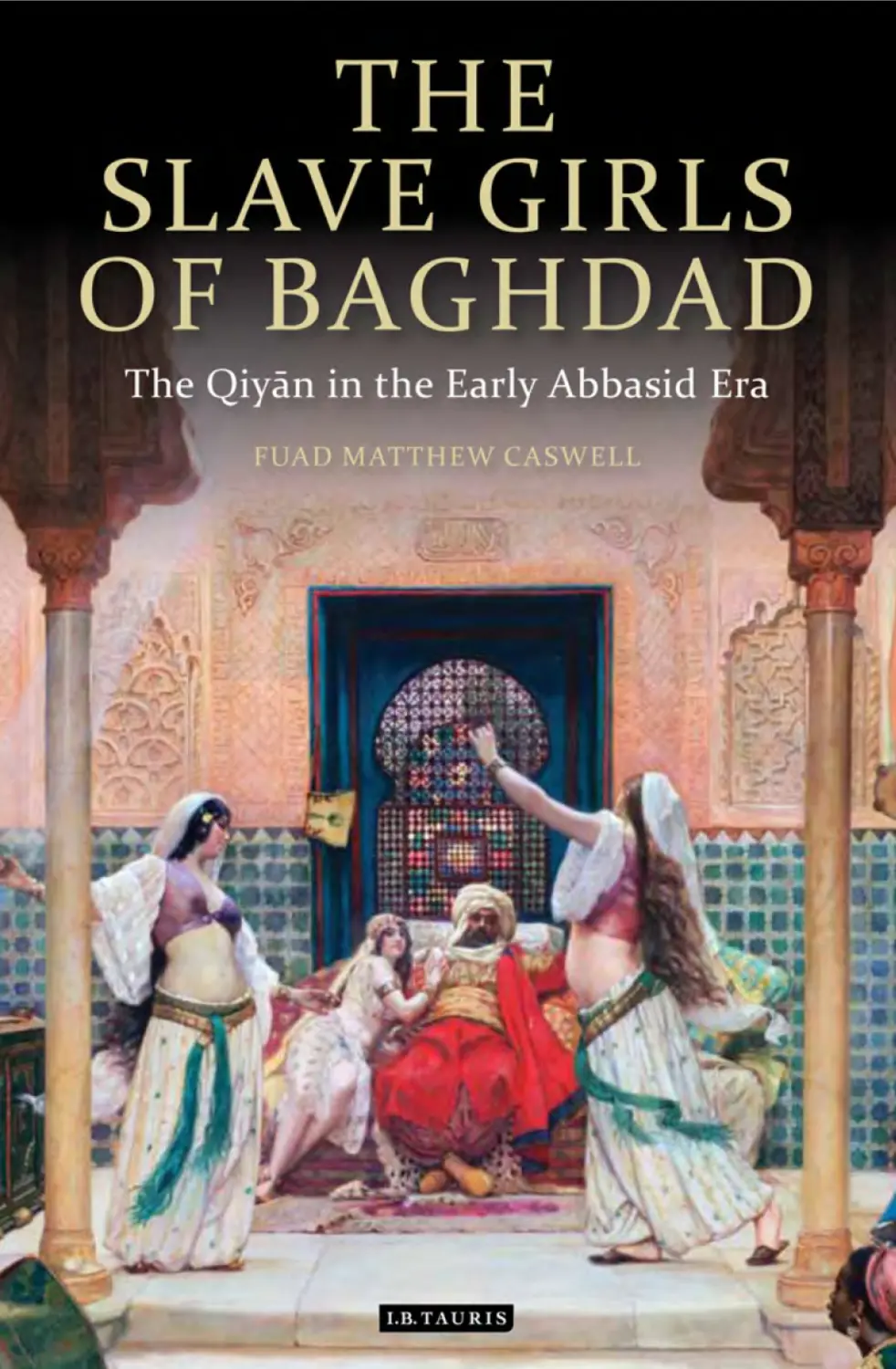
THE SLAVE
GIRLS OF
BAGHDAD
The Qiyān in the Early Abbasid Era
Fuad Matthew Caswell
Caswell_Prelims.indd iii
6/10/2011 6:17:42 PM
Published in 2011 by I.B.Tauris & Co Ltd
6 Salem Road, London W2 4BU
175 Fifth Avenue, New York NY 10010
www.ibtauris.com
Distributed in the United States and Canada
Exclusively by Palgrave Macmillan
175 Fifth Avenue, New York NY 10010
Copyright © 2011 Fuad Matthew Caswell
The right of Fuad Matthew Caswell to be identified as the author of this work has been
asserted by the author in accordance with the Copyright, Designs and Patent Act 1988.
All rights reserved. Except for brief quotations in a review, this book, or any part thereof,
may not be reproduced, stored in or introduced into a retrieval system, or transmitted,
in any form or by any means, electronic, mechanical, photocopying, recording or
otherwise, without the prior written permission of the publisher.
Library of Middle East History 28
ISBN 978 1 84885 577 9
A full CIP record for this book is available from the British Library
A full CIP record for this book is available from the Library of Congress
Library of Congress catalog card: available
Printed and bound in India by Thomson Press (India)
Camera-ready copy edited and supplied by the author
Caswell_Prelims.indd iv
5/24/2011 11:15:18 AM
CONTENTS
Abbreviations and conventions
vii
Transliteration
viii
Glossary
ix
Introduction
1
1. The social scene
10
2. Imā’ shawā‘ir and qiyān
37
3. Four slave-women poets
‘Inān
Fad.l
‘Arīb
Sakan
56
56
81
96
123
4. Some other slave-girl poets:
short biographical notes
133
5. Al-Imā’ al-shawā‘ir as eulogists
148
6. Al-Imā’ al-shawā‘ir as mourners
169
7. Al-Imā’ al-shawā‘ir as satirists and lampoonists
184
8. Notable free women
191
Caswell_Prelims.indd v
5/24/2011 11:15:18 AM
vi
THE SLAVE-GIRLS
OF
BAGHDAD
9. Amatory poetry
210
10. Singing
229
11. The singing slave girls
240
12. Decline and fall
258
13. Epilogue
267
Appendix I: The Abbasid caliphs and their accession dates
273
Appendix II: Non-Arab mothers of Abbasid caliphs
274
Appendix III: Some 3rd/9th-century jawārī: poets, singers, composers
275
Appendix IV: Some qiyān trade slogans
278
Notes
280
Bibliography
307
Index
319
Caswell_Prelims.indd vi
6/10/2011 6:17:43 PM
ABBREVIATIONS AND
CONVENTIONS
b.
ibn (son of), when used between names
bt
bint (daughter), when used between names
pl.
plural
sg.
singular
tr.
translation/translated by
Year dates are given as both Anno Hegirae and Anno Domini (e.g.
145/762)
BEO
Bulletin d’études orientales
EAL
(see under “Meisami” Encyclopaedia of Arabic Literature)
Enc. Brit. Encyclopedia Britannica
EI-2
Encyclopaedia of Islam, New (second) Edition (Leiden,
1960–2009)
JA
Journal Asiatique
JAL
Journal of Arabic Literature
JSS
Journal of Semitic Studies
In relation to poems, the first rhyme-word is given at the first mention
in order to facilitate their retrieval in editions other than the ones used
here. Where the citation is of a repartee or an exchange in verse using
the same rhyme, it is given only with the first part.
Caswell_Prelims.indd vii
5/24/2011 11:15:19 AM
TRANSLITERATION
Arabic words and nouns are transliterated according to the system
employed in the Encyclopaedia of Islam, New (second) Edition, with the
following changes: j for dj, q for k. no underlining of digraphs and no
shortening of long vowels before two consonant (e.g. Abū l-Hasan, not
Abu l-Hasan). Names and terms commonly used in English are not
transliterated according to this system (e.g. Abbasid, Baghdad, Iraq,
Hijaz).
Caswell_Prelims.indd viii
5/24/2011 11:15:19 AM
GLOSSARY
Some Arabic words and their respective meanings as used in this
book
‘addādāt
akhbār
ama, pl. imā’
atlāl
du ‘ā’
faqīh
fityān
ghāliya
ghazal
hadīth
hawā
hazaj
hijā’
hudā’
hurra, pl. harā’ir
ibāhī
iblīs
‘iffa
ijāza
imā’
imā’ shawā‘ir
Caswell_Prelims.indd ix
professional mourners
reports
slave-girl
traces of past encampment; ruins
wish prayer
a jurist; legal scholar
fashionable young, cultural men about town
blend of perfumes
courtship poetry
Prophetic tradition; literally, narrative
love
singing with light modulation; chanting
invective; satire
camel driver’s song
free woman
licentious
the devil
virtue; modesty
chasing; following on
slave-girls (see ama)
slave-girl poets
5/24/2011 11:15:19 AM
x
THE SLAVE-GIRLS
OF
BAGHDAD
passion
reproach; blame
female slave
bureaucrat; chancery clerk
bacchic poem
panegyric; eulogy
salon of performing arts; literally a
sitting, an assembly
maqāla, pl. maqālāt
sung essay
marthiya, pl. marāthī
lamentation; elegy
mawlā, pl. mawālī
freedman; client
mihna
Inquisition
mizāh
pleasantry; fun
mudīf
reception hall
mughanniya, pl. mughanniyāt songstress
mughāzalāt
lover’s plaint
mukhadram al-dawlatayn
one who straddled the Umayyad and
Abbasid dynasties
mujūn
dissolute behaviour
mukhannath
effeminate; a type of singing
nasīb
pre-Islamic courtship poetry; a
conventional opening theme in a poem
nawrūz
Persian Spring festival
qādī
magistrate
qasīda
poem
qayna, pl. qiyān
singing slave-girl
qit‘a
epigram
rāwī
recitor
sadaqa
benefaction; alms
sayyid
nobleman; gentleman
shu‘ūbiyya
challenge to Arabism
sihr
sorcery
tāhir
pure
tahni’a
felicitation
tarab
rapture
tīh
delusion; arrogance
‘ishq
‘itāb
jāriya, pl. jawārī
kātib, pl. kuttāb
khamriyya, pl. khamriyyāt
madīh
majlis, pl. majālis
Caswell_Prelims.indd x
5/24/2011 11:15:19 AM
GLOSSARY
‘ūd
‘udhrī
‘ulamā’
umma
umm walad
wāshī
zandaqa
zinā’
Caswell_Prelims.indd xi
xi
Oriental lute
chaste; Platonic e.g said of love poetry, after the tribe of
‘Udhra
scholars (esp. religious scholars)
nation; commonly used to refer to the nation of Islam
slave mother of a child by a free man
slanderer; mischief maker
heresy/Manichaeism
adultery
5/24/2011 11:15:19 AM
Caswell_Prelims.indd xii
5/24/2011 11:15:19 AM
INTRODUCTION
Definition
The Abbasid qiyān were a historical manifestation of courtesanship
in which, as in the case of the ancient Greek hetaira and the Japanese
geisha, women engaged male patrons in exchanges of artistic graces,
literary sparring, flirtations and sexual favours. But what sets the historical qiyān apart from other courtesans is the fact that they were also
women slaves whose status was defined by the laws of Islam and the
cultural mores of the Arab society in which they lived.
All the slave girls under consideration, being part of the performingarts segment of the earlyAbbasid era, are further identified as slave-girl
poets (imā’ shawā‘ir) or as singing slave girls (qiyān mughanniyāt) or
simply qiyān. For a start it is reasonable to infer that almost all of
them were trained to perform, and did perform, as singers (qiyān, sg.
qayna), so that they sang and set to song the verses of others as well
as their own. Some would have also become so adept at composing
poetry, mostly adapted as songs, that they were identifiable as imā’
shawā‘ir. Hence, most of the shawā‘ir combined both functions. The
terms imā’ shawā‘ir and qiyān mughanniyāt are used to refer specifically
to the slave girls in their functions of poets and singers respectively.
At the same time the term qiyān is also commonly used to answer to
both collectively. That is consistent with the meaning that the term
qiyān generally acquired:1
Qina (sic) is synonymous with jariya and the two words are,
moreover, used interchangeably ... Ibn Manzur, the author of the
dictionary, tells us that the qina is a slave, whether she is a singer
Caswell_Intro.indd 1
5/24/2011 11:16:18 AM
2
THE SLAVE-GIRLS
OF
BAGHDAD
or not. He adds, ‘If the name qina is given to a jariya who knows
the art of singing, that is precisely because that art is practised
only by slaves and not at all by free women.’
In pre- and early Islamic Arabic the term qayn meant ‘blacksmith’
or ‘craftsman’. It was often used pejoratively, then progressively evolved
to stand for slaves generally, to anyone employed in a manual trade –
since manual trade was beneath the dignity of the Banū Hāshim – to
anyone engaged in gainful employment, then specifically to anyone
engaged in an artistic performance for reward. From this last usage it
is but a small step to the term qayna referring to a performing slave
girl. One comes across the occasional pre-Islamic use of the word in
this last sense, e.g. the poet Uhayha b. Jūlāh, in love with a jāriya,
declaring: ‘Let a qayna make a cry with her mizhar’ (a type of ‘ūd),2 or
al-Nābigha being corrected by a qayna for using faulty rhymes.3
The combination of the themes of slavery, women, poetical productions and artistic performances presents one with a patchwork of contradictions and ambiguities. As a slave, the jāriya is a chattel. She can
be bought, hired out and sold. But the fact that she is marketable gives
her social mobility, and the prospect through a succession of changes
of ownership to climb socially, a prospect depending on the type or
class of the jāriya.
As a woman in a strongly male-dominated society the qayna can
be said to be doubly enslaved. Yet her lot in many respects is better
than that of her free-born sister. She starts off by being at least as well
‘finished’ as the daughter of an aristocratic family who would have
had private tutors for reading, music and deportment,4 while being
more liberated than the free-born. She goes about without covering
her face, dressed in finery instead of covering herself from head to toe
in a dark, loose-fitting cloak. She is a leader of fashion in clothes and
other personal adornments. She can sit and converse with the great and
the famous among men. She has greater opportunities and choices to
establish deep and meaningful relationships with a lover or a succession of lovers. She is often treated as not much better than a prostitute,
and abused physically even as she is cared for and indulged as a valuable marketable asset. By dint of her upbringing and of her profession
Caswell_Intro.indd 2
5/24/2011 11:16:18 AM
INTRODUCTION
3
she is worldly, setting her snare to the rich; yet she is capable of deep
and sincere loyalty to master and lover. Altogether, she may be said to
have a more rounded personality than the free-born. In a different age
and a different place, the Frères Goncourt had in mind the likes of her
in saying that only the woman of the world is a woman – the rest are
simply females.5
When the qayna dabbles in verse in a poetical salon (majlis, pl.
majālis) she mostly produces occasional poetry, some epigrams which,
while clever, have only a limited measure of intrinsic literary merit,
and which she trades in repartee with men in order to impress with her
knowledge, good humour and acuity. In this she displays the product,
not of a contemplative experience which moves the spirit of the reader,
but of the no less interesting cut and thrust of dazzling virtuosity that
fills one with admiration. But she can also be capable of producing the
occasional poem (qasīda) of the highest literary merit. She is shallow
and artificial when playing a salon party game with guests. She can
also be the author of lofty imagery in praise of a patron and of tender
and sincere expressions addressed to a lover.
And there is always the ambiguity: to what extent is her motivation
derived from her being a slave, a woman or an artist? When she surrenders her heart and declares it in verse and song, does one see in that
the submission of slavery, or a woman in love, or the worldly deference
of a professional to a benefactor, or to all of those in varying proportions? As she sheds tears at the death of a master, to what extent is she
moved by his loss, and to what extent by the uncertainty and anxiety
relating to her own personal situation, now facing the prospect of her
forced removal from one familiar household to some unknown other?
And one thinks of the acute ambiguity in the stance of the slavegirl Sakan, who, out of love for her master (or perhaps at his urging?)
invites the caliph to buy her to ease her master’s financial difficulties,
but is yet prepared to suffer hardship and penury as her master’s slave
and lover rather than suffer to be parted from him by her being sold
to some mere nobleman.6
One way of getting at the essence of the qiyān phenomenon is to
bring together those contradictions and ambiguities to form a cohesive
cameo describing a discrete form of salon culture, consisting of artistic
Caswell_Intro.indd 3
5/24/2011 11:16:18 AM
4
THE SLAVE-GIRLS
OF
BAGHDAD
performances by a particular class of performers in a particular period
of Arab civilisation – the early part of the Abbasid period, starting in
the 3rd century of Islam/9th century AD (hereafter ‘3rd/9th century’).
There had been nothing quite like it before. It is true that previously
there had been serious literary sessions, in which women participated
and poetry, philology and jurisprudence were discussed.7 Various
schools of singing had also flourished in Hijaz, at the dawn of Islam.
But the salon culture of the qiyān differs from all that. It is the product
of particular factors coming into play in a particular historical context.
These factors included: the presence of a large number of slave girls,
of different national origins; the steady supply arriving from the slave
markets, some by way of ‘finishing’ schools; the large body of privileged and dilettante chancery-clerks or bureaucrats (kuttāb, sg. kātib)
as patrons; the abundant wealth cascading from the conquered lands;
and the effect on Abbasid society of the non-Arabs, mainly of Persian
origin, who occupied influential positions at court and in the cultural
life of Abbasid society generally. But what particularly distinguishes
this salon culture is that its abiding spirit is the pursuit of leisure for
its own sake.
By modern Western standards the salon culture of the qiyān is
marked by moral laxity, lack of inhibition in the use of impolite
expressions and by the extensive use of erotic-elegiac poetry. In particular, there is a poetical genre consisting of what is composed by
establishment poets in praise of the qayna. A significant part of that
would have been meant to serve as publicity material: the poet would
repay the hospitality and favours of the qayna and her house by composing verses in her praise, in some cases the poet having possibly
been commissioned to do so. One can reasonably infer this from the
poems in which the name of the particular qayna is woven into the
verses, and often used as rhyme, as well as from the tenor of some of
the poems. Further, a publicity poem singing the charms of the qayna
and recommending a visit to her house would also serve as publicity
for the author; of particular material benefit to a commission poet.
The clever repartee in which the slave girl engages with a potential
buyer and patron also serves as a marketing tool – a ‘qualification’ test
the passing of which testifies to the girl’s education and acuity.8 One
Caswell_Intro.indd 4
5/24/2011 11:16:19 AM
INTRODUCTION
5
may categorise the qiyān salon culture as being, at its lowest, an art in
a business, and at its highest a business in an art.
Free, high-born women were insulated from the public world of the
qiyān, while little is known of what transpired at their own private
meetings. ‘Ulayya bt. al-Mahdī is one notable exception. A great deal
is written of her and about her and her private family meetings. But it
is not without significance that someone in her position represented a
link between the world of qiyān and that of the aristocratic houses –
she was the daughter of the black slave Maknūna, whom the caliph
al-Mahdī bought for 100,000 dirhams in his father’s lifetime. One
notion which needs to be addressed is the effect that the qiyān may
have had on the education and cultural attainment, as well as the social
status, of the free-born, high-born women. It is noteworthy that there
were fewer known, free women poets in the Abbasid era than there
had been before it.9 There are some who attribute that to what are perceived as a loose moral climate at the heart of Abbasid social and cultural life which, in thrall to non-Arab practices, left little room for the
literary talents of the virtuous, free-born, high-born Arab woman to
flourish.10 One may see some basis for that view, provided one stripped
it of the implied racist element. The differences between Umayyad
and Abbasid, Damascus and Baghdad, 2nd/8th-century Hijaz and
3rd/9th-century Iraq, are not to be seen as reflections of racial characteristics that distinguish the Persian from the Arab. Rather, they
reflect the gulf between two cultures observed in two different periods. The Islamic conquests brought an Arab culture in which nomadic
roots were still discernible face to face with and under the influence of
old civilisations in which, in the case of the Persian court and Persia’s
upper social echelons, leisure activities were pursued for their own
sake, while the practice of patronage of the arts was highly developed.
In comparison, the traditional Arab culture would appear restrained,
measured, family- and tribe-focused. The differences should not be
regarded as due to the one culture being more morally pure than the
other. Further, there is perhaps enough to indicate that the free-born
woman (hurra, pl. harā’ir) did not become less educated nor less interested in literary matters with the transfer of the centre of state power
and influence from Hijaz and Syria to Abbasid Baghdad. The apparent
Caswell_Intro.indd 5
5/24/2011 11:16:19 AM
6
THE SLAVE-GIRLS
OF
BAGHDAD
paucity of the material is likely to be due in part to the fact that as the
harā’ir were cloistered and kept away from the public gaze their poetical works were less widely noted, retold and recorded than the brash,
populist, memorable epigrams exchanged in the houses of qiyān. In
practical terms the absence of professional recitors or transmitters
(ruwāt, sg. rāwī) in their case meant that reports of their compositions
would mostly have come about through their slave-girls.
The onset of the Abbasid period marked a social shift fom what
had basically been a traditional rural and small-town environment to
a multi-cultural, metropolitan society. This was reflected in changes
to literary themes, with the amatory epigram gaining ground from the
traditional qasīda themes of family and tribal honour and pride. As the
qiyān set the trend in the new form the tendency would have been for
the harā’ir to follow. Notwithstanding the attempts to insulate the free
woman from the nefarious new world and requiring her to go about
in a hijāb, she and the world of slaves were not far apart. Many of the
high-born harā’ir were daughters of slave concubines or brought up in
households which included former qiyān acquired by the head of the
household as wives or concubines. The qiyān, mostly of foreign origin,
well educated and trained and also worldly, may well have opened to
the high-born harā’ir a window of opportunity to acquire knowledge
of the outside world and of what was fashionable in deportment, dress,
food, flowers and gardens. If in some Western societies some measure
of education, fashion and what otherwise passed for refinement can be
said to have been carried down, through the medium of the woman
in service, from the mansion house to the humble village dwelling,
the same may be said to have been carried high up in Abbasid society
through the conduit of the qayna from the slave market to the palace.
One effect of the preponderance of women slaves and the lowering
of moral standards was the restrictions, or further restrictions, that
were placed on the freedom of association of the free women:11
Civilization with its extravagance and luxury and the advent of
jawārī had a negative effect on women of the upper class. The
more women war captives were brought to Baghdad the more
corruption spread. This caused alarm about the manners and
Caswell_Intro.indd 6
5/24/2011 11:16:19 AM
INTRODUCTION
7
morals of upper class women. This in turn meant that restrictions were emphasized: the veil (hijāb) became mandatory.
At the same time the jawārī were prohibited from covering their
faces in public, in order to distinguish them from the free women.
The veil appears to have been ‘adopted’ by the caliph ‘Umar (Omar) b.
al-Khattāb, the second Caliph (r.13/634–23/644) but did not become
mandatory until later.12 The wearing of the hijāb had a precedent in
the custom of the noble women of Persia covering their faces, which
may have been what inspired ‘Umar to introduce it into Arab society.
But one can equally say that the restrictions were a male reaction to
having the eyes of the cloistered upper-class woman opened to the
wide outside world. These restrictions provide a further explanation
for the paucity or apparent paucity of the literary output produced by
the free women of the period, and would have limited the scope for the
exchange of ideas and cross-fertilisation with the outside world, as well
as denied to the free woman with poetical pretensions the appreciation
and encouragement of a wider audience. That said, while one simply
can have no clear idea how much or little poetry was composed at the
Abbasid court and upper-class houses, it is difficult to accept that the
introduction of slave girls, part of whose education consisted of knowledge of poetry and the ability to compose it, would have stifled the
creative instinct of the free women; or that the flowering of the artistic
talents of ‘Ulayya (a poet) and her half-brothers Ibrāhīm (poet, songwriter and singer) and Ya‘qūb (mizmār player/oboeist) was not due in
some measure to their being the daughter and sons of their respective
slave-concubine mothers.
It did not last. The world of the qiyān suffered a decline commensurate with the political and financial decline of the Abbasid court,
starting with the Turkish praetorian guards taking effective control
and gradually supplanting the Persian influence that had obtained
up to then. Thereafter, the sophistication and sense of leisure which
imbued the society of qiyān, and which depended on patronage for its
life-blood, did not sit comfortably with the harsh, austere, militaristic
ethos of the new rulers. Of course, poetry and music endured, as they
always will, and slavery in large numbers also endured until fairly
Caswell_Intro.indd 7
5/24/2011 11:16:19 AM
8
THE SLAVE-GIRLS
OF
BAGHDAD
recently, and has not altogether disappeared. But of the salon culture
of the early part of the Abbasid period, with its slave-girl poets, singing slave girls, commission poets, courtiers and well-to-do bureaucrats, all that remain are the literary record and historical footnotes.
Primary sources
In dealing with the Abbasid qiyān one has the benefit of a significant body of literature, in which one may discern at least some core
material which is likely – more or less – to be historically factual,
notwithstanding the doubt that may be entertained as to the accuracy
or even the validity of what may have accrued to it over time. This
core material, consisting of memorable epigrams as well as anecdotes
and stories relating to the lives of the qiyān, their masters and patrons,
would have been displayed in a semi-public setting, and thus listened
to, memorised and recounted. In addition, the fact that the qiyān were
notorious public figures and leaders of fashion, what they did and said
can also be assumed to have been of public interest and repeatedly
retold. Given that very process, the record which has come down to the
present day gives rise to acute issues of methodology. What is extant
is derived from oral pre-literate sources, which to a greater or lesser
degree are suspect: the stories would have been told one way here and
another way there, so that they would have changed a great deal before
they became fossilised in their written form – what with facts exaggerated and distorted, fanciful additions to true anecdotes, and anonymous fairy-tale characters converted into historical personages. Further,
the written product itself presents the reader with acute difficulties:
cases of dubious attribution and dating, as well as the difficulty of
seeking to produce a coherent chronology or story out of disparate,
often contradictory facts by applying purely subjective criteria. One
finds an example of this in the attempt to construct ‘Arīb’s chronology.
And there are what one may suspect to be occasions for poems in the
reports (akhbār) to be typically invented, and whereby verses of doubtful or multiple attribution are strung together to add to a good yarn
or to create a new one. One also needs to allow for the fact that the
source might have been contaminated by political or sectarian bias, as
Caswell_Intro.indd 8
5/24/2011 11:16:20 AM
INTRODUCTION
9
in the attitude demonstrated by al-Isfahānī, a devoted ‘Alīd and author
of the Shī‘ite martyrology Maqātil al-Tālibiyyīn, towards Ibrāhīm Ibn
al-Mahdī, a virulent anti-‘Alīd. Further, there are many cases of patent
clerical corruption resulting in alternative readings – easy enough
in Arabic, what with the ubiquitous absence of the vowels (harakāt)
and the migration of the alphabetical dot from one letter to another.
Faced with such difficulties one is tempted to express a view as to the
respective degrees of reliability of the reports and of the different versions. But while it is legitimate to express a preference for a particular
version, that could only be so provided there is a deliberate mention
of the other version (or versions); otherwise one would be excising not
only what one considers to be the less reliable, but also whatever might
subsequently have been written based on it.13
A further limitation in the historical record is that it consists of
uncoordinated episodes which somehow have to be brought together.
It is a big canvas and, lest it be presented as an uncoordinated and
unmanageable jumble of events and anecdotes, the Carthesian method
is here adopted of breaking it up into sections and addressing the sections separately. Thus, by way of example, the poetry is presented in
separate sections: eulogy, lamentation and invective respectively. An
important tool for making sense of the picture is the poetry. There is
a sufficient amount of it which, after a passage of time, was committed to writing and is extant, unlike the musical productions of the
period, of which all that has survived are the reports of how people
were affected by them. Given this, the bigger theme is the poetry
itself, which is intrinsically interesting. It is possible to get a good,
fairly authentic flavour of it in translation while adhering closely and
faithfully to the Arabic text – thus presenting what may be thought
to constitute a small anthology in English of the poetry of and relating
to the imā’ al-shawā‘ir. Some of the material is grossly salacious, but
is reproduced faithfully in translation, the salaciousness being an integral part of the poetry and of the scene.
Caswell_Intro.indd 9
5/24/2011 11:16:20 AM
CHAPTER ONE
THE SOCIAL SCENE
Slavery in Islam
Slavery was practised in the Middle East long before the dawn of Islam.
Slaves were mostly the booty of wars and tribal raids. The three monotheistic religions – Jewish, Christian and Muslim – accepted slavery as
normal, simply like owning property. They acknowledged that slaves
had souls, but that was not regarded as a religious or ethical bar to
accepting or even promoting their social and legal status as slaves.
Thus, slavery continued to be practised under Islam, but with a general exhortation to be kind to the slaves. There is a Qur’ānic injunction
against ill-treating them:1 the Prophet exhorted his people to invoke
Allāh’s protection by showing kindness to the weak, being slaves and
women.2 The Prophet also referred to the slaves as brothers:3 ‘Your
brothers are your servants whom Allāh had subjugated to you. He who
has dominion over his brother should give him to eat what he eats and
be clothed with what he wears.’
While Islam sanctions slavery it yet considers the manumission of a
slave an act of piety, commonly undertaken as thanksgiving or by way of
expiation for a sin. A slave may enter into a contract (mukātaba) with his
master whereby he will secure his release in return for a sum of money
which he, as freedman or client (mawlā), will then pay over a period
of time, a practice not unlike peculium in Roman law. The mukātaba,
notwithstanding the term (literally, ‘a written contract’) can also be
effectively established orally, provided this is done in the presence of
Caswell_Ch01.indd 10
5/24/2011 10:48:37 AM
THE SOCIAL SCENE
11
competent witnesses, that is two men or one man and two women. The
proscription of usury facilitates the fulfilment of the obligation by the
slave to pay the price. A client remains subject to obligations of fealty to
his former master: if he dies without leaving issue his estate is inherited
by his former master, subject to the untrammelled right of the former
slave specifically to bequeath one third of its net value. If the former
slave is survived by minors, the former master becomes their custodian.4
The Prophet was reported as saying:5 ‘Let none of you say my man slave
and my woman slave, rather let it be said my boy, my girl and my lad.’
However, the terms ‘abd (man slave) and ama (woman slave) were
very common in everyday usage. Even to-day, with slavery no longer
practised, the terms ‘abd and ‘abda continue to be used among some
speakers as referring simply to a black man and a black woman, but
with no connotation of slavery.
The status of slaves under Islamic law is close to that of chattels.6
They can be bought, hired out and sold; they can be shared by more
than one master, and can be mortgaged. Further, slaves are in general
terms heritable assets, being passed on as slaves to the heirs, and then
often sold by auction in the normal course of the administration of
the estate. The progeny of a slave mother and a slave father are themselves slaves, the property of the woman’s master. He may sell them
individually subject only to the proviso that no child under the age
of seven is to be separated from his or her mother. A child born by a
woman slave to a free man is a free person. When a woman slave gives
birth to a child by a free man she acquires the status of umm walad
(mother of child). She may no longer be sold, given away as a gift, or
bequeathed. She remains in the possession and dominion of her master
in his lifetime, and becomes a free woman on his death.7 That said,
it remains that the slave is a person with recognised obligations and
rights: he can marry, can be punished for committing a crime, and can
carry out procuration in business matters. A slave man might marry
up to two slave women; a slave woman might marry a free man who
was not her owner, but only with the latter’s consent.
The great Arab conquests produced a vast number of slaves, who
were often marketed wholesale for as little as one or two dirhams a head.
They were divided among the soldiers who captured them, subject to
Caswell_Ch01.indd 11
5/24/2011 10:48:37 AM
12
THE SLAVE-GIRLS
OF
BAGHDAD
the payment of one-fifth of their value to the treasury (bayt al-māl)
to answer to the claims of ‘the Orphan, the Poor and the Follower of
the Way’.8 In addition, slaves were often received as tribute from nonMuslims, and that continued to be the practice long after the end of
the great conquests.9
Under Islamic law an ama (female slave)is defined as a woman who
has been taken as war booty, or born of parents both slaves, or bought.
The following is an interesting episode, told as part of the hagiography
of ‘Alī b. Abī Tālib. It was in the reign of ‘Umar when the daughters
of Khosroes were taken as war booty and conveyed to Medina, where
‘Umar ordered them to be auctioned. It was the custom of the noble
women of Persia to cover their faces, and when the auctioneer pulled
the veil off the face of one of them, she slapped him for his insolence. He reported her to ‘Umar, who was minded to have her and her
sisters scourged. But ‘Alī intervened, citing a saying of the Prophet:
‘Respect the honourable among the people brought low, and the rich
among the people reduced to penury’, and adding that the daughters of kings were not to be auctioned. He paid their prices, and gave
them as brides to his son Hasan, to Muhammad b. Abī Bakr and to
‘Abdallāh b.‘Umar respectively. They were to give birth to three of the
most eminent Arabs, namely ‘Alī b. Hasan, otherwise known as Zayn
al-‘Ābidīn, Qāsim b. Muhammad and Sālim b.‘Abdallāh.
When the great conquests came to an end, the supply of slaves as
war booty dried up, but the demand for them did not abate – the economy as well as the social and cultural life of the nation had become
dependent on slavery. The conquests had been rapid, and resulted in
what had been a relatively small nation becoming the custodian and
beneficiary of a vast empire, which required a large number of slaves
to service. Lands of the conquered people were expropriated and distributed to members of the armed forces, to civil servants, and to those
rendering special services to the caliph. The lands of the Sassanians
were lotted and thus disposed of by the caliph ‘Umar on the grounds
that they were no longer owned by anyone:10 ‘Because such land has
the status of property that belonged to no owner nor inheritor so that
it is permissible for the Imām to bestow it on whosoever exerted himself in the service of Islam.’
Caswell_Ch01.indd 12
5/24/2011 10:48:37 AM
THE SOCIAL SCENE
13
There were also special grants made of the lands classified as waste,
i.e. unproductive. The grantee would have it for life on condition that
he revived it. This was based on a Prophetic saying that whosoever
revived dead land shall own it (ihyā’ al-mawāt, literally ‘land revival’);
it may have required no more than the digging of a well to fulfil
the condition. Grants could also be made heritable, subject only to
the liability to pay a tithe.11 In order to farm the revenue of the new
empire, the Arabs could rely on the indigenous clients . At the same
time, the slaves who were acquired as war booty provided a plentiful
supply of labour, both domestic and for use in all manner of commercial enterprises.12 The supply was used in a way which, once established, required a further steady supply. The drying-up of the source
of slaves as war booty left a serious gap, which was filled by the use
of a thriving international trade in slaves. There was in the Abbasid
period a slave market in every major city. There was a market for
the fair-skinned Europeans and those from Western Asia, collectively
referred to as saqāliba,13 and for the Atrāk of central Asia. The slave
market of Samarkand had one of the largest turnovers, mirrored by
markets in North Africa for the supply of Berbers and Nubians, and by
the East African trade in black slaves collectively referred to as habash
(Abyssinians) and zanj (sub-Saharan blacks). There had existed before
Islam an active international slave trade in Hijaz, with established
slave markets in different centres, chief among which were Mecca and
‘Ukāz.14 But it was in the Abbasid period, as a result of the vast revenues of the far-flung empire, that slaves in very great numbers entered
Arab society.15 This is illustrated by the following numbers quoted by
al-Isfahānī: al-Rashīd and his wife Zubayda were said to be the owners
of about 1,000 slave-girls each;16 about the same number was owned
by each of al-Amīn, al-Ma’mūn,17 al-Wāthiq and al-Mu‘tasim,18 while
al-Mutawakkil was said to have 4,000.19
Female slaves
The slaves in the Abbasid period may be conveniently considered to
fall into two main categories, namely as domestic and as labouring
slaves. Leaving the latter aside, the domestic females may be further
Caswell_Ch01.indd 13
5/24/2011 10:48:38 AM
14
THE SLAVE-GIRLS
OF
BAGHDAD
subdivided into two sub-categories: the ‘domestics’, in the strict meaning of the word, i.e. those (commonly Indians and black Africans) who
were employed in the kitchens and to attend to other domestic tasks;
and those acquired and retained for their ‘entertainment’ value (sex,
music, poetic productions), the more physically favoured among them
being reserved for the bed chamber. This last category can be further subdivided into those that remained the sole private property of
the male master (concubines who might or might not be able to sing
or compose poetry and songs), and the others, the typical qiyān, who
entertained in the public domain, even though privately owned. This
public exposure is what gave the latter their power, their fame, and
their notoriety as carnal and domineering in love. Most in demand
were the European saqāliba. They were sought out when very young
by the slave traders so that in time they spoke Arabic without a foreign accent. Their families would sell them, or simply give them away
because they could not afford to keep them; for the slaves in this category there was additionally the lure of improving their prospects
through slavery. For the few, chosen for good looks and keen intelligence, there would follow intensive education and training, extending over several years, to fit them for what high society in Baghdad
and other Abbasid centres desired in a slave girl. In the course of this
training they would acquire the attributes of entertainment (tarab) and
culture (adab). The latter encompassed knowledge of the Qur’ān and of
poetry, as well as the ability in varying degrees to compose it, a good
singing voice, and the ability to play the ‘ūd (lute). So equipped the
qayna could hold court in a public or semi-public majlis belonging to
her master (in exceptional cases to her mistress), while she was often
left to manage her own venue bearing her own name. In that capacity
the qayna bore some resemblance to the courtesan (hetaira, pl. hetairai)
of Ancient Greece who used rhetorical arts to spar wittily with the
educated men of her time, and who might even have run her own
symposium;20 but of course there remained a major difference between
the two – the qayna was also a slave. A description is provided by one
Abū ‘Uthmān al-Dallāl (the broker) as to the ideal method of ‘finishing’ the jāriya21:
Caswell_Ch01.indd 14
5/24/2011 10:48:38 AM
THE SOCIAL SCENE
15
Assuming good stock for a start, the ideal would be to get hold
of her in her ninth year, then make her spend three years in
Medina followed by three more in Mecca. She will then arrive
as a 15-year-old in Iraq, having by then added to her good looks
the appearance of the women of Medina, the tenderness of the
women of Mecca and the sophistication of the Iraqi women. Such
a slave girl will then be worthy to be hidden under one’s eyelids,
ever so close to one’s eye.
‘Abd al-Malik b. Marwān was reported as saying that the best among
the slave women were the Berbers for procreation, the Byzantines for
service and the Persians for good behaviour.22 To Mūsā al-Kāzim, the
qiyān were to be favoured for their acuity, which was superior to that
of the majority of the free-born.23
Auction catalogue of female slaves
The above description relates to the ‘moral’ qualities resulting from
education and general upbringing, and is of general application. As
regards physical attributes the marketing assessment took in the
diverse national characteristics of the merchandise coming to the market. One finds such an assessment made by Ibn Butlān,24 in what
was in fact an auction catalogue of slaves by reference to the general
characteristics of the women of different nationalities, of which the
following is an extract:
Indians
Those of Medina
Meccans
Those of Tā’if
Berbers
Caswell_Ch01.indd 15
Good figure, swarthy complexion, great beauty,
clear yellowish skin, sweet breath, delicacy but tending to early ageing, faithfulness and amiability.
Swarthiness, well-proportioned, combination of
good speech and good figure, charm and flirtation.
Softness and femininity, soft wrists, white complexion tinged with brown.
Golden swarthiness, braided hair, exceeding lightheartedness, pleasantry and fun-loving.
Mostly of black complexion, but some of paler hue;
obedience, fidelity and energy.
5/24/2011 10:48:38 AM
THE SLAVE-GIRLS
16
OF
BAGHDAD
Yemenis
Like the Berber or Medinese and combining the femininity of the Meccans; generally with pretty faces.
Zanj25
Many faults: the blacker the uglier, the sharper the
teeth, and the less desirable.
Abyssinians Mostly slender and soft, some close to being consumptive, useless for singing or dancing.
Nubians
Resemblance to the blacks; self indulgence and delicacy.
Turkic
Combination of beauty with white skin; charming eyes
despite their smallness; tendency to sullenness.
Byzantines Straight blond hair, blue eyes; obedience and amiability.
Armenians Would be pleasing were it not for their monstrous legs;
enjoying rude health and strength.
The slave of Medina, Mecca, Tā’if and Yemen referred to above
must have been non-Muslim. Further, the artifice of the slave merchant was often added to what nature and nurture had bestowed:26
How often was the dark and dismal sold as golden bright, the
flat bottom as heavy buttocks, the fat belly as a slender waist,
the malodorous mouth as with sweet breath! And how often
they turned the blue eyes kohl-dark, the sallow cheeks glowing
pink, the emaciated face rounded, the thin lips voluptuous and
the cheeks free of hair! And turned the blond hair black, the
frizzy straight and the receding profuse! And removed the tattoos, the pock marks, the freckles and the scars!
Shades of colour
In general, and applicable to all women, the tendency was to prefer a
white, fresh complexion. As part of her make-up the woman would
use ghumra, a cream or paste made with saffron as a main ingredient,
to whiten the complexion and add colour to it, particularly if it was
sallow.27 But some preferred black women: Danānīr, the black woman
slave of the Barmakīs, was highly admired, famously by al-Rashīd.
Further, the sought-after qualities were characterised by al-Jāhiz as
moderation, neither too thin nor too fat, and congruity of features,
such as not having narrow eyes atop a prominent nose.28 Al-Jāhiz
Caswell_Ch01.indd 16
5/24/2011 10:48:38 AM
THE SOCIAL SCENE
17
observed that the slave women of Basra were the most valuable, instancing Mutayyam, Badhl, ‘Arīb and Shāriya.29 He further compared
the jawārī to pigeons – the saqāliba to white pigeons and the zanj to
black.30 The comparison with pigeons is interesting. Racing, or rather
city sporting pigeons flown in flocks off the roofs of houses, were very
popular for sport and, as with the qiyān, the choicest were very valuable (500 dinārs for one pigeon),31 The main point of the sport was to
inveigle some pigeons belonging to a a rival flock to break ranks in
flight and to join one’s own flock. There is to this day a pigeon market,
sūq al-ghazil, close to what was the site of the Abbasid palace on the
Rusāfa side of Baghdad.
The trade in slaves was very extensive, producing vast profits, such
that the government appointed a special office of Supervisor of Slaves
whose job was to regulate the market.32 The most celebrated and successful slave merchants were Ibrāhīm al-Mawsilī and his son Ishāq.
They were among the most remarkable characters of the early Abbasid
period. Ibrāhīm was a great musician, composer and poet; and at the
same time a singer and a teacher of music. His house can be regarded
as the music academy of the period. His son, Ishāq, was an excellent
composer of music and had a reasonably good voice. Two other notable slave traders of the period were Duhmān the singer33 and Yazīd
Hawrā’.34 Ibrāhīm al-Mawsilī formed a business partnership with the
latter to deal in slaves.35 Upgrading slaves was a serious business in
the ancient world, perhaps the most dynamic segment of the economy.36 Ibrāhīm and Ishāq specialised in buying young slave-girls.
They would teach them the principles of singing as well as generally
improving them so as to fit them for life in palaces and great houses.
They would also take in other people’s slave girls to be ‘finished’.
According to Ishāq, his father was the first to favour those slave-girls
who were white or of light tan complexion. He avoided altogether the
yellow-skinned Chinese, the dark-brown Indians and Sindis, and the
black Africans.37
Many slave women attained positions of prominence and influence
in Abbasid society. Some rose so high as to be concubines and mothers
of caliphs. Some safeguard against the abuse of the influence which
they were in a position to exert in high places was that they usually had
Caswell_Ch01.indd 17
5/24/2011 10:48:38 AM
18
THE SLAVE-GIRLS
OF
BAGHDAD
no family ties. Al-Mansūr,38 in particular, was wary of associating with
women slaves who had family ties. When Khayzurān was brought to
Mecca to be marketed as a slave, she was offered to him. He examined
her, asking where she came from: from Mecca, she said, but brought
up in Jerash. According to al-Heitty,39 she was a Greek from Jerash in
the Yemen and moved as a slave to Mecca. The caliph then asked her
if she was related to anyone: ‘None but Allāh,’ she replied, ‘my mother
begat no other.’ Satisfied with that answer, al-Mansūr sent her to his
son al-Mahdī, advising him that the girl was suitable as a concubine;
al-Mahdī was much taken with her. After she had given birth to two
sons by him, Mūsā and Hārūn, she was bold enough to confess that in
fact she did have a family in Jerash, consisting of mother, brothers and
two sisters, Asmā’ and Salsal.40 Al-Mahdī sent for the two girls: Ja‘far
b. al-Mansūr then married Salsal, who gave birth to Zubayda, whom
al-Rashīd was in turn to marry. Al-Mahdī manumitted Khayzurān,
saying: ‘You have given me two sons whom I have nominated as successors. I do not want you to remain a slave.’ A collateral effect of the
manumission was that it improved the status of the two sons.
Naming slaves
Since the slaves lacked a proper genealogy they were identified by
being given slave names descriptive of beauty, desire and value, such
as Mahbūba (the loved one), Murād (the desired one) and Amal (hope),
generally avoiding the traditional names associated with high-born
Arab women such as Fātima, Khadīja and Hind. To a reader coming upon such a descriptive name, this is a pointer to the fact that
the person is a slave. Sometimes, and for better identification, the
owner’s name or the name of his family is used in conjunction with
the given slave-name, as in Danānīr al-Barmakiyya and Mutayyam
al-Hishāmiyya.
Hajīn (mixed parentage)
The high-born pure Arabs continued to look down on those of mixed
parentage, the hajīn – that is, born of an Arab father and a slave mother,
Caswell_Ch01.indd 18
5/24/2011 10:48:39 AM
THE SOCIAL SCENE
19
or of a non-Arab mawlā mother. When al-Mansūr berated his sons for
their excesses, one of them said to him: ‘Blame yourself, for you did not
choose for our mothers wise women of the Arabs, as your father had
chosen for you. Instead, you went after the concubines and made their
wombs vessels for your seeds.’ Al-Mansūr was favourably impressed by
those words, and not a little flattered, in that his mother, the Berber
Sallāma, had herself been a freedwoman of Basra.41 On the same theme,
the ‘Alīd, Muhammad b. ‘Abdallāh b. Hasan, known as al-Nafs al-Zakiyya and boasting direct descent from Abū Tālib, uncle of the Prophet,
wrote to al-Mansūr reminding him of his inferior status as a hajīn:42
‘And know ye that I am not one of the sons of the divorced, nor one of
the sons of the accursed, nor was I carried in the wombs of slaves, nor
hatched by an umm walad ’ Al-Nafs al-Zakiyya did not acknowledge
the accession of al-Mansūr to the caliphate, nor that of al-Saffāh before
him: his father and brother had been tortured to death by order of
al-Mansūr. In Medina, Al-Nafs al-Zakiyya rose up, and was declared
a rival caliph. Al-Mansūr sent him an ultimatum which he rebuffed,
using the passage quoted above. This was followed by the suppression
of the Medina rising, and the killing of al-Nafs al-Zakiyya.43
On the same theme, al-Jāhiz relates an exchange involving ‘Ubayd
al-Kilābī who was indigent. He was asked if it would please him to
be a hajīn and with it the owner of a thousand knapsacks. He replied
that he would not accept baseness at any price. His interlocutor then
pointed out that the Prince of the Faithful was the son of a slave
mother. Ubayd answered: ‘Shame on whoever obeys him!’ There is also
the story of al-Hajjāj b.Yūsuf boasting to ‘Abd al-Malik b. Marwān: ‘If
ever there was a man of pure gold, I would be that man!’ ‘How come?’
inquired ‘Abd al-Malik. ‘Because I was not born of a slave woman,’
retorted al-Hajjāj, ‘and in my lineage all the way down from Adam
there was no slave woman except Hagar.’ This was met by the crushing rejoinder: ‘Were it not for Hagar you would be a cur among curs.’
But as more and more of the men took the jawārī as concubines
and mothers of their children, so the gene pool of the aristocratic Banū
Hāshim became mixed with the multi-national, multi-racial genes
of the slave women. Of al-Rashīd’s 11 children only one, al-Amīn,
was born to a free-born wife (Zubayda, herself the daughter of a
Caswell_Ch01.indd 19
5/24/2011 10:48:39 AM
20
THE SLAVE-GIRLS
OF
BAGHDAD
slave mother). Of the 12 caliphs who followed al-Amīn, down to alMuqtadir,44 not one had parents who were both Arab.45
A new civilisation
Abbasid society differed markedly from that which had preceded it.
A sophisticated, metropolitan, multi-racial society succeeded what
had been mainly rural and provincial Arab communities superimposed on the conquered non-Arab nations. The great conquests created a vast empire within a short period of time. What then sustained
that empire were the freedmen or clients (mawālī) who converted to
Islam and adopted the language, culture and ways of the ruler nation.
The position of the client being precarious, the route to integration in
the Arab nation and to sharing in its benefits was through adherence
to and association with one of the Arab tribes and families – and, in
the case of an ambitious and talented client, aspiring to be associated with one of the aristocratic families of the Banū Hāshim. But
the clients, no matter how talented, remained in thrall to their Arab
rulers, though with decreasing intensity as the extent of their integration increased over the generations. The mawālī came particularly
into their own with the rise of the Abbasid dynasty. The founding of
Baghdad as the new city of al-Mansūr (145/762–149/766) signified
that the new Abbasid dynasty was by then on solid foundations.46
The completion of the new capital at Baghdad was an outward mark
of al-Mansūr’s success in pacifying the caliphate ... and firmly establishing Abbasid rule.’
It marked a break with Damascus, seat of the Umayyad dynasty,
and the shifting of the political and social centre of gravity nearer to
the Muslim east, and towards Persia in particular. In many respects
Abbasid society – from the beginning of the reign of al-Rashīd in
170/786 onwards – while Arab in appearance, was in reality more
Persian. The impact of Persia was visible in the influence exerted by
Persian courtiers and administrators, the Barmakīs being the most
prominent (their apogee was at the time of the accession of Hārūn
al-Rashīd to the caliphate47) and in the importance that the army of
Khurāsān played in upholding the new regime and settling dynastic
Caswell_Ch01.indd 20
5/24/2011 10:48:39 AM
THE SOCIAL SCENE
21
disputes: it was the principal instrument used in the overthrow of the
Umayyad caliphate and the founding of the Abbasid, and later played
a vital role in the civil war between al-Amīn and al-Ma’mūn.48 The
impact of Persia was further demonstrated by the poets of Persian origin who were at the forefront of the intellectual classes and of whom
the most celebrated was Abū Nuwās.49 Another important factor was
that, by the time of al-Rashīd, the genetic pool of the Banū Hāshim
had become so mixed through marriage and concubinage with those
of women slaves of all races and nationalities that it was no longer a
pure Arab stock. This was also reflected in the loosening of earlier
tribal and communal loyalties, as well as of the traditional cultural
and moral constraints that these had imposed.50 To some, the new
cultural tendencies marked an age of enlightenment. To many, however, it was the dawn of a permissive society straining against the
strict religious observances and the traditional constraints of shame
and honour. Those tendencies often took the form of heresy (zandaqa)
(more precisely in those days Manichean tendencies), a challenge to
Arabism (shu‘ūbiyya), dissolute behaviour (mujūn); and often a combination of all three.
Zandaqa (heresy/Manicheism)
Abū Nuwās declared his heresy openly in verse:51
O you who look into religion, why waste your time
there is no divine decree nor pre-destination
Of all that you mention I find only true
death and the grave
He acted in this way time and again, until near the end of his life,
but that he always did so in verse is important, for one could say things
in verse that one would find it difficult to say in prose; and poets were
not expected always to be truthful in their poems. Hence one cannot
tell how serious Abū Nuwās may have been in his heretical statements.
It is said that his last composition was some verses written on a piece
of paper found under his pillow, in which he prayed for absolution
while affirming his Muslim faith: ‘O Lord, great that my sins are your
Caswell_Ch01.indd 21
5/24/2011 10:48:39 AM
THE SLAVE-GIRLS
22
OF
BAGHDAD
forgiveness is greater still.’52 To the cultural avant-garde, secularism
and materialism were indicative of modernism, and it became fashionable to abjure religious faith. One finds an example of this tendency
in Ibn Munādhir53 upbraiding Muhammad b. Ziyād al-Khārakī for
pretending to be a heretic:54
O son of Ziyād, O Abū Ja‘far
you have revealed a faith other than what you hide
Outwardly a free-thinker in what you say
while inwardly a pious Muslim lad
You are not a heretic
but it is that you sought to acquire the mark of elegance
In fact al-Khārakī, the most elegant and well-dressed of people, became
proverbial as ‘the heretic’ for combining heresy and elegance – ‘more
elegant than the heretic’.55
Shu‘ūbiyya (challenge to Arabism)
With respect to shu‘ūbiyya, this took two forms. The more moderate of these was to assert, following a Prophetic tradition (hadīth) ,
that an Arab was no better than a non-Arab convert unless he was
more pious. One accepted and conformed to the ways of the Arabs
without repudiating one’s origin. When Bashshār b. Burd56 first
came before al-Mahdī he was asked: ‘To whom do you belong?’ He
replied: ‘Tongue and dress Arab, ancestry Persian.’57 The other form
of shu‘ūbiyya mocked the Arabs and considered them inferior. This
was a typical reaction of a conquered people – all the more so in the
case of the Persians, who boasted an old and highly sophisticated
civilisation:58
The Shu‘ubiyya were a faction of non-Arab Muslims, mostly
Persians, who protested against Arab privilege and superiority in
the Islamic empire, and objected to the central position accorded
to Arabic culture. A characteristic form of Shu‘ubi polemic was
to laud the achievements and capacities of their own peoples, and
decry those of the Arabs.
Caswell_Ch01.indd 22
5/24/2011 10:48:39 AM
THE SOCIAL SCENE
23
But the above tells only half the story. The effects of the great Arab
conquests were not entirely negative for the conquered nations. As with
all empires there would initially have been oppression, humiliation
and the undermining of the pre-existing social order. But in time the
beneficent effects of being a part of rich and powerful conglomerate
would have been felt, particularly by those fortunate enough to be at
its political centre. That said, it should not be surprising that in the
case of a client, even one who was socially and politically favoured,
there remained a feeling of resentment at having to conform to the
ways of the ruler nation, even to the extent of adopting its religion,
language and names as the price of being admitted to its benefits.
One finds a strong manifestation of this in Abū Nuwās, who can in
no way be considered disadvantaged by his association with the Arab
aristocracy of Abbasid Baghdad, yet he is to be heard time and again
mocking the ways of the Arabs, and in the process using terms of
vulgar abuse which is only mitigated by its being in lofty verse. But
this has to be qualified by the fact that the target of the mockery
and abuse is specifically the Bedouin ways of which many Arabs were
proud, as their ‘heritage’, although the leading Arabs were of course
wholly urbanised. As a further qualification, one notes that the satire
refers always to the past, and is aimed at socio/economic rather than
racial features:59
Do not try to emulate the Bedouin Arabs in merry-making
or their way of life for their life is arid
Let the milk be only drunk by those
for whom the refined life is alien
and again:
If the milk curdles, piss in it
do not feel embarrassed for there is no sin in that
thus comparing the indigent life of the Bedouin drinking milk to the
good life of leisure, wine and the grandeur that was Persia:
That is the good life not the tents of the desert
and that is the good life not the milk
Caswell_Ch01.indd 23
5/24/2011 10:48:40 AM
24
THE SLAVE-GIRLS
OF
BAGHDAD
What worlds apart the Bedouins and the palace of Chosroes
and what worlds apart the cattle pens and the courtyards!
In the same vein Abū Nuwās makes fun of the eminent Arab
tribes, mocking what he regards as their sentimental remembrances of
encampments past, effaced by the sands, and of tent pegs:60
The wretch stopped at an abode posing it questions
while I stopped to enquire for the town’s tavern
May Allāh not assuage the eyes of him who weeps over stones
nor requite the passion of him who looks for tent pegs
They said that you recalled the homes of the quarter of Asad
woe to you, tell me who are the Asad people
And who Tamīm and who Qays and who their brothers?
to Allāh, the Arabs are nobodies
So let that be, confound you, and drink it aged
yellow midway betwixt water and cream
Abū Nuwās thus mocks the convention in the classical Arabic trope
of nostalgia for past abodes and past passions, while one observes that
all the above names are of prominent Northern Arabian tribes, Abū
Nuwās being a client of the South Arabian tribe of Hakam.
Abū Nuwas’s shu‘ūbiyya is disputed by some eminent scholars, notably Wagner61 and Arazi, who suggest that his defence of Southern
Arabian tribes provides a more plausible explanation for his mockery
of the Northern.62 Arazi further posits that what can be taken as personal shu’ūbī pronouncements may have been no more than a general
reflection of what was socially current at the time, so that the references to the historical opulence of the Persian court in the context of a
wine song (khamriyya) may have been used simply to describe opulence
generally, as a conventional (i.e. neutral) motif, rather than to denigrate the Arabs by comparison.63 But while one may be able to find
some justification for that view in the context of some wine verses such
as those quoted below (‘A house from which some companions had
departed’), it is difficult to regard the above verses to be other than
a general denigration of Bedouin Arabs and, by way of comparison,
praise of things Persian.
Caswell_Ch01.indd 24
5/24/2011 10:48:40 AM
THE SOCIAL SCENE
25
Dissolute behaviour
Dissolute behaviour went hand in hand with hedonism. The houses of
the common qiyān (the majority no better than brothels) and drinking
establishments were numerous in Baghdad and Kufa, added to which
were widespread monasteries used as bingeing retreats. Al-Isfahānī
makes several references to some of the drinking establishments, notably the house of Ibn Rāmīn and that of Abū l-Khattā b al-Nahhā s, both
in Kufa. There were many such in Kufa because of its proximity to the
old city of Hīra, where the drinking houses were popular in pre-Islamic
times. Ibn Rāmīn was the son of the Persian Bisyārdiram – a name
made up of two words: bisyār (plenty) and diram (dirham).64 One finds an
interesting anecdote in Aghānī concerning Abū Hayya al-Numayrī. He
went drinking in Hīra, and after he had spent all his money he asked the
woman innkeeper if she would let him have some more ‘on tick’:65
If you would let me have a jug on tick
then write what you will on the wall
Thus if you give me ought on credit
you let me have the goods then (you will be so lucky) wait for
what I promised
References are also made in Aghānī to other Hīran innkeepers
such as Dawma66 and Bint ‘Afzar.67 They are commonly referred to,
expressly or by implication, as Christians. Ibn Rāmīn’s was a favoured
qiyān house; it offered singing, carousing, wenching and accommodation for the night. In its heyday this house included three popular
qiyān, namely Sallāma al-Zarqā’, Sa‘da and Rubayha, noted for beauty,
grace and fine singing voices. Their charms were celebrated by some of
their clients in verses which would have served as good publicity for
the house of their master. Thus, Muhammad Ibn al-Ash‘ath declares
his love-sickness for Sallāma:68
Because of Sallāma al-Zarqā’ there is in my heart
a fracture that will last for ever and ever
The artifice of the people cannot mend it
and how can lovesickness in the heart be made whole?
Caswell_Ch01.indd 25
5/24/2011 10:48:40 AM
THE SLAVE-GIRLS
26
OF
BAGHDAD
Ismā‘īl b.‘Ammār also sang the praises of the house of Ibn Rāmīn,
as in the following example. This is a poem with a more obvious aim
to publicise the establishment – the name ‘Ibn Rāmīn’ is introduced
and repeated; the facilities of the house, and its charming women and
vintage wine are described; and the mention of the throng of clients
testifies to the house’s popularity:69
O Lord, why is it that Ibn Rāmīn has women
with bewitching eyes, whilst all we have are nags?
O Sa‘da the white qayna you are
a joy to us since you are in the house of Ibn Rāmīn
But that Rubayha was in the mood for dalliance
my spirit would have inclined to you, the two of you
made of the same cast
I did not forget Sa‘da and the Zarqā’ – their day
filled with a throng of people – radiant (and inviting) over the
shops
We are given to drink wine that ‘Imrān70 ages
which renders the sober the like of the mad
If after excess of it we did remember the time for prayer
we rose to it with neither mind nor religion
Houses of pleasure
The house of Zurayq b. Manīh, himself a slave of ‘Īsā b. Mūsā, competed with Ibn Rāmīn for the better class of patrons. When Ibn alAsh‘ath transferred his patronage to Ibn Manīh’s, Ibn Rāmīn tried in
vain to get his custom back. Ibn al-Ash‘ath stated his position in a
poem which again can be taken to serve as publicity for the house of
Ibn Manīh, whose name is used as rhyme, reinforced by a favourable
comparison with the rival house of Ibn Rāmīn:71
O Ibn Rāmīn I have stated clearly
my love for Suhayqa of Ibn Manīh
(She) a fine qayna (he) a good mawlā
and a boon companion of the pure of heart
Caswell_Ch01.indd 26
5/24/2011 10:48:40 AM
THE SOCIAL SCENE
27
The poet then moves on to praise of Ibn Manīh through the conventional image of a man buying praise and a good reputation by his
generous deeds. But in this case the acts of generosity are qualified –
they are profitable for the one who performs them:
A cultured and generous fellow
who buys praise with profitable deeds
He gives us contentment in all that the souls desire
what of delectation and good life
In the care of people of Hāshim
as well as the singing of fair gazelles
Installed in pleasantness and ease
we felt safe from every infamy
So get over [losing] us as we got over you for verily
I am not taking leave of my heart and soul
I keep all that you lost
by disobeying my advice
As against the revulsion that you get from me
gladly would I give my appreciation to the desired one
Another competing qiyān house was that of al-Qarātīsī. It was a
feather in the cap of the proprietor of a house of entertainment to have
famous people as patrons, who would repay his hospitality by publicly
praising his house. Al-Qarātīsī’s house was frequented by poets, notably Abū Nuwās, Abū l-‘Atāhiya and Muslim. One day as they were
debating where to go, al-Qarātīsī pleaded with them:72
Arise and go the lot of you
to the house of al-Qarātīsī
A handsome and comely lad has got the house ready for us
and got ready beakers of the land of Bilqīs
And a variety of poultry and a variety of camels
and qiyān of the houris the like of peahens
Ibn Rāmīn made a stir when, probably thinking of retirement, he
went on the hajj with his jawārī. Muhammad b. Sulaymān who was in
the Hijaz at the time, bought Sallāma al-Zarqā’ for 100,000 dirhams.
Caswell_Ch01.indd 27
5/24/2011 10:48:40 AM
28
THE SLAVE-GIRLS
OF
BAGHDAD
According to another report, Ibn Rāmīn, in the course of the same
trip, sold all three jawārī to private buyers – Sallāma al-Zarqā’ for
80,000 dirhams, Rubayha for 100,000 and Sa‘da for 90,000. Their loss
was bemoaned by Ismā‘īl b.‘Ammār:73
What state O Ibn Rāmīn
is the state of the wretched lovers?
You left them as living dead
you made them swallow two bitter things
You went on a hajj to the house of Allāh looking to be pious
but had no compassion for the broken-hearted
Other regular and notable customers of Ibn Rāmīn, who rated a
mention by al-Isfahānī, were Yahyā b. Ziyād al-Hārithī, Mutī‘ b. Iyās,
‘Abdallāh b. al-‘Abbās al-Maftūn, ‘Awn al-‘Ibādī of Hīra, Muhammad
b. al-Ash‘ath al-Zuhrī the singer and Shurā‘a b. al-Zandabūdh.74
There was also the slave merchant, Harb al-Thaqafī, who possessed
a much admired singing slave-girl. The celebrated poet Ashja‘ composed verses praising her while excoriating her master:75
A slave-girl with wobbling buttocks
filling the anklet and the bangles
I moan to God for what ailed me
from the love of her and the loathing of her master
From the loathing of her master and from the love of her
I sickened between loathing and love
They convulsed in my breast until
they were in parity and thus shared my heart
May God hasten my recovery by her
and hasten my illness to Harb
The inns and qiyān houses were not simply places for the consumption of wine – they were also venues for merrymaking which encompassed all manner of licentious pleasures. The contemporary poetic
works in praise of wine, notably those of Abū Nuwās, are full of references to dalliance between the customers and the house denizens of
both sexes. Further, they were resorted to by all classes of men. Thus
Caswell_Ch01.indd 28
5/24/2011 10:48:40 AM
THE SOCIAL SCENE
29
one finds that ‘Alī b. al-Jahm,76 a friend of the great jurist Ahmad b.
Hanbal,77 was not above consorting with fun-loving youths (fityān),
frequenting in their company the qiyān house of one al-Mufaddal, in
the Karkh quarter of Baghdad. The Karkh, being the right bank of
the Tigris river in Baghdad, was the area for entertainment, away from
the caliph’s palace in the Rusāfa, the opposite bank.78 Ibn al-Jahm
gives a good account of such a visit, in which he invokes God’s favours
to be bestowed on what was in effect the red-light district of Baghdad,
even as he pleads for the illicit pleasures to be had there:79
We alighted upon some beauties of al-Mufaddal’s qiyān
at the best of houses in Bāb al-Karkh
For there Ibn Surayj, al-Gharīd and Ma‘bad
produced marvels, unchanged, in our ears
Ladies who neither show embarrassment towards the guest
nor is their master a venerable honourable man80
He is pleased the more the shyness of the guest is abated
and does not intrude on him while not being inattentive
And he piles criticism on solemnity and the solemn
if the guest did not enjoy himself and behave in a vulgar way
Nor does he suspiciously fend off the roving hands
if he gained ought of clothes and victuals
And he inclines his head, unself-consciously, out of respect
so as to give free rein to the roving glances of the onlookers
Motion with a hand and wink with an eye and fear not
an onlooker so long as you are not miserly
And shun the lamp and seek out the like of it81
so that as the light of the lamp goes out you may approach and
kiss
Ask and you will not be refused, speak and you will not be told
to keep quiet
and sleep without fear and rise unhurriedly
The house is yours so long as your gifts are aplenty
and you are replete with the honeyed wine
Caswell_Ch01.indd 29
5/24/2011 10:48:40 AM
30
THE SLAVE-GIRLS
OF
BAGHDAD
Surayj, Gharīd and Ma‘bad were celebrated composers and singers
at the dawn of Islam, the being ‘unchanged in our ears’ meaning in
the context that what was heard sounded like those famous singers.82
Next comes the main contemplative part of the poem dealing with the
timeless theme of the impermanence of youth and the brevity of life:
So embark on the days of youth for they
will pass and fade away with temptation lifted
Pay no heed to people saying so-and-so wasted his money
and is now regressing and not progressing
What is time but a night the ends of which had cast us
into a fleeting day of pleasure
This last verse is an arresting metaphor conveying an image of the
light which is life being but a fleeting moment in a universal gloom,
a short day with night before and night after. The metaphor confronts
the reader with a conundrum. One would expect the ends to be those
of the day of pleasure casting one into night, but here the order is
reversed; this can be explained by imagining time/night to be allenveloping, like a sheet with the two ends leaving a small gap for the
fleeting day of pleasure. And yet there is God in that universal night,
whose favours are now invoked:
May God send rain83 to Bāb al-Karkh, that fine pleasureground
to the house of Waddāh thence to the pool of Zalzal84
Where trail the trains of the qiyān and the beautiful ones
parade
and is the abode of the much-blamed profligacy
‘Alī b. al-Jahm ploughed many a long furrow to get to this juncture
in the poem; but as he nears the end he falls back on a classical allusion
to reveal his true sexual proclivities:
If Imru’ al-Qays b. Hujr had alighted here
he would have desisted from talking of Dakhūl and Hawmal
Caswell_Ch01.indd 30
5/24/2011 10:48:41 AM
THE SOCIAL SCENE
31
Rather he would have thought to bestow his affection on a
buck
that lifts the train of his cloak and not spread it out
If night should bring me to lie close to him he will not say
‘you have hocked my camel O Imru’ al-Qays – so get off’.85
Brothels and monasteries
The brothels were identified as well as advertised by the display of
house flags, which testifies to a general social and state toleration
of the oldest profession, a practice alluded to in the following verses
of Abū l-Hindī, describing an inn called Kūy-i-Ziyān which he
patronised:86
The folk are fixed on their banners
and Abū l-Hindī in Kūy-i-Ziyān
An abode which stands on no ceremony for whoever alights
there
where wine and whoring are permissible
The good life is a tender maiden
and my reclining in a tavern
I drink the wine and obey not him who forbids
the pursuit of wine and the beautiful white ones
In my life there is a pleasure that diverts me
but when I die then that is the end of time
In addition to the inns and the houses of qiyān there were the monasteries, where drinking and homosexual pleasures could be enjoyed
at a more leisurely pace and in pleasant rural surroundings. Those of
Dayr Hannah and Dayr Bahrādhān were the resorts of poets, including Abū Nuwās, who composed many verses concerning them. Thus,
of the former:87
O Dayr Hannah of al-Ukayrāh88
whoever may leave you sober I will not be sober
I saw at your place hornless deer
that play with our hearts and souls
Caswell_Ch01.indd 31
5/24/2011 10:48:41 AM
THE SLAVE-GIRLS
32
OF
BAGHDAD
and of the latter:89
In Dayr Bahrādhān I have a majlis
and a pleasure-ground amidst its groves
There I resorted in the company of youths
which we visited on Palm Sunday
Ruinous to every pleasure-seeker
who puts the world before his religion
Until we arrived at a spot for us to sit
where the colours of its various aromatic herbs are joyous
The abundant narcissus is in bloom
the blossom surrounded by musk rose
The vat was brought to us on a hoist
the seal of the infidel in its clay
The arm-vein of our vat was let out
that gushed out coloured red
A comely youth came round offering us the cup
so tender he would bleed at mere touch
The radiance of his cheeks such
as to almost blind by its glare
There we dwelt served with drink and playing with him
and began to revel in earnest
Until the drinker in his drunken stupour
at times could be taken for dead
One often finds references to aromatic herbs, e.g. basil and saffron,
in wine poetry – as in the above example and others below, pointing
to the fact that such were habitually added to the wine. The wine
merchant was traditionally a Christian, the infidel in the above poem.
The ‘letting out’ of the ‘arm-vein’ of the vat or wine skin is an obvious
allusion to blood-letting.
Wine and its symbolism
A whole body of symbolism revolves round wine; there are some examples in the above, and others below. It is associated with hospitability,
generosity and companionship. It is the blood of the vine so that when
Caswell_Ch01.indd 32
5/24/2011 10:48:41 AM
THE SOCIAL SCENE
33
drunk it is mixed with that of the drinker, thus colouring his face.
But at the heart of the symbolism is the feminine imagery; this is
facilitated by the fact that khamr is feminine. Thus she is the daughter
of the vine, a bride with water (mā’, masculine) as her mate, to whom
she submits even as she is vexed by his virility; she is a maiden whose
inviolability is represented by the seal of the wine-skin or amphora,
the piercing of which invokes the image of her deflowering.90 But perhaps one should not carry such symbolism too far: in the absence of a
post-Freudian, sexually-charged imagination one could also see in the
act of unsealing a new wine skin, as in the above example, the expectation of a good carousal, where the vintner offers a full, fresh (not stale)
supply of wine to a party of clients, and in the further expectation that
most if not all of it would be consumed in one sitting.
Abū Nuwās celebrated the social scene in his wine songs and his
homoerotic, as well as heteroerotic, poetry. The wine songs were often
mixed with shu‘ūbiyya, of which the following may be taken as an
example. The poem is in two parts: the first describes a drinking
scene, but with some of the details foreshadowing what may arguably
be taken as the theme of challenge to Arabism in the second part:91
A house from which some boon companions had departed
leaving within it evening traces of theirs [some] new and
[others] faded
Marks of wine-skins drawn on the ground
and bunches of basil fresh and dry
There I confined my companions and renewed their
friendship92
and it is just such [people] that I’d confine
Nor knew I who they were other than was witnessed
by the deserted houses to the east of Sabat93
There we dwelt for a day, and a day, and a third
and a day [added] to which the day of departure was a fifth
A shift of scenery appears at this juncture, the wine scene in the
first appropriately brought to a close by the ‘departure’ on the fifth day.
What follows next is on the theme of the glory of Persia, but this had
Caswell_Ch01.indd 33
5/24/2011 10:48:41 AM
34
THE SLAVE-GIRLS
OF
BAGHDAD
already been hinted at in the first part of the poem: first, by the naming of the Persian town of Sabat, but secondly, and more importantly,
by the fact that the earlier drinking scene is invested with details which
are reminiscent of, and intended to contrast with, the use in classical
Arabic poetry of the conventional scene where past homes and passions
are recalled by stumbling over the sand-blown traces of earlier encampments. The details in Abū Nuwās’s poem consist of the house no longer
occupied by the friends; the friendship recalled by the traces of ‘wineskins drawn on the ground’ and by the ‘bunches of basil fresh and dry’;
and the reference to the deserted houses. ‘Those are the traces of my ruins
(atlāl),’ Abū Nuwās is saying, not the stones and the tent pegs in the
desert, but the traces of a great carousal. And in doing so, Abū Nuwās,
while using a wine-drinking convention, can also be said, subject to the
qualification adverted to by Wagner and Arazi, to be setting the scene
for introducing to great effect the shu‘ūbiyya part of the poem:
The wine is passed around for us
in a golden goblet which Persia adorned with various pictures
At the bottom is Chosroes and on the sides are antelopes
which horsemen waylay with arrows
Of wine is that which the collars are fastened on
and of water that which is capped by the hoods
The object that is described in those last three lines is not just any
goblet or cup, but a magnificent golden goblet or bowl from which the
assembled people take sips in turn. This defines it as a ‘loving cup’,
and its gold material suggests a courtly vessel. That it is Persian and
adorned with multi-coloured pictures of living beings emphasises, if
such was necessary, that a pre-Islamic scene is depicted; the pictures
convey a courtly hunting scene presided over by Chosroes. To the magnificence of the goblet is added munificence: the goblet is generously
filled with wine right up to the level of the huntsmen’s collars. It is
next topped by a modest measure of water covering the rounded base
of the hoods in the picture. The poem may be read as a restatement of
Abū Nuwās’s shu‘ūbiyya, or anti-Bedouin sentiment, that one sees in
his ‘The wretch stopped at an abode posing it questions’.
Caswell_Ch01.indd 34
5/24/2011 10:48:41 AM
THE SOCIAL SCENE
35
While to Abū Nuwās, on this occasion, a good drink is wine diluted
with but little water, Muslim on one occasion goes further by saying
that it is sacrilegious to have it diluted at all – invoking, whether
intentionally or not, the idea of wine as ‘daughter’ of the vine in association with the well-being and joy derived from its blood sacrifice:94
If you wish to give me wine to drink
then do not kill it, for (to consume the dead)95 is taboo
We mixed blood from a vine with our blood
so that one blood coloured the other
Abū l-Hindī likewise avowed a life-long love of the cup:96
When I shall die one day let my shroud be
the vine leaves and the wine press my grave
Bury me and bury the wine with me
and set the cups around the grave
I pray to God to-morrow
good absolution but [only] after drinking the wine
The wine theme is often mixed with the erotic, and in the verses of
Muslim b. al-Walīd the one is used as metaphor for the other:97
If you would give me the essence of wine to drink then let me
have
to delight me a cup from your mouth that would revive me
Your eyes are my wine, and my sweet basil are your talk to me
and the colour of your cheek is the colour of the rose which
contents me
In the above examples one sees a social scene which is far removed
from the austere and morally restrained society of the Umayyads,
which was carried through to the start of the Abbasid rule and survived for a period while the new dynasty was engaged in laying down
a firm new east-facing foundation, with the support and under the
influence of the Persian nations. The poetical slave-girls and singing
slave-girls played, as entertainers, an important part in the new social
Caswell_Ch01.indd 35
5/24/2011 10:48:41 AM
36
THE SLAVE-GIRLS
OF
BAGHDAD
scene; and this scene of moral laxity and dissolute behaviour was to
continue unabated well into the 4th century of Islam, as Abū Hayyān
al-Tawhīdī testified98 – he claimed that in the Karkh quarter alone he
counted, in houses of ill repute, 460 qiyān, 120 harā’ir and 95 boys.99
They catered to all manner of tastes and appetites: everything was on
offer so long as one could pay.
Caswell_Ch01.indd 36
5/24/2011 10:48:41 AM
CHAPTER T WO
IMĀ’ SHAWĀ‘IR AND QIYĀN
Parsimony and excess
The first two Abbasid caliphs, Abū l-‘Abbās al-Saffāh and al-Mansūr,
had little interest in entertainment: they were parsimonious, and occupied in consolidating their new regime. The stinginess of al-Mansūr
was proverbial – nicknamed Abū al-Dawānīq (father of farthings, the
dānaq being the smallest coin), it was said of him that he would
reward a panegyric with a dirham, then regret it and ask for it back.
Al-Mahdī, the third Abbasid caliph, was the first to be partial to
music: he liked to have musical gatherings in his palace attended by
boon companions (nudamā’) and female slaves. Islamic propriety was
still observed to the extent that he did not permit the consumption of
alcohol, and on one occasion committed Ibrāhīm al-Mawsilī to prison
for drinking.1
Al-Mahdī was also the first of what we should now call the big
spenders. It was in his day that the slave merchants no longer dealt
in slave girls chosen merely for their looks, but turned their houses
into institutes of etiquette to produce cultivated ones in the way the
caliph and his ministers favoured.2 By then the new order was securely
established, and with the growth of the new city of al-Mansūr as the
metropolitan centre of the Islamic world in the east, and with it the
close linkage of the Arab and Persian nations, Abbasid society had
both the means and the inclination to indulge in social leisure activities, with the qiyān at their centre. References to some have survived
Caswell_Ch02.indd 37
5/24/2011 10:50:51 AM
38
THE SLAVE-GIRLS
OF
BAGHDAD
mostly through the compilations in al-Isfahānī’s Kitāb al-Aghānī and
al-Imā’ al-shawā‘ir, in which they are treated differently. While they
are presented in the former essentially as singers and songwriters,
those in the latter are included as the authors of poems.3 In considering the literary merits of al-Imā’ al-Shawā‘ir one has to bear in
mind that the references in it and in the Aghānī were to individuals and events that had taken place more than a century earlier, and
were based on what had survived orally or as secondary and tertiary
reproduction in writing. Yet a further caveat is called for: what has
survived is rarely a poem. More commonly it consists of anecdotes
and snatches of poetic exchanges at certain social gatherings, which
were particularly interesting and memorable. By the same token, the
women’s ability to compose poetry is not to be judged simply by what
transpired at such gatherings, since the setting dictated the product.
Theirs was an occasional poetry, and this may have been true of all
pre-modern Arabic poetry. But the verses of the slave women were of
a special kind: added to the special feature that it was as attractive,
fragrant and playful women in a male assembly that they exchanged
banter, often in explicitly sexual language, theirs was social or salon
poetry, in which what were looked for and particularly admired were
quick wit, a play on words, the double entendre, the cut and thrust
of clever exchanges, extemporaneous repartee in verse where the last
letter of the first speaker’s verse is used by the second speaker as the
rhyme ending (qāfiya) of his or her response. That may be categorised
as brilliant virtuosity embellishing poetry of generally limited content – but it is no less interesting for that.
The introduction of multinational slave-girls in large numbers into
Abbasid society was a contributory factor in the advancement of social
sophistication, elegance and fashion, as well as an enduring change in
the moral climate which drew several disparaging observations. Thus,
one finds as an example the following comment made by al-Tawhīdī,
criticising the sexual excesses of his day, and by way of contrast painting a rosy picture of the traditional virtues of the past:4 ‘They [in the
past] used to engage in courtship without suspicion. A man would
openly call, converse with those in the house then take his leave. Now
nothing will satisfy them except carnal intercourse.’
Caswell_Ch02.indd 38
5/24/2011 10:50:51 AM
IMĀ’ SHAWĀ‘IR
AND
QIYĀN
39
A worldly temptress
This mirrors and extends al-Jāhiz’s statement that the virtuous women
used to sit down to converse with men without embarrassment; which
was not considered amiss, whether in the pre-Islamic period or under
Islam.5 Disparaging observations apart, the change in the moral climate had a serious effect on the social condition of the free women.
The men’s reaction to the public presence of the female slaves was to
have the free woman sequestered in the anonymity of the veil for her
face and the walls for her home6. Among the slave-girls, the greater
pressure towards moral laxity was exerted by the qiyān, as professional
entertainers. The qayna was trained to use her wiles to attract and
ensnare men, in turn to secure a material advantage for her master and
herself. This was particularly the case with those employed in the inns
and houses of ill repute. A good description of the character and wiles
of the qayna is given by al-Jāhiz:7
The qayna can hardly ever be faithful in her love nor true in
her friendship for by nature and training she is made to set her
nets and traps for those who come near so that, unwary, they
dash into her snare. If a man looked at her she would reciprocate with a glance, flirt with a smile, woo him with a variety
of songs, flatter his opinions, be quick to join him in a drink,
demonstrate a desire for him to stay long, desire his early return
and show sadness at the parting from him. As she felt that her
charm had captivated him she would delude him into believing
that she was more in love with him than he with her. She would
follow that by writing to him complaining of the pangs of her
loving him.
An even more emphatic warning against being involved with the
qiyān is made by l- Washshā’:8
And know ye that no worse a calamity befell a decent, educated,
elegant and cultured man nor a worse affliction beset the wellbrought up youth than the love of jawārī, for their love is false,
their passion adulterated and their desire tends to transience and
inconsistency, whose object is greed and worldliness, so that their
Caswell_Ch02.indd 39
5/24/2011 10:50:52 AM
40
THE SLAVE-GIRLS
OF
BAGHDAD
love is displayed before those who appear well-off and rich, soon
to be transferred away at the sight of penury and hardship.
Al-Washshā’ then goes on to give a detailed account of the art used
by the qiyān to achieve their ends:
The clearest sign of their wickedness is that if one of them espies
in a gathering a young man who is rich, with abundant means,
ease and opulence she inclines towards him to beguile him and
make him smitten by her. She favours him with a glance and a
wink, motions to him with her hand, sings as he chases one cup
by another, sidles over to pleasure him, drinks the remnant of his
cup, leans over to kiss his head – until the poor wretch falls into
her snares, is overborn by her wiles and surrenders his heart to her.
She tempts him by her closeness, envelops him in her flattery and
captures him with her great plausibility, craftiness, deception, her
seeking intimacy and her affected moaning at the arrival of the
time of parting and her affected sadness at his going. She follows
that by sending him missives accusing him of perfidy, informing
him of her sleeplessness, confiding her thoughts, complaining to
him of her anxiety driving sleep away. She sends him her ring, a
tress of her hair, a cutting of her nail, a sliver of her meat-bone, a
morsel of her pie and a mouthful as substitute for a kiss, a chew to
inform him of her breath, a book decorated by her nail and perfumed by the imprint of the palm of her hand, taped in a string
of her lute, and on which she would let fall some tear drops ... But
once she had captured his heart and is assured of his advances and
of his true devotion and knows that he is drowning in the sea of
calamity, then she will embark on the demands of presents.
What follows is an interesting list of the types of superior gifts
that the temptress would secure, though it is outside the ambit of this
study; suffice it to say that the author provides there a historical record
of all kinds of luxuries of the period: superior diverse articles of clothing, with their provenances – dresses from Aden, cloaks from Nīsāpūr,
turbans from Sūs; an assortment of articles of personal adornment; the
choicest of foods and drinks.
Caswell_Ch02.indd 40
5/24/2011 10:50:52 AM
IMĀ’ SHAWĀ‘IR
AND
QIYĀN
41
In each of the above qotations one finds a reference to the use of
the billet doux as part of the armoury of the woman bent on seduction.
That testifies to the education that she would have received preparatory to her coming out as a qayna. It also alludes to the sort of man
who is the object of the seduction, generally referred to by al-Washshā’
as ‘educated, elegant and cultured’, typically a bureaucrat (kātib) or
other member of a good family. The expansion of the bureaucracy and
of general literacy was facilitated by the introduction of paper as a new
material for written documents. Until the early Abbasid period documents were produced on papyrus from Egypt, while books were written on parchment.9 The practice of the qiyān enticing their admirers
with billets doux is further alluded to by Yūsuf b. al-Hajjāj b. al-Sayqal,
in the following verses of warning against such women:10
Beware, may I be your ransom
as long as you live the snares of the dissembling women
Through them the youth is rendered penniless
and how good they are at bankrupting people!
Woe to the one who besotted
receives their sealed billets doux
The notes which they send to him
are written missives of whores
And if they send messengers
they are such as are practised at pimping
They devastate the bags of wealth
what with maintenance and gifts
Analogous to an infidel digging
a watercourse in dead land11
Those words received wide circulation, repeated on every tongue to
excoriate the qiyān – such that whenever a qayna tripped up in a song
she would exclaim: ‘Wretched Yūsuf!’12 In the same vein, Fadl, herself a celebrated slave woman and poet, cautioned her lover against the
wiles and worldliness of the gold-digging qiyān:13
You of high beauty and low manners
you have grown old but still a lad when it comes to pleasure
Caswell_Ch02.indd 41
5/24/2011 10:50:52 AM
42
THE SLAVE-GIRLS
OF
BAGHDAD
Woe to you, the qiyān are like a snare
set between gullibility and ruin
They do not set their snares to the poor
but seek only the gold mines
Al-Washshā’ further observes that a man, be he so ugly, old and
decrepit as to be hateful in the eyes of the qayna, will yet be borne
with equanimity so long as he is rich. He illustrates this by a witty
exchange:14
She boasted to me of her beauty and loveliness
saying to me: You are deluded O old man
Old penniless and [of] gross ugliness
and would you [presume to] desire us? Your desire shall fail you!
I interrupted her: Penury shall be cured by wealth
and the grey hair will disappear in the brilliant dye
She rejoined quickly: Yet to the ugliness of the visage is a
remedy
albeit that ugliness is incurable
Right she is! How much more persuasive would be my plea
had there been a payer to put paid to my ugliness
The plea will persuade and the ugliness be in remission only as long
as the money lasts, as in the following example, in which the imagery
of the ever-green basil bush being stripped bare is used as metaphor
for a lover becoming denuded of all his worldly goods:15
My friend, the qiyān are to the naive and incautious
like nets set to capture by flattery
They love this one and moan to that other
of the pangs of love while they cast a [roving] eye on yet another
Until having captivated a stupid one
recklessly seeking affection
They would empty him and skin him
utterly by fragrant coquetry and refinement
So that he becomes like an ever-green basil bush
stripped clean to the last leaf
Caswell_Ch02.indd 42
5/24/2011 10:50:52 AM
IMĀ’ SHAWĀ‘IR
AND
QIYĀN
43
Just so stripping him clean then saying
we made him white as cotton
The qayna as sexual predator
A common theme that runs through the general body of the criticism
of the qiyān is their inconstancy and their voracious appetite for lovers,
and a variety of them, which can be taken to resonate with their wordliness and greed for money:16
O you who in your ignorance love the qiyān
you might as well be an ass
Will you be satisfied in the love of one
who will not be content with savouring two thousand intimates
Abū Nuwās takes up the same theme, emphasising the dual concern about their worldliness and their greed, as well as the challenge
of their sexual prowess, using an arresting imagery of an overcrowded
heart and a Qur’ānic allusion17 to the Israelites out of Egypt complaining to Moses at having only manna for sustenance in the wilderness:18
And there is that one who shows amiability to God’s creatures
and meets one with greeting and welcome
I made my way to her heart to plead to it
and lo! I could not reach it for the throng
O thou who is not content with one lover
nor with a thousand lovers a year
Methink you are a remanant of the tribe of Moses
for they could not endure one kind of food only
On the same theme one finds al-‘Abbās b. al-Ahnaf castigating his
lover Fawz, whom he had given up after discovering her infidelity, in
the process also using the metaphor of a variety of dishes for sexual
desires and inconstancy:19
She wrote complaining and longing for a visit from me
saying: You are no longer true to our love
I answered with eyes brimming with tears
Caswell_Ch02.indd 43
5/24/2011 10:50:52 AM
44
THE SLAVE-GIRLS
OF
BAGHDAD
streaming freely down both cheeks
O Fawz I did not leave you because I tired of you
nor for the telltale of a jealous informer
It is that I put you to the test and found out
that you are not content with one dish
The story of ‘Abbās b. al-Ahnaf and his lover Fawz presents a good
illustration of the difficulty of disentangling in the reports the historical truth from the mass of conflicting reports, variations and distortions. Al-‘Abbās is mostly associated with two names as lovers, Fawz
and Zalūm, but which were likely to be pseudonyms of the same highborn married free woman whose identity remains unknown. He is
also associated with other women, including Dhalfā’, Diyā’, Sihr and
Khunuth, the last-named three also said to have been the slave-girls
of Hārūn al-Rashīd mentioned in an epigram attributed to the caliph,
but possibly composed by al-‘Abbās.20
Ambivalent attitude towards the qiyān
A distinction has to be made between, on the one hand, the general
body of slave-girls who acted as hostesses, entertainers and purveyors
of sex in low-class inns and in houses of ill repute, of whom there were
large numbers in the Karkh quarter of Baghdad; and, on the other, the
refined qiyān who graced high society and charmed by their wit, beauty
and cultural attributes as well as by their lavish hospitality, lulling the
rich patron into a fantasy world of idealised desires. Abbasid society’s
attitude to the qiyān is ambivalent: they are desired even as the perils
are feared of falling under their sway. This ambivalence can be summed
up in a quotation which al-Washshā’ attributes to an unnamed man
expressing the sentiment in a linkage of passion and death:21
I am content with what Juml decreed
even though it exposes me to disaster and death
Al-Washshā’ quotes some other man alluding to that ambivalence,
as well as to not knowing where one stood in one’s dealings with the
qiyān:22
Caswell_Ch02.indd 44
5/24/2011 10:50:52 AM
IMĀ’ SHAWĀ‘IR
AND
QIYĀN
45
To me the singing girls are a paradise
[but] like the wind blowing hither and thither
If they swear they are the worst perjurers
and the most charming liars
The same ambivalent attitude is demonstrated by the large body
of poetry composed by poets, courtiers and caliphs celebrating certain
qiyān. Al-Jāhiz categorises the love of qiyān as a plague, even as he lists
and admires their physical attractions, if not their moral calibre – in
two words, they please! They offer a combination of pleasures that are
not to be found in anything else on earth. They satisfy the three faculties of sight, hearing and touch by their looks, by their singing and by
allowing themselves to be touched.23 While some see a social disease
in the fact that men are bewitched by them, to the extent of preferring
them over the free-born, al-Jāhiz points out that this is not surprising:
before a man buys a slave-girl he has the benefit of seeing all there is
to see in her. By contrast, a man will not see a potential wife in a free
woman before marrying her. Instead, he has to rely on the judgment
and reports of his womenfolk.
The above references testify to the ambivalent attitude of men towards
the qiyān. One is largely left to guess at the attitude of free-born women
towards them, and likewise involving a degree of ambivalence. They
would inevitably resent the qiyān as interlopers capturing the hearts of
the men and relieving them of their money, as well as feel concern at
the challenge they posed as sexual rivals. It is interesting to note that
in the similar circumstances that obtained in the Ottoman seraglio
hundreds of years later, the Venetian ambassador was to observe that
to curry favour with the Sultanas the governors of Egypt would send
slave-girls to serve them who were ill-favoured in looks – the more ugly
and deformed the more esteemed.24 In the case of the Abbāsid qiyān
there would also have been at the same time a degree of admiration by
the free woman for the qayna as a leader of fashion, and as having the
ability to conduct herself in many important respects more like a free
woman than the free woman herself. The present-day Arab feminist’s
view of the qiyān may provide a pointer to how they may have been
viewed by some of their contemporary free women.
Caswell_Ch02.indd 45
5/24/2011 10:50:53 AM
46
THE SLAVE-GIRLS
OF
BAGHDAD
A modern feminist view of the qiyān
Fatima Mernissi, as she inveighs against the unhappy condition of
women in present-day Arab societies, lays the blame for it at the door
of the qiyān, or rather at the historical phenomenon of their introduction into Arab society towards the end of the Umayyad dynasty,
followed in much larger numbers under the Abbasids. Mernissi postulates that the caliphs, and by extension men generally, observed the
qayna and liked what they saw – not so much, or at all, for her looks,
acuity, deportment and sexual allure, but for her obedience. They then
required and imposed the same duty of obedience on the hurra, which
has to this day kept much of the feminine half of the Arab world in
thrall to the other half. The qiyān cannot of course be blamed for this,
to Mernissi they were not predators but victims:25
Their status as slaves kept them in a precarious position. Their
status as favourites, which was by definition ephemeral, made it
impossible for them to make any demands. Their privileges were
also unstable. They had to build a life upon seduction, cunning
and diplomacy. They acquitted themselves with great brio in
their roles as subordinates, making submission to the caliph’s
whim their very raison d’ être. And so they handed down to us an
image, which we know today in the Thousand and One Nights, in
which love, seduction and enslavement are forever linked in our
imagination. From this point on, on the political stage, women
were no longer anything but courtesans.
At the same time – paradoxically, and across 12 centuries of
civilisation – Mernissi, as spokesperson for the Arab woman, seems
barely to conceal her resentment of the qayna as an interloper and rival
in the sexual stakes:
The arrival of jawari in enormous numbers changed the ways of
the court. Whereas the first caliphs were proud of their wives,
who came, like them, from aristocratic stock, soon the opposite was true and the princes were under the spell of the jawari.
‘There was no caliph and no figure possessing similar power or
means who did not have by him a slavegirl to drive away flies
Caswell_Ch02.indd 46
5/24/2011 10:50:53 AM
IMĀ’ SHAWĀ‘IR
AND
QIYĀN
47
and fan him, whilst another served him, and all this before the
public.’26 Yet, they were not content to use these girls merely for
their labour and for entertainment, but raised them to the ranks
of wives and mothers.
Mernissi has a political case to make, and uses hyperbole to put it
across. She takes Ahmad Amīn to task for claiming that foreign women
were more beautiful than their Arab sisters, and for forgetting that
‘beauty is ideologically determined’, by which she seems to suggest that
beauty is not absolute but depends at any given time on the balance of
political and social ascendancy. By way of example, Mernissi instances
the case of the cultured and ambitious Moroccan Arab man in colonial
times preferring a French woman, and the readjustment in favour of a
local Arab woman after independence. Further, Mernissi dismisses the
suggestion that the success of the qiyān can be put down to their exoticism, arriving from the four corners of the world (‘the only women to
elude the Muslim Empire were American Indians’) and bringing with
them their foreign culture and new models of refinement. She allows
that: ‘The sexual experience of the jawari and their musical talents were,
assuredly, important factors’, but adds: ‘We know from the historical
documents that Sakina [sic] Bint al-Hussein and Ā‘isha Bint Talha were
peerless lovers with their husbands.’ Thus, she refines all the claims and
arguments into one single factor which is to be the foundation of her
case:27 ‘The obvious reason for the jāriya’s success, which none of the
authors I have mentioned lights upon, is easily explained: with her, the
man was by definition superior. She was merely his slave.’
Based on that premise the author closes her case by concluding that
therein lies the cause for what she sees as the subjugation of the present
day Arab woman:
The caliphs preferred the jawari because they obeyed more readily than a hurra (free woman). Obeying was the jariya’s function.
That was what she was brought [‘bought’] for. And those who
argue, in the name of the Muslim tradition, that our role in the
political arena is to obey, not to lead, draw for this on a very
precise period in Muslim history, the Golden Age, the age of
despotism.
Caswell_Ch02.indd 47
5/24/2011 10:50:53 AM
48
THE SLAVE-GIRLS
OF
BAGHDAD
Mernissi, having in mind the qayna in particular, exclaims: ‘We
are still being called on to play the role of jariya.’ It is interesting to
note in this last passage how the case of an Arab woman is transformed into that of a Muslim woman; and this points to one of the
fault lines that run through Mernissi’s argument. The qiyān were a
discrete phenomenon limited in time to about 75 years, and, in any
significant numbers, confined to Iraq, mostly Baghdad and Basra;
and then in much smaller numbers to Andalusia after the collapse
of the qiyān world in the East. Yet what Mernissi rightly complains
of is woman’s lot throughout the Muslim world: and for this one has
to look for reasons other than the importation of slave-girls into Iraq
in the 3rd/9th century and the imposition then of the hijāb on the
free woman. And Mernissi fails to see where her ‘beauty is ideologically determined’ proposition leads to in relation to the qayna. That
Ismā‘īl b. ‘Ammār could be heard to exclaim in 3rd/9th-century
Baghdad:28
O Lord, why is it that Ibn Rāmīn has women
with bewitching eyes, whilst all we have are nags
owed nothing to the disparity of political and social status between,
say a young Circassian girl from the slave market and a woman member of the Banū Hāshim.
The hijāb question
Mernissi may well be right in categorising what she refers to as the
recent hijāb campaign by Khomeini and the Saudis as an attack on
the democratic aspirations of the masses – one may prefer to categorise
it as a reaction to stem the tide of nascent liberal tendencies. But in
neither case does it follow that the introduction of the hijāb 12 centuries ago was motivated by a desire to oppress women. It was just as
likely intended to protect the free woman from unwelcome attention
and molestation resulting from her being mistaken for a woman slave
in streets crowded with jawārī – how else is one to explain the fact
that at the same time the jawārī were forbidden to cover their faces?
One recalls that the noble women of Persia covered their faces; and
Caswell_Ch02.indd 48
5/24/2011 10:50:53 AM
IMĀ’ SHAWĀ‘IR
AND
QIYĀN
49
that when the daughters of Khosroes were taken prisoner one of them
slapped the auctioneer for his insolence in pulling away the veil to
uncover her face. And this may not have been limited to Persia: there
is also a suggestion that respectable women in ancient Greece appeared
outside the house only if heavily covered under a veil; and thus that
most of the women shown on Greek vases in the company of men were
prostitutes or courtesans. Addressing the question of what he referred
to as ‘Oriental seclusion’, Llewellyn-Jones writes:29
A number of texts seem to conjure up a vision of ancient Greece
which looks less like Europe and more like Islam, women kept
well out of the sight of men to whom they are not related,
appearing outside the house only if heavily shrouded and
under the veil, embarrassed even to have their names voiced
in public.
An important (so-called ‘historical’) premise to Mernissi’s case
is that the political ‘enslavement’ of the free women dated from the
arrival of the slave girls on the scene, displacing them politically; this
resulted first in the retinue of female disciples (including the wives
of the Prophet), then aristocratic women, gradually leaving the political stage. In support of her case Mernissi author points to the liberated spirit of the pre-qiyān free woman as exemplified by Sukayna bt.
al-Husayn and ‘Ā’isha bt. Talha whom she describes as the first wave
of women ‘feminists’. But these two ladies could hardly be considered
representatives of the womanhood of their age, or indeed of any other,
as Mernissi does acknowledge.
Another criticism that can be levelled against Mernissi’s case is
that it is only focused on Arab and, by extension, Muslim societies:
it takes no account of what has been going on elsewhere. Many of the
disadvantages of the Arab or Muslim woman are shared by her sisters
throughout the world, and in places where the qiyān or their ilk are
unheard of. Such disadvantages have existed, and exist still, throughout patriarchal societies everywhere. At the time that the slave girls
walked the streets of 3rd/9th-century Baghdad the prevailing view in
Western Europe was that women had no souls;30 while on the other
side of the globe the disadvantaged condition of women was observed
Caswell_Ch02.indd 49
5/24/2011 10:50:54 AM
50
THE SLAVE-GIRLS
OF
BAGHDAD
by François Caron when he visited Japan with the Dutch East India
Company in 1639:31
One Man hath but one Wife, though as many concubines as he
can keep; and if the Wife do not please him, he may put her
away, provided he dismiss her in a civil and honourable way. Any
Man may lie with a Whore, or common Woman, although he
be married, with impunitie; but the Wife may not so much as
speak in private with another Man, without hazarding her life.
And it is a sobering thought that in England, a country steeped in
liberal and democratic traditions and the home of Magna Carta and the
Bill of Rights, a married woman had to wait until 1883 to be allowed in
law32 to be the owner of her own property; and that Spanish and French
women only won the parliamentary vote in 1931 and 1944 respectively.
Mernissi starts her argument by going to the primary Islamic source.
She states that the Qur’ān defines the role of the sexes very clearly
indeed; and she cites the following as its most eloquent formulations:
... and men are a degree above them (the women). Allāh is
Mighty, Wise (ii, 28)
Men are in charge of women, because Allāh hath made the one
of them to excel the other ... So the good women are the obedient,
guarding in secret that which Allāh hath guarded (iv, 34)
But significantly she does not attempt a reconciliation of the above
with her Sukayna and ‘Ā’isha model.
Thus, while one shares with Mernissi her concerns for the Muslim
woman’s cry of anguish and demands for justice and equality, one may
well feel that in ascribing the same anguish and sense of injustice to
some foreign slave women in 3rd/9th-century Iraq, Mernissi chooses a
soft and questionable target, missing in the process some more appropriate – and much more challenging – targets.
Qiyān and catamites
It is interesting to note that while free-born women were at a disadvantage in the sexual stakes compared to the qiyān, a serious challenge
Caswell_Ch02.indd 50
5/24/2011 10:50:54 AM
IMĀ’ SHAWĀ‘IR
AND
QIYĀN
51
to the latter was mounted by the catamites – some indication of the
moral laxity of the time, and of the widespread and open practice of
homosexuality. Thus, one finds Yūsuf b. al-Hajjāj b. al-Sayqal cautioning against associating with the qiyān, then going on to declare:33
This sodomy is a religion
in the eyes of the asāwira34
They do justice to it
by amiability
In that regard one bears in mind that there is a distinction in Arab
culture between being an active homosexual partner and a passive one.
The latter, as penetrated, is looked down upon; not so the former –
at least in a literary context.35 Al-Jāhiz devotes a whole risāla36 to
the respective merits claimed for slave-girls and catamites. Faced with
competition from boys, the women sometimes tried to resemble them;
so that preference was shown to the tomboy type of woman, with hair
cut short and a manly stride.37
The constant slave-woman
In criticising the general moral quality of the qayna, poet and/or
singer, one has to take into account some mitigating factors which tell
in her favour. For a start, there are limitations inherent in her status.
As a slave-girl she would have been removed, as often was the case,
from her family when very young, and transported as a slave to a different part of the world. Thereafter, she has no ancestry whose praises
to sing, no father or brother whose death to elegise, no ancestral home
over whose ruins to weep. The ties of the master and his household are
some substitute, but these are overshadowed by impermanence. She
may be sold at any time during her master’s lifetime, and may be sold
or auctioned after his death. Her life is precarious. No matter what the
degree of social acclaim accorded to her, she is still a chattel with few
civic rights. She has to please all the time. Her stock in trade is her
amiability and the praise that she showers on her master and on those
in a position to bestow largesse on her. Yet in praising some, she has
to be guarded in satirising others, since the times are uncertain and
Caswell_Ch02.indd 51
5/24/2011 10:50:54 AM
THE SLAVE-GIRLS
52
OF
BAGHDAD
the fortunes of men could be turned upside down overnight. A caliph
or master might not think ill of her for what she had composed and/
or recited or sung in praise of his predecessor; this was normal. Taking
sides in a conflict, by not only praising one party but also criticising
the other, would be seen quite differently. In Abbasid society religious
and dynastic conflicts were rife, while court intrigues were such that
the accession of caliphs was mostly achieved by violent means. It was
important for the new caliph to consolidate his rule by demonstrating that his accession was received with universal acquiescence, if not
enthusiastic acclaim. As part of that exercise he would hold court and
require the retinue of the former caliph, his slave-girls, singers and
poets, to join in celebrating the new rule. Most would readily comply.
But there are a sufficient number of anecdotes to establish a theme of
those who demurred out of love and loyalty to the departed. The following are three of these tales.
Danānīr was the slave-girl of Yahyā b. Khālid al-Barmakī. A chapter is devoted to her by al-Isfahānī.38 She is described as a beautiful
blonde, a cultured qayna who excelled in singing and reciting poetry.
After the fall of the Barmakīs she refused to sing for al-Rashīd, saying
that she had sworn never again to sing after the death of her master.
At the order of al-Rashīd, she was slapped, forced up to her feet and
handed a ‘ūd. She sang:39
When I beheld that the houses were obliterated
I knew for certain that the good life will not return
Farīda the younger was a slave-girl and a favourite of al-Wāthiq.
As she played the ‘ūd he kicked her violently even while besotted with
her – because he could not bear the thought that al-Mutawakkil might
succeed him and have her after him. Al-Mutawakkil did indeed succeed to the caliphate, and Farīda was ordered to play the ‘ūd for him.
She refused and tore the strings from the instrument out of loyalty to
the memory of al-Wāthiq. As she was being whipped to death for her
disobedience, she recited defiantly:40
Beware for to every youth shall come
death at night or in the morn
Caswell_Ch02.indd 52
5/24/2011 10:50:54 AM
IMĀ’ SHAWĀ‘IR
AND
QIYĀN
53
This verse, incidentally, is also attributed to the blind Abū Zakkār,
who it is said41 sang it together with two other verses to Ja‘far b. Yahyā
al-Barmakī the moment that al-Rashīd’s man, Masrūr, arrived to kill
him, the additional verses being:
And to every good fortune inevitably will come a day
that however long it lasted will yet be reduced to nought
And if ought can be ransomed from calamities
I’d have ransomed you with newly acquired wealth and my
patrimony
Mahbūba was the slave-girl of al-Mutawakkil. When in grief for
the slaying of her master, and paraded in front of the coup leader,
Wasīf, she refused to join in the celebration of the new reign. Instead,
she lamented her dead master:42
What pleasure is left for me
in a life without Ja‘far?
(Stigelbauer observes that Mahbūba’s behaviour is enshrined in popular
memory as constituting the 352nd of the Thousand and One Nights.43)
The above examples may have been the exceptions that prove the
general inconstancy and perfidy of the qiyān. That, at least, was the
view of Ashja‘, a notable poet at the court of al- Rashīd and much
patronised by the Barāmika, who loved his slave-girl Rīm dearly. She
swore that if she survived him she would not be another man’s. He
received this with scepticism:44
The grief of women will not long last
but the griefs of men will endure
If you will not have me to look at nor my wealth to enrich
you
and if you heard me not, nor heard you I
Then you will forget me and if there should be
some weeping, the most that you’ll weep is four45
Rare, by the Lord of the Ka‘ba, O Rīm, that I see
a girl who is content with him that death had seized
Caswell_Ch02.indd 53
5/24/2011 10:50:54 AM
54
THE SLAVE-GIRLS
OF
BAGHDAD
The qiyān, by dint of their education and training, their public
exposure as entertainers and the attendant fame and notoriety, all
adding up to ‘entertainment value’, occupied a privileged position in
an Abbasid society which set them apart from the general body of
female slaves. To that extent the term ‘singing slave-girls’, and likewise the term ‘slave-women poets’, may be misleading in that the corresponding English terms of ‘slave’ coupled with ‘girl’ or ‘woman’ do
not do justice to their true elevated status and role.46 Yet, their social
and political position was inferior to the lowliest of the client nation.
However much they were admired, sought after, flattered by patrons
and indulged by their owners as prized possessions, their status before
manumission remained that of slaves. Of course the term corresponding
to ‘female slave’ in any language has different practical connotations.
She could be well treated and remain in the ownership of one man or
one family for life, while she reciprocated with loyalty and devotion .
Conversely one can think of the example of the qayna ‘Inān, who was
highly admired and whose market value was so great that her master
al-Nātifī refused al-Rashīd’s offer to buy her, thinking it too low; but
yet she could be whipped by the same master for refusing his order to
entertain a guest. Further, an unemancipated qayna was always liable
to be sold in the lifetime of her master or as part of his estate after his
death, and one thinks again of ‘Inān who on the death of al-Nātifī was
auctioned publicly to discharge her dead master’s debts. By the same
token the qayna’s loyalties were transient in that they could only be
given to whoever was her owner at any given time.
Qayna and hetaira
One may draw a closer analogy between the world of the qiyān and
that of courtesanship defined roughly as:47
The social phenomenon whereby women engage in relatively
exclusive exchanges of artistic graces, elevated conversation, and
sexual favours with male patrons ... their traffic in intellectual
and artistic commerce understood in their own cultural contexts
to be wholly interdependent with their commerce in sex.
Caswell_Ch02.indd 54
5/24/2011 10:50:55 AM
IMĀ’ SHAWĀ‘IR
AND
QIYĀN
55
It can also be said of the qayna, as has been said of the hetaira of
ancient Greece,48 that in her
men’s myths find their most seductive embodiment; she is
beyond all others flesh and spirit, idol, inspiration, muse ... she
will feed the dreams of poets; in her the intellectual will explore
the treasures of feminine ‘intuition’. It is easier for her than for
the matron to be intelligent because she is less set in hypocrisy
Yet the qayna remains distinguishable from the courtesan and the
hetaira by the fundamental fact of her slavery.
Of the 33 women mentioned in the Imā’ al-Shawā‘ir, four deserve
special mention: ‘Inān, Fadl, ‘Arīb and Sakan; they are the subject of
the next chapter.
Caswell_Ch02.indd 55
5/24/2011 10:50:55 AM
CHAPTER THR EE
FOUR SLAVE-WOMEN
POETS
In his introduction to Imā’ al-Shawā‘ir, al-Isfahānī gives an account
of the background to his compilation of the work. Al-Hasan b.
Muhammad b. Hārūn (291/903–352/963),1 otherwise known as
‘al-Wazīr al-Muhallabī’ and a courtier and notable poet, was kātib, or
chief minister and vizier, to the Buyid emir of Iraq, Mu‘izz al-Dawla.2
The latter debated with him as to who among the women slaves composed poetry; and asked him to compile what was known of them in
the Umayyad and the Abbasid eras respectively. Al-Isfahānī could not
find any in the Umayyad period worth a mention, whereas there were
many who became well known in the Abbasid. He then made a note
of what he had learned, and compiled the reports of them and of their
poetry in their order of merit as poets and of how they were regarded
in their time. He begins, so he explains, with ‘Inān because she was
the most celebrated in her time and surpassed all others.3
‘Inān
‘Inān was born a muwallada, that is of Arab father and slave mother.
She received her training in Yamāma and was brought to Baghdad by
her master, Abū Khālid al-Nātifī (his name perhaps referred to a seller
of a type of sweetmeat known as nātif or nutāfī). She enlivened literary
Caswell_Ch03.indd 56
5/24/2011 10:48:54 AM
FOUR SLAVE-WOMEN POETS
57
society during the reign of al-Rashīd, charming her listeners by her
eloquence, quick wit and acute intelligence. Her salon at the house of
al-Nātifī was frequented by the celebrated poets and men of letters of the
time, including Abū Nuwās, Di‘bil al-Khuzā‘ī,4 Marwān b. Abī Hafsa,5
al-‘Abbās b. al-Ahnaf6 and al-Ma’mūn’s tutor al-Yazīdī al-Himyarī,
among a host of others, one of the attractions being that her master was
devoid of jealousy and tolerated the ease with which she bestowed her
favours. The exchanges with poets were often in coarse, sexually explicit
language which passed for amatory advances and pleasantry.
‘Inān was particularly clever at the repartee. This was generally the
hallmark of the slave-women poets – the cut and thrust of virtuosity,
a kind of salon party-game. In a setting such as this, the listener would
admire their mental agility, mastery of words and poetic forms, rather
than looking for a literary theme redolent of challenging thought or
deep emotion. Their craft was a component of a general dilettante
scene which featured cultural and social salons and the growing influence of the well-to-do class of kutāb: bureaucrats, chancery clerks or
scribes, who were mostly of non-Arab stock and who, together with
others of the ruling elite, emerged as a class of dilettante poets vying
with traditional poets – and to whom the composing and trading of
verses, mostly epigrams, was a mark of wit, culture and gracefulness:7
Arab poetry is in general characterised by having a purpose,
such as to boast, praise, satirize or describe, and the concept of
poetry as “pure art” and social grace only emerged in the Abbasid
period among the dilettante poets of the ruling elite.
Al-Nātifī, exploiting ‘Inān’s celebrated wit and her talent for repartee, would tempt his clients and guests to his house with the promise of engaging her in poetical jousting. On one occasion Ahmad b.
Mu‘āwiya challenged her with two verses:8
My heart became enamoured of the sweet white ones
yet9 perchance it fell in love with the sweet bronze ones of the
people of Abyssinia
I wept for one of their bronze women once
such weeping as rendered me bleary-eyed
Caswell_Ch03.indd 57
5/24/2011 10:48:55 AM
THE SLAVE-GIRLS
58
OF
BAGHDAD
The reference is clearly to slave-girls. The ‘white ones’, who were
generally favoured for their looks, were predominantly the Byzantines
and others from European lands, the saqāliba. The slave-girls of
Abyssinia were also favoured for their slender and soft bodies. ‘Inān
met the challenge with:
I wept for her for my heart loves her
such that my heart is aflutter as if with two wings
You came to barter poetry with us
so there you are, take it back bested, O father of Hanash!
The opening two verses by which ‘Inān was tested presented her
with a deal of difficulty since it had a shīn rhyme-ending, which is
uncommon in Arabic poetry. However, Ahmad b. Mu‘āwiya’s pseudonym of ‘Abū Hanash’ came in handy for the occasion. The interlocutor
may almost certainly have tested ‘Inān with a shīn ending on purpose,
to see if she would have the presence of mind to think of his pseudonym and make use of it. She met the challenge successfully, hence the
triumphant note at the end.
On another occasion ‘Inān was asked if she would respond to the
following verse, found in a book:10
He continued to suffer the travails of love until I thought
him sighing or speaking from his heart
She responded with:
He weeps and so I weep out of compassion for his weeping
so that whenever he weeps tears I weep blood for him
Until everyone stricken [by love] pities me
and those who are fancy free turn away from me in
boredom
On another occasion ‘Inān refused to comply with her master’s
order to receive a guest. (al-Isfahānī refers to the guest in his report
as Marwān b. Abī Hafsa;11 but the guest appears as Abū Nuwās in
the latter’s Dīwān.12) ‘Inān, who was indisposed, said she was too busy
to meet the guest. On hearing this her master al-Nātifī whipped her.
Caswell_Ch03.indd 58
5/24/2011 10:48:55 AM
FOUR SLAVE-WOMEN POETS
59
When he then invited his guest in, the latter, seeing tears running
down her cheeks, broke into verse:
‘Inān wept so that her tears flowed
as pearls slip off the string
to which ‘Inān responded without pause:
May it wither on the whip
the right hand of him who struck her unjustly
This last episode is an illuminating example of a slave-girl being
abused physically by her master even while she is highly prized by
him as a valuable asset. Very little is known about al-Nātifī, but what
is clear is that he ill-treated her even as he exploited her. In return,
her feelings towards him may be gathered from the following anecdote. She had attracted the amorous attention of Abū Nādir who
wrote to her:13
I have a need so what think you of it
may my soul ransom you from all ills
It is not such that I can entrust to another to convey to you
nor that I can put in a letter
‘Inān’s response offered availability and encouragement:
I am pre-occupied by one whom I do not love
and my heart is curtained from him
So if you wish for ought, then convey
it covertly not in writing
The clandestine billet doux
The above sheds light on the use of the clandestine billet doux, of which
there are many references in connection with the qiyān; and of the
attendant risks of discovery by accident or through betrayal. It also
points to the use of the only other available alternative – a trusted gobetween to promote amatory intrigues. But there is a paradox in the
situation which is described here: the poem makes it quite clear what
Caswell_Ch03.indd 59
5/24/2011 10:48:55 AM
60
THE SLAVE-GIRLS
OF
BAGHDAD
the man wanted, even though he said he could not say it or write it;
and yet he expresses his feelings in a letter.
‘Inān’s reputation as mistress of repartee was well known, while the
use of the ijāza was popular. On one occasion al-Rashīd came by some
verses of Jarīr in a book and said that he would reward anyone who
could suitably add to them:14 The verses were:
They exhausted their own tears and said to me
behold what you have suffered from love and what we have
suffered
One servant said that he could, and went to ‘Inān for help. She
offered:
You have awakened by your words
an ache in my heart which yet lies hid
Its fruits have ripened in their due season
so that we were given to drink from the stream of love and had
our fill
They lied who allege, O sire,
that if the hearts fell in love they would be stilled
The response that ‘Inān came up with was fully equal to the occasion. At the same time it can be said to demonstrate the gap between
the consummate skill of the great poet Jarīr and the clever but affected
response of the slave-girl. There is a unified structure in Jarīr’s verses,
albeit that they form part of a traditional trope. They make a statement, universally understood and felt, of the pains of separation and
the sense of loss. One finds economy as well as integrity in the expressions that Jarīr uses to reflect these emotions above: in a few words, the
poet evokes the picture of the parting (as with the decamping of the
lover’s tribe); the shedding of tears; and foreboding at the end of the
affair, with the lasting sense of loss. All these elements are prersented
in a unity of time, space and subject-matter. By contrast, ‘Inān makes
use in her response of some admirable poetical devices relating to two
principal themes, but these are unrelated to each other. Thus she starts
with the arresting metaphor of the seed of love lying buried in the soil,
Caswell_Ch03.indd 60
5/24/2011 10:48:55 AM
FOUR SLAVE-WOMEN POETS
61
and awakened by the words; she extends this by implication to the
time when after several seasons the fruit of the tree which had grown
from that seed has ripened, even while the seed itself has remained
hidden in the soil. What follows is a quite different and fairly commonplace image of love as a stream from which the lovers drink their
fill. This is capped by the statement that one cannot have enough of
love – the drinkers are never satiated, even after drinking their fill.
On another occasion ‘Inān was challenged by another verse by
Jarīr:15
I continued to conceal from my two companions what passion
I felt
tongue-tied that I was by overwhelming love for you
‘Inān’s immediate response demonstrated a high degree of perspicacity and virtuosity:
If fear should tie the tongue
the eye will speak volumes of its secrets
One notes in the above exchange the use of two companions, which
reflects a certain convention in old Arabic poetry whereby the interlocutor is said to have two companions on a journey; a celebrated
example is the opening of Imru’ al-Qays’s mu‘allaqa. A further example
is quoted below.16
There was an occasion when a poet came visiting, and al-Nātifī told
‘Inān to impress him. She starts with:17
May God bless Baghdad which I see no town
inhabited by people that resembles it
The guest responds, teasingly:
As though it were silver-plated
which the forger had just finished plating
implying tha it was not of solid silver, contrary to its outward appearance.
‘Inān reasserts her defence of Baghdad, which this time silences him:
Caswell_Ch03.indd 61
5/24/2011 10:48:55 AM
THE SLAVE-GIRLS
62
OF
BAGHDAD
[Nay], security and ease of living – nor, compared with its
delight
is there a land more comfortable or opulent
In al-Isfahānī’s report of this last anecdote, the guest is simply
referred to as ‘some poet’.18 However, the compiler of Abū Nuwās’s
Dīwān identifies the latter as the guest. That may well have been
the case, such teasing being a characteristic of his. That said, it is
remarkable how many akhbā r (reports) one comes across with mixed
attributions involving Abū Nuwās. He was so notorious a figure at
the heart of a world of unorthodox, irreverent and engaging anecdotes
that an interlocutor or rāwī who was uncertain of an authorship would
be tempted to attribute it to him. The anecdote is also interesting
for another reason. One notes that the exchange is initiated by ‘Inān
addressing the opening verse to the guest. This is unusual in that in
nearly all the examples in question the opening verse or couplet is
addressed by the man to the girl by way of putting her to the test.
Rarely would the girl initiate the exchange, since that would be seen
as discourteous and might cause embarrassment to a patron or guest
who is unprepared for it. This last observation is demonstrated by the
following anecdote.19 Al-Salūlī called on ‘Inān one day and found her
with another caller, a Bedouin. She turned to al-Salūlī for help, saying that the Bedouin was asking her to compose some verse so that
he, the Bedouin, would respond to it by way of repartee. One notes
in this regard the special circumstances justifying the reversal of the
normal order of the exchange: first, the other person involved in the
exchange is not a sophisticated and refined person but a Bedouin; and
secondly, it is he who invites ‘Inān to compose, merely to show off his
own skill. ‘Inān, who was used to responding rather than initiating
repartee, explained to al-Salūlī that she did not know how to begin,
and asked him to start the ball rolling. Al-Salūlī rose to the occasion,
declaiming:
Grave was the parting and I was at my wit’s end
the evening the caravan was bridled for leaving
The Bedouin responded:
Caswell_Ch03.indd 62
5/24/2011 10:48:55 AM
FOUR SLAVE-WOMEN POETS
63
I observed the last of them in the morn
as they departed to the land of Syria
‘Inān then capped the exchange with:
I hid your love in my chest
but the tears betrayed me
The merit in this last exchange is in its cohesion. Al-Salūlī’s opening verse is concerned with the caravan making ready in the evening
to depart, and the Bedouin’s with the actual departure before sunrise,
while ‘Inān’s alludes to the pains of separation.
Promiscuity and gross discourse
What has come down to us concerning ‘Inān demonstrates, as regards her
moral character, a high degree of promiscuity and grossness of discourse.
These characteristics would have given her a particular form of notoriety
and kept her in the public eye. The poet and kātib Hasan b. Wahb b.
Sa‘īd, describing a visit to ‘Inān, related a boastful story while pretending it to be against himself. It may have been completely made up, but
even so it would have reflected the general notoriety in which ‘Inān was
held. They partook of food and wine, and she sang, which Hasan rated as
not up to the standard of her poetry. In all, they consumed six measures
of wine and made love five times. That left ‘Inān still unsatisfied. Hasan
then asked her to sing a popular song of the time:20
O my two companions, lovers with no hearts
and a beloved who does not sin
O host of lovers how execrable is love
if the beloved will not meet the lover
‘Inān sang a variation to express her dissatisfaction and to shame him:
O my two companions lovers have no cocks
and there is no pleasure in a lover who is unattainable
O host of lovers how execrable is love
if there is flabbiness in the lover’s prick
Caswell_Ch03.indd 63
5/24/2011 10:48:55 AM
64
THE SLAVE-GIRLS
OF
BAGHDAD
‘Inān and Abū Nuwās
A large proportion of the anecdotes relating to ‘Inān consists of
exchanges with Abū Nuwās. Some of these exchanges were meant
teasingly, as in the anecdote above referring to silver-plated Baghdad.
The following are further examples of the ‘tease exchange’:
Abū Nuwās:21
The Merciful has put a qibla in your face
so grant me to pray in your face and a kiss
‘Inān:
Come and look ye in a mirror
to see a comprehensive ugliness
Is it with such a face that you crave
a kiss from the fair of face?
The above exchange is also an example of poetic licence to subvert
religious concepts and expressions. Abū Nuwās associates ‘Inān’s face
with the Ka‘ba, in the direction of which (qibla) Muslims turn to pray,
and seeks to kiss it as the devout pilgrim would aspire to kiss the
Ka‘ba. There are other examples of such subversion below.
One day Abū Nuwās sees ‘Inān holding a bunch of daffodils. He
asks her to give it to him, but she refuses. He says: ‘Woe to you, how
unbecoming is meanness.’ She replies: ‘Worse than meanness is a penniless man’, probably alluding to a popular saying put in the mouth of
a pre-marriage maiden: ‘Give him to me penniless, do not send him to
me mean’, but here declaring mockingly that the reverse is true. Abū
Nuwās then comes up, without a pause, with the following verses,
referring to ‘Inan as a citronella and alluding to its sour taste:22
I said to her one day as she went past
‘A citronella with daffodils in the palm of her hand’
How ugly is meanness so grant us
that which revives the spirit
She roared with laughter and told us
a penniless lover is worse than that
Caswell_Ch03.indd 64
5/24/2011 10:48:56 AM
FOUR SLAVE-WOMEN POETS
65
There is charm in the above exchange which can be taken to be
praise (madīh) in blame (‘itāb). ‘Inān mocks Abū Nuwās for being a
penniless man, consistent with his proclivities for carousing and pleasure-seeking. But to ‘Inān he is still her lover.
Other exchanges, as in the following, were in the nature of a literary
party-game meant to demonstrate ‘Inān’s acuity:23
Abū Nuwās:
Every day of new daisies
the earth is laughing from the weeping of the sky.
‘Inān compares the field of daisies to an embroidered gown:
It is like the embroidery in a bridal gown
which traders had brought from San’ā’
Other exchanges with Abū Nuwās were not only meant to demonstrate ‘Inan’s mental agility but also to flatter her in her own salon and
to publicise her merits. Abū Nuwās enters the house of al-Nātifī and
finds it full of people – some eyeing ‘Inān with longing, others looking with admiration, and yet others seeking to benefit from what they
hear. He invites ‘Inān to cap the following verse:24
I beheld the stars of the night which seemed as if
they were made of twenty-four carat red gold
‘Inān replies:
So I compared them to the lanterns at night
of a hermit who dons worn-out and shrunken raiment
This is a curious response. In Abū Nuwās’s verse the stars are beheld
in the evening, when they appear golden-red, refracted in the fading
rays of the setting sun. ‘Inān’s response compares them to lanterns,
and the ‘darkening’ sky in the evening to the ‘shrunken’ black habit
of the hermit that fails to cover him entirely. Qawālis (shrunken) may
have been simply used fortuitously, necessitated by the difficulty of
finding on the spot a word to rhyme with the rhyme-word khālis. But
Caswell_Ch03.indd 65
5/24/2011 10:48:56 AM
66
THE SLAVE-GIRLS
OF
BAGHDAD
it fits with ‘Inān criticising penniless Abū Nuwās for being profligate,
thereby contrasting him with the poor but ascetic hermit. The contrast between wealth coupled with meanness and poverty coupled with
contentment is also alluded to in the ‘twenty-four carat gold’ and the
‘shrunken raiment’.
Salacious exchanges and publicity
Abū Nuwās then produces another verse, this time with an obvious
sexual allusion:25
What I desire from a darling lover
is some dalliance from him and a mounting
‘Inān replied in kind:
I give him my saliva to drink and I drink his
thus it is that my cry of joy and his will have no end
The following further anecdote displays ‘Inān’s erudition no less
than her quick wit, and is also a clear example of poetical subversion of
religious expressions. (It is not easy to translate.) Abū Nuwās calls on
al-Nātifī and finds ‘Inān in tears after a beating from her master. Asked
by al-Nātifī to put her to the test, Abū Nuwās starts the exchange:26
O ‘Inān if you be good to me then I shall
in my life long be in āmana l-Rasūlu bi-mā (the Prophet trusted
in what)
The allusion is to a sentence at the conclusion of the Qur’ānic sūra
(chapter) of al-Baqara: ā mana l- Rasūlu bi-mā unzila ilayhi min rabbihi
(‘the Prophet put his trust in what was brought down to him from his
Lord’).27 The main point here is that al-Baqara is the longest sūra in
the Koran so that the inference is that Abū Nuwās is enticing ‘Inān
with the offer of a “long” love-making or, more likely, long penis. ‘Inan
was acute enough to see the point and replied:
But if it extended and you did not endeavour
to hold it back from me then I would be as those that were closed
Caswell_Ch03.indd 66
5/24/2011 10:48:56 AM
FOUR SLAVE-WOMEN POETS
67
‘Closed’ alludes to the khatm, the end of the long recitation of the
whole of the Qur’ān. It has also the alternative meaning of ‘seal’ so one
may perceive a double entendre whereby the reply is taken to refer to the
vagina denying the “it” penetration.
The above examples, or some of them, may be taken to be publicity
material offered by Abū Nuwās to ‘Inān – on some occasions to repay
her hospitality – and that of her master, as he had called as a guest – and
on some other occasions as a favour by one professional to another. The
last-mentioned bawdy exchange would have served particularly to titillate, as would others on a similar theme which will be mentioned below.
But it would be too cynical to view the relationship between ‘Inan and
Abū Nuwās as being predominantly commercial: they were lovers, even
if the course of their love did not run smoothly. But there is no reason
to doubt that for a time Abū Nuwās felt true affection for ‘Inān. On
one occasion, after ‘Inān had broken up with him, he composed the following to declare his love as well as to celebrate her peerless beauty:28
O ‘Inān who resembles the wide-eyed oryxes
you blame me for love of you
Your beauty is like no other that I know
it has left people besotted
The following verses also demonstrate that love, and no less convincingly, even as Abū Nuwās fears that ‘Inān may be no more trustworthy than any other qayna:29
I have said it once but listen to it again from me
and respond to it O ‘Inān
I am in love with you but am a coward
keeping myself at a distance because of my knowledge of
betrayal by the qiyān
They dally falsely with whom they dally
winking with an eye and bantering with a tongue
I shall not seek intimacy with you unless you swear
that you will not betray me and will keep faith by me
Else leave me and [go] give your dalliance to some idiot
who will suffer humiliation through jealousy over you
Caswell_Ch03.indd 67
5/24/2011 10:48:56 AM
68
THE SLAVE-GIRLS
OF
BAGHDAD
But the majority of the exchanges between ‘Inān and Abū Nuwās
are characterised by salaciousness, with no restraint shown by either
party in the use of extremely gross language excoriating the moral
characters of each other. They are worth referring to as representative
of the salaciousness in verse which in general occupied a substantial
part of the exchanges involving the qiyā n. Abū Nuwās and ‘Inān were
public figures in their time, while the former has been and remains a
household name as a great poet and a wit. Those anecdotes in which
the two trade insults with each other in memorable turns of phrase
can be said to owe their enduring interest to their very salaciousness.
Further, one wonders whether some of these exchanges, in particular
those that are only moderately salacious, may not have been deliberately composed in such terms as gross publicity material to shock – in
the knowledge that they would be told and retold in inns, coffeehouses, the market place and qiyā n houses, as well as so-called polite
society, and with a view to attracting popular attention and keeping
the names of both interlocutors in the public eye. And in that connection one bears in mind that the exchanges must have been made
on public and semi-public occasions. The following serves to illustrate
this last observation: it is a bawdy exchange which resonates with
one cited above, including the reference to ‘if it extended’ and khatm.
There are different versions of it to be found in Aghā nī, Imā’ and Abū
Nuwās’s Dīwān. It is reasonable to infer that the differences are the
result of a wide circulation of the exchange giving rise to the variations in the retelling. Abū Nuwās meets ‘Inān one day, and greets her
with:30
I have a mischievous prick
its colour resembling the chestnut
If it saw a cleft in the air
it would copulate to death
Or if it saw it atop a roof
it would transform into a spider
Or if it saw it in the bottom of an ocean
it would be a whale of an erection31
‘Inān replies:
Caswell_Ch03.indd 68
5/24/2011 10:48:56 AM
FOUR SLAVE-WOMEN POETS
69
Marry that thing with a mate
methink the mate would sustain [it]
I fear for it
that if it extended it would die
Attend to what has befallen
the wretch lest it expires
Before the illness shall have abated
and so will no longer be ardent
The following is a further exchange in a similar vein:32
Abū Nuwās:
What’s your wish from an ardent lover
who wants a little drop from you?
In the context, sabb (‘ardent lover’) has the alternative meaning of
‘flow’, while qatayra ‘drop’ may probably be taken to refer to kissing
and sucking saliva; and equally probable, to a more intimate secretion in conjunction with flow – hence the reaction that the verse
provoked:
‘Inān:
You are telling me that?
go wank yourself!
Abū Nuwās:
I’d like that but fear
that you would be jealous of my hand
‘Inān replies: ‘Perish you! And perish whosever shall be jealous on your
account’, adding:
‘Go fuck your mother, she is a hag!’
It is thought that ‘Inān fell out with Abū Nuwās because of the following incident involving her maid.33 ‘Inān sent the maid to him with
a note inviting him to a meal:
Caswell_Ch03.indd 69
5/24/2011 10:48:56 AM
THE SLAVE-GIRLS
70
OF
BAGHDAD
Visit us to dine with us
and keep not yourself distant from us
For we have decided to have a party in the morn
and thus we met
Abū Nuwās read the invitation but his attention was fixed on
the maid and her good looks. He beguiled her and had his way with
her. He then returned the note with the girl to ‘Inān after adding a
postscript:
We fucked ‘Inān’s messenger
and it was good what we did
It was bread with salt
that we had before the roast
I pulled her and she swayed
like a bending tree branch
I said: It’s not thus (and no more) that we part
she said: So why blame me?
You have tarried too long
fuck us and let’s go
The girl, who presumably could not read, took the note back to her
mistress. ‘Inān became angry as she read the postscript. The girl may
have denied what happened for ‘Inān exclaimed that if it was true then
Abū Nuwās was an adulterer. She left him and refused to accept his
apology and to be reconciled. This was followed by ‘Inān attacking him
in abusive terms, calling him names and shaming him for his homosexuality. On hearing this, Abū Nuwās composed the following verses,
seemingly still hoping to mollify her and to make it up with her:34
By my father I’d ransom the one who at mention of me
called me effeminate and a catamite
If they had asked her the real reason
for calling me abusive names she would have said that it was
that she loved me
Aye, to the day of resurrection and judgment
aye, I love her until I am wrapped up in my shroud
Caswell_Ch03.indd 70
5/24/2011 10:48:56 AM
FOUR SLAVE-WOMEN POETS
71
Loudly I declare and openly
let who will censure me
O people harken to what I say
the friend of ‘Inān is Hasan
Abū Nuwās, also named Hasan b. l-Hāni’, was notorious for his
homosexual proclivities, which he indulged unashamedly, and which he
copiously and luridly mentioned in his Dīwān. These homo-erotic verses
were expurgated from the ‘clean’ editions, while they changed hands
privately. They have since been put together and published; the collection is entitled al-nusūs al-muharrama (the forbidden texts’); which are
also to be found in the Dīwān edition by Ewald Wagner. After the falling-out ‘Inān satirised him by referring to his passive homosexuality:35
A wonder to think of a catamite
known to be rooted in sodomy
If he made his way to a house
with a consenting fawn
He who knows knows
whose face is on the mat
The ‘wonder’ is that he professes to be a ‘penetrator’ homosexual
(lūtī) while being in fact a passively ‘penetrated’ (halaqī). And she further excoriated his sexual deviation:36
Abū Nuwās is fondly in love with his own disease
mocking and deluding himself
For excessive appetite for lambs’ heads he has become well
known
among the people but his arena is their nether parts
Abū Nuwās in turn attacked ‘Inān for her loose morals, suggesting
that she was no better than a whore:37
Inān of al-Nātif is a slave girl
whose cunt has become a public concourse for fucking
None will buy her but if he be the son of a whore
or a pimp whosoever he may be
Caswell_Ch03.indd 71
5/24/2011 10:48:56 AM
THE SLAVE-GIRLS
72
OF
BAGHDAD
These verses received wide circulation, and the report of them upset
Hārūn al-Rashīd, who was interested in buying ‘Inān: ‘God’s curse
on Abū Nuwās who may forever be ugly. He has spoilt the pleasure I would have had in buying her.’ According to one report38 Abū
Nuwās composed these verses at the prompting of al-Rashīd’s wife
Zubayda in order to put her husband off buying ‘Inān, which left the
latter sorely disappointed. In the following verses she gives vent to her
bitterness:39
O Nuwāsī the dross of God’s creatures
through me you have attained eminence and glory
You may die content (since I celebrated you in verse)
and drag the tail of your cloak (thawb) in pride
alluding, one surmises, to the racy and memorable exchanges between
them which added to their fame and notoriety. ‘Inān then goes on to
berate him for seeking to add to his reputation by besmirching those
of others:
Many a one has had one’s robe of honour (hulla).impregnated
by the smell of the
excrement of your words
while dishonour and evil dwell in you40
and berating his ingratitude:
There is many a boon companion who offered you to drink a
cup of wine
only for you to leave dung in the cup41
and his lies:
If you want to thank God for what affliction
[He visited] and graciously entrusted to you [to inflict]
Let that be with your inner mind and by means of intimation42
and not by taking the name of God in vain:
Your talk is but a fart and he who extols God by farting
shall have a sin and error as his reward
Caswell_Ch03.indd 72
5/24/2011 10:48:57 AM
FOUR SLAVE-WOMEN POETS
73
Thus in the Dīwān.43 But in Imā’ the word tafsuq (‘you act immorally’) is given as substitute for tafsū (‘you fart’), and zawra (‘false’) for
wizra (‘sin’) – so that the last line would translate as: ‘You are immoral
in all you say, and he who wallows in immorality utters that which is
sinful and false.’ One has in that variation a good example of how a
statement or passage can easily be distorted in the retelling.
‘Inān concludes with the incantation:
You should thank God that you are not charged with an
offence
may God place a prohibition between your jaws
If you see him it is the bird of ill omen
and if you listen to him then what you hear is obscenity
The word ‘prohibition’ here is a translation of hajrā, which may be
taken as a misreading of hajara (‘stone’). In the Dīwān44 the word dubrā
(‘arse’) is given.
‘Inān and al-Rashī d
When al-Rashīd received reports of the beauty and vivacity of ‘Inān,
he was keen to buy her and asked her master for her. ‘Inān was even
more keen to move from the ownership of al- Nātifī and life in his
house to the ownership of al-Rashīd and life as a member of the
caliphal establishment. Al-Nātifī stipulated 100,000 dīnārs as the
price. Al-Rashīd said he would pay that price provided the payment
was in dirhams, calculated at a rate of exchange of seven dirhams to
the dīnār, which was excessively to the advantage of al-Rashīd – the
historical rate would have been multiples of that – and the offer was
hence rejected by al-Nātifī. The dīnār was a small gold coin about
one centimetre in diameter and weighing 4.25 grams (mithqāl); the
dirham was a thin silver coin slightly over two centimetres in diametre and weighing about three grams. Their values were in the metal
content, so the rate of exchange depended on the prices then current
of gold and silver respectively.45 Judging by the range of prices in
modern times, the market price of gold can be as much as 60 times
that of silver.
Caswell_Ch03.indd 73
5/24/2011 10:48:57 AM
THE SLAVE-GIRLS
74
OF
BAGHDAD
‘Inān was then brought before al-Rashīd to be examined. On seeing her al-Rashīd said: Woe to you, your master refused my offer.’
She replied: ‘What’s stopping you paying what he wants? Al-Rashīd
replied that it was too much. And yet there may have been other
reasons for l-Rashīd’s reluctance to buy her – the circulation of Abū
Nuwās’s words that none will buy her other than the son of a whore
or a pimp, as well as the above-mentioned report of Zubayda being
exercised over the mooted purchase.
The meeting between al-Rashīd and ‘Inan may have been as a result
of her entreating Ja‘far al-Barmakī and his father Yahyā to mention
her to the caliph. A good way for a panegyrist to contact a patron
was to approach an honourable individual who had access to him and
thus was better equipped to intervene on the poet’s behalf.46 ‘Inān’s
entreating of Ja‘far was in the form of a plea inscribed in a qasīda, an
intercessionary poem requesting the recipient to ask his father – vizier and confidant of the caliph – to persuade al-Rashīd to buy her.47
It starts (vv. 1–4) with the ‘blame’ device or convention often used
in panegyric poetry. This consists of the following elements: (a) the
invocation of a virtual person who is imagined as blaming the poet
for the positive feeling (in this case passion) that the poet feels for the
person being lauded; (b) the rejection of the blame as groundless, and
as made in ignorance; and (c) the affirmation by the poet that no such
blame shall ever alienate her true feelings. By such a device or convention the eulogy is reinforced. Further, the opening of the poem is
a conventional introduction or trope (nasīb) on the theme of love and
passion. In a ‘favour panegyric’, convention apart, it reflects the tradition of not coming straight to the point, as if one needs to engage the
attention of the listener before coming round to the delicate part of
asking a favour:
In praise of the Barmakīs
O you who blame me in your ignorance will you not desist
who is there who can bear the heat of passion with fortitude?
Do not blame me for drinking passion neat
it’s the mixing of passions that makes one drunk
Love has surrounded me – for behind me it has
Caswell_Ch03.indd 74
5/24/2011 10:48:57 AM
FOUR SLAVE-WOMEN POETS
75
a sea and in front of me [further] seas
Death flutters from the standards of love above me
and I am beset all round by its host
The same to me whether he who criticises me for loving
moderates or intensifies his criticism
There is no disguising the preciosity of the expressions used above –
the poet vowing love for the one and only object of her affection, surrounded, island-like, by measureless oceans of passion, and assailed
from all directions by deadly desires from which there is no escape. She
does not identify in terms the object of her love, nor make an offer of
love. What she does as a supplicant is to play the part of a woman in
the throes of passion for the person being praised and thereby put him
in the right frame of mind as she moves away from her fictitious critic
to the next section of the poem. The ‘mixing of passions that makes
one drunk’ alludes to the often-used metaphor of the mixing of wines
making one drunk, of which an example is that (doubtfully) attributed
to ‘Ulayya bint al-Mahdī.48
The next section (v. 6) represents a transition between the opening trope and the actual eulogy. It identifies the subject of the praise,
addressed in the second person singular as she repeats his first name
Ja‘far with its lexical meaning of ‘brook’, befitting the imagery that is
to follow of a steady flow of generosity:
You are the pure one of the family of Barmak
O Ja‘far of munificence O Ja‘far
As the author then proceeds with the main body of the eulogy, she
switches from the second person to the third. Such a switch is a common device in Arabic poetry, serving several purposes: it is consistent
with an oral tradition according to which the poem is declaimed in
public so that one has the impression of the poet virtually addressing more than one of the assembled people in turn. Of course, it was
often the case that the panegyric was actually declaimed in a majlis by
the author or some talented transmitter (rāwī) on his behalf; or, if the
poem had been sent in writing to the patron, by some other rāwī present at the majlis. Another reason for addressing a person in the third
Caswell_Ch03.indd 75
5/24/2011 10:48:57 AM
THE SLAVE-GIRLS
76
OF
BAGHDAD
person singular is that in the right context it connotes respect and
deference as, by way of illustration: ‘If it pleases his Majesty to grant
me a boon.’ Further, the shift alerts the listener to the fact that the
poem is then moving from one section or theme to another. Thus it is
that after identifying the person being praised (v. 6), the author makes
the switch to the third person (v. 7), thereby signalling the next shift
to the main section of the poem, which is the praise of the patron’s
virtues – and, by the use of the third person, giving the impression of
broadcasting those virtues abroad:
He who describes him will yet be unable to describe
what excellence there is and is encompassed within him
and one can visualise the assembled men, real or imagined, nodding
the heads in approval. Having prepared the ground, the poet then
introduces by degrees (vv. 8–10) the theme of generosity:
However much some may amass honour through parting with
their wealth
yet Ja‘far’s honour is more abundant
The elegance of majesty is in his face
and in his hands the rain-shedding cloud
Out of his two hands gushes a steady flow
from which red gold cascades
Rain is commonly used as a symbol of prosperity and munificence,49
while the imagery of the rainflow slaking the thirst of the parched land
leads (v. 11) to the image of green fingers reviving even the stone:
If his two palms but wiped a boulder
green shoots will sprout from it
This part of the main section leads to a general statement (v. 12)
signalling the conclusion of the theme of generosity before moving on
to the next:
None will attain full glory
but a young man who perseveres in generosity as he does
Caswell_Ch03.indd 76
5/24/2011 10:48:57 AM
FOUR SLAVE-WOMEN POETS
77
The reference to Ja‘far as a youth may be taken to open the door (v.
13) to the subtle inferential reference to his father Yahyā and to the
clever imagery of the majesty of the great vizier resting on the head
of the father as he nods in approval of the son’s gravity and wisdom.
Alternatively, the reference is not to the father – the tāj (‘crown’) and
the minbar (‘pulpit’) being an allusion to worldly power and religion:
The crown of majesty sways above him
in pride, and proud and radiant is the pulpit under him
There next follows the nearest thing to physical praise – the poet
using the imagery of moon, whiteness and brightness (vv. 14–15):
The full moon is his likeness whenever he appears
and the whiteness gleams in his face
By God I cannot tell: is that the full moon of the night
in his face or is it that his face is brighter?
There is a play on words in the above: badr is the full moon, while
ghurra refers to its first appearance; and there is also the conceit of the
‘light of virtue’ that guides the faithful, protecting them from evil as
it prevents them from being tempted to a fall.50 Further, while the
comparison of the face to the moon coupled with the reference to it
as gleaming white is used allegorically, it must have corresponded to
the actual white complexion of the patron; otherwise it would have
been a solecism, or even a mocking reference to the non-white or black
colour of the person being praised, of which one has an example in the
way that al-Mutanabbī mischievously played on the name of the black
Kāfūr (‘white camphor’),51 and for which one also finds a precedent in
Alf layla wa-layla (‘53th–54th nights’).52
The author concludes the poem (v. 16) by reverting back to the second person and to the imagery of wealth falling like rain, and addressing Ja‘far as a munificent and gracious host who had welcomed her and
listened to her entreaty:
Your wealth falls rain-like on your guests
while to the guests you are ever welcoming
Caswell_Ch03.indd 77
5/24/2011 10:48:57 AM
THE SLAVE-GIRLS
78
OF
BAGHDAD
‘Inān’s further direct plea to Yahyā al-Barmakī was also in the form
of a poem composed to thank him for his kindness towards her two
sisters in introducing them to al-Rashīd, who had bought them, and
to ask him to intercede for her in like manner. Typically, the bulk of
the poem consists of lauding Yahyā and his illustrious family, with
the plea coming at the very end. This poem, like the one addressed to
Ja‘far, uses the motif of white face as guiding light, and of munificence
and kindness flowing from one’s hands – to which is added the motif
of the celestial bodies. The central theme is of the vizier being to the
caliph as important as the hand is to the arm.53 The first verse constitutes a very short introductory trope:
Composing my qasīdas has driven sleep from my eyes
as have hopes whose object remains unfulfilled
The choice of ‘my qasīdas (qasāidī)’ would have been inspired by
its rhyming with ‘Ibn Khālidī’ (Yahyā’s patronymic), and fortuitous
in allowing ‘Inān to boast that she was a composer of the lofty qasīda
and not just the slave-girl’s usual epigrams. In fact the composition of
qasā’id would have been unusual even for a free woman. Even in the
general context of classical Arabic literature most of the poetic compositions by women do not exceed a few verses, so the greater part of
their poetical production is represented by short poems (qitā ‘, s.g. qit‘a)
rather than extending to the full-length qasīda.54
The next two verses announce the subject of the praise and his great
office of state. They form a bridge between the opening trope and the
eulogy; the sleeplessness of the opening verse, induced by the labours
of poesy and failed expectations, being warded off by invoking the
name of the patron in the second:
Whenever a long night banishes sleep from me
I ward it off with the name of Yahyā b. Khālid
The vizier of the Prince of the Faithful
of whom there are two kinds of good traits to be praised – the
one ‘purchased’, the others inherited
That leads to the eulogy proper, which is expressed in a succession
of themes. The first of these (vv. 4–5) compares the white faces of the
Caswell_Ch03.indd 78
5/24/2011 10:48:57 AM
FOUR SLAVE-WOMEN POETS
79
Barmakīs to guiding lights, which dispel the gloom while outshining
all other lights:
One of the Barmakīs whose faces
are as lanterns whose light outshines all that’s lit
On the face of Yahyā is a whiteness that guides one
as the night traveller is guided by the two bright stars of the
Ursa Minor
The next theme (vv. 6–8) would have been seen as a topical statement, referring to the subject of the eulogy as a reformer who righted
past wrongs and injustices. That may possibly have been perceived (a
rare example of a slave-girl making a political statement) as an unflattering reference to the Barmakīs’ predecessors in the vizierate. Al-Fadl
b. al-Rabī‘ (138/757–207/822–3) was a bitter political enemy of the
Barmakīs. His father, al-Rabī‘ b.Yūnus, had played a prominent part
as vizier to the two caliphs a-Mansūr and al-Mahdī. When Hārūn on
his accession gave preferment to the Barmakīs, al-Fadl felt slighted and
became filled with hatred and jealousy. On the death of Hārūn’s mother
Khayzurān in 173/789–90 (she had championed the Barmakīs) he was
appointed vizier and filled that office till 178/794–5, when Yahyā b.
Khālid al-Barmakī took his place, and thereafter exercised unparalleled
power and influence for a vizier. Al-Fadl then did his best to bring about
the fall of the Barmakīs, succeeding once more in obtaining the vizierate, which he retained under Hārūn’s son and successor al-Amīn55:
Used to good deeds he reformed a bad one
and Yahyā will ever be a reformer of all that is bad
There were necks of some men which were unadorned
which Yahyā decked with the noblest chains of office
Out of his hands gushes munificence to every being
while his reports are praised in every public setting
Many are the pools (hiyā d) of his kindness to the people
some coming to and others returning from them56
This introduces the main motif (vv. 9-11), alluding to the office of
Yahyā as grand vizier, as indispensable to the caliph as the hand is to
the arm:
Caswell_Ch03.indd 79
5/24/2011 10:48:57 AM
80
THE SLAVE-GIRLS
OF
BAGHDAD
Praised be your deed and gracious your palm
and light is your face whose brightness shall not fade
You have attained that which no other people have attained
for as the hand is to every arm just so is your worth
With the section of the eulogy proper concluded, the poet moves on
to the last section of the poem – the traditional wish prayer (du‘ā’) for
the wellbeing of the subject of the praise (v.12):
So please God add to his munificence and grace
to the fury of his enemies and to silence the detractors
It is only at this stage, having come to the end of the eulogy and
the wish prayer, that ‘Inān switches from Yahyā in the third person to
append a direct appeal to him (vv. 13–14):
You bestowed kindness on my two sisters
which dispelled for them what hardship they had endured
Would that you favour me with what you favoured them
may God guard you from all fell intrigues
It is reported57 that Yahyā did raise ‘Inān’s plea with al-Rashīd,
but that the latter refused to buy her on account of her immoral
reputation and, even more, the obloquy that would be directed at
his own person on account of the notoriety that ‘Inān had acquired
through the salacious references made to her by Abū Nuwā s – in
particular the saying that no one would buy her but the son of a
whore or a common pimp; that, coupled with the fact that Zubayda
was actively opposed to the prospect of ‘Inā n having a share in the
caliph’s bed and affections. But one notes that when ‘Inān asked
al-Rashīd why he did not buy her, the only reason he gave was the
high price. Was this a case of the great caliph trying to spare the
feelings of the slave-girl? Did she take that to be so, that there was
more to it than the price, hence the bitterness that she gave vent to
against Abū Nuwās, blaming him for losing her the opportunity of
a better life, and further demonstrated in the following bitter letter
which she sent to al-Rashīd?:58
Caswell_Ch03.indd 80
5/24/2011 10:48:57 AM
FOUR SLAVE-WOMEN POETS
81
I thrived in the shade of your love
secure with you and fearing not your rejection
Then the slanderers came between us and it pleased you
to gladden the eyes of the slanderers at my expense
By my life that was less fitting
of you in justice – may I ever be your ransom
When al-Nātifī died, al-Rashīd had still not got over his disappointment at not acquiring ‘Inān. On his orders, his man-servant
Masrūr got hold of her, had her placed on a bed or bench at Bāb alKarkh and announced that she was being auctioned to discharge her
dead master’s debts. There was symbolism in placing her in that spot,
the implication being to transform ‘Inān, one of the most sought-after
qiyān, into a low-class jāriya, the Karkh being then the red-light district of Baghdad. As Masrūr invited the bids, ‘Inān cried out: ‘May
Allāh shame him who shamed me, and humiliate him who humiliated me.’ As the bids appeared to stop at 200,000 dirhams, a man acting on al-Rashīd’s behalf stepped forward and secured ‘Inān by adding
a further 25,000.59 It is said – and this testifies to ‘Inān’s matchless
beauty – that she was so free of physical foibles that they deliberately
caused some nick in her little toe60 to ward off the evil eye.
‘Inān bore al-Rashīd two boys, both of whom died in infancy. He
took her with him to Khurāsān where he died, followed by her not
long after.61
Fad.l
Fadl (d. 257/871) was born in Basra, the daughter of a slave-woman. Her
master had her educated, trained and sold, after which she was prsented
as a gift to al-Mutawakkil. According to another report her father was
a mawlā who died when she was still in her mother’s womb, and his
sons then sold her into slavery. In yet another account (such being the
uncertainty surrounding these reports) she was born in the lifetime of
her father, who brought her up and educated her. On his death his sons
sold her to the eminent bureaucrat Muhammad b. al-Faraj al-Rukhkhajī
who gave her to the Mutawakil as a gift.62 Commonly known as Fadl
Caswell_Ch03.indd 81
5/24/2011 10:48:57 AM
THE SLAVE-GIRLS
82
OF
BAGHDAD
the poet, she was admired for her eloquence, urbanity and good poetry.
According to a report by Ibn al-Mu‘tazz she was the epitome of beauty
and perfection.63 Al-Isfahānī describes her as having a swarthy complexion, a beautiful face and a good figure; as being endowed with
culture, eloquence, presence of mind and sharp wit; and as being an
accomplished poet, surpassing in poetry all other women of her generation.64 She was in good standing with the leaders of society and wielded
a substantial political influence, particularly through her association
with Sa‘īd b. Humayd, scribe, epistolographer and poet. Sa‘īd held the
position of kātib to Ahmad b. Khasīb, who was a vizier to al-Muntasir:
‘He was less of a career administrator, comparing the government to a
bath-house: if you are inside, you want out, and if you are outside, you
want to get in’.65 Fadl had been brought up as a fervent partisan of the
Shī‘a, whereas Sa‘īd was equally fervent in his advocacy of the anti-‘Alīd
cause. As Fadl fell in love with him she was converted to his cause.
Poetry as qualification text
When first before al-Mutawakkil he asked her: ‘Are you a poet?’ ‘So
allege those who sold me and bought me,’ she replied. He laughed and
asked her to recite some of her poetry. That was a common form of
exchange by which the slave-girl with poetical pretensions would be
put to the test by a potential buyer. Fadl, who no doubt came prepared
for the test, then declaimed66:
The Imām of righteousness succeeded to the throne
in the year thirty-three [meaning the year 233 AH]
A caliphate that came to Ja‘far
when he was twenty-seven
We pray, O Imām of righteousness
that you rule the people for eighty
May God bless not one
who does not respond to my plea for you by saying: Amen
Al-Mutawakkil was well pleased. He rewarded Fadl and ordered
‘Arīb to set the words to song. There would be many instances to follow in which the verses of Fadl were sung by ‘Arīb.
Caswell_Ch03.indd 82
5/24/2011 10:48:58 AM
FOUR SLAVE-WOMEN POETS
83
Fadl as court poet
Fadl was also commonly known as ‘Fadl of al-Mutawakkil’. Her position in relation to al-Mutawakkil was more that of a court poet than
just a slave-girl. She had her own house and would attend the caliph’s
majālis when required.67 She would then be seen exchanging epigrams
with poets and other guests in his presence. She was also not above
flirting and exchanging amatory notes with them. One regular guest,
suspecting correctly that he had caught her fancy, wrote to her:68
I wonder if you remember me
for my memory of you is dear to me
May I aspire to a firm part of your affection
the like to the part belonging to you in my heart?
I am not so close to you that I might benefit by a visit
yet the spirit cannot be happy when it despairs of you
Fadl replied:
Yeah, by God, I desire you
do you (may you be spared) reciprocate?
Of that which you plead, its likeness is in the heart
and in the eye, aye, fixed in the eye, when you are absent
So be assured of an affection that’s mirrored in what you
declare
for in me there is a sickness of which you are the physician
The theme of that exchange is the reciprocity of affection in equal
measure. This is produced by consummate technical skill, and reflected,
stylistically, by the repetition of key words to produce a mirror effect.
Thus, taking the first line of the man’s, one finds tadhkurīnī in the
first hemistich mirrored by dhikruki in the second; while nasīb in the
first hemistich of the second line is repeated in the second hemistich.
The mirror effect is produced more subtly in the third line: the words
yahyā and tatīb while of different roots having the secondary meaning of recovery and revival. In her response, Fadl produces the mirror
effect not by repetition but by the choice of words and expressions of
reciprocity as in muthīb and the mirror words musawwar (pictured) and
Caswell_Ch03.indd 83
5/24/2011 10:48:58 AM
84
THE SLAVE-GIRLS
OF
BAGHDAD
mithlihi (its likeness). The last word ending used by Fadl, tabīb, (physician) is chosen deliberately, not only because it rhymes with tatīb but
because it also fits in with the secondary meaning of tatīb (feel better).
Further, Fadl’s response ‘mirrors’ the first poem by using the same
metre and rhyme. The second line echoes with fu’ā d and nusb.
Banān, another slave-woman poet, described an occasion when alMutawakkil was promenading between her and Fadl and holding their
hands. He asked them to ‘chase’ his verse:69
I learned the ways of pleasing for fear of her reproach
and my love of her taught her how to anger
Fadl followed this with:
She rebuffs while I zealously approach her with love
and she distances herself from attachment while I draw near
Banān then followed her:
And I favour her in every case
assuredly nor will I desist from doing so
Al-Mutawakkil related an occasion when he had arranged to meet
Fadl. While he waited for her he drank to excess and fell asleep. Fadl
arrived and found him in that state. Hard as she tried, no words nor
any shaking and pinching would wake him. She gave up the effort and
left on his pillow a note in which she wrote:70
Your likeness has appeared
O Sire to drive away the gloom
Arise that we may fulfil the requirements
of the engagement and the kissing
Before we are exposed by the
return of the spirits of those who slumber
In those lines Fadl uses an arresting imagery of two worlds, one
of sleep and the other of waking. She arrives expecting a tryst. She
finds the caliph fast asleep, and it is his ‘sleep spirit’ that greets her.
While she and the man are alone she feels as though the sleep spirits
Caswell_Ch03.indd 84
5/24/2011 10:48:58 AM
FOUR SLAVE-WOMEN POETS
85
are keeping watch to see what she may get up to. She calls upon the
man to wake up, thereby banishing the sleep spirits, and so that in the
land of the waking, and there being no one else present, they would
consummate their love unobserved by the prying eyes of either people
or shadows.
There was an occasion when ‘Alī b. al-Jahm and Fadl were both
present at a caliphal majlis. Al-Mutawakkil, in order to show Fadl’s
celebrated power of repartee, asked Ibn al-Jahm to compose a verse so
that Fadl could follow it.71 ‘Alī started with:
He had recourse to her with a plaint
but found no relief
This confronted Fadl with a difficult rhyme in that a “dh” rhyme
is rare in Arabic poetry. She pondered it for a little while then came
up with:
Yet he did not desist from abnegating himself before her
with tears shed spray-like from his eyelids
They criticised him but that only made him more ardent
thus he died of love – so what?!
Odes composed on another’s behalf
When al-Mutawakkil fell out with his favourite concubine Qabīha,
she turned to Fadl as the court poet to placate him with a poem to be
delivered as a peace offering on her behalf. Fadl went to al-Mutawakkil
as Qabīha’s mouthpiece with this plea:72
I shall conceal the anguish that’s in the heart
until I die when no one will know of it
It will not be said: The lover complained to the one he loves
for to complain to him that one loves is the very despair
Nor will I disclose that which I had concealed
as the cup goes round at the meeting
‘Well done,’ said al-Mutawakkil to Fadl, and ordered her a reward
of 20,000 dirhams before getting up to go to make it up with Qabīha.
Caswell_Ch03.indd 85
5/24/2011 10:48:58 AM
86
THE SLAVE-GIRLS
OF
BAGHDAD
This is a good example of the poet as mouthpiece, of the public function of poetry, and of the universal truth that if one needs an emissary
then it behoves one to choose well.
Qabīha went to greet al-Mutawakkil on the day of Nawrūz, the
Persian spring festival linked to natural order and the theme of life’s
renewal;73 its adoption by the Abbasids, as well as that of another
Persian festival, Mihragan, encouraged its use in praise poetry, associating the spring and the garden with the life-giving powers of the
caliph.74 She held in her hand a clear drink in a crystal cup. She offered
it to him saying: ‘This is my present to you on this day, may God
bestow his blessing on you.’ He then noticed that his name, Ja‘far, was
written on her cheek in musk. The caliph took the drink and kissed
her cheek. Fadl who was present, described the scene of the wine
being presented to the caliph, ‘a man more fearsome than Hāshim’,
declaiming:
The choicest of wine brilliant as the moon
in a cup as radiant as the star
Passed round by a fawn like the full moon of the night
above a slim and dazzling stem
To a man more fearsome than Hāshim
like to the sharp cutting sword
Al-Mutawakkil resolved one year to transfer his court to al-Qātūl75
for the winter. Many of his courtiers were dismayed at the upheaval
that it would cause them, and it was left to Fadl and ‘Arīb to raise the
general concern to the caliph, and to do so with delicacy. Fadl composed the words which ‘Arīb sang when they judged the caliph to be
in a good mood after he had had a drink:76
They told us that our winter will be in Qātūl
and we look ahead to what God our Lord has in store for us
The folk are debating what the future has in store
and every day God brings forth the unexpected
For God’s majesty is seen to be above the king of the whole
world
and his dominion above that of any sultan
Caswell_Ch03.indd 86
5/24/2011 10:48:58 AM
FOUR SLAVE-WOMEN POETS
87
The women had judged his mood well – al-Mutawakkil responded
benignly, and revoked the transfer order, saying: ‘If you dislike it then
I shall not like it.’
Fadl was relied upon to compose commission verses to express the
feelings of others, as in the above examples involving Qabīha. Another
example concerned the caliph al-Mu‘tamid. During the caliphate of alMutawakkil, al-Mu‘tamid, then a young man, was offered a beautiful
slave-girl who captured his heart, but he could not afford the price. He
was still thinking of her when he acceded to the caliphate. He then
enquired after her and was told that she had been sold to another, who
had got her with child. Al-Mu‘tamid, in order to console himself for
the loss, asked Fadl to compose something appropriate to express his
own feelings. The girl’s name was ‘alam al-husn (‘alam of loveliness),
‘alam having the meaning of ‘flag’/beacon’ or ‘peak’; derived from the
classical meaning ‘waymark’ for guidance, such being the function of a
beacon which classical meaning is more readily recognisable when set
next to the modern use of ‘alāma meaning label or mark. Fadl started
the poem with an address to the girl: [You] ‘alam al-jamāl (peak of
beauty):77
You have left me in love O peak of beauty
more exposed to view than the waymark
And you have set me up O my heart’s desire
a prey to suspicion and accusations
You departed from me after being close
and [only] remained with me as a dream
If my soul had parted from my body
for loss of you it would not have been blamed
What would have ailed you if you had kept in touch
so as to lessen the ache that’s in my heart
With the favour of a letter
or a visit under [the cloak of] darkness
Or else as an apparition in a dream
[say] at least a short visit
For the beloved to keep in touch with the lover is,
God knows, a boon
Caswell_Ch03.indd 87
5/24/2011 10:48:58 AM
88
THE SLAVE-GIRLS
OF
BAGHDAD
Those engaging verses contain memorable expressions and imagery:
the desired girl, who by then was no more than a memory, addressed
as a ‘peak of beauty’; the loss of contact and the passage of time leaving
the interlocutor a prey to suspicion and jealousy as to what the lost love
may have turned into in the meantime; and the epigram encapsulates
a universal feeling expressed by the saying that the greatest regret at
the end of one’s life is for the loves that were unconsummated. But the
most remarkable part of the epigram is the reference to the absence
of a letter: ‘Why did you not write!’ This is so commonplace that it
jolts one from the lofty poetical expressions and clever imagery and
abstractions present in the rest of the poem. But it is precisely that odd
note, the commonplace expression of an everyday theme, that adds to
the attraction of the poem. It gives it an immediacy of feeling in the
sense that it leaves one with the impression that the sincere feeling
expressed reflects that of the poet for herself and not as a mouthpiece.
The impact that ode must have had on the social and literary circle in
which Fadl moved is illustrated by the following exchange alluding to
it, related second-hand by al-Isfahānī. Ahmad b. Abī Tāhir addressed
Fadl:78
You peak of beauty have left me
in love of you more exposed to view than the waymark
Fadl replied, taking the allusion further:
You sanctioned, O sire,
an incurable illness
And you left me a prey –
may you be spared – to reproaches and accusations
For the beloved to keep in touch with the lover is,
God knows, a boon
Like so many imā’ shawā ‘ir the distinctive feature of Fadl’s poetry
is the epigram, and particularly the repartee for which she became
celebrated, inviting many challenges.
Abū Dulaf al-Q.āsim b. ‘Īsā al-‘Ijlī (d. 225/840–226/842) was an
Arab military commander, poet and musician, intelligent and very
Caswell_Ch03.indd 88
5/24/2011 10:48:58 AM
FOUR SLAVE-WOMEN POETS
89
generous. He challenged her with two lines which are often quoted
and attributed to others:79
They said: You have fallen in love with a young one
I answered them: The most desirable riding animal to me is that
which had not been mounted
How great the difference between a pearl that is pierced
and a pearl that is not pierced
to which Fadl replied:
There’s no pleasure in riding a mount
if it had not been broken and bridled first
And the pearls are of no benefit to their users
until they are pierced with a borer so that they may be properly
strung
Most of these exchanges may be regarded as party games, or simply
as flirtations. ‘Alī b. al-Jahm spoke of an occasion when Fadl caught
him glancing at her with interest.80 She said:
Do I espy a pleasing beau who makes
a pass without letting on that it is intended for me?
‘Alī replied:
What lad is not smitten by your look
and what resolve however firm not shaken by it?
Fadl laughed and said: ‘Go on, pull the other one!’
The purpose of many of these exchanges was to flatter; and they
were meant for publication, to advertise the charms of the recipient.
One may so conclude, and with more confidence in the instances in
which the name is woven into the verses. A prime example of this
is found in the following four verses, in which the name Fadl occurs
twice:81
I became solitary besotted
by a gazelle with a beautiful figure
Caswell_Ch03.indd 89
5/24/2011 10:48:59 AM
90
THE SLAVE-GIRLS
OF
BAGHDAD
My heart is worn away by long acquaintance with it
and it being distant from me and from intimacy with me
My heart’s desire in my passion for Fadl
is for God to join us together
I love you Fadl with pure love
nothing shall distract my heart away from you
In the medium of publicity the above could be taken as a pure copy.
Fadl replied:
Patience is running out while lovesickness is growing
the house is near but you are far away
Should I complain about you, or complain to you
for these are the only things possible for one who is at the limit
of one’s endeavour
I seek relief in your love through my inviolability
so that none who envy me may have their way with you
The first two of the above verses are also thought to have been
addressed to Fadl’s long-term lover Sa‘īd b. Humayd,82 and it seems
likely that all three were addressed to him.
Fadl and Sa‘ī d b. Humayd
As a woman and a poet Fadl is best remembered for her association
with Sa‘īd. One finds in the exchanges between them some of the
best examples of the erotico-elegiac poetry of their particular period.
Sa‘īd was highly respected as a bureaucrat, a cultured man, well connected to the court, and an accomplished poet. A chapter is devoted
to him in Aghānī.83 In a social scene of qiyān and their patrons in
which lust masqueraded as love, friendship was transitory and worldliness the order of the day, the relationship between Sa‘īd and Fadl
while it endured was one of true love. It is in the exchanges between
them that the lyrical quality of Fadl’s poetry is best demonstrated.
It ranges over love, lovesickness, reproaches, falling out, reconciliation and separation. When addressed to Sa‘īd the tenderness shines
through:84
Caswell_Ch03.indd 90
5/24/2011 10:48:59 AM
FOUR SLAVE-WOMEN POETS
91
You spread your love in my body and soul
so it composed in them desire and despair
to which Sa‘īd replied:
May God spare us the evil of despair
for loathing of despair I dislike all those who grieve
Fadl was conscious of the ambiguity of her position as a slavewoman in the upper reaches of Abbasid society. She wrote to Sa‘īd to
declare her tender feelings for him while drawing a line between true
love and that which masquerades as it:85
By your life, had I declared your name as a lover
then I would have forfeited things both in jest and in earnest
Therefore shall I show my amiability to such and such
while to you alone give disclosure and passion
Lest we be betrayed by the tales of a malicious enemy
who strives to turn intimacy into a rebuff
Fearing one day that Sa‘īd might be tiring of her, Fadl sent him a note
seeking reassurance:86
May I be your ransom! Long has been the time that passed
during which I received
from you promises of meetings, mollifying words and broken
promises
And God knows I am sleepless on your account
and my eyes shed gleaming tears because of it
and in timeless words, fearing the end of the affair yet hoping that it
might not be the end, went on to affirm and offer her abiding love and
concern for her lover even as she reproached him:
If it is that you betrayed my trust, then it is a pity
but you will get little trouble and anxiety from me
But if it’s that you have replaced me with another who betrayed
me
yet by God in his majesty there’s to me no substitute for you
Caswell_Ch03.indd 91
5/24/2011 10:48:59 AM
THE SLAVE-GIRLS
92
OF
BAGHDAD
Sa‘īd replied with words of reassurance:
O you describer of passion: that which I feel is more than you
feel
a flood of tears and a throbbing heart
So have confidence in me just as trustingly
I have confidence in all that you describe
On another occasion, Fadl, still seeking assurance, said that she had
better die so that Sa‘īd would be free of her. Sa‘īd protested:87
May you not die before me but that we shall both live
and that I may not be alive the day that you die
Rather let’s live in our love and have faith in it
and may God spite by us those who telltale against us
Until the Merciful shall determine that we die
and be overtaken by that which cannot be avoided
We will expire together as two branches of a withered plant
after we had for a spell been green and moist
Then peace will be upon us in our resting-place
until we return to the Scales of our Maker
On another occasion Fadl suspected that Sa‘īd was consorting with
another woman, and sent him a note accusing him of perfidy:88
You betrayed my trust which is ingrate
you of glib tongue and nasty deeds
You have replaced me by another
may you not be devastated by your choice of replacement
Upon receiving the note, Sa‘īd sought to still her anxiety and to
assure her of his constancy by adding a postscript to it, which he then
returned to her:
You think that I have replaced you by another
some suspicion is a sin and an abomination
As my heart is a pledge in your hands
how can I finish and desert?
Caswell_Ch03.indd 92
5/24/2011 10:48:59 AM
FOUR SLAVE-WOMEN POETS
93
The course of love between Sa‘īd and Fadl did not run smoothly.
After they had fallen out and kept apart for days, Sa‘īd sent her a poem
as a peace offering:89
Come let us renew the time of our contentment
and forgive in love what had passed [between us]
So that we would proceed in the way of lovers
and affirm our contentment the one to the other
Each giving generously of his and her love
and be constant in the offer of love
And submit slave-like to abnegation
to a dear master if he shuns
For in the face of this persistent blame
it is as if [I feel] firebrands in my entrails
After a reconciliation Fadl wrote to Sa‘īd:90
The beloved is back in favour
and I forgive all that had passed
After through his estrangement
the envious ones waxed in gloating
The hateful one has become disappointed
while still meddling in our falling out
Say I erred, and I did not err
yet if I erred I’ll make you amends
A characteristic of such epigrams is the reference to ‘the envious
ones’, their ‘gloating’, ‘the wā shī’ (slanderer, embroiderer, mischiefmaker). These are references to stereotypical figures of ghazal verse
(courtship poetry),91 platonic as well as erotic; but conventional as they
are, they are not necessarily unrealistic and shed light on a social scene
in which the qiyān gave each other no quarter in competing for the
attention, friendship, patronage and intimacy of men of substance.
Marking a bleeding with gifts
When Sa‘īd underwent a bleeding Fadl called on him in the company
of ‘Arīb. Fadl then sent him many gifts. They included, so it is said,
Caswell_Ch03.indd 93
5/24/2011 10:48:59 AM
94
THE SLAVE-GIRLS
OF
BAGHDAD
1,000 kids and lambs, 1,000 choice chickens and 1,000 trays of herbs
and fruits, in addition to abundant quantities of perfume, drinks and
other presents. If this was only partly true then it suggests that Sa‘īd
was in possession of an extensive estate with a large number of slaves,
servants in his retinue, and tenants who would benefit from the gifts.
Sa‘īd acknowledged the latter by a note in which he declared that his
happiness would not be complete except in Fadl’s presence. She called
on him late in the afternoon.
Fadl and Banān
As they sat drinking, his young servant Banān asked for permission to
join them. The permission was granted, and Banān took Fadl’s breath
away. He was then a callow youth with a handsome face and a good
voice, elegantly dressed, courtly and flirtatious. Fadl could not take
her eyes off him and engaged him in conversation while ignoring his
master. This upset Sa’īd, who showed his displeasure; Banān sensed
the reason, and left. Sa‘īd spent the next hour blaming Fadl and haranguing her. She then wrote to him to placate him:92
O thou on whose face I have long fixed
my eyes and my breath
I would ransom you, O flirtatious youth,
(one) with an overwhelming conceit
Say I did wrong, and I didn’t
yea, I admit I did wrong
You made me swear not to cast
a furtive glance where I sat
I cast an inappropriate glance
which I followed by looking more intently
Thus I forgot my oath
what retribution shall be imposed on one who forgets?
The above also appears in the Imā’, but with the addition of two further verses:93
O thou whose semblance is the jasmine
and the sweet scent of the daffodil
Caswell_Ch03.indd 94
5/24/2011 10:48:59 AM
FOUR SLAVE-WOMEN POETS
95
Forgive your slave’s transgression
in casting the furtive glance
This did not stop Fadl from pursuing Banān, taking him as a young
lover and becoming besotted with him. One day she found him angry,
accusing her of some misbehaviour. She apologised; but as he would
not accept her apology, she gave vent to her feelings by addressing
herself, blaming the estrangement on the ‘liar’, another reference to
the wā shī:
Patience, O Fadl, it is the death of me
swallowed by the liar and the truthful
Banān thought that I was unfaithful to him
let my soul then part from my body
Berating al-Mutawakkil
Fadl confided her love for Banān to al-Mutawakkil before it became
general knowledge. One day she was sitting openly, as she often did,
in the caliph’s majlis, and in the presence of his drinking companions,
including ‘Alī b. Yahyā al-Munajjim, and with Banān also present.94
The caliph turned to Fadl and asked her to sing her love-song to Banān.
She said that she did not have such a song. Al-Mutawakkil then turned
to Banān and asked him to sing her love-song celebrating him. Banān
sang words which had formed part of a qasīda of Salm al-Khāsir:
Listen or relate to us
O deserted houses
My heart is in hock to you
for that which you know
Fadl resented the episode, thinking it a public betrayal of her confidence by al-Mutawakkil, and a cheapening of her relationship with her
lover. Later she confided her resentment to ‘Alī b. Yahyā, expressed in
verses which she put in the mouth of al-Mutawakkil:
Banān has sung to me
‘Listen or relate to us’
Caswell_Ch03.indd 95
5/24/2011 10:48:59 AM
THE SLAVE-GIRLS
96
OF
BAGHDAD
And I drank the wine
felt at ease as it made me feel mawkish
I then revealed among my boon companions
what was meant to be a close secret
At this point Fadl switches from words spoken as if by the caliph to
addressing her listener personally, asking him in turn to address words
to the caliph virtually expressing her own resentiment:
Tell my lord and fear not
and say it openly
Many a pleasing voice
has put horns on heads
You are a noble pimp
O Prince of the Faithful
When Fadl took up with Banān and left Sa‘īd, the latter took it very
badly. He gave up drinking and avoided the company of his friends.
After a while he sought solace in the company of another qayna. When
Fadl learned of this, there was still in her a residue of the old flame.
She sent him a note cautioning against getting too involved, and at the
same time revealing not a little sense of jealousy:95
O you elderly man with bad manners
you have grown old but are still boyish when it comes to
pleasure
Woe to you! The qiyān are like a snare
set between gullability and ruin
They do not set their snares to the poor
but seek only the gold mines
‘Arīb
‘Arīb was by general consent the most prominent among the qiyān of
her day; she had no peer in the influence she exerted. She was reputed
to be the daughter of Ja‘far b. Yahyā al-Barmakī.96 She combined qualities unmatched by the slave-girls of caliphs. In addition to good looks
Caswell_Ch03.indd 96
5/24/2011 10:48:59 AM
FOUR SLAVE-WOMEN POETS
97
she composed songs and had a fine singing voice. There is no better testimony to this than what is attributed to Hammād b. Ishāq
al-Mawsilī,97 reporting what he was told by his father. Ishāq judged
‘Arīb to be unsurpassed as a lute-player and composer of songs, in
looks and vivacity, in speech and presence of mind, as a player of chess
and backgammon, nor in any other womanly trait. She was also a
good rider in her young days. While best known as a songstress, one
also thinks of ‘Arīb as a poet because of her vast knowledge of poetry
and for being herself a good poet and eloquent in speech and recitation. She can certainly be classed among the singing slave-girls. By
general consent she was regarded as among the top four singers of
her generation. Yet al-Isfahānī placed her among the imā’ al-shawā‘ir
(slave-girl poets). She certainly qualifies as a poet, and, if nothing else,
her authorship of the Shāhak qasīda, mentioned below, would be considered a sufficient justification. This is particularly so in that it was
uncommon for women generally to compose lofty poems, let alone a
slave-girl.98 In fact one finds only three other qasā’id in the whole of
Imā’ al-shawā‘ir.
According to al-Isfahānī, ‘Arīb lived to the ripe old age of 96 years
(181/797–277/890-91) during which she captured the hearts of a number of Abbasid caliphs,99 starting with al- Amīn, then in succession
al-Ma’mūn, al-Mu‘tasim, al-Wāthiq, al-Mutawakkil and al-Mu‘tazz;
as well as sons of caliphs such as Abū ‘Īsā b. al-Rashīd and Ja‘far b.
al-Ma’mūn. She had a catholic taste in men, not restricting her favours
to the high-born. She excelled in her panegyric of the caliphs and
their progeny, yet a great deal of her known love-poetry and songs
were composed to celebrate her passion for two commoners, namely
al-Khāqānī, one of the officers of the army of Khurāsān, and Sālih b.
al-Mundhirī who was a mere servant.
‘Arīb made her mark not only by the quality of her singing and
poetry but also by her larger-than-life personality, which saw her at the
centre of cultural life in the courts of successive rulers. She was a proficient networker, and no one who was anybody was a stranger to her.
Her lasting popularity was due in the first place to her longevity and
secondly as much to her social impact as to her skills as a singer, composer and poet. She was spirited, bold and challenging without being
Caswell_Ch03.indd 97
5/24/2011 10:48:59 AM
98
THE SLAVE-GIRLS
OF
BAGHDAD
offensive, sociable without seeming worldly, and one whose flattery was
expansive without turning to smarminess. She enjoyed life. While good
at networking in high society and at self promotion, she was yet capable
at times of actively seeking and accepting relationships for themselves
even if they were a hindrance to social and material advancement. In
later life she had her own household and retinue of several qiyān, among
them Bid‘a and Tuhfa, noted entertainers in their own right.
Claiming a Barmakī connection
In many respects ’Arīb behaved less as a slave than a free-born, even
high-born, liberated woman. This reflected an uncertain report that
she was the product of a union between Ja‘far b.Yahyā and a slave-girl,
Fātima, who was a housekeeper to the mother of ‘Abdallāh b. Yahyā b.
Khālid. Ja‘far fell in love with her, but his father enjoined him against
marrying her: ‘Would you marry one of unknown parentage? Buy yourself a hundred100 slave-girls and get rid of her!’ In defiance of his father,
Ja‘far married Fātima in secret and had her installed in a love nest,
concealing the fact from his father. ‘Arīb was a child of this marriage,
her mother dying not long after her birth. Ja‘far then entrusted her
to a Christian woman who nursed her. When the calamity befell the
Barmakīs, ‘Arīb fell into the hands of a slave merchant who sold her to
‘Abdallāh b. Ismā‘īl al-Marākibī (‘the boatman’), so-called for being in
charge of al-Rashīd’s boats. Al-Marākibī had her educated and ‘finished’
in Basra, in reading and writing, composing and reciting poetry, and
in singing.101 Unsurprisingly, ‘Arīb missed no opportunity to claim the
Barmakī connection, referring to Fadl b. Yahyā al-Barmakī as ‘Uncle
al-Fadl’; nor did her flatterers miss a chance to support the claim to the
extent of likening her feet to those of the departed Ja‘far b. Yahyā.102
There is a report on the theme of the fall of the Barmakī house, by way
of illustration of ‘Arīb’s efforts to promote her claim to a Barmakī origin. ‘Arīb relates that al-Rashīd sent an emissary to her people (i.e. the
Barmakīs) to enquire how they were, ordering him not to disclose on
whose behalf he was approaching them. This was after al-Rashīd had
turned against them, and the inference intended to be drawn from the
anecdote is that the caliph may have been affected by remorse for the
Caswell_Ch03.indd 98
5/24/2011 10:49:00 AM
FOUR SLAVE-WOMEN POETS
99
calamity that he had visited upon those who had once been his favourite family. According to ‘Arīb, the caliph’s emissary made his way to her
‘uncle’ al-Fadl and asked him how they were. Al-Fadl replied:103
They asked about our state: How are you?
what can be expected of ones whose star had fallen?
We are a people afflicted by the hardship of the time
so we have remained submissive to its misfortune
‘Arīb set those verses in song. Al-Isfahānī points out that ‘Arīb
was mistaken in attributing those verses to al-Fadl, adding that the
authorship without doubt was that of al-Husayn b. l- Dahhāk elegising al-Amīn:
We are a people afflicted by the vicissitude of the time
so we have remained submissive to its misfortune
We long every day for the return of al-Amīn
but what chance do we have of seeing al-Amīn?
And ‘Arīb may have had the fall of the Barmakīs in mind when she
composed the following verses on the vicissitudes of life:104
He who befriends Time cannot laud unquestionably what its
conduct brings about
for Time possesses things sweet and bitter
And everything no matter how long it lasts
is inevitably cut short when its end comes
There are uncertainties and confusions concerning the sequence of
events in the biography of ‘Arīb, though one might attempt the following. While a slave in the household of al-Marākibī, ‘Arīb’s independent
spirit was demonstrated by falling in love and eloping with a guest of
her master, one Muhammad b. Hāmid al-Khāqānī al-Khashin (‘the
rough one’), an officer in the army of Khurāsān. He was fair-skinned
with blue eyes, which she celebrated in verse:105
With my father I’d ransom every blue-eyed
Fair-skinned and blond man
Caswell_Ch03.indd 99
5/24/2011 10:49:00 AM
100
THE SLAVE-GIRLS
OF
BAGHDAD
My heart is besotted by him
and my being besotted is not blameworthy
Normally, blue eyes were taken to connote the evil eye, an association likely to have been with the historical enemies, the blue-eyed
Byzantines. The elopement was described in verses which became
widely known. They were apparently composed by none other than
al-Marākibī’s son, ‘Īsa b. Zaynab, satirising his own father:106
May God strike ‘Arīb dead
she did an amazing thing
She rode in the darkness of the night
a difficult and awful enterprise
Rising to touch the stars
or get close to them
She waited until sleep
overtook the watchman
And left in the bed clothes
what would be taken for her
[So] left behind a likeness of herself
that would not answer to a call
And went carried
like a branch on a sandhill
Egg-yoke wan that with any movement
you would fear she would melt
She lowered herself down
to be met by a lover
Exultant that in life he gained
a life’s good fortune
O you the gazelle
whose eyes enchant the hearts
Parts of which devour each other
in beauty and charm
You were a spoil for wolves
for you were made a repast to a wolf
Thus so [the fate of] the ewe
if its shepherd be not alert
Caswell_Ch03.indd 100
5/24/2011 10:49:00 AM
FOUR SLAVE-WOMEN POETS
101
Careless of ill
while the pasture is lush
For ‘Abdallāh has become
a robbed cuckold
He ceaselessly slapped the face
and tore the pockets
And tears were shed by him
that moistened the dyed beard
There are some interesting metaphors in the above poem which call
for attention. The metaphor of riding a markab (a boat) in ‘she rode ... a
difficult and awful enterprise’ appears to allude to the girl’s master,
al-Marākibī; but may also be taken to allude to a sexual liaison (as the
‘awful entrerprise’) with the lover (the rough one). Comparing the girl
to a ‘branch on a sandhill’ is a metaphor for slender upper body and
waist on (the generally desirable) ample hips and bottom. The tearing
of the pockets in the expression ‘He ceaselessly slapped the face and
tore the pockets’ alludes both to the act of tearing the pockets (juyūb)
at the loss of the ‘valuable slave-girl, and to the tearing the top of the
shirt or other garment (an alternative meaning of juyūb) in grief at a
bereavement.
Uncertain biography
After a while ‘Arīb tired of her lover. She deserted him and went to earn
a living as a songster in Baghdad. According to another report ‘Arīb
eloped with Hātim b.‘Adī, then tired of him and deserted him. Hātim
felt her loss no less grievously than had al-Marākibī, which testifies
to her superior qualities as one young slave-girl among a multitude of
others. There were many verses attributed to Hātim bemoaning her
loss, including the following, also on the theme of bereavement and
funeral rites:107
Sprinkle water on my face and lament
‘slain by ‘Arīb and not victim of wars’
then changing to the second person singular, addressing ‘Arīb:
Caswell_Ch03.indd 101
5/24/2011 10:49:00 AM
102
THE SLAVE-GIRLS
OF
BAGHDAD
Would that you hastened to kill me
if you would [only] be my lot in the hereafter
Al-Marākibī, still smarting from her loss, discovered her whereabouts, seized her and scourged her, she all the while calling out: ‘O
you, why do you beat me! I am a free woman, but if I be a slave then
sell me.’ One may take the words ‘I am a free woman, but if I be a slave’
to be an expression of the sense of pride, self-esteem and determination
characterising the qiyān, and to illustrate what may be regarded as the
lesser type of bondage in which the qiyān were held.108 But it is more
likely to be an allusion to ‘Arīb’s claim of ancestry, as well as to the
indeterminate social status of being the presumed daughter of Ja‘far
al-Barmakī, hence in law free-born, and also of having been sold and
bought as a slave.109
News of ‘Arīb reached the caliph al-Amīn. He sent for her and her
master, and examined her as a singer in the presence of his uncle, the
celebrated musician Ibrāhīm b. al-Mahdī. She sang:110
In every nation there are competing jewels
but you are the epitome of the gentle and beautiful ones
The ‘you’ in the above is in the feminine, which would have been
taken to refer to ‘Arib herself, since by a poetical convention a lover of
either sex was referred to in the masculine; this was to be one of many
examples of ‘Arīb’s self-publicising. Al-Amīn had his favourable opinion of her confirmed by his uncle, who thought her a fine singer whose
voice would become even better as she matured. Al-Amīn agreed
to buy her, but was killed before he had paid the price. Her master, al-Marākibī, then broke into al-Amīn’s house and recovered her.111
Zubayda, meanwhile, was inconsolable at the tragic end of her son
al-Amīn. She complained to the new caliph, her stepson al-Ma’mūn,
saying that it would have been hard for Harūn, her husband and
the father of al-Amīn and al-Ma’mūn, to bear what had happened
to her, adding that the worst thing after the killing of her son was
al-Marākibī breaking into her house and removing ‘Arīb. But according to another account, this time by Hammād b. Ishāq al-Mawsilī
(quoting his father112), when al-Amīn was killed ‘Arīb herself fled from
Caswell_Ch03.indd 102
5/24/2011 10:49:00 AM
FOUR SLAVE-WOMEN POETS
103
Qasr al-khuld (the caliphal ‘palace of timelessness’) by climbing down
a rope and making her way to the house of Hātim b ‘Adī. Taken at
face value this was the second time that ‘Arīb had climbed down a
rope to elope, the other occasion being from the house of al-Marākibī.
But given the uncertainty surrounding all these akhbā r it is more than
likely that the one occasion was confused with the other. Al-Marākibī
protested that he had done no wrong: ‘I only took my property because
he did not pay me the price.’ Al-Ma’mūn then bought ‘Arīb for 50,000
dirhams, and became so besotted with her that at times he kissed her
feet. When al-Ma’mūn died his successor al-Mu‘tasim bought her from
his estate for 100,000 dirhams and manumitted her.113
‘Arīb and her lovers
By all accounts ‘Arīb was a passionate woman. She liked the company
of men and felt no embarrassment in giving vent to carnal desires, nor
constraint in referring to their consummation. Yet one is not left with
the impression that her amatory adventures were cheap, nor that her
general character was base. She managed to avoid such impressions
by the fact that in all her relationships she was sociable, generous,
hospitable and amiable. With her, lust was but a short step to being
refined into love.
There is a charming anecdote about ‘Arīb the report of which is
attributed to the great singer ‘Allawayh and which demonstrates the
presence in her of all the above qualities. ‘Allawayh and other singers
were ordered by al-Ma’mūn to attend upon him at daybreak. On the
way to the palace he was met by al-Marākibī, who said to him: ‘O you
cruel and unjust man, will you show no pity, no mercy and no shame?
‘Arīb dreams of you three times a night.’ At that, ‘Allawayh exclaimed:
‘Blow the mother of the caliphate!’ He would go to visit ‘Arīb and
cared nothing for the consequences. When he got to al-Marākibī’s
house he found ‘Arīb sitting on a chair; with in front of her three
pots of cooked chickens. As soon ‘Arīb saw him she leapt to her feet
to embrace him and cover him in kisses. She said: ‘Which of these
pans would you like to have, or would you rather have something else
cooked for you?’ ‘Allawayh was happy with what was before him. They
Caswell_Ch03.indd 103
5/24/2011 10:49:00 AM
104
THE SLAVE-GIRLS
OF
BAGHDAD
sat down together to eat, and drank wine until they became inebriated.
‘Arīb, then a young girl and deferring to the eminent singer, told him
that the day before she had set to song a certain verse which she hoped
he would help her to polish. The verse was by Abū l-‘Atāhiya:114
Who will intercede for me with a being, who if I avoided him
will not be a sincere friend pleased with me, nor if I submitted
to him
My wish is for the closeness of a friend
who will enchant and be true even if I were angry with him
The two of them continued to work on the tune until it was perfect –
when their session was brought to an abrupt end by the caliph’s chamberlains breaking down the door and leading ‘Allawayh to the palace.
The following anecdote is another example of an older ‘Arīb’s sociability and hospitality, as well as her talent for networking.115 The
report is attributed to ‘Alī b.Yahyā al-Munajjim. He said that one
day he paid ‘Arīb a social visit, and no sooner had he sat down than it
started to rain heavily. ‘Arīb persuaded him to stay and be entertained
by her singing and the singing of her jawā rī, adding that her guest
could send for any of his friends to come and join them. She asked
him for news of the caliphal majlis which he had attended the day
before: what singers were there and what was the best he had heard.
‘Alī told her that the caliph sang a tune which had been composed
by Banān:
She turns away whereupon
shall close the eyelids laden with sleeplessness
And one in the throes of passion cried alarmed
as the travelling folk departed
He became troubled by anxiety
he who before was carefree
His ribs in danger
of being consumed by the fire of passion
‘Arīb then sent for Banān and as he arrived drenched with rain
she had him slip into a robe of honour, and had fine food set before
Caswell_Ch03.indd 104
5/24/2011 10:49:00 AM
FOUR SLAVE-WOMEN POETS
105
him. He partook of their food and drink, and at ‘Arīb’s request sang
the same tune. ‘Arīb then called for a pad on which she penned some
verses expressing the happy party spirit of the occasion:
Answered the heavy downpour
and ‘drowning’ cried the daffodil
And [there’s] Banān who sang to us
‘eyelids laden with sleeplessness’
Bring forth the cup brimful
with beaded bubbles winking at the rim
While still a jāriya of al-Ma’mūn, ‘Arīb carried on a clandestine
love affair with Muhammad b. Hāmid, who got her with child.
This exposed them to the perils of discovery, and fearing retribution
Muhammad wrote to her counselling caution. ‘I fear for myself,’ he
wrote. ‘Arīb, bold as ever, replied:116
If you fear what you fear
and plead that you lack courage
Then what benefits me to be constant in my love
while the day of meeting you is unattainable
There is in the Aghānī a report of an anecdote attributed to
Hamdūn.117 He was in the camp of al-Ma’mūn during the latter’s’
Byzantine campaign. Al-Ma’mūn asked him to ride to the camp of
al-Mu‘tasim to bring him a message. It was a dark and stormy night,
and on the way he met another rider coming from the opposite direction. Just then a flash of lightning illumined the face of ‘Arīb.
Hamdūn called out: ‘‘Arīb?’ She replied: ‘Yes – is that you, Hamdūn?’
He asked where she had been, and when she said she had been at
Muhammad b. Hāmid’s, he asked what she had been doing there. She
replied: ‘Are you serious? There’s ‘Arīb returning from Muhammad b.
Hāmid back to the encampment of the caliph, and you ask her what
she had been up to? Prayed the tarāwīh [nightly prayers during the
month of Ramadan]? Or recited some passages of the Qur’ān to him?
Or debated theology with him? O you imbecile! We moaned to each
other, we talked, we made it up, we played, we drank, we sang, we
Caswell_Ch03.indd 105
5/24/2011 10:49:01 AM
106
THE SLAVE-GIRLS
OF
BAGHDAD
fucked, then we parted.’ When al-Ma’mūn discovered what ‘Arīb had
been up to, he had her locked up in a dark privy with nothing but
water, salt and bread passed to her under the door. When let out a
month later she is said to have retained her defiance, which she showed
by singing:118
They hid him from my eyes but his presence was
in the heart, enveloped but not concealed
At this al-Ma’mūn accepted that ‘Arīb was beyond correction.
According to some reports he manumitted her and allowed her to marry
her lover. ‘Arīb further declared her love and fidelity to Muhammad
b. Hāmid:119
Woe to me of you and from you
you have sown doubt in [what is the] truth
You alleged that I was unfaithful
and [so alleged] unjustly and sinfully
If what you have alleged be true
or if I had intended to desert
Then may God replace what’s in me
of love’s humility with abstinence
The course of love between ‘Arīb and Muhammad b. Hāmid did
not run smoothly. He complained in a letter of some misconduct. She
apologised, but he refused to accept the apology. She wrote to him:120
You considered my apology and did not forgive
you distressed my body unfeelingly
You became used to feeling contentment while you only left me
with tears [flowing] freely from the eyes
She wrote further to her lover, in the same plaintive vein:121
My plaint is to God for the grief that I suffer
I confide myself to the Almighty while complaining to no one
Where is the time that I flourished
in its shade by the support that I had from you?
Caswell_Ch03.indd 106
5/24/2011 10:49:01 AM
FOUR SLAVE-WOMEN POETS
107
I pray to God for one day of yours to gladden me
for the eyelids have become kohl-black with sleeplessness
For yearning for you, while you are oblivious of
what the soul felt on account of you nor of what grief there is in
the heart
On one occasion, ‘Arīb visited Muhammad b. Hāmid and he met
her with criticism, saying she had done this and done that. ‘Arīb got up
and went to him saying: ‘You impotent! Do with us what we want to
be done, and what we came for. Let my trousers be my halter, and link
my anklets to my ear-rings. And when it is the morrow, then send me
your criticism written in one page and in return I shall send to you my
apologies filling three.122
During the reign of al-Mutawakkil, ‘Arīb fell in love with Sālih
al-Mundhirī, one of al-Mutawakkil’s servants. According to a report
based on a story circulating among some jawā rī,123 ‘Arīb married
al-Mundhirī in secret. When al-Mutawakkil sent him far away on a
mission, ‘Arīb missed him; this she expressed in verses that she composed and sang:124
As for the lover he went away
in spite of and against my will
I erred in being separated from one
for whom I have found no substitute
Because of his absence from my sight
I have become tired of life
Sexual orientation
One day ‘Arīb sang those words before al-Mutawakkil. He liked the
song and asked her to repeat it several times. She did that while the
caliph’s other jawārī present winked and giggled. Then away from
the eyes and ears of al-Mutawakkil, ‘Arīb said to the jawārī: ‘You lesbians, that [her love affair] is better than what you get up to!’ It was
also reported by one of al-Mutawakkil’s jawārī that as she called on
‘Arīb one day the latter said to her:’ Come here, woe to you, and kiss
this place [indicating the side of her neck] for you will then smell the
Caswell_Ch03.indd 107
5/24/2011 10:49:01 AM
108
THE SLAVE-GIRLS
OF
BAGHDAD
perfume of Paradise.’ When the jāriya asked ‘Arīb what that meant,
‘Arīb replied that Sālih al-Mundhirī had just kissed her on that spot.125
The above are isolated episodes which peer behind the veil on another
aspect of sexual orientation and behaviour in a Abbasid world of jawārī
and cloistered wives:126
When these two reports are read one after the other, they suggest
that the line between heterosexual and homosexual behaviour is not
easy to draw, as ‘Arīb’s indignant outburst at the slave-girls would
imply.
‘Arīb and Ibn al-Mudabbir
Another long-term relationship was with Ibrāhīm b. al-Mudabbir. She
broke off with al-Fadl b. al-‘Abbās b. al-Ma’mūn to be his lover, and
thereafter to do all she could to promote his career and urge his suit
in court.127 This was no servant or lowly functionary, but a leading
intellectual of the time. He was a poet, a high-ranking kātib in charge
of important offices of state. A favourite of al-Mutawakkil, he took
precedence over other functionaries. Al-Isfahānī cites several poems
composed by Ibn al-Mudabbir celebrating his love of ‘Arīb,128 as well
as the text of correspondence between the two of them. It is refreshing to see the latter written in the more formal medium of prose,
which, if ‘Arib truly had indeed contributed to it, would reaffirm the
high level of education and ‘finish’ that the reports ascribe to her. But
authorship apart, this prose correspondence, more matter of fact and
discursive than the epigrams, sheds light on the surrounding historical
circumstances and contemporary every-day concerns. Further, it gives
the appearance of a deferential attitude on ‘Arīb’s part, as if she were
addressing a patron and not just a lover. That, no doubt, reflected the
eminence of Ibn al-Mudabbir as an intellectual, a kātib and a courtier.
It may also be due to the fact that the letters appear to have been
mostly written when he was ill, and that prose is a more suitable
medium than poetry for formal address. When ‘Arīb learned that he
was fasting on the day of ‘Āshūrā , being the tenth day of Muharram
and the last day of the battle of Karbala in which Imām Husain was
slain, she wrote to him:129
Caswell_Ch03.indd 108
5/24/2011 10:49:01 AM
FOUR SLAVE-WOMEN POETS
109
May God accept your fasting and reward it with what you
requested. How are you feeling – may I be your ransom –
and why did you vex your body in August? May God see you
through it in health, for it is rough and tough, and you are in
fever. Feeding ten of the poor is more than you need for absolution. If I had known I would have fasted to share your fasting
and to aid you without taking a share of the reward for the alms
that you gave, since my intention in fasting is false.
The above citation may suggest that Ibn al-Mudabbir was a partisan
of the ‘Alīd cause; but this is not necessarily so, as it is recommended
that the day be kept by the devout of the entire Muslim world. ‘Arīb
wrote to Ibn al-Mudabbir again to offer a prayer for his well-being in
the month of Ramadān:
May I ransom you by my hearing and sight and by (the lives
of) my mother and father and by all who know me and are
known by me: how do you feel? May you be spared all ill. May
God blind your slanderer and strike him, this being my plea
which will be answered, God willing. And how do you find the
fasting? May God show you his blessing and help you to obey
Him, and I pray that you will be saved from every mishap by
God’s power and majesty. I long for you and desire you, may
God restore you to the best of what you are used to, and that
no enemy nor an envious one shall have satisfaction in my losing you.
One observes in the use of the prose medium in the exchanges
that ‘Arīb had with Ibn al-Mudabbir a relationship which is on a different level from that demonstrated by the erotic poems that ‘Arīb
had used in addressing and expressing her love for other lovers, such
as Hātim b. ‘Adī, Muhammad b. Hāmid and al-Mundhirī. The letters to Ibn al-Mudabbir are formal, respectful and free from grossness.
The expressions of love are measured. They suggest that ‘Arīb was
almost in awe of Ibn al-Mudabbir, as much for his intellectual eminence as for the influence that he exerted as a courtier. To ‘Arīb’s letters expressing solicitude for his physical infirmity, Ibn al-Mudabbir
Caswell_Ch03.indd 109
5/24/2011 10:49:01 AM
110
THE SLAVE-GIRLS
OF
BAGHDAD
would answer in verse which also displays a measure of formality in
the relationship:130
You asked him how he was
and that matter is not difficult to state
Ask not after his heart for you have it
rather ask after a body left behind
It is also worth noting that the main impression conveyed by such
of their exchanges as have come down to us is more of a physical separation than their coming together as lovers. Thus, one finds ‘Arīb
sending her jawā rī Bid‘a and Tuhfa with a note to Ibn al-Mudabbir
comparing his good nature to a fine summer’s day:131
May I ransom you by my hearing and my sight, and that were
but little for you. We have a pleasant day to-day (may God grant
you an agreeable life) for its skies are overcast and gentle are its
breezes and its felicity has become complete. It is as if the day
is yourself what in your gentleness of nature and the goodness
of you when present and the reports of you when absent, may I
never miss that of you ever. Yet the beauty and delight of the day
have evoked in me neither energy nor pleasure due to some matters which prevented me from having them; which I am loath
to disclose lest the disclosure would spoil the happiness that I
wish for you. I am sending you Bid‘a and Tuhfa to entertain you
and to please you – may God grant you happiness and grant me
happiness in you
Ibn al-Mudabbir replied:
What pleasure [is there] while you are distant
from me – and what pleasure allowed me
When you are absent, the good life becomes absent
the comforts cease and the griefs become pressing
Upon receiving this, ‘Arīb went to meet him. He received her with
bare feet and led her riding a donkey to his reception hall, not minding that the donkey was treading on the carpet and whatever else was
on the floor. The significance of treading on a carpet by a person who
Caswell_Ch03.indd 110
5/24/2011 10:49:01 AM
FOUR SLAVE-WOMEN POETS
111
is shod, let alone by a donkey, is that it is uncommon in a Muslim
household since the carpet or rug may be used for prayer.
‘Arīb could also be very coarse in referring to sexual matters. At
least this is the case insofar as the stories of her sexual exploits can
be taken to have any factual basis, and if one bears in mind the ease
with which such stories can be embroidered, or transposed from one
person to another; or just invented. Ibn al-Mu‘tazz cites the following anecdote which he says was related to him by Ibn al-Mudabbir.132
But one may speculate that this person, a young soldier of al-Ma’mūn
not above social daredevilry, may have grown up to become the grave
and influential Ibrāhīm b. al-Mudabbir, kātib of al-Mutawakkil, mentioned above, or may be a different Ibn al-Mudabbir, or even some
other unknown whose exploit was to be ascribed to Ibn al-Mudabbir.
According to the interlocutor he joined the army of al-Ma’mūn in one
of the latter’s Byzantine campaigns. As they came out of Raqqa, he was
walking with friends when they saw a group of women in howdahs
mounted on camels. One of the men said: ‘ ‘Arīb is in one of them. The
interlocutor then made a bet that he would go among the howdahs to
recite the poem of ‘Īsā b. Zaynab: “May God strike ‘Arīb dead / she did
an amazing thing”.’ As he declaimed the poem a woman put her head
out and called out: ‘Hey lad, have you forgotten the best and most
pleasing verse? Have you forgotten him saying:
“ ‘Arīb has wet labia
she has been fucked in many different ways”?’
‘Arīb was to claim in old age that of all her lovers among the Banū
Hāshim – caliphs and their issue – she only truly loved Abū ‘Īsā b.
al-Rashīd, saying that the latter’s good looks were inherited by al-Amīn
and Abū ‘Īsā; and that she had never heard a better singing voice than
Abū ‘Īsā’s, nor seen a better countenance. She brought tears to the eyes
of al-Ma’mūn as she lamented his death. Of her love affairs with the
caliphs, she said that she slept with eight but did not desire any of
them except al-Mu‘tazz, who reminded her of Abū ‘Īsā.133
That such statements, taken at face value, do not strike one as offensive is due to the absence at the same time of self-consciousness and
prurience, in addition to the fact that they would have been within the
Caswell_Ch03.indd 111
5/24/2011 10:49:01 AM
112
THE SLAVE-GIRLS
OF
BAGHDAD
parameters of contemporary public taste in the world of qiyān. Asked
what she looked for in sex, ‘Arīb said that her two essential requirements were a hard prick and a sweet breath. If in addition the lover
was good-looking then that was a bonus.134 Al-Isfahānī cites another
anecdote related to him by Abū l-‘Ubays (otherwise Abū l-‘Abbās) b.
Hamdūn. ‘Arīb was cross with one of her slave-girls. Abū l-‘Ubays
interceded in the girl’s favour, and asked ‘Arīb to forgive her. She said:
‘O Abū al-‘Ubays, if you would really want to know the extent of
my whoring, my shamelessness and what big mischiefs I dared in my
young days, then look at this girl and hear what she is like.’135 In that
anecdote one finds the essence and charm and the explanation for the
long-lasting popularity of ‘Arīb. It demonstrates irrepressive vitality,
good humour, and a benign attitude as displayed towards the errant
slave-girl even as she criticised her; and, in a more general context, it
reinforces the public image of her kind of woman.
‘Arīb and the court
‘Arīb consolidated her position as the virtual doyenne of court and high
society entertainers during the reign of several Abbasid caliphs in succession, becoming materially and politically secure. She had a retinue
of several qiyān who served her and followed her example. According
to her jāriya Tuhfa, she was prone to have colds, and to ward them
off she washed her hair every Friday with sixty mithqāls (one mithqāl
equals 4.37 grams) of musk and amber. The wash would then be saved
in jars and shared out between her jawārī.136 As a singer, instrumentalist, poet and wit ‘Arīb was in demand and had ready access to the
court and the private majālis of the caliphs. She also marked special
events and state occasions by suitable offerings of her art; thus on the
occasion of al-Mutawakkil falling ill she offered the following verses,
which included a formal and conventional wish-prayer:137
They came and told me that the Caliph is ill
I said while the fire of longing was kindled in my breast
Would that Caliph Ja‘far’s fever might be in me
so that the fever were in me while he had my reward
Caswell_Ch03.indd 112
5/24/2011 10:49:01 AM
FOUR SLAVE-WOMEN POETS
113
Enough of woe that when they said he was in fever
I did not die of grief – but after that I must be strong
May I be a ransom for Caliph Ja‘far
and that’s but little gratitude to the Caliph
The metaphor in the second verse above is of ‘Arīb sacrificing her
health to redeem the good health of the caliph. This was followed by
her celebrating in song the caliph’s recovery from the illness:
We praised Him who cured Caliph Ja‘far
in spite of the followers of the deviation from what is right and
of unbelief
He was but like a full moon affected
by a little eclipse which passed away from the full moon
His safety is strength and power of religion
his illness is a calamity to religion
The references to ‘deviation from what is right’ and to the caliph’s
illness being ‘a calamity to religion’ signal a rare political statement by
a female slave. Al-Mutawakkil became controversial when he abolished
the Inquisition (mihna) which had been instituted by the Mu‘taziliteleaning al Ma’mūn. Hence, ‘followers of the deviation (dalāla) ... and
of unbelief (kufr)’ may be taken as referring to the followers of the
Mu‘tazilite doctrine. There is also the implication that the illness could
have been caused by the ill-wishes of those others, just as the recovery was hastened by the prayers of those of good will. A present-day
audience listening to the above statements might well regard them as
state propaganda; and they might equally well have been so regarded
in their own day. ‘Arīb follows the above by switching from the third
person to the second as she turns to address the caliph, actually or
metaphorically:
You fell ill, and thus made the whole of humanity ill
and the eyes became darkened from excess of fear
But when the people saw you recover
they recovered after they had been walking on embers
The well-being of our world is in the well-being of Ja‘far
Caswell_Ch03.indd 113
5/24/2011 10:49:01 AM
114
THE SLAVE-GIRLS
OF
BAGHDAD
may he remain in good health and safe to the end of time138
He rose to spread justice and devoutness among the people
ever holding close to piety and shunning sin
These last verses reinforce the general theme of the illness and
recovery of the caliph. They signify more than praise and flattery. On
one level the illness is of political significance in that it might lead
to a change at the very head of the state, and with it changes in the
balance of power lower down. The declaration in verse of the caliph’s
recovery serves the political purpose of dispelling any doubts about
the continuity and stability of the existing order. On a more lofty level
the poem resonates with the sacral ‘life-giving’ nature of the ruler,
according to which his illness and recovery affects everyone: ‘You fell
ill, and thus made the whole of humanity ill.’139
Al-Mutawakkil built himself a superb new palace, sparing no
expense, in a locality known as Shabdāz. ‘Arīb celebrated its inauguration with a song addressed to the caliph:140
In good fortune and prosperity dwell in the Palace of Shabdāz
you have taken residence in it with felicities and glory
So praise him whose munificence was fulfilled in you
that its construction was completed with ease and in good time
If Darius had wanted that, he would have been unable to attain
it
and king Parvez would [likewise] have fallen short of doing so
The Darius mentioned above is used as a collective name for the several Persian emperors of that name who reigned at the height of Persian
imperial power: Darius I (r. 521–486 BC) unified Persia after conquering Babylon and Media, but was defeated by the Greeks at Marathon in
490 BC; Darius II (r. 424–04 BC); and Darius III (r. 335–30 BC), who
was defeated by Alexander and assassinated by his officers.141 One notes
in passing that given the classical conventions regarding the theme of
praise poetry, and while the praise of an inanimate object is generally uncommon, praise with respect to palaces and other buildings is
well-attested over a long time in the classical tradition;142 but such
praise transcends the inanimate – the magnificence of an edifice makes
Caswell_Ch03.indd 114
5/24/2011 10:49:02 AM
FOUR SLAVE-WOMEN POETS
115
a statement about the wealth, glory, power and good taste of the owner.143 It is commonly the first thing that a new ambassador would note
and report back on to his master. Thus, ‘Arīb praises the new palace by
declaring that it is so magnificent that it surpasses whatever Imperial
Persia had produced – or could have produced – even in its heyday.
There is in that praise an acknowledgment and a boast, with an antishu‘ūbī subtext – that the new Arab empire that had emerged from
tribal Arabia with nothing, compared with the great palaces of Darius
and Parvez, had now, under al-Mutawakkil, managed first to catch up
with and then to surpass the glory that was Persia. It is worth mentioning that the name Shabdāz was chosen for the palace because it was the
name of a place that was itself named after a famous horse belonging
to the Sasanid emperor Chosroes.144 To that praise, more of the man
than of the buiding, is added the du‘ā, which comprises several strands.
There is one wishing the caliph good fortune and prosperity, more specifically that he finds them in his new palace – this is a conventional
wish commonly offered to one moving into a new house. The sub-text
is the wish that the new dwelling should prove to be ‘lucky’, to have an
‘atabat khayr (‘lucky threshold’), founded on the superstitious belief in
houses being lucky or unlucky.
The following is an example of a celebratory poem offered to alMutawakkil to mark the first day of the month of Muharram, the
caliph then residing at Q.ātūl and at the time engaged in drinking at
Zaww:145
A year and a month mirrored in happiness
the face of the Caliph – hence he is happy
Drink for a kingdom that brings you without stint
what you wish for every day
May the year be set to extend to ninety
during which the reins of your rule shall be tightly secured
‘Arīb then cleverly concludes with a little self-publicity, which she
often did on such occasions:
The best view is at Zaww and Q.ātūl
and there is no equal to the singing of ‘Arīb
Caswell_Ch03.indd 115
5/24/2011 10:49:02 AM
116
THE SLAVE-GIRLS
OF
BAGHDAD
‘Arīb composed a poem to celebrate the magnificent wedding of
al-Ma’mūn and Būrān in 221/836. The bride was the daughter of al-Hasan
b. Sahl, who had been al-Ma’mūn’s agent in Iraq during the civil war
with al-Amīn. The poem is particularly cheeky in that while it is nominally addressed to the caliph, the praise is showered on the bride:146
Prosper – may the vicissitudes of ruins pass you by –
by the closeness of Būrān for ever and ever
A pearl of the boudoir whose star
shall ever go hand in hand with that of al-Ma’mūn
Until the majesty shall settle in her lap
blessed be such a lap
‘Arīb then comes up with a tease, of a kind that would not come
amiss today at a stag or hen party:
O Sire, forget not what you promised me
I ask for nothing other than what you know!
Al-Ma’mūn read the poem to Būrān and said to her: ‘Do you understand what the harlot means?’ Būrān replied: ‘Yes, by God, Sire; but
she pleased me with her note to you all the same.’
As a court and society poet and songster ‘Arīb was in demand to
be commissioned to compose poems and songs. When Qabīha, al-Mutawakkil’s favourite, fell ill, he asked ‘Arīb to compose a poem on his
behalf to present to her. ‘Arīb came up with:147
Qabīha has set her fire in my heart
and replaced sleep in my eyes with sleeplessness
It was only because of her suffering that my heart
feels compassion, out of pity, for every sufferer
She is like a white flower that has wilted
or a daffodil touched by delicately scented, fragrant musk
For my love of her – may she be spared from all ills –
I feel compassion, O people, for all who love
When ‘Arīb sang this to Qabīha, the latter in turn asked her to
compose a reply on her behalf. ‘Arīb then composed and sang to
al-Mutawakkil:
Caswell_Ch03.indd 116
5/24/2011 10:49:02 AM
FOUR SLAVE-WOMEN POETS
117
Sire, you have burdened me with sleeplessness
and it is you who taught my love ecstasy and passion
But for you I would not have minded any illness ever
but it is that you so much filled my heart that it caught fire
Then comes a shift from the second person to the third, as though
Qabīha is broadcasting what follows to the whole world:
If I complain my passion to him he will not believe me
but if he complains then my heart, afeared, will say it is true
A measure of the general standing of ‘Arīb, particularly with
al-Ma’mūn (she is commonly known as ‘Arīb al-Ma’mūniyya), was an
occasion when he heard Ibn Hamdūn reciting a poem which could be
taken to satirise ‘Arīb for her immorality and promiscuity. Al-Ma’mūn
asked him to lower his voice, lest ‘Arīb heard and lost her temper.148
Further, ‘Arīb had a reserve of diplomatic skills that helped to smooth
over troubled waters. She fell out with al-Ma’mūn on one occasion, and
he shunned her, but later visited her when she was ill. He asked her:
‘How have you found the taste of desertion?’, to which she replied:
‘O Prince of the Faithful, were it not for the bitterness of desertion I
would not have savoured the sweet taste of resumed closeness; and he
who is criticised at the onset of anger is more worthy of praise after the
reconciliation.’149 On another occasion ‘Arīb was vexed at something
that al-Ma’mūn had said, and she kept away from him for some days.
Al-Ma’mūn then sent Ahmad b. Abī Du’ād to her, as an emissary,
charging him to mediate between the two of them. ‘Arīb said that she
had no need for the emissary to mediate, nor to busy himself with her
relationship with the caliph, adding by way of emphasis, and no doubt
expecting Ibn Abī Du’ād to make a full report of it to al-Ma’mūn:150
You mix separation with friendship and none
shall intercede between us
‘Arīb even survived the wrath of al-Mu‘tasim and his son al-Wāthiq
for what (if true) was a treasonable statement, whether or not it
was intended to be taken seriously. This was in a letter to ‘Abbās b.
al-Ma’mūn that fell into their hands and in which she had written:
Caswell_Ch03.indd 117
5/24/2011 10:49:02 AM
118
THE SLAVE-GIRLS
OF
BAGHDAD
‘You kill the infidel [al-Mu‘tasim] and I’ll likewise do the one-eyed
one [al-Wāthiq] this very night.151
‘Arīb the singer
‘Arīb was a prolific composer of songs: her output exceeded 1,000.152
They were of variable quality. Abū al-‘Abbās b. Hamdūn had a low
opinion of them, which he judged to contain many errors and to display an ingenuous technique.153 Abū ‘Abdallāh al-Hishāmī,154 who
had a grudge against her, referred to her repertoire as one thousand
songs in one.155 The master musician Ishāq al-Mawsilī, however,
showered her with praise. Al-Isfahānī defends the reputation of ‘Arīb
as a composer of songs while at the same time, and by implication,
acknowledging that some of them were of poor quality. He says that
one should not be looking for perfection in what she composed, nor
criticise her for some of the imperfections any more than one would
have criticised Ibrāhīm al-Mawsilī of whom his son Ishāq said that he
was the author of six hundred songs, one third of which were perfect,
one third middling and the rest falsiyya, that is of little worth (the
fils being the smallest coin).156 In the controversy between the traditionalists in songs, led by Ishāq al-Mawsilī, and the modernists led
by Ibrāhīm b. al-Mahdī, ‘Arīb stood out as the most conservative of
singers, rendering a song just as had been sung in the past, and without affectation.157 This contrasted with the new school of modernists
criticised by the Mawsilī school for being too free in their singing
of the words, such as drawing out the last syllable, thus reproducing ‘alaynā as ‘alaynāāā ... ā. Of the other notable qiyān, Shāriya and
Rayyiq were followers of Ibrāhīm b. al-Mahdī, while ‘Arīb’s jawārī
followed her traditionalist example. The qiyān Rayyiq and Khishf
once debated what was the best that they had heard from songsters.
Their consensus opinion was that Mutayyam was the best for content
and ‘Arīb the most prolific, while Shāriya and Farīda the Junior were
the best technically.158
Singing was a useful social tool, which ‘Arīb used to advantage
in networking with the aristocratic Banū Hāshim, the bureaucrats
and the intellectuals and artists of the day. She would sing her own
Caswell_Ch03.indd 118
5/24/2011 10:49:02 AM
FOUR SLAVE-WOMEN POETS
119
compositions to them, set their poems to music, sing their own compositions and join them in singing and as an instrumentalist. She
said that her happiest day was the one which saw her at ‘Ulayya bt.
al-Mahdī’s, with ‘Ulayya’s half brothers Ibrāhīm and Ya‘qūb present.
‘Ulayya started to sing, followed by Ibrāhīm and by ‘Arīb singing and
making music, with Ya‘qūb accompanying them on the mizmār (a reed
pipe resembling an oboe).159
‘Arīb the poet
It is not easy to judge ‘Arīb’s talent as a poet by the short epigrams,
mostly composed specifically to be sung, so that the composition of
the words had to fit the tune rather than the other way round. Even
where she resorted to the poems and epigrams of others to turn into
songs, her choice would have also been dictated by the exigencies of
the vocal rendering and the tune. That said, and glossing over whatever doubts there may be as to true attribution, there is enough in the
epigrams to demonstrate great literary skill, just as the prose letters
sent to her lover Ibn al-Mudabbir testify to a high level of erudition.
But for an example of the best of ‘Arīb’s poetry one may point to the
following qasīda, which has as its theme the garden of Shāhak, the
eunuch who served as al-Musta‘īn’s harem-guard and treasurer. It is
a remarkable poem, demonstrating the poet’s consummate descriptive skills, using the garden theme as an allegory for the state of the
nation, and making a rare political statement in praise of the rulers of
the day.160 The historical background to the poem is that by the time
of the reign of al-Musta‘īn, real power had slipped to the leaders of the
Turkish palace guards. The caliph was nominally the Prince of the
Faithful and the Imām of the nation, yet succeeded to the office only
with their approval, if not by their direct intervention, and hung on
to it only so long as it suited them. A popular saying at the time was
that he was:161
A caliph in a cage
between Wasīf and Bughā162
He says what they tell him
much like a parrot
Caswell_Ch03.indd 119
5/24/2011 10:49:02 AM
120
THE SLAVE-GIRLS
OF
BAGHDAD
Wasīf and Bughā were two eminent Turkish generals. The Bughā
mentioned here is Bughā al-Saghīr (the younger), not to be confused
with Bughā al-Kabīr (the elder), also a general. The succession of
al-Musta‘īn itself was the result of the assassination of al-Mutawakkil,
according to al-Mas‘ūdī at the prompting of Bughā al-Saghīr, followed
soon after by the killing of al-Muntasir.
The poem is full of symbolism, the garden itself serving as a potent
symbol of the continuity of a felicitous interdependence of man, nature
and God; as an emblem of the court in its reference to the men of
power who uphold caliph and caliphate; and as an earthly reflection of
the heavenly garden.163 It consists of 21 verses. The first two take the
place of a traditional nasīb, and are reminiscent of Bacchic poetry – an
invitation to drink and enjoy ‘aysh (‘the good life’). What follows is a
description of the garden representing a microcosm of nature – the
fruits of the earth, the game birds and the sea creatures – all proceeding in good order and under control. This picture sets the scene for the
explicit political statement contained in the last three verses.
The opening of the poem:
O ye who are calling at early dawn
come to us in the morning for the good life is in the morn
while a general statement and an aphorism, can yet be taken to be a
metaphor for the beginning of the new reign. The second verse:
Fear not the vicissitudes of the Time
what have the vicissitudes of the Time to do with the free
being likewise a general statement, outwardly reassuring by depicting a ‘laid-back’ attitude, would yet have been taken as an allusion to
the political upheaval that had gone before and a reassurance that the
nation was then entering a period of tranquility and peace.
The third verse serves, together with the fourth, as the bridge
between the sections, marked by the shift from second person plural
‘O ye who are calling’ to a statement or declaration in the third person. It identifies the subject of the praise, and refers to the caliph as
having God’s protection as a neighbour, while he is in turn a guardian
of others:
Caswell_Ch03.indd 120
5/24/2011 10:49:02 AM
FOUR SLAVE-WOMEN POETS
121
Verily al-Musta‘īn is God’s neighbour
and in God he enjoys the most glorious protection
thereby implying that the caliph has a direct covenant with God. The
fourth uses a conventional form of praise, laying stress on sovereignty
and excellence, as well as alluding to the caliph’s fresh complexion:
A king on whose forehead is the flash of lightning
and a light surpassing all lights
Further, there are several conceits implicit in that verse: the ‘light
on the forehead’ as a good omen; the ‘flash’ as betokening power, with
‘light’ itself connoting virtue. In addition, there is a further sub-text:
the caliph’s white, fresh complexion, which would not have escaped
notice in a colour-conscious society; as Lewis says:
The same association of light with good is shown in the Muslim
hagiographic literature which depicts the Prophet himself as of
light reddish colour. Similar descriptions are given to his wife
‘Ā’isha, his son-in-law ‘Alī and his descendants, and even his
predecessors Abraham, Moses and Jesus.164
Next comes the main body of the poem, where the garden is introduced (vv. 5–6), the fragrant garden in particular165 being a constant
theme in Abbasid praise poetry:
In the garden of Shāhak dwells the bird of good omen
in the face of the all-seeing Imām
A garden on which may God bestow anew all felicities
in an undulating landscape
There follows a succession of references to a garden brimful with
the fruits of the earth – flowers, herbs and fruit, and the game to be
found on the earth, in the air and in the sea. Visitors are invited to
rest awhile in that happy landscape and to enjoy its offerings as well as
some entertaining conversations and (not to let an opportunity for selfpublicity go by) the singing of ‘Arīb and her playing of the lute:
The mass of daffodils come into view beckoning us
between trees and rivers
Caswell_Ch03.indd 121
5/24/2011 10:49:03 AM
122
THE SLAVE-GIRLS
OF
BAGHDAD
Abide with us [addressing the callers at early dawn] we have
uninterrupted pleasure
and good and entertaining conversation
There’s the flower that is the violet swaying
with the rose interspersed with daisies
And the citron plants facing the apple trees
the big bent (as if in prayer) over the small
And the singing of ‘Arīb, when pearls are scattered
as she chants accompanied by strings
And you shall see the shining face of the earth
laughing amidst the blossom on the trees
Game you will find therein – what of bustard, partridge
and the coot caught by the falcon
Gazelles for you to hunt at will
and large fish to catch inside a palace
Wherein you shall find the lizards, the sea creatures
the mariners and those who chant behind the caravan urging
on the camels
A meeting place for caravan and ships
a haven in land as it is on sea
A perfection beyond the skill of the devils
crossing through pure water in the midst of water-courses
This is a a panygeric on a caliph whose garden-world speaks of the
reach of his realm, his wealth, discernment and good taste. This part
of the poem is concluded (v. 13) by praise of his person:
We have never seen the like of a sayyid who so much combined
excellence of design and discernment
The political statement comes towards the end (vv. 19–20):
As long as Wasīf and Bughā live for mankind
the kingdom is on a solid foundation
For they are the protectors of the Imām
his two swords and upholders
That is capped by the conventional wish prayer (v. 21):
Caswell_Ch03.indd 122
5/24/2011 10:49:03 AM
FOUR SLAVE-WOMEN POETS
123
Long may that endure and become more so for our lord
in spite of the envy of the evil ones
One frequently comes by this last or a similar expression: ‘in spite
of the envious one’, ‘of the evil one’ or ‘of the ill-wisher’, qualifying a
panegyric or a prayer wish. At one level such expressions may be taken
to allude to the ‘evil eye’.
Sakan
Devotion to her slave-master
Sakan, the concubine-slave of Mahmūd al-Warrāq, was described by
Ibn al-Mu‘tazz as being among the best in demeanour, culture, sweet
singing, and making poetry with a good motif and fine expression.166
Further, and unlike so many other qiyān, she was free of coarseness;
nor was she known for loose moral behaviour. What is best known
about her was her devotion to her master al-Warrāq. He himself was
a minor though prolific poet167 whose financial state often verged on
penury. On one occasion, in order to ease his problems, Sakan sent
a note to al-Mu‘tasim inviting him to buy her. The approach was
rebuffed, al-Mu‘tasim tearing up her note. When this was reported
back to Sakan she wrote to him again, this time reproaching him for
his discourtesy and cruelty. She did this in the form of a qasīda, in
which she employed some striking, and strikingly brutal, imagery – in
addition to the deftness of touch that the occasion called for.
Her Bābak qasīda
The poem, in the generally accepted version, consists of nineteen verses
in three parts.168 A praise poem, it is also remarkable in that it does
not follow the traditional form of madīh in a qasīda. It is as if the strong
emotion resulting from the embarrassment of an offer rebuffed, and
signalled by the disdainful act of tearing up the note, was more than
could be contained in a conventional framework. Thus one notes the
absence both of the traditional introduction and of the usual link with
the praise proper. That said, one also notes that it is very rare for a
Caswell_Ch03.indd 123
5/24/2011 10:49:03 AM
124
THE SLAVE-GIRLS
OF
BAGHDAD
qasīda produced by a woman to be polythematic – the hallmark of the
qasā’id composed by male poets.169 In fact, seeing the qasīda as a whole,
the praise appears to occupy but a minor part in a large and intricate
canvas. The three parts of the poem reflect three distinct phases, of
which a serene middle phase containing the eulogy is preceded by one
of high emotion and outrage, followed by violent imagery in the third.
The first section or phase consists of four verses which demonstrate
the ebb and flow of strong emotions, a current that runs through the
poem. The poet launches her reproach (‘itāb) in the very first line
addressing al-Mu‘tasim directly but without naming him:
Wherefore did your messenger bring me despair
you responded to a request with cruel disdain
In that first verse one finds the full purport of the poem. One can
almost sense the rush of blood to the head of the woman as she reacts
to the insult. She complains of the cruel rebuff marked by the tearing-up of the note which was reported to her by the caliph’s messenger; this may well have been what it was intended she should feel. The
tearing-up of the note went beyond declining the offer – it implied
that the caliph questioned her motive and her character. One does not
need to be too astute to see a reason for the rebuff and the manner of
it; and which may not have escaped Sakan. The caliph would have considered it improper for a slave-girl to make a direct approach to him
offering herself for sale, and seemingly doing so behind the back of her
master. Hence one may also well assume that Sakan is anxious to clear
herself from the charge of impropriety, even as her room for doing so
is limited: she may well in fact have made the approach without the
knowledge of her master; she would not want to disclose her own true
motive for making it, thereby implying that she might have been less
than anxious to be owned by the caliph; nor would she want to cause
embarrassment to her master by revealing his parlous financial situation. All she is left with is to say in her defence that her approach was
no more than a request that was misjudged:
Suppose you had, in your injustice, charged me with an offence
yet why were you moved to tear up my note?
Caswell_Ch03.indd 124
5/24/2011 10:49:03 AM
FOUR SLAVE-WOMEN POETS
125
The reference to the act of tearing up the note is an early pointer
to the theme of violence, which is a very strong feature of the poem.
Having thus unburdened herself, and fearing that she may have gone
too far, Sakan steps back in the third verse to show that she means no
disrespect nor disobedience:
O thou who adds one injustice to another170
do what you will yet with body and soul shall I be content
[with you]
The fourth verse reverts back to the defence of motive:
I love you with a pure love and not for any sin171
and there is nothing wrong with love in the eyes of God
and one discerns the barely-concealed reproach in the protestation of
‘pure love’.
These four initial verses contain the full personal message of the
qasīda, and nothing of that message would have been lost if it had ended
there. But having unburdened herself, Sakan goes on to use the occasion
to flatter the caliph. It is also an occasion for the spurned slave-woman
to show her superior intellectual acuity and skill as a poet, thus demonstrating to the caliph what he had missed by not buying her. But here too
one finds that the madīh does not fit the traditional pattern. The caliph
is not praised directly, nor is he identified as the object of the praise. In
fact, after the first four lines, mostly reproach, he is not addressed directly at all. This perhaps reflects the delicacy of the situation. Having
had her initial approach met by a cruel rebuff, with the caliph thinking
ill of her motive, and having protested at his discourtesy and injustice,
the poet would have judged it inappropriate, and may also have felt
disinclined, to address him in the second person and sing his praises
to his face. Instead, she offers indirect praise by describing in positive
terms the civic and military achievements of his reign. This is found
in the second part of the poem, a serene picture of hospitality, sociability and wellbeing. There is a reference (vv. 5–6) to the founding of the
new city of Samarra in 220/834–5, which became for a period the seat
of the Abbasid dynasty and was to become al-Musta‘īn’s lasting legacy:
Caswell_Ch03.indd 125
5/24/2011 10:49:03 AM
126
THE SLAVE-GIRLS
OF
BAGHDAD
Tell him who shares in the pleasures of its owner
and, addicted to drink, sips from the cup of the drinker
If the Imām favours a country
he will add to it civilization and sociability
The meaning conveyed by the last two verses is that whatever
pleases the Imām is good for his subjects. This leads next (vv. 7–9) to
the statement that Samarra has already become well-established as the
new capital of the caliphate. This is produced by the use of the theme
of planting and a garden to illustrate the founding and growth of the
new city and to testify to the sovereign power, achievement and discernment of the caliphate who has moved to it from Baghdad:
Do you not see that the planting has yielded its first growth
and the shoots of the seeds are dressed in leaf
So that Samarra has become an abode of sovereign power
laid out according to plan between rivers and plantations
The ‘rivers’ allude to the Tigris and canals. Samarra was initially
constructed along the eastern bank of the Tigris, though later some
suburbs were established on the opposite bank.172 From this brief
phase of serenity and peace one is introduced in the next verse to the
violent third phase by the unusual imagery of ‘flowers worthy to be
plucked’:
O thou who planted the myrtle and the rose worthy to be
plucked
what the Imām planted is other than the rose and myrtle
What is most remarkable about the poem is its complexity: the
attack in the first two verses, the retreat in the third, the declaration
of love in the fourth, which in reality is all reproach – the poet reciprocating the disdain shown to her by not addressing the caliph by name,
and seeking to repair her injured dignity by demonstrating her exceptional erudition. But the undercurrent to all those complex emotions
which runs throughout the poem is one of unhappiness spilling into
violence – indicated, first by the act of tearing up the note, secondly by
Caswell_Ch03.indd 126
5/24/2011 10:49:03 AM
FOUR SLAVE-WOMEN POETS
127
‘the myrtle and the rose worthy to be plucked’, preparing the ground
for the description of the caliph’s own ‘planting’ and ‘snatching’ which
is to follow.
That brings one to the last, and chilling, part of the qasīda, all
the more so in that the caliph’s brutal ‘planting’ is set in stark relief
against the preceding description of the serene garden scene of myrtle
and rose. The Imām is a landscape gardener, planting the body parts
of his enemies, insurgents and Byzantines. The historical background
to this was the serious Khurramī rebellion led by Bābak, which for a
time defied attempts to suppress it and threatened the stability of the
state.173 An expeditionary force commanded by Bughā the Elder was
defeated, but eventually the rebellion was put down by another force,
led by Afshīn. Bābak was brought to Samarra where he was killed
with much cruelty. His body was left crucified in a quarter of the town
which thereafter bore his name:
His planting is of every despicable tyrant
heavy-handed, oppressive and obstinate
The likes of Bābak and his brother
as he raised for them a cutting blade that snatched limbs and
necks
There is that one erected by the bridge for all to see
and that other in Samarra on a high pole firmly fixed
Just so what we always knew to be the planting
of the caliphs, sons of ‘Abbās
Those two174 rebelled against the faith and were confounded in
their ignorance
by a troop of men celebrated in war and for bravery
They tried calumny against the sovereignty of the Imām
while lions of the thicket – well they knew – stood as wards to
the state
In the shadow of a believer in the faith holding firmly to the truth
a victor in battle and a devouring lion
And in defence of him go forth those who torment the foe to
breaking point
such as Afshīn (to be congratulated) and Ashnās
Caswell_Ch03.indd 127
5/24/2011 10:49:03 AM
128
THE SLAVE-GIRLS
OF
BAGHDAD
Do you not see Bābak raised in the air
on a stake fashioned by an axe
Between heaven and earth his abode
standing sitting – a headless body
The bridge mentioned in the third verse above was the bridge over
the Tigris in Baghdad;175 for maximum effect one of the insurgent
leaders was crucified in Samarra, and the other in Baghdad. The victorious caliph, son of the non-Arab concubine Mārida, is pointedly
lauded as a descendant of ‘Abbās b. ‘Abd al-Muttalib, the Prophet’s
uncle. The caliph is equally pointedly described as mu‘taqidun bi-ldīn (believer in the faith) which would have been likely to be understood to refer to the Mu ‘tazilite doctrine introduced by al-Ma’mūn and
enforcd by the Inquisition (mihna); and which was in fact continued
by al-Mu‘tasim. That said, mu‘taqidun may have been used as simply
a variant of Mu‘tasim. While the triumph is formally accorded to the
caliph, the laurels go to the two commanders Afshīn and Ashnās, who
were in fact honoured and rewarded for suppressing the Khurramī
uprising, as well as for victories over the Byzantines.176
Ullmann cites a version of the poem which has a further eight lines
added to the end.177 While the main poem presented a theme of cruelty and violence interspersed with a minor theme of serenity, these
additional lines are the stuff of nightmare, blending the normal with
the abnormal, the benign with the horrific, leaving the reader floundering in a welter of possible interpretations:
When the clouds express the teats of [heaven’s] udder
they start with him to give him to drink before anyone else
There is horror in this verse: the clouds are favouring with the milk
of heavenly kindness the abject crucified body that had sustained the
ultimate cruelty, while evoking a surrealist picture of a mother suckling a headless child.
One finds lions bewildered round the lofty tree what with
expectation
and what by fear and despair
Caswell_Ch03.indd 128
5/24/2011 10:49:03 AM
FOUR SLAVE-WOMEN POETS
129
And the birds are settled in flocks on his head
as if they were a delegation to a wedding feast
The lions are bewildered because they cannot get at the corpse, so
that one has the horrific picture of the wedding guests – birds picking
and feasting on the human flesh while the nightmarish lions are gathered at the foot of the cross wondering if they will have an opportunity
to get their share.
The east wind sang him a tune
which was answered by the warbling and whispering west wind
If aught could have delighted and pleased him
he would have been delighted and pleased
And there is the horrific picture of the crucified body overlaid by the
further horrific surrealist vision of the suckling headless child being
comforted with lullabies. Thus in these lines the poet adds mockery to
the humiliation of the mutilated victim. The mockery is extended in
the next three verses by reference to the man as the leader in death of
Byzantine elites who stood crucified around him, and perhaps with an
allusion to the Passion, central to Christian faith:
Around him are followers of the Byzantine elite
covered in wounds that will not be staunched
As if he was a monk atop a hermitage
with arms extended in fear and awe
While they stood with croziers in hands
an assortment of priests, archbishops and deacons
One may take the crucified followers of the Byzantine elite to be the
product of the war that Ashnās waged successfully against the Greeks.
But as regards the supposed allusion to the Passion one has to add a
caveat: Christ’s crucifixion is not admitted by Muslims, and so is not
a common motif. That said, there are many aspects of the poem that
make it uncommon.
Ullmann gives a further three-verse epigram by Sakan referring to
Bābak, and in which the probable allusion to the Christian Passion is
Caswell_Ch03.indd 129
5/24/2011 10:49:03 AM
130
THE SLAVE-GIRLS
OF
BAGHDAD
carried further – and concluded with the mirror images of a wedding
and a funeral:178
His back is on a rough conveyance
tarrying long and slow to depart
The wolves and the limping hyenas remain
at the foot [of the cross] envious of the birds
His nether parts a funeral feast for the lions
his head a wedding feast for the birds
This is a remarkable poem in every respect. The caliph is portrayed
as a skilled ‘gardener’ defending realm and faith against enemies and
rebels. One may question whether a barbed intention is implicit in the
ruthlessness with which this was undertaken; but this is uncertain.
Glory can be made to sit comfortably with cruelty, as one finds in the
example of Abū Tammām’s poem on the fall of Amorium at the hands
of al-Mu‘tasim,179 which glorifies a victory of extraordinary violence;
also his praise-poem of al-Ma’mūn.180
Nothing else of substance has survived of Sakan’s poetry. But if she
had produced no more than this poem she would still be acknowledged
as among the most accomplished slave-women poets of her age.
Love makes light of penury
Ibn al-Mu‘tazz gives another example of Sakan’s loyalty to al-Warrāq and
of the affection they had for each other.181 It was a time when al-Warrāq
found himself in one of his periodic desperate financial straits, and
could see no way out. He pointed this out to Sakan, adding that he did
not mind suffering hardship for himself but did not want her to share
his suffering. He suggested offering her for sale so that she might have
a better life. She replied that this was up to him. He then put her up for
sale, and there were several bidders. One was a member of the wealthy
Tāhirid dynasty, a line of Persian governors for the Abbasid caliphs in
Khurāsān who flourished in the 3rd/9th century.182 The Tāhirī came
along with 100,000 dirhams in ready money; he handed the money to
al-Warrāq, who accepted it eagerly as he ordered Sakan to get dressed
and come out. She did so, emerging in all her finery, bright as the new
Caswell_Ch03.indd 130
5/24/2011 10:49:03 AM
FOUR SLAVE-WOMEN POETS
131
moon. She shed tears while reproaching her master: ‘Oh, Mahmūd, has
it come to this between us that you prefer 100,000 to me?’ He said:
‘Would you rather live in penury and hardship?’ She replied: ‘Yes, I
would! It’s you who can’t endure it.’ Mahmūd then said, addressing the
bidders: ‘You bear witness that from this moment she is a free woman
before Allāh. And I make her a sadaqa (benefaction, in the context as
dowry) of my house which is all that I own: it cost me 50,000.’ Thus
al-Warrāq was manumitting his woman-slave, marrying her as a free
woman and using the house as bride-money. Al-Warrāq added, addressing al-Tāhirī: ‘Take your money, and may Allāh’s blessing be on it for
you.’ Impressed by what he heard, al-Tāhirī would not take his money
back, leaving it for al-Warrāq and Sakan to enjoy together.
The above story tells us as much about the character of Al-Warrāq
as it does about the slave-girl. It is a good example of the universal fact
that while slavery is evil as an institution many a slave-master can be
benign and caring in his treatment of his slaves, which is reciprocated
by loyalty and love. That said, one cannot tell whether and to what
extent the anecdote is based on fact, a qualification which applies to all
the reports. It forms part of a group of anecdotes with a similar literary theme.183 There is another anecdote illustrating al-Warrāq’s attitude
towards his jawārī and what they felt for him: it concerns his slave-girl
Nashwa. Al-Mu‘tasim, who had spurned Sakan’s offer, was attracted to
Nashwa and offered the princely sum of 7,000 dinars for her. Al-Warrāq
who loved her dearly, refused the offer. When he died, Nashwa was put
up for sale and al-Mu‘tasim secured her for 700 dinars. When first
brought to him as her new master, al-Mu‘tasim preened himself, saying: ‘What do you think then? I put off buying you until I got you for
700 instead of 7,000.’ The girl replied with a crushing put-down: ‘Aye,
if the Caliph could bear to wait to satisfy his desire out of a dead man’s
estate, then I am rather worth no more than 70.’184
Summary
As composers of epigrams at private majālis, there is little to distinguish ‘Inān, Fadl and ‘Arīb one from the others, whether in wit
and acuity or knowledge of poetry and literary allusions. The main
Caswell_Ch03.indd 131
5/24/2011 10:49:04 AM
132
THE SLAVE-GIRLS
OF
BAGHDAD
distinction is to be found in their respective social skills and the influences that they exerted as prominent figures in the contemporary literary and artistic scene. This distinction arises from the fact that each
had a different status as a woman and a slave, and this was reflected
in the sobriquet that each acquired. ‘Inān was known as ‘al-Nātifiyya’,
the reference being to her slave master al-Nātifī, a commoner lacking in refinement. Fadl, known as ‘the Poet’, was connected with the
Abbasid mandarinate class – cultured, refined and influential. ‘Arīb,
‘al-Ma’mūniyya’ was a social institution, a larger-than-life personage,
a member of the inner circle of caliphs and aristocrats, mixing freely
with them and members of their families.
As a poet, ‘Inān is best remembered for racy, erotic and often salacious exchanges with men poets. In that she can be said to have started
a popular genre of populist erotic poetry produced by a woman; and
which would circulate – the more salacious the more widely-spoken in
the street, market place and tavern. Fadl’s is a different kind of erotic
poetry – more passionate love poetry addressed to and exchanged with
lovers, in the case of her long-term lover Sa‘īd b. Humayd a man of substance, poet, cultured and influential. One may think of Fadl’s poetry
as an advance on that of ‘Inān’s – the erotic/pornographic nature of the
one contrasting with the erotic love of the other. One thinks of ‘Arīb
as a songster rather than a poet, a slave-girl who bestrode the social
and artistic scene of the qiyān like a colossus. She was the nearest thing
to a present-day diva, with enormous influence on the development of
erotic poetry and singing. But her greatest contribution was in helping
to make erotic poetry socially acceptable.185
Not a great deal is known about Sakan. Such as is known does not
fit in with the lives and works of ‘Inān, Fadl and ‘Arīb. In character she
more resembled the harā’ir while the social status that she enjoyed was
akin to that of a courtesan, sequestered as the faithful slave-girl of only
one slave master, who by all accounts was a kind man and lover. This
may account for the paucity of poetical output that has come down
from her. In fact, that output consists of one great qasīda that emerges
as if from nowhere, to make a big splash as it breaks the surface, leaving one with a sense of awe – and with a sense of loss for what other
output could have existed or even might have existed.
Caswell_Ch03.indd 132
5/24/2011 10:49:04 AM
CHAPTER FOUR
SOME OTHER SLAVEGIRL POETS: SHORT
BIOGRAPHICAL NOTES
Tuhfa al-Zāhida
Tuhfa was a slave-girl of a Baghdadi merchant, and otherwise
hardly anything is known about her. Ibn Khallikān1 cites al-Khatīb
al-Baghdādī2 who in turn cites al-Tanūkhī, who refers to one Tuhfa
al-qawwāla (‘the garrulous’, who may be a different Tuhfa) reciting
some lines (not her own) in an anecdote set in 326/938. She is said
to be the jāriya of Abū ‘Abdallāh Ibn ‘Umar al-Bāzyār. The Tuhfa
in the text, whoever she may be, composed poetry and had a good
singing voice. She then turned to piety, abjured the life of a qayna and
started to compose spiritual poetry. She was thought insane and was
confined in al-Māristān, also known as Bīmāristān, from the Persian
bīmār (sick) and istān (place) – hence hospital or lunatic asylum. In the
following verses she complains at her treatment and declares her love
of God, using spiritually allegorical imagery:3
O people I have not gone mad
but I am drunk while my heart is sober
Why did you have me manacled since I am guilty of no offence
other than my zeal in His love and being found out
I am besotted by the love of a Lover
Caswell_Ch04.indd 133
5/24/2011 10:47:32 AM
134
THE SLAVE-GIRLS
OF
BAGHDAD
from whose door I do not wish to depart
What you allege to be my well-being was my undoing
and what you allege to be my undoing is my welfare
He who loves the Lord of lords
and espouses him is guiltless
She was later discharged from the mental institution and her master
manumitted her. She spent the rest of her life in Mecca.
Tatrīf, also known as Tazayyuf
(One of these two names must be a misreading. Judging by their
meanings, Tatrīf seems the more apposite version.)
She was the slave-girl of al-Ma’mūn, an accomplished poet and a
native of Basra, which was at the time a provincial city of culture
where several notable qiyān, including ‘Arīb, Badhl, Mutayyam and
Fadl received their education. She was noted for beauty and elegance,
and it was said that al-Ma’mūn favoured her above all his other concubines. She was inconsolable at his death and mourned him in many
poems, of which the following is an example:4
Oh sire, I have not forgotten him
he who announces his death announces the death of the good
life
By Allāh, if it were capable of a ransom
I would have ransomed him with my own blood
She was also the author of verses describing life’s vicissitudes:5
Time has caused us to drink after sweetness
draughts of its bitterness to quench our thirst
At times it showed us a side of it that made us laugh
then turned at other times and made us cry
Taymā’
Taymā’ was a native of Medina, a slave of Khuzayma b. Khāzim
al-Nahshalī, one of the generals of al-Rashīd, who appointed him
Caswell_Ch04.indd 134
5/24/2011 10:47:33 AM
SOME OTHER SLAVE-GIRL POETS
135
governor of Basra; he also served under al-Amīn and al-Ma’mūn.6
When her master left for Syria she wrote to him expressing concern for
his welfare, and giving vent to her own sense of insecurity and concern
lest the time and distance of the separation would turn her master’s
affection elsewhere:7
May my soul be your ransom from any ill that you are heeding
for you are her happiness, her ears and her eyes
As you depart you’ll leave me a sadness
besides which no pleasure remains for me to savour
Do you still – while absent – remember our time together
just as care, grief and remembrance have emaciated me?
Danānīr
This Danānīr was the slave-girl of Yahyā b. Khālid al-Barmakī. A
chapter is devoted to her in Aghānī.8 She is described as a beautiful
and cultured blonde, one who excelled in singing and reciting poetry.
After the fall of the Barmakīs she refused to sing for al-Rashīd, saying
that she had sworn never to sing again. At al-Rashīd’s order she was
slapped, forced to her feet and handed a lute. She then recited while
shedding tears:9
When I beheld that the houses were obliterated
then I knew for certain that the good life will not return
She was noted as both singer and poet, and was the author of a famous
book of songs.10
Nasīm
She was a slave of Ahmad b. Yūsuf al-Kātib, otherwise known as
Ibn Kunāsa (d. 213/828), a pious and noble man, also a great stylist
and a minor poet, referred to as one of the best of those who taught
their own slave-girls.11 He headed the correspondence department
of al-Rashīd, hence his sobriquet of ‘al-Kātib’: ‘[he] impressed every
Caswell_Ch04.indd 135
5/24/2011 10:47:33 AM
136
THE SLAVE-GIRLS
OF
BAGHDAD
meeting by his erudition, eloquence and culture’.12 On one occasion
her master reproached her, unfairly she thought, so she addressed him
thus:13
You lost your temper unfairly for no offence of mine
and it is you who snubs, turns away and shuns
With the might of your rule you subdued an obedient being
and but for the submission of slavery I would not bear it
If you would reflect on what you did apologies are called for
or else be unjust and you’ll be forgiven
The essence of the above verses is a plaint addressed to her lover by
a woman in love. Even though they are from a slave-girl to her master,
and notwithstanding the references to the obedience, subjugation and
submission of slavery, the overwhelming emotion is contained in the
first line – demonstrating the woman’s hurt at being scorned by a lover
who snubs, turns away and betrays. When Ibn Kunāsa died Nasīm
was inconsolable:14
If the whole of mankind felt what I feel for you
they would have wished themselves dead
To humans is but one death in time
I suffer many deaths in my sadness and grief
‘Ārim
She was brought up by the slave merchant Zalbahda who sold her to a
kātib in Baghdad. Al-Isfahānī may well have included her in Imā’ for
her vulgarity and as an example of a seamy side of the entertainment
world of the time. The poet al-Khārakī, otherwise known as Ahmad
b. Ishāq,15 related that one day he came by ‘Ārim when he was the
worse for drink. He called out to her. She asked him what he wanted,
and he replied:16
What say you to a cock, and my cock is like me
that rises in front of me and extends behind me
The thinner of its two branches like a mule’s cock
Caswell_Ch04.indd 136
5/24/2011 10:47:33 AM
SOME OTHER SLAVE-GIRL POETS
137
Those look like one and a half verses, or rather three verses of rajaz
(a form of doggerel) with one of them unrhymed. The second line
could be made to rhyme if one read (with another version cited by
Hātimī)17 qablī (‘in front of me’) instead of khalfī (‘behind me’). This
spoils the antithesis but looks more anatomically plausible!
‘Ārim laughed and replied:
What say you to a cunt narrower than your mother’s
tight and soft inside
You’ll die of desire when you see it
Qamar18
Qamar was a native of Baghdad, and provides an example of intenational cultural exchange and trade, and in particular of the emigration
from Iraq to Andalusia which resulted from the decline of the tradition of qiyān towards the end of the 3rd/9th century; this is discussed
below in Chapter 12. Her reputation for fine poetry and singing,
beauty, culture and eloquence reached the ears of the Emir of Seville,
Ibrāhīm b. Hajjāj al-Lakhmī (r. 286/899–298/911), who bought her
and had her brought over to Andalusia. While she composed poetry
celebrating her new life and new master, she did not forget Baghdad
and often expressed nostalgia for it:19
Oh for her Baghdad and her Iraq
and its antelopes and the enchantment in their eyes
And their ranging by the Euphrates with faces
in which new moons are displayed as neck-bands
Swaggering in bliss as if
chaste love was inspired by their mien
May my soul be their ransom for what amenities
will shine forth from their radiance
The eyes of the mahā (antelopes) are proverbial for their beauty and
often used as a simile for the eyes of women – as in the celebrated
words of ‘Alī b. Jahm: ‘The eyes of the mahā between the Rusāfa and
Karkh have brought us love from hither and thither.’
Caswell_Ch04.indd 137
5/24/2011 10:47:34 AM
138
THE SLAVE-GIRLS
OF
BAGHDAD
Hasnā’ also known as Khansā’
Named Hasnā’ in Aghānī but Khansā’ in Imā’,20 she is identified in
both versions as a charming slave-girl of the Barmakīs, with whom
poets exchanged riddles, at which she was particularly adept. The following anecdote is an example of the double entendre which was part
of the stock-in-trade of the slave-girl poet.21 One day Sa‘īd b. Wahb
called on Hasnā’/Khansā’ and after a long discourse addressed her in
verse in the presence of her master:
Here’s22 a riddle O Khansā’
in a sort of verse
What has the span of a palm
or may be more than the span of a palm
It has a hole at its head
running with a flow of dew
If dried up then it’s
of no use to anyone
But if it got wet then it brings forth
an amazing wonder and magic
So answer me, I mean no impropriety,
so I swear by the Great Judge
Rather I compose verses
which envelop a covert meaning23
(‘The Great Judge’ is used to translate the text rabb al-shaf‘ wal-lwatr, literally ‘the Lord of the Even and the Odd’. Nobody knows what
exactly this meant.24)
At hearing those words the girl’s master coloured in anger and said
to Sa‘īd: ‘Do you scandalize my slave-girl by talking obscenities to
her?’ But the girl turned to her master and said: ‘Take it easy, he did
not mean what you think. He meant the pen!’ That cleared the air and
Sa‘īd kept them company for the rest of the day, during which they had
their fill of wine and with the slave girl all the while entertaining the
men with singing and by engaging them in clever discourse. And for
good measure the slave-girl capped the visitor’s riddle with verses of
her own, demonstrating her triumph in solving it:
Caswell_Ch04.indd 138
5/24/2011 10:47:34 AM
SOME OTHER SLAVE-GIRL POETS
139
O Abū ‘Uthmān you posed a riddle
in the poem that you spoke
To a girl who easily saw through the poem
being clear-headed:
Outwardly an obscenity
but with no obscenity inwardly
You meant the slender and delicate [thing]
sharpened by the sharpener25
As it runs, it substitutes even as it is silent
for that which is spoken
That is the pen running
with what you will
Be it for good or ill
benefit or harm
Khuzāmā
The slave-girl of the singer al-Dabt, she was herself a fine singer and
a good poet. She used to drink with ‘Abdallāh b. al-Mu‘tazz in his
younger days. He sent her a succession of letters which remained
unanswered, so he reproached her in yet another:26
I have seen you make a show of ascetism and repentance
and the wine has lost its good taste after your repentance
Hence I made you a gift of roses to make you think of a good
life
the delights of which Time has denied us
She replied:
I have received some charming verses, O my Emir,
which imitated pearls set between beads27
Have you forsworn visiting me – O son of noble parents –
for the tell-tales of the age have made the rebuke clear to me
The bloom of youth portended his separation
I wish I knew, what plea I can raise!
Caswell_Ch04.indd 139
5/24/2011 10:47:34 AM
140
THE SLAVE-GIRLS
OF
BAGHDAD
Samrā’ and Haylāna28
These were two slave-girl poets and singers who lived during the reign
of al-Mu‘tasim, and who belonged to two different slave merchants.
Poets would call on them to hear their singing and to while away the
time at their houses in the Karkh district of Baghdad, the locality
suggesting low-class sex trade. They would receive many men of letters and scribes who would spend money on them, and they competed
with each other for their custom. Each had some poets who regularly
patronised her, lauded her in verse and supported her in her rivalry
with the other; as well as enjoying the woman’s hospitality and favours
in return. One such poet was the satirist and lampoonist Abū l-Shibl,
who patronised both and benefited from playing on their rivalry. There
is an account of a visit, presumably following a set pattern, which
he made one day to both of them. He called first on Samrā’ – as he
always did, she being the better-looking. After conversing for an hour
he asked her to respond to a verse of Abū l-Mustahill, a poet of the
court of al-Mu‘tasim, composed to celebrate the conquest of Amorium
(otherwise known as Amorion or ‘Ammūriya), a Byzantine military
stronghold and the site of a celebrated battle and Arab triumph ending
in its capture by the forces of al-Mu‘tasim in 223/838:29
The Imām raised the beacon of the true faith
and silenced the church bells of Amorium
Samrā’ responded:
His majesty has robed me in his djellabas30
mantles which he made to be trimmed with sable-fur
The pride that I derive from them31 has raised my rank
and their splendour caused it to flourish
Samrā’ then called for food, and after they had eaten, Abū al-Shibl
left to visit Haylāna. As he arrived, Haylāna asked him where he had
come from. When he told her, she remarked: I knew you would go to
her first. As for food I appreciate that I cannot prevail on you since I
know that she would not have let you go without eating. So what say
Caswell_Ch04.indd 140
5/24/2011 10:47:34 AM
SOME OTHER SLAVE-GIRL POETS
141
you to something to drink? Abū al-Shibl was only too happy to accept.
After plying him with drink Haylāna asked him what had gone on
between him and Samrā’. He recounted the exchange, including the
reference to the sable cloak. This drew from Haylāna the sarcastic
remark: ‘That wretched woman feels the cold and her house likewise
needs a sable cloak.’ She asked whether Samrā’ could not have said:
Auspicious was the augury in the morn
and the fire drill of passion was fired
Abū al-Shibl said to Haylāna, hoping no doubt that it would not go
back to Samra’ (but it assuredly did!): ‘By God, you are a better poet
than her, nay by God, and God knows, you are a better poet than all
your contemporaries.’
Ghusn
She is so named in Imā’ and further identified as the slave-girl of Ibn
al-Ahdab al-Nakhkhās (a slave merchant).32 But in Aghānī she is simply referred to as a nameless slave-girl.33 In neither case does the name
seem to matter. She did not belong to nor was she associated with any
person of social standing. She was owned by either a slave trader or a
social nobody. She is mentioned in an anecdote which gives a good
description of the course of a commercial transaction for sexual services. One Ibn Di‘bil34 was sitting one day at Bāb al-Karkh when he
saw a girl go past who was better-looking than anything he had seen
before. She swayed as she walked and had roving eyes, her uncovered
face identifying her as a slave while the swaying and the roving eyes
intimated her profession. He accosted her saying as he kept in step
with her:35
The tears of my eyes are becoming profuse
while sleep is contracting in my eyes
She replied without hesitation:
That’s but little for one afflicted
by the glance of the langorous eyes
Caswell_Ch04.indd 141
5/24/2011 10:47:34 AM
142
THE SLAVE-GIRLS
OF
BAGHDAD
The man was amazed by this reply, and addressed her further:
Would my mistress have kindness of heart
and that for one dying in his entrails
Again she replied without hesitation:
If you desire our intimacy
intimacy in our religion is recompense
In other words it had to be paid for. At hearing this, Di‘bil was overjoyed, and said :
Do you think that time could gladden us by intercourse
joining the desirous to the one he desires?
She again answered without hesitation:
What business is it of Time to arbitrate between us
you are the Time so gladden us with intimacy
The storyteller continues: ‘I went ahead of her pointing her in the
direction of the house of Muslim b. al-Walīd’ (and one implies from
what follows he took her to his friend’s house because he did not have
the money). ‘When we got there Muslim told me he was short of money;
so he gave me a handkerchief and told me to go sell it and bring back
what we needed out of the proceeds. I went off quickly. When I returned
I discovered that Muslim had in the meantime had his way with the
woman in the cellar and concluded the transaction. As he heard me he
leapt towards me and said: “May God recompense you, O Abū ‘Alī, for
what you did, and He may grant you His reward and make it the best
outcome for you.” His talk and his irony angered me and I began to ponder what to do to him. But before I could do or say anything he went on:
“By my life, O Abū ‘Alī, tell me who it was who said:
I slept in her chemise36 while my companion slept
with impure heart but chaste parts”
I replied:
Caswell_Ch04.indd 142
5/24/2011 10:47:34 AM
SOME OTHER SLAVE-GIRL POETS
143
“He who has a thousand horns in his mother’s cunt
which rose as high as a mountain”
I kept on berating him and cursing him and he responded: “O imbecile! You entered my home, you sold my handkerchief, you kept my
money, so what are you cross about, you fool, you pimp?” I answered:
“Whatever things you lied about, the two things that you told true are
being a fool and a pimp.” ’
Mahbūba
Mahbūba (‘the loved one’), the slave-girl of al-Mutawakkil, was a poet
and musician, celebrated for beauty and virtue, and another native of
Basra. As a poet she is rated highly by al-Isfahānī, who considers her
the equal of Fadl in that respect, while more beautiful and more virtuous.37 She was educated and trained by ‘Abdallāh b. Tāhir of Tā’if,
who made a gift of her in a virginal state to al-Mutawakkil (it is said
as one of 400 slave-girls) upon his accession to the caliphate. She had a
special place in his affections, and exerted much influence in his court.
He was so attached to her that whenever he sat down for a drinking
session he had her sitting curtained behind him so that he would push
his head behind the curtain from time to time to converse with her.38
Her singing was described as mediocre,39 but she excelled in looks,
culture and refinement.
‘Alī b. al-Jahm was a close confidant of al-Mutawakkil. One day
the latter told him that he had entered the bed chamber of Mahbūba
and saw that she had written his name on her cheek with a ghāliya
(a perfumed paste with musk and saffron as main ingredients).
Al-Mutawakkil added that he had never seen anything more charming than the contrast produced by the black musk of the ghāliya on her
white cheek. He asked ‘Alī b. al-Jahm to compose some verses to mark
the event. The latter called for writing materials but while he was
pondering what to compose, Mahbūba herself, sitting as usual behind
the curtain, rose to the task and declaimed:40
One who wrote ‘Ja‘far’ with musk on her cheek
with my life [I’d buy] the impression of the tracing of the musk
Caswell_Ch04.indd 143
5/24/2011 10:47:34 AM
144
THE SLAVE-GIRLS
OF
BAGHDAD
While she wrote a line with her hand on the cheek
she deposited many lines of love on my heart
Oh, what a slave she is, who to the sovereignty of his right
hand
is obedient in that which is hidden and that which is revealed41
And you whom Ja‘far desired in bed
may God give to Ja‘far to drink from the stream of your praise
It is to be noted that the word ja‘far means a brook, and this adds a
further dimension to the imagery of drinking from a flow or stream
of praise.
Mahbūba made good use of poetry and perfume to turn the head
of her master. On one occasion al-Mutawakkil passed her an apple
covered in musk. Apples were commonly used in amatory exchanges
as gifts and as bearers of messages; indeed, they were used so frequently that they came to have a metaphorical meaning.42 The apples
in question would probably have been of a light yellowish-green variety, on which the messages would have been either traced or etched by
applying pressure, with the etching turning dark after ripening and so
becoming legible against the lighter background. Mahbūba received
the apple and used it as the centre-piece of a love poem:43
O a perfumed apple with which I secluded myself
that kindles the fire of passion on my heart
I weep to it and moan my heart-sickness
and the heavy sadness that I suffer
If an apple could cry it would have cried –
this one in my hand – in pity for me
If you [addressing the apple] do not know what trouble
my soul has endured, the proof of that is in my body
If you examine it attentively you’ll discover
that no creature can resist it
On one occasion, after al-Mutawakkil had fallen out with Mahbūba,
he dreamt that he made it up with her. Come the morning, a lady-inwaiting confided to him that Mahbūba was distraught and was heard
singing in her chamber. He went to investigate and heard her sing:44
Caswell_Ch04.indd 144
5/24/2011 10:47:34 AM
SOME OTHER SLAVE-GIRL POETS
145
I wander in the palace seeing no one
to whom I can moan or who will talk to me
As if I had committed a transgression
from which no repentance will absolve me
Will anyone intercede for me with a king
who visited me in my sleep and made it up with me
But when morning broke unto us
he again deserted me?
After al-Mutawakkil was slain in the palace coup mounted by the
Turkish praetorian palace-guards his slave-women were dispersed.
Some of them, including Mahbūba, were taken by Wasīf, the Turkish
leader of the coup that had assassinated al-Mutawakkil and brought
al-Muntasir to be the new caliph. One morning Wasīf ordered all
the slave-women of al-Mutawakkil to be presented to him. They
were brought along wearing brightly-coloured clothes and decked in
jewellery and other ornaments. They were made up and perfumed.
The exception was Mahbūba – in mourning for al-Mutawakkil, she
appeared without make-up, wearing a plain white shift which for the
Abbasids was the colour of mourning. The other slave-girls took part
in celebrating their new state by singing and joining in drinking.
Wasīf asked Mahbūba to pick up a lute and sing. She shed tears as
she sang:45
What pleasure is left for me
in a life without Ja‘far
A king whom my eyes saw prostrate and covered in dust
Wasīf was upset, and was about to have her killed, when Bughā (‘ox’ in
Turkish) the Younger, another army commander who had taken part
in the coup, intervened and had her given to him as a gift; after which
he manumitted her.
Nīrān
Nīrān was a slave-girl belonging to one of the slave merchants; she was
described as remarkably beautiful, witty and articulate. She exchanged
Caswell_Ch04.indd 145
5/24/2011 10:47:35 AM
146
THE SLAVE-GIRLS
OF
BAGHDAD
verses with Muhammad b. Ja‘far b. Mūsā al-Hādī, who fell head over
heels in love with her, as was widely known. One day he made her
angry and she shunned him. In order to mollify her, Muhammad sent
her a note by the hand of his friend ‘Amr b. Bāna:46
You forswore your pledge to a youth who has kept his pledge to
you
and wonder it is that he kept his faith and you repudiated yours
That you found a way to capture his heart
was due to your pretty face and not your pretty deed
Nīrān laughed as she read the note and composed some verses in
reply:
Yet you keep on resisting me and beguiling me into a fall
and [then] deserting me until you became adept at desertion
And you sever my ties and ignore my friendship
so, my master, how can you expect me to be patient in love?
I’ve so become that I don’t know if my putting up with
the desertion patiently is desperation – nor know I if it’s truly
wise to do so
‘Umar b. Bāna took the note back to Muhammad b. Ja‘far, then
went home and set parts of the exchange to song. Afterwards he related
the anecdote to Sālih b. al-Rashīd and sang to him what he had composed. Salih called for the horses to be saddled, rode with ‘Umar to
the house of the slave merchant, owner of Nīrān, bought her for 3,000
dinars, and presented her as a gift to Muhammad b. Ja‘far.
Anon
Abū Nuwās addressed the following to an unnamed qayna:47
I saw you in my sleep as though
you quenched my thirst with the cold saliva of your mouth
And it was as if your palm was in my hand, and as though
we slept together in one bed
Caswell_Ch04.indd 146
5/24/2011 10:47:35 AM
SOME OTHER SLAVE-GIRL POETS
147
Then I woke up and lo! both your wrists
were in my right hand while my arm was in your left
The qayna replied:
You saw well and all you desired
you’ll receive from me in spite of the envious ones
Be intimate with the one you desire and ignore the talk of an
envious one
for envy does not promote passion
O you who criticise lovers for their love
can it [love] mend the heart of an evil one
The Merciful did not create a better sight
than two lovers on a single bed
Embracing, clothed in the full suits of passion
supported by wrist and arm
It is my wish that you sleep with me
and spend the night atop my ample breasts
And that you be in the midst of ankles and bracelets
tucked away in blankets and between rugs
So that we would spend the night as the happiest of lovers
exchanging
the most delectable of talk without fear of an onlooker
The above, as with so many of the erotic exchanges, can equally well
be taken, given the characters involved, as true invitation or as mere
verbal sparring. A wider question relates to the place that the poetry
of the qiyān holds in the general body of classical Arabic poetry. One
way of attempting an answer to that question is to consider how that
poetry relates to the main themes of praise, lamentation and satire.
Caswell_Ch04.indd 147
5/24/2011 10:47:35 AM
CHAPTER FIVE
AL-IMĀ’ AL-SHAWĀ‘IR AS
EULOGISTS
The term madīh (panegyric) covers a range of speech forms, with
praise at one end and flattery at the other. The latter has connotations
of subservience or affected deference to secure an advantage. As to
be expected the poetry of the slave-girl poets gravitates towards the
latter category. It requires no justification nor measured discrimination. The objectives in each case are simply to please and flatter, and
to be rewarded. That said, it would be wrong to condemn this form
of praise as insincere or artificial, as some modern scholars seem to
suggest:1
Panegyric poetry, especially in post-Jāhilī phase, has generally
been poorly regarded by modern scholars. Its emergence has been
posited as the historical marker for the rise of professional poetry
whereby the poet uses his skills to earn a living, as opposed to an
implicit notion of the poet as creative, genuine, and free artist. In
short, panegyric poetry is seen as a reflection of the sycophantism of the poet towards figures of authority, and of the debasing
of poetry for material reward.
But, when ‘Arīb addresses al-Mutawakkil:2
The pulpits of Allah gleamed in the face of his trustee, Ja‘far
through which their light is broadcast throughout the land
Caswell_Ch05.indd 148
5/24/2011 10:47:18 AM
A L-I M Ā’ A L-S HAWĀ‘ IR
AS
E ULOGISTS
149
she is doing the same as countless poets and singers have done over
the years, and are doing still, wending their way on public occasions
to palace, broadcasting station and mudīf (reception hall) to render a
public tribute in verse and song to prince, statesman and tribal chief –
not as an affirmation of their true virtues but as an acknowledgment
of their majesty, dominion, power and influence. The public tribute,
particularly at or close to the time of one’s accession to the caliphate
or appointment to a new office of state, also confers legitimacy on the
person who is praised – an important factor when one considers that
the accession of every Abbasid caliph was accompanied by controversy,
and in most cases the shedding of blood; just as the appointments to
the vizierate were normally accompanied by court mischief and political intrigues. In fact the presentation of a laudatory poem to those in
position of influence and power was almost the expected way for the
literati to secure employment or obtain rewards or favours. The eulogy,
however gross, is accepted in that spirit and rewarded accordingly. To
condemn it as artificial and insincere is to disregard its true nature:3
The high proportion of panegyric poetry has been one of the
major obstacles to full appreciation of the latter by the average
Western reader, who tends traditionally to be concerned with
criteria of ‘sincerity’, ‘criticism of life’ and ‘seriousness of purpose’. Such lack of sympathy ignores the fact that virtually all
pre-modern Arabic poetry had to be written, for socio-economic
reasons, under patronage or to commission.
The free women seldom composed panegyric poetry.4 As for the rest of
the poets, one would not necessarily see a debasement in the nature of the
transaction by which the poet offers a panegyric to a patron for reward.
The panegyric poem could be seen less as a concession to authority and
more as an equal exchange of gifts between poet and patron, where
the value of the poem is commensurate with the value of the rewards.5
Classification
By convention, there are several types of madīh recognised as such in
classical Arabic, and it would be wrong to confine them to flattery.
Caswell_Ch05.indd 149
6/6/2011 8:57:38 PM
150
THE SLAVE-GIRLS
OF
BAGHDAD
Thus, it can in addition take the form of advice and exhortation, criticism, direct reproach (‘itāb) and warning.6 At the same time, it can
be said to be systemic in the sense of requiring the application of certain rules which, left to themselves, do not encourage diversification
of treatment or of imagery. Qudāma, otherwise known as Ibn Ja‘far
al-Kātib, was a philologist and historian, and one of the first scholars
to introduce the systemic study of the figures of speech in Arabic
literature; and more importantly he was the first to write a proper
‘poetics’ of Arabic poetry.7 According to him, only ‘moral’ qualities
might be praised; and all these (in men) are subsumed under the categories or virtues of intelligence, courage, justice and modesty (‘iffa).
That is the theory, often departed from in the case of eulogy and even
more so in the case of invective (hijā’). Those four categories are also
recognisable as the four Platonic cardinal virtues. But the rigidity
of the system is circumvented by a process of literary fiction which
draws several derivative qualities from each category. Thus, intelligence would fit the man who is politic, knowledgeable, mild and
moderate. Bravery covers such sub-categories as protection of others
or partisanship, defending one’s neighbour, devastating the enemy.
Justice encompasses such qualities as responding to a plea, showing
compassion to the weak, treating rich and poor alike, being amiable
of face and mild of manner. Generosity can be said to be derived
from justice because the generous man is he who shuns the excesses
of pleasure. One of the cardinal tenents of Islam requires one to give
to the poor 2.5 per cent of what is left after meeting all one’s normal
needs; in other words of one’s net savings – hence the less extravagant
one is in spending on oneself the more the residue and the sadaqa
(benefactions, alms). This is carried out to the extent that ‘generosity’,
in the right context, is treated as synonymous with justice. ‘Iffa covers
a range of good qualities that add up to ‘clean living’. One wonders
whether a classification system such as Qudāma’s can be said to have
a significant application to anyone other than a philologist. The line
of derivatives can be stretched to such an extent that the link with
the primary category becomes so tenuous as to become unrecognisable except by convention. It is difficult to conceive of any form of
good behaviour that is not capable of being assigned through the
Caswell_Ch05.indd 150
5/24/2011 10:47:19 AM
A L-I M Ā’ A L-S HAWĀ‘ IR
AS
E ULOGISTS
151
literary fiction to one or more, or all, of Qudāma’s four categories. By
the same token one may conflate all four into one category answering simply to ‘good behaviour’. In fairness to Qudāma, and on closer
examination, this is not very different from what he postulates. His
proposition is not that there are ‘moral’ qualities that fall outside the
range of his four categories – rather that every moral quality is subsumed under one or more of them. The proposition cannot be faulted
in logic. It is its usefulness, other than as a checklist for the would-be
critic, that one is entitled to question.
Another generally-accepted convention relating to panegyric. ,
which corresponds to what in present-day Western culture is known
as proportionality, is that the qualities praised should be appropriate
to the rank and function of the person praised: courage in a military
man, fairness in a judge, wisdom in a kātib (chancery clerk, bureaucrat) and modesty in a cleric. Conversely, and with no less importance,
one should not be praised for qualities which do not fit one’s station.
One should not refer to a bureaucrat as brave, nor to a judge as passionate, nor describe a king in the same way as an underling, nor use
imagery representing whiteness if the person being praised is black.8
Subject to that condition, more than one praiseworthy characteristic
may be attributed to a person. To a monarch would be ascribed all the
virtues.
Different literary forms or themes were traditionally used for the
panegyric. They included the formal poem (qasīda), the felicitation
(tahni’a) – commonly a shorter poem – and the epigram (qit‘a).9 The
long madīh in qasīda form characteristically combined eulogy with at
least one other theme, such as bacchic verse (khamriyya).10 But whatever the form, Ibn Rashīq exhorts that the praise should be measured
and concise. He cites Jarīr addressing his grandson: ‘Son, if you do
praise, then let it be brief, else the beginning is forgotten and the ending not remembered’.11 This is the theory. However, praise poems are
often very long, as in Ibn al-Rūmī.
In considering and analising the conventions concerning eulogy,
Qudāma puts the poems in praise of women in a category outside
the conventional, classifying it as erotic. From that point of view, it is
applicable to praise of women generally, a fortiori the jawārī and qiyān.
Caswell_Ch05.indd 151
5/24/2011 10:47:19 AM
152
THE SLAVE-GIRLS
OF
BAGHDAD
This viewpoint is in line with the prejudice of a misogynistic society
that regards women as the property of the man, as an object to whom
considerations of ‘moral’ qualities do not fully apply, disregarding all
evidence to the contrary. In such prejudice, the woman is seen as not
above a child in intelligence – not for her to be sitting in judgment,
nor to don the garb of a warrior. Fāri‘a bt. Tarīf’s is a case in point: she
rode to battle to avenge the killing of her khārijī brother. The leader
of the expedition that killed him, who was of the same tribe, slapped
the haunch of her mount and chased her away, saying that she was disgracing the tribe.12 Even a woman’s honour is not her own, but belongs
to father, brother, cousin and husband – and in that order. As regards
form, the panegyric poetry of the qiyān consists mostly of epigrams.
There are very few to be found in qasīda form, identified as such by their
length, polythematic structure and fairly frequently by the rhyming of
the hemistichs of the first verse. It is said that there was ever only one
polythematic qasīda composed by a woman, which was the bā’iyya’(that
is ending with a ‘bā’ rhyme) of Layla al-Akhyailiyya.13 The construction of the qasīda generally follows a conventional structure. It typically
opens with a trope (nasīb), which presents pleasing images drawn from a
conventional repertoire, e.g. a lover’s complaints (mughāzalāt), carousals
(khamriyyāt) or hunting scenes. The nasīb concludes with a line or two
forming a transition or bridge which, while identifying the subject of
praise, leads to the main section of the poem, the eulogy proper. This
is also commonly followed by a bridge passage, consisting perhaps of
an aphorism, leading to the final section – the du‘ā’ for the long life
and well-being of the patron.14 These general characteristics serve as
a model or check list. There are not many qasā’id attributed to the
jawārī. One would single out the two qasā’id of ‘Inān and that of ‘Arīb
in al-Imā’ al-shawā‘ir. All these three are panegyric poems conforming to the conventional configuration of nasīb, bridge, madīh, bridge,
du‘ā’. One can say as a general proposition in relation to classical Arabic
poetry that for it to be regarded as well-composed a qasīda would need
to conform to that configuration. A rare exception to that is a qasīda
such as that of Sakan, which, while departing from the conventional
form, produces a heightened impact through the exceptional, consummate skill of the author.
Caswell_Ch05.indd 152
5/24/2011 10:47:19 AM
A L-I M Ā’ A L-S HAWĀ‘ IR
AS
E ULOGISTS
153
Eulogy in epigrams
As against those few qasā’id there is a preponderance of epigrams used
by the jawārī in praise of men, and vice-versa. That was a common feature of the dilettante salon style of poetry which emerged in the early
part of the Abbasid period. After that, poetry took on a lighter form,
including topics such as wine and love – licentious and descriptive
poetry, in contrast to the ceremonial genre, longer and more complex,
which was the domain of professionals. Further, by the third century
of the Hijra, the poets no longer spoke as members of a tribal community but as city-dwelling professionals, emerging at the forefront
of social and cultural life, and pitting their dilettante poetry, lighter
and shorter in form, against the traditional poets.15 The addition of
this dilettante poetry to the innovative muhdath style inaugurated by
Bashshār b. Burd and Muslim b. Walīd16 contributed to the widening
of the gulf between professional and dilettante, in that it rendered the
composition of the ceremonial genres, which relied strongly on classical precedent, very difficult to adapt to the dilettante style.
If one has to consider the type of poetry produced by the jawārī in
the context of the traditional classification of the four primary categories
of panegyric postulated by Qudāma., one would notice that while the
quality of courage is present in some form or other in the qasā’id, it is all
but absent in the epigram addressed by the qayna to a patron at a private sitting or in a note. Of the other ‘moral’ qualities, there is no precise
English equivalent to ‘iffa. Its nearest equivalents are ‘decency’, ‘being
virtuous’ and ‘clean living’, as illustrated in the following verses of ‘Arīb
addressed to al-Mutawakkil, in which ‘iffa is combined with justice:17
No sovereign upholder of the faith who came after the Prophet
was more‘afīf than you nor a better keeper of obligations
and then switching to the third person, as if addressing the assembly:
He unceasingly enveloped the people
with justice ever close to piety and distant from falsehood
Of the other ‘moral’ qualities, intelligence and generosity are given
prominence, the two often combined with each other and with some
Caswell_Ch05.indd 153
5/24/2011 10:47:20 AM
154
THE SLAVE-GIRLS
OF
BAGHDAD
other theme, say that of wine-drinking, as in the following epigram
addressed by the slave-girl Rābi‘a to her master Ishāq b. Ibrāhīm b.
Mus‘ab:18
Tell the Emir al-Mus‘abī19
brother of noble and munificent deeds
He who buys the superior praise
by that which is priceless
Pass round the wine in the morn and drink
with a pleasing countenance
And delay not in gaining your pleasure
before baleful events should intervene
But if you should not take on board
what I have here said, who will?
The good life for a lad is to drink
the wine and forsake care
The second verse alludes to a common theme in which praise is either
inherited or acquired through one’s own good deeds, and by giving
away priceless things to others.
This last epigram is an illustration of an advice or exhortation form
of eulogy in the form of advice or exhortation. It is also an example
of a ‘message’ poem, introduced with qul (tell) . That does not necessarily mean that it was actually conveyed to the patron through the
agency of another. The qul is part of the exhortation, as if the poet, in
the presence of the patron, is praying others in aid to add their voices
to the exhortation.
‘Itāb-madīh (reproach-praise)
Of particular importance in the poetry under consideration is the
slave-girl’s laudatory epigram in the sub-praise category of reproach
(‘itāb). It is a medium through which are expressed the gamut of feelings particularly associated with the travails of amatory relationships:
unrequited love, anxiety, suspicion, betrayal, jealousy and desertion.
The Imā’ al-shawā‘ir is a rich source of this type of epigram. Some are
addressed, not to a lover, but to a patron, as in the following example,
Caswell_Ch05.indd 154
5/24/2011 10:47:20 AM
A L-I M Ā’ A L-S HAWĀ‘ IR
AS
E ULOGISTS
155
which is typical open praise coupled with open reproach inspired by
jealousy. It is by ‘Arīb addressing al-Mu‘tamid and complaining at his
favouring a rival:20
O thou who resemble the bright full moon in perfection
and the cousin of the true guiding Prophet
Wherefore, my sire and master, did you make my enemy
gloat at my misery and lower me [in the eyes of] my friend?
But most examples of ‘itāb-madīh are addressed to the woman’s
lover. Fadl is the author of several lover’s plaints to her long-term lover
Sa‘īd b. Humayd, as in the examples referred to in the relevant subsection in Chapter Three above. Sa‘īd was an intellectual and an influential courtier, sociable and much in demand in the literary salons of
the period. Time and again Fadl would write to him expressing anxiety at the prospect of losing him, and reproaching him for straying.
Implied in all these reproaches are her love for him and her recognition
that he was sought-after by other women. Thus, reproaching him for
staying away:21
Patience is running out and sickness is growing
the house is near yet you’re far away
Shall I complain about you or shall I complain to you
for anything else is a vain endeavour
and in a stronger tone, going on to ask how could he have left her for
another who was in no wise as loving and faithful as herself.
There is a charming anecdote involving Sakan, this one the slave of
Tāhir b. Husayn. He was a Khurāsānī aristocrat and one of the most
prominent officers of the army of al-Ma’mūn, who led his army to final
victory in the war between the brothers al-Amīn and al-Ma’mūn.22 Sakan
was described as fair-complexioned and as no mean poet, in addition to
having a good singing voice as testified to by Ibrāhīm b. al-Mahdī and
Ibrāhīm al-Mawsilī. It is said that when the latter heard her sing as a
girl, he exclaimed: ‘I wonder for whom this sword will be sharpened!’23
She was strong in the affections of her master until he acquired another
slave-girl, who became his favourite. Sakan wrote to him:24
Caswell_Ch05.indd 155
5/24/2011 10:47:20 AM
156
THE SLAVE-GIRLS
OF
BAGHDAD
To the blessed (‘double right-handed’) Emir
of all beneficence – Tāhir b. al-Husayn
You were mine for a long time but now
I have to share you with one who is undeserving
We have held back from you twice what we complained
at in your aversion, for the more that’s said the more the hurt
The word used in the text to describe the Emir is dhū l-yamīn (‘auspicious’) which is almost certainly wrong. The correct word, so assumed
in the translation, is dhū l-yamīnayn (‘he of the two right hands’), which
was the customary honorific title of Tāhir, referring to his military
power as well as to his civil ascendancy as Governor of Khurāsān. Tāhir
b. al-Husayn, having kept away from Sakan for a time, was passing
her bed-chamber when she leapt towards him and kissed his hand.
Abashed, he promised to spend the night with her. She made preparations to receive him, put on fine clothes and perfumed herself. But Tāhir
forgot his promise and spent the night elsewhere. Sakan then charmed
him and regained his affection by the following note of reproach:25
O thou the gallant master
to your command is submission and to you we look to be
cared for
We desired the tryst and waited
but there was nought but that – so that’s that
with an implied twist in the concluding ‘wa l-salām’ which is the normal ending of a letter – as in ‘Best wishes’ or ‘Sincerely’.
A very good illustration of the lovers’ reproach relates to the qayna
‘Āmil, the slave of Zaynab bt. Ibrāhīm al-Hāshimiyya. She was an
accomplished woman who composed poetry and sang with a good
voice. She fell in love with Ibrāhīm b. al-‘Abbās otherwise known as
al-Sūlī (d. 234/857),26 one of her patrons, and forsook all other men.
When Ibrāhīm left her for another woman she wrote to him accusing
him of being duplicitous in love:27
By God, you betrayer of trusts, whom
after you can we trust of those we love?
Caswell_Ch05.indd 156
5/24/2011 10:47:20 AM
A L-I M Ā’ A L-S HAWĀ‘ IR
AS
E ULOGISTS
157
For shame! Don’t you feel ashamed, ever,
when lovers mention those they love?
No well-mannered scribe ever deluded me
nor any honey-tongued cultured charmer
Yet with that tongue of yours you beguiled me
for ages – nor knew I that it was false!
That is a clear case of praise in reproach, of a woman besotted with
a man. Even as she attacks him, she flatters him with allusions to
‘well-mannered scribe’ and ‘honey-tongued cultured charmer’. She
does not so much berate his inconstancy as blame herself for falling in
love with him, even as she bemoans his loss and wants him back. That
the reproach was followed by Ibrāhīm going back to her confirms that
he took it in that sense, which served as a means to their making it
up. Even where the reproach takes the form of a protest by a slave-girl
against the unfairness of her master and his oppressive behaviour, one
often sees through it the complaint of a woman enslaved by love, or
wanting to appear so, as she fears the loss of favour; and otherwise as
reflecting public taste for hearing these things, of which one saw an
example in the verses of the slave-girl Nasīm reproaching her master
Ahmad b.Yūsuf:28
The above are examples of praise implied in reproach. Conversely,
the following is an example of reproach implied in praise. It involves
Danānīr, the slave-girl of Ibn Kunāsa. She was both a poet and a
singer. Her master had a friend called Abū al-Sha‘thā’, who was given
to pleasantry. He would listen to Danānīr as she sang and tell her that
he loved her, but would go no further. She composed the following
verses, outwardly in praise of his virtue but with an implied reproach
for not being bold enough:29
Abū al-Sha‘thā’ has a concealed30 love
which is above suspicion
O my heart do forsake him
and Oh foolish love, be in turmoil for him
His bewitching talk pleased me
and so did the words of his billets doux
Caswell_Ch05.indd 157
5/24/2011 10:47:20 AM
158
THE SLAVE-GIRLS
OF
BAGHDAD
and praising yet bemoaning the fact that he was too virtuous to be a
sexual predator:
A hunter of whom the gazelles are trusting
as trusting as the gazelles of the holy sanctuary
‘the holy sanctuary’ corresponds to al-Haramayn in the text, that is the
two sanctuaries of Mecca and Medina where hunting is forbidden. The
girl then switches from the third person to address Abū al- Sha‘thā’,
ironically promising to reward him with a rendezvous in paradise,
since she despairs of a tryst with him in this life:
Pray to God if you wish to get your reward
O Abū al- Sha‘thā’ and fast
Then your rendez-vous in the day of Resurrection is
in the eternal Paradise (God is compassionate)
where I shall meet you, a growing strapping lad
in whom all good things are combined
It is to be a double rendez-vous: with one’s Maker as well as with the
girl, and there is a barely concealed reproach in the last line implying
that Abū al- Sha‘thā’ has some distance to go in this life before attaining full manhood, since he will still be a ‘growing strapping lad’ in the
next. Alternatively, the allusion may be to the belief that in Paradise
everyone is young again (the age of 33 often being assumed as ideal).
Praising physical features
To Qudāma the physical attributes of a person are not suitable subjects
of praise: praising a man for his looks and elegance he regards as both
wrong and shameful.31 This is on the grounds that all that is not spiritual or moral is vain, and there is no morality in what physical features one is endowed with. Ibn Rashīq, on the other hand, would allow
praise of physical attributes in certain cases. The concept of vanity is
well illustrated by the often-related anecdote concerning Sulaymān b.
‘Abd al-Malik. As he came out of the hammām (he was then a caliph) he
looked in the mirror, was pleased with what he saw and said, tempting
Caswell_Ch05.indd 158
5/24/2011 10:47:20 AM
A L-I M Ā’ A L-S HAWĀ‘ IR
AS
E ULOGISTS
159
fate: ‘I’m the young king’ (or ‘I’m the young lad’). He was then met by
one of the women bath attendants, and said to her, full of pride: ‘What
think you of me?’ She replied with the oft quoted words:32
From what appears to us there is no foible
such that people would see as foible, except that you are mortal
You are perfection personified if only you would last
but verily no person will last
So the story goes, Sulaymān was much affected by those words; he
returned home, caught a fever and died that very night.
When Qudāma says that a person’s physical attributes are not suitable subjects of praise he is presumably thinking of a man praising
another man. As one would expect, the conventional constraints are
more relaxed in the case of a woman praising a man. First, because to
the extent that the praise is used in an amatory or erotic context, it
would be dismissed as being outside the classical conventional rules;
and secondly because it is less shameful coming from a woman, and
not at all in the mouth of a slave-girl. But there remain, in addition,
literary and aesthetic constraints: the matter does not turn simply on
questions of what is moral and what is vain. A description of a man
in anything but general terms debases him, and a detailed description
of the different parts of the body is fit only for the slave market. It
is hardly suitable for expressing respect, admiraton and appreciation,
the basic components of eulogy. Accordingly, one finds in relation to
the jāriya that her praise of a patron, insofar as it deals with physical features, is made in general terms. Further, this is often done by
the use of an allegorical device, relying almost exclusively on three
themes: light and darkness; the celestial bodies; and the perfumed garden. That said, the allegorical device is not exclusive to the poetry of
women slaves. Thus, the metaphor of light, and the comparisons with
sun, moon and stars, are ubiquitous in panegyric poetry.
Light and darkness
The theme of light and darkness is a major one running through the
praise poetry of the women slaves, as it does in any eulogy throughout
Caswell_Ch05.indd 159
5/24/2011 10:47:20 AM
160
THE SLAVE-GIRLS
OF
BAGHDAD
the centuries. The light, symbolising as it did to the Greek philosophers the goodness and knowledge towards which human beings
aspired, is likewise equated with happiness, righteousness and justice;
while darkness equates to uncertainty and injustice. The patron is
himself the light of virtue, guiding the faithful as it dispels the gloom
and restores happiness. ‘Light’ here is used simply as metaphor.
‘Inān to al-Mutawakkil:33
Your likeness, O Sire, appeared to dispel the gloom
‘Arīb to al-Mutawakkil celebrating his recovery from illness:34
With your light the happiness of the time is restored
and:
With the light of his rule the darkness of injustice is lifted from us
and:35
By Ja‘far the ways of righteousness are illumined
In all the above examples light is used purely in a metaphorical
sense. But in the following two examples it is attributed to a body part
of the patron, that is the face in the one and the forehead in the other.
It is reasonable to infer an intended fusion of the physical with the
metaphorical, the physical alluding to the man’s fair complexion:36
The pulpit of Allāh gleamed in the face of his trustee, Ja‘far
through which their light is broadcast throughout the land
and:37
A king in the lightening of whose forehead we are enveloped
as well as in his brightness exceeding all lights
The celestial bodies
There is a precedent for the imagery of the moon and stars in pre-Islamic desert poetry, e.g. Imru’ al-Qays’s mu‘allaqa describing the night
Caswell_Ch05.indd 160
5/24/2011 10:47:20 AM
A L-I M Ā’ A L-S HAWĀ‘ IR
AS
E ULOGISTS
161
sky and the Pleiades.38 This is a stirring sight for the night traveller in
the vast expanse of arid land. A similar feeling would have touched the
inhabitants of Abbasid Baghdad. Then as now they would have spent
the clear summer nights sleeping in the open air on flat roof-tops
and terraces as relief from the stifling heat. In the absence of presentday air and light pollution, the moon and the stars would have shone
brightly and have felt very close. In Arabic, unlike some European
languages, the moon is masculine, the sun feminine; hence there is no
solecism in praising the man by comparing him to the moon as well
as to the sun. The Arabic equivalent of the French Roi Soleil would be
al-malik al-badr (‘Moon King’). But despite the grammatical gender,
shams (sun) is often used for men e.g. Shams al-Dawla, while both sun
and moon can be used to describe a man e.g. al-Mutanabbi’s panegyric
of Sayf al-Dawla: uhibbuka yā shams al-zamāni wa badruhu (‘I love you,
O Sun and full Moon of the age’).39 Further, while the sun is venerated
in colder climates, and particularly in agricultural communities, as a
giver of life, the poetry of and relating to the slave-girls was composed
in a metropolitan society and a hot climate. Accordingly, one finds
many examples comparing the male subject of the praise to the full
moon:
‘Inān praising Ja‘far al-Barmakī:40
The full moon is his likeness as it appears
Is that the full moon of the night
in his face or is it that his face is brighter
‘Arīb comparing the illness of al-Mutawakkil to the eclipse of the
moon:41
He was just like a full moon affected
by a minor eclipse which then cleared away from the full moon
and using the same metaphor:42
They came and told me Ja‘far is ill
I said to them perchance the full moon is in eclipse
and in praise of al-Musta‘īn:43
Caswell_Ch05.indd 161
5/24/2011 10:47:21 AM
162
THE SLAVE-GIRLS
OF
BAGHDAD
He appeared to us the day allegiance was pledged to him
of bright light as though the moon
and in praise of al-Mu‘tamid:44
By the two moons the world is illumined
and tribulation warded off the people
The moon of the sky and the face of Ahmad
for he has attained the ultimate in beauty
Further, the moon is associated with beauty and serenity.
Accordingly, one finds the image of the moon also used in relation to
women; but the comparison in such a case is usually made, specifically
or by implication, to the face, the Arabic word for which is masculine gender. This point is illustrated by the following verses, in which
Zamyā’ specifically pleads tolerance of her freckles:45
No antelope with all its beauty ever was spared imperfection
nor the proverbial full moon
The antelope is snub-nosed
while the full moon has the obvious speck
The point is even more clearly illustrated in the following verses,
attributed to Abū Nuwās and describing his favourite jāriya, Jinān,
as he sees her coming away from a lamentation in Basra. He almost
compliments the lamentation for its bringing out the full moon, and
it is clear from the context that the moon here is not the girl but specifically her face, while the eyes are compared to daffodils, the tears to
pearls running down rosy cheeks:46
O moon that a mourning brought out
lamenting grievously among its peers
It cries and it is pearls shed from daffodils
and roses slapped by jujube
On the same topic, the following is a revealing anecdote. When the
slave-girl Rayyā was offered to al-Mutawakkil for sale, he examined
her by asking her to extemporise some verses concerning his army
Caswell_Ch05.indd 162
5/24/2011 10:47:21 AM
A L-I M Ā’ A L-S HAWĀ‘ IR
AS
E ULOGISTS
163
commander al-Fath b. Khāqān. This called for a delicate exercise
of judgement, in simultaneously praising the caliph and the power
behind the throne. She came up with this, using the poetical device of
tajāhul al-‘ārif (‘feigned ignorance’):47
I say, having seen the visage of Ja‘far the Imām of righteousness
and that of the mighty and glorious al-Fath
Is the morning sun or its likeness in Ja‘far’s face?
and is Fath the full moon in the sky or its likeness?
This particular use of the imagery of sun and moon may be taken
to be a deliberate reversal of the roles of the king and the general. If
the poet had simply been eulogising al-Mutawakkil in a social setting,
she would have been likely to compare him to the moon. But in conjunction with his mighty general, she tactfully acknowledged the formal precedence in authority by comparing the caliph’s face to the sun,
with its association of power, while comparing the real power behind
the throne to the calm and serene moon. This also mirrored the central
and fixed position of the sun in the firmament illumining all around
it, in relation to its satellite the moon. The paramountcy of the patron
or caliph is never lost sight of – he is the sun whose radiance illuminates the ‘full moons’ of courtiers and boon companions,48 the polar
axis round whom revolves the Islamic umma.49 Further, comparisons
with the celestial bodies are not only made because of their luminosity,
beauty and loftiness, but because they belong to the realm of unchanging, perfect things which one would associate with the divine, unlike
the potential corruption of the sub-lunar world.50
The perfumed garden
A lesser theme running through the panegyric is the imagery of a
perfumed garden, largely an innovation of the Abbasid period at the
start of the Persian phase, under al-Rashīd.51 The reference to the
man as fragrant shows that it was customary for the men, particularly
refined men, to use perfume. Here is Fadl addressing her lover Sa‘īd
b. Humayd:52
Caswell_Ch05.indd 163
5/24/2011 10:47:21 AM
164
THE SLAVE-GIRLS
OF
BAGHDAD
O you whom imitates the jasmine
and the perfumed scent of the daffodil
One may also cite the following description of Rashīd b. Ishāq by
the qayna Jullanār, to illustrate the favouring of a fresh, fair complexion, commonly referred to as ‘reddish’:53
If the flowers should disappear in a garden
yet the rose will not disappear from his cheeks
as well as the following verses of Fadl in praise of Qabīha, who was
indisposed, describing her as both pale white and fragrant:54
She is like a withering white flower
or a daffodil touched by pleasing and fragrant musk
Qabīha (‘the ugly one’) was the favourite slave-girl of al-Mutawakkil and mother of the future caliph al-Mu‘tazz. It was common to give
girls disagreeable names – perhaps to draw attention to their beauty
by way of contrast or, much more likely, to ward off the evil eye.
The orchard with its abundant offering of fruit fits neatly as imagery
for the generosity and munificence of the patron, as used in the following example of ‘Arīb praising al-Mutawakkil:55
With your light the delight of the days has returned
and swaying are the plants of the garden of generosity and
munificence
The imageries of light, celestial bodies and the perfumed garden are
also extensively used by established male poets in praise of the qiyān.
One sees this in the above example of Abū Nuwās describing Jinān
coming away from a lamentation, and in which he uses the mixed
metaphors of face and full moon, tears and pearls. The following is
another example of mixed imagery composed by the celebrated man
of letters and mukhadram al-dawlatayn, that is one who straddled the
Umayyad and Abbasid dynasties, Mutī‘b. Iyās. Rated as a minor poet,
he was non-conformist and reputed to associate with zandaqa (heresy
or Manichaeism); he is described by al-Isfahānī as zarīf (‘witty’), khalī‘
Caswell_Ch05.indd 164
5/24/2011 10:47:21 AM
A L-I M Ā’ A L-S HAWĀ‘ IR
AS
E ULOGISTS
165
(‘depraved’) and mājin (‘a libertine’).56 He refers to his slave-girl Jawhar
(‘jewel’) as a priceless pearl, while using the metaphor of the paramount sun, and comparing the transports of physically possessing her
to the garden of Eden:57
O Jawhar, to me you are a jewel
equal to the celebrated pearls
Or like the sun as it shone in her house
casting sparks in every heart
It’s as if I taste sugar
every time I kiss her mouth
And as though when I have a tryst with her
I’m the possessor of the luxuriant paradise
While the expression ‘celebrated pearls’ is used to describe the
superior physical qualities of the gem that is Jawhar, it is noteworthy
that she was one of the slave-girls of the ‘madame’ Barbar, who used
to send her charges to the camp of al-Mahdī to entertain the soldiers. Hence, in referring to Jawhar as a sun in its abode casting a
spark in every heart, Mutī‘ in fact alludes to her profession as a girl
of pleasure.
Other quai-panegyric themes
A subsidiary theme of praise with reference to physical qualities
relates to hair turning grey with age, which may also be taken as an
example of the paradox of tahsīn al-qabīh (‘the uncomely made more
acceptable’).58 But this should perhaps be regarded as a substitute for
what Qudāma considers to be the pre-eminent ‘moral’ quality of intelligence improved by experience. At the same time, celebratory poems
and those wishing one a long life are considered by Ibn Rashīq to fall
outside the scope of madīh: They are mere wishes and expressions of
personal affection and loyalty.59 One sees an example of that in the
address of Fadl to al-Mutawakkil when she first came before him,
which would have been suitable celebratory and wish poetry to be
offered to the caliph on the occasion of a religious festival, celebrating
his rule and wishing for it to be long (the duration is set at 80 years).
Caswell_Ch05.indd 165
5/24/2011 10:47:21 AM
166
THE SLAVE-GIRLS
OF
BAGHDAD
The point is further illustrated in the following poem of Nabat, the
slave-girl of Mikhfarānah. addressing al-Mu‘tamid:60
Happy the Caliph whose face has seen a felicitous year and
month
O best of caliphs may what pleases you endure in spite of the
envious ones
A year whose account is set at ninety
while the reign of your rule shall firmly hold control
The ‘set at ninety’ may imply a pre-ordained duration. The only
other explanation appears to be that tis‘īn (90) is wrong, a corruption
of sab‘īn (70) – hence referring to the year 270 (al-Mu‘tamid reigned
from 256/870 to 279/892). The expression ‘felicitous year and month’
suggests that the verses may have been addressed to the caliph on the
occasion of a religious festival falling one month after the anniversary
of his accession. But the poet may have simply intended to mean that
the present year and the present month are favourable.
One also finds in the following an example of wish poetry combined
with grey hair as denoting experience and wisdom. It is a charming
discourse between al-Mu‘tadid and Bid‘a, the slave-girl of ‘Arīb. Upon
his return from the campaign of Wasīf, Bid‘a called on him. She said,
‘Sire, your trip has turned your hair grey’, to which he replied that his
hair would have turned grey by far less than he had been through:
as a prince he had led a military campaign against the zanj. Later, as
caliph, he maintained close relations with the army, leading it in person and spending most of his reign on campaigns.61
Bid‘a later composed and sang:62
What though your hair has turned grey, O lord of the
people,
by affairs and grave matters that vexed you
Yet your grey hair has added to your comeliness
the beginning of greying hair is the perfection of wisdom
She also said to him: ‘May Allāh grant you a long life such that you
will see the hairs of your grand-sons turn grey.’ She added, using the
Caswell_Ch05.indd 166
5/24/2011 10:47:21 AM
A L-I M Ā’ A L-S HAWĀ‘ IR
AS
E ULOGISTS
167
traditional moon imagery to describe the warrior-caliph, that with his
grey hair he looked better than the moon.
Another quasi-panegyric theme that one finds in Imā’ expresses
longing for the presence of the master and sadness at his absence, as
illustrated by the slave-girl Murād bemoaning the departure of her
master:63
May my soul and my heart be a ransom for him who departed
away from us and went to dwell in the mountains
Happiness left us and became distant the day that he bade us
farewell
and left worry in us instead
In one sense this may be regarded as a form of praise, alluding
by implication to the ‘moral’ quality of justice, which according to
Qudāma, encompasses gentleness, fair treatment and responsiveness
to need. But it is more than praise: the separation from the master
is a cause for real anxiety, given the precarious situation of the slavewoman. With a steady supply of fresh talent from the slave markets,
separation from the master, even for a short period, is bound to cause
insecurity.
Praise and public celebrations
It is worth noting in passing that the anniversaries of accession to the
caliphate or throne did not form part of traditional Arab culture. The
state celebrations with poetry and music were confined to feast days
and mawlūd (literally ‘born’) celebrating the anniversary of the birth
of the Prophet. There are recorded instances of certain free-born, highborn women being allowed to attend such celebrations to join the rank
of poets offering praise and celebratory poems. Al-Isfahānī singles out
al-Hajnā’ bt. Nusayb mentioned further down in chapter eight, who
attended the court of al-Mahdī.64 Likewise, al-Tanūkhī mentions two
women, ‘Ābida al-Juhaniyya and ‘Ātika al-Makhzūmiyya, being present together with other male poets at the majālis of ‘Adud al-Dawla
on the day of ‘Īd al-Fitr, which celebrated the breaking of the fast at the
end of the month of Ramadān in the year 367/978 each reciting a poem
Caswell_Ch05.indd 167
5/24/2011 10:47:21 AM
168
THE SLAVE-GIRLS
OF
BAGHDAD
in his praise.65 But there is nothing to indicate that the slave-women
poets participated in such formal sessions. This leaves one to speculate
whether it was deemed socially unseemly for them to be jostling and
vying with the ‘establishment’ male poets and free women, and in the
presence of the ‘ulamā’ and other dignitaries, rendering homage to caliphs and princes on formal state occasions. That is hardly surprising –
even such an intellectual luminary as Ishāq al-Mawsilī had to work
very hard to be admitted to the formal audiences of al-Ma’mūn, with
the writers, intellectuals and clerics, rather than with mere singers.66
The one exception that one finds in the Imā’ al-shawa‘ir of a slave-girl
participating in such celebrations is of Fadl being involved in the celebration of Nawrūz by al-Mutawakkil and his slave concubine Qabīha.
But this was a domestic, non-ceremonial scene.67
As a poetical genre the panegyric holds a very exalted position in
Arabic literature generally. It has been so widespread that only a few
poets, e.g. Abū al-‘Atāhiya, prided themselves on not using it at all,
or on using it only sparingly. The public poetry of the Abbasid court
was largely praise poetry, recited in the great assemblies when both
courtiers and a wider public would appear before the caliph. For the
world of the qiyān, the madīh was its life blood. The very mention of
qiyān evokes images of flattery of the patrons, while the composition of
poems on the theme of praise was an essential tool of their trade. This,
particularly in the case of epigrams, tended to follow set patterns, so
that one suspects that many of the epigrams were pre-composed for
use time and again, with minor variations, whenever there was occasion to impress and flatter a new patron. This was mirrored by stereotyped poetry written by establishment male poets, often publicity
poems composed, on commission, in praise of the charms of particular
qiyān and their respective houses, and mixed with expressions of carnal
desire and pleas for sexual favours, which in turn tended towards the
growth of the erotic poetry that featured so significantly as a component of the Abbasid era’s cultural legacy.
Caswell_Ch05.indd 168
5/24/2011 10:47:21 AM
CHAPTER SIX
AL-IMĀ’ AL-SHAWĀ‘IR AS
MOURNERS
Historical reference
The term qayna is generally taken to be derived from qayn, meaning
blacksmith or craftsman.1 Apparently this is not unique to Arabic:2
‘The musician represents the spiritual world. He is the “blacksmith”
of song and in West Africa he sometimes wears a costume not unlike
that of a smith.’ But it is probable that the word relates to the oldest
function of a qayna as a professional mourner. It has been argued that
the term goes back to the Biblical Hebrew qīna (‘lamentation’), which
seems to have survived in the expression yiqra qīna (‘he recites qīna’)
used to this day in the Baghdadi Jewish dialect to describe a person
pejoritively as a ‘moaner’.3 There is a suggestion4 that the term hudā’
(camel driver’s song) was developed out of the bikā’ (‘lament’) of the
women, out of which came the term nawh (‘elegy’). The word qayna
appears to be used in the sense of a mourner by Būrān eulogising her
husband al-Ma’mūn:5
Support me in weeping and spread the news
after the Imām is no more I have become a qayna to grief
I was mistress of the Time but
when he died Time became my master
The lamentation (marthiya) occupies a position of importance in
Arabic literature, on account of both its volume and its content. One
Caswell_Ch06.indd 169
5/24/2011 10:47:08 AM
170
THE SLAVE-GIRLS
OF
BAGHDAD
notes the dominance of the monothematic lamentation in women’s
poetry.6 It is traditionally the function of women to lament a male
member of the group:7
It was customary for the mother, a sister or a daughter of the
deceased, originally perhaps with the intention of appeasing his
soul, and in any event as a means of perpetuating his renown,
to commemorate his noble qualities and exploits and to express
the grief of the family and the tribal group, in a short piece
composed in sadj‘, normalisation in verse form being of a later
development. In the transition from sadj‘ to verse, it seems that
women retained their role in the lamentation and celebration of
the deceased.
Lamentation by men over women
Lamentations by men over women are unusual. Where they exist, they
are mostly addressed to a wife or concubine, rarely to a mother, and
very exceptionally to anyone who does not fall within one or other of
these categories of women. A typical elegy combines two principal
components: an expression of grief for the loss of the deceased, and
a celebration of the latter’s life and achievements. Ibn Rashīq, in his
‘Umda, considered the lamentation to be comparable to the panegyric
in the sense that it is the celebration of the life of one or several individuals. The eulogy component of an elegy can take two forms: conventional and special. The conventional (or ceremonial) can be used in
relation to any death. It is commonly used by professional mourners
and expressed, in its barest commercial form, in such formulas as ‘X is
not dead whose son is Y, and the youth Z is the epitome of youth’. As
for the special form, it addresses the particular exploits and public virtues of the departed. Ibn Rashīq has this in mind when he observes:8
‘There is no difference between lamentation and eulogy, other than
that one adds to the lamentation an expression to indicate that it is
addressed to one who is deceased.’
In what follows, it is in this latter, that is the special form, that
eulogy as a component of the lamentation is considered. It sits
Caswell_Ch06.indd 170
5/24/2011 10:47:08 AM
A L-I M Ā’ A L-S HAWĀ‘ IR
AS
M OUR NERS
171
uncomfortably in a lamentation for the death of a woman who, being
a woman, occupies a lowly social profile. Not for her the exploits; and
virtuous though she may be, her virtues are rarely public. When Jarīr
elegised his wife Khālida he was rebuked by al-Farazdaq for mourning the passing of a mere woman. In his marāthī, Ibn al-Rūmī9 in
effect lamented his wife only as part of a whole family, which included
mother, brother and sons. Such limitation of scope in mourning for
women is illustrated by the verses of Muhammad b. Kunāsa on the
death of his slave-girl Danānīr:10
Praise to God who has no partner11
would that what befell me because of you had not
happened
If the words spoken about you are few
it’s only that I am tongue-tied by the depth of grief
The grief may be deeply felt; but it is not difficult to see other reasons for the paucity of the words. The departed being a woman and a
slave, there are no great and famous exploits of hers to celebrate; while
an expression of passionate intensity for her loss would have been seen
as a weakness in a man and a slave-master.
Of course that did not stop some men from expressing their deepfelt grief for the loss of a woman and even a slave-girl. There is Shājī,
the singing slave-girl of ‘Ubaydallāh b. ‘Abdallāh b. Tāhir, whom he
had educated and who excelled in setting verses to music. According to
al-Isfahānī,12 al-Mu‘tadid much admired her singing, and every time
he came by some verses that he liked he would send them to her to set
to song. Because of that link with the Palace, her craft was generally
known as Ghinā’ al-Dār (‘palace singing’). When she died her master
mourned her, he himself being then seriously ill:13
[I swear] a true oath that had I been afflicted by her loss
while there was [still] in me a vein for life or was no longer at
death’s door
I would have killed this my soul before letting myself be
separated from her
but she died while my soul had already departed
Caswell_Ch06.indd 171
5/24/2011 10:47:08 AM
172
THE SLAVE-GIRLS
OF
BAGHDAD
There is no element of praise in those verses, in the sense of specifically lauding the qualities of the deceased. Further, the master’s weakness in mourning a slave-girl in such hyperbolical form is masked
by his own severe debility. In fact what one might understand his
words to demonstrate is that his illness is bearing more heavily on
him than the death of his favourite jāriya. He seems to be saying, out
of self-pity: ‘There is no need for me nearly to kill myself to join her
in death – I am dead already.’ A rare example in classical poetry of a
man using praise in mourning a woman unrelated to him is found in
al-Mutanabbī lamenting the mother of Sayf al-Dawla.14 But this praise
may be regarded as conventional/ceremonial.
Lamentation as a womanly function
According to Ibn Rashīq the fact that the lamentation is mainly the
function of women is due to their low capacity for endurance, making
them able to express their grief unreservedly. This low capacity is said
to give their compositions a passionate note of intensity and spontaneity. Yet in the case of a lamentation by a slave-woman the spontaneity
of the rithā’ tends generally not to be accompanied by the component
of praise. Just as praise tends to be absent from the lamentation for the
death of a woman, so, for a different reason, it tends to be absent in the
case of a lamentation by the woman slave of the death of her master.
That this is so is a reflection of the special personal relationship that
binds them – an exclusive personal relationship of the slave with the
master, his household, family and social group; but this lasts only as
long as the slave remains in the ownership of the master. There is not
even an expectation that on his death she would necessarily be retained
in the bosom of the master’s immediate family as part of their inheritance. Hence the tendency is for the lamentation of the slave-woman to
be confined to the expression of grief, and not to overlay it with praise
of the departed master’s public persona. As the slave-woman laments
the passing of her master she contemplates the prospects of being the
slave of another. Another factor which would account for the absence of
madīh in such lamentations is the wide social gulf that exists between
slave and master. The benefit that the subject of the praise gets from
Caswell_Ch06.indd 172
5/24/2011 10:47:09 AM
A L-I M Ā’ A L-S HAWĀ‘ IR
AS
M OUR NERS
173
the eulogy depends on the social status of the one who is offering the
praise – approval coming from a superior, appreciation from a peer and
deference from a subordinate; in all these aspects there is to various
extents an implied exercise of judgement, without which the praise
would be hollow; but the status of a slave, a fortiori a slave-girl, lamenting a master, is lower even than a subordinate, being no better than a
chattel. It is not for her to judge and express an opinion. It may even
seem presumptuous to laud the public virtues of the departed master
in other than conventional and general terms.
‘Addādāt (professional mourners)
Here is an instructive description of a scene of lamentation over the
death of the senior army commander ‘Alī b. Hishām, who, after holding a very high position fell into disfavour, was condemned for abuse
of power, was executed. The women of the household came together
to mourn, and professional mourners (‘addādāt, sg.‘addāda) were
also in attendance, as was normal. Their function as ‘addādāt was
to ‘addid (‘enumerate’) the achievements of the departed. Mutayyam
and Murād were two accomplished qiyān of the household, and as
such it was expected of them to make a significant contribution to
mourning their dead master. Murād composed lamentations in verse
which Mutayyam set to dirges. The women of the household raised
their voices, weeping and wailing, and responding chorus-like to the
dirges:15
Oh eye, shed tears profusely with wailing for calamities
not for obliterated atlāl
For ‘Alī, Ahmad and Husain
also for Nasr and after him al-Khalīl
and:16
Is there anyone who would help me in weeping
[shedding] a tear or blood
And that’s too little
for noble sayyids
Caswell_Ch06.indd 173
5/24/2011 10:47:09 AM
174
THE SLAVE-GIRLS
OF
BAGHDAD
I mourn them in the morn
with deep sorrow and in the eve
It is unclear from the text who the named persons were, whether
members of the family or others who may have shared the fate of ‘Alī b.
Hishām. One may see in those verses an emotion which goes beyond a
slave’s concern for her future after her owner’s death.17 The emotion may
well have been present, strong and true. But those lamentations, with
the classical allusion to atlāl and the use of such expressions as ‘abratin
wa-dimā’(a tear and drop of blood), rhyming with li-l-sādati al-nujabā’
(noble lords), as well as the restriction of the praise element to the reference to ‘noble sayyids’, may also strike one as basically conventional/
ceremonial. Absent are the tones of personal, passionate intensity and
spontaneity. The reference to atlāl is also significant for another stylistic
reason: lamentation over the remains of an abandoned encampment was
a common trope in classical poetry, usually part of, or combined with,
the nasīb part of the qasīda.18 Ibn Rashīq observes that it is virtually
unknown for poets to introduce the rithā’ by a nasīb, and he points to
the elegy of Durayd b. al-Simma as an exception.19 There is an echo of
that in the words of Murād. Do not shed tears for obliterated atlāl, says
the slave-girl, there is no place for this when it is time for real tears to
be shed. Yet this perhaps calls for a qualification: even as they call for
tears to be shed for the dead and not for obliterated atlāl, the grieving
women can contemplate their own ruin – the real and imminent risk of
the break-up of their small community, and the loss of hearth, home and
close human associations. But that is to come later: the more immediate
event is the loss of the men whose deaths they are gathered to lament.
More significant in the circumstances is the absence of any special praise
for the deceased in the jawārī’s dirges. It may not have been felt to be
their place, as jawārī, to enumerate the virtues and achievements of the
deceased: this was left to the ‘addādāt, whose function it was.
Harem intrigue explanation of a statesman’s fall
But leaving aside the conventions relating to rithā’, there can be no
doubt of the deep loss felt by the household at the downfall and killing
Caswell_Ch06.indd 174
5/24/2011 10:47:09 AM
A L-I M Ā’ A L-S HAWĀ‘ IR
AS
M OUR NERS
175
of ‘Alī b. Hishām. The event was of cataclysmic dimensions for those
involved. Ibn Hishām had held a powerful position as a senior commander in the army of al-Ma’mūn, and as leader of the expedition
against the rebel Bābak. He was then charged with oppressive conduct
and corruption. Al-Ma’mūn had him killed, and his estates confiscated.20 Another explanation has been suggested for his fall: according
to Ibn al-Mu‘tazz, cited by al-Isfahānī, al-Ma’mūn admired Mutayyam
and asked ‘Alī b. Hishām to make him a gift of her. ‘Alī prevaricated,
and got the girl pregnant to put him off. If that is a true story then it
makes more poignant the fact that Mutayyam took a leading part in
the lamentation of her master. But that latter explanation is more likely
to be apocryphal: in the world of rumours and story-telling the popular tendency is to find the explanation for an act of state in what Hugh
Kennedy categorises as the ‘harem intrigue explanation of historical
events’21 rather than in the convoluted intricacies of realpolitik.
It is interesting to find in the Aghānī a variant of the second verse
of the last-quoted dirge above:22
And that for the loss of a friend
of noble sayyids
This variant may have been an acknowledgment of the arrival of
Rayyiq, jāriya of Ibrāhīm b. al-Mahdī. And one has there another
interesting detail: from being the holder of high office, and a bosom
friend of the great and the good, ‘Alī b. Hishām was now struck down
and his family laid low. A purged statesman has few friends. Hence the
poignancy of the question whether there were any left who would help
his grieving household. Rayyiq did call. She was only a slave-girl. But
her attendance would have been taken to be representing her master.
Accordingly, there was at least one ‘noble sayyid’ signalling delicately
and cautiously through the attendance of his favourite jāriya that he
acknowledged the memory of the deceased as a friend. It is interesting to note in that respect that when al-Ma’mūn turned against ‘Alī
b. Hishām and had him imprisoned Mutayyam pleaded for mercy for
her master through Ibrāhīm b. al-Mahdī who, acting as a go-between,
carried her plea to the caliph: but to no avail.23
Caswell_Ch06.indd 175
5/24/2011 10:47:09 AM
176
THE SLAVE-GIRLS
OF
BAGHDAD
Lamentation a duty
Praise, in the sense indicated above – that is lauding the qualities of
the public persona – is also absent from ‘Inān’s lamentation over her
former slave-master, al-Nātifī. After her emancipation she emigrated
to Egypt where she was to spend the rest of her life. When years later
she received news of his death she responded with what may be categorised as conventional lamentation:24
O Fate! You have annihilated centuries nor were you sated
until you shot al-Nātifī with your arrow
And O Nātifī! – now departed from us – you were not the first
to be called
who responded to the call
This also follows another poetical tradition, rooted in fatalism,
according to which one commonly includes in the lamentation the
observation that nothing can escape that which is fated: what is written cannot be erased:25 ‘Many poets remembering the widespread, nay
universal, belief of the ancient Arabs in fatalism, embellish their poems
with descriptions to show that nothing can escape inevitable fate’
In the case of the qiyān who are members of the deceased’s household their contribution to the lamentation in verse or dirge, or both, is
a duty. Further, particularly in relation to the deaths of high-ranking
men, one finds examples of qiyān taking part in the mourning process
however tenuous their connection with the deceased and his household may have been; some such participation would have meant no
more than the discharge of a social duty or rite. Such was the case
of Danānīr, slave-girl of Muhammad b. Kunāsa, who on seeing that
a guest of her master’s was sad, and learning that he had just come
back from burying his brother, felt the need to console him as a social
duty:26
You wept for a brother of yours from Quraysh
so your weeping made us weep, O Alī,
We had no report of him
but the purity [of heart] of [his] friends is plain for all to see
Caswell_Ch06.indd 176
5/24/2011 10:47:09 AM
A L-I M Ā’ A L-S HAWĀ‘ IR
AS
M OUR NERS
177
meaning that the true grief of those who knew him so testified to the
goodness of the deceased as to bring tears to the eyes of the slave-girl
in sympathy.
One can find several examples of lamentations by qiyān which
express personal loss and grief, but which are at the same time devoid
of praise. There is Nasīm lamenting her master Ahmad b. Yūsuf
al-Kātib, otherwise known as Abū Kunāsa:27
Would that my soul was your ransom! If in all the people
were what’s in me because of you they would have wished to be
dead
For mankind one death is fated
but to me are given many deaths through care and grief
Theme of fatalism in elegies
The following further composition of Nasīm’s mourning for her master can be said not to fit the usual pattern in that it is not only devoid
of personal grief; but is at first sight all eulogy for bravery. Yet on
closer examination one sees that the case is less one of eulogy than of
the theme of fatalism and of the impossibility of avoiding death:28
If Death had ever feared a living being before him
it would not have come to him or would have approached him
with awe
And if Perdition had ever feared a living being before him
surely the earth could not have gained him
In the next example one finds Tatrīf29 lamenting the death of
al-Ma’mūn in a basically ceremonial, dry style, also referring to the
‘fated’ death, devoid alike of all expressions of personal loss and
grief, and of any references to the particular virtues of the departed
caliph:30
Oh my Sire,31 I do not forget to mourn
whoever announces [his] death, announces the death of good
life itself
Caswell_Ch06.indd 177
5/24/2011 10:47:09 AM
178
THE SLAVE-GIRLS
OF
BAGHDAD
By God, I did not think that I would
be standing to mourn him among those that weep
By God if fate could be persuaded
I would have ransomed him with my soul
Lamentation by qiyān
There is real grief, but no praise, in the lamentation over Ja‘far alMutawakkil by his favourite concubine, Mahbūba. When in grief for
the slaying of her master, and paraded before his successor, she refused
to join in the celebration of the new reign. Instead she defied the new
caliph by lamenting her dead master:32
What pleasure is left for me
in a life without Ja‘far
A king whom my eyes saw
prostrate and covered in dust
Everyone suffering sickness
and sadness may be cured
Except Mahbūba who
if she could find death for sale
Would buy it with all her worldly goods
so that she would fade away and be buried
To one who is grieving
death is better than longevity
There is sincerity of feeling in the above, demonstrated by the
simplicity of the metre and the absence of metaphor. It is a simple,
unadorned statement of loss by a woman, as if made to herself while
oblivious of the presence of others.
To a slave-girl, bereavement is compounded by the change in her
personal situation brought about by the death of her master. She no
longer has his protection, and there is no telling what the future may
hold for her. The more valuable she is the more likely that she would
be sold, often by public auction, as part of the administration of the
estate. Such was the lot of ‘Inān: when her master al-Nātifī died she
was taken to Bāb al-Karkh to be auctioned, it is said at the instigation
Caswell_Ch06.indd 178
5/24/2011 10:47:09 AM
A L-I M Ā’ A L-S HAWĀ‘ IR
AS
M OUR NERS
179
of al-Rashīd, who had always wanted to acquire her. The acute sense
of insecurity is evident in the words of Fadl as she contemplates uncertain future events the morning after the palace coup in which the
caliph was murdered. The texts are uncertain as to whether the events
referred to were the assassination of al-Muntasir or al-Mu‘tazz, or even
al-Mutawakkil.33 This is lamentation over an event in which neither
grief nor praise is present, only feelings of loss and anxiety:34
The times are exacting a vengeance from us
which has caught us heedless and unwary
What is it about me that fate [its grudge] should be fixed
on me
may there never be a cause for a feud between me and the times
Further, whatever good fortune might await the slave-girl, one consequence of the death of the master is often her separation from his
household, and with that the break-up of whatever close relationships
she might have built up over the years with other women, harā’ir and
jawārī. She would then have to adjust to a new life and new relationships. Again using the death of ‘Alī b. Hishām as an example, the
situation is summed up in the short poem by Mutayyam, displaying
the sense of bereavement and loss resulting from the change of circumstances. She composed it some time after the death of her master
as she went past his house, which by then was deserted and covered
in dust and detritus. She fainted, then recovered to give vent to her
feelings:35
Oh home whose ruins have not yet been effaced
God forbid that your ruins should disappear
I weep not for your ruins
but for my life within you which has gone
I had love in you for a time
whom the dust has covered while still unabated
Thus I shed abundant tears for the loss of that love
when I think where that love now dwells
[But] life has a first call
he who grieves must yet be consoled
Caswell_Ch06.indd 179
5/24/2011 10:47:09 AM
180
THE SLAVE-GIRLS
OF
BAGHDAD
One finds unusual linguistic features in the above. As it appears
in the text, the word hawā (‘love’) may be intended to stand for two
things: as referring to the person of al-Mutawkkil, and as having the
ordinary abstract meaning of ‘love’, the latter unabated. The ‘consoled’
in the last line is a translation of yaslā, which can also mean ‘forget’.
One observes the absence of praise altogether in relation to the ‘love’
whose loss is felt with such obvious passion. But in addition to the
lamentation for the dead master, one now sees tears shed for the ruins
of the home which had been her world in better times, and a desire
that its memory (atlāl) should not disappear altogether.
Lamentation by women over a brother
By way of contrast one may refer to examples of lamentations by freeborn women in which the component of special praise is as prominent
as the passionate intensity and spontaneity of the personal grief. There is
Fāri‘a bt. Tarīf lamenting her brother al-Walīd, who led a Khārijī uprising during the reign of al-Rashīd. Following a series of brilliant incursions, which spread panic in the suburbs of Baghdad, the insurrection
was put down after a ferocious battle in which al-Walīd fought valiantly,
and was slain.36 Al-Fāri‘a stood over his grave to lament him:37
In the hill of Nuhākī is the mark of a grave
prominent as if it were atop a mountain peak
Therein lies the epitome of generosity
and [brilliant] achievement
The strength of a lion
and the judgment of the wise
The first three verses constitute the praise component of the lamentation; they are reminiscent of a famous line in the elegy of al-Khansā’38
for her brother Sakhr:
The [very] guides look to Sakhr for guidance
as if he were a fire atop a mountain peak
That verse became a common saying: ashharu min nārin ‘alā ‘alam
(‘more prominent than a beacon atop a mountain peak’). Al-Fāri‘a then
Caswell_Ch06.indd 180
5/24/2011 10:47:09 AM
A L-I M Ā’ A L-S HAWĀ‘ IR
AS
M OUR NERS
181
moves on to the grief component of the lamentation, starting with a
criticism of nature itself for being indifferent to the loss, and juxtaposing
the reality of Walīd being killed in the spring, which is associated with
the rebirth of nature, and the death of spring in the eyes of his sister:
O trees of Khabūr, wherefore are you in leaf
as if not mourning for Ibn Tarīf
We lost him and it was like the loss of Spring
well could we have ransomed him by our sayyids in their
thousands
It is worth observing in passing that these lamentations by Bint
Tarīf and Khansā’ belong to a specific genre of elegiac poetry – that
of a woman mourning her brother, as in the other examples of Bint
al-Tāhiriyya elegising her brother Yazīd, as well as Khirniq, responsible for a number of elegies, mostly concerning her brother Tarafa.39
One finds in these elegies a visceral passion of such intensity that it
often surpasses what is felt for the loss of a husband or a lover. The
brother is bound to the woman poet by blood ties: he represents the
vigour, protection, pride and renewal (the Spring) of family and tribe.
His death is felt by the sister as a personal loss, and by the family and
the tribe as the loss of part of their future. A psychologist may find the
passion of the sister to be rooted in a more basic instinct. As contact
between the sexes outside wedlock is strictly circumscribed in Arab
society, one can well imagine that to a pubescent girl the brother represents all that is admirable in growing manhood, imbuing her with a
feeling that once developed is carried into womanhood. It is interesting to hear ‘Alī b. Hishām referring to his slave-girl Mutayyam: ‘She
loves me with an intense love surpassing a sister’s love for her brother.’40
Such an observation carries the added poignancy in the special situation of a slave-girl who, removed from the bosom of her family as a
child, finds herself deprived of contact with a brother in her formative
years, and who, as in the case of Mutayyam, would invest her passion
in her master instead.41
The point of distinction between a free-born woman and a slavewoman in mourning for a man can best be illustrated by setting the
Caswell_Ch06.indd 181
5/24/2011 10:47:10 AM
182
THE SLAVE-GIRLS
OF
BAGHDAD
following lamentation by a free-born, high-born woman against the
above examples of lamentations by qiyān. It is by Lubāba bt. ‘Alī
b. al-Mahdī,42 who had gone through a marriage ceremony with
al-Amīn. But before the marriage was consummated al-Amīn was
killed in the dénoument of the civil war between him and his halfbrother al-Ma’mūn. Lubāba added her lamentation to that of al-Amīn’s
mother Zubayda:43
I weep for you – not for the bliss and happiness
but for the glories and the lance and the shield
I weep for a knight of whom I am bereaved
[a bereavement] that widowed me before the wedding night
Oh knight, prostrate in the open field
betrayed by his officers and guards
Who will be for the orphans as they go hungry
and for every one who is needy and for every prisoner
And for the wars that you fought
whose fires were kindled without a spark?
In that poem one finds the expression of personal loss ‘widowed
before the wedding night’ combined with reference to al-Amīn as the
possessor of qualities traditionally accepted as deserving of praise in a
man: courage, represented by ‘the lance and the shield’; justice, in the
reference to ‘every prisoner’; generosity, in the reference to the orphans;
and intelligence/sagacity in the reference to being involved in wars
‘kindled without a spark’, i.e. without a casus belli attributable to the
deceased, thereby seeking perhaps to exonerate him from the charge
that he had provoked the war by attempting to deny succession to his
half-brother. It is difficult to imagine a qayna bold enough to lament
a master by such a mixture of grief and praise, as well as inveighing
against an enemy, let alone no lesser an enemy than the caliph himself,
who had triumphed over the deceased. ‘Arīb, who of all the qiyān was
the most secure socially and politically, appears to provide an exception, but even that in circumstances where the risk of consequences
would have been remote. It concerned ‘Abbās b. al-Ma’mūn, who for a
time was a pretender to the throne, challenging his uncle, al-Mu‘tasim.
Caswell_Ch06.indd 182
5/24/2011 10:47:10 AM
A L-I M Ā’ A L-S HAWĀ‘ IR
AS
M OUR NERS
183
While he recanted and swore fealty to the caliph, this did not stop his
supporters from plotting a palace coup to get rid of al-Mu‘tasim and
put him on the throne. The conspiracy was foiled and the conspirators paid with their lives. Although ‘Abbās had taken no active part
in the conspiracy he was confined to prison for the rest of his days.
When news of his death came out it was rumoured that he had been
murdered at the instigation of the caliph. ‘Arīb rallied to the caliph
publicly and sought to quash the rumour:44
O you, by whose death Time is filled with pride
petty was Time in comparison when you were alive
They alleged that you were killed and that they had the proof
nay, by God, proof they had not
In the above verses ‘Arīb cleverly engages in pure propaganda, and
special pleading: She gloats at the fall and death of ‘Abbās; she neither
affirms that he was not killed nor that killing him was or would have
been wrongful. All she says is that the allegation is unproven.
The lamentation occupies an important place in Arabic poetry.
Nearly every anthology has a chapter devoted to elegies. As a literary
theme it will always hold a special place in Arabic poetry, and pride
of place as poetry among the multitudinous forms of lamentation and
epitaph. The qayna is generally circumscribed in the praise component
of the lamentation since that connotes a judgemental attitude which is
incompatible with her status of slave; the full gamut of the lamentation falls to the free woman; while the eulogy component in particular
is left to the professional ‘addādāt.
Caswell_Ch06.indd 183
5/24/2011 10:47:10 AM
CHAPTER SEVEN
AL-IMĀ’ AL-SHAWĀ‘IR
AS SATIRISTS AND
LAMPOONISTS
Satire and invective
The Arabic term hijā’ does not quite correspond to the Western meaning of satire. In its general application it corresponds more closely to
invective or curse. Goldziher, considering it with reference to its preIslamic use, concluded that in its original form it was an incantation:1
The origins of the hidjā’ are perhaps connected with the old concept according to which the utterance pronounced in solemn circumstances by those who have the mental aptitude and requisite
qualities exercises an ineluctable influence upon the persons (also
the things) to whom this utterance is addressed. In the primitive
hidjā’, the poet thus appears with the magic force of his utterance inspired by the djinn.
The statements constituting the hija’ may be out of touch with reality, but they fulfil a purpose as invective, ascribing to the satirised or
defamed person stupidity, cowardice, injustice and immorality, and
thereby acting as a balm to soothe the feelings of anxiety, frustration, anger, fear and outrage of those on the same side as the speaker.
Generally speaking, the qualities that are deprecated are the antithesis
Caswell_Ch07.indd 184
5/24/2011 10:49:57 AM
A L-I M Ā’ A L-S HAWĀ ‘IR
AS
S ATIRISTS
185
of the conventional primary qualities of intelligence, bravery, justice and ‘iffa that one finds in eulogy. Further, the hijā’, more than
other forms of speech, lends itself more naturally to exaggeration and
excess:2
To examine the matter more closely, it seems much more difficult to compose credible panegyric than an abusive poem,
for it is not necessary to possess much critical sense to discern
the extravagance of the eulogy, whereas the more excessive the
attacks the more acceptable they appear, at least in the eyes of
the poet’s friends, and the hidjā’ seems to some extent to be more
appropriate to a milieu where hatred was deeper and more frequent than sincere disinterested friendship
But one should not conclude that it is easier to compose a ‘credible’
abusive poem or hijā’ than a credible panegyric. Rather it is that credibility is rarely aimed for in the hijā’ – the slander does not depend on
veracity for effect. The ridicule and social opprobrium produced by a
colourful imagery and a deft use of verse ascribing to an individual or
to a group some base qualities such as cowardice, avarice or stupidity
does not depend on the listeners believing that those who are defamed
are truly cowardly or avaricious or stupid. That said, a factual basis for
the hijā’ can only add to the effect. ‘Cast down your eyes,’ the speaker
would say, addressing an adversary, ‘you are only of Numayr, nor have
you attained the rank of the tribe of Ka‘b, nor even of Kilāb’.3 That
such a statement can be recognised as true and devoid of exaggeration
makes it particularly humiliating, and would fill the bosom of the
listener with a glow of satisfaction, particularly if he happened to be
of the tribe of Kalb or was otherwise resentful of whatever respect
the Numayr claimed for themselves. On the other hand, there are
many examples of hijā’ which prima facie are no more than fun (mizāh)
exchanged between friends.
The hijā’ is less subject to social constraint than praise, and was often
used with no constraint at all – immoral, coarse, obscene. Classical
Arabic literature was particularly rich in this genre of lampoons and
invective compared with other ‘polite’ literatures – not because the
Arabs or those who used Arabic in the Middle Ages had a natural
Caswell_Ch07.indd 185
6/6/2011 8:59:26 PM
186
THE SLAVE-GIRLS
OF
BAGHDAD
propensity for malign abuse and foul-mouthed scurrility, but because
the invective and the lampoon were allowed to be and became accepted
as a part of the general body of Arabic literature, including what is
commonly called polite literature, and so preserved for posterity.
Scope of invective
The status of the slave-girl poets as slaves limited their scope for invective, and doubly so as women. A slave could not satirise let alone lampoon the master class – this would not have been tolerated – and it was
very unusual even for the free women to engage in invective poetry.4
The slave would even have to be guarded in lampooning or cursing
another slave, lest the words be taken by association as an insult to or an
invective against the other slave’s master. There were in any event risks
involved in using invective even among the Banū Hāshim, as is illustrated by the following example. ‘Abdallāh b. Muhammad b. Ayyūb
al-Taymī, in order to curry favour, not only praised the caliph al-Amīn
but at the same time criticised his half- brother and his adversary in
the civil war which had settled their rival claims to the caliphate. He
had to use all his ingenuity and poetical skill to extricate himself when
al-Ma’mūn succeeded to the caliphate.5 The risks involved in the use
of hijā’ were such that some poets hesitated to make use of it.6 To the
qayna, it would have been particularly inappropriate and dangerous to
engage in social and political satire. Another limitation was that as a
slave she was on the margin of society. She lived and worked as part of
Abbasid society without being of it. Hers was not to engage in collective hijā’, to sing the praises of her own tribe while casting aspersions on
others’. What then is left for her was a particular form of satire, or rather
lampooning, traded with rival professional poets and entertainers.
An important, if not the most important, stock in trade of the
Abbasid qayna was the repartee. The salons of the qiyān and their
masters were open, not only to the men of wealth and influence; aristocrats, courtiers, army officers and chancery clerks, but also to the
leading poets and men of letters of the day. This openness was good
for publicity: it allowed the qayna and her salon the opportunity to
become popular. It was also necessary for the cut and thrust of clever
Caswell_Ch07.indd 186
5/24/2011 10:49:57 AM
A L-I M Ā’ A L-S HAWĀ ‘IR
AS
S ATIRISTS
187
repartee, which often took the form of coarse lampoons, enlivening the
proceedings without giving offence since it was an exchange between
members of the demi-monde. The arrangement benefited both sides. The
guest poets enjoyed the hospitality on offer, and shared the benefits of
the publicity with the qayna. A trading of insults or provocations in
quotable expressions, however gross they might be – or even because of
their grossness – kept one’s name in the public eye; while the literary
form of hijā’ being very supple, it allowed the use of generally simple
language.7 This style is particularly suited to the extempore repartee,
the salacious allusions and the informal setting of a salon. The following is an example of such a memorable and quotable exchange, ascribing to the ones on the receiving end qualities that are the antithesis of
the ‘moral’ virtues traditionally identified in panegyric. Here is Abū
Nuwās making a devastating attack on ‘Inān:8
‘Inān of al-Nātif is a slave-girl
whose cunt has become a public concourse for fucking
None will buy her but if he be the son of a whore
or a pimp whosoever he may be
What is particularly devastating in these verses is that they not only
refer to ‘Inān’s sexual promiscuity but also affect her marketability and
value, by targeting her would-be buyers. The circulation of the words
on people’s lips was cause enough to put al-Rashīd off buying her. ‘Inān
responded in kind, addressing Abū Nuwās by using the nisba Nuwāsī
derogatively, while casting doubt on his public standing as a poet by
alleging that he had attained his eminence through his association with
her, berating him for slandering others and for his abuse of hospitality,
his perfidy and his base character.9 And for an example of meanness
(the antithesis of generosity) as a topic of mild hijā’ one would refer to
the humorous exchange between Abū Nuwās and ‘Inān as he asked her
for the bunch of daffodils which she held in her hand.10
Invective by association
While the collective or tribal invective is absent, whether by or against
the slave-girls, the following is an example of invective by association.
Caswell_Ch07.indd 187
5/24/2011 10:49:57 AM
188
THE SLAVE-GIRLS
OF
BAGHDAD
It is a feud, a salacious saga, involving Khansā’, the slave of Hishām
al-Makfūf (‘the blind’). The very same anecdote is ascribed to Khansā’,
a slave-girl of Hāshim al-Nahwī (‘the grammarian’). She and Fadl were
social rivals, and exchanged ribald verses. Fadl was championed by a
poet, Abū l-Shibl ‘Āsim b. Wahb, a celebrated humorist and lampoonist11 who satirised Khansā’. The latter had two other poets as supporters, al-Qasīdī and al-Hafsī, who in turn attacked Fadl. The hallmark
of these exchanges is the use of expressions which are devoid of artistry
and of such unrestrained salaciousness that they barely rise above the
bawdy language of a brothel.
One such exchange was started by Abū al-Shibl12:
Fly with two wings, O Khansā’,
for now you have two base men as lovers
While some other loves one lover
you desire two lovers
There is that Qasīdī and then that Hafsī lad
who called on you one after the other
You thrived on the one and on the other
as the pig thrives on two privies
Al-Khansā’ response was addressed to Fadl herself:
That’s not you talking, O Fadl,
rather it’s the talk of two pigs in turn
His kunya [sobriquet] is ‘father of a lion cub’ but if ever his eyes
saw a lion
he’ll shit twelve arseloads
One observes that in her response, al-Khansā’ did not confine herself to attacking Fadl for absence of ‘iffa (decency), but added to it the
cowering (antithesis of courage) of her supporter while making fun
of his name, Abū l-Shibl. Salaciousness apart, the two parts of that
exchange illustrate the simple, unadorned, conversational style in verse
which marks the many exchanges involving qiyān. On another occasion al-Khansā’ and Abū l-Shibl castigated each other’s verses, alleging
them to be inferior to their own with Khansā’ even claiming credit for
Caswell_Ch07.indd 188
5/24/2011 10:49:58 AM
A L-I M Ā’ A L-S HAWĀ ‘IR
AS
S ATIRISTS
189
using restraint in the vile language which she hurled at Fadl: ‘Would
that I knew what you have to show off for. By God, I am a better poet
than you, and if I had wanted to, I would so satirise you as to cover you
in disgrace.’ Abū l-Shibl replied in verse, redolent of sarcasm and coining some quality satire. Khansā’ is addressed here as Hasnā’ (‘beautiful
woman’) which, if not due to some clerical or editorial error, would
have been intended to reinforce the sarcasm with mockery:13
Hasnā’ has gone too far against us
so that we have no one to fend her off!
She bragged to us about her poetry
as though Jarīr had fucked her
and she was thereby infected by Jarīr’s satirical art – he was one of the
most eminent poets of the Umayyad period, and particularly noted
for his acerbic satire. Further, Fadl mocked the quality of al-Khansā’s
conversation and poetry:14
Verily Hasnā’ – may I not be her ransom –
al-Kassār15 bought her from her master
She has a breath such that those facing her would say
is that her talk or her fart
In turn, al-Khansā’ said this of Fadl and Abū l-Shibl, while extending her attack to besmirch Abū al-Shibl’s mother in the process:16
Fadl would say to him as she feared
riding the ugliest baseness in seeking a lover’s union
No cunt of a youth’s mother ever suffered in love
I said to her: except the cunt of Abū l-Shibl’s mother
And al-Khansā’ further mocked Abū l-Shibl as lamb dressed as
lion, thus causing nature itself to quake in amazement:
I never stop thinking and long have I wondered
at a ewe whose sobriquet is Abū l-Shibl
The rams played with its bottom and its arse
and it bridled as a ram would bridle
Caswell_Ch07.indd 189
5/24/2011 10:49:58 AM
190
THE SLAVE-GIRLS
OF
BAGHDAD
then turning to address him directly:
When you were given that sobriquet
so that baseness was dignified as virtue
We almost felt the earth sway in the morning17
and almost saw the sky dissolve into liquid pitch18
This was a feud which included mother and master within the
range of its artillery. Thus we find Abū l-Shibl attacking Hishām and
castigating his house as a shameless bordello:19
The choicest resort for the celibate is the house of Hishām
as the whore-master of veils casts off the veil20
While one may desire to be pleasured by a lover
and to get one’s pleasure under the cover of darkness
At Hishām’s the [light of] day and the darkness of the night
are equal [the one to the other]. Bless Hishām!
That cunt of his ink-well will never be free
from the piercing of the quills
While hijā’ forms an important part of Arabic literature, satire in
the Classical and Western tradition of Juvenal, Horace and Pope is
all but absent in the world of the qiyān. What one finds instead are
exchanges in lampoon forms using vulgar and obscene language. They
are worth a mention, not for their intrinsic quality but for the light
that they shed on an aspect of the cultural life of the early Abbasid
period, and in general on the mores of the qiyān.
Caswell_Ch07.indd 190
5/24/2011 10:49:58 AM
CHAPTER EIGHT
NOTABLE FREE WOMEN
The paucity of the poetical output of the free-born women during
the period under consideration cannot be gainsaid. But that which is
extant, having seen the light of day and survived to this day, accounts
almost certainly for only a part of the general output of the period.
The following are prime examples.
al-Fāri‘a (also known as Laylā) bt. Tarīf
Al-Fāri‘a was an Abbasid warrior poet of pure Arab stock, belonging
to the tribe of Banū Shaybān. Her poetry is family- and tribe-based.
She was the sister of the Khārijī rebel al-Walīd b. Tarīf, and became
celebrated for the odes that she composed lamenting his death in battle at the hands of an expedition raised against him by al-Rashīd,
under the command of Yazīd b. Mazyad, who also hailed from the
Banū Shaybān. When the news of his death reached his sister, she
mounted her horse and charged the army of Yazīd seeking revenge.
Yazīd chased her away, striking the hind quarters of her horse with the
flat of his sword, saying: ‘Be gone, you have disgraced our tribe!’
Fāri‘a used the traditional classical themes of mourning, including
pride in family and tribe as well as revenge, which owe nothing to the
cosmopolitan scene of the period. One finds snatches of the poems in
several sources.1 After standing at her brother’s grave on the hill of
Nuhākī and criticising the trees of Khābūr for being in leaf as if not
Caswell_Ch08.indd 191
5/24/2011 10:50:38 AM
192
THE SLAVE-GIRLS
OF
BAGHDAD
mourning for Ibn Tarīf, al-Fāri‘a turns to address the slain brother;
to console him for losing the battle and his life: ‘There is no shame
in that for there is no escaping death no matter how brave and noble
one is’:
So grieve not O Ibn Tarīf for verily
I see that death befalls every nobleman
We lost you2 and it was like the loss of Spring
well could we have spared you by our fityān [lads]3 in their
thousands
then switching to the third person singular to point out that the cause
of her brother’s death was that fate took pity on an enemy who, unequal
to her brother in battle, pleaded for it:
And thus he remained until death extinguished his life
in pity for an enemy and [in response to] the importuning of
the weak
The poet then turns to praise her brother as the epitome of generosity, for whom there can be no substitute:
An ally of liberality of whom generosity approved while he
lived
while after his death generosity would not be content with any
ally
Then, solicitous of the honour of the tribe as well as of her deceased
brother, al-Fāri‘a goes on to speculate, and by implication to wish, that
Walīd’s death came about honourably at the hands of no less a personage than Yazīd, the commander of the expedition himself and an eminent member of their own tribe, thereby implying that while the tribe
suffered loss by the killing, it was not humiliated since the killer was a
member of the same tribe – and that only after al-Walīd had wreaked
mayhem among the ordinary foot soldiers and cavalry:
If it be that it was Yazīd b. Mazyad who killed him
perchance he scattered horses and serried ranks
Caswell_Ch08.indd 192
5/24/2011 10:50:38 AM
NOTABLE FREE WOMEN
193
Al-Fāri‘a then moves on from personal grief to bemoan the loss
to family and tribe and, continuing the theme of the reversal of the
natural order, as in the death of Spring, she compares the death of her
brother to the very firmament descending into chaos:
Alack and woe to my people for the calamities and ruin
and for the baleful time that is cruel to the noble
And for the full moon as it founders amidst the stars
followed by the sun reduced to eclipse
And for the lion which they carry upon a bier
towards an accursed hole and palm leaves
In a seemingly later poem al-Fāri‘a recalls her loss, and the loss to
the tribe although it was not shamed, but this time calling for the
settling of accounts:4
I recalled al-Walīd and his days
for the earth is a wasteland without him
I went to seek him in the sky
the like of one who looks for his cut-off nose
The ‘cut-off nose’ connotes humiliation – it was what was done to
certain captives, hence giving rise to the conceit of clinging evil and
calamity.5 The conceit survives in the current Iraqi colloquial usage of
ascribing to khashm (‘nose’) the secondary meaning of pride:
Your khashm is raised high as a million as though you have lent
a load of the yellow jingling ones to your Lord6
as well as in the expression yaksir khashmah (‘may his nose be broken’)
to mean ‘may he be humiliated’. Hence the meaning of the text: the
like of him who seeks to get over his humiliation. And in order to get
over the humiliation and to recover her pride, al-Fāri‘a then calls for
the life of al-Walīd to be paid for by the life of an enemy:
Your people lost you so let them demand
to be requited by the like of what they lost
If the swords whose sharp edges
Caswell_Ch08.indd 193
5/24/2011 10:50:38 AM
194
THE SLAVE-GIRLS
OF
BAGHDAD
struck you knew what they were doing
They would have recoiled from you in awe
and been blunted by dread of your assault
Zubayda bt. Ja‘far al-Mansūr
An eminent example of an aristocratic, cultured woman, Zubayda
(d. 216/831) was brought up in the heart of the caliphal family, and
wielded immense influence as wife and dowager while amassing a vast
fortune. ‘Zubayda’ was a sobriquet, her real name being Amat al-‘Azīz.
She was buxom as a child and her father liked to see her dance while
calling out to her: O Zubayda, you’re a zubayda (lump of butter), which
stuck.7 As wife of Hārūn al-Rashīd she became a patron of poets and
singers, advancing the careers of those whom she particularly favoured
in court such as Ashja‘ and Salm al-Khāsir.8 Al-Isfahānī cites an incident involving Abū l-‘Atāhiya turning to her for succour.9 Al-Qāsim b.
al-Rashīd, a most arrogant man, was riding in a procession past where
Abū l-‘Atāhiya was sitting with others by the roadside. They all got
to their feet to show respect, standing still until the procession had
passed by. Al-Qāsim did not deign to acknowledge Abū l-‘Atāhiya,
who was heard to say:
The son of Adam is lost in his delusion
as though the mills of death will not grind him
There is a clever turn of phrase in ‘the son of Adam’. The son of
al-Rashīd may not deign to acknowledge Abū l-‘Atāhiya, while the
latter will only acknowledge the haughty prince as a man and a mortal like all others. This was reported to al-Qāsim who caused Abū
l-‘Atāhiya to be brought before him, scourged by 100 lashes and incarcerated. Abū l-‘Atāhiya appealed to Zubayda from prison, and added
for good measure:
How long shall the arrogant be [set] in his delusion
may God set him straight and cured
Those who are arrogant will be lost in their ignorance
they die even as they are haughty
Caswell_Ch08.indd 194
5/24/2011 10:50:38 AM
NOTABLE FREE WOMEN
195
To him who wishes to preserve his glory
verily a man’s glory is in his God-fearingness
No creatures can aspire to God’s protection
if they did not plead to Him and fear Him
The word translated as ‘delusion’ is tīh, originally a trackless desert
with nothing to guide one. It carries the further meaning of ‘arrogance’. Zubayda raised the matter with al-Rashīd, adding her own plea
for Abū l-‘Atāhiya. Al-Rashīd responded by sending for him and making him an award, as well as forcing al-Qāsim to apologise.
Zubayda was capable of producing poetry of a high standard. Her
profound love for her son al-Amīn inspired her to compose tender
verses about him. When his wife died and he was plunged into deep
depression, Zubayda rushed to him, grieving at his grief, and comforting him:10
Would that I be your ransom lest you be carried away by grief
for your continued being is a substitute for what has gone
You were granted Mūsā [his son], a substitute to soothe every
calamity
after Mūsā there’s no regret for [the life of] she who is lost
When al-Amīn was killed at the end of the civil war between him
and his half-brother al-Ma’mūn, Zubayda was distraught as she meditated over her loss, addressing the opening line to herself, thereby
heightening the sense of deep and personal grief of a mother lamenting
the loss of her son in her heart:11
That which spares no one has taken away him who was dear to
you
so let your heart despair for your slain one
When I perceived that fates had targeted him
they struck him in the innermost part of his heart and head
So I spent the nights in the pangs of sadness scanning the stars
for him
thinking of his conduct in life as a bright sheet in the night
Death closed in on him and grief was ever his mate
Caswell_Ch08.indd 195
5/24/2011 10:50:38 AM
196
THE SLAVE-GIRLS
OF
BAGHDAD
until it gave him to drink that which carried him away
But he who died shall not be restored to us ever
until those who passed away before him shall be restored to us
I was afflicted by his loss as much as I boasted by him over
men
for him I had constructed a foundation for the time12
And she wrote to al-Ma’mūn complaining at the shameful way that
she had been treated by his commander and agent Tāhir who oversaw the killing of al-Amīn, shamed Zubayda by having her exposed
with face uncovered and bareheaded, had her property seized and her
houses plundered and burnt. She pleaded for the protection of the new
caliph:13
I write with tears welling in my eyes,
to you cousin, and flowing from eyelids and cheeks
I am afflicted by [the loss] of him who is closest to you in
kinship
by the void left in my heart which exhausted my fortitude
Tāhir oppressed me, may God bless not Tāhir,
for Tāhir shall not be purified by what he did
He exposed me with face uncovered and bareheaded
and robbed my property and set fire to my houses
It were hard for Harūn to bear what was meted out to me
and what I received from the ill-mannered one-eyed one
But if what befell me was by your order
then I submit to an order of a most powerful sovereign
The above poem can be said to be a peace overture, composed with
consummate diplomatic skill, addressed to the victorious al-Ma’mūn.
By it Zubayda is assuring him that she would not seek a continuation
of the civil war by leading or encouraging a movement to avenge her
son. There are three key expressions in the poem. First, by addressing al-Ma’mūn as ‘cousin’ at the start Zubayda invokes his duty to
protect the honour and dignity of a kinswoman. This is reinforced
by the reference to kinship in the next line, and by further invoking
the memory of al-Ma’mūn’s father, her husband. Secondly, she does
Caswell_Ch08.indd 196
5/24/2011 10:50:39 AM
NOTABLE FREE WOMEN
197
not give vent to her complaint against the person of al-Ma’mūn, but
raises it against his general, the one-eyed Tāhir (‘the pure’) who ‘shall
not be purified’, thereby implying that the outrage would have been
committed without al-Ma’mūn’s sanction. The third key expression
is ‘most powerful sovereign’, which shows Zubayda acknowledging
the final triumph of al-Ma’mūn and offering submission and fealty.
But it is possible that God is intended in the last line rather than
al-Ma’mūn, meaning that what happened may have been decreed by
God. To al-Ma’mūn this latter construction would have been no less
assuring. According to some reports the property mentioned consisted
of the various fiefs that had belonged to the Barmakīs and passed to
Zubayda upon their fall, and which were then awarded by al-Ma’mūn
to Tāhir for services rendered. Al-Ma’mūn accepted Zubayda’s overtures and restored most of her property.14 The reconciliation was
complete: Zubayda took a leading part in organising the magnificent
wedding of Būrān to al-Ma’mūn. She was the daughter of Hasan b.
Sahl, al-Ma’mūn’s commander and political agent during the civil war
with al-Amīn.
‘Ulayya bt. al-Mahdī
The most remarkable of the harā’ir poets of the period, ‘Ulayya
bestrode the worlds of both harā’ir and qiyān. She was the daughter of
a caliph, the sister of three others and the aunt of two more, namely
her father al-Mahdī, her brothers Mūsā al-Hādī, Hārūn al-Rashīd
and Ibrāhīm b. al-Mahdī, and her nephews al-Amīn and al-Ma’mūn.
Her mother was the black Maknūna, one of the most beautiful slavegirls of Medina, whom al-Mahdī bought in his father’s lifetime, it is
said for 100,000 dirhams, and who became his favourite.15 His wife
Khayzurān was heard to say that no other wife of his posed her a
greater challenge. ‘Ulayya was her only child and was brought up
acquiring all the accomplishments of a qayna while leading a privileged life in the palace. Her half-brother Ibrāhīm b. al-Mahdī was a
poet and musician. He mixed with other musicians, and was regarded
as semi-professional. He became the leading proponent of a new school
of singing, which vied with the traditionalists led by Ibrāhīm and
Caswell_Ch08.indd 197
5/24/2011 10:50:39 AM
198
THE SLAVE-GIRLS
OF
BAGHDAD
Ishāq al-Mawsilī. Ibrāhīm b. al-Mahdī often set his sister’s verses to
music. It was said of them that never in Islam was there a better team
of brother and sister singers.16
‘Ulayya was a prolific poet. There was an occasion when ‘Arīb and
Khishf (another qayna), in attendance upon al-Mutawakkil, could
recall and between them sing 72 of her compositions. Khishf then
claimed that there was yet another, a 73rd. She could not recall it
at the time but was later reminded of it by a vision of ‘Ulayya in a
dream.17 A point of similarity between ‘Ulayya and the qiyān of her
day was that her compositions were mostly erotico-elegiac with allusions to drinking:18
I secluded myself with wine in which I confided
taking and serving myself with it
I had it as a boon companion because I could not find a
companion
whom it would have pleased me to have him share it with me
To ‘Ulayya the wine is a boon companion that helps her to sleep
and which brings cheer to the multitude, especially when it is the soulmate of generosity and hospitatality:19
Clothe the water with wine
and give it to me to drink until I fall asleep
Spread your goodness among the multitude
and thus become their Imām
May Allāh’s curse be on the miser
even if he prays and fasts
‘Ulayya was a contemporary of ‘Arīb and ‘Inān, and one finds
through their poetry some similar themes and imagery of passion and
love-sickness. ‘Ulayya compares the transports of love to that produced
by wine:20
And a little love neat and pure
is better for you than much that is mixed
This has an echo in ‘Inān’s verse:21
Caswell_Ch08.indd 198
5/24/2011 10:50:39 AM
NOTABLE FREE WOMEN
199
Do not blame me for drinking love neat
it’s the mixing of loves that makes one drunk
But while the qiyān, being professional entertainers, aim to dazzle their
audiences by clever repartee and racy allusion, ‘Ulayya’s love poetry
is contemplative and introspective. Theirs is an ‘exposed’ and direct
imagery: ‘What you see is what you get.’ Such is ‘Inān’s, touched and
enveloped by the immediacy of love from all directions, leaving no
avenue for escape:22
Love has surrounded me so that behind me
it has a sea and in front of me [further] seas
Death flutters from the standards of love above me
and I am beset all round by its host
By comparison ‘Ulayya’s imagery is more convoluted and the love
that she appeals to stands at a cautious distance, as demonstrated in
the following verses, thought to have been composed by her ‘ghost
writer’ Abū Hafs al-Shatranjī and sung by her;23 they are otherwise
attributed to al-‘Abbās b. Ahnaf:24
Be amorous for love calls for love
and many a one living afar is duty bound to call
Reflect: if you be told that one who is in love [managed to]
escape its clutches
then you may hope to be free from love
These verses featured in a famous occasion described by ‘Arīb, who
said that her best and most pleasant day was when she met up with
Ibrāhīm b. al-Mahdī and his sister ‘Ulayya, and with their brother
Ya‘qūb also present. ‘Ulayya started to sing a song of her own composition while Ya‘qūb, who was an accomplished instrumentalist, accompanied her on the zamr (a wind instrument resembling the oboe).
When she finished it was the turn of Ibrāhīm to sing, also accompanied by Ya‘qūb, the following verse:25
O my only love, all that I ever get from you when my soul
becomes a vassal to your love are care and sadness
Caswell_Ch08.indd 199
5/24/2011 10:50:39 AM
200
THE SLAVE-GIRLS
OF
BAGHDAD
Due to the constraints of her social position, ‘Ulayya could only
perform on private family occasions. Abū Ahmad, one of the sons of
Hārūn, witnessed one such occasion. He was at his brother’s, the caliph
al-Ma’mūn, with two of his uncles, Mansūr and Ibrāhīm. Suddenly
al-Ma’mūn turned to Ibrāhīm and said: ‘You may now get up and go
if you like.’ Ibrāhīm did so. After a while the curtain on the side of the
women’s quarters was raised. There was then heard the most wonderful singing. Al-Ma’mūn explained to Abū Ahmad that what he was
hearing was his aunt ‘Ulayya and his uncle Ibrāhīm.26 It is interesting
to note the reference to the curtain. ‘Ulayya was performing privately
with only brothers and nephew present so that there would have been
no social impediment to her doing so in their sight. But more generally, the caliphs and other men of high standing often listened to
musical performances with a curtain erected between them and the
performers. The object of this practice was not to conceal the performers but rather to allow the listeners to give in to rapture (tarab)
unobserved.27
The qiyān generally declared their loves without restraint.
Such was ‘Arīb’s celebration of her love for Muhammad b. Hamīd
al-Khāqānī:28
With my father I’d ransom every blue-eyed
fair-skinned and blond man
‘Ulayya’s social position dictated restraint and caution:29
Our gestures are our pages
and most of our messages are in glances
For the books can be read
while we cannot trust our messenger
A recurring theme in her poetry is the use of a cover when referring
to a lover:30
I concealed the name of the lover from the world
and kept passion away in my heart
Would that I were in a desert land
that I might call the lover by his name
Caswell_Ch08.indd 200
5/24/2011 10:50:39 AM
NOTABLE FREE WOMEN
201
Whether ‘Ulayya’s love poetry celebrated real love affairs or was just
a poetic affectation is put in doubt by her protestation: ‘May Allāh
grant me no absolution if I had committed any obscene act; all I say
in verse is but in jest.’31 Be that as it may, there is little doubt that
her amorous attention was directed in particular to two palace youths,
generally identified as Tall and Rashā’, notwithstanding the devices
she used to conceal their identities. Thus, concerning the former:32
Oh cypresses of the grove, long has been my longing
shall I find a way in you to zill?
with a play on the word zill (‘shade’) used as a cover (in more sense than
one) that can be mistaken for Tall (dew):
When shall he be met whose coming out is not to be
and to whom the one who loves him has no way to enter
Please God that we be relieved of our anguish
so that woman and man may rejoice in bliss
and more explicitly:33
The long that I’ve been burdened
by your love, O Tall, was enough
Until I came to you, a hurried visitor
walking in perdition towards death
and she is anguished by the thought that his averting his glance away
from her may have been an indication that he was getting tired of her
close attentions:34
I made him so many visits
that he became bored, for a thing will weary by its excess
The misgiving I feel from him is that I still
see his glance averted from me when he looks
As regards Rashā’, whom she celebrated in many verses, the concealment took the form of using the name of a girl, Zaynab, as a cover,
as in the following lines in which the cover itself is confessed, and with
‘Ulayya further confessing unconsummated passion only:35
Caswell_Ch08.indd 201
5/24/2011 10:50:39 AM
202
THE SLAVE-GIRLS
OF
BAGHDAD
The heart has become besotted with Zaynab
a strong and exhausting passion
Through love of her I have so become
as to be seen sick and worn out
I used an alias for her name
on purpose so that you [her brother al-Rashīd] would not anger
Made Zaynab a cover
and concealed a wondrous thing
She said a tryst is ever so long desired
yet I can find no way to attain it
By Allāh, you shall sooner catch a star
than attain your desire
‘Ulayya further uses fine expressions to describe the unmatched
beauty of her lover, addressing the lover as a female, which reinforces
the cover since conventionally in Arabic poetry a lover of either sex
may be addressed as a male:36
Neither happiness nor sadness takes my mind off you
how and how can one forget your beautiful face
Neither my heart nor my body is free from you
my whole is occupied by and in bondage to your whole
O my only love, all that I ever get from you when my soul
becomes a vassal to your love are care and sadness
A light begat from sun and from moon
until it completely took over one’s soul and body
A certain slave-girl of Zubayda by the name of Tughyān went
about spreading the word that ‘Ulayya’s affections were truly directed
towards Rashā’. This drew from ‘Ulayya the following humourously
mocking, and racy, verses:37
Tughyān has had a pair of slippers for all of 30 years
they are (still) new, not wearing out nor being torn
For how can slippers wear out when all the time
they are on her feet hanging in the air
She did not tear a slipper nor wear away a stocking
but it’s her trousers that tore away
Caswell_Ch08.indd 202
5/24/2011 10:50:40 AM
NOTABLE FREE WOMEN
203
When it became generally known that ‘Ulayya was using the name
Zaynab as an alias, she explained:38
The heart is inclined to suspicion
O Lord, there’s no shame in that
My heart is enslaved so that I can do nought
but cry, O He who knows the divine secret,
I hid in my verse39 the name of him
that I wanted as a hidden object in the pocket
Tall and Rashā’ are commonly described as khādims. The normal
meaning of khādim is ‘servant’. By the time that the name was used
by ‘Ulayya it had acquired the further meaning of ‘eunuch’, and it has
been suggested that by choosing a eunuch as a lover, ‘Ulayya could
compose love poetry and avoid the breath of scandal.40 The suggestion gives a new meaning to the above-cited verses ‘to whom the one
who loves him has no way to enter’ and ‘She said a tryst is ever so
desired, yet I can find no way to attain it’. In fact the term khādim
is ambiguous. Its ordinary meaning being ‘servant’, it acquired the
euphemistic sense of ‘eunuch’, first in Arabic and then in the other
languages spoken within the Islamic world.41 Further, it is not to be
generally assumed that eunuchs are ‘safe’ with women (in a sexual context). Al-Jāhiz suggests in al-Hayawān that they were more serviceable
to women than perhaps was assumed.
The qiyān celebrate the pleasures of dalliance and sex. But to
‘Ulayya, love is agony and despair:42
If you will not be consoled by staying away from him you love
and not cured by the long tryst
Then you are but a temporary custodian of a breath
of a soul about to expire
In fact ‘Ulayya is attracted to the very agony of passion and submission, if not the humiliation, associated with it:43
Love is founded on tyranny
the moderation in it of the beloved renders it unattractive
It is not pleasing in the declaration of passion
Caswell_Ch08.indd 203
5/24/2011 10:50:40 AM
204
THE SLAVE-GIRLS
OF
BAGHDAD
for a lover to be adept at making excuses
Do not find fault in the submission of a lover
the submission of him who loves is the key to relief
Further, love is unpredictable and unruly. It is not measured nor
guided by advice or ruled by reason:44
The business of love is not an easy business
only an experienced person can tell you about it
The state of love is not designed by thought
nor by syllogism or logic
The extent of ‘Ulayya’s poetical works is shrouded in doubt. This is
due in no small measure to the uncertainty of attribution. She was not
above ‘buying’ authorship. Al-Isfahānī cites several instances, including the following, part of the ‘Tall’ epigrams:45
O Lord, I am displeased by her absence
so to you I complain, O Lord,
An evil mistress who makes light of her slave
how good the lad, how bad the mistress!
Tall!46 But I am denied his pleasure
and his tryst if God will not help
O Lord, if my life be so
distressing to me then I do not want life
Those last four lines are attributed to ‘Ulayya. But in another part
of Aghānī the first, second and fourth lines are attributed to the poet
and singer Nabīh;47 and it may be that the third is a later incursion
since its meaning is a little opaque. At the same time one is intrigued
by ‘I am displeased by her absence’. May the true allusion be to ‘its’
absence in the khādims?
Al-Isfahānī mentions a clearer case of false attribution. ‘Ulayya
learned of a new song from Ishāq al-Mawsilī, for which she rewarded
him with 20,000 dirhams and 20 new suits of honour. She then doubled the reward saying: ‘That’s the price of the song. I am off to the
Prince of the Faithful to sing it to him, and to tell him that it is of
Caswell_Ch08.indd 204
5/24/2011 10:50:40 AM
NOTABLE FREE WOMEN
205
my own composition; and I swear a solemn oath I’ll kill you if you
should ever say that you had any part in composing it.’48 There must
have come a time when Ishāq, being Ishāq and proverbial for the jealousy with which he guarded his compositions,49 did tell – and survived the telling. Another case of doubtful attribution relates to the
following:50
Why do I see the glances disdainful of me
not averted from me either way51
People defer not to the afflicted
rather people follow the hale
O my companions, pray to God for good health
for it is that some misfortune struck me after you had gone
My master [the lover] was harsh to me after you had gone
so that the eye is weeping for his desertion
Al-Isfahānī attributes the above to Abū l-‘Atāhiya, adding that Ibn
al-Mu‘tazz attributed them to ‘Ulayya. It is relevant in this regard that
‘Ulayya had as part of her retinue the poet Abū Hafs al-Shatranjī, who
composed lyrics which were sung by her. Abū Hafs had been brought
up by al-Mahdī and treated as one of his children. He acquired the
sobriquet al-shatranjī, ‘the chess player’, because he was very keen
on the game. After the death of al-Mahdī he became a member of
‘Ulayya’s household, and very close to her;52 he appears to have acted as
her ghost-writer. According to al-Isfahānī he composed poetry which
‘Ulayya claimed as her own.53 It is relevant to note that in the 2nd/8th
and early 3rd/9th centuries prominent ladies at court had their own
palaces. It would seem that a change took place with the return of the
court from Samarra to Baghdad in about 278/892. One then finds
them accommodated in the harem quarters of the caliphal palace, each
occupying her own apartment.54
As regards false attribution there may be some basis for postulating that ‘Ulayya may have been more sinned against than sinner; that
her poems were often misattributed to others because she could not
perform them publicly herself.55 But that may not be entirely true
if she did perform the Tall poem said to be a poem composed and
Caswell_Ch08.indd 205
5/24/2011 10:50:40 AM
206
THE SLAVE-GIRLS
OF
BAGHDAD
sung by her.56 That said, what might support the proposition is the
fact that ‘Ulayya’s half brother, Ibrāhīm b.al-Mahdī, was known to
compose songs which he attributed to his favourite slave-girl Shāriya,
so as to avoid being looked down upon as a song-writer and singer.57
Concerning misattribution generally, it can be seen as due, at least in
part, to the custom under the Abbasids of commissioning a poet to
compose poetry that could be presented as one’s own.58
Khadīja bt. al-Ma’mūn
Two generations later, one finds no coyness in the display of sexual
desire imputed to Khadīja bt. al-Ma’mūn as she drools over a youth
who has caught her lustful eye:59
By God, tell me (my friends) to whom does this buck belong
the one with the heavy buttocks and slender waist
He is most charming when sober
and most pleasing when drunk
He built a pigeon loft for himself
wherein he let loose a white pigeon
Would that I were one of his pigeons
else a sparrow hawk for him to use as he wills
There is a sociological significance in the reference to the ‘buck’
as pigeon fancier. The pigeon lofts would probably have been on the
flat roofs of houses, as they are commonly to be found to this day.
The pigeon fancier is commonly looked upon with resentment and
disfavour as a good-for-nothing loafer idling away his days in full
view, and vice versa, of the women in the courtyards of the neighbouring houses. Al-Mutawakkil admired the above poem as it was
sung to him by the slave-girl Shāriya, and asked her who had composed the lyrics. She replied that all she knew was that it came to
her from the house of al-Ma’mūn. Another slave-girl, Malīha, broke
in with ‘I know better than anyone’. Pressed to reveal the identity of
the author, Malīha said she would disclose it in confidence. ‘This is
no place for confidences – I am in the harem,’ said the caliph. The
Caswell_Ch08.indd 206
5/24/2011 10:50:40 AM
NOTABLE FREE WOMEN
207
girl then disclosed that lyrics and tune were composed by Khadīja bt.
al-Ma’mūn, concerning one of her father’s servants. Al-Mutawakkil
pondered that for a long time then said: ‘Let no one else hear that
from you’ – but no doubt some did.
The above examples illumine the path followed by the poetry of free
women, their love poetry in particular, starting with pride in and love
of kith and kin, then passing through eroticism to end up in lust. In
that path one discerns the decline in the Arab spirit of kinship, under
the influence of other civilizations and the influx of multi-national
slave-girls. One starts with al-Fāri‘a bt.Tarīf expressing deep feelings
of passion and pride in brother and tribe. Next one sees Zubayda in
the most traumatic circumstances invoking the right of kinship as
she addresses her ‘cousin’ who had just prevailed over her own son.
There is the obvious kinship between ‘Ulayya and Ibrāhīm, daughter
and son of al-Mahdī; but already it is a different kind of kinship from
that motivating al-Fāri‘a and Zubayda. One thinks of them not so
much as the children of al-Mahdī as the daughter and son of the concubines Maknūna and Shikla respectively; and one perceives that their
shared interest in music and poetry provides a no less significant bond
than their blood relationship. Next one sees kinship by association in
‘Ulayya’s amatory attention, whether in earnest or in jest, fastening on
two youths whose connection with her is that they are members of the
palace staff. The theme of kinship is absent altogether in Khadīja bt.
al-Ma’mūn. With her, passion and love are replaced by lust for a ‘buck’
whose manly shape catches her eye; it is irrelevant that he may be a
nobody, a pigeon fancier and an unknown – ‘Tell me to whom does
this buck belong’.
al-Hajnā’
It is not easy to find a natural place for al-Hajnā’ among the various poems of qiyān and free wvomen. She was the daughter of the
poet Nusayb al-Asghar al-Habashī, a mawlā of al-Mahdī. Outwardly
a ‘begging’ poem it is distinguished by the author pleading with the
caliph, addressing him repeatedly as Prince of the Faithful and invoking his generosity as she humbles herself by praying for help over the
Caswell_Ch08.indd 207
5/24/2011 10:50:41 AM
208
THE SLAVE-GIRLS
OF
BAGHDAD
wretched and lowly circumstances of her family – her poverty and that
of her sisters, as well as the penury of their father who cannot provide
for them. But there is more to it than that. It is an intercession poem
in which the ‘begging’ is used manipulatively to provoke an appropriate response on the part of the patron-ruler. This resonates with an old
theme of poets seeking the life-giving grace of the patron when times
are hard. Thus, in Islam, the role of the sacral, life-giving ruler takes
the place of the old tribal chief and patron, who was expected at times
of hardship to provide for the poor and the needy of the tribe, and in
particular to provide for the women and the orphans when their men
could not. Further, this is a plaint to al-Mahdī by the poet, not simply
as a subject but also as the daughter of the caliph’s client, who as such
could legitimately look to be properly provided for as well as to have
his loyalty and services reciprocated by material awards and recognition: ‘Prince of the Faithful! Do you not see us?’.60
Prince of the Faithful! Do you not see us?
beetles with big scarabs in our midst
Prince of the Faithful! Do you not see us?
pitch as the pitch-darkness61 of the night
Prince of the Faithful! Do you not see us
needy (females) and indigent father?
The suffering of his labours have pained us
and whatever it slakes, it slakes not us
Yet the watering courses of the Caliph are brimful
their favours a fixed tradition
Prince of the Faithful! You are the rain
its abundant downpour falling on everyone
By the grace of your munificence
the sickly are brought back from the dead and the broken bone
is set aright
In reviewing the output of women poets in the Abbasid era it is
difficult not to bring a moral judgment into play. The majority of
present-day Arab critics and commentators tend to impose a cordon
sanitaire between the world of the free women and that of the qiyān.
They see the poetry of the period as simply divided into two categories:
Caswell_Ch08.indd 208
5/24/2011 10:50:41 AM
NOTABLE FREE WOMEN
209
one of the virtuous free woman and the other of the shameless qayna.
But this is inadequate: there is more than morality in the balance. A
distinction can clearly be discerned on the literary level, even when
detached from considerations of personal conduct. While the poetry
of the qayna is circumscribed by the limitations implicit in her status
of slave, as demonstrated in relation to the main themes of panygeric,
lamentation and invective, that of the free woman runs in the mainstream of classical Arabic poetry ranging over pride in family, respect
for the ties of kinship and rerstraint in expressing one’s amatory desires
as a woman – the passion stirring her most strongly reserved for a
brother. This, plus an equally discernable anti-shu‘ūbī under-current,
explains why the ‘pigeon loft’ poem which scandalised al-Mutawakkil continues to scandalise modern Arab reviewers. They, unlike an
uncommitted reader, find it hard to accept that a hurra and daughter
of a caliph could have been the author of such a risqué poem. Al-Heitty
goes as far as doubting whether it could have been composed by a
woman at all.62 Sihām al-Furayyih sees ‘Arīb as a ‘dissipated and spoilt
bondmaiden’ whose poetry was debased by her promiscuity – as it
was bound to be!63 Al-Shak‘a is exercised by the reports of ‘Ulayya’s
wine-drinking and dalliance with some youthful palace servants. He
cites her protestation ‘May Allāh grant me no absolution if I had committed any obscene act’, and expresses the hope that it might be true,
but adds cautiously: ‘But Allāh knows best!’ Adding belt to braces, he
goes on to remark (which resonates with Mernissi64) that in any event
‘Ulayya and her half-brother Ibrāhīm were not pure Banū Hashim –
rather more the product of Persian civilization than of true Arab culture.65 Further, while abnegation in the free woman may be desirable
as denoting modesty and ‘iffa, she yet has to guard against descending
into self-abasement, shameful to the woman and her kin, hence the
ambiguity presented by the poem of al-Hajna’ addressed to al-Mahdī –
a free woman debasing herself and her people (‘beetles in the midst of
scarabs’) as she begs for relief from penury. But then she is the daughter of a mawlā, and the mawālī came in many different guises.
Caswell_Ch08.indd 209
5/24/2011 10:50:41 AM
CHAPTER NINE
AMATORY POETRY
Ghazal
Amatory poetry attained new heights in the Abbasid era. The traditional Bedouin attitude towards the passion of love (‘ishq), regarding
it as madness brought about by the jinn, and treating a declaration
of love for a woman as scandalous and disgraceful to her family,
had circumscribed the development of erotic poetry. A change took
place in the early part of the Abbasid period as a result chiefly of
the appearance of the jawārī on the scene, the choicest among them
gracing high society. They arrived from the slave markets in abundance – of all races, colours and nationalities. As qiyān they were
exposed unashamedly to men’s gaze, with all their charms – attractive, elegantly dressed, fragrant, making music, singing and reciting
poetry; added to which was the fact that in their discourse and in the
cut-and-thrust of repartee with patrons and poets they were seldom
far above mere ribaldry.
One effect was that it became the practice of poets and musicians to
compose verses with a view specifically to their being sung by qiyān, and
by extension, by and for women generally. One finds many examples
of this practice in Aghānī, such as Ibrāhīm al-Mawsilī composing and
himself rendering songs in praise of his concubine Dhāt-al-khāl, and
Abū Hafs l Shatranjī composing verses which were sung by ‘Ulayya bt.
al-Mahdī, a free-born daughter of a slave-concubine. This practice led
in turn to the growth of a body of erotic poetry, represented in part
Caswell_Ch09.indd 210
5/24/2011 10:51:05 AM
A MATORY POETRY
211
by that of the imā’ al-shawā‘ir but more so by the poetry composed by
male poets and addressed to or dedicated to individual jawārī.
Erotic and lyrical poetry went hand in hand. The setting was
favourable for their development in that the aristocracy had produced
several poets, like al-‘Arjī1, al-Ahwas2 and ‘Umar b. Abī Rabī‘a,3 who
celebrated their love affairs in verse. Al-‘Arjī would openly dedicate
a love poem to ‘Ātika, a free woman and wife of Turayh b. Ismā‘īl
al-Thaqafī; and celebrate the good fortune that brought him the conquest of a Yamāniya, one of the Banū Hārith.4 More chastly, and more
lyrically, one finds ‘Umar b. Abī Rabī‘a describing himself as dazzled
by the beauty of the virginal bride as she is brought out to be seen in
a group of young girls as companions and supporters:5
They brought her out swaying like the oryx
between five comely pubescent female friends
They then asked: Do you like her? I replied, dazzled by her:
aye, the number of drops of rain, of pebbles and of [specks of]
dust
These verses are an example of ghazal, a new genre of courtship
love poetry developed by such poets as Bashshār b. Burd, Mutī‘ b.
Iyās and al-‘Abbās b. al-Ahnaf. As lyrical poetry it initially leant itself
towards the ‘udhrī (not overtly concerned with the physical and sexual)
of which the principal protagonist was al-‘Abbās b. al-Ahnaf6. That
led in turn to a new erotico-sexual genre which owed a good deal of its
development to ‘Umar b. Abī Rabī‘a, and found its full expression in
Abū Nuwās, where one sees the courtly spirit and romantic love subsumed in unashamed naturalism. The cultural setting was eminently
suitable for the dilettanti kuttāb, aristocrats, intriguers, characters of
doubtful morality, singers and singing girls.
As to the origins of ghazal and the factors that gave impetus to its
development, both as udhrī (erotico/Platonic) and ibāhī (licentious), one
may speculate with Renate Jacobi that one answer is to be found in
the remoulding of the pre-Islamic conventional love poetry (nasīb) to
accommodate the new genre of urban ghazal.7 The change would have
come about with the rise of Islam as a new, vigorous and future-focused
Caswell_Ch09.indd 211
5/24/2011 10:51:05 AM
212
THE SLAVE-GIRLS
OF
BAGHDAD
religion, heralding great economic, social and cultural changes, as well
as a radical literary movement in which the poet’s imagination, no
longer rooted in the conventions and certainties of the past, is directed
towards the future – to the hopes, pleasures and disappointments that
it holds in store. A pre-Islamic (jāhilī) poet would use the nasīb trope
to talk of a past love that is lost, but that is a description of a past event
which, once expressed, the poet treats as over as he moves on to other
things. By contrast, the nasīb used in ghazal, while describing a past
loss is felt as a current event, as part of the present and in its projection
to the future. Since the trope in ghazal is no longer set in the stone
of ancient convention it becomes a medium for the expression of the
poet’s individual romantic feelings. A Western reader coming upon
the identification of Islam’s rise as a liberating force leading to individualism and romanticism is reminded of the parallel phenomenon of
the French Revolution, as a political and cultural liberating force giving impetus to the individual-focused Romantic movement and lyrical
ballads of 19th-century Europe.
Publicity poetry
Since the jawārī are known by the names given to them, mostly
descriptive – such as Mahbūba (‘beloved’), Jamīla (‘beautiful’) or
Sa‘īda (‘happy’, ‘auspicious’) – they are readily identifiable among the
works of the poets of the time. Thus one finds in the collected poetry
of Abū Nuwās8 erotic poems dedicated to several jawārī, including
Samja, Danānīr, ‘Abda, Janān, Husn, Maknūn, ‘Inān and ‘Arīb. In
the collected poetry of the celebrated blind poet Bashshār, a Mukhad.
ram al-dawlatayn, one finds references to a large number of young
women, including ‘Abda, Fātima, Su‘dā, Hind, Su‘ād and Salmā. The
last five names are traditional Arab names which suggest that they
may have been free women. One also associates Mutī‘ b. Iyās with
a number of qiyān, including Maknūn, Rīm and Jawhar. The erotic
poems addressed to or dedicated to the qiyān share some common
features: praise of the beauty of the girl, a declaration of abiding love,
a complaint at unrequited passion, protestation at the haughty withholding of favours. The multiplicity of the women to whom one made
Caswell_Ch09.indd 212
5/24/2011 10:51:05 AM
A MATORY POETRY
213
the declarations of love calls for a close scrutiny. At one level it would
suggest artificiality, a conventional form that lacks depth of feeling. At
another it would be taken to demonstrate insincerity in the declaration
of love – a mere device for seduction. But to characterise such poetry
as artificial and insincere misses the true nature of the genre, which is
mostly defined by the background against which the poem is set. As
an example one may think of an Abū Nuwās visiting the house of, say,
the qayna Husn. There is a party atmosphere with the guests enjoying
food and drink while listening to music. The poet, an honoured guest,
would make his own contribution by celebrating the virtues of the
girl’s husn (‘beauty’):9
The name of Husn is a description of her face
nor have I seen the two combined in another
Thus as she is called by her name, even so she is described
so that the two meanings are contained in the expression
I have comfort on the banks of the Sarāt [a tributary of the
Tigris]
What though some one may manage to vex me
[Yet] shall I not deny him [her] anything
from that I shall not be turned away
The word ‘comfort’ here is a translation of sakan, which is used in
this context to convey its double meaning of ‘comfort’ and ‘abode’.
Hence the poet is saying that all is agreeableness and comfort at a particular place near the Sarāt, presumably the house of the jāriya. One
can readily see that those verses carry the hallmark of publicity. They
convey the primary statement that the label ‘beauty’ is not false. It fits
the face of the slave-girl, while the ambience in which she holds court
offers the guest comfort and serenity. In the same vein Abū Nuwās
lauds the same slave-girl,10 now referring not to her looks but to her
‘unique artistry’ as a vocalist or instrumentalist, but leaving room for
additional inferences of sexual art:11
Beauty has done a good job on her (and further) Husn has an
art
that carries the heart away
Caswell_Ch09.indd 213
5/24/2011 10:51:05 AM
214
THE SLAVE-GIRLS
OF
BAGHDAD
Unique among all people
as everyone would agree
I obeyed my love of her
he who is passionately in love can do no other
While all the others are in all kinds of state
as between being rebellious to [the love of] her or obedient
It is not difficult to perceive publicity copy in the above, as the
poet not only refers to the girl’s charm and artistry, ‘unique among
all people’, but also to the universal acknowledgment of it, ‘as every
one would agree’. Further, it is reasonable to postulate that a large
number of the poems of contemporary poets singing the praises of
the qiyān who were performing publicly or semi-publicly may be of
the same genre, that is, the poet is repaying hospitality by publicising
the attractions of the qayna and her house. One further suspects that
a large number of these epigrams and odes, perhaps the majority, may
have been specially commissioned for the purpose by the qayna or her
owner. A collateral benefit to the poet is that the circulation of the
poem and its being identified as his composition also publicises himself, in general, as a poet, and in particular publicises his services as a
composer of that genre of commission poetry. One also notices that in
many of these epigrams the name of the qayna is woven in the verses.
This serves the dual purpose of flattering her and of publicising her
charms. But one may also infer from the practice that a number of
such poems may have been ready-made by the commission poet as his
stock in trade, with the name of the girl left a blank, to be in filled
later as required. Further, one has to bear in mind that some of these
epigrams or odes, of uncertain dates and responding to public taste,
may have been composed, cannibalised and reattributed a good while
later, as legends proliferate. Thus, looking at further examples from
Abū Nuwās:
on Danānīr:12
God is the Lord of Danānīr and my Lord
he sees that both my morn and my eve are hers
From the love of her I endured two fires, one
Caswell_Ch09.indd 214
5/24/2011 10:51:05 AM
A MATORY POETRY
215
betwixt the ribs the other in my entrails
I guarded my tongue from revealing it
so that nought would I express save in a gesture
Woe to my people seeing me waste away
on the bed knowing not what ails me
If your renunciation of worldly pleasures had been like your
renunciation
of intercourse with me you would assuredly have walked on
water
One can readily substitute any name for Danānīr as long as it
fits the metre. The ‘walking on water’ may be a scriptural reference
(Mark 6.48). It is notable that in this poetical genre one often comes
up against scriptural allusions, perhaps reflecting the fact that many
of the slave-girls had been brought up as Christians, some remaining so.
In the following verses concerning ‘Arīb, one finds Abū Nuwās in
almost a playful mood as he gives vent to the conventional complaint
at the sufferings of being in love before concluding with an approbation of ‘Arīb’s singing:13
Love has affected me strangely
for which I blame my censor and her chaperone
I turned grey while still a child – and that before due season –
it is Love that decreed I should turn grey
Help me against Time O stranger
even a stranger may help a stranger
If I visit her I hear singing
that renders my heart whole
‘Arīb was alive during Abū Nuwās’s activity as a poet but only as a
young girl, if the report of her date of birth – c. 181/797 – is accepted
at face value, some 13 years before the death of Abū Nuwās. Hence a
reference to ‘Arīb in the above is doubtful (a misreading of gharīb?) But
then, as with many other cases, one cannot be certain of the circumstances in which the verses were composed, or what transformation
in the retelling they may have been subjected to; nor of the details
Caswell_Ch09.indd 215
5/24/2011 10:51:05 AM
216
THE SLAVE-GIRLS
OF
BAGHDAD
of life of ‘Arib, while there are also doubts about Abū Nuwās’s own
biography.14
The publicity effect produced by weaving the name of the person
being praised into the poem is often redoubled by the use of the name
as rhyme, as in the following example concerning the slave-girl Samja
(‘ugly’), and where she is referred to in the masculine, as is common in
referring to a lover of either sex in Arabic poetry:15
Say to a gazelle of beautiful countenance
have pity on me [a wretch] because of your deeds that are samij
His eye sheds my life blood
which is most sinful
May God grant me no relief
if I should ever pray for relief
The beautiful God-given countenance is placed in stark relief
against the ugly man-made deeds by the use of the word samij, alluding to the man-given name Samja. The last line presents a paradox of
the kind which was often to be exploited later by mystical poets: May
God punish me by not granting me relief if ever I should pray for relief.
In the following example of Abū Nuwās, concerning and addressed to
his favourite Janān, one can perceive sincere feelings along with the
device of weaving the name through the verses:16
O thou who softened the iron
for his servant David17
Soften the heart of Janān
for one passionately in love18
Because of it the soul has become
in mortal peril
O Janān grant but if you find it
too much to grant
Then give me respite for that
is some relief to the besotted
Do you not pity my desire
does my sleeplessness not weigh on you
Do you not see me weeping
Caswell_Ch09.indd 216
5/24/2011 10:51:05 AM
A MATORY POETRY
217
in every new day
Return to a lover
[his] pure affection and grant [it to]
An ardent lover, distraught
relapsed into grief remote rebuffed cast out
Ardently calling out the long of the night
‘You the one and only beloved’
So arise for it is through you
(may you be ransomed by my life) that my sleeplessness lasted
long
Fulfil what I was promised
and desist from threatening
For you have made promises
that dissolved like mirages in the desert
The poem, notwithstanding its simple form, contains several clever
allusions and poetical devices. The rhyming word ma‘mūd (‘distraught,
sick with love’) is mirrored in the further rhyming word ‘amīd (‘besotted’). The fourth line contains a rare poetical device, in that ‘O Janān,
grant but if you find it too hard to grant’ is not self-contained, but has
to be supplemented by the next line. Paronomasia is freely used in the
last two lines: maw‘ūdī, wa‘īd, wa‘adtī and mawā‘īd. Another feature of
the poem is the use of simple phraseology and a simple metre, suitable for addressing a young, unsophisticated slave-girl. In ‘Do you not
pity my longing? Do you not see my sleeplessness? Do you not see my
weeping?’ one almost hears the sort of language that is used in everyday discourse, as by a parent chiding a child. This is characteristic of
this genre of erotic poetry, perhaps reflecting the fact that many of the
slave-girls to whom it is addressed are young and for whom Arabic is a
second language. The following is another poem illustrating the use of
the name as rhyme. It is attributed to Rabī‘a al-Raqqī:19
My friend I am never sobered
from the love of Dāh
It became a flint (that love of Dāh)
Caswell_Ch09.indd 217
5/24/2011 10:51:05 AM
218
THE SLAVE-GIRLS
OF
BAGHDAD
[lighting a fire] in my heart which it became lawful to
expropriate
My heart flew to her
for my heart has wings
and one notes the use of paronomasia in dāh (finery) and qaddāh (flint),
thus heightening the allusion to the girl’s name. Rabī‘a was another
poet who composed odes addressed to or celebrating a number of
slave-girls beside Dāh, including Rukhās, Ghanma, Laylā, ‘Uthma
and Su‘ād. He acknowledged his inconstancy in the following verses,
answering Su‘ād who had upbraided him for it:20
She said: Your heart is shared by the white ones [of the
boudoir]
I have no need for a heart of yours that’s shared
You are the one who through ennui replaced me by another
you tired of me and bartered honour for baseness
One also finds the above-mentioned characteristics of erotic poetry
in the poems of the blind poet Bashshār concerning his favourite ‘Abda
(sometimes referred to as ‘Ubayda), among others. ‘Abda featured so
prominently in his poetry that a chapter is devoted to her personally
in Aghānī.21 The following ode is dedicated to her:22
Long has stretched my night for love
of her whom I see not near
Long as you can see
the light of the stars
Or long as a qayna
sang a poem at a drinking man’s
I would have been consoled for loss of ‘Ubayda (‘sweet ‘Abda’)
but love has the better of me [for]
That other whose love if it were for sale
I’d have bought it with my worldly goods
Again one is struck by the simple metre, the short verses and the
simple phraseology. The same common theme of ‘love sleeplessness’
Caswell_Ch09.indd 218
5/24/2011 10:51:06 AM
A MATORY POETRY
219
is used by Bashshār in the following ode dedicated to Mahbūba, in
which one finds the arresting image of passion writhing like mist:23
I was deprived of sleep by a night visitor24 from Hubāba
and cares that roamed under the ribs
Set in the entrails right up to the throat
with a longing [as sharp] as an arrow
I said as love writhed in me
as did passion above me like mist
My heart doubts what you make me desire
and my spirit is sad and suspicious
And concerning the slave-girl Tayba:25
O Tayba you became good-tempered
nor were you improved by perfume
which smacks of publicity: playing on the name Tayba (‘delectable’, ‘good-natured’) as well as the multiple puns in one line tayba,
tibti (‘cured, improved’, ‘became good-natured’ or ‘good-tempered’),
tayyabakī (‘made you tayyiba’), tībū (‘perfume’).
And similarly:26
O Tayba you are the same to me as the sweet breath
both of you are sweet breath
And concerning the slave-girl Hind:27
Long has been my reproach to Hind
and my longing and my seeking
And my calling every day
on false dates
Every time I came to a rendez-vous
it ended in failure
Illusory as one seeks her
as illusory as a mirage
And concerning Su‘ād – using her name as rhyme:28
Caswell_Ch09.indd 219
5/24/2011 10:51:06 AM
220
THE SLAVE-GIRLS
OF
BAGHDAD
Su‘ād is what I aim to29 so let me be
for my heart will not be deflected from Su‘ād30
The proposition that the above examples can be taken to be part
of the publicity culture surrounding the professional jawārī receives
support from the individual, striking and enticing slogans which the
professional jawārī displayed on their person or on their musical instruments, as hallmarks of their trade and by way of self-publicity.31
The pearl as erotic symbol
It is remarkable that Bashshār, who was blind from birth, should be the
author of so many love poems dedicated to so many women. Women
liked his company because he was witty and amusing, while he himself liked them, and was not self-conscious about his blindness:32
A concealed marine pearl
that the merchant selected from among the pearls
Fātima was amazed about my description of her
can the blind be good at describing things ?
The specific reference to the pearl as ‘marine’ distinguishes it from
the inferior river pearl. The most highly prized of all the natural pearls
is the oriental pearl found in the Persian Gulf.33 But the poetical association with the pearl, and thus with the maiden in her boudoir, is
intrinsically erotic. The pearl is beauty and perfection personified; an
unblemished pearl is one of the most ancient symbols of perfection,
distinguished from other jewels by being animal rather than mineral.
It is as highly prized as it is difficult and dangerous to obtain. It is
pure, luminous, protected (‘concealed’) in the depth of the sea and in
its shell. It is sought with passion by the diver. All of this would fit the
description of a beautiful, luminous woman of the purest family stock.
A different and longer version is cited by Abū Ishāq al-Husrī:34
Fātima was amazed at my description of her
can the blind be good at describing things
A thirteen year old girl partitioned
Caswell_Ch09.indd 220
5/24/2011 10:51:06 AM
A MATORY POETRY
221
as between white dune and moon [ample body and face]
A concealed marine pearl
that the merchant selected from among the pearls
In praise of the black
Further, Bashshār was catholic in his taste in women – his blindness
being a factor, falling in as easily with the black as the white:35
A shiny black girl
gentle and mild as water
As if moulded for him who acquired her
in ambergris kneaded with musk
While the general tendency was to prefer the fair-skinned, there
were yet several black women celebrated for their beauty. One such
was the singing slave-girl Maknūna, whom al-Mahdī bought in his
father’s life-time for 100,000 dirhams, and who was to give birth to
the distinguished woman poet ‘Ulayya. Abū Hafs al-Shatranjī, a poet
member of the household of ‘Ulayya, is also the author of verses in
praise of a black woman:36
The musk resembles you and you resemble it
standing and sitting in its colour
There is no doubt as you are of one colour
that you are made of the same clay
The fragrance of the girl wafting as she gets up and sits down
reminds him of the smell of musk, and as she is black he compares
her to the colour of the musk, thus conflating sight with smell. That
is reminiscent of the device used by Imru’ al-Qays in his celebrated
mu‘allaqa:37
If they [females] rose, the musk would waft from them
as gentle breeze carrying the sweet smell of carnation
Similarly in praise of the black are the following by al-‘Abbās b.
al-Ahnaf:38
Caswell_Ch09.indd 221
5/24/2011 10:51:06 AM
222
THE SLAVE-GIRLS
OF
BAGHDAD
Because of Tuktam I love the black women
and due to her I love all that’s black
So bring to me what like the musk is of surpassing
fragrance
and bring to me what like the night is the best for sleep
But the general bias towards the fair-skinned is illustrated in the
following verses of Ibn Qalāqis. who says that some black women can
have a white nature:39
Perchance a black one taken to be white
in whom the musk vies with camphor
and Abū Tammām al-Hajjām al-Taytalī,40 using the same simile of
camphor:41
You were created white, brilliant as camphor
but rendered black by the glances fixed on you
Almost every one of the fityān, the fashionable, intellectual avantgarde men-about-town, composed and recited odes in praise of slavegirls. Mutī‘ b. Iyās was a standard bearer of the fityān, and the author
of several odes. In the following one finds him including the name of
the girl in the poem, referring to her as a slave who ruled his heart, and
also including his own name as ‘author’s signature’:42
Mutī‘ has become ardent in love
sad and seriously ill
Free as perceived by the beloved
but acknowledging his bondage to the beloved
So Rīm cure a burning passion
and a besotted heart
Favour me with [but] a kiss
and that will suffice
In the following ode Mutī‘ declares his passion for another slavegirl, Maknūn or Maknūna – whose name is included – using simple
expressions like those used in everyday parlance:43
Caswell_Ch09.indd 222
5/24/2011 10:51:06 AM
A MATORY POETRY
223
Lord you know
that I am in love with Maknūna
That in my love of her
I suffer hardship and more
The one who spurns by withholding
intimacy does so on a false charge
Else why should I be shunned
and guiltless be denied
Caliphal ghazal
The practice of composing love poetry was not confined to those recognised as poets – it apparently extended to caliphs. Al-Rashīd was
enamoured of three of his slave-girls, Sihr (‘magic’), Diyā’ (‘brightness’) and Khunuth (‘femininity’). However, the attribution of the
poems to al-Rashīd is suspect (the next three poems below are said
to have been composed, for the caliph, by Ibn al Ahnaf).44 In the following, al-Rashīd declares that in themselves the three girls faithfully
answered to their respective names45:
Verily Sihr and Diyā’ and Khunuth
are magic brightness and femininity
Sihr captured guiltless
Two-thirds of my heart and her peers the other third
and further declaring:
The three ladies hold my reins
and fill every part of my heart
How come that the whole of mankind obey me
while I am ruled by them and they submit not to me
It can only be that the sovereignty of love
sustaining them is greater than my sovereignty
The following poem is also attributed to al-Rashīd, spoken on a
certain occasion. But in reality one cannot be certain that there was
such an occasion, or whether the verses attributed to al-Rashīd were
Caswell_Ch09.indd 223
5/24/2011 10:51:06 AM
224
THE SLAVE-GIRLS
OF
BAGHDAD
really composed by him. It is said that he sent for Sihr, who pleaded
indisposition and offered to go to him the following day. Al-Rashīd,
disappointed and feeling slighted, responded in simple language suitable for addressing a young, unsophisticated girl:46
O you who refused my friendship yesterday
I’ll not give it you to-day
No by Allāh I’ll not give you anything
except aversion and blame
Although there was in my heart
for you what stops me sleeping
O you whom I offered a tryst
who then asked too much for bride money and price
And one finds the same indulgence shown by al-Rashīd to another
qayna:47
She displays aversion covering affection
the spirit is willing but the eye is angry
O you who humbled my cheek as I presented it
and that while I have only the Merciful as my superior
In similar vein is al-Ma’mūn’s epigram concerning a slave-girl of
his:48
In her eyes there are deadly glances
by which she kills and revives at will
If she angers you see people slain
but if she laughs the spirits revive
And addressing another girl, invoking her patriotic duty to make it
up with him, else he would expire of unrequited love thereby leaving
the nation leaderless:49
Do talk for talking will not pain you
nor would a greeting harm your charms
I am al-Ma’mūn the gallant king
yet I am besotted with love of you
Caswell_Ch09.indd 224
5/24/2011 10:51:07 AM
A MATORY POETRY
225
It is your obligation to spare my life
else the people will be left without an Imam
While the practice of naming the slave-girl in the panegyric serves
to publicise her charm and to publicise the connection that the poet
has with her and her house, such naming is almost entirely absent
from the odes relating to women of the caliphal and aristocratic
classes. This is consistent with the sense of propriety and honour and
withdrawal from public gaze. It also applies to the upper-class concubines, as demonstrated by the following verses of al-Rashīd apparently addressing, but without naming, his favourite concubine Mārida,
mother of al-Mu‘tasim, whom he had left in Raqqa while he returned
to Baghdad:50
Greeting to the one living far away from home
the greetings of an ardent lover who is pained by it
To a gazelle whose pastures are on the Balikh river
to the abbey of Zakka and the timbered mansion
Woe to one who caused himself grief
by voluntarily leaving the one he loved
I shall disguise – and disguise is my wont –
my longing for the one I love by that which I do not love
One notes the reticence that runs throughout the above verses. The
caliph avoids naming his lover, referring to her as the one living far
from home, as a gazelle, as the one whom he loves. He also avoids
naming himself, referring to himself as an ardent lover, as the one who
caused himself grief. He does more than this, disguising his longing
for his concubine, saying that disguise is his wont. The reason for the
reticence and disguise goes back to the ethos of regarding passion as a
form of madness, and of regarding the expression of love for a girl to be
shaming to her and her family. Yet there is no such disguise, nor any
reticence, in al-Rashīd declaring his love for Sihr, Diyā’ and Khunuth.
The crucial difference between the two situations arises from the fact
that there is an established concubine, an umm walad, in one case and
mere jawārī in the other.
Caswell_Ch09.indd 225
5/24/2011 10:51:07 AM
226
THE SLAVE-GIRLS
OF
BAGHDAD
Licentious poetry
The preceding review relates to slave-girls chosen from the upper
reaches of Abbasid society; and to amatory poetry which, while often
risqué, yet generally manages to stay on the right side of grossness.
But there is also the seamy side – a scene of low-life entertainment;
of houses and inns of ill repute; of slave-girls used in the sex trade.
That scene is also illustrated by licentious poetry, often descending
into pornography. The chief practitioner of this type of poetry was
Mutī‘ b. Iyās, most notorious for taking a lead in libertinism and heresy. Calling at the house of Su‘ād accompanied by his boon companion
Hammād ‘Ajrad, he asked the slave-girl for a kiss:51
By God Su‘ād give me a kiss
and ask of me (may you be spared) a boon in return
By the heavenly Lord were you to say to me
‘Pray to my face’ I would have forthwith made it a qiblah
In those verses Mutī‘ commits sacrilege in praying to the face of the
girl even as he invokes the name of Allāh in asking her for a kiss. The
sacrilege is compounded by the subversion of religious terminology in
treating the face as the qiblah, that is the direction of Mecca in which
Muslims pray, and punning qiblah with qublah (kiss). This is in the
same category as the other example of religious subversion which was
seen in relation to the slave-girl Jawhar, one of the girls of the madame
Barbar,whom Mutī‘ now addresses:52
Fear the Lord O Barbar
for you have corrupted the army
You spread vice among the people
until vice became manifest
Who can restrain the people
when Barbar makes her appearance
Abū Nuwās is another who combines eroticism with religious subversion. He describes being at the Ka‘ba with his favourite Janān:53
There were two lovers who were cheek to cheek
at the kissing of the Black Stone
Caswell_Ch09.indd 226
5/24/2011 10:51:07 AM
A MATORY POETRY
227
They met without transgression
as though they were on a rendez-vous
Had it not been for the shoving and pushing of the multitude
they would not have awoken [from their trance] ever
Thus we remained both [respectively] covering the face
from the other side by the hand
Doing in the mosque that
which the pious never did in the mosque
And he further describes his physical intimacy with his favourite,
right up to a climax, as in the following verses in which he makes it up
with her as he entices her to concentrate on the pleasures of the bed54:
We are tired of the nagging that goes on and on
concentrate on that which fits our mood
Leave nagging to some other day
and rise without debasing me by your countenance
Let the couch profit by you
for it is by that that happiness is complete
So she laid herself down on the bed
covered in bed spreads suffused in perfume and light
Thus we forgot our differences and mutually
discharged our complaints – and our conscience became clear
We no longer thought at all of what had vexed us
once the proud gazelle clasped me to her bosom
One also finds explicit sexual allusions in Bashshār. This, together
with his proclivity for satire and slander caused a scandal – no more so
than his long ‘maidenhead’ qasīda, containing a graphic description of
his seduction of a virgin and her loss of innocence, of which the opening verse is:55
‘Umar criticised me concerning my girl friend
but anyone else will see that the blame is to no avail
Bashshār was one of the most remarkable characters of the period.
Handicapped by blindness from birth, he was a great poet, a brilliant
Caswell_Ch09.indd 227
5/24/2011 10:51:07 AM
228
THE SLAVE-GIRLS
OF
BAGHDAD
conversationalist, a trenchant satirist, a scandal-monger and a moral
outlaw, as well as tending to Zoroastrianism. He was loved and hated,
feared and excoriated in equal measure.56
Those examples demonstrate that the appearance of the jawārī on
the cultural scene in the early part of the Abbasid era gave impetus to
the development of erotico-sexual poetry, and by extension the development of the lyrical style. There had of course been amatory poetry in
the past, but this, rooted in the Arab culture of the desert, was imbued
by the spirit of the courtly as it tended towards the ‘udhrī. By contrast,
one finds the new genre of love poetry marked by other characteristics
including unashamed naturalism often descending into grossness and
what would be viewed as an underlying commercial motive, so that
one may reasonably conclude that a good part of the compositions
of the male poets of and concerning the qiyān was publicity material. The competition for patronage and business between the houses
of the qiyān gave further commercial impetus to that new genre of
poetry. The services and skills of the male poet would have been in big
demand – the better known the more sought after – to sing in verse
the charms of the qayna and the pleasures and delectations to be had
at her place of business. This new type of erotico-sexual poetry also
provides information on the extent of the activities of the qiyān, their
establishments and their hangers-on at the heart of a thriving entertainment industry.
Caswell_Ch09.indd 228
5/24/2011 10:51:07 AM
CHAPTER TEN
SINGING
Islam and the awakening of singing
The first century of the Islamic era saw an awakening of the art of
professional singing, the impetus for which derived from a number of
factors. The Great Conquests brought the Arabs into contact with the
ancient and more sophisticated cultures of Persia and Byzantium; a
popular saying was that in the sum total of civilisation Persia contributed chess, the lute and polo; from Greece came geometry, medicine
and astronomy; while the Arab genius lay in grammar, jurisprudence
and poetry.1 Al-Jāhiz observed that singing was regarded by the
Persians as art, and by the Byzantines as science.2
Pre-Islamic musical instruments
As a consequence of having made these contacts, the Arabs adopted
new musical practices and new musical instruments, the most important of which was a type of ‘ūd which has remained in use to the present day. (The pre-Islamic Arabs had used an assortment of string
instruments which bore some resemblance to the ūd, e.g. the mizhar,
qirān and muwattar.3) Furthermore, the profession of singers, which
historically had been looked down upon by the Arabs as undignified
and unmanly, gained a new impetus by attracting adherents from the
new class of non-Arab mawālī. A mawlā singer was implicitly free to
frequent any assembly, his function investing him with a certain role,
Caswell_Ch10.indd 229
5/24/2011 10:49:45 AM
230
THE SLAVE-GIRLS
OF
BAGHDAD
largely traditional, which was to amuse people at leisure by singing
and other attractions.4 Added to this was the introduction into Arab
society of a large number of multi-national qiyān who, as professional
entertainers, used singing as a principal tool of their trade. But the
most important factor was that the vast revenues of the conquered
lands created classes of well-to-do people in an Arab society that was
moving gradually from rural and small-town surroundings to a metropolitan life tending towards leisure, ease and the concomitants of the
good life, including music and song.
According to al-‘Amrūsī, singing as a profession among the Arabs
was rare before Islam, and consisted of hudā’ (camel drivers’ singing),
which was not regarded as immoral, its subjects being praise, pride
and bravery.5 By ‘Arabs’, al-‘Amrūsī seemingly has the inhabitants of
Hijaz in mind, but even then he cites no authority in support of his
statement, which is too sweeping to be accepted at face value. The
hudā’ may have originally been a charm against the jinn of the desert.
One can say that at the dawn of Islam there was no opposition to singing, as evidenced by the fact that the Prophet Muhammad himself
joined in the toil-song at the digging of the trenches at Mecca. It was
only some later reports that ascribed to the four Orthodox Caliphs
opposition – more or less – to any indulgence in listening to singing or
music.6 That said, one readily accepts the proposition that, as a profession, singing among the Arabs became more sophisticated and more
diverse after the Arab nation had become extended over a large part of
the civilised world under the banner of Islam.
The mukhannath style of singing
According to al-Isfahānī, the first professional singer in Medina at the
dawn of Islam was Tuways, who in the course of his career saw the
introduction of the Persian lute into Hijaz but had no truck with it,
his style being to beat a drum while extemporising among the guests.7
In addition to his lowly status of mawlā Tuways was regarded as one
of the ‘effeminate singers’ (mukhannathūn) whose social status was so
degraded that they were only just tolerated in the mosque, while the
presumption was against the admission of their testimonies in court.8
Caswell_Ch10.indd 230
5/24/2011 10:49:45 AM
SINGING
231
The term mukhannath as applied to singing referred to the style and
high-pitched tone of the head-voice and not necessarily to the singer,
although often applicable to both. Tuways is also said to be the first to
sing in the takhnīth style in Medina. While Tuways was making his
name in Medina, Sa‘īd b. Misjah, a black mawlā, was making his in
Mecca, where he was in the highest rank of singers and is said to have
been the first to adapt the Persian style to singing in Arabic. According
to Ibn Rashīq the Arabs manipulated the melodies to fit them to the
verses, whereas the non-Arabs stretched the words until they fitted the
melodies.9 Thus it was said that the Arabs fitted the measured melody
to the measured verse, adding a measure to a measure, and less charitably of the Persians that they stretched the words until they fitted the
melody, thereby adding to the measured that which was ill-measured.
The most celebrated singer in Mecca, however, was Ibn Surayj. He
learned his art from Ibn Misjah, going on to surpass him and to excel
over all others. He was considered to be the first after Tuways to perfect the professional art of singing in Hijaz.10 He was born during the
caliphate of ‘Umar and died in the reign of Hishām. His repute so
endured that many years later his superior quality as a vocalist and
instrumentalist was recognised by no lesser luminaries than Ibrāhīm
al-Mawsilī and his son Ishāq, the latter acknowledging him to be his
better as a singer.11 But to put Ishāq’s ‘generous’ acknowledgment in its
proper context, one is reminded that Ishāq’s singing voice was generally thought to be mediocre, that being the only department in which
he was deficient as a musician.12 Ibn Surayj was not well favoured in
looks – he only sang in a face mask – and is referred to as the first to
use the Persian lute as an accompaniment to Arabic songs.13 He was
another mukhannath; Ishāq al-Mawsilī related that al-Fadl b.Yahyā b.
Khālid14 asked his father Ibrāhīm: ‘Who would you say is the best
singer of all time?’ ‘Among the men singers or the women?’ enquired
Ibrāhīm. ‘The men,’ replied al-Fadl. ‘It’s Ibn Muhriz,’ said Ibrāhīm.
‘And among the women?’ ‘Ibn Surayj!’ came the reply.15
Another celebrated singer who established a school of singing in
Medina was Sā’ib Khāthir. Al-Isfahānī describes him as the first to
play the lute in Medina as an accompaniment to singing,16 then contradicts this on the next page by saying that he did not play the lute but
Caswell_Ch10.indd 231
5/24/2011 10:49:46 AM
232
THE SLAVE-GIRLS
OF
BAGHDAD
beat the drum with a stick and sang extempore.17 The school of Sā’ib
Khāthir produced the eminent singer Jamīla, who set the verses of
Imrū’ al-Qays to vocal music,18 and who in turn set up her own school,
producing such notable singers and qiyān as Ma‘bad, Ibn ‘Ā’isha and
Habāba (who later became celebrated as the favourite of ‘Abd al-Malik
who was besotted with her19), Sallāmat al-Qass, ‘Aqīla, Khulayda and
Rubayha.20 Jamīla, who on occasion would have as many as 40 women
instrumentalists playing behind the curtain, boasted that the whole
world sent their slave-girls to her house to learn the art of singing.
The ūd (lute)
The ‘ūd is the most important musical instrument of the Islamic
peoples from the Atlantic shores to the Persian world, Central Asia
and Muslim India. Al-Mas‘ūdī says that it was invented by Lamach,
but acknowledges that it was more likely to have been invented by
the Greeks.21 Ibn ‘Abd Rabbihi likewise says that its invention was
ascribed either to Lamach, son of Adam, who used it to mourn his
children, or to Ptolemy.22 Al-Ghuzūlī refers to a tradition according
to which the first to use the ‘ūd was Methusalah, and cites a saying
that ‘the first to introduce the ‘ūd was Ptolemy, while the line of true
musicians ended with Ishāq al-Mawsilī’.23 The zammāra (flute) was
the principal instrument in Arabia before the introduction of the ‘ūd.
While the zammāra was roundly condemned by the clerics as leading
to lasciviousness, the ‘ūd was to become doubly stigmatised, for its
association with both drinking and lasciviousness.24
The introduction of the lute into Arabic music meant more than
just the addition of another musical instrument. Those who beat the
tambourines did so while extemporising among the gathered guests,
commonly in the open, on such occasions as festivals, weddings and
circumcisions. On the other hand, the lute, which is played cradled
in the lap of the player, is more suitable for a party held indoors with
seated guests; and suitable for women as instrumentalists. Further, the
sound plucked from the strings being softer and more sweet-sounding than the harsher tones produced by percussion, the lute was more
suited for, and helped to promote, musical events which were better
Caswell_Ch10.indd 232
5/24/2011 10:49:46 AM
SINGING
233
ordered – although less spontaneous – than extemporising with drum
(tabl) and tambourine (duff). The main wind instrument was the mizmār,
otherwise known by its Persian name nāy (similar to the oboe).
It is generally accepted that the Persian lute was introduced into the
Arab world in the Umayyad era, more specifically during the reign of
Yazīd b. Mu‘āwiya (23/645–61/683). By the close of that era the professional singers of Hijaz were divided into two camps: the more successful were those who perfected the ‘ūd while the lesser camp shunned
it, regarding it as a foreign abomination. Yet the ūd continued to gain
ascendancy – it was said that serious, proper singing could only be
accompanied by the ‘ūd and not by the bass drum; and one finds Abū
Hashīsha, an accomplished player of the tambourine, agreeing with
Ibrāhīm al-Mawsilī that his instrument had had its day.25 Ibn ‘Ā’isha,
a contemporary of the caliph Walīd the Second, knew no other instrument but the ūd.26 By the third century of the Islamic era the ‘ūd had
become the master of musical instruments. Using the tambourine as
accompaniment to singing could not fit comfortably into the cultural
salons of a sophisticated metropolitan Abbasid society. That said, there
was no complete break with the past, in that music continued to be
subordinated to poetry rather than vice versa.27 The singer introduced
the verse in musical venues, thereby establishing and popularising the
poets and their poetry.28 Yet the true commercial value was in the person of the singer rather than the poet. The estimated value of the poet
Nusayb was 1,000 dinars, while Sallāmat al-Qass, a singer who could
not compose poetry, had a market value of 20,000 dinars.29
Ambiguous social attitudes to music
In all civilisations throughout the ages, society has tended to have an
ambiguous attitude towards music – a case perhaps of desire tempered
by caution. Music normally has an important place in celebrations – in
the right form and on the right occasions it graces social gatherings
and adds to their pleasures. At the same time it can be thought to lead
to frivolity and the loosening of social constraints: Yazīd b. al-Walīd
enjoined against singing on the grounds that it debased manhood, lowering modesty while intensifying desire, and that it affected the brain as
Caswell_Ch10.indd 233
5/24/2011 10:49:46 AM
234
THE SLAVE-GIRLS
OF
BAGHDAD
if one was under the influence of drink – adding that if one could not
do without singing it should at least be kept away from women, since it
would lead them into adultery. But basically Arab society does not differ
from other societies in the way that it regards music. Ibn ‘Abd Rabbihi,
lauding it as the only pleasure to be enjoyed without effort, observes that
even the beasts are moved by it and recognise a good tune,30 but also
points out that it is disliked by the pious as tending to shameful levity.31
Al-Ghuzūlī cites a number of sayings: If one be sad let him listen to
good pleasing tunes: music is for the soul, drink is for the body, pleasure
is their progeny; it makes the coward brave, the anxious firm and the
miser generous; it can make one mild or stern or angry or weepy; it can
lull the infant to sleep. On the negative side it may induce the drinker
to excessive drinking and loss of control. Al-Ghuzūlī cites in particular
a saying by the great musician Ishāq al-Mawsilī that in addition to good
health and being young in years the good life is in singing and playing
music, which Ishāq qualifies by adding that the least welcome tunes and
their lyrics are the mediocre, because the best please, the worst make one
laugh, whereas the mediocre do neither.32
Caliphal patronage
Until well into the Umayyad period there was little caliphate patronage of singing. From the days of Mu‘āwiya to those of Hishām b.‘Abd
al-Malik no caliph was known for drinking to excess, if at all, or to be
interested in singing. Hence society was scandalised by the excessive
drinking and moral laxity of al-Walīd b.Yazīd who succeeded Hishām.
The Umayyads were occupied by grave matters of state – the establishment of a dynastic rule, rebellions to be dealt with, as well as the
expansion of the empire. They had little time or inclination for leisure.
It was only gradually that they came to regard the state treasury (bayt
al-māl) as their own. Mu‘āwiya seldom listened to music, and thought it
shameful of ‘Abdallāh b. Ja‘far to do so. As he was passing by one night
he heard music coming from ‘Abdallāh’s house. He stopped to listen
for an hour then went away exclaiming: God forbid! God forbid!’33
On another occasion ‘Abdallāh introduced Sā’ib Khāthir to him, with
a recommendation that he reward him. ‘What does the fellow do to
Caswell_Ch10.indd 234
5/24/2011 10:49:46 AM
SINGING
235
deserve a reward?’ asked Mu‘āwiya. ‘He transmits poetry and does it
well,’ replied Ja‘far. ‘And should we reward whoever cares to relate
poetry?’ exclaimed Mu‘āwiya34. What is particularly interesting in this
exchange is that ‘Abdallāh, conscious of Mu‘āwiya’s attitude towards
music, introduces Sā’ib Khāthir not as a singer but as a transmitter of
poetry. Some years later, when the Umayyad army sacked Medina during the dynastic conflict with Ibn al-Zubayr, Sā’ib Khāthir was stopped
by soldiers. According to al-Isfahānī he explained who he was and sang
one of his songs to prove that he was a mere professional singer and not
a rebel. They listened to him with rapt attention, told him how much
they liked his singing, then killed him. The report of that incident,
true or false, shows the Umayyads in a bad light. But one is reminded
that al-Isfahānī, whose report it is, was a firm adherent of the ‘Alīd
cause, hence naturally prejudiced against the Umayyads.
Al-Mahdī was the first Abbasid caliph who liked music. He would
have musical gatherings in his palace, attended by boon companions
and female slaves. But Islamic propriety was still observed to the extent
that he did not permit the consumption of alcohol. On one occasion
he had Ibrāhīm al-Mawsilī committed to prison for a few days for a
drinking offence. Al-Mahdī was the first of the lavish spenders, and
by the time of al-Rashīd the court was Persian in all but name. The
singing profession had effectively moved from Mecca and Medina to
Baghdad. The last of the noble singers left behind was Hukm al-Wādi,
a mukhadram al-dawlatayn. Even he had to succumb to the new lighter
style of singing at the dawn of the Abbasid era. He witnessed the
gradual decline of the heavy ramal, which Gharīd continued to defend,
and the rise to prominence of the hazaj as a new form of singing popularised by Ibn Surayj.35 When Hukm used the hazaj, by now a popular
style, he was taken to task by his son: ‘How could you bring yourself
in your old age to sing in the style of the mukhannathīn?’ The father
replied: ‘Quiet – you are ignorant. For 60 years I sang the heavy ramal,
and earned nothing but a pittance. In the last two years I have been
singing the hazaj and gained for you more than you could dream of.’36
By then the lot of the professional singer had been so transformed that
the princes of the Abbasid house greeted the arrival of a new famous
singer with all the enthusiasm of besotted fans.37
Caswell_Ch10.indd 235
5/24/2011 10:49:47 AM
236
THE SLAVE-GIRLS
OF
BAGHDAD
By the early part of the Abbasid era formal singing sessions had
become an institution. No longer were singing and music confined to
celebratory events, and there were now permanent places of entertainment to cater for all kinds of tastes in drink, music and carnal gratification – and for all classes. As for the upper classes, these establishments
took the form of a majlis, at which richly spectacular poetry and music
entertainments would often be provided. Al-Tawhīdī describes38 sessions at which the music was performed by a sort of orchestra, consisting of small drum (qarrā‘a), reed pipe (mizmār), drum (tabl), cymbal
(sanj) and ‘ūd. They are accompanied by enchanting slave-girls, faces
uncovered, brilliantly dressed, fragrant and swaying to the music.
There are also references to entertainment being provided by a group
of lutists playing in unison, or individually, or more commonly as an
accompaniment to a singer or singers. There was one occasion when
Ibrāhīm al-Mawsilī, receiving Ibn Jamī‘ as a guest, produced no less
than 30 female slaves singing and playing the ūd in unison; and it is
said that Ibrāhīm spotted one string out of tune from a total of 180.39
Similarly, there was another occasion when Ishāq al-Mawsilī called on
al-Ma’mūn and saw him reclining between female slaves, ten on each
side, who were entertaining him by playing the ‘ūd in unison – Ishāq
identified one out-of-tune string among the many.40 On yet another
occasion Hārūn al-Rashīd set out with a retinue of, it is said, 400 servants to call unannounced on Ibrāhīm al-Mawsilī. The caliph called
for singing girls, and Ibrāhīm produced enough to fill the front and
sides of the reception hall. Hārūn asked that they play the ‘ūd, two at
a time, accompanying a single vocalist.41
Formal and informal majālis
There were two kinds of majlis – the formal majlis held in the presence of a patron and the informal held without one. The formal majlis would commonly include boon companions (nudamā’), young male
slaves (ghilmān), servants (khuddām) and eunuchs (khisyān), as well as
jawārī. The nudama’ included in their ranks the influential and highly
educated bureaucrats or chancery scribes and other fityān who were, or
were expected to be, possessed of good behaviour and erudition (adab),
Caswell_Ch10.indd 236
5/24/2011 10:49:47 AM
SINGING
237
virtue (murū’ā) and, last and not least, refinement (zarf).42 What distinguished the private or informal majlis from the formal was not only
the absence of formality, but also the much lesser level of constraints
as regards drinking, erotic behaviour and the use of ‘impolite’ or lewd
language.
The qayna had a central role in the majlis, and exerted considerable
influence on cultural life generally. As a slave she was not permitted to
cover her face. Thus she provided a public display of the female body
in a society which required the hurra to go about in a face mask and
be fully enveloped in a loose-fitting cloak. The qayna displayed beauty,
glamour and good taste in dress, in adornment and in entertaining
guests. And she was possessed of acuity, the result of years of intensive education and training designed to fit her for the company of the
great and famous among men. As a singer she sang poems in front of
guests,43 unlike the hurra who sang from behind a curtain. According
to al-Jāhiz, a successful singing girl had a repertoire of as many as
4,000 songs, comprising 10,000 verses in total, which she knew by
heart, as well as having a knowledge of literary sources.44 What was
looked for in a musical majlis was the ambiance of tarab (strong, joyful
emotion) in the Arab tradition.45
Association with immorality
Commonly those present would partake of food and drink, while being
entertained with songs by beautiful, fragrant and obliging slave-girls,
exposed in all their charm. In such a venue a sentimental and beguiling song with erotic allusions would have been very emotive. It should
be added in passing that the harā’ir were not allowed to be present at
such a majlis, and one can well imagine that their absence would have
contributed to the tarab of the guests: the latter could savour what the
slave-girls had to offer, all the more care-free in the knowledge that their
harā’ir were not only absent as witnesses from their unrestrained jollity,
but also safely ensconced at home with reputation and virtue unsullied.
The ambivalent social stance towards singing, approaching it with
care and suspicion, is due to the perception that it is associated with
immorality. This in turn is linked to the belief that it is unethical – it
Caswell_Ch10.indd 237
5/24/2011 10:49:47 AM
238
THE SLAVE-GIRLS
OF
BAGHDAD
was associated in Arabia with adultery (zinā) and sorcery (sihr) and
demonstrated by the popular maxims: ‘song is the talisman of adultery’; ‘keep women away from singing, for it is an invitation to adultery’; ‘three things are accursed: the sorceress, the mourner and she
who is unfaithful to her husband’.46 It does not escape one’s attention
that it is the female of the species who is in every case the accursed,
in which respect Arab patriarchal society is no different from nearly
all others. Contrast that with the claim of Ibrāhīm al-Mawsilī that he
was inspired by Iblīs (‘the devil’),47 and the similar claim by Ibrāhīm
b. al-Mahdī.48 This Iblīs is not the one of dark satanic powers, the consort of the sorceress; but a different benign devil – one of the lads!
Social status of instrumentalists and vocalists
A radical shift in social and moral attitudes had occurred by the
time Hārūn al-Rashīd acceded to the caliphate. It heralded the rise of
the professional class of entertainers sponsored by rich and generous
patrons, the spread of places of entertainment, some no better than
brothels, and the appearance in public of a large number of female
slaves as entertainers. These changes led in turn to a shift in cultural
taste, with lyrical poetry and erotic songs now holding centre stage and
supplanting the heroic qasīda and song that had incorporated the typical Arabic trope of the desert journey and the deserted campsite. The
Persians had claimed to have discovered the secret of passion (‘ishq)
and looked down on the Arabs for their vulgar taste. To the Bedouins,
on the other hand, passion was a madness brought about by the jinn,
and was so represented in the Arab folklore of the mad lover (majnūn
al-hubb). To them, passion was a scandal, and incompatible with marriage. A suitor who declared his passion for a girl disgraced her and her
family; he would be driven away, if not slain.49 But by the early part
of the Abbasid era, passion as expressed in verse and song had become
socially acceptable. There was by now a new permissive society that
regarded music and singing with less caution and suspicion. The ‘ifrīt
was let out of the bottle, and the fityān found him benign, musical and
even inspiring. The new modern taste was favoured by the women,
the singers and the fityān; the latter attracted to the musical events by
Caswell_Ch10.indd 238
5/24/2011 10:49:47 AM
SINGING
239
the lure of wine, women and song. The fityān, even those who were
not mawālī, were the most susceptible to the Persian view of passion.50
The singer, meanwhile, was a leader in fashionable taste and manners
and was imitated by the young men of Quraysh, by poets and mawālī.
He appealed to women, and the popular and successful versifiers and
songsters were those who went out of their way to impress women
and knew how to cater to their tastes. Thus it was that the professions
of the musician and the singer became respectable, to an extent that
the caliphal family itself produced a semi-professional songwriter and
singer in Ibrāhīm b. al-Mahdī. It is interesting to note the gradual
process by which he ‘came out’, progress marked by the successive
caliphates of Hārūn al-Rashīd, al-Amīn and al-Ma’mūn and in line
with the development of the modern, more permissive, social tendencies. At first, Ibrāhīm was too embarrassed to sing in public, limiting
himself to doing so in private to his half-brother Hārūn, then to his
nephew al-Amīn.51 If he made public a song of his own composition,
he ascribed it to his female slaves Shāriya and Rayyiq,52 thus putting
a distance between himself and the professional singers: ‘I make songs
because it pleases me to do so, and not with a view to profit; I sing for
myself and not for others.’53 Later, as he renounced any claim to the
caliphate and made amends with al-Ma’mūn, he came out as a semiprofessional singer, competing with Ishāq al-Mawsilī. If reproached,
he would say: ‘I am a king and the son of a king. I sing what pleases
me.’ The following anecdote further demonstrates the rehabilitation of
the status of singers and singing generally. As Abū l-‘Atāhiya was on
his death-bed he was asked if there was anything he wanted. He said
that he wished that Mukhāriq54 would come and put his mouth to his
ear and sing (the words being of Abū l-‘Atāhiya himself):55
The mention of me will be shunned
and friendship forgot
And to the bosom friend after me
will be a bosom friend
If my spell in this epoch is ended
then the keening of the women mourners is of no avail
Caswell_Ch10.indd 239
5/24/2011 10:49:47 AM
CHAPTER ELEVEN
THE SINGING SLAVE GIRLS
To classify the ‘jawārī entertainers’ as being either poets or singers is
to contrive a division which barely existed. A true fundamental classification is that which divided the general body of slave-girls into two
classes: there were those, the majority, who were engaged in domestic service and not required to be tutored or be particularly favoured
in looks. And there were the others – the entertainers, including the
purveyors of sex, whose raison d’être was to please and act as objects of
desire. The qiyān were the select class of entertainers – chosen, educated, trained and ‘finished’ with the object of entertaining the better
class of people and presenting themselves as objects of desire in refined
social and artistic surroundings. Learning to sing and play a musical
instrument would have been central to the basic training of most of
them. That some of them became adept at composing poetry, mostly
clever, entertaining ‘salon’ epigrams, would have been the by-product
of their general education. The qiyān were commercial assets: substantial capital would have been invested in their education, and their serious worth was in becoming established as noted singers. Changing
hands as novices, their potential as singers and as instrumentalists
would often be appraised by professional valuers. As established and
celebrated singers they could command very high prices – in some
cases more than some established male poets could hope to earn in
a lifetime. That said, it was often the case that a prospective buyer
would enquire whether the qayna could compose poetry. When a slave
Caswell_Ch11.indd 240
5/24/2011 10:47:55 AM
THE SINGING SLAVE GIRLS
241
merchant offered the girl Rayyā for sale to al-Mutawakkil, the latter
asked her: ‘Are you a poet?’ ‘So alleges my owner,’ she replied.1 That
response, or words to that effect, was a stock reply, part of the sales
patter. When Fadl was presented to al-Mutawakkil as a gift, he also
asked her if she was a poet, to which she replied: ‘So allege those who
sold me and bought me’.2 Such an exchange served a purpose other
than to assess the girl’s commercial value by reference to her ability
to compose poetry. It also served to assure the would-be buyer that
whatever her national origin, the girl, by the time she came to be
offered, had become sufficiently arabised, that is to say, not only able
to converse in Arabic but also sufficiently instructed in Arab history,
Arab culture and the tenets and observances of Islam.
In compiling al-Imā’ al-shawā‘ir Al-Isfahānī does contrive some
classification of the qiyān as poets and singers respectively. He does
this by identifying certain of them as being essentially poets (so
as to include them in Imā’), in contrast to the larger body of the
mughanniyāt mentioned in Aghānī. The contrivance is not altogether
successful. Al-Imā’ al-shawā‘ir is a compilation of anecdotes relating
to 33 jawārī and spread over 31 chapters (two of the chapters refer to
two women each). But even within that small work the demarcation
between poet and singer is blurred. Of those 33 shawā‘ir no fewer than
16 are described as serious songwriters and singers, namely Sakan,
Nasīm, Mutayyam, Samrā’, Haylāna, Zalūm, ‘Arīb, ‘Āmil, Mahbūba,
Rayyā, Nabat, Bid‘a, Mahā, Sarf, Jullanār and Khansā’, subject to the
qualification made by al-Isfahānī concerning Mutayyam: she made
poetry that was inferior in quality but good enough for the likes of
her,3 while ‘Arīb, a poet, is also generally acknowledged to have been
among the top four women singers of her time.4 The other 17 included
Taymā’, who turned her own poetry into song,5 Fadl, who denied that
she had composed a song to celebrate a lover,6 and Danānīr of whom
the author says: ‘It was said that she was a singer, but that is not
true.7 This leaves 14, imā’ shawā‘ir, of whom mostly snatches of verse
are cited with no mention whether or not they were singers as well.8
It is noteworthy that of all al-Isfahānī’s imā’ shawā‘ir, Fadl is the only
one expressly identified as a poet (by being commonly referred to as
(‘Fadl the poet’).
Caswell_Ch11.indd 241
5/24/2011 10:47:55 AM
242
THE SLAVE-GIRLS
OF
BAGHDAD
All singing in the Islamic East is basically homophonic, i.e. purely
melodic with the singer varying his or her rendition by means of ornaments – for instance by adding special syllables such as ah, yā and lā
with a trill at the end.9 All that one knows of the songs contained in
Aghānī are the tonal and rhythmic modes in which they were sung. As
for the lyrics of the qiyān songs they were in the main either their own
compositions or composed by others with a view specifically to having
them sung. They were mostly amatory in subject matter, often consisting of no more than one or two verses, of simple composition using
repetitive words suitable for singing; as well as simple expressions close
to general everyday discourse, as in the following composed by ‘Alī b.
Hishām when he felt the presence of visitors weighing heavily on him,
and which he addressed to his slave-girl Mutayyam, the latter then
converting it to song:10
Do we stay like this, you close to me
yet we can’t have a chat because of the visitors
So salām to you, not the salām of parting
but the salām of a besotted lover
or in the following further example, also sung by Mutayyam:11
I’ve made me an enemy
God bless my enemy
I ransomed her with my kith
and my kin and my neighbours
Lissom and slender as a bamboo cane
thus she twisted and turned
She was certain that the heart loved her
so she became coquettish
As regards the authorship of this last song it may not be without significance that, far from claiming the lyrics to be her own,
Mutayyam (according to al-Isfahānī) alleged that the authorship, lyrics
and melody belonged to ‘Abdallāh b. l-‘Abbās, probably to enhance
its status by association: a composition ascribed to a recognised poet
and songwriter rather than to a slave-girl could well be thought to add
Caswell_Ch11.indd 242
5/24/2011 10:47:55 AM
THE SINGING SLAVE GIRLS
243
cachet and value to both song and singer. ‘Abdallāh b. l-‘Abbās was
a celebrated songwriter and singer, as well as a poet. It was said that
there were no better songwriters than ‘Allawayh, ‘Abdallāh b. l-‘Abbās
and Mutayyam.12 This is a further illustration of the fact that a purely
commercial motive may have lain behind many cases of uncertain
attribution.
In addition to lyrics being composed specifically to be sung, there
were some songs, more lofty in content, which were based on preexisting poetry, such as the following verses of Abū l-‘Atāhiya, sung
by Farīda:13
My intimates, grief is in me and you grieve not
and no one cares for what ails one’s friend
And no lover who receives from his beloved
a true love but that he becomes filled with pride
Love has made to waste my flesh, my body and my joints14
so that nought remains but the soul and the skeletal body
I saw love as live coals in one’s entrails
but however hot it is, it is yet pleasing to the chest of him who
has it
I have been struck by misfortune and playfulness was the
beginning of my misfortune
so I loved a true love and all misfortunes have a beginning
I became besotted by one who in pride looks down on me
while I fully reciprocate with humiliation
The tradition of declaiming/singing classical odes backed up by
musical instruments is represented by the Iraqi maqālāt, which
have survived to this day, the best-known example being al-maqāla
al-Ibrāhīmiyya, attributed by some to Ibrahīm al-Mawsilī and by others
to Ibrāhim b. al-Mahdī.15
Two schools of singing
The world of singing in the Baghdad of the third century of Islam was
divided into two camps or schools of singing: the traditional, led by
Caswell_Ch11.indd 243
5/24/2011 10:47:56 AM
244
THE SLAVE-GIRLS
OF
BAGHDAD
Ishāq al-Mawsilī, and the modern, championed by Ibrāhīm b. al-Mahdī.
Applying an up-to-date analogy, but allowing for the vast historical
differences, the two schools correspond to what we now think of as
classical and popular (or rather populist) music. While the traditionalists rendered an old song in the way it had been intended, or as close to
that as possible, the modernists sang it, not as they found it but as they
variously chose to sing it.16 Thus it was that through repetition different versions would exist at any one time, the link with the original
becoming progressively more tenuous. Al-Isfahānī thinks it remarkable that it fell to someone in the position of Ibrāhīm b. al-Mahdī,
an aristocrat and member of the caliphal family, to don a populist
mantle that muddied the waters and corrupted the traditional songs
under the guise of radical reform of public taste. One may also discern
in that statement the sectarian prejudice that animates al-Isfahānī, a
dedicated Shī‘ī against the anti-‘Alīd Ibrahim b. al-Mahdī. Ibrāhīm
gathered supporters who included his favourite slave-girl Shāriya, the
slave woman Rayyiq and her slave-girls Ziryāb, al-Wāthiqiyya and
Khishf, other commoners and their slaves, as well as the notable male
singer Mukhāriq. As against that group there was ranged the rest of
the caliphal and aristocratic circles of musicians, who adhered to the
position of the arch-traditionalist Ishāq al-Mawsilī. This latter group
included ‘Arīb and her jawārī, al-Qāsim b. Zurzur, Badhl and her followers, the jawārī of ‘Alī b. Hishām and those of the Barmakīs including Danānīr, as well as the retinue of Yahyā b. Mu‘ādh and that of
al-Fadl b. al-Rabī‘.17 The populist movement in music championed by
Ibn al-Mahdī can be said to have mirrored a general tendency for social
permissiveness and unorthodoxy, manifesting itself in the spread of
zandaqa and mujūn – as also, on the theological and political level, the
rise to prominence of the ‘rational’ Mu‘tazalite doctrine.
Four slave-girls who distinguished themselves as singers
Badhl
Badhl was by all accounts a remarkable songwriter and singer – prolific, influential both as a courtier and as a teacher and leader of many
Caswell_Ch11.indd 244
5/24/2011 10:47:56 AM
THE SINGING SLAVE GIRLS
245
other women singers. A short chapter is devoted to her in Aghānī.18
A native of Medina, and brought up in Basra, she was described as
personable with a light complexion, as a good instrumentalist, and as
an exceptional songwriter and singer. It was said that her repertoire
extended to 30,000 songs.
Badhl was acquired as a slave-girl by Ja‘far b. Mūsā al-Hādī. His
father, the third Abbasid caliph, attempted during his short reign
(169–70/785–6) to secure the succession for him, thereby excluding
Mūsā’s brother Hārūn, and in the face of opposition by Yahyā b. Khālid
al-Barmakī. But Mūsā died, some say poisoned, before this goal could
be achieved.19 Muhammad b. Zubayda took possession of Badhl, it is
said tricking Ja‘far by getting him insensible with drink, later supposedly sending him 20 million dirhams as compensation. She remained
in the possession of Muhammad b. Zubayda until he was killed; by
then he had bestowed on her vast gifts of jewellery, a collection greater
than possessed by any other. In later life she maintained herself by selling some of the jewellery as and when she needed to supplement her
income, but on her death there was still a large proportion left. The
Muhammad b. Zubayda mentioned in the episode being none other
than the caliph al-Amīn, it is significant that he is referred to, not by
his caliphal name nor even as the son of Hārūn al-Rashīd, but as the
son of his mother. It demonstrates contempt for him, regarding him as
the spoilt homosexual son of the grande dame Zubayda, who doted on
him and promoted his claim to succeed to the caliphate. Al-Isfahānī
relates that Badhl remained in the ‘court of Muhammad until he was
killed’, not deigning even then to refer to him by his caliphal name.
After his death, Badhl was claimed by the children of Ja‘far b. Mūsā
al-Hādī as well as by those of al-Amīn,20 with the clear inference that
her ownership continued to be disputed on the grounds that al-Amīn
had taken possession of her in questionable circumstances. Badhl then
passed into the ownership of ‘Alī b. Hishām to be added to his retinue
of jawārī, which included Mutayyam and Murād. Upon the fall and
execution of Ibn Hishām his estate, including the jawārī, was confiscated and appropriated by al-Ma’mūn. When al-Ma’mūn died, his successor al-Mu‘tasim took possession of all the jawārī, including Badhl,
whom he married.21
Caswell_Ch11.indd 245
5/24/2011 10:47:56 AM
246
THE SLAVE-GIRLS
OF
BAGHDAD
Prolific songwriter
By all accounts Badhl was a prolific songwriter. It is stated in Aghānī
that she had compiled a book containing 12,000 songs, but no further
details are given. It is also stated that in response to a challenge and to
impress ‘Alī b. Hishām, believing that he had belittled her quality as
a songwriter she, in the course of 24 hours, wrote down 12,000 songs.
One cannot but feel sceptical of such a report, even if one assumed that
each song may have consisted of no more than a few words. To her contemporary, the singer Zurzur, Badhl’s claims to be the owner of such
a vast repertoire was outright incredible. Badhl claimed that in the
course of her career she had put together a repertoire of 30,000 songs,
half of which she forgot after retirement. When this was reported to
Zurzur he exclaimed: ‘The whore lies!’22
Badhl was much admired by Ishāq al-Mawsilī. On one occasion she
sang to him:23
If you see me emaciated
it’s because of lengthy care and grief
That which I feared from the one and only beloved
would to God it did not exist
Ishāq was enthralled and said to her, taking a drink: ‘Well done
my girl, I shall drink to every song of yours.’ Ibrāhīm b. al-Mahdī,
another admirer, stopped calling on her in circumstances that suggested to Badhl that he thought her unworthy to be visited. That
caused her, affronted, to call on him one day. In order to prove her
worth she sang 100 songs in only one mode, one rhythm and one scale.
Ibrāhīm did not recognise any. As she finished she laid down the lute
and abruptly departed. Thereafter she refused his invitations, while he
kept on repeating his requests and entreaties for her to visit him, until
she relented.24
‘Alī b. Hishām loved Badhl. After some temporary estrangement he
addressed a poem to her expressing his love and his hurt:25
You have changed after my time and time brings about change
you forsook my friendship and just so do kings forsake
Caswell_Ch11.indd 246
5/24/2011 10:47:56 AM
THE SINGING SLAVE GIRLS
247
You have openly shunned me while you hid detestation
inwardly
you promised an early intimacy but did so with a surly tongue
What grieves me is that on the day I visited you
I was denied access while you entertained my enemies
From less than that can a youth infer
that his lovers betray him
I would be forswearing the religion of love were I to loiter at
your door
and it were perjury to do so
What though my soul should expire for love of you
thus so other lovers’ souls have expired
If my stars had been lucky we would have had our tryst
but ill-fated are the stars of lovers
To Badhl goes the credit for teaching Mutayyam to sing,26 and she
would also be resorted to as a judge of singing. There was the case
of ‘Abdallāh b. l-‘Abbās, who was attached to a young and spirited
slave-girl called ‘Asālij. He brought her to Badhl and asked her to
look at her, listen to her singing and then tell him what she thought
of her. The girl interrupted him: ‘Oh ‘Abdallāh, do you ask for a
second opinion about me? By God, I did not seek a second opinion
when I became your lover.’ At that, Badhl exclaimed: ‘By God, well
said, lass! Had there been nothing good in you, nor any praiseworthy
trait, you would still deserve to be cherished for saying those words.’
Then turning to the man: ‘You have not made a bad bargain – keep
your friend.’27
Lesbianism
The following anecdote reveals another side to Badhl, as well as
shedding light on a shady corner of contemporary Abbasid society.28
Al-Ma’mūn was sitting with a cup of wine in his hand as Badhl started
to sing. The opening words of the song were:
Ah, I find nothing sweeter than the tryst
but she caused a shock by rendering them, probably unthinkingly, as:
Caswell_Ch11.indd 247
5/24/2011 10:47:57 AM
248
THE SLAVE-GIRLS
OF
BAGHDAD
Ah, I find nothing sweeter than lesbos
Taken aback, al-Ma’mūn laid down the cup, turned to her and said:
‘Nay, O Badhl, fucking is more delectable than lesbianism.’ She was
covered in shame and feared the caliph’s wrath. But he picked up the
cup and asked her to finish the song. She started again and sang the
full song:
Ah, I find nothing sweeter than the tryst
and my expectation of it even as it should disappoint
Or than the inattentiveness of the tell-taler as I come to her
or than visiting her abode with none there but me
Or than the cry of welcome then the silence
both more delectable to me than immortality
Mutayyam
Mutayyam was commonly known by the full name of Mutayyam
al-Hishāmiyya, as being the slave-girl of ‘Alī b. Hishām. A full chapter is devoted to her in Aghānī,29 and she is also given a short chapter
in al-Imā’ al-shawā‘ir30 – al-Isfahānī regarded her poetry as mediocre,
but sufficient for her to qualify as a poet. As such she could have been
placed here among the slave-girl poets, as was the case with ‘Arīb. But
she is included among the mughanniyāt instead because there is little
of her poetry which is extant, unlike ‘Arīb, whose Shāhak qasīda, one
feels, secures her place as a poet.
Devotion to ‘Alī b. Hishām
Mutayyam was born in Basra where she grew up, was educated and
was taught to sing. She then moved to Baghdad, learning the songs
of Ibrāhim and Ishāq al-Mawsilī and their peers. She was taken in
hand by Badhl, who completed her training and of whom she became
a follower. The connection with Badhl appears to be the means by
which Mutayyam was introduced to ‘Alī b. Hishām, who bought her
for 20,000 dirhams, she being then still of tender years and virginal.
Her career as a musician benefited from the contact she made with a
number of exalted singers who attended upon her master. She became
Caswell_Ch11.indd 248
5/24/2011 10:47:57 AM
THE SINGING SLAVE GIRLS
249
‘Alī b. Hishām’s favourite slave-girl. His love of her was fully reciprocated: he would say: ‘Mutayyam loves me with a passion exceeding a
sister’s love of a brother.’31 On one occasion she said something which
upset him, so he poked her in the chest. She got up angrily and left his
presence. He expressed his contrition in verse which he sent to her in
an attempt to mollify her:32
Would that my hand the day after I extended it to you
had parted from me – returning with neither palm nor arm
If the merciful should restore that which obtained between us
I will not repeat it to the very day of resurrection
Mutayyam bore ‘Alī b. Hishām several children,33 so that as an
umm walad she became a free woman on his death. ‘Alī b. Hishām,
Mutayyam and her children were libelled by ‘Alī b. l-Jahm, presumably after the downfall of ‘Alī b. Hishām or more likely on the occasion
of his fall, when he was put to death and his estate confiscated:34
Progeny of Mutayyam do you know the true report
and how can that which is manifest be concealed
I posed you a riddle: Who is your father, you progeny
of a whole gang? But to the adulterer is the stoning
This alludes to an often-quoted hadīth: al-walad li-l-firāsh wa
li-l-‘āhir al-hajar (‘the child belongs to the marriage bed and to the
adulterer the stoning’). These verses may have been connected with
the rumoured cause of the fall of Ibn Hishām, viz. his ‘tricking’
al-Ma’mūn out of acquiring Mutayyam.35 With this as background,
the verses of Ibn l-Jahm would have been calculated to curry favour
with al-Ma’mūn.
Mutayyam is described as having a light complexion and a beautiful face. It is noteworthy that in those days the slave woman went
about with face uncovered, but when she became an umm walad she
covered her face, the same as a free woman. Further, the veil was not
only imposd on the harā’ir but also on the jawārī of the ‘Abbāsid family and those of their commanders.36 It is in that context that one reads
the following report. When Mutayyam was still a young slave-girl in
Caswell_Ch11.indd 249
5/24/2011 10:47:57 AM
250
THE SLAVE-GIRLS
OF
BAGHDAD
Basra (she is so described in the report) she was ordered by the magistrate (qādī) ‘Ubayd-Allāh b. l-Hasan b. Abī l-Hurr to remove her face
mask because she was to be examined as a witness. (There is a certain
ambiguity here, testifying to how difficult it is to take such reports at
face value. That Mutayyam had her face covered by a mask or a full face
veil would be consistent with her status as an umm walad or as a member of a caliphal or aristocratic household, but prima facie inconsistent
with the express reference to her as a young slave-girl in Basra.) As she
lifted the mask, she was seen by ‘Abd l-S.amad Ibn l-Mu‘adhdhal who,
impressed by her beauty, marked the episode in verse:37
When Mutayyam lifted the mask
al-‘Anbarī was enthralled by her ambergris’s fragrance
Ibn ‘Ubayd who is magisterial
saw a glance of her judgment fixed on him
He had before been of surly visage and sullen
but on seeing her uncovered he smiled
If the heart of al-‘Anbarī be bewitched
just so before him the heart of Yahyā b. Aktham was
bewitched by the orphans
One notes in the above the reference to the judge as ‘al-‘Anbarī’,
since he belonged to the tribe of al-‘Anbar. That is also convenient
for producing the pun in the first verse, based on the reference to the
ambergris (‘anbar) that wafted from the girl. The Yahyā b. Aktham
mentioned in the last verse was a well known faqīh, a pupil of al-Shāfi‘ī.
He was also notorious for his love of young boys – hence ‘bewitched
by the orphans’.38 Further, the poet is seen in these verses using several
poetical devices, including repetition and juxtaposition. He uses the
name mutayyam (‘the one who is enthralled’) to describe the reaction
of al-‘Anbarī on seeing her; while a pun with Mutayyam is intended
by the use of yatāmā (‘orphans’) in the last line. The words yasbū and
qalb in the first half of the fourth line are juxtaposed with sabā and
qalb in the second half. The qādi is a muhakkam meaning someone who
has been made arbiter or judge (hākim). Thus one is shown the image
of the grave judge who is examining the young slave-girl juxtaposed
Caswell_Ch11.indd 250
5/24/2011 10:47:57 AM
THE SINGING SLAVE GIRLS
251
with that of the young girl who is unembarrassed and fixes the judge
with a steady glance as if weighing him up.
Best woman singer of her generation
Mutayyam was considered one of the best singers of her generation;
in the opinion of ‘Abdallāh b. l-‘Abbās al-Rab‘ī, another eminent contemporary singer, these were, in descending order, Ishāq al-Mawsilī,
‘Allawayh, Mutayyam and then himself. She was much admired and
praised by Ishāq, even to the extent of saying that she was his equal if
not his better. He said to her one day after hearing her sing: ‘You are
me, so who am I?’ meaning that she had taken his place.39 The last
entry in the book of songs which Ishāq compiled was a song whose
authorship he ascribed to Mutayyam by inscribing her name underneath it.40 He also chose one of the 100 songs collated for the caliph
al-Wāthiq to be sung by her.41 Mutayyam followed Ishāq’s example in
holding firm to the traditional styles of singing and rendering the old
songs as true to the original as possible. One day she heard her own
jawārī sing one of the traditional 100 songs. The lyrics were composed
by ‘Umar b. Abī Rabī‘a and set to music by Ibn Surayj. The lyrics
described the exertions of the chestnut mount (kumayt), hence the song
was known as the kumayt:42
The chestnut mount complained at how much exertion I put it
to in the gallop
and seemed as if wanting to complain if it could speak
But the jawārī now sang it to a new tune in the modern style.
Mutayyam asked: ‘What is this new tune and modern kumayt?’ One of
the jawārī said it was composed by ‘Amr b. Bāna. Mutayyam stopped
the singing: ‘Stop, stop, enough, enough of this! By God, the broken
ass of Hunayn bears a greater resemblance to the true kumayt!’ The
‘broken ass of Hunayn’ is not identifiable as proverbial. It could have
been a topical reference; or it could have related to a song by Hunayn
b. Abī al-Hīrī, a Christian singer from Hīra; or it may have an association with the battle of Hunayn (7/629), and the broken condition of
Caswell_Ch11.indd 251
5/24/2011 10:47:57 AM
252
THE SLAVE-GIRLS
OF
BAGHDAD
the pagans after this victory, and their acquiescence in the message of
the Prophet Muhammad.
Plagiarism and disputed authorship
Singers and songwriters were always competing with each other for
the favours of caliphs and other patrons. In order to succeed one had
to keep pace with or outpace others in coming up with offerings of
new songs. The circumstances were such that a vast number of songs
were being constantly churned out, some consisting of no more than
the repetition of a few words. They were mostly unrecorded and often
composed and sung extempore. This was a state of affairs in which
there was ample scope for disputes as to authorship, and these were
often taken before the patron to be resolved, with the claimants reposing their trust as much in their general reputation and standing as
in the prescience and fairness of the arbiter. Al-Isfahānī cites several
anecdotes which allude to such a situation. That such disputes were
rife is further demonstrated by the number of anecdotes which related,
not just to cases of actual or attempted expropriation, but also to those
within the category of craftiness or practical jokes, of which the following is an example.43 It is related that ‘Alī b. Hishām had received as
a gift a pure grey horse of exceptional beauty, which Ishāq al-Mawsilī
coveted. One day ‘Alī, in order to entertain his guest Ishāq, sent for
Mutayyam, who sang a fine song. Ishāq kept on asking her to repeat it
until he had memorised it. He then turned to his host and, enquiring
after the condition of the grey, demanded that it be given to him, failing which he would claim that what Mutayyam had just sung was his
own composition. To drive the point home he said to his host: ‘Say you
claim that the song is Mutayyam’s while I say that it is mine, do you
suppose that you will be believed rather than me?’ According to the
report ‘Alī b. Hishām acknowledged that Ishāq’s spurious claim would
be more likely to be believed, and ceded the horse to him. Eminent
though Ishāq was as a musician and a courtier, one cannot accept at
face value that ‘Alī b. Hishām, himself one of the most powerful
men of the realm, would have parted with the horse by giving in to
such blackmail. Rather, the episode amounted to social sparring and
play-acting – Ishāq pretending to use blackmail, and ‘Alī pretending
Caswell_Ch11.indd 252
5/24/2011 10:47:57 AM
THE SINGING SLAVE GIRLS
253
to succumb to it. The reality behind the pretence was that the host
willingly surrendered the horse to please and curry favour with the
eminent guest. Al-Isfahānī gives an alternative version according to
which the social sparring started by Ishāq saying to ‘Alī: ‘How much
would you pay me to buy this song?’ ‘Alī protested: ‘My slave composes this song and you expect me to buy it off you!’ ‘I have learned
it now,’ retorted Ishāq, ‘and I say it’s mine; so who’ll be believed?’44
The following is another example on the same theme.45 Mutayyam
was at al-Mu‘tasim’s house in Baghdad, with Ibrāhīm b. al-Mahdī also
present. She sang:
Zaynab has an apparition that troubles me with her visits
at night-fall as the stars show up in succession
Ibrāhīm asked her to repeat it. She demurred, saying to the caliph:
‘Sire, Ibrāhīm only wants me to repeat it so that he can learn it and
claim it.’ Al-Mu‘tasim told her not to sing it a second time. Some days
later Ibrāhīm was passing by Mutayyam’s house and heard her sing the
song in an oriel overlooking the street. Ibrāhīm stopped and listened
until he had memorised the song. He then knocked on the door, and
called out: ‘We have got it now, no thanks to you!’
Such anecdotes show what great value was attributed to the authorship of at least some of the songs – unsurprisingly, given the generous,
even extravagant, sums that the caliphs often ordered to be paid out
of the state treasury as rewards for new songs presented to them or
celebrating them.
A leader of fashion
Mutayyam also became a leader of fashion. She was the first to tie a
belt over her cloak thereby suggesting the female shape underneath,
as well as being the first to fix the cloak on her head with a silken
head-band.46 She was fond of violets, whose scent she preferred over all
others, and would always have her pockets full of them, freshly cut.47
After the death of al-Ma’mūn, his successor al-Mu‘tasim had
Mutayyam installed in a house within the royal enclosure in Samarra;
she had to seek the caliph’s leave each time she wanted to go to
Caswell_Ch11.indd 253
5/24/2011 10:47:57 AM
254
THE SLAVE-GIRLS
OF
BAGHDAD
Baghdad to visit her children. She never ceased to grieve for ‘Alī b.
Hishām, and for the calamity that had befallen his family and entourage when al-Ma’mūn turned against him.The calamity would have
borne in all the more heavily on Mutayyam if there was truth in the
story that she was the cause of his fall.48 When al-Mu‘tasim and his
court returned from Samarra to Baghdad he sent for Mutayyam and
asked her to sing.49 She sang the very dirge that she had sung the day
that ‘Alī b. Hishām was put to death:50
Is there anyone who would help me in weeping
[shedding] a tear or blood
This brought tears to the eyes of al-Mu‘tasim, who then asked her to
sing something else. She sang again, mournfully:
Those are my people who after glory and power
were annihilated, so woe to me if my eyes shall not shed tears
This again brought tears to the eyes of al-Mu‘tasim, who said to her:
‘Woe to you, do not sing the like of that to me ever again.’ Yet she
continued:
Do not feel immune from death whether in profane or sacred
territory
verily death will visit every human being
So go along your way at ease and with no care
for you’ll receive whatever the ‘Allotter’ had allotted to you
At that, al-Mu‘tasim asked that she be taken away, accepting that
she wished him no ill but was grieving over her old master, ‘Alī b.
Hishām.
Mutayyam, Ibrāhīm b. al-Mahdī and Badhl died in the same short
period of time. A slave-girl of al-Mu‘tasim said to him: ‘Sire, I think
they are having a wedding in Paradise and they sent for those three to
celebrate.’ A few days later a fire broke out in the girl’s room, which
consumed all her property. She wept as she told the caliph: ‘Sire, I
have lost all that I had.’ He replied: ‘Fear not, your things were not
burned – rather they were borrowed by the wedding party.51
Caswell_Ch11.indd 254
5/24/2011 10:47:57 AM
THE SINGING SLAVE GIRLS
255
Shāriya
Her place with Ibrāhīm b. al-Mahdī
Shāriya was the alter ego of Ibrāhīm b. al-Mahdī as much as his slave.
Their association was of a long duration. He would compose songs
and ascribe their authorship to her.52 Unlike Ishāq al-Mawsilī, who
jealously guarded his songs even from his jawārī, Ibrāhīm b. al-Mahdī
held nothing back from Shāriya, and her repertoire included all his
compositions; she was his closest follower and collaborator in leading
the modern populist styles of singing, and thus he treated her as his
equal. These facts make it difficult to determine which of the songs in
Shāriya’s repertoire were of her own composition and which her master’s. But there is no doubt as to the quality of her singing – it was
compared with that of her master, who was reputed to have one of the
best voices of his generation. Muhammad b. l-Hārith b. Buskhunnar,
responding to an invitation by Ibrāhīm b. al-Mahdī, arrived to find
him sitting on his own with Shāriya behind the curtain. Ibrāhīm told
the guest that he had composed a song, which he then sang and which
Shāriya picked up. Ibrāhīm and Shāriya having debated between themselves whose was the better version, the guest was asked to adjudicate,
Ibrāhīm exhorting him to take his time and not pronounce a verdict
until he had heard each of them sing it three times in turn. Master and
slave-girl sang the words:53
I begrudge Laylā who is not generous
and Laylā is mean in love while I am liberal
They sang the words three times in turn, and each time the guest
pronounced in favour of Shāriya. Rather than taking offence, Ibrāhīm
was more keen to be confirmed in his opinion as to the monetary value
of his slave-girl. He asked Muhammad how much he thought Shāriya
was worth. Muhammad came up with the not inconsiderable figure of
100,000 dirhams, but this upset Ibrāhīm, who judged it to be such an
undervaluation as to constitute an insult. In fact, Ibrāhīm was proud
of Shāriya, and far from being jealous of her took care to instruct and
improve her. One day he heard her sing, looked at her fixedly, then
waited until she came to a pause when he stopped her. He pointed out
Caswell_Ch11.indd 255
5/24/2011 10:47:58 AM
256
THE SLAVE-GIRLS
OF
BAGHDAD
to her that she was using exaggerated modulation as if to imitate the
style of Mukhāriq. Shāriya admitted that it was so. Ibrāhīm advised
her to desist from doing that, in that it was not possible successfully
to imitate Mukhāriq, adding that to do so would bring about failure
and shame on oneself.54
Farīda
Farīda was in a privileged position as the favourite of the caliph
al-Wāthiq. Of the 100 songs that Ishāq al-Mawsilī compiled for
al-Wāthiq he, not surprisingly, chose one to be sung by her.55 Not that
she was undeserving – one day the slave-girls Rayyiq and Khishf were
debating who were the best among the singers of their day. Rayyiq
chose Shāriya and Mutayyam, while Khishf preferred ‘Arīb and Farīda.
They concluded by way of compromise that Mutayyam was the best
as a composer,‘Arīb the most prolific, while Shāriya and Farīda had the
best voices and were the most accomplished vocalists.56
Her place with al-Wāthiq
Al-Wāthiq was besotted with Farīda until he died. Muhammad b.
l-Hārith b. Buskhunnar bears witness to another anecdote which he
witnessed while a guest of al-Wāthiq. They were drinking, and Farīda
was seated near them on a couch singing and playing the lute. She
sang one song after another, and Muhammad joined her in the singing. It was an enchanted evening, interrupted suddenly by the caliph
lifting his leg and kicking Farīda violently in the chest, knocking her
to the floor, breaking the lute and causing her to run away screaming.
Al-Wāthiq then explained to the guest that the reason for his sudden
outburst was that he could not bear the thought that his successor to
the caliphate, Ja‘far, would one day be sitting where he was sitting
and with Farīda singing to him. Al-Wāthiq then sent for Farīda and
repeated to her the thought that tormented him. They embraced and
made it up, both in tears. Time passed, al-Wāthiq died, and Ja‘far succeeded him in the caliphate as al-Mutawakkil. Muhammad b. l-Hārith
b. Buskhunnar now saw the new caliph sitting on the same couch that
al-Wāthiq had occupied, and with Farīda before him refusing to sing.
Then under coercion she sang dolefully:57
Caswell_Ch11.indd 256
5/24/2011 10:47:58 AM
THE SINGING SLAVE GIRLS
257
Your abode is in Majāza of Qanawnā
and your people are in the ‘Ujayfir by Thimād
May you be spared for to every lad
shall come death at night or in the morn
Majāza was one of the travellers’ rest houses on the Mecca road,
between Māwiya and Yanbu‘; Qanawnā, one of the valleys of Surat
extending to the Red Sea to the north of Yemen; Al-Ujayfir, a place
at the foot of the Sab‘ān hills in the lands of Qays; and Al-Thimād, a
place in the settlements of Banī Tamīm, near al-Mu‘ārawāt.58
Caswell_Ch11.indd 257
5/24/2011 10:47:58 AM
CHAPTER T WELVE
DECLINE AND FALL
The heyday of the Abbasid caliphate
The world of the qiyān waxed and eventually waned in line with
the fortunes of the Abbasid caliphate. In order to see how the curtain came down on their world as a jawārī qiyān institution (a term
used to distinguish it from that of simply female singers) one has
to consider the process by which the caliphate itself declined and
lost its potency. In its heyday the Abbasid empire was the greatest political dynasty in the Islamic world: its dominion extended
from the western border of Egypt to lands beyond the Oxus and as
far as the western provinces of China. The present-day Arab who
contemplates an uncertain future while facing Western hegemony
in science, technology and the arts looks back with nostalgia to the
golden age of Arab culture, the halcyon days of Hārūn al-Rashīd
and his successors. Hārūn’s reputation has survived, in the West as
well as the East, because his name is associated with the romance of
the Arabian Nights. But it is the reign of his son al-Ma’mūn that can
more deservedly be said to have witnessed the high-water mark of
Arab civilisation.
Al-Ma’mūn took a personal interest in encouraging scientific
research and giving impetus to the translation movement generally associated with the Bayt al-Hikma (‘house of wisdom’). While,
viewed historically, the status of the Bayt al-Hikma as an institution
Caswell_Ch12.indd 258
5/24/2011 10:47:43 AM
DECLINE
AND
FALL
259
is debatable,1 it is reasonably certain that there was during the caliphate of al-Ma’mūn a keen interest in a broad range of secular sciences,
including astronomy, mathematics and medicine, and in studying and
translating Greek scientific and philosophical texts into Arabic:2
Interest in the Greek intellectual heritage and patronage of the
translators became one of the most fashionable forms of elite
cultural activity. It was one aspect of the culture of the Abbasid
court which was to have a profound influence on the culture of
the wider Islamic world and Latin Europe, long after the end of
the Abbasid power.
This secular scientific awakening was mirrored in the theological
sphere by the adoption of Mu‘tazilism, the doctrine sponsored by those
in power, which allowed the use of human reason to investigate divine mysteries; and in the social sphere by a more liberated attitude to
intellectual and artistic pursuits.
Institutional weakness
The glory days of the Abbasid caliphate did not last long. One can take
it to have been inaugurated under Hārūn al-Rashīd, to have attained
its apogee under al-Ma’mūn, and to have then been followed by decline
under al-Mutawakkil – the whole, marked at the end by the bloody
end of al-Mutawakkil’s reign in 247/861, lasting barely 75 years, during the latter part of which the caliphate was ensconced in Samarra,
with the Turkish military first as its upholders then its masters. It was
during the reign of al-Mutawakkil that the impetus towards rationalism was checked and then reversed, marked by the abandonment
of Mu‘tazilism, the assertion of what was to become orthodox sunni
traditions and the resurgence of the clerics’ power as arbiters, not only
as regards religious dogma but also in all aspects of social conduct – a
power which survives in varying degrees in all Muslim societies to
the present day. Those who look for the reform of Islamic institutions
may well bemoan these historical events ushered in by the reign of
al-Mutawakkil, as a fetter which over more than a millennium has all
but prevented Islam from reforming itself.
Caswell_Ch12.indd 259
5/24/2011 10:47:44 AM
260
THE SLAVE-GIRLS
OF
BAGHDAD
A major institutional weakness of the Abbasid caliphate was the
absence of rules governing the succession. There was no such thing as
primogeniture, nor even a general acceptance that the caliphate should
necessarily pass from father to son. It could pass to a brother, an uncle
or, in theory at least, to any one of the late caliph’s extended family, or
to any one of the Banū Hāshim who would emerge as a new caliph by
general acclamation to receive the oaths of allegiance in the mosques.
Yet one notes that all the caliphs who succeeded al-Musta‘īn, founder
of Samarra, were his descendants. The absence of a set rule for succession, coupled with the fact that the caliph would have several sons, by
different wives and concubines, vying with each other to protect and
promote their own, meant that there was constant political intrigue
during a caliph’s lifetime to secure the nomination of a successor, and
the potential for serious mischief on his death. This institutional weakness had its ugliest manifestation during the caliphate of al-Mutawakkil, in the rivalry between his two sons, Muhammad (given the title of
al-Muntasir), and ‘Abdallāh, known as al-Mu‘tazz, son of al-Mutawakkil’s favourite concubine Qabīha, and their respective factions. That
rivalry culminated in a palace coup, in which al-Mutawakkil and his
chief minister, ‘Ubayd Allāh b. Khāqān, were murdered by Turkish
palace guards led by Wasīf and Bughā the Younger, followed immediately by the declaration of al-Muntasir as the new caliph.
Turkish praetorial guards in control
These events were catastrophic for the long-term future of the Abbasid
caliphate,3 and by implication for the well-being of Abbasid institutions, including those devoted to pleasure. The ethos of the Turkish
praetorian guards, now the effective rulers, was militaristic – they
cared little for what passed as leisure and culture – and there was
corruption and mismanagement on a large scale. Thus it was that the
period that elapsed between the murder of al-Mutawakkil in 247/861
and the return of the caliphate from Samarra to Baghdad in 279/892
was one of unrest, at times verging on anarchy, insurrection and civil
strife. The Turkish officers were continually falling out with each other;
the hold that the caliphate had over the outlying provinces weakened;
Caswell_Ch12.indd 260
5/24/2011 10:47:44 AM
DECLINE
AND
FALL
261
there were rebellions in Syria, Jazira, Armenia and Azerbayjan; Egypt
all but seceded, the Abbasid-appointed governor Ibn Tūlūn acted as
an independent ruler; the Tāhirid power in Khurāsān collapsed; and
there was a rebellion by the Zanj in southern Iraq (255/869–269/883)
which sapped the resources of the realm. As the central administration lurched from one financial crisis to another, so army mutiny followed army mutiny. And during this period there was also a civil
war between two caliphates – that of al-Mu‘tazz, supported by the
Turks in Samarra, and that of al-Musta‘īn, supported by the Baghdadi
populace.
Impact on the institution of qiyān
The cataclysmic events seem to have made little immediate impact
on the qiyān and their world. In all the anecdotes relating to them in
Aghānī there is hardly a mention of their being concerned or affected
by the political events that were convulsing society generally. Given
their status as women, slaves and entertainers they were relatively
untouched by politics, while proving themselves sufficiently careful
and worldly to avoid trouble. Eager to praise, to please and to seek the
patronage of a caliph and his faction, they were no less eager to behave
in the same way towards a successor and the successor’s faction. ‘Arīb’s
story (insofar as can be treated as factual) serves as a good illustration,
in that she apparently lived to a ripe old age, in the course of which she
had access to the courts of a succession of caliphs, witnessed changes
among courtiers, viziers and generals, and sang the praises of all, as if
oblivious to the fact that nearly every succession and political change
at the top came about drenched in blood.
‘Arīb can almost be regarded as the court poet of al-Mutawakkil
and his favourite, Qabīha, and there are many examples of her verses
composed and recited in praise of him, and wishing him a long life
and reign, as well as of poems commissioned for exchanges between
him and Qabīha.4 Not long after he was murdered, however, one finds
‘Arīb singing the praises of al-Musta‘īn, the figurehead caliph put up
and maintained on the throne by al-Mutawakkil’s assassins, praising
Musta‘īn’s mother and the new palace that was built for her;5 and even
Caswell_Ch12.indd 261
5/24/2011 10:47:44 AM
262
THE SLAVE-GIRLS
OF
BAGHDAD
lauding the strong men behind the throne, the very ones who had led
the coup against al-Mutawakkil – which she does in ‘the garden of
Shāhak’ qasīda the last three verses in particular.6 They did not long
survive – after another upheaval, al-Musta‘īn was forced to abdicate in
favour of al-Mu‘tazz before being killed,7 Wasīf was cut down by his
own troops clamouring to be paid,8 while Bughā the Younger, who
had championed al-Mu‘tazz in the civil conflict with al-Musta‘īn, was
killed on the order of the former at the hands of Sa‘īd the Gamekeeper,
the latter being rewarded with 5,000 dirhams for his head.9
With al-Mu‘tazz raised to the caliphate, the wheel of fortune had
turned full circle for his mother Qabīha. She was now once more in a
position to exert political influence as the grande dame of the Abbasid
court. She had her own secretaries and her own household, and she
amassed a vast fortune.10 It was now her turn and that of her son
to be the recipients of praise. There was an occasion when she took
offence at something that ‘Arīb might have said or done, then relented
and forgave her. ‘Arīb showed her gratitude with hyperbolic praise and
homage:11
Praise be to Him who gave ‘Arīb
what she wished for in a mistress and master
In al-Mu‘tazz he gave you what you desired
while the wish was (the same) for the mistress of the world
He restored her good opinion
and pleasing has God made her countenance
The wheel of fortune took another turn in 255/869, when al-Mu‘tazz
was arrested, deposed and killed by the very same Turkish commanders who had raised him to the caliphate three years before. The reign
of his successor, al-Muhtadī, lasted just one year, ending with what by
now had become the normal pattern of the Turkish soldiers clamouring
to be paid, and killing the caliph if he would not or, as was more often
the case, could not deliver. Al-Muhtadī was replaced by al-Mu‘tamid
in 256/870 and ‘Arib lost no time in wending her way to the palace to
celebrate the new caliphate and be handsomely rewarded. Thus, while
caliphs and army commanders rose, ruled for a while then fell one after
Caswell_Ch12.indd 262
5/24/2011 10:47:44 AM
DECLINE
AND
FALL
263
another, ‘Arīb endured, carried her ‘ūd to the palaces to greet the dawn
of one new caliphate and vizierate after another, to sing their praises
while they lasted. She called on al-Mu‘tamid one day and found him
drinking and in the mood for a binge. Calling for paper and ink, she
composed the following verses, which she sang as hazaj:12
My heart is besotted with Ahmad
not with the virginal does
May you be ransomed by every Ahmad
after the Prophet Ahmad
[You] the Abtahī clan of Hāshim
the rightly guided one of Quraysh
Abtahī is used in the context as an epithet for the superior class of
Quraysh (after the bathā’, torrent-bed of Mecca), followed by a none too
subtle quip directed at the preceding caliph al-Muhtadī (the guided).
Not everyone was as fortunate, or as good a survivor, as ‘Arīb.
Initially, the take-over of the state by the Turkish military commanders may well have had very little perceptible impact on the business
of the qiyān. It may even have given it a temporary boost by pumping
more money into the economy: every time there was a change at the
top was also an occasion for the treasury to be raided and for money
to be paid out to the troops to keep them from becoming restive. The
consequential temporary reflation of the economy was not the result
of growth of revenue but would have been in the nature of selling
the family silver to pay for groceries. There would be a false sense
of plenty, of well-being and of raised expectations; but there would
be no escaping the hard landing that would follow. Thus, anyone
reading al-Imā’ al-shawā‘ir would derive from it a picture of a social
scene imbued with feelings of ease, well-being and general prosperity;
as well as of financial profligacy in which vast sums of money were
expended on qiyān and as rewards for some flattering panegyrics or
pleasing new songs. It is difficult to reconcile this scene with what was
then the real, parallel world of constant political intrigue and turbulence, commensurate with the absence of continuity at the head of the
realm. During a period of 37 years (218–56/833–70) there were a total
Caswell_Ch12.indd 263
5/24/2011 10:47:44 AM
264
THE SLAVE-GIRLS
OF
BAGHDAD
of nine caliphs – an average reign of four years. For a substantial part
of that period the treasury was barely capable of meeting the costs of
maintaining the army and the civil administration. The only instance
that one finds in Imā’ of the real world intruding on the world of the
qiyān is in Fadl seen crying the morning after the assassination of
al-Muntasir (or perhaps al-Mu‘tazz) and exclaiming:13
The times are exacting a vengeance from us
which has caught us heedless and unwary
What is it about me that fate should be fixed on me
may there never be a cause for a feud between me and the times
One notes that the bloody events of the night before appeared to
have ‘caught us heedless and unwary’ perhaps suggesting how unconscious the world of the qiyān may normally have been of what was
happening in the real world.
Traditionally, the state administration had been in the hands of
professional chancery clerks, well-trained, erudite and responsible, and
normally the heads of the civil service were either Arab or Persian.
Now the Turkish generals wanted the administration to be under
their control the better to be able to plunder the state treasury and
its revenues. They even appointed a Turk, one Utāmish, who held the
office and title of grand vizier for a time before he was found wanting,
dragged out of the royal palace and disposed of in what had become
the traditional manner. Utāmish was illiterate and had to rely on the
existing civil service since the Turks could only cope with running
the administration by relying on the Arabs and Persians, but that was
only the position at the beginning of the Turkish domination. The
demands of the Turkish troops for money were insatiable, and they
refused to accept that their demands were more than could be met
out of state revenues. Now those who did not do their bidding were
crushed. The state records were destroyed, and the kuttāb, a source of
life blood for the entertainment industry, who stood in the way were
beaten, tortured and had their property confiscated. Nor were private
citizens spared. As the state revenues were reduced and the treasury all
but bare at times, the soldiers turned their rapacity against all those
Caswell_Ch12.indd 264
5/24/2011 10:47:45 AM
DECLINE
AND
FALL
265
who were moneyed or perceived to be so; this marked the end of the
secretariat that had provided during the Samarra period a measure
of stability in the midst of chaos. It also signalled the end of the cultural impetus and life-blood of patronage that the caliphate and the
kuttāb class had provided. The contracting sphere of influence of the
caliphate, and the general air of austerity and insecurity, with the risks
attendant upon ostentatious behaviour by those who could afford such
behaviour – all these factors meant that Abbasid society in Iraq no
longer provided an easy milieu for the cultural, artistic and social activities of the jawārī to flourish, let alone for the reception of expensive
new talent through the international slave trade.
Qiyān in Iberia
Some of the trade appears to have moved on to other centres such
as Egypt,14 which enjoyed self-rule under Ibn Tūlūn; to Tunisia
where a rival Shī‘ite caliphate was established in 297/909; or to an
Umayyad caliphate in Spain and Portugal in 319/931. The requirements that the last of these had for qiyān to add lustre to its opulent
palaces and enliven its social gatherings were met by a steady supply being brought over from the Middle East, following in the track
of the wealth and opulence, and the patronage of the arts, that had
moved to the west. A significant number had had their training as
vocalists and instrumentalists in Medina, such that ‘Abd l- Rahmān15
had an annex to his palace named Dār l-Madīniyyāt (‘the house of the
ladies of Medina’).16 What is more, it would seem that some ‘redundant’ Baghdadi qiyān also found their way to Spain by way of Medina.
One such was Fadl al-Madīniyya who had started as a jāriya of one of
al-Rashīd’s daughters, then gone to Medina to complete her training
as a musician. She and her contemporary ‘Alam al-Madīniyya were
then bought together for the account of ‘Abd al-Rahman. Another
qayna was Qalam of Navarre who had started her life as a slave-girl in
Andalusia and was sent to Medina to be ‘finished’, then returned to
Spain as an accomplished musician as well as a cultured rāwiya (transmitter of poetry), well versed in literature and history. Yet another
import from Iraq was the qayna Qamar, a native of Baghdad who was
Caswell_Ch12.indd 265
5/24/2011 10:47:45 AM
266
THE SLAVE-GIRLS
OF
BAGHDAD
acquired by the Emir of Seville Ibrāhīm b. Hajjāj l-Lakhmī.17 Other
imports from the East included Uns al-Qulūb, the jāriya of al-Mansūr
b. Abī ‘Āmir, and ‘Ābida l-Madaniyya, concubine and umm walad of
Habīb b. Walīd l-Marwānī.18 Of course, there continued to be a body
of singers and versifiers of both sexes, slaves and free-born, in Iraq. But
this was different in scale, quality and influence from the qiyān and
imā’ shawā‘ir, as a cultural and social institution, which had flourished
in the 3rd/9th century in Baghdad, Samarra and Basra. Of that institution, all that is left are some snatches of episodes recorded a hundred
years later, and some historical foot-notes.
Caswell_Ch12.indd 266
5/24/2011 10:47:45 AM
CHAPTER THIRTEEN
EPILOGUE
A present-day Western view of the woman slave is conditioned by the
history of the African slave trade in the 17th and 18th centuries, and
the perception of the black African woman slave in the plantations of
the Caribbean and the American deep South as a wife, mother and
grandmother of slaves, as a member of a family of slaves – the slave
family together with other slave families constituting a distinct community or nation of slaves. In relation to a sugar or cotton plantation
the slave family would have been an efficient economic model, ensuring dependency on the owner and continuity of labour. But the position of the slave woman in Abbasid Iraq, a fortiori a mughanniya and/
or shā‘ira, was different in several fundamental respects. In the eyes of
the Banū Hāshim the ideal model for a jāriya was one who came to be
acquired without the baggage and complication of relatives. The proscription of enslaving Muslims dictated that most of the jawārī were
imported as slaves from outside the Muslim world. They were not compelled to convert to Islam. Thus one sees paraded in the majālis many
Byzantine jawārī wearing the cross as a neckless and holding olive and
palm tree branches, celebrating Easter (‘Īd al-Sha‘ānīn).1 Further, while
a non-Muslim slave who converted to Islam was not thereby, and no
more, to be freed, her new status of Muslim would add to her moral
claim to be manumitted into the status of a mawlāt. Most importantly,
the status of the jāriya as a slave was generally speaking of limited
duration. She would be likely to be emancipated if she converted to
Caswell_Ch13.indd 267
5/24/2011 10:49:14 AM
268
THE SLAVE-GIRLS
OF
BAGHDAD
Islam, manumitted when she married a free man, and became potentially emancipated once she acquired the status of umm walad, to be
followed by actual emancipation without more ado on the death of the
master, father of her child. There was in addition the prospect of her
manumission as an act of piety, or as expiation of a sin. There would
have been a particularly good prospect of manumission once she got
past her prime – her sell-by-date. Lastly, and generally speaking, as
the jāriya was not acquired with a view to her becoming a progenitor
of slaves by being made to marry another slave, the line of her slavery
in any event usually ended with own her life. It is noteworthy that the
number of wives that a slave- man is allowed to have, namely two, is
half that allowed to the free man.
But while the status of slavery in a jāriya was thus of limited duration, that has to be viewed beside the fact that Islam set no limit on
the number of concubines that a man could have at any one time. In
consequence, society’s requirements for jawārī could only be satisfied
by a continuous stream of foreign imports. The effect of this was that
while the jāriya was a valuable asset in the ownership and possession of
her master, the jawārī, considered collectively, were an economic burden on the nation of Islam. While as qiyān they pleased, entertained
and refreshed the genetic pool of the Banū Hāshim, they were not at
all productive economically; rather the reverse held true. The cost of
importing them on a massive scale, and of their maintenance and oversight by servants and eunuchs, was a very heavy financial burden for
an Abbasid dynasty in decline. To take one example, al-Muhtadī justified the regime of austerity which he introduced on his accession by
referring to the ten million dirhams of public money that his predecessor’s mother alone had expended every year on slave-girls, eunuchs
and hangers-on.2 A substantial part of that expenditure would have
found its way to the countries of origin of the jawārī – a case of much
of the nation’s revenue being lost to Byzantium and other foreign lands
or reverting back to the outer reaches of the empire from whence the
money had been received as tribute.
One finds in the qaynā the paradox of knowing all there is to know
about her public persona and very little about her as a woman. As a
public figure she went about with face uncovered and in a figure-
Caswell_Ch13.indd 268
5/24/2011 10:49:14 AM
EPILOGUE
269
hugging dress, adorned and fragrant, projecting an image of sophistication and unfading beauty, mixing freely with men, sharing food
and drink with the great and powerful, exchanging epigrams with
the good and famous, and even conducting her love affairs in a blaze
of publicity. But all of that was simply the projection of a public
image of a professional entertainer. From all that she tells or is told
by others concerning her one gathers very little about her as a woman:
how she felt as she grew up as a slave-girl among strangers in a foreign
land; how she was affected by being successively traded as a slave; and
what she felt as she faced life’s vicissitudes of illness, child-bearing,
bereavement, ageing, losing her looks, suffering financial hardship
and the loneliness of old age. The fact of the matter is that the public
image of the qaynā, a tender thing of beauty, would not countenance
her falling ill even while she demonstrated her concern and solicitude
for the tender health of her manly and powerful patrons – as exemplified by Fadl’s concern for the indisposition of Sa‘īd b. Humayd
undergoing a bleeding; as further demonstrated by ‘Arīb anxious for
the minor indisposition of al-Mutawakkil; and her likewise expressing in letter form her solicitude for the health and comfort of Ibrāhīm
al-Mudabbir as he suffered the stifling heat of Baghdad in the summer, the letter containg not a hint of her own discomfort. One is told
nothing at all about ‘Arīb as a mother, other than the bare statement
that she had a clandestine affair with Muhammad b. Hamīd who
got her with child; nor of ‘Inān as a mother, other than that she
bore al-Rashīd two children who died in infancy; nor of Mutayyam,
other than that while installed by al-Musta‘īn in the royal enclosure
in Samarra she had to seek the caliph’s leave every time she wanted to
go to Baghdad to visit her children. Further, and in relation to most
of the jawārī, hardly anything is known about them once they passed
their prime and retired as entertainers. One only learns that ‘Inān
retired to Egypt after her manumission because of the report of her
formal lamentation of her one-time master al-Nātifī when news of his
death reached her.3
Another paradox is the effect that the qayna would have had on the
free woman. Inevitably there would have been resentment by the latter
at the comparison that the men made between the two: ‘why is it that
Caswell_Ch13.indd 269
5/24/2011 10:49:14 AM
270
THE SLAVE-GIRLS
OF
BAGHDAD
Ibn Rāmīn has women with bewitching eyes, whilst all we have are
nags!’4 And the free woman would have resented the gifts of money
and luxuries that the wily qayna extracted from her man. At the same
time one bears in mind that in the house of any man who was anybody
the number of jawārī would have exceeded that of free women, the
former having arrived mostly from foreign lands, some having undergone an intensive process of education and of ‘finishing’ as society
ladies. The concubines would have been likely to feel a certain cultural
affinity with the professional qiyān. The free woman would have had
a grudging admiration for the liberated qayna, in particulart for her
sophistication, social ease and the refined taste in food and dress and
general refinement; and it is said that she envied her for having more
freedom.5 That said, the net effect of the qayna on the free woman
can be said to have been almost certainly negative. The very liberated
social attitudes towards the former, and with the line between the two
becoming blurred, resulted in a reaction by the men to have the free
woman more cloistered and to ensure that the line separating her from
the qaynā became more strictly defined, as exemplified by the fact
that the free woman was required to cover her face in public, while the
slave-girl was forbidden from covering it.
With regard to the qayna as an artistic performer, her product
was basically an art within a business. The motive of gain was very
nearly always present, whether in the repartee intended to impress the
patrons or in the unashamed self-publicity, such as that which ‘Arīb
used time and again; or in the obvious publicity poems which the
qayna would have invited the established poets and men of letters to
favour her with; or in the commission poems which she composed for
patrons, such as those poems which Fadl was asked to compose as an
exchange between al-Mutawakkil and Qabīha, or put in the mouth
of al-Mu‘tamid rueing his lost love; or in the qayna praising a man of
influence as he is asked to intercede on her behalf, as in the qasīda of
‘Inān addressed to Ja‘far b.Yahyā al-Barmakī, requesting him to use
the good offices of his father to persuade al-Rashīd to buy her. And
there is the obvious publicity-seeking in the motto or slogan which the
professional qayna would have displayed as a trademark, commonly on
her head-band, e.g. ‘Inan’s: ‘if you are bold, do what you will!’6
Caswell_Ch13.indd 270
5/24/2011 10:49:14 AM
EPILOGUE
271
And the rewards for the qayna, poet and/or singer, were substantial –
more than enough to excite jealousy, back-biting, plagiarism, misappropriation and trading of authorship, as in the example of ‘Ulayya
buying a song from Ishāq al-Mawsilī and threatening to kill him if he
ever disclosed that he had any part in its composition.7 The doyens of
the cultural scene for most of the period under consideration were the
Mawsilīs, father and son, whose interests were blatantly commercial –
trading in slave-girls and carrying on the business of music teachers,
composers, singers and instrumentalists. The money motive that runs
as an undercurrent throughout the cultural scene of their time is well
summed up in the words of Ibrāhīm al-Mawsilī, referring to the Banū
Hāshim as patrons: ‘They are rich kings who copy us in singing; so
let them make fools of themselves imitating us. They need us while
profiting us.’8 Given this pervasive commercial motive it is not surprising that the product was limited to what pleased, by creating a
carefree ambiance from which the cares of the world were banished.
The favoured media for poetical and musical expressions were eroticism in the one and the light sentimental hazaj in the other. And what
is remarkable is that the political and social events which were convulsing the nation left hardly a trace on that product: no mention of
the general hardships resulting from the great civil war between the
brothers al-Amīn and al-Ma’mūn (196–207/812–22) nor of the yearlong siege of Baghdad in the course of it, nor of the great famine in the
second seige of Baghdad (251/865) during the later civil war between
al-Musta‘īn and al-Mu‘tazz, nor of the dangers and uncertainties presented by the long-drawn out and dangerous rebellion of the Zanj
(255–69/869–83), nor of the perennial Byzantine campaigns.
In the Introduction section of thisd book there were highlighted the
contradictions that one may perceive in the interplay between the three
personae of woman, slave and entertainer, as well as the contradictions
within each of those elements. The resolution of those contradictions is
in seeing them subsumed in a single entity within a discrete cultural
phenomenon during a particular, relatively short phase of Arab civilisation. That phenomenon has obvious similarities with the courtesans
of Ancient Greece and the Japanese institution of Geisha: attractive,
well-turned-out and sociable women professionally entertaining men
Caswell_Ch13.indd 271
5/24/2011 10:49:14 AM
272
THE SLAVE-GIRLS
OF
BAGHDAD
at leisure. But there the comparison ends: for one thing the Geisha will
tell you that they are purely professional artistes, and that their job has
nothing to do with sex.9 The phenomenon of the jawārī as professional
entertainers was, by comparison, rooted in the very distinctive Muslim
religious and cultural rules relating to slavery and concubinage, and
with the particular political and economic conditions of the Abbasid
dynasty in 3rd/9th-century Baghdad at its centre. This must be seen
as a unique historical and cultural phenomenon.
Caswell_Ch13.indd 272
5/24/2011 10:49:15 AM
APPENDIX I: THE ABBASID
CALIPHS AND THEIR
ACCESSION DATES
749
754
775
785
786
809
813
833
842
847
861
862
866
869
870
892
902
908
932
934
940
944
946
974
991
1031
al-Saffāh
al-Mansūr
al-Mahdī
al-Hādī
al-Rashīd
al-Amīn
al-Ma’mūn
al-Mu‘tasim
al-Wāthiq
al-Mutawakkil
al-Muntasir
al-Musta‘īn
al-Mu‘tazz
al-Muhtadī
al-Mu‘tamid
al-Mu‘tadid
al-Muktafī
al-Muqtadir
al-Qāhir
al-Rādī
al-Muttaqī
al-Mustakfī
al-Mutī‘
al-Tā’i‘
al-Qādir
al-Qā’im
Caswell_Appendix I.indd 273
5/24/2011 10:49:22 AM
APPENDIX II: NON-ARAB
MOTHERS OF ABBASID
CALIPHS
Caliph
al-Ma’mūn
al-Mu‘tasim
al-Wāthiq
al-Mutawakkil
al-Muntasir
al-Musta‘īn
al-Mu‘tazz
al-Muhtadī
al-Mu‘tamid
al-Mu‘tadid
al-Muktafī
al-Muqtadir
Caswell_Appendix II.indd 274
Mother
Marājil (Afghan)
Mārida (Turk)
Qarātīs (Greek)
Shujā‘ (Persian)
Habashiyya (Abyssinian)
Mukhāriq (Slav)
Qabīha (Slav)
Qurb (Greek)
Fityān (Persian)
Dirār (Greek)
Jijak (Turk)
Shāghib (Greek)
5/24/2011 10:50:16 AM
APPENDIX III: SOME
3RD/9TH-CENTURY JAWĀRĪ:
POETS, SINGERS, COMPOSERS
a = poet, b = singer, c = composer
The references for each jāriya are restricted to two sources, denoted as
follows:
I = Imā’ shawā‘ir and A = Aghānī, followed by volume number (only
one Aghānī reference is given for each jāriya).
Masālik = Ibn al-Fadl al-‘Umarī, Masālik al-absār
Mustazraf = al-Suyūtī, al-Mustazraf min akhbār al-jawārī
Wafayāt = Ibn Khallikān, Wafayāt al-a‘yān
Nisā’–kh = Ibn al-Sā‘ī, Nisā’ al-khulafā’
Nisā’–sh = ‘Abbūd, Khāzin, Nisā’ shā‘irāt
Nisā’–‘Ara = Bustānī, Nisā’ ‘Arabiyyat
b
ab
abc
a
bc
b
b
b
bc
a
b
b
Amal, of the slave merchant Qurayn
‘Āmil of Zaynab bt. Ibrāhīm al-Hāshimiyya
‘Arīb al-Ma’mūniyya
‘Ārim, of Zalbahda the slave merchant
‘Asālij, of ‘Abdallāh b. al-‘Abbās
Ātika bt. Shuhda
‘Azza al-Marzūqiyya
‘Azzat al-Maylā’
Badhl, of Ja‘far b. al-Hādī
Banān, of al-Mutawakkil
Barāqish, of Yahyā b. Khālid
Basbas of Abū Nafīs
Caswell_Appendix III.indd 275
I, Masālik
I, Mustazraf
I, A xxi
I, Masālik
A xix
A vi
Ai
A ix
A xvii
I, A xix
A xi
A xv
6/10/2011 6:16:45 PM
276
b
b
a
b
bc
b
a
bc
a
a
b
ab
b
a
b
ab
THE SLAVE-GIRLS
OF
BAGHDAD
Bid‘a, pupil/jāriya of ‘Arīb
al-Bakriyya
Danānīr of Muhammad b. Kunāsa
al-Dhalfā’
Dumn, of Ishāq al-Mawsilī
Duqāq
Fadl, ‘the Poet’
Farīda, of al-Wāthiq
Funūn, of Yahyā b. Mu‘ādh
Ghusn, of Ibn al-Ahdab the slave merchant
Hasnā’
Haylāna, of a slave merchant
Humayda, of Ibn Tuffāha
‘Inān al-Nātifiyya
‘Irfān
Jullanār, slave-girl of sister of Rāshid
b. Ishāq al-Kūfī
ab
Khansā’, of the Barmakīs
bc
Khishf, of Ibrāhīm b. al-Mahdī
b
Khunuth
ab
Mahā, slave-girl of ‘Arīb, trained by her
a b c Mahbūba, of al-Mutawakkil
b
Mathal, of Ibrāhīm b. al-Mudabbir
b
Mihrujān, jāriya of the jāriya Shāriya
a
Murād, of ‘Alī b. Hishām
a b c Mutayyam al-Hishāmiyya
b
Mutrib, jāriya of the jāriya Shāriya
ab
Nabat, of Mukhfarānah al-Mukhannath
b
Namra
b
Nabt, jāriya of the jāriya al-Bukriyya
ab
Nasīm, of Ahmad b. Yūsuf al-Kātib
b
Nazm al-‘Amyā’
b
Qadīb, of Yahyā b. Khālid
bc
Qalam al-Sālihiyya, pupil of the Mawsilīs
a
Qamar, ended her career in Andalusia
b
Qumriyya, jāriya of the jāriya Shāriya
a
Qāsim, of Ibn Tarkhān
Caswell_Appendix III.indd 276
I, Masālik
A xxii
I, A xiii
A ii
Av
A xii
I, A xviii
A iv
I, Masālik
I, A xix
A xiii
I, A xix
A ix
I, A xxiii
A xiv
I, Masālik
I, A xx
Ax
A xvi
I, Masālik
I, A xxii
I, Masālik
A xvi
I, A vii
I, A vii
A xvi
I, Nisā’–kh
A vi
A xxii
I, Mustazraf
A vi
A xi
Av
Nisā’–sh
A xvi
I, Masālik
6/10/2011 6:16:46 PM
A PPENDIX III: SOME 3RD/9TH-CENTURY JAWĀRĪ
Rābi‘a, of Ishāq b. Ibrāhīm b. Mus‘ab
Raqtā’ al-Habtiyya
Rawnaq
Rayyā, of a Yamāma slave merchant
Rayyā, of Ishāq al-Mawsilī
Rayyiq
Riyād, of Abī Hammād
Rubayha, of Ibn Rāmīn
Sa‘da, of Ibn Rāmīn
Safrā’ al-‘Alqamatayn
Sāhib, of slave merchant Ibn Tarkhān
Sājiya, of ‘Ubayd Allāh b. ‘Abdallāh b. Tāhir
Sakan of Tāhir b. al-Husayn
Sallāma al-Zarqā’, of Ibn Rāmīn
Salma al-Māmiyya, of Abū ‘Ubād
Samrā’, of a slave merchant
Sarf, of b. Khudayr, mawlāt of Ja‘far b.
Sulaymān
b
Shahiyya
b
Shajā, of Ibrāhīm b. al-Mahdī,
who trained her
bc
Shājī, of ‘Ubayd Allāh b.‘Abdallāh b. Tahir
b
Shanīn
b
Shāriya, of Ibrāhīm b. al-Mahdī,
who trained her
b
Tatrīf, of al-Ma’mūn
ac
Tuhfa al-Zāhida, of a Baghdadi merchant
a
Taymā’, of Khuzayma b. Khāzim
bc
‘Ubayda al-Tunbūriyya
b
Wāthiqiyya, connected to Ibrāhīm b.
al-Mahdī
a b c Zalūm, of Muhammad b. Muslim al-Kātib
a
Zamyā’, of a Yamāma slave merchant
b
Ziryāb, connected to Ibrahīm b. al-Mahdī
a
b
b
a
b
b
bc
b
b
b
ab
b
ab
b
a
ab
ac
277
I, Masālik
Ai
A vi
I, Masālik
I, Masālik
I, A xv
A vii
A xv
A xv
Ai
I, Masālik
A xviii
I, Wafiyāt
A xv
I, Masālik
I, A xiv
I, Masālik
A vi
A xv
Aix, Nisā’–‘Ara
A xx
A xv
Mustazraf
Nisā’–sh
I, Mustazraf
A xiv
Ax
I, Masālik
I, Masālik
Ax
(Others appearing in appendix iv are unclassified)
Caswell_Appendix III.indd 277
6/10/2011 6:16:46 PM
APPENDIX IV: SOME QIYĀN
TRADE SLOGANS
(derived from al-Ghuzūlī, Matāli‘ al-budūr i, 278)
Farha, of ‘Alī b. Jahm, on her headband in feathers: ‘He who perseveres
wins.’
Hājir, of Muhammad b. ‘Alī, on her yashmak: ‘If she looked towards
me her wink spoke and my wink answered while we were both
mute. Thus, one glance of hers raises hope while another is almost
dying of bashfulness.’
Hassāna al-Badawiyya, of al-Mu‘tazz, in gold on her yashmak in gold:
‘For fear of the watchman I cast a glance on her for an instant and
let my wink plead for my passion: She acknowledges in the same
instant the intensity of my passion and signals back with a wink,
and I assent.’
‘Inān, of al-Nātif, in pearls on her headband: ‘If you are bold, do what
you will!’
Khalf, of Ibn Hamdān, on her brocade: ‘He who desires and does not
persevere shall die in his ignorance.’
Kunūz, of Ibrāhīm b. Ishāq, in musk on her forehead: ‘Passion and
restraint are irreconcilable opposites.’
Malā‘ib, in musk on her forehead: ‘Bear the greatest wrong from one
you love so that sinned against you say I am the sinner. For if you
bear not the wrong, O lad, then the one that you love will leave you
whether you like it or not.’
Muhaj of Ibrāhīm al-Mawsilī, in ghāliya on her cheek: ‘He who is
ardent and true shall have my reins in his hand’; and on the other
cheek: ‘Take my reins, my master – I shall not disobey’.
Mushtahā, of al-Qāsim, on her bonnet: ‘One at one with one’s lover
makes light of the watchman.’
Caswell_Appendix IV.indd 278
6/6/2011 9:04:08 PM
APPENDIX IV: SOME QIYĀN TRADE SLOGANS
279
al-Mustahsana, of al-Lāhiqī, in gold on the right side of her brocade:
‘To be kind to one’s friend is to be a cure for one’s patient’; and on
the left side: ‘Whoever lifts the veil is worthy of the prize.’
Nashwān, of Zalzal, on her headband: ‘The narcisus has a beauty and
eyes that I desire. I look at it and see in it the eyes of the one I
love.’
Nasīm, of Jamīla, in ghāliya on her forehead: ‘Dodging the watchman
is good for lovers.’
Nazīfa, of Yahyā b. Khālid, on her collar: ‘He who has never loved has
not tasted life’s misery and bliss, for in love are sweetness and bitterness, go and ask whom you feed or taste it.’
Nuzha of al-Khassās, on her headband: ‘The generous is master, the
stingy base’; and on the stone of her ring: ‘To desire is to moan.’
Sallāma, favourite of ‘Abd Allāh b. Tāhir: ‘The heart is unruly.’
Tarāshuf, of Hārūn b. Ishāq, on her headband: ‘Is it not a wonder that
you and I are together in one house, yet you are neither intimate
nor do you converse?’
Tawfīq of Ibn Hamdān, on her yashmak: ‘The shunning of inhibitions
makes for a perfect character.’
Turfa, of al-Nattāf, in gold on her headband: ‘There is no counselling
in love.’
Washshāh, al-Mu’ayyida, in gold on the brocade of her bonnet: ‘To do
is pleasing, to make excuses is repugnant.’
Zājir, of al-Mutawakkil, on her headband: ‘If we feared the watchman
one day the eyes shall speak for the hearts: the wink sings the needs
of the lover to the beloved.’
And written on musical instruments:1
Daw’ al-Sabāh, in gold on her ‘ūd in gold: ‘He who is not with us is
against us”.
Muzna, on her rattles: ‘He who looks at others is not seeking our
love.’
Tuhfa: ‘He who desires us shall not tire of us.’
Zabyā’ of Ibn Muzdād, on her instrument: ‘Keep your secret from
others.’
Zawāfir, on her instrument: ‘Agree with your companion and be close
to your friend.’
Caswell_Appendix IV.indd 279
6/6/2011 9:04:08 PM
NOTES
Introduction
1. Mernissi, Women’s Rebellion and Islamic Memory, 84; and see Chelhod, ‘Kayn’,
EI-2 iv, 819.
2. al-Isfahānī, Kitāb al-Aghānī xv, 39–40.
3. Farmer, ‘Ghinā’’, EI-2 ii, 1073.
4. al-Atraqjī, al-Mar’a fī adab al-‘asr al-‘abbāsī, 46.
5. Parker, Derek, Love Confessed, 67.
6. See the section on Sakan in Ch. Three.
7. al-Furayh [A. Al-Furaih], Creativity & Exuberance in Arab Women’s Poetry, 19,
23–7.
8. al-Heitty, ‘The contrasting spheres of free women and jawārī’, 39.
9. al-Furayh, al-Jawārī wa-l-shi‘r fī al-‘asr al-‘abbāsī al-awwal, 7.
10. al-Shak‘a, al-Shi‘r wa-l-shu‘arā’ fī al-‘asr al-‘abbāsī, 455.
11. al-Heitty, ‘The contrasting spheres’, 40.
12. Bouhdiba, Sexuality in Islam, 36.
13. Humphreys, Islamic History, A Framework for Inquiry, 36.
Chapter One
The social scene
1.
2.
3.
4.
5.
6.
7.
8.
Qur’ān, 4: 35.
al-Bukhārī, Sharh al-Sahīh, iv, 32.
Ibid.
Gaudefroy-Demombynes, Les institutions musulmanes, 142.
al-Furayh, al-Jawārī wa-l-shi‘r fī al-‘asr al-‘abbāsī al-awwal, 15.
Ibid., 41.
al-Tahāwī, Sharh al-Tahāwī, 377.
al-Mas‘ūdī, Murūj al-dhahab (Les prairies d’or) ii, 129–30; Ya‘qūb, al-Kharāj,
23.
9. Kharāj, 58.
10. Ibid., 64.
Caswell_Notes.indd 280
5/24/2011 11:21:17 AM
NOTES
11.
12.
13.
14.
15.
16.
17.
18.
19.
20.
21.
22.
23.
24.
25.
26.
27.
28.
29.
30.
31.
32.
33.
34.
35.
36.
37.
38.
39.
40.
41.
42.
43.
44.
45.
46.
47.
281
Ibid., 78.
Cf. Lewis, Race and Slavery in the Middle East, 77.
al-Mas‘ūdī, Murūj ii, 29–30.
al-Asad, al-Qiyān wa-l-ghinā’ fī al-‘asr al-jāhilī, 34, 5.
Lewis, Race and slavery, 57–9.
al-Isfahānī, Kitāb al-Aghānī, x 182.
Aghānī, xxii, 217.
Ibid. xv, 326.
Ibid. v, 254.
Davidson, ‘Making spectacle of her(self)’, 8.
Ibn Butlān, Risāla jāmi‘a li-funūn nāfi‘a fī shirā’ al-raqīq, 374.
al-Tijānī, Tuhfat al-‘arūs wa-nuzhat al-nufūs, 4.
Ibid., 174.
Ibn Butlān, Risāla jāmi‘a, 333–89.
Sub-Saharan blacks arriving via Zanzibar (zanj-i-bar).
Ibn Butlān, Risāla jāmi‘a, 379.
al-Tijānī, Tuhfat, 129–30.
al-Jāhiz, al-Qiyān ii, 162–3.
Ibid., 288–9.
al-Jāhiz, al-Hayawān iii, 750.
Ibid, 212.
Aghānī, Kitāb al-Aghānī ii, 27.
Duhmān (d. 166/782) was a singer in the early part of the Abbasid period;
he learned singing from Ma‘bad, and became a favourite of al-Mahdī.
Yazīd Hawrā, a mawlā of Medina, sang for the caliph al-Mahdī; he was of the
conservative school of singing.
Aghānī, iii, 251.
Davidson, The Courtesan’s Arts, 42.
Aghānī, iv, 163.
al-Mansūr (90/709–158/775), second Abbasid caliph; see Watt, ‘Al-Mansur’,
Enc. Brit. xiv, 827.
al-Heitty, ‘The contrasting spheres of free women and jawārī’, 32–3.
Kennedy, The Court of the Caliphs, 183–4.
al-Tijānī, Tuhfat, 68–9.
al-Mubarrad, al-Kāmil fī al-lugha wa-l-adab i, 313.
Buhl, ‘Muhammad b. ‘Abd Allāh’, EI-2 vii, 388–9.
For a list of Abbasid caliphs, see Appendix I.
For mothers of caliphs, see Appendix II.
Watt, William Montgomery, Enc. Brit. xiv, 827.
Barthold, W. [Sourdel], ‘al-Barāmika’, EI-2 i, 1033.
Caswell_Notes.indd 281
5/24/2011 11:21:18 AM
282
THE SLAVE-GIRLS
OF
BAGHDAD
48. Bosworth, ‘Khurāsān’, EI-2 v, 55–9.
49. Abū Nuwās, al-Hasan b. Hānī, born in Ahwāz in the year 130/747 (or
according to others in 145/762), one of the greatest Arab poets. See Wagner,
‘Abū Nuwās’, EI-2 i, 143–4.
50. al-Shak‘a, al-Shi‘r wa-l-shu‘arā’ fī al-‘asr al-‘abbāsī, 171–2.
51. Abū Nuwās, Dīwān v, 235; Shak‘a, al-Shi‘r wa-l-shu‘arā’, 173; Abū Hiffān,
Akhbār Abī Nuwās, 37 (jabru).
52. Abū Nuwās, Diwān ii, 173–4; Ibn Qutayba,‘Uyūn al-akhbār i, 303.
53. Muhammad b. Munādhir (d. 198/813), a satirical poet from Aden, studied in Basra and was expelled for scandalous conduct; praised al-Mahdī,
al-Rashīd and al-Barmakīs; was accused of zandaqa; and notable chiefly for
satire, thanks to a lively malicious wit. See Pellat, ‘Ibn Munādhir’, EI-2 iii,
890.
54. Aghānī xviii, 182 (takhfī).
55. al-Shak‘a, al-Shi‘r wa-l-shu‘arā’, 172.
56. Bashshār b. Burd, a celebrated blind poet of the 2nd/8th century, a
mukhadram al-dawlatayn (one who straddled the Umayyad and the Abbasid
dynasties). See Blachère, ‘Bashshār b. Burd’, EI-2 i, 1080–2.
57. Aghānī iii, 138.
58. Lewis, Race and Slavery in the Middle East, 32.
59. Abū Nuwās, Dīwān iii, 44–6 (jadībū).
60. Ibid., 109–11 (al-baladi).
61. Wagner, ‘Abū Nuwās’, EI-2 i, 143–4.
62. Kennedy, The Wine Song in Classical Arabic Poetry, 37.
63. Arazi, ‘Abū Nuwās: fut-il Šu‘ubite?’, Arabica 26 (1979), 1–16.
64. Aghānī xv, 57.
65. Aghānī xvi, 310 (al-jidāri); ‘on tick’: marking each cup by a ‘tick’ on a slate
or wall.
66. Aghānī xi, 271.
67. Ibid., 96.
68. Ibid., 364 (wa-l-abadi).
69. Ibid. xv, 61–2; xi, 365–7 (al-barāthīni).
70. ‘Imrān b. Mūsa b. Tālib b.‘Ubaydallāh, Aghānī xv, 62.
71. Aghānī xv, 58 (manīhi).
72. Aghānī xxiii, 195 with one further verse omitted (al-qarātīsi).
73. Ibid. xi, 367 (al-masākīni).
74. Ibid., 364.
75. Aghānī xviii, 249–50 (al-qulbi).
76. ‘Alī b. al-Jahm (188/804–249/863), a poet and man of letters with philosophical interests, a boon ompanion of al-Mutawakkil, noted for virulent
Caswell_Notes.indd 282
5/24/2011 11:21:18 AM
NOTES
77.
78.
79.
80.
81.
82.
83.
84.
85.
86.
87.
88.
89.
90.
91.
92.
93.
94.
95.
96.
283
anti-‘Alīd sentiments and acerbic satire. A chapter is devoted to him in
Aghānī x, 203–34; and see Kennedy, ‘`Alī ibn al-Jahm’, EAL, 79.
Ahmad b. Hanbal (d. 241/855) was the founder of one of the principal
Islamic schools of theology, law and ethics. His principal works, the Musnad
and the Response, had begun to be codified even in his lifetime. Persecuted
by al-Ma’mūn, who had his works suppressed under the mihna (inquisition),
Ibn Hanbal came into his own under the Sunnī reactionary movement of
al-Mutawakkil (222–47/847–61). See also Laoust, ‘Ahmad b. Hanbal’, EI-2
i, 272–7.
For the topography of Abbasid Baghdad (the ‘Round City’ of al-Mansūr),
Madīnat al-salām (city of peace), see Oates ‘Baghdad’, Enc. Brit. ii, 1034; also
Kennedy, The Court of the Caliphs, map, xii.
Aghānī x, 219–22 (al-mufaddali).
Meaning that in the house of al-Mufaddal one can take liberties.
Meaning the desired one, bright and white like the lamp.
Farmer, ‘G.harīd’, EI-2 ii, 1011; Farmer [Neubauer], ‘Ma‘bad b.Wahb’, EI-2 v,
936–7.
The rain is a portent of prosperity as well as being welcome in itself.
The house of Waddāh was built for al-Mahdī near the Rusāfa in Baghdad.
According to one version, its cost was funded by one of the Anbār, by the
name of al-Waddāh. Zalzal was the celebrated lutist, brother-in-law of
Ibrāhīm al-Mawsilī, whose house was in the Karkh quarter; see Shak‘a, alShi‘r wa-l-shu‘arā’, 190 (note).
The reference in these last three verses is to the famous mu‘allaqa poem of
Imru’ al-Qays; see Qumayha, Sharh al-mu‘allaqāt al-sab‘, 59, v.14.
Ibn al-Mu‘tazz, Tabaqāt al-shu‘arā’, 138 (ziyān). The last verse may be construed as blasphemous.
Abū Nuwās, Dīwān iii, 334 (bi-l-sāhī).
A place name near Kufa, Yāqūt, Mu‘jam al-buldān i, 242.
Abū Nuwās, Dīwān iii, 334 (basātīnihi).
Kennedy, The Wine Song, 26ff.; Meisami, Structure and Meaning’ 332ff.
Abū Nuwās, Dīwān iii, 183 (dārisu).
An alternative meaning of ‘friendship newly made’ or ‘making new friends’
is suggested in the next verse.
A Persian town near Madā’in (Ctesiphon); Yāqūt, Mu‘jam al-buldān iii,
166–7.
Muslim b. al-Walīd, Dīwān, 179 (muharram).
i.e. meat not ritually slaughtered according to Islamic rules, and therefore
forbidden.
Ibn al-Mu‘tazz, Tabaqāt, 238 (ma‘sara).
Caswell_Notes.indd 283
5/24/2011 11:21:18 AM
284
THE SLAVE-GIRLS
OF
BAGHDAD
97. Ibn al-Mu‘tazz, Tabaqāt, 238 (tashfīnī).
98. al-Tawhīdī, Abū Hayyān, an eminent 4th/10th century man of letters, author
of al-Imtā‘ wa-l-mu’ānasa and of al-Basā’ir wa-l-dhakhā’ir, Rowson, Everett
K., EAL ii, 760.
99. al-Tawhīdī al-Imtā‘ ii, 183.
Chapter Two
Imā’ shawā‘ir and qiyán
1. al-Isfahānī, Kitāb al-Aghānī v, 160–2.
2. al-Heitty, ‘The contrasting spheres of free women and jawārī’, 34.
3. Kilpatrick, ‘Women as poets and chattels: Abū l-Farağ al-Isbahānī’s ‘al-Imā’
al-Šawā‘ir’, 171.
4. al-Tawhīdī, al-Imtā‘ wa-l-mu’ānasa ii, 56.
5. al-Jāhiz , Kitāb al-Qiyān ii, 149.
6. Bouhdiba, Abdelwahab, Sexuality in Islam, 36.
7. al-Jāhiz, al-Qiyān ii, 171–2; cf. Beeston’s edition p.18 and his translation pp.
31–2.
8. Ishāq b. Yahyā (al-Washshā’) (255/869–325/937), author of Kitāb al-zarf
wa-l-zurafā’ (also known as Kitāb al-Muwashshā); a distinguished man of letters, well-versed in grammar and lexicography, widely read and an authority
on good manners: Raven, W., ‘Al-Washshā’’, EI-2 xi, 160. The quotation is
from Kitāb al-Muwashshā, 74–5.
9. Bloom, Paper before Print, 48–9.
10. Aghānī xxiii, 220–1 (mutashākilāti).
11. The allusion in the last line is to the practice at the dawn of Islam of ihyā’
al-mawāt (reviving the dead). See Chapter One.
12. Aghānī xxiii, 221.
13. al-Isfahānī, al- Imā’ al-shawā‘ir, 76 (al-tarabi). A variant is to be found in
Washshā’: wayhaka in the first verse shortened to wayk, while yarmuqa (‘look
for’) in the second is given instead of yatlubna (‘seek’).
14. al-Washshā’, Kitāb al-zarf’, 82 (mukhādi‘u).
15. Ibid., 77 (malaqi).
16. Ibid., 81 (al-bughūli).
17. Qur’ān 2:61.
18. Abū Nuwās, Dīwān iv, 75 (‘āmi).
19. al-‘Abbās b. al-Ahnaf, Dīwān, 106 (jāfi).
20. See Chapter Nine.
21. al-Washshā’, Kitāb al-zarf , 87 (al-qatlu).
22. Ibid., 87 (al-alwānā).
23. al-Jāhiz, Kitāb al-qiyān ii, 171–2.
Caswell_Notes.indd 284
5/24/2011 11:21:18 AM
NOTES
285
24. Bon, The Sultan’s Seraglio, 88.
25. Mernissi, Women’s Rebellion and Islamic Memory, 84–5.
26. This citation from al-Jāhiz appears in a French translation by Charles Pellat
as ‘Les esclaves chanteuses’, Arabica, Vols. 10–11 (1963); and cf. Beeston’s
edition and translation (p. 8 in Arabic text, p. 20 in English version).
27. Mernissi, Women’s Rebellion, 87.
28. Aghānī xv, 61–2; xi, 365–7; full text in Chapter One (al-barāthīni).
29. Cited by Davidson, from Llewellyn-Jones Aphrodite’s Tortoise, in ‘Making a
spectacle of her(self)’, 33.
30. Frayling, Strange Landscape, 115.
31. Caron, A True Description of the Mighty Kingdoms of Japan and Siam; and cf.
Downer, ‘The city geisha and their role in modern Japan’, 228.
32. The Married Women’s Property Act 1882 came into effect on 1 January
1883.
33. Aghānī, xxiii, 220 (al-asāwira).
34. Persian mounted archers, ibid., 330.
35. van Gelder, Geert Jan, Close Relationships, 115.
36. al-Jāhiz, Mufākharāt al-jawārī wa-l-ghilmān, in Rasā’il.
37. Bouhdiba, Sexuality in Islam, 36.
38. Aghānī xviii, 65 ff.
39. Ibid., 68 (ya‘udi).
40. Ibid. iv, 115 (yughādī) in the chapter ‘Yawmiyyāt Muhammad b. al-Hārith’;
and see the further reference to Farīda in Chapter Eleven below.
41. Ibid. vii, 227.
42. Aghānī xxii, 202; Imā’, 127 (ja‘farā); cf. Kilpatrick, ‘Women as poets and
chattels’, 63
43. Stigelbauer, Die Sängerinnen, 39.
44. Aghānī xviii, 235 (tatūlu).
45. I.e. four days.
46. Rauch, ‘Nightingales across the winds of time’, 293.
47. Davidson, ‘Making a spectacle of her(self)’, 6–7.
48. de Beauvoir, The Second Sex, 581.
Chapter Three
Four slave-women poets
1. Zettersteen [Bosworth], ‘al-Muhallabī’, EI-2 vii, 358.
2. Mu‘izz al-Dawla, the youngest of the three Buyids of the first generation,
founder of the Buyid rule in Baghdad; see Zettersteen [Busse], ‘Mu‘izz alDawla’, EI-2 vii, 484-5.
3. al-Isfahānī, al-Imā’ al-shawā‘ir, 21–2.
Caswell_Notes.indd 285
5/24/2011 11:21:19 AM
286
THE SLAVE-GIRLS
OF
BAGHDAD
4. ‘Abbasid poet, (148/765–246/860), pro-Shī‘ite, famous for his poem praising
‘Alī al-Ridā; see Zolondek, ‘Di‘bil’, EI-2, 248–9.
5. A member of the Abū Hafsa family, which included six poets. Marwān was
a great classical poet, ‘a panegyrist who carefully sought formulae which
would appear striking to his audiences’ minds’; see Bencheikh, ‘Marwān b.
Abī Hafsa’, EI-2 vi, 625–6.
6. Amatory poet of Iraq, died, it seems, after 193/808; see Blachère, ‘Abbās b.
al-Ahnaf, EI-2 i, 9–10.
7. Gruendler, Medieval Arabic Praise Poetry, 4.
8. al-Isfahānī, Kitāb al-Aghānī xxiii, 86–7; al-Imā’ al-shawā‘ir, 26, where
ahabbahā (‘he loved her’) is substituted for yuhibbuhā (‘he loves her’)
(habash).
9. In Aghānī the word is rubbamā (‘perchance’); in Imā’ it is innamā (‘but’,
‘yet’).
10. Aghānī xxiii, 87; Imā’, 27; Ibn al-Jarrāh, Waraqa, 42; al-Suyūtī, al-Mustazraf
min akhbār al-jawāri, 39; Ibn al-Sā‘ī, Nisā’ al-khulafā’, 49 (takallamā).
11. Aghānī xxiii, 87; Imā’, 26; al- Azdī, Badā’i‘ al-badā’ih, 93; Ibn al-Sā‘ī, Nisā’
al-khulafā’, 48.
12. Abū Nuwās, Dīwān i, 80 (khaytihi).
13. Aghānī xi, 286–7 (al-awsābi).
14. Ibn ‘Abd Rabbihi, al-‘Iqd al-farīd vi, 57ff (shaqīnā).
15. al-Iṣfahānī, al-Imā’ al-shawā‘ir, 32 (‘ulūqu).
16. See on the topic Abu-Haidar, Jarīr, ‘Qifā nabki: . . .’
17. Aghānī xxiii, 84; Imā’, 30, with Qātūl replacing Baghdad; Abū Nuwās,
Dīwān i, 81 (yashbahuhā)
18. Aghānī xxiii, 87; Imā’, 30–1; Azdī, Badā’i‘ al-badā’ih, 194; Suyūtī,
al-Mustazraf, 44.
19. ‘Abbūd, Nisā’ Shā‘irāt, 181–2. Cf. Azdī, Badā’i‘ al-badā’ih, 220–21 (with
variants of the poem) (zuffat).
20. Imā’, 40. The lyrics are attributed to al-‘Abbās b. Ahnaf, Dīwān (ed.
al-Khazrajī), 50–1 (dhunūbu).
21. Abū Nuwās, Dīwān i, 85 (qibla).
22. Ibid., Dīwān i, 86 (narjusi).
23. al- Azdi, Badā’i‘ al-badā’ih 92; ‘Abbūd, Nisā’ shā‘irāt, 181 (al-samā’i).
24. Abū Nuwās, Dīwān i, 81–2 (khālisu)
25. Ibid., Dīwān i, 81 (al-mudā‘aqa).
26. Aghānī xxiii, 88; Imā’, 29; Azdī, Badā’i‘ al-badā’ih, 193–4; Ibn al-Sā‘ī, Nisā’
al-khulafā’, 49 (bi-mā).
27. Qur’ān ii, 285.
28. Aghānī xxiii, 92; Imā’, 31 (talūmīnā).
Caswell_Notes.indd 286
5/24/2011 11:21:19 AM
NOTES
287
29. Abū Nuwās, Dīwān ii, 86; iv, 120 (‘Inān).
30. Abū Nuwās, Dīwān i, 79; Aghānī xxiii, 85; Imā’, 37; Azdī, Badā’i‘ al-badā’ih,
41–2; Abū Hiffān, Akhbār Abū Nuwās, 110–11; Ibn al-Manzūr, Akhbār Abī
Nuwas i, 34–5 (falūtā).
31. Literally, ‘it would turn into a big fish’.
32. Imā’, 38. There are variants of that exchange in Aghānī xxiii, 86; Abū
Nuwās, Dīwān i, 80; al-Azdī, Badā’i‘ al-badā’ih, 41; Ibn Manzūr, Akhbār
Abī Nuwās i, 35-6 (qutayra).
33. Abū Nuwās, Dīwān i, 84–5; Imā’, 36–7 in which the fourth line is missing
(‘annā).
34. Imā’, 39 (hallaqanī).
35. Abū Nuwās, Dīwān i, 83 (al-liwāti).
36. Imā’, 39; Abū Nuwās i, 84 (yukhādi‘uha).
37. Aghānī xxiii, 93; Imā’, 38 (with a minor variation in the first verse); Abū
Nuwās, Dīwān i, 83 (with some minor variation); Suyūtī, al-Mustazraf, 46
(maydānā).
38. Aghānī xxiii, 93.
39. Imā’, 39–40; Abū Nuwās, Dīwān i, 82; Suyūtī, al-Mustazraf, 40–1 (fakhrā).
40. Cf. also the version of Suyūtī in al-Mustazraf, 40. Of the three Imā’ editions
(see bibliography):‘urrah (evil) (in Dār al-Nizāl, Beirut), 44; ‘izzan (prestige)
(in ‘Ālam al-kutub, Beirut), 38, also ‘izzan (in Susa) 39.
41. In Imā’, 39–40 what was left in the cup is said to be hibrā (‘ink’). In the
Dīwān it is ja‘rā (dung), which is adopted in the translation here.
42. i.e. the opposite of doing so openly.
43. Thus in the Dīwān, i, 82–3. Cf. also Ibn al-Jarrāh, Waraqa, 44; Ibn
Qutayba,‘Uyūn al-akhbār iv, 62 (attributed to Muslim!); Suyūtī, al-Mustazraf,
40.
44. Dīwān i, 83.
45. Miles, ‘Dīnār’, EI-2 ii, 297–9.
46. Gruendler, Medieval Arabic Praise Poetry, 9.
47. Imā’, 44–5 (yasbiru).
48. Aghānī x, 174.
49. Jamil, ‘Caliph and Qutb’, 11–57.
50. Ibid., 41.
51. Dīwān, 691–5, 699–704.
52. Alf layla wa-layla (ed. Noblesse), 185–9.
53. Ibn al-Mu‘tazz, Tabaqāt al-shu‘ara’, 421–2 (nāfidi).
54. Khulayyif, al-Shi‘r al-nisā’ī fī adabinā al-qadīm, 157; Sajdi, ‘Trespassing the
male domain’, 122.
55. Sourdel, ‘al-Fadl b.al-Rabī‘’, EI-2 ii, 730–1.
Caswell_Notes.indd 287
5/24/2011 11:21:19 AM
288
THE SLAVE-GIRLS
OF
BAGHDAD
56. The hiyād are the water basins or cisterns in the desert; sudūr and wurūd
originally denote coming from or to the watering places.
57. Imā’, 45.
58. Ibn ‘Abd Rabbihi,‘Iqd, vi, 58 (jafākā).
59. Imā’, 43. A different, and somewhat confused, version of the bidding is given
in Aghānīi xxiii, 91.
60. Ibid., 91. According to another source a nick in the nail of her little toe, Imā’, 43.
61. Imā’, 43.
62. Imā’, 53; Aghānī, xix, 301.
63. Ibn al-Mu‘tazz, Tabaqāt al-shu‘ara’, 426.
64. Imā’, 54.
65. Heinrichs, ‘Sa‘īd b. Humayd’, EI-2 viii, 856; and cf. Aghānī xviii, 155; Ibn
al-Mu‘tazz, Tabaqāt, 426.
66. Aghānī, xix, 302; Imā’, 55 (thalāthīnā).
67. Note the references to her house, Aghānī xix, 307; Imā’, 68–9.
68. Aghānī, xix, 304; Imā’, 58 (habīb).
69. Aghānī xix, 304–5 (taghdabu).
70. Ibid., 307–8; Imā’, 59 (the latter patently corrupt) (zalāmi).
71. Aghānī, xix, 312–3; Imā’, 58; al-Tawhīdī, al-Basā’ir wa-l-dhakhāi’r v, 127;
Ibn al-Sā‘ī, Nisā’ al-khulafā’, 87 (malādhā).
72. Aghānī x, 215; Washshā’, Kitāb al-zarf , 53 (al-nāsu).
73. Bosworth, ‘Nayrūz’, EAL, 585.
74. Meisami, Structure and Meaning in Medieval Arabic and Persian Poetry, 351–2,
366.
75. A tributary of the Tigris near Samarra; Yāqūt, Mu‘jam al-buldān iv, 297–8.
76. Imā’, 64–5 (mawlānā).
77. Aghānī xix, 302–3; Imā’, 56; Tawhidī, al-Basā’ir v, 127 (‘alam).
78. Aghānī xix, 305; Imā’, 56–7 (‘alam).
79. Imā’, 54–5; Aghānī xix, 301; Abū Nuwās, Dīwān i, 37 (yurkab).
80. Aghānī, xix, 305–6; Tawhīdī, al-Basā’ir, 17; Azdī, Badā’i‘ al-badā’ih, 50
(gharaduh).
81. Aghānī xix, 303; Imā’, 57 (al-shakli).
82. Aghānī xviii, 165.
83. Ibid, 160.
84. Imā’, 61; Aghānī xix, 311 (bi-yāsi) .
85. Aghānī xix, 306; Imā’, 71 (wa-l-jaddi).
86. Imā’, 66 (al-khuluf).
87. Aghānī xviii, 165; Imā’, 67 (tamūtīnā).
88. Imā’, 68; Aghānī xviii, 158 in which only Sa‘īd’s response is given (al-fi‘āli).
89. Aghānī xviii; Imā’, 65 (madā).
Caswell_Notes.indd 288
5/24/2011 11:21:20 AM
NOTES
90.
91.
92.
93.
94.
95.
96.
97.
98.
99.
100.
101.
102.
103.
104.
105.
106.
107.
108.
109.
110.
111.
112.
113.
114.
115.
116.
117.
118.
119.
120.
121.
122.
123.
124.
125.
126.
289
‘Abbūd, Nisā’ shā‘irāt, 199 (madā).
Blachère, ‘Ghazal’, EI-2 ii, 1028–33.
Aghānī xviii, 167 (tanaffusi).
Imā’, 72–3.
Imā’, 74-5; Ibn al-Jahm, Dīwān, 185 (al-zā’inīnā).
Aghānī xviii, 166; Imā’, 76; Ibn al-Mu‘tazz, Tabaqāt, 426; Washshā’, Kitāb
al-zarf , 96 (tarabi).
Aghānī xxi,59–60.
Ibid., 54.
Khulayyif, al-Shi‘r al-nisā’ī fī adabinā al-qadīm ,157.
See Appendix i for list of Abbāsid caliphs.
‘A thousand’ is given in the note as a variant.
Aghānī xxi, 59–60.
Ibid., 60.
Ibid., 60–1 (yakūnu).
Ibn al-Mu‘tazz, Tabaqāt, 426 (imrāru).
Aghānī xxi, 64 (ashqari).
Ibid., 62–3 (‘ajībā)
Ibid., 63 (hurūbi).
Rauch, ‘Nightingales across the wind of time’, 293–4.
Aghānī xxi, 63.
Ibid., 66 (al-malā’ihi).
Ibid., 66.
Ibid., 67.
Ibid., 67
Ibid., 75–6 (yadayhi).
Aghānī xxi, 79; Imā’, 108; Ibn al-Sā‘ī, Nisā’ al-khulafā’, 57; al-Nuwayrī,
Nihāyat al-arab fī funūn al-adab v, 103 (al-araqu).
Imā’, 110 (tajsuru); Aghānī xxi, 86.
Aghānī xxi, 80–1.
Ibid., 68–9 (yuhjabu).
Ibid., 69 (shakkā).
Ibid., 87; Imā’, 110 (tash‘uru).
Aghānī xxi, 77 (ahadi).
Ibid., 72–3.
Ibid., 71–2; Imā’ 109.
Imā’ 109; Aghānī xxi, 72 (the first two lines) (al-ridā).
Ibid.
Kilpatrick, ‘Women as poets and chattels: Abū l-Farağ al-Isbahānī’s
“al-Imā’ al-Šawā‘ir” ’, 174.
Caswell_Notes.indd 289
5/24/2011 11:21:20 AM
290
127.
128.
129.
130.
131.
132.
133.
134.
135.
136.
137.
138.
139.
140.
141.
142.
143.
144.
145.
146.
147.
148.
149.
150.
151.
152.
153.
154.
155.
156.
157.
158.
159.
160.
161.
162.
163.
Caswell_Notes.indd 290
THE SLAVE-GIRLS
OF
BAGHDAD
Aghānī xxii, 162–4, 177.
A chapter is devoted to Ibrāhīm b. al-Mudabbir in Aghānī xx.
Ibid. xxii, 173.
Ibid., 181 (yashkulu).
Ibid., 181–2.
Ibid. xxi, 64 (durūbā).
Ibid., 71.
Ibid., 74.
Ibid, 77–8.
Ibid., 78.
Imā’, 111 (sadri).
Ibid., 109–10.
Meisami, Structure and Meaning in Medieval Arabic and Persian Poetry: Orient
Pearls, 351–2.
Imā’ 112–3 (i‘jāz).
Munn-Rankin, Enc .Brit. vii, 76–7.
Meisami, ‘The palace complex as emblem’.
On praise of gardens and buildings, cf. Schoeler, Arabische Naturdichtung.
See Yāqūt, Mu‘jam al-buldān s.v. ‘Shabdāz’ (quoting Abū Dulaf al-Khazrajī);
see also Ibn al-Faqīh, Muntakhab al-buldān, 214–7).
Another palace name;Yāqūt, Mu‘jam al-buldān iii, 159 (lisa‘īdi).
Imā’, 115; al-Sā‘ī, Nisā’ al-khulafā’, 60; al- Suyūtī, al-Mustazraf, 38
(al-dahri).
Imā’, 113 (araqā).
Aghānī xxi, 81.
Ibid., 80.
Ibid. (ahadu).
Ibid., 77.
Ibid., 55.
Ibid., 83.
See the reference to him in Kilpatrick, Making the Great Book of Songs, 37.
Aghānī xxi, 55.
Ibid., 56.
Ibid. x, 70.
Ibid. iv, 114.
Ibid. x, 173–4.
Imā’, 116–7 (al-ibtikāri).
al-Mas‘ūdī, Murūj al-dhahab v, 59 (bughā).
For Bughas, father and son, see Sourdel, ‘Bughā al-Kabīr’, EI-2 i, 1287.
Meisami, Structure and Meaning, 352.
5/24/2011 11:21:20 AM
NOTES
291
164. Lewis, Race and Color in Islam, 22.
165. See the reference to the perfumed garden in Chapter Five.
166. Ibn al-Mu‘tazz, Tabaqāt, 366. The following qasīda, by which she is best
known, is also found in Safadī’s al-Wāfi bi-l-wafayāt xv, 290-1, and in Ibn
Aydamir, al-Durr al-farīd (facsimile edition) iv, 86, where the poem is
attributed to ‘Inān al-Nātifiyya (and see Ullmann, Das Motiv der Kreuzigung,
52), and also in Suyūtī, al-Mustazraf ’, 29–30.
167. Ibn al-Mu‘tazz, Tabaqāt, 367.
168. Ibid., 422 (al-qāsī).
169. Stetkevych, The Mute Immortals Speak, 164 ; Sajdi, ‘Trespassing the male
domain’, 122.
170. The tearing-up of the note on top of the rejection of the offer.
171. Fāhisha has also connotations of indecency or obscenity; Lane, ArabicEnglish Lexicon i, 2344.
172. See Kennedy, The Court of the Caliphs, Map 3.
173. Ibid., 220–1.
174. Bābak and his brother.
175. Tabarī, iii, 1029, 1102.
176. See Gibb, ‘Afshīn’, EI-2 i, 241.
177. Ullmann, Das Motiv der Kreuzigung in der arabischen Poesie des Mittelalters,
47–54.
178. Ullmann, Das Motif, 54–5, taken from al-Rāghib al-Isbahānī, Muhā darāt
al-udabā’ ii, 115; iii, 199.
179. See a translation and discussion in Stetkevych, The Poetics of Islamic
Legitimacy, 152ff.
180. See discussion in Meisami, Structure and Meaning, 221ff.
181. Ibn al-Mu‘ tazz, Tabaqāt, 367.
182. See Bosworth, ‘Tāhirids’, EI-2 x, 104-5.
183. van Gelder, Slave-Girl Lost and Regained, 201–7.
184. Ibn Khallikān, Wafayāt al-a‘yān wa anbā’ abnā’ al-zamān vii, 56–7; Shak‘a,
Mustafa, al-Shi‘r wa-l- shu‘arā’ fī al-‘asr al-‘abbāsī, 482.
185. For a general study of ‘Arīb cf. also Samarrai, Die Macht der Darsellung,
62–89, 105–20; Gordon, ‘The place of competition’, 61–81; also his more
recent ‘’Arīb’, 85–90.
Chapter Four Some other slave-girl poets:
short biographical notes
1. Ibn Khallikān, Wafayāt al-a‘yān vii, 58.
Caswell_Notes.indd 291
5/24/2011 11:21:21 AM
292
THE SLAVE-GIRLS
OF
BAGHDAD
2. al-Khatīb al-Baghdādī, al-Hāfiz Abū Bakr Ahmad b. ‘Alī, Tārīkh Baghdad
xiii, 273.
3. ‘Abbūd, Nisā’ shā‘irāt, 62 (sāhī).
4. al-Suyūtī, al- Mustazraf min akhbār al-jawārī, 13 (nā‘īhi).
5. Suyūtī, al-Mustazraf , 13 (arwānā).
6. On the Khāzims, see Gibb, ‘‘Abd Allāh b. Khāzim’, EI-2 i, 47.
7. al-Isfahānī, al-Imā’ al-shawā‘ir, 77; Suyūtī, al-Mustzraf, 12 (al-basaru).
8. al-Isfahānī, Abū al-Faraj, Kitāb al-Aghānīī xviii, 65.
9. Ibid. 68 (ya‘udī).
10. Kilpatrick, Making the Great Book of Songs, 328.
11. Imā’, 47.
12. Aghānī xx, 202.
13. Imā’, 85–6; Suyūtī, al-Mustazraf, 271; al-Safadī, al-Wāfī bi-l-wafayāt viii,
181–2 (taghduru).
14. Imā’, 86; Suyūtī, al-Mustazraf, 271 (mātū).
15. On him, see Ibn al-Jarrāh, al-Waraqa, 61–3; Ibn al-Mu‘tazz, Tabaqāt,
306–7.
16. Imā’, 87–8 (khalfī).
17. al-Hātimi, Hilyat al-Muhā dara ii, 216.
18. And see the further reference to her in chapter 12.
19. Pérès, La Poésie Andalouse en Arabe Classique ii, 97; ‘Abbūd, Nisā’ shā‘irāt, 203
(ahdāqihā).
20. Aghānī xx, 343; Imā’, 153–5 (al-shi‘ri).
21. Kilpatrick, ‘Women as poets and chattels’, 167.
22. In Imā’, abīnī lī (‘explain to me’); in 1984 editions, uhājīkī (‘riddle me this’)
(Dār al-Nizal and ‘Ālam al-kutub).
23. A different version is given in Aghānī xx, 343 for the second half of the last
line viz. laha hazzun min al-zajri (‘having or meriting a measure of criticism’). The Imā’ version seems more appropriate.
24. Qur’ān 89:3.
25. A pen made from a reed.
26. Aghānī x, 284–5 (khamru).
27. Implying, probably, a mixed message.
28. Aghānī xiv, 199; Imā’, 99–100.
29. The city had a symbolic importance as the birthplace of the Byzantine
emperor Theophilos. Its capture was the subject of a famous poem by Abū
Tammām; see Canard, ‘‘Ammūriya’, EI-2 i, 449 (‘ammuriya).
30. A djellaba is a long hooded cloak, usually woollen.
31. As robes of honour.
32. Imā’, 157–9; cf. also Ibn ‘Abd Rabbihi, al-‘Iqd al-farīd iii, 397; al-Azdī,
Badā’i‘ al-badā’ih, 43–4 (inqibādu) .
Caswell_Notes.indd 292
5/24/2011 11:21:21 AM
NOTES
293
33. Aghānī xix, 47–9.
34. Son of the celebrated Shī‘ite poet “Di‘bil (148/765–246/860); see the reference to the house of ‘Inān in Chapter 3.
35. (inqibādu).
36. Literally ‘armour’, but in the context ‘shift’ or ‘chemise’; cf. Qumayha, Sharh
al-mu‘allaqāt al-sab‘, Imru’ al-Qays’s Mu‘allaqa, 63, v. 41.
37. Aghānī xxii, 200.
38. Ibid., 202.
39. Ibid., 200.
40. Ibid., xxii, 200–1; Imā’, 127, in which the second half of the last verse is
given as saqā Allāhu ‘adhban min thanāyāki (‘may God give to drink a delicious drink from your mouth’, lit. ‘teeth’); al-Mas‘ūdī, Murūj al-dhahab (Les
prairies d’or) v, 42–3; Ibn al-Sā‘ī, Nisā’ al-khulafā’, 94–5; Nuwayrī, Nihāyat
al-arab v, 109 (atharā).
41. I.e. the obedience which is openly professed and inwardly is truly felt.
42. al- Washshā’, Kitāb al-zarf wa-l-zurafā’ 207, 249; al-Heitty, ‘The contrasting
spheres of women and jawārī’, 39.
43. Imā’, 126; Aghānī xxii, 201 (with the third line missing); Ibn al-Sā‘ī, Nisā’
al-khulafā’, 93; Suyūtī, al-Mustazraf, 64 (kabadī).
44. Aghānī xxii, 203; Imā’, 128 (yukallimunī).
45. Aghānī xxii, 201–2; Imā’, 127–8; Mas‘ūdī, Murūj al-dhahab v, 43–4; Suyūtī,
raf, 67; Ibn al-Sā‘ī, Nisā’ al-khulafā’, 97; al-Nuwayrī, Nihāyat al-arab fī funūn
al-adab v, 110; Suyūtī, Tārīkh al-khulafā’, 351 (ja‘farā).
46. Aghānī xx, 82–3 (tady‘uki)
47. Abū Nuwās, Dīwān i, 92 (al-bāridi).
Chapter Five
Al-Imā’ al-shawā‘ir as eulogists
1.
2.
3.
4.
5.
6.
7.
8.
Khulayyif, al-Shi‘r al-nisā’ī fī adabinā al-qadīm, 136.
al-Isfahānī, al-Imā’ al-shawā‘ir, 115.
Wickens, ‘Madīh’, EI-2 v, 955.
Sajdi, ‘Trespassing the male domain’, 137.
Stetkevych, The Poetics of Islamic Legitimacy, 180–240.
Gruendler, Medieval Arab Praise Poetry, 3.
Bonebakker, ‘Kudāma’, EI-2 v, 318–22.
Ibn Rashīq, al-‘Umda fī mahāsin al-shi‘r wa-ādābihi, 773; Qudāma, Naqd
al-shi‘r, 96.
9. On panegyric epigrams, see van Gelder, ‘Pointed and well-rounded’.
10. Gruendler, Medieval Arabic praise poetry, 4.
11. Ibn Rashīq,‘Umda, 772. On brevity generally, see van Gelder: ‘The long and
the short of it in classical Arabic literary theory’.
Caswell_Notes.indd 293
5/24/2011 11:21:21 AM
294
THE SLAVE-GIRLS
OF
BAGHDAD
12. al-Isfahānī, Kitāb al-Aghānī xii, 93; ‘Abbūd, Khāzin, Nisā’ shā‘irāt, 61; alShak‘a, al-Shi‘r wa-l- shu‘arā’ fī al-‘asr al-‘abbāsī, 462.
13. Stetkevytch, The Mute Immortals Speak, 164; and cf. “Trespassing the Male
Domain”, 122.
14. Wickens, ‘Madīh’, EI-2 v, 955.
15. Gruendler, Medieval Arabic Praise Poetry, 8.
16. For Bashshār b. Burd see Chapter One. Muslim b. al-Walīd (b. ca. 130–
40/747–57), was an Arab poet of the early Abbasid period, nicknamed sarī‘
al-ghawānī (‘he who is laid low by fair maidens’); see Kratchkowsky, ‘Muslim
b. Walīd’, EI-2 vii, 694–5.
17. Imā’ , 111 (al-saqami).
18. Ibid., 139–40 (al-munani).
19. Ishāq b. Ibrāhīm b. Mus‘ab (d. 235/850), Chief of Police of Baghdad in the
reign of al-Ma’mūn, Imā’ 139; he was related to the Tāhirids.
20. ‘Imā’, 120 (al-sadūqi).
21. Aghānī xii, 165; Imā’, 67 (ba‘īdu).
22. Bosworth, ‘Tāhir b. al-Husayn’, EI-2 x, 103.
23. Imā’, 79.
24. Ibid., 80 (al-Husayn).
25. Ibid. (dhimāmū).
26. Meisami and Starkey (eds.), EAL, 744–5.
27. Imā’, 122; Suyūtī, al-Mustazraf, 31; Yāqūt, Mu‘jam al-udabā’, 176–7 (nathiqu). Note that in al-Mustazraf and Yaqūt, Mu‘jam al-udabā’ the jāriya is
called Sāmir and Sāhir respectively.
28. See Chapter Four.
29. Aghānī xiii, 345; Imā’, 48–9 (li-l-muttahimi).
30. In Aghānī, the word is bātin (‘concealed’). In Imā’ the corresponding word is
zāhir (‘apparent’). The former appears the more apposite.
31. Qudāma 41.
32. Aghānī x, 192–3 where the man is said to be Mūsā Shahawāt; Mas‘ūdī,
Murūj al-dhahab iv, 8–9; Ibn ‘Abd Rabbihi,‘Iqd iv, 425 (li-l-insāni).
33. Aghānī xix, 307; Imā’, 59; al-Suyūtī, al-Mustazraf , 53; Ibn al-Sā‘‘ī, Nisā’
al-khulafā’, 90 (bi-l-zalāmi).
34. Imā’, 111 (karami).
35. Ibid., 115 (nūruhā).
36. Imā’, 115; Suyūtī, al-Mustazraf, 38 (nūruhā).
37. Ibid. 116 (al-sifāti).
38. Qumayha, Sharh al-Mu‘allaqāt, p. 64, v. 47.
39. al-Mutanabbī, Dīwān 380.
40. Imā’, 45 (tazharu).
Caswell_Notes.indd 294
5/24/2011 11:21:22 AM
NOTES
41.
42.
43.
44.
45.
46.
47.
48.
49.
50.
51.
52.
53.
54.
55.
56.
57.
58.
59.
60.
61.
62.
63.
64.
65.
66.
67.
295
Ibid., 111 (al-badri).
Ibid. (al-sadri).
Ibid., 118 (al-qamaru).
Ibid., 120 (al-balwā).
Ibid., 124 (yusafu).
Abū Nuwās, Dīwān iv, 15 (atrābi).
Imā’, 124 (al-bashari).
Meisami, Structure and Meaning, 368; and cf. Jamil, ‘Caliph and Qutb’.
Ibid., 30.
Meisami, Structure and Meaning, 368ff.
Ibid., 347–88.
Aghānī xviii, 166–7; Imā’, 73; Suyūtī, al-Mustazraf, 55–6 (al-narjisi).
Imā’, 152 (khaddihi).
Ibid., 113 (‘abaqā).
Ibid., 111 (wa-l-karami).
Aghānī xiii, 276; and cf. Pellat, ‘Mutī‘ b. Iyās’, EI-2 vii, 297–9.
Aghānī xiii, 313 (al-mushtahira).
van Gelder, ‘Beautifying the ugly and uglifying the beautiful’.
Ibn al-Rashīq,‘Umda 777.
Imā’, 138; Ibn al-Sā‘ī, Nisā’ al-khulafā’, 101–3; al-Azdī, Badā’i‘ al-badā’ih, i,
82–3 (li-sa‘īdi).
Kennedy, ‘al-Mu‘tadid Bi’llāh’, EI-2 vii, 759–60.
Imā’, 147 (jamālā).
Ibid., 92 (jabalā).
Aghānī xxiii, 15–7; and see the reference to her in Chapter Nine.
Al-Suyūtī, Nuzhat al-julasā’ fī ash‘ār al-nisā’, 57–8. Atraqjī, al-Mar’a fī adab
al-‘asr al-‘abbāsī, citing al-Tanūkhī, Nishwār al-muhā dara v, 267.
Aghānī v, 202–3.
Ibid. xix, 31–1; Imā’, 60.
Chapter Six
Al-Imā’ al-shawā‘ir as mourners
1. See the Introduction for the origin of the term.
2. Schneider, ‘Primitive music’.
3. See also Vadet, Jean-Claude, L’esprit courtois. The link is also made in Koehler,
L. and Baumgartner, W. (eds.) Lexicon in veteris testamenti libros, s.v. QYN.
4. Farmer, ‘Ghinā’’, EI-2 ii, 1073.
5. al-Suyūtī, Nuzhat al-julasā’ fī ash‘āral-nisā’, 25 (qaynā).
6. Khulayyif, al-Shi‘r al-nisā’ī, 122.
7. Pellat, Charles, “Marthiya”, EI-2 vi, 602-8.
Caswell_Notes.indd 295
5/24/2011 11:21:22 AM
296
8.
9.
10.
11.
12.
13.
14.
15.
16.
17.
18.
19.
20.
21.
22.
23.
24.
25.
26.
27.
28.
29.
30.
31.
32.
33.
34.
35.
36.
37.
38.
THE SLAVE-GIRLS
OF
BAGHDAD
Ibn al-Rashīq, al-‘Umda fī mahā sin al-shi‘r wa-ādābihi ii, 805.
Boustany, ‘Ibn al-Rūmī’, EI-2 iii, 907–9.
Aghānī, xiii, 345; Imā’, 49 (yakun).
Qur’ān 6:163 and 17:111.
Aghānī ix, 40–1.
Ibid., 41 (al-nuksi).
al-Mutanabbī, Dīwān, pp. 388–95.
Imā’, 93; in Aghānī vii, 306 (al-tulūli) ‘and before him al-Khalīl’.
Imā’, 92 (dimā’i).
Kilpatrick, Hilary, “ Women as Poets and Chattels”.
See the discussion of atlāl in relayion to nasīb in Montgomery, J.E., “The
Deserted Encampment in Ancient Arabic Poetry”..
Ibn Rashīq,‘Umda ii, 812.
Aghānī vii, 293 (footnote).
Kennedy, The Court of the Caliphs, 76.
Aghānī vii, 304 (nujabā’i).
Ibid. xvii, 120.
Imā’, 43 (al-nattāfā); the last line was not in Imā’ originally, but is added by the
editor from Ibn al-Jarrāh’s al-Waraqa, 43 (note also the variant in v. 1: hatta
saqayta bi-ka’sika al-Nattā fī (‘until you had al-Nattā fi drink from your cup’).
Pellat, ‘Marthiya’, EI-2 vi, 602–8.
Imā’, 48 (‘Alī).
Imā’, 86; al- Suyūtī, al-Mustazraf min akhbār al-jawārī, 27; al- Safadī, al-Wāfī
bi-l-wafayāt viii, 282 (mātū).
Imā’, 85 (hayūbu).
Also mentioned under other names, including Tazayyuf , ‘Abbūd, Khāzin,
Nisā’ shā‘irāt 63. And see Chapter Four.
Suyūtī, al-Mustazraf, 13 (afdīhi).
These are words of exclamation, not of address.
Aghānī xxii, 202; Imā’, 127–8; Suyūtī, al-Mustazraf, 67; Ibn al-Sā‘ī, Nisā’
al-khulafā’, 97; al-Nuwayrī, Nihāyat al-arab fī funūn al-adab v, 110–11
(ja‘farā).
Imā’, 63 n. 2.
Ibid. (as-hānā).
Ibid, 96; Aghānī vii, 301–3; Nuwayrī, Nihāyat al-arab v, 64–5 (tablā).
See Eisenstein, ‘Al-Walīd b. Tarīf’, EI-2 xi, 129–30.
Aghānī xii, 93; ‘Abbūd, Nisā’ shā‘irāt 61; Shak‘a, al-Shi‘r wa-l-shu‘arā’ fī
al-‘asr al-‘abbasī, 462 (munīfi).
al-Khansā’ (‘the snub-nosed one’), an Arab poetess of the pre-Islamic and
early Islamic period. Famed for her poetic work, and above all for her elegies
Caswell_Notes.indd 296
5/24/2011 11:21:22 AM
NOTES
39.
40.
41.
42.
43.
44.
297
to her two brothers, Mu‘āwiya and Sakhr; see Gabrieli, ‘Al-Khansā’’, EI-2
iv, 1027.
And see Pellat, ‘Marthiya’, EI-2 vi, 603.
Aghānī vii, 299. See on this topic van Gelder’s Close Relationships.
al-Shamy, ‘The brother-sister syndrome in Arab family life’; also his ‘Siblings
in Alf Layla wa-Layla’.
In Ibn ‘Abd Rabbihi’s ‘Iqd she is identified as Lubāna bt. ‘Alī b. Rayta,
Mas‘ūdī, Murūj al-dhahab (Les prairies d’or) iv, 297 (old edition vi, 485);
‘Abbūd, Nisā’ shā‘irāt, 206. Also (vv. 1–2) Suyūtī, Nuzhat al-julasā’, 67
(al-turusi).
Imā’, 108 (al-dahri).
Chapter Seven
Al-Imā’ al-shawā‘ ir as satirists
and lampoonists
1. Pellat, ‘Hidjā’’, quoting Goldziher, EI-2 iii, 352–5. For the German original
cf. his Abhandlungen zur arabischen Philologie, 27.
2. Ibid.
3. Jarīr, Dīwān, 821.
4. al-Sajdi, ‘Trespassing the male domain’, 140.
5. al-Azdī, Badā’i‘ al-badā’ih, 124–5.
6. Gaudefroy-Demombynes, Ibn Qotayba, Introduction , 57–8.
7. Pellat, ‘Hidjā’’, EI-2 iii, 352–5.
8. See the section on ‘Inān in Chapter Three.
9. Ibid.
10. Ibid.
11. A chapter is devoted to him in Kitāb al-Aghānī xiv, 193–210. On him see
also Bencheikh, ‘Le cénacle poétique du calife al-Mutawakkil’, BEO 29
(1977) 47–8.
12. al-Isfahānī, Kitāb al-Aghānī xix, 308 (nadhlayni).
13. Aghānī xiv, 202.
14. Ibid. xix, 309 (mawlāhā).
15. The point of the mention of al-Kassār is unclear from the context. It would
have been understood perhaps as a contemporary reference.
16. Aghānī xix, 309 (wasli).
17. Qur’ānic allusion, Qur‘ān 16:15, 21:31, 31:10.
18. Ibid., 18:29, 44:45 and especially 70:8.
19. Aghānī xix, 309 (al-lithāmī).
20. A general metaphor for shamelessness.
Caswell_Notes.indd 297
5/24/2011 11:21:23 AM
298
THE SLAVE-GIRLS
Chapter Eight
OF
BAGHDAD
Notable free women
1. al-Isfahānī, Kitāb al- Aghānī xii, 100; Ibn Khallikān, Wafayāt al-a‘yān wa
anbā’ abnā’ al-zamān vi, 32 (munīfi).
2. In Ibn ‘Abd Rabbihi’s Iqd: faqadnāhu – ‘we lost him’.
3. Thus in al-Buhturī’s Hamāsa; in Aghānī, dahmā’ina (‘our crowd’); in Ibn
‘Abd Rabbihi’s ‘Iqd, sādāt.
4. Ibn Khallikān, Wafayāt al-a‘yān vi, 33 (balqa‘u).
5. See Lane, Lexicon s.v. jad‘.
6. al-Karkhi, Dīwān ii, 67.
7. Aghānī x, 198.
8. Ibid. xviii,226, 232; xix, 279.
9. Aghānī iv, 66. Cf. also Abū l-‘Atāhiya’s Dīwān, 413 (tathanuhu).
10. al-Mas‘udi, Murūj al-dhahab (Les prairies d’or) vi, 430. (rev. ed. iv, 268)
(khalafu).
11. Ibid. iv, 296–7; vi, 484–5 (al-bāsā).
12. I.e. he became the foundation of her hopes.
13. al-Mas‘ūdī, Murūj al-dhahab iv, 297–8 (al-muqhiru).
14. Le Strange, Baghdad during the Abbasid Caliphate, 199.
15. Aghānī x, 162.
16. Ibid., 163.
17. Ibid., 174.
18. al-Sūlī, Ash‘ār awlād al-khulafā’, 72 (u‘ātīhā).
19. al-Suyūtī, al-Mustazraf min akhbār al-jawārī, 61 (mudāmā).
20. Aghānī x, 174–5; al-Sūlī, Ash‘ār awlād al-khulafā’, 66 (muzij).
21. al-Isfahānī, al-Imā’ al-shawā‘ir, 44; al-Nashshābī, al-Mudhākara fī alqāb alshu‘ara’, 240 (yasbur).
22. Imā’, 44, and see the the references to ‘mixing of passions’ and ‘standards of
love [fluttering] above me’ in ‘Inān’s poem quoted in Chapter Three.
23. Aghānī x, 176 (al-qurbi).
24. al-‘Abbās b. Ahnaf, Dīwān (ed. al-Khazrajī), pp. 62–3.
25. Aghānī x, 173 (huzunu).
26. al-Tabarī, The History of al-Tabarī iii, 1256.
27. Rauch, ‘Nightingales across the winds of time’, 299.
28. See the section on ‘Arīb in Chapter Three.
29. al-Suyūtī, al-Mustazraf, 61 (al-hudqu).
30. al-Sūlī, Ash‘ār awlād al-khulafā’, 65 (fu’ādī).
31. For this and the following verses cf. Aghānī x, 163–6; Sūlī, Ash‘ār awlād
al-khulafā’ 56–62.
32. (sabīlu).
33. (yakfī).
Caswell_Notes.indd 298
5/24/2011 11:21:23 AM
NOTES
299
34. (katharā).
35. (mut‘ibā). Al-Isfahānī says that the poem is in fact by a certain Ibn Ruhayma
al-Madanī: Aghānī iv, 402, where the same poem is cited.
36. Ibid. x, 173 (al-hasanu).
37. Ibid., 167; Sūlī, Ash‘ār al-khulafā’, 62 (yataharraqu).
38. Aghānī x, 166; Sūlī, Ash‘ār awlād al-khulafā’, 62 (al-‘a ybi). However, ‘Abbūd,
Nisā’ shā‘irāt, 173 suggests that three letters of rayb (suspicion) were used as a
cover for Rashā’; so the first hemistich would translate as ‘The heart desires
Rayb’.
39. ‘Ulayya says (in al-Sūlī, preceding note: ‘I shall now “hide a cover” i.e. in a
cipher, that people will not guess.’ Sūlī postulates that the RYBY of raybi
stands for ‘Rashā’ since three ‘tooth letters’ (RYB together can stand for one
SHĪN, which has three teeth)! Another possibility is that the R in RYB is
read as Z (by the assumed addition of a dot) and the inclusion of N after the
Y so as to produce ZYNB (Zaynab).
40. Kennedy, The Court of the Caliphs, 180.
41. Wensinck, ‘Khadim’, EI-2 iv, 899.
42. Sūlī, Ash‘ār awlād al-khulafā’, 66 (talāqī).
43. Aghānī x, 174 (and 175 identical); Sūlī, Ash‘ār awlād al-khulafā’, 66 (vv. 1–2,
4) (lasamuj).
44. Ibid., 65 (khabīru); Aghānī x, 185.
45. Aghānī x, 164; Sūlī, Ash‘ār awlād al-khulafā’, 57-8 (rabbāh). Al-Isfahānī gives
a variant of that poem in Aghānī x, 164, where he casts doubt on the attribution to ‘Ulayya.
46. al-Sūlī has Zill and says that ‘Ulayya alludes to Tall and pretends to make
a poem about a girl. The reading zill (‘shade’) is more compatible with the
feminine -ha in vv. 1–2.
47. Aghānī vi, 161; x, 164.
48. Ibid., 169.
49. Ibid. v, 282.
50. Ibid. x, 170 (nāhiya). The first two lines (with the addition of two other lines)
are also attributed to ‘Ulayya by al-Sūlī, Ash‘ār awlād al-khulafā’, 78.
51. I.e. being stared at disrespectfully.
52. Aghānīi v, 178.
53. Ibid xxii, 44.
54. Kennedy, Court of the Caliphs, 163–4.
55. Ibid., 181.
56. Aghānī x, 164.
57. At least that was so before he ‘came out’ as a semi-professional singer during
the reign of al-Ma’mūn; cf. ibid, 98ff.
58. al-Heitty, ‘The contrasting spheres of free women and jawārī’, 41
Caswell_Notes.indd 299
5/24/2011 11:21:23 AM
300
THE SLAVE-GIRLS
OF
BAGHDAD
59. Aghānī xvi, 15–16; Suyūtī, Nizhat al-julasā’, 15; ‘Abbūd, Nisā’ shā‘irāt, 90
(al-hashā).
60. Aghānī xx, 132–3; Suyūtī, Ash‘ār al- nisā’, 28; Kahhāla, ‘Umar Ridā, A‘lām
al-nisā’ i, 209 (kabīru).
61. To the metaphorical is probably added an allusion to their dark (Abyssinian)
colouring.
62. al-Heitty, ‘The contrasting spheres of free women and jawārī’, 41–2.
63. al-Furaih, Creativity and Exuberance, 159.
64. Mernissi, Women’s Rebellion and Islamic Memory.
65. al-Shak‘a, al-Shi‘r wa-l-shu‘arā’, 461.
Chapter Nine
Amatory poetry
1. al-‘Arjī (c.68/687–124/741), a love poet of the middle Umayyad period, and
a great-grandson of the third caliph ‘Uthmān; see Seidenstricker, ‘al-‘Arjī,
‘Abd Allāh ibn ‘Umar’, EAL i, 104–5.
2. al-Ahwas (c.40/660–105/724), known as al-Ahwas al-Ansārī, a poet of the
middle Umayyad period; he composed love poetry in addition to panegyrics
and satires; see Seidenstricker, ‘al-Ahwas’, EAL i, 65.
3. ‘Umar ibn Abī Rabī‘a (23/644–93/712), a famous love poet and the foremost
representative of the Hijazi school. His contemporary Jarīr called him ‘the
best poet of love’; see Jacobi, ‘’Umar ibn Abī Rabī‘a’, EAL ii, 791.
4. Aghānī i, 397, 408.
5. Aghānī i, 139 (kawā‘ibi).
6. Furayh, Creativity and Exuberance in Arab Women’s Poetry, 126.
7. Jacobi, ‘Theme and variations in Umayyad Ghazal Poetry’, JAL, 16 (1985),
1–16.
8. bū Nuwās, Dīwān, Cairo, 1898.
9. Abū Nuwās, Dīwān iv, 75 (ijtama‘ā).
10. In the Cairo 1898 Dīwān the slave-girl is identified as Samij (‘ugly’).
11. Abū Nuwās, Dīwān iv, 76 (turī‘u).
12. Ibid., 11 (mumsā’i).
13. Ibid., 25 (al-gharīb) .
14. For Abū Nuwās’s biography, see Chapter One.
15. Khālid al-Kātib, Dīwān, 21 (samiji).
16. Abū Nuwās, Dīwān iv, 44 (dāwūdi).
17. The reference is to Dāwūd’s (King David’s) reputation as maker of weaponry, see Qur’ān 34:10; 21:80.
18. Ma‘mūd has the alternative meaning of “baptised”.
19. Ibn al-Mu‘tazz, Tabaqāt al-shu‘arā’, 161 (dāhi).
Caswell_Notes.indd 300
5/24/2011 11:21:24 AM
NOTES
20.
21.
22.
23.
24.
25.
26.
27.
28.
29.
30.
31.
32.
33.
34.
35.
36.
37.
38.
39.
40.
41.
42.
43.
44.
45.
46.
47.
48.
49.
50.
51.
52.
301
Ibn al-Mu‘tazz, Tabaqāt, 167 (muqtasamu).
Aghānī vi, 242–53. See also Roman, Baššār et son experience courtoise.
Bashshār b. Burd, Dīwān i, 163 (muqāribi).
Ibid., 192 (al-rihāba).
‘Night visitor’: a dream. Alternatively, the night visitor, khayāl, is an allusion to a ‘wakeful apparition’. See Jacobi, “The khayāl motif in early Arabic
poetry”, Oriens 32: 50–64.
Bashshār, Dīwān i, 204 (tību).
Ibid., 193 (mahbūbu).
Ibid., 271 (talābī).
Ibid. iii, 90 (su‘ād).
Nasba ‘aynī, literally ‘that which is raised before my eye’, such as a standard
or a target – hence metaphoricallya purpose.
Bashshār, Dīwān iii, 90.
See Appendix iv.
Aghānī iii, 171 (al-durrar).
Young, ‘Pearl’, Enc. Brit., xvii, 421; Ruska, ‘al-Durr’, EI-2 ii, 628–9.
al-Husrī, Zahr al-ādāb, 193; Tijānī, Tuhfat al-‘arūs, 195 (al-basar).
Aghānī iii, 193 (tīni).
Aghānī vi, 296; xxii, 49; al-Tijānī, Tuhfat al-‘arūs wa-mut‘at al-nufūs, 230;
Ibn Qutayba,‘Uyūn al-akhbār iv, 42 (qā‘ida).
Qumayha, al-Mu‘allaqāt al-sab‘, 58, v. 8 (al-qaranfulī).
Ullmann, Der neger in der Bildersprache der arabischen Dichter, 163–4
(aswadā).
al-Ghuzūlī, Matāli‘ al-budūr fī manāzil al-surūr i, 262–3 (kāfūru).
This nisba (thus in al-Ghuzūlī) is probably a mistake for ‘al-Tulaytulī’ (‘from
Toledo’).
Ghuzūlī, Matāli‘ al-budūr, i, 263 (ahdāqu).
Aghānī xiii, 301 (dunifā).
Ibid, 312–3 (mughram).
Ibn al-Ahnaf, Dīwān, 88, 312 (makānī)
Ibn ‘Abd Rabbihi, ‘Iqd vii, 50 (khunuth); Aghānī xvi, 345; and see Matthew
Caswell “A Slave Girl’s Tale” in Menashi’s Boy, 14.
Aghānī xvi, 345 (al-yawmā).
Ibn ‘Abd Rabbihi, ‘Iqd vii, 68 (ghadbānu).
‘Iqd vii, 68 (turīdu).
Ibid, viii, 114 (al-salāmu).
Aghānī xxii, 46 (mukta’ib).
Aghānī xiv, 354 (qubla).
See the reference to Jawhar in Chapter Five.
Caswell_Notes.indd 301
5/24/2011 11:21:24 AM
302
THE SLAVE-GIRLS
OF
BAGHDAD
53. Abū Nuwās, Dīwān iv, 42 (al-aswadi).
54. Ibid., 56, in which the word dammanī in the last line is replaced by dummiya
(apparently alluding to deflowering.
55. Bashshār, Dīwān iii, 169–72. In Aghānī the word dajara is substituted for
qadara; and cf. Beeston, Selections from the Poetry of Baššār, no. xvii (trans.),
38–40 (qadru).
56. Cf. Aghānī iii, 164; vi, 231.
Chapter Ten
Singing
1. Ibn al-Mu‘tazz, Tabaqāt al-shu‘arā’, 286–7.
2. al-Jāhiz, Kitāb al-qiyān, 158; and see Beeston’s edition, 10, and translation of
Risāla, 22–3.
3. Charbier and Farmer, ‘Ūd’, EI-2 x,770-73 (Charbier’s) 767–8 (Farmer’s).
4. Vadet, L’esprit courtois en Orient dans les cinq premiers siècles de l’Hégire, 71.
5. ‘Amrūsī, al-Jawārī al-mughanniyāt, 13.
6. Farmer, ‘Ghinā’’, EI-2 ii, 1073.
7. Aghānī iii, 27.
8. al-Isfahānī, Kitāb al-Aghānī vi, 21; Vadet, L’esprit courtois, 82; Rowson, ‘The
effeminates of early Medina’, 673.
9. Ibn Rashīq, al-‘Umda fī mahā sin al-shi‘r wa-ādābihi ii, 314.
10. Aghānī i, 254.
11. Ibid., 252.
12. Aghānī v, 326–7, 403; Fück, ‘Ishāk. al-Mawsilī”, EI-2 iv, 110–11.
13. Aghānī i, 250.
14. Eldest son of Yahyā al-Barmakī, born in 144/762, held office as provincial governor under Hārūn al-Rashīd; a tutor to the crown prince al-Amīn.
Imprisoned at the same time as his father in 187/803, he died at Raqqa in
193/808. Sourdel, ‘Al-Fadl b. Yahyā al-Barmakī’, EI-2 ii, 732.
15. Aghānī i, 309.
16. Ibid. viii, 321.
17. Aghānī viii, 322.
18. Aghānī viii, 193; Vadet, L’esprit courtois, 90.
19. Aghānī xv, 122–4.
20. Ibid. viii, 186, 334.
21. al-Mas‘ūdī, Murūj al-dhahab (Les prairies d’or) viii, 99.
22. Ibn ‘Abd Rabbihi,‘Iqd vii, 29.
23. al-Ghuzūlī, Matāli‘ al-budūr fī manāzil al-surūr, 233.
24. Vadet, L’esprit courtois, 84.
25. Aghānī xxiii, 81.
26. Vadet, L’esprit courtois, 84.
Caswell_Notes.indd 302
5/24/2011 11:21:24 AM
NOTES
27.
28.
29.
30.
31.
32.
33.
34.
35.
36.
37.
38.
39.
40.
41.
42.
43.
44.
45.
46.
47.
48.
49.
50.
51.
52.
53.
54.
55.
303
Ibid., 85.
Ibid., 95.
Aghānī i, 330; viii, 343.
Ibn ‘Abd Rabbihi, ‘Iqd vii, 5.
Ibid., 10.
Ghuzūlī, Matāli‘ al-budūr i, 230–2.
Ibn ‘Abd Rabbihi, ‘Iqd vii, 190.
Aghānī viii, 323.
Vadet, L’esprit courtois, 95.
Aghānī vi, 284.
Kennedy, The Court of the Caliphs, 126.
al-Tawhīdī, al-Risāla al-Baghdādiyya, 62, 189. The attribution to al-Tawhīdī
is made by the editor ‘Abbūd al-Shāljī.
Aghānī v, 243.
Ibid., 285.
Aghānī v, 218–9; Ghuzūlī, Matāli‘ al-budūr, 238.
Motoyoshi, ‘Sensibility and Synaesthesia’, 3. A revised version of the latter is
included in ibid, Description in Classical Arabic Poetry, ch. iv; and see further
n. 45 below. (The author is now known as Akiko Motoyoshi Sumi.)
al-Jāhiz, Kitāb al-qiyān, 171.
Ibid., 176.
Motoyoshi, Sensibility & Synaesthesia; see n. 42 above.
Vadet, L’esprit courtois, 79.
Aghānī v, 231–6.
Ibid. x, 104.
Aghānī xiv, 119; Jāhiz, Kitāb l-qiyān, 152.
Vadet, L’esprit courtois, 92.
Aghānī x, 69.
Ibid., 96.
Ibid.
An eminent singer, a mawlā of al-Rashīd. He had been brought up by
Ibrāhīm al-Mawsilī, who presented him as a gift to Yahyā al-Barmakī.
He was later taken by al-Rashīd, who manumitted him; he was a follower
of the innovative school of singing led by Ibrāhīm b. al-Mahdī; Farmer,
‘Mukhārik.’, EI-2 vii, 518.
Aghānī xviii, 346; Abū al-‘Atāhiya, Dīwān, 317 (khalīlu).
Chapter Eleven
The singing slave girls
1. al-Isfahānī, al-Imā’ al-shawa’ir, 123; Tanūkhī, Nishwār al-muhā dara vi, 164.
Caswell_Notes.indd 303
5/24/2011 11:21:25 AM
304
THE SLAVE-GIRLS
OF
BAGHDAD
2. al-Isfahānī, Kitāb al-Aghānī xix, 302; Imā’, 55; al-Suyūtī, al-Mustazraf min
akhbār al-jawārī, 52; al-Suyūtī, Tārīkh al-khulafā’, 353; Ibn al-Sā‘ī, Nisā’
l-khulafā’, 86–7.
3. Aghānī vii, 308; Imā’, 95 (she ‘toyed’ with poetry); Suyūtī, al-Mustazraf, 62–3;
al-Nuwayrī, Nihāyat al-arab v, 62–96; al-Jāhiz, Kitāb al-qiyān, 103–4.
4. Aghānī iv, 114.
5. Imā’, 78.
6. Ibid., 75.
7. Ibid., 47.
8. See also the list of shawā‘ir and mughanniyāt in Index iii.
9. Farmer, Ghinā’, EI-2 ii, 1074.
10. Aghānī vii, 301 (al-takallumi).
11. Ibid xix, 242 (‘aduwwuti).
12. Ibid vii, 298. A chapter is devoted to ‘Abdallāh b. al-‘Abbās in Aghānī xix,
219–59.
13. Aghānī iv, 41 (hilwu).
14. In Abū l-‘Atāhiya, Dīwān, wa-quwwatī (‘my strength’) instead of wa-mafsilī
(‘my joint’), 672–3.
15. ‘Allāf, Baghdād al-Qadīma, 113.
16. Aghānī x, 69–70.
17. Ibid., 70.
18. Aghānī xvii, 75–80.
19. Sourdel, ‘Al-Hādī ila ’l-Hak.k’, EI-2 iii, 22–3.
20. Aghānī xvii, 76.
21. Ibid. vii, 298.
22. Ibid. xvii, 78.
23. Ibid. 79 (wa-l-hazani).
24. Ibid., 78–9.
25. Ibid. xvii, 78 (takhisu).
26. Ibid. vii, 293.
27. Ibid. xix, 241.
28. Ibid. xvii, 79–80 (al-wa‘di).
29. Ibid. vii, 293–308; see also Suyūtī, al-Mustazraf, 63–4.
30. Imā’, 95-7.
31. Aghānī vii, 299.
32. Ibid., 298 (sā‘idu).
33. Nothing is known about them.
34. Aghānī vii, 298 (yustatiru).
35. See Chapter Six.
36. al-Heitty, ‘The contrasting spheres of free women and jawārī’, 40.
Caswell_Notes.indd 304
5/24/2011 11:21:25 AM
NOTES
37.
38.
39.
40.
41.
42.
43.
44.
45.
46.
47.
48.
49.
50.
51.
52.
53.
54.
55.
56.
57.
58.
Aghānī xiii, 249 (Mutayyamā).
Bosworth, ‘Yahyā b. al-Aktham’.
Aghānī vii,: 297.
Ibid., 301.
Ibid. iv, 114.
Ibid. i: 60–1 (yatakallamā).
Ibid. vii, 296–7.
Ibid., 300.
Ibid., 295–6 (lawāhiquh).
Ibid., 302.
Ibid., 306.
See Chapter Six.
Aghānī vii, 303–4.
See Chapter Six (dimā’i) .
Aghānī vii, 306–7.
Ibid. x, 96.
Aghānī x, 113 (ajūdu).
Ibid. xviii, 360.
Ibid. iv, 114.
Ibid.
Aghānī iv, 118 (thimādi).
Ibid. (fn).
Chapter Twelve
1.
2.
3.
4.
5.
6.
7.
8.
9.
10.
11.
12.
13.
305
Decline and fall
Gutas, Greek Thought, Arabic Culture, 54–60.
Kennedy, Court of the Caliphs, 253.
For a fuller review, see Kennedy, Court of the Caliphs, 261–96.
al-Isfahānī, al-Imā’al-shawā‘ir, 115; al-Suyūtī, al-Mustazraf min akhbār
al0jawārī, 38; Ibn al-Sā‘ī, Nisā’ al-khulafā’, 60.
Imā’, 116.
See the section on ‘Arīb, Chapter Three.
Tabarī iii, 1670–1; Kennedy, Court of the Caliphs, 285.
Court of the Caliphs, 286; Tabarī iii, 1687–8.
Tabarī, 1694–7; Kennedy, Court of the Caliphs, 286.
Court of the Caliphs, 190–1; Tabarī iii, 1718–20.
Imā’, 109 (al-mawlā).
Ibid., 114 (Ahmadi).
Ibid., 63 (‘ahānā).
Caswell_Notes.indd 305
5/24/2011 11:21:25 AM
306
THE SLAVE-GIRLS
OF
BAGHDAD
14. Apparently, after she was manumitted ‘Inān moved to Egypt, where she
spent her last years: Imā’, 43.
15. ‘Abd al-Rahmān (II) b. al Hakam, the fourth Umayyad Emir of Cordoba (r.
206/822–238/852), ‘a zealous patron of all arts and sciences’: Seybold, EI-2 i,
53.
16. al-Maqqari (d. 432/1041), Nafh al-tīb min ghusn al- Andalus al-ratīb iv, 136;
Shak‘a,Mustafa, al-Adab al-andalusī, 44.
17. See the reference to her in Chapter Four.
18. al-Tilmisānī, Nafh al-tīb min ghusn al-andalus al-ratīb iv, 136. On this topic,
see Pellat, ‘Kayna’, EI-2 iv, 820–4.
Chapter Thirteen Epilogue
1.
2.
3.
4.
5.
6.
7.
8.
9.
al-Isfahānī, Kitāb al-Aghānī xix, 138.
al-Tabarī iii, 1720; Kennedy, Court of the Caliphs, 288.
al-Isfahānī, al-Imā’ al-shawā ‘ir, 43.
Aghānī xv, 61–2; xi, 365–7.
al-Atraqjī, al-Mar’a fī adab al-‘asr al-‘abbāsī, 39.
And see Appendix iv.
Aghānī x, 169; and see Chapter Eight.
Aghānī v, 190.
Iwasakai, Geisha: A Life.
Appendix IV: Some qiyān’s trade slogans
1. al-Ghuzūlī, Matāli‘ al-budūr, 261–2.
Caswell_Notes.indd 306
5/24/2011 11:21:25 AM
BIBLIOGRAPHY
Primary sources (Arabic medieval texts) closely
related to the topic
al-Azdī, Ibn Zāfir, Badā’i‘ al-badā’ih ed. Muhammad Abū l-Fadl Ibrāhīm, Cairo,
1970.
Ibn al-Mu‘tazz, Tabaqāt al-shu‘arā’, ed. ‘Abd al-Sattār Ahmad Farrāj, Cairo,
1956.
al-Isfahānī, Abū l-Faraj, Kitāb al-Aghānī, Cairo, 1927–74.
—— al-Imā’ al-shawā‘ir, ed. Jalīl al-‘Atiyya, Beirut, 1984.
—— al-Imā’ al-shawā‘ir, eds. l-Qaysī and l-Sāmirrā’i, Beirut, 1984.
—— al-Imā’ al-shawā‘ ir, ed. Jalīl al-‘Atiyya, (2nd edn.), Sūsa, Tunisia, 1998.
al-Jāhiz, al-Bayān wa-l-tabyīn, ed. ‘Abd al-Salām Muhammad Hārūn, Cairo,
1968.
—— al-Hayawān, ed. ‘Abd al-Salām Muhammad Hārūn, Cairo, 1965–69.
—— al-Mahā sin wa-l-addād (attributed), ed. ‘Alī Fā‘ūr et al, Beirut, 1991.
—— al-Qiyān: The Epistle on Singing-Girls of Jāhiz, ed. with tr. and comm. A.F.L.
Beeston, Warminster, 1980.
—— al-Rasā’il, ed. ‘Abd al-Salām Muhammad Hārūn, Cairo, 1964–79.
al-Mas‘ūdi, Murūj al-Dhahab (Les prairies d’or), ed. Ch. Pellat, Beirut, 1966–79.
al-Sūlī, Abū Bakr, Ash‘ār awlād al-khulafā’, Cairo.
al-Suyūtī, al-Mustazraf min akhbār al-jawārī, Beirut, 1963.
—— Nuzhat al-julasā’ fī ash‘ār al-nisā’, ed. Salāh al-Dīn al-Munajjid, Beirut,
1958–1993.
—— Tārīkh al-khulafā’, ed. Muhammad Muhyī l-Dīn ‘Abd al-Hamīd, Beirut,
1988.
al-Washshā’, Abū l-Tayyib Muhammad b. Ishāq b. Yahyā, Kitāb al-zarf wa-lzurafā’ (also known as Kitāb al-Muwashshā), Cairo, 1906; repr. Beirut,
1965.
Secondary literature (including modern studies)
al-‘Abbās b. al-Ahnaf, Dīwān, Beirut, 1985.
‘Ātika al-Khazrajī (ed.), Cairo, 1954.
Caswell_Bibliio.indd 307
5/24/2011 10:49:32 AM
308
THE SLAVE-GIRLS
OF
BAGHDAD
‘Abbūd, Khāzin, Nisā’ shā‘irāt, Beirut, 2000.
‘Abd al-Nūr, Jabbūr, al-Jawārī, Cairo, 1947.
‘Abū al-‘Atāhiya, Dīwān, ed. Shukrī Faysal, Damascus, 1965
Abu Haidar, Jareer, ‘Qifā nabkī: the dual form of address in Arabic poetry in a
new light’, JAL, 19 (1988) Pt. 1, 40–8.
Abū Hiffān, Akhbār Abī Nuwās, ed. ‘Abd al-Sattār Ahmad Farrāj, Cairo, 1954.
Abū Nuwās, Dīwān, ed. Mahmūd Wasīf, Cairo, 1898.
—— ed. Ahmad Ghazālī, Cairo, 1953, repr. 1980.
—— ed. Ewald Wagner and Gregor Schoeler, 5 vols., 1958–2003. (Note: the
edition used in the text is Wagner and Schoeler’s unless otherwise stated).
—— al-Nusūs al-muharrama, ed. Jamāl Jum‘a, Beirut, 1998.
al-‘Adnānī, al-Khatīb, al-Nikāh wa- usūl al-zawāj fī al-Islam, London and Beirut,
2000.
Ahsan, M.M., Social Life under the Abbasids, London, 1979.
Alf layla wa-layla, Maktabat Muhammad ‘Alī Subayh, Cairo, n.d.
—— ed. Muhsin Mahdī, Leiden, 1984.
—— ed. Noblesse (publishers), Damascus, n.d.
‘Allāf, ‘Abd al-Karīm, Baghdād al-qadīma, Beirut, 1999.
‘Allāf, Samīr, Qiyān Baghdād fī al-‘asr al-‘abbāsī wa-l-‘uthmānī al-akhīr, Baghdad,
1969.
‘Amrūsī, Fāyid, al-Jawārī al-mughanniyāt, Cairo, 1945.
al-Antākī, Dāwūd, Tazyīn al-aswāq bi-tafsīl ashwāq al-‘ushshāq (Vol. 2, ‘Ishq
al-jawārī), Beirut, 1957.
Arazi, A., ‘Abū Nuwās: fut-il Šu‘ūbite?’, Arabica, 26 (1979), 1–61.
Arberry, A.J., Poems of al-Mutanabbī, Cambridge, 1967.
al-Asad, Nāsir al-Dīn, al-Qiyān wa-l-ghinā’ fī al-‘asr al-jāhilī, Cairo, 1968.
Ashtiany, Julia et al. (eds.), Abbasid Belles-Lettres, The Cambridge History of
Arabic Literature, Cambridge, 1990.
al-Atraqjī, Wājida, al-Mar’a fī adab al-‘asr al-‘abbāsī, Baghdad, 1981.
al-Bakrī, Abū ‘Ubayd, Simt al-la’ālī fī sharh Amālī al-Qālī , ed. ‘Abd al-‘Azīz
al-Maymanī, Cairo, 1970.
Baalbaki, Munir and Baalbaki, Rohi, al-Mawrid, (Arabic-English/EnglishArabic dictionary), 3rd edn., Beirut, 1998.
Badger, G.P., English Arabic Lexicon, London, 1881.
Barthold, W. [Sourdel, D.], ‘Al-Barāmika’, EI-2 i, 1033.
—— and Gibb, H.A.R., ‘Afshīn’, EI-2 i, 241.
Bashshār b. Burd, Dīwān, ed. Muhammad al-Tāhir b.‘Āshūr, Cairo, 1950.
Bayhum, Muhammad Jamīl, al-Mar’a fī hadārat al-‘Arab wa-l-‘Arab fī tārīk almar’a, Beirut, 1969.
de Beauvoir, Simone, The Second Sex, Parshley, H.M. (ed. and tr.), London, 1997.
Beeston, A.F.L. (ed. and tr.) The Epistle of the Singing Girls of Jāhiz, London, 1980.
—— Selections from the Poetry of Baššār, Cambridge, 1977.
Bencheikh, Jamel Eddine, ‘Les musiciens et la poésie: les écoles d’Ishāq al-Mawsili
et d’Ibrāhīm ibn al-Mahdī’ (m224H), Arabica 22 (1975) 114–52.
Caswell_Bibliio.indd 308
5/24/2011 10:49:33 AM
BIBLIOGRAPHY
309
—— ‘Le cénacle poétique du calife al-Mutawakkil (m.224H): contribution à
l’analyse des instances de légitimation littéraires’, BEO 29 (1977) 47–8.
—— ‘al-Kāsim b. ‘Īsā b. Idrīs, Abū Dulaf”, EI-2 iv, 718–19.
—— ‘Marwān b. Abī Hafsa’, EI-2 vi, 625–6.
Blachère, R., ‘Bashshār b. Burd’, EI-2 i, 1080–2.
—— al-‘Abbās b. al-Ahnaf’, EI-2 i, 9–10.
—— ‘Ghazal’, EI-2 ii,1028–33.
Bloom, Jonathan M., Paper before Print: The History and Impact of Paper in the
Islamic World, London, 2001.
Bon, Ottavio, The Sultan’s Seraglio (introduced and annotated by Godfrey
Goodwin, London, 1996.
Bonebakker, S.A., ‘Kudāma’, EI-2 v, 318–22.
Bosworth, C.E., ‘Khurāsān’, EI-2 v, 55–9.
—— ‘Tāhir b. al-Husayn’, EI-2 x, 103.
—— ‘Tāhirids’, EI-2 x, 104–5.
—— ‘Yahyā b. Aktham’, EI-2 xi, 246.
—— ‘Nayrūz’, EAL, 585.
Bouhdiba, Abdelwahab, Sexuality in Islam (tr. Alan Sheridan), London, 1998.
Bouillon, Bernard, Le livre des mérites respectifs des jouvencelles et des jouvencaux,
Paris, 2000.
Boustany, S., ‘Ibn al-Rūmī’, EI-2 iii, 907–9.
Bouyahia, Ch., ‘Ibn al-Rashīk.’, EI-2 iii, 903–4.
Buhl, Fr., ‘Muhammad b. ‘Abd Allāh’, EI-2, vii, 388–9.
al-Buhturī, al-Hamāsa, ed. Mahmūd Radwān Dayyūb, Beirut, 1999.
—— Dīwān, ed. al-Safrajī, Beirut, 1996.
Al-Bukhāri, al-Sahīh, Cairo, n.d.
Burton, R.F. (tr.), The Book of the Thousand Nights and a Night, London, 1897.
Al-Bustānī, Karam, al-Nisā’ al-‘arabiyyāt, Beirut, 1964.
Canard, M, ‘‘Ammūriya’, EI-2 i, 449.
Caron, François, A True Description of the Mighty Kingdoms of Japan and Siam,
Amsterdam, 1648; London, 1663; repr. London, 1935.
Caswell, Matthew, Menashi’s Boy, Matador, 2010.
Chabrier, J.-Cl. and Farmer, H.G., ‘‘Ūd’, EI-2 x, 76–8.
Cheikho, Louis, Anīs al-julasā’ fī dīwān al-Khansā’, Beirut, 1988.
Chelhood, J., ‘Kayn’, EI-2 iv, 819.
Colville, Jim, Sobriety and Mirth: A Selection of the Shorter Writings of al-Jahiz,
2002.
Daniel, E.L., The Political and Social History of Khurāsān under Abbasid Rule,
Minneapolis, MN, and Chicago, IL, 1979.
Davidson, James, ‘Making a spectacle of her(self): the Greek courtesan and
the art of the present’, in Feldman and Gordon, The Courtesan’s Arts: Cross
Cultural Perspective, Oxford, 2006, pp. 29–51.
Downer, Lesley, ‘The geisha and their role in Modern Japan’, in Feldman and
Gordon (eds.) The Courtesan’s Art, pp. 222–42.
Caswell_Bibliio.indd 309
5/24/2011 10:49:33 AM
310
THE SLAVE-GIRLS
OF
BAGHDAD
Eisenstein, H., ‘Al-Walīd b. Tarīf’, EI-2 xi, 129–30.
Engel, Hans, Die Stellung des Musikers im arabisch-islamischen Raum, Bonn, 1987.
Farmer, Henry George [E. Neubauer], A History of Arabian Music, London,
1929.
—— ‘al-Gharīd’, EI-2 ii, 1011.
—— ‘Ghinā’, EI-2 ii, 1072–5.
—— ‘Mukhārik.’, EI-2 vii, 518.
—— [E. Neubauer], ‘Ma‘bad b. Wahb’, EI-2 v, 936–7.
Feldman, Martha and Gordon, Bonnie (eds.), The Courtesan’s Arts: Cross-Cultural
Perspective, Oxford, 2006.
Frayling, Christopher, Strange Landscape: A Journey through the Middle Ages,
London, 1959.
Fück, J.W., ‘Ishāk. al-Mawsilī’, EI-2 iv, 110–1.
Al-Furayh, Sihām, al-Jawārī wa-l- shi‘r fī al-‘asr al-‘abbāsī al-awwal, Kuwait,
1981.
(as AL-Furaih), Creativity and Exuberance in Arab Women’s Poetry from the Sixth to
theTwentieth Centuries, Kuwait, 2005.
Gabrieli, F., ‘al-Khansā’’, EI-2 iv, 1027.
—— ‘Hishām’ EI-2 iii, 403–5.
Gaudefroy-Demombynes, Maurice, Les institutions musulmanes, Paris, 1946.
—— Introduction au livre de la poésie et des poètes, Paris, 1947.
Ghurayyib, Jurj, Shā‘irāt al-‘Arab fī al- Islām, Beirut, 1985.
al-Ghuzūlī, Matāli‘ al-budūr fī manāzil al-surūr, Cairo, 1882–3.
Gibb, H.A.R., ‘Afshīn’, EI-2 i, 241 (and see Barthold above).
—— ‘‘Abd Allāh b. Khāzim’, EI-2 i, 47.
Goldziher, Ignaz, Muslim Studies (ed. and tr. C.R. Barber and S.M. Stern), 2 vols.
London, 1971.
—— Abhandlungen zur arabischen Philologie, Leiden 1896.
Gordon, Matthew S., ‘The place of competition: the careers of ‘Arīb al-Ma’mūniyya
and ‘Ulayya bt. al-Mahdī in song’, in Montgomery, J.E. (ed.) Abbasid Studies:
occasional Papers of the School of Abbasid Studies, Cambridge, 6–10, July
2002, Leuven, 2004, pp. 61–81.
—— ‘‘Arīb’al-Ma’muniyya, in Michael Cooperson and Shawkat M. Toorawa
(eds.), Arabic Literary Culture, 500–925, Detroit, MI, 2005, pp. 85–90.
——‘‘Arīb al-Ma’muniyya: A Third/Ninth Century Abbasid Courtesan’, in
Neguin Yavari et al (eds), Views from the Edge: Essays in Honour of
Richard W. Bulliet, New York, 2004.
—— ‘Yearning and Disquiet: Al-Jāhiz and the Risālat al-qiyān’, in Arnim He
inamann et al (eds), Al-Jāhiz: A Muslim Humanist for our Time, Beirut, 2009,
pp. 253–68.
Gruendler, Beatrice, Medieval Arabic Praise Poetry: Ibn al-Rūmī and the Patron’s
Redemption, London, 2003.
Gutas, Dimitri, Greek Thought, Arabic Culture, London and New York, 1998.
al-Hajiyya, ‘Azīz Jāsim, al-Amthāl wa-l-kināyāt fī shi‘r al-Mullā ‘Abbūd al-Karkhī,
Baghdad, 1985.
Caswell_Bibliio.indd 310
5/24/2011 10:49:34 AM
BIBLIOGRAPHY
311
al-Hātimī, Hilyat al-muhā dara, ed. Ja‘far al-Kattānī, 2 vols. Baghdad, 1979.
Haykal, Ahmad, al-Adab al-Andalusī min al-fath ilā suqūt al-khilāfa, Cairo,
1968.
Heinrichs, W.P. ‘Sa‘īd b. Humayd’, EI-2 viii, 856.
al-Heitty, ‘Abd al-Kareem, ‘The collection and criticism of the work of early
Arab women singers and poetesses’, al-Masāq 2 (1989), 43–7.
—— ‘The contrasting spheres of free women and jawārī in the literary life of the
early Abbasid caliphate’, al-Masāq 3 (1990), 31–51.
Hourani, Albert, A History of the Arab Peoples, London, 1991.
Huart, Clement,’La poétesse Fadl: scènes des moeurs sous les khalifes Abbasides’,
JA, 7ème série, 17 (1881), 1122.
Humphreys, R. Stephen, Islamic History: A Framework for Inquiry, rev. edn.,
London and New York, 1991.
Huraytānī (‘Harītāni’ in Bodleian catalogue), Sulaymān, al-Jawārī wa-l-qiyān fī
al-mujtama‘ al-‘arabī al-islāmī, Damascus, 1997.
al-Husrī, Abū Ishāq, Zahr al-ādāb, ed. Zakī Mubārak, Cairo, 1925 (date of preface), repr. Beirut, 1972 (with changed pagination).
Ibn ‘Abd Rabbih, al-‘Iqd al-farīd, ed. Ahmad Amin et al., Cairo, 1948–1953,
repr. Beirut, 1983.
Ibn al-Athīr, al-Kāmil fī l-tārikh, Bulāq, 1274/1856, al-Azhariyya, 1301/1884,
repr. Beirut, 1965–67.
Ibn Aydamir, al-Durr al-farīd wa-bayt al-qasīd, facsimile edn., 7 vols. Frankfurt
am Main, 1988–89.
Ibn Abī Tāhir, Kitāb balāghāt al-nisā’, Beirut, 2000.
Ibn Butlān, Risāla jāmi‘a li-funūn nāfi‘a fī shirā’ al-raqīq (ed.‘Abd al-Salām
Hārūn), in Nawādir al-makhtūtāt, iv, 6, Cairo, 1954.
Ibn Fadl Allāh al-‘Umari, Masālik al-absār fī mamālik al-amsār, facsimile edn.,
27 vols. Frankfurt am Main, 1988–89.
Ibn al-Faqīh, Muntakhab kitāb al-buldān, ed. M.J.De Goeje, Leiden, 1885.
Ibn al-Jahm, ‘Alī, Dīwān, ed. Khalīl Mardam, Damascus, 1949.
Ibn al-Jarrāh, Abū ‘Ubayd Allāh Muhammad b. Dāwūd, al-Waraqa, ed. ‘Abd
al-Wahhāb ‘Azzām and ‘Abd al-Sattār Farrāj, Cairo, 1953.
Ibn al-Jawzī, Dhamm al-hawā, Cairo, 1962.
Ibn al-Kattānī, Tashbīhāt ash‘ār ahl al-andalus, ed. Ihsān ‘Abbās, Beirut, 1966.
Ibn Khallikān, Wafayāt al-a‘yān wa anbā’ abnā’ al-zamān, ed. Ihsān ‘Abbās,
Beirut, 1968–72.
Ibn Manzūr, Akhbār Abī Nuwās, ed. ‘Abbās al-Shirbīnī and Muhammad ‘Abd
al-Rasūl Ibrāhīm, Cairo, 1924.
Ibn al-Nadīm, al-Fihrist, Beirut, n.d.
Ibn Qutayba, al-Shi‘r wa-l-shu‘arā’, ed. Ahmad Muhammad Shākir, Cairo,
1966.
—— ‘Uyūn al-akhbār, Cairo, 1925–1930.
—— al-Ma‘ārif, ed. Tharwat ‘Ukāsha, Cairo, 1981.
Ibn Rashīq, al-‘Umda fī mahā sin al-shi‘r wa-ādābihi, ed. Muhammad Muhyī
al-Dīn ‘Abd al-Hamīd, Beirut, 1972.
Caswell_Bibliio.indd 311
5/24/2011 10:49:34 AM
312
THE SLAVE-GIRLS
OF
BAGHDAD
Ibn al-Sā‘ī, Nisā’ al-khulafā’, ed. Mustafa Jawād, Dār al-Ma‘ārif, Cairo, n.d.
Irwin, Robert, The Arabian Nights: A Companion, London, 1994.
—— Night and Horses and the Desert: An Anthology of Classical Arabic Literature,
London, 1999.
al-Isbahānī, al-Rāghib, Muhā darāt al-udabā’, Bulāq, AH 1287; repr. Beirut,
1961.
Iwasaki, Mineko, with Rande Brown, Geisha: A Life, New York, 2002.
Jacobi, Renate, ‘Zubayda bt. Dja‘far’, EI-2 xi, 547–8.
—— ‘The Khayāl motif in early Arabic poetry’, Oriens 32 (1990), 50–64.
—— ‘Time and reality in Nasīb and Ghazal’, JAL 16 (1985), 1–16.
—— ‘‘Umar ibn Abī Rabī‘a’, EAL ii, 791.
Jamil, Nadia, ‘Caliph and Qutb: poetry as a source for interpreting the transformation of the Byzantine cross on steps on Umayyad coinage’, in Johns,
J. (ed.) Bayt al-Maqdis: Jerusalem and Early Islam, Oxford Studies in Islamic
Art IX, Part Two, Oxford, 1999, 11–57.
Jarīr, Dīwān, bi-sharh Muhammad b. Habīb, ed. Nu‘mān Muhammad Amīn Tāhā,
Cairo, 1986.
Kabal, Maati, Ephèbes et courtesans, Paris, 1997.
Kahhala, ‘Umar Ridā, A‘lām al-nisā’ fī ‘ālam al-‘Arab wa-l-Islam, Damascus,
1940.
al-Karkhī, Mullā ‘Abbūd, Dīwān, 2 vols. Baghdad, 1987–88.
Kassāb, Na‘īm (Toni), Ibn al-Mu‘tazz, Beirut, 1995.
Kennedy, Hugh, The Early Abbasid Caliphate: A Political History. London, 1981.
—— The Court of the Caliphs: The Rise and Fall of Islam’s Greatest Dynasty, London,
2004.
—— ‘Al-Mu‘tadid Bi’llāh’, EI-2 vii, 759–60.
Kennedy, P.F., The Wine Song in Classical Arabic Poetry: Abū Nuwās and the Literary
Tradition, Oxford, 1997.
—— ‘’Alī ibn al-Jahm’, EAL, 79.
Khālid al-Kātib, Dīwān, ed. Albert Arazi, Paris, 1990 (originally entitled Amour
divin et amour profane dans l’Islam médiéval à travers le Dīwān de Khālid
al-Kātib).
al-Khatīb al-Baghdādī, al-Hāfiz Abī Bakr Ahmad b. ‘Alī, Tārīkh Baghdād, Dār
al-Fikr, Damascus u.d.
Khulayyif, Mayy Yūsuf, al-Shi‘r al-nisā’ī fī adabinā al-qadīm, Cairo, 1991.
Kilpatrick, Hilary, ‘Women as poets and chattels: Abū l-Farağ al-Isbahānī’s
“al-Imā’ al-Šawā‘ir”’, Quaderni di Studi Arabi 9 (1991), 161–76.
—— ‘Some later Abbasid and Mamlūk books about women: a literary historical
approach’, Arabica 42 (1995) 56–78.
—— Making the Great Book of Songs: Compilation and the Author’s Craft in Abū
l-Faraj al-Isbahānī’s Kitāb al-aghānī, London, 2003.
Koehler, L. and Baumgartner, W, Lexicon in veteris testamenti libros, Leiden, 1953;
revised edn. tr. and ed. M.E.A. Richardson, Leiden, 1994–2000).
Kratchkowsky, I., ‘Muslim b. Walīd’, EI-2 vii, 694–5.
Caswell_Bibliio.indd 312
5/24/2011 10:49:35 AM
BIBLIOGRAPHY
313
Lane, Edward William, An Arabic-English Lexicon, London, 1863–77.
Laoust, H., ‘Ahmad b. Hanbal’, EI-2 i, 272–7.
Leder, S., ‘al-Sūlī’, EI-2 ix, 846–8.
Le Strange, Guy, Lands of the Eastern Caliphate, Cambridge, 1905.
—— Baghdad during the Abbasid Caliphate, London, 1909.
Levi Della Vida, G. [M. Bonner], ‘’Umar (1) b. al-Khattāb’, EI-2 x, 818–21.
Lewis, Bernard, Race and Color in Islam, New York, 1971.
—— Race and Slavery in the Middle East: An Historical Enquiry, New York and
Oxford, 1990.
Llewellyn-Jones, Lloyd, Aphrodite’s Tortoise: The Veiled Woman of Ancient Greece,
Swansea, 2003.
al-Majdūb, al-Bashīr, al-Zarf bi-l-‘ Iraq fī al-‘asr al-’abbāsī, Tunis, 1992.
Makhlūf, Mājida Sālih, al-Harīm fī al-‘asr al-‘uthmānī, Cairo, 1998.
Al-Maqqari, al-Tilmisānī, Ahmad b. Muhammad, Nafh al-tīb min ghusn al-andalus al-ratīb, ed. Muhammad Muhyi al-Dīn ‘Abd al-Hamīd, Beirut.
al-Marrākushī, ‘Abd al-Wāhid, al-Mu‘jib fī talkhīs akhbār al-maghrib, ed.
Muhammad Sa‘īd al-‘Uryān, Cairo, 1947.
al-Marzubānī, al-Muwashshah, ed. ‘Alī Muhammad al-Bajāwī, Cairo, 1965.
—— Ash‘ār al-nisā’, ed. Sāmī Makkī al-‘Ānī and Hilāl Nājī, Baghdad, 1976;
Beirut, 1995.
Mas‘ūd, Jubrān, al-Rā’id, (Arabic dictionary), 8th edn., Beirut, 2001.
al-Māwardī, The Ordinances of Government (tr. W.H. Wahba), Reading, 1996.
Meisami, Julie Scott, Structure and Meaning in Medieval Arabic and Persian Poetry:
Orient Pearls, London, 2003.
—— ‘Arabic Mujūn poetry: the literary dimension’, in de Jong, Frederick (ed.)
Verse and the Fair Sex: Studies in Arabic Poetry and in the Representation of
Women in Arabic Literature, Utrecht, 1993, 8–30.
—— ‘The Palace Complex as Emblem’, in A Medieval Islamic City Reconsidered:
An Interdisciplinary Approach to Samarra, ed. C.F. Robinson, Oxford Studies
in Islamic Art, No.14, 69–78, Oxford, 2001.
—— and Starkey, P. (eds.), Encyclopaedia of Arabic Literature, London, 1998.
Mernissi, Fatima, Women’s Rebellion and Islamic Memory, London, 1996.
Miles, G.C., ‘Dīnār’, EI-2 ii, 297–9.
Miskawayh, The Eclipse of the Abbasid Caliphate (tr. D.S. Margoliouth, with added
trans. of Abī Shujā‘ al-Rudhrawārī), 3 vols. London, 1921.
Montgomery, J.E., ‘The deserted encampment in ancient Arabic poetry: a nexus
of topical comparisons’, JSS, 40:2 (1995), 283–316.
Motoyoshi, Akiko, ‘Sensibility and synaesthesia: Ibn al-Rūmī’s singing slavegirl’, JAL 32:1 (2001), 1–30.
—— (as Motoyoshi Sumi, Akiko), Description in Classical Arabic Poetry, Leiden,
2004.
al-Mubarrad, al-Kāmil fī al-lugha wa-l adab, Beirut, n.d.; Cairo, 1936–37.
Mu’nis, Husayn, Ma‘ālim tārīkh al-maghrib wa-l-andalus, Cairo, 1999.
Munn-Rankin, Joan Margaret, ‘Darius’, Enc. Brit. vii, 76–7.
Caswell_Bibliio.indd 313
5/24/2011 10:49:35 AM
314
THE SLAVE-GIRLS
OF
BAGHDAD
Muslim b. al-Walīd, Dīwān, ed. Sāmī al-Dahhān, Cairo, 1985.
al-Mutanabbī, Dīwān (with commentary by al-Wāhidī), ed. F. Dieterici, Berlin,
1861.
al-Nashshābī, Majīd, al-Mudhākara fī alqāb al-shu‘arā’, ed. Shākir al-‘Āshūr,
Baghdad, 1989.
Neubauer, E., ‘‘Ulayya bt. Al-Mahdī’, EI-2 x, 810.
al-Nuwayrī, Nihāyat al-arab fī funūn al-adab, 12 vols. Cairo, (Vol. i, 1923).
Oates, Edward Ernest David Michael, ‘Baghdad’, Enc. Brit. ii, 1034.
Parker, Derek, Love Confessed, London, 1983.
Pellat, Charles, ‘Les esclaves chanteuses de ğāhiz’, Arabica, 10–11 (1963),
121–47.
—— ‘Hidjā’’, EI-2 iii, 352–5.
—— ‘Kayna’, EI-2 iv, 820–4.
—— ‘Khasī’, EI-2 iv, 1087–92.
—— ‘Marthiya’, EI-2 vi, 602–8.
—— ‘Ibn Munādhir’, EI-2 iii, 890.
—— ‘Mutī‘ b. Iyās’, EI-2 vii, 797–9.
Pérès, Henri, La Poésie Andalouse en Arabe Classique, Paris, 1953.
Popovic, Alexandre, La Révolte des esclaves en Iraq au IIIème/IX ème siècle, Paris
1976; tr. King, Leon as The Revolt of the African Slaves in Iraq in the 3rd/9th
century, Princeton, NJ, c. 1999.
Qudāma, Ibn Ja‘far al-Kātib, Naqd al-shi‘r, ed. S.A.Bonebakker, Stichting De
Goeje, vol. 17, Leiden, 1956.
Qumayha, Mufīd, Sharh al-mu‘allaqāt al-sab‘, Beirut, 2000.
Qur’ān, Richard Bell, The Qur’ān: Translated, with a Critical Re-arrangement of the
Surahs, Edinburgh, 1937.
Rauch, Margaret, ‘Nightingales across the winds of time’, in Reflections on
Reflections: Near Eastern Writers Reading Literature: Dedicated to Renate Jacobi,
ed. Neuwirth, Angelika and Islebe, Andreas Christian, Wiesbaden, 2006
(literaturen on context, 23) 291–304.
Raven, W, ‘al-Washshā’’, EI-2 xi, 160.
Roman, André, Baŝŝār et son expérience courtoise: les vers à ‘Abda. Texte Arabe, traduction et lexique, Beirut, 1972.
Rowson, Everett K., ‘The effeminates of early Medina’, JAOS 111:4 (1991),
671–93.
—— ‘al-Tawhīdī, Abū Hayyān’, EAL ii, 760.
Ruska, J., ‘al-Durr’, EI-2 ii, 628.
Sābā, ‘Īsā, Ghazal al-nisā’, Beirut, 1953.
al-Safadī, al-Wāfī bi-l- wafayāt, Wiesbaden, 1962; Beirut, 2000.
al-Sā‘ī, Nisā’ al-khulafā, ed. Mustafā Jawād, Cairo, n.d.
al-Sajdi, Dana, ‘Trespassing the male domain’, JAL 31:2 (2000), 121–46.
al-Samarrai, Nicola Lauré, Die Macht der Darstellung: Gender, sozialer Status, historiographische Re-Präsentation: zwei Frauenbiographien aus der früherAbbasidenzeit. Wiesbaden, 2001.
Caswell_Bibliio.indd 314
5/24/2011 10:49:36 AM
BIBLIOGRAPHY
315
al-Sāmir, Faysal, Thawrat al-zanj, Damascus, 2000.
Saqqāf, Ahmad, al-Turaf fī al-mulah wa-l-nawādir wa-l-akhbār wa-l-ash‘ār,
Kuwait, 1996.
Saqr, ‘Abd al-Badī‘, Shā‘irāt al-‘Arab, Damascus, 1967.
Sawa, George Dimitri, Music Performance Practice in the Early Abbasid Era, Toronto,
1989.
Schneider, Marius, ‘Primitive music’, in Wellesz, Egon (ed.) Ancient and Oriental
Music, London, 1957, 1–82.
Schoeler, Gregor, Arabischen Naturdichtung: die zahrīyāt, rabī‘īyāt und raudīyā
von ihren Anfängen bis as-Sānaubarī; eine Gattungs-, Motiv- und stilgeschichtliche Untersuchung, Beiruter Texte und Studien 13, Beirut and Wiesbaden,
1974.
Seidenstricker, T., ‘al-‘Arjī, ‘Abd Allāh ibn ‘Umar’, EAL i. 104–5.
—— ‘al-Ahwas’, EAL i, 65.
Seybold, ‘’Abd al-Rahmān (II) b. al-Hakam’, EI-2 i, 53.
al-Shābushtī, al-Diyārāt, ed. Kurkīs ‘Awwād, Baghdad, 1966.
al-Shak‘a, Mustafā, al-Adab al-andalusī, Beirut, 1992.
—— al-Shi‘r wa- l-shu‘arā’ fī al-‘asr al-‘abbāsī, Beirut, 1979.
—— al-Adab fī mawākib al-hadāra al-Islāmiyya, Cairo, 1993.
—— Rihlat al-shi‘r, Cairo, 1997.
Shamsī, M.H., ‘’Ulayya bt. al-Mahdī’, Islamic Culture 21 (1947), 114–22.
Shamy, Hasan M.El-, ‘The brother-sister syndrome in Arab family life: sociocultural factors in Arab psychiatry: a critical review’, International Journal of
Sociology of the Family, 11:2 (1981), 313–23.
—— ‘Siblings in “Alf Laylah wa-Laylah”’, Marvels and Tales, 18:2 (2004),
170–86.
al-Sharīf, al-Murtadā, Ghurar al-fawā’id wa-durar al-qalā’id, Cairo, 1954.
Sharon, Moshe, Revolt: The Social and Military Aspects of Abbasid Revolution,
Jerusalem, 1990.
Shiloah, Amnon, Music in the World of Islam: A Socio-Cultural Study, Aldershot,
1995.
Sim‘ān, Rosa, ‘‘Ulayya bt. al-Mahdī’, El-Karmil 5 (1984) 21–35 and 6 (1985)
73–127.
Sourdel, D., ‘Al-Fadl b. Yahyā al-Barmakī’, EI-2 ii, 732.
—— ‘Bughā al-Kabīr’, EI-2 i,1287.
—— ‘al-Fadl b. al-Rabī‘’, EI-2 ii, 730–1.
—— ‘al-Fadl b. Yahyā al-Barmakī’, EI-2 ii, 732.
—— ‘al-Hādī ila ’l-Hak.k.’, EI-2 iii, 22–3.
Stetkevych, Suzanne Pinckney, Abū Tammām and the Poetics of the Abbasid Age,
Leiden, 1991.
—— The Poetics of Islamic Legitimacy: Myth, Gender, and Ceremony in the Classical
Arabic Ode, Bloomington, IN, 2002.
—— The Mute Immortals Speak: Pre-Islamic Poetry and the Poetics of Ritual, Ithaca,
NJ, and London, 1993.
Caswell_Bibliio.indd 315
5/24/2011 10:49:36 AM
316
THE SLAVE-GIRLS
OF
BAGHDAD
—— ‘Abbasid panegyric and political allegiance’, in Stefan Sperl and Christopher
Shackle (eds.), Qasida Poetry in Islamic Asia and Africa, Vol.1: Classical
Traditions and Modern Meanings, Leiden, 1988.
Stigelbauer, Michael, Die Sängerinnen am Abbasidenhof um die Zeit des Kalifen
al- Mutawakkil. Nach dem Kitāb al-Ağānī des Abu l-Farağ al-Isbahānī und
anderen Quellen dargestellt, Vienna, 1975.
al-Tabarī, The History of al-Tabari (Ta’rīkh al-rusul wa’lmulūk): An Annotated
Translation, ed. Y. Yarshater, general editor Ehsan Yar-Shater, 38 vols.
Albany, NJ, 1985–2000.
al-Tahāwī, Sharh al-Tahāwī, Cairo, 1950.
al-Tanūkhī, al-Muhassin b. ‘Alī , al-Faraj ba‘d al-shidda, ed. ‘Abbūd al-Shāljī,
Beirut, 1978.
—— Nishwār al-muhā dara, ed. ‘Abbūd al-Shāljī, also Beirut, 1971–3.
al-Tawhīdī, Abū Hayyān, al-Basā’ir wa l-dhakhā’ir, ed. Wadād al-Qādī, Beirut,
1988.
—— al-Imtā‘ wa-l-mu’ānasa, ed. Ahmad Amīn and Ahmad al-Zayn, Cairo,
1939–53.
—— al-Risāla al-Baghdādiyya, ed. ‘Abbūd al-Shaljī, Beirut, 1980.
al-Tijānī, Muhammad, Tuhfat al-‘arūs wa-mut‘at al-nufūs, ed. Jalīl ‘Atiyyah,
Beirut 1978; London, 1992.
al-Tūsī, Muhammad b. al-Hasan, Fihrist kutub al-Shī‘a, ed. A. Sprenger, Calcutta,
1853.
al-‘Ujaylī, ‘Abd al-Razzāq,’Ulayya bt. al-Mahdī, Beirut, 1986.
Ullmann, Manfred, Das Motiv der Kreuzigung in der arabischen Poesie des Mittelalters,
Wiesbaden, 1995.
—— Der Neger in der Bildersprache der arabischen Dichter, Wiesbaden, 1998.
‘Umar b. Abī Rabī‘a, Dīwān, ed. Paul Schwarz, Leipzig, 1909.
Vadet, Jean-Claude, L’esprit courtois en Orient dans les cinq premiers siècles de l’Hégire,
Paris, 1968.
—— Les idées morales dans l’Islam, Paris, 1995.
—— ‘Les esclaves chanteuses’, Arabica, 10–11 (June 1963), and cf. Beeston’s edition and translation (p. 8 in Arabic text, p. 20 in English).
van Gelder, Geert Jan, ‘Pointed and well-rounded: Arabic encomiastic and elegiac epigrams’, Orientalia Lovaniensia Periodica 26 (1995), 101–40.
—— ‘Brevity: the long and the short of it in classical Arabic literary theory’, in
Rudolph Peters (ed.), Proceedings of the Ninth Congress of the Union Européenne
des Arabi et Islami, Leiden, 1999, 78–88.
—— ‘Slave-girl lost and regained: transformation of a story’, Marvels & Tales,
18:2 (2004), 201–17.
—— ‘Some brave attempts at generic classification of genres in pre-modern
Arabic literature’, in Bert Roest and Herman Vanstiphout (eds.) Aspects of
Genre and Type in pre-modern literary genres, Groningen, 1999, 15–31.
—— Close Relationships, Incest and Inbreeding in Classical Arabic Literature, London
and New York, 2005.
Caswell_Bibliio.indd 316
5/24/2011 10:49:37 AM
BIBLIOGRAPHY
317
—— Of Dishes and Discourse: Classical Arabic Literary Representations of Food,
Richmond, 2000 (published in USA as God’s Banquet: Food in Classical
Arabic Literature, New York 2000).
—— ‘Beautifying the ugly and uglifying the beautiful: the paradox in classical
Arabic literature’, JSS, 48:2 (2003), 321–51.
Wagner, E, ‘Abū Nuwās’, EI-2 i, 143–4.
Walvin, James, Black Ivory: A History of British Slavery, London, 1992.
Watt, William Montgomery, ‘al-Mansur’, Enc. Brit. xiv, 827.
Wensinck, A.J., ‘Āshūrā’’, EI-2 i, 705.
—— ‘Khādim’, EI-2 iv, 899.
Wickens, G.M., ‘Madīh, Madh’, EI-2 v, 955.
Ya‘qūb, Abū Yūsuf, al-Kharāj, 2nd edn., Cairo, 1933.
Yāqūt, Mu‘jam al-buldān, Beirut, 1957.
—— Mu‘jam al-udabā’, ed. D.S. Margoliouth, Cairo, 1923.
Young, Ellen Louise, ‘Pearl’, Enc. Brit., xvii, 421.
al-Zamakhsharī, Āsās al-balāgha, Beirut, 1979.
al-Zaman, M.Q., Religion and Politics under the Early Abbasids: The Emergence of a
Proto-Sunni Elite, Leiden, 1977.
Zettersteen, K.V, ‘al-Kāsim b. ‘Īsā b. Idrīs, Abū Dulaf’, EI-2, 796–7.
—— [Bosworth, C.E.], ‘al-Muk.tadir bi-llāh’, EI-2 vii, 541–2.
—— [Bosworth, C.E.], ‘al-Muhallabī’, EI-2 vii, 358.
—— [Busse, H.], ‘Mu‘izz al-Dawla’, EI-2 vii, 484–5.
Zolondek, L., ‘Di‘bil’, EI-2 ii, 248–9.
Caswell_Bibliio.indd 317
5/24/2011 10:49:37 AM
Caswell_Bibliio.indd 318
5/24/2011 10:49:37 AM
INDEX
al-‘Abbās b. al-Ahnaf 43–4
Abbasid dynasty 20, 37–8
Abbasid qiyān 1, 5, 8–9
Abbasid society
administration 264
amatory poetry 210
‘Arīb 112–18
attitudes to qiyān 44–5
conflicts 52
culture 5–6
female slaves 267
homosexuality 51
influences 4
licentious poetry 226–8
metropolitan 20
morality 35–6
new civilisation 20–4
passion 238–9
poetry 208–9
publicity poetry 212–20
qiyān 54, 258
‘Abd al-Malik, Sulaymān b. 158–9
Abī Rabī’a, ‘Umar b. 211
Abī Tāhir, Ahmad b. 88
Abī Tālib, ‘Alī b. 12
Abū Ahmad 200
Abū al-Sha‘thā’ 157–8
Abū al-Shibl 188–90
Abū l-‘Atāhiya 27, 104, 194–5,
205, 239, 243
Abū l-Hindī 31, 35
Abū Nādir 59
Abū Nuwās
erotic-elegaic poetry 212
houses of pleasure 27
Caswell_Index.indd 319
imagery 162, 164
‘Inān 57, 62, 64–73
monasteries 31–2
poetry 146–7
publicity poetry 213–15, 216–17
religious subversion 226–7
satire 187
sexual predators 43
shu‘ūbiyya (challenge to
Arabism) 23–4
wine 33–5
zandaqa (heresy) 21–2
Abū Zakkār 53
abuse of slaves 59
‘Adī, Hātim b. 101–2
adultery 238
affection 83–4
Ahnaf, al-‘Abbās b. 199
al-Akhyailiyya, Layla 152
al-Imā al-shawā‘ ir 55, 241, 263
‘Allawayh 103–4, 243
allegories 77, 159
ama see female slaves
amatory poetry 210
amatory relationships 154
ambiguity 3, 91
ambivalence 45
‘Āmil 156–7
al-Amīn see Zubayda, Muhammad b.
Amīn, Ahmad 47
‘Ammār, Ismā‘īl b. 26
al-‘Amrūsī 230
Andalusia 48, 137
Arab poetry 57, 147
Arab society 1
5/24/2011 10:50:26 AM
320
THE SLAVE-GIRLS
Arabic literature 168, 169–70,
185–6
Arabic poetry 75–6, 183
Arazi, A. 24, 34
arguments 69–71
‘Arīb
Barmakī connection 98–101
composer 97
court and society 112–18
female slaves 17
influence 96
lamentation 182–3
lovers 103–7
al-Mahdī, ‘Ulayya bt 198
manumission 106
married 107
odes 86–7
as poet 119–23
poet 241
poetry 82, 153–4
praise poetry 114–16
public image 269
public tribute 148–9
publicity poetry 215–16
qasīda 152
reproach-praise 155
songs 104–6, 132
status 261–3
‘Ārim 136–7
army 20–1
al-Ash‘ath, Muhammad Ibn 25,
26–7
Ashja‘ 28, 53
attribution 204–6, 223, 242,
252–3
auction catalogues 15–16
bacchic verse (khamriyya) 151
Badhl 17, 244–8
Baghdad
dissolute behaviour 25
foundation 20
‘Inān 61–2
Karkh 29
metropolitan 37
Caswell_Index.indd 320
OF
BAGHDAD
qiyān 48
singing 243–4
state power 5
Banān 84, 94–5, 104–5
Barmakī connection 98–101
al-Barmakī, Ja‘far b. Yahyā b.
Khālid 53, 74–5, 77–80
al-Barmakī, Yahyā b. Kālid 52, 74,
77–8, 96
Bashshār 218–19, 220, 227–8
Basra 48
Bayt al-Hikma 258–9
Bedouin Arabs 24, 238
Bid‘a 166–7
billet doux 41, 59–63
black women 221–3
bleeding 93–4
bravery 150
brothels 31–2
Būrān 169
Burd, Bashshār b. 153
Buskhunnar, Muhammad b.
l-Hārith 255, 256
caliphate 19, 258, 259–60
caliphs
attitude to music 234–6
conflicts 52
ghazal 223–5
legitimacy 149
mothers 17
qayna 46
rule 262
cardinal virtues 150
Caron, François 50
catamites 50–1
celebrations 233
celestial bodies 160–3
colour 16–18, 221–3
commercialism 271
commissions 214
companionship 32
complexity of poetry 126
composers 97, 118–9
concubines
5/24/2011 10:50:26 AM
INDEX
female slaves 14
influence 17
lamentation 170
as mothers 19
number 268
publicity poetry 225
qiyān 270
Sakan 123
Tatrīf 134
conflicts 52
contract (mukātaba) 10–11
control 260–1
correspondence 108–9
corruption 260–1
court and society 112–18
court poet 83–5
courtesans 1, 14, 46, 49, 54–5, 271
culture 1, 4, 5–6
al-Dallāl, Abū ‘Uthmān 14–15
Damascus 20
Danānīr
colour 16
lamentation 171, 176–7
poet 52, 241
publicity poetry 214–15
reproach-praise 157–8
singing slave girls 135
decline of qiyān 7
dedications 212
Dhāt-al-khāl 210
diplomacy 117–18, 196–7
dissolute behaviour 25–6
double entendre 67, 138
drinking 25, 237
duty 176–7
education
’Arīb 98, 108
Mahbūba 143
qayna 4, 41
qiyān 5, 6, 14, 270
emancipation see manumission
emotions 124–5, 174
empire 20
Caswell_Index.indd 321
321
entertainers 240
entertainment 14, 54, 236, 238
epigrams (qit‘a) 88, 93, 119, 151, 152,
153–8
erotic-elegaic poetry
Abū Nuwās 147
black women 221–3
development 210–11, 228
Fadl 90
al-Mahdī, ‘Ulayya bt. 198
praise poetry 159
salon culture 4
simplicity 217–18
erotic symbols 220–1
erudition 66–7
eulogy
epigrams 153–8
fatalism 177–8
lamentation 170
light and darkness 159–60
madīh (panegyric) 151
mourners 169
praise poetry 75, 78–9, 149
study 150
excess 37–8, 185
Fadl
court poet 83–5
feast days 168
female slaves 41–2
Humayd, Sa‘īd b. 90–4
imagery 163–4
insecurity 179
odes 85–90
parentage 81
poet 241
poetry 82, 132
politics 264
public image 269
repartee 85
reproach-praise 155
satire 188–90
Farīda 52, 243, 256–7
fashion 253–4
fatalism 176, 177–8
5/24/2011 10:50:26 AM
322
THE SLAVE-GIRLS
Fawz 43–4
feast days 167
felicitation (tahni’a) 151
female slaves 12–15, 54, 168, 178,
238, 267
feminine imagery 33
feminist views 46–8
filial love 181
flattery 89–90, 125, 146, 214
flute (zammāra) 232
formality 236–7
fortunes 52
free women
Abbasid qiyān 5–6
lamentation 180–3
al-Mahdī, ‘Ulayya bt 197–206
al-Ma’mūn, Khadīja bt 206–7
al-Mansūr, Zubayda bt
Ja‘far 194–7
Mutayyam 249
panegyric 149
poetry 191
qayna 269–70
social condition 39
status 6–7
Tarīf, Fāri‘a bt. 191–4
veils 7, 48
al-Furayyih, Sihām 209
geisha 1, 271–2
generosity 32, 150
ghazal 210–12, 223–5
Ghusn 141–3
al-Ghuzūlī 232, 234
gifts 40
Goldziher, Ignaz 184
gross discourse 63
al-Hādī, Ja‘far b. Mūsā 245
al-Hajnā’ 207–9
Hāmid, Muhammad b. 105–7
Hasnā 138–9, 188–90
Hawrā’, Yazīd 17
Haylāna 140–1
Caswell_Index.indd 322
OF
BAGHDAD
hedonism 25–6
al-Heitty, ‘Abd al-Kareem 209
heresy see zandaqa (heresy)
hetaira 1, 54–5
hijā’ 184
hijāb 48–50 see also veils
Hijaz 4, 13
Hishām, ‘Alī b. 174–5, 242, 245,
246–7, 248–51
homosexuality 31, 51, 71
honour 192
hospitality 32, 214
houses of pleasure 26–31
Humayd, Sa‘īd b. 82, 90–4, 155,
163–4
humiliation 185, 193–4
Husayn, Tāhir b. 155–6
al-Husrī, Abū Ishāq 220–1
Iberia 265–6
Ibn ‘Abd Rabbihi 232, 234
Ibn al Ahnaf 223
Ibn al-Rūmī 151
Ibn Butlān 15–16
Ibn l-Mu‘adhdhal, ‘Abd l-Samad 250
Ibn Manzur 1–2
Ibn Munādhir 22
Ibn Rāmīn 25, 26, 27–8
Ibn Rashīq 151, 158, 170, 172, 174,
231
Ibn Surayj 231, 235
al-‘Ijlī, Abū Dulaf al-Qāsim 88–9
illness 113–14
al-Imā’ al-shawā‘ ir 38, 154–5
imagery 33, 128–30, 133–4, 160–2,
163–5, 198–9
immorality 237–8
‘Inān
Abū Nuwās 64–73
insecurity 178–9
lamentation 176
al-Mahdī, ‘Ulayya bt. 198–9
al-Nātifī 56, 132, 176
praise poetry 74–80
5/24/2011 10:50:27 AM
INDEX
immorality – continued
promiscuity 63
publicity material 270–1
qasīda 152
al-Rashīd, Hārūn 73–81
satire 187
slave poet 56–9
value 54
infidelity 43–4
influence 17, 82, 96, 112
insincerity 213
institutional weakness 259–60
integration 20
intelligence 150
international trade 13
invective 184–90
al-Isfahānī, Abū l-Faraj
al-Imā’ al-shawā‘ ir 38, 55, 241
‘Arīb 97, 99
attribution 204–5
authorship 252
Danānīr 52
Fadl 82
feast days 167
hedonism 25
Khāthir, Sā’ib 235
Kitāb al-Aghānī 38
Mutayyam 248
schools of singing 244
singing 230
Islam 1, 10–13, 20, 212–13, 229
Islamic law 12
Iyās, Mutī‘ b. 164–5, 222–3, 226
Jacobi, Renate 212–13
Ja‘far, ‘Abdallāh b. 234
al-Jāhiz 16–17, 39, 45, 51, 229
al-Jahm, ‘Alī b. 29–31, 85, 89, 143
Jamīla 232
Janān 216–17
Jarīr 60–1, 151, 171, 189
jariya 1
jawārī
caliphs 46–7
Caswell_Index.indd 323
323
economic burden 268
entertainers 240
epigrams 153
erotic-elegaic poetry 210
female slaves 272
free women 270
multi-national 267
poetry 152
publicity material 220
veils 7
justice 150
Karkh 29–30, 36, 44, 140
al-Kātib, Ibn Ja‘far see Qudāma
al-Kāzim, Mūsā 15
Khadīja bt al-Mahdi, see al-Mahdī,
Khadīja bt
Khansā’ see Hasnā’
al-Khārakī, Muhammad b. Ziyād 22
al-Khashin, Muhammad b. Hāmid
al-Khāqānī 99–100
Khasīb, Ahmad b. 82
Khāthir, Sā’ib 231–2, 234–5
Khayzurān 18
Khuzāmā 139
al-Kilābī, ‘Ubayd 19
kinship 207
Kitāb al-Aghānī 38
Kufa 25
l-‘Abbās, ‘Abdallāh b. 242–3
l-Hāni’, Hasan see Abū Nuwās
l-Lakhmī, Ibrāhīm b. Hajjāj 266
l-Shibl, Abū 140–1
l-Washshā’ 39–40, 42, 44–5
labour 13
Lamach 232
lamentation 169–70, 171–4, 176–7,
178–80, 181–3, 191–3
lesbianism 247–8
Lewis, Bernard 121
licentious poetry 226–8
literacy 41
literary forms 151
5/24/2011 10:50:27 AM
324
THE SLAVE-GIRLS
literary games 65
literature 8–9
love 67, 90–4, 130–1
love affairs 111–12
love poems 204–6
lovers 103–7
loyalty 130–1
lust 103
lute see ‘ūd
lyrics 242
madīh (panegyric) 148, 149–52
al-Madīniyya, Fadl 265
al-Madīniyya,‘Alam 265
Mahbūba 53, 143–5, 178
al-Mahdī, Ibrāhīm b.
attitude to music 37, 235
musician 198, 199–200
plagiarism 253
Shāriya 255–6
songwriter 239
al-Mahdī, Lubāba bt ‘Alī b. 182
al-Mahdī, ‘Ulayya bt 5, 197–206, 210
majlis 236–7, 267
al-Ma’mūn, al-Fadl b. al-‘Abbās
b. 108, 195–7, 224–5, 258–9
al-Ma’mūn, Khadīja bt 206–7
Manicheism see zandaqa (heresy)
Manīh, Zurayq b. 26–7
al-Mansūr, Zubayda bt Ja‘far 18, 19,
37, 194–7
manumission 10, 18, 106, 131,
134, 267
al-Marākibī, ‘Abdallāh b. Ismā‘īl
98, 102
marriage 268
Marwān, ‘Abd al-Malik b. 15
al-Mas‘ūdī 232
mawālī 20, 229–30
al-Mawsilī, Hammād b Ishāq 17, 97,
102–3, 164
al-Mawsilī, Ibrāhīm
Abbasid society 271
Ibn Surayj 231
Caswell_Index.indd 324
OF
BAGHDAD
professional singer 239
school of singing 244
singing 238
singing slave girls 236
slave trader 17
songs 210
al-Mawsilī, Ishāq
‘Arīb 118
attitude to music 234
Badhl 246
feast days 168
Ibn Surayj 231
music 236
plagiarism 252
school of singing 244
ūd 232
Medina 19
men’s lamentations 170–2
Mernissi, Fatima 46–8, 49, 50
message poems 154
metaphors 101, 159
Middle East 10
Misjah, Sa‘īd b. 231
misogyny 152
modernism 22
monasteries 25, 31–2
moon 161–2
moral qualities 150, 151, 153–4,
184–5, 187
morality
Abbasid society 6–7, 35–6
catamites 51
‘Inān 71–2
physical features 158
poetry 209
Sakan 123
mourners 169, 191
Mu‘āwiya, Ahmad b. 57–8, 234–5
al-Mudabbir, Ibrāhīm b. 108–12
mukhannath style 230–2
al-Munajjim, ‘Alī b. Yahyā 104
music 233–4
musical instruments 229–30
Muslim 27, 35
5/24/2011 10:50:28 AM
INDEX
al-Mu‘tamid 87–8
al-Mu‘tasim 131, 245, 253–4
al-Mutawakkil
abolished Inquisition 113
decline of caliphate 259
Fadl 82, 95–6
Farīda 256–7
imagery 162–3, 164
lamentation 178
Mahbūba 53, 143
palace of Shabdāz 114
poetry 84–6, 153–4
praise poetry 148–9
Qabīha 85–6
Rayyā 241
Mutayyam
Badhl 247
female slaves 17
filial love 181
insecurity 179–80
love songs 242
singing slave girls 248–53
songwriter 243
Mu‘tazilism 259
al-Mu‘tazz, Ibn 82, 205
Nabat 166
Nasīm 135–6, 157, 177
al-Nātifī, Abū Khālid 56–7, 58–9,
73, 81, 132, 176
nationalities of qiyān 4
networking 97, 104, 118–19
Nīrān 145–6
obedience 46, 47–8
odes 85–90
palace of Shabdāz 114
panegyric 122, 148, 163–5, 170, 263
parentage 18–20, 98
paronomasia 217–18
parsimony 37–8
passion 181, 238
patronage 149, 194, 238
Caswell_Index.indd 325
325
pearls 220–1
performance 200
perfumed garden 163–5
Persia 5, 20–1, 33–4, 48–9
Persians 22–4
plagiarism 252–3, 271
poetic themes 159–60, 165–7
poetry
affection 83–4
’Arīb 97, 112–14, 119–23
attitudes to qiyān 45
Danānīr 135
Fadl 82
fatalism 176
Ghusn 141–3
Hasnā’ 138
‘Inān 56–9, 60–1
intercession poem 208
Karkh 30–1
Khuzāmā 139
lamentation 170
love poems 108, 110
love poetry 199–205
Mahbūba 143
al-Mahdī, ‘Ulayya bt 197
al-Mansūr, Zubayda bt Ja‘far 195
message poems 154
Nīrān 145–6
odes 85–90
panegyric 148
poetic licence 64
publicity material 65
puns 77
qiyān 140–1
repartee 57
Sakan 123–30
sexual desire 206
slave women 38
stereotyped 168
Tatrīf 134
wealth 66
women slaves 55
al-Zāhida, Tuhfa 133
poets 3, 5–6, 21, 153, 186–7
5/24/2011 10:50:28 AM
326
THE SLAVE-GIRLS
political statements 113, 119, 122
politics 261–5
popularity 97
pornography 226
praise poetry
‘Arīb 114–16
erotic-elegaic poetry 159
festivals 86
imagery 161–2
‘Inān 74–6
lamentation 177, 180, 182
light and darkness 159–60
Mahbūba 144
moral qualities 154
physical features 158–9
political statements 119
propaganda 183
public celebrations 167–8
qayna/qiyān 4, 51–2
reproach-praise 154–8
Sakan 123, 125–6
study 150
Tarīf, al-Fāri‘a bt. 192
professional entertainers 39, 272
professional mourners 173–4
professional poets 153
progeny of slaves 11
promiscuity 63, 187
propaganda 183
proportionality 151
public celebrations 167–8
public image 268–9
publicity 66–73, 102
publicity material 4, 65, 68, 270–1
publicity poetry 212–20, 225
Qabīha 85–6, 164
Qamar 137, 265–6
al-Qarātīsī 27
qasīda (formal poems) 119–22,
123–30, 151, 152
qayna, qiyān
Abbasid society 258
attitudes to 44–5
Caswell_Index.indd 326
OF
BAGHDAD
billet doux 59–63
catamites 50–1
courtesans 14
decline 7, 261–5
defined 2, 169
education 5, 54
entrapment 39
epigrams 152
erotic-elegaic poetry 212–13,
228
excess 37
female slaves 14
hedonism 25
hetaira 54–5
hijā’ 186
houses of pleasure 27, 29
Iberia 265–6
imagery 164
jawārī 240
lamentation 173–4, 176, 178–80
love poems 200–5
lust 90
al-Mahdī, ‘Ulayya bt 197
majlis 237
multi-national 230
obedience 46
persona 268–9
poetry 210
praise poetry 4
rewards 271
rivals 188
sexual predators 43–4
status 6, 51–4, 261–5
as temptress 39–43
value 263
wealth 42–3
al-Qays, Imru’ 61, 160–1, 232
qina 1–2
qualifications 82
Qudāma 150–2, 158, 159
al-Rab‘ī, ‘Abdallāh b. l-‘Abbās 251
al-Rabī‘, al-Fadl b. 79
al-Raqqī, Rabī‘a 217–18
6/7/2011 11:39:40 AM
INDEX
al-Rashīd, Hārūn
Danānīr 52
ghazal 223–4, 225
glory 259
‘Inān 57, 60, 72, 73–81
al-Mansūr, Zubayda bt Ja‘far 194
moral attitudes 238
perfumed garden 163
reputation 258
singing slave girls 236
Rayyā 162–3, 241
Rayyiq 175
rebellion 127–8
relationships 172, 179
religious subversion 226
repartee
Fadl 85, 88
‘Inān 57, 60
qayna 3, 4
satire 186–7
reproach-praise 154–8
reputation 60, 72
revenues 230, 264–5
al-Rūmī, Ibn 171
Sa‘īd, Hasan b. Wahb b. 63
Sakan 3, 123–31, 152, 155–6
salacious exchanges 66–73
salon culture 3–4
al-Salūlī 62–3
Samrā’ 140–1
satire 184–6
al-Sayqal, Yūsuf b.al-Hajjāj 41, 51
self-promotion 102, 115
sexual excesses 38
sexual orientation 107–8
sexual predators 43–4
sexual services 141
Shājī 171–2
Shāriya 17, 255–6
al-Shatranjī, Abū Hafs 199, 205,
210
shu‘ūbiyya (challenge to
Arabism) 22–4, 34
Caswell_Index.indd 327
327
singers 97, 238–9, 251–2
singing 230–2, 234–6, 237–8,
243–4
singing slave girls 1, 118–19, 133,
144–5, 244–8
slander 185
slave-girl poets 1, 186
slave trade 13, 17
slave women 38, 51–4, 57–8, 91
slavery 10–13, 49, 55, 267–8
slaves
Abbasid qiyān 1
lamentation 172
names 18
qayna 14
status 11
supply 12
as tribute 12
war booty 13
women 47
social mobility 2
social skills 132
songs 99, 116–17, 135, 237, 242
songwriters 246–7
spontaneity 180–1
state celebrations 167
state power 5
status
eulogy 173
female slaves 268
qayna/qiyān 6, 51–4, 54
singers 238–9
slave-girl poets 186
slaves 11
women 152
Stigelbauer, Michael 53
succession to the caliphate 260
symbolism 32–6, 121–2, 220–1
Tāhir, ‘Abdallāh b. 143
Tāhir, ‘Ubaydallāh b. ‘Abdallāh
b. 171–2
Tarīf, Fāri‘a bt 152, 180–1, 191–4
Tatrīf 134, 177–8
6/7/2011 11:39:40 AM
328
THE SLAVE-GIRLS
al-Tawhīdī, Abū Hayyān 36, 38, 236
Taymā’ 134–5, 241
Tazayyuf see Tatrīf
temptresses 39–43
titillation 67
training 14, 240
trustworthiness 67
Turkish Guards 260–1, 264
Turkish military 259
Tuways 230–1
‘ūd 229, 232–3
‘Ulayya bt al-Mahdī, see al-Madī,
‘Ulayya bt
Umayyad dynasty 20, 234
value
female slaves 59
‘Inān 73–4
professional singers 233
qayna/qiyān 2–3, 54, 240, 263
Shāriya 255
vanity 158–9
veils 7, 39, 48–9, 249–50
al-Wādi, Hukm 235
Wagner, E. 24, 34, 71
al-Walīd, Muslim b. 35, 153
Caswell_Index.indd 328
OF
BAGHDAD
al-Walīd, Yazīd b. 233–4
war booty 12
al-Warrāq, Mahmūd 123, 131
al-Wāthiq 52, 256–7
wealth 42–3
wine 32–6
wish poetry 166
wish prayers 122–3
women
courtesans 46
imagery 162
lamentation 171, 172–3
obedience 47–8
physical features 159
poetry 38
status 49–50, 152
women slaves 55
al-Zāhida, Tuhfa 133–4
al-Zakiyya, al-Nafs 19
zammāra (flute) 232
Zamyā’ 162
zandaqa (heresy) 21–2
al-Zarqā’, Sallāma 25, 27–8
Zaynab, ‘Īsa b. 100–1
Zubayda 19–20, 72, 80, 182 see also
al-Mansūr, Zubayda bt Ja‘far
Zubayda, Muhammad b. 195–6, 245
6/7/2011 8:56:59 PM