/















































Автор: Рудман Д.Л. Троянов К.В.
Теги: спортивная борьба спорт боевые искусства восточные единоборства самбо
ISBN: 978-5-906131-15-7
Год: 2013


Текст
                    Москва 2013

ББК 75.715
Р83

Р83 Рудман Д.Л., Троянов К.В.
Школа Самбо Давида Рудмана: 1000 болевых приемов.
Книга 2. – М.: Человек, 2013. – 288 с., ил.
ISBN 978-5-906131-15-7
ББК 75.715

У ч е б н о - м е т о д и ч е с к о е

и з д а н и е

Рудман Давид Львович,
Троянов Константин Викторович

Школа Самбо Давида Рудмана:

1000 болевых приемов
Книга 2
Редактор Валерий Штейнбах
Художник Евгений Пермяков
Компьютерная верстка Елена Блиндер
Подписано в печать 20.08.2013. Формат 84х108/16.
Гарнитура «Myriad». Усл. печ. л. 31,08. Издат № 207. Тираж 1000 экз.
Заказ №
Издательство «Человек», 117218, Москва, а/я 111
Телефоны отдела реализации: 8(499) 124-01-73,
8(495) 662-64-30, 8(495) 662-64-31
E-mail: olimppress@yandex.ru, drudman@hotmail.com
www.olimppress.ru, www.rudman.ru, www.rudman.us
Отпечатано в полном соответствии с качеством предоставленного оригинал-макета
в филиале ОАО «ТАТМЕДИА» «ПИК «Идел-Пресс»
420066, г. Казань, ул. Декабристов, д. 2

ISBN 978-5-906131-15-7

© Рудман Д.Л., 2013
© Издательство «Человек», оформление, 2013

Sambo School of David Rudman: 1000 submissions. Book 2

Об авторах
Давид Рудман

3

About author’s
David Rudman

Известный спортсмен, тренер, организатор
спорта. Заслуженный мастер спорта СССР. Заслуженный тренер СССР. 9-кратный чемпион
Советского Союза (6 раз в личных соревнованиях, трижды – в командных), чемпион
мира по самбо, 2-кратный чемпион Европы
по дзюдо.
Основатель и первый руководитель всемирно известной школы «Самбо-70». Знаменит,
как специалист по болевым приемам: «король
партера».
В настоящее время – Почетный президент
Международной любительской федерации
самбо (ФИАС).

Famous sportsman and organizer of sport.
Honor Master of sport USSR (Grand Master),
Honor trainer of USSR. Nine times Champion
of USSR (6 times individual and 3 times
in team). World SAMBO Champion, 2-times
European Champion and bronze medal of
World in judo.
Founder and first principal well-known school
«Sambo-70».
Conspicuous specialist of submissions – «King
of struggle lying (down)».
Honorary president of Federation Internationale Amateur de SAMBO (FIAS).

Константин Троянов

Konstantin Troyanov

Мастер спорта СССР международного класса.
Самбо начал заниматься в 1976 году.
Ученик Давида Рудмана.
Чемпион и призёр многих всесоюзных и
международных турниров, первенств СССР,
Кубка СССР неоднократный чемпион и призёр
первенств Москвы, ЦС «Динамо», Вооружённых
Сил СССР.

Master of Sports USSR international class.
Started sambo in 1976.
Student of the David Rudman.
Champion and prize-winner of many all-union
and international tournaments, USSR championships, USSR Cup, multiple champion and prizewinner of Moscow championships, prize-winner
of CS «Dynamo», Armed Forces of the USSR/

4

Школа Самбо Давида Рудмана: 1000 болевых приемов. Книга 2

ПРЕДИСЛОВИЕ

INTRODUCTION

Дорогой читатель!
Если ты взял в руки эту книгу, надеюсь, ты хорошо знаешь самбо или желаешь его изучить.
Это вторая книга из серии «Школа Самбо Давида Рудмана» 1000 болевых приемов». Невозможно в одной книге описать всю 1000 приемов. Пришлось разделить ее на десять книг.
Первая вышла в свет в 2010 году. В ней
рассказывалось об общих положениях, скорости ведения поединка, основных принципах выполнения болевых приемов, техники
выполнения основных пяти болевых приемов на руки и пяти болевых приемов на
ноги. Были рассмотрены способы разъединения сцепленных рук противника при атаке
рычагом локтя и, наконец, изучено положение, при котором противник лежит на спине,
а его атакуют сбоку удержаниями и болевыми приемами.
Во этой книге мы продолжим изучение приемов борьбы лежа из положения «противник
лежит на спине». Будут разобраны положения
при атаке со стороны головы, атаки со стороны ног, верхом, комбинации приемов. В эту
книгу поместилось еще 115 приемов.
Самбо – технически сложный вид самозащиты. Приемов тысячи. Ситуация меняется каждую
секунду, но опытные мастера умеют фиксировать положение и привести схватку к победе.
Основатель самбо Виктор Спиридонов писал: «Нужно только всегда помнить, что работа «без головы» даже при наличии усвоенной
техники «САМ» не даст желательных результатов, а поэтому требуется всегда вести осмысленную работу»*.
Автор благодарит Заура Абдула-заде, Михаила Шульца, оказавших помощь в издании
данной книги.
Давид Рудман

Dear Reader!
If you are holding this book in your hands right
now, I hope that you know Sambo very well or
wish to master it. This is the second book of the
series «Sambo School of David Rudman, Sambo
1000: Submissions». One book is not enough to
describe all 1000 submissions. I had to divide
them into ten books.
The first book came out in 2010. It told about
the general positions, speed of fighting, basic principles of submissions, techniques of the five main
submission holds on arms and five main submission holds on legs. The book also covered ways
of unlocking the opponent’s locked hands when
doing an armbar, and, finally, the case when the
opponent is lying on his back and the wrestler is
attacking him sideways, doing pinning holds and
submission holds.
In this book, we will continue to study techniques
of ground fighting from the position «opponent is
on his back». We will analyze the positions when
attacking the head and the legs, attacking sitting
on the opponent’s back as well as combined techniques. This book includes another 115 techniques.
Sambo is a technically complicated form of selfdefense. There are thousands of fighting techniques. The situation changes with every second,
however the experienced masters of Sambo know
how to lock the position and win the fight.
The founder of Sambo Viktor Spiridonov wrote:
«It is necessary to remember that working «with
your head off», even if you are a master of the
«SAM» technique, will not bring the desired results;
that is why it is always necessary for you to get
your head around a fight»*.

* В.А. Спиридонов «Самозащита без оружия». Москва,
1933 г.

* V.A. Spiridonov, “Self-defense without weapons». Moscow, 1933

The author would like to thank Zaur Abdulazade and Michael Shults, who helped to create this
book.

David Rudman

Sambo School of David Rudman: 1000 submissions. Book 2

5

AVANT-PROPOS

PROLOGO

Cher lecteur,
Si tu as pris ce livre dans tes mains, j’espère
que tu connais bien le sambo ou as le désir de
l’apprendre. C’est le deuxième livre de la série
«Ecole de sambo de David Rudman» «1000 prises douloureuses». Il est impossible de décrire
toutes les 1000 prises. Il nous a fallu le diviser en
dix livres.
Le premier livre a vu le jour en 2010. Il parlait
des dispositions générales, de la vitesse du combat singulier, des principes généraux de prises
douloureuses, de la technique de cinq prises
douloureuses principales sur les bras et de cinq
prises douloureuses sur les jambes. On a étudié
les procédés de séparation des mains accrochées de l’adversaire en attaquant par un levier
de coude; enfin, on a étudié la position où l’adversaire est couché sur le dos et attaqué de côté
par retentions et prises douloureuses.
Dans ce nouveau livre, nous continuerons à
étudier les prises de combat couché à partir de la
position «adversaire couché sur le dos». Nous étudierons les positions en attaque de côté de la tête,
attaques de côté des jambes, de haut, des prises
combinées. Ce livre contient 115 prises.
Le sambo est un type d’autodéfense techniquement compliqué. Il y a des milliers de prises. La
situation change chaque minute, mais les maîtres
expérimentés savent fixer la position et aboutir à
une victoire.
Viktor Spiridonov, créateur du sambo, a écrit: «Il
faut se souvenir toujours que le travail «sans tête»,
même avec la technique bien maitrisée ne donnera pas de résultat désiré; c’est pourquoi il faut
toujours se livrer au travail intelligent»*.
L’auteur remercie tous ceux qui ont apporté leur
aide á la creation du present ouvrage: Zaur Abdula-zade, Michael Shults.
David Rudman

Estimado lector!
Si ha tomado en la mano este libro, espero que
conoces bien el sambo o quieres estudiarlo. Este
es el segundo libro de la serie «Escuela de Sambo
de David Rudman. 1000 técnicas de sumisión». Es
imposible describir todas las 1000 técnicas en un
libro. Tuve que dividirlo en diez libros.
El primer libro fue publicado en 2010. Se habló
de las disposiciones generales, velocidad de la lucha, principios básicos de los métodos de sumisión,
técnica de realización de los cinco métodos principales de sumisión con los brazos y cinco métodos
de sumisión con los pies. Fueron examinados los
métodos de desunión de las manos acopladas del
oponente al ataque con la palanca del codo y, por
último, fue examinada la posición en la que el oponente está acostado sobre su espalda y atacado de
costado con retenciones y métodos de sumisión.
En este libro vamos a seguir explorando los métodos de lucha en el suelo en la posición cuando
«el oponente está acostado sobre su espalda». Se
examinarán las posiciones al ataque de la parte de
la cabeza, ataque de la parte de piernas, sobre el
oponente, combinación de técnicas. Este libro contiene otros 115 métodos de sumisión.
Sambo es una forma de defensa personal técnicamente compleja. Tiene miles de métodos. La
situación cambia cada segundo, pero los maestros
experimentados son capaces de fijar la situación y
dirigir la lucha a la victoria.
El fundador del sambo Viktor Spiridonov escribió: «Es necesario sólo recordar que el trabajo «sin
la cabeza» aún con la técnica aprendida «SAM» no
dará los resultados deseados, y por esto es siempre necesario realizar un trabajo sensato»*.
El autor agradece a todos aquellos, que prestaron su ayuda valiosa en la creación de la presente
obra: Zaur Abdula-zade, Michael Shults.
David Rudman

* V.A. Spiridonov «Autodéfense sans armes». Moscou,
1933.

* V.A. Spiridonov «Defensa personal sin armas». Moscú,
1933.

Школа Самбо Давида Рудмана: 1000 болевых приемов. Книга 2

6

ПРОТИВНИК ЛЕЖИТ
НА СПИНЕ

THE OPPONENT IS LYING ON
THE BACK

АТАКА СО СТОРОНЫ ГОЛОВЫ

ATTACK FROM HEAD SIDE

УДЕРЖАНИЯ

HOLD DOWNS

ШМУЦ-1

Sambo School of David Rudman: 1000 submissions. Book 2

7

L’ADVERSAIRE EST COUCHE
SUR LE DOS

EL ADVERSARIO SE ENCUENTRA
DE ESPALDAS

ATTAQUE DU COTE DE LA TETE

ATAQUE POR LA CABEZA

RETENTIONS

INMOVILIZACIÓ N

Школа Самбо Давида Рудмана: 1000 болевых приемов. Книга 2

8

116. Удержание
со стороны головы
с обхватом
за туловище.
116 а

116 b

116 c

Основное положение: обхватите двумя руками туловище противника чуть выше
пояса, прижмитесь грудью к
его плечам (фото 116 a) ноги
разведите как можно шире
(фото 116 b), и в таком положении проведите удержание
со стороны головы.
Детали: голову опустите
как можно ниже (фото 116 c),
чтобы не дать противнику
отжать ее от туловища. Если
соперник встанет намост, не
меняйте положение и не дожимайте его к ковру: удержание засчитывается и в этом
положении. Старайтесь проследить за тем, чтобы противник не вывернулся на живот.

Sambo School of David Rudman: 1000 submissions. Book 2

9

116. Hold down
from head side
with grasping
the body.

116. Rétention
du côté de la tête
avec le tour
du tronc.

116. Inmovilizació n
por la cabeza,
abrazando
el cuerpo.

Main position: grasp the
opponent’s body with both
arms just above the waist,
press your chest to his shoulders (photo 116 a), spread
your legs as wide as possible
(photo 116 b), and perform
the hold down from head side
in this position.
Details: lower the head as
much as possible (photo 116 c)
so as not to let the opponent
push it away from the body.
If the opponent performs
bridging, do not change the
position and do not push him
towards the mat: hold down
counts in that position too.
Make sure the opponent does
not turn over to his stomach.

Position principale: entourez le tronc de l’adversaire des
deux bras un peu au-dessus
de la taille, serrez votre poitrine contre ses épaules (photo
116 a), écartez vos jambes le
plus largement possible (photo 116 b), et procédez à une
rétention dans cette position
du côté de la tête.
Détails: baissez la tête au
maximum possible (photo
116 c) pour ne pas laisser l’adversaire la repousser du tronc.
Si l’adversaire fait un pont, ne
changez pas votre position et
ne le serrez pas contre le tapis:
la rétention sera compté dans
cette position. Veillez à ce que
l’adversaire ne se retourne pas
sur le ventre.

Posició n principal: abrazar el
cuerpo del adversario con dos
brazos por encima de la cintura, apretarse a sus hombros
con su pecho (foto 116 a), separar las piernas lo má s que se
pueda (foto 116 b) y aplicar la
inmovilizació n por la cabeza en
esta posició n.
Detalles: bajar la cabeza lo
má s bajo posible (foto 116 c)
para que el adversario no la
presione desde el cuerpo. Si
el adversario se pone en puente, no cambiar la posició n
y no lo presionar al tapiz: la
inmovilizació n es vá lido en
esta posició n. Mirar que el adversario no se da la vuelta de
vientre.

Школа Самбо Давида Рудмана: 1000 болевых приемов. Книга 2

10

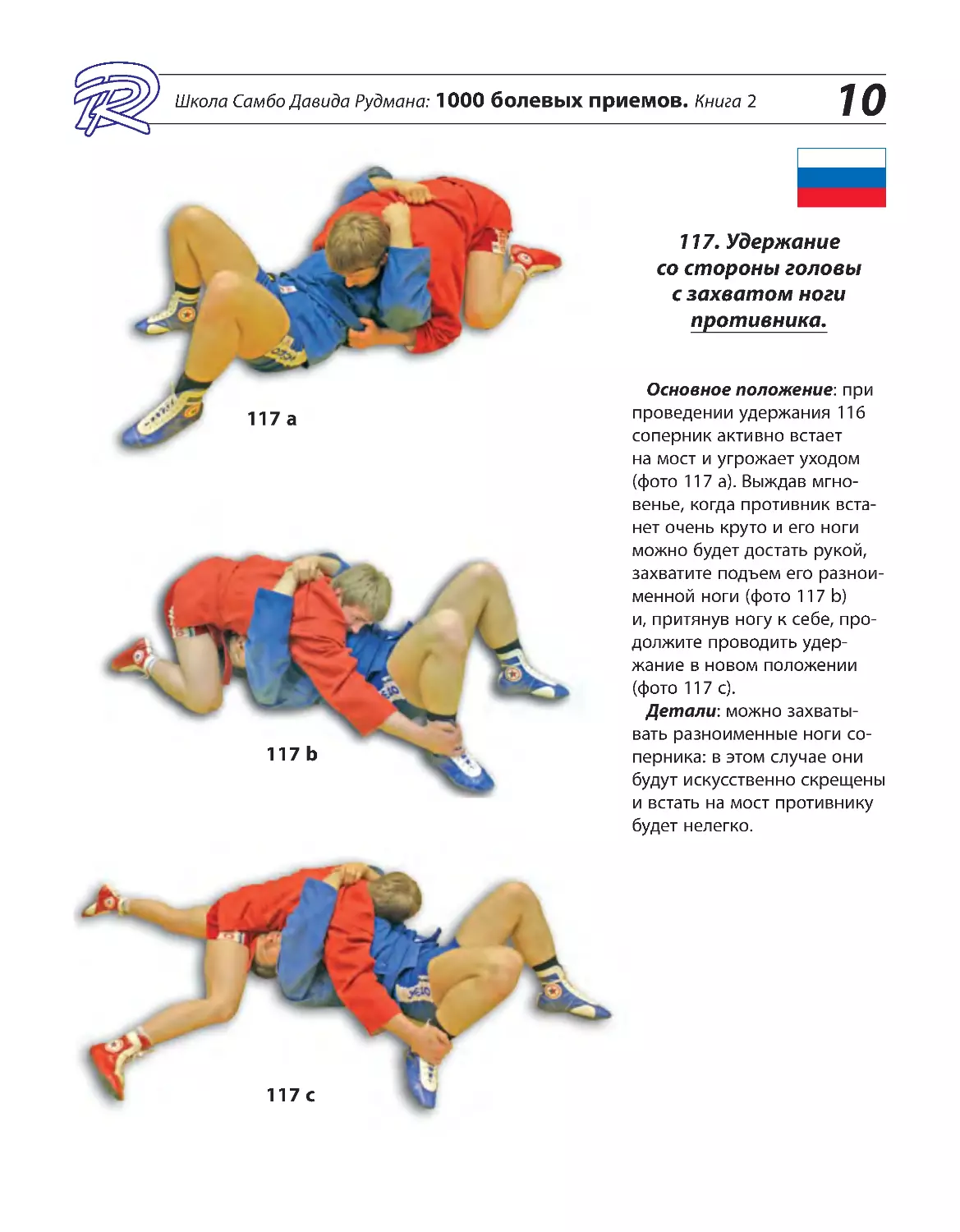
117. Удержание
со стороны головы
с захватом ноги
противника.

117 a

117 b

117 c

Основное положение: при
проведении удержания 116
соперник активно встает
на мост и угрожает уходом
(фото 117 a). Выждав мгновенье, когда противник встанет очень круто и его ноги
можно будет достать рукой,
захватите подъем его разноименной ноги (фото 117 b)
и, притянув ногу к себе, продолжите проводить удержание в новом положении
(фото 117 c).
Детали: можно захватывать разноименные ноги соперника: в этом случае они
будут искусственно скрещены
и встать на мост противнику
будет нелегко.

Sambo School of David Rudman: 1000 submissions. Book 2

11

117. Hold down
from head side
while gripping the
opponent’s leg.

117. Rétention du côté
de la tête avec la prise
d’une jambe
de l’adversaire.

117. Inmovilizació n
por la cabeza,
capturando la pierna
del adversario.

Main position: while performing hold down 116, the
opponent executes active
bridging and threatens with an
escape (photo 117 a). Wait until
the opponent positions himself
very steeply and you can reach
his legs with your hands, then
grip the rise of his opposite leg
(photo 117 b), pull the leg up
to yourself and continue performing the hold down in this
new position (Photo 117 c).
Details: it is possible to grip
opposite legs of the opponent; in that case they will be
crossed artificially, making it
hard for the opponent to execute bridging.

Position principale: lors de
la rétention 116, l’adversaire
fait le pont activement et menace de l’esquive (photo 117
a). Ayant attendu l’instant où
l’adversaire se redresse très
brusquement et on peut saisir
sa jambe du bras, saisissez le
cou-de-pied de sa jambe contraire (photo 117 b) et, tirant sa
jambe vers vous, continuez la
rétention dans cette nouvelle
position (photo 117 c).
Détails: on peut saisir les jambes contraires de l’adversaire:
en ce cas elles seront croisées
artificiellement, et il sera difficile à l’adversaire de faire le
pont.

Posició n principal: al aplicar
la inmovilizació n 116, el adversario se pone activamente
en puente y amenaza de escapar (foto 117 a). Esperar al
momento cuando el adversario
se pone muy abruptamente y
se puede alcanzar sus piernas con la mano, y capturar un
empeine de su pie contrario
(foto 117 b). Atraer la pierna
a usted y sequir aplicando la
inmovilizació n en la nueva
posició n (foto 117 c).
Detalles: es posible capturar
las piernas contrarias del adversario: en este caso ellas será n
cruzadas artificialmente, por
eso el adversario tendrá problemas poniendose en puente.

Школа Самбо Давида Рудмана: 1000 болевых приемов. Книга 2

12

118. Удержание со
стороны головы с
захватом пояса.

118 а

118 b

118 c

Основное положение: захватите пояс противника с
двух сторон на боку (фото
118 a), локти прижмите к его
туловищу, стараясь расположить их у него под мышками
(фото 118 b). Голову опустите
возможно ниже, ноги подведите к плечам, прижимая
бедра к противнику. Если
соперник встанет на мост,
оторвите его от ковра и продолжайте удерживать на весу,
чуть подтянув к себе. При
мощных попытках уходить
при помощи моста обхватите
соперника двумя руками за
туловище и проведите удержание.
Детали: опустите руки возможно ближе к плечам соперника, ноги разведите как
можно шире (фото 118 c).

Sambo School of David Rudman: 1000 submissions. Book 2

13

118. Hold down from
head side while gripping
the waist.

118. Rétention du côté de
la tête avec la prise de la
taille.

118. Inmovilizació n por
la cabeza, capturando la
cintura.

Main position: grip the
opponent’s waist from both
sides while on the side (photo
118 a), press the elbows to his
body and try to position them
under his armpits (photo 118
b). Lower the head as much
as possible, pull the legs up to
the shoulders, pressing your
thighs against the opponent. If
the opponent performs bridging, pull him away from the
mat and continue holding him
aweigh, close to you. In case of
strong attempts of escape via
bridging grip the opponent’s
body with both arms and execute the hold down.
Details: lower the arms as
close to the opponent’s shoulders as possible, spread the
legs as wide as possible (photo
118 c).

Position principale: saisissez la taille de l’adversaire des
deux côtés sur le flanc (photo
118 a), pressez les coudes contre son tronc, essayant de les
placer sous ses aisselles (photo 118 b). Baissez la tête au
maximum possible, amenez
les jambes vers les épaules en
pressant les hanches contre
l’adversaire. Si l’adversaire fait
le pont, détachez-le du tapis et
continuez de le garder suspendu en le tirant légèrement vers
vous. Si l’adversaire tâche vigoureusement d’esquiver à l’aide
du pont, entourez le tronc de
l’adversaire des deux bras et
procédez à une rétention.
Détails: baissez vos bras le
plus près des épaules de l’adversaire, écartez les jambes le
plus largement possible (photo
118 c).

Posició n principal: capturar
la cintura del adversario por
dos lados por el costado (foto
118 a), presionar sus codos a
su cuerpo, tratando de disponerlos debajo de sus sobacos
(foto 118 b). Bajar la cabeza lo
má s que se pueda, acercar las
piernas a los hombros, presionando sus muslos al adversario. Si el adversario se pone
en puente, apartelo del tapiz y
siga manteniendolo suspenso,
apretandolo a usted un poco.
Durante las tentativas potentes
de evadirse por medio del puente abrace al adversario con
dos brazos por el tronco y aplique la inmovilizació n.
Detalles: bajar los brazos lo
má s cerca de los hombros del
adversario, apartar las piernas lo má s que se pueda (foto
118 c).

Школа Самбо Давида Рудмана: 1000 болевых приемов. Книга 2

14

119. Удержание
с плеча.

119 а

119 b

119 c

Основное положение: захватите правой рукой соперника за шею (фото 119 a),
вернее, обхватите шею соперника и захватите куртку
у себя на груди. Левой рукой
обхватите таким же способом
плечо одноименной руки соперника (фото 119 b). Можно
чуть изменить захват, сцепив
руки под противником в замок. Старайтесь помешать
партнеру встать на мост,
убирая предплечьем правой
руки голову соперника к
себе.
Детали: ноги, как и во всех
предыдущих приемах, широко разведены в стороны,
туловище расположено по
биссектрисе угла между захваченным плечом и головой
(фото 119 c), голова противника прижата к его левому
плечу.

Sambo School of David Rudman: 1000 submissions. Book 2

15

119. Hold down from
the shoulder.

119. Rétention à partir
de l’épaule.

119. Inmovilizació n
por el hombro.

Main position: grip the opponent’s neck with your right
arm (photo 119 a), or more
likely, grasp the opponent’s
neck and grip the front of your
jacket. With your left hand
grasp the opponent’s similar
shoulder the same way (photo
119 b). You can change the
hold a little, locking your hands
underneath the opponent. Try
to stop the partner from bridging, pushing the opponent’s
head closer to you with your
right forearm.
Details: legs are spread wide
like in all of the previous techniques, body positioned along
the bisector of the angle between the gripped shoulder
and the head (photo 119 c),
the opponent’s head pressed
to his left shoulder.

Position principale: prenez
l’adversaire avec le bras droit par le cou (photo 119 a),
plutôt, entourez le cou de l’adversaire et saisissez la veste
sur votre poitrine. De la même
façon, entourez l’épaule homonyme de l’adversaire (photo 119 b). On peut modifier
légèrement la prise en verrouillant les bras sous l’adversaire.
Cherchez à empêcher l’adversaire de faire le pont en penchant la tête de l’adversaire vers
vous à l’aide de l’avant-bras
droit.
Détails: les jambes sont
écartées, comme dans les prises précédentes; le tronc est
situé le long de la bissectrice
de l’angle entre l’épaule prise
et la tête (photo 119 c); la tête
de l’adversaire est serrée contre son épaule gauche.

Posició n principal: capturar el cuello del adversario con
su brazo derecho (foto 119 a),
o en efecto abrazar su cuello y coger su chaqueta sobre
su pecho. Abrazar el hombro
homó nimo del adversario con
su brazo izquierdo de esa manera (foto 119 b). Se puede
cambiar la presa un poco, enganchando sus manos debajo
del adversario. Tratar de molestarle al adversario ponerse en
puente, levantando la cabeza
del adversario a usted con su
antebrazo.
Detalles: las piernas estan
separadas lo má s posible como
se hace en las té cnicas anteriores, el tronco está situado por
la bisectriz del á ngulo entre el
hombro capturado y la cabeza (foto 119 c), la cabeza del
adversario está apretada a su
hombro izquierdo.

Школа Самбо Давида Рудмана: 1000 болевых приемов. Книга 2

16

120. Удержание
со стороны головы,
прижимая руки
соперника к его
туловищу.
Основное положение:
руки соперника расположены вдоль его туловища, обхватите соперника руками,
прижмите локтями руки партнера к его туловищу (фото
120 a). Захватите пояс (фото
120 b). Прижмитесь грудью к
сопернику, голову опустите
вниз (фото 120 c).
Детали: руки соперника
прижмите к его туловищу у
локтей.

120 а

120 b

120 c

Sambo School of David Rudman: 1000 submissions. Book 2

17

120. Hold down
from head side
while pressing the
opponent’s arms
to his body.

120. Rétention
du côté de la tête
avec pression des bras
de l’adversaire contre
son tronc.

120. Inmovilizació n
por la cabeza,
apretando los brazos del
adversario contra
su tronco.

Main position: the opponent’s arms are held along his
body; grasp the opponent with
your arms, press his arms to his
body with your elbows (photo
120 a). Grip his waist (photo
120 b). Press your chest to the
opponent, lower your head
(photo 120 c).
Details: press the opponent’s
arms to his body at the elbows.

Position principale: les bras
de l’adversaire sont situés le
long de son tronc. Entourez l’adversaire des bras, pressez les
bras du partenaire contre son
tronc avec vos coudes (photo
120 a). Saisissez la taille (photo
120 b). Serrez votre poitrine contre l’adversaire, baissez la tête
(photo 120 c).
Détails: pressez les bras de
l’adversaire contre son tronc
près des coudes.

Posició n principal: los brazos del adversario estan a lo
largo de su cuerpo. Abrazar al
adversario con sus brazos, apretar los brazos del adversario
contra su tronco con sus codos
(foto 120 a). Capturar la cintura
(foto 120 b). Apretar su pecho
contra el adversario, bajar la
cabeza (foto 120 c).
Detalles: apretar los brazos
del adversario contra el tronco
cerca de los codos.

Школа Самбо Давида Рудмана: 1000 болевых приемов. Книга 2

18

121. Удержание со
стороны головы
захватом куртки изпод плеча.
121 а

121 b

121 c

Основное положение: подведите свои руки под плечи
соперника и захватите его
куртку около подмышек разноименным хватом (фото
121 a). Подтянув куртку противника к себе, прижмитесь
головой и плечом к его груди
(фото 121 b). Ноги разверните
в стороны как можно шире.
Детали: чтобы полностью
обхватить курткой соперника
его плечо, захват произведите около ребер (а не у плеча).
В этом случае, подтянув куртку противника, вы обернете
его плечо его же собственной
курткой (фото 121 c).

Sambo School of David Rudman: 1000 submissions. Book 2

121. Hold down from
head side with gripping
the jacket from under the
shoulder.
Main position: position your
arms under the opponent’s
shoulders and grip his jacket
near the armpits with an opposite grip (photo 121 a). Pulling the opponent’s jacket up
to you, press your head and
shoulder to his chest (photo
121 b). Spread the legs as wide
as possible.
Details: to get a full grip of
the opponent’s shoulder with
his jacket, grip the area near
his ribs (not the shoulder). In
this case, when you pull the
opponent’s jacket up, you wrap
it around him. (photo 121 c).

121. Rétention du côté
de la tête par prise de la
veste de dessous l’épaule.
Position principale: amenez
vos bras sous les épaules de
l’adversaire et prenez sa veste près des aisselles par prise
contraire (photo 121 a). Tirant
la veste de l’adversaire vers
vous, serrez votre tête et votre
épaule contre sa poitrine (photo 121 b). Ecartez vos jambes le
plus largement possible.
Détails: pour entourer
complètement l’épaule de l’adversaire avec sa veste, saisissezle près des côtes (et non près
de l’épaule). En ce cas, tirant la
veste de l’adversaire, vous entourerez son épaule par sa propre veste (photo 121 c).

19

121. Inmovilizació n por
la cabeza, capturando la
chaqueta de debajo del
hombro.
Posició n principal: colocar
sus brazos debajo de los hombros del adversario and caprturar su chaqueta cerca de los
sobacos por la presa contraria
(foto 121 a). Llevar la chaqueta
del adversario a usted y apretar
la cabeza y el hombro contra
su pecho (foto 121 b). Apartar
las piernas lo má s que se pueda.
Detalles: para completamente envolver el hombro del
adversario con la chaqueta,
la presa se aplica cerca de las
costillas (y no del hombro). En
este caso, al llevar la chaqueta
del adversario, usted envuelve
su hombro con so propia chaqueta. (foto 121 c).

Школа Самбо Давида Рудмана: 1000 болевых приемов. Книга 2

20

122. Удержание
с плеча с захватом
куртки
из-под плеча.

122 а

122 b

122 c

Основное положение: захватив описанным способом (121) куртку противника
только с одной стороны,
захватите другой рукой его
голову (фото 122 a). Можно усилить прием, захватив
куртку той же рукой, которая
обнимает соперника за шею.
В это время другой рукой
отведите плечо противника
вверх (фото 122 b) и прижмите к его же голове (фото
122 c).

Sambo School of David Rudman: 1000 submissions. Book 2

21

122. Hold down from the
shoulder while gripping
the jacket from under the
shoulder.

122. Rétention à partir
de l’épaule avec la prise
de la veste de dessous
l’épaule.

122. Inmovilizació n por
el hombro, capturando la
chaqueta de debajo del
hombro.

Main position: gripping the
opponent’s jacket from one
side only as described before
(121), grip his head with the
other hand (photo 122 a). You
can strengthen the technique
by gripping the jacket with the
same hand that is wrapped
around the opponent’s neck.
At the same time push the
opponent’s shoulder up with
your other hand (photo 122 b)
and press it to his head (photo
122 c).

Position principale: ayant
saisi la veste de l’adversaire
d’un côté seulement au moyen décrit (121), prenez sa tête
avec l’autre bras (photo 122 a).
On peut renforcer la prise en
prenant la veste avec le même
bras qui entoure le cou de
l’adversaire. En même temps,
écartez l’épaule de l’adversaire
en haut avec l’autre bras (photo 122 b) et serrez-le contre sa
tête (photo 122 c).

Posició n principal: al capturar la chaqueta del adversario
como está descrito (121) solamente por un lado, capturar
su cabeza con otro brazo (foto
122 a). Es posible intensificar
la té cnica, capturando la chaqueta con la misma mano que
está abrazando el cuello del
adversario. En este momento
desplazar el hombro del adversario arriba con su otro mano
(foto 123 b) y apretaro contra
la cabeza del adversario (foto
123 c).

Школа Самбо Давида Рудмана: 1000 болевых приемов. Книга 2

22

123. Удержание
со стороны головы,
поднимая обе руки
соперника вверх.

123 а

123 b

123 c

Основное положение: вам
удалось поднять обе руки
соперника вверх или он поднял их случайно. Обхватите
руки противника своими руками (фото 123 a), положите
его голову на свое плечо,
сцепите обе руки в замок и,
подтягивая соперника под
себя (фото 123 b), проведите
удержание со стороны головы (фото 123 c).

Sambo School of David Rudman: 1000 submissions. Book 2

23

123. Hold down
from head side while
lifting the opponent’s
both arms.

123. Rétention
du côté de la tête en
levant les deux bras de
l’adversaire.

123. Inmovilizació n
por la cabeza, levantando
los dos brazos del
adversario.

Main position: you managed
to lift both of the opponent’s
arms or he lifted them unintentionally. Grasp the opponent’s
arms with yours (photo 123 a),
put his head on your shoulder,
lock both arms and perform
hold down from head side
(photo 123 b) while pulling the
opponent under yourself (photo 123 c).

Position principale: vous
avez arrivé à lever les deux
bras de l’adversaire ou il les a
levés par accident. Entourez les
bras de l’adversaire de vos bras
(photo 123 a), posez sa tête sur
votre épaule, verrouillez vos
bras et, tirant l’adversaire sous
vous-même (photo 123 b),
procédez à une rétention du
côté de la tête (photo 123 c).

Posició n principal: usted ha
levantado los dos brazos del
adversario o é l los ha levantado por casualidad. Abrazar
los brazos del adversario con
sus brazos (foto 123 a), poner
la cabeza del adversario sobre
el hombro de usted, enganchar
los dos brazos en candado y
aplicar la inmovilizació n por la
cabeza (foto 123 b), arrastrando el adversario debajo de usted (foto 123 c).

Школа Самбо Давида Рудмана: 1000 болевых приемов. Книга 2

24

124. Удержание со
стороны головы,
скрещивая руки
противника на его
груди.

124 а

124 b

124 c

Основное положение: захватите запястья разноименных рук противника и, потянув их в разные стороны,
скрестите на его груди (фото
124 a). Прижавшись грудью к
прижатым рукам соперника и
разведя свои ноги широко в
стороны, проведите удержание со стороны головы (фото
124 b).
Детали: можно одну руку
подтянуть ближе к голове соперника, так, чтобы она обняла его голову (фото 124 c).
Подтянув руку за кулак, как
можно больше прижмитесь
плечом к голове соперника.
Единственную возможность
избежать описанного положения – вращение в направлении своего кулака вы перекрываете захватом другой
руки противника.

Sambo School of David Rudman: 1000 submissions. Book 2

25

124. Hold down
from head side while
crossing the opponent’s
arms over his
chest.

124. Rétention
du côté de la tête en
croisant les bras de
l’adversaire sur sa
poitrine.

124. Inmovilizació n
por la cabeza, cruzando
los brazos del
adversario sobre su
pecho.

Main position: grip the
wrists of the opponent’s opposite arms, pull them apart
and cross them over his chest
(photo 124 a). Press your chest
against the opponent’s pressed
arms and spread your legs
wide apart, then perform hold
down from head side (photo
124 b).
Details: you can pull one arm
up closer to the opponent’s
head so that it is wrapped
around his head (photo 124 c).
Pulling up the fist, press your
shoulder to the opponent’s
head as close as possible. The
only way to avoid the aforementioned situation is to rotate the fist, but you prevent
it by gripping the opponent’s
other arm.

Position principale: saisissez
les poignets des bras contraires de l’adversaire et, les tirant
des côtés différents, croisez-les
sur sa poitrine (photo 124 a).
Votre poitrine serrée contre les
bras pressés de l’adversaire, et
vos jambes écartées largement,
procédez à une rétention du
côté de la tête (photo 124 b).
Détails: on peut tirer un bras
plus près de la tête de l’adversaire de façon qu’il entoure sa
tête (photo 124 c). Ayant tiré
le bras par le poing, serrez au
maximum votre épaule contre
la tête de l’adversaire. La seule
possibilité d’éviter la position
décrite – rotation dans la direction de son poing – sera
éliminée par prise de l’autre
bras de l’adversaire.

Posició n principal: capturar
los carpos de los brazos contrarios del adversario y cruzarlos
sobre su pecho, tirando cada
uno por su lado (foto 124 a). Al
apretar la cabeza contra los brazos estrechados del adversario y apartar las piernas ampliamente, aplicar la inmovilizació n
por la cabeza (foto 124 b).
Detalles: es posible arrastrar
un brazo má s cerca a la cabeza del adversario así que abrace su cabeza (foto 124 c). Al
apretar la mano por el puño,
apretarse lo más posible por el
hombro contra la cabeza del
adversario. La única posibilidad de evitar la posición descrita – el giro en la dirección
del puño – usted recubre por
la presa de otra mano del adversario.

Школа Самбо Давида Рудмана: 1000 болевых приемов. Книга 2

26

125. Удержание со
стороны головы,
захватывая руки
соперника обратным
хватом.
125 а
Основное положение: обхватив руки соперника обратным хватом (фото 125 a),
сцепите их в замок у себя на
животе. Прижмитесь грудью
к груди противника (фото
125 b), ноги разведите как
можно шире (фото 125 c).

125 b

125 c

Sambo School of David Rudman: 1000 submissions. Book 2

27

125. Hold down
from head side while
gripping the opponent’s
head with a reverse
grip.

125. Rétention
du côté de la tête en
prenant les bras de
l’adversaire par prise
inverse.

125. Inmovilizació n
por la cabeza,
capturando los brazos del
adversario por la presa
inversa.

Main position: grasping the
opponent’s arms with a reverse
grip (photo 125 a), lock them
over your stomach. Press your
chest against the opponent’s
chest (photo 125 b), spread
your legs as wide as possible
(photo 125 c).

Position principale: ayant
entouré les bras de l’adversaire
par prise inverse (photo 125 a),
verrouillez-les sur votre ventre.
Serrez votre poitrine contre la
poitrine de l’adversaire (photo
125 b), écartez vos jambes le
plus largement possible (photo
125 c).

Posició n principal: al abrazar
los brazos del adversario por la
presa inversa (foto 125 a), engancharlos en candado sobre
el vientre de usted. Apretar su
pecho contra el pecho del adversario (foto 125 b), apartar las
piernas lo má s que se pueda
(foto 125 c).

Школа Самбо Давида Рудмана: 1000 болевых приемов. Книга 2

28

126. Удержание с плеча
с обратным захватом
одной руки.

126 а

126 b

126 c

Основное положение: захватите ближнее плечо противника обратным хватом
и прижмитесь грудью к его
плечу (фото 126 a). Захватите дальнюю руку соперника
из-под плеча и подтяните его
куртку к себе (фото 126 b).
Можно симметрично поменять захват, то есть захватить
ближнее плечо партнера
снаружи, а дальнюю руку изнутри.
Главные элементы данного удержания – прижимание
головы к дальнему плечу противника и прижимание грудью
его ближнего плеча – остаются
неизменными.
Ноги, как и во всех удержаниях, следует развести
возможно шире (фото 126 c).
Можно сменить способ удержания, не отпуская захвата.
Для этого достаточно перекрыть другое, допустим, дальнее плечо, и соперник окажется захваченным другим
способом. Голову все время
прижимайте как можно ниже
к туловищу противника, чтобы не дать ему подвести под
нее свою руку.

Sambo School of David Rudman: 1000 submissions. Book 2

29

126. Hold down from the
shoulder with a reverse
grip of one arm.

126. Rétention à partir
de l’épaule avec prise
inverse d’un bras.

126. Inmovilizació n por
el hombro por la presa
inversa de un brazo.

Main position: grip the closest shoulder of the opponent
with a reverse grip and press
your chest to his shoulder
(photo 126 a). Grip the opponent’s opposite arm from under the shoulder and pull his
jacket up to you (photo 126 b).
You may change the grip symmetrically, i.e. grip the partner’s
closer shoulder from the outside and his far arm from the
inside.
Main elements of this hold
down – pressing the head to
the opponent’s far shoulder and
pressing down on his closer
shoulder with your chest – remain the same.
As it is done for every hold
down, legs should be spread
as wide apart as possible (photo 126 c). You can change the
method of hold down without
releasing the grip. It is enough
to cover the other shoulder (for
example the far shoulder) and
the opponent will be locked in
another grip. Throughout this
the head should be pressed as
close to the opponent’s body
as possible to stop him from
getting his arm under it.

Position principale: saisissez
la plus proche épaule de l’adversaire par prise inverse et serrez
votre poitrine contre son épaule
(photo 126 a). Saisissez le bras
éloigné de l’adversaire de dessous l’épaule et tirez sa veste vers
vous (photo 126 b). On peut changer la prise symétriquement,
c’est-à-dire, saisir l’épaule proche
de dehors et le bras éloigne de
dedans.
Les éléments principaux de
cette rétention – serrage de la
tête contre l’épaule éloignée
de l’adversaire et serrage de
son épaule proche avec votre
poitrine – restent invariables.
Les jambes doivent être
écartées le plus largement
possible, comme pour toutes
les retentions photo 126 c).
On peut modifier la méthode
de rétention sans lâcher prise. Pour cela, il est suffisant
de fermer l’autre épaule (p.e.
éloignée), et l’adversaire sera
saisi d’une autre façon. Serrez
votre tête le plus bas possible
contre le tronc de l’adversaire
pour le pas le laisser porter son
bras sous elle.

Posició n principal: capturar
el hombro cercano del adversario por la presa inversa y apretarse con su pecho al hombro
del adversario (foto 126 a).
Capturar el brazo lejano del adversario de debajo del hombro
y arrastrar su chaqueta a usted
(foto 126 b). Se puede cambiar
la presa simé tricamente, es decir capturar el hombro cercano del adversario por fuera y
el brazo lejano por dentro.
Los elementos principales de
esta inmovilizació n – apretar
la cabeza contra el hombro
lejano y apretar su hombro
cercano por el pecho – no se
cambian.
Las piernas, como en todas
las inmovilizaciones, tienen
que ser apartadas lo má s que
se pueda (foto 126 c). Su puede cambiar el modo de la
inmovilizació n sin relejar la
presa. Para esto es suficiente
bloquear el otro hombro, por
ejemplo el hombro lejano, y
el adversario estará capturado
por el otro modo. Siempre aprete la cabeza los má s bajo contra el tronco del adversario
para no dejarle llevar su brazo
debajo de ella.

Школа Самбо Давида Рудмана: 1000 болевых приемов. Книга 2

30

127. Удержание со
стороны головы с
захватом отворота
куртки из-под головы.

127 а

127 b

127 c

Основное положение: захватите правой рукой куртку противника из-под шеи и
прижмите грудью его ближнее (в данном случае левое)
плечо (фото 127 a). Левой
рукой захватите одежду противника около пояса или на
груди (фото 127 b).
Если соперник начнет уходить от удержания, поворачиваясь к вам, правой рукой
потяните его к себе. Если он
начнет поворачиваться, ложась на правый бок, прижмите его к ковру грудью (фото
127 c). При попытках встать
на мост, маневрируя правой
рукой, помешайте противнику осуществить задуманное,
подставляя правое предплечье на то место, в которое
соперник пытается упереться
головой.

Sambo School of David Rudman: 1000 submissions. Book 2

31

127. Hold down from
head side while gripping
the jacket flap from
under the head.

127. Rétention du côté
de la tête avec prise du
revers de la veste de
dessous la tête.

127. Inmovilizació n por
la cabeza, capturando la
solapa de la chaqueta de
debajo de la cabeza.

Main position: grip the opponent’s jacket with your right hand from under the neck
and press his closer shoulder
(in this case his left one) down
with your chest (photo 127 a).
Grip the opponent’s clothes
near the waist or on the chest with your left hand (photo
127 b).
If the opponents starts avoiding the hold down by turning
towards you, pull him up to
yourself with your right hand.
If he starts turning, lying down
on his right side, press his chest against the mat (photo 127
c). If he attempts bridging, stop
him from doing it by maneuvering your right arm and putting your right forearm where
the opponent attempts to set
his head.

Position principale: saisissez la veste de l’adversaire
avec le bras droit de dessous
le cou et pressez son épaule
proche (ici: gauche) avec votre poitrine (photo 127 a). Saisissez le vêtement de l’adversaire avec le bras gauche près
de la taille ou sur la poitrine
(photo 127 b).
Si l’adversaire commence à
s’écarter de la rétention, tirez-le
vers vous avec le bras droit. S’il
commence à tourner en se couchant sur le flanc droit, serrezle contre le tapis avec votre poitrine (photo 127 c). A ses essais de faire le pont, empêchezle, manœuvrant le bras droit et
plaçant l’avant-bras droit là où
l’adversaire tâche d’appuyer sa
tête.

Posició n principal: capturar
la chaqueta del adversario de
debajo del cuello con so brazo
derecho y apretar por su pecho el hombro cercano (es este
caso, izquierdo) del adversario
(foto 127 a). Capturar la ropa
del adversario cerca de la cintura o en el pecho con su mano
inzquierda (foto 127 b).
Si el adversario empieza a escapar de la inmovilizació n, volviendose a usted, arrastrarlo
a usted con la mano derecha.
Si é l empieza a darse vuelta
por su lado derecho, apretelo
contra el tapiz por el pecho
(foto 127 c). Si el adversario intenta ponerse en puente, usted
tiene que maniobrar con su
brazo derecho y molestarle realizar su idea. Para eso hay que
poner el antebrazo derecho a
aquel lugar, en que el adversario trata de apoyarse por la
cabeza.

Школа Самбо Давида Рудмана: 1000 болевых приемов. Книга 2

32

128. Удержание со
стороны головы с
захватом одежды на
плечах.

128 а

128 b

128 c

Основное положение: захватите двумя руками одежду на плечах соперника одноименным захватом (фото
128 a). Подтяните плечи к
себе, прижмитесь грудью к
его груди (фото 128 b), голову крепко прижмите к боку.
Не давайте противнику возможности отжать вашу голову. Если он попытается встать
на мост, подтяните его плечи к себе вверх. Старайтесь
свою голову держать ближе к
рукам соперника (фото 128 c),
в противном случае он отожмет вашу голову руками.

Sambo School of David Rudman: 1000 submissions. Book 2

33

128. Hold down from
head side while gripping
the clothes on the
shoulders.

128. Rétention
du côté de la tête avec
prise des habits sur les
épaules.

128. Inmovilizació n
por la cabeza,
capturando la ropa sobre
los hombros.

Main position: grip the opponent’s clothes on the shoulders with both hands, performing
a similar grip (photo 128 a).
Pull the shoulders up to yourself, press your chest against
his (photo 128 b), press your
head firmly to his side. Do not
let the opponent a chance to
squeeze your head. If he tries
bridging, pull his shoulders up.
Try to hold your head closer to
the opponent’s hands (photo
128 c), otherwise he will push
to release your head with his
hands.

Position principale: saisissez
le vêtement sur les épaules de
l’adversaire de vos deux bras
par prise homonyme (photo
128 a). Tirez ses épaules vers
vous, serrez votre poitrine contre sa poitrine (photo 128
b); pressez la tête contre le
flanc. Ne laissez pas l’adversaire écarter votre tête. S’il essaye de faire le pont, tirez ses
épaules en haut vers vous. Essayez de tenir votre tête plus
près des bras de l’adversaire
(photo 128 c), sinon il écartera
votre tête avec ses bras.

Posició n principal: capturar
la ropa sobre los hombros del
adversario con los dos brazos
con la presa homó nima (foto
128 a). Apretar los hombros a
usted, apretarse por el pecho
contra su pecho (foto 128 b),
apretar la cabeza al lado con
fuerza. No dar al adversario la
posibilidad de presionar su cabeza. Si é l trata de ponerse en
puente, arrastrar sus hombros
arriba, hacia usted. Tratar de
poner la cabeza más cerca a
las manos del adversario (foto
128 c), o é l presionará su cabeza por las manos.

Школа Самбо Давида Рудмана: 1000 болевых приемов. Книга 2

34

129. Удержание
спиной с захватом
рук.

129 а

129 b

129 c

Основное положение: лежа
на спине, захватите руки соперника под мышки как можно выше (фото 129 a). Прижмитесь спиной к его груди,
разведите ноги как можно
шире, чтобы увеличить площадь опоры (фото 129 b).
Руки противника захвачены
вашими подмышками не всегда достаточно эффективно
(особенно если еще нет навыка). Для усиления захвата
рекомендуется согнуть свои
руки в локтях и захватить
руки соперника покрепче
(фото 129 c) Можно одну его
руку удерживать, прижимая
свое плечо к боку, а вторую
захватить разноименной рукой за рукав куртки у предплечья. Ноги расположены
между головой и плечом с
опасной для ухода противника стороны. При попытках
партнера уйти в другую сторону перенесите ноги в том
же направлении.

Sambo School of David Rudman: 1000 submissions. Book 2

35

129. Hold down with your
back while gripping the
hands.

129. Rétention à l’aide
du dos avec prise des
bras.

129. Inmovilizació n por la
espalda, capturando los
brazos.

Main position: grip the opponent’s arms under your armpits as high as possible while lying
on your back (photo 129 a). Press your back to his chest, spread your legs as wide apart as
possible to increase the bearing area (photo 129 b). The opponent’s arms are not always
effectively gripped by your armpits (especially if you do not
have the skill yet). To strengthen the grip, it is recommended
that you bend your arms at the
elbows and grip the opponent’s arms more firmly (photo
129 c). You can hold one of his
arms by pressing your shoulder
to his side, and grip the sleeve
on other forearm by your opposite hand. Legs should be
positioned between the head
and the shoulders to make the
escape dangerous. If the opponent attempts to escape to the
other side, move your legs in
the same direction.

Position principale: couché
sur le dos, saisissez les bras de
l’adversaire sous ses aisselles le
plus haut possible (photo 129 a).
Serrez votre dos contre sa poitrine, écartez les jambes le plus
largement possible pour augmenter la surface d’appui (photo
129 b). Les bras de l’adversaire
ne sont pas saisis par vos aisselles toujours d’une façon efficace (surtout si vous n’avez pas
d’expérience). Pour renfoncer la
prise, il est recommandé de plier les bras dans les coudes et
prendre l’adversaire plus fortement (photo 129 c). On peut
retenir un de ses bras en serrant votre épaule contre le flanc
et saisir son autre bras avec le
bras contraire par la manche
de sa veste près de l’avantbras. Les jambes sont situés
entre la tête et l’épaule du côté
dangereux pour l’esquive de
l’adversaire. A la tentative du
partenaire d’esquiver de l’autre
côté, amenez vos pieds dans la
même direction.

Posició n principal: Estando
tumbado sobre la espalda,
capturar los brazos del adversario debajo de los sobacos lo
más arriba que se pueda (foto
129 a). Apretarse por la espalda contra su pecho, apartar las
piernas lo má s que se pueda
para aumentar el área del soporte (foto 129 b). Los brazos
del adversario no siempre estan capturados por sus sobacos
bastante effectivamente (especialmente si no hay todavía
práctica). Para reforzar la presa
se recomienda doblar los brazos en los codos y capturar los
brazos del adversario más con
fuerza (foto 129 c). Es posible
fijar uno de sus brazos, apretando el hombro al lado, y capturar el segundo por la mano
contraria por la manga de la
chaqueta cerca del antebrazo.
Las piernas estan situadas entre la cabeza y el hombro por
el lado peligroso para la salida
del adversario. Durante las tentativas del adversario de escapar al otro lado llevar las piernas
en la misma dirección.

Школа Самбо Давида Рудмана: 1000 болевых приемов. Книга 2

36

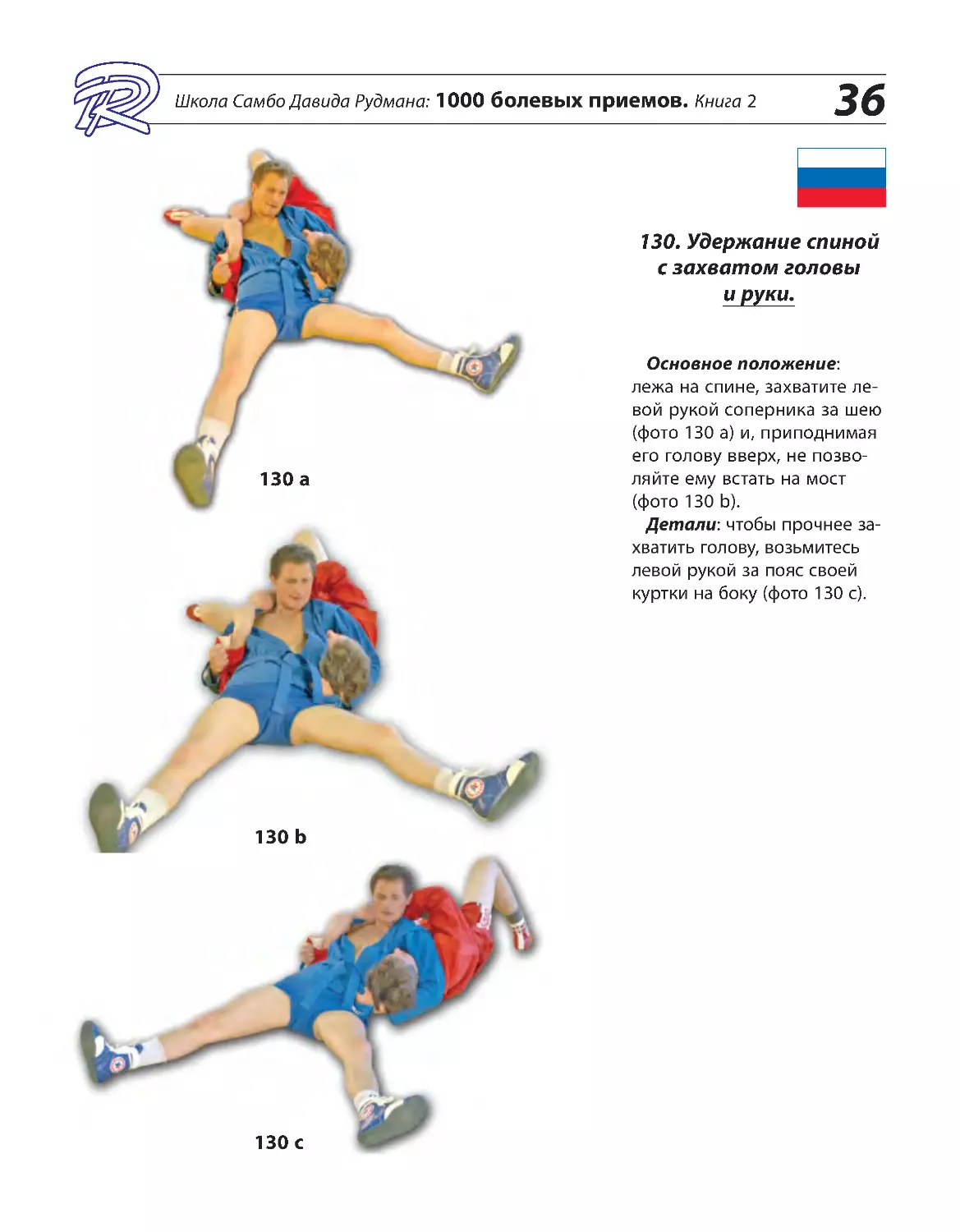
130. Удержание спиной
с захватом головы
и руки.

130 а

130 b

130 c

Основное положение:
лежа на спине, захватите левой рукой соперника за шею
(фото 130 a) и, приподнимая
его голову вверх, не позволяйте ему встать на мост
(фото 130 b).
Детали: чтобы прочнее захватить голову, возьмитесь
левой рукой за пояс своей
куртки на боку (фото 130 c).

Sambo School of David Rudman: 1000 submissions. Book 2

37

130. Hold down with your
back while gripping the
head and the arm.

130. Rétention à l’aide du
dos avec prise de la tête
et d’un bras.

130. Inmovilizació n por
la espalda, capturando la
cabeza y el brazo.

Main position: while lying on
your back, grip the opponent’s
neck with your left arm (photo
130 a) and don’t let him perform bridging while lifting his
head (photo 130 b).
Details: to get a firmer grip
on the head, grasp the side of
your jacket’s waist with your
left hand (photo 130 c).

Position principale: couché
sur le dos, saisissez l’adversaire
par le cou avec le bras gauche
(photo 130 a) et, soulevant sa
tête, ne le laissez pas faire le
pont (photo 130 b).
Détails: pour saisir la tête plus
fortement, prenez la ceinture de
votre veste sur le flanc avec le
bras gauche (photo 130 c).

Posició n principal: Estando
tumbado sobre la espalda, capturar el cuello del adversario
por el brazo izquierdo (foto
130 a) y, levantando su cabeza,
molestarle ponerse en puente
(foto 130 b).
Detalles: para capturar la
cabeza con má s fuerza, tomar
la cintura de su chaqueta en
el lado por su mano izquierda
(foto 130 c).

Школа Самбо Давида Рудмана: 1000 болевых приемов. Книга 2

38

ПРОТИВНИК ЛЕЖИТ
НА СПИНЕ

THE OPPONENT IS LYING
ON THE BACK

АТАКА СО СТОРОНЫ ГОЛОВЫ

ATTACK FROM HEAD SIDE

ПЕРЕВОРАЧИВАНИЯ

TURNOVERS

Sambo School of David Rudman: 1000 submissions. Book 2

39

L’ADVERSAIRE EST COUCHE
SUR LE DOS

EL ADVERSARIO SE
ENCUENTRA DE ESPALDAS

ATTAQUE DU COTE DE LA TETE

ATAQUE POR LA CABEZA

RETOURNEMENTS

VIRAJES

Школа Самбо Давида Рудмана: 1000 болевых приемов. Книга 2

131 а

131 b

40

При грамотном сопротивлении, как это ни парадоксально на первый взгляд, положение лежа на спине при
нападении со стороны головы оказывается не таким уж и
беззащитным. Более того, часто бывает трудно атаковать
лежащего на спине соперника, активно работающего ногами и руками. В этом случае
удобнее всего перевернуть
его в другое положение, допустим на живот или, лучше
всего, на бок.
В рассматриваемом положении, как мы уже говорили,
проще всего открыть сопернику путь для ухода, и он сам
начнет поворачиваться на
бок или на живот. Существуют
все же некоторые способы
переворачиваний, гарантирующие в какой-то мере надежность задуманной операции..

131. Остановка противника, пытающегося перевернуться на живот.

131 c

Положите предплечье на
грудь соперника (фото131 a).
При его повороте ваша рука
окажется у него на плече и
помешает продолжить вращательное движение (фото 131 b).
Для надежности можно захватить куртку за отворот или за
пояс на животе (photo 131 c)

Sambo School of David Rudman: 1000 submissions. Book 2

41

As odd as it may seem, lying
on the back during the attack
from head side is not such a
vulnerable position if you resist competently. Moreover, it
is often difficult to attack an
opponent lying on his back if
he moves his arms and legs
actively. In that case, it is more
convenient to turn him over to
his stomach or to his side.
Lying on his side, the opponent presses an arm and a leg to
the mat with the weight of his
body; meanwhile, his free arm or
leg can be attacked successfully.
As we have mentioned before,
the easiest thing to do in the position under consideration is to
let the opponent escape; he will
begin to turn over to his stomach or side. However, there are a
few turnovers that guarantee, to
a certain extent, the reliability of
the planned maneuver.

Avec une résistance
compétente, paradoxal que ce
soit du premier regard, la position couché sur le dos n’est pas
si désespérée si attaqué du côté
de la tête. De plus, il est souvent
difficile d’attaquer l’adversaire
couché sur le dos qui se défend
activement avec les jambes et
les bras. En ce cas il est plus opportun de le retourner dans une
autre position – p.ex., sur le ventre ou, qui mieux est, sur le flanc.
Comme nous avons
déjà noté, dans la position
examinée il est le plus facile
d’ouvrir la voie d’esquive pour
l’adversaire, et il commencera
lui-même à se retourner sur
le flanc ou sur le ventre. Quand même, il existe quelques
procédés de retournements qui
garantissent dans une certaine
mesure la sûreté de l’opération
conçue.

A la resistencia competente,
por paradójico que sea a primera vista, la posición de espaldas
al ataque por la cabeza no resulta tan indefensa. Además, es
a menudo difícil atacar al adversario, que está sobre la espalda
y trabaja activamente con las
piernas y los brazos. En este caso
es más conveniente volverlo en
otra posición, por ejemplo al vientre o, lo mejor de todo, al lado.
Estando acostado de lado, el
adversario aprieta al tapiz una
mano y un pie por el peso del
tronco, además la mano libre o
el pie pueden ser sometidos al
ataque con éxito.
En la posición examinada,
como hablábamos ya, es más
fácil conseguir al adversario la
vía para la salida, y él mismo
comenzará a volverse de lado
o al vientre. Hay algunos modos de viraje que garantizan en
una medida la seguridad de la
operación premeditada.

131. Stopping the
opponent attempting to
turn over to the stomach.

131. Arrêt de l’adversaire
qui essaye de se
retourner sur le ventre.

131. Parada del
adversario, que trata
volverse al vientre.

Place your forearm on the
opponent’s chest (photo 131 a).
When he turns over, your hand
will end up on his shoulder and
stop him from continuing the
rotating move (photo 131 b).
To be on the safe side, you can
grip the flap or the belt of the
jacket (photo 131 c).

Posez votre avant-bras sur la
poitrine de l’adversaire (photo 131 a). A son retournement,
votre bras se trouvera sur son
épaule et l’empêchera de continuer le mouvement rotatif (photo
131 b). Pour plus de sécuruté est
possible d`attraper l`adversaire
par la veste ou par la ceinture
sur le ventre (photo 131 c).

Poner el antebrazo en el pecho del adversario (foto 131 a).
A su vuelta la mano de usted
se encuentra sobre su hombro
e impedirá continuar el movimiento giratorio (foto 131 b).
Para seguridad es posible capturar la chaqueta por la vuelta o
por el cinturón sobre el vientre
(foto 131 c).

Школа Самбо Давида Рудмана: 1000 болевых приемов. Книга 2

42

132. Переворачивание
противника
на живот захватом
пройм.

132 а

132 b

132 c

Захватите двумя руками одноименные проймы на куртке противника ( фото 132 a),
одновременно двумя руками
(фото 132 b) поверните его на
живот, не отпуская захвата,
забегите за спину (фото 132 c)
и сядьте на него верхом
Что делать дальше, вы прочтете в соответствующей части данной книги.
Детали: чтобы обмануть
соперника и не раскрывать
заранее направление поворота, сначала поверните его
плечи в одну сторону, а затем
резко в другую.

Sambo School of David Rudman: 1000 submissions. Book 2

43

132. Turning the
opponent over on the
stomach while gripping
the armholes.

132. Retournement de
l’adversaire sur
le ventre pas prise
d’entournures.

132. Viraje del
adversario al vientre
por la toma
de las sisas.

Grip the armholes of the
opponent’s jacket with both
hands ( photo 132 a), turn him
over to his stomach with both
hands at the same time (photo
132 b) without releasing the
grip, run up behind his back
(photo 132 c) and straddle him.
More information in the relevant part of this book.
Details: to deceive the opponent and to keep the turnover
direction from him, first turn
his shoulders to one side and
then abruptly to another.

Saisissez avec vos deux bras
les entournures homonymes de
la veste de l’adversaire (photo
132 a), en même temps retournez-le sur le ventre avec les deux
bras (photo 132 b) sans lâcher
prise, courez derrière son dos
(photo 132 c) et montez sur lui.
Pour les mouvements suivants voir la partie correspondante
de ce livre.
Détails: pour tromper l’adversaire et ne pas découvrir
prématurément la direction
du tour, tournez d’abord ses
épaules d’un côté et après, brusquement, de l’autre.

Capturar por dos manos las
sisas homónimas sobre la chaqueta del adversario (foto
132 a), al mismo tiempo por
dos manos (foto 132 b) volverlo al vientre sin relajar la presa,
pasar por la espalda (foto 132 c)
y montarlo.
Usted puede leer qué tiene
que hacer después en la parte
correspondiente de este libro.
Detalles: para engañar al adversario y no revelar de antemano la dirección de la vuelta,
hay que volver primero sus hombros a un lado, y luego bruscamente al otro.

Школа Самбо Давида Рудмана: 1000 болевых приемов. Книга 2

44

133. Захват руки
соперника «накрест».
Захватите разноименной
рукой запястье противника
сверху. Свободную руку подведите под плечо его одноименной руки и наложите на
предплечье своей руки (фото
133 a). Согните захваченную
руку, подтягивая кулак захваченной руки к плечу соперника (фото 133 b). Захватив
таким способом руку противника, удобно провести болевые приемы: узел руки, обратный узел (фото 133 c), перейти
на рычаг локтя, ущемление
бицепса; можно и повернуть
соперника на бок, на живот.

133 а

133 b

133 c

Sambo School of David Rudman: 1000 submissions. Book 2

45

133. Cross grip of the
opponent’s arm.

133. Prise du bras de
l’adversaire «en croix».

133. Presa de la mano del
adversario «en cruz».

Grip the top of the opponent’s wrist with your opposite
hand. Put your free hand under
his similar shoulder and place
it on your forearm (photo 133
a). Bend the gripped arm, pulling its fist up to the opponent’s
shoulder (photo 133 b). Thus
gripping the opponent’s arm,
you can perform submissions:
arm knot, reverse knot (photo
133 c), elbow bar, biceps crushing; you can also turn the
opponent over to his side or
stomach.

Saisissez le poignet de l’adversaire de haut avec votre
bras contraire. Amenez votre
bras libre sous son épaule homonyme et posez sur votre
avant-bras (photo 133 a). Pliez le bras saisie en relevant
le poing saisi vers l’épaule de
l’adversaire (photo 133 b). Le
bras de l’adversaire ainsi saisi, il
est convenable d’effectuer des
prises douloureuses nœud de
bras, nœud inverse (photo 133
c), passer au levier du coude,
étranglement du biceps; on
pourra retourner l’adversaire
sur le flanc, sur le ventre.

Capturar por la mano contraria la muñeca del adversario de
arriba. Conducir el brazo libre
bajo el hombro de su brazo
homónimo e imponer al antebrazo del brazo (foto 133 a). Doblar el brazo capturado, apretando el puño de la mano capturada al hombro del adversario
(foto 133 b). Habiendo capturado de ese modo el brazo del
adversario, es conveniente aplicar las té cnicas dolorosas: el
nudo al brazo, el nudo inverso
(foto 133 c), pasar a la palanca
del codo, la estrangulació n del
bíceps; se puede volver al adversario de lado, al vientre.

Школа Самбо Давида Рудмана: 1000 болевых приемов. Книга 2

46

134. Поднимание
противника
захватом куртки
под мышками.

134 а

134 b

134c

Захватите двумя руками
подмышки противника разноименным хватом (фото 134 a).
Встав на колени или в стойку,
поднимите его плечи вверх.
Описанное действие влечет за
собой целую серию приемов:
1) посадите противника,
наклоните его вперед (фото
134 b) и перейдите из этого (крайне неудобного для
него) положения на болевой
прием на руку;
2) поднимите соперника в
стойку и, не отпуская захвата,
сделайте бросок задней подножкой на пятке;
3) переверните соперника
на живот или на четвереньки и атакуйте затем болевым
приемом на руку;
4) приподнимите соперника вверх, подтащите к центру
ковра (фото 134 c) и, положив обратно на спину, проведите удержание со стороны головы.

Sambo School of David Rudman: 1000 submissions. Book 2

47

134. Lifting
the opponent by gripping
his jacket
under the armpits.

134. Levée
de l’adversaire par prise
de la veste sous les
aisselles.

134. Levantamiento
del adversario por la
presa de la chaqueta
debajo de los sobacos.

Grip the opponent’s armpits
with both arms with an opposite grip (photo 134 a). Kneel
or assume the position and lift
his shoulders. This action can
be followed by a series of techniques:
1) set the opponent, bend
him forward (photo 134 b) and
move from this inconvenient
(for the opponent) position to
hand submission;
2) lift the opponent to the
position and throw him over
the back heel without releasing
the grip;
3) turn the opponent over to
the stomach or on all fours and
attack with hand submission;
4) lift the opponent, pull him
up to the centre of the mat
(photo 134 c), place him on the
back again and perform hold
down from head side.

Saisissez les aisselles de l’adversaire avec les deux bras par
prise contraire (photo 134 a).
A genoux ou en garde, levez
ses épaules en haut. Cette action entraine toute une série de
procédés:
1) Faites l’adversaire asseoir,
penchez-le en avant (photo
134 b) et passez de cette position (très désagréable pour lui)
à la prise douloureuse du bras;
2) levez l’adversaire en garde et, sans lâcher prise, faites
un jeté par un croc-en-jambe
arrière sur le talon;
3) retournez l’adversaire sur
le ventre ou à quatre pattes et
après cela attaquez d’une prise
douloureuse sur le bras;
4) soulevez l’adversaire en
haut, tirez vers le centre du tapis (photo 134 c) et, lui reposé
sur le dos, procédez à une
rétention du côté de la tête.

Capturar por dos manos los
sobacos del adversario con la
presa contraria (foto 134 a).
Poniendose de rodillas o de
pie, levantar sus hombros. La
acción descrita lleva tras de sí
una serie de té cnicas:
1) Hacer sentar el adversario,
inclinarlo adelante (foto 134 b) y
pasar de esta (extremadamente
inconveniente para él) posició n a
la técnica dolorosa al brazo;
2) levantar al adversario a pie
y, sin relajar la presa, hacer el
lance de arranque de pie en el
talón;
3) volver al adversario al vientre o a gatas y luego atacar por
la té cnica dolorosa al brazo;
4) levantar al adversario,
arrastrarlo al centro del tapiz (foto 134 c) y, poniendolo
sobre la espalda, aplicar la
inmovilizació n por la cabeza.

Школа Самбо Давида Рудмана: 1000 болевых приемов. Книга 2

48

135. Поворот
противника вокруг
вертикальной оси.
Захватив разноименное
плечо одной рукой, поверните соперника от себя (фото
135 a). Положение изменится. Вы окажетесь сбоку (фото
135 b) и сможете применить
удержания или болевые приемы, описанные выше (фото
135 c).

135 а

135 b

135 c

Sambo School of David Rudman: 1000 submissions. Book 2

49

135. Vertical
axis
turnover.

135. Tour
de l’adversaire autour de
l’axe vertical.

135. Vuelta del
adversario alrededor del
eje vertical.

Gripping the opposite shoulder with one hand, turn the
opponent away from yourself
(photo 135 a). Your position
will change. You will be on his
side (photo 135 b), which will
allow you to perform the aforementioned hold down or submissions (photo 135 c).

Ayant saisi l’épaule contraire avec un bras, retournez
l’adversaire de vous-même
(photo 135 a). La position changera. Vous vous trouverez à
côté (photo 135 b) et pourrez
réaliser des retentions ou prises douloureuses décrites plus
haut (photo 135 c).

Capturando el hombro contrario por una mano, volver
al adversario (foto 135 a). La
posición se cambiará. Usted se
encontrará de costado (foto
135 b) y podrá aplicar las inmovilizaciones o las té cnicas
dolorosas descritas más arriba
(foto 135 c).

Школа Самбо Давида Рудмана: 1000 болевых приемов. Книга 2

50

ПРОТИВНИК ЛЕЖИТ
НА СПИНЕ

THE OPPONENT IS LYING ON
THE BACK

АТАКА СО СТОРОНЫ ГОЛОВЫ

ATTACK FROM HEAD SIDE

БОЛЕВЫЕ ПРИЕМЫ

SUBMISSIONS

Sambo School of David Rudman: 1000 submissions. Book 2

51

L’ADVERSAIRE EST COUCHE
SUR LE DOS

EL ADVERSARIO SE ENCUENTRA
DE ESPALDAS

ATTAQUE DU COTE DE LA TETE

ATAQUE POR LA CABEZA

PRISES DOULOUREUSES

TÉ CNICAS DOLOROSAS

Школа Самбо Давида Рудмана: 1000 болевых приемов. Книга 2

52

136. Обратный узел
с захватом руки
противника «накрест».

136 а

136 b

136 c

Основное положение:
правую руку соперника захватите накрест (фото 136 a),
отведите кулак его руки от
себя (фото 136 b) и, положив
локоть своей руки на ковер,
сделайте разножку (сядьте
на левое бедро и выставите
правую ногу вперед, а левую
назад). Прижав плечо соперника к ковру своим боком,
отведите атакуемый локоть
вверх к голове соперника.
Детали: свой левый локоть
прижмите к боку партнера
(фото 136 c), лучше всего
под мышкой, и поставьте на
ковер. Правой рукой, подведенной под плечо соперника,
приподнимите плечо вверх.

Sambo School of David Rudman: 1000 submissions. Book 2

53

136. Reverse knot with
a cross grip of the
opponent’s arm.

136. Nœud inverse
avec la prise du bras de
l’adversaire «en croix».

136. Nudo contrario,
capturando el brazo del
adversario «en cruz».

Main position: cross grip the
opponent’s right hand (photo
136 a), push his fist away from
you (photo 136 b) and, placing your elbow on the mat,
perform a squat (sit down on
your left hip, stretch your right
leg forward and your left leg
backwards). Pressing the opponent’s shoulder to the mat
with your side, push the elbow
under attack up to the opponent’s head.
Details: press your left elbow
to the partner’s side (photo 136
c), best of all under the armpit,
and put it on the mat. Lift the
opponent’s shoulder by placing
your right hand under it.

Position principale: saisissez
le bras droit de l’adversaire en
croix (photo 136 a), écartez son
poing de vous (photo 136 b)
et, votre coude posée sur le tapis, faites un grand écart (mettez-vous sur la hanche gauche
et avancez la jambe droite et
mettez la jambe gauche en
arrière). L’épaule de l’adversaire serrée contre le tapis avec
votre flanc, écartez le coude
attaqué en haut vers la tête de
l’adversaire.
Détails: serrez votre coude gauche contre le flanc du
partenaire (photo 136 c), de
préférence sous l’aisselle, et
posez sur le tapis. Soulevez
l’épaule en haut avec votre
bras droit posé sous l’épaule de
l’adversaire.

Posició n principal: capturar
en cruz el brazo derecho del
adversario (foto 136 a), apartar el puño de su mano (foto
136 b) y, poniendo el codo de
la mano en el tapiz, hacer una
flexió n (sentarse a la cadera
izquierda y poner la pierna derecha delante, y la izquierda
atrás). Apretando el hombro
del adversario al tapiz por el
lado, apartar el codo atacado
hacia arriba a la cabeza del adversario.
Detalles: apretar el codo izquierdo al lado del adversario
(foto 136 c), lo mejor de todo
bajo el sobaco, y ponerlo al tapiz. Levantar el hombro por la
mano derecha colocada bajo el
hombro del adversario.

Школа Самбо Давида Рудмана: 1000 болевых приемов. Книга 2

54

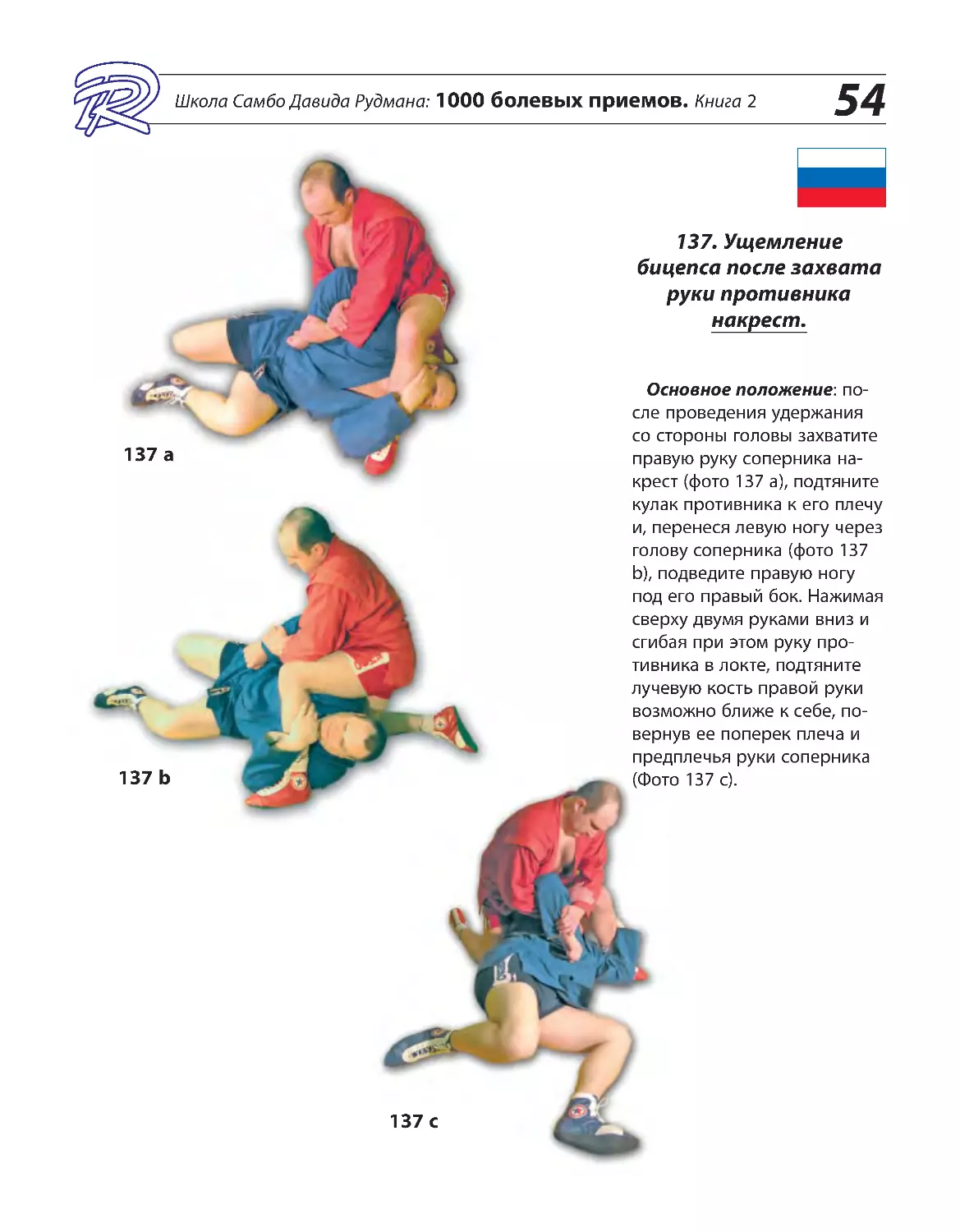
137. Ущемление
бицепса после захвата
руки противника
накрест.
Основное положение: после проведения удержания
со стороны головы захватите
правую руку соперника накрест (фото 137 a), подтяните
кулак противника к его плечу
и, перенеся левую ногу через
голову соперника (фото 137
b), подведите правую ногу
под его правый бок. Нажимая
сверху двумя руками вниз и
сгибая при этом руку противника в локте, подтяните
лучевую кость правой руки
возможно ближе к себе, повернув ее поперек плеча и
предплечья руки соперника
(Фото 137 c).

137 а

137 b

137 c

Sambo School of David Rudman: 1000 submissions. Book 2

55

137. Biceps crushing after
cross gripping
the opponent’s
arm.

137. Étranglement du
biceps après la prise du
bras de l’adversaire en
croix.

137. Estrangulació n del
bíceps después de la
presa de la mano del
adversario en cruz.

Main position: after performing the hold down from head
side, cross grip the opponent’s
right arm (photo 137 a), pull
the opponent’s fist up to his
shoulder, move your left leg
over the opponent’s head
(photo 137 b) and place your
right leg under his right side.
Pressing down with both
hands and bending the opponent’s arm at the elbow, pull
the radius of the right hand up
as close to yourself as possible
and turn it across the shoulder
and forearm of the opponent
(Photo 137 c).

Position principale: après
une rétention du côté de la
tête, saisissez le bras droit de
l’adversaire en croix (photo 137
a), tirez le poing de l’adversaire vers son épaule et, la jambe
gauche portée par-dessus la
tête de l’adversaire (photo 137
b), amenez la jambe gauche
sous son flanc droit. Pressant
avec les deux bras de dessus
en bas et pliant le bras de l’adversaire au coude, tirez le radius du bras droit le plus près de
vous-même en le tournant en
travers de l’épaule et de l’avant-bras de l’adversaire (photo
137 c).

Posició n principal: después
de realizar la inmovilizació n
por la cabeza, capturar el brazo derecho del adversario
en cruz (foto 137 a), apretar el
puño del adversario a su hombro y, habiendo llevado la pierna izquierda a través de la cabeza del adversario (foto 137 b),
colocar la pierna derecha bajo
su lado derecho. Presionando
de arriba por dos manos hacia abajo y doblando además
el brazo del adversario en el
codo, apretar el radio del brazo
derecho más cerca a usted, volviendolo a través del hombro y
el antebrazo del brazo del adversario (foto 137 c).

Школа Самбо Давида Рудмана: 1000 болевых приемов. Книга 2

56

138. Обратный
узел разноименным
захватом руки
соперника.

138 а

138 b

138 c

Основное положение: после проведения удержания
со стороны головы захватите
правой рукой разноименную
руку соперника за запястье
и отведите атакуемую руку в
левую сторону, поставив правый локоть на ковер около
разноименного бока соперника (фото 138 a). Подведите
левую руку под предплечье
одноименной руки соперника и наложите на предплечье
своей правой руки (фото 138
b. Прижимая животом голову
противника к его левому плечу, подтяните двумя руками
атакуемую руку противника к
голове. Отводя одновременно предплечье захваченной
руки от туловища соперника, проведите обратный узел
(фото 138 c).
Детали: ноги разведите
как можно шире, увеличивая
площадь опоры.

Sambo School of David Rudman: 1000 submissions. Book 2

57

138. Reverse knot with
an opposite grip of the
opponent’s arm.

138. Nœud inverse par
prise contraire du bras de
l’adversaire.

138. Nudo contrario por
la presa inversa del brazo
del adversario.

Main position: after performing the hold down from head
side, grip the opponent’s opposite wrist with your right hand
and push the arm under attack
to the left, placing your right
elbow on the mat near the opponent’s opposite side (photo
138 a). Place your left hand
under the opponent’s similar
arm and put it on your right
forearm (photo 138 b). Press
the opponent’s head to his left
shoulder with your stomach
and pull the opponent’s arm
under attack up to the head
with both hands. Pushing the
gripped forearm away from the
opponent’s body at the same
time, perform the reverse knot
(photo 138 c).
Details: spread your legs as
wide as possible, thus increasing the bearing area.

Position principale: après
une rétention du côté de la
tête, saisissez avec votre bras
droit le poignet contraire de
l’adversaire et écartez le bras
attaqué à gauche, votre coude droit posé près du flanc
contraire de l’adversaire sur le
tapis (photo 138 a). Amenez le
bras gauche sous l’avant-bras
homonyme de l’adversaire et
posez-le sur votre avant-bras
droit (photo 138 b). Pressant la
tête de l’adversaire contre son
épaule gauche avec votre ventre, tirez le bras attaqué de l’adversaire vers la tête avec vos
deux bras. Ecartant en même
temps l’avant-bras saisi du tronc de l’adversaire, procédez à
le nœud inverse (photo 138 c).
Détails: écartez les jambes le
plus largement possible pour
augmenter la surface d’appui.

Posició n principal: después
de realizar la inmovilizació n
por la cabeza, capturar el brazo contrario del adversario por
la muñeca con la mano derecha y apartar el brazo atacado a
la izquierda, poniendo el codo
derecho al tapiz cerca del lado
contrario del adversario (foto
138 a). Colocar el brazo izquierdo bajo el antebrazo del brazo
homónimo del adversario e
imponer al antebrazo del brazo
derecho (foto 138 b). Apretando la cabeza del adversario
a su hombro izquierdo por el
vientre, apretar el brazo atacado del adversario a la cabeza
por dos manos. Apartando al
mismo tiempo el antebrazo del
brazo capturado del tronco del
adversario, aplicar el nudo contrario (foto 138 c).
Detalles: apartar las piernas
lo más ampliamente que se
pueda, aumentando el área del
soporte.

Школа Самбо Давида Рудмана: 1000 болевых приемов. Книга 2

58

139. Рычаг локтя через
предплечье от захвата
руки соперника
накрест.

139 а

139 b

139 c

Основное положение: захватив руку соперника накрест и пытаясь сделать обратный узел, вы не смогли
удержать согнутую в локте
захваченную руку и чувствуете, что она выпрямляется.
Продолжив движение противника, выпрямите его руку
в локте (фото 139 a), подведите правую руку под локоть
захваченной руки и, перегибая руку против ее естественного сгиба, проведите
болевой прием рычаг локтя
(фото 139 b).
Правым боком прижмите к
ковру левое плечо соперника
и для увеличения площади
опоры разведите ноги пошире. Большой палец правой
руки прижмите к четырем
остальным (фото 139 c).

Sambo School of David Rudman: 1000 submissions. Book 2

59

139. Elbow bar over
the forearm from cross
gripping the opponent’s
arm.

139. Levier du coude
par l’avant-bras à partir
de la prise du bras de
l’adversaire en croix.

139. Palanca del codo a
través del antebrazo de
la presa del brazo del
adversario en cruz.

Main position: having cross
gripped the opponent’s arm
and attempted to perform
a reverse knot, you failed to
hold the gripped arm bent at
the elbow and you can feel it
straightening. You should continue the opponent’s movement and straighten his arm
at the elbow (photo 139 a),
then place your right arm under the gripped arm’s elbow
and, bending the arm against
its natural flexion, perform the
elbow bar submission (photo
139 b).
Press the opponent’s left shoulder to the mat with your
right side and spread your legs
apart to increase the bearing
area. Press the thumb of your
right hand to the other (photo
139 c).

Position principale: ayant
saisi le bras de l’adversaire en
croix et essayant de faire un
nœud inverse, vous n’avez pas
réussi à retenir le bras saisi
plié au coude et sentez qu’il se
redresse. Continuant le mouvement de l’adversaire, redressez son bras au coude (photo
139 a), amenez le bras droit
sous le coude du bras saisi et,
pliant le bras contre sa flexion
naturelle, procédez à la prise
douloureuse «levier du coude»
(photo 139 b).
Pressez l’épaule gauche de
l’adversaire contre le tapis avec
votre flanc droit; écartez vos
jambes le plus largement possible pour augmenter la surface
d’appui. Serrez le pouce droit
contre les quatre autres doigts
(photo 139 c).

Posició n principal: capturando el brazo del adversario en
cruz y tratando hacer el nudo
contrario, usted no puede fijar
el brazo doblado en el codo
capturado y siente que se endereza. Continuando el movimiento del adversario, enderezar
su brazo en el codo (foto 139
a), colocar el brazo derecho
bajo el codo del brazo capturado y, doblando el brazo contra
su doblez natural, aplicar la
té cnica dolorosa, la palanca del
codo (foto 139 b).
Por el lado derecho apretar al
tapiz el hombro izquierdo del
adversario y para el aumento
del área del soporte apartar las
piernas más ampliamente. Apretar el pulgar de la mano derecha a los otros cuatro dedos
(foto 139 c).

Школа Самбо Давида Рудмана: 1000 болевых приемов. Книга 2

60

140. Рычаг плеча от
захвата разноименной
руки соперника
изнутри.

140 а

140 b

140 c

Основное положение: после атаки со стороны головы
ваша попытка провести обратный узел захватом разноименной руки изнутри не
увенчалась успехом – соперник успел выпрямить свою
руку в локте. Продолжая выпрямлять захваченную руку,
отведите ее вверх от туловища противника и, подталкивая правым плечом, «разрешите» сопернику перевернуться на живот (фото 140 a).
Навалившись боком на спину
сопернику и прижав его к
ковру, приподнимите кулак захваченной руки вверх
(фото 140 b) и проведите
болевой прием рычаг плеча
(фото 140 c).
Детали: прижимать соперника к ковру лучше всего у
его левого плеча.

Sambo School of David Rudman: 1000 submissions. Book 2

61

140. Elbow bar from
gripping the opposite
arm of the opponent
from the inside.

140. Levier d’épaule
à partir de la prise
du bras contraire
de dedans.

140. Palanca del hombro
de la presa de la mano
contraria del adversario
de dentro.

Main position: your attempt
to perform the reverse knot
with gripping the opposite arm
from the inside after the attack from head side has failed;
the opponent managed to
straighten his arm at the elbow. As you continue straightening the gripped arm, push it
upwards from the opponent’s
body and, pushing with your
right shoulder, “allow» the opponent to turn over to the
stomach (photo 140 a). Lean
all your weight upon the opponent’s back and press him
down to the mat, then raise
the fist of the gripped arm
(photo 140 b) and perform the
shoulder bar submission (photo 140 c).
Details: it is better to press
the opponent to the mat next
to his left shoulder.

Position principale: après une
attaque du côté de la tête, la tentative de réaliser un nœud inverse par prise du bras contraire
de dedans n’a pas réussie – l’adversaire a eu le temps de redresser son bras au coude. Continuant de redresser le bras saisi,
écartez sa partie supérieure du
tronc de l’adversaire et, tout
en poussant avec l’épaule droite, «laissez» l’adversaire de se
retourner sur le ventre (photo
140 a). Pesant lourdement votre
flanc sur le dos de l’adversaire
et le pressant contre le tapis,
soulevez le poing saisi en haut
(photo 140 b) et procédez à la
prise douloureuse «levier du coude» (photo 140 c).
Détails: il est préférable de
presser l’adversaire contre le
tapis près de son épaule gauche.

Posició n principal: después
del ataque por la cabeza su
tentativa de aplicar el nudo contrario por la presa del brazo
contraria no ha tenido éxito: el
adversario ha conseguido enderezar el brazo en el codo. Continuando enderezar el brazo
capturado, apartarlo hacia arriba del tronco del adversario y,
empujando con el hombro derecho, «permitir» al adversario
volverse al vientre (foto 140 a).
Echandose a plomo de costado
sobre la espalda del adversario
y apretandolo al tapiz, levantar
el puño de la mano capturada
(foto 140 b) y aplicar la té cnica
dolorosa, la palanca del hombro (foto 140 c).
Detalles: lo mejor es apretar
al adversario al tapiz cerca de
su hombro izquierdo.

Школа Самбо Давида Рудмана: 1000 болевых приемов. Книга 2

62

141. Рычаг плеча,
не переворачивая
соперника
на живот.

141 а

141 b

141 c

Основное положение: сидя
справа от противника и захватив его левую руку правой
рукой разноименным захватом за запястье (фото 141 a),
выпрямите его руку в локте и
прижмите правым боком голову соперника к его левому
плечу (фото 141 b). Приподнимая захваченную руку противника вверх, вдоль ковра
(фото 141 c), проведите болевой прием рычаг плеча.

Sambo School of David Rudman: 1000 submissions. Book 2

63

141. Shoulder bar
without turning the
opponent over to the
stomach.

141. Levier d’épaule
sans retourner
l’adversaire sur
le ventre.

141. Palanca
del hombro, sin volver
al adversario
al vientre.

Main position: while sitting on the opponent’s right
and gripping the wrist of his
left arm with your right hand
with an opposite grip (photo
141 a), straighten his arm
at the elbow and press the
opponent’s head to his left
shoulder with your right side
(photo 141 b). Raising the
gripped arm along the mat
(photo 141 c), perform the
shoulder bar submission.

Position principale: assis à
droite de l’adversaire et son
bras gauche saisi avec le bras
droit par le poignet par prise
contraire (photo 141 a), redressez son bras au coude et pressez la tête de l’adversaire contre son épaule gauche avec
votre flanc droit (photo 141
b). Soulevant le bras saisi de
l’adversaire en haut le long du
tapis (photo 141 c), procédez
à la prise douloureuse «levier
du coude».

Posició n principal: estando
a la derecha del adversario y
habiendo capturado su brazo
izquierdo por la mano derecha por la presa contraria por
la muñeca (foto 141 a), enderezar su brazo en el codo y
apretar por el lado derecho
la cabeza del adversario a su
hombro izquierdo (foto 141 b).
Levantando la mano capturada del adversario, a lo largo
del tapiz (foto 141 c), aplicar
la té cnica dolorosa, la palanca
del hombro.

Школа Самбо Давида Рудмана: 1000 болевых приемов. Книга 2

64

142. Узел
от удержания
со стороны головы.

142 а

142 b

142 c

Основное положение: после проведения удержания
со стороны головы с захватом за туловище прижмите
левой рукой одноименную
руку соперника к своему
боку. Сделав разножку, пропустите правую ногу вперед,
занесите ее через ноги противника и опустите пяткой на
ковер (фото 142 a). Удерживая соперника правой рукой
за отворот куртки, приподнимите таз и одновременно
опустите левое плечо вниз
(фото 142 b).
Детали: правой рукой
можно удерживать соперника
за отворот куртки у шеи, изпод плеча; накладывая руку
на плечо, сверху на грудь
противника (фото 142 c); захватывая одежду на спине
противника. Любой из этих
способов может привести к
победе. Эффективнее всего,
пожалуй, способ, при котором куртка соперника захватывается из-под плеча.

Sambo School of David Rudman: 1000 submissions. Book 2

65

142. Knot
from the hold down
from head side.

142. Nœud à partir
d’une rétention du côté
de la tête.

142. Nudo de la
inmovilizació n por la
cabeza.

Main position: after performing the hold down from head
side with gripping the body,
press the opponent’s similar
arm to your side with your left
hand. Do a squat, push the
right leg forward, lift it over
the opponent’s legs and lower
your heel on the mat (photo
142 a). Holding the flap of the
opponent’s jacket with your
right hand, lift your pelvis and
lower the left shoulder at the
same time (photo 142 b).
Details: you can hold the flap
of the opponent’s jacket close
to the neck with your right
hand from under the shoulder,
or place the hand on his shoulder or over the chest (photo
142 c); or grip the clothes on
the opponent’s back. Any of
these techniques can lead to
victory. The most effective
technique is the one where the
opponent’s jacket is gripped
from under the shoulder.

Position principale: après
une rétention du côté de la
tête avec prise par le tronc,
pressez le bras homonyme de
l’adversaire contre votre flanc
avec votre bras gauche. Ayant
fait un grand écart, faites passer la jambe droite en avant,
portez-la par-dessus les jambes
de l’adversaire et posez le talon
sur le tapis (photo 142 a). Tout
en retenant l’adversaire avec
le bras droit par le revers de sa
veste, soulevez le pelvis et en
même temps baissez l’épaule
gauche (photo 142 b).
Détails: on peut retenir l’adversaire par le revers de la veste près du cou de dessous
l’épaule; en posant le bras sur
l’épaule, de dessus sur la poitrine
de l’adversaire (photo 142 c); en
saisissant le vêtement sur le dos
de l’adversaire. N’importe quel
de ces procédés peut aboutir
à une victoire. Il se peut que la
saisie de la veste de l’adversaire de dessous l’épaule soit le
procédé le plus efficace.

Posició n principal: después
de realizar la inmovilizació n
por la cabeza con la presa por el tronco, apretar por
la mano izquierda la mano
homónima del adversario
al lado. Habiendo hecho la
flexió n, dejar pasar el pie derecho adelante, llevarlo a través de
las piernas del adversario y bajar
el talón al tapiz (foto 142 a). Fijando al adversario con la mano
derecha por la solapa de la chaqueta, levantar la pelvis y bajar al mismo tiempo el hombro
izquierdo (foto 142 b).
Detalles: es posible fijar al
adversario por la mano derecha
por la solapa de la chaqueta cerca del cuello de debajo del hombro; metiendo la mano sobre
el hombro, de arriba al pecho
del adversario (foto 142 c); capturando la ropa sobre la espalda del adversario. Cualquier de
estos modos puede llevar a la
victoria. Más effectivamente, tal
vez, sea el modo, que hace la
chaqueta del adversario ser capturada de debajo del hombro.

Школа Самбо Давида Рудмана: 1000 болевых приемов. Книга 2

66

143. Рычаг плеча при
помощи ноги.

143 а

143 b

143 c

Основное положение: после проведения удержания
со стороны головы зацепите
правой ногой плечо одноименной руки противника
(фото 143 a) и, прижимаясь к
его туловищу грудью, отведите захваченную руку вверх за
его голову (фото 143 b). Для
усиления действия приема
захватите двумя руками соперника за туловище у пояса
(можно захватить и за пояс) и
притяните к себе двумя руками (фото 143 c).
Деталь: ваше правое бедро должно проходить под
головой противника. Не давайте сопернику вывернуться
на живот, удерживайте его на
спине руками и туловищем.
Руку соперника захватите за
локтем (как можно ближе к
плечу).

Sambo School of David Rudman: 1000 submissions. Book 2

67

143. Shoulder bar using
the leg.

143. Levier d’épaule à
l’aide d’une jambe.

143. Palanca del hombro
por medio de la pierna.

Main position: having performed the hold down from
head side, get hold of the
shoulder of the opponent’s
similar arm with your right leg
(photo 143 a) and, pressing
your chest to his body, push
the gripped arm up behind his
head (photo 143 b). To increase
the effect of this technique,
grip the opponent’s body (possibly his waist) with both arms
and pull him up to you with
both arms (photo 143 c).
Details: your right hip should
be over the opponent’s head.
Do not let him turn over to his
stomach, hold him on his back
with your arms and body. Grip
the opponent’s arm beyond his
elbow (as close to the shoulder
as possible).

Position principale: après
une rétention du côté de la
tête, accrochez la jambe droite
à l’épaule homonyme de l’adversaire (photo 143 a) et, tout
en serrant votre poitrine contre son tronc, écartez le bras
saisi en haut derrière sa tête
(photo 143 b). Pour renforcer
l’action, saisissez l’adversaire
par le tronc près de la taille
avec les deux bras (on peut
saisir par la ceinture) et tirez-le
vers vous avec les deux bras
(photo 143 c).
Détails: votre hanche droite
doit passer sous la tête de l’adversaire. Ne laissez pas l’adversaire se retourner sur le ventre,
gardez-le couché sur le dos
avec vos bras et tronc. Saisissez
le bras de l’adversaire derrière
le coude (le plus près possible
de l’épaule).

Posició n principal: después
de realizar la inmovilizació n
por la cabeza, enganchar por
la pierna derecho el hombro
homónimo del adversario (foto
143 a) y, apretando contra su
tronco por el pecho, apartar el
brazo capturada hacia arriba
por su cabeza (foto 143 b). Para
reforzar la acción de la té cnica,
hay que capturar el tronco del
adversario cerca del cinturón
por dos manos (se puede capturar y por el cinturón) y atraerlo a usted por dos manos (foto
143 c).
Detalle: su cadera derecha
debe pasar bajo la cabeza del
adversario. Hay que impedirle
al adversario deslizarse al vientre y retenerlo sobre la espalda
por las manos y el tronco. Capturar el brazo del adversario
detrás del codo (como es posible más cerca al hombro).

Школа Самбо Давида Рудмана: 1000 болевых приемов. Книга 2

68

144. Рычаг локтя
захватом предплечья
под плечо.

144 а

144 b

144 c

После проведения удержания со стороны головы,
захватите левую руку противника под свое одноименное
плечо (фото 144 a). Выпрямляя его руку в локте, наложите левую руку на его плечо,
правую подведите под локоть
и положите предплечье на
свою левую руку (фото 144 b).
Приподнимая оба запястья
вверх и одновременно опуская свое правое плечо вниз,
проведите болевой прием
рычаг локтя (фото 144 c).
Деталь: крепко прижимая
подмышкой запястье левой
руки противника, помешайте
ему повернуть руку ладонью
внутрь и избежать болевого
приема.

Sambo School of David Rudman: 1000 submissions. Book 2

69

144. Elbow bar with
gripping the forearm
under the shoulder.

144. Levier d’épaule par
prise de l’avant-bras sous
l’épaule.

144. Palanca del codo,
capturando el antebrazo
bajo el hombro.

After the hold down from
head side, grip the opponent’s
left arm under your similar
shoulder (photo 144 a). As you
straighten his arm at the elbow, place your left hand on
his shoulder, place your right
hand under his elbow and
move his forearm over your left
hand (photo 144 b). Raising
both wrists and lowering your
right shoulder at the same
time, perform the elbow bar
submission (photo 144 c).
Details: stop the opponent
from twisting his palm inwards
and avoiding the submission
by squeezing the opponent’s
left wrist firmly with your armpit.

Après une rétention du côté
de la tête, saisissez le bras de
l’adversaire sous votre épaule
homonyme (photo 144 a). Redressant son bras au coude,
posez votre bras gauche sur
son épaule, amenez votre bras
droit sous le coude et posez
l’avant-bras sur votre bras gauche (photo 144 b). Soulevant
les deux poignets en haut et
tout en baissant votre épaule
droite, procédez à la prise douloureuse «levier de coude»
(photo 144 c).
Détails: serrant le poignet
gauche de l’adversaire avec
votre aisselle, empêchez-le de
tourner son bras la paume à
l’intérieur et d’éviter la prise
douloureuse.

Después de realizar la
inmovilizació n por la cabeza,
capturar la brazo izquierda
del adversario bajo el hombro
homónimo (foto 144 a). Enderezando su brazo en el codo,
poner la mano izquierda a su
hombro, colocar el brazo derecho bajo el codo y poner el
antebrazo sobre el brazo izquierdo (foto 144 b). Levantando
las dos muñecas y al mismo
tiempo bajando el hombro derecho, aplicar la té cnica dolorosa, la palanca del codo (foto
144 c).
Detalle: apretando la
muñeca del brazo izquierdo
del adversario por su sobaco
con fuerza, impedirle arrancar
la palma por dentro y evitar la
té cnica dolorosa.

Школа Самбо Давида Рудмана: 1000 болевых приемов. Книга 2

70

145. Рычаг локтя
захватом руки между
ногами.

145 а

145 b

145 c

Допустим, что предыдущий
прием у вас не получается.
Можно усилить его, забросив
поочередно обе ноги на соперника. Его рука при этом
окажется захваченной вашими ногами (фото 145 a), и вы,
скрестив ноги за локтем дальней руки (фото 145 b), завершите атаку (фото 145 c). О том,
что можно сделать из этого
положения, сказано выше
(см. приемы 11–40).
В такое же положение
можно прийти, начав атаку
другим способом, например
захватив руку соперника накрест. Удерживая соперника
своим захватом, перенесите
одну ногу через его туловище, затем другую ногу через
голову. Скрестите ноги за
дальней рукой.

Sambo School of David Rudman: 1000 submissions. Book 2

71

145. Elbow bar with
gripping the arm
between the legs.

145. Levier d’épaule par
prise d’un bras entre les
jambes.

145. Palanca del codo,
capturando el brazo
entre las piernas.

Suppose you fail at the previous submission. You can
strengthen it by throwing both
hands over the opponent,
in order. His arm will end up
gripped between your legs
(photo 145 a) and you will
complete the attack (photo
145 c), crossing your legs behind the elbow of the far arm
(photo 145 b). Where to move
from this submission is described before (see submissions 11–40).
You can achieve the same
position if you begin the attack differently, for example, by
cross gripping the opponent’s
arm. Holding the opponent in
this grip, move one leg over his
body, then move the other leg
over his head. Cross your legs
behind the far arm.

Supposons que vous n’avez pas réussi le procédé
précédent. On peut le renforcer en jetant les deux jambes
à tour de rôles sur l’adversaire. Avec cela, son bras sera
saisi par vos jambes (photo
145 a), et vous, vos jambes
croisées derrière le coude du
bras éloigné (photo 145 b),
achèverez l’attaque (photo
145 c). Voir ce qui précède
pour savoir ce qu’on peut faire
à partir de cette position (voir
prises 11–40).
On peut arriver dans dette
position en commençant l’attaque d’une autre façon, p.ex.,
en saisissant le bras de l’adversaire en croix. Tout en retenant l’adversaire par votre prise,
portez une jambe par-dessus
son tronc puis l’autre par-dessus sa tête. Croisez les jambes
derrière le bras éloigné.

Supongamos que la té cnica
anterior no le logra. Es posible reforzarla, lanzando por
turnos las dos piernas sobre
el adversario. Su brazo se encuentra capturada por sus piernas (foto 145 a). Cruzando las
piernas detrá s del codo de la
mano lejana (foto 145 b), concluir el ataque (foto 145 c).
Sobre lo que es posible hacer
de esta posición, es dicho más
arriba (las té cnicas 11-40).
Se puede llegar a la misma
posición, comenzando el ataque de otro modo, por ejemplo capturando la mano del
adversario en cruz. Fijando al
adversario por la presa, llevar
una pierna a través de su tronco, luego otra pierna a través
de la cabeza. Cruzar las piernas
detrás del brazo lejano.

Школа Самбо Давида Рудмана: 1000 болевых приемов. Книга 2

72

146. Рычаг локтя
через грудь,
ложась рядом
с противником.

146 а

146 b

146 c

Основное положение: захватив руку противника под
мышку после проведения
удержания со стороны головы с обхватом за туловище,
вы пытаетесь провести болевой прием узел. Но противник выпрямил руку в локте,
пытаясь спастись от болевого
приема. Продолжая удерживать его руку, сделайте разножку и займите положение
рядом с соперником (фото
146 a). Правой рукой смените
захват, удерживая запястье
захваченной руки. Левой рукой захватите отворот левой
стороны куртки противника
и потяните его к себе. Можно
захватить левой рукой пояс
спереди (фото 146 b). Одновременно приподнимите
грудь вверх и проведите рычаг локтя руки (фото 146 c).

Sambo School of David Rudman: 1000 submissions. Book 2

73

146. Elbow bar
over the chest when
lying near
the opponent.

146. Levier du coude
par la poitrine,
couché près de
l’adversaire.

146. Palanca del codo
a través del pecho,
acostandose cerca del
adversario.

Main position: having
gripped the opponent’s arm
under the armpit after performing the hold down from
head side with grasping the
body, you are trying to perform the knot submission. But
the opponent has straightened
his arm at the elbow, trying
to avoid the submission. Continuing to hold his arm, do a
squat and assume the position near the opponent (photo
146 a). Change the grip with
your right hand, holding the
wrist of the gripped arm. Grip
the flap of the opponent’s
jacket on the left with your
right hand and pull him up to
you. You can grip his belt on
the front with your left hand
(photo 146 b). Lift the chest at
the same time and perform the
elbow bar (photo 146 c).

Position principale: ayant
saisi le bras de l’adversaire
sous votre aisselle après une
rétention du côté de la tête
avec un tour de tronc, vous
essayez de réaliser la prise douloureuse «nœud». Mais l’adversaire a redressé le bras au
coude, essayant d’éviter la prise
douloureuse. Tout en continuant de retenir son bras, faites
un grand écart et prenez place
à côté de l’adversaire (photo
146 a). Changez la prise avec
le bras droit en retenant le poignet du bras saisi. Avec votre
bras gauche, saisissez le revers
du côté gauche de la veste
de l’adversaire et tirez-le vers
vous. On peut saisir la ceinture en avant avec le bras gauche (photo 146 b). En même
temps, soulevez la poitrine en
haut et procédez à un levier
de coude (photo 146 c).

Posició n principal: habiendo
capturado el brazo del adversario bajo el sobaco después de
realizar la inmovilizació n por
la cabeza con abrazo del tronco, tratar de aplicar la té cnica
dolorosa – el nudo. Pero si el
adversario ha enderezado la
mano en el codo, tratando salvarse de la recepción dolorosa,
hay que continuar fijar su brazo, hacer la flexió n y ocupar la
posición cerca del adversario
(foto 146 a). Por la mano derecha cambiar la presa, fijando la
muñeca del brazo capturado.
Por la mano izquierda capturar
la solapa de la parte izquierda
de la chaqueta del adversario
y tirarlo a usted. Es posible capturar el cinturón por la mano
izquierda por delante (foto
146 b). Levantar al mismo tiempo el pecho y aplicar la palanca del codo (foto 146 c).

Школа Самбо Давида Рудмана: 1000 болевых приемов. Книга 2

74

147. Рычаг плеч после
удержания со стороны
головы.

147 а

147 b

147 c

Основное положение: вы
провели удержание со стороны головы с обхватом за туловище и пытаетесь атаковать
болевым приемом, но соперник сцепил руки за вашей спиной и крепко прижимает вас к
себе, препятствуя вашим намерениям. Забегите ногами вправо, ложась поперек туловища
соперника. Активно работая
руками (левая захватывает
пояс или куртку у левого бока,
правая поднимается вверх к
голове), вы разорвете захват
противника. Поднимите левую
руку вверх, отожмите левый
локоть соперника к его голове и подведите плечо левой
руки под голову противника.
Правой рукой захватите одноименную руку соперника обратным хватом и, ложась продольно на его грудь, отведите
правой рукой захваченную
руку вверх к голове. Руки противника окажутся поднятыми
вверх (фото 147 a). Теперь сцепите свои руки под его руками
в замок и, подтягивая одни к
другим, проведите болевой
прием рычаг плеч (фото 147 b).
Перекрывая туловище левой
ногой, подведите левое бедро
под плечо соперника и проведите рычаг плеча (фото 147 c)

Sambo School of David Rudman: 1000 submissions. Book 2

75

147. Shoulder bar after
the hold down from head
side.

147. Levier d’épaule
après une rétention du
côté de la tête.

147. Palanca de los hombros
después de la inmovilizació n
por la cabeza.

Main position: you have performed the hold down from
head side with gripping the
body and you are trying to attack with a submission, but the
opponent has locked his arms
behind your back and is pressing you close against himself,
preventing you from achieving your goal. Move your legs
forward, lying across the opponent’s body. By actively working your arms (left hand to grip
the belt or the jacket on the
left side, right hand lifted to the
head), you can break the opponent’s grip. Raise your left hand,
push the opponent’s left elbow
towards his head and move
your left shoulder under the opponent’s head. With your right
hand grip the opponent’s similar arm with a reverse grip, lie
down along his chest and move
the gripped arm up to the head
with your right hand. The opponent’s arms will be raised (photo 147 a). Now lock your hands
under his arms and perform the
shoulder bar submission while
pulling your arms to his (photo
147 b). Covering the body with
your left leg, move your left hip
under the opponent’s shoulder
and perform the shoulder bar
(photo 147 c)

Position principale: vous avez
réalisé une rétention du côté de
la tête avec un tour de tronc et
essayez d’attaquer avec une prise douloureuse, mais l’adversaire
a verrouillé les bras derrière votre dos, entravant vos intentions.
Avancez vos jambes à droite en
vous couchant à travers le tronc
de l’adversaire. Travaillant activement des bras (le bras gauche
saisit la ceinture ou la veste près
du flanc gauche, le bras droit
monte vers la tête), vous romprez la prise de l’adversaire. Levez
le bras gauche, écartez le coude
gauche de l’adversaire vers sa
tête et amenez l’épaule gauche
sous la tête de l’adversaire. Saisissez avec votre bras droit le bras
homonyme de l’adversaire par
prise inverse et, tout en vous couchant longitudinalement sur sa
poitrine, écartez le bras saisi en
haut vers la tête par votre bras
droit. Les bras de l’adversaire seront levés en haut (photo 147 a).
Maintenant, verrouillez vos bras
sous ses bras et, tout en tirant
les unes des autres, procédez à
la prise douloureuse «levier des
épaules» (photo 147 b). Fermant
le tronc avec votre jambe gauche, amenez la hanche gauche
sous l’épaule de l’adversaire et
procédez à un levier d’épaule
(photo 147 c).

Posició n principal: usted ha
aplicado la inmovilizació n por la
cabeza con abrazo por el tronco
y trata de atacar por la técnica
dolorosa, pero el adversario ha
enganchado las manos detrás
de su espalda y le aprieta con
fuerza a él, obstaculizando sus
intenciones. Pasar por los pies a
la derecha, acostando a través
del tronco del adversario. Activamente trabajando las manos (la
izquierda captura el cinturón o
la chaqueta cerca del lado izquierdo, la derecha se levanta hacia
la cabeza), romper la presa del
adversario. Levantar la mano izquierda, presionar el codo izquierdo del adversario a su cabeza
y colocar el hombro de la mano
izquierda bajo la cabeza del adversario. Por la mano derecha
capturar la mano homónima del
adversario por la presa inversa
y, acostandose en longitud a su
pecho, colocar la mano capturada hacia la cabeza por la mano
derecha. Las manos del adversario se encuentran levantadas
(foto 147 a). Ahora enganchar las
manos bajo sus manos en candado y, apretando unos a otros,
aplicar la técnica dolorosa, la palanca de los hombros (foto 147
b). Recubriendo el tronco por la
pierna izquierda, colocar la cadera izquierda bajo el hombro del
adversario y aplicar la palanca
del hombro (foto 147 c).

Школа Самбо Давида Рудмана: 1000 болевых приемов. Книга 2

76

148. Рычаг локтя
при скрещивании рук
противника на груди.

148 а

148 b

148 c

Основное положение: после
проведения удержания, скрестив руки противника на груди, прижмите кулак верхней
левой руки к телу противника
(можно помочь своим коленом). Подтяните нижнюю (правую) руку противника к себе и
приподнимите за предплечье
вверх (фото 148 a). Его левое
плечо прижмите к ковру левым коленом (фото 148 b).
Детали: во время проведения перегибания следите
за тем, чтобы рука соперника
была повернута правильно:
перегибание должно быть направлено строго против естественного сгиба (фото 148 c).
Если противник вывернет
руку и локоть в связи с этим
также повернется, захватите
запястье и поверните его так,
чтобы возвратить локоть в
нужное положение.
Методические замечания:
при скрещивании рук соперника на груди нижняя рука может быть направлена кулаком
вниз и расположена под мышкой партнера или же направлена кулаком вверх и расположена между головой и плечом.
В первом случае можно применить описанный прием, во
втором – следующий.

Sambo School of David Rudman: 1000 submissions. Book 2

77

148. Elbow bar with
crossing the opponent’s
arms over his chest.

148. Levier de coude au
croisement des bras de
l’adversaire sur la poitrine.

148. Palanca del codo
al cruzar los brazos del
adversario en el pecho.

Main position: after the hold
down, cross the opponent’s
arms over his chest, press the
fist of the left hand to the
opponent’s body (you can assist yourself by using the knee).
Pull the lower (right) arm of
the opponent up to you and
lift, holding the forearm (photo
148 a). Press his left shoulder
down to the mat with your left
knee (photo 148 b).
Details: while bending, make
sure the opponent’s arm is
turned the right way: bending
should be performed strictly
against the natural flexion
(photo 148 c). If the opponent
twists his arm and his elbow
turns as well due to that, grip
his wrist and turn it so as to
bring the elbow back into its
natural position.
Methodical notes: when
crossing the opponent’s arms
over his chest, the lower arm
may be turned fist down and
placed under the partner’s
armpit or placed fist up and
placed between the head and
the shoulder. The first scenario
allows for the previously described technique; the second
scenario allows for the next
technique.

Position principale: après
une rétention, les bras de l’adversaire croisés sur la poitrine, pressez le poing gauche
supérieur contre le corps de
l’adversaire (vous pouvez vous
aider avec votre genou). Tirez
le bras inferieur (droit) de l’adversaire vers vous et soulevez
en haut par l’avant-bras (photo
148 a). Pressez son épaule gauche contre le tapis avec votre
genou gauche (photo 148 b).
Détails: lors du courbage,
veillez à ce que le bras de l’adversaire soit tourné correctement: le courbage doit être
dirigé strictement contre la flexion naturelle (photo 148 c). Si
l’adversaire retourne le bras et
que le coude se retourne aussi,
saisissez le poignet et tournezle de façon à rentrer le coude
dans la position nécessaire.
Observations méthodiques:
lors du croisement des bras de
l’adversaire sur la poitrine, le
bras inferieure peut être dirigé
le poing en bas et situé sous
l’aisselle du partenaire ou dirigé
le poing en haut et situé entre
la tête et l’épaule. Le procédé
décrit peur être utilisé dans le
premier cas et le procédé suivant dans le second.

Posició n principal: después de
realizar la inmovilizació n, cruzando los brazos del adversario en
el pecho, apretar el puño de la
mano superior izquierda al cuerpo del adversario (se puede ayudarse por la rodilla). Apretar la
mano inferior (derecha) del adversario a usted y levantarla por
el antebrazo (foto 148 a). Apretar
su hombro izquierdo al tapiz por
la rodilla izquierda (doto 148 b).
Detalles: durante la
realización de la doblació n hay
que cuidar que el brazo del
adversario sea vuelto correctamente: la doblació n debe ser
dirigido rigurosamente contra
el doblez natural (foto 148
c). Si el adversario arranca la
mano y el codo en relación a
esto se volverá también, hay
que capturar la muñeca y volverlo así que el codo se devuelva en la posición necesaria.
Observaciones metódicas: al
cruzar las manos del adversario
sobre el pecho, la mano inferior
puede ser dirigida por el puño
hacia abajo y situada bajo el
sobaco del adversario o dirigida
por el puño hacia arriba y situada entre la cabeza y el hombro. En el primer caso es posible
aplicar la té cnica descrita, en el
segundo – la té cnica siguiente.

Школа Самбо Давида Рудмана: 1000 болевых приемов. Книга 2

78

149. Рычаг локтя
перенося ногу через
туловище при
скрещивании рук
противника на груди.
149 а

149 b

149 c

Основное положение: после проведенияудержания со
стороны головы руки партнера
скрещены на груди, левая рука
расположена под правой. Захватите запястье левой руки
противника разноименной рукой, подведите свое предплечье под его голову и подтяните
захваченную руку (фото149 a).
Соперник как бы «обнимет»
себя за шею (фото 149 b). Левой рукой придержите его
левое плечо, чтобы он не смог
вывернуться на правый бок и
в дальнейшем на живот (фото
149 c). Встав сначала на колени, перенесите левую ногу
через туловище противника
и, подтягивая дальнюю руку
левой рукой, зафиксируйте
создавшееся положение. Прижмите левой ногой туловище
соперника к ковру, подтяните
правой рукой захваченную
руку противника вправо к
себе, чтобы его кулак, сгибая свою голову, постепенно
приближался к вашей груди.
Создается угроза проведения болевого приема узел. Не
останавливаясь, продолжайте
движение руки соперника к
себе до тех пор, пока она не
выпрямится в локте.

Sambo School of David Rudman: 1000 submissions. Book 2

79

149. Elbow bar while
moving the leg over the
body with crossing the
opponent’s arms over his
chest.

149. Levier de coude en
portant la jambe audessus du tronc, les bras
de l’adversaire croisés sur
la poitrine.

149. Palanca del codo,
llevando la pierna a
través del tronco al cruzar
las manos del adversario
sobre el pecho.

Main position: after performing the hold down from head
side the partner’s arms are
crossed over his chest, left over
right. Grip the opponent’s left
wrist with the opposite hand,
move your forearm under his
head and pull the gripped arm
up (photo 149 a). The opponent as if “embraces» his own
neck (photo 149 b). Hold his left
shoulder with your left hand to
stop him from twisting to his
right side and then to his stomach (photo 149 c). Kneel, move
your left leg over the opponent’s
body and fix this position, pulling the far arm with your left
hand. Press the opponent’s body
to the mat with your left leg,
pull the gripped arm to your
right with your right hand so
that his fist moved gradually towards your chest. This poses the
threat of the knot submission.
Do not stop; continue moving
the opponent’s arm towards you
until is becomes straightened at
the elbow.

Position principale: après une
rétention du côté de la tête, le
bras de l’adversaire sont croisés
sur la poitrine, le bras gauche
est sous le bras droit. Saisissez le
poignet gauche de l’adversaire
avec le bras contraire, amenez
votre avant-bras sous sa tête et
tirez le bras saisi (photo 149 a),
comme si l’adversaire s’embrassait le cou (photo 149 b). Retenez son épaule gauche avec
votre bras gauche afin qu’il ne
se retourne pas sur le flanc droit et sur le ventre (photo 149 c).
Se mettant d’abord à genoux,
portez la jambe gauche au-dessus du tronc de l’adversaire et,
tout en tirant le bras éloigné
avec votre bras gauche, fixez
cette position. Pressez le tronc
de l’adversaire contre le tapis
avec votre jambe gauche, tirez
le bras saisi de l’adversaire à droite vers vous avec votre bras
droit, de façon que son poing,
courbant sa tête, s’approche
peu à peu de votre poitrine. Il
se forme une menace de la prise douloureuse «nœud». Sans
arrêt, continuez le mouvement du bras de l’adversaire vers
vous jusqu’à ce qu’il ne se redresse au coude.

Posició n principal: después de
realizar la inmovilizació n por la
cabeza, las manos del adversario
estan cruzadas sobre el pecho, la
mano izquierda situada bajo la
derecha. Capturar la muñeca de
la mano izquierda del adversario
por la mano contraria, colocar
el antebrazo bajo su cabeza y
apretar la mano capturada (foto
149 a). El adversario como si
se «abrace» por el cuello (foto
149 b). Por la mano izquierda
agarrar su hombro izquierdo así
que él no pueda ser arrancado
al lado derecho y después al vientre (foto 149 c). Poniendo primero a las rodillas, llevr la pierna
izquierda a través del tronco del
adversario y, apretando la mano
lejana por la mano izquierda, fijar la posición que se ha creado.
Apretar el tronco del adversario
al tapiz por la pierna izquierda,
apretar la mano capturada del
adversario a la derecha a usted
por la mano derecha así que su
puño se acerque gradualmente
al pecho de usted, inclinando
la cabeza. Surge la amenaza de
la realización de la técnica dolorosa – el nudo. Sin parar, hay
que continuar el movimiento de
la mano del adversario a usted
hasta que no se enderece en el
codo.

Школа Самбо Давида Рудмана: 1000 болевых приемов. Книга 2

80

150. Узлы двух рук от
удержания со стороны
головы.
Основное положение: после проведения удержания со
стороны головы с обхватом за
туловище спуститесь как можно ниже к голове соперника
и, приподняв голову, встаньте
на колени, а затем сядьте на
ковер, натащив противника на
себя (фото 150 a).
Во время проведения описанных выше действий удерживайте под мышками запястья рук соперника, опуская
плечи вниз (фото 150 b) и
подсаживаясь под него, проведите болевой прием – узел
сразу на обе руки (фото 150 c).

150 а

150 b

150 c

Sambo School of David Rudman: 1000 submissions. Book 2

81

150. Two arm knots from
the hold down from head
side.

150. Nœuds de deux bras
à partir d’une rétention
du côté de la tête.

150. Nudos de dos manos
de la inmovilizació n por
la cabeza.

Main position: having performed the hold down from head
side with gripping the body,
lean as close to the opponent’s
head as possible, lift the head
and kneel, then sit down on
the mat, dragging the opponent over you (photo 150 a).
While performing these actions, hold the opponent’s wrists
under your armpits as you lower
the shoulders (photo 150 b) and
setting yourself under him, perform a submission – two arm
knot (photo 150 c).

Position principale: après
une rétention du côté de la
tête avec un tour de tronc, descendez le plus bas possible
vers la tête de l’adversaire et,
soulevant la tête, mettez-vous
à genoux et puis asseyez-vous
sur le tapis, tirant l’adversaire
sur vous-même (photo 150 a).
Lors des actions décrites
ci-dessus, retenez les poignets de l’adversaire sous
les aisselles tout en baissant les épaules (photo 150 b)
et en vous posant sous lui,
procédez à une prise douloureuse – nœud des deux bras à
la fois (photo 150 c).

Posició n principal: después
de realizar la inmovilizació n
por la cabeza con abrazo por
el tronco, bajar la cabeza del
adversario como se puede más
abajo y, habiendo levantado
la cabeza, poner de rodillas, y
luego sentarse al tapiz, tirando
el adversario hacia usted (foto
150 a).
Durante la realización de las
acciones descritas más arriba
hay qie fijar la muñeca de las
manos del adversario debajo
de los sobacos, bajando los hombros (foto 150 b) y asentando
bajo él, aplicar la té cnica dolorosa – el nudo en seguida en
las dos manos (foto 150 c).

Школа Самбо Давида Рудмана: 1000 болевых приемов. Книга 2

82

151. Узел поперек
после удержания
со стороны
головы.

151 а

151 b

151 c

Основное положение: при
проведении удержания со
стороны головы противник
сцепил руки у вас на спине и
после окончания удержания
не распускает захват в надежде, что судья поднимет борцов в стойку. Перенесите левую руку через соперника и
опустите на ковер, прижимая
локтем туловище противника
к себе. Одновременно забегите ногами в сторону левого
бока соперника. Противник
вынужден будет расцепить
захват.
Не упуская момента, захватите правой рукой запястье
одноименной руки (фото
151 a), подведите левую
руку под плечо противника
и наложите на запястье своей правой руки (фото 151 b).
Перемещая обе руки вниз (к
ногам противника) проведите
узел руки поперек (фото 151 c).

Sambo School of David Rudman: 1000 submissions. Book 2

83

151. Cross knot
after the hold
downfrom head
side.

151. Nœud à travers
après la rétention
du côté de
la tête.

151. Nudo transverso
después de la
inmovilizació n por la
cabeza.

Main position: while performing the hold down from
head side, the opponent has
locked his arms over your back
and does not release the lock,
hoping that the referee will
make the fighters take a stand.
Move your left arm over the
opponent and lower it on the
mat, pressing the opponent’s
body to yourself with your elbow. Move your legs to the left
of the opponent at the same
time. The opponent will be
forced to release the grip.
Do not let the moment
pass; grip the opponent’s similar wrist with your right hand
(photo 151 a), place your left
arm under the opponent’s
shoulder and put it over your
right wrist (photo 151 b).
Moving both arms down (towards the opponent’s feet),
perform the cross arm knot.
(photo 151 c).

Position principale: après
une rétention du côté de la
tête, l’adversaire a verrouillé les
bras sur votre dos et ne lâche
pas prise après la rétention
dans l’espoir que l’arbitre fasse
les lutteurs se mettre en garde.
Portez le bras gauche par-dessus l’adversaire et posez-le sur
le tapis, tout en serrant le tronc
de l’adversaire contre vousmême. En même temps, avancez vos jambes du côté du flanc
gauche de l’adversaire. L’adversaire sera forcé de lâcher prise.
Ne laissant pas échapper
l’occasion, saisissez avec votre
bras droit le poignet homonyme (photo 151 a), amenez le
bras gauche sous l’épaule de
l’adversaire et posez sur votre
poignet droit (photo 151 b).
Déplaçant les deux bras en bas
(vers les jambes de l’adversaire), procédez à un nœud de
bras en travers (photo 151 c).

Posició n principal: durante la
realización de la inmovilizació n
por la cabeza el adversario ha enganchado las manos sobre la espalda de usted
y no suelta la presa después
de la terminación de la
inmovilizació n, esperando que
el juez levantará los luchadores
en la posició n de pie. Llevar la
mano izquierda a través del adversario y bajarla al tapiz, apretando el tronco del adversario
a usted por el codo. Al mismo
tiempo colocar las piernas al
lado izquierdo del adversario.
El adversario será obligado desenganchar la presa.
Sin perder el momento, capturar por la mano derecha la
muñeca de la mano homónima
(foto 151 a), colocar la mano
izquierda bajo el hombro del
adversario e imponerla a la
muñeca del brazo derecho
(foto 151 b). Trasladando los
dos brazos hacia abajo (hacia
las piernas del adversario) aplicar el nudo transverso de la
mano (foto 151 c).

Школа Самбо Давида Рудмана: 1000 болевых приемов. Книга 2

84

152. Рычаг локтя
внутрь после
удержания со стороны
головы.
152 а

152 b

152 c

Основное положение: после проведения удержания
со стороны головы вам удалось расцепить захваченные в замок руки соперника
описанным выше способом.
Вам даже удалось захватить
запястье одноименной руки.
Но теперь соперник вдруг
вывернулся на правый бок, и
атаковать его узлом поперек
стало невозможно. Продолжая движение противника,
потяните его левой рукой
за одноименную руку и поверните на живот (фото 152
a). Выпрямите захваченную
руку в локте (фото 152 b) и,
перекрывая подмышкой разноименное плечо, проведите
рычаг локтя.
Детали: при проведении
болевого приема приподнимите запястье левой руки соперника вверх, одновременно опуская левое плечо. Ноги
широко разведите в стороны,
препятствуя перемещениям
противника по ковру (фото
152 c).

Sambo School of David Rudman: 1000 submissions. Book 2

85

152. Elbow bar
inside after the hold
down from head
side.

152. Levier de coude
au-dedans après une
rétention du côté de la
tête.

152. Palanca del codo
a dentro después de la
inmovilizació n por la
cabeza.

Main position: after the hold
down from head side you have
managed to unlock the opponent’s gripped arms as described above. You have even
managed to grip the similar
arm’s wrist. But the opponent
has suddenly twisted to his
right side and you cannot attack him with a cross knot
now. Continuing the opponent’s movement, pull his similar arm with your left hand and
turn him over onto the stomach (photo 152 a). Straighten
the gripped arm at the elbow
(photo 152 b) and perform the
elbow bar, covering the opposite shoulder with your armpit.
Details: when performing
the submission, lift the wrist of
the opponent’s left arm, lowering the left shoulder at the
same time. Spread the legs
wide apart, blocking the opponent’s movement on the mat
(photo 152 c).

Position principale: après
une rétention du côté de la
tête, vous avez réussi à ouvrir
les bras verrouillées de l’adversaire de la façon décrite cidessus. Vous avez même réussi
à saisir le poignet homonyme.
Mais l’adversaire a glissé soudainement sur le flanc droit, et
il est impossible de l’attaquer
avec un nœud à travers. Tout
en continuant le mouvement
de l’adversaire, tirez-le avec
votre bras gauche par le bras
homonyme et retournez-le sur
le ventre (photo 152 a). Redressez le bras saisi au coude (photo 152 b) et, tout en fermant
l’épaule contraire avec l’aisselle,
procédez à le levier du coude.
Détails: Lors de la réalisation
de la prise douloureuse, soulevez le poignet gauche de
l’adversaire en haut, tout en
baissant l’épaule gauche. Ecartez les jambes largement pour
empêcher le déplacement de
l’adversaire sur le tapis (photo
152 c).

Posició n principal: después
de realizar la inmovilizació n
por la cabeza, usted ha desenganchado las manos del adversario capturadas en candado
por el modo descrito más arriba. Usted hasta ha consiguido
capturar la muñeca de la mano
homónima. Pero ahora el adversario ha sido arrancado de
repente al lado derecho, y es
imposible atacarlo por el nudo
transverso. Continuando el movimiento del adversario, tirarlo
con la mano izquierda por la
mano homónima y volverlo al
vientre (foto 152 a). Enderezar
la mano capturada en el codo
(foto 152 b) y, recubriendo el
hombro contrario por el sobaco, aplicar la palanca del codo.
Detalles: durante de la
realización de la té cnica dolorosa levantar la muñeca del
brazo izquierdo del adversario,
al mismo tiempo bajando el
hombro izquierdo. Apartar las
piernas lo má s ampliamente
que se pueda, obstaculizando
los traslados del adversario por
el tapiz (foto 152 c).

Школа Самбо Давида Рудмана: 1000 болевых приемов. Книга 2

86

153. Узел одноименной
рукой после удержания
со стороны
головы.
153 а

Основное положение: после проведения удержания
со стороны головы противник отжимает вас двумя
руками вверх (фото 153 a).
Подведите правую руку под
одноименный локоть соперника (фото 153 b). Наклоните
правое плечо вниз, мешая
этим сопернику выпрямить
руку в локтевом сгибе. Левой
рукой захватите пальцы своей правой руки в замок фото
153 c). Подтягивая сцепленные руки к своему животу,
одновременно отводите кулак согнутой руки противника к его ногам. Прием выполняется стоя на коленях. Если
вы сможете провести захват
быстро, успеете сцепить руки
и начать болевой прием, то
соперник не сможет избежать
своей участи. Но стоит вам на
секунду зазеваться, и он начнет уходить от болевого приема, поворачиваясь налево.
Остановите его своей левой
ногой, согнутой в колене.

153 b

153 c

Sambo School of David Rudman: 1000 submissions. Book 2

87

153. Similar arm
bar after the hold
down from head
side.

153. Nœud avec le
bras homonyme après
rétention du côté de la
tête.

153. Nudo de la mano
homónima después de
la inmovilizació n por la
cabeza.

Main position: after the hold
down from head side the opponent pushes you up with
both arms (photo 153 a). Place
your right hand under the opponent’s similar elbow (photo
153 b). Lower the left shoulder,
thus stopping the opponent
from straightening the arm at
the elbow flexion. Grip the fingers of your right hand into a
lock with your left hand (photo 153 c). Pulling the locked
hands up to your stomach,
move the fist of the opponent’s
bent hand towards his legs.
The technique is performed
kneeling. If you manage to
perform the grip quickly and
succeed in locking the hands
and starting the submission,
the opponent will not be able
to avoid it. But if you linger, he
will begin to escape the submission by turning left. Stop
him with your left leg bent in
the knee.

Position principale: après
une rétention du côté de la
tête, l’adversaire vous écarte en
haut avec les deux bras (photo
153 a). Amenez le bras droit
sous le coude homonyme de
l’adversaire (photo 153 b). Penchez l’épaule droite en bas,
empêchant l’adversaire de
redresser le bras au coude.
Verrouillez les doigts de votre
bras droit avec le bras gauche
(photo 153 c). Tout en tirant les
bras verrouillées vers votre ventre, écartez le coude du bras
plié de l’adversaire vers ses
jambes. La prise est réalisée à
genoux. Si vous pouvez réaliser
la prise rapidement et avez le
temps de verrouiller les bras et
commencer la prise douloureuse, l’adversaire n’arrivera pas à
s’échapper. Mais un instant d’inattention – et il commencera
à éviter la prise douloureuse en
se tournant à gauche. Arrêtezle avec votre jambe gauche
pliée au genou.

Posició n principal: después
de realizar la inmovilizació n
por la cabeza el adversario le
presiona a usted por dos manos hacia arriba (foto 153 a). Colocar la mano derecha bajo el
codo homónimo del adversario
(foto 153 b). Inclinar el hombro
derecho hacia abajo, así impidiendo al adversario enderezar
la mano en el doblez de codo.
Por la mano izquierda capturar los dedos de la mano
derecha de usted en candado
(foto 153 c). Apretando las
manos enganchadas al vientre, apartar al mismo tiempo el
puño de la mano doblada del
adversario hacia sus piernas. La
té cnica se cumple en posició n
a las rodillas. Si usted puede
aplicar la presa rápidamente,
conseguir enganchar las manos
y comenzar té cnica dolorosa,
el adversario no puede evitar
su suerte. Pero le tiene que
estar con la boca abierta para
un segundo, y él comenzará a
evitar la té cnica dolorosa, volviendose a la izquierda. Hay que
detenerlo por su pierna izquierda, doblada en la rodilla.

Школа Самбо Давида Рудмана: 1000 болевых приемов. Книга 2

88

154. Узел одноименной
рукой, перенося
ногу через
туловище.
154 а

154 b

154 c

Основное положение: вы
начали проводить предыдущий болевой прием недостаточно активно, и соперник
стал быстро передвигаться
влево. Остановить его левой
ногой вы не сможете. Приподнимите правую ногу чуть
вверх и продолжайте двумя
руками притягивать локоть
согнутой руки противника к
себе (фото 154 a). Таким образом вы как бы повернете его
в желаемое для вас положение (фото 154 b).
Перенеся левую ногу через туловище, скрестите обе
ноги за захваченной рукой и
проведите узел руки наружу
(фото 154 c).

Sambo School of David Rudman: 1000 submissions. Book 2

89

154. Similar arm knot
while moving
the leg over
the body.

154. Nœud avec le bras
homonyme en portant
la jambe au-dessus du
tronc.

154. Nudo por la mano
homónima, llevando
la pierna a través del
tronco.

Main position: you did not
begin the previous submission
actively enough and your opponent started to move to the
left rapidly. You will not be able
to stop him with your left leg.
Lift your right leg a little and
continue pulling the elbow of
the opponent’s bent arm up
towards you with both hands
(photo 154 a). Thus you will be
able to turn him into the position that is more convenient
for you (photo 154 b).
Moving your left leg over his
body, cross both legs behind
the gripped arm and perform
the arm knot on the outside
(photo 154 c).

Position principale: vous
avez commencé à réaliser la
prise douloureuse précédente
pas très activement, et l’adversaire a commencé de se
déplacer rapidement à gauche. Vous ne pouvez pas
l’arrêter avec votre jambe gauche. Soulevez votre jambe
droite un peu et continuez de
tirer le coude du bras plié de
l’adversaire vers vous avec vos
deux bras (photo 154 a). C’est
comme si vous le retourniez
dans la position désirable pour
vous (photo 154 b).
Votre jambe gauche portée
au-dessus du tronc, croisez les
deux jambes derrière le bras
saisi et procédez à le nœud du
bras en dehors (photo 154 c).

Posició n principal: usted
ha comenzado a aplicar la
té cnica dolorosa anterior insuficientemente activamente,
y el adversario ha empezado
a moverse rápidamente a la
izquierda. Usted no puede pararlo por su pierna izquierda.
Levantar la pierna derecha un
poco hacia arriba y continuar
atraendo el codo de la mano
doblada del adversario a usted
por dos manos (foto 154 a). Así
usted como si lo vuelva en la
posición deseable para usted.
(foto 154 b).
Habiendo llevado la pierna
izquierda a través del tronco,
cruzar las dos piernas detrás de
la mano capturada y aplicar el
nudo de la mano afuera (foto
154 c).

Школа Самбо Давида Рудмана: 1000 болевых приемов. Книга 2

90

155. Рычаг локтя от
удержания со стороны
головы, перенося ногу
через туловище.

155 а

155 b

155 c

Основное положение: после проведенияудержания
со стороны головы захватите
правой рукой одноименную
руку соперника, подведя ее
со стороны головы. Начав
атаку узлом одноименной
руки, продолжайте подтягивать локоть захваченной
руки к себе. Но противник,
защищаясь, стал поворачиваться к вам боком и одновременно выпрямлять согнутую в локте правую руку (фото155 a). Приподняв правую
ногу вверх, перенесите ее
через туловище соперника
(фото 155 b). Не останавливаясь в этом положении, перенесите ногу дальше, продолжая движение теперь уже
и через голову, и захватите
правую руку противника на
болевой прием — рычаг локтя (фото 155 c).
Методические замечания: решение о том, какой
болевой прием вы решитесь
провести, нужно принимать
заранее, маскируя в дальнейшем свое окончательное намерение. Начав атаку и сразу
стремясь занять конечное
положение, объедините все
действия в одно усилие.

Sambo School of David Rudman: 1000 submissions. Book 2

91

155. Elbow bar from the
hold down from head
side with moving the leg
over the body.

155. Levier du coude à
partir d’une rétention du
côté de la tête en portant la
jambe au-dessus du tronc.

155. Palanca del codo de
la inmovilizació n por la
cabeza, llevando el pie a
través del tronco.

Main position: after the hold
down from head side, grip
the opponent’s similar arm
with your right hand, moving
it from head side. Beginning
the attack with the similar arm
knot, continue pulling the elbow of the gripped arm up
towards you. But the opponent
begins to turn his side to you
in defence, and straighten the
right arm bent at the elbow
at the same time (photo 155
a). Lifting your right leg, move
it over the opponent’s body
(photo 155 b). Do not stop in
this position, move your leg
further, over the head, and grip
the opponent’s right arm in the
elbow bar submission (photo
155 c).
Methodical note: you should
decide in advance which submission you are going to perform and mask that decision
later. Having begun the attack
and aspiring to assume the
final position at once, unite
all your actions into a single
effort. Do not stop during interim situations and do not
let the opponent think your
actions over and make a decision.

Position principale: après une
rétention du côté de la tête,
saisissez avec votre bras droit
le bras homonyme de l’adversaire, l’ayant amené du côté de
la tête. Commençant l’attaque
par le nœud du bras homonyme, continuez de tirer le coude
du bras saisi vers vous. Mais
l’adversaire, en se défendant,
commence à tourner son flanc
sur vous et en même temps redresser le bras droit plié au coude (photo 155 a). Soulevant la
jambe droite en haut, portez-la
au-dessus du tronc de l’adversaire (photo 155 b). Sans s’arrêter
dans cette position, avancez la
jambe davantage, en continuant le mouvement par-dessus la
tête, et saisissez le bras droit de
l’adversaire pour une prise douloureuse – un levier de coude
(photo 155 c).
Observations méthodiques:
il faut décider par avance sur le
type de la prise douloureuse et
masquer par la suite son intention définitive. Commençant
l’attaque et essayant tout de
suite de prendre une position
finale, réunissez toutes les actions en un seul effort.

Posició n principal: después
de realizar la inmovilizació n por
la cabeza, capturar por la mano
derecha la mano homónima del
adversario, colocandola por la
cabeza. Habiendo comenzado
el ataque del nudo de la mano
homónima, continuar apretar el
codo de la mano capturada a
usted. Pero el adversario, defendiendose, empezó a volverse a
usted de costado y al mismo
tiempo enderezar la mano derecha doblada en el codo (foto
155 a). Levantando la pierna derecha, llevarla a través del tronco del adversario (foto 155 b).
Sin parar en esta posición, llevar
la pierna más lejo, continuando
el movimiento ya a través de la
cabeza, y capturar la mano derecha del adversario a la té cnica
dolorosa – la palanca del codo
(foto 155 c).
Observaciones metódicas: usted tiene que decidir de antemano qué técnica dolorosa usted
va a aplicar, enmascarando en el
futuro la intención definitiva. Comenzando el ataque y en seguida aspirando ocupar la posición
final, unsted une todas las acciones en un esfuerzo. No se pare
en las situaciones intermedias,
dejando de ese modo la posibilidad al adversario comprender
sus actos y tomar la decisión.

Школа Самбо Давида Рудмана: 1000 болевых приемов. Книга 2

92

156. Рычаг локтя,
зажимая запястье
головой
и плечом.
Основное положение: после проведения удержания
со стороны головы попытайтесь захватить согнутую
в локте одноименную руку,
угрожая проведением узла
одноименной руки (приемы
153, 154). Противник быстро
разгадал ваши намерения и
выпрямил в локте атакуемую
руку. Наложив запястье на
локоть выпрямленной руки,
подтяните руку соперника к
себе, положив запястье руки
соперника к себе на плечо
(фото 156 a). Подтянув руку
соперника к себе как можно
ближе, прижмите захваченную руку головой и плечом
(фото 156 b). Поставив правое
колено к одноименному боку
соперника, нажмите двумя
руками на локоть захваченной руки и проведите болевой прием рычаг локтя (фото
156 c).
Детали: левую руку подведите чуть ниже локтя, подтягивая локоть захваченной
руки соперника к себе и немного вверх. Свои локти прижмите к своему туловищу.

156 а

156 b

156 c

Sambo School of David Rudman: 1000 submissions. Book 2

93

156. Elbow bar with
squeezing the wrist
between head and
shoulder.

156. Levier du coude
en serrant le poignet
avec la tête
et l’épaule.

156. Palanca
del codo, apretando
la muñeca por la cabeza
y el hombro.

Main position: after the hold
down from head side, try to
grip the similar arm bent at the
elbow, threatening to perform
the similar arm knot (techniques 153, 154). The opponent has guessed your intentions quickly and straightened
the arm under attack at the
elbow. Placing your wrist over
the straightened arm’s elbow,
pull the opponent’s arm up
towards you and put the opponent’s wrist on your shoulder
(photo 156 a). Pulling the opponent’s arm as close to you as
possible, squeeze the gripped
arm between your head and
shoulder (photo 156 b). Putting
the right knee to the opponent’s similar side, press on the
elbow of the gripped arm with
both hands and perform the
elbow bar submission (photo
156 c).
Details: move your left hand
a little below the elbow, pulling the elbow of the opponent’s gripped arm up towards
you and then a little upwards.
Press your elbows to your
body.

Position principale: après
une rétention du côté de la
tête, essayez de saisir le bras
homonyme plié au coude, tout
en menaçant du nœud du bras
homonyme (procédés 153,
154). L’adversaire a vite deviné
vos intentions et a redressé le
bras attaque plié au coude. Le
poignet posé sur le coude du
bras redressé, tirez le bras de
l’adversaire vers vous en posant le poignet de l’adversaire
sur votre épaule (photo 156 a).
Tirant le bras de l’adversaire
vers vous le plus près possible,
serrez le bras saisi avec votre
tête et épaule (photo 156 b).
Posant le genou droit contre le
flanc homonyme de l’adversaire, pressez les deux bras sur le
coude du bras saisi et procédez
à la prise douloureuse «levier
du coude» (photo 156 c).
Détails: portez le bras gauche un peu au-dessous du coude tout en tirant le coude du
bras saisi vers vous et un peu
en haut. Serrez vos coudes contre votre tronc.

Posició n principal: después
de realizar la inmovilizació n
por la cabeza, tratar de capturar la mano homónima doblada en el codo, amenazando
con la realización del nudo
de la mano homónima (las
té cnicas 153, 154). El adversario ha adivinado rápidamente
sus intenciones y ha enderezado la mano atacada en el codo.
Habiendo puesto la muñeca al
codo de la mano enderezada,
aprieten la mano del adversario a él, habiendo puesto la
muñeca de la mano del adversario a él en el hombro (foto
156 a). Habiendo apretado la
mano del adversario a usted
lo más cerca, apretar la mano
capturada por la cabeza y el
hombro (foto 156 b). Al poner la rodilla derecha al lado
homónimo del adversario, presionar por dos manos el codo
de la mano capturada y aplicar
la té cnica dolorosa – la palanca
del codo (foto 156 c).
Detalles: colocar la mano izquierda un poco más bajo del
codo, apretando el codo del
brazo capturado del adversario
a usted y un poco hacia arriba.
Apretar los codos a su tronco.

Школа Самбо Давида Рудмана: 1000 болевых приемов. Книга 2

94

157. Ущемление
ахиллова сухожилия,
захватывая ногу
соперника руками.
157 а

157 b

157 c

Основное положение: во
время проведения удержания
со стороны головы соперник
активно работает ногами и
подводит колени под вашу
грудь (фото 157 a). Захватите
правой рукой разноименную
ногу противника, положив
ладонь на пятку захваченной
ноги со стороны подошвы
(фото 157 b). Правое предплечье расположено параллельно левой ноге соперника. Поверните левую руку ладонью
от себя так, чтобы большой
палец руки был опущен вниз.
Подведите ее под ахиллово
сухожилие левой ноги соперника и наложите правую
ладонь руки на свое левое
запястье. Прижимая пятку захваченной ноги вниз левой
рукой, правую руку поверните
лучевой костью к себе, одновременно подводя локоть
вниз-вправо (фото 157 c).
Детали: старайтесь согнуть
захваченную ногу так, чтобы
ее колено стало между головой и плечом противника на
ковер. С другой стороны прижмите голову соперника своей ногой, и он не сможет избежать опасного положения.

Sambo School of David Rudman: 1000 submissions. Book 2

95

157. Achilles tendon
crushing with gripping
the opponent’s leg with
your hands.

157. Étranglement du
tendon d’Achille en
prenant la jambe de
l’adversaire avec vos bras.

157. Estrangulació n
del tendó n de Aquiles,
capturando la pierna del
adversario por las manos.

Main position: during the
hold down from head side the
opponent works his legs actively and positions his knees
below your chest (photo 157
a). Grip the opponent’s opposite leg with your right hand,
putting your palm on his heel
from foot side (photo 157 b).
Your right forearm is parallel
to the opponent’s left leg. Turn
your left hand with your palm
away from yourself so that
your thumb is directed downwards. Place it under the Achilles tendon and put your right
palm over your left wrist. Pressing the heel of the gripped leg
down with your left hand, turn
the right hand so that the radius is facing you, moving the
elbow down and to the right at
the same time (photo 157 c).
Details: try to bend the
gripped leg so that its knee
was positioned between the
opponent’s head and shoulder
on the mat. On the other side,
press the opponent’s head
with your leg, and he will not
be able to escape the dangerous situation.

Position principale: lors d’une
rétention du côté de la tête,
l’adversaire agit activement des
jambes et amène ses genoux
sous votre poitrine (photo 157
a). Saisissez avec votre bras droit
la jambe contraire de l’adversaire
en posant votre paume sur le talon de la jambe saisie du côté de
la semelle (photo 157 b). L’avantbras droit est situé parallèlement
à la jambe gauche de l’adversaire. Tournez le bras gauche la
paume à l’extérieur de façon que
le pouce soit baissé. Amenez-la
sous le tendon d’Achille de la
jambe gauche de l’adversaire et
posez votre paume droite sur
votre poignet gauche. Serrant le
talon de la jambe saisie en bas
avec votre bras gauche, tournez
le bras droit, le radius vers vousmême, et en même temps amenez le coude en bas et à droite
(photo 157 c).
Détails: essayez de plier la
jambe saisie de façon que son
genou se pose sur le tapis entre la tête et l’épaule de l’adversaire. De l’autre côté, pressez
la tête de l’adversaire avec votre jambe, et il ne pourra pas
éviter la situation dangereuse.

Posició n principal: durante de la realización de la
inmovilizació n por la cabeza el
adversario trabaja activamente
las piernas y coloca las rodillas bajo su pecho (foto 157 a).
Capturar por la mano derecha
la pierna contraria del adversario, poniendo la palma sobre el
talón del pie capturado por la
planta (foto 157 b). El antebrazo
derecho está situado paralelamente a la pierna izquierda
del adversario. Volver la mano
izquierda por la palma así que
el pulgar de la mano sea bajado
hacia abajo. Colocarla bajo el
tendón de Aquiles de la pierna
izquierda del adversario y poner
la palma derecha de la mano a
la muñeca izquierda. Apretando
el talón del pie capturado hacia abajo por la mano izquierda,
volver la mano derecha por el
radio a usted, al mismo tiempo
conduciendo el codo hacia abajo, a la derecha (foto 157 c).
Detalles: tratar doblar la pierna capturada así que su rodilla
se ponga entre la cabeza y el
hombro del adversario al tapiz.
Apretar por otro lado la cabeza del adversario por el pie,
así que él no puede evitar la
posición peligrosa.

Школа Самбо Давида Рудмана: 1000 болевых приемов. Книга 2

96

158. Рычаг колена от
удержания со стороны
головы.

158 а

158 b

158 c

Основное положение: при
ситуации аналогичной предыдущей можно применить и
другой болевой прием рычаг
колена. Причем атаковать рычагом колена можно сразу же
после проведения удержания
со стороны головы. Для этого захватите правой рукой
одноименную ногу соперника
около пятки, подтяните ее к
себе (фото 158 a). Привстав
в стойку, перенесите левую
ногу через голову и туловище соперника (фото 158 b)и,
пропустив ее между ногами,
сделайте кувырок назад. Правую ногу вытяните вперед и
скрестите с левой за бедром
захваченной ноги противника. Положив пятку захваченной ноги на свой локтевой
сгиб, захватите свою куртку
за шеей и, прогибаясь в пояснице, проведите болевой
прием – рычаг колена (фото
158 c).
Детали: колено захваченной ноги соперника должно
быть чуть ниже вашего живота. Бедрами плотно сожмите
захваченную ногу противника.

Sambo School of David Rudman: 1000 submissions. Book 2

97

158. Knee bar from the
hold down from head
side.

158. Levier de genou à
partir d’une rétention du
côté de la tête.

158. Palanca de la rodilla
de la inmovilizació n por
la cabeza.

Main position: in a situation
similar to the one described
above, you can perform another submission, the knee bar.
Moreover, you can attack immediately after performing the
hold down from head side. To
do that, grip the opponent’s
similar leg at the heel with
you right hand and pull it up
towards you (photo 158 a). Rising into a stand, move your
left leg over the opponent’s
head and body (photo 158 b)
and, letting its pass between
your legs, perform a backwards
somersault. Stretch your right
leg forward and cross it with
your left leg behind the hip of
the opponent’s gripped leg.
Placing the heel of the opponent’s gripped leg on the bend
of your elbow, grip your jacket
behind the collar and, bending
at the waist, perform the knee
bar submission (photo 158 c).
Details: the knee of the opponent’s gripped leg should be
positioned a little below your
stomach. Firmly squeeze the
opponent’s gripped leg with
your thighs.

Position principale: dans
une situation analogique à la
précédente, on peut appliquer
une autre prise douloureuse
– «levier de genou». Avec cela,
on peut attaquer avec un levier de genou immédiatement
après une rétention du côté de
la tête. Pour cela, saisissez avec
votre bras droit la jambe homonyme de l’adversaire près du
talon et tirez-la vers vous (photo 158 a). En vous soulevant en
garde, portez la jambe gauche
par-dessus la tête et du tronc de l’adversaire (photo 158
b) et, l’ayant fait passer entre
les jambes, faites une roulade
arrière. Avancez la jambe droite et croisez-la avec la jambe
gauche derrière la hanche de
la jambe saisie de l’adversaire.
Ayant posé le talon de la jambe saisie sur votre coude, saisissez votre veste derrière le cou
et, en fléchissant vos lombes,
procédez à la prise douloureuse – «levier de genou» (photo
158 c).
Détails: Le genou de la jambe saisie de l’adversaire doit
être un peu au-dessous de votre ventre. Pressez fortement
la jambe saisie de l’adversaire
avec vos hanches.

Posició n principal: a la
situación similar a la anterior es posible aplicar una otra
té cnica dolorosa – la palanca
de la rodilla. Se puede atacar
por la palanca de la rodilla en
seguida después de realizar la
inmovilizació n por la cabeza.
Por eso hay que capturar por
la mano derecha la pierna
homónima del adversario cerca del talón, apretarla a usted
(foto 158 a). Levantando en la
posició n de pie, llevar la pierna
izquierda a través de la cabeza
y el tronco del adversario (foto
158 b) y, dejandola pasar entre las piernas, dar una vuelta
atrás. Extender la pierna derecha adelante y cruzarla con la izquierda detrás de la cadera de
la pierna capturada del adversario. Poner el talón del pie capturado en el doblez de codo,
capturar la chaqueta detrás
del cuello y, doblando en los
riñones, aplicar la té cnica dolorosa – la palanca de la rodilla
(foto 158 c).
Detalles: la rodilla del pie
capturado del adversario debe
estar un poco más abajo de su
vientre. Apretar por las caderas
ajustadamente la pierna capturada del adversario.

Школа Самбо Давида Рудмана: 1000 болевых приемов. Книга 2

98

159. Рычаг колена,
захватывая ногу под
плечо.

159 а

159 b

159 c

Основное положение: после или во время проведения удержания со стороны
головы, как только соперник
подтянет свои ноги близко к
вашим рукам, захватите его
ногу (лучше всего у подколенного сгиба) и подтяните к
себе, одновременно ложась
на спину за головой соперника (фото159 a). Ноги разведите в стороны, но как только
между ними очутится нога
противника, скрестите ноги
на бедре захваченной ноги и
крепко сожмите (фото 159 b).
Перемещая захват ноги соперника к его пятке, выпрямите захваченную ногу и заведите пятку противника под
плечо одноименной ноги.
Прогибаясь в пояснице и
приподнимая таз вверх, проведите рычаг колена (фото
159 c).
Методические замечания: этот прием применяют
в том случае, когда колено
захваченной ноги соперника
окажется слишком высоко и
расстояние от места захвата
ноги до колена и от колена
до пятки будет почти равным.
Захватив ногу соперника под
мышку, вы подключите сильные группы мышц спины.

Sambo School of David Rudman: 1000 submissions. Book 2

99

159. Knee bar with
gripping the leg under
the shoulder.

159. Levier de genou en
saisissant la jambe sous
l’épaule.

159. La palanca de la
rodilla, capturando el pie
bajo el hombro.

Main position: after or during the hold down from head
side, grip the opponent’s leg
(best if close to the popliteal
flexion) as soon as he pulls
his legs up close to your arms,
and pull it up to yourself, lying
down on your back behind the
opponent’s head at the same
time (photo 159 a). Spread your
legs apart, but as soon as the
opponent’s leg is positioned
between them, cross your
legs over the gripped leg and
squeeze (photo 159 b). Moving
the grip on the opponent’s leg
towards his heel, straighten the
gripped leg and move the opponent’s heel under the similar
shoulder. Bending at the waist
and raising your pelvis, perform
the knee bar (photo 159 c).
Methodical note: this technique is used when the knee
of the opponent’s gripped leg
ends up being gripped too high,
so that when the leg is bent,
the space between the place of
the grip and the knee is almost
equal to the space between the
knee and the heel. Considerable
strength is required to perform
this submission. When you grip
the opponent with your armpit, you involve strong muscle
groups on your back, thus
achieving success.

Position principale: après ou
lors d’une rétention du côté
de la tête, à peine l’adversaire tire-t-il ses jambes près de
vos bras, saisissez sa jambe (de
préférence près du poplité) et
tirez-le vers vous, tout en vous
couchant sur le dos derrière
la tête de l’adversaire (photo159 a). Ecartez vos jambes,
mais aussitôt que la jambe de
l’adversaire se situe entre elles, croisez vos jambes sur la
hanche de la jambe saisie et
serrez fortement (photo 159 b).
Déplaçant la prise de la jambe
de l’adversaire vers son talon,
redressez la jambe saisie et
amenez le talon de l’adversaire sous le genou de la jambe
homonyme. En fléchissant vos
lombes et en soulevant le pelvis en haut, procédez à un levier
de genou (photo 159 c).
Observations méthodiques:
ce procédé est appliqué quand
le genou de la jambe saisie de
l’adversaire se situe trop haut
et que la distance du lieu de
la prise au genou et du genou
au talon est presque la même.
Saisissant la jambe de l’adversaire sous l’aisselle, vous activez
les groupes de muscles forts
du dos.

Posició n principal: después
de o durante la realización de
la inmovilizació n por la cabeza,
tan pronto como el adversario
apretará los pies cerca a sus manos, capturar su pierna (lo mejor de
todo cerca del doblez poplíteo) y
apretar a usted, echandose de espalda al mismo tiempo detrás de la
cabeza del adversario (foto 159 a).
Apartar las piernas, pero tan pronto como la pierna del adversario
se encontrará entre ellos, cruzar
las piernas sobre la cadera de la
pierna capturada y apretar con
fuerza (foto 159 b). Trasladando la
presa de la pierna del adversario
a su talón, enderezar la pierna capturada y llevar el talón del adversario bajo el hombro homónimo.
Doblando en los riñones y levantando la pelvis hacia arriba, pasar
la palanca de la rodilla (foto 159 c).
Observaciones metódicas:
esta técnica se aplica cuando la
rodilla de la pierna capturada del
adversario se encuentra capturada demasiado alto y al doblar
la pierna, la distancia del lugar
de la presa de la pierna hasta
la rodilla y de la rodilla hasta el
talón será casi igual. Además la
fuerza considerable es necesaria
para la realización de la técnica.
Capturando el pie del adversario
bajo el sobaco, conectar los grupos fuertes de los músculos de
la espalda y por lo tanto obtener
el éxito.

Школа Самбо Давида Рудмана: 1000 болевых приемов. Книга 2

100

160. Ущемление
ахиллова сухожилия,
лежа на противнике.

160 а

160 b

160 c

Основное положение: при
попытке провести ущемление
ахиллова сухожилия со стороны головы противник может не дать вам согнуть свои
ноги. Только почувствовав
захват своей ноги у пятки, он
опустит ноги на ковер.
Не расцепляя захвата, идите вслед за соперником и,
чуть привстав, сделайте шаг
вперед (фото 160 a). Приподняв ноги противника вверх,
обхватите их своими ногами,
скрестите ноги и сожмите бедра соперника своими бедрами. Ложась на живот, захватите пятку лежащей сверху
ноги противника (фото 160 b)
и проведите болевой прием
аналогично описанному (157),
но в новом положении (фото160 c).
Детали: если соперник
сбивает свободной ногой захват, заведите ее под мышку
или, предварительно распустив захват ногами, перенесите свою ногу между ногами
противника и захватите атакуемую ногу.

Sambo School of David Rudman: 1000 submissions. Book 2

101

160. Achilles tendon
crushing when lying on
top of the opponent.

160. Étranglement du
tendon d’Achille, couché
sur l’adversaire.

160. Estrangulació n del
tendó n de Aquiles, estando
sobre el adversario.

Main position: when you try
to perform the Achilles tendon crushing from head side,
the opponent may prevent
you from bending his legs. As
soon as he feels your grip on
his foot near the heel, he will
lower his feet on the mat.
Without releasing the grip,
follow the opponent, raise
yourself a little and take a step
forward (photo 160 a). Lifting
the opponent’s legs a little,
grip them with your legs, cross
your legs and squeeze the
opponent’s hips between your
thighs. Lie down on the stomach, grip the heel of the opponent’s leg that is positioned
above (photo 160 b) and perform the submission that is described above (157), but from a
new position (photo160 c).
Details: if the opponent
breaks the grip with his free
leg, move it under the armpit
or, having released the leg grip
in advance, place your leg between the opponent’s legs and
grip the leg under attack.

Position principale: à
la tentative de réaliser le
étranglement du tendon d’Achille du côté de la tête, l’adversaire peut ne pas vous permettre de plier ses jambes. Ce n’est
qu’après avoir senti la prise de
sa jambe près du talon qu’il baissera les jambes sur le tapis.
Sans lâcher prise, suivez l’adversaire et, en vous soulevant,
faites un pas en avant (photo
160 a). Soulevant les jambes
de l’adversaire, entourez-les de
vos jambes, croisez vos jambes
et serrez les hanches de l’adversaire avec vos hanches. En
vous couchant sur le ventre, saisissez le talon de la jambe de
l’adversaire qui est au-dessus
(photo 160 b) et procédez à la
prise douloureuse analogique à
celle qui est décrite (157), mais
dans une nouvelle position
(photo160 c).
Détails: si l’adversaire se
défait de la prise avec sa jambe
libre, amenez-la sous l’aisselle
ou, après avoir relâché la prise
des jambes, déplacez votre jambe entre les jambes de l’adversaire et saisissez la jambe
attaquée.

Posició n principal: durante la
tentativa de la estrangulació n
del tendó n de Aquiles por la
cabeza el adversario puede
molestarle doblar las piernas.
Al sentir la presa del pie cerca
del talón, él bajará los pies al
tapiz.
Sin relajar la presa, hay que
sequir el adversario y, levantandose un poco, hacer el paso
adelante (foto 160 a). Levantando las piernas del adversario, abrazarlas por sus piernas,
cruzar las piernas y apretar las
caderas del adversario por sus
caderas. Acostando al vientre,
capturar el talón del pie que
está de arriba del adversario
(foto 160 b) y aplicar la té cnica
dolorosa como esta descrito (157), pero en una nueva
posición (foto160 c).
Detalles: si el adversario derriba la presa por el pie libre, llevarla bajo el sobaco o, preliminarmente habiendo desatado
la presa por los pies, llevar el
pie entre las piernas del adversario y capturar el pie atacado.

Школа Самбо Давида Рудмана: 1000 болевых приемов. Книга 2

102

ПРОТИВНИК ЛЕЖИТ
НА СПИНЕ

THE OPPONENT IS LYING
ON THE BACK

АТАКА СО СТОРОНЫ НОГ

ATTACK FROM LEG SIDE

УДЕРЖАНИЯ

HOLD DOWNS

Sambo School of David Rudman: 1000 submissions. Book 2

L’ADVERSAIRE EST COUCHE
SUR LE DOS
ATTAQUE DU COTE DES JAMBES
RETENTIONS

103

EL ADVERSARIO ESTÁ SOBRE
LA ESPALDA
EL ATAQUE POR LAS PIERNAS
INMOVILIZACIONES

Школа Самбо Давида Рудмана: 1000 болевых приемов. Книга 2

104

161. Удержание
со стороны ног с
захватом за голову.

161 а

161 b

161 c

Основное положение: захватите правым локтевым
сгибом противника за шею
(фото 161 a), подтяните голову к себе, прижмитесь грудью
к его груди (фото 161 b). Ноги
разведите как можно шире.
Левой рукой захватите свою
правую руку (фото 161 c).
Детали: голову соперника
руками не зажимайте, только притяните за шею к себе.
Руки при этом сцепите в замок, левое предплечье наложите на одноименное плечо
соперника.

Sambo School of David Rudman: 1000 submissions. Book 2

105

161. Hold down from leg
side with gripping the
head.

161. Rétention du côté
des jambes avec prise par
la tête.

161. Inmovilizació n por
las piernas con la presa
por la cabeza.

Main position: grip the opponent’s neck with the bend
of your right elbow (photo
161 a), pull his leg up to you,
press your chest against his
(photo 161 b). Spread your legs
as wide as possible. Grip your
right arm with your left hand
(photo 161 c).
Details: do not squeeze the
opponent’s head, just pull it up
to you by the neck. Lock your
arms while doing that and
place your left forearm on the
opponent’s similar shoulder.

Position principale: saisissez
l’adversaire par le cou avec votre flexion cubitale (photo 161
a), tirez la tête vers vous, serrez
votre poitrine contre sa poitrine (photo 161 b). Ecartez vos
jambes le plus largement possible. Saisissez votre bras droit
avec votre bras gauche (photo
161 c).
Détails: ne serrez pas la tête
de l’adversaire avec vos bras; tirez-la seulement vers vous par
le cou. Verrouillez vos bras et
posez l’avant-bras gauche sur
l’épaule homonyme de l’adversaire.

Posició n principal: capturar
el cuello del adversario por el
doblez de codo derecho (foto
161 a), apretar la cabeza a usted, apretarse por el pecho contra su pecho (foto 161 b). Apartar las piernas lo más ampliamente que se pueda. Capturar
la mano derecha por la mano
izquierda (foto 161 c).
Detalles: no apriete la cabeza del adversario por las manos, solamente atraigala por el
cuello a usted. Enganche las
manos en candado, imponga el
antebrazo izquierdo al hombro
homónimo del adversario.

Школа Самбо Давида Рудмана: 1000 болевых приемов. Книга 2

106

162. Удержание со
стороны ног с захватом
головы и руки.

162 а

162 b

162 c

Основное положение: в отличие от предыдущего приема, здесь левая рука удерживает соперника за голову
(фото 162 a). Выполнять такой
захват можно разными способами: 1) прижимая руку
соперника к туловищу; 2) захватывая предплечье одноименной руки под плечо (под
мышку); 3) приподнимая руку
соперника вверх и захватывая разноименную руку снизу. Можно сцепить свои руки
в замок (фото 162 b), ноги согните в коленях прижимаясь
к бедрам соперника (фото
162 c)
Методические замечания:
при проведении удержания с
захватом головы и руки, одна
(не захваченная) сторона
остается свободной, и противник может захватить вас
свободной рукой за куртку и
перевернуть на спину. Во избежание этого отведите свою
правую ногу в сторону как
можно дальше, препятствуя
возможному перевороту.

Sambo School of David Rudman: 1000 submissions. Book 2

107

162. Hold down from leg
side with gripping the
head and the arm.

162. Rétention du côté
des jambes avec prise
de la tête et du bras.

162. Inmovilizació n por
las piernas con la presa
de la cabeza y la mano.

Main position: as opposed
to the previously described
technique, here you should
hold the opponent’s head with
your left arm (photo 162 a).
Such a grip can be performed
differently: 1) by pressing the
opponent’s arm to his body; 2)
by gripping the similar forearm
under your shoulder (under
the armpit); 3) by raising the
opponent’s arm and gripping
the opposite arm from below.
You can lock your arms (photo
162 b), bend your knees and
press against the opponent’s
hips (photo 162 c).
Methodical note: when you
perform the hold down with
gripping the head and the
arm, one side remains free and
the opponent can grip your
jacket with his free hand and
turn you over on your back. To
avoid this, move your right leg
as far aside as possible, preventing a possible turnover.

Position principale: en
différence du procédé
précédent, le bras gauche retient l’adversaire par la tête
(photo 162 a). On peut réaliser
cette prise par des moyens
différents: 1) en serrant le bras
de l’adversaire contre le tronc;
2) en saisissant l’avant-bras homonyme sous l’épaule (sous
l’aisselle); 3) en soulevant le
bras de l’adversaire en en saisissant le bras contraire par en
bas. Vous pouvez verrouiller
vos bras (photo 162 b), pliez
vos jambes aux genoux en
vous serrant contre les hanches
de l’adversaire (photo 162 c).
Observations méthodiques:
lors d’une rétention du côté de
la tête et du bras, un côté (non
saisi) reste libre, et l’adversaire
peut vous saisir avec son bras
libre par la veste et retourner sur le dos. Pour éviter cela,
écartez votre jambe droite de
côté au maximum, empêchant
le culbutage éventuel.

Posició n principal: a diferencia de la té cnica anterior, aquí
la mano izquierda fija al adversario por la cabeza (foto 162 a).
Se puede realizar tanta presa
por modos diferentes: 1) apretando la mano del adversario
al tronco; 2) capturando el antebrazo de la mano homónima
bajo el hombro (bajo el sobaco); 3) levantando la mano
del adversario y capturando la
mano contraria de abajo. Se
puede enganchar las manos en
candado (foto 162 b), doblar
las piernas en las rodillas, apretandose contra las caderas del
adversario (foto 162 c)
Observaciones metódicas:
durante la realización de la
inmovilizació n con la presa de
la cabeza y la mano, una parte
(no capturada) se queda libre,
y el adversario puede capturarle por la mano libre por la chaqueta y volverle a la espalda.
Para evitarlo, hay que colocar
la pierna derecha a un lado lo
má s lejos que se pueda, obstaculizando el viraje posible.

Школа Самбо Давида Рудмана: 1000 болевых приемов. Книга 2

108

163. Удержание
со стороны ног с
захватом рук.

163а

163 b

163 c

Основное положение: обхватите туловище противника двумя руками сверху
(фото 163 a). Обе руки соперника прижмите к туловищу,
удерживая его локтевыми
сгибами чуть выше локтей
(фото 163 b). Своими руками
захватите куртку соперника. Руки соперника можно
держать также захватом
двух рук снизу или захватом
двух рук обратным хватом
(сверху). Ноги согните в коленях и прижмите ими бедра
соперника (фото 163 c)
Детали: если вы захватите
руки соперника выше локтевых сгибов, то, приподнимая
руки вверх, он может освободить их. Если захват будет
ниже локтей, то соперник не
сможет освободить руки.

Sambo School of David Rudman: 1000 submissions. Book 2

109

163. Hold down from leg
side with gripping the
arms.

163. Rétention du côté
des jambes avec prise des
bras.

163. Inmovilizació n por
los pies con la presa de
las manos.

Main position: grip the opponent’s body with both arms
from above (photo 163 a).
Press both of the opponent’s
arms to his body, holding him
a little above the elbow with
the bend of your elbows (photo 163 b). Grip the opponent’s
jacket with your hands. You
can also hold the opponent’s
arm with a grip of both hands
from below or a reverse grip
with both hands (from above).
Bend your knees and squeeze
the opponent’s hips with them
(photo 163 c)
Details: if you grip the opponent’s arms above the elbow
bends, he will be able to free
them by lifting his arms. If the
grip is below the elbows, the
opponent will fail to free his
arms.

Position principale: entourez
le tronc de l’adversaire avec les
deux bras par en haut (photo
163 a). Pressez les deux bras de
l’adversaire contre son tronc en
les retenant avec vos flexions
cubitales un peu au-dessus des
coudes (photo 163 b). Saisissez la veste de l’adversaire avec
vos bras. Vous pouvez tenir les
bras de l’adversaire par prise
des deux bras par en bas ou
par prise inverse des deux bras
(par en haut). Pliez vos jambes
aux genoux et serrez les hanches de l’adversaire à l’aide d’elles (photo 163 c).
Détails: si vous saisissez les
bras de l’adversaire au-dessus
des flexions cubitales, il pourrait se défaire en soulevant les
bras en haut. Si l’adversaire est
pris au-dessous des coudes, il
ne pourra pas libérer ses bras.

Posició n principal: abrazar el
tronco del adversario de arriba
por dos brazos (foto 163 a). Apretar los dos brazos del adversario al tronco, fijandolo por sus
dobleces de codo un poco más
alto de los codos (foto 163 b).
Capturar la chaqueta del adversario por las manos. Es posible
fijar los brazos del adversario
también por la presa de dos
brazos de abajo o la presa de
dos brazos por la presa inversa
(de arriba). Doblar las piernas
en las rodillas y apretar las caderas del adversario por ellos
(foto 163 c)
Detalles: si usted captura los
brazos del adversario más arriba que los dobleces de codo,
él puede liberarlos, levantando
las manos hacia arriba. Si la
presa está más abajo que los
codos, el adversario no puede
soltar los brazos.

Школа Самбо Давида Рудмана: 1000 болевых приемов. Книга 2

110

164. Удержание
со стороны ног
с захватом ноги
соперника.

164 а

164 b

Основное положение: почувствовав удержание со стороны ног, соперник активно
действует ногами и пытается
подвести их под вашу грудь.
Слетка повернувшись на правый- бок, захватите правой
рукой одноименную ногу
противника. Перемещая захват как можно выше, прижмите захваченную ногу к
груди соперника (фото 164 a)
и, захватив затем свои руки в
замок (фото 164 b), прижмитесь к нему грудью и проведите удержание (фото 164 c).
Детали: левым боком старайтесь подлезть под левую
ногу соперника, чтобы он не
смог подвести ее под вашу
грудь. Иногда нападающий
захватывает обе ноги соперника, прижимает их к голове
и проводит удержание со
стороны ног.

Sambo School of David Rudman: 1000 submissions. Book 2

111

164. Hold down
from leg side with
gripping the opponent’s
leg.

164. Rétention du côté
des jambes avec prise de
la jambe de la jambe de
l’adversaire.

164. Inmovilizació n
por las piernas,
capturando la pierna del
adversario.

Main position: when the opponent feels the hold down
from leg side, he works his legs
actively, trying to move them
under your chest. Turn slightly
to the right and grip the opponent’s similar leg with your
right arm. Moving the grip
as high as possible, press the
gripped leg to the opponent’s
chest (photo 164 a), then lock
your arms (photo 164 b), press
your chest against him and
perform the hold down (photo
164 c).
Details: try to creep under
the opponent’s left leg and
place your left side so that he
could not move his leg under
your chest. Sometimes the attacker grips both of the opponent’s legs, presses them to the
head and performs the hold
down from leg side.

Position principale: sentant
la rétention du côté des jambes, l’adversaire agit activement
des jambes et essaye de les
amener sous votre poitrine. En
vous retournant légèrement
sur le flanc droit, saisissez avec
le bras droit la jambe homonyme de l’adversaire. Déplaçant
la prise le plus haut possible,
serrez la jambe saisie contre la
poitrine de l’adversaire (photo
164 a) et, verrouillant vos bras
(photo 164 b), serrez votre poitrine contre lui et procédez à
une rétention (photo 164 c).
Détails: essayez de poser votre flanc gauche sous la jambe
gauche de l’adversaire afin qu’il
ne puisse pas l’amener sous
votre poitrine. Parfois, l’attaquant saisit les deux jambes de
l’adversaire, les presse contre la
tête et réalise une rétention du
côté des jambes.

Posició n principal: habiendo
sentido la inmovilizació n por
los pies, el adversario trabaja
sus piernas activamente y trata
de colocarlas bajo su pecho.
Volviendo ligeramente al lado
derecho, capturar por la mano
derecha la pierna homónima
del adversario. Trasladando
la presa lo más arriba que se
pueda, apretar la pierna capturada al pecho del adversario (foto 164 a) y, capturando
luego las manos en candado
(foto 164 b), apretarse contra él por el pecho y aplicar la
inmovilizació n (foto 164 c).
Detalles: tratar de meterse
debajo de la pierna izquierda
del adversario por el lado izquierdo para que él no pueda colocarla bajo su pecho. A
veces el delantero captura las
dos piernas del adversario, los
aprieta a la cabeza y aplica la
inmovilizació n por las piernas.

Школа Самбо Давида Рудмана: 1000 болевых приемов. Книга 2

112

165. Удержание
со стороны ног
с обхватом за
туловище.

165 а

165 b

165 c

Основное положение: обхватите двумя руками соперника за туловище (фото 165
a), прижмитесь грудью к его
груди и проведите удержание
со стороны ног. Для успешного применения приема голову опустите вниз и прижмите
к плечу соперника (фото 165
b). Ноги согните в коленях и
прижмите к бедрам соперника, мешая ему опереться ногами о ковер (фото 165 c).

Sambo School of David Rudman: 1000 submissions. Book 2

113

165. Hold down
from leg side with
grasping
the body.

165. Rétention
du côté des jambes
avec un tour
de tronc.

165. Inmovilizació n
por las piernas,
abrazando
el tronco.

Main position: grasp the
opponent’s body with both
arms (photo 165 a), press your
chest against his and perform
the hold down from leg side.
To perform the technique successfully, lower the head and
press it against the opponent’s
shoulder (photo 165 b). Bend
your knees and press them to
the opponent’s hips, preventing him from setting his feet
against the mat (photo 165 c).

Position principale: entourez le tronc de l’adversaire avec
vos deux bras (photo 165 a),
serrez votre poitrine contre
sa poitrine et procédez à une
rétention du côté des jambes.
Pour assurer le succès, baissez la tête et serrez-la contre
l’épaule de l’adversaire (photo
165 b). Pliez les jambes aux
genoux et serrez-les contre
les hanches de l’adversaire,
l’empêchant d’appuyer les jambes sur le tapis (photo 165 c).

Posició n principal: abrazar
por dos brazos el tronco del
adversario (foto 165 a), apretarse por el pecho contra su pecho y aplicar la inmovilizació n
por las piernas. Para la
aplicación exitosa de la té cnica
hay que bajar la cabeza y apretarla al hombro del adversario
(foto 165 b). Doblar las piernas en las rodillas y apretarlas
a las caderas del adversario,
impidiéndolo apoyar los pies
sobre el tapiz (foto 165 c).

Школа Самбо Давида Рудмана: 1000 болевых приемов. Книга 2

114

ПРОТИВНИК ЛЕЖИТ
НА СПИНЕ

THE OPPONENT IS LYING
ON THE BACK

АТАКА СО СТОРОНЫ НОГ

ATTACK FROM LEG SIDE

ПЕРЕВОРАЧИВАНИЯ

TURNOVERS

Sambo School of David Rudman: 1000 submissions. Book 2

115

L’ADVERSAIRE EST COUCHE
SUR LE DOS

EL ADVERSARIO ESTÁ SOBRE
LA ESPALDA

ATTAQUE DU COTE DES JAMBES

EL ATAQUE POR LAS PIERNAS

RETOURNEMENTS

VIRAJES

Школа Самбо Давида Рудмана: 1000 болевых приемов. Книга 2

116

166. Освобождение рук
при нападении
со стороны ног.

166 а

166 b

166 c

Основное положение: после проведения удержания
со стороны ног руки, как
правило, остаются между ногами противника и являются
объектом нападения такими
болевыми приемами, как рычаг локтя, узлы, ущемление
бицепса. Чтобы освободить
руки, сначала возьмите правильный захват. Для этого
удобнее всего захватить
одежду противника за разноименные отвороты куртки
как можно ближе к поясу
(фото166 a). Локти опустите
вниз и прижмите к животу соперника (фото 166 b). Выбрав
удобный момент, поднимите
одну руку вверх и, отведя ее
назад, перенесите через разноименную ногу соперника(фото 166 c), захватите разноименный отворот его куртки
у плеча. Прижав локтем ногу
противника и зафиксировав
его в неподвижном положении, проделайте то же с другой рукой.Захватив обеими
руками отвороты куртки соперника снаружи, вы сможете повернуть его ноги и таз
в одну сторону, забежав при
этом в другую.

Sambo School of David Rudman: 1000 submissions. Book 2

117

166. Freeing the arms
during the attack from
leg side.

166. Libération des bras
à l’attaque du côté des
jambes.

166. Liberación de los
brazos al atacar por las
piernas.

Main position: after you perform the hold down from leg
side, your arms, as a rule, stay
between the opponent’s legs
and can be subject to such
forms of submission as the elbow bar, knots, biceps crushing.
To free your arms, start with performing a proper grip. It is best
to grip the opposite flaps of the
opponent’s jacket as close to
the belt as possible (photo 166
a). Lower the elbows and press
them to the opponent’s stomach (photo 166 b). Choose the
moment raise one arm, move
it backwards and then move it
over the opponent’s opposite
leg. Positioning your arm behind the opponent’s leg (photo
166 c), grip the opposite flap
of his jacket, this time from the
shoulder. Pressing down on the
opponent’s leg with your elbow
and immobilizing him, perform
the same technique on the
other arm. Gripping the flaps of
the opponent’s jacket from the
outside with both hands, you
will be able to turn his legs and
pelvis to one side and move to
the other side.

Position principale: après une
rétention du côté des jambes,
les bras restent normalement
entre jambes de l’adversaire et
sont objet d’une attaque avec
des prises douloureuses, comme
un levier de coude, des nœuds,
un étranglement de biceps.
Pour libérer les bras, procédez
d’abord une prise correcte. Pour
cela, il est convenable de saisir le
vêtement de l’adversaire par les
revers contraires de la veste le
plus près possible de la ceinture
(photo166 a). Baissez les coudes
et serrez-les contre le ventre de
l’adversaire (photo 166 b). Saisissez l’occasion, levez un bras
et, l’écartant en arrière, portez-la
par-dessus la jambe contraire de
l’adversaire (photo 166 c), saisissez le revers contraire de sa veste
près de l’épaule. Pressant la jambe de l’adversaire avec le coude
et l’immobilisant, faites la même
procédure avec l’autre bras. Les
revers de la veste de l’adversaire
saisis avec les deux bras, vous
pourrez tourner ses jambes et
pelvis d’un côté tout en courant
de l’autre.

Posició n principal: después
de la realización de la
inmovilizació n por las piernas
los brazos se quedan entre las
piernas del adversario y son
el objeto del ataque por tales
té cnicas dolorosas, como la
palanca del codo, los nudos,
la estrangulació n del bíceps.
Para soltar los brazos, hay que
tomar primero la presa correcta. Por eso es más conveniente
capturar la ropa del adversario por las solapas contrarias
de la chaqueta lo más cerca al
cinturón que se pueda (foto
166 a). Bajar los codos y apretarles al vientre del adversario (foto 166 b). Escogiendo el
momento oportuno, levantar
una mano y, colocandola atrás,
llevarla a través de la pierna
contraria del adversario. Llevando la mano por la pierna del
adversario (foto 166 c), capturar so solapa contraria de su chaqueta cerca del hombro. Apretando la pierna del adversario
por el codo y fijandola en la
posición inmóvil, hacer lo mismo con otra mano. Habiendo
capturado por las dos manos
las solapas de la chaqueta del
adversario por afuera, volver
sus pies y la pelvis a un lado,
pasando además a otro.

Школа Самбо Давида Рудмана: 1000 болевых приемов. Книга 2

118

167. Освобождение рук,
не поднимая их вверх
при нападении
со стороны ног.

167 а

167 b

167 c

Основное положение: начав атаку с предыдущего приема, можно освободить руки
и другим способом. Для этого, захватив разноименные
отвороты куртки соперника
как можно ниже (почти у самого пояса), упритесь предплечьем в его бедра изнутри
(фото 167 a) и разведите
ноги в разные стороны (фото
167 b). В образовавшуюся
щель просуньте сначала один
кулак, потом и другой, причем быстро, чтобы соперник
не успел соединить ноги и
задержать хотя бы одну руку
(фото 167 c).
Детали: руки делают движение крест-накрест, то есть
левая рука движется вправо,
затем правая влево или наоборот.

Sambo School of David Rudman: 1000 submissions. Book 2

119

167. Freeing the arms
without raising them
during the attack from
head side.

167. Libération des bras
sans les lever en haut lors
d’une attaque du côté des
jambes.

167. Liberación de los
brazos, sin levantarlos
hacia arriba al atacar por
las piernas.

Main position: if you begin
the attack with the previously
described technique, you can
free your arms in a different
way. Gripping the opposite
flaps of the opponent’s jacket
with both hands as low as possible (almost at the waist), set
your forearm against his thigh
(photo 167 a) and spread the
legs apart (photo 167 b). Insert
first one fist, then another one
into this space. You have to
do this quickly so that the opponent could not join his legs
and block at least one hand
(photo 167 c).
Detail: arms are crossed; that
is, the left arm moves to the
right, then the right arm moves
to the left, and vice versa.

Position principale: commençant l’attaque par le
procédé précédent, on peut
libérer les bras par un autre
moyen. Pour cela, saisissant les
revers contraires de la veste de
l’adversaire le plus bas possible
(presque près de la ceinture),
appuyez votre avant-bras sur
ses hanches de dedans (photo
167 a) et écartez les jambes
(photo 167 b). Insérez d’abord
un poing puis l’autre dans la
fente formée très rapidement
afin que l’adversaire n’aie pas
le temps de joindre les jambes
et de retenir au moins un bras
(photo 167 c).
Détails: les bras font un mouvement en croix, c’est-à-dire,
le bras gauche bouge à droite
et puis le bras droit bouge à
gauche ou inversement.

Posició n principal: habiendo comenzado el ataque de la
té cnica anterior, se puede soltar los brazos de otro modo.
Para esto, habiendo capturado
las solapas contrarias de la chaqueta del adversario lo más
abajo que se pueda (casi cerca
del cinturón), apoyarse por el
antebrazo en sus caderas de
dentro (foto 167 a) y apartar
las piernas a los lados diferentes (foto 167 b). En la hendidura
que se ha formado meter primero un puño, después un otro,
tan rápido que el adversario no
consiga juntar las piernas y fijar
por lo menos una mano (foto
167 c).
Detalles: las manos hacen el
movimiento transversalmente,
es decir la mano izquierda mueve a la derecha, luego derecha a la izquierda o al contrario.

Школа Самбо Давида Рудмана: 1000 болевых приемов. Книга 2

120

168. Освобождение рук,
подтягивая локоть к
себе при нападении со
стороны ног.

168 а

168 b

168 c

Возможен и третий способ
освобождения рук, который
можно применять и в другой
ситуации – подтягивание локтя к себе. Для этого, выждав
удобный момент, поверните
руку кулаком наружу, локоть
передвиньте на середину живота (фото 168 a) и резким,
коротким движением поддерните его к себе (фото 168 b)
Почувствовав, что локоть вырвался, не старайтесь сразу
освободить всю руку, главное
вы сделали. Вторым движением освободите с вою руку и,
перенеся ее за ногу противника, захватите отворот его
куртки (фото 168 c). Тотчас же
проделайте те же движения и
со второй рукой.
Методические замечания:
нет необходимости освобождать обе руки только одним
из описанных способов. Можно, комбинируя атаку, освободить одну руку одним способом, а вторую другим.

Sambo School of David Rudman: 1000 submissions. Book 2

121

168. Freeing the arms by
pulling the elbow up to
yourself during the attack
from leg side.

168. Libération des bras
en tirant le coude vers
soi lors d’une attaque du
côté des jambes.

168. Liberación de los
brazos, apretando el
codo a usted al atacar
por las piernas.

There is a third way of freeing the arms that may be used
in a different situation: pulling
the elbow up to yourself. You
have to wait for the opportune
moment, then twist the fist
outside, move the elbow to the
middle of the stomach (photo
168 a) and jerk it towards you
with a sharp, short motion
(photo 168 b). When you feel
that the elbow is free, do not
try to free the arm at once. You
have already done the most
important thing. Free your arm
with another motion, move it
behind the opponent’s leg and
grip the flap of his jacket (photo 168 c). Perform the same
move to free the other arm.
Methodical note: there is no
need to free both arms using
only one technique. You can, if
necessary, combine the attacks
and free one arm with one
technique and the other arm
with another technique.

Il existe un troisième moyen
de libération de bras qui peut
être utilisé dans une autre situation aussi-en tirant le coude
vers soi. Pour cela, saisissant
l’occasion, tournez le bras, le
poing en dehors, déplacez le
coude sur le milieu du ventre
(photo 168 a) et tirez-le vers
vous d’un mouvement brusque
et court (photo 168 b). Sentant que le coude est libéré, ne
tâchez pas de libérer le bras
entier: vous avez fait l’essentiel.
D’un deuxième mouvement,
libérez votre bras et, la portant
derrière la jambe de l’adversaire, saisissez le revers de sa veste (photo 168 c). Tout de suite,
procédez aux mêmes mouvements avec le deuxième bras.
Observations méthodiques:
il n’est pas nécessaire de libérer
les deux bras par un des moyens décrits seulement. On peut
combiner l’attaque et libérer
un bras par un moyen et l’autre bras par un autre.

El tercer modo de la liberación
de las manos que se puede
aplicar y en otra situación es
también posible, – apretar el
codo a usted. Para esto, hay
que esperar el momento oportuno, volver la mano por el
puño afuera, mover el codo al
medio del vientre (foto 168 a)
y levantarlo a usted por el movimiento agudo y corto (foto
168 b). Habiendo sentido que
el codo se ha escapado, no trate en seguida de liberar toda la
mano, usted ha hecho lo principal. Por el segundo movimiento hay que liberar su la brazo
y, llevandolo por la pierna del
adversario, capturar la solapa
de su chaqueta (foto 168 c).
Enseguida hacer los mismos
movimientos con la segunda
mano.
Observaciones metódicas:
no hay necesidad de soltar las
dos manos solamente por uno
de los modos descritos. Se puede liberar una mano por un
modo y la otra por segundo,
combinando el ataque.

Школа Самбо Давида Рудмана: 1000 болевых приемов. Книга 2

122

169. Переворачивание
соперника захватом за
пояс при нападении со
стороны ног.

169 а

169 b

Основное положение:
освободив руки одним из
описанных выше способов,
захватите пояс противника на
спине (фото 169 a). Приподнимая ногу и таз соперника
вверх (фото 169 b), переверните его (фото 169 c) на четвереньки, не отпуская захвата
за пояс, вы сможете выполнить бросок (допустим, через
голову), забежав сбоку или со
стороны головы, применив
болевой прием.

169 c

Sambo School of David Rudman: 1000 submissions. Book 2

123

169. Turning the
opponent over, using
the waist grip during the
attack from leg side

169. Retournement de
l’adversaire par prise par la
ceinture lors d’une attaque
du côté des jambes.

169. Viraje del
adversario, capturandolo
por el cinturó n al atacar
por las piernas.

Main position: having freed
your arm by using one of the
techniques described above,
grip the opponent’s belt on the
back (photo 169 a). Lifting the
opponent’s leg and pelvis (photo 169 b), turn him over (photo 169 c) on all fours without
releasing the grip. You will be
able to perform the throw (for
example, over the head) by running to his side or from head
side, by using the submission.

Position principale: ayant
libéré vos bras par un des moyens décrits ci-dessus, saisissez
la ceinture de l’adversaire sur le
dos (photo 169 a). Soulevant la
jambe et le pelvis de l’adversaire en haut (photo 169 b), retournez-le (photo 169 c) à quatre
pattes sans lâcher prise de la
ceinture, vous pourrez faire un
jeté (p.ex., par-dessus la tête)
en courant du côté du flanc ou
de la tête ou en procédant à
une prise douloureuse.

Posició n principal: soltando
la mano por uno de los modos
descritos má s arriba, capturar el cinturó n del adversario
sobre la espalda (foto 169 a).
Levantando la pierna y el pelvis del adversario (foto 169 b),
volverlo (foto 169 c) a gatas sin
relajar la presa por el cinturó n.
Usted podrá aplicar el lance
(supongamos, a travé s de la
cabeza), pasando de costado
o por la cabeza, aplicando la
té cnica dolorosa.

Школа Самбо Давида Рудмана: 1000 болевых приемов. Книга 2

124

170. Прорыв между
ногами соперника при
нападении со стороны
ног.

170 а

170 b

170 c

Можно изменить существующую ситуацию и не переворачивая противника, – допустим, прорваться между ногами и сесть на него верхом.
Основное положение: отодвиньте своей рукой ногу
соперника в сторону (фото
170 a) и в образовавшуюся
щель продвиньте одноименное колено (фото 170 b). Вынося колено вперед, обопритесь им о ковер (фото 170 c).
Наступать коленом на любую
часть тела противника запрещено. При переносе колена
через ногу соперника другой
рукой отожмите другую его
ногу, освобождая пространство для движения левой ноги.
Методические замечания:
в борьбе бывает так, что одну
половину задуманных действий осуществить удалось, а
другая не получилась. Теряться не надо. Допустим, вы перенесли одну ногу через ногу
соперника – и атака сорвалась. Остановитесь, зафиксируйте положение, прижав
соперника грудью к ковру, и
проведите удержание в такой
нестандартной ситуации – наполовину верхом, наполовину со стороны ног.

Sambo School of David Rudman: 1000 submissions. Book 2

125

170. Breakthrough
between the opponent’s
legs when attacking from
leg side.

170. Percée entre les
jambes de l’adversaire
lors d’une attaque du
côté des jambes.

170. Ruptura entre
las piernas del adversario
al atacar por las
piernas.

The situation can be changed
without turning the opponent over; that is, if you break
through between his legs and
straddle him.
Main position: move the
opponent’s leg aside with your
hand (photo 170 a) and position the similar knee in this
space (photo 170 b). Moving the knee forward, rest it
against the mat (photo 170 c).
It is forbidden to step on any
part of the opponent’s body
with your knee. When you
move the knee over the opponent’s leg, squeeze his other
leg, thus making room to move
the left leg.
Methodical note: in fighting,
you may succeed in performing half of your intended techniques and fail in performing
the rest. Do not be confused.
For example, you have moved
one leg over the opponent’s
leg – and the attack failed.
Stop. Fix the position by pressing the opponent’s chest
against the mat and perform
the hold down in this nonstandard situation – half-straddling the opponent, half-holding him down from leg side.

On peut changer la situation
existante sans retourner l’adversaire – p.ex., se livrer un passage entre les jambes de l’adversaire et se mettre sur son dos.
Position principale: écartez
la jambe de l’adversaire de côté
avec votre bras (photo 170 a) et
avancez le genou homonyme
dans la fente formée (photo 170
b). Avançant le genou, appuyezle sur le tapis (photo 170 c). Il
est interdit de marcher avec le
genou sur toute partie du corps de l’adversaire. En portant le
genou par-dessus la jambe de
l’adversaire, écartez son autre
jambe avec l’autre bras pour
libérer de d’espace pour le mouvement de la jambe gauche.
Observations méthodiques:
dans la lutte, il arrive parfois qu’une partie des actions
projetées a été réalisée avec
succès et l’autre non. Il ne faut
pas s’égarer. Supposons que
vous avez porté une jambe pardessus la jambe de l’adversaire
et l’attaque a échoué. Arrêtezvous, fixez le mouvement en pressant l’adversaire avec votre poitrine contre le tapis et procédez
à une rétention dans cette situation irrégulière – partiellement à
califourchon et partiellement du
côté des jambes.

Se puede cambiar la
situación que existe sin volver
al adversario, – supongamos,
abrirse paso entre las piernas y
sentarse a él por lo alto.
Posició n principal: apartar
por la mano la pierna del adversario a un lado (foto 170 a) y
adelantar la rodilla homónima
en la hendidura que se ha formado (foto 170 b). Llevando
la rodilla adelante, apoyarse
por ella sobre el tapiz (foto 170
c). Es prohibido apoyarse por
la rodilla a cualquier parte del
cuerpo del adversario. Trasladando la rodilla a través de la pierna del adversario, presionar su
otra pierna por otra mano, liberando el espacio para el movimiento de la pierna izquierda.
Observaciones metódicas:
en la lucha puede ser así que
es posible realizar una mitad
de las acciones premeditadas,
y otra no ha resultado. No hay
que desanimarse. Supongamos, usted ha llevado una pierna
a través de la pierna del adversario, y el ataque fracasó . Hay
que pararse, fijar la posición,
apretando el adversario por
el pecho al tapiz, y aplicar la
inmovilizació n en tal situación
original: medio por lo alto, medio por las piernas.

Школа Самбо Давида Рудмана: 1000 болевых приемов. Книга 2

126

ПРОТИВНИК ЛЕЖИТ
НА СПИНЕ

THE OPPONENT IS LYING
ON THE BACK

АТАКА СО СТОРОНЫ НОГ

ATTACK FROM LEG SIDE

БОЛЕВЫЕ ПРИЕМЫ

SUBMISSIONS

Sambo School of David Rudman: 1000 submissions. Book 2

127

L’ADVERSAIRE EST COUCHE
SUR LE DOS

EL ADVERSARIO ESTÁ SOBRE
LA ESPALDA

ATTAQUE DU COTE DES JAMBES

EL ATAQUE POR LAS PIERNAS

PRISES DOULOUREUSES

TÉ CNICAS DOLOROSAS

Школа Самбо Давида Рудмана: 1000 болевых приемов. Книга 2

128

171. Ущемление
ахиллова сухожилия
садясь.

171 а

171 b

171 c

Основное положение: после проведения удержания
со стороны ног встаньте на
колени (фото 171 a), захватите правой рукой разноименную ногу соперника под
мышку (фото 171 b). Садясь
назад, сделайте кувырок, прокатившись по спине и подняв
обе ноги вверх. Старайтесь
расположить ноги так, чтобы
левая нога противника оказалась между вашими ногами. Опустившись на лопатки,
скрестите ноги на захваченной ноге соперника и сожмите ее бедрами (фото 171 c).
Подведите лучевую кость
правой руки под ахиллово
сухожилие. Захватите левой
рукой свой правый кулак и
приподнимите двумя руками
ногу противника как можно
выше. После этого отведите
правый локоть назад и опустите правое плечо вниз.
Деталь: поднимать руки
вверх и опускать плечи вниз
нужно одновременно.

Sambo School of David Rudman: 1000 submissions. Book 2

129

171. Achilles tendon
crushing when sitting
down.

171. Étranglement du
tendon d’Achille en
s’asseyant.

171. Estrangulació n
del tendó n de Aquiles,
sentandose.

Main position: kneel after
performing the hold down
from leg side (photo 171 a),
grip the opponent’s opposite
leg with your right arm under
the armpit (photo 171 b). Sit
down, do a somersault, roll
on your back and raise both
legs. Try to position both legs
so that the opponent’s left
leg was between your legs.
Lower yourself on your shoulderblades, cross your legs over
the opponent’s gripped leg
and squeeze it between your
thighs (photo 171 c). Position
the right arm radius under the
Achilles tendon. Grip your right
fist with your left arm and raise
the opponent’s leg with both
hands as high as possible. Afterwards, move the right elbow
backwards and lower the right
shoulder.
Detail: you should lift the
arms and lower the shoulders
at the same time.

Position principale: après
une rétention du côté des jambes, mettez-vous à genoux
(photo 171 a), saisissez avec
votre bras droit la jambe contraire sous l’aisselle (photo 171
b). Vous asseyant en arrière, faites une roulade, roulant sur le
dos et levant les deux jambes.
Essayez de disposer les jambes
de façon que la jambe gauche
de l’adversaire se situe entre
vos jambes. Descendant sur les
omoplates, croisez les jambes
sur la jambe saisie de l’adversaire et serrez-la avec vos hanches (photo 171 c). Amenez
le radius du bras droit sous
le tendon d’Achille. Saisissez
avec votre bras gauche votre
poing droit et soulevez avec
les deux bras la jambe de
l’adversaire le plus haut possible. Après cela, écartez le coude droit en arrière et baissez
l’épaule droite.
Détails: Il faut lever les
bras et baisser les épaules
simultanément.

Posició n principal: después
de la realización de la
inmovilizació n por las piernas
poner de rodillas (foto 171 a),
capturar por la mano derecha
la pierna contraria del adversario bajo el sobaco (foto 171
b). Sentando atrás, hacer una
vuelta, dando una vuelta por
la espalda y levantando las dos
piernas. Tratar de disponer las
piernas así que la pierna izquierda del adversario se encuentre entre sus piernas. Bajando
a los omoplatos, cruzar las piernas sobre la pierna capturada
del adversario y apretarla por
sus caderas (foto 171 c). Colocar el radio de la mano derecha
bajo el tendón de Aquiles. Capturar por la mano izquierda
el puño derecho y levantar por
dos manos la pierna del adversario lo más arriba que se pueda. Después, colocar el codo
derecho atrás y bajar el hombro derecho.
Detalle: levantar las manos y
bajar los hombros es necesario
al mismo tiempo.

Школа Самбо Давида Рудмана: 1000 болевых приемов. Книга 2

130

172. Ущемление
ахиллова сухожилия,
шагая вперед.

172 а

172 b

172 c

Основное положение: захватив правой рукой левую
ногу соперника под мышку,
встаньте на ноги (фото 172 a),
приподнимите захваченную
ногу вверх и шагните вперед
левой ногой между ногами
противника (фото 172 b). После этого можно продолжать
атаку двумя способами: ложась на спину (предыдущий
прием) или ложась на живот.
Для выполнения второго
варианта, продолжая тянуть
ногу соперника вверх, шагните вперед правой ногой (фото
172 c), встаньте на колени,
потом ложитесь на живот,
скрестив ноги на захваченной ноге соперника. Подтягивая правую руку лучевой
костью вверх, помогая левой
рукой, проведите ущемление
ахиллова сухожилия.
Деталь: левую руку подведите под правую, опираясь
правым мизинцем на указательный палец и левый кулак.

Sambo School of David Rudman: 1000 submissions. Book 2

131

172. Achilles tendon
crushing when stepping
forward.

172. Étranglement du
tendon d’Achille en
avançant.

172. Estrangulació n
del tendó n de Aquiles,
marchando adelante.

Main position: grip the opponent’s left leg under your
armpit, stand up (photo 172 a),
raise the gripped leg and take
a step forward with your left
foot between the opponent’s
legs (photo 172 b). Afterwards
you can continue the attack in
two ways: lying on the back (as
in the previous technique) or
lying on the stomach.
To perform the second option, take a step forward with
your right foot, continuing to
pull the opponent’s leg up
(photo 172 c), kneel, then lie
on your stomach and cross
your legs over the opponent’s
gripped leg. Pulling the right
arm radius up, perform the
Achilles tendon crushing.
Detail: move the left arm under the right one, resting the
little finger against the forefinger and the left elbow.

Position principale: saisissant
avec le bras droit la jambe gauche de l’adversaire sous l’aisselle, mettez-vous debout (photo
172 a), soulevez la jambe saisie
en haut et avancez la jambe
gauche entre les jambes de l’adversaire (photo 172 b). après
cela, on peut continuer l’attaque par deux moyens: en se
couchant sur le dos (procédé
précédent) ou en se couchant
sur le ventre.
Pour la seconde variante,
tout en continuant de tirer la
jambe de l’adversaire en haut,
avancez la jambe droite (photo
172 c), mettez-vous à genoux,
puis couchez-vous sur le ventre en croisant les jambes sur
la jambe saisie de l’adversaire.
Tirant le bras droit, le radius en
haut, votre bras gauche aidant,
procédez à le étranglement du
tendon d’Achille.
Détails: amenez le bras gauche sous le bras droit en appuyant l’auriculaire sur l’index et
le poing gauche.

Posició n principal: capturando la pie izquierda del adversario bajo el sobaco por el brazo
derecho, ponerse en pie (foto
172 a), levantar la pierna capturada hacia arriba y marchar
adelante por el pie izquierdo
entre las piernas del adversario
(foto 172 b). Después, es posible continuar el ataque por dos
modos: echando de espalda (la
té cnica anterior) o acostando al
vientre.
Para ejecutar de la segunda
variante, seguir tirando el pie
del adversario hacia arriba,
marchar adelante por el pie
derecho (foto 172 c), ponerse
de rodillas, después, acostarse
al vientre, cruzando las piernas sobre la pierna capturada
del adversario. Apretando la
mano derecha por el radio hacia arriba y ayudandose por
la mano izquierda, aplicar la
estrangulació n del tendó n de
Aquiles.
Detalle: colocar la mano izquierda bajo la derecha, apoyando el meñique derecho en
el dedo índice y el puño izquierdo.

Школа Самбо Давида Рудмана: 1000 болевых приемов. Книга 2

132

173. Ущемление
ахиллова сухожилия,
садясь верхом.

173 а

173 b

173 c

Основное положение: захватив ногу соперника под
мышку, встаньте в стойку
(фото 173 a) и, поворачивая
правым бедром захваченную
ногу коленом вниз, зашагайте
правой ногой вправо (фото
173 b), одновременно поворачивая свой плечевой пояс
против часовой стрелки. Противник переворачивается на
живот. В этой ситуации можно лечь животом вниз и провести ущемление ахиллова
сухожилия (прием 172). Но
возможно и другое продолжение. Шагнув левой ногой, а
затем правой вперед, согните
захваченную ногу соперника
в колене и сядьте на бедро
его атакуемой ноги (фото
173 c). Расставив ноги широко в стороны, помогите левой рукой и проведите ущемление ахиллова сухожилия в
этом положении.

Sambo School of David Rudman: 1000 submissions. Book 2

133

173. Achilles tendon
crushing during
straddling.

173. Étranglement
du tendon d’Achille à
califourchon.

173. Estrangulació n
del tendó n de Aquiles,
montando.

Main position: gripping the
opponent’s leg under your
armpit, take a stand (photo
173 a), turn the gripped leg
with your right hip so that the
knee was facing down and
take a step to the right with
the right foot (photo 173 b),
turning your shoulder counterclockwise at the same time. In
this situation you can lie down
on your stomach and perform
the Achilles tendon crushing
(technique 172). But there is
another way. Take a step forward first with your left foot,
then your right one, bend the
opponent’s gripped leg at the
knee and sit down on the hip
of his leg under attack (photo
173 c). Spreading the legs wide
apart, help yourself with your
left hand and perform the
Achilles tendon crushing in this
position.

Position principale: saisissant
la jambe de l’adversaire sous
l’aisselle, mettez-vous en garde
(photo 173 a) et, tournant avec
votre hanche droite la jambe
saisie, le genou en bas, marchez la jambe droite à droite
(photo 173 b), tout en tournant
votre ceinture scapulaire contre la montre. L’adversaire se retourne sur le ventre. Dans cette
situation, vous pouvez vous coucher, le ventre en bas, et pincer le tendon d’Achille (procédé
172). Mais une autre continuation est possible. Avançant la
jambe gauche et puis droite,
pliez la jambe saisie au genou
et asseyez-vous sur la hanche
de sa jambe attaquée (photo 173 c). Ecartant vos jambes largement, assistez avec le
bras gauche et procédez à le
étranglement du tendon d’Achille dans cette position.

Posició n principal: capturando la pierna del adversario
bajo el sobaco, levantense en
posició n de pie (foto 173 a) y,
volviendo la pierna capturada
por la rodilla hacia abajo con
la cadera derecha, caminar por
el pie derecho a la derecha
(foto 173 b), volviendo al mismo tiempo su región escapular
de derecha a la izquierda. El
adversario se vuelve al vientre. En esta situación es posible
acostarse al vientre y aplicar la
estrangulació n del tendó n de
Aquiles (la té cnica 172). Pero
otra continuación es posible.
Marchando por la pierna izquierda, y luego derecha adelante,
doblar la pierna capturada del
adversario en la rodilla y sentarse a la cadera de su pierna
atacada (foto 173 c). Apartando las piernas ampliamente,
ayudarse por la mano izquierda y aplicar la estrangulació n
del tendó n de Aquiles en esta
posición.

Школа Самбо Давида Рудмана: 1000 болевых приемов. Книга 2

134

174. Ущемление
икроножной мышцы.

174 а

174 b

174 c

Основное положение: при
атаке ущемлением ахиллова
сухожилия противник, разгадав ваш замысел, убирает
ногу, подтягивая ее к себе.
Продолжая его движение,
помогая правой рукой, согните ногу соперника в колене, заведите левую ступню
противника под свое правое
бедро (фото174 a). Подсуньте
лучевую кость левой руки под
подколенный сгиб атакуемой
ноги соперника (фото 174 b).
Приподнимая руку вверх, обхватите ногами левую ногу
противника и скрестите ноги
за бедром захваченной ноги.
Помогая левой рукой, подтяните двумя руками колено
соперника к себе, одновременно сгибая свои ноги и как
бы подъезжая тазом к противнику (фото 174 c).
Детали: сгибая ногу соперника в колене, тыльной
стороной ладони упритесь
в подколенный сгиб его левой ноги и приподнимите ее
вверх-вперед. Одновременно
правой рукой толкните подъем левой ноги соперника от
себя. При выполнении ущемления левая ладонь должна
быть параллельна ковру.

Sambo School of David Rudman: 1000 submissions. Book 2

135

174. Calve muscle
crushing.

174. Étranglement du
muscle gastrocnémien.

174. Estrangulació n del
músculo gastrocnemio.

Main position: the opponent
has guessed your intentions
during the Achilles tendon
crushing and pulls his leg up.
Continue his move, helping
yourself with your right arm,
bend the opponent’s leg at the
knee, position the opponent’s
left foot under your right hip
(photo174 a). Place the left arm
radius under the knee bend
of the leg under attack (photo
174 b). Raising your arm, grip
the opponent’s left leg with
your legs and cross your legs
behind the gripped hip. Helping yourself with your left arm,
pull the opponent’s knee up
towards you with both arms,
bending your legs at the same
time and moving your pelvis
towards the opponent (photo
174 c).
Details: bending the opponent’s knee, rest the back of
your hand against the knee
bend of his left leg and raise it,
positioning it forward. Push the
rise of the opponent’s left leg
away from yourself with your
right hand at the same time.
When you perform the crushing, the left palm must be parallel to the mat.

Position principale: lors de
l’attaque par étranglement du
tendon d’Achille, l’adversaire
devine votre intention et retire
sa jambe. Continuant son mouvement et assistant avec votre
bras droit, pliez la jambe de
l’adversaire au genou, amenez
le pied gauche de l’adversaire sous votre hanche droite
(photo174 a). Passez le radius gauche sous la flexion de
genou de la jambe attaquée
de l’adversaire (photo 174 b).
Soulevant le bras en haut, entourez avec vos jambes la jambe gauche de l’adversaire et
croisez les jambes derrière la
hanche du bras saisi. Assistant
avec le bras gauche, tirez avec
les deux bras le genou de l’adversaire vers vous, tout en pliant vos jambes, comme si vous
glissiez votre pelvis vers l’adversaire (photo 174 c).
Détails: Pliant la jambe de
l’adversaire au genou, appuyez
le revers du bras sur la flexion
de genou de sa jambe gauche
et soulevez-la en haut et en
avant. En même temps, repoussez le coup-de-pied gauche
de l’adversaire de vous-même
avec le bras droit. Lors du
étranglement, la paume gauche doit être parallèle au tapis.

Posició n principal: al atacar por la estrangulació n del
tendó n de Aquiles el adversario, habiendo adivinado su idea,
quitar la pierna, apretándola a
usted. Continuando su movimiento, ayudandole por la mano
derecha, doblar la pierna del
adversario en la rodilla, llevar la
planta izquierda del adversario
debajo de la cadera derecha de
usted (foto 174 a). Meter el radio de la mano izquierda bajo el
doblez poplíteo de la pierna atacada del adversario (foto 174 b).
Levantando la mano, abrazar por
las piernas la pierna izquierda
del adversario y cruzar las piernas detrás de la cadera de la
pierna capturada. Ayudandose
por la mano izquierda, apretar
por dos manos la rodilla del adversario a usted, al mismo tiempo doblando las piernas y como
si acercandose al adversario por
el pelvis (foto 174 c).
Detalles: doblando la pierna
del adversario en la rodilla, apoyar el reverso de la palma en
el doblez poplíteo de su pierna
izquierda y levantarla hacia arriba y adelante. Al mismo tiempo
por la mano derecha empujar
el empeine del pie izquierdo
del adversario. Al aplicar la
estrangulació n la palma izquierda debe ser paralela al tapiz.

Школа Самбо Давида Рудмана: 1000 болевых приемов. Книга 2

136

175. Рычаг колена при
помощи ног, ложась на
противника.

175 а

175 b

175 c

Основное положение: соперник сумел разгадать ваш
замысел – сделать ущемление икроножной мышцы
(прием 174). Во время вашей
попытки согнуть его ногу в
колене он выпрямляет свою
ногу и подсовывает ее под
ваши ягодицы (фото 175 a).
Отведите левую ногу назад,
зацепив задней поверхностью голени ногу соперника
чуть выше пятки (фото 175 b).
Ложась грудью на ноги соперника и помогая левой ногой своей правой, выпрямите
ногу соперника в колене.
Обхватите противника двумя
руками, сцепите руки в замок и прижмите к себе, одновременно отведите обе ноги
назад. Прогибаясь в пояснице, проведите рычаг колена
(фото 175 c).

Sambo School of David Rudman: 1000 submissions. Book 2

137

175. Knee bar using the
legs while lying on top of
the opponent.

175. Levier de genou à
l’aide des jambes, couché
sur l’adversaire.

175. Palanca a la rodilla
por medio de las piernas,
acostandose sobre el
adversario.

Main position: the opponent has managed to guess
your intention to perform the
calve muscle crushing (technique 174). During your attempt to bend his leg at the
knee he straightens it and
places it under your buttocks
(photo 175 a). Move your left
leg backwards, touching the
opponent’s leg with the back
of your shin just above the
heel (photo 175 b). Press your
chest against the opponent’s
leg and, helping your right leg
with your left leg, straighten
the opponent’s leg at the knee.
Grip the opponent with both
arms, lock your arms and press
them to yourself, moving both
legs back at the same time.
Bending at the waist, perform
the knee bar (photo 175 c).

Position principale: l’adversaire a deviné votre intention de
pincer le muscle (procédé 174).
Lors de votre tentative de plier
sa jambe au genou, il redresse
sa jambe et la glisse sous vos
fesses (photo 175 a). Ecartez la
jambe gauche en arrière en accrochant avec la surface arrière
de votre jambe celle de l’adversaire un peu au-dessus du
talon (photo 175 b). Posant votre poitrine sur les jambes de
l’adversaire et assistant votre
jambe droite avec votre jambe
gauche, redressez la jambe de
l’adversaire au genou. Entourez
l’adversaire de vos deux bras,
verrouillez les bras et serrez
contre vous-même, en même
temps écartez les deux jambes
en arrière. Fléchissant vos lombes, procédez à un levier de
genou (photo 175 c).

Posició n principal: el adversario ha adivinado su idea:
hacer la estrangulació n del
músculo gastrocnemio (la
té cnica 174). Durante su tentativa de doblar su pierna en la
rodilla él endereza la pierna y
la mete bajo sus nalgas (foto
175 a). Colocar la pierna izquierda atrás, enganchando el pie
del adversario por la superficie
trasera de la pierna un poco
más alto del talón (foto 175 b).
Acostando por el pecho a los
pies del adversario y ayudando
por el pie izquierdo al derecho,
enderezar la pierna del adversario en la rodilla. Abrazar al
adversario por dos brazos, enganchar las manos en candado
y apretarles a usted, apartando
al mismo tiempo las dos piernas atrás. Doblando en los
riñones, aplicar la palanca a la
rodilla (foto 175 c).

Школа Самбо Давида Рудмана: 1000 болевых приемов. Книга 2

138

176. Рычаг колена
при помощи ног
кувырком
вперед.

176 а

176 b

176 c

Основное положение: после проведения удержания
со стороны ног возьмите
правой рукой левую ногу
противника и, продвинув ее
чуть вперед, сгибая в колене,
задержите в таком положении (фото 176 a). В это время перенесите правую ногу
вправо через левую ногу соперника; левая нога его при
этом окажется между вашими
ногами. Встав на колени, подведите правую пятку за левую
пятку противника и выполните кувырок вперед, увлекая
соперника за собой (фото
176 b). Очутившись на спине,
притяните его к своей груди,
проводя действия, аналогичные предыдущим, примените
рычаг колена (фото 176 c).
Детали: обхватывать соперника руками и притяги- ч
вать к себе можно разными
способами: за две ноги; за
пояс, туловище, ягодицы; за
атакуемую ногу.
В конечном положении
пятка атакуемой ноги противника должна находиться
в подколенном сгибе вашей
правой ноги. Левая нога усиливает движение и помогает
правой.

Sambo School of David Rudman: 1000 submissions. Book 2

139

176. Knee bar
by using the legs
with a somersault
forward.

176. Levier de genou
à l’aide des jambes
par roulade
en avant.

176. Palanca a la rodilla
por medio de las piernas,
haciendo una vuelta
adelante.

Main position: after the
hold down from leg side, take
the opponent’s left leg with
your right hand, move it forward a little, bending it at the
knee, and hold it in this position (photo 176 a). At the
same time move your right
leg over the opponent’s left
leg; thus, his left leg will end
up between your legs. Kneel,
push your right heel behind
the opponent’s left heel and
do a somersault forward, carrying the opponent’s along
(photo 176 b). Once you are
on your back, pull him against
your chest, performing similar
actions as before, and do the
knee bar (photo 176 c).
Details: there are different
ways of gripping the opponent
with your arms and pulling
him up: gripping both legs; the
waist, body, buttocks; the leg
under attack.
In the final position the heel
of the opponent’s leg under attack must be positioned at the
knee bend of your right leg.
The left leg strengthens the
movement and helps the right
one.

Position principale: après
une rétention du côté des jambes, prenez avec votre bras
droit la jambe gauche de l’adversaire et, en l’avançant un
peu et en la pliant au genou,
retenez-la dans cette position
(photo 176 a). En même temps,
portez la jambe droite à droite
par-dessus la jambe gauche de
l’adversaire, sa jambe gauche
se situant entre vos jambes.
Agenouillé, amenez le talon droit derrière le talon gauche de
l’adversaire et faites une roulade en avant, entrainant l’adversaire (photo 176 b). Couché sur
le dos, tirez-le vers votre poitrine et, procédant comme décrit
ci-dessus effectuez un levier de
genou photo 176 c).
Détails: on peut entourer
l’adversaire des bras et le tirer
vers soi par moyens différents:
par les deux jambes, par la ceinture, par le tronc, par les fesses; par la jambe attaquée.
Dans une position finale, le
talon de la jambe attaquée
de l’adversaire doit se trouver
dans la flexion de genou de
votre jambe droite. La jambe
gauche renforce le mouvement
et aide la jambe droite.

Posició n principal: después
de la realización de la
inmovilizació n por las piernas,
tomar la pierna izquierda del
adversario por la mano derecha
y, avanzandola un poco, doblandola en la rodilla, fijarla en tal
posición (foto 176 a). En este
momento llevar la pierna derecha a la derecha a través de la
pierna izquierda del adversario;
su pierna izquierda se encuentra
entre las piernas de usted. Poniendo de rodillas, colocar el talón
derecho detrás del talón izquierdo del adversario y hacer la vuelta adelante, arrastrando al adversario por detrás de usted (foto
176 b). Encontradose sobre la
espalda, atraerlo hacia su pecho,
ejecutando las acciones similares
a las anteriores, aplicar la palanca a la rodilla (foto 176 c).
Detalles: es posible abrazar
al adversario por las manos y
apretarlo a usted por los modos diferentes: por dos piernas;
por el cinturón, el tronco, la nalga; por la pierna atacada.
En la posición final el talón
del pie atacado del adversario
debe encontrarse en el doblez
poplíteo de su pierna derecha. La
pierna izquierda refuerza el movimiento y ayuda a la derecha.

Школа Самбо Давида Рудмана: 1000 болевых приемов. Книга 2

140

177. Рычаг колена,
заводя ногу
изнутри.

177 а

177 b

177 c

Основное положение: после проведения удержания
со стороны ног встаньте в
стойку (фото 177 а), захватите
двумя руками разноименные
ноги соперника за пятки и
приподнимите их вверх. Разведите ноги противника в
стороны, отпустите внезапно левую его ногу и шагните
вперед левой ногой (фото
177 b). Поставив ногу на носок около левого бедра противника снаружи, развернитесь на 180° и подтяните его
левую ногу к себе. Продолжая тянуть руками, сядьте на
ягодицы, ложитесь на спину
(фото 177 c), обхватите двумя
ногами левую ногу соперника
и скрестите ноги за бедром
атакуемой ноги. Подтягивая
пятку противника к себе, проведите рычаг колена.
Детали: в конечном положении захватите пятку соперника локтевым сгибом
правой руки, а пальцами –
как можно дальше – отворот
куртки на своей шее. При исполнении болевого приема
прогнитесь в пояснице, подавая таз вперед.

Sambo School of David Rudman: 1000 submissions. Book 2

141

177. Knee bar bringing
the leg from
the inside.

177. Levier de genou en
introduisant la jambe de
dedans.

177. Palanca a la rodilla,
llevando la pierna de
dentro.

Main position: after the hold
down from leg side, take a
stand (photo 177 а), grip the
opponent’s opposite heels with
both hands and raise them.
Spread the opponent’s legs
apart, lower his left leg and
take a step forward with your
left foot (photo 177 b). Put the
foot on the toe outside the opponent’s left hip, turn 180° and
pull his left leg up towards you.
Continue pulling, sit down on
your buttocks, lie down on the
back (photo 177 c), grip the
opponent’s left leg with both
your legs and cross your legs
behind the hip under attack.
Pulling the opponent’s heel up
to you, perform the knee bar.
Details: in the final position
grip the opponent’s heel with
the bend of your elbow. Grip
the flap of your jacket with
your fingers as far as possible.
When performing the submission, bend at the waist, pushing the pelvis forward.

Position principale: après
une rétention du côté des jambes, mettez-vous en garde
(photo 177 а), saisissez avec
vos deux bras les jambes contraires de l’adversaire et soulevez-les en haut. Ecartez les
jambes de l’adversaire, baissez
brusquement sa jambe gauche
et avancez votre jambe gauche
(photo 177 b). Posant le pied
sur la pointe près de la hanche gauche de l’adversaire de
dehors, tournez-vous de 180°
et tirez sa jambe gauche vers
vous-même. Continuant de tirer avec les bras, asseyez-vous
sur les fesses, couchez-vous sur
le dos (photo 177 c), entourez
des deux jambes la jambe gauche de l’adversaire et croisez
les jambes derrière la hanche
de la jambe attaquée. Tirant le
talon de l’adversaire vers vousmême, procédez à un levier de
genou.
Détails: Dans une position
finale, saisissez le talon de
l’adversaire avec la flexion cubitale du bras droit et avec les
doigts – le plus loin possible –
le revers de la veste sur votre
cou. Lors de la réalisation de
la prise douloureuse, fléchissez
vos lombes en avançant le pelvis.

Posició n principal: después
de la realización de la
inmovilizació n por las piernas,
levantarse en posició n de pie
(foto 177), capturar por dos
manos las piernas contrarias
del adversario por los talónes
y levantarlos. Apartar las piernas del adversario, soltar de
repente su pierna izquierda y
marchar adelante por el pie
izquierdo (foto 177 b). Poniendo el pie a punta cerca de la
cadera izquierda del adversario
por afuera, dar una vuelta en
180 ° y apretar su pierna izquierda a usted. Continuando
tirarla por las manos, sentarse
a las nalgas, echarse de espalda (foto 177 c), abrazar por dos
piernas la pierna izquierda del
adversario y cruzar las piernas
detrás de la cadera de la pierna
atacada. Apretando el talón del
adversario a usted, aplicar la
palanca a la rodilla.
Detalles: en la posición final
capturar el talón del adversario por el doblez de codo de la
mano derecha, y la solapa de
la chaqueta sobre el cuello por
los dedos – lo má s lejor que
se pueda. Al realizar la té cnica
dolorosa, doblarse en los
riñones, avanzando la pelvis.

Школа Самбо Давида Рудмана: 1000 болевых приемов. Книга 2

142

178. Рычаг колена,
заводя ногу
снаружи.

178 а

178 b

178 c

Основное положение: после проведения удержания
со стороны ног встаньте в
стойку (фото 178 a), захватите двумя руками разноименные ноги соперника за пятки, приподнимите их вверх.
Внезапно отпустив правую
ногу соперника, переложите
левую его ногу в левую руку
перенесите свою правую ногу
за захваченную ногу соперника снаружи (фото 178 b).
Поставив свою ногу между
ногами противника на носок, развернитесь на 180° и,
садясь назад, проделайте те
же действия, что и в предыдущем приеме, проводя
болевой прием рычаг колена
(фото 178 c).
Детали: во время проведения болевого приема сильно
сожмите бедро захваченной
ноги соперника своими бедрами, одновременно согните свои ноги в коленях,
упираясь пятками в ягодицы
соперника.

Sambo School of David Rudman: 1000 submissions. Book 2

143

178. Knee bar bringing
the leg from
the outside.

178. Levier de genou en
introduisant la jambe de
dehors.

178. Palanca a la rodilla,
llevando la pierna por
afuera.

Main position: after the hold
down from leg side, take a
stand (photo 178 a), grip the
opponent’s opposite heels with
both hands and raise them.
Lower the opponent’s right
leg abruptly, move his left leg
into your left hand, bring your
left leg behind the opponent’s
gripped leg from the outside
(photo 178 b). Put your leg on
the toe between the opponent’s legs, turn 180°, sit back
and perform the steps of the
previous technique, doing the
knee bar submission (photo
178 c).
Details: when performing
the submission, squeeze the
opponent’s gripped hip firmly
between your thighs, bend
your legs at the knees at the
same time, pressing your heels
against the opponent’s buttocks.

Position principale: après
une rétention du côté des jambes, mettez-vous en garde
(photo 178 a), saisissez avec les
deux bras les jambes contraires
par les talons, soulevez-les en
haut. Relâchant brusquement
la jambe droite de l’adversaire,
mettez sa jambe gauche dans
le bras gauche, portez votre
jambe droite par-dessus la jambe saisie de l’adversaire de
dehors (photo 178 b). Posant
votre jambe entre les jambes
de l’adversaire sur la pointe du pied, tournez-vous de
180° et, s’asseyant en arrière,
répétez les actions du procédé
précédent et procédez à la prise douloureuse «levier de genou» (photo 178 c).
Détails: lors de la prise douloureuse, serrez fortement la
hanche de la jambe saisie de
l’adversaire avec vos hanches,
en même temps pliez vos jambes aux genoux, appuyant vos
talons sur les fesses de l’adversaire.

Posició n principal: después
de la realización de la
inmovilizació n por las piernas, levantarse en posició n de
pie (foto 178 a), capturar por
dos manos las piernas contrarias del adversario por los
talónes y levantarlos. De repente soltando la pierna derecha
del adversario, poner su pierna
izquierda en la mano izquierda y llevar la pierna derecha
detrá s de la pieena capturada
del adversario por afuera (foto
178 b). Poniendo el pie entre las piernas del adversario a
puenta, dar vueltas en 180 ° y,
sentandose atrás, ejecutar las
mismas acciones, como las de
la té cnica anterior, pasando la
té cnica dolorosa, la palanca a
la rodilla (foto 178 c).
Detalles: durante la
realización de la té cnica dolorosa apretar fuerte la cadera
de la pierna capturada del
adversario por las caderas, al
mismo tiempo doblar las piernas en las rodillas, apoyando
los talónes en las nalgas del
adversario.

Школа Самбо Давида Рудмана: 1000 болевых приемов. Книга 2

144

179. Ущемление
ахиллова сухожилия
при помощи рук.

179 а

179 b

179 c

Основное положение: при
исполнении рычага колена
может возникнуть такая ситуация, когда, как мы говорим,
«колено ушло», то есть соперник сумел вытащить колено
атакуемой ноги (фото 179 a) и
рычаг колена применять бессмысленно. Не отпуская захвата ногами ноги противника, положите свою ладонь на
пятку противника сверху. Вторую руку поверните большим
пальцем вниз и подведите
под предплечье руки, удерживающей пятку (фото 179 b).
Прижимая захваченную ногу
к себе, отведите локти назад
за спину и прижмите лучевой
костью ахиллово сухожилие
противника (фото 179 c).

Sambo School of David Rudman: 1000 submissions. Book 2

145

179. Achilles tendon
crushing using
the arms.

179. Étranglement du
tendon d’Achille à l’aide
des bras.

179. Estrangulació n del
tendó n de Aquiles por
medio de las manos.

Main position: when you
do the knee bar, there may be
such a situation that we call
“the knee is gone»; that is, the
opponent has managed to pull
out the knee of the leg under
attack (photo 179 a) and it is
pointless to do the knee bar.
Without releasing the grip, put
your palm over the opponent’s
heel. Turn the other hand so
that the thumb was facing
downward, and bring it under
the forearm of the arm holding
the heel (photo 179 b). Pressing the gripped leg to yourself,
move the elbows backwards
and press the opponent’s
Achilles tendon down with
your radius (photo 179 c).

Position principale: lors de la
réalisation du levier du genou,
une situation est possible où,
comme l’on dit, «le genou est
parti», c’est-à-dire, l’adversaire
a réussi à retirer le genou de la
jambe attaquée (photo 179 a),
et le levier de genou est inutile. Sans relâcher la prise de la
jambe de l’adversaire avec vos
jambes, posez votre paume sur
le talon de l’adversaire pas en
haut. Tournez l’autre bras, le
pouce en bas, et amenez sous
l’avant-bras du bras retenant le
talon (photo 179 b). Serrant la
jambe saisie vers vous-même,
retirez les coudes derrière le
dos et pressez le tendon d’Achille de l’adversaire avec le radius (photo 179 c).

Posició n principal: al realizar la palanca a la rodilla tal
situación puede surgir, cuando, como se dice, «la rodilla se
ha ido», es decir el adversario
pudo sacar la rodilla de la pierna atacado (foto 179 a) y es
absurdo aplicar la palanca a la
rodilla. Sin soltar la presa de la
pierna del adversario por sus
piernas, poner la palma sobre
el talón del adversario. Volver
la segunda mano por el pulgar
hacia abajo y colocarlo bajo el
antebrazo del brazo que fija el
talón (foto 179 b). Apretando
la pierna capturada a usted,
apartar los codos detrás de la
espalda y apretar el tendón de
Aquiles del adversario por el
radio (foto 179 c).

Школа Самбо Давида Рудмана: 1000 болевых приемов. Книга 2

146

180. Ущемление
икроножной мышцы
захватом ноги под
мышку.

180 а

180 b

180 c

При проведении ущемления ахиллова сухожилия
соперник, избегая болевого приема, может просунуть
свою ногу вперед. Лучевая
кость вашей руки при этом
попадет на икроножную мышцу соперника (фото 180 a).
Не меняя захвата, продолжая скрещивать ноги на ноге
противника, подведите лучевую кость снаружи под икроножную мышцу атакуемой
ноги и, помогая другой рукой и приподнимая обе руки
вверх, сдвиньте икроножную
мышцу внутрь (фото 180 b) и
надавите на нее лучевой костью вверх (фото 180 c).
Методические замечания: ущемление икроножной
мышцы в такой ситуации
можно проводить не лучевой
костью, а согнутым большим
пальцем разноименной или
одноименной руки.
Важное значение при применении этого приема имеет
работа ног. Применить прием, не скрещивая ноги, очень
трудно.

Sambo School of David Rudman: 1000 submissions. Book 2

147

180. Calve muscle
crushing by gripping the
legs under
the armpits.

180. Étranglement du
muscle gastrocnémien
par prise de la jambe
sous l’aisselle.

180. Estrangulació n del
músculo gastrocnemio
por la presa de la pierna
debajo del sobaco.

When you perform the Achilles tendon crushing, the opponent tries to escape the
submission and he can push
his leg forward. Your radius will
then be positioned at the opponent’s calve muscle (photo
180 a).
Continue crossing the legs
over the opponent’s leg without changing the grip, move
the radius under the calve
muscle of the leg under attack
from the outside and, helping
yourself with the other hand
and raising both arms, move
the calve muscle to the inside
(photo 180 b) and press down
on it with your radius (photo
180 c).
Methodical note: in this situation, the calve muscle crushing can be done with the bent
thumb of any of your hands
instead of the radius.
The way you work your legs
when performing this technique is of great significance. It
is very difficult to perform this
submission without crossing
your legs.

Lors de la réalisation du
étranglement du tendon d’Achille, l’adversaire, évitant la prise
douloureuse, peut fourrer sa
jambe en avant. Avec cela, le
radius de votre bras se trouve
sur le muscle gastrocnémien
de l’adversaire (photo 180 a).
Sans changer de prise, continuant de croiser vos jambes
sur la jambe de l’adversaire, amenez le radius de dehors sous
le muscle gastrocnémien de la
jambe attaquée et, en aidant
avec l’autre bras et soulevant
les deux bras en haut, déplacez
le muscle gastrocnémien au-dedans (photo 180 b) et pressez-le
en haut avec le radius (photo
180 c).
Observations méthodiques:
le étranglement du muscle
gastrocnémien dans cette situation peut être réalisé non pas
avec le radius mais avec le pouce pliée du bras homonyme
ou contraire.
Le travail des jambes joue un
grand rôle à la réalisation de ce
procédé. Il est très difficile de
réaliser la prise sans croiser les
jambes.

Durante la realización de la
estrangulació n del tendó n de
Aquiles el adversario, evitando la té cnica dolorosa, puede
meter la pierna adelante. El
radio de la mano de usted se
encontrará además sobre el
músculo gastrocnemio del adversario (foto 180 a).
Sin cambiar la presa, continuando cruzar las piernas sobre
la pierna del adversario, colocar el radio por afuera bajo el
músculo gastrocnemio de la
pierna atacada y, ayudandose
por otra mano y levantando las
dos manos, mover el músculo
gastrocnemio a dentro (foto
180 b) y presionarlo por el radio hacia arriba (foto 180 c).
Observaciones metódicas:
en tal situación es posible
aplicar la estrangulació n del
músculo gastrocnemio no por
el radio, sino por por el pulgar
doblado de la mano contraria
o la mano homónima.
El trabajo de las piernas tiene la gran importancia a la
aplicación de esta té cnica. Es
muy difícil aplicar la recepción
sin cruzar las piernas.

Школа Самбо Давида Рудмана: 1000 болевых приемов. Книга 2

148

181. Ущемление
ахиллова сухожилия
с упором стопой в
подколенный сгиб.

181 а

181 b

181 c

Нужно ли всегда при проведении ущемления ахиллова
сухожилия скрещивать свои
ноги на захваченной ноге?
Нет. Можно просто положить
их рядом и крепко сжать бедрами бедро соперника. А
можно вообще не переносить
одноименную ногу через
ногу противника. Какую цель
преследует атакующий, перенося ноги через атакуемую
ногу и скрещивая или зажимая ногу соперника? Он стремится зафиксировать, сковать
захваченную ногу, помешать
ей перемещаться.
Основное положение: захватите под мышку разноименную ногу соперника, сядьте на ковер. Дальнейшие действия чуть измените: упритесь
правой ногой в подколенный
сгиб разноименной ноги противника (фото 181 a). Левую
ногу перенесите через правое бедро соперника (фото
181 b) и подведите под подколенный сгиб своей левой
ноги. Правой ногой отведите
от себя как можно дальше левую ногу соперника и в таком
положении проведите болевой прием ущемление ахиллова сухожилия (фото 181 c).

Sambo School of David Rudman: 1000 submissions. Book 2

149

181. Achilles tendon
crushing with setting the
foot against the bend of
the knee.

181. Étranglement du
tendon d’Achille avec
appui du pied sur la
flexion de genou.

181. Estrangulació n
del tendó n de Aquiles,
apoyando la planta en el
doblez poplíteo.

Is it always necessary to cross
your legs over the gripped leg
when performing the Achilles tendon crushing? No, it
is not. You can just lay them
down next to each other and
squeeze the opponent’s hip
firmly between your thighs.
It is possible not to move the
similar leg over the opponent’s
leg. What goal does the attacker pursue when he moves his
legs over the leg under attack
and crosses or squeezes the
opponent’s leg? He wants to
fix the gripped leg, hold it and
stop it from moving.
Main position: grip the opponent’s opposite leg under
your armpit and sit down on
the mat. Then change your actions a little: set your right foot
against the knee bend of the
opponent’s opposite leg (photo 181 a). Move your left leg
over the opponent’s right hip
(photo 181 b) and bring it under the knee bend of your left
leg. Move the opponent’s left
leg as far away from you as possible with your right leg and
perform the Achilles tendon
crushing in this position (photo
181 c).

Faut-il toujours croiser ses
jambes sur la jambe saisie lors
du étranglement du tendon
d’Achille? Non. On peut tout simplement les poser de côté et
saisir fortement la hanche de
l’adversaire avec ses hanches.
On peut également ne pas porter du tout sa jambe homonyme par-dessus la jambe de l’adversaire. Quel est le but de l’attaquant qui porte ses jambes
par-dessus la jambe attaquée
et croise ou serre la jambe de
l’adversaire? Il tâche de fixer,
immobiliser la jambe saisie, de
l’empêcher de se déplacer.
Position principale: saisissez
sous l’aisselle la jambe contraire de l’adversaire, asseyez-vous
sur le tapis. Modifiez un peu les
actions suivantes: appuyez votre pied droit sur la flexion de
genou de la jambe contraire de
l’adversaire (photo 181 a). Portez la jambe gauche par-dessus
la hanche droite de l’adversaire
(photo 181 b) et amenez sous
la flexion de genou de votre jambe gauche. Avec votre jambe
droite, écartez le plus loin possible de vous la jambe gauche
de l’adversaire et dans cette
position procédez à la prise douloureuse du étranglement du
tendon d’Achille (photo 181 c).

¿Es siempre necesario durante la realización de la
estrangulació n del tendó n de
Aquiles cruzar las piernas sobre
la pierna capturada? No. Es posible simplemente poner una
cerca de otra y apretar con fuerza la cadera del adversario por
las caderas. Es posible no llevar
la pierna homónima a través de
la pierna del adversario. ¿Que
objetivo persigue el atacante, llevando las piernas a través de la
pierna atacada y cruzando o apretando la pierna del adversario?
Él aspira a fijar, encadenar el pie
capturado, impedirla trasladar.
Posició n principal: capturar
la pierna contraria del adversario bajo el sobaco, sentarse en
el tapiz. Las acciones proximas cambian un poco: apoyarse
por el pie derecho en el doblez
poplíteo de la pierna contraria
del adversario (foto 181 a). Llevar la pierna izquierda a través
de la cadera derecha del adversario (foto 181 b) y colocarla
bajo el doblez poplíteo de su
pierna izquierda. Apartar la pierna izquierda del adversario por
su pierna derecha lo más lejos
que se pueda y en tal posición
aplicar la técnica dolorosa – la
estrangulació n del tendó n de
Aquiles (foto 181 c).

Школа Самбо Давида Рудмана: 1000 болевых приемов. Книга 2

150

182. Узел ноги
подтягиваясь
к туловищу соперника.

182 а

182 b

182 c

Основное положение: при
вашей попытке провести
ущемление ахиллова сухожилия с упором стопой в
подколенный сгиб соперник,
избегая болевого приема, захватил двумя руками одежду
на вашей груди и подтягивает вас к себе (фото182 a).
Вы успели перенести правую
ногу через левую ногу противника, но ущемить ахиллово сухожилие стало невозможно (фото 182 b). Не меняя
положения, захватите одежду
соперника на груди двумя
руками и приблизьтесь как
можно ближе к нему. Одновременно правую ногу подведите под подколенный сгиб
одноименной ноги противника и, выпрямляя свою ногу в
колене, проведите болевой
прием узел ноги (фото 182 c).
Детали: для усиления приема можно захватить противника двумя руками за шею, а
левую ногу наложить на колено его атакуемой ноги и подвести под подколенный сгиб
разноименной ноги соперника рядом со своей правой.
Можно левую ногу просто
положить сверху на ногу противника и, помешать ему отвести правую ногу назад.

Sambo School of David Rudman: 1000 submissions. Book 2

151

182. Leg knot,
pulling up to the
opponent’s body.

182. Nœud de jambe en
s’approchant du tronc de
l’adversaire.

182. Nudo del pie
subiendose al tronco del
adversario.

Main position: during your
attempt to perform the Achilles tendon crushing with setting the foot against the bend
of the opponent’s knee, the
opponent escapes the submission, grabs the clothes on your
chest with both hands and
pulls you up to him (photo 182
b). Without changing the position, grip the opponent’s jacket
on his chest and move as close
to him as possible. Move your
right leg under the knee bend
of the opponent’s similar leg,
straighten your leg at the knee
and perform the leg bar submission (photo 182 c).
Details: to strengthen the
technique you can grip the
opponent’s neck with both
arms and put the left leg on
the knee of his leg under attack and bring it under the
knee bend of the opposite leg
of the opponent near your
right leg. You can simply place
your left leg over the leg of the
opponent and, touching his
right hip with your heel, stop
him from moving the right leg
backwards.

Position principale: à votre tentative de réaliser le
étranglement du tendon d’Achille avec l’appui sur la flexion de
genou, l’adversaire, en évitant la
prise douloureuse, a saisi de ses
deux bras le vêtement sur votre poitrine et vous tire vers luimême (photo182 a). Vous avez
réussi à porter la jambe droite
par-dessus la jambe gauche de
l’adversaire, mais il est impossible de pincer le tendon d’Achille
(photo 182 b). Sans changer de
position, saisissez le vêtement
de l’adversaire sur la poitrine
avec les deux bras et approchezvous près de lui autant que possible. En même temps, amenez
la jambe droite sous la flexion
de genou de la jambe homonyme de l’adversaire et, redressant
votre jambe au genou, procédez
à la prise douloureuse «nœud de
jambe» (photo 182 c).
Détails: pour renforcer la prise, on peut saisir l’adversaire
par le cou avec vos deux bras
et poser la jambe gauche sur
le genou de sa jambe attaquée
et amener sous la flexion de
genou de la jambe contraire de
l’adversaire à côté de votre jambe droite. On peut tout simplement poser votre jambe gauche par en haut sur la jambe
de l’adversaire et l’empêcher
de retirer la jambe droite.

Posició n principal: durante su tentativa de aplicar la
estrangulació n del tendó n de
Aquiles, apoyando la planta en
el doblez poplíteo, el adversario, evitando la técnica dolorosa,
ha capturado por dos manos la
ropa sobre su pecho y le aprieta
a él (foto 182 a). Usted ha conseguido llevar la pierna derecha
a través de la pierna izquierda
del adversario, pero se hizo imposible estrangular el tendón
de Aquiles (foto 182 b). Sin cambiar la posición, capturar la ropa
del adversario sobre el pecho
por dos manos y acercarse lo
más cerca a él que se pueda. Al
mismo tiempo colocar la pierna
derecha bajo el doblez poplíteo
de la pierna homónima del adversario y, enderezando la pierna
en la rodilla, aplicar la técnica
dolorosa – el nudo del pie (foto
182 c).
Detalles: para el reforzamiento
de la técnica es posible capturar
al adversario por dos manos por
el cuello, y colocar el pie izquierdo debajo de la rodilla de su
pierna atacada y conducirlo bajo
el doblez poplíteo de la pierna
contraria del adversario cerca
de la derecha pierna de usted.
Se puede simplemente poner la
pierna izquierda sobre la pierna
del adversario de arriba y, enganchando su cadera derecha
por el talón, impedirlo asignar la
pierna derecha atrás.

Школа Самбо Давида Рудмана: 1000 болевых приемов. Книга 2

152

183. Рычаг
на два бедра после
удержания
со стороны ног.

183 а

183 b

183 c

Основное положение: после проведения удержания
со стороны ног, встаньте на
колени (фото 183 a), отведите предплечьем одну ногу
противника в сторону и в
образовавшуюся щель пропустите колено разноименной ноги. Колено поставьте
на ковер за бедром согнутой
ноги противника (фото 183 b).
Таким образом одна нога его
будет прижата к ковру. Подведите плечо под подколенный сгиб другой ноги и, отводя плечом ногу соперника
в сторону – вперед, проведите рычаг бедра (фото 183 c).
Детали: для усиления приема можно, заведя разноименную руку за ногу противника, взять его за одежду на
груди и помочь движению,
одновременно подтягиваясь
к сопернику руками.

Sambo School of David Rudman: 1000 submissions. Book 2

153

183. Two hips
bar after the hold
down from
leg side.

183. Levier
sur deux hanches après
rétention du côté des
jambes.

183. Palanca a dos
caderas después de la
inmovilizació n por las
piernas.

Main position: kneel after
the hold down from leg side
(photo 183 a), move one of
the opponent’s leg aside with
your forearm and force the
knee of your opposite leg into
this space. Set the knee on
the mat behind the hip of the
opponent’s bent leg (photo
183 b). Thus, one of his legs is
pressed against the mat. Bring
your shoulder under the knee
bend of the other leg and,
moving the opponent’s leg
aside and forward with your
shoulder, perform the hip bar
(photo 183 c).
Details: to strengthen the
technique, you can bring the
similar arm behind the opponent’s leg, grab the clothes on
his chest and help the movement along, pulling yourself
up to the opponent with your
hands at the same time.

Position principale: après
une rétention du côté des jambes, mettez-vous à genoux
(photo 183 a), écartez avec
votre avant-bras une jambe
de l’adversaire de côté et glissez le genou contraire dans la
fente formée. Posez le genou
sur le tapis derrière la hanche
de la jambe pliée de l’adversaire (photo 183 b). De cette
façon, une de ses jambes sera
serrée contre le tapis. Amenez
l’épaule sous la flexion de genou de l’autre jambe et, tout en
écartant avec votre épaule la
jambe de l’adversaire de côté
et en avant, procédez à un levier d’épaule (photo 183 c).
Détails: pour renforcer la
prise, on peut, portant le bras
contraire derrière la jambe de
l’adversaire, le prendre par le
vêtement sur la poitrine et
aider le mouvement, tout en
s’approchant de l’adversaire à
l’aide des bras.

Posició n principal: después
de la realización de la
inmovilizació n por las piernas,
poner de rodillas (foto 183 a),
asignar por el antebrazo una
pierna del adversario a un lado
y dejar pasar la rodilla de la pierna contraria en la hendidura
que se ha formado. Poner la
rodilla al tapiz detrás de la cadera de la pierna doblada del
adversario (foto 183 b). Así una
de sus piernas será apretada al
tapiz. Conducir el hombro bajo
el doblez poplíteo de otra pierna y, asignando la pierna del
adversario a un lado, adelante
por el hombro, aplicar la palanca de la cadera (foto 183 c).
Detalles: para el reforzamiento de la té cnica es posible
llevar la mano contraria detrá s
de la pierna del adversario, tomarlo por la ropa sobre el pecho y ayudar al movimiento, al
mismo tiempo arrastrandose al
adversario por las manos.

Школа Самбо Давида Рудмана: 1000 болевых приемов. Книга 2

154

184. Ущемление
ахиллова сухожилия
через гребень
подвздошной кости.

184 а

184 b

184 c

Основное положение: после проведения удержания
со стороны ног встаньте на
колени (фото 184 a) и сделайте кувырок назад. Во время
выполнения кувырка разведите локти в стороны и одновременно просуньте левую
ногу между ногами соперника. Коснувшись лопатками
ковра, скрестите ноги на левой ноге противника (фото
184 b) и опустите правое плечо вниз. Одновременно подведите под ахиллово сухожилие атакуемой ноги соперника гребень подвздошной
кости (фото 184 c).
Поворачиваясь налево и
приподнимая таз вверх, одновременно отведите правое
плечо назад и, опуская его
вниз, проведите ущемление
ахиллова сухожилия.

Sambo School of David Rudman: 1000 submissions. Book 2

155

184. Achilles
tendon crushing
via the iliac
crest.

184. Étranglement
du tendon d’Achille
par la crête
de l’ilion.

184. Estrangulació n
del tendó n de Aquiles a
través de la cresta del
hueso ilíaco.

Main position: kneel after the hold down from leg
side (photo 184 a) and do a
somersault backwards. When
performing the somersault,
spread your elbows apart and
force your left leg between the
opponent’s legs at the same
time. As you touch the mat
with your shoulderblades, cross
your legs over the opponent’s
left leg (photo 184 b) and lower your left shoulder. Bring the
iliac crest under the Achilles
tendon of the opponent’s leg
under attack at the same time
(photo 184 c).
Turning left and lifting the
pelvis, move your right shoulder backwards at the same
time, then release it and do the
Achilles tendon crushing.

Position principale: après
une rétention du côté des jambes, mettez-vous à genoux (photo 184 a) et faites une roulade
en arrière. Lors de la roulade,
écartez les coudes et en même
temps glissez votre jambe gauche entre les jambes de l’adversaire. Touchant le tapis des
omoplates, croisez vos jambes
sur la jambe gauche de l’adversaire (photo 184 b) et baissez
l’épaule droite. En même temps, amenez la crête de l’ilion
sous le tendon d’Achille de
l’adversaire (photo 184 c).
Tout en tournant à gauche
et en soulevant le pelvis en
haut, retirez l’épaule droite et,
la baissant, pincez le tendon
d’Achille.

Posició n principal: después
de la realización de la
inmovilizació n por las piernas,
poner de rodillas (foto 184 a)
y hacer una vuelta atrás. Durante la ejecución de la vuelta
apartar los codos y meter al
mismo tiempo la pierna izquierda entre las piernas del adversario. Tocando el tapiz con los
omoplatos, cruzar las piernas
sobre la pierna izquierda del
adversario (foto 184 b) y bajar
el hombro derecho. Conducir
al mismo tiempo la cresta del
hueso ilíaco bajo el tendón de
Aquiles de la pierna atacada
del adversario (foto 184 c).
Volviendose a la izquierda y
levantando el pelvis, asignar al
mismo tiempo el hombro derecho atrás y, bajándolo, aplicar
la estrangulació n del tendó n
de Aquiles.

Школа Самбо Давида Рудмана: 1000 болевых приемов. Книга 2

156

185. Рычаг локтя
забеганием
от удержания
со стороны ног.

185 а

185 b

185 c

Основное положение: после проведения удержания
со стороны ног освободите
свои руки и захватите отвороты куртки противника
(фото 185 a). Улучив момент,
сбросьте ноги соперника
влево, а сами забегите в это
время вправо (фото 185 b),
одновременно приподнимая
рукой, удерживающей отворот куртки, руку соперника
вверх. Забросив правую ногу
за голову противника, продолжайте подтягивать вверх
правой рукой его разноименное плечо (фото 185 c). Опершись на правую ногу, помогите левой рукой приподнять
одноименную руку соперника’ вверх и забросьте левую
ногу через его туловище.
Опустившись на ковер, подтяните захваченный локоть,
скрестите ноги за дальней рукой противника и проведите
рычаг локтя.
Детали: сбрасывая ноги
соперника и занося правую
ногу за голову, поверните
его на правый бок, лишив таким способом возможности
активно действовать правой
ногой и рукой.

Sambo School of David Rudman: 1000 submissions. Book 2

157

185. Elbow bar
with running from the
hold down from
leg side.

185. Levier de coude par
devancement à partir
d’une rétention du côté
des jambes.

185. Palanca del
codo, escapando la
inmovilizació n por las
piernas.

Main position: after the hold
down from leg side, free your
arms and grip the flaps of
the opponent’s jacket (photo
185 a). Seize the moment and
throw the opponent’s legs to
the left, running to the right at
the same time (photo 185 b)
and raising the opponent’s arm
with your hand holding the
flap of his jacket. Throw your
right leg behind the opponent’s head, continue pulling
his opposite shoulder up with
your right hand (photo 185 c).
Placing your weight on your
right leg, help yourself raise
the opponent’s similar arm
with your left hand and throw
your left leg over his body.
Lower yourself on the mat, pull
the gripped elbow up, cross
your legs behind the opponent’s far arm and perform the
elbow bar.
Details: throwing off the opponent’s legs and bringing the
right leg behind the head, turn
him over to the right side, thus
preventing him from working
his right leg and arm actively.

Position principale: après
une rétention du côté des jambes, libérez vos bras et saisissez les revers de la veste
de l’adversaire (photo 185 a).
Saisissant l’occasion, jetez les
jambes de l’adversaire à gauche et en même temps courez
à droite (photo 185 b), soulevant simultanément le bras de
l’adversaire avec le bras retenant le revers de la veste. Portant la jambe droite derrière la
tête de l’adversaire, continuez
de tirer avec votre bras droit
son épaule contraire en haut
(photo 185 c). Vous appuyant
sur le pied droit, aidez avec le
bras gauche à soulever le bras
homonyme de l’adversaire et
portez la jambe gauche pardessus son tronc. Descendant
sur le tapis, tirez le coude saisi,
croisez vos jambes derrière le
bras éloigné de l’adversaire et
procédez à un levier de coude.
Détails: jetant les jambes de
l’adversaire et portant la jambe
droite derrière la tête, tournezle sur le flanc droit, lui ôtant
ainsi la possibilité d’agir activement avec la jambe droite et le
bras droit.

Posició n principal: después
de la realización de la
inmovilizació n por las piernas,
soltar las manos y capturar las
solapas de la chaqueta del adversario (foto 185 a). Aprovechando el momento, arrojar las
piernas del adversario a la izquierda, y pasar en este momento
a la derecha (foto 185 b), levantando al mismo tiempo la mano
del adversario por la mano que
fija la solapa de la chaqueta. Lanzando la pierna derecha por la
cabeza del adversario, continuar
apretando el hombro contrario
hacia arriba por su mano derecha (foto 185 c). Apoyando a
la pierna derecha, ayudarse por
la mano izquierda levantar la
mano homónima del adversario y lanzar la pierna izquierda a
través de su tronco. Bajando al
tapiz, apretar el codo capturado, cruzar las piernas detrás de
la mano lejana del adversario y
aplicar la palanca del codo.
Detalles: arrojando las piernas del adversario y llevando la
pierna derecha por la cabeza,
volverlo al lado derecho, privandodo de ese modo de la posibilidad de funcionar activamente
por el pie derecho y la mano.

Школа Самбо Давида Рудмана: 1000 болевых приемов. Книга 2

158

186. Рычаг локтя,
накатывая соперника
на голову после
удержания со стороны
ног.

186 а

186 b

186 c

Основное положение: после проведения удержания
со стороны ног освободите
обе руки и захватите пояс соперника на спине снизу (фото
186 a). Приподнимая его таз
за пояс двумя руками вверх,
накатите на плечи и голову. В
таком стесненном положении
(фото 186 b) сопротивляться
очень трудно, и вы можете,,
выбрав одну руку, чуть изменить направление приложения усилий и, накатив соперника чуть больше на одну
сторону (в данном случае левую подтянуть за свободную
руку вверх (в данном случае
за правую). Забросив правую
ногу за голову, примените
рычаг локтя забеганием (фото
186 c)

Sambo School of David Rudman: 1000 submissions. Book 2

159

186. Elbow bar
with rolling the
opponent’s head after
the hold down from leg
side.

186. Levier de coude
en roulant l’adversaire
sur la tête après une
rétention du côté des
jambes.

186. Palanca del codo,
rodando al adversario en
la cabeza después de la
inmovilizació n por las
piernas.

Main position: after the hold
down from leg side, free both
arms and grab the opponent’s
belt on the back from below
(photo 186 a). Raising his pelvis
with both hands holding the
belt, roll against his shoulders
and head. In this restricted position (photo 186 b) it is very
difficult to fight back. You can
choose one hand and change
the course of efforts a little.
You can roll the opponent to
one side a little more (in this
case, the left side) and pull
the free (in this case, the right)
arm up. Throwing the right leg
behind the head, perform the
elbow bar by running (photo
186 c)

Position principale: après
une rétention du côté des jambes, libérez vos deux bras et
saisissez la ceinture de l’adversaire sur le dos par en bas (photo 186 a). Soulevant son pelvis
par la ceinture avec les deux
bras, roulez sur les épaules
et la tête. Dans cette position
gênée (photo 186 b), il est difficile de résister, et vous pouvez choisir un bras, changer un
peu la direction des efforts et
rouler l’adversaire un peu plus
sur un flanc (en ce cas, lever le
flanc gauche par le bras libre
en haut (ici: bras droit). Portant
la jambe droite par-dessus la
tête, appliquez un levier de coude en courant (photo 186 c).

Posició n principal: después
de la realización de la
inmovilizació n por las piernas,
soltar las dos manos y capturar el cinturón del adversario sobre la espalda de abajo
(foto 186 a). Levantando su
pelvis por el cinturón por dos
manos, rodar en los hombros y la cabeza. En tal posición
incó moda (foto 186 b) es muy
difícil resistir. Usted puede cambiar un poco la dirección de
la aplicación de los esfuerzos,
escogiendo una mano, y, rodando al adversario un poco
más en una parte (en este caso
la izquierda), apretarlo por la
mano libre hacia arriba (en
este caso por la derecha). Lanzando la pierna derecha por la
cabeza, aplicar la palanca del
codo, escapando (foto 186 c)

Школа Самбо Давида Рудмана: 1000 болевых приемов. Книга 2

160

187. Рычаг локтя,
захватывая
предплечье под плечо
после удержания со
стороны ног.

187 а

187 b

187 c

Основное положение: после проведения удержания
со стороны ног или во время
попытки захватить противника за шею с целью провести
удержание соперник может, отталкивая вас от себя,
полностью выпрямить одну
руку в локте (фото187 a). Продвинув разноименную руку
изнутри вперед, отведите ее
в сторону-наружу, затем подведите кулак снизу под плечо и захватите предплечье
соперника под мышку своей
разноименной руки (фото
187 b). Захватите одноименной рукой отворот куртки
противника за плечо и наложите ладонь правой руки
на предплечье своей левой.
Приподнимая правое предплечье вверх, проведите рычаг локтя (фото 187 c).
Детали: при активном сопротивлении можно, захватив
руку соперника под мышку,
подтянуть его к себе, посадить на таз и оторвать его
плечи от ковра. В таком сидячем положении проведите
болевой прием.

Sambo School of David Rudman: 1000 submissions. Book 2

161

187. Elbow bar gripping
the forearm under
the shoulder after the
hold down from
leg side.

187. Levier de coude en
saisissant l’avant-bras
sous l’épaule après une
rétention du côté des
jambes.

187. Palanca del codo,
capturando el antebrazo
bajo el hombro después
de la inmovilizació n por
las piernas.

Main position: after the hold
down from leg side or during the attempt to grip the
opponent’s neck to perform
the hold down, the opponent
may push you away and fully
straighten the arm at the elbow (photo 187 a). Bringing
the similar arm forward, move
it aside and to the outside,
then bring your fist below the
shoulder and grip the opponent’s forearm under your armpit (photo 187 b). Grip the flap
of the opponent’s jacket with
your similar hand and place
the palm of your right hand
over your left forearm. Raising
the left forearm, perform the
elbow bar (photo 187 c).
Details: If resistance is active, you can grip the opponent’s arm under your armpit,
pull him up towards yourself,
set him on his pelvis and lift
his shoulders away from the
mat. Perform the submission
in this position.

Position principale: après une
rétention du côté des jambes
ou lors d’une tentative de saisir l’adversaire par le cou afin
de retenir, l’adversaire peut, en
vous poussant de lui-même, redresser complètement un bras
au coude (photo187 a). Glissant
le bras contraire de dedans en
avant, écartez-la de côté et en
dehors, puis amenez le poing
par en bas sous l’épaule et saisissez l’avant-bras de l’adversaire
sous l’aisselle de votre bras contraire (photo 187 b). Saisissez
avec votre bras homonyme le
revers de la veste de l’adversaire
par l’épaule et posez votre paume droite sur votre avant-bras
droit. Soulevant l’avant-bras en
haut, procédez à un levier de
coude (photo 187 c).
Détails: en cas de résistance
active, on peut, saisissant le
bras de l’adversaire sous l’aisselle, le tirer vers soi, faire asseoir
sur le pelvis et détacher ses
épaules du tapis. Dans cette
position assise vous pouvez
réaliser une prise douloureuse.

Posició n principal: después
de la realización de la
inmovilizació n por las piernas
o durante la tentativa de capturar al adversario por el cuello con el objetivo de aplicar
la inmovilizació n el adversario
puede, empujándole a usted,
enderezar por completo una
mano en el codo (foto 187 a).
Adelantando la mano contraria
de dentro, asignarla al lado y
afuera, luego conducir el puño
de abajo bajo el hombro y capturar el antebrazo del adversario
bajo el sobaco de la mano contraria (foto 187 b). Capturar por
la mano homónima la solapa de
la chaqueta del adversario por
el hombro y poner la palma de
la mano derecha sobre el antebrazo izquierdo. Levantando
el antebrazo derecho, aplicar la
palanca del codo (foto 187 c).
Detalles: para la prevención
del trabajo activo de las piernas
del adversario y la realización
exitosa de la té cnica dolorosa
hay que apretar las piernas del
adversario al tapiz por las caderas, al mismo tiempo adelantando las rodillas delante de las
caderas del adversario, e impedirle trasladar el pelvis a un lado.

Школа Самбо Давида Рудмана: 1000 болевых приемов. Книга 2

162

188. Узел
от удержания
со стороны ног.

188 а

188 b

188 c

Основное положение: после проведения удержания
со стороны ног правой рукой
обхватите соперника за шею
(фото 188 a). Помогая левой
рукой, подведите правое запястье ему за голову и захватите правой рукой его одноименную руку (фото 188 b).
Подведите левую руку под
локоть захваченной руки, наложите ладонь на свое правое
предплечье и, подтягивая локоть захваченной руки вниз,
проведите узел руки наружу
(фото 188 c).
Детали: большой помехой
при использовании этого
приема могут служить активные движения ног соперника.
Для устранения этого можно
прорваться грудью между ногами противника и прижаться вплотную к его груди или
прижать своими бедрами бедра соперника, не давая ему
выпрямить ноги.

Sambo School of David Rudman: 1000 submissions. Book 2

163

188. Knot
from the hold down
from leg side.

188. Nœud à partir d’une
rétention du côté des
jambes.

188. Nudo de la
inmovilizació n
por las piernas.

Main position: after the hold
down from leg side grip the
opponent’s neck with your right
arm (photo 188 a). With the
help of your left arm, bring the
right wrist behind his head and
grip his similar arm with your
right hand (photo 188 b). Place
the left arm under the gripped
elbow, place the palm over your
right forearm and, pulling the
gripped arm’s elbow down, perform the arm knot to the outside (photo 188 c).
Details: if the opponent
moves his legs actively, it can
hinder the performance of this
submission greatly. To avoid
that, you can break through
between the opponent’s legs
with your chest and press your
chest against his or press his
hips down with yours, preventing him from straightening the
legs.

Position principale: après une
rétention du côté des jambes,
entourez le cou de l’adversaire
avec votre bras droit (photo 188
a). Vous aidant du bras gauche,
amenez le poignet droit derrière
sa tête et saisissez avec votre
bras droit son bras homonyme
(photo 188 b). Amenez votre
bras gauche sous le coude du
bras saisi, posez votre paume
sur votre avant-bras droit et,
tirant le coude du bras saisi en
bas, procédez à un nœud de
bras en dehors (photo 188 c).
Détails: des mouvements actifs des jambes de l’adversaire
peuvent être un grand obstacle
pour l’utilisation de ce procédé.
Pour éliminer cela, on peut se
livrer passage avec sa poitrine
entre les jambes de l’adversaire
et se serrer fortement contre
sa poitrine ou presser avec ses
hanches celles de l’adversaire
sans le laisser redresser les jambes.

Posició n principal: después
de la realización de la
inmovilizació n por las piernas
por la mano derecha abrazar
al adversario por el cuello (foto
188 a). Ayudando por la mano
izquierda, conducir la muñeca
derecha detrás de su cabeza y
capturar por la mano derecha su
mano homónima (foto 188 b).
Colocar a la mano izquierda bajo
el codo de la mano capturada,
poner la palma al antebrazo
derecho y, apretando el codo
de la mano capturada hacia
abajo, aplicar el nudo de la
mano afuera (foto 188 c).
Detalles: los movimientos
activos de las piernas del adversario pueden ser el obstáculo
grande para el uso de esta
té cnica. Para eliminar esto es
posible romper por el pecho
entre las piernas del adversario y apretarse muy cerca contra
su pecho o apretar por las caderas la cadera del adversario,
sin dejarlo enderezar la pierna.

Школа Самбо Давида Рудмана: 1000 болевых приемов. Книга 2

164

189. Обратный узел
при нападении со
стороны ног.

189 а

189 b

189 c

Основное положение: после проведения удержания со
стороны ног подведите правую руку под мышку левой
руки соперника (фото 189 a).
Помогая левой рукой, приподнимите его левое плечо и
просуньте правый кулак как
можно дальше вперед. Предварительно подтянув правое
колено, протолкните его между ногами соперника и поставьте на ковер рядом с его
левым бедром. Положите левую руку сопернику на плечо
(фото 189 b), правую ладонь
на плечо левой руки противника, подтягивая его к себе и
сгибая в пояснице, подтяните
локоть захваченной руки как
можно ближе к себе, проведите обратный узел (фото 189 c).
Детали: плечом правой
руки перекройте предплечье
левой руки соперника, не давая ему выпрямить захваченную руку В завершающей стадии приема захватите левой
рукой свою правую руку в замок и усильте движение локтя противника к себе. Если вы
почувствуете, что противник
сильно сгибается вперед и
вам не оставляет места, передвиньтесь вправо и пригните
его голову как можно ниже.

Sambo School of David Rudman: 1000 submissions. Book 2

165

189. Reverse knot
at the attack from leg
side.

189. Nœud inverse lors
d’une attaque du côté des
jambes.

189. Nudo contrario
al atacar por las
piernas.

Main position: after the hold
down from leg side place your
right arm under the opponent’s left armpit (photo 189 a).
With the help of your left arm,
raise his left shoulder and force
your right fist as far ahead as
possible. Having pulled up the
right knee in advance, push it
between the opponent’s legs
and place it on the mat near
his left hip. Put your left hand
on the opponent’s shoulder
(photo 189 b) and your right
palm on his left shoulder, pulling him up and bending at the
waist, pull the gripped elbow
as close to yourself as possible,
and perform the reverse knot
(photo 189 c).
Details: block the forearm
of the opponent’s left arm
with your right shoulder, thus
stopping him from straightening the gripped arm. In the
final stage of the technique
lock your right hand with your
left hand and strengthen the
movement of the opponent’s
elbow in your direction. If you
feel that the opponent is bending forward without leaving
any room for you, move to
your right and bend his head
as low as possible.

Position principale: après
une rétention du côté des jambes, amenez le bras droit
sous l’aisselle du bras gauche
de l’adversaire (photo 189 a).
Vous aidant du bras gauche,
soulevez son épaule gauche et
glissez votre poing droit le plus
loin possible. Tirant d’abord le
genou droit, poussez-le entre
les jambes de l’adversaire et
posez-le sur le tapis près de sa
hanche gauche. Posez le bras
gauche sur l’épaule de l’adversaire (photo 189 b), posez la paume droite sur l’épaule gauche
de l’adversaire; en le tirant vers
vous-même et en fléchissant
ses lombes, tirez le coude du
bras saisi le plus près possible
de vous-même et procédez à
un nœud inverse (photo 189 c).
Détails: couvrez l’avant-bras
gauche de l’adversaire avec votre épaule droite sans le laisser
redresser le bras saisi. Au stade
final de la prise, verrouillez votre bras droit avec votre bras
gauche et renforcez le mouvement du coude de l’adversaire
vers vous-même. Si vous sentez que l’adversaire se plie fort
en avant et ne vous laisse pas
de place, déplacez-vous à droite et courbez la tête le plus bas
possible.

Posició n principal: después
de la realización de la
inmovilizació n por las piernas
conducir la mano derecha bajo
el sobaco de la mano izquierda
del adversario (foto 189 a). Ayudando por la mano izquierda,
levantar su hombro izquierdo y
meter el puño derecho lo más
lejos adelante que se pueda. Preliminarmente apretando la rodilla derecha, empujarla entre las
piernas del adversario y ponerla
al tapiz cerca de su cadera izquierda. Poner la mano izquierda
sobre el hombro del adversario
(foto 189 b), la palma derecha
sobre hombro del brazo izquierdo del adversario, apretándolo
a usted y doblandolo en los
riñones, apretar el codo de la
mano capturada lo más cerca
que se pueda a usted, aplicar el
nudo contrario (foto 189 c).
Detalles: cerrar el antebrazo
de la mano izquierda del adversario por el hombro de la mano
derecha, sin permitirle enderezar la mano capturada. En la
fase final de la té cnica hay que
capturar por la mano izquierda
la mano derecha en candado y
reforzar el movimiento del codo
del adversario a usted. Si siente
que el adversario fuerte se inclina adelante y no deja espacio
a usted, moverse a la derecha y
agachar su cabeza como lo más
bajo que se pueda.

Школа Самбо Давида Рудмана: 1000 болевых приемов. Книга 2

166

190. Рычаг плеча
от удержания
со стороны ног.

190 а

190 b

190 c

Основное положение: после проведения удержания
со стороны ног, просуньте
свою голову под мышку правой руки соперника и поднимите свою голову вверх (фото
190 a). Таким образом вы
приподнимете правую руку
противника вверх. Наложите
свою правую руку сопернику
на шею (фото 190 b).
Продвинув правую руку
как можно дальше за спину,
захватите левой рукой свою
правую руку в замок и, приподнимая голову вверх и
сдвигая вместе обе руки соперника, проведите рычаг
плеча (фото 190 c).
Детали: начав атаку, лучше
всего посадить соперника на
ягодицы и проводить прием
в сидячем положении.

Sambo School of David Rudman: 1000 submissions. Book 2

167

190. Shoulder bar from
the hold down from leg
side.

190. Levier d’épaule à
partir d’une rétention du
côté des jambes.

190. Palanca del hombro
de la inmovilizació n por
las piernas.

Main position: after the hold
down from leg side, push your
head under the opponent’s
right armpit and raise your
head (photo 190 a). You will
thus lift the opponent’s right
arm. Place your right hand on
the opponent’s neck (photo
190 b).
Moving your right arm as far
behind the back as possible,
lock your left hand with your
right hand and, raising the
head and moving both of the
opponent’s arms together, perform the shoulder bar (photo
190 c).
Details: at the beginning of
the attack, it is better to set the
opponent on his buttocks and
perform the technique in this
position.

Position principale: après
une rétention du côté des jambes, introduisez votre tête
sous l’aisselle droite de l’adversaire et levez votre tête (photo
190 a). Ainsi, vous soulèverez
le bras droit de l’adversaire en
haut. Posez votre bras droit sur
le cou de l’adversaire (photo
190 b).
Avançant votre bras droit le
plus loin possible derrière le
dos, verrouillez votre bras droit avec votre bras gauche et,
soulevant la tête en haut et
rapprochant les deux bras de
l’adversaire, procédez à un levier d’épaule (photo 190 c).
Détails: après avoir
commencé l’attaque, il est
préférable de faire asseoir l’adversaire sur les fesses et réaliser
la prise dans la position assise.

Posició n principal: después
de la realización de la
inmovilizació n por las piernas, meter la cabeza bajo el
sobaco del brazo derecho del
adversario y levantar la cabeza
(foto 190 a). Así levantará la
mano derecha del adversario.
Poner la mano derecha sobre
el cuello del adversario (foto
190 b).
Habiendo adelantado la
mano derecha lo má s lejos
que se pueda por la espalda,
capturar por la mano izquierda la mano derecha en candado y, levantando la cabeza y
moviendo juntas las dos manos del adversario, aplicar la palanca del hombro (foto 190 c).
Detalles: comenzando el ataque, lo mejor de todo es plantar al adversario a las nalgas y
aplicar la té cnica en la posición
sentada.

Школа Самбо Давида Рудмана: 1000 болевых приемов. Книга 2

168

ПРОТИВНИК ЛЕЖИТ
НА СПИНЕ

THE OPPONENT IS LYING
ON THE BACK

АТАКА ВЕРХОМ

ATTACK BY STRADDLING

УДЕРЖАНИЯ

HOLD DOWNS

Sambo School of David Rudman: 1000 submissions. Book 2

169

L’ADVERSAIRE EST COUCHE
SUR LE DOS

EL ADVERSARIO ESTÁ SOBRE
LA ESPALDA

ATTAQUE A CALIFOURCHON

EL ATAQUE POR ENCIMA

RETENTIONS

INMOVILIZACIONES

Школа Самбо Давида Рудмана: 1000 болевых приемов. Книга 2

170

191. Удержание
верхом с захватом
головы.

191 а

191 b

191 c

Основное положение: сядьте верхом на живот соперника, раздвиньте ноги пошире.
Захватите голову противника
левой рукой за шею (фото
191a ), прижмитесь грудью к
его груди и, выставив впередвлево правую руку прижмите
к ковру запястье противника
(фото 191 b), проведите удержание верхом (фото 191 c).
Детали: при попытке соперника встать на мост левым локтевым сгибом приподнимите его голову вверх.

Sambo School of David Rudman: 1000 submissions. Book 2

171

191. Hold down by
straddling with gripping
the head.

191. Rétention à
califourchon avec prise
de la tête.

191. Inmovilizació n por
encima, capturando la
cabeza.

Main position: straddle the
opponent’s stomach, spread
your legs wide apart. Grip the
opponent’s neck with your left
arm (photo 191a ), press your
chest against his, bring your
right hand forward and to the
left and press the opponent’s
wrist to the mat (photo 191 b),
then perform the hold down
by straddling (photo 191 c).
Details: if the opponent attempts bridging, raise his head
with the bend of your left elbow.

Position principale: Montez à califourchon sur le ventre
de l’adversaire et écartez vos
jambes. Saisissez la tête de
l’adversaire par le cou avec votre bras gauche (photo 191a),
serrez votre poitrine contre sa
poitrine et, avançant votre bras
droit en avant et à gauche, serrez le poignet de l’adversaire
contre le tapis (photo 191 b),
procédez à une rétention à califourchon (photo 191 c).
Détails: à la tentative de l’adversaire de faire le pont, soulevez sa tête en haut avec votre
flexion cubitale gauche.

Posició n principal: sentarse
al vientre del adversario, apartar las piernas más ampliamente. Capturar la cabeza del
adversario por la mano izquierda por el cuello (foto 191a), apretarse por el pecho contra su
pecho y, sacando la mano derecha adelante y a la izquierda,
apretar la muñeca del adversario al tapiz (foto 191 b), aplicar
la inmovilizació n por encima
(foto 191 c).
Detalles: durante la tentativa
del adversario de levantarse en
puente por el doblez izquierdo
de codo hay que levantar su
cabeza.

Школа Самбо Давида Рудмана: 1000 болевых приемов. Книга 2

172

192. Удержание
верхом с захватом
одежды
из-под руки.

192 а

192 b

192 c

Основное положение: ложась верхом на противника,
подсуньте руки под его разноименные руки и захватите
одежду на его плечах (фото
192 a). Подведиите свои ноги
под разноименные ноги партнера и разведите их в стороны (фото 192 b). Опустите
голову вниз, прижмитесь
грудью к груди соперника и
проведите удержание (фото
192 c).

Sambo School of David Rudman: 1000 submissions. Book 2

173

192. Hold down by
straddling with gripping
the clothes from under
the arm.

192. Rétention à
califourchon avec prise
de vêtement de dessous
le bras.

192. Inmovilizació n
por encima, capturando
la ropa de debajo del
brazo.

Main position: lie on top
of the opponent, shove your
hands under his opposite arms
and grip the clothes on this
shoulder (photo 192 a). Move
your legs under your partner’s
opposite legs and bring them
apart (photo 192 b). Lower
your head, press your chest
against the opponent’s chest
and perform the hold down
(photo 192 c).

Position principale: en vous
couchant sur l’adversaire, glissez vos bras sous ses bras contraires et saisissez le vêtement
sur ses épaules (photo 192 a).
Amenez vos jambes sous les jambes contraires du partenaire et
écartez-les (photo 192 b). Baissez la tête, serrez votre poitrine
contre la poitrine de l’adversaire et procédez à une rétention
(photo 192 c).

Posició n principal: acostandose encima del adversario,
meter las manos bajo sus manos contrarias y capturar la ropa
sobre sus hombros (foto 192 a).
Colocar las piernas bajo las piernas contrarias del adversario y
apartarlas (foto 192 b). Bajar la
cabeza, apretarse por el pecho
contra el pecho del adversario
y aplicar la inmovilizació n (foto
192 c).

Школа Самбо Давида Рудмана: 1000 болевых приемов. Книга 2

174

193. Удержание
верхом с захватом рук
сверху.
Основное положение: допустим, вы сидите верхом
на противнике и пытаетесь
прижаться к нему грудью.
Соперник выставил вперед
руки и не позволяет вам
близко приблизиться к себе
(фото 193 a). Сложите ладони
вместе и проведите их вперед-вверх к голове соперника (фото 193 b). Затем разведите их в стороны и обхватив
разноименные руки партнера
сверху, проведите удержание (фото 193 c). Ноги, как и
в предыдущем приеме, перекрывают ноги соперника.

193 а

193 b

193 c

Sambo School of David Rudman: 1000 submissions. Book 2

175

193. Hold down by
straddling with gripping
the arms from above.

193. Rétention à
califourchon avec prise
des bras par en haut.

193. Inmovilizació n por
encima, capturando las
manos de arriba.

Main position: suppose you
are straddling the opponent,
trying to press your chest
against his. The opponent puts
both arms in front of him and
stops you from moving closer
(photo 193 a). Press your palms
against each other and move
them forward and up to the
opponent’s head (photo 193 b).
Then bring them apart, grip the
opponent’s opposite arms from
above and perform the hold
down (photo 193 c). Your legs
should cover the opponent’s
legs as in the previous technique.

Position principale: supposons que vous êtes à califourchon sur l’adversaire et essayer
de serrer votre poitrine contre
lui. L’adversaire a avancé les
bras et ne vous permet pas de
vous approcher de lui (photo 193 a). Joignez les paumes
et amenez-les en avant et en
haut vers la tête de l’adversaire
(photo 193 b). Puis écartez-les
et, entourant les bras contraires de l’adversaire par en haut,
procédez à une rétention (photo 193 c). Comme dans la prise
précédente, les jambes superposent celles de l’adversaire.

Posició n principal: supongamos, usted está por encima
del adversario y trata de apretarse contra él por el pecho. El
adversario ha sacado adelante
las manos y no le permite acercarse a él (foto 193 a). Poner
las palmas juntos y pasarlas
adelante y hacia arriba a la
cabeza del adversario (foto
193 b). Luego apartarlas y, abrazando las manos contrarias
del adversario de arriba, aplicar
la inmovilizació n (foto 193 c).
Las piernas, tanto como en la
té cnica anterior, bloquean las
piernas del adversario.

Школа Самбо Давида Рудмана: 1000 болевых приемов. Книга 2

176

194. Удержание
верхом, прижимая руку
соперника
к его голове.
Основное положение: Вы
сели верхом на противника,
он поднял руку вверх пытаясь оттолкнуть Вас и мешая
проведению удержания (фото
194 a). Подведите голову под
плечо поднятой руки и прижмите головой руку соперника к его голове (фото 194 b).
Левой рукой обхватите противника за шею, правую подведите под плечо разноименной руки соперника. Приподнимая свои руки, а следовательно, и голову соперника
вверх, проведите удержание
верхом (фото 194 c).

194 а

194 b

194 c

Sambo School of David Rudman: 1000 submissions. Book 2

177

194. Hold down by
straddling, pressing the
opponent’s arm to his
head.

194. Rétention à
califourchon en serrant
le bras de l’adversaire
contre sa tête.

194. Inmovilizació n por
encima, apretando la
mano del adversario a su
cabeza.

Main position: you are
straddling the opponent, he
raises his arm, trying to push
you away and stop you from
doing the hold down (photo
194 a). Bring your head under the shoulder of the raised
arm and press the opponent’s
arm to his head with your
head (photo 194 b). Grip the
opponent’s neck with your left
arm, place your right arm under the opponent’s opposite
forearm. Raising your arms and
the opponent’s head, perform
the hold down by straddling
(photo 194 c).

Position principale: Vous
êtes à califourchon sur l’adversaire, il lève son bras en haut,
essayant de vous repousser et
empêchant une rétention (photo 194 a). Amenez la tête sous
l’épaule du bras levé et serrez
le bras de l’adversaire contre
sa tête avec votre tête (photo
194 b). Avec votre bras gauche,
entourez le cou de l’adversaire, amenez le bras droit sous
l’épaule contraire de l’adversaire. Soulevant vos bras et la tête
de l’adversaire, procédez à une
rétention à califourchon (photo
194 c).

Posició n principal: usted está
por encima del adversario, él
ha levantado la mano, tratando
de empujarle y bloqueando la
realización de la inmovilizació n
(foto 194 a). Colocar a la cabeza bajo el hombro del brazo
levantado y apetar por la cabeza la mano del adversario a su
cabeza (foto 194 b). Por el brazo izquierdo abrazar al adversario por el cuello, colocar el brazo derecho bajo el hombro del
brazo contrario del adversario.
Levantando las manos, por lo
tanto y la cabeza del adversario, aplicar la inmovilizació n por
encima (foto 194 c).

Школа Самбо Давида Рудмана: 1000 болевых приемов. Книга 2

178

195. Удержание
верхом с захватом
плеча
из-под шеи.

195 а

195 b

195 c

Основное положение: заведите правую руку соперника
за его голову (фото 195 a) и,
приподняв ее, положите свою
руку на плечо правой руки
партнера (фото 195 b).
Зацепив ногами разноименные ноги соперника, разведите их в стороны и проведите удержание верхом
(фото 195 c).

Sambo School of David Rudman: 1000 submissions. Book 2

179

195. Hold down by
straddling, gripping the
shoulder from under the
neck.

195. Rétention à
califourchon avec une
prise d’épaule de dessous
le cou.

195. Inmovilizació n por
encima, capturando el
hombro de debajo del
cuello.

Main position: bring the opponent’s right arm behind his
head (photo 195 a) and, raising it, place your hand on your
partner’s right shoulder (photo
195 b).
Getting hold of the opponent’s opposite legs, spread
them apart and perform the
hold down by straddling (photo 195 c).

Position principale: amenez le bras droit de l’adversaire
derrière sa tête (photo 195 a)
et, la soulevant, posez votre
bras sur l’épaule droite du partenaire (photo 195 b).
Accrochant avec vos jambes
les jambes contraires de l’adversaire, écartez-les et continuiez la rétention à califourchon
(photo 195 c).

Posició n principal: llevar la
mano derecha del adversario
por su cabeza (foto 195 a) y,
levantadola, poner la mano sobre el hombro del brazo derecho del adversario (foto 195 b).
Enganchando las piernas contrarias del adversario por sus
piernas, apartarlas y aplicar
la inmovilizació n por encima
(foto 195 c).

Школа Самбо Давида Рудмана: 1000 болевых приемов. Книга 2

180

196. Удержание верхом,
прижимая
руки соперника
к туловищу.

196 а

196 b

196 c

Основное положение: Сидя
верхом на сопренике, лежащем на спине, захватите
обе руки в районе запястья
и прижмите к его туловищу
(фото 196 a), завтем обхватите
партнера сверху с прижатыми к его туловищу руками
у локтей (лучше на локтях)
(фото 196 b), ногами разведите ноги соперника в стороны
и проведите удержание верхом (фото 196 c).

Sambo School of David Rudman: 1000 submissions. Book 2

181

196. Hold down by
straddling, pressing the
opponent’s arms to his
body.

196. Rétention à
califourchon en serrant
les bras de l’adversaire
contre son tronc.

196. Inmovilizació n por
encima, apretando las
manos del adversario al
tronco.

Main position: Straddling the
opponent who is lying on his
back, grip both of his arms at
the wrists and press them to
his body (photo 196 a), then
grip the partner from above
with his arms pressed to his
body near the elbows (better
if at the elbows) (photo 196
b), spread the opponent’s legs
apart with your legs and perform the hold down by straddling (photo 196 c).

Position principale: A califourchon sur l’adversaire couché
sur le dos, saisissez ses deux
bras près du poignet et serrez-les contre son tronc (photo
196 a), puis entourez l’adversaire par en haut, ses bras
serrés contre son tronc près
des coudes (de préférence sur
les coudes) (photo 196 b), à
l’aide de vos jambes, écartez
les jambes de l’adversaire et
procédez à une rétention à califourchon (photo 196 c).

Posició n principal: Estando
encima del adversario, quien
está en la espalda, capturar las dos manos cerca de la
muñeca y aprietar a su tronco
(foto 196 a), despué s abrazar
el adversario de arriba con las
manos, apretadas a su tronco cerca de los codos (mejor
sobre los codos) (foto 196 b),
apartar las piernas del adversario por sus piernas y aplicar
la inmovilizació n por encima
(foto 196 c).

Школа Самбо Давида Рудмана: 1000 болевых приемов. Книга 2

182

197. Удержание
верхом с захватом
разноименной руки изпод головы.

197 а

197 b

197 c

Основное положение: при
попытке соперника отжать
вашу голову вверх отожмите
вперед его левую руку (фото
197 a). Левой рукой согните
ее в локте и прижмите к голове противника (фото 197 b).
Подведите правую руку под
голову и захватите разноименную руку из-под головы
соперника за запястье. Подтянув к себе захваченную
руку соперника, наклонитесь
вперед и прижмите головой
левый локоть противника к
его голове. Захватив правую
руку соперника подмышку,
проведите удержание верхом
(фото 197 c).

Sambo School of David Rudman: 1000 submissions. Book 2

183

197. Hold down by
straddling, gripping the
opposite arm from under
the head.

197. Rétention à
califourchon avec la prise
du bras contraire de
dessous la tête.

197. Inmovilizació n por
encima, capturando
la mano contraria de
debajo de la cabeza.

Main position: when the opponent attempts to push your
head up, push his left arm forward (photo 197 a). Bend it at
the elbow with your left hand
and press it against the opponent’s head (photo 197 b).
Place the right arm under the
head and grip the opponent’s
opposite wrist from under the
head. Pulling his gripped arm
up towards yourself, lean forward and press the opponent’s
left elbow to his head with
your head. Gripping the opponent’s right arm under the
armpit, perform the hold down
by straddling (photo 197 c).

Position principale: à la tentative de l’adversaire d’écarter
votre tête en haut, écartez son
bras gauche en avant (photo
197 a). Avec votre bras gauche,
pliez-la au coude et serrez contre la tête de l’adversaire (photo
197 b). Amenez votre bras droit
sous la tête et saisissez le bras
contraire de dessous la tête de
l’adversaire par le poignet. Tirez le bras saisi de l’adversaire
vers vous, penchez-vous en avant et serrez avec votre tête le
coude gauche de l’adversaire
contre sa tête. Saisissant le bras
droit de l’adversaire sous l’aisselle, procédez à une rétention
à califourchon (photo 197 c).

Posició n principal: durante la tentativa del adversario
de presionar su cabeza hacia
arriba hay que presionar adelante su brazo izquierdo (foto
197 a). Doblarlo en el codo
por la mano izquierda, apretarlo a la cabeza del adversario
(foto 197 b). Colocar el brazo
derecho bajo la cabeza y capturar el brazo contrario de debajo de la cabeza del adversario por la muñeca. Apretando
a usted el brazo capturado
del adversario, inclinarse adelante y apretar el codo izquierdo del adversario a su cabeza.
Capturando el brazo derecho
del adversario debajo del sobaco, aplicar la inmovilizació n por
encima (foto 197 c).

Школа Самбо Давида Рудмана: 1000 болевых приемов. Книга 2

184

198. Удержание
верхом с захватом
одноименного
отворота из-под плеча.

198 а

198 b

198 c

Основное положение: подведите правую руку противнику под шею (фото 198 а),
продвигая ее дальше, захватите одежду на одноименной
стороне груди из-под плеча.
Потянув куртку вверх, сделайте так, чтобы куртка соперника обтянула его плечо
и показалась из-под плеча
(фото 198 b). Подтягивая
куртку к голове противника,
зацепите правой ногой его
левую ногу и проведите удержание верхом (фото 198 c).
Повернуться на правый бок
соперник не сможет из-за захвата проймы куртки из-под
плеча, а на левый – из-за зацепа правой ногой его разноименной ноги.

Sambo School of David Rudman: 1000 submissions. Book 2

185

198. Hold down by
straddling with gripping
the similar flap from
under the shoulder.

198. Rétention à
califourchon avec la prise
du revers homonyme de
dessous l’épaule.

198. Inmovilizació n por
encima, capturando la
solapa homónima de
debajo del hombro.

Main position: place your
right arm under the opponent’s neck (photo 198 а),
moving it further, and grip
the clothes on the similar side
of the chest from under the
shoulder. Pulling the jacket up,
have it stretch over the opponent’s shoulder so that it was
visible from under it (photo
198 b). Pulling the jacket towards the opponent’s head,
hold on to his left leg with
your right leg and perform the
hold down by straddling (photo 198 c). The opponent’s will
not be able to turn over to his
right side because of the grip
of the armhole from under the
shoulder, or to his left side because of the right leg zatsep.

Position principale: amenez le bras droit de l’adversaire sous le cou (photo 198
а); en l’avançant, saisissez le
vêtement sur le côté homonyme de la poitrine de dessous
l’épaule. En tirant la veste en
haut, procédez de façon que
la veste de l’adversaire entoure son épaule et se fasse voir
de dessous l’épaule (photo
198 b). Tirant la veste vers la
tête de l’adversaire, accrochez
avec votre jambe droite sa jambe gauche et procédez à une
rétention à califourchon (photo
198 c). L’adversaire ne pourra
pas se retourner sur le flanc
droit à cause de la prise de
l’emmanchure de la veste de
dessous l’épaule ou sur le flanc
gauche à cause de l’accrochement avec votre jambe droite
de sa jambe contraire.

Posició n principal: colocar
la mano derecha bajo el cuello
del adversario (foto 198), adelantandola después, capturar la
ropa a la parte homónima del
pecho de debajo del hombro.
Tirando la chaqueta hacia arriba, hacer así que la chaqueta
del adversario cubra su hombro y aparezca de debajo del
hombro (foto 198 b). Apretando la chaqueta a la cabeza del
adversario, enganchar por la
pierna derecha su pierna izquierda y aplicar la inmovilizació n
por encima (foto 198 c). El adversario no puede volverse al
lado derecho a causa de la presa de la sisa de la chaqueta de
debajo del hombro, y en izquierdo – por el enganche de su
pierna contraria por la pierna
derecha de usted.

Школа Самбо Давида Рудмана: 1000 болевых приемов. Книга 2

186

199. Удержание верхом
с угрозой
проведения
обратного узла.
199 а

199 b

199 c

Основное положение: подсуньте левую руку под мышку
правой руки соперника (фото
199 a), переместитесь вправо
и расположитесь на противнике, перекрывая его левый
бок (фото 199 b). Левой ногой зацепите разноименную
ногу соперника и отведите
ее в сторону. Стоит противнику перевернуться на левый
бок, как он оказывается под
прямой угрозой применения
обратного узла (надо только
перенести правую ногу через голову – и захват готов).
Повернуться на правый бок
сложно, так как вы прижимаете левый бок соперника к
ковру и отводите его правую
ногу в сторону (фото 199 c).

Sambo School of David Rudman: 1000 submissions. Book 2

187

199. Hold down by
straddling with the threat
of performing the reverse
knot.

199. Rétention
à califourchon avec
une menace de nœud
inverse.

199. Inmovilizació n por
encima con la amenaza
de la realización del nudo
inverso.

Main position: place your
left arm under the opponent’s
right armpit (photo 199 a),
move to the right and position yourself on top of the opponent, covering his left side
(photo 199 b). With your left
leg get hold of the opponent’s
opposite leg and move it aside. If the opponent turns over
to the left, he is under the direct threat of a reverse knot (all
you need is to move the right
leg over the head). It is hard to
turn over to the right because
you will be pressing the opponent’s left side down to the
mat and moving his right leg
to the side (photo 199 c).

Position principale: glissez
votre bras gauche sous l’aisselle droite de l’adversaire (photo
199 a); déplacez-vous à droite
et situez-vous sur l’adversaire,
superposant son flanc gauche
(photo 199 b). Avec votre jambe gauche, accrochez la jambe contraire de l’adversaire et
écartez-la de côté. A peine l’adversaire se retourne-t-il sur le
flanc gauche, il se trouve sous
une menace directe de nœud
inverse (il ne faut que porter
la jambe droite par-dessus la
tête – et la prise est faite). Il
lui est difficile de se retourner
sur le flanc droit du fait que
vous serrez le flanc gauche de
l’adversaire contre le tapis et
écartez sa jambe droite de côté
(photo 199 c).

Posició n principal: meter la
mano izquierda bajo el sobaco
de la mano derecha del adversario (foto 199 a), trasladarse
a la derecha y situarse sobre
el adversario, cerrando su lado
izquierdo (foto 199 b). Enganchar por la pierna izquierda la
pierna contraria del adversario
y asignarla a un lado. El adversario só lo tiene que volverse
al lado izquierdo, y él resulta
bajo la amenaza directa de la
aplicación del nudo inverso (es
necesario solamente llevar la
pierna derecha a través de la
cabeza – y la presa está lista).
Es difícil volverse al lado derecho, porque usted aprieta el
lado izquierdo del adversario al
tapiz y asigna su pie derecho a
un lado (foto 199 c).

Школа Самбо Давида Рудмана: 1000 болевых приемов. Книга 2

188

200. Обратное
удержание верхом.

200 а

200 b

200 c

Основное положение: сядьте верхом на противника
лицом к ногам (фото 200 a).
Подведите свои ноги под его
руки (фото 200 b), прижмитесь грудью к животу и обхватите за туловище (фото 200 c).
При попытках встать на мост
захватите ноги соперника за
подъемы и подтяните к себе.

Sambo School of David Rudman: 1000 submissions. Book 2

189

200. Reverse hold down
by straddling.

200. Rétention inverse à
califourchon.

200. Inmovilizació n
inversa por encima.

Main position: straddle the
opponent facing his feet (photo 200 a). Move your legs under his arms (photo 200 b), press
your chest against his stomach
and grip his body (photo 200
c). If he attempts bridging, grip
the rise of his legs and pull
them up.

Position principale: mettezvous à califourchon sur l’adversaire, face à des jambes (photo
200 a). Amenez vos jambes
sous ses bras (photo 200 b),
serrez votre poitrine contre son
ventre et entourez le tronc (photo 200 c). A sa tentative de faire le pont, saisissez les jambes
de l’adversaire par les cous-depied et tirez-le vers vous.

Posició n principal: sentarse
por encima del adversario, cara
a los pies (foto 200 a). Colocar las piernas bajo sus manos
(foto 200 b), apretarse por el
pecho contra el vientre y abrazar por el tronco (foto 200 c).
Durante las tentativas de ponerse en puente capturar las
piernas del adversario por los
empeines y apretar a usted.

Школа Самбо Давида Рудмана: 1000 болевых приемов. Книга 2

190

ПРОТИВНИК ЛЕЖИТ
НА СПИНЕ

THE OPPONENT IS LYING
ON THE BACK

АТАКА ВЕРХОМ

AATTACK BY STRADDLING

БОЛЕВЫЕ ПРИЕМЫ

SUBMISSIONS

Sambo School of David Rudman: 1000 submissions. Book 2

191

L’ADVERSAIRE EST COUCHE
SUR LE DOS

EL ADVERSARIO ESTÁ SOBRE
LA ESPALDA

ATTAQUE A CALIFOURCHON

EL ATAQUE POR ENCIMA

PRISES DOULOUREUSES

TÉ CNICAS DOLOROSAS

Школа Самбо Давида Рудмана: 1000 болевых приемов. Книга 2

192

201. Рычаг локтя
захватом руки между
ногами.

201 а

201 b

201 c

Основное положение: подсунув руку под одноименную
руку противника (в нашем
случае левую), подтяните его
чуть вверх (фото 201 a) и одновременно перенесите правую ногу через голову (фото
201 b) Повернув вслед за
этим таз на 90°, сядьте сбоку
на соперника, скрестите ноги
за дальним локтем и проведите рычаг локтя (фото 201 c).
Детали: в этом приеме
труднее всего перенести
правую ногу через голову и
сделать переворот таза на
90°. Если при этом привстать
(что чаще всего делают самбисты), то между атакующим
и обороняющимся появится
просвет, куда можно продернуть руку, повернувшись
к противнику. Во избежание
этого не поднимайте высоко
таз при переносе ноги через
голову; подтягивайте локоть
захваченной руки вверх так,
чтобы он был всегда выше вашей ноги.

Sambo School of David Rudman: 1000 submissions. Book 2

193

201. Elbow bar with
gripping the arm
between the legs.

201. Levier de coude par
prise d’un bras entre les
jambes.

201. Palanca del codo,
capturando la mano
entre las piernas.

Main position: placing the
arm underneath the similar
arm of the opponent (in this
case, the left one), pull him up
a little (photo 201 a) and move
the right leg over the head at
the same time (photo 201 b).
Then, turning the pelvis 90°, sit
on the opponent’s side, cross
your legs behind the far elbow
and do the elbow bar (photo
201 c).
Details: the hardest part of
this submission is moving the
right leg over the head and
turning the pelvis 90°. If you
rise a little while doing that (as
sambists mostly do), there will
be some space between the
attacker and his partner, which
one can shove your arm into
when turning towards the opponent. To avoid that, do not
raise the pelvis too high when
moving the leg over the head,
pull the gripped elbow up so
that it was always higher than
your leg.

Position principale: votre
bras glissé sous le bras homonyme de l’adversaire (dans
notre cas: bras gauche), tirezla un peu en haut (photo 201
a) et en même temps portez
votre jambe droite par-dessus
la tête (photo 201 b). Apres
cela, tournant votre pelvis de
90°, asseyez-vous sur l’adversaire de côté, croisez les jambes
derrière le coude éloigné et
procédez à un nœud de coude
(photo 201 c).
Détails: dans cette prise,
l’élément le plus difficile est
de porter la jambe droite pardessus la tête et faire un tour
de pelvis de 90°. Si vous vous
soulevez en ce moment-là (des
lutteurs de sambo le font très
souvent), il se formera une
éclaircie entre l’attaquant et le
défendant, où l’on peut tirer le
bras en se tournant vers l’adversaire. Pour éviter cela, ne levez
pas le pelvis haut lors du transport de la jambe par-dessus
la tête; tirez le coude du bras
saisi en haut de manière qu’il
soit toujours au-dessus de votre jambe.

Posició n principal: habiendo
metido la mano bajo la mano
homónima del adversario (en
nuestro caso la izquierda), apretarlo un poco hacia arriba
(foto 201 a) y lllevar al mismo
tiempo la pierna derecha a
través de la cabeza (foto 201
b). Despué s, volviendo el pelvis en 90 °, sentarse de costado
sobre el adversario, cruzar las
piernas detrás del codo lejano
y aplicar la palanca del codo
(foto 201 c).
Detalles: lo más difícil en
esta té cnica es llevar la pierna
derecha a través de la cabeza
y hacer la revuelta del pevis
en 90°. Si levantarse además
(que más a menudo hacen los
sambistas), entre el atacante
y el que se defiende habrá un
vano, donde es posible meter
la mano, volviendose al adversario. Para evitar esto no levante
alto la pelvis a traslado de la
pierna a través de la cabeza;
apriete el codo de la mano capturada hacia arriba así que él
siempre esté más alto que su
pierna.

Школа Самбо Давида Рудмана: 1000 болевых приемов. Книга 2

194

202. Рычаг локтя,
захватывая одну руку
между ногами.

202 а

202 b

202 c

При применении описанного выше способа в конечном положении обе руки
соперника захвачены между
ногами. Но есть и другой достаточно эффективный способ провести рычаг локтя из
данного положения, причем
способ нераспространенный.
Основное положение: захватите правой рукой левый
локоть противника и потяните его к себе (фото202 a).
Перенесите левую ногу через
голову и положите ее на левое плечо соперника (фото
202 b). Чуть повернувшись
на правый бок, выпрямите
вперед левую ногу и подведите под нее носок согнутой
в колене своей правой ноги.
Крепко сожмите ногами захваченную руку соперника.
Захватите правым локтевым
сгибом запястье одноименной руки противника как
можно ближе к кисти (фото
202 с). Возьмите себя за отворот куртки у шеи поглубже
и, ложась на правый бок, потяните атакуемую руку соперника вправо – к животу, затем
вниз и наконец выпрямите
его руку в локте и проведите
рычаг локтя.

Sambo School of David Rudman: 1000 submissions. Book 2

195

202. Elbow bar with
gripping one arm
between the legs.

202. Levier de coude en
prenant un bras entre les
jambes.

202. Palanca del codo,
capturando una mano
entre las piernas.

When you perform the technique described above, the
opponent’s arms are both
gripped between your legs in
the final position. But there is
another effective way to perform the elbow bar from this
position. It is a relatively unknown way.
Main position: grip the opponent’s left elbow with your
right hand and pull it up towards you (photo 202 a). Move
your left leg over the head and
place it on the opponent’s left
shoulder (photo 202 b). Turning slightly over to the right
side, straighten your left leg
forward and move the toe of
your right leg slightly bent at
the knee under it. Squeeze the
opponent’s gripped arm with
your legs. Grip the opponent’s
similar wrist with your right elbow bend as close to the hand
as possible (photo 202 с). Take
the flap of your jacket by the
neck, lie down on your right
side and pull the opponent’s
arm under attack to the right,
towards the stomach, then
down and finally straighten his
arm at the elbow and do the
elbow bar.

Lors de l’utilisation du
procédé décrit plus haut dans
la position finale, les deux bras
de l’adversaire sont saisis entre
les jambes. Il y a un autre moyen efficace de réaliser un levier
de coude à partir de cette position, qui n’est pas répandu.
Position principale: saisissez
avec votre bras droit le coude
gauche de l’adversaire et tirez-le vers vous (photo 202a).
Portez la jambe gauche pardessus la tête et posez-la sur
l’épaule gauche de l’adversaire
(photo 202b). Vous tournant un
peu sur le flanc droit, redressez en avant la jambe gauche
et amenez la pointe de votre
jambe droite pliée au genou
sous la jambe gauche. Serrez
fort le bras saisi de l’adversaire
avec vos jambes. Saisissez avec
votre flexion cubitale droite le
poignet homonyme de l’adversaire le plus près possible
du bras (photo 202 с). Prenez vous-même par le revers
de la veste près du cou plus
profondément et, vous couchant sur le flanc droit, tirez le
bras attaqué de l’adversaire
à droite – vers le ventre, puis
en bas et, enfin, redresses son
bras au coude et procédez à
un levier de coude.

A la aplicación del modo descrito más arriba en la posición
final las dos manos del adversario son capturadas entre las
piernas. Pero hay otro modo
bastante eficaz de aplicar la palanca del codo de la posición
dada, y el modo no difundido.
Posició n principal: capturar
el codo izquierdo del adversario por la mano derecha y tirarlo a usted (foto 202 a). Llevar la
pierna izquierda a través de la
cabeza y ponerla en el hombro
izquierdo del adversario (foto
202 b). Volviendo un poco al
lado derecho, enderezar adelante la pierna izquierda y colocar bajo ella el calcetín de la
pierna derecha doblada en la
rodilla. Apretar con fuerza por
las piernas la mano capturada del adversario. Capturar la
muñeca de la mano homónima
del adversario por el doblez
derecho de codo lo más cerca
a la mano que se pueda (foto
202 с). Tomarse por la solapa
de la chaqueta cerca del cuello
más profundamente y, acostandose al lado derecho, tirar la
mano atacada del adversario a
la derecha – al vientre, luego
hacia abajo y enderezar al fin
su mano en el codo y aplicar la
palanca del codo.

Школа Самбо Давида Рудмана: 1000 болевых приемов. Книга 2

196

203. Рычаг локтя от
удержания верхом,
накладывая предплечье
на плечо.
Основное положение: сидя
верхом на: противнике, выпрямите его руку (в нашем
случае левую в локоте. И подтяните локоть атакуемой руки
вверх (фото 203 a). Положите предплечье захваченной
руки себе на правое плечо и,
наклонив голову, прижмите
руку соперника к своему плечу (фото 203 b). Продолжая
движение руками, проведите
болевой прием рычаг локтя
(фото 203 с).

203 а

203 b

203 c

Sambo School of David Rudman: 1000 submissions. Book 2

197

203. Elbow bar from the
hold down by straddling,
putting the forearm over
the shoulder.

203. Levier de coude à
partir d’une rétention à
califourchon en posant
l’avant-bras sur l’épaule.

203. Palanca del codo de la
inmovilizació n por encima,
poniendo el antebrazo
sobre el hombro.

Main position: straddling the
opponent, straighten his arm
(in this case, the left one) at
the elbow and pull the elbow
under attack up (photo 203 a).
Put the forearm of the gripped
arm on your right shoulder,
lower your head and press the
opponent’s arm to your shoulder (photo 203 b). Continue
moving your arms and perform
the elbow bar (photo 203 с).

Position principale: à califourchon sur l’adversaire, redressez son bras (dans notre cas:
bras gauche) au coude. Tirez le
coude du bras attaqué en haut
(photo 203 a). Posez l’avantbras saisi sur votre épaule droite et, penchant la tête, serrez
le bras de l’adversaire contre
votre épaule (photo 203 b).
Continuant le mouvement des
bras, procédez à une prise douloureuse de levier de coude
(photo 203 с).

Posició n principal: estando
encima del adversario, enderezar su mano (en nuestro caso
la izquierda en el codo). Apretar el codo del brazo atacada
hacia arriba (foto 203 a). Poner
el antebrazo del brazo capturado a su hombro derecho y,
inclinando la cabeza, apretar
el brazo del adversario al hombro (foto 203 b). Continuando
el movimiento por los brazos,
aplicar la té cnica dolorosa – la
palanca del codo (foto 203 с).

Школа Самбо Давида Рудмана: 1000 болевых приемов. Книга 2

198

204. Рычаг локтя,
захватывая
предплечье под плечо.

204 а

204 b

204 c

Основное положение: сидя
верхом на противнике, подведите правую руку под левую руку соперника (фото
204 a). Левую руку положите
на его одноименное плечо
(фото 204 b). Правую ладонь
руки, проходящей под локтем
соперника, положите на свое
левое предплечье. Приподнимая одновременно запястья
обеих рук, проведите рычаг
локтя (фото 204 c).
Детали: для усиления
эффекта болевого приема
можно одновременно с действиями рук опускать правое
плечо вниз. Во время проведения приема ноги сжимают
коленями плечи противника,
при этом левая рука должна
быть выпрямлена.

Sambo School of David Rudman: 1000 submissions. Book 2

199

204. Elbow bar, gripping
the forearm under the
shoulder.

204. Levier de coude en
saisissant l’avant-bras
sous l’épaule.

204. Palanca del codo,
capturando el antebrazo
bajo el hombro.

Main position: straddling
the opponent, move your right
arm under the opponent’s left
arm (photo 204 a). Put your
left arm on his similar shoulder (photo 204 b). Put the
right palm that goes under the
opponent’s elbow on your left
forearm. Raising both wrists at
the same time, do the elbow
bar (photo 204 c).
Details: to increase the submission’s effect, you can lower
the right shoulder along with
working your arms. Squeeze
the opponent’s shoulders with
your knees when performing
the technique, and keep the
left arm straight.

Position principale: à califourchon sur l’adversaire, amenez
votre bras droit sous le bras
gauche de l’adversaire (photo
204 a). Posez votre bras gauche sur son épaule homonyme
(photo 204 b). Posez la paume
du bras passant sous le coude
de l’adversaire sur votre avant-bras gauche. Soulevant en
même temps les poignets des
deux bras, procédez à un levier
de coude (photo 204 c).
Détails: pour renforcer l’effet de la prise douloureuse,
on peut baisser l’épaule droite
simultanément avec les actions
des bras. Lors de la réalisation
de cette prise, les genoux serrent les épaules de l’adversaire, et le bras gauche doit être
redressé.

Posició n principal: estando
encima del adversario, colocar la mano derecha bajo la
mano izquierda del adversario
(foto 204 a). Ponder la mano
izquierda sobre su hombro
homónimo (foto 204 b). Poner
la palma derecha de la mano
que pasa bajo el codo del adversario sobre el antebrazo izquierdo. Levantando al mismo
tiempo las muñecas de los dos
brazos, aplicar la palanca del
codo (foto 204 c).
Detalles: para el reforzamiento del efecto de la té cnica dolorosa es posible bajar el hombro derecho simultá neamente
con las acciones de las manos.
Durante la realización de la
té cnica apretar los hombros
del adversario por las rodillas, además el brazo izquierdo
debe ser enderezado.

Школа Самбо Давида Рудмана: 1000 болевых приемов. Книга 2

200

205. Обратный узел,
перенося ногу через
голову.

205 а

205 b

205 c

Основное положение: просуньте левую руку под правый
локоть противника (фото 205 a)
и захватите правой рукой
свою левую руку в замок. Подтягивая локоть соперника к
себе, перенесите правую ногу
через голову и положите сопернику на шею (фото 205 b).
Продолжая тянуть к себе двумя’руками захваченную руку
противника, отведите левую
ногу вдоль его бока вниз к
ногам и положите на ягодицы.
Правым предплечьем приподнимите кулак атакуемой руки
соперника от себя, одновременно подтягивая его локоть
к себе (фото 205 c).
Детали: расположение левой руки при проведении обратного узла имеет большое
значение для распределения
усилий, прикладываемых при
атаке. Неправильное положение руки, а следовательно,
неправильное направление
приложения сил может помешать вам вытащить локоть
захваченной руки к себе
(вверх). Рука, подведенная
под локоть противника,
должна быть расположена по
биссектрисе угла, образуемого плечом и предплечьем
атакуемой руки.

Sambo School of David Rudman: 1000 submissions. Book 2

201

205. Reverse knot,
moving the leg over the
head.

205. Nœud contraire en
portant la jambe pardessus la tête.

205. Nudo inverso,
llevando la pierna a
través de la cabeza.

Main position: move the left
arm under the opponent’s right
elbow (photo 205 a) and lock
your right hand with your left
hand. Pulling the opponent’s elbow up towards yourself, move
the right leg over the head and
put it on the opponent’s neck
(photo 205 b). Continue pulling the opponent’s gripped arm
with both hands, move the left
leg down to the opponent’s
legs along his side and put it
on his buttocks. Lift the fist of
the arm under attack with your
right forearm away from yourself, pulling his elbow up to
yourself at the same time (photo 205 c).
Details: the left arm’s position during the reverse knot is
very significant to the distribution of efforts during the attack.
The wrong position of the arm
equals the wrong course of force
application and may thus stop
you from dragging the elbow
of the gripped arm out in your
direction (upwards). The arm
placed under the opponent’s elbow must be located along the
bisector of the angle created by
the shoulder and the forearm of
the arm under attack.

Position principale: glissez
le bras gauche sous le coude
droit de l’adversaire (photo
205 a) et verrouillez votre bras
gauche avec votre bras droit.
Tirant le coude de l’adversaire vers vous, portez la jambe
droite par-dessus la tête et
posez-la sur le dos de l’adversaire (photo 205 b). Tout en
continuant de tirer le bras saisi
de l’adversaire vers vous avec
les deux bras, écartez la jambe
gauche le long de son flanc en
bas vers les jambes et posez
sur les fesses. Soulevez avec
votre avant-bras droit le poing
du bras attaqué de vous-même
tout en tirant son coude vers
vous (photo 205 c).
Détails: La position du bras
gauche lors de la réalisation
du nœud inverse a une grande
importance pour la distribution des efforts appliqués dans
l’attaque. La position incorrecte du bras et donc la direction
incorrecte dе l’application des
forces peut vous empêcher de
retirer le coude du bras saisi
(en haut). Le bras amené sous
le coude de l’adversaire doit
être disposé le long de la bissectrice de l’angle entre l’épaule
et l’avant-bras attaqué.

Posició n principal: meter la
mano izquierda bajo el codo derecho del adversario (foto 205 a)
y capturar la mano izquierda en
candado por la mano derecha.
Apretando el codo del adversario a usted, llevar la pierna derecha a través de la cabeza y ponerla sobre el cuello del adversario
(foto 205 b). Continuando tirar la
mano capturada del adversario
a usted por las dos manos, asignar la pierna izquierda a lo largo
de su lado hacia abajo hacia las
piernas y pongerla en las nalgas.
Levantar el puño de la mano atacada del adversario por el antebrazo derecho, al mismo tiempo
apretando su codo a usted (foto
205 c).
Detalles: la disposición de
la mano izquierda durante la
realización del nudo inverso tiene el gran significado para la
distribución de los esfuerzos
aplicados al ataque. La posición
incorrecta de la mano, por lo
tanto, la dirección incorrecta de
la aplicación de las fuerzas puede impedirle sacar el codo de la
mano capturada a usted (hacia
arriba). La mano colocada bajo el
codo del adversario, debe ser situada por la bisectriz del ángulo,
formado por el hombro y el antebrazo de la mano atacada.

Школа Самбо Давида Рудмана: 1000 болевых приемов. Книга 2

202

206. Ущемление
бицепса при помощи
ноги сверху.

206 а

206 b

206 c

Основное положение: просуньте правую руку под согнутую в локте одноименную
руку соперника (фото 206 a).
Все ваши усилия перенести
правую ногу через его голову оканчивались неудачей –
он выдергивал локоть и вам
приходилось возвращаться в
первоначальное положение.
Перенесите теперь левую
ногу через туловище противника, положите ее на кулак и
левое предплечье соперника
(фото 206 b). Приподняв теперь локоть атакуемой руки
и прижав ее к своей ноге,
выпрямите правую ногу, проводя болевой прием ущемление бицепса (фото 206 с).
Детали: для усиления захвата подведите левый носок
под подколенный сгиб правой ноги, а правую ногу под
голову соперника.

Sambo School of David Rudman: 1000 submissions. Book 2

203

206. Biceps crushing with
the help of the leg from
above.

206. Etranglement de
biceps à l’aide d’une
jambe par en haut.

206. Estrangulació n del
bíceps por medio de la
pierna de arriba.

Main position: move your
right arm under the opponent’s similar arm bent at the
elbow (photo 206 a). All your
efforts to move your right leg
over his head have failed: he
pulled the elbow out and you
had to assume the initial position. Now move your left leg
over the opponent’s body,
put it on the fist and the opponent’s left shoulder (photo
206 b). Raising the elbow
of the arm under attack and,
pressing it against your leg,
straighten your right leg and
perform the biceps crushing
(photo 206 с).
Details: to strengthen the
grip, move the left toe under
the knee bend of the right leg
and your right leg under the
opponent’s head.

Position principale: glissez le
bras droit sous le bras homonyme de l’adversaire plié au coude (photo 206 a). Tous vos efforts de porter la jambe droite
par-dessus sa tête ont fini par
un échec – il retirait son coude,
et vous aviez à recommencer.
Maintenant, portez la jambe
gauche par-dessus le tronc de
l’adversaire, posez-la sur le poing et l’avant-bras gauche de
l’adversaire (photo 206 b). Puis,
soulevant le coude du bras
attaqué et le serrant contre votre jambe, redresses la jambe
droite et procédez à une prise
douloureuse d’étranglement de
biceps (photo 206 с).
Détails: pour renforcer la prise, amenez la pointe du pied
gauche sous la flexion de genou de la jambe droite et la
jambe droite sous la tête de
l’adversaire.

Posició n principal: meter la
mano derecha bajo la mano
homónima del adversario doblada en el codo (foto 206 a).
Todos sus esfuerzos de llevar
la pierna derecha a través de
su cabeza se fracasaron – él arrancaba el codo y usted tenía
que volver a la posición inicial.
Llevar ahora la pierna izquierda
a través del tronco del adversario, ponderla sobre el puño y el
antebrazo izquierdo del adversario (foto 206 b). Levantando
ahora el codo de la mano atacada y apretandola a la pierna
de usted, enderezar la pierna
derecha, aplicando la té cnica
dolorosa – la estrangulació n
del bíceps (foto 206 c).
Detalles: para el reforzamiento de la presa colocar el
calcetín izquierdo bajo el doblez poplíteo de la pierna derecha, y la pierna derecha bajo la
cabeza del adversario.

Школа Самбо Давида Рудмана: 1000 болевых приемов. Книга 2

204

207. Болевой прием
рычаг локтя,
зажимая руки
соперника ногами.

207 а

207 b

207 c

Основное положение: противник сильно сцепил руки
на груди, и подсунуть под
них свою руку вы не можете
(фото 207 a). Захватив голову
или шею соперника двумя руками, подведите колени под
его локти и, помогая себе руками, постарайтесь поднять
руки соперника вверх (фото
207 b). Зажимая руки соперника своими ногами, выпрямите левую руку противника
в локте и проведите рычаг
локтя (фото 207 с).
Деталь: в момент выпрямления верхней руки продолжайте бедром разноименной
ноги нажимать на плечо атакуемой руки соперника снаружи.

Sambo School of David Rudman: 1000 submissions. Book 2

205

207. Elbow bar,
squeezing
the opponent between
your legs.

207. Prise douloureuse
«levier de coude» en serrant les bras de l’adversaire avec les jambes.

207. Té cnica dolorosa
la palanca del codo,
apretando las manos del
adversario por los pies.

Main position: the opponent
has locked his arms over his
chest and you cannot push
your arm under them (photo
207 a). Gripping the opponent’s head or neck with both
arms, move your knees under
his elbows and try to raise his
arms with the help of your
arms (photo 207 b). Squeezing
the opponent between your
legs, straighten his right arm
at the elbow and do the elbow
bar (photo 207 с).
Detail: when straightening
the upper arm, continue pressing on the shoulder of the arm
under attack with your hip
from the outside.

Position principale: l’adversaire a verrouillé fortement ses
bras sur sa poitrine, et vous ne
pouvez pas glisser votre bras
sous eux (photo 207 a). Prenant la tête ou le cou de l’adversaire avec les deux bras, amenez
vos genoux sous ses coudes et,
avec l’aide de vos bras, essayez
de lever les bras de l’adversaire
en haut (photo 207 b). Serrant
les bras de l’adversaire avec
vos jambes, redressez le bras
gauche de l’adversaire au coude et procédez à un levier de
coude (photo 207 с).
Détails: au moment de redressement du bras supérieur,
continuez de presser sur
l’épaule attaqué de l’adversaire
de dehors avec la hanche contraire.

Posició n principal: el adversario ha enganchado fuerte las
manos sobre el pecho, y usted
no puede meter la mano bajo
ellas (foto 207 a). Capturando
la cabeza o el cuello del adversario por dos manos, colocar
las rodillas bajo sus codos y,
ayudándose por las manos, tratar de levantar las manos del
adversario (foto 207 b). Apretando las manos del adversario
por las piernas, enderezar el brazo izquierdo del adversario en
el codo y aplicar la palanca del
codo (foto 207 c).
Detalle: en el momento del
enderezamiento del brazo superior continuar presionar el
hombro del brazo atacado del
adversario por afuera por la cadera de la pierna contraria.

Школа Самбо Давида Рудмана: 1000 болевых приемов. Книга 2

206

208. Болевой прием
рычаг локтя сидя
на противнике
и накладывая ногу
на плечо.

208 а

208 b

208 c

Основное положение: противник крепко сцепил руки,
скрестил их на груди и прижал к себе (фото 208 a). Наложите правую ногу сверху на
плечо соперника (фото 208 b),
его правую руку атакуйте двумя руками и проведите рычаг
локтя (фото 208 c).
Деталь: правильный способ захвата предплечья
двумя руками: наложите
большие пальцы на запястье атакуемой руки сверху и
подведите остальные пальцы на внутреннюю сторону
запястья. Большие пальцы
ваших рук подняты вверх и
лежат на тыльной стороне
ладони. Остальные пальцы
расположены строго перпендикулярно руке и лежат одни
на других прямо под кулаком
с внутренней стороны.
Вначале сорвите захват
руки соперника, а потом, чуть
приподняв руку вверх, разверните ее ладонью наружу.
При этом локоть атакуемой
руки окажется внизу.
Перегибание можно проводить через левое бедро.

Sambo School of David Rudman: 1000 submissions. Book 2

207

208. Elbow bar
when straddling
the opponent and
placing your leg on his
shoulder.

208. Prise douloureuse
«levier de coude»,
assis sur l’adversaire,
la jambe posée sur
l’épaule.

208. Té cnica dolorosa
la palanca del codo,
estando encima del
adversario y poniendo
la pierna a su hombro.

Main position: the opponent
has locked his arms, crossed
them over his chest and
pressed them against himself
(photo 208 a). Place your right
leg on the opponent’s shoulder from above (photo 208 b),
attack his right arm with both
your arms and do the elbow
bar (photo 208 c).
Detail: the correct form of
gripping the forearm with both
hands: place your thumbs on
the wrist of the arm under attack from above and bring
your other fingers to the inside
of the wrist. Your thumbs are
raised and positioned on the
back of the palms. The rest of
the fingers are perpendicular
to the hand, positioned one on
top of the other just under the
fist from the inside.
First break the grip of the
opponent’s arm, then raise
the hand slightly and turn it
so that the palm was facing
outside. The elbow of the arm
under attack will end up positioned below.
The bending can be done
over the left hip.

Position principale: l’adversaire a verrouillé les bras et les
a croisés sur la poitrine et les a
serrés contre lui-même (photo
208 a). Posez la jambe droite
sur l’épaule de l’adversaire par
en haut (photo 208 b), attaquez son bras droit avec vos deux
bras et procédez à un levier de
coude (photo 208 c).
Détails: moyen correct de
saisir l’avant-bras avec les deux
bras: posez les pouces sur le
poignet du bras attaqué par
en haut et amenez les autres
doigts sur le côté intérieur du
poignet. Vos pouces sont levés
et sont sur l’arrière-main. Les
autres doigts sont strictement
perpendiculaires au bras et se
trouvent les uns sur les autres
directement sous le poing du
côté intérieur.
D’abord, arrachez la prise
du bras de l’adversaire et puis,
soulevant le bras un peu en
haut, retournez-le, la paume à
l’extérieur. Avec cela, le coude
du bras attaqué se trouvera en
bas.
On peut réaliser la flexion par
la hanche gauche.

Posició n principal: el adversario ha enganchado con fuerza las manos, los ha cruzado
en el pecho y ha apretado a sí
mismo (foto 208 a). Poner la pierna derecha sobre el hombro
del adversario de arriba (foto
208 b), atacar su mano derecha
por dos manos y aplicar la palanca del codo (foto 208 c).
Detalle: el modo correcto de
la presa del antebrazo por dos
manos: poner los pulgares sobre la muñeca de la mano atacada de arriba y colocar los otros
dedos a la parte interior de la
muñeca. Los pulgares de sus
manos están levantados hacia
arriba y están sobre el reverso
de la palma. Los otros dedos
están situados rigurosamente
perpendicularmente a la mano
y están unos en otros directamente bajo el puño del interior.
Al principio arrancar la presa
de la mano del adversario, y
después, levantando la mano
un poco, desenvolverla por su
palma afuera. Además el codo
del brazo atacado se encuentra
abajo.
Es posible aplicar la
doblació n a través de la cadera
izquierda.

Школа Самбо Давида Рудмана: 1000 болевых приемов. Книга 2

208

209. Обратный узел
при помощи ноги
от удержания
верхом.

209 а

209 b

209 c

Основное положение: после проведения удержания
верхом часто возникает ситуация, в которой противник
обхватывает нападающего за
туловище и сцепляет руки на
спине в замок. Таким образом
он препятствует применению
болевого приема (фото 209 a).
Приподняв голову вверх,
постарайтесь сесть прямо и,
помогая руками, опустите сцепленные руки соперника вниз
к своим ногам (фото 209 b).
Поставьте сначала одну, а затем и другую ногу на ступню
вперед и, сдвигая их коленями, проведите обратный узел.
Соперник может понять ваши
намерения, расцепит руки
и попытается убрать их под
себя. Повернитесь чуть налево, опустите левой рукой
запястье правой руки противника вниз и придержите
его руку в таком положении.
Перенесите правую ногу через плечо, поставьте ее коленом на ковер, прижимая
бедром голову соперника влево. Переставьте левую ногу
как можно дальше вперед и,
передвигая коленом захваченное плечо к голове, проведите
обратный узел (фото 209 c).

Sambo School of David Rudman: 1000 submissions. Book 2

209

209. Reverse knot with
the help of the leg
from the hold down by
straddling.

209. Nœud inverse à
l’aide de la jambe à
partir d’une rétention à
califourchon.

209. Nudo inverso por
medio de la pierna de
la inmovilizació n por
encima.

Main position: after the hold
down by straddling such a
situation may arise when the
opponent grips the attacker’s
body and locks his hands over
his back. Thus, he prevents the
submission, and the referee
is bound to make the fighters
take a stand (photo 209 a).
Raising the head, try to sit
up straight and lower the
opponent’s locked arms with
the help of your arms down
to your legs (photo 209 b).
Put one foot forward after the
other and perform the reverse
knot, moving them with the
knees. The opponent might
guess your intentions, unlock
the arms and attempt to put
them away under himself. Turn
a little to the left, lower the
opponent’s right wrist with
your left hand and hold it in
this position. Move the right
leg over the shoulder, put the
knee on the mat, pushing the
opponent’s head to the left
with your hip. Put the left leg
forward as far as possible and
perform the reverse knot, moving the gripped shoulder to
the head with your knee (photo 209 c).

Position principale: après
une rétention à califourchon,
il se présente souvent une situation où l’adversaire entoure
l’attaquant par le corps et verrouille les bras sur le dos. Ainsi, il
empêche l’application de la prise douloureuse (photo 209 a).
Soulevant la tête en haut,
essayez de vous asseoir le dos
droit et, avec l’aide de vos bras,
baissez les bras verrouillés de
l’adversaire vers vos jambes
(photo 209 b). Posez l’une et
puis l’autre jambe d’un pied en
avant et, les rapprochant avec
vos genoux et procédez à un
nœud inverse. L’adversaire peut
comprendre vos intentions,
séparera les bras et essayera
de les retirer. Tournez-vous un
peu à gauche; avec votre bras
gauche, baissez le poignet du
bras droit de l’adversaire et retenez son bras dans cette position. Portez votre jambe droite
par-dessus l’épaule, posez-la le
genou sur le tapis, pressant la
tête de l’adversaire à gauche
avec la hanche. Transportez la
jambe gauche le plus loin possible en avant et, déplaçant
l’épaule saisie vers la tête avec
votre genou, procédez à un
nœud inverse (photo 209 c).

Posició n principal: después
de la realización de la
inmovilizació n por encima surge
a menudo la situación, en que el
adversario abraza al atacante por
el tronco y engancha las manos
sobre la espalda en candado. Así
él obstaculiza la aplicación de
la técnica dolorosa y obliga al
juez a levantar los luchadores en
posició n de pie (foto 209 a).
Levantando la cabeza, tratar
de sentarse directamente y, ayudandose con las manos, bajar
las manos enganchadas del adversario hacia las piernas (foto
209 b). Ponganer primero uno y
luego y otra pie a la planta adelante y, moviéndolos por las rodillas, aplicar el nudo inverso. El
adversario puede concebir sus
intenciones y desenganchar las
manos y tratará de arreglarlas
abajo. Hay que volverse a la izquierda un poco, bajar la muñeca
de la mano derecha del adversario por la mano izquierda y
agarar su mano en tal posición.
Llevar la pierna derecha a través
del hombro, ponerla por la rodilla al tapiz, apretando la cabeza
del adversario por la cadera a
la izquierda. Trasladar la pierna
izquierda lo más lejos adelante que se pueda y, moviendo
el hombro capturado hacia la
cabeza por la rodilla, aplicar el
nudo inverso (foto 209 c).

Школа Самбо Давида Рудмана: 1000 болевых приемов. Книга 2

210

210. Рычаг локтя
захватом предплечья
под плечо
и переносом ноги
через голову.
210 а

Основное положение: противник сцепил руки за вашей
спиной в замок (фото 210 a).
Выставив вперед обе ноги и
поставив их на ступню, оторвите голову соперника от
ковра. Упершись правой рукой в подбородок, отожмите
его голову от себя до упора
головой в ковер (фото 210 b).
После касания головой ковра
отжимать голову не разрешается. Если голова соперника
все же коснулась ковра, отпустите руку, придвиньте свои
ноги ближе к его голове и
начните атаку сначала. Важно,
чтобы соперник распустил
захват. Прижмите левой подмышкой правое предплечье
противника и поверните таз
налево, забрасывая левую
ногу через его голову. Отводя левое плечо назад-вниз,
проведите рычаг локтя (фото
210 c).

210 b

210 c

Sambo School of David Rudman: 1000 submissions. Book 2

211

210. Elbow bar by
gripping the forearm
under the shoulder and
moving the leg over the
head.

210. Levier de coude
par prise de l’avant-bras
sous l’épaule et transport
de la jambe par-dessus
la tête.

210. Palanca del codo por
la presa del antebrazo
bajo el hombro y el
traslado de la pierna a
través de la cabeza.

Main position: the opponent
has locked his hands behind
your back (photo 210 a). Putting both legs forward and
placing them on the soles of
the feet, tear the opponent’s
head away from the mat. Set
your right hand against his
chin, push his head away from
you until it is set against the
mat (photo 210 b). It is not allowed to push the head away
after it touches the mat. If the
opponent’s head touches the
mat, lower your arm, move
your legs closer to his head
and start the attack over again.
It is important that the opponent should release the grip.
Press down on the opponent’s
right forearm with your left
armpit and turn the pelvis to
the left, throwing the left leg
over his head. Moving the left
shoulder backwards and down,
do the elbow bar (photo 210 c).

Position principale: l’adversaire a verrouillé les bras
derrière votre dos (photo 210 a).
Avançant les deux jambes et les
posant sur le pied, détachez
la tête de l’adversaire du tapis. Appuyant le bras droit sur
le menton, écartez sa tête de
vous-même jusqu’à l’arrêt sur
le tapis (photo 210 b). Apres
que la tête touche le tapis, il
est interdit d’écarter la tête. Si
la tête de l’adversaire touche
quand-même le tapis, baissez
le bras, rapprochez vos jambes
plus près de sa tête et recommencez l’attaque. Il est important que l’adversaire relâche la
prise. Pressez l’avant-bras droit
de l’adversaire avec l’aisselle
gauche et tournez le pelvis à
gauche, portant la jambe gauche par-dessus sa tête. Ecartant
l’épaule gauche en arrière et
en bas, procédez à un levier de
coude (photo 210 c).

Posició n principal: el adversario ha enganchado las manos detrás de su espalda en
candado (foto 210 a). Sacando
adelante las dos piernas y poniendolas a la planta, separar la
cabeza del adversario del tapiz.
Apoyandose por la mano derecha en la barbilla, presionar su
cabeza hasta el extremo por la
cabeza en el tapiz (foto 210 b).
Después del contacto de la cabeza contra el tapiz no está permitido presionar la cabeza. Si la
cabeza del adversario ha tocado con el tapiz, soltar la mano,
acercar las piernas a su cabeza
y comenzar el ataque de nuevo. Es importante que el adversario suelte la presa. Apretar
por el sobaco izquierdo el antebrazo derecho del adversario
y volver el pelvis a la izquierda,
lanzando la pierna izquierda a
través de su cabeza. Asignando
el hombro izquierdo atrás, hacia abajo, aplicar la palanca del
codo (foto 210 c).

Школа Самбо Давида Рудмана: 1000 болевых приемов. Книга 2

212

211. Обратное
ущемление бицепса
от удержания
верхом.

211 а

211 b

211 c

Основное положение: после проведения удержания
верхом сядьте прямо, просуньте левую руку под согнутую в локте правую руку
противника (фото 211 a) и перенесите правую ногу через
его голову. Перекройте своим
бедром кулак правой руки
соперника, не позволяя ему
выпрямить в локте согнутую
руку (фото 211 b). Скрестите
ноги за плечом захваченной
руки и, подтягивая свою левую руку к себе, проведите
обратное ущемление бицепса
(фото 211 c).
Строго говоря, в этом болевом приеме ущемляются
не столько мышцы бицепса,
сколько мышцы предплечья,
но название приема осталось
прежним.
Детали: в конечной стадия левый кулак должен быть
расположен перпендикулярно захваченной руке соперника, а ладонь – параллельно ковру. Подтягивая левую
руку к себе, сожмите свои
согнутые в коленях ноги и
придвиньтесь тазом к плечу
соперника, сгибая его руку в
локте.

Sambo School of David Rudman: 1000 submissions. Book 2

213

211. Reverse biceps
crushing from
the hold down by
straddling.

211. Etranglement
inverse de biceps
à partir d’une rétention
à califourchon.

211. Estrangulació n
inversa del bíceps de
la inmovilizació n por
encima.

Main position: after the
hold down by straddling, sit
up straight, force your left arm
under the opponent’s right
arm bent at the elbow (photo
211 a) and move your right leg
over his head. Over the opponent’s right fist with your hip,
stopping him from straightening the bent arm at the elbow
(photo 211 b). Cross your legs
behind the shoulder of the
gripped arm and, pulling your
left arm towards you, perform
the reverse biceps crushing
(photo 211 c).
Strictly speaking, this submission crushes the forearm muscles rather than biceps muscles,
but the name does not change.
Details: in the final stage, the
left fist must be perpendicular
to the opponent’s gripped arm,
and the palm must be parallel
to the mat. Pulling the left arm
towards you, press your bent
knees together and move your
pelvis towards the opponent’s
shoulder, bending his arm at
the elbow.

Position principale: après
une rétention à califourchon,
asseyez-vous le dos droit, glissez votre bras gauche sous
le bras droit de l’adversaire
plié au coude (photo 211 a) et
portez la jambe droite par-dessus sa tête. Superposez votre
hanche sur le poing droit de
l’adversaire sans le laisser redresser son bras plié au coude
(photo 211 b). Croisez vos jambes derrière l’épaule du bras
saisi et, tirant votre bras gauche vers vous, procédez à un
étranglement inverse de biceps
(photo 211 c).
Strictement dit, dans cette
prise douloureuse, ce ne sont
pas les muscles du biceps qui
sont étranglés mais ceux de
l’avant-bras, mais le nom de la
prise reste le même.
Détails: au stade final, le
poing gauche doit être perpendiculaire au bras saisi de l’adversaire et la paume doit être
parallèle au tapis. Tirant votre
bras gauche vers vous, serrez
vos jambes pliées aux genoux
et rapprochez votre pelvis de
l’épaule de l’adversaire, pliant
son bras au coude.

Posició n principal: después
de la realización de la
inmovilizació n por encima sentarse derecho, meter la mano
izquierda bajo la mano derecha del adversario doblada en
el codo (foto 211 a) y llevar la
pierna derecha a través de su
cabeza. Cerrar por la cadera el
puño de la mano derecha del
adversario, no permitiéndolo
enderezar el brazo doblado en
el codo (foto 211 b). Cruzar las
piernas sobre el hombro de la
mano capturada y, apretando
la mano izquierda a usted, aplicar la inmovilizació n inversa
del bíceps (foto 211 c).
Hablando en rigor, en esta
técnica dolorosa hay que estrangular no tanto los músculos del
bíceps, es cuánto los músculos
del antebrazo, pero el nombre
de la técnica se queda el mismo.
Detalles: en la fase final el
puño izquierdo debe estar situado perpendicularmente a la
mano capturada del adversario, y la palma – paralelamente
al tapiz. Apretando la mano
izquierda a usted, apretar las
piernas dobladas en rodillas y
acercarse por la pelvis al hombro del adversario, doblando
su mano en el codo.

Школа Самбо Давида Рудмана: 1000 болевых приемов. Книга 2

214

212. Узел с обхватом
соперника за шею.

212 а

212 b

212 c

Основное положение: после проведения удержания
верхом (фото 212 a)с захватом головы противника, не
отпуская захвата шеи локтевым сгибом правой руки, захватите левой рукой запястье
правой руки соперника и
подтяните ее вверх к своей
правой руке (фото 212 b).
Перехватите захват запястья
правой руки, левую подведите под локоть разноименной
руки противника и наложите
на предплечье своей правой
руки. Подтягивая локоть захваченной руки соперника
вниз, проведите узел руки наружу (фото 212 c).
Детали: не следует, как это
иногда делают, активно работать правой рукой. В данном
случае она удерживает запястье атакуемой руки противника. Левой рукой нападающий проводит основное
действие: подтягивает захваченный локоть вниз и приподнимает его вверх-вправо.

Sambo School of David Rudman: 1000 submissions. Book 2

215

212. Knot with gripping
the opponent’s neck.

212. Nœud en entourant
le cou de l’adversaire.

212. Nudo, abrazando al
adversario por el cuello.

Main position: after the
hold down by straddling (photo 212 a) with gripping the
opponent’s head, grip the wrist of the opponent’s right arm
with your left hand without
releasing the right elbow bend
grip on the opponents neck
and pull it up towards your
right arm (photo 212 b). Stop
the right wrist grip, place your
left arm under the elbow of
the opponent’s opposite arm
and place it on your right forearm. Pulling the gripped elbow
down, perform the arm knot to
the outside (photo 212 c).
Details: you should not work
your right arm actively as it is
sometimes done. In this case,
you are holding the wrist of
the opponent’s arm under attack with it. The attacker performs his main actions with his
left arm: pulls down the gripped elbow and raises it to the
right.

Position principale: après
une rétention à califourchon
(photo 212 a) avec une prise
de la tête de l’adversaire, sans
relâcher la prise du cou avec la
flexion cubitale du bras droit,
saisissez avec votre bras gauche le poignet droit de l’adversaire et tirez-le en haut vers votre bras droit (photo 212 b). Changez la prise du poignet droit,
amenez le bras gauche sous le
coude contraire de l’adversaire
et posez-le sur votre avant-bras
droit. Tirant le coude du bras
saisi en bas, procédez à un
nœud de bras en dehors (photo 212 c).
Détails: il ne faut pas travailler activement avec le bras
droit, comme l’on fait souvent.
En ce cas, il retient l’avant-bras
attaqué de l’adversaire. L’attaquant fait l’opération essentielle
avec la bras gauche: tire le coude saisi en bas et le soulève en
haut et à droite.

Posició n principal: después
de la realización de la
inmovilizació n por encima
(foto 212 a) con la presa de
la cabeza del adversario, sin
soltar la presa del cuello por
el doblez de codo de la mano
derecha, capturar por la mano
izquierda la muñeca del brazo
derecho del adversario y apretarla hacia arriba a la mano derecha (foto 212 b). Interceptar la
presa de la muñeca de la mano
derecha, colocar la izquierda
bajo el codo de la mano contraria del adversario e imponer
al antebrazo del brazo derecho.
Apretando el codo de la mano
capturada del adversario hacia abajo, aplicar el nudo de la
mano afuera (foto 212 c).
Detalles: no es necesario,
como lo hacen a veces, activamente trabajar la mano derecha. En este caso ella fija la
muñeca de la mano atacada
del adversario. Por la mano
izquierda el atacante aplica la
acción básica: aprieta el codo
capturado hacia abajo y lo levanta hacia arriba y a la derecha.

Школа Самбо Давида Рудмана: 1000 болевых приемов. Книга 2

216

213. Узел ноги ногой
от удержания
верхом.

213 а

213 b

213 c

Основное положение: после проведения удержания
верхом зацепите левой ногой
разноименную ногу противника изнутри (фото 213 a)
и отведите носок влево – в
сторону, подтягивая пятку захваченной ноги к голове противника (фото 213 b). Одновременно поставьте левую
руку с правой стороны шеи
противника, препятствуя перемещению его головы вправо. Правой рукой, захватив
левый рукав соперника, оттяните его вправо, прижимая
таким образом голову противника к своей руке.
Детали: переместитесь
вправо, левую ногу выпрямляйте в колене и одновременно поднимайте вдоль ковра к голове противника (фото
213 c).

Sambo School of David Rudman: 1000 submissions. Book 2

217

213. Leg knot by the leg
from the hold down by
straddling.

213. Nœud de jambe avec
une jambe à partir d’une
rétention à califourchon.

213. Nudo de la pierna
por la pierna de la
inmovilizació n por encima.

Main position: after the
hold down by straddling get
hold of the opposite leg with
your left leg from the inside
(photo 213 a) and move the
toe to the left, pulling the heel
of the gripped foot to the opponent’s head (photo 213 b).
At the same time, put the left
arm on the right side of the
opponent’s neck, stopping hi
from moving his head to the
right. Gripping the opponent’s
left sleeve, pull it to the right
with your right hand, thus pressing the opponent’s head to
your arm.
Details: move to the right,
straighten the left leg at the
knee and raise it along the mat
up to the opponent’s neck at
the same time (photo 213 c).

Position principale: après
une rétention à califourchon,
accrochez avec votre jambe
gauche la jambe contraire de
l’adversaire de dedans (photo
213 a) et écartez la pointe du
pied à gauche et de côté, tirant
le talon de la jambe saisi vers
la tête de l’adversaire (photo
213 b). En même temps, posez
le bras gauche du côté droit du
cou de l’adversaire, empêchant
le déplacement de sa tête à
droite. Avec votre bras droit,
ayant saisi la manche gauche
de l’adversaire, tirez-le à droite,
pressant ainsi la tête de l’adversaire contre votre bras.
Détails: déplacez-vous à droite, redressez la jambe gauche au genou et en même temps levez le long du tapis vers
la tête de l’adversaire (photo
213 c).

Posició n principal: después
de la realización de la
inmovilizació n por encima enganchar por la pierna izquierda la
pierna contraria del adversario
de dentro (foto 213 a) y asignar
el calcetín a la izquierda, a un
lado, apretando el talón del pie
capturado a la cabeza del adversario (foto 213 b). Poner al mismo tiempo la mano izquierda
sobre la parte derecha del cuello del adversario, obstaculizando el traslado de su cabeza a la
derecha. Capturando la manga
izquierda del adversario por la
mano derecha, tirarlo a la derecha, apretando así la cabeza del
adversario a su mano.
Detalles: trasladarse a la derecha, enderezar la pierna izquierda en la rodilla y levantarla
al mismo tiempo a lo largo del
tapiz hacia la cabeza del adversario (foto 213 c).

Школа Самбо Давида Рудмана: 1000 болевых приемов. Книга 2

218

214. Двойной узел
ног.

214 а

214 b

214 c

Основное положение:
представьте себе, что вы захватили не одну, а сразу две
ноги соперника. Кстати, так
можно проводить удержание,
обвивая своими ногами обе
ноги соперника и не позволяя ему встать на мост (фото
214 a). После окончания удержания разведите свои ноги
в стороны еще больше (фото
214 b), подтягивая таким образом ноги соперника к его
голове и проводя двойной
узел ног.
Детали: во время проведения приема опускайте таз
вниз. Если прием не получается, можно помочь себе рукой, зацепляя одну ногу своей ногой, а вторую рукой и
подтягивая обе ноги к голове
противника (фото 214 с).

Sambo School of David Rudman: 1000 submissions. Book 2

219

214. Double leg
knot.

214. Nœud double des
jambes.

214. Nudo doble de las
piernas.

Main position: imagine that
you have gripped both of the
opponent’s legs at once. By
the way, the hold down can
be performed this way, if you
wrap both legs around the
opponent’s legs and stop him
from bridging (photo 214 a).
After the hold down spread
your legs even farther apart
(photo 214 b), thus pulling the
opponent’s legs up to his head
and performing the double leg
knot.
Details: do not lower your
pelvis while performing the
technique. If it is failing, you
can help yourself with your
arm getting hold of one leg
with your leg and the other
leg with your hand and pulling
both legs up to the opponent’s
head (photo 214 с).

Position principale: supposons que vous avez saisi
non pas une jambe mais les
deux jambes de l’adversaire
à la fois. A propos, on peut
réaliser une rétention ainsi,
entourant avec ses jambes les
deux jambes de l’adversaire
sans lui permettre de faire le
pont (photo 214 a). Après la
rétention, écartez vos jambes
davantage (photo 214 b), tirant
ainsi les jambes de l’adversaire
vers sa tête et procédant à un
nœud double de jambes.
Détails: lors de la réalisation
du procédé, baissez le pelvis. Si la prise n’est pas réussie,
vous pouvez vous aider avec
un bras, accrochant une jambe
avec sa jambe et l’autre avec
un bras et tirant les deux jambes vers la tête de l’adversaire
(photo 214 с).

Posició n principal: imaginese
que ha capturado no una, sino
en seguida dos piernas del
adversario. A propósito, es posible aplicar la inmovilizació n
de este modo, enrollando con
las piernas las dos piernas del
adversario sin permitirlo ponerse en puente (foto 214 a).
Después de la terminación de
la inmovilizació n hay que apartar las piernas aún más (foto
214 b), apretando así las piernas del adversario a su cabeza y
aplicando el nudo doble de las
piernas.
Detalles: durante la
realización de la té cnica bajar
el pelvis. Si la té cnica no logra, es posible ayudarse por la
mano, enganchando una pierna por su pierna, y la segunda
por una mano, y apretando las
dos piernas a la cabeza del adversario (foto 214 c).

Школа Самбо Давида Рудмана: 1000 болевых приемов. Книга 2

220

215. Ущемление
ахиллова сухожилия
от удержания
верхом.

215 а

215 b

215 c

Основное положение: сидя
верхом на противнике, захватите его руки сверху и сделайте попытку провести болевой
прием на руку (фото 215 a).
Выбрав удобный момент, привстаньте, оттолкнитесь двумя
руками от соперника и, отодвигая таз назад, сядьте между
его ногами (фото 215 b). Захватите левой рукой разноименную ногу противника у пятки,
приподнимите ее вверх и
подложите лучевую кость под
ахиллово сухожилие захваченной ноги. Правую руку| подложите под мизинец своей левой
руки. Опустите левый локоть
вниз и прижмите к себе. Повернитесь на левый бок, прижмите левой ногой правую
ногу соперника к ковру и, приподнимая правый кулак вверх,
проведите ущемление ахиллова сухожилия (фото 215 c).
Методические замечания:
точно так же можно провести
болевой прием на левую ногу
соперника, поэтому, садясь
на ковер, маскируйте свои
намерения, Оценив обстановку, повернитесь на соответствующий бок и,, помогая
другой рукой, проводите болевой прием.

Sambo School of David Rudman: 1000 submissions. Book 2

221

215. Achilles tendon
rushing fro the
hold down by
straddling.

215. Etranglement
du tendon d’Achille à
partir d’une rétention à
califourchon.

215. Estrangulació n del
tendó n de Aquiles de
la inmovilizació n por
encima.

Main position: straddling the
opponent, grip his arms from
above and try to perform the
arm submission (photo 215 a).
Choose the opportune moment, rise a little, push yourself
away from the opponent with
both hands and, moving the
pelvis back, sit down between
his legs (photo 215 b). Grip the
opponent’s opposite leg at the
heel with both hands, lift it and
place your radius under the
Achilles tendon of the gripped
leg. Place the right hand under the little finger of your left
hand, lower the left elbow and
press it to yourself. Turn to the
left side, press the opponent’s
right leg to the mat with your
left leg and, raising the right
fist, perform the Achilles tendon crushing (photo 215 c).
Methodical note: you can
perform the left leg submission
in the same way, that is why
you should mask your intentions when sitting down on
the mat. Appraise the situation,
turn to the appropriate side
and perform the submission
with the help of the other arm.

Position principale: à califourchon sur l’adversaire, saisissez
ses bras par en haut et tâchez
de réaliser une prise douloureuse sur le bras (photo 215 a). Saisissant l’occasion, soulevez-vous,
écartez-vous de l’adversaire au
moyen de deux bras et, poussant le pelvis en arrière, asseyezvous entre ses jambes (photo
215 b). Saisissez avec votre bras
la jambe contraire de l’adversaire près du talon, soulevez-la
en haut et posez le radius sous
le tendon d’Achille de la jambe saisie. Posez votre bras droit
sous l’auriculaire de votre bras
gauche. Baissez le coude gauche en bas et serrez-le contre
vous-même. Tournez-vous sur le
flanc gauche, pressez avec votre
jambe gauche la jambe droite
de l’adversaire contre le tapis et,
soulevant le poing droit en haut,
procédez à un étranglement du
tendon d’Achille (photo 215 c).
Observations méthodiques:
de la même façon, on peut
réaliser une prise douloureuse
sur la jambe gauche de l’adversaire; pour cela, en vous asseyant
sur le tapis, masquez vos intentions. La situation évaluée, tournez-vous sur le flanc correspondant et, vous aidant avec l’autre
bras, relisez la prise douloureuse.

Posició n principal: estando
por encima del adversario, capturar sus manos de arriba y
hacer una tentativa de pasar la
técnica dolorosa a la mano (foto
215 a). Escogiendo el momento
oportuno, levantarse, apartarse
por dos manos del adversario y,
corriendo el pelvis atrás, sentarse entre sus piernas (foto 215 b).
Capturar por la mano izquierda
la pierna contraria del adversario cerca del talón, levantarla
y poner el radio bajo el tendón
de Aquiles de la pierna capturada. Poner la mano derecha bajo
el meñique de su mano izquierda. Bajar el codo izquierdo y apretarlo a usted. Volverse al lado
izquierdo, apretar por la pierna
izquierda la pierna derecha del
adversario al tapiz y, levantando el puño derecho, aplicar la
estrangulació n del tendó n de
Aquiles (foto 215 c).
Observaciones metódicas:
se puede aplicar la técnica dolorosa a la pierna izquierda del
adversario exactamente así, por
eso, sentandose al tapiz, hay que
enmascarar las intenciones. Habiendo estimado las condiciones,
volverse al lado correspondiente
y, ayudandose por otra mano,
aplicar la técnica dolorosa.

Школа Самбо Давида Рудмана: 1000 болевых приемов. Книга 2

222

216. Узел, садясь
на ноги
противника.

216 а

216 b

216 c

Основное положение: захватив соперника локтевым
сгибом правой руки за шею,
наложите на кисть соперника, левую руку подведите
под его плечо и наложите
на кисть своей правой руки
(фото 216 a). Поставьте левую
ногу на ступню и приподнимите соперника, потянув на
себя (фото 216 b)откиньтесь
назад на спину, увлекая противника за собой. Сядьте
на ноги противника, и проведите узел руки наружу из
неудобного для противника
положения (фото 216 с). Если
соперник попытается изменить ситуацию и лечь опять
на спину, продолжайте проводить болевой прием.

Sambo School of David Rudman: 1000 submissions. Book 2

223

216. Knot when
sitting on the opponent’s
legs.

216. Nœud, assis sur
les jambes de
l’adversaire.

216. Nudo, sentandose
sobre las piernas del
adversario.

Main position: gripping the
opponent’s neck with the elbow bend of your right arm,
place it on the opponent’s
hand, then move your left
hand under his shoulder and
place it on your right hand
(photo 216 a). Put your left
leg on the sole of the foot and
raise the opponent by pulling
hi towards you (photo 216 b),
lie back, pulling the opponent
along. Sit down on his legs and
perform the arm knot to the
outside from the position that
is inconvenient for the opponent (photo 216 с). If he tries
to change the situation and lie
down on his back again, continue the submission.

Position principale: ayant saisi l’adversaire par le cou avec
la flexion cubitale droite, posez
sur le bras de l’adversaire, amenez le bras gauche sous son
épaule et posez sur votre bras
droit (photo 216 a). Posez votre jambe gauche sur le pied
et soulevez l’adversaire en le
tirant sur vous (photo 216 b).
Renversez-vous en arrière sur
le dos, entraînant l’adversaire.
Asseyez-vous sur les jambes de
l’adversaire et procédez à un
nœud de bras en dehors à partir de la situation défavorable
pour l’adversaire (photo 216 с).
Si l’adversaire essaye de changer la situation et se coucher sur
le dos de nouveau, continuez
la prise douloureuse.

Posició n principal: capturando al adversario por el doblez de codo de la mano derecha por el cuello, imponerlo al
pincel del adversario, colocar
la mano izquierda bajo su hombro e imponerla sobre el pincel de la mano derecha (foto
216 a). Poner el pie izquierdo
a la planta y levantar al adversario, arrastrandolo a usted
(foto 216 b), echarse atrás a
la espalda, arrastrando al adversario por él. Sentarse sobre
las piernas del adversario, y
aplicar el nudo de la mano
afuera de la posición inconveniente para el adversario
(foto 216). Si el adversario trata de cambiar la situación y
echarse de espalda de nuevo,
continuar aplicar la té cnica
dolorosa.

Школа Самбо Давида Рудмана: 1000 болевых приемов. Книга 2

224

217. Обратный узел,
подводя разноименную
руку снизу.

217 а

217 b

217 c

Основное положение: после проведения удержания
верхом подведите левую руку
снизу под плечо правой руки
противника (фото 217 a). Просовывая левый кулак под
мышку соперника как можно
выше, добейтесь, чтобы локтевым сгибом захватить его
правое плечо (фото 217 b).
Поставьте левую ногу на колено как можно ближе к туловищу,чтобы помешать ему
перемещаться (фото 217 с).
Помогая правой рукой, согните захваченную руку в локте
и, подтягивая локоть атакуемой руки к голове, проведите
обратный узел.
Детали: во время проведения болевого приема левое
плечо нагните вперед, чтобы
оно перекрывало кулак захваченной руки противника
и помешало ему выпрямить
свою руку в локте. Одновременно с подтягиванием локтя
захваченной руки соперника к голове переместите его
чуть вправо, а кулак отведите
влево, поворачивая руку соперника в плече кулаком наружу.

Sambo School of David Rudman: 1000 submissions. Book 2

225

217. Reverse knot,
bringing the opposite
arm from below.

217. Nœud inverse en
amenant le bras contraire
par en bas.

217. Nudo inverso,
colocando la mano
contraria de abajo.

Main position: after the hold
down by straddling, bring your
left arm down under the opponent’s right shoulder (photo
217 a). Forcing the left fist under the opponent’s armpit as
high as possible, make sure
to grip his right shoulder with
the bend of your elbow (photo
217 b). Put your left leg on
the knee as close to the body
as possible to stop him from
moving (photo 217 с). With
the help of your right arm,
bend the gripped arm at the
elbow and, pulling the elbow
of the arm under attack up to
the head, perform the reverse
knot.
Details: when you do the
submission, bend the left
shoulder forward so that it covered the fist of the opponent’s
gripped arm, stopping him
from straightening the arm at
the elbow. Along with pulling
the elbow of the opponent’s
gripped arm up to his head,
move it a little to the right and
move the fist to the left, turning the opponent’s hand so
that the fist was facing outside.

Position principale: après
une rétention à califourchon,
amenez le bras gauche par en
bas sous l’épaule droit de l’adversaire (photo 217 a). Glissant
le poing gauche sous l’aisselle de l’adversaire le plus haut
possible, cherchez à saisir son
épaule droite avec votre flexion
cubitale (photo 217 b). Posez
le pied gauche sur le genou
le plus près possible du tronc
pour l’empêcher de se déplacer
(photo 217 с). Aidez-vous avec
votre bras droit, saisissez le
bras saisi au coude et, tirant
le coude du bras attaqué vers
la tête, procédez à un nœud
inverse.
Détails: lors de la prise douloureuse, penchez l’épaule gauche en avant de façon qu’elle
superpose le poing du bras saisi de l’adversaire et l’empêche
de redresser son bras au coude. Tout en tirant le coude du
bras saisi de l’adversaire vers
la tête, déplacez-le légèrement
à droite et écartez le poing à
gauche en tournant le bras de
l’adversaire dans l’épaule le poing en dehors.

Posició n principal: después
de la realización de la
inmovilizació n por encima
colocar la mano izquierda debajo del hombro de la mano
derecha del adversario (foto
217 a). Metiendo el puño izquierdo bajo el sobaco del adversario lo más arriba que se
pueda, conseguir capturar por
el doblez de codo su hombro
derecho (foto 217 b). Poner
la pierna izquierda a la rodilla
lo más cerca al tronco que se
pueda para impedirlo trasladar (foto 217 c). Ayudandose
por la mano derecha, doblar la
mano capturada en el codo y,
apretando el codo de la mano
atacada a la cabeza, aplicar el
nudo inversa.
Detalles: durante la
realización de la té cnica dolorosa inclinar el hombro izquierdo adelante así que recubra
el puño de la mano capturada
del adversario y lo impide enderezar la mano en el codo. Al
mismo tiempo arrastrar el codo
de la mano capturada del adversario a la cabeza y trasladarlo
un poco a la derecha, asignar
el puño a la izquierda, volviendo el brazo del adversario en el
hombro por el puño afuera.

Школа Самбо Давида Рудмана: 1000 болевых приемов. Книга 2

226

218. Узел, подводя
разноименную руку
снаружи.
После проведения удержания верхом подведите правую руку сверху чуть выше
локтя левой руки соперника
(фото 218 a). Подсуньте правый кулак под плечо и наложите сверху на туловище
(фото 218 b). Помогая левой
рукой, подтягивайте локоть
захваченной руки к голове
(фото 218 c). Чтобы воспрепятствовать перемещению
соперника, сядьте на него
верхом и сожмите ногами
бока. Левую руку наложите
на одноименное плечо противника, а свою правую ладонь – на левое предплечье.
Если противник попытается
сцепить руки, перенесите левую ногу через его плечо и
перекройте сверху правую
руку соперника.

218 а

218 b

218 c

Sambo School of David Rudman: 1000 submissions. Book 2

227

218. Knot, bringing the
opposite arm from the
outside.

218. Nœud en amenant
le bras contraire de
dehors.

218. Nudo, colocando
la mano contraria por
afuera.

After the hold down by straddling, bring your right arm a
little above the elbow of the
opponent’s left arm. Push your
right fist under the shoulder
and place it on the body from
above. With the help of your
left arm, pull the elbow of the
gripped arm up to the head. To
stop the opponent from moving, straddle him and squeeze
his sides with your thighs.
Place your left palm on the opponent’s similar shoulder. Place
your right palm on his left forearm. If the opponent tries to
lock his arms, move your left
leg over his shoulder and cover
his right arm from above.

Après une rétention à califourchon, amenez le bras droit
par en haut un peu au-dessus
du bras gauche de l’adversaire. Glissez le poing gauche
sous l’épaule et posez sur le
tronc par en haut. A l’aide du
bras gauche, tirez le coude
du bras saisi vers la tête. Pour
empêcher le déplacement de
l’adversaire, montez sur lui à
califourchon et serrez ses flancs avec vos jambes. Posez
votre bras gauche sur l’épaule
homonyme de l’adversaire et
votre paume droite sur son avant-bras gauche. Si l’adversaire
essaye de verrouiller ses bras,
portez la jambe gauche pardessus son épaule et superposez le bras droit de l’adversaire
par en haut.

Después de la realización de
la inmovilizació n por encima
colocar la mano derecha de
arriba un poco más arriba del
codo del brazo izquierda del
adversario. Meter el puño derecho bajo el hombro y poner de
arriba sobre el tronco. Ayudandose por la mano izquierda,
apretar el codo de la mano capturada a la cabeza. Para impedir el traslado del adversario,
sentarse encima de él y apretar sus lados por las piernas.
Imponder la mano izquierda
sobre el hombro homónimo
del adversario, y la palma derecha – sobre el antebrazo
izquierdo. Si el adversario trata de enganchar las manos,
llevar la pierna izquierda a
través de su hombro y cerrar
la mano derecha del adversario de arriba.

Школа Самбо Давида Рудмана: 1000 болевых приемов. Книга 2

228

219. Рычаг локтя
от удержания верхом,
садясь между
ногами.

219 а

219 b

219 c

Сев верхом на противника,
попробуйте любой из вариантов атаки болевым приемом
рук противника (фото 219 a).
Поняв тщетность своих попыток, сядьте между ногами
соперника. Подтяните соперника двумя руками за куртку
к себе и заставьте сесть на
ковер. Захватив правой рукой
левый рукав куртки противника, а левой рукой взявшись
за его локоть, подтащите захваченную руку возможно
ближе к себе (фото 219 b).
После этого занесите правую
ногу за голову соперника и,
поворачивая таз перпендикулярно ковру, отожмите голову противника назад-вправо
(фото 219 c). Положив соперника на ковер, скрестите
ноги за локтем дальней руки
и проведите рычаг локтя захватом руки между ногами.

Sambo School of David Rudman: 1000 submissions. Book 2

229

219. Elbow bar from the
hold down by straddling,
sitting down between the
legs.

219. Levier de coude à
partir d’une rétention à
califourchon, assis entre
les jambes.

219. Palanca del codo
de la inmovilizació n por
encima, sentandose entre
las piernas.

Straddling the opponent, try
any means of attacking the opponent’s arms by submission
(photo 219 a). If your attempts
fail, sit down between the
opponent’s legs. Pull the opponent up towards you with both
arms holding his jacket and
make him sit down on the mat.
Gripping the left sleeve of the
opponent’s jacket with your
right hand and holding his elbow with your left hand, pull
the gripped arm as close up to
you as possible (photo 219 b).
Afterwards, over your right leg
behind the opponents head
and turning the pelvis perpendicular to the mat, push the
opponent’s head away backwards and to the right (photo
219 c). Put the opponent on
the mat, cross your legs behind
the far elbow and perform the
elbow bar by gripping the arm
between the legs.

Assis à califourchon sur l’adversaire, essayez une des variantes d’attaque avec une prise
douloureuse sur les bras de
l’adversaire (photo 219 a). Ayant compris l’inutilité de vos
tentatives, asseyez-vous entre
les jambes de l’adversaire. Tirez
l’adversaire avec les deux bras
par la veste vers vous et faitesle asseoir sur le tapis. Saisissant
avec votre bras droit la manche
gauche de la veste de l’adversaire et prenant son coude avec
votre bras gauche, tirez le bras
saisi le plus près possible de
vous (photo 219 b). Après cela,
portez la jambe droite derrière
la tête de l’adversaire et, tournant le pelvis parallèlement au
tapis, écartez la tête de l’adversaire en arrière et à droite
(photo 219 c). Plaçant l’adversaire sur le tapis, croisez ses jambes derrière le coude du bras
éloigné et procédez à un levier
de coude par prise du bras entre les jambes.

Sentandose por encima del
adversario, probar cualquier de
las variantes del ataque por la
té cnica dolorosa de las manos del adversario (foto 219 a).
Habiendo comprendido la vanidad de las tentativas, sentarse
entre las piernas del adversario.
Apretar el adversario por dos
manos por la chaqueta a usted
y hacerlo sentarse al tapiz. Capturando por la mano derecha
la manga izquierda de la chaqueta del adversario y cogiendo
por la mano izquierda su codo,
arrastrar la mano capturada lo
más cerca a usted que se pueda (foto 219 b). Después de
esto llevar la pierna derecha
detrá s de la cabeza del adversario y, volviendo la pelvis perpendicularmente al tapiz, presionar la cabeza del adversario
atrás, a la derecha (foto 219 c).
Poniendo al adversario en el
tapiz, cruzar las piernas detrás
del codo del brazo lejano y
aplicar la palanca del codo,
capturando la mano entre las
piernas.

Школа Самбо Давида Рудмана: 1000 болевых приемов. Книга 2

230

220. Рычаг плеча
от удержания
верхом.
Ложась на соперника, подведите плечо левой руки
под его голову и захватите
плечо правой руки сверху
(фото 220 a). Перед этим
движением поднимите левую руку противника вверх
и прижмите головой плечо
левой руки соперника к его
голове (фото 220 b). Помогая правой рукой (сцепите
руки в замок), подтяните
правый локоть соперника к
себе и проведите рычаг плеча (фото 220 c).

220 а

220 b

220 c

Sambo School of David Rudman: 1000 submissions. Book 2

231

220. Elbow bar from
the hold down by
straddling.

220. Levier d’épaule à
partir d’une rétention par
en haut.

220. Palanca del hombro
de la inmovilizació n por
encima.

Lying on top of the opponent, move the left shoulder
under his head and grip the
right shoulder from above
(photo 220 a). Before that,
raise the opponent’s left arm
and press the opponent’s left
shoulder to his head with
your head (photo 220 b). With
the help of your right hand
(lock your hands), pull the
opponent’s right elbow up to
you and do the shoulder bar
(photo 220 c).

Couchant sur l’adversaire,
amenez-vous votre épaule gauche sous sa tête et saisissez
son épaule droite par en haut
(photo 220 a). Avant ce mouvement, levez le bras gauche
de l’adversaire et pressez avec
votre tête l’épaule gauche de
l’adversaire contre sa tête (photo 220 b). L’aide du bras droit
(verrouillez les bras), tirez le
coude droit de l’adversaire vers
vous et procédez à un levier
d’épaule (photo 220 c).

Acostandose sobre el adversario, colocar el hombro de la
mano izquierda bajo su cabeza y capturar el hombro de la
mano derecha de arriba (foto
220 a). Ante este movimiento
levantar la mano izquierda del
adversario y apretar el hombro de la mano izquierda del
adversario a su cabeza por la
cabeza (foto 220 b). Ayudandose por la mano derecha (enganchar las manos en candado),
apretar el codo derecho del adversario a usted y aplicar la palanca del hombro (foto 220 c).

Школа Самбо Давида Рудмана: 1000 болевых приемов. Книга 2

232

ПРОТИВНИК ЛЕЖИТ
НА СПИНЕ

THE OPPONENT IS LYING
ON THE BACK

КОМБИНАЦИИ ПРИЕМОВ

COMBINATIONS OF TECHNIQUES

Sambo School of David Rudman: 1000 submissions. Book 2

233

L’ADVERSAIRE EST COUCHE
SUR LE DOS

EL ADVERSARIO ESTÁ SOBRE
LA ESPALDA

PRISES COMBINEES

COMBINACIONES DE TÉ CNICAS

Школа Самбо Давида Рудмана: 1000 болевых приемов. Книга 2

221 а

234

В этом разделе рассмотрим
наиболее характерные комбинации приемов из положения, в котором противник
лежит на спине. Все комбинации описать невозможно
потому, что предложенные
выше приемы можно применять в различных сочетаниях.

221. Переход
к удержанию верхом
от удержания
сбоку.

221 b

221 c

Основное положение: проводя удержание сбоку (фото
221 a), вы почувствовали,
что соперник вот-вот перекинет вас через себя и уйдет
от удержания. Продолжая
удерживать плечевой пояс
руками, повернитесь лицом
к противнику, ложась на него
на живот (фото 221 b). Отведя в сторону левую ногу, чтобы соперник не вывернулся
в этом направлении, перенесите правую ногу через
туловище противника и проведите удержание верхом
(фото 221 с).

Sambo School of David Rudman: 1000 submissions. Book 2

235

In this chapter we shall review the most frequent combinations of techniques when
the opponent is lying on his
back. It is impossible to describe all combinations because the techniques listed
above can be performed in different combinations.

Dans cette section, nous allons voir les combinaisons les
plus typiques de prises à partir
de la position de l’adversaire
couché sur le dos. Il est impossible de décrire toutes les combinaisons parce que les prises
proposées ci-dessus peuvent
être combinées.

En esta sección examinaremos las combinaciones de
técnicas más características de
la posición, en que el adversario
está sobre la espalda. Es imposible describir todas las combinaciones porque se puede aplicar las
técnicas propuestas más arriba
en las combinaciones distintas.

221. Transition from
crossways hold down
to the hold down by
straddling.

221. Transition
à une rétention à
califourchon d’une
rétention de côté.

221. El tránsito a la
inmovilizació n por encima
de la inmovilizació n de
costado.

Main position: executing the
crossways hold down (photo
221 a), you feel that the opponent is about to throw you
over himself and escape the
hold down. Continue hold the
shoulders with your arms and
turn to face the opponent, lying on top of hi on your stomach (photo 221 b). Move your
left leg so that the opponent
could not twist in that direction, bring your right leg over
the opponent’s body and perform the hold down by straddling (photo 221 с).

Position principale: en
procédant à une rétention de
côté (photo 221 a), vous sentez
que l’adversaire va vous jeter
par-dessus lui-même et évitera
la rétention. Continuant de retenir la ceinture scapulaire avec
les bras, tournez-vous la face à
l’adversaire en vous couchant
sur votre ventre sur lui (photo
221 b). Ecartant votre jambe
gauche de côté afin que l’adversaire n’échappe pas dans
cette direction, portez la jambe
droite par-dessus le tronc de
l’adversaire et procédez à une
rétention à califourchon (photo
221 с).

Posició n principal: aplicando el descuento de costado
(foto 221 a), usted ha sentido
que el adversario le va a echar
enseguida a través y se evitará
la inmovilzació n. Continuando
fijar la región escapular por
las manos, volverse de cara al
adversario, acostandose sobre él al vientre (foto 221 b).
Asignando la pierna izquierda
a un lado así que el adversario no haya sido arrancado
en esta dirección, llevar la pierna derecha a través del tronco del adversario y aplicar
la inmovilizació n por encima
(foto 221 с).

Школа Самбо Давида Рудмана: 1000 болевых приемов. Книга 2

236

222. Переход
от удержания сбоку
к удержанию
со стороны головы.

222 а

222 b

222 c

Основное положение:
продолжая удерживать плечевой пояс соперника и
особенно его правую руку
(фото 222 a), выбрав удобный момент, перевернитесь
на живот (фото 222 b). В этом
переходе сложнее всего зафиксировать новое положение и не дать противнику
использовать ваше движение для ухода от удержания
(фото 222 c).

Sambo School of David Rudman: 1000 submissions. Book 2

237

222. Transition from
crossways hold down to
the hold down from head
side.

222. Transition d’une
rétention de côté à une
rétention du côté de la
tête.

222. El tránsito de la
inmovilizació n de costado
a la inmovilizació n por la
cabeza.

Main position: continue
holding the opponent’s shoulder and particularly his right
arm (photo 222 a), turn over
to your stomach in the right
moment (photo 222 b). The
hardest thing about this transition is to fix your new position and to stop the opponent
from using your movement to
avoid the hold down (photo
222 c).

Position principale: continuant de retenir la ceinture scapulaire de l’adversaire et surtout
son bras droit (photo 222 a),
saisissant l’occasion, retournez-vous sur le ventre (photo
222 b). Dans cette transition,
la chose la plus difficile est de
fixer une nouvelle position et
ne pas laisser l’adversaire profiter de votre mouvement pour
échapper à la rétention (photo
222 c).

Posició n principal: continuando fijar la región escapular
del adversario y especialmente su mano derecha (foto 222
a), escogiendo el momento
oportuno, volverse al vientre
(foto 222 b). En este tránsito
lo más difícil es fijar una nueva posición sin dejar al adversario usar su movimiento para
evitar la inmovilizació n (foto
222 c).

Школа Самбо Давида Рудмана: 1000 болевых приемов. Книга 2

238

223. Переход от
удержания со стороны
головы к удержанию
сбоку.
223 а

223 b

223 c

Благоприятным для такого
перехода может послужить
постоянное стремление противника повернуться на бок и
невозможность нападающего
удержать его на спине, находясь со стороны головы.
Основное положение: захватив правой рукой шею
соперника, вы начали проводить удержание сбоку (фото
223 a), захватите правой рукой его голову, переместитесь ногами в левую сторону
(фото 223 b), повернитесь на
левый бок и проведите удержание сбоку (фото 223 с

Sambo School of David Rudman: 1000 submissions. Book 2

239

223. Transition fro the
hold down fro head side
to the crossways hold
down.

223. Transition d’une
rétention du côté de la
tête à une rétention de
côté.

223. El tránsito de la
inmovilizació n por la
cabeza a la inmovilizació n
de costado.

The opponent’s constant attempts to turn over to his side
and the attacker’s inability to
hold hi on the back if he’s positioned on the head side may
be favourable for this transition.
Main position: having
gripped the opponent’s neck
with your right arm, you begin executing the crossways
hold down (photo 223 a). Grip
his head with your right arm,
move your legs to the left
(photo 223 b), turn over to the
left and do the crossways hold
down (photo 223 с).

Les efforts constants de l’adversaire de se tourner sur le flanc et l’impossibilité de l’attaquant de le retenir sur le dos en
se trouvant du côté de la tête
pouvent être favorables pour
cette transition.
Position principale: saisissant
le cou de l’adversaire avec votre bras droit, vous commencez
à réaliser une rétention de côté
(photo 223 a); saisissez sa tête
avec votre bras droit, déplacez
vos jambes à droite (photo
223 b), tournez-vous sur le flanc gauche et procédez à une
rétention de côté (photo 223 с)

La aspiración constante del
adversario a volverse de lado y
la imposibilidad de fijarlo sobre
la espalda, encontrandose por
la cabeza, puede ser favorable
para tal tránsito.
Posició n principal: capturando por la mano derecha el cuello del adversario, usted comienza a aplicar la inmovilizació n de
costado (foto 223 a). Capturar
por la mano derecha su cabeza, trasladarse por las piernas
al lado izquierdo (foto 223 b),
volverse al lado izquierdo y aplicar la inmovilizació n de costado
(foto 223 c).

Школа Самбо Давида Рудмана: 1000 болевых приемов. Книга 2

240

224. Переход от
удержания со стороны
головы к удержанию
верхом.
224 а

224 b

224 c

Побудительным мотивом
к такому переходу может
послужить желание преследовать противника после
проведения удержания излюбленным болевым приемом.
Основное положение: Захватив противника на удержание со стороны головы,
приподнимите соперника
вверх (фото 224 a), захватите
левой рукой его правое плечо, опустите левое и поверните противника на левый
бок. Как бы догоняя движение противника, забросьте
правую ногу через его туловище (фото 224 b) и, дожав
правое плечо вниз до ковра,
проведите удержание верхом
(фото 224 c).

Sambo School of David Rudman: 1000 submissions. Book 2

241

224. Transition from the
hold down from head
side to the hold down by
straddling.

224. Transition d’une
rétention du côté de la
tête à une rétention à
califourchon.

224. El tránsito de la
inmovilizació n por la
cabeza a la inmovilizació n
por encima.

The wish to pursue the opponent after the hold down by
your preferred submission can
motivate this transition.
Main position: having
gripped the opponent to execute the hold down from head
side, raise him a little (photo
224 a), grip his right shoulder
with your left arm, lower his
left shoulder and turn the opponent to the left side. As if
catching up to the opponent’s
movements, throw your right
leg over his body (photo 224 b)
and, pushing the right shoulder
towards the mat, execute the
hold down by straddling (photo 224 c).

Cette transition peut être
motivée par le désir de poursuivre l’adversaire après une
rétention avec la prise douloureuse favorable.
Position principale: Saisissant l’adversaire pour une
rétention du côté de la tête,
soulevez l’adversaire en haut
(photo 224 a), saisissez son
épaule droite avec le bras gauche, baissez l’épaule gauche et
tournez l’adversaire sur le flanc
gauche. Comme si sous attrapiez le mouvement de l’adversaire, jetez votre jambe par-dessus son tronc (photo 224 b) et,
serrant l’épaule droite jusqu’au
tapis, procédez à une rétention
à califourchon (photo 224 c).

El deseo de perseguir al
adversario después de la
realización de la inmovilizació n
por la té cnica dolorosa preferida puede ser el mó vil para tal
tránsito.
Posició n principal: Capturando al adversario en la
inmovilizació n por la cabeza,
levantar al adversario (foto
224 a), capturar por la mano
izquierda su hombro derecho,
bajar el izquierdo y volver al
adversario al lado izquierdo.
Como si alcanzando el movimiento del adversario, lanzar la
pierna derecha a través de su
tronco (foto 224 b) y, apretando el hombro derecho hacia
abajo hasta el tapiz, aplicar
la inmovilizació n por encima
(foto 224 c).

Школа Самбо Давида Рудмана: 1000 болевых приемов. Книга 2

242

225. Переход
к удержанию сбоку
от удержания
верхом.

225 а

225 b

225 c

Противник активно встает
на мост или перевернулся на
бок, и вы не можете, не изменив положения, положить его
опять на спину.
Основное положение:
подтянув левую руку вверх
и выставив в сторону левую
ногу (фото 225 a), сделайте
разножку: приподняв таз
вверх, пронесите левую ногу
под своей правой ногой и
выставьте ее вперед (фото
225 b). В момент проведения разножки левая рука
опирается о ковер. Перейдя
в новое положение, возьмите
плотный захват, прижмитесь к
сопернику и проведите удержание сбоку (фото 225 c).

Sambo School of David Rudman: 1000 submissions. Book 2

243

225. Transition from the
hold down by straddling
to the crossways hold
down.

225. Transition
à une rétention de côté
d’une rétention
à califourchon.

225. El tránsito a la
inmovilizació n de costado
de la inmovilizació n por
encima.

The opponent executes active bridging or turns over to
his side and you cannot lay
him on his back again without
changing your position.
Main position: pulling your
left arm up and putting your
left leg forth (photo 225 a),
do the squat: raising your pelvis, move your left leg under
your right leg and put it forward (photo 225 b). During
the squat the arm should be
set against the mat. Once in a
new position, make a firm grip,
press yourself to the opponent
and perform the crossways
hold down (photo 225 c).

L’adversaire fait le pont activement ou se tourne sur le
flanc, et vous ne pouvez pas le
reposer sur le dos sans changer
de position.
Position principale: ayant
tiré le bras gauche en haut et
avancé la jambe gauche de
côté (photo 225 a), faites un
grand écart: soulevant le pelvis
en haut, portez la jambe gauche sous votre jambe droite
et avancez-la (photo 225 b).
Au moment du grand écart, le
bras gauche s’appuie sur le tapis. Ayant passé dans la nouvelle position, faites une prise forte, serrez-vous contre l’adversaire et procédez à une rétention
de côté (photo 225 c).

El adversario se pone activamente en puente o se vuelve
de lado, y usted no puede ponerlo de nuevo en la espalda sin
cambiar la posición.
Posició n principal: apretando la mano izquierda hacia
arriba y sacando a un lado la
pierna izquierda (foto 225 a),
hacer la flexió n: levantando el
pelvis, llevar la pierna izquierda bajo la pierna derecha y sacarla adelante (foto 225 b). En
el momento de la realización
de la flexió n la mano izquierda
se apoya sobre el tapiz. Pasando en una nueva posición,
tomar la presa densa, apretarse
contra el adversario y aplicar la
inmovilizació n de costado (foto
225 c).

Школа Самбо Давида Рудмана: 1000 болевых приемов. Книга 2

244

226. Переход
к удержанию
со стороны головы
от удержания верхом.

226 а

226 b

226 c

Основное положение: проводя удержание верхом, опустите левой рукой правый
отворот куртки соперника к
ковру (фото 226 a). Удерживая
так захват, подведите свою
правую руку под шею соперника и повернитесь вправо в
положение удержания поперек (фото 226 b). Подтягивая
правой рукой отворот куртки
соперника к себе, занесите
левую ногу вправо в положение удержание со стороны
головы, (фото 226 c).

Sambo School of David Rudman: 1000 submissions. Book 2

245

226. Transition to the
hold down from head
side from the hold down
by straddling.

226. Transition à une
rétention du côté de la
tête d’une rétention à
califourchon.

226. El tránsito de la
inmovilizació n por la
cabeza a la inmovilizació n
por encima.

Main position: when performing a hold down by straddling, lower the right flap of the
opponent’s jacket with your
right hand towards the mat
(photo 226 a). Holding the grip
this way, move your right arm
under the opponent’s neck
and turn right to assume the
crossways hold down position
(photo 226 b). Pulling the flap
of the opponent’s jacket with
your right hand towards you,
move your left leg to the right to assume the hold down
from head side position (photo 226 c).

Position principale: en
procédant à la rétention à califourchon, baissez avec le bras
gauche le revers droit de la veste de l’adversaire vers le tapis
(photo 226 a). Retenant ainsi la
prise, amenez votre bras droit
sous le cou de l’adversaire et
tournez-vous à droite dans la
position de rétention en travers
(photo 226 b). Tirant avec votre
bras droit le revers de la veste
vers vous, portez la jambe gauche à droite dans la position de
la rétention du côté de la tête
(photo 226 c).

Posició n principal: aplicando
la inmovilizació n por encima,
bajar por la mano izquierda la
solapa derecha de la chaqueta del adversario al tapiz (foto
226 a). Fijando así la presa, colocar la mano derecha bajo el
cuello del adversario y volverse
a la derecha en la posición de
la inmovilizació n transversal
(foto 226 b). Apretando la solapa de la chaqueta del adversario a usted por la mano derecha, llevar la pierna izquierda
a la derecha en la posición de
la inmovilizació n por la cabeza,
(foto 226 c).

Школа Самбо Давида Рудмана: 1000 болевых приемов. Книга 2

246

227. Переход
к удержанию сбоку
от удержания
со стороны ног.

227 а

227 b

227 c

Основное положение: проводя удержание со стороны
ног, освободите левую руку
одним из описанных выше
способов и захватите отворот
куртки противника на правом
плече (фото 227 а). Переместите себя влево (фото 227 b)
и сбросьте его ногу со своей
головы. Оказавшись сбоку,
сделайте разножку, выставив
вперед правую ногу, обхватите соперника за голову и
проведите удержание сбоку
(фото 227 с).

Sambo School of David Rudman: 1000 submissions. Book 2

247

227. Transition to the
crossways hold down
from the hold down from
leg side.

227. Transition à une
rétention de côté d’une
rétention du côté des
jambes.

227. El tránsito a la
inmovilizació n de costado
de la inmovilizació n por
las piernas.

Main position: performing
the hold down from leg side,
free your left arm in one of
the ways described above and
grip the flap of the opponent’s
jacket by the right shoulder
(photo 227 а). Move to the left
(photo 227 b) and throw his
leg off your head. Once you are
on the side, do the squat by
putting your right leg forward,
grip the opponent’s head and
execute the crossways hold
down (photo 227 с).

Position principale: en
procédant à la rétention du
côté des jambes, libérez le bras
gauche par un des moyens
décrits ci-dessus et saisissez le
revers de la veste de l’adversaire sur l’épaule droite (photo
227 а). Déplacez-vous à gauche
(photo 227 b) et jetez sa jambe de votre tête. Se trouvant
de côté, faites un grand écart
en avançant la jambe droite et
entourez l’adversaire par la tête
et procédez à une rétention de
côté (photo 227 с).

Posició n principal: Aplicando
la inmovilizació n por las piernas, liberar la mano izquierda
por uno de los modos descritos más arriba y capturar la
solapa de la chaqueta del adversario sobre el hombro derecho (foto 227 a). Trasladarse a la
izquierda (foto 227 b) y arrojar
su pierna de la cabeza. Encontrandose de costado, hacer la
flexió n, sacando adelante la
pierna derecha, abrazar al adversario por la cabeza y aplicar
la inmovilizació n de costado
(foto 227 c).

Школа Самбо Давида Рудмана: 1000 болевых приемов. Книга 2

248

228. Переход
к удержанию верхом
от удержания
со стороны ног.

228 а

228 b

228 c

Один из способов перехода
к удержанию верхом описан
выше. Теперь нужно продолжить движение и освободить
вторую ногу. Можно прийти
к намеченной цели и другим,
известным путем: перейти от
удержания со стороны ног к
удержанию сбоку, а затем от
удержания сбоку к удержанию верхом.
Основное положение: Вы
проводите удержание со
стороны ног (фото 228 а),
освободите руки, захватите
за отвороты куртку соперника и положите колено левой
ноги на ногу соперника (фото
228 b). Затем, захватите соперника за шею, перенесите
вторую ногу, сядьте верхом и
проведите удержание (фото
228 с).

Sambo School of David Rudman: 1000 submissions. Book 2

249

228. Transition to the
hold down by straddling
from the hold down from
leg side.

228. Transition à une
rétention à califourchon
d’une rétention du côté
des jambes.

228. El tránsito a la
inmovilizació n por encima
de la inmovilizació n por
las piernas.

One of the means of transition to the hold down by
straddling is described above.
Now you need to continue the
movement and free the other
leg. You can reach this goal by
other ways, such as go from
the hold down from leg side to
the crossways hold down and
then from the crossways hold
down to the hold down by
straddling.
Main position: you execute
the hold down from leg side
(photo 228 а), free your arms,
grip the flaps of the opponent’s jacket and place your
left knee on the opponent’s
leg (photo 228 b). Then grip
the opponent’s neck, move the
other leg over, straddle him
and perform the hold down
(photo 228 с).

Un des moyens de transitions
à une rétention à califourchon
est décrit ci-dessus. Maintenant, il faut continuer le mouvement et libérer l’autre jambe. Il
faut arriver au but désigné par
une autre voie qui est connue:
passer d’une rétention du côté
des jambes à une rétention de
côté et puis d’une rétention de
côté à une rétention à califourchon.
Position principale: Vous
procédez à une rétention du
côté des jambes (photo 228 а),
libérez les bras, saisissez la veste de l’adversaire par les revers
et posez votre genou gauche
sur la jambe de l’adversaire
(photo 228 b). Apres cela, saisissez le cou de l’adversaire, transportez l’autre jambe, montez
à califourchon et procédez à
une rétention (photo 228 с).

Un de los modos del tránsito
a la inmovilizació n por encima
es descrito más arriba. Ahora
es necesario continuar el movimiento y liberar la segunda
pierna. Se puede llegar al objeto fijado por otra vía conocida:
pasar de la inmovilizació n por
las piernas a la inmovilizació n
de costado, y luego de la
inmovilizació n de costado a la
inmovilizació n por encima.
Posició n principal: aplicar la
inmovilizació n por las piernas
(foto 228 a), soltar las manos,
capturar las solapas de la chaqueta del adversario y ponder
la rodilla de la pierna izquierda
a la pierna del adversario (foto
228 b). Luego, capturar al adversario por el cuello, llevar la segunda pierna, sentarse por encima y aplicar la inmovilizació n
(foto 228 c).

Школа Самбо Давида Рудмана: 1000 болевых приемов. Книга 2

250

229. Переход
на удержание верхом
от ущемления
ахиллова сухожилия.
229 а

229 b

229 c

Основное положение: после удержания верхом вы
перешли на ущемление ахиллова сухожилия, но противник успел захватить руками
одежду на вашей груди. В
такой ситуации выполнить
ущемление ахиллова сухожилия очень трудно (фото 229 а).
Удобнее всего использовать
силу противника и пойти на
него (фото 229 b). Отпустите
захваченную ногу, захватите
соперника, за шею, сядьте
на него верхом и проведите
удержание (фото 229 с). При
случае Вы можете опять вернуться к ущемлению ахиллова сухожилия.

Sambo School of David Rudman: 1000 submissions. Book 2

251

229. Transition to the
hold down by straddling
from the Achilles tendon
crushing.

229. Transition à une
rétention à califourchon
d’un étranglement du
tendon d’Achille.

229. El tránsito a la
inmovilizació n por encima
de la estrangulació n del
tendó n de Aquiles.

Main position: after the hold
down by straddling you went
for the Achilles tendon crushing, but the opponent has
managed to grip the clothes
on your chest. It is very difficult
to execute the Achilles tendon
crushing in this position (photo
229 а). The most convenient
thing is to use the opponent’s
strength and attack (photo
229 b). Release the gripped
leg, grip the opponent’s neck,
straddle him and perform the
hold down (photo 229 с). You
can always go back to the
Achilles tendon crushing.

Position principale: après
une rétention à califourchon, vous avez passé à un
étranglement du tendon d’Achille, mais l’adversaire a pu saisir
le vêtement sur votre poitrine
avec ses bras. Dans cette situation, il est difficile de procéder
à un étranglement du tendon
d’Achille (photo 229 а). Il est
convenable de profiter de la
force de l’adversaire et avancer
sur lui (photo 229 b). Relâchez
la jambe saisie, saisissez l’adversaire par le cou, montez sur
lui à califourchon et procédez
à une rétention (photo 229 с).
Eventuellement, vous pouvez
reprendre l’étranglement du tendon d’Achille.

Posició n principal: después
de la inmovilizació n por encima usted ha pasado a la
estrangulació n del tendó n de
Aquiles, pero el adversario ha
conseguido capturar por las
manos la ropa sobre su pecho. En tal situación es muy
difícil cumplir la estrangulació n
del tendó n de Aquiles (foto
229 а). Es más conveniente
usar la fuerza del adversario y
atacarlo (foto 229 b). Soltar la
pierna capturada, capturar al
adversario por el cuello, sentarse por encima de él y aplicar la
inmovilizació n (foto 229 с). En
caso usted puede volver a la
estrangulació n del tendó n de
Aquiles de nuevo.

Школа Самбо Давида Рудмана: 1000 болевых приемов. Книга 2

252

230. Переход
на болевой прием
рычаг локтя
от ущемления
ахиллова сухожилия.
230 а
Основное положение: при
проведении болевого приема
ущемление ахиллова сухожилия, противник захватил отворот Вашей куртки и мешает
проведению приема (фото
230 а). Захватите правую руку
противника за рукав (фото
230b) и подтягиваясь перенесите левую ногу за его голову.
Прогибаясь в пояснице, проведите болевой прием рычаг
локтя (фото 230 с).

230 b

230 c

Sambo School of David Rudman: 1000 submissions. Book 2

253

230. Transition
to the elbow bar
submission from
the Achilles tendon
crushing.

230. Transition à une
prise douloureuse
«levier de coude» de
l’étranglement du tendon
d’Achille.

230. El tránsito a la
té cnica dolorosa la
palanca del codo de
la estrangulació n del
tendó n de Aquiles.

Main position: when you
perform the Achilles tendon
crushing, the opponent grips
the flaps of your jacket and
stops you from executing the
submission (photo 230 а). Grip
the sleeve on the opponent’s
right arm (photo 230b) and
move your left leg behind his
head, pulling up. Bending at
the waist, perform the elbow
bar submission (photo 230 с).

Position principale: Lors
de la prise douloureuse –
l’étranglement du tendon d’Achille – l’adversaire a saisi le revers de votre veste et empêche
la réalisation de la prise (photo
230 а). Saisissez le bras droit
de l’adversaire par la manche
(photo 230b) et, en vous enlevant, portez la jambe gauche
derrière sa tête. Fléchissant vos
lombes, procédez à une prise
douloureuse «levier de coude»
(photo 230 с).

Posició n principal: A la
realización de la té cnica dolorosa la estrangulació n del
tendó n de Aquiles, el adversario ha capturado la solapa de
su chaqueta y le molesta realizar la té cnica (foto 230 а). Capturar la mano derecha del adversario por la manga (foto 230b)
y, subiendose, llevar la pierna
izquierda detrá s de su cabeza.
Doblando en los riñones, aplicar la recepción dolorosa la palanca del codo (foto 230 с).

Школа Самбо Давида Рудмана: 1000 болевых приемов. Книга 2

254

Приемы
показывали
Заур Абдула-Заде
Родился 12 апреля 1967
года
Начал заниматься самбо в
1978 году
Тренеры: Вячеслав Васин,
Алексей Филатов, Олег Комаров.
Многократный призёр первенств и чемпионатов г. Москвы, всесоюзных турниров,
Мастер Спорта СССР.
Любимые приёмы: в стойке – передняя подножка, подсечка изнутри, зацеп изнутри,
лежа – рычаг локтя с переходом из стойки, ущемление
ахиллова сухожилия.

Равиль Алямов
Родился.30 мая 1962 года
Начал заниматься самбо в
1972 году
Тренеры: Алексей Филатов,
Виктор Текутьев
Чемпион кубка г. Москвы,
призёр чемпионата г. Москвы, призёр и победитель
первенств СССР, Мастер
Спорта СССР.
Любимые приёмы: в стойке – передняя подножка,
подхват; лежа – рычаг локтя,
ущемление ахиллова сухожилия.

Sambo School of David Rudman: 1000 submissions. Book 2

Fighting methods were
demonstrated by
Zaur Abdullah-Zadeh
Born: April 12, 1967
In Sambo since 1978
Coaches: Vyacheslav Vasin,
Alexey Filatov, Oleg Komarov.
Multiple medalist in Moscow
competitions and championships, All-Soviet Union tournaments;
Master of Sports of the
USSR.
Favourite submission
holds: standing – a thigh
blocking turn, an inside back
heel, an inside grape-vine; lying – an armbar following by a
stand, pressing on the Achilles
tendon.

Ravil Alyamov
Born: May 30, 1962
In Sambo since 1972
Coaches: Alexey Filatov,
Viktor Tekutyev.
The Cup of Moscow Champion, winner of the Moscow
championship, medalist and
winner of the USSR championships, Master of Sports of the
USSR.
Favourite submission holds:
standing – a thigh blocking
turn, a catch; lying – an armbar,
pressing on the Achilles tendon.

Les prises
exécutées par

255

Técnicas de lucha
mostradas por

Zaour Abdoula-Zade

Zaur Abdullah Zadeh

Né le 12 avril 1967
Début de la carrière de sambo: 1978
Entraîneurs: Viatcheslav
Vasine, Alekseï Filatov, Oleg Komarov.
Médailleur de plusieurs
championnats de Moscou et de
l’Union,
Maître ès sports de l’URSS.
Prises préférées: en garde:
croc-en-jambe avant, balayage
de dedans, accrochement de
dedans.
Couché: levier de coude avec
passage à partir de garde, étranglement du tendon d’Achille

Fecha de nacimiento: 12 de
abril 1967
Comenzó a practicar sambo
en el año 1978
Entrenadores: Vyacheslav
Vasin, Alexey Filatov, Oleg Komarov.
Multimedallista de campeonatos de Moscú, torneos de la
Unión Soviética.
Maestro del deporte de la
URSS.
Métodos favoritos: en pie –
zancadilla delantera, barrido de
adentro, enganche de adentro,
acostado – palanca de codo con
tránsito de pie, estrangulación
del tendón de Aquiles.

Ravil Aliamov

Ravil Alyamov

Né le 30 mai 1962
Début de la carrière de sambo: 1972
Entraîneurs: Alekseï Filatov,
Viktor Tekoutyev
Champion de la Coupe de
Moscou, médailleur du championnat de Moscou,
Médailleur et vainqueur de
championnats de l’URSS, Maître ès sports de l’URSS.
Prises préférées: en garde:
croc-en-jambe avant, fauchage;
Couché: levier de coude, étranglement du tendon d’Achille

Fecha de nacimiento: 30 de
mayo 1962
Comenzó a practicar sambo
en el año 1972
Entrenadores: Alexey Filatov,
Victor Tekutyev
Campeón de la Copa de Moscú,
medallista del campeonato de
Moscú, medallista y ganador de
los campeonatos de la URSS.
Maestro del deporte de la
URSS.
Métodos favoritos: en pie –
zancadilla delantera, cogida;
acostado – palanca de codo,
estrangulación del tendón de
Aquiles.

Школа Самбо Давида Рудмана: 1000 болевых приемов. Книга 2

256

Виктор Астахов
Родился.5 сентября 1956 года
Начал заниматься самбо в
1971 году
Тренеры: Давид Рудман,
Алексей Филатов
3-х кратный чемпион СССР,
3-х кратный чемпион Мира,
2х кратный чемпион кубка
Мира, чемпион Европы, чемпион Мира среди суперзвёзд.
Заслуженный Мастер
Спорта СССР.
Любимые приёмы: в стойке – подсечка, бедро, бросок
через голову.
Лежа – удержание сбоку.

Сурен Балачинский
Родился 18 апреля 1973 года
Начал заниматься самбо в
1982 году.
Тренеры: Константин Троянов, Давид Рудман, Сергей
Лукашов
6 кратный чемпион г. Москвы, 3 кратный чемпион России, 2-х кратный чемпион Европы, Чемпион кубка Мира,
2-х кратный чемпион Мира,
Заслуженный Мастер
Спорта России.
Любимые приёмы: в стойке – передняя подножка, бросок через голову, боковой переворот, подсечка под пятку.
Лежа – ущемление ахиллова сухожилия, рычаг локтя,
узел плеча.

Sambo School of David Rudman: 1000 submissions. Book 2

257

Viktor Astakhov

Viktor Astakhov

Viktor Astakhov

Born: September 5, 1956
In Sambo since 1971
Coaches: David Rudman,
Alexey Filatov.
3-time champion of the USSR,
3-time World Champion, 2-time
winner of the World Cup, the
European champion, the world
superstar champion.
Honoured Master of Sports
of the USSR.
Favourite submission holds:
standing – an undercut, a thigh,
an overhead throw.
Lying – a sideway hold.

Né le 5 septembre 1956
Début de la carrière de sambo: 1971
Entraîneurs: David Roudman,
Alekseï Filatov
Triple champion de l’URSS,
Triple champion du monde,
double champion de la Coupe
du Monde, Champion d’Europe,
champion du monde parmi les
superstars.
Maître émérite ès sports de
l’URSS.
Prises préférées: en garde:
balayage, hanche, jeté par-dessus la tête.
Couché: rétention de côté.

Fecha de nacimiento: 5 de septiembre 1956
Comenzó a practicar sambo
en el año 1971
Entrenadores: David Rudman, Alexey Filatov
Triple campeón de la URSS, triple campeón del mundo, doble
ganador de la Copa del Mundo,
campeón de Europa, campeón
del mundo entre superestrellas.
Maestro emérito del deporte de la URSS.
Métodos favoritos: en pie –
barrido, cadera, volteo por encima de la cabeza.
Acostado – retención de costado.

Suren Balachinskiy

Souren Balatchinski

Suren Balachinskiy

Born: April 18, 1973
In Sambo since 1982
Coaches: Konstantin Troyanov, David Rudman, Sergey
Lukashov.
6-time champion of Moscow,
3-time champion of Russia,
2-time European champion, the
World Cup Winner, 2-time World
Champion,
Honoured Master of Sports
of Russia.
Favourite submission holds:
standing – a thigh blocking
turn, an overhead throw, a side
overturn, a heel hook.
Lying – pressing the Achilles tendon, an armbar, an arm
knot.

Né le 18 avril 1973
Début de la carrière de sambo: 1982.
Entraîneurs: Konstantin
Troyanov, David Roudman, Sergueï Loukachov
Sextuple champion de Moscou,
triple champion de Russie, Double champion d’Europe, champion de la Coupe du Monde,
Double champion du Monde,
Maître émérite ès sports de
Russie.
Prises préférées: en garde:
croc-en-jambe avant, jeté pardessus la tête, renversement
latéral, balayage sous le talon
Couché: levier de coude,
étranglement du tendon
d’Achille, nњud d’épaule.

Fecha de nacimiento: 18 de
abril 1973
Comenzó a practicar sambo
en el año 1982.
Entrenadores: Konstantin
Troyanov, David Rudman, Sergey Lukashov
Séxtuple campeón de Moscú,
triple campeón de Rusia, doble
campeón de Europa, ganador
de la Copa del Mundo, doble
campeón del mundo.
Maestro emérito del deporte de Rusia.
Métodos favoritos: en pie –
zancadilla delantera, volteo por
encima de la cabeza, vuelta lateral, barrido en talón.
Acostado – estrangulación del
tendón de Aquiles, palanca de
codo, nodo de hombro.

Школа Самбо Давида Рудмана: 1000 болевых приемов. Книга 2

258

Михаил Ветров
Родился 7 октября 1974
года
Начал заниматься самбо в
1984 году
Тренеры: Константин Чернов, Александр Бобылёв.
Победитель первенства
Мира, победитель первенства
Европы,
Чемпион спартакиады
школьников,
Мастер Спорта Международного Класса России.
Любимые приёмы: в стойке – боковой переворот, бросок через грудь, бросок за
ногу. Лежа – удержание.

Сергей Головин
Родился.20 сентября 1972
года
Начал заниматься самбо в
1984 году
Тренеры: Владимир Миронов, Валентин Хабиров, Олег
Комаров.
Чемпион г. Москвы, победитель и призер первенств
СССР, победитель кубка СССР,
победитель первенства Мира,
Чемпион Мира. Мастер
Спорта СССР Международного Класса.
Любимые приёмы: в стойке – боковая подсечка, подсечка изнутри.
Лежа – удержание сбоку.

Sambo School of David Rudman: 1000 submissions. Book 2

259

Mikhail Vetrov

Mikhaïl Vetrov

Mikhail Vetrov

Born: October 7, 1974
In Sambo since 1984
Coaches: Konstantin Chernov,
Alexander Bobylyov.
Winner of the world championship, winner of the European
championship, champion of the
Schoolchildren’s Spartakiad,
Master of Sports of Russia,
International Class.
Favourite submission holds:
standing – a side thrown,
a thrown over chest, a foot
thrown.
Lying – a pin hold.

Né le 7 octobre 1974
Début de la carrière de sambo: 1984
Entraîneurs: Konstantin
Tchernov, Aleksandr Bobyliov.
Champion du monde, champion d’Europe,
Champion de la spartakiade
d’écoliers,
Maître ès sports de classe
internationale de Russie.
Prises préférées: en garde:
renversement latéral, jeté pardessus la poitrine, jeté derrière
la jambe. Couché: rétention.

Fecha de nacimiento: 7 de octubre 1974
Comenzó a practicar sambo
en el año 1984
Entrenadores: Konstantin
Chernov, Alexander Bobylev.
Ganador del campeonato mundial, ganador del campeonato
de Europa.
Campeón de la espartaquíada
de escolares.
Maestro internacional del
deporte de Rusia.
Métodos favoritos: en pie –
vuelta lateral, volteo por encima
del pecho, volteo por pierna.
Acostado – retención.

Sergey Golovin

Sergueï Golovine

Sergey Golovin

Born: September 20, 1972
In Sambo since 1984
Coaches: Vladimir Mironov,
Valentin Khabirov, Oleg Komarov.
Champion of Moscow, winner of the USSR championships,
winner of the USSR Cup, winner
of the world championship, the
world champion. Master of
Sports of the USSR, International Class.
Favourite submission holds:
standing – a side hook, an inside back heel;
Lying – a side undercut.

Né le 20 septembre 1972
Début de la carrière de sambo: 1984
Entraîneurs: Vladimir Mironov, Valentin Khabirov, Oleg
Komarov.
Champion de Moscou,
vainqueur et médailleur de
championnats de l’URSS, champion de la Coupe de l’URSS,
champion du monde. Maître
ès sports de classe internationale de l’URSS.
Prises préférées: en garde:
balayage latéral, balayage de
dedans.
Couché: rétention de côté.

Fecha de nacimiento: 20 de
septiembre 1972
Comenzó a practicar sambo
en el año 1984
Entrenadores: Vladimir Mironov, Valentin Khabirov, Oleg
Komarov.
Campeón de Moscú, ganador
y medallista de los campeonatos de URSS, ganador de la copa
de URSS, ganador de los campeonatos mundiales, campeón
del mundo.
Maestro internacional del
deporte de la URSS.
Métodos favoritos: en pie –
barrido lateral, barrido de adentro.
Acostado – retención de costado.

Школа Самбо Давида Рудмана: 1000 болевых приемов. Книга 2

260

Сергей Громов
Родился.30 июня 1957года
Начал заниматься самбо в
1970 году
Тренер: Давид Рудман.
10-и кратный чемпион г Москвы, 5-и кратный чемпион
ЦС «Буревестника», чемпион
международного турнира А.А.
Харлампиева, призёр кубков
и чемпионатов СССР, многократный чемпион и призёр
России среди мастеров, 6-и
кратный чемпион Мира среди мастеров.
Мастер Спорта СССР.
Любимые приёмы: в стойке – бросок через спину с колен, зацеп, мельница.
Лежа – рычаг локтя.

Дмитрий Дунаев
Родился.9 июня 1977 года
Начал заниматься самбо в
1986 году
Тренер: Сергей Лукашов.
2х кратный Победитель первенства Мира, 2х кратный Победитель первенства Европы.
Мастер Спорта Международного Класса России.
Любимые приёмы: в стойке – боковой переворот, подхват под одну ногу, бросок за
ногу.
Лежа – рычаг локтя.

Sambo School of David Rudman: 1000 submissions. Book 2

261

Sergey Gromov

Sergueï Gromov

Sergey Gromov

Born: June 30, 1957
In Sambo since 1970
Coach: David Rudman.
10-time champion of Moscow, 5-time champion of the
CCS «Burevestnik», champion of
the A.A. Kharlampiev International Tournament, prize winner
of the USSR cups and championships, multiple champion
and winner among juniors of
Russia, 6-time world champion
among masters.
Master of Sports of the USSR.
Favourite submission holds:
standing – a throw over the
back from the knees, a grapevine, a «windmill’.
Lying – an armbar.

Né le 30 juin 1957
Début de la carrière de sambo: 1970
Entraîneur: David Roudman.
Décuple champion de Moscou, Quintuple champion du
Conseil central «Bourevestnik»
Champion du tournoi international A.A. Kharlampiev, Médailleur
de coupes et de championnats
de l’URSS, Multiple champion et
médailleur de Russie parmi les
maîtres, Sextuple champion du
monde parmi les maîtres.
Maître ès sports de l’URSS.
Prises préférées: en garde:
jeté par-dessus le dos à partir des
genoux, accrochement, moulin.
Couché: levier de coude.

Fecha de nacimiento: 30 de
junio 1957
Comenzó a practicar sambo
en el año 1970
Entrenador: David Rudman.
Décuplo campeón de Moscú,
quíntuplo campeón del Consejo Central «Burevestnik»,
campeón del torneo internacional de A.A. Kharlampiev, medallista de las copas y campeonatos de la URSS, multicampeón
y medallista de Rusia entre los
maestros, séxtuple campeón
del mundo entre los maestros.
Maestro del deporte de la
URSS.
Métodos favoritos: en pie –
volteo por la espalda de rodillas, enganche, molino.
Acostado – palanca de codo.

Dmitry Dunaev

Dmitri Dounayev

Dmitry Dunaev

Born: June 9, 1977
In Sambo since 1986
Coach: Sergey Lukashov.
2-time winner of the World
Championship, 2-time winner
of the European Championship.
Master of Sports of Russia,
International Class.
Favourite submission holds:
standing – a side overturn, oneleg hold, a throw over the leg.
Lying – an armbar.

Né le 9 juin 1977
Début de la carrière de sambo: 1986
Entraîneur: Sergueï Loukachov.
Double vainqueur du championnat du monde, Double
vainqueur du championnat
d’Europe.
Maître ès sports de classe
internationale de Russie.
Prises préférées: en garde:
renversement latéral, fauchage
d’une jambe, jeté derrière la
jambe.
Couché: levier de coude.

Fecha de nacimiento: 9 de
junio 1977
Comenzó a practicar sambo
en el año 1986
Entrenador: Sergey Lukashov.
Doble ganador del campeonato mundial, doble ganador del
campeonato de Europa.
Maestro internacional del
deporte de Rusia.
Métodos favoritos: en pie –
vuelta lateral, cogida por una
pierna, volteo por pierna.
Acostado – palanca de codo.

Школа Самбо Давида Рудмана: 1000 болевых приемов. Книга 2

262

Александр Игнатьев
Родился.30 декабря 1969
года
Начал заниматься самбо в
1984 году
Тренеры: Константин Чернов, Константин Троянов,
Александр Орлов.
3 место чемпионат Европы,
1 место чемпионат России,
место чемпионат России.
Мастер Спорта СССР Международного Класса.
Любимые приёмы: в стойке – подхват,
Лежа – рычаг колена.

Дмитрий Клецков
Родился.26 ноября 1986
года.
Начал заниматься самбо в
1995 году
Тренер:Павел Фунтиков,
Андрей Бобров
Победитель первенства
Европы, Чемпион этапа Кубка Мира, 3 место Чемпионат
России
Мастер Спорта Международного Класса России.
Любимые приёмы: в стойке – боковой переворот.
Лежа – рычаг локтя

Sambo School of David Rudman: 1000 submissions. Book 2

263

Alexander Ignatiev

Aleksandr Ignatyev

Alexander Ignatiev

Born: December 30, 1969
In Sambo since 1984
Coaches: Konstantin Chernov, Konstantin Troyanov, Alexander Orlov.
Ranked 3rd at the European
Championship, ranked 1st at the
Russian Championship.
Master of Sports of the
USSR, International Class.
Favourite submission holds:
standing – a hold.
Lying – a knee bar.

Né le 30 décembre 1969
Début de la carrière de sambo: 1984
Entraîneurs: Konstantin
Tchernov, Konstantin Troyanov,
Aleksandr Orlov.
3ème place au championnat
d’Europe, champion de Russie.
Maître ès sports de classe
internationale de l’URSS.
Prises préférées: en garde:
fauchage,
Couché: levier de genou.

Fecha de nacimiento: 30 de
diciembre 1969
Comenzó a practicar sambo
en el año 1984
Entrenadores: Konstantin
Chernov, Konstantin Troyanov,
Alexander Orlov.
Tercer puesto en el campeonato de Europa, primer puesto
en el campeonato de Rusia.
Maestro internacional del
deporte de la URSS.
Métodos favoritos: en pie –
cogida.
Acostado – palanca de rodilla.

Dmitry Kletskov

Dmitri Kletskov

Dmitry Kletskov

Born: November 26, 1986
In Sambo since 1995
Coach: Pavel Funtikov, Andrey
Bobrov.
Winner of the European
Championship, winner of the
stage of the World Cup, ranked
3rd at Russian Championship.
Master of Sports of Russia,
International Class.
Favourite submission holds:
standing – a side overturn. Lying – an armbar.

Né le 26 novembre 1986.
Début de la carrière de sambo: 1995
Entraîneurs: Pavel Fountikov,
Andrey Bobrov
Champion d’Europe, champion d’une étape de la Coupe
du monde, 3ème place au championnat de Russie
Maître ès sports de classe
internationale de Russie.
Prises préférées: en garde:
renversement latéral. Couché:
levier de coude

Fecha de nacimiento: 26 de
noviembre 1986.
Comenzó a practicar sambo
en el año 1995
Entrenador: Pavel Funtikov,
Andrey Bobrov
Ganador del campeonato de
Europa, ganador de la etapa de
la Copa del Mundo, tercer puesto en el campeonato de Rusia
Maestro internacional del
deporte de Rusia.
Métodos favoritos: en pie –
vuelta lateral. Acostado – palanca de codo

Школа Самбо Давида Рудмана: 1000 болевых приемов. Книга 2

264

Никита Клецков
Родился.26 ноября 1986
года.
Начал заниматься самбо в
1995 год
Тренеры: Павел Фунтиков,
Андрей Бобров, Денис Попов.
2 кратный Чемпион России,
Чемпион Европы, 3 кратный
Чемпион Кубка Мира, призёр
Чемпионата Мира
Мастер Спорта Международного Класса России.
Любимые приёмы: в стойке – задняя подножка
Лежа – рычаг локтя

Андрей Колотушкин
Родился.29 июня 1973 года
Начал заниматься самбо в
1984 года
Тренер: Василий Конин
Неоднократный чемпион
г. Москвы, Вооружённых Сил
России, Призёр чемпионата
МВД России. Мастер Спорта
России.
Любимые приёмы: в стойке – бросок через голову с
упором стопы в живот, бросок через грудь.
Лежа – болевые приемы на
руку.

Sambo School of David Rudman: 1000 submissions. Book 2

265

Nikita Kletskov

Nikita Kletskov

Nikita Kletskov

Born: November 26, 1986
In Sambo since 1995
Coaches: Pavel Funtikov, Andrey Bobrov, Denis Popov.
2-time Champion of Russia,
Champion of Europe, 3-time
winner of the World Cup, prizewinner of the World Championship.
Master of Sports of Russia,
International Class.
Favourite submission holds:
standing – a back blocking turn.
Lying – an arm bar;

Né le 26 novembre 1986.
Début de la carrière de sambo: 1995
Entraîneurs: Pavel Fountikov,
Andrey Bobrov, Denis Popov
Double champion de Russie,
triple champion de la Coupe du
monde, médailleur du championnat du monde
Maître ès sports de classe
internationale de Russie.
Prises préférées: en garde:
croc-en-jambe arrière
Couché: levier de coude

Fecha de nacimiento: 26 de
noviembre 1986.
Comenzó a practicar sambo
en el año 1995
Entrenadores: Pavel Funtikov,
Andrey Bobrov, Denis Popov.
Doble campeón de Rusia,
campeón de Europa, triple ganador de la Copa del Mundo, medallista del campeonato del mundo
Maestro internacional del
deporte de Rusia.
Métodos favoritos: en pie –
zancadilla trasera
Acostado – palanca de codo

Andrey Kolotushkin

Andrey Kolotouchkin

Andrey Kolotushkin

Born: June 29, 1973
In Sambo since 1984
Coach: Vasily Konin
Multiple champion of Moscow, the Armed Forces of Russia, winner of the championship of the Ministry of Internal
Affairs of Russia. Master of
Sports of Russia.
Favourite submission holds:
standing – an overhead throw
with a foot pressing on the
belly, a throw over the chest.
Lying – submission holds on
arms.

Né le 29 juin 1973
Début de la carrière de sambo: 1984
Entraîneur: Vassili Konin
Multiple champion de Moscou et de la Force Armée de
Russie, médailleur du Championnat du Ministère des affaires intérieures de Russie. Maître
ès sports de Russie.
Prises préférées: en garde:
jeté par-dessus la tête avec appui du pied sur le ventre, jeté
par-dessus la poitrine.
Couché: prises douloureuses
sur le bras.

Fecha de nacimiento: 29 de
junio 1973
Comenzó a practicar sambo
en el año 1984
Entrenador: Vasily Konin
Multicampeón de Moscú, Fuerzas Armadas de Rusia, medallista del campeonato del Ministerio del Interior de Rusia.
Maestro del deporte de
Rusia.
Métodos favoritos: en pie –
volteo por encima de la cabeza con apoyo del pie en el
estómago, volteo por encima
del pecho.
Acostado – métodos de
sumisión con la mano.

Школа Самбо Давида Рудмана: 1000 болевых приемов. Книга 2

266

Владимир Корнев
Родился 23 января 1967
года
Начал заниматься самбо в
1980 году.
Тренер: Вячеслав Амплеев.
Победитель спартакиады
школьников СССР, призер
чемпионатов г. осквы. Кандидат в Мастера Спорта СССР.
Любимые приёмы: в
стойке – все виды подсечек,
лежа – ущемление ахиллова
сухожилия.

Игорь Куринной
Родился.22 марта 1972 года
Начал заниматься самбо в
1983 году
Тренеры: Олег Комаров,
Ринат Лайшев.
3 кратный чемпион Мира,
5 кратный обладатель кубка
Мира, Заслуженный Мастер
Спорта России.
Любимые приёмы: в стойке – боковой переворот, подсечка.
Лежа – узел руки ногами,
ущемление ахиллова сухожилия.

Sambo School of David Rudman: 1000 submissions. Book 2

267

Vladimir Kornev

Vladimir Kornev

Vladimir Kornev

Born: January 23, 1967
In Sambo since 1980
Coach: Vyacheslav Ampleev.
Winner of the USSR Schoolchildren’s Spartakiad, prize
winner of championships in
Moscow. Candidate for Master
of Sports of the USSR.
Favourite submission holds:
standing – all kinds of blocking
turns; lying – pressing on the
Achilles tendon.

Né le 23 janvier 1967
Début de la carrière de sambo: 1980.
Entraîneur: Viatcheslav Ampleyev.
Vainqueur de la spartakiade
des écoliers de l’URSS, médailleur des championnats de
Moscou. Candidat-maître ès
sports de l’URSS.
Prises préférées: en garde:
tous types de balayages, couché: étranglement du tendon
d’Achille.

Fecha de nacimiento: 23 de
enero 1967
Comenzó a practicar sambo
en el año 1980.
Entrenador: Vyacheslav Ampleev.
Ganador de la espartaquíada
de escolares de la URSS, medallista de los campeonatos de
Moscú.
Candidato a maestro del deporte de la URSS.
Métodos favoritos: en pie –
todos los tipos de barridos,
acostado – estrangulación del
tendón de Aquiles.

Igor Kurinnoy

Igor Kourinnoï

Igor Kurinnoy

Born: March 22, 1972
In Sambo since 1983
Coaches: Oleg Komarov,
Rinat Layshev.
3-time world champion,
5-time winner of the World
Cup, Honoured Master of
Sports of Russia.
Favourite submission holds:
standing – a side overturn, a
blocking turn.
Lying – a leg knot around
arms, pressing on the Achilles
tendon.

Né le 22 mars 1972
Début de la carrière de sambo: 1983
Entraîneurs: Oleg Komarov,
Rinat Laychev.
Triple champion du monde,
quintuple vainqueur de la coupe du monde, Maître émérite
ès sports de Russie.
Prises préférées: en garde:
renversement latéral, balayage.
Couché: nњud de bras avec
les jambes, étranglement du
tendon d’Achille.

Fecha de nacimiento: 22 de
marzo 1972
Comenzó a practicar sambo
en el año 1983
Entrenadores: Oleg Komarov, Rinat Layshev.
Triple campeón del mundo,
quíntuplo ganador de la Copa
del Mundo.
Maestro emérito del deporte de Rusia.
Métodos favoritos: en pie –
vuelta lateral, barrido.
Acostado – nodo de la mano
con piernas, estrangulación del
tendón de Aquiles.

Школа Самбо Давида Рудмана: 1000 болевых приемов. Книга 2

268

Константин Майоров
Родился.17 марта 1968 года
Начал заниматься самбо в
1980 году
Тренер: Андрей Сабуров.
Неоднократный победитель
первенства г.Москвы и всесоюзных соревнований. Кандидат в Мастера Спорта СССР.
Любимые приёмы: в стойке – бросок через бедро, через плечо, подсечка.
Лежа – ущемление ахиллова сухожилия, рычаг локтя,
узел плеча.

Александр Михайлин
Родился 18 августа 1979 года
Начал заниматься самбо в
1989 году.
Тренер: Павел Фунтиков
9 кратный чемпион России16
кратный чемпион мира среди
военнослужащих, 2 кратный
чемпион Всемирных игр военнослужащих, 14 кратный чемпион Кубков Мира и международных турниров категории
«А» супер «А», 3 кратный чемпион Мира, 5 кратный чемпион Европы, Заслуженный
Мастер Спорта России.
Любимые приёмы: в стойке – пердняя подножка, подхват, задняя подножка, боковая подсечка, подсечка изнутри, зацеп изнутри.
Лежа – переворот ключом с
переходом на удержание, рычаг локтя.

Sambo School of David Rudman: 1000 submissions. Book 2

269

Konstantin Mayorov

Konstantin Mayorov

Konstantin Mayorov

Born: March 17, 1968
In Sambo since 1980
Coach: Andrey Saburov.
Multiple winner of the Moscow Championship and All-Soviet Union competitions. Candidate for Master of Sports of
the USSR.
Favourite submission holds:
standing – a hip throw, a
shoulder throw, a hook.
Lying – pressing on the Achilles tendon, an armbar, a shoulder knot.

Né le 17 mars 1968
Début de la carrière de sambo: 1980
Entraîneur: Andrei Sabourov.
Multiple vainqueur du
championnat de Moscou et de
compétitions de toute l’Union.
Candidat-maître ès sports de
l’URSS.
Prises préférées: en garde: jeté
par-dessus la hanche, balayage.
Couché: étranglement du tendon d’Achille, levier de coude,
nœud d’épaule.

Fecha de nacimiento: 17 de
marzo 1968
Comenzó a practicar sambo
en el año 1980
Entrenador: Andrey Saburov.
Multiganador del campeonato de Moscú y competiciones
de la Unión Soviética.
Candidato a maestro del deporte de la URSS.
Métodos favoritos: en pie – volteo por la cadera, por hombro,
barrido.
Acostado – estrangulación del
tendón de Aquiles, palanca de
codo, nodo de hombro.

Alexander Mikhailin

Aleksandr Mikhaylin

Alexander Mikhaylin

Born: August 18, 1979
In Sambo since 1989
Coach: Pavel Funtikov
9-time champion of Russia;
16-time champion of the world
championship of military men;
2-time champion of the Military
World Games; 14-time winner
of the World Cups and international tournaments, categories:
«A», super «A»; 3-time world
champion; 5-time European
champion; Honoured Master
of Sports of Russia.
Favourite submission holds:
standing – a thigh blocking
turn, a catch, a back blocking turn, a side blocking turn,
an inside back heel, an inside
grape-vine.
Lying – an overthrow followed by a catch, an armbar.

Né le 18 août 1979
Début de la carrière de sambo: 1989.
Entraîneur: Pavel Fountikov
Nonuple champion de Russie,
16 fois champion du monde
parmi les militaires, double
champion des Jeux mondiaux
des militaires, 14 fois champion
des Coupes du monde et des
tournois internationaux dans la
catégorie «А» super «А», triple
champion du monde, quintuple
champion d’Europe, Maître
émérite ès sports de Russie.
Prises préférées: en garde:
croc-en-jambe avant, fauchage,
croc-en-jambe arrière, balayage
latéral, balayage de dedans, accrochement de dedans.
Couché: renversement en clé
avec passage à la rétention, levier de coude.

Fecha de nacimiento: 18 de
agosto 1979
Comenzó a practicar sambo
en el año 1989.
Entrenador: Pavel Funtikov
Nónuplo campeón de Rusia, 16
veces campeón del mundo entre
militares, doble campeón de los
Juegos Mundiales Militares, 14
veces ganador de las Copas del
Mundo y torneos internacionales
en la categoría A y super A, triple
campeón del mundo, quíntuplo
campeón de Europa.
Maestro emérito del deporte de Rusia.
Métodos favoritos: en pie –
zancadilla delantera, cogida,
zancadilla trasera, barrido lateral,
barrido de adentro, enganche
de adentro.
Acostado – vuelta de llave
con tránsito a retención, palanca de codo.

Школа Самбо Давида Рудмана: 1000 болевых приемов. Книга 2

270

Андрей Некрасов
Родился 19 августа 1977
года
Начал заниматься самбо в
1988 году.
Тренер: Сергей Лукашов
3 место первенство Европы, 2 место первенство Мира,
Неоднократный победитель
первенств Мира.
Мастер Спорта России.
Любимые приёмы: в стойке – бросок через голову.
Лежа – ущемление икроножной мышцы

Алексей Петыхин
Родился 21 июня 1968 года.
Начал заниматься самбо в
1980 году
Тренер: Андрей Сабуров
2х кратный Чемпион г.Москвы, Чемпион ВЦСПС, призёр чемпионата СССР, Мастер
Спорта СССР.
Любимые приёмы: в стойке – подсечка, бросок через
спину.
Лежа – боковое удержание.

Sambo School of David Rudman: 1000 submissions. Book 2

271

Andrey Nekrasov

Andrey Nekrassov

Andrey Nekrasov

Born: August 19, 1977
In Sambo since 1988
Coach: Sergey Lukashov
Ranked 3rd at the European
Championship; ranked 2nd at
the World Championship; multiple winner of the world championships.
Master of Sports of Russia.
Favourite submission holds:
standing – an overhead throw.
Lying – pressing on a calf
muscle.

Né le 19 août 1977
Début de la carrière de sambo: 1988.
Entraîneur: Sergueï Loukachov
3ème place au championnat
d’Europe, 2ème place au championnat du monde, multiple
vainqueur de championnats du
monde.
Maître ès sports de Russie.
Prises préférées: en garde:
jeté par-dessus la tête.
Couché: étranglement du
muscle gastrocnémien

Fecha de nacimiento: 19 agosto 1977
Comenzó a practicar sambo
en el año 1988.
Entrenador: Sergey Lukashov
Tercer puesto en el campeonato de Europa, segundo puesto
en el campeonato del mundo,
multiganador de los campeonatos mundiales.
Maestro del deporte de Rusia.
Métodos favoritos: en pie –
volteo por encima de la cabeza.
Acostado – estrangulación del
músculo gastrocnemio.

Alexey Petykhin

Alekseï Petykhin

Alexey Petykhin

Born: June 21, 1968
In Sambo since 1980
Coach: Andrey Saburov
2-time champion of Moscow;
champion of the All-Union Central Council of Trade-Unions;
the USSR championship medalist. Master of Sports of the
USSR.
Favourite submission holds:
standing – a back heel, a throw
over the back.
Lying – a side hold.

Né le 21 juin 1968.
Début de la carrière de sambo: 1980
Entraîneur: Andrey Sabourov
Double champion de Moscou,
champions des syndicats soviétiques, médailleur du championnat de l’URSS, Maître ès
sports de l’URSS.
Prises préférées: en garde:
balayage, jeté par-dessus le dos.
Couché: rétention de côté.

Fecha de nacimiento: 21 de
junio 1968.
Comenzó a practicar sambo
en el año 1980
Entrenador: Andrey Saburov
Doble campeón de Moscú,
campeón del Consejo Central
de los Sindicatos de toda la
Unión, medallista del campeonato de la URSS.
Maestro del deporte de la
URSS.
Métodos favoritos: en pie –
barrido, volteo por la espalda.
Acostado – retención lateral.

Школа Самбо Давида Рудмана: 1000 болевых приемов. Книга 2

272

Владимир Приказчиков
Родился 06 ноября 1987
года
Начал заниматься самбо в
2002 году.
Тренер: Павел Фунтиков,
Андрей Бобров
2 кратный чемпион России,
Бронзовый призёр чемпионата Мира
Чемпион Мира 2011 года,
Мастер Спорта Международного Класса России.
Любимые приёмы: в стойке – подхват изнутри, бросок
через спину с колен.
Лежа – рычаг локтя.

Михаил Пройдин
Родился 15 мая 1968 года
Начал заниматься самбо в
1980 году.
Тренер: Андрей Сабуров
Многократный победитель
г.Москвы, Чемпион ЦС «Трудовые резервы», неоднократный чемпион и призёр Всесоюзных соревнований, Мастер
Спорта СССР.
Любимые приёмы: в стойке – зацеп, бросок через голову, задняя подножка.
Лежа – рычаг локтя, узел
бедра.

Sambo School of David Rudman: 1000 submissions. Book 2

273

Vladimir Prikazchikov

Vladimir Prikaztchikov

Vladimir Prikazchikov

Born: November 6, 1987
In Sambo since 2002
Coach: Pavel Funtikov, Andrey Bobrov
2-time champion of Russia; the World Championship
bronze medalist; the World
Champion in 2011, Master of
Sports of Russia, International Class.
Favourite submission holds:
standing – an inside catch, a
throw over the back from the
knees.
Lying – an armbar.

Né le 06 novembre 1987
Début de la carrière de sambo: 2002.
Entraîneurs: Pavel Fountikov,
Andrey Bobrov
Double champion de Russie,
médaille de bronze au championnat du monde
Champion du monde en
2011, Maître ès sports de classe internationale de Russie.
Prises préférées: en garde:
fauchage de dedans, jeté pardessus le dos à partir des genoux.
Couché: levier de coude.

Fecha de nacimiento: 6 de noviembre 1987
Comenzó a practicar sambo
en el año 2002.
Entrenador: Pavel Funtikov,
Andrey Bobrov
Doble campeón de Rusia, medallista de bronce del campeonato del mundo, campeón del
mundo en 2011.
Maestro internacional del
deporte de Rusia.
Métodos favoritos: en pie –
cogida de adentro, volteo por la
espalda de rodillas.
Acostado – palanca de codo.

Mikhail Proydin

Mikhaïl Proydin

Mikhail Proydin

Born: May 15, 1968
In Sambo since 1980
Coach: Andrey Saburov
Multiple champion of Moscow; champion of the Central
Council «Trudovye rezervy»
(Labour Reserves); multiple
champion and medalist of the
All-Soviet Union competitions,
Master of Sports of the USSR.
Favourite submission holds:
standing – a grape-vine, an
overhead throw, a back blocking turn.
Lying – an armbar, a hip knot.

Né le 15 mai 1968
Début de la carrière de sambo: 1980.
Entraîneur: Andrey Sabourov
Multiple vainqueur de Moscou, champion des compétitions « Troudovye Rezervy »,
multiple champion et médailleur des compétitions de
toute l’union, Maître ès sports
de l’URSS.
Prises préférées: en garde:
accrochement, jeté par-dessus
la tête, croc-en-jambe arrière.
Couché: levier de coude,
nњud de hanche.

Fecha de nacimiento: 15 de
mayo 1968
Comenzó a practicar sambo
en el año 1980.
Entrenador: Andrey Saburov
Multicampeón de Moscú,
campeón del Consejo Central
«Reservas Laborales» (Trudovye
rezervy), multicampeón y medallista de las competiciones de
toda la Unión Soviética.
Maestro del deporte de la
URSS.
Métodos favoritos: en pie –
enganche, volteo por encima
de la cabeza, zancadilla trasera.
Acostado – palanca de codo,
nodo de cadera.

Школа Самбо Давида Рудмана: 1000 болевых приемов. Книга 2

274

Андрей Распитин
Родился 17 февраля 1972
года
Начал заниматься самбо1984 году
Тренер: Олег Комаров
Победитель первенства г.
Москвы
Кандидат в Мастера Спорта России.
Любимые приёмы: в стойке – бросок через бедро, зацеп изнутри, бросок через
голову.
Лежа – рычаг локтя.

Дмитрий Семёнов
Родился 31 июля 1966 года
Начал заниматься самбо в
1978 году
Тренеры: Вячеслав Васин,
Алексей Филатов, Олег Комаров.
2й кратный чемпион г. Москвы, Многократный чемпион
и призёр всесоюзных турниров.
Мастер Спорта СССР.
Любимые приёмы: в стойке – бросок через бедро,
подсечка, зацеп стопой изнутри.
Лежа – рычаг локтя, узел
руки.

Sambo School of David Rudman: 1000 submissions. Book 2

275

Andrey Raspitin

Andrey Raspitine

Andrey Raspitin

Born: February 17, 1972
In Sambo since 1984
Coach: Oleg Komarov
Winner of the Moscow championship.
Candidate for Master of
Sports of Russia.
Favourite submission holds:
standing – a hip throw, an inside grape-vine, an overhead
throw.
Lying – an armbar.

Né le 17 février 1972
Début de la carrière de sambo: 1984
Entraîneur: Oleg Komarov
Vainqueur du championnat
de Moscou
Candidat-maître ès sports
de Russie.
Prises préférées: en garde:
jeté par-dessus la hanche, accrochement de dedans, jeté
par-dessus la tête.
Couché: levier de coude.

Fecha de nacimiento: 17 de
febrero 1972
Comenzó a practicar sambo
en el año 1984
Entrenador: Oleg Komarov
Ganador del campeonato de
Moscú
Candidato a maestro del deporte de Rusia.
Métodos favoritos: en pie –
volteo por la cadera, enganche
de adentro, volteo por encima
de la cabeza.
Acostado – palanca de codo.

Dmitry Semyonov

Dmitri Semionov

Dmitry Semyonov

Born: July 31, 1966
In Sambo since 1978
Coaches: Vyacheslav Vasin,
Alexey Filatov, Oleg Komarov.
2-time champion of Moscow;
ultiple champion and medalist
of the All-Soviet Union tournaments.
Master of sports of the
USSR.
Favourite submission holds:
standing – a hip throw, a blocking turn, an inside grape-vine
by a foot.
Lying – an armbar, an arm
knot.

Né le 31 juillet 1966
Début de la carrière de sambo: 1978
Entraîneurs: Viatcheslav
Vasine, Alekseï Filatov, Oleg Komarov.
Double championnat de
Moscou, multiple champion et
médailleur de tournois de toute
l’union.
Maître ès sports de l’URSS.
Prises préférées: en garde:
jeté par-dessus la hanche, balayage, accrochement avec le
pied de dedans.
Couché – levier de coude,
nœud de bras.

Fecha de nacimiento: 31 de
julio 1966
Comenzó a practicar sambo
en el año 1978
Entrenadores: Vyacheslav
Vasin, Alexey Filatov, Oleg Komarov.
Doble campeón de Moscú,
multicampeón y medallista de
los torneos de toda la Unión
Soviética.
Maestro del deporte de la
URSS.
Métodos favoritos: en pie –
volteo por la cadera , barrido,
enganche con pie de adentro.
Acostado – palanca de codo,
nodo de brazo.

Школа Самбо Давида Рудмана: 1000 болевых приемов. Книга 2

276

Роман Соловьёв
Родился18 июля 1966 года
Начал заниматься самбо в
1976 году
Тренеры: Лев Макаревич,
Давид Рудман,
Многократный победитель
г. Москвы, победитель и призёр первенства России, серебряный призёр первенства
СССР, Неоднократный чемпион и призёр Всесоюзных соревнований.
Мастер Спорта СССР.
Любимые приёмы: в стойке – зацеп стопой, передняя
подножка, подсечка.
Лежа – рычаг локтя, ущемление ахиллова сухожилия,
рычаг колена.

Константин Троянов
Родился 17 июля 1966 года
Начал заниматься самбо в
1976 году
Тренеры: Николай Савосин,
Сергей Громов, Давид Рудман,
Чемпион и призёр многих
всесоюзных и международных турниров, неоднократный
чемпион и призёр чемпионатов и первенств г. Москвы,
призёр ЦС «Динамо», Вооружённых сил СССР, первенств
СССР, и кубка СССР.
Мастер Спорта СССР Международного Класса.
Любимые приёмы: в стойке – бросок за ногу, бросок
через голову, рычаг локтя из
стойки, бросок через спину.
Лежа – ущемление ахиллова сухожилия.

Sambo School of David Rudman: 1000 submissions. Book 2

277

Roman Solovyev

Roman Soloviev

Roman Solovyev

Born: July 18, 1966
In Sambo since 1976
Coaches: Lev Makarevich,
David Rudman.
Multiple winner of Moscow;
winner and medalist of the
championship of Russia; silver
medalist of the USSR championship; multiple champion
and medalist of the All-Soviet
Union competitions.
Master of sports of the USSR.
Favourite submission holds:
standing – a grape-vine by a
foot, a thigh blocking turn, a
blocking turn.
Lying – an armbar, pressing on the Achilles tendon, a
kneebar.

Né le 18 juillet 1966
Début de la carrière de sambo: 1976
Entraîneurs: Lev Makarevitch, David Roudman,
Multiple champion de Moscou, vainqueur et médailleur de
championnats de Russie, médaille d’argent du championnat
de l’URSS, multiple champion et
médailleur de compétitions de
toute l’union.
Maître ès sports de l’URSS.
Prises préférées: en garde:
accrochement avec le pied,
croc-en-jambe avant, balayage.
Couché – levier de coude,
étranglement du tendon
d’Achille, levier de genou.

Fecha de nacimiento: 18 de
julio 1966
Comenzó a practicar sambo
en el año 1976
Entrenadores: Lev Makarevich, David Rudman.
Multiganador de Moscú,
ganador y medallista del campeonato de Rusia, medallista
de plata del cameonato de la
URSS, multicampeón y medallista de las competiciones de
toda la Unión Soviética.
Maestro del deporte de la
URSS.
Métodos favoritos: en pie –
enganche con pie, zancadilla
delantera, barrido.
Acostado – palanca de codo,
estrangulación del tendón de
Aquiles, palanca de rodilla.

Konstantin Troyanov

Konstantin Troyanov

Konstantin Troyanov

Born: July 17, 1966
In Sambo since 1976
Coaches: Nickolay Savosin,
Sergey Gromov, David Rudman.
Champion and medalist of numerous All-Soviet Union and international tournaments; multiple
champion and medalist of Moscow championships and competitions; winner of Central Council
«Dinamo», the Armed Forces of
the USSR, the USSR championships and the Cup of the USSR.
Master of Sports of the
USSR, International Class.
Favourite submission holds:
standing – a thrown over the
leg, an overhead thrown, an
armbar from standing, a hip-roll.
Lying – pressing on the Achilles tendon.

Né le 17 juillet 1966
Début de la carrière de sambo: 1976
Entraîneurs: Nikolaï Savosin,
Sergueï Gromov, David Roudman
Champion et médailleur de
plusieurs tournois de toute
l’Union et internationaux, multiple champion et médailleur
de championnats de Moscou,
médailleur du Conseil Central
Dynamo, de la Force Armée de
l’URSS, de championnats de
l’URSS, de la Coupe de l’URSS.
Maître ès sports de classe
internationale de l’URSS.
Prises préférées: en garde:
jeté derrière la jambe, jeté pardessus la tête, levier de coude
à partir de la position en garde,
jeté par-dessus le dos.
Couché – étranglement du
tendon d’Achille.

Fecha de nacimiento: 17 de
julio 1966
Comenzó a practicar sambo
en el año 1976
Entrenadores: Nikolay Savosin,
Sergey Gromov, David Rudman.
Campeón y medallista de muchos torneos de toda la Unión
Soviética y internacionales,
multicampeón y medallista de
los campeonatos y competiciones de Moscú, medallista de las
competiciones del Consejo Central «Dinamo», Fuerzas Armadas
de la URSS, campeonatos de la
URSS y Copa de la URSS.
Maestro internacional del
deporte de la URSS.
Métodos favoritos: en pie –
volteo por pierna, volteo por encima de la cabeza, palanca de codo
de pie, volteo por la espalda.
Acostado – estrangulación del
tendón de Aquiles.

Школа Самбо Давида Рудмана: 1000 болевых приемов. Книга 2

278

Михаил Троянов
Родился.1 мая 1972 года
Начал заниматься самбо в
1986 году
Тренеры: Константин Троянов, Сергей Лукашов.
Чемпион и призёр всесоюзных турниров, призёр чемпионата г. Москвы, 2х кратный
чемпион Вооружённых сил
СССР.
Мастер Спорта СССР.
Любимые приёмы: в стойке – передняя подножка, посадка на пятки.
Лежа – ущемление ахиллова сухожилия, узлы.

Александр Филатов
Родился 16 августа 1969
года.
Начал заниматься самбо в
1981 году
Тренеры: Андрей Филиппов, Ринат Лайшев, Алексей
Щелкушкин
Чемпион Мира, Чемпион
Европы, обладатель кубка
Мира.
Заслуженный Мастер
Спорта СССР.
Любимые приёмы: в стойке – подсечка, бросок через
спину.
Лежа – ущемление кроножной мышцы.

Sambo School of David Rudman: 1000 submissions. Book 2

279

Mikhail Troyanov

Mikhaïl Troyanov

Mikhail Troyanov

Born: May 1, 1972
In Sambo since 1986
Coaches: Konstantin Troyanov, Sergey Lukashov.
Champion and medalist of
the All-Soviet Union tournaments; medalist of the Moscow
championship; 2-time winner of
the USSR Armed Forces Championship.
Master of sports of the USSR.
Favourite submission holds:
standing – a thigh blocking
turn, putting on the heels.
Lying – pressing on the Achilles tendon, knots.

Né le 1 mai 1972
Début de la carrière de sambo: 1986
Entraîneurs: Konstantin
Troyanov, Sergueï Loukachov.
Champion et médailleur de
tournois de toute l’Union, médailleur du championnat de
Moscou, double champion de la
Force Armée de l’URSS.
Maître ès sports de l’URSS.
Prises préférées: en garde:
croc-en-jambe avant, mise à
talons.
Couché – étranglement du
tendon d’Achille, nњuds.

Fecha de nacimiento: 1 de
mayo 1972
Comenzó a practicar sambo
en el año 1986
Entrenadores: Konstantin
Troyanov, Sergey Lukashov.
Campeón y medallista de los
torneos de toda la Unión Soviética, medallista del campeonato
de Moscú, doble campeón de
las Fuerzas Armadas de la URSS.
Maestro del deporte de la
URSS.
Métodos favoritos: en pie –
zancadilla delantera, bajada en
talones.
Acostado – estrangulación del
tendón de Aquiles, nodos.

Alexander Filatov

Aleksandr Filatov

Alexander Filatov

Born: August 16, 1969
In Sambo since 1981
Coaches: Andrey Filippov, Rinat Layshev, Alexey
Schelkushkin.
The World Champion, European Champion, the World Cup
winner.
Honoured Master of sports
of the USSR.
Favourite submission holds:
standing – a hook, a hip-roll.
Lying – pressing on a calf
muscle.

Né le 16 août 1969.
Début de la carrière de sambo: 1981
Entraîneurs: Andrei Filippov,
Rinat Laychev, Alekseï Chtchelkouchkin
Champion du monde, champion d’Europe, vainqueur de la
Coupe du monde.
Maître ès sports émérite de
l’URSS.
Prises préférées: en garde:
balayage, jeté par-dessus le dos.
Couché – étranglement du
muscle gastrocnémien.

Fecha de nacimiento: 16 de
agosto 1969.
Comenzó a practicar sambo
en el año 1981
Entrenadores: Andrey Filippov, Rinat Layshev, Alexey
Schelkushkin
Campeón del mundo, campeón de Europa, ganador de la
Copa del Mundo.
Maestro emérito del deporte de la URSS.
Métodos favoritos: en pie –
barrido, volteo por la espalda.
Acostado – estrangulación del
músculo gastrocnemio.

Школа Самбо Давида Рудмана: 1000 болевых приемов. Книга 2

280

Денис Филиппов
Родился13 января 1973
года.
Начал заниматься самбо в
1984 году.
Тренер: Василий Конин
Неоднократный чемпион
г. Москвы, Вооружённых Сил
России
Призёр первенства Европы,
Мастер Спорта России.
Любимые приёмы: в стойке – обвив
Лежа – ущемление ахиллова сухожилия, рычаг колена.

Павел Фунтиков
Родился.10 февраля 1972
года.
Начал заниматься самбо в
1982 году.
Тренеры: Олег Комаров,
Валентин Хабиров,
2-х кратный чемпион России, 2-х кратный чемпион Европы,
Мастер Спорта СССР Международного Класса, Заслуженный тренер России.
Любимые приёмы: в стойке – задняя подножка, зацеп
изнутри, подсечка.
Лежа – рычаг локтя.

Sambo School of David Rudman: 1000 submissions. Book 2

281

Denis Filippov

Denis Filippov

Denis Filippov

Born: January 13, 1973
In Sambo since 1984
Coach: Vasily Konin.
Multiple champion of Moscow; winner of the Russian
Armed Forces Championship;
medalist of the European championship, Master of sports of
Russia.
Favourite submission holds:
standing – a grape-vine.
Lying – pressing on the Achilles tendon, a kneebar.

Né le 13 janvier 1973.
Début de la carrière de sambo: 1984.
Entraîneur: Vassili Konin
Multiple champion de Moscou, de la Force Armée de Russie
Médailleur du championnat
d’Europe, Maître ès sports de
Russie.
Prises préférées: en garde:
enroulement
Couché – étranglement du
tendon d’Achille, levier de genou.

Fecha de nacimiento: 13 de
enero 1973.
Comenzó a practicar sambo
en el año 1984.
Entrenador: Vasily Konin
Multicampeón de Moscú, Fuerzas Armadas de Rusia, medallista
del campeonato de Europa.
Maestro del deporte de
Rusia.
Métodos favoritos: en pie –
enrollado
Acostado – estrangulación
del tendón de Aquiles, palanca
de rodilla.

Pavel Funtikov

Pavel Fountikov

Pavel Funtikov

Born: February 10, 1972
In Sambo since 1982
Coaches: Oleg Komarov, Valentin Khabirov.
2-time champion of Russia,
2-time champion of Europe,
Master of Sports of the
USSR, International Class,
Honored coach of Russia.
Favourite holds: standing – a
back blocking turn, an inside
grape-vine, a hook.
Lying – an armbar.

Né le 10 février 1972.
Début de la carrière de sambo: 1982.
Entraîneurs: Oleg Komarov,
Valentin Khabirov
Double champion de Russie,
double champion d’Europe
Maître ès sports de classe
internationale de l’URSS, Entraîneur émérite de Russie.
Prises préférées: en garde:
croc-en-jambe arrière, accrochement de dedans, balayage.
Couché: levier de coude.

Fecha de nacimiento: 10 de
febrero 1972.
Comenzó a practicar sambo
en el año 1982.
Entrenadores: Oleg Komarov, Valentin Khabirov.
Doble campeón de Rusia, doble campeón de Europa.
Maestro internacional del
deporte de la URSS, Entrenador emérito de Rusia.
Métodos favoritos: en pie –
zancadilla trasera, enganche de
adentro, barrido.
Acostado – palanca de codo.

Школа Самбо Давида Рудмана: 1000 болевых приемов. Книга 2

282

Андрей Четвериков
Родился 27 сентября 1972
года.
Начал заниматься самбо в
1984 году.
Тренеры: Владимир Миронов, Олег Комаров, Валентин
Хабиров.
Чемпион г.Москвы, Призёр
первенства СССР, Чемпион
и призёр первенств России,
чемпион первенства Европы.
Мастер Спорта Международного Класса России.
Любимые приёмы: в стойке – бросок через бедро, подхват.
Лежа – рычаг локтя

Михаил Чистов
Родился.31 июля 1966 года.
Начал заниматься самбо в
1979 году.
Тренер: Давид Рудман,
Бронзовый призёр Спартакиады народов СССР,
чемпион мемориала А.А
Харлампиева, призёр первенства России.
Мастер Спорта СССР Международного Класса.
Любимые приёмы: в стойке – бросок через бедро, подхват.
Лежа – рычаг локтя, удержание сбоку.

Sambo School of David Rudman: 1000 submissions. Book 2

283

Andrey Chetverikov

Andrey Tchetverikov

Andrey Chetverikov

Born: September 27, 1972
In Sambo since 1984
Coaches: Vladimir Mironov,
Oleg Komarov, Valentin Khabirov.
Champion of Moscow; medalist of the USSR championship;
champion and medalist of Russian championsips, winner of
the European championship.
Master of Sports of Russia,
International Class.
Favourite submission holds:
standing – a hip throw, a catch.
Lying – an armbar.

Né le 27 septembre 1972.
Début de la carrière de sambo: 1984.
Entraîneurs: Vladimir Mironov, Oleg Komarov, Valentin
Khabirov.
Champion de Moscou, médailleur du championnat de
l’URSS, champion et médailleur
de championnat de Russie, champion du championnat d’Europe.
Maître ès sports de classe
internationale de Russie.
Prises préférées: en garde:
jeté par-dessus la hanche, fauchage.
Couché: levier de coude

Fecha de nacimiento: 27 de
septiembre 1972.
Comenzó a practicar sambo
en el año 1984.
Entrenadores: Vladimir Mironov, Oleg Komarov, Valentin
Khabirov.
Campeón de Moscú, medallista del campeonato de la URSS,
campeón y medallista de los
campeonatos de Rusia, ganador
del campeonato de Europa.
Maestro internacional del
deporte de Rusia.
Métodos favoritos: en pie –
volteo por la cadera, cogida.
Acostado – palanca de codo.

Mikhail Tchistov

Mikhaïl Tchistov

Mikhail Tchistov

Born: July 31, 1966
In Sambo since 1979
Coach: David Rudman.
Bronze medalist of the Spartakiad of the Peoples of the USSR;
champion of the tournament
«A.A. Kharlampiev Memorial»;
medalist of the Russian Championship.
Master of Sports of the
USSR, International Class.
Favourite submission holds:
standing – a hip throw, a catch.
Lying – an armbar, a sideway
catch.

Né le 31 juillet 1966.
Début de la carrière de sambo: 1979.
Entraîneur: David Roudman
Médaille de bronze de la spartakiade des peuples de l’URSS,
Champion de la spartakiade
A.A. Kharlampiev, médailleur du
championnat de Russie.
Maître ès sports de classe
internationale de l’URSS.
Prises préférées: en garde:
jeté par-dessus la hanche, fauchage.
Couché: levier de coude, rétention de côté.

Fecha de nacimiento: 31 de
julio 1966.
Comenzó a practicar sambo
en el año 1979.
Entrenador: David Rudman.
Medallista de bronce de la Espartaquíada de los pueblos de
la URSS, campeón del memorial
de A.A. Kharlampiev, medallista
del campeonato de Rusia.
Maestro internacional del
deporte de la URSS.
Métodos favoritos: en pie –
volteo por la cadera, cogida.
Acostado – palanca de codo,
retención de costado.

Школа Самбо Давида Рудмана: 1000 болевых приемов. Книга 2

284

Роман Щербаков
Родился.9 февраля 1974
года.
Начал заниматься самбо в
1985 году.
Тренер: Дмитрий Жиляев
1 место первенство Европы,
2место первенство Мира,
1 место первенство Мира.
Мастер Спорта Международного Класса Украины.
Любимые приёмы: в стойке – обвив, подхват, задняя
подножка, бросок через
грудь.
Лежа – рычаг локтя, узел
плеча ногами, узел бедра.

Андрей Яшечкин
Родился 22 сентября 1962
года.
Начал заниматься самбо в
1975 году.
Тренеры: Пётр Новиков,
Алексей Филатов,
Вячеслав Амплеев, Николай
Козицкий.
Чемпион г.Москвы, победитель ЦС «Динамо» и Вооружённых сил СССР, СССР, призёр первенств СССР.
Мастер Спорта СССР.
Любимые приёмы: в стойке – задняя и передняя подножка, подхват, зацеп, подсечка.
Лежа – боковое удержание,
рычаг локтя.

Sambo School of David Rudman: 1000 submissions. Book 2

285

Roman Shcherbakov

Roman Chtcherbakov

Roman Shcherbakov

Born: February 9, 1974
In Sambo since 1985
Coach: Dmitry Zhilyaev.
Ranked 1st at the European
Championship; ranked 2nd
at the World Championship;
ranked 1st at the World Championship.
Master of Sports of Ukraine,
International Class.
Favourite submission holds:
standing – a grape-vine, a
catch, a back blocking turn, a
thrown through the chest.
Lying – an armbar, an arm
knot by the legs, a hip knot.

Né le 9 février 1974.
Début de la carrière de sambo: 1985.
Entraîneur: Dmitri Zhilyayev
1ère place au championnat
d’Europe, 2ème place au championnat du Monde, 1ère place au
championnat du Monde.
Maître ès sports de classe
internationale de l’Ukraine.
Prises préférées: en garde:
enroulement, fauchage, crocen-jambe arrière, jeté par-dessus la poitrine.
Couché: levier de coude,
nњud d’épaule avec les jambes,
nœud de hanche.

Fecha de nacimiento: 9 de febrero 1974.
Comenzó a practicar sambo
en el año 1985.
Entrenador: Dmitry Zhilyaev
Primer puesto en el campeonato de Europa, segundo puesto en el campeonato mundial,
primer puesto en el campeonato mundial.
Maestro internacional del
deporte de Ucrania.
Métodos favoritos: en pie – enrollado, cogida, zancadilla trasera,
volteo por encima del pecho.
Acostado – palanca de codo,
nodo de hombro con pies,
nodo de cadera.

Andrey Yashechkin

Andrey Yachetchkin

Andrey Yashechkin

Born: September 22, 1962
In Sambo since 1975
Coaches: Pyotr Novikov, Alexey Filatov, Vyacheslav Ampleev,
Nickolay Kozitskiy.
Champion of the USSR and
Armed Forces of the USSR
championships, medalist of the
USSR championships.
Master of Sports of the
USSR.
Favourite submission holds:
standing – a back blocking turn
and a thigh blocking turn, a
catch, a hook.
Lying – a side catch, an armbar.

Né le 22 septembre 1962.
Début de la carrière de sambo: 1975.
Entraîneurs: Piotr Novikov,
Alekseï Filatov,
Viatcheslav Ampleyev, Nikolaï
Kozitski.
Champion de Moscou, vainqueur du Conseil Central « Dynamo » et de la Force Armée de
l’URSS, de l’URSS, médailleur de
championnats de l’URSS.
Maître ès sports de l’URSS.
Prises préférées: en garde:
croc-en-jambe arrière et avant,
fauchage, accrochement, balayage.
Couché: rétention de côté,
levier de coude.

Fecha de nacimiento: 22 de
septiembre 1962.
Comenzó a practicar sambo
en el año 1975.
Entrenadores: Pyotr Novikov,
Alexey Filatov, Vyacheslav Ampleev, Nikolay Kozitskiy.
Campeón de Moscú, ganador
de las competiciones del Consejo Central «Dinamo» y Fuerzas
Armadas de la URSS, medallista
de las competiciones de la URSS.
Maestro del deporte de la
URSS.
Métodos favoritos: en pie –
zancadilla delantera y trasera,
cogida, enganche, barrido.
Acostado – retención lateral,
palanca de codo.

Школа Самбо Давида Рудмана: 1000 болевых приемов. Книга 2

286

Содержание

Contents

ПРЕДИСЛОВИЕ .......................................................................................4

NTRODUCTION........................................................................................4

ПРОТИВНИК ЛЕЖИТ НА СПИНЕ
АТАКА СО СТОРОНЫ ГОЛОВЫ
УДЕРЖАНИЯ ........................................................................................6

THE OPPONENT IS LYING ON THE BACK
ATTACK FROM HEAD SIDE
HOLD DOWNS ....................................................................................6

ПРОТИВНИК ЛЕЖИТ НА СПИНЕ
АТАКА СО СТОРОНЫ ГОЛОВЫ
ПЕРЕВОРАЧИВАНИЯ ..................................................................... 38

THE OPPONENT IS LYING ON THE BACK
ATTACK FROM HEAD SIDE
TURNOVERS ...................................................................................... 38

ПРОТИВНИК ЛЕЖИТ НА СПИНЕ
АТАКА СО СТОРОНЫ ГОЛОВЫ
БОЛЕВЫЕ ПРИЕМЫ ....................................................................... 50

THE OPPONENT IS LYING ON THE BACK
ATTACK FROM HEAD SIDE
SUBMISSIONS ................................................................................... 50

ПРОТИВНИК ЛЕЖИТ НА СПИНЕ
АТАКА СО СТОРОНЫ НОГ
УДЕРЖАНИЯ ...................................................................................102

THE OPPONENT IS LYING ON THE BACK
ATTACK FROM LEG SIDE
HOLD DOWNS ...............................................................................102

ПРОТИВНИК ЛЕЖИТ НА СПИНЕ
АТАКА СО СТОРОНЫ НОГ
ПЕРЕВОРАЧИВАНИЯ ...................................................................114

THE OPPONENT IS LYING ON THE BACK
ATTACK FROM LEG SIDE
TURNOVERS ....................................................................................114

ПРОТИВНИК ЛЕЖИТ НА СПИНЕ
АТАКА СО СТОРОНЫ НОГ
БОЛЕВЫЕ ПРИЕМЫ .....................................................................126

THE OPPONENT IS LYING ON THE BACK
ATTACK FROM LEG SIDE
SUBMISSIONS .................................................................................126

ПРОТИВНИК ЛЕЖИТ НА СПИНЕ
АТАКА ВЕРХОМ
УДЕРЖАНИЯ ...................................................................................168

THE OPPONENT IS LYING ON THE BACK
ATTACK BY STRADDLING
HOLD DOWNS ...............................................................................168

ПРОТИВНИК ЛЕЖИТ НА СПИНЕ
АТАКА ВЕРХОМ
БОЛЕВЫЕ ПРИЕМЫ .....................................................................190

THE OPPONENT IS LYING ON THE BACK
AATTACK BY STRADDLING
SUBMISSIONS .................................................................................190

ПРОТИВНИК ЛЕЖИТ НА СПИНЕ
КОМБИНАЦИИ ПРИЕМОВ .......................................................232

THE OPPONENT IS LYING ON THE BACK
COMBINATIONS OF TECHNIQUES...........................................232

ПРИЕМЫ ПОКАЗЫВАЛИ................................................................254

FIGHTING METHODS WERE DEMONSTRATED BY .................255

Sambo School of David Rudman: 1000 submissions. Book 2

287

Contenu

Contenido

AVANT-PROPOS.......................................................................................5

PROLOGO ..................................................................................................5

L’ADVERSAIRE EST COUCHE SUR LE DOS
ATTAQUE DU COTE DE LA TETE
RETENTIONS ..........................................................................................7

EL ADVERSARIO SE ENCUENTRA DE ESPALDAS
ATAQUE POR LA CABEZA
INMOVILIZACIÓ N.................................................................................7

L’ADVERSAIRE EST COUCHE SUR LE DOS
ATTAQUE DU COTE DE LA TETE
RETOURNEMENTS ............................................................................ 39

EL ADVERSARIO SE ENCUENTRA DE ESPALDAS
ATAQUE POR LA CABEZA
VIRAJES ................................................................................................ 39

L’ADVERSAIRE EST COUCHE SUR LE DOS
ATTAQUE DU COTE DE LA TETE
PRISES DOULOUREUSES ............................................................... 51

EL ADVERSARIO SE ENCUENTRA DE ESPALDAS
ATAQUE POR LA CABEZA
TÉ CNICAS DOLOROSAS ................................................................ 51

L’ADVERSAIRE EST COUCHE SUR LE DOS
ATTAQUE DU COTE DES JAMBES
RETENTIONS ...................................................................................103

EL ADVERSARIO ESTÁ SOBRE LA ESPALDA
EL ATAQUE POR LAS PIERNAS
INMOVILIZACIONES .....................................................................103

L’ADVERSAIRE EST COUCHE SUR LE DOS
ATTAQUE DU COTE DES JAMBES
RETOURNEMENTS .......................................................................115

EL ADVERSARIO ESTÁ SOBRE LA ESPALDA
EL ATAQUE POR LAS PIERNAS
VIRAJES .............................................................................................115

L’ADVERSAIRE EST COUCHE SUR LE DOS
ATTAQUE DU COTE DES JAMBES
PRISES DOULOUREUSES .............................................................127

EL ADVERSARIO ESTÁ SOBRE LA ESPALDA
EL ATAQUE POR LAS PIERNAS
TÉ CNICAS DOLOROSAS ..............................................................127

L’ADVERSAIRE EST COUCHE SUR LE DOS
ATTAQUE A CALIFOURCHON
RETENTIONS ...................................................................................169

EL ADVERSARIO ESTÁ SOBRE LA ESPALDA
EL ATAQUE POR ENCIMA
INMOVILIZACIONES .....................................................................169

L’ADVERSAIRE EST COUCHE SUR LE DOS
ATTAQUE A CALIFOURCHON
PRISES DOULOUREUSES .............................................................191

EL ADVERSARIO ESTÁ SOBRE LA ESPALDA
EL ATAQUE POR ENCIMA
TÉ CNICAS DOLOROSAS ..............................................................191

L’ADVERSAIRE EST COUCHE SUR LE DOS
PRISES COMBINEES ......................................................................233

EL ADVERSARIO ESTÁ SOBRE LA ESPALDA
COMBINACIONES DE TÉ CNICAS ............................................233

LES PRISES EXÉCUTÉES PAR ..........................................................255

TÉCNICAS DE LUCHA MOSTRADAS POR ..................................255

«Школа Самбо Давида Рудмана»
совместно с Издательством «Человек»
выпускает серию книг
«1000 болевых приемов» в 10-ти томах:
1–5 том – «нападение»,
6–10 том – «защита».